株探米国株
エドガーで原本を確認する
false2026FY00016835413333P2Yxbrli:sharesiso4217:CADiso4217:CADxbrli:sharesxbrli:pureacb:weekiso4217:CADutr:gutr:gutr:kgacb:segmentacb:loaniso4217:USDiso4217:USDxbrli:sharesacb:yearacb:employeeacb:customer00016835412025-04-012026-03-310001683541dei:BusinessContactMember2025-04-012026-03-3100016835412026-03-3100016835412025-03-3100016835412024-04-012025-03-310001683541ifrs-full:IssuedCapitalMember2025-03-310001683541ifrs-full:OtherReservesMember2025-03-310001683541ifrs-full:AccumulatedOtherComprehensiveIncomeMember2025-03-310001683541ifrs-full:RetainedEarningsMember2025-03-310001683541ifrs-full:NoncontrollingInterestsMember2025-03-310001683541ifrs-full:IssuedCapitalMember2025-04-012026-03-310001683541ifrs-full:OtherReservesMember2025-04-012026-03-310001683541ifrs-full:RetainedEarningsMember2025-04-012026-03-310001683541ifrs-full:NoncontrollingInterestsMember2025-04-012026-03-310001683541ifrs-full:AccumulatedOtherComprehensiveIncomeMember2025-04-012026-03-310001683541ifrs-full:IssuedCapitalMember2026-03-310001683541ifrs-full:OtherReservesMember2026-03-310001683541ifrs-full:AccumulatedOtherComprehensiveIncomeMember2026-03-310001683541ifrs-full:RetainedEarningsMember2026-03-310001683541ifrs-full:NoncontrollingInterestsMember2026-03-310001683541ifrs-full:IssuedCapitalMember2024-03-310001683541ifrs-full:OtherReservesMember2024-03-310001683541ifrs-full:AccumulatedOtherComprehensiveIncomeMember2024-03-310001683541ifrs-full:RetainedEarningsMember2024-03-310001683541ifrs-full:NoncontrollingInterestsMember2024-03-3100016835412024-03-310001683541ifrs-full:IssuedCapitalMember2024-04-012025-03-310001683541ifrs-full:OtherReservesMember2024-04-012025-03-310001683541ifrs-full:RetainedEarningsMember2024-04-012025-03-310001683541ifrs-full:AccumulatedOtherComprehensiveIncomeMember2024-04-012025-03-310001683541ifrs-full:NoncontrollingInterestsMember2024-04-012025-03-310001683541acb:AuroraCannabisEnterprisesInc.Member2025-04-012026-03-310001683541acb:AuroraDeutschlandGmbHMember2025-04-012026-03-310001683541acb:ThriveCannabisInc.Member2025-04-012026-03-310001683541acb:WhistlerMedicalMarijuanaCorporationMember2025-04-012026-03-310001683541acb:CannaHealthTherapeuticsIncMember2025-04-012026-03-310001683541acb:ACBCaptiveInsuranceCompanyIncMember2025-04-012026-03-310001683541acb:IndicaIndustriesPtyLtd.MedReleafAustraliaMember2025-04-012026-03-310001683541acb:BevoAgtechIncMember2026-02-172026-02-170001683541acb:BiologicalAssetsMember2025-04-012026-03-310001683541acb:AverageSellingPriceMeasurementInputMemberacb:CannabisProductionFacilitiesMember2026-03-310001683541acb:AverageSellingPriceMeasurementInputMemberacb:CannabisProductionFacilitiesMember2025-03-310001683541acb:AverageSellingPriceMeasurementInputMemberacb:CannabisProductionFacilitiesMember2025-04-012026-03-310001683541acb:AverageSellingPriceMeasurementInputMemberacb:CannabisProductionFacilitiesMember2024-04-012025-03-310001683541acb:WeightedAverageYieldPerPlantMeasurementInputMemberacb:CannabisProductionFacilitiesMember2026-03-310001683541acb:WeightedAverageYieldPerPlantMeasurementInputMemberacb:CannabisProductionFacilitiesMember2025-03-310001683541acb:WeightedAverageYieldPerPlantMeasurementInputMemberacb:CannabisProductionFacilitiesMember2025-04-012026-03-310001683541acb:WeightedAverageYieldPerPlantMeasurementInputMemberacb:CannabisProductionFacilitiesMember2024-04-012025-03-310001683541acb:StandardCostPerGramToCompleteProductionMeasurementInputMemberacb:CannabisProductionFacilitiesMember2026-03-310001683541acb:StandardCostPerGramToCompleteProductionMeasurementInputMemberacb:CannabisProductionFacilitiesMember2025-03-310001683541acb:StandardCostPerGramToCompleteProductionMeasurementInputMemberacb:CannabisProductionFacilitiesMember2025-04-012026-03-310001683541acb:StandardCostPerGramToCompleteProductionMeasurementInputMemberacb:CannabisProductionFacilitiesMember2024-04-012025-03-310001683541acb:CannabisProductionFacilitiesMember2025-04-012026-03-310001683541acb:CannabisProductionFacilitiesMember2024-04-012025-03-310001683541acb:CannabisProductionFacilitiesMember2026-03-310001683541acb:CannabisProductionFacilitiesMember2025-03-310001683541acb:AgriculturalProduceGroupDriedCannabisMember2025-04-012026-03-310001683541acb:AgriculturalProduceGroupDriedCannabisMember2024-04-012025-03-310001683541ifrs-full:AtCostMemberacb:InventoriesHarvestedCannabisMember2026-03-310001683541acb:FairValueAdjustmentMemberacb:InventoriesHarvestedCannabisMember2026-03-310001683541acb:InventoriesHarvestedCannabisMember2026-03-310001683541ifrs-full:AtCostMemberacb:InventoriesHarvestedCannabisMember2025-03-310001683541acb:FairValueAdjustmentMemberacb:InventoriesHarvestedCannabisMember2025-03-310001683541acb:InventoriesHarvestedCannabisMember2025-03-310001683541ifrs-full:AtCostMemberacb:InventoriesExtractedCannabisMember2026-03-310001683541acb:FairValueAdjustmentMemberacb:InventoriesExtractedCannabisMember2026-03-310001683541acb:InventoriesExtractedCannabisMember2026-03-310001683541ifrs-full:AtCostMemberacb:InventoriesExtractedCannabisMember2025-03-310001683541acb:FairValueAdjustmentMemberacb:InventoriesExtractedCannabisMember2025-03-310001683541acb:InventoriesExtractedCannabisMember2025-03-310001683541ifrs-full:AtCostMember2026-03-310001683541acb:FairValueAdjustmentMember2026-03-310001683541ifrs-full:AtCostMember2025-03-310001683541acb:FairValueAdjustmentMember2025-03-310001683541acb:CostOfSalesBeforeFairValueAdjustmentsMember2025-04-012026-03-310001683541acb:CostOfSalesBeforeFairValueAdjustmentsMember2024-04-012025-03-310001683541acb:FairValueChangesOnInventoryAndBiologicalAssetsSoldMember2025-04-012026-03-310001683541acb:FairValueChangesOnInventoryAndBiologicalAssetsSoldMember2024-04-012025-03-310001683541acb:ConsumerCannabisCustomersMember2026-03-310001683541acb:InventoryProvisionMember2025-04-012026-03-310001683541ifrs-full:NoncurrentAssetsHeldForSaleMemberacb:ICCLabsInc.AssetsMember2024-04-012025-03-310001683541ifrs-full:NoncurrentAssetsHeldForSaleMemberacb:ICCLabsInc.AssetsMember2024-03-310001683541ifrs-full:LandMemberifrs-full:NoncurrentAssetsHeldForSaleMember2024-03-310001683541acb:EquipmentMemberifrs-full:NoncurrentAssetsHeldForSaleMember2024-03-310001683541ifrs-full:DisposalGroupsClassifiedAsHeldForSaleMember2024-03-310001683541acb:EquipmentMemberifrs-full:NoncurrentAssetsHeldForSaleMember2024-04-012025-03-310001683541ifrs-full:NoncurrentAssetsHeldForSaleMemberacb:ICCLabsInc.AssetsMember2025-03-310001683541ifrs-full:LandMemberifrs-full:NoncurrentAssetsHeldForSaleMember2025-03-310001683541acb:EquipmentMemberifrs-full:NoncurrentAssetsHeldForSaleMember2025-03-310001683541ifrs-full:DisposalGroupsClassifiedAsHeldForSaleMember2025-03-310001683541ifrs-full:LandMemberifrs-full:NoncurrentAssetsHeldForSaleMember2025-04-012026-03-310001683541acb:EquipmentMemberifrs-full:NoncurrentAssetsHeldForSaleMember2025-04-012026-03-310001683541ifrs-full:DisposalGroupsClassifiedAsHeldForSaleMember2025-04-012026-03-310001683541ifrs-full:NoncurrentAssetsHeldForSaleMemberacb:ICCLabsInc.AssetsMember2025-04-012026-03-310001683541ifrs-full:NoncurrentAssetsHeldForSaleMemberacb:ICCLabsInc.AssetsMember2026-03-310001683541ifrs-full:LandMemberifrs-full:NoncurrentAssetsHeldForSaleMember2026-03-310001683541acb:EquipmentMemberifrs-full:NoncurrentAssetsHeldForSaleMember2026-03-310001683541ifrs-full:DisposalGroupsClassifiedAsHeldForSaleMember2026-03-310001683541ifrs-full:MachineryMemberifrs-full:PropertyPlantAndEquipmentMember2025-04-012026-03-310001683541ifrs-full:DiscontinuedOperationsMember2025-04-012026-03-310001683541ifrs-full:DiscontinuedOperationsMember2024-04-012025-03-310001683541ifrs-full:OrdinarySharesMemberacb:BevoAgtechIncMember2026-02-172026-02-170001683541ifrs-full:PreferenceSharesMemberacb:BevoAgtechIncMember2026-02-172026-02-170001683541ifrs-full:PreferenceSharesMemberacb:BevoAgtechIncMember2026-02-170001683541acb:BevoAgtechIncMemberifrs-full:SubsidiariesMemberacb:ShareholderLoanMember2026-02-172026-02-170001683541acb:BevoAgtechIncMemberifrs-full:SubsidiariesMemberacb:ShareholderLoanMember2026-02-170001683541acb:BevoAgtechIncMemberifrs-full:BottomOfRangeMember2026-02-172026-02-170001683541acb:BevoAgtechIncMemberifrs-full:TopOfRangeMember2026-02-172026-02-170001683541acb:BevoAgtechIncMember2026-02-172026-02-170001683541acb:BevoAgtechIncMemberacb:SkyFacilityMember2026-03-310001683541acb:BevoAgtechIncMemberacb:SunFacilityMember2026-03-310001683541ifrs-full:PreferenceSharesMember2026-02-170001683541ifrs-full:PreferenceSharesMember2026-03-310001683541ifrs-full:PreferenceSharesMember2025-04-012026-03-3100016835412026-02-172026-02-170001683541ifrs-full:DiscontinuedOperationsMember2026-02-170001683541ifrs-full:DiscontinuedOperationsMember2026-02-172026-02-170001683541ifrs-full:PropertyPlantAndEquipmentMemberifrs-full:ComputerEquipmentMemberifrs-full:BottomOfRangeMember2025-04-012026-03-310001683541ifrs-full:PropertyPlantAndEquipmentMemberifrs-full:ComputerEquipmentMemberifrs-full:TopOfRangeMember2025-04-012026-03-310001683541ifrs-full:PropertyPlantAndEquipmentMemberifrs-full:MachineryMemberifrs-full:BottomOfRangeMember2025-04-012026-03-310001683541ifrs-full:PropertyPlantAndEquipmentMemberifrs-full:MachineryMemberifrs-full:TopOfRangeMember2025-04-012026-03-310001683541ifrs-full:FixturesAndFittingsMemberifrs-full:PropertyPlantAndEquipmentMember2025-04-012026-03-310001683541ifrs-full:PropertyPlantAndEquipmentMemberacb:BuildingsImprovementsMemberifrs-full:BottomOfRangeMember2025-04-012026-03-310001683541ifrs-full:PropertyPlantAndEquipmentMemberacb:BuildingsImprovementsMemberifrs-full:TopOfRangeMember2025-04-012026-03-310001683541ifrs-full:GrossCarryingAmountMemberifrs-full:PropertyPlantAndEquipmentMemberifrs-full:LandMember2026-03-310001683541ifrs-full:AccumulatedDepreciationAmortisationAndImpairmentMemberifrs-full:PropertyPlantAndEquipmentMemberifrs-full:LandMember2026-03-310001683541ifrs-full:LandMemberifrs-full:PropertyPlantAndEquipmentMember2026-03-310001683541ifrs-full:GrossCarryingAmountMemberifrs-full:PropertyPlantAndEquipmentMemberifrs-full:LandMember2025-03-310001683541ifrs-full:AccumulatedDepreciationAmortisationAndImpairmentMemberifrs-full:PropertyPlantAndEquipmentMemberifrs-full:LandMember2025-03-310001683541ifrs-full:LandMemberifrs-full:PropertyPlantAndEquipmentMember2025-03-310001683541ifrs-full:GrossCarryingAmountMemberifrs-full:PropertyPlantAndEquipmentMemberacb:BuildingsImprovementsMember2026-03-310001683541ifrs-full:AccumulatedDepreciationAmortisationAndImpairmentMemberifrs-full:PropertyPlantAndEquipmentMemberacb:BuildingsImprovementsMember2026-03-310001683541acb:BuildingsImprovementsMemberifrs-full:PropertyPlantAndEquipmentMember2026-03-310001683541ifrs-full:GrossCarryingAmountMemberifrs-full:PropertyPlantAndEquipmentMemberacb:BuildingsImprovementsMember2025-03-310001683541ifrs-full:AccumulatedDepreciationAmortisationAndImpairmentMemberifrs-full:PropertyPlantAndEquipmentMemberacb:BuildingsImprovementsMember2025-03-310001683541acb:BuildingsImprovementsMemberifrs-full:PropertyPlantAndEquipmentMember2025-03-310001683541ifrs-full:GrossCarryingAmountMemberifrs-full:PropertyPlantAndEquipmentMemberifrs-full:ConstructionInProgressMember2026-03-310001683541ifrs-full:AccumulatedDepreciationAmortisationAndImpairmentMemberifrs-full:PropertyPlantAndEquipmentMemberifrs-full:ConstructionInProgressMember2026-03-310001683541ifrs-full:ConstructionInProgressMemberifrs-full:PropertyPlantAndEquipmentMember2026-03-310001683541ifrs-full:GrossCarryingAmountMemberifrs-full:PropertyPlantAndEquipmentMemberifrs-full:ConstructionInProgressMember2025-03-310001683541ifrs-full:AccumulatedDepreciationAmortisationAndImpairmentMemberifrs-full:PropertyPlantAndEquipmentMemberifrs-full:ConstructionInProgressMember2025-03-310001683541ifrs-full:ConstructionInProgressMemberifrs-full:PropertyPlantAndEquipmentMember2025-03-310001683541ifrs-full:GrossCarryingAmountMemberifrs-full:PropertyPlantAndEquipmentMemberifrs-full:ComputerEquipmentMember2026-03-310001683541ifrs-full:AccumulatedDepreciationAmortisationAndImpairmentMemberifrs-full:PropertyPlantAndEquipmentMemberifrs-full:ComputerEquipmentMember2026-03-310001683541ifrs-full:ComputerEquipmentMemberifrs-full:PropertyPlantAndEquipmentMember2026-03-310001683541ifrs-full:GrossCarryingAmountMemberifrs-full:PropertyPlantAndEquipmentMemberifrs-full:ComputerEquipmentMember2025-03-310001683541ifrs-full:AccumulatedDepreciationAmortisationAndImpairmentMemberifrs-full:PropertyPlantAndEquipmentMemberifrs-full:ComputerEquipmentMember2025-03-310001683541ifrs-full:ComputerEquipmentMemberifrs-full:PropertyPlantAndEquipmentMember2025-03-310001683541ifrs-full:GrossCarryingAmountMemberifrs-full:PropertyPlantAndEquipmentMemberifrs-full:FixturesAndFittingsMember2026-03-310001683541ifrs-full:AccumulatedDepreciationAmortisationAndImpairmentMemberifrs-full:PropertyPlantAndEquipmentMemberifrs-full:FixturesAndFittingsMember2026-03-310001683541ifrs-full:FixturesAndFittingsMemberifrs-full:PropertyPlantAndEquipmentMember2026-03-310001683541ifrs-full:GrossCarryingAmountMemberifrs-full:PropertyPlantAndEquipmentMemberifrs-full:FixturesAndFittingsMember2025-03-310001683541ifrs-full:AccumulatedDepreciationAmortisationAndImpairmentMemberifrs-full:PropertyPlantAndEquipmentMemberifrs-full:FixturesAndFittingsMember2025-03-310001683541ifrs-full:FixturesAndFittingsMemberifrs-full:PropertyPlantAndEquipmentMember2025-03-310001683541ifrs-full:GrossCarryingAmountMemberifrs-full:PropertyPlantAndEquipmentMemberifrs-full:MachineryMember2026-03-310001683541ifrs-full:AccumulatedDepreciationAmortisationAndImpairmentMemberifrs-full:PropertyPlantAndEquipmentMemberifrs-full:MachineryMember2026-03-310001683541ifrs-full:MachineryMemberifrs-full:PropertyPlantAndEquipmentMember2026-03-310001683541ifrs-full:GrossCarryingAmountMemberifrs-full:PropertyPlantAndEquipmentMemberifrs-full:MachineryMember2025-03-310001683541ifrs-full:AccumulatedDepreciationAmortisationAndImpairmentMemberifrs-full:PropertyPlantAndEquipmentMemberifrs-full:MachineryMember2025-03-310001683541ifrs-full:MachineryMemberifrs-full:PropertyPlantAndEquipmentMember2025-03-310001683541ifrs-full:GrossCarryingAmountMemberifrs-full:PropertyPlantAndEquipmentMember2026-03-310001683541ifrs-full:AccumulatedDepreciationAmortisationAndImpairmentMemberifrs-full:PropertyPlantAndEquipmentMember2026-03-310001683541ifrs-full:PropertyPlantAndEquipmentMember2026-03-310001683541ifrs-full:GrossCarryingAmountMemberifrs-full:PropertyPlantAndEquipmentMember2025-03-310001683541ifrs-full:AccumulatedDepreciationAmortisationAndImpairmentMemberifrs-full:PropertyPlantAndEquipmentMember2025-03-310001683541ifrs-full:PropertyPlantAndEquipmentMember2025-03-310001683541ifrs-full:GrossCarryingAmountMemberifrs-full:RightofuseAssetsMemberifrs-full:LandMember2026-03-310001683541ifrs-full:AccumulatedDepreciationAmortisationAndImpairmentMemberifrs-full:RightofuseAssetsMemberifrs-full:LandMember2026-03-310001683541ifrs-full:LandMemberifrs-full:RightofuseAssetsMember2026-03-310001683541ifrs-full:GrossCarryingAmountMemberifrs-full:RightofuseAssetsMemberifrs-full:LandMember2025-03-310001683541ifrs-full:AccumulatedDepreciationAmortisationAndImpairmentMemberifrs-full:RightofuseAssetsMemberifrs-full:LandMember2025-03-310001683541ifrs-full:LandMemberifrs-full:RightofuseAssetsMember2025-03-310001683541ifrs-full:GrossCarryingAmountMemberifrs-full:RightofuseAssetsMemberacb:BuildingsImprovementsMember2026-03-310001683541ifrs-full:AccumulatedDepreciationAmortisationAndImpairmentMemberifrs-full:RightofuseAssetsMemberacb:BuildingsImprovementsMember2026-03-310001683541acb:BuildingsImprovementsMemberifrs-full:RightofuseAssetsMember2026-03-310001683541ifrs-full:GrossCarryingAmountMemberifrs-full:RightofuseAssetsMemberacb:BuildingsImprovementsMember2025-03-310001683541ifrs-full:AccumulatedDepreciationAmortisationAndImpairmentMemberifrs-full:RightofuseAssetsMemberacb:BuildingsImprovementsMember2025-03-310001683541acb:BuildingsImprovementsMemberifrs-full:RightofuseAssetsMember2025-03-310001683541ifrs-full:GrossCarryingAmountMemberifrs-full:RightofuseAssetsMemberifrs-full:MachineryMember2026-03-310001683541ifrs-full:AccumulatedDepreciationAmortisationAndImpairmentMemberifrs-full:RightofuseAssetsMemberifrs-full:MachineryMember2026-03-310001683541ifrs-full:MachineryMemberifrs-full:RightofuseAssetsMember2026-03-310001683541ifrs-full:GrossCarryingAmountMemberifrs-full:RightofuseAssetsMemberifrs-full:MachineryMember2025-03-310001683541ifrs-full:AccumulatedDepreciationAmortisationAndImpairmentMemberifrs-full:RightofuseAssetsMemberifrs-full:MachineryMember2025-03-310001683541ifrs-full:MachineryMemberifrs-full:RightofuseAssetsMember2025-03-310001683541ifrs-full:GrossCarryingAmountMemberifrs-full:RightofuseAssetsMember2026-03-310001683541ifrs-full:AccumulatedDepreciationAmortisationAndImpairmentMemberifrs-full:RightofuseAssetsMember2026-03-310001683541ifrs-full:RightofuseAssetsMember2026-03-310001683541ifrs-full:GrossCarryingAmountMemberifrs-full:RightofuseAssetsMember2025-03-310001683541ifrs-full:AccumulatedDepreciationAmortisationAndImpairmentMemberifrs-full:RightofuseAssetsMember2025-03-310001683541ifrs-full:RightofuseAssetsMember2025-03-310001683541ifrs-full:GrossCarryingAmountMember2026-03-310001683541ifrs-full:AccumulatedDepreciationAmortisationAndImpairmentMember2026-03-310001683541ifrs-full:GrossCarryingAmountMember2025-03-310001683541ifrs-full:AccumulatedDepreciationAmortisationAndImpairmentMember2025-03-310001683541ifrs-full:LandMemberifrs-full:PropertyPlantAndEquipmentMember2025-04-012026-03-310001683541acb:BuildingsImprovementsMemberifrs-full:PropertyPlantAndEquipmentMember2025-04-012026-03-310001683541ifrs-full:ConstructionInProgressMemberifrs-full:PropertyPlantAndEquipmentMember2025-04-012026-03-310001683541ifrs-full:ComputerEquipmentMemberifrs-full:PropertyPlantAndEquipmentMember2025-04-012026-03-310001683541ifrs-full:PropertyPlantAndEquipmentMember2025-04-012026-03-310001683541ifrs-full:LandMemberifrs-full:RightofuseAssetsMember2025-04-012026-03-310001683541acb:BuildingsImprovementsMemberifrs-full:RightofuseAssetsMember2025-04-012026-03-310001683541ifrs-full:MachineryMemberifrs-full:RightofuseAssetsMember2025-04-012026-03-310001683541ifrs-full:RightofuseAssetsMember2025-04-012026-03-310001683541ifrs-full:LandMemberifrs-full:PropertyPlantAndEquipmentMember2024-03-310001683541ifrs-full:LandMemberifrs-full:PropertyPlantAndEquipmentMember2024-04-012025-03-310001683541acb:BuildingsImprovementsMemberifrs-full:PropertyPlantAndEquipmentMember2024-03-310001683541acb:BuildingsImprovementsMemberifrs-full:PropertyPlantAndEquipmentMember2024-04-012025-03-310001683541ifrs-full:ConstructionInProgressMemberifrs-full:PropertyPlantAndEquipmentMember2024-03-310001683541ifrs-full:ConstructionInProgressMemberifrs-full:PropertyPlantAndEquipmentMember2024-04-012025-03-310001683541ifrs-full:ComputerEquipmentMemberifrs-full:PropertyPlantAndEquipmentMember2024-03-310001683541ifrs-full:ComputerEquipmentMemberifrs-full:PropertyPlantAndEquipmentMember2024-04-012025-03-310001683541ifrs-full:FixturesAndFittingsMemberifrs-full:PropertyPlantAndEquipmentMember2024-03-310001683541ifrs-full:FixturesAndFittingsMemberifrs-full:PropertyPlantAndEquipmentMember2024-04-012025-03-310001683541ifrs-full:MachineryMemberifrs-full:PropertyPlantAndEquipmentMember2024-03-310001683541ifrs-full:MachineryMemberifrs-full:PropertyPlantAndEquipmentMember2024-04-012025-03-310001683541ifrs-full:PropertyPlantAndEquipmentMember2024-03-310001683541ifrs-full:PropertyPlantAndEquipmentMember2024-04-012025-03-310001683541ifrs-full:LandMemberifrs-full:RightofuseAssetsMember2024-03-310001683541ifrs-full:LandMemberifrs-full:RightofuseAssetsMember2024-04-012025-03-310001683541acb:BuildingsImprovementsMemberifrs-full:RightofuseAssetsMember2024-03-310001683541acb:BuildingsImprovementsMemberifrs-full:RightofuseAssetsMember2024-04-012025-03-310001683541ifrs-full:MachineryMemberifrs-full:RightofuseAssetsMember2024-03-310001683541ifrs-full:MachineryMemberifrs-full:RightofuseAssetsMember2024-04-012025-03-310001683541ifrs-full:RightofuseAssetsMember2024-03-310001683541ifrs-full:RightofuseAssetsMember2024-04-012025-03-310001683541acb:ConsumerCannabisCustomersMember2025-04-012026-03-310001683541ifrs-full:CustomerrelatedIntangibleAssetsMember2025-04-012026-03-310001683541ifrs-full:LicencesMember2025-04-012026-03-310001683541ifrs-full:CopyrightsPatentsAndOtherIndustrialPropertyRightsServiceAndOperatingRightsMember2025-04-012026-03-310001683541ifrs-full:ComputerSoftwareMember2025-04-012026-03-310001683541ifrs-full:GrossCarryingAmountMemberifrs-full:CustomerrelatedIntangibleAssetsMember2026-03-310001683541ifrs-full:AccumulatedDepreciationAndAmortisationMemberifrs-full:CustomerrelatedIntangibleAssetsMember2026-03-310001683541ifrs-full:CustomerrelatedIntangibleAssetsMember2026-03-310001683541ifrs-full:GrossCarryingAmountMemberifrs-full:CustomerrelatedIntangibleAssetsMember2025-03-310001683541ifrs-full:AccumulatedDepreciationAndAmortisationMemberifrs-full:CustomerrelatedIntangibleAssetsMember2025-03-310001683541ifrs-full:CustomerrelatedIntangibleAssetsMember2025-03-310001683541ifrs-full:GrossCarryingAmountMemberifrs-full:LicencesMember2026-03-310001683541ifrs-full:AccumulatedDepreciationAndAmortisationMemberifrs-full:LicencesMember2026-03-310001683541ifrs-full:LicencesMember2026-03-310001683541ifrs-full:GrossCarryingAmountMemberifrs-full:LicencesMember2025-03-310001683541ifrs-full:AccumulatedDepreciationAndAmortisationMemberifrs-full:LicencesMember2025-03-310001683541ifrs-full:LicencesMember2025-03-310001683541ifrs-full:GrossCarryingAmountMemberifrs-full:ComputerSoftwareMember2026-03-310001683541ifrs-full:AccumulatedDepreciationAndAmortisationMemberifrs-full:ComputerSoftwareMember2026-03-310001683541ifrs-full:ComputerSoftwareMember2026-03-310001683541ifrs-full:GrossCarryingAmountMemberifrs-full:ComputerSoftwareMember2025-03-310001683541ifrs-full:AccumulatedDepreciationAndAmortisationMemberifrs-full:ComputerSoftwareMember2025-03-310001683541ifrs-full:ComputerSoftwareMember2025-03-310001683541ifrs-full:BrandNamesMemberifrs-full:GrossCarryingAmountMember2026-03-310001683541ifrs-full:BrandNamesMemberifrs-full:AccumulatedDepreciationAndAmortisationMember2026-03-310001683541ifrs-full:BrandNamesMember2026-03-310001683541ifrs-full:BrandNamesMemberifrs-full:GrossCarryingAmountMember2025-03-310001683541ifrs-full:BrandNamesMemberifrs-full:AccumulatedDepreciationAndAmortisationMember2025-03-310001683541ifrs-full:BrandNamesMember2025-03-310001683541ifrs-full:LicencesMemberifrs-full:GrossCarryingAmountMember2026-03-310001683541ifrs-full:LicencesMemberifrs-full:AccumulatedDepreciationAndAmortisationMember2026-03-310001683541ifrs-full:LicencesMember2026-03-310001683541ifrs-full:LicencesMemberifrs-full:GrossCarryingAmountMember2025-03-310001683541ifrs-full:LicencesMemberifrs-full:AccumulatedDepreciationAndAmortisationMember2025-03-310001683541ifrs-full:LicencesMember2025-03-310001683541ifrs-full:AccumulatedDepreciationAndAmortisationMember2026-03-310001683541ifrs-full:AccumulatedDepreciationAndAmortisationMember2025-03-310001683541ifrs-full:CustomerrelatedIntangibleAssetsMember2025-03-310001683541ifrs-full:CustomerrelatedIntangibleAssetsMember2025-04-012026-03-310001683541ifrs-full:CustomerrelatedIntangibleAssetsMember2026-03-310001683541ifrs-full:LicencesMember2025-03-310001683541ifrs-full:LicencesMember2025-04-012026-03-310001683541ifrs-full:LicencesMember2026-03-310001683541ifrs-full:ComputerSoftwareMember2025-03-310001683541ifrs-full:ComputerSoftwareMember2025-04-012026-03-310001683541ifrs-full:ComputerSoftwareMember2026-03-310001683541ifrs-full:BrandNamesMember2025-04-012026-03-310001683541ifrs-full:LicencesMember2025-04-012026-03-310001683541ifrs-full:IntangibleAssetsOtherThanGoodwillMember2025-03-310001683541ifrs-full:IntangibleAssetsOtherThanGoodwillMember2025-04-012026-03-310001683541ifrs-full:IntangibleAssetsOtherThanGoodwillMember2026-03-310001683541ifrs-full:GoodwillMember2025-03-310001683541ifrs-full:GoodwillMember2025-04-012026-03-310001683541ifrs-full:GoodwillMember2026-03-310001683541ifrs-full:CustomerrelatedIntangibleAssetsMember2024-03-310001683541ifrs-full:CustomerrelatedIntangibleAssetsMember2024-04-012025-03-310001683541ifrs-full:LicencesMember2024-03-310001683541ifrs-full:LicencesMember2024-04-012025-03-310001683541ifrs-full:CopyrightsPatentsAndOtherIndustrialPropertyRightsServiceAndOperatingRightsMember2024-03-310001683541ifrs-full:CopyrightsPatentsAndOtherIndustrialPropertyRightsServiceAndOperatingRightsMember2024-04-012025-03-310001683541ifrs-full:CopyrightsPatentsAndOtherIndustrialPropertyRightsServiceAndOperatingRightsMember2025-03-310001683541ifrs-full:ComputerSoftwareMember2024-03-310001683541ifrs-full:ComputerSoftwareMember2024-04-012025-03-310001683541ifrs-full:BrandNamesMember2024-03-310001683541ifrs-full:BrandNamesMember2024-04-012025-03-310001683541ifrs-full:LicencesMember2024-03-310001683541ifrs-full:LicencesMember2024-04-012025-03-310001683541ifrs-full:IntangibleAssetsOtherThanGoodwillMember2024-03-310001683541ifrs-full:IntangibleAssetsOtherThanGoodwillMember2024-04-012025-03-310001683541ifrs-full:GoodwillMember2024-03-310001683541ifrs-full:GoodwillMember2024-04-012025-03-310001683541acb:CannabisSegmentMember2026-03-310001683541acb:CannabisSegmentMember2025-03-310001683541acb:PlantPropagationCGUMember2025-03-310001683541acb:AustralianCannabisCashGeneratingUnitMember2025-04-012026-03-310001683541acb:AustralianCannabisCashGeneratingUnitMember2024-04-012025-03-310001683541acb:AustralianCannabisCashGeneratingUnitMember2026-03-310001683541acb:PlantPropagationCGUMember2025-04-012025-06-300001683541acb:PlantPropagationCGUMember2025-04-012025-09-300001683541acb:PlantPropagationCGUMember2024-04-012025-03-310001683541acb:PlantPropagationCGUMember2025-09-300001683541acb:NonControllingInterestsBevoMember2025-04-012025-09-300001683541acb:AustralianCannabisCashGeneratingUnitMemberifrs-full:IntangibleAssetsOtherThanGoodwillMember2025-09-300001683541acb:PlantPropagationCGUMemberifrs-full:GoodwillMember2025-09-300001683541acb:AustralianCannabisCashGeneratingUnitMemberifrs-full:IntangibleAssetsOtherThanGoodwillMemberifrs-full:BottomOfRangeMember2025-09-300001683541acb:AustralianCannabisCashGeneratingUnitMemberifrs-full:IntangibleAssetsOtherThanGoodwillMemberifrs-full:TopOfRangeMember2025-09-300001683541acb:PlantPropagationCGUMemberifrs-full:GoodwillMemberifrs-full:BottomOfRangeMember2025-09-300001683541acb:PlantPropagationCGUMemberifrs-full:GoodwillMemberifrs-full:TopOfRangeMember2025-09-300001683541acb:AustralianCannabisCashGeneratingUnitMember2025-09-300001683541acb:EuropeanCannabisCashGeneratingUnitMemberifrs-full:IntangibleAssetsOtherThanGoodwillMember2026-01-010001683541acb:CannabisSegmentMemberifrs-full:GoodwillMember2026-01-010001683541acb:EuropeanCannabisCashGeneratingUnitMemberifrs-full:IntangibleAssetsOtherThanGoodwillMemberifrs-full:BottomOfRangeMember2026-01-010001683541acb:EuropeanCannabisCashGeneratingUnitMemberifrs-full:IntangibleAssetsOtherThanGoodwillMemberifrs-full:TopOfRangeMember2026-01-010001683541ifrs-full:GoodwillMemberacb:CannabisSegmentMemberifrs-full:BottomOfRangeMember2026-01-010001683541ifrs-full:GoodwillMemberacb:CannabisSegmentMemberifrs-full:TopOfRangeMember2026-01-010001683541acb:CannabisSegmentMember2026-01-010001683541acb:EuropeanCannabisCashGeneratingUnitMember2026-01-010001683541acb:AustralianCannabisCashGeneratingUnitMemberifrs-full:IntangibleAssetsOtherThanGoodwillMember2025-01-010001683541acb:EuropeanCannabisCashGeneratingUnitMemberifrs-full:IntangibleAssetsOtherThanGoodwillMember2025-01-010001683541acb:CannabisSegmentMemberifrs-full:GoodwillMember2025-01-010001683541acb:AustralianCannabisCashGeneratingUnitMemberifrs-full:IntangibleAssetsOtherThanGoodwillMemberifrs-full:BottomOfRangeMember2025-01-010001683541acb:AustralianCannabisCashGeneratingUnitMemberifrs-full:IntangibleAssetsOtherThanGoodwillMemberifrs-full:TopOfRangeMember2025-01-010001683541acb:EuropeanCannabisCashGeneratingUnitMemberifrs-full:IntangibleAssetsOtherThanGoodwillMemberifrs-full:BottomOfRangeMember2025-01-010001683541acb:EuropeanCannabisCashGeneratingUnitMemberifrs-full:IntangibleAssetsOtherThanGoodwillMemberifrs-full:TopOfRangeMember2025-01-010001683541ifrs-full:GoodwillMemberacb:CannabisSegmentMemberifrs-full:BottomOfRangeMember2025-01-010001683541ifrs-full:GoodwillMemberacb:CannabisSegmentMemberifrs-full:TopOfRangeMember2025-01-010001683541acb:AustralianCannabisCashGeneratingUnitMember2025-01-010001683541acb:EuropeanCannabisCashGeneratingUnitMember2025-01-010001683541acb:CannabisSegmentMember2025-01-010001683541acb:EuropeanCannabisCashGeneratingUnitMember2024-04-012025-03-310001683541acb:EuropeanCannabisCashGeneratingUnitMemberacb:RevenueGrowthRateMeasurementInputMemberifrs-full:IntangibleAssetsOtherThanGoodwillMember2026-03-310001683541acb:EuropeanCannabisCashGeneratingUnitMemberifrs-full:DiscountRateMeasurementInputMemberifrs-full:IntangibleAssetsOtherThanGoodwillMember2026-03-310001683541acb:EuropeanCannabisCashGeneratingUnitMemberifrs-full:DiscountRateMeasurementInputMemberifrs-full:IntangibleAssetsOtherThanGoodwillMember2025-04-012026-03-310001683541acb:EuropeanCannabisCashGeneratingUnitMemberacb:RevenueGrowthRateMeasurementInputMemberifrs-full:IntangibleAssetsOtherThanGoodwillMember2025-04-012026-03-310001683541acb:EuropeanCannabisCashGeneratingUnitMemberacb:EBITDAMarginMeasurementInputMemberifrs-full:IntangibleAssetsOtherThanGoodwillMember2026-03-310001683541acb:EuropeanCannabisCashGeneratingUnitMemberacb:EBITDAMarginMeasurementInputMemberifrs-full:IntangibleAssetsOtherThanGoodwillMember2025-04-012026-03-310001683541acb:CannabisSegmentMember2025-04-012026-03-310001683541acb:CannabisSegmentMember2024-04-012025-03-310001683541acb:BevoAgtechIncMember2022-08-250001683541acb:CreditAgreementMember2022-08-250001683541acb:BevoAgtechIncMemberacb:CreditorAgreementMember2024-03-310001683541acb:ClassAPreferenceSharesMember2026-03-310001683541acb:ClassBPreferenceSharesMember2026-03-310001683541acb:ATMProgramMember2026-02-040001683541acb:ATMProgramMember2025-04-012026-03-310001683541acb:ATMProgramMember2024-04-012025-03-310001683541ifrs-full:MajorOrdinaryShareTransactionsMemberacb:ATMProgramMember2026-04-012026-04-010001683541acb:RSUPSUAndDSUMember2025-04-012026-03-310001683541ifrs-full:ShareOptionsMember2025-04-012026-03-310001683541acb:ExercisePriceRangeOneMemberifrs-full:BottomOfRangeMember2026-03-310001683541acb:ExercisePriceRangeOneMemberifrs-full:TopOfRangeMember2026-03-310001683541acb:ExercisePriceRangeOneMember2025-04-012026-03-310001683541acb:ExercisePriceRangeOneMember2026-03-310001683541acb:ExercisePriceRangeTwoMemberifrs-full:BottomOfRangeMember2026-03-310001683541acb:ExercisePriceRangeTwoMemberifrs-full:TopOfRangeMember2026-03-310001683541acb:ExercisePriceRangeTwoMember2025-04-012026-03-310001683541acb:ExercisePriceRangeTwoMember2026-03-310001683541acb:ExercisePriceRangeThreeMemberifrs-full:BottomOfRangeMember2026-03-310001683541acb:ExercisePriceRangeThreeMemberifrs-full:TopOfRangeMember2026-03-310001683541acb:ExercisePriceRangeThreeMember2025-04-012026-03-310001683541acb:ExercisePriceRangeThreeMember2026-03-310001683541ifrs-full:ShareOptionsMember2024-04-012025-03-310001683541ifrs-full:RestrictedShareUnitsMember2026-03-310001683541ifrs-full:RestrictedShareUnitsMember2025-04-012026-03-310001683541ifrs-full:RestrictedShareUnitsMember2024-03-310001683541ifrs-full:RestrictedShareUnitsMember2024-04-012025-03-310001683541ifrs-full:RestrictedShareUnitsMember2025-03-310001683541acb:DeferredShareUnitsMember2025-04-012026-03-310001683541acb:DeferredShareUnitsMember2024-03-310001683541acb:DeferredShareUnitsMember2024-04-012025-03-310001683541acb:DeferredShareUnitsMember2025-03-310001683541acb:DeferredShareUnitsMember2026-03-310001683541acb:PSUsMember2025-04-012026-03-310001683541acb:PSUsMember2024-03-310001683541acb:PSUsMember2024-04-012025-03-310001683541acb:PSUsMember2025-03-310001683541acb:PSUsMember2026-03-310001683541acb:CashSettledDeferredShareUnitsMember2026-03-310001683541acb:CashSettledDeferredShareUnitsMember2025-03-310001683541acb:CashSettledPerformanceShareUnitsMember2026-03-310001683541acb:CashSettledPerformanceShareUnitsMember2025-03-310001683541ifrs-full:BottomOfRangeMember2025-04-012026-03-310001683541ifrs-full:TopOfRangeMember2025-04-012026-03-310001683541ifrs-full:CountryOfDomicileMember2025-04-012026-03-310001683541country:AU2025-04-012026-03-310001683541country:NZ2025-04-012026-03-310001683541srt:EuropeMember2025-04-012026-03-310001683541ifrs-full:CountryOfDomicileMember2024-04-012025-03-310001683541country:AU2024-04-012025-03-310001683541country:NZ2024-04-012025-03-310001683541srt:EuropeMember2024-04-012025-03-310001683541ifrs-full:CountryOfDomicileMember2026-03-310001683541acb:EuropeanUnionEUMember2026-03-310001683541country:AU2026-03-310001683541ifrs-full:CountryOfDomicileMember2025-03-310001683541acb:EuropeanUnionEUMember2025-03-310001683541country:AU2025-03-310001683541acb:DeferredTaxAssetsNonCapitalLossesMember2025-03-310001683541acb:DeferredTaxAssetsNonCapitalLossesMember2025-04-012026-03-310001683541acb:DeferredTaxAssetsNonCapitalLossesMember2026-03-310001683541acb:DeferredTaxAssetsCapitalLossesMember2025-03-310001683541acb:DeferredTaxAssetsCapitalLossesMember2025-04-012026-03-310001683541acb:DeferredTaxAssetsCapitalLossesMember2026-03-310001683541acb:DeferredTaxAssetsFinanceCostsMember2025-03-310001683541acb:DeferredTaxAssetsFinanceCostsMember2025-04-012026-03-310001683541acb:DeferredTaxAssetsFinanceCostsMember2026-03-310001683541acb:DeferredTaxAssetsLeasesMember2025-03-310001683541acb:DeferredTaxAssetsLeasesMember2025-04-012026-03-310001683541acb:DeferredTaxAssetsLeasesMember2026-03-310001683541ifrs-full:OtherTemporaryDifferencesMember2025-03-310001683541ifrs-full:OtherTemporaryDifferencesMember2025-04-012026-03-310001683541ifrs-full:OtherTemporaryDifferencesMember2026-03-310001683541acb:DeferredTaxAssetsMember2025-03-310001683541acb:DeferredTaxAssetsMember2025-04-012026-03-310001683541acb:DeferredTaxAssetsMember2026-03-310001683541acb:DeferredTaxLiabilitiesIntangibleAssetsMember2025-03-310001683541acb:DeferredTaxLiabilitiesIntangibleAssetsMember2025-04-012026-03-310001683541acb:DeferredTaxLiabilitiesIntangibleAssetsMember2026-03-310001683541acb:DeferredTaxLiabilitiesPropertyPlantAndEquipmentMember2025-03-310001683541acb:DeferredTaxLiabilitiesPropertyPlantAndEquipmentMember2025-04-012026-03-310001683541acb:DeferredTaxLiabilitiesPropertyPlantAndEquipmentMember2026-03-310001683541acb:DeferredTaxLiabilitiesInventoriesMember2025-03-310001683541acb:DeferredTaxLiabilitiesInventoriesMember2025-04-012026-03-310001683541acb:DeferredTaxLiabilitiesInventoriesMember2026-03-310001683541acb:DeferredTaxLiabilitiesBiologicalAssetsMember2025-03-310001683541acb:DeferredTaxLiabilitiesBiologicalAssetsMember2025-04-012026-03-310001683541acb:DeferredTaxLiabilitiesBiologicalAssetsMember2026-03-310001683541acb:DeferredTaxLiabilitiesOtherMember2025-03-310001683541acb:DeferredTaxLiabilitiesOtherMember2025-04-012026-03-310001683541acb:DeferredTaxLiabilitiesOtherMember2026-03-310001683541acb:DeferredTaxLiabilitiesMember2025-03-310001683541acb:DeferredTaxLiabilitiesMember2025-04-012026-03-310001683541acb:DeferredTaxLiabilitiesMember2026-03-310001683541acb:NetDeferredTaxLiabilitiesMember2025-04-012026-03-310001683541acb:DeferredTaxAssetsNonCapitalLossesMember2024-03-310001683541acb:DeferredTaxAssetsNonCapitalLossesMember2024-04-012025-03-310001683541acb:DeferredTaxAssetsCapitalLossesMember2024-03-310001683541acb:DeferredTaxAssetsCapitalLossesMember2024-04-012025-03-310001683541acb:DeferredTaxAssetsFinanceCostsMember2024-03-310001683541acb:DeferredTaxAssetsFinanceCostsMember2024-04-012025-03-310001683541acb:DeferredTaxAssetsInvestmentTaxCreditMember2024-03-310001683541acb:DeferredTaxAssetsInvestmentTaxCreditMember2024-04-012025-03-310001683541acb:DeferredTaxAssetsInvestmentTaxCreditMember2025-03-310001683541acb:DeferredTaxAssetsDerivativesMember2024-03-310001683541acb:DeferredTaxAssetsDerivativesMember2024-04-012025-03-310001683541acb:DeferredTaxAssetsDerivativesMember2025-03-310001683541acb:DeferredTaxAssetsLeasesMember2024-03-310001683541acb:DeferredTaxAssetsLeasesMember2024-04-012025-03-310001683541ifrs-full:OtherTemporaryDifferencesMember2024-03-310001683541ifrs-full:OtherTemporaryDifferencesMember2024-04-012025-03-310001683541acb:DeferredTaxAssetsMember2024-03-310001683541acb:DeferredTaxAssetsMember2024-04-012025-03-310001683541acb:DeferredTaxLiabilitiesConvertibleDebentureMember2024-03-310001683541acb:DeferredTaxLiabilitiesConvertibleDebentureMember2024-04-012025-03-310001683541acb:DeferredTaxLiabilitiesConvertibleDebentureMember2025-03-310001683541acb:DeferredTaxLiabilitiesInvestmentInAssociatesMember2024-03-310001683541acb:DeferredTaxLiabilitiesInvestmentInAssociatesMember2024-04-012025-03-310001683541acb:DeferredTaxLiabilitiesInvestmentInAssociatesMember2025-03-310001683541acb:DeferredTaxLiabilitiesIntangibleAssetsMember2024-03-310001683541acb:DeferredTaxLiabilitiesIntangibleAssetsMember2024-04-012025-03-310001683541acb:DeferredTaxLiabilitiesPropertyPlantAndEquipmentMember2024-03-310001683541acb:DeferredTaxLiabilitiesPropertyPlantAndEquipmentMember2024-04-012025-03-310001683541acb:DeferredTaxLiabilitiesInventoriesMember2024-03-310001683541acb:DeferredTaxLiabilitiesInventoriesMember2024-04-012025-03-310001683541acb:DeferredTaxLiabilitiesBiologicalAssetsMember2024-03-310001683541acb:DeferredTaxLiabilitiesBiologicalAssetsMember2024-04-012025-03-310001683541acb:DeferredTaxLiabilitiesOtherMember2024-03-310001683541acb:DeferredTaxLiabilitiesOtherMember2024-04-012025-03-310001683541acb:DeferredTaxLiabilitiesMember2024-03-310001683541acb:DeferredTaxLiabilitiesMember2024-04-012025-03-310001683541acb:NetDeferredTaxLiabilitiesMember2024-04-012025-03-310001683541acb:NonCapitalLossRelatedTemporaryDifferencesMember2026-03-310001683541acb:NonCapitalLossRelatedTemporaryDifferencesMember2025-03-310001683541acb:CapitalLossRelatedTemporaryDifferencesMember2026-03-310001683541acb:CapitalLossRelatedTemporaryDifferencesMember2025-03-310001683541acb:PropertyPlantAndEquipmentRelatedTemporaryDifferencesMember2026-03-310001683541acb:PropertyPlantAndEquipmentRelatedTemporaryDifferencesMember2025-03-310001683541acb:IntangibleAssetsRelatedTemporaryDifferencesMember2026-03-310001683541acb:IntangibleAssetsRelatedTemporaryDifferencesMember2025-03-310001683541acb:GoodwillRelatedTemporaryDifferencesMember2026-03-310001683541acb:GoodwillRelatedTemporaryDifferencesMember2025-03-310001683541acb:MarketableSecuritiesRelatedTemporaryDifferencesMember2026-03-310001683541acb:MarketableSecuritiesRelatedTemporaryDifferencesMember2025-03-310001683541acb:InvestmentTaxCreditsRelatedTemporaryDifferencesMember2026-03-310001683541acb:InvestmentTaxCreditsRelatedTemporaryDifferencesMember2025-03-310001683541acb:DerivativeInstrumentsRelatedTemporaryDifferencesMember2026-03-310001683541acb:DerivativeInstrumentsRelatedTemporaryDifferencesMember2025-03-310001683541acb:CapitalLeaseObligationsRelatedTemporaryDifferencesMember2026-03-310001683541acb:CapitalLeaseObligationsRelatedTemporaryDifferencesMember2025-03-310001683541ifrs-full:UnusedTaxLossesMember2026-03-310001683541ifrs-full:UnusedTaxLossesMember2025-03-310001683541acb:Year2027Through2031Memberifrs-full:UnusedTaxLossesMember2026-03-310001683541acb:Year2032Through2036Memberifrs-full:UnusedTaxLossesMember2026-03-310001683541acb:Year2037Through2041Memberifrs-full:UnusedTaxLossesMember2026-03-310001683541acb:Year2042Through2046Memberifrs-full:UnusedTaxLossesMember2026-03-310001683541acb:UnlimitedMemberifrs-full:UnusedTaxLossesMember2026-03-310001683541acb:UncertainTaxItemsMember2026-03-310001683541acb:UncertainTaxItemsMember2025-03-310001683541ifrs-full:KeyManagementPersonnelOfEntityOrParentMember2026-03-310001683541ifrs-full:KeyManagementPersonnelOfEntityOrParentMember2025-03-310001683541acb:CannaHealthTherapeuticsIncMember2022-09-200001683541acb:CannaHealthTherapeuticsIncMember2022-09-202022-09-200001683541acb:CannaHealthTherapeuticsIncMember2025-04-012026-03-310001683541acb:CannaHealthTherapeuticsIncMember2024-04-012025-03-310001683541acb:LegalProceedingsContingentLiabilityUnpaidRentMember2021-01-042021-01-040001683541acb:LegalProceedingsContingentLiabilityUnpaidRentRentInArrearsAndCostsMember2021-01-042021-01-040001683541acb:LegalProceedingsContingentLiabilityUnpaidRentLossOfRemainingRentMember2021-01-042021-01-040001683541acb:LegalProceedingsContingentLiabilityUnpaidRentMemberifrs-full:BottomOfRangeMember2026-01-120001683541acb:LegalProceedingsContingentLiabilityUnpaidRentMemberifrs-full:TopOfRangeMember2026-01-120001683541acb:LegalProceedingsContingentLiabilityClaimOfBreachOfObligationsUnderTermSheetMember2020-06-152020-06-150001683541ifrs-full:FinancialAssetsAtAmortisedCostCategoryMemberacb:CashAndCashEquivalents1Member2026-03-310001683541acb:CashAndCashEquivalents1Member2026-03-310001683541ifrs-full:FinancialAssetsAtAmortisedCostCategoryMemberacb:RestrictedCashMember2026-03-310001683541acb:RestrictedCashMember2026-03-310001683541ifrs-full:FinancialAssetsAtFairValueThroughProfitOrLossCategoryMemberacb:ShortTermInvestmentsMember2026-03-310001683541acb:ShortTermInvestmentsMember2026-03-310001683541ifrs-full:FinancialAssetsAtAmortisedCostCategoryMemberacb:AccountsReceivableExcludingSalesTaxesAndLeaseReceivableMember2026-03-310001683541acb:AccountsReceivableExcludingSalesTaxesAndLeaseReceivableMember2026-03-310001683541ifrs-full:FinancialAssetsAtAmortisedCostCategoryMemberacb:LeaseReceivableMember2026-03-310001683541acb:LeaseReceivableMember2026-03-310001683541ifrs-full:FinancialAssetsAtFairValueThroughProfitOrLossCategoryMemberifrs-full:PreferenceSharesMember2026-03-310001683541ifrs-full:PreferenceSharesMember2026-03-310001683541ifrs-full:FinancialAssetsAtFairValueThroughProfitOrLossCategoryMemberacb:RoyaltyReceivableDerivativesMember2026-03-310001683541acb:RoyaltyReceivableDerivativesMember2026-03-310001683541ifrs-full:FinancialLiabilitiesAtAmortisedCostCategoryMemberacb:AccountsPayableAndAccruedLiabilities1Member2026-03-310001683541acb:AccountsPayableAndAccruedLiabilities1Member2026-03-310001683541ifrs-full:FinancialLiabilitiesAtAmortisedCostCategoryMemberifrs-full:LeaseLiabilitiesMember2026-03-310001683541ifrs-full:LeaseLiabilitiesMember2026-03-310001683541ifrs-full:FinancialLiabilitiesAtFairValueThroughProfitOrLossCategoryMemberacb:DerivativeLiabilityMember2026-03-310001683541acb:DerivativeLiabilityMember2026-03-310001683541ifrs-full:FinancialLiabilitiesAtAmortisedCostCategoryMemberacb:OtherNonCurrentFinancialLiabilitiesMember2026-03-310001683541acb:OtherNonCurrentFinancialLiabilitiesMember2026-03-310001683541acb:ShortTermInvestmentsMemberifrs-full:Level1OfFairValueHierarchyMemberifrs-full:AtFairValueMember2026-03-310001683541acb:ShortTermInvestmentsMemberifrs-full:Level2OfFairValueHierarchyMemberifrs-full:AtFairValueMember2026-03-310001683541acb:ShortTermInvestmentsMemberifrs-full:Level3OfFairValueHierarchyMemberifrs-full:AtFairValueMember2026-03-310001683541ifrs-full:AtFairValueMemberacb:ShortTermInvestmentsMember2026-03-310001683541ifrs-full:PreferenceSharesMemberifrs-full:Level1OfFairValueHierarchyMemberifrs-full:AtFairValueMember2026-03-310001683541ifrs-full:PreferenceSharesMemberifrs-full:Level2OfFairValueHierarchyMemberifrs-full:AtFairValueMember2026-03-310001683541ifrs-full:PreferenceSharesMemberifrs-full:Level3OfFairValueHierarchyMemberifrs-full:AtFairValueMember2026-03-310001683541ifrs-full:AtFairValueMemberifrs-full:PreferenceSharesMember2026-03-310001683541acb:RoyaltyReceivableDerivativesMemberifrs-full:Level1OfFairValueHierarchyMemberifrs-full:AtFairValueMember2026-03-310001683541acb:RoyaltyReceivableDerivativesMemberifrs-full:Level2OfFairValueHierarchyMemberifrs-full:AtFairValueMember2026-03-310001683541acb:RoyaltyReceivableDerivativesMemberifrs-full:Level3OfFairValueHierarchyMemberifrs-full:AtFairValueMember2026-03-310001683541ifrs-full:AtFairValueMemberacb:RoyaltyReceivableDerivativesMember2026-03-310001683541acb:OtherNonCurrentFinancialLiabilitiesMemberifrs-full:Level1OfFairValueHierarchyMemberifrs-full:AtFairValueMember2026-03-310001683541acb:OtherNonCurrentFinancialLiabilitiesMemberifrs-full:Level2OfFairValueHierarchyMemberifrs-full:AtFairValueMember2026-03-310001683541acb:OtherNonCurrentFinancialLiabilitiesMemberifrs-full:Level3OfFairValueHierarchyMemberifrs-full:AtFairValueMember2026-03-310001683541ifrs-full:AtFairValueMemberacb:OtherNonCurrentFinancialLiabilitiesMember2026-03-310001683541acb:DerivativeLiabilityMemberifrs-full:Level1OfFairValueHierarchyMemberifrs-full:AtFairValueMember2026-03-310001683541acb:DerivativeLiabilityMemberifrs-full:Level2OfFairValueHierarchyMemberifrs-full:AtFairValueMember2026-03-310001683541acb:DerivativeLiabilityMemberifrs-full:Level3OfFairValueHierarchyMemberifrs-full:AtFairValueMember2026-03-310001683541ifrs-full:AtFairValueMemberacb:DerivativeLiabilityMember2026-03-310001683541acb:MarketableSecuritiesMemberifrs-full:Level1OfFairValueHierarchyMemberifrs-full:AtFairValueMember2025-03-310001683541acb:MarketableSecuritiesMemberifrs-full:Level2OfFairValueHierarchyMemberifrs-full:AtFairValueMember2025-03-310001683541acb:MarketableSecuritiesMemberifrs-full:Level3OfFairValueHierarchyMemberifrs-full:AtFairValueMember2025-03-310001683541ifrs-full:AtFairValueMemberacb:MarketableSecuritiesMember2025-03-310001683541acb:OtherNonCurrentFinancialLiabilitiesMemberifrs-full:Level1OfFairValueHierarchyMemberifrs-full:AtFairValueMember2025-03-310001683541acb:OtherNonCurrentFinancialLiabilitiesMemberifrs-full:Level2OfFairValueHierarchyMemberifrs-full:AtFairValueMember2025-03-310001683541acb:OtherNonCurrentFinancialLiabilitiesMemberifrs-full:Level3OfFairValueHierarchyMemberifrs-full:AtFairValueMember2025-03-310001683541ifrs-full:AtFairValueMemberacb:OtherNonCurrentFinancialLiabilitiesMember2025-03-310001683541acb:DerivativeLiabilityMemberifrs-full:Level1OfFairValueHierarchyMemberifrs-full:AtFairValueMember2025-03-310001683541acb:DerivativeLiabilityMemberifrs-full:Level2OfFairValueHierarchyMemberifrs-full:AtFairValueMember2025-03-310001683541acb:DerivativeLiabilityMemberifrs-full:Level3OfFairValueHierarchyMemberifrs-full:AtFairValueMember2025-03-310001683541ifrs-full:AtFairValueMemberacb:DerivativeLiabilityMember2025-03-310001683541ifrs-full:AtFairValueMemberacb:OtherNonCurrentFinancialLiabilitiesPutOptionMember2025-03-310001683541ifrs-full:CreditRiskMember2026-03-310001683541ifrs-full:CreditRiskMember2025-03-310001683541ifrs-full:AccumulatedImpairmentMemberifrs-full:TradeReceivablesMemberifrs-full:CreditRiskMember2026-03-310001683541ifrs-full:AccumulatedImpairmentMemberifrs-full:TradeReceivablesMemberifrs-full:CreditRiskMember2025-03-310001683541ifrs-full:CreditRiskMember2025-04-012026-03-310001683541ifrs-full:AccumulatedImpairmentMemberifrs-full:TradeReceivablesMemberifrs-full:CreditRiskMember2025-04-012026-03-310001683541ifrs-full:AccumulatedImpairmentMemberifrs-full:TradeReceivablesMemberifrs-full:CreditRiskMember2024-04-012025-03-310001683541ifrs-full:CreditRiskMember2024-04-012025-03-310001683541acb:OneCustomerMemberifrs-full:TradeReceivablesMemberifrs-full:CreditRiskMember2025-03-310001683541acb:TwoCustomersMemberifrs-full:TradeReceivablesMemberifrs-full:CreditRiskMember2026-03-310001683541ifrs-full:CreditRiskMemberacb:NotLaterThan60DaysMember2026-03-310001683541ifrs-full:CreditRiskMemberacb:NotLaterThan60DaysMember2025-03-310001683541ifrs-full:CreditRiskMemberacb:LaterThan60DaysMember2026-03-310001683541ifrs-full:CreditRiskMemberacb:LaterThan60DaysMember2025-03-310001683541ifrs-full:NotLaterThanOneYearMember2026-03-310001683541ifrs-full:LaterThanOneYearAndNotLaterThanTwoYearsMember2026-03-310001683541ifrs-full:LaterThanTwoYearsAndNotLaterThanThreeYearsMember2026-03-310001683541ifrs-full:LaterThanThreeYearsAndNotLaterThanFourYearsMember2026-03-310001683541ifrs-full:LaterThanFourYearsAndNotLaterThanFiveYearsMember2026-03-310001683541ifrs-full:LaterThanFiveYearsMember2026-03-310001683541ifrs-full:LiquidityRiskMember2026-03-310001683541ifrs-full:LiquidityRiskMember2025-03-310001683541ifrs-full:LiquidityRiskMemberacb:AccountsPayableAndAccruedLiabilities1Member2026-03-310001683541acb:AccountsPayableAndAccruedLiabilities1Memberifrs-full:LiquidityRiskMemberifrs-full:NotLaterThanOneYearMember2026-03-310001683541acb:AccountsPayableAndAccruedLiabilities1Memberifrs-full:LiquidityRiskMemberifrs-full:LaterThanOneYearAndNotLaterThanThreeYearsMember2026-03-310001683541acb:AccountsPayableAndAccruedLiabilities1Memberifrs-full:LiquidityRiskMemberifrs-full:LaterThanThreeYearsAndNotLaterThanFiveYearsMember2026-03-310001683541acb:AccountsPayableAndAccruedLiabilities1Memberifrs-full:LiquidityRiskMemberifrs-full:LaterThanFiveYearsMember2026-03-310001683541ifrs-full:LiquidityRiskMemberifrs-full:LeaseLiabilitiesMember2026-03-310001683541ifrs-full:LeaseLiabilitiesMemberifrs-full:LiquidityRiskMemberifrs-full:NotLaterThanOneYearMember2026-03-310001683541ifrs-full:LeaseLiabilitiesMemberifrs-full:LiquidityRiskMemberifrs-full:LaterThanOneYearAndNotLaterThanThreeYearsMember2026-03-310001683541ifrs-full:LeaseLiabilitiesMemberifrs-full:LiquidityRiskMemberifrs-full:LaterThanThreeYearsAndNotLaterThanFiveYearsMember2026-03-310001683541ifrs-full:LeaseLiabilitiesMemberifrs-full:LiquidityRiskMemberifrs-full:LaterThanFiveYearsMember2026-03-310001683541ifrs-full:LiquidityRiskMemberacb:CapitalCommitmentsMember2026-03-310001683541acb:CapitalCommitmentsMemberifrs-full:LiquidityRiskMemberifrs-full:NotLaterThanOneYearMember2026-03-310001683541acb:CapitalCommitmentsMemberifrs-full:LiquidityRiskMemberifrs-full:LaterThanOneYearAndNotLaterThanThreeYearsMember2026-03-310001683541acb:CapitalCommitmentsMemberifrs-full:LiquidityRiskMemberifrs-full:LaterThanThreeYearsAndNotLaterThanFiveYearsMember2026-03-310001683541acb:CapitalCommitmentsMemberifrs-full:LiquidityRiskMemberifrs-full:LaterThanFiveYearsMember2026-03-310001683541ifrs-full:LiquidityRiskMemberifrs-full:NotLaterThanOneYearMember2026-03-310001683541ifrs-full:LiquidityRiskMemberifrs-full:LaterThanOneYearAndNotLaterThanThreeYearsMember2026-03-310001683541ifrs-full:LiquidityRiskMemberifrs-full:LaterThanThreeYearsAndNotLaterThanFiveYearsMember2026-03-310001683541ifrs-full:LiquidityRiskMemberifrs-full:LaterThanFiveYearsMember2026-03-310001683541ifrs-full:LiquidityRiskMember2025-04-012026-03-310001683541ifrs-full:LiquidityRiskMemberacb:ATMProgramMember2026-03-310001683541ifrs-full:LiquidityRiskMemberacb:SelfInsurancePolicyMember2026-03-310001683541ifrs-full:CurrencyRiskMembercurrency:EUR2026-03-310001683541ifrs-full:CurrencyRiskMembercurrency:EUR2025-04-012026-03-310001683541ifrs-full:CurrencyRiskMembercurrency:EUR2024-04-012025-03-310001683541ifrs-full:CurrencyRiskMembercurrency:AUD2026-03-310001683541ifrs-full:CurrencyRiskMembercurrency:AUD2025-04-012026-03-310001683541ifrs-full:CurrencyRiskMembercurrency:AUD2024-04-012025-03-310001683541ifrs-full:CurrencyRiskMember2025-04-012026-03-310001683541ifrs-full:CurrencyRiskMember2024-04-012025-03-310001683541ifrs-full:OtherPriceRiskMember2026-03-310001683541ifrs-full:OtherPriceRiskMembersrt:MinimumMember2026-03-310001683541ifrs-full:OtherPriceRiskMembersrt:MaximumMember2026-03-310001683541ifrs-full:MajorBusinessCombinationMemberacb:SafariFlowerCorporationMember2026-04-15

UNITED STATES
SECURITIES AND EXCHANGE COMMISSION
WASHINGTON, D.C. 20549
FORM 40-F
REGISTRATION STATEMENT PURSUANT TO SECTION 12 OF THE SECURITIES EXCHANGE ACT OF 1934
ANNUAL REPORT PURSUANT TO SECTION 13(a) OR 15(d) OF THE SECURITIES EXCHANGE ACT OF 1934

For the financial year ended March 31, 2026
Commission File Number: 001-38691
AURORA CANNABIS INC.
(Exact name of Registrant as specified in its charter)
British Columbia, Canada 2833 N/A
(Province or Other Jurisdiction of Incorporation or Organization) (Primary Standard Industrial Classification Code) (I.R.S. Employer
Identification No.)

2207 90B St. SW
Edmonton, Alberta T6X 1V8
Canada
Tel: 1-855 279-4652
(Address and telephone number of Registrant’s principal executive offices)
CORPORATION SERVICE COMPANY
251 Little Falls Drive
County of New Castle
Wilmington, Delaware 19808
Tel: 1-800-927-9800
(Name, address (including zip code) and telephone number (including
area code) of agent for service in the United States)
Securities registered or to be registered pursuant to section 12(b) of the Act:

Title of Each Class Trading Symbol(s) Name of Each Exchange on Which Registered
Common Shares, no par value ACB
Nasdaq Capital Market
Rights to purchase Common Shares, without par value
Securities registered or to be registered pursuant to Section 12(g) of the Act: None
Securities for which there is a reporting obligation pursuant to Section 15(d) of the Act: None
For annual reports, indicate by check mark the information filed with this Form:
 Annual Information Form
 Audited Annual Financial Statements
Indicate the number of outstanding shares of each of the Registrant’s classes of capital or common stock as of the close of the period covered by the annual report: 58,947,593 Indicate by check mark whether the Registrant (1) has filed all reports required to be filed by Section 13 or 15(d) of the Exchange Act during the preceding 12 months (or for such shorter period that the Registrant was required to file such reports), and (2) has been subject to such filing requirements for the past 90 days.


Yes

No
Indicate by check mark whether the registrant has submitted electronically every Interactive Data File required to be submitted and posted pursuant to Rule 405 of Regulation S-T (§232.405 of this chapter) during the preceding 12 months (or for such shorter period that the Registrant was required to submit and post such files).
Yes
No
Indicate by check mark whether the registrant is an emerging growth company as defined in Rule 12b-2 of the Exchange Act.
Emerging growth company
If an emerging growth company that prepares its financial statements in accordance with U.S. GAAP, indicate by check mark if the registrant has elected not to use the extended transition period for complying with any new or revised financial accounting standards† provided pursuant to Section 13(a) of the Exchange Act.        
† The term “new or revised financial accounting standard” refers to any update issued by the Financial Accounting Standards Board to its Accounting Standards Codification after April 5, 2012.
Indicate by check mark whether the registrant has filed a report on and attestation to its management’s assessment of the effectiveness of its internal control over financial reporting under Section 404(b) of the Sarbanes-Oxley Act (15 U.S.C. 7262(b)) by the registered public accounting firm that prepared or issued its audit report. ☒    
If securities are registered pursuant to Section 12(b) of the Act, indicate by check mark whether the financial statements of the Registrant included in the filing reflect the correction of an error to previously issued financial statements.

Indicate by check mark whether any of those error corrections are restatements that required a recovery analysis of incentive-based compensation received by any of the Registrant’s executive officers during the relevant recovery period pursuant to §240.10D-1(b). 

INTRODUCTORY INFORMATION
Aurora Cannabis Inc. (the “Company” or “Aurora”) is a “foreign private issuer” as defined in Rule 3b-4 under the Securities Exchange Act of 1934, as amended (the “Exchange Act”), and is a Canadian issuer eligible to file its annual report pursuant to Section 13 of the Exchange Act on Form 40-F pursuant to the multi-jurisdictional disclosure system (the “MJDS”) adopted by the United States Securities and Exchange Commission (the “SEC”). The Company’s common shares are listed on the Toronto Stock Exchange and the Nasdaq Capital Market (“Nasdaq”) under the trading symbol “ACB”.
In this annual report, references to “we”, “our”, “us”, the “Company” or “Aurora”, mean Aurora Cannabis Inc. and our wholly owned subsidiaries, unless the context suggests otherwise.
Unless otherwise indicated, all amounts in this annual report are in Canadian dollars and all references to “$” mean Canadian dollars and references to “U.S. dollars” or “US$” are to United States dollars.
AUDITED FINANCIAL STATEMENTS, MANAGEMENT'S DISCUSSION AND ANALYSIS
AND ANNUAL INFORMATION FORM
The following principal documents are filed as exhibits to, and incorporated by reference into, this Annual Report:


Document Exhibit No.
Audited consolidated financial statements of the Company and notes thereto as at and for the financial year ended March 31, 2026, together with the reports thereon of the independent registered public accounting firm
99.5
Management’s Discussion and Analysis of the Company for the financial year ended March 31, 2026 (the “MD&A”)
99.6
Annual Information Form of the Company for the financial year ended March 31, 2026 (the “AIF”)
99.7
FORWARD-LOOKING STATEMENTS

This Annual Report includes or incorporates by reference certain statements which may constitute “forward-looking information” and “forward-looking statements” within the meaning of the United States Private Securities Litigation Reform Act of 1995 (collectively, “forward-looking statements” or “FLS”). These forward-looking statements are made as of the date of this Annual Report and the Company does not intend, and does not assume any obligation, to update these FLS, except as required under applicable securities legislation. FLS relate to future events or future performance and reflect Company management’s expectations or beliefs regarding future events. In certain cases, FLS can be identified by the use of words such as “plans”, “expects” or “does not expect”, “is expected”, “budget”, “scheduled”, “estimates”, “forecasts”, “intends”, “anticipates” or “does not anticipate”, or “believes”, or variations of such words and phrases or statements that certain actions, events or results “may”, “could”, “would”, “might” or “will be taken”, “occur” or “be achieved” or the negative of these terms or comparable terminology. By their very nature FLS involve known and unknown risks, uncertainties and other factors which may cause the actual results, performance or achievements of the Company to be materially different from any future results, performance or achievements expressed or implied by the FLS. The Company provides no assurance that FLS will prove to be accurate, as actual results and future events could differ materially from those anticipated in such statements. Accordingly, readers should not place undue reliance on FLS. Certain FLS in this Annual Report and the documents incorporated by reference include, but are not limited to, the following:

•pro forma measures including revenue, cash flow, adjusted gross margin before fair value adjustments, expected SG&A run-rates, and grams produced;
•expectations for gross profit margins following changes to the federal reimbursement program made effective April 1, 2026:
•the Company’s ability to fund operating activities and cash commitments for investing and financing activities for the foreseeable future;
•expectations regarding production capacity, costs and yields;
•statements made under the heading “Fiscal Year 2027 Outlook”;
•statements made with respect to the anticipated disposition of legal claims disclosed under the heading “Contractual Obligations, Commitments, Contingencies, and Off-Balance Sheet Arrangements” in our Annual MD&A;
•future strategic opportunities;
•future growth opportunities including the expansion into additional international markets;
•expectations related to the increased legalization of medical and consumer markets, including the United States;
•wind down of the Company’s consumer business;
•competitive advantages and strengths in Canadian and international medical cannabis, medical and regulatory expertise in a federal framework and scientific expertise, including genetics and breeding;
•the Company’s breeding program, product portfolio and innovation, and the expected impact on revenue and long-term success;
•critical success factors in the cannabis industry, including profitable growth, positive cash flow, smart capital allocation and balance sheet strength;
•the acquisition of Safari Flower Company, including the associated benefits to the Company’s business;
•the Company’s strategy and path to deliver sustained profitability and positive free cash flow;
•the availability of funds under the 2025 Shelf Prospectus and ability to raise funds under the ATM Program, and
•the creation of sustainable, long-term shareholder value.
Forward looking information or statements contained in this document have been developed based on the Company and its management's good faith assumptions relating to the financial, market, regulatory and other relevant environments that will exist and affect the Company's business and operations in the future. Forward-looking information and statements are not a guarantee of future performance and are based upon a number of estimates and assumptions of management at the date the statements are made including, among other things, assumptions about: development costs remaining consistent with budgets; the ability to manage anticipated and unanticipated costs; access to favorable equity and debt capital markets; the ability to raise sufficient capital to advance the business of the Company; favorable operating and economic conditions; political and regulatory stability; obtaining and maintaining all required licenses and permits; receipt of governmental approvals and permits; sustained labour stability; stability in financial and capital goods markets; favorable production levels and costs from the Company’s operations; the pricing of various cannabis products; the level of demand for cannabis products; the availability of third-party service providers and other inputs for the Company’s operations; and the Company’s ability to conduct operations in a safe, efficient, and effective manner.


Such forward looking statements are estimates reflecting the Company’s best judgment based upon current information and involve a number of risks and uncertainties, and there can be no assurance that other factors will not affect the accuracy of such forward-looking statements. These risks include, but are not limited to, the ability to retain key personnel, the ability to continue investing in infrastructure to support growth, the ability to obtain financing on acceptable terms, the continued quality of our products, customer experience and retention, the development of third party government and non-government consumer sales channels, management’s estimates of consumer demand in Canada and in jurisdictions where the Company exports, expectations of future results and expenses, the availability of additional capital to complete construction projects and facilities improvements, the risk of successful integration of acquired business and operations, management’s estimation that SG&A will grow only in proportion of revenue growth, the ability to expand and maintain distribution capabilities, the impact of competition, the general impact of financial market conditions, the yield from cannabis growing operations, product demand, changes in prices of required commodities, competition, and the possibility for changes in laws, rules, and regulations in the industry, epidemics, pandemics or other public health crises, as well as updates provided herein. See also “Description of the Business - Risk Factors” in the AIF. Readers are urged to consider the risks, uncertainties and assumptions carefully in evaluating the forward-looking statements.

Although the Company believes that the expectations conveyed by the forward-looking statements are reasonable based on the information available to the Company on the date hereof, no assurance can be given as to future results, approvals or achievements. Forward-looking statements contained in this Annual Report and in the documents incorporated by reference herein are expressly qualified by this cautionary statement.

This discussion, and the discussion of risk factors contained in the AIF and MD&A incorporated by reference herein, are not exhaustive of the factors that may affect any of the forward-looking statements or information concerning the Company.
NOTE TO UNITED STATES READERS:
DIFFERENCES IN UNITED STATES AND CANADIAN REPORTING PRACTICES
The Company is permitted to prepare this Annual Report in accordance with Canadian disclosure requirements, which are different from those of the United States. The Company has historically prepared its consolidated financial statements in accordance with International Financial Reporting Standards, as issued by the International Accounting Standards Board, which differ in certain respects from United States generally accepted accounting principles (“U.S. GAAP”) and from practices prescribed by the SEC. Therefore, the Company’s financial statements incorporated by reference in this Annual Report may not be comparable to financial statements prepared in accordance with U.S. GAAP.
CURRENCY
Unless otherwise indicated, all dollar amounts in this Annual Report are in Canadian dollars. The exchange rate of Canadian dollars into United States dollars on March 31, 2026 based upon the daily exchange rate as quoted by the Bank of Canada, was US$1.00 = $1.3939.
    
CONTROLS AND PROCEDURES
Disclosure Controls and Procedures
The information provided in the section entitled “Disclosure Controls and Procedures and Internal Controls over Financial Reporting” under the sub-heading “Disclosure Controls and Procedures” contained in the MD&A filed as Exhibit 99.6 to this Annual Report on Form 40-F is incorporated by reference herein.


Management’s Annual Report on Internal Controls over Financial Reporting
The information provided in the section entitled “Disclosure Controls and Procedures and Internal Controls over Financial Reporting” under the sub-heading “Management’s Assessment on Internal Control over Financial Reporting” contained in the MD&A filed as Exhibit 99.6 to this Annual Report on Form 40-F is incorporated by reference herein.
Attestation Report of the Registered Public Accounting Firm
The disclosure provided under the heading “Report of Independent Registered Public Accounting Firm” contained in the Company’s audited annual financial statements filed as Exhibit 99.5 to this Annual Report on Form 40-F is incorporated by reference herein.
Changes in Internal Controls over Financial Reporting
The information provided in the section entitled “Disclosure Controls and Procedures and Internal Controls Over Financial Reporting” under the sub-heading “Changes to Internal Control over Financial Reporting” contained in the MD&A filed as Exhibit 99.6 to this Annual Report on Form 40-F is incorporated by reference herein.
CORPORATE GOVERNANCE

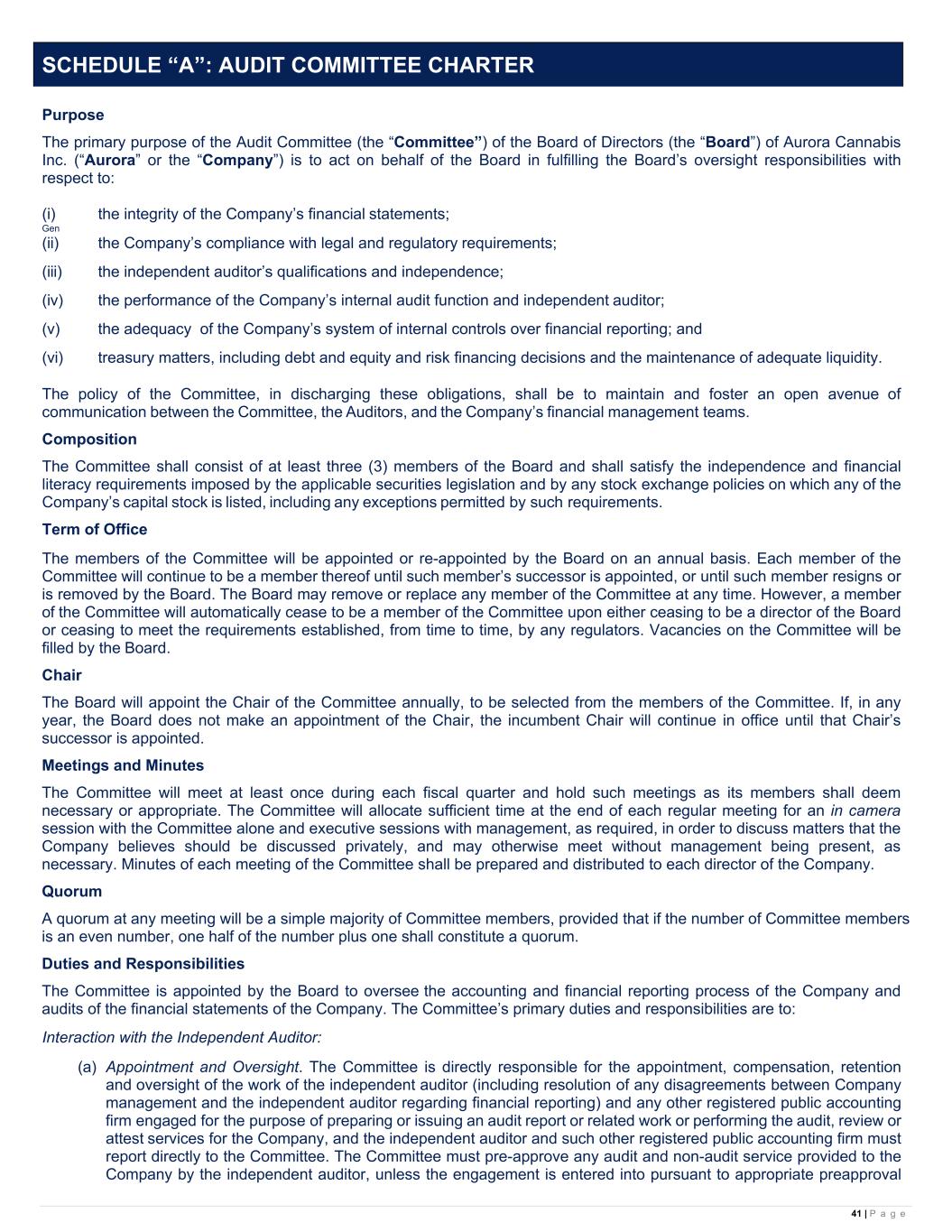
The Company’s Board of Directors (the “Board”) is responsible for the Company’s corporate governance and has the following independent designated standing committees: the Nominating and Corporate Governance Committee, the Human Resources and Compensation Committee and the Audit Committee. The charters of each committee can be viewed on the Company’s corporate website at https://www.auroramj.com/investors/corporate-governance/. In addition, the Company’s Audit Committee Charter is attached as Schedule “A” to the AIF, which is filed as Exhibit 99.7 to this Annual Report.
Nominating and Corporate Governance Committee

The Nominating and Corporate Governance Committee (the “N&CGC”) is responsible for screening nominees to the Board, and it annually assesses the skills and qualifications of directors and nominees to ensure the Board members have the skills and qualifications appropriate to the current needs of the Company. In addition, the N&CGC annually reviews the Board skills matrix, committee charters and Board policies, oversees Board effectiveness processes and director onboarding and education, and is responsible for overseeing and monitoring the Company’s approach, policies and practices related to environmental, social and governance, or ESG, matters. The N&CGC is comprised of Norma Beauchamp (Chair), Michael Singer, Chitwant Kohli, and Rajesh Uttamchandani. The Board has determined that all of the members of the N&CGC are independent, based on the criteria for independence prescribed by Nasdaq’s director independence standards under Rule 5605(a)(2).
Human Resources and Compensation Committee

The Human Resources and Compensation Committee (the “HRCC”) is responsible for (a) reviewing and approving directors’ and executive compensation based on the Company’s goals and objectives; (b) reviewing and approving the Company’s incentive compensation and equity-based plans and arrangements; (c) executive succession planning; and (d) reporting regularly to the Board on the activities of the HRCC. To make its recommendation on directors’ and executive officer compensation, the HRCC takes into account the types of compensation and the amounts paid to directors and executive officers of comparable publicly traded Canadian companies. The HRCC is comprised of Michael Singer (Chair), Norma Beauchamp and Rajesh Uttamchandani. The Board has determined that all of the members of the HRCC are independent, based on the criteria for independence prescribed by Nasdaq’s director independence standards under Rule 5605(a)(2).
AUDIT COMMITTEE
Our Board has established an independent Audit Committee for the purpose of overseeing our accounting and financial reporting processes and the audit of our annual financial statements.
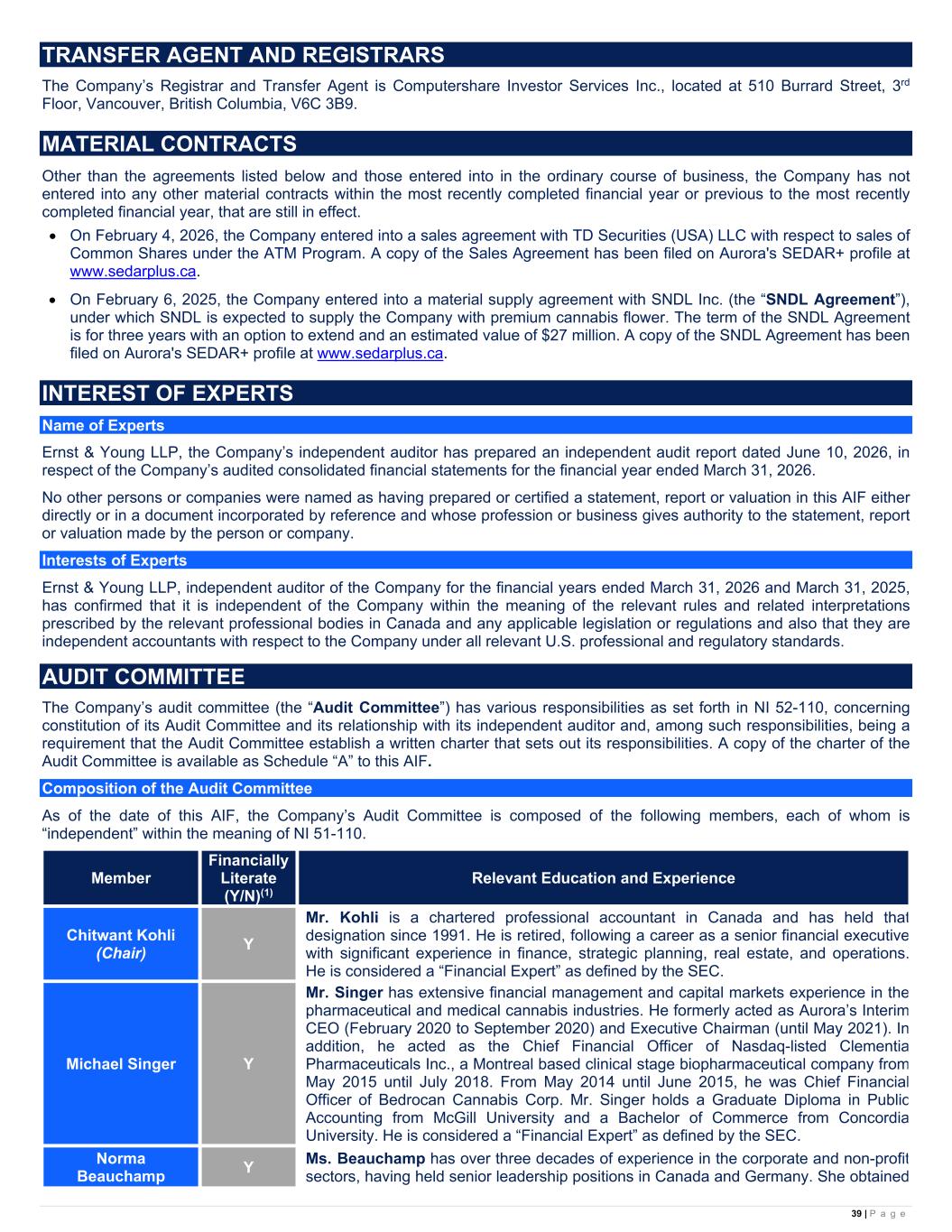
The Audit Committee is comprised of Chitwant Kohli (Chair), Michael Singer and Norma Beauchamp. The Board has determined that the Audit Committee meets the composition requirements set forth in Nasdaq Rule 5605(c)(2)(A), and that each of the members of the Audit Committee is independent as determined under Rule 10A-3 of the Exchange Act and Nasdaq’s director independence standards under Rule 5605(a)(2). All members of the Audit Committee are financially literate, meaning they are able to read and understand the Company’s financial statements and to understand the breadth and level of complexity of the issues that can reasonably be expected to be raised in the Company’s financial statements.


Audit Committee Financial Experts
The Board has determined that Chitwant Kohli and Michael Singer each qualify as an “Audit Committee financial expert” (as defined in paragraph (8)(b) of General Instruction B to Form 40-F) and a “financially sophisticated Audit Committee member” under Nasdaq Rule 5605(c)(2)(A).
PRE-APPROVAL OF AUDIT AND NON-AUDIT SERVICES PROVIDED BY
INDEPENDENT AUDITOR
The Audit Committee Charter sets out responsibilities regarding the provision of non-audit services by the Company’s external auditor and requires the Audit Committee to pre-approve all permitted non-audit services to be provided by the Company’s external auditor, in accordance with applicable law.
PRINCIPAL ACCOUNTING FEES AND SERVICES - INDEPENDENT AUDITOR
Ernst & Young LLP of Vancouver, British Columbia, Canada (Audit Firm I.D.:01263) (“E&Y”), acted as our independent registered public accounting firm for the fiscal periods ended March 31, 2026 and March 31, 2025.
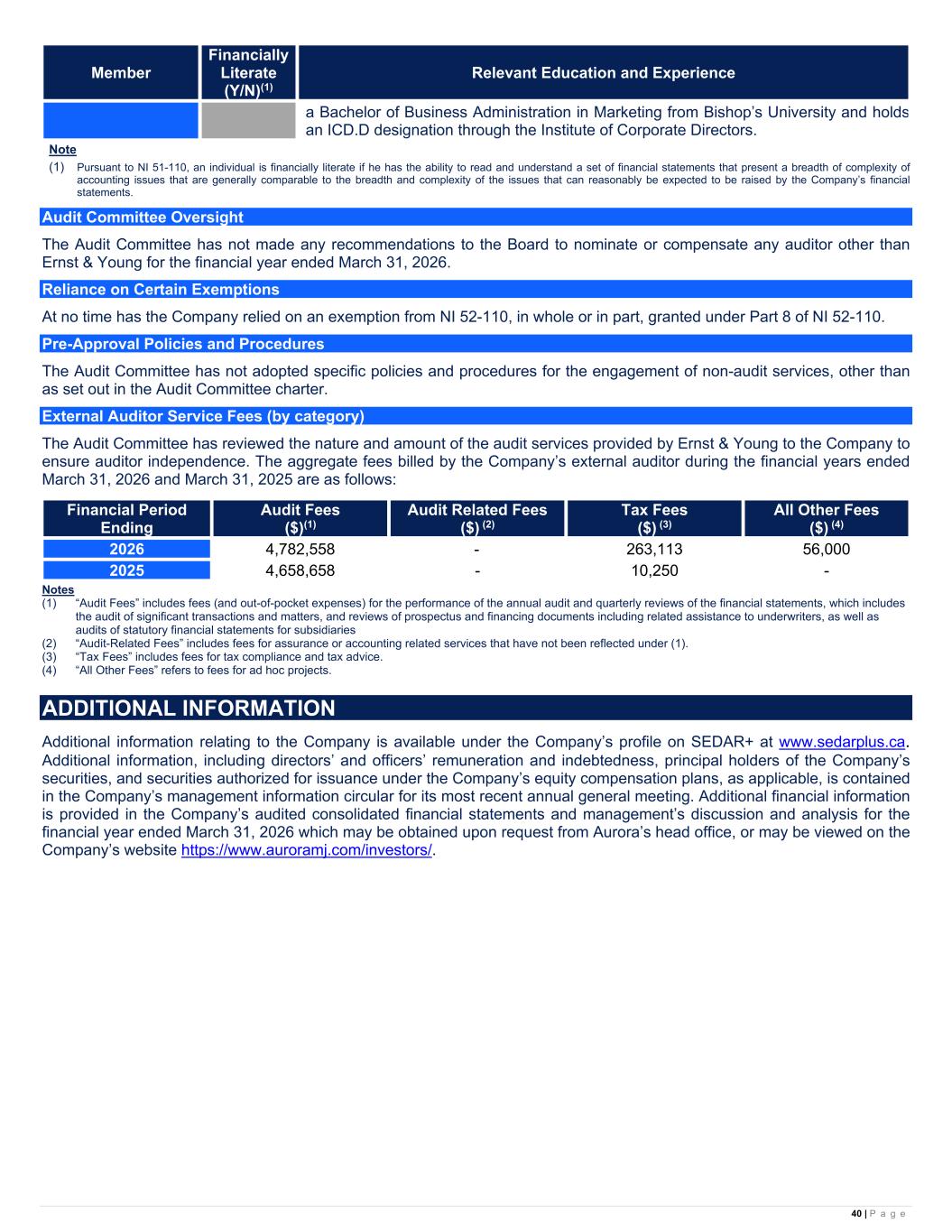
The following table sets forth information regarding amounts billed to us by E&Y for each of our last two fiscal periods in Canadian dollars:
Financial Period Ending
Audit Fees
($)(1)
Audit-Related Fees
($)(2)
Tax Fees
($)(3)
All Other Fees
($)(4)
March 31, 2026 4,782,558 263,113 56,000
March 31, 2025 4,658,658 10,250
Notes
(1)“Audit Fees” includes fees for the performance of the annual audit and quarterly reviews of the financial statements, which includes the audit of significant transactions and matters, and reviews of prospectus and financing documents including related assistance to underwriters.
(2)“Audit-Related Fees” includes fees for assurance or accounting related services that have not been reflected under (1).
(3)“Tax Fees” includes fees for tax compliance and tax advice.
(4)“All Other Fees” refers to fees for ad hoc projects.
Audit Committee Pre-Approval Policies
From time to time, management of the Company recommends to, and requests approval from, the audit committee for audit and non-audit services to be provided by the Company's auditor.
The Audit Committee may delegate to one or more of its members the authority to pre-approve non-audit services to be provided to the Company or its subsidiaries by the Company’s external auditor. The pre-approval of non-audit services must be presented to the Audit Committee at its first scheduled meeting following such pre-approval.
The Audit Committee may satisfy its duty to pre-approve non-audit services by adopting specific policies and procedures for the engagement of the non-audit services, provided the policies and procedures are detailed as to the particular service, the Audit Committee is informed of each non-audit service, and the procedures do not include delegation of the Audit Committee’s responsibilities to management.
OFF-BALANCE SHEET ARRANGEMENTS
The information provided in the section entitled “Liquidity and Capital Resources” under the sub-heading “Commitments” contained in the MD&A filed as Exhibit 99.6 to this Annual Report on Form 40-F is incorporated by reference herein.
CODE OF ETHICS
We have adopted a Code of Business Conduct and Ethics (the “Code”) that applies to our officers (including without limitation, the CEO, CFO and other high-ranking executive officers), employees and directors of the Company and its subsidiaries and promotes, among other things, honest and ethical conduct. The Code meets the requirements for a “code of ethics” within the meaning of that term under Form 40-F. The Code was last reviewed and approved by the Company’s Board of Directors on March 25, 2026. The Code is available under the Company’s profile on www.sedarplus.ca and on the Company's website at https://www.auroramj.com/investors/corporate-governance/.


During the financial year ended March 31, 2026, no material amendment was made to the Code which would be required to be disclosed pursuant to Paragraph 9 of General Instruction B to Form 40-F, and no waivers of the Code were granted to any principal officer of the Company or any person performing similar functions.

NOTICES PURSUANT TO REGULATION BTR
There were no notices required by Rule 104 of Regulation BTR that the Company sent during the financial year ended March 31, 2026 concerning any equity security subject to a blackout period under Rule 101 of Regulation BTR.
NASDAQ CORPORATE GOVERNANCE
Our common shares are quoted for trading on Nasdaq under the symbol “ACB”. Nasdaq Rule 5615(a)(3) permits a foreign private issuer to follow its home country practice in lieu of the Nasdaq corporate governance requirements if such issuer, amongst other requirements, makes appropriate disclosure in its annual report filed with the SEC relating to each requirement of Rule 5600 that it does not follow including a brief statement of the home country practice it follows in lieu of such Nasdaq corporate governance requirements.
Our governance practices differ from those followed by domestic companies pursuant to Rule 5600 of the Nasdaq Rules in the following way:
Shareholder Meeting Quorum Requirement: Rule 5620(c) requires that each listed company provide for a quorum for any meeting of the holders of the listed company’s common stock that is not less than 33 1/3% of the listed company’s outstanding shares of common stock entitled to vote. The Company’s quorum requirement is set forth in its Articles, which states that a quorum for a meeting of shareholders of the Company is present if there are two persons who are, or who represent by proxy, one or more shareholders who, in the aggregate, hold at least five percent of the issued common shares.
Shareholder Approval Requirements: In certain instances, Nasdaq Listing Rule 5635 requires each issuer to obtain shareholder approval prior to an issuance of securities in connection with: (i) the acquisition of the stock or assets of another company; (ii) equity-based compensation of officers, directors, employees or consultants; (iii) a change of control; and (iv) transactions other than public offerings. The Company does not follow this Nasdaq Listing Rule. Instead, the Company complies with home country practice, which has different requirements for shareholder approval (including, in certain instances, not requiring any shareholder approval) in connection with issuances of securities in the circumstances listed above.

The foregoing is consistent with the laws, customs and practices in Canada.
MINE SAFETY DISCLOSURE
Not applicable.
UNDERTAKING
The Company undertakes to make available, in person or by telephone, representatives to respond to inquiries made by the SEC staff, and to furnish promptly, when requested to do so by the SEC staff, information relating to: the securities registered pursuant to Form 40-F; the securities in relation to which the obligation to file an annual report on Form 40-F arises; or transactions in said securities.
CONSENT TO SERVICE OF PROCESS

The Company has previously filed with the SEC a written consent to service of process on Form F-X. Any change to the name or address of the Company’s agent for service shall be communicated promptly to the SEC by amendment to the Form F-X referencing the file number of the Company.


EXHIBIT INDEX
Exhibit Number
Exhibit Description
Clawback Policy (incorporated by reference from Exhibit 97 to the Registrant’s Annual Report on Form 40-F, filed with the SEC on June 20, 2024)
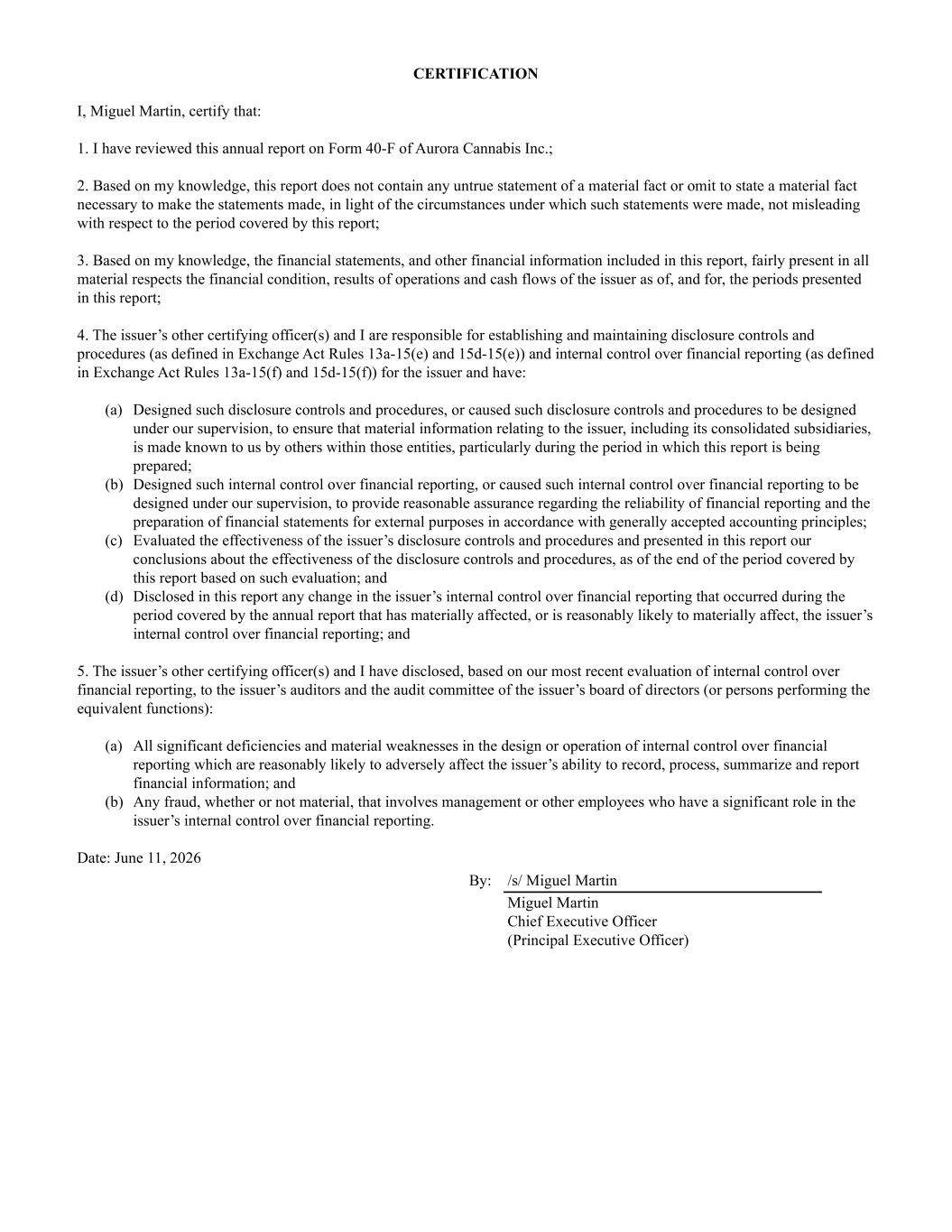
Certification of Chief Executive Officer pursuant to Rule 13a-14(a) of the Exchange Act, as adopted pursuant to Section 302 of the Sarbanes-Oxley Act of 2002
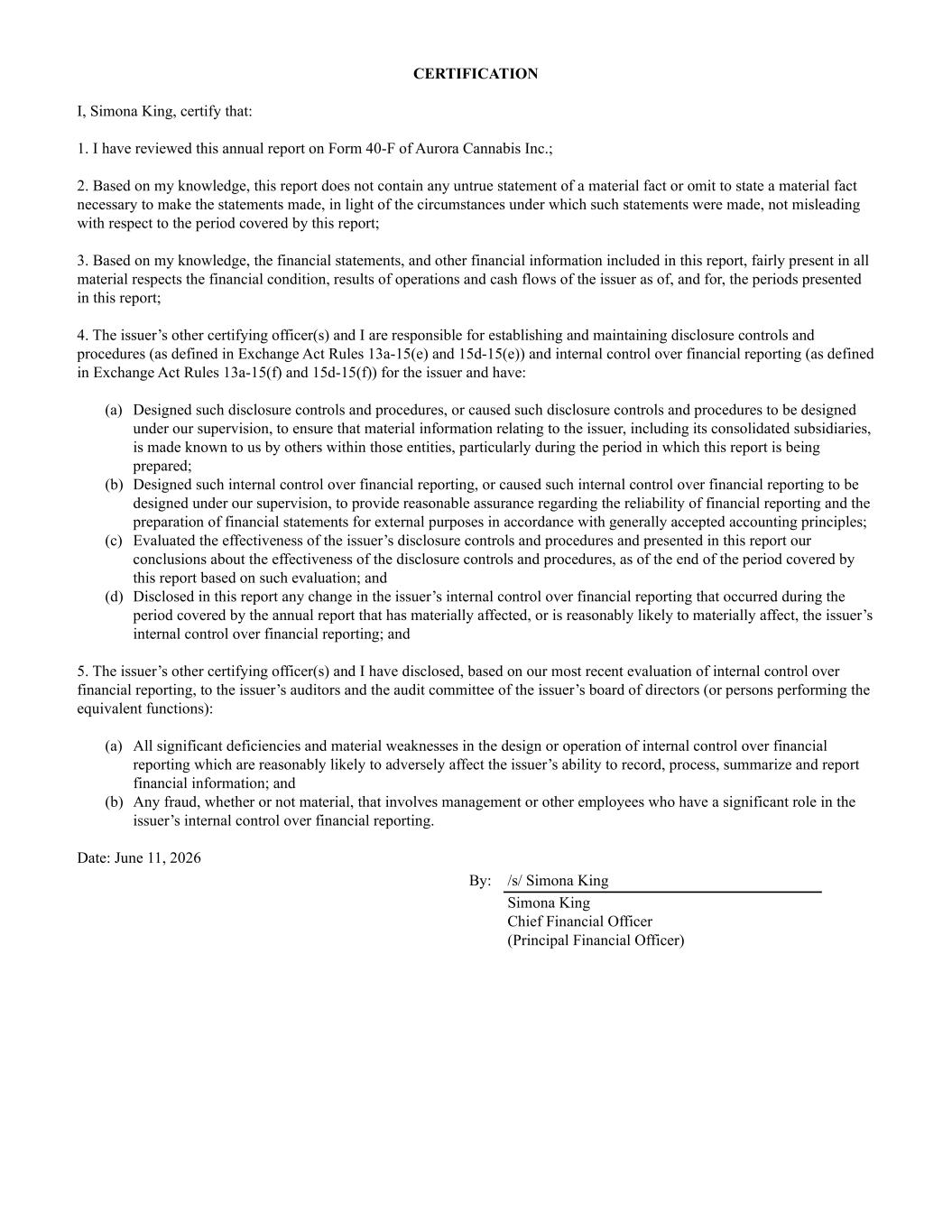
Certification of Chief Financial Officer pursuant to Rule 13a-14(a) of the Exchange Act, as adopted pursuant to Section 302 of the Sarbanes-Oxley Act of 2002
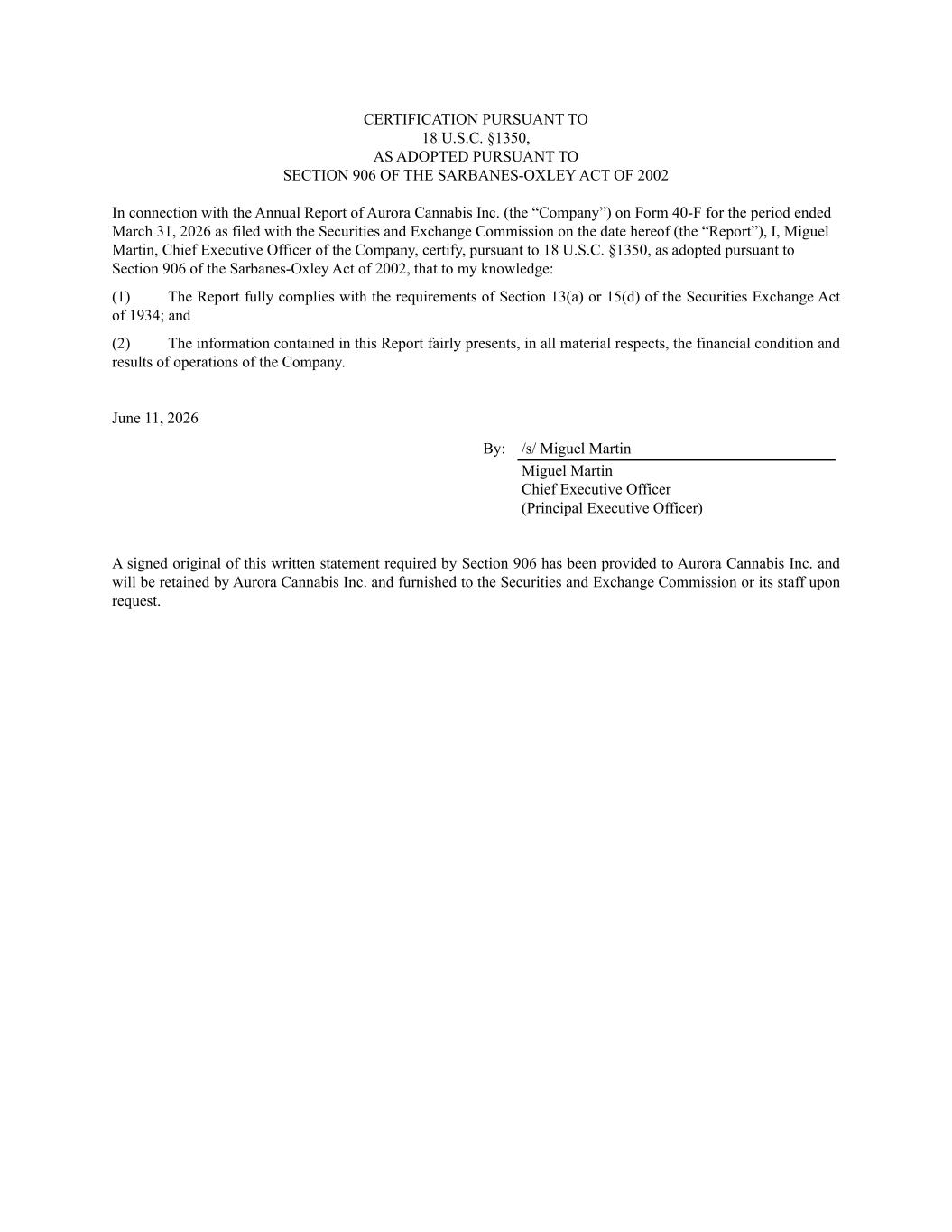
Certification of Chief Executive Officer pursuant to Rule 13a-14(b) of the Exchange Act and 18 U.S.C. Section 1350, as adopted pursuant to Section 906 of the Sarbanes-Oxley Act of 2002
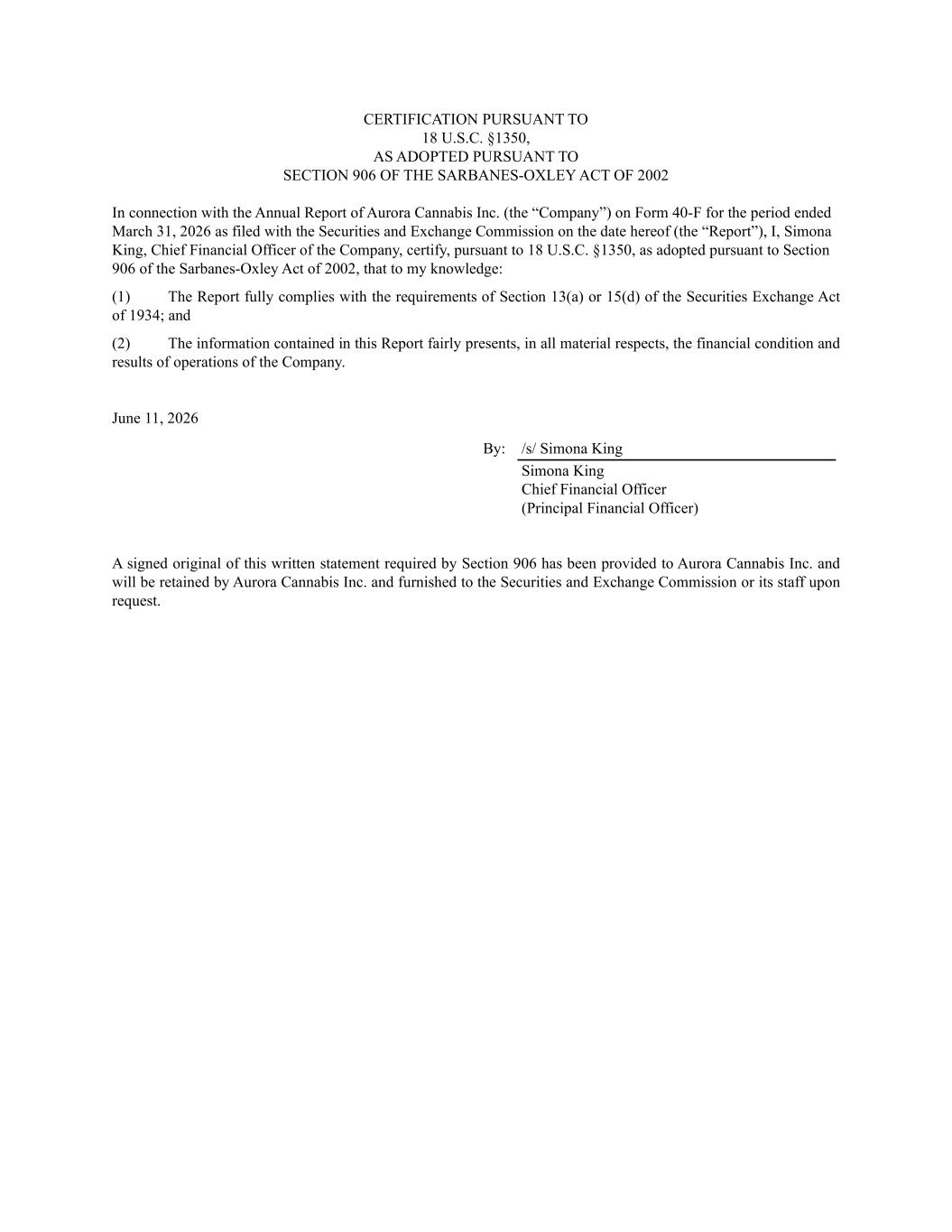
Certification of Chief Financial Officer pursuant to Rule 13a-14(b) of the Exchange Act and 18 U.S.C. Section 1350, as adopted pursuant to Section 906 of the Sarbanes-Oxley Act of 2002
Audited consolidated financial statements of the Company and notes thereto as at and for the financial year ended March 31, 2026, together with the report thereon of the independent auditor
Management’s Discussion and Analysis for the financial year ended March 31, 2026
Annual Information Form of the Company for the financial year ended March 31, 2026
Consent of Ernst & Young LLP
101
Interactive Data File (formatted as Inline XBRL)
104
Cover Page Interactive Data File (formatted as Inline XBRL and contained in Exhibit 101)


SIGNATURES
Pursuant to the requirements of the Exchange Act, the Company certifies that it meets all of the requirements for filing on Form 40-F and has duly caused this annual report to be signed on its behalf by the undersigned, thereunto duly authorized.
Date: June 11, 2026
AURORA CANNABIS INC.
By:
/s/ “Simona King”
Simona King
Chief Financial Officer


EX-99.1 2 a991-s302certification_c.htm EX-99.1 a991-s302certification_c
CERTIFICATION I, Miguel Martin, certify that: 1. I have reviewed this annual report on Form 40-F of Aurora Cannabis Inc.; 2. Based on my knowledge, this report does not contain any untrue statement of a material fact or omit to state a material fact necessary to make the statements made, in light of the circumstances under which such statements were made, not misleading with respect to the period covered by this report; 3. Based on my knowledge, the financial statements, and other financial information included in this report, fairly present in all material respects the financial condition, results of operations and cash flows of the issuer as of, and for, the periods presented in this report; 4. The issuer’s other certifying officer(s) and I are responsible for establishing and maintaining disclosure controls and procedures (as defined in Exchange Act Rules 13a-15(e) and 15d-15(e)) and internal control over financial reporting (as defined in Exchange Act Rules 13a-15(f) and 15d-15(f)) for the issuer and have: (a) Designed such disclosure controls and procedures, or caused such disclosure controls and procedures to be designed under our supervision, to ensure that material information relating to the issuer, including its consolidated subsidiaries, is made known to us by others within those entities, particularly during the period in which this report is being prepared; (b) Designed such internal control over financial reporting, or caused such internal control over financial reporting to be designed under our supervision, to provide reasonable assurance regarding the reliability of financial reporting and the preparation of financial statements for external purposes in accordance with generally accepted accounting principles; (c) Evaluated the effectiveness of the issuer’s disclosure controls and procedures and presented in this report our conclusions about the effectiveness of the disclosure controls and procedures, as of the end of the period covered by this report based on such evaluation; and (d) Disclosed in this report any change in the issuer’s internal control over financial reporting that occurred during the period covered by the annual report that has materially affected, or is reasonably likely to materially affect, the issuer’s internal control over financial reporting; and 5. The issuer’s other certifying officer(s) and I have disclosed, based on our most recent evaluation of internal control over financial reporting, to the issuer’s auditors and the audit committee of the issuer’s board of directors (or persons performing the equivalent functions): (a) All significant deficiencies and material weaknesses in the design or operation of internal control over financial reporting which are reasonably likely to adversely affect the issuer’s ability to record, process, summarize and report financial information; and (b) Any fraud, whether or not material, that involves management or other employees who have a significant role in the issuer’s internal control over financial reporting. Date: June 11, 2026 By: /s/ Miguel Martin Miguel Martin Chief Executive Officer (Principal Executive Officer)


EX-99.2 3 a992-s302certification_c.htm EX-99.2 a992-s302certification_c
CERTIFICATION I, Simona King, certify that: 1. I have reviewed this annual report on Form 40-F of Aurora Cannabis Inc.; 2. Based on my knowledge, this report does not contain any untrue statement of a material fact or omit to state a material fact necessary to make the statements made, in light of the circumstances under which such statements were made, not misleading with respect to the period covered by this report; 3. Based on my knowledge, the financial statements, and other financial information included in this report, fairly present in all material respects the financial condition, results of operations and cash flows of the issuer as of, and for, the periods presented in this report; 4. The issuer’s other certifying officer(s) and I are responsible for establishing and maintaining disclosure controls and procedures (as defined in Exchange Act Rules 13a-15(e) and 15d-15(e)) and internal control over financial reporting (as defined in Exchange Act Rules 13a-15(f) and 15d-15(f)) for the issuer and have: (a) Designed such disclosure controls and procedures, or caused such disclosure controls and procedures to be designed under our supervision, to ensure that material information relating to the issuer, including its consolidated subsidiaries, is made known to us by others within those entities, particularly during the period in which this report is being prepared; (b) Designed such internal control over financial reporting, or caused such internal control over financial reporting to be designed under our supervision, to provide reasonable assurance regarding the reliability of financial reporting and the preparation of financial statements for external purposes in accordance with generally accepted accounting principles; (c) Evaluated the effectiveness of the issuer’s disclosure controls and procedures and presented in this report our conclusions about the effectiveness of the disclosure controls and procedures, as of the end of the period covered by this report based on such evaluation; and (d) Disclosed in this report any change in the issuer’s internal control over financial reporting that occurred during the period covered by the annual report that has materially affected, or is reasonably likely to materially affect, the issuer’s internal control over financial reporting; and 5. The issuer’s other certifying officer(s) and I have disclosed, based on our most recent evaluation of internal control over financial reporting, to the issuer’s auditors and the audit committee of the issuer’s board of directors (or persons performing the equivalent functions): (a) All significant deficiencies and material weaknesses in the design or operation of internal control over financial reporting which are reasonably likely to adversely affect the issuer’s ability to record, process, summarize and report financial information; and (b) Any fraud, whether or not material, that involves management or other employees who have a significant role in the issuer’s internal control over financial reporting. Date: June 11, 2026 By: /s/ Simona King Simona King Chief Financial Officer (Principal Financial Officer)


EX-99.3 4 a993-s906certificationce.htm EX-99.3 a993-s906certificationce
CERTIFICATION PURSUANT TO 18 U.S.C. §1350, AS ADOPTED PURSUANT TO SECTION 906 OF THE SARBANES-OXLEY ACT OF 2002 In connection with the Annual Report of Aurora Cannabis Inc. (the “Company”) on Form 40-F for the period ended March 31, 2026 as filed with the Securities and Exchange Commission on the date hereof (the “Report”), I, Miguel Martin, Chief Executive Officer of the Company, certify, pursuant to 18 U.S.C. §1350, as adopted pursuant to Section 906 of the Sarbanes-Oxley Act of 2002, that to my knowledge: (1) The Report fully complies with the requirements of Section 13(a) or 15(d) of the Securities Exchange Act of 1934; and (2) The information contained in this Report fairly presents, in all material respects, the financial condition and results of operations of the Company. June 11, 2026 By: /s/ Miguel Martin Miguel Martin Chief Executive Officer (Principal Executive Officer) A signed original of this written statement required by Section 906 has been provided to Aurora Cannabis Inc. and will be retained by Aurora Cannabis Inc. and furnished to the Securities and Exchange Commission or its staff upon request.


EX-99.4 5 a994-s906certificationcf.htm EX-99.4 a994-s906certificationcf
CERTIFICATION PURSUANT TO 18 U.S.C. §1350, AS ADOPTED PURSUANT TO SECTION 906 OF THE SARBANES-OXLEY ACT OF 2002 In connection with the Annual Report of Aurora Cannabis Inc. (the “Company”) on Form 40-F for the period ended March 31, 2026 as filed with the Securities and Exchange Commission on the date hereof (the “Report”), I, Simona King, Chief Financial Officer of the Company, certify, pursuant to 18 U.S.C. §1350, as adopted pursuant to Section 906 of the Sarbanes-Oxley Act of 2002, that to my knowledge: (1) The Report fully complies with the requirements of Section 13(a) or 15(d) of the Securities Exchange Act of 1934; and (2) The information contained in this Report fairly presents, in all material respects, the financial condition and results of operations of the Company. June 11, 2026 By: /s/ Simona King Simona King Chief Financial Officer (Principal Financial Officer) A signed original of this written statement required by Section 906 has been provided to Aurora Cannabis Inc. and will be retained by Aurora Cannabis Inc. and furnished to the Securities and Exchange Commission or its staff upon request.


Picture1.jpg


AURORA CANNABIS INC.

Consolidated Financial Statements

For the years ended March 31, 2026 and 2025
(in Canadian Dollars)


Table of Contents
Consolidated Statements of Financial Position
Consolidated Statements of Income (Loss) and Comprehensive Income (Loss)
Consolidated Statements of Changes in Shareholders’ Equity
Consolidated Statements of Cash Flows
Notes to the Consolidated Financial Statements
Note 1 Nature of Operations Note 13 Share-Based Compensation
Note 2 Material Accounting Policies and Judgments Note 14 Income (Loss) Per Share
Note 3 Accounts Receivable Note 15 Revenue
Note 4 Biological Assets Note 16 Segmented Information
Note 5 Inventory Note 17 Income Taxes
Note 6
Assets Held for Sale and Discontinued Operations
Note 18
Related Party Transactions
Note 7 Property, Plant and Equipment
Note 19
Supplemental Cash Flow Information
Note 8
Non-controlling Interests
Note 20
Commitments and Contingencies
Note 9 Intangible Assets and Goodwill
Note 21
Fair Value of Financial Instruments
Note 10 Loans and Borrowings
Note 22
Financial Instruments Risk
Note 11 Lease Liabilities
Note 23
Capital Management
Note 12
Share Capital
Note 24
Subsequent Event


Report of Independent Registered
Public Accounting Firm


To the Shareholders and Board of Directors Aurora Cannabis Inc:

Opinion on the Financial Statements

We have audited the accompanying consolidated statements of financial position of Aurora Cannabis Inc. (the Company) as of March 31, 2026 and 2025, the related consolidated statements of income (loss) and comprehensive income (loss), changes in shareholders’ equity and cash flows for each of the two years in the period ended March 31, 2026, and the related notes (collectively referred to as the “consolidated financial statements”). In our opinion, the consolidated financial statements present fairly, in all material respects, the financial position of the Company at March 31, 2026 and 2025, and its financial performance and its cash flows for each of the two years in the period ended March 31, 2026, in conformity with International Financial Reporting Standards as issued by the International Accounting Standards Board.

We also have audited, in accordance with the standards of the Public Company Accounting Oversight Board (United States) (PCAOB), the Company's internal control over financial reporting as of March 31, 2026, based on criteria established in Internal Control-Integrated Framework issued by the Committee of Sponsoring Organizations of the Treadway Commission (2013 framework), and our report dated June 10, 2026, expressed an adverse opinion thereon.

Basis for Opinion

These consolidated financial statements are the responsibility of the Company's management. Our responsibility is to express an opinion on the Company’s consolidated financial statements based on our audits. We are a public accounting firm registered with the PCAOB and are required to be independent with respect to the Company in accordance with the U.S. federal securities laws and the applicable rules and regulations of the Securities and Exchange Commission and the PCAOB.

We conducted our audits in accordance with the standards of the PCAOB. Those standards require that we plan and perform the audit to obtain reasonable assurance about whether the financial statements are free of material misstatement, whether due to error or fraud. Our audits included performing procedures to assess the risks of material misstatement of the consolidated financial statements, whether due to error or fraud, and performing procedures that respond to those risks. Such procedures included examining, on a test basis, evidence regarding the amounts and disclosures in the consolidated financial statements. Our audits also included evaluating the accounting principles used and significant estimates made by management, as well as evaluating the overall presentation of the consolidated financial statements. We believe that our audits provide a reasonable basis for our opinion.

Critical Audit Matters

The critical audit matters communicated below are matters arising from the current period audit of the financial statements that were communicated or required to be communicated to the audit committee and that: (1) relate to accounts or disclosures that are material to the financial statements and (2) involved our especially challenging, subjective or complex judgments. The communication of critical audit matters does not alter in any way our opinion on the consolidated financial statements, taken as a whole, and we are not, by communicating the critical audit matters below, providing separate opinions on the critical audit matters or on the accounts or disclosures to which they relate.


3


Valuation of indefinite life intangible assets in the European Cannabis cash generating unit

Description of the Matter

As at March 31, 2026, the Company had indefinite life intangible assets totalling $23.8 million in the European Cannabis cash generating unit (CGU).

As discussed in Note 9 to the consolidated financial statements, indefinite life intangible assets are tested for impairment annually, and whenever events or circumstances make it more likely than not that an impairment may have occurred. An impairment loss is recognized for the amount by which the CGU carrying amount exceeds its recoverable amount. The recoverable amount of the CGU was determined based on fair value less costs of disposal. As a result of the Company’s annual impairment test, no impairment was recognized for the European Cannabis CGU.

Auditing management’s estimate of the recoverable amount of the CGU involved especially challenging, subjective and complex auditor judgment due to the significant estimation uncertainty in determining the fair value of the CGU and the subjective nature of the assumptions used in determining the fair value of the CGU, including forecasted revenues, forecasted EBITDA margins and discount rate. These significant assumptions are forward-looking and could be affected by future economic and market conditions.

How We Addressed the Matter in Our Audit

To test the estimated fair value of the Company’s European Cannabis CGU, we performed audit procedures that included, among others, assessing the valuation methodology used by the Company, testing the significant assumptions discussed above, and evaluating the completeness and accuracy of the underlying data used by the Company in its analyses. We compared the significant assumptions described above to current market and economic trends, historical results of the business, and other guidelines used by companies in the same industry. We involved our valuation specialists to assist in our evaluation of the Company's valuation methodology and certain significant assumptions, including discount rate.

In addition, we assessed the historical accuracy of management’s estimates and performed sensitivity analyses of significant assumptions to evaluate the changes in the fair value of the CGU that would result from changes in the assumptions. We also assessed the adequacy of the financial statement disclosures.

Valuation of cannabis biological assets

Description of the Matter

As at March 31, 2026, the Company had recorded cannabis biological assets totalling $20.2 million.

As discussed in Note 4 to the consolidated financial statements, the Company defines biological assets as living plants up to the point of harvest. Biological assets are measured at fair value less costs to sell (FVLCS) at the end of each reporting period. The Company utilizes an income approach to determine the FVLCS at a specific measurement date, based on the existing plants’ stage of completion up to the point of harvest.

Auditing the valuation of cannabis biological assets involved especially challenging, subjective and complex auditor judgment to evaluate management’s valuation model and the significant assumptions used to estimate FVLCS of cannabis biological assets including average selling price per gram, weighted average yield per plant, cost per gram to complete production, and stage of completion in the production process.

How We Addressed the Matter in Our Audit

To test the estimated fair value of the Company’s cannabis biological assets, we performed audit procedures that included, among others, assessing the valuation methodology used by the Company, testing the significant assumptions discussed above, and evaluating the completeness and accuracy of the underlying data used by the Company in its analyses. We tested the weighted average yield per plant by observing the number of grams harvested from certain plants and subsequently comparing the number to actual harvest records, tested the average selling price per gram by comparing to actual sales prices per gram, tested the cost to complete per gram by comparing to actual production costs incurred and observed stage of completion of plant growth at year end count observations.


We also compared the weighted average yield per plant to competitors’ data. We involved our valuation specialists to assist in our evaluation of the Company's valuation methodology. We also assessed the adequacy of the financial statement disclosures.


/s/ Ernst & Young LLP
Chartered Professional Accountants

We have served as the Company’s auditor since 2024.

Vancouver, Canada
June 10, 2026


Report of Independent Registered
Public Accounting Firm
To the Shareholders and Board of Directors Aurora Cannabis Inc:

Opinion on Internal Control Over Financial Reporting
We have audited Aurora Cannabis Inc.’s internal control over financial reporting as of March 31, 2026, based on criteria established in Internal Control— Integrated Framework issued by the Committee of Sponsoring Organizations of the Treadway Commission “(2013 framework),” (the COSO criteria). In our opinion, because of the effect of the material weakness described below on the achievement of the objectives of the control criteria, Aurora Cannabis Inc. (the Company) has not maintained effective internal control over financial reporting as of March 31, 2026, based on the COSO criteria.

A material weakness is a deficiency, or combination of deficiencies, in internal control over financial reporting, such that there is a reasonable possibility that a material misstatement of the company’s annual or interim financial statements will not be prevented or detected on a timely basis. The following material weakness has been identified and included in management’s assessment. Management has identified a material weakness with respect to controls over the completeness and accuracy of inputs to significant estimates, assumptions and formulas in certain significant accounts.

We also have audited, in accordance with the standards of the Public Company Accounting Oversight Board (United States) (PCAOB), the consolidated statements of financial position of the Company as of March 31, 2026 and 2025, the related consolidated statements of income (loss) and comprehensive income (loss), changes in shareholders’ equity and cash flows for each of the two years in the period ended March 31, 2026 , and the related notes. This material weakness was considered in determining the nature, timing and extent of audit tests applied in our audit of the 2026 consolidated financial statements, and this report does not affect our report dated June 10, 2026, which expressed an unqualified opinion thereon.

Basis for Opinion

The Company’s management is responsible for maintaining effective internal control over financial reporting and for its assessment of the effectiveness of internal control over financial reporting included in the accompanying “Management’s Discussion and Analysis – Management’s Assessment on Internal Control over Financial Reporting”. Our responsibility is to express an opinion on the Company’s internal control over financial reporting based on our audit. We are a public accounting firm registered with the PCAOB and are required to be independent with respect to the Company in accordance with the U.S. federal securities laws and the applicable rules and regulations of the Securities and Exchange Commission and the PCAOB.

We conducted our audit in accordance with the standards of the PCAOB. Those standards require that we plan and perform the audit to obtain reasonable assurance about whether effective internal control over financial reporting was maintained in all material respects.

Our audit included obtaining an understanding of internal control over financial reporting, assessing the risk that a material weakness exists, testing and evaluating the design and operating effectiveness of internal control based on the assessed risk, and performing such other procedures as we considered necessary in the circumstances. We believe that our audit provides a reasonable basis for our opinion.

Definition and Limitations of Internal Control Over Financial Reporting

A company’s internal control over financial reporting is a process designed to provide reasonable assurance regarding the reliability of financial reporting and the preparation of financial statements for external purposes in accordance with generally accepted accounting principles. A company’s internal control over financial reporting includes those policies and procedures that (1) pertain to the maintenance of records that, in reasonable detail, accurately and fairly reflect the transactions and dispositions of the assets of the company; (2) provide reasonable assurance that transactions are recorded as necessary to permit preparation of financial statements in accordance with generally accepted accounting principles, and that receipts and expenditures of the company are being made only in accordance with authorizations of management and directors of the company; and (3) provide reasonable assurance regarding prevention or timely detection of unauthorized acquisition, use, or disposition of the company’s assets that could have a material effect on the financial statements.


Because of its inherent limitations, internal control over financial reporting may not prevent or detect misstatements. Also, projections of any evaluation of effectiveness to future periods are subject to the risk that controls may become inadequate because of changes in conditions, or that the degree of compliance with the policies or procedures may deteriorate.

/s/ Ernst & Young LLP
Chartered Professional Accountants

Vancouver, Canada
June 10, 2026


AURORA CANNABIS INC.
Consolidated Statements of Financial Position

($ thousands) Note March 31, 2026
March 31, 2025
$ $
Assets
Current assets
Cash and cash equivalents 64,690  137,921 
Restricted cash
19
47,791  47,407 
Short-term investments
21 52,213  — 
Accounts receivable 3 44,578  42,470 
Biological assets 4 20,213  51,168 
Inventory
5
154,862  187,925 
Prepaids and other current assets 21 11,120  11,215 
Assets held for sale 6(a) 1,986  222 
397,453  478,328 
Property, plant and equipment 7 123,688  268,107 
Long-term investments
6(b), 21
12,113  — 
Deposits and other long-term assets 3,618  7,722 
Lease receivable 3,665  5,256 
Intangible assets 9 31,441  45,163 
Goodwill 9 26,651  43,871 
Deferred tax assets
17
2,458  4,219 
Total assets 601,087  852,666 
Liabilities
Current liabilities
Accounts payable and accrued liabilities
22(b)
50,592  73,605 
Income taxes payable 17 6,959  7,601 
Deferred revenue 1,270  1,074 
Loans and borrowings - current portion 10 —  21,513 
Lease liabilities - current portion 11 5,729  5,381 
Provisions 2,380  1,689 
66,930  110,863 
Loans and borrowings 10 —  40,194 
Lease liabilities
11
18,130  37,495 
Derivative liabilities
12(c), 13(e), 21
3,697  5,531 
Other long-term liabilities 21 498  48,095 
Deferred tax liabilities 17 —  1,897 
Total liabilities 89,255  244,075 
Shareholders’ equity
Share capital 12 7,007,226  6,991,154 
Contributed surplus 160,108  158,970 
Accumulated other comprehensive loss (213,594) (215,208)
Retained earnings (deficit) (6,441,908) (6,367,745)
Equity attributable to Aurora Cannabis Inc. shareholders 511,832  567,171 
Non-controlling interests 8 —  41,420 
Total shareholders’ equity 511,832  608,591 
Total liabilities and shareholders’ equity 601,087  852,666 

See accompanying notes to these consolidated financial statements.

8


AURORA CANNABIS INC.
Consolidated Statements of Income (loss) and Comprehensive Income (loss)

Years ended March 31,
($ thousands) Note 2026
 2025(1)
$ $
Revenue 15 342,424 319,858
Excise taxes 15 (21,831) (30,947)
Net revenue 320,593 288,911
Cost of sales
5
161,819 144,085
Gross profit before fair value adjustments 158,774 144,826
Loss on changes in fair value of inventory and biological assets sold
4, 5
138,255 131,985
Gain on changes in fair value of biological assets 4 (116,131) (168,111)
Gross profit 136,650 180,952
Operating expenses
General and administration 106,567 91,323
Sales and marketing 59,641 56,170
Business development costs 1,975 3,435
Research and development 4,022 3,676
Depreciation and amortization
7
3,814 2,984
Share-based compensation 13 7,293 12,930
183,312 170,518
Other income (expenses)
Interest and other income 5,847 10,314
Finance and other costs (1,809) (2,515)
Foreign exchange gain (loss) 1,341 11,659
Other gains (losses)
720 2,099
Impairment of property, plant and equipment
6(b), 7
(2,775) (696)
Impairment of intangible assets and goodwill 9 (13,186)
(9,862) 20,861
Income (loss) before income tax recovery (expense) (56,524) 31,295
Income tax recovery (expense)
 Current 17 (2,040) (7,397)
Deferred, net 17 (55) 3,152
(2,095) (4,245)
Net income (loss) from continuing operations (58,619) 27,050
Net loss from discontinued operations, net of tax 6(b) (77,345) (25,459)
Net income (loss)
(135,964) 1,591
(1) Adjusted for discontinued operations (Note 6).
See accompanying notes to these consolidated financial statements.

9


AURORA CANNABIS INC.
Consolidated Statements of Income (loss) and Comprehensive Income (loss)

Years ended March 31,
($ thousands) Note 2026
2025(1)
$ $
Net income (loss) from continuing operations (58,619) 27,050
Net income (loss) from discontinued operations, net of tax
6(b)
(77,345) (25,459)
Net income (loss) (135,964) 1,591
Other comprehensive income (loss) that may be reclassified to net income (loss)
Foreign currency translation gain (loss) 1,614 (9,150)
Total other comprehensive income (loss)
1,614 (9,150)
Comprehensive income (loss) from continuing operations (57,005) 17,900
Comprehensive income (loss) from discontinued operations (77,345) (25,459)
Comprehensive income (loss) (134,350) (7,559)
Net income (loss) from continuing operations attributable to:
Aurora Cannabis Inc. (58,619) 27,050
Non-controlling interests
Net income (loss) from discontinued operations attributable to:
Aurora Cannabis Inc.
6(b)
(63,141) (24,782)
Non-controlling interests
8
(14,204) (677)
Comprehensive income (loss) attributable to:
Aurora Cannabis Inc. (120,146) (6,882)
Non-controlling interests 8 (14,204) (677)
Net income (loss) per share - basic
Continuing operations 14 ($1.03) $0.49 
Discontinued operations 14 ($1.11) ($0.45)
Total operations 14 ($2.14) $0.04 
Net income (loss) per share - diluted
Continuing operations 14 ($1.03) $0.49
Discontinued operations 14 ($1.11) ($0.45)
Total operations 14 ($2.14) $0.04 
(1) Adjusted for discontinued operations (Note 6).
See accompanying notes to these consolidated financial statements.

10


AURORA CANNABIS INC.
Consolidated Statements of Changes in Shareholders’ Equity

Share Capital
($ thousands) Note Common Shares Amount Contributed Surplus Accumulated Other Comprehensive Income (Loss) Deficit Non-Controlling Interests Total
# $ $ $ $ $ $
Balance, March 31, 2025 56,234,231  6,991,154  158,970  (215,208) (6,367,745) 41,420  608,591 
Shares issued through equity financing 12(d) 2,210,785  10,906  489  —  —  —  11,395 
Share issuance costs 12(d) —  (1,578) —  —  —  —  (1,578)
Exercise of stock options 13(a) 77,218  904  (317) —  —  —  587 
Shares issued under share-based compensation plans 13 425,359  5,840  (5,840) —  —  —  — 
Share-based compensation 13 —  —  6,806  —  —  —  6,806 
Put option liability —  —  —  —  47,597  —  47,597 
Change in ownership interests in net assets 8 —  —  —  —  —  (27,216) (27,216)
Comprehensive income (loss) —  —  —  1,614  (121,760) (14,204) (134,350)
Balance, March 31, 2026
58,947,593  7,007,226  160,108  (213,594) (6,441,908) —  511,832 


Share Capital
($ thousands) Note Common Shares Amount Contributed Surplus Accumulated Other Comprehensive Income (Loss) Deficit Non-Controlling Interests Total
# $ $ $ $ $ $
Balance, March 31, 2024
54,545,797  6,971,416  162,351  (206,058) (6,367,936) 42,097  601,870 
Shares issued for business combination —  3,177  (3,567) —  —  —  (390)
Shares released for earn out payments 1,190,432  7,452  —  —  —  —  7,452 
Share issuance costs —  (461) —  —  —  —  (461)
Exercise of stock options 13(a) 111,661  459  (459) —  —  —  — 
Shares issued under share-based compensation plans
13
386,341  9,111  (8,290) —  —  —  821 
Share-based compensation
13
—  —  8,935  —  —  —  8,935 
Put option liability —  —  —  —  (2,077) —  (2,077)
Comprehensive income (loss) —  —  —  (9,150) 2,268  (677) (7,559)
Balance, March 31, 2025 56,234,231  6,991,154  158,970  (215,208) (6,367,745) 41,420  608,591 
See accompanying notes to these consolidated financial statements.


11


AURORA CANNABIS INC.
Consolidated Statements of Cash Flows
Years ended March 31,
($ thousands) Note 2026
2025(1)
$ $
Operating activities
Net income (loss) from continuing operations (58,619) 27,050 
Adjustments for non-cash items:
Unrealized gain on changes in fair value of biological assets (116,131) (168,111)
Changes in fair value of inventory and biological assets sold
138,255  131,985 
Depreciation of property, plant and equipment 13,384  12,289 
Amortization of intangible assets 9 808  315 
Share-based compensation
13
7,293  11,524 
Impairment of property, plant and equipment
7
2,775  696 
Impairment of intangible assets and goodwill 9 13,186  — 
Net interest accrual and accretion (1,147) 1,355 
Deferred tax recovery (expense) 55  (3,152)
Other gains (losses) (720) (1,463)
Foreign exchange gain (loss) (1,558) (11,529)
Deferred compensation amortization 18 3,805  3,805 
Cash provided by (used in) operating activities from continuing operations before changes in non-cash working capital 1,386  4,764 
Changes in non-cash working capital 19 (9,214) 14,205 
Net cash provided by (used in) operating activities from continuing operations (7,828) 18,969 
Net cash used in operating activities from discontinued operations (5,683) (2,963)
Net cash provided by (used in) operating activities (13,511) 16,006 
Investing activities
Purchase of short-term investments (52,213) — 
Proceeds from disposal of marketable securities —  5,488 
Purchase of property, plant and equipment and intangible assets (22,545) (15,054)
Proceeds from disposal of property, plant and equipment and assets held for sale
6(b), 7
1,096  1,981 
Changes in restricted cash
19
818  (4,283)
Cash provided by (used in) investing activities from continuing operations (72,844) (11,868)
Net cash provided by (used in) investing activities from discontinued operations 235  (2,460)
Net cash provided by (used in) investing activities (72,609) (14,328)
Financing activities
Net principal payments of lease liabilities (5,019) (5,240)
Proceeds from issuance of shares
12(d)
10,906  — 
Share issuance costs
12(d)
(1,578) — 
Proceeds from stock option exercise 587  820 
Cash provided by (used in) financing activities from continuing operations 4,896  (4,420)
Net cash provided by (used in) financing activities from discontinued operations 4,865  4,304 
Net cash provided by (used in) financing activities 9,761  (116)
Effect of foreign exchange on cash and cash equivalents 3,128  264 
Increase (decrease) in cash and cash equivalents (73,231) 1,826 
Cash and cash equivalents, beginning of period 137,921  136,095 
Cash and cash equivalents, end of period 64,690  137,921 
(1) Adjusted for discontinued operations (Note 6).
See accompanying notes to these consolidated financial statements.
12


AURORA CANNABIS INC.
Notes to the Consolidated Financial Statements
Years ended March 31, 2026 and 2025
($ thousands of Canadian dollars, unless otherwise noted)


Note 1    Nature of Operations

Aurora Cannabis Inc.’s (the “Company” or “Aurora”) principal strategic business lines are focused on the production, distribution and sale of cannabis products in Canada and internationally. The Company currently conducts the following key business activities in the jurisdictions listed below:

•Production, distribution and sale of medical cannabis products and on a very limited basis, consumer cannabis products in Canada pursuant to the Cannabis Act;
•Production and distribution of wholesale medical cannabis in the European Union (“EU”) pursuant to the German Medicinal Products Act and German Narcotic Drugs Act; and
•Distribution of wholesale medical cannabis in various international markets, including Australia and New Zealand.

The Company’s head office and principal address is 2207 90B St. SW Edmonton, Alberta T6X 0J9, Canada. The Company’s registered and records office address is Suite 1700, 666 Burrard Street, Vancouver, British Columbia, Canada, V6C 2X8.

Note 2    Material Accounting Policies and Judgments

Preparation of these consolidated financial statements requires management to make certain judgments, estimates and assumptions based on existing knowledge that affect the application of accounting policies and reported amounts and disclosures. Actual results could differ from these estimates and assumptions. Management has, to the extent reasonable, incorporated known facts and circumstances into estimates made, however actual results could differ from those estimates and those differences could be material. Estimates and underlying assumptions are reviewed on an ongoing basis. Revisions to accounting estimates are recognized in the period in which the estimates are revised and in any future periods affected. Refer to Note 5 for revisions to inventory estimates during the year ended March 31, 2026.

Material accounting policies, which affect the consolidated financial statements as a whole, as well as key accounting estimates and areas of significant judgment are highlighted in this section. This note also describes changes in accounting policies, new accounting standards adopted during the current year and upcoming accounting pronouncements, which are not yet effective but are expected to impact the Company’s consolidated financial statements in the future. Accounting policies, estimates, or judgments that have a significant effect on the amounts recognized in the financial statements include, biological assets (Note 4), inventory (Note 5), impairment of non-financial assets (Note 5, Note 7, and Note 9), share-based compensation (Note 13), deferred taxes (Note 17), segmented information (Note 16) and the fair value of financial instruments (Note 21).

(a)    Basis of Presentation and Measurement

The consolidated financial statements of the Company have been prepared in accordance with International Financial Reporting Standards (“IFRS”) as issued by the International Accounting Standards Board (“IASB”). Unless otherwise noted, all amounts are presented in thousands of Canadian dollars, except share and per share data.

The Company has reclassified certain comparative balances to conform with the current period’s presentation.

These consolidated financial statements were approved and authorized for issue by the Board of Directors of the Company on June 10, 2026.

The consolidated financial statements have been prepared on the historical cost basis, with the exception of certain financial instruments and biological assets, which are measured at fair value, as explained in the accounting policies set out below. In addition, these consolidated financial statements have been prepared using the accrual basis of accounting, except for cash flow information.

The Company has prepared the consolidated financial statements on the basis that it will continue to operate as a going concern.


(b)    Basis of Consolidation

These consolidated financial statements include the financial results of the Company and its subsidiaries. Subsidiaries include entities which are wholly-owned as well as entities over which Aurora has the authority or ability to exert control over the investee’s financial and/or operating decisions (i.e. control), which in turn may affect the Company’s exposure or rights to the variable returns from the investee. The consolidated financial statements include the operating results of acquired or disposed entities from the date control is obtained or the date control is lost, respectively. All intercompany balances and transactions are eliminated upon consolidation.

13


AURORA CANNABIS INC.
Notes to the Consolidated Financial Statements
Years ended March 31, 2026 and 2025
($ thousands of Canadian dollars, unless otherwise noted)


The Company’s principal subsidiaries during the year ended March 31, 2026 are as follows:
Major subsidiaries Domicile Principal Activity Percentage Ownership Functional Currency
Aurora Cannabis Enterprises Inc. Canada Propagation and distribution 100% Canadian Dollar
Aurora Deutschland GmbH Germany Propagation and distribution 100% European Euro
Thrive Cannabis Inc. Canada Propagation facility 100% Canadian Dollar
Whistler Medical Marijuana Corporation Canada Propagation facility 100% Canadian Dollar
CannaHealth Therapeutics Inc. Canada Patient counselling 100% Canadian Dollar
ACB Captive Insurance Company Inc. Canada Insurance 100% Canadian Dollar
Indica Industries Pty Ltd. (“MedReleaf Australia”) Australia Distribution of cannabis 100% Australian Dollar

All shareholdings are of ordinary shares or other equity. Other subsidiaries, while included in the consolidated financial statements, are not material and have not been reflected in the table above. On February 17, 2026, the Company disposed of its 50.1% controlling interest in Bevo Agtech Inc. (“Bevo”), the sole parent of Bevo Farms Ltd. (“Bevo Farms” or “Plant Propagation”).

(c) Discontinued Operations

The Company reports financial results for discontinued operations separately from continuing operations to distinguish the financial impact of disposal transactions from ongoing operations. Discontinued operations reporting occurs when the disposal of a component or a group of components of the Company represents a separate major line of business or geographical area of operations that will have an impact on the Company’s operations and financial results, and where the operations and cash flows can be clearly distinguished, operationally and for financial reporting purposes, from the rest of the Company.

The results of discontinued operations are excluded from both continuing operations and business segment information in the consolidated financial statements and the notes to the consolidated financial statements, unless otherwise noted, and are presented net of tax in the consolidated statements of income (loss) and comprehensive income (loss) for the current and comparative periods. Refer to Note 6(b) discontinued operations.

(d)    Foreign Currency Translation

The Company’s functional currency is the Canadian dollar. Transactions undertaken in foreign currencies are translated into Canadian dollars at daily exchange rates prevailing when the transactions occur. Monetary assets and liabilities denominated in foreign currencies are translated at period-end exchange rates and non-monetary items are translated at historical exchange rates. Realized and unrealized exchange gains and losses are recognized in the consolidated statements of income (loss) and comprehensive income (loss).

The assets and liabilities of foreign operations are translated into Canadian dollars using period-end exchange rates. Income, expenses, and cash flows of foreign operations are translated into Canadian dollars using average exchange rates. Exchange differences resulting from the translation of foreign operations into Canadian dollars are recognized in other comprehensive income (loss) and accumulated in equity.

(e)    Cash and Cash Equivalents

Cash and cash equivalents are financial assets that are measured at amortized cost, which approximate fair value. Cash and cash equivalents includes cash deposits in financial institutions and other deposits that are highly liquid and readily convertible into cash. Included in cash and cash equivalents is $5.7 million (March 31, 2025 – $6.6 million), held to satisfy minimum statutory requirements for self-insurance.

(f) Restricted Cash

Restricted cash is a financial asset measured at amortized cost, which approximates fair value. Restricted cash includes deposits for self-insurance through a segregated cell captive, cash collateral held for letters of credit and corporate credit cards.

(g) Short-term Investments

Short-term investments consist of highly liquid financial instruments with insignificant risk of changes in value. These investments are measured at fair value through profit or loss. The Company invests only in instruments permitted under its investment policy which prioritizes liquidity, preservation of capital and return.

(h)    Provisions

The Company recognizes a provision if there is a present legal or constructive obligation as a result of a past event, it is probable that the Company will be required to settle that obligation and the obligation can be reliably estimated. The amount recognized as a provision reflects management’s best estimate of the consideration required to settle the present obligation at the reporting date, taking into account the risks and uncertainties surrounding the obligation.

14


AURORA CANNABIS INC.
Notes to the Consolidated Financial Statements
Years ended March 31, 2026 and 2025
($ thousands of Canadian dollars, unless otherwise noted)


(i) New Accounting Pronouncements Not Yet Adopted

The following IFRS standards have been issued by the IASB. Pronouncements that are irrelevant or not expected to have a significant impact have been excluded.

IFRS 18 Presentation and Disclosures in Financial Statements

IFRS 18, Presentation and Disclosures in Financial Statements, replaces IAS 1, Presentation of Financial Statements for reporting periods beginning on or after January 1, 2027, including for interim financial statements with retrospective application. IFRS 18 introduces a specified structure for the income statement by requiring income and expenses to be presented into the three defined categories of operating, investing and financing, and by specifying certain defined totals and subtotals.

Where company-specific measures related to the income statement are provided, IFRS 18 requires companies to disclose explanations around these measures, which are referred to as management defined performance measures. IFRS 18 also provides additional guidance on principles of aggregation and disaggregation which apply to the primary financial statements and the notes. The Company intends to adopt IFRS 18 upon its mandatory effective date and is currently assessing the impact of the Standard on its consolidated financial statements. The Company expects that its consolidated statements of income and comprehensive income will require further disaggregation, including the addition of new subtotals not currently presented and the potential for additional categories of operating expenses requiring disclosure on the face of the consolidated statements of income and comprehensive income. The Company also expects its consolidated statements of cash flows will be impacted by the application of IFRS 18, since it applies the indirect method for presenting its consolidated statements of cash flows, whereby net income will no longer be the starting point, which is expected to be replaced by operating profit. Further, management will be required to disclose in the notes to the consolidated financial statements certain similar performance measures currently disclosed and reconciled in management’s discussion and analysis.

Amendments to IFRS 9 and IFRS 7: Classification and Measurement of Financial Instruments

In May 2024, the IASB issued amendments to IFRS 9, Financial Instruments, and IFRS 7, Financial Instruments: Disclosures, relating to the classification and measurement requirements of financial instruments recognized within those standards. These amendments include, among others:

•Clarify that a financial liability is to be derecognized on the 'settlement date' and introduces an accounting policy to derecognize financial liabilities settled through an electronic payment system before settlement date if certain conditions are met; and
•Require additional disclosures for financial assets and liabilities with contractual terms that reference a contingent event and equity instruments classified at fair value through other comprehensive income.

These amendments will be effective for annual periods beginning on or after January 1, 2026 and will be applied retrospectively with an adjustment to opening retained earnings. Prior periods will not be required to be restated and can only be restated without using hindsight. The Company will continue to use the settlement date to derecognize financial liabilities for electronic payments. The other amendments are not expected to have an impact upon adoption and will be reassessed on an as needed basis.
15


AURORA CANNABIS INC.
Notes to the Consolidated Financial Statements
Years ended March 31, 2026 and 2025
($ thousands of Canadian dollars, unless otherwise noted)


Note 3    Accounts Receivable

Accounting Policy

Accounts receivable are recognized initially at fair value and subsequently measured at amortized cost, less any provisions for impairment. Financial assets measured at amortized cost are assessed for impairment at the end of each reporting period. Impairment provisions are estimated using the expected credit loss impairment model where any expected future credit losses are provided for, irrespective of whether a loss event has occurred at the reporting date.

Estimates of expected credit losses take into account the Company’s collection history, deterioration of collection rates during the average credit period, as well as observable changes in and forecasts of future economic conditions that affect default risk. The Company has adopted the simplified approach. Where applicable, the carrying amount of a trade receivable is reduced for any expected credit losses. Changes in the allowance for expected credit losses are recognized in the consolidated statements of income (loss) and comprehensive income (loss). Accounts receivables are written off when they are deemed uncollectible.
Notes March 31, 2026 March 31, 2025
$ $
Trade receivables, net (1)
22(a) 41,965  35,018 
Sales taxes receivable —  3,087 
Lease receivable 22(a) 1,588  1,585 
Other receivables
1,025  2,780 
44,578  42,470 
(1)    Refer to (Note 22(a)) for expected credit risk loss provisions.


16


AURORA CANNABIS INC.
Notes to the Consolidated Financial Statements
Years ended March 31, 2026 and 2025
($ thousands of Canadian dollars, unless otherwise noted)


Note 4    Biological Assets

Accounting Policy

The Company defines biological assets as living plants up to the point of harvest. Biological assets are measured at fair value less costs to sell at the end of each reporting period in accordance with IAS 41 - Agriculture using the income approach. The Company utilizes an income approach to determine the fair value less cost to sell at a specific measurement date, based on the existing plants’ stage of completion up to the point of harvest. The Company cultivates cannabis and propagation plants biological assets. For cannabis plants, the stage of completion is determined based on the specific date of clipping the mother plant, the period-end reporting date, the average growth rate for the strain and facility environment and is calculated on a weighted average basis for the number of plants in the specific lot.
The following inputs and assumptions are all categorized within Level 3 on the fair value hierarchy and were used in determining the fair value of cannabis biological assets:
Inputs and assumptions
Description
Correlation between inputs and fair value
Average selling price per gram Represents the average selling price per gram of dried cannabis net of excise taxes, where applicable, for the period for all strains of cannabis sold, which is expected to approximate future selling prices. If the average selling price per gram were higher (lower), estimated fair value would increase (decrease).
Weighted average yield per plant Represents the weighted average number of grams of dried cannabis inventory expected to be harvested from each cannabis plant. If the weighted average yield per plant was higher (lower), estimated fair value would increase (decrease).
Cost per gram to complete production Based on actual production costs incurred divided by the grams produced in the period. If the cost per gram to complete production was lower (higher), estimated fair value would increase (decrease).
Stage of completion in the production process
Calculated by taking the weighted average number of days in production over a total average grow cycle of approximately twelve weeks.
If the number of days in production was higher (lower), estimated fair value would increase (decrease).
Production costs are capitalized to cannabis biological assets and include all direct and indirect costs relating to biological transformation. Costs include direct costs of production, such as labour, growing materials, as well as indirect costs such as indirect labour and benefits, quality control costs, depreciation on production equipment, and overhead expenses including rent and utilities.

The following inputs and assumptions are all categorized within Level 3 on the fair value hierarchy and were used in determining the fair value of propagation plants biological assets:
Inputs and assumptions
Description
Correlation between inputs and fair value
Selling price per plant Represents selling price per plant, which is based on committed purchase plans or approximate future selling price. If selling price per plant were higher (lower), estimated fair value would increase (decrease).
Stage of completion in the production process Calculated by taking the number of days in production over the promised date less the propagation date. If the number of days in production was higher (lower), estimated fair value would increase (decrease).
Production costs are capitalized to propagation plants biological assets based on a rolling gross margin rate and includes all direct and indirect costs relating to biological transformation. Costs include direct costs of production, such as labour, growing materials, as well as indirect costs such as indirect labour and benefits, quality control costs, depreciation on production equipment, and overhead expenses including rent and utilities.


17


AURORA CANNABIS INC.
Notes to the Consolidated Financial Statements
Years ended March 31, 2026 and 2025
($ thousands of Canadian dollars, unless otherwise noted)


The changes in the carrying value of biological assets during the period are as follows:
Note
$
Balance, March 31, 2024
42,774 
   Production costs capitalized 116,915 
    Reclassified to discontinued operations, net 6 (50,788)
   Gain (loss) on changes in fair value of biological assets 168,111 
   Transferred to inventory upon harvest (225,627)
   Other (217)
Balance, March 31, 2025
51,168 
   Production costs capitalized 100,226 
    Reclassified to discontinued operations, net 6 (44,321)
   Gain (loss) on changes in fair value of biological assets 116,131 
   Disposal of Plant Propagation 6 (25,848)
   Transferred to inventory upon harvest (176,899)
   Other (244)
Balance, March 31, 2026
20,213 

The following table highlights the sensitivities and impact of changes in significant assumptions on the fair value of biological assets grown at cannabis production facilities:
Significant inputs & assumptions(1)
Range of inputs
Sensitivity
Impact on fair value
March 31,
2026
March 31, 2025 March 31,
2026
March 31, 2025
$
$
Average selling price per gram $6.41  $6.61 
Change of $1.00 per gram
3,718  3,401 
Weighted average yield (grams per plant) 114.07  73.46 
Change of 5 grams per plant
1,436  1,823 
Cost per gram to complete production $1.09  $1.40 
Change of $0.25 per gram
930  3,466 
(1)Significant inputs and assumptions are in whole numbers as indicated.

As of March 31, 2026, the weighted average fair value less cost to complete and cost to sell a gram of dried cannabis produced at the Company’s cannabis cultivation facilities was $3.22 per gram (March 31, 2025 – $3.62 per gram) and the stage of completion of cannabis was 42% (March 31, 2025 – 44%).

During the year ended March 31, 2026, the Company’s cannabis biological assets produced 53,622 kilograms of dried cannabis (March 31, 2025 – 48,112 kilograms).
18


AURORA CANNABIS INC.
Notes to the Consolidated Financial Statements
Years ended March 31, 2026 and 2025
($ thousands of Canadian dollars, unless otherwise noted)


Note 5    Inventory

Accounting Policy

The Company defines inventory as all cannabis products after the point of harvest (“Cannabis Inventory”), purchased finished goods for resale, consumable supplies and accessories. Cannabis Inventory includes harvested cannabis, trim, cannabis oils, capsules, edibles and vaporizers.

Inventories of harvested cannabis are transferred from biological assets at fair value less costs to sell at the point of harvest, which becomes the deemed cost. By-products, such as trim, are measured at their net realizable value (“NRV”) at point of harvest which is deducted from the total deemed cost to give a net cost for the primary product. Any subsequent post-harvest costs are capitalized to Cannabis Inventory to the extent that the cost is less than NRV. NRV for work-in-process (“WIP”) and finished Cannabis Inventory is determined by deducting estimated remaining conversion/completion costs and selling costs from the estimated sale price achievable in the ordinary course of business. Conversion and selling costs are determined using average cost. In the period that Cannabis Inventory is sold, the fair value portion of the deemed cost is recorded within the changes in fair value of inventory and biological assets sold line, and the cost of such Cannabis Inventory, including direct and indirect costs, are recorded within the cost of sales line on the consolidated statements of income (loss) and comprehensive income (loss).

Products for resale, consumable supplies and accessories are initially recognized at cost and subsequently valued at the lower of cost and NRV. Inventory purchased from third parties is measured at weighted-average cost.
                                                                                                                                                                                                                          The Company employs significant estimates to determine its inventory provision, considering a number of factors. At the end of each reporting period, the Company performs an assessment of inventory and records an inventory provision for excess, slow moving, obsolete inventories, in addition to declines in fair value, based on the Company’s estimated forecast of product demand, production requirements, market conditions and regulatory environment.
March 31, 2026 March 31, 2025
Capitalized
cost
Fair value
adjustment
Carrying
value
Capitalized
cost
Fair value
adjustment
Carrying
value
$ $ $ $ $ $
Harvested cannabis
Work-in-process
58,021  51,713  109,734  40,369  52,740  93,109 
Finished goods
14,173  11,800  25,973  20,655  30,267  50,922 
72,194  63,513  135,707  61,024  83,007  144,031 
Extracted cannabis
Work-in-process
3,768  1,916  5,684  10,980  4,917  15,897 
Finished goods
7,370  655  8,025  12,998  2,686  15,684 
11,138  2,571  13,709  23,978  7,603  31,581 
Supplies and consumables 4,701  —  4,701  11,402  —  11,402 
Merchandise and accessories 745  —  745  911  —  911 
Ending balance 88,778  66,084  154,862  97,315  90,610  187,925 

During the year ended March 31, 2026, inventory expensed to cost of sales was $300.1 million (year ended March 31, 2025 – $276.1 million), which included $138.3 million (year ended March 31, 2025 – $132.0 million) related to the changes in fair value of inventory sold.
During the year ended March 31, 2026, the Company recognized $65.1 million in inventory provisions and net realizable value adjustments (year ended March 31, 2025 – $65.3 million) consisting of cost of sales of $25.3 million (year ended March 31, 2025 – $15.5 million) and changes in fair value of inventory sold of $39.9 million (year ended March 31, 2025 – $49.8 million). As at March 31, 2026, the inventory provision was $27.3 million (year ended March 31, 2025 – $25.7 million). Included in the inventory provision is $5.3 million specific to the wind down of the consumer channel.

During the year ended March 31, 2026, the Company revised its estimate for obsolescence of aging inventory. The revision was to account for the salability of aged inventory that is specific to each revenue channel the Company sells into. The change was made to account for the prioritization of sales in higher margin revenue channels. As a result, the change in estimate accounted for a decrease in the inventory provision of $9.9 million as at March 31, 2026.

19


AURORA CANNABIS INC.
Notes to the Consolidated Financial Statements
Years ended March 31, 2026 and 2025
($ thousands of Canadian dollars, unless otherwise noted)


Note 6    Assets Held for Sale and Discontinued Operations

Accounting Policy

Non-current assets, or disposal groups comprising assets and liabilities, are classified as held-for-sale if it is highly probable that they will be recovered primarily through sale rather than through continued use. Such assets, or disposal groups, are generally measured at the lower of their carrying amount and the fair value less costs of disposal. Impairment losses recognized upon initial classification as held-for-sale and subsequent gains and losses on re-measurement are recognized in the consolidated statements of income (loss) and comprehensive income (loss). Once classified as held-for-sale, intangible assets and property, plant and equipment are no longer amortized or depreciated.

(a)    Assets Held for Sale

Bevo

On February 3, 2026, Aurora and its wholly owned subsidiary entered into a definitive agreement with Bevo pursuant to which, the Company agreed to exchange all of its common shares of Bevo for preferred shares of Bevo (the “Bevo Transaction”). Upon execution, Bevo’s assets and liabilities were classified as held for sale. Given the disposal of Bevo was through a single transaction, it was determined that Bevo’s assets and related liabilities represented a disposal group. The Bevo Transaction closed on February 17, 2026, resulting in the Company no longer controlling Bevo, and Bevo’s financial results presented as discontinued operations. Prior to the Bevo Transaction, Bevo comprised the Company’s Plant Propagation operating segment and constituted a cash generating unit.

ICC

In June 2024, Aurora made a formal decision to exit from its operations in Uruguay, which were operated through its wholly-owned subsidiary, ICC Labs Inc. (“ICC”). During the year ended March 31, 2025, the Company recognized an impairment loss of $11.6 million to measure the assets of ICC at their fair value less costs to sell. ICC previously formed part of the Cannabis operating segment and constituted a cash generating unit.

Assets held for sale are comprised of the following:

Note ICC
Land
Equipment
Bevo
Total
$ $ $ $ $
Balance, March 31 2024 199  —  1,200  —  1,399 
   Additions 14,089  —  —  —  14,089 
   Impairment (11,643) —  —  —  (11,643)
   Foreign exchange 57  —  —  —  57 
   Liabilities held for sale (1,281) —  —  —  (1,281)
   Proceeds from disposal (1,199) —  (1,200) —  (2,399)
Balance, March 31, 2025 222 —  —  222
   Transfer from property, plant and equipment —  1,548  371  —  1,919 
   Additions —  —  —  178,103  178,103 
   Foreign exchange (6) 67  —  —  61 
   Liabilities held for sale 10 —  —  —  (110,089) (110,089)
   Proceeds from disposal (216) —  —  (15,730) (15,946)
   Impairment —  —  —  (25,068) (25,068)
   Non-controlling interest (27,216) (27,216)
Balance, March 31, 2026 1,615 371 1,986

During the year end March 31, 2026, the Company listed for sale land that was acquired as part of its acquisition of MedReleaf Australia in February 2024 and classified it as held for sale. Upon this classification it was measured at its carrying value.

Equipment reclassified to assets held for sale during the year ended March 31, 2026 relates to the Company’s wind down of the consumer channel. Equipment which was determined to be used exclusively in the consumer channel was measured at its fair value less costs to dispose. Upon its reclassification to held for sale an impairment of $0.7 million was recognized in impairment to property, plant and equipment reflected in the consolidated statements of income (loss) and comprehensive income (loss).


20


AURORA CANNABIS INC.
Notes to the Consolidated Financial Statements
Years ended March 31, 2026 and 2025
($ thousands of Canadian dollars, unless otherwise noted)


(b)    Discontinued Operations

The following table summarizes the financial results of Bevo and ICC presented as discontinued operations for the respective periods:

Years ended March 31,
2026
 2025
$ $
Revenue 56,163  54,729 
Cost of sales 67,836  46,960 
Loss on changes in fair value of inventory and biological assets sold 11,561  9,822 
Unrealized gain on changes in fair value of biological assets (12,856) (7,250)
Gross profit (loss) (10,378) 5,197 
Operating expenses
   General and administration
5,492  7,303 
   Sales and marketing
45  110 
   Depreciation and amortization
4,489  6,162 
   Share-based compensation
—  81 
Total operating expenses
10,026  13,656 
Other income (expenses)
   Interest and other income
239  1,015 
   Finance and other costs
(5,896) (5,718)
   Foreign exchange loss (gain)
72  390 
   Other gains (losses) 558  (418)
   Impairment of property, plant, and equipment
—  (11,870)
   Impairment of intangible assets and goodwill
(23,367) — 
Total other income (expenses)
(28,394) (16,601)
Income (loss) before income tax recovery (expense) (48,798) (25,060)
Income tax recovery (expense)
   Current tax
—  (436)
   Deferred tax
(3,479) 37 
Income tax recovery (expense) (3,479) (399)
Impairment of plant propagation (25,068) — 
Net loss from discontinued operations (77,345) (25,459)
Net loss from discontinued operations attributable to:
Aurora Cannabis Inc. $ (63,141) $ (24,782)
Non-controlling interest $ (14,204) $ (677)

On February 17, 2026, the Company exchanged its 24,627,908 common shares in Bevo for 57,556,000 preferred shares with a par and redemption value of $1.00 per share, disposing of its 50.1% ownership interest in Bevo pursuant to the Bevo Transaction. In addition, the Company received $5.5 million in settlement of the Bevo shareholder loan of $7.6 million, which previously eliminated on consolidation. As holder of the Bevo preferred shares, the Company will, among other things, be entitled to an annual 5% dividend on the par value of the Bevo preferred shares and distributions of 30% of eligible Bevo cash flow (which will increase to 40% following the 15-year anniversary of closing of the Bevo Transaction), which cash flow will first be paid to satisfy any unpaid dividend entitlements on the Bevo preferred shares and then be used to redeem the outstanding Bevo preferred shares, and 30% of proceeds on a Bevo liquidation event, including any sale of Bevo. The Company has retained its entitlement to the earnouts of up to $25.0 million and $15.0 million related to the Sky facility in Edmonton, Alberta and the Sun facility in Medicine Hat, Alberta, respectively, both of which are payable upon Bevo Farms successfully achieving certain financial milestones (Note 21).

21


AURORA CANNABIS INC.
Notes to the Consolidated Financial Statements
Years ended March 31, 2026 and 2025
($ thousands of Canadian dollars, unless otherwise noted)


The preferred shares are initially measured at fair value and remeasured at fair value through profit and loss at each reporting period (Note 21). On February 17, 2026, when the Bevo Transaction closed, the fair value of the preferred shares was $10.2 million, representing the consideration received in exchange for all of Bevo’s common shares. As at March 31, 2026, the preferred shares were remeasured with $10.6 million recorded to derivative asset on the consolidated statements of financial position and the change in fair value of $0.3 million was recorded to other gains (losses) on the consolidated statements of profit (loss) and comprehensive profit (loss).

Dividends and other distributions related to the preferred shares are recognized as other income in the consolidated statements of profit (loss) and comprehensive profit (loss) upon declaration by the board of directors of Bevo.

The following summarizes the impairment resulting from the Bevo Transaction on February 17, 2026:

Total
$
Consideration:
   Cash 5,500 
   Preferred shares 10,230 
Total consideration 15,730 
Net assets disposed
68,014 
Less: Non-controlling interest
(27,216)
40,798 
Impairment of Plant Propagation (25,068)


22


AURORA CANNABIS INC.
Notes to the Consolidated Financial Statements
Years ended March 31, 2026 and 2025
($ thousands of Canadian dollars, unless otherwise noted)


Note 7    Property, Plant and Equipment

Accounting Policy

Owned Assets

Property, plant and equipment is measured at cost, net of accumulated depreciation and any impairment losses.

Cost includes expenditures that are directly attributable to the asset acquisition. The cost of self-constructed assets includes the cost of materials, direct labour, other costs directly attributable to make the asset available for its intended use, as well as relevant borrowing costs on qualifying assets as further described below. During their construction, property, plant and equipment are classified as construction in progress (“CIP”) and are not subject to depreciation. When the asset is available for use, it is transferred from CIP to the relevant category of property, plant and equipment and depreciation commences.

Where particular parts of an asset are significant, discrete and have distinct useful lives, the Company may allocate the associated costs between the various components, which are then separately depreciated over the estimated useful lives of each respective component. Depreciation is calculated on a straight-line basis over the following estimated useful lives:

Computer software and equipment 3 - 5 years
Production equipment 5 - 10 years
Furniture and fixtures 5 years
Building and improvements 10 - 30 years

Residual values, useful lives and depreciation methods are reviewed annually and changes are accounted for prospectively.

Gains and losses on asset disposals are determined by deducting the carrying value from the sale proceeds and are recognized in profit or loss.

The Company capitalizes borrowing costs on qualifying capital construction projects. Upon the asset becoming available for use, capitalization of borrowing costs ceases and depreciation commences on a straight-line basis over the estimated useful life of the related asset.

Right-of-use leased assets

Right-of-use assets are measured at cost, which is calculated as the amount of the initial measurement of lease liability plus any lease payments made at or before the commencement date, any initial direct costs and related restoration costs. Right-of-use assets are depreciated on a straight-line basis over the shorter of the lease term and the useful life of the underlying asset. Depreciation is recognized from the commencement date of the lease.

If the right-of-use asset is subsequently leased to a third party (a “sublease”), the Company will assess the classification of the sublease as to whether it is a finance or operating lease. Subleases that are classified as an operating lease will recognize lease income while a finance lease will recognize a lease receivable and derecognize the carrying value of the right-of-use asset, with the difference recorded in profit or loss.

Impairment of property, plant and equipment

The Company assesses impairment of property, plant and equipment when an impairment indicator arises (e.g. change in use or discontinued use, obsolescence or physical damage). When the asset does not generate cash inflows that are largely independent of those from other assets or group of assets, the asset is tested at the cash generating unit (“CGU”) level. In assessing impairment, the Company compares the carrying amount of the asset or CGU to the recoverable amount, which is determined as the higher of the asset or CGU’s fair value less costs of disposal and its value-in-use. Value-in-use is assessed based on the estimated future cash flows, discounted to their present value using a pre-tax discount rate that reflects applicable market and economic conditions, the time value of money and the risks specific to the asset. An impairment loss is recognized whenever the carrying amount of the asset or CGU exceeds its recoverable amount and is recorded in the consolidated statements of income (loss) and comprehensive income (loss).
23


AURORA CANNABIS INC.
Notes to the Consolidated Financial Statements
Years ended March 31, 2026 and 2025
($ thousands of Canadian dollars, unless otherwise noted)


The following summarizes the carrying values of property, plant and equipment for the years ended:
March 31, 2026 March 31, 2025
Cost
Accumulated depreciation (1)
Net book value Cost
Accumulated depreciation (1)
Net book value
$ $ $ $ $ $
Owned assets
Land 12,052  —  12,052  43,937  —  43,937 
Buildings 110,125  (48,885) 61,240  242,939  (111,596) 131,343 
Construction in progress 17,464  (514) 16,950  27,153  —  27,153 
Computer software & equipment
21,351  (20,351) 1,000  31,963  (30,767) 1,196 
Furniture & fixtures 7,024  (5,755) 1,269  7,614  (6,619) 995 
Production & other equipment 82,455  (64,672) 17,783  152,406  (116,216) 36,190 
Total owned assets 250,471  (140,177) 110,294  506,012  (265,198) 240,814 
Right-of-use leased assets
Land 1,990  (1,990) —  13,494  (1,865) 11,629 
Buildings 35,487  (22,295) 13,192  34,801  (19,413) 15,388 
Production & other equipment 4,499  (4,297) 202  5,466  (5,190) 276 
Total right-of-use lease assets 41,976  (28,582) 13,394  53,761  (26,468) 27,293 
Total property, plant and equipment 292,447  (168,759) 123,688  559,773  (291,666) 268,107 
(1) Comparative amounts have been re-presented to conform to current year presentation, with impairment no longer shown separately, as such amounts are not material.

The following summarizes the changes in the net book values of property, plant and equipment for the years ended:
Balance, March 31, 2025 Additions Disposals
Other (1)
Depreciation Impairment Foreign currency translation Balance, March 31, 2026
$ $ $ $ $ $ $ $
Owned assets
Land 43,937  —  (30,362) (1,548) —  —  25  12,052 
Buildings 131,343  993  (62,527) 3,973  (11,455) (1,065) (22) 61,240 
Construction in progress 27,153  14,490  (12,783) (10,675) (228) (970) (37) 16,950 
Computer software & equipment
1,196  1,068  —  (569) (701) —  1,000 
Furniture & fixtures 995  96  (33) 461  (265) —  15  1,269 
Production & other equipment
36,190  1,564  (17,551) 7,594  (8,831) (740) (443) 17,783 
Total owned assets 240,814  18,211  (123,256) (764) (21,480) (2,775) (456) 110,294 
Right-of-use leased assets
Land 11,629  —  (10,988) (461) (180) —  —  — 
Buildings 15,388  581  —  (65) (2,880) —  168  13,192 
Production & other equipment
276  146  —  (6) (220) —  202 
Total right-of-use lease assets
27,293  727  (10,988) (532) (3,280) —  174  13,394 
Total property, plant and equipment
268,107  18,938  (134,244) (1,296) (24,760) (2,775) (282) 123,688 
(1) Includes reclassification of construction in progress cost when associated projects are complete, transfer to assets held for sale and reclassification between asset classes.

24


AURORA CANNABIS INC.
Notes to the Consolidated Financial Statements
Years ended March 31, 2026 and 2025
($ thousands of Canadian dollars, unless otherwise noted)


Balance, March 31, 2024
Additions Disposals
Other (1)
Depreciation Impairment Foreign currency translation
Balance, March 31, 2025
$ $ $ $ $ $ $ $
Owned assets
Land 43,914  —  —  —  —  —  23  43,937 
Real estate 143,867  1,093  —  (789) (12,622) —  (206) 131,343 
Construction in progress 25,685  12,929  —  (11,489) —  —  28  27,153 
Computer software & equipment
1,198  619  —  (28) (593) —  —  1,196 
Furniture & fixtures 1,456  69  (13) (105) (439) —  27  995 
Production & other equipment
47,470  960  (323) (1,406) (10,495) (129) 113  36,190 
Total owned assets 263,590  15,670  (336) (13,817) (24,149) (129) (15) 240,814 
Right-of-use leased assets
Land 12,289  —  —  (396) (264) —  —  11,629 
Real estate 18,100  7,406  (562) (6,475) (2,773) (567) 259  15,388 
Production & other equipment
345  203  —  (25) (259) —  12  276 
Total right-of-use lease assets
30,734  7,609  (562) (6,896) (3,296) (567) 271  27,293 
Total property, plant and equipment
294,324  23,279  (898) (20,713) (27,445) (696) 256  268,107 
(1)Includes reclassification of construction in progress cost when associated projects are complete and transfers to assets held for sale (Note 6).

In relation to the Company’s wind down of the consumer channel, property, plant and equipment that were exclusively used in the consumer channel were classified as held for sale (see Note 6(a)) or impaired. The total impairment of property, plant and equipment recognized in relation to these assets was $2.2 million, which comprises production and other equipment and buildings.

Depreciation relating to manufacturing equipment and production facilities for owned and right-of-use leased assets is capitalized to inventory and is expensed to cost of sales upon the sale of goods. During the year ended March 31, 2026, the Company recognized $24.8 million (year ended March 31, 2025 – $18.1 million) of depreciation expense of which $12.4 million (year ended March 31, 2025 – $12.4 million) was reflected in cost of sales.

Note 8     Non-controlling Interest (“NCI”)


Accounting Policy

Non-controlling interests (“NCI”) are initially recognized either at fair value or at the NCI’s proportionate share of the acquiree’s net assets, and subsequently adjusted for the proportionate share of earnings (loss). For each acquisition, the excess of the total consideration, the fair value of previously held equity interests held prior to obtaining control and the NCI in the acquiree, over the fair value of the identifiable net assets acquired, is recorded as goodwill.

The change in non-controlling interest is as follows:
Note
Total
$
Balance, March 31, 2024
42,097 
   Share of loss (677)
Balance, March 31, 2025
41,420 
   Change in ownership interests in net assets 6(b) (27,216)
   Share of loss until February 17, 2026 (14,204)
Balance, March 31, 2026
— 


25


AURORA CANNABIS INC.
Notes to the Consolidated Financial Statements
Years ended March 31, 2026 and 2025
($ thousands of Canadian dollars, unless otherwise noted)


Note 9    Intangible Assets and Goodwill

Accounting Policy

Intangible assets and Goodwill

Intangible assets are recorded at cost less accumulated amortization and any impairment losses. Intangible assets acquired in a business combination are measured at fair value at the acquisition date. Amortization of definite life intangibles is calculated on a straight-line basis over their estimated useful lives, which do not exceed the contractual period, if any, over the following terms:
Customer relationships
Health Canada licenses
Other operating licenses
Patents
ERP software
20 years
Earlier of the license expiration date or Useful life of the facility
10 years
10 years
5 years

The estimated useful lives, residual values and amortization methods are reviewed annually and adjusted if appropriate. Intangible assets with an indefinite life or not yet available for use are not subject to amortization.

Research costs are expensed as incurred. Development expenditures are capitalized only if development costs can be measured reliably, the product or process is technically and commercially feasible, future economic benefits are probable, and the Company intends to and has sufficient resources to complete development to use or sell the asset. Other development expenditures are recognized as research and development expenses as incurred. Capitalized deferred development costs are internally generated intangible assets.

  Non-financial Assets
At each reporting date, Aurora assesses whether there is an indication that a non-financial asset may be impaired. If such indicator exists, the asset’s recoverable amount is estimated. Goodwill and intangible assets with an indefinite life are tested for impairment annually and when indicators of impairment exist.

For impairment testing, assets are grouped together into the smallest group of assets that generate cash inflows from continuing use that are largely independent of the cash inflows of other assets or CGUs. Goodwill arising from a business combination is allocated to CGUs or groups of CGUs that are expected to benefit from the synergies of the combination.

The recoverable amount of an asset or CGU is the higher of its value in use and its fair value less costs of disposal. Value in use is based on the estimated future cash flows, discounted to their present value using a pre-tax discount rate that reflects current market assessments of the time value of money and then risks specific to the asset or CGU.

An impairment loss in respect of goodwill is not reversed. For other assets, an impairment loss is reversed only to the extent that the asset’s carrying amount does not exceed the carrying amount that would have been determined, net of depreciation or amortization, if no impairment loss had been recognized.

An impairment loss is the amount by which the operating segment or CGU’s carrying amount exceeds its recoverable amount. Impairment losses recognized in respect of a CGU are first allocated to the carrying value of goodwill and any excess is allocated to the carrying value of assets in the CGU.

There is a material degree of uncertainty with respect to the estimates of the recoverable amounts of the CGU, given the necessity of making key economic assumptions about the future.

Financial Assets

Aurora measures loss allowance on its trade receivables using the simplified approach at an amount equal to their lifetime expected credit loss ECL. Impairment provisions are estimated using the ECL impairment model where any expected future credit losses are provided for,


26


AURORA CANNABIS INC.
Notes to the Consolidated Financial Statements
Years ended March 31, 2026 and 2025
($ thousands of Canadian dollars, unless otherwise noted)


The following is a continuity schedule of intangible assets and goodwill:
March 31, 2026 March 31, 2025
Cost Accumulated amortization Net book value Cost Accumulated amortization Net book value
$ $ $ $ $ $
Definite life intangible assets:
Customer relationships 37,877  (37,877) —  42,528  (37,629) 4,899 
Permits and licenses 44,059  (43,504) 555  54,065  (53,996) 69 
Software 24,269  (17,193) 7,076  21,992  (18,198) 3,794 
Indefinite life intangible assets:
Brand 7,607  (7,607) —  7,666  —  7,666 
Permits and licenses 23,810  —  23,810  28,735  —  28,735 
Total intangible assets 190,963  (159,522) 31,441  208,327  (163,164) 45,163 
Goodwill 26,651  —  26,651  43,871  —  43,871 
Total 217,614  (159,522) 58,092  252,198  (163,164) 89,034 

The following summarizes the changes in the net book value of intangible assets and goodwill for the periods presented:
Balance, March 31, 2025 Additions Amortization Impairment Foreign currency translation Balance, March 31, 2026
$ $ $ $ $ $
Definite life intangible assets:
Customer relationships 4,899  —  (247) (4,652) —  — 
Permits and licenses 69  562  (72) —  (4) 555 
Software 3,794  3,772  (490) —  —  7,076 
Indefinite life intangible assets:
Brand 7,666  —  —  (7,608) (58) — 
Permits and licenses 28,735  —  —  (5,578) 653  23,810 
Total intangible assets 45,163  4,334  (809) (17,838) 591  31,441 
Goodwill 43,871  —  —  (18,713) 1,493  26,651 
Total 89,034  4,334  (809) (36,551) 2,084  58,092 
Balance,
March 31, 2024
Additions Other Amortization Foreign currency translation Balance, March 31, 2025
$ $ $ $ $ $
Definite life intangible assets:
Customer relationships 5,090  —  90  (281) —  4,899 
Permits and licenses 45  48  (43) 11  69 
Patents 189  (197) —  — 
Software 749  3,406  (90) (271) —  3,794 
Indefinite life intangible assets:
Brand 7,500  —  —  —  166  7,666 
Permits and licenses 27,277  —  59  —  1,399  28,735 
Total intangible assets 40,850  3,460  (130) (595) 1,578  45,163 
Goodwill 43,180  354  (390) —  727  43,871 
Total 84,030  3,814  (520) (595) 2,305  89,034 

As at March 31, 2026, there were $144.8 million (March 31, 2025 – $133.4 million) of intangible assets that were fully depreciated, but still in use by the Company.

27


AURORA CANNABIS INC.
Notes to the Consolidated Financial Statements
Years ended March 31, 2026 and 2025
($ thousands of Canadian dollars, unless otherwise noted)


CGU and Goodwill Impairments

As at March 31, 2026, the Company has one reportable operating segment, Cannabis. During the year ended March 31, 2025, the Company had two reportable operating segments: (i) Cannabis and (ii) Plant Propagation. Plant Propagation is no longer an operating segment or a CGU with the disposal of Bevo (Note 6). The Cannabis segment comprises the Canadian, Europe, Australian and New Zealand CGUs. Goodwill of $26.7 million (March 31, 2025 – $25.2 million) arising from the acquisition of MedReleaf Australia is allocated to the Cannabis segment. Goodwill of $18.7 million (March 31, 2025 – $18.7 million) relating to the acquisition of Bevo was fully impaired during the year ended March 31, 2026, now classified to discontinued operations.

Australia Cannabis CGU

The Company’s Australian Cannabis CGU represents its operations dedicated to distribution and sale of cannabis products within Australia. During the year ended March 31, 2026, the Australian marketplace experienced increasing competition, prompting an impairment test prior to the annual impairment test. As at September 30, 2025, the carrying value of the Australian Cannabis CGU exceeded the recoverable amount and an impairment to intangible assets of $13.2 million (March 31, 2025 – $nil) was recognized. The deterioration in financial performance within the Australian CGU did not impact the results of the goodwill and indefinite lived intangible asset impairment tested in the Cannabis operating segment. As at March 31, 2026, there were no remaining intangible assets with indefinite useful lives within the Australia Cannabis CGU subject to impairment testing.

Plant Propagation Segment and CGU

The Company’s Plant Propagation CGU was dedicated to the propagation of vegetables and ornamental plants within North America and the single CGU in the Company’s Plant Propagation operating segment. The plant propagation business experienced operational challenges during the first quarter of the fiscal year, which was expected to impact revenue and gross margin for the next two years given growth cycle of certain plants, in addition to a slower ramp up of the orchid business. As at September 30, 2025, the carrying value of the Plant Propagation CGU exceeded the recoverable amount and an impairment to goodwill of $18.7 million (March 31, 2025 – $nil) was recognized. The excess over carrying value of $18.5 million is attributable to the 49.9% non-controlling interest and therefore there were no additional impairments recorded to the Plant Propagation’s intangible assets and property, plant and equipment.

Indefinite life intangible asset
impairment testing
Goodwill impairment testing
Australia Cannabis CGU Plant Propagation
September 30, 2025
Terminal value growth rate 2.5% 2.5%
Discount rate 10.0% 10.9%
EBITDA margin
(10.3)% - 1.7%
10% - 21.7%
Fair value less cost to dispose $1,158 $111,839
Carrying value $14,374 $149,041
Excess over carrying value
($13,216) ($37,202)
As at January 1, 2026, the Company performed its annual impairment test on the goodwill and indefinite lived intangible assets within the European Cannabis CGU and Cannabis operating segment. The recoverable amounts were determined based on fair value less cost to dispose (“FVLCD”) using Level 3 inputs in a discounted cash flow (“DCF”) analysis.

The assumptions applied in the determination of the recoverable amounts are described below:

i.Cash flows: Estimated cash flows were projected based on actual operating results from internal sources as well as industry and market trends. Estimated cash flows are primarily driven by forecasted revenues, gross margins and earnings before interest, taxes, depreciation and amortization (“EBITDA”) margins. The forecasts are extended to a total of three years (and a terminal period thereafter).
ii.Terminal value growth rate: The terminal growth rate was based on historical and projected consumer price inflation, historical and projected economic indicators, and projected industry growth;
iii.Post-tax discount rate. The post-tax discount rate is reflective of the CGU’s Weighted Average Cost of Capital (“WACC”). The WACC was estimated based on the risk-free rate, equity risk premium, beta adjustment to the equity risk premium based on a direct comparison approach, an unsystematic risk premium, and after-tax cost of debt based on corporate bond yields; and
iv.Tax rate: The tax rates used in determining the future cash flow were those substantively enacted at the respective valuation date.

The key assumptions used in calculating the recoverable amount for the CGU and operating segment tested for impairment as at January 1, 2026 and January 1, 2025:

28


AURORA CANNABIS INC.
Notes to the Consolidated Financial Statements
Years ended March 31, 2026 and 2025
($ thousands of Canadian dollars, unless otherwise noted)


Indefinite life intangible asset
impairment testing
Goodwill impairment testing
European Cannabis CGU Cannabis Operating Segment
January 1, 2026
Terminal value growth rate 3.0% 2.5%
Discount rate 12.0% 15.3%
EBITDA margin
0.2% - 6.1%
 14% - 23.8%
Fair value less cost to dispose $61,867 $444,923
Carrying value $54,275 $334,592
Excess over carrying value
$7,592 $110,331
Indefinite life intangible asset
 impairment testing
Goodwill impairment testing
Australia Cannabis CGU European Cannabis CGU Cannabis Operating Segment
January 1, 2025
Terminal value growth rate 3.0% 3.0% 2.5%
Discount rate 10.3% 13.3% 15.3%
EBITDA margin
0.4% - 3.7%
5.2% - 11.4%
17.1% - 24.1%
Fair value less cost to dispose $23,325 $95,979 $403,767
Carrying value $14,338 $40,869 $341,777
Excess over carrying value $8,987 $55,110 $61,990

CGU impairment

European Cannabis CGU

The Company’s European Cannabis CGU represents its operations dedicated to the cultivation and sale of cannabis products within Europe. As at March 31, 2026, the recoverable amount was higher than the carrying value and therefore no impairment was required within the European Cannabis CGU. The sensitivity on revenue forecasts as a key assumption indicates a 1% decrease in revenue over the forecasted period would result in an impairment to the European Cannabis CGU indefinite lived intangible assets. A 1% decrease in revenue is a reasonably possible alternative. Similarly, an increase in the discount rate or decrease in EBITDA margin by amounts greater than illustrated in the sensitivity table below, or in combination with other significant inputs and key assumptions, such as revenue, may result in an impairment to the European Cannabis CGU indefinite lived intangible assets and are reasonably possible alternatives.

Significant inputs & key assumptions Sensitivity Decrease in fair value
Discount rate
Increase of 0.5%
$4,848
Total revenue
Decrease of 1%
$18,101
EBITDA margin
Decrease of 1%
$3,288

Operating Segment Impairment

Cannabis Operating Segment (Note 16)

The Cannabis Operating segment is primarily comprised of the Canadian Cannabis CGU, European Cannabis CGU, Australia Cannabis CGU and New Zealand Cannabis CGU. As at March 31, 2026, the recoverable amount was higher than the carrying value and therefore no impairment was required within the Cannabis Operating segment (March 31, 2025 – $nil). A sensitivity analysis indicated there were no likely possible alternatives that would result in an impairment to the Cannabis Operating segment’s goodwill.


29


AURORA CANNABIS INC.
Notes to the Consolidated Financial Statements
Years ended March 31, 2026 and 2025
($ thousands of Canadian dollars, unless otherwise noted)


Note 10 Loans and Borrowings

Accounting Policy

Loans and Borrowings are initially recognized at fair value, net of transaction costs incurred. Loans are subsequently measured at amortized cost. Any difference between the proceeds (net of transaction costs) and the redemption amount is recognized in profit or loss
over the period of the borrowings using the effective interest method. Loans are derecognized from the consolidated statement of financial position when the obligation specified in the contract is discharged, cancelled, or expired. The difference between the carrying amount of a financial liability that has been extinguished or transferred to another party and the consideration paid, including any non-cash assets transferred or liabilities assumed, is recognized in profit or loss as finance costs. Loans are classified as current liabilities unless the Company has an unconditional right to defer settlement of the liability for at least 12 months after the reporting period.

On August 25, 2022, through the acquisition of a 50.1% controlling interest in Bevo, the Company acquired the loans under Bevo’s credit facility. The credit facility includes two term loans and a revolving credit facility. In addition, in March 2024, the Company entered into an unsecured Pari Passu Creditor Agreement with Bevo, in which participating shareholders of Bevo initially contributed $5.0 million. The Bevo Transaction resulted in the total loans and borrowings being disposed of (Note 6). On closing of the Bevo Transaction, Aurora transferred the shareholder loans owing by Bevo in exchange for $5.5 million in cash. This intercompany loan was previously eliminated on consolidation.
The changes in the carrying value of the total loans and borrowings are as follows:
Note
$
Balance, March 31, 2025 61,707 
   Additions 11,805 
   Accretion 123 
   Principal repayments (3,679)
   Disposal 6(a) (69,956)
Balance, March 31, 2026 — 
Balance, March 31, 2024 57,259 
   Additions
12,173 
   Accretion
13 
   Debt issuance costs (493)
   Principal repayments
(7,245)
Balance, March 31, 2025 61,707 
   Current portion
(21,513)
   Long-term portion
40,194 
During the year ended March 31, 2026, total interest expense for loans and borrowings of $4.7 million (year ended March 31, 2025 – $4.9 million) was recognized as finance and other costs in the consolidated statements of income (loss) and comprehensive income (loss), presented as discontinued operations (Note 6(b)).


30


AURORA CANNABIS INC.
Notes to the Consolidated Financial Statements
Years ended March 31, 2026 and 2025
($ thousands of Canadian dollars, unless otherwise noted)


Note 11    Lease Liabilities

Accounting Policy

The Company assesses whether a contract is or contains a lease at inception of the contract. A lease is recognized as a right-of-use asset and corresponding liability at the commencement date. Each lease payment included in the lease liability is apportioned between the repayment of the liability and a finance cost. The finance cost is recognized in “finance and other costs” in the consolidated statements of income (loss) and comprehensive income (loss) over the lease period so as to produce a constant periodic rate of interest on the remaining balance of the liability. Lease liabilities represent the net present value of fixed lease payments (including in-substance fixed payments); variable lease payments based on an index, rate, or subject to a fair market value renewal condition; amounts expected to be payable by the lessee under residual value guarantees; the exercise price of a purchase option if the lessee is reasonably certain to exercise that option; and payments of penalties for terminating the lease, if it is probable that the lessee will exercise that option.

The Company’s lease liability is recognized net of lease incentives receivable. The lease payments are discounted using the interest rate implicit in the lease or, if that rate cannot be determined, the lessee’s incremental borrowing rate. The period over which the lease payments are discounted is the expected lease term, including renewal and termination options that the Company is reasonably certain to exercise.

Subsequently, if there is a change to the expected lease term within the control of the lessee, the lease liability will be remeasured using the updated term and revised discount rate on a prospective basis.

Payments associated with short-term leases and leases of low-value assets are recognized as an expense on a straight-line basis in general and administration and sales and marketing expense in the consolidated statements of income (loss) and comprehensive income (loss). Short-term leases are defined as leases with a lease term of 12 months or less. Variable lease payments that do not depend on an index, rate, or subject to a fair market value renewal condition are expensed as incurred and recognized in costs of goods sold, general and administration, or sales and marketing expense, as appropriate given how the underlying leased asset is used, in the consolidated statements of income (loss) and comprehensive income (loss).

If the right-of-use asset is subsequently leased to a third party (a “sublease”), the Company will assess the classification of the sublease as to whether it is a finance or operating lease. Subleases that are classified as an operating lease will recognize lease income, while a financing lease will recognize a lease receivable and derecognize the carrying value of the right-of-use asset, with the difference recorded in profit or loss.

The changes in the carrying value of current and non-current lease liabilities are as follows:
Note
$
Balance, March 31, 2025 42,876 
   Lease additions 727 
   Lease payments (7,739)
   Disposal of lease liabilities
6(a)
(14,180)
   Lease reassessments (377)
   Foreign exchange 216 
   Interest expense 2,336 
Balance, March 31, 2026 23,859 
   Current portion (5,729)
   Long-term portion 18,130 
Balance, March 31, 2024 47,532 
   Lease additions
7,609 
   Lease payments
(8,129)
   Disposal of lease liabilities
(1,281)
   Lease reassessments
(6,068)
   Foreign exchange
292 
   Interest expense 2,921 
Balance, March 31, 2025 42,876 
   Current portion (5,381)
   Long-term portion 37,495 

For the year ended March 31, 2026, the Company recorded $2.6 million (year ended March 31, 2025 – $2.5 million) related to short-term leases, variable leases, and low-value leases in general and administration expense in the consolidated statements of income (loss) and comprehensive income (loss).


31


AURORA CANNABIS INC.
Notes to the Consolidated Financial Statements
Years ended March 31, 2026 and 2025
($ thousands of Canadian dollars, unless otherwise noted)


Note 12    Share Capital

Accounting Policy

Share Purchase Warrants

Warrants issued in foreign currencies are classified as derivative liabilities. Upon exercise, in exchange for a fixed amount of common shares, the expected cash receivable is variable due to changes in foreign exchange rates. The Company measures derivative financial liabilities at fair value through profit or loss at initial recognition and in subsequent reporting periods. Fair value gains or losses are recognized in other gains (losses) on the statement of income (loss) and comprehensive income (loss). The fair value of foreign currency share purchase warrants is determined using the quoted market price on the valuation date, which is a Level 1 input. Transaction costs, which are directly attributable to the offering, are allocated to equity and classified as equity financing transaction costs.

(a)    Authorized

The authorized share capital of the Company is comprised of the following:

i.Unlimited number of common voting shares without par value.

Each Common Share carries the right to attend and vote at all general meetings of shareholders. Holders of Common Shares are entitled to receive on a pro rata basis such dividends, if any, as and when declared by the Board at its discretion from funds legally available for the payment of dividends. Upon the liquidation, dissolution or winding up of the Company these holders are entitled to receive, on a pro rata basis, the net assets of the Company after payment of debts and other liabilities, in each case subject to the rights, privileges, restrictions and conditions attaching to any other series or class of shares ranking senior in priority to or on a pro rata basis with the holders of Common Shares with respect to dividends or liquidation. The Common Shares do not carry any pre-emptive, subscription, redemption or conversion rights, nor do they contain any sinking or purchase fund provisions.

ii.Unlimited number of Class “A” Shares each with a par value of $1.00.

iii.Unlimited number of Class “B” Shares each with a par value of $5.00.

(b)     Shares Issued and Outstanding

At March 31, 2026, 58,947,593 Common Shares (March 31, 2025 – 56,234,231) were issued and outstanding. As at March 31, 2026, no Class “A” Shares and no Class “B” Shares were issued and outstanding.

(c)     Share Purchase Warrants

A summary of warrants outstanding is as follows:
Warrants
Weighted average
exercise price
# $
Balance, March 31, 2024 7,074,348  44.34
Expired
(10,486) 388.43
Balance, March 31, 2025 7,063,862  46.22
Expired (7,063,862) 44.18
Balance, March 31, 2026 — 


32


AURORA CANNABIS INC.
Notes to the Consolidated Financial Statements
Years ended March 31, 2026 and 2025
($ thousands of Canadian dollars, unless otherwise noted)


(d) At-The-Market Equity Program (“ATM Program”).
On February 4, 2026, the Company filed a prospectus supplement establishing a new ATM Program that allows the Company to issue and sell up to U.S.$100 million of Common Shares in the capital of the Company from treasury to the public.

US$ equivalent
Year ended March 31,
2026
2025
2026
2025
Gross proceeds $ 10,906  $ —  $ 7,891  $ — 
Commission $ 218  $ —  $ 158  $ — 
Net proceeds $ 10,688  $ —  $ 7,733  $ — 
Weighted average gross price
$ 4.89  $ —  $ 3.57  $ — 
Number of shares issued 2,210,785  $ —  2,210,785  — 
The Company incurred $1.5 million in transaction costs directly related to the ATM Program, recognized in the consolidated statements of changes in shareholders’ equity. The Company sold 111,538 shares for gross proceeds of $0.7 million prior to March 31, 2026, which was subsequently settled on April 1, 2026. As at March 31, 2026, the obligation to issue shares resulted in a reduction in reserves reflected in the consolidated statements of shareholders’ equity.

33


AURORA CANNABIS INC.
Notes to the Consolidated Financial Statements
Years ended March 31, 2026 and 2025
($ thousands of Canadian dollars, unless otherwise noted)


Note 13    Share-Based Compensation

Accounting Policy

Stock Options

Stock options issued to employees are measured at fair value at the grant date and are recognized as an expense over the relevant vesting periods with a corresponding credit to share reserves.

Stock options issued to non-employees are measured at the fair value of goods or services received or the fair value of equity instruments issued, if it is determined that the fair value of the goods or services cannot be reliably measured. The fair value of non-employee stock options is recorded as an expense at the date the goods or services are received with a corresponding credit to share reserves.

Depending on the complexity of the stock option terms, the fair value of options is calculated using either the Black-Scholes option pricing model or the Binomial model. When determining the fair value of stock options, management is required to make certain assumptions and estimates related to expected lives, volatility, risk-free rate, future dividend yields and estimated forfeitures at the initial grant date.

The number of options expected to vest is reviewed and adjusted at the end of each reporting period such that the amount recognized for services received as consideration for the equity instruments granted shall be based on the number of equity instruments that eventually vest. Upon the exercise of stock options, proceeds received from stock option holders are recorded as an increase to share capital and the related share reserve is transferred to share capital.

Restricted Share Units (“RSUs”) and Deferred Share Units (“DSUs”)

RSUs are equity-settled share-based payments. RSUs are measured at their intrinsic fair value on the date of grant based on the closing price of the Company’s shares on the date prior to the grant and are recognized as share-based compensation expense over the vesting period with a corresponding credit to share reserves. Under IFRS, the Company’s DSUs are classified as equity-settled share-based payment transactions as they are settled in either cash or common shares at the sole discretion of Aurora and the Company intends to settle these transactions in common shares. As such, the DSUs are measured in the same manner as RSUs.

The amount recognized for services received as consideration for the RSUs and DSUs granted is based on the number of equity instruments that eventually vest. Upon the release of RSUs and DSUs, the related share reserve is transferred to share capital.

Performance Share Units (“PSUs”)

PSUs are equity-settled share-based payments and have both a service and market condition. PSUs are measured at their fair value on the grant date and are recognized as share-based compensation expense over the vesting period with a corresponding credit to share reserves. The fair value of PSUs is calculated using the Monte Carlo simulation model which factors in the probability of achieving the market-based performance target. When determining the fair value, management is required to make certain assumptions and estimates related to volatility, risk-free rate, equity correlations between Aurora and a peer group of companies, future stock prices, and estimated forfeitures. The amount recognized for services received as consideration for the PSUs granted is based on the number of equity instruments that eventually vest. Upon the release of PSUs, the related share reserve is transferred to share capital.

Cash Settled Share-based Compensation

Share-based compensation subject to cash settlement are classified as a derivative liability. They are initially measured at fair value and recorded as a derivative liability in the consolidated statements of financial position.
Share-based compensation that is in recognition of past service is recorded at the full amount to share-based compensation expense and are remeasured at fair value each reporting period with the difference going through share-based compensation expense. Upon settlement they are remeasured and the derivative liability is extinguished at the remeasured amount.

Share-based compensation that is in recognition of future service is amortized ratably over the future service period. Each reporting period, they are remeasured at fair value with the change in value reflected in the share-based compensation expense.

The Company currently has in place a “rolling maximum” or “evergreen” stock option plan (“Option Plan”), Fixed Restricted Share Unit Plan (“RSU Plan”), Fixed Performance Share Unit Plan (“PSU Plan”), and a Fixed Deferred Share Unit Plan (“DSU Plan”), which is applicable to non- employee directors only. The number of Common Shares issuable under all Share based Compensation Plans cannot exceed 9.5% of the total number of issued and outstanding Common Shares and a rolling limit for all full value award plans of the Company of 5.0%, which includes RSU, PSU and DSU plans. The Board may, from time to time, in its discretion and in accordance with Toronto Stock Exchange requirements, grant to directors, officers, employees and consultants, as applicable, non-transferable stock options, RSUs, PSUs and DSUs in accordance with these plans.


34


AURORA CANNABIS INC.
Notes to the Consolidated Financial Statements
Years ended March 31, 2026 and 2025
($ thousands of Canadian dollars, unless otherwise noted)


(a)     Stock Options

The Option Plan provides the right for directors, officers, employees and consultants to purchase shares at a specified price (exercise price) in the future. The stock options have a service requirement of three years, vest 1/3 on the anniversary of the grant date and are amortized on an accelerated basis over that period. Stock options expire after five years.

A summary of stock options outstanding is as follows:
Stock
options
Weighted average
exercise price
# $
Balance, March 31, 2024
1,186,824  104.90
Granted 749,161  7.60
Exercised (111,661) 7.60
Expired (20,284) 13.12 
Forfeited (43,320) 463.14
Balance, March 31, 2025
1,760,720  61.68
Granted 435,819  5.90 
Exercised (77,218) 7.60 
Forfeited (20,252) 7.59 
Expired (106,624) 797.55 
Balance, March 31, 2026
1,992,445  12.74

The following table summarizes the stock options that are outstanding as at March 31, 2026:
Exercise Price Expiry Date Weighted average remaining life Options outstanding Options exercisable
$ # #
5.90 - 7.91
June 23, 2028 - June 24, 2030 3.23 1,597,125  498,096 
16.70 - 48.60
February 28, 2027 - September 23, 2027 1.46 302,867  302,867 
82.20 - 112.40
May 18, 2026 - November 30, 2026 0.40 92,453  92,454 
1,992,445  893,417 

During the year ended March 31, 2026, stock option expense of $2.3 million (year ended March 31, 2025 – $3.2 million) was recognized in share-based compensation in the consolidated statements of income (loss) and comprehensive income (loss).

Stock options granted during the respective periods presented below were fair valued based on the following weighted average assumptions:

Years ended March 31,
2026 2025
Risk-free annual interest rate (1)
2.66 % 3.70 %
Expected annual dividend yield % %
Expected stock price volatility (2)
91.41 % 81.19 %
Expected life of options (years) (3)
3.06 2.97
Forfeiture rate 8.78 % 11.20 %
Weighted average value $ 3.50  $ 4.12 
Weighted average exercise price $ 5.90  $ 7.60 
(1)The risk-free rate is based on Canada government bonds with a remaining term equal to the expected life of the options.
(2)Volatility was estimated by using the Company’s historical share price over a commensurate period of the expected life.
(3)The expected life in years represents the period of time that options granted are expected to be outstanding, based on historical actuals.

35


AURORA CANNABIS INC.
Notes to the Consolidated Financial Statements
Years ended March 31, 2026 and 2025
($ thousands of Canadian dollars, unless otherwise noted)


(b)     Restricted Share Units (“RSU”)

The RSU Plan was designed to provide certain executive officers and other key employees of the Company and its subsidiaries with the opportunity to acquire RSUs of the Company in order to enable them to participate in the long-term success of the Company and to promote a greater alignment of their interests with the interests of the shareholders. Under the terms of the RSU Plan, officers, employees and consultants of the Company may be granted RSUs that are released as Common Shares upon completion of the vesting period. Each RSU gives the participant the right to receive one common share of the Company. The RSUs have a service requirement of three years, vest 1/3 on the anniversary of the grant date and are amortized on an accelerated basis over that period and expire after three years.

A summary of the RSUs outstanding are as follows:
RSUs
#
Balance, March 31, 2024 797,689 
Issued 378,369 
Vested (364,551)
Expired (54,168)
Balance, March 31, 2025 757,339 
Issued 753,398 
Vested (393,719)
Forfeited (93,272)
Balance, March 31, 2026 1,023,746 

The weighted average fair value of RSUs issued during the year ended March 31, 2026 was $5.90 (year ended March 31, 2025 - $7.59). During the year ended March 31, 2026, RSU expense of $3.7 million (year ended March 31, 2025 – $4.6 million) was recognized in share-based compensation in the consolidated statements of income (loss) and comprehensive income (loss).

(c)     Deferred Share Units (“DSU”)

Under the terms of the Company’s Non-Employee Directors Deferred Share Unit Plan (the “DSU Plan”), non-employee directors of the Company may be granted DSUs. Each non-employee director is entitled to redeem their DSUs for a period of 180 days following their termination date, being the date of their retirement from the Board. The DSUs can be redeemed, at the Company’s sole discretion, for (i) cash; (ii) Common Shares issued from treasury; (iii) Common Shares purchased in the open market; or (iv) any combination of the foregoing. DSUs vest immediately upon grant and have no expiry date.

A summary of the DSUs outstanding are as follows:

DSUs (1)
#
Balance, March 31, 2024 277,206 
Issued(1)
160,928 
Exercised (65,532)
Balance, March 31, 2025 372,602 
Issued
142,946 
Exercised (192,910)
Balance, March 31, 2026 322,638 
(1)Includes DSUs issued under cash settlement plan Note 13(e).

The weighted average fair value of DSUs issued during the year ended March 31, 2026 was $6.10 (year ended March 31, 2025 – $7.32). During the year ended March 31, 2026, DSU expense of $0.5 million (year ended March 31, 2025 – $1.0 million) was recognized in share-based compensation in the consolidated statements of income (loss) and comprehensive income (loss).

(d)     Performance Share Units (“PSUs”)

Under the terms of the Company’s Performance Share Unit Plan (the “PSU Plan”), officers, employees and consultants of the Company may be granted PSUs that are released as Common Shares or are paid in cash to the participant equal to the market price of Common Shares on the entitlement date multiplied by the number of performance share units being settled. In each case upon the three year cliff vesting date the performance shares units are subject to performance conditions multiplied by the achieved performance ratio. If the performance criteria are not met at the time of vesting the PSU will expire. The PSUs are amortized on a straight line basis over the three year period and expire after three years.
36


AURORA CANNABIS INC.
Notes to the Consolidated Financial Statements
Years ended March 31, 2026 and 2025
($ thousands of Canadian dollars, unless otherwise noted)


A summary of the PSUs outstanding are as follows:

PSUs(1)
#
Balance, March 31, 2024 700,880 
Granted(1)
664,277 
Vested (134,040)
Forfeited (38,876)
Expired (27,767)
Balance, March 31, 2025 1,164,474 
Granted
803,003 
Vested (12,147)
Forfeited (190,587)
Expired
(113,734)
Balance, March 31, 2026 1,651,009 
(1)Includes PSUs issued under cash settlement plan Note 13(e).

The weighted average fair value of PSUs issued during the year ended March 31, 2026 was $4.76 (year ended March 31, 2025 – $9.63). During the year ended March 31, 2026, total PSU expense of $0.7 million (year ended March 31, 2025 – $4.2 million) was recognized in share-based compensation in the consolidated statements of income (loss) and comprehensive income (loss).

Years ended March 31,
2026 2025
Risk-free annual interest rate (1)
2.75 % 2.60 %
Dividend yield % %
Expected stock price volatility (2)
76.38  % 84.20 %
Expected stock price volatility of peer group (2)
93.02  % 83.17 %
Expected life of options (years) (3)
3.00 3.00
Forfeiture rate 21.86  % 14.94 %
Equity correlation against peer group (4)
51.10 % 44.87 %
(1)The risk-free rate is based on Canada government bonds with a remaining term equal to the expected life of the PSUs.
(2)Volatility was estimated by using the Company’s historical share price over a commensurate period of the expected life.
(3)The expected life in years represents the period of time that the PSUs granted are expected to be outstanding.
(4)The equity correlation is estimated by using 1-year historical equity correlations for the Company and the peer group of companies.

(e) Cash Settled DSUs and PSUs

During the year ended March 31, 2026, the Company issued 142,946 DSUs and 803,003 PSUs, which will be settled in cash pursuant to the DSU Plan and PSU Plan, respectively. The DSUs and PSUs issued under these plans are included in the continuities above.

The DSUs subject to cash settlement are classified as a derivative liability in the consolidated statements of financial position and are initially measured at fair value. DSUs are issued in recognition of past service for Directors and are expensed immediately at fair value to share-based compensation expense in the consolidated statements of income (loss) and comprehensive income (loss). The DSUs are remeasured each reporting period with the difference recorded to share-based compensation expense. Upon settlement, the DSUs are remeasured and the derivative liability is extinguished at the remeasured amount. As at March 31, 2026, the related derivative liability was $1.3 million (March 31, 2025 – $2.0 million).

The PSUs subject to cash settlement are classified as a derivative liability in the consolidated statements of financial position. They are initially measured at fair value using a Monte Carlo simulation model, which is classified as level 2 on the fair value hierarchy. The PSUs have a service requirement of three years and are amortized ratably over that period. The PSUs are remeasured at fair value each reporting period with the change in value reflected in share-based compensation expense. As at March 31, 2026, the related derivative liability was $2.3 million (March 31, 2025 – $2.4 million).

37


AURORA CANNABIS INC.
Notes to the Consolidated Financial Statements
Years ended March 31, 2026 and 2025
($ thousands of Canadian dollars, unless otherwise noted)


Note 14 Income (Loss) per Share

Accounting Policy

The Company calculates basic earnings (loss) per share by dividing net income (loss) by the weighted average number of common shares outstanding during the period. Diluted earnings per share (loss) is determined by adjusting profit or loss attributable to common shareholders and the weighted average number of common shares outstanding, for the effects of all dilutive potential common shares, which comprise of RSUs, DSUs, warrants and share options issued, using the treasury share method.

The following is a reconciliation of basic income (loss) per share:
Years ended March 31,
2026
 2025
$ $
Net income (loss) from continuing operations attributable to Aurora shareholders ($58,619) $27,050 
Net income (loss) from discontinued operations attributable to Aurora shareholders
($63,141) ($24,782)
Net income (loss) attributable to Aurora shareholders
($121,760) $2,268 
Weighted average number of Common Shares outstanding 56,713,750  54,832,794 
Basic income (loss) per share, continuing operations
($1.03) $0.49 
Basic income (loss) per share, discontinued operations ($1.11) ($0.45)
Basic income (loss) per share
($2.14) $0.04 

The following is a reconciliation of diluted income (loss) per share:

Years ended March 31,
2026(1)
 2025
$ $
Net income (loss) from continuing operations attributable to Aurora shareholders ($58,619) $ 27,050 
Net income (loss) from discontinued operations attributable to Aurora shareholders
($63,141) $ (24,782)
Net income (loss) attributable to Aurora shareholders
($121,760) $2,268 
Weighted average number of Common Shares outstanding 56,713,750  54,832,794 
Dilutive shares outstanding (1)
   RSUs 468,954  414,047 
   PSUs 90,947  320,164 
   DSUs 28,555  56,755 
588,456  790,966 
Weighted average dilutive Common Shares 57,302,206  55,623,760 
Diluted income (loss) per share, continuing operations(1)
($1.03) $0.49 
Diluted income (loss) per share, discontinued operations(1)
($1.11) ($0.45)
Diluted income (loss) per share
($2.14) $0.04 
(1)Diluted earnings per share is not applicable when the impact will decrease loss per share or increase earnings per share.


38


AURORA CANNABIS INC.
Notes to the Consolidated Financial Statements
Years ended March 31, 2026 and 2025
($ thousands of Canadian dollars, unless otherwise noted)


Note 15    Revenue

Accounting Policy

The Company generates revenue primarily from the sale of cannabis, cannabis related products, and provision of services. The Company uses the following five-step contract-based analysis of transactions to determine if, when and how much revenue can be recognized:

1. Identify the contract with a customer;
2. Identify the performance obligation(s) in the contract;
3. Determine the transaction price;
4. Allocate the transaction price to the performance obligation(s) in the contract; and
5. Recognize revenue when or as the Company satisfies the performance obligation(s).

Revenue from the sale of cannabis is generally recognized when control over the goods has been transferred to the customer. Payment for medical sales in Canada is typically made within two weeks after the order is placed and is paid through medical insurance. Payment for wholesale transactions is due within a specified time period as permitted by the underlying agreement and the Company’s credit policy upon the transfer of goods to the customer. All other payment terms are from 30-60 days, primarily from sales in the EU and Australia. The Company generally satisfies its performance obligation and transfers control to the customer upon delivery and acceptance by the customer. Revenue is recorded at the estimated amount of consideration to which the Company expects to be entitled.

Service revenues, including patient referral services, are recognized over a period of time as performance obligations are completed. Payment of the transaction price for patient counselling is typically due prior to the services being rendered and therefore, the transaction price is recognized as a contract liability, or deferred revenue, when payment is received. Contract liabilities are subsequently recognized into revenue as or when the Company fulfills its performance obligation.

Effective October 17, 2018, Canada Revenue Agency (“CRA”) began levying an excise tax on the sale of medical and consumer cannabis products. The Company becomes liable for these excise duties when cannabis products are delivered to the customer. The excise taxes payable is the higher of (i) a flat-rate duty which is imposed when a cannabis product is packaged, and (ii) an ad valorem duty that is imposed when a cannabis product is delivered to the customer. Effective May 1, 2019, excise tax calculated on edible cannabis products, cannabis extracts and cannabis topicals will prospectively be calculated as a flat rate based on the quantity of total tetrahydrocannabinol (THC) contained in the final product. There were no changes in the legislation in calculating excise taxes for fresh cannabis, dried cannabis, seeds and plants. Where the excise tax has been billed to customers, the Company has reflected the excise tax as part of revenue in accordance with IFRS 15. Net revenue from sale of goods, as presented on the consolidated statements of income (loss) comprehensive income (loss), represents revenue from the sale of goods less applicable excise taxes. Given that the excise tax payable/paid to CRA cannot be reclaimed and is not always billed to customers, the Company recognizes that the excise tax is an operating cost that affects gross margin to the extent that it is not recovered from its customers.

For certain sale of goods in which the Company earns a manufacturing fee, the Company records net revenue as an agent on the basis that the Company does not control pricing or bear inventory or credit risk.

The Company generates revenue from the transfer of goods at a point-in-time. Net revenue from sale of goods is reflected net of actual returns and estimated variable consideration for future returns and price adjustments and is based on historical experience and management’s expectation of future returns and price adjustments. As of March 31, 2026, the net return liability for the estimated variable consideration was $0.9 million (March 31, 2025 – $1.0 million) and is included in deferred revenue in the consolidated statements of financial position. Refer to Note 16 for revenue by geography.


39


AURORA CANNABIS INC.
Notes to the Consolidated Financial Statements
Years ended March 31, 2026 and 2025
($ thousands of Canadian dollars, unless otherwise noted)


Note 16    Segmented Information


Accounting Policy

Operating segments are components of the Company that engage in business activities which generate revenues and incur expenses (including intercompany revenues and expenses related to transactions conducted with other components of the Company). The operations of an operating segment are distinct and the operating results are regularly reviewed by the chief operating decision makers (“CODMs”) for the purposes of resource allocation decisions and assessing its performance. Reportable segments are Operating segments whose revenues or profit/loss or total assets exceed ten percent or more of those of the combined entity.


The Company defines an operating segment on the same basis that it uses to evaluate performance internally and to allocate resources by the CODMs.

As at March 31, 2026, the Company has one reportable operating segment, Cannabis. During the year ended March 31, 2025, the Company had two reportable segments: (i) Cannabis and (ii) Plant Propagation. Plant Propagation is no longer an operating segment or a CGU with the disposal of Bevo (Note 6). The Cannabis operating segment comprises the Canadian, Europe, Australian and New Zealand CGUs.

The Company’s core business is vertically integrated, comprised of cultivation, manufacturing, packaging and distribution of cannabis products, in addition to ancillary support services such as research and development and patient counselling. The Company’s sales channels are defined as Canadian medical (Canadian, European, Australia, New Zealand and rest of world), Canadian consumer and wholesale (bulk). The cultivation and manufacturing facilities that support the revenue channels are interchangeable. As a result, disaggregated financial information reviewed by the CODMs is limited to revenue and cost of sales. Therefore, the Company has determined that there is one reportable operating segment. There is no aggregation of operating segments.

Key measures used by the CODMs to assess performance and make resource allocation decisions include net revenue and gross profit based on standard costing for each revenue channel.

The following tables summarize the Company’s net revenue and non-current assets by geographic location:

Year ended March 31, 2026 Total net revenue
$
Canada 144,069 
Australia 39,035 
New Zealand 5,649 
Europe 131,840 
Total net revenue 320,593 
Year ended March 31, 2025 Total net revenue
$
Canada 151,901 
Australia 51,190 
New Zealand 2,471 
Europe 83,349 
Total net revenue 288,911 

During the years ended March 31, 2026 and March 31, 2025, no customer contributed 10 per cent or more to the Company’s net revenue.

Canada EU Australia Total
$ $ $ $
Non-current assets other than financial instruments
March 31, 2026 121,500  36,412  27,486  185,398 
March 31, 2025 294,204  29,751  40,908  364,863 

The New Zealand CGU has no non-current assets.
40


AURORA CANNABIS INC.
Notes to the Consolidated Financial Statements
Years ended March 31, 2026 and 2025
($ thousands of Canadian dollars, unless otherwise noted)


Note 17    Income Taxes

Accounting Policy

Tax expense recognized in profit or loss comprises the sum of current and deferred taxes not recognized in other comprehensive income (loss) or equity.

Current tax assets and liabilities

Current tax assets and/or liabilities comprise those claims from, or obligations to, fiscal authorities relating to the current or prior reporting periods that are unpaid at the reporting date. Current tax is payable on taxable profit, which differs from profit or loss in the financial statements. Calculation of current tax is based on tax rates and tax laws that have been enacted or substantively enacted at the end of the reporting period. Current tax assets arise when the amount paid for taxes exceeds the amount due for the current and prior periods.

Deferred tax assets and liabilities

Deferred taxes are calculated using the liability method on temporary differences between the carrying amounts of assets and liabilities and their respective tax bases. Deferred tax assets and liabilities are calculated, without discounting, at tax rates that are expected to apply to their respective periods of realization, provided they are enacted or substantively enacted at the end of the reporting period. Deferred tax liabilities are always provided for in full.

Deferred tax assets are recognized to the extent that it is probable that they will be able to be utilized against future taxable income. Deferred tax assets and liabilities are offset only when the Company has a right and intention to offset current tax assets and liabilities from the same taxation authority.

Deferred tax assets and liabilities are offset when there is a legally enforceable right to offset the current tax assets against the current tax liabilities and when they relate to income taxes levied by the same taxation authority and the Company intends to settle its current tax assets and liabilities on a net basis.

Deferred tax liabilities are recognized for taxable temporary differences arising on investments in subsidiaries and associates, and interests in joint ventures, except where the group is able to control the reversal of the temporary difference and it is probable that the temporary difference will not reverse in the foreseeable future. Deferred tax assets arising from deductible temporary differences associated with such investments and interests are only recognized to the extent that it is probable that there will be sufficient taxable profits against which to utilize the benefits of the temporary differences and they are expected to reverse in the foreseeable future.

Changes in deferred tax assets or liabilities are recognized as a component of tax income or expense in profit or loss, except where they relate to items that are recognized in other comprehensive income (loss) or equity, in which case the related deferred tax is also recognized in other comprehensive income (loss) or equity, respectively.

Significant estimates are required in determining the Company’s provision for income taxes and uncertain tax positions. Some of these estimates are based on interpretations of existing tax laws or regulations. Various internal and external factors may have favorable or unfavorable effects on the Company’s future effective tax rate. These factors include, but are not limited to, changes in tax laws, regulations and/or rates, changing interpretations of existing tax laws or regulations, changes in estimates of prior years’ items, results of tax audits by tax authorities, future levels of research and development spending, changes in estimates related to repatriation of undistributed earnings of foreign subsidiaries, and changes in overall levels of pre-tax earnings. The realization of the Company’s deferred tax assets is primarily dependent on whether the Company is able to generate sufficient capital gains and taxable income prior to expiration of any loss carry forward balance. A valuation allowance is provided when it is more likely than not that a deferred tax asset will not be realized. The assessment of whether or not a valuation allowance is required often requires significant judgment with regard to management’s assessment of the long-range forecast of future taxable income and the evaluation of tax planning initiatives. Adjustments to the deferred tax valuation allowances are made to earnings in the period when such assessments are made.

The Company records tax benefits for all years subject to examination based upon management’s evaluation of the facts, circumstances and information available at the reporting date. There is inherent uncertainty in quantifying income tax positions. The Company has recorded tax benefits for those tax positions where it is more likely than not that a tax benefit will result upon ultimate settlement with a tax authority that has all relevant information. For those income tax positions where it is not more likely than not that a tax benefit will result, no tax benefit has been recognized in the consolidated financial statements.

41


AURORA CANNABIS INC.
Notes to the Consolidated Financial Statements
Years ended March 31, 2026 and 2025
($ thousands of Canadian dollars, unless otherwise noted)


The net tax provision differs from that expected by applying the combined federal and provincial tax rates of 27.0% (March 31, 2025 – 27.0%) to income (loss) before income tax for the following items:
  March 31, 2026
March 31, 2025
$ $
Income (loss) before tax from continuing operations
(56,524) 31,295 
Income (loss) before tax from discontinued operations
(73,866) (25,060)
Income (loss) before tax (130,390) 6,235 
Combined federal and provincial rate 27.0  % 27.0  %
Expected tax recovery (expense) 35,205  (1,683)
Non-taxable (non-deductible) income (expenses) (4,826) (3,071)
Non-taxable (non-deductible) portion of capital items 3,165  3,620 
Tax impact on divestitures 2,695  — 
Difference in statutory tax rate (751) (2,400)
Effect of change in tax rates (1,404) 1,530 
Changes in deferred tax benefits not recognized (38,821) 1,933 
Change in tax legislation and other (837) (4,573)
Income tax expense (5,574) (4,644)
Effective tax rate % (74) %
Income tax expense from continuing operations (2,095) (4,245)
Income tax expense from discontinued operations (3,479) (399)
(5,574) (4,644)

On May 23, 2023, the International Accounting Standards Board issued International Tax Reform - Pillar Two Model Rules - Amendments to IAS 12, Income Taxes which clarify that IAS 12 applies to income taxes arising from tax law enacted or substantively enacted to implement the Pillar Two model rules published by the Organization for Economic Co-operation and Development, including tax law that implements Qualified Domestic Minimum Top-up Taxes. The Company has adopted these amendments, however, they are not yet applicable for the current reporting year as the Company’s consolidated revenue is below the threshold of €750 million.

Deferred taxes reflect the tax effects of temporary differences between the carrying amounts of assets and liabilities for financial reporting purposes and their tax values. Movements in deferred tax assets (liabilities) at March 31, 2026 and March 31, 2025 are comprised of the following:
Balance, March 31, 2025 Discontinued operations Recovered through (charged to) earnings Reclass for liability for asset held for sale Recovered through
(charged to) other comprehensive income
Balance, March 31, 2026
$ $ $ $ $ $
Deferred tax assets
Non-capital losses 28,276  1,075  (7,310) (1,075) 70  21,036 
Capital losses 327  59  —  (59) —  327 
Finance costs 564  18  (564) (18) —  — 
Leases 5,345  869  (2,944) (869) 38  2,439 
Others 60  —  —  —  —  60 
Total deferred tax assets 34,572  2,021  (10,818) (2,021) 108  23,862 
Deferred tax liabilities
Intangible assets (8,641) (59) 1,383  59  (157) (7,415)
Property, plant and equipment (18,534) (5,509) 11,061  5,509  50  (7,423)
Inventory (5,138) —  (4,244) —  178  (9,204)
Biological assets 777  —  2,485  —  —  3,262 
Others (714) 68  189  (68) (99) (624)
Total deferred tax liabilities (32,250) (5,500) 10,874  5,500  (28) (21,404)
Net deferred tax assets (liabilities) 2,322  (3,479) 56  3,479  80  2,458 
42


AURORA CANNABIS INC.
Notes to the Consolidated Financial Statements
Years ended March 31, 2026 and 2025
($ thousands of Canadian dollars, unless otherwise noted)


Balance, March 31, 2024
Recovered through (charged to) earnings Recovered through
(charged to) other comprehensive income
Recovered through (charged to) equity Balance, March 31, 2025
$ $ $ $ $
Deferred tax assets
Non-capital losses 23,740  4,293  243  —  28,276 
Capital losses 56  271  —  —  327 
Finance costs 64  500  —  —  564 
Investment tax credit —  —  —  —  — 
Derivatives —  —  —  —  — 
Leases 6,238  (989) 96  —  5,345 
Others (109) 147  22  —  60 
Total deferred tax assets 29,989  4,222  361  —  34,572 
Deferred tax liabilities
Convertible debenture —  —  —  —  — 
Investment in associates —  —  —  —  — 
Intangible assets (7,742) (497) (402) —  (8,641)
Property, plant and equipment (12,380) (6,206) 52  —  (18,534)
Inventory (5,709) 603  (32) —  (5,138)
Biological assets (4,863) 5,640  —  —  777 
Others (142) (610) 38  —  (714)
Total deferred tax liabilities (30,836) (1,070) (344) —  (32,250)
Net deferred tax liabilities (847) 3,152  17  —  2,322 

Deferred tax assets (liabilities) as presented in the consolidated statements of financial position:

March 31, 2026 March 31, 2025
$ $
Deferred tax assets 2,458  4,219 
Deferred tax liabilities —  1,897 
Net deferred tax assets (liabilities) 2,458  2,322 

Deferred tax assets have not been recognized with respect to the following deductible temporary differences:
March 31, 2026 March 31, 2025
$ $
Non-capital losses carried forward 1,096,422  1,293,859 
Capital losses 184,022  182,749 
Property, plant and equipment 209,086  579,392 
Intangible assets 44,740  71,559 
Goodwill 23,187  29,021 
Marketable securities 23,224  23,224 
Investment tax credits 1,611  6,696 
Derivatives 5,155  4,393 
Capital lease obligations 16,917  21,269 
Other 11,919  18,003 
1,616,283  2,230,165 


43


AURORA CANNABIS INC.
Notes to the Consolidated Financial Statements
Years ended March 31, 2026 and 2025
($ thousands of Canadian dollars, unless otherwise noted)


The Company has income tax loss carryforwards of approximately $1,170.3 million (March 31, 2025 – $1,376.5 million) which are predominately from Canada and if unused, will expire as follows:

Expiration year
$
 2027 - 2031 210,927 
 2032 - 2036 197,109 
 2037 - 2041 528,595 
 2042 - 2046 105,281 
Foreign Unlimited 128,346 
1,170,258 

The Company’s consolidated current tax provision relates to management’s assessment of the amount of tax payable on open tax positions where the liabilities remain to be agreed with the tax authorities in the jurisdictions to which the group operates. Uncertain tax items for which a provision of $5.2 million (year ended March 31, 2025 – $4.6 million) was recorded relate principally to retroactive changes in tax legislation regarding arrangements entered into by the Company. Due to the uncertainty associated with such tax items, there is a possibility that, on conclusion of open tax matters at a future date, the final outcome may differ significantly.

Note 18    Related Party Transactions

Accounting Policy

The Company considers a person or entity as a related party if they are a member of key management personnel including their close relatives, an associate or joint venture, those having significant influence over the Company, as well as entities that are under common control or controlled by related parties.

The Company’s key management personnel have the authority and responsibility for planning, directing and controlling the activities of the Company and consists of the Company’s executive management team and board of directors. Compensation expense for key management personnel was as follows:
Years ended March 31,
2026
2025
$ $
Short-term employment benefits (1)
9,433  8,820 
Long-term employment benefits 38  45 
Termination benefits 676  258 
Directors’ fees
378  383 
Share-based compensation (2)
4,600  8,467 
Total management compensation (3)
15,125  17,973 
(1)As of March 31, 2026, $2.3 million is payable or accrued for key management compensation (March 31, 2025 – $2.8 million).
(2)Share-based compensation represents the fair value of options granted and vested to key management personnel under the Company’s share-based compensation plans. Board of Directors’ equity and cash settled DSUs are included in share-based compensation.
(3)As of March 31, 2026, there are 8 key management personnel (March 31, 2025 – 10).

In connection with the acquisition of all of the issued and outstanding shares of CannaHealth in September 2022, the Company paid $21.9 million to the minority interest of a consolidated subsidiary. The allocation of the consideration paid was determined to be solely deferred compensation, which is being amortized over a five year period. During the year ended March 31, 2026, the Company recognized amortization expense of $3.8 million (year ended March 31, 2025 – $3.8 million) in the consolidated statements of income (loss) and comprehensive income (loss). Related party transactions are in the normal course of operations and are measured at the exchange value, being the amounts agreed to by the parties.


44


AURORA CANNABIS INC.
Notes to the Consolidated Financial Statements
Years ended March 31, 2026 and 2025
($ thousands of Canadian dollars, unless otherwise noted)


Note 19    Supplemental Cash Flow Information

The changes in non-cash working capital are as follows:
Years ended March 31,
2026
 2025(1)
$ $
Accounts receivable (8,149) 4,178 
Biological assets (58,323) (54,238)
Inventory 65,762  52,218 
Prepaid and other current assets (763) (1,800)
Accounts payable and accrued liabilities (8,044) 7,130 
Income taxes payable (187) 7,872 
Deferred revenue 261  (292)
Deferred taxes (191) (1,837)
Provisions 420  974 
Changes in non-cash working capital (9,214) 14,205 
(1) Comparative information has been adjusted for the discontinued operations see Note 6.

Additional supplementary cash flow information is as follows:
Years ended March 31,
2026
 2025
$ $
Property, plant and equipment in accounts payable
1,463  (818)
Right-of-use asset additions 727  6,106 
Amortization of prepaids 20,281  11,854 
Interest paid 2,355  2,923 
Interest received
(2,467) (6,300)
Income taxes paid 759  928 
Included in restricted cash as of March 31, 2026 is $2.6 million (March 31, 2025 – $3.4 million) attributed to collateral held for letters of credit and corporate credit cards, $0.1 million (March 31, 2025 - $0.1 million) attributed to international subsidiaries and $45.1 million (March 31, 2025 – $43.9 million) of funds reserved for the segregated cell program for insurance coverage and not held for the purpose of meeting short term cash commitments.

Note 20    Commitments and Contingencies

(a) Claims and Litigation

The Company is subject to litigation and similar claims in the ordinary course of our business, including claims related to employment, human resources, product liability and commercial disputes. Estimating an amount or range of possible losses resulting from litigation proceedings is inherently difficult, particularly where the matters involve indeterminate claims for monetary damages and are in the stages of the proceedings where key factual and legal issues have not been resolved. For these reasons, the Company is currently unable to predict the ultimate timing or outcome of or reasonably estimate the possible losses or a range of possible losses resulting from the matters described below, unless otherwise noted. Management is of the opinion, based upon legal assessments and information presently available, that it is unlikely that any of these claims would result in liability to the Company, to the extent not provided for through insurance or otherwise, or would have a material effect on the consolidated financial statements, other than the claims described below.
On August 10, 2020, a purported class action lawsuit was filed in the Court of the King's Bench of Alberta against Aurora and certain executive officers in the Province of Alberta on behalf of persons or entities who purchased, or otherwise acquired, publicly traded Aurora securities and allegedly suffered losses as a result of Aurora releasing statements containing misrepresentations during the period of September 11, 2019 and December 21, 2019. The Plaintiff filed an amended Statement of Claim on March 8, 2024. The Company filed a motion to strike the amendment. The Company’s motion to strike was heard the week of November 18, 2024. On June 25, 2025, the presiding judge released their decision dismissing the motion on all counts. An appeal of the decision was heard on April 7, 2026. On April 23, 2026, the court of appeal dismissed the Company’s appeal. The Plaintiff will now likely reschedule their leave application to which the Company will respond. The Company disputes the allegations and intends to vigorously defend against the claims.

45


AURORA CANNABIS INC.
Notes to the Consolidated Financial Statements
Years ended March 31, 2026 and 2025
($ thousands of Canadian dollars, unless otherwise noted)


On January 4, 2021, a civil claim was filed with the King’s Bench of Alberta against Aurora and Hempco by a former landlord regarding unpaid rent in the amount of $8.9 million, representing approximately $0.4 million for rent in arrears and costs, plus $8.5 million for loss of rent and remainder of the term. The Company filed a statement of defence on March 24, 2021. Mediation occurred on January 12, 2026 without resolution and this matter is presently proceeding to a trial hearing, which is expected to occur in two or three years. While this matter is ongoing, the Company intends to continue to defend against the claims.
On November 15, 2022, the Company, its subsidiary ACE, and MedReleaf Corp. (which amalgamated with ACE in July 2020) were named in purported class action proceeding in the Ontario Superior Court of Justice. The purported class action claims that the Company failed to warn of certain risks purported to be associated with the consumption of cannabis. On May 14, 2025, the presiding Justice approved an order certifying the proceeding as a class. The parties mutually agreed to certify a narrower claim. In consenting to this procedural step, Aurora did not admit liability, which will be vigorously defended against in the proceedings. The Company intends to continue to defend against the claim.
In respect of the aforementioned claims, the Company as at March 31, 2026 has recognized total legal provisions of $0.8 million (March 31, 2025 – $0.3 million) in provisions on the consolidated statements of financial position.
In addition to the above, a claim was commenced by a party to a former term sheet on June 15, 2020 with the King's Bench of Alberta against Aurora and a former officer alleging a claim of breach of obligations under said term sheet, with the plaintiff seeking $18 million in damages. This claim was dismissed by the court without liability during fiscal 2026.

(b)Commitments

In the normal course of business, the Company is obligated to make future payments, including contractual obligations and non-cancellable commitments. The Company has various lease commitments related to office space, production equipment, vehicles, facilities and warehouses expiring up to June 2033. The Company has certain leases with optional renewal terms that the Company may exercise at its option.

In addition to lease liability commitments disclosed in (Note 11) the Company has capital commitments payable over the next five years (Note 22(b).

46


AURORA CANNABIS INC.
Notes to the Consolidated Financial Statements
Years ended March 31, 2026 and 2025
($ thousands of Canadian dollars, unless otherwise noted)


Note 21    Fair Value of Financial Instruments

Accounting Policy

Fair Value Hierarchy

Financial instruments recorded at fair value are classified using a hierarchy that categorizes into three levels the inputs to valuation techniques used to measure fair value. The three levels of hierarchy are:

Level 1 - Unadjusted quoted prices in active markets for identical assets or liabilities;
Level 2 - Inputs other than quoted prices that are observable for the asset or liability, either directly or indirectly; and
Level 3 - Inputs for the asset or liability that are not based on observable market data.

The individual fair values attributed to the different components of a financing transaction, notably marketable securities, derivative financial instruments, convertible debentures and loans, are determined using valuation techniques. The Company uses judgment to select the methods used to make certain assumptions and derive estimates. Significant judgment is also used when attributing fair values to each component of a transaction upon initial recognition, measuring fair values for certain instruments on a recurring basis and disclosing the fair values of financial instruments subsequently carried at amortized cost. These valuation estimates could be significantly different because of the use of judgment and the inherent uncertainty in estimating the fair value of instruments that are not quoted or observable in an active market.

Financial instruments are measured either at fair value through profit or loss (“FVTPL”) or at amortized cost. The table below lists the valuation methods used to determine fair value of each financial instrument.
Fair Value Method
Financial Instruments Measured at Fair Value
Short-term investments
Closing market price or net asset value of the investment funds as of the measurement date (Level 2)
Preferred shares
Scenario-based discounted cash flow methodology (Level 3)
Royalty receivable
Monte Carlo simulation (Level 3)
Derivative liabilities
Closing market price (Level 1) or Black-Scholes, Binomial, Monte-Carlo & FINCAD valuation model (Level 2 or 3)
Financial Instruments Measured at Amortized Cost
Cash and cash equivalents, restricted cash, accounts receivable
Carrying amount (approximates fair value due to short-term nature)
Accounts payable and accrued liabilities
Carrying amount (approximates fair value due to short-term nature)
Lease receivable, lease liabilities, and other long term liabilities
Carrying value discounted at the effective interest rate approximates fair value
The carrying values of the financial instruments as at March 31, 2026 are summarized in the following table:
Amortized cost FVTPL Total
$ $ $
Financial Assets
Cash and cash equivalents
64,690  —  64,690 
Restricted cash
47,791  —  47,791 
Short-term investments
—  52,213  52,213 
Accounts receivable, excluding sales taxes and lease receivable 42,990  —  42,990 
Lease receivable 5,253  —  5,253 
Preferred shares
—  10,560  10,560 
Royalty receivable
—  1,553  1,553 
Financial Liabilities
Accounts payable and accrued liabilities
50,592  —  50,592 
 Lease liabilities 23,859  —  23,859 
 Derivative liabilities —  3,697  3,697 
 Other long term liabilities 498  —  498 
47


AURORA CANNABIS INC.
Notes to the Consolidated Financial Statements
Years ended March 31, 2026 and 2025
($ thousands of Canadian dollars, unless otherwise noted)


The following is a summary of financial instruments measured at fair value segregated based on the various levels of inputs:
Note Level 1 Level 2 Level 3 Total
$ $ $ $
As at March 31, 2026
Short-term investments
—  52,213  —  52,213 
Preferred shares
6(b) —  —  10,560  10,560 
Royalty receivable
6(b) —  —  1,553  1,553 
Other long term liability 498  —  —  498 
Derivative liabilities
 13(e)
1,387  2,310  —  3,697 
As at March 31, 2025
Marketable securities (1)
554  —  —  554 
Other long term liability 498  —  47,597  48,095 
Derivative liabilities  13(e) 3,111  2,420  —  5,531 
(1) Marketable securities have been aggregated with prepaids and other current assets on the statement of financial position in the comparative period

Short term investments are highly liquid, invested in funds composed of high grade fixed rate or floating rate corporate debt securities, with no fixed maturity date. The interest and dividends earned are recorded to interest and other income and changes in fair value are recorded to other gains (loss) in other income (expenses) on the consolidated statements of income (loss) and comprehensive income (loss).
Derivative liabilities include both DSUs classified as level 1 and PSUs classified as level 2. The PSUs are based on the Company performance relative to its peers and uses historical trends to predict future performance as well as potential outcomes.
The preferred shares are initially measured at fair value and remeasured at fair value through profit and loss at each reporting period. The fair value of the preferred shares was determined based on scenario-based discounted cash flow methodology, using level 3 inputs. Significant assumptions and estimates used in the valuation model include Bevo’s projected cash flows until the year 2080, the probability of a liquidation event as defined in the agreement and the discount rate.
The royalty receivable was initially measured at fair value and is remeasured at fair value through profit and loss at each reporting period. The fair value of the royalty receivable was determined based on a Monte Carlo simulation model using level 3 inputs. Significant assumptions and estimates used in the valuation model include the forecasted cash flows as defined in the agreements, for the Bevo Sky and Sun facilities, discount rate and growth rate. As at March 31, 2026, the royalty receivable was $1.6 million recorded on the consolidated statements of financial position and consolidated statements of profit (loss) and comprehensive profit (loss).
As at March 31, 2025, other long term liability includes the put option arising from the acquisition of Bevo. The put option was fair valued at $47.6 million using a Monte Carlo simulation model. The determination relies on forecasted information, of which the significant assumptions used within the model are revenue, cost of sales and operating expenses. As at March 31, 2026, the Bevo put option was derecognized through the disposition of Bevo (Note 6), which was recorded in other long-term liability in the consolidated statements of financial position. The change during the year ended March 31, 2026 of $47.6 million (year ended March 31, 2025 – $2.1 million) is recorded in deficit in the consolidated statements of changes in equity.
There were no changes in the nature, characteristics and risks of financial instruments that would result in a change in classification of financial assets and financial liabilities disclosed above. There were no transfers between fair value measurement hierarchy levels during the year ended March 31, 2026.
48


AURORA CANNABIS INC.
Notes to the Consolidated Financial Statements
Years ended March 31, 2026 and 2025
($ thousands of Canadian dollars, unless otherwise noted)


Note 22    Financial Instruments Risk

The Company is exposed to a variety of financial instrument related risks. The Board mitigates these risks by assessing, monitoring and approving the Company’s risk management processes.

(a)Credit risk

Credit risk is the risk of a potential loss to the Company if a customer or third party to a financial instrument fails to meet its contractual obligations. The Company is exposed to credit risk from its cash and cash equivalents, restricted cash, accounts receivable and lease receivables. The risk exposure is limited to their carrying amounts reflected on the consolidated statements of financial position.

The risk for cash and cash equivalents is mitigated by holding these instruments with highly rated Canadian financial institutions. Certain restricted funds in the amount of $45.1 million are retained by an insurer under the Segregated Accounts Companies Act governed by the Bermuda Monetary Authority. As the Company does not invest in asset-backed deposits or investments, it does not expect any credit losses. The Company periodically assesses the quality of its investments and is satisfied with the credit rating of the financial institutions.

The Company provides credit to certain customers in the normal course of business and has established credit evaluation and monitoring processes to mitigate credit risk. Credit risk is generally minimal for receivables from government bodies, which generally have low default risk. Credit risk for non-government customers is assessed on applying the simplified ECL approach and a case-by-case basis. As of March 31, 2026, $36.2 million (March 31, 2025 – $26.2 million) of accounts receivable, net of allowances, are from non-government wholesale customers.

As at March 31, 2026, the provision for expected credit losses is $2.4 million (March 31, 2025 – $0.8 million). The increase relates to one customer in which credit risk increased significantly since initial recognition. During the year ended March 31, 2026, the Company had a recovery of $0.1 million (year ended March 31, 2025 – impairment of $0.1 million) and recognized an expense of $1.6 million (year ended March 31, 2025 – $0.1 million) in the consolidated statements of income (loss) and comprehensive income (loss).

As at March 31, 2026, two customers made up 10% or more of trade accounts receivable (March 31, 2025 – one customer). Customers are either billed prior to the delivery of goods or after, in which typical payment terms are 30-60 days.

The Company’s aging of trade receivables, net was as follows:
March 31, 2026 March 31, 2025
$ $
0 – 60 days 41,335 30,094
61+ days 630 4,924
41,965 35,018

The Company’s undiscounted contractual cash flows from lease receivables are as follows:

March 31, 2026
$
Next 12 months 1,863 
Over 1 year to 2 years 1,653 
Over 2 years to 3 years 1,185 
Over 3 years to 4 years 618 
Over 4 years to 5 years 156 
Thereafter 397 
Total undiscounted lease payments receivable 5,872 
Unearned finance income (619)
Total lease receivable 5,253 
Current Note 3 (1,588)
Long-term 3,665 

During the year ended March 31, 2026, the Company earned $0.4 million (March 31, 2025 - $0.4 million) in interest income on subleases. Interest
income is recorded in other income (expenses) in the consolidated statements of income (loss) and comprehensive income (loss).
49


AURORA CANNABIS INC.
Notes to the Consolidated Financial Statements
Years ended March 31, 2026 and 2025
($ thousands of Canadian dollars, unless otherwise noted)


(b)    Liquidity risk

The composition of the Company’s accounts payable and accrued liabilities was as follows:
March 31, 2026 March 31, 2025
$ $
Trade payables 9,310 27,620
Accrued liabilities 24,625 23,830
Payroll liabilities 13,623 19,643
Excise and sales tax payable 3,034 2,512
50,592  73,605 

In addition to the commitments outlined in Note 20, the Company has the following undiscounted contractual obligations as at March 31, 2026,
which are expected to be payable in the following respective periods:
Total ≤1 year Over 1 year - 3 years Over 3 years - 5 years > 5 years
$ $ $ $ $
Accounts payable and accrued liabilities 50,592  50,592  —  —  — 
Lease liabilities (1)
27,721  6,948  14,264  5,170  1,339 
Capital commitments (2)
2,795  2,795  —  —  — 
81,108  60,335  14,264  5,170  1,339 
(1)Includes interest payable until maturity date.
(2)Relates to remaining commitments that the Company has made to vendors for equipment purchases and capital projects pertaining to existing construction.

Liquidity risk is the risk that the Company will not be able to meet its financial obligations associated with its financial liabilities when they are due. The Company manages liquidity risk through the management of its capital structure and resources to ensure that it has sufficient liquidity to settle obligations and liabilities when they are due. Our ability to fund our operating requirements depends on future operating performance and cash flows, which are subject to economic, financial, competitive, business and regulatory conditions, and other factors, some of which are beyond our control. Our primary short-term liquidity needs are to fund our net operating losses, capital expenditures to maintain existing facilities, short and long-term loans and borrowings and lease payments. Our medium-term liquidity needs primarily relate to lease payments and our long-term liquidity needs primarily relate to potential strategic plans.

As of March 31, 2026, the Company has access to the following capital resources available to fund operations and obligations:

•$64.7 million cash and cash equivalents and $52.2 million short-term investments.

•The cross-border shelf prospectus filed on February 14, 2025 (the “2025 Shelf Prospectus”), which, together with a corresponding registration statement filed with the SEC, qualifies the issuance of U.S. $250 million of Common Shares, warrants, options, subscription receipts, debt securities and/or units during the 25-month period that it remains effective. Volatility in the cannabis industry, stock market and the Company’s share price may impact the amount and our ability to raise financing under the 2025 Shelf Prospectus.

•On February 4, 2026, the Company filed a prospectus supplement establishing a new ATM program that allows the Company to issue and sell up to U.S. $100 million of Common Shares in the capital of the Company from treasury to the public, from time to time, at the Company's discretion, through "at-the-market distributions" as defined in National Instrument 44-102, through the Nasdaq Capital Market or other marketplace in the United States at the prevailing market price at the time of sale. The Company intends to use proceeds raised under the ATM Program, if any, for strategic and accretive purposes only, including for increased cultivation capacity and potential M&A.

Based on all of the aforementioned factors, the Company believes that its current liquidity position and access to the 2025 Shelf Prospectus and the new ATM Program are adequate to fund operating activities and cash commitments for investing, financing and strategic activities for the foreseeable future. In addition, the Company could access restricted cash of approximately $45.1 million relating to its self-insurance policy, if necessary.


50


AURORA CANNABIS INC.
Notes to the Consolidated Financial Statements
Years ended March 31, 2026 and 2025
($ thousands of Canadian dollars, unless otherwise noted)


(c) Market risk

Market risk is the risk that changes in the market related factors, such as foreign exchange rates and interest rates, will affect the Company’s (loss) income or the fair value of its financial instruments. The objective of market risk management is to manage and control market risk exposures within acceptable parameters.

(i)     Currency risk

The operating results and financial position of the Company are reported in Canadian dollars. As the Company operates internationally, certain of the Company’s financial instruments and transactions are denominated in currencies other than the Canadian dollar. The results of the Company’s operations are, therefore, subject to currency transaction and translation risks. 

The Company’s main risk is associated with fluctuations in Euros and Australian dollars. The Company holds cash in Canadian dollars, U.S. dollars, Australian dollars and Euros. Assets and liabilities are translated based on the Company’s foreign currency translation policy.
    
The Company is primarily exposed to changes in the exchange rates between the Canadian dollar and the functional currencies noted in the following table, which demonstrates the sensitivity to changes in exchange rates, with all other variables held constant, on financial instruments denominated in Canadian dollars at the end of the reporting period.

March 31, 2026 March 31, 2025
Net income (loss)
Other comprehensive income, net of tax
Net income (loss)
Other comprehensive income, net of tax
$ $ $ $
EUR/CAD - 10% increase
1,951  10,072  (6,686) (2,364)
AUD/CAD - 10% increase
(4,105) 2,476 (9,000) 472
(2,154) 12,548  (15,686) (1,892)

(ii)    Interest rate risk

Interest rate risk is the risk that the fair value or future cash flows of financial instruments will fluctuate due to changes in market interest rates. Cash and cash equivalents bear interest at market rates.

(iii)     Price risk

Price risk is the risk of variability in fair value due to movements in equity or market prices. The Company’s short-term investments are susceptible to price risk arising from uncertainties about their future outlook, future values and the impact of market conditions. The fair value of short-term investments held in publicly traded entities are based on quoted market prices which short-term investments can be exchanged for. A decrease of 3% would decrease the carrying value of short term investments by $1.6 million to $50.6 million with a corresponding decrease in other income (expense) on the consolidated statements of profit (loss) and comprehensive income (loss).

Note 23    Capital Management

As at March 31, 2026, the capital structure of the Company consists of $535.7 million (March 31, 2025 – $713.2 million) in shareholders’ equity and debt.

The Company’s objectives when managing capital are to ensure that there are adequate capital resources to safeguard the Company’s ability to continue as a going concern and maintain adequate levels of funding to support ongoing operations and future growth such that the Company can continue to deliver returns to shareholders and benefits for other stakeholders.

From time to time, the Company may adjust its capital structure in light of changes in economic conditions and the risk characteristics of the Company’s underlying assets. In addition, the Company plans to use existing funds, as well as funds from the future sale of products to fund operations and expansion activities.

51


AURORA CANNABIS INC.
Notes to the Consolidated Financial Statements
Years ended March 31, 2026 and 2025
($ thousands of Canadian dollars, unless otherwise noted)


March 31, 2026 March 31, 2025
$ $
Total liabilities
89,255  244,075 
Less: cash and cash equivalents
64,690  137,921 
Less: marketable securities
—  554 
Less: short term investments
52,213  — 
Net debt (cash)
(27,648) 105,600 
Total equity
511,832  608,591 
Net debt (cash) to equity ratio
(0.05) 0.17


Note 24    Subsequent Event

On April 15, 2026, the Company acquired Safari Flower Company (“Safari”), through a share purchase acquisition, for total consideration of $26.5 million, subject to customary closing adjustments. The consideration is composed of $15 million in cash and 2,417,180 Common Shares with an approximate fair value of $11.5 million. Included in the total consideration is contingent consideration totalling $2 million upon satisfying certain GMP certifications.
52
EX-99.6 7 mda20260331q42026.htm EX-99.6 Document


picture1a.jpg

AURORA CANNABIS INC.

Management’s Discussion & Analysis


For the years ended March 31, 2026 and 2025
(in Canadian Dollars)
1 | AURORA CANNABIS INC.
Q4 2026 MD&A


Management’s Discussion & Analysis
Table of Contents
Business Overview
3
Condensed Statements of Income (Loss)
Key Quarterly Financial Results
Key Developments During and Subsequent to Three Months Ended March 31, 2026
Financial Review
Related Party Transactions
Accounting Policies and Critical Accounting Estimates
Disclosure Controls and Procedures and Internal Controls Over Financial Reporting
Cautionary Statement Regarding Forward-Looking Statements
Cautionary Statement Regarding Certain Non-GAAP Performance Measures
2 | AURORA CANNABIS INC.
Q4 2026 MD&A


Management’s Discussion and Analysis of Financial Condition and Results of Operations for the year ended March 31, 2026

The following Management’s Discussion and Analysis of financial condition and results of operations (“MD&A”) of Aurora Cannabis Inc. (“Aurora” or the “Company”) should be read in conjunction with both the Company’s audited consolidated financial statements as at and for the year ended March 31, 2026 and the accompanying notes thereto (the “Financial Statements”), which have been prepared in accordance with International Financial Reporting Standards (“IFRS”) as issued by the International Accounting Standards Board. The MD&A has been prepared as of June 10, 2026 pursuant to the disclosure requirements under National Instrument 51-102 - Continuous Disclosure Obligations (“NI 51-102”) of the Canadian Securities Administrators (“CSA”). Under the United States (“U.S.”) / Canada Multijurisdictional Disclosure System, we are permitted to prepare the MD&A in accordance with Canadian disclosure requirements which may differ from U.S. disclosure requirements.

All dollar amounts are expressed in thousands of Canadian dollars, except for share and per share amounts, and where otherwise indicated.

This MD&A contains forward-looking information within the meaning of applicable securities laws, and the use of Non-GAAP Measures (as defined below). Refer to “Cautionary Statement Regarding Forward-Looking Statements” and “Cautionary Statement Regarding Certain Non-GAAP Performance Measures” included within this MD&A.

This MD&A, Financial Statements, annual information form (“AIF”) and press releases have been filed in Canada on SEDAR+ at www.sedarplus.com and in the U.S. on EDGAR at www.sec.gov/edgar. Additional information can also be found on the Company’s website at www.auroramj.com.

Business Overview

Aurora was incorporated under the Business Corporations Act (British Columbia) on December 21, 2006 as “Milk Capital Corp.” Effective October 2, 2014, the Company changed its name to “Aurora Cannabis Inc.” The Company’s shares are listed on the Nasdaq Capital Market (“Nasdaq”) and the Toronto Stock Exchange (“TSX”) under the trading symbol “ACB”, and on the Frankfurt Stock Exchange (“FSE”) under the trading symbol “21P”.

The Company’s head office and principal address is 2207 90B St. SW Edmonton, AB T6X 0J9. The Company’s registered and records office address is Suite 1700, 666 Burrard Street, Vancouver, British Columbia, V6C 2X8.

Aurora’s principal strategic business lines are focused on the production, distribution and sale of cannabis products in Canada and internationally. Aurora currently conducts the following key business activities in the jurisdictions listed below:

•Production, distribution and sale of medical cannabis products and, on a very limited basis, consumer cannabis products in Canada pursuant to the Cannabis Act;
•Production and distribution of wholesale medical cannabis in the European Union (“EU”) pursuant to the German Medicinal Products Act and German Narcotic Drugs Act; and
•Distribution of wholesale medical cannabis in various international markets, including Australia, New Zealand, and the Caribbean.

The Company’s primary market opportunity is in the global medical cannabis market: Production, distribution and sale of pharmaceutical-grade cannabis products in countries around the world permitted by government legislation. Currently, there are approximately 50 countries that have implemented regimes for some form of access to cannabis for medical purposes. The Company’s current principal medical markets are in Canada, Germany, UK, Poland and Australia. Aurora has established a strong market presence in these countries.

On February 17, 2026, the Company disposed of its 50.1% controlling interest in Bevo Agtech Inc. (“Bevo”), the sole parent of Bevo Farms Ltd. (“Bevo Farms”).

Our Strategy

Aurora’s strategy is to leverage our diversified and scaled platform, our leadership in global cannabis medical markets, and our cultivation, science and genetics expertise and capabilities to drive profitability and cash flow in our core Canadian and international operations in order to build sustainable, long-term shareholder value. We believe our key strength to delivering on our strategy is through our highly experienced leadership team and dedicated workforce.

Medical leadership

Our established leadership in the Canadian and international medical markets is expected to position us well for new regulated medical market openings, as well as the potential U.S. federal legalization of medical cannabis. At the core of Aurora’s near-term objective to deliver sustainable profitability and positive operating cash flow is our focus on maintaining and growing our Canadian and international medical cannabis operations.

Our Canadian medical platform is characterized by dependable market share, high barriers to entry through regulatory expertise, investment in technology and distribution, and an unwavering commitment to science, testing and compliance. Our Canadian medical operations allow for a direct-to-patient sales channel that does not rely on provincial wholesalers or private retailers to get product to patients. Historically, this direct-to-patient model allowed Aurora to achieve strong gross profit margins, however, with the changes to the federal reimbursement program effective April 1, 2026 decreasing reimbursement by approximately 30%, we expect to see a reduction in gross profit contributions.

3 | AURORA CANNABIS INC.
Q4 2026 MD&A


Our leadership in the international medical cannabis market provides us with what we expect to be a high growth, profitable business market that consistently delivers strong adjusted gross profit before fair value adjustments1. Our expertise in managing the complexity of multiple jurisdictions’ regulatory frameworks and relationships, as well as providing export and in-country EU GMP (European Union Good Manufacturing Practices) and other key certificated cannabis production, are capabilities that we believe will allow us to succeed as new medical and recreational markets open.

Science leadership: Genetics and Breeding

Our scientific leadership and ongoing investment in cannabis breeding and genetics is expected to provide Aurora with a competitive advantage in medical cannabis categories. Our science and genetics program, located at Aurora Coast, a state-of-the-art facility in Vancouver Island’s Comox Valley, continues to bring variety into our product pipeline and has delivered 36 new proprietary cultivars, grown at scale, to our portfolio since June 2021. These new cultivars have consistently delivered high potency flower with intensely aromatic profiles, which we view as critical attributes to deliver the effects patients are seeking. In November 2025, we were granted community plant variety rights by the EU's Community Plant Variety Office for two of our proprietary cannabis varieties (Farm GasTM and SourdoughTM). This achievement further strengthens our intellectual property portfolio and reinforces our commitment to innovation and cannabis genetics excellence.

Alongside our breeding initiatives, our cultivation efforts have set new benchmarks for consistency and quality, meeting the high demands of patients while driving increased yields, and improving profitability. These improvements have allowed us to supply a growing volume of products to more patients globally. We continue to expand our reach by introducing our high potency cultivars in highly regulated markets, with the launches of SourdoughTM, Farm GasTM, Electric HoneydewTM and Black JellyTM in Poland, and SourdoughTM, (Night RideTM) and Electric HoneydewTM (Big WaveTM) in New Zealand. Furthermore, Aurora has started to transition our German EU-GMP facility to high potency and high-yielding cultivars. Our genetics are also starting to create impacts outside of Aurora’s own production network. Several Canadian licensed producers are growing and licensing our genetics, and we expect to see continued growth in these partnerships and commercial relationships.

In Q4 FY26, we completed trials of proprietary cultivars that carry resistance to powdery mildew (PM), validating our previously announced breeding technology at scale. Over the next year, we expect to introduce some of these novel cultivars into our product rotation. While PM is a manageable plant disease, and not a major issue for Aurora, there are potential opportunities as we commercialize this novel intellectual property. Breeding with PM resistant cultivars will translate into lower risk and greater confidence in our flower supply and reduce the labour and cost of managing PM in our network, with an expectation of creating a competitive advantage for Aurora and distinguishing us from our competitors.

International Expansion

We believe that the global expansion of medical and recreational cannabis markets continues to accelerate, as evidenced by the ongoing regulatory discussions happening in the U.S, as well as the increase in Canadian exports of cannabis. The Company believes its strengths in navigating complex regulatory environments, compliance, testing, cultivar breeding, genetic science, and cultivating high quality cannabis are essential advantages that create a repeatable, credible and portable process for new market development. These drive our current leadership in international medical markets, which should allow us to win as new medical markets emerge and potentially transition to recreational markets. For instance, Aurora is active in all key European medical cannabis markets, including Germany, Poland, UK, France, Switzerland, Czech Republic, Malta and Sweden. The Company holds a leadership position in Germany and Poland, with leading positions in the other markets that it is commercially active in and is overall one of the leading medical cannabis companies in Europe. In Germany, Aurora is one of three active in-country producers of medical cannabis, carrying a production and R&D license under German cannabis law. With this, we believe, the Company is in a strong position to serve all medical markets in Europe and any upcoming pilot projects for recreational cannabis.

In order to drive more EU-GMP production capacity, Aurora initiated an expansion project in FY26 at its facility in Leuna, Germany, incurring costs of approximately $6 million. Building on best practices proven at Aurora's Canadian facilities, these improvements are anticipated to increase flower growth capacity, product quality and drive cost efficiency. This project is expected to be completed in the first half of FY27, and combined with the introduction of our proprietary cultivars, is expected to double the site’s annual flower output. The remaining expected cost to be incurred in FY27 is approximately $3 million.

Since the acquisition of the remaining 90% equity interest of Indica Industries Pty Ltd. (“MedReleaf Australia”), the Company has been particularly focused on maintaining a leadership position in Australia and New Zealand. Australia remains a key growth market for the Company, supported by a federally regulated medical cannabis program, increasing demand for dried flower and growing demand for other formats. In New Zealand, the medical cannabis market is earlier in its development but continues to show steady growth. The Company expects New Zealand to remain a complementary growth market within its broader international portfolio. Across both Australia and New Zealand, the Company leverages its global capabilities in regulatory compliance, quality assurance, and supply chain management to ensure consistent product availability and adherence to local requirements.

We also believe that the U.S. cannabis market will eventually be federally regulated, with states’ rights respected, in a framework similar to every other comparable market. While the timeframe for this is unknown, we believe Aurora is well positioned to create value for our shareholders once that federal permissibility allows. Our strategic strengths of medical and regulatory expertise in a federal framework, and our scientific expertise, including genetics and breeding, is expected to position us as a partner of choice.

Consumer

During the year ended March 31, 2026, the Company initiated its exit from certain markets in the lower margin consumer segment in Canada to prioritize the allocation of product and resources to the higher margin global medical cannabis business. The Company currently has very limited activity in the Canadian consumer market and expects to be fully wound down in the coming months. Due to higher sales and
1Adjusted gross profit before fair value adjustments is defined in the “Cautionary Statement Regarding Certain Non‑GAAP Performance Measures” section of this MD&A, including information on reconciliation to the most directly comparable IFRS measures.
4 | AURORA CANNABIS INC.
Q4 2026 MD&A


marketing costs associated with the consumer segment, this decision is expected to result in lower adjusted selling, general and administration costs (“adjusted SG&A”) and improved consolidated adjusted gross margins in the coming quarters, with some non-recurring costs impacting cash flow in Q4 FY26.

Financial leadership in a rapidly maturing industry

Aurora has a strong balance sheet, with approximately $112.5 million of cash and cash equivalents, inclusive of restricted cash, as at March 31, 2026. Aurora has access to a cross-border shelf prospectus filed on February 14, 2025 (the “2025 Shelf Prospectus”) available for potential new issuances of common shares of the Company (“Common Shares”), warrants, options, subscription receipts, debt securities or any combination thereof during the 25-month period that the 2025 Shelf Prospectus remains effective. In addition, on February 4, 2026, Aurora filed a prospectus supplement establishing a new at-the-market program (the “ATM Program”) that allows the Company to issue and sell up to U.S. $100 million of Common Shares from treasury to the public. Volatility in the cannabis industry, the stock market and the Company’s share price may impact our ability to raise, and the amount of any, financing under any prospectus.

Cash provided by operating activities from continuing operations during the three months ended March 31, 2026 was $2.4 million compared to $20.1 million during the three months ended December 31, 2025 and $6.8 million during the three months ended March 31, 2025. The Company continues to focus on its operating cash use to deliver sustainable positive free cash flow2. During the three months ended March 31, 2026, free cash inflow was $0.3 million, which includes a working capital recovery of $11.8 million. Refer to Liquidity and Capital Resources section below for further discussion.

Fiscal Year 2027 Outlook

Our outlook reflects the strategic changes we have made in exiting the low margin Canadian consumer and plant propagation businesses, which will allow the Company to reallocate resources to focus on global medical cannabis. We believe this is our highest return opportunity to create value.

Over the next few quarters, we are purposely investing in our international business through strategic sales initiatives and EU GMP capacity expansion to support growth in our most profitable markets. These efforts are expected to help offset the impact of margin reductions in our Canadian medical business, following the reduction in government reimbursed pricing, effective April 1, 2026.

•Total net revenue3 is expected to decline and be more in line with our Cannabis net revenue results in fiscal year 2025, following the changes in Canadian medical partially offset by international growth, driven by Germany and Poland.
•Adjusted gross margins before fair value adjustments are expected to be in the mid to high fifties, driven by higher revenue contributions from Europe and the exit from the lower margin businesses. These benefits will partially offset lower margins in Canadian medical.
•Adjusted SG&A4 is expected to remain broadly in line with the prior fiscal year.
•Adjusted earnings before interest, taxes, depreciation and amortization (“adjusted EBITDA)5 is expected to vary quarter over quarter, leading to lower annual adjusted EBITDA compared to the prior fiscal year. This change in expectations is due to the revisions in reimbursed pricing that drive lower net revenue and adjusted gross profits contributions.

Condensed Statements of Income (Loss)

This MD&A reflects only the results of continuing operations, unless otherwise noted.

The consolidated statements of income (loss) and comprehensive income (loss) and consolidated statements of cash flows for the previously reported Bevo and ICC Labs Inc. (“ICC”) are presented as discontinued operations, separate from the Company’s continuing operations. Bevo was formerly its own operating segment, plant propagation and ICC was formerly included in the cannabis operating segment. Certain prior period financial information on the consolidated statements of income (loss) and comprehensive income (loss) and the consolidated statements of cash flows have been updated to present Bevo and ICC as discontinued operations, and has therefore been excluded from both continuing operations and discussions for all periods presented in this MD&A, unless otherwise noted.

2 Free cash flow is defined in the “Cautionary Statement Regarding Certain Non‑GAAP Performance Measures” section of this MD&A, including information on reconciliation to the most directly comparable IFRS measures.
3 Net revenue is defined in the “Cautionary Statement Regarding Certain Non‑GAAP Performance Measures” section of this MD&A, including information on reconciliation to the most directly comparable IFRS measures.
4 Adjusted SG&A is defined in the “Cautionary Statement Regarding Certain Non‑GAAP Performance Measures” section of this MD&A, including information on reconciliation to the most directly comparable IFRS measures.
5 Adjusted EBITDA is defined in the “Cautionary Statement Regarding Certain Non‑GAAP Performance Measures” section of this MD&A, including information on reconciliation to the most directly comparable IFRS measures.
5 | AURORA CANNABIS INC.
Q4 2026 MD&A


Three months ended
Years ended
($ thousands)
March 31, 2026
December 31, 2025
March 31, 2025
March 31, 2026
March 31, 2025
Net revenue (1)
84,816  82,893  76,768  320,593  288,911 
Gross profit before fair value adjustments (1)
34,959  48,366  40,296  158,774  144,826 
Gross profit 22,851  49,125  25,394  136,650  180,952 
Operating expenses 49,282  40,389  46,162  183,312  170,518 
Other income (expenses) (1,673) (2,322) 11,925  (9,862) 20,861 
Net income (loss) from continuing operations (27,566) 6,317  (12,128) (58,619) 27,050 
Net income (loss) from discontinued operations, net of taxes (33,579) (8,217) (19,724) (77,345) (25,459)
Net income (loss) (61,145) (1,900) (31,852) (135,964) 1,591 
(1)These terms are defined in the “Cautionary Statement Regarding Certain Non‑GAAP Performance Measures” section of this MD&A, including information on reconciliation to the most directly comparable IFRS measures.


Key Quarterly Financial Results

($ thousands)
Three months ended
March 31, 2026
December 31, 2025
$ Change % Change
March 31, 2025
$ Change % Change
Financial Results
Net revenue (1)
84,816 82,893 1,923  2 % 76,768 8,048  10 %
Medical cannabis net revenue (1)
77,096 76,247 849  1 % 67,776 9,320  14 %
Consumer cannabis net revenue (1)
3,645 5,160 (1,515) (29 %) 8,166 (4,521) (55 %)
Adjusted gross margin before FV adjustments on total cannabis net revenue (1)
60 % 66 % N/A (6 %) 65 % N/A (5 %)
Adjusted gross margin before FV adjustments on medical cannabis net revenue (1)
66 % 69 % N/A (3 %) 71 % N/A (5 %)
Adjusted gross margin before FV adjustments on consumer cannabis net revenue (1)
22 % 28 % N/A (6 %) 27 % N/A (5 %)
Adjusted SG&A expense(1)
40,254 34,867 5,387 15 % 35,403 4,851  14 %
Adjusted EBITDA (1)
9,227 18,371 (9,144) (50 %) 14,056 (4,829) (34 %)
Adjusted net income (1)
5,581 11,711 (6,130) (52 %) 15,272 (9,691) (63 %)
Free cash flow (1)
316 18,569 (18,253) (98 %) 5,249 (4,933) (94 %)
Balance Sheet
Working capital (1)
330,523 299,901 30,622 10 % 367,465 (36,942) (10 %)
Cannabis inventory and biological assets (2)
169,629 191,064 (21,435) (11 %) 193,980 (24,351) (13 %)
Total assets 601,087 775,292 (174,205) (22 %) 852,666 (251,579) (30 %)
(1)These terms are defined in the “Cautionary Statement Regarding Certain Non‑GAAP Performance Measures” section of this MD&A, including information on reconciliation to the most directly comparable IFRS measures.
(2)Represents total biological assets and inventory, exclusive of merchandise, accessories, supplies and consumables.


Key Developments During and Subsequent to the Three Months Ended March 31, 2026

Operating Activities

During the three months ended March 31, 2026, the Company exited certain markets in the lower margin consumer segment in Canada and will further prioritize the allocation of product and resources to the higher margin global medical cannabis business. The Company currently has very limited activity in the Canadian consumer market and expects to be fully wound down in the coming months. Due to the higher sales and marketing costs associated with the consumer segment, this decision is expected to result in lower adjusted SG&A, with some non-recurring costs impacting cash flow in Q4 FY26.

On February 3, 2026, Aurora and its wholly owned subsidiary entered into a definitive agreement with Bevo and Bevo Farms pursuant to which, among other things, Aurora agreed to exchange all of its common shares of Bevo for preferred shares (the “Bevo Preferred Shares”) of Bevo (the “Bevo Transaction”). On February 17, 2026, the Bevo Transaction closed, resulting in the disposal of the Company’s 50.1% ownership interest in Bevo and loss of control.

6 | AURORA CANNABIS INC.
Q4 2026 MD&A


As holder of the Bevo Preferred Shares, Aurora is, among other things, entitled to an annual 5% dividend on the par value of the Bevo Preferred Shares and distributions of 30% of eligible Bevo cash flow (which will increase to 40% following the 15-year anniversary of closing of the Bevo Transaction), which cash flow will first be paid to satisfy any unpaid dividend entitlements on the Bevo Preferred Shares and then be used to redeem the outstanding Bevo Preferred Shares, and 30% of proceeds on a Bevo liquidation event, including any sale of Bevo. The remaining eligible Bevo cash flow and the proceeds on a liquidation event will be distributed to the holders of the common shares of Bevo. Aurora has certain customary preferred shareholder protections such as veto rights on the creation or issuance of shares ranking equal to or senior to the Bevo Preferred Shares. Upon closing of the Bevo Transaction, the Aurora-nominated directors resigned from the board of Bevo and its subsidiaries, and Aurora no longer has any right to appoint directors. Aurora retained its entitlement to the earnouts of up to $25 million and $15 million related to the Aurora Sky facility in Edmonton, Alberta and the Aurora Sun facility in Medicine Hat, Alberta, respectively, both of which are payable upon Bevo Farms successfully achieving certain financial milestones. As a result of the Bevo Transaction, the assets and liabilities of Bevo were classified as held-for-sale and remeasured at the lower of their carrying amount and fair value. Impairment losses were recognized upon initial classification as held-for-sale and the financial results of Bevo, including comparative periods, are restated and presented as a discontinued operation, separate from continuing operations. The financial results of Bevo are no longer consolidated in Aurora’s financial statements subsequent to the closing of the Bevo Transaction. In addition, on closing of the Bevo Transaction, Aurora transferred the shareholder loans owing to Aurora by Bevo Farms in exchange for $5.5 million in cash.

On April 15, 2026, the Company acquired Safari Flower Company (“Safari”), through a share purchase acquisition, for total consideration of $26.5 million, subject to customary closing adjustments. The consideration is composed of $15 million in cash and 2,417,180 Common Shares with an approximate fair value of $11.5 million. Included in the total consideration is contingent consideration totaling $2 million upon satisfying certain GMP certifications. The acquisition of Safari provides the Company with a 59,000 square foot EU-GMP certified indoor cultivation and manufacturing facility to supply cannabis to key international markets while reducing reliance on third party purchases.

Financing Activities

On February 4, 2026, the Company filed a prospectus supplement establishing a new ATM Program that allows the Company to issue and sell up to U.S. $100 million of Common Shares from treasury to the public, from time to time, at the Company's discretion, through "at-the-market distributions" as defined in National Instrument 44-102, through Nasdaq or other marketplace in the United States at the prevailing market price at the time of sale or as otherwise agreed between the Company and the agent. The Company intends to use proceeds raised under the ATM Program for strategic and accretive purposes only, including for increased cultivation capacity and potential M&A.

Financial Review

Net Revenue

The table below outlines the revenue attributed to medical, consumer and bulk cannabis sales channels for the year ended March 31, 2026 and the comparative periods.

($ thousands) Three months ended Years ended
March 31, 2026
December 31, 2025
March 31, 2025
March 31, 2026
March 31, 2025
Medical cannabis net revenue(1)
Canadian medical cannabis net revenue 28,314  28,250  26,751  112,116  107,432 
International medical cannabis net revenue 48,782  47,997  41,025  176,524  137,010 
Total medical cannabis net revenue(1)
77,096  76,247  67,776  288,640  244,442 
Consumer cannabis net revenue(1)
3,645  5,160  8,166  23,548  40,033 
Wholesale bulk cannabis net revenue(1)
4,075  1,486  826  8,405  4,436 
Total net revenue(1)
84,816  82,893  76,768  320,593  288,911 
(1)These terms are defined in the “Cautionary Statement Regarding Certain Non‑GAAP Performance Measures” section of this MD&A, including information on reconciliation to the most directly comparable IFRS measures.

Medical Cannabis Net Revenue
During the three months ended March 31, 2026, total medical cannabis net revenue was $77.1 million, compared to $76.2 million for the three months ended December 31, 2025, and $67.8 million for the three months ended March 31, 2025, representing an increase of $0.8 million and an increase of $9.3 million, respectively.

Canadian medical cannabis net revenue was $28.3 million during the three months ended March 31, 2026, compared to $28.3 million for the three months ended December 31, 2025 and $26.8 million for the three months ended March 31, 2025. Revenue was relatively consistent quarter-over-quarter, but improved year-over-year due to higher sales with insured patients with broader portfolio offerings.

International medical cannabis net revenue was $48.8 million during the three months ended March 31, 2026, compared to $48.0 million for the three months ended December 31, 2025 and $41.0 million for the three months ended March 31, 2025. The increase of $0.8 million compared to the three months ended December 31, 2025, relates to higher sales in the European markets, primarily driven by increased distribution in Germany. The increase of $7.8 million compared to the three months ended March 31, 2025, is due to higher sales in Poland and Germany, mainly driven by increased patient demand.

7 | AURORA CANNABIS INC.
Q4 2026 MD&A


During the year ended March 31, 2026, total medical cannabis net revenue was $288.6 million, an increase of $44.2 million compared to $244.4 million during the year ended March 31, 2025.

Canadian medical cannabis net revenue increased by $4.7 million during the year ended March 31, 2026, compared to the year ended March 31, 2025 due to higher product sales and an additional quarter of the commercialization fee from the Company’s partnership arrangement with Cogent International Manufacturing Ltd., which commenced in first quarter of fiscal 2025.

International medical cannabis net revenue increased by $39.5 million during the year ended March 31, 2026, compared to the year ended March 31, 2025, primarily due to higher sales in Europe, notably Germany, partially offset by lower sales in Australia.

Consumer Cannabis Net Revenue

During the three months ended March 31, 2026, consumer cannabis net revenue decreased to $3.6 million compared to $5.2 million for the three months ended December 31, 2025 and $8.2 million for the three months ended March 31, 2025. The decrease over both periods is a result of the Company’s strategic shift to focus on Canadian and international medical cannabis and the wind down of its consumer business. Similarly, this decrease is reflected during the year ended March 31, 2026, compared to the year ended March 31, 2025.

Cost of Sales and Gross Margin
Three months ended Years ended
($ thousands) March 31, 2026
December 31, 2025
March 31, 2025
March 31, 2026
March 31, 2025
Revenue 89,308 87,875 83,522 342,424 319,858
Excise taxes (4,492) (4,982) (6,754) (21,831) (30,947)
Net revenue (1)
84,816 82,893 76,768 320,593 288,911
Cost of sales (49,857) (34,527) (36,472) (161,819) (144,085)
Gross profit before FV adjustments (1)
34,959 48,366 40,296 158,774 144,826
Gross margin before FV adjustments (1)
41 % 58 % 52 % 50 % 50 %
Loss on changes in fair value of inventory and biological assets sold
(31,949) (36,260) (30,945) (138,255) (131,985)
Gain on changes in fair value of biological assets 19,841 37,019 16,043 116,131 168,111
Gross profit 22,851 49,125 25,394 136,650 180,952
Gross margin 27 % 59 % 33 % 43 % 63 %
(1)These terms are defined in the “Cautionary Statement Regarding Certain Non‑GAAP Performance Measures” section of this MD&A, including information on reconciliation to the most directly comparable IFRS measures.

Gross margin before fair value adjustments was 41% for the three months ended March 31, 2026, compared to 58% for the three months ended December 31, 2025 and 52% for the three months ended March 31, 2025. During the three months ended March 31, 2026, gross margin before fair value adjustments decreased compared to the three months ended December 31, 2025, due to changes in the sales mix towards lower margin products. Compared to the three months ended March 31, 2025, gross margin before fair value adjustments declined due to product sales mix.

Gross margin before fair value adjustments was 50% for the year ended March 31, 2026, compared to 50% for the year ended March 31, 2025. Compared to the year ended March 31, 2025, gross margin was maintained, reflecting sustainable operational efficiency.

During the year ended March 31, 2026, the Company recognized $65.1 million in inventory provisions and net realizable value adjustments (year ended March 31, 2025 – $65.3 million) consisting of cost of sales of $25.3 million (year ended March 31, 2025 – $15.5 million) and changes in fair value of inventory sold of $39.9 million (year ended March 31, 2025 – $49.8 million). The increase to cost of sales relates to aging inventory from excess inventory coupled with lower sales compared to forecast. In addition, during the fourth quarter of 2026, the consumer channel exit resulted in inventory provisions and impairment of $5.5 million to account for inventory specific to the consumer channel that will not be sold during the wind down period. The decrease to changes in fair value of inventory and biological assets sold relates to focusing on sales in higher-revenue markets, which reduces the net realizable value adjustments.


8 | AURORA CANNABIS INC.
Q4 2026 MD&A


Adjusted Gross Margin – Q4 2026

The table below outlines adjusted gross profit and margin before fair value adjustments for the indicated three month period:
($ thousands)
Medical cannabis Consumer cannabis Wholesale bulk cannabis
Total
Three months ended March 31, 2026
Revenue 80,159 5,074 4,075 89,308
Excise taxes (3,063) (1,429) (4,492)
Net revenue (1)
77,096 3,645 4,075 84,816
Cost of sales (32,477) (4,640) (12,740) (49,857)
Gross profit before FV adjustments (1)
44,619 (995) (8,665) 34,959
Gross margin before FV adjustments (1)
58 % (27 %) (213 %) 41 %
Depreciation 2,077 226 372 2,675
Inventory impairment included in cost of sales(2)
4,184 1,560 2,636 8,380
Business transformation costs(3)
4,452 4,452
Adjusted gross profit (loss) before FV adjustments (1)
50,880 791 (1,205) 50,466
Adjusted gross margin before FV adjustments (1)
66 % 22 % (30 %) 60 %
Three months ended December 31, 2025
Revenue 79,407 6,982 1,486 87,875
Excise taxes (3,160) (1,822) (4,982)
Net revenue (1)
76,247 5,160 1,486 82,893
Cost of sales (28,218) (3,879) (2,430) (34,527)
Gross profit before FV adjustments (1)
48,029 1,281 (944) 48,366
Gross margin before FV adjustments (1)
63 % 25 % (64 %) 58 %
Depreciation 3,434 535 140 4,109
Inventory impairment included in cost of sales(2)
1,089 (347) 1,323 2,065
Adjusted gross profit (loss) before FV adjustments (1)
52,552 1,469 519 54,540
Adjusted gross margin before FV adjustments (1)
69 % 28 % 35 % 66 %
Three months ended March 31, 2025
Revenue 70,681 12,015 826 83,522
Excise taxes (2,905) (3,849) (6,754)
Net revenue(1)
67,776 8,166 826 76,768
Cost of sales (25,595) (9,728) (1,149) (36,472)
Gross profit before FV adjustments (1)
42,181 (1,562) (323) 40,296
Gross margin before FV adjustments (1)
62 % (19 %) (39 %) 52 %
Depreciation 2,176 645 76 2,897
Inventory impairment included in cost of sales(2)
3,545 3,136 370 7,051
Adjusted gross profit before FV adjustments (1)
47,902 2,219 123 50,244
Adjusted gross margin before FV adjustments (1)
71 % 27 % 15 % 65 %
(1)These terms are defined in the “Cautionary Statement Regarding Certain Non‑GAAP Performance Measures” section of this MD&A, including information on reconciliation to the most directly comparable IFRS measures.
(2)Inventory impairment includes inventory write-downs due to lower of cost or net realizable value adjustments, obsolescence provision adjustments and inventory destruction.
(3)Business transformation costs relates to consumer bulk material subsequently sold as wholesale as part of the consumer channel wind up.
.
Medical Cannabis Adjusted Gross Margin

Adjusted gross margin before fair value adjustments on medical cannabis net revenue was relatively consistent at 66% for the three months ended March 31, 2026, compared to 69% for the three months ended December 31, 2025 and 71% for the three months ended March 31, 2025. The variances are due to product sales mix during the periods and are impacted by the extent of third-party sourcing, which increases cost of sales. Additionally, during the three months ended March 31, 2026, there were strategic price reductions in place to preserve market share in light of increased competition.

9 | AURORA CANNABIS INC.
Q4 2026 MD&A


Consumer Cannabis Adjusted Gross Margin

Adjusted gross margin before fair value adjustments on consumer cannabis net revenue was 22% for the three months ended March 31, 2026, compared to 28% for the three months ended December 31, 2025, and 27% for the three months ended March 31, 2025. The decrease in adjusted gross margin before fair value adjustments compared to the three months ended December 31, 2025 and three months ended March 31, 2025, relates to higher costs associated with third party sourcing which increased during the three months ended March 31, 2026. Additionally, during the three months ended March 31, 2026, the Company sold products at lower prices to reduce inventory write-offs related to the consumer channel.

Adjusted Gross Margin – Q4 2026 YTD

The table below outlines adjusted gross profit and margin before fair value adjustments for the indicated year ended:

Medical cannabis Consumer cannabis  Wholesale bulk cannabis Total cannabis
Year ended March 31, 2026
Revenue 300,992 33,027 8,405 342,424
Excise taxes (12,352) (9,479) (21,831)
Net revenue (1)
288,640 23,548 8,405 320,593
Cost of sales (118,616) (24,864) (18,339) (161,819)
Gross profit before FV adjustments (1)
170,024 (1,316) (9,934) 158,774
Gross margin before FV adjustments (1)
59 % (6 %) (118 %) 50  %
Depreciation 9,864 1,837 709 12,410
Inventory impairment included in cost of sales(2)
17,087 6,169 5,040 28,296
Business transformation costs(3)
4,452 4,452
Adjusted gross profit (loss) before FV adjustments (1)
196,975 6,690 267 203,932
Adjusted gross margin before FV adjustments (1)
68 % 28 % 3 % 64  %
Year Ended March 31, 2025
Revenue 256,221 59,201 4,436 319,858
Excise taxes (11,779) (19,168) (30,947)
Net revenue (1)
244,442 40,033 4,436 288,911
Cost of sales (91,844) (40,993) (11,248) (144,085)
Gross profit before FV adjustments (1)
152,598 (960) (6,812) 144,826
Gross margin before FV adjustments (1)
62 % (2 %) (154 %) 50  %
Depreciation 8,056 3,335 1,017 12,408
Inventory impairment included in cost of sales(2)
7,039 6,340 1,104 14,483
Adjusted gross (loss) profit before FV adjustments (1)
167,693 8,715 (4,691) 171,717
Adjusted gross margin before FV adjustments (1)
69 % 22 % (106 %) 59  %
(1)These terms are defined in the “Cautionary Statement Regarding Certain Non‑GAAP Performance Measures” section of this MD&A, including information on reconciliation to the most directly comparable IFRS measures.
(2)Inventory impairment includes inventory write-downs due to lower of cost or net realizable value adjustments, obsolescence provision adjustments and inventory destruction.
(3)Business transformation costs relates to consumer bulk material subsequently sold as wholesale as part of the consumer channel wind up.

Medical Cannabis Adjusted Gross Margin

Adjusted gross margin before fair value adjustments on medical cannabis net revenue remained consistent at 68% for the year ended March 31, 2026, compared to 69% for the year ended March 31, 2025.

Consumer Cannabis Adjusted Gross Margin

Adjusted gross margin before fair value adjustments on consumer cannabis net revenue increased to 28% for the year ended March 31, 2026, compared to 22% for the years ended March 31, 2025. The gross margin improved due to favorable product mix during the year ended March 31, 2026, slightly offset by higher costs related to third party sourcing.


10 | AURORA CANNABIS INC.
Q4 2026 MD&A


Operating Expenses
Three months ended
Years ended
($ thousands) March 31, 2026
December 31, 2025
March 31, 2025
March 31, 2026
March 31, 2025
General and administration 29,540  23,861  25,078  106,567  91,323 
Sales and marketing 16,022  14,860  15,407  59,641  56,170 
Business development costs 850  443  624  1,975  3,435 
Research and development 985  1,303  785  4,022  3,676 
Depreciation and amortization 1,196  473  482  3,814  2,984 
Share-based compensation 689  (551) 3,786  7,293  12,930 
Total operating expenses 49,282  40,389  46,162  183,312  170,518 

General and administration (“G&A”)

During the three months ended March 31, 2026, G&A expenses increased by $5.7 million compared to the three months ended December 31, 2025 and increased by $4.5 million compared to the three months ended March 31, 2025. The increase compared to the three months ended December 31, 2025 and the three months ended March 31, 2025 is a result of: i) increased headcount, ii) higher contract labour in Europe and Australia, iii) additional professional fees relating to public company costs incurred in Q4 FY26, and iv) an expected credit loss of $1.9 million due to the insolvency of two customers. Similarly, this increase is reflected in the year ended March 31, 2026 compared to the year ended March 31, 2025.

Sales and marketing (“S&M”)

During the three months ended March 31, 2026, S&M expense was relatively consistent compared to the three months ended December 31, 2025 and the three months ended March 31, 2025. During the year ended March 31, 2026, S&M expense was relatively consistent compared to the year ended March 31, 2025. The slight increase corresponds with the increase in revenue, namely telemedicine fees incurred in connection with sales in Germany.

Research and development (“R&D”)
The Company’s investment in R&D and product innovation is partly opportunistic and the approach to R&D spend is targeted and gated. As such these costs will vary quarter-over-quarter and year-over-year. As discussed in the Science leadership: Genetics and Breeding section of this MD&A, the Company’s most recent research is focused on propagating cannabis with a unique genetic attribute that resists certain funguses, which would decrease the attrition rate for plants in propagation. The next stage is to commence commercialization, and the Company does not expect to incur significant R&D costs. The plants propagated using the new genetics will be salable.

Depreciation and amortization

During the three months ended March 31, 2026, depreciation and amortization increased by $0.7 million compared to the three months ended December 31, 2025 and the three months ended March 31, 2025, primarily due to additions to computer software. Similarly, this increase is reflected in depreciation and amortization during the year ended March 31, 2026 compared to the year ended March 31, 2025.

Share-based compensation

During the three months ended March 31, 2026, share-based compensation expenses increased by $1.2 million compared to the three months ended December 31, 2025 and decreased by $3.1 million compared to the three months ended March 31, 2025. The fluctuations experienced over the comparative periods largely relate to cash settled share-based compensation, which is remeasured each period based on the Company’s share price. The decrease of $5.6 million during the year ended March 31, 2026 compared to the year ended March 31, 2025 is due to the decline in the Company’s share price of 27%. The performance share units are market-based, relative to the performance of other industry comparable companies and have multipliers which impacts the number of shares issued.

Adjusted Selling, General & Administration

The table below outlines Adjusted SG&A for the period ended:

Three months ended Years ended
($ thousands) March 31, 2026
December 31, 2025
March 31, 2025
March 31, 2026
March 31, 2025
General and administration 29,540  23,861  25,078  106,567  91,323 
Sales and marketing 16,022  14,860  15,407  59,641  56,170 
Business transformation costs (2)
(5,308) (3,854) (5,082) (20,105) (19,610)
Adjusted SG&A (1)
40,254  34,867  35,403  146,103  127,883 
(1)Adjusted SG&A is defined in the “Cautionary Statement Regarding Certain Non‑GAAP Performance Measures” section of this MD&A, including information on reconciliation to the most directly comparable IFRS measures.
11 | AURORA CANNABIS INC.
Q4 2026 MD&A


(2)Business transformation costs include certain IT project costs, severance and retention costs in connection with the business transformation plan and costs associated with the consumer channel exit.

During the three months ended March 31, 2026, adjusted SG&A increased by $5.4 million compared to the three months ended December 31, 2025 and increased by $4.9 million compared to the three months ended March 31, 2025. The increase relates to: i) increased headcount, ii) higher contract labour in Europe and MedReleaf Australia, and iii) additional professional fees relating to public company costs incurred in Q4 FY26, and iv) an expected credit loss of $1.9 million due to the insolvency of two customers. Similarly, this increase is reflected in the year ended March 31, 2026 compared to the year ended March 31, 2025.

Other Income (Expenses)

Three months ended
Years ended
($ thousands) March 31, 2026
December 31, 2025
March 31, 2025
March 31, 2026
March 31, 2025
Interest and other income 695  1,236  2,128  5,847  10,314 
Finance and other costs (485) (419) (1,195) (1,809) (2,515)
Foreign exchange gain (loss) (223) (2,104) 4,468  1,341  11,659 
Other gains (losses) 586  (1,031) 6,524  720  2,099 
Impairment of property, plant and equipment (2,246) (4) —  (2,775) (696)
Impairment of intangible assets and goodwill —  —  —  (13,186) — 
Other income (expenses) (1,673) (2,322) 11,925  (9,862) 20,861 

During the three months ended March 31, 2026, other expenses were $1.7 million compared to $2.3 million for the three months ended December 31, 2025, and other income of $11.9 million for the three months ended March 31, 2025.

The decrease in other expenses of $0.6 million compared to the three months ended December 31, 2025, was primarily driven by a decrease in foreign exchange losses of $1.9 million and other gains of $0.6 million of in the current period compared to other losses of $1.0 million in the comparative period. This was partially offset by an impairment to property, plant and equipment of $2.2 million related to the exit of the consumer channel. Equipment determined to be used exclusively in the consumer channel was written down to its fair value less costs to dispose upon classification as assets held for sale. Equipment and related building modifications that were not salable were fully impaired.

The decrease of $13.6 million compared to the three months ended March 31, 2025, reflects a shift from foreign exchange gains during the three months ended March 31, 2025 compared to foreign exchange losses in the current period, as well as lower interest income due to reduced cash balances and declining interest rates. Included in the three months ended March 31, 2025 is a reversal of an insurance provision related to our captive self-insurance recorded in other gains (losses).

Other expenses for the year ended March 31, 2026 were $9.9 million compared to other income of $20.9 million for the year ended March 31, 2025. This increase is primarily due to an impairment of intangible assets of $13.2 million as well as a decrease in foreign exchange gains. The impairment recognized during the year ended March 31, 2026 relates to the Australian Cannabis cash generating unit (“CGU”) indefinite lived intangible assets, which represents operations dedicated to distribution and sale of cannabis products within Australia. Increasing competition and price compression in the Australian marketplace resulted in an impairment.

During the year ended March 31, 2026, foreign exchange gains reflected an average increase in U.S. dollar and Euro of 0.2% compared to a combined increase of 5.9% during the year ended March 31, 2025. Additionally, the Company earned less interest income due to lower cash balances and lower interest rates. Included in the year ended March 31, 2025 is a reversal of an insurance provision related to our captive self-insurance recorded in other gains (losses).

Net Income (Loss)

Net loss from continuing operations for the three months ended March 31, 2026 was $27.6 million compared to net income of $6.3 million for the three months ended December 31, 2025, and net loss of $12.1 million for the three months ended March 31, 2025.

The increase in net loss from continuing operations of $33.9 million compared to the three months ended December 31, 2025, primarily relates to a decrease in gross profit of $26.3 million and an increase in operating expenses of $8.9 million. The decrease in gross profit includes a decrease in gain on changes in fair value of biological assets of $17.2 million, partially offset by a decrease in changes in fair value of inventory and biological assets sold of $4.3 million. The increase in net loss from continuing operations of $15.4 million compared to the three months ended March 31, 2025, primarily relates to other expenses of $1.7 million in the current period compared to other income of $11.9 million in the comparative period. This was partially offset by a decrease in gross profit of $2.5 million.

Net loss from continuing operations for the year ended March 31, 2026 was $58.6 million compared to net income from continuing operations of $27.1 million for the year ended March 31, 2025. The increase in net loss of $85.7 million is primarily due to a decrease in gross profit of $44.3 million, an increase in operating expenses of $12.8 million and an increase in other expenses of $30.7 million. The decrease in gross profit includes a decrease in gain on changes in fair value of biological assets of $52.0 million, partially offset by an increase in changes in fair value of inventory and biological assets sold of $6.3 million.

12 | AURORA CANNABIS INC.
Q4 2026 MD&A


Adjusted EBITDA

The following is the Company’s adjusted EBITDA:
($ thousands)
Three months ended
Years ended
March 31, 2026
December 31, 2025 (3)
March 31, 2025 (3)
March 31, 2026
March 31, 2025(3)
Net income (loss) from continuing operations (27,566) 6,317  (12,128) (58,619) 27,050 
Income tax expense (recovery) (538) 97  3,285  2,095  4,245 
Other expense (income)
1,673  2,322  (11,925) 9,862  (20,861)
Share-based compensation 689  (551) 3,786  7,293  12,930 
Depreciation and amortization 3,871  4,583  3,379  16,228  15,430 
Business development costs 850  443  624  1,975  3,435 
Inventory and biological assets fair value and impairment adjustments 20,487  1,306  21,953  50,419  (20,969)
Business transformation costs (1)
9,761  3,854  5,082  24,555  19,610 
Adjusted EBITDA (2)
9,227  18,371  14,056  53,808  40,870 
(1)Business transformation related charges include costs related to closed facilities, certain IT project costs, sublease income, severance and retention costs in connection with the exit of the consumer market, legal provisions and costs associated with the retention of certain medical aggregators.
(2)Adjusted EBITDA is defined in the “Cautionary Statement Regarding Certain Non‑GAAP Performance Measures” section of this MD&A, including information on reconciliation to the most directly comparable IFRS measures.
(3)Prior period comparatives were adjusted to include the adjustments for markets under development, business transformation costs and non-recurring charges related to non-core bulk cannabis wholesale to be comparable to the current period presentation.

Adjusted EBITDA was $9.2 million for the three months ended March 31, 2026 compared to $18.4 million for the three months ended December 31, 2025 and $14.1 million for the three months ended March 31, 2025. The decrease of $9.1 million compared to the three months ended December 31, 2025 is primarily due to a decrease of $4.1 million in adjusted gross profit before fair value adjustments and an increase in adjusted SG&A of $5.4 million. The decrease of $4.8 million compared to the three months ended March 31, 2025 is primarily due to a slight increase of $0.2 million in adjusted gross profit before fair value adjustments offset by an increase in adjusted SG&A of $4.9 million.

Adjusted EBITDA was $53.8 million for the year ended March 31, 2026 compared to Adjusted EBITDA of $40.9 million for the year ended March 31, 2025. The increase of $12.9 million compared to the year ended March 31, 2025 is primarily due to an increase in adjusted gross profit before fair value adjustments of $32.2 million partially offset by an increase in adjusted SG&A of $18.2 million.

Adjusted Net Income

The following is the Company’s adjusted net income (loss):
($ thousands)
Three months ended
Years ended
March 31, 2026
December 31, 2025
March 31, 2025
March 31, 2026
March 31, 2025
Net income (loss) from continuing operations (27,566) 6,317  (12,128) (58,619) 27,050 
Inventory and biological assets fair value and impairment adjustments 20,487  1,306  21,953  50,419  (20,969)
Business development costs 850  443  624  1,975  3,435 
Impairment of property, plant and equipment 2,246  —  2,775  (696)
Impairment of intangible assets and goodwill
—  —  —  13,186  — 
Deferred tax expense - valuation allowance on deferred tax assets —  —  —  5,856  — 
Business transformation costs (1)
9,564  3,641  4,823  23,746  18,401 
Adjusted net income (2)
5,581  11,711  15,272  39,338  27,221 
(1)Business transformation costs include certain IT project costs, severance and retention costs in connection with the exit of the consumer market, legal provision and costs associated with the retention of certain medical aggregators.
(2)Adjusted net income is defined in the “Cautionary Statement Regarding Certain Non‑GAAP Performance Measures” section of this MD&A, including information on reconciliation to the most directly comparable IFRS measures.
13 | AURORA CANNABIS INC.
Q4 2026 MD&A


Adjusted net income was $5.6 million for the three months ended March 31, 2026 compared to $11.7 million for the three months ended December 31, 2025 and $15.3 million for the three months ended March 31, 2025. Compared to the three months ended December 31, 2025, adjusted net income decreased by $6.1 million, which relates to a decrease of $4.1 million in adjusted gross profit before fair value adjustments and an increase in adjusted SG&A of $5.4 million. The decrease of $9.7 million compared to the three months ended March 31, 2025 primarily relates to a increase in adjusted SG&A of $4.9 million and a decrease in foreign exchange gains and interest income of $10.3 million and $4.5 million, respectively. Included during the three months ended March 31, 2025 is a reversal of an insurance provision related to our captive self insurance.

Adjusted net income was $39.3 million for the year ended March 31, 2026 compared to adjusted net income of $27.2 million for the year ended March 31, 2025. The increase of $12.1 million compared to the year ended March 31, 2025 is primarily due to an increase in adjusted gross profit before fair value adjustments of $32.2 million, partially offset by an increase in adjusted SG&A of $18.2 million.

Liquidity and Capital Resources
($ thousands)
March 31, 2026 March 31, 2025
Cash and cash equivalents 64,690  137,921 
Restricted cash 47,791  47,407 
Short-term investments 52,213  — 
Working capital (1)
330,523  367,465 
Total assets 601,087  852,666 
Total non-current liabilities 22,325  133,212 
Capitalization
Loans and borrowings —  61,707 
Lease liabilities 23,859  42,876 
Total debt 23,859  104,583 
Total equity 511,832  608,591 
Total capitalization 535,691  713,174 
(1)Working capital is defined in the “Cautionary Statement Regarding Certain Non‑GAAP Performance Measures” section of this MD&A, including information on reconciliation to the most directly comparable IFRS measures.

During the year ended March 31, 2026, the Company primarily financed its operations, capital expenditures and growth initiatives through the generation of net revenue, working capital and cash on hand. For more information on key cash flows related to operations, investing and financing activities during the year, refer to the “Cash Flow Highlights” discussion below.

The Company’s objective when managing its liquidity and capital resources is to maintain sufficient liquidity to support financial obligations when they become due, while executing operating and strategic plans. The Company manages liquidity risk through the management of its capital structure and resources to ensure that it has sufficient liquidity to settle obligations and liabilities when they are due. The Company’s ability to fund our operating requirements depends on future operating performance and cash flows, which are subject to economic, financial, competitive, business and regulatory conditions, and other factors, some of which are beyond our control. The primary short-term liquidity needs are to fund net operating losses and capital expenditures to maintain existing facilities and lease payments. The medium-term liquidity needs primarily relate to lease payments and the long-term liquidity needs primarily relate to potential strategic plans.

While the Company has experienced, and may continue to experience, periods of negative cash flow and net losses, management has actioned several initiatives to improve cash generation, including focusing on growth in high-margin global medical cannabis markets and exit of Canadian Consumer market to prioritize resources. In addition, the Company has invested in operational upgrades at its facility in Leuna, Germany and the acquisition of Safari Flower Company to add incremental EU-GMP flower to support profitable growth. In the meantime, the Company has sufficient liquidity supporting its going concern assumption.

As at March 31, 2026, the Company has access to the following capital resources available to fund operations and obligations:

•$64.7 million cash and cash equivalents and $52.2 million short-term investments.
•The 2025 Shelf Prospectus, which, together with a corresponding registration statement filed with the SEC, qualifies the issuance of up to U.S. $250 million of Common Shares, warrants, options, subscription receipts, debt securities and/or units during the 25-month period that it remains effective. Volatility in the cannabis industry, stock market and the Company’s share price may impact the amount and our ability to raise financing under the 2025 Shelf Prospectus.
•On February 4, 2026, the Company filed a prospectus supplement establishing the ATM Program which allows the Company to issue and sell up to U.S. $100 million of Common Shares from treasury to the public, from time to time, at the Company's discretion, through "at-the-market distributions" as defined in National Instrument 44-102, through Nasdaq or other marketplace in the United States at the prevailing market price at the time of sale. The Company intends to use proceeds raised under the ATM Program for strategic and accretive purposes only, including for increased cultivation capacity and potential M&A.

Based on the aforementioned factors, the Company believes that its current liquidity position and access to the 2025 Shelf Prospectus and the new ATM Program are adequate to fund operating activities and cash commitments for investing, financing and strategic activities for the foreseeable future. In addition, the Company could access restricted cash of approximately $45.1 million relating to its self-insurance policy, if necessary.

14 | AURORA CANNABIS INC.
Q4 2026 MD&A


Cash Flow Highlights

The table below summarizes the Company’s cash flows, including discontinued operations:

Three months ended
Years ended
March 31, 2026
March 31, 2025
March 31, 2026
March 31, 2025
Cash provided by (used in) operating activities (227) 3,681  (13,511) 16,006 
Cash provided by (used in) investing activities (5,310) (3,862) (72,609) (14,328)
Cash provided by (used in) financing activities 13,449  3,015  9,761  (116)
Effect of foreign exchange 415  2,462  3,128  264 
Increase (decrease) in cash and cash equivalents 8,327  5,296  (73,231) 1,826 

Cash used in operating activities for the three months ended March 31, 2026 was $0.2 million compared to cash provided by operating activities of $3.7 million for the three months ended March 31, 2025. During the three months ended March 31, 2026, there was a working capital recovery of $11.8 million compared to a recovery of $9.7 million for the three months ended March 31, 2025. Excluding changes in non-cash working capital and discontinued operations, cash used in operating activities during the three months ended March 31, 2026 was $9.4 million compared to $3.0 million for the three months ended March 31, 2025.

Cash used in investing activities for the three months ended March 31, 2026 was $5.3 million compared to $3.9 million for the three months ended March 31, 2025. The increase largely relates to the purchase of property plant and equipment to support the investment in the Leuna, Germany facility discussed in the section Strategy - International Expansion above.

Cash provided by financing activities for the three months ended March 31, 2026 was $13.4 million compared to $3.0 million for the three months ended March 31, 2025. The increase is from net proceeds of $10.9 million from equity financing pursuant to the ATM that was established in the fourth quarter of 2026.

Cash used in operating activities for the year ended March 31, 2026 was $13.5 million compared to cash provided by operating activities of $16.0 million for the year ended March 31, 2025. During the year ended March 31, 2026, there was a working capital investment of $9.2 million compared to a working capital recovery of $14.2 million for the year ended March 31, 2025. Excluding changes in non-cash working capital and discontinued operations, cash provided by operating activities during the year ended March 31, 2026 was $1.4 million compared to $4.8 million for the year ended March 31, 2025. The increase in cash provided by operating activities is primarily due to an increase in revenue, specifically reflected in the increase in gross profit before fair value adjustments of $13.9 million.

Cash used in investing activities for the year ended March 31, 2026 was $72.6 million compared to $14.3 million for the year ended March 31, 2025. The increase is largely due to the purchase of short-term investments of $52.2 million and the purchase of property plant and equipment of $22.5 million compared to $15.1 million during the year ended March 31, 2025. The increase relates to Leuna, Germany facility upgrades.

Cash provided by financing activities for the year ended March 31, 2026 was $9.8 million compared to cash used by financing activities of $0.1 million for the year ended March 31, 2025. The increase is from net proceeds of $10.9 million from equity financing pursuant to the ATM that was established during the year ended March 31, 2026.

Free Cash Flow

The table below outlines free cash flow for the periods ended:

Three months ended
Years ended
($ thousands) March 31, 2026
December 31, 2025
March 31, 2025
March 31, 2026
March 31, 2025
Cash provided by (used in) operating activities from continuing operations before changes in non-cash working capital (9,410) 9,517  (2,969) 1,386  4,764 
Changes in non-cash working capital 11,823  10,573  9,736  (9,214) 14,205 
Net cash provided by (used in) operating activities from continuing operations 2,413  20,090  6,767  (7,828) 18,969 
Less: maintenance capital expenditures(1)
(2,097) (1,521) (1,518) (6,425) (8,084)
Free cash flow(2)
316  18,569  5,249  (14,253) 10,885 
(1)Maintenance capital expenditures are comprised of costs to sustain facilities, machinery and equipment in working order to support operations and excludes discretionary investments for revenue growth.
(2)Free cash flow is defined in the “Cautionary Statement Regarding Certain Non‑GAAP Performance Measures” section of this MD&A, including information on reconciliation to the most directly comparable IFRS measures.

Free cash flow was $0.3 million for the three months ended March 31, 2026 compared to $18.6 million for the three months ended December 31, 2025 and $5.2 million for the three months ended March 31, 2025.
15 | AURORA CANNABIS INC.
Q4 2026 MD&A


Compared to the three months ended December 31, 2025, the decrease in free cash flow of $18.3 million is partly due to a $11.8 million working capital recovery in the current quarter compared to a working capital recovery of $10.6 million during the three months ended December 31, 2025. In addition, cash provided by operating activities from continuing operations, excluding changes in non-cash working capital, decreased by $18.9 million driven by lower gross profit before fair value adjustments of $13.4 million combined with an increase of adjusted SG&A of $5.4 million. Compared to the three months ended March 31, 2025, free cash flow decreased by $4.9 million relates primarily to a decrease in gross profit before fair value adjustments of $5.3 million.

Free cash flow was an outflow of $14.3 million for the year ended March 31, 2026 compared to an inflow of $10.9 million for the year ended March 31, 2025. The decrease in free cash flow of $25.1 million during the year ended March 31, 2026 is primarily due to a working capital investment of $9.2 million in the current period compared to a working capital recovery of $14.2 million in the comparative period.

Contractual Obligations

As at March 31, 2026, the Company had the following undiscounted contractual obligations:
($ thousands) Total ≤ 1 year Over 1 year to 3 years Over 3 years to 5 years > 5 years
Accounts payable and accrued liabilities 50,592  50,592  —  —  — 
Lease liabilities (1)
27,721  6,948  14,264  5,170  1,339 
Capital commitments (2)
2,795  2,795  —  —  — 
Total contractual obligations 81,108  60,335  14,264  5,170  1,339 
(1)Includes interest payable until maturity date.
(2)Relates to remaining commitments that the Company has made to vendors for equipment purchases and capital projects pertaining to existing construction.

Claims and Litigation

The Company is subject to litigation and similar claims in the ordinary course of our business, including claims related to employment, human resources, product liability and commercial disputes. Estimating an amount or range of possible losses resulting from litigation proceedings is inherently difficult, particularly where the matters involve indeterminate claims for monetary damages and are in the stages of the proceedings where key factual and legal issues have not been resolved. For these reasons, the Company is currently unable to predict the ultimate timing or outcome of or reasonably estimate the possible losses or a range of possible losses resulting from the matters described below, unless otherwise noted. Management is of the opinion, based upon legal assessments and information presently available, that it is unlikely that any of these claims would result in liability to the Company, to the extent not provided for through insurance or otherwise, or would have a material effect on the consolidated financial statements, other than the claims described below.
On August 10, 2020, a purported class action lawsuit was filed in the Court of the King's Bench of Alberta against Aurora and certain executive officers in the Province of Alberta on behalf of persons or entities who purchased, or otherwise acquired, publicly traded Aurora securities and allegedly suffered losses as a result of Aurora releasing statements containing misrepresentations during the period of September 11, 2019 and December 21, 2019. The Plaintiff filed an amended Statement of Claim on March 8, 2024. The Company filed a motion to strike the amendment. The Company’s motion to strike was heard the week of November 18, 2024. On June 25, 2025, the presiding judge released their decision dismissing the motion on all counts. An appeal of the decision was heard on April 7, 2026. On April 23, 2026, the court of appeal dismissed the Company’s appeal. The Plaintiff will now likely reschedule their leave application to which the Company will respond. The Company disputes the allegations and intends to vigorously defend against the claims.

On January 4, 2021, a civil claim was filed with the King’s Bench of Alberta against Aurora and Hempco by a former landlord regarding unpaid rent in the amount of $8.9 million, representing approximately $0.4 million for rent in arrears and costs, plus $8.5 million for loss of rent and remainder of the term. The Company filed a statement of defence on March 24, 2021. Mediation occurred on January 12, 2026 without resolution and this matter is presently proceeding to a trial hearing, which is expected to occur in two or three years. While this matter is ongoing, the Company intends to continue to defend against the claims.

On November 15, 2022, the Company, its subsidiary ACE, and MedReleaf Corp. (which amalgamated with ACE in July 2020) were named in purported class action proceeding in the Ontario Superior Court of Justice. The purported class action claims that the Company failed to warn of certain risks purported to be associated with the consumption of cannabis. On May 14, 2025, the presiding Justice approved an order certifying the proceeding as a class. The parties mutually agreed to certify a narrower claim. In consenting to this procedural step, Aurora did not admit liability, which will be vigorously defended against in the proceedings. The Company intends to continue to defend against the claim.

In respect of the aforementioned claims, the Company as at March 31, 2026 has recognized total legal provisions of $0.8 million (March 31, 2025 – $0.3 million) in provisions on the consolidated statements of financial position.

In addition to the above, a claim was commenced by a party to a former term sheet on June 15, 2020 with the King's Bench of Alberta against Aurora and a former officer alleging a claim of breach of obligations under said term sheet, with the plaintiff seeking $18 million in damages. This claim was dismissed by the court without liability during fiscal 2026.

Commitments

In the normal course of business, the Company is obligated to make future payments, including contractual obligations and non-cancellable commitments. The Company has various lease commitments related to various office space, production equipment, vehicles, facilities and
16 | AURORA CANNABIS INC.
Q4 2026 MD&A


warehouses expiring up to June 2033. The Company has certain leases with optional renewal terms that the Company may exercise at its option.

As of the date of this MD&A, the Company has $0.6 million in letters of credit outstanding with the Bank of Montreal. There are no other material off-balance sheet arrangements that have, or are reasonably likely to have, a current or future effect on the financial performance or financial condition of the Company.

Related Party Transactions

The Company’s key management personnel consist of the Company’s executive management team and board of directors who, collectively, have the authority and responsibility for planning, directing and controlling the activities of the Company. Compensation expense for key management personnel was as follows:

Three months ended Years ended
March 31, 2026 March 31, 2025 March 31, 2026 March 31, 2025
Short-term employment benefits (1)
1,431  1,571  9,433  8,820 
Long-term employment benefits 12  38  45 
Termination benefits —  258  676  258 
Directors’ fees (2)
113  99  378  383 
Share-based compensation
(15) 2,197  4,600  8,467 
Total management compensation(3)
1,537  4,137  15,125  17,973 
(1)As at March 31, 2026, $2.3 million is payable or accrued for key management compensation (March 31, 2025 - $2.8 million).
(2)Share-based compensation represents the fair value of share-based instruments granted to key management personnel under the Company’s share-based compensation plans. Board of Directors’ equity and cash settled DSUs are included in share-based compensation.
(3)As at March 31, 2026, there are 8 key management personnel (March 31, 2025 - 10).
Accounting Policies and Critical Accounting Estimates

The preparation of the Financial Statements under IFRS requires management to make judgements, estimates, and assumptions about the carrying amounts of assets and liabilities that are not readily apparent from other sources. The estimates and associated assumptions are based on historical experience and other factors that are considered to be relevant. Actual results may differ from these estimates. The Company’s significant accounting policies and a summary of recently announced accounting standards are described in the Accounting Policies and Critical Accounting Estimates in Note 2 of the Annual Financial Statements for the year ended March 31, 2026.

Critical accounting estimates are also those estimates that, where a different estimate could have been used or where changes in the estimate that are reasonably likely to occur, would have a material impact on the Company’s financial condition, changes in financial condition or financial performance. The estimates and underlying assumptions are reviewed on an ongoing basis. There were no changes in the Company’s critical accounting estimates policies during the year ended March 31, 2026, except as disclosed in Note 2 of the Annual Financial Statements for the year ended March 31, 2026. For additional information on the Company’s accounting policies and key estimates, refer to the note disclosures in the Annual Financial Statements.

New Accounting Pronouncements Not Yet Adopted

The following IFRS standards have been issued by the IASB. Pronouncements that are irrelevant or not expected to have a significant impact have been excluded.

IFRS 18 Presentation and Disclosures in Financial Statements

IFRS 18, Presentation and Disclosures in Financial Statements, replaces IAS 1, Presentation of Financial Statements for reporting periods beginning on or after January 1, 2027, including for interim financial statements with retrospective application. IFRS 18 introduces a specified structure for the income statement by requiring income and expenses to be presented into the three defined categories of operating, investing and financing, and by specifying certain defined totals and subtotals.

Where company-specific measures related to the income statement are provided, IFRS 18 requires companies to disclose explanations around these measures, which are referred to as management defined performance measures. IFRS 18 also provides additional guidance on principles of aggregation and disaggregation which apply to the primary financial statements and the notes. The Company intends to adopt IFRS 18 upon its mandatory effective date and is currently assessing the impact of this new IFRS Accounting Standard on its consolidated financial statements. The Company expects that its consolidated statements of income and comprehensive income will require further disaggregation, including the addition of new subtotals not currently presented and the potential for additional categories of operating expenses requiring disclosure on the face of the consolidated statements of income and comprehensive income. The Company also expects its consolidated statements of cash flows will be impacted by the application of IFRS 18, since it applies the indirect method for presenting its consolidated statements of cash flows, whereby net income will no longer be the starting point, which is expected to be replaced by operating profit. Further, management will be required to be disclosed in the notes to the consolidated financial statements, with certain similar performance measures currently disclosure and reconciled in management’s discussion and analysis.

17 | AURORA CANNABIS INC.
Q4 2026 MD&A


Amendments to IFRS 9 and IFRS 7: Classification and Measurement of Financial Instruments

In May 2024, the IASB issued amendments to IFRS 9, Financial Instruments, and IFRS 7, Financial Instruments: Disclosures, relating to the classification and measurement requirements of financial instruments recognized within those standards. These amendments include, among others:

•Clarify that a financial liability is to be derecognized on the 'settlement date' and introduces an accounting policy to derecognize financial liabilities settled through an electronic payment system before settlement date if certain conditions are met; and
•Require additional disclosures for financial assets and liabilities with contractual terms that reference a contingent event and equity instruments classified at fair value through other comprehensive income.

These amendments will be effective for annual periods beginning on or after January 1, 2026 and will be applied retrospectively with an adjustment to opening retained earnings. Prior periods will not be required to be restated and can only be restated without using hindsight. The Company will continue to use the settlement date to derecognize financial liabilities for electronic payments. The other amendments are not expected to have an impact upon adoption and will be reassessed on an as needed basis.

Financial Instruments
Financial instruments are measured either at fair value through profit and loss (“FVTPL”) or at amortized cost. The table below lists the valuation methods used to determine the fair value of each financial instrument.
Fair Value Method
Financial Instruments Measured at Fair Value
Short-term investments
Closing market price or net asset value of the investment funds as of the measurement date (Level 2)
Preferred shares
Scenario-based discounted cash flow methodology (Level 3)
Royalty receivable
Monte Carlo simulation (Level 3)
Derivative liabilities
Closing market price (Level 1) or Black-Scholes, Binomial, Monte-Carlo & FINCAD valuation model (Level 2 or 3)
Other long term liability Discounted cash flow model (Level 3)
Financial Instruments Measured at Amortized Cost
Cash and cash equivalents, restricted cash, accounts receivable Carrying amount (approximates fair value due to short-term nature)
Accounts payable and accrued liabilities
Carrying amount (approximates fair value due to short-term nature)
Lease receivable, lease liabilities, and other long term liabilities
Carrying value discounted at the effective interest rate approximates fair value
Summary of Financial Instruments
The carrying values of the financial instruments at March 31, 2026 are summarized in the following table:
($ thousands) Amortized cost FVTPL Total
$ $ $
Financial Assets
Cash and cash equivalents 64,690  —  64,690 
Restricted cash 47,791  —  47,791 
Short-term investments
—  52,213  52,213 
Accounts receivable, excluding sales taxes and lease receivable 42,990  —  42,990 
Lease receivable 5,253  —  5,253 
Preferred shares
—  10,560  10,560 
Royalty receivable
—  1,553  1,553 
Financial Liabilities
Accounts payable and accrued liabilities 50,592  —  50,592 
Lease liabilities 23,859  —  23,859 
Other long term liabilities 498  —  498 
Derivative liabilities
—  3,697  3,697 

Fair Value Hierarchy

Financial instruments recorded at fair value are classified using a fair value hierarchy that reflects the significance of the inputs to fair value measurements. The three levels of hierarchy are:
Level 1 Unadjusted quoted prices in active markets for identical assets or liabilities;
Level 2 Inputs other than quoted prices that are observable for the asset or liability, either directly or indirectly; and
Level 3 Inputs for the asset or liability that are not based on observable market data.
18 | AURORA CANNABIS INC.
Q4 2026 MD&A


The following is a summary of financial instruments measured at fair value segregated based on the various levels of inputs as at March 31, 2026:

($ thousands) Level 1 Level 2 Level 3 Total
As at March 31, 2026
Short-term investments —  52,213  —  52,213 
Preferred shares
—  —  10,560  10,560 
Royalty receivable —  —  1,553  1,553 
Other long term liability 498  —  —  498 
Derivative liability 1,387  2,310  —  3,697 
As at March 31, 2025
Marketable securities 554  —  —  554 
Other long term liability 498  —  47,597  48,095 
Derivative liability 3,111  2,420  —  5,531 

Short term investments are highly liquid, invested in funds composed of high grade fixed rate or floating rate corporate debt securities, with no fixed maturity date.The interest and dividend earned is recorded to interest and other income and changes in fair value are recorded to other gains (loss) in other income (expenses) on the consolidated statements of income (loss) and comprehensive income (loss).
Derivative liabilities include both DSUs classified as level 1 and PSUs classified as level 2. The PSUs are based on the Company performance relative to its peers and uses historical trends to predict future performance as well as potential outcomes.
The preferred shares are initially measured at fair value and remeasured at fair value through profit and loss at each reporting period. The fair value of the preferred shares was determined based on scenario-based discounted cash flow methodology, using level 3 inputs. Significant assumptions and estimates used in the valuation model include Bevo’s projected cash flows until the year 2080, the probability of a liquidation event as defined in the agreement and the discount rate.
The royalty receivable was initially measured at fair value and is remeasured at fair value through profit and loss at each reporting period. The fair value of the royalty receivable was determined based on a Monte Carlo simulation model using level 3 inputs. Significant assumptions and estimates used in the valuation model, include the forecast of earnings before interest, taxes, depreciation and amortization for the Bevo Sky and Sun facilities and growth rate.
As at March 31, 2025, other long term liability includes the put option arising from the acquisition of Bevo. The put option was fair valued at $47.6 million using a Monte Carlo simulation model. The determination relies on forecasted information, of which the significant assumptions used within the model are revenue, cost of sales and operating expenses. As at March 31, 2026, the Bevo put option was derecognized through the disposition of Bevo, which was recorded in other long-term liability in the consolidated statements of financial position. The change during the year ended March 31, 2026 of $47.6 million (year ended March 31, 2025 – $2.1 million) is recorded in deficit in the consolidated statements of changes in equity.

There were no changes in the nature, characteristics and risks of financial instruments that would result in a change in classification of financial assets and financial liabilities disclosed above. There were no transfers between fair value measurement hierarchy levels during the year ended March 31, 2026.

Financial Instruments Risk

The Company is exposed to a variety of financial instrument related risks. The Board mitigates these risks by assessing, monitoring and approving the Company’s risk management processes. Refer to Note 21 and Note 22 in the 2026 Audited Financial statements for additional information on Aurora’s financial instruments and related fair value estimates and disclosures.

Credit risk

Credit risk is the risk of a potential loss to the Company if a customer or third party to a financial instrument fails to meet its contractual obligations. The Company is moderately exposed to credit risk from its cash and cash equivalents, restricted cash, accounts receivable and lease receivable. The risk exposure is limited to their carrying amounts reflected on the consolidated statements of financial position.

The risk for cash and cash equivalents is mitigated by holding these instruments with highly rated Canadian financial institutions. Certain restricted funds in the amount of $45.1 million are retained by an insurer under the Segregated Accounts Companies Act governed by the Bermuda Monetary Authority. As the Company does not invest in asset-backed deposits or investments, it does not expect any credit losses. The Company periodically assesses the quality of its investments and is satisfied with the credit rating of the financial institutions.

The Company provides credit to certain customers in the normal course of business and has established credit evaluation and monitoring processes to mitigate credit risk. Credit risk is generally limited for receivables from government bodies, which generally have low default risk. Credit risk for non-government customers is assessed on a case-by-case basis and a provision is recorded where required. As of March 31, 2026, $36.2 million of accounts receivable, net of allowances, are from non-government wholesale customers (March 31, 2025 – $26.2 million).

19 | AURORA CANNABIS INC.
Q4 2026 MD&A


As at March 31, 2026, two customers made up 10% or more of trade accounts receivable (March 31, 2025 – one customer). Customers are either billed prior to the delivery of goods or after, in which typical payment terms are 30-60 days.

As at March 31, 2026, the provision for estimated credit losses is $2.4 million (March 31, 2025 – $0.8 million). The increase relates to one customer in which credit risk increased significantly since initial recognition. During the year ended March 31, 2026, the Company wrote off $0.1 million (year ended March 31, 2025 – $0.1 million) and recognized an expense for the year ended March 31, 2026 of $1.6 million (year ended March 31, 2025 – expense of $0.1 million) recorded in the consolidated statements of income (loss) and comprehensive income (loss).

March 31, 2026 March 31, 2025
$ $
0 – 60 days 41,335  30,094
61+ days 630  4,924
41,965 35,018

The Company’s contractual cash flows from lease receivables was as follows:

March 31, 2026
$
Next 12 months 1,863 
Over 1 year to 2 years 1,653 
Over 2 years to 3 years 1,185 
Over 3 years to 4 years 618 
Over 4 years to 5 years 156 
Thereafter 397 
Total undiscounted lease payments receivable 5,872 
Unearned finance income (619)
Total lease receivable 5,253 
Current (1,588)
Long-term 3,665 

Liquidity risk

Liquidity risk is the risk that the Company will not be able to meet its financial obligations associated with its financial liabilities when they are due. The Company’s objective is to manage liquidity risk through the management of its capital structure and resources to ensure that it has sufficient liquidity to settle obligations and liabilities when they are due, while executing on its operating and strategic plans. Refer to “Liquidity and Capital Resources” section of this MD&A for detailed discussion.

Market risk

Market risk is the risk that changes in the market related factors, such as foreign exchange rates and interest rates, will affect the Company’s income (loss) or the fair value of its financial instruments. The objective of market risk management is to manage and control market risk exposures within acceptable parameters.

(i)     Currency risk

The operating results and financial position of the Company are reported in Canadian dollars. As the Company operates internationally, certain of the Company’s financial instruments and transactions are denominated in currencies other than the Canadian dollar. The results of the Company’s operations are, therefore, subject to currency transaction and translation risks. 

The Company’s main risk is associated with fluctuations in Euros and Australian dollars. The Company holds cash in Canadian dollars, U.S. dollars, Australian dollars and Euros. Assets and liabilities are translated based on the Company’s foreign currency translation policy.
    
The Company is primarily exposed to changes in the exchange rates between the Canadian dollar and the functional currencies noted in the following table, which demonstrates the sensitivity to changes in exchange rates, with all other variables held constant, on financial instruments denominated in Canadian dollars at the end of the reporting period.

March 31, 2026 March 31, 2025
Net income (loss)
Other comprehensive income, net of tax
Net income (loss)
Other comprehensive income, net of tax
$ $ $ $
EUR/CAD - 10% increase
1,951  10,072  (6,686) (2,364)
AUD/CAD - 10% increase
(4,105) 2,476 (9,000) 472
(2,154) 12,548  (15,686) (1,892)
20 | AURORA CANNABIS INC.
Q4 2026 MD&A


(ii)    Interest rate risk

Interest rate risk is the risk that the fair value or future cash flows of financial instruments will fluctuate due to changes in market interest rates. Cash and cash equivalents bear interest at market rates.

(iii)     Price risk

Price risk is the risk of variability in fair value due to movements in equity or market prices. The Company’s short-term investments are susceptible to price risk arising from uncertainties about their future outlook, future values and the impact of market conditions. The fair value of the short-term investments held in publicly traded entities are based on quoted market prices which the short-term investments can be exchanged for. A decrease of 3% would decrease the carrying value of short term investments by $1.6 million to $50.6 million with a corresponding decrease in other income (expense) on the consolidated statements of profit (loss) and comprehensive income (loss).

Summary of Outstanding Share Data

The Company had the following securities issued and outstanding as at June 10, 2026:
Securities (1)
Units Outstanding
Issued and outstanding Common Shares 61,942,146 
Stock options 1,966,651 
Restricted share units 978,448 
Deferred share units 28,555 
Performance share units 319,076 

Select Annual Information

Years ended March 31,
($ thousands, except earnings per share and operational results) 2026
 2025(1)
2024 (1)
Financial Results
$ $
Revenue 342,424 319,858 254,421
Net revenue(2)
320,593 288,911 224,878
Total operating expenses
183,312 170,518 164,794
Total other (expense) income
(9,862) 20,861 (16,402)
Net income (loss) for the year
(135,964) 1,591 69,326
Income (loss) from continuing operations attributable to common shareholders
(58,619) 27,050 (54,008)
Basic income (loss) per share from continuing operations (1.03) 0.49 (1.25)
Diluted income (loss) per share, continuing operations (1.03) 0.49 (1.25)
Profit (loss) attributable to owners of the parent, in total (121,760) 2,268 (65,582)
Profit (loss) attributable to owners of the parents, on a per share basis (2.14) 0.04 (1.52)
Profit (loss) attributable to owners of the parents, on a diluted per share basis (2.14) 0.04 (1.52)
Balance Sheet
Total assets
601,087 852,666 838,673
Total non-current liabilities
22,325 133,212 112,183
(1)Certain previously reported amounts have been adjusted to exclude the results related to discontinued operations.
(2)Net revenue represents total revenue net of excise taxes levied by the CRA on the sale of medical and consumer use cannabis products. Given that revenue figures include excise taxes that were levied and billed back to customers, as reflected in accordance with IFRS 15, we believe that the presentation of net revenue more accurately reflects revenue earned during the relevant period.
21 | AURORA CANNABIS INC.
Q4 2026 MD&A


Select Quarterly Information

($ thousands, except earnings per share and operational results) March 31, 2026
December 31, 2025(1)
September 30, 2025(1)
June 30, 2025(1)
Financial Results
Revenue
89,308 87,875 84,734 80,507
Net revenue (2)
84,816 82,893 78,810 74,074
Adjusted gross margin before FV adjustments on total net revenue (3)
60 % 66 % 65 % 64 %
Income (loss) from continuing operations attributable to common shareholders (27,566) 6,317 (27,181) (10,189)
Loss from discontinued operations attributable to common shareholders (29,329) (4,494) (24,295) (5,023)
Income (loss) attributable to common shareholders (56,895) 1,823 (51,476) (15,212)
Basic income (loss) per share, continuing operations
(0.48) 0.11 (0.48) (0.18)
Diluted income (loss) per share, continuing operations (0.48) 0.11 (0.48) (0.18)
Basic income (loss) per share (0.99) 0.03 (0.91) (0.27)
Diluted income (loss) per share
(0.99) 0.03 (0.91) (0.27)
Balance Sheet
Working capital (4)
330,523 299,901 299,729 308,416
Cannabis inventory and biological assets (5)
169,629 191,064 186,905 195,620
Total assets 601,087 775,292 756,863 837,839
March 31, 2025(1)(6)
December 31, 2024 (1)(6)
September 30, 2024(1)(6)
June 30, 2024(1)(6)
Financial Results
Revenue
83,522 87,081 80,299 68,956
Net revenue (2)
76,768 79,301 72,488 60,355
Adjusted gross margin before FV adjustments on total net revenue (3)
65 % 63 % 57 % 50 %
Income (loss) from continuing operations attributable to common shareholders (12,128) 28,678 3,466 7,034
Loss from discontinued operations attributable to common shareholders (7,007) (125) (15,745) (1,905)
Income (loss) attributable to common shareholders (19,135) 28,553 (12,279) 5,129
Basic income (loss) per share, continuing operations
(0.22) 0.52 0.06 0.14
Diluted income (loss) per share, continuing operations (0.22) 0.51 0.06 0.13
Basic income (loss) per share (0.35) 0.52 (0.22) 0.10
Diluted income (loss) per share
(0.35) 0.51 (0.22) 0.10
Balance Sheet
Working capital (4)
367,465 338,741 306,976 320,934
Cannabis inventory and biological assets (5)
193,980 206,412 176,395 171,568
Total assets 852,666 862,297 807,391 837,288
(1)Certain previously reported amounts have been adjusted to exclude the results related to discontinued operations.
(2)Net revenue represents total revenue net of excise taxes levied by the CRA on the sale of medical and consumer use cannabis products. Given that revenue figures include excise taxes that were levied and billed back to customers, as reflected in accordance with IFRS 15, we believe that the presentation of net revenue more accurately reflects revenue earned during the relevant period.
(3)Adjusted gross margin before FV adjustments is defined in the “Cautionary Statement Regarding Certain Non‑GAAP Performance Measures” section of this MD&A, including information on reconciliation to the most directly comparable IFRS measures.
(4)Working capital is defined in the “Cautionary Statement Regarding Certain Non‑GAAP Performance Measures” section of this MD&A, including information on reconciliation to the most directly comparable IFRS measures.
(5)Represents total biological assets and inventory, excluding merchandise, accessories, supplies, consumables.
(6)In connection with the audit of the annual consolidated financial statements as at and for the year ended March 31, 2025, the Company noted that inventory and lease obligation were misstated, impacting the condensed consolidated     interim statements filed during the 2025 fiscal year. Certain balances in the condensed consolidated interim financial statements as at and for the three months ended June 30, 2024, September 30, 2024 and December 31, 2024 were adjusted as a result and the amounts shown above reflect such adjustments. Refer to the “Historical Quarterly Results” section of the 2025 Annual MD&A.

22 | AURORA CANNABIS INC.
Q4 2026 MD&A


Risk Factors

Our business, operations and outlook are subject to certain risks described below.

There is no assurance we will be able to achieve or maintain profitability.

Aurora Marijuana Inc. was the entity in which our operating business was originally organized. This company was incorporated in 2006 and our business began its operations in 2015. We started generating revenue from the sale of cannabis in January 2016. Due to the disruption and slower than anticipated growth of the cannabis market globally and in Canada, we are subject to all of the associated business risks and uncertainties which include, but are not limited to, under-capitalization, cash shortages, limitations with respect to personnel, financial and other resources, and lack of revenues.

We have incurred operating losses in recent periods. We may not be able to achieve or maintain profitability and may continue to incur significant losses in the future. In addition, as we explore and implement initiatives to grow our business, we expect to continue to increase operating expenses. If our revenues do not increase to offset these expected increases in costs and operating expenses, we may not be profitable. It may make it difficult for investors to evaluate our prospects for success, based on our operating history. There is no assurance that we will be successful in achieving a return on shareholders’ investments and the likelihood of success is uncertain.

Our business is reliant on the good standing of our licenses.

Our ability to continue our business of cannabis cultivation, storage, and distribution is dependent on the good standing of all of our licenses, authorizations, and permits and adherence to all regulatory requirements related to such activities. We will incur ongoing costs and obligations related to regulatory compliance. Any failure to comply with the terms of the licenses, or to renew the licenses after their expiry dates, would have a material adverse impact on the financial condition and operations of the business. Although we believe that we will meet the requirements of the Cannabis Act for future extensions or renewals of the licenses, there can be no assurance that Health Canada will extend or renew the licenses, or if extended or renewed, that they will be extended or renewed on the same or similar terms. Should Health Canada or the Canada Revenue Agency (“CRA”) not extend or renew the licenses, or should they renew the licenses on different terms, our business, financial condition and operations would be materially adversely affected. The same risks may arise when expanding our operations to foreign jurisdictions.
We are committed to regulatory compliance, including but not limited to the maintenance of good production practices and physical security measures required by Health Canada. Failure to comply with regulations may result in additional costs for corrective measures, penalties, or restrictions on our operations. In addition, changes in regulations, more vigorous enforcement thereof, or other unanticipated events could require changes to our operations, increased compliance costs or give rise to material liabilities, which could have an adverse effect on our business, financial condition and operations.

Our Canadian licenses are reliant on our established sites.

The Canadian licenses we hold are specific to individual facilities. Any adverse changes or disruptions to the functionality, security and sanitation of our sites or any other form of non-compliance may put our licenses at risk, and ultimately adversely impact our business, financial condition and operations. As our operations and financial performance may be adversely affected if we are unable to keep up with such requirements, we are committed to the maintenance of our sites and intend to comply with Health Canada and their inspectors as required. As our business continues to grow, any expansion to or update of our current operating sites, will require the approval of Health Canada. There is no guarantee that Health Canada will approve any such expansions and/or renovations, which could adversely affect our business, financial condition and operations.

We operate in a highly regulated business and any failure or significant delay in obtaining applicable regulatory approvals could adversely affect our ability to conduct our business.

Our business and activities are heavily regulated in all jurisdictions where we carry on business. Achievement of our business objectives is contingent, in part, upon compliance with the regulatory requirements enacted by applicable government authorities, including those imposed by Health Canada, and obtaining all applicable regulatory approvals, where necessary. We cannot predict the time required to secure all appropriate regulatory approvals for our products, or with respect to any activities or our facilities, or the extent of testing and documentation that may be required by government authorities on an ongoing basis. The impact of regulatory compliance regimes and any delays in obtaining, maintaining or renewing, or failure to obtain, maintain or renew, regulatory approvals may significantly delay or impact the development of our business and operations. Non-compliance could also have a material adverse effect on our business, financial condition and operations.

On December 5, 2023, Health Canada published new guidance on cannabis products with what it deems to be intoxicating cannabinoids other than THC. The guidance identifies the cannabinoids CBN and THCV as “intoxicating” and recommends that they be regulated in the same manner as THC, whose potency is capped in the edible and extract categories. While the guidance encourages licensed processors to follow recommended controls, it does not mandate any action and does not have the force of law without legislative change. The guidance does, however, create some uncertainty regarding the manner in which certain cannabinoids may be regulated in the future.

Any change in the laws, regulations, and guidelines that impact our business may cause adverse effects on our operations.

Our business is subject to a variety of laws, regulations, and guidelines relating to the marketing, manufacturing, management, transportation, storage, sale, packaging and labeling, disposal and, if necessary, acquisition of cannabis. We are also subject to laws, regulations, and guidelines relating to health and safety, the conduct of operations, taxation of products and the protection of the environment. As the laws, regulations and guidelines pertaining to the cannabis industry are relatively new, it is possible that significant legislative amendments may still be enacted – either provincially or federally – that address current or future regulatory issues or perceived inadequacies in the regulatory framework.

23 | AURORA CANNABIS INC.
Q4 2026 MD&A


It is also possible that laws that impact our business may not develop as we expect or on the timeline we expect, including the federal legalization of cannabis use in the U.S. if and when it occurs. Changes to such laws, regulations, and guidelines, may cause material adverse effects on our business, financial condition and operations.

The legislative framework pertaining to the Canadian non-medical cannabis market is subject to significant provincial and territorial regulation. The legal framework varies across provinces and territories and results in asymmetric regulatory and market environments. Different competitive pressures, additional compliance requirements, and other costs may limit our ability to participate in such markets.

Failure to comply with anti-money laundering laws and regulation could subject us to penalties and other adverse consequences.

We are subject to a variety of domestic and international laws and regulations pertaining to money laundering, financial recordkeeping and proceeds of crime, including the Proceeds of Crime (Money Laundering) and Terrorist Financing Act (Canada), as amended and the rules and regulations thereunder, the Criminal Code (Canada) and any related or similar rules, regulations or guidelines, issued, administered or enforced by governmental authorities internationally.

In the event that any of our operations or investments, any proceeds thereof, any dividends or distributions therefrom, or any profits or revenues accruing from such operations or investments were found to be in violation of money laundering legislation or otherwise, such transactions may be viewed as proceeds of crime under one or more of the statutes noted above or any other applicable legislation, and any persons, including such U.S. based investors, found to be aiding and abetting us in such violations could be subject to liability. Any violations of these laws, or allegations of such violations, could disrupt our operations, involve significant management distraction and involve significant costs and expenses, including legal fees. We could also suffer severe penalties, including criminal and civil penalties, disgorgement and other remedial measures. This could restrict or otherwise jeopardize our ability to declare or pay dividends, effect other distributions or subsequently repatriate such funds back to Canada.
We compete for market share with a number of competitors and many of our competitors may have longer operating histories, more financial resources, and lower costs than us.

As the cannabis market continues to mature, both domestically and internationally, the overall demand for products and the number of competitors is expected to increase.

Consumers that once solely relied on the medical cannabis market may shift some, or all, of their consumption or preferences away from medical cannabis and towards consumer cannabis. The Cannabis Act also permits patients to produce a limited amount of cannabis for their own purposes or to designate a person to produce a limited amount of cannabis on their behalf. Such shifts in market demand, and other factors that we cannot currently anticipate, could potentially reduce the market for our products, which could ultimately have a material adverse effect on our business, financial condition and operations.

The cannabis industry is undergoing substantial change, which has resulted in an increase in new and existing competitors, consolidation and the formation of strategic relationships (including, but not limited to, consolidation among private cannabis retailers and vertical integration by licensed producers operating retail businesses). Acquisitions or other consolidating transactions could harm our business in a number of ways, including losing patients and/or customers, revenue and market share, or forcing us to expend greater resources to meet new or additional competitive threats. There is potential that we will face intense competition from not only existing companies but from new entrants including those resulting from the federal legalization of cannabis use in the U.S. if and when it occurs, all of which could harm our operating results. Changes in the number of licenses granted and the number of Licensed Producers ultimately authorized by Health Canada, as well as other regulatory changes in both Canada and internationally, that have the effect of increasing competition, could have an adverse impact on our ability to compete for market share in Canada and international markets.
Some competitors may have significantly greater financial, technical, marketing, and other resources compared to us. Such companies may be able to devote greater resources to the development, promotion, sale and support of their products and services, and may have more extensive customer bases and broader customer relationships. Such competition may make it difficult to enter into supply agreements, negotiate favourable prices, recruit or retain qualified employees, and acquire the capital necessary to fund our capital investments.
We also face competition from illegal cannabis dispensaries and ‘black market’ operations and participants, who do not have a valid license, that are selling cannabis to individuals, including products with higher concentrations of active ingredients, using flavours or other additives or engaging in advertising and promotion activities that are not permitted by law. Because they do not comply with the regulations governing the cannabis industry, illegal market participants’ operations may also have significantly lower costs.
In order for us to be competitive, we will need to invest significantly in research and development, market development, marketing, new client identification, distribution channels, and client support. If we are not successful in obtaining sufficient resources to invest in these areas, our ability to compete in the market may be adversely affected, which could materially and adversely affect our business, financial conditions and operations.

Our future success depends upon our ability to maintain competitive production costs through economies of scale and our ability to recognize higher margins through the sale of higher margin products. To the extent that we are not able to continue to produce our products at competitive prices or consumers prioritize established low margin products over innovative, higher margin products, our business, financial conditions and operations could be materially adversely affected.

Selling prices and the cost of cannabis production may vary based on a number of factors outside of our control.

Our revenues are in a large part derived from the production, sale, and distribution of cannabis. The cost of production, sale, and distribution of cannabis is dependent on a number of key inputs and their related costs, including equipment and supplies, labour and raw materials related to our growing operations, as well other overhead costs such as electricity, water, and utilities. In particular, our cannabis cultivation operations consume considerable energy, making us vulnerable to rising energy costs. Rising or volatile energy costs may have a material adverse effect on our business, financial condition and results of operations.

Although our business has not been materially impacted by ongoing international military conflicts, the measures that have been taken, and could be taken in the future, may have a negative impact on our costs, including for input materials, energy and transportation.
24 | AURORA CANNABIS INC.
Q4 2026 MD&A


Any significant interruption or negative change in the availability or economics of the supply chain for key inputs, including an inability to secure required supplies and services or to do so on appropriate terms could materially and adversely impact our business, financial condition, and results of operations. This includes any change in the selling price of products set by the applicable province or territory. The price of cannabis is affected by numerous factors beyond our control and any price decline may have a material adverse effect on our business, financial condition and operations.

We may not be able to realize our growth targets.

Our ability to continue the production of cannabis products at the same pace as we are currently producing, or at all, and our ability to continue to increase both our production capacity and our production volumes, may be affected by a number of factors, including plant design errors, non-performance by third party contractors, increases in materials or labour costs, construction performance falling below expected levels of output or efficiency, contractor or operator errors, breakdowns, aging or failure of equipment or processes, and labour disputes. Factors specifically related to indoor agricultural and processing practices, such as reliance on provision of energy and utilities to our facilities, those specifically related to outdoor cultivation practices, such as droughts, environmental pollution and inadvertent contamination, and any major incidents or catastrophic events affecting the premises, such as fires, explosions, earthquakes or storms, may all materially and adversely impact the growth of our business.

In addition, the Company may be subject to other growth-related risks, including pressure on its internal systems and controls. The ability of the Company to manage growth effectively will require it to continue to implement and improve its operational and financial systems and to expand, train and manage its employee base. If the Company is unable to deal with this growth, it may have a material adverse effect on the Company’s business, financial condition, results of operations and prospects.

Part of our revenue may still depend on supply contracts with provincial and territorial governments, which cannot be guaranteed.

While the Company announced a planned wind-down of its Canadian consumer business during fiscal 2026, part of our revenues may still depend upon supply contracts with certain Canadian provinces. There are many factors which could impact those contractual agreements, which may adversely impact our business, financial condition and operations.

Our continued growth may require additional financing in the future, which may not be available on acceptable terms or at all.

Our continued development may require additional financing. The failure to raise such capital could result in the delay or indefinite postponement of our business strategy or our ceasing to carry on business. There can be no assurance that additional capital or other types of financing will be available if needed or that, if available, the terms of such financing will be available on favorable terms. If additional funds are raised through issuances of equity, equity-linked securities, or convertible debt securities, existing shareholders could suffer significant dilution, and any new equity securities issued could have rights, preferences, and privileges superior to those of holders of Common Shares. In addition, from time to time, we may enter into transactions to acquire assets or equity securities of other companies. These transactions may be financed wholly or partially with debt, which may increase our debt levels above industry standards and our ability to service such debt. Any debt financing obtained in the future could involve restrictive covenants relating to capital raising activities and other financial and operational matters, which could make it more difficult for us to obtain additional capital and pursue business opportunities, including potential acquisitions. Debt financings may contain provisions, which, if breached, entitle lenders to accelerate repayment of debt and there is no assurance that we would be able to repay such debt in such an event or prevent the enforcement of security, if any, granted pursuant to such debt financing.

An economic downturn of global capital markets may make raising additional capital more difficult. If uncertain market conditions persist, the Company’s ability to raise capital could be jeopardized, which could have an adverse impact on the Company’s operations and the trading price of the Company’s shares on the TSX and Nasdaq.

We may not be able to successfully develop new products or find a market for their sale.

The medical and non-medical cannabis industries are in their early stages of development, and it is likely that we, and our competitors, will seek to introduce new products in the future. In attempting to keep pace with any new market developments, we may need to expend significant amounts of capital in order to successfully develop and generate revenues from new products introduced by us. As well, we may be required to obtain additional regulatory approvals from Health Canada and any other applicable regulatory authorities, which may take significant amounts of time and entail significant costs. We may not be successful in developing effective and safe new products, bringing such products to market in time to be effectively commercialized, or obtaining any required regulatory approvals, which, together with any capital expenditures made in the course of such product development and regulatory approval processes, may have a material adverse effect on our business, financial condition and operations.

As the cannabis market continues to mature, our products may become obsolete, less competitive, or less marketable.

Because the cannabis market and associated products and technology are rapidly evolving, both domestically and internationally, we may be unable to anticipate and/or respond to developments in a timely and cost-efficient manner. The process of developing our products is complex and requires significant costs, development efforts, and third-party commitments. Our failure to develop new products and technologies and the potential disuse of our existing products and technologies could adversely affect our business, financial condition and operations. Our success will depend, in part, on our ability to continually invest in research and development and enhance our existing technologies and products in a competitive manner.

Restrictions on branding and advertising may negatively impact our ability to attract and retain customers.

Our success depends on our ability to attract and retain customers. The Cannabis Act strictly regulates the way cannabis is packaged, labelled, and displayed. The associated provisions are quite broad and are subject to change. It is currently prohibited to use testimonials and endorsements, depict people, characters and animals and produce any packaging that may be appealing to young people. The restrictions on packaging, labelling, and the display of our cannabis products may adversely impact our ability to establish brand presence, acquire new customers, retain existing customers and maintain a loyal customer base. This may ultimately have a material adverse effect on our business, financial conditions and operations.

25 | AURORA CANNABIS INC.
Q4 2026 MD&A


Our cannabis business may be subject to unfavorable publicity or consumer perception.

We believe that the cannabis industry is highly dependent upon positive consumer and investor perception regarding the benefits, safety, efficacy and quality of the cannabis distributed to consumers. Cannabis is a controversial topic, and there is no guarantee that future scientific research, publicity, regulations, medical opinion, and public opinion relating to cannabis will be favorable. Consumer perception of our products can be significantly influenced by scientific research or findings, regulatory investigations, litigation, media attention and other publicity regarding the consumption of cannabis products. There can be no assurance that future scientific research, findings, regulatory proceedings, litigation, media attention or other research findings or publicity will be favorable to the cannabis market or any particular product, or consistent with earlier publicity. Future scientific research, findings, regulatory proceedings, litigation, media attention or other research findings or publicity that are perceived as less favorable than, or that question, earlier research reports, findings or publicity could have a material adverse effect on the demand for our products and our business, financial condition, results of operations and prospects. Our dependence upon consumer perception means that adverse scientific research, findings, regulatory proceedings, litigation, media attention or other research findings or publicity, whether or not accurate or with merit, could have a material adverse effect on us, the demand for products, and our business, financial condition, results of operations and prospects.
Adverse publicity reports or other media attention regarding the safety, efficacy and quality of cannabis in general, or our products specifically, or associating the consumption of cannabis with illness or other negative effects or events, could have such a material adverse effect on us. Such adverse publicity reports or other media attention could arise even if the adverse effects associated with such products resulted from consumers’ failure to consume such products legally, appropriately, or as directed. Although we believe that we operate in a manner that is respectful to all stakeholders and that we take care in protecting our image and reputation, we do not ultimately have direct control over how we are perceived by others. There is also a risk that the actions of other companies and service providers in the cannabis industry may negatively affect the reputation of the industry as a whole and, thereby, negatively impact our reputation. The increased usage of social media and other web-based tools used to generate, publish and discuss user-generated content and to connect with other users has made it increasingly easier for individuals and groups to communicate and share negative opinions and views in Canada and elsewhere in regard to our activities and the cannabis industry in general, whether true or not. The legal restrictions with respect to labelling and marketing cannabis may exacerbate these risks by increasing the influence of social media users and prohibiting us from effectively responding to negative publicity.

Third parties with whom we do business may perceive themselves as being exposed to reputational risk by virtue of their relationship with us and may ultimately elect to discontinue their relationships with us.

The parties with which we do business may perceive that they are exposed to reputational risk as a result of our cannabis business activities. In particular, while we conduct our cannabis-related business activities in compliance with all laws, negative perception of cannabis-related activities could cause the parties with whom we do business to discontinue their relationships with us and may cause potential counterparties to decline to do business with us. These risks may increase during periods in jurisdictions where cannabis-related activities are illegal and where jurisdictions focus their enforcement efforts on eliminating such activities. Failure to establish or maintain business relationships could have a material adverse effect on our business, financial condition and operations.

There may be unknown health impacts associated with the use of cannabis and cannabis derivative products.

There is little in the way of longitudinal studies on the short-term and long-term effects of cannabis use on human health, whether used for recreational or medicinal purposes. As such, there are inherent risks associated with using our cannabis and cannabis derivative products, including unexpected side effects or safety concerns, the discovery of which could lead to civil litigation, regulatory actions and even possibly criminal enforcement actions.
Previously unknown or unforeseeable adverse reactions arising from human consumption of cannabis products may occur and consumers should consume cannabis at their own risk or in accordance with the direction of a health care practitioner.

We may enter into strategic alliances or expand the scope of currently existing relationships with third parties that we believe complement our business, financial condition and results of operation and there are risks associated with such activities.

We have entered into, and may in the future enter into, strategic alliances with third parties that we believe will complement or augment our existing business, including for third-party supply. Our ability to complete and develop strategic alliances is dependent upon, and may be limited by, the availability of suitable candidates and capital. In addition, strategic alliances could present unforeseen regulatory issues, integration obstacles or costs, may not enhance our business, and may involve risks that could adversely affect us, including significant amounts of management time that may be diverted from current operations in order to pursue and complete such transactions or maintain such strategic alliances. Future strategic alliances could result in the incurrence of additional debt, costs and contingent liabilities, and there can be no assurance that future strategic alliances will achieve, or that our existing strategic alliances will continue to achieve, the expected benefits to our business or that we will be able to consummate future strategic alliances on satisfactory terms, or at all. Any of the foregoing could have a material adverse effect on our business, financial condition and operations.

Our success will depend on attracting and retaining key personnel.

The success of the Company is dependent upon the ability, expertise, judgment, discretion and good faith of its key personnel. Our future success will depend on our directors’ and officers’ ability to develop and execute our business strategies and manage our ongoing operations, as well as our ability to attract and retain key personnel. Competition for qualified professionals, technical, sales and marketing staff, as well as officers and directors can be intense, and no assurance can be provided that we will be able to attract or retain key personnel in the future, which may adversely impact our operations. While employment and consulting agreements are customary, these agreements cannot assure the continued services of such individuals.

Further, as a Licensed Producer under the Cannabis Act, certain key personnel are required to obtain a security clearance by Health Canada. Licenses will not be granted until all key personnel have been granted security clearance. Under the Cannabis Act, a security clearance cannot be valid for more than five years and must be renewed before the expiry of a current security clearance. There is no assurance that any of our existing or future key personnel will be able to obtain or renew such clearances. A failure by key personnel to maintain or renew their security clearance could result in a material adverse effect on our business, financial condition and operations. There is also a risk that if key personnel leave the Company, we may not be able to find a suitable replacement that can obtain a security clearance in a timely manner, or at all.

26 | AURORA CANNABIS INC.
Q4 2026 MD&A


Dependence on senior management.

The success of the Company and its strategic focus is dependent to a significant degree upon the contributions of senior management. The loss of any of these individuals, or an inability to attract, retain and motivate sufficient numbers of qualified senior management personnel could adversely affect the Company’s business. As well, the implementation of employee compensation packages, composed of monetary short-term compensation and long-term equity-based compensation, has been designed for the retention of key employees.

Certain of our directors and officers may have conflicts of interests due to other business relationships.

We may be subject to potential conflicts of interest as some of our directors and officers may be engaged in a range of other business activities. Our directors and officers are permitted to devote time to their outside business interests, so long as such activities do not materially or adversely interfere with their duties to the Company. However, in some cases these outside business interests can require significant time and attention which may interfere with their ability to devote the necessary time to our business, and there is no assurance that such occurrences would not adversely affect our operations.

We may also become involved in other transactions which conflict with the interests of its directors and officers who may, from time to time, deal with persons, institutions or corporations with which we may be dealing, or which may be seeking investments similar to those the Company desires. The interests of these persons could conflict with our interests. In addition, from time to time, these persons may be competing with us for available investment opportunities. Conflicts of interest, if any, will be subject to the procedures and remedies provided under applicable laws. In particular, in the event that such a conflict of interest arises at a meeting of the Board, a director who has such a conflict will abstain from voting for or against the approval thereof in accordance with applicable laws. In accordance with applicable laws, our directors are required to act honestly, in good faith and in the Company’s best interests.

Future execution efforts may not be successful.

There is no guarantee that our current execution strategy will be completed in the currently proposed form, if at all, nor is there any guarantee that we will be able to expand into additional jurisdictions. There is also no guarantee that expansions to our marketing and sales initiatives will be successful. Any such activities will require, among other things, various regulatory approvals, licenses and permits (such as additional licenses from Health Canada under the Cannabis Act) and there is no guarantee that all required approvals, licenses and permits will be obtained in a timely fashion or at all. There is also no guarantee that we will be able to complete any of the foregoing activities as anticipated or at all. Our failure to successfully execute our strategy could adversely affect our business, financial condition and operations and may result in our failing to meet anticipated or future demand for products, when and if it arises.

In addition, the construction (or remaining construction) of any current or future facilities is subject to various potential problems and uncertainties, and may be delayed or adversely affected by a number of factors beyond our control, including the failure to obtain regulatory approvals, permits, delays in the delivery or installation of equipment by our suppliers, difficulties in integrating new equipment with its existing facilities, shortages in materials or labor, defects in design or construction, diversion of management resources, or insufficient funding or other resource constraints. Moreover, actual costs for construction may exceed our budgets. As a result of construction delays, cost overruns, changes in market circumstances or other factors, we may not be able to achieve the intended economic benefits, which in turn may materially and adversely affect our business, prospects, financial condition and operations.

We have expanded and intend to further expand our business and operations into jurisdictions outside of Canada, and there are risks associated with doing so.

As international demand grows, we intend to consider the expansion of our operations and business into jurisdictions outside of Canada, some of which are emerging markets, but there can be no assurance that any market for our products will develop in any such foreign jurisdiction. The continuation or expansion of our operations internationally will depend on our ability to renew or secure the necessary permits, licenses, or other approvals in those jurisdictions. An agency's denial of or delay in issuing or renewing a permit, license, or other approval, or revocation or substantial modification of an existing permit or approval, could prevent us from continuing our operations in or exports to other countries.

Operations in non-Canadian markets may expose us to new or unexpected risks or significantly increase our exposure to one or more existing risk factors. Some governmental regulations may require us to award contracts in, employ citizens of, and/or purchase supplies from the jurisdiction. These factors may limit our capability to successfully expand our operations and may have a material adverse effect on our business, financial condition and operations.

In addition, we are further subject to a wide variety of laws and regulations domestically and internationally with respect to the flow of funds and product across international borders and the amount of medical cannabis we export may be limited by the various drug control conventions to which Canada is a signatory.

While we continue to monitor developments and policies in the emerging markets in which we operate and assess the impact thereof to our operations, such developments cannot be accurately predicted and could have an adverse effect on our business, operations or profitability.

On April 1, 2024, cannabis was reclassified as a non-narcotic by the German government, allowing adults to possess small amounts of cannabis, and making Germany the largest European Union country to legalize possession for recreational use. While the Company is one of three existing domestic medical cannabis producers in Germany, there is no assurance that we will be successful in the German recreational market, if and when commercial cultivation, manufacturing, and retail sales are permitted.

Our international operations expose us to foreign exchange risk.

A portion of our revenues, receivables, costs and balance sheet items are denominated in currencies other than the Canadian dollar, including the euro, pound sterling and other currencies in which we transact. Fluctuations in exchange rates could materially affect reported revenue, margins, cash flows, and the carrying value of assets and liabilities when translated into Canadian dollars. Adverse currency movements could therefore have a material adverse effect on our business, financial condition and results of operations.

27 | AURORA CANNABIS INC.
Q4 2026 MD&A


We may be subject to anti-dumping actions in export markets.

As a Canadian producer selling into foreign markets, our pricing and cost position may lead domestic producers or authorities in those markets to allege that our products are exported at prices below “normal value” under applicable trade laws. Any investigation could result in the imposition of provisional or definitive anti‑dumping duties or other trade measures, restrict our ability to sell in those markets on competitive terms, and require management time and expense to address. The initiation or outcome of such proceedings is uncertain and could have a material adverse effect on our international sales, margins, and overall results.


We rely on international advisors and consultants in foreign jurisdictions.

The legal and regulatory requirements in the foreign countries in which we currently or intend to operate are different from those in Canada. Our officers and directors must rely, to a great extent, on local legal counsel and consultants in order to ensure our compliance with material legal, regulatory and governmental developments as they pertain to and affect our business operations, to assist with governmental relations and enhance our understanding of and appreciation for the local business culture and practices. Any developments or changes in such legal, regulatory or governmental requirements or in local business practices are beyond our control. The impact of any such changes may adversely affect our business, financial condition and operations.

Failure to comply with the Corruption of Foreign Public Officials Act (Canada) (“CFPOA”) and the Foreign Corrupt Practices Act (U.S.) (“FCPA”), as well as the anti-bribery laws of the other nations in which we conduct business, could subject us to penalties and other adverse consequences.

We are subject to the CFPOA and the FCPA, which generally prohibit companies and their employees from engaging in bribery, kickbacks or making other prohibited payments to foreign officials for the purpose of obtaining or retaining business. The CFPOA and the FCPA also require companies to maintain accurate books and records and internal controls, including at foreign controlled subsidiaries. In addition, we are subject to other anti-bribery laws of other countries in which we conduct, or will conduct, business that apply similar prohibitions as the CFPOA and FCPA (e.g. the Organization for Economic Co-operation and Development Anti-Bribery Convention). Our employees or other agents may, without our knowledge and despite our efforts, engage in prohibited conduct under our policies and procedures and the CFPOA, the FCPA, or other anti-bribery laws to which we may be subject for which we may be held responsible. If our employees or other agents are found to have engaged in such practices, we could suffer severe penalties and other consequences that may have a material adverse effect on our business, financial condition and operations.

We may be subject to uninsured or uninsurable risks.

While we may have insurance to protect our assets, operations, and employees, such insurance is subject to coverage limits and exclusions and may not be available for the risks and hazards to which we are exposed. No assurance can be given that such insurance will be adequate to cover our liabilities or that it will be available in the future or at all, and that it will be commercially justifiable. We may be subject to liability for risks against which we cannot insure or against which we may elect not to insure due to the high cost of insurance premiums or other factors. The payment of any such liabilities would reduce the funds available for our normal business activities. Payment of liabilities for which we do not carry insurance may have a material adverse effect on our business, financial condition and operations.

We may be subject to product liability claims.

As a manufacturer and distributor of products designed to be topically applied, inhaled and ingested or otherwise consumed by humans, we face an inherent risk of exposure to product liability claims, regulatory action and litigation if our products are alleged to have caused significant loss or injury. In addition, the manufacture and sale of cannabis products involves the risk of injury to consumers due to tampering by unauthorized third parties or product contamination. We may in the future have to recall certain of our cannabis products as a result of potential contamination and quality assurance concerns. Previously unknown adverse reactions resulting from human consumption of cannabis products alone or in combination with other medications or substances could occur. We may be subject to various product liability claims, including, among others, that the products produced by us caused or contributed to injury or illness, include inadequate instructions for use or include inadequate warnings concerning possible side effects or interactions with other substances. A product liability claim or regulatory action against us could result in increased costs, adversely affect our reputation and goodwill with our customers, and could have a material adverse effect on our business, financial condition and operations. There can be no assurances that we will be able to obtain or maintain product liability insurance on acceptable terms or with adequate coverage against potential liabilities. The inability to obtain sufficient insurance coverage on reasonable terms or to otherwise protect against potential product liability claims could prevent or inhibit the commercialization of such products.

Our cannabis products may be subject to recalls for a variety of reasons.

Manufacturers and distributors of consumer goods and products are sometimes subject to the recall or return of their products for a variety of reasons, including product defects, such as contamination, unintended harmful side effects or interactions with other substances, packaging safety and inadequate or inaccurate labeling disclosure. If any of the products produced by us are recalled due to an alleged product defect or for any other reason, we could be required to incur the unexpected expense of the recall and any legal proceedings that might arise in connection with the recall. We may lose a significant amount of sales and may not be able to replace those sales at an acceptable margin or at all. In addition, a product recall may require significant management attention. Although we have detailed procedures in place for testing finished products, there can be no assurance that any quality, potency or contamination problems will be detected in time to avoid unforeseen product recalls, regulatory action or lawsuits, whether frivolous or otherwise. Additionally, if any of the products produced by us were subject to recall, the reputation and goodwill of that product and/or us could be harmed. A recall for any of the foregoing reasons could lead to decreased demand for our products and could have a material adverse effect on our business, financial condition and results of operations. Additionally, product recalls may lead to increased scrutiny of our operations by Health Canada or other regulatory agencies, requiring further management attention, increased compliance costs and potential legal fees, fines, penalties and other expenses. Furthermore, any product recall affecting the cannabis industry more broadly could lead consumers to lose confidence in the safety and security of the products sold by participants in the industry generally, which could have a material adverse effect on our business, financial condition and operations.

28 | AURORA CANNABIS INC.
Q4 2026 MD&A


We are and may become party to litigation, mediation, and/or arbitration from time to time.

We are and may in the future become party to regulatory proceedings, litigation, mediation, and/or arbitration from time to time in the ordinary course of business, which could adversely affect our business, financial condition and operations. Monitoring and defending against legal actions, with or without merit, can be time-consuming, divert management’s attention and resources and can cause us to incur significant expenses. In addition, legal fees and costs incurred in connection with such activities may be significant and we could, in the future, be subject to judgments or enter into settlements of claims for significant monetary damages. While we have insurance that may cover the costs and awards of certain types of litigation, the amount of insurance may not be sufficient to cover any costs or awards. Substantial litigation costs or an adverse result in any litigation may adversely impact our business, financial condition, or operations. Litigation, and any decision resulting therefrom, may also create a negative perception of our company. We are currently subject to class action proceedings in Canada (as further detailed herein), and have previously been subject to a class action proceeding in the U.S.. Though we strongly believe these current claims to be without merit and intend to vigorously defend against them, there is no assurance that we will be successful.

The transportation of our products is subject to security risks and disruptions.

We depend on fast, cost-effective, and efficient third-party courier services to distribute our product to both wholesale and retail customers. Any prolonged disruption of these courier services could have an adverse effect on our business, financial condition and operations. Rising costs associated with the courier services we use to ship our products may also adversely impact our business and our ability to operate profitably.

Due to the nature of our products, security during transportation is of the utmost concern. Any breach of the security measures during the transport or delivery of our products, including any failure to comply with recommendations or requirements of government regulators, whether intentional or not, could have a materially adverse impact on our ability to continue operating under our current licenses and may potentially impact our ability to renew such licenses.

Our business is subject to the risks inherent in agricultural operations.

Since our business revolves mainly around the growth and processing of cannabis, an agricultural product, the risks inherent with agricultural businesses apply to our business. Such risks may include disease and insect pests, among others. Cannabis growing operations consume considerable energy and any rise in energy costs may have a material adverse effect on our ability to produce cannabis, and therefore, our business, financial condition and results of operations.

We have in the past, and may in the future, record significant impairments or write-downs of our assets.

Our cannabis inventory in our cannabis operations and cannabis retail segments has a finite shelf life and is subject to obsolescence, expiration, spoilage, shrinkage, unacceptable quality, contamination or other declines in value prior to wholesale or retail sale. We have in the past, and may in the future, be required to record substantial write-downs or impairments related to loss of value in our cannabis inventory.

In addition, our facilities may be subject to obsolescence, damage, loss of fair market value or other declines in value.

Our recent exit from certain Canadian consumer cannabis markets may not deliver the expected benefits and exposes us to inventory write-down and revenue risk.

In February 2026, we announced that, beginning in the fourth quarter of fiscal 2026, we would exit certain markets in the lower-margin consumer cannabis segment in Canada to focus resources on our higher-margin global medical cannabis business. The wind-down of these activities is expected to result in one-time costs, including inventory write-downs of products that no longer have a viable sales channel, severance and other restructuring costs, contractual exit costs and the reclassification of certain assets as held for sale. There can be no assurance that the anticipated benefits of this strategic re-prioritization, including improved adjusted gross margins and reduced adjusted SG&A, will be realized in the timeframe currently expected, or at all. The narrowing of our Canadian consumer footprint will result in a corresponding reduction in consumer cannabis net revenue, may adversely affect relationships with provincial distributors, retail partners and remaining customers, and may negatively impact our reputation and brand equity in the consumer segment. Further write-downs of inventory or other assets associated with the consumer cannabis business may be required if market conditions deteriorate, if exit-related costs prove higher than currently anticipated, or if the wind-down takes longer than expected, any of which could have a material adverse effect on our business, results of operations, cash flows and financial condition.

Increased competition and pricing pressure in the Australian medical cannabis market may result in further impairment of our Australian cash-generating unit.

The Australian medical cannabis market has grown rapidly in recent years and, as a result, has experienced a significant increase in the number of licensed importers, distributors and competing brands, leading to heightened competition and compression in achievable price-per-gram. During the financial year ended March 31, 2026, we recognized a non-cash impairment charge of approximately $13.2 million against intangible assets allocated to our Australian Cannabis cash-generating unit, reflecting the impact of these competitive dynamics on the recoverable amount of that cash-generating unit. If competitive pressure intensifies, if Australian regulatory or reimbursement frameworks evolve unfavorably, if market share or sales volumes decline, or if the assumptions underlying our impairment testing (including projected future cash flows, growth rates and discount rates) prove incorrect, we may be required to record further impairment charges against the goodwill allocated to the Cannabis operating segment. Any such further impairment could have a material adverse effect on our results of operations and financial condition.

Following the Bevo Transaction, we retain residual financial exposure to the plant propagation business through preferred shares and contingent earnout.

On February 17, 2026, the Company completed the disposition of its 50.1% interest in Bevo Agtech Inc. (the “Bevo Transaction”). Notwithstanding the completion of the disposition, the Company retains ongoing financial exposure to the performance of the disposed plant propagation business through, among other things, (i) preferred shares of Bevo Agtech Inc. received as part of the consideration for the Bevo Transaction, and (ii) contingent earnout entitlements relating to the Sky and Sun facilities. The realizable value of preferred shares depends on
29 | AURORA CANNABIS INC.
Q4 2026 MD&A


the future operating performance, financial condition and liquidity of Bevo Agtech Inc., the achievement of the milestones underlying the earnout entitlements, and prevailing macroeconomic, regulatory, trade and tariff conditions affecting the plant propagation business, none of which are within the Company’s control. There can be no assurance that the Company will realize the carrying value of preferred shares, or that any earnout consideration will become payable. Any failure to realize these amounts, or any further write-down in the carrying value of these residual exposures, could have a material adverse effect on the Company’s results of operations and financial condition.

Our operations are subject to various environmental and employee health and safety regulations.

Our operations are subject to environmental and safety laws and regulations concerning, among other things, emissions and discharges to water, air, and land, the handling and disposal of hazardous and non-hazardous materials and wastes, and employee health and safety. We incur ongoing costs and obligations related to compliance with environmental and employee health and safety matters. Failure to obtain an environmental compliance approval under applicable regulations or otherwise comply with environmental and safety laws and regulations may result in additional costs for corrective measures, penalties or restrictions on our manufacturing operations. In addition, changes in environmental, employee health and safety or other laws, more vigorous enforcement thereof, or other unanticipated events could require extensive changes to our operations or give rise to material liabilities, which could have a material adverse effect on our business, financial condition and operations.

Climate change may have an adverse effect on demand for our products or on our operations.

Over the past several years, changing weather patterns and climatic conditions due to natural and man-made causes have added to the unpredictability and frequency of extreme weather events such as severe weather, heat waves, wildfires, flooding, hailstorms, snowstorms, and the spread of disease and insect infestations. These events could damage, destroy or hinder the operations at our physical facilities, or the facilities of our suppliers or customers, and adversely affect our financial results as a result of decreased production output, increased operating costs or reduced availability of transportation.
Government action to address climate change, greenhouse gas (GHG) emissions, water and land use may result in the enactment of additional or more stringent laws and regulations that may require us to incur additional capital expenditures, pay higher taxes, increased transportation costs, or could otherwise adversely affect our financial conditions.
In addition, increasingly our employees, customers and investors expect that we minimize the negative environmental impacts of our operations. Although we make efforts to create positive impacts where possible and anticipate potential costs associated with climate change, failure to mitigate the risks of climate change and adequately respond to their changing expectations as well as those of governments on environmental matters, could result in missed opportunities, additional regulatory scrutiny, loss of team members, customers and investors, and adverse impact on our brand and reputation.

We may not be able to protect our intellectual property.

Our success depends in part on our ability to own and protect our trademarks, patents, trade secrets and other intellectual property rights. We rely on certain trade secrets, technical know-how and proprietary information that are not protected by patents to maintain our competitive position. Our trade secrets, technical know-how and proprietary information, which are not protected by patents, may become known to or be independently developed by competitors. Even if we move to protect our intellectual property with trademarks, patents, copyrights or by other means, we are not assured that competitors will not develop similar technology and business methods or that we will be able to exercise our legal rights.
Other countries may not protect intellectual property rights to the same standards as does Canada, particularly in the U.S. where cannabis remains federally illegal. Policing the unauthorized use of current or future trademarks, patents, trade secrets or intellectual property rights could be difficult, expensive, time-consuming and unpredictable, as may be enforcing these rights against unauthorized use by others.
Actions taken to protect or preserve intellectual property rights may require significant financial and other resources such that said actions may have a materially adverse impact our ability to successfully grow our business. An adverse result in any litigation or defense proceedings could put one or more of the trademarks, patents or other intellectual property rights at risk of being invalidated or interpreted narrowly and could put existing intellectual property applications at risk of not being issued. Any or all of these events could materially and adversely affect our business, financial condition and operations.

We may experience breaches of security at our facilities or in respect of electronic documents and data storage and may face risks related to breaches of applicable privacy laws.

Given the nature of our product and its lack of legal availability outside of channels approved by the Government of Canada, as well as the concentration of inventory in our facilities, despite meeting or exceeding Health Canada’s security requirements, there remains a risk of shrinkage as well as theft. A security breach at one of our facilities could expose us to additional liability, potentially costly litigation, increased expenses relating to the resolution and future prevention of these breaches and may deter potential customers from choosing our products.

In addition, we collect and store personal information about our customers and are responsible for protecting that information from privacy breaches. A privacy breach may occur through procedural or process failure, information technology malfunction, or deliberate unauthorized intrusions. Data theft for competitive purposes, particularly patient lists and preferences, is an ongoing risk whether perpetrated via employee collusion or negligence, or through a deliberate cyber-attack. Any such theft or privacy breach would have a material adverse effect on our business, reputation, financial condition and results of operations.

Furthermore, there are several federal and provincial laws protecting the confidentiality of certain patient health information, including patient records, and restricting the use and disclosure of that protected information. In particular, the privacy rules under the Personal Information Protection and Electronics Documents Act (Canada) (“PIPEDA”), protect medical records and other personal health information by limiting their use and disclosure of health information to the minimum level reasonably necessary to accomplish the intended purpose. If we were found to be in violation of the privacy or security rules under PIPEDA or other laws protecting the confidentiality of patient health information, we could be subject to sanctions and civil or criminal penalties, which could increase our liabilities, harm our reputation, and have a material adverse effect on our business, financial condition and operations.

30 | AURORA CANNABIS INC.
Q4 2026 MD&A


We may be subject to risks related to our information technology systems, including cyber-attacks.

We have entered into agreements with third parties for hardware, software, telecommunications and other information technology services in connection with our operations. Our operations depend, in part, on how well we and our suppliers protect networks, equipment, IT systems and software against damage from a number of threats, including, but not limited to, cable cuts, damage to physical plants, natural disasters, intentional damage and destruction, fire, power loss, hacking, computer viruses, vandalism and theft. Our operations also depend on the timely maintenance, upgrade and replacement of networks, equipment, IT systems and software, as well as pre-emptive expenses to mitigate the risks of failures. Any of these and other events could result in information system failures, delays and/or increase in capital expenses. The failure of information systems or a component of information systems, depending on the nature of any such failure, could adversely impact our business, financial condition and operations.

IT systems are subject to an increasing threat of continually evolving cyber-security risks including, without limitation, computer viruses, security breaches, cyber-attacks, as well as such risks originating from the use of artificial intelligence by the Company, its vendors and third-party service providers. Cyber-attacks could result in important remediation costs, increased cybersecurity costs, lost revenues due to a disruption of activities, litigation, and reputational harm affecting customer and investor confidence, which ultimately could materially adversely affect our business, financial condition and operations.

In December 2020, the Company was the target of a cybersecurity incident that involved the theft of company information. The subsequent investigation identified that certain personally identifiable information of our employees and consumers was compromised. It also confirmed that our patient database was not compromised, and our performance and financial information was not impacted. All impacted individuals were notified, as were all required government privacy offices.

We have not experienced any material losses to date relating to cyber-attacks or other information security breaches, but there can be no assurance that we will not incur such losses in the future. Our risk and exposure to these matters cannot be fully mitigated because of, among other things, the evolving nature of these threats. As a result, cybersecurity and the continued development and enhancement of controls, processes and practices designed to protect systems, computers, software, data and networks from attack, damage or unauthorized access is a priority. As cyber threats continue to evolve, we may be required to expend additional resources to continue to modify or enhance protective measures or to investigate and remediate any security vulnerabilities.

Globally, cybersecurity incidents have increased in number and severity and it is expected that these external trends will continue. In response to this incident, or any potential future incident, we may incur substantial costs which may include:
•remediation costs, such as liability for stolen information, repairs to system or data damage, or implementation of new security;
•measures in response to the evolving security landscape; and
•legal expenses, including costs related to litigation, regulatory actions or penalties.

We may not be able to successfully identify and execute future acquisitions or dispositions, or to successfully manage the impacts of such transactions on our operations.

We have in the past, and may in the future, seek strategic acquisitions. Our ability to identify and consummate any future potential acquisitions on terms that are favorable to us may be limited by the number of attractive acquisition targets, internal demands on our resources and, to the extent necessary, our ability to obtain financing on satisfactory terms, if at all. Over the past few years, we have completed a number of such acquisitions.
Material acquisitions, dispositions, and other strategic transactions involve a number of risks, including: (i) potential disruption of our ongoing business; (ii) distraction of management; (iii) increased financial leverage; (iv) the anticipated benefits and cost savings of those transactions may not be realized fully, or at all, or may take longer to realize than expected; (v) increased scope and complexity of our operations; and (vi) loss or reduction of control over certain of our assets.

The presence of one or more material liabilities and/or commitments of an acquired company that are unknown to us at the time of acquisition could have a material adverse effect on our business, financial condition and operations. A strategic transaction may result in a significant change in the nature of our business, operations and strategy. In addition, we may encounter unforeseen obstacles or costs in implementing a strategic transaction or integrating any acquired business into our existing operations.

As a holding company, Aurora Cannabis Inc. is dependent on its operating subsidiaries to pay dividends and other obligations.

Aurora Cannabis Inc. is a holding company. Essentially all of our operating assets are the capital stock of our subsidiaries and substantially all of our business is conducted through subsidiaries which are separate legal entities. Consequently, our cash flows and ability to pursue future business and expansion opportunities are dependent on the earnings of our subsidiaries and the distribution of those earnings to us. The ability of these entities to pay dividends and other distributions will depend on their operating results and will be subject to applicable laws and regulations which require that solvency and capital standards be maintained by such companies and contractual restrictions contained in the instruments governing their debt. In the event of a bankruptcy, liquidation or reorganization of any of our subsidiaries, holders of indebtedness and trade creditors will generally be entitled to payment of their claims from the assets of those subsidiaries before any assets are made available for distribution to us.

The price of our Common Shares has historically been volatile. This volatility may affect the value of your investment in Aurora, the price at which you could sell our Common Shares and the sale of substantial amounts of our Common Shares.

The market price for Common Shares may be volatile and subject to wide fluctuations in response to numerous factors, many of which are beyond our control, including the following:
•actual or anticipated fluctuations in our results of operations;
•recommendations by securities research analysts;
•changes in the economic performance or market valuations of companies in the same industry in which we operate;
•addition or departure of our executive officers and other key personnel;
•release or expiration of transfer restrictions on outstanding Common Shares;
•sales or perceived sales of additional Common Shares;
•operating and financial performance that varies significantly from the expectations of management, securities analysts and investors;
31 | AURORA CANNABIS INC.
Q4 2026 MD&A


•regulatory changes affecting the Company’s industry, business and operations;
•announcements of developments and other material events by us or our competitors;
•fluctuations in the costs of vital production inputs, materials and services;
•changes in global financial markets, global economies and general market conditions, such as interest rates and product price volatility;
•significant acquisitions or business combinations, strategic partnerships, joint ventures or capital commitments by or involving us or our competitors;
•operating and share price performance of other companies that investors deem comparable to us; and
•news reports relating to trends, concerns, technological or competitive developments, regulatory changes and other related issues in the Company’s industry or target markets.

Financial markets have recently experienced significant price and volume fluctuations that have particularly affected the market prices of equity securities of companies and that have often been unrelated to the operating performance, underlying asset values, or prospects of such companies. Such volatility has been particularly evident with regards to the share prices of medical cannabis companies that are public issuers in Canada. Accordingly, the market price of Common Shares may decline even if our operating results, underlying asset values, or prospects have not changed. Additionally, these factors, as well as other related factors, may cause decreases in asset values that are lasting and not temporary, which may result in impairment losses. There can be no assurance that continuing fluctuations in share price and volume will not occur. If such increased levels of volatility and market turmoil continue, our operations could be adversely impacted, and the trading price of Common Shares may be materially adversely affected.

It is not anticipated that any dividend will be paid to holders of our Common Shares for the foreseeable future.

No dividends on our Common Shares have been paid to date. We currently intend to retain future earnings, if any, for future operation and expansion. Our board of directors has the discretion to declare dividends and to prescribe the timing, amount and payment of such dividends. Such decision will depend upon our future earnings, cash flows, acquisition capital requirements and financial condition, and other relevant factors that our Board may deem relevant.

Any default under future debt that is not waived by the applicable lenders could adversely impact our results of operations and financial results and may have an adverse effect on the trading price of our Common Shares.

While the Company does not have any existing debt as of the date hereof, covenants in respect of any future debt could create a risk of default on such debt if we cannot satisfy or continue to satisfy those covenants. If we cannot comply with a debt covenant or anticipate that we will be unable to comply with a debt covenant under any debt instrument we become a party to, management may seek a waiver and/or amendment to the applicable debt instrument in respect of any such covenant in order to avoid any breach or default that might otherwise result therefrom. If we default under a debt instrument and the default is not waived by the lender(s), the debt extended pursuant to all of its debt instruments could become due and payable prior to its stated due date. If such event were to occur, we cannot give any assurance that (i) our lenders will agree to any covenant amendments or waive any covenant breaches or defaults that may occur, and (ii) we could pay this debt if it became due prior to its stated due date. Accordingly, any default by us on any future debt that is not waived by the applicable lenders could adversely impact our results of operations and financial results and may have an adverse effect on the trading price of our Common Shares.

We may be subject to credit risk.

Credit risk is the risk that the counterparty to a financial instrument fails to meet its contractual obligations, resulting in a financial loss to us. We have credit risk exposure based on the balance of our cash, accounts receivable, short-term investments, and taxes recoverable. There are no assurances that our counterparties, including parties to whom we extended credit, or customers will meet their contractual obligations to us.

Future sales or issuances of equity securities could decrease the value of our Common Shares, dilute investors’ voting power, and reduce our earnings per share.

We may sell or issue additional equity securities in subsequent offerings (including through the sale of securities convertible into equity securities and the issuance of equity securities in connection with acquisitions). We cannot predict the size of future issuances of equity securities or the size and terms of future issuances of debt instruments or other securities convertible into equity securities or the effect, if any, that future issuances and sales of our securities will have on the market price of our Common Shares.

Additional issuances of our securities may involve the issuance of a significant number of Common Shares at prices less than the current market prices. Issuances of a substantial number of Common Shares, or the perception that such issuances could occur, may adversely affect prevailing market prices of our Common Shares. Any transaction involving the issuance of previously authorized but unissued Common Shares, or securities convertible into Common Shares, may result in significant dilution to security holders.

Sales of substantial amounts of our securities by us or our existing shareholders, or the availability of such securities for sale, could adversely affect the prevailing market prices for our securities and dilute investors’ earnings per share. Exercises of presently outstanding share options or warrants may also result in dilution to security holders. A decline in the market prices of our securities could impair our ability to raise additional or sufficient capital through the sale of securities should we desire to do so.

Our management will have substantial discretion concerning the use of proceeds from future share sales and financing transactions.

Our management will have substantial discretion concerning the use of proceeds from any future share sales and financing transactions, as well as the timing of the expenditure of the proceeds thereof. As a result, investors will be relying on the judgment of management as to the specific application of the proceeds of any future sales. Management may use the net proceeds in ways that an investor may not consider desirable. The results and effectiveness of the application of the net proceeds are uncertain.

32 | AURORA CANNABIS INC.
Q4 2026 MD&A


The regulated nature of our business may impede or discourage a takeover, which could reduce the market price of our Common Shares and the value of any outstanding convertible debentures/notes.

We require and hold various government licenses to operate our business, which would not necessarily continue to apply to an acquirer of our business following a change of control. These licensing requirements could impede a merger, amalgamation, takeover, or other business combination involving us or discourage a potential acquirer from making a tender offer for our Common Shares, which, under certain circumstances, could reduce the market price of our Common Shares.

There is no assurance we will continue to meet the listing standards of Nasdaq and the TSX.

We must meet continuing listing standards to maintain the listing of our Common Shares on Nasdaq and the TSX. If we fail to comply with listing standards and Nasdaq and/or the TSX delists our Common Shares, we and our shareholders could face significant material adverse consequences, including:
•a limited availability of market quotations for our Common Shares;
•reduced liquidity for our Common Shares;
•a determination that our Common Shares are “penny stock”, which would require brokers trading in our Common Shares to adhere         
to more stringent rules and possibly result in a reduced level of trading activity in the secondary trading market for our Common     
Shares;
•a limited amount of news and analyst coverage of us; and
•a decreased ability for us to issue additional equity securities or obtain additional equity or debt financing in the future.

As a public company, Aurora is subject to evolving corporate governance and public disclosure regulations that may from time to time increase both our compliance costs and the risk of non-compliance, which could adversely impact the price of our Common Shares.

The financial reporting obligations of being a public company and maintaining a dual listing on the TSX and on Nasdaq requires significant company resources and management attention.

We are subject to the public company reporting obligations under the U.S. Securities Exchange Act of 1934, as amended (the “U.S. Exchange Act”) and the rules and regulations regarding corporate governance practices, including those under the Sarbanes-Oxley Act, the Dodd-Frank Act, and the listing requirements of Nasdaq. We incur significant legal, accounting, reporting and other expenses in order to maintain a dual listing on both the TSX and Nasdaq. Moreover, our listing on both the TSX and Nasdaq may increase price volatility due to various factors, including the ability to buy or sell Common Shares, different market conditions in different capital markets and different trading volumes. In addition, low trading volume may increase the price volatility of our Common Shares.

Failure to develop and maintain an effective system of internal controls increases the risk that we may not be able to accurately and reliably report our financial results or prevent fraud, which may harm our business, the trading price of our Common Shares and market value of other securities.

Under Section 404 of SOX, we were required to design, document and test the effectiveness of our internal controls over financial reporting (“ICFR”) during the financial year ended March 31, 2026. ICFR are designed to provide reasonable assurance that our financial reporting is reliable and that our financial statements have been prepared in accordance with IFRS. Regardless of how well controls are designed, internal controls have inherent limitations and can only provide reasonable assurance that the controls are meeting our objectives in providing reliable financial reporting information in accordance with IFRS. Effective internal controls are required for us to provide reasonable assurance that our financial results and other financial information are accurate and reliable. Our CEO and CFO have concluded that our disclosure controls and procedures were not effective as of March 31, 2026 at the reasonable assurance level due to the material weakness identified in this evaluation. As a result of the material weakness identified, we performed additional analysis and other post-closing procedures. Notwithstanding this material weakness, management has concluded that the consolidated financial statements included in the Company's Management Discussion and Analysis for the financial year ended March 31, 2026 present fairly, in all material respects, the financial position of the Company at March 31, 2026 in conformity with IFRS, and Ernst & Young LLP, an independent registered accounting firm, has issued an unqualified opinion on our consolidated financial statements as of and for the year ended March 31, 2026. However, any failure to design, develop or maintain effective controls, or difficulties encountered in implementing, improving or remediating lapses in internal controls may affect our ability to prevent fraud, detect material misstatements, and fulfill our reporting obligations. As a result, investors may lose confidence in our ability to report timely, accurate and reliable financial and other information, which may expose us to certain legal or regulatory actions, thus negatively impacting our business, the trading price of our Common Shares and market value of other securities.

We are a Canadian company and shareholder protections may differ from shareholder protections in the U.S. and elsewhere.

We are organized and exist under the laws of British Columbia, Canada and, accordingly, are governed by the Business Corporations Act (British Columbia) (the “BCBCA”). The BCBCA differs in certain material respects from laws generally applicable to U.S. corporations and shareholders, including the provisions and proceedings relating to interested directors, mergers, amalgamations, restructuring, takeovers, shareholders’ suits, indemnification of directors, and inspection of corporation records.

We are a foreign private issuer within the meaning of the rules under the U.S. Exchange Act, and as such are exempt from certain provisions applicable to U.S. domestic issuers.

Because we are a “foreign private issuer” under the U.S. Exchange Act, we are exempt from certain provisions of the securities rules and regulations in the U.S. that are applicable to U.S. domestic issuers, including:
•the rules under the U.S. Exchange Act requiring the filing of quarterly reports on Form 10-Q or current reports on Form 8-K with the SEC;
•the sections of the U.S. Exchange Act regulating the solicitation of proxies, consents or authorizations in respect of securities registered under the U.S. Exchange Act;
•the sections of the U.S. Exchange Act requiring insiders to file public reports of their stock ownership and trading activities and liability for insiders who profit from trades made in a short period of time; and
•the selective disclosure rules by issuers of material non-public information under Regulation FD.
We are required to file an annual report on Form 40-F with the SEC within three months of the end of each fiscal year. We do not intend to voluntarily file annual reports on Form 10-K and quarterly reports on Form 10-Q in lieu of Form 40-F requirements. For so long as we choose
33 | AURORA CANNABIS INC.
Q4 2026 MD&A


to only comply with foreign private issuer requirements, the information we are required to file with or furnish to the SEC will be less extensive and less timely compared to that required to be filed with the SEC by U.S. domestic issuers. As a result, you may not be afforded the same protections or information which would be made available to you if you were investing in a U.S. domestic issuer.

Our employees and counterparties may be subject to potential U.S. entry restrictions as a result of their relationship with us.

A foreign visitor who is involved either directly or indirectly in the cannabis industry may be subject to increased border scrutiny when attempting to enter the U.S. Multiple states have legalized aspects of cannabis production, sale and consumption; however, cannabis remains illegal federally in the U.S. The U.S. Customs and Border Protection previously advised that border agents may deem a foreign visitor who is involved, either directly or indirectly, in a state-legal cannabis industry as inadmissible. While unassociated trips to the U.S. may not result in problems entering the U.S., a foreign visitor attempting to enter the U.S. to proliferate cannabis-associated business may be deemed inadmissible, at the discretion of the border agents. As a company with operations in both the U.S. and Canada, inability of our employees or counterparties to enter the U.S. could harm our ability to conduct our business.

Participants in the cannabis industry may have difficulty accessing the service of banks and financial institutions, which may make it difficult for us to operate.

Because cannabis remains illegal federally in the U.S., U.S. banks and financial institutions remain wary of accepting funds from businesses in the cannabis industry, as such funds may technically be considered proceeds of crime. Consequently, businesses involved in the cannabis industry continue to have trouble establishing banking infrastructure and relationships. The inability or limitation on our ability to open or maintain a bank account in the U.S. or other foreign jurisdictions, obtain other banking services and/or accept credit card and debit card payments may make it difficult to operate and conduct business in the U.S. or other foreign jurisdictions.

The Company’s employees, independent contractors and consultants may engage in fraudulent or other illegal activities.

The Company is exposed to the risk that its employees, independent contractors and consultants may engage in fraudulent or other illegal activity. Misconduct by these parties could include intentional, reckless and/or negligent conduct that violates: (i) government regulations; (ii) manufacturing standards; (iii) federal and provincial healthcare fraud and abuse laws and regulations; or (iv) laws that require the true, complete and accurate reporting of financial information or data. It is not always possible for the Company to identify and deter misconduct by its employees and other third parties, and the precautions taken by the Company to detect and prevent this activity may not be effective in controlling unknown or unmanaged risks or losses or in protecting the Company from governmental investigations or other actions or lawsuits stemming from a failure to comply with such laws or regulations. If any such actions are instituted against the Company, and it is not successful in defending itself or asserting its rights, those actions could have a significant impact on the Company’s business, including the imposition of civil, criminal and administrative penalties, damages, monetary fines, contractual damages, reputational harm, diminished profits and future earnings, and curtailment of the Company’s operations, any of which could have a material adverse effect on the Company’s business, financial condition and results of operations.

Continued volatile global financial and geopolitical conditions may negatively impact the Company.

Global financial conditions have been characterized by ongoing volatility. Global financial conditions could suddenly and rapidly destabilize in response to future events, as government authorities may have limited resources to respond to future crises. Global capital markets have continued to display increased volatility in response to global events. Future crises may be precipitated by any number of causes, including natural disasters, geopolitical instability, civil unrest, changes to energy prices or sovereign defaults. Ongoing geopolitical challenges such as the Ukraine-Russia war, conflict in the Middle East, tensions between the United States and China, imposition of tariffs by the U.S. government and potential significant changes to U.S. trade policies and treaties, and corresponding global trade responses have contributed to volatility in global financial conditions.
The U.S has enacted and proposed to enact significant tariffs on Canada, Mexico and other countries. Additionally, President Trump has directed various federal agencies to further evaluate key aspects of U.S. trade policy resulting in ongoing discussion and commentary regarding potential significant changes to U.S. trade policies, treaties and tariffs. These developments, or the perception that any of them could occur, may have a material adverse effect on global economic conditions and the stability of global financial markets. The economic impact of tariffs on the Canadian, American and global economy could result in increased volatility in commodity prices and negatively impact capital markets and the ability of the Company to raise funds. Any of these factors could depress economic activity, negatively impact the Company and have a material adverse effect on the business, results of operations, cash flows and financial condition of the Company.

A period of sustained inflation across the markets in which we operate could result in higher operating costs.

The worldwide economy has continued to experience significant inflation and inflationary pressures. Inflation may negatively impact our business, raise cost and reduce profitability. While we have and will continue to take actions, wherever possible, to reduce the impact of the effects of inflation, in the case of sustained inflation across several of the markets in which we operate, it could become increasingly difficult to effectively mitigate the increases to our costs. In addition, the effects of inflation on consumers’ budgets could result in the reduction of our customers’ spending habits. If we are unable to take actions to effectively mitigate the effect of the resulting higher costs, our profitability and financial position could be negatively impacted.

Our business may be subject to disruptions as a result of health epidemics and other infectious diseases.

A local, regional, national or international outbreak of a contagious disease, such as COVID-19, or the fear of a potential outbreak, could decrease the willingness of the general population to travel, cause staff shortages, reduced customer traffic, supply shortages and increased government regulation all of which may negatively impact the business, financial condition and results of operations of the Company. The risk of a pandemic, or public perception of the risk, could cause customers to avoid public places, including retail properties, and could cause temporary or long-term disruptions in our supply chains and/or delays in the delivery of our inventory. Further, such risks could also adversely affect the financial condition of the Company's customers, resulting in reduced spending for the products we sell. Moreover, an epidemic, pandemic, outbreak or other public health crisis, such as COVID-19, could cause employees to avoid Company properties, which could adversely affect the Company’s ability to adequately staff and manage its businesses. “Shelter-in-place” or other such orders by governmental entities could also disrupt our operations, if employees who cannot perform their responsibilities from home, are not able to report to work. Risks related to an epidemic, pandemic or other health crisis could also lead to the complete or partial closure of one or more of our stores,
34 | AURORA CANNABIS INC.
Q4 2026 MD&A


facilities or operations of the Company’s sourcing partners. The ultimate extent of the impact of any epidemic, pandemic or other health crisis on our business, financial condition and results of operations will depend on future developments, which are highly uncertain and cannot be predicted, including new information that may emerge concerning the severity of such epidemic, pandemic or other health crisis and actions taken to contain or prevent their further spread, among others. These and other potential impacts of an epidemic, pandemic or other health crisis, such as COVID-19, could therefore materially and adversely impact our business, financial condition and results of operations.

The controversy surrounding vaporizers and vaporizer products may materially and adversely affect the market for vaporizer products and expose us to litigation and additional regulation.

There have been a number of highly publicized cases involving lung and other illnesses and deaths that appear to be related to vaporizer devices and/or products used in such devices (such as vaporizer liquids). The focus is currently on the vaporizer devices, the manner in which the devices were used and the related vaporizer device products - THC, nicotine, other substances in vaporizer liquids, possibly adulterated products and other illegal unlicensed cannabis vaporizer products. Some states, provinces, territories and cities in Canada and the U.S. have already taken steps to prohibit the sale or distribution of vaporizers, restrict the sale and distribution of such products or impose restrictions on flavors or use of such vaporizers. This trend may continue, accelerate and expand.
Cannabis vaporizers in Canada are regulated under the Cannabis Act and Cannabis Regulations. Negative public sentiment may prompt regulators to decide to further limit or defer the industry’s ability to sell cannabis vaporizer products, and may also diminish consumer demand for such products. For instance, Health Canada has proposed new regulations that would place stricter limits on the advertising and promotion of vaping products and make health warnings on vaping products mandatory, although such regulations explicitly exclude cannabis and cannabis accessories. The provincial governments in Quebec, Alberta and Newfoundland and Labrador have imposed provincial regulatory restrictions on the sale of cannabis vape products. These actions, together with potential deterioration in the public’s perception of cannabis containing vaping liquids, may result in a reduced market for our vaping products. There can be no assurance that we will be able to meet any additional compliance requirements or regulatory restrictions, or remain competitive in face of unexpected changes in market conditions.

This controversy could well extend to non-nicotine vaporizer devices and other product formats. Any such extension could materially and adversely affect our business, financial condition, operating results, liquidity, cash flow and operational performance. Litigation pertaining to vaporizer products is accelerating and that litigation could potentially expand to include our products, which would materially and adversely affect our business, financial condition, operating results, liquidity, cash flow and operational performance.
Vaporizers, electronic cigarettes and related products were recently developed and therefore the scientific or medical communities have had a limited period of time to study the long-term health effects of their use. Currently, there is limited scientific or medical data on the safety of such products for their intended use and the medical community is still studying the health effects of the use of such products, including the long-term health effects. If the scientific or medical community were to determine conclusively that use of any or all of these products pose long-term health risks, market demand for these products and their use could materially decline. Such a determination could also lead to litigation, reputational harm and significant regulation. Loss of demand for our product, product liability claims and increased regulation stemming from unfavorable scientific studies on cannabis vaporizer products could have a material adverse effect on our business, results of operations and financial condition.

We must rely largely on our own market research and internal data to forecast sales and market demand and market prices which may differ from our forecasts.

Given the early stage of the cannabis industry, we rely largely on our own market research and internal data to forecast industry trends and statistics as detailed forecasts are, with certain exceptions, not generally available from other sources. A failure in the demand for our products to materialize as a result of competition, technological change, change in the regulatory or legal landscape or other factors could have a material adverse effect on our business, financial condition and results of operations.

The Canadian excise duty framework affects profitability.

Canada’s excise duty framework imposes an excise duty and various regulatory-like restrictions on certain cannabis products sold in Canada. We currently hold licenses issued by the CRA required to comply with this excise framework. Any change in the rates or application of excise duty to cannabis products sold by us in Canada, and any restrictive interpretations by the CRA or the courts of the provisions of the Excise Act, 2001 (which may be different than those contained in the Cannabis Act) may affect our profitability and ability to compete in the market.

We may hedge or enter into forward sales, which involves inherent risks.

We may hedge or enter into forward sales of our forecasted right to purchase cannabis. Hedging involves certain inherent risks including: (i) credit risk (the risk that the creditworthiness of a counterparty may adversely affect its ability to perform its payment and other obligations under its agreement with us or adversely affect the financial and other terms the counterparty is able to offer us); (ii) market liquidity risk (the risk that we have entered into a hedging position that cannot be closed out quickly, by either liquidating such hedging instrument or by establishing an offsetting position); and (iii) unrealized fair value adjustment risk (the risk that, in respect of certain hedging products, an adverse change in market prices for cannabis will result in us incurring losses in respect of such hedging products as a result of the hedging products being out-of-the-money on their settlement dates).

There can be no assurance that a hedging program designed to reduce the risks associated with price fluctuations will be successful. Although hedging may protect us from adverse changes in price fluctuations, it may also prevent us from fully benefiting from positive changes in price fluctuations.

We could become subject to union organizing efforts and collective bargaining that could increase costs and reduce operational flexibility.

Unionization initiatives, negotiations, or work stoppages could divert management attention, increase labour costs, limit our ability to implement certain changes in operations, and negatively affect service levels or production. Even absent work stoppages, the prospect or conduct of collective bargaining may necessitate changes in employment terms and conditions. Any deterioration in workforce relations or industrial action could adversely affect our production, distribution, costs, and financial performance.

35 | AURORA CANNABIS INC.
Q4 2026 MD&A


Disclosure Controls and Procedures and Internal Controls over Financial Reporting

Disclosure Controls and Procedures
As required by National Instrument 52-109 Certification of Disclosure in Issuers’ Annual and Interim Filings and Rule 13a-15(b) of the U.S. Exchange Act, we have evaluated, under the supervision and with the participation of our management, including our Chief Executive Officer (“CEO”) and Chief Financial Officer (“CFO”), the effectiveness of the design and operation of our disclosure controls and procedures (“DC&P”) (as defined in Rules 13a-15(e) and 15d-15(e) under the U.S. Exchange Act) as of the end of the period covered by this Annual Report. Disclosure controls and procedures are designed to provide reasonable assurance that the information required to be disclosed by us in reports that we file under the U.S. Exchange Act is accumulated and communicated to our management, including our principal executive officer and principal financial officer, as appropriate, to allow timely decisions regarding required disclosure and is recorded, processed, summarized and reported within the time periods specified in the rules and forms of the CSA and SEC.

Based upon the evaluation, our CEO and CFO have concluded that our disclosure controls and procedures were not effective as of March 31, 2026 at the reasonable assurance level due to the material weakness described below under “Management’s Assessment on Internal Control Over Financial Reporting. As a result of the material weakness identified, we performed additional analysis and other post-closing procedures. Notwithstanding this material weakness, management has concluded that the consolidated financial statements included in this Annual Report present fairly, in all material respects, the financial position of the Company at March 31, 2026 in conformity with International Financial Reporting Standards as issued by the International Accounting Standards Board and Ernst & Young LLP, an independent registered public accounting firm, has issued an unqualified opinion on our consolidated financial statements as of and for the year ended March 31, 2026.

Changes to Internal Control over Financial Reporting

A number of management initiatives resulted in changes within the Company’s control environment:

•A comprehensive review of the Company’s key corporate business processes and controls to streamline manual review process steps and rationalize controls that reflect changes in the Company’s business and operating environment
•Continuing to deploy a common Enterprise Resource Planning (“ERP”) system across the company, including deployment of the Company’s ERP in the Australia business unit and enhancements at both Corporate and EU business units
•Modifying existing controls and implementing new controls that operate effectively to address known system limitations or third party data availability regarding assurance and segregation of duties
•Continued efforts to integrate the Australia business unit into the company’s control environment
•Divestiture of its 50.1% controlling interest in Bevo Agtech Inc. on February 17, 2026, resulting in the entity no longer consolidating into the Company’s financial statements and therefore controls at Bevo Agtech Inc. component being removed from the scope of management’s assessment of Internal Controls over Financial Reporting (“ICFR”) for the year ending March 31, 2026

Aside from these initiatives and the identified material weakness resulting from this work and testing of controls as described in management’s assessment of ICFR below, no changes to the Company’s ICFR occurred during the quarter that have materially affected, or are likely to materially affect, the Company’s ICFR.

Management’s Assessment on Internal Control over Financial Reporting

In accordance with National Instrument 52-109 Certification of Disclosure in Issuers’ Annual and Interim Filings and as required by Rule 13a-15(f) and 15d-5(f) of the U.S. Exchange Act, management is responsible for establishing and maintaining adequate ICFR. The Company’s management, including the CEO and CFO, has designed ICFR based on the 2013 Internal Control-Integrated Framework issued by the Committee of Sponsoring Organizations of the Treadway Commission (the “COSO Framework”) to provide reasonable assurance regarding the reliability of financial reporting and the preparation of consolidated financial statements for external purposes in accordance with IFRS.

ICFR is a process designed to provide reasonable assurance regarding the reliability of financial reporting and the preparation of financial statements for external purposes in accordance with generally accepted accounting principles. ICFR has inherent limitations. ICFR is a process that involves human diligence and compliance and is subject to lapses in judgment and breakdowns resulting from human failures. ICFR also can be circumvented by collusion or improper management override. Because of such limitations, there is a risk that material misstatements will not be prevented or detected on a timely basis by ICFR. However, these inherent limitations are known features of the financial reporting process. Therefore, it is possible to design into the process safeguards to reduce, though not eliminate, this risk.

Management, under the supervision and with the participation of our CEO and CFO and oversight of the Board of Directors, evaluated the effectiveness of our ICFR as of March 31, 2026, against the COSO Framework. Based on this evaluation, management concluded that a material weakness existed as of March 31, 2026, as described below, and due to this material weakness, ICFR is not effective as of March 31, 2026.

Biological assets and inventory valuation: The Company did not design or maintain effective controls over significant estimates, assumptions and formulas in biological asset and inventory valuation models. Specifically, controls were not designed and consistently executed over the completeness and accuracy of data inputs used in biological asset and inventory valuation models, including the precision of controls to detect errors in the calculation of gains and losses on changes in fair value, impairments and provisions to the Company’s biological assets and inventory consolidated balances, as well as cost of sales.
Material and immaterial errors were identified as a result of this material weakness which were corrected prior to release of the annual financial statements. This material weakness creates a reasonable possibility that material misstatements in interim or annual financial statements would not be prevented or detected on a timely basis.

Ernst & Young LLP, an independent registered public accounting firm, has audited the Company’s consolidated financial statements and has issued an adverse opinion on the effectiveness of Internal Control over Financial Reporting.

Remediation Plan

Following the identification of material weaknesses in the FY2025 period, management initiated a Company-wide remediation plan with the assistance of a top-tier professional services firm, that is designed to remediate known control deficiencies and address changes in risk based on business process growth. In FY2026 and continuing into FY2027, management continues to undertake the following:
36 | AURORA CANNABIS INC.
Q4 2026 MD&A


•Harmonizing the IT environment through the Company’s ERP Transformation program in order to remove disparate IT applications and simplify the IT environment, resulting in fewer cases of manual data/information manipulation or compilation
•Updating the Company’s key business processes and related controls to reflect changes in the Company’s business and operating environment, with a goal of streamlining the respective controls and reducing the reliance on or sensitivity of assumptions and estimates in key forecasts and valuation models.
•Enhancing the use of reliable, complete and accurate data in the performance of key controls, including the ongoing reduction of reliance on manual data and management review controls
•Enhancing the tools and hands-on training available to staff and control owners to enable the timely and consistent execution of controls

Management also acknowledges there is a base level of inherent complexity and risk of error with respect to subjective assumptions and the high level of sensitivity in the presentation of biological assets fair value, impairments and provisions, as well as cost of sales. This will continue to represent an area of complex management assumptions and estimates in the Company’s presentation of financial information as reported under International Financial Reporting Standard IAS 41, Agriculture. Notwithstanding this complexity, Management continues to implement stronger controls and enhance business processes to mitigate reporting risk and eliminate control deficiencies.

We believe these measures, and others that may be implemented, will remediate the material weakness in ICFR described above.

Cautionary Statement Regarding Forward-Looking Statements

This MD&A contains certain statements which may constitute “forward-looking information” and “forward-looking statements” within the meaning of Canadian securities law requirements (collectively, “forward-looking statements”). These forward-looking statements are made as of the date of this MD&A, and the Company does not intend, and does not assume any obligation, to update these forward-looking statements, except as required under applicable securities legislation. Forward-looking statements relate to future events or future performance and reflect Company management’s expectations or beliefs regarding future events. In certain cases, forward-looking statements can be identified by the use of words such as “plans”, “expects” or “does not expect”, “is expected”, “budget”, “scheduled”, “estimates”, “forecasts”, “intends”, “anticipates” or “does not anticipate”, or “believes”, or variations of such words and phrases or statements that certain actions, events or results “may”, “could”, “would”, “might” or “will be taken”, “occur” or “be achieved” or the negative of these terms or comparable terminology. By their very nature forward-looking statements involve known and unknown risks, uncertainties and other factors which may cause the actual results, performance or achievements of the Company to be materially different from any future results, performance or achievements expressed or implied by the forward-looking statements. The Company provides no assurance that forward-looking statements will prove to be accurate, as actual results and future events could differ materially from those anticipated in such statements. Accordingly, readers should not place undue reliance on forward-looking statements. Forward-looking statements in this MD&A include, but are not limited to, statements with respect to:

•pro forma measures including revenue, cash flow, adjusted gross margin before fair value adjustments, expected SG&A run-rates, and grams produced;
•expectations for gross profit margins following changes to the federal reimbursement program made effective April 1, 2026:
•the Company’s ability to fund operating activities and cash commitments for investing and financing activities for the foreseeable future;
•expectations regarding production capacity, costs and yields;
•statements made with respect to the anticipated disposition of legal claims disclosed under the heading “Contractual Obligations, Commitments, Contingencies, and Off-Balance Sheet Arrangements” in our Annual MD&A;
•future strategic opportunities;
•future growth opportunities including the expansion into additional international markets;
•expectations related to the increased legalization of medical and consumer markets, including the United States;
•wind down of the Company’s consumer business;
•competitive advantages and strengths in Canadian and international medical cannabis, medical and regulatory expertise in a federal framework and scientific expertise, including genetics and breeding;
•the Company’s breeding program, product portfolio and innovation, and the expected impact on revenue and long-term success;
•critical success factors in the cannabis industry, including profitable growth, positive cash flow, smart capital allocation and balance sheet strength;
•the acquisition of Safari Flower Company, including the associated benefits to the Company’s business;
•the Company’s strategy and path to deliver sustained profitability and positive free cash flow;
•the availability of funds under the 2025 Shelf Prospectus and ability to raise funds under the ATM Program, and
•the creation of sustainable, long-term shareholder value.

The forward-looking statements contained in this document have been developed based on the Company and its management's good faith assumptions relating to the financial, market, regulatory and other relevant environments that will exist and affect the Company's business and operations in the future.

Forward-looking information and statements are not a guarantee of future performance and are based upon a number of estimates and assumptions of management at the date the statements are made including, among other things, assumptions about: development costs remaining consistent with budgets; the ability to manage anticipated and unanticipated costs; access to favorable equity and debt capital markets; the ability to raise sufficient capital to advance the business of the Company; favorable operating and economic conditions; political and regulatory stability; obtaining and maintaining all required licenses and permits; receipt of governmental approvals and permits; sustained labour stability; stability in financial and capital goods markets; favorable production levels and costs from the Company’s operations; the pricing of various cannabis products; the level of demand for cannabis products; the availability of third-party service providers and other inputs for the Company’s operations; and the Company’s ability to conduct operations in a safe, efficient, and effective manner.

37 | AURORA CANNABIS INC.
Q4 2026 MD&A


The Company does not give any assurance that the assumptions on which forward-looking information or statements are based will prove to be correct, or that the Company's business or operations will not be affected in any material manner by these or other factors not foreseen or foreseeable by the Company or management or beyond the Company's control.

Such forward-looking statements are estimates reflecting the Company’s best judgment based upon current information and involve a number of risks and uncertainties, and there can be no assurance that other factors will not affect the accuracy of such forward-looking statements. These risks include, but are not limited to, the Company’s ability to retain key personnel, the ability to continue investing in infrastructure to support growth, the ability to obtain financing on acceptable terms, the continued quality of our products, customer experience and retention, the development of third party government and non-government consumer sales channels, management’s estimates of consumer demand in Canada and in jurisdictions where the Company exports, expectations of future results and expenses, the availability of additional capital to complete construction projects and facilities improvements, the risk of successful integration of acquired business and operations, management’s estimation that SG&A will grow only in proportion of revenue growth, the ability to expand and maintain distribution capabilities, the impact of competition, the general impact of financial market conditions, the yield from cannabis growing operations, product demand, changes in prices of required commodities, competition, and the possibility for changes in laws, rules, and regulations in the industry, epidemics, pandemics or other public health crises, and other risks as set out under “Risk Factors” contained herein. Readers are urged to consider the risks, uncertainties and assumptions carefully in evaluating the forward-looking statements.

Although the Company believes that the expectations conveyed by the forward-looking statements are reasonable based on the information available to the Company on the date hereof, no assurance can be given as to future results, approvals or achievements. Forward-looking statements contained in this MD&A and in the documents incorporated by reference herein are expressly qualified by this cautionary statement.

Cautionary Statement Regarding Certain Non-GAAP Performance Measures

This MD&A contains certain financial performance measures that are not recognized or defined under IFRS (“Non-GAAP Measures”). As a result, this data may not be comparable to data presented by other licensed producers of cannabis and cannabis companies. For an explanation of these measures to related comparable financial information presented in the consolidated Financial Statements prepared in accordance with IFRS, refer to the discussion below. The Company believes that these Non-GAAP Measures are useful indicators of operating performance and are specifically used by management to assess the financial and operational performance of the Company. The following are Non-GAAP measures contained in this MD&A:

•Cannabis net revenue represents revenue from the sale of cannabis products, excluding excise taxes. Cannabis net revenue is further broken down as follows:
◦Medical cannabis net revenue represents Canadian and international cannabis net revenue for medical cannabis sales only.
◦Consumer cannabis net revenue represents cannabis net revenue for consumer cannabis sales only.
◦Wholesale bulk cannabis net revenue represents cannabis net revenue for wholesale bulk cannabis only.
Management believes the cannabis net revenue measures provide more specific information about the net revenue purely generated from our core cannabis business and by market type.
•Gross profit before fair value adjustments (“FV adjustments”) is calculated by subtracting cost of sales, before the effects of changes in FV of biological assets and inventory from net revenue. Gross margin before FV adjustments is calculated by dividing gross profit before FV adjustments by net revenue. Management believes that these measures provide useful information to assess the profitability of our operations as it excludes the effects of non-cash FV adjustments on inventory and biological assets, which are required by IFRS. This measure is derived from, and closely aligns with the most comparable GAAP measure, gross margin and gross profit.
•Adjusted gross profit before FV adjustments represents cash gross profit on net revenue after taking into account non-recurring business transformation costs and is calculated by subtracting from total net revenue (i) cost of sales, before the effects of changes in FV of biological assets and inventory; and removing; (ii) depreciation in cost of sales; (iii) cannabis inventory impairment; and (iv) business transformation. Adjusted gross margin before FV adjustments is calculated by dividing adjusted gross profit before FV adjustments by net revenue. Adjusted gross profit and gross margin before FV adjustments on cannabis net revenue is further broken down as follows:
◦Adjusted gross profit and gross margin before FV adjustments on medical cannabis net revenue represents gross profit and gross margin before FV adjustments on sales generated in the medical market only.
◦Adjusted gross profit and gross margin before FV adjustments on consumer cannabis net revenue represents gross profit and gross margin before FV adjustments on sales generated in the consumer market only.
◦Adjusted gross profit and gross margin before FV adjustments on wholesale bulk cannabis net revenue represents gross profit and gross margin before FV adjustments on sales generated from wholesale bulk cannabis only.
Management believes that these measures provide useful information to assess the profitability of our operations as it represents the cash gross profit and margin generated from operations and excludes the effects of non-cash FV adjustments on inventory and biological assets, which are required by IFRS. This measure is derived from gross profit and gross margin, which are the most directly comparable GAAP measures.
•Adjusted EBITDA is calculated as net income (loss) from continuing operations excluding income tax expense (recovery), other income (expenses), share-based compensation, depreciation and amortization, business development costs, changes in fair value of inventory and biological assets sold, inventory impairment adjustments, changes in fair value of biological assets and costs related to our business transformation. Adjusted EBITDA is intended to provide a proxy for the Company’s operating cash flow and is widely used by industry analysts to compare Aurora to its competitors, and derive expectations of future financial performance for Aurora, and excludes adjustments that are not reflective of current operating results.
•Adjusted net income is calculated as net income (loss) from continuing operations excluding impairment charges related to property, plant and equipment, intangible assets and goodwill, business development costs, changes in fair value of inventory and biological assets sold, inventory impairment adjustments, changes in fair value of biological assets, costs related to our business transformation and valuation allowance on deferred tax assets. Management believes adjusted net income is a key financial
38 | AURORA CANNABIS INC.
Q4 2026 MD&A


measure to effectively evaluate our operating performance and compare results of our operations from period to period without the impact of certain non-cash and non-routine costs that we do not expect to continue at the same level in the future and items that are not core to our operations.
•Management believes that working capital is an important liquidity measure and is defined as current assets less current liabilities as stated on the Company’s Consolidated Statements of Financial Position.
•Management believes that free cash flow presents meaningful information regarding the amount of cash flow required to maintain and organically grow the Company’s business and is an important liquidity measure. Free cash flow is defined as net cash provided by (used in) operating activities, less maintenance capital expenditures. This measure is derived from, and closely aligns with the most comparable GAAP measure, net cash provided by (used in) operating activities.
•Adjusted SG&A is defined as SG&A, less business transformation and market development costs. Management believes this measure provides useful information to assess the recurring costs of our operations.

Non-GAAP Measures should be considered together with other data prepared in accordance with IFRS to enable investors to evaluate the Company’s operating results, underlying performance and prospects in a manner similar to Aurora’s management. Accordingly, these Non-GAAP Measures are intended to provide additional information and should not be considered in isolation or as a substitute for measures of performance prepared in accordance with IFRS.
39 | AURORA CANNABIS INC.
Q4 2026 MD&A
EX-99.7 8 a9972026annualinformatio.htm EX-99.7 a9972026annualinformatio
{00269672:2} Annual Information Form For the financial year ended March 31, 2026 June 10, 2026


1 | P a g e TABLE OF CONTENTS FORWARD-LOOKING STATEMENTS .......................................................................... 1 CORPORATE STRUCTURE .......................................................................................... 3 GENERAL DEVELOPMENT OF THE BUSINESS ......................................................... 3 DESCRIPTION OF THE BUSINESS ............................................................................ 10 RISK FACTORS ........................................................................................................... 20 DESCRIPTION OF CAPITAL STRUCTURE ................................................................ 34 MARKET FOR SECURITIES ........................................................................................ 35 ESCROWED SECURITIES .......................................................................................... 36 DIRECTORS AND OFFICERS ..................................................................................... 36 LEGAL PROCEEDINGS AND REGULATORY ACTIONS ........................................... 38 INTERESTS OF MANAGEMENT AND OTHERS IN MATERIAL TRANSACTIONS ... 38 TRANSFER AGENT AND REGISTRARS .................................................................... 39 MATERIAL CONTRACTS ............................................................................................ 39 INTEREST OF EXPERTS ............................................................................................. 39 AUDIT COMMITTEE ..................................................................................................... 39 ADDITIONAL INFORMATION ...................................................................................... 40 SCHEDULE “A”: AUDIT COMMITTEE CHARTER ..................................................... 41


2 | P a g e ANNUAL INFORMATION FORM In this Annual Information Form, unless otherwise noted or the context indicates otherwise, the “Company”, “Aurora”, “we”, “us” and “our” refer to Aurora Cannabis Inc. and its subsidiaries. All financial information in this Annual Information Form is prepared in Canadian dollars, unless otherwise indicated, and using International Financial Reporting Standards (“IFRS”) as issued by the International Accounting Standards Board. The information contained herein is dated as of June 10, 2026, unless otherwise stated. FORWARD-LOOKING STATEMENTS This Annual Information Form contains certain statements which may constitute “forward-looking information” and “forward- looking statements” within the meaning of Canadian securities law requirements (collectively, “forward-looking statements”). These forward-looking statements are made as of the date of this Annual Information Form and the Company does not intend, and does not assume any obligation, to update these forward-looking statements, except as required under applicable securities legislation. Forward-looking statements relate to future events or future performance and reflect Company management’s expectations or beliefs regarding future events. In certain cases, forward-looking statements can be identified by the use of words such as “plans”, “expects” or “does not expect”, “is expected”, “budget”, “scheduled”, “estimates”, “forecasts”, “intends”, “anticipates” or “does not anticipate”, or “believes”, or variations of such words and phrases or statements that certain actions, events or results “may”, “could”, “would”, “might” or “will be taken”, “occur” or “be achieved” or the negative of these terms or comparable terminology. By their very nature forward-looking statements involve known and unknown risks, uncertainties and other factors which may cause the actual results, performance or achievements of the Company to be materially different from any future results, performance or achievements expressed or implied by such forward-looking statements. The Company provides no assurance that forward-looking statements will prove to be accurate, as actual results and future events could differ materially from those anticipated in such statements. Accordingly, readers should not place undue reliance on forward-looking statements. Forward-looking statements in this Annual Information Form include, but are not limited to, statements with respect to: • pro forma measures including revenue, cash flow, adjusted gross margin before fair value adjustments, expected selling, general and administrative (“SG&A”) run-rates, and grams produced; • the strategy of the Company and other matters discussed under the heading “Our Strategy”; • the anticipated disposition of legal claims disclosed under the heading “Legal Proceedings and Regulatory Actions”; • the Company’s ability to deliver positive adjusted EBITDA and positive free cash flow; • the Company’s ability to continue to fund operations; • future strategic and growth opportunities, including the expansion into additional international markets; • expectations related to the increased legalization of medical and consumer markets, including the United States, and the Company’s ability to participate in new markets when they open; • competitive advantages and strengths in Canadian and international medical cannabis, regulatory expertise and scientific expertise, including genetics and breeding; • the Company’s breeding program, product portfolio and innovation, and the expected impact on revenue and long-term success; • the acquisition of Safari Flower Company, and the associated benefits for Aurora; • the availability of funds under the Company’s 2025 Shelf Prospectus and ability to raise funds under the ATM Program (as herein defined); and • the creation of sustainable, long-term shareholder value. Forward-looking information or statements contained in this Annual Information Form have been developed based on the Company and its management's good faith assumptions relating to the financial, market, regulatory and other relevant environments that will exist and affect the Company's business and operations in the future. Forward-looking information and statements are not a guarantee of future performance and are based upon a number of estimates and assumptions of management at the date the statements are made including, among other things, assumptions about: development costs remaining consistent with budgets; the ability to manage anticipated and unanticipated costs; access to favorable equity and debt capital markets; the ability to raise sufficient capital to advance the business of the Company; favorable operating and economic conditions; political and regulatory stability; obtaining and maintaining all required licenses and permits; receipt of governmental approvals and permits; sustained labour stability; stability in financial and capital goods markets; favorable production levels and costs from the Company’s operations; the pricing of various cannabis products; the level of demand for cannabis products; the availability of third-party service providers and other inputs for the Company’s operations; and the Company’s ability to conduct operations in a safe, efficient, and effective manner. The Company does not give any assurance that the assumptions on which forward-looking information or statements are based will prove to be correct, or that the Company's business or operations will not be affected in any material manner by these or other factors not foreseen or foreseeable by the Company or management or beyond the Company's control. Such forward-looking statements are estimates reflecting the Company’s best judgment based upon current information and involve a number of risks and uncertainties, and there can be no assurance that other factors will not affect the accuracy of such forward-looking statements. These risks include, but are not limited to, the ability to retain key personnel, the ability to continue investing in infrastructure to support growth, the ability to obtain financing on acceptable terms, the continued quality of our


3 | P a g e products, customer experience and retention, the development of third party government and non-government consumer sales channels, management’s estimates of consumer demand in Canada and in jurisdictions where the Company exports, expectations of future results and expenses, the availability of additional capital to complete construction projects and facilities improvements, the risk of successful integration of acquired business and operations, management’s estimation that SG&A will grow only in proportion to revenue growth, the ability to expand and maintain distribution capabilities, the impact of competition, the general impact of financial market conditions, the yield from cannabis growing operations, product demand, changes in prices of required commodities, competition, and the possibility for changes in laws, rules, and regulations in the industry, epidemics, pandemics or other public health crises, and other risks as set out under “Risk Factors” contained herein. Readers are urged to consider the risks, uncertainties and assumptions carefully in evaluating the forward-looking statements. Although the Company believes that the expectations conveyed by the forward-looking statements are reasonable based on the information available to the Company on the date hereof, no assurance can be given as to future results, approvals or achievements. Forward-looking statements contained in this Annual Information Form and in the documents incorporated by reference herein are expressly qualified by this cautionary statement. KEY TERMS ACE Aurora Cannabis Enterprises Inc., a wholly owned subsidiary of the Company and license-holder AIF or Annual Information Form this annual information form of the Company dated June 10, 2026 for the financial year ended March 31, 2026 Aurora or the Company Aurora Cannabis Inc. Aurora Coast Aurora’s research facility dedicated to cannabis breeding located in Comox, British Columbia Aurora Germany Aurora Deutschland GmbH, a wholly owned subsidiary of the Company Aurora River Aurora’s production facility located in Bradford, Ontario BCBCA Business Corporations Act (British Columbia) Board Board of Directors of the Company Cannabis Act Cannabis Act (S.C. 2018, c.16), which sets out the legal framework for controlling the production, distribution, sale and possession of cannabis across Canada Cannabis Regulations the regulations enacted under the Cannabis Act that set out the rules and standards that apply to the production, distribution, sale, importation and exportation of cannabis by federal licence holders CBD cannabidiol, an active ingredient and one of the primary cannabinoids derived from cannabis plants Common Shares common shares in the capital of the Company EBITDA earnings before interest, taxes, depreciation, and amortization EU European Union Health Canada the Canadian Ministry of Health for Canada having regulatory oversight over and administration of the Cannabis Act GMP Good Manufacturing Practices Industrial Hemp Regulations the regulations enacted under the Cannabis Act that set out the rules and standards that apply to the commercial production of industrial hemp Licensed Producer an entity that holds all valid licenses in the jurisdiction it operates to cultivate cannabis MedReleaf MedReleaf Corp., a former wholly owned subsidiary of the Company which amalgamated to form ACE on July 1, 2020 MedReleaf Australia Indica Industries Pty Ltd. (dba MedReleaf Australia), a wholly owned subsidiary of the Company, which was fully acquired on February 7, 2024 Nasdaq Nasdaq Capital Market NI 51-102 National Instrument 51-102 - Continuous Disclosure Obligations adopted by the Canadian Securities Administrators NI 52-110 National Instrument 52-110 - Audit Committees adopted by the Canadian Securities Administrators SEC U.S. Securities and Exchange Commission TGA Australia's Therapeutic Goods Administration THC tetrahydrocannabinol, the principal psychoactive constituent of cannabis Thrive Thrive Cannabis Inc., a wholly owned subsidiary of the Company TSX Toronto Stock Exchange U.S. or USA United States of America U.S. Exchange Act Securities Exchange Act of 1934 WMMC Whistler Medical Marijuana Inc., a wholly owned subsidiary of the Company


4 | P a g e CORPORATE STRUCTURE Name, Address and Incorporation The Company was incorporated under the BCBCA on December 21, 2006 under the name “Milk Capital Corp”. Effective October 2, 2014, the Company changed its name to “Aurora Cannabis Inc.”. The Company’s head office is located at 2207-90b Street SW, Edmonton, Alberta, T6X 1V8, and its registered office is located at Suite 1700, 666 Burrard Street, Vancouver, British Columbia, V6C 2X8. The Common Shares are listed on the TSX and Nasdaq under the trading symbol “ACB” and on the Frankfurt Stock Exchange under the symbol “21P”. Aurora is a reporting issuer in all of the provinces of Canada and is reporting in the U.S. under the Securities Act of 1933. Intercorporate Relationships As of the date of this AIF, the Company operates its businesses through the following material wholly owned subsidiaries: • Aurora Cannabis Enterprises Inc., a holder of licenses under the Cannabis Act, which was formed under the Business Corporations Act (Alberta) on July 1, 2020 through the amalgamation of MedReleaf, CanniMed Therapeutics Inc., CanniMed Ltd., Prairie Plant Systems Ltd. and the former Aurora Cannabis Enterprises Inc., • Aurora Germany, a limited liability company under German law, which is a registered wholesale importer, exporter and distributor of medical cannabis in Germany and which we acquired on May 30, 2017. • CannaHealth Therapeutics Inc., a company with assets in the Canadian medical aggregator space and incorporated under the Business Corporations Act (Ontario), which we acquired on September 20, 2022. • Thrive, a holder of licenses under the Cannabis Act, which was incorporated under the Business Corporations Act (Ontario). We acquired Thrive on May 5, 2022. • WMMC, a holder of licenses under the Cannabis Act, which was incorporated under the BCBCA and holds the Aurora Alpine Facility. We acquired WMMC on March 1, 2019. • MedReleaf Australia, a licensed medical cannabis company operating in Australia, which was fully acquired on February 7, 2024. GENERAL DEVELOPMENT OF THE BUSINESS Developments during the financial year ended March 31, 2024 During fiscal 2024, the Company was focused on its goal of achieving positive free cash flow before the end of calendar 2024 through continued smart, targeted and profitable growth. Key highlights for fiscal 2024 are disclosed below. Financial Discipline • On April 24, 2023, the Company announced it had repurchased an aggregate of approximately $22.3 million principal amount of its convertible debt in multiple transactions since the start of April 2023 at a total cash cost, including accrued interest, of $16.7 million and $5.3 million, including accrued interest, satisfied by the issuance of an aggregate ~0.635 million Common Shares. Following completion of these repurchases, the Company had approximately $79 million of its convertible debt outstanding. • On April 27, 2023, the Company filed a short form base shelf prospectus (the “2023 Shelf Prospectus”) with the Canadian Regulators and a corresponding shelf registration statement on Form F‐10 with the SEC (the “2023 Registration Statement”). The 2023 Shelf Prospectus, together with the 2023 Registration Statement, replaced the 2021 Shelf Prospectus and qualified the issuance of US$650 million of Common Shares, warrants, options, subscription receipts, debt securities and/or units during the 25-month period that the 2023 Shelf Prospectus remained effective. Of the US$650 million in securities registered under the 2023 Shelf Prospectus, approximately US$396.4 million was available for potential new issuances thereunder at the time of filing. • On July 24, 2023, the Company announced that a wholly owned subsidiary of the Company had closed the sale of its Medicine Hat, Alberta facility (the "Aurora Sun Facility") on July 21, 2023 to Bevo Agtech Inc. (“Bevo”), which it formerly controlled. The sale of the Aurora Sun Facility was completed via Bevo’s acquisition of one of Aurora's wholly owned subsidiaries. • On October 3, 2023, the Company closed a bought deal offering of 5,318,750 Common Shares at a price of $7.30 per Common Share for aggregate gross proceeds of approximately $38,826,875 (the "2023 Offering"). The gross proceeds included the full exercise of an over-allotment option by Canaccord Genuity to purchase 693,750 additional Common Shares of the Company on the same terms as the 2023 Offering. A prospectus supplement to the Company's 2023 Shelf Prospectus was filed with the securities commissions or securities regulatory authorities in each of the provinces of Canada, except Quebec. The primary use of proceeds from the 2023 Offering was for repayment of its convertible notes at or prior to maturity. Following closing, the Company repurchased approximately $23.1 million in aggregate


5 | P a g e principal amount of convertible notes, for aggregate consideration, including accrued interest, of approximately $23.2 million. The remaining convertible debenture balance following this repayment was approximately $7.3 million. • On February 29, 2024, the Company announced that it had repaid the final balance of $7.2 million in convertible notes at a total cash cost of $7.4 million, including accrued interest. This final repayment represented a significant milestone for Aurora, having fully paid off nearly $465 million in convertible debt since 2021. Nasdaq Listing • On September 19, 2023, the Company transferred the listing of its Common Shares from the Nasdaq Global Select Market to the Nasdaq Capital Market. This was completed to allow the Company to seek an additional 180 days to regain compliance with Nasdaq Listing Rule 5450(a)(1) (the “Minimum Bid Price Requirement”), which the Company was not in compliance with at that time. • On February 20, 2024, the Company completed a share consolidation on a 10 to 1 basis. The Common Shares began trading on a post-consolidation basis on Nasdaq and the TSX under the symbol "ACB" at the opening of trading that day. The share consolidation was completed to restore compliance with the Minimum Bid Price Requirement and to ensure the Company continues to have access to a wide range of institutional investors. • On March 5, 2024, Nasdaq notified the Company that it had regained compliance and that the matter was closed. Global Developments • On April 28, 2023, the Company announced the expansion of its portfolio in Germany with the launch of two new cannabis flower products for patients - Pedanios 27/1 FRG CA and Pedanios 29/1 SRD CA, both dried cannabis flower with high THC content. Providing patients with a broad spectrum of cannabis products and formats is important to individualized and patient-specific care. • On June 13, 2023, as a result of regulatory uncertainty and other commercial factors, the Company made a decision to exit its agreement with Growery, one of the license holders entitled to participate in the Netherlands Controlled Cannabis Supply Chain Experiment, in order to focus on other international growth priorities. The Company does not currently have any material commercial interests in the Netherlands. • On February 7, 2024, Aurora, through its wholly owned subsidiary, purchased the remaining approximately 90% equity interest of MedReleaf Australia at a total enterprise value of AUD$50 million, subject to customary adjustments. As consideration, Aurora (i) issued the selling shareholders an aggregate of approximately 6.95 million Common Shares; and (ii) paid the selling shareholders AUD$9.45 million in cash, subject to customary adjustments post-closing. Approximately 10% of the total consideration was held in escrow to ensure certain obligations of the selling shareholders. • On March 4, 2024, the Company announced the availability of medical cannabis pastilles for doctors to prescribe to patients in Australia. The novel product is produced by Aurora and distributed by MedReleaf Australia. MedReleaf Australia is committed to providing Australian patients with a consistent and reliable supply of superior quality products, including dried flower, resin cartridges and oils, and now pastilles. • On March 20, 2024, the Company announced it had received GMP certification from Australia's Therapeutic Goods Administration (TGA) for its Canadian production facilities, Aurora River and Aurora Ridge. The TGA is responsible for regulating the supply, import, export, manufacturing and advertising of therapeutic goods in Australia. Obtaining the TGA's GMP certification enables the Company to deliver top-tier cannabis products to Australia while confirming Aurora's dedication to exporting products fully compliant with TGA regulations and the stipulations of TGO 93 (Standard for Medical Cannabis). The license grants approval for Aurora to broaden its product range offerings in the country, comprising dried flower, resin cartridges, pastilles and oils. Science and Innovation • On September 7, 2023, the Company announced the launch of Honour, a new cannabis cultivar designed for veterans, by veterans and the second offering from Aurora's Strain for Heroes portfolio. Five per cent of net profits from the sale of Strain for Heroes products are used to support veteran organizations across Canada. • On October 24, 2023, the Company announced that it and Willow Bioscience, Inc. (“Willow”) had successfully completed a confidential settlement resolving the ongoing patent litigation between the two parties in Canada. Aurora commenced a patent infringement action in July 2021, alleging that Willow's biosynthetic process for synthesizing cannabinoids infringed Aurora's exclusive rights to patents co-owned by the University of Saskatchewan and the National Research Council of Canada (NRC). The technology of the asserted patents was invented by former Chief Science Officer at Aurora, Jonathan Page and his colleagues, following their work at the University of Saskatchewan and the NRC, identifying key enzymes and corresponding genes in the biosynthetic pathways of cannabis plants. Aurora continues to advance the Company's leadership in genomic research and novel innovation that will continue to differentiate the Company's position as a global leader.


6 | P a g e Board and Executive Leadership Changes • Effective as of the Company’s annual general meeting held on August 14, 2023, the size of the Board was reduced from nine (9) to seven (7) directors, with Lance Friedmann and Shan Atkins not standing for re-election at the meeting. Following Ms. Atkins’ departure, Chitwant Kohli was appointed as the Chair of the Audit Committee. • On February 20, 2024, the Company announced the appointment of Simona King as Chief Financial Officer of the Company. Glen Ibbott, former CFO, stepped down from his full-time role effective the same day to pursue new opportunities. Developments during the financial year ended March 31, 2025 During fiscal 2025, the Company was focused on sustained profitability and continued growth in its key international medical markets. Key developments for the year ended March 31, 2025 are highlighted below. Corporate Updates and Achievements • Effective as of April 17, 2024, KPMG LLP, on its own initiative, notified the Company that it would not stand for reappointment as the auditor of the Company for the fiscal year ending March 31, 2025. The resignation was considered and accepted by the Company's Audit Committee. The Audit Committee subsequently appointed Ernst & Young LLP as auditor of the Company effective June 25, 2024, which appointment was approved by shareholders at the Company’s Annual General and Special Meeting held on August 9, 2024. The Company filed a Notice of Change of Auditor as required pursuant to Section 4.11 of NI 51-102. • On May 15, 2024, the Company announced the appointment of Rajesh Uttamchandani to the Board. • On September 20, 2024, the Company announced the appointments of CEO Miguel Martin to the role of Executive Chairman and outgoing Chairman Ron Funk as Lead Independent Director. The Company also announced that Michael Singer, who previously acted as Executive Chairman and Interim CEO, was again considered independent within the meaning of National Instrument 52-110 – Audit Committees, as over three years had elapsed since he resigned from the Executive Chairman position in May 2021. As a result, Mr. Singer was appointed to the Audit Committee and the Human Resource and Compensation Committee ("HRCC"). Both Mr. Singer and Audit Committee chair, Chitwant Kohli, are considered "audit committee financial experts" under the rules of the SEC. Further, Rajesh Uttamchandani was appointed to the HRCC and the Nominating & Corporate Governance Committee. • On February 5, 2025, the Company announced its fiscal 2025 third quarter results, which included the achievement of its target of positive free cash flow ($27.4 million of free cash flow) and Adjusted EBITDA of $21.1 million. With the results, the Company also announced the filing of a preliminary base shelf prospectus which, together with a corresponding registration statement to be filed with the SEC when made final or effective, would replace the Company’s 2023 Shelf Prospectus that was due to expire on May 27, 2025. The final short form base shelf prospectus (the “2025 Shelf Prospectus”) was filed on February 14, 2025, qualifying the issuance of U.S. $250 million of Common Shares, warrants, options, subscription receipts, debt securities and/or units of the Company during the 25-month period that it remains effective. Global Expansion • On April 30, 2024, the Company, in conjunction with MedReleaf Australia, announced the expansion of its portfolio with the introduction of a new range of premium dried cannabis flower product for the Australian market. The new dried flowers, including Black JellyTM, Chemango Kush, and Moon Berry, are proprietary cultivars cultivated exclusively by Aurora. Vespera, a previously existing proprietary cultivar, was also relaunched under the Aurora brand. Further, on June 5, 2024, the Company and MedReleaf Australia further expanded the portfolio with the launch of Aurora’s premium 1.2g resin cartridges in Australia. These products marked a significant step forward for MedReleaf Australia as they continue to expand their offerings under the Aurora brand. • On May 8, 2024, the Company announced the arrival of Aurora branded medical cannabis products to the New Zealand market. This new line of premium dried flowers represented a significant milestone in medical cannabis accessibility in New Zealand; an emerging market poised for growth. • On July 25, 2024, the Company announced it had been granted two licenses by the Federal Institute for Drugs and Medical Devices (BfArM) under Germany's new Medical Cannabis Act (MedCanG). Aurora's license granted the Company continued domestic cultivation, which had already been underway for two years. Under the new license, Aurora may also cultivate an approved additional product and plans to expand their offerings to the rapidly growing German patient base. Strategic Collaborations and Agreements • On August 1, 2024, the Company and Aspeya, Inc. (formerly Vectura Fertin Pharma, Inc.) (“Aspeya”), an innovator in wellness and healthcare, announced that Aurora had entered into a commercial collaboration with Cogent International Manufacturing Ltd. ("Cogent"), a wholly owned subsidiary of Aspeya. Through this arrangement, Cogent initially launched its newly developed CBD lozenge on Aurora's Canadian medical cannabis patient platform, giving access to patient


7 | P a g e feedback which will be used to validate the product proposition and patient responses to the product while building real- world patient data for future analysis. Following the successful launch of the CBD lozenge, the two companies may explore opportunities regarding the potential commercialization of other Aspeya medical cannabis products in Canada. The launch of the newly developed Luo CBD lozenge was subsequently announced on September 9, 2024. • On February 6, 2025, the Company announced a strategic supply agreement with SNDL Inc. ("SNDL"), a Canadian licensed producer and vertically integrated cannabis enterprise, under which SNDL would supply Aurora with premium cannabis flower product grown at its indoor facility in Atholville, New Brunswick. The term of the agreement is for three years with an option to extend and an estimated value of $27 million. Research and Development • On September 17, 2024, the Company announced its advancement in auto-flowering research, unveiling key insights for future cultivation excellence. Auto-flowering is a genetic characteristic that automatically transitions the plant from the vegetative stage to the flowering stage rather than relying on changes in light cycles. This innovative work provides foundational insight on flowering mechanisms in cannabis, which will support future breeding strategies, and can be leveraged to revolutionize outdoor cannabis cultivation in high-latitude regions, such as Canada. Aurora's commitment to research and innovation has generated tangible results for the Company, significantly improving potency and yield, thereby driving down cost per gram and increasing overall efficiency. Aurora has significantly invested in cannabis breeding since 2018, and the novel cultivars identified from this world class breeding program consistently yield 40-100% more flower than legacy varieties. • On March 20, 2025, the Company announced its discovery of a novel source of genetic resistance against powdery mildew, “PM2”, that provides strong protection against this pathogen in cannabis sativa. The development of this proprietary genetic marker technology, which is now in use in Aurora’s breeding program, is set to produce powdery mildew resistant cultivars that will be explored for commercial launch this year. This discovery offers a critical solution to a pressing challenge in the cannabis industry worldwide and will further the Company’s mission to enhance the biosecurity of production facilities, reduce production costs, and improve product quality. As a global medical cannabis company enabled by science, Aurora's dedication to scientific research and innovation has led to remarkable advancements, notably boosting potency and yield. These improvements have overall reduced costs and increased efficiency. This cutting-edge genetic research and development differentiates Aurora from others in the industry, as it aims to surpass traditional breeding limitations, leading to advanced cultivation methods and new market opportunities worldwide. More information on the scientific discovery of PM2 can be found in the peer reviewed article, here: https://www.frontiersin.org/journals/plant-science/articles/10.3389/fpls.2025.1543229/full. This discovery has also been protected via international patent filings. Further advancements under this research were subsequently announced and are described below under the heading “Developments during the financial year ended March 31, 2026”. Developments during the financial year ended March 31, 2026 During fiscal 2026, the Company was focused on the achievement of sustained profitability and growth in key international markets. Key developments for the year ended March 31, 2026 are highlighted below. Global Developments • On April 15, 2025, the Company announced the availability of medical cannabis concentrates to patients in the United Kingdom. This launch marked a meaningful step for the Company in offering its proprietary cultivar-specific inhalable cannabis extracts in the UK market. • On December 2, 2025, the Company announced that MedReleaf Australia had entered into a distribution partnership with Leafio, the wholesale distribution arm of Montu Australia, in order to expand patient access to trusted, safe, and effective medical cannabis across Australia, while supporting healthcare professionals with educational resources. Leafio will serve as a wholesaler of Aurora's leading portfolio of medical cannabis products under the MedReleaf, CraftPlant, Aurora, Whistler Cannabis Co. and IndiMed brands. • On December 18, 2025, the Company announced the launch of the Daily Special™ brand in the German market. Designed to offer reliable, high-quality flower at an accessible price point, the Daily Special brand is an exciting addition to Germany's rapidly growing medical cannabis sector, following record performance for the Company. With this launch, Aurora strengthened its commitment to expanding patient choice, improving affordability, and delivering consistent, pharmaceutical-grade products backed by global GMP production standards. Science and Innovation • On June 24, 2025, the Company announced the launch of two new proprietary cultivars in Poland, marking the highest potency medical cannabis products available in the country. Grown and manufactured in the Company's Canadian GACP and EU-GMP facilities, the premium dried medical cannabis products Farm GasTM and SourdoughTM are crafted with precision and expertise to deliver a superior, high THC flower. On December 11, 2025, the launch of Black JellyTM, a proprietary cultivar, was announced in this market, further expanding the Company's portfolio of high-potency medical cannabis products in one of Europe's fastest-growing markets.


8 | P a g e • On January 14, 2026, the Company announced significant progress in its powdery mildew (PM) resistance research, nearly one year after its breakthrough discovery of a novel source of genetic resistance against powdery mildew, PM2. Since the initial discovery, Aurora performed multiple rounds of crosses to transfer PM2 resistance into elite breeding lines. The research involves testing in breeding populations through controlled infection trials with high disease pressure, validating the durability and effectiveness of PM2 resistance. These trials are done to ensure that disease resistance is integrated into high-performing genetics without compromising quality traits, that are critical for patients and consumers globally. Should the production trials be successful, the Company will look to commercialize PM-resistance cultivars later this year, which will protect plant health, reduce operational costs and improve product quality. This intellectual property is currently patent pending in Canada, United States, Europe, Australia, New Zealand, and Israel. • On January 20, 2026, the Company announced that it had been granted community plant variety rights by the EU's Community Plant Variety Office for two of its proprietary cannabis varieties. This achievement further strengthens the Company's intellectual property portfolio and reinforces its commitment to innovation and cannabis genetics excellence. Facility Improvements and Licensing • On April 30, 2025, the Company announced the completion of a multi-year investment of $3 million in improvements to its manufacturing facility in Pemberton, British Columbia. These upgrades are a combination of Aurora's proprietary high- performing genetics and state-of-the-art engineering design which have resulted in optimal cultivation conditions, expanded output, and superior product quality. The former Whistler Medical Marijuana site was licensed in 2019 and was built on a legacy of producing award-winning cannabis. The GACP certified facility enables Aurora to expand its global reach by exporting premium medical cannabis produced from the Aurora Alpine site internationally. • On July 14, 2025, the Company announced that its dedicated distribution centre located in Brampton, Ontario, received EU GMP certification, increasing the Company's international export capabilities. The distribution centre joins Aurora's group of manufacturing facilities in Canada and Europe certified against EU standards, demonstrating the Company's unwavering commitment to regulatory excellence, end-to-end operational quality assurance, and global supply chain efficiency. • On September 18, 2025, the Company announced an investment over five years into operational upgrades at its EU-GMP manufacturing facility in Leuna, Germany. Building on best practices proven at Aurora's Canadian facilities, these improvements will increase flower growth capacity, product quality and drive cost efficiency. This investment marks a significant milestone in our commitment to operational excellence and long-term growth in Europe. Corporate and General Business Updates • On August 8, 2025, on conclusion of the Annual General Meeting (“AGM”), Ron Funk retired from the Board and as Lead Independent Director. Michael Singer was appointed as Lead Independent Director in his place. In addition, on this date, the Company announced the AGM voting results and advised that, in accordance with the Company's majority voting policy, Theresa Firestone had resigned from the Board, to be effective as of August 31, 2025. Effective as of this date, the Board appointed Mr. Singer as Chair of the Human Resources and Compensation Committee. • On February 4, 2026, concurrent with its Q3 fiscal 2026 results, the Company announced that following careful evaluation and building on the sustained strong performance of its high margin global medical cannabis business, it had made the following strategic decisions, to re-prioritize its resources and focus on further strengthening its global leadership position in this rapidly expanding global medical cannabis market: Consumer Cannabis Beginning in Q4 FY26, the Company exited certain markets in the lower margin consumer segment in Canada, to further prioritize the allocation of product and resources to the higher margin global medical cannabis business. Due to the higher sales and marketing costs associated with the consumer segment, this decision was expected to result in lower adjusted SG&A and improved consolidated adjusted gross margins in the subsequent quarters, with some one-time costs impacting cash flow in Q4 fiscal 2026. Plant Propagation On February 3, 2026, Aurora and its wholly owned subsidiary entered into a definitive agreement with Bevo and Bevo Farms Ltd. ("Bevo Farms") pursuant to which, among other things, Aurora agreed to exchange all of its common shares of Bevo for preferred shares of Bevo. This transaction closed on February 17, 2026. • On February 4, 2026, also concurrent with the release of its Q3 fiscal 2026 results, the Company announced that it had filed a prospectus supplement establishing a new at-the-market offering program (the "ATM Program") that allows the Company to issue and sell up to U.S.$100 million of Common Shares from treasury to the public, from time to time, at the Company's discretion. The Company intends to use the net proceeds from the Offering for strategic and accretive purposes only, including increased cultivation capacity and M&A. Any Common Share sales under the ATM Program will be made through "at-the-market distributions" as defined in National Instrument 44-102 – Shelf Distributions and sold through Nasdaq or another marketplace in the United States at the prevailing market price at the time of sale. Sales may also be made in privately negotiated transactions. Distributions of the Common Shares through the ATM Program will be


9 | P a g e made pursuant to the terms of a sales agreement dated February 4, 2026, among the Company and TD Securities (USA) LLC. • On March 30, 2026, the Company announced that it had been named on The Globe and Mail's 2026 Report on Business - Women Lead Here list for the second consecutive year. The annual editorial benchmark recognizes publicly- traded Canadian companies demonstrating strong executive-level gender diversity, underscoring Aurora's continued commitment to inclusive leadership. The Women Lead Here benchmark evaluates executive leadership teams at Canada's largest publicly traded companies using a proprietary, data-driven methodology that prioritizes measurable progress and sustained representation. Aurora is one of 85 companies to appear on this year's list with 50% female executive leadership. Aurora remains focused on fostering an environment where people are encouraged to contribute meaningfully, lead with compassion and succeed as a team. By fostering collaboration and welcoming diverse perspectives at every level of the organization, the Company is enabled to create stronger outcomes for the patients and communities they serve. Developments subsequent to the financial year ended March 31, 2026 • On April 15, 2026, the Company announced it had acquired 100% of the shares of 9869247 Canada Limited ("Safari Flower Company"), an established EU GMP certified cannabis cultivator and manufacturer, indirectly through a wholly- owned subsidiary, for aggregate consideration valued at $26.5 million, inclusive of a cash payment of $2 million that is contingent on satisfaction of certain conditions. As consideration on closing, Aurora (i) issued the selling shareholder 2,417,180 Common Shares; and (ii) paid the selling shareholder $15 million in cash, subject to customary adjustments post-closing. The acquisition of Safari Flower Company marks an important milestone for Aurora as the Company continues to purposefully invest in expanding its EU GMP capacity to support the rapidly growing international medical cannabis market. • On April 28, 2026, the Company announced an expansion to its global medical cannabis portfolio, with new product launches rolling out across Canada, Europe and Australia. The newly expanded lineup includes dried flower, pre‑rolls and pastilles, reflecting Aurora’s long‑standing focus on innovation, quality and patient choice, while driving sustainable growth internationally. The new products align with Aurora’s medical‑first strategy and leverage the company’s global GMP‑certified manufacturing network. • On May 14, 2026, the Company announced that it had been granted Plant Breeders’ Rights in Canada for two proprietary cannabis cultivars developed through its world-class breeding program. This certification gives Aurora the exclusive rights to grow, propagate, and sell finished products produced from these varieties. The two protected cultivars, SOT20R07-007 (known as Farm Gas™) and SOT20R07-005 (known as Driftwood Diesel™), were developed at Aurora Coast, and carefully selected based on their unique characteristics, including how well they grow and how consistently they perform. Farm GasTM and Driftwood DieselTM are core medical cannabis products available to patients in Germany, Poland, UK, Canada, and Australia. DESCRIPTION OF THE BUSINESS General Aurora’s principal strategic business lines are focused on the production, distribution and sale of cannabis products in Canada and internationally. Aurora currently conducts the following key business activities in the jurisdictions listed below: • Production, distribution and sale of medical cannabis products and, on a very limited basis, consumer cannabis products in Canada pursuant to the Cannabis Act; • Production and distribution of wholesale medical cannabis in the European Union pursuant to the German Medicinal Products Act and German Narcotic Drugs Act; and • Distribution of wholesale medical cannabis in various international markets, including Australia, New Zealand, and the Caribbean. The Company’s primary market opportunity is in the global medical cannabis market: Production, distribution and sale of pharmaceutical-grade cannabis products in countries around the world permitted by government legislation. Currently, there are approximately 50 countries that have implemented regimes for some form of access to cannabis for medical purposes. The Company’s current principal medical markets are in Canada, Germany, UK, Poland and Australia. Aurora has established a strong market presence in these countries. Our Strategy Aurora’s strategy is to leverage our diversified and scaled platform, our leadership in global cannabis medical markets, and our cultivation, science and genetics expertise and capabilities to drive profitability and cash flow in our core Canadian and international operations in order to build sustainable, long-term shareholder value. We believe our key strength to delivering on our strategy is through our highly experienced leadership team and dedicated workforce


10 | P a g e Medical leadership Our established leadership in the Canadian and international medical markets is expected to position us well for new regulated medical market openings, as well as the potential U.S. federal legalization of medical cannabis. At the core of Aurora’s near-term objective to deliver sustainable profitability and positive operating cash flow is our focus on maintaining and growing our Canadian and international medical cannabis operations. Our Canadian medical platform is characterized by dependable market share, high barriers to entry through regulatory expertise, investment in technology and distribution, and an unwavering commitment to science, testing and compliance. Our Canadian medical operations allow for a direct-to-patient sales channel that does not rely on provincial wholesalers or private retailers to get product to patients. Historically, this direct-to-patient model allowed Aurora to achieve strong gross profit margins, however, with the changes to the federal reimbursement program effective April 1, 2026 decreasing reimbursement by approximately 30%, we expect to see a reduction in gross profit contributions. Our leadership in the international medical cannabis market provides us with what we expect to be a high growth, profitable business market that consistently delivers strong adjusted gross profit before fair value adjustments. Our expertise in managing the complexity of multiple jurisdictions’ regulatory frameworks and relationships, as well as providing export and in- country EU GMP (European Union Good Manufacturing Practices) and other key certificated cannabis production, are capabilities that we believe will allow us to succeed as new medical and recreational markets open. Science leadership: Genetics and Breeding Our scientific leadership and ongoing investment in cannabis breeding and genetics is expected to provide Aurora with a competitive advantage in medical cannabis categories. Our science and genetics program, located at Aurora Coast, a state- of-the-art facility in Vancouver Island’s Comox Valley, continues to bring variety into our product pipeline and has delivered 36 new proprietary cultivars, grown at scale, to our portfolio since June 2021. These new cultivars have consistently delivered high potency flower with intensely aromatic profiles – which we view as critical attributes to deliver the effects patients are seeking. In November 2025, we were granted community plant variety rights by the EU's Community Plant Variety Office for two of our proprietary cannabis varieties (Farm GasTM and SourdoughTM). This achievement further strengthens our intellectual property portfolio and reinforces our commitment to innovation and cannabis genetics excellence. Alongside our breeding initiatives, our cultivation efforts have set new benchmarks for consistency and quality, meeting the high demands of patients while driving increased yields, and improving profitability. These improvements have allowed us to supply a growing volume of products to more patients globally. We continue to expand our reach by introducing our high potency cultivars in highly regulated markets, with the launches of SourdoughTM, Farm GasTM, Electric HoneydewTM and Black JellyTM in Poland, and SourdoughTM (Night RideTM) and Electric HoneydewTM (Big WaveTM) in New Zealand. Furthermore, Aurora has started to transition our German EU-GMP facility to high potency and high-yielding cultivars. Our genetics are also starting to create impacts outside of Aurora’s own production network. Several Canadian licensed producers are growing and licensing our genetics, and we expect to see continued growth in these partnerships and commercial relationships. In Q4 FY26, we completed trials of proprietary cultivars that carry resistance to powdery mildew (PM), validating our previously announced breeding technology at scale. Over the next year, we expect to introduce some of these novel cultivars into our product rotation. While PM is a manageable plant disease, and not a major issue for Aurora, there are potential opportunities as we commercialize this novel intellectual property. Breeding with PM resistant cultivars will translate into lower risk and greater confidence in our flower supply and reduce the labour and cost of managing PM in our network, with an expectation of creating a competitive advantage for Aurora and distinguishing us from our competitors. International Expansion We believe that the global expansion of medical and recreational cannabis markets continues to accelerate, as evidenced by the ongoing regulatory discussions happening in the U.S, as well as the increase in Canadian exports of cannabis. The Company believes its strengths in navigating complex regulatory environments, compliance, testing, cultivar breeding, genetic science, and cultivating high quality cannabis are essential advantages that create a repeatable, credible and portable process for new market development. These drive our current leadership in international medical markets, which should allow us to win as new medical markets emerge and potentially transition to recreational markets. For instance, Aurora is active in all key European medical cannabis markets, including Germany, Poland, UK, France, Switzerland, Czech Republic, Malta and Sweden. The Company holds a leadership position in Germany and Poland, with leading positions in the other markets that it is commercially active in and is overall, one of the leading medical cannabis companies in Europe. In Germany, Aurora is one of three active in-country producers of medical cannabis, carrying a production and R&D license under German cannabis law. With this, we believe the Company is in a strong position to serve all medical markets in Europe and any upcoming pilot projects for recreational cannabis. In order to drive more EU-GMP production capacity, Aurora initiated an expansion project in FY26 at its facility in Leuna, Germany, incurring costs of approximately $6 million. Building on best practices proven at Aurora's Canadian facilities, these improvements are anticipated to increase flower growth capacity, product quality and drive cost efficiency. This project is expected to be completed in the first half of FY27, and combined with the introduction of our proprietary cultivars, is expected to double the site’s annual flower output. The remaining expected cost to be incurred in FY27 is approximately $3 million.


11 | P a g e Since the acquisition of the remaining 90% equity interest of MedReleaf Australia, the Company has been particularly focused on maintaining a leadership position in Australia and New Zealand. Australia remains a key growth market for the Company, supported by a federally regulated medical cannabis program, increasing demand for dried flower and growing demand for other formats. In New Zealand, the medical cannabis market is earlier in its development but continues to show steady growth. The Company expects New Zealand to remain a complementary growth market within its broader international portfolio. Across both Australia and New Zealand, the Company leverages its global capabilities in regulatory compliance, quality assurance, and supply chain management to ensure consistent product availability and adherence to local requirements. We also believe that the U.S. cannabis market will eventually be federally regulated, with states’ rights respected, in a framework similar to every other comparable market. While the timeframe for this is unknown, we believe Aurora is well positioned to create value for our shareholders once that federal permissibility allows. Our strategic strengths of medical and regulatory expertise in a federal framework, and our scientific expertise, including genetics and breeding, is expected to position us as a partner of choice. Consumer During the year ended March 31, 2026, the Company initiated its exit from certain markets in the lower margin consumer segment in Canada to prioritize the allocation of product and resources to the higher margin global medical cannabis business. The Company currently has very limited activity in the Canadian consumer market and expects to be fully wound down in the coming months. Due to the higher sales and marketing costs associated with the consumer segment, this decision is expected to result in lower adjusted SG&A and improved consolidated adjusted gross margins in the coming quarters, with some non-recurring costs impacting cash flow in Q4 FY26. Financial Leadership in a Rapidly Maturing Industry Aurora has a strong balance sheet, with approximately $112.5 million of cash and cash equivalents, inclusive of restricted cash, as at March 31, 2026. In addition, Aurora has access to the 2025 Shelf Prospectus available for potential new issuances of Common Shares, warrants, options, subscription receipts, debt securities or any combination thereof during the 25-month period that it remains effective. On February 4, 2026, Aurora filed a prospectus supplement establishing the new ATM Program, which allows the Company to issue and sell up to U.S. $100 million of Common Shares in the capital of the Company from treasury to the public. Volatility in the cannabis industry, the stock market and the Company’s share price may impact our ability to raise, and the amount of any, financing under any prospectus. Our Products and Brands Aurora is paving the way to a new era of high-quality, consistent and innovative cannabis products. Our trusted family brands showcase an extensive portfolio of products and delivery methods, offering unique, research-based solutions for patients and consumers. Product Categories • Flower • Vapes / inhalable extracts • Edibles / pastilles • Concentrates • Extracts • CBD Brands


12 | P a g e Product Development Innovation is key to ensuring the relevance of the Company’s product lineups in global medical cannabis markets. In fiscal 2026, the Company launched over 140 new SKUs across all channels, with a focus on delivering high quality experiences to patients across all major categories: flower, pre-rolls, oils, concentrates, vapes and gummies. Looking ahead, the Company has a robust pipeline of new products for all categories, positioned to deliver for all channels and regions. Research and development resources continue to be prioritized in key growth and margin accretive segments of the cannabis market, and the Company has a variety of new, differentiated cannabis products at various stages of development. Focus areas for fiscal 2027 and beyond include:  Developing and releasing a continuous rotation of proprietary new high-quality cultivars that appeal to patients, both in Canada and in key international markets. In addition to high-THC and high-yield, our internal breeding program is adding new focus on disease resistance and aroma traits.  Continuing to launch new cultivars and manufactured products in Australia.  Serving growing medical markets in the EU in new formats.  Delivering value at every tier and product format we offer, including expansion into new convenient and potent formats in all domestic and international markets.  Delivering the varieties our Canadian patients are seeking through our medical marketplace.  Advancing breeding of proprietary seed-derived high-THC cultivars, bred internally by our breeding and genetics team. The Company will continue to leverage its portfolio of brands and prioritize initiatives that are accretive to the business and deliver a positive patient and consumer experience. Revenue The following table sets out the cannabis net revenue for each category of products within the segment that accounted for 15% or more of the total consolidated revenue of the Company for the applicable financial year derived from sales to entities in which Aurora maintains an investment accounted for by the equity method and/or sales to customers. Source Financial year ended March 31, 2026 ($ thousands) Financial year ended March 31, 2025 ($ thousands) Net revenue from dried flower 238,925 208,572 Net revenue from extracts 81,668 80,339 Cannabis net revenue 320,593 288,911 Patient Counseling and Outreach Service Aurora provides patient counseling and outreach services through its wholly owned subsidiary CanvasRx Inc., as well as through a number of other cannabis clinics. CanvasRx helps patients learn how to safely and effectively use medical cannabis, how to select a strain from the hundreds available in Canada and how to register with their choice of Licensed Producer. CanvasRx plays an important role in supporting the medical cannabis segment domestically through the ongoing education of physicians and patients interested in learning more about the medical benefits of cannabis and the procedures under applicable regulations to obtain cannabis. CanvasRx increases Aurora’s presence in the medical cannabis sector and provides Aurora with access to valuable aggregate data on patient use of medical cannabis, the ability to jointly develop new services for patients, and the insight necessary to tailor its product line to offer an industry-leading and demand-matching selection of products and strains tailored to the needs of patients. Distribution Methods In Canada, the Company distributes cannabis products in accordance with the various regulatory frameworks in the respective provinces and territories governing the medical cannabis market and, on a very limited basis, the consumer cannabis market. In the Canadian medical channel, the Company’s registered patients can order products directly from Aurora through our online shop or by phoning our client care center. Medical cannabis is, and will continue to be, delivered by secured courier or other methods permitted by the Cannabis Act. In the consumer channel, distribution is done pursuant to the terms of agreements with each of the provincial regulators. In Q4 fiscal 2026, the Company announced the wind-down of its consumer business in Canada. As such, there is currently very limited activity in the Canadian consumer business, and the majority of distribution of cannabis products within Canada is through the medical channel as described. The Company also distributes medical cannabis products internationally in accordance with applicable international laws and regulations. We have robust distribution networks spanning every province and territory in Canada and are operating in other locations worldwide. Through a combination of strategic investments, domestic production, and supply agreements, the Company is positioned to access a growing number of key international markets. With the EU and TGA GMP certifications of certain of our facilities, the Company is one of only a handful of companies globally with this pharma-grade designation across both production and


13 | P a g e distribution facilities in Canada and Germany respectively, allowing us to sell into the most restrictive and promising markets in Europe and abroad. Research and Development In addition to the production and sale of cannabis and cannabis products, the Company is focused on research and development (R&D) activities centered on delivering an on-going pipeline of genetics that deliver a combination of attributes that patients are looking for, as well as creating tangible efficiencies and reduced costs to the Company. The breeding and genetics program at our dedicated research facility, Aurora Coast, leverages a combination of genomics, marker-assisted selection, analytical chemistry, pathology and cultivation expertise to enable our globally leading breeding program. Fiscal 2026 presented the fifth year of a robust trialing protocol, bringing a pipeline of high-potency and high-yielding cultivars to our manufacturing facilities to validate them at scale and select the top candidates for commercial release. Our genetics have begun to have impacts outside of Aurora’s own production network - several other Canadian licensed producers are growing and licensing our genetics, and we expect to see continued growth in these partnerships and commercial relationships. Aurora continues to collaborate with the University of British Columbia addressing cannabis aromas, with project funding from Genome BC. With continued focus on formalizing science partnerships to address industry challenges and securing external funding, Aurora’s breeding program continues to deliver new genetics to our network and partners in a meaningful way and is positively impacting future innovation. In November 2025, we were granted community plant variety rights by the EU's Community Plant Variety Office for two of our proprietary cannabis varieties (Farm GasTM and SourdoughTM). In April 2026, we were granted Plant Breeder Rights for Farm GasTM and Driftwood Diesel in Canada. This achievement further strengthens our intellectual property portfolio and reinforces our commitment to innovation and cannabis genetics excellence. In Q4 fiscal 2026 we also completed trials of proprietary cultivars that carry powdery mildew resistance, validating our previously announced technology at scale. Over the next year, we expect to introduce some of these novel cultivars into our rotation. This will translate into greater confidence in our flower supply and reduce the labour and cost burden of managing this pathogen in our network. The progress we have made in cannabis breeding in the years since Aurora Coast was licensed has had a significant impact on the Company’s financial stability. In addition to our continued focus on potency, yield and disease resistance to drive growth, we are continuing to add unique and differentiated aromas to our breeding pipeline, targeting new disease targets impacting cultivation performance, and exploring the transition to seed-derived cultivars. Production Facilities and Licenses Our cannabis products are currently primarily cultivated and manufactured in the following licensed production facilities. FACILITY LOCATION SIZE ESTIMATED ANNUAL PRODUCTION(1) FULL OPERATION LICENSE/CERTIFICATION Cultivation Sale EU GMP TGA GMP Aurora River Bradford, ON 212,000 ft2 30,000 kg ● ● ● ● ● Aurora Ridge Markham, ON 58,000 ft2 5,500 kg ● ● ● ● ● Aurora Alpine Pemberton, BC 60,000 ft2 5,500 kg ● ● ● Thrive(2) Townsend, ON 6,000 ft2 indoor N/A ● ● ● Safari Stevensville, ON 59,500 ft2 2,500 kg ● ● ● ● Leuna Leuna, Germany 47,500ft2 2,700 kg ● ● ● ● Note: (1) Estimated annual production capacity is based on the Company’s experience in growing cannabis as well as data available concerning the wide variety of strains under growing conditions maintained at its facilities. The material assumptions on which actual or expected annual kilograms harvested are determined include, but is not limited to: (1) the number of cultivation rooms in the facility; (2) the planned (or actual) number of plants each cultivation room is built to contain; (3) the average per gram yield per plant based on Aurora’s historical averages for the strain and growing conditions; (4) the number of harvests (turns) planned (or realized) per year; and (5) licensing from the relevant governmental authority to operate at the stated capacity. (2) Nursery operations at this facility. About our Production Facilities Aurora River: Through the acquisition of MedReleaf in July 2018, we acquired a 212,000 square foot indoor cultivation facility in Bradford, Ontario. Aurora River is fully operational, built to EU and TGA GMP specifications and includes dedicated cultivation space, as well as support and auxiliary services space areas. Aurora Ridge: Through the acquisition of MedReleaf, we also acquired a 58,000 square foot facility in Markham, Ontario. Aurora Ridge is a modern, fully operational facility that has dedicated cultivation space as well as support and auxiliary services space. Aurora Ridge is also EU and TGA GMP certified.


14 | P a g e Aurora Alpine: Through the acquisition of WMMC, we acquired the Aurora Alpine facility, a purpose built, state-of-the-art facility that has been constructed in compliance with GACP standards. The Company expects a production capacity of approximately 5,500 kg of cannabis per year from this facility. Thrive: Through the acquisition of Thrive, we acquired the Thrive facility, a fully operational facility located in Townsend, Ontario. This facility is currently used for nursery operations. Safari: The Safari Facility is located in Stevensville, Ontario, and is fully operational with an estimated annual production of 2,500 kg. This facility is EU GMP certified and was recently acquired through the acquisition of Safari Flower Company in April 2026. Leuna: Leuna is a state-of-the-art medical cannabis production facility located in Leuna, Germany. The facility received EU GMP certification in 2022 and expects to deliver 2,700 kg of high-quality medical cannabis flower per year. Research Facility In addition to our production facilities, we have our Aurora Coast facility in Comox, BC, which is used for research activities: FACILITY LOCATION SIZE STATUS LICENSE (Research) Aurora Coast Comox, BC 22,500 ft2 Operating research facility ● Storage and Security The Cannabis Act prescribes physical security requirements that are necessary to secure sites where Licensed Producers conduct activities with cannabis. All facilities currently in production operate in accordance with the Cannabis Act requirements, including in relation to the security requirements. Health Canada conducts ad hoc, unscheduled site inspections of Licensed Producers. As of the date hereof, there are no material outstanding inspection issues with Health Canada. Specialized Skill and Knowledge All aspects of the Company’s business require specialized skills and knowledge. The Company’s management is comprised of individuals with extensive experience and expertise in areas including, but not limited to, the cultivation and growing of cannabis, consumer packaged goods, product development, strategy, science, innovation, analytical testing, internationally regulated products, and legal and regulatory compliance. The Company is dedicated to ensuring regulatory compliance in all aspects of the business with the end goal of patient and consumer satisfaction. There is a high level of quality assurance and testing protocols in place within the Company, including a system that provides additional certainty regarding the purity and safety of the cannabis we produce and sell. Therefore, the Company must employ skilled personnel within these areas. Experience in cannabis or other regulated industries assists the Company with compliance with applicable laws and regulations. Specialized skills and knowledge are important to the Company’s success as the Company continues to evolve with the industry and grow its brands, and we continue to build on the skills and knowledge required within our organization to meet our objectives. Intangible Properties In today’s ever-evolving competitive market, we appreciate the value of proprietary intangible assets. To protect our proprietary assets, known as intellectual property, we seek to secure enforceable protection in the form of patents, trademarks, and plant variety rights. Other forms of intellectual property may also be utilized as required. Our extensive intellectual property portfolio currently has a broad global reach, spanning across numerous jurisdictions. Currently, our brands and product names are protected by our numerous trademark applications and/or registrations in Canada and internationally. Our intellectual property portfolio also includes plant variety rights to 26 different proprietary plant varieties, making up approximately 43 granted and/or pending applications in Canada and/or internationally. Furthermore, our patent rights cover 7 patent families filed globally, making up approximately 16 issued and/or patent pending applications in technical areas including genetics, horticultural methods and apparatus, and medical and recreational products. We recognize the value in our intellectual property assets and accompanying rights, and how they can assist in safeguarding and leveraging product development initiatives. This in turn helps to advance key business objectives. In order to protect our proprietary assets, we monitor and respond to emerging potential infringement(s) and marketplace competition threats by relying on our intellectual property rights. To safeguard the confidentiality of our intellectual property, which includes, but is not limited to inventions, trade secrets, technical know-how, and proprietary information, we maintain physical and electronic security over these risk sensitive intangible assets. Confidentiality is essential to our relationships with business partners, collaborators, employees, and consultants. For additional information related to the Company’s intellectual property, see “Research and Development” above. Cycles The Company’s business is not subject to any specific seasonal patterns, as demand for medical cannabis products tends to remain relatively stable throughout the year.


15 | P a g e Economic Dependence The Company is not substantially dependent on any single contract. While the Company has entered into various supply agreements, no single contract accounts for a majority of the Company’s revenues or requirements for goods, services or raw materials. Environmental Protection The Company’s operations are subject to environmental protection requirements under applicable federal, provincial and international laws. Compliance with environmental laws and regulations has not had a material effect on the Company’s capital expenditures, profit or loss, or competitive position during the financial year ended March 31, 2026, and is not expected to have a material effect in future years. The Company continues to monitor changes in environmental legislation to ensure continued compliance. INDUSTRY OVERVIEW Regulatory Framework of Cannabis in Canada Cannabis in Canada is subject to a complex regulatory framework arising from federal, provincial, and territorial legislation. The Cannabis Act and Cannabis Regulations provide the framework for legal access to medical and non-medical cannabis, and control and regulate its production, distribution, sale, import and export. The provinces and territories of Canada have enacted legislation to control and regulate how non-medical cannabis is distributed and sold within their respective jurisdictions. Canada’s regulatory framework for cannabis is constantly evolving and both Health Canada, and provincial and territorial regulators frequently release and update guidance to assist the industry in interpreting and applying the applicable laws to their operations. Licensing The Cannabis Regulations establish six classes and various sub-classes of licenses that authorize specific activities, namely: (1) cultivation (standard cultivation, micro-cultivation, nursery); (2) processing (standard processing, micro-processing); (3) sales (sale for medical purposes); (4) analytical testing; (5) research; and (6) cannabis drug license. Licensing requirements and authorized activities vary by class and sub-class, and authorized activities can also be narrowed by conditions described in individual licenses when they are issued. Health Canada is responsible for reviewing and approving all federal licensing applications. While Health Canada does provide service standards for new applications, renewals, and amendments, they are not guaranteed and may not always be met. The volume of applications in queue or under review by Health Canada, the complexity of an application or amendment, and the quality of the submission, among other factors, can impact the duration of the review process, creating uncertainty in timelines. After a license is issued, it is the holder’s responsibility to comply with all applicable requirements in the Cannabis Act and Cannabis Regulations, including periodic inspections by Health Canada to ensure continued compliance. Security Clearances Certain people associated with cannabis licensees, including individuals occupying a “key position” such as directors, officers, large shareholders, and individuals identified by the Minister of Health (the “Minister”), must hold a valid security clearance issued by the Minister. The Minister may refuse to grant security clearances to individuals with organized crime associations or past convictions for, or in association with, drug trafficking, corruption, or violent offences. Individuals who have a history of nonviolent, lower-risk criminal activity (for example, simple possession of cannabis, or small-scale cultivation of cannabis plants) are not precluded by legislation from participating in the legal cannabis industry, and the granting of security clearance to such individuals is at the discretion of the Minister. Cannabis Tracking System The Cannabis Tracking and Licensing System (“CTLS”) was established by Health Canada to, among other things, track cannabis throughout the supply chain to help prevent diversion of cannabis into, and out of, the illicit market. Under the CTLS, holders of a cultivation, processing and/or sale for medical purposes licenses are required to submit monthly reports to Health Canada setting out inventory levels of finished and unfinished cannabis for each cannabis class. Cannabis Products The Cannabis Act differentiates between cannabis depending on its form (referred to as “classes” of cannabis in the Cannabis Act) and only permits the sale of specified classes of cannabis. Upon enactment of the Cannabis Act on October 17, 2018, these classes included dried cannabis, fresh cannabis, cannabis plants, cannabis seeds, and cannabis oil. On October 17, 2019, edible cannabis, cannabis extracts and cannabis topicals were added to the authorized classes of cannabis, also known as “Cannabis 2.0”). Cannabis oil was subsumed into cannabis extracts and ceased to exist as a standalone class as of October 17, 2020.


16 | P a g e Health Products and Cosmetics Containing Cannabis Health Canada has taken a scientific, evidence-based approach to the oversight of health products containing cannabis that are approved with health claims, including prescription and non-prescription drugs, natural health products, veterinary drugs and veterinary health products, and medical devices. Per Health Canada’s Cosmetic Ingredient Hotlist, the use of cannabis species (hemp) derivatives (other than certain hemp seed derivatives containing no more than 10 parts per million THC) in cosmetics, are permitted, subject to the provisions of the Cosmetic Ingredient Hotlist and the Industrial Hemp Regulations. Packaging and Labelling The Cannabis Regulations set out a comprehensive approach to the packaging and labelling of cannabis products. This approach helps to promote informed consumer choice and encourage the safe handling and storage of cannabis. All cannabis products must be packaged in plain packaging that is child-resistant and tamper-evident and displays a variety of information such as the standardized cannabis symbol, THC and CBD potency, and prescribed health warning messages. Promotion The Cannabis Act and Cannabis Regulations outline several prohibitions that can potentially apply to anyone who may be involved in the promotion of cannabis, cannabis accessories and services related to cannabis, or related activities. These prohibitions are intended to protect public health and safety, including by protecting the health of young persons by restricting their access to cannabis, and young persons and others from inducements to use cannabis. Cannabis for Medical Purposes The Cannabis Regulations set out the regime for medical cannabis under the Cannabis Act. Patients who obtain the authorization of their healthcare practitioner have access to medical cannabis, either purchased directly from the holder of a sale for medical purposes license, or by registering to produce a limited amount of cannabis for their own medical purposes or designating someone to produce cannabis for them. Starting materials for personal production, such as plants or seeds, must be obtained from a license holder. Provincial and Territorial Regulatory Regimes Provinces and territories of Canada are authorized to license and oversee the distribution and sale of non-medical cannabis to adult consumers in their respective jurisdictions. As a result, regulations pertaining to the sale and distribution of non-medical cannabis vary from province to province and territory to territory. The Cannabis Act prohibits individuals aged 18 years or older from possessing more than 30 grams of dried cannabis (or its equivalent) in public and from the personal cultivation of more than four plants at any one time. Provinces and territories have the flexibility to increase the minimum age of consumption, lower possession limits, and set added requirements on personal cultivation within their respective jurisdictions. Provinces and territories can also restrict where cannabis can be consumed in public. The following chart outlines basic details regarding the current regulatory regime by province and territory. The possession limit of 30 grams remains unchanged in all provinces. Province/Territory Legal Age Where it’s Legal to Purchase: Alberta 18 Private licensed stores or government-operated online store British Columbia 19 Government-operated stores or online, or private licensed stores Manitoba 19 Private licensed stores or online New Brunswick 19 Government-operated stores or online Newfoundland and Labrador 19 Private licensed stores or government-operated online store Northwest Territories 19 Government-operated stores or online Nova Scotia 19 Government-operated stores or online Nunavut 19 Government-operated online store Ontario 19 Private licensed stores or government-operated online store Prince Edward Island 19 Government-operated stores or online Québec 21 Government-operated stores or online Saskatchewan 19 Private licensed stores or online Yukon 19 Government-operated online store or private licensed stores Industrial Hemp The regulatory framework for industrial hemp is set out in the Industrial Hemp Regulations. Industrial hemp is defined under the Industrial Hemp Regulations as a cannabis plant – or any part of the plant – in which the concentration of THC is 0.3% (weight by weight) or less in the flowering heads and leaves. Under this framework, a license from Health Canada is required in order to conduct various activities with industrial hemp. These activities include the cultivation, sale, import, export, cleaning, preparing, and processing of certain parts of the industrial hemp plant. Not every activity that involves industrial hemp falls within the scope of the Industrial Hemp Regulations and may instead fall under the Cannabis Regulations. For example, the extraction of phytocannabinoids from the flowering heads, leaves and branches of the plant requires a processing license under the Cannabis Regulations. Additionally, only seeds of approved industrial hemp varieties which have a THC level lower than 0.3% in their leaves and flowering heads, can be planted.


17 | P a g e In addition to obtaining a license, industrial hemp license holders must comply with the Cannabis Act and Cannabis Regulations, and with other applicable federal, provincial and territorial legislation and municipal by-laws. Status of Regulatory Framework in the U.S. In April 2026, the U.S. Department of Justice (DOJ) issued a Final Order immediately placing both FDA-approved cannabis products and state-regulated medical cannabis products in Schedule III of the Controlled Substances Act (CSA). Simultaneously, the DOJ initiated an expedited administrative hearing process to consider broader rescheduling of cannabis, which is expected to commence on June 29, 2026 and complete on July 15, 2026. Aurora does not currently have any direct or indirect cannabis investments in the U.S. As part of any future U.S. market strategy, we must consider the Company’s stakeholders and how various state and federal regulations will affect the Company’s business prospects. The Company is committed to only engaging in activities which are permissible under both state and federal laws. INTERNATIONAL OPPORTUNITIES In addition to Canadian domestic operations, as market demand grows, we continue to pursue international opportunities, including opportunities to export our medical cannabis products to other countries and opportunities to create international alliances. The Company’s current primary global market opportunities are discussed below. Germany Medical Other than Canada, Germany currently represents one of the largest single federally legal medical cannabis markets in the world and continues to rely on importing medical cannabis to satisfy its increasing demand. Of note, Germany is the first country in the world to cover the cost of medical cannabis for any therapeutic application approved by a physician through its national health insurance system. The market for medical cannabis in Germany has been growing continuously since legalization and was boosted considerably by the descheduling of medical cannabis in 2024. We believe we are well positioned to succeed in this market growth. Germany represents a market with higher average selling prices per gram of dried cannabis relative to Canadian medical and Canadian recreational average selling prices and exhibits strong gross margins relative to Aurora’s Canadian business. As such, ensuring availability of suitable cannabis for the German market remains a priority for the Company. The Company acquired Aurora Germany in May 2017, which holds all relevant licenses and permits and has been importing, exporting, and distributing cannabis for medical purposes into and within the European Union since the legalization of the medical market. Aurora Germany distributes directly to German pharmacies as well as indirectly through a network of wholesalers and pharmacies. Aurora continues to be one of the top importers and distributors of medical cannabis in Germany. Additionally, Aurora is one of only three companies actively producing medical cannabis within Germany. In order to drive more EU-GMP production capacity, Aurora undertook an expansion project in fiscal 2026 at its facility in Leuna, Germany. Building on best practices proven at Aurora's Canadian facilities, these improvements will increase flower growth capacity, product quality and drive cost efficiency. This project will be completed in the first half of fiscal 2027 and, combined with the introduction of our proprietary cultivars, is expected to double the site’s annual flower output. Recreational The German government remains committed to legalizing recreational cannabis, having announced a ‘two-pillar model’ in April 2023. The first pillar includes personal possession, private cultivation and cannabis clubs. The second pillar involves a five-year regional model project, where the effects of a commercial supply chain on health and youth protection, as well as the black market, can be scientifically examined. On April 1, 2024, as part of the first pillar of legalization, cannabis was reclassified as a non-narcotic by the German government, allowing adults to possess small amounts of cannabis, and making Germany the largest European Union country to legalize possession for recreational use. The purchase and sale of cannabis is still prohibited. Adults can now carry up to 25 grams of cannabis and keep up to 50 grams at home. They can also grow up to three plants for personal use, and adults who don’t want to grow their own plants can join “cannabis clubs” to legally source their cannabis. These are membership- based noncommercial clubs and are subject to various regulations. As one of three existing domestic medical cannabis producers in Germany, the Company expects to be in a leading position to participate in the regional model projects if and when it commences. Further, alongside the cultural significance of Germany's advancements in cannabis legalization, these developments offer a distinct opening for Aurora to enhance its established footprint in the country. The reclassification of cannabis as a non-narcotic is poised to inspire more patients to actively consult with their physician regarding medical cannabis, facilitating greater access, education, and awareness for medical cannabis.


18 | P a g e Poland Since legalizing medical cannabis in 2017, Poland has seen rapid growth, driven by increasing patient demand. The Company first shipped to the Polish market in October 2018, following approval from the Polish Ministry of Health, which was believed to be the first time a non-government run business was granted approval to supply medical cannabis products in the country. The market in Poland has continued to grow to record heights in CY2025 despite a dip in growth in CY2024 due to the government disallowing prescriptions via telemedicine platforms. Aurora is now the leading producer of medical cannabis for the Polish market according to independent pharmaceutical data supplier IQVIA. Prices of medical cannabis in Poland are amongst the highest in Europe and indeed the world. Poland continues to be a core market for Aurora both in terms of revenue and margin growth. United Kingdom The UK medical cannabis market has expanded significantly since rescheduling on November 1, 2018, particularly within the private sector. In fiscal 2019, the Company made its first shipment of dried flower to the UK and subsequently launched its proprietary cultivar-specific inhalable cannabis extracts in that market in April 2025. The UK is now a core market for Aurora in Europe and, due to a high rate of growth in prescriptions, will continue to be a centrepiece of Aurora’s presence in Europe. The Company expects that the medical cannabis market in the UK will continue to expand as barriers to access diminish and the prescriber base grows. Australia The medical cannabis market in Australia is characterized by a clinician-led traditional pharma-like product distribution model that aligns with Aurora's operational success in other key global medical cannabis markets, such as Germany. Since first partnering with MedReleaf Australia in 2017, Aurora has actively contributed to the market's growth, leveraging the Company's pharmaceutical grade cultivation and global approach to product innovation. Since completing the acquisition of MedReleaf Australia on February 7, 2024, Aurora has been providing Australian patients with a growing portfolio of Aurora- branded products, including dried flower, oils, vapes and pastilles. The Australian market contracted in calendar year 2025 as compared to 2024, driven by pressures implemented by the Australian regulatory agency. Additionally, the market has matured rapidly into one that is highly competitive, with multiple new launches per quarter and lower prices overall. Despite market contraction, Aurora maintains a leadership position in market share and has launched multiple new products to meet patient demand. To increase access to patients and prescribing physicians, in December 2025, Aurora announced it was entering into a key distribution partnership with Leafio, the wholesale distribution arm of Montu Australia. Under this partnership, Leafio will serve as a wholesaler of Aurora's leading portfolio of medical cannabis products under the MedReleaf, CraftPlant, Aurora, Whistler Cannabis Co. and IndiMed brands. New Zealand Medical cannabis has been legal in New Zealand since April 1, 2020, under the country’s Medicinal Cannabis Scheme. In May 2024, the Company was pleased to announce the arrival of Aurora-branded medical cannabis products to the New Zealand market, marking the Company’s first shipment to New Zealand and representing a significant milestone in Aurora’s pursuit of expanding medical cannabis accessibility globally. Since then, New Zealand has grown rapidly delivering a solid new revenue base for Aurora that the Company continues to invest in. In early 2026, Aurora launched multiple new SKUs seeing rapid patient and prescriber adoption. Aurora sees this market as an important one in its international business and is committed to broadening its product portfolio and distribution footprint. Employees As of March 31, 2026, the Company (including its global subsidiaries) had approximately 1,028 employees (March 31, 2025– 1,101 employees). RISK FACTORS Our business, operations and outlook are subject to certain risks described below. There is no assurance we will be able to achieve or maintain profitability. Aurora Marijuana Inc. was the entity in which our operating business was originally organized. This company was incorporated in 2006, and our business began its operations in 2015. We started generating revenue from the sale of cannabis in January 2016. Due to the disruption and slower than anticipated growth of the cannabis market globally and in Canada, we are subject to all of the associated business risks and uncertainties which include, but are not limited to, under- capitalization, cash shortages, limitations with respect to personnel, financial and other resources, and lack of revenues. We have incurred operating losses in recent periods. We may not be able to achieve or maintain profitability and may continue to incur significant losses in the future. In addition, as we explore and implement initiatives to grow our business, we expect to continue to increase operating expenses. If our revenues do not increase to offset these expected increases in costs and operating expenses, we may not be profitable. It may make it difficult for investors to evaluate our prospects for success,


19 | P a g e based on our operating history. There is no assurance that we will be successful in achieving a return on shareholders’ investments and the likelihood of success is uncertain. Our business is reliant on the good standing of our licenses. Our ability to continue our business of cannabis cultivation, storage, and distribution is dependent on the good standing of all of our licenses, authorizations, and permits and adherence to all regulatory requirements related to such activities. We will incur ongoing costs and obligations related to regulatory compliance. Any failure to comply with the terms of the licenses, or to renew the licenses after their expiry dates, would have a material adverse impact on the financial conditions and operations of the business. Although we believe that we will meet the requirements of the Cannabis Act for future extensions or renewals of the licenses, there can be no assurance that Health Canada will extend or renew the licenses, or if extended or renewed, that they will be extended or renewed on the same or similar terms. Should Health Canada or the Canada Revenue Agency (“CRA”) not extend or renew the licenses, or should they renew the licenses on different terms, our business, financial condition and operations would be materially adversely affected. The same risks may arise when expanding our operations to foreign jurisdictions. We are committed to regulatory compliance, including but not limited to the maintenance of good production practices and physical security measures required by Health Canada. Failure to comply with regulations may result in additional costs for corrective measures, penalties, or restrictions on our operations. In addition, changes in regulations, more vigorous enforcement thereof, or other unanticipated events could require changes to our operations, increased compliance costs or give rise to material liabilities, which could have an adverse effect on our business, financial condition and operations. Our Canadian licenses are reliant on our established sites. The Canadian licenses we hold are specific to individual facilities. Any adverse changes or disruptions to the functionality, security and sanitation of our sites or any other form of non-compliance may put our licenses at risk, and ultimately adversely impact our business, financial condition and operations. As our operations and financial performance may be adversely affected if we are unable to keep up with such requirements, we are committed to the maintenance of our sites and intend to comply with Health Canada and their inspectors as required. As our business continues to grow, any expansion to or update of our current operating sites, will require the approval of Health Canada. There is no guarantee that Health Canada will approve any such expansions and/or renovations, which could adversely affect our business, financial condition and operations. We operate in a highly regulated business and any failure or significant delay in obtaining applicable regulatory approvals could adversely affect our ability to conduct our business. Our business and activities are heavily regulated in all jurisdictions where we carry on business. Achievement of our business objectives is contingent, in part, upon compliance with the regulatory requirements enacted by applicable government authorities, including those imposed by Health Canada, and obtaining all applicable regulatory approvals, where necessary. We cannot predict the time required to secure all appropriate regulatory approvals for our products, or with respect to any activities or our facilities, or the extent of testing and documentation that may be required by government authorities on an ongoing basis. The impact of regulatory compliance regimes and any delays in obtaining, maintaining or renewing, or failure to obtain, maintain or renew, regulatory approvals may significantly delay or impact the development of our business and operations. Non-compliance could also have a material adverse effect on our business, financial condition and operations. On December 5, 2023, Health Canada published new guidance on cannabis products with what it deems to be intoxicating cannabinoids other than THC. The guidance identifies the cannabinoids CBN and THCV as “intoxicating” and recommends that they be regulated in the same manner as THC, whose potency is capped in the edible and extract categories. While the guidance encourages licensed processors to follow recommended controls, it does not mandate any action and does not have the force of law without legislative change. The guidance does, however, create some uncertainty regarding the manner in which certain cannabinoids may be regulated in the future. Any change in the laws, regulations, and guidelines that impact our business may cause adverse effects on our operations. Our business is subject to a variety of laws, regulations, and guidelines relating to the marketing, manufacturing, management, transportation, storage, sale, packaging and labeling, disposal and, if necessary, acquisition of cannabis. We are also subject to laws, regulations, and guidelines relating to health and safety, the conduct of operations, taxation of products and the protection of the environment. As the laws, regulations and guidelines pertaining to the cannabis industry are relatively new, it is possible that significant legislative amendments may still be enacted – either provincially or federally – that address current or future regulatory issues or perceived inadequacies in the regulatory framework. It is also possible that laws that impact our business may not develop as we expect or on the timeline we expect, including the federal legalization of cannabis use in the U.S. if and when it occurs. Changes to such laws, regulations, and guidelines, may cause material adverse effects on our business, financial condition and operations. The legislative framework pertaining to the Canadian non-medical cannabis market is subject to significant provincial and territorial regulation. The legal framework varies across provinces and territories and results in asymmetric regulatory and


20 | P a g e market environments. Different competitive pressures, additional compliance requirements, and other costs may limit our ability to participate in such markets. Failure to comply with anti-money laundering laws and regulation could subject us to penalties and other adverse consequences. We are subject to a variety of domestic and international laws and regulations pertaining to money laundering, financial recordkeeping and proceeds of crime, including the Proceeds of Crime (Money Laundering) and Terrorist Financing Act (Canada), as amended and the rules and regulations thereunder, the Criminal Code (Canada) and any related or similar rules, regulations or guidelines, issued, administered or enforced by governmental authorities internationally. In the event that any of our operations or investments, any proceeds thereof, any dividends or distributions therefrom, or any profits or revenues accruing from such operations or investments were found to be in violation of money laundering legislation or otherwise, such transactions may be viewed as proceeds of crime under one or more of the statutes noted above or any other applicable legislation, and any persons, including such U.S. based investors, found to be aiding and abetting us in such violations could be subject to liability. Any violations of these laws, or allegations of such violations, could disrupt our operations, involve significant management distraction and involve significant costs and expenses, including legal fees. We could also suffer severe penalties, including criminal and civil penalties, disgorgement and other remedial measures. This could restrict or otherwise jeopardize our ability to declare or pay dividends, effect other distributions or subsequently repatriate such funds back to Canada. We compete for market share with a number of competitors and many of our competitors may have longer operating histories, more financial resources, and lower costs than us. As the cannabis market continues to mature, both domestically and internationally, the overall demand for products and the number of competitors is expected to increase. Consumers that once solely relied on the medical cannabis market may shift some, or all, of their consumption or preferences away from medical cannabis and towards consumer cannabis. The Cannabis Act also permits patients to produce a limited amount of cannabis for their own purposes or to designate a person to produce a limited amount of cannabis on their behalf. Such shifts in market demand, and other factors that we cannot currently anticipate, could potentially reduce the market for our products, which could ultimately have a material adverse effect on our business, financial condition and operations. The cannabis industry is undergoing substantial change, which has resulted in an increase in new and existing competitors, consolidation and the formation of strategic relationships (including, but not limited to, consolidation among private cannabis retailers and vertical integration by licensed producers operating retail businesses). Acquisitions or other consolidating transactions could harm our business in a number of ways, including losing patients and/or customers, revenue and market share, or forcing us to expend greater resources to meet new or additional competitive threats. There is potential that we will face intense competition from not only existing companies but from new entrants including those resulting from the federal legalization of cannabis use in the U.S. if and when it occurs, all of which could harm our operating results. Changes in the number of licenses granted and the number of Licensed Producers ultimately authorized by Health Canada, as well as other regulatory changes in both Canada and internationally, that have the effect of increasing competition, could have an adverse impact on our ability to compete for market share in Canada and international markets. Some competitors may have significantly greater financial, technical, marketing, and other resources compared to us. Such companies may be able to devote greater resources to the development, promotion, sale and support of their products and services, and may have more extensive customer bases and broader customer relationships. Such competition may make it difficult to enter into supply agreements, negotiate favourable prices, recruit or retain qualified employees, and acquire the capital necessary to fund our capital investments. We also face competition from illegal cannabis dispensaries and ‘black market’ operations and participants, who do not have a valid license, that are selling cannabis to individuals, including products with higher concentrations of active ingredients, using flavours or other additives or engaging in advertising and promotion activities that are not permitted by law. Because they do not comply with the regulations governing the cannabis industry, illegal market participants’ operations may also have significantly lower costs. In order for us to be competitive, we will need to invest significantly in research and development, market development, marketing, new client identification, distribution channels, and client support. If we are not successful in obtaining sufficient resources to invest in these areas, our ability to compete in the market may be adversely affected, which could materially and adversely affect our business, financial conditions and operations. Our future success depends upon our ability to maintain competitive production costs through economies of scale and our ability to recognize higher margins through the sale of higher margin products. To the extent that we are not able to continue to produce our products at competitive prices or consumers prioritize established low margin products over innovative, higher margin products, our business, financial conditions and operations could be materially adversely affected. Selling prices and the cost of cannabis production may vary based on a number of factors outside of our control. Our revenues are in a large part derived from the production, sale, and distribution of cannabis. The cost of production, sale, and distribution of cannabis is dependent on a number of key inputs and their related costs, including equipment and supplies, labour and raw materials related to our growing operations, as well as other overhead costs such as electricity, water, and


21 | P a g e utilities. In particular, our cannabis cultivation operations consume considerable energy, making us vulnerable to rising energy costs. Rising or volatile energy costs may have a material adverse effect on our business, financial condition and results of operations. Although our business has not been materially impacted by ongoing international military conflicts, the measures that have been taken, and could be taken in the future, may have a negative impact on our costs, including for input materials, energy and transportation. Any significant interruption or negative change in the availability or economics of the supply chain for key inputs, including an inability to secure required supplies and services or to do so on appropriate terms could materially and adversely impact our business, financial condition, and results of operations. This includes any change in the selling price of products set by the applicable province or territory. The price of cannabis is affected by numerous factors beyond our control, and any price decline may have a material adverse effect on our business, financial condition and operations. We may not be able to realize our growth targets. Our ability to continue the production of cannabis products at the same pace as we are currently producing, or at all, and our ability to continue to increase both our production capacity and our production volumes, may be affected by a number of factors, including plant design errors, non-performance by third party contractors, increases in materials or labour costs, construction performance falling below expected levels of output or efficiency, contractor or operator errors, breakdowns, aging or failure of equipment or processes, and labour disputes. Factors specifically related to indoor agricultural and processing practices, such as reliance on provision of energy and utilities to our facilities, those specifically related to outdoor cultivation practices, such as droughts, environmental pollution and inadvertent contamination, and any major incidents or catastrophic events affecting the premises, such as fires, explosions, earthquakes or storms, may all materially and adversely impact the growth of our business. In addition, the Company may be subject to other growth-related risks, including pressure on its internal systems and controls. The ability of the Company to manage growth effectively will require it to continue to implement and improve its operational and financial systems and to expand, train and manage its employee base. If the Company is unable to deal with this growth, it may have a material adverse effect on the Company’s business, financial condition, results of operations and prospects. Part of our revenue may still depend on supply contracts with provincial and territorial governments, which cannot be guaranteed. While the Company announced the wind-down of its Canadian consumer business during Q4 fiscal 2026, part of our revenues may still depend upon supply contracts with certain Canadian provinces. There are many factors which could impact those contractual agreements, which may adversely impact our business, financial condition and operations. Our continued growth may require additional financing in the future, which may not be available on acceptable terms or at all. Our continued development may require additional financing. The failure to raise such capital could result in the delay or indefinite postponement of our business strategy or our ceasing to carry on business. There can be no assurance that additional capital or other types of financing will be available if needed or that, if available, the terms of such financing will be available on favorable terms. If additional funds are raised through issuances of equity, equity-linked securities, or convertible debt securities, existing shareholders could suffer significant dilution, and any new equity securities issued could have rights, preferences, and privileges superior to those of holders of Common Shares. In addition, from time to time, we may enter into transactions to acquire assets or equity securities of other companies. These transactions may be financed wholly or partially with debt, which may increase our debt levels above industry standards and our ability to service such debt. Any debt financing obtained in the future could involve restrictive covenants relating to capital raising activities and other financial and operational matters, which could make it more difficult for us to obtain additional capital and pursue business opportunities, including potential acquisitions. Debt financings may contain provisions, which, if breached, entitle lenders to accelerate repayment of debt and there is no assurance that we would be able to repay such debt in such an event or prevent the enforcement of security, if any, granted pursuant to such debt financing. An economic downturn of global capital markets may make raising additional capital more difficult. If uncertain market conditions persist, the Company’s ability to raise capital could be jeopardized, which could have an adverse impact on the Company’s operations and the trading price of the Company’s shares on the TSX and Nasdaq. We may not be able to successfully develop new products or find a market for their sale. The medical and non-medical cannabis industries are in their early stages of development, and it is likely that we, and our competitors, will seek to introduce new products in the future. In attempting to keep pace with any new market developments, we may need to expend significant amounts of capital in order to successfully develop and generate revenues from new products introduced by us. As well, we may be required to obtain additional regulatory approvals from Health Canada and any other applicable regulatory authorities, which may take significant amounts of time and entail significant costs. We may not be successful in developing effective and safe new products, bringing such products to market in time to be effectively commercialized, or obtaining any required regulatory approvals, which, together with any capital expenditures made in the course of such product development and regulatory approval processes, may have a material adverse effect on our business, financial condition and operations.


22 | P a g e As the cannabis market continues to mature, our products may become obsolete, less competitive, or less marketable. Because the cannabis market and associated products and technology are rapidly evolving, both domestically and internationally, we may be unable to anticipate and/or respond to developments in a timely and cost-efficient manner. The process of developing our products is complex and requires significant costs, development efforts, and third-party commitments. Our failure to develop new products and technologies and the potential disuse of our existing products and technologies could adversely affect our business, financial condition and operations. Our success will depend, in part, on our ability to continually invest in research and development and enhance our existing technologies and products in a competitive manner. Restrictions on branding and advertising may negatively impact our ability to attract and retain customers. Our success depends on our ability to attract and retain customers. The Cannabis Act strictly regulates the way cannabis is packaged, labelled, and displayed. The associated provisions are quite broad and are subject to change. It is currently prohibited to use testimonials and endorsements, depict people, characters and animals and produce any packaging that may be appealing to young people. The restrictions on packaging, labelling, and the display of our cannabis products may adversely impact our ability to establish brand presence, acquire new customers, retain existing customers and maintain a loyal customer base. This may ultimately have a material adverse effect on our business, financial conditions and operations. Our cannabis business may be subject to unfavorable publicity or consumer perception. We believe that the cannabis industry is highly dependent upon positive consumer and investor perception regarding the benefits, safety, efficacy and quality of the cannabis distributed to consumers. Cannabis is a controversial topic, and there is no guarantee that future scientific research, publicity, regulations, medical opinion, and public opinion relating to cannabis will be favorable. Consumer perception of our products can be significantly influenced by scientific research or findings, regulatory investigations, litigation, media attention and other publicity regarding the consumption of cannabis products. There can be no assurance that future scientific research, findings, regulatory proceedings, litigation, media attention or other research findings or publicity will be favorable to the cannabis market or any particular product, or consistent with earlier publicity. Future scientific research, findings, regulatory proceedings, litigation, media attention or other research findings or publicity that are perceived as less favorable than, or that question, earlier research reports, findings or publicity could have a material adverse effect on the demand for our products and our business, financial condition, results of operations and prospects. Our dependence upon consumer perception means that adverse scientific research, findings, regulatory proceedings, litigation, media attention or other research findings or publicity, whether or not accurate or with merit, could have a material adverse effect on us, the demand for products, and our business, financial condition, results of operations and prospects. Adverse publicity reports or other media attention regarding the safety, efficacy and quality of cannabis in general, or our products specifically, or associating the consumption of cannabis with illness or other negative effects or events, could have such a material adverse effect on us. Such adverse publicity reports or other media attention could arise even if the adverse effects associated with such products resulted from consumers’ failure to consume such products legally, appropriately, or as directed. Although we believe that we operate in a manner that is respectful to all stakeholders and that we take care in protecting our image and reputation, we do not ultimately have direct control over how we are perceived by others. There is also a risk that the actions of other companies and service providers in the cannabis industry may negatively affect the reputation of the industry as a whole and, thereby, negatively impact our reputation. The increased usage of social media and other web-based tools used to generate, publish and discuss user-generated content and to connect with other users has made it increasingly easier for individuals and groups to communicate and share negative opinions and views in Canada and elsewhere in regard to our activities and the cannabis industry in general, whether true or not. The legal restrictions with respect to labelling and marketing cannabis may exacerbate these risks by increasing the influence of social media users and prohibiting us from effectively responding to negative publicity. Third parties with whom we do business may perceive themselves as being exposed to reputational risk by virtue of their relationship with us and may ultimately elect to discontinue their relationships with us. The parties with which we do business may perceive that they are exposed to reputational risk as a result of our cannabis business activities. In particular, while we conduct our cannabis-related business activities in compliance with all laws, negative perception of cannabis-related activities could cause the parties with whom we do business to discontinue their relationships with us and may cause potential counterparties to decline to do business with us. These risks may increase during periods in jurisdictions where cannabis-related activities are illegal and where jurisdictions focus their enforcement efforts on eliminating such activities. Failure to establish or maintain business relationships could have a material adverse effect on our business, financial condition and operations. There may be unknown health impacts associated with the use of cannabis and cannabis derivative products. There is little in the way of longitudinal studies on the short-term and long-term effects of cannabis use on human health, whether used for recreational or medicinal purposes. As such, there are inherent risks associated with using our cannabis and cannabis derivative products, including unexpected side effects or safety concerns, the discovery of which could lead to civil litigation, regulatory actions and even possibly criminal enforcement actions.


23 | P a g e Previously unknown or unforeseeable adverse reactions arising from human consumption of cannabis products may occur and consumers should consume cannabis at their own risk or in accordance with the direction of a health care practitioner. We may enter into strategic alliances or expand the scope of currently existing relationships with third parties that we believe complement our business, financial condition and results of operation and there are risks associated with such activities. We have entered into, and may in the future enter into, strategic alliances with third parties that we believe will complement or augment our existing business, including for third-party supply. Our ability to complete and develop strategic alliances is dependent upon, and may be limited by, the availability of suitable candidates and capital. In addition, strategic alliances could present unforeseen regulatory issues, integration obstacles or costs, may not enhance our business, and may involve risks that could adversely affect us, including significant amounts of management time that may be diverted from current operations in order to pursue and complete such transactions or maintain such strategic alliances. Future strategic alliances could result in the incurrence of additional debt, costs and contingent liabilities, and there can be no assurance that future strategic alliances will achieve, or that our existing strategic alliances will continue to achieve, the expected benefits to our business or that we will be able to consummate future strategic alliances on satisfactory terms, or at all. Any of the foregoing could have a material adverse effect on our business, financial condition and operations. Our success will depend on attracting and retaining key personnel. The success of the Company is dependent upon the ability, expertise, judgment, discretion and good faith of its key personnel. Our future success will depend on our directors’ and officers’ ability to develop and execute our business strategies and manage our ongoing operations, as well as our ability to attract and retain key personnel. Competition for qualified professionals, technical, sales and marketing staff, as well as officers and directors can be intense, and no assurance can be provided that we will be able to attract or retain key personnel in the future, which may adversely impact our operations. While employment and consulting agreements are customary, these agreements cannot assure the continued services of such individuals. Further, as a Licensed Producer under the Cannabis Act, certain key personnel are required to obtain a security clearance by Health Canada. Licenses will not be granted until all key personnel have been granted security clearance. Under the Cannabis Act, a security clearance cannot be valid for more than five years and must be renewed before expiry. There is no assurance that any of our existing or future key personnel will be able to obtain or renew such clearances. A failure by key personnel to maintain or renew their security clearance could result in a material adverse effect on our business, financial condition and operations. There is also a risk that if key personnel leave the Company, we may not be able to find a suitable replacement that can obtain a security clearance in a timely manner, or at all. Dependence on senior management. The success of the Company and its strategic focus is dependent to a significant degree upon the contributions of senior management. The loss of any of these individuals, or an inability to attract, retain and motivate sufficient numbers of qualified senior management personnel could adversely affect the Company’s business. As well, the implementation of employee compensation packages, composed of monetary short-term compensation and long-term equity-based compensation, has been designed for the retention of key employees. Certain of our directors and officers may have conflicts of interests due to other business relationships. We may be subject to potential conflicts of interest as some of our directors and officers may be engaged in a range of other business activities. Our directors and officers are permitted to devote time to their outside business interests, so long as such activities do not materially or adversely interfere with their duties to the Company. However, in some cases these outside business interests can require significant time and attention which may interfere with their ability to devote the necessary time to our business, and there is no assurance that such occurrences would not adversely affect our operations. We may also become involved in other transactions which conflict with the interests of its directors and officers who may, from time to time, deal with persons, institutions or corporations with which we may be dealing, or which may be seeking investments similar to those the Company desires. The interests of these persons could conflict with our interests. In addition, from time to time, these persons may be competing with us for available investment opportunities. Conflicts of interest, if any, will be subject to the procedures and remedies provided under applicable laws. In particular, in the event that such a conflict of interest arises at a meeting of the Board, a director who has such a conflict will abstain from voting for or against the approval thereof in accordance with applicable laws. In accordance with applicable laws, our directors are required to act honestly, in good faith and in the Company’s best interests. Future execution efforts may not be successful. There is no guarantee that our current execution strategy will be completed in the currently proposed form, if at all, nor is there any guarantee that we will be able to expand into additional jurisdictions. There is also no guarantee that expansions to our marketing and sales initiatives will be successful. Any such activities will require, among other things, various regulatory approvals, licenses and permits (such as additional licenses from Health Canada under the Cannabis Act) and there is no guarantee that all required approvals, licenses and permits will be obtained in a timely fashion or at all. There is also no guarantee that we will be able to complete any of the foregoing activities as anticipated or at all. Our failure to successfully


24 | P a g e execute our strategy could adversely affect our business, financial condition and operations and may result in our failing to meet anticipated or future demand for products, when and if it arises. In addition, the construction (or remaining construction) of any current or future facilities is subject to various potential problems and uncertainties, and may be delayed or adversely affected by a number of factors beyond our control, including the failure to obtain regulatory approvals, permits, delays in the delivery or installation of equipment by our suppliers, difficulties in integrating new equipment with its existing facilities, shortages in materials or labor, defects in design or construction, diversion of management resources, or insufficient funding or other resource constraints. Moreover, actual costs for construction may exceed our budgets. As a result of construction delays, cost overruns, changes in market circumstances or other factors, we may not be able to achieve the intended economic benefits, which in turn may materially and adversely affect our business, prospects, financial condition and operations. We have expanded and intend to further expand our business and operations into jurisdictions outside of Canada, and there are risks associated with doing so. As international demand grows, we intend to consider the expansion of our operations and business into jurisdictions outside of Canada, some of which are emerging markets, but there can be no assurance that any market for our products will develop in any such foreign jurisdiction. The continuation or expansion of our operations internationally will depend on our ability to renew or secure the necessary permits, licenses, or other approvals in those jurisdictions. An agency's denial of or delay in issuing or renewing a permit, license, or other approval, or revocation or substantial modification of an existing permit or approval, could prevent us from continuing our operations in or exports to other countries. Operations in non-Canadian markets may expose us to new or unexpected risks or significantly increase our exposure to one or more existing risk factors. Some governmental regulations may require us to award contracts in, employ citizens of, and/or purchase supplies from the jurisdiction. These factors may limit our capability to successfully expand our operations and may have a material adverse effect on our business, financial condition and operations. In addition, we are further subject to a wide variety of laws and regulations domestically and internationally with respect to the flow of funds and product across international borders and the amount of medical cannabis we export may be limited by the various drug control conventions to which Canada is a signatory. While we continue to monitor developments and policies in the emerging markets in which we operate and assess the impact thereof to our operations, such developments cannot be accurately predicted and could have an adverse effect on our business, operations or profitability. On April 1, 2024, cannabis was reclassified as a non-narcotic by the German government, allowing adults to possess small amounts of cannabis, and making Germany the largest European Union country to legalize possession for recreational use. While the Company is one of three existing domestic medical cannabis producers in Germany, there is no assurance that we will be successful in the German recreational market, if and when commercial cultivation, manufacturing, and retail sales are permitted. Our international operations expose us to foreign exchange risk. A portion of our revenues, receivables, costs and balance sheet items are denominated in currencies other than the Canadian dollar, including the euro, pound sterling and other currencies in which we transact. Fluctuations in exchange rates could materially affect reported revenue, margins, cash flows, and the carrying value of assets and liabilities when translated into Canadian dollars. Adverse currency movements could therefore have a material adverse effect on our business, financial condition and results of operations. We may be subject to anti-dumping actions in export markets. As a Canadian producer selling into foreign markets, our pricing and cost position may lead domestic producers or authorities in those markets to allege that our products are exported at prices below “normal value” under applicable trade laws. Any investigation could result in the imposition of provisional or definitive anti‑dumping duties or other trade measures, restrict our ability to sell in those markets on competitive terms, and require management time and expense to address. The initiation or outcome of such proceedings is uncertain and could have a material adverse effect on our international sales, margins, and overall results. We rely on international advisors and consultants in foreign jurisdictions. The legal and regulatory requirements in the foreign countries in which we currently or intend to operate are different from those in Canada. Our officers and directors must rely, to a great extent, on local legal counsel and consultants in order to ensure our compliance with material legal, regulatory and governmental developments as they pertain to and affect our business operations, to assist with governmental relations and enhance our understanding of and appreciation for the local business culture and practices. Any developments or changes in such legal, regulatory or governmental requirements or in local business practices are beyond our control. The impact of any such changes may adversely affect our business, financial condition and operations.


25 | P a g e Failure to comply with the Corruption of Foreign Public Officials Act (Canada) (“CFPOA”) and the Foreign Corrupt Practices Act (U.S.) (“FCPA”), as well as the anti-bribery laws of the other nations in which we conduct business, could subject us to penalties and other adverse consequences. We are subject to the CFPOA and the FCPA, which generally prohibit companies and their employees from engaging in bribery, kickbacks or making other prohibited payments to foreign officials for the purpose of obtaining or retaining business. The CFPOA and the FCPA also require companies to maintain accurate books and records and internal controls, including at foreign controlled subsidiaries. In addition, we are subject to other anti-bribery laws of other countries in which we conduct, or will conduct, business that apply similar prohibitions as the CFPOA and FCPA (e.g. the Organization for Economic Co- operation and Development Anti-Bribery Convention). Our employees or other agents may, without our knowledge and despite our efforts, engage in prohibited conduct under our policies and procedures and the CFPOA, the FCPA, or other anti- bribery laws to which we may be subject for which we may be held responsible. If our employees or other agents are found to have engaged in such practices, we could suffer severe penalties and other consequences that may have a material adverse effect on our business, financial condition and operations. We may be subject to uninsured or uninsurable risks. While we may have insurance to protect our assets, operations, and employees, such insurance is subject to coverage limits and exclusions and may not be available for the risks and hazards to which we are exposed. No assurance can be given that such insurance will be adequate to cover our liabilities or that it will be available in the future or at all, and that it will be commercially justifiable. We may be subject to liability for risks against which we cannot insure or against which we may elect not to insure due to the high cost of insurance premiums or other factors. The payment of any such liabilities would reduce the funds available for our normal business activities. Payment of liabilities for which we do not carry insurance may have a material adverse effect on our business, financial condition and operations. We may be subject to product liability claims. As a manufacturer and distributor of products designed to be topically applied, inhaled and ingested or otherwise consumed by humans, we face an inherent risk of exposure to product liability claims, regulatory action and litigation if our products are alleged to have caused significant loss or injury. In addition, the manufacture and sale of cannabis products involves the risk of injury to consumers due to tampering by unauthorized third parties or product contamination. We may in the future have to recall certain of our cannabis products as a result of potential contamination and quality assurance concerns. Previously unknown adverse reactions resulting from human consumption of cannabis products alone or in combination with other medications or substances could occur. We may be subject to various product liability claims, including, among others, that the products produced by us caused or contributed to injury or illness, include inadequate instructions for use or include inadequate warnings concerning possible side effects or interactions with other substances. A product liability claim or regulatory action against us could result in increased costs, adversely affect our reputation and goodwill with our customers, and could have a material adverse effect on our business, financial condition and operations. There can be no assurances that we will be able to obtain or maintain product liability insurance on acceptable terms or with adequate coverage against potential liabilities. The inability to obtain sufficient insurance coverage on reasonable terms or to otherwise protect against potential product liability claims could prevent or inhibit the commercialization of such products. Our cannabis products may be subject to recalls for a variety of reasons. Manufacturers and distributors of consumer goods and products are sometimes subject to the recall or return of their products for a variety of reasons, including product defects, such as contamination, unintended harmful side effects or interactions with other substances, packaging safety and inadequate or inaccurate labeling disclosure. If any of the products produced by us are recalled due to an alleged product defect or for any other reason, we could be required to incur the unexpected expense of the recall and any legal proceedings that might arise in connection with the recall. We may lose a significant amount of sales and may not be able to replace those sales at an acceptable margin or at all. In addition, a product recall may require significant management attention. Although we have detailed procedures in place for testing finished products, there can be no assurance that any quality, potency or contamination problems will be detected in time to avoid unforeseen product recalls, regulatory action or lawsuits, whether frivolous or otherwise. Additionally, if any of the products produced by us were subject to recall, the reputation and goodwill of that product and/or us could be harmed. A recall for any of the foregoing reasons could lead to decreased demand for our products and could have a material adverse effect on our business, financial condition and results of operations. Additionally, product recalls may lead to increased scrutiny of our operations by Health Canada or other regulatory agencies, requiring further management attention, increased compliance costs and potential legal fees, fines, penalties and other expenses. Furthermore, any product recall affecting the cannabis industry more broadly could lead consumers to lose confidence in the safety and security of the products sold by participants in the industry generally, which could have a material adverse effect on our business, financial condition and operations. We are and may become party to litigation, mediation, and/or arbitration from time to time. We are and may in the future become party to regulatory proceedings, litigation, mediation, and/or arbitration from time to time in the ordinary course of business, which could adversely affect our business, financial condition and operations. Monitoring and defending against legal actions, with or without merit, can be time-consuming, divert management’s attention and resources and can cause us to incur significant expenses. In addition, legal fees and costs incurred in connection with such activities may be significant and we could, in the future, be subject to judgments or enter into settlements of claims for


26 | P a g e significant monetary damages. While we have insurance that may cover the costs and awards of certain types of litigation, the amount of insurance may not be sufficient to cover any costs or awards. Substantial litigation costs or an adverse result in any litigation may adversely impact our business, financial condition, or operations. Litigation, and any decision resulting therefrom, may also create a negative perception of our company. We are currently subject to class action proceedings in Canada (as further detailed herein), and have previously been subject to a class action proceeding in the U.S. Though we strongly believe current claims to be without merit and intend to vigorously defend against them, there is no assurance that we will be successful. The transportation of our products is subject to security risks and disruptions. We depend on fast, cost-effective, and efficient third-party courier services to distribute our product to both wholesale and retail customers. Any prolonged disruption of these courier services could have an adverse effect on our business, financial condition and operations. Rising costs associated with the courier services we use to ship our products may also adversely impact our business and our ability to operate profitably. Due to the nature of our products, security during transportation is of the utmost concern. Any breach of security measures during the transport or delivery of our products, including any failure to comply with recommendations or requirements of government regulators, whether intentional or not, could have a materially adverse impact on our ability to continue operating under our current licenses and may potentially impact our ability to renew such licenses. Our business is subject to the risks inherent in agricultural operations. Since our business revolves mainly around the growth and processing of cannabis, an agricultural product, the risks inherent with agricultural businesses apply to our business. Such risks may include disease and insect pests, among others. Cannabis growing operations consume considerable energy and any rise in energy costs may have a material adverse effect on our ability to produce cannabis, and therefore, our business, financial condition and results of operations. We have in the past, and may in the future, record significant impairments or write-downs of our assets. We have in the past and may in the future be required to write down acquired assets and intangible assets, including goodwill, due to impairment, which would reduce earnings. We periodically calculate the fair value of our reporting units and intangible assets to test for impairment. This calculation may be affected by several factors, including general economic conditions, regulatory developments, changes in category growth rates as a result of changing adult consumer preferences, success of planned new product introductions, and competitive activity. Certain events can also trigger an immediate review of goodwill and intangible assets. If the carrying value of our reporting unit and other intangible assets exceeds their fair value and the loss in value is other than temporary, the goodwill and other intangible assets are considered impaired, which would result in impairment losses and could have a material adverse effect on our business, financial condition, results of operations and growth prospects. In addition, a defect in any business arrangement may arise to defeat or impair our claim to such transaction, which may have a material adverse effect on our business, financial condition, results of operations and growth prospects. It is possible that material changes could occur that may adversely affect management’s estimate of the recoverable amount for any agreement we enter into. Impairment estimates, based on applicable key assumptions and sensitivity analysis, will be based on management’s best knowledge of the amounts, events or actions at such time, and the actual future outcomes may differ from any estimates that are provided by us. Any impairment charges on our carrying value of business arrangements could have a material adverse effect on our business, financial condition, results of operations and growth prospects. Further, our cannabis inventory in our cannabis operations and cannabis retail segments has a finite shelf life and is subject to obsolescence, expiration, spoilage, shrinkage, unacceptable quality, contamination or other declines in value prior to wholesale or retail sale. We have in the past, and may in the future, be required to record substantial write-downs or impairments related to loss of value in our cannabis inventory. Our facilities may also be subject to obsolescence, damage, loss of fair market value or other declines in value. Our recent exit from certain Canadian consumer cannabis markets may not deliver the expected benefits and exposes us to inventory write-down and revenue risk. In February 2026, we announced that, beginning in the fourth quarter of fiscal 2026, we would exit certain markets in the lower-margin consumer cannabis segment in Canada to focus resources on our higher-margin global medical cannabis business. The wind-down of these activities is expected to result in one-time costs, including inventory write-downs of products that no longer have a viable sales channel, severance and other restructuring costs, contractual exit costs and the reclassification of certain assets as held for sale. There can be no assurance that the anticipated benefits of this strategic re- prioritization, including improved adjusted gross margins and reduced adjusted SG&A, will be realized in the timeframe currently expected, or at all. The narrowing of our Canadian consumer footprint will result in a corresponding reduction in consumer cannabis net revenue, may adversely affect relationships with provincial distributors, retail partners and remaining customers, and may negatively impact our reputation and brand equity in the consumer segment. Further write-downs of inventory or other assets associated with the consumer cannabis business may be required if market conditions deteriorate, if exit-related costs prove higher than currently anticipated, or if the wind-down takes longer than expected, any of which could have a material adverse effect on our business, results of operations, cash flows and financial condition.


27 | P a g e Increased competition and pricing pressure in the Australian medical cannabis market may result in further impairment of our Australian cash-generating unit. The Australian medical cannabis market has grown rapidly in recent years and, as a result, has experienced a significant increase in the number of licensed importers, distributors and competing brands, leading to heightened competition and compression in achievable price-per-gram. During the financial year ended March 31, 2026, we recognized a non-cash impairment charge of approximately $13.2 million against intangible assets allocated to our Australian Cannabis cash- generating unit, reflecting the impact of these competitive dynamics on the recoverable amount of that cash-generating unit. If competitive pressure intensifies, if Australian regulatory or reimbursement frameworks evolve unfavorably, if market share or sales volumes decline, or if the assumptions underlying our impairment testing (including projected future cash flows, growth rates and discount rates) prove incorrect, we may be required to record further impairment charges against the goodwill allocated to the Cannabis operating segment. Any such further impairment could have a material adverse effect on our results of operations and financial condition. Following the Bevo Transaction, we retain residual financial exposure to the plant propagation business through preferred share and contingent earnout. On February 17, 2026, the Company completed the disposition of its 50.1% interest in Bevo Agtech Inc. (the “Bevo Transaction”). Notwithstanding the completion of the disposition, the Company retains ongoing financial exposure to the performance of the disposed plant propagation business through, among other things, (i) preferred shares of Bevo Agtech Inc. received as part of the consideration for the Bevo Transaction, and (ii) contingent earnout entitlements relating to the Sky and Sun facilities. The realizable value of preferred shares depends on the future operating performance, financial condition and liquidity of Bevo Agtech Inc., the achievement of the milestones underlying the earnout entitlements, and prevailing macroeconomic, regulatory, trade and tariff conditions affecting the plant propagation business, none of which are within the Company’s control. There can be no assurance that the Company will realize the carrying value of preferred shares, or that any earnout consideration will become payable. Any failure to realize these amounts, or any further write-down in the carrying value of these residual exposures, could have a material adverse effect on the Company’s results of operations and financial condition. Our operations are subject to various environmental and employee health and safety regulations. Our operations are subject to environmental and safety laws and regulations concerning, among other things, emissions and discharges to water, air, and land, the handling and disposal of hazardous and non-hazardous materials and wastes, and employee health and safety. We incur ongoing costs and obligations related to compliance with environmental and employee health and safety matters. Failure to obtain an environmental compliance approval under applicable regulations or otherwise comply with environmental and safety laws and regulations may result in additional costs for corrective measures, penalties or restrictions on our manufacturing operations. In addition, changes in environmental, employee health and safety or other laws, more vigorous enforcement thereof, or other unanticipated events could require extensive changes to our operations or give rise to material liabilities, which could have a material adverse effect on our business, financial condition and operations. Climate change may have an adverse effect on demand for our products or on our operations. Over the past several years, changing weather patterns and climatic conditions due to natural and man-made causes have added to the unpredictability and frequency of extreme weather events such as severe weather, heat waves, wildfires, flooding, hailstorms, snowstorms, and the spread of disease and insect infestations. These events could damage, destroy or hinder the operations at our physical facilities, or the facilities of our suppliers or customers, and adversely affect our financial results as a result of decreased production output, increased operating costs or reduced availability of transportation. Government action to address climate change, greenhouse gas (GHG) emissions, water and land use may result in the enactment of additional or more stringent laws and regulations that may require us to incur additional capital expenditures, pay higher taxes, increased transportation costs, or could otherwise adversely affect our financial conditions. In addition, increasingly our employees, customers and investors expect that we minimize the negative environmental impacts of our operations. Although we make efforts to create positive impacts where possible and anticipate potential costs associated with climate change, failure to mitigate the risks of climate change and adequately respond to their changing expectations as well as those of governments on environmental matters, could result in missed opportunities, additional regulatory scrutiny, loss of team members, customers and investors, and adverse impact on our brand and reputation. We may not be able to protect our intellectual property. Our success depends in part on our ability to own and protect our trademarks, patents, trade secrets and other intellectual property rights. We rely on certain trade secrets, technical know-how and proprietary information that are not protected by patents to maintain our competitive position. Our trade secrets, technical know-how and proprietary information, which are not protected by patents, may become known to or be independently developed by competitors. Even if we move to protect our intellectual property with trademarks, patents, copyrights or by other means, we are not assured that competitors will not develop similar technology and business methods or that we will be able to exercise our legal rights. Other countries may not protect intellectual property rights to the same standards as does Canada, particularly in the U.S. where cannabis remains federally illegal. Policing the unauthorized use of current or future trademarks, patents, trade secrets or intellectual property rights could be difficult, expensive, time-consuming and unpredictable, as may be enforcing these


28 | P a g e rights against unauthorized use by others. Actions taken to protect or preserve intellectual property rights may require significant financial and other resources such that said actions may have a materially adverse impact our ability to successfully grow our business. An adverse result in any litigation or defense proceedings could put one or more of the trademarks, patents or other intellectual property rights at risk of being invalidated or interpreted narrowly and could put existing intellectual property applications at risk of not being issued. Any or all of these events could materially and adversely affect our business, financial condition and operations. We may experience breaches of security at our facilities or in respect of electronic documents and data storage and may face risks related to breaches of applicable privacy laws. Given the nature of our product and its lack of legal availability outside of channels approved by the Government of Canada, as well as the concentration of inventory in our facilities, despite meeting or exceeding Health Canada’s security requirements, there remains a risk of shrinkage as well as theft. A security breach at one of our facilities could expose us to additional liability, potentially costly litigation, increased expenses relating to the resolution and future prevention of these breaches and may deter potential customers from choosing our products. In addition, we collect and store personal information about our customers and are responsible for protecting that information from privacy breaches. A privacy breach may occur through procedural or process failure, information technology malfunction, or deliberate unauthorized intrusions. Data theft for competitive purposes, particularly patient lists and preferences, is an ongoing risk whether perpetrated via employee collusion or negligence, or through a deliberate cyber-attack. Any such theft or privacy breach would have a material adverse effect on our business, reputation, financial condition and results of operations. Furthermore, there are several federal and provincial laws protecting the confidentiality of certain patient health information, including patient records, and restricting the use and disclosure of that protected information. In particular, the privacy rules under the Personal Information Protection and Electronics Documents Act (Canada) (“PIPEDA”), protect medical records and other personal health information by limiting their use and disclosure of health information to the minimum level reasonably necessary to accomplish the intended purpose. If we were found to be in violation of the privacy or security rules under PIPEDA or other laws protecting the confidentiality of patient health information, we could be subject to sanctions and civil or criminal penalties, which could increase our liabilities, harm our reputation, and have a material adverse effect on our business, financial condition and operations. We may be subject to risks related to our information technology systems, including cyber-attacks. We have entered into agreements with third parties for hardware, software, telecommunications and other information technology services in connection with our operations. Our operations depend, in part, on how well we and our suppliers protect networks, equipment, IT systems and software against damage from a number of threats, including, but not limited to, cable cuts, damage to physical plants, natural disasters, intentional damage and destruction, fire, power loss, hacking, computer viruses, vandalism and theft. Our operations also depend on the timely maintenance, upgrade and replacement of networks, equipment, IT systems and software, as well as pre-emptive expenses to mitigate the risks of failures. Any of these and other events could result in information system failures, delays and/or increase in capital expenses. The failure of information systems or a component of information systems, depending on the nature of any such failure, could adversely impact our business, financial condition and operations. IT systems are subject to an increasing threat of continually evolving cyber-security risks including, without limitation, computer viruses, security breaches, cyber-attacks, as well as such risks originating from the use of artificial intelligence by the Company, its vendors and third-party service providers. Cyber-attacks could result in important remediation costs, increased cybersecurity costs, lost revenues due to a disruption of activities, litigation, and reputational harm affecting customer and investor confidence, which ultimately could materially adversely affect our business, financial condition and operations. In December 2020, the Company was the target of a cybersecurity incident that involved the theft of company information. The subsequent investigation identified that certain personally identifiable information of our employees and consumers was compromised. It also confirmed that our patient database was not compromised, and our performance and financial information was not impacted. All impacted individuals were notified, as were all required government privacy offices. We have not experienced any material losses to date relating to cyber-attacks or other information security breaches, but there can be no assurance that we will not incur such losses in the future. Our risk and exposure to these matters cannot be fully mitigated because of, among other things, the evolving nature of these threats. As a result, cybersecurity and the continued development and enhancement of controls, processes and practices designed to protect systems, computers, software, data and networks from attack, damage or unauthorized access is a priority. As cyber threats continue to evolve, we may be required to expend additional resources to continue to modify or enhance protective measures or to investigate and remediate any security vulnerabilities. Globally, cybersecurity incidents have increased in number and severity, and it is expected that these external trends will continue. In response to this incident, or any potential future incident, we may incur substantial costs which may include: • remediation costs, such as liability for stolen information, repairs to system or data damage, or implementation of new security; • measures in response to the evolving security landscape; and


29 | P a g e • legal expenses, including costs related to litigation, regulatory actions or penalties. We may not be able to successfully identify and execute future acquisitions or dispositions, or to successfully manage the impacts of such transactions on our operations. We have in the past, and may in the future, seek strategic acquisitions. Our ability to identify and consummate any future potential acquisitions on terms that are favorable to us may be limited by the number of attractive acquisition targets, internal demands on our resources and, to the extent necessary, our ability to obtain financing on satisfactory terms, if at all. Over the past few years, we have completed a number of such acquisitions. Material acquisitions, dispositions, and other strategic transactions involve a number of risks, including: (i) potential disruption of our ongoing business; (ii) distraction of management; (iii) increased financial leverage; (iv) the anticipated benefits and cost savings of those transactions may not be realized fully, or at all, or may take longer to realize than expected; (v) increased scope and complexity of our operations; and (vi) loss or reduction of control over certain of our assets. The presence of one or more material liabilities and/or commitments of an acquired company that are unknown to us at the time of acquisition could have a material adverse effect on our business, financial condition and operations. A strategic transaction may result in a significant change in the nature of our business, operations and strategy. In addition, we may encounter unforeseen obstacles or costs in implementing a strategic transaction or integrating any acquired business into our existing operations. As a holding company, Aurora Cannabis Inc. is dependent on its operating subsidiaries to pay dividends and other obligations. Aurora Cannabis Inc. is a holding company. Essentially all of our operating assets are the capital stock of our subsidiaries and substantially all of our business is conducted through subsidiaries which are separate legal entities. Consequently, our cash flows and ability to pursue future business and expansion opportunities are dependent on the earnings of our subsidiaries and the distribution of those earnings to us. The ability of these entities to pay dividends and other distributions will depend on their operating results and will be subject to applicable laws and regulations which require that solvency and capital standards be maintained by such companies and contractual restrictions contained in the instruments governing their debt. In the event of a bankruptcy, liquidation or reorganization of any of our subsidiaries, holders of indebtedness and trade creditors will generally be entitled to payment of their claims from the assets of those subsidiaries before any assets are made available for distribution to us. The price of our Common Shares has historically been volatile. This volatility may affect the value of your investment in Aurora, the price at which you could sell our Common Shares and the sale of substantial amounts of our Common Shares could adversely affect the price of our Common Shares The market price for Common Shares may be volatile and subject to wide fluctuations in response to numerous factors, many of which are beyond our control, including the following: • actual or anticipated fluctuations in our results of operations; • recommendations by securities research analysts; • changes in the economic performance or market valuations of companies in the same industry in which we operate; • addition or departure of our executive officers and other key personnel; • release or expiration of transfer restrictions on outstanding Common Shares; • sales or perceived sales of additional Common Shares; • operating and financial performance that varies significantly from the expectations of management, securities analysts and investors; • regulatory changes affecting the Company’s industry, business and operations; • announcements of developments and other material events by us or our competitors; • fluctuations in the costs of vital production inputs, materials and services; • changes in global financial markets, global economies and general market conditions, such as interest rates and product price volatility; • significant acquisitions or business combinations, strategic partnerships, joint ventures or capital commitments by or involving us or our competitors; • operating and share price performance of other companies that investors deem comparable to us; and • news reports relating to trends, concerns, technological or competitive developments, regulatory changes and other related issues in the Company’s industry or target markets. Financial markets have recently experienced significant price and volume fluctuations that have particularly affected the market prices of equity securities of companies and that have often been unrelated to the operating performance, underlying asset values, or prospects of such companies. Such volatility has been particularly evident with regards to the share prices of medical cannabis companies that are public issuers in Canada. Accordingly, the market price of Common Shares may decline even if our operating results, underlying asset values, or prospects have not changed. Additionally, these factors, as well as other related factors, may cause decreases in asset values that are lasting and not temporary, which may result in impairment losses. There can be no assurance that continuing fluctuations in share price and volume will not occur. If such increased


30 | P a g e levels of volatility and market turmoil continue, our operations could be adversely impacted, and the trading price of Common Shares may be materially adversely affected. It is not anticipated that any dividend will be paid to holders of our Common Shares for the foreseeable future. No dividends on our Common Shares have been paid to date. We currently intend to retain future earnings, if any, for future operation and expansion. Our board of directors has the discretion to declare dividends and to prescribe the timing, amount and payment of such dividends. Such decision will depend upon our future earnings, cash flows, acquisition capital requirements and financial condition, and other relevant factors that our Board may deem relevant. Any default under future debt that is not waived by the applicable lenders could adversely impact our results of operations and financial results and may have an adverse effect on the trading price of our Common Shares. While the Company does not have any existing debt as of the date hereof, covenants in respect of any future debt could create a risk of default on such debt if we cannot satisfy or continue to satisfy those covenants. If we cannot comply with a debt covenant or anticipate that we will be unable to comply with a debt covenant under any debt instrument we become a party to, management may seek a waiver and/or amendment to the applicable debt instrument in respect of any such covenant in order to avoid any breach or default that might otherwise result therefrom. If we default under a debt instrument and the default is not waived by the lender(s), the debt extended pursuant to all of its debt instruments could become due and payable prior to its stated due date. If such event were to occur, we cannot give any assurance that (i) our lenders will agree to any covenant amendments or waive any covenant breaches or defaults that may occur, and (ii) we could pay this debt if it became due prior to its stated due date. Accordingly, any default by us on any future debt that is not waived by the applicable lenders could adversely impact our results of operations and financial results and may have an adverse effect on the trading price of our Common Shares. We may be subject to credit risk. Credit risk is the risk that the counterparty to a financial instrument fails to meet its contractual obligations, resulting in a financial loss to us. We have credit risk exposure based on the balance of our cash, accounts receivable, short-term investments, and taxes recoverable. There are no assurances that our counterparties, including parties to whom we extended credit, or customers will meet their contractual obligations to us. Future sales or issuances of equity securities could decrease the value of our Common Shares, dilute investors’ voting power, and reduce our earnings per share. We may sell or issue additional equity securities in subsequent offerings (including through the sale of securities convertible into equity securities and the issuance of equity securities in connection with acquisitions). We cannot predict the size of future issuances of equity securities or the size and terms of future issuances of debt instruments or other securities convertible into equity securities or the effect, if any, that future issuances and sales of our securities will have on the market price of our Common Shares. Additional issuances of our securities may involve the issuance of a significant number of Common Shares at prices less than the current market prices. Issuances of a substantial number of Common Shares, or the perception that such issuances could occur, may adversely affect prevailing market prices of our Common Shares. Any transaction involving the issuance of previously authorized but unissued Common Shares, or securities convertible into Common Shares, may result in significant dilution to security holders. Sales of substantial amounts of our securities by us or our existing shareholders, or the availability of such securities for sale, could adversely affect the prevailing market prices for our securities and dilute investors’ earnings per share. Exercises of presently outstanding share options or warrants may also result in dilution to security holders. A decline in the market prices of our securities could impair our ability to raise additional or sufficient capital through the sale of securities should we desire to do so. Our management will have substantial discretion concerning the use of proceeds from future share sales and financing transactions. Our management will have substantial discretion concerning the use of proceeds from any future share sales and financing transactions, as well as the timing of the expenditure of the proceeds thereof. As a result, investors will be relying on the judgment of management as to the specific application of the proceeds of any future sales. Management may use the net proceeds in ways that an investor may not consider desirable. The results and effectiveness of the application of the net proceeds are uncertain. The regulated nature of our business may impede or discourage a takeover, which could reduce the market price of our Common Shares and the value of any outstanding convertible debentures/notes. We require and hold various government licenses to operate our business, which would not necessarily continue to apply to an acquirer of our business following a change of control. These licensing requirements could impede a merger, amalgamation, takeover, or other business combination involving us or discourage a potential acquirer from making a tender offer for our Common Shares, which, under certain circumstances, could reduce the market price of our Common Shares.


31 | P a g e There is no assurance we will continue to meet the listing standards of Nasdaq and the TSX. We must meet continuing listing standards to maintain the listing of our Common Shares on Nasdaq and the TSX. If we fail to comply with listing standards and Nasdaq and/or the TSX delists our Common Shares, we and our shareholders could face significant material adverse consequences, including: • a limited availability of market quotations for our Common Shares; • reduced liquidity for our Common Shares; • a determination that our Common Shares are “penny stock”, which would require brokers trading in our Common Shares to adhere to more stringent rules and possibly result in a reduced level of trading activity in the secondary trading market for our Common Shares; • a limited amount of news and analyst coverage of us; and • a decreased ability for us to issue additional equity securities or obtain additional equity or debt financing in the future. As a public company, Aurora is subject to evolving corporate governance and public disclosure regulations that may from time to time increase both our compliance costs and the risk of non-compliance, which could adversely impact the price of our Common Shares. The financial reporting obligations of being a public company and maintaining a dual listing on the TSX and on Nasdaq requires significant company resources and management attention. We are subject to the public company reporting obligations under the Exchange Act and the rules and regulations regarding corporate governance practices, including those under the Sarbanes-Oxley Act (“SOX”), the Dodd-Frank Act, and the listing requirements of Nasdaq. We incur significant legal, accounting, reporting and other expenses in order to maintain a dual listing on both the TSX and Nasdaq. Moreover, our listing on both the TSX and Nasdaq may increase price volatility due to various factors, including the ability to buy or sell Common Shares, different market conditions in different capital markets and different trading volumes. In addition, low trading volume may increase the price volatility of our Common Shares. Failure to develop and maintain an effective system of internal controls increases the risk that we may not be able to accurately and reliably report our financial results or prevent fraud, which may harm our business, the trading price of our Common Shares and market value of other securities. Under Section 404 of SOX, we were required to design, document and test the effectiveness of our internal controls over financial reporting (“ICFR”) during the financial year ended March 31, 2026. ICFR are designed to provide reasonable assurance that our financial reporting is reliable and that our financial statements have been prepared in accordance with IFRS. Regardless of how well controls are designed, internal controls have inherent limitations and can only provide reasonable assurance that the controls are meeting our objectives in providing reliable financial reporting information in accordance with IFRS. Effective internal controls are required for us to provide reasonable assurance that our financial results and other financial information are accurate and reliable. Our CEO and CFO have concluded that our disclosure controls and procedures were not effective as of March 31, 2026, at the reasonable assurance level due to the material weakness identified in this evaluation. As a result of the material weakness identified, we performed additional analysis and other post- closing procedures. Notwithstanding this material weakness, management has concluded that the consolidated financial statements included in the Company's Management Discussion and Analysis for the financial year ended March 31, 2026 present fairly, in all material respects, the financial position of the Company at March 31, 2026 in conformity with IFRS, and Ernst & Young LLP, an independent registered accounting firm, has issued an unqualified opinion on our consolidated financial statements as of and for the year ended March 31, 2026. However, any failure to design, develop or maintain effective controls, or difficulties encountered in implementing, improving or remediating lapses in internal controls may affect our ability to prevent fraud, detect material misstatements, and fulfill our reporting obligations. As a result, investors may lose confidence in our ability to report timely, accurate and reliable financial and other information, which may expose us to certain legal or regulatory actions, thus negatively impacting our business, the trading price of our Common Shares and market value of other securities. We are a Canadian company and shareholder protections may differ from shareholder protections in the U.S. and elsewhere. We are organized and exist under the laws of British Columbia, Canada and, accordingly, are governed by the BCBCA. The BCBCA differs in certain material respects from laws generally applicable to U.S. corporations and shareholders, including the provisions and proceedings relating to interested directors, mergers, amalgamations, restructuring, takeovers, shareholders’ suits, indemnification of directors, and inspection of corporation records. We are a foreign private issuer within the meaning of the rules under the U.S. Exchange Act, and as such are exempt from certain provisions applicable to U.S. domestic issuers. Because we are a “foreign private issuer” under the U.S. Exchange Act, we are exempt from certain provisions of the securities rules and regulations in the U.S. that are applicable to U.S. domestic issuers, including: • the rules under the U.S. Exchange Act requiring the filing of quarterly reports on Form 10-Q or current reports on Form 8-K with the SEC;


32 | P a g e • the sections of the U.S. Exchange Act regulating the solicitation of proxies, consents or authorizations in respect of securities registered under the U.S. Exchange Act; • the sections of the U.S. Exchange Act requiring insiders to file public reports of their stock ownership and trading activities and liability for insiders who profit from trades made in a short period of time; and • the selective disclosure rules by issuers of material non-public information under Regulation FD. We are required to file an annual report on Form 40-F with the SEC within three months of the end of each fiscal year. We do not intend to voluntarily file annual reports on Form 10-K and quarterly reports on Form 10-Q in lieu of Form 40-F requirements. For so long as we choose to only comply with foreign private issuer requirements, the information we are required to file with or furnish to the SEC will be less extensive and less timely compared to that required to be filed with the SEC by U.S. domestic issuers. As a result, you may not be afforded the same protections or information which would be made available to you if you were investing in a U.S. domestic issuer. Our employees and counterparties may be subject to potential U.S. entry restrictions as a result of their relationship with us. A foreign visitor who is involved either directly or indirectly in the cannabis industry may be subject to increased border scrutiny when attempting to enter the U.S. Multiple states have legalized aspects of cannabis production, sale and consumption; however, cannabis remains illegal federally in the U.S. The U.S. Customs and Border Protection previously advised that border agents may deem a foreign visitor who is involved, either directly or indirectly, in a state-legal cannabis industry as inadmissible. While unassociated trips to the U.S. may not result in problems entering the U.S., a foreign visitor attempting to enter the U.S. to proliferate cannabis-associated business may be deemed inadmissible, at the discretion of the border agents. As a company with operations in both the U.S. and Canada, inability of our employees or counterparties to enter the U.S. could harm our ability to conduct our business. Participants in the cannabis industry may have difficulty accessing the service of banks and financial institutions, which may make it difficult for us to operate. Because cannabis remains illegal federally in the U.S., U.S. banks and financial institutions remain wary of accepting funds from businesses in the cannabis industry, as such funds may technically be considered proceeds of crime. Consequently, businesses involved in the cannabis industry continue to have trouble establishing banking infrastructure and relationships. The inability or limitation on our ability to open or maintain a bank account in the U.S. or other foreign jurisdictions, obtain other banking services and/or accept credit card and debit card payments may make it difficult to operate and conduct business in the U.S. or other foreign jurisdictions. The Company’s employees, independent contractors and consultants may engage in fraudulent or other illegal activities. The Company is exposed to the risk that its employees, independent contractors and consultants may engage in fraudulent or other illegal activity. Misconduct by these parties could include intentional, reckless and/or negligent conduct that violates (i) government regulations; (ii) manufacturing standards; (iii) federal and provincial healthcare fraud and abuse laws and regulations; or (iv) laws that require the true, complete and accurate reporting of financial information or data. It is not always possible for the Company to identify and deter misconduct by its employees and other third parties, and the precautions taken by the Company to detect and prevent this activity may not be effective in controlling unknown or unmanaged risks or losses or in protecting the Company from governmental investigations or other actions or lawsuits stemming from a failure to comply with such laws or regulations. If any such actions are instituted against the Company, and it is not successful in defending itself or asserting its rights, those actions could have a significant impact on the Company’s business, including the imposition of civil, criminal and administrative penalties, damages, monetary fines, contractual damages, reputational harm, diminished profits and future earnings, and curtailment of the Company’s operations, any of which could have a material adverse effect on the Company’s business, financial condition and results of operations. Continued volatile global financial and geopolitical conditions may negatively impact the Company. Global financial conditions have been characterized by ongoing volatility. Global financial conditions could suddenly and rapidly destabilize in response to future events, as government authorities may have limited resources to respond to future crises. Global capital markets have continued to display increased volatility in response to global events. Future crises may be precipitated by any number of causes, including natural disasters, geopolitical instability, civil unrest, changes to energy prices or sovereign defaults. Ongoing geopolitical challenges such as the Ukraine-Russia war, conflict in the Middle East, tensions between the U.S. and China, imposition of tariffs by the U.S. government and potential significant changes to U.S. trade policies and treaties, and corresponding global trade responses have contributed to volatility in global financial conditions. The U.S. enacted and proposed to enact significant tariffs on Canada, Mexico and other countries. Additionally, President Trump has directed various federal agencies to further evaluate key aspects of U.S. trade policy resulting in ongoing discussion and commentary regarding potential significant changes to U.S. trade policies, treaties and tariffs. These developments, or the perception that any of them could occur, may have a material adverse effect on global economic conditions and the stability of global financial markets. The economic impact of tariffs on the Canadian, American and global economy could result in increased volatility in commodity prices and negatively impact capital markets and the ability of the


33 | P a g e Company to raise funds. Any of these factors could depress economic activity, negatively impact the Company and have a material adverse effect on the business, results of operations, cash flows and financial condition of the Company. A period of sustained inflation across the markets in which we operate could result in higher operating costs. The worldwide economy has continued to experience significant inflation and inflationary pressures. Inflation may negatively impact our business, raise costs and reduce profitability. While we have and will continue to take actions, wherever possible, to reduce the impact of the effects of inflation, in the case of sustained inflation across several of the markets in which we operate, it could become increasingly difficult to effectively mitigate the increases to our costs. In addition, the effects of inflation on consumers’ budgets could result in a reduction of our customers’ spending habits. If we are unable to take actions to effectively mitigate the effect of the resulting higher costs, our profitability and financial position could be negatively impacted. Our business may be subject to disruptions as a result of health epidemics and other infectious diseases. A local, regional, national or international outbreak of a contagious disease, such as COVID-19, or the fear of a potential outbreak, could decrease the willingness of the general population to travel, cause staff shortages, reduced customer traffic, supply shortages and increased government regulation, all of which may negatively impact the business, financial condition and results of operations of the Company. The risk of a pandemic, or public perception of the risk, could cause customers to avoid public places, including retail properties, and could cause temporary or long-term disruptions in our supply chains and/or delays in the delivery of our inventory. Further, such risks could also adversely affect the financial condition of the Company's customers, resulting in reduced spending for the products we sell. Moreover, an epidemic, pandemic, outbreak or other public health crisis, such as COVID-19, could cause employees to avoid Company properties, which could adversely affect the Company’s ability to adequately staff and manage its businesses. “Shelter-in-place” or other such orders by governmental entities could also disrupt our operations, if employees who cannot perform their responsibilities from home, are not able to report to work. Risks related to an epidemic, pandemic or other health crisis could also lead to the complete or partial closure of one or more of our stores, facilities or operations of the Company’s sourcing partners. The ultimate extent of the impact of any epidemic, pandemic or other health crisis on our business, financial condition and results of operations will depend on future developments, which are highly uncertain and cannot be predicted, including new information that may emerge concerning the severity of such epidemic, pandemic or other health crisis and actions taken to contain or prevent their further spread, among others. These and other potential impacts of an epidemic, pandemic or other health crisis, such as COVID-19, could therefore materially and adversely impact our business, financial condition and results of operations. The controversy surrounding vaporizers and vaporizer products may materially and adversely affect the market for vaporizer products and expose us to litigation and additional regulation. There have been a number of highly publicized cases involving lung and other illnesses and deaths that appear to be related to vaporizer devices and/or products used in such devices (such as vaporizer liquids). The focus is currently on the vaporizer devices, the manner in which the devices were used and the related vaporizer device products - THC, nicotine, other substances in vaporizer liquids, possibly adulterated products and other illegal unlicensed cannabis vaporizer products. Some states, provinces, territories and cities in Canada and the U.S. have already taken steps to prohibit the sale or distribution of vaporizers, restrict the sale and distribution of such products or impose restrictions on flavors or use of such vaporizers. This trend may continue, accelerate and expand. Cannabis vaporizers in Canada are regulated under the Cannabis Act and Cannabis Regulations. Negative public sentiment may prompt regulators to decide to further limit or defer the industry’s ability to sell cannabis vaporizer products and may also diminish consumer demand for such products. For instance, Health Canada has proposed new regulations that would place stricter limits on the advertising and promotion of vaping products and make health warnings on vaping products mandatory, although such regulations explicitly exclude cannabis and cannabis accessories. The provincial governments in Quebec, Alberta and Newfoundland and Labrador have imposed provincial regulatory restrictions on the sale of cannabis vape products. These actions, together with potential deterioration in the public’s perception of cannabis containing vaping liquids, may result in a reduced market for our vaping products. There can be no assurance that we will be able to meet any additional compliance requirements or regulatory restrictions or remain competitive in face of unexpected changes in market conditions. This controversy could well extend to non-nicotine vaporizer devices and other product formats. Any such extension could materially and adversely affect our business, financial condition, operating results, liquidity, cash flow and operational performance. Litigation pertaining to vaporizer products is accelerating and that litigation could potentially expand to include our products, which would materially and adversely affect our business, financial condition, operating results, liquidity, cash flow and operational performance. Vaporizers, electronic cigarettes and related products were recently developed and therefore the scientific or medical communities have had a limited period of time to study the long-term health effects of their use. Currently, there is limited scientific or medical data on the safety of such products for their intended use, and the medical community is still studying the health effects of the use of such products, including the long-term health effects. If the scientific or medical community were to determine conclusively that use of any or all of these products pose long-term health risks, market demand for these products and their use could materially decline. Such a determination could also lead to litigation, reputational harm and significant regulation. Loss of demand for our product, product liability claims and increased regulation stemming from unfavorable


34 | P a g e scientific studies on cannabis vaporizer products could have a material adverse effect on our business, results of operations and financial condition. We must rely largely on our own market research and internal data to forecast sales and market demand and market prices which may differ from our forecasts. Due to the early stage of the cannabis industry, together with recent and ongoing regulatory and policy changes in the medical and adult-use cannabis industries, laws that prevent widespread participation in and otherwise hinder market research in the medical and adult-use cannabis industry, and unreliable levels of market supply, the market data available for forecasting sales is limited and unreliable. As a result, we rely largely on our own market research and internal data to forecast industry trends and statistics as detailed forecasts are, with certain exceptions, not generally available from other sources. A failure in the demand for our products to materialize as a result of competition, technological change, change in the regulatory or legal landscape or other factors could have a material adverse effect on our business, financial condition and results of operations. The Canadian excise duty framework affects profitability. Canada’s excise duty framework imposes an excise duty and various regulatory-like restrictions on certain cannabis products sold in Canada. We currently hold licenses issued by the CRA required to comply with this excise framework. Any change in the rates or application of excise duty to cannabis products sold by us in Canada, and any restrictive interpretations by the CRA or the courts of the provisions of the Excise Act, 2001 (which may be different than those contained in the Cannabis Act) may affect our profitability and ability to compete in the market. We may hedge or enter into forward sales, which involves inherent risks. We may hedge or enter into forward sales of our forecasted right to purchase cannabis. Hedging involves certain inherent risks including: (i) credit risk (the risk that the creditworthiness of a counterparty may adversely affect its ability to perform its payment and other obligations under its agreement with us or adversely affect the financial and other terms the counterparty is able to offer us); (ii) market liquidity risk (the risk that we have entered into a hedging position that cannot be closed out quickly, by either liquidating such hedging instrument or by establishing an offsetting position); and (iii) unrealized fair value adjustment risk (the risk that, in respect of certain hedging products, an adverse change in market prices for cannabis will result in us incurring losses in respect of such hedging products as a result of the hedging products being out-of-the-money on their settlement dates). There can be no assurance that a hedging program designed to reduce the risks associated with price fluctuations will be successful. Although hedging may protect us from adverse changes in price fluctuations, it may also prevent us from fully benefitting from positive changes in price fluctuations. We could become subject to union organizing efforts and collective bargaining that could increase costs and reduce operational flexibility. Unionization initiatives, negotiations, or work stoppages could divert management attention, increase labour costs, limit our ability to implement certain changes in operations, and negatively affect service levels or production. Even absent work stoppages, the prospect or conduct of collective bargaining may necessitate changes in employment terms and conditions. Any deterioration in workforce relations or industrial action could adversely affect our production, distribution, costs, and financial performance. DIVIDENDS AND DISTRIBUTIONS Aurora has not declared nor paid any cash dividends on any of its issued shares since its inception. Other than requirements imposed under applicable corporate law, there are no restrictions on the Company’s ability to pay dividends under the Company’s constating documents. The Company does not currently have a dividend or distribution policy and does not anticipate paying dividends on its Common Shares for the foreseeable future. The Company currently intends to retain future earnings, if any, to fund the development and growth of its business. DESCRIPTION OF CAPITAL STRUCTURE The Company’s authorized share capital consists of an unlimited number of Common Shares without par value, an unlimited number of Class A shares with a par value of $1.00 each, and an unlimited number of Class B shares with a par value of $5.00 each. Common Shares Each Common Share carries the right to attend and vote at all general meetings of shareholders. Holders of Common Shares are entitled to receive on a pro rata basis such dividends, if any, as and when declared by the Board at its discretion from funds legally available for the payment of dividends and upon the liquidation, dissolution or winding up of the Company such are entitled to receive on a pro rata basis the net assets of the Company after payment of debts and other liabilities, in each case subject to the rights, privileges, restrictions and conditions attaching to any other series or class of shares ranking senior in priority to or on a pro rata basis with the holders of Common Shares with respect to dividends or liquidation. The Common Shares do not carry any pre-emptive, subscription, redemption or conversion rights, nor do they contain any sinking or purchase fund provisions.


35 | P a g e Class A Shares Class A shares may be issued from time to time in one or more series, and the directors may fix from time to time before such issue the number of Class A shares of each series and the designation, rights and restrictions attached thereto including any voting rights, dividend rights, redemption, purchase or conversion rights, sinking fund or other provisions. The Class A shares rank in priority over Common Shares and any other shares ranking by their terms junior to the Class A shares as to dividends and return of capital upon liquidation, dissolution or winding up of the Company or any other return of capital or distribution of the assets of the Company. Class B Shares Class B shares may be issued from time to time in one or more series, and the directors may fix from time to time before such issue the number of Class B shares of each series and the designation, rights and privileges attached thereto including any voting rights, dividend rights, redemption, purchase or conversion rights, sinking fund or other provisions. The Class B shares rank in priority over Common Shares and any other shares ranking by their terms junior to the Class B shares as to dividends and return of capital upon liquidation, dissolution or winding up of the Company or any other return of capital or distribution of the assets of the Company. As of May 31, 2026, being the most recently completed month prior to the date of this AIF, there were 61,942,146 Common Shares issued and outstanding and 65,251,495 on a fully diluted basis. No Class A shares or Class B shares are issued or outstanding. As of May 31, 2026, the dilutive securities are summarized as follows: Security Type Common Shares Issuable (#) Exercise price (average) ($) Cash proceeds or debt reduction if exercised ($) Warrants N/A N/A N/A Stock Options 1,964,462 11.56 22,709,175 Restricted Share Units (“RSUs”)(1) 981,195 N/A N/A Performance Share Units (“PSUs”)(1) 335,138 N/A N/A Deferred Share Units (“DSUs”)(1) 28,555 N/A N/A Notes: (1) RSUs, PSUs and DSUs do not have an exercise price and no cash proceeds are required upon release of the units. MARKET FOR SECURITIES Trading Price and Volume The Company’s Common Shares have been listed on the TSX under the trading symbol “ACB” since July 24, 2017. The following table sets forth information relating to the trading of the Common Shares on the TSX for the months indicated. Month TSX Price Range and Volume High ($) Low ($) Total Volume April 2025 $6.68 $5.50 11,168,282 May 2025 $7.77 $6.34 8,037,722 June 2025 $8.33 $5.37 12,653,276 July 2025 $6.87 $6.05 8,438,919 August 2025 $7.75 $5.78 20,312,513 September 2025 $8.66 $6.68 14,502,633 October 2025 $8.60 $6.74 16,224,787 November 2025 $6.86 $5.77 8,642,676 December 2025 $7.71 $5.77 16,123,025 January 2026 $6.08 $5.51 9,947,184 February 2026 $5.55 $4.52 8,703,667 March 2026 $5.08 $4.33 5,664,790 In the U.S., the Common Shares have been listed on Nasdaq since May 25, 2021. The following table sets forth information relating to the trading of the Common Shares on Nasdaq for the months indicated. Month Nasdaq Price Range and Volume High (US $) Low (US $) Total Volume April 2025 $4.81 $3.88 23,066,355 May 2025 $5.52 $4.59 16,919,194 June 2025 $6.15 $3.91 32,613,413


36 | P a g e Month Nasdaq Price Range and Volume High (US $) Low (US $) Total Volume July 2025 $5.05 $4.30 19,953,492 August 2025 $5.62 $4.21 43,236,527 September 2025 $6.23 $4.83 33,646,071 October 2025 $6.17 $4.81 38,739,825 November 2025 $4.88 $4.08 19,592,159 December 2025 $5.57 $4.22 59,062,152 January 2026 $4.43 $4.06 21,366,132 February 2026 $4.06 $3.31 20,199,942 March 2026 #3.71 $3.08 13,046,527 Prior Sales During the fiscal year ended March 31, 2026, the Company issued the following securities, which are convertible into Common Shares but are not listed or quoted on a marketplace: Date of Issuance Type of Security Issued Number of Common Shares Issuable Upon Exercise or Conversion Exercise or Conversion Price Per Common Share 25-Jun-2025 PSU 183,011 $- 25-Jun-2025 RSU 753,398 $- 25-Jun-2025 Stock Options 435,819 $5.90 ESCROWED SECURITIES The Company had no escrowed securities, or securities that are subject to a contractual restriction on transfer, outstanding as at March 31, 2026. DIRECTORS AND OFFICERS Name, Occupation and Security Holding The following table sets forth information regarding our directors and executive officers. Each of the directors is elected to hold office until the next annual meeting of the Company or until a successor is duly elected or appointed. Name, Municipality of Residence and Position with the Company Director or Officer Since Principal Occupation(s) for the Last Five Years(1) Miguel Martin Virginia, USA Chief Executive Officer and Director July 2020(2) Chief Executive Officer of Aurora since September 2020; Executive Chairman of Aurora since September 2024 Michael Singer(3)(4)(5) Québec, Canada Independent Director May 2016 Lead Independent Director and Chair of the HRCC, consultant and entrepreneur (CPA, CGA) Norma Beauchamp(3)(4)(5) Ontario, Canada Independent Director July 2018 Retired; independent director and Chair of the N&CGC Chitwant Kohli (3)(5) Ontario, Canada Independent Director January 2022 Retired; independent director and Chair of the Audit Committee Rajesh Uttamchandani (4)(5) Ontario, Canada Independent Director May 2024 Chief People Officer at ApplyBoard (2022 to April 2024); former Chief Operating Officer and Chief People Officer at MaRS Discovery District (2020 to 2022) Simona King Maryland, USA Chief Financial Officer February 2024 Chief Financial Officer of Aurora since February 2024; former Chief Financial Officer at Passage Bio (2021 to 2023); Chief Financial Officer at Tmunity (2020 to 2021) Nathalie Clark Ontario, Canada March 2022 EVP, General Counsel and Corporate Secretary of Aurora; former General Counsel and Corporate Secretary at Computershare Trust Company of Canada (August


37 | P a g e Name, Municipality of Residence and Position with the Company Director or Officer Since Principal Occupation(s) for the Last Five Years(1) EVP, General Counsel and Corporate Secretary 2020 to March 2022) Alex Miller Ontario, Canada EVP, Operations and Supply Chain May 2021 EVP, Operations and Supply Chain of Aurora Lori Schick Ontario, Canada EVP, Human Resources May 2021 EVP, Human Resources of Aurora Notes: (1) The information as to the principal occupation, business or employment is not within the knowledge of the Company and has been furnished by each respective director or officer. (2) Miguel became an officer of the Company in July 2020 and was appointed to the Board on September 8, 2020. (3) Member of the Audit Committee. (4) Member of the Human Resources and Compensation Committee (5) Member of the Nominating and Corporate Governance Committee As of the date of this AIF, our directors and executive officers, as a group, beneficially own, directly or indirectly, or exercise control or direction over approximately 311,569 Common Shares, representing approximately 0.5% of the issued and outstanding Common Shares. The statement as to the number of Common Shares beneficially owned directly or indirectly, or over which control or direction is exercised by the directors and executive officers of the Company as a group is based upon information furnished by the directors and executive officers. Cease Trade Orders, Bankruptcies, Penalties or Sanctions No director or executive officer of the Company is, as at the date of this AIF, or has been within 10 years before the date of this AIF, a director, chief executive officer or chief financial officer of any company (including the Company), that: (a) was subject to a cease trade order, an order similar to a cease trade order, or an order that denied the relevant company access to any exemption under securities legislation, that was in effect for a period of more than 30 consecutive days, that was issued while the director or executive officer was acting in the capacity as director, chief executive officer or chief financial officer, or (b) was subject to a cease trade order, an order similar to a cease trade order, or an order that denied the relevant company access to any exemption under securities legislation, that was in effect for a period of more than 30 consecutive days, that was issued after the director or executive officer ceased to be a director, chief executive officer or chief financial officer and which resulted from an event that occurred while that person was acting in the capacity as director, chief executive officer or chief financial officer. No director or executive officer of the Company, nor a shareholder holding a sufficient number of securities of the Company to affect materially the control of the Company: (a) is, as at the date of this AIF, or has been within 10 years before the date of this AIF, a director or executive officer of any company (including the Company) that, while that person was acting in that capacity, or within a year of that person ceasing to act in that capacity, became bankrupt, made a proposal under any legislation relating to bankruptcy or insolvency or was subject to or instituted any proceedings, arrangement or compromise with creditors or had a receiver, receiver manager or trustee appointed to hold its assets; or (b) has, within 10 years before the date of this AIF, become bankrupt, made a proposal under any legislation relating to bankruptcy or insolvency, or become subject to or instituted any proceedings, arrangement or compromise with creditors, or had a receiver, receiver manager or trustee appointed to hold the assets of the proposed director. No director or executive officer of the Company has been subject to: (a) any penalties or sanctions imposed by a court relating to securities legislation or by a securities regulatory authority or has entered into a settlement agreement with a securities regulatory authority; or (b) any other penalties or sanctions imposed by a court or regulatory body that would likely be considered important to a reasonable security holder in deciding whether to vote for a proposed director. Conflicts of Interest The Company’s directors and officers may serve as directors or officers, or may be associated with, other reporting companies, or have significant shareholdings in other public companies. To the extent that such other companies may participate in business or asset acquisitions, dispositions, or ventures in which the Company may participate, the directors and officers of the Company may have a conflict of interest in negotiating and concluding terms respecting the transaction. If a conflict of interest arises, the Company will follow the provisions of the BCBCA dealing with conflict of interest. These provisions state that where a director has such a conflict, that director must, at a meeting of the Company’s directors, disclose


38 | P a g e his or her interest and refrain from voting on the matter unless otherwise permitted by the BCBCA. In accordance with the laws of the Province of British Columbia, the directors and officers of the Company are required to act honestly, in good faith, and the best interest of the Company. LEGAL PROCEEDINGS AND REGULATORY ACTIONS Other than as described below, during the financial year ended March 31, 2026, there have been no material legal proceedings to which the Company is or was a party or of which any of its property is or was the subject of that involves claims for damages, and the Company is unaware of any such proceedings being contemplated. • A claim was commenced by a party to a former term sheet on June 15, 2020, with the King's Bench of Alberta against Aurora and a former officer alleging a claim of breach of obligations under said term sheet, with the plaintiff seeking $18 million in damages. This claim was dismissed by the court without liability during fiscal 2026. • On August 10, 2020, a purported class action lawsuit was filed with the King's Bench of Alberta against Aurora and certain executive officers in the Province of Alberta on behalf of persons or entities who purchased, or otherwise acquired, publicly traded Aurora securities and suffered losses as a result of Aurora releasing statements containing misrepresentations during the period of September 11, 2019 and December 21, 2019. Plaintiff and defendant have each prepared factums for a leave application. Prior to the hearing, the defendants filed a request for adjournment and leave to amend their pleadings. The amended Statement of Claim was filed on March 8, 2024. The Company filed a motion to strike the amendment. The Company’s motion to strike was heard the week of November 18, 2024. On June 25, 2025, the presiding judge released their decision dismissing the motion on all counts. An appeal of the decision was heard on April 7, 2026. On April 23, 2026, the court of appeal dismissed the Company’s appeal. The Plaintiff will now likely reschedule their leave application to which the Company will respond. The Company disputes the allegations and intends to vigorously defend against the claims. • On January 4, 2021, a civil claim was filed with the King’s Bench of Alberta against Aurora and Hempco by a former landlord regarding unpaid rent in the amount of $8.9 million, representing approximately $0.4 million for rent in arrears and costs, plus $8.5 million for loss of rent and remainder of the term. The Company filed a statement of defence on March 24, 2021. Mediation occurred on January 12, 2026 without resolution and this matter is presently proceeding to a trial hearing, which is expected to occur in two or three years. While this matter is ongoing, the Company intends to continue to defend against the claims. • On November 15, 2022, the Company, its subsidiary ACE, and MedReleaf Corp. (which amalgamated with ACE in July 2020) were named in a purported class action proceeding in the Ontario Superior Court of Justice. The purported class action claims that the Company failed to warn of certain risks purported to be associated with the consumption of cannabis. On May 14, 2025 an order certifying the proceeding as a class was approved. The parties mutually agreed to certify a narrower claim. In consenting to this procedural step, Aurora did not admit liability, which will be vigorously defended against in the proceedings. The Company intends to continue to defend against the claim. The Company is subject to litigation and similar claims in the ordinary course of our business, including claims related to employment, human resources, product liability and commercial disputes. The Company has received notice of, or are aware of, certain possible claims against us where the magnitude of such claims is negligible, or it is not currently possible for us to predict the outcome of such claims, possible claims or lawsuits due to various factors including: the preliminary nature of some claims; an incomplete factual record; and the unpredictable nature of opposing parties and their demands. Management is of the opinion, based upon legal assessments and information presently available, that it is unlikely that any of these claims would result in liability to the Company, to the extent not provided for through insurance or otherwise, would have a material effect on the consolidated financial statements, other than the claims described above. During the last fiscal financial year, there have not been any penalties or sanctions imposed against the Company by a court relating to provincial and territorial securities legislation or by a securities regulatory authority, nor have there been any other penalties or sanctions imposed by a court or regulatory body against the Company, and the Company has not entered into any settlement agreements before a court relating to provincial and territorial securities legislation or with a securities regulatory authority. INTEREST OF MANAGEMENT AND OTHERS IN MATERIAL TRANSACTIONS Other than as disclosed elsewhere in this AIF and in the consolidated financial statements of the Company for the financial year ended March 31, 2026, to the best of the Company’s knowledge, none of the directors or executive officers of the Company, or any shareholders who beneficially own, control or direct, directly or indirectly, more than 10% of the Company’s outstanding Common Shares, or any known associates or affiliates of such persons, had any material interests, direct or indirect, in any transaction within the three most recently completed financial years or during the current year that has materially affected or is reasonably expected to materially affect the Company.


39 | P a g e TRANSFER AGENT AND REGISTRARS The Company’s Registrar and Transfer Agent is Computershare Investor Services Inc., located at 510 Burrard Street, 3rd Floor, Vancouver, British Columbia, V6C 3B9. MATERIAL CONTRACTS Other than the agreements listed below and those entered into in the ordinary course of business, the Company has not entered into any other material contracts within the most recently completed financial year or previous to the most recently completed financial year, that are still in effect. • On February 4, 2026, the Company entered into a sales agreement with TD Securities (USA) LLC with respect to sales of Common Shares under the ATM Program. A copy of the Sales Agreement has been filed on Aurora's SEDAR+ profile at www.sedarplus.ca. • On February 6, 2025, the Company entered into a material supply agreement with SNDL Inc. (the “SNDL Agreement”), under which SNDL is expected to supply the Company with premium cannabis flower. The term of the SNDL Agreement is for three years with an option to extend and an estimated value of $27 million. A copy of the SNDL Agreement has been filed on Aurora's SEDAR+ profile at www.sedarplus.ca. INTEREST OF EXPERTS Name of Experts Ernst & Young LLP, the Company’s independent auditor has prepared an independent audit report dated June 10, 2026, in respect of the Company’s audited consolidated financial statements for the financial year ended March 31, 2026. No other persons or companies were named as having prepared or certified a statement, report or valuation in this AIF either directly or in a document incorporated by reference and whose profession or business gives authority to the statement, report or valuation made by the person or company. Interests of Experts Ernst & Young LLP, independent auditor of the Company for the financial years ended March 31, 2026 and March 31, 2025, has confirmed that it is independent of the Company within the meaning of the relevant rules and related interpretations prescribed by the relevant professional bodies in Canada and any applicable legislation or regulations and also that they are independent accountants with respect to the Company under all relevant U.S. professional and regulatory standards. AUDIT COMMITTEE The Company’s audit committee (the “Audit Committee”) has various responsibilities as set forth in NI 52-110, concerning constitution of its Audit Committee and its relationship with its independent auditor and, among such responsibilities, being a requirement that the Audit Committee establish a written charter that sets out its responsibilities. A copy of the charter of the Audit Committee is available as Schedule “A” to this AIF. Composition of the Audit Committee As of the date of this AIF, the Company’s Audit Committee is composed of the following members, each of whom is “independent” within the meaning of NI 51-110. Member Financially Literate (Y/N)(1) Relevant Education and Experience Chitwant Kohli (Chair) Y Mr. Kohli is a chartered professional accountant in Canada and has held that designation since 1991. He is retired, following a career as a senior financial executive with significant experience in finance, strategic planning, real estate, and operations. He is considered a “Financial Expert” as defined by the SEC. Michael Singer Y Mr. Singer has extensive financial management and capital markets experience in the pharmaceutical and medical cannabis industries. He formerly acted as Aurora’s Interim CEO (February 2020 to September 2020) and Executive Chairman (until May 2021). In addition, he acted as the Chief Financial Officer of Nasdaq-listed Clementia Pharmaceuticals Inc., a Montreal based clinical stage biopharmaceutical company from May 2015 until July 2018. From May 2014 until June 2015, he was Chief Financial Officer of Bedrocan Cannabis Corp. Mr. Singer holds a Graduate Diploma in Public Accounting from McGill University and a Bachelor of Commerce from Concordia University. He is considered a “Financial Expert” as defined by the SEC. Norma Beauchamp Y Ms. Beauchamp has over three decades of experience in the corporate and non-profit sectors, having held senior leadership positions in Canada and Germany. She obtained


40 | P a g e Member Financially Literate (Y/N)(1) Relevant Education and Experience a Bachelor of Business Administration in Marketing from Bishop’s University and holds an ICD.D designation through the Institute of Corporate Directors. Note (1) Pursuant to NI 51-110, an individual is financially literate if he has the ability to read and understand a set of financial statements that present a breadth of complexity of accounting issues that are generally comparable to the breadth and complexity of the issues that can reasonably be expected to be raised by the Company’s financial statements. Audit Committee Oversight The Audit Committee has not made any recommendations to the Board to nominate or compensate any auditor other than Ernst & Young for the financial year ended March 31, 2026. Reliance on Certain Exemptions At no time has the Company relied on an exemption from NI 52-110, in whole or in part, granted under Part 8 of NI 52-110. Pre-Approval Policies and Procedures The Audit Committee has not adopted specific policies and procedures for the engagement of non-audit services, other than as set out in the Audit Committee charter. External Auditor Service Fees (by category) The Audit Committee has reviewed the nature and amount of the audit services provided by Ernst & Young to the Company to ensure auditor independence. The aggregate fees billed by the Company’s external auditor during the financial years ended March 31, 2026 and March 31, 2025 are as follows: Financial Period Ending Audit Fees ($)(1) Audit Related Fees ($) (2) Tax Fees ($) (3) All Other Fees ($) (4) 2026 4,782,558 - 263,113 56,000 2025 4,658,658 - 10,250 - Notes (1) “Audit Fees” includes fees (and out-of-pocket expenses) for the performance of the annual audit and quarterly reviews of the financial statements, which includes the audit of significant transactions and matters, and reviews of prospectus and financing documents including related assistance to underwriters, as well as audits of statutory financial statements for subsidiaries (2) “Audit-Related Fees” includes fees for assurance or accounting related services that have not been reflected under (1). (3) “Tax Fees” includes fees for tax compliance and tax advice. (4) “All Other Fees” refers to fees for ad hoc projects. ADDITIONAL INFORMATION Additional information relating to the Company is available under the Company’s profile on SEDAR+ at www.sedarplus.ca. Additional information, including directors’ and officers’ remuneration and indebtedness, principal holders of the Company’s securities, and securities authorized for issuance under the Company’s equity compensation plans, as applicable, is contained in the Company’s management information circular for its most recent annual general meeting. Additional financial information is provided in the Company’s audited consolidated financial statements and management’s discussion and analysis for the financial year ended March 31, 2026 which may be obtained upon request from Aurora’s head office, or may be viewed on the Company’s website https://www.auroramj.com/investors/.


41 | P a g e SCHEDULE “A”: AUDIT COMMITTEE CHARTER Purpose The primary purpose of the Audit Committee (the “Committee”) of the Board of Directors (the “Board”) of Aurora Cannabis Inc. (“Aurora” or the “Company”) is to act on behalf of the Board in fulfilling the Board’s oversight responsibilities with respect to: (i) the integrity of the Company’s financial statements; Gen (ii) the Company’s compliance with legal and regulatory requirements; (iii) the independent auditor’s qualifications and independence; (iv) the performance of the Company’s internal audit function and independent auditor; (v) the adequacy of the Company’s system of internal controls over financial reporting; and (vi) treasury matters, including debt and equity and risk financing decisions and the maintenance of adequate liquidity. The policy of the Committee, in discharging these obligations, shall be to maintain and foster an open avenue of communication between the Committee, the Auditors, and the Company’s financial management teams. Composition The Committee shall consist of at least three (3) members of the Board and shall satisfy the independence and financial literacy requirements imposed by the applicable securities legislation and by any stock exchange policies on which any of the Company’s capital stock is listed, including any exceptions permitted by such requirements. Term of Office The members of the Committee will be appointed or re-appointed by the Board on an annual basis. Each member of the Committee will continue to be a member thereof until such member’s successor is appointed, or until such member resigns or is removed by the Board. The Board may remove or replace any member of the Committee at any time. However, a member of the Committee will automatically cease to be a member of the Committee upon either ceasing to be a director of the Board or ceasing to meet the requirements established, from time to time, by any regulators. Vacancies on the Committee will be filled by the Board. Chair The Board will appoint the Chair of the Committee annually, to be selected from the members of the Committee. If, in any year, the Board does not make an appointment of the Chair, the incumbent Chair will continue in office until that Chair’s successor is appointed. Meetings and Minutes The Committee will meet at least once during each fiscal quarter and hold such meetings as its members shall deem necessary or appropriate. The Committee will allocate sufficient time at the end of each regular meeting for an in camera session with the Committee alone and executive sessions with management, as required, in order to discuss matters that the Company believes should be discussed privately, and may otherwise meet without management being present, as necessary. Minutes of each meeting of the Committee shall be prepared and distributed to each director of the Company. Quorum A quorum at any meeting will be a simple majority of Committee members, provided that if the number of Committee members is an even number, one half of the number plus one shall constitute a quorum. Duties and Responsibilities The Committee is appointed by the Board to oversee the accounting and financial reporting process of the Company and audits of the financial statements of the Company. The Committee’s primary duties and responsibilities are to: Interaction with the Independent Auditor: (a) Appointment and Oversight. The Committee is directly responsible for the appointment, compensation, retention and oversight of the work of the independent auditor (including resolution of any disagreements between Company management and the independent auditor regarding financial reporting) and any other registered public accounting firm engaged for the purpose of preparing or issuing an audit report or related work or performing the audit, review or attest services for the Company, and the independent auditor and such other registered public accounting firm must report directly to the Committee. The Committee must pre-approve any audit and non-audit service provided to the Company by the independent auditor, unless the engagement is entered into pursuant to appropriate preapproval


42 | P a g e authority delegated to the Chair of the Committee under policies established by the Committee. Any services pre- approved by the Chair must be ratified by the full Committee at its next regularly scheduled meeting. (b) Annual Report on Independence and Quality Control. The Committee must, as least annually, obtain and review a report from the independent auditor describing: (i) The auditing firm’s internal quality-control procedures; (ii) Any material issues raised by the most recent internal quality-control review or peer review of the auditing firm, or by any inquiry or investigation by governmental or professional authorities within the preceding five years relating to any independent audit conducted by the auditing firm, and any steps taken to deal with any such issues; and (iii) All relationships and services between the independent auditor and the Company in order to assess the independent auditors’ independence. Annual Financial Statements and Annual Audit (c) Audit Problems. The Committee must discuss with the independent auditor any audit problems or difficulties and management’s response. (d) Annual Financial Statements and Annual Report on Form 40-F. The Committee must review and discuss the annual audited financial statements with management and the independent auditor, including the Company’s disclosures under “Management’s Discussion and Analysis of Financial Condition and Results of Operations” and the Company’s attestation on the adequacy of internal controls over financial reporting. (e) Committee Report. The Committee must provide the Company with the report of the Committee with respect to the audited financial statements for inclusion in each of the Company’s annual proxy statements. Quarterly Interim Financial Statements (f) Quarterly Interim Review. The Committee must review and discuss the quarterly interim financial statements with management and the independent auditor, including the Company’s disclosures under “Management’s Discussion and Analysis of Financial Condition and Results of Operations.” (g) Approval. The Committee, as delegated by the Board, has the authority to approve the quarterly interim financial statements and accompanying “Management’s Discussion and Analysis of Financial Condition and Results of Operations” for the first three quarters of each fiscal year, as permitted by statute. Other Duties and Responsibilities (h) Enterprise, Risk and Assurance. The Compliance Risk and Assurance (“ERA”) function provides management and the Committee with ongoing assessment and information regarding the Company’s risk management processes and system of internal control, including the delivery of internal audit services and assurance projects. ERA will report functionally to the Committee and administratively to the Chief Financial Officer. Oversight responsibilities of the Committee include: (i) Implementation. The Committee must assist with Board oversight of the design and implementation of the ERA function. (ii) Risk Assessment, Risk Management and Compliance. The Committee must discuss the Company’s policies with respect to risk assessment, risk management and compliance with relevant laws and regulations. (iii) Enterprise Risk and Assurance Charter. The Committee must approve the Enterprise Risk and Assurance Charter, any significant revisions thereto, as well as receive communication from the function’s leadership at least annually, confirming the scope, mandate, and independence of the ERA function. (iv) Internal Control over Financial Reporting. The Committee must review management’s assessment of the adequacy and effectiveness of the organization’s system of internal control and management information systems through discussion with management, ERA, and the external auditor, including the adequacy of processes for assessing the risk of material misstatement of the financial statements and for detecting control weaknesses or fraud to ensure the organization meets its obligations under the Sarbanes-Oxley Act to support Section 404 Chief Executive Officer and Chief Financial Officer certifications. (v) Annual Risk-Based Audit and Advisory Plan. The Committee must annually approve the annual Risk-Based Audit and Advisory Plan and associated budget, which includes the planned projects for the upcoming fiscal year, as well as any significant changes to the plan during the fiscal year to accommodate changes in circumstances and any ad-hoc Committee or management requests. (vi) Quarterly Reporting. The Committee must receive quarterly communications from the function’s leadership on performance relative to the Risk-Based Audit and Advisory Plan, results of planned projects, the ERM Framework, selected risk mitigation plans and strategies, corporate compliance, and other matters.


43 | P a g e (vii) Function Performance. The Committee must annually assess the effectiveness of the ERA function, provide input into the performance appraisal process for the Head of the ERA function (“ERA Lead”) and approve any decisions regarding the appointment and removal of the ERA Lead. (i) Review of Earnings Releases. The Committee must discuss the Company’s earnings press releases, as well as financial information and earnings guidance provided to analysts and rating agencies. (j) Oversight of Treasury Functions. The committee must provide oversight of liquidity and broader balance sheet management by the Company, including debt and equity financing decisions. (k) Oversight of Investments and Investment Policy. The Committee must provide oversight of investments and an investment policy, following adoption by the Board. Once an investment policy is established by the Board, the Committee is responsible for reviewing and approving any subsequent changes. (l) Oversight of Related Party Transactions. The Committee must establish, maintain and oversee compliance with a related party transactions policy applying to employees and members of the Board. (m) Oversight of Cyber-Risk. The Committee must regularly review and discuss reports on the Company’s cyber risk exposure and the adequacy of associated protections. (n) Hiring of Independent Auditor Employees. The Committee must set clear hiring policies for employees or former employees of the Company’s independent auditor. (o) Complaint Procedures. The Committee must establish procedures for the receipt, retention and treatment of complaints received by the Company regarding accounting, internal accounting controls or auditing matters, and for the confidential and anonymous submission by Company employees of concerns regarding questionable accounting or auditing matters and review and ensure resolution of such concerns on a timely basis. (p) Oversight of Insurance Policies and Procedures: The Committee must discuss and approve all significant policies and procedures relating to insurance coverages of whatever type, as well as associated coverage limits. (q) Reports to the Board of Directors. The Committee must report regularly to the Board regarding the activities of the Committee. (r) Committee Self-Evaluation. The Committee must at least annually perform an evaluation of the performance of the Committee. Pre-Approval of Non-Audit Services The Committee may delegate to the Chair the authority to pre-approve audit and non-audit services to be provided to the Company or its subsidiaries by the Company’s external auditor. The pre- approval of non-audit services must be presented to the Committee at its first scheduled meeting following such pre-approval. The Committee may satisfy its duty to pre-approve non-audit services by adopting specific policies and procedures for the engagement of the non-audit services, provided the policies and procedures are detailed as to the particular service, the Committee is informed of each non-audit service and the procedures do not include delegation of the Committee’s responsibilities to management. External Advisors The Committee has the authority to conduct any investigation appropriate to fulfilling its responsibilities, and it has direct access to the external auditors as well as anyone in the organization. The Committee has the ability to retain, at the Company’s expense, special legal, accounting or other consultants or experts it deems necessary in the performance of its duties. External Auditors The external auditors are ultimately accountable to the Committee and the Board, as representatives of the shareholders. The external auditors will report directly to the Committee. The Committee will: (a) review the independence and performance of the external auditors and annually recommend to the Board the nomination of the external auditors or approve any discharge of external auditors when circumstances warrant; (b) approve the fees and other significant compensation to be paid to the external auditors; (c) on an annual basis, or more often if circumstances warrant, review and discuss with the external auditors all significant relationships they have with the Company that could impair the external auditors’ independence; (d) review the external auditors’ audit plan to see that it is sufficiently detailed and reflects any significant areas of focus that the Committee deems important; (e) before the financial statements are issued, discuss certain matters required to be communicated to audit


44 | P a g e committees in accordance with the standards established by Chartered Professional Accountants Canada (CPA Canada); (f) consider the external auditors’ judgments about the quality and appropriateness of the Company’s accounting principles as applied in the Company’s financial reporting; (g) resolve any disagreements between management and the external auditors regarding financial reporting; (h) approve in advance all audit services and any non-prohibited non-audit services to be undertaken by the external auditors for the Company; and (i) receive from the external auditor’s timely reports of: (i) any and all critical accounting policies and key audit matters; (ii) any alternative treatments of financial information within generally accepted accounting principles that have been discussed with management, ramifications of the use of such alternative disclosures and treatments and the treatment preferred by the external auditors, together with rationale; (iii) any internal control issues which they deem significant; and (iv) any other material written communications between the external auditors and management. (j) hold regular private sessions with the external auditors without management present. Legal Compliance On an annual basis, or more frequently as required, the Committee will review with the Company’s legal counsel any legal matters that could have a significant impact on the organization’s financial statements, the Company’s compliance with applicable laws and regulations and inquiries received from regulators or governmental agencies. Complaints The Company has in place whistleblower reporting mechanisms to allow individuals to bring to the attention of the Committee any complaints regarding accounting, internal accounting controls or auditing matters. The Committee will periodically establish and reconfirm procedures for the submission, receipt and treatment of such complaints and concerns. In all cases, the Committee will conduct a prompt, sufficient and fair examination, document the situation and, if appropriate, recommend to the Board appropriate corrective action. To the extent practicable, all complaints will be kept confidential. The Company will not condone any retaliation for a complaint made in good faith. Review and Disclosure The Committee will annually review and reassess this Charter as it deems appropriate and submit any recommend changes to the Board for approval. The Committee will ensure that this Charter is disclosed on the Company’s website and that this Charter or a summary of it which has been approved by the Committee is disclosed in accordance with all applicable securities laws or regulatory requirements. Last presented for review and approval to, and so approved by the Board on June 10, 2026.


EX-99.8 9 a998ernestandyoungllp.htm EX-99.8 a998ernestandyoungllp
Consent of Independent Registered Public Accounting Firm We consent to the reference to our Firm under the caption “Experts”, and to the incorporation by reference in the Registration Statements on Form S-8 no. 333-282253 and Form F-10 no. 333-284958 of Aurora Cannabis Inc. (the “Company”) and the use herein of our reports dated June 10, 2026, with respect to the consolidated statements of financial position as of March 31, 2026 and 2025, and the consolidated statements of income (loss) and comprehensive income (loss), changes in shareholders’ equity and cash flows for each of the years in the two-year period ended March 31, 2026, and the effectiveness of internal control over financial reporting of the Company as of March 31, 2026, included in this Annual Report on Form 40- F. /s/ Ernst & Young LLP Chartered Professional Accountants Vancouver, Canada June 11, 2026