0001903508falseFY2025.2http://fasb.org/us-gaap/2025#ImpairmentOfIntangibleAssetsExcludingGoodwillhttp://fasb.org/us-gaap/2025#ImpairmentOfIntangibleAssetsExcludingGoodwill33.33.3333iso4217:USDxbrli:sharesiso4217:USDxbrli:sharespphc:companyxbrli:purepphc:lease_renewalpphc:segmentiso4217:GBPxbrli:sharesiso4217:GBPpphc:office_locationpphc:vote00019035082025-01-012025-12-3100019035082026-01-2900019035082026-03-2400019035082025-12-3100019035082024-12-310001903508us-gaap:RelatedPartyMember2025-12-310001903508us-gaap:RelatedPartyMember2024-12-310001903508us-gaap:NonrelatedPartyMember2025-12-310001903508us-gaap:NonrelatedPartyMember2024-12-3100019035082024-01-012024-12-310001903508us-gaap:CommonStockMember2024-12-310001903508us-gaap:AdditionalPaidInCapitalMember2024-12-310001903508us-gaap:RetainedEarningsMember2024-12-310001903508us-gaap:AccumulatedOtherComprehensiveIncomeMember2024-12-310001903508us-gaap:AdditionalPaidInCapitalMember2025-01-012025-12-310001903508us-gaap:CommonStockMember2025-01-012025-12-310001903508us-gaap:RetainedEarningsMember2025-01-012025-12-310001903508us-gaap:RestrictedStockMemberus-gaap:AdditionalPaidInCapitalMember2025-01-012025-12-310001903508us-gaap:RestrictedStockMemberus-gaap:RetainedEarningsMember2025-01-012025-12-310001903508us-gaap:RestrictedStockMember2025-01-012025-12-310001903508us-gaap:RestrictedStockUnitsRSUMemberus-gaap:CommonStockMember2025-01-012025-12-310001903508us-gaap:RestrictedStockUnitsRSUMemberus-gaap:RetainedEarningsMember2025-01-012025-12-310001903508us-gaap:RestrictedStockUnitsRSUMember2025-01-012025-12-310001903508us-gaap:AccumulatedOtherComprehensiveIncomeMember2025-01-012025-12-310001903508us-gaap:CommonStockMember2025-12-310001903508us-gaap:AdditionalPaidInCapitalMember2025-12-310001903508us-gaap:RetainedEarningsMember2025-12-310001903508us-gaap:AccumulatedOtherComprehensiveIncomeMember2025-12-310001903508us-gaap:CommonStockMember2023-12-310001903508us-gaap:AdditionalPaidInCapitalMember2023-12-310001903508us-gaap:RetainedEarningsMember2023-12-310001903508us-gaap:AccumulatedOtherComprehensiveIncomeMember2023-12-3100019035082023-12-310001903508us-gaap:CommonStockMember2024-01-012024-12-310001903508us-gaap:AdditionalPaidInCapitalMember2024-01-012024-12-310001903508us-gaap:RetainedEarningsMember2024-01-012024-12-310001903508us-gaap:RestrictedStockMemberus-gaap:CommonStockMember2024-01-012024-12-310001903508us-gaap:RestrictedStockMemberus-gaap:RetainedEarningsMember2024-01-012024-12-310001903508us-gaap:RestrictedStockMember2024-01-012024-12-310001903508us-gaap:RestrictedStockUnitsRSUMemberus-gaap:CommonStockMember2024-01-012024-12-310001903508us-gaap:RestrictedStockUnitsRSUMemberus-gaap:AdditionalPaidInCapitalMember2024-01-012024-12-310001903508us-gaap:RestrictedStockUnitsRSUMemberus-gaap:RetainedEarningsMember2024-01-012024-12-310001903508us-gaap:RestrictedStockUnitsRSUMember2024-01-012024-12-310001903508us-gaap:AccumulatedOtherComprehensiveIncomeMember2024-01-012024-12-310001903508pphc:OmnibusIncentivePlanMember2025-01-012025-12-310001903508pphc:OmnibusIncentivePlanMember2024-01-012024-12-310001903508pphc:PostCombinationAwardsMember2025-01-012025-12-310001903508pphc:PostCombinationAwardsMember2024-01-012024-12-3100019035082021-12-102021-12-1000019035082021-12-1000019035082025-10-022025-10-020001903508srt:MinimumMember2025-12-310001903508srt:MaximumMember2025-12-310001903508pphc:RetainedPreUKIPOSharesMember2021-12-162021-12-160001903508pphc:GovernmentRelationsConsultingRevenueMember2025-01-012025-12-310001903508pphc:GovernmentRelationsConsultingRevenueMember2024-01-012024-12-310001903508pphc:CorporateCommunicationsPublicAffairsConsultingRevenueMember2025-01-012025-12-310001903508pphc:CorporateCommunicationsPublicAffairsConsultingRevenueMember2024-01-012024-12-310001903508pphc:ComplianceAndInsightsServicesRevenueMember2025-01-012025-12-310001903508pphc:ComplianceAndInsightsServicesRevenueMember2024-01-012024-12-310001903508country:US2025-01-012025-12-310001903508country:US2024-01-012024-12-310001903508us-gaap:NonUsMember2025-01-012025-12-310001903508us-gaap:NonUsMember2024-01-012024-12-310001903508us-gaap:TradeNamesMember2025-01-012025-12-310001903508us-gaap:CustomerRelationshipsMember2025-01-012025-12-310001903508us-gaap:CustomerRelationshipsMember2025-12-310001903508us-gaap:DevelopedTechnologyRightsMember2025-01-012025-12-310001903508us-gaap:DevelopedTechnologyRightsMember2025-12-310001903508us-gaap:NoncompeteAgreementsMember2025-01-012025-12-310001903508us-gaap:NoncompeteAgreementsMember2025-12-310001903508us-gaap:TradeNamesMember2025-12-310001903508us-gaap:CustomerRelationshipsMember2024-01-012024-12-310001903508us-gaap:CustomerRelationshipsMember2024-12-310001903508us-gaap:DevelopedTechnologyRightsMember2024-01-012024-12-310001903508us-gaap:DevelopedTechnologyRightsMember2024-12-310001903508us-gaap:NoncompeteAgreementsMember2024-01-012024-12-310001903508us-gaap:NoncompeteAgreementsMember2024-12-310001903508us-gaap:TradeNamesMember2024-12-310001903508pphc:A2023Facility2LoanMemberus-gaap:SecuredDebtMember2025-01-012025-12-310001903508pphc:A2024TermLoansMemberus-gaap:SecuredDebtMember2025-01-012025-12-310001903508pphc:A2025TermLoanCMemberus-gaap:SecuredDebtMemberpphc:ThroughMarch12026Member2025-01-012025-12-310001903508pphc:A2025TermLoanCMemberus-gaap:SecuredDebtMemberpphc:March22026ThroughMarch312029Member2025-01-012025-12-310001903508pphc:A2023Facility2LoanMemberus-gaap:SecuredDebtMember2025-12-310001903508pphc:A2023Facility2LoanMemberus-gaap:SecuredDebtMember2024-12-310001903508pphc:A2024TermLoanAMemberus-gaap:SecuredDebtMember2025-12-310001903508pphc:A2024TermLoanAMemberus-gaap:SecuredDebtMember2024-12-310001903508pphc:A2024TermLoanBMemberus-gaap:SecuredDebtMember2025-12-310001903508pphc:A2024TermLoanBMemberus-gaap:SecuredDebtMember2024-12-310001903508pphc:A2025TermLoanCMemberus-gaap:SecuredDebtMember2025-12-310001903508pphc:A2025TermLoanCMemberus-gaap:SecuredDebtMember2024-12-310001903508pphc:OtherDebtMember2025-12-310001903508pphc:OtherDebtMember2024-12-310001903508us-gaap:SecuredDebtMember2025-12-310001903508us-gaap:SecuredDebtMember2025-01-012025-12-310001903508us-gaap:SecuredDebtMember2024-01-012024-12-310001903508pphc:OtherDebtMember2025-01-012025-12-310001903508pphc:OtherDebtMember2024-01-012024-12-310001903508pphc:RetainedPreUKIPOSharesMember2025-01-012025-12-310001903508pphc:RetainedPreUKIPOSharesMember2024-01-012024-12-310001903508pphc:RetainedPreUKIPOSharesMember2025-12-310001903508us-gaap:CostOfSalesMemberpphc:RetainedPreUKIPOSharesMember2025-01-012025-12-310001903508us-gaap:CostOfSalesMemberpphc:RetainedPreUKIPOSharesMember2024-01-012024-12-310001903508us-gaap:GeneralAndAdministrativeExpenseMemberpphc:RetainedPreUKIPOSharesMember2025-01-012025-12-310001903508us-gaap:GeneralAndAdministrativeExpenseMemberpphc:RetainedPreUKIPOSharesMember2024-01-012024-12-310001903508pphc:PostCombinationAwardsMember2025-01-012025-12-310001903508pphc:PostCombinationAwardsMember2024-01-012024-12-310001903508pphc:PostCombinationAwardsMember2025-12-310001903508pphc:TrailRunnerInternationalLLCMemberus-gaap:RelatedPartyMember2025-12-310001903508pphc:LucasPublicAffairsIncMemberus-gaap:RelatedPartyMember2024-12-310001903508us-gaap:SecuredDebtMemberpphc:A2021NoteMemberpphc:TheAlpineGroupInc.Memberus-gaap:LineOfCreditMember2021-12-310001903508us-gaap:SecuredDebtMemberpphc:A2021NoteMemberpphc:TheAlpineGroupInc.Memberus-gaap:LineOfCreditMember2022-04-012022-04-300001903508us-gaap:SecuredDebtMemberpphc:A2021NoteMemberpphc:TheAlpineGroupInc.Memberus-gaap:LineOfCreditMember2025-02-012025-02-280001903508us-gaap:SecuredDebtMemberpphc:A2023NotesMemberpphc:CertainEmployeesOfTheAlpineGroupPartnersLLCMemberus-gaap:LineOfCreditMember2023-11-300001903508us-gaap:SecuredDebtMemberpphc:A2023NotesMemberpphc:CertainEmployeesOfTheAlpineGroupPartnersLLCMemberus-gaap:LineOfCreditMember2025-12-310001903508us-gaap:SecuredDebtMemberus-gaap:RelatedPartyMemberpphc:CertainEmployeesOfTheAlpineGroupPartnersLLCMemberus-gaap:LineOfCreditMember2025-12-310001903508us-gaap:SecuredDebtMemberus-gaap:RelatedPartyMemberpphc:CertainEmployeesOfTheAlpineGroupPartnersLLCMemberus-gaap:LineOfCreditMember2024-12-310001903508us-gaap:RelatedPartyMember2025-08-010001903508pphc:OmnibusIncentivePlanMember2021-01-012021-12-310001903508pphc:OmnibusIncentivePlanMember2025-12-310001903508pphc:OmnibusIncentivePlanMemberus-gaap:RestrictedStockUnitsRSUMember2025-01-012025-12-310001903508pphc:OmnibusIncentivePlanMemberus-gaap:RestrictedStockMember2025-01-012025-12-310001903508pphc:OmnibusIncentivePlanMemberus-gaap:RestrictedStockUnitsRSUMember2024-01-012024-12-310001903508pphc:OmnibusIncentivePlanMemberus-gaap:RestrictedStockMember2024-01-012024-12-310001903508us-gaap:EmployeeStockOptionMember2025-01-012025-12-310001903508pphc:OmnibusIncentivePlanMemberus-gaap:EmployeeStockOptionMember2025-01-012025-12-310001903508pphc:OmnibusIncentivePlanMemberus-gaap:EmployeeStockOptionMember2024-01-012024-12-310001903508pphc:OmnibusIncentivePlanMemberus-gaap:StockAppreciationRightsSARSMember2025-01-012025-12-310001903508pphc:OmnibusIncentivePlanMemberus-gaap:StockAppreciationRightsSARSMember2024-01-012024-12-310001903508us-gaap:CostOfSalesMemberpphc:OmnibusIncentivePlanMember2025-01-012025-12-310001903508us-gaap:CostOfSalesMemberpphc:OmnibusIncentivePlanMember2024-01-012024-12-310001903508us-gaap:GeneralAndAdministrativeExpenseMemberpphc:OmnibusIncentivePlanMember2025-01-012025-12-310001903508us-gaap:GeneralAndAdministrativeExpenseMemberpphc:OmnibusIncentivePlanMember2024-01-012024-12-310001903508pphc:OmnibusIncentivePlanMemberus-gaap:EmployeeStockOptionMember2025-12-310001903508pphc:OmnibusIncentivePlanMemberus-gaap:RestrictedStockUnitsRSUMember2025-12-310001903508pphc:OmnibusIncentivePlanMemberus-gaap:RestrictedStockMember2025-12-310001903508srt:MinimumMemberpphc:OmnibusIncentivePlanMember2024-01-012024-12-310001903508srt:MaximumMemberpphc:OmnibusIncentivePlanMember2024-01-012024-12-310001903508pphc:OmnibusIncentivePlanMember2024-12-310001903508pphc:OmnibusIncentivePlanMember2023-12-310001903508pphc:OmnibusIncentivePlanMember2023-01-012023-12-310001903508srt:MinimumMemberus-gaap:RestrictedStockUnitsRSUMember2024-01-012024-12-310001903508srt:MaximumMemberus-gaap:RestrictedStockUnitsRSUMember2024-01-012024-12-310001903508us-gaap:RestrictedStockUnitsRSUMembersrt:MinimumMemberpphc:OmnibusIncentivePlanMember2025-01-012025-12-310001903508us-gaap:RestrictedStockUnitsRSUMembersrt:MaximumMemberpphc:OmnibusIncentivePlanMember2025-01-012025-12-310001903508us-gaap:RestrictedStockUnitsRSUMembersrt:MinimumMemberpphc:OmnibusIncentivePlanMember2024-01-012024-12-310001903508us-gaap:RestrictedStockUnitsRSUMembersrt:MaximumMemberpphc:OmnibusIncentivePlanMember2024-01-012024-12-310001903508pphc:OmnibusIncentivePlanMemberus-gaap:RestrictedStockUnitsRSUMember2024-12-310001903508pphc:OmnibusIncentivePlanMemberus-gaap:RestrictedStockUnitsRSUMember2023-12-310001903508pphc:OmnibusIncentivePlanMemberus-gaap:RestrictedStockMember2024-12-310001903508pphc:OmnibusIncentivePlanMemberus-gaap:RestrictedStockMember2023-12-310001903508pphc:OmnibusIncentivePlanMemberus-gaap:StockAppreciationRightsSARSMember2025-12-310001903508pphc:OmnibusIncentivePlanMemberus-gaap:StockAppreciationRightsSARSMember2024-12-310001903508us-gaap:StockAppreciationRightsSARSMembersrt:MinimumMemberpphc:OmnibusIncentivePlanMember2025-01-012025-12-310001903508us-gaap:StockAppreciationRightsSARSMembersrt:MaximumMemberpphc:OmnibusIncentivePlanMember2025-01-012025-12-310001903508us-gaap:StockAppreciationRightsSARSMembersrt:MinimumMemberpphc:OmnibusIncentivePlanMember2024-01-012024-12-310001903508us-gaap:StockAppreciationRightsSARSMembersrt:MaximumMemberpphc:OmnibusIncentivePlanMember2024-01-012024-12-310001903508pphc:OmnibusIncentivePlanMemberus-gaap:StockAppreciationRightsSARSMember2023-12-310001903508pphc:PagefieldCommunicationsLimitedMember2024-12-310001903508pphc:ForeignNetOperatingLossCarryforwardMember2025-12-310001903508country:GB2025-01-012025-12-310001903508country:AE2025-01-012025-12-310001903508country:US2025-01-012025-12-310001903508us-gaap:FairValueMeasurementsRecurringMemberus-gaap:FairValueInputsLevel1Member2025-12-310001903508us-gaap:FairValueMeasurementsRecurringMemberus-gaap:FairValueInputsLevel2Member2025-12-310001903508us-gaap:FairValueMeasurementsRecurringMemberus-gaap:FairValueInputsLevel3Member2025-12-310001903508us-gaap:FairValueMeasurementsRecurringMemberus-gaap:FairValueInputsLevel1Member2024-12-310001903508us-gaap:FairValueMeasurementsRecurringMemberus-gaap:FairValueInputsLevel2Member2024-12-310001903508us-gaap:FairValueMeasurementsRecurringMemberus-gaap:FairValueInputsLevel3Member2024-12-310001903508pphc:ContingentConsiderationMember2024-12-310001903508pphc:ContingentConsiderationMember2025-01-012025-12-310001903508pphc:ContingentConsiderationMember2025-12-310001903508pphc:ContingentConsiderationMember2023-12-310001903508pphc:ContingentConsiderationMember2024-01-012024-12-310001903508us-gaap:OtherLiabilitiesMember2024-12-310001903508us-gaap:OtherLiabilitiesMember2025-01-012025-12-310001903508us-gaap:OtherLiabilitiesMember2025-12-310001903508us-gaap:OtherLiabilitiesMember2023-12-310001903508us-gaap:OtherLiabilitiesMember2024-01-012024-12-310001903508us-gaap:FairValueInputsLevel3Membersrt:WeightedAverageMemberpphc:MeasurementInputDiscountRateCreditRiskAndTimeValueMember2025-12-310001903508us-gaap:FairValueInputsLevel3Membersrt:MinimumMemberpphc:MeasurementInputDiscountRateCreditRiskAndTimeValueMember2025-12-310001903508us-gaap:FairValueInputsLevel3Membersrt:MaximumMemberpphc:MeasurementInputDiscountRateCreditRiskAndTimeValueMember2025-12-310001903508us-gaap:FairValueInputsLevel3Membersrt:WeightedAverageMemberpphc:MeasurementInputDiscountRateFutureProfitAfterTaxMember2025-12-310001903508us-gaap:FairValueInputsLevel3Membersrt:MinimumMemberpphc:MeasurementInputDiscountRateFutureProfitAfterTaxMember2025-12-310001903508us-gaap:FairValueInputsLevel3Membersrt:MaximumMemberpphc:MeasurementInputDiscountRateFutureProfitAfterTaxMember2025-12-310001903508us-gaap:FairValueInputsLevel3Membersrt:WeightedAverageMemberus-gaap:MeasurementInputPriceVolatilityMember2025-12-310001903508us-gaap:FairValueInputsLevel3Membersrt:MinimumMemberus-gaap:MeasurementInputPriceVolatilityMember2025-12-310001903508us-gaap:FairValueInputsLevel3Membersrt:WeightedAverageMemberpphc:DiscountRateApplicableToFutureAnnualEBITDAMember2025-12-310001903508us-gaap:FairValueInputsLevel3Membersrt:MinimumMemberpphc:DiscountRateApplicableToFutureAnnualEBITDAMember2025-12-310001903508us-gaap:FairValueInputsLevel3Membersrt:MaximumMemberpphc:DiscountRateApplicableToFutureAnnualEBITDAMember2025-12-310001903508us-gaap:FairValueInputsLevel3Membersrt:WeightedAverageMemberpphc:ExpectedVolatilityOfFutureAnnualEBITDAMember2025-12-310001903508us-gaap:FairValueInputsLevel3Membersrt:MinimumMemberpphc:ExpectedVolatilityOfFutureAnnualEBITDAMember2025-12-310001903508us-gaap:FairValueInputsLevel3Membersrt:MaximumMemberpphc:ExpectedVolatilityOfFutureAnnualEBITDAMember2025-12-310001903508us-gaap:FairValueInputsLevel3Membersrt:WeightedAverageMemberus-gaap:MeasurementInputLongTermRevenueGrowthRateMember2025-12-310001903508us-gaap:FairValueInputsLevel3Membersrt:MinimumMemberus-gaap:MeasurementInputLongTermRevenueGrowthRateMember2025-12-310001903508us-gaap:FairValueInputsLevel3Membersrt:MaximumMemberus-gaap:MeasurementInputLongTermRevenueGrowthRateMember2025-12-310001903508us-gaap:FairValueInputsLevel3Membersrt:WeightedAverageMemberpphc:MeasurementInputDiscountRateCreditRiskAndTimeValueMember2024-12-310001903508us-gaap:FairValueInputsLevel3Membersrt:MinimumMemberpphc:MeasurementInputDiscountRateCreditRiskAndTimeValueMember2024-12-310001903508us-gaap:FairValueInputsLevel3Membersrt:MaximumMemberpphc:MeasurementInputDiscountRateCreditRiskAndTimeValueMember2024-12-310001903508us-gaap:FairValueInputsLevel3Membersrt:WeightedAverageMemberpphc:MeasurementInputDiscountRateFutureProfitAfterTaxMember2024-12-310001903508us-gaap:FairValueInputsLevel3Membersrt:MinimumMemberpphc:MeasurementInputDiscountRateFutureProfitAfterTaxMember2024-12-310001903508us-gaap:FairValueInputsLevel3Membersrt:MaximumMemberpphc:MeasurementInputDiscountRateFutureProfitAfterTaxMember2024-12-310001903508us-gaap:FairValueInputsLevel3Membersrt:WeightedAverageMemberus-gaap:MeasurementInputPriceVolatilityMember2024-12-310001903508us-gaap:FairValueInputsLevel3Membersrt:MinimumMemberus-gaap:MeasurementInputPriceVolatilityMember2024-12-310001903508us-gaap:FairValueInputsLevel3Membersrt:MaximumMemberus-gaap:MeasurementInputPriceVolatilityMember2024-12-310001903508us-gaap:FairValueInputsLevel3Membersrt:WeightedAverageMemberus-gaap:MeasurementInputLongTermRevenueGrowthRateMember2024-12-310001903508us-gaap:FairValueInputsLevel3Membersrt:MinimumMemberus-gaap:MeasurementInputLongTermRevenueGrowthRateMember2024-12-310001903508us-gaap:FairValueInputsLevel3Membersrt:MaximumMemberus-gaap:MeasurementInputLongTermRevenueGrowthRateMember2024-12-310001903508pphc:LucasPublicAffairsIncMember2024-05-012024-05-010001903508pphc:LucasPublicAffairsIncMember2024-05-010001903508pphc:LucasPublicAffairsIncMemberus-gaap:CustomerRelationshipsMember2024-05-010001903508pphc:LucasPublicAffairsIncMemberus-gaap:NoncompeteAgreementsMember2024-05-010001903508pphc:LucasPublicAffairsIncMemberus-gaap:CustomerRelationshipsMember2024-05-012024-05-010001903508pphc:LucasPublicAffairsIncMemberus-gaap:NoncompeteAgreementsMember2024-05-012024-05-010001903508pphc:LucasPublicAffairsIncMembersrt:MinimumMemberpphc:MeasurementInputDiscountRateCreditRiskAndTimeValueMember2024-05-010001903508pphc:LucasPublicAffairsIncMembersrt:MaximumMemberpphc:MeasurementInputDiscountRateCreditRiskAndTimeValueMember2024-05-010001903508pphc:LucasPublicAffairsIncMembersrt:MinimumMemberpphc:MeasurementInputDiscountRateFutureProfitAfterTaxMember2024-05-010001903508pphc:LucasPublicAffairsIncMembersrt:MaximumMemberpphc:MeasurementInputDiscountRateFutureProfitAfterTaxMember2024-05-010001903508pphc:LucasPublicAffairsIncMembersrt:MinimumMemberus-gaap:MeasurementInputPriceVolatilityMember2024-05-010001903508pphc:LucasPublicAffairsIncMembersrt:MaximumMemberus-gaap:MeasurementInputPriceVolatilityMember2024-05-010001903508pphc:LucasPublicAffairsIncMembersrt:MinimumMemberus-gaap:MeasurementInputLongTermRevenueGrowthRateMember2024-05-010001903508pphc:LucasPublicAffairsIncMembersrt:MaximumMemberus-gaap:MeasurementInputLongTermRevenueGrowthRateMember2024-05-010001903508pphc:PagefieldCommunicationsLimitedMember2024-06-072024-06-070001903508pphc:PagefieldCommunicationsLimitedMember2024-06-070001903508pphc:PagefieldCommunicationsLimitedMemberus-gaap:CustomerRelationshipsMember2024-06-070001903508pphc:PagefieldCommunicationsLimitedMemberus-gaap:NoncompeteAgreementsMember2024-06-070001903508pphc:PagefieldCommunicationsLimitedMemberus-gaap:CustomerRelationshipsMember2024-06-072024-06-070001903508pphc:PagefieldCommunicationsLimitedMemberus-gaap:NoncompeteAgreementsMember2024-06-072024-06-070001903508pphc:PagefieldCommunicationsLimitedMembersrt:MinimumMemberpphc:MeasurementInputDiscountRateCreditRiskAndTimeValueMember2024-06-070001903508pphc:PagefieldCommunicationsLimitedMembersrt:MaximumMemberpphc:MeasurementInputDiscountRateCreditRiskAndTimeValueMember2024-06-070001903508pphc:PagefieldCommunicationsLimitedMembersrt:MinimumMemberpphc:MeasurementInputDiscountRateFutureProfitAfterTaxMember2024-06-070001903508pphc:PagefieldCommunicationsLimitedMembersrt:MaximumMemberpphc:MeasurementInputDiscountRateFutureProfitAfterTaxMember2024-06-070001903508pphc:PagefieldCommunicationsLimitedMembersrt:MinimumMemberus-gaap:MeasurementInputPriceVolatilityMember2024-06-070001903508pphc:PagefieldCommunicationsLimitedMembersrt:MaximumMemberus-gaap:MeasurementInputPriceVolatilityMember2024-06-070001903508pphc:PagefieldCommunicationsLimitedMembersrt:MinimumMemberus-gaap:MeasurementInputLongTermRevenueGrowthRateMember2024-06-070001903508pphc:PagefieldCommunicationsLimitedMembersrt:MaximumMemberus-gaap:MeasurementInputLongTermRevenueGrowthRateMember2024-06-070001903508pphc:LucasPublicAffairsInc.AndPagefieldCommunicationsLimitedMember2024-01-012024-12-310001903508pphc:LucasPublicAffairsInc.AndPagefieldCommunicationsLimitedMember2023-01-012023-12-310001903508pphc:TrailRunnerInternationalLLCMember2025-01-242025-01-240001903508pphc:TrailRunnerInternationalLLCMember2025-01-240001903508pphc:TrailRunnerInternationalLLCMember2025-04-012025-04-010001903508pphc:TrailRunnerInternationalLLCMember2025-04-010001903508pphc:TrailRunnerInternationalLLCMemberus-gaap:CustomerRelationshipsMember2025-04-010001903508pphc:TrailRunnerInternationalLLCMemberus-gaap:NoncompeteAgreementsMember2025-04-010001903508pphc:TrailRunnerInternationalLLCMemberus-gaap:CustomerRelationshipsMember2025-04-012025-04-010001903508pphc:TrailRunnerInternationalLLCMemberus-gaap:NoncompeteAgreementsMember2025-04-012025-04-010001903508pphc:PineCoveCapitalLLCMember2025-07-112025-07-110001903508pphc:PineCoveCapitalLLCMember2025-07-110001903508pphc:PineCoveCapitalLLCMemberus-gaap:CustomerRelationshipsMember2025-07-110001903508pphc:PineCoveCapitalLLCMemberus-gaap:NoncompeteAgreementsMember2025-07-110001903508pphc:PineCoveCapitalLLCMemberus-gaap:CustomerRelationshipsMember2025-07-112025-07-110001903508pphc:PineCoveCapitalLLCMemberus-gaap:NoncompeteAgreementsMember2025-07-112025-07-110001903508pphc:TrailRunnerInternationalLLCAndPineCoveCapitalLLCMember2025-01-012025-12-310001903508pphc:TrailRunnerInternationalLLCAndPineCoveCapitalLLCMember2024-01-012024-12-310001903508pphc:GovernmentRelationsConsultingSegmentsMember2025-01-012025-12-310001903508pphc:CorporateCommunicationsPublicAffairsConsultingSegmentsMember2025-01-012025-12-310001903508pphc:ComplianceAndInsightsServicesSegmentsMember2025-01-012025-12-310001903508pphc:GovernmentRelationsConsultingSegmentsMember2024-01-012024-12-310001903508pphc:CorporateCommunicationsPublicAffairsConsultingSegmentsMember2024-01-012024-12-310001903508pphc:ComplianceAndInsightsServicesSegmentsMember2024-01-012024-12-3100019035082025-05-012025-05-3100019035082025-10-012025-10-3100019035082024-05-012024-05-3100019035082024-10-012024-10-310001903508pphc:KPClosingSharesMember2025-12-310001903508pphc:KPClosingSharesMember2024-12-310001903508pphc:KPEarnoutSharesMember2025-12-310001903508pphc:KPEarnoutSharesMember2024-12-310001903508pphc:KPInterimPaymentSharesMember2025-12-310001903508pphc:KPInterimPaymentSharesMember2024-12-310001903508pphc:EngageRestrictedSharesMember2025-12-310001903508pphc:EngageRestrictedSharesMember2024-12-310001903508pphc:MSClosingVestingSharesMember2025-12-310001903508pphc:MSClosingVestingSharesMember2024-12-310001903508pphc:MSFirstInterimVestingSharesMember2025-12-310001903508pphc:MSFirstInterimVestingSharesMember2024-12-310001903508pphc:LucasPublicAffairsClosingSharesMember2025-12-310001903508pphc:LucasPublicAffairsClosingSharesMember2024-12-310001903508pphc:AlpineInc.RestrictedStockAwardsMember2025-12-310001903508pphc:AlpineInc.RestrictedStockAwardsMember2024-12-310001903508pphc:TrailrunnerRestrictedSharesMember2025-12-310001903508pphc:TrailrunnerRestrictedSharesMember2024-12-310001903508pphc:PineCoveRestrictedSharesMember2025-12-310001903508pphc:PineCoveRestrictedSharesMember2024-12-310001903508pphc:OtherRestrictedSharesMember2025-12-310001903508pphc:OtherRestrictedSharesMember2024-12-310001903508us-gaap:IPOMemberus-gaap:SubsequentEventMember2026-01-292026-01-290001903508pphc:IPONewlyIssuedMemberus-gaap:SubsequentEventMember2026-01-292026-01-290001903508pphc:IPOExistingMemberus-gaap:SubsequentEventMember2026-01-292026-01-290001903508us-gaap:IPOMemberus-gaap:SubsequentEventMember2026-01-290001903508us-gaap:SubsequentEventMember2026-01-292026-01-290001903508pphc:SellingStockholdersMemberus-gaap:SubsequentEventMember2026-01-292026-01-290001903508us-gaap:OverAllotmentOptionMemberus-gaap:SubsequentEventMember2026-03-022026-03-0200019035082025-10-012025-12-31
UNITED STATES
SECURITIES AND EXCHANGE COMMISSION
Washington, D.C. 20549
_________________________
FORM 10-K
_________________________
(Mark One)
|
|
|
|
|
|
x |
ANNUAL REPORT PURSUANT TO SECTION 13 OR 15(d) OF THE SECURITIES EXCHANGE ACT OF 1934 |
For the fiscal year ended December 31, 2025
OR
|
|
|
|
|
|
o |
TRANSITION REPORT PURSUANT TO SECTION 13 OR 15(d) OF THE SECURITIES EXCHANGE ACT OF 1934 |
For the transition period from to
Commission file number 001-43077
_________________________
Public Policy Holding Company, Inc.
(Exact name of registrant as specified in its charter)
_________________________
|
|
|
|
|
|
| Delaware |
87-3557229 |
|
(State or other jurisdiction of
incorporation or organization)
|
(I.R.S. Employer
Identification No.)
|
|
|
800 North Capitol Street NW, Washington, DC |
20002 |
(Address of principal executive offices) |
(Zip Code) |
(202) 688-0020
Registrant’s telephone number, including area code
Securities registered pursuant to Section 12(b) of the Act:
|
|
|
|
|
|
|
|
|
Title of each class |
Trading Symbol(s) |
Name of each exchange on which registered |
| Common Stock, $0.001 par value |
PPHC |
NASDAQ |
|
|
|
|
|
|
Securities registered pursuant to Section 12(g) of the Act: None
Indicate by check mark if the registrant is a well-known seasoned issuer, as defined in Rule 405 of the Securities Act.
Yes o No x
Indicate by check mark if the registrant is not required to file reports pursuant to Section 13 or Section 15(d) of the Act.
Yes o No x
Indicate by check mark whether the registrant (1) has filed all reports required to be filed by Section 13 or 15(d) of the Securities Exchange Act of 1934 during the preceding 12 months (or for such shorter period that the registrant was required to file such reports), and (2) has been subject to such filing requirements for the past 90 days.
Yes o No x
Indicate by check mark whether the registrant has submitted electronically every Interactive Data File required to be submitted pursuant to Rule 405 of Regulation S-T (§ 232.405 of this chapter) during the preceding 12 months (or for such shorter period that the registrant was required to submit such files).
Yes x No o
Indicate by check mark whether the registrant is a large accelerated filer, an accelerated filer, a non-accelerated filer, a smaller reporting company, or an emerging growth company. See the definitions of “large accelerated filer,” “accelerated filer,” “smaller reporting company,” and "emerging growth company" in Rule 12b-2 of the Exchange Act.
|
|
|
|
|
|
|
|
|
|
|
|
|
|
|
Large accelerated filer |
☐ |
|
Accelerated filer |
☐ |
|
|
|
|
|
Non-accelerated filer |
x |
|
Smaller reporting company |
☐ |
|
|
|
|
|
|
|
|
Emerging growth company |
x |
If an emerging growth company, indicate by check mark if the registrant has elected not to use the extended transition period for complying with any new or revised financial accounting standards provided pursuant to Section 13(a) of the Exchange Act.
x
Indicate by check mark whether the registrant has filed a report on and attestation to its management’s assessment of the effectiveness of its internal control over financial reporting under Section 404(b) of the Sarbanes-Oxley Act (15 U.S.C. 7262(b)) by the registered public accounting firm that prepared or issued its audit report. ☐
If securities are registered pursuant to Section 12(b) of the Act, indicate by check mark whether the financial statements of the registrant included in the filing reflect the correction of an error to previously issued financial statements. x
Indicate by check mark whether any of those error corrections are restatements that required a recovery analysis of incentive-based compensation received by any of the registrant's executive officers during the relevant recovery period pursuant to §240.10D-1(b). x
Indicate by check mark whether the registrant is a shell company (as defined in Rule 12b-2 of the Act).
Yes o No x
The aggregate market value of the common stock of the registrant held by non-affiliates as of January 29, 2026 was approximately $300,533,415.The registrant has elected to use January 29, 2026 as the calculation date because on June 30, 2025 (the last business day of the registrant’s most recently completed second fiscal quarter) there was no established US public market for the registrant’s common stock.
As of March 24, 2026, Public Policy Holding Company, Inc. had 28,928,777 shares of common stock outstanding.
DOCUMENTS INCORPORATED BY REFERENCE
Portions of the registrant’s proxy statement for the 2026 Annual Meeting of Stockholders are incorporated by reference into Part III of this report to the extent described therein.
TABLE OF CONTENTS
PART I
Forward-Looking Statements
This Annual Report on Form 10-K contains forward-looking statements within the meaning of the federal securities laws. You can identify these statements by the use of forward-looking terminology such as “may,” “will,” “should,” “expect,” “anticipate,” “project,” “target,” “estimate,” “intend,” “continue” or “believe” or the negatives of, or other variations of, these terms or comparable terminology. These forward-looking statements include, but are not limited to, statements regarding: our core strategy; our ability to improve our content offerings and service; our future financial performance, including expectations regarding revenues, deferred revenue, operating income and margin, net income, expenses, and profitability; liquidity, including the sufficiency of our capital resources, cash requirements; net cash provided by (used in) operating activities, access to financing sources, and free cash flows; capital allocation strategies, including any stock repurchases or repurchase programs; stock price volatility; impact of foreign exchange rate fluctuations; impact of interest rate fluctuations; adequacy of existing facilities; future regulatory changes and their impact on our business; intellectual property; cybersecurity; price changes and testing; artificial intelligence (“AI”); acquisitions; actions by competitors; dividends; future contractual obligations, including unknown content obligations and timing of payments; our global content and marketing investments; tax expense; unrecognized tax benefits; deferred tax assets; tax deposits; resolutions of disputes and other proceedings; our ability to effectively manage change and growth; our company culture; and our ability to attract and retain qualified employees and key personnel. These forward-looking statements are subject to risks and uncertainties that could cause actual results and events to differ. A detailed discussion of these and other risks and uncertainties that could cause actual results and events to differ materially from such forward-looking statements is included throughout this filing and particularly in Item 1A: “Risk Factors” section set forth in this Annual Report on Form 10-K. All forward-looking statements included in this document are based on information available to us on the date hereof, and we assume no obligation to revise or publicly release any revision to any such forward-looking statement, except as may otherwise be required by law.
ITEM 1. BUSINESS
Overview
Our mission is to be the preeminent provider of global strategic communications by uniting a diverse group of leading government relations, corporate communications and public affairs specialists around the world for the collective success of our clients, employees, and shareholders.
Founded by veteran advisors with decades of experience in Washington, D.C.’s public policy and government relations landscape, we have grown and diversified our global communications advisory business through targeted acquisitions and organic growth. We designed our business to address the growing complexity and costs facing major corporate and non-profit entities in managing increasingly intricate and interdependent public policy and reputational challenges, and we now help more than 1,400 clients around the world navigate today’s complex mosaic of stakeholders across the full spectrum of corporate affairs. Our clients include nearly half of the Fortune 100.
Across our growing portfolio, our specialized firms offer global strategic communications services, including government relations, corporate communications, public affairs, research, crisis management, financial communications and investor relations, and creative communications delivery. We are active in all major sectors of the economy, including healthcare and pharmaceuticals, asset management and financial services, energy, technology, telecoms and transportation. Our diverse and complementary services help clients enhance, fortify and defend their reputations, advance corporate strategy, manage regulatory risk and opportunities, and maintain productive, ongoing engagement with their most important stakeholders including federal- and state-level policy makers, investors, employees, customers, the media, and the general public. We do this in multiple jurisdictions and with our diverse and complementary capabilities.
Our business comprises of three reporting segments—Government Relations Consulting, Corporate Communications & Public Affairs Consulting and Compliance and Insights Services—corresponding to the different types of strategic communications services our member companies provide to our clients:
Government Relations Consulting services (which are also commonly referred to as “lobbying”) include advocacy, strategic guidance, political intelligence and issue monitoring at the US federal and state levels and in the United Kingdom through our offices in London;
Corporate Communications & Public Affairs Consulting services include crisis communications, financial communications and investor relations, litigation support, community relations, social and digital media, public opinion research, branding and messaging, and relationship marketing, across the United States and internationally through our offices in London, Shanghai, Abu Dhabi, and Dubai; and
Compliance and Insights Services include lobbying compliance services and legislative tracking.
Importantly, as distinct from legacy branded competitors in our industry who have sought to be all-in-one providers of strategic communications services to their clients, we deliver complementary strategic communications services through stand-alone firms. Each of our firms is recognized for excellence in its respective area of expertise, and is incentivized to collaborate and to partner with each of our other firms while maintaining a strong focus on its specialized services. Our business model allows us to deliver both the scale and reach of those all-in-one providers and also the higher standards of quality, service, creativity, and nimbleness that traditionally have been the domain of smaller boutiques. We seek to eliminate for clients the traditional trade-off between scale and quality, and our growth demonstrates that our business model is well-suited to the needs and preferences of modern clients.
Since our inception in 2014, we have acquired and integrated numerous businesses specializing in key facets of the global strategic communications market. Under our holding company, we now operate as 12 member companies in the United States and the United Kingdom, with expanding reach into Europe and parts of Asia and the Middle East. Our 12 member companies (together with PPHC, the “Company”) include Crossroads Strategies, LLC (“Crossroads”), Forbes Tate Partners LLC (“Forbes Tate”), Blue Engine Message & Media, LLC (doing business as Seven Letter) (“Seven Letter”), O’Neill & Partners, LLC (doing business as O’Neill & Associates) (“O’Neill”), Alpine Group Partners, LLC (“Alpine”), KP Public Affairs LLC (“KP”), MultiState Associates, LLC (“MultiState”), Concordant LLC (“Concordant”), Lucas Public Affairs, LLC (“Lucas”), Pagefield Communications Limited (“Pagefield”),TrailRunner International, LLC (“TrailRunner”), and Pine Cove Strategies, LLC (“Pine Cove”).
We announced the earnings-accretive acquisition of Texas-based TrailRunner for initial consideration of $33.0 million plus potential earnout payments in January 2025. Closing occurred on April 1, 2025. TrailRunner is a Texas headquartered global strategic communications advisory firm that operates with a global team across offices in Texas, New York, Nashville, and Northern California, London, Shanghai, Abu Dhabi, and Dubai.
We announced the earnings-accretive acquisition of Pine Cove for initial consideration of $3.0 million in July 2025 plus potential earnout payments. Pine Cove is a strategic consulting firm that serves as a long-term partner to clients ranging from start-ups to established businesses and Fortune 100 companies. It advises and supports clients in navigating regulatory and complex business challenges.
We operate in large, growing markets. We estimate that our total addressable market (“TAM”) in 2024 was in excess of $20.0 billion, comprising $4.4 billion of disclosed federal lobbying expenditure, an estimated $2.2 billion of partially disclosed total US state-based lobbying expenditure, an estimated $5.6 billion of global public affairs spend, and an estimated $8.4 billion global corporate communications spend. The latter, which covers corporate, crisis, and financial communications, became a larger part of our offering with the 2025 acquisition of TrailRunner.
As a company designed by and for the operators of advisory businesses, we optimize corporate strategy, cross-selling, and referral opportunities for our portfolio companies through proactive and collaborative engagement both firm-to-firm and at the holding company level. We provide our companies with a scalable platform for growth, providing uniform and efficient financial infrastructure, legal services, human resources, compliance and administration at the parent company level. We incentivize cross-company selling, talent referral and retention opportunities to sustain our world-class talent, and we reduce the overall incidence of client or sector conflicts by incentivizing our member companies to refer potential clients to other member companies or individual employees who are unconflicted and available to engage. These signature operator-friendly aspects of the business have enabled PPHC to successfully acquire firms that are among the very best in their fields, to retain and attract great talent in those firms, and to drive strong organic growth across the platform.
We have grown our geographical reach and practice capabilities to provide clients a full range of services through multiple member companies. Our evolution to date is the result of a careful and methodical strategy to build a unique service platform to simplify and more effectively address global client needs and opportunities in an increasingly fragmented and fast-moving environment where business, government, and public perception converge. This growth strategy is predicated on adding both geographic reach and a broad set of capabilities to help clients anticipate the expectations of key stakeholders and then drive stakeholder engagement and alignment.
Building on the globalization of public policy and reputation challenges, our founders and many of our senior managers operate in Washington, D.C., and have past careers and/or close professional ties to the US executive branch, Congress and regulatory authorities developed over more than 30 years. Other leaders operate principally at the state or regional level, drawing on decades of experience, deep community ties and relationships with key stakeholders in key markets, including Sacramento, Dallas-Fort Worth, Austin and New York. With the acquisitions of Pagefield in June 2024 and TrailRunner in April 2025, we have expanded our operations to other key US markets as well as to London, Shanghai, Abu Dhabi and Dubai, giving us truly global reach in key financial centers. We continue to look for opportunities to broaden the geographic scope of our services both domestically and abroad.
As of December 31, 2025, we had approximately 1,400 active client relationships, of which 613 contributed $100,000 or more in annual revenue, with no single client representing more than 2.1% of overall revenue, reflecting relatively low client concentration risk. We have a track record of high client retention, with an average annual client renewal rate of approximately 77.4% and an average revenue retention of 85.5% between 2020 to 2025.
For the year ended December 31, 2025, we incurred a $(39.0) million net loss, and generated $45.4 million of Adjusted Earnings before Interest, Taxes, Depreciation and Amortization ("Adjusted EBITDA"). The primary difference between our generally accepted accounting principles in the United States ("US GAAP" or "GAAP") net loss and our non-GAAP Adjusted EBITDA was a non-cash share-based accounting charge relating to our 2021 shares of $29.6 million prior to our UK listing on the Alternative Investment Market ("AIM"), a submarket of the London Stock Exchange (the "UK IPO"). Other adjustments comprise acquisition-related expenditures (mergers & acquisition expenses, post-combination compensation expense, changes in fair value of contingent consideration, gain on bargain purchase price, and impairment charge) as well as long-term incentive programs charges, interest, tax, depreciation and amortization.
For a discussion of our use of non-GAAP measures, and a reconciliation to the most directly comparable GAAP measures, see “Item 7. Management’s Discussion and Analysis of Financial Condition and Results of Operations—Non-GAAP Financial Measures,” below.
The table below presents select key financial performance measures since 2018:
|
|
|
|
|
|
|
|
|
|
|
|
|
|
|
|
|
|
|
|
|
|
|
|
|
|
|
|
|
|
|
|
|
|
|
|
|
|
|
|
|
|
|
|
|
|
|
|
|
|
|
|
|
|
|
2018 |
|
2019 |
|
2020 |
|
2021 |
|
2022 |
|
2023 |
|
2024 |
|
2025 |
|
CAGR 2018-2025 |
Revenue ($m) |
33.8 |
|
|
55.5 |
|
|
77.4 |
|
|
99.3 |
|
|
108.8 |
|
|
135.0 |
|
|
149.6 |
|
|
186.5 |
|
|
27.6 |
% |
Revenue growth (period-over-period) |
28.0 |
% |
|
64.2 |
% |
|
39.5 |
% |
|
28.3 |
% |
|
9.6 |
% |
|
24.1 |
% |
|
10.8 |
% |
|
24.7 |
% |
|
|
Organic Revenue Growth (period-over-period) |
25.3 |
% |
|
32.5 |
% |
|
8.3 |
% |
|
24.4 |
% |
|
6.7 |
% |
|
2.0 |
% |
|
2.7 |
% |
|
6.2 |
% |
|
|
Net loss ($m) |
|
|
|
|
|
|
|
|
(15.0) |
|
|
(14.2) |
|
|
(24.0) |
|
|
(39.0) |
|
|
|
Adjusted EBITDA ($m)(1) |
|
|
|
|
|
|
|
|
31.5 |
|
|
35.4 |
|
|
38.6 |
|
|
45.4 |
|
|
|
Net loss margin |
|
|
|
|
|
|
|
|
(13.8) |
% |
|
(10.6) |
% |
|
(16.0) |
% |
|
(20.9) |
% |
|
|
Adjusted EBITDA margin |
|
|
|
|
|
|
|
|
29.0 |
% |
|
26.2 |
% |
|
25.8 |
% |
|
24.3 |
% |
|
|
Top 10 clients as % of total revenue |
25.9 |
% |
|
17.9 |
% |
|
12.3 |
% |
|
14.7 |
% |
|
11.0 |
% |
|
10.8 |
% |
|
8.7 |
% |
|
9.2 |
% |
|
|
__________________
(1)The Company has presented Adjusted EBITDA from 2022 onwards only as prior to 2022 the Company was formed as a partnership with profits being distributed to the partners.
Corporate History
We were founded in 2014 to create a company to bring together firms focused on strategic communications and government relations to address the complexity and costs facing corporate and non-profit entities in managing increasingly complicated and interdependent public policy and reputational challenges. The founders—a group of experienced federal government relations professionals and communications practitioners—believed that such a group would be capable of achieving higher revenue and profit margins in a highly fragmented and specialized industry through wider geographic reach and larger scale service capabilities. Our founders recognized the continuing increase in both corporate and non-profit spending on strategic consulting, including government relations and public affairs, and sought to benefit from this increase by integrating premium services, deep issue and policy expertise, and the geographic reach necessary to provide clients with a full suite of critical stakeholder solutions.
Drawing on prior experience at WPP plc and other advertising and public relations (“PR”) companies, the founders established a series of independently branded and managed vertical operating subsidiaries for better client management, conflict management, and talent retention, while achieving financial and operational synergies, savings and scalability within the Company group.
In 2021, our Common Stock was listed on the AIM of the London Stock Exchange, under the symbol “PPHC.L,” where it remains listed.
In 2026, our Common Stock was listed on the Nasdaq Global Market, under the symbol “PPHC,” where it remains listed.
Key developments in our history are outlined below:
|
|
|
|
|
|
|
|
|
|
|
|
|
|
|
Service Expansion /Acquisition |
|
Date |
|
Rationale |
|
|
|
|
|
Founding firms Crossroads and Forbes Tate combine to create PPHC-LLC |
|
July 2014 |
|
The combination of the two businesses to create PPHC-LLC |
|
|
|
|
|
Forbes Tate expands into public affairs with senior hires |
|
July 2014 |
|
Forbes Tate begins organic buildout of a complementary public affairs component through talent acquisition, initially concentrating on social media conversation management |
|
|
|
|
|
JDA Frontline |
|
July 2015 |
|
JDA Frontline joined PPHC as its first public affairs and wider strategic communications business |
|
|
|
|
|
Capitol Strategies |
|
December 2016 |
|
Crossroads merged with Capitol Strategies to expand advocacy capabilities on behalf of clients across the political spectrum |
|
|
|
|
|
Blue Engine Message and Media |
|
November 2018 |
|
Blue Engine Message and Media merges with JDA Frontline to later rebrand as Seven Letter, expanding PPHC’s Washington based public affairs, data research and media management capabilities |
|
|
|
|
|
Forbes Tate adds polling and message testing capability with senior hires |
|
February 2019 |
|
Forbes Tate continues the expansion of its public affairs component by adding polling and message testing capabilities |
|
|
|
|
|
O’Neill |
|
February 2019 |
|
O’Neill was acquired by PPHC to expand into state lobbying and public affairs |
|
|
|
|
|
Formation of Seven Letter Labs |
|
October 2019 |
|
Seven Letter expanded its digital media buying capabilities with the formation of Seven Letter Labs |
|
|
|
|
|
Alpine |
|
January 2020 |
|
Alpine joins PPHC, ultimately giving the Company three of the top twenty federal advocacy firms (out of a universe of over 2,000 federally registered lobbying firms) |
|
|
|
|
|
Former Senate Majority Leader Trent Lott and Senator John Breaux’s lobbying practice |
|
June 2020 |
|
Former Senate Majority Leader Trent Lott and Senator John Breaux joined their lobbying practice with Crossroads, further developing its credentials |
|
|
|
|
|
Alpine Advisors is formed with the addition of former U. S. House Commerce Chairman Greg Walden |
|
February 2021 |
|
Former Chairman Greg Walden joined the Company to broaden our capabilities through strategic advisory and consulting services |
|
|
|
|
|
KP |
|
October 2022 |
|
Expanded our platform to California with the acquisition of KP, a leading California, government relations and PR firm |
|
|
|
|
|
MultiState |
|
March 2023 |
|
Acquired MultiState, one of the largest state and local government relations specialists, with a network in all 50 US states and a comprehensive set of compliance, policy tracking and research capabilities |
|
|
|
|
|
LPA |
|
May 2024 |
|
Consolidated our market position in California and increased our expertise in critical sectors including technology, green energy, and healthcare, with the acquisition of LPA, one of California's largest state and local government relations specialists |
|
|
|
|
|
Pagefield |
|
June 2024 |
|
Established foothold outside of the US with the acquisition of Pagefield, a UK-based strategic communications firm headquartered in London |
|
|
|
|
|
TrailRunner |
|
April 2025 |
|
Acquired TrailRunner, a Texas-based global communications advisory firm with additional US offices in New York, Northern California, and Nashville and international offices in Abu Dhabi, Dubai, London, and Shanghai, enhancing our capabilities in corporate affairs, financial communications, crisis communications, litigation communications and reputation management |
|
|
|
|
|
Pine Cove |
|
August 2025 |
|
Acquired Pine Cove, a Texas-based strategic consulting firm led by Commissioner George P. Bush, adding a Texas state government relations practice. This addition expanded our presence in the strategically important state to include Austin, TX. |
Our Strengths
We offer integrated strategic communications and deep issue expertise across all major sectors of the economy.
Our multi-disciplinary advisory services cater to a diverse client base looking to navigate the rapidly evolving stakeholder dynamics across the full spectrum of government relations, corporate communications and public affairs. We have grown and expanded from our initial focus on US federal lobbying to meet clients’ growing needs for corporate communications, public affairs, research, and digital communications to support blue-chip brands looking for a more holistic approach to public affairs and stakeholder management. Through recent acquisitions, we have grown our service offering to encompass state-level government relations in a number of key jurisdictions, and achieved global reach with offices in the UK, Dubai, Abu Dhabi and Shanghai, allowing us to offer clients a truly global platform.
Through successful M&A and organic development within the member companies, we have also expanded our capabilities in our Corporate Communications & Public Affairs Consulting and Compliance and Insights Services segments, and offer clients a wider range of services in strategic research, media management, compliance management and legislative monitoring.
We have diversified revenue sources from a blue-chip client base, with a high client retention rate, increasing the predictability of our revenues and cash flows.
We have an active, growing client base of more than 1,400 corporates (including nearly half of the Fortune 100), trade associations and non-governmental organizations in all major sectors of the US and global economy, including healthcare and pharmaceuticals, financial services, energy, technology, telecom and transportation. Most client work is retainer-based, in 2025 representing more than 91% of our client revenue, and as retainers are billed in advance of services, there is little hourly billing. We also benefit from long-term customer relationships, with a Company-wide average annual revenue renewal rate of 86% over the period 2020 to 2025. In the year ended December 31, 2025, 613 client relationships generated revenues equal to or in excess of $100,000, demonstrating the significant depth and scope of our relationships with some of our largest clients. Given the relatively low asset intensity and capex of our business model, combined with historically low debtor issues, our strong revenue visibility and margin profile feed directly into attractive predictability of cash flows.
We have built an enviable position in a complex market, grounded in broad expertise and trusted by stakeholders across the political spectrum.
Our deep networks and relationships with figures from across the political spectrum at the federal and state levels in the US and in the UK position PPHC to benefit from continued regulatory and technological disruption, which is expected to positively affect the growth and expansion of the strategic communications market. We are positively situated for acquisitive growth and performance enhancements of our acquired businesses with our established process for sourcing, negotiating and integrating quality, founder-led, small and mid-sized firms.
The markets for our original core services, federal and state government relations, are large, fragmented and growing, creating opportunities for us to grow our revenues and seize market share. Further expansion into strategic communications services, including media management and research, represent much larger potential markets for growth.
According to US federal government reporting, in 2025, three of our bipartisan member companies ranked among the top 25 federal lobbying firms in the US, with combined disclosed lobbying revenue of approximately $76.1, representing growth of approximately 8.5% over 2024. Yet we still only captured approximately 1.5% of the more than $5.0 billion in federal lobbying expenditure in 2025. Our scale and the relatively fragmented nature of this market suggest there is significant runway for us to continue to grow our core business, both organically and through strategic acquisitions. US federal lobbying expenditure saw record growth of approximately 14% in 2025, driven by significant changes to federal policies and spending priorities and considerable political polarization, a trend which seems likely to continue.
In addition, the US state lobbying market, estimated to represent more than $2.2 billion in spending, also presents opportunities, with state regulatory agendas having a major impact on our clients and, as in the case of California, sometimes acting as the national standard setter in various regulatory areas. We have made significant inroads to certain key states, including California, Texas and Massachusetts, through our acquisitions of O’Neill, LPA, MultiState, KP and Pine Cove, but believe there are further opportunities to expand in key states such as New York and Florida.
We have also grown our practice capabilities to provide clients a broad range of services, including corporate communications and public affairs. We estimate that global public affairs spend was approximately $5.6 billion in 2025, with global corporate communications spend at approximately $8.4 billion.
The latter, which covers corporate, crisis, and financial communications, became a larger part of our offering with the 2025 acquisition of TrailRunner.
We have a proven track record of successful strategic acquisitions and integration.
From January 1, 2018, to December 31, 2025, we achieved revenue growth of 27.6% CAGR, with organic revenue growth of 15.0% CAGR over the same period. Expanding from our early member companies—Forbes Tate, Alpine Group and Crossroad Strategies, which have been ranked consistently in the top 20 federal lobbying firms since their inception and maintain a high market share despite a highly fragmented market—we have successfully integrated numerous member companies since 2021. While retaining their distinctive company cultures and operating-level management, newly acquired companies benefit from top-line synergies, driven by complementary service lines and geographic collaboration with our other member companies, and cost synergies driven by adoption of certain back-office tasks as well as procurement in certain areas by our central team.
Member company employees also benefit from the ability to receive equity in the Company through the incentive plan (the "Omnibus Incentive Plan"), as well as broader career progression and personal development opportunities as part of a growing, publicly listed and international group. The positive results of this approach are illustrated in the post-acquisition performance of some of our key member companies.
Our typical acquisition structure involves paying an upfront consideration amount in combination with multiple earnout payments over a longer period and which only materialize if the acquired company grows profit following acquisition by us. Consideration typically involves a mix of cash and shares, and a significant portion of the deferred consideration is conditional upon continued employment by the relevant sellers, typically for around 7-9 years (including earnout period and vesting tail). The benefits of deploying earnouts and payments in shares include risk mitigation, since the price we pay is ultimately based on future results. This approach also has the potential to limit the dilutive effect of larger acquisitions, since under our acquisition agreements the number of shares issued as earnout consideration is typically determined by reference to our future share price at the time of the earnout payment (rather than the share price at the time of the acquisition). As a result of the valuations applied, acquisitions typically generate profits over the earnout period equivalent to approximately 60-80% of the acquisition price paid (and ~80%-100% of cash paid), the precise number being dependent on profit growth realized during the earnout period and the valuation multiples applied. In addition, if an acquired company only has a small number of owner/sellers, we typically require that part of the earnout payments will be allocated to next-generation management. Overall, this acquisition approach results in a situation where sellers and next-generation management become “owners” of PPHC and have a vested interest in our success.
Our acquisition strategy is focused on enhancing our capabilities, establishing new verticals within new geographies, new related offerings and managing conflicts across the client portfolio. We intend to target complementary companies and talent groups that (1) have best-in-class ethical and compliance standards, (2) can grow our market share and diversification, (3) have an attractive financial profile, and are accretive and value-additive, helping us to maintain group-wide margins and (4) offer long-term business benefits and opportunities to capitalize on economies of scale by leveraging each member company’s management, clients, brand and goodwill.
Our operating model is efficient and, we believe, attractive to potential acquisition targets.
Our operating model, to date, is to allow member companies and their management teams to continue to operate with appropriate strategic discretion within the parent company model. This paradigm allows the existing founders and managers to continue to run their companies, while receiving financial and operational infrastructure and support, clear reporting and financial management targets and other professional support. We believe this model achieves operational economies of scale and liberates founders and managers to place even greater focus on their clients’ needs and opportunities, improving both the quality of their services and their bottom line. While certain of our member companies compete in the same markets, each member company brings to the table a different experience, expertise and relationship profile for clients to choose from, increasing the likelihood that we as a group will win new work.
Having established a client relationship, member companies may then find opportunities and are financially incentivized to cross-refer the client to other member companies with complementary capabilities and industry focuses in response to client needs, increasing the aggregate basket of services contracted to us. By maintaining operationally distinct member companies subject to strict client matter screens to protect client confidential information, we are also able to effectively manage potential conflicts within the Company, such that one member company is often able to work on a matter that would present conflicts for another member company, further enhancing our market coverage. Indeed, maintaining and reinforcing our robust conflicts procedures remains a key focus for us as the business grows, reflected in our recent hiring of a chief client officer responsible for conflicts management.
We believe our status as a publicly traded company increases our attractiveness to both potential employees and acquisition targets, supporting the hiring and retention of top talent and further growth through strategic acquisitions with share-based incentives.
In addition to our attractive operating model, we believe our being quoted on AIM, and our recent US listing on Nasdaq, increases our attractiveness to both potential employees and acquisition targets by providing a high degree of transparency with regard to corporate governance, financial performance and business development, and potentially supporting greater liquidity for our Common Stock, allowing us to use our Common Stock as an attractive form of consideration for potential acquisitions and compensation for employees. We believe this step will help support the continued growth of our business through strategic acquisitions and the hiring and retention of market leading consultants.
We have highly experienced, entrepreneurial management teams.
Our management teams bring decades of operational expertise across multiple sectors and with a wide range of capabilities, along with significant experience and track records in scaling services businesses.
We maintain high ethical and compliance standards.
Lobbying is a highly regulated industry and robust compliance systems and procedures are essential to continuing and growing our business. Success in our industry also depends to a high degree on relationships of trust, the avoidance of real or perceived conflicts and maintaining a reputation for high ethical standards. We are committed to high ethical and compliance standards, with detailed due diligence on any target to ensure its compliance and ethical standards align with the existing member companies within the Company.
Our Strategy for the Future
Continue to leverage the benefits of our diversified service offering and client base and realize scale benefits on behalf of all of our acquired companies.
Our Government Relations Consulting revenue (including our federal and state lobbying activities) represented approximately 58% of our total revenue for 2025. This revenue has proven to be highly resilient to economic and political cycles, through which we have continued to be retained by the most senior of corporate leaders, and serves as a great basis for the growth of other, related offerings. Our strategy is to maintain this core offering, which provides a very high degree of client retention (with an average annual client renewal rate of approximately 77% and an average revenue retention of 86% between 2020 to 2025) and strategic differentiation, while also growing related high-margin corporate communications and advisory capabilities. We believe the growing scale and reach of our platform creates opportunities for cross-selling services and integrated project management across geographies and service offerings, allowing us to meet a broader range of client needs. To facilitate this end, we intend to work with our employees to enhance collaboration across member companies and to focus on growing our group-wide data analysis and use of research tools, including AI, via continued investment in policy advisory and digital capabilities, talent acquisition, and employee training and certifications.
We also expect to continue to leverage our expanded scope of services at the US state and international levels. In recent years, we have dramatically expanded our capabilities at state and local government levels through the acquisitions of KP, LPA, MultiState and Pine Cove, as well as extending our reach internationally into the UK and Asia through the acquisitions of Pagefield and TrailRunner.
Expand our geographic reach and depth and breadth of expertise through strategic acquisitions.
We believe that the key to our future growth and ongoing success is through the combination of an organic and acquisitive growth strategy. An important component of our strategy is to continue to selectively acquire companies within and adjacent to the strategic communications and public policy markets to complement the services of existing member companies, either as additional stand-alone practices or by integrating new talent and capabilities within existing operations. This will also enable us to further enhance organic growth through a mixture of cross-selling, upselling and securing new clients to whom we can provide an increasingly broad offering.
We have a structured, effective process for identifying, negotiating and integrating member companies, and believe there is a large universe of value-creating inorganic acquisition opportunities across the various geographies and service capabilities of the Company. We typically have at least 50 potential targets at various stages of review at any point in time, and plan to target acquisitions in the following service areas:
•State-based and international public policy lobbying and advisory services: We continually evaluate potential acquisition targets in lobbying and additional advisory sectors that are highly ranked within key US state capitals, as well as select international markets that have experienced increased public policy activity by corporates due to the rise of regulations on key industries, increased disclosure requirements for government relations and geographic concentration of key industries.
•Reputation, financial, crisis and litigation communications: We are actively identifying potential targets that specialize in C-suite issues, such as headline-leading moments of reputational crisis, market-defining financial transactions and major litigation. These targets range from small specialist practices to mid-sized operating agencies.
•Digital and data analytics services and products: We are actively identifying potential targets that specialize in digital communications and advanced data analytics and expertise to identify, reach and engage with public policy and economic stakeholders and their targeted constituencies. These commercial specializations, some of which are already offered within certain member companies, are rapidly evolving, increasing their effectiveness and raising clients’ expectations.
Historically, we have completed acquisitions through a combination of newly issued equity and cash, with a greater proportion of equity consideration typically allocated to contingent payments than to upfront payments. The cash component has generally been financed, in part, through borrowings under existing credit facilities. Such transactions are commonly structured to include an initial payment at closing and one or more contingent payments based on the post-closing performance of the acquired business. We expect to finance and structure future acquisitions along similar lines.
Expand and upskill digital and data capabilities across the Company to increase productivity and out-deliver near-peers and direct competitors
Digital and data capabilities will continue to transform and disrupt the communications industry at all levels, and we intend to stay ahead of the disruption by investing in ongoing direct capabilities, technology platform partners and enterprise-wide delivery resources. Specifically, in our MultiState brand, we have developed original cloud-based compliance tools, licensed to clients, to aid their filings of federal and state lobbying disclosures and other required documentation. We have also deployed original/custom development to some monitoring, targeting, and stakeholder management solutions. Most of these custom developments are used to build efficiencies in the execution of campaigns and other programs for clients. However, we are increasingly building Company-wide digital resources to best leverage our scale and to effectively respond to our clients’ increasing need for integrated communications solutions.
We foresee opportunities to develop new, non-services-based products that would be based on our original intellectual property and ways of working. As technology and media innovation continues to disrupt traditional methods of public policy influence, digital products such as syndicated research reports, risk landscape assessments, subscription-based news and legislative monitoring services, and custom advertising targeting models for influence are all under active consideration.
Our Markets and Industry
We operate in the global strategic communications market. We believe that strategic communications are critically important for the firms that use these services, with purchase decisions typically made at the C-Suite and board levels.
We note that there is significant demand for senior communications and policy expertise by corporates, including registered US federal and state lobbying, international government relations, media and digital content strategy, research and other data services. As such, corporates frequently encounter a disconnected patchwork of internal communications functions and a disparate range of boutique advisors, independent lobbyists, image makers, media handlers and local campaign operatives across federal, state, local and international jurisdictions. We believe that this inefficient solution and highly fragmented market persists, even for some of the largest corporations and coalitions, because the major communications agency networks and global management consultancies have, with few exceptions, failed to compete for and retain senior and experienced talent in these disciplines.
Today, we are focused on expanding our services and capabilities through organic growth and acquisitions, and we believe we are well positioned to benefit from the broadening needs of large, global clients who want and need integrated strategic communications solutions. The rise and evolution of digital and social media platforms have transformed consumer advertising, public relations, stakeholder management and the handling of issues and crises. We expect that corporate clients will continue to demand increased capabilities in the areas of content, media measurement and targeting, reach and data management to guide their advocacy strategies and minimize risks.
We believe we are already well positioned in key areas of digital such as content production, influencer targeting and media activation, and will benefit from Company-wide investments in technology platforms and strategic partnerships in areas such as media buying and advanced data analytics.
The table below illustrates the range of services we can offer our clients to address the full scope of their strategic communications needs.
Government Relations
Government relations (or “lobbying”) services are aimed at influencing or gathering intelligence on actions, policies, or decisions of government officials and regulators. Lobbying provides access to government regulators and legislators that a single individual or entity may not otherwise achieve. Through grouping individuals’ goals together into a unified aim, companies providing lobbying services represent the interests of multiple organizations. In the US, the Lobbying Disclosure Act (“LDA”) is the primary source of regulation over individuals, corporations, and other entities seeking to influence the direction of policy by the legislative and executive branches of the federal government. The LDA is a disclosure statute that aims to promote transparency regarding the provision of lobbying services by firms and lobbying activities by in-house employees at corporations. State and local lobbying definitions and registration requirements vary from state to state by virtue of state law regulations. (For further information on the LDA and the regulation of the lobbying industry, see “—Governmental Regulation” below.)
Companies, labor unions, trade associations and other influential organizations spend billions of dollars each year to influence government policy and regulatory agencies at the federal, state and local levels. Individual and collective interest groups retain lobbying firms, have registered lobbyists working in-house, or often both.
The US federal lobbying market is large, with relatively stable growth, with federal top-line spend accounting for the majority of overall spending, at $5.0 billion and employing over 13,000 lobbyists. As shown in the graph below, US federal lobbying expenditure has grown at a CAGR of 4.8% since 1998.
Total Federal Lobbying Expenditure in the US since 1998
Source: Opensecrets.org.
The industry is also highly fragmented. As shown in the table below, according to OpenSecrets.org, the top 25 lobbying firms in the US in 2025 captured 18.3% of the total federal lobbying market.
|
|
|
|
|
|
|
|
|
| Lobbying Firm |
|
Total Income
($ in millions) |
| Ballard Partners |
|
$ |
88.1 |
|
| Brownstein Hyatt et al |
|
$ |
73.8 |
|
| BGR Group |
|
$ |
71.5 |
|
| Akin Gump et al |
|
$ |
65.4 |
|
| Cornerstone Government Affairs |
|
$ |
55.7 |
|
| Holland & Knight |
|
$ |
54.9 |
|
| Miller Strategies |
|
$ |
51.1 |
|
| Invariant LLC |
|
$ |
47.2 |
|
| Thorn Run Partners |
|
$ |
32.3 |
|
| Cassidy & Assoc |
|
$ |
30.6 |
|
Crossroads Strategies (PPHC member company) |
|
$ |
28.3 |
|
| Mehlman Consulting |
|
$ |
28.3 |
|
| Continental Strategy |
|
$ |
27.4 |
|
Forbes Tate Partners (PPHC member company) |
|
$ |
26.4 |
|
| Mercury |
|
$ |
25.4 |
|
| Capitol Counsel |
|
$ |
25.4 |
|
| S-3 Group |
|
$ |
24.2 |
|
| Tiber Creek Group |
|
$ |
23.8 |
|
| Squire Patton Boggs |
|
$ |
23.5 |
|
| Strategic Marketing Innovations |
|
$ |
22.9 |
|
| Checkmate Government Relations |
|
$ |
22.2 |
|
Alpine Group (PPHC member company) |
|
$ |
21.4 |
|
| K&L Gates |
|
$ |
20.8 |
|
| Van Scoyoc Assoc |
|
$ |
19.5 |
|
| Mindset Advocacy |
|
$ |
18.3 |
|
__________________
Source: OpenSecrets
Segment Government Relations Consulting is reporting higher revenues than number stated in this table, because certain Government Relations Consulting revenues (e.g. State lobbying) not disclosed at the Federal LDA register
As illustrated in the table below, while there is significant overlap between government relations / lobbying and public affairs, lobbying represents a more specific focus in terms of the target audience and the stakeholders. Lobbying as an industry is predominantly focused on communicating with elected, appointed and career officials and their staff members in order to help manage policy outcomes.
Spending across the lobbying industry has been robust and is led by a number of national interest groups as well as corporations, with total spend in 2025 of over $5 billion. The top industries by total US federal lobbying expenditure in 2025 are listed below.
|
|
|
|
|
|
|
|
|
|
|
Total spend
($ in millions)
|
| Pharmaceuticals/Health Products |
|
$ |
451.8 |
|
| Electronics Mfg & Equip |
|
$ |
315.3 |
|
| Securities & Investment |
|
$ |
194.7 |
|
| Insurance |
|
$ |
172.2 |
|
| Air Transport |
|
$ |
155.1 |
|
| Hospitals/Nursing Homes |
|
$ |
152.9 |
|
| Oil & Gas |
|
$ |
148.3 |
|
| Business Associations |
|
$ |
145.0 |
|
| Electric Utilities |
|
$ |
142.4 |
|
| Health Services/HMOs |
|
$ |
142.0 |
|
| Civil Servants/Public Officials |
|
$ |
140.9 |
|
| Misc Manufacturing & Distributing |
|
$ |
140.3 |
|
| Real Estate |
|
$ |
126.9 |
|
| Education |
|
$ |
124.3 |
|
| Internet |
|
$ |
114.6 |
|
| Telecom Services |
|
$ |
113.9 |
|
| Automotive |
|
$ |
109.5 |
|
| Health Professionals |
|
$ |
100.9 |
|
| Misc Defense |
|
$ |
100.6 |
|
| Human Rights |
|
$ |
86.0 |
|
__________________
Source: Opensecrets.org.
The development of the lobbying industry as defined and regulated within the United States remains at an early stage in Europe, with regulation of lobbying activities being less sophisticated and less formalized. The European Parliament, the Council of the European Union and the European Commission have a joint Transparency Register to demonstrate their commitment to being open and transparent. The Transparency Register makes it easier for people to obtain information on interest representation activities taking place in respect of European Union institutions, as well as statistical data on all registered parties.
However, this registration process is voluntary and, as yet, not a binding legal requirement.
In 2024, there were over 1,200 organizations on the EU Transparency Register, with a reported 162 organizations spending in excess of €1 million on lobbying activities. The technology sector is the biggest lobby sector in Europe, followed by the banking and finance sector. Matters subject to significant recent lobbying activity in Europe include GDPR and artificial intelligence related legislation and financial regulation. The Organization for Economic Cooperation and Development, with the objective to bolster transparency and integrity, adopted the Principles for Transparency and Integrity in Lobbying in 2010. This is the first international set of guidelines to address transparency and integrity risks related to lobbying practices.
Corporate Communications and Public Affairs in the United States
Corporate communications and public affairs services include engaging stakeholders to explain policy, measure and influence perception, or influence sentiment or burnish corporate reputation. These services include crisis communications, financial communications and investor relations, litigation support, community relations, social and digital media, public opinion research, branding and messaging, and relationship marketing. Key reasons for customers to outsource public affairs services include a lack of in-house resources, skills or breadth of relationships. Increased use of paid media integrated with traditionally “earned” communications strategies has driven more hybrid capabilities and challenged most clients’ traditional structures.
The value proposition of public affairs services can vary depending on the specialty and expertise of the provider firm:
•traditional PR firms with public affairs capabilities typically work with companies and organizations on the creation of large-scale influence campaigns across multiple media channels, including digital and social media;
•full-service law, consulting, or communications firms with specialized advisory and advocacy offerings typically offer clients assessments of and advisory on policy and political risk for specific issues, industries and political jurisdictions; and
•specialized public affairs firms offering services directed at educating, engaging, and mobilizing broader public audiences typically develop and execute grassroots campaigns directed at constituents and public stakeholders for specific issues or industries.
Our Operations
We operate through member companies offering strategic communications services, including government relations, public affairs, research, crisis management, investor relations, and creative communications delivery. At the parent company level, we maintain a lean corporate team to oversee all finance and accounting, human resources administration, legal, and group-wide strategic planning, including acquisitions, strategic partnerships and technology. Our member companies operate on shared back-office systems for finance and accounting, payroll and benefits, and business insurances. We continue to develop more formal systems and accountabilities for our operating businesses, particularly in areas where operational and financial efficiencies can be created. However, key to the ongoing growth and vitality of all member companies, we grant founder and senior management as much autonomy in day-to-day operations as possible in order to maintain the unique identities, specialties and workplace cultures of our member companies.
Member Companies and Reporting Segments
We have 12 member companies which are aggregated into three reportable segments—Government Relations Consulting, Corporate Communications and Public Affairs Consulting and Compliance and Insights Services—and our constituent member companies operate within and in some cases across these different segments.
The table below lists our member companies by reporting segment and area of specialization:
|
|
|
|
|
|
|
|
|
|
|
|
|
|
|
|
|
|
|
|
|
|
|
|
|
|
|
|
|
|
|
Reporting Segments |
| Member Companies |
|
Focus Areas |
|
Government Relations Consulting |
|
Corporate Communications & Public Affairs Consulting |
|
Compliance and Insights Services |
Crossroads |
|
Federally focused government relations firm with long history and strong reputation. |
|
P |
|
|
|
|
Forbes Tate |
|
Government relations focused core with recent expansion into public affairs and broader strategic communications services. |
|
P |
|
P |
|
|
Seven Letter |
|
Created in 2019 from the merger of the Blue Engine and JDA Frontline brands; digital and analytics focus to PR and public affairs. |
|
|
|
P |
|
|
O’Neill |
|
State-level expertise focused on New England with complementary Federal relationships. |
|
P |
|
|
|
|
Alpine |
|
Federally focused government relations firm with long history and strong reputation. |
|
P |
|
|
|
|
KP |
|
Government relations and PR firm based in California with state-level expertise. |
|
P |
|
P |
|
|
MultiState |
|
Full-service state and local government relations company based in Virginia with a presence in all 50 states. |
|
P |
|
|
|
P |
Concordant |
|
Advisory firm that integrates PPHC’s policy expertise and communications capabilities. We launched Concordant as an organic start-up in 2023. |
|
P |
|
P |
|
|
Lucas |
|
California-based public affairs firm specializing in high-level reputation, issues management, and digital strategic communications campaigns. |
|
|
|
P |
|
|
Pagefield |
|
UK-based corporate communications consultancy specializing in public affairs, PR and digital. |
|
P |
|
P |
|
|
TrailRunner |
|
Global strategic communications advisory firm headquartered in Dallas-Fort Worth with offices in New York, London, Shanghai, Abu Dhabi and Dubai. |
|
|
|
P |
|
|
Pine Cove |
|
State-level expertise focused on Texas with complementary strategic communications practice. |
|
P |
|
P |
|
|
Government Relations Consulting
Our core Government Relations Consulting segment encompasses all or part of the operations of our member companies other than Seven Letter, Lucas and TrailRunner. Across these member companies, we offer multi-disciplinary federal and state advocacy and advisory services, including direct advocacy services, strategic intelligence and reputation management.
Our federal lobbying firms consistently rank in the top 20 (of more than 2,000 registered lobbying firms reporting) of lobbying services. Collectively, our member companies are the largest provider of lobbying services at the US federal level. This core service offering continues to provide us with high client retention and a strong nexus for other policy and public affairs, research and state-based services.
Corporate Communications and Public Affairs Consulting
Through our Corporate Communications and Public Affairs Consulting segment, we assist our clients with a range of reputation building, issues and crisis management, stakeholder engagement, digital strategy and grassroots needs. We provide creative/copy/graphics development, research and polling, full campaign execution and grassroots advocacy at the federal, state and international levels, tailoring solutions to fit our clients’ needs. Many of our member companies, including Crossroads, Forbes Tate, and Seven Letter, have individuals with experience in managing lobbying coalitions built around shared client issue interests. Coalitions and common interest organizations are increasingly becoming the vehicle through which US corporations are working together with other stakeholders to advance their advocacy mission. Our reputation as professionals with experience running such complex initiatives has helped grow our strategic communications segment in recent years.
Compliance and Insights Services
Our Compliance and Insights Services segment is currently principally operated through MultiState, and includes legislative tracking as well as lobbying and campaign finance compliance. Through our legislative tracking service, we leverage our policy expertise to monitor bills, regulations and other legal developments for clients, helping keep them apprised of new developments that may affect them. We also offer local government monitoring and alert services in various jurisdictions. Our compliance services include flat fee-based services to provide digital resources and direct support to help clients manage their federal, state, and local registration and reporting responsibilities, campaign finance program and lobbying compliance and a centralized online system that consolidates all requisite forms in one place.
Competition
Within our core Government Relations Consulting segment, our key competitors vary by market segment. In US federal lobbying, our competitors include large top 25 lobbying firms. (See “—Our Markets and Industry—Government Relations,” above.) Some of these firms are housed within large law firms, while others are specialist lobbying firms that may specialize in a particular industry or legislative area such as the budget process. We also face competition from smaller lobbying outfits and practitioners. and, to some extent, from in-house government relations staff.
Our competitors in US state-level lobbying vary to some extent by state. Among state-level lobbyists operating in multiple states, competitors include Brownstein Hyatt Farber Schreck and Cornerstone Government Affairs. In California, competitors include California Strategies and Axiom Advisors. In Texas, competitors include Hillco Partners and McGuire Woods.
Within our Corporate Communications and Public Affairs Consulting segment, our key competitors in the US include PR firms across sub-sectors including public affairs, general PR services, media relations. These include large, diversified firms such as Edelman, Burson and FGS, and smaller, more boutique firms such as Penta, Precision, Firehouse Strategies and Avoq. In the UK, Europe and across other jurisdictions, we face competition both from diversified global players such as Brunswick and Teneo, and from local communications and PR firms such as Lexington and Hanbury in the UK.
Customers
Our client base includes corporate, trade association and non-profit client organizations across a range of industries. Our top 10 clients by revenue in aggregate represented 9.2% of revenue in the year ended December 31, 2025, compared to 8.7% of revenue in the year ended December 31, 2024, and 10.8% in the year ended December 31, 2023.
The table below summarizes our revenue by client industry sector in the year ended December 31, 2025:
|
|
|
|
|
|
|
|
|
Client Industry Sector |
|
Revenue
($ in millions) |
| Finance |
|
$ |
21.8 |
|
| Business Services |
|
17.9 |
| Technology |
|
15.3 |
| Healthcare |
|
14.7 |
| Energy |
|
14.3 |
| Pharma |
|
13.2 |
| Transportation |
|
10.3 |
| Construction |
|
8.0 |
| Education |
|
7.3 |
| Recreation / Tourism |
|
6.8 |
| Other Issue Advocacy |
|
6.8 |
| Defense |
|
6.7 |
| Associations |
|
6.3 |
| Manufacturing |
|
5.6 |
Media / Communications |
|
5.0 |
| Environment |
|
4.9 |
| Telecom |
|
4.7 |
| Retail |
|
4.0 |
| Alcohol / Tobacco / Cannabis |
|
3.1 |
| Food & Beverage |
|
2.9 |
| Automotive |
|
2.3 |
| Agriculture |
|
1.9 |
| Other / Unidentified |
|
1.7 |
| Labor |
|
0.9 |
Total* |
|
$ |
186.5 |
|
______________
* Table may not sum due to immaterial rounding differences.
Employees
The most valuable asset of a government relations and public affairs business is its employees, and we are highly dependent on the talent, creative abilities and technical skills of our employees and the relationships with clients. We believe that our operating model and the reputation of our Company attract talented personnel. However, we, like all businesses in our industry, are vulnerable to adverse consequences from the loss of key employees to competitors or otherwise.
As of December 31, 2025, we had 450 employees; we had on average 426 FTEs during the year ended December 31, 2025. We had on average 349 FTEs during 2024, with approximately 367 FTE’s as of December 31, 2024. The increases were primarily driven by the acquisitions of Pagefield and Lucas Public Affairs in 2024 along with TrailRunner and Pine Cove in 2025.
Intellectual Property
Our intellectual property consists principally in the trademarks of PPHC and our member companies. We also license various software packages from third parties for use in our business. Most of our trademarks are registered in the US and, in the case of Pagefield, in the UK and the European Union.
Our MultiState member company relies on certain proprietary software platforms it has developed to provide compliance and tracking services. The copyright in the source code for such software is assigned to MultiState in the relevant employees’ employment agreements. We are also completing registration for a US trademark relating to these platforms.
Governmental Regulation
US Regulations
Regulation of US Federal Lobbying
The LDA imposes disclosure requirements on lobbying activities at the federal level through a registration and reporting regime. A lobbying firm (i.e., an entity that employs at least one “lobbyist” who lobbies for third-party clients) is required to register on behalf of a client under the LDA if one or more of its employees (1) makes at least two “lobbying contacts” with covered federal legislative or executive branch officials, (2) spends more than 20% of his or her time in a calendar quarter on “lobbying activities,” which includes lobbying contacts and preparation and research in support of a lobbying contact and (3) receives or expects to receive $3,500 for lobbying activities on behalf of the client in the calendar quarter (as of January 1, 2025, with future adjustments to dollar threshold scheduled for January 1, 2029).
Organizations employing in-house lobbyists must register when quarterly lobbying expenses reach $16,000. Lobbying firms must register separately for each client and must do so within 45 days after the earlier of (1) the date they are retained to make more than one lobbying contact on behalf of the client (subject to meeting the 20 percent of time threshold) or (2) the date a lobbyist in fact makes a second lobbying contact. A lobbying firm is not required to register, however, if its total income for matters relating to lobbying activities on behalf of a particular client does not, and is not expected to, exceed $3,500 in a quarter. In addition to the initial registration, a lobbying firm must file quarterly activity reports for each particular client and semi-annual contribution reports must be filed by both the lobbying firm and each individual lobbyist. Civil penalties for LDA violations can reach $200,000 per violation, with criminal penalties up to 5 years imprisonment and $250,000 in fines for knowing and corrupt violations.
Each of our member companies that engage in federal lobbying have processes in place that are in line with industry practices to ensure compliance with the LDA and for filing lobbying disclosure reports accurately and timely. Our member companies use a mixture of in-house expertise and outside consultants.
Regulation of US State Lobbying
While the LDA regulates lobbying of covered federal officials, each state (and some municipalities) has its own lobbying laws that govern lobbying at the state and local level. In general, states require registration and reporting with respect to lobbying of non-federal officials in the state. The nuances of such rules, however, can vary significantly from state to state, including with respect to what constitutes lobbying, what fee arrangements are permissible, which officials are covered, whether registration is required prior to lobbying or once a particular threshold is reached, how frequently reporting is due, and what information must be reported. Many states have municipalities with separate lobbying regulations, creating complex multi-jurisdictional compliance obligations.
Each of our member companies that engage in state lobbying have processes in place utilizing a combination of outside consultants or in-house expertise for state registrations and reporting.
Foreign Agents Registration Act ("FARA")
FARA is a US federal law that requires any “agent of a foreign principal” to register and file certain reports and disclosures with the Attorney General of the United States when they engage in certain political or quasi-political activities for or in the interest of “foreign principals” unless a limited number of exemptions apply. Registration must occur prior to acting as an agent of a foreign principal and within 10 days of having agreed to do so. Supplemental statements must be filed at six-month intervals following initial registration. All relevant books and records must be retained and made available for inspection by the Department of Justice. A “foreign principal” is any foreign government, political entity, non-US citizen located outside of the US, or any entity organized under the laws of or having its principal place of business in a foreign country. An “agent of a foreign principal” is limited to individuals and entities that: (1) act “at the order, request, or under the direction or control, of a foreign principal or of a person any of whose activities are directly or indirectly supervised, directed, controlled, financed, or subsidized in whole or in major part by a foreign principal,” and (2) engage in certain covered political, media, or information activities “within the United States” that are “for or in the interests of” a foreign principal. Among the covered activities is political activity (or lobbying) intended to influence any agency or official of the US government or any section of the public within the US with respect to US domestic or foreign policy or the political or public interests, policies, or relations of a government of a foreign country or a foreign political party. In some cases, registration and reporting under the more onerous FARA statute is not required for those registered under the LDA for engaging in lobbying activities. This exemption is not available to those who act on behalf of a foreign government or political party.
The Department of Justice published a Notice of Proposed Rulemaking on December 19, 2024 (formally published in the Federal Register on January 2, 2025) that would fundamentally restructure FARA compliance requirements. Final regulations have not been published, and it is uncertain whether and when they will be.
We have adopted an Anti-Bribery and Anti-Corruption Compliance Policy to, among other things, identify and monitor our business dealings with foreign policy officials or foreign agents. Currently, all member companies communicate with us about business dealings and utilize the same outside counsel for filing FARA reports. We use outside legal counsel to train employees as necessary as detailed in our employee manual.
Other Applicable Regulations
We do not engage in lobbying or similar highly regulated activities in Shanghai, Abu Dhabi or Dubai, but our Pagefield subsidiary is subject to certain regulations in the United Kingdom.
Regulation of Lobbying in the UK
The Transparency of Lobbying, Non-Party Campaigning and Trade Union Administration Act 2014 (the “UK Act”) imposes mandatory statutory registration and disclosure requirements on lobbying activities through a registration and reporting regime. “Consultant lobbyists” (i.e. any person or organization carrying out the business of “consultant lobbying” as defined by the UK Act) are required to be registered on the Register of Consultant Lobbyists (the “Register”). All “direct communications” to UK government ministers or permanent secretaries relating to legislation or government functions by consultant lobbyists must be registered.
Organizations and individuals are considered to be carrying out the business of consultant lobbying if they fulfill these three tests:
1.They make oral, written or electronic communications personally to a Minister of the Crown or Permanent Secretary (or equivalents specified in the Act), relating to:
a)the development, adoption or modification of any proposal of the government to make or amend primary or subordinate legislation
b)the development, adoption or modification of any other policy of the government
c)the taking of any steps by the government in relation to any contract, agreement, grant, financial assistance, license or authorization; or
d)the exercise of any other function of the government.
2.The communication is made in the course of a business and in return for payment on behalf of a client, or payment is received with the expectation that the communication will be made at a later date.
3.They are registered under the Value Added Tax Act 1994.
As at April 24, 2025, Pagefield was listed as registered as a lobbying firm by the Office of the Registrar of Consultant Lobbyists (“ORCL”).
Lobbying: Codes of Conduct in the UK
In addition to the mandatory statutory regime established by the UK Act (mentioned above), consultant lobbyists may voluntarily undertake to comply with a code of conduct. While consultant lobbyists must notify the Registrar if they have undertaken to comply with a ‘relevant code of conduct’ (UK Act, s. 4(2)(g)), there is no obligation for registered lobbyists to subscribe to any code of conduct.
There are two such voluntary codes in this area:
(1)The Chartered Institute of Public Relations (“CIPR's”) Code of Conduct and associated guidance on professional standards in lobbying. The CIPR operates the UK Lobbying Register (“UKLR”), for which registration is voluntary. All registrants are bound by the relevant Code of Conduct (which promotes transparency, accuracy and avoiding conflicts of interest (amongst other things). The CIPR's Professional Standards Panel is tasked with considering complaints. Sanctions for breach of the Code include letters of advice/warning, suspension or termination of membership. While the panel may also require a CIPR consultant member to return all or part of the fees charged for work that the panel
considers substandard, it cannot award damages (which would need to be pursued through traditional legal avenues).
Pagefield is not currently a member of the UKLR and therefore is not required to adhere to the CIPR’s Code of Conduct. However, pending the outcome of the current review of the PRCA Code, Pagefield may decide to become a CIPR corporate member (and sign up to its code) instead. Note that individuals can become individual members of the CIPR, and that certain Pagefield employees have chosen to do so.
(2)The PRCA’s Code of Conduct and Public Affairs Code. All PRCA members must agree to abide by the provisions of the PRCA's Code of Conduct. PRCA members are also required to abide by the separate Public Affairs Code when engaging in ‘public affairs’ (meaning “activities which are carried out in the course of a business for the purpose of (a) influencing government, (b) or advising others how to influence government”). The PRCA is tasked with the investigation and determination of complaints against members. The PRCA may impose sanctions (such as censure, a requirement for corrective training, or the suspension/removal of membership).
Pagefield is a member of the PRCA and therefore submits declarations under the Public Affairs Code to the Register on a quarterly basis (on the “Current Register at 1st April – 30th June 2025”) and its current membership of the PRCA runs until August 2026.
The PRCA is currently conducting a public review of its Public Affairs Code following wider criticism that the rules are not strong enough. Pagefield supports this review, is contributing to it, and will take a decision on its ongoing membership in light of the outcome of that review.
Foreign Influence Registration Scheme
Pursuant to Part 4 of the National Security Act 2023, in July 2025, the UK government established the UK Foreign Influence Registration Scheme (“FIRS”), which requires that individuals and organizations engaged in political influence activities on behalf of foreign powers or certain foreign power-controlled entities register the arrangements under which they perform such activities. FIRS creates a two-tier registration system, comprising (1) the “Political Influence Tier” and (2) “the 'Enhanced Tier.” Our current client relationships do not bring us within the scope of the FIRS registration requirements, but our UK operations may in the future expose us to these requirements.
The Political Influence Tier requires individuals or organizations to register where they are directed (formally or informally) by any foreign power (except the Republic of Ireland) to carry out (or arrange for a third party to carry out) political influence activities in the UK. For purposes of the scheme, “political influence activities” include communications made to senior public officials or politicians, public communications or disbursements (i.e., the provision of goods or services) which are intended to influence an election or referendum in the UK, a ministerial or governmental decision, the proceedings of a UK registered political party (such as their manifesto commitments) or a Member of the House of Commons, House of Lords, Northern Ireland Assembly, Scottish Parliament or Senedd Cymru. “Foreign power” is defined broadly to include, among other things, sovereigns and other heads of state, governments or government agencies, local authorities and political parties. Exemptions apply for foreign powers acting overtly (e.g. diplomats acting in their official capacity), diplomatic family members supporting the work of a diplomat, lawyers carrying out legal activities, recognized news publishers, sovereign wealth funds and public pension funds carrying out political influence activities associated with their investments and those in an arrangement to which the UK is a party.
Under the Enhanced Tier, individuals or organizations are required to register where they are directed by a specified foreign power or specified foreign power-controlled entity to carry out, or arrange for a third party to carry out, “relevant activities” (meaning all activities, including but not limited to commercial activities, the provision of goods and services, research activities and attendance at events) in the UK. Note that specified foreign-power controlled entities are also required to register any “relevant activities that they carry out themselves in the UK.
Registration is required for activities under the Political Influence Tier within 28 calendar days, and under the Enhanced Tier within 10 calendar days, of the direction being given by the foreign power. It is an offense to carry out activities in the UK absent registration. Registrants must update their registration to reflect any material changes within 14 days, and the government may issue mandatory requests for further information in connection with the registration.
Environmental, Social and Governance (“ESG”) Matters
In accordance with the QCA Code and AIM rules, we have adopted an ESG implementation plan, which we outline briefly below. In 2023, using international frameworks, peer disclosures, media review and existing communications, we undertook a materiality assessment to better understand the ESG-related risks and opportunities specific to our industry and corporate structure which, in turn, inform the foundations of our strategy. More specifically, the materiality assessment encompassed key components consisting of an in-depth assessment of our current ESG-related policies and activities, a comprehensive review of our industry peers and their level of ESG disclosure, a systematic ranking of sustainability issues and the formulation of ESG potential focus areas and the development of a potential forward-looking sustainability strategy.
Our ESG Implementation Plan and overall ESG strategy focus on the following areas of development:
•Engagement: Foster a professional culture where employees feel they have a part to play in contributing to the Company’s ESG strategy.
•Education: Provide the necessary tools and resources so that the Company’s employees are confident in relaying the Company’s ESG strategy internally and externally.
•Communication: Provide an open and transparent environment for communicating important developments about our ESG strategy to all stakeholders, internal and external.
Through continued analysis and re-assessment, we intend to remain conscious of how we can positively and proactively contribute, in a meaningful way, toward improving and resolving ESG challenges. We anticipate that we will continue to be informed by the results and recommendations from ongoing analysis and assessments and consider ESG impacts, risks, and opportunities for the Company over the short, medium and long-term.
Using various standards and frameworks, and leveraging outcomes of the ESG materiality assessment, we are in the process of establishing a disclosure tracker and recommended performance measures to be considered for a reporting strategy in the next phase of the Company’s ESG Implementation Plan.
The disclosure tracker is intended to support the Company’s efforts to collect and report on the necessary data sets to effectively measure the Company’s management and progress.
Available Information
Our Annual Reports on Form 10-K, Quarterly Reports on Form 10-Q, Current Reports on Form 8-K and amendments to such reports are made available, free of charge, on or through the “Investors” portion of our website www.pphcompany.com. Information contained on our website is not part of, nor is it incorporated by reference in, this report or any of our periodic reports. Reports filed with or furnished to the SEC will also be available as soon as reasonably practicable after they are filed with or furnished to the SEC and are available at the SEC’s website at www.sec.gov.
ITEM 1A. RISK FACTORS
An investment in the Company’s Common Stock involves a high degree of risk. You should consider carefully all the risk factors described below, the matters discussed above under “Cautionary Notice Regarding Forward-Looking Statements” and other information included and incorporated by reference in this Annual Report on Form 10-K, as well as in other reports and materials that we file with or furnish to the SEC. If any of the risks described below, or elsewhere in this Annual Report on Form 10-K or our other SEC filings, were to materialize, our business, financial condition, results of operations, cash flows and prospects could be materially adversely affected. In such case, the trading price of the Company’s Common Stock could decline, and investors could lose part or all of their investment. Additional risks and uncertainties not currently known to the Company or that it currently deems immaterial may also materially adversely affect our business, financial condition, results of operations, cash flows and prospects.
Risks Related to Our Business and Industry
The success of our business depends on establishing and maintaining client relationships, in particular with our largest clients.
The success of our business depends on the ability of our individual member companies to establish and maintain strong client relationships. If we fail to build or maintain such relationships, it could have a material adverse effect on our business, financial condition, results of operations, cash flows and prospects. Although we have longstanding relationships with many of our clients, these clients usually do not enter into long-term contracts beyond 12 months, and a significant portion of our contracts with customers have termination clauses that give the customer the right to terminate the contract without cause with one month’s notice without any substantial penalty. In addition, while the majority of our client work is retainer-based, approximately 10% of our revenue is typically generated from project-specific services provided to clients under separate contracts. The continued extension of our retainer-based consulting contracts and the continued uptake of project-specific service contracts depend on our ability to deliver top quality services to our clients and build client trust. In our complex and ever-evolving industry, there can be no assurance that we will be able to do so. Should any of our top clients by revenue terminate their relationship with us or significantly reduce their demand for our services, our revenue would be adversely affected. For the year ended December 31, 2025, fees attributed to our top ten clients (on a consolidated group basis) amounted to 9.2% of our revenue. While revenue from our top clients will vary from period-to-period, the revenue derived from a major client that permanently discontinued or significantly reduced its relationship with us could be difficult to replace, which could negatively impact our prospects.
Our ability to maintain and grow our business will depend on our reputation in the industry, which could be adversely impacted by negative publicity, our association with certain clients, our real or perceived failure to manage conflicts of interest or by adverse litigation or other factors.
We operate in an industry where integrity, client trust and confidence are paramount and, as a result, maintaining our professional reputation and managing potential conflicts of interest are critical to our business. Our brand and reputations could be negatively impacted by real or perceived conflicts of interest, litigation or claims against us, actual or alleged employee error or misconduct, operational failures, regulatory investigations, press speculation or negative publicity (whether or not based in truth), inadequate or negligent provision of services to clients or disclosure of confidential client information, among other factors. Our brand could also in the future be adversely affected by factors entirely beyond our control, such as the independent actions of our clients or negative media attention paid to our clients for any reason. The potential for negative brand and reputational exposure has increased with the global flow of information via the internet and social media, through which adverse comments, whether substantiated or not, can reach a wide audience very quickly and without appropriate balance or context. Due to the broad scope of our operations and our client base, we regularly address and have, in some instances, had to turn down certain opportunities due to actual and potential conflicts of interest.
We face risks of both (i) client conflicts, which are situations where our services to a particular client conflict, or are perceived to conflict, with the interests of another client, and (ii) own-interest conflicts, which are situations where our duty to act in the best interests of any client in relation to a matter conflicts, or there is a significant risk that it may conflict, with our own interests in relation to that or a related matter. Furthermore, where one or more of our member companies have access to material non-public information that may not be shared with our other member companies, it can also lead to an actual or perceived own-interest conflict. While we have extensive procedures and controls that are designed to identify and address conflicts of interest, including those designed to prevent the improper sharing of information among our member companies, appropriately identifying and dealing with conflicts of interest (both client conflicts and own-interest conflicts) is complex and difficult, and our reputation could be damaged and the willingness of clients to enter into engagements with us may be affected, if our procedures or controls fail or we otherwise fail, or appears to fail, to identify, disclose and deal appropriately with conflicts of interest. It is also possible that actual, potential or perceived conflicts could give rise to client dissatisfaction, litigation or regulatory enforcement actions, which could lead to significant reputational harm.
The success of our business depends on our reputation for providing high-quality professional services. If any of our member companies are involved in litigation or claims relating to its performance in a particular matter, the reputation of that individual company and the entire Company could be damaged. Our reputation could be damaged through any member company’s disclosed involvement either as an advisor or as a litigant, in high profile or unpopular legal proceedings. We, on behalf of PPHC or any of our member companies, may be required to incur legal expenses in defending PPHC or the member companies against any litigation or claims and may also incur significant reputational and financial harm if such litigation or claims are successful or receive negative press coverage. Any such occurrence which damages our reputation could have a material adverse effect on our business, financial condition, results of operations, cash flows and prospects.
Our success depends largely on the efforts and abilities of key personnel, on our ability to retain their clients and replace their expertise should they depart and generally on our ability to recruit and retain new employees to grow the business.
Our performance depends, to a significant extent, upon the efforts and abilities of our senior executive officers and revenue-generating employees. At both the Company and member company levels, we depend on the managerial abilities, strategic vision and professional relationships of our senior executive officers, and at the member company level, we also depend on the skill, expertise and client relationships of our key employees who build the client relationships through which we generate our revenues. Each of our businesses is, fundamentally, a “people” business, providing services in respect of which personal relationships are a critical component of successful business development and high client retention rates. The departure of any of our senior executive officers or key revenue-generating employees could have an adverse effect on our business, and no assurance can be given that we would be able to find qualified replacements for any of those individuals if their services were no longer available for any reason. Our success will also depend upon our ability to recruit and retain qualified personnel to fill other positions. Demand for highly qualified and skilled employees is great and, accordingly, no assurance can be given that we will be able to hire or retain sufficient qualified personnel to meet our current and future needs. Carefully managed succession planning is also crucial to ensure our long-term, commercial success and may be difficult to implement.
Our corporate form and compensation structure could prove less attractive to existing or potential employees than the partnership structure more common in our industry, in which partners typically have a direct claim to business profits. In addition, the majority of restricted shares of our Common Stock issued to employees at the time of our admission to trading on AIM and whose vesting was conditional on such employees’ continued employment with us have now vested, and all remaining shares that were issued during that time will vest no later than December 16, 2026, which may provide less incentive to those employees to remain with the Company after they are fully vested. Unlike some of our competitors, we also generally do not pay commissions to our employees, but rather incentivize them through cash and stock bonuses as well as equity incentive awards which are largely discretionary and may be less effective at incentivizing our employees. Because some of our acquired member companies have certain acquisition-related bonus arrangements that provide for certain set levels of employee bonus pools, for example, as a percentage of member company profit, the employees of such member companies may in effect have a disproportionate claim on the funds available for Company bonus awards in any given year, which could reduce the bonus amounts paid to other employees which may impact their decision on whether to remain with the Company.
Our success depends on our ability to continue to develop and execute on our business strategy, in particular through future acquisitions and other strategic transactions.
A failure to continuously review and adapt our business strategy in light of changes in the markets in which we operate in could have an adverse impact on our revenues, operating costs and competitive advantage. There is a risk that if we fail to prepare or allocate sufficient resources to strategic planning, this may put us at a disadvantage to our competitors.
In particular, our growth to date has been driven in part through the acquisition and successful integration of other businesses in our industry, and we expect to make further business acquisitions and enter into other strategic transactions in the future. There are no guarantees that such transactions will complete or be successful if completed. Strategic transactions such as acquisitions pose a number of specific risks, including the following:
•It may be difficult to identify complementary candidate businesses or to consummate a strategic transaction with terms or structures that are favorable to us.
•We may lose attractive acquisition opportunities to competing bidders such as private equity firms, that have more financial resources and are typically able to pay a larger share of the purchase price in cash.
•We may experience difficulty, disruptions or unforeseen expenses when integrating financial, technological and other systems and may struggle to develop and maintain appropriate and effective internal controls.
•Acquisitions expose us to compliance obligations under multiple, conflicting and changing governmental laws and regulations, including employment, tax, privacy and data protection laws and regulations and the applicable laws and regulations of the various jurisdictions in which we operate. In particular, in the case of newly acquired operations outside the US, this may present increased cost and complexity in terms of regulatory compliance and monitoring, taxation and internal controls.
•We may incur significant compensation obligations to newly hired employees, including through earnout commitments provided for in the terms of acquisitions of new businesses.
•It may be difficult to effectively regulate and influence the operations of an acquired firm, which could result in damage to our reputation.
•We may experience difficulty with payment collections and longer payment cycles.
•Sourcing and integrating strategic transactions can involve significant costs and divert management’s attention from the existing business.
•It may be difficult to maintain our current client service standards while addressing the demands of identifying, completing and integrating new business acquisitions.
•Because the earnout provisions of our acquisition agreements typically provide for acceleration of earnout awards upon the termination without cause of a seller who stays on post-acquisition, the cost of terminating such employees may increase the cost of any future layoffs or termination for reasons which do not constitute cause.
•We may be reluctant to strictly enforce the terms of the purchase agreements for acquired companies against sellers, or to pursue damages for breaches of such agreements, where the sellers continue post-acquisition as employees and where such sellers’ continued involvement in the business may be crucial to realizing the value of the acquired company.
•Public disclosure of key terms of material acquisitions may reveal aspects of our bargaining position to sellers of future acquisition targets.
Any of the above factors could result in our inability to realize expected strategic benefits, growth, synergies and other financial benefits or efficiency gains from our future strategic transactions in the timeframe we anticipate or at all, and, as a result, we may not be able to implement our growth strategies successfully. There can also be no assurance that we will be able to generate organic growth through our existing member companies in the future. The occurrence of any of the foregoing could have a material adverse effect on our business, results of operations, financial condition or prospects.
We may fail to adequately monitor or manage the activities of our member companies, which retain a high degree of autonomy under our business model.
Our strategy involves allowing our portfolio companies to operate relatively autonomously with limited interference in day-to-day operations by the Company. We ensure good governance and behavioral standards at each of our member companies, but the possibility of one or more companies within the Company group operating in a way that damages the reputation of the wider Company cannot be ruled out. Our management monitors each of the companies within the Company group, but does not do so on a day-to-day basis, which means that issues that could potentially be detrimental to the Company may not be immediately visible to us. Such issues could therefore escalate before we are able to take remedial action, and this could have a material adverse impact on the wider company.
We may not be able to compete effectively in new geographies, business lines, and our recently acquired businesses outside the US expose us to regulatory and compliance regimes with which we are relatively unfamiliar.
We completed our first business acquisition outside of the United States in June 2024 with the acquisition of London-based Pagefield, expanding the Company’s operations to the UK. In April 2025, we further expanded our territorial reach with the acquisition of TrailRunner, which has offices in London, Shanghai and the United Arab Emirates. In the future, we may also make further strategic acquisitions in these or other jurisdictions outside of the US. While our operations outside of the United States are conducted by local professionals deeply familiar with the markets and regulatory landscapes in which they operate and these companies retain their own compliance and internal reporting protocols to help ensure compliance with applicable law, these operations expose us to new markets, regulations and legal systems with which our management is less familiar and increase the costs and complexity of regulatory compliance and monitoring and operational and commercial coordination across businesses, and may divert management’s time. We may encounter heightened compliance risks in certain jurisdictions, immigration or visa issues with employee relocation or travel internationally, be exposed to regulations in one jurisdiction which may overlap with or be inconsistent with regulations in another jurisdiction or face litigation in distant forums.
In addition, we have in recent years expanded our service offerings to include compliance and legislative tracking and research services through our Compliance and Insights Services segment. While adjacent to our other client work, these operations involve a different customer base and competitive landscape and there can be no assurance that the Compliance and Insights Services segment will continue to grow, synergize with our other business lines or contribute meaningfully to our revenue and profitability in the future.
We operate in a fragmented and highly competitive industry, and we could lose employees and clients to new or existing competitors or otherwise fail to compete successfully.
We operate in a highly competitive environment. If we are not successful in anticipating and responding to competitive change, client preferences and needs or industry trends in a timely and cost-effective manner, it could have a material adverse effect on our business, financial condition, results of operations or prospects.
The public policy, advocacy and strategic communications markets are highly competitive, fragmented and subject to rapid change due to political uncertainty, technological disruption and regulatory changes. For example, while the lobbying business has to date not faced much disruption from digital technologies, the proliferation and use of digital content, communication and channels has significantly transformed the public relations industry and the way that communications and advocacy are delivered. Data analytics knowledge and tools are becoming increasingly valuable and are more often than not a required hiring criterion for all potential clients. A highly politicized culture, heightened consumer activism, and real-time engagement with stakeholders on social media have increased the costs and technical demands of monitoring, researching and responding to trends in public opinion and formulating effective crisis communication strategies.
Our primary competitors are global, national and regional communications firms, as well as, in some instances, in-house teams of our clients which have continued to add capabilities and expertise internally. Many of these direct competitors are subsidiaries of larger professional services platforms such as FSG Global, Edelman, and Teneo, who may be better able to invest in growth, respond to changes in the market or to compete for professionals by offering greater remuneration or other more favorable employment terms. Large law firms such as Dentons LLP, Holland & Knight LLP and Akin Gump Strauss Hauer & Feld LLP are also very active in the government relations industry and may, in some instances, have deeper relationships with clients based on existing legal engagements which potentially could advantage their selection in certain lobbying assignments.
In addition to the competitors described above, a high number of boutique firms or sole practitioners remain active in all segments of our market and may, in some areas, have advantages of greater agility, specific industry or issue expertise, or presence in a particular geography, enabling them to compete more effectively, either on specialization or pricing. As these small firms seek to gain market share, there could be increased pricing pressure or pressure to increase expenditure to fund our own organic or strategic growth, which could adversely affect our revenue and earnings.
We may face competition from parties who sell their businesses to us, from professionals in acquired businesses who do not continue working for us post-acquisition or from our own former employees.
In connection with business acquisitions, we routinely obtain client and employee non-competition and non-solicitation agreements from senior executives. Such agreements are intended to prohibit such individuals from competing with us during the term of their employment and for a fixed period afterwards and from seeking to solicit our employees or clients. The duration of post-employment, non-competition and non-solicitation agreements with the sellers of businesses or assets that we acquire typically continue for a period corresponding to the applicable earnout period, and, if later, one to two years after termination of employment. However, certain activities may be carved out of, or otherwise may not be prohibited by, such arrangements, and certain events may occur to shorten the restrictive period. In addition, there can be no assurance that a party from whom we acquire a business or assets, or an acquired company employee who does not remain with the company, will not compete with us or solicit our employees or clients in the future.
Many of our written employment arrangements with employees, and agreements with non-employee contractors, include restrictive covenants. However, our employees and other contracted professionals typically have close relationships with the clients they serve based on their expertise and bonds of personal trust and confidence. Therefore, the barriers to such professionals pursuing independent business opportunities or joining our competitors are relatively low. Although our clients generally contract for services with the Company, and not with an individual professional, in the event that a professional leaves, clients may decide that they prefer to continue working with that specific professional rather than with the Company.
There can be no assurance that an employee or contractor will not compete with us or solicit our employees or clients in the future.
The law governing non-compete agreements and other forms of restrictive covenants varies from state to state. Some jurisdictions where we operate, including California and Washington, D.C., as well as the UK, prohibit or severely restrict employers from entering into non-compete agreements with employees or are reluctant to strictly enforce non-compete agreements and restrictive covenants, especially after termination of employment. Additionally, courts in the US and foreign jurisdictions may interpret restrictions on competition narrowly and in favor of employees or sellers. Therefore, certain restrictions on competition or solicitation may be unenforceable, and there can be no assurance that our non-compete agreements or non-solicitation agreements related to clients, employees or otherwise contracted professionals will be enforceable. In such event, we would be unable to prevent former employees or other professionals from competing with us or soliciting our clients, potentially resulting in the loss of some of our consulting agreements and other business.
In the event an employee departs and acts in a way that we believe violates his or her non-competition or non-solicitation agreement, we will consider any legal remedies against such person on a case-by-case basis. However, we may elect not to pursue legal remedies if we determine that preserving cooperation and a professional relationship with a former employee or his or her clients, or other concerns, outweighs the benefits of any possible legal recourse or the likelihood of success does not justify the costs of pursuing a legal remedy. Such persons, because they have worked for us or a business that we acquire, may be able to compete more effectively with us, or be more successful in soliciting our employees and clients, than unaffiliated third parties.
Errors in our forecasting and planning, and in setting our financial and operational performance targets, may result in our financial performance being materially worse than expected. The non-GAAP financial metrics that our management uses to measure the success of our business model may not provide the best measurement of our operating performance and may not be comparable to similar metrics used by others in our industry.
Our financial targets are based on management’s estimates and assumptions that are subject to uncertainties and contingencies, and our actual results may be materially lower than our financial performance targets. We have various medium-term revenue growth targets across our member companies, in addition to other financial and operational targets. Although we evaluate our historical performance and strategy in setting these targets, no assurance can be given that we will achieve our targets, which could negatively impact our ability to implement our business strategy. Our strategy, evaluation and financial targets are based on estimates and assumptions that may prove to be inaccurate, including, without limitation, revenue generated by existing or new client engagements, appreciation of our share price and further implementation of connected and managed services, which are all subject to significant business, economic, market and operational uncertainties and contingencies, all of which are to a large extent beyond our control and may adversely affect our ability to achieve our targets. We may not be able to implement our strategy in a manner that generates revenue growth or achieves our other targets. In addition, we also estimate our effective tax rate and any change or incorrect assumption in the tax treatment of our profits may reduce the level of dividends, if any, received by our shareholders. Accordingly, the actual financial performance we achieve may be materially worse than expected, and we may experience a decline in revenue, which could have a materially adverse effect on our profitability and the price of our Common Stock.
Our management relies on a number of operational key performance indicators and non-GAAP financial metrics that we believe help us to gauge the underlying performance of our business and to manage it effectively, including Adjusted EBITDA, Adjusted Net Income and Adjusted Free Cash Flow. There can be no assurance, however, that these metrics are the most accurate or reliable measurements of our operating performance. For instance, while the financial statement line items excluded from Adjusted Net Income and Adjusted EBITDA calculations reflect expenses that we believe are not core to our operating activities, they do represent economic costs of our business model. In addition, such metrics may not be directly comparable to other, similar metrics used or reported by others in our industry, who may calculate performance metrics differently.
We are subject to macroeconomic and political risks that could negatively impact the demand for our services.
As a business, we do not work exclusively for, or favor, any particular political party over another and so have not experienced, nor do we expect to experience, adverse impacts specific to a change of partisan political control of either the legislative or executive branches of the US government. However, there can be no assurance, particularly in a climate of considerable political polarization, that we will not be negatively impacted in the future in our work with certain clients by our work for other clients, our employment of certain individuals or any of our employees’ or clients’ real or perceived association with a particular group or individual. During US federal election years, demand for our services tends to soften, particularly in the Corporate Communications & Public Affairs Consulting segment, as clients defer spending until after the election cycle. We may be negatively impacted by the suspension of certain US federal government operations in connection with the lapse of appropriations.
In addition, we are sensitive to adverse economic and market factors. Our customers and the markets in which we operate could be negatively impacted by any of the following factors, which could cause a substantial decline in the demand for our services: declining economic conditions; political unrest; the level and volatility of interest rates; financial market volatility; concerns about inflation; changes in investor sentiment and consumer confidence levels; and legislative and regulatory changes. Uncertain economic prospects or a sustained period of financial instability could have a material adverse effect on our business, results of operations, financial condition and growth prospects.
We rely on certain third parties and third-party technology to provide our services and successfully implement our business strategy.
We may rely on third parties to provide certain services to our clients, including advertisement placement and management, video production and website development. Such services are typically sub-contracted by us to third-party providers as part of our wider service offering to our clients. Should a client be dissatisfied with the quality, timing or cost of any such third-party services, this could negatively impact our relationship with such client or our reputation more broadly. There can be no assurance that we will in the future be able to contract with suitable third parties on favorable terms or at all, or, absent such contracting, to provide all such services in-house to the standard, timing and cost expected by our clients, which could negatively impact our business. We also depend on third-party providers of telecommunications, internet, cloud infrastructure and AI services to operate our business efficiently. There can be no assurance that such providers will maintain reliable and efficient networks and quality of service, and the costs for such services may increase. An interruption to any of these services could be detrimental to our future business, operating results and/or profitability.
In certain circumstances, we may be liable for the acts or omissions of relevant partners. If a third party pursues claims against us as a result of the acts or omissions of such partners, our ability to recover from such parties may be limited. We are also dependent on our ability to pick appropriate technology partners to help deliver outcomes and solutions to clients. A failure to maintain relationships with and identify appropriate technology partners could affect both the potential profitability and saleability of our services offering.
Disruptions to our information technology systems or cybersecurity breaches could negatively impact our business.
The successful operation of our business depends upon maintaining the integrity of our computer, communication and information technology systems. These systems and operations are vulnerable to damage, breakdown or interruption from events which are beyond our control, such as fire, flood and other natural disasters; power loss or telecommunications or data network failures; improper or negligent operation of our system by employees, or unauthorized physical or electronic access and interruptions to internet system integrity generally as a result of cyber-attacks by computer hackers or viruses or other types of security breaches. Currently, we do not have a unified Company information technology infrastructure, or Company-wide support resources. Rather, each of our member companies is responsible for maintaining its own separate information technology infrastructure and forming and implementing its own operating cybersecurity policies and procedures. While we believe that this decentralized approach is suitable for our operations, and, by virtue of its structural redundancies, naturally helps to limit the scope of any individual system failure or cybersecurity breach, there can be no assurance that one or more of our member companies may not have inadequate information technology or cybersecurity infrastructure, support resources or policies, and that a system failure or cybersecurity breach affecting any such member company may not materially impact other member companies.
Further, any necessary modifications or upgrades to our information technology systems could result in interruption to our business and our ability to serve our clients. This could be harmful to our business, financial condition, results of operations, cash flows and prospects and could deter current or potential customers from using our services. There can be no guarantee that our security measures in relation to our computer, communication and information systems will protect us from all potential breaches of security and any such breach of security could have an adverse effect on our business, financial condition, results of operations, cash flows and prospects.
Failure to comply with data privacy laws and regulations could adversely affect our business and reputation.
In the ordinary course of our business, we may collect, generate, use, store, process, disclose, transmit, share and transfer personal data and other sensitive information, including proprietary and confidential business data, trade secrets, intellectual property, and third-party data, through our information technology systems and those of third parties. Our collection and use of personal data may subject us to numerous data privacy and security obligations under various laws, regulations, industry standards, external and internal privacy and security policies and contractual requirements. In addition, ensuring the privacy and security of our communications and our clients’ data is critical to maintaining client relationships and our reputation in our industry.
In the US, federal, state, and local governments have enacted numerous data privacy and security laws, including data breach notification laws, personal data privacy laws and consumer protection laws. For example, in recent years, numerous US states including California, Virginia, Colorado, Connecticut, and Utah have enacted comprehensive privacy laws that impose certain obligations on covered businesses, including providing specific disclosures in privacy notices and affording residents with certain rights concerning their personal data, and provide for statutory fines for noncompliance. Outside the US, an increasing number of laws, regulations, and industry standards apply to data privacy and security. For example, the European Union’s General Data Protection Regulation (the “EU GDPR”), the UK’s GDPR (the “UK GDPR”) and the EU Digital Services Act impose strict requirements for processing personal data. For example, under the EU GDPR and UK GDPR, companies may face private litigation, temporary or definitive bans on data processing and fines of up to €20 million or £17.5 million, respectively, or 4% of annual global revenue, whichever is greater. In addition, the European Economic Area and the UK have significantly restricted the transfer of personal data to the US and other countries whose privacy laws it believes are inadequate. Other jurisdictions may adopt similarly stringent interpretations of their data localization and cross-border data transfer laws.
Obligations related to data privacy and security are quickly changing and may be subject to differing applications and interpretations, which may be inconsistent or conflict among jurisdictions. Complying with these obligations requires significant resources and may in the future necessitate changes to our information systems, policies and practices and to those of any third parties upon which we rely. If we or the third parties on which we rely fail, or are perceived to have failed, to address or comply with applicable data privacy and security obligations, we could face significant consequences, including, but not limited to government enforcement actions and litigation, which could have a material adverse effect on our business, financial condition, results of operations, cash flows and prospects.
We operate in multiple jurisdictions and must comply with numerous applicable laws, including regarding restrictions on and reporting of lobbying activity. Should we fail to comply with such laws, the Company could face civil and criminal liability.
As a consulting business, we must comply with many laws and regulations which affect how we do business with our clients. Such laws and regulations may potentially impose added costs on our business and any failure to comply with such laws may lead to civil or criminal penalties or termination of our consulting contracts. Some significant laws and regulations that affect our business and our clients include:
•laws restricting lobbying activity and/or requiring registration and reporting obligations with respect to such activity, including the US Lobbying Disclosure Act of 1995 and the Foreign Agents Registration Act of 1938 (each as amended), US state-level regulations and, in the UK, the Transparency of Lobbying, Non-Party Campaigning and Trade Union Administration Act 2014;
•anti-corruption, sanctions, anti-bribery, anti-money laundering and similar laws, including the US Foreign Corrupt Practices Act of 1977 and the United Kingdom Bribery Act 2010 (each, as amended);
•laws, regulations, and executive orders restricting the disclosure and governing the security of sensitive personal information of our employees;
•US and UK securities laws and related regulations, including the rules applicable to AIM listed companies, the UK Market Abuse Regulation and the QCA Corporate Governance Code framework of the Quoted Companies Alliance (the “QCA Code”), which, among other things, have helped shape our corporate governance policies (See “Management—Our Board of Directors” for a discussion of key corporate governance policies);
•laws and regulations concerning taxes, including sales and use taxes, income tax and employment tax, changes to which may materially and adversely affect the results of operations;
•employment laws and regulations, which may classify personnel as an independent contractor or employee;
•environmental, social and governance regulations and disclosure requirements; and
•other federal, state and local and laws affecting conduct of business.
For additional information on regulations applicable to the Company, see “Business—Governmental Regulation.” In addition, the US government and state and local government adopt new laws, rules, and regulations from time to time that could have a material impact on our results of operations. For example, the US Department of Justice proposed significant changes to FARA regulations in December 2024 that would narrow existing exemptions and expand registration requirements, with final regulations expected in 2025. Adverse developments in legal or regulatory proceedings on matters relating to, among other things, contract interpretations and statute of limitations, could also result in materially adverse judgments, settlements, withheld payments, penalties, or other unfavorable outcomes.
We have identified material weaknesses in our internal control over financial reporting. If we are unable to implement and maintain the effectiveness of our internal control over financial reporting, our investors may lose confidence in the accuracy and completeness of our financial reports, which could adversely affect our stock price.
During the preparation of our consolidated financial statements for the year ended December 31, 2024, we determined that certain cash flow items had been incorrectly classified within our consolidated statements of cash flows for the year ended December 31, 2023, specifically the classification of cash flow activities relating to cash payments for post-combination expenses in business combinations. Additionally, we identified that loss per share had not been calculated correctly under the provisions of GAAP.
As a result, we determined that there is a material weakness in our internal controls due to a lack of sufficient controls to ensure certain complex, non-routine transactions and disclosures are appropriately presented within our financial reporting. This material weakness was due to a lack of appropriate technical review and the absence of a formalized accounting policies specific to such transactions and the loss per share computation. In response to this material weakness, we are in the process of remediating our internal controls over financial reporting. Such remediation efforts include having created new positions within the finance department to which we have appointed additional experienced GAAP and internal control reporting specialists, engaged third-party advisors to support our internal control testing and remediation efforts, begun a third-party risk assessment over our internal control environment and are reviewing and prioritizing individual control deficiencies for remediation. We are in the process of documenting and executing remediation action items.
Additionally, during the audit for the period ended December 31, 2025, we identified a material weakness in the aggregate in our internal control over financial reporting. Specifically, we determined that certain aspects of our control environment were not operating at the level of effectiveness required, in part due to an insufficient complement of qualified technical accounting and financial reporting personnel to consistently perform control activities, including those involving complex and/or non-routine transactions.
Additionally, we determined that certain control and monitoring activities were not operating as intended, as we identified control issues related to information technology general controls, including areas of change management, user access controls, segregation of duties within our information technology environment.
Throughout the current year, management implemented remediation actions to address these material weaknesses, including expanding and improving review processes, improving access to technical accounting resources, and supplementing the team with additional personnel possessing relevant experience and training, and strengthening oversight and testing of information technology general controls. We will not be able to conclude whether the steps we are taking will fully remediate the remaining material weakness in our internal control over financial reporting until we have completed our remediation efforts and subsequent evaluation of their effectiveness. We may also conclude that additional measures may be required to remediate the material weakness in our internal control over financial reporting.
Notwithstanding such remediation measures, however, there can be no assurance such remediation will be successful or that we will not fail to identify new material weaknesses or other deficiencies in our internal controls in the future. As a result of such historical or potential future deficiencies or material weaknesses, investors may lose confidence in the accuracy and completeness of our financial reports, the market price of our Common Stock could be adversely affected and we could become subject to litigation or investigations, which could require additional financial and management resources.
Pursuant to Section 404 of the Sarbanes-Oxley Act and the related rules adopted by the SEC and the Public Company Accounting Oversight Board (the “PCAOB”), starting with the second annual report that we file with the SEC after this initial Annual Report on Form 10-K, our management will be required to report on the effectiveness of our internal control over financial reporting. We may encounter problems or delays in completing the implementation of the changes necessary to our internal control over financial reporting to conclude such controls are effective. If we identify additional material weaknesses in our internal control over financial reporting, if we are unable to comply with the requirements of Section 404 in a timely manner or assert that our internal control over financial reporting is effective, investor confidence and our stock price could decline.
Additionally, when we cease to be an “emerging growth company” under Section 404 of the Sarbanes-Oxley Act, our independent registered public accounting firm may be required to express an opinion on the effectiveness of our internal controls. If our independent registered public accounting firm is unable to express an unqualified opinion on the effectiveness of our internal controls, we could lose investor confidence in the accuracy and completeness of our financial reports, which could cause the price of our Common Stock to decline.
Matters impacting our internal controls may cause us to be unable to report our financial information on a timely basis and thereby subject us to adverse regulatory consequences, including sanctions by the SEC or violations of Nasdaq rules. There also could be a negative reaction in the financial markets due to a loss of investor confidence in us and the reliability of our financial statements. Confidence in the reliability of our financial statements also could suffer if we were to report any additional material weaknesses in our internal controls over financial reporting. This could materially adversely affect the price of our Common Stock.
Servicing our debt requires a significant amount of cash, and our Bank Credit Facilities contain certain restrictive covenants, which could affect our ability to operate our business and implement our business plan.
Under the Bank Credit Facilities (as defined below), we had four senior secured term loans with an aggregate principal amount of $47.1 million outstanding as of December 31, 2025, and an additional senior secured facility under which we may borrow up to an additional $3.0 million. We may incur additional debt in the future to finance our strategic acquisitions, fund our operations or for other corporate purposes.
Our ability to make scheduled payments of the principal, to pay interest on and to refinance our indebtedness, including the Bank Credit Facilities, depends on our future performance, which is subject to economic, financial, competitive and other factors beyond our control. A portion of cash flow from operations is expected to be dedicated to the payment of principal and interest on our debt, therefore reducing our ability to use our cash flow to fund our operations, capital expenditures, future business opportunities, acquisitions and other general corporate purposes. Our ability to capitalize on business opportunities and to react to competitive pressures, as compared to our competitors, may be compromised as a result of such debt obligations. Our business may not generate cash flow from operations in the future sufficient to service our debt and make necessary capital expenditures. If we are unable to generate sufficient cash flow, we may be required to adopt one or more alternatives, such as selling assets, restructuring our debt or obtaining additional equity capital on terms that may be onerous or highly dilutive. Our ability to refinance our indebtedness will depend on the capital markets and our financial condition at such time. We may not be able to engage in any of these activities on desirable terms or at all, which could result in a default on our debt obligations.
In addition, the Bank Credit Facilities contain certain restrictive covenants, including covenants restricting our ability to incur debt, undertake certain investments, pay dividends or make certain other payments, and require us to maintain a certain fixed charge coverage ratio, which could restrict our ability to implement our business strategy in the future. Our obligations under the Bank Credit Facilities are also secured by substantially all of our assets, and were we to default on our obligations under the Bank Credit Facilities, the lender could seek enforcement against any or all of our assets.
For further information on our outstanding debt, please see “Management’s Discussion and Analysis of Financial Condition and Results of Operations—Liquidity and Capital Resources—Contractual Commitments and Contingencies—Financial Obligations.”
We may be subject to litigation, including securities litigation, or investigations by governmental or other bodies, and we may incur costs related to complying with investigations or litigation involving our clients and to which we are not a party.
We may be subject in the future to litigation involving our clients, competitors, employees, directors or third parties and may incur significant legal and other costs in connection with such litigation. As a result of being a US listed company, we may face increased risk of shareholder litigation, including securities law claims. We have historically had to incur costs related to complying with subpoenas for information in connection with litigation or investigations involving clients to which we were not a party. These included costs of counsel to advise on such information requests and on compliance with our confidentiality obligations to the relevant clients, and administrative costs related to complying with such information requests. We may in the future be subject to similar requests in connection with litigation or investigations involving our clients. While we generally seek indemnification for any such costs in our client agreements, not all client agreements include such indemnities, and there can be no assurance that we will be able to collect on such indemnities where they are provided.
As a result, we could in the future incur substantial costs in relation to compliance with any such information requests.
We may not obtain insurance coverage to adequately cover all significant risk exposures.
There can be no assurance that we will be able to acquire or maintain insurance for all risks that may affect our business, that the amount of our insurance coverage will be adequate to cover all claims or liabilities, or that we will not be forced to bear substantial costs resulting from risks and uncertainties of business. It also may not be possible to obtain insurance to protect against all operational risks and liabilities. The failure to obtain adequate insurance coverage on terms favorable to us, or at all, could have a material adverse effect on our business, financial condition, results of operations, cash flows and prospects.
Risks Related to Our Common Stock
We may not be able to maintain compliance with Nasdaq’s listing standards, which could limit stockholders’ ability to trade our Common Stock.
As a listed company on Nasdaq, we will be required to meet certain financial, public float, bid price and liquidity standards on an ongoing basis in order to continue the listing of our Common Stock. If we fail to meet these continued listing requirements, our Common Stock may be subject to delisting, which could materially impact the liquidity of our Common Stock making it more challenging to buy and sell shares of our Common Stock.
The market price and trading volume of our Common Stock may be volatile and may be affected by economic conditions beyond our control.
There can be no assurance that the trading market for our Common Stock will be sufficiently liquid to accommodate the sale of your Common Stock, and the trading volume of our Common Stock may fluctuate and cause significant price variations to occur. The market price of our Common Stock may be highly volatile and subject to wide fluctuations. If the market price of our Common Stock declines significantly, you may be unable to resell your Common Stock at a competitive price. We cannot assure you that the market price of our Common Stock will not fluctuate or significantly decline in the future.
Some specific factors that could negatively affect the price of our Common Stock or result in fluctuations in their price and trading volume include:
•actual or expected fluctuations in our prospects or operating results;
•additions or departures of our key personnel;
•changes or proposed changes in laws, regulations or tax policy;
•sales or perceived potential sales of our Common Stock by us or our directors, senior management or stockholders in the future;
•announcements or expectations concerning additional financing efforts or business acquisitions;
•negative publicity about us, our management, or our industry in general; and
•conditions in the US and global financial markets, or in our industry in particular, or changes in general economic conditions.
We will incur increased costs and our management will face increased demands as a result of operating as a company listed on Nasdaq and subject to Exchange Act reporting and other obligations.
As a Nasdaq listed company and SEC registrant, we are subject to certain reporting and other obligations which will result in significant legal, accounting and other expenses that we did not incur prior to Nasdaq listing. For example, we will need to maintain certain additional internal controls, disclosure controls and procedures and prepare and distribute periodic public reports. We are required to ensure that we have the ability to prepare consolidated financial statements that comply with SEC reporting requirements on a timely basis, and are subject to other reporting and corporate governance requirements, including Nasdaq listing standards and certain provisions of the Sarbanes-Oxley Act and the regulations promulgated thereunder, which impose significant compliance obligations upon us. We are also required to maintain a majority independent board of directors and maintain board committees that meet independence and other requirements that may differ from those to which we have been subject historically.
There can be no assurance that our board of directors (the "Board" or "Board of Directors"), as thus reconstituted, will continue to be as effective as it has been historically or that we will not experience challenges in the transition to Nasdaq compliant corporate governance arrangements.
As a public company, we are required to commit significant resources and management time and attention to these requirements, which will cause us to incur significant costs and which may place a strain on our systems and resources. As a result, our management’s attention might be diverted from other business concerns. In addition, we might not be successful in implementing these requirements. In addition, changing laws, regulations and standards relating to corporate governance and public disclosure, including the Sarbanes-Oxley Act, the Dodd-Frank Act and related regulations implemented by the SEC and Nasdaq, are creating uncertainty for public companies, increasing legal and financial compliance costs and making some activities more time-consuming. We are currently evaluating and monitoring developments with respect to new and proposed rules and cannot predict or estimate the amount of additional costs we may incur or the timing of such costs.
We intend to invest resources to comply with evolving laws, regulations and standards, and this investment may result in increased general and administrative expenses and a diversion of management’s time and attention from revenue-generating activities to compliance activities. If our efforts to comply with new laws, regulations and standards differ from the activities intended by regulatory or governing bodies due to ambiguities related to practice, regulatory authorities may initiate legal proceedings against us and our business may be harmed. Being a Nasdaq listed company subject to these new rules and regulations may make it more expensive for us to obtain director and officer liability insurance. These factors could also make it more difficult for us to attract and retain qualified members of our board of directors, particularly to serve on our audit committee and compensation committee, and attract and retain qualified executive officers.
We may face increased risks of shareholder activism, particularly if our US and institutional investor base grows as a result of the initial public offering or our US listing, which could divert management attention and impact our ability to execute on our current business plan.
The increased costs associated with operating as a Nasdaq listed company may decrease our net income and may cause us to reduce costs in other areas of our business or increase the prices of our services to offset the effect of such increased costs. Additionally, if these requirements divert our management’s attention from other business concerns, they could have a material adverse effect on our business, financial condition, results of operations, cash flows and prospects.
If our operating and financial performance in any given period does not meet or exceed the guidance that we provide to the public, the market price of our Common Stock may decline.
We may, but are not obligated to, provide public guidance on our expected operating and financial results for future periods. If we elect to issue such guidance, it will be composed of forward-looking statements subject to the risks and uncertainties described in this Annual Report on Form 10-K. Our actual results may not always be in line with or exceed any guidance we have provided, especially in times of economic uncertainty. If, in the future, our operating or financial results for a particular period do not meet any guidance we provide or the expectations of investment analysts, or if we reduce our guidance for future periods, the market price of our Common Stock may decline.
You may be diluted by future issuances of preferred stock or additional Common Stock in connection with our employee incentive plans, acquisitions or otherwise; future sales of such shares in the public market, or the expectations that such sales may occur, could lower our stock price.
We may from time to time issue new Common Stock, preferred stock, debt instruments or other securities convertible into Common Stock under employee incentive plans, in connection with investments or business acquisitions or to raise funds. Our certificate of incorporation authorizes us to issue one or more classes or series of preferred stock having such designations, preferences, limitations and relative rights, including preferences over Common Stock respecting dividends and distributions, as our board of directors may determine (subject, for so long as our Common Stock is admitted for trading on AIM, to approval at a general meeting by shareholders at which a quorum is present by 75% of the votes cast on the matter). The terms of one or more classes or series of preferred stock could adversely impact the voting power or value of our Common Stock. For example, we might grant holders of preferred stock the right to elect some number of our directors in all events or on the happening of specified events or the right to veto specified transactions. Similarly, the repurchase or redemption rights or liquidation preferences we might grant to holders of preferred stock could affect the residual value of our Common Stock.
The Company cannot predict the size or price of future issuances of Common Stock or the size or terms of future issuances of preferred stock or debt instruments or other securities convertible into Common Stock, or the effect, if any, that future issuances and sales of the Company’s securities will have on the market price of the Common Stock.
Sales or issuances of substantial numbers of shares of Common Stock or preferred stock, or the perception that such sales or issuances could occur, may adversely affect the prevailing market price of the Common Stock. With any additional sale or issuance of Common Stock or preferred stock, or securities convertible into Common Stock, investors will suffer dilution to their voting power and the Company may experience dilution in its earnings per share.
The dual listing of our Common Stock is costly to maintain, may adversely affect the liquidity and value of our Common Stock and may increase our exposure to securities litigation.
Our Common Stock trades on AIM and Nasdaq. We plan for the foreseeable future to maintain a dual listing, which will generate additional costs, including increased legal, accounting, investor relations and other expenses that we did not incur prior to the listing of our Common Stock on Nasdaq, in addition to the costs associated with the additional reporting requirements described elsewhere in this report. We cannot predict the effect of this dual listing on the value of our Common Stock. However, the dual listing of Common Stock may over time dilute our liquidity in one or both markets and may adversely affect the development of an active trading market for our Common Stock in the US.
Further, being a UK listed company and a US public company with Common Stock admitted to trading on AIM impacts the disclosure of information and requires compliance with two sets of applicable rules. From time to time, this may result in uncertainty regarding compliance matters and result in higher costs necessitated by legal analysis of dual legal regimes, ongoing revisions to disclosure and adherence to heightened governance practices. As a result of the enhanced disclosure requirements of the US securities laws, business and financial information that we report is broadly disseminated and highly visible to investors, which may increase the likelihood of threatened or actual litigation, including by competitors and other third parties, which could, even if unsuccessful, divert financial resources and the attention of our management and key employees from our operations.
Dividends may not be declared or paid to holders of our Common Stock.
The declaration and payment of dividends by us will be at the sole discretion of our board of directors. While historically, we have issued dividends from the Company’s adjusted net profit after tax, our dividend policy may change and there can be no assurance that any dividends will be declared or paid. For example, in January 2025, we reduced our dividend rate by approximately one half in order to retain more cash within the business to fund continued growth in the business.
Our dividend policy is within the discretion of our board of directors and will depend upon then-existing conditions, including our results of operations, financial condition, capital requirements, investment opportunities, statutory or contractual restrictions on our ability to pay dividends and other factors our board of directors may deem relevant. In addition, the Bank Credit Facilities place, and future debt agreements may place, certain restrictions on our ability to pay cash dividends on our Common Stock. Should our board of directors decide not to declare a dividend, your only opportunity to achieve a return on your investment may be if the price of our Common Stock appreciates, which cannot be ensured.
We are an emerging growth company, and the reduced disclosure requirements applicable to emerging growth companies may make our Common Stock less attractive to investors.
We are an “emerging growth company,” as defined in the JOBS Act. For as long as we continue to be an emerging growth company, we may take advantage of certain exemptions and relief from various reporting requirements that are applicable to other public companies that are not emerging growth companies, including (i) not being required to comply with the auditor attestation requirements of Section 404 of the Sarbanes-Oxley Act, (ii) reduced disclosure obligations regarding executive compensation in this Annual Report on Form 10-K and our periodic reports and proxy statements and (iii) exemptions from the requirements of holding a nonbinding advisory vote on executive compensation and shareholder approval of any golden parachute payments not previously approved. We may take advantage of these exemptions until such time that we are no longer an emerging growth company. Accordingly, the information contained herein may be different than the information you receive from other public companies in which you hold stock.
We will remain an emerging growth company until the earliest of (i) the last day of the fiscal year in which we have total annual gross revenue of at least $1.235 billion, (ii) the last day of the fiscal year in which we are deemed to be a “large accelerated filer” as defined in Rule 12b-2 under the Exchange Act, (iii) the date on which we have issued more than $1.0 billion in non-convertible debt securities during the prior three-year period or (iv) the last day of the fiscal year after the fifth anniversary of the date of the first sale of common equity securities under an effective registration statement as an emerging growth company.
It is possible that some investors will find our Common Stock less attractive as a result of the foregoing, which may result in a less active trading market for our Common Stock and higher volatility in our stock price.
Our employees, management and principal stockholders own the majority of our stock and will be able to exert control over matters subject to stockholder approval.
As of March 24, 2026, our executive officers and directors and their respective affiliates in aggregate held, directly or indirectly, 14.0% of our outstanding Common Stock, and our employees held a further 46.3% of our Common Stock. Affiliate and other shareholders of the Company have sold, in aggregate, approximately 750,000 shares of common stock at the US initial public offering, representing approximately 2.6% of the shares of the Company’s common stock outstanding as of January 29, 2026. We are not aware of any intention by any such persons to act in concert or otherwise in order to control matters requiring stockholder approval. However, to the extent that the same group continue to own a significant percentage of our Common Stock, these stockholders, collectively, will be able to exert significant control over the management and affairs of our company and most matters requiring stockholder approval, including the election of directors, amendments of our organizational documents and approval of any merger, sale of substantially all our assets or other significant corporate transactions. Such shareholders, particularly those who are directors, officers or employees of the Company, may have interests that differ from the interests of other shareholders. This concentration of ownership may also prevent or discourage unsolicited acquisition proposals or offers for our Common Stock, or nomination of potential directors, that you or other stockholders may feel are in your or their best interest as one of our stockholders.
Provisions of our certificate of incorporation and bylaws may delay or prevent a takeover that may not be in the best interests of our stockholders.
Provisions of our certificate of incorporation and bylaws may be deemed to have anti-takeover effects which may delay, defer or prevent a takeover attempt (which include, among others, provisions for (i) a classified board of directors serving staggered three-year terms, (ii) who can fill vacancies of our board of directors and (iii) when and by whom special meetings of our stockholders may be called).
Our certificate of incorporation provides for an exclusive forum in the Court of Chancery of the State of Delaware for certain disputes between us and our stockholders, which could limit our stockholders’ ability to obtain a favorable judicial forum for disputes with us or our directors, officers or employees.
Our certificate of incorporation provides that, unless otherwise consented to by us, the Court of Chancery of the State of Delaware, shall be the sole and exclusive forum for (a) any derivative action or proceeding brought on behalf of the Company; (b) any action asserting a claim of breach of a fiduciary duty owed by any director, officer or other employee of the Company to the Company or the shareholders; (c) any action asserting a claim against the Company arising pursuant to any provision of the Delaware Corporation Law, our certificate of incorporation or our bylaws; (d) any action to interpret, apply, enforce or determine the validity of our certificate of incorporation or our bylaws; or (e) any action asserting a claim against the Company governed by the internal affairs doctrine. Unless the Company consents in writing to the selection of an alternative forum, the federal district courts of the United States of America shall be the exclusive forum for the resolution of any complaint asserting a cause of action arising under the US Securities Act of 1933, as amended (the "Securities Act"), or under Nasdaq or AIM rules.
Section 27 of the Exchange Act creates exclusive federal jurisdiction over all suits brought to enforce any duty or liability created by the Exchange Act or the rules and regulations thereunder. As a result, the exclusive forum provision will not apply to suits brought to enforce any duty or liability created by the Exchange Act or any other claim for which the federal courts have exclusive jurisdiction. Section 22 of the Securities Act creates concurrent jurisdiction for federal and state courts over all suits brought to enforce any duty or liability created by the Securities Act or the rules and regulations thereunder. Accordingly, both state and federal courts have jurisdiction to entertain such claims. As noted above, our certificate of incorporation provides that the federal district courts of the United States will be the exclusive forum for the resolution of any complaint asserting a cause of action under the Securities Act. Due to the concurrent jurisdiction for federal and state courts created by Section 22 of the Securities Act over all suits brought to enforce any duty or liability created by the Securities Act or the rules and regulations thereunder, there is uncertainty as to whether a court would enforce the exclusive forum provision. Investors also cannot waive compliance with the federal securities laws and the rules and regulations thereunder.
We believe our choice of forum provision may benefit us by providing increased consistency in the application of Delaware law by chancellors and judges particularly experienced in resolving corporate disputes, efficient administration of cases on a more expedited schedule relative to other forums and protection against the burdens of multi-forum litigation. However, our choice of forum provision may impose additional litigation costs on stockholders in pursuing claims and may limit a stockholder’s ability to bring a claim in a judicial forum that it believes to be favorable for disputes with us or any of our directors, officers or other employees, which may discourage lawsuits with respect to such claims.
In addition, while the Delaware courts have determined that such choice of forum provisions are facially valid, a stockholder may nevertheless seek to bring a claim in a venue other than those designated in the choice of forum provision, and there can be no assurance that such provision will be enforced by a court in those other jurisdictions. If a court were to find the choice of forum provision in our certificate of incorporation to be inapplicable or unenforceable in an action, we may incur additional costs associated with resolving such action in other jurisdictions, which could adversely affect our business, financial condition, results of operations, cash flows and prospects.
Sales by existing shareholders can reduce share prices.
Sales of a substantial number of shares of our Common Stock in the public market could occur at any time. Such sales, or any market perception that substantial holders of our Common Stock intend to sell our Common Stock, could reduce the market price of our Common Stock. If this occurs and continues, it could impair the Company’s ability to raise additional capital through the sale of securities. In addition, as currently unvested shares of our Common Stock held by our employees vest over time, and as we issue earnout shares pursuant to the historical acquisition agreements relating to our acquired member companies, the number of shares of Common Stock which may be sold will increase, which could reduce the market price of our Common Stock.
The Company is a holding company and, as such, it depends on its subsidiaries for cash to fund its operations and expenses.
The Company is a holding company and essentially all of its assets are its equity ownership interests in its subsidiaries. As a result, investors in the Company are subject to the risks attributable to its subsidiaries. As a holding company, the Company conducts all of its business through its subsidiaries. Therefore, our ability to fund and conduct our business, service our debt and pay dividends, if any, in the future will principally depend on the ability of our subsidiaries to generate sufficient cash flow to make upstream cash distributions to us. Our subsidiaries are separate legal entities, and although they are wholly-owned and controlled by us, they have no obligation to make any funds available to us, whether in the form of loans, dividends or otherwise. The ability of these entities to pay dividends and other distributions will depend on their operating results and will be subject to applicable laws and regulations which require that solvency and capital standards be maintained by such companies and contractual restrictions contained in the instruments governing any debt obligations. In the event of a bankruptcy, liquidation or reorganization of any of the Company’s material subsidiaries, holders of indebtedness and trade creditors may be entitled to payment of their claims from the assets of those subsidiaries before the Company.
Claims for indemnification by our directors and officers may reduce our available funds to satisfy successful third-party claims against us and may reduce the amount of money available to us.
Our certificate of incorporation provides that we will indemnify our directors and officers, in each case, to the fullest extent permitted by Delaware law. Our certificate of incorporation also allows our board of directors to indemnify other employees. This indemnification will extend to the payment of judgments in actions against officers and directors and to reimbursement of amounts paid in settlement of such claims or actions and may apply to judgments in favor of the Company or amounts paid in settlement to the Company. This indemnification will also extend to the payment of attorneys’ fees and expenses of officers and directors in suits against them where the officer or director acted in good faith and in a manner he or she reasonably believed to be in, or not opposed to, the best interests of the Company, and, with respect to any criminal action or proceeding, he or she had no reasonable cause to believe his or her conduct was unlawful. This right of indemnification is not exclusive of any right to which the officer or director may be entitled as a matter of law and shall extend and apply to the estates of deceased officers and directors.
Reports published by analysts, including projections in those reports that differ from our actual results, could adversely affect the price and trading volume of our Common Stock.
Securities research analysts may establish and publish their own periodic projections for our Company. These projections may vary widely and may not accurately predict the results we actually achieve. The price of our Common Stock may decline if our actual results do not match the projections of these securities research analysts. Similarly, if one or more of the analysts who write reports on us downgrades our stock or publishes inaccurate or unfavorable research about our business, our stock price could decline. If one or more of these analysts ceases coverage of us or fails to publish reports on us regularly, our stock price or trading volume could decline.
We have written down some of our goodwill from our prior acquisitions and could experience additional charges to our intangible assets, which may affect our results of operations in the future.
As a result of prior acquisitions, we had an amount of goodwill and purchased intangible assets on our consolidated balance sheet. As of December 31, 2025, a portion of the goodwill from prior a acquisition was impaired, as referenced in Note 6. Goodwill And Intangible Assets. Unfavorable changes in the business climate or competitive environment, our revenue forecasts, our market capitalization, capital structure, capital expenditure levels, operating cash flows, as well as adverse legal or regulatory actions or developments could cause further material impairments to the carrying value of our intangible assets or intangible assets we may obtain in future periods. We will continue to monitor indicators of possible impairment that would cause a triggering event requiring us to complete an interim impairment analysis and possibly recognize additional impairment charges in the future. Impairment charges to our intangible assets could have a material adverse effect on our financial condition, and results of operations.
ITEM 1B. UNRESOLVED STAFF COMMENTS
None.
ITEM 1C. CYBER SECURITY
Risk Management and Strategy
We have established processes (including policies) for assessing, identifying, managing, and disclosing material risk from cybersecurity threats, and have integrated these processes into our overall risk assessment and risk management procedures. We routinely assess material risks from cybersecurity threats, including any potential unauthorized access to, or other breach of our information systems, that may result in adverse effects on the confidentiality, integrity, or availability of our information systems or any information residing therein.
Each of our member companies is responsible for maintaining its own separate information technology infrastructure and forming and implementing its own operating cybersecurity policies and procedures, which are implemented and overseen with the assistance of managed service providers ("MSPs") or in-house technology professionals responsible for maintaining networks and managing the monitoring, detection, mitigation, and prevention of cybersecurity threats to the member companies.
The Company maintains a Global Cybersecurity Incident Response Plan (“IRP”), which serves as the overarching incident response process applicable to all information security and IT incidents at the holding company and its member companies. The IRP is designed to minimize the impact of cybersecurity incidents through timely and effective response, rapidly mitigate continued threats, and ensure that incidents are handled consistently across the organization.
As of the date of this report, we have not experienced any cybersecurity incidents that have materially affected us, including our business strategy, results of operations, or financial condition, and we are not aware of any material risks from cybersecurity threats that are reasonably likely to do so. There can be no assurance, however, that we will not be materially affected by such risks in the future. For certain risks from cybersecurity threats that may materially affect our business strategy, results of operations, or financial condition, see Item 1A, “Risk Factors,” including the section titled, “Disruptions to our information technology systems or cybersecurity breaches could negatively impact our business.”
Governance
Our Board of Directors considers cybersecurity risk as part of its risk oversight function and has delegated to the Audit Committee oversight of cybersecurity and other information technology risks. The Audit Committee is responsible for reviewing our technology security and data privacy controls with senior management. Members of our senior management team serve on a Materiality Assessment Committee (the "MAC"), which among other things, has experience addressing cybersecurity risks and leveraging third-party cybersecurity advisors to assist in monitoring, detecting, preventing and mitigating risks from cybersecurity threats. The MAC meets on a quarterly basis to review cybersecurity threats and incidents impacting the Company, with escalation to additional members of senior management and the Audit Committee in accordance with the IRP.
ITEM 2. PROPERTIES
We do not own any real estate or other properties materially important to our operations. We lease real estate property for remote office spaces and corporate office space, and substantially all of those leases are classified as operating leases. Our executive offices are located at 800 North Capitol St. NW, Suite 800, Washington, DC 20002, and our telephone number is (202) 688–0020. We believe that our office facilities will be suitable and adequate for our business as it is contemplated to be conducted.
ITEM 3. LEGAL PROCEEDINGS
As of the date of this Annual Report on Form 10-K, we are not a party to any material pending legal proceedings, nor are we aware of any civil proceeding or government authority contemplating any material legal proceeding, and to our knowledge, no such proceedings by or against the Company have been threatened. We anticipate that we and our subsidiaries may from time to time in the future become subject to claims and legal proceedings arising in the ordinary course of business. It is not feasible to predict the outcome of any such proceedings, and we cannot assure that their ultimate disposition will not have a materially adverse effect on our business, financial condition, cash flows or results of operations.
ITEM 4. MINE SAFETY DISCLOSURES
Not applicable.
PART II
ITEM 5. MARKET FOR REGISTRANT’S COMMON EQUITY, RELATED STOCKHOLDER MATTERS AND ISSUER PURCHASES OF EQUITY SECURITIES
Market Information and Holders
Our Common Stock is listed on the Nasdaq Global Market under the symbol “PPHC.” As of March 24, 2026, the Company had 28,928,777 shares of Common Stock outstanding held by approximately 125 record holders (the number of record holders does not include persons who held our Common Stock in nominee or "street name" accounts through brokers). In connection with our application for admission to listing of our Common Stock on Nasdaq, we completed a reverse stock split (the "Reverse Stock Split"), which became effective October 2, 2025, to reduce the number of shares of our Common Stock outstanding by a ratio of 5 to 1. Our Common Stock has been listed and admitted to trading on the AIM of the London Stock Exchange since December 16, 2021 under the symbol “PPHC.L.” We intend to maintain the admission for trading on AIM of our Common Stock.
As of December 31, 2025, 4,199,749 shares of Common Stock, representing 16.7% of our issued and outstanding Common Stock, were held directly or indirectly by our affiliates and are subject to certain transfer restrictions, including regarding the manner and volume of sales, under Rule 144 under the Securities Act (“Rule 144”). In addition, as of such date, 845,095 shares of our Common Stock, representing 3.4% of our issued and outstanding Common Stock, were otherwise restricted securities as defined under Rule 144 and may only be sold pursuant to registration under the Securities Act or pursuant to an exemption from the registration requirements of the Securities Act. 20,129,648 shares of our Common Stock, representing 80.0% of our issued and outstanding Common Stock, were freely transferable without registration under the Securities Act, however 4,865,096 shares (including 3,210,014 shares which would otherwise be freely transferable), representing 19.3% of our issued and outstanding Common Stock, were subject to restrictions on transfer under contractual vesting conditions.
Registration Statement
We intend to file one or more registration statements on Form S-8 under the Securities Act to register all shares of our Common Stock reserved for future issuance under our Omnibus Incentive Plan. The registration statement will be effective immediately upon filing and will permit the resale of such shares by non-affiliates in the public market without restriction under the Securities Act and the sale by affiliates in the public market, subject to compliance with the resale provisions of Rule 144.
Dividends
We currently intend to pay out dividends at a payout ratio of approximately 30% of Adjusted Net Income. This policy is, however, subject to change. The declaration and payment of dividends by the Company is at the sole discretion of our board of directors, and there can be no assurance that any dividends will be paid in or for any given period.
Securities Authorized for Issuance under Equity Compensation Plans
See “Item 12. Security Ownership of Certain Beneficial Owners and Management and Related Stockholder Matters.”
Stock Performance Graph
The following graph compares the cumulative total stockholder return on our Common Stock from our US IPO through March 16, 2026, with the cumulative total return on (i) the Nasdaq Composite, (ii) the Russell 2000 stock index, and (iii) a select peer group of U.S Professional Services / Advisory companies. This graph assumes that the investment in the Company’s Common Stock and each index was $100 on January 27, 2026 and that all dividends were reinvested. The historical information set forth below is not necessarily indicative of future performance.
The peer group includes FTI Consulting (FCN), Huron Consulting Group (HURN), CRA International (CRAI), Exponent (EXPO) and ICF International (ICFI).
|
|
|
|
|
|
|
|
|
|
|
|
|
|
|
|
|
|
|
|
|
|
|
|
|
|
|
|
|
|
|
|
|
|
|
|
|
January 27, 2026 |
|
February 04, 2026 |
|
February 12, 2026 |
|
February 23, 2026 |
|
March 03, 2026 |
|
March 11, 2026 |
| PPHC |
$ |
100.00 |
|
|
$ |
100.90 |
|
|
$ |
100.10 |
|
|
$ |
100.00 |
|
|
$ |
102.00 |
|
|
$ |
109.50 |
|
| Russell 2000 |
$ |
100.00 |
|
|
$ |
98.40 |
|
|
$ |
98.10 |
|
|
$ |
98.30 |
|
|
$ |
97.80 |
|
|
$ |
95.40 |
|
| Nasdaq Composite |
$ |
100.00 |
|
|
$ |
96.20 |
|
|
$ |
94.90 |
|
|
$ |
95.00 |
|
|
$ |
94.50 |
|
|
$ |
95.40 |
|
| U.S. Professional Services / Advisory Peers |
$ |
100.00 |
|
|
$ |
95.40 |
|
|
$ |
84.20 |
|
|
$ |
84.50 |
|
|
$ |
91.80 |
|
|
$ |
86.80 |
|
Unregistered Sales of Equity Securities
During the year ended December 31, 2025, we have issued and sold the following securities of the Company (each presented on an adjusted basis to give retrospective effect to the Reverse Stock Split), which were not registered under the Securities Act:
On April 1, 2025, we issued 593,228 shares of Common Stock to the sellers as initial consideration for the acquisition of the assets of TrailRunner International, LLC in reliance on the exemption provided in Rule 506(c) under the Securities Act.
On April 14, 2025, we issued 2,000 shares to an employee upon the vesting of restricted stock units (“RSUs”) previously issued under the Omnibus Incentive Plan for services to the Company in reliance on the exemption provided in Rule 701 under the Securities Act.
On June 18, 2025, we issued 65,647 shares of Common Stock to the sellers as earnout consideration pursuant to the asset purchase agreement relating to the acquisition of the assets of KP Public Affairs LLC in reliance on the exemption provided in Rule 506(c) under the Securities Act.
On June 18, 2025, we issued (i) 60,984 shares of Common Stock (including 9,334 shares issued upon the vesting of previously issued RSUs) and 114,280 RSUs to our executive officers; and (ii) 232,937 shares of Common Stock (including 89,000 shares issued upon the vesting of previously issued RSUs), 62,588 options and 384,252 RSUs to other Company employees, in each case pursuant to the Omnibus Incentive Plan for services to the Company and in reliance on the exemption provided in Rule 701 under the Securities Act.
On July 22, 2025, we issued 47,201 shares of Common Stock (all of which was issued upon the vesting of previously issued RSUs) to our executive officers; and (ii) 138,271 shares of Common Stock (all of which was issued upon the vesting of previously issued RSUs) to other Company employees, in each case pursuant to the Omnibus Incentive Plan for services to the Company and in reliance on the exemption provided in Rule 701 under the Securities Act.
On August 1, 2025, we issued 42,830 shares of Common Stock to the sellers as initial consideration for the acquisition of the assets of Pine Cove Capital LLC, in reliance on the exemption provided in Rule 506(c) under the Securities Act.
On October 28, 2025, we issued 43,337 shares of Common Stock (all of which were issued upon the vesting of previously issued RSUs) to certain of our executive officers and other Company employees, pursuant to the Omnibus Incentive Plan for services to the Company and in reliance on the exemption provided in Rule 701 under the Securities Act.
On January 1, 2026, we issued 6,579 shares of Common Stock to a seller as initial consideration for the acquisition of the assets of B. Shaw Communications, LLC, in reliance on the exemption provided in Rule 506(c) under the Securities Act.
On March 5, 2026, we issued 10,000 shares of Common Stock to an employee under the Omnibus Incentive Plan for services to the Company in reliance on the exemption provided in Rule 701 under the Securities Act.
Use of Proceeds
The gross proceeds to us from the sale of shares of our Common Stock in our initial public offering was $45.8 million. This is calculated based on the initial public offering price of $12.25 per share and includes the gross proceeds received by us from the underwriters’ exercise of their over-allotment option to purchase additional shares.
We received net proceeds from the IPO of approximately $36.1 million (including shares sold upon the underwriters' partial exercise of their over-allotment option), after deducting underwriting discounts of $3.0 million and offering expenses of $6.8 million. No payments for such expenses were made directly or indirectly to (i) any of our officers or directors or their associates, (ii) any persons owning 10% or more of any class of our equity securities, or (iii) any of our affiliates.
We intend to use the proceeds to the Company from our initial public offering to fund working capital and for general corporate purposes, potentially including future acquisitions of new portfolio companies. We did not receive any proceeds from the sale of Common Stock by the selling shareholders. Refer to Note 19. Subsequent Events.
Repurchases
None.
ITEM 6. RESERVED
ITEM 7. MANAGEMENT’S DISCUSSION AND ANALYSIS OF FINANCIAL CONDITION AND RESULTS OF OPERATIONS
The following, Management’s Discussion and Analysis of Financial Condition and Results of Operations (“MD&A”), summarizes the significant factors affecting the operating results, financial condition and liquidity, and cash flows of the Company as of and for the years ended December 31, 2025, and 2024 . This MD&A should be read in conjunction with our consolidated financial statements, the accompanying notes to the consolidated financial statements and the other financial information included in this Annual Report on Form 10-K. Except for historical information, the matters discussed in this MD&A contain various forward-looking statements that involve risks and uncertainties and are based upon judgments concerning various factors beyond our control. Our actual results could differ materially from those anticipated in these forward-looking statements. All forward-looking statements speak only as of the date on which they are made. We undertake no obligation to update such statements to reflect events that occur or circumstances that exist after the date on which they are made, except as required by applicable law. Certain monetary amounts, percentages and other figures included in this MD&A have been subject to rounding adjustments. Accordingly, figures shown as totals in certain tables or charts may not be the arithmetic aggregation of the figures that precede them, and figures expressed as percentages in the text may not total 100% or, as applicable, when aggregated may not be the arithmetic aggregation of the percentages that precede them.
Overview
Public Policy Holding Company, Inc. ("we," "us," "our," "PPHC," or the "Company") through our wholly-owned subsidiaries, operates a portfolio of firms that offer global strategic communications services, including government relations, corporate communications and public affairs. Engaged by over 1,400 clients, including companies, trade associations and non-governmental organizations, we are active in all major sectors of the economy, including healthcare and pharmaceuticals, financial services, energy, technology, telecoms and transportation.
Our services help clients to enhance and defend their reputations, advance policy goals, manage regulatory risk and engage with federal and state-level policy makers, stakeholders, media and the public in multiple jurisdictions and with diverse and complementary capabilities.
Since our inception in 2014, we have acquired and integrated numerous businesses specializing in key facets of strategic communications, including government relations, public affairs, research, crisis management, investor relations and creative communications delivery. Under the PPHC holding company, we now operate as 12 member companies in the United States (“US” or "U.S.") and the United Kingdom (“UK”), with expanding reach into Europe and parts of Asia and the Middle East. These 12 member companies include Crossroads, Forbes Tate, Seven Letter, O’Neill, Alpine, KP, MultiState, Concordant, Lucas, Pagefield, TrailRunner, and Pine Cove.
We operate in large growing markets that we believe provide us significant opportunity for continued growth. We estimate our total addressable market (“TAM”) in 2024 was in excess of $20.0 billion, comprising $4.4 billion of disclosed federal lobbying expenditure, an estimated $2.2 billion of partially disclosed total US state-based lobbying expenditure, an estimated $5.6 billion global public affairs spend, and an estimated $8.4 billion global corporate communications spend. The latter, which covers corporate, crisis, and financial communications, became part of our offering with the 2025 acquisition of TrailRunner. We believe this segment may be larger than $8.4 billion, though it is difficult to quantify given that industry metrics often combine it with broader public relations categories—such as marketing communications—that PPHC does not provide.
We have built a scalable platform which also creates cross-selling and referral opportunities. We provide our companies with a scalable platform for growth, providing uniform and efficient financial infrastructure, legal services, human resources, compliance and administration at the parent company level. We also incentivize cross-company selling, talent referrals and effective conflict management remedies across our client portfolio.
We have grown our geographical reach and practice capabilities to provide clients a full range of services through multiple member companies. Our evolution to date is the result of a careful and methodical strategy to build a unique service platform to simplify and more effectively address global client challenges and opportunities in an increasingly fragmented and accelerated policy and communications landscape. This growth strategy is predicated on adding both geographic reach for clients and a complete set of asset capabilities to bring the client the ability to synthesize and simplify the best in class practices to address policy and reputational issues. Leveraging deep policy and issue expertise derived from our original core government relations member companies, first established in 2014, we now work with clients to provide the full-spectrum of strategic communications, including government affairs, public affairs, issues and crisis communications, financial communications and corporate and institutional reputation management needs.
Building on the globalization of public policy and reputation challenges, our founders and many of our senior managers operate in Washington, DC, and have past careers and/or close professional ties to the US executive branch, Congress and regulatory authorities over a period of more than 30 years. Other leaders operate principally at the state or regional level, drawing on decades of experience, deep community ties and relationships with key stakeholders in key markets, including California, Texas and New York. With the acquisition of Pagefield in June 2024 and TrailRunner in April 2025, we have expanded our operations to London, Shanghai, Abu Dhabi and Dubai, giving us truly global reach. We continue to look for opportunities to broaden the geographic scope of our services both domestically and abroad.
Adding complementary practice capabilities to augment geographic coverage, our business comprises three reporting segments—Government Relations Consulting, Corporate Communications & Public Affairs Consulting and Compliance and Insights Services—corresponding to the different types of strategic communications services our member companies provide to our clients:
•Government Relations Consulting services include advocacy, strategic guidance, political intelligence and issue monitoring at the United States federal and state levels and internationally through our offices in London;
•Corporate Communications & Public Affairs Consulting services include crisis communications, community relations, social and digital media, public opinion research, branding and messaging, relationship marketing and litigation support; and
•Compliance and Insights Services include lobbying compliance services and legislative tracking.
As of December 31, 2025, we had approximately 1,400 active client relationships, which were highly diversified with the top 10 PPHC clients representing 9.2% of revenue in 2025 versus 8.7% at the end of the year ended December 31, 2024. We have no single client representing more than 2.1% of overall revenues for the year ended December 31, 2025. Our client base includes corporate, trade association and non-profit client organizations across a range of industries. Our client portfolio includes clients in the healthcare and pharmaceuticals, defense and aerospace, agriculture, financial services, energy, technology, telecom and transportation sectors. We also have a track record of high client retention, with an average annual renewal rate of approximately 77.4% and an average revenue retention rate of 85.5% between 2020 to 2025.
From January 1, 2018 to December 31, 2025, we achieved revenue growth of 27.6% CAGR, with organic revenue growth of 15.0% CAGR over the same period.
Financial Results
•In the year ended December 31, 2025, Revenue increased by 24.7% to $186.5 million, with organic growth contributing 6.2% and the balance driven by four acquisitions made in 2024 and 2025.
•GAAP Net losses increased from $(24.0) million in 2024 to $(39.0) million in 2025, the losses primarily being the result of a $29.6 million share based accounting charge stemming from the UK IPO and the treatment of acquisitions in our accounts. The increase in loss in 2025 was driven by a $9.7 million increase in post-combination compensation charges primarily stemming from the Lucas, Pagefield, TrailRunner and Pine Cove acquisitions, a $9.1 million impairment charge related to Pagefield's intangibles and goodwill, and an increase of $3.2 million in the change in fair value of contingent consideration.
•Adjusted EBITDA was at record level of $45.4 million, up 17.7% as compared to prior year, achieved at a 24.3% margin.
•Adjusted Net Income of $36.6 million was up 32.1% as compared to prior year that includes an increase in finance costs offset by a more favorable effective tax rate.
•Adjusted EPS fully diluted of $1.39 was up $0.27 or 24.7%, with fully diluted share count increasing by 5.9%.
•PPHC's cash generation remains robust with net cash flows provided by operating activities increasing by $8.4 million to $24.8 million while Adjusted Free Cash Flow increased to $36.9 million as compared to $22.2 million in 2024, reflecting strong cash conversion helped by diligent working capital management.
|
|
|
|
|
|
|
|
|
|
|
|
|
|
|
|
|
|
|
|
|
|
|
|
|
|
|
Years ended December 31, |
|
2025 |
|
2024 |
|
$ Change |
|
% Change |
| Revenue |
$ |
186.5 |
|
$ |
149.6 |
|
|
$ |
37.0 |
|
|
24.7 |
% |
| Net loss |
$ |
(39.0) |
|
$ |
(24.0) |
|
$ |
(15.0) |
|
|
62.5 |
% |
| Adjusted EBITDA |
$ |
45.4 |
|
$ |
38.6 |
|
$ |
6.8 |
|
|
17.7 |
% |
| Adjusted EBITDA margin |
24.3% |
|
25.8% |
|
(1.5) |
pts |
|
|
| Adjusted net income |
$ |
36.6 |
|
$ |
27.7 |
|
$ |
8.9 |
|
|
32.1 |
% |
| Basic and diluted loss per share |
$ |
(2.37) |
|
$ |
(2.34) |
|
$ |
(0.03) |
|
|
(1.3) |
% |
| Adjusted EPS fully diluted |
$ |
1.39 |
|
$ |
1.11 |
|
$ |
0.27 |
|
|
24.7 |
% |
| Dividend paid, per share |
$ |
0.344 |
|
$ |
0.702 |
|
|
$ |
(0.358) |
|
|
(51.0) |
% |
| Cash and cash equivalents at end of period |
$ |
20.4 |
|
$ |
14.5 |
|
|
$ |
5.9 |
|
|
40.6 |
% |
| Net debt at period-end |
$ |
(26.6) |
|
$ |
(17.5) |
|
$ |
(9.0) |
|
|
51.6 |
% |
(1) Refer to the Non-GAAP Financial Measures section below for our definition of the non-GAAP measures.
Recent Developments
Refer to Item 8. Financial Statements and Supplementary Data, Note 19 - Subsequent Events of this Form 10K.
Comparison of the years ended December 31, 2025 and December 31, 2024
Results of Operations
Amounts presented in the tables below are in millions, except percentages, share and per share data and unless otherwise noted.
The table below presents the detailed components of our income statement:
|
|
|
|
|
|
|
|
|
|
|
|
|
|
|
|
|
|
|
|
|
|
|
|
| Income Statements |
Twelve months ended December 31, |
| |
2025 |
|
2024 |
|
% Variance |
|
$ Variance |
| Revenue |
$ |
186.5 |
|
|
$ |
149.6 |
|
|
24.7 |
% |
|
$ |
37.0 |
|
| Operating expenses: |
|
|
|
|
|
|
|
| Staff cost - direct |
92.1 |
|
|
75.6 |
|
|
21.8 |
% |
|
16.5 |
|
| Share based accounting charge - direct |
26.7 |
|
|
26.6 |
|
|
0.4 |
% |
|
0.1 |
|
| Long term incentive program charges - direct |
6.0 |
|
|
3.3 |
|
|
81.4 |
% |
|
2.7 |
|
| Post-combination compensation - direct |
21.3 |
|
|
11.6 |
|
|
83.4 |
% |
|
9.7 |
|
| Bonus - direct |
14.7 |
|
|
9.5 |
|
|
55.8 |
% |
|
5.3 |
|
| Salaries and other personnel costs |
160.8 |
|
|
126.6 |
|
|
27.0 |
% |
|
34.2 |
|
| Amortization expense – technology |
0.6 |
|
|
0.6 |
|
|
— |
% |
|
— |
|
| Office costs |
6.5 |
|
|
5.1 |
|
|
28.3 |
% |
|
1.4 |
|
| Office and other direct costs |
7.1 |
|
|
5.7 |
|
|
25.5 |
% |
|
1.4 |
|
| Cost of services |
167.9 |
|
|
132.3 |
|
|
26.9 |
% |
|
35.6 |
|
| Staff cost - indirect |
7.5 |
|
|
6.1 |
|
|
22.0 |
% |
|
1.3 |
|
| Share based accounting charge - indirect |
3.0 |
|
|
5.2 |
|
|
(42.7) |
% |
|
(2.2) |
|
| Long term incentive program charges - indirect |
1.0 |
|
|
0.8 |
|
|
25.5 |
% |
|
0.2 |
|
| Non-staff costs |
18.3 |
|
|
13.8 |
|
|
32.9 |
% |
|
4.5 |
|
| Bonus - indirect |
2.0 |
|
|
0.9 |
|
|
115.7 |
% |
|
1.1 |
|
| Salaries, general and administrative |
31.8 |
|
|
26.8 |
|
|
18.5 |
% |
|
5.0 |
|
| Mergers and acquisitions expense |
0.8 |
|
|
2.4 |
|
|
(65.6) |
% |
|
(1.6) |
|
| Amortization |
5.5 |
|
|
4.1 |
|
|
33.5 |
% |
|
1.4 |
|
| Depreciation |
0.2 |
|
|
0.1 |
|
|
41.2 |
% |
|
0.1 |
|
| Depreciation and amortization expense |
5.7 |
|
|
4.2 |
|
|
33.7 |
% |
|
1.4 |
|
| Loss on impairment of intangible assets |
2.9 |
|
|
— |
|
|
— |
|
|
2.9 |
|
| Loss on impairment of goodwill |
6.2 |
|
|
— |
|
|
— |
|
|
6.2 |
|
| Change in fair value of contingent consideration |
5.1 |
|
|
1.9 |
|
|
169.5 |
% |
|
3.2 |
|
| Total operating expenses |
220.5 |
|
|
167.7 |
|
|
31.4 |
% |
|
52.7 |
|
| Loss from operations |
(33.9) |
|
|
(18.2) |
|
|
86.8 |
% |
|
(15.8) |
|
| Gain on bargain purchase |
2.0 |
|
|
2.5 |
|
|
(17.1) |
% |
|
(0.4) |
|
| Other income, net |
0.6 |
|
|
— |
|
|
— |
|
|
0.6 |
|
| Interest income |
0.1 |
|
|
0.2 |
|
|
(54.2) |
% |
|
(0.1) |
|
| Interest expense |
(3.4) |
|
|
(1.9) |
|
|
79.0 |
% |
|
(1.5) |
|
| Net loss before income taxes |
(34.6) |
|
|
(17.4) |
|
|
98.8 |
% |
|
(17.2) |
|
| Income tax expense |
4.4 |
|
|
6.5 |
|
|
(32.8) |
% |
|
(2.1) |
|
| Net income |
$ |
(39.0) |
|
|
$ |
(24.0) |
|
|
62.8 |
% |
|
$ |
(15.0) |
|
Revenue
We generate substantially all of our revenue by providing consulting services related to Government Relations, Corporate Communications and Public Affairs Consulting and Compliance and Insights Services, primarily through fixed-fee arrangements whereby the client pays a fixed monthly retainer or subscription amount in exchange for a predetermined set of professional services. We recognize retainer revenue over time by measuring the progress toward complete satisfaction of the performance obligation. We also generate a smaller portion of our revenue from project-specific revenues which was generally between 5% and 10% of total revenue in the years ended December 31, 2025 and 2024.
The components of fluctuations in revenue by reportable segment for the years ended December 31, 2025 and 2024 were as follows:
|
|
|
|
|
|
|
|
|
|
|
|
|
|
|
|
|
|
|
|
|
|
|
|
|
|
|
|
|
|
|
|
|
|
|
|
|
Years ended December 31, |
|
|
|
|
|
2025 |
|
2024 |
|
|
|
|
|
Revenue from acquisitions |
|
Organic revenue |
|
Total revenue |
|
Total revenue |
|
Organic Revenue Growth(1) |
|
Total Growth |
Government Relations Consulting |
$ |
2.3 |
|
|
$ |
106.2 |
|
|
$ |
108.5 |
|
|
$ |
102.5 |
|
|
3.6 |
% |
|
5.9 |
% |
Corporate Communications & Public Affairs Consulting |
25.4 |
|
|
39.7 |
|
|
65.1 |
|
|
36.4 |
|
|
8.9 |
% |
|
78.7 |
% |
Compliance and Insights Services |
— |
|
|
13.0 |
|
|
13.0 |
|
|
10.7 |
|
|
21.5 |
% |
|
21.5 |
% |
Total |
$ |
27.7 |
|
|
$ |
158.9 |
|
|
$ |
186.5 |
|
|
$ |
149.6 |
|
|
6.2 |
% |
|
24.7 |
% |
(1) Refer to the Non-GAAP Financial Measures section below for the Company’s definition of Organic Revenue Growth.
Our total revenue increased 24.7%, to $186.5 million for the year ended December 31, 2025 compared to $149.6 million for the year ended December 31, 2024, with Organic Revenue Growth contributing 6.2% of growth.
This performance was supported by increased client demand, particularly within our Compliance and Insights Services segment as well as Corporate Communications & Public Affairs segment, combined with sustained demand for Government Relations Consulting. These increases demonstrate the stability of the Company’s core business operations, the dedication of our management teams across our member companies, and the critical importance of our work to our clients, with the balance of growth driven by the successful integrations of two Q2 2024 acquisitions, Lucas and Pagefield, which have meaningfully contributed to the Company’s financial performance in 2025 as well as the Q2 2025 acquisition of TrailRunner and the Q3 2025 acquisition of Pine Cove.
Organic growth of 6.2% for the year ended December 31, 2025 was primarily attributable to the strong organic growth in Compliance and Insights Services at 21.5%, as a result of high renewal rates, price increases, and new clients wins, all together reflective of a unique and high value-added offering together with our increased organic growth in both our Corporate Communications & Public Affairs segment at 8.9% and Government Relations segment at 3.6%.
During the year ended December 31, 2025, 58.1% of the Company’s revenues were attributable to our Government Relations segment as compared to 68.5% during the year ended December 31, 2024. That decrease was offset by the revenues attributable to our Corporate Communications & Public Affairs segment, which increased substantially to 34.9% during the year ended December 31, 2025 compared to 24.3% in the prior year; 7.0% of our total revenues were from our Compliance and Insights Services segment, a slight decrease as compared to the previous year of 7.2%.
Our Government Relations Consulting segment’s revenue increased by 5.9%, to $108.5 million for the year ended December 31, 2025, compared to $102.5 million as reported for the year ended December 31, 2024. These increases reflect Organic Revenue Growth of 3.6%, for the year ended December 31, 2025 in tandem with the acquisitions of Pagefield (completed in 2024 Q2) and Pine Cove (completed in 2025 Q3).
Our Corporate Communications & Public Affairs Consulting segment’s revenue increased by 78.7% to $65.1 million for the year ended December 31, 2025, compared to $36.4 million for the year ended December 31, 2024. These increases reflect Organic Revenue Growth of 8.9% for the year ended December 31, 2025, a result of a strong rebound from a soft first half of 2024, in tandem with the acquisitions of Pagefield, Lucas (both completed in 2024 Q2) and TrailRunner (completed in 2025 Q2).
Our Compliance and Insight Services segment’s revenue grew by 21.5% to $13.0 million for the year ended December 31, 2025, compared to $10.7 million for the year ended December 31, 2024. 100% of this growth was organic, driven by increasing demand for specialized services, including compliance, grant writing, and research-driven policy insights, and characterized by high renewal rates, favorable pricing and new clients wins, all together reflective of a unique and high value-added offering.
For the year ended December 31, 2025, we generated $8.9 million, or 4.8% of our total revenue, outside of the US, as compared to $4.1 million, or 2.7% for the year ended December 31, 2024, being a result of our growing international presence resulting from our Pagefield and TrailRunner acquisitions.
Cost of Services
The table below presents the components of cost of services:
|
|
|
|
|
|
|
|
|
|
|
|
|
|
|
|
|
|
|
|
|
|
|
|
|
Years Ended December 31, |
|
2025 |
|
2024 |
|
$ Change |
|
% Change |
Salaries and other personnel costs |
|
|
|
|
|
|
|
| Staff cost - direct |
$ |
92.1 |
|
|
$ |
75.6 |
|
|
$ |
16.5 |
|
|
21.8 |
% |
| Share based accounting charge - direct |
26.7 |
|
|
26.6 |
|
|
0.1 |
|
|
0.4 |
% |
| Long term incentive program charges - direct |
6.0 |
|
|
3.3 |
|
|
2.7 |
|
|
81.4 |
% |
| Post-combination compensation - direct |
21.3 |
|
|
11.6 |
|
|
9.7 |
|
|
83.4 |
% |
| Bonus - direct |
14.7 |
|
|
9.5 |
|
|
5.3 |
|
|
55.8 |
% |
| Total salaries and other personnel costs |
160.8 |
|
|
126.6 |
|
|
34.2 |
|
|
27.0 |
% |
Office and other direct costs |
|
|
|
|
|
|
|
Amortization developed software |
0.6 |
|
|
0.6 |
|
|
— |
|
|
— |
|
| Office costs |
6.5 |
|
|
5.1 |
|
|
1.4 |
|
|
28.3 |
% |
| Total office and other direct costs |
7.1 |
|
|
5.7 |
|
|
1.4 |
|
|
25.5 |
% |
Cost of services |
$ |
167.9 |
|
|
$ |
132.3 |
|
|
$ |
35.6 |
|
|
26.9 |
% |
Salaries and other personnel costs represent our largest component of cost of services. Its principal components include employee salaries and benefits, share-based accounting charges, long term incentive program charges, post-combination compensation expense, and employee bonuses from operations that deliver services to our clients. For the year ended December 31, 2025, salaries and other personnel costs increased by 27.0% to $160.8 million compared to $126.6 million for the year ended December 31, 2024. Of the $34.2 million increase, $20.9 million was driven by the acquisitions of TrailRunner and Pine Cove in 2025 as well as an increase of $3.8 million from Lucas and Pagefield as they were acquired in Q2 2024; the remaining increases were driven by targeted hiring in tandem with revenue growth across all three segments to support our growing business. Long-term incentive program ("LTIP") charges were $6.0 million for the year ended December 31, 2025 compared to $3.3 million for the year ended December 31, 2024 primarily a result of the program reaching its steady state level and the majority of the three year vesting completed in 2025. Our post-combination compensation expense increased by 83.4% year over year, also a result of our 2024 and 2025 acquisitions. Annual bonus amounts were $14.7 million for the year ended December 31, 2025 compared to $9.5 million for the year ended December 31, 2024; These bonus amounts represent annual bonus payments paid as compensation for services to senior executives and employees based on the Company’s performance, the relative performance of the member company and for the individuals meeting their performance goals.
Office and other direct costs also represent a component of cost of services. Its principal component includes operating lease expense for premises leased by the Company’s member and holding companies. Office and other direct costs increased by 25.5% in the year ended December 31, 2025 to $7.1 million, compared to $5.7 million for the year ended December 31, 2024, resulting from the additional office spaces associated with the acquisitions of Lucas, Pagefield, Pine Cove and TrailRunner.
Salaries, general and administrative expenses
The table below presents the components of general and administrative expenses:
|
|
|
|
|
|
|
|
|
|
|
|
|
|
|
|
|
|
|
|
|
|
|
|
|
Years Ended December 31, |
|
2025 |
|
2024 |
|
$ Change |
|
% Change |
| Non-staff costs |
$ |
18.3 |
|
|
$ |
13.8 |
|
|
$ |
4.5 |
|
|
32.9 |
% |
| Staff cost - indirect |
7.5 |
|
|
6.1 |
|
|
1.3 |
|
|
22.0 |
% |
| Share based accounting charge - indirect |
3.0 |
|
|
5.2 |
|
|
(2.2) |
|
|
(42.7) |
% |
| Bonus - indirect |
2.0 |
|
|
0.9 |
|
|
1.1 |
|
|
115.7 |
% |
| Long term incentive program charges - indirect |
1.0 |
|
|
0.8 |
|
|
0.2 |
|
|
25.5 |
% |
Salaries, general and administrative |
$ |
31.8 |
|
|
$ |
26.8 |
|
|
$ |
5.0 |
|
|
18.5 |
% |
Salaries, general and administrative expenses’ principal components comprise general and administrative expenses, employee salaries, share-based accounting charges, long term incentive program charges, post-combination compensation expense, US and UK public company costs and related costs, advisory costs, benefits and bonuses of employees employed in our corporate function.
Salaries, general and administrative expenses increased 18.5% in the year ended December 31, 2025, to $31.8 million, compared to $26.8 million for the year ended December 31, 2024, reflecting investments in the Company’s holding company in preparation for our US IPO in building out a robust and experienced team to support our new reporting requirements, increases in costs of advisors and auditors related to the US IPO, and additional costs such as valuation experts associated with the Lucas, Pagefield, TrailRunner and Pine Cove acquisitions. Additionally, the share-based accounting charge decreased by $2.2 million in the year ended December 31, 2025 a result of the accelerated vesting of retained Pre-UK IPO shares for a single executive upon retirement from the Company during the year ended December 31, 2024.
Mergers and acquisitions expense
The principal components of mergers and acquisitions expense include legal, audit and other advisory expenses, transaction taxes such as UK stamp duty related to acquisitions made in the UK, and debt origination costs. Mergers and acquisitions expense decreased by 65.6% in the year ended December 31, 2025, to $0.8 million, compared to $2.4 million in the year ended December 31, 2024, reflecting the reduction in costs from the relatively high 2024 costs associated with the acquisitions of Lucas and Pagefield, the latter representing the Company’s first non-US acquisition. During 2025, the Company utilized less external resources for the TrailRunner and Pine Cove acquisitions.
Loss of impairment of intangible assets
Loss of impairment of intangible assets for 2025 was $2.9 million as compared to zero for the year ended December 31, 2024. Refer to Note 6. Goodwill And Intangible Assets.
Loss on impairment of goodwill
Loss on impairment of goodwill for 2025 was $6.2 million as compared to zero for the year ended December 31, 2024. Refer to Note 6. Goodwill and Intangible Assets.
Depreciation and amortization expense
The table below presents the components of depreciation and amortization expense:
|
|
|
|
|
|
|
|
|
|
|
|
|
Years Ended December 31, |
|
2025 |
|
2024 |
| Cost of services |
|
|
|
| Amortization – technology |
$ |
0.6 |
|
|
$ |
0.6 |
|
| Charged to cost of services |
0.6 |
|
|
0.6 |
|
| Depreciation and amortization expense |
|
|
|
| Amortization – customer relations companies acquired |
4.8 |
|
|
3.7 |
|
| Amortization – non-compete companies acquired |
0.7 |
|
|
0.4 |
|
| Depreciation |
0.2 |
|
|
0.1 |
|
| Charged to depreciation and amortization expense |
5.7 |
|
|
4.2 |
|
| Total depreciation and amortization expense |
$ |
6.2 |
|
|
$ |
4.8 |
|
The principal components of depreciation and amortization expense include the amortization of intangible assets relating to customer relationships, developed technology, and non-compete contracts. Depreciation and amortization expense increased by 29.8% in the year ended December 31, 2025, to $6.2 million, compared to $4.8 million in the year ended December 31, 2024, reflecting additional costs associated with the acquisitions of Lucas, Pagefield and TrailRunner.
Change in fair value of contingent consideration
Change in fair value of contingent consideration represents changes in the obligations relating to historical acquisitions, to the extent those obligations are not subject to vesting or claw-back provisions. The contingent consideration represents a liability is settled through a combination of cash and shares of our Common Stock based on the respective purchase agreement and the amount ultimately paid is dependent on the achievement of certain operating results. Change in fair value of contingent consideration increased by 169.5% in the year ended December 31, 2025, to $5.1 million, compared to $1.9 million in the year ended December 31, 2024, reflecting a combination of changes in the outlook of companies already under earnout prior to year end such as MultiState, KP, Lucas and Pagefield.
Gain on bargain purchase
Gain on bargain purchase comprises of the difference between the fair value of the net identifiable assets acquired and the purchase price paid, where the purchase price is lower than the fair value of the acquired assets. There was a $2.0 million gain on bargain purchase for the year ended December 31, 2025 resulting from the 2025 acquisition of TrailRunner and Pine Cove compared to $2.5 million in the year ended December 31, 2024 resulting from the 2024 acquisition of Lucas Public Affairs.
Interest income
Interest income represents the interest income accrued on interest bearing accounts and financial instruments. Interest income decreased by 54.2% in the year ended December 31, 2025, to $0.1 million, compared to $0.2 million in the year ended December 31, 2024, reflecting a decrease in interest earned on loans made to certain Alpine employees.
Interest expense
Interest expense represents the interest expense incurred under our Term Loans as defined in Item 8. Financial Statements, Note 9 - Notes Payable, which includes a description under “—Liquidity and Capital Resources—Financial Obligations". Interest expenses includes cash interest and debt discount amortization amounts. Interest expense increased by 79.0% in the year ended December 31, 2025, to $3.4 million, compared to $1.9 million in the year ended December 31, 2024, reflecting interest on increased principal amounts that are associated with new Term Loans with financial institutions in 2025.
Non-GAAP Financial Measures
Our management uses a variety of financial and operating metrics to analyze our performance. These metrics are significant factors in assessing our operating results and profitability. These financial and operating metrics include Adjusted EBITDA, Adjusted EBITDA margin, Adjusted EBITDA Including M&A expense, Adjusted net income, Adjusted EPS basic, Adjusted EPS fully diluted, Organic Revenue Growth, and Adjusted Free Cash Flow which are financial measures not recognized under US GAAP.
These non-GAAP financial measures are used by management to measure our operating performance, but may not be directly comparable to similar measures, such as EBITDA or Adjusted EBITDA, relied on or reported by other companies, including other companies in our industry. We believe excluding items that neither relate to the ordinary course of business nor reflect our underlying business operating performance, such as equity-based compensation, the amortization of acquired intangible assets, acquisition-related post-combination compensation and contingent consideration, gains on bargain purchase price, interest and tax enables meaningful period-to-period comparisons of our operating performance. We also use these non-GAAP financial measures when publicly providing our business outlook, for internal management purposes, and as a basis for evaluating potential acquisitions and dispositions.
We believe that the exclusion of equity-based compensation expense such as stock options, RSAs, RSUs and equity-based compensation related to retained Pre-UK IPO shares granted in relation to our listing on the London Stock Exchange, is appropriate because it eliminates the impact of non-cash expenses for equity-based compensation costs that are based upon valuation methodologies and assumptions that can vary significantly over time due to factors that are (i) unrelated to our core operating performance, and (ii) can be outside of our control. Although we exclude equity-based compensation expenses from our non-GAAP measures, equity compensation has been, and will continue to be, an important part of our future compensation and retention strategy and a significant component of our future expenses that may increase in future periods. Additionally, we believe the exclusion of compensation expense related to share appreciation rights, which are cash settled, is unrelated to our core operating performance in addition to the fact that share appreciation rights are no longer part of our compensation plans going forward.
We define Adjusted EBITDA, which is a non-GAAP financial measure, as consolidated net loss before depreciation, interest income, interest expense, income tax expense, mergers and acquisitions (“M&A”) expenses, long-term incentive program charges, share-based accounting charges, post-combination compensation charges, impairment, change in fair value of contingent consideration, gain on bargain purchase price net of deferred taxes and amortization of intangible assets. Adjusted EBITDA Incl. M&A expense we define as net loss before depreciation, interest income, interest expense, income tax expense, long-term incentive program charges, share-based accounting charges, post-combination compensation charges, change in fair value of contingent consideration, gain on bargain purchase price net of deferred taxes and amortization of intangible assets. We define Adjusted EBITDA Margin as Adjusted EBITDA divided by revenue. We believe that these non-GAAP financial measures, when considered together with our GAAP financial results and GAAP financial measures, provide management and investors with a more complete understanding of our operating results, including underlying trends.
While our Adjusted EBITDA may not be directly comparable to the EBITDA or other measures used by others, we believe it helps provide a clearer picture of the underlying performance of the business by removing certain expenses tied to specific historical acquisitions, including post-combination compensation charges, as well as non-cash charges such as depreciation and amortization of intangibles. Additionally, we believe that Adjusted EBITDA provides investors and management with operating results that reflect our core operating activity of serving clients by removing the highly variable M&A costs expenditure.
We define Adjusted Net Income, which is a non-GAAP financial measure, as consolidated net loss before long-term incentive program charges, share-based accounting charges, post-combination compensation charges, change in fair value of contingent consideration, impairment, gain on bargain purchase price net of deferred taxes and amortization of intangible assets. We use Adjusted Net Income for the purpose of calculating Adjusted Earnings per Share ("Adjusted EPS", being referenced as either "Adjusted EPS, basic" or "Adjusted EPS, fully diluted"). Management uses Adjusted EPS diluted to assess total group operating performance on a consistent basis. We define Adjusted Net Income as net income excluding the impact of long-term incentive program charges, share-based accounting charges, post-combination compensation charges, change in fair value of contingent consideration, gain on bargain purchase price net of deferred taxes and amortization of intangible assets. We believe that these non-GAAP financial measures, when considered together with our GAAP financial results and GAAP financial measures, provide management and investors with a clearer picture of our underlying business operating results.
We define Adjusted Free Cash Flow, which is a non-GAAP financial measure, as net cash provided by operating activities less cash payments for purchases of property and equipment and less acquisition related payouts classified in operating cash flows specifically changes in prepaid post combination payments, changes in other liability (liability classified earnout obligations) and changes in contingent consideration. We believe this non-GAAP financial measure, when considered together with our GAAP financial results, provides management and investors with useful supplemental information on our ability to generate cash for ongoing business operations and capital deployment.
We define Net Cash (Debt) as total unrestricted cash and cash equivalents less the total principal amount of debt outstanding. The total principal amount of debt outstanding is comprised of the long-term debt and current maturities of long-term debt as presented in our consolidated balance sheets adding back any debt issuance costs. We believe that the presentation of Net Cash (Debt) provides useful information to investors because our management reviews Net Cash (Debt) as part of our oversight of overall liquidity, financial flexibility and leverage.
We define Organic Revenue Growth as the year-over-year revenue growth excluding revenues from acquired businesses for the first twelve months following the date of acquisition. For purposes of this calculation, the revenue of an acquired business is classified as acquired revenue and excluded from Organic Revenue Growth until the thirteenth month following the acquisition date. Beginning in the thirteenth month, the revenue from that acquisition is included in the Organic Revenue Growth comparison against the corresponding prior-year period. This approach ensures comparability by aligning revenue bases year-over-year and isolating the performance of our ongoing operations. We believe that Organic Revenue Growth is a useful supplemental metric for investors and management, as it provides a clearer view of underlying revenue trends excluding the impact of acquisition-related growth.
Executive Highlights
The table below presents the revenue, its growth, and other financial performance measures over the period 2018-2025. Results for the period 2018-2025 provides supplemental financial information prior to our initial registration with the SEC:
|
|
|
|
|
|
|
|
|
|
|
|
|
|
|
|
|
|
|
|
|
|
|
|
|
|
|
|
|
|
|
|
|
|
|
|
|
|
|
|
|
|
|
|
|
|
|
|
|
|
|
|
|
|
|
2018 |
|
2019 |
|
2020 |
|
2021 |
|
2022 |
|
2023 |
|
2024 |
|
2025 |
|
CAGR
2018-2025 |
Revenue |
$ |
33.8 |
|
|
$ |
55.5 |
|
|
$ |
77.4 |
|
|
$ |
99.3 |
|
|
$ |
108.8 |
|
|
$ |
135.0 |
|
|
$ |
149.6 |
|
|
$ |
186.5 |
|
|
27.6 |
% |
Revenue growth (year over year) |
28.0 |
% |
|
64.2 |
% |
|
39.5 |
% |
|
28.3 |
% |
|
9.6 |
% |
|
24.1 |
% |
|
10.8 |
% |
|
24.7 |
% |
|
|
Organic Revenue Growth |
25.3 |
% |
|
32.5 |
% |
|
8.3 |
% |
|
24.4 |
% |
|
6.7 |
% |
|
2.0 |
% |
|
2.7 |
% |
|
6.2 |
% |
|
|
Net loss |
|
|
|
|
|
|
|
|
$ |
(15.0) |
|
|
$ |
(14.2) |
|
|
$ |
(24.0) |
|
|
$ |
(39.0) |
|
|
|
Adjusted EBITDA(1) |
|
|
|
|
|
|
|
|
$ |
31.5 |
|
|
$ |
35.4 |
|
|
$ |
38.6 |
|
|
$ |
45.4 |
|
|
|
Net loss margin |
|
|
|
|
|
|
|
|
(13.8) |
% |
|
(10.6) |
% |
|
(16.0) |
% |
|
(20.9) |
% |
|
|
Adjusted EBITDA margin |
|
|
|
|
|
|
|
|
29.0 |
% |
|
26.2 |
% |
|
25.8 |
% |
|
24.3 |
% |
|
|
Top 10 clients as % of total revenue |
25.9 |
% |
|
17.9 |
% |
|
12.3 |
% |
|
14.7 |
% |
|
11.0 |
% |
|
10.8 |
% |
|
8.7 |
% |
|
9.2 |
% |
|
|
(1)We have presented Adjusted EBITDA from 2022 onwards only as, prior to 2022, we were formed as a partnership with profits being distributed to the partners.
The table below sets out the non-GAAP financial measures used by our management together, in each case, with the nearest comparable measure under GAAP.
|
|
|
|
|
|
|
|
|
|
|
|
|
|
|
|
|
|
|
|
|
|
|
|
|
As reported for the years ended December 31, |
|
2025 |
|
2024 |
|
$ Change |
|
% Change |
Revenue |
$ |
186.5 |
|
$ |
149.6 |
|
$ |
37.0 |
|
|
24.7 |
% |
Net loss |
$ |
(39.0) |
|
$ |
(24.0) |
|
$ |
(15.0) |
|
|
(62.8) |
% |
Net loss margin |
(20.9 |
%) |
|
(16.0 |
%) |
|
(4.9) |
pts |
|
|
Adjusted EBITDA |
$ |
45.4 |
|
|
$ |
38.6 |
|
|
$ |
6.8 |
|
|
17.7 |
% |
Adjusted EBITDA margin |
24.3 |
% |
|
25.8 |
% |
|
(1.5) |
pts |
|
|
Adjusted Net Income |
$ |
36.6 |
|
|
$ |
27.7 |
|
|
$ |
8.9 |
|
|
32.1 |
% |
Net loss per share, basic and diluted |
$ |
(2.37) |
|
|
$ |
(2.34) |
|
|
$ |
(0.03) |
|
|
(1.4) |
% |
Adjusted EPS, diluted |
$ |
1.39 |
|
|
$ |
1.11 |
|
|
$ |
0.27 |
|
|
24.7 |
% |
Dividend per share |
$ |
0.344 |
|
|
$ |
0.702 |
|
|
$ |
(0.358) |
|
|
|
Net cash provided by operating activities |
$ |
24.8 |
|
|
$ |
16.4 |
|
|
$ |
8.4 |
|
|
51.0 |
% |
Adjusted Free Cash Flow |
$ |
36.9 |
|
|
$ |
22.2 |
|
|
$ |
14.7 |
|
|
66.1 |
% |
Cash and cash equivalents at end of period |
$ |
20.4 |
|
|
$ |
14.5 |
|
|
$ |
5.9 |
|
|
|
Net Debt at end of period |
$ |
(26.6) |
|
|
$ |
(17.5) |
|
|
$ |
(9.0) |
|
|
|
Reconciliation of net loss and net loss margin to Adjusted EBITDA and Adjusted EBITDA margin
|
|
|
|
|
|
|
|
|
|
|
|
|
|
|
|
|
|
|
|
|
|
|
|
|
Years Ended December 31, |
|
2025 |
|
2024 |
|
$ Change |
|
% Change |
Net loss |
$ |
(39.0) |
|
|
$ |
(24.0) |
|
|
$ |
15.0 |
|
|
38.6 |
% |
Net loss margin |
(20.9) |
% |
|
(16.0) |
% |
|
(4.9) |
pts |
|
|
Adjustments: |
|
|
|
|
|
|
|
Interest income |
(0.1) |
|
|
(0.2) |
|
|
0.1 |
|
|
(118.3) |
% |
Interest expense |
3.4 |
|
|
1.9 |
|
|
1.5 |
|
|
44.1 |
% |
Income tax expense |
4.4 |
|
|
6.5 |
|
|
(2.1) |
|
|
(48.8) |
% |
| Loss on impairment of intangible assets |
2.9 |
|
|
— |
|
|
2.9 |
|
|
— |
|
| Loss on impairment of goodwill |
6.2 |
|
|
— |
|
|
6.2 |
|
|
— |
|
| Other expense |
(0.6) |
|
|
— |
|
|
(0.6) |
|
|
— |
|
Depreciation and amortization |
6.2 |
|
|
4.8 |
|
|
1.4 |
|
|
22.9 |
% |
EBITDA |
(16.5) |
|
|
(10.9) |
|
|
(5.7) |
|
|
(34.2) |
% |
Long-term incentive program charges |
7.1 |
|
|
4.2 |
|
|
2.9 |
|
|
41.3 |
% |
Share-based accounting charge |
29.6 |
|
|
31.8 |
|
|
(2.2) |
|
|
(7.4) |
% |
Post-combination compensation charge |
21.3 |
|
|
11.6 |
|
|
9.7 |
|
|
45.5 |
% |
Change in fair value of contingent consideration |
5.1 |
|
|
1.9 |
|
|
3.2 |
|
|
62.9 |
% |
Gain on bargain purchase, net of deferred taxes |
(2.0) |
|
|
(2.5) |
|
|
0.4 |
|
|
(17.1) |
% |
Adjusted EBITDA incl. M&A expenses |
$ |
44.5 |
|
|
$ |
36.1 |
|
|
$ |
8.4 |
|
|
18.9 |
% |
| M&A Expenses |
0.8 |
|
|
2.4 |
|
|
(1.6) |
|
|
(190.9) |
% |
| Adjusted EBITDA |
45.4 |
|
|
38.6 |
|
|
6.8 |
|
|
15.0 |
% |
Adjusted EBITDA Margin |
24.3 |
% |
|
25.8 |
% |
|
(1.5) |
pts |
|
|
Long-term incentive program charges relate to the Omnibus Incentive Plan under which options, stock appreciation rights, restricted stock units and restricted stock awards have been granted. The amortization of the fair value of share-based awards is recorded as an expense in the statement of operations with a portion recorded to salaries and other personnel costs within cost of services and a portion recorded to general and administrative costs.
Share-based accounting charges relate to the Pre-UK IPO shares retained by our executives at the time of the London Stock Exchange IPO in 2021, governed by their new Executive Employment Agreements entered into in 2021. Under these new Employment Agreements, the retained shares were made subject to a new vesting arrangement, and will vest in equal installments over five years, provided the executive remains employed. We record a share-based accounting charge for each vesting period, with the final charge to be recorded in the year ending December 31, 2026. The expense is recorded to cost of services or general and administrative expense depending on the role of the executive. These charges are distinct from normal personnel costs because these charges are uniquely tied to the vesting agreements at the time of the UK IPO, and do not represent a cash outflow of the Company.
Post-combination expense arises from certain acquisitions that have been completed since the UK IPO. In order to protect the interests of the Company, to a certain extent the cash and shares paid and payable as part of these transactions are made subject to vesting schedules that require continued employment. The addition of these provisions to purchase price paid and payable for an acquired business creates a post-combination compensation charge in accordance with accounting guidance under GAAP (ASC 805-10-55-25 - Business Combinations - Arrangements for Contingent Payments to Employees or Selling Shareholders). These charges are distinct from normal personnel costs because (i) these payments are directly tied to the acquisition of the respective company and prescribed within such purchase agreements (ii) these payments are incremental to the market rate compensation packages afforded to the same recipients (iii) the post-combination compensation is limited in time to the earnout period agreed at the point of acquisition of a company, and will no longer be an expense after the expiration of that earnout.
Change in fair value of contingent consideration arises from the remeasurement of contingent consideration relating to the business acquisitions of the Company. We exclude these costs, or gains, from calculating non-GAAP measures because (i) they are based upon valuation methodologies and assumptions that vary over time and are outside of our control and (ii) they are unrelated to our core operating performance.
Gain on bargain purchase, net of deferred taxes as a non-cash gain, have been excluded from the calculation of non-GAAP measures.
M&A costs are comprised of costs incurred around the time of a business combination transaction, such as legal and professional fees, debt origination costs, and transaction-related taxes, directly incurred as a result of acquisitions. The exclusion of merger and acquisition-related costs provides investors with a clearer understanding of our core operating performance, as these costs are unrelated to our efforts to serve our clients and can vary significantly from period-to-period depending on the timing, size, and complexity of transactions, which can distort comparability of financial results over time.
EPS and Adjusted EPS, fully diluted for the years ended December 31, 2025 and 2024, were as follows:
|
|
|
|
|
|
|
|
|
|
|
|
|
|
|
|
|
|
|
|
|
|
|
|
|
|
|
|
|
|
|
|
|
|
|
|
|
Years Ended December 31, |
|
2025 |
|
2024 |
|
GAAP |
|
Adjustments(1) |
|
Non-GAAP |
|
GAAP |
|
Adjustments |
|
Non-GAAP |
Net loss and Adjusted Net Income |
$ |
(39.0) |
|
|
$ |
75.6 |
|
|
$ |
36.6 |
|
|
$ |
(24.0) |
|
|
$ |
51.7 |
|
|
$ |
27.7 |
|
Adjustments to Net Income |
|
|
|
|
|
|
|
|
|
|
|
Amortization of intangible assets |
|
|
6.0 |
|
|
|
|
|
|
4.7 |
|
|
|
Share-based accounting charge |
|
|
29.6 |
|
|
|
|
|
|
31.8 |
|
|
|
Post-combination compensation charge |
|
|
21.3 |
|
|
|
|
|
|
11.6 |
|
|
|
Change in fair value of contingent consideration |
|
|
5.1 |
|
|
|
|
|
|
1.9 |
|
|
|
Long-term incentive program expense |
|
|
7.1 |
|
|
|
|
|
|
4.2 |
|
|
|
Gain on bargain purchase price |
|
|
(2.0) |
|
|
|
|
|
|
(2.5) |
|
|
|
| Loss on impairment of intangible assets |
|
|
2.9 |
|
|
|
|
|
|
— |
|
|
|
| Loss on impairment of goodwill |
|
|
6.2 |
|
|
|
|
|
|
— |
|
|
|
| Other income, net |
|
|
(0.6) |
|
|
|
|
|
|
— |
|
|
|
|
|
|
$ |
75.6 |
|
|
|
|
|
|
$ |
51.7 |
|
|
|
Weighted average number of shares outstanding |
|
|
|
|
|
|
|
|
|
|
|
-Common Shares |
17,466,665 |
|
|
|
|
|
13,409,160 |
|
|
|
|
-Legally outstanding shares |
|
|
|
|
24,774,796 |
|
|
|
|
|
23,640,804 |
-Fully Diluted |
|
|
|
|
26,438,978 |
|
|
|
|
|
24,954,426 |
Earnings per share (EPS, $), based on |
|
|
|
|
|
|
|
|
|
|
|
-Common Shares |
(2.37) |
|
|
|
|
|
|
$ |
(2.34) |
|
|
|
|
|
-Legally outstanding shares |
|
|
|
|
$ |
1.48 |
|
|
|
|
|
|
1.17 |
|
-Fully Diluted |
|
|
|
|
$ |
1.39 |
|
|
|
|
|
|
1.11 |
|
(1)Table may not sum due to immaterial rounding differences
The table below sets forth a reconciliation of net cash provided by operating activities to Adjusted Free Cash Flow.
|
|
|
|
|
|
|
|
|
|
|
|
|
|
|
|
|
|
|
|
|
|
|
|
|
|
|
|
|
Years Ended December 31, |
|
|
2025 |
|
2024 |
|
$ Change |
|
% Change |
Net cash provided by operating activities |
|
$ |
24.8 |
|
|
$ |
16.4 |
|
|
$ |
8.4 |
|
|
51.0 |
% |
Prepaid post-combination expense |
|
10.5 |
|
|
4.6 |
|
|
5.8 |
|
|
125.4 |
% |
Change in other liability |
|
1.7 |
|
|
1.0 |
|
|
0.7 |
|
|
74.6 |
% |
Change in contingent consideration |
|
— |
|
|
0.3 |
|
|
(0.3) |
|
|
(98.5) |
% |
Capex |
|
— |
|
|
(0.1) |
|
|
— |
|
|
(80.3) |
% |
Adjusted Free Cash Flow |
|
$ |
36.9 |
|
|
$ |
22.2 |
|
|
$ |
14.7 |
|
|
66.1 |
% |
The table below sets forth a reconciliation of cash and cash equivalents at period-end to net debt at period-end.
|
|
|
|
|
|
|
|
|
|
|
|
|
|
|
|
|
|
|
|
|
|
|
|
|
December 31, 2025 |
|
December 31, 2024 |
|
$ Change |
|
% Change |
Cash and cash equivalents as of end of period |
$ |
20.4 |
|
|
$ |
14.5 |
|
|
$ |
5.9 |
|
|
40.6 |
% |
Notes payable, long-term, net |
(37.9) |
|
|
(26.0) |
|
|
11.9 |
|
|
45.7 |
% |
Notes payable, current portion, net |
(9.1) |
|
|
(6.0) |
|
|
3.1 |
|
|
50.6 |
% |
Net debt at period-end |
$ |
(26.6) |
|
|
$ |
(17.5) |
|
|
$ |
9.0 |
|
|
51.6 |
% |
Segment Results of Operations
As discussed in Note 17. Segment Reporting, we have three reportable segments as of December 31, 2025, Government Relations Consulting, Corporate Communications & Public Affairs Consulting and Compliance and Insights Services. The results of operations of our segments are as follows(1):
|
|
|
|
|
|
|
|
|
|
|
|
|
|
|
|
|
|
|
|
|
|
|
|
|
Years Ended December 31, |
|
2025 |
|
2024 |
|
Change |
|
% Change |
| Government Relations Consulting |
|
|
|
|
|
|
|
| Revenue |
$ |
108.5 |
|
$ |
102.5 |
|
$ |
6.0 |
|
5.9 |
% |
| Staff costs |
50.2 |
|
47.3 |
|
2.8 |
|
6.0 |
% |
| Non-staff costs |
9.8 |
|
8.2 |
|
1.6 |
|
19.7 |
% |
| Segment Adjusted Pre-Bonus EBITDA |
48.5 |
|
46.9 |
|
1.6 |
|
3.4 |
% |
| Segment Adjusted Pre-Bonus EBITDA Margin |
44.7 |
% |
|
45.8 |
% |
|
(1.1) |
pts |
|
|
|
|
|
|
|
|
|
|
| Corporate Communications & Public Affairs Consulting |
|
|
|
|
|
|
|
| Revenue |
65.1 |
|
36.4 |
|
28.6 |
|
78.7 |
% |
| Staff costs |
37.4 |
|
23.4 |
|
14.0 |
|
59.6 |
% |
| Non-staff costs |
8.9 |
|
5.2 |
|
3.7 |
|
70.3 |
% |
| Segment Adjusted Pre-Bonus EBITDA |
18.8 |
|
7.8 |
|
11.0 |
|
141.7 |
% |
| Segment Adjusted Pre-Bonus EBITDA Margin |
28.9 |
% |
|
21.4 |
% |
|
7.5 |
pts |
|
|
|
|
|
|
|
|
|
|
| Compliance and Insights Services |
|
|
|
|
|
|
|
| Revenue |
13.0 |
|
10.7 |
|
2.3 |
|
21.5 |
% |
| Staff costs |
5.1 |
|
4.9 |
|
0.2 |
|
4.7 |
% |
| Non-staff costs |
0.8 |
|
0.7 |
|
0.1 |
|
8.3 |
% |
| Segment Adjusted Pre-Bonus EBITDA |
7.1 |
|
5.1 |
|
2.0 |
|
39.5 |
% |
| Segment Adjusted Pre-Bonus EBITDA Margin |
54.7 |
% |
|
47.7 |
% |
|
7.0 |
pts |
|
|
|
|
|
|
|
|
|
|
| Total |
|
|
|
|
|
|
|
| Revenue |
186.5 |
|
149.6 |
|
37.0 |
|
24.7 |
% |
| Segment Adjusted pre-bonus EBITDA |
74.5 |
|
59.8 |
|
14.6 |
|
24.5 |
% |
| Segment Adjusted pre-bonus EBITDA margin |
39.9 |
% |
|
40.0 |
% |
|
(0.1) |
pts |
|
|
|
|
|
|
|
|
|
|
| Unallocated bonus expense |
(16.7) |
|
(10.4) |
|
(6.3) |
|
61.1 |
% |
| Unallocated corporate costs |
(12.4) |
|
(10.9) |
|
(1.5) |
|
13.5 |
% |
| Adjusted EBITDA |
$ |
45.4 |
|
$ |
38.6 |
|
$ |
6.8 |
|
17.7 |
% |
| Adjusted EBITDA Margin |
24.3 |
% |
|
25.8 |
% |
|
(1.5) |
pts |
|
|
(1)Table may not sum due to immaterial rounding differences.
The staff costs for the year ended December 31, 2025 for the Government Relations Consulting segment increased by $2.8 million, of which $1.6 million was the result of the acquisitions of Pagefield and Pine Cove, while $1.2 million arose from increases in line with revenue. Furthermore, for the year ended December 31, 2025, the staff costs for the Corporate Communications & Public Affairs Consulting segment increased $14.0 million, of which $13.4 million reflects the acquisition of Lucas, Pagefield and TrailRunner.
Government Relations Consulting Segment Adjusted Pre-Bonus EBITDA increased by $1.6 million, or 3.4% for the year ended December 31, 2025, with expense increases from acquisitions of Pagefield (2024 Q2), Pine Cove (2025 Q3) and trade receivable provisions offsetting the associated revenue increases.
Corporate Communications & Public Affair Consulting Segment Adjusted Pre-Bonus EBITDA increased by $11.0 million, or 141.7% for the year ended December 31, 2025, as a consequence of strong organic growth reflecting a rebound from the slower first six months in 2024, in tandem with the acquisitions of Pagefield, Lucas Public Affairs (both 2024 Q2) and TrailRunner International (2025 Q2).
Compliance and Insights Services Segment Adjusted Pre-Bonus EBITDA increased by $2.0 million, or 39.5% for the year ended December 31, 2025, respectively reflecting the strong pricing of subscription contracts in this area, in combination with the increased use of technology in servicing our clients.
Factors Affecting Our Results of Operations
Ongoing changes in policy, regulatory and political activity are driving demand for our services.
The size of the market for government relations services has generally grown over the past decade. Federal level lobbying increased at a CAGR of over 4.1% between 2014 and 2025. In general, changes in power - and the associated change in agendas – drive a need for clients to interact with government and voter constituencies on policy matters. In recent years this market growth was driven by historic levels of stimulus and infrastructure spending from the federal government during and immediately after the COVID years, increased focus on state and city lobbying, and active legislative agendas at all government levels. Also following the outcome of the 2025 United States elections, we have observed material new business activity in the United States driven by evolving United States tariff policies, tax policies, antitrust initiatives and an expected move toward deregulation of certain industries. These factors are applicable to all three of our segments.
The market for public affairs is complementary to that for government relations, and is believed to be larger. While the long-term growth trends for all of these markets are believed to be similar, in the short term. Public affairs is more susceptible to the swings of economic environment and timing of elections.
Since our inception, we have grown our business substantially through strategic acquisitions of other firms in our industry and expect to make additional acquisitions in the future.
Since our founding in 2014, we have acquired multiple businesses, which currently operate as 12 semi-autonomous companies. Following each successive acquisition, each new company has been integrated into our corporate structure and its financial position, cash flows and operating results subsequently consolidated in to our accounts and annual financial statements. Our revenue has grown significantly over the period since 2014 in part as a result of such consolidation as well organic growth. In the year ending December 31, 2024, we acquired Lucas and Pagefield; In the year ending December 31, 2025 we acquired TrailRunner and Pine Cove. We continue to actively seek to expand our portfolio of member companies internationally with strategically and financially attractive opportunities while adding complementary specializations. We believe that we can substantially grow our revenue in the coming years through a combination of such acquisitions and organic growth. Our ability to grow our revenues through further M&A activity, and to and achieve our desired EBITDA margins, will depend on a number of factors, including the availability of acquisition targets and our ability to negotiate favorable pricing and terms, factors which may in turn be impacted by market conditions, interest rates and the demand for services in our industry.
Limited Exposure to Shifts in Political Power
Since inception, our strategy has been to minimize reliance on the political orientation of the parties that control executive or legislative government bodies. To that end, each of our member companies operates with clients from across the political spectrum irrespective of their party affiliation. In addition, we do not engage in work for political campaigns. This approach is intended to ensure stability in our client base and mitigate the potential impact of changes in political leadership on our business operations.
Relatively low cyclicality of demand for lobbying services helps mitigate greater cyclicality in the public affairs and strategic communications market.
The level and variability of demand for lobbying services varies by industry, and the demand for lobbying services can be impacted by political developments such as proposed legislation affecting a particular industry or group. For example, in a given year, proposed soda taxes may result in increased lobbying spend by the beverage industry or legislation affecting federal health care spending or reimbursements could boost lobbying spend by the healthcare and pharmaceutical industries.
Overall, however, lobbying spend appears to be less correlated to the to the economic cycle, and has shown a relatively modest decline during recent recessions—for example, there was only a ~2% decline in active lobbyist positions during the 2008 recession.
By contrast, corporate allocations to public affairs are more exposed to cyclicality, for example through project-based fees, than government affairs. During an economic downturn, clients may be more likely to defer big public affairs projects and trim media spend. Increased public affairs spending in recent years has been driven by several key trends, including more advanced digital engagement capabilities and channels and heightened consumer and brand activism, but there can be no assurance that such trends will continue. We believe that our core lobbying relationships provide a strong foothold giving us access to client decision makers, and we have seen less cyclical variability in our related public relations revenues than our competitors that do not have integrated lobbying offerings.
There has been recent discussion in the financial press about a heightened risk of recession in the US or other global markets over the next 12 months. While, as noted, we would expect any resulting impact on the demand for our services to be felt primarily in our Corporate Communications & Public Affairs Consulting segment, and to be mitigated by the strength of our client relationships, a prolonged or severe downturn in the United States or global economy could negatively impact demand for lobbying and public affairs services and thus our revenues and results of operations.
Digital disruption and AI are likely to continue to affect the needs of our Strategic Communications and Public Affairs clients and the way we do business.
Work in our Government Relations Consulting segment has faced limited digital disruption to its core business model or service offering. Firms still largely operate in a traditional way based on relationships and face-to face interactions (physically or virtually). Digital content, communication and channels have, however, been a significant disruptor to the public relations industry as well as the strategic communications sector and have significantly changed the way that communications and advocacy are delivered. Data analytics knowledge and tools have become increasingly valuable and are more often than not required hiring criteria for all agency partners.
Liquidity and Capital Resources
Our primary sources of liquidity have been cash flows from operations and bank borrowings, and our principal uses of cash flows from operations include investment in strategic acquisitions and distributions to our shareholders.
Our ability to fund future acquisitions, capital expenditures and working capital, and to make scheduled payments of principal, or to pay the interest on, or to refinance, our indebtedness, will depend on our future performance and our ability to generate cash, which, to a certain extent, is subject to general economic, financial, competitive, legislative, legal, regulatory and other factors that are beyond our control. We believe that our cash flows from operating activities and bank borrowings will be sufficient to fund our anticipated acquisitions, capital expenditure, working capital requirements and debt service requirements as they become due.
Our working capital cycle typically peaks during the second quarter of the year due to the timing of payments for incentive compensation, income taxes and contingent purchase price obligations. In addition, we have contractual obligations related to our long-term debt (principal and interest payments), recurring business operations, primarily related to lease obligations, and acquisition-related obligations. Our principal discretionary cash spending includes dividend payments to common shareholders and strategic acquisitions. We have adjusted our dividend policy in January 2025, to propose to approximately halve the dividend paid per share in order to preserve capital for future M&A opportunities. We anticipate continuing to avail ourself of debt facilities, however management will continue to consider all available sources of capital.
Historical cash flows
The following table summarizes our cash flows, as reported in our accompanying consolidated financial statements:
|
|
|
|
|
|
|
|
|
|
|
|
|
|
|
|
|
|
|
|
|
|
|
|
|
Years Ended December 31, |
|
2025 |
|
2024 |
|
$ Change |
|
% Change |
Net cash provided by operating activities |
$ |
24.8 |
|
|
$ |
16.4 |
|
|
$ |
8.4 |
|
|
51.0 |
% |
Net cash used in investing activities |
(21.6) |
|
|
(19.5) |
|
|
(2.1) |
|
|
10.7 |
% |
Net cash provided by financing activities |
2.6 |
|
|
3.3 |
|
|
(0.8) |
|
|
(23.6) |
% |
Effect of exchange rate changes on cash and cash equivalents |
0.2 |
|
|
(0.1) |
|
|
0.2 |
|
|
(388.9) |
% |
Net increase in cash and cash equivalents |
5.9 |
|
|
0.2 |
|
|
5.7 |
|
|
— |
|
Cash and cash equivalents as of beginning of year |
14.5 |
|
|
14.3 |
|
|
0.2 |
|
|
1.4 |
% |
Cash and cash equivalents as of end of year |
$ |
20.4 |
|
|
$ |
14.5 |
|
|
$ |
5.9 |
|
|
40.6 |
% |
Cash flows generated from operating activities
Net cash provided by operating activities was $24.8 million for the year ended December 31, 2025, compared to $16.4 million for the year ended December 31, 2024. This increase of $8.4 million, or 51.0%, was primarily due to the growth in our business operations, additional income associated with the acquisitions of Lucas, Pagefield, TrailRunner and Pine Cove, and favorable movements in working capital, together offsetting the impact of growth in pre-paid post combination compensation. In absolute terms, the cash provided by operating activities tends to be lowest in the first three months of the year due to payment of bonuses.
Cash flows used in investing activities
Cash flows used in investing activities was $21.6 million for the year ended December 31, 2025, compared to $19.5 million for the year ended December 31, 2024. This increase of $2.1 million, or 10.7% was primarily due to an increase in the amount of cash paid for acquisitions (net of cash acquired), reflecting the acquisition of TrailRunner and Pine Cove in 2025 and the acquisitions of Lucas and Pagefield in 2024.
Cash flows used in financing activities
Cash flows provided by financing activities was $2.6 million for the year ended December 31, 2024, compared to $3.3 million used in financing activities for the year ended December 31, 2024. In each year, these financing cash flow results stemmed from the acquisition of new Bank Facilities for acquisitions ($24.0 million in 2025 and $25.0 million in 2024), offset by repayment on bank facilities and payment of dividends.
Our GAAP Cash Flow statement has certain acquisition-related payments included in the Cash provided by Operating Activities and in the Cash provided by Financing Activities, as a consequence of certain acquisition payments being made subject to continued employment.
In an effort to also provide a more traditional picture of our Cash Flow build-up, we provide an Alternative Cash Flow Statement that explains abovementioned net increase in cash and cash equivalents. The following table summarizes the components of changes in cash and cash equivalents:
|
|
|
|
|
|
|
|
|
|
|
|
|
|
|
|
|
|
|
|
|
|
|
|
|
Years Ended December 31, |
|
2025 |
|
2024 |
|
$ Change |
|
% Change |
| Net cash provided by Operating Activities - as reported |
$ |
24.8 |
|
|
$ |
16.4 |
|
|
$ |
8.4 |
|
|
51.0 |
% |
| Prepaid post-combination expense |
10.5 |
|
|
$ |
4.6 |
|
|
$ |
5.8 |
|
|
125.4 |
% |
| Change in other liability |
1.7 |
|
|
$ |
1.0 |
|
|
$ |
0.7 |
|
|
74.6 |
% |
| Change in contingent consideration |
0.0 |
|
|
$ |
0.3 |
|
|
$ |
(0.3) |
|
|
(98.5) |
% |
| Capex |
0.0 |
|
|
$ |
(0.1) |
|
|
$ |
— |
|
|
(80.3) |
% |
| Adjusted Free Cash Flow |
36.9 |
|
|
$ |
22.2 |
|
|
$ |
14.7 |
|
|
66.1 |
% |
|
|
|
|
|
|
|
|
| Cash paid for acquisitions, net of cash acquired |
(21.1) |
|
|
(19.8) |
|
|
(1.3) |
|
|
6.5 |
% |
| Acquisition Payments included in Cash flow from Operations |
(12.2) |
|
|
(5.9) |
|
|
(6.3) |
|
|
106.7 |
% |
| Acquisition Payments included in Cash flow from Financing |
(0.6) |
|
|
(0.8) |
|
|
0.2 |
|
|
(22.4) |
% |
| Cash flow related to acquisitions |
(33.8) |
|
|
(26.4) |
|
|
(7.4) |
|
|
28.0 |
% |
|
|
|
|
|
|
|
|
| Proceeds from notes payable |
24.0 |
|
|
25.0 |
|
|
(1.0) |
|
|
(4.0) |
% |
| Payment of debt issuance costs |
(0.1) |
|
|
(0.2) |
|
|
0.1 |
|
|
(40.5) |
% |
| Loan issued to related parties |
(0.5) |
|
|
— |
|
|
(0.5) |
|
|
— |
|
| Proceeds received for notes receivable - related parties |
— |
|
|
0.4 |
|
|
(0.4) |
|
|
(100.0) |
% |
| Principal payment of note payable |
(9.2) |
|
|
(3.9) |
|
|
(5.3) |
|
|
137.3 |
% |
| Cash Flow related to debt financing |
14.2 |
|
|
21.3 |
|
|
(7.1) |
|
|
(33.2) |
% |
|
|
|
|
|
|
|
|
| Dividends paid |
(8.7) |
|
|
(16.8) |
|
|
8.2 |
|
|
(48.6) |
|
| Payment of deferred equity offering costs |
(2.9) |
|
|
— |
|
|
(2.9) |
|
|
— |
|
| Cash Flow related to equity financing |
(11.6) |
|
|
(16.8) |
|
|
5.3 |
|
|
(31.2) |
% |
|
|
|
|
|
|
|
|
| Effect of foreign exchange rate changes on cash and cash equivalents |
0.2 |
|
|
(0.1) |
|
|
0.2 |
|
|
(388.9) |
% |
|
|
|
|
|
|
|
|
| Net Cash Movement |
$ |
5.9 |
|
|
$ |
0.2 |
|
|
$ |
5.7 |
|
|
2,925.6 |
% |
Future Capital Requirements
We are actively seeking to expand our portfolio of member companies internationally with strategically and financially attractive opportunities while adding complementary specializations. In the periods presented, we have invested, on average, $30.1 million of cash per year in M&A activities. This pattern is likely to continue or be accelerated. We expect to fund the purchase price for such acquisitions with net cash from operating activities and a combination of new stock issuance and debt financing.
Our capital expenditures principally include investments in office build-outs and small equipment, and have not historically been material to the Company.
Contractual Commitments and Contingencies
Contractual obligations
Our principal contractual obligations consist of our obligations in respect of financial indebtedness that is owed under our credit facilities. In addition, we have obligations under leases, trade and other payables, capital commitments and other contractual commitments. Finally, we have earnout obligations under acquisition agreements. We expect that our contractual commitments may evolve over time in response to current business and market conditions, with the result that future amounts due may differ considerably from the expected amounts payable set out in the table below.
|
|
|
|
|
|
|
|
|
|
|
|
|
|
|
|
|
|
|
|
|
|
|
|
|
|
|
|
|
|
|
|
|
|
|
|
|
Payments due by |
| Contractual obligations |
2026 |
|
2027 |
|
2028 |
|
2029 |
|
Thereafter |
|
Total |
Debt obligations (excluding interest) |
$ |
9.1 |
|
|
$ |
9.3 |
|
|
$ |
16.7 |
|
|
$ |
11.9 |
|
|
$ |
- |
|
|
$ |
47.1 |
|
Operating lease obligations |
6.0 |
|
|
6.2 |
|
|
5.5 |
|
|
3.6 |
|
|
2.9 |
|
|
24.2 |
|
Total |
$ |
15.2 |
|
|
$ |
15.5 |
|
|
$ |
22.2 |
|
|
$ |
15.5 |
|
|
$ |
2.9 |
|
|
$ |
71.3 |
|
Financial Obligations
Bank Credit Facilities
On February 28, 2023, PPHC entered into a $17.0 million credit agreement with Bank of America (as amended, the “Credit Agreement”), providing for a senior secured line of credit of up to $3.0 million (the “2023 Facility 1”) and a senior secured term loan of $14.0 million (the “2023 Facility 2,” and, together with the 2023 Facility 1, the “2023 Facilities”). In April 2024 and June 2024, respectively, we entered into two amendments to the Credit Agreement, which provided for two additional term loans in the amounts of, respectively, $6.0 million (the “2024 Term Loan A”) and $19.0 million (the “2024 Term Loan B,” and, together with the 2024 Term Loan A, the “2024 Facilities”). In January 2025, we entered into a third amendment, creating an additional term loan of up to $24.0 million (the “2025 Term Loan,” and, together with the 2023 Facilities and the 2024 Facilities, the “Bank Credit Facilities”),
The interest rate under the 2023 Facilities is the Secured Overnight Financing Rate (“SOFR”) as administered by the Federal Reserve Bank of New York, plus 2.25% per annum. The interest rate under the 2024 Facilities is SOFR plus 2.60% per annum, and the interest rate under the 2025 Term Loan is SOFR plus 2.60% per annum. Interest is payable monthly.
The Bank Credit Facilities are collateralized by substantially all of our assets.
The Bank Credit Facilities mature on March 31, 2029.
As of December 31, 2025, there was no balance outstanding under the 2023 Facility 1; $4.1 million outstanding under the 2023 Facility 2; $5.0 million outstanding under the 2024 Term Loan A; $15.7 million under the 2024 Term Loan B; and $22.4 million outstanding under the 2025 Term Loan C.
As of December 31, 2025, under the 2023 Facility 1, we had capacity to re-borrow up to $3.0 million, less any outstanding letters of credit, or 80% of our eligible receivables, whichever is less.
As of December 31, 2025, the principal maturities under the Bank Credit Facilities were as follows:
|
|
|
|
|
|
|
|
|
|
|
|
|
|
|
|
|
|
|
|
|
|
|
|
|
|
|
|
|
|
|
($ millions) |
|
Principal amount maturing under |
|
2023 Facility 2 |
|
2024 Term Loan A |
|
2024 Term Loan B |
|
2025 Term Loan C |
|
Total |
| 2026 |
$ |
2.1 |
|
|
$ |
0.9 |
|
|
$ |
2.9 |
|
|
$ |
3.3 |
|
|
$ |
9.1 |
|
| 2027 |
2.0 |
|
|
0.9 |
|
|
2.9 |
|
|
3.6 |
|
|
9.3 |
|
| 2028 |
— |
|
|
3.2 |
|
|
10.0 |
|
|
3.6 |
|
|
16.7 |
|
| 2029 |
— |
|
|
— |
|
|
— |
|
|
11.9 |
|
|
11.9 |
|
|
|
|
|
|
|
|
|
|
|
| Total |
$ |
4.1 |
|
|
$ |
5.0 |
|
|
$ |
15.7 |
|
|
$ |
22.4 |
|
|
$ |
47.1 |
|
Contingent Obligations
Earnout obligations
As part of the typical structure our acquisition of new member companies, we are committed to making certain earnout payments. These earnout payments are based on a profit-driven formula and only materialize if the acquired company realizes profit growth after the date of completion. Payments are typically made in a mix of cash and shares. In turn, each of these components of earnout payments may be subject to further vesting requirements and employment conditions, which keeps the recipients financially committed to business.
In relation to these earnout payments, as of December 31, 2025, we have recorded liabilities of $25.0 million on our balance sheet, spread across the line items Contingent Consideration and Other Liabilities. This number reflects both the estimated foreseen nominal payments, and also discount factors, probability of reaching goals, and fair value estimates. In nominal terms, over the period 2026-2030, based on expected performance of each of the acquired companies, we anticipate having to make earnout payments of $78.3 million, of which $44.6 million would be payable in cash, and the remainder in shares. The maximum earnout liability over that same period, which would only be reached if each acquisition meets very aggressive profit growth targets, would be $141.9 million, of which $83.7 million would be payable in cash, and the remainder in shares. Generally, in order for an acquisition to reach maximum earnout payments, it would need to grow its profit by 25-30% annually over the earnout period. For more information, see Note 11. Post-combination Compensation Charge and Note 15. Fair Value Measurement.
The following tables summarizes nominal earnout expectations:
|
|
|
|
|
|
|
|
|
|
|
|
|
|
|
|
|
|
|
|
|
|
|
|
|
|
|
|
|
|
|
|
|
|
|
|
|
|
|
|
|
($ in millions) |
|
|
2026 |
|
2027 |
|
2028 |
|
2029 |
|
2030 |
|
Total |
| Expected earnout payments in Cash |
|
$ |
12.0 |
|
|
$ |
4.6 |
|
|
$ |
22.8 |
|
|
$ |
1.3 |
|
|
$ |
3.9 |
|
|
$ |
44.6 |
|
| Expected earnout payments in PPHC stock |
|
$ |
4.6 |
|
|
$ |
1.7 |
|
|
$ |
22.8 |
|
|
$ |
0.8 |
|
|
$ |
3.9 |
|
|
$ |
33.7 |
|
| Expected earnout payments - total |
|
$ |
16.6 |
|
|
$ |
6.3 |
|
|
$ |
45.5 |
|
|
$ |
2.1 |
|
|
$ |
7.9 |
|
|
$ |
78.3 |
|
|
|
|
|
|
|
|
|
|
|
|
|
|
| Maximum earnout payments in Cash |
|
$ |
17.5 |
|
|
$ |
15.4 |
|
|
$ |
22.8 |
|
|
$ |
18.0 |
|
|
$ |
10.0 |
|
|
$ |
83.7 |
|
| Maximum earnout payments in PPHC stock |
|
$ |
7.5 |
|
|
$ |
6.9 |
|
|
$ |
22.8 |
|
|
$ |
11.0 |
|
|
$ |
10.0 |
|
|
$ |
58.2 |
|
| Maximum earnout payments - total |
|
$ |
25.0 |
|
|
$ |
22.4 |
|
|
$ |
45.5 |
|
|
$ |
29.0 |
|
|
$ |
20.0 |
|
|
$ |
141.9 |
|
We expect that our contingent obligations may evolve over time in response to current business and market conditions, with the result that future amounts due may differ considerably from the expected amounts payable set out in the table above.
Off-Balance Sheet Arrangements
During the years ended December 31, 2025 and 2024, we did not engage in any other off-balance sheet commitments, contingencies or arrangements as set forth in Item 303(b) of Regulation S-K.
Critical Accounting Estimates
Business Acquisitions and Valuation of Contingent Consideration and Post-Combination Liabilities
The Company accounts for business acquisitions using the acquisition method. Under ASC 805 - Business Combinations, a business combination occurs when an entity obtains control of a “business.” The Company determines whether or not the gross assets acquired meet the definition of a business. If they meet this criteria, the Company accounts for the transaction as a business acquisition. If they do not meet this criteria the transaction is accounted for as an asset acquisition. The consideration transferred in the acquisition is generally measured at fair value, as are the identifiable net assets acquired. Any goodwill that arises is tested annually for impairment. Any gain on a bargain purchase is recognized in profit or loss immediately. Transaction costs are expensed as incurred, except if related to the issuance of debt or equity securities.
Contingent consideration is measured at fair value at the date of acquisition and is based on expected cash flow of the acquisition target discounted over time using an observable market discount rate. The Company generally utilizes outside valuation experts to determine the amount of contingent consideration. We estimate and record the acquisition date fair value of contingent consideration as part of purchase price consideration for business acquisitions. Additionally, each reporting period, we estimate changes in the fair value of contingent consideration and recognizes any change in fair value in our consolidated statements of operations and other comprehensive loss. The fair value of the contingent consideration is generally measured using Monte Carlo simulations to estimate the achievement and amount of certain future operating results. The Monte Carlo simulations utilize subjective assumptions and estimates including; expected volatility of future operating results, discount rates applicable to future results, and expected growth rates. Future revisions to these assumptions could materially change the estimate of the fair value of contingent consideration and, therefore, materially affect our future financial results. The contingent consideration liability is to be settled through a combination of cash and shares of Common Stock based on each respective purchase agreement and the amount ultimately paid is dependent on the achievement of certain future operating results. During the years ended December 31, 2025 and 2024, the Company recorded a loss from the change of fair value of contingent consideration of $5.1 million and $1.9 million, respectively, which are included in operating expenses on the accompanying consolidated statement of operations.
Furthermore, the contractual purchase price of business acquisitions may include future payments to the seller that are not accounted for under ASC 805 - Business Combinations due the existence of contractual vesting periods or claw-backs. Such future payments are generally recorded as liabilities of the Company. When a component of the contractual purchase price of an acquired business is determined not to be consideration transferred in exchange for the business, and should therefore be accounted for as a separate transaction (such as compensation costs), the Company may, on occasion, recognize a gain on bargain purchase price because the accounting purchase price is not inclusive of such a separate component of the contractual purchase price when being compared to the fair value of the identifiable net assets of the acquired business which, in some cases, may result in the fair value of the identifiable net assets being in excess of the fair value of the purchase price consideration.
The Company records post-combination business expense over the vesting or claw-back period applicable for these future payments on a straight-line basis with the amount accrued recorded as other liability. The future earnout payments that have vesting or claw-back rights tied to employment will reduce the amount of the other liability when paid. The fair value of other liabilities is measured using the same Monte Carlo simulation with the same assumptions and inputs as outlined above for contingent consideration liabilities. The fair value of post-combination compensation obligations is remeasured at each reporting date, any changes in fair value are reflected as a cumulative catch up to post-combination compensation expense in the period in which the remeasurement occurred.
Goodwill and Indefinite-lived Intangible Assets
Goodwill represents the excess of the purchase price in a business combination over the fair value of the net tangible and intangible assets acquired and the indefinite-lived intangible assets which consists of trademarks. In accordance with ASC 350 - Intangibles - Goodwill and Other, goodwill and indefinite-lived intangible assets are not amortized but tested for impairment annually and whenever events or changes in circumstances indicate that the carrying value of an asset may not be recoverable. We test our goodwill and indefinite-lived intangible assets for impairment annually on October 1st using the qualitative assessment. The process of evaluating the potential impairment is highly subjective and requires the application of significant judgment. We first assess whether there are qualitative factors which would indicate that it is more likely than not that the fair value of a reporting unit is less than its carrying value. We consider events and circumstances such as, but not limited to, macroeconomic conditions, industry and market conditions, our overall financial performance, and other relevant entity-specific events. If the qualitative assessment indicates that the fair value of the reporting unit is less than its carrying amount, a quantitative assessment is performed.
Other Intangible Assets
Our definite-lived intangible assets consist of customer relationships, developed technology and non-compete agreements that have been acquired through various acquisitions. Our indefinite lived assets consist of trademarks that have been acquired through various acquisitions. The Company generally utilizes third-party specialists to determine the fair value of acquired intangible assets. The valuation of these assets involves significant judgment and the use of valuation techniques such as the multi-period excess earnings method and the with-and-without method. These models require management to make assumptions about future revenue growth, customer attrition, operating margins, contributory asset charges, and discount rates. Changes in these assumptions could materially affect the fair value assigned to the intangible assets and the related amortization expense.
We amortize these assets over their estimated useful lives. Long-lived assets subject to amortization are reviewed for impairment whenever events or changes in circumstances indicate that the carrying amount of an asset may not be recoverable. Recoverability of assets to be held and used is measured by a comparison of the carrying amount of an asset to estimated undiscounted future cash flows expected to be generated by the asset. If the carrying amount of an asset exceeds its estimated future cash flows, an impairment charge is recognized for an amount by which the carrying amount of the asset exceeds the fair value of the asset.
Based on the results of our assessment, we recorded a non-cash impairment charges of $0.3 million and $2.6 million to trade names and customer relationships during the year ended December 31, 2025. We have not recorded any impairment charges related to long-lived assets for the year ended December 31, 2024.
Long-term incentive program charges
The fair value of awards issued under the Company’s long-term incentive program are estimated using a Black-Scholes option-pricing model on the grant date which requires subjective inputs. The inputs of the option-pricing model include the fair market value of our Common Stock based on the closing price as reported on the date of the grant on the AIM, estimated dividend yield, expected stock price volatility and risk-free interest rate. The amortization of the fair value of share-based awards is recorded as an expense in the statement of operations either within salaries and other personnel costs within cost of services or to general and administrative costs.
Critical Accounting Policies
Revenue Recognition
Revenue is recognized when control of services provided are transferred to customers and in an amount that reflects the consideration we expect to be entitled to in exchange for those services. A significant portion of our contracts with customers have termination clauses that give the customer the right to terminate the contract without cause with one month's notice without any substantial penalty. As such, we believe such contracts should be treated as a month-to-month contract as this reflects the non-cancellable period of performance. For performance obligations for which we act as an agent, we record revenue as the net amount of the gross billings less amounts remitted to the third party.
Business Combinations
Business combinations are accounted for using the acquisition method which requires that the assets acquired and liabilities assumed be recorded as of the date of the acquisition at their respective fair values with limited exceptions. Assets acquired and liabilities assumed in a business combination that arise from contingencies are generally recognized at fair value. If fair value cannot be determined, the asset or liability is recognized if probable and reasonably estimable; if these criteria are not met, no asset or liability is recognized. Transaction costs are expensed as incurred. The operating results of the acquired business are reflected in our consolidated financial statements after the date of acquisition.
Item 7A. Quantitative and Qualitative Disclosures About Market Risk
We are exposed to market risks from interest rates, which could affect our operating results, financial position and cash flows. We manage this risk through our regular operating activities.
Interest Rate Risk
We are exposed to interest rate risk on borrowings under our Bank Credit Facilities. The interest rate under the 2023 Facilities is the Secured Overnight Financing Rate (“SOFR”) as administered by the Federal Reserve Bank of New York, plus 2.25% per annum. The interest rate under the 2024 Facilities is SOFR plus 2.60% per annum, and the interest rate under the 2025 Term Loan is SOFR plus 2.60% per annum. Interest is payable monthly. A 100 basis-point increase in Bank Credit Facilities debt balances outstanding as of December 31, 2025 would increase our annual interest expense by $0.5 million.
PUBLIC POLICY HOLDING COMPANY, INC. AND SUBSIDIARIES
ITEM 8. FINANCIAL STATEMENTS AND SUPPLEMENTARY DATA
|
|
|
|
|
|
|
|
|
|
|
Page |
|
|
|
|
|
|
|
|
|
|
|
|
|
|
|
|
Notes to Consolidated Financial Statements |
|
|
|
|
|
|
|
|
|
|
|
|
|
|
|
|
|
|
|
|
|
|
|
|
|
|
|
|
|
|
|
|
|
|
|
|
|
|
|
|
|
|
|
|
|
|
|
|
|
|
|
|
|
|
|
|
|
|
REPORT OF INDEPENDENT REGISTERED PUBLIC ACCOUNTING FIRM
To the Shareholders, Board of Directors, and Audit Committee of
Public Policy Holding Company, Inc.
Washington, D.C.
Opinion on the Consolidated Financial Statements
We have audited the accompanying consolidated balance sheets of Public Policy Holding Company, Inc. and Subsidiaries (the “Company”) as of December 31, 2025 and 2024, the related consolidated statements of operations and comprehensive loss, stockholders’ equity, and cash flows for each of the years in the two-year period ended December 31, 2025, and the related notes (collectively referred to as the “consolidated financial statements”). In our opinion, the consolidated financial statements referred to above present fairly, in all material respects, the financial position of the Company as of December 31, 2025 and 2024, and the results of its operations and their cash flows for each of the years in the two-year period ended December 31, 2025, in conformity with accounting principles generally accepted in the United States of America.
Basis for Opinion
These consolidated financial statements are the responsibility of the Company’s management. Our responsibility is to express an opinion on the Company’s consolidated financial statements based on our audits.
PUBLIC POLICY HOLDING COMPANY, INC. AND SUBSIDIARIES
We are a public accounting firm registered with the Public Company Accounting Oversight Board ("United States") (“PCAOB”) and are required to be independent with respect to the Company in accordance with the U.S. federal securities laws and the applicable rules and regulations of the Securities and Exchange Commission and the PCAOB.
We conducted our audits in accordance with the standards of the PCAOB. Those standards require that we plan and perform the audit to obtain reasonable assurance about whether the consolidated financial statements are free of material misstatement, whether due to error or fraud. The Company is not required to have, nor were we engaged to perform, an audit of its internal control over financial reporting. As part of our audits, we are required to obtain an understanding of internal control over financial reporting but not for the purpose of expressing an opinion on the effectiveness of the Company’s internal control over financial reporting. Accordingly, we express no such opinion.
Our audits included performing procedures to assess the risks of material misstatement of the consolidated financial statements, whether due to error or fraud, and performing procedures that respond to those risks. Such procedures include examining, on a test basis, evidence regarding the amounts and disclosures in the consolidated financial statements. Our audits also included evaluating the accounting principles used and significant estimates made by management, as well as evaluating the overall presentation of the consolidated financial statements. We believe that our audits provide a reasonable basis for our opinion.
/s/ Forvis Mazars, LLP
We have served as the Company's auditor since 2024.
Tysons, Virginia
March 31, 2026
PUBLIC POLICY HOLDING COMPANY, INC. AND SUBSIDIARIES
CONSOLIDATED BALANCE SHEETS
(Amounts in thousands, except share and per share data)
|
|
|
|
|
|
|
|
|
|
|
|
|
December 31, 2025 |
|
December 31, 2024 |
|
|
|
|
ASSETS: |
|
|
|
| Current assets: |
|
|
|
Cash and cash equivalents |
$ |
20,436 |
|
|
$ |
14,536 |
|
| Contract receivables, net |
21,851 |
|
|
18,285 |
|
| Notes receivable - related parties, current portion |
750 |
|
|
863 |
|
| Income taxes receivable |
2,068 |
|
|
3,185 |
|
| Prepaid post-combination compensation, current portion |
3,585 |
|
|
6,070 |
|
| Prepaid expenses and other current assets |
9,598 |
|
|
2,726 |
|
| Amounts due from related parties |
266 |
|
|
— |
|
| Total current assets |
58,554 |
|
|
45,665 |
|
Property and equipment at cost, less accumulated depreciation |
598 |
|
|
751 |
|
| Notes receivable - related parties, long term |
900 |
|
|
1,050 |
|
| Operating lease right of use asset |
18,829 |
|
|
18,428 |
|
| Goodwill |
56,990 |
|
|
64,308 |
|
Other intangible assets, net of accumulated amortization |
37,113 |
|
|
32,144 |
|
| Deferred income tax asset |
24,600 |
|
|
11,038 |
|
| Prepaid post-combination compensation, long term |
4,692 |
|
|
888 |
|
| Other long-term assets |
276 |
|
|
189 |
|
TOTAL ASSETS |
$ |
202,552 |
|
|
$ |
174,461 |
|
LIABILITIES AND EQUITY: |
|
|
|
| Current liabilities: |
|
|
|
| Accounts payable and accrued expenses |
30,819 |
|
|
20,044 |
|
| Amounts owed to related parties |
— |
|
|
556 |
|
| Deferred revenue |
3,310 |
|
|
3,150 |
|
| Operating lease liability, current portion |
5,070 |
|
|
4,827 |
|
| Contingent consideration, current portion |
3,134 |
|
|
2,093 |
|
| Other liability, current portion |
1,441 |
|
|
1,135 |
|
| Notes payable, current portion, net |
9,082 |
|
|
6,031 |
|
| Total current liabilities |
52,856 |
|
|
37,836 |
|
| Notes payable, long term, net |
37,906 |
|
|
26,014 |
|
| Contingent consideration, long term |
9,864 |
|
|
8,803 |
|
| Other liability, long term |
10,553 |
|
|
3,745 |
|
| Operating lease liability, long term |
16,469 |
|
|
16,808 |
|
| Total liabilities |
$ |
127,648 |
|
|
$ |
93,206 |
|
| Stockholders' equity: |
|
|
|
Common stock, $0.001 par value, 1,000,000,000 shares authorized, 25,174,492 and 24,017,599 shares issued and outstanding as of December 31, 2025, and 2024, respectively |
24 |
|
|
23 |
|
| Additional paid-in capital |
237,075 |
|
|
197,489 |
|
| Accumulated deficit |
(163,381) |
|
|
(115,721) |
|
Accumulated other comprehensive income (loss) |
1,186 |
|
|
(536) |
|
| Total stockholders’ equity |
74,904 |
|
|
81,255 |
|
| TOTAL LIABILITIES AND EQUITY |
$ |
202,552 |
|
|
$ |
174,461 |
|
The accompanying notes to the consolidated financial statements are an integral part of these statements
PUBLIC POLICY HOLDING COMPANY, INC. AND SUBSIDIARIES
CONSOLIDATED STATEMENTS OF OPERATIONS AND COMPREHENSIVE LOSS
(Amounts in thousands, except share and per share data)
|
|
|
|
|
|
|
|
|
|
|
|
|
|
|
|
|
Years Ended December 31, |
|
|
2025 |
|
2024 |
| Revenue |
|
$ |
186,541 |
|
|
$ |
149,563 |
|
| Operating expenses: |
|
|
|
|
| Salaries and other personnel costs |
|
160,800 |
|
|
126,640 |
|
| Office and other direct costs |
|
7,094 |
|
|
5,651 |
|
| Cost of services |
|
167,894 |
|
|
132,291 |
|
| Salaries, general and administrative |
|
31,791 |
|
|
26,837 |
|
| Mergers and acquisitions expense |
|
837 |
|
|
2,434 |
|
| Depreciation and amortization expense |
|
5,676 |
|
|
4,244 |
|
| Loss on impairment of intangible assets |
|
2,890 |
|
|
— |
|
| Loss on impairment of goodwill |
|
6,219 |
|
|
— |
|
| Change in fair value of contingent consideration |
|
5,147 |
|
|
1,910 |
|
| Total operating expenses |
|
220,454 |
|
|
167,716 |
|
| Loss from operations |
|
(33,913) |
|
|
(18,153) |
|
| Gain on bargain purchase |
|
2,043 |
|
|
2,464 |
|
| Interest income |
|
81 |
|
|
177 |
|
| Interest expense |
|
(3,402) |
|
|
(1,900) |
|
| Other income, net |
|
589 |
|
|
— |
|
| Net loss before income taxes |
|
(34,602) |
|
|
(17,412) |
|
| Income tax expense |
|
(4,399) |
|
|
(6,545) |
|
| Net loss |
|
$ |
(39,001) |
|
|
$ |
(23,957) |
|
|
|
|
|
|
| Net loss per share attributable to common stockholders, basic and diluted |
|
$ |
(2.37) |
|
|
$ |
(2.34) |
|
| Basic and diluted |
|
17,466,665 |
|
13,409,160 |
|
|
|
|
|
| Net loss |
|
$ |
(39,001) |
|
|
$ |
(23,957) |
|
| Foreign currency translation gain (loss) |
|
1,722 |
|
|
(536) |
|
| Total comprehensive loss |
|
$ |
(37,279) |
|
|
$ |
(24,493) |
|
The accompanying notes to the consolidated financial statements are an integral part of these statements
PUBLIC POLICY HOLDING COMPANY, INC. AND SUBSIDIARIES
CONSOLIDATED STATEMENTS OF STOCKHOLDERS' EQUITY
(Amounts in thousands, except share and per share data)
|
|
|
|
|
|
|
|
|
|
|
|
|
|
|
|
|
|
|
|
|
|
|
|
|
|
|
|
|
|
|
|
|
|
|
|
|
Common Stock |
|
Additional Paid-In Capital |
|
Accumulated Deficit |
|
Accumulated Other Comprehensive Income (Loss) |
|
Total Stockholders’ Equity |
|
Shares |
|
Amount |
|
|
|
|
| Balance at December 31, 2024 |
24,017,599 |
|
$ |
23 |
|
|
$ |
197,489 |
|
|
$ |
(115,721) |
|
|
$ |
(536) |
|
|
$ |
81,255 |
|
| Long term incentive program charges |
— |
|
— |
|
5,790 |
|
— |
|
— |
|
5,790 |
|
| Issuance of unvested legally outstanding shares |
753,453 |
|
— |
|
— |
|
— |
|
|
— |
|
— |
|
| Related to acquisitions |
|
|
|
|
|
|
|
|
|
|
|
| Issuance of common stock |
143,909 |
|
— |
|
1,284 |
|
— |
|
— |
|
1,284 |
|
| Issuance of common stock for settlement of other liability |
— |
|
— |
|
342 |
|
— |
|
— |
|
342 |
|
| Vesting of stock issued from acquisitions |
— |
|
— |
|
1 |
|
(1) |
|
— |
|
— |
|
| Vesting of restricted stock awards |
— |
|
— |
|
1 |
|
(1) |
|
— |
|
— |
|
| Vesting of restricted stock units |
329,141 |
|
1 |
|
— |
|
(1) |
|
— |
|
— |
|
| Repayment of note receivable by Alpine Group |
(63,356) |
|
— |
|
(532) |
|
— |
|
— |
|
(532) |
|
| Post-combination compensation charge-shares |
— |
|
— |
|
3,074 |
|
— |
|
— |
|
3,074 |
|
| Dividends |
— |
|
— |
|
— |
|
(8,656) |
|
— |
|
(8,656) |
|
| Forfeiture of unvested restricted stock |
(6,254) |
|
— |
|
— |
|
— |
|
— |
|
— |
|
| Share-based accounting charge |
— |
|
— |
|
29,626 |
|
— |
|
— |
|
29,626 |
|
| Foreign currency translation gain |
— |
|
— |
|
— |
|
— |
|
1,722 |
|
1,722 |
|
| Net loss |
— |
|
— |
|
|
— |
|
|
(39,001) |
|
|
— |
|
|
(39,001) |
|
| Balance at December 31, 2025 |
25,174,492 |
|
$ |
24 |
|
|
$ |
237,075 |
|
|
$ |
(163,381) |
|
|
$ |
1,186 |
|
|
$ |
74,904 |
|
The accompanying notes to the consolidated financial statements are an integral part of these statements
PUBLIC POLICY HOLDING COMPANY, INC. AND SUBSIDIARIES
CONSOLIDATED STATEMENTS OF STOCKHOLDERS’ EQUITY
(Amounts in thousands, except share and per share data)
|
|
|
|
|
|
|
|
|
|
|
|
|
|
|
|
|
|
|
|
|
|
|
|
|
|
|
|
|
|
|
|
|
|
|
|
|
Common Stock |
|
Additional Paid-In Capital |
|
Accumulated Deficit |
|
Accumulated Other Comprehensive (Loss) |
|
Total Stockholders’ Equity |
|
Shares |
|
Amount |
|
|
|
|
| Balance at December 31, 2023 |
23,054,393 |
|
$ |
22 |
|
|
$ |
156,972 |
|
|
$ |
(74,925) |
|
|
$ |
— |
|
|
$ |
82,069 |
|
| Issuance of unvested legally outstanding shares |
537,054 |
|
— |
|
— |
|
— |
|
— |
|
— |
|
| Long term incentive program charges |
— |
|
— |
|
3,784 |
|
— |
|
|
— |
|
3,784 |
|
| Dividends |
— |
|
— |
|
— |
|
(16,836) |
|
|
— |
|
(16,836) |
|
| Vesting of stock issued from acquisitions |
— |
|
— |
|
1 |
|
(1) |
|
|
— |
|
— |
|
| Vesting of restricted stock awards |
— |
|
1 |
|
— |
|
(1) |
|
|
— |
|
— |
|
| Vesting of restricted stock units |
158,337 |
|
— |
|
1 |
|
(1) |
|
|
— |
|
— |
|
| Common stock issued to Multistate as settlement of contingent consideration |
88,287 |
|
— |
|
691 |
|
— |
|
|
— |
|
691 |
|
| Issuance of common stock for acquisition |
179,528 |
|
— |
|
1,443 |
|
— |
|
|
— |
|
|
1,443 |
|
| Post-combination compensation charge-shares |
— |
|
— |
|
2,793 |
|
— |
|
|
— |
|
|
2,793 |
|
| Share-Based Accounting Charge Retained Pre-IPO Shares |
— |
|
— |
|
31,804 |
|
— |
|
|
— |
|
|
31,804 |
|
| Foreign currency translation (loss) |
— |
|
— |
|
— |
|
— |
|
|
(536) |
|
|
(536) |
|
| Net loss |
— |
|
— |
|
— |
|
(23,957) |
|
|
— |
|
|
(23,957) |
|
| Balance at December 31, 2024 |
24,017,599 |
|
$ |
23 |
|
|
$ |
197,489 |
|
|
$ |
(115,721) |
|
|
$ |
(536) |
|
|
$ |
81,255 |
|
The accompanying notes to the consolidated financial statements are an integral part of these statements
PUBLIC POLICY HOLDING COMPANY, INC. AND SUBSIDIARIES
CONSOLIDATED STATEMENTS OF CASH FLOWS
(Amounts in thousands)
|
|
|
|
|
|
|
|
|
|
|
|
|
Years Ended December 31, |
|
2025 |
|
2024 |
Cash Flows from Operating Activities: |
|
|
|
| Net loss |
$ |
(39,001) |
|
|
$ |
(23,957) |
|
Adjustments to reconcile net loss to net cash provided by operating activities: |
|
|
|
| Depreciation |
192 |
|
|
136 |
|
| Amortization expense - intangibles |
6,046 |
|
|
4,671 |
|
| Amortization of right of use assets |
5,466 |
|
|
4,071 |
|
| Amortization of prepaid post-combination compensation |
8,987 |
|
|
5,062 |
|
| Accretion of other liability |
8,490 |
|
|
3,742 |
|
| Amortization of debt discount |
236 |
|
|
182 |
|
Provision for deferred income taxes |
(2,712) |
|
|
(1,294) |
|
| Share-based accounting charge |
29,626 |
|
|
31,804 |
|
| Stock-based compensation |
7,086 |
|
|
4,162 |
|
| Post-combination compensation charge-shares |
3,074 |
|
|
2,793 |
|
| Change in fair value of contingent consideration |
5,147 |
|
|
1,910 |
|
| Gain on bargain purchase |
(2,043) |
|
|
(2,464) |
|
| Credit losses on accounts receivable |
2,353 |
|
|
— |
|
| Impairment of goodwill and other intangible assets |
9,109 |
|
|
— |
|
| Employee loan forgiveness |
250 |
|
|
— |
|
| (Increase) decrease in: |
|
|
|
| Accounts receivable |
(5,060) |
|
|
(3,118) |
|
| Prepaid post-combination expense |
(10,456) |
|
|
(4,640) |
|
| Prepaid expenses and other assets |
(1,142) |
|
|
573 |
|
| Increase (decrease) in: |
|
|
|
| Accounts payable and accrued expenses |
6,325 |
|
|
(2,053) |
|
Income taxes payable and receivable |
1,149 |
|
|
(2,219) |
|
| Deferred revenue |
149 |
|
|
959 |
|
| Contingent consideration |
(4) |
|
|
(269) |
|
| Operating lease liability |
(5,961) |
|
|
(4,277) |
|
Other liabilities |
(1,714) |
|
|
(982) |
|
Transactions with members and related parties |
(822) |
|
|
1,611 |
|
Net Cash Provided by Operating Activities |
24,770 |
|
|
16,403 |
|
Cash Flows from Investing Activities: |
|
|
|
Purchases of property and equipment |
(11) |
|
|
(56) |
|
| Proceeds issued for notes receivable - related parties |
(500) |
|
|
— |
|
| Proceeds received for notes receivable - related parties |
— |
|
|
350 |
|
| Cash paid for acquisitions, net of cash acquired |
(21,065) |
|
|
(19,784) |
|
Net Cash Used in Investing Activities |
(21,576) |
|
|
(19,490) |
|
Cash Flows from Financing Activities: |
|
|
|
| Proceeds from notes payable |
24,000 |
|
|
25,000 |
|
| Payment of debt issuance costs |
(128) |
|
|
(215) |
|
| Payment of deferred equity offering costs |
(2,919) |
|
|
— |
|
Principal payment of note payable |
(9,165) |
|
|
(3,863) |
|
Payment of contingent considerations |
(582) |
|
|
(750) |
|
Dividends paid |
(8,656) |
|
|
(16,836) |
|
Net Cash Provided by Financing Activities |
2,550 |
|
|
3,336 |
|
Effect of foreign exchange rate changes on cash and cash equivalents |
156 |
|
|
(54) |
|
| Net Change in Cash and Cash Equivalents |
5,900 |
|
|
195 |
|
Cash and Cash Equivalents as of Beginning of Period |
14,536 |
|
|
14,341 |
|
Cash and Cash Equivalents at the End of Period |
$ |
20,436 |
|
|
$ |
14,536 |
|
The accompanying notes to the consolidated financial statements are an integral part of these statements
|
|
|
|
|
|
|
|
|
|
|
|
|
Years Ended December 31, |
|
2025 |
|
2024 |
| Supplemental disclosure of cash flow information: |
|
|
|
| Cash paid for interest |
$ |
3,165 |
|
|
$ |
1,718 |
|
Cash paid for income taxes |
5,939 |
|
|
10,049 |
|
| Common stock received for repayment of note receivable with Alpine Group |
532 |
|
|
— |
|
Right of use assets obtained with lease liabilities |
4,061 |
|
|
797 |
|
| Right of use assets obtained with business combinations |
1,806 |
|
|
268 |
|
| Contingent consideration issued for acquisitions |
— |
|
|
3,798 |
|
| Common stock issued for acquisitions |
1,284 |
|
|
1,443 |
|
| Stock issued for settlement of other liability |
342 |
|
|
— |
|
| Accrued deferred equity offering costs |
2,598 |
|
|
— |
|
| Stock issued for settlement of contingent consideration |
— |
|
|
691 |
|
The accompanying notes to the consolidated financial statements are an integral part of these statements
PUBLIC POLICY HOLDING COMPANY, INC. AND SUBSIDIARIES
NOTES TO CONSOLIDATED FINANCIAL STATEMENTS
(Amounts in thousands, except share and per share data)
NOTE 1. ORGANIZATION AND SIGNIFICANT ACCOUNTING POLICIES
Nature of Business
Public Policy Holding Company, Inc. ("PPHC-Inc.") was incorporated on February 4, 2021. From PPHC-Inc.'s incorporation until December 10, 2021 (the "Conversion Date"), all of the issued and outstanding shares of stock of PPHC-Inc. were owned by Public Policy Holding Company, LLC ("PPHC-LLC"), which (i) was organized as a Delaware limited liability company on July 1, 2014, and (ii) owned certain wholly-owned operating subsidiaries, all organized as Delaware limited liability companies (the "Subsidiaries," and collectively with PPHC-Inc., the "Company"). On the Conversion Date, PPHC-LLC contributed and assigned substantially all of its assets and liabilities (including all of the Subsidiaries, but excluding certain specified assets and liabilities) to PPHC-Inc. in exchange for the issuance by PPHC-Inc. of 20,000,000 shares (the "Contribution Shares") of Common Stock, par value $0.001 per share ("Common Stock") of PPHC-Inc. Pursuant to a formula approved by the Executive Board and General Board of PPHC-LLC (the "Waterfall"), PPHC-LLC then liquidated and distributed the Contribution Shares to each of PPHC-LLC's owners who (other than The Alpine Group, Inc.), in turn, distributed such shares to their respective owners in accordance with the Waterfall (collectively, the "Company Conversion").
The Company provides consulting services in the areas of Government Relations Consulting, Corporate Communications & Public Affairs Consulting and Compliance and Insights Services, primarily in the US. With the acquisition of Pagefield Communications Limited ("Pagefield") and TrailRunner International ("TrailRunner"), the Company has expanded its capabilities to the United Kingdom and parts of Asia. As of December 31, 2025, the Company conducts its business through 12 individual member companies.
The consolidated financial statements have been prepared pursuant to the rules and regulations of the Securities and Exchange Commission (the “SEC”) for financial reporting. These consolidated financial statements, in the opinion of management, include all adjustments necessary for a fair statement of the results for the periods presented in accordance with accounting principles generally accepted in the United States of America (“GAAP”). Our financial position, results of operations and cash flows are presented in United States Dollars ("USD" or "US Dollars").
Reverse Stock Split
On September 29, 2025 , the Company’s Board of Directors approved an amendment to the Company's amended and restated certificate of incorporation to effect a reverse stock split of the Company’s Common Stock, including all unvested Common Stock, at a ratio of one share for every five shares (the “Reverse Stock Split”). The Reverse Stock Split was effective on October 2, 2025. The authorized number of shares, and par value per share, of Common Stock are not affected by the Reverse Stock Split. Under the terms of the Reverse Stock Split, the number of shares awarded, issuable upon exercise of options awarded or issued or issuable pursuant to other equity awards under the Company’s existing omnibus incentive plan, and the exercise price of such options, have been adjusted on a pro rata basis. For all periods presented, all references to shares, options to purchase common stock, share amounts, per share amount, and related information contained in the consolidated financial statements have been retrospectively adjusted to reflect the Reverse Stock Split.
Use of Estimates
The preparation of consolidated financial statements in accordance with GAAP requires the Company’s management to make estimates and assumptions relating to the reported amounts of assets and liabilities, the disclosure of contingent assets and liabilities at the date of the consolidated financial statements, and the reported amounts of revenue and expenses during the reporting periods. Significant items subject to such estimates and assumptions include, but not limited to, the allowance for credit losses, useful lives of intangible assets, recoverability of the carrying amounts of intangible assets, shared-based compensation, business acquisitions, valuation of contingent considerations, post-combination liabilities and income tax provision. These estimates are often based on complex judgments and assumptions that management believes to be reasonable but are inherently uncertain and unpredictable. Actual results could differ from these estimates.
Certain monetary amounts, percentages and other figures included elsewhere in this Form 10-K have been subject to rounding adjustments. Accordingly, figures shown as totals in certain tables or charts may not be the arithmetic aggregation of the figures that precede them, and figures expressed as percentages in the text may not total 100% or, as applicable, when aggregated may not be the arithmetic aggregation of the percentages that precede them.
PUBLIC POLICY HOLDING COMPANY, INC. AND SUBSIDIARIES
NOTES TO CONSOLIDATED FINANCIAL STATEMENTS
(Amounts in thousands, except share and per share data)
Basis of Presentation
The accompanying consolidated financial statements have been prepared by PPHC-Inc. in accordance with GAAP and applicable rules and regulations of the Securities and Exchange Commission (the "SEC") regarding financial reporting.
The accompanying consolidated financial statements reflect all normal recurring adjustments necessary to present fairly the financial position, results of operations, and cash flows for the years ended December 31, 2025 and 2024.
The consolidated financial statements include the financial statements of the Company and its subsidiaries. All significant transactions among the Company and its subsidiaries have been eliminated upon consolidation.
Significant Accounting Policies
Revenue recognition: The Company generates the majority of its revenue by providing consulting services through fixed-fee arrangements related to Government Relations Consulting, Corporate Communications & Public Affairs Consulting and Compliance and Insights Services.
Most of the consulting service contracts are based on one of the following types of contract arrangements:
1) Fixed-fee arrangements, (“Retainer Revenue” and “Subscription Services Revenue”) require the client to pay a fixed fee in exchange for a predetermined set of professional services. Retainer contracts generally comprise of a single stand-ready performance obligation for consulting services. The Company recognizes Retainer revenue over time by measuring the progress toward complete satisfaction of the performance obligation. Subscription Services generally comprise of a single performance obligation recognized over-time with a straight-line pattern of recognition.
The Company’s standard practice as it relates to retainer revenue is to enter into agreements with clients that stipulate a fixed monthly fee, payable at the beginning of each month, for the services to be rendered. These agreements may also include provisions for the reimbursement of pre-approved, reasonable expenses incurred in fulfilling the performance obligations. Member companies typically invoice clients in advance, and the amounts billed are initially recorded as deferred revenue. Revenue is then recognized from deferred revenue as performance obligations are achieved.
A significant portion of the Company’s contracts with customers have termination clauses that give the customer the right to terminate the contract without cause with one month's notice without any substantial penalty. As such, the Company believes such contracts should be treated as a month-to-month contract as this reflects the non-cancelable period of performance. The parties do not have enforceable rights and obligations beyond the month (or months) of services already performed. The Company's contracts generally do not contain a material right.
2) Project Revenue includes additional services such as 1) advertisement placement and management, 2) video production, 3) website development and 4) research services, in which third-party companies may be engaged to achieve specific business objectives. These services are either in a separate contract or within the fixed-fee consulting contract, in which the Company usually receives a markup on the cost incurred by the Company. Generally, these contracts are less than 12 months in length. The Company recognizes revenues earned to date in an amount that is probable or unlikely to reverse. The Company utilizes an output method to measure progress toward complete satisfaction of the performance obligation, recognizing revenue based on the services delivered to the customer to date as a proportion of the total services promised in the contract. This approach reflects the transfer of control to the customer, as the customer receives and consumes the benefits of each service as it is performed. Any out-of-pocket administrative expenses incurred are billed at cost.
Revenue is recognized when control of services provided are transferred to customers and in an amount that reflects the consideration the Company expects to be entitled to in exchange for those services using the following steps: 1) identify the contract, 2) identify the performance obligations, 3) determine the transaction price, 4) allocate the transaction price to the performance obligations in the contract, and 5) recognize revenue as or when the Company satisfies the performance obligations.
PUBLIC POLICY HOLDING COMPANY, INC. AND SUBSIDIARIES
NOTES TO CONSOLIDATED FINANCIAL STATEMENTS
(Amounts in thousands, except share and per share data)
In determining the method and amount of revenue to recognize, the Company has to make judgments and estimates. Specifically, complex arrangements with nonstandard terms and conditions may require management's judgment in interpreting the contract to determine the appropriate accounting, including whether the promised services specified in an arrangement are distinct performance obligations and should be accounted for separately, and how to allocate the transaction price, including any variable consideration, to the separate performance obligations. When a contract contains multiple performance obligations, the Company allocates the transaction price to each performance obligation based on its estimate of the stand-alone selling price. Other judgments include determining whether performance obligations are satisfied over-time or at a point-in-time and the selection of the method to measure progress towards completion.
The Company has considered the guidance of combining contracts in accordance with ASC 606-10-25-9, Combining Contracts. The Company has considered the guidance as it relates to customer contracts and noted that the Company’s customers occasionally execute multiple orders for services, add-ons and professional services within a short period of time. The Company evaluate multiple orders to determine if the services across multiple orders relate directly to the same Retainer service or Project and will combine contracts if deemed to be related as they are packaged within a single commercial objective. For any contracts that meet one or more of the requirements of ASC 606-10-25-9, the Company will account for the contracts as a single contract. The majority of contracts entered into with customers are entered into with multiple commercial objectives, and the consideration of one contract is determined independently from the price or performance of other contracts.
Certain services provided by the Company include the utilization of a third party in the delivery of those services. These services are primarily related to the production of an advertising campaign or media buying services. The Company has determined that it acts as an agent and is solely arranging for the third parties to provide services to the customer. Specifically, the Company does not control the specified services before transferring those services to the customer, is not primarily responsible for the performance of the third-party services, nor can the Company redirect those services to fulfill any other contracts. The Company does not have discretion in establishing the third-party pricing in its contracts with customers. For these performance obligations for which the Company acts as an agent, the Company records revenue as the net amount of the gross billings less amounts remitted to the third party.
Cost of Services: Cost of services primarily consists of salaries, bonuses, benefits, share-based award expense, amortization of developed software, and other personnel costs that are directly attributable to the Company’s client engagements, as well as real estate lease expense of the Company's member companies.
Cash and cash equivalents: The Company considers all cash investments with original maturities of three months or less to be cash equivalents. At times, the Company maintains cash accounts that exceed federally insured limits, but management does not believe that this results in any significant credit risk.
Contract receivables: The Company provides for an allowance for credit losses; it is management's best estimate of possible losses based on historical experience and specific allowances for known troubled accounts, if needed. Accounts are generally considered past due after the contracted payment terms, which are generally net 30 day terms. All accounts or portions thereof that are deemed to be uncollectible or that require an excessive collection cost are written off to the allowance for credit losses.
Leases: The Company determines if a contract is a leasing arrangement at inception. Operating lease assets represent the Company’s right to control the use of an identified asset for the lease term and lease liabilities represent the Company’s obligation to make lease payments arising from the lease. Operating lease assets and liabilities are recognized on the consolidated balance sheets at the commencement date based on the present value of lease payments over the lease term. The Company uses the incremental borrowing rate on the commencement date in determining the present value of its lease payments. The Company recognizes lease expense for its operating leases on a straight-line basis over the lease term. The Company has elected the practical expedient to not separate lease and non-lease components. The Company's non-lease components generally comprise of common area maintenance services and other services based items embedded in lease contracts. Lease expense of the Company’s member companies is recorded to cost of services while the lease expense of the Company’s corporate function is recorded to general and administrative expense in the consolidated statement of operations.
The Company leases office space and equipment under non-cancelable operating leases, which may include renewal or termination options that are reasonably certain of exercise. Most leases include one or more options to renew. The exercise of lease renewal options is at the Company’s sole discretion. Certain of the Company’s lease agreements include rental payments that are adjusted periodically for inflation.
PUBLIC POLICY HOLDING COMPANY, INC. AND SUBSIDIARIES
NOTES TO CONSOLIDATED FINANCIAL STATEMENTS
(Amounts in thousands, except share and per share data)
The Company’s lease agreements do not contain any material residual value guarantees or material restrictive covenants.
Leases with an initial term of 12 months or less are not recorded on the consolidated balance sheets and are expensed on a straight-line basis.
Property and equipment: Property and equipment consist of furniture, equipment and leasehold improvements and is carried at cost less accumulated depreciation. Depreciation is provided generally on a straight-line method over the estimated useful lives of the related assets ranging from 5 to 15 years.
Business combinations: Business combinations are accounted for using the acquisition method which requires that the assets acquired and liabilities assumed be recorded as of the date of the acquisition at their respective fair values with limited exceptions. Assets acquired and liabilities assumed in a business combination that arise from contingencies are generally recognized at fair value. If fair value cannot be determined, the asset or liability is recognized if probable and reasonably estimable; if these criteria are not met, no asset or liability is recognized. Transaction costs are expensed as incurred. The operating results of the acquired business are reflected in the Company's consolidated financial statements after the date of acquisition.
Goodwill and indefinite-lived intangible assets: Goodwill represents the excess of the purchase price in a business combination over the fair value of the net tangible and intangible assets acquired and the indefinite-lived intangible assets which consists of trademarks. Goodwill and indefinite-lived intangible assets are not amortized but tested for impairment annually and whenever events or changes in circumstances indicate that the recorded goodwill or indefinite-lived intangible assets may be impaired.
The Company assesses goodwill for impairment at the reporting unit level. A reporting unit is an operating segment or a business one level below that operating segment if discrete financial information is available and regularly reviewed by the chief operating decision maker (“CODM”).
During 2025, the Company changed its annual goodwill impairment testing date from the end of the fourth quarter to October 1. This change in accounting principle was made to better balance the need for sufficient elapsed time to understand business performance trends for the year while also aligning the timing of the impairment testing process with the Company's operational priorities. The Company believes this change is preferable as it (i) allows for an informed assessment of fair value based on nine months of actual operating results and updated forecasts, and (ii) provides adequate time to complete the impairment testing analysis before the year-end financial reporting close, thereby reducing resource constraints during peak period-end activities.
This change will not impact our consolidated financial statements, nor is it being done to accelerate, avoid, or trigger an impairment charge. The Company applied this change prospectively in accordance with ASC 250-10. Retrospective application was determined to be impracticable because it would require the application of significant estimates and assumptions that cannot be objectively distinguished without the use of hindsight. For the annual impairment test, the Company has the option of assessing qualitative factors to determine whether it is more likely than not that the carrying amount of a reporting unit exceeds its fair value or performing a quantitative goodwill impairment test. Qualitative factors considered in the assessment include industry and market considerations, the competitive environment, overall financial performance, changing cost factors such as labor costs, and other factors specific to each reporting unit such as change in management or key personnel. Based on the results of the Company’s qualitative assessment, as of October 1, 2025, we determined that the effects of the decline in operations was a result of certain client relationships and employee turnover at Pagefield constituted a triggering event for both the Pagefield Government Relations Consulting reporting unit and the Pagefield Corporate Communications & Public Affairs reporting unit. We applied the discounted cash flow method and the guideline public company method to determine the fair value of both reporting units.
Other intangible assets: The Company's intangible assets consist of customer relationships, including the related customer contracts, developed technology and noncompete agreements acquired through acquisitions, which are definite lived assets and are amortized over their estimated useful lives. In addition, intangible assets consist of trade names, which are indefinite lived assets and evaluated for impairment on an annual basis or more frequently as needed. The Company amortizes these assets over their estimated useful lives.
PUBLIC POLICY HOLDING COMPANY, INC. AND SUBSIDIARIES
NOTES TO CONSOLIDATED FINANCIAL STATEMENTS
(Amounts in thousands, except share and per share data)
Long-lived assets subject to amortization are reviewed for impairment whenever events or changes in circumstances indicate that the carrying amount of an asset may not be recoverable. Recoverability of assets to be held and used is measured by a comparison of the carrying amount of an asset to estimated undiscounted future cash flows expected to be generated by the asset. We group assets at the lowest level for which there are identifiable cash flows that are largely independent of the cash flows generated by other asset groups. If the total of the expected undiscounted future cash flows is less than the carrying amount of the asset group, we estimate the fair value of the asset group to determine whether an impairment loss should be recognized.
Advertising Expenses: The Company records advertising expenses per ASC 720-35-50-1, which are expensed as they are incurred or the first time when the advertising takes place. During the years ended December 31, 2025 and 2024, there were $0.6 million and $0.5 million advertising costs incurred by the Company, respectively.
Deferred Offering Costs: Costs directly attributable to the Company’s offering of its equity securities are deferred as prepaid expenses and other current assets. These costs primarily represent specific incremental legal, accounting, investment banking and consulting costs directly related to the Company’s efforts to raise capital through a public sale of its Common Stock. Future costs will be deferred until the completion of the offering, at which time deferred costs will be reclassified to additional paid-in capital as a reduction of the offering proceeds. At December 31, 2025, the Company had $5.5 million of deferred offering costs, included within prepaid expenses and other current assets in the accompanying consolidated balance sheet. At December 31, 2024, the balance of deferred offering costs was not material.
Income taxes: The Company utilizes the asset and liability method in the Company's accounting for income taxes. Under this method, deferred tax assets and liabilities are determined based on differences between financial reporting and tax bases of assets and liabilities and are measured using the enacted tax rates and laws that are expected to be in effect when the differences are expected to reverse. The Company records a valuation allowance against deferred tax assets when realization of the tax benefit is uncertain.
A valuation allowance is recorded, if necessary, to reduce net deferred taxes to their realizable values if management believes it is more likely than not that the net deferred tax assets will not be realized.
The Company may recognize the tax benefit from an uncertain tax position only if it is more likely than not that the tax position will be sustained on examination by the taxing authorities based on the technical merits of the position. The tax benefits recognized in the consolidated financial statements from such a position are measured based on the largest benefit that has a greater than 50% likelihood of being realized upon ultimate settlement.
Share-based compensation: The Company accounts for its share-based compensation using the fair value method which requires the Company to estimate the grant-date fair value of its share-based awards and amortize this fair value to expense over the requisite service period or vesting term. For restricted and nonvested stock awards, the grant-date fair value is based upon the market price of the Company's common stock on the date of the grant. When estimating the grant date fair value of share-based awards, the Company considers whether an adjustment is required to the closing price or the expected volatility of its common stock on the date of grant when the Company is in possession of material nonpublic information. For stock options, the grant-date fair value is based on the Black-Scholes Option Pricing Model. For stock appreciation rights ("SARs") recorded as a liability, the Company adjusts the value of the SARs based on the fair value at each reporting date, which is calculated based on the Black-Scholes Option Pricing Model. The Company records forfeitures as they occur.
Additionally, and as more full described in Note 10, the Company records a share-based expense relating to certain shares that were retained by executives of the Company after the Company’s initial public offering on the AIM of the London Stock Exchange in 2021. The retained shares vest in equal installments over five years, provided the executive remains continuously employed.
Segment information: GAAP requires segmentation based on an entity's internal organization and reporting of revenue and operating income based upon internal accounting methods commonly referred to as the "management approach." Operating segments are defined as components of an enterprise about which separate financial information is available that is evaluated regularly by the CODM, or decision-making group, in deciding how to allocate resources and in assessing performance. The Company's CODM is its Chief Executive Officer. The Company's operations are conducted in three reportable segments which comprise of aggregated operating segments. Operating segments are aggregated if they have similar economic characteristics and aggregating them would be consistent with the objective and basic principles of Topic 280.
PUBLIC POLICY HOLDING COMPANY, INC. AND SUBSIDIARIES
NOTES TO CONSOLIDATED FINANCIAL STATEMENTS
(Amounts in thousands, except share and per share data)
These reportable segments consist of Government Relations Consulting, Corporate Communications & Public Affairs Consulting and Compliance and Insights Services. See Note 17 for more information regarding the Company’s segment disclosures.
Basic and diluted earnings (loss) per share: The Company computes earnings (loss) per share in accordance with ASC 260, Earnings per Share, which requires presentation of both basic and diluted earnings per share on the face of the consolidated statements of operations and other comprehensive loss. The Company computes net loss per share using the two-class method required for participating securities. The two-class method requires income available to common stockholders for the period to be allocated between common stock and participating securities based upon their respective rights to receive dividends as if all income for the period had been distributed. The Company determined that it had participating securities in the form of Restricted Stock Awards and shares issued in business acquisitions subject to vesting conditions. The holders of such shares have non-forfeitable dividend rights prior to their respective vesting date, or satisfaction of vesting condition. These participating securities do not contractually require the holders of such stocks to participate in the Company’s losses. As such, net loss for the period presented was not allocated to the Company’s participating securities. Basic earnings (loss) per share is computed by dividing net income (loss) available to common shareholders by the weighted average number of outstanding shares during the period. Diluted earnings (loss) per share gives effect to all dilutive potential common shares outstanding during the period. Due to their anti-dilutive effect, the calculation of diluted net loss per share for the years ended December 31, 2025 and 2024 does not include the common stock equivalent shares.
Fair value measurements: The Company applies the fair value measurement guidance for financial assets and liabilities that are required to be measured at fair value and for non-financial assets and liabilities that are not required to be measured at fair value on a recurring basis, including goodwill, right-of-use lease assets and other identifiable intangible assets. See Note 15 of the Notes included herein for additional information regarding fair value measurements.
Contingent consideration: The Company estimates and records the acquisition date fair value of contingent consideration as part of purchase price consideration for acquisitions. Subsequent to the acquisition date, at each reporting period, the Company remeasures the fair value of contingent consideration and recognizes any change in fair value in the consolidated statements of operations and other comprehensive loss. The estimate of the fair value of contingent consideration requires very subjective assumptions to be made of future operating results, discount rates and probabilities assigned to various potential operating result scenarios. Future revisions to these assumptions could materially change the estimate of the fair value of contingent consideration and, therefore, materially affect the Company's future financial results. The contingent consideration liability is to be settled through a combination of cash and shares of common stock based on each respective purchase agreement and the amount ultimately paid is dependent on the achievement of certain future operating results.
Other liability: Other liability consists of certain future payments that the Company could be required to make if various operating targets are achieved from the acquisitions of KP LLC, MultiState Inc, LPA, and Pagefield (see Note 10 and Note 15). The Company records post-combination business expense over the vesting or claw-back period applicable for these future payments on a straight-line basis with the amount accrued recorded as other liability. The future earn-out payments that have vesting or claw-back rights tied to employment will reduce the amount of the other liability when paid.
Derivatives: The Company analyzes contingent consideration, other liabilities and any other financial liabilities of the company in accordance with the guidance under ASC Topic 480, Distinguishing Liabilities from Equity to determine the appropriate classification in equity or liabilities. The Company continually assesses whether or not financial liabilities meet the definition of a derivative liability under ASC 815 Derivatives and Hedging. In the years ended December 31, 2025 and 2024, the Company has recorded derivative liabilities arising from contingent consideration and post-combination compensation obligations, See Note 16 Acquisitions and Note 15 Fair Value Measurement for further detail.
NOTE 2. NEW ACCOUNTING PRONOUNCEMENTS
Recently Adopted Accounting Pronouncements
During December 2023, the FASB issued ASU 2023-09, Income Taxes (Topic 740): Improvements to Income Tax Disclosures, which expands annual disclosures in an entity’s income tax rate reconciliation table and requires annual disclosures regarding cash taxes paid both in the United States (federal, state and local) and foreign jurisdictions. The amendments in this ASU are effective for annual periods beginning after December 15, 2024, although early adoption is permitted.
PUBLIC POLICY HOLDING COMPANY, INC. AND SUBSIDIARIES
NOTES TO CONSOLIDATED FINANCIAL STATEMENTS
(Amounts in thousands, except share and per share data)
The Company adopted ASU 2023-09 for the year ended December 31, 2025, and applied the new disclosure requirements prospectively to the current annual period. Prior period disclosures have not been adjusted to reflect the new disclosure requirements. See Note 14 Income Taxes in the accompanying notes to the consolidated financial statements for further detail.
Recently Issued Accounting Pronouncements Not Yet Adopted
During November 2024, the FASB issued ASU 2024-03, Income Statement-Reporting Comprehensive Income-Expense Disaggregation Disclosures (Subtopic 220-40): Disaggregation of Income Statement Expenses. The guidance requires public companies to disclose, in the notes to financial statements, specified information about certain costs and expenses at each interim and annual reporting period. This guidance is effective for public business entities for annual reporting periods beginning after December 15, 2026, and interim reporting periods beginning after December 15, 2027. The Company expects to adopt this guidance in its fiscal year beginning January 1, 2027. The Company is evaluating the potential impact of this guidance on its consolidated financial statement disclosures.
During June 2024, the FASB issued ASU 2024-01, Compensation - Stock Compensation (Topic 718), which provides guidance on the scope application of profits interest and similar awards. This guidance is effective for public business entities for annual reporting periods beginning after December 15, 2024, and interim reporting periods beginning after December 15, 2025. The Company has determined that there is no impact of this guidance on its consolidated financial statement disclosures as the Company's stock compensation does not allow for profits interest and similar awards.
NOTE 3. BASIC AND DILUTED EARNINGS (LOSS) PER SHARE
The Company computes earnings (loss) per share in accordance with ASC 260, Earnings per Share, which requires presentation of both basic and diluted earnings per share on the face of the consolidated statements of operations and other comprehensive loss. Basic earnings (loss) per share is computed by dividing net income (loss) available to common shareholders by the weighted average number of outstanding shares during the period. Diluted earnings (loss) per share gives effect to all dilutive potential common shares outstanding during the period. Due to their anti-dilutive effect, the calculation of diluted net loss per share for the year ended December 31, 2025 and the year ended December 31, 2024 does not include the common stock equivalent shares and nonvested shares. The Company’s weighted-average shares utilized for its calculation of earnings (loss) per share includes only the common shares outstanding.
The following table includes the outstanding number of shares and potentially dilutive stock options and Restricted Stock Units ("RSU's") as of December 31, 2025 and December 31, 2024, respectively:
|
|
|
|
|
|
|
|
|
|
|
|
|
December 31, 2025 |
|
December 31, 2024 |
|
|
| Common shares outstanding |
20,821,959 |
|
16,883,847 |
| Nonvested shares outstanding |
4,352,533 |
|
7,133,752 |
| Legally outstanding shares |
25,174,492 |
|
24,017,599 |
Stock options and RSUs outstanding (1) |
1,693,734 |
|
1,546,039 |
| Total fully diluted shares |
26,868,226 |
|
25,563,638 |
(1) The holders of Restricted Stock Units and Stock Options are not entitled to dividends or to vote
The following tables includes the weighted average shares outstanding and potentially dilutive stock options and RSUs for years ended December 31, 2025 and 2024, respectively:
|
|
|
|
|
|
|
|
|
|
|
|
|
|
|
|
|
2025 |
|
2024 |
Common shares, weighted average |
|
17,466,665 |
|
13,409,160 |
Nonvested shares, weighted average |
|
7,308,131 |
|
10,231,644 |
Legally outstanding shares, weighted average |
|
24,774,796 |
|
23,640,804 |
Stock options and RSUs outstanding, weighted average |
|
1,664,182 |
|
1,313,622 |
Total securities on a fully diluted basis, weighted average |
|
26,438,978 |
|
24,954,426 |
PUBLIC POLICY HOLDING COMPANY, INC. AND SUBSIDIARIES
NOTES TO CONSOLIDATED FINANCIAL STATEMENTS
(Amounts in thousands, except share and per share data)
The following table shows the computation of basic and diluted loss per share for the years ended December 31, 2025 and 2024, respectively:
|
|
|
|
|
|
|
|
|
|
|
|
|
2025 |
|
2024 |
| Numerator |
|
|
|
| Net losses |
$ |
(39,001) |
|
|
$ |
(23,957) |
|
| Less unvested common stock dividends under the two - class method |
(2,427) |
|
(7,396) |
| Net loss attributable to common stockholders |
(41,428) |
|
(31,353) |
|
|
|
|
| Denominator |
|
|
|
| Weighted-average basic and diluted shares outstanding |
17,466,665 |
|
13,409,160 |
| Basic and diluted loss per share |
$ |
(2.37) |
|
|
$ |
(2.34) |
|
NOTE 4. REVENUE
The following table provides disaggregated revenue by revenue type:
|
|
|
|
|
|
|
|
|
|
|
|
|
|
|
|
|
Year Ended December 31, |
|
|
2025 |
|
2024 |
| Government Relations Consulting revenue |
|
$ |
108,495 |
|
|
$ |
102,464 |
|
| Corporate Communications & Public Affairs Consulting revenue |
|
65,050 |
|
|
36,405 |
|
| Compliance and Insights Services revenue |
|
12,996 |
|
|
10,694 |
|
| Total revenue |
|
$ |
186,541 |
|
|
$ |
149,563 |
|
Revenue by geographic region:
|
|
|
|
|
|
|
|
|
|
|
|
|
Year Ended December 31, |
|
2025 |
|
2024 |
United States |
$ |
177,648 |
|
|
$ |
145,482 |
|
| International |
8,893 |
|
|
4,081 |
|
Revenue by geographic market |
$ |
186,541 |
|
|
$ |
149,563 |
|
NOTE 5. CONTRACT BALANCES AND ALLOWANCE FOR EXPECTED CREDIT LOSSES
The following table provides information about receivables, contract receivables and contract liabilities from contracts with customers as of:
|
|
|
|
|
|
|
|
|
|
|
|
|
December 31, 2025 |
|
December 31, 2024 |
| Accounts receivable |
$ |
23,831 |
|
|
$ |
19,162 |
|
| Unbilled receivables |
512 |
|
|
225 |
|
| Allowance for expected credit losses |
(2,492) |
|
|
(1,102) |
|
| Total contract receivables, net |
21,851 |
|
|
18,285 |
|
| Contract Liabilities / (Deferred revenue) |
$ |
(3,310) |
|
|
$ |
(3,150) |
|
Contract liabilities relate to advance consideration received from customers under the terms of the Company's contracts primarily related to retainer fees and reimbursements of third-party expenses, both of which are generally recognized shortly after billing. Deferred revenue of $3.3 million and $3.2 million from December 31, 2025 and December 31, 2024 is expected to be recognized as revenue within one year of the respective balance sheet date.
PUBLIC POLICY HOLDING COMPANY, INC. AND SUBSIDIARIES
NOTES TO CONSOLIDATED FINANCIAL STATEMENTS
(Amounts in thousands, except share and per share data)
The following table summarized information about the activity in the allowance for expected credit losses as follows:
|
|
|
|
|
|
| Balance at December 31, 2023 |
$ |
794 |
|
Provision for expected credit losses |
1,024 |
|
(Write-off)/Recoveries |
(716) |
|
| Balance at December 31, 2024 |
$ |
1,102 |
|
Provision for expected credit losses |
2,353 |
|
(Write-off)/Recoveries |
(963) |
|
| Balance at December 31, 2025 |
$ |
2,492 |
|
As of December 31, 2025 and 2024 the balance of the allowance for credit losses approximated $2.5 million and $1.1 million.
NOTE 6. GOODWILL AND INTANGIBLE ASSETS
Goodwill
Goodwill is an indefinite lived asset with balances as follows:
|
|
|
|
|
|
| Balance at December 31, 2023 |
$ |
47,910 |
|
| Acquired goodwill |
16,779 |
|
| Foreign currency translation |
(381) |
|
| Balance at December 31, 2024 |
$ |
64,308 |
|
| Impairment |
(6,219) |
|
| Other adjustment |
(2,527) |
|
| Foreign currency translation |
1,428 |
|
| Balance at December 31, 2025 |
$ |
56,990 |
|
Due to a combination of customer attrition and employee turnover at Pagefield, revenue and pre-bonus EBITDA were lower than expected in the first nine months of 2025. Based on that, the projected cash flows for the next five years were revised. We incurred a non-cash impairment charge of $6.2 million in 2025 on goodwill related to our Pagefield Government Relations Consulting reporting unit and Pagefield Corporate Communications & Public Affairs reporting unit. The fair value of the reporting units was estimated using the discounted cash flow method and the guideline public company method. This charge is reflected in the loss on impairment of goodwill line item on the Consolidated Statements of Operations and Comprehensive Loss. We did not recognize any impairment charges during 2024. There was no goodwill impairment for the year ended December 31, 2024.
Intangible assets
As of October 1, 2025, we determined that the effects of the expected decline in operations due to the impact of certain client relationships and employee turnover at Pagefield constituted a triggering event for both the Pagefield Government Relations Consulting reporting unit and the Pagefield Corporate Communications & Public Affairs reporting unit. As a result, we conducted a recoverability test by using the undiscounted cashflows of Pagefield acquisition's intangibles which indicated impairment. In order to estimate the fair values, we applied the multi-period excess earnings method for customer relationships. The fair value of the noncompete agreements could be measured directly. Fair value was estimated using the difference between entity value on an “as is” basis with present employees intact and a hypothetical firm value. We therefore concluded that a portion of the trade names and customer relationships was impaired as of December 31, 2025 and recorded non-cash impairment charges of $0.3 million and $2.6 million, respectively within our Pagefield Government Relations Consulting and Pagefield Corporate Communications & Public Affairs Consulting reporting units. The Company has not recorded any impairment charges related to long-lived assets for the year ended December 31, 2024. For the allocation of the impairment charge between segments, see Note 17. The fair value of customer relationships was estimated using the multi-period excess earnings method and the fair value trade names was estimated using the present value of discrete cash flows. These charges are reflected in loss on impairment of intangible assets line item on the Consolidated Statements of Operations and Comprehensive Loss. We did not recognize any impairment charges on indefinite-lived intangible assets during 2024.
PUBLIC POLICY HOLDING COMPANY, INC. AND SUBSIDIARIES
NOTES TO CONSOLIDATED FINANCIAL STATEMENTS
(Amounts in thousands, except share and per share data)
The following presents the Company’s gross and net amounts of intangible assets, other than goodwill, as reported on the Consolidated Balance Sheets as of December 31, 2025 and December 31, 2024:
|
|
|
|
|
|
|
|
|
|
|
|
|
|
|
|
|
|
|
|
|
|
|
|
|
December 31, 2025 |
|
Weighted Average Useful Life (in Years) |
|
Gross Book Value |
|
Accumulated Amortization |
|
Net Book Value |
| Customer relationships |
7.1 |
|
$ |
40,760 |
|
|
$ |
(20,283) |
|
|
$ |
20,477 |
|
| Developed technology |
7.0 |
|
3,938 |
|
|
(1,594) |
|
|
2,344 |
|
| Noncompete agreements |
4.7 |
|
3,111 |
|
|
(1,309) |
|
|
1,802 |
|
| Total definite lived assets |
|
|
47,809 |
|
|
(23,186) |
|
|
24,623 |
|
Trade names |
|
|
12,490 |
|
|
|
|
12,490 |
|
| Total intangible assets |
|
|
$ |
60,299 |
|
|
$ |
(23,186) |
|
|
$ |
37,113 |
|
|
|
|
|
|
|
|
|
|
|
|
|
|
|
|
|
|
|
|
|
|
|
|
|
|
December 31, 2024 |
|
Weighted Average Useful Life (in Years) |
|
Gross Book Value |
|
Accumulated Amortization |
|
Net Book Value |
| Customer relationships |
7.2 |
|
$ |
33,556 |
|
|
$ |
(15,277) |
|
|
$ |
18,279 |
|
| Developed technology |
7.0 |
|
3,938 |
|
|
(1,031) |
|
|
2,907 |
|
| Noncompete agreements |
3.9 |
|
2,070 |
|
|
(767) |
|
|
1,303 |
|
| Total definite lived assets |
|
|
39,564 |
|
|
(17,075) |
|
|
22,489 |
|
Trade names |
|
|
9,655 |
|
|
— |
|
|
9,655 |
|
| Total intangible assets |
|
|
49,219 |
|
|
$ |
(17,075) |
|
|
$ |
32,144 |
|
Amortization expense for customer relationship, noncompete agreement and developed technology assets approximated $6.0 million and $4.7 million for the years ended December 31, 2025 and 2024, respectively. The approximate estimated future amortization expense for the next five years and thereafter is as follows:
|
|
|
|
|
|
| Year |
Amortization |
| 2026 |
$ |
6,133 |
|
| 2027 |
5,883 |
|
| 2028 |
4,368 |
|
| 2029 |
4,110 |
|
| 2030 |
2,147 |
|
| Thereafter |
1,982 |
|
| Total |
$ |
24,623 |
|
NOTE 7. ACCOUNTS PAYABLE AND ACCRUED EXPENSES
Accounts payable and accrued expenses consist of the following as of:
|
|
|
|
|
|
|
|
|
|
|
|
|
December 31, 2025 |
|
December 31, 2024 |
| Accounts payable |
$ |
6,248 |
|
|
$ |
4,753 |
|
| Bonus payable |
15,855 |
|
|
9,927 |
|
Stock appreciation rights liability |
1,964 |
|
|
668 |
|
| Deferred equity offering costs |
2,598 |
|
|
— |
|
| Other accrued expenses |
4,154 |
|
|
4,696 |
|
| Total |
$ |
30,819 |
|
|
$ |
20,044 |
|
PUBLIC POLICY HOLDING COMPANY, INC. AND SUBSIDIARIES
NOTES TO CONSOLIDATED FINANCIAL STATEMENTS
(Amounts in thousands, except share and per share data)
NOTE 8. LEASES
The Company leases office space and equipment under non-cancelable operating leases, which may include renewal or termination options that are reasonably certain of exercise. Most leases include one or more options to renew. The exercise of lease renewal options is at the Company’s sole discretion. Certain of the Company’s lease agreements include rental payments that are adjusted periodically for inflation. The Company’s lease agreements do not contain any material residual value guarantees or material restrictive covenants. The Company subleases office space to third parties under separate sublease agreements, which are generally month-to-month leases.
The Company uses our incremental borrowing rate on the commencement date in determining the present value of its lease payments. The discount rate used to measure the lease asset and liability is determined at the beginning of the lease term using the rate implicit in the lease, if readily determinable, or using the Company's collateralized credit-adjusted borrowing rate.
The following table presents lease costs and other quantitative information:
|
|
|
|
|
|
|
|
|
|
|
|
|
Year Ended December 31, |
|
2025 |
|
2024 |
| Operating lease cost (cost resulting from lease payments) |
$ |
5,793 |
|
|
$ |
5,322 |
|
| Variable lease cost (cost excluded from lease payments) |
582 |
|
|
435 |
|
| Sublease income |
(387) |
|
|
(337) |
|
| Net lease cost |
$ |
5,988 |
|
|
$ |
5,420 |
|
| Cash paid for amounts included in the measurement of lease liabilities |
$ |
6,288 |
|
|
$ |
5,468 |
|
| Weighted average lease term - operating leases |
4.1 years |
|
4.5 years |
| Weighted average discount rate - operating leases |
5.6 |
% |
|
5.2 |
% |
As of December 31, 2025, the current and long term operating lease liabilities are $5.1 million and $16.5 million, respectively. Future payments of operating leases as of December 31, 2025 are listed in the table below:
|
|
|
|
|
|
|
|
|
| Year |
|
Amount |
| 2026 |
|
$ |
6,047 |
|
| 2027 |
|
6,164 |
|
| 2028 |
|
5,470 |
|
| 2029 |
|
3,630 |
|
| 2030 |
|
2,049 |
|
| Thereafter |
|
856 |
|
| Total future minimum lease payments |
|
24,216 |
|
| Amount representing interest |
|
(2,676) |
|
| Present value of net future minimum lease payments |
|
$ |
21,540 |
|
NOTE 9. NOTES PAYABLE
The Company has several term loans outstanding with a financial institution ("Term Loans"). The 2023 Facility 2 loan matures on March 31, 2029 with monthly principal payments of $0.2 million plus interest. The 2024 Term Loan A and 2024 Term Loan B (collectively the "2024 Term Loans") require monthly principal payments of $0.3 million plus interest until their maturity date of April 30, 2028. The 2025 Term Loan C requires monthly principal payments of $0.2 million per month plus interest through March 1, 2026, increasing to $0.3 million per month plus interest through the maturity date of March 31, 2029. The interest rate for all of these loans is the Secured Overnight Financing Rate ("SOFR") plus 2.60% per annum.
PUBLIC POLICY HOLDING COMPANY, INC. AND SUBSIDIARIES
NOTES TO CONSOLIDATED FINANCIAL STATEMENTS
(Amounts in thousands, except share and per share data)
The Company's total debt consists of the following as of:
|
|
|
|
|
|
|
|
|
|
|
|
|
|
|
|
|
|
|
Original Loan Amount |
|
December 31, 2025 |
|
December 31, 2024 |
| 2023 Facility 2 |
$ |
14,000 |
|
|
$ |
4,083 |
|
|
$ |
7,875 |
|
| 2024 Term Loan A |
6,000 |
|
|
4,950 |
|
|
5,850 |
|
| 2024 Term Loan B |
19,000 |
|
|
15,675 |
|
|
18,525 |
|
| 2025 Term Loan C |
24,000 |
|
|
22,407 |
|
|
— |
|
Other debt |
— |
|
|
124 |
|
|
154 |
|
| Less: unamortized debt issuance costs |
748 |
|
|
251 |
|
|
359 |
|
| Total debt, net of unamortized issuance costs |
$ |
62,252 |
|
|
46,988 |
|
|
32,045 |
|
| Less: current portion |
|
|
(9,082) |
|
|
(6,031) |
|
| Total debt, long-term |
|
|
$ |
37,906 |
|
|
$ |
26,014 |
|
As of December 31, 2025, the future principal maturities of the Terms Loans are as follows:
|
|
|
|
|
|
|
|
|
|
|
|
|
|
|
|
|
|
|
|
|
|
|
|
|
|
|
|
|
|
|
2023 Facility 2 |
|
2024 Term Loan A |
|
2024 Term Loan B |
|
2025 Term Loan C |
|
Total |
| 2026 |
$ |
2,100 |
|
|
$ |
900 |
|
|
$ |
2,850 |
|
|
$ |
3,298 |
|
|
$ |
9,148 |
|
| 2027 |
1,983 |
|
|
900 |
|
|
2,850 |
|
|
3,600 |
|
|
9,333 |
|
| 2028 |
— |
|
|
3,150 |
|
|
9,975 |
|
|
3,600 |
|
|
16,725 |
|
| 2029 |
— |
|
|
— |
|
|
— |
|
|
11,909 |
|
|
11,909 |
|
|
|
|
|
|
|
|
|
|
|
| Total |
$ |
4,083 |
|
|
$ |
4,950 |
|
|
$ |
15,675 |
|
|
$ |
22,407 |
|
|
$ |
47,115 |
|
Total approximate interest expense incurred for the Term Loans was as follows:
|
|
|
|
|
|
|
|
|
|
|
|
|
Year Ended December 31, |
|
2025 |
|
2024 |
Cash interest on term loans |
$ |
3,147 |
|
|
$ |
1,693 |
|
Cash interest on other debt |
19 |
|
|
25 |
|
| Debt discount amortization |
236 |
|
|
182 |
|
| Total interest expense |
$ |
3,402 |
|
|
$ |
1,900 |
|
The Credit Agreement and Amended Credit Agreements for the Term Loans contain certain non-financial and financial covenants that the Company is required to comply with and submit a compliance certificate to the bank on a quarterly basis. The financial covenants include a total leverage ratio and fixed coverage ratio. The Company was in compliance with all covenants as of December 31, 2025 and December 31, 2024.
NOTE 10. SHARE-BASED ACCOUNTING CHARGE
On December 16, 2021, PPHC-Inc. completed its initial public offering ("UK IPO") and its shares began trading on the AIM market of the London Stock Exchange. During 2021, all ultimate owners of PPHC-LLC, referred to as Company Executives, entered into Executive Employment Agreements. These executives sold some of their shares during the UK IPO (referred to as Liquidated Pre-UK IPO Shares) but retained the majority of their shares ("Retained Pre-UK IPO Shares"). The retained shares vest in equal installments over five years, provided the executive remains continuously employed. If an executive's employment terminates, except in cases of death, disability, termination without cause, or for good reason, the unvested shares will be forfeited. In cases of death, disability, termination without cause, or for good reason, all unvested shares will vest immediately. Additionally, the agreements include clawback provisions, allowing the company to reclaim cash from the sale of Liquidated Pre-UK IPO Shares and vested Retained Pre-UK IPO Shares under certain conditions.
PUBLIC POLICY HOLDING COMPANY, INC. AND SUBSIDIARIES
NOTES TO CONSOLIDATED FINANCIAL STATEMENTS
(Amounts in thousands, except share and per share data)
As a result of the vesting conditions for the Retained Pre-UK IPO Shares, the Company is recording share-based accounting charges over the five years 2022-2026. It recorded $29.6 million and $31.8 million for the years ended December 31, 2025 and 2024, respectively.
As of December 31, 2025, there were 14,181,439 Retained Pre-UK IPO Shares held by current employees and subject to vesting requirements, and 11,216,338 of these shares were fully vested. These shares were issued in 2021 and the weighted-average grant date fair value of these shares was $9.10 as of the grant date. For the Retained Pre-UK IPO shares, the grant-date fair value is based upon the market price of the Company's common stock on the date of the grant. As of December 31, 2025, the unrecognized compensation cost from these restricted shares was approximately $28.3 million, which is expected to be recognized over a weighted-average period of 1.0 years.
The share-based accounting charge relating to the Retained Pre-UK IPO Shares is recorded to costs of services and general and administrative expense in the consolidated statement of operations. The table below represents the total expense relating to Retained Pre-UK IPO Shares recognized in the consolidated statements of operations and comprehensive loss for the years ended December 31, 2025 and 2024:
|
|
|
|
|
|
|
|
|
|
|
|
|
Year Ended December 31, |
|
2025 |
|
2024 |
Cost of services |
$ |
26,664 |
|
|
$ |
26,636 |
|
General and administrative expense |
2,962 |
|
|
5,168 |
|
Total expense relating to Retained Pre-UK IPO Shares |
$ |
29,626 |
|
|
$ |
31,804 |
|
NOTE 11. POST-COMBINATION COMPENSATION CHARGE
The Company has acquired various companies from 2022 to 2025 for a combination of cash, shares of Company Common Stock and future contingent payments ("Acquisition Payments"). A portion of the Acquisition Payments are subject to vesting and/or claw back provisions that are directly linked to the continuing employment of certain individuals of the acquired companies ("Post-Combination Payments"). As a result, the Post-Combination Payments are being recognized as a charge for post-combination compensation over the period of the applicable vesting requirement or the period over which the claw back rights linked to employment lapse.
The Company analyzes post-combination obligations under the guidance of ASC Topic 480 Distinguishing liabilities from equity to determine if share-based instruments should be recorded as liabilities or within equity. Post-combination obligations of the Company that meet the criteria for liability classification are recorded to other liability in the consolidated balance sheets of the Company. Furthermore, the Company applies the guidance of ASC Topic 815 Derivatives and hedging to determine if liability instruments meet the criteria for derivative accounting.
The post-combination compensation charge recorded by the Company was $21.3 million for the year ended December 31, 2025 as compared to $11.6 million for the year ended December 31, 2024. The post-combination compensation charge is recorded in cost of services in the consolidated statements of operations and comprehensive loss. This amount consists of the following components:
|
|
|
|
|
|
|
|
|
|
|
|
|
Year Ended December 31, |
|
2025 |
|
2024 |
| Additions to other liability |
$ |
7,514 |
|
|
$ |
4,028 |
|
| Vesting of common stock |
3,074 |
|
|
2,509 |
|
| Amortization of prepaid post-combination compensation |
8,987 |
|
|
5,062 |
|
| Other adjustment |
1,696 |
|
|
— |
|
| Total |
$ |
21,271 |
|
|
$ |
11,599 |
|
As of December 31, 2025, the unrecognized post-combination compensation charge was approximately $44.6 million, which is expected to be recognized over a weighted-average period of 2.5 years. The actual amount of Post-Combination Payments is subject to significant estimates and could change materially in the future.
PUBLIC POLICY HOLDING COMPANY, INC. AND SUBSIDIARIES
NOTES TO CONSOLIDATED FINANCIAL STATEMENTS
(Amounts in thousands, except share and per share data)
The Company's potential future payments from its acquisitions exceed the liabilities recorded on the Company's consolidated balance sheets as the Company’s potential future payments include components of post-combination compensation and contingent consideration. Contingent consideration is recorded as a liability on the consolidated balance sheets at its estimated fair value. The fair value calculation of the contingent consideration includes certain discount rates and other factors that impact the value of these liabilities (see Note 15). The calculated fair value is based on the total payments that the Company expects to pay in the future rather than the total maximum payments that it could be required to pay. Other liability consists of certain future payments that the Company could be required to make if various operating targets are achieved from acquisitions. The Company records post-combination expense over the vesting or claw-back period applicable for these future payments on a straight-line basis with the amount accrued recorded as other liability. The future earn-out payments that have vesting or claw-back rights tied to employment will reduce the amount of the other liability when paid.
The table below highlights the other liability and contingent consideration recorded on the Company's consolidated balance sheets (as discounted) compared to the undiscounted estimated payout and the maximum payout of cash and stock that could occur if all future contingent earn-out provisions from the acquisitions were achieved as of December 31, 2025:
|
|
|
|
|
|
|
|
|
|
|
|
|
|
|
Total |
| Liabilities recorded on balance sheet, December 31, 2025: |
|
|
|
| Other liability, current |
|
|
$ |
1,441 |
|
| Other liability, long term |
|
|
10,553 |
|
| Contingent consideration, current |
|
|
3,134 |
|
| Contingent consideration, long term |
|
|
9,864 |
|
Total liabilities recorded on balance sheet, December 31, 2025(1) |
|
|
$ |
24,992 |
|
|
|
|
|
Undiscounted potential future payments(2): |
|
|
|
| Potential cash future payments: |
Estimated(3) |
|
Maximum(4) |
| 2026 |
$ |
12,013 |
|
|
$ |
17,516 |
|
| 2027 |
4,603 |
|
|
15,446 |
|
| 2028 |
22,750 |
|
|
22,750 |
|
| 2029 |
1,339 |
|
|
18,014 |
|
| 2030 |
3,928 |
|
|
10,000 |
|
| Total potential cash future payments |
$ |
44,633 |
|
|
$ |
83,726 |
|
Potential stock future payments (2): |
|
|
|
| 2026 |
$ |
4,600 |
|
|
$ |
7,517 |
|
| 2027 |
1,661 |
|
|
6,907 |
|
| 2028 |
22,750 |
|
|
22,750 |
|
| 2029 |
775 |
|
|
11,010 |
|
| 2030 |
3,928 |
|
|
10,000 |
|
Total potential stock future payments(5) |
$ |
33,714 |
|
|
$ |
58,184 |
|
|
|
|
|
| Total potential future payments |
$ |
78,347 |
|
|
|
| Total liabilities recorded on balance sheet, December 31, 2025 |
24,992 |
|
|
|
| Total difference between future payments and reported liabilities |
$ |
53,355 |
|
|
|
__________________
(1)At fair value
(2)Includes estimate for future Pagefield payments based on December 12, 2025 exchange rate of GBP to USD
(3)Management's estimate as of December 2025 of the future payments of cash and stock for earn-out payments
(4)The maximum amount of future payments of cash and stock for earn-out payments
(5)The monetary value of potential future payments are subject to the operating performance of the acquired business over the contractual earnout period and are not subject to changes in the fair value of the Company’s common shares. The number of shares that could be required to be issued under the estimated and maximum payment scenarios above depend on the fair value of the Company’s common shares. Based on the fair value of the Company’s common shares at December 31, 2025, the maximum potential future stock payment would be 3,899,371 shares.
PUBLIC POLICY HOLDING COMPANY, INC. AND SUBSIDIARIES
NOTES TO CONSOLIDATED FINANCIAL STATEMENTS
(Amounts in thousands, except share and per share data)
NOTE 12. RELATED PARTY TRANSACTIONS
As of December 31, 2025, the amounts due from related parties of approximately $0.3 million consists primarily of a receivable due from the sellers of TrailRunner. During the year ended December 31, 2025, the working capital loan with the sellers of TrailRunner was settled.
As of December 31, 2024, the amounts due from related parties of approximately $0.6 million include the amount related to a working capital loan and adjustments associated with the LPA acquisition. During the year ended December 31, 2025, the working capital loan and adjustments with LPA was settled.
During December 2021, the Company entered into a term note agreement ("2021 Note") with The Alpine Group, Inc. ("Alpine Inc"). The 2021 Note provided Alpine Inc with the ability to request a one-time borrowing of up to $0.8 million from the Company at any time prior to December 31, 2022. The purpose of the 2021 Note was to provide Alpine Inc with funds to cover certain federal and state income taxes to be owed by Alpine Inc in connection with the sale of shares of the Company's common stock in the UK IPO. During April 2022, the Company advanced $0.5 million to Alpine Inc in accordance with the terms of the 2021 Note. The interest rate on the 2021 Note is equal to the Prime Rate as published in the Wall Street Journal. The amount of accrued interest and interest revenue from the 2021 Note is not material. The 2021 Note requires an annual payment of accrued and unpaid interest on the last business day of December each year and through the maturity date of January 16, 2025. During February 2025, the 2021 Note plus accrued interest totaling approximately $0.5 million was repaid through the transfer of 63,356 shares of PPHC-Inc common stock from Alpine Inc to the Company, which shares have been retired.
During November 2023, the Company entered into term note agreements ("2023 Notes") with certain employees of the Alpine Group Partners, LLC totaling $1.8 million. The interest rate on the 2023 Notes was 7.5% and was subsequently reduced in 2024 to 4.45%. The notes are payable in annual installments of $0.4 million plus all accrued and unpaid interest beginning on November 1, 2024 with a maturity date of November 1, 2028 or the effective date of the termination of employment of the respective employee borrower for any reason, if earlier than the maturity date. As of December 31, 2025 and 2024, the 2023 Notes were recorded in notes receivable - related parties with $0.7 million and $0.4 million classified as a current asset and $0.5 million and $1.1 million, respectively, classified as a non-current asset. The amount of accrued interest and interest revenue from the 2023 Notes is not material.
On August 1, 2025, the Company issued a loan to employees in the amount of $0.5 million. The interest rate on the loan is 4.06%. The employee loan has a maturity date of August 1, 2030. As of December 31, 2025, $0.1 million is classified in notes receivable - related parties, current portion and $0.4 million the employee loan was recorded in notes receivable - related parties, long term.
NOTE 13. OMNIBUS INCENTIVE PLAN
In 2021, we adopted the Public Policy Holding Company, Inc. 2021 Omnibus Incentive Plan (the "Omnibus Incentive Plan"), under which Options (both nonqualified options, and incentive stock options), stock appreciation rights, restricted stock units, restricted stock, unrestricted stock, cash-based awards and dividend equivalent rights may be issued. An award may not be granted if the number of common shares committed to be issued under that award exceeds fifteen percent of the ordinary shares of the Company in issue immediately before that day, when added to the number of common shares which have been issued, or committed to be issued, to satisfy awards under the Omnibus Incentive Plan, or options or awards under any other employee share plan operated by the Company, granted in the five previous years.
As of December 31, 2025, the total amount of shares authorized by the Board of Directors under the Omnibus Plan was 3,776,164. During the years ended December 31, 2025 and 2024, the Company granted 62,588 and 85,000 Options to employees. In addition, during the year ended December 31, 2025, the Company granted 498,532 Restricted Stock Units ("RSUs") and 195,593 Restricted Stock Awards ("RSAs"). During the year ended December 31, 2024, the Company granted 586,000 RSUs and 140,748 RSAs. The stock options have a contractual term of ten years and vest three years after their issuance. The RSUs vest over a three-year period with one-third vesting each year after the grant date. The amortization of the fair value of share-based awards is recorded as an expense in long-term incentive program charges in the statement of operations.
PUBLIC POLICY HOLDING COMPANY, INC. AND SUBSIDIARIES
NOTES TO CONSOLIDATED FINANCIAL STATEMENTS
(Amounts in thousands, except share and per share data)
The total long-term incentive program expense, net of forfeitures, is detailed in the following table:
|
|
|
|
|
|
|
|
|
|
|
|
|
Year Ended December 31, |
|
2025 |
|
2024 |
| Options |
$ |
269 |
|
|
$ |
550 |
|
| RSUs |
3,127 |
|
|
1,974 |
|
| RSAs |
2,394 |
|
|
1,260 |
|
| SARs |
1,296 |
|
|
378 |
|
| Total |
$ |
7,086 |
|
|
$ |
4,162 |
|
The table below represents the total expense relating to the long-term incentive program recognized in the consolidated statements of operations and comprehensive loss as follows:
|
|
|
|
|
|
|
|
|
|
|
|
|
Year Ended December 31, |
|
2025 |
|
2024 |
| Cost of services |
$ |
6,039 |
|
|
$ |
3,328 |
|
| General and administrative expense |
1,047 |
|
|
834 |
|
| Total |
$ |
7,086 |
|
|
$ |
4,162 |
|
As of December 31, 2025, total unrecognized compensation expense and the applicable weighted-average period for that expense to be recognized is as follows:
|
|
|
|
|
|
|
|
|
|
|
|
|
Unrecognized compensation |
|
Weighted average period |
| Options |
$ |
215 |
|
|
0.4 years |
| RSUs |
5,686 |
|
|
0.8 years |
| RSAs |
1,926 |
|
|
1.4 years |
Total |
$ |
7,826 |
|
|
|
Options
Determining the appropriate fair value model and the related assumptions requires judgment. The fair value of each option granted is estimated using a Black-Scholes option-pricing model on the date of grant as follows for the years ended December 31:
|
|
|
|
|
|
|
|
|
|
|
|
|
2025 |
|
2024 |
| Estimated dividend yield |
4.0% |
|
4.0% to 10.0% |
| Expected stock price volatility |
40.0% |
|
40.0% |
| Risk-free interest rate |
4.2% |
|
4.3% to 4.4% |
| Expected life of option (in years) |
6.5 |
|
6.5 |
| Weighted Average Grant Date Fair Value |
$2.50 |
|
$1.25 |
The expected volatility rates are estimated based on the actual volatility of comparable public companies over the expected term. The expected term represents the average time that Options that vest are expected to be outstanding. Due to limited historical data, the Company calculates the expected life based on the midpoint between the vesting date and the contractual term, which is in accordance with the simplified method. The risk-free rate is based on the United States Treasury yield curve during the expected life of the option.
PUBLIC POLICY HOLDING COMPANY, INC. AND SUBSIDIARIES
NOTES TO CONSOLIDATED FINANCIAL STATEMENTS
(Amounts in thousands, except share and per share data)
The following summarizes the stock option activity for the years ended December 31, 2025 and 2024:
|
|
|
|
|
|
|
|
|
|
|
|
|
|
|
|
|
|
|
|
|
|
|
|
|
Number of Shares |
|
Weighted Average Exercise Price- (USD)(1) |
|
Weighted Average Exercise Price-(GBP) |
|
Weighted Average Contractual Term (in years) |
| Outstanding as of December 31, 2024 |
676,709 |
|
$ |
10.75 |
|
|
£ |
8.60 |
|
|
7.8 |
| Granted |
62,588 |
|
15.16 |
|
|
11.27 |
|
|
10.0 |
| Exercised |
— |
|
— |
|
|
— |
|
|
— |
| Cancelled/Forfeited |
(37,295) |
|
13.18 |
|
|
9.80 |
|
|
— |
| Outstanding as of December 31, 2025 |
702,002 |
|
11.33 |
|
|
8.42 |
|
|
6.9 |
| Exercisable as of December 31, 2025 |
463,391 |
|
11.90 |
|
|
8.84 |
|
|
5.8 |
| Vested and expected to vest as of December 31, 2025 |
702,002 |
|
$ |
11.33 |
|
|
£ |
8.42 |
|
|
6.9 |
|
|
|
|
|
|
|
|
|
|
|
|
|
|
|
|
|
|
|
|
|
|
|
|
|
Number of Shares |
|
Weighted Average Exercise Price- (USD)(1) |
|
Weighted Average Exercise Price-(GBP) |
|
Weighted Average Contractual Term (in years) |
| Outstanding as of December 31, 2023 |
617,812 |
|
$ |
11.05 |
|
|
£ |
8.70 |
|
|
8.9 |
| Granted |
85,000 |
|
10.10 |
|
|
8.10 |
|
|
— |
| Exercised |
— |
|
— |
|
|
— |
|
|
— |
| Cancelled/Forfeited |
(26,103) |
|
10.70 |
|
|
8.55 |
|
|
— |
| Outstanding as of December 31, 2024 |
676,709 |
|
10.75 |
|
|
8.60 |
|
|
7.8 |
| Exercisable as of December 31, 2024 |
10,000 |
|
11.00 |
|
|
8.80 |
|
|
— |
| Vested and expected to vest as of December 31, 2024 |
676,709 |
|
$ |
10.75 |
|
|
£ |
8.60 |
|
|
7.8 |
(1)The applicable exercise prices have been adjusted based on the applicable exchange rate of GBP to USD at the end of each period presented.
Option expense for the years ended December 31, 2025 and 2024 was approximately $0.3 million and $0.6 million, respectively.
The weighted average intrinsic value of stock options was $2.75 as of December 31, 2025.
PUBLIC POLICY HOLDING COMPANY, INC. AND SUBSIDIARIES
NOTES TO CONSOLIDATED FINANCIAL STATEMENTS
(Amounts in thousands, except share and per share data)
Restricted Stock Units ("RSUs")
Determining the appropriate fair value model and the related assumptions requires judgment. The fair value of each RSU granted is estimated using a Black-Scholes option-pricing model on the date of grant as follows as for the years ended December 31:
|
|
|
|
|
|
|
|
|
|
|
|
|
2025 |
|
2024 |
| Estimated dividend yield |
4.0% |
|
10.0% |
| Expected stock price volatility |
40.0% |
|
40.0% to 50.0% |
| Risk-free interest rate |
3.9% to 4.0% |
|
4.5% to 5.1% |
| Expected life of option (in years) |
1 to 3 years |
|
1 to 3 years |
Activity in the Company's non-vested RSUs was as follows for the years ended December 31, 2025 and 2024, respectively:
|
|
|
|
|
|
|
|
|
|
|
|
|
Number of RSUs |
|
Weighted Average Grant Date Fair Value |
| Nonvested as of December 31, 2024 |
869,330 |
|
$ |
7.00 |
|
| Granted |
498,532 |
|
8.65 |
|
| Vested |
(329,137) |
|
8.54 |
|
| Cancelled/Forfeited |
(46,993) |
|
8.93 |
|
| Nonvested as of December 31, 2025 |
991,732 |
|
$ |
7.70 |
|
|
|
|
|
| Nonvested as of December 31, 2023 |
445,000 |
|
7.05 |
|
| Granted |
586,000 |
|
7.05 |
|
| Vested |
(161,670) |
|
7.45 |
|
| Cancelled/Forfeited |
— |
|
— |
|
| Nonvested as of December 31, 2024 |
869,330 |
|
$ |
7.00 |
|
RSU expense for the years ended December 31, 2025 and 2024, was approximately $3.1 million and $2.0 million, respectively.
PUBLIC POLICY HOLDING COMPANY, INC. AND SUBSIDIARIES
NOTES TO CONSOLIDATED FINANCIAL STATEMENTS
(Amounts in thousands, except share and per share data)
Restricted Stock Awards ("RSAs")
Determining the appropriate fair value model and the related assumptions requires judgment. The fair value of each RSA granted is estimated using a Black-Scholes option-pricing model on the date of grant as follows for the years ended December 31:
|
|
|
|
|
|
|
|
|
|
|
|
|
2025 |
|
2024 |
| Estimated dividend yield |
0.0% |
|
0.0% |
| Expected stock price volatility |
40.0% |
|
40.0% |
| Risk-free interest rate |
4.0% |
|
5.1% to 5.2% |
| Expected life of option (in years) |
1 year |
|
1 year |
Activity in the Company's non-vested RSAs was as follows:
|
|
|
|
|
|
|
|
|
|
|
|
|
Number of RSAs |
|
Weighted Average Grant Date Fair Value |
| Nonvested as of December 31, 2024 |
479,491 |
|
$ |
6.15 |
|
| Granted |
195,593 |
|
9.45 |
|
| Vested |
(263,176) |
|
6.93 |
|
| Cancelled/Forfeited |
(3,624) |
|
6.08 |
|
| Nonvested as of December 31, 2025 |
408,284 |
|
$ |
7.91 |
|
|
|
|
|
| Nonvested as of December 31, 2023 |
437,789 |
|
5.95 |
|
| Granted |
140,748 |
|
7.15 |
|
| Vested |
(99,046) |
|
6.70 |
|
| Cancelled/Forfeited |
— |
|
— |
|
| Nonvested as of December 31, 2024 |
479,491 |
|
$ |
6.15 |
|
RSA expense for the years ended December 31, 2025 and 2024, was approximately $2.4 million and $1.3 million, respectively.
Stock Appreciation Rights ("SARs")
SARs are not issued shares or committed shares to be issued and therefore do not count against the total number of shares that can be issued under the Omnibus Plan. Upon exercise of a SAR, the Company shall pay the grantee in cash an amount equal to the excess of the fair market value of a share of stock on the effective date of exercise in excess of the exercise price of the SAR. This cash settlement feature requires the SARs to be classified as a liability and remeasured at each reporting period. The SARs vest over a three-year period with one-third vesting each year after the grant date. The fair value of each SAR granted is estimated using a Black-Scholes option-pricing model and the fair value is adjusted at each reporting period. As of December 31, 2025 and 2024, the total liability recorded was $2.0 million and $0.7 million, respectively.
The fair value of the SARs was calculated as follows as of:
|
|
|
|
|
|
|
|
|
|
|
|
|
December 31, 2025 |
|
December 31, 2024 |
| Estimated dividend yield |
4.0 |
% |
|
4.0 |
% |
| Expected stock price volatility |
42.0 |
% |
|
45.0 |
% |
| Risk-free interest rate |
3.5% to 3.6% |
|
4.4% to 4.5% |
| Expected life of instrument (in years) |
1.9 to 3.3 years |
|
2.9 to 3.9 years |
| Weighted-average fair value per share |
$ |
6.60 |
|
|
$ |
2.55 |
|
PUBLIC POLICY HOLDING COMPANY, INC. AND SUBSIDIARIES
NOTES TO CONSOLIDATED FINANCIAL STATEMENTS
(Amounts in thousands, except share and per share data)
Activity in the Company's SARs was as follows for the year ended December 31, 2025 and year ended December 31, 2024:
|
|
|
|
|
|
|
|
|
|
|
|
|
Number of Shares |
|
Weighted Average Exercise Price |
| Outstanding as of December 31, 2023 |
352,000 |
|
$ |
8.50 |
|
| Granted |
— |
|
— |
|
| Exercised |
— |
|
— |
|
| Cancelled/Forfeited |
(11,000) |
|
8.35 |
|
| Outstanding as of December 31, 2024 |
341,000 |
|
$ |
8.05 |
|
| Granted |
— |
|
— |
|
| Exercised |
— |
|
— |
|
| Cancelled/Forfeited |
(30,000) |
|
8.98 |
|
| Outstanding as of December 31, 2025 |
311,000 |
|
8.97 |
|
| Exercisable as of December 31, 2025 |
207,337 |
|
8.97 |
|
| Vested and expected to vest as of December 31, 2025 |
311,000 |
|
$ |
8.97 |
|
SAR expense for the years ended December 31, 2025 and 2024, was approximately $1.3 million and $0.4 million, respectively. The amount of the future expense for all SARs issued will depend upon the value of the Company's common stock and other factors at each future reporting date.
NOTE 14. INCOME TAXES
Net loss before provision for income taxes for the years ended December 31, 2025 and 2024 was:
|
|
|
|
|
|
|
|
|
|
|
|
|
2025 |
|
2024 |
| United States |
$ |
(27,259) |
|
|
$ |
(19,942) |
|
| Foreign |
(7,343) |
|
|
2,530 |
|
| Net loss before income taxes |
$ |
(34,602) |
|
|
$ |
(17,412) |
|
The components of income tax expense attributable to income before income taxes was a follows for the years ended December 31, 2025 and 2024:
|
|
|
|
|
|
|
|
|
|
|
|
|
2025 |
|
2024 |
Current tax expense (benefit): |
|
|
|
Federal |
$ |
5,438 |
|
|
$ |
5,588 |
|
State |
2,343 |
|
|
2,251 |
|
Foreign |
(757) |
|
|
— |
|
| Total current tax expense (benefit) |
7,024 |
|
|
7,839 |
|
Deferred tax expense (benefit): |
|
|
|
Federal |
(2,389) |
|
|
(1,252) |
|
State |
(790) |
|
|
(216) |
|
Foreign |
554 |
|
|
174 |
|
Total deferred tax (benefit) |
(2,625) |
|
|
(1,294) |
|
Total provision for income taxes |
$ |
4,399 |
|
|
$ |
6,545 |
|
Deferred income taxes reflect the net tax effect of temporary differences between the carrying amount of assets and liabilities for financial reporting purposes and the amounts used for income tax purposes. The acquisitions of KP, Engage, Multistate, Doherty, Lucas Public Affairs, TrailRunner and Pine Cove were taxable asset acquisitions. As such, the purchase consideration for these acquisitions generated tax-deductible goodwill in the combined amount of approximately $94.2 million. A deferred tax asset has been recorded in relation to the excess of the tax deductible goodwill as compared to the GAAP carrying value of goodwill. Of the $94.2 million of tax deductible goodwill, approximately $50.6 million is eligible for amortization during 2025.
PUBLIC POLICY HOLDING COMPANY, INC. AND SUBSIDIARIES
NOTES TO CONSOLIDATED FINANCIAL STATEMENTS
(Amounts in thousands, except share and per share data)
None of the goodwill recorded in connection with the Pagefield business combination is deductible for tax purposes.
As of December 31, 2025, there are no known items that would result in a material liability related to uncertain tax positions, as such, there are no unrecognized tax benefits. The Company's policy is to recognize interest and penalties related to uncertain tax positions in the provision for income taxes. As of December 31, 2025, the Company had no accrued interest or penalties related to uncertain tax positions. There were no changes in uncertain tax positions during the 2025 reporting year.
The Company’s 2022 to 2024 domestic income tax return years are open under the statute of limitations for examination by the taxing authorities. Additionally, the Company’s income tax returns for Pagefield, TrailRunner UK, TrailRunner International Public Relations DMCC, and TrailRunner International Public Relations FZ for the years 2021 to 2024 are open under the statute of limitations for examination by the applicable taxing authorities. The Company had $0.2 million of foreign net operating losses that carry forward indefinitely. There were no federal or state net operating loss carryforwards as of December 31, 2025.
The Company recorded a valuation allowance of less than $0.1 million against the deferred tax asset related to foreign net operating losses as of December 31, 2025 because realization is not more likely than not based on available positive and negative evidence. The change in valuation allowance was less than $0.1 million as of December 31, 2025.
The Tax Cuts and Jobs Act of 2017 subjects a US shareholder to tax on global intangible low-taxed income (“GILTI”) earned by certain foreign subsidiaries. The Company has elected to account for GILTI in the year the tax is incurred. The Company recorded a GILTI inclusion of approximately $1.4 million and $0.6 million during the years ended December 31, 2025 and 2024, respectively.
On July 4, 2025, the US government enacted the One Big Beautiful Bill Act ("OBBBA"), which includes several changes to US federal income tax law including temporary and permanent extension of expiring provisions of the Tax Cuts and Jobs Act of 2017. Significant provisions for corporate taxpayers include permanent 100% bonus depreciation for qualified property, immediate expensing of domestic research & development expenditures, and changes to the limitation on business interest expense deductions under Section 163(j). None of these provisions had a material impact on the Company’s 2025 income tax provision.
Significant components of the Company's deferred tax assets and liabilities are as follows as of December 31:
|
|
|
|
|
|
|
|
|
|
|
|
|
2025 |
|
2024 |
Deferred tax assets: |
|
|
|
Other assets |
$ |
689 |
|
|
$ |
318 |
|
Foreign net operating losses |
35 |
|
|
1,087 |
|
Long term incentive plan RSUs |
1,281 |
|
|
717 |
|
Foreign equity compensation and accrual |
— |
|
|
392 |
|
Goodwill |
23,492 |
|
|
10,998 |
|
| ASC 842 Lease liability |
5,834 |
|
|
5,810 |
|
| Valuation Allowance |
(11) |
|
|
— |
|
Total deferred income tax assets |
31,320 |
|
|
19,322 |
|
Deferred tax liabilities: |
|
|
|
Other |
(151) |
|
|
(183) |
|
Intangible assets |
(1,469) |
|
|
(3,152) |
|
Right of use asset |
(5,100) |
|
|
(4,949) |
|
Total deferred income tax liabilities |
(6,720) |
|
|
(8,284) |
|
Total net deferred tax asset |
$ |
24,600 |
|
|
$ |
11,038 |
|
A reconciliation for the difference between actual income tax expense (benefit) compared to the amount computed by applying the statutory federal income tax rate to net loss before income tax for the year ended December 31, 2025 after the adoption of ASU 2023-09 is as follows:
PUBLIC POLICY HOLDING COMPANY, INC. AND SUBSIDIARIES
NOTES TO CONSOLIDATED FINANCIAL STATEMENTS
(Amounts in thousands, except share and per share data)
|
|
|
|
|
|
|
|
|
|
|
|
|
December 31, 2025 |
|
Amount |
|
% of Pretax
Earnings
|
| Tax at US Federal Statutory Tax Rate |
$ |
(7,264) |
|
|
21.0 |
% |
| State and Local Income Taxes, Net of Federal Income Tax Effect |
1,061 |
|
|
(3.1) |
% |
| Foreign Tax Effects |
|
|
|
| United Kingdom |
|
|
|
| Statutory tax rate difference between UK and US |
(293) |
|
|
0.8 |
% |
| Nondeductible Goodwill Impairment |
1,514 |
|
|
(4.4) |
% |
| Other |
111 |
|
|
(0.3) |
% |
| United Arab Emirates |
|
|
|
| Statutory tax rate difference between UAE and US |
(8) |
|
|
— |
|
| Other |
11 |
|
|
— |
|
| Effect of Cross-Border Tax Laws |
290 |
|
|
(0.8) |
% |
| Nontaxable or Nondeductible Items – US Federal Impact |
|
|
|
| Prepaid post combination compensation expense |
3,670 |
|
|
(10.60) |
% |
| Nondeductible share-based accounting charge |
6,221 |
|
|
(18.00) |
% |
| Excess Tax Benefit – Equity Compensation |
(539) |
|
|
1.60 |
% |
| Bargain Purchase Gain |
(571) |
|
|
1.70 |
% |
| Other |
185 |
|
|
(0.50) |
% |
| Other Adjustments |
11 |
|
|
(0.10) |
% |
| Effective Tax Rate |
$ |
4,399 |
|
|
(12.7) |
% |
The states and local jurisdictions that contribute to the majority (greater than 50%) of the tax effect in this category include California, Washington D.C., and Virginia.
A reconciliation of the provision for income taxes to the amount computed by applying the 21% statutory US federal income tax rate to income before income taxes for the year prior to the adoption of ASU 2023-09 is as follows:
|
|
|
|
|
|
|
|
|
|
|
|
|
December 31, 2024 |
|
Amount |
|
% of Pretax
Earnings
|
Federal income tax benefit at statutory rate |
$ |
(3,657) |
|
|
(21.0) |
% |
State income taxes, net of federal income tax benefit |
(1,168) |
|
|
(6.7) |
% |
Nondeductible share-based accounting charge |
8,541 |
|
|
49.1 |
% |
Prepaid post-combination compensation expense |
3,107 |
|
|
17.8 |
% |
Foreign rate differential |
101 |
|
|
0.6 |
% |
Other |
(379) |
|
|
(2.2) |
% |
Total provision for income taxes |
$ |
6,545 |
|
|
37.6 |
% |
The amounts of cash income taxes paid (received) by the Company for the year ended December 31, 2025 were as follows:
|
|
|
|
|
|
| Federal |
$ |
3,750 |
|
| State and Local |
2,508 |
|
| Foreign (UK) |
(319) |
|
| Income Taxes, net of amounts refunded |
$ |
5,939 |
|
PUBLIC POLICY HOLDING COMPANY, INC. AND SUBSIDIARIES
NOTES TO CONSOLIDATED FINANCIAL STATEMENTS
(Amounts in thousands, except share and per share data)
NOTE 15. FAIR VALUE MEASUREMENT
The following table presents a summary of the Company’s liabilities that are measured at fair value on a recurring basis by their respective fair value hierarchy level as of December 31, 2025:
|
|
|
|
|
|
|
|
|
|
|
|
|
|
|
|
|
|
|
Level 1 |
|
Level 2 |
|
Level 3 |
Other liabilities |
$ |
— |
|
|
$ |
— |
|
|
$ |
12,030 |
|
Contingent consideration |
— |
|
|
— |
|
|
12,998 |
|
Total liabilities |
$ |
— |
|
|
$ |
— |
|
|
$ |
25,028 |
|
The following table presents a summary of the Company’s liabilities that are measured at fair value on a recurring basis by their respective fair value hierarchy level as of December 31, 2024:
|
|
|
|
|
|
|
|
|
|
|
|
|
|
|
|
|
|
|
Level 1 |
|
Level 2 |
|
Level 3 |
Other liabilities |
$ |
— |
|
|
$ |
— |
|
|
$ |
4,880 |
|
Contingent consideration |
— |
|
|
— |
|
|
10,896 |
|
Total liabilities |
$ |
— |
|
|
$ |
— |
|
|
$ |
15,776 |
|
The carrying values of cash, contract receivables, and accounts payable and accrued expenses at December 31, 2025 and December 31, 2024 approximated their fair value due to the short maturity of these instruments.
Financial Instruments that are Measured at Fair Value on a Recurring Basis
Contingent Consideration
The fair value of contingent consideration from the Company's acquisitions were measured using Level 3 inputs.
The following table summarized the change in fair value, as determined by Level 3 inputs, for the contingent consideration using the unobservable Level 3 inputs for the year ended December 31, 2025 as follows:
|
|
|
|
|
|
| Balance at December 31, 2024 |
$ |
10,896 |
|
|
|
| Cash and stock payout of contingent consideration |
(582) |
|
| Change in fair value |
5,147 |
|
| Effect of currency translation adjustment |
42 |
|
|
|
| Other adjustment |
(2,505) |
|
| Balance at December 31, 2025 |
$ |
12,998 |
|
The following table summarized the change in fair value, as determined by Level 3 inputs, for the contingent consideration using the unobservable Level 3 inputs for the year ended December 31, 2024 as follows:
|
|
|
|
|
|
| Balance at December 31, 2023 |
$ |
6,920 |
|
| Fair value at issuance |
3,798 |
|
Cash and stock payout of contingent consideration |
(1,709) |
|
| Change in fair value |
1,910 |
|
| Effect of currency translation adjustment |
(23) |
|
| Balance at December 31, 2024 |
$ |
10,896 |
|
The estimated fair value of contingent consideration is calculated by Monte Carlo simulations utilize estimates including; expected volatility of future operating results, discount rates applicable to future results, and expected growth rates.
Other Liabilities
The fair value of other liabilities, comprising of post-combination compensation obligations of the Company, relates to various acquisitions. The estimated fair value of other liabilities is calculated by Monte Carlo simulations utilize estimates including; expected volatility of future operating results, discount rates applicable to future results, and expected growth rates.
PUBLIC POLICY HOLDING COMPANY, INC. AND SUBSIDIARIES
NOTES TO CONSOLIDATED FINANCIAL STATEMENTS
(Amounts in thousands, except share and per share data)
The following table summarized the change in fair value, as determined by Level 3 inputs, for the other liabilities using the Level 3 inputs for the year ended December 31, 2025 as follows:
|
|
|
|
|
|
| Balance at December 31, 2024 |
$ |
4,880 |
|
Accretion of liability |
8,490 |
|
| Changes in other liabilities |
(1,714) |
|
Stock issued for settlement of other liability |
342 |
|
| Effect of currency translation adjustment |
(3) |
|
| Other adjustment |
35 |
|
| Balance at December 31, 2025 |
$ |
12,030 |
|
The following table summarized the change in fair value, as determined by Level 3 inputs, for the other liabilities using the Level 3 inputs for the year ended December 31, 2024 as follows:
|
|
|
|
|
|
| Balance at December 31, 2023 |
$ |
2,120 |
|
| Accretion of other liability |
3,742 |
|
| Other liabilities |
(982) |
|
| Balance at December 31, 2024 |
$ |
4,880 |
|
The Monte Carlo assumptions and inputs (which are Level 3 inputs) are as follows for the years ended December 31, 2025 and 2024 are as follows:
|
|
|
|
|
|
|
|
|
|
|
|
| December 31, 2025 |
|
|
| Significant Input |
Weighted Average Input |
|
Input Range |
| Discount rate for credit risk and time value |
4.5% |
|
4.4% to 4.8% |
| Discount rate for future profit after tax |
15.1% |
|
11.3% to 19.4% |
| Expected volatility of future annual profit after tax |
29.0% |
|
29.0% |
| Discount Rate Applicable to Future Annual EBITDA |
15.0% |
|
14.4% to 15.5% |
| Expected Volatility of Future Annual EBITDA |
30.5% |
|
29.0% to 32.0% |
| Forecasted growth rate |
8.6% |
|
0.9% to 17.1% |
|
|
|
|
|
|
|
|
|
|
|
|
| December 31, 2024 |
|
|
| Significant Input |
Weighted Average Input |
|
Input Range |
| Discount rate for credit risk and time value |
5.2% |
|
5.2% to 5.4% |
| Discount rate for future profit after tax |
16.4% |
|
11.5% to 21.3% |
| Expected volatility of future annual profit after tax |
31.0% |
|
29.0% to 34.0% |
| Forecasted growth rate |
8.9% |
|
4.9% to 70.8% |
Financial Instruments that are not Measured at Fair Value on a Recurring Basis
The Notes Payable of the Company are subject to a variable interest rate and as such, the carrying amount closely approximates the fair value of this instrument.
Non-financial Assets and Liabilities that are Measured at Fair Value on a Nonrecurring Basis
Certain non-financial assets are measured at fair value on a nonrecurring basis, primarily goodwill, intangible assets (Level 3 fair value measurements) and right-of-use lease assets (Level 2 fair value measurement). Accordingly, these assets are not measured and adjusted to fair value on an ongoing basis but are subject to periodic evaluations for potential impairment.
PUBLIC POLICY HOLDING COMPANY, INC. AND SUBSIDIARIES
NOTES TO CONSOLIDATED FINANCIAL STATEMENTS
(Amounts in thousands, except share and per share data)
NOTE 16. ACQUISITIONS
Lucas Public Affairs, Inc. (“LPA”)
On May 1, 2024, the Company entered into an Asset Purchase Agreement ("LPA Agreement") and acquired certain assets and assumed certain liabilities of Lucas Public Affairs, Inc. ("Seller" or "LPA") through the creation of a wholly-owned subsidiary, Lucas Public Affairs, LLC ("LPA LLC"). At the closing of the transaction, the Company paid the Seller cash in the amount of $6.0 million ("LPA Closing Cash Payment") and issued 191,675 shares of the Company's common stock ("LPA Closing Share Payment") to Seller at an aggregate fair value of approximately $1.5 million, of which, all the shares have vesting requirements ("LPA Vesting Shares").
In addition, there are additional contingent payments that the Seller can earn in the future depending on certain operating results that are achieved. The total additional amount of consideration that the Company could be required to pay to the Seller is $9.8 million of cash and $4.7 million of stock ("LPA Seller Shares") for total additional consideration of up to $14.5 million. This combined with the closing payments already made could require total payments of up to $22.0 million to the Seller.
The LPA Agreement provides certain forfeiture provisions applicable to any future cash or share payments owed, which generally require the owners of the Seller ("LPA Owner") to remain employed by the Company for a certain period of time to receive the full amount of those future payments, although there are certain exceptions.
Reasons for the acquisition
The Company acquired LPA to expand the scope of its consulting services provided in respect of federal, state and local governments. Specifically, LPA provides significant complementary services to companies and organizations doing business in the state of California.
Purchase consideration
The Company determined that certain consideration provided to LPA in the LPA Agreement does not qualify as purchase consideration in accordance with the guidance of ASC 805. The Company determined that the purchase consideration consists of the amount of cash and share payments owed to LPA that are not subject to a vesting or claw back provision that is directly linked to the continued employment of LPA Owners. The total purchase consideration consisted of the following amounts:
|
|
|
|
|
|
| LPA Closing Cash Payment |
$ |
1,560 |
|
| Contingent consideration |
377 |
|
| Total purchase consideration |
$ |
1,937 |
|
The LPA Closing Cash Payment and contingent consideration allocated as purchase consideration consists of the amount of the LPA Closing Cash Payment and estimated fair value of future payments that are not subject to vesting or claw back provisions tied to continued employment.
Purchase price allocation
The allocation of the purchase consideration resulted in the following amounts being allocated to the assets acquired and liabilities assumed as of the purchase date of May 1, 2024 based on their respective estimated fair values is summarized below:
PUBLIC POLICY HOLDING COMPANY, INC. AND SUBSIDIARIES
NOTES TO CONSOLIDATED FINANCIAL STATEMENTS
(Amounts in thousands, except share and per share data)
|
|
|
|
|
|
| Customer relationships |
$ |
1,151 |
|
| Right of use assets |
284 |
|
| Tradename |
1,021 |
|
| Noncompete agreements |
159 |
|
| Deferred income tax asset |
1,962 |
|
| Lease liability |
(284) |
|
| Net assets acquired |
4,293 |
|
| Less estimated purchase price |
(1,937) |
|
| Gain on bargain purchase |
$ |
2,356 |
|
The fair value of customer relationships was determined using the income approach, which requires management to estimate a number of factors for each reporting unit, including projected future operating results, anticipating future cash flows and discount rates. The fair value of noncompete agreements was determined using an income approach method, which requires management to estimate a number of factors related to the expected future cash flows of LPA LLC and the potential impact and probability of competition, assuming such noncompete agreements were not in place. The primary factors that contributed to the gain on bargain purchase recognized from the LPA acquisition include the requirement for the key employees of LPA to stay employees of the Company for a significant period of time. The weighted average amortization period for customer relationships is seven years, and noncompete agreements is five years.
The fair value of the contingent consideration was performed using Monte Carlo simulations to estimate the achievement and amount of certain future operating results. The Monte Carlo simulations utilize estimates including; expected volatility of future operating results, discount rates applicable to future results, and expected growth rates. The table below provides the significant inputs to the calculation of the contingent consideration as of the acquisition date:
|
|
|
|
|
|
|
|
|
| Significant Input |
|
Range |
| Discount rate for credit risk and time value |
|
5.2% to 5.4% |
| Discount rate for future profit after tax |
|
15.7% to 16.4% |
| Expected volatility of future annual profit after tax |
|
35.0% to 38.0% |
| Forecasted growth rate |
|
9.5% to 13.4% |
Pagefield Communications Limited ("Pagefield")
On June 7, 2024, the Company entered into a Share Purchase Agreement ("Pagefield Agreement") and acquired the stock of Pagefield Communications Limited ("Pagefield") from the owners of Pagefield (“Seller” or “Sellers”) through the creation of a wholly-owned subsidiary, PPHC International Ltd. ("PPHC LTD"). At the closing of the transaction, the Company paid the Sellers cash in the amount of 15.0 million GBP, which was approximately $19.2 million USD ("Pagefield Closing Cash Payment") and issued 179,528 shares of the Company's common stock ("Pagefield Closing Share Payment") to Sellers at an aggregate fair value of approximately $1.4 million.
In addition, there are additional contingent payments that the Sellers can earn in the future depending on certain operating results that are achieved. The total additional amount of consideration that the Company could be required to pay to the Sellers is up to 13.8 million GBP, which includes up to 8.8 million GBP subject to future vesting and clawback provisions. The additional contingent consideration combined with the closing payments already made could require total payments of up to 30.0 million GBP to the Sellers.
The Pagefield Agreement provides certain vesting and forfeiture provisions applicable to a portion of the future cash or share payments owed. These provisions are specifically designated toward the continued employment of one of the Sellers ("Restricted Owner"). The Restricted Owner is required to remain employed by the Company for a certain period of time to receive the full amount of those future payments. There are certain exceptions to the forfeiture provisions if termination of employment occurs under certain permitted events ("Pagefield Acceleration Event") as defined in the Pagefield Agreement. If the Restricted Owner's employment is terminated as a result of a Pagefield Acceleration Event, a percentage of the unvested Restricted Owner Shares shall become fully vested.
PUBLIC POLICY HOLDING COMPANY, INC. AND SUBSIDIARIES
NOTES TO CONSOLIDATED FINANCIAL STATEMENTS
(Amounts in thousands, except share and per share data)
Reasons for the acquisition
The Company acquired Pagefield to expand the geographic scope of its consulting services. Specifically, Pagefield provides services to companies and organizations doing business in the United Kingdom ("UK") while interacting with the UK government.
Purchase consideration
The Company determined that certain consideration provided to Pagefield in the Pagefield Agreement does not qualify as purchase consideration in accordance with the guidance of ASC 805. The Company determined that the purchase consideration consists of the amount of cash and share payments owed to Pagefield that are not subject to a vesting or claw back provision that is directly linked to the continued employment of one of the Sellers. The total purchase consideration consisted of the following amounts:
|
|
|
|
|
|
| Pagefield Closing Cash Payment |
$ |
19,209 |
|
| Pagefield Closing Share Payment |
1,443 |
|
| Contingent consideration |
3,403 |
|
| Total purchase consideration |
$ |
24,056 |
|
The contingent consideration allocated as purchase consideration consists of the amount of the estimated fair value of the projected future payments that are not subject to vesting or claw back provisions tied to continued employment.
Purchase price allocation
The allocation of the purchase consideration resulted in the following amounts being allocated to the assets acquired and liabilities assumed as of the purchase date of June 7, 2024, based on their respective estimated fair values is summarized below:
|
|
|
|
|
|
| Cash acquired |
$ |
1,055 |
|
| Contract receivables |
1,128 |
|
| Other current assets |
2,260 |
|
| Property and equipment |
31 |
|
| Customer relationships |
5,184 |
|
| Tradename |
1,549 |
|
| Noncompete agreements |
954 |
|
| Accounts payable and accrued expenses |
(2,721) |
|
| Other current liabilities |
(463) |
|
| Deferred income tax liability |
(1,701) |
|
| Net assets acquired |
7,276 |
|
| Less estimated purchase price |
(24,056) |
|
Goodwill(1) |
$ |
(16,779) |
|
_________________
(1)Based on the exchange rate in effect at the acquisition date
The fair value of customer relationships was determined using the income approach, which requires management to estimate a number of factors for each reporting unit, including projected future operating results and discount rates. The fair value of noncompete agreements was determined using an income approach method, which requires management to estimate a number of factors related to the expected future cash flows of Pagefield and the potential impact and probability of competition, assuming such noncompete agreements were not in place. The weighted average amortization period for customer relationships is seven years, and noncompete agreements is three years.
PUBLIC POLICY HOLDING COMPANY, INC. AND SUBSIDIARIES
NOTES TO CONSOLIDATED FINANCIAL STATEMENTS
(Amounts in thousands, except share and per share data)
The fair value of the contingent consideration was performed using Monte Carlo simulations to estimate the achievement and amount of certain future operating results. The Monte Carlo simulations utilize estimates including; expected volatility of future operating results, discount rates applicable to future results, and expected growth rates. The table below provides the significant inputs to the calculation of the contingent consideration as of the acquisition date:
|
|
|
|
|
|
|
|
|
| Significant Input |
|
Range |
| Discount rate for credit risk and time value |
|
5.3% to 5.9% |
| Discount rate for future profit after tax |
|
12.0% to 12.4% |
| Expected volatility of future annual profit after tax |
|
34.0% to 37.0% |
| Forecasted growth rate |
|
9.1% to 9.5% |
Supplemental Unaudited Pro Forma Financial Information
The unaudited pro forma information for the periods set forth below gives effect to the business acquisitions that occurred during the year ended December 31, 2024 (Pagefield and Lucas), as if they occurred as of January 1, 2023. The pro forma financial information is presented for informational purposes only and is not necessarily indicative of the results of operations that actually would have been achieved had the acquisition been consummated as of that time. Pro forma revenue and net income amounts are as follows for the years ended December 31, 2024 and 2023:
|
|
|
|
|
|
|
|
|
|
|
|
|
2024 |
|
2023 |
| Revenue |
$ |
154,552 |
|
|
$ |
149,884 |
|
| Net income |
$ |
(22,900) |
|
|
$ |
(12,409) |
|
Revenue attributable to LPA and Pagefield, included within the consolidated statements of operations for the year ended December 31, 2024, was $7.8 million. Net income attributable to Lucas and Pagefield, included within the consolidated statements of operations for the year ended December 31, 2024, was $2.9 million.
TrailRunner
On January 24, 2025, the Company entered into a binding agreement ("TrailRunner Agreement") to acquire TrailRunner International LLC and its wholly-owned subsidiaries (collectively, the “TrailRunner Seller” or "TrailRunner"), a Texas headquartered global strategic communications advisory firm. At the closing of the transaction, the Company agreed to pay the TrailRunner Seller cash in the amount of approximately $28.2 million and issue 593,228 shares of the Company’s common stock to the TrailRunner Seller at an aggregate fair value of approximately $5.2 million.
In addition, there are additional contingent payments that the TrailRunner Seller can earn in the future depending on certain operating results that are achieved. The total additional amount of consideration that the Company could be required to pay to the TrailRunner Seller is $37.0 million. Although the Company remitted the funds to the TrailRunner Seller on March 31 2025, the effective date of the transaction was April 1, 2025.
Reasons for the acquisition
The Company acquired TrailRunner to expand the Company's ability to provide a distinct suite of corporate communication capabilities and enhance its global footprint. TrailRunner has eight office locations across the United States, United Kingdom, Middle East, and Asia.
Accounting for the acquisition
The acquisition of TrailRunner was accounted for as a business combination and reflects the application of acquisition accounting in accordance with ASC 805, Business Combinations ("ASC 805"). The acquired assets, including identifiable intangible assets and liabilities assumed, have been recorded at their estimated fair values.
Purchase consideration
The Company determined that certain consideration provided to TrailRunner does not qualify as purchase consideration in accordance with the guidance of ASC 805. The Company determined that the purchase consideration consists of the amount of cash and share payments owed to TrailRunner that are not subject to a vesting or claw back provision that is directly linked to the continued employment of the TrailRunner Seller.
PUBLIC POLICY HOLDING COMPANY, INC. AND SUBSIDIARIES
NOTES TO CONSOLIDATED FINANCIAL STATEMENTS
(Amounts in thousands, except share and per share data)
The total purchase consideration consisted of the following amounts:
|
|
|
|
|
|
| Cash paid |
$ |
18,607 |
|
| Common stock issued |
1,190 |
|
| Total |
$ |
19,797 |
|
Purchase price allocation
The Company recognized a bargain purchase gain of $1.3 million in connection with the acquisition of TrailRunner, representing the excess of the fair value of identifiable net assets acquired over the aggregate amount transferred. In accordance with ASC 805 - business combinations, the Company reassessed the identification and measurement of the assets acquired and liabilities assumed prior to recognizing the gain. The primary factors that contributed to the gain on bargain purchase recognized from the TrailRunner acquisition include the requirement for the key employees of TrailRunner to stay employees of the Company for a significant period of time. The purchase price allocation was finalized as of December 31, 2025.
The allocation of the purchase consideration resulted in the following amounts being allocated to the assets acquired and liabilities assumed as of the purchase date of April 1, 2025, based on their respective estimated fair values is summarized below:
|
|
|
|
|
|
| Cash acquired |
$ |
85 |
|
| Accounts receivable |
758 |
|
| Other current assets |
172 |
|
| Property and equipment |
27 |
|
Right of use asset |
1,806 |
|
| Customer relationships |
7,796 |
|
| Tradename |
2,760 |
|
| Noncompete agreements |
786 |
|
| Deferred tax asset |
9,118 |
|
| Accounts payable and accrued expenses |
(372) |
|
| Operating lease liability |
(1,806) |
|
| Net assets acquired |
21,130 |
|
| Less estimated purchase price |
(19,797) |
|
| Gain on bargain purchase |
$ |
1,333 |
|
The fair value of the identified definite-lived intangible assets was as follows:
|
|
|
|
|
|
|
|
|
|
|
|
|
|
|
Definite-lived |
|
Weighted-average useful life |
|
|
intangible assets |
|
(in years) |
|
Amount |
| Customer relationship |
|
7.0 |
|
$ |
7,796 |
|
| Noncompete agreements |
|
5.0 |
|
$ |
786 |
|
The fair value of customer relationships was determined using the income approach, which requires management to estimate a number of factors for each reporting unit, including projected future operating results and discount rates. The fair value of the trade names was determined using the relief from royalty method. The fair value of noncompete agreements was determined using an income approach method, which requires management to estimate a number of factors related to the expected future cash flows of TrailRunner and the potential impact and probability of competition, assuming such noncompete agreements were not in place.
PUBLIC POLICY HOLDING COMPANY, INC. AND SUBSIDIARIES
NOTES TO CONSOLIDATED FINANCIAL STATEMENTS
(Amounts in thousands, except share and per share data)
Pine Cove
On July 11, 2025, the Company entered into an Asset Purchase Agreement (“APA”) with Pine Cove Capital, LLC, a strategic advisory and government relations business serving clients in technology, energy, digital health, and financial services. The transaction was structured as an asset purchase, with Purchaser acquiring substantially all operating assets of Seller, including tangible assets, intellectual property, client contracts, and goodwill, while assuming certain specified liabilities. At the closing of the transaction, the Company agreed to pay the Pine Cove Seller cash in the amount of approximately $2.6 million and issue 42,829 shares of the Company’s common stock to the Pine Cove Seller at an aggregate fair value of approximately $0.5 million.
In addition, there are additional contingent payments that the Pine Cove Seller can earn in the future depending on certain operating results that are achieved. The total additional amount of consideration that the Company could be required to pay to the Pine Cove Seller is $10.0 million. The transaction closed effective August 1, 2025 (the “Closing Date” or “Acquisition Date”).
Reasons for the acquisition
The Company acquired Pine Cove to continue the Company's expansion into certain key US state capitals, complementing the Company’s federal capabilities with best-in-class local market expertise. Texas, as one of the largest state economies and most consequential for public policy activities, has long been a stated priority for local government relations expansion.
Accounting for the acquisition
The acquisition of Pine Cove was accounted for as a business combination and reflects the application of acquisition accounting in accordance with ASC 805, Business Combinations ("ASC 805"). The acquired assets, including identifiable intangible assets and liabilities assumed, have been recorded at their estimated fair values.
Purchase consideration
The Company determined that certain consideration provided to Pine Cove does not qualify as purchase consideration in accordance with the guidance of ASC 805. The Company determined that the purchase consideration consists of the amount of cash and share payments owed to Pine Cove that are not subject to a vesting or claw back provision that is directly linked to the continued employment of the Pine Cove Seller. The total purchase consideration consisted of the following amounts:
|
|
|
|
|
|
| Cash paid |
$ |
2,550 |
|
| Common stock issued |
95 |
|
| Total |
$ |
2,645 |
|
Purchase price allocation
The Company recognized a bargain purchase gain of $0.7 million in connection with the acquisition of Pine Cove, representing the excess of the fair value of identifiable net assets acquired over the aggregate amount transferred. In accordance with ASC 805 - business combinations, the Company reassessed the identification and measurement of the assets acquired and liabilities assumed prior to recognizing the gain. The primary factors that contributed to the gain on bargain purchase recognized from the Pine Cove acquisition include the requirement for the key employees of Pine Cove to stay employees of the Company for a significant period of time. The purchase price allocation was finalized as of December 31, 2025.
The allocation of the purchase consideration resulted in the following amounts being allocated to the assets acquired and liabilities assumed as of the purchase date of August 1, 2025, based on their respective estimated fair values is summarized below:
PUBLIC POLICY HOLDING COMPANY, INC. AND SUBSIDIARIES
NOTES TO CONSOLIDATED FINANCIAL STATEMENTS
(Amounts in thousands, except share and per share data)
|
|
|
|
|
|
| Customer relationships |
$ |
1,621 |
|
| Tradename |
268 |
|
| Noncompete agreements |
402 |
|
| Deferred tax asset |
1,063 |
|
| Net assets acquired |
3,354 |
|
| Less estimated purchase price |
(2,645) |
|
| Gain on bargain purchase |
$ |
710 |
|
The fair value of the identified definite-lived intangible assets was as follows:
|
|
|
|
|
|
|
|
|
|
|
|
|
|
|
| Definite-lived |
|
Weighted-average useful life |
|
|
| intangible assets |
|
(in years) |
|
Amount |
| Customer relationship |
|
7.0 |
|
$ |
1,621 |
|
| Noncompete agreements |
|
5.0 |
|
$ |
402 |
|
The fair value of customer relationships was determined using the income approach, which requires management to estimate a number of factors for each reporting unit, including projected future operating results and discount rates. The fair value of the trade names was determined using the relief from royalty method. The fair value of noncompete agreements was determined using an income approach method, which requires management to estimate a number of factors related to the expected future cash flows of Pine Cove and the potential impact and probability of competition, assuming such noncompete agreements were not in place.
Supplemental Unaudited Pro Forma Financial Information
The unaudited pro forma information for the periods set forth below gives effect to the business acquisitions that occurred during the year ended December 31, 2025 (TrailRunner and Pine Cove), as if they occurred as of January 1, 2024. The pro forma financial information is presented for informational purposes only and is not necessarily indicative of the results of operations that actually would have been achieved had the acquisition been consummated as of that time. Pro forma revenue and net income amounts are as follows for the years ended December 31, 2025 and 2024:
|
|
|
|
|
|
|
|
|
|
|
|
|
2025 |
|
2024 |
| Revenue |
$ |
195,727 |
|
|
$ |
175,535 |
|
| Net Loss |
$ |
(38,333) |
|
|
$ |
(21,886) |
|
Revenue attributable to TrailRunner and Pine Cove, included within the consolidated statements of operations for the year ended December 31, 2025, was $23.1 million. Net income attributable to TrailRunner and Pine Cove, included within the consolidated statements of operations for the year ended December 31, 2025, was $0.3 million.
NOTE 17. SEGMENT REPORTING
The Company determined that its business is conducted across three reportable segments as of December 31, 2025 as follows: Government Relations Consulting, Corporate Communications & Public Affairs Consulting and Compliance and Insights Services.
•Government Relations Consulting services (which is also commonly referred to as “lobbying”) include advocacy, strategic guidance, political intelligence and issue monitoring at the US federal and state levels and in the United Kingdom through our offices in London;
•Corporate Communications & Public Affairs Consulting services include policy communications, crisis communications, financial communications and investor relations, litigation support, community relations, social and digital media, public opinion research, branding and messaging, and relationship marketing, across the United States and internationally through our offices in London, Shanghai, Abu Dhabi, and Dubai; and
•Compliance and Insights Services include lobbying compliance services and legislative tracking.
PUBLIC POLICY HOLDING COMPANY, INC. AND SUBSIDIARIES
NOTES TO CONSOLIDATED FINANCIAL STATEMENTS
(Amounts in thousands, except share and per share data)
The Chief Operating Decision Maker ("CODM"), being its Chief Executive Officer, is not regularly provided assets on a segment basis since it is not used to allocate resources and assess performance for each of the segments; therefore, total segment assets have not been disclosed. In addition, for the years ended December 31, 2025 and 2024, revenues in each of the three segments were primarily attributable the United States operations as there were no other countries from which the Company derived segment revenues that exceeded 10% of that segment.
The following tables present segment information by revenues, significant expenses consisting of staff costs and non-staff costs by segment and Adjusted Pre-Bonus EBITDA by segment, and a reconciliation to the consolidated net loss before income taxes for each of the years ended December 31, 2025 and 2024.
For the years ended months ended December 31, 2024, the segment information has been recast to conform to the 2025 segment information.
|
|
|
|
|
|
|
|
|
|
|
|
|
|
|
|
|
|
|
|
|
|
|
|
|
Year Ended December 31, 2025 |
|
Government Relations Consulting |
|
Corporate Communications
& Public Affairs Consulting
|
|
Compliance and Insights Services |
|
Total |
Revenue |
$ |
108,495 |
|
|
$ |
65,050 |
|
|
$ |
12,996 |
|
|
$ |
186,541 |
|
| Costs and expenses: |
|
|
|
|
|
|
|
| Staff costs by segment |
50,175 |
|
|
37,377 |
|
|
5,124 |
|
|
92,676 |
|
| Non-staff costs by segment |
9,780 |
|
|
8,863 |
|
|
761 |
|
|
19,404 |
|
| Segment Adjusted Pre-Bonus EBITDA |
$ |
48,540 |
|
|
$ |
18,810 |
|
|
$ |
7,111 |
|
|
74,461 |
|
| Reconciliation to net loss before income taxes: |
|
|
|
|
|
|
|
| Unallocated bonuses |
|
|
|
|
|
|
(16,716) |
|
| Unallocated corporate level expenses |
|
|
|
|
|
|
(13,181) |
|
| Depreciation |
|
|
|
|
|
|
(192) |
|
| Share-based accounting charge |
|
|
|
|
|
|
(29,626) |
|
| Post-combination compensation charges |
|
|
|
|
|
|
(21,271) |
|
| Long term incentive program charges |
|
|
|
|
|
|
(7,086) |
|
| Change in contingent consideration |
|
|
|
|
|
|
(5,147) |
|
| Loss on impairment of intangible assets |
(1,850) |
|
|
(1,040) |
|
|
— |
|
|
(2,890) |
|
| Loss on impairment of goodwill |
(4,760) |
|
|
(1,459) |
|
|
— |
|
|
(6,219) |
|
| Amortization of intangibles |
|
|
|
|
|
|
(6,046) |
|
| Loss from operations |
|
|
|
|
|
|
(33,913) |
|
| Gain on bargain purchase |
|
|
|
|
|
|
2,043 |
|
| Interest, net |
|
|
|
|
|
|
(3,321) |
|
| Other income, net |
|
|
|
|
|
|
589 |
|
| Net loss before income taxes |
|
|
|
|
|
|
(34,602) |
|
| Income tax expense |
|
|
|
|
|
|
4,399 |
|
| Net loss after income taxes |
|
|
|
|
|
|
$ |
(39,001) |
|
PUBLIC POLICY HOLDING COMPANY, INC. AND SUBSIDIARIES
NOTES TO CONSOLIDATED FINANCIAL STATEMENTS
(Amounts in thousands, except share and per share data)
|
|
|
|
|
|
|
|
|
|
|
|
|
|
|
|
|
|
|
|
|
|
|
|
|
Year Ended December 31, 2024 |
|
Government Relations Consulting |
|
Corporate Communications
& Public Affairs Consulting
|
|
Compliance and Insights Services |
|
Total |
Revenue |
$ |
102,464 |
|
|
$ |
36,405 |
|
|
$ |
10,694 |
|
|
$ |
149,563 |
|
| Costs and expenses: |
|
|
|
|
|
|
|
| Staff costs by segment |
47,342 |
|
|
23,419 |
|
|
4,893 |
|
|
75,654 |
|
| Non-staff costs by segment |
8,173 |
|
|
5,203 |
|
|
702 |
|
|
14,078 |
|
| Segment Adjusted Pre-Bonus EBITDA |
$ |
46,949 |
|
|
$ |
7,783 |
|
|
$ |
5,099 |
|
|
59,831 |
|
| Reconciliation to net loss before income taxes: |
|
|
|
|
|
|
|
| Unallocated bonuses |
|
|
|
|
|
|
(10,375) |
|
| Unallocated corporate level expenses |
|
|
|
|
|
|
(13,327) |
|
| Depreciation |
|
|
|
|
|
|
(136) |
|
| Share-based accounting charge |
|
|
|
|
|
|
(31,804) |
|
| Post-combination compensation charges |
|
|
|
|
|
|
(11,599) |
|
| Long term incentive program charges |
|
|
|
|
|
|
(4,162) |
|
| Change in contingent consideration |
|
|
|
|
|
|
(1,910) |
|
| Amortization of intangibles |
|
|
|
|
|
|
(4,671) |
|
| Loss from operations |
|
|
|
|
|
|
(18,153) |
|
| Gain on bargain purchase |
|
|
|
|
|
|
2,464 |
|
| Interest, net |
|
|
|
|
|
|
(1,723) |
|
| Net loss before income taxes |
|
|
|
|
|
|
(17,412) |
|
| Income tax expense |
|
|
|
|
|
|
6,545 |
|
| Net loss after income taxes |
|
|
|
|
|
|
$ |
(23,957) |
|
NOTE 18. STOCKHOLDERS' EQUITY
As of December 31, 2025, the authorized capital of the Company consists of 1,100,000,000 shares of capital stock, $0.001 par value per share, of which 1,000,000,000 shares are designated as common stock and 100,000,000 shares are designated as preferred stock. The Company’s stockholders include holders of fully vested Common Stock, unvested pre-UK IPO Shares, unvested Restricted Stock Awards, and unvested Common Stock issued in connection with business acquisitions. Each share of Common Stock, whether vested or unvested, carries one vote on matters submitted to stockholders and entitles the holder to nonforfeitable dividend rights on a per-share basis. Holders of all types of unvested Common Stock are not contractually obligated to fund Company losses. There are no shares of preferred stock outstanding. During May 2025 and October 2025, the Company issued dividends of $0.235 and $0.115 per share, respectively. During May 2024 and October 2024, the Company issued dividends of $0.485 and $0.235 per share, respectively.
PUBLIC POLICY HOLDING COMPANY, INC. AND SUBSIDIARIES
NOTES TO CONSOLIDATED FINANCIAL STATEMENTS
(Amounts in thousands, except share and per share data)
Restricted Shares
The Company has issued unvested restricted common stock as consideration for business combinations and as compensation to employees (collectively "Restricted Shares"). The holders of Restricted Shares hold the right to vote and a non-forfeitable right to dividends paid. The Company’s Restricted Shares are as follows as of December 31:
|
|
|
|
|
|
|
|
|
|
|
|
|
Year Ended December 31, |
|
2025 |
|
2024 |
| KP Closing Share Payment |
36,980 |
|
|
73,959 |
|
| KP Earnout Shares |
7,893 |
|
24,539 |
| KP Interim payment shares |
35,011 |
|
|
— |
|
| Engage Restricted Shares |
— |
|
|
32,487 |
|
| MS Closing Vesting Shares |
131,554 |
|
|
263,109 |
|
| MS First Interim Vesting Shares |
55,760 |
|
|
111,520 |
|
| Lucas Public Affairs Closing Shares |
191,674 |
|
|
191,675 |
|
| Alpine Inc. restricted stock awards |
213,232 |
|
|
342,231 |
|
| TrailRunner Restricted Shares |
458,313 |
|
|
— |
|
| Pine Cove Restricted shares |
33,835 |
|
|
— |
|
| Other restricted shares |
209,374 |
|
|
177,626 |
|
| Total restricted Shares |
1,373,626 |
|
|
1,217,146 |
|
The total fair value Restricted Shares and RSUs that vested during the years ended December 31, 2025 and 2024 was $11.4 million and $5.0 million, respectively.
NOTE 19. SUBSEQUENT EVENTS
On January 29, 2026, the Company consummated its initial public offering (“IPO”) of 4,150,000 shares the Company’s Common Stock, comprising 3,400,000 newly issued shares of Common Stock and 750,000 shares of existing Common Stock (together the “Shares”) sold by, respectively, the Company and certain shareholders of the Company (the “Selling Stockholders”). The Shares were sold at a price of $12.25 per Share, generating gross proceeds to the Company of $41.7 million and gross proceeds to the Selling Stockholders of $9.2 million. On March 2, 2026, the Company announced the issue of 342,500 new shares of Common Stock, pursuant to the partial exercise of the over-allotment option granted to the underwriters in connection with the Company's IPO and admission to the Nasdaq Global Market in January 2026.
In connection with the IPO, the Company entered into an underwriting agreement (the “Underwriting Agreement”), dated January 27, 2026, by and among the Company, the selling stockholders listed therein and Oppenheimer & Co. Inc. and Canaccord Genuity LLC, as representative of the underwriters, a form of which was previously filed as an exhibit to the Company’s Registration Statement on Form S-1 (File No. 333-290834) initially filed with the SEC on October 10, 2025, and subsequently amended (as amended, the “Registration Statement”). The Underwriting Agreement contains customary representations, warranties, covenants and agreements by the Company, customary conditions to closing, indemnification obligations of the Company and the underwriters, including for liabilities under the Securities Act, certain other obligations of the parties and termination provisions.
On March 20, 2026, the Company entered into a binding agreement to acquire all of the outstanding shares of Westminster Policy Partners Limited, a leading UK public affairs and economics consultancy. The acquisition is expected to close on April 1, 2026 for a combination of cash and shares.
The first stock-based compensation units under the Omnibus incentive Plan were issued in 2022. On September 29, 2025, our board of directors approved an amendment (the "2025 Amendment") to our Omnibus Incentive Plan, which became effective on January 26, 2026. Key terms of the Omnibus Incentive Plan, as so amended, and of certain grant agreements thereunder are summarized in our Form S-1/A#5 as filed on January 23, 2026.
ITEM 9. CHANGES IN AND DISAGREEMENTS WITH ACCOUNTANTS ON ACCOUNTING AND FINANCIAL DISCLOSURE
Upon the recommendation of our audit committee, we engaged Forvis Mazars, LLP on July 13, 2024 as the Company’s independent external (statutory) auditors for the year ending December 31, 2024. In connection with this appointment, in July 2024, upon the recommendation of our audit committee, we terminated the engagement of MN Blum, LLC (“MN Blum”) as our component auditor and terminated the engagement of Crowe U.K. LLP (“Crowe UK”) as our statutory auditor for the year ended December 31, 2024.
Neither MN Blum nor Crowe UK prepared reports on our financial statements for the years ended December 31, 2025 and 2024.
No report by MN Blum or Crowe UK on our financial statements for the years ended December 31, 2023, or for any subsequent interim period, contained an adverse opinion or a disclaimer of opinion, or was qualified or modified as to uncertainty, audit scope or accounting principles, and there were no disagreements with respect to any such period with MN Blum or Crowe UK on any matter of accounting principles or practices, financial statement disclosure, or auditing scope or procedure, which disagreement(s), if not resolved to the satisfaction of MN Blum or Crowe UK, respectively, would have caused it to make reference to the subject matter of the disagreement(s) in connection with its report for such period.
There were no “reportable events” as defined in Item 304(a)(1)(v) of Regulation S-K for such years and subsequent interim period through July 13, 2024.
In accordance with Item 304(a)(3) of Regulation S-K, we have provided MN Blum and Crowe UK with a copy of our Annual Report on Form 10-K and requested that each of MN Blum and Crowe UK furnish the Company with a letter addressed to the SEC stating whether or not it agrees with the statements made herein.
During the fiscal years ended December 31, 2023 and during the interim period through July 13, 2024, neither the Company nor anyone on its behalf consulted with Forvis Mazars, LLP regarding either (1) the application of accounting principles to a specific transaction, completed or proposed, or the type of audit opinion that might be rendered on the Company’s consolidated financial statements, and neither a written report nor oral advice was provided to the Company that Forvis Mazars, LLP concluded was an important factor considered by the Company in reaching a decision as to any accounting, auditing, or financial reporting issue, or (2) any matter that was either the subject of a “disagreement” (as defined in Item 304(a)(1)(iv) of Regulation S-K) or a “reportable event” (as described in Item 304(a)(1)(v) of Regulation S-K).
ITEM 9A. CONTROLS AND PROCEDURES
Disclosure Controls and Procedures
As required by Rule 13a-15 under the Exchange Act, we carried out an evaluation of the effectiveness of our disclosure controls and procedures as of the end of the period covered by this Annual Report on Form 10-K. This evaluation was carried out under the supervision and with the participation of management, including our Chief Executive Officer and Chief Financial Officer.
Based on that evaluation, our Chief Executive Officer and Chief Financial Officer have concluded that our disclosure controls and procedures as of the end of the period covered by this Annual Report on Form 10-K are effective at a reasonable assurance level in ensuring that information required to be disclosed in our Exchange Act reports is (1) recorded, processed, summarized and reported in a timely manner and (2) accumulated and communicated to our management, including our Chief Executive Officer and Chief Financial Officer, as appropriate to allow timely decisions regarding required disclosure. Our management, including our Chief Executive Officer and Chief Financial Officer, does not expect that our disclosure controls and procedures will prevent or detect all errors and all fraud. While our disclosure controls and procedures are designed to provide reasonable assurance of their effectiveness, because of the inherent limitations in all control systems, no evaluation of controls can provide absolute assurance that all control issues and instances of fraud, if any, within the Company have been detected.
As previously disclosed, when preparing the December 31, 2024 financial statements, we identified a material weakness in our internal control over financial reporting.
Specifically, we determined that certain aspects of our control environment were not operating at the level of effectiveness required, in part due to an insufficient complement of qualified technical accounting and financial reporting personnel to consistently perform control activities, in particular those involving complex and/or non-routine transactions.
Throughout the current year, management implemented remediation actions to address this material weakness, including expanding and improving review processes, improving access to technical accounting resources, and supplementing the team with additional personnel possessing relevant experience and training. Despite these remediation efforts during the current fiscal year, management identified additional control deficiencies related to the accounting for certain transactions that, while more routine in nature than those previously identified, still required an appropriate level of judgment, technical analysis and review. These deficiencies indicate that the material weakness identified in the prior year has not been fully remediated.
We are continuing the process of developing and executing further remediation action items to address these current and historical material weaknesses.
Management’s Annual Report on Internal Control over Financial Reporting
This annual report does not include a report of management’s assessment regarding internal control over financial reporting or an attestation report of the company’s registered public accounting firm due to a transition period established by rules of the SEC for newly public companies.
Changes in Internal Control over Financial Reporting.
Other than the remediation measures in regard to the material weakness mentioned above, there were no changes to our internal controls over financial reporting during the year ended December 31, 2025 that have materially affected, or that are reasonably likely to materially affect, our internal control over financial reporting.
ITEM 9B. OTHER INFORMATION
None.
ITEM 9C. DISCLOSURE REGARDING FOREIGN JURISDICTIONS THAT PREVENT INSPECTIONS.
Not applicable.
PART III
ITEM 10. DIRECTORS, EXECUTIVE OFFICERS AND CORPORATE GOVERNANCE
The information required by this Item 10 is incorporated by reference to the Company's definitive Proxy Statement for it 2026 Annual Meeting of Stockholders (the "2026 Proxy Statement") to be filed with the SEC within 120 days of December 31, 2025 under the captions "Our Board of Directors and Corporate Governance" and "Executive Officers".
ITEM 11. EXECUTIVE COMPENSATION
The information required by this Item 11 is incorporated by reference to the 2026 Proxy Statement under the captions "Executive Compensation" and "Director Compensation".
Clawback Policy
The Board adopted a clawback policy (the “Clawback Policy”) effective as of September 29, 2025. A copy of the Clawback Policy is filed as Exhibit 97.1 hereto.
During 2025, the Company determined that previously filed interim and annual financial statements had a material error in its earnings per share calculation resulting from the inclusion of certain unvested Pre-UK IPO shares in the basic earnings per share calculation and the Company was also not appropriately applying the two-class method to calculate Basic and Diluted earnings per share in accordance with ASC 260, Earnings Per Share. As a result, earnings per share calculations were restated for the year ended December 31, 2024. Accordingly, the Company conducted a recovery analysis of incentive-based compensation received by its executive officers during the relevant period that would be applicable under Exchange Act rules. The Company concluded that no recovery was required, noting that the Clawback Policy was not in effect at the time the restatement was effected, and, even if it the Clawback Policy had been in effect, the restatements would not have required any clawbacks.
ITEM 12. SECURITY OWNERSHIP OF CERTAIN BENEFICIAL OWNERS AND MANAGEMENT AND RELATED STOCKHOLDER MATTERS
The information required by this Item 12 is incorporated by reference to the 2026 Proxy Statement under the caption "Equity Compensation Plan Information" and "Security Ownership of Certain Beneficial Owners and Management".
ITEM 13. CERTAIN RELATIONSHIPS AND RELATED TRANSACTIONS, AND DIRECTOR INDEPENDENCE
The information required by this Item 13 is incorporated by reference to the 2026 Proxy Statement under the captions "Certain Relationships and Related Transactions" and "Director Independence".
ITEM 14. PRINCIPAL ACCOUNTANT FEES AND SERVICES
The information required by this Item 14 is incorporated by reference to the 2026 Proxy Statement under the caption "Audit Fees".
PART IV
ITEM 15. EXHIBITS AND FINANCIAL STATEMENT SCHEDULES
The following documents are included as part of this Annual Report on Form 10K.
1.Consolidated Financial Statements
Our consolidated financial statements are listed in the “Index to Consolidated Financial Statements” under Part II, Item 8, of this Annual Report on Form 10-K.
2.Financial Statement Schedules
All financial statement schedules have been omitted because they are not required or are not applicable, not material, or the required information is shown in Part II, Item 8 of this Annual Report on Form 10-K.
3.Exhibits
The exhibits listed below are filed as part of this Annual Report on Form 10-K, or are incorporated herein by reference, in each case as indicated below:
EXHIBIT INDEX
|
|
|
|
|
|
|
|
|
EXHIBIT
NUMBER |
|
DESCRIPTION OF EXHIBIT |
|
|
|
|
|
|
|
|
|
|
|
|
|
|
|
|
|
|
|
|
|
|
|
|
|
|
|
|
|
|
|
|
|
|
|
|
|
|
|
|
|
|
|
|
|
|
|
|
|
|
Credit Agreement dated February 28, 2023, among, inter alios, Public Policy Holding Company, Inc., as Borrower, and Bank of America, N.A., as Lender (incorporated by reference to Exhibit 10.12 to the Company’s Registration Statement on Form S-1, filed with the SEC on October 10, 2025, File No. 333-290834). |
|
|
First Amendment to the Credit Agreement dated February 28, 2023, among, inter alios, Public Policy Holding Company, Inc., as Borrower, and Bank of America, N.A., as Lender, dated April 30, 2024 (incorporated by reference to Exhibit 10.13 to the Company’s Registration Statement on Form S-1, filed with the SEC on October 10, 2025, File No. 333-290834). |
|
|
Second Amendment to the Credit Agreement dated February 28, 2023, among, inter alios, Public Policy Holding Company, Inc., as Borrower, and Bank of America, N.A., as Lender, dated June 6, 2024 (incorporated by reference to Exhibit 10.14 to the Company’s Registration Statement on Form S-1, filed with the SEC on October 10, 2025, File No. 333-290834). |
|
|
Third Amendment to the Credit Agreement dated February 28, 2023, among, inter alios, Public Policy Holding Company, Inc., as Borrower, and Bank of America, N.A., as Lender, dated January 24, 2025 (incorporated by reference to Exhibit 10.15 to the Company’s Registration Statement on Form S-1, filed with the SEC on October 10, 2025, File No. 333-290834). |
|
|
|
|
|
|
|
|
|
|
|
|
|
|
|
|
|
|
|
|
|
|
|
|
|
|
|
|
|
|
|
|
|
|
|
|
|
|
|
|
|
|
| 101 |
|
The following financial information from PPHC, Inc.'s Annual Report on Form 10-K for the year ended December 31, 2025 formatted in Inline XBRL (Extensible Business Reporting Language) includes: (i) the Consolidated Balance Sheets, (ii) the Consolidated Statements of Operations and Comprehensive Loss, (iii) the Consolidated Statements of Stockholders' Equity, (iv) the Consolidated Statements of Cash Flows, and (v) Notes to Consolidated Financial Statements. |
| 104 |
|
Cover Page Interactive Data File - (formatted as Inline XBRL and contained in Exhibit 101). |
† Management contract or compensatory plan or arrangement.
ITEM 16. FORM 10-K SUMMARY
None.
Pursuant to the requirements of Section 13 or 15(d) of the Securities Exchange Act of 1934, the registrant has duly caused this report to be signed on its behalf by the undersigned, thereunto duly authorized.
|
|
|
|
|
|
|
|
|
|
|
|
| By: |
Signature |
Title |
Date |
|
|
|
|
|
/s/ George Stewart Hall |
Chief Executive Officer |
March 31, 2026 |
|
Name: George Stewart Hall |
(Principal Executive Officer) |
|
Pursuant to the requirements of the Securities Exchange Act of 1934, this report has been signed below by the following persons on behalf of the registrant and in the capacities and on the dates indicated.
|
|
|
|
|
|
|
|
|
| Signature |
Title |
Date |
|
|
|
| /s/ George Stewart Hall |
Chief Executive Officer |
March 31, 2026 |
| George Stewart Hall |
(Principal Executive Officer) |
|
|
|
|
| /s/ Roeland Smits |
Chief Financial Officer |
March 31, 2026 |
| Roeland Smits |
(Principal Accounting Officer and Principal Financial Officer) |
|
|
|
|
/s/ Keenan Austin Reed |
Executive Director |
March 31, 2026 |
Keenan Austin Reed |
|
|
|
|
|
/s/ Zachary Williams |
Executive Director |
March 31, 2026 |
Zachary Williams |
|
|
|
|
|
/s/ Simon Lee |
Non-Executive Director (Chairperson) |
March 31, 2026 |
Simon Lee |
|
|
|
|
|
| /s/ Charles D. Brown |
Non-Executive Director |
March 31, 2026 |
| Charles D. Brown |
|
|
|
|
|
| /s/ Kathleen L. Casey |
Non-Executive Director |
March 31, 2026 |
| Kathleen L. Casey |
|
|
|
|
|
/s/ Benjamin Ginsberg |
Non-Executive Director |
March 31, 2026 |
Benjamin Ginsberg |
|
|
|
|
|
/s/ Kimberly White |
Non-Executive Director |
March 31, 2026 |
Kimberly White |
|
|
EX-3.2
2
exhibit32.htm
EX-3.2
exhibit32
Adopted by the Board of Directors on 29 September, 2025, effective 1 October, 2025 SECOND AMENDED AND RESTATED BYLAWS OF PUBLIC POLICY HOLDING COMPANY, INC. (a Delaware corporation) ARTICLE I OFFICES 1.1 Registered Office. The registered office of Public Policy Holding Company, Inc. (the “Corporation”) shall be located at either (a) the principal place of business of the Corporation in the State of Delaware, or (b) the office of the entity or individual acting as the Corporation’s registered agent in Delaware. 1.2 Additional Offices. The Corporation may, in addition to its registered office in the State of Delaware, have such other offices and places of business, both within and outside the State of Delaware, as the Board of Directors of the Corporation (the “Board”) may from time to time determine or as the business and affairs of the Corporation may require. ARTICLE II STOCKHOLDERS 2.1 Annual Meetings. The annual meeting of the stockholders of the Corporation shall be held each year for the election of directors and for the transaction of such other business as may properly be brought before such meeting, at such date, time and place, either within or without the State of Delaware, or by means of remote communications, including by webcast, pursuant to Section 2.12(c)(ii), as may be designated by resolution of the Board from time to time. To the fullest extent permitted by law, the Board may postpone, reschedule or cancel any annual meeting of stockholders previously scheduled at any time in advance of such meeting. 2.2 Special Meetings. Except as otherwise required by the General Corporation Law of the State of Delaware (the “DGCL”) or required or permitted by the certificate of incorporation of the Corporation (as amended, restated, modified or supplemented from time to time, the “Certificate of Incorporation”), and subject to the rights of the holders of any class or series of Preferred Stock (as defined in the Certificate of Incorporation), if any, special meetings of the stockholders of the Corporation for any purpose or purposes may be called at any time by the Board pursuant to a resolution adopted by the Board. Special meetings may be held either at a place, within or without the State of Delaware, or by means of remote communications, including by webcast, pursuant to Section 2.12(c)(ii), as the Board (or its designee) may determine. To the fullest extent permitted by law, the Board may postpone, reschedule or cancel any special meeting of stockholders previously scheduled at any time in advance of such meeting. 2.3 Notice of Meetings. Except as otherwise provided by the DGCL, the Certificate of Incorporation or these bylaws (“Bylaws”), whenever stockholders are required or permitted to take any action at a meeting, notice shall be given in writing or by electronic transmission in the manner provided by law (including, without limitation, as set forth in Section 8.1 of these Bylaws) which
2 shall state the date, time, place (if any), the means of remote communication, if any, by which stockholders and proxy holders may be deemed to be present in person and vote at such meeting, the record date for determining the stockholders entitled to vote at the meeting (if such date is different from the record date for stockholders entitled to notice of the meeting) and, in the case of a special meeting, the purpose or purposes of the meeting of stockholders. Unless otherwise provided by law, the written notice of any meeting shall be given not less than fourteen (14) nor more than sixty (60) days before the date on which the meeting is to be held (unless a different time is specified by applicable law), to each stockholder entitled to vote at the meeting as of the record date for determining stockholders entitled to notice of the meeting. 2.4 Adjournments. At each meeting of stockholders, except where otherwise provided by applicable law or the Certificate of Incorporation or these Bylaws, either the chairman of the meeting or the stockholders present (either in person or by proxy), by majority vote and to the extent permitted by law, may adjourn the meeting from time to time. Notice need not be given of any such adjourned meeting if the time, date and place (if any) thereof and the means of remote communications (if any) by which stockholders and proxy holders may be deemed to be present in person and vote at such adjourned meeting are announced at the meeting at which the adjournment is taken; provided, however, that if the adjournment is for more than thirty (30) days, or if a new record date is fixed for the adjourned meeting, then a notice of the adjourned meeting shall be given to each stockholder of record entitled to vote at the meeting. At the adjourned meeting the Corporation may transact any business that might have been transacted at the original meeting. To the fullest extent permitted by law, the Board may postpone or reschedule any previously scheduled special or annual meeting of stockholders before it is to be held, in which case notice shall be provided to the stockholders of the new date, time and place, if any, of the meeting as provided in Section 2.3 above. 2.5 Quorum. At each meeting of stockholders, the holders of at least one-third of the voting power of the shares of stock entitled to vote at the meeting, present in person or represented by proxy, shall constitute a quorum for the transaction of business, unless otherwise required by applicable law. If a quorum shall fail to attend any meeting, the chairman of the meeting or the holders of a majority of the shares entitled to vote who are present, in person or by proxy, at the meeting may adjourn the meeting. Shares of the Corporation’s stock belonging to the Corporation (or to another corporation, if a majority of the shares entitled to vote in the election of directors of such other corporation are held, directly or indirectly, by the Corporation), shall neither be entitled to vote nor be counted for quorum purposes; provided, however, that the foregoing shall not limit the right of the Corporation or any other corporation to vote any shares of the Corporation’s stock held by it in a fiduciary capacity and to count such shares for purposes of determining a quorum. 2.6 Organization of Meetings. Meetings of stockholders shall be presided over by such person as the Board may designate, or, in the absence of such a person, the Chairman of the Board, or, in the absence of such person, the President of the Corporation, or, in the absence of such person, such person as may be chosen by the holders of a majority of the voting power of the shares entitled to vote who are present, in person or by proxy, at the meeting. Such person shall be chairman of the meeting and, subject to Section 2.11 hereof, shall determine the order of business and the procedure at the meeting, including such regulation of the manner of voting and the conduct of discussion as seems to him or her to be in order. The Secretary of the Corporation or, in such officer’s absence, an Assistant Secretary of the Corporation, shall act as secretary of the

3 meeting, but in such person’s absence the chairman of the meeting may appoint any person to act as secretary of the meeting. The Board may adopt such rules and regulations for the conduct of the meeting of stockholders as it shall deem appropriate. Unless otherwise determined by the Board prior to the meeting, the chairman of the meeting shall determine the order of business and shall have the authority in his or her discretion to regulate the conduct of any such meeting, including, without limitation, convening the meeting and adjourning the meeting (whether or not a quorum is present), announcing the date and time of the opening and the closing of the polls for each matter upon which the stockholders will vote, imposing restrictions on the persons (other than stockholders of record of the Corporation or their duly appointed proxies) who may attend any such meeting, establishing procedures for the transaction of business at such meeting (including the dismissal of business not properly presented), maintaining order at the meeting and safety of those present, restricting entry to such meeting after the time fixed for commencement thereof and limiting the circumstances in which any person may make a statement or ask questions at any meeting of stockholders. Unless and to the extent determined by the Board or the chairman of the meeting, meetings of stockholders shall not be required to be held in accordance with the rules of parliamentary procedure. 2.7 Voting; Proxies. (a) At all meetings of stockholders, any stockholder entitled to vote thereat shall be entitled to vote in person or by proxy, subject to applicable law. Except as may be required in the Certificate of Incorporation, directors shall be elected by a plurality of the votes cast by the holders of the shares present in person or represented by proxy at the meeting and entitled to vote in the election of directors. Unless otherwise provided by applicable law, the Certificate of Incorporation or these Bylaws, every matter other than the election of directors shall be decided by the affirmative vote of the holders of a majority of the voting power of the shares of stock entitled to vote on such matter that are present in person or represented by proxy at the meeting and are voted for or against the matter. (b) Without limiting the manner in which a stockholder may authorize another person or persons to act for the stockholder as proxy pursuant to the DGCL, the following shall constitute a valid means by which a stockholder may grant such authority: (i) a stockholder may execute a writing authorizing another person or persons to act for the stockholder as proxy, and execution of the writing may be accomplished by the stockholder or the stockholder’s authorized officer, director, employee or agent signing such writing or causing his or her signature to be affixed to such writing by any reasonable means including, but not limited to, by facsimile or electronic signature; or (ii) a stockholder may authorize another person or persons to act for the stockholder as proxy by transmitting or authorizing by means of electronic transmission to the person who will be the holder of the proxy or to a proxy solicitation firm, proxy support service organization or like agent duly authorized by the person who will be the holder of the proxy to receive such transmission, but no such proxy shall be voted or acted upon after three (3) years from its date, unless the proxy provides for a longer period; provided, that any such means of electronic transmission must either set forth or be submitted with information from which it can be determined that the electronic transmission was authorized by the stockholder. If it is determined that such electronic transmissions are valid, the inspector or inspectors of

4 stockholder votes or, if there are no such inspectors, such other persons making that determination shall specify the information upon which they relied. (c) A proxy shall be irrevocable if it states that it is irrevocable and if, and only as long as, it is coupled with an interest sufficient in law to support an irrevocable power. A stockholder may revoke any proxy which is not irrevocable by attending the meeting and voting in person or by delivering to the Secretary of the Corporation a revocation of the proxy or a new proxy bearing a later date. (d) Any copy, facsimile telecommunication or other reliable reproduction of the writing or transmission created pursuant to the preceding paragraphs of this Section 2.7 (including any electronic transmission) may be substituted or used in lieu of the original writing or transmission for any and all purposes for which the original writing or transmission could be used; provided, that such copy, facsimile telecommunication or other reproduction shall be a complete reproduction of the entire original writing or transmission. (e) Proxies shall be filed with the secretary of the meeting prior to or at the commencement of the meeting to which they relate. 2.8 Fixing the Record Date. (a) In order that the Corporation may determine the stockholders entitled to notice of or to vote at any meeting of stockholders or any adjournment thereof, or entitled to receive payment of any dividend or other distribution or allotment of any rights, or entitled to exercise any rights in respect of any change, conversion or exchange of stock or for the purpose of any other lawful action, the Board may fix, in advance, a record date, which record date shall not precede the date upon which the resolution fixing the record date is adopted by the Board, and which record date shall, unless otherwise required by applicable law, not be more than sixty (60), nor less than ten (10), days before the date of such meeting, nor more than sixty (60) days prior to any other action. If the Board so fixes a date, such date shall also be the record date for determining the stockholders entitled to vote at such meeting unless the Board determines, at the time it fixes such record date, that a later date on or before the date of the meeting shall be the date for making such determination. If no record date is fixed by the Board, the record date for determining stockholders entitled to notice of or to vote at a meeting of stockholders shall be at the close of business on the day next preceding the day on which notice is given. The record date for any other purpose other than stockholder action by written consent shall be at the close of business on the day on which the Board adopts the resolution relating thereto. A determination of stockholders of record entitled to notice of or to vote at a meeting of stockholders shall apply to any adjournment of the meeting; provided, however, that the Board may fix a new record date for the adjourned meeting. (b) In order that the Corporation may determine the stockholders entitled to receive payment of any dividend or other distribution or allotment of any rights, or entitled to exercise any rights in respect of any change or conversion or for the purpose of any other lawful action, the Board may fix a record date, which record date shall not precede the date upon which the resolution fixing the record date is adopted, and which record date shall
5 not be more than sixty (60) days prior to such action. If no such record date is fixed, the record date for determining stockholders for any such purpose shall be at the close of business on the day on which the Board adopts the resolution relating thereto. (c) Unless otherwise restricted by the Certificate of Incorporation, in order that the Corporation may determine the stockholders entitled to express consent to corporate action in writing without a meeting, the Board may fix a record date, which record date shall not precede the date upon which the resolution fixing the record date is adopted by the Board, and which record date shall not be more than ten (10) days after the date upon which the resolution fixing the record date is adopted by the Board. If no record date for determining stockholders entitled to express consent to corporate action in writing without a meeting is fixed by the Board, (i) when no prior action of the Board is required by law, the record date for such purpose shall be the first date on which a signed written consent setting forth the action taken or proposed to be taken is delivered to the Corporation in accordance with applicable law, and (ii) if prior action by the Board is required by law, the record date for such purpose shall be at the close of business on the day on which the Board adopts the resolution taking such prior action. 2.9 Consents in Lieu of Meeting. Unless otherwise restricted by the Certificate of Incorporation or these Bylaws, any action required or permitted to be taken at any annual or special meeting of the stockholders may be taken without a meeting, without prior notice and without a vote, if a consent in writing, setting forth the action so taken, shall be signed by the holders of outstanding stock having not less than the minimum number of votes that would be necessary to authorize or take such action at a meeting at which all shares entitled to vote thereon were present and voted. Prompt notice of the taking of the corporate action without a meeting by less than unanimous written consent shall be given to those stockholders who have not consented in writing. 2.10 List of Stockholders Entitled to Vote. The Secretary of the Corporation shall prepare and make, at least ten (10) days before every meeting of stockholders, a complete list of the stockholders entitled to vote at the meeting, arranged in alphabetical order, and showing the address of each stockholder and the number of shares registered in the name of each stockholder (provided, however, if the record date for determining the stockholders entitled to vote is less than ten (10) days before the date of the meeting, the list shall reflect the stockholders entitled to vote as of the tenth day before the meeting date). Such list shall be open to the examination of any stockholder for any purpose germane to the meeting for a period of at least ten (10) days prior to the meeting: (i) on a reasonably accessible electronic network; provided, that the information required to gain access to such list is provided with the notice of the meeting; or (ii) either at a place within the city where the meeting is to be held, which place shall be specified in the notice of the meeting, or, if not so specified, at the place where the meeting is to be held. In the event that the Corporation determines to make the list available on an electronic network, the Corporation may take reasonable steps to ensure that such information is available only to stockholders of the Corporation, and the list shall be open to the examination of any stockholder during the whole time of the meeting on a reasonably accessible electronic network, and the information required to access such list shall be provided with the notice of the meeting. If the meeting is to be held at a place, then a list of stockholders entitled to vote at the meeting shall be produced and kept at the time and place of the meeting during the whole time thereof, and may be inspected by any stockholder who is present. The stock ledger shall be the only evidence as to who are the
6 stockholders entitled to examine the stock ledger and the list of stockholders on the books of the Corporation or to vote in person or by proxy at any meeting of stockholders. 2.11 Inspectors of Elections. (a) Applicability. Unless otherwise required by the Certificate of Incorporation or by the DGCL, the following provisions of this Section 2.11 shall apply only if and when the Corporation has a class of voting stock that is: (a) listed on a national securities exchange; (b) authorized for quotation on an interdealer quotation system of a registered national securities association; or (c) held of record by more than two thousand (2,000) stockholders. In all other cases, observance of the provisions of this Section 2.11 shall be optional, and at the discretion of the Board. (b) Appointment. The Corporation shall, in advance of any meeting of stockholders, appoint one or more inspectors of election to act at the meeting and make a written report thereof. The Corporation may designate one or more persons as alternate inspectors to replace any inspector who fails to act. If no inspector or alternate is able to act at a meeting of stockholders, the person presiding at the meeting shall appoint one or more inspectors to act at the meeting. (c) Inspector’s Oath. Each inspector of election, before entering upon the discharge of his duties, shall take and sign an oath faithfully to execute the duties of inspector with strict impartiality and according to the best of such inspector’s ability. (d) Duties of Inspectors. At a meeting of stockholders, the inspectors of election shall (a) ascertain the number of shares outstanding and the voting power of each share, (b) determine the shares represented at a meeting and the validity of proxies and ballots, (c) count all votes and ballots, (d) determine and retain for a reasonable period of time a record of the disposition of any challenges made to any determination by the inspectors, and (e) certify their determination of the number of shares represented at the meeting, and their count of all votes and ballots. The inspectors may appoint or retain other persons or entities to assist the inspectors in the performance of the duties of the inspectors. (e) Opening and Closing of Polls. The date and time of the opening and the closing of the polls for each matter upon which the stockholders will vote at a meeting shall be announced by the chairman of the meeting at the meeting. No ballot, proxies or votes, nor any revocations thereof or changes thereto, shall be accepted by the inspectors after the closing of
7 the polls unless the Court of Chancery upon application by a stockholder shall determine otherwise. (f) Determinations. In determining the validity and counting of proxies and ballots, the inspectors shall be limited to an examination of the proxies, any envelopes submitted with those proxies, any information provided in connection with proxies in accordance with any information provided pursuant the DGCL, ballots and the regular books and records of the Corporation, except that the inspectors may consider other reliable information for the limited purpose of reconciling proxies and ballots submitted by or on behalf of banks, brokers, their nominees or similar persons which represent more votes than the holder of a proxy is authorized by the record owner to cast or more votes than the stockholder holds of record. If the inspectors consider other reliable information for the limited purpose permitted herein, the inspectors at the time they make their certification of their determinations pursuant to this Section 2.11 shall specify the precise information considered by them, including the person or persons from whom they obtained the information, when the information was obtained, the means by which the information was obtained and the basis for the inspectors’ belief that such information is accurate and reliable. 2.12 Conduct of Meetings. (a) Annual Meetings of Stockholders. (i) Nominations of persons for election to the Board and the proposal of other business to be considered by the stockholders shall be made at an annual meeting of stockholders only (A) pursuant to the Corporation’s notice of such meeting (or any supplement thereto) delivered pursuant to Section 2.3, (B) by or at the direction of the Board or any authorized committee thereof, or (C) by any stockholder of the Corporation who was a stockholder of record at the time of giving of the notice provided for in this Section 2.12, who is entitled to vote at such meeting (and any adjournment or postponement thereof) and who complies with the notice procedures set forth in this Section 2.12. (ii) For nominations or other business to be properly brought before an annual meeting by a stockholder pursuant to clause (C) of Section 2.12(a)(i): (A) the stockholder must have given timely notice thereof in writing to the Secretary of the Corporation (even if such matter is already the subject of any notice to the stockholders or a public announcement from the Board); (B) in the case of business other than nominations of persons for election to the Board, such other business must be a proper matter for stockholder action; (C) if the stockholder, or the beneficial owner on whose behalf any such proposal or nomination is made, has provided the Corporation with a
8 Solicitation Notice, as that term is defined in this Section 2.12, such stockholder or beneficial owner must, in the case of a proposal, have delivered a proxy statement and form of proxy to holders of at least the percentage of the Corporation’s voting shares required under applicable law to carry any such proposal, or, in the case of a nomination or nominations, have delivered a proxy statement and form of proxy to holders of a percentage of the Corporation’s voting shares reasonably believed by such stockholder or beneficial holder to be sufficient to elect the nominee or nominees proposed to be nominated by such stockholder, and must, in either case, have included in such materials the Solicitation Notice; and (D) if no Solicitation Notice relating thereto has been timely provided pursuant to this Section 2.12, the stockholder or beneficial owner proposing such business or nomination must not have solicited a number of proxies sufficient to have required the delivery of such a Solicitation Notice under this Section 2.12. (iii) To be timely, a stockholder’s notice shall be delivered to the Secretary of the Corporation at the principal executive offices of the Corporation not later than the close of business on the ninetieth (90th) day nor earlier than the close of business on the one hundred and twentieth (120th) day prior to the first anniversary of the preceding year’s annual meeting; provided, however, that in the event that the date of the annual meeting is scheduled for more than thirty (30) days before, or more than thirty (30) days after such anniversary date, or if no annual meeting was held in the preceding year, notice by the stockholder to be timely must be so delivered (A) no earlier than the close of business on the one hundred and twentieth (120th) day prior to currently proposed annual meeting, and (B) no later than the close of business on the later of the ninetieth (90th) day prior to such annual meeting or the close of business on the tenth (10th) day following the day on which public announcement of the date of such meeting is first made by the Corporation. In no event shall the public announcement of an adjournment or postponement of an annual meeting commence a new time period (or extend any time period) for the giving of a stockholder’s notice as described above. For the avoidance of doubt, a stockholder shall not be entitled to make additional or substitute nominations following the expiration of the time periods set forth in these Bylaws. Such stockholder’s notice shall set forth: (A) as to each person whom the stockholder proposes to nominate for election or reelection as a director, all information relating to such person that would be required to be disclosed in solicitations of proxies for election of directors, or would be otherwise required, in each case pursuant to Regulation 14A under the Securities Exchange Act of 1934, as amended (the “Exchange Act”) and the rules and regulations promulgated thereunder, and any other information relating to such person that is required by AIM, a securities trading market operated by the London Stock Exchange in the United Kingdom (“AIM”) or the London Stock Exchange, including such
9 person’s written consent to being named in the proxy statement as a nominee and to serving as a director if elected; (B) as to any other business that the stockholder proposes to bring before the meeting, a brief description of the business desired to be brought before the meeting, the text of the proposal or business (including the text of any resolutions proposed for consideration and, in the event that such business includes a proposal to amend these Bylaws, the language of the proposed amendment), the reasons for conducting such business at the meeting and any substantial interest (within the meaning of Item 5 of Schedule 14A under the Exchange Act) in such business of such stockholder and the beneficial owner (within the meaning of Rule 13d-3 promulgated under the Exchange Act), if any, on whose behalf the proposal is made; (C) as to the stockholder giving the notice and the beneficial owner, if any, on whose behalf the nomination or proposal is made (I) the name and address of such stockholder, as they appear on the Corporation’s books and records, and of such beneficial owner, (II) the class or series and number of shares of capital stock of the Corporation which are owned directly or indirectly, beneficially and of record by such stockholder and such beneficial owner, (III) a representation that the stockholder (aa) is a holder of record of the stock of the Corporation at the time of the giving of the notice, (bb) will be entitled to vote at such meeting, and (cc) will appear in person or by proxy at the meeting to propose such business or nomination, (IV) a representation as to whether the stockholder or the beneficial owner, if any, will be or is part of a group which will (aa) deliver a proxy statement and form of proxy to holders of, in the case of a proposal, at least the percentage of the Corporation’s voting shares required under applicable law to carry the proposal or, in the case of a nomination or nominations, a sufficient number of holders of the Corporation’s voting shares to elect such nominee or nominees (an affirmative statement of such intent being a “Solicitation Notice”) and/or (bb) otherwise solicit proxies or votes from stockholders in support of such proposal or nomination, (V) a certification regarding whether such stockholder and beneficial owner, if any, have complied with all applicable federal, state and other legal requirements in connection with the stockholder’s and/or beneficial owner’s acquisition of shares of capital stock or other securities of the Corporation and/or the stockholder’s and/or beneficial owner’s acts or omissions as a stockholder of the Corporation, and (VI) any other information relating to such stockholder and beneficial owner, if any, required to be disclosed in a proxy statement or other filings required to be made in connection with solicitations of proxies for, as applicable, the proposal and/or for the election of directors in an election contest pursuant to and in accordance with Section 14(a) of the Exchange Act and the rules and regulations promulgated thereunder;
10 (D) a description of any agreement, arrangement or understanding with respect to the nomination or proposal and/or the voting of shares of any class or series of stock of the Corporation between or among the stockholder giving the notice, the beneficial owner, if any, on whose behalf the nomination or proposal is made and/or any of their respective affiliates or associates (collectively, “proponent persons”); and (E) a description of any agreement, arrangement or understanding (including without limitation any contract to purchase or sell, acquisition or grant of any option, right or warrant to purchase or sell, swap or other instrument) the intent or effect of which may be (I) to transfer to or from any proponent person, in whole or in part, any of the economic consequences of ownership of any security of the Corporation, (II) to increase or decrease the voting power of any proponent person with respect to shares of any class or series of stock of the Corporation, and/or (III) to provide any proponent person, directly or indirectly, with the opportunity to profit or share in any profit derived from, or to otherwise benefit economically from, any increase or decrease in the value of any security of the Corporation. (iv) A stockholder providing notice of a proposed nomination for election to the Board or other business proposed to be brought before a meeting (whether given pursuant to this Section 2.12(a) or pursuant to Section 2.12(b) shall update and supplement such notice from time to time to the extent necessary so that the information provided or required to be provided in such notice shall be true and correct as of the record date for determining the stockholders entitled to notice of the meeting and as of the date that is fifteen (15) days prior to the meeting or any adjournment or postponement thereof; provided, that if the record date for determining the stockholders entitled to vote at the meeting is less than fifteen (15) days prior to the meeting or any adjournment or postponement thereof, the information shall be supplemented and updated as of such later date. Any such update and supplement shall be delivered in writing to the Secretary of the Corporation at the principal executive offices of the Corporation not later than five (5) days after the record date for determining the stockholders entitled to notice of the meeting (in the case of any update or supplement required to be made as of the record date for determining the stockholders entitled to notice of the meeting), not later than ten (10) days prior to the date for the meeting or any adjournment or postponement thereof (in the case of any update or supplement required to be made as of fifteen (15) days prior to the meeting or any adjournment or postponement thereof) and not later than five (5) days after the record date for determining the stockholders entitled to vote at the meeting, but no later than the date prior to the meeting or any adjournment or postponement thereof (in the case of any update and supplement required to be made as of a date less than fifteen (15) days prior the date of the meeting or any adjournment or postponement thereof). The Corporation may require any proposed nominee to furnish such other information as it may reasonably require to determine the eligibility of such proposed nominee to serve as a director of the Corporation and to determine the independence of such director

11 under the Exchange Act and rules and regulations thereunder and applicable stock exchange rules. The foregoing notice requirements of this Section 2.12(a)(iv) shall be deemed satisfied by a stockholder as to any proposal (other than nominations) if the stockholder has notified the Corporation of such stockholder’s intention to present such proposal at an annual meeting in compliance with Rule 14a-8 (or any successor thereof) of the Exchange Act, and such stockholder has complied with the requirements of such Rule for inclusion of such proposal in a proxy statement prepared by the Corporation to solicit proxies for such annual meeting. Nothing in this Section 2.12(a)(iv) shall be deemed to affect any rights of stockholders to request inclusion of proposals in the Corporation’s proxy statement pursuant to Rule 14a-8 under the Exchange Act. (v) Notwithstanding anything in Section 2.12(a) to the contrary, in the event that the number of directors to be elected to the Board at an annual meeting is increased and there is no public announcement by the Corporation naming all of the nominees for director or specifying the size of the increased Board at least ninety (90) days prior to the first anniversary of the preceding year’s annual meeting (or, if the annual meeting is held more than thirty (30) days before or after such anniversary date, at least ninety (90) days prior to such annual meeting), a stockholder’s notice required by this Section 2.12(a) shall also be considered timely, but only with respect to nominees for any new positions created by such increase, if it shall be delivered to the Secretary of the Corporation at the principal executive office of the Corporation no later than the close of business on the tenth (10th) day following the day on which such public announcement is first made by the Corporation. (b) Special Meetings of Stockholders. Only such business shall be conducted at a special meeting of stockholders as shall have been brought before the meeting pursuant to the Corporation’s notice of meetings pursuant to Section 2.3. At any time that the stockholders are not prohibited from filling vacancies or newly created directorships on the Board, nominations of persons for election to the Board may be made at a special meeting of stockholders at which directors are to be elected pursuant to the Corporation’s notice of meeting (i) by or at the direction of the Board or a committee thereof, or (ii) provided that the Board has determined that directors shall be elected at such meeting, by any stockholder of the Corporation who is entitled to vote on such election at the meeting, who has complied with the notice procedures set forth in this Section 2.12 and who is a stockholder of record at the time such notice is delivered to the Secretary of the Corporation. In the event the Corporation calls a special meeting of stockholders for the purpose of electing one or more directors to the Board, any such stockholder entitled to vote in such election of directors may nominate a person or persons (as the case may be) for election to such position(s) as specified in the Corporation’s notice of meeting if (A) the stockholder’s notice as required by Section 2.12(a)(iii) is delivered to the Secretary of the Corporation at the principal executive offices of the Corporation (i) no earlier than the one hundred and twentieth (120th) day prior to such special meeting, and (ii) no later than the close of business on the later of the ninetieth (90th) day prior to such special meeting or the tenth (10th) day following the day on which public announcement is first made of the date of the special meeting and of the nominees proposed by the Board to be elected at such meeting, and (B)
12 such stockholder’s notice includes the information required pursuant to clauses (A) - (E) of Section 2.12(a)(iii) to be set forth in any stockholder’s notice delivered pursuant to Section 2.12(a)(iii) and such stockholder complies with the terms of Section 2.12(a)(iii) applicable to such stockholder’s notice. (c) General. (i) (A) Only persons who are nominated in accordance with the procedures set forth in this Section 2.12 shall be eligible to be elected to serve as directors and only such business shall be conducted at a meeting of stockholders as shall have been brought before the meeting in accordance with the procedures set forth in this Section 2.12. Except as otherwise provided by law, the Certificate of Incorporation or these Bylaws, the chairman of the meeting shall have the power and duty to determine whether a nomination or any business proposed to be brought before the meeting was made or proposed, as the case may be, in accordance with the procedures set forth in this Section 2.12 and, if any proposed nomination or business is not in compliance herewith, to declare that such defective proposal or nomination shall be disregarded. In addition, unless otherwise required by law, if the stockholder does not appear at the annual or special meeting of stockholders of the Corporation to present a nomination or proposed business, such nomination shall be disregarded and such proposed business shall not be transacted. (B) Notwithstanding the foregoing provisions of this Section 2.12, if the stockholder (or a qualified representative of the stockholder) does not appear at the annual or special meeting of stockholders of the Corporation to present a nomination or business, such nomination shall be disregarded and such proposed business shall not be transacted, notwithstanding that proxies in respect of such vote may have been received by the Corporation. For purposes of this Section 2.12, to be considered a qualified representative of a stockholder, a person must be a duly authorized officer, manager or partner of such stockholder or must be authorized by a writing executed by such stockholder or an electronic transmission delivered by such stockholder to act for such stockholder as proxy at the meeting of stockholders and such person must produce such writing or electronic transmission, or a reliable reproduction of the writing or electronic transmission, at the meeting of stockholders. (ii) If authorized by the Board in its sole discretion, and subject to such rules, regulations and procedures as the Board may adopt, stockholders of the Corporation and proxyholders not physically present at a meeting of stockholders of the Corporation may, by means of remote communication participate in a meeting of stockholders of the Corporation and be deemed present in person and vote at a meeting of stockholders of the Corporation whether such meeting is to be held at a

13 designated place or solely by means of remote communication; provided, however, that (A) the Corporation shall implement reasonable measures to verify that each person deemed present and permitted to vote at the meeting by means of remote communication is a stockholder of the Corporation or proxyholder; (B) the Corporation shall implement reasonable measures to provide such stockholders of the Corporation and proxyholders a reasonable opportunity to participate in the meeting and to vote on matters submitted to the stockholders of the Corporation, including an opportunity to read or hear the proceedings of the meeting substantially concurrently with such proceedings; and (C) if any stockholder of the Corporation or proxyholder votes or takes other action at the meeting by means of remote communication, a record of such vote or other action shall be maintained by the Corporation. (iii) For purposes of this Section 2.12, “public announcement” shall mean disclosure in a press release reported by the Dow Jones News Service, Associated Press or comparable national news service or in a document publicly filed by the Corporation with the Securities and Exchange Commission pursuant to Section 13, 14 or 15(d) of the Exchange Act or otherwise disseminated in a manner constituting “public disclosure” under Regulation FD promulgated by the Securities and Exchange Commission. (iv) No adjournment or postponement or notice of adjournment or postponement of any meeting shall be deemed to constitute a new notice (or extend any notice time period) of such meeting for purposes of this Section 2.12, and in order for any notification required to be delivered by a stockholder pursuant to this Section 2.12 to be timely, such notification must be delivered within the periods set forth above with respect to the originally scheduled meeting. (v) Notwithstanding the foregoing provisions of this Section 2.12, a stockholder shall also comply with all applicable requirements of the Exchange Act and the rules and regulations thereunder with respect to the matters set forth herein. A stockholder shall also comply with all applicable requirements of AIM and the London Stock Exchange. Nothing in this Section 2.12 shall be deemed to affect any rights of stockholders to request inclusion of proposals in the Corporation’s proxy statement pursuant to Rule 14a-8 under the Exchange Act. ARTICLE III BOARD OF DIRECTORS 3.1 Number; Qualifications. The Board shall consist of one or more members. The initial number of directors shall be one (“Initial Board Size”), and thereafter, unless otherwise required by law, shall be fixed from time to time as set forth in the Certificate of Incorporation. No decrease in the authorized number of directors constituting the Board shall shorten the term of any incumbent director. Directors need not be stockholders of the Corporation unless so required by the Certificate of Incorporation.

14 3.2 Election; Resignation; Removal; Vacancies. The directors shall be divided, with respect to the time for which they severally hold office, into classes as provided in the Certificate of Incorporation, and vacancies occurring in the Board and any newly created directorships resulting from any increase in the authorized number of directors shall be filled, as provided in the Certificate of Incorporation. 3.3 Regular Meetings. Regular meetings of the Board may be held at such places within or without the State of Delaware, and at such times as the Board may from time to time determine. Notice of regular meetings need not be given if the date, times and places thereof are fixed by resolution of the Board. 3.4 Special Meetings. Special meetings of the Board may be called by the Chairman of the Board, the President or a majority of the members of the Board then in office and may be held at any time, date or place, within or outside of the State of Delaware, as the person or persons calling the meeting shall fix. Notice of the time, date and place of such meeting shall be given, orally, in writing or by electronic transmission (including electronic mail), by the person or persons calling the meeting to all directors at least four (4) days before the meeting if the notice is mailed, or at least twenty-four (24) hours before the meeting if such notice is given by telephone, hand delivery, telegram, telex, mailgram, facsimile, electronic mail or other means of electronic transmission. Unless otherwise indicated in the notice, any and all business may be transacted at a special meeting. 3.5 Remote Meetings Permitted. Members of the Board, or any committee designated by the Board, may participate in a meeting of such Board or such committee by means of conference telephone or similar communications equipment by means of which all persons participating in the meeting can hear each other, and participation in a meeting pursuant to this bylaw shall constitute presence in person at such meetings. 3.6 Quorum; Vote Required for Action. At all meetings of the Board, a majority of the whole Board shall constitute a quorum for the transaction of business. If a quorum shall fail to attend any meeting, a majority of those present may adjourn the meeting to another place, date or time without further notice thereof. Except as otherwise provided herein or in the Certificate of Incorporation, or required by law, the vote of a majority of the directors present at a meeting at which a quorum is present shall be the act of the Board. 3.7 Organization. Meetings of the Board shall be presided over by the Chairman of the Board, if any, or in such person’s absence, by the President, or in such person’s absence, by a chairman chosen at the meeting. The Secretary of the Corporation shall act as secretary of the meeting, but in such person’s absence the chairman of the meeting may appoint any person to act as secretary of the meeting. 3.8 Consent in Lieu of Meeting. Unless otherwise restricted by the Certificate of Incorporation or these Bylaws, any action required or permitted to be taken at any meeting of the Board, or of any committee thereof, may be taken without a meeting if all members of the Board or such committee, as the case may be, consent thereto in writing or by electronic transmission, and the writing or writings or electronic transmission or transmissions are filed with the minutes of proceedings of the Board or committee, respectively, in the minute books of the Corporation.
15 Such filing shall be in paper form if the minutes are maintained in paper form and shall be in electronic form if the minutes are maintained in electronic form. 3.9 Powers. The Board may, except as otherwise required by law or the Certificate of Incorporation, exercise all such powers and manage and direct all such acts and things as may be exercised or done by the Corporation. 3.10 Compensation of Directors. Members of the Board, as such, may receive, pursuant to a resolution of the Board, fees and other compensation for their services as directors, including without limitation their services as members of committees of the Board. The Board shall have the authority to fix the compensation of directors. The directors may be paid their expenses, if any, of attendance at each meeting of the Board and may be paid a fixed sum for attendance at each meeting of the Board or a stated salary as director. No such payment shall preclude any director from serving the Corporation in any other capacity and receiving compensation therefor. Members of special or standing committees may be allowed like compensation for attending committee meetings. 3.11 Reliance on Books and Records. A member of the Board, or a member of any committee designated by the Board shall, in the performance of such person’s duties, be fully protected in relying in good faith upon records of the Corporation and upon such information, opinions, reports or statements presented to the Corporation by any of the Corporation’s officers or employees, or committees of the Board, or by any other person as to matters the member reasonably believes are within such other person’s professional or expert competence and who has been selected with reasonable care by or on behalf of the Corporation. ARTICLE IV COMMITTEES 4.1 Committees. The Board may designate one or more committees, each committee to consist of one or more of the directors of the Corporation. The Board may designate one or more directors as alternate members of any committee, who may replace any absent or disqualified member at any meeting of the committee. In the absence or disqualification of a member of the committee, the member or members thereof present at any meeting of such committee who are not disqualified from voting, whether or not such member or members constitute a quorum, may unanimously appoint another member of the Board to act at the meeting in place of any such absent or disqualified member. Any such committee, to the extent provided in a resolution of the Board, shall have and may exercise all the powers and authority of the Board in the management of the business and affairs of the Corporation, and may authorize the seal of the Corporation to be affixed to all papers that may require it; but no such committee shall have the power or authority in reference to the following matters: (a) approving, adopting, or recommending to the stockholders any action or matter (other than the election or removal of members of the Board) expressly required by the DGCL to be submitted to stockholders for approval, or (b) adopting, amending or repealing any bylaw of the Corporation. 4.2 Committee Rules. Unless the Board otherwise provides, each committee designated by the Board may make, alter and repeal rules for the conduct of its business. In the absence of such rules each committee shall conduct its business in the same manner as the Board

16 conducts its business pursuant to Article III of these Bylaws. Each committee shall keep regular minutes of its meetings and report the same to the Board when required. ARTICLE V OFFICERS 5.1 Generally. The officers of the Corporation shall consist of a Chief Executive Officer (who may be the Chairman of the Board or the President), a Secretary and a Treasurer and may consist of such other officers, including a Chief Financial Officer and one or more Vice Presidents, as may from time to time be appointed by the Board. All officers shall be elected by the Board; provided, however, that the Board may empower the Chief Executive Officer of the Corporation to appoint any officer other than the Chairman of the Board, the Chief Executive Officer, the President, the Chief Financial Officer or the Treasurer. Each officer shall hold office until such person’s successor is appointed or until such person’s earlier resignation, death or removal. Any number of offices may be held by the same person. Any officer may resign at any time upon written notice to the Corporation. Any vacancy occurring in any office of the Corporation by death, resignation, removal or otherwise may be filled by the Board. 5.2 Powers and Duties of Officers. The officers of the Corporation shall have such powers and duties in the management of the Corporation as may be prescribed by the Board and, to the extent not so provided, as generally pertain to their respective offices, as set forth in these Bylaws, subject to the control of the Board. The Board may require any officer, agent or employee to give security for the faithful performance of his or her duties. 5.3 Chief Executive Officer. Subject to the control of the Board and such supervisory powers, if any, as may be given by the Board, the powers and duties of the Chief Executive Officer of the Corporation are: (a) to act as the general manager and, subject to the control of the Board, to have general supervision, direction and control of the business and affairs of the Corporation; (b) subject to Section 3.7, to preside at all meetings of the stockholders; and (c) to affix the signature of the Corporation to all deeds, conveyances, mortgages, guarantees, leases, obligations, bonds, certificates and other papers and instruments in writing which have been authorized by the Board or which, in the judgment of the Chief Executive Officer, should be executed on behalf of the Corporation; (d) to sign certificates for shares of stock of the Corporation; and (e) subject to the direction of the Board, to have general charge of the property of the Corporation and to supervise and control all officers, agents and employees of the Corporation. The President shall be the Chief Executive Officer of the Corporation unless the Board shall designate another officer to be the Chief Executive Officer. If there is no President, and the Board has not designated any other officer to be the Chief Executive Officer, then the Chairman of the Board shall be the Chief Executive Officer.

17 5.4 Chairman of the Board. The Chairman of the Board, if such an officer be elected, shall, if present, preside at all meetings of the Board and shall have such other powers and duties as provided in these Bylaws and as the Board may from time to time prescribe. 5.5 President. The Chief Executive Officer shall be the President of the Corporation unless the Board shall have designated one individual as the President and a different individual as the Chief Executive Officer of the Corporation. Subject to the provisions of these Bylaws and to the direction of the Board, and subject to the supervisory powers of the Chief Executive Officer (if the Chief Executive Officer is an officer other than the President), and subject to such supervisory powers and authority as may be given by the Board to the Chairman of the Board, and/or to any other officer, the President shall have the responsibility for the general management and control of the business and affairs of the Corporation and the general supervision and direction of all of the officers, employees and agents of the Corporation (other than the Chief Executive Officer, if the Chief Executive Officer is an officer other than the President) and shall perform all duties and have all powers that are commonly incident to the office of President or that are delegated to the President by the Board. 5.6 Vice President. Each Vice President shall have all such powers and duties as are commonly incident to the office of Vice President, or that are delegated to him or her by the Board or the Chief Executive Officer. A Vice President may be designated by the Board to perform the duties and exercise the powers of the Chief Executive Officer in the event of the Chief Executive Officer’s absence or disability. 5.7 Chief Financial Officer. The Chief Financial Officer shall be the Treasurer of the Corporation unless the Board shall have designated another officer as the Treasurer of the Corporation. Subject to the direction of the Board and the Chief Executive Officer, the Chief Financial Officer shall perform all duties and have all powers that are commonly incident to the office of Chief Financial Officer. 5.8 Treasurer. The Treasurer shall have custody of all moneys and securities of the Corporation. The Treasurer shall make such disbursements of the funds of the Corporation as are authorized and shall render from time to time an account of all such transactions. The Treasurer shall also perform such other duties and have such other powers as are commonly incident to the office of Treasurer, or as the Board or the Chief Executive Officer may from time to time prescribe. 5.9 Secretary. The Secretary shall issue or cause to be issued all authorized notices for, and shall keep, or cause to be kept, minutes of all meetings of the stockholders and the Board. The Secretary shall have charge of the corporate minute books and similar records and shall perform such other duties and have such other powers as are commonly incident to the office of Secretary, or as the Board or the Chief Executive Officer may from time to time prescribe. 5.10 Delegation of Authority. Unless otherwise provided in these Bylaws, in the absence or disability of any officer of the Corporation, the Board or the Chief Executive Officer may, during such period, may from time to time delegate the powers or duties of any officer to any other officers or agents, notwithstanding any provision hereof.
18 5.11 Removal. Any officer of the Corporation shall serve at the pleasure of the Board and may be removed at any time, with or without cause, by the Board; provided that if the Board has empowered the Chief Executive Officer to appoint any Vice Presidents of the Corporation, then such Vice Presidents may be removed by the Chief Executive Officer. Such removal shall be without prejudice to the contractual rights of such officer, if any, with the Corporation. ARTICLE VI SHARES AND OTHER SECURITIES OF THE CORPORATION 6.1 Certificates. The shares of capital stock of the Corporation may be represented by certificates; provided, however, that the Board may provide by resolution or resolutions that some or all of any or all classes or series of its stock may be uncertificated shares. Any such resolution shall not apply to shares represented by a certificate until such certificate is surrendered to the Corporation (or the transfer agent or registrar, as the case may be). If any holder of uncertificated shares elects to receive a certificate, the Corporation (or the transfer agent or registrar, as the case may be) shall, to the extent permitted under applicable law and rules, regulations and listing requirements of any stock exchange or stock market on which the Corporation’s shares are listed or traded, cease to provide annual statements indicating such holder’s holdings of shares in the Corporation. 6.2 Signatures. Notwithstanding the adoption of a resolution by the Board pursuant to Section 6.1, every holder of stock that is a certificated security shall be entitled to have a certificate signed by or in the name of the Corporation by any two authorized officers, which shall include the Chairman of the Board, the Vice-Chairman of the Board, the President, any Vice President, the Treasurer, any Assistant Treasurer, the Secretary or any Assistant Secretary, of the Corporation, certifying the number of shares owned by such stockholder in the Corporation. Any or all of the signatures on the certificate may be a facsimile. In case any officer, transfer agent or registrar who has signed or whose facsimile signature has been placed upon a certificate shall have ceased to be such officer, transfer agent or registrar before such certificate is issued, it may be issued by the Corporation with the same effect as if such person were an officer, transfer agent or registrar at the date of issue. 6.3 Lost, Stolen or Destroyed Stock Certificates; Issuance of New Certificates. (a) The Corporation may issue a new certificate of stock, or uncertificated shares, in the place of any certificate previously issued by it, alleged to have been lost, stolen or destroyed, upon the making of an affidavit of that fact by the person claiming the certificate of stock to be lost, stolen or destroyed, and the Corporation may require the owner of the lost, stolen or destroyed certificate, or such owner’s legal representative, to agree to indemnify the Corporation and/or to give the Corporation a bond sufficient to indemnify it, against any claim that may be made against it on account of the alleged loss, theft or destruction of any such certificate or the issuance of such new certificate or satisfy other reasonable requirements imposed by the Corporation. (b) If a certificate representing shares has been lost, stolen or destroyed, and the owner fails to notify the Corporation of that fact within a reasonable time after the owner has notice of such loss, theft or destruction and the Corporation registers a transfer of such
19 shares before receiving notification, the owner shall, to the fullest extent permitted by applicable law, be precluded from asserting against the Corporation any claim for registering such transfer or a claim to a new certificate representing such shares or such shares in uncertificated form. 6.4 No Equitable Claims. The Corporation shall be entitled to treat the holder of record of any share or shares of stock as the holder in fact thereof and accordingly shall not be bound to recognize any equitable or other claim or interest in such share on the part of any other person, whether or not it shall have express or other notice thereof, save as expressly provided by the laws of the State of Delaware. 6.5 Transfer of Stock. (a) Transfers of record of shares of stock of the Corporation shall be made only upon the books administered by or on behalf of the Corporation, and only upon proper transfer instructions, including by electronic transmission, pursuant to the direction of the registered holder thereof, such person’s attorney lawfully constituted in writing, or from an individual presenting proper evidence of succession, assignment or authority to transfer the shares of stock; or, in the case of stock represented by certificate(s) upon delivery of a properly endorsed certificate(s) for a like number of shares or accompanied by a duly executed stock transfer power. (b) The Corporation shall have power to enter into and perform any agreement with any number of stockholders of any one or more classes of stock of the Corporation to restrict the transfer of shares of stock of the Corporation of any one or more classes owned by such stockholders in any manner not prohibited by the DGCL. 6.6 Registered Stockholders. Before due presentment for registration of transfer of a certificate representing shares of the Corporation or of an instruction requesting registration of transfer of uncertificated shares, the Corporation may treat the registered owner as the person exclusively entitled to inspect for any proper purpose the stock ledger and the other books and records of the Corporation, vote such shares, receive dividends or notifications with respect to such shares and otherwise exercise all the rights and powers of the owner of such shares, except that a person who is the beneficial owner of such shares (if held in a voting trust or by a nominee on behalf of such person) may, upon providing documentary evidence of beneficial ownership of such shares and satisfying such other conditions as are provided under applicable law, also be entitled to inspect the books and records of the Corporation. 6.7 Regulations. The Board shall have power and authority to make such additional rules and regulations, subject to any applicable requirement of law, as the Board may deem necessary and appropriate with respect to the issue, transfer or registration of transfer of shares of stock or certificates representing shares. The Board may appoint one or more transfer agents or registrars and may require for the validity thereof that certificates representing shares bear the signature of any transfer agent or registrar so appointed.
20 ARTICLE VII INDEMNIFICATION AND ADVANCEMENT OF EXPENSES 7.1 Right to Indemnification. Each person who was or is made a party to, or is threatened to be made a party to, or is otherwise involved in any threatened, pending or completed action, suit or proceeding, whether civil, criminal, administrative or investigative or any other type whatsoever (hereinafter a “proceeding”), by reason of the fact that such person (or a person of whom such person is the legal representative), is or was a director or an officer of the Corporation or, while a director or officer of the Corporation, is or was serving at the request of the Corporation as a director, officer, member, manager, employee, agent or trustee of another corporation or of a partnership, limited liability company, joint venture, trust or other enterprise, including service with respect to an employee benefit plan (hereinafter an “indemnitee”), whether the basis of such proceeding is alleged action in an official capacity as a director, officer, member, manager, employee, agent or trustee or in any other capacity while serving as a director, officer, member, manager, employee, agent or trustee, shall be indemnified and held harmless by the Corporation to the fullest extent permitted by the DGCL, as the same exists or may hereafter be amended (but, in the case of any such amendment, only to the extent that such amendment permits the Corporation to provide broader indemnification rights than such law permitted the Corporation to provide prior to such amendment), against all expense, liability and loss (including attorneys’ fees, judgments, fines, ERISA excise taxes and penalties and amounts paid or to be paid in settlement) reasonably incurred or suffered by such indemnitee in connection therewith; except as provided in Section 7.3 with respect to proceedings to enforce rights to indemnification or advancement of expenses or with respect to any compulsory counterclaim brought by such indemnitee, the Corporation shall indemnify any such indemnitee in connection with a proceeding (or part thereof) initiated by such indemnitee only if such proceeding (or part thereof) was authorized by the Board or such indemnification is authorized by an agreement approved by the Board. 7.2 Advancement of Expenses. In addition to the right to indemnification conferred in Section 7.1, the Corporation shall pay all expenses (including attorneys’ fees) incurred by such an indemnitee in appearing at, preparing for, participating in or defending any such proceeding in advance of its final disposition or in connection with a proceeding brought to establish or enforce a right to indemnification or advancement of expenses under this Article VII (which shall be governed by Section 7.3) (hereinafter an “advancement of expenses”); provided, however, that, if (x) the DGCL requires or (y) in the case of an advance made in a proceeding brought to establish or enforce a right to indemnification or advancement, an advancement of expenses incurred by an indemnitee in his or her capacity as a director or officer (and not in any other capacity in which service was or is rendered by such indemnitee, including, without limitation, service to an employee benefit plan) shall be made solely upon delivery to the Corporation of an undertaking (hereinafter an “undertaking”), by or on behalf of such indemnitee, to repay all amounts so advanced if it shall ultimately be determined after final judicial decision from which there is no further right to appeal (hereinafter a “final adjudication”) that such indemnitee is not entitled to indemnification under this Article VII or otherwise. The Corporation shall not be required to advance any expenses to a person against whom the Corporation directly brings a claim, in a proceeding, alleging that such person has breached such person’s duty of loyalty to the Corporation, committed an act or omission not in good faith or that involves intentional misconduct or a knowing violation of law, or derived an improper personal benefit from a transaction.
21 7.3 Right of Indemnitee to Bring Suit. The following shall apply to the extent not in conflict with any indemnification contract provided for in Section 7.5. (a) Right to Bring Suit. If a claim under Section 7.1 or 7.2 of this Article VII is not paid in full by the Corporation within sixty (60) days after a written claim has been received by the Corporation, except in the case of a claim for an advancement of expenses, in which case the applicable period shall be twenty (20) days, the indemnitee may at any time thereafter bring suit against the Corporation to recover the unpaid amount of the claim. To the fullest extent permitted by applicable law, if the indemnitee is successful in whole or in part in any such suit, or in a suit brought by the Corporation to recover an advancement of expenses pursuant to the terms of an undertaking, the indemnitee shall be entitled to be paid also the expense of prosecuting or defending such suit. In (i) any suit brought by the indemnitee to enforce a right to indemnification hereunder (but not in a suit brought by the indemnitee to enforce a right to an advancement of expenses) it shall be a defense that, and (ii) any suit brought by the Corporation to recover an advancement of expenses pursuant to the terms of an undertaking, the Corporation shall be entitled to recover such expenses upon a final adjudication that the Indemnitee has not met any applicable standard for indemnification set forth in the DGCL or any other applicable law. (b) Effect of Determination. Neither the failure of the Corporation (including by its directors who are not parties to such action, a committee of such directors, independent legal counsel or its stockholders) to have made a determination prior to the commencement of such suit that indemnification of the indemnitee is proper in the circumstances because the indemnitee has met the applicable standard of conduct set forth in the DGCL or any other applicable law, nor an actual determination by the Corporation (including its directors who are not parties to such action, a committee of such directors, independent legal counsel or its stockholders) that the indemnitee has not met such applicable standard of conduct, shall create a presumption that the indemnitee has not met the applicable standard of conduct or, in the case of such a suit brought by the indemnitee, be a defense to such suit. (c) Burden of Proof. In any suit brought by the indemnitee to enforce a right to indemnification or to an advancement of expenses hereunder, or brought by the Corporation to recover an advancement of expenses pursuant to the terms of an undertaking, the burden of proving that the indemnitee is not entitled to be indemnified, or to such advancement of expenses, under this Article VII or otherwise shall be on the Corporation. 7.4 Non-Exclusivity of Rights. The provision of indemnification to or the advancement of expenses and costs to any indemnitee under this Article VII, or the entitlement of any indemnitee to indemnification or advancement of expenses and costs under this Article VII, shall not be exclusive of any other right that such person may have or hereafter acquire under any statute, provision of the Certificate of Incorporation, Bylaw, agreement, vote or consent of stockholders or disinterested directors, or otherwise. 7.5 Indemnification Contracts. The Board is authorized to cause the Corporation to enter into indemnification contracts with any director, officer, employee or agent of the Corporation, or any person serving at the request of the Corporation as a director, officer, employee
22 or agent of another corporation, partnership, joint venture, trust or other enterprise, including employee benefit plans, providing indemnification or advancement rights to such person. Such rights may be greater than those provided in this Article VII. 7.6 Nature of Rights. The rights conferred upon indemnitees in this Article VII shall be contract rights and such rights shall continue as to an indemnitee who has ceased to be a director or officer, and shall inure to the benefit of the indemnitee’s heirs, executors and administrators. Any amendment, alteration or repeal of this Article VII that adversely affects any right of an indemnitee or its successors shall be prospective only and shall not limit, eliminate, or impair any such right with respect to any proceeding involving any occurrence or alleged occurrence of any action or omission to act that took place prior to such amendment, alteration or repeal. 7.7 Insurance. During the existence of the Corporation, the Corporation shall obtain and maintain insurance, at its expense, to protect itself and any director, officer, employee or agent of the Corporation or another corporation, partnership, limited liability company, joint venture, trust or other enterprise, as the Board shall determine in its sole discretion, against any expense, liability or loss, whether or not the Corporation would have the power to indemnify such person against such expense, liability or loss under the DGCL. ARTICLE VIII NOTICES 8.1 Means of Giving Notice. Except as otherwise set forth in any applicable law or any provision of the Certificate of Incorporation or these Bylaws, notice to any Director or stockholder of any meeting or any other matter under the Certificate of Incorporation or these Bylaws shall be given by the following means: (a) Notice to Directors. Whenever under applicable law, the Certificate of Incorporation or these Bylaws notice is required to be given to any director, such notice shall be given (i) in writing and hand delivered, sent by mail, or sent by a nationally recognized delivery service, (ii) by means of facsimile telecommunication, electronic mail or other form of electronic transmission, or (iii) by oral notice personally or by telephone. A notice to a director will be deemed given as follows: (A) if given by hand delivery, orally in person, or by telephone, when actually received by the director; (B) if sent through the United States mail, when deposited in the United States mail, with postage and fees thereon prepaid, addressed to the director at the director’s address appearing on the records of the Corporation; (C) if sent for next day delivery by a nationally recognized overnight delivery service, when deposited with such service, with fees thereon prepaid, addressed to the director at the director’s address appearing on the records of the Corporation; (D) if sent by facsimile telecommunication, when sent to the facsimile transmission number for such director appearing on the records of the Corporation; (E) if sent by electronic mail, when sent to the electronic mail address for such director appearing on the records of the Corporation; or (F) if sent by any other form of electronic transmission, when
23 sent to the address, location or number (as applicable) for such director appearing on the records of the Corporation. (b) Electronic Transmission. “Electronic transmission” means any form of communication, not directly involving the physical transmission of paper, that creates a record that may be retained, retrieved and reviewed by a recipient thereof, and that may be directly reproduced in paper form by such a recipient through an automated process, including without limitation a facsimile telecommunication. (c) Notice to Stockholders. Written notice to stockholders of stockholder meetings shall be given as provided in Section 2.3 herein. Without limiting the manner by which notice otherwise may be given effectively by the Corporation to stockholders, any notice to stockholders given by the Corporation under any provision of the DGCL, the Certificate of Incorporation or these Bylaws shall be effective if given (i) by the method stated in Section 8.1(a), or, (ii) in the case of stockholders who share a single address, if given in a single written notice to stockholders who share an address if consented to by the stockholders at that address to whom such notice is given. A stockholder may revoke such stockholder’s consent by delivering written notice of such revocation to the Corporation. Any stockholder who fails to object in writing to the Corporation within sixty (60) days of having been given written notice by the Corporation of its intention to send such a single written notice shall be deemed to have consented to receiving such single written notice. (d) Exceptions to Notice Requirements. (i) Whenever notice is required to be given under the DGCL, the Certificate of Incorporation or these Bylaws, to any person with whom communication is unlawful, the giving of such notice to such person shall not be required and there shall be no duty to apply to any governmental authority or agency for a license or permit to give such notice to such person. Any action or meeting that shall be taken or held without notice to any such person with whom communication is unlawful shall have the same force and effect as if such notice had been duly given. In the event that the action taken by the Corporation is such as to require the filing of a certificate with the Secretary of State of Delaware, the certificate shall state, if such is the fact and if notice is required, that notice was given to all persons entitled to receive notice except such persons with whom communication is unlawful. (ii) Whenever notice is required to be given by the Corporation, under any provision of the DGCL, the Certificate of Incorporation or these Bylaws, to any stockholder to whom (x) notice of two consecutive annual meetings of stockholders and all notices of stockholder meetings or of the taking of action by written consent of stockholders without a meeting to such stockholder during the period between such two consecutive annual meetings, or (y) all, and at least two, payments (if sent
24 by first-class mail) of dividends or interest on securities during a 12-month period, have been mailed, addressed to such stockholder at such stockholder’s address as shown on the records of the Corporation and have been returned undeliverable, the giving of such notice to such stockholder shall not be required. Any action or meeting that shall be taken or held without notice to such stockholder shall have the same force and effect as if such notice had been duly given. If any such stockholder shall deliver to the Corporation a written notice setting forth such stockholder’s then current address, the requirement that notice be given to such stockholder shall be reinstated. In the event that the action taken by the Corporation is such as to require the filing of a certificate with the Secretary of State of Delaware, the certificate need not state that notice was not given to persons to whom notice was not required to be given pursuant to Section 230(b) of the DGCL. The exception in subsection (x) of the first sentence of this paragraph to the requirement that notice be given shall not be applicable to any notice returned as undeliverable if the notice was given by electronic transmission. The exception in subsection (x) of the first sentence of this paragraph to the requirement that notice be given shall not be applicable to any stockholder whose electronic mail address appears on the records of the Corporation and to whom notice by electronic transmission is not prohibited by Section 232 of the DGCL. (e) Affidavit of Giving Notice. An affidavit of the Secretary or an Assistant Secretary or of the transfer agent or other agent of the Corporation that the notice has been given in writing or by a form of electronic transmission shall, in the absence of fraud, be prima facie evidence of the facts stated therein. 8.2 Waiver. Whenever notice is required to be given under any provision of the DGCL, the Certificate of Incorporation or these Bylaws, a written waiver of notice, signed by the person entitled to notice, or waiver by electronic transmission by such person, whether before or after the time stated therein, shall be deemed equivalent to notice. Attendance of a person at a meeting shall constitute a waiver of notice of such meeting, except when the person attends a meeting for the express purpose of objecting at the beginning of the meeting to the transaction of any business because the meeting is not lawfully called or convened. Neither the business to be transacted at, nor the purpose of, any regular or special meeting of the stockholders, directors, or members of a committee of directors need be specified in any written waiver of notice. ARTICLE IX INTERESTED DIRECTORS 9.1 Interested Directors. No contract or transaction between the Corporation and one or more of its members of the Board or officers, or between the Corporation and any other corporation, partnership, association or other organization in which one or more of its directors or officers are members of the board of directors or officers, or have a financial interest, shall be void or voidable solely for this reason, or solely because the director or officer is present at or participates in the meeting of the Board or committee thereof that authorizes the contract or transaction, or solely because his, her or their votes are counted for such purpose, if: (a) the material
25 facts as to his, her or their relationship or interest and as to the contract or transaction are disclosed or are known to the Board or the committee, and the Board or committee in good faith authorizes the contract or transaction by the affirmative votes of a majority of the disinterested directors, even though the disinterested directors be less than a quorum; (b) the material facts as to his, her or their relationship or interest and as to the contract or transaction are disclosed or are known to the stockholders entitled to vote thereon, and the contract or transaction is specifically approved in good faith by vote of the stockholders; or (c) the contract or transaction is fair as to the Corporation as of the time it is authorized, approved or ratified by the Board, a committee thereof, or the stockholders. 9.2 Quorum. Interested directors may be counted in determining the presence of a quorum at a meeting of the Board or of a committee which authorizes the contract or transaction. ARTICLE X CHECKS, NOTES, PROXIES, ETC. 10.1 Checks, Notes, Proxies, Etc. All checks and drafts on the Corporation’s bank accounts and all bills of exchange and promissory notes, and all acceptances, obligations and other instruments for the payment of money, shall be signed by such officer or officers or agent or agents as shall be authorized from time to time by the Board, or such officer or officers who may be delegated such authority. Proxies to vote and consents with respect to securities of other corporations or other entities owned by or standing in the name of the Corporation may be executed and delivered from time to time on behalf of the Corporation by the Chairman of the Board, the Chief Executive Officer, or by such officers as the Chairman of the Board, the Chief Executive Officer or the Board may from time to time determine. ARTICLE XI FISCAL YEAR 11.1 Fiscal Year. The fiscal year of the Corporation shall be determined by resolution of the Board. ARTICLE XII CORPORATE SEAL 12.1 Corporate Seal. The Board may provide a suitable seal and, if so provided, such corporate seal shall have inscribed thereon the name of the Corporation. In lieu of the corporate seal, when so authorized by the Board or a duly empowered committee thereof, a facsimile or electronic copy thereof may be impressed or affixed or reproduced. ARTICLE XIII GENERAL PROVISIONS 13.1 Form of Records. Any records maintained by the Corporation in the regular course of its business, including its stock ledger, books of account and minute books, may be kept on or by means of, or be in the form of, diskettes, CDs, or any other information storage device or method, provided that the records so kept can be converted into clearly legible paper form within
26 a reasonable time. The Corporation shall so convert any records so kept upon the request of any person entitled to inspect such records pursuant to any provision of the DGCL. 13.2 Reliance upon Books and Records. A member of the Board, or a member of any committee designated by the Board shall, in the performance of such person’s duties, be fully protected in relying in good faith upon records of the Corporation and upon such information, opinions, reports or statements presented to the Corporation by any of the Corporation’s officers or employees, or committees of the Board, or by any other person as to matters the member reasonably believes are within such other person’s professional or expert competence and who has been selected with reasonable care by or on behalf of the Corporation. 13.3 Conflicts. In the event that any provision of these Bylaws is or becomes inconsistent with any provision of the Certificate of Incorporation, the provisions of the Certificate of Incorporation shall govern and the provision of these Bylaws shall not be given any effect to the extent of such inconsistency. 13.4 Severability. If any provision of these Bylaws shall be held to be invalid, illegal, unenforceable or in conflict with the provisions of the Certificate of Incorporation, then such provision shall nonetheless be enforced to the maximum extent possible consistent with such holding and the remaining provisions of these Bylaws (including without limitation, all portions of any section of these Bylaws containing any such provision held to be invalid, illegal, unenforceable or in conflict with the Certificate of Incorporation, that are not themselves invalid, illegal, unenforceable or in conflict with the Certificate of Incorporation) shall remain in full force and effect. 13.5 Headings. Section headings in these Bylaws are for convenience of reference only and shall not be given any substantive effect in limiting or otherwise construing any provision herein. ARTICLE XIV AMENDMENTS 14.1 Amendments. Notwithstanding any other provision of these Bylaws, any amendment or repeal of these Bylaws shall require the approval of the Board or the stockholders of the Corporation as provided in the Certificate of Incorporation. * * * *
EX-10.16
3
exhibit1016.htm
EX-10.16
exhibit1016
51918066 PUBLIC POLICY HOLDING COMPANY, INC. 2021 OMNIBUS INCENTIVE PLAN SECTION 1. GENERAL PURPOSE OF THE PLAN; DEFINITIONS The name of the Plan is the Public Policy Holding Company, Inc. 2021 Omnibus Incentive Plan (the “Plan”). The purpose of the Plan is to encourage and enable the officers, employees, Non-Employee Directors and Consultants of Public Policy Holding Company, Inc. (the “Company”) and its Affiliates upon whose judgment, initiative and efforts the Company largely depends for the successful conduct of its business to acquire a proprietary interest in the Company. It is anticipated that providing such persons with a direct stake in the Company’s welfare will assure a closer identification of their interests with those of the Company and its stockholders, thereby stimulating their efforts on the Company’s behalf and strengthening their desire to remain with the Company. The following terms shall be defined as set forth below: “Act” means the Securities Act of 1933, as amended, and the rules and regulations thereunder. “Administrator” means the entity that conducts the general administration of the Plan as provided in Section 2. With reference to the duties of the Committee under the Plan which have been delegated to one or more persons pursuant to Section 2(c), or as to which the Board has assumed, the term “Administrator” shall refer to such person(s) unless the Committee or the Board has revoked such delegation or the Board has terminated the assumption of such duties. “Affiliate” means, at the time of determination, any “parent” or “subsidiary” of the Company as such terms are defined in Rule 405 of the Act. The Board will have the authority to determine the time or times at which “parent” or “subsidiary” status is determined within the foregoing definition. “Award” or “Awards,” except where referring to a particular category of grant under the Plan, shall include Incentive Stock Options, Non-Qualified Stock Options, Stock Appreciation Rights, Restricted Stock Units, Restricted Stock Awards, Unrestricted Stock Awards, Cash-Based Awards, and Dividend Equivalent Rights. “Award Agreement” means a written or electronic document setting forth the terms and provisions applicable to an Award granted under the Plan. Each Award Agreement is subject to the terms and conditions of the Plan. “Board” means the Board of Directors of the Company. “Cash-Based Award” means an Award entitling the recipient to receive a cash- denominated payment. “Cause” has the meaning set forth in the grantee’s Award Agreement, or if none, the meaning set forth in the grantee’s employment agreement, or if none, “Cause” means (a) willful misconduct or gross negligence in the performance of the grantee’s duties to the Company; (b)

2 51918066 willful and repeated failure to follow the lawful directives of the Board or Chief Executive Officer; (c) indictment for, conviction of, or pleading of guilty or nolo contendere to, a felony or any crime resulting in reputational or financial harm to the Company; (d) performance of any act of theft, embezzlement, fraud, or misappropriation of Company property; (e) use of illegal drugs, or abuse of alcohol that materially impairs the grantee’s ability to perform the grantee’s duties to the Company; (f) material breach of any fiduciary duty owed to the Company (including, without limitation, the duty of care and the duty of loyalty); (g) material breach of any agreement between the grantee and the Company; (h) material violation of the Company’s code of conduct or other written policy; or (i) prohibition from serving in the lobbying industry or serving as an officer of the Company. “Change in Control” means, except to the extent otherwise provided in an Award Agreement, the first to occur of the following events after the grant date: (a) the sale, transfer or other disposition of all or substantially all of the assets of the Company to one or more individuals or entities (“Persons”) that are not, immediately prior to such sale, transfer or other disposition, directly or indirectly through one or more intermediaries, controlling, controlled by, or under common control with, the Company (a “COC Affiliate”); (b) any “person” or “group” (as such terms are used in Sections 13(d) and 14(d) of the Exchange Act) (other than the Company or any COC Affiliate, or any employee benefit plan sponsored or maintained by the Company (or its COC Affiliates)) becomes the beneficial owner, directly or indirectly, of more than 50% of the voting power of the common stock of the Company; (c) the merger or consolidation of the Company, as a result of which Persons who were stockholders of the Company immediately prior to such merger or consolidation, do not, immediately thereafter, own, directly or indirectly, a majority of the combined voting power entitled to vote generally in the election of directors of the merged or consolidated company; (d) the liquidation or dissolution of the Company other than a liquidation or dissolution for the purposes of effecting a corporate restructuring or reorganization as a result of which Persons who were stockholders of the Company immediately prior to such liquidation or dissolution continue to own immediately thereafter, directly or indirectly, a majority of the combined voting power entitled to vote generally in the election of directors of the entity that owns, directly or indirectly, substantially all of the assets of the Company following such transaction; or (v) a majority of the members of the Board are replaced during any twelve-month period by directors whose appointment or election is not endorsed by a majority of the Board before the date of such appointment or election. “Code” means the Internal Revenue Code of 1986, as amended, and any successor Code, and related rules, regulations and interpretations. “Committee” shall mean the Remuneration Committee of the Board, or another committee or subcommittee of the Board, appointed as provided in Section 2(a). “Consultant” means a consultant or adviser who qualifies as such under Rule 701, specifically, (a) is a natural person, and (b) provides bona fide services to the Company or an Affiliate other than in connection with the offer of securities in a capital-raising transaction or the direct or indirect promotion or maintenance of a market for the Company’s securities. “Disability” has the meaning set forth in the grantee’s Award Agreement, or if none, the meaning set forth in the grantee’s employment agreement, or if none, that the grantee is determined
3 51918066 to be disabled under Company-provided long-term disability coverage, or if none, “Disability” means that the grantee, as a result of illness or incapacity, is unable to perform substantially his or her required duties for a period of four (4) consecutive months or for any aggregate period of six (6) months in any twelve (12) month period. “Dividend Equivalent Right” means an Award entitling the grantee to receive credits based on ordinary cash dividends that would have been paid on the shares of Stock specified in the Dividend Equivalent Right (or other award to which it relates) if such shares had been issued to and held by the grantee. “Effective Date” means the date on which the Plan becomes effective as set forth in Section 19. “Exchange Act” means the Securities Exchange Act of 1934, as amended, and the rules and regulations thereunder. “Fair Market Value” of the Stock on any given date means the fair market value of the Stock determined in good faith by the Administrator; provided, however, that if the Stock is listed on an established market (such as the Alternative Investment Market (AIM) of the London Stock Exchange), the determination shall be made by reference to market quotations. If there are no market quotations for such date, the determination shall be made by reference to the last date preceding such date for which there are market quotations. Fair Market Value shall be determined in a manner consistent with Section 422 of the Code (if applicable) or Section 409A of the Code (if applicable). “Incentive Stock Option” means any Stock Option designated and qualified as an “incentive stock option” as defined in Section 422 of the Code. “Non-Employee Director” means a member of the Board who is not also an employee of the Company or any Subsidiary. “Non-Qualified Stock Option” means any Stock Option that is not an Incentive Stock Option. “Option” or “Stock Option” means any option to purchase shares of Stock granted pursuant to Section 5. “Restricted Shares” means the shares of Stock underlying a Restricted Stock Award that remain subject to a risk of forfeiture or the Company’s right of repurchase. “Restricted Stock Award” means an Award of Restricted Shares subject to such restrictions and conditions as the Administrator may determine at the time of grant. “Restricted Stock Units” means an Award of stock units subject to such restrictions and conditions as the Administrator may determine at the time of grant. “Rule 701” means 17 CFR Section 230.701, promulgated by the U.S. Securities and Exchange Commission, as amended from time to time.
4 51918066 “Sale Price” means the value as determined by the Administrator of the consideration payable, or otherwise to be received by stockholders, per share of Stock pursuant to a Change in Control. “Section 409A” means Section 409A of the Code and the regulations and other guidance promulgated thereunder. “Service Relationship” means any relationship as an employee, director or Consultant of the Company or any Affiliate (e.g., a Service Relationship shall be deemed to continue without interruption in the event an individual’s status changes from full-time employee to part-time employee or Consultant). “Stock” means the Common Stock, par value $0.001 per share, of the Company, subject to adjustments pursuant to Section 3. “Stock Appreciation Right” means an Award entitling the recipient to receive shares of Stock (or cash, to the extent explicitly provided for in the applicable Award Agreement) having a value equal to the excess of the Fair Market Value of the Stock on the date of exercise over the exercise price of the Stock Appreciation Right multiplied by the number of shares of Stock with respect to which the Stock Appreciation Right shall have been exercised. “Subsidiary” means any corporation or other entity (other than the Company) in which the Company has at least a 50 percent interest, either directly or indirectly. “Ten Percent Owner” means an employee who owns or is deemed to own (by reason of the attribution rules of Section 424(d) of the Code) more than 10 percent of the combined voting power of all classes of stock of the Company or any parent or subsidiary corporation. “Unrestricted Stock Award” means an Award of shares of Stock free of any restrictions. SECTION 2. ADMINISTRATION OF PLAN; ADMINISTRATOR AUTHORITY TO SELECT GRANTEES AND DETERMINE AWARDS (a) Administration of Plan. The Committee (or another committee or a subcommittee of the Board assuming the functions of the Committee under the Plan) shall administer the Plan (except as otherwise permitted herein) and, unless otherwise determined by the Board, shall consist solely of two or more Non-Employee Directors appointed by and holding office at the pleasure of the Board; provided that any action taken by the Committee shall be valid and effective, whether or not members of the Committee at the time of such action are later determined not to have satisfied the requirements for membership set forth in this Section 2(a) or otherwise provided in any charter of the Committee. Notwithstanding any other provision of this Plan, the Board of Directors may exercise any and all powers of the Committee with respect to this Plan. (b) Powers of Administrator. The Administrator shall have the power and authority to grant Awards consistent with the terms of the Plan, including the power and authority: (i) to select the individuals to whom Awards may from time to time be granted;
5 51918066 (ii) to determine the time or times of grant, and the extent, if any, of Incentive Stock Options, Non-Qualified Stock Options, Stock Appreciation Rights, Restricted Stock Awards, Restricted Stock Units, Unrestricted Stock Awards, Cash-Based Awards, and Dividend Equivalent Rights, or any combination of the foregoing, granted to any one or more grantees; (iii) to determine the number of shares of Stock or amount of cash to be covered by any Award; (iv) to determine and modify from time to time the terms and conditions, including restrictions, not inconsistent with the terms of the Plan, of any Award, which terms and conditions may differ among individual Awards and grantees, and to approve the forms of Award Agreements; (v) to accelerate at any time the exercisability or vesting of all or any portion of any Award; (vi) subject to the provisions of Section 5(c) and Section 409A, to extend at any time the period in which Stock Options and Stock Appreciation Rights may be exercised; and (vii) at any time to adopt, alter and repeal such rules, guidelines and practices for administration of the Plan and for its own acts and proceedings as it shall deem advisable; to interpret the terms and provisions of the Plan and any Award (including related written instruments); to make all determinations it deems advisable for the administration of the Plan; to decide all disputes arising in connection with the Plan; and to otherwise supervise the administration of the Plan. All decisions and interpretations of the Administrator shall be binding on all persons, including the Company and Plan grantees. (c) Delegation of Authority to Grant Awards. Subject to applicable law, the Administrator, in its discretion, may delegate to one or more officers of the Company, including the Chief Executive Officer of the Company, all or part of the Administrator’s authority and duties with respect to the granting of Awards. Any such delegation by the Administrator shall include a limitation as to the amount of Stock underlying Awards that may be granted during the period of the delegation and shall contain guidelines as to the determination of the exercise price and the vesting criteria. The Administrator may revoke or amend the terms of a delegation at any time but such action shall not invalidate any prior actions of the Administrator’s delegate or delegates that were consistent with the terms of the Plan. (d) Award Agreement. Each Award under the Plan shall be evidenced by an Award Agreement that sets forth the terms, conditions and limitations for each Award which may include, without limitation, the term of an Award and the provisions applicable in the event employment or service terminates. (e) Indemnification. Neither the Board nor the Administrator, nor any member of either or any delegate thereof, shall be liable for any act, omission, interpretation, construction or determination made in good faith in connection with the Plan, and the members of the Board and the Administrator (and any delegate thereof) shall be entitled in all cases to indemnification and
6 51918066 reimbursement by the Company in respect of any claim, loss, damage or expense (including, without limitation, reasonable attorneys’ fees) arising or resulting therefrom to the fullest extent permitted by law and/or under the Company’s articles or bylaws or any directors’ and officers’ liability insurance coverage which may be in effect from time to time and/or any indemnification agreement between such individual and the Company. (f) Foreign Award Recipients. Notwithstanding any provision of the Plan to the contrary, in order to comply with the laws in other countries in which the Company and its Subsidiaries operate or have employees or other individuals eligible for Awards, the Administrator, in its sole discretion, shall have the power and authority to: (i) determine which Subsidiaries shall be covered by the Plan; (ii) determine which individuals outside the United States are eligible to participate in the Plan; (iii) modify the terms and conditions of any Award granted to individuals outside the United States to comply with applicable foreign laws; (iv) establish subplans and modify exercise procedures and other terms and procedures, to the extent the Administrator determines such actions to be necessary or advisable (and such subplans and/or modifications shall be attached to this Plan as appendices); provided, however, that no such subplans and/or modifications shall increase the share limitations contained in Section 3(a) hereof; and (v) take any action, before or after an Award is made, that the Administrator determines to be necessary or advisable to obtain approval or comply with any local governmental regulatory exemptions or approvals. Notwithstanding the foregoing, the Administrator may not take any actions hereunder, and no Awards shall be granted, that would violate the Exchange Act or any other applicable United States securities law, the Code, or any other applicable United States governing statute or law, or any applicable United Kingdom law. SECTION 3. STOCK ISSUABLE UNDER THE PLAN; MERGERS; SUBSTITUTION (a) Stock Issuable. An Award must not be granted if the number of Shares committed to be issued under that Award exceeds 10 percent of the ordinary share capital of the Company in issue immediately before that day, when added to the number of Shares which have been issued, or committed to be issued, to satisfy Awards under the Plan, or options or awards under any other employee share plan operated by the Company, granted in the previous five years, as adjusted pursuant to the third sentence of this paragraph and Section 3(c). The maximum aggregate number of shares of Stock that may be issued in the form of Incentive Stock Options shall not exceed ten percent (10%) of the number of issued and outstanding shares of Stock as of the date on which the Company gains admission to the AIM market of the London Stock Exchange and the admission for trading of the Stock on such exchange, subject to adjustment as provided in Section 3(c). Shares of Stock underlying any awards under the Plan that are forfeited, canceled, held back upon exercise of an option or settlement of an award to cover the exercise price or tax withholding, reacquired by the Company prior to vesting, satisfied without the issuance of Stock or otherwise terminated (other than by exercise) shall be added back to the shares of Stock available for issuance under the Plan and, to the extent permitted under Section 422 of the Code and the regulations promulgated thereunder, the shares of Stock that may be issued as Incentive Stock Options. In the event the Company repurchases shares of Stock on the open market, such shares shall not be added to the shares of Stock available for issuance under the Plan. Subject to such overall limitations, shares of Stock may be issued up to such maximum number pursuant to any type or types of Award. The shares available for issuance under the Plan may be authorized but unissued shares of Stock or shares of Stock reacquired by the Company.
7 51918066 (b) Limitations under Rule 701. As of the Effective Date, the Company intends to rely on the exemption from registration under Rule 701, and to remain exempt from the disclosure requirements set forth in Rule 701, paragraph (e). Accordingly, the following limitations (which shall be construed in accordance with Rule 701) shall apply, notwithstanding any contrary provision of the Plan: (i) The aggregate sales price or amount of securities granted under the Plan during any consecutive 12-month period shall not exceed the greatest of the following: (A) $1,000,000; (B) 15% of the total assets of the Company, measured at the Company’s most recent balance sheet date (if no older than its last fiscal year end); or (C) 15% of the outstanding amount of the class of securities being offered and sold in reliance on Rule 701, measured at the Company’s most recent balance sheet date (if no older than its last fiscal year end). (ii) The aggregate sales price or amount of securities granted during any consecutive 12-month period shall not exceed $10 million. (iii) For purposes of these limitations, sales of securities underlying Stock Options must be counted as sales on the date of the Stock Option grant, and Stock Options must be valued based on the exercise price of the Stock Option. (c) Changes in Stock. Subject to Section 3(d) hereof, if, as a result of any reorganization, recapitalization, reclassification, stock dividend, extraordinary cash dividend, stock split, reverse stock split or other similar change in the Company’s capital stock, the outstanding shares of Stock are increased or decreased or are exchanged for a different number or kind of shares or other securities of the Company, or additional shares or new or different shares or other securities of the Company or other non-cash assets are distributed with respect to such shares of Stock or other securities, or, if, as a result of any merger or consolidation, sale of all or substantially all of the assets of the Company, the outstanding shares of Stock are converted into or exchanged for securities of the Company or any successor entity (or a parent or subsidiary thereof), the Administrator shall make an appropriate or proportionate adjustment in (i) the maximum number of shares reserved for issuance under the Plan, including the maximum number of shares that may be issued in the form of Incentive Stock Options, (ii) the number and kind of shares or other securities subject to any then outstanding Awards under the Plan, (iii) the repurchase price, if any, per share subject to each outstanding Restricted Stock Award, and (iv) the exercise price for each share subject to any then outstanding Stock Options and Stock Appreciation Rights under the Plan, without changing the aggregate exercise price (i.e., the exercise price multiplied by the number of shares subject to Stock Options and Stock Appreciation Rights) as to which such Stock Options and Stock Appreciation Rights remain exercisable. The Administrator shall also make equitable or proportionate adjustments in the number of shares subject to outstanding Awards and the exercise price and the terms of outstanding Awards to take into consideration cash dividends paid other than in the ordinary course or any other extraordinary corporate event. The adjustment by the Administrator shall be final, binding and conclusive. No
8 51918066 fractional shares of Stock shall be issued under the Plan resulting from any such adjustment, but the Administrator in its discretion may make a cash payment in lieu of fractional shares. (d) Mergers and Other Transactions. In the case of and subject to the consummation of a Change in Control, the parties thereto may cause the assumption or continuation by the successor entity of Awards theretofore granted, or the substitution of such Awards with new Awards of the successor entity or parent thereof, with appropriate adjustment as to the number and kind of shares and, if appropriate, the per share exercise prices, as such parties shall agree. To the extent the parties to such Change in Control do not provide for the assumption, continuation or substitution of Awards, upon the effective time of the Change in Control, the Plan and all outstanding Awards granted hereunder shall terminate. In such case, except as may be otherwise provided in the relevant Award Agreement, all Awards with time-based vesting, conditions or restrictions shall become fully vested and exercisable or nonforfeitable as of the effective time of the Change in Control, and all Awards with conditions and restrictions relating to the attainment of performance goals may become vested and exercisable or nonforfeitable in connection with a Change in Control in the Administrator’s discretion or to the extent specified in the relevant Award Agreement. In the event of such termination, (i) the Company shall have the option (in its sole discretion) to make or provide for a payment, in cash or in kind, to the grantees holding Options and Stock Appreciation Rights, in exchange for the cancellation thereof, in an amount equal to the difference between (A) the Sale Price multiplied by the number of shares of Stock subject to outstanding Options and Stock Appreciation Rights (to the extent then exercisable at prices not in excess of the Sale Price) and (B) the aggregate exercise price of all such outstanding Options and Stock Appreciation Rights (provided that, in the case of an Option or Stock Appreciation Right with an exercise price equal to or greater than the Sale Price, such Option or Stock Appreciation Right shall be cancelled for no consideration); or (ii) each grantee shall be permitted, within a specified period of time prior to the consummation of the Change in Control as determined by the Administrator, to exercise all outstanding Options and Stock Appreciation Rights (to the extent then exercisable) held by such grantee. The Company shall also have the option (in its sole discretion) to make or provide for a payment, in cash or in kind, to the grantees holding other Awards in an amount equal to the Sale Price multiplied by the number of vested shares of Stock under such Awards. SECTION 4. ELIGIBILITY Grantees under the Plan will be such employees, Non-Employee Directors and Consultants of the Company and its Affiliates as are selected from time to time by the Administrator in its sole discretion. SECTION 5. STOCK OPTIONS (a) Award of Stock Options. The Administrator may grant Stock Options under the Plan. Any Stock Option granted under the Plan shall be in such form as the Administrator may from time to time approve. Stock Options granted under the Plan may be either Incentive Stock Options or Non- Qualified Stock Options. Incentive Stock Options may be granted only to employees of the Company or any Subsidiary that is a “subsidiary corporation” within the meaning of Section 424(f)
9 51918066 of the Code. To the extent that any Option does not qualify as an Incentive Stock Option, it shall be deemed a Non-Qualified Stock Option. Stock Options granted pursuant to this Section 5 shall be subject to the following terms and conditions and shall contain such additional terms and conditions, not inconsistent with the terms of the Plan, as the Administrator shall deem desirable. (b) Exercise Price. The exercise price per share for the Stock covered by a Stock Option granted pursuant to this Section 5 shall be determined by the Administrator at the time of grant but shall not be less than 100 percent of the Fair Market Value on the date of grant. In the case of an Incentive Stock Option that is granted to a Ten Percent Owner, the exercise price of such Incentive Stock Option shall be not less than 110 percent of the Fair Market Value on the grant date. (c) Option Term. The term of each Stock Option shall be fixed by the Administrator, but no Stock Option shall be exercisable more than ten years after the date the Stock Option is granted. In the case of an Incentive Stock Option that is granted to a Ten Percent Owner, the term of such Stock Option shall be no more than five years from the date of grant. (d) Exercisability; Rights of a Stockholder. Stock Options shall become exercisable at such time or times, whether or not in installments, as shall be determined by the Administrator at or after the grant date. The Administrator may at any time accelerate the exercisability of all or any portion of any Stock Option. An optionee shall have the rights of a stockholder only as to shares acquired upon the exercise of a Stock Option and not as to unexercised Stock Options. (e) Method of Exercise. Stock Options may be exercised in whole or in part, by giving written or electronic notice of exercise to the Company, specifying the number of shares to be purchased. Payment of the purchase price may be made by one or more of the following methods, as permitted in the sole discretion of the Administrator, except to the extent otherwise provided in the Option Award Agreement: (i) In cash, by certified or bank check or other instrument acceptable to the Administrator; (ii) Through the delivery (or attestation to the ownership following such procedures as the Company may prescribe) of shares of Stock that are not then subject to restrictions under any Company plan. Such surrendered shares shall be valued at Fair Market Value on the exercise date; (iii) By the optionee delivering to the Company a properly executed exercise notice together with irrevocable instructions to a broker to promptly deliver to the Company cash or a check payable and acceptable to the Company for the purchase price; provided that in the event the optionee chooses to pay the purchase price as so provided, the optionee and the broker shall comply with such procedures and enter into such agreements of indemnity and other agreements as the Company shall prescribe as a condition of such payment procedure; or (iv) With respect to Stock Options that are not Incentive Stock Options, by a “net exercise” arrangement pursuant to which the Company will reduce the number of shares of

10 51918066 Stock issuable upon exercise by the largest whole number of shares with a Fair Market Value that does not exceed the aggregate exercise price. Payment instruments will be received subject to collection. The transfer to the optionee on the records of the Company or of the transfer agent of the shares of Stock to be purchased pursuant to the exercise of a Stock Option will be contingent upon receipt from the optionee (or a purchaser acting in his stead in accordance with the provisions of the Stock Option) by the Company of the full purchase price for such shares and the fulfillment of any other requirements contained in the Option Award Agreement or applicable provisions of laws (including the satisfaction of any withholding taxes that the Company is obligated to withhold with respect to the optionee). In the event an optionee chooses to pay the purchase price by previously- owned shares of Stock through the attestation method, the number of shares of Stock transferred to the optionee upon the exercise of the Stock Option shall be net of the number of attested shares. In the event that the Company establishes, for itself or using the services of a third party, an automated system for the exercise of Stock Options, such as a system using an internet website or interactive voice response, then the paperless exercise of Stock Options may be permitted through the use of such an automated system. (f) Annual Limit on Incentive Stock Options. To the extent required for “incentive stock option” treatment under Section 422 of the Code, the aggregate Fair Market Value (determined as of the time of grant) of the shares of Stock with respect to which Incentive Stock Options granted under this Plan and any other plan of the Company or its parent and subsidiary corporations become exercisable for the first time by an optionee during any calendar year shall not exceed $100,000. To the extent that any Stock Option exceeds this limit, it shall constitute a Non-Qualified Stock Option. SECTION 6. STOCK APPRECIATION RIGHTS (a) Award of Stock Appreciation Rights. The Administrator may grant Stock Appreciation Rights under the Plan. A Stock Appreciation Right is an Award entitling the recipient to receive shares of Stock (or cash, to the extent explicitly provided for in the applicable Award Agreement) having a value equal to the excess of the Fair Market Value of a share of Stock on the date of exercise over the exercise price of the Stock Appreciation Right multiplied by the number of shares of Stock with respect to which the Stock Appreciation Right shall have been exercised. (b) Exercise Price of Stock Appreciation Rights. The exercise price of a Stock Appreciation Right shall not be less than 100 percent of the Fair Market Value of the Stock on the date of grant. (c) Grant and Exercise of Stock Appreciation Rights. Stock Appreciation Rights may be granted by the Administrator independently of any Stock Option granted pursuant to Section 5 of the Plan. (d) Terms and Conditions of Stock Appreciation Rights. Stock Appreciation Rights shall be subject to such terms and conditions as shall be determined on the date of grant by the Administrator. The term of a Stock Appreciation Right may not exceed ten years. The terms and
11 51918066 conditions of each such Award shall be determined by the Administrator, and such terms and conditions may differ among individual Awards and grantees. SECTION 7. RESTRICTED STOCK AWARDS (a) Nature of Restricted Stock Awards. The Administrator may grant Restricted Stock Awards under the Plan. A Restricted Stock Award is any Award of Restricted Shares subject to such restrictions and conditions as the Administrator may determine at the time of grant. Conditions may be based on continuing employment (or other Service Relationship) and/or achievement of pre-established performance goals and objectives. (b) Rights as a Stockholder. Unless otherwise provided in an Award Agreement, a grantee shall not have the rights of a stockholder with respect to the voting of, or receipt of dividends with respect to, Restricted Shares, unless and until the grantee becomes vested in such Restricted Shares. Unless the Administrator shall otherwise determine, (i) uncertificated Restricted Shares shall be accompanied by a notation on the records of the Company or the transfer agent to the effect that they are subject to forfeiture until such Restricted Shares are vested as provided in Section 7(d) below, and (ii) certificated Restricted Shares shall remain in the possession of the Company until such Restricted Shares are vested as provided in Section 7(d) below, and the grantee shall be required, as a condition of the grant, to deliver to the Company such instruments of transfer as the Administrator may prescribe. (c) Restrictions. Restricted Shares may not be sold, assigned, transferred, pledged or otherwise encumbered or disposed of except as specifically provided herein or in the Restricted Stock Award Agreement. Except as may otherwise be provided by the Administrator either in the Award Agreement or, subject to Section 16 below, in writing after the Award is issued, if a grantee’s employment (or other Service Relationship) with the Company and its Subsidiaries terminates for any reason, any Restricted Shares that have not vested at the time of termination shall automatically and without any requirement of notice to such grantee from or other action by or on behalf of, the Company be deemed to have been forfeited by the grantee and reacquired by the Company at their original purchase price (if any) from such grantee or such grantee’s legal representative simultaneously with such termination of employment (or other Service Relationship), and thereafter shall cease to represent any ownership of the Company by the grantee or rights of the grantee as a stockholder. Following such deemed reacquisition of Restricted Shares that are represented by physical certificates, a grantee shall surrender such certificates to the Company upon request without consideration. (d) Vesting of Restricted Shares. The Administrator at the time of grant shall specify the date or dates and/or the attainment of pre-established performance goals, objectives and other conditions on which the non-transferability of the Restricted Shares and the Company’s right of repurchase or forfeiture shall lapse, which shall be reflected in the Restricted Stock Award Agreement. Subsequent to such date or dates and/or the attainment of such pre-established performance goals, objectives and other conditions, the shares on which all restrictions have lapsed shall no longer be Restricted Shares and shall be deemed “vested.”

12 51918066 SECTION 8. RESTRICTED STOCK UNITS (a) Nature of Restricted Stock Units. The Administrator may grant Restricted Stock Units under the Plan. A Restricted Stock Unit is an Award of stock units that may be settled in shares of Stock (or cash, to the extent explicitly provided for in the Award Agreement) upon the satisfaction of such restrictions and conditions at the time of grant. Conditions may be based on continuing employment (or other Service Relationship) and/or achievement of pre-established performance goals and objectives. The terms and conditions of each such Award shall be determined by the Administrator, and such terms and conditions may differ among individual Awards and grantees. Except in the case of Restricted Stock Units with a deferred settlement date that complies with Section 409A, at the end of the vesting period, the Restricted Stock Units, to the extent vested, shall be settled in the form of shares of Stock or cash. Restricted Stock Units with deferred settlement dates are subject to Section 409A and shall contain such additional terms and conditions as the Administrator shall determine in its sole discretion in order to comply with the requirements of Section 409A. (b) Rights as a Stockholder. A grantee shall have the rights as a stockholder only as to shares of Stock acquired by the grantee upon settlement of Restricted Stock Units; provided, however, that the grantee may be credited with Dividend Equivalent Rights with respect to the stock units underlying his or her Restricted Stock Units, subject to the provisions of Section 11 and such terms and conditions as the Administrator may determine. (c) Termination. Except as may otherwise be provided by the Administrator either in the Award Agreement or, subject to Section 16 below, in writing after the Award is issued, a grantee’s right in all Restricted Stock Units that have not vested shall automatically terminate upon the grantee’s termination of employment (or cessation of Service Relationship) with the Company and its Subsidiaries for any reason. SECTION 9. UNRESTRICTED STOCK AWARDS The Administrator may grant (or sell at par value or such higher purchase price determined by the Administrator) an Unrestricted Stock Award under the Plan. An Unrestricted Stock Award is an Award pursuant to which the grantee may receive shares of Stock free of any restrictions under the Plan. Unrestricted Stock Awards may be granted in respect of past services or other valid consideration, or in lieu of cash compensation due to such grantee. SECTION 10. CASH-BASED AWARDS The Administrator may grant Cash-Based Awards under the Plan. A Cash-Based Award is an Award that entitles the grantee to a payment in cash upon the attainment of specified performance goals. The Administrator shall determine the maximum duration of the Cash-Based Award, the amount of cash to which the Cash-Based Award pertains, the conditions upon which the Cash-Based Award shall become vested or payable, and such other provisions as the Administrator shall determine. Each Cash-Based Award shall specify a cash-denominated payment amount, formula or payment ranges as determined by the Administrator. Payment, if any, with respect to a Cash-Based Award shall be made in accordance with the terms of the Award and may be made in cash.

13 51918066 SECTION 11. DIVIDEND EQUIVALENT RIGHTS (a) Dividend Equivalent Rights. The Administrator may grant Dividend Equivalent Rights under the Plan. A Dividend Equivalent Right is an Award entitling the grantee to receive credits based on cash dividends that would have been paid on the shares of Stock specified in the Dividend Equivalent Right (or other Award to which it relates) if such shares had been issued to the grantee. A Dividend Equivalent Right may be granted hereunder to any grantee as a component of an award of Restricted Stock Units or as a freestanding award. The terms and conditions of Dividend Equivalent Rights shall be specified in the Award Agreement. Dividend equivalents credited to the holder of a Dividend Equivalent Right may be paid currently or may be deemed to be reinvested in additional shares of Stock, which may thereafter accrue additional equivalents. Any such reinvestment shall be at Fair Market Value on the date of reinvestment or such other price as may then apply under a dividend reinvestment plan sponsored by the Company, if any. Dividend Equivalent Rights may be settled in cash or shares of Stock or a combination thereof, in a single installment or installments. A Dividend Equivalent Right granted as a component of an Award of Restricted Stock Units shall provide that such Dividend Equivalent Right shall be settled only upon settlement or payment of, or lapse of restrictions on, such other Award, and that such Dividend Equivalent Right shall expire or be forfeited or annulled under the same conditions as such other Award. Dividend Equivalent Rights shall be structured to be exempt from, or subject to and compliant with, Section 409A. (b) Termination. Except as may otherwise be provided by the Administrator either in the Award Agreement or, subject to Section 16 below, in writing after the Award is issued, a grantee’s rights in all Dividend Equivalent Rights shall automatically terminate upon the grantee’s termination of employment (or cessation of Service Relationship) with the Company and its Subsidiaries for any reason. SECTION 12. TRANSFERABILITY OF AWARDS (a) Transferability. Except as provided in Section 12(b) below, during a grantee’s lifetime, his or her Awards shall be exercisable only by the grantee, or by the grantee’s legal representative or guardian in the event of the grantee’s incapacity. No Awards shall be sold, assigned, transferred or otherwise encumbered or disposed of by a grantee other than by will or by the laws of descent and distribution or pursuant to a domestic relations order. No Awards shall be subject, in whole or in part, to attachment, execution, or levy of any kind other than a domestic relations order, and any purported transfer in violation hereof shall be null and void. (b) Administrator Action. Notwithstanding Section 12(a), the Administrator, in its discretion and subject to Rule 701, may provide either in the Award Agreement regarding a given Award or by subsequent written approval that the grantee (who is an employee or director) may transfer his or her Non-Qualified Stock Options to his or her immediate family members, to trusts for the benefit of such family members, or to partnerships in which such family members are the only partners, provided that the transferee agrees in writing with the Company to be bound by all of the terms and conditions of this Plan and the applicable Award. In no event may an Award be transferred by a grantee for value.

14 51918066 (c) Family Member. For purposes of Section 12(b), “family member” shall mean a grantee’s child, stepchild, grandchild, parent, stepparent, grandparent, spouse, former spouse, sibling, niece, nephew, mother-in-law, father-in-law, son-in-law, daughter-in-law, brother-in-law, or sister-in-law, including adoptive relationships, any person sharing the grantee’s household (other than a tenant of the grantee), a trust in which these persons (or the grantee) have more than 50 percent of the beneficial interest, a foundation in which these persons (or the grantee) control the management of assets, and any other entity in which these persons (or the grantee) own more than 50 percent of the voting interests. (d) Designation of Beneficiary. To the extent permitted by the Company, each grantee to whom an Award has been made under the Plan may designate a beneficiary or beneficiaries to exercise any Award or receive any payment under any Award payable on or after the grantee’s death. Any such designation shall be on a form provided for that purpose by the Administrator and shall not be effective until received by the Administrator. If no beneficiary has been designated by a deceased grantee, or if the designated beneficiaries have predeceased the grantee, the beneficiary shall be the grantee’s estate. SECTION 13. TAX WITHHOLDING (a) Payment by Grantee. Each grantee shall, no later than the date as of which the value of an Award or of any Stock or other amount received thereunder first becomes includable in the gross income of the grantee for income tax purposes, pay to the Company, or make arrangements satisfactory to the Administrator regarding payment of, any Federal, state, or local taxes of any kind required by law to be withheld by the Company with respect to such income. The Company and its Subsidiaries shall, to the extent permitted by law, have the right to deduct any such taxes from any payment of any kind otherwise due to the grantee. The Company’s obligation to deliver evidence of book entry (or stock certificates) to any grantee is subject to and conditioned on tax withholding obligations being satisfied by the grantee. (b) Payment in Stock. The Administrator may require the Company’s tax withholding obligation to be satisfied, in whole or in part, by the Company withholding from shares of Stock to be issued pursuant to any Award a number of shares with an aggregate Fair Market Value (as of the date the withholding is effected) that would satisfy the withholding amount due; provided, however, that the amount withheld does not exceed the maximum statutory tax rate or such lesser amount as is necessary to avoid liability accounting treatment. For purposes of share withholding, the Fair Market Value of withheld shares shall be determined in the same manner as the value of Stock includible in income of the grantees. The Administrator may also require the Company’s tax withholding obligation to be satisfied, in whole or in part, by an arrangement whereby a certain number of shares of Stock issued pursuant to any Award are immediately sold and proceeds from such sale are remitted to the Company in an amount that would satisfy the withholding amount due. SECTION 14. SECTION 409A AWARDS; SECTION 280G CUTBACK Awards are intended to be exempt from Section 409A to the greatest extent possible and to otherwise comply with Section 409A. The Plan and all Awards shall be interpreted in accordance with such intent. To the extent that any Award is determined to constitute

15 51918066 “nonqualified deferred compensation” within the meaning of Section 409A (a “409A Award”), the Award shall be subject to such additional rules and requirements as specified by the Administrator from time to time in order to comply with Section 409A. In this regard, if any amount under a 409A Award is payable upon a “separation from service” (within the meaning of Section 409A) to a grantee who is then considered a “specified employee” (within the meaning of Section 409A), then no such payment shall be made prior to the date that is the earlier of (i) six months and one day after the grantee’s separation from service, or (ii) the grantee’s death, but only to the extent such delay is necessary to prevent such payment from being subject to interest, penalties and/or additional tax imposed pursuant to Section 409A. Further, the settlement of any 409A Award may not be accelerated except to the extent permitted by Section 409A. If payment under a 409A Award is triggered by a Change in Control, payment shall be made upon such event only if the Change in Control meets the requirements of Section 409A(a)(2)(A)(v). The Company makes no representation that any or all of the payments or benefits described in the Plan will be exempt from or comply with Section 409A of the Code and makes no undertaking to preclude Section 409A of the Code from applying to any such payment. The grantee shall be solely responsible for the payment of any taxes and penalties incurred under Section 409A. Notwithstanding any provision of this Plan to the contrary, if any payment or benefit that a grantee would otherwise receive from the Company pursuant to an Award under the Plan or otherwise (a “Payment”) would (a) constitute a “parachute payment” within the meaning of Section 280G of the Code and (b) but for this paragraph, be subject to the excise tax imposed by Section 4999 of the Code (the “Excise Tax”), then such Payment will be equal to the Reduced Amount (as defined below). The “Reduced Amount” will be either (1) the largest portion of the Payment that would result in no portion of the Payment (after reduction) being subject to the Excise Tax or (2) the entire Payment, whichever amount after taking into account all applicable federal, state and local employment taxes, income taxes, and the Excise Tax (all computed at the highest applicable marginal rate, net of the maximum reduction in federal income taxes which could be obtained from a deduction of such state and local taxes), results in grantee’s receipt, on an after-tax basis, of the greatest amount of the Payment. If a reduction in the Payment is to be made, the reduction in payments and/or benefits will occur in the following order: (1) reduction of cash payments; and (2) reduction of other benefits paid to grantee. In the event that acceleration of vesting of equity award compensation is to be reduced, such acceleration of vesting will be cancelled in the reverse order of the date of grant of grantee’s equity awards. In no event will the Company be liable to grantee for any amounts not paid as a result of the operation of this paragraph (other than for the Company’s obligations to pay the Reduced Amount or the entire Payment, as applicable). The Company makes no representation that any or all of the payments or benefits described in the Plan will be exempt from the Excise Tax, and the grantee shall be responsible for payment of the Excise Tax (if applicable). SECTION 15. TERMINATION OF SERVICE RELATIONSHIP, TRANSFER, LEAVE OF ABSENCE, ETC. (a) Termination of Service Relationship. If the grantee’s Service Relationship is with an Affiliate and such Affiliate ceases to be an Affiliate, the grantee shall be deemed to have terminated his or her Service Relationship for purposes of the Plan.

16 51918066 (b) For purposes of the Plan, the following events shall not be deemed a termination of a Service Relationship: (i) a transfer to the employment of the Company from an Affiliate or from the Company to an Affiliate, or from one Affiliate to another; or (ii) an approved leave of absence for military service or sickness, or for any other purpose approved by the Company, if the employee’s right to re-employment is guaranteed either by a statute or by contract or under the policy pursuant to which the leave of absence was granted or if the Administrator otherwise so provides in writing. SECTION 16. AMENDMENTS AND TERMINATION The Board may, at any time, amend or discontinue the Plan and the Administrator may, at any time, amend or cancel any outstanding Award for the purpose of satisfying changes in law or for any other lawful purpose, but no such action shall materially and adversely affect rights under any outstanding Award without the holder’s consent. Except as provided in Section 3(b) or 3(c), without prior stockholder approval, in no event may the Administrator exercise its discretion to reduce the exercise price of outstanding Stock Options or Stock Appreciation Rights or effect repricing through cancellation and re-grants or cancellation of Stock Options or Stock Appreciation Rights in exchange for cash or other Awards. To the extent required under the rules of any securities exchange or market system on which the Stock is listed, or to the extent determined by the Administrator to be required by the Code to ensure that Incentive Stock Options granted under the Plan are qualified under Section 422 of the Code, Plan amendments shall be subject to approval by Company stockholders. Nothing in this Section 16 shall limit the Administrator’s authority to take any action permitted pursuant to Section 3(c) or 3(d). Notwithstanding the foregoing, if the Stock ceases to be listed on an established market, the Company may, without an Award holder’s consent, amend any outstanding Awards to impose such terms, conditions or restrictions as are determined by the Board to be appropriate for a non- listed entity. SECTION 17. STATUS OF PLAN With respect to the portion of any Award that has not been exercised and any payments in cash, Stock or other consideration not received by a grantee, a grantee shall have no rights greater than those of a general creditor of the Company unless the Administrator shall otherwise expressly determine in connection with any Award or Awards. In its sole discretion, the Administrator may authorize the creation of trusts or other arrangements to meet the Company’s obligations to deliver Stock or make payments with respect to Awards hereunder, provided that the existence of such trusts or other arrangements is consistent with the foregoing sentence. SECTION 18. GENERAL PROVISIONS (a) No Distribution. The Administrator may require each person acquiring Stock pursuant to an Award to represent to and agree with the Company in writing that such person is acquiring the shares without a view to distribution thereof.
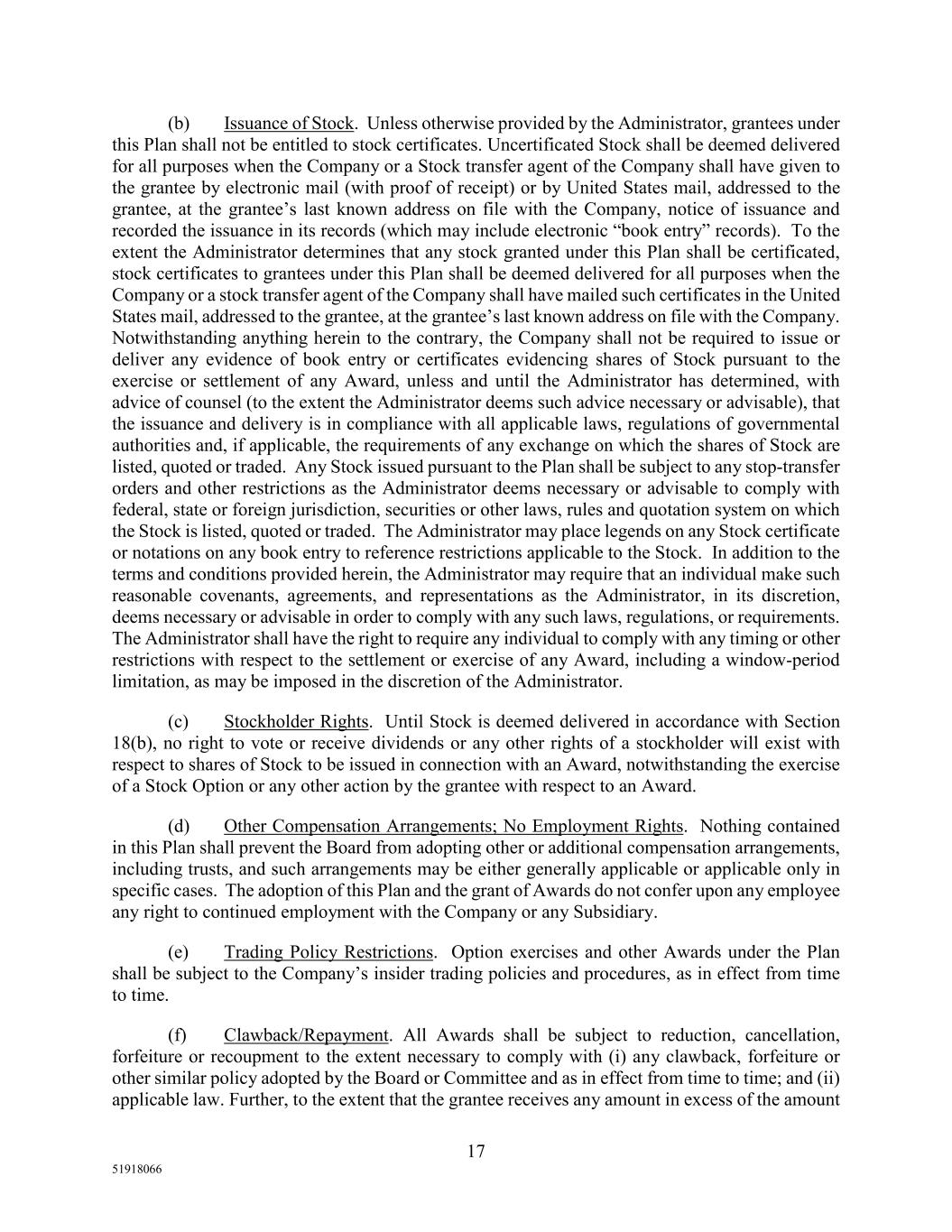
17 51918066 (b) Issuance of Stock. Unless otherwise provided by the Administrator, grantees under this Plan shall not be entitled to stock certificates. Uncertificated Stock shall be deemed delivered for all purposes when the Company or a Stock transfer agent of the Company shall have given to the grantee by electronic mail (with proof of receipt) or by United States mail, addressed to the grantee, at the grantee’s last known address on file with the Company, notice of issuance and recorded the issuance in its records (which may include electronic “book entry” records). To the extent the Administrator determines that any stock granted under this Plan shall be certificated, stock certificates to grantees under this Plan shall be deemed delivered for all purposes when the Company or a stock transfer agent of the Company shall have mailed such certificates in the United States mail, addressed to the grantee, at the grantee’s last known address on file with the Company. Notwithstanding anything herein to the contrary, the Company shall not be required to issue or deliver any evidence of book entry or certificates evidencing shares of Stock pursuant to the exercise or settlement of any Award, unless and until the Administrator has determined, with advice of counsel (to the extent the Administrator deems such advice necessary or advisable), that the issuance and delivery is in compliance with all applicable laws, regulations of governmental authorities and, if applicable, the requirements of any exchange on which the shares of Stock are listed, quoted or traded. Any Stock issued pursuant to the Plan shall be subject to any stop-transfer orders and other restrictions as the Administrator deems necessary or advisable to comply with federal, state or foreign jurisdiction, securities or other laws, rules and quotation system on which the Stock is listed, quoted or traded. The Administrator may place legends on any Stock certificate or notations on any book entry to reference restrictions applicable to the Stock. In addition to the terms and conditions provided herein, the Administrator may require that an individual make such reasonable covenants, agreements, and representations as the Administrator, in its discretion, deems necessary or advisable in order to comply with any such laws, regulations, or requirements. The Administrator shall have the right to require any individual to comply with any timing or other restrictions with respect to the settlement or exercise of any Award, including a window-period limitation, as may be imposed in the discretion of the Administrator. (c) Stockholder Rights. Until Stock is deemed delivered in accordance with Section 18(b), no right to vote or receive dividends or any other rights of a stockholder will exist with respect to shares of Stock to be issued in connection with an Award, notwithstanding the exercise of a Stock Option or any other action by the grantee with respect to an Award. (d) Other Compensation Arrangements; No Employment Rights. Nothing contained in this Plan shall prevent the Board from adopting other or additional compensation arrangements, including trusts, and such arrangements may be either generally applicable or applicable only in specific cases. The adoption of this Plan and the grant of Awards do not confer upon any employee any right to continued employment with the Company or any Subsidiary. (e) Trading Policy Restrictions. Option exercises and other Awards under the Plan shall be subject to the Company’s insider trading policies and procedures, as in effect from time to time. (f) Clawback/Repayment. All Awards shall be subject to reduction, cancellation, forfeiture or recoupment to the extent necessary to comply with (i) any clawback, forfeiture or other similar policy adopted by the Board or Committee and as in effect from time to time; and (ii) applicable law. Further, to the extent that the grantee receives any amount in excess of the amount
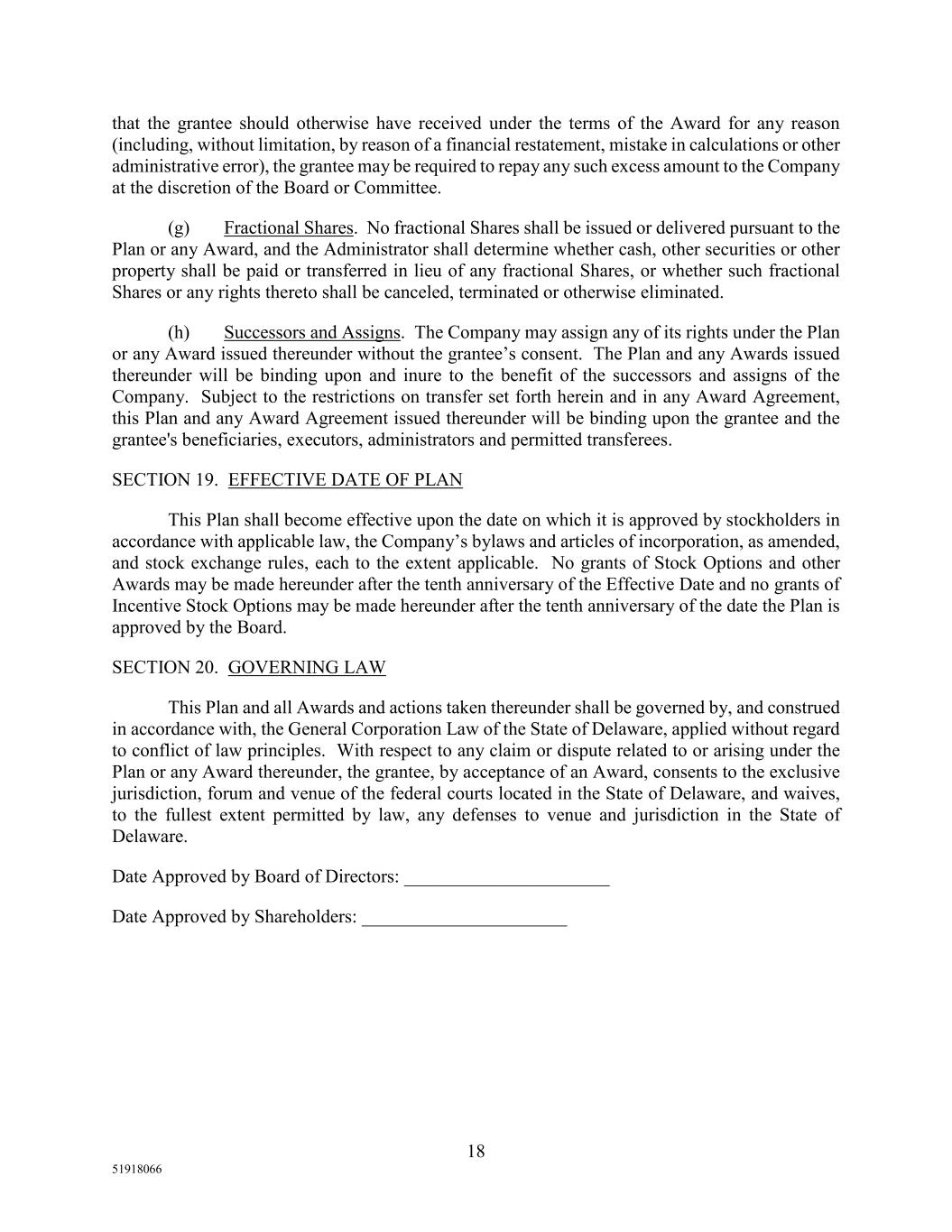
18 51918066 that the grantee should otherwise have received under the terms of the Award for any reason (including, without limitation, by reason of a financial restatement, mistake in calculations or other administrative error), the grantee may be required to repay any such excess amount to the Company at the discretion of the Board or Committee. (g) Fractional Shares. No fractional Shares shall be issued or delivered pursuant to the Plan or any Award, and the Administrator shall determine whether cash, other securities or other property shall be paid or transferred in lieu of any fractional Shares, or whether such fractional Shares or any rights thereto shall be canceled, terminated or otherwise eliminated. (h) Successors and Assigns. The Company may assign any of its rights under the Plan or any Award issued thereunder without the grantee’s consent. The Plan and any Awards issued thereunder will be binding upon and inure to the benefit of the successors and assigns of the Company. Subject to the restrictions on transfer set forth herein and in any Award Agreement, this Plan and any Award Agreement issued thereunder will be binding upon the grantee and the grantee's beneficiaries, executors, administrators and permitted transferees. SECTION 19. EFFECTIVE DATE OF PLAN This Plan shall become effective upon the date on which it is approved by stockholders in accordance with applicable law, the Company’s bylaws and articles of incorporation, as amended, and stock exchange rules, each to the extent applicable. No grants of Stock Options and other Awards may be made hereunder after the tenth anniversary of the Effective Date and no grants of Incentive Stock Options may be made hereunder after the tenth anniversary of the date the Plan is approved by the Board. SECTION 20. GOVERNING LAW This Plan and all Awards and actions taken thereunder shall be governed by, and construed in accordance with, the General Corporation Law of the State of Delaware, applied without regard to conflict of law principles. With respect to any claim or dispute related to or arising under the Plan or any Award thereunder, the grantee, by acceptance of an Award, consents to the exclusive jurisdiction, forum and venue of the federal courts located in the State of Delaware, and waives, to the fullest extent permitted by law, any defenses to venue and jurisdiction in the State of Delaware. Date Approved by Board of Directors: ______________________ Date Approved by Shareholders: ______________________
EX-10.17
4
exhibit1017.htm
EX-10.17
Document
AMENDMENT NO. 1
TO THE PUBLIC POLICY HOLDING COMPANY, INC. 2021 OMNIBUS INCENTIVE PLAN
THIS AMENDMENT NO. 1 TO THE PUBLIC POLICY HOLDING COMPANY, INC. 2021 OMNIBUS
INCENTIVE PLAN (the “LTIP Amendment”) is effective as of May 9, 2024 (the “Effective Date”).
WHEREAS, the Remuneration Committee of the Board of Directors of Public Policy Holding Company, Inc., a Delaware corporation (the “Board”), has reviewed, approved and recommended to the Board that the Board ratify, approve and adopt, and the Board has reviewed, ratified, approved and adopted, this LTIP Amendment effective as of the Effective Date:
1.Section 3(a) (Stock Issuable) of the Public Policy Holding Company, Inc. 2021 Omnibus Incentive Plan (the “LTIP”) is hereby amended by deleting the first sentence thereof and replacing it with the following:
“An Award must not be granted if the number of Shares committed to be issued under that Award exceeds 15 percent of the ordinary share capital of the Company in issue immediately before that day, when added to the number of Shares which have been issued, or committed to be issued, to satisfy Awards under the Plan, or options or awards under any other employee share plan operated by the Company, granted in the previous five years, as adjusted pursuant to the third sentence of this paragraph and Section 3(c).”
2. The LTIP, as amended by this LTIP Amendment, shall continue in full force and effect in accordance with its terms. In the event there are any conflicts between the terms of the LTIP and this LTIP Amendment, this LTIP Amendment shall control.
EX-10.18
5
exhibit1018.htm
EX-10.18
exhibit1018

1 AMENDMENT NO. 2 TO THE PUBLIC POLICY HOLDING COMPANY, INC. 2021 OMNIBUS INCENTIVE PLAN THIS AMENDMENT NO. 2 TO THE PUBLIC POLICY HOLDING COMPANY, INC. 2021 OMNIBUS INCENTIVE PLAN (the “LTIP Amendment”) is effective as of September 17, 2024 (the “Effective Date”). WHEREAS, the Remuneration Committee of the Board of Directors of Public Policy Holding Company, Inc., a Delaware corporation (the “Board”), has reviewed, approved and recommended to the Board that the Board ratify, approve and adopt, and the Board has reviewed, ratified, approved and adopted, this LTIP Amendment effective as of the Effective Date: 1. In accordance with Section 2(f) of the Public Policy Holding Company, Inc. 2021 Omnibus Incentive Plan (the “LTIP”), the U.K. Sub-Plan attached hereto as Appendix 1 shall be a subplan of the LTIP, and shall be attached to, and hereby is incorporated into, the LTIP as Appendix 1. The LTIP, as previously amended, is hereby amended by adding such Appendix 1. 2. The LTIP, as previously amended and as amended by this LTIP Amendment, shall continue in full force and effect in accordance with its terms. In the event there are any conflicts between the terms of the LTIP and this LTIP Amendment, this LTIP Amendment shall control.

Neither this document, nor any stock option agreement connected with it, is an approved prospectus for the purposes of section 85(1) of the Financial Services and Markets Act 2000 ("FSMA") and no offer of transferable securities to the public (for the purposes of section 102B of FSMA) is being made in connection with this UK Sub-Plan, which is exclusively available to bona fide UK employees of Public Policy Holding Company, Inc. and its Subsidiaries. PUBLIC POLICY HOLDING COMPANY, INC. 2021 OMNIBUS INCENTIVE PLAN UK SUB-PLAN Approved by the Administrator on 17 September, 2024 1. Definitions and interpretation 1.1 In this UK Sub-Plan, unless the context requires otherwise the defined terms set out in the Plan shall have the meanings ascribed in the Plan with the addition of the definitions set out below: "Award" has the meaning given to it in the Plan but for the avoidance of doubt shall include a UK Option granted under this UK Sub-Plan; "Employer's NICs" means secondary Class 1 NICs; "Employee" means any individual who is an employee of a Group Company; "Exercise Price" means the price per share of Stock determined by the Award Agreement that is payable by the Optionee to exercise the UK Option and acquire the shares of Stock; "FSMA" means the Financial Services and Markets Act 2000; "Group" in relation to a Parent Company, means that company and its Subsidiaries (and their Subsidiaries) and "Group Company" shall be construed accordingly; "HMRC" means HM Revenue & Customs; "ITEPA" means the Income Tax (Earnings and Pensions) Act 2003; "NICs" means national insurance contributions; "Option Shares" means the shares of Stock subject to a UK Option, being the maximum number of shares of Stock which can be acquired on exercise of that UK Option; "Optionee" means the holder of a UK Option; "Parent Company" means a company that has one or more Subsidiaries; "Personal Representatives" in relation to an Optionee, means the Optionee's legal personal representatives (being either the executors of the Optionee's will to whom a valid grant of probate has been made or the duly appointed administrators of the Optionee's estate) who in either case have provided the Administrator with satisfactory evidence of their appointment; "Plan" means the Public Policy Holding Company, Inc. 2021 Omnibus Incentive Plan adopted on 09 December 2021 (as varied from time to time);

2 "Relevant Company" means the company which incurs a Tax Liability as set out in Rule 8 which includes (but is not limited to) the company by reference to which the Optionee is an Employee; "Section 431 Election" means an election in accordance with section 431 of ITEPA; "Subsidiary" means a body corporate which is a subsidiary of the Company within the meaning of section 1159 of the Companies Act 2006 and "Subsidiaries" shall be construed accordingly; "Tax Liability" means all taxes (whether federal, local, state or otherwise), NICs (including, if required by the Administrator and specified in the applicable Award Agreement, Employer's NICs), social security, or other levies or payroll withholdings, in each case together with all penalties, fines, interest, charges, costs and expenses in relation to the same arising at any time in respect of or by reference to or in connection with: (a) a UK Option (including but not limited to its grant, exercise, release, assignment, cancellation, surrender or otherwise); or (b) any shares of Stock (or other securities or assets): (i) acquired on exercise of a UK Option; (ii) earmarked or held to satisfy a UK Option; (iii) acquired as a result of holding a UK Option; or (iv) acquired in consideration of the assignment or surrender of a UK Option; or (c) any other securities (or other assets) acquired or earmarked as a result of holding shares of Stock or other securities or assets mentioned in (b) above; including for the avoidance of doubt and without limitation, any liability arising after the termination of the Optionee’s employment for whatever reason, and any amount due in respect of any failure by the Optionee or any other person to make good such amount in the time limit specified in section 222 of ITEPA (or equivalent law of any jurisdiction outside the United Kingdom); and which: (a) may arise or be incurred in any jurisdiction whatsoever; and (b) by the law of the same jurisdiction may or shall be recovered from the person entitled to the UK Option; "UK" means the United Kingdom of England and Wales; "UK Employee" means any Employee who is resident and providing services in the UK for tax purposes; "UK Option" means an option to purchase shares of Stock granted pursuant to this UK Sub-Plan; and "UK Sub-Plan" means this UK Sub-Plan to the Plan. 1.1 Unless the context requires otherwise, in this UK Sub-Plan:
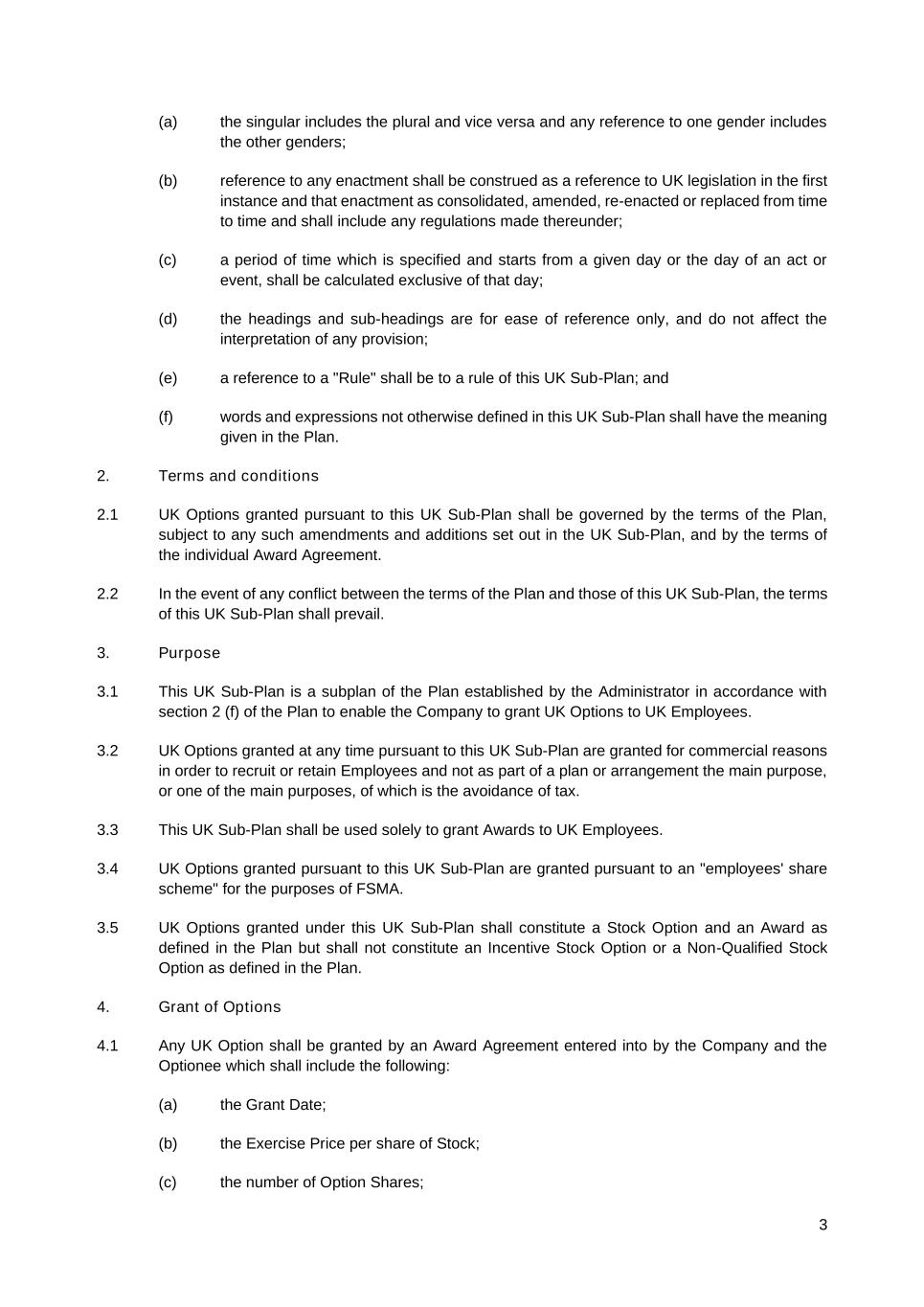
3 (a) the singular includes the plural and vice versa and any reference to one gender includes the other genders; (b) reference to any enactment shall be construed as a reference to UK legislation in the first instance and that enactment as consolidated, amended, re-enacted or replaced from time to time and shall include any regulations made thereunder; (c) a period of time which is specified and starts from a given day or the day of an act or event, shall be calculated exclusive of that day; (d) the headings and sub-headings are for ease of reference only, and do not affect the interpretation of any provision; (e) a reference to a "Rule" shall be to a rule of this UK Sub-Plan; and (f) words and expressions not otherwise defined in this UK Sub-Plan shall have the meaning given in the Plan. 2. Terms and conditions 2.1 UK Options granted pursuant to this UK Sub-Plan shall be governed by the terms of the Plan, subject to any such amendments and additions set out in the UK Sub-Plan, and by the terms of the individual Award Agreement. 2.2 In the event of any conflict between the terms of the Plan and those of this UK Sub-Plan, the terms of this UK Sub-Plan shall prevail. 3. Purpose 3.1 This UK Sub-Plan is a subplan of the Plan established by the Administrator in accordance with section 2 (f) of the Plan to enable the Company to grant UK Options to UK Employees. 3.2 UK Options granted at any time pursuant to this UK Sub-Plan are granted for commercial reasons in order to recruit or retain Employees and not as part of a plan or arrangement the main purpose, or one of the main purposes, of which is the avoidance of tax. 3.3 This UK Sub-Plan shall be used solely to grant Awards to UK Employees. 3.4 UK Options granted pursuant to this UK Sub-Plan are granted pursuant to an "employees' share scheme" for the purposes of FSMA. 3.5 UK Options granted under this UK Sub-Plan shall constitute a Stock Option and an Award as defined in the Plan but shall not constitute an Incentive Stock Option or a Non-Qualified Stock Option as defined in the Plan. 4. Grant of Options 4.1 Any UK Option shall be granted by an Award Agreement entered into by the Company and the Optionee which shall include the following: (a) the Grant Date; (b) the Exercise Price per share of Stock; (c) the number of Option Shares;

4 (d) a statement confirming whether the Administrator will or may require the reimbursement of Employer's NICs or other employer's social security contributions arising in any other jurisdiction pursuant to Rule 8.3; and (e) that it will be a condition of exercise of the UK Option that a Section 431 Election be duly signed by the Optionee, if so required by the Administrator. 5. Non-transferability of Options Notwithstanding any other provision in the Plan or relevant Award Agreement, no UK Option or any right thereunder granted under the UK Sub-Plan shall be capable of being transferred, assigned or charged in any manner whatsoever except on the death of an Optionee in which case the rights may transfer only to the Personal Representatives of the Optionee. Upon any such purported transfer, assignment, or charge the UK Option shall immediately lapse and cease to be exercisable. 6. Leaves of Absence For the purposes section 15 (b) of the Plan, in relation to a UK Option the service of an Optionee who is absent from work on any statutory and/or any enhanced contractual entitlement to leave (including but not limited to, maternity, paternity, adoption or parental leave) shall be deemed to continue during that period without the requirement for prior approval of the Company or Administrator. 7. Manner of exercise of UK Options 7.1 Section 5 (c) to (e) shall apply to UK Options subject to the following changes: (a) payment of the Exercise Price may with prior approval from the Administrator include an undertaking to pay and instructing funds to be deducted from proceeds of sale of any shares of Stock due to the Optionee and paid to the Company (or such other person as the Administrator may determine) on behalf of the Optionee or other sums due to the Optionee)) of a sum equal to the Exercise Price per share of Stock; (b) it is a condition of exercise of any UK Option that the Optionee delivers to the Company payment (in such manner as the Administrator shall request, which may with prior approval from the Administrator include an undertaking to pay and instructing funds to be deducted from proceeds of sale of any shares of Stock due to the Optionee and paid to the Company (or such other person as the Administrator may determine) on behalf of the Optionee or other sums due to the Optionee) of a sum equal to (if relevant) any Tax Liability and (if relevant) any Employer NICs or other relevant employer's social security contributions arising in any other jurisdiction in accordance with Rule 8.1; (c) it is a condition of exercise of any UK Option that the Optionee delivers to the Company any election or agreement regarding Employer's NICs or other relevant employer's social security contributions arising in any other jurisdiction if required pursuant to Rule 8.1; and (d) it is a condition of exercise of any UK Option that the Optionee delivers to the Company a Section 431 Election (should the Administrator so require) duly signed by the Optionee. 8. Tax 8.1 Each Optionee shall indemnify and keep indemnified, the Company or Relevant Company, against any Tax Liability and shall pay the Company or Relevant Company, a sum equal to the Tax Liability immediately upon written notice of the quantum of that liability.

5 8.2 The Company may impose such conditions upon the exercise of the UK Options as are necessary to ensure that the Relevant Company is able to meet any or all of such liabilities, including, without limitation, a condition that no exercise may take place unless the Optionee has provided the Company (or if different, the Relevant Company) with cash funds sufficient to meet such Tax Liability, or has entered into arrangements acceptable to the Administrator (or if different, the Relevant Company) to secure that such cash funds are available, or to allow the Company (or if different, the Relevant Company) to deduct the amount of such Tax Liability from any cash amounts (including salary and bonuses) which may become payable to the Optionee by any Group Company. 8.3 The Administrator may require, as a condition of the exercise of any UK Option, that the Optionee shall: (a) agree to reimburse the Company or Group Company or Relevant Company for any Employer's NICs arising on the exercise of a UK Option; or (b) enter into an election with the Company or Group Company or Relevant Company to assume the liability for any Employer's NICs payable on the exercise of the UK Option, including an election under paragraph 3B of Schedule 1 to the Social Security Contributions and Benefits Act 1992 or any similar or equivalent provision in any jurisdiction other than the UK; or (c) (if applicable) agree to pay the employer's social security contributions arising in any other jurisdiction, to the extent permitted by law. 8.4 If the Optionee fails to make payment to the Company or Relevant Company immediately upon receipt of a written notice in accordance with this Rule 8 or reimburse the Company or Relevant Company in accordance with an agreement or election in whole or in part for any liability to Employer's NICs or other employer's social security contributions pursuant to this Rule 8, then the Company shall be authorised by the Optionee to sell a sufficient number of shares of Stock otherwise deliverable to the Optionee upon the exercise of a UK Option granted under this UK Sub- Plan to produce a sum which (after allowance for the costs and expenses of the sale of such shares of Stock) may discharge (and shall be applied in discharge of) the Optionee's liability to the Company or Relevant Company under this Rule 8 or any agreement or election pursuant to this Rule 8 and the Company may exercise all such powers and may appoint any of its officers to sign all such documents in the name of the Optionee and act as the Optionee's attorney as may be necessary for this purpose. 8.5 If the Optionee shall fail to make payment to the Company or Relevant Company immediately upon receipt of a written notice in accordance with this Rule 8 then the Optionee shall be liable to make good any amount outstanding on demand (together with any additional tax or costs which may thereby be incurred), and the Company shall be authorised to deduct such amount from any cash payments otherwise to be made to the Optionee. 9. Employment rights 9.1 No Optionee shall have any right or entitlement to have a UK Option granted to them under this UK Sub-Plan. 9.2 The rights and obligations of a Optionee under the terms and conditions of their office or employment shall not be affected by their participation in the UK Sub-Plan or any right the Optionee may have to participate in the UK Sub-Plan.

6 9.3 No rights to compensation or damages shall arise in respect of the loss or diminution in value of UK Options in consequence of the termination of an Optionee's office or employment with any company for any reason whatsoever, whether lawful or not, in so far as those rights arise, or may arise, from the Optionee ceasing to have rights under or being entitled to exercise any UK Option under the UK Sub-Plan as a result of such termination or from the loss or diminution of value of such rights or entitlements. 9.4 Benefits received under this UK Sub-Plan shall not be taken into account in determining any pension or similar entitlement. 10. Data privacy By entering into an Award Agreement, an Optionee confirms that the Company shall be entitled to obtain, retain and process personal data in accordance with the terms of a privacy notice made available to the Optionee by the Company or other Group Company. 11. Lapse date UK Options granted under this UK Sub-Plan shall lapse on the date that is ten years after the Grant Date and for the avoidance of doubt no such UK Option shall be capable of being exercised more than ten years after the Grant Date.
EX-10.19
6
exhibit1019.htm
EX-10.19
Document
PUBLIC POLICY HOLDING COMPANY, INC.
AMENDED AND RESTATED 2021 OMNIBUS INCENTIVE PLAN
Effective January 26, 2026
SECTION 1. GENERAL PURPOSE OF THE PLAN; DEFINITIONS
The Public Policy Holding Company, Inc. 2021 Omnibus Incentive Plan (the “Prior Plan”) was originally adopted by the Board on December 8, 2021 and approved by the sole shareholder of Public Policy Holding Company, Inc. (the “Company”) on December 9, 2021. The Prior Plan is hereby amended, restated and superseded in its entirety as set forth herein (the “Plan”), effective as of the Effective Date, subject to approval of the Board. The purpose of the Plan is to encourage and enable the officers, employees, Non-Employee Directors and Consultants of the Company and its Affiliates upon whose judgment, initiative and efforts the Company largely depends for the successful conduct of its business to acquire a proprietary interest in the Company. It is anticipated that providing such persons with a direct stake in the Company’s welfare will assure a closer identification of their interests with those of the Company and its stockholders, thereby stimulating their efforts on the Company’s behalf and strengthening their desire to remain with the Company.
The following terms shall be defined as set forth below:
“Act” means the Securities Act of 1933, as amended, and the rules and regulations thereunder.
“Administrator” means the entity that conducts the general administration of the Plan as provided in Section 2. With reference to the duties of the Committee under the Plan which have been delegated to one or more persons pursuant to Section 2(c), or as to which the Board has assumed, the term “Administrator” shall refer to such person(s) unless the Committee or the Board has revoked such delegation or the Board has terminated the assumption of such duties.
“Affiliate” means, at the time of determination, any “parent” or “subsidiary” of the Company as such terms are defined in Rule 405 of the Act. The Board will have the authority to determine the time or times at which “parent” or “subsidiary” status is determined within the foregoing definition.
“Award” or “Awards,” except where referring to a particular category of grant under the Plan, shall include Incentive Stock Options, Non-Qualified Stock Options, Stock Appreciation Rights, Restricted Stock Units, Restricted Stock Awards, Unrestricted Stock Awards, Cash-Based Awards, and Dividend Equivalent Rights.
“Award Agreement” means a written or electronic document setting forth the terms and provisions applicable to an Award granted under the Plan. Each Award Agreement is subject to the terms and conditions of the Plan.
“Board” means the Board of Directors of the Company.
“Cash-Based Award” means an Award entitling the recipient to receive a cash-denominated payment.
“Cause” has the meaning set forth in the grantee’s Award Agreement, or if none, the meaning set forth in the grantee’s employment agreement, or if none, “Cause” means (a) willful misconduct or gross negligence in the performance of the grantee’s duties to the Company; (b) willful and repeated failure to follow the lawful directives of the Board or Chief Executive Officer; (c) indictment for, conviction of, or pleading of guilty or nolo contendere to, a felony or any crime resulting in reputational or financial harm to the Company; (d) performance of any act of theft, embezzlement, fraud, or misappropriation of Company property; (e) use of illegal drugs, or abuse of alcohol that materially impairs the grantee’s ability to perform the grantee’s duties to the Company; (f) material breach of any fiduciary duty owed to the Company (including, without limitation, the duty of care and the duty of loyalty); (g) material breach of any agreement between the grantee and the Company; (h) material violation of the Company’s code of conduct or other written policy; or (i) prohibition from serving in the lobbying industry or serving as an officer of the Company.
“Change in Control” means, except to the extent otherwise provided in an Award Agreement, the first to occur of the following events after the grant date: (a) the sale, transfer or other disposition of all or substantially all of the assets of the Company to one or more individuals or entities (“Persons”) that are not, immediately prior to such sale, transfer or other disposition, directly or indirectly through one or more intermediaries, controlling, controlled by, or under common control with, the Company (a “COC Affiliate”); (b) any “person” or “group” (as such terms are used in Sections 13(d) and 14(d) of the Exchange Act) (other than the Company or any COC Affiliate, or any employee benefit plan sponsored or maintained by the Company (or its COC Affiliates)) becomes the beneficial owner, directly or indirectly, of more than 50% of the voting power of the common stock of the Company; (c) the merger or consolidation of the Company, as a result of which Persons who were stockholders of the Company immediately prior to such merger or consolidation, do not, immediately thereafter, own, directly or indirectly, a majority of the combined voting power entitled to vote generally in the election of directors of the merged or consolidated company; (d) the liquidation or dissolution of the Company other than a liquidation or dissolution for the purposes of effecting a corporate restructuring or reorganization as a result of which Persons who were stockholders of the Company immediately prior to such liquidation or dissolution continue to own immediately thereafter, directly or indirectly, a majority of the combined voting power entitled to vote generally in the election of directors of the entity that owns, directly or indirectly, substantially all of the assets of the Company following such transaction; or (v) a majority of the members of the Board are replaced during any twelve-month period by directors whose appointment or election is not endorsed by a majority of the Board before the date of such appointment or election.
“Code” means the Internal Revenue Code of 1986, as amended, and any successor Code, and related rules, regulations and interpretations.
“Committee” shall mean the Compensation Committee of the Board, or another committee or subcommittee of the Board, appointed as provided in Section 2(a).
“Consultant” means a consultant or adviser who may be offered securities registrable pursuant to a registration statement on Form S-8 of the Act, specifically, (a) is a natural person, and (b) provides bona fide services to the Company or an Affiliate other than in connection with the offer of securities in a capital-raising transaction or the direct or indirect promotion or maintenance of a market for the Company’s securities.
“Disability” has the meaning set forth in the grantee’s Award Agreement, or if none, the meaning set forth in the grantee’s employment agreement, or if none, that the grantee is determined to be disabled under Company-provided long-term disability coverage, or if none, “Disability” means that the grantee, as a result of illness or incapacity, is unable to perform substantially his or her required duties for a period of four (4) consecutive months or for any aggregate period of six (6) months in any twelve (12) month period.
“Dividend Equivalent Right” means an Award entitling the grantee to receive credits based on ordinary cash dividends that would have been paid on the shares of Stock specified in the Dividend Equivalent Right (or other award to which it relates) if such shares had been issued to and held by the grantee.
“Effective Date” means the day immediately prior to the Company’s Registration Date.
“Exchange Act” means the Securities Exchange Act of 1934, as amended, and the rules and regulations thereunder.
“Fair Market Value” of the Stock, on any given date, shall be determined by the Administrator as follows (a) if the Stock is listed on any established stock exchange, its Fair Market Value will be determined by reference to the price for such Stock as quoted on such exchange for such date, or if no sale occurred on such date, the last day preceding such date during which a sale occurred, as reported in The Wall Street Journal or another source the Administrator deems reliable (for purposes of this clause (a), Nasdaq shall be the primary exchange used for pricing purposes, however, the Committee in its discretion may use the pricing on the London AIM exchange if they deem that to be appropriate); (b) if the Stock is not traded on a stock exchange but is quoted on a national market or other quotation system, the price on such date, or if no sales occurred on such date, then on the last date preceding such date during which a sale occurred, as reported in The Wall Street Journal or another source the Administrator deems reliable; or (c) if there is no established market for the Stock, the Administrator will determine the Fair Market Value in its discretion. Fair Market Value shall be determined in a manner consistent with Section 422 of the Code (if applicable) or Section 409A of the Code (if applicable).
“Incentive Stock Option” means any Stock Option designated and qualified as an “incentive stock option” as defined in Section 422 of the Code.
“Non-Employee Director” means a member of the Board who is not also an employee of the Company or any Subsidiary, who meets the requirements under Rule 16b-3.
“Non-Qualified Stock Option” means any Stock Option that is not an Incentive Stock Option.
“Option” or “Stock Option” means any option to purchase shares of Stock granted pursuant to Section 5.
“Registration Date” means the date on which the Company’s registration statement under Section 12(b) of the Exchange Act is declared effective by the SEC under the Act.
“Restricted Shares” means the shares of Stock underlying a Restricted Stock Award that remain subject to a risk of forfeiture or the Company’s right of repurchase.
“Restricted Stock Award” means an Award of Restricted Shares subject to such restrictions and conditions as the Administrator may determine at the time of grant.
“Restricted Stock Units” means an Award of stock units subject to such restrictions and conditions as the Administrator may determine at the time of grant.
“Rule 16b-3” means Rule 16b-3 promulgated under the Exchange Act, or any successor to Rule 16b-3, as in effect from time to time.
“Sale Price” means the value as determined by the Administrator of the consideration payable, or otherwise to be received by stockholders, per share of Stock pursuant to a Change in Control.
“Section 409A” means Section 409A of the Code and the regulations and other guidance promulgated thereunder.
“Service Relationship” means any relationship as an employee, director or Consultant of the Company or any Affiliate (e.g., a Service Relationship shall be deemed to continue without interruption in the event an individual’s status changes from full-time employee to part-time employee or Consultant).
“Stock” means the Common Stock, par value $0.001 per share, of the Company, subject to adjustments pursuant to Section 3.
“Stock Appreciation Right” means an Award entitling the recipient to receive shares of Stock (or cash, to the extent explicitly provided for in the applicable Award Agreement) having a value equal to the excess of the Fair Market Value of the Stock on the date of exercise over the exercise price of the Stock Appreciation Right multiplied by the number of shares of Stock with respect to which the Stock Appreciation Right shall have been exercised.
“Subsidiary” means any corporation or other entity (other than the Company) in which the Company has at least a 50 percent interest, either directly or indirectly.
“Ten Percent Owner” means an employee who owns or is deemed to own (by reason of the attribution rules of Section 424(d) of the Code) more than 10 percent of the combined voting power of all classes of stock of the Company or any parent or subsidiary corporation.
“Unrestricted Stock Award” means an Award of shares of Stock free of any restrictions.
SECTION 2. ADMINISTRATION OF PLAN; ADMINISTRATOR AUTHORITY TO
SELECT GRANTEES AND DETERMINE AWARDS
(a)Administration of Plan. The Committee (or another committee or a subcommittee of the Board assuming the functions of the Committee under the Plan) shall administer the Plan (except as otherwise permitted herein) and, unless otherwise determined by the Board, shall consist solely of two or more Non-Employee Directors appointed by and holding office at the pleasure of the Board, in accordance with the requirements of Rule 16b-3; provided that any action taken by the Committee shall be valid and effective, whether or not members of the Committee at the time of such action are later determined not to have satisfied the requirements for membership set forth in this Section 2(a), Rule 16b-3, or otherwise provided in any charter of the Committee. Notwithstanding any other provision of this Plan, the Board of Directors may exercise any and all powers of the Committee with respect to this Plan.
(b)Powers of Administrator. The Administrator shall have the power and authority to grant Awards consistent with the terms of the Plan, including the power and authority:
(i)to select the individuals to whom Awards may from time to time be granted;
(ii)to determine the time or times of grant, and the extent, if any, of Incentive Stock Options, Non-Qualified Stock Options, Stock Appreciation Rights, Restricted Stock Awards, Restricted Stock Units, Unrestricted Stock Awards, Cash-Based Awards, and Dividend Equivalent Rights, or any combination of the foregoing, granted to any one or more grantees;
(iii)to determine the number of shares of Stock or amount of cash to be covered by any Award;
(iv)to determine and modify from time to time the terms and conditions, including restrictions, not inconsistent with the terms of the Plan, of any Award, which terms and conditions may differ among individual Awards and grantees, and to approve the forms of Award Agreements;
(v)to accelerate at any time the exercisability or vesting of all or any portion of any Award;
(vi)subject to the provisions of Section 5(c) and Section 409A, to extend at any time the period in which Stock Options and Stock Appreciation Rights may be exercised; and
(vii)at any time to adopt, alter and repeal such rules, guidelines and practices for administration of the Plan and for its own acts and proceedings as it shall deem advisable; to interpret the terms and provisions of the Plan and any Award (including related written instruments); to make all determinations it deems advisable for the administration of the Plan; to decide all disputes arising in connection with the Plan; and to otherwise supervise the administration of the Plan.
All decisions and interpretations of the Administrator shall be final, binding and conclusive on all persons, including the Company and Plan grantees.
(c)Delegation of Authority to Grant Awards. Subject to applicable law, and except with respect to Awards intended to comply with Rule 16b-3, the Administrator, in its discretion, may delegate to one or more officers of the Company, including the Chief Executive Officer of the Company, all or part of the Administrator’s authority and duties with respect to the granting of Awards. Any such delegation by the Administrator shall include a limitation as to the amount of Stock underlying Awards that may be granted during the period of the delegation and shall contain guidelines as to the determination of the exercise price and the vesting criteria. The Administrator may revoke or amend the terms of a delegation at any time but such action shall not invalidate any prior actions of the Administrator’s delegate or delegates that were consistent with the terms of the Plan.
(d)Award Agreement. Each Award under the Plan shall be evidenced by an Award Agreement that sets forth the terms, conditions and limitations for each Award which may include, without limitation, the term of an Award and the provisions applicable in the event employment or service terminates.
(e)Indemnification. Neither the Board nor the Administrator, nor any member of either or any delegate thereof, shall be liable for any act, omission, interpretation, construction or determination made in good faith in connection with the Plan, and the members of the Board and the Administrator (and any delegate thereof) shall be entitled in all cases to indemnification and reimbursement by the Company in respect of any claim, loss, damage or expense (including, without limitation, reasonable attorneys’ fees) arising or resulting therefrom to the fullest extent permitted by law and/or under the Company’s articles or bylaws or any directors’ and officers’ liability insurance coverage which may be in effect from time to time and/or any indemnification agreement between such individual and the Company.
Foreign Award Recipients. Notwithstanding any provision of the Plan to the contrary, in order to comply with the laws in other countries in which the Company and its Subsidiaries operate or have employees or other individuals eligible for Awards, the Administrator, in its sole discretion, shall have the power and authority to: (i) determine which Subsidiaries shall be covered by the Plan; (ii) determine which individuals outside the United States are eligible to participate in the Plan; (iii) modify the terms and conditions of any Award granted to individuals outside the United States to comply with applicable foreign laws; (iv) establish subplans and modify exercise procedures and other terms and procedures, to the extent the Administrator determines such actions to be necessary or advisable (and such subplans and/or modifications shall be attached to this Plan as appendices); provided, however, that no such subplans and/or modifications shall increase the share limitations contained in Section 3(a) hereof; and (v) take any action, before or after an Award is made, that the Administrator determines to be necessary or advisable to obtain approval or comply with any local governmental regulatory exemptions or approvals. Notwithstanding the foregoing, the Administrator may not take any actions hereunder, and no Awards shall be granted, that would violate the Exchange Act or any other applicable United States securities law, the Code, or any other applicable United States governing statute or law, or any applicable United Kingdom law.
SECTION 3. STOCK ISSUABLE UNDER THE PLAN; MERGERS; SUBSTITUTION
(a)Stock Issuable. Subject to adjustment in accordance with Section 3(c), no more than 5,719,0051 Shares shall be available for the grant of Awards under the Plan. The amount in the preceding sentence reflects the 3,119,0052 Shares underlying outstanding Awards as of the Effective Date 15,594,5983 Shares prior to the October 2, 2025 1:5 reverse split (“Pre-Reverse Split Shares”)), plus an additional 2,600,000 Shares (13,000,000 Pre-Reverse Split Shares). The maximum aggregate number of shares of Stock that may be issued in the form of Incentive Stock Options shall not exceed 2,164,801 Shares (10,824,005 Pre-Reverse Split Shares), which represents ten percent (10%) of the number of issued and outstanding shares of Stock as of the date on which the Company gained admission to the AIM market of the London Stock Exchange, subject to adjustment as provided in Section 3(c). Shares of Stock underlying any awards under the Plan that are forfeited, canceled, reacquired by the Company prior to vesting, satisfied without the issuance of Stock or otherwise terminated (other than by exercise) shall be added back to the shares of Stock available for issuance under the Plan and, to the extent permitted under Section 422 of the Code and the regulations promulgated thereunder, the shares of Stock that may be issued as Incentive Stock Options. Subject to such overall limitations, shares of Stock may be issued up to such maximum number pursuant to any type or types of Award. The shares available for issuance under the Plan may be authorized but unissued shares of Stock, treasury shares or shares of Stock reacquired by the Company.
(b)Substitute Awards. Awards may, in the sole discretion of the Administrator, be granted under the Plan in assumption of, or in substitution for, outstanding awards previously granted by an entity acquired by the Company or Subsidiary or with which the Company combines (“Substitute Awards”). Substitute Awards shall not be counted against the shares of Stock available for issuance under the Plan; provided, that, Substitute Awards issued in connection with the assumption of, or in substitution for, outstanding options intended to qualify as Incentive Stock Options shall be counted against the number of shares of Stock that may be issued as Incentive Stock Options. Subject to applicable stock exchange listing requirements, available shares under a shareholder-approved plan of an entity directly or indirectly acquired by the Company or with which the Company combines (as appropriately adjusted to reflect such acquisition or transaction) may be used for Awards under the Plan and shall not count against the number of shares of Stock available for issuance under the Plan.
Changes in Stock. Subject to Section 3(d) hereof, if, as a result of any reorganization, recapitalization, reclassification, stock dividend, extraordinary cash dividend, stock split, reverse stock split or other similar change in the Company’s capital stock, the outstanding shares of Stock are increased or decreased or are exchanged for a different number or kind of shares or other securities of the Company, or additional shares or new or different shares
1 Reverse-split adjusted number of shares underlying outstanding awards as of the Effective Date of the restatement, PLUS 2,600,000
2 Reverse-split adjusted number of shares underlying outstanding awards as of the Effective Date of the restatement.
3 NON-reverse-split adjusted number of shares underlying outstanding awards as of the Effective Date of the restatement.
or other securities of the Company or other non-cash assets are distributed with respect to such shares of Stock or other securities, or, if, as a result of any merger or consolidation, sale of all or substantially all of the assets of the Company, the outstanding shares of Stock are converted into or exchanged for securities of the Company or any successor entity (or a parent or subsidiary thereof), the Administrator shall make an appropriate or proportionate adjustment in (i) the maximum number of shares reserved for issuance under the Plan, including the maximum number of shares that may be issued in the form of Incentive Stock Options, (ii) the number and kind of shares or other securities subject to any then outstanding Awards under the Plan, (iii) the repurchase price, if any, per share subject to each outstanding Restricted Stock Award, and (iv) the exercise price for each share subject to any then outstanding Stock Options and Stock Appreciation Rights under the Plan, without changing the aggregate exercise price (i.e., the exercise price multiplied by the number of shares subject to Stock Options and Stock Appreciation Rights) as to which such Stock Options and Stock Appreciation Rights remain exercisable. The Administrator shall also make equitable or proportionate adjustments in the number of shares subject to outstanding Awards and the exercise price and the terms of outstanding Awards to take into consideration cash dividends paid other than in the ordinary course or any other extraordinary corporate event to the extent necessary to preserve the economic intent of such Awards. The adjustment by the Administrator shall be final, binding and conclusive. No fractional shares of Stock shall be issued under the Plan resulting from any such adjustment, but the Administrator in its discretion may make a cash payment in lieu of fractional shares.
(d) Mergers and Other Transactions. In the case of and subject to the consummation
of a Change in Control, the parties thereto may cause the assumption or continuation by the successor entity of Awards theretofore granted, or the substitution of such Awards with new Awards of the successor entity or parent thereof, with appropriate adjustment as to the number and kind of shares and, if appropriate, the per share exercise prices, as such parties shall agree. To the extent the parties to such Change in Control do not provide for the assumption, continuation or substitution of Awards, upon the effective time of the Change in Control, the Plan and all outstanding Awards granted hereunder shall terminate. In such case, except as may be otherwise provided in the relevant Award Agreement, all Awards with time-based vesting, conditions or restrictions shall become fully vested and exercisable or nonforfeitable as of the effective time of the Change in Control, and all Awards with conditions and restrictions relating to the attainment of performance goals for which there is an incomplete performance period shall become vested and exercisable or nonforfeitable at 100% of the target level of performance achievement as of the effective time of the Change in Control (irrespective of actual performance through the date of the Change in Control). In the event of such termination, (i) the Company shall have the option (in its sole discretion) to make or provide for a payment, in cash or in kind, to the grantees holding Options and Stock Appreciation Rights, in exchange for the cancellation thereof, in an amount equal to the difference between (A) the Sale Price multiplied by the number of shares of Stock subject to outstanding Options and Stock Appreciation Rights (to the extent then exercisable at prices not in excess of the Sale Price) and (B) the aggregate exercise price of all such outstanding Options and Stock Appreciation Rights (provided that, in the case of an Option or Stock Appreciation Right with an exercise price equal to or greater than the Sale Price, such Option or Stock Appreciation Right shall be cancelled for no consideration); or (ii) each grantee shall be permitted, within a specified period of time prior to the consummation of the Change in Control as determined by the Administrator, to exercise all outstanding Options and Stock Appreciation Rights (to the extent then exercisable) held by such grantee.
The Company shall also have the option (in its sole discretion) to make or provide for a payment, in cash or in kind, to the grantees holding other Awards in an amount equal to the Sale Price multiplied by the number of vested shares of Stock under such Awards.
SECTION 4. ELIGIBILITY
Grantees under the Plan will be such employees, Non-Employee Directors and Consultants of the Company and its Affiliates as are selected from time to time by the Administrator in its sole discretion.
SECTION 5. STOCK OPTIONS
(a)Award of Stock Options. The Administrator may grant Stock Options under the Plan. Any Stock Option granted under the Plan shall be in such form as the Administrator may from time to time approve.
Stock Options granted under the Plan may be either Incentive Stock Options or Non-Qualified Stock Options. Incentive Stock Options may be granted only to employees of the Company or any Subsidiary that is a “subsidiary corporation” within the meaning of Section 424(f) of the Code. To the extent that any Option does not qualify as an Incentive Stock Option, it shall be deemed a Non-Qualified Stock Option.
Stock Options granted pursuant to this Section 5 shall be subject to the following terms and conditions and shall contain such additional terms and conditions, not inconsistent with the terms of the Plan, as the Administrator shall deem desirable.
(b)Exercise Price. The exercise price per share for the Stock covered by a Stock Option granted pursuant to this Section 5 shall be determined by the Administrator at the time of grant but shall not be less than 100 percent of the Fair Market Value on the date of grant. In the case of an Incentive Stock Option that is granted to a Ten Percent Owner, the exercise price of such Incentive Stock Option shall be not less than 110 percent of the Fair Market Value on the grant date.
(c)Option Term. The term of each Stock Option shall be fixed by the Administrator, but no Stock Option shall be exercisable more than ten years after the date the Stock Option is granted. In the case of an Incentive Stock Option that is granted to a Ten Percent Owner, the term of such Stock Option shall be no more than five years from the date of grant.
(d)Exercisability; Rights of a Stockholder. Stock Options shall become exercisable at such time or times, whether or not in installments, as shall be determined by the Administrator at or after the grant date. The Administrator may at any time accelerate the exercisability of all or any portion of any Stock Option. An optionee shall have the rights of a stockholder only as to shares acquired upon the exercise of a Stock Option and not as to unexercised Stock Options.
(e)Method of Exercise. Stock Options may be exercised in whole or in part, by giving written or electronic notice of exercise to the Company, specifying the number of shares to be purchased. Payment of the purchase price may be made by one or more of the following methods, as permitted in the sole discretion of the Administrator, except to the extent otherwise provided in the Option Award Agreement:
(i)In cash, by certified or bank check or other instrument acceptable to the Administrator;
(ii)Through the delivery (or attestation to the ownership following such procedures as the Company may prescribe) of shares of Stock that are not then subject to restrictions under any Company plan. Such surrendered shares shall be valued at Fair Market Value on the exercise date;
(iii)By the optionee delivering to the Company a properly executed exercise notice together with irrevocable instructions to a broker to promptly deliver to the Company cash or a check payable and acceptable to the Company for the purchase price; provided that in the event the optionee chooses to pay the purchase price as so provided, the optionee and the broker shall comply with such procedures and enter into such agreements of indemnity and other agreements as the Company shall prescribe as a condition of such payment procedure; or
(iv)With respect to Stock Options that are not Incentive Stock Options, by a “net exercise” arrangement pursuant to which the Company will reduce the number of shares of Stock issuable upon exercise by the largest whole number of shares with a Fair Market Value that does not exceed the aggregate exercise price.
(v)By any combination of the foregoing methods.
Payment instruments will be received subject to collection. The transfer to the optionee on the records of the Company or of the transfer agent of the shares of Stock to be purchased pursuant to the exercise of a Stock Option will be contingent upon receipt from the optionee (or a purchaser acting in his stead in accordance with the provisions of the Stock Option) by the Company of the full purchase price for such shares and the fulfillment of any other requirements contained in the Option Award Agreement or applicable provisions of laws (including the satisfaction of any withholding taxes that the Company is obligated to withhold with respect to the optionee). In the event an optionee chooses to pay the purchase price by previously-owned shares of Stock through the attestation method, the number of shares of Stock transferred to the optionee upon the exercise of the Stock Option shall be net of the number of attested shares. In the event that the Company establishes, for itself or using the services of a third party, an automated system for the exercise of Stock Options, such as a system using an internet website or interactive voice response, then the paperless exercise of Stock Options may be permitted through the use of such an automated system.
(f) Annual Limit on Incentive Stock Options. To the extent required for “incentive stock option” treatment under Section 422 of the Code, the aggregate Fair Market Value (determined as of the time of grant) of the shares of Stock with respect to which Incentive Stock Options granted under this Plan and any other plan of the Company or its parent and subsidiary corporations become exercisable for the first time by an optionee during any calendar year shall not exceed $100,000. To the extent that any Stock Option exceeds this limit, it shall constitute a Non-Qualified Stock Option.
SECTION 6. STOCK APPRECIATION RIGHTS
(a)Award of Stock Appreciation Rights. The Administrator may grant Stock Appreciation Rights under the Plan. A Stock Appreciation Right is an Award entitling the recipient to receive shares of Stock (or cash, to the extent explicitly provided for in the applicable Award Agreement) having a value equal to the excess of the Fair Market Value of a share of Stock on the date of exercise over the exercise price of the Stock Appreciation Right multiplied by the number of shares of Stock with respect to which the Stock Appreciation Right shall have been exercised.
(b)Exercise Price of Stock Appreciation Rights. The exercise price of a Stock Appreciation Right shall not be less than 100 percent of the Fair Market Value of the Stock on the date of grant.
(c)Grant and Exercise of Stock Appreciation Rights. Stock Appreciation Rights may be granted by the Administrator independently of any Stock Option granted pursuant to Section 5 of the Plan.
(d)Terms and Conditions of Stock Appreciation Rights. Stock Appreciation Rights shall be subject to such terms and conditions as shall be determined on the date of grant by the Administrator. The term of a Stock Appreciation Right may not exceed ten years. The terms and conditions of each such Award shall be determined by the Administrator, and such terms and conditions may differ among individual Awards and grantees.
SECTION 7. RESTRICTED STOCK AWARDS
(a) Nature of Restricted Stock Awards. The Administrator may grant Restricted Stock Awards under the Plan. A Restricted Stock Award is any Award of Restricted Shares subject to such restrictions and conditions as the Administrator may determine at the time of grant. Conditions may be based on continuing employment (or other Service Relationship) and/or achievement of pre-established performance goals and objectives.
(b) Rights as a Stockholder. Unless otherwise provided in an Award Agreement, a grantee shall not have the rights of a stockholder with respect to the voting of, or receipt of dividends with respect to, Restricted Shares, unless and until the grantee becomes vested in such Restricted Shares. Unless the Administrator shall otherwise determine, (i) uncertificated Restricted Shares shall be accompanied by a notation on the records of the Company or the transfer agent to the effect that they are subject to forfeiture until such Restricted Shares are vested as provided in Section 7(d) below, and (ii) certificated Restricted Shares shall remain in the possession of the Company until such Restricted Shares are vested as provided in Section 7(d) below, and the grantee shall be required, as a condition of the grant, to deliver to the Company such instruments of transfer as the Administrator may prescribe.
(c) Restrictions. Restricted Shares may not be sold, assigned, transferred, pledged or otherwise encumbered or disposed of except as specifically provided herein or in the Restricted Stock Award Agreement. Except as may otherwise be provided by the Administrator either in the Award Agreement or, subject to Section 16 below, in writing after the Award is issued, if a grantee’s employment (or other Service Relationship) with the Company and its Subsidiaries terminates for any reason, any Restricted Shares that have not vested at the time of termination shall automatically and without any requirement of notice to such grantee from or other action by or on behalf of, the Company be deemed to have been forfeited by the grantee and reacquired by the Company at their original purchase price (if any) from such grantee or such grantee’s legal representative simultaneously with such termination of employment (or other Service Relationship), and thereafter shall cease to represent any ownership of the Company by the grantee or rights of the grantee as a stockholder. Following such deemed reacquisition of Restricted Shares that are represented by physical certificates, a grantee shall surrender such certificates to the Company upon request without consideration.
(d)Vesting of Restricted Shares. The Administrator at the time of grant shall specify the date or dates and/or the attainment of pre-established performance goals, objectives and other conditions on which the non-transferability of the Restricted Shares and the Company’s right of repurchase or forfeiture shall lapse, which shall be reflected in the Restricted Stock Award Agreement. Subsequent to such date or dates and/or the attainment of such pre-established performance goals, objectives and other conditions, the shares on which all restrictions have lapsed shall no longer be Restricted Shares and shall be deemed “vested.”
SECTION 8. RESTRICTED STOCK UNITS
(a)Nature of Restricted Stock Units. The Administrator may grant Restricted Stock Units under the Plan. A Restricted Stock Unit is an Award of stock units that may be settled in shares of Stock (or cash, to the extent explicitly provided for in the Award Agreement) upon the satisfaction of such restrictions and conditions at the time of grant. Conditions may be based on continuing employment (or other Service Relationship) and/or achievement of pre-established performance goals and objectives. The terms and conditions of each such Award shall be determined by the Administrator, and such terms and conditions may differ among individual Awards and grantees. Except in the case of Restricted Stock Units with a deferred settlement date that complies with Section 409A, at the end of the vesting period, the Restricted Stock Units, to the extent vested, shall be settled in the form of shares of Stock or cash. Restricted Stock Units with deferred settlement dates are subject to Section 409A and shall contain such additional terms and conditions as the Administrator shall determine in its sole discretion in order to comply with the requirements of Section 409A.
(b)Rights as a Stockholder. A grantee shall have the rights as a stockholder only as to shares of Stock acquired by the grantee upon settlement of Restricted Stock Units; provided, however, that the grantee may be credited with Dividend Equivalent Rights with respect to the stock units underlying his or her Restricted Stock Units, subject to the provisions of Section 11 and such terms and conditions as the Administrator may determine.
(c)Termination. Except as may otherwise be provided by the Administrator either in the Award Agreement or, subject to Section 16 below, in writing after the Award is issued, a grantee’s right in all Restricted Stock Units that have not vested shall automatically terminate upon the grantee’s termination of employment (or cessation of Service Relationship) with the Company and its Subsidiaries for any reason.
SECTION 9. UNRESTRICTED STOCK AWARDS
The Administrator may grant (or sell at par value or such higher purchase price determined by the Administrator) an Unrestricted Stock Award under the Plan. An Unrestricted Stock Award is an Award pursuant to which the grantee may receive shares of Stock free of any restrictions under the Plan. Unrestricted Stock Awards may be granted in respect of past services or other valid consideration, or in lieu of cash compensation due to such grantee.
SECTION 10. CASH-BASED AWARDS
The Administrator may grant Cash-Based Awards under the Plan. A Cash-Based Award is an Award that entitles the grantee to a payment in cash upon the attainment of specified performance goals. The Administrator shall determine the maximum duration of the Cash-Based Award, the amount of cash to which the Cash-Based Award pertains, the conditions upon which the Cash-Based Award shall become vested or payable, and such other provisions as the Administrator shall determine. Each Cash-Based Award shall specify a cash-denominated payment amount, formula or payment ranges as determined by the Administrator. Payment, if any, with respect to a Cash-Based Award shall be made in accordance with the terms of the Award and may be made in cash.
SECTION 11. DIVIDEND EQUIVALENT RIGHTS
(a)Dividend Equivalent Rights. The Administrator may grant Dividend Equivalent Rights under the Plan. A Dividend Equivalent Right is an Award entitling the grantee to receive credits based on cash dividends that would have been paid on the shares of Stock specified in the Dividend Equivalent Right (or other Award to which it relates) if such shares had been issued to the grantee. A Dividend Equivalent Right may be granted hereunder to any grantee as a component of an award of Restricted Stock Units or as a freestanding award. The terms and conditions of Dividend Equivalent Rights shall be specified in the Award Agreement. Dividend equivalents credited to the holder of a Dividend Equivalent Right may be paid currently or may be deemed to be reinvested in additional shares of Stock, which may thereafter accrue additional equivalents. Any such reinvestment shall be at Fair Market Value on the date of reinvestment or such other price as may then apply under a dividend reinvestment plan sponsored by the Company, if any. Dividend Equivalent Rights may be settled in cash or shares of Stock or a combination thereof, in a single installment or installments. A Dividend Equivalent Right granted as a component of an Award of Restricted Stock Units shall provide that such Dividend Equivalent Right shall be settled only upon settlement or payment of, or lapse of restrictions on, such other Award, and that such Dividend Equivalent Right shall expire or be forfeited or annulled under the same conditions as such other Award. Dividend Equivalent Rights shall be structured to be exempt from, or subject to and compliant with, Section 409A.
(b)Termination. Except as may otherwise be provided by the Administrator either in the Award Agreement or, subject to Section 16 below, in writing after the Award is issued, a grantee’s rights in all Dividend Equivalent Rights shall automatically terminate upon the grantee’s termination of employment (or cessation of Service Relationship) with the Company and its Subsidiaries for any reason.
SECTION 12. TRANSFERABILITY OF AWARDS
(a)Transferability. Except as provided in Section 12(b) below, during a grantee’s lifetime, his or her Awards shall be exercisable only by the grantee, or by the grantee’s legal representative or guardian in the event of the grantee’s incapacity. No Awards shall be sold, assigned, transferred or otherwise encumbered or disposed of by a grantee other than by will or by the laws of descent and distribution or pursuant to a domestic relations order. No Awards shall be subject, in whole or in part, to attachment, execution, or levy of any kind other than a domestic relations order, and any purported transfer in violation hereof shall be null and void.
(b)Administrator Action. Notwithstanding Section 12(a), the Administrator, in its discretion and subject to compliance with federal and state securities laws, may provide either in the Award Agreement regarding a given Award or by subsequent written approval that the grantee (who is an employee or director) may transfer his or her Non-Qualified Stock Options to his or her immediate family members, to trusts for the benefit of such family members, or to partnerships in which such family members are the only partners, provided that the transferee agrees in writing with the Company to be bound by all of the terms and conditions of this Plan and the applicable Award. In no event may an Award be transferred by a grantee for value.
(c)Family Member. For purposes of Section 12(b), “family member” shall mean a grantee’s child, stepchild, grandchild, parent, stepparent, grandparent, spouse, former spouse, sibling, niece, nephew, mother-in-law, father-in-law, son-in-law, daughter-in-law, brother-in-law, or sister-in-law, including adoptive relationships, any person sharing the grantee’s household (other than a tenant of the grantee), a trust in which these persons (or the grantee) have more than 50 percent of the beneficial interest, a foundation in which these persons (or the grantee) control the management of assets, and any other entity in which these persons (or the grantee) own more than 50 percent of the voting interests.
(d)Designation of Beneficiary. To the extent permitted by the Company, each grantee to whom an Award has been made under the Plan may designate a beneficiary or beneficiaries to exercise any Award or receive any payment under any Award payable on or after the grantee’s death. Any such designation shall be on a form provided for that purpose by the Administrator and shall not be effective until received by the Administrator. If no beneficiary has been designated by a deceased grantee, or if the designated beneficiaries have predeceased the grantee, the beneficiary shall be the grantee’s estate.
SECTION 13. TAX WITHHOLDING
(a) Tax Withholding Generally. Each grantee must pay the Company, or make provisions satisfactory to the Administrator for payment of, any taxes required by applicable law to be withheld in connection with such grantee’s Awards by the date of the event creating the tax liability (such as, without limitation, in connection with the exercise, lapse of restriction, settlement, or payment of the Award). The Company may deduct an amount sufficient to satisfy such tax obligations based on the applicable statutory withholding rates (or such other rates as may be determined by the Company after considering any accounting consequences or costs) from any payment of any kind otherwise due to a grantee. In the absence of a contrary determination by the Company (or, with respect to withholding pursuant to subsection (b), clause (b) below with respect to Awards held by individuals subject to Section 16 of the Exchange Act, a contrary determination by the Administrator), all tax withholding obligations will be calculated based on the minimum applicable statutory withholding rates, but in no event will withholding obligations be calculated based on rates in excess of the maximum applicable statutory withholding rates.
(b) Means of Withholding. Subject to applicable law, any underwriter lock-up periods
or any Company insider trading policy (including blackout periods), grantees may satisfy such tax obligations (a) in cash, by wire transfer of immediately available funds, by check made payable to the order of the Company, provided that the Company may limit the use of the foregoing payment forms if one or more of the payment forms below is permitted, (b) to the extent permitted by the Administrator, in whole or in part by delivery of Shares, including Shares delivered by attestation and Shares retained from the Award creating the tax obligation, valued at their Fair Market Value on the date of delivery, (c) if there is a public market for Shares at the time the tax obligations are satisfied, unless the Company otherwise determines, (i) delivery (including electronically or telephonically to the extent permitted by the Company) of an irrevocable and unconditional undertaking by a broker acceptable to the Company to deliver promptly to the Company sufficient funds to satisfy the tax obligations, or (ii) delivery by the grantee to the Company of a copy of irrevocable and unconditional instructions to a broker acceptable to the Company to deliver promptly to the Company cash or a check sufficient to satisfy the tax withholding; provided that such amount is paid to the Company at such time as may be required by the Administrator, or (d) to the extent permitted by the Company, any combination of the foregoing payment forms approved by the Administrator. Notwithstanding any other provision of the Plan, the number of Shares which may be so delivered or retained pursuant to clause (b) of the immediately preceding sentence shall be limited to the number of Shares which have an aggregate Fair Market Value on the date of delivery or retention no greater than the aggregate amount of such liabilities based on the maximum individual statutory tax rate in the applicable jurisdiction at the time of such withholding (or such other rate as may be required to avoid the liability classification of the applicable award under generally accepted accounting principles in the United States of America). If any tax withholding obligation will be satisfied under clause (b) above by the Company’s retention of Shares from the Award creating the tax obligation and there is a public market for Shares at the time the tax obligation is satisfied, the Company may elect to instruct any brokerage firm determined acceptable to the Company for such purpose to sell on the applicable grantee’s behalf some or all of the Shares retained and to remit the proceeds of the sale to the Company or its designee, and each grantee’s acceptance of an Award under the Plan will constitute the grantee’s authorization to the Company and instruction and authorization to such brokerage firm to complete the transactions described in this sentence.
SECTION 14. SECTION 409A AWARDS; SECTION 280G CUTBACK
Awards are intended to be exempt from Section 409A to the greatest extent possible and to otherwise comply with Section 409A. The Plan and all Awards shall be interpreted in accordance with such intent. To the extent that any Award is determined to constitute “nonqualified deferred compensation” within the meaning of Section 409A (a “409A Award”), the Award shall be subject to such additional rules and requirements as specified by the Administrator from time to time in order to comply with Section 409A.
In this regard, if any amount under a 409A Award is payable upon a “separation from service” (within the meaning of Section 409A) to a grantee who is then considered a “specified employee” (within the meaning of Section 409A), then no such payment shall be made prior to the date that is the earlier of (i) six months and one day after the grantee’s separation from service, or (ii) the grantee’s death, but only to the extent such delay is necessary to prevent such payment from being subject to interest, penalties and/or additional tax imposed pursuant to Section 409A. Further, the settlement of any 409A Award may not be accelerated except to the extent permitted by Section 409A. If payment under a 409A Award is triggered by a Change in Control, payment shall be made upon such event only if the Change in Control meets the requirements of Section 409A(a)(2)(A)(v). If a series of payments are subject to 409A, each payment shall be treated as a separate payment for purposes of 409A. The Company makes no representation that any or all of the payments or benefits described in the Plan will be exempt from or comply with Section 409A of the Code and makes no undertaking to preclude Section 409A of the Code from applying to any such payment. The grantee shall be solely responsible for the payment of any taxes and penalties incurred under Section 409A.
Notwithstanding any provision of this Plan to the contrary, if any payment or benefit that a grantee would otherwise receive from the Company pursuant to an Award under the Plan or otherwise (a “Payment”) would (a) constitute a “parachute payment” within the meaning of Section 280G of the Code and (b) but for this paragraph, be subject to the excise tax imposed by Section 4999 of the Code (the “Excise Tax”), then such Payment will be equal to the Reduced Amount (as defined below). The “Reduced Amount” will be either (1) the largest portion of the Payment that would result in no portion of the Payment (after reduction) being subject to the Excise Tax or (2) the entire Payment, whichever amount after taking into account all applicable federal, state and local employment taxes, income taxes, and the Excise Tax (all computed at the highest applicable marginal rate, net of the maximum reduction in federal income taxes which could be obtained from a deduction of such state and local taxes), results in grantee’s receipt, on an after-tax basis, of the greatest amount of the Payment. If a reduction in the Payment is to be made, the reduction in payments and/or benefits will occur in the following order: (1) reduction of cash payments; and (2) reduction of other benefits paid to grantee. In the event that acceleration of vesting of equity award compensation is to be reduced, such acceleration of vesting will be cancelled in the reverse order of the date of grant of grantee’s equity awards. In no event will the Company be liable to grantee for any amounts not paid as a result of the operation of this paragraph (other than for the Company’s obligations to pay the Reduced Amount or the entire Payment, as applicable). The Company makes no representation that any or all of the payments or benefits described in the Plan will be exempt from the Excise Tax, and the grantee shall be responsible for payment of the Excise Tax (if applicable).
SECTION 15. TERMINATION OF SERVICE RELATIONSHIP, TRANSFER, LEAVE OF
ABSENCE, ETC.
(a)Termination of Service Relationship. If the grantee’s Service Relationship is with an Affiliate and such Affiliate ceases to be an Affiliate, the grantee shall be deemed to have terminated his or her Service Relationship for purposes of the Plan.
(b)For purposes of the Plan, the following events shall not be deemed a termination of a Service Relationship:
(i) a transfer to the employment of the Company from an Affiliate or from the Company to an Affiliate, or from one Affiliate to another; or
(ii) an approved leave of absence for military service or sickness, or for any other purpose approved by the Company, if the employee’s right to re-employment is guaranteed either by a statute or by contract or under the policy pursuant to which the leave of absence was granted or if the Administrator otherwise so provides in writing.
SECTION 16. AMENDMENTS AND TERMINATION
The Board may, at any time, amend or discontinue the Plan and the Administrator may, at any time, amend or cancel any outstanding Award, but no such action shall materially and adversely affect rights under any outstanding Award without the holder’s consent. Except as provided in Section 3(c) or 3(d), without prior stockholder approval, in no event may the Administrator exercise its discretion to reduce the exercise price of outstanding Stock Options or Stock Appreciation Rights or effect repricing through cancellation and re-grants or cancellation of Stock Options or Stock Appreciation Rights in exchange for cash or other Awards. To the extent required under the rules of any securities exchange or market system on which the Stock is listed, or to the extent determined by the Administrator to be required by the Code to ensure that Incentive Stock Options granted under the Plan are qualified under Section 422 of the Code, Plan amendments shall be subject to approval by Company stockholders. Nothing in this Section 16 shall limit the Administrator’s authority to take any action permitted pursuant to Section 3(c) or 3(d). Notwithstanding the foregoing, the Board may amend or discontinue the Plan or amend or cancel any outstanding Award to the extent necessary to conform the provisions of the Plan or an Award Agreement with any applicable law. Notwithstanding the foregoing, if the Stock ceases to be listed on an established market, the Company may, without an Award holder’s consent, amend any outstanding Awards to impose such terms, conditions or restrictions as are determined by the Board to be appropriate for a non-listed entity.
SECTION 17. STATUS OF PLAN
With respect to the portion of any Award that has not been exercised and any payments in cash, Stock or other consideration not received by a grantee, a grantee shall have no rights greater than those of a general creditor of the Company unless the Administrator shall otherwise expressly determine in connection with any Award or Awards. In its sole discretion, the Administrator may authorize the creation of trusts or other arrangements to meet the Company’s obligations to deliver Stock or make payments with respect to Awards hereunder, provided that the existence of such trusts or other arrangements is consistent with the foregoing sentence.
SECTION 18. GENERAL PROVISIONS
(a)No Distribution. The Administrator may require each person acquiring Stock pursuant to an Award to represent to and agree with the Company in writing that such person is acquiring the shares without a view to distribution thereof.
(b)Issuance of Stock. Unless otherwise provided by the Administrator, grantees under this Plan shall not be entitled to stock certificates. Uncertificated Stock shall be deemed delivered for all purposes when the Company or a Stock transfer agent of the Company shall have given to the grantee by electronic mail (with proof of receipt) or by United States mail, addressed to the grantee, at the grantee’s last known address on file with the Company, notice of issuance and recorded the issuance in its records (which may include electronic “book entry” records). To the extent the Administrator determines that any stock granted under this Plan shall be certificated, stock certificates to grantees under this Plan shall be deemed delivered for all purposes when the Company or a stock transfer agent of the Company shall have mailed such certificates in the United States mail, addressed to the grantee, at the grantee’s last known address on file with the Company. Notwithstanding anything herein to the contrary, the Company shall not be required to issue or deliver any evidence of book entry or certificates evidencing shares of Stock pursuant to the exercise or settlement of any Award, unless and until the Administrator has determined, with advice of counsel (to the extent the Administrator deems such advice necessary or advisable), that the issuance and delivery is in compliance with all applicable laws, regulations of governmental authorities and, if applicable, the requirements of any exchange on which the shares of Stock are listed, quoted or traded. In addition, no Award may be exercised or Stock issued pursuant to an Award unless (a) a registration statement under the Act shall at the time of such exercise or issuance be in effect with respect to the Stock issuable pursuant to the Award, or (b) in the opinion of legal counsel to the Company, the Stock issuable pursuant to the Award may be issued in accordance with the terms of an applicable exemption from the registration requirements of the Act. Any Stock issued pursuant to the Plan shall be subject to any stop-transfer orders and other restrictions as the Administrator deems necessary or advisable to comply with federal, state or foreign jurisdiction, securities or other laws, rules and quotation system on which the Stock is listed, quoted or traded. The Administrator may place legends on any Stock certificate or notations on any book entry to reference restrictions applicable to the Stock. In addition to the terms and conditions provided herein, the Administrator may require that an individual make such reasonable covenants, agreements, and representations as the Administrator, in its discretion, deems necessary or advisable in order to comply with any such laws, regulations, or requirements. The Administrator shall have the right to require any individual to comply with any timing or other restrictions with respect to the settlement or exercise of any Award, including a window-period limitation, as may be imposed in the discretion of the Administrator.
(c)Stockholder Rights. Until Stock is deemed delivered in accordance with Section 18(b), no right to vote or receive dividends or any other rights of a stockholder will exist with respect to shares of Stock to be issued in connection with an Award, notwithstanding the exercise of a Stock Option or any other action by the grantee with respect to an Award.
(d)Administrative Stand Still. In the event of any pending stock dividend, stock split, combination or exchange of shares, merger, consolidation or other distribution (other than normal cash dividends) of Company assets to stockholders, or any other extraordinary transaction or change affecting the Shares or the Share price, including any securities offering or other similar transaction, for administrative convenience, the Administrator may refuse to permit the exercise of any Award for up to 60 days before or after such transaction.
(e)Expiration During Non-Trading Periods. Notwithstanding any contrary provision of Sections 5 or 6, unless determined otherwise by the Company, in the event that, on the last business day of the term of a Stock Option or Stock Appreciation Right (other than an Incentive Stock Option), (a) the exercise of the Stock Option or Stock Appreciation Right is prohibited by law, as determined by the Company, or (b) Shares may not be purchased or sold by the applicable grantee due to any Company insider trading policy (including blackout periods) or a “lock-up” agreement undertaken in connection with an issuance of securities by the Company, the term of the Stock Option or Stock Appreciation Right shall be extended until the date that is 30 days after the end of the legal prohibition, black-out period or lock-up agreement, as determined by the Company; provided, however, in no event shall the extension last beyond the ten year term of the applicable Option or Stock Appreciation Right.
(f)Other Compensation Arrangements; No Employment Rights. Nothing contained in this Plan shall prevent the Board from adopting other or additional compensation arrangements, including trusts, and such arrangements may be either generally applicable or applicable only in specific cases. The adoption of this Plan and the grant of Awards do not confer upon any employee any right to continued employment with the Company or any Subsidiary.
(g)Trading Policy Restrictions. Option exercises and other Awards under the Plan shall be subject to the Company’s insider trading policies and procedures, as in effect from time to time.
(h)Clawback/Repayment. All Awards shall be subject to reduction, cancellation, forfeiture or recoupment to the extent necessary to comply with (i) any clawback, forfeiture or other similar policy adopted by the Board or Committee and as in effect from time to time; and (ii) applicable law. Further, to the extent that the grantee receives any amount in excess of the amount that the grantee should otherwise have received under the terms of the Award for any reason (including, without limitation, by reason of a financial restatement, mistake in calculations or other administrative error), the grantee may be required to repay any such excess amount to the Company at the discretion of the Board or Committee.
(i)Fractional Shares. No fractional Shares shall be issued or delivered pursuant to the Plan or any Award, and the Administrator shall determine whether cash, other securities or other property shall be paid or transferred in lieu of any fractional Shares, or whether such fractional Shares or any rights thereto shall be canceled, terminated or otherwise eliminated.
(j)Successors and Assigns. The Company may assign any of its rights under the Plan or any Award issued thereunder without the grantee’s consent. The Plan and any Awards issued thereunder will be binding upon and inure to the benefit of the successors and assigns of the Company. Subject to the restrictions on transfer set forth herein and in any Award Agreement, this Plan and any Award Agreement issued thereunder will be binding upon the grantee and the grantee’s beneficiaries, executors, administrators and permitted transferees.
SECTION 19. EFFECTIVE DATE OF PLAN
This Plan, as amended and restated herein, shall become effective as of the Effective Date. No grants of Non-Qualified Stock Options and other Awards may be made hereunder after the tenth anniversary of the Effective Date and no grants of Incentive Stock Options may be made hereunder after December 8, 2031 (which is the tenth anniversary of the date the Prior Plan was approved by the Board).
SECTION 20. GOVERNING LAW
This Plan and all Awards and actions taken thereunder shall be governed by, and construed in accordance with, the General Corporation Law of the State of Delaware, applied without regard to conflict of law principles. With respect to any claim or dispute related to or arising under the Plan or any Award thereunder, the grantee, by acceptance of an Award, consents to the exclusive jurisdiction, forum and venue of the federal courts located in the State of Delaware, and waives, to the fullest extent permitted by law, any defenses to venue and jurisdiction in the State of Delaware.
APPENDIX A
PUBLIC POLICY HOLDING COMPANY, INC. 2021 OMNIBUS INCENTIVE PLAN UK
SUB-PLAN
Adopted by the Board of Directors In accordance with Section 2(f) of the Public Policy Holding Company, Inc. 2021 Omnibus Incentive Plan (the “LTIP”), the U.K. Sub-Plan set forth below shall be a subplan of the LTIP, and shall be attached to, and hereby is incorporated into, the LTIP.
Neither this document, nor any stock option agreement connected with it, is an approved prospectus for the purposes of section 85(1) of the Financial Services and Markets Act 2000 (“FSMA”) and no offer of transferable securities to the public (for the purposes of section 102B of FSMA) is being made in connection with this UK Sub-Plan, which is exclusively available to bona fide UK employees of Public Policy Holding Company, Inc. and its Subsidiaries.
Approved by the Administrator on 17 September, 2024
SECTION 1. DEFINITIONS AND INTERPRETATION
In this UK Sub-Plan, unless the context requires otherwise the defined terms set out in the Plan shall have the meanings ascribed in the Plan with the addition of the definitions set out below:
“Award” has the meaning given to it in the Plan but for the avoidance of doubt shall include a UK Option granted under this UK Sub-Plan;
“Employer’s NICs” means secondary Class 1 NICs;
“Employee” means any individual who is an employee of a Group Company;
“Exercise Price” means the price per share of Stock determined by the Award Agreement that is payable by the Optionee to exercise the UK Option and acquire the shares of Stock;
“FSMA” means the Financial Services and Markets Act 2000;
“Group” in relation to a Parent Company, means that company and its Subsidiaries (and their Subsidiaries) and “Group Company” shall be construed accordingly;
“HMRC” means HM Revenue & Customs;
“ITEPA” means the Income Tax (Earnings and Pensions) Act2003;
“NICs” means national insurance contributions; “Option Shares” means the shares of Stock subject to a UK Option, being the maximum number of shares of Stock which can be acquired on exercise of that UK Option;
“Optionee” means the holder of a UK Option;
“Parent Company” means a company that has one or more Subsidiaries;
“Personal Representatives” in relation to an Optionee, means the Optionee’s legal personal representatives (being either the executors of the Optionee’s will to whom a valid grant of probate has been made or the duly appointed administrators of the Optionee’s estate) who in either case have provided the Administrator with satisfactory evidence of their appointment;
“Plan” means the Amended and Restatement Public Policy Holding Company, Inc. 2021 Omnibus Incentive Plan, to which this sub-plan is attached (as varied from time to time);
“Relevant Company” means the company which incurs a Tax Liability as set out in Rule 8 which includes (but is not limited to) the company by reference to which the Optionee is an Employee;
“Section 431 Election” means an election in accordance with section 431 of ITEPA;
“Subsidiary” means a body corporate which is a subsidiary of the Company within the meaning of section 1159 of the Companies Act 2006 and “Subsidiaries” shall be construed accordingly;
“Tax Liability” means all taxes (whether federal, local, state or otherwise), NICs (including, if required by the Administrator and specified in the applicable Award Agreement, Employer’s NICs), social security, or other levies or payroll withholdings, in each case together with all penalties, fines, interest, charges, costs and expenses in relation to the same arising at any time in respect of or by reference to or in connection with:
(a) a UK Option (including but not limited to its grant, exercise, release, assignment, cancellation, surrender or otherwise); or
(b) any shares of Stock (or other securities or assets):
(i)acquired on exercise of a UK Option;
(ii)earmarked or held to satisfy a UK Option;
(iii)acquired as a result of holding a UK Option; or
(iv)acquired in consideration of the assignment or surrender of a UK Option; or
(c) any other securities (or other assets) acquired or earmarked as a result of holding shares of Stock or other securities or assets mentioned in (b) above;
including for the avoidance of doubt and without limitation, any liability arising after the termination of the Optionee’s employment for whatever reason, and any amount due in respect of any failure by the Optionee or any other person to make good such amount in the time limit specified in section 222 of ITEPA (or equivalent law of any jurisdiction outside the United Kingdom);
and which:
(d)may arise or be incurred in any jurisdiction whatsoever; and
(e)by the law of the same jurisdiction may or shall be recovered from the person entitled to the UK Option;
“UK” means the United Kingdom of England and Wales;
“UK Employee” means any Employee who is resident and providing services in the UK for tax purposes;
“UK Option” means an option to purchase shares of Stock granted pursuant to this UK Sub-Plan; and
“UK Sub-Plan” means this UK Sub-Plan to the Plan.
Unless the context requires otherwise, in this UK Sub-Plan:
(a)the singular includes the plural and vice versa and any reference to one gender includes the other genders;
(b)reference to any enactment shall be construed as a reference to UK legislation in the first instance and that enactment as consolidated, amended, re-enacted or replaced from time to time and shall include any regulations made thereunder;
(c)a period of time which is specified and starts from a given day or the day of an act or event, shall be calculated exclusive of that day;
(d)the headings and sub-headings are for ease of reference only, and do not affect the interpretation of any provision;
(e)a reference to a “Rule” shall be to a rule of this UK Sub-Plan; and
(f)words and expressions not otherwise defined in this UK Sub-Plan shall have the meaning given in the Plan.
SECTION 2. TERMS AND CONDITIONS
(a)UK Options granted pursuant to this UK Sub-Plan shall be governed by the terms of the Plan, subject to any such amendments and additions set out in the UK Sub-Plan, and by the terms of the individual Award Agreement.
(b)In the event of any conflict between the terms of the Plan and those of this UK Sub-Plan, the terms of this UK Sub-Plan shall prevail.
SECTION 3. PURPOSE
(a)This UK Sub-Plan is a subplan of the Plan established by the Administrator in accordance with section 2 (f) of the Plan to enable the Company to grant UK Options to UK Employees.
(b)UK Options granted at any time pursuant to this UK Sub-Plan are granted for commercial reasons in order to recruit or retain Employees and not as part of a plan or arrangement the main purpose, or one of the main purposes, of which is the avoidance of tax.
(c)This UK Sub-Plan shall be used solely to grant Awards to UK Employees.
(d)UK Options granted pursuant to this UK Sub-Plan are granted pursuant to an “employees’ share scheme” for the purposes of FSMA.
(e)UK Options granted under this UK Sub-Plan shall constitute a Stock Option and an Award as defined in the Plan but shall not constitute an Incentive Stock Option or a Non-Qualified Stock Option as defined in the Plan.
SECTION 4. GRANT OF OPTIONS
Any UK Option shall be granted by an Award Agreement entered into by the Company and the Optionee which shall include the following:
(a)the Grant Date;
(b)the Exercise Price per share of Stock;
(c)the number of Option Shares;
(d)a statement confirming whether the Administrator will or may require the reimbursement of Employer’s NICs or other employer’s social security contributions arising in any other jurisdiction pursuant to Rule 8.3; and
(e)that it will be a condition of exercise of the UK Option that a Section 431 Election be duly signed by the Optionee, if so required by the Administrator.
SECTION 5. NON-TRANSFERABILITY OF OPTIONS
Notwithstanding any other provision in the Plan or relevant Award Agreement, no UK Option or any right thereunder granted under the UK Sub-Plan shall be capable of being transferred, assigned or charged in any manner whatsoever except on the death of an Optionee in which case the rights may transfer only to the Personal Representatives of the Optionee. Upon any such purported transfer, assignment, or charge the UK Option shall immediately lapse and cease to be exercisable.
SECTION 6. LEAVES OF ABSENCE
For the purposes section 15 (b) of the Plan, in relation to a UK Option the service of an Optionee who is absent from work on any statutory and/or any enhanced contractual entitlement to leave (including but not limited to, maternity, paternity, adoption or parental leave) shall be deemed to continue during that period without the requirement for prior approval of the Company or Administrator.
SECTION 7. MANNER OF EXERCISE OF UK OPTIONS Section 5 (c) to (e) shall apply to UK Options subject to the following changes:
(a)payment of the Exercise Price may with prior approval from the Administrator include an undertaking to pay and instructing funds to be deducted from proceeds of sale of any shares of Stock due to the Optionee and paid to the Company (or such other person as the Administrator may determine) on behalf of the Optionee or other sums due to the Optionee)) of a sum equal to the Exercise Price per share of Stock;
(b)it is a condition of exercise of any UK Option that the Optionee delivers to the Company payment (in such manner as the Administrator shall request, which may with prior approval from the Administrator include an undertaking to pay and instructing funds to be deducted from proceeds of sale of any shares of Stock due to the Optionee and paid to the Company (or such other person as the Administrator may determine) on behalf of the Optionee or other sums due to the Optionee) of a sum equal to (if relevant) any Tax Liability and (if relevant) any Employer NICs or other relevant employer’s social security contributions arising in any other jurisdiction in accordance with Rule 8.1;
(c)it is a condition of exercise of any UK Option that the Optionee delivers to the Company any election or agreement regarding Employer’s NICs or other relevant employer’s social security contributions arising in any other jurisdiction if required pursuant to Rule 8.1; and
(d)it is a condition of exercise of any UK Option that the Optionee delivers to the Company a Section 431 Election (should the Administrator so require) duly signed by the Optionee.
SECTION 8. TAX
Each Optionee shall indemnify and keep indemnified, the Company or Relevant Company, against any Tax Liability and shall pay the Company or Relevant Company, a sum equal to the Tax Liability immediately upon written notice of the quantum of that liability.
The Company may impose such conditions upon the exercise of the UK Options as are necessary to ensure that the Relevant Company is able to meet any or all of such liabilities, including, without limitation, a condition that no exercise may take place unless the Optionee has provided the Company (or if different, the Relevant Company) with cash funds sufficient to meet such Tax Liability, or has entered into arrangements acceptable to the Administrator (or if different, the Relevant Company) to secure that such cash funds are available, or to allow the Company (or if different, the Relevant Company) to deduct the amount of such Tax Liability from any cash amounts (including salary and bonuses) which may become payable to the Optionee by any Group Company.
The Administrator may require, as a condition of the exercise of any UK Option, that the Optionee shall:
(a)agree to reimburse the Company or Group Company or Relevant Company for any Employer’s NICs arising on the exercise of a UK Option; or
(b)enter into an election with the Company or Group Company or Relevant Company to assume the liability for any Employer’s NICs payable on the exercise of the UK Option, including an election under paragraph 3B of Schedule 1 to the Social Security Contributions and Benefits Act 1992 or any similar or equivalent provision in any jurisdiction other than the UK; or
(c)(if applicable) agree to pay the employer’s social security contributions arising in any other jurisdiction, to the extent permitted by law.
(d)Subject to applicable law, any underwriter lock-up periods or any Company insider trading policy (including blackout periods), the Optionee may satisfy the Tax Liability: (a) in cash, by wire transfer of immediately available funds, by cheque made payable to the order of the Company (or, if directed by the Company, the Relevant Company), provided that the Company may limit the use of the foregoing payment forms if one or more of the payment forms below is permitted, (b) to the extent permitted by the Administrator, in whole or in part by delivery of Shares, including Shares delivered by attestation and Shares retained from the Award creating the Tax Liability (or its exercise), valued at their Fair Market Value on the date of delivery, (c) if there is a public market for Shares at the time the Tax Liability is satisfied, unless the Company otherwise determines, (i) delivery (including electronically or telephonically to the extent permitted by the Company) of an irrevocable and unconditional undertaking by a broker acceptable to the Company to deliver promptly to the Company (or, if directed by the Company, the Relevant Company) sufficient funds to satisfy the Tax Liability, or (ii) delivery by the Optionee to the Company of a copy of irrevocable and unconditional instructions to a broker acceptable to the Company to deliver promptly to the Company (or if directed by the Company, the Relevant Company) cash or a cheque sufficient to satisfy the Tax Liability; provided that such amount is paid to the Company (or, if directed by the Company, the Relevant Company) at such time as may be required by the Administrator, or (d) to the extent permitted by the Company, any combination of the foregoing payment forms approved by the Administrator. Notwithstanding any other provision of the Plan, the number of Shares which may be so delivered or retained pursuant to clause (b) of the immediately preceding sentence shall be limited to the number of Shares which have an aggregate Fair Market Value on the date of delivery or retention no greater than the aggregate amount of such Tax Liability. If any Tax Liability will be satisfied under clause (b) above by the Company’s retention of Shares from the Award creating the Tax Liability and there is a public market for Shares at the time the Tax Liability is satisfied, the Company may elect to instruct any brokerage firm determined acceptable to the Company for such purpose to sell on the applicable Optionee's behalf some or all of the Shares retained and to remit the proceeds of the sale to the Company or its designee (or if directed by the Company, the Relevant Company), and each Optionee's acceptance of an Award under the Plan will constitute the Optionee's authorization to the Company and instruction and authorization to such brokerage firm to complete the transactions described in this sentence and the Company may exercise all such powers and may appoint any of its officers to sign all such documents in the name of the Optionee and act as the Optionee’s attorney as may be necessary for this purpose.
SECTION 9. EMPLOYMENT RIGHTS
(a)No Optionee shall have any right or entitlement to have a UK Option granted to them under this UK Sub-Plan.
(b)The rights and obligations of a Optionee under the terms and conditions of their office or employment shall not be affected by their participation in the UK Sub-Plan or any right the Optionee may have to participate in the UK Sub-Plan.
(c)No rights to compensation or damages shall arise in respect of the loss or diminution in value of UK Options in consequence of the termination of an Optionee’s office or employment with any company for any reason whatsoever, whether lawful or not, in so far as those rights arise, or may arise, from the Optionee ceasing to have rights under or being entitled to exercise any UK Option under the UK Sub-Plan as a result of such termination or from the loss or diminution of value of such rights or entitlements.
(d)Benefits received under this UK Sub-Plan shall not be taken into account in determining any pension or similar entitlement.
SECTION 10. DATA PRIVACY
By entering into an Award Agreement, an Optionee confirms that the Company shall be entitled to obtain, retain and process personal data in accordance with the terms of a privacy notice made available to the Optionee by the Company or other Group Company.
SECTION 11. LAPSE DATE
UK Options granted under this UK Sub-Plan shall lapse on the date that is ten years after the Grant Date and for the avoidance of doubt no such UK Option shall be capable of being exercised more than ten years after the Grant Date.
EX-16.1
7
exhibit161.htm
EX-16.1
exhibit161

Exhibit 16.1 March 26, 2026 Securities and Exchange Commission 100 F Street, N.E. Washington, DC 20549 To Whom It May Concern: We have read “Changes in and Disagreements with Accountants on Accounting and Financial Disclosure,” in the form attached hereto, from the Annual Report on Form 10-K of Public Policy Holding Company, Inc., and we agree with the statements concerning our firm contained therein. Very truly yours, MN Blum, LLC CHANGES IN AND DISAGREEMENTS WITH ACCOUNTANTS ON ACCOUNTING AND FINANCIAL DISCLOSURE Upon the recommendation of our audit committee, we engaged Forvis Mazars, LLP on July 13, 2024 as the Company’s independent external (statutory) auditors for the year ending December 31, 2024. In connection with this appointment, in July 2024, upon the recommendation of our audit committee, we terminated the engagement of MN Blum, LLC (“MN Blum”) as our component auditor and terminated the engagement of Crowe U.K. LLP (“Crowe UK”) as our statutory auditor for the year ended December 31, 2024. Neither MN Blum nor Crowe UK prepared reports on our financial statements for the years ended December 31, 2025 and 2024. No report by MN Blum or Crowe UK on our financial statements for the years ended December 31, 2023, or for any subsequent interim period, contained an adverse opinion or a disclaimer of opinion, or was qualified or modified as to uncertainty, audit scope or accounting principles, and there were no disagreements with respect to any such period with MN Blum or Crowe UK on any matter of accounting principles or practices, financial statement disclosure, or auditing scope or procedure, which disagreement(s), if not resolved to the satisfaction of MN Blum or Crowe UK, respectively, would have caused it to make reference to the subject matter of the disagreement(s) in connection with its report for such period.

There were no “reportable events” as defined in Item 304(a)(1)(v) of Regulation S-K for such years and subsequent interim period through July 13, 2024. In accordance with Item 304(a)(3) of Regulation S-K, we have provided MN Blum and Crowe UK with a copy of our Annual Report on Form 10-K and requested that each of MN Blum and Crowe UK furnish the Company with a letter addressed to the SEC stating whether or not it agrees with the statements made herein. During the fiscal years ended December 31, 2023 and during the interim period through July 13, 2024, neither the Company nor anyone on its behalf consulted with Forvis Mazars, LLP regarding either (1) the application of accounting principles to a specific transaction, completed or proposed, or the type of audit opinion that might be rendered on the Company’s consolidated financial statements, and neither a written report nor oral advice was provided to the Company that Forvis Mazars, LLP concluded was an important factor considered by the Company in reaching a decision as to any accounting, auditing, or financial reporting issue, or (2) any matter that was either the subject of a “disagreement” (as defined in Item 304(a)(1)(iv) of Regulation S-K) or a “reportable event” (as described in Item 304(a)(1)(v) of Regulation S-K).
EX-16.2
8
exhibit162.htm
EX-16.2
exhibit162
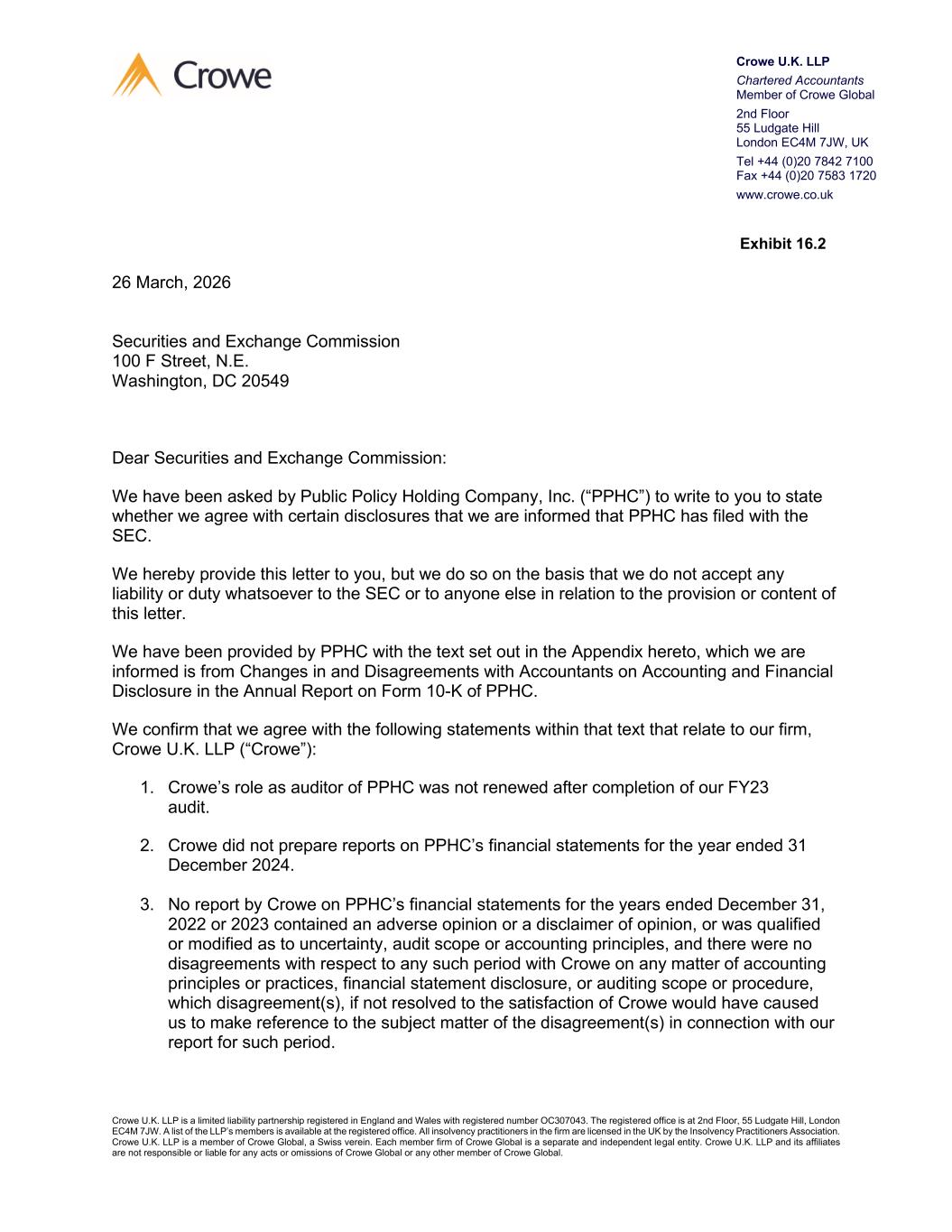
Crowe U.K. LLP is a limited liability partnership registered in England and Wales with registered number OC307043. The registered office is at 2nd Floor, 55 Ludgate Hill, London EC4M 7JW. A list of the LLP’s members is available at the registered office. All insolvency practitioners in the firm are licensed in the UK by the Insolvency Practitioners Association. Crowe U.K. LLP is a member of Crowe Global, a Swiss verein. Each member firm of Crowe Global is a separate and independent legal entity. Crowe U.K. LLP and its affiliates are not responsible or liable for any acts or omissions of Crowe Global or any other member of Crowe Global. Crowe U.K. LLP Chartered Accountants Member of Crowe Global 2nd Floor 55 Ludgate Hill London EC4M 7JW, UK Tel +44 (0)20 7842 7100 Fax +44 (0)20 7583 1720 www.crowe.co.uk Exhibit 16.2 26 March, 2026 Securities and Exchange Commission 100 F Street, N.E. Washington, DC 20549 Dear Securities and Exchange Commission: We have been asked by Public Policy Holding Company, Inc. (“PPHC”) to write to you to state whether we agree with certain disclosures that we are informed that PPHC has filed with the SEC. We hereby provide this letter to you, but we do so on the basis that we do not accept any liability or duty whatsoever to the SEC or to anyone else in relation to the provision or content of this letter. We have been provided by PPHC with the text set out in the Appendix hereto, which we are informed is from Changes in and Disagreements with Accountants on Accounting and Financial Disclosure in the Annual Report on Form 10-K of PPHC. We confirm that we agree with the following statements within that text that relate to our firm, Crowe U.K. LLP (“Crowe”): 1. Crowe’s role as auditor of PPHC was not renewed after completion of our FY23 audit. 2. Crowe did not prepare reports on PPHC’s financial statements for the year ended 31 December 2024. 3. No report by Crowe on PPHC’s financial statements for the years ended December 31, 2022 or 2023 contained an adverse opinion or a disclaimer of opinion, or was qualified or modified as to uncertainty, audit scope or accounting principles, and there were no disagreements with respect to any such period with Crowe on any matter of accounting principles or practices, financial statement disclosure, or auditing scope or procedure, which disagreement(s), if not resolved to the satisfaction of Crowe would have caused us to make reference to the subject matter of the disagreement(s) in connection with our report for such period.
26 March, 2026 4. Crowe was not aware during our audits of any “reportable events” as defined in Item 304(a)(1)(v) of Regulation S-K for the years ended December 31, 2022 or 2023. Yours faithfully Crowe U.K. LLP
26 March, 2026 Changes in and disagreements with accountants on accounting and financial disclosure Upon the recommendation of our audit committee, we engaged Forvis Mazars, LLP on July 13, 2024 as the Company’s independent external (statutory) auditors for the year ending December 31, 2024. In connection with this appointment, in July 2024, upon the recommendation of our audit committee, we terminated the engagement of MN Blum, LLC (“MN Blum”) as our component auditor and terminated the engagement of Crowe U.K. LLP (“Crowe UK”) as our statutory auditor for the year ended December 31, 2024. Neither MN Blum nor Crowe UK prepared reports on our financial statements for the years ended December 31, 2025 and 2024. No report by MN Blum or Crowe UK on our financial statements for the years ended December 31, 2023, or for any subsequent interim period, contained an adverse opinion or a disclaimer of opinion, or was qualified or modified as to uncertainty, audit scope or accounting principles, and there were no disagreements with respect to any such period with MN Blum or Crowe UK on any matter of accounting principles or practices, financial statement disclosure, or auditing scope or procedure, which disagreement(s), if not resolved to the satisfaction of MN Blum or Crowe UK, respectively, would have caused it to make reference to the subject matter of the disagreement(s) in connection with its report for such period. There were no “reportable events” as defined in Item 304(a)(1)(v) of Regulation S-K for such years and subsequent interim period through July 13, 2024. In accordance with Item 304(a)(3) of Regulation S-K, we have provided MN Blum and Crowe UK with a copy of our Annual Report on Form 10-K and requested that each of MN Blum and Crowe UK furnish the Company with a letter addressed to the SEC stating whether or not it agrees with the statements made herein. During the fiscal years ended December 31, 2023 and during the interim period through July 13, 2024, neither the Company nor anyone on its behalf consulted with Forvis Mazars, LLP regarding either (1) the application of accounting principles to a specific transaction, completed or proposed, or the type of audit opinion that might be rendered on the Company’s consolidated financial statements, and neither a written report nor oral advice was provided to the Company that Forvis Mazars, LLP concluded was an important factor considered by the Company in reaching a decision as to any accounting, auditing, or financial reporting issue, or (2) any matter that was either the subject of a “disagreement” (as defined in Item 304(a)(1)(iv) of Regulation S- K) or a “reportable event” (as described in Item 304(a)(1)(v) of Regulation S-K).
EX-19.1
9
exhibit191.htm
EX-19.1
exhibit191

Last Updated December 16, 2025 Date: 2025 Public Policy Holding Company, Inc. Policies on Dealings in the Securities of the Company and Insider Trading
i Contents No. Heading Page 1. Introduction 1 2. Definitions 1 Part A: The UK Policy 5 Part B: The US Policy 9 Schedule 1 19 Summary of the provisions of the CJA, MAR and Rule 10b-5 19 Schedule 2 24 Application to Deal / Trade Request Form 24 Schedule 3 25 Acknowledgement and Response 25 Schedule 4 26 Notification of Dealings in the Securities 26

1 Public Policy Holding Company, Inc. (the “Company”) Policies on Dealings in Securities (the “Dealing Policies”) 1. Introduction Pursuant to Rule 21 of the AIM Rules for Companies, the Company must have in place a reasonable and effective dealing policy setting out the requirements and procedures for dealings in the Company's securities. AIM Rule 21 sets out the minimum provisions which the dealing policy must contain. Set out in part A of this document is the Company's policy on dealings in securities for the purposes of Rule 21 of the AIM Rules for Companies (the “UK Policy”). The UK Policy applies to you if you are a PDMR (as defined below). If the UK Policy does apply to you, you must understand that your freedom to deal in securities (including in particular, the Company's securities) is restricted in a number of ways - by law (for example, the insider dealing provisions of the Criminal Justice Act 1993 (“CJA”) and the UK Market Abuse Regulation, which is the retained EU law version of the EU Market Abuse Regulation (596/2014/EU) which has applied in the UK since the end of the Brexit transition period (“MAR”)); restrictions in a Director's service agreement; and also by the UK Policy. The UK Policy addresses the share dealing restrictions set out in the MAR alone. Its purpose is to ensure that PDMRs and Persons Closely Associated (as defined below) with them do not abuse, or place themselves under suspicion of abusing, unpublished price-sensitive information that they may have or be thought to have, especially in periods leading up to an announcement of results. Additionally, as the Company is subject to Rule 10b-5 promulgated under the Exchange Act (“Rule 10b-5”), part B of this document sets out the Company's policy on dealings in securities for the purposes of Rule 10b-5 (the “US Policy”). The US Policy applies to all employees of the Company (including PDMRs). A brief summary of the provisions of the CJA, MAR and Rule 10b-5 are set out in Schedule 1 of this document. You must take care before any form of dealing in the Securities of the Company and, where appropriate, consult a UK law qualified lawyer and/or a US law qualified lawyer. For example, a dealing which may fall outside the UK Policy or the US Policy might still constitute an offence under insider dealing or market abuse legislation. The preceding introduction and the paragraph headings in this document, do not form part of the UK Policy or the US Policy, are for guidance and ease of reference only and are not to be construed as affecting the substance or interpretation of the UK Policy or the US Policy. Compliance with the UK Policy and/or the US Policy (as applicable) may not constitute a defence to any charge under applicable law. 2. Definitions In this document the following definitions apply unless the context requires otherwise: “AIM” means the market of that name operated by the Exchange; “AIM Rules” means the AIM Rules for Companies published by the Exchange; “Board” means the board of directors of the Company from time to time; “Close Period” means any of the following periods when a PDMR is prohibited from Dealing: (a) the period of 30 calendar days preceding the announcement of the Company's interim financial report or the preliminary announcement of the Company's annual results (or, where no such announcement is released, up to the publication of the financial report);

2 (b) if the Company reports on a quarterly basis, the period of 30 calendar days immediately preceding the notification of its quarterly results; and (c) any other period of time which the Company designates as a Close Period. “Company” means Public Policy Holding Company, Inc.; “Dealing”, “Deal” or “Dealt” means any change whatsoever to the Holding of Securities in which the holder is a PDMR or a Person Closely Associated to that PDMR including but not limited to the following: (a) acquisition, disposal, short sale, subscription or exchange; (b) acceptance or exercise of a stock option, including of a stock option granted to managers or employees as part of their remuneration package, and the disposal of shares stemming from the exercise of a stock option; (c) entering into or exercise of equity swaps; (d) transactions in or related to derivatives, including cash-settled transactions; (e) entering into a contract for difference on a financial instrument of the Company; (f) acquisition, disposal or exercise of rights, including put and call options, and warrants; (g) subscription to a capital increase or debt instrument issuance; (h) transactions in derivatives and financial instruments linked to a debt instrument of the Company, including credit default swaps; (i) conditional transactions upon the occurrence of the conditions and actual execution of the transactions; (j) automatic or non-automatic conversion of a financial instrument into another financial instrument, including the exchange of convertible bonds to shares; (k) gifts and donations made or received, and inheritance received; (l) transactions executed in index-related products, baskets and derivatives, insofar as required by Article 19 of MAR; (m) transactions executed in shares or units of investment funds, including alternative investment funds (an “AIF”) referred to in regulation 3 of the Alternative Investment Fund Managers Regulation 2013, insofar as required by Article 19 of MAR; (n) transactions executed by a manager of an AIF in which the PDMR or a Person Closely Associated with such a person has invested, insofar as required by Article 19 of MAR; (o) transactions executed by a third party under an individual portfolio or asset management mandate on behalf or for the benefit of a PDMR or a Person Closely Associated with such a person; (p) borrowing or lending of shares or debt instruments of the Company or derivatives or other financial instruments linked thereto; (q) pledging or lending of Securities in the Company by or on behalf of a PDMR or a Person Closely Associated. A pledge, or a similar security interest, of Securities in the Company in connection with the depositing of the Securities in a custody account does not need to be notified, unless and until such time that such pledge or other security interest is designated to secure a specific credit facility;

3 (r) transactions undertaken by PDMRs or executing transactions or by another person on behalf of a PDMR or a Person Closely Associated, including where discretion is exercised; (s) transactions made under a life insurance policy, defined in accordance with Directive 2009/138/EC of the European Parliament and of the Council, where: (i) the policyholder is a PDMR or a Person Closely Associated; (ii) the investment risk is borne by the policyholder, and (iii) the policyholder has the power or discretion to make investment decisions regarding specific instruments in that life insurance policy or to execute transactions regarding specific instruments for that life insurance policy; “Designated Person” means a person appointed pursuant to paragraph 2.8 of the UK Policy; “Exchange” means London Stock Exchange plc; “Exchange Act” means the United States Securities Exchange Act of 1934, as amended; “FCA” means the Financial Conduct Authority; “Holding” means any legal or beneficial interest, whether direct or indirect, in Securities; “Inside Information” means: information of a precise nature, which has not been made public, relating, directly or indirectly, to the Company or the Securities and which, if it were made public, would be likely to have a significant effect on the price of those Securities; For the purposes of the above definition, information shall be deemed to be of a precise nature if it indicates a set of circumstances which exists or which may reasonably be expected to come into existence, or an event which has occurred or which may reasonably be expected to occur, where it is specific enough to enable a conclusion to be drawn as to the possible effect of that set of circumstances or event on the prices of the Securities. In this respect in the case of a protracted process that is intended to bring about, or that results in, particular circumstances or a particular event, those future circumstances or that future event, and also the intermediate steps of that process which are connected with bringing about or resulting in those future circumstances or that future event, may be deemed to be precise information. “Officer of the Company” means a person who acts as an officer of the Company whether or not officially; “Person Closely Associated” means a person closely associated to a PDMR being: (a) a spouse or a partner considered to be equivalent to a spouse in accordance with national law; (b) a dependent child, in accordance with national law; (c) a relative who has shared the same household for at least one year on the date of the transaction concerned; or (d) a legal person, trust or partnership, the managerial responsibilities of which are discharged by a PDMR or by a person referred to in point (a), (b) or (c), which is directly or indirectly controlled by such a person, which is set up for the benefit of such a person, or the economic interests of which are substantially equivalent to those of such a person; “PDMR” means a person within the Company who is: (a) a member of the administrative, management or supervisory body of the Company;

4 (b) an Officer of the Company; (c) a senior executive who is not a person referred to in paragraphs (a) or (b), who has regular access to Inside Information relating directly or indirectly to the Company and power to take managerial decisions affecting the future developments and business prospects of the Company; or (d) such other person as may be notified by the Company that the clearance procedures set out in the UK Policy apply to them; “SEC” means the United States Securities and Exchange Commission; “Securities” means any publicly traded or quoted securities of the Company or any member of its group, any securities that are convertible into such securities or any derivatives or other financial instruments linked to any of them; and “Working Day” means any day other than (a) Saturday or Sunday; (b) Christmas Day or Good Friday; or (c) a day which is a bank holiday in England or Wales under the Banking and Financial Dealings Act 1971.

5 Part A: The UK Policy 1. Restrictions on Dealings by PDMRs 1.1 Subject to paragraph 3, a PDMR may not Deal in any Securities, on his or her own account or for the account of a third party, directly or indirectly, during: (a) a Close Period; or (b) at any time when he or she is in possession of Inside Information; or (c) otherwise where clearance to Deal is not given under paragraph 2 of this UK Policy. 1.2 Paragraph 2.4 of Schedule 1 contains non-exhaustive guidance on the type of information which is usually to be regarded as Inside Information. 1.3 A PDMR must (so far as is consistent with his or her duties of confidentiality to the Company) seek to prohibit any Dealings in Securities during a Close Period or at a time when he or she is in possession of Inside Information by an investment manager with whom such PDMR has funds under management (whether or not discretionary). 1.4 A PDMR must not Deal in any Securities on considerations of a short term nature (for example, in order to make a quick profit). An investment with a maturity of one year or less will always be considered to be an investment of a short term nature. 1.5 Before seeking clearance to deal, a PDMR must ensure that he or she is not bound by any lock-in arrangement entered into in connection with the admission of the Company's shares to AIM. 2. Clearance to Deal 2.1 A PDMR must not Deal, and must procure that Persons Closely Associated do not Deal, in any Securities without first notifying the Designated Person and receiving clearance to Deal from him or her. 2.2 The form of the application to Deal is set out in Schedule 2 and should be used for the purpose of receiving clearance to Deal. 2.3 A response to a request for clearance to Deal must be given to the relevant PDMR within five Working Days of the request being made. The form of such response is set out at Schedule 3. 2.4 The Company must maintain a record of the response to any Dealing request made by a PDMR and of any clearance given. A copy of the response and clearance (if any) must be given to the PDMR concerned. 2.5 A PDMR must not be given clearance to deal in any Securities: (a) during a Close Period (subject to paragraph 3); or (b) where Designated Person has reason to believe that the proposed dealing is in breach of this UK Policy or any of the restrictions contained in the MAR. 2.6 A PDMR who is given clearance to Deal, or his or her Person Closely Associated, must Deal as soon as possible and in any event within two Working Days of clearance being received. 2.7 The PDMR must notify the Designated Person and the FCA of the Dealing as soon as practicable following the Dealing (and in any event no later than two Working Days thereafter) using the share dealing notification form in Schedule 4, and in the case of the FCA, submitted using their online form by PDMRs and Persons Closely Associated. Failure to do so constitutes a breach of the Policy.

6 2.8 The Board will, from time to time, appoint and remove the Designated Person(s). At any time, there will be at least one Designated Person. The Company Secretary keeps a list of current Designated Person(s), which is available on request. 2.9 A Designated Person wishing to Deal in Securities must notify the other Designated Person(s) (or, if no other Designated Person has been appointed, the Chairman or Chief Executive Officer) and receive clearance before proceeding. 2.10 If for whatever reason the Designated Person appointed is not independent for a particular clearance request, provision will be made for an alternate Designated Person (or, if no other Designated Person has been appointed, the Chairman or Chief Executive Officer) to deal with the request. 3. Dealings Permitted During a Close Period 3.1 Dealing in exceptional circumstances - extremely urgent, unforeseen and compelling reasons, pursuant to which clearance may, but need not, be granted. (a) A PDMR, who is not in possession of Inside Information in relation to the Company, may be given clearance to Deal in some exceptional circumstances. Clearance may be given for such a person to immediately sell (but not purchase) Securities when he would otherwise be prohibited by this UK Policy from doing so. (b) Circumstances will be considered exceptional, when they are extremely urgent, unforeseen and compelling and where their cause is external to the PDMR and the PDMR has no control over them. (c) When examining whether the circumstances described in the written request are exceptional, the Designated Person(s) will take into account, among other indicators, whether and to the extent to which the PDMR: (i) is at the moment of submitting its request facing a legally enforceable financial commitment or claim; and (ii) has to fulfil, or is in a situation entered into, before the beginning of the Close Period, requiring the payment of sums to a third party (including tax liability) and cannot reasonably satisfy a financial commitment or claim by means other than immediate sale of Securities. 3.2 Dealing in exceptional circumstances - employee schemes and other Dealings The Designated Person may also give clearance for a PDMR to Deal in the following instances: (a) where the PDMR has been awarded or granted Securities under an employee scheme, provided that the following conditions are met: (i) the employee scheme and its terms have been previously approved by the Company in accordance with Delaware's General Corporations Law and the terms of the employee scheme specify the timing of the award or the grant and the amount of the Securities awarded or granted, or the basis on which such an amount is calculated and given that no discretion can be exercised; and (ii) the PDMR does not have any discretion as to the acceptance of the awarded or granted Securities; (b) where the PDMR has been awarded or granted Securities under an employee scheme that takes place in the Close Period, provided that: (i) a pre-planned and organised approach is followed regarding the conditions, the periodicity, the time of the award, the group of entitled persons to whom the Securities are granted; and

7 (ii) the amount of the Securities to be awarded, the award or grant of the Securities takes place under a defined framework under which any Inside Information cannot influence the award or grant of the Securities; (c) where the PDMR exercises options or warrants or conversion of convertible bonds assigned to him under an employee scheme when the expiration date of such options, warrants or convertible bonds falls within a Close Period, as well as sales of the Securities acquired pursuant to such exercise or conversion, provided that all of the following conditions are met: (i) the PDMR notifies the Designated Person of its choice to exercise or convert at least four months before the expiration date; (ii) the decision of the PDMR is irrevocable; and (iii) the PDMR has received the authorisation from the Directors prior to proceed; (d) where the PDMR acquires the Securities under an employee saving scheme, provided that all of the following conditions are met: (i) the PDMR has entered into the scheme before the Close Period, except when it cannot enter into the scheme at another time due to the date of commencement of employment; (ii) the PDMR does not alter the conditions of his participation into the scheme or cancel his participation into the scheme during the Close Period; and (iii) the purchase operations are clearly organised under the scheme terms and that the PDMR has no right or legal possibility to alter them during the Close Period, or are planned under the scheme to intervene at a fixed date which falls in the Close Period; (e) where the PDMR transfers or receives, directly or indirectly, Securities, provided that: (i) the Securities are transferred between two accounts of the PDMR; and (ii) such a transfer does not result in a change in price of the Securities; (f) where the PDMR acquires qualification or entitlement to Securities and the final date for such an acquisition, under the Company's statute or by-laws falls during the Close Period, provided that: (i) the PDMR submits evidence to the Designated Persons of the reasons for the acquisition not taking place at another time; and (ii) the Designated Person(s) is satisfied with the provided explanation. 3.3 The Company's Nominated Adviser should be consulted at an early stage if a PDMR is seeking clearance to deal in any of the circumstances set out in this paragraph 3. 4. Dealings by Persons Closely Associated 4.1 A PDMR must seek to prohibit by or on behalf of Persons Closely Associated to the PDMR any Dealings on considerations of a short-term nature and in the Securities during a Close Period, when in possession of Inside Information and otherwise when clearance is not given to a Dealing pursuant to paragraph 2 of this UK policy. This would include Dealings by investment managers on behalf of the PDMR or on behalf of Persons Closely Associated with that PDMR. 4.2 A PDMR must advise all Persons Closely Associated with them: (a) of the name of the Company;

8 (b) of the Close Periods during which they cannot Deal in the Securities; (c) of any other periods when the PDMR knows he or she is not free to Deal in Securities under the provisions of the Policy unless his or her duty of confidentiality to the Company prohibits him or her from disclosing such periods; (d) the requirements in relation to notifiable transactions under paragraph 5; and (e) that they must advise him or her and the Company immediately after they have Dealt in Securities. 4.3 PDMRs must provide the Company with a list of his or her Persons Closely Associated and notify the Company of any changes that need to be made to that list. 5. Notification of Transactions 5.1 PDMRs must notify, and procure that their Persons Closely Associated notify: (a) the FCA; and (b) the Designated Person, in writing of all Dealings by themselves and Persons Closely Associated in the Securities as soon as practicable following the Dealing (and in any event no later than two Working Days thereafter). Such notification shall be made in the form set out at Schedule 4 and, in the case of the FCA, submitted using their online form by PDMRs and Persons Closely Associated. 5.2 Following receipt of a notification under paragraph 5.1, the Company must: (a) determine whether the information relating to the notifiable transaction is required to be made public in accordance with Article 19 of the MAR; and (b) if required to be made public, notify a Regulatory Information Service without delay, and in any event no later than two Working Days following receipt by the Company of the notification, disclosing as far as possible the information specified by that notification. This will result in the transaction becoming publicly available information. 6. Breach of the UK Policy A breach of the provisions of this UK Policy by any person subject to it will be deemed to be a breach of that person's employment contract or letter of appointment with the Company.

9 Part B: The US Policy This US Policy describes the standards of the Company and its subsidiaries on trading, and causing the trading of, the securities of the Company or securities of certain other publicly traded companies while in possession of confidential information, in light of U.S. federal securities laws. This US Policy applies to all employees of the Company. One of the principal purposes of the U.S. federal securities laws is to prohibit so-called "insider trading." Simply stated, insider trading occurs when a person, while in possession of material nonpublic information obtained through involvement with the Company, purchases, sells, gives away or otherwise trades the securities or provides that information to others outside the Company. The prohibitions against insider trading apply to trades, tips and recommendations by virtually any person, including all persons associated with the Company, if the information involved is "material" and "nonpublic." These terms are defined in this US Policy at paragraph 2 below. The prohibitions under this US Policy apply to any director, officer or employee who buys or sells Company stock on the basis of material nonpublic information that he or she obtained about the Company, its customers, suppliers, or other companies with which the Company has contractual relationships or may be negotiating transactions. 1. Applicability 1.1 This US Policy applies to all trading or other transactions in the Company's securities, including common stock, options and any other securities that the Company may issue, such as preferred stock, notes, bonds and convertible securities, as well as to derivative securities relating to any of the Company's securities, whether or not issued by the Company. 1.2 This US Policy applies to all employees of the Company, all officers of the Company and all members of the Board (each a “Company Insider”, which term will also include for the purposes of this US Policy any consultants, contractors, and others who have been informed that they are subject to this US Policy) and each of their respective family members of the types listed below (each a “Covered Person”): (a) a spouse or a partner considered to be equivalent to a spouse in accordance with national law; (b) a sibling, child, step-child, mother- or father-in-law, son- or daughter-in-law, or brother- or sister-in-law, in accordance with national law; (c) any person who has shared the same household (other than domestic employees) for at least one year on the date of the transaction concerned; or (d) a legal person, trust or partnership, the managerial responsibilities of which are discharged by person referred to in point (a), (b) or (c), which is directly or indirectly controlled by such a person, which is set up for the benefit of such a person, or the economic interests of which are substantially equivalent to those of such a person. 2. Definitions 2.1 Material: Insider trading restrictions come into play only if the information you possess is “material.” Materiality, however, involves a relatively low threshold. Information is generally regarded as "material" if it has market significance, that is, if its public dissemination is likely to affect the market price of securities, or if it otherwise is information that a reasonable investor would want to know before making an investment decision. Information dealing with the following subjects is reasonably likely to be found material in particular situations: (a) quarterly or annual results; (b) significant changes in the Company's prospects; (c) significant write-downs in assets or increases in reserves;

10 (d) developments regarding significant litigation or government agency investigations; (e) liquidity problems; (f) changes in earnings estimates or unusual gains or losses in major operations; (g) major changes in the Company's management or the board of directors; (h) significant developments with respect to products, services or technologies; (i) developments regarding the Company’s material intellectual property; (j) developments regarding customers/clients, vendors and data suppliers, including the award or loss of a significant contract; (k) changes in dividends; (l) changes in compensation policy; (m) extraordinary borrowings; (n) major changes in accounting methods or policies; (o) change in or dispute with the Company’s independent registered public accounting firm or notification that the Company may no longer rely on such firm’s report; (p) cybersecurity risks and incidents, including vulnerabilities and breaches; (q) changes in debt ratings; (r) proposals, plans or agreements, even if preliminary in nature, involving mergers, acquisitions, divestitures, recapitalizations, strategic alliances, licensing arrangements, or purchases or sales of substantial assets; (s) financings and other events regarding the Company’s securities (e.g., defaults on securities, calls of securities for redemption, share repurchase plans, stock splits, public or private sales of securities, changes in dividends or dividend policy and changes to the rights of security holders); and (t) impending bankruptcy, corporate restructuring, or receivership. Material information is not limited to historical facts but may also include projections and forecasts. With respect to a future event, such as a merger, acquisition or introduction of a new product, the point at which negotiations or product development are determined to be material is determined by balancing the probability that the event will occur against the magnitude of the effect the event would have on a company's operations or stock price should it occur. Thus, information concerning an event that would have a large effect on stock price, such as a merger, may be material even if the possibility that the event will occur is relatively small. Considering this, Covered Persons should err on the side of caution. Covered Persons should keep in mind that the Securities and Exchange Commission’s (“SEC”) rules and regulations provide that the mere fact that a person is aware of the information is a bar to trading. It is no excuse that such person’s reasons for trading were not a response to the information. If you are unsure whether information is material, you should either consult the Designated Person before making any decision to disclose such information (other than to persons who need to know it in connection with the operation of the Company) or to trade in or recommend securities to which that information relates or assume that the information is material. 2.2 Nonpublic: Insider trading prohibitions come into play when you possess information that is material and "nonpublic." The fact that information has been disclosed to a few members of the public does not make it public for insider trading purposes. To be "public" the information must

11 have been widely disseminated or otherwise disseminated in a manner designed to reach investors generally, and the investors must be given the opportunity to absorb the information. Even after public disclosure of information about the Company, you must wait until the close of business on the second trading day after the information was publicly disclosed before you can treat the information as public. Nonpublic information may include: (a) information available to a select group of analysts or brokers or institutional investors; (b) undisclosed facts that are the subject of rumors, even if the rumors are widely circulated; and (c) information that has been entrusted to the Company on a confidential basis until a public announcement of the information has been made and enough time has elapsed for the market to respond to a public announcement of the information (normally 2 trading days). Generally, you should assume that information has not been widely disseminated unless one or more of the following has occurred: (a) it has been carried in a national “financial” news service; (b) it has been carried in a national “general” news service such as the Associated Press; (c) it has appeared in a publicly available filing or furnishing made with the SEC; and/or (d) another method (or combination of methods) of disclosure reasonably designed to provide broad, non-exclusionary distribution of the information to the public, such as: (i) a press release distributed through a widely disseminated news or wire service; or (ii) an announcement made at a press conference or conference call, if the public is given adequate advance notice of the conference or call and the public is granted access to the conference or call either by telephonic and/or electronic transmission, such as webcasting of conference calls, which is reasonably designed to provide broad, non-exclusionary distribution of the information to the public. As with questions of materiality, if you are not sure whether information is considered public, you should either consult with the Designated Person or assume that the information is nonpublic and treat it as confidential. 2.3 Section 16 Persons: The term “Section 16 Persons” means the Company’s directors and officers (as defined in Rule 16a-1 under the Securities Exchange Act of 1934, as amended (the “Exchange Act”)). 2.4 Security or Securities: The term “security” or “securities” is defined very broadly by the securities laws and includes stock (common and preferred), stock options, warrants, bonds, notes, debentures, convertible instruments, put or call options (i.e., exchange-traded options), or other similar instruments. 2.5 Trade or Trading: The term “trade” or “trading” (i) means broadly any purchase, sale or other transaction to acquire, transfer or dispose of securities or an interest therein, including derivative exercises, gifts, donations or other contributions, pledges, exercises of stock options granted under the Company’s stock plans, sales of stock acquired upon the exercise of options, and trades made under (and elections concerning Company securities in) an employee benefit plan such as a 401(k) plan, and (ii) shall not include the vesting of stock options, restricted stock or restricted stock units.

12 3. Designated Person The duties of the Designated Person (in addition to those under the UK Policy) will include, but are not limited to, the following: (a) assisting with implementation and enforcement of this US Policy; (b) circulating this US Policy to all employees and ensuring that this US Policy is amended as necessary to remain up-to-date with insider trading laws; (c) pre-clearing all trading in securities of the Company by Covered Persons in accordance with the procedures set forth in paragraph 6 below; and (d) providing a reporting system with an effective whistleblower protection mechanism. 4. General Policy: No Trading or Causing Trading While in Possession of Material Nonpublic Information 4.1 No Covered Person may purchase or sell, or offer to purchase or sell, any Company security, whether or not issued by the Company, while in possession of material nonpublic information about the Company, including, but not limited to, in any private transaction involving the purchase or sale of the Company’s securities, even where the recipient of such securities is in possession of material nonpublic information concerning the Company. The terms "material" and "nonpublic" are defined at paragraphs 2.1 and 2.2 above. 4.2 No Covered Person who knows of any material nonpublic information about the Company may communicate that information to ("tip") any other person, including family members and friends, or otherwise disclose such information without the Company's authorization. 4.3 No Covered Person may purchase or sell any security of any other company, whether or not issued by the Company, while in possession of material nonpublic information about that company that was obtained in the course of his or her involvement with the Company. No Covered Person who knows of any such material nonpublic information may communicate that information to, or tip, any other person, including family members and friends, or otherwise disclose such information without the Company's authorization. 4.4 For compliance purposes, you should never trade, tip or recommend securities (or otherwise cause the purchase or sale of securities) while in possession of information that you have reason to believe is material and nonpublic unless you first consult with, and obtain the advance approval of, the Designated Person. 4.5 Covered Persons must "pre-clear" all trading in securities of the Company in accordance with the procedures set forth in paragraph 6 below. 5. Certain Exceptions The prohibition on trading in securities set forth in paragraph 4 above does not apply to: (a) Transferring shares to an entity that does not involve a change in any beneficial ownership of the shares (for example, to an inter vivos trust of which you are trustee and the sole beneficiary during your lifetime); (b) The exercise of stock options (including any net-settled stock option exercise and withholding of shares subject to an option to satisfy tax withholding requirements) pursuant to the Company’s stock plans; however, the sale of any stock acquired upon such exercise, including as part of a broker-assisted cashless exercise of an option or any other market sale for the purpose of generating the cash needed to pay the exercise price of an option or to satisfy tax withholding requirements, is subject to this US Policy;

13 (c) The withholding (whether mandated by the Company or pursuant to a tax withholding right) of shares of restricted stock or shares underlying restricted stock units to satisfy tax withholding requirements; however, the sale of any stock for the purpose of generating cash needed to satisfy tax withholding requirements is subject to this US Policy; (d) The execution of trades pursuant to a trading plan that complies with Rule 10b5-1 under the Exchange Act (“10b5-1”) and this US Policy and that has been approved by the Company (see paragraph 9.1 below). (e) Sales of the Company’s securities as a selling stockholder in a registered public offering, including a “synthetic secondary” offering, in accordance with applicable securities laws. (f) To the extent the Company offers its securities as an investment option in the Company’s 401(k) plan or offers an employee stock purchase plan, the purchase of stock through such plan through regular payroll deductions; however, elections to participate in (or change participation in) such plan, the sale of any such stock and the election to transfer funds into or out of, or if available a loan with respect to amounts invested in, any such fund is subject to this US Policy. (g) To the extent the Company makes generally available a dividend reinvestment plan (“DRIP”), the purchase of stock through the DRIP resulting from reinvestment of dividends paid on the Company’s securities; however, (i) a voluntary purchase of the Company’s securities that results from additional contributions a participant chooses to make to the DRIP, and a participant’s election to participate, cease participation or otherwise alter such person’s participation in the DRIP, and (ii) a participant’s sale of any of the Company’s securities purchased pursuant to the DRIP, are subject to this US Policy. 6. Pre-Clearance of Securities Transactions 6.1 Section 16 Persons, family members of Section 16 Persons and trusts, corporations and other entities over which Section 16 Persons and their family members exercise control or substantial influence concerning investment decisions (or otherwise attributed to Section 16 Persons for purposes of the requirements of Section 16 (“Section 16”) of the Exchange Act) (collectively, “Permanent Restricted Insiders” and together with Company Insiders, “Restricted Insiders”) as well as certain other persons described in paragraph 6.2 below must obtain the advance approval of the Designated Person, even during a trading window under paragraph 8 below, before effecting trades in the Company’s securities, including any exercise of an option (whether cashless or otherwise), right or warrant to purchase or sell such securities, or any gift, donation, loan, pledge, contribution to a trust or other transfer, whether the trade is for the individual’s own account, one over which such person exercises control, or one in which such person has a direct or indirect beneficial interest. Any Permanent Restricted Insiders seeking approval to effect a trade in the Company’s securities should also indicate whether such person has effected any “opposite-way” trades (i.e., a sale if the requestor is considering a purchase and a purchase if the requestor is considering a sale) within the past six (6) months, and should be prepared to timely report such person’s transactions in Company securities to the SEC on a Form 4 or Form 5, as applicable. Section 16 Persons who engage or are deemed to have engaged in a sale or purchase should consider that such trade may affect the consequences of making an opposite-way trade in the following six (6) months. The requestor should also be prepared to comply with SEC Rule 144 and file Form 144, if necessary, at the time of any sale. 6.2 Because Company Insiders are likely to obtain material nonpublic information on a regular basis, the Company requires all such persons to refrain from trading, even during a trading window under paragraph 8 below, without first pre-clearing all transactions in the Company's securities. 6.3 No Restricted Insider may, directly or indirectly, purchase or sell (or otherwise make any transfer, gift, pledge or loan of) any Company security at any time without first obtaining prior approval from the Designated Person. These procedures also apply to transactions by such

14 person's family members, including such person’s spouse, other persons living in such person's household and minor children and to transactions by entities over which such person exercises control. Unless notified otherwise by the Company, Permanent Restricted Insiders must comply with these pre-clearance requirements for six (6) months after the termination of their status as a Permanent Restricted Insider. 6.4 The form of the application to trade is set out in Schedule 2 and should be used for the purpose of receiving clearance to trade. 6.5 The Designated Person shall record the date each request is received and the date and time each request is approved or disapproved. Unless revoked, a grant of permission will remain valid until the close of trading two Working Days following the day on which it was granted. If the transaction does not occur during the two Working Day period, pre-clearance of the transaction must be re-requested. 7. Blackout Periods All Restricted Insiders Insiders are prohibited from trading in the Company's securities during blackout periods as defined below: (a) Quarterly blackout periods: trading in the Company's securities is prohibited during the period beginning at the close of the market on two weeks before the end of each fiscal year end and quarterly reporting period and ending at the close of business on the second trading day following the date the Company's financial results are publicly disclosed. During these periods, Covered Persons generally possess or are presumed to possess material nonpublic information about the Company's financial results. (b) Other blackout periods: from time to time, other types of material nonpublic information regarding the Company (such as negotiation of mergers, acquisitions or dispositions, investigation and assessment of cybersecurity incidents or new product developments) may be pending and not be publicly disclosed. While such material nonpublic information is pending, the Company may impose special blackout periods during which Covered Persons are prohibited from trading in the Company's securities. If the Company imposes a special blackout period, it will notify the Covered Persons affected. 8. Trading Window Restricted Insiders are permitted to trade in the Company's securities when no blackout period is in effect. However, even during this trading window, a Covered Person who is in possession of any material nonpublic information should not trade in the Company's securities until the information has been made publicly available or is no longer material. In addition, the Company may close this trading window if a special blackout period under paragraph 7(b) above is imposed and will re-open the trading window once the special blackout period has ended. 9. 10b5-1 Plans/Margin Accounts and Pledges 9.1 10b5-1 Trading Plans. (a) General. A 10b5-1 trading plan is a binding, written contract, generally between you and your broker, which specifies the price, amount, and date of trades to be executed in your account in the future, or provides a formula or mechanism that will govern trading. A 10b5-1 trading plan can only be established when you do not possess material nonpublic information. Therefore, Covered Persons cannot enter into or modify these plans at any time when in possession of material nonpublic information and, in addition, Restricted Insiders cannot enter into these plans outside of trading windows or during a blackout. In addition, a 10b5-1 trading plan must not permit you to exercise any subsequent influence over how, when, or whether the purchases or sales are made. Unless such requirement is waived or modified by the Designated Person in such person’s sole discretion, (i) a 10b5-1 trading plan should have a duration of at least six months and no more than two years; and (ii) a 10b5-1 trading plan should not permit any trades to occur until the applicable cooling-off period (as described in

15 paragraph 9.1(c) of this US Policy) has elapsed from adoption or modification of such plan. You have an affirmative defense against any claim by the SEC against you for insider trading if your trade was made under a 10b5-1 trading plan that you adopted when you were not aware of material nonpublic information (provided you honored the plan, acted in good faith for the duration of the plan and did not enter into or alter a corresponding or hedging trade or position during the pendency of any 10b5-1 trading plan). The rules regarding 10b5-1 trading plans are complex and you must fully comply with them. You should consult with your legal advisor before proceeding. (b) Section 16 Persons. Each Section 16 Person should be aware that the Company will disclose such person’s adoption, modification or termination of a 10b5-1 trading plan, and the material terms thereof, as required by rules adopted by the SEC. If you are a Section 16 Person, 10b5-1 trading plans require special care. Because in a 10b5-1 trading plan you can specify conditions that trigger a purchase or sale, you may not even be aware that a trade has taken place and you may not be able to comply with the SEC’s requirement that you report your trade to the SEC within two business days after its execution. Therefore, for Section 16 Persons, a trade executed according to a 10b5-1 trading plan is not permitted unless the 10b5-1 trading plan requires your broker to notify the Company before the close of business on the day of the execution of the trade. Furthermore, each Section 16 Person should be aware that SEC rules require that each report of a trade executed according to a 10b5-1 trading plan must be identified as such therein and specify the date of adoption of such plan. See paragraph 10. (c) The Cooling-Off Period. For Covered Persons (other than Permanent Restricted Insiders), the applicable cooling-off period is 30 days. For Permanent Restricted Insiders, the applicable cooling-off period is the longer of (x) 90 days and (y) until two business days following the filing of the Form 10-Q or Form 10-K, as applicable, for the quarter in which such plan was adopted or modified (except that in no case shall such cooling-off period exceed 120 days). (d) Approval and Terms. Covered Persons cannot adopt or modify a 10b5-1 trading plan outside a trading window (regardless of whether applicable to you under this US Policy) or during a blackout, or at any time when in possession of material nonpublic information. Each Covered Person must pre-clear with the Designated Person such person’s proposed 10b5-1 trading plan prior to the establishment of such plan. The Company reserves the right to withhold pre-clearance of any 10b5-1 trading plan that the Company determines is not consistent with the rules regarding such plans. Notwithstanding any pre-clearance of a 10b5-1 trading plan, the Company assumes no liability for the consequences of any trade made pursuant to such plan. No 10b5-1 trading plan will be pre-cleared unless it satisfies the conditions of Rule 10b5-1 applicable at the time of the requested adoption or modification of the trading plan, including, as of the most recent modification of this US Policy, that: (i) any trading plan adopted by a Section 16 Person must include a written representation certifying that the person adopting the plan, on the date of adoption, (i) is not aware of material nonpublic information about the security or the issuer and (ii) is adopting or modifying the plan in good faith and not as part of a plan or scheme to evade the prohibitions of Rule 10b-5 under the Exchange Act; (ii) the Covered Person who adopted the 10b5-1 trading plan has no (and does not subsequently enter into any) other 10b5-1 trading plan in effect for purchases or sales of any class of the Company’s securities on the open

16 market during the same period,1 other than a 10b5-1 trading plan authorizing only sell-to-cover transactions necessary to satisfy tax withholding obligations arising exclusively from the vesting of a compensatory award, where the Covered Person does not otherwise exercise control over the timing of such sales (a “sell-to-cover 10b5-1 trading plan”); and (iii) if the proposed 10b5-1 trading plan (other than a sell-to-cover 10b5-1 trading plan) is designed to effect the open-market purchase or sale of the total amount of Company securities covered thereby as a single transaction (a “one-time 10b5-1 trading plan”), the Covered Person shall not have during the prior 12- month period adopted another one-time 10b5-1 trading plan. If you enter into a 10b5-1 trading plan, your 10b5-1 trading plan should be structured to avoid purchases or sales shortly before known announcements, such as quarterly or annual earnings announcements and related earnings conference calls. Even though trades executed in accordance with a properly formulated 10b5-1 trading plan benefit from an affirmative defense against allegations of insider trading, trades that occur at times shortly before the Company announces material news may draw significant scrutiny, and the investing public and media may not understand the nuances of trading pursuant to a 10b5-1 trading plan. This could result in negative publicity for you and the Company if the SEC, another authority, or the media were to investigate your trades. (e) Modifications and Terminations. For Covered Persons, any modification of a pre- approved 10b5-1 trading plan requires pre-clearance by the Designated Person. You are encouraged to provide your proposed 10b5-1 trading plan to the Designated Person as early as possible, as such plans may be complex. In addition, any modification of a pre-approved 10b5-1 trading plan must take place during a trading window (regardless of whether applicable to you under this US Policy), must occur when you are not aware of any material nonpublic information and must comply with the requirements of the rules regarding 10b5-1 trading plans. In particular, any modification or change to the amount, price or timing of the purchase or sale of the Company securities underlying the plan will be considered the termination of the 10b5- 1 trading plan and adoption of a new 10b5-1 trading plan for purposes of the cooling- off period specified above. Further, any termination of a 10b5-1 trading plan shall be reported to the Designated Person. Unless such requirement is waived or modified by the Designated Person in their sole discretion, if you terminate a 10b5-1 trading plan (including a modification considered a termination, as described above), you may not trade the Company’s securities before the end of a period of time equal to the cooling- off period that would be applicable (as described in paragraph 9.1(c) of this US Policy) if your termination were the entry into a new 10b5-1 trading plan. Further, unless permitted by the Designated Person, you may not terminate a 10b5-1 trading plan outside a trading window (regardless of whether otherwise applicable to you under this US Policy) or during a blackout applicable to you, and if such a termination is permitted. 9.2 Margin Accounts and Pledges. Securities purchased on margin may be sold by the broker without the customer’s consent if the customer fails to meet a margin call. Similarly, securities held in an account which may be borrowed against or are otherwise pledged (or hypothecated) as collateral for a loan may be sold in foreclosure if the borrower defaults on the loan. Accordingly, if you purchase securities on margin or pledge them as collateral for a loan, a margin sale or foreclosure sale may occur at a time when you are aware of material non-public information or otherwise are not permitted to trade in the Company’s securities. The sale, even though not initiated at your request, is still a sale for your benefit and may subject you to liability 1 A single additional 10b5-1 trading plan may be adopted when another 10b5-1 trading plan is already in place, but only if such later plan provides both that (i) no trading would take place until the earlier- adopted plan was completed or expired without having been executed, and (ii) any early termination of the earlier-adopted plan would delay trading under the later-adopted plan so as not to commence until the completion of the applicable cooling-off period, as if the termination of the earlier-adopted plan had been the adoption of the later-adopted plan.

17 under the insider trading rules if made at a time when you are aware of material nonpublic information (and, for Section 16 Persons, such a sale is also subject to Section 16). Similar cautions apply to bank or other loans for which you have pledged stock as collateral. Therefore, no Covered Person, whether or not in possession of material nonpublic information, may purchase the Company’s securities on margin, or borrow against any account in which the Company’s securities are held, or pledge the Company’s securities as collateral for a loan, without first obtaining pre-clearance. Request for approval must be submitted to the Designated Person at least two weeks prior to the execution of the documents evidencing the proposed arrangement. The Designated Person is under no obligation to approve any request for pre- clearance and may determine not to permit the arrangement for any reason. Approvals will be based on the particular facts and circumstances of the request, including, but not limited to, the percentage amount that the securities being pledged or otherwise used as security or collateral represent of the total number of the Company’s securities held by the person making the request and the financial capacity of the person making the request. Notwithstanding the pre- clearance of any request, the Company assumes no liability for the consequences of any trade made pursuant to such request. 10. Broker Requirements for Section 16 Persons 10.1 The timely reporting of trades requires close coordination with brokers handling trades for the Company’s directors and executive officers. Brokers of Section 16 Persons must comply with the following requirements: (a) do not enter any order (except for orders under pre-approved Rule 10b5-1 plans) without first verifying with the Company that your trade was pre-cleared and complying with the brokerage firm’s compliance procedures (e.g., Rule 144); and (b) before the close of business on the day of the execution of any trade, report by telephone and in writing via email to the Designated Person the complete details of every transaction involving the Company’s equity securities (i.e., date, type of transaction, number of shares and price), including gifts, donations, transfers, pledges and all 10b5-1 trades. 10.2 Because it is the legal obligation of the trading person to cause any filings on Form 3, Form 4, Form 5 or Form 144 (or as may otherwise be required) to be made, you are strongly encouraged to confirm following any trade that your broker has immediately telephoned and emailed the required information to the Company. 11. Violations of Insider Trading Laws 11.1 Penalties for trading on or communicating material nonpublic information can be severe, both for individuals involved in such unlawful conduct and their employers and supervisors, and may include jail terms, criminal fines, civil penalties and civil enforcement injunctions. Given the severity of the potential penalties, compliance with this US Policy is absolutely mandatory. 11.2 Legal penalties: (a) A person who violates insider trading laws by engaging in transactions in a company's securities when he or she has material nonpublic information can be sentenced to a substantial jail term and required to pay a criminal penalty of several times the amount of profits gained or losses avoided. (b) In addition, a person who tips others may also be liable for transactions by the tippees to whom he or she has disclosed material nonpublic information. Tippers can be subject to the same penalties and sanctions as the tippees, and the SEC has imposed large penalties even when the tipper did not profit from the transaction. (c) The SEC can also seek substantial civil penalties from any person who, at the time of an insider trading violation, "directly or indirectly controlled the person who committed such violation," which would apply to the Company and/or management and

18 supervisory personnel. These control persons may be held liable for up to the greater of $1 million or three times the amount of the profits gained or losses avoided. Even for violations that result in a small or no profit, the SEC can seek penalties from a company and/or its management and supervisory personnel as control persons. 11.3 Company-imposed penalties: Covered Persons who are employees, directors or officers of the Company who violate this US Policy may be subject to disciplinary action by the Company, including dismissal for cause. Any exceptions to the Policy, if permitted, may only be granted by the Designated Person and must be provided before any activity contrary to the above requirements takes place.

19 Schedule 1 Summary of the provisions of the CJA, MAR and Rule 10b-5 In addition to the rules set out in this document, there are two principal pieces of UK legislation that PDMRs must be aware of when Dealing in both the Securities of the Company and securities in general. The CJA contains a criminal offence of insider dealing and MAR covers market abuse. Additionally, all employees of the Company (including PDMRs) should be aware of Rule 10b-5 under the Exchange Act in the United States. Rule 10b-5 is the general anti-fraud rule under the Exchange Act, and (in part) restricts insider trading. A brief summary of these pieces of legislation is set out below. 1. Insider Dealing (CJA) 1.1 In broad terms, there are three insider dealing offences: (a) dealing when in possession of inside information ("dealing"); (b) encouraging another person to deal when in possession of inside information ("encouraging"); and (c) disclosing inside information otherwise than in the proper performance of the functions of the job ("disclosing"). 1.2 Inside information is information which (a) is not public, (b) relates to the securities in a company, and (c) if it were publicly known would have a significant effect on the price of the shares/securities of that company. This may include information about the Company but it may also include confidential information regarding the intentions or prospects of someone the Company deals with or a competitor of the Company. 1.3 To commit the offence of insider dealing, the individual must know that the information is inside information and/or that it has been obtained from an inside source. 1.4 To commit the "dealing" offence one has to "deal" using inside information. This effectively means acquiring or disposing of shares or other securities or agreeing to acquire or dispose of them. The offence applies to shares as well as options, futures, warrants and other instruments related to the price of shares. A person also deals if they procure someone to deal for them. 1.5 To commit the "encouraging" offence, a person has to encourage someone else to "deal" using inside information. That person does not have to deal but the person encouraging them has to know or have reasonable cause to believe they would deal to commit the offence. 1.6 To commit the "disclosing" offence, a person has to disclose inside information otherwise than in proper performance of his employment, office or profession. 2. Market Abuse (MAR) Market abuse is designed to catch any behaviour which is damaging to the markets (this means most stock exchanges as well certain other markets). Market abuse, in essence, is market manipulation or information abuse. You should be aware that market abuse may be committed during "grey market" trading, that is once an application for the Company's securities to be admitted to trading has been made. 2.1 Insider Dealing under MAR and unlawful disclosure of Inside Information Article 14 of MAR prohibits insider dealing and unlawful disclosure of Inside Information. The prohibitions apply to anyone who holds Inside Information as a result of being a director or shareholder, having access to the information through their employment, profession or duties
20 or being involved in criminal activities. They also apply where the person knows or ought to know that the information is Inside Information. Insider dealing arises where a person possesses Inside Information and uses it by acquiring or disposing of, either directly or indirectly, financial instruments to which the information relates, whether on his own account or for another person. Where someone has placed an order before obtaining Inside Information, cancelling or amending the order using that information will also amount to insider dealing. Recommending or inducing another person to engage in insider dealing is also prohibited. A person in possession of Inside Information must not disclose it to any other person, except where the disclosure is made in the normal exercise of an employment, profession or duties. Passing on recommendations or inducements to engage in insider dealing, knowing the recommendation or inducement was based on Inside Information, is also prohibited. There are specific rules governing the conduct of market soundings: that is, communications of information, prior to the announcement of a transaction, in order to gauge the interest of possible investors. 2.2 Market manipulation Article 15 of MAR prohibits market manipulation and attempted market manipulation. Market manipulation can be committed in a number of ways, including those described below. A person may not enter into a transaction, place an order to trade or carry out any other behaviour that (other than for legitimate reasons and in conformity with accepted market practices on AIM accepted by the FCA): (a) gives, or is likely to give, false or misleading signals as to the supply of, demand for, or price of the AIM Company's shares; or (b) secures, or is likely to secure, the price of the AIM Company's shares at an abnormal or artificial level. A person may not enter into a transaction, place an order to trade or carry out any other activity or behaviour which affects or is likely to affect the price of the AIM Company's shares, which employs a fictitious device or any other form of deception or contrivance. A person may not disseminate information through the media, including the internet, or by any other means, which gives, or is likely to give, false or misleading signals as to the supply of, demand for, or price of the AIM Company's shares or secures, or is likely to secure, the price of the AIM Company's shares at an abnormal or artificial level, including the dissemination of rumours, where the person who made the dissemination knew, or ought to have known, that the information was false or misleading. 2.3 Safe harbours There are exemptions from the prohibitions on insider Dealing, unlawful disclosure and market manipulation for buy-back programmes and stabilisation measures where certain conditions are met. In the context of public takeovers and mergers, it will not be deemed, from the mere fact that a person is in possession of Inside Information, that he has used that information and has thereby engaged in insider Dealing, where he has obtained the Inside Information in the conduct of a takeover or merger and uses it solely for the purpose of proceeding with the takeover or merger, provided that at the point of acceptance of the takeover or approval of the merger any Inside Information has been made public or otherwise ceased to be Inside Information. This does not, however, apply to stakebuilding.
21 2.4 Non-exhaustive, indicative list of events that might constitute inside information. Information directly concerning the issuer (a) Changes in control and control agreements. (b) Changes in management and supervisory boards. (c) Changes in auditors or any other information related to the auditors' activity. (d) Operations involving the capital or the issue of debt securities or warrants to buy or subscribe for securities. (e) Decisions to increase or decrease share capital. (f) Mergers, splits and spin-offs. (g) Purchase or disposal of equity interests or other major assets or branches of corporate activity. (h) Restructurings or reorganisations that have an effect on the issuer's assets and liabilities, financial position or profits and losses. (i) Decisions concerning buy-back programmes or transactions in other listed financial instruments. (j) Changes in the class rights of the issuer's own listed shares. (k) Filing of petitions in bankruptcy or the issuing of orders for bankruptcy proceedings. (l) Legal disputes. (m) Revocation or cancellation of credit lines by one or more banks. (n) Dissolution or verification of a cause of dissolution. (o) Changes in asset value. (p) Insolvency of relevant debtors. (q) Reduction of real properties' values. (r) Physical destruction of uninsured goods. (s) New licences, patents or registered trademarks. (t) Decrease or increase in value of financial instruments in portfolio. (u) Decrease in value of patents or rights or intangible assets due to market innovation. (v) Receiving acquisition bids for relevant assets. (w) Innovative products or processes. (x) Serious product liability or environmental damages cases. (y) Changes in expected earnings or losses. (z) Relevant orders received from customers, their cancellation or important changes. (aa) Withdrawal from or entering into new core business areas.

22 (bb) Relevant changes in the investment policy of the issuer. (cc) Ex-dividend date, dividend payment date and amount of the dividend; changes in dividend policy payment. Information relating indirectly to issuers or financial instruments (dd) Data and statistics published by public institutions disseminating statistics. (ee) The coming publication of rating agencies' reports, research, recommendations or suggestions concerning the value of listed financial instruments. (ff) Central bank decisions concerning interest rates. (gg) Government decisions concerning taxation, industry regulation, or debt management. (hh) Decisions concerning changes in the governance rules of market indices. (ii) Regulated and unregulated markets' decisions concerning rules governing the markets. (jj) Competition and market authorities' decisions concerning listed companies. (kk) Relevant orders by government bodies, regional or local authorities or other public organisations. (ll) A change in trading mode (for example, information relating to knowledge that an issuer's financial instruments will be traded in another market segment, such as a change from continuous trading to auction trading) or a change of market maker or dealing conditions. 3. Anti-Fraud (Rule 10b-5) 3.1 The following description does not constitute a summary of the entirety of Rule 10b-5 and the associated case law, interpretation and SEC regulation and guidance that form the basis of U.S. federal insider trading law. It is a high-level discussion of only those portions of Rule 10b- 5 that govern and effect insider trading. Under United States federal securities law, the prohibition on insider trading is not specifically defined in any statute or regulation. Instead, the courts and the SEC have established the principal elements of the prohibition through an interpretation of Section 10(b) of the Exchange Act and Rule 10b-5 promulgated by the SEC thereunder. Rule 10b-5 reads, in part: “It shall be unlawful for any person... (a) To employ any device, scheme, or artifice to defraud, (b) To make any untrue statement of a material fact or to omit to state a material fact necessary in order to make the statements made, in the light of the circumstances under which they were made, not misleading, or (c) To engage in any act...which operates or would operate as a fraud or deceit upon any person, in connection with the purchase or sale of any security.” Stated very generally, the courts and the SEC have determined that this provision means that a corporate insider may not trade in that corporation's securities on the basis of material non-public information about the corporation, and the purchase or sale of a security is deemed to be “on the basis of” material non-public information concerning corporation if the person making the purchase or sale was aware of the material non-public information when such person made the purchase or sale. 3.2 Material Non-Public Information: material non-public information (or “MNPI”) is any information that has not been publicly disclosed and if there is a substantial likelihood a “reasonable investor” would rely on such in deciding to purchase, sell or hold a security to which the information relates or that could otherwise affect the price of the securities in question. 3.3 Penalties: penalties for trading on or communicating MNPI can be severe, both for individuals involved in such unlawful conduct and their employers and supervisors, and may include jail
23 terms, criminal fines, civil penalties and civil enforcement injunctions. The SEC can seek substantial civil penalties from any person who, at the time of an insider trading violation, “directly or indirectly controlled the person who committed such violation,” which would apply to the Company and/or management and supervisory personnel. Among other things, these control persons may be held liable for up to the greater of $1 million or three times the amount of the profits gained or losses avoided, a criminal fine (no matter how small the profit) of up to $5 million for natural persons, and a jail term of up to 20 years. Even for violations that result in a small or no profit, the SEC can seek penalties from a company and/or its management and supervisory personnel as control persons. Additionally, in certain circumstances, a court may force an insider to “disgorge” any gains that result from trading on MNPI. In such a situation, the insider will be required to pay back any profits made based on the MNPI. 3.4 Tipping and Remote Tipper/Tippee Liability: the SEC and the courts have also held that Rule 10b5 prohibits “tipping”, or providing MNPI to a third party for such third party to trade upon. An insider can generally be held fully responsible for the trading of the person receiving the information from them (the “tippee”) and, in certain circumstances, can be held fully responsible for trading by persons who receive the information directly or indirectly from such tippee (termed “remote tipper/tippee liability”).
24 Schedule 2 Application to Deal / Trade Request Form Personal Details Name: Address: Position (e.g. consultant): Proposed Dealing / trading Number of shares/options: Nature of transaction - (e.g. buying/selling/ exercise of options) When do you intend to Deal / trade (assuming you receive clearance to do so)? Do you know anything about the Company or any member of the group or which relates to the Company or any member of the group which, if it were made public, would lead to a substantial movement in the Company's share price? If the Dealing / trading is to be done by someone other than the above-named person, please give details (e.g. person's spouse/children/trust/private company): You must disclose to one of the Designated Person(s) any additional material facts which may affect the decision as to whether the Dealing / trading should be permitted or not. I ______________________________ of______________________________________ declare that the information above is true and that I have read the rules as set out in the Policy. I will inform promptly the Designated Person(s) if there is a change in any of the above circumstances. If the Dealing / trading is approved, I will instruct a broker to carry out the transaction within two Working Days and will immediately notify the Designated Person(s) in writing when the Dealing / trading has been effected. Signature __________________________________ Date: ____________________________ Request authorised/refused* by _______________________ Date: ____________________ (*Delete whichever is not applicable) ON COMPLETION, THIS FORM IS TO BE HANDED TO A DESIGNATED PERSON

25 Schedule 3 Acknowledgement and Response I hereby acknowledge receipt of the above Application to Deal / Trade and confirm that a copy of such will be maintained in the Company's records, along with this Acknowledgement. I confirm clearance to Deal / trade / I refuse permission to Deal / trade (delete as appropriate). Any clearance given may be retracted at any time prior to Dealing / trading. Upon receipt of any clearance to Deal / trade, you must Deal / trade as soon as possible and in any event, within two Working Days of receipt of this Acknowledgement. Such receipt is deemed to have taken place on the date written below. Signed .............................................................................. Date ...........................................
26 Schedule 4 Notification of Dealings in the Securities The notification should be emailed to the FCA and the Designated Person(s) to be received as soon as is practicable (and no later than two Working Days) after the Dealing. The form of dealing notification is prescribed by the FCA and can be found here: https://vvvvw.fca.org.uk/your-fca/documents/forms/pdmr-notification-form Below is some guidance on completing the form: Full name of person Dealing Position/status [For PDMRs: the position occupied within the issuer should be indicated e.g. CEO, CFO.] (For persons closely associated, An indication that the notification concerns a Person Closely Associated with a relevant person; Name and position of the relevant person] Initial notification/ Amendment (Indication that this is an initial notification or an amendment to prior notifications. In case of amendment, explain the error that this notification is amending.] Name of entity (Full name of the entity.] Legal Entity Identifier code (Legal Entity Identifier code in accordance with ISO 1744 LEI code.] Description of the financial instrument, type of instrument [- Indication as to the nature of the instrument: - a share, a debt instrument, a derivative or a financial instrument linked to a share or a debt instrument] Identification code (e.g. ISIN] Nature of the transaction (Please refer to (a)-(s) of the definition of "Deal" within the Company's Dealing Policy] Number of shares acquired or disposed of Name in which acquired shares to be registered Price (per share)

27 Aggregated information: /The volumes of multiple transactions are aggregated when these transactions: - relate to the same financial instrument or emission allowance; - are of the same nature; - are executed on the same date; and - are executed on the same place of transaction. - Aggregated volume - Price Price information: - In case of a single transaction, the price of the single transaction; - In case the volumes of multiple transactions are aggregated: the weighted average price of the aggregated transactions. Using the data standard for price, including where applicable the price currency, as defined under defined under delegated acts adopted under Article 26 of Regulation (EU) No 600/2014.] Place of transaction [If AIM - state 'XLON- LONDON STOCK EXCHANGE - AIM']
EX-31.1
10
exhibit311.htm
EX-31.1
Document
Exhibit 31.1
CERTIFICATION OF CHIEF EXECUTIVE OFFICER
PURSUANT TO SECTION 302 OF THE SARBANES-OXLEY ACT OF 2002
(Rule 13a-14(a)/15d-14(a) Certification)
I, George Stewart Hall, certify that:
1)I have reviewed this Annual Report on Form 10-K of Public Policy Holding Company, Inc. for the year ended December 31, 2025;
2)Based on my knowledge, this report does not contain any untrue statement of a material fact or omit to state a material fact necessary to make the statements made, in light of the circumstances under which such statements were made, not misleading with respect to the period covered by this report;
3)Based on my knowledge, the financial statements, and other financial information included in this report, fairly present in all material respects the financial condition, results of operations and cash flows of the registrant as of, and for, the periods presented in this report;
4)The registrant’s other certifying officer and I are responsible for establishing and maintaining disclosure controls and procedures (as defined in Exchange Act Rules 13a-15(e) and 15d-15(e)) for the registrant and have:
a)Designed such disclosure controls and procedures, or caused such disclosure controls and procedures to be designed under our supervision, to ensure that material information relating to the registrant, including its consolidated subsidiaries, is made known to us by others within those entities, particularly during the period in which this report is being prepared;
b)Intentionally omitted;
c)Evaluated the effectiveness of the registrant’s disclosure controls and procedures and presented in this report our conclusions about the effectiveness of the disclosure controls and procedures, as of the end of the period covered by this report based on such evaluation; and
d)Disclosed in this report any change in the registrant’s internal control over financial reporting that occurred during the registrant’s most recent fiscal quarter (the registrant’s fourth fiscal quarter in the case of an annual report) that has materially affected, or is reasonably likely to materially affect, the registrant’s internal control over financial reporting; and
5)The registrant’s other certifying officer and I have disclosed, based on our most recent evaluation of internal control over financial reporting, to the registrant’s auditors and the audit committee of the registrant’s board of directors (or persons performing the equivalent functions):
a)All significant deficiencies and material weaknesses in the design or operation of internal control over financial reporting which are reasonably likely to adversely affect the registrant’s ability to record, process, summarize and report financial information; and
b)Any fraud, whether or not material, that involves management or other employees who have a significant role in the registrant’s internal control over financial reporting.
|
|
|
|
|
|
|
|
|
|
|
|
Date: March 31, 2026 |
|
By: |
/s/ George Stewart Hall |
|
|
|
George Stewart Hall |
|
|
|
Chief Executive Officer
(Principal Executive Officer)
|
EX-31.2
11
exhibit312.htm
EX-31.2
Document
Exhibit 31.2
CERTIFICATION OF CHIEF FINANCIAL OFFICER
PURSUANT TO SECTION 302 OF THE SARBANES-OXLEY ACT OF 2002
(Rule 13a-14(a)/15d-14(a) Certification)
I, Roeland Smits, certify that:
1)I have reviewed this Annual Report on Form 10-K of Public Policy Holding Company, Inc. for the year ended December 31, 2025;
2)Based on my knowledge, this report does not contain any untrue statement of a material fact or omit to state a material fact necessary to make the statements made, in light of the circumstances under which such statements were made, not misleading with respect to the period covered by this report;
3)Based on my knowledge, the financial statements, and other financial information included in this report, fairly present in all material respects the financial condition, results of operations and cash flows of the registrant as of, and for, the periods presented in this report;
a)The registrant’s other certifying officer and I are responsible for establishing and maintaining disclosure controls and procedures (as defined in Exchange Act Rules 13a-15(e) and 15d-15(e)) for the registrant and have:
b)Designed such disclosure controls and procedures, or caused such disclosure controls and procedures to be designed under our supervision, to ensure that material information relating to the registrant, including its consolidated subsidiaries, is made known to us by others within those entities, particularly during the period in which this report is being prepared;
c)Intentionally omitted;
d)Evaluated the effectiveness of the registrant’s disclosure controls and procedures and presented in this report our conclusions about the effectiveness of the disclosure controls and procedures, as of the end of the period covered by this report based on such evaluation; and
e)Disclosed in this report any change in the registrant’s internal control over financial reporting that occurred during the registrant’s most recent fiscal quarter (the registrant’s fourth fiscal quarter in the case of an annual report) that has materially affected, or is reasonably likely to materially affect, the registrant’s internal control over financial reporting; and
4)The registrant’s other certifying officer and I have disclosed, based on our most recent evaluation of internal control over financial reporting, to the registrant’s auditors and the audit committee of the registrant’s board of directors (or persons performing the equivalent functions):
a)All significant deficiencies and material weaknesses in the design or operation of internal control over financial reporting which are reasonably likely to adversely affect the registrant’s ability to record, process, summarize and report financial information; and
b)Any fraud, whether or not material, that involves management or other employees who have a significant role in the registrant’s internal control over financial reporting.
|
|
|
|
|
|
|
|
|
|
|
|
Date: March 31, 2026 |
|
By: |
/s/ Roeland Smits |
|
|
|
Roeland Smits |
|
|
|
Chief Financial Officer
(Principal Accounting Officer)
|
EX-32.1
12
exhibit321.htm
EX-32.1
Document
Exhibit 32.1
CERTIFICATION OF CHIEF EXECUTIVE OFFICER
PURSUANT TO SECTION 906 OF THE SARBANES-OXLEY ACT OF 2002
(Section 1350 Certification)
In connection with the Annual Report on Form 10-K of Public Policy Holding Company, Inc. (the “Company”) for the year ended December 31, 2025 (the “Annual Report”), and pursuant to 18 U.S.C. Section 1350, as adopted pursuant to Section 906 of the Sarbanes-Oxley Act of 2002, the undersigned, George Stewart Hall, Chief Executive Officer of the Company, certifies, to the best of his knowledge, that:
1)The Annual Report fully complies with the requirements of Section 13(a) or 15(d) of the Securities Exchange Act of 1934, as amended (the “Exchange Act”); and
2)The information contained in the Annual Report fairly presents, in all material respects, the financial condition and results of operations of the Company.
|
|
|
|
|
|
|
|
|
|
|
|
Date: March [ ], 2026 |
|
By: |
/s/ George Stewart Hall |
|
|
|
George Stewart Hall |
|
|
|
Chief Executive Officer
(Principal Executive Officer)
|
The foregoing certification is being furnished solely to accompany the Annual Report pursuant to 18 U.S.C. Section 1350, and is not being filed for purposes of Section 18 of the Exchange Act, and is not to be incorporated by reference into any filing of the Company, whether made before or after the date hereof, regardless of any general incorporation language in such filing.
EX-32.2
13
exhibit322.htm
EX-32.2
Document
Exhibit 32.2
CERTIFICATION OF CHIEF FINANCIAL OFFICER
PURSUANT TO SECTION 906 OF THE SARBANES-OXLEY ACT OF 2002
(Section 1350 Certification)
In connection with the Annual Report on Form 10-K of Public Policy Holding Company, Inc. (the “Company”) for the year ended December 31, 2025 (the “Annual Report”), and pursuant to 18 U.S.C. Section 1350, as adopted pursuant to Section 906 of the Sarbanes-Oxley Act of 2002, the undersigned, Roeland Smits, Chief Financial Officer of the Company, certifies, to the best of his knowledge, that:
1)The Annual Report fully complies with the requirements of Section 13(a) or 15(d) of the Securities Exchange Act of 1934, as amended (the “Exchange Act”); and
2)The information contained in the Annual Report fairly presents, in all material respects, the financial condition and results of operations of the Company.
|
|
|
|
|
|
|
|
|
|
|
|
Date: March [ ], 2026 |
|
By: |
/s/ Roeland Smits |
|
|
|
Roeland Smits |
|
|
|
Chief Financial Officer
(Principal Accounting Officer)
|
The foregoing certification is being furnished solely to accompany the Annual Report pursuant to 18 U.S.C. Section 1350, and is not being filed for purposes of Section 18 of the Exchange Act, and is not to be incorporated by reference into any filing of the Company, whether made before or after the date hereof, regardless of any general incorporation language in such filing.
EX-97.1
14
exhibit971.htm
EX-97.1
Document
Last updated September 29, 2026
PUBLIC POLICY HOLDING COMPANY, INC.
CLAWBACK POLICY
Adopted by the Board: September 29, 2025
1.Purpose. The Board believes that it is in the best interests of the Company and its stockholders to create and maintain a culture that emphasizes integrity and accountability and that reinforces the Company’s pay-for-performance compensation philosophy. The Board has, therefore, adopted this Policy, which provides for the recoupment of certain executive compensation in the event of an Accounting Restatement and is designed to comply with, and will be interpreted to be consistent with, the Applicable Rules.
2.Definitions.
a.“Accounting Restatement” means an accounting restatement by the Company due to the Company’s material noncompliance with any financial reporting requirement under the securities laws, including any required restatement to correct an error in the Company’s previously issued financial statements (i) that is material to the previously issued financial statements (i.e., a “Big R” restatement), or (ii) that would result in a material misstatement if the error were corrected in the current period or left uncorrected in the current period (i.e., a “little r” restatement).
b.“Accounting Restatement Date” means the earlier to occur of (i) the date on which the Board, or the officers of the Company authorized to take action if Board action is not required, concludes, or reasonably should have concluded, that the Company is required to prepare an Accounting Restatement and (ii) the date on which any court, regulator, or other legally authorized body directs the Company to prepare an Accounting Restatement, in either case, regardless of whether or when the restated financial statements are filed with the SEC.
c.“Applicable Rules” means Section 10D of the Exchange Act, Rule 10D-1 promulgated under the Exchange Act, and Nasdaq Listing Rule 5608, in each case, as amended from time to time.
d.“Board” means the Board of Directors of the Company.
e.“Clawback Period” means the three completed fiscal years immediately preceding the Accounting Restatement Date as well as any transition period that results from a change in the Company’s fiscal year within or immediately following those three completed fiscal years; provided, that a transition period lasting nine months or longer will count as a completed fiscal year for purposes determining the Clawback Period.
f.“Code” means the Internal Revenue Code of 1986, as amended, and the regulations promulgated thereunder.
g.“Committee” means the Compensation Committee of the Board.
h.“Company” means Public Policy Holding Company, Inc., a Delaware Corporation.
i.“Company Group” means the Company and each of its direct and indirect subsidiaries.
j.“Covered Executives” means the Company’s chairman, chief executive officer, chief financial officer, and principal accounting officer (or, if there is no such accounting officer, the controller), any vice-president of the Company in charge of a principal business unit, division, or function (such as sales, administration, or finance), any other officer of the Company who performs a policy-making function, and any other person who performs similar policy-making functions for the Company. An executive officer of the Company’s parent(s) or subsidiaries is deemed to be a Covered Executive if the executive officer performs policy-making functions for the Company. For purposes of this definition, policy-making functions are not intended to include policy-making functions that are not significant, and identification of a Covered Executive for purposes of this definition would include the minimum executive officers identified pursuant to Item 401(b) of Regulation S-K.
k.“Effective Date” means [•].
l.“Erroneously Awarded Compensation” means, in the event of an Accounting Restatement, the amount of Incentive-Based Compensation Received by a Covered Executive that exceeds the amount of Incentive-Based Compensation that otherwise would have been Received by such Covered Executive had it been determined based on the restated amounts in such Accounting Restatement, as determined in the sole discretion of the Board based on all applicable facts and circumstances (including, without limitation, the time value of money, the gross amount of dividends or other distributions received by the Covered Executive in respect of the Incentive-Based Compensation, and any gain realized by the Covered Executive upon the subsequent disposition of any property received in connection with any Incentive-Based Compensation); provided, that (i) the amount of Erroneously Awarded Compensation must be computed without regard to any taxes paid by such Covered Executive; and (ii) for Incentive-Based Compensation Received by a Covered Executive based on stock price or total stockholder return, where the amount of Erroneously Awarded Compensation is not subject to mathematical recalculation directly from the information in the Accounting Restatement, (A) the amount of Erroneously Awarded Compensation must be based on a reasonable estimate of the effect of the Accounting Restatement on the stock price or total stockholder return upon which the Incentive-Based Compensation was Received, and (B) the Company must maintain documentation of the determination of that reasonable estimate and provide such documentation to the Stock Exchange.
m.“Exchange Act” means the Securities Exchange Act of 1934, as amended.
n.“Financial Reporting Measures” means any measures that are determined and presented in accordance with the accounting principles used in the Company’s financial statements, and any measures that are derived wholly or in part from such measures. Stock price and total stockholder return are also Financial Reporting Measures. A Financial Reporting Measure need not be presented within the Company’s financial statements or included in a filing with the SEC to be considered a Financial Reporting Measure.
o.“Incentive-Based Compensation” means any compensation that is granted, earned, or vested based wholly or in part upon the attainment of a Financial Reporting Measure.
p.“Policy” means this Clawback Policy, as it may be amended, restated, supplemented, or otherwise modified from time to time.
q.“Received” means, with respect to Incentive-Based Compensation, actual or deemed receipt of such compensation, and Incentive-Based Compensation will be deemed Received by a Covered Executive in the Company’s fiscal period during which the Financial Reporting Measure specified in the Incentive-Based Compensation award is attained, even if the payment or grant of such Incentive-Based Compensation occurs after the end of that period. For the avoidance of doubt, Incentive-Based Compensation that is subject to deferral pursuant to a deferred compensation plan of the Company Group will be deemed Received by the Covered Executive for purposes of this Policy as of the date of deferral.
r.“SEC” means that U.S. Securities and Exchange Commission.
s.“Stock Exchange” means The Nasdaq Stock Market.
3.Administration. This Policy will be administered by the Board or, if so designated by the Board, the Committee, in which case references herein to the Board will be deemed references to the Committee. The Board has full and final authority to make all determinations under this Policy and in compliance with (or pursuant to an exemption from the application of) Section 409A of the Code. The Board may consult with the Audit Committee in evaluating any determinations made pursuant to this Policy. Any determinations made by the Board will be final, conclusive, and binding on all persons, including the Company, its stockholders, and the Covered Executives. Any action or inaction by the Board with respect to a Covered Executive under this Policy in no way limits the Board’s actions or decisions not to act with respect to any other Covered Executive under this Policy or under any similar policy, agreement, or arrangement, nor will any such action or inaction serve as a waiver of any rights the that the Company Group may have against any Covered Executive, other than as set forth in this Policy. The Board may authorize and empower any officer or employee of the Company Group to take any and all actions necessary or appropriate to carry out the purpose and intent of this Policy, other than with respect to any recovery under this Policy involving such officer or employee.
4.Scope of Application. This Policy applies to Incentive-Based Compensation Received by a Covered Executive on or after the Effective Date and during any applicable Clawback Period if (a) such Incentive-Based Compensation was Received by the Covered Executive after beginning service as a Covered Executive, (b) the Covered Executive served as a Covered Executive at any time during the performance period for such Incentive-Based Compensation, and (c) the Incentive-Based Compensation was Received by the Covered Executive while the Company had a class of securities listed on a national securities exchange or a national securities association.
5.Clawback Requirement. If the Company is required to prepare an Accounting Restatement, the Company Group must recover (and each Covered Executive must repay), reasonably promptly, each Covered Executive’s Erroneously Awarded Compensation, except as provided in Section 7 of this Policy. The Company may recover Erroneously Awarded Compensation in any manner set forth in Section 6 of this Policy.
6.Clawback Methods.
a.The Board will determine, in its sole discretion, the timing and method for recovering each Covered Executive’s Erroneously Awarded Compensation in a reasonably prompt manner, which may include, without limitation, one or more of the following methods (applied individually or jointly):
i.requiring the Covered Executive to repay the Company Group in cash or other property determined to be acceptable by the Board;
ii.offsetting the Erroneously Awarded Compensation against any compensation otherwise owing by the Company Group to the Covered Executive or to be earned by the Covered Executive;
iii.cancelling outstanding vested or unvested cash or equity awards;
iv.cancelling or offsetting against any planned future cash or equity awards; and
v.taking any other remedial and recovery action authorized by law or contract.
b.If the Board determines that a Covered Executive has not complied with the terms of this Policy and promptly repaid the Covered Executive’s Erroneously Awarded Compensation in full pursuant to the recovery method elected by the Board, the Covered Executive will be required (in addition to repaying such amounts to the Company Group) to reimburse the Company Group for any and all expenses reasonably incurred (including legal fees) by the Company Group in recovering such Erroneously Awarded Compensation in accordance with this Policy.
7.Exceptions to Clawback Requirement. Notwithstanding anything to the contrary in this Policy, the Company Group’s recovery obligation under this Policy will not apply to the extent that either the Committee or, if the determination is made by the Board, a majority of the independent directors serving on the Board, determines that such recovery would be impracticable and that one or more of the following applies:
a.the direct expense paid to a third party to assist in enforcing this Policy would exceed the amount of the Erroneously Awarded Compensation; provided, that before concluding that it would be impracticable to recover any amount of Erroneously Awarded Compensation based on expense of enforcement, the Company Group must (i) make a reasonable attempt to recover such Erroneously Awarded Compensation, (ii) document such reasonable attempt to recover, and (iii) provide that documentation to the Stock Exchange;
b.recovery would violate home country law where that law was adopted prior to November 28, 2022; provided, that before concluding that it would be impracticable to recover any amount of Erroneously Awarded Compensation based on violation of home country law, the Company Group must (i) obtain an opinion of home country counsel, acceptable to the Stock Exchange, that recovery would result in such a violation and (ii) provide such opinion to the Stock Exchange; or
c.recovery would likely cause an otherwise tax-qualified retirement plan, under which benefits are broadly available to employees of the Company Group, to fail to meet the requirements of Section 401(a)(13) of the Code or Section 411(a) of the Code.
8.Indemnification. Notwithstanding the terms of any indemnification arrangement or insurance policy or contract with, or for the benefit of, any Covered Executive, the Company Group may not indemnify any Covered Executive against the loss of Erroneously Awarded Compensation, including any payment or reimbursement for the cost of third-party insurance purchased by any Covered Executive to fund potential clawback obligations under this Policy, or against the requirement to reimburse the Company hereunder for expenses incurred by the Company in recovering Erroneously Awarded Compensation. No member of the Board who assists in the administration of this Policy will be liable for any action, determination, or interpretation made with respect to this Policy, and each member of the Board will be fully indemnified by the Company Group to the fullest extent under applicable law or Company Group policy with respect to such action, determination, or interpretation.
9.Acknowledgement Requirement. Each Covered Executive must sign and return to the Company, within 30 days following the later of (a) the Effective Date; and (b) the date on which the individual becomes a Covered Executive, the Acknowledgement Form attached hereto as Exhibit A.
10.Required Disclosures. The Company will file all disclosures with respect to this Policy in accordance with the requirements of the federal securities laws, including any disclosures required by the SEC.
11.Adoption Date; Effective Date. This Policy was adopted by the Board on [ ], 2025, and will be effective as the Effective Date. The terms and conditions of this Policy will apply to Incentive-Based Compensation that is Received by any Covered Executive on or after the Effective Date, even if such Incentive-Based Compensation was approved, awarded, or granted to the Covered Executive prior to the Effective Date.
12.Amendment; Termination. The Board may amend this Policy from time to time in its discretion. The Board may suspend, discontinue, or terminate this Policy at any time.
13.Other Recovery Rights. The Board intends that this Policy will be applied to the fullest permissible extent. The Board may require that any employment agreement, equity award agreement, or similar agreement entered into on or after the Effective Date will, as a condition to the grant of any benefit thereunder, require a Covered Executive to agree to be subject to and to abide by the terms of this Policy. Any right of recovery under this Policy is in addition to, and not in lieu of, any other remedies or rights of recovery that may be available to the Company Group pursuant to the terms of any similar policy in any employment agreement, equity award agreement, or similar agreement and any other legal remedies available to the Company Group. To the extent that the application of this Policy would provide for recovery of Incentive-Based Compensation that the Company Group recovers from a Covered Executive pursuant to Section 304 of the Sarbanes-Oxley Act of 2002 or other recovery obligations, the amount such Covered Executive has already reimbursed the Company Group will be credited to the required recovery under this Policy.
14.Successors. This Policy will be binding and enforceable against all Covered Executives and their beneficiaries, heirs, executors, administrators, and other legal representatives.
15.Governing Law; Venue. This Policy and all rights and obligations hereunder are governed by and construed in accordance with the laws of the State of Delaware, excluding any choice of law rules or principles that may direct the application of the laws of another jurisdiction. All actions arising out of or relating to this Policy will be heard and determined exclusively in the Court of Chancery of the State of Delaware or, if such court declines to exercise jurisdiction or if subject matter jurisdiction over the matter that is the subject of any such legal action or proceeding is vested exclusively in the U.S. federal courts, the U.S. District Court for the District of Delaware.
EXHIBIT A
PUBLIC POLICY HOLDING COMPANY, INC.
CLAWBACK POLICY
Acknowledgement Form
By signing below, the undersigned acknowledges and agrees that the undersigned has received and reviewed a copy of the Public Policy Holding Company, Inc. Clawback Policy (the “Policy”). Any capitalized terms used in this Acknowledgement Form will have the meaning set forth in the Policy.
The undersigned further acknowledges and agrees that (i) the terms and conditions of the Policy, as it may be amended, restated, supplemented, or otherwise modified from time to time, will apply to the (a) undersigned’s outstanding awards of Incentive-Based Compensation and (b) any other awards of Incentive-Based Compensation Received by the undersigned during any Clawback Period, and (ii) the Policy, as it may be amended, restated, supplemented, or otherwise modified from time to time, will apply both during and after the undersigned’s employment with the Company Group.
In the event of any inconsistency between the Policy and the terms of any employment agreement to which the undersigned is a party, or the terms of any compensation plan, program, agreement, or arrangement under which any compensation has been granted, awarded, earned, or paid to the undersigned, the terms of the Policy will govern.
If it is determined by the Board that any of the undersigned’s Incentive-Based Compensation must be recovered by the Company Group, the undersigned agrees to promptly take any action necessary to effectuate such recovery as directed by the Board.
__________________________________ __________________
Signature of Covered Executive Date
__________________________________
Printed Name of Covered Executive
 エドガーで原本を確認する


