00007021652025FYFALSEseven dayshttp://xbrl.sec.gov/country/2025#UShttp://xbrl.sec.gov/country/2025#UShttp://xbrl.sec.gov/country/2025#UShttp://fasb.org/us-gaap/2025#LongTermDebtAndCapitalLeaseObligationshttp://fasb.org/us-gaap/2025#LongTermDebtAndCapitalLeaseObligationshttp://fasb.org/us-gaap/2025#OtherAssetsNoncurrenthttp://fasb.org/us-gaap/2025#OtherAssetsNoncurrenthttp://fasb.org/us-gaap/2025#OtherLiabilitiesCurrenthttp://fasb.org/us-gaap/2025#OtherLiabilitiesCurrenthttp://fasb.org/us-gaap/2025#OtherLiabilitiesNoncurrenthttp://fasb.org/us-gaap/2025#OtherLiabilitiesNoncurrentP3YP3Yhttp://fasb.org/us-gaap/2025#OtherLiabilitiesNoncurrentiso4217:USDxbrli:sharesiso4217:USDxbrli:sharesutr:mixbrli:purensc:reportingUnitnsc:operatingUnitnsc:depreciable_asset_classnsc:railroadnsc:employeensc:investment_firmnsc:school_districtnsc:complaintnsc:location00007021652025-01-012025-12-3100007021652025-06-3000007021652026-01-3100007021652024-01-012024-12-3100007021652023-01-012023-12-3100007021652025-12-3100007021652024-12-3100007021652023-12-3100007021652022-12-310000702165us-gaap:CommonStockMember2022-12-310000702165us-gaap:AdditionalPaidInCapitalMember2022-12-310000702165us-gaap:AccumulatedOtherComprehensiveIncomeMember2022-12-310000702165us-gaap:RetainedEarningsMember2022-12-310000702165us-gaap:RetainedEarningsMember2023-01-012023-12-310000702165us-gaap:AccumulatedOtherComprehensiveIncomeMember2023-01-012023-12-310000702165us-gaap:CommonStockMember2023-01-012023-12-310000702165us-gaap:AdditionalPaidInCapitalMember2023-01-012023-12-310000702165us-gaap:CommonStockMember2023-12-310000702165us-gaap:AdditionalPaidInCapitalMember2023-12-310000702165us-gaap:AccumulatedOtherComprehensiveIncomeMember2023-12-310000702165us-gaap:RetainedEarningsMember2023-12-310000702165us-gaap:RetainedEarningsMember2024-01-012024-12-310000702165us-gaap:AccumulatedOtherComprehensiveIncomeMember2024-01-012024-12-310000702165us-gaap:CommonStockMember2024-01-012024-12-310000702165us-gaap:AdditionalPaidInCapitalMember2024-01-012024-12-310000702165us-gaap:CommonStockMember2024-12-310000702165us-gaap:AdditionalPaidInCapitalMember2024-12-310000702165us-gaap:AccumulatedOtherComprehensiveIncomeMember2024-12-310000702165us-gaap:RetainedEarningsMember2024-12-310000702165us-gaap:RetainedEarningsMember2025-01-012025-12-310000702165us-gaap:AccumulatedOtherComprehensiveIncomeMember2025-01-012025-12-310000702165us-gaap:CommonStockMember2025-01-012025-12-310000702165us-gaap:AdditionalPaidInCapitalMember2025-01-012025-12-310000702165us-gaap:CommonStockMember2025-12-310000702165us-gaap:AdditionalPaidInCapitalMember2025-12-310000702165us-gaap:AccumulatedOtherComprehensiveIncomeMember2025-12-310000702165us-gaap:RetainedEarningsMember2025-12-310000702165nsc:IntermodalMember2025-01-012025-12-310000702165nsc:AgricultureForestAndConsumerProductsMember2025-01-012025-12-310000702165nsc:ChemicalsMember2025-01-012025-12-310000702165nsc:MetalsAndConstructionMember2025-01-012025-12-310000702165nsc:CoalMember2025-01-012025-12-310000702165nsc:AutomotiveMember2025-01-012025-12-310000702165nsc:ReportableSegmentMember2025-01-012025-12-310000702165nsc:ReportableSegmentMember2024-01-012024-12-310000702165nsc:ReportableSegmentMember2023-01-012023-12-310000702165us-gaap:EquipmentMember2025-01-012025-12-310000702165nsc:RoadwayMember2025-01-012025-12-3100007021652025-07-310000702165nsc:UnionPacificMergerMembernsc:UnionPacificMember2025-07-312025-07-310000702165nsc:UnionPacificMergerMembernsc:UnionPacificMember2025-07-310000702165nsc:UnionPacificMergerMembernsc:NorfolkSouthernCorporationMember2025-07-310000702165nsc:AgriculturalForestAndConsumerMembernsc:RailwayOperatingRevenuesMarketGroupMerchandiseMember2025-01-012025-12-310000702165nsc:AgriculturalForestAndConsumerMembernsc:RailwayOperatingRevenuesMarketGroupMerchandiseMember2024-01-012024-12-310000702165nsc:AgriculturalForestAndConsumerMembernsc:RailwayOperatingRevenuesMarketGroupMerchandiseMember2023-01-012023-12-310000702165nsc:ChemicalsMembernsc:RailwayOperatingRevenuesMarketGroupMerchandiseMember2025-01-012025-12-310000702165nsc:ChemicalsMembernsc:RailwayOperatingRevenuesMarketGroupMerchandiseMember2024-01-012024-12-310000702165nsc:ChemicalsMembernsc:RailwayOperatingRevenuesMarketGroupMerchandiseMember2023-01-012023-12-310000702165nsc:MetalsAndConstructionMembernsc:RailwayOperatingRevenuesMarketGroupMerchandiseMember2025-01-012025-12-310000702165nsc:MetalsAndConstructionMembernsc:RailwayOperatingRevenuesMarketGroupMerchandiseMember2024-01-012024-12-310000702165nsc:MetalsAndConstructionMembernsc:RailwayOperatingRevenuesMarketGroupMerchandiseMember2023-01-012023-12-310000702165nsc:AutomotiveMembernsc:RailwayOperatingRevenuesMarketGroupMerchandiseMember2025-01-012025-12-310000702165nsc:AutomotiveMembernsc:RailwayOperatingRevenuesMarketGroupMerchandiseMember2024-01-012024-12-310000702165nsc:AutomotiveMembernsc:RailwayOperatingRevenuesMarketGroupMerchandiseMember2023-01-012023-12-310000702165nsc:RailwayOperatingRevenuesMarketGroupMerchandiseMember2025-01-012025-12-310000702165nsc:RailwayOperatingRevenuesMarketGroupMerchandiseMember2024-01-012024-12-310000702165nsc:RailwayOperatingRevenuesMarketGroupMerchandiseMember2023-01-012023-12-310000702165nsc:RailwayOperatingRevenuesMarketGroupIntermodalMember2025-01-012025-12-310000702165nsc:RailwayOperatingRevenuesMarketGroupIntermodalMember2024-01-012024-12-310000702165nsc:RailwayOperatingRevenuesMarketGroupIntermodalMember2023-01-012023-12-310000702165nsc:RailwayOperatingRevenuesMarketGroupCoalMember2025-01-012025-12-310000702165nsc:RailwayOperatingRevenuesMarketGroupCoalMember2024-01-012024-12-310000702165nsc:RailwayOperatingRevenuesMarketGroupCoalMember2023-01-012023-12-310000702165nsc:AncillaryServicesMember2025-01-012025-12-310000702165nsc:AncillaryServicesMember2024-01-012024-12-310000702165nsc:AncillaryServicesMember2023-01-012023-12-310000702165us-gaap:TradeAccountsReceivableMember2025-12-310000702165us-gaap:TradeAccountsReceivableMember2024-12-310000702165nsc:OtherReceivablesMember2025-12-310000702165nsc:OtherReceivablesMember2024-12-310000702165us-gaap:OtherRestructuringMember2025-01-012025-12-310000702165us-gaap:OtherRestructuringMember2024-01-012024-12-310000702165us-gaap:CarryingReportedAmountFairValueDisclosureMember2025-12-310000702165us-gaap:EstimateOfFairValueFairValueDisclosureMember2025-12-310000702165us-gaap:CarryingReportedAmountFairValueDisclosureMember2024-12-310000702165us-gaap:EstimateOfFairValueFairValueDisclosureMember2024-12-310000702165nsc:ConrailIncMember2025-12-310000702165nsc:ConrailIncMember2024-12-310000702165nsc:TTXCompanyMember2025-12-310000702165nsc:TTXCompanyMember2024-12-310000702165us-gaap:OtherLongTermInvestmentsMember2025-12-310000702165us-gaap:OtherLongTermInvestmentsMember2024-12-310000702165nsc:ConrailEconomicMember2025-12-310000702165nsc:ConrailVotingMember2025-12-310000702165nsc:ConrailIncMember2025-12-310000702165nsc:ConrailIncMember2025-01-012025-12-310000702165nsc:ConrailIncMember2024-01-012024-12-310000702165nsc:ConrailIncMember2023-01-012023-12-310000702165nsc:ConrailIncMember2024-12-310000702165nsc:TTXCompanyMember2025-12-310000702165nsc:TTXCompanyMember2025-01-012025-12-310000702165nsc:TTXCompanyMember2024-01-012024-12-310000702165nsc:TTXCompanyMember2023-01-012023-12-310000702165us-gaap:LandMember2025-12-310000702165us-gaap:LandMember2025-01-012025-12-310000702165nsc:RailAndOtherTrackMaterialMember2025-12-310000702165nsc:RailAndOtherTrackMaterialMember2025-01-012025-12-310000702165nsc:TiesMember2025-12-310000702165nsc:TiesMember2025-01-012025-12-310000702165nsc:BallastMember2025-12-310000702165nsc:BallastMember2025-01-012025-12-310000702165nsc:ConstructionInProcessRoadwayMember2025-12-310000702165nsc:ConstructionInProcessRoadwayMember2025-01-012025-12-310000702165nsc:OtherRoadwayMember2025-12-310000702165nsc:OtherRoadwayMember2025-01-012025-12-310000702165nsc:TotalRoadwayMember2025-12-310000702165nsc:LocomotivesMember2025-12-310000702165nsc:LocomotivesMember2025-01-012025-12-310000702165nsc:FreightCarsMember2025-12-310000702165nsc:FreightCarsMember2025-01-012025-12-310000702165us-gaap:TechnologyEquipmentMember2025-12-310000702165us-gaap:TechnologyEquipmentMember2025-01-012025-12-310000702165nsc:ConstructionInProcessEquipmentMember2025-12-310000702165nsc:ConstructionInProcessEquipmentMember2025-01-012025-12-310000702165us-gaap:OtherMachineryAndEquipmentMember2025-12-310000702165us-gaap:OtherMachineryAndEquipmentMember2025-01-012025-12-310000702165us-gaap:EquipmentMember2025-12-310000702165srt:OtherPropertyMember2025-12-310000702165srt:OtherPropertyMember2025-01-012025-12-310000702165us-gaap:LandMember2024-12-310000702165us-gaap:LandMember2024-01-012024-12-310000702165nsc:RailAndOtherTrackMaterialMember2024-12-310000702165nsc:RailAndOtherTrackMaterialMember2024-01-012024-12-310000702165nsc:TiesMember2024-12-310000702165nsc:TiesMember2024-01-012024-12-310000702165nsc:BallastMember2024-12-310000702165nsc:BallastMember2024-01-012024-12-310000702165nsc:ConstructionInProcessRoadwayMember2024-12-310000702165nsc:ConstructionInProcessRoadwayMember2024-01-012024-12-310000702165nsc:OtherRoadwayMember2024-12-310000702165nsc:OtherRoadwayMember2024-01-012024-12-310000702165nsc:TotalRoadwayMember2024-12-310000702165nsc:LocomotivesMember2024-12-310000702165nsc:LocomotivesMember2024-01-012024-12-310000702165nsc:FreightCarsMember2024-12-310000702165nsc:FreightCarsMember2024-01-012024-12-310000702165us-gaap:TechnologyEquipmentMember2024-12-310000702165us-gaap:TechnologyEquipmentMember2024-01-012024-12-310000702165nsc:ConstructionInProcessEquipmentMember2024-12-310000702165nsc:ConstructionInProcessEquipmentMember2024-01-012024-12-310000702165us-gaap:OtherMachineryAndEquipmentMember2024-12-310000702165us-gaap:OtherMachineryAndEquipmentMember2024-01-012024-12-310000702165us-gaap:EquipmentMember2024-12-310000702165srt:OtherPropertyMember2024-12-310000702165srt:OtherPropertyMember2024-01-012024-12-310000702165srt:ScenarioForecastMember2026-01-012026-12-310000702165nsc:March2024RailwayPurchaseMember2024-03-152024-03-150000702165nsc:VirginiaPassengerRailAuthorityMembersrt:ScenarioForecastMembernsc:RailwayLineMember2024-09-052027-12-310000702165nsc:VirginiaPassengerRailAuthorityMembernsc:RailwayLineMember2024-09-052024-09-050000702165nsc:VirginiaPassengerRailAuthorityMembernsc:RailwayLineMember2024-11-012024-11-300000702165nsc:CityOfCharlotteMembernsc:RailwayLineMember2024-09-062024-09-060000702165nsc:NotesAndDebenturesMaturingTo2030Member2025-12-310000702165nsc:NotesAndDebenturesMaturingTo2030Member2024-12-310000702165nsc:NotesAndDebenturesMaturing2031To2035Member2025-12-310000702165nsc:NotesAndDebenturesMaturing2031To2035Member2024-12-310000702165nsc:NotesAndDebenturesMaturing2037To2064Member2025-12-310000702165nsc:NotesAndDebenturesMaturing2037To2064Member2024-12-310000702165nsc:NotesAndDebenturesMaturing2097To2121Member2025-12-310000702165nsc:NotesAndDebenturesMaturing2097To2121Member2024-12-310000702165nsc:SeniorNotesDue2035Memberus-gaap:SeniorNotesMember2025-05-310000702165nsc:SecuritizationBorrowingsMember2025-05-310000702165nsc:SecuritizationBorrowingsMember2024-12-310000702165nsc:SecuritizationBorrowingsMember2025-12-310000702165us-gaap:CommercialPaperMember2024-06-300000702165us-gaap:CommercialPaperMember2025-12-310000702165us-gaap:CommercialPaperMember2024-12-310000702165nsc:A800MillionCreditAgreementExpiringInJanuary2029Member2024-01-310000702165nsc:A800MillionCreditAgreementExpiringInJanuary2029Member2025-12-310000702165nsc:A800MillionCreditAgreementExpiringInJanuary2029Member2024-12-310000702165srt:MinimumMemberus-gaap:EquipmentMember2025-12-310000702165srt:MaximumMemberus-gaap:EquipmentMember2025-12-310000702165srt:MinimumMembernsc:RoadwayAndPropertyMember2025-12-310000702165srt:MaximumMembernsc:RoadwayAndPropertyMember2025-12-310000702165us-gaap:BuildingMember2025-12-310000702165us-gaap:PensionPlansDefinedBenefitMember2025-12-310000702165us-gaap:PensionPlansDefinedBenefitMember2024-12-310000702165us-gaap:OtherPostretirementBenefitPlansDefinedBenefitMember2025-12-310000702165us-gaap:OtherPostretirementBenefitPlansDefinedBenefitMember2024-12-310000702165us-gaap:PensionPlansDefinedBenefitMember2023-12-310000702165us-gaap:OtherPostretirementBenefitPlansDefinedBenefitMember2023-12-310000702165us-gaap:PensionPlansDefinedBenefitMember2025-01-012025-12-310000702165us-gaap:PensionPlansDefinedBenefitMember2024-01-012024-12-310000702165us-gaap:OtherPostretirementBenefitPlansDefinedBenefitMember2025-01-012025-12-310000702165us-gaap:OtherPostretirementBenefitPlansDefinedBenefitMember2024-01-012024-12-310000702165us-gaap:PensionPlansDefinedBenefitMember2023-01-012023-12-310000702165us-gaap:OtherPostretirementBenefitPlansDefinedBenefitMember2023-01-012023-12-310000702165us-gaap:EmployeeSeveranceMember2024-01-012024-05-310000702165us-gaap:PensionPlansDefinedBenefitMember2024-01-012024-05-310000702165us-gaap:OtherPostretirementBenefitPlansDefinedBenefitMember2024-01-012024-05-310000702165us-gaap:FundedPlanMemberus-gaap:PensionPlansDefinedBenefitMember2025-12-310000702165us-gaap:FundedPlanMemberus-gaap:PensionPlansDefinedBenefitMember2024-12-310000702165us-gaap:FundedPlanMemberus-gaap:PensionPlansDefinedBenefitMember2023-12-310000702165us-gaap:FundedPlanMemberus-gaap:PensionPlansDefinedBenefitMember2025-01-012025-12-310000702165us-gaap:FundedPlanMemberus-gaap:PensionPlansDefinedBenefitMember2024-01-012024-12-310000702165us-gaap:FundedPlanMemberus-gaap:PensionPlansDefinedBenefitMember2023-01-012023-12-310000702165us-gaap:FundedPlanMemberus-gaap:OtherPostretirementBenefitPlansDefinedBenefitMember2025-12-310000702165us-gaap:FundedPlanMemberus-gaap:OtherPostretirementBenefitPlansDefinedBenefitMember2024-12-310000702165us-gaap:FundedPlanMemberus-gaap:OtherPostretirementBenefitPlansDefinedBenefitMember2023-12-310000702165us-gaap:UnfundedPlanMemberus-gaap:PensionPlansDefinedBenefitMember2025-12-310000702165us-gaap:UnfundedPlanMemberus-gaap:PensionPlansDefinedBenefitMember2024-12-310000702165us-gaap:UnfundedPlanMemberus-gaap:PensionPlansDefinedBenefitMember2023-12-310000702165us-gaap:UnfundedPlanMemberus-gaap:PensionPlansDefinedBenefitMember2025-01-012025-12-310000702165us-gaap:UnfundedPlanMemberus-gaap:PensionPlansDefinedBenefitMember2024-01-012024-12-310000702165us-gaap:UnfundedPlanMemberus-gaap:PensionPlansDefinedBenefitMember2023-01-012023-12-310000702165us-gaap:UnfundedPlanMemberus-gaap:OtherPostretirementBenefitPlansDefinedBenefitMember2025-12-310000702165us-gaap:UnfundedPlanMemberus-gaap:OtherPostretirementBenefitPlansDefinedBenefitMember2024-12-310000702165us-gaap:UnfundedPlanMemberus-gaap:OtherPostretirementBenefitPlansDefinedBenefitMember2023-12-310000702165us-gaap:UnfundedPlanMemberus-gaap:OtherPostretirementBenefitPlansDefinedBenefitMember2025-01-012025-12-310000702165us-gaap:UnfundedPlanMemberus-gaap:OtherPostretirementBenefitPlansDefinedBenefitMember2024-01-012024-12-310000702165us-gaap:UnfundedPlanMemberus-gaap:OtherPostretirementBenefitPlansDefinedBenefitMember2023-01-012023-12-310000702165us-gaap:DefinedBenefitPlanEquitySecuritiesUsMemberus-gaap:PensionPlansDefinedBenefitMember2025-12-310000702165us-gaap:DefinedBenefitPlanEquitySecuritiesUsMemberus-gaap:PensionPlansDefinedBenefitMember2024-12-310000702165us-gaap:DefinedBenefitPlanDebtSecurityMemberus-gaap:PensionPlansDefinedBenefitMember2025-12-310000702165us-gaap:DefinedBenefitPlanDebtSecurityMemberus-gaap:PensionPlansDefinedBenefitMember2024-12-310000702165us-gaap:DefinedBenefitPlanEquitySecuritiesNonUsMemberus-gaap:PensionPlansDefinedBenefitMember2025-12-310000702165us-gaap:DefinedBenefitPlanEquitySecuritiesNonUsMemberus-gaap:PensionPlansDefinedBenefitMember2024-12-310000702165us-gaap:DefinedBenefitPlanCashAndCashEquivalentsMemberus-gaap:PensionPlansDefinedBenefitMember2025-12-310000702165us-gaap:DefinedBenefitPlanCashAndCashEquivalentsMemberus-gaap:PensionPlansDefinedBenefitMember2024-12-310000702165us-gaap:DefinedBenefitPlanEquitySecuritiesMemberus-gaap:OtherPostretirementBenefitPlansDefinedBenefitMember2024-12-310000702165us-gaap:DefinedBenefitPlanEquitySecuritiesMemberus-gaap:OtherPostretirementBenefitPlansDefinedBenefitMember2025-12-310000702165us-gaap:DefinedBenefitPlanDebtSecurityMember2024-12-310000702165us-gaap:DefinedBenefitPlanDebtSecurityMember2025-12-310000702165srt:MinimumMember2024-12-310000702165srt:MinimumMember2025-12-310000702165srt:MaximumMember2024-12-310000702165srt:MaximumMember2025-12-310000702165us-gaap:DefinedBenefitPlanEquitySecuritiesCommonStockMemberus-gaap:FairValueInputsLevel1Member2025-12-310000702165us-gaap:DefinedBenefitPlanEquitySecuritiesCommonStockMemberus-gaap:FairValueInputsLevel2Member2025-12-310000702165us-gaap:DefinedBenefitPlanEquitySecuritiesCommonStockMember2025-12-310000702165us-gaap:DefinedBenefitPlanDebtSecurityMemberus-gaap:FairValueInputsLevel1Member2025-12-310000702165us-gaap:DefinedBenefitPlanDebtSecurityMemberus-gaap:FairValueInputsLevel2Member2025-12-310000702165us-gaap:DefinedBenefitPlanEquitySecuritiesUsMemberus-gaap:FairValueInputsLevel1Member2025-12-310000702165us-gaap:DefinedBenefitPlanEquitySecuritiesUsMemberus-gaap:FairValueInputsLevel2Member2025-12-310000702165us-gaap:DefinedBenefitPlanEquitySecuritiesUsMember2025-12-310000702165us-gaap:DefinedBenefitPlanEquitySecuritiesNonUsMemberus-gaap:FairValueInputsLevel1Member2025-12-310000702165us-gaap:DefinedBenefitPlanEquitySecuritiesNonUsMemberus-gaap:FairValueInputsLevel2Member2025-12-310000702165us-gaap:DefinedBenefitPlanEquitySecuritiesNonUsMember2025-12-310000702165nsc:DefinedBenefitPlanCommingledFundsMemberus-gaap:FairValueInputsLevel1Member2025-12-310000702165nsc:DefinedBenefitPlanCommingledFundsMemberus-gaap:FairValueInputsLevel2Member2025-12-310000702165nsc:DefinedBenefitPlanCommingledFundsMember2025-12-310000702165us-gaap:USGovernmentAgenciesDebtSecuritiesMemberus-gaap:FairValueInputsLevel1Member2025-12-310000702165us-gaap:USGovernmentAgenciesDebtSecuritiesMemberus-gaap:FairValueInputsLevel2Member2025-12-310000702165us-gaap:USGovernmentAgenciesDebtSecuritiesMember2025-12-310000702165us-gaap:DefinedBenefitPlanCashAndCashEquivalentsMemberus-gaap:FairValueInputsLevel1Member2025-12-310000702165us-gaap:DefinedBenefitPlanCashAndCashEquivalentsMemberus-gaap:FairValueInputsLevel2Member2025-12-310000702165us-gaap:DefinedBenefitPlanCashAndCashEquivalentsMember2025-12-310000702165us-gaap:FairValueInputsLevel1Member2025-12-310000702165us-gaap:FairValueInputsLevel2Member2025-12-310000702165us-gaap:DefinedBenefitPlanEquitySecuritiesCommonStockMemberus-gaap:FairValueInputsLevel1Member2024-12-310000702165us-gaap:DefinedBenefitPlanEquitySecuritiesCommonStockMemberus-gaap:FairValueInputsLevel2Member2024-12-310000702165us-gaap:DefinedBenefitPlanEquitySecuritiesCommonStockMember2024-12-310000702165us-gaap:DefinedBenefitPlanDebtSecurityMemberus-gaap:FairValueInputsLevel1Member2024-12-310000702165us-gaap:DefinedBenefitPlanDebtSecurityMemberus-gaap:FairValueInputsLevel2Member2024-12-310000702165us-gaap:DefinedBenefitPlanEquitySecuritiesNonUsMemberus-gaap:FairValueInputsLevel1Member2024-12-310000702165us-gaap:DefinedBenefitPlanEquitySecuritiesNonUsMemberus-gaap:FairValueInputsLevel2Member2024-12-310000702165us-gaap:DefinedBenefitPlanEquitySecuritiesNonUsMember2024-12-310000702165us-gaap:DefinedBenefitPlanEquitySecuritiesUsMemberus-gaap:FairValueInputsLevel1Member2024-12-310000702165us-gaap:DefinedBenefitPlanEquitySecuritiesUsMemberus-gaap:FairValueInputsLevel2Member2024-12-310000702165us-gaap:DefinedBenefitPlanEquitySecuritiesUsMember2024-12-310000702165nsc:DefinedBenefitPlanCommingledFundsMemberus-gaap:FairValueInputsLevel1Member2024-12-310000702165nsc:DefinedBenefitPlanCommingledFundsMemberus-gaap:FairValueInputsLevel2Member2024-12-310000702165nsc:DefinedBenefitPlanCommingledFundsMember2024-12-310000702165us-gaap:USGovernmentAgenciesDebtSecuritiesMemberus-gaap:FairValueInputsLevel1Member2024-12-310000702165us-gaap:USGovernmentAgenciesDebtSecuritiesMemberus-gaap:FairValueInputsLevel2Member2024-12-310000702165us-gaap:USGovernmentAgenciesDebtSecuritiesMember2024-12-310000702165us-gaap:DefinedBenefitPlanCashAndCashEquivalentsMemberus-gaap:FairValueInputsLevel1Member2024-12-310000702165us-gaap:DefinedBenefitPlanCashAndCashEquivalentsMemberus-gaap:FairValueInputsLevel2Member2024-12-310000702165us-gaap:DefinedBenefitPlanCashAndCashEquivalentsMember2024-12-310000702165us-gaap:FairValueInputsLevel1Member2024-12-310000702165us-gaap:FairValueInputsLevel2Member2024-12-310000702165nsc:ThoroughbredStockOptionPlanTSOPMember2025-12-310000702165us-gaap:EmployeeStockOptionMember2025-01-012025-12-310000702165us-gaap:EmployeeStockOptionMember2024-01-012024-12-310000702165us-gaap:EmployeeStockOptionMember2023-01-012023-12-310000702165us-gaap:RestrictedStockUnitsRSUMember2025-01-012025-12-310000702165us-gaap:RestrictedStockUnitsRSUMember2024-01-012024-12-310000702165us-gaap:RestrictedStockUnitsRSUMember2023-01-012023-12-310000702165us-gaap:PerformanceSharesMember2025-01-012025-12-310000702165us-gaap:PerformanceSharesMember2024-01-012024-12-310000702165us-gaap:PerformanceSharesMember2023-01-012023-12-310000702165srt:MinimumMemberus-gaap:EmployeeStockOptionMember2025-01-012025-12-310000702165srt:MaximumMemberus-gaap:EmployeeStockOptionMember2025-01-012025-12-310000702165us-gaap:EmployeeStockOptionMembersrt:MinimumMembernsc:LTIPMember2025-01-012025-12-310000702165us-gaap:EmployeeStockOptionMembersrt:MaximumMembernsc:LTIPMember2025-01-012025-12-310000702165us-gaap:EmployeeStockOptionMemberus-gaap:ShareBasedCompensationAwardTrancheOneMembernsc:LTIPMember2025-01-012025-12-310000702165nsc:LTIPMemberus-gaap:EmployeeStockOptionMember2025-01-012025-12-310000702165nsc:LTIPMemberus-gaap:EmployeeStockOptionMember2024-01-012024-12-310000702165nsc:LTIPMemberus-gaap:EmployeeStockOptionMember2023-01-012023-12-310000702165us-gaap:EmployeeStockOptionMember2025-12-310000702165us-gaap:RestrictedStockUnitsRSUMemberus-gaap:ShareBasedCompensationAwardTrancheOneMember2025-01-012025-12-310000702165us-gaap:RestrictedStockUnitsRSUMemberus-gaap:ShareBasedCompensationAwardTrancheTwoMember2025-01-012025-12-310000702165us-gaap:RestrictedStockUnitsRSUMember2024-12-310000702165us-gaap:RestrictedStockUnitsRSUMember2025-12-310000702165us-gaap:PerformanceSharesMember2024-12-310000702165us-gaap:PerformanceSharesMember2025-12-310000702165nsc:LTIPMember2025-12-310000702165nsc:LTIPMember2024-12-310000702165nsc:LTIPMember2023-12-310000702165nsc:ThoroughbredStockOptionPlanTSOPMember2024-12-310000702165nsc:ThoroughbredStockOptionPlanTSOPMember2023-12-310000702165nsc:LTIPMember2025-01-012025-12-310000702165nsc:LTIPMember2024-01-012024-12-310000702165nsc:LTIPMember2023-01-012023-12-310000702165nsc:ThoroughbredStockOptionPlanTSOPMember2025-01-012025-12-310000702165nsc:ThoroughbredStockOptionPlanTSOPMember2024-01-012024-12-310000702165nsc:ThoroughbredStockOptionPlanTSOPMember2023-01-012023-12-310000702165us-gaap:AccumulatedDefinedBenefitPlansAdjustmentMember2024-12-310000702165us-gaap:AccumulatedDefinedBenefitPlansAdjustmentMember2025-01-012025-12-310000702165us-gaap:AccumulatedDefinedBenefitPlansAdjustmentMember2025-12-310000702165us-gaap:AociEquityMethodInvestmentParentMember2024-12-310000702165us-gaap:AociEquityMethodInvestmentParentMember2025-01-012025-12-310000702165us-gaap:AociEquityMethodInvestmentParentMember2025-12-310000702165us-gaap:AccumulatedDefinedBenefitPlansAdjustmentMember2023-12-310000702165us-gaap:AccumulatedDefinedBenefitPlansAdjustmentMember2024-01-012024-12-310000702165us-gaap:AociEquityMethodInvestmentParentMember2023-12-310000702165us-gaap:AociEquityMethodInvestmentParentMember2024-01-012024-12-310000702165us-gaap:AccumulatedDefinedBenefitPlansAdjustmentNetUnamortizedGainLossMember2025-01-012025-12-310000702165nsc:AccumulatedOtherComprehensiveIncomeEquityInvesteesMember2025-01-012025-12-310000702165us-gaap:AccumulatedDefinedBenefitPlansAdjustmentNetUnamortizedGainLossMember2024-01-012024-12-310000702165nsc:AccumulatedOtherComprehensiveIncomeEquityInvesteesMember2024-01-012024-12-310000702165us-gaap:AccumulatedDefinedBenefitPlansAdjustmentNetUnamortizedGainLossMember2023-01-012023-12-310000702165nsc:AccumulatedOtherComprehensiveIncomeEquityInvesteesMember2023-01-012023-12-3100007021652022-03-290000702165nsc:EasternOhioIncidentMember2024-04-262024-04-260000702165nsc:EasternOhioIncidentMember2023-08-222023-08-220000702165nsc:EasternOhioIncidentMember2025-12-310000702165nsc:EasternOhioIncidentMember2024-12-310000702165us-gaap:PendingLitigationMembernsc:CivilPenaltyMembernsc:EasternOhioIncidentMember2024-05-232024-05-230000702165us-gaap:PendingLitigationMembernsc:OversightCostsMembernsc:EasternOhioIncidentMember2024-05-232024-05-230000702165nsc:EasternOhioIncidentMembernsc:EnvironmentalMember2025-12-310000702165nsc:EasternOhioIncidentMembernsc:EnvironmentalMember2024-12-310000702165nsc:EasternOhioIncidentMember2023-02-032025-12-310000702165nsc:EasternOhioIncidentMember2025-01-012025-12-310000702165nsc:EasternOhioIncidentMember2024-01-012024-12-310000702165nsc:EasternOhioIncidentMember2023-01-012023-12-310000702165nsc:OtherEnvironmentalClaimsMember2025-12-310000702165nsc:OtherEnvironmentalClaimsMember2024-12-310000702165nsc:OtherEnvironmentalClaimsMember2025-01-012025-12-3100007021652025-10-012025-12-310000702165nsc:AccountsPayableCasualtyAndOtherClaimsCurrentMember2024-12-310000702165nsc:AccountsPayableCasualtyAndOtherClaimsCurrentMember2025-01-012025-12-310000702165nsc:AccountsPayableCasualtyAndOtherClaimsCurrentMember2025-12-310000702165nsc:OtherLiabilitiesCasualtyAndOtherClaimsMember2024-12-310000702165nsc:OtherLiabilitiesCasualtyAndOtherClaimsMember2025-01-012025-12-310000702165nsc:OtherLiabilitiesCasualtyAndOtherClaimsMember2025-12-310000702165nsc:AccountsPayableCasualtyAndOtherClaimsCurrentMember2023-12-310000702165nsc:AccountsPayableCasualtyAndOtherClaimsCurrentMember2024-01-012024-12-310000702165nsc:OtherLiabilitiesCasualtyAndOtherClaimsMember2023-12-310000702165nsc:OtherLiabilitiesCasualtyAndOtherClaimsMember2024-01-012024-12-310000702165nsc:AccountsPayableCasualtyAndOtherClaimsCurrentMember2022-12-310000702165nsc:AccountsPayableCasualtyAndOtherClaimsCurrentMember2023-01-012023-12-310000702165nsc:OtherLiabilitiesCasualtyAndOtherClaimsMember2022-12-310000702165nsc:OtherLiabilitiesCasualtyAndOtherClaimsMember2023-01-012023-12-31
UNITED STATES SECURITIES AND EXCHANGE COMMISSION
Washington, D.C. 20549
FORM 10-K
☒ ANNUAL REPORT PURSUANT TO SECTION 13 OR 15(d) OF THE SECURITIES EXCHANGE ACT OF 1934
for the fiscal year ended December 31, 2025
☐ TRANSITION REPORT PURSUANT TO SECTION 13 OR 15(d) OF THE SECURITIES EXCHANGE ACT OF 1934
for the transition period from ___________ to___________
Commission File Number 1-8339
NORFOLK SOUTHERN CORPORATION
(Exact name of registrant as specified in its charter)
|
|
|
|
|
|
|
|
|
| Virginia |
52-1188014 |
| (State or other jurisdiction of incorporation or organization) |
(I.R.S. Employer Identification No.) |
| 650 West Peachtree Street NW |
30308-1925 |
| Atlanta, |
Georgia |
| (Address of principal executive offices) |
(Zip Code) |
| (855) |
667-3655 |
| (Registrant’s telephone number, including area code) |
Securities registered pursuant to Section 12(b) of the Act:
|
|
|
|
|
|
|
|
|
| Title of each class |
Trading Symbol(s) |
Name of each exchange on which registered |
| Norfolk Southern Corporation Common Stock (Par Value $1.00) |
NSC |
New York Stock Exchange |
Securities registered pursuant to Section 12(g) of the Act: NONE
Indicate by check mark if the registrant is a well-known seasoned issuer, as defined in Rule 405 of the Securities Act. Yes ☒ No ☐
Indicate by check mark if the registrant is not required to file reports pursuant to Section 13 or Section 15(d) of the Act. Yes ☐ No ☒
Indicate by check mark whether the registrant (1) has filed all reports required to be filed by Section 13 or 15(d) of the Securities Exchange Act of 1934 during the preceding 12 months (or for such shorter period that the registrant was required to file such reports), and (2) has been subject to such filing requirements for the past 90 days. Yes ☒ No ☐
Indicate by check mark whether the registrant has submitted electronically every Interactive Data File required to be submitted pursuant to Rule 405 of Regulation S-T (§ 232.405 of this chapter) during the preceding 12 months (or for such shorter period that the registrant was required to submit such files). Yes ☒ No ☐
Indicate by check mark whether the registrant is a large accelerated filer, an accelerated filer, a non-accelerated filer, a smaller reporting company, or an emerging growth company. See the definitions of "large accelerated filer," "accelerated filer," "smaller reporting company," and "emerging growth company" in Rule 12b-2 of the Exchange Act.
Large accelerated filer ☒ Accelerated filer ☐ Non-accelerated filer ☐ Smaller reporting company ☐ Emerging growth company ☐
If an emerging growth company, indicate by check mark if the registrant has elected not to use the extended transition period for complying with any new or revised financial accounting standards provided pursuant to Section 13(a) of the Exchange Act. ☐
Indicate by check mark whether the registrant has filed a report on and attestation to its management’s assessment of the effectiveness of its internal control over financial reporting under Section 404(b) of the Sarbanes-Oxley Act (15 U.S.C. 7262(b)) by the registered public accounting firm that prepared or issued its audit report. ☒
If securities are registered pursuant to Section 12(b) of the Act, indicate by check mark whether the financial statements of the registrant included in the filing reflect the correction of an error to previously issued financial statements. ☐
Indicate by check mark whether any of those error corrections are restatements that required a recovery analysis of incentive-based compensation received by any of the registrant’s executive officers during the relevant recovery period pursuant to §240.10D-1(b). ☐
Indicate by check mark whether the registrant is a shell company (as defined in Rule 12b-2 of the Act). Yes ☐ No ☒
The aggregate market value of the voting common equity held by non-affiliates at June 30, 2025 was $57,481,458,868 (based on the closing price as quoted on the New York Stock Exchange on June 30, 2025).
The number of shares outstanding of each of the registrant’s classes of common stock, at January 31, 2026: 224,572,025 (excluding 20,320,777 shares held by the registrant’s consolidated subsidiaries).
DOCUMENTS INCORPORATED BY REFERENCE: Portions of the Registrant’s definitive proxy statement to be filed electronically pursuant to Regulation 14A not later than 120 days after the end of the fiscal year, are incorporated herein by reference in Part III.
TABLE OF CONTENTS
NORFOLK SOUTHERN CORPORATION AND SUBSIDIARIES
PART I
NORFOLK SOUTHERN CORPORATION AND SUBSIDIARIES
Item 1. Business and Item 2. Properties
GENERAL – Norfolk Southern Corporation (Norfolk Southern) is an Atlanta, Georgia-based company that owns a major freight railroad, Norfolk Southern Railway Company (NSR). We were incorporated on July 23, 1980, under the laws of the Commonwealth of Virginia. Our common stock (Common Stock) is listed on the New York Stock Exchange (NYSE) under the symbol “NSC.”
Unless indicated otherwise, Norfolk Southern Corporation and its subsidiaries, including NSR, are referred to collectively as NS, we, us, and our.
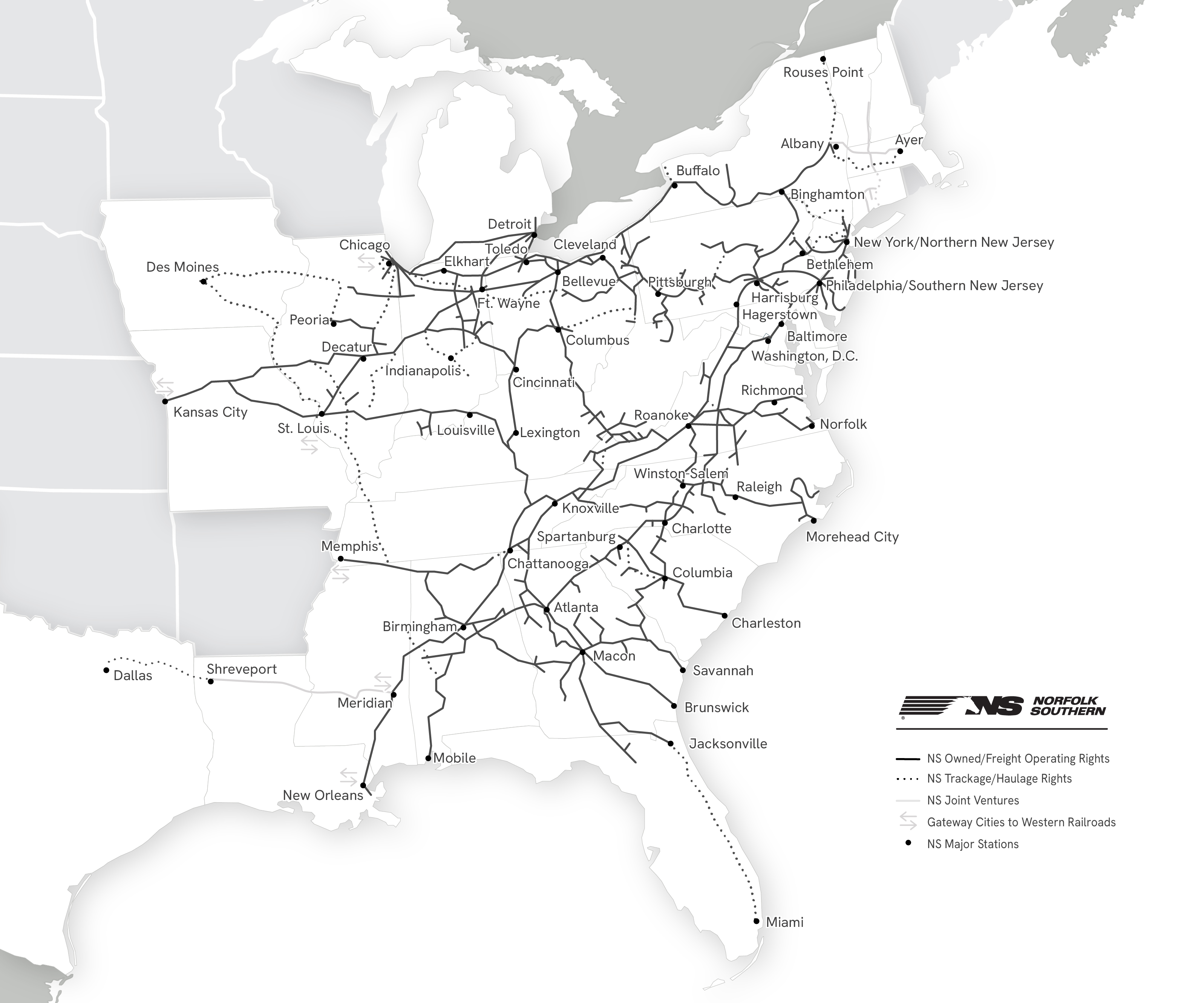
We are primarily engaged in the rail transportation of raw materials, intermediate products, and finished goods primarily in the Southeast, East, and Midwest and, via interchange with rail carriers, to and from the rest of the United States (U.S.). We also transport overseas freight through several Atlantic and Gulf Coast ports. We offer the most extensive intermodal network in the eastern half of the U.S.
We make available free of charge through our website, www.norfolksouthern.com, our annual report on Form 10-K, quarterly reports on Form 10-Q, current reports on Form 8-K, and all amendments to those reports as soon as reasonably practicable after such material is electronically filed with or furnished to the U.S. Securities and Exchange Commission (SEC). In addition, the following documents are available on our website and in print to any shareholder who requests them:
•Norfolk Southern Corporation Bylaws
•Charters of the Committees of the Board of Directors
•Corporate Governance Guidelines
•Categorical Independence Standards
•The Thoroughbred Code of Ethics
•Code of Ethical Conduct for Senior Financial Officers
Merger Agreement – On July 28, 2025, we entered into an Agreement and Plan of Merger (the “Merger Agreement”) with Union Pacific Corporation, a Utah corporation (“Union Pacific”), Ruby Merger Sub 1 Corporation, a Virginia corporation and a direct wholly owned subsidiary of Union Pacific (“Merger Sub 1”), and Ruby Merger Sub 2 LLC, a Virginia limited liability company and a direct wholly owned subsidiary of Union Pacific (“Merger Sub 2”).
The Merger Agreement provides that Union Pacific will acquire the Company in a stock-and-cash transaction whereby (a) Merger Sub 1 will be merged with and into the Company (the “First Merger”), with the Company surviving the First Merger as a direct wholly owned subsidiary of Union Pacific, and (b) immediately following the First Merger, the Company will be merged with and into Merger Sub 2 (the “Second Merger” and together with the First Merger, the “Mergers”), with Merger Sub 2 surviving the Second Merger as a direct, wholly owned subsidiary of Union Pacific.
At the effective time of the First Merger, each share of Common Stock, par value $1.00 per share, of the Company, issued and outstanding immediately prior to the effective time of the First Merger, subject to certain exclusions set forth in the Merger Agreement, will be converted into the right to receive one share of common stock, par value $2.50 per share, of Union Pacific, and $88.82 in cash without interest.
The consummation of the Mergers is subject to certain conditions, including approval by the U.S. Surface Transportation Board (STB). Additionally, if the Merger Agreement is terminated under specific circumstances, either we or Union Pacific are required to pay a termination fee of $2.5 billion.
RAILROAD OPERATIONS – At December 31, 2025, we operated approximately 19,100 route miles in 22 states and the District of Columbia.
Our system reaches many manufacturing plants, electric generating facilities, mines, distribution centers, transload facilities, and other businesses located in our service area.
Corridors with heaviest freight volume:
•New York City area to Chicago (via Allentown and Pittsburgh)
•Chicago to Macon (via Cincinnati, Chattanooga, and Atlanta)
•Central Ohio to Norfolk (via Columbus and Roanoke)
•Birmingham to Meridian
•Cleveland to Kansas City
The miles operated, which include an exclusive operating agreement for trackage rights over property owned by North Carolina Railroad Company, were as follows:
|
|
|
|
|
|
|
|
|
|
|
|
|
|
|
|
|
|
|
|
|
|
|
|
|
|
|
|
|
|
| |
Mileage Operated at December 31, 2025 |
|
Route Miles |
|
Second
and
Other
Main
Track |
|
Passing
Track,
Crossovers,
and
Turnouts |
|
Way and
Yard
Switching
|
|
Total |
|
|
|
|
|
|
|
|
|
|
| Owned |
14,594 |
|
|
2,826 |
|
|
1,975 |
|
|
8,212 |
|
|
27,607 |
|
| Operated under lease, contract, or trackage |
|
|
|
|
|
|
|
|
|
| rights |
4,525 |
|
|
1,735 |
|
|
373 |
|
|
719 |
|
|
7,352 |
|
|
|
|
|
|
|
|
|
|
|
| Total |
19,119 |
|
|
4,561 |
|
|
2,348 |
|
|
8,931 |
|
|
34,959 |
|
We operate freight service over lines with ongoing Amtrak and commuter passenger operations, including trackage owned or leased by Amtrak, New Jersey Transit, Southeastern Pennsylvania Transportation Authority, Metro-North Commuter Railroad Company, Virginia Passenger Rail Authority (VPRA), and the Michigan Department of Transportation.
The following table sets forth certain statistics relating to our operations for the past five years:
|
|
|
|
|
|
|
|
|
|
|
|
|
|
|
|
|
|
|
|
|
|
|
|
|
|
|
|
|
|
|
|
|
| |
Years ended December 31, |
|
| |
2025 |
|
2024 |
|
2023 |
|
2022 |
|
2021 |
|
|
|
|
|
|
|
|
|
|
|
|
| Revenue ton miles (billions) |
184 |
|
|
178 |
|
|
176 |
|
|
179 |
|
|
178 |
|
|
| Revenue per thousand revenue ton miles |
$ |
66.31 |
|
|
$ |
68.09 |
|
|
$ |
69.05 |
|
|
$ |
71.35 |
|
|
$ |
62.56 |
|
|
| Revenue ton miles (thousands) per railroad employee |
9,486 |
|
|
8,846 |
|
|
8,719 |
|
|
9,513 |
|
|
9,694 |
|
|
| Ratio of railway operating expenses to railway |
|
|
|
|
|
|
|
|
|
|
| operating revenues (railway operating ratio) |
64.2% |
|
66.4% |
|
76.5% |
|
62.3% |
|
60.1% |
|
RAILWAY OPERATING REVENUES – Total railway operating revenues were $12.2 billion in 2025. Following is an overview of our three commodity groups. See the discussion of merchandise revenues by major commodity group, intermodal revenues, and coal revenues and tonnage in Item 7 “Management’s Discussion and Analysis of Financial Condition and Results of Operations.”
MERCHANDISE – Our merchandise commodity group is composed of four groupings:
•Agriculture, forest and consumer products includes soybeans, wheat, corn, fertilizer, livestock and poultry feed, food products, food oils, flour, sweeteners, ethanol, lumber and wood products, pulp board and paper products, wood fibers, wood pulp, beverages, and canned goods.
•Chemicals includes sulfur and related chemicals, petroleum products (including crude oil), chlorine and bleaching compounds, plastics, rubber, industrial chemicals, chemical wastes, sand, and natural gas liquids.
•Metals and construction includes steel, aluminum products, machinery, scrap metals, cement, aggregates, minerals, clay, transportation equipment, and items for the U.S. military.
•Automotive includes finished motor vehicles and automotive parts.
In 2025, we handled 2.3 million merchandise carloads, which accounted for 63% of our total railway operating revenues.
INTERMODAL – Our intermodal commodity group consists of shipments moving in domestic and international containers and trailers. These shipments are handled on behalf of intermodal marketing companies, international steamship lines, premium customers, and asset-owning companies. In 2025, we handled 4.1 million intermodal units, which accounted for 25% of our total railway operating revenues.
COAL – Coal revenues accounted for 12% of our total railway operating revenues in 2025. We handled 78.0 million tons, or 0.7 million carloads, most of which originated on our lines from major eastern coal basins with the balance from major western coal basins received via the Memphis and Chicago gateways. Our coal franchise supports the electric generation market, directly serving 18 coal-fired power plants, as well as the export, domestic metallurgical, and industrial markets, primarily through direct rail and river, lake, and coastal facilities, including various terminals on the Ohio River, at Lamberts Point in Norfolk, Virginia, at the Port of Baltimore, at McDuffie Coal Terminal in Mobile, AL, and on Lake Erie.
FREIGHT RATES – Our predominant pricing mechanisms, private contracts and exempt price quotes, are not subject to regulation. In general, market forces are the primary determinant of rail service prices.
RAILWAY PROPERTY
Our railroad infrastructure makes us capital intensive with net properties of approximately $36 billion on a historical cost basis.
Property Additions – Property additions for the past five years were as follows:
|
|
|
|
|
|
|
|
|
|
|
|
|
|
|
|
|
|
|
|
|
|
|
|
|
|
|
|
|
|
| |
2025 |
|
2024 |
|
2023 |
|
2022 |
|
2021 |
| |
($ in millions) |
|
|
|
|
|
|
|
|
|
|
| Road and other property |
$ |
1,824 |
|
|
$ |
1,711 |
|
|
$ |
1,525 |
|
|
$ |
1,345 |
|
|
$ |
1,041 |
|
| Acquisition of assets of CSR |
— |
|
|
1,643 |
|
|
22 |
|
|
— |
|
|
— |
|
| Equipment |
380 |
|
|
670 |
|
|
802 |
|
|
603 |
|
|
429 |
|
|
|
|
|
|
|
|
|
|
|
| Total |
$ |
2,204 |
|
|
$ |
4,024 |
|
|
$ |
2,349 |
|
|
$ |
1,948 |
|
|
$ |
1,470 |
|
Our capital spending and replacement programs are and have been designed to support our ability to provide safe, efficient, and reliable rail transportation services.
Equipment – Our equipment includes owned and leased locomotives and railcars; maintenance of way equipment and machinery; other equipment and tools used in our shops, offices, and facilities; and vehicles and other equipment used for maintenance, transportation, and other activities. Our equipment includes both owned equipment acquired by us and equipment held under lease arrangements. At December 31, 2025, we owned or leased the following revenue generating equipment:
|
|
|
|
|
|
|
|
|
|
|
|
|
|
|
|
|
|
|
|
|
|
|
|
|
Owned |
|
Leased |
|
Total |
|
Capacity of
Equipment |
| Locomotives: |
|
|
|
|
|
|
(Horsepower) |
| Multiple purpose |
3,114 |
|
|
— |
|
|
3,114 |
|
|
12,114,700 |
|
| Auxiliary units |
140 |
|
|
— |
|
|
140 |
|
|
— |
|
| Switching |
4 |
|
|
— |
|
|
4 |
|
|
4,400 |
|
|
|
|
|
|
|
|
|
| Total locomotives |
3,258 |
|
|
— |
|
|
3,258 |
|
|
12,119,100 |
|
|
|
|
|
|
|
|
|
| Freight cars: |
|
|
|
|
|
|
(Tons) |
| Gondola |
17,079 |
|
|
3,441 |
|
|
20,520 |
|
|
2,316,360 |
|
| Hopper |
6,445 |
|
|
687 |
|
|
7,132 |
|
|
820,710 |
|
| Covered hopper |
4,956 |
|
|
310 |
|
|
5,266 |
|
|
585,876 |
|
| Box |
1,542 |
|
|
331 |
|
|
1,873 |
|
|
175,753 |
|
| Flat |
986 |
|
|
667 |
|
|
1,653 |
|
|
119,375 |
|
| Other |
120 |
|
|
— |
|
|
120 |
|
|
— |
|
|
|
|
|
|
|
|
|
| Total freight cars |
31,128 |
|
|
5,436 |
|
|
36,564 |
|
|
4,018,074 |
|
|
|
|
|
|
|
|
|
| Intermodal equipment: |
|
|
|
|
|
|
|
| Chassis |
38,987 |
|
|
— |
|
|
38,987 |
|
|
|
| Containers |
17,404 |
|
|
— |
|
|
17,404 |
|
|
|
|
|
|
|
|
|
|
|
|
|
|
|
|
|
|
|
|
|
|
|
|
|
|
|
|
|
|
|
|
|
|
|
|
|
|
|
|
|
|
|
| Total intermodal equipment |
56,391 |
|
|
— |
|
|
56,391 |
|
|
|
The following table indicates the number and year built for locomotives and freight cars owned at December 31, 2025:
|
|
|
|
|
|
|
|
|
|
|
|
|
|
|
|
|
|
|
|
|
|
|
|
|
|
|
|
|
|
|
|
|
|
|
|
|
|
|
|
|
|
|
|
|
|
|
|
|
|
|
|
|
|
|
2025 |
|
2024 |
|
2023 |
|
2022 |
|
2021 |
|
2016-
2020 |
|
2011-
2015 |
|
2010 &
Before |
|
Total |
| Locomotives: |
|
|
|
|
|
|
|
|
|
|
|
|
|
|
|
|
|
| No. of units |
— |
|
— |
|
— |
|
— |
|
1 |
|
180 |
|
291 |
|
2,786 |
|
3,258 |
| % of fleet |
— |
% |
|
— |
% |
|
— |
% |
|
— |
% |
|
— |
% |
|
6 |
% |
|
9 |
% |
|
85 |
% |
|
100 |
% |
|
|
|
|
|
|
|
|
|
|
|
|
|
|
|
|
|
|
| Freight cars: |
|
|
|
|
|
|
|
|
|
|
|
|
|
|
|
|
|
| No. of units |
324 |
|
348 |
|
1,059 |
|
235 |
|
— |
|
1,440 |
|
8,622 |
|
19,100 |
|
31,128 |
| % of fleet |
1 |
% |
|
1 |
% |
|
3 |
% |
|
1 |
% |
|
— |
% |
|
5 |
% |
|
28 |
% |
|
61 |
% |
|
100 |
% |
The following table shows the average age of our owned locomotive and freight car fleets at December 31, 2025 and information regarding 2025 retirements:
|
|
|
|
|
|
|
|
|
|
|
|
|
|
|
|
|
|
| |
Locomotives |
|
Freight Cars |
| Average age – in service |
30.5 |
years |
|
24.1 |
years |
| Retirements |
27 |
units |
|
1,182 |
units |
| Average age – retired |
27.5 |
years |
|
45.6 |
years |
Track Maintenance – Of the 35,000 total miles of track on which we operate, we are responsible for maintaining 28,200 miles, with the remainder being operated under trackage rights from other parties responsible for maintenance.
Over 85% of the main line trackage (including first, second, third, and branch main tracks, all excluding rail operated pursuant to trackage rights) has rail ranging from 131 to 155 pounds per yard with the standard installation currently at 136 pounds per yard. Approximately 40% of our lines, excluding rail operated pursuant to trackage rights, carried 20 million or more gross tons per track mile during 2025.
The following table summarizes several measurements regarding our track roadway additions and replacements during the past five years:
|
|
|
|
|
|
|
|
|
|
|
|
|
|
|
|
|
|
|
|
|
|
|
|
|
|
|
|
|
|
| |
2025 |
|
2024 |
|
2023 |
|
2022 |
|
2021 |
| Track miles of rail installed |
479 |
|
|
559 |
|
|
584 |
|
|
541 |
|
|
458 |
|
| Miles of track surfaced |
4,061 |
|
|
3,957 |
|
|
4,013 |
|
|
4,155 |
|
|
4,225 |
|
| Crossties installed (millions) |
2.0 |
|
|
2.1 |
|
|
2.1 |
|
|
2.2 |
|
|
2.0 |
|
Traffic Control – Of the 16,200 route miles we dispatch, 10,300 miles incorporate signalization. This includes 8,600 miles governed by Centralized Traffic Control, 1,700 miles utilizing Automatic Block Signals, and 600 miles utilizing Cab Signals. The majority of these locations are controlled wirelessly through NS’s Interoperable Train Control Messaging and Advanced Train Control System communications networks and associated infrastructure.
ENVIRONMENTAL MATTERS – Compliance with laws and regulations relating to the protection of the environment is one of our principal goals. With the exception of our response to the Eastern Ohio Incident (the “Incident” as defined in Note 19) such compliance has not had a material effect on our financial position, results of operations, or liquidity. For further information on the Incident and environmental matters, see Note 19 in Item 8 “Notes to Consolidated Financial Statements.”
HUMAN CAPITAL MANAGEMENT
Workforce – We employed an average of 19,400 employees during 2025 and 19,300 employees at the end of 2025. Approximately 80% of our railroad employees are covered by collective bargaining agreements with various labor unions and referred to as “craft” employees. See the discussion of “Labor Agreements” in Item 7 “Management’s Discussion and Analysis of Financial Condition and Results of Operations.” The remainder of our workforce is composed of management employees.
Safety – Safety is a core value at Norfolk Southern. We are dedicated to providing employees with a safe workplace and the knowledge and tools they need to work safely and return home safely every day. Our commitment to an injury-free workplace is outlined in our Risk Reduction Program, which focuses on safety policies and procedures, risk-based hazard management program, safety outreach and communications, technology analysis and implementation, and collaboration with craft employees. Our safety programs, practices, and messaging further reinforce the importance of working safely including the imperative to speak up with ideas and concerns as well as reinforce the universal authority to stop work if ever unsure or detect a risk that is not adequately safeguarded. We measure employee safety performance through internal metrics such as accidents, injuries, and serious injuries per 200,000 employee-hours. We also use metrics established by the Federal Railroad Administration (FRA) to measure FRA-reportable accidents per million train miles and injuries per 200,000 employee-hours.
Given that safety continues to be a top priority, and the importance of safety among our workforce and to our business, our Board of Directors (Board) has a standing Safety Committee that, among other duties, reviews, monitors, and evaluates our compliance with our safety programs and practices.
Craft Workforce Levels and Productivity – Maintaining appropriate headcount levels for our craft-employee workforce is critical to our on-time and consistent delivery of customers’ goods and operational efficiency goals. We manage this human capital metric through strategic cross functional teams from multiple departments who utilize forecasting tools designed to ensure the optimal level of staffing to meet business demands. We measure and monitor employee productivity based on various factors, including gross ton miles per train and engine employee.
Attracting and Retaining Management Employees – Our talent strategy for management employees is essential to attracting strong candidates in a competitive talent environment. We evaluate the effectiveness of that strategy by studying market trends, benchmarking the attractiveness of our employee value proposition, maintaining a competitive compensation package, and analyzing retention data.
We also focus on driving employee engagement, which is key to increasing employee productivity, retention, and safety. We take a data-centric approach, including the use of ongoing surveys among employees, to identify new initiatives that will help boost engagement and drive business results.
Employee Development and Training – We provide a range of developmental programs, opportunities, skills, and resources for our employees to be successful in their careers. We provide classroom instruction, hands-on training and simulation-based training designed to improve on-the-job effectiveness and safety outcomes.
We also use modern learning and performance technologies to offer robust professional growth opportunities. Through on-demand digital course offerings, custom-built learning paths, and in-person facilitated content, our programs provide a holistic and inclusive approach to professional development throughout an employee's career.
Workplace Experience – As a leading transportation service company, we recognize that success in the global marketplace relies on the recruitment and retention of top-tier talent, as well as leveraging the expertise and experiences of individuals from all backgrounds.
In pursuit of this goal, we are dedicated to establishing a workplace where a broad spectrum of identities, perspectives, and experiences is not only represented but also valued and enabled to deliver outstanding results.
GOVERNMENT REGULATION – In addition to environmental, safety, securities, and other regulations generally applicable to all business, our railroads are subject to regulation by the STB. The STB has jurisdiction to varying extents over rates, routes, customer access provisions, fuel surcharges, conditions of service, and the extension or abandonment of rail lines. The STB has jurisdiction to determine whether we are “revenue adequate” on an annual basis based on the results of the prior year. A railroad is “revenue adequate” on an annual basis under the applicable law when its return on net investment exceeds the rail industry’s composite cost of capital. This determination is made pursuant to a statutory requirement. The STB also has jurisdiction over the consolidation, merger, or acquisition of control of and by rail common carriers.
The relaxation of economic regulation of railroads, following the Staggers Rail Act of 1980, included exemption from STB regulation of the rates and most service terms for intermodal business (trailer-on-flat-car, container-on-flat-car), rail boxcar shipments, lumber, manufactured steel, automobiles, and certain bulk commodities such as sand, gravel, pulpwood, and wood chips for paper manufacturing. Further, all shipments that we have under contract are effectively removed from commercial regulation for the duration of the contract. Approximately 90% of our revenues comes from either exempt shipments or shipments moving under transportation contracts; the remainder comes from shipments moving under public tariff rates.
Efforts have been made over the past several years to increase federal economic regulation of the rail industry, and such efforts may continue in 2026. The Staggers Rail Act of 1980 substantially balanced the interests of shippers and rail carriers, and encouraged and enabled rail carriers to innovate, invest in their infrastructure, and compete for business, thereby contributing to the economic health of the nation and to the revitalization of the industry. Accordingly, we will continue to oppose efforts to reimpose increased economic regulation.
Railroads are also subject to the enactment of laws by Congress and regulation by the U.S. Department of Transportation (DOT) (including the FRA) and the U.S. Department of Homeland Security (DHS) (including the Transportation Security Administration (TSA)), which regulate most aspects of our operations related to safety, security, and cybersecurity.
Government regulations are further discussed within Item 1A “Risk Factors,” and the safety and security of our railroads are discussed within the “Security of Operations” section contained herein.
COMPETITION – There is continuing strong competition among rail, water, and highway carriers. Price is usually only one factor of importance as shippers and receivers choose a transport mode and specific hauling company. Inventory carrying costs, service reliability, ease of handling, and the desire to avoid loss and damage during transit are also important considerations, especially for higher-valued finished goods, machinery, and consumer products. Even for raw materials, semi-finished goods, and work-in-progress, users are increasingly sensitive to transport arrangements that minimize problems at successive production stages.
Our primary rail competitor is CSX Corporation (CSX); both we and CSX operate throughout much of the same territory. Other railroads also operate in parts of the territory. We also compete with motor carriers, water carriers, and with shippers who have the additional options of handling their own goods in private carriage, sourcing products from different geographic areas, and using substitute products.
Certain marketing strategies to expand reach and shipping options among railroads and between railroads and motor carriers enable railroads to compete more effectively in specific markets.
SECURITY OF OPERATIONS – We continue to enhance the security of our rail system. Our comprehensive security plan is modeled on and was developed in conjunction with the security plan prepared by the Association of American Railroads (AAR) post September 11, 2001. The AAR Security Plan defines four Alert Levels and details the actions and countermeasures that are being applied across the railroad industry as the risk of terrorist, extremist, or seriously disruptive cyber-attack increases or decreases. The Alert Level actions include countermeasures that will be applied in three general areas: (1) operations (including transportation, engineering, and mechanical); (2) information technology and communications; and, (3) railroad police. All of our Operations Division employees are advised by their supervisors or train dispatchers, as appropriate, of any change in Alert Level and any additional responsibilities they may incur due to such change.
Our security plan also complies with DOT security regulations pertaining to training and security plans with respect to the transportation of hazardous materials. As part of the plan, security awareness training is given to all railroad employees who directly affect hazardous material transportation safety and is integrated into hazardous material training programs. Additionally, location-specific security plans are in place for rail corridors in certain metropolitan areas referred to as High Threat Urban Areas (HTUA). Particular attention is aimed at reducing risk in a HTUA by: (1) the establishment of secure storage areas for rail cars carrying toxic-by-inhalation (TIH) materials; (2) the expedited movement of trains transporting rail cars carrying TIH materials; (3) reducing the number of unattended loaded tank cars carrying TIH materials; and (4) cooperation with federal, state, local, and tribal governments to identify those locations where security risks are the highest.
We also operate four facilities that are under U.S. Coast Guard (USCG) Maritime Security Regulations. With respect to these facilities, each facility’s security plan has been approved by the applicable Captain of the Port and remains subject to inspection by the USCG.
Additionally, we continue to engage in close and regular coordination with numerous federal and state agencies, including the DHS, the TSA, the Federal Bureau of Investigation, the FRA, the USCG, U.S. Customs and Border Protection, the Department of Defense, and various state Homeland Security offices.
In 2025, through the Norfolk Southern Operation Awareness and Response Program as well as participation in the Transportation Community Awareness and Emergency Response Program, we provided rail accident response training to more than 5,800 emergency responders, such as local police and fire personnel, utilizing a combination of online training and face-to-face training sessions as well as the Norfolk Southern Safety Train. We also have ongoing programs to sponsor local emergency responders at the Security and Emergency Response Training Center.
We also continually evaluate ourselves for appropriate business continuity and disaster recovery planning, with test scenarios that include cybersecurity attacks. Our risk-based information security program helps ensure our defenses and resources are aligned to address the most likely and most damaging potential attacks, to provide support for our organizational mission and operational objectives, and to keep us in the best position to detect, mitigate, and recover from a wide variety of potential attacks in a timely fashion.
Item 1A. Risk Factors
The risks set forth in the following risk factors could have a material adverse effect on our financial position, results of operations, or liquidity in a particular year or quarter, and could cause those results to differ materially from those expressed or implied in our forward-looking statements. The information set forth in this Item 1A “Risk Factors” should be read in conjunction with the rest of the information included in this annual report, including
Item 7 “Management’s Discussion and Analysis of Financial Condition and Results of Operations” and Item 8 “Financial Statements and Supplementary Data.” We have experienced a number of the risks described below in connection with the Incident and the Incident Proceedings (defined below). The risks described below should be read in conjunction with the information regarding the Incident and Incident Proceedings provided in Note 19 in Item 8 “Notes to Consolidated Financial Statements.”
RISKS RELATED TO THE MERGERS
We have identified certain additional risk factors in connection with the Mergers. For additional information concerning these risks, uncertainties and assumptions, please refer to the section entitled “Risk Factors” included in our proxy statement filed with the SEC on October 1, 2025.
The Mergers are subject to conditions, some or all of which may not be satisfied or completed on a timely basis, if at all. Failure to complete the Mergers could have material adverse effects on the Company. The completion of the Mergers is subject to a number of conditions, including, among others, the receipt of the requisite regulatory approvals, which make the completion of the Mergers and timing thereof uncertain. Also, either Union Pacific or the Company may terminate the Merger Agreement if the Mergers have not been consummated by the end date (subject to an automatic extension in certain circumstances), except that this right to terminate the Merger Agreement will not be available to any party whose failure to perform any obligation under the Merger Agreement has been the primary cause of the failure of the Mergers to be consummated on or before that date.
If the Mergers are not completed, the Company’s ongoing business may be materially adversely affected and, without realizing any of the benefits of having completed the Mergers, the Company will be subject to a number of risks, including the following:
•the market price of the Company’s Common Stock could decline;
•the Company could owe substantial termination fees to Union Pacific under certain circumstances;
•if the Merger Agreement is terminated and the Union Pacific board or the Company’s board seeks another business combination, Union Pacific shareholders and Norfolk Southern shareholders cannot be certain that Union Pacific or the Company will be able to find a party willing to enter into a transaction on terms equivalent to or more attractive than the terms that the other party has agreed to in the Merger Agreement;
•time, resources, and costs committed by the Company’s management team to matters relating to the Mergers could otherwise have been devoted to pursuing other beneficial opportunities;
•negative reactions from the financial markets or from its customers (certain of whom have and may continue to diversify their distribution networks, including in response to actions by our competitors), suppliers, employees, labor unions, or other business partners; and
•the Company will be required to pay its respective costs relating to the Mergers, such as legal, accounting, financial advisory, and printing fees, whether or not the Mergers are completed.
In addition, if the Mergers are not completed, the Company could be subject to litigation related to any failure to complete the Mergers or related to any enforcement proceeding commenced against the Company to perform its obligations under the Merger Agreement, and whether or not any such litigation has any merit, the cost of defending such litigation may be significant. The materialization of any of these risks could adversely impact the Company’s ongoing business.
Similarly, delays in the completion of the Mergers could, among other things, result in additional transaction costs, loss of revenue, or other negative effects associated with uncertainty about completion of the Mergers.
The Mergers are subject to the receipt of the requisite regulatory approvals, which requisite regulatory approvals may never be obtained, therefore preventing completion of the Mergers. In addition, in granting such approvals, regulatory authorities may impose conditions that could have a significant adverse effect on the Company or the combined company and the expected benefits of the Mergers therefore preventing completion of the Mergers. Before the Mergers may be completed, the requisite regulatory approvals must have been obtained, including STB approval. While the initial Merger application with the STB was determined to be incomplete, the Company and Union Pacific are in process of preparing a revised application that incorporates the additional items identified by the STB. The terms and conditions of the approvals that are granted may impose requirements, concessions, limitations, or costs or place restrictions on the conduct of the combined company’s business. Subject to the terms and conditions of the Merger Agreement, Union Pacific and the Company have each agreed to use their reasonable best efforts to take, or cause to be taken, all actions, and to do, or cause to be done, and to assist and cooperate with each other in doing, all things necessary, proper, or advisable to cause the conditions to closing set forth in the Merger Agreement to be satisfied and to consummate and make effective the Mergers and the other transactions contemplated by the Merger Agreement prior to the end date, except that Union Pacific and its subsidiaries are not required to take, or commit to take, or agree to or accept any “materially burdensome regulatory condition.” For purposes of the foregoing, “reasonable best efforts” includes, among others, (i) proposing, negotiating, committing to, and effecting, by consent decree, hold separate order, or otherwise, the sale, divestiture, license, hold separate, or disposition of any and all of the share capital or other equity interest, assets, products, or businesses of Union Pacific and its subsidiaries or of the Company and its subsidiaries and (ii) otherwise taking or committing to take any actions that after the first effective time would limit Union Pacific’s or its subsidiaries’ freedom of action with respect to, or their ability to retain, or otherwise agreeing to any restriction, requirement, or limitation with respect to their or one or more of their subsidiaries’ assets, products, or businesses, in each case as may be required in order to avoid the entry of, or to effect the dissolution of, any injunction, temporary restraining order, or other order that would otherwise have the effect of preventing or delaying the closing. The STB and other regulatory and governmental authorities may impose requirements, concessions, and other conditions on the granting of such approvals. If such regulatory and governmental authorities seek to impose such requirements, concessions, or conditions, lengthy negotiations may ensue among such authorities, Union Pacific and the Company. Such requirements, concessions, and conditions and the process of obtaining regulatory approvals could have the effect of delaying completion of the Mergers and such requirements, concessions, and conditions may not be identified or satisfied for an extended period of time following the Union Pacific special meeting and the Company’s special meeting. Such requirements, concessions and conditions may also impose additional costs or limitations on the combined company following the completion of the Mergers and the parties have agreed to accept such requirements, concessions, and conditions, even if significant, subject to the agreed-upon materially burdensome regulatory condition limitation in favor of Union Pacific. These requirements, concessions, and conditions may therefore reduce the anticipated benefits of the Mergers, including synergies, which could also have a significant adverse effect on the combined company’s business and cash flows and results of operations, and neither Union Pacific nor the Company can predict what, if any, requirements, concessions, and conditions may be required by regulatory or governmental authorities whose approvals are required.
The requisite regulatory approvals may not be obtained at all, may not be obtained in a timely fashion, and may contain conditions on the completion of the Mergers.
In addition, under existing law, railroad competitors and customers of Union Pacific and the Company and other interested parties may intervene to oppose the STB application or seek protective conditions in the event approval by the STB is granted, which might affect the decision of the STB, delay the approval process, or reduce the anticipated benefits of the Mergers. Furthermore, if the STB does not provide final approval or imposes conditions on its approval in a final order, and Union Pacific and the Company decide to appeal such final order from the STB, any such appeal might not be resolved for a substantial period of time after the entry of such order by the STB.
The Company is subject to business uncertainties and contractual restrictions while the Mergers are pending, which could adversely affect the Company’s business and operations. In connection with the pendency of the Mergers, some customers, suppliers, and other persons with whom the Company has a business relationship have or may delay or defer certain business decisions or terminate, change, or renegotiate their relationships with the Company, as the case may be, as a result of the Mergers or responsive actions taken by one or more of our competitors, which could negatively affect the Company’s revenues, earnings, and cash flows, as well as the market price of the Company’s Common Stock, regardless of whether the Mergers are completed.
Under the terms of the Merger Agreement, the Company is subject to certain restrictions on the conduct of its business prior to completing the first Merger, which may adversely affect its ability to execute certain of its business strategies, including the ability in certain cases to enter into or amend contracts, acquire or dispose of assets, incur indebtedness, incur capital expenditures, settle litigation, amend organizational documents, declare dividends, enter new business lines, and invest in third parties. Such limitations could adversely affect the Company’s businesses and operations prior to the completion of the Mergers.
Uncertainties associated with the Mergers may cause a loss of management personnel and other key employees, and the Company may have difficulty attracting and motivating management personnel and other key employees. The Company is dependent on the experience and industry knowledge of its management personnel and other key employees to execute its business plans. The combined company’s success after the completion of the Mergers will depend in part upon the ability of the Company to attract and retain key management personnel and other key employees. Prior to completion of the Mergers, current and prospective employees of the Company may experience uncertainty about their roles within the combined company following the completion of the Mergers, which may have an adverse effect on the ability of the Company to attract or retain management personnel and other key employees.
Each of the risks described above may be exacerbated by delays or other adverse developments with respect to the completion of the Mergers.
INCIDENT RISKS
As defined and as further described in Note 19 in Item 8 “Notes to Consolidated Financial Statements,” there was an Incident that occurred in the first quarter of 2023 that consisted of a February 3, 2023 train derailment in East Palestine, Ohio that included 11 non-Company-owned tank cars containing hazardous materials, fires associated with the derailment that threatened certain of the tank cars, and a controlled vent and burn procedure conducted on February 6, 2023 on five of the derailed tank cars, all of which contained vinyl chloride. As a result of the Incident, we became subject to numerous legal, regulatory, legislative, and other proceedings related thereto, including but not limited to, the National Transportation Safety Board (NTSB) Investigation, the FRA Incident Investigation, the FRA Safety Assessment, the U.S. Department of Justice (DOJ) Complaint, the Ohio Complaint, the Incident Lawsuits, the Shareholder Matters, and the Incident Inquiries and Investigations (each as defined in Note 19 in Item 8 “Notes to Consolidated Financial Statements”) in addition to other proceedings, actions, or potential changes in response to the Incident, including but not limited to those related to, among other items, train size, train length, train composition, crew size, or detection systems (collectively, the “Incident Proceedings”).
Set forth below are additional risks pertaining to an investment in the Company that are related to the Incident and the Incident Proceedings.
The costs, liabilities, fines, penalties, and/or financial impact resulting from or related to the Incident or the Incident Proceedings have been significant to date, may exceed expected or accrued amounts, and have and can be expected to continue to negatively affect our financial results. We have incurred and will continue to remain subject to incurring significant costs, liabilities, fines, and penalties related to the Incident and the Incident Proceedings, including amounts that may have a material adverse effect on our financial position, results of operations, or liquidity.
While we have accrued estimates of probable and reasonably estimable liabilities with respect to the Incident and the Incident Proceedings, we cannot predict the final outcome or estimate the reasonably possible range of loss with certainty, and such estimates may change over time due to a variety of factors, including but not limited to those set forth in Note 19 in Item 8 “Notes to Consolidated Financial Statements” or other unfavorable or unexpected developments or outcomes which could result in our current estimates being insufficient. These estimated amounts also do not include any estimate of loss for specific items for which we believe a loss is either not probable or not reasonably estimable for the reasons set forth in Note 19 in Item 8 “Notes to Consolidated Financial Statements.” As a result, our currently accrued amounts of estimated liabilities may be insufficient, and any additional, new or updated accruals could have a material adverse effect on our results of operations or financial position.
New or additional governmental regulation and/or operational changes resulting from or related to the Incident or the Incident Proceedings may negatively impact us, our customers, the rail industry, or the markets we serve. The legislative, regulatory, operational, or other actions taken, protocols adopted (including by us), or changes resulting from the Incident or any of the Incident Proceedings may, either individually or in the aggregate, have a material adverse effect on us, our customers, the rail industry, or the markets we serve. We also face risks from requirements that may be imposed by the government in resolution of government actions, including, for example, restrictions on our methods of operations. Our inability to comply with the requirements of any new or additional laws, regulations, or operating protocols resulting from or related to the Incident or the Incident Proceedings may have a material adverse effect on our financial position, results of operations, liquidity, or operations.
REGULATORY AND LEGISLATIVE RISKS
Governmental legislation, regulation, and Executive Orders over commercial, operational, tax, safety, security, or cybersecurity matters could negatively affect us, our customers, the rail industry, or the markets we serve. Congress can enact laws, agencies can promulgate regulations, and Executive Orders can be issued that increase or alter regulation in a way that negatively affects us, our customers, the rail industry, or the markets we serve. Railroads presently are subject to commercial and operational regulation by the STB, which has jurisdiction to varying extents over rates, routes, customer access provisions, fuel surcharges, conditions of service, and the extension or abandonment of rail lines.
The STB also has jurisdiction over the consolidation, merger, or acquisition of control of and by rail common carriers. Additional, updated, or changed oversight and regulation of the rail industry by Congress or the STB, whether under new, existing, amended, or repealed laws or regulations, including but not limited to those pertaining to reciprocal switching, if imposed, could have a significant negative impact on our ability to negotiate prices for rail services, on our railway operating revenues, and on the efficiency, conduct, or complexity of our operations. Such additional or updated industry regulation, as well as enactment of any new or updated tax laws, could also negatively impact cash flows from our operating activities and, therefore, result in reduced capital spending on our rail network or abandonment of lines.
Railroads are also subject to the enactment of laws by Congress and regulation by the DOT (including the FRA) and the DHS (including the TSA), which regulate many aspects of our operations related to safety, security, and cybersecurity.
Additional or updated safety, security, or cybersecurity regulation by Congress, the DOT, or DHS could have a negative impact on our business and the efficiency, conduct, or complexity of our operations including (but not limited to) increased operating costs, capital expenditures, claims, and litigation.
Our inability to comply with, or operational practices and costs necessary to adhere to, the requirements of existing or updated laws, regulations, or Executive Orders that govern our operations or the rail industry, including but not limited to those pertaining to commercial, operational, tax, safety, security, or cybersecurity matters, as such requirements may be interpreted or enforced from time to time (such as in connection with a pending regulatory or other legal proceedings or lawsuits), could have a material adverse effect on our financial position, results of operations, or liquidity.
We are addressing multiple governmental actions as a result of the Incident, as noted in “Incident Risks” above.
Federal and state environmental laws and regulations could negatively impact us and our operations. Our operations are subject to extensive federal, state and local environmental laws and regulations concerning, among other things: emissions to the air; discharges to waterways or groundwater supplies; handling, storage, transportation, use, and disposal of waste and other materials; and, the cleanup of hazardous material or petroleum releases. The risk of incurring environmental liability, for acts and omissions, past, present, and future, is inherent in the railroad business. This risk includes property owned by us, whether currently or in the past, that is or has been subject to a variety of uses, including our railroad operations and other industrial activity by past owners or our past and present tenants.
Environmental problems that are latent or undisclosed may exist on these properties, and we could incur environmental liabilities or costs, the amount and materiality of which cannot be estimated reliably at this time, with respect to one or more of these properties. Moreover, lawsuits and claims involving other unidentified environmental sites and matters are likely to arise from time to time.
Our inability to comply with the extensive federal, state and local environmental laws and regulations to which we are subject could result in significant liabilities, fines, or sanctions, including those related to the investigation or remediation of known and unknown environmental contamination, or otherwise adversely impact our operations.
U.S. international trade relationships may adversely impact our customers, our industry, and our business. We transport a significant number of shipments that have either been imported into the U.S. or are destined for export from the U.S. Trade discussions and arrangements between the U.S. and various of its trading partners are fluid, and existing and future trade agreements are, and are expected to continue to be, subject to a number of uncertainties, including the imposition of new tariffs or adjustments and changes to the products covered by existing tariffs. Any decision by the U.S. government to adopt actions such as border taxes on imports, an increase in customs duties or tariffs, or the renegotiation of U.S. trade agreements, or any other action that could have a negative impact on international trade, including corresponding actions taken by other countries in response to U.S. governmental actions, could cause a reduction in the volume of shipments by many of our customers. Any changes in tax and trade policies in the U.S. and corresponding actions by other countries could adversely impact our financial performance.
In addition, compliance with any new laws, regulations, or policies with regard to any of the foregoing may increase our operating costs or require significant capital expenditures. Any failure to comply with applicable laws, regulations or policies in the U.S. or other countries could result in substantial fines or possible revocation of our authority to conduct our operations, which could materially adversely affect us.
OPERATIONAL RISKS
A significant adverse event on our network may significantly impede our ability to operate and serve our customers. The nature of our operations inherently comes with the risk that one or more significant adverse events or outages may occur on or impact our network resulting in our inability or restricted ability to provide rail transportation services to our customers. These events include but are not limited to, a mainline accident, a hazardous material discharge, a climate-related network outage, or a technology-related network outage. Any one or more of these incidents could expose us to significant operational and managerial challenges, as well as reputational damage, requiring a significant amount of time and focus of our Board and management team, as well as significant lost revenues, expenses, liabilities, fines, and penalties, including amounts that may have a material adverse effect on our financial position, results of operations, or liquidity. One or more of these events may also result in subsequent legislative, regulatory, operational or other responsive actions taken, changes or protocols adopted (including by us), or requirements imposed that may, either individually or in the aggregate, have a material adverse effect on our financial position, results of operations, liquidity, or operations, or on our customers, the rail industry, or the markets we serve.
If we are unable to successfully execute on our strategic initiatives, our business and future results of operations may suffer. Our growth strategy includes increasing the volume of shipments moving through our railway networks. We are reliant on the success of our strategic plans and initiatives to execute on this growth strategy, as well as to help offset increasing costs. These strategic plans include marketing, service, growth, and productivity initiatives. The timely and effective execution of our strategies are dependent upon, among other factors, (i) our ability to maintain satisfactory relations with our customers, employees, and other key stakeholders, (ii) our ability to effectively control costs, (iii) the progress and success of our safety programs and inspection technologies, and (iv) our ability to timely and effectively maintain and upgrade technology systems and other infrastructure for our railway networks. Our failure to successfully execute on our strategic initiatives may expose us to a number of risks, including, that our projected volume growth may differ from actual results, and prior capital investments based on our projections may contribute to excess capacity that could negatively impact our profitability.
As a common carrier by rail, we must offer to transport hazardous materials, which exposes us to significant costs and claims. Transportation of certain hazardous materials or third party-owned equipment (typically used to transport such materials) creates risks of significant losses in terms of personal injury and property (including environmental) damage and compromises critical parts of our rail network. The costs of a catastrophic rail accident involving hazardous materials or third party-owned equipment could exceed our insurance coverage. We have obtained insurance for potential losses for third-party liability and first-party property damages (see Note 19 in Item 8 “Notes to Consolidated Financial Statements”); however, insurance is available from a limited number of insurers and may not continue to be available or, if available, may not be obtainable on terms acceptable to us. Any future legislation preventing the transportation of hazardous materials through specific cities could have negative impacts including increased network congestion and operating costs, reduced operating efficiency, and increased risk of an accident involving hazardous materials.
With regard to the risks arising from the transportation of hazardous materials, the Incident and the Incident Proceedings have given rise to significant costs to us and impacts on our rail network, as noted in “Incident Risks” above. With respect to third party-owned equipment, the primary risk arises from the potential for a latent defect we are unable to identify despite robust safety inspection protocols.
We face competition from other transportation providers. We are subject to competition from motor carriers, railroads and, to a lesser extent, ships, barges, and pipelines, on the basis of transit time, pricing, and quality and reliability of service. While we have primarily used internal resources to build or acquire and maintain our rail system, trucks and barges have been able to use public rights-of-way maintained by public entities. Any future improvements, expenditures, legislation, or regulation changing or materially increasing the efficiency or reducing the cost of one or more alternative modes of transportation in the regions in which we operate (such as granting materially greater latitude for motor carriers with respect to size or weight limitations or adoption and utilization of autonomous commercial vehicles) could have a material adverse effect on our ability to compete with other modes of transportation.
In addition, our industry continues to evolve, including customer demands for faster transit times and increased visibility, and the potential for increased competition (due to growth in the market, competitors with improved financial capacity or technology, or business combinations resulting in one or more competitors providing a wider variety of services and products at competitive prices) which may, either individually or in the aggregate, have a material adverse effect on our business or results of operations.
Capacity constraints could negatively impact our service and operating efficiency. We have experienced and may again experience capacity constraints on our rail network related to employee or equipment shortages, increased demand for rail services, severe weather, congestion on other railroads, including passenger activities, or impacts from changes to our network structure or composition. Such constraints could result in operational inefficiencies or adversely affect our operations.
Significant increases in demand for rail services could result in the unavailability of qualified personnel and resources like locomotives. Changes in workforce demographics, training requirements, and availability of qualified personnel, particularly for engineers and conductors, have negatively impacted and may again negatively impact our ability to meet short-term demand for rail service. Unpredicted increases in demand for rail services may exacerbate such risks and could negatively impact our operational efficiency.
Constraints on the supply chain or the operations of carriers with which we interchange may adversely affect our operations. Our ability to provide rail service to our customers depends in large part upon a functioning global supply chain and our ability to maintain collaborative relationships with connecting carriers (including shortlines and regional railroads) with respect to, among other matters, freight rates, revenue division, car supply and locomotive availability, data exchange and communications, reciprocal switching, interchange, and trackage rights. Deterioration in the supply chain or service provided by connecting carriers, or in our relationship with those connecting carriers, could result in our inability to meet our customers’ demands or require us to use alternate train routes, which could result in significant additional costs and network inefficiencies. Additionally, any significant consolidations, mergers, or operational changes among other railroads may alter our market access and reach.
We may be negatively affected by terrorism or war. Any terrorist attack, or other similar event, any government response thereto, and war or risk of war could cause significant business interruption or other operational challenges. Because we play a critical role in the nation’s transportation system, we could become the target of such an attack or have a significant role in the government’s preemptive approach or response to an attack or war.
Insurance coverage under Norfolk Southern's property and liability policies extends to certain acts of terrorism. In addition, premiums for some or all of our current insurance programs covering these losses could increase dramatically, or insurance coverage for certain losses could be unavailable to us in the future.
We may be negatively affected by supply constraints resulting from disruptions in our fuel markets or supplier markets. We consumed approximately 366 million gallons of diesel fuel in 2025. Fuel availability could be affected by limitation in the fuel supply or by imposition of mandatory allocation or rationing regulations. A severe fuel supply shortage arising from production curtailments, increased demand in existing or emerging foreign markets, disruption of oil imports, disruption of domestic refinery production, damage to refinery or pipeline infrastructure, political unrest, war, or other factors could impact us as well as our customers and other transportation companies.
Due to the capital-intensive nature, as well as the industry-specific requirements of the rail industry, high barriers of entry exist for potential new suppliers of core railroad items, such as locomotives and rolling stock equipment. As a result, we are dependent on certain key suppliers and manufacturers of locomotive and railroad items. Disruption to one or more of our key suppliers or manufacturers, including as a result of stopped or restricted production, labor stoppage or restriction, or significant supply shortage or outage could negatively impact our operating efficiency and increase costs. Additionally, we compete with other industries for available capacity and raw materials used in the production of locomotives and certain track and rolling stock materials.
Changes in the competitive landscapes of these limited supplier markets could also result in significantly increased prices or material shortages.
We may be negatively affected by energy prices. Fuel and energy costs have a significant impact on our operations. Volatility in energy prices could have a significant effect on a variety of items including, but not limited to: the economy; demand for transportation services; business related to the energy sector, including crude oil, natural gas, and coal; fuel prices; and, fuel surcharges, each of which could have a material impact on our business and results of operations. In addition, we may also experience a disruption in energy supplies as a result of new or increased regulation, as a result of war or geopolitical conflicts, weather-related events or natural disasters, or other factors beyond our control, which could have a material adverse effect on our business.
Pandemics, epidemics, or endemic diseases could further negatively impact us, our customers, our supply chain, and our operations. The magnitude and duration of a pandemic, epidemic, or endemic disease, and its impact on our customers and general economic conditions can influence the demand for our services and affect our revenues. In addition, such outbreaks could affect our operations and business continuity if a significant number of our essential employees, overall or in a key location, are unable to work from contraction of or exposure to the disease or if governmental orders prevent our employees or critical suppliers from working. To the extent such diseases adversely affect our business and financial results, they may also have the effect of heightening many of the other risks described in the risk factors included herein or may affect our operating and financial results in a manner that is not presently known to us.
Our business is capital intensive, and we must make capital decisions based upon expectations of future usage of our assets. We make significant investments in our railroad infrastructure, including railroad property, track infrastructure, locomotives, freight cars, intermodal equipment, technology, and other assets to support our network, much of which is costly and requires significant capital outlay. The amount and timing of capital investments depend on various factors, including expectations of future carload traffic. In many cases, we must make advance commitments to purchase or modify equipment prior to such equipment being needed. As a result, we must predict volume levels and other requirements and make commitments based on those projections. A significant variance in our expectations or projections could result in too much or too little equipment relative to our actual needs and volumes, thereby negatively impacting our operations or financial results.
TECHNOLOGY RISKS
A significant cybersecurity incident or other disruption to our technology infrastructure resulting from internal and external threats could disrupt our business operations. To conduct business, we extensively rely on information and operational technology systems. The threat landscape is vast, with potential attacks from cybercriminals, nation-states, state-sponsored actors and others including, but not limited to, service denials, unauthorized access, compromised equipment or rolling stock, extortion, or theft of data or money. As a result, our business continuity and disaster recovery plans and activities may not be sufficient for all eventualities, resulting in the potential for a data breach or significant service or operational disruption or failure involving one or more information or operational technology systems operated by us or under control of third parties, including computer hardware, software, cloud services and transportation and communications equipment. Such failures or disruptions can adversely impact our business by, among other things, preventing intercompany communications and disrupting operations that may result in direct or indirect monetary losses, damage to equipment or property, or loss of confidence in corporate competency. Any one or more of these events could have a material adverse effect on our results of operations, financial position, or operations. Although we maintain security programs designed to protect our information and operational technology systems, we are continually targeted by threat actors attempting to access our networks and we may be unable to detect or prevent a breach of our systems or equipment or disruption to our service in the future. In addition, while we have previously experienced technology outages and cybersecurity events that have impacted our systems and service, future events may result in more significant impacts to our operations, reputation or financial results. These potentially impactful future events could include service disruptions, unauthorized access to our systems or equipment, viruses, ransomware, and/or the compromise, acquisition, or destruction of our data. We also could be impacted by cybersecurity events targeting third parties that we rely on for business operations, including third party vendors that have access to our systems or data and third parties who provide services and are in our supply chain.
Such a direct or indirect cybersecurity incident could interrupt our service, cause safety failures or operational difficulties, decrease revenues, increase operating costs, impact our efficiency, damage our corporate reputation, and/or expose us to litigation or government action or increased regulation, which could result in penalties, fines or judgments. In addition, our failure to comply with or adhere to privacy-related or data protection laws and regulations could result in government investigations and proceedings against us, or litigation, resulting in adverse reputational impacts, penalties, and legal liability.
Our business may be seriously harmed if we fail to develop, implement, maintain, upgrade, enhance, protect and integrate our information or operational technology systems. If we fail to develop, acquire or implement new technology, or otherwise fail to maintain, protect or integrate our information or operational technology systems, we may suffer a competitive disadvantage within the rail industry and with companies providing alternative modes of transportation service. The techniques used by cybersecurity threat actors to obtain unauthorized access, disable or degrade service or sabotage systems change frequently, as data breaches and other cybersecurity events have become increasingly commonplace. Consequently, these techniques may be difficult to detect and cybersecurity events are therefore increasingly difficult to prevent. The rapid evolution and increased adoption of emerging technologies, such as artificial intelligence and machine learning (both of which we use), may make it more difficult to anticipate cybersecurity threats and implement adequate protective countermeasures. If we fail to adequately develop or maintain our information or operational technology systems or cybersecurity infrastructure, we may become increasingly vulnerable to cybersecurity events, or other breaches or disruptions to our information or operational technology systems.
LITIGATION RISKS
We may be subject to various claims and lawsuits that could result in significant expenditures. The nature of our business exposes us to the potential for various claims and litigation related to labor and employment, personal injury, commercial disputes, freight loss and other property damage, and other matters. Job-related personal injury and occupational claims are subject to the Federal Employer’s Liability Act (FELA), which is applicable only to railroads. FELA’s fault-based tort system produces results that are unpredictable and inconsistent as compared with a no-fault worker’s compensation system. The variability inherent in this system could result in actual costs being different from the liability recorded.
A catastrophic rail accident, whether on our lines or another carrier’s, involving any or all of release of hazardous materials, freight loss, property damage, personal injury, and environmental liability could compromise critical parts of our rail network. Losses associated with such an accident involving us could exceed our insurance coverage, resulting in a material adverse effect on our financial position or liquidity. Any material changes to current litigation trends could also have a material adverse effect on our financial position or liquidity to the extent not covered by insurance.
We have obtained insurance for potential losses for third-party liability and first-party property damages; however, insurance is available from a limited number of insurers and may not continue to be available or, if available, may not be obtainable on terms acceptable to us.
We are incurring significant expenditures as a result of claims and lawsuits arising from the Incident and the related Incident Proceedings, as described in “Incident Risks” above.
HUMAN CAPITAL RISKS
Failure to attract, retain, and transition key executive officers, or skilled professional or technical employees could adversely impact our business and operations. Our success depends on our ability to attract and retain skilled employees, including key executive officers to oversee our operational, productivity, marketing, and technological initiatives, as well as a sufficient number of skilled professional and craft employees to enable us to efficiently conduct our operations.
Difficulties in recruiting and retaining skilled employees, including train and engine workers, key executives, and other skilled professional and technical employees; the loss of such individuals; and/or our inability to successfully transition key executive, professional, technical, or skilled roles could each have a material adverse effect on our financial position, results of operations, and operations. The loss of one or more key employees could also result in the depletion of our institutional knowledge base and may result in our inability or increased difficulty in successfully transitioning key roles, which could materially adversely impact our business.
The vast majority of our employees belong to labor unions, and the renegotiation of labor agreements or any provisions thereof, or any strikes or work stoppages (including any entered into in connection with any such negotiations), could adversely affect our operations. Approximately 80% of our railroad employees are covered by collective bargaining agreements with various labor unions. Future national labor agreements, or renegotiation of labor agreements or provisions of labor agreements, could significantly increase our costs for health care, wages, and other benefits. In addition, if our craft employees were to engage in or threaten a strike, work stoppage, or other slowdown, including in connection with the renegotiation of any collective bargaining agreements or any provisions thereof, we could experience a significant disruption in our operations, customer base, or belief in our ability to provide consistent service, thereby adversely affecting our operations or ability to provide services.
CLIMATE CHANGE RISKS
Severe weather and disasters have caused, and could again cause, significant business interruptions and expenditures. Severe weather conditions and other natural phenomena resulting from changing weather patterns and rising sea levels or other causes, including hurricanes, floods, fires, landslides, extreme temperatures, significant precipitation, and earthquakes, have caused, and may again cause damage to our network, our workforce to be unavailable, and us to be unable to use our equipment, or otherwise cause significant interruptions to our operations. Additionally, shifts in weather patterns caused by climate change are expected to increase the frequency, severity, or duration of certain adverse weather conditions, which could cause more significant business interruptions that result in increased costs, increased liabilities, and decreased revenues. Our inability to quickly and effectively restore operations following adverse weather and disasters could materially impact our business and results of operations. To the extent such weather events or natural disasters become more frequent or severe, disruptions to our business and those of our customers and costs to repair damaged property and equipment or maintain or resume operations could increase. Furthermore, climate change may contribute to an increase in the incidence and severity of natural disasters and adverse weather conditions and reduce the availability or increase the cost of insurance for such events.
MACROECONOMIC AND MARKET RISKS
We may be negatively impacted by changes in general economic conditions. Because our business is dependent on the rail shipping needs of our customers, negative changes in domestic and global economic conditions, including reduced import and export volumes, could affect the producers and consumers of the freight we carry. Recessionary economic cycles and downturns in customers’ business cycles, especially in market segments and industries where we have a significant concentration of customers, may substantially reduce our volumes, and lead to excess capacity in the industry, resulting in pressure on rates we are able to obtain for our services. Economic conditions could also result in bankruptcies of one or more of our customers. Changes in general economic conditions are beyond our control, and it may be difficult for us to adjust our business model. We are impacted by industrial production, inflation, unemployment, and consumer spending. We have been and may in the future be, materially impacted by adverse developments in these aspects of the economy.
The state of capital markets could adversely affect our liquidity. We rely on the capital markets to provide some of our capital requirements, including the issuance of debt instruments and the sale of certain receivables. Significant instability or disruptions of the capital markets, including the credit markets, or deterioration of our financial position due to internal or external factors could restrict or eliminate our access to, and/or significantly increase the cost of, various financing sources, including bank credit facilities and issuance of corporate bonds. Instability or disruptions of the capital markets and deterioration of our financial position, alone or in combination, could also result in a reduction of our credit rating to below investment grade, which could prohibit or restrict us from accessing external sources of short- and long-term debt financing and/or significantly increase the associated costs.
Item 1B. Unresolved Staff Comments
None.
Item 1C. Cybersecurity
CYBERSECURITY RISK MANAGEMENT AND STRATEGY
Process
We use a multi-layered defensive cybersecurity strategy based on the cyber security framework drafted by the U.S. Department of Commerce's National Institute of Standards and Technology (NIST). The NIST Cybersecurity Framework (NIST CSF) is a voluntary framework of best practices to identify, protect, detect, respond to, and recover from cybersecurity matters. Based on the NIST CSF, our processes to identify, assess, manage, and govern material risks from cybersecurity threats includes the following:
Identify
We identify risks from cybersecurity threats by first developing and maintaining an understanding of those assets essential to our operation and reputation, as well as assets that could provide value to threat actors. Any cyber act is considered a potential risk if a threat actor can use it to reduce the value of an asset, reduce our ability to utilize or otherwise access the value of an asset, or surreptitiously gain or increase their access to an asset or its value.
Assess
We assess risks from cybersecurity threats by evaluating exposure of our assets to identified cyber risks, as well as potential impacts to our operations or reputation from our inability to access or utilize an asset or realize its value, or a threat actor’s ability to gain access to an asset or its value. We further evaluate the potential materiality of these risks based on the potential impact to our operations or reputation.
Manage
We mitigate risks from cybersecurity threats by applying multiple layers of defense to ensure we have the continued ability to access or utilize an asset or its value, and deny threat actors the ability to gain or increase their access to an asset or its value. We prioritize defensive mechanisms, including administrative, procedural, and technical controls, according to their relative cost and reduction in risk based on the NIST CSF.
Govern
We govern cybersecurity risk by establishing and maintaining the policies, processes, and oversight mechanisms that define how risk is identified, assessed, and managed across the enterprise. Governance ensures that roles, responsibilities, and decision-making authority are clearly articulated and aligned with organizational objectives, regulatory requirements, and risk appetite. Through governance, we embed accountability and transparency into our cybersecurity program, enabling informed prioritization of resources and consistent execution of risk management practices.
We further monitor, test, assess, and update these processes, including working with government agencies and peers to implement practices to guard against an evolving threat environment and to ensure we remain compliant with relevant regulatory requirements.
Integration into our Risk Management Framework
Our processes to assess, identify, and manage cybersecurity risks are expressly incorporated into our enterprise risk management (ERM) framework. Technology is one of the five primary risk categories addressed by the ERM framework, and cybersecurity is identified as a subcategory of the technology risk. Our ERM leadership team works with the Chief Information and Digital Officer (CIDO), the Chief Information Security Officer (CISO), and other technology leaders to identify, define, and assess top areas of technology and cybersecurity risks, which are included in our ERM risk framework and mapped to the NIST CSF. Our internal ERM leadership meets regularly with our technology leadership team to review developments in our technology risk profile and works with the cybersecurity team to monitor key risk indicators linked to our cybersecurity risks. Any changes to the threat landscape are discussed and considered as adjustments to our risk profile.
Third-Party Engagement
We employ multiple service providers from time to time to perform periodic reviews and evaluations of our cybersecurity framework, the results of which are provided to and reviewed with management, with appropriate reporting to the Board. These reviews encompass a broad range of areas, including information technology system resilience, cybersecurity risk assessments, information security program assessments, external threat environment reviews, internal cybersecurity policy compliance, and near-term incident response to identify or disconfirm potential involvement of a threat actor.
Oversight of Third-Party Providers
Within our purchasing and third-party vendor management programs, we require all vendors who handle our data as well as vendors who provide technology and data services – including hardware, software, staffing, and support – to maintain certain security protections including, but not limited to, compliance with applicable data protection laws and implementation of administrative, physical, and technical safeguards to protect our data, including how our data is stored, accessed, and transmitted. In addition, all providers within these service categories must execute a data security addendum that articulates specific security standards, cybersecurity insurance, and mandatory incident reporting protocols applicable to the underlying provision of services.
Risks
Please see Item 1A. Risk Factors – Technology Risks – “A significant cybersecurity incident or other disruption to our technology infrastructure resulting from internal and external threats could disrupt our business operations” for our disclosures regarding the most pertinent risks we may experience from cybersecurity threats.
As noted therein, regardless of the cause, a significant disruption or failure of one or more information or operational technology systems operated by us or under control of third parties can result in service disruptions, unauthorized access to our systems, viruses, ransomware, and/or compromise, acquisition, or destruction of our data.
Such a direct or indirect cybersecurity incident could interrupt our service, cause safety failures or operational difficulties, decrease revenues, increase operating costs, impact our efficiency, damage our corporate reputation, and/or expose us to litigation, government action, increased regulation, penalties, fines or judgments, any or all which may ultimately have a materially adverse effect on our results of operations, financial condition, reputation, and business (including our strategy of operating a resilient freight railroad).
While we have previously experienced technology outages and cybersecurity events that have impacted our systems and service, future events may result in more significant impacts to our operations, reputation, or financial results. As a result of these prior events, and given the potential risks that a technology outage or cybersecurity event would result in a materially adverse effect on our results of operations, financial condition, reputation, or business, we have conducted and will continue conducting, internal and third-party assessments of information technology and cybersecurity vulnerabilities, information technology resiliency, and our related processes and procedures, so that we can continue to identify and address key cybersecurity risks.
CYBERSECURITY GOVERNANCE
Board Oversight
The Norfolk Southern Board has direct oversight of cybersecurity risks. The Board receives periodic reports from the CIDO and CISO regarding the primary technology risks impacting the company, including risks impacting our information and operational systems, service resiliency, cybersecurity risks, and the related threat environment. Agendas for these periodic updates may be further adjusted to address any emerging risks or key topics in greater detail, including emerging regulations, best practices, cyber readiness, and third-party assessment results. Regular updates are also provided to the Board regarding all material or potentially material cybersecurity incidents, including root causes, and identification of and progress towards, remediation activities through completion.
The Board receives an annual report from the CIDO and CISO highlighting the emerging threat landscape, our progress executing on our defensive cybersecurity strategy, and a review of our cybersecurity incident investigation and response processes.
Management's Role
Our CISO, reporting to the CIDO, is directly responsible for the assessment, oversight, and management of our enterprise-wide cybersecurity strategy and governance. Such individual has over 20 years of experience in critical infrastructure security, including significant experience working with government agencies such as the Federal Bureau of Investigation, the Transportation Security Agency, and the Department of Homeland Security. As noted above, our technology risk working group, comprised of leaders across the information technology, information security, and law departments, including our CIDO, CISO, and Data Privacy Officer (DPO), among others, further monitor developments in the threat landscape so that key cybersecurity threats impacting the Company continue to be identified and prioritized.
Management and Board Reporting
Cybersecurity incidents are reported directly to the CISO in accordance with the applicable incident response plan. The CISO, together with the DPO, determine incident severity and response, and in turn report material or potentially material incidents to our internal 8-K subcommittee (comprised of senior leaders from the law, accounting, finance, investor relations, and communications departments), our Chief Executive Officer (CEO), and our Chief Legal Officer, who in turn notify the Chair of the Board. The Board is promptly notified prior to filing any 8-K disclosing any material or potentially material cybersecurity incidents, with the CIDO and CISO providing the Board with further updates regarding root causes and remediation efforts.
We also have a cybersecurity incident response plan including specific responsive protocols administered by a predesignated incident response team, led by the CISO and DPO and comprised of other members of management. This incident response team also conducts periodic table-top exercises with management to ensure adherence to our cybersecurity incident response plan.
In an effort to deter and detect cyber threats, we also periodically provide all employees with a data protection and cybersecurity awareness training program, which covers timely and relevant topics, including phishing, password protection, confidential data protection, asset use, and mobile security and further educates employees on the importance of and process for reporting all potential incidents immediately. We also use technology-based tools to mitigate cybersecurity risks and to bolster employee-based cybersecurity programs.
Item 3. Legal Proceedings
For information on our legal proceedings, see Note 19 “Commitments and Contingencies” in Item 8 “Notes to Consolidated Financial Statements.”
Item 4. Mine Safety Disclosures
Not applicable.
Information About Our Executive Officers
Our executive officers generally are elected and designated annually by the Board at its first meeting held after the annual meeting of stockholders, and they hold office until their successors are elected. Executive officers also may be elected and designated throughout the year as the Board considers appropriate. There are no family relationships among our officers, nor any arrangement or understanding between any officer and any other person pursuant to which the officer was selected. The following table sets forth certain information, at February 1, 2026, relating to our officers.
|
|
|
|
|
|
| Name, Age, Present Position |
Business Experience During Past Five Years |
| |
|
|
Mark R. George, 58,
President and
Chief Executive Officer
|
Present position since September 11, 2024.
Served as Executive Vice President and Chief Financial Officer from November 1, 2019 to September 11, 2024.
|
|
|
Anil Bhatt, 51,
Executive Vice President and
Chief Information and Digital Officer |
Present position since August 19, 2024.
Prior to joining Norfolk Southern, served in various positions at Elevance Health. Served as Global Chief Information Officer from December 2020 through August 2024 and Senior Vice President & Chief Technology Officer from August 2018 to December 2020.
|
|
|
|
John F. Orr, 62,
Executive Vice President and
Chief Operating Officer
|
Present position since March 20, 2024.
Prior to joining Norfolk Southern, served as Executive Vice President, Chief Transformation Officer for Canadian Pacific Kansas City (CPKC) from April 2023 to March 2024 and Executive Vice President of Operations at Kansas City Southern from April 2021 to April 2023. Served more than three decades at Canadian National in various positions of increasing responsibility across Canada and North America, concluding career as Senior Vice President and Chief Transportation Officer.
|
|
|
|
Claude E. Elkins, Jr., 60,
Executive Vice President and
Chief Commercial Officer
|
Present position since December 1, 2021.
Served as Vice President Industrial Products from April 1, 2018 to December 1, 2021.
|
|
|
|
Jason A. Zampi, 51,
Executive Vice President and
Chief Financial Officer
|
Present position since September 24, 2024.
Served as Senior Vice President Finance and Treasurer from August 20, 2024 to September 24, 2024. Served as Vice President of Financial Planning and Analysis from June 1, 2020 to September 24, 2024. Served as Vice President and Controller from December 16, 2018 to June 1, 2020.
|
| |
|
|
Claiborne L. Moore, 46,
Vice President and Controller
|
Present position since March 1, 2022.
Served as Assistant Vice President Corporate Accounting from March 15, 2019 to March 1, 2022.
|
PART II
NORFOLK SOUTHERN CORPORATION AND SUBSIDIARIES
Item 5. Market for Registrant’s Common Equity, Related Stockholder Matters and Issuer Purchases of Equity Securities
STOCK INFORMATION
Common Stock is owned by 17,030 stockholders of record as of December 31, 2025, and is traded on the New York Stock Exchange under the symbol “NSC.”
ISSUER PURCHASES OF EQUITY SECURITIES
|
|
|
|
|
|
|
|
|
|
|
|
|
|
|
|
|
|
|
|
|
|
|
|
|
|
|
| Period |
|
Total Number
of Shares
(or Units)
Purchased |
|
Average
Price Paid
per Share
(or Unit) |
|
Total
Number of
Shares (or Units)
Purchased as
Part of Publicly
Announced Plans
or Programs(1)
|
|
Approximate
Dollar Value
of Shares that may yet be
Purchased under Publicly Announced
Plans or Programs(1)
|
|
|
|
|
|
|
|
|
|
| October 1-31, 2025 |
|
— |
|
|
$ |
— |
|
|
— |
|
|
$ |
6,339,415,156 |
|
| November 1-30, 2025 |
|
— |
|
|
— |
|
|
— |
|
|
6,339,415,156 |
|
| December 1-31, 2025 |
|
— |
|
|
— |
|
|
— |
|
|
6,339,415,156 |
|
|
|
|
|
|
|
|
|
|
| Total |
|
— |
|
|
|
|
— |
|
|
|
(1)On March 29, 2022, our Board of Directors authorized a new program for the repurchase of up to $10.0 billion of Common Stock beginning April 1, 2022. As of December 31, 2025, $6.3 billion remains authorized for repurchase, until such amount is exhausted. With limited exceptions, the Merger Agreement prohibits repurchases of our Common Stock without Union Pacific’s consent. As a result, we suspended repurchases upon entering into the Merger Agreement.
Item 6. [Reserved]
Item 7. Management’s Discussion and Analysis of Financial Condition and Results of Operations
The following discussion and analysis should be read in conjunction with the Consolidated Financial Statements and Notes. Refer to Item 8 “Notes to Consolidated Financial Statements” for all “Note” references.
OVERVIEW
Since 1827, Norfolk Southern Corporation and its predecessor companies have safely moved the goods and materials that drive the U.S. economy. Our dedicated team members deliver a wide variety of commodities annually for our customers, from agriculture products to consumer goods, and help them reduce carbon emissions by shipping via rail. We have the most extensive intermodal network in the eastern U.S. Our network serves a majority of the country's population and manufacturing base, with connections to every major container port on the Atlantic coast as well as major ports in the Gulf Coast and Great Lakes.
Throughout 2025, we took deliberate actions to strengthen the Company and position it for long-term success. On July 28, 2025, we entered into a Merger Agreement with Union Pacific, marking a transformational step toward creating America’s first transcontinental railroad—an outcome we believe will unlock new opportunities for our customers, employees, and the broader U.S. economy. By integrating two complementary networks, the merged company will be positioned to deliver more efficient, reliable, and sustainable freight service across the nation. Details of the proposed transactions are further described in Note 2.
We also continued to make progress towards resolving environmental and legal matters resulting from the Incident (as defined further and described in Note 19) with insurance and other recoveries during 2025 exceeding incremental expenses. Safety continued to be a core value, and our relentless focus and intentional actions drove improvements in numerous safety metrics. Operational execution remained a key focus in 2025, with an emphasis on delivering high quality service while delivering notable improvements in labor productivity and fuel efficiency. Despite periods of macroeconomic uncertainty, growth in automotive and chemicals traffic, reflecting improved service and customer demand, drove merchandise revenues higher and led to a modest increase in overall volumes.
The combination of operational productivity, modest volume growth and favorable merchandise pricing were pivotal in driving earnings growth as compared to 2024. Although our financial results, as compared to the prior year, were significantly impacted by the absence of $433 million in gains on the sales of railway lines that occurred in 2024, we successfully monetized other properties that resulted in meaningful gains in the current year. For the full year, we achieved an operating ratio (a measure of the amount of operating revenues consumed by operating expenses) of 64.2%, and an adjusted operating ratio of 65.0% (see our non-GAAP reconciliations beginning on page K28). We remain committed to being a safe, productive, resilient, and efficient railroad with industry-competitive margins.
SUMMARIZED RESULTS OF OPERATIONS
|
|
|
|
|
|
|
|
|
|
|
|
|
|
|
|
|
|
|
|
|
|
|
|
|
|
|
|
|
|
|
|
|
|
|
|
|
|
|
|
2025 |
|
2024 |
|
|
2025 |
|
2024 |
|
2023 |
|
vs. 2024 |
|
vs. 2023 |
|
| |
($ in millions, except per share amounts) |
|
(% change) |
|
|
|
|
|
|
|
|
|
|
|
|
| Railway operating revenues |
$ |
12,180 |
|
|
$ |
12,123 |
|
|
$ |
12,156 |
|
|
— |
% |
|
— |
% |
|
| Railway operating expenses |
$ |
7,824 |
|
|
$ |
8,052 |
|
|
$ |
9,305 |
|
|
(3 |
%) |
|
(13 |
%) |
|
| Income from railway operations |
$ |
4,356 |
|
|
$ |
4,071 |
|
|
$ |
2,851 |
|
|
7 |
% |
|
43 |
% |
|
| Net income |
$ |
2,873 |
|
|
$ |
2,622 |
|
|
$ |
1,827 |
|
|
10 |
% |
|
44 |
% |
|
| Diluted earnings per share |
$ |
12.75 |
|
|
$ |
11.57 |
|
|
$ |
8.02 |
|
|
10 |
% |
|
44 |
% |
|
| Railway operating ratio (percent) |
64.2 |
|
|
66.4 |
|
|
76.5 |
|
|
(3 |
%) |
|
(13 |
%) |
|
Income from railway operations, net income, and diluted earnings per share increased in 2025 compared to 2024, the result of lower railway operating expense and higher railway operating revenues. The decrease in railway operating expense includes higher net recoveries related to the Incident in addition to lower expenses associated with restructuring activities. Partially offsetting those items were lower gains from the sales of railway lines and properties and expenses incurred in 2025 related to the proposed merger. The increase in railway operating revenues was driven by a combination of favorable traffic mix, which was partially offset by lower fuel surcharge revenue. Our railway operating ratio improved to 64.2 percent.
Income from railway operations, net income, and diluted earnings per share increased in 2024 compared to 2023, primarily a result of lower railway operating expenses. The reduction in our operating expenses included lower net expenses related to the Incident and $433 million of gains on the sale of railway lines. Railway operating revenues were slightly lower as decreased fuel surcharge revenue, an adverse mix of traffic, and decreased pricing were nearly offset by increased volumes. Our railway operating ratio improved to 66.4 percent.
The following tables adjust our 2025, 2024, and 2023 financial results as reported under U.S. Generally Accepted Accounting Principles (GAAP) financial results to exclude certain items. Adjusted 2025 financial results exclude Merger-related expenses, restructuring and other charges, and the overall impact on operating expenses resulting from costs and recoveries associated with the Incident. Adjusted 2024 financial results exclude gains on railway line sales, restructuring and other charges, costs and recoveries associated with the Incident, shareholder advisory costs, and a deferred tax adjustment. Adjusted 2023 financial results exclude the effects of the Incident. The income tax effects of these non-GAAP adjustments were calculated based on the applicable tax rates to which the non-GAAP adjustments related. We use these non-GAAP financial measures internally and believe this information provides useful supplemental information to investors to facilitate making period-to-period comparisons by excluding these items. While we believe that these non-GAAP financial measures are useful in evaluating our business, this information should be considered as supplemental in nature and is not meant to be considered in isolation from, or as a substitute for, the related financial information prepared in accordance with GAAP. In addition, these non-GAAP financial measures may not be the same as similar measures presented by other companies.
|
|
|
|
|
|
|
|
|
|
|
|
|
|
|
|
|
|
|
|
|
|
|
|
|
|
|
|
|
|
|
|
|
|
Non-GAAP Reconciliation for 2025 |
|
Reported
(GAAP) |
|
|
Merger-Related Expenses |
|
Restructuring and Other Charges |
|
|
|
Eastern Ohio Incident |
|
Adjusted
(non-GAAP) |
|
($ in millions, except per share amounts) |
|
|
|
|
|
|
|
|
|
|
|
|
|
| Railway operating expenses |
$ |
7,824 |
|
|
|
$ |
(80) |
|
|
$ |
(22) |
|
|
|
|
$ |
190 |
|
|
$ |
7,912 |
|
|
|
|
|
|
|
|
|
|
|
|
|
|
| Income from railway operations |
$ |
4,356 |
|
|
|
$ |
80 |
|
|
$ |
22 |
|
|
|
|
$ |
(190) |
|
|
$ |
4,268 |
|
|
|
|
|
|
|
|
|
|
|
|
|
|
|
|
|
|
|
|
|
|
|
|
|
|
|
|
|
|
|
|
|
|
|
|
|
|
|
|
| Net income |
$ |
2,873 |
|
|
|
$ |
69 |
|
|
$ |
17 |
|
|
|
|
$ |
(143) |
|
|
$ |
2,816 |
|
|
|
|
|
|
|
|
|
|
|
|
|
|
| Diluted earnings per share |
$ |
12.75 |
|
|
|
$ |
0.31 |
|
|
$ |
0.07 |
|
|
|
|
$ |
(0.64) |
|
|
$ |
12.49 |
|
|
|
|
|
|
|
|
|
|
|
|
|
|
| Railway operating ratio (percent) |
64.2 |
|
|
|
(0.6) |
|
|
(0.2) |
|
|
|
|
1.6 |
|
|
65.0 |
|
|
|
|
|
|
|
|
|
|
|
|
|
|
|
|
|
|
|
|
|
|
|
|
|
|
|
|
|
|
|
|
|
|
|
|
|
|
|
|
|
|
|
|
|
|
|
|
|
|
|
|
|
|
|
|
|
|
|
|
Non-GAAP Reconciliation for 2024 |
|
Reported
(GAAP) |
|
|
Gains on Railway Line Sales |
|
Restructuring and Other Charges |
|
|
|
Eastern Ohio Incident |
|
Shareholder Advisory Costs |
|
Deferred Income Tax Adjustment |
|
Adjusted
(non-GAAP) |
|
($ in millions, except per share amounts) |
|
|
|
|
|
|
|
|
|
|
|
|
|
|
|
|
|
| Railway |
|
|
|
|
|
|
|
|
|
|
|
|
|
|
|
|
| operating |
$ |
8,052 |
|
|
|
$ |
433 |
|
|
$ |
(183) |
|
|
|
|
$ |
(325) |
|
|
$ |
— |
|
|
$ |
— |
|
|
$ |
7,977 |
|
| expenses |
|
|
|
|
|
|
|
|
|
|
|
|
|
|
|
|
|
|
|
|
|
|
|
|
|
|
|
|
|
|
|
|
|
| Income from |
|
|
|
|
|
|
|
|
|
|
|
|
|
|
|
|
| railway |
$ |
4,071 |
|
|
|
$ |
(433) |
|
|
$ |
183 |
|
|
|
|
$ |
325 |
|
|
$ |
— |
|
|
$ |
— |
|
|
$ |
4,146 |
|
| operations |
|
|
|
|
|
|
|
|
|
|
|
|
|
|
|
|
|
|
|
|
|
|
|
|
|
|
|
|
|
|
|
|
|
|
|
|
|
|
|
|
|
|
|
|
|
|
|
|
|
|
|
|
|
|
|
|
|
|
|
|
|
|
|
|
|
|
|
| Net income |
$ |
2,622 |
|
|
|
$ |
(327) |
|
|
$ |
125 |
|
|
|
|
$ |
247 |
|
|
$ |
44 |
|
|
$ |
(27) |
|
|
$ |
2,684 |
|
|
|
|
|
|
|
|
|
|
|
|
|
|
|
|
|
|
| Diluted earnings |
$ |
11.57 |
|
|
|
$ |
(1.44) |
|
|
$ |
0.55 |
|
|
|
|
$ |
1.09 |
|
|
$ |
0.20 |
|
|
$ |
(0.12) |
|
|
$ |
11.85 |
|
| per share |
|
|
|
|
|
|
|
|
|
|
|
|
|
|
|
|
|
|
|
|
|
|
|
|
|
|
| Railway |
|
|
|
|
|
|
|
|
|
|
|
|
|
|
|
|
| operating ratio |
66.4 |
|
|
|
3.6 |
|
|
(1.5) |
|
|
|
|
(2.7) |
|
|
— |
|
|
— |
|
|
65.8 |
|
| (percent) |
|
|
|
|
|
|
|
|
|
|
|
|
|
|
|
|
|
|
|
|
|
|
|
|
|
|
|
|
|
|
|
|
|
|
|
|
|
|
|
|
|
|
|
|
|
|
|
|
|
|
|
|
|
Non-GAAP Reconciliation for 2023 |
|
Reported
(GAAP) |
|
|
Eastern Ohio Incident |
|
Adjusted
(non-GAAP) |
|
($ in millions, except per share amounts) |
|
|
|
|
|
|
|
| Railway operating expenses |
$ |
9,305 |
|
|
|
$ |
(1,116) |
|
|
$ |
8,189 |
|
| Income from railway operations |
$ |
2,851 |
|
|
|
$ |
1,116 |
|
|
$ |
3,967 |
|
|
|
|
|
|
|
|
|
|
|
|
|
|
|
| Net income |
$ |
1,827 |
|
|
|
$ |
846 |
|
|
$ |
2,673 |
|
| Diluted earnings per share |
$ |
8.02 |
|
|
|
$ |
3.72 |
|
|
$ |
11.74 |
|
| Railway operating ratio (percent) |
76.5 |
|
|
|
(9.1) |
|
|
67.4 |
|
|
|
|
|
|
|
|
In the table below, references to 2025, 2024, and 2023 results and related comparisons use the adjusted, non-GAAP results from the reconciliations in the preceding tables.
|
|
|
|
|
|
|
|
|
|
|
|
|
|
|
|
|
|
|
|
|
|
|
|
|
|
|
|
|
|
|
Adjusted (Non-GAAP) |
|
2025 |
|
2024 |
|
2023 |
|
2025 vs. 2024 |
|
2024 vs. 2023 |
| |
($ in millions, except per share amounts) |
|
(% change) |
|
|
|
|
|
|
|
|
|
|
| Railway operating expenses |
$ |
7,912 |
|
|
$ |
7,977 |
|
|
$ |
8,189 |
|
|
(1 |
%) |
|
(3 |
%) |
| Income from railway operations |
$ |
4,268 |
|
|
$ |
4,146 |
|
|
$ |
3,967 |
|
|
3 |
% |
|
5 |
% |
|
|
|
|
|
|
|
|
|
|
|
|
|
|
|
|
|
|
|
|
| Net income |
$ |
2,816 |
|
|
$ |
2,684 |
|
|
$ |
2,673 |
|
|
5 |
% |
|
— |
% |
| Diluted earnings per share |
$ |
12.49 |
|
|
$ |
11.85 |
|
|
$ |
11.74 |
|
|
5 |
% |
|
1 |
% |
| Railway operating ratio (percent) |
65.0 |
|
|
65.8 |
|
|
67.4 |
|
|
(1 |
%) |
|
(2 |
%) |
On an adjusted basis, income from railway operations in 2025 increased due to lower adjusted railway operating expenses and higher railway operating revenues, which drove improvements in net income, diluted earnings per share, and operating ratio. Railway operating revenues were higher driven by a combination of favorable traffic mix, which was partially offset by lower fuel surcharge revenue. Adjusted railway operating expenses were down over prior year as higher gains on operating property sales and lower fuel expense were partially offset by increased expenses associated with claims, materials, compensation and benefits, purchased services and equipment rents.
In 2024, on an adjusted basis, income from railway operations increased due to lower adjusted railway operating expenses, with lower fuel prices, decreased costs of purchased services, and lower other expenses contributing significantly to the overall decline, and more than offsetting the decline in revenue. Net income and diluted earnings per share were only up slightly compared to the prior year as lower other income-net and higher interest expense on debt offset the increase in income from railway operations.
DETAILED RESULTS OF OPERATIONS
Railway Operating Revenues
The following tables present a three-year comparison of revenues, volumes (units), and average revenue per unit by commodity group.
|
|
|
|
|
|
|
|
|
|
|
|
|
|
|
|
|
|
|
|
|
|
|
|
|
|
|
|
|
|
|
|
|
|
Revenues |
|
2025 |
|
2024 |
|
|
2025 |
|
2024 |
|
2023 |
|
vs. 2024 |
|
vs. 2023 |
|
|
($ in millions) |
|
(% change) |
|
| Merchandise: |
|
|
|
|
|
|
|
|
|
|
Agriculture, forest and consumer
products |
$ |
2,538 |
|
|
$ |
2,521 |
|
|
$ |
2,530 |
|
|
1 |
% |
|
— |
% |
|
| Chemicals |
2,206 |
|
|
2,123 |
|
|
2,054 |
|
|
4 |
% |
|
3 |
% |
|
| Metals and construction |
1,724 |
|
|
1,682 |
|
|
1,634 |
|
|
2 |
% |
|
3 |
% |
|
| Automotive |
1,216 |
|
|
1,144 |
|
|
1,135 |
|
|
6 |
% |
|
1 |
% |
|
| Merchandise |
7,684 |
|
|
7,470 |
|
|
7,353 |
|
|
3 |
% |
|
2 |
% |
|
| Intermodal |
3,009 |
|
|
3,042 |
|
|
3,090 |
|
|
(1 |
%) |
|
(2 |
%) |
|
| Coal |
1,487 |
|
|
1,611 |
|
|
1,713 |
|
|
(8 |
%) |
|
(6 |
%) |
|
| Total |
$ |
12,180 |
|
|
$ |
12,123 |
|
|
$ |
12,156 |
|
|
— |
% |
|
— |
% |
|
|
|
|
|
|
|
|
|
|
|
|
|
|
|
|
|
|
|
|
|
|
|
|
|
|
|
|
|
|
|
|
|
|
|
|
|
|
|
|
|
|
|
|
|
|
Units |
|
2025 |
|
2024 |
|
|
2025 |
|
2024 |
|
2023 |
|
vs. 2024 |
|
vs. 2023 |
|
|
(in thousands) |
|
(% change) |
|
| Merchandise: |
|
|
|
|
|
|
|
|
|
|
Agriculture, forest and consumer
products |
733.4 |
|
|
741.7 |
|
|
734.3 |
|
|
(1 |
%) |
|
1 |
% |
|
| Chemicals |
551.5 |
|
|
518.3 |
|
|
515.0 |
|
|
6 |
% |
|
1 |
% |
|
| Metals and construction |
638.6 |
|
|
641.6 |
|
|
634.1 |
|
|
— |
% |
|
1 |
% |
|
| Automotive |
389.7 |
|
|
362.7 |
|
|
361.5 |
|
|
7 |
% |
|
— |
% |
|
| Merchandise |
2,313.2 |
|
|
2,264.3 |
|
|
2,244.9 |
|
|
2 |
% |
|
1 |
% |
|
| Intermodal |
4,055.0 |
|
|
4,107.7 |
|
|
3,822.4 |
|
|
(1 |
%) |
|
7 |
% |
|
| Coal |
695.0 |
|
|
684.8 |
|
|
677.1 |
|
|
1 |
% |
|
1 |
% |
|
| Total |
7,063.2 |
|
|
7,056.8 |
|
|
6,744.4 |
|
|
— |
% |
|
5 |
% |
|
|
|
|
|
|
|
|
|
|
|
|
|
|
|
|
|
|
|
|
|
|
|
|
|
|
|
|
|
|
|
|
|
|
|
|
|
|
|
|
|
|
|
|
|
|
Revenue per Unit |
|
2025 |
|
2024 |
|
|
2025 |
|
2024 |
|
2023 |
|
vs. 2024 |
|
vs. 2023 |
|
|
($ per unit) |
|
(% change) |
|
| Merchandise: |
|
|
|
|
|
|
|
|
|
|
Agriculture, forest and consumer
products |
$ |
3,460 |
|
|
$ |
3,399 |
|
|
$ |
3,445 |
|
|
2 |
% |
|
(1 |
%) |
|
| Chemicals |
4,000 |
|
|
4,096 |
|
|
3,989 |
|
|
(2 |
%) |
|
3 |
% |
|
| Metals and construction |
2,700 |
|
|
2,621 |
|
|
2,577 |
|
|
3 |
% |
|
2 |
% |
|
| Automotive |
3,121 |
|
|
3,155 |
|
|
3,140 |
|
|
(1 |
%) |
|
— |
% |
|
| Merchandise |
3,322 |
|
|
3,299 |
|
|
3,275 |
|
|
1 |
% |
|
1 |
% |
|
| Intermodal |
742 |
|
|
740 |
|
|
808 |
|
|
— |
% |
|
(8 |
%) |
|
| Coal |
2,139 |
|
|
2,352 |
|
|
2,530 |
|
|
(9 |
%) |
|
(7 |
%) |
|
| Total |
1,724 |
|
|
1,718 |
|
|
1,802 |
|
|
— |
% |
|
(5 |
%) |
|
Revenues increased $57 million in 2025 but decreased $33 million in 2024 compared to the prior year. Revenues increased in 2025 as a result of improved average revenue per unit, driven by favorable traffic mix being partially offset by lower fuel surcharge revenues, and increased volume. Revenues decreased in 2024 as a result of lower average revenue per unit, driven by lower fuel surcharge revenue, adverse mix, and decreased pricing, partially offset by higher volume.
The table below reflects the components of the revenue change by major commodity group.
|
|
|
|
|
|
|
|
|
|
|
|
|
|
|
|
|
|
|
|
|
|
|
|
|
|
|
|
|
|
|
|
|
|
|
|
|
2025 vs. 2024 |
|
2024 vs. 2023 |
|
Increase (Decrease) |
|
Increase (Decrease) |
|
($ in millions) |
|
Merchandise |
|
Intermodal |
|
Coal |
|
Merchandise |
|
Intermodal |
|
Coal |
|
|
|
|
|
|
|
|
|
|
|
|
| Volume |
$ |
161 |
|
|
$ |
(39) |
|
|
$ |
24 |
|
|
$ |
64 |
|
|
$ |
231 |
|
|
$ |
19 |
|
| Fuel surcharge |
|
|
|
|
|
|
|
|
|
|
|
| revenue |
(73) |
|
|
(45) |
|
|
(16) |
|
|
(131) |
|
|
(101) |
|
|
(29) |
|
| Rate, mix and |
|
|
|
|
|
|
|
|
|
|
|
| other |
126 |
|
|
51 |
|
|
(132) |
|
|
184 |
|
|
(178) |
|
|
(92) |
|
|
|
|
|
|
|
|
|
|
|
|
|
| Total |
$ |
214 |
|
|
$ |
(33) |
|
|
$ |
(124) |
|
|
$ |
117 |
|
|
$ |
(48) |
|
|
$ |
(102) |
|
Approximately 95% of our revenue base is covered by contracts that include negotiated fuel surcharges. Fuel surcharge revenues totaled $828 million, $962 million, and $1.2 billion in 2025, 2024, and 2023, respectively. The decline in fuel surcharge revenues in each comparison was primarily driven by fluctuations in fuel commodity prices.
MERCHANDISE revenues increased in both 2025 and 2024 compared with the prior years. In 2025, revenues increased as volume was higher and favorable pricing and mix more than offset lower fuel surcharge revenue. In 2024, revenues rose as volume was higher for all commodity groups and pricing gains more than offset lower fuel surcharge revenue.
Agriculture, forest and consumer products revenues increased in 2025 but decreased slightly in 2024 compared with the prior years. In 2025, the increase in revenues was the result of higher average revenue per unit due to favorable pricing and mix, offset partially by lower fuel surcharge revenue. Volume declined from the prior year, primarily related to corn and soybean shipments. Decreased corn volumes were the result of decreased demand for shipments to the southeast. Soybean volumes decreased due to lower export demand. In 2024, the decrease was the result of lower average revenue per unit driven by lower fuel surcharge revenue, partially offset by increased price, and increased volume. Increased volume in soybeans, corn, and feed were partially offset by lower volume in fertilizers and ethanol. Soybean volume increased due to spot opportunities. Increased corn and feed volumes were the result of customers shifting from truck to rail service to meet market demands. The decrease in fertilizer volume was driven by lower potash shipments due to customer operational issues and cost pressures. Ethanol volume declined primarily as a result of decreased demand.
Chemicals revenues increased in both 2025 and 2024 compared with the prior years. In 2025, the increase in revenues was driven by volume increases, partially offset by lower average revenue per unit due to adverse mix and lower fuel surcharge revenues. Natural gas liquids volume rose due to an increased demand for product bound for export markets. Sand volumes increased due to strong demand to support natural gas drilling. In 2024, the increase in revenues was driven by higher average revenue per unit driven by increased price, partially offset by lower fuel surcharge revenue, and volume growth. Solid waste and organic chemicals volume increased due to stronger demand. These increases were slightly offset by declines in crude oil and petroleum products. Volume declines in crude oil were due to a market share shift, while declines in petroleum were related to the conclusion of a spot opportunity handled last year to support a customer during a refinery outage.
Metals and construction revenues were higher in both 2025 and 2024 compared with the prior years. In 2025, the increase was driven by higher average revenue per unit due to favorable price and mix, partially offset by lower fuel surcharge revenue, with volumes down slightly. Increases in iron, steel, and scrap volume due to stronger demand were offset by weather-related impacts that negatively impacted shipments of aggregates. In 2024, the increase was driven by higher average revenue per unit due to favorable price, partially offset by lower fuel surcharge revenue, and higher volume. Increased volume was due to higher demand in aggregates, kaolin, miscellaneous construction, and scrap metal, partially offset by lower demand for coil steel shipments.
Automotive revenues rose in both 2025 and 2024 compared with the prior years. The increase in revenues in 2025 was driven by higher volume. Volume increases were driven by shippers increasing volume in response to tariff changes, growth with existing customers, and the absence of customer production issues experienced in the prior year. The increase in revenues in 2024 was driven by slightly higher average revenue per unit driven by increased price, partially offset by lower fuel surcharge revenue, and slightly higher volume. Volume increases were due to improvements in equipment availability and their cycle time paired with higher demand, mostly offset by reduced production and quality holds at certain manufacturers, and extended plant shutdowns.
INTERMODAL revenues decreased in both 2025 and 2024 compared with the prior years. The decrease in 2025 was the result of lower volumes, and, to a lesser extent, distribution network diversification by certain of our customers in connection with the Merger. Average revenue per unit was up slightly compared to 2024 with increased pricing being offset by lower fuel surcharge revenue and adverse mix. The decrease in 2024 was the result of lower average revenue per unit, driven by decreased pricing, lower fuel surcharge revenue, adverse mix, and declines in storage service revenues, partially offset by higher volume.
Intermodal units by market were as follows:
|
|
|
|
|
|
|
|
|
|
|
|
|
|
|
|
|
|
|
|
|
|
|
|
|
|
|
|
|
|
|
|
|
|
|
|
|
|
|
|
2025 |
|
2024 |
|
|
2025 |
|
2024 |
|
2023 |
|
vs. 2024 |
|
vs. 2023 |
|
| |
(units in thousands) |
|
(% change) |
|
|
|
|
|
|
|
|
|
|
|
|
| Domestic |
2,450.2 |
|
|
2,500.0 |
|
|
2,371.6 |
|
|
(2 |
%) |
|
5 |
% |
|
| International |
1,604.8 |
|
|
1,607.7 |
|
|
1,450.8 |
|
|
— |
% |
|
11 |
% |
|
|
|
|
|
|
|
|
|
|
|
|
| Total |
4,055.0 |
|
|
4,107.7 |
|
|
3,822.4 |
|
|
(1 |
%) |
|
7 |
% |
|
Domestic volume decreased in 2025 but increased in 2024 compared with the prior years. In 2025, volume decreased due to reduced traffic originating on the West Coast, increased market competition, and reduced demand for premium shipments. In 2024, volume increased due to growth in new and existing customers and improved service, partially offset by reduced demand for premium shipments.
International volume was flat in 2025 and increased in 2024. Volume in 2025 was impacted by increased demand in the first half of the year in response to tariffs and growth with key customers, which was offset by lower imports and business losses in the second half of the year. The increase in 2024 was driven by increased demand, growth with existing customers, and increased movements of empty containers.
COAL revenues decreased in both 2025 and 2024 compared with the prior years. The decrease in 2025 was a result of lower average revenue per unit, driven by decreased pricing, adverse mix, and lower fuel surcharge revenue, partially offset by increased volume. The decrease in 2024 was a result of lower average revenue per unit, driven by decreased pricing and lower fuel surcharge revenue, partially offset by positive mix and increased volume.
As shown in the following table, total tonnage increased in 2025 and 2024 compared to prior years.
|
|
|
|
|
|
|
|
|
|
|
|
|
|
|
|
|
|
|
|
|
|
|
|
|
|
|
|
|
|
|
|
|
| |
|
|
|
|
|
|
2025 |
|
2024 |
|
|
2025 |
|
2024 |
|
2023 |
|
vs. 2024 |
|
vs. 2023 |
|
| |
(tons in thousands) |
|
(% change) |
|
|
|
|
|
|
|
|
|
|
|
|
| Utility |
33,126 |
|
|
29,577 |
|
|
30,419 |
|
|
12 |
% |
|
(3 |
%) |
|
| Export |
31,175 |
|
|
33,309 |
|
|
31,005 |
|
|
(6 |
%) |
|
7 |
% |
|
| Domestic metallurgical |
9,989 |
|
|
10,088 |
|
|
11,096 |
|
|
(1 |
%) |
|
(9 |
%) |
|
| Industrial |
3,756 |
|
|
3,728 |
|
|
3,372 |
|
|
1 |
% |
|
11 |
% |
|
|
|
|
|
|
|
|
|
|
|
|
| Total |
78,046 |
|
|
76,702 |
|
|
75,892 |
|
|
2 |
% |
|
1 |
% |
|
Utility coal tonnage increased in 2025 but decreased in 2024 compared with the prior years. The increase in 2025 was due to higher electricity demand and higher natural gas prices. The decline in 2024 was due to reduced demand from continued low natural gas prices and high stockpiles.
Export coal tonnage declined in 2025 but increased in 2024 compared with the prior years. The decrease in 2025 was due to soft global demand and unfavorable seaborne coal pricing. The increase in 2024 was due to growth with our customers and increased production.
Domestic metallurgical coal tonnage decreased in both 2025 and 2024 compared with the prior years. The decrease in 2025 was due to a soft domestic market that resulted in idled facilities due to reduced customer demand. The decrease in 2024 was as a result of reduced customer demand.
Industrial coal tonnage increased in both 2025 and 2024 compared with the prior years. The growth in both years was due to higher demand.
Railway Operating Expenses
Railway operating expenses summarized by major classifications were as follows:
|
|
|
|
|
|
|
|
|
|
|
|
|
|
|
|
|
|
|
|
|
|
|
|
|
|
|
|
|
|
|
|
|
|
|
|
|
|
|
|
2025 |
|
2024 |
|
|
2025 |
|
2024 |
|
2023 |
|
vs. 2024 |
|
vs. 2023 |
|
| |
($ in millions) |
|
(% change) |
|
|
|
|
|
|
|
|
|
|
|
|
| Compensation and benefits |
$ |
2,922 |
|
|
$ |
2,823 |
|
|
$ |
2,819 |
|
|
4 |
% |
|
— |
% |
|
| Purchased services |
1,675 |
|
|
1,655 |
|
|
1,683 |
|
|
1 |
% |
|
(2 |
%) |
|
| Equipment rents |
420 |
|
|
393 |
|
|
387 |
|
|
7 |
% |
|
2 |
% |
|
| Fuel |
932 |
|
|
987 |
|
|
1,170 |
|
|
(6 |
%) |
|
(16 |
%) |
|
| Depreciation |
1,393 |
|
|
1,353 |
|
|
1,298 |
|
|
3 |
% |
|
4 |
% |
|
| Materials |
411 |
|
|
369 |
|
|
364 |
|
|
11 |
% |
|
1 |
% |
|
| Claims |
281 |
|
|
237 |
|
|
242 |
|
|
19 |
% |
|
(2 |
%) |
|
| Other |
(58) |
|
|
(273) |
|
|
226 |
|
|
(79 |
%) |
|
(221 |
%) |
|
| Merger-related expenses |
80 |
|
|
— |
|
|
— |
|
|
n/m |
|
n/m |
|
| Restructuring and other charges |
22 |
|
|
183 |
|
|
— |
|
|
(88 |
%) |
|
n/m |
|
| Eastern Ohio incident |
(254) |
|
|
325 |
|
|
1,116 |
|
|
(178 |
%) |
|
(71 |
%) |
|
|
|
|
|
|
|
|
|
|
|
|
| Total |
$ |
7,824 |
|
|
$ |
8,052 |
|
|
$ |
9,305 |
|
|
(3 |
%) |
|
(13 |
%) |
|
| n/m - not meaningful |
|
|
|
|
|
|
|
|
|
|
In 2025, the decline in railway operating expenses reflects net recoveries related to the Incident (Note 19) and lower restructuring charges (Note 4), which were partially offset by lower gains from the sales of railway lines and properties (Note 9) and the incurrence of merger-related expenses (Note 2). In 2024, the decline in railway operating expenses reflects lower net expenses related to the Incident (Note 19), higher gains on operating property sales, including certain gains on railway line sales (Note 9), and lower fuel prices, partially offset by restructuring and other charges (Note 4), and increased depreciation on our higher asset base.
Compensation and benefits increased in 2025, reflecting changes in:
•incentive and stock-based compensation (up $154 million),
•pay rates (up $81 million),
•health and welfare benefits (down $41 million),
•employee activity levels (down $75 million), and
•other (down $20 million).
In 2024, compensation and benefits increased, a result of changes in:
•pay rates (up $91 million),
•incentive and stock-based compensation (up $56 million),
•overtime (down $37 million),
•employee activity levels (down $68 million), and
•other (down $38 million).
Our employment averaged 19,400 in 2025, compared with 20,200 in 2024, and 20,300 in 2023.
Purchased services includes the costs of services purchased from external vendors and contractors, including the net costs of operating joint facilities with other railroads. Purchased services increased in 2025 primarily due to higher response costs associated with weather events, higher derailment-related expenses (unrelated to the Incident), and increased intermodal lift costs. The decrease in purchased services in 2024 was due to lower lease costs and declines in technology-related and operational expenses, partially offset by higher volume-related expenses and Conrail-related activity.
Equipment rents, which includes our cost of using equipment (mostly freight cars) owned by other railroads or private owners less the rent paid to us for the use of our equipment, increased in both periods. In 2025, the increase was due to increased automotive equipment expense resulting from higher volumes. In 2024, the increase was due to increased automotive and intermodal equipment expenses as a result of higher volumes.
Fuel expense, which includes the cost of locomotive fuel as well as other fuel used in railway operations, decreased in both 2025 and 2024. The decrease in both periods was due to lower locomotive fuel prices (down 4% in 2025 and 15% in 2024), which decreased fuel expense by $35 million and $159 million in 2025 and 2024, respectively. Locomotive fuel consumption was down in 2025 and 2024 compared to prior periods. We consumed 366 million gallons of diesel fuel in 2025, compared with 373 million gallons in 2024 and 377 million gallons in 2023.
Depreciation expense increased in both periods compared to the prior years, reflecting reinvestment in our infrastructure, rolling stock, and technology.
Materials expense increased in both 2025 and 2024. The increase in 2025 was partly due to higher locomotive and freight car material consumption coupled with increased spend for other materials. The increase in 2024 was due to higher freight car repairs expense, partially offset by lower locomotive materials spending.
Claims expense includes costs related to personal injury, property damage, and environmental matters. Claims expense increased in 2025 but decreased in 2024 compared to the prior years. The increase in 2025 is the result of higher personal injury case development, increased expenses associated with environmental matters unrelated to the Incident, and higher insurance premiums. The decrease in 2024 is the result of lower personal injury case development and declines in lading and property damage expenses. These were partially offset by the absence of a prior-year claims-related recovery and higher insurance costs.
Other expense increased in 2025, primarily due to the absence of $433 million in gains from the sale of railway lines in the states of Virginia and North Carolina in 2024, but partially offset by gains on the sales of other operating properties and insurance proceeds pertaining to damages resulting from Hurricane Helene. Gains from operating property sales, inclusive of the railway line sales, amounted to $253 million, $490 million, and $43 million in 2025, 2024, and 2023, respectively. Other expense decreased in 2024 due to the aforementioned $433 million gains on railway line sales, as further described in Note 9, but also from lower non-income-based taxes as well as relocation and travel-related expenses.
Merger-related expenses in 2025 were $80 million and primarily relate to costs associated with employee retention agreements, third-party advisor fees, and legal fees.
Restructuring and other charges in 2025 totaled $22 million and includes expenses associated with the restructuring of certain technology functions, including severance costs for impacted employees, and the rationalization of certain software development projects that had not been placed into service. Restructuring and other charges totaled $183 million in 2024 and includes expenses associated with our voluntary and involuntary separation programs that reduced our management workforce, expenses associated with the rationalization of certain software development projects that had not been placed into service, costs associated with the appointment of our new chief operating officer, and the disposition of an asset class. See Notes 4 and 14 for additional information.
Eastern Ohio incident activity during 2025 reflected insurance and other recoveries that exceeded additional Incident-related expenses by $254 million. Insurance and other recoveries total $418 million in 2025. During 2024, we incurred net expenses of $325 million associated with the Incident, including additional costs associated with environmental matters and legal proceedings.
The total amount recorded in 2024 is net of $650 million of insurance recoveries, resulting from claims made under our insurance policies in effect at the time of the Incident. In 2025, net cash inflows attributable to the Incident were $249 million driven by insurance and other recoveries, while 2024 resulted in cash expenditures, net of insurance proceeds, of $119 million. The overall net cash impact attributable to the Incident is presented in “Net cash provided by operating activities” on the Consolidated Statements of Cash Flows. For further details regarding the Incident, see Note 19.
Other Income – Net
Other income – net increased in 2025 but decreased in 2024. The increase in 2025 reflects the absence of prior year shareholder advisory costs partially offset by the absence of a prior year curtailment gain and lower net pension and other postretirement benefits in the current year. The decrease in 2024 reflects costs associated with shareholder matters, lower returns on corporate-owned life insurance (COLI), and higher pension and other postretirement benefits expense, partially offset by a $20 million curtailment gain on our other postretirement benefit plan as a result of our voluntary and involuntary separation programs (Notes 4 and 14).
Income Taxes
The effective income tax rate was 21.6% in 2025, compared with 21.2% in 2024 and 21.3% in 2023. The rate for 2025 is higher than the previous year, mainly driven by state tax mix and other smaller items. While we recorded a $50 million state-related discrete tax item in 2025, other discrete benefits in 2024 did not recur. We recorded a $15 million deferred income tax benefit due to a change in a state corporate income tax rate and a $27 million deferred income tax benefit from subsidiary restructuring in 2024. The 2023 effective rate benefited from tax credits and higher COLI returns offset by reduced benefits from stock-based compensation.
On July 4, 2025, the One Big Beautiful Bill Act (OBBBA) was signed into law. The OBBBA makes permanent or introduces certain changes to the Internal Revenue Code, including 100% bonus depreciation, the deductibility of business interest expense, and expensing of domestic research costs. Financial Accounting Standards Board (FASB) Accounting Standards Codification (ASC) 740 “Income Taxes” requires that the effect of changes in tax rates and laws be recognized in the period in which the legislation is enacted. The impact of this change is primarily a reclassification from current to deferred taxes.
For 2026, we expect an effective income tax rate between 23% and 24%.
FINANCIAL CONDITION, LIQUIDITY, AND CAPITAL RESOURCES
Cash provided by operating activities, our principal source of liquidity, was $4.4 billion in 2025, $4.1 billion in 2024, and $3.2 billion in 2023. The increases in 2025 and 2024 reflect improved operating results. We had negative working capital of $577 million at December 31, 2025 and $357 million at December 31, 2024. Cash and cash equivalents totaled $1.5 billion and $1.6 billion at December 31, 2025, and 2024, respectively. We expect that cash on hand combined with cash provided by operating activities will be sufficient to meet our ongoing obligations. In addition, we believe our currently-available borrowing capacity, access to additional financing, ability to reduce shareholder distributions, and ability to moderate or defer property additions provide additional flexibility to meet our ongoing obligations in the short- and long-term, subject to certain restrictions on incurring additional indebtedness under the Merger Agreement.
Contractual obligations at December 31, 2025, including those that may have material cash requirements, include interest on fixed-rate long-term debt, long-term debt (Note 11), unconditional purchase obligations (Note 19), long-term advances from Conrail Inc. (Conrail) (Note 8), operating leases (Note 12), agreements with Consolidated Rail Corporation (CRC) (Note 8), and unrecognized tax benefits (Note 6).
|
|
|
|
|
|
|
|
|
|
|
|
|
|
|
|
|
|
|
|
|
|
|
|
|
|
|
|
|
|
|
Total |
|
2026 |
|
2027 -
2028 |
|
2029 -
2030 |
|
2031 and
Subsequent |
| |
($ in millions) |
|
|
|
|
|
|
|
|
|
|
| Interest on fixed-rate long-term debt |
$ |
18,832 |
|
|
$ |
770 |
|
|
$ |
1,470 |
|
|
$ |
1,379 |
|
|
$ |
15,213 |
|
| Long-term debt principal |
17,963 |
|
|
607 |
|
|
1,227 |
|
|
1,211 |
|
|
14,918 |
|
| Unconditional purchase obligations |
2,047 |
|
|
902 |
|
|
714 |
|
|
307 |
|
|
124 |
|
| Long-term advances from Conrail |
534 |
|
|
— |
|
|
— |
|
|
— |
|
|
534 |
|
| Operating leases |
253 |
|
|
77 |
|
|
94 |
|
|
39 |
|
|
43 |
|
| Agreements with CRC |
185 |
|
|
54 |
|
|
108 |
|
|
23 |
|
|
— |
|
| Unrecognized tax benefits* |
37 |
|
|
— |
|
|
— |
|
|
— |
|
|
37 |
|
|
|
|
|
|
|
|
|
|
|
| Total |
$ |
39,851 |
|
|
$ |
2,410 |
|
|
$ |
3,613 |
|
|
$ |
2,959 |
|
|
$ |
30,869 |
|
* This amount is shown in the 2031 and Subsequent column because the year of settlement cannot be reasonably estimated.
Off balance sheet arrangements consist primarily of unrecognized obligations, including future interest payments on fixed-rate long-term debt and unconditional purchase obligations, which are included in the table above.
Cash used in investing activities was $2.6 billion in 2025, $2.8 billion in 2024, and $2.2 billion in 2023. The decrease in 2025 was driven by the prior year acquisition of the assets of the Cincinnati Southern Railway (CSR) and lower property additions in the current year, which was partially offset by the current year repayment of borrowings against our COLI policies that occurred in the prior year and lower proceeds from property sales and other transactions. In 2024, the increase was driven by the acquisition of the assets of the CSR, partially offset by higher borrowings against our COLI policies and increased proceeds from property sales. Please see Note 9 for additional details on certain railway line sales and a discussion of the acquisition of the CSR assets.
Capital spending and track and equipment statistics can be found within the “Railway Property” section of Part I of this report on Form 10-K. For 2026, we expect property additions to approximate $1.9 billion.
Cash used in financing activities was $1.9 billion in 2025 and $1.2 billion in 2024, while cash provided by financing activities was $115 million in 2023. The increase in cash used in financing activities in 2025 reflects increased repurchases of Common Stock and lower proceeds from borrowing, partially offset by lower debt repayments. In 2024, the increase in cash used in financing activities reflects lower proceeds from borrowing partially offset by the absence of repurchases of Common Stock.
In 2025, we repurchased and retired $534 million of Common Stock, inclusive of paid excise taxes, which resulted in the retirement of 2.2 million shares. While we did not repurchase any Common Stock in 2024, we repurchased and retired $622 million in 2023, which resulted in the retirement of 2.8 million shares. As of December 31, 2025, $6.3 billion remains authorized by our Board of Directors for repurchase. With limited exceptions, the Merger Agreement prohibits the Company from repurchasing shares of its Common Stock without approval by Union Pacific. As a result, the Company has suspended share repurchase activities.
In May 2025, we issued $400 million of 5.10% senior notes due 2035.
In May 2025, we renewed our accounts receivable securitization program with a maximum borrowing capacity of $400 million. Amounts under our accounts receivable securitization program are borrowed and repaid from time to time in the ordinary course for general corporate and cash management purposes. The term of our accounts receivable securitization program expires in May 2026. We had no amounts outstanding under this program and our available borrowing capacity was approximately $397 million and $400 million at December 31, 2025 and December 31, 2024, respectively.
In June 2024, we entered into an agreement that provides us the ability to issue up to $800 million of unsecured commercial paper and is backed by our credit agreement. The unsecured short-term commercial paper program provides for borrowing at prevailing rates and includes covenants. At both December 31, 2025 and December 31, 2024, we had no outstanding commercial paper.
In January 2024, we renewed and amended our $800 million credit agreement. The amended agreement expires in January 2029 and provides for borrowings at prevailing rates and includes covenants. We had no amounts outstanding under this facility at either December 31, 2025 or December 31, 2024, and we are in compliance with all of its covenants.
In addition, we have investments in general purpose COLI policies and had the ability to borrow against these policies. We had no amounts borrowed against these policies at December 31, 2025 and $605 million borrowed against these policies on December 31, 2024. Our remaining borrowing capacity was $595 million and $40 million at December 31, 2025 and December 31, 2024, respectively.
Our debt-to-total capitalization ratio was 52.4% at December 31, 2025, compared with 54.6% at December 31, 2024. We discuss our credit agreement and our accounts receivable securitization program in Note 11. Upcoming annual debt maturities are also disclosed in Note 11. Overall, our goal is to maintain a capital structure with appropriate leverage to support our business strategy and provide flexibility through business cycles.
CRITICAL ACCOUNTING ESTIMATES
The preparation of financial statements in accordance with GAAP requires us to make estimates and assumptions that affect the reported amounts of assets and liabilities, the disclosure of contingent assets and liabilities at the date of the financial statements, and the reported amounts of revenues and expenses during the reporting period. These estimates and assumptions may require judgment about matters that are inherently uncertain, and future events are likely to occur that may require us to make changes to these estimates and assumptions. Accordingly, we regularly review these estimates and assumptions based on historical experience, changes in the business environment, and other factors we believe to be reasonable under the circumstances.
Incident Contingencies
We are currently involved in certain ongoing environmental monitoring activities and subject to numerous legal proceedings and regulatory inquiries and investigations relating to the Incident. We have accrued estimates of the probable and reasonably estimable costs for the resolution of these matters. Our environmental estimates are based upon the long-term monitoring activities that are currently anticipated and governmental oversight and other costs, amongst other factors. Estimates associated with the legal proceedings to which we are subject are based on information that is currently available, including but not limited to an assessment of the proceedings and the potential and likely results of such proceedings.
Our current estimates of the long-term monitoring liabilities related to the Incident may change over time due to various factors, including but not limited to, results from monitoring activities and the extent of governmental oversight, amongst other factors. Additionally, the final outcome of any of the legal proceedings and regulatory inquiries and investigations cannot be predicted with certainty, and developments related to the progress of such legal proceedings, inquiries, or investigations or other unfavorable or unexpected outcomes could result in additional costs or new or additionally accrued amounts that could be material to our results of operations in any particular year.
We have now completed recoveries under our liability insurance policies. Any additional amounts that are recoverable under other insurance policies or from third parties will be reflected in the period in which recovery is considered probable.
See Note 19 for more detailed information as it pertains to these contingencies.
Pensions and Other Postretirement Benefits
Accounting for pensions and other postretirement benefit plans requires us to make several estimates and assumptions (Note 14). These include the expected rate of return from investment of the plans’ assets and the expected retirement age of employees as well as their projected earnings and mortality. In addition, the amounts recorded are affected by changes in the interest rate environment because the associated liabilities are discounted to their present value. We make these estimates based on our historical experience and other information we deem pertinent under the circumstances (for example, expectations of future stock market performance). We utilize an independent actuarial consulting firm’s studies to assist us in selecting appropriate actuarial assumptions and valuing related liabilities.
For 2025, we assumed a long-term investment rate of return of 8.0%, which was supported by our long-term total rate of return on pension plan assets since inception, as well as our expectation of future returns. A one-percentage point decrease to this rate of return assumption would result in a $26 million increase in annual pension expense. We review assumptions related to our defined benefit plans annually, and while changes are likely to occur in assumptions concerning retirement age, projected earnings, and mortality, they are not expected to have a material effect on our net pension expense or net pension liability in the future. The net pension liability is recorded at net present value using discount rates that are based on the current interest rate environment in light of the timing of expected benefit payments. We utilize analyses in which the projected annual cash flows from the pension and postretirement benefit plans are matched with yield curves based on an appropriate universe of high-quality corporate bonds. We use the results of the yield curve analyses to select the discount rates that match the payment streams of the benefits in these plans. A one-percentage point decrease to this discount rate assumption would result in a $15 million increase in annual pension expense.
Properties and Depreciation
Most of our assets are long-lived railway properties (Note 9). “Properties” are stated principally at cost and are depreciated using the group method whereby assets with similar characteristics, use, and expected lives are grouped together in asset classes and depreciated using a composite depreciation rate. See Note 1 for a more detailed discussion of assumptions and estimates.
Expenditures, including those on leased assets, that extend an asset’s useful life or increase its utility are capitalized. Expenditures capitalized include those that are directly related to a capital project and may include materials, labor, and other direct costs, in addition to an allocable portion of indirect costs that relate to a capital project. A significant portion of our annual capital spending relates to self-constructed assets. Costs related to repairs and maintenance activities that, in our judgment, do not extend an asset’s useful life or increase its utility are expensed when such repairs are performed.
Depreciation expense for 2025 totaled $1.4 billion. Our composite depreciation rates for 2025 are disclosed in Note 9; a one-year increase (or decrease) in the estimated average useful lives of depreciable assets would have resulted in an approximate $49 million decrease (or increase) to annual depreciation expense.
Personal Injury
Claims expense, included in “Materials and other” in the Consolidated Statements of Income, includes our estimate of costs for personal injuries.
To aid in valuing our personal injury liability and determining the amount to accrue with respect to such claims during the year, we utilize studies prepared by an independent actuarial consulting firm. The actuarial firm studies our historical patterns of reserving for claims and subsequent settlements, taking into account relevant outside influences. We adjust the liability quarterly based upon our assessment and the results of the study. The accuracy of our estimate of the liability is subject to inherent limitation given the difficulty of predicting future events and, as such, the ultimate loss sustained may vary from the estimated liability recorded.
See Note 19 for a more detailed discussion of the assumptions and estimates we use for personal injury.
Income Taxes
Our net deferred tax liability totaled $7.7 billion at December 31, 2025 (Note 6). This liability is estimated based on the expected future tax consequences of items recognized in the financial statements. After application of the federal statutory tax rate to book income, judgment is required with respect to the timing and deductibility of expenses in our income tax returns. For state income and other taxes, judgment is also required with respect to the apportionment among the various jurisdictions. A valuation allowance is recorded if we expect that it is more likely than not that deferred tax assets will not be realized. We have a $45 million valuation allowance on $412 million of deferred tax assets as of December 31, 2025, reflecting the expectation that substantially all of these assets will be realized.
OTHER MATTERS
Labor Agreements
Approximately 80% of our railroad employees are covered by collective bargaining agreements with various labor unions. Pursuant to the Railway Labor Act (RLA), these agreements remain in effect until new agreements are reached, or until the bargaining procedures mandated by the RLA are completed. Moratorium provisions in the labor agreements govern when the railroads and unions may propose changes to the agreements. We largely bargain nationally in concert with other major railroads, represented by the National Carriers’ Conference Committee (NCCC).
Under moratorium provisions from the last round of negotiations, neither party was permitted to serve notice to compel a new round of mandatory collective bargaining until November 1, 2024. Since that date, Norfolk Southern, or the NCCC acting on behalf of Norfolk Southern, has engaged in discussions and reached ratified agreements with all of our labor unions.
Moratorium clauses in these new ratified agreements foreclose the parties from serving further notices to compel mandatory bargaining until November 1, 2029. During this period, self-help against Norfolk Southern (e.g., a strike or other work stoppage) related to the mandatory collective-bargaining process is prohibited by law.
Market Risks
We manage overall exposure to fluctuations in interest rates by issuing both fixed- and floating- rate debt instruments. At December 31, 2025, we have no outstanding debt subject to interest rate fluctuations. Market risk for fixed-rate debt is estimated as the potential increase in fair value resulting from a one-percentage point decrease in interest rates as of December 31, 2025 and amounts to an increase of approximately $1.5 billion to the fair value of our debt at December 31, 2025. We consider it unlikely that interest rate fluctuations applicable to these instruments will result in a material adverse effect on our financial position, results of operations, or liquidity.
New Accounting Pronouncements
For a detailed discussion of new accounting pronouncements, see Note 1.
Inflation
In preparing financial statements, GAAP requires the use of historical cost that disregards the effects of inflation on the replacement cost of property. As a capital-intensive company, we have most of our capital invested in long-lived assets. The replacement cost of these assets, as well as the related depreciation expense, would be substantially greater than the amounts reported on the basis of historical cost.
FORWARD-LOOKING STATEMENTS
Certain statements in this report, including in Management’s Discussion and Analysis of Financial Condition and Results of Operations, are “forward-looking statements” within the meaning of the “safe harbor” provisions of the Private Securities Litigation Reform Act of 1995, as amended. These statements relate to future events or our future financial performance and involve known and unknown risks, uncertainties, and other factors that may cause our actual results, levels of activity, performance, or our achievements or those of our industry to be materially different from those expressed or implied by any forward-looking statements. In some cases, forward-looking statements can be identified by terminology such as “may,” “will,” “could,” “would,” “should,” “expect,” “plan,” “anticipate,” “intend,” “believe,” “estimate,” “project,” “consider,” “predict,” “potential,” “feel,” or other comparable terminology. We have based these forward-looking statements on our current expectations, assumptions, estimates, beliefs, and projections. While we believe these expectations, assumptions, estimates, beliefs, and projections are reasonable, such forward-looking statements are only predictions and involve known and unknown risks and uncertainties, many of which involve factors or circumstances that are beyond our control. The following important factors, including those discussed in Item 1A “Risk Factors,” may cause actual results, performance, or achievements to differ materially from those expressed or implied by these forward-looking statements:
•changes in domestic or international economic, political or business conditions, including those impacting the transportation industry;
•our ability to successfully implement our operational, productivity, and strategic initiatives;
•a significant adverse event on our network, including but not limited to a mainline accident, discharge of hazardous material, or climate-related or other network outage;
•the outcome of claims, litigation, governmental proceedings, and investigations involving the Company, including but not limited to the Incident Proceedings;
•new or additional governmental regulation and/or operational changes resulting from or related to the Incident or the Incident Proceedings;
•a significant cybersecurity incident or other disruption to our technology infrastructure;
•our ability to complete the Mergers with Union Pacific;
•the occurrence of any event, change or other circumstance that could give rise to the right of one or both of the Company or Union Pacific to terminate the Merger Agreement;
•the possibility that the Mergers do not close when expected or at all because required Surface Transportation Board review and approval, or other approvals and other conditions to close are not received or satisfied on a timely basis or at all (and the risk that such approvals may result in the imposition of conditions that could adversely affect the combined company or the expected benefits of the Mergers);
•the risk that the combined company will not realize expected benefits, cost savings, accretion, synergies and/or growth from the Mergers, or that such benefits may take longer to realize or be more costly to achieve than expected;
•disruption to the Company's business as a result of the announcement and pendency of the Mergers, including the restrictions contained in the Merger Agreement on the ability of the Company to operate its business outside the ordinary course during the pendency of the Mergers;
•the diversion of the Company's management's attention and time from ongoing business operations and opportunities on Merger-related items;
•the possibility that the Mergers may be more expensive to complete than anticipated, including as a result of unexpected factors or events; and
•the reputational risk and adverse reactions of customers (certain of whom have and may continue to diversify their distribution networks, including in response to actions by our competitors), suppliers,
employees, labor unions or other business partners, including those resulting from the announcement or completion of the Mergers.
The forward-looking statements herein are made only as of the date they were first issued, and unless otherwise required by applicable securities laws, we disclaim any intention or obligation to update or revise any forward-looking statements, whether as a result of new information, future events, or otherwise.
Additional Information
Investors and others should note that we routinely use the Investor Relations, Performance Metrics and Sustainability sections of our website (norfolksouthern.investorroom.com/key-investor-information, norfolksouthern.investorroom.com/weekly-performance-reports & norfolksouthern.com/sustainability) to post presentations to investors and other important information, including information that may be deemed material to investors. Information about us, including information that may be deemed material, may also be announced by posts on our social media channels, including X (formerly known as Twitter) (x.com/nscorp) and LinkedIn (www.linkedin.com/company/norfolk-southern). We may also use our website and social media channels for the purpose of complying with our disclosure obligations under Regulation FD. As a result, we encourage investors, the media, and others interested in Norfolk Southern to review the information posted on our website and social media channels. The information posted on our website and social media channels is not incorporated by reference in this Annual Report on Form 10-K.
Item 7A. Quantitative and Qualitative Disclosures About Market Risk
The information required by this item is included in Item 7 “Management’s Discussion and Analysis of Financial Condition and Results of Operations” under the heading “Market Risks.”
Item 8. Financial Statements and Supplementary Data
INDEX TO FINANCIAL STATEMENTS
Report of Management
February 9, 2026
To the Stockholders
Norfolk Southern Corporation:
Management is responsible for establishing and maintaining adequate internal control over financial reporting. In order to ensure that Norfolk Southern’s internal control over financial reporting is effective, management regularly assesses such controls and did so most recently as of December 31, 2025. This assessment was based on criteria for effective internal control over financial reporting described in Internal Control – Integrated Framework (2013) issued by the Committee of Sponsoring Organizations of the Treadway Commission. Based on this assessment, management has concluded that we maintained effective internal control over financial reporting as of December 31, 2025.
KPMG LLP, independent registered public accounting firm, has audited our financial statements and issued an opinion on our internal control over financial reporting as of December 31, 2025.
|
|
|
|
|
|
|
|
|
|
|
|
|
|
|
| /s/ Mark R. George |
|
/s/ Jason A. Zampi |
|
/s/ Claiborne L. Moore |
| Mark R. George |
|
Jason A. Zampi |
|
Claiborne L. Moore |
| President and |
|
Executive Vice President and Chief |
|
Vice President and |
| Chief Executive Officer |
|
Financial Officer |
|
Controller |
Report of Independent Registered Public Accounting Firm
To the Stockholders and Board of Directors
Norfolk Southern Corporation:
Opinions on the Consolidated Financial Statements and Internal Control Over Financial Reporting
We have audited the accompanying consolidated balance sheets of Norfolk Southern Corporation and subsidiaries (the Company) as of December 31, 2025 and 2024, the related consolidated statements of income, comprehensive income, cash flows, and changes in stockholders’ equity for each of the years in the three-year period ended December 31, 2025, and the related notes and financial statement schedule of valuation and qualifying accounts as listed in Item 15(A)2 (collectively, the consolidated financial statements). We also have audited the Company’s internal control over financial reporting as of December 31, 2025, based on criteria established in Internal Control – Integrated Framework (2013) issued by the Committee of Sponsoring Organizations of the Treadway Commission.
In our opinion, the consolidated financial statements referred to above present fairly, in all material respects, the financial position of the Company as of December 31, 2025 and 2024, and the results of its operations and its cash flows for each of the years in the three-year period ended December 31, 2025, in conformity with U.S. generally accepted accounting principles. Also in our opinion, the Company maintained, in all material respects, effective internal control over financial reporting as of December 31, 2025 based on criteria established in Internal Control – Integrated Framework (2013) issued by the Committee of Sponsoring Organizations of the Treadway Commission.
Basis for Opinions
The Company’s management is responsible for these consolidated financial statements, for maintaining effective internal control over financial reporting, and for its assessment of the effectiveness of internal control over financial reporting, included in the accompanying Management's Annual Report on Internal Control Over Financial Reporting. Our responsibility is to express an opinion on the Company’s consolidated financial statements and an opinion on the Company’s internal control over financial reporting based on our audits. We are a public accounting firm registered with the Public Company Accounting Oversight Board (United States) (PCAOB) and are required to be independent with respect to the Company in accordance with the U.S. federal securities laws and the applicable rules and regulations of the Securities and Exchange Commission and the PCAOB.
We conducted our audits in accordance with the standards of the PCAOB. Those standards require that we plan and perform the audits to obtain reasonable assurance about whether the consolidated financial statements are free of material misstatement, whether due to error or fraud, and whether effective internal control over financial reporting was maintained in all material respects.
Our audits of the consolidated financial statements included performing procedures to assess the risks of material misstatement of the consolidated financial statements, whether due to error or fraud, and performing procedures that respond to those risks. Such procedures included examining, on a test basis, evidence regarding the amounts and disclosures in the consolidated financial statements. Our audits also included evaluating the accounting principles used and significant estimates made by management, as well as evaluating the overall presentation of the consolidated financial statements. Our audit of internal control over financial reporting included obtaining an understanding of internal control over financial reporting, assessing the risk that a material weakness exists, and testing and evaluating the design and operating effectiveness of internal control based on the assessed risk. Our audits also included performing such other procedures as we considered necessary in the circumstances. We believe that our audits provide a reasonable basis for our opinions.
Definition and Limitations of Internal Control Over Financial Reporting
A company’s internal control over financial reporting is a process designed to provide reasonable assurance regarding the reliability of financial reporting and the preparation of financial statements for external purposes in accordance with generally accepted accounting principles. A company’s internal control over financial reporting includes those policies and procedures that (1) pertain to the maintenance of records that, in reasonable detail, accurately and fairly reflect the transactions and dispositions of the assets of the company; (2) provide reasonable assurance that transactions are recorded as necessary to permit preparation of financial statements in accordance with generally accepted accounting principles, and that receipts and expenditures of the company are being made only in accordance with authorizations of management and directors of the company; and (3) provide reasonable assurance regarding prevention or timely detection of unauthorized acquisition, use, or disposition of the company’s assets that could have a material effect on the financial statements.
Because of its inherent limitations, internal control over financial reporting may not prevent or detect misstatements. Also, projections of any evaluation of effectiveness to future periods are subject to the risk that controls may become inadequate because of changes in conditions, or that the degree of compliance with the policies or procedures may deteriorate.
Critical Audit Matter
The critical audit matter communicated below is a matter arising from the current period audit of the consolidated financial statements that was communicated or required to be communicated to the audit committee and that: (1) relates to accounts or disclosures that are material to the consolidated financial statements and (2) involved our especially challenging, subjective, or complex judgments. The communication of a critical audit matter does not alter in any way our opinion on the consolidated financial statements, taken as a whole, and we are not, by communicating the critical audit matter below, providing a separate opinion on the critical audit matter or on the accounts or disclosures to which it relates.
Sufficiency of audit evidence related to the capitalization of property expenditures
As discussed in Note 1 to the consolidated financial statements, expenditures that extend an asset’s useful life or increase its utility are capitalized. The Company has recorded $36,479 million in net book value of properties at December 31, 2025 and has recorded $2,204 million in property additions for the year ended December 31, 2025. Expenditures capitalized include those that are directly related to a capital project and may include materials, labor and other direct costs, in addition to an allocable portion of indirect costs that relate to a capital project. A significant portion of the Company’s annual capital spending relates to self-constructed assets. Costs related to repair and maintenance activities, that in the Company’s judgment, do not extend an asset’s useful life or increase its utility are expensed when such repairs are performed.
We identified the evaluation of the sufficiency of audit evidence related to capitalization of property expenditures as a critical audit matter. Subjective auditor judgment was required in determining procedures and evaluating audit results related to the capitalization of purchased services and compensation due to their usage for both self-constructed assets and repairs and maintenance.
The following are the primary procedures we performed to address the critical audit matter. We applied auditor judgment to determine the nature and extent of procedures to be performed over capitalized property expenditures. We evaluated the design and tested the operating effectiveness of certain internal controls over the Company’s process to capitalize property expenditures, including controls over the determination of whether purchased services and compensation expenditures extend an asset’s useful life or increase its utility. For a sample of property additions expenditures, we inquired and inspected support to evaluate that the expenditure extended an asset’s useful life or increased its utility. We evaluated the sufficiency of audit evidence obtained by assessing the results of the procedures performed, including the appropriateness of the nature of such evidence.
/s/ KPMG LLP
KPMG LLP
We have served as the Company's auditor since 1982.
Atlanta, Georgia
February 9, 2026
Norfolk Southern Corporation and Subsidiaries
Consolidated Statements of Income
|
|
|
|
|
|
|
|
|
|
|
|
|
|
|
|
|
|
| |
Years ended December 31, |
| |
2025 |
|
2024 |
|
2023 |
| |
($ in millions, except per share amounts) |
|
|
|
|
|
|
| Railway operating revenues |
$ |
12,180 |
|
|
$ |
12,123 |
|
|
$ |
12,156 |
|
|
|
|
|
|
|
| Railway operating expenses |
|
|
|
|
|
| Compensation and benefits |
2,922 |
|
|
2,823 |
|
|
2,819 |
|
| Purchased services and rents |
2,095 |
|
|
2,048 |
|
|
2,070 |
|
| Fuel |
932 |
|
|
987 |
|
|
1,170 |
|
| Depreciation |
1,393 |
|
|
1,353 |
|
|
1,298 |
|
| Materials and other |
634 |
|
|
333 |
|
|
832 |
|
| Merger-related expenses |
80 |
|
|
— |
|
|
— |
|
| Restructuring and other charges |
22 |
|
|
183 |
|
|
— |
|
| Eastern Ohio incident |
(254) |
|
|
325 |
|
|
1,116 |
|
|
|
|
|
|
|
| Total railway operating expenses |
7,824 |
|
|
8,052 |
|
|
9,305 |
|
|
|
|
|
|
|
| Income from railway operations |
4,356 |
|
|
4,071 |
|
|
2,851 |
|
|
|
|
|
|
|
| Other income – net |
101 |
|
|
65 |
|
|
191 |
|
| Interest expense on debt |
792 |
|
|
807 |
|
|
722 |
|
|
|
|
|
|
|
| Income before income taxes |
3,665 |
|
|
3,329 |
|
|
2,320 |
|
|
|
|
|
|
|
| Income taxes |
792 |
|
|
707 |
|
|
493 |
|
|
|
|
|
|
|
| Net income |
$ |
2,873 |
|
|
$ |
2,622 |
|
|
$ |
1,827 |
|
|
|
|
|
|
|
| Earnings per share |
|
|
|
|
|
| Basic |
$ |
12.76 |
|
|
$ |
11.58 |
|
|
$ |
8.04 |
|
| Diluted |
12.75 |
|
|
11.57 |
|
|
8.02 |
|
See accompanying notes to consolidated financial statements.
K49
Norfolk Southern Corporation and Subsidiaries
Consolidated Statements of Comprehensive Income
|
|
|
|
|
|
|
|
|
|
|
|
|
|
|
|
|
|
| |
Years ended December 31, |
| |
2025 |
|
2024 |
|
2023 |
| |
($ in millions) |
|
|
|
|
|
|
| Net income |
$ |
2,873 |
|
|
$ |
2,622 |
|
|
$ |
1,827 |
|
| Other comprehensive income, before tax: |
|
|
|
|
|
| Pension and other postretirement benefits |
62 |
|
|
70 |
|
|
36 |
|
| Other comprehensive income of equity investees |
4 |
|
|
7 |
|
|
4 |
|
|
|
|
|
|
|
| Other comprehensive income, before tax |
66 |
|
|
77 |
|
|
40 |
|
| Income tax expense related to items of |
|
|
|
|
|
| other comprehensive income |
(14) |
|
|
(19) |
|
|
(9) |
|
|
|
|
|
|
|
| Other comprehensive income, net of tax |
52 |
|
|
58 |
|
|
31 |
|
|
|
|
|
|
|
| Total comprehensive income |
$ |
2,925 |
|
|
$ |
2,680 |
|
|
$ |
1,858 |
|
See accompanying notes to consolidated financial statements.
K50
Norfolk Southern Corporation and Subsidiaries
Consolidated Balance Sheets
|
|
|
|
|
|
|
|
|
|
|
|
| |
At December 31, |
| |
2025 |
|
2024 |
| |
($ in millions) |
| Assets |
|
|
|
| Current assets: |
|
|
|
| Cash and cash equivalents |
$ |
1,530 |
|
|
$ |
1,641 |
|
|
|
|
|
| Accounts receivable – net |
988 |
|
|
1,069 |
|
| Materials and supplies |
271 |
|
|
277 |
|
| Other current assets |
409 |
|
|
201 |
|
| Total current assets |
3,198 |
|
|
3,188 |
|
|
|
|
|
| Investments |
4,089 |
|
|
3,370 |
|
Properties less accumulated depreciation of $14,617 and |
|
|
|
$13,957, respectively |
36,479 |
|
|
35,831 |
|
| Other assets |
1,470 |
|
|
1,293 |
|
|
|
|
|
| Total assets |
$ |
45,236 |
|
|
$ |
43,682 |
|
|
|
|
|
| Liabilities and stockholders’ equity |
|
|
|
| Current liabilities: |
|
|
|
| Accounts payable |
$ |
1,863 |
|
|
$ |
1,704 |
|
|
|
|
|
| Income and other taxes |
340 |
|
|
337 |
|
| Other current liabilities |
965 |
|
|
949 |
|
| Current maturities of long-term debt |
607 |
|
|
555 |
|
| Total current liabilities |
3,775 |
|
|
3,545 |
|
|
|
|
|
| Long-term debt |
16,480 |
|
|
16,651 |
|
| Other liabilities |
1,723 |
|
|
1,760 |
|
| Deferred income taxes |
7,711 |
|
|
7,420 |
|
|
|
|
|
| Total liabilities |
29,689 |
|
|
29,376 |
|
|
|
|
|
| Stockholders’ equity: |
|
|
|
Common Stock $1.00 per share par value, 1,350,000,000 shares |
|
|
|
authorized; outstanding 224,420,699 and 226,320,894 shares, |
|
|
|
| respectively, net of treasury shares |
226 |
|
|
228 |
|
| Additional paid-in capital |
2,296 |
|
|
2,247 |
|
| Accumulated other comprehensive loss |
(210) |
|
|
(262) |
|
| Retained income |
13,235 |
|
|
12,093 |
|
|
|
|
|
| Total stockholders’ equity |
15,547 |
|
|
14,306 |
|
|
|
|
|
| Total liabilities and stockholders’ equity |
$ |
45,236 |
|
|
$ |
43,682 |
|
See accompanying notes to consolidated financial statements.
K51
Norfolk Southern Corporation and Subsidiaries
Consolidated Statements of Cash Flows
|
|
|
|
|
|
|
|
|
|
|
|
|
|
|
|
|
|
|
Years ended December 31, |
| |
2025 |
|
2024 |
|
2023 |
| |
($ in millions) |
| Cash flows from operating activities |
|
|
|
|
|
| Net income |
$ |
2,873 |
|
|
$ |
2,622 |
|
|
$ |
1,827 |
|
| Reconciliation of net income to net cash provided by operating activities: |
|
|
|
|
|
| Depreciation |
1,393 |
|
|
1,353 |
|
|
1,298 |
|
| Deferred income taxes |
277 |
|
|
176 |
|
|
(49) |
|
| Gains and losses on properties |
(253) |
|
|
(490) |
|
|
(49) |
|
|
|
|
|
|
|
|
|
|
|
|
|
|
|
|
|
|
|
| Changes in assets and liabilities affecting operations: |
|
|
|
|
|
| Accounts receivable |
59 |
|
|
85 |
|
|
(2) |
|
| Materials and supplies |
6 |
|
|
(13) |
|
|
(11) |
|
| Other current assets |
(23) |
|
|
5 |
|
|
(54) |
|
| Current liabilities other than debt |
259 |
|
|
548 |
|
|
435 |
|
| Other – net |
(230) |
|
|
(234) |
|
|
(216) |
|
|
|
|
|
|
|
| Net cash provided by operating activities |
4,361 |
|
|
4,052 |
|
|
3,179 |
|
|
|
|
|
|
|
| Cash flows from investing activities |
|
|
|
|
|
| Property additions |
(2,204) |
|
|
(2,381) |
|
|
(2,327) |
|
| Acquisition of assets of CSR |
— |
|
|
(1,643) |
|
|
(22) |
|
| Property sales and other transactions |
164 |
|
|
558 |
|
|
86 |
|
| Investment purchases |
(621) |
|
|
(319) |
|
|
(124) |
|
| Investment sales and other transactions |
99 |
|
|
1,005 |
|
|
205 |
|
|
|
|
|
|
|
| Net cash used in investing activities |
(2,562) |
|
|
(2,780) |
|
|
(2,182) |
|
|
|
|
|
|
|
| Cash flows from financing activities |
|
|
|
|
|
| Dividends |
(1,215) |
|
|
(1,221) |
|
|
(1,225) |
|
| Common Stock transactions |
2 |
|
|
26 |
|
|
3 |
|
| Purchase and retirement of Common Stock |
(534) |
|
|
— |
|
|
(622) |
|
| Proceeds from borrowings |
396 |
|
|
1,051 |
|
|
3,293 |
|
| Debt repayments |
(559) |
|
|
(1,055) |
|
|
(1,334) |
|
|
|
|
|
|
|
| Net cash provided by (used in) financing activities |
(1,910) |
|
|
(1,199) |
|
|
115 |
|
|
|
|
|
|
|
| Net increase (decrease) in cash and cash equivalents |
(111) |
|
|
73 |
|
|
1,112 |
|
|
|
|
|
|
|
| Cash and cash equivalents |
|
|
|
|
|
| At beginning of year |
1,641 |
|
|
1,568 |
|
|
456 |
|
|
|
|
|
|
|
| At end of year |
$ |
1,530 |
|
|
$ |
1,641 |
|
|
$ |
1,568 |
|
|
|
|
|
|
|
| Supplemental disclosures of cash flow information |
|
|
|
|
|
| Cash paid during the year for: |
|
|
|
|
|
| Interest (net of amounts capitalized) |
$ |
765 |
|
|
$ |
764 |
|
|
$ |
653 |
|
| Income taxes (net of refunds) |
491 |
|
|
305 |
|
|
681 |
|
|
|
|
|
|
|
See accompanying notes to consolidated financial statements.
K52
Norfolk Southern Corporation and Subsidiaries
Consolidated Statements of Changes in Stockholders’ Equity
|
|
|
|
|
|
|
|
|
|
|
|
|
|
|
|
|
|
|
|
|
|
|
|
|
|
|
|
|
|
|
Common
Stock |
|
Additional
Paid-in
Capital |
|
Accum. Other
Comprehensive
Loss |
|
Retained
Income |
|
Total |
| |
($ in millions, except per share amounts) |
|
|
|
|
|
|
|
|
|
|
| Balance at December 31, 2022 |
$ |
230 |
|
|
$ |
2,157 |
|
|
$ |
(351) |
|
|
$ |
10,697 |
|
|
$ |
12,733 |
|
|
|
|
|
|
|
|
|
|
|
| Comprehensive income: |
|
|
|
|
|
|
|
|
|
| Net income |
|
|
|
|
|
|
1,827 |
|
|
1,827 |
|
| Other comprehensive income |
|
|
|
|
31 |
|
|
|
|
31 |
|
| Total comprehensive income |
|
|
|
|
|
|
|
|
1,858 |
|
| Dividends on Common Stock, |
|
|
|
|
|
|
|
|
|
$5.40 per share |
|
|
|
|
|
|
(1,225) |
|
|
(1,225) |
|
| Share repurchases |
(3) |
|
|
(24) |
|
|
|
|
(600) |
|
|
(627) |
|
| Stock-based compensation |
|
|
46 |
|
|
|
|
(4) |
|
|
42 |
|
|
|
|
|
|
|
|
|
|
|
|
|
|
|
|
|
|
|
|
|
|
|
|
|
|
|
|
|
|
|
| Balance at December 31, 2023 |
227 |
|
|
2,179 |
|
|
(320) |
|
|
10,695 |
|
|
12,781 |
|
|
|
|
|
|
|
|
|
|
|
| Comprehensive income: |
|
|
|
|
|
|
|
|
|
| Net income |
|
|
|
|
|
|
2,622 |
|
|
2,622 |
|
| Other comprehensive income |
|
|
|
|
58 |
|
|
|
|
58 |
|
| Total comprehensive income |
|
|
|
|
|
|
|
|
2,680 |
|
| Dividends on Common Stock, |
|
|
|
|
|
|
|
|
|
$5.40 per share |
|
|
|
|
|
|
(1,221) |
|
|
(1,221) |
|
|
|
|
|
|
|
|
|
|
|
| Stock-based compensation |
1 |
|
|
68 |
|
|
|
|
(3) |
|
|
66 |
|
|
|
|
|
|
|
|
|
|
|
| Balance at December 31, 2024 |
228 |
|
|
2,247 |
|
|
(262) |
|
|
12,093 |
|
|
14,306 |
|
|
|
|
|
|
|
|
|
|
|
| Comprehensive income: |
|
|
|
|
|
|
|
|
|
| Net income |
|
|
|
|
|
|
2,873 |
|
|
2,873 |
|
| Other comprehensive income |
|
|
|
|
52 |
|
|
|
|
52 |
|
| Total comprehensive income |
|
|
|
|
|
|
|
|
2,925 |
|
| Dividends on Common Stock, |
|
|
|
|
|
|
|
|
|
$5.40 per share |
|
|
|
|
|
|
(1,215) |
|
|
(1,215) |
|
| Share repurchases |
(2) |
|
|
(20) |
|
|
|
|
(511) |
|
|
(533) |
|
| Stock-based compensation |
|
|
69 |
|
|
|
|
(5) |
|
|
64 |
|
|
|
|
|
|
|
|
|
|
|
| Balance at December 31, 2025 |
$ |
226 |
|
|
$ |
2,296 |
|
|
$ |
(210) |
|
|
$ |
13,235 |
|
|
$ |
15,547 |
|
See accompanying notes to consolidated financial statements.
K53
Norfolk Southern Corporation and Subsidiaries
Notes to Consolidated Financial Statements
The following Notes are an integral part of the Consolidated Financial Statements.
1. Summary of Significant Accounting Policies
Description of Business and Operating Segments
Norfolk Southern Corporation is a Georgia-based holding company engaged principally in the rail transportation business, operating 19,100 route miles primarily in the Southeast, East, and Midwest. These consolidated financial statements include Norfolk Southern and its majority-owned and controlled subsidiaries (collectively, NS, we, us, and our). Norfolk Southern’s major subsidiary is NSR. All significant intercompany balances and transactions have been eliminated in consolidation.
On July 28, 2025, we entered into a Merger Agreement with Union Pacific, discussed further in Note 2.
NSR and its railroad subsidiaries transport raw materials, intermediate products, and finished goods classified in the following commodity groups (percent of total railway operating revenues in 2025): intermodal (25%); agriculture, forest and consumer products (21%); chemicals (18%); metals and construction (14%); coal (12%); and automotive (10%). Although most of our customers are domestic, ultimate points of origination or destination for some of the products transported (particularly coal bound for export and some intermodal shipments) may be outside the U.S. Approximately 80% of our railroad employees are covered by collective bargaining agreements with various labor unions.
We manage our company as one reportable operating segment, railway operations, providing rail transportation to customers. We define our operating segment based on the way in which internally reported financial information is regularly reviewed by the chief operating decision maker, our chief executive officer, to analyze financial performance and allocate resources. Although we provide and analyze revenues by commodity group, the overall financial and operational performance of the railroad is analyzed as one operating segment due to the nature of our integrated rail network. Financial information and annual operating budgets and forecasts are prepared and reviewed by the chief operating decision maker at a consolidated level, making operational decisions to maximize consolidated financial results. The accounting policies of our railway operations segment are the same as those described in the summary of significant accounting policies herein.
The chief operating decision maker assesses the performance of the railway operations segment and decides how to allocate resources based on “Net income” that is reported on the Consolidated Statements of Income. Net income is used to monitor budget versus actual results of the organization. Our consolidated financial results are used in assessing the performance of the segment and in establishing management’s compensation. The measure of segment assets is reported on the Consolidated Balance Sheets as “Total assets.” The chief operating decision maker uses net income generated from our railroad operations in determining capital allocations decisions, such as whether to reinvest profits into the rail network or into other parts of the entity or utilize them for other purposes, including paying dividends or repurchasing Common Stock.
Railway operations segment revenue, expenses, and profit and loss are disclosed below as reviewed and used by the chief operating decision maker. There are no other significant segment items or reconciling items to segment profit.
|
|
|
|
|
|
|
|
|
|
|
|
|
|
|
|
|
|
|
2025 |
|
2024 |
|
2023 |
|
($ in millions) |
|
|
|
|
|
|
Railway operating revenues (Note 3) |
$ |
12,180 |
|
|
$ |
12,123 |
|
|
$ |
12,156 |
|
|
|
|
|
|
|
| Railway operating expenses |
|
|
|
|
|
| Compensation and benefits |
2,922 |
|
|
2,823 |
|
|
2,819 |
|
| Purchased services |
1,675 |
|
|
1,655 |
|
|
1,683 |
|
| Equipment rents |
420 |
|
|
393 |
|
|
387 |
|
| Fuel |
932 |
|
|
987 |
|
|
1,170 |
|
| Depreciation |
1,393 |
|
|
1,353 |
|
|
1,298 |
|
| Materials |
411 |
|
|
369 |
|
|
364 |
|
| Claims |
281 |
|
|
237 |
|
|
242 |
|
| Other |
(58) |
|
|
(273) |
|
|
226 |
|
| Merger-related expenses |
80 |
|
|
— |
|
|
— |
|
| Restructuring and other charges |
22 |
|
|
183 |
|
|
— |
|
| Eastern Ohio incident |
(254) |
|
|
325 |
|
|
1,116 |
|
|
|
|
|
|
|
| Total railway operating expenses |
7,824 |
|
|
8,052 |
|
|
9,305 |
|
|
|
|
|
|
|
| Income from railway operations |
4,356 |
|
|
4,071 |
|
|
2,851 |
|
|
|
|
|
|
|
| Other income – net |
101 |
|
|
65 |
|
|
191 |
|
| Interest expense on debt |
792 |
|
|
807 |
|
|
722 |
|
|
|
|
|
|
|
| Income before income taxes |
3,665 |
|
|
3,329 |
|
|
2,320 |
|
|
|
|
|
|
|
| Income taxes |
792 |
|
|
707 |
|
|
493 |
|
|
|
|
|
|
|
| Net income |
$ |
2,873 |
|
|
$ |
2,622 |
|
|
$ |
1,827 |
|
Total equity method investments are disclosed in Note 8 “Investments,” and total expenditures for long-lived assets are disclosed as “Property additions” on the Consolidated Statement of Cash Flows.
Use of Estimates
The preparation of financial statements in accordance with GAAP requires us to make estimates and assumptions that affect the reported amounts of assets and liabilities, the disclosure of contingent assets and liabilities at the date of the financial statements, and the reported amounts of revenues and expenses during the reporting period. We periodically review our estimates, including those related to the recoverability and useful lives of assets, as well as liabilities for litigation, environmental remediation, casualty claims, income taxes and pension and other postretirement benefits. Changes in facts and circumstances may result in revised estimates.
Revenue Recognition
Transportation revenues are recognized proportionally as a shipment moves from origin to destination, and related expenses are recognized as incurred. Certain of our contract refunds (which are primarily volume-based incentives) are recorded as a reduction to revenues on the basis of our best estimate of projected liability, which is based on historical activity, current shipment counts and expectation of future activity. Certain ancillary services, such as switching, demurrage and other incidental activities, may be provided to customers under their transportation contracts. The revenues associated with these distinct performance obligations are recognized when the services are performed or as contractual obligations are met.
Cash Equivalents
“Cash equivalents” are highly liquid investments purchased three months or less from maturity.
Allowance for Doubtful Accounts
Our allowance for doubtful accounts was $7 million and $8 million at December 31, 2025 and 2024, respectively. To determine our allowance for doubtful accounts, we evaluate historical loss experience (which has not been significant), the characteristics of current accounts, and general economic conditions and trends.
Materials and Supplies
“Materials and supplies,” consisting mainly of items for maintenance of property and equipment, are stated at the lower of average cost or net realizable value. The cost of materials and supplies expected to be used in property additions or improvements is included in “Properties.”
Investments
Investments in entities over which we have the ability to exercise significant influence but do not control the entity are accounted for using the equity method, whereby the investment is carried at the cost of the acquisition plus our equity in undistributed earnings or losses since acquisition.
Properties
“Properties” are stated principally at cost and are depreciated using the group method whereby assets with similar characteristics, use, and expected lives are grouped together in asset classes and depreciated using a composite depreciation rate. This methodology treats each asset class as a pool of resources, not as singular items. We use approximately 75 depreciable asset classes.
Depreciation expense is based on our assumptions concerning expected service lives of our properties as well as the expected net salvage that will be received upon their retirement. In developing these assumptions, we utilize periodic depreciation studies that are performed by an independent outside firm of consulting engineers and approved by the STB. Our depreciation studies are conducted about every three years for equipment and every six years for track assets and other roadway property. The frequency of these studies is consistent with guidelines established by the STB. We adjust our rates based on the results of these studies and implement the changes prospectively. The studies may also indicate that the recorded amount of accumulated depreciation is deficient (or in excess) of the amount indicated by the study. Any such deficiency (or excess) is amortized as a component of depreciation expense over the remaining service lives of the affected class of property, as determined by the study.
Key factors that are considered in developing average service life and salvage estimates include:
•statistical analysis of historical retirement data and surviving asset records,
•review of historical salvage received and current market rates,
•review of our operations including expected changes in technology, customer demand, maintenance practices and asset management strategies,
•review of accounting policies and assumptions, and
•industry review and analysis.
The composite depreciation rate for rail in high density corridors is derived based on consideration of annual gross tons as compared to the total or ultimate capacity of rail in these corridors. Our experience has shown that traffic density is a leading factor in the determination of the expected service life of rail in high density corridors. In developing the respective depreciation rate, consideration is also given to several rail characteristics including age, weight, condition (new or second-hand), and type (curved or straight).
We capitalize interest on major projects during the period of their construction. Expenditures, including those on leased assets, that extend an asset’s useful life or increase its utility are capitalized. Expenditures capitalized include those that are directly related to a capital project and may include materials, labor, and other direct costs, in addition to an allocable portion of indirect costs that relate to a capital project. A significant portion of our annual capital spending relates to self-constructed assets. Removal activities occur in conjunction with replacement and are estimated based on the average percentage of time employees replacing assets spend on removal functions. Costs related to repairs and maintenance activities that, in our judgment, do not extend an asset’s useful life or increase its utility are expensed when such repairs are performed.
When depreciable operating road and equipment assets are sold or retired in the ordinary course of business, the cost of the assets, net of sales proceeds or salvage, is charged to accumulated depreciation, and no gain or loss is recognized in earnings. Actual historical cost values are retired when available, such as with most equipment assets. The use of estimates in recording the retirement of certain roadway assets is necessary based on the impracticality of tracking individual asset costs. When retiring rail, ties, and ballast, we use statistical curves that indicate the relative distribution of the age of the assets retired. The historical cost of other roadway assets is estimated using a combination of inflation indices specific to the rail industry and those published by the U.S. Bureau of Labor Statistics. The indices are applied to the replacement value based on the age of the retired assets. These indices are used because they closely correlate with the costs of roadway assets. Gains and losses on disposal of operating land are included in “Materials and other” expenses. Gains and losses on disposal of non-operating land and non-rail assets are included in “Other income – net” since such income is not a product of our railroad operations.
A retirement is considered abnormal if it does not occur in the ordinary course of business, if it relates to disposition of a large segment of an asset class, and if the retirement varies significantly from the retirement profile identified through our depreciation studies, which inherently consider the impact of normal retirements on expected service lives and depreciation rates. Gains or losses from abnormal retirements are recognized in income from railway operations.
We review the carrying amount of properties whenever events or changes in circumstances indicate that such carrying amount may not be recoverable based on future undiscounted cash flows. Assets that are deemed impaired as a result of such review are recorded at the lower of carrying amount or fair value.
New Accounting Pronouncements
In December 2023, the FASB issued Accounting Standards Update (ASU) 2023-09, “Income Taxes (Topic 740): Improvements to Income Tax Disclosures.” This update requires additional disclosures including greater disaggregation of information in the reconciliation of the statutory rate to the effective rate and income taxes paid disaggregated by jurisdiction. The ASU is effective for fiscal years beginning after December 15, 2024. We adopted the ASU on January 1, 2025 and incorporated the required disclosures in Note 6.
In November 2024, the FASB issued ASU 2024-03, “Income Statement - Reporting Comprehensive Income - Expense Disaggregation Disclosures (Subtopic 220-40).” This update requires an entity to disclose specific information about certain costs and expenses in the notes to its financial statements for interim and annual reporting periods.
Entities are required to provide disaggregated information about expenses to help investors better understand performance, better assess prospects for future cash flows, and compare performance over time and with that of other entities. The ASU is effective for fiscal years beginning after December 15, 2026 and interim periods within fiscal years beginning after December 15, 2027. We will not early adopt the standard and are currently evaluating the impact of this amendment on our disclosures.
In September 2025, the FASB issued ASU 2025-06, “Intangibles-Goodwill and Other-Internal-Use Software (Subtopic 350-40): Targeted Improvements to the Accounting for Internal-Use Software.” This update revises the recognition guidance for internal-use software by eliminating the previous model based on software development stages and introducing a principles-based approach. Under the new guidance, capitalization begins when management has authorized and committed to funding the project, and it is probable that the software will be completed and used for its intended purpose. The ASU is effective for interim periods and fiscal years beginning after December 15, 2027. We will not early adopt the standard and are currently evaluating the impact.
2. Merger Agreement
On July 28, 2025, we entered into a Merger Agreement with Union Pacific Corporation, Merger Sub 1, and Merger Sub 2. The Merger Agreement provides that Union Pacific will acquire the Company in a stock-and-cash transaction whereby (a) Merger Sub 1 will be merged with and into the Company (the “First Merger”), with the Company surviving the First Merger as a direct wholly owned subsidiary of Union Pacific, and (b) immediately following the First Merger, the Company will be merged with and into Merger Sub 2 (the “Second Merger” and together with the First Merger, the “Mergers”), with Merger Sub 2 surviving the Second Merger as a direct, wholly owned subsidiary of Union Pacific.
At the effective time of the First Merger, each share of Common Stock, par value $1.00 per share, of the Company, issued and outstanding immediately prior to the effective time of the First Merger, subject to certain exclusions set forth in the Merger Agreement, will be converted into the right to receive one share of common stock, par value $2.50 per share, of Union Pacific, and $88.82 in cash without interest.
The consummation of the Mergers is subject to certain conditions, including approval by the STB. Approval from the shareholders of each company was obtained on November 14, 2025. Additionally, if the Merger Agreement is terminated under specific circumstances, either we or Union Pacific are required to pay a termination fee of $2.5 billion.
The full text of the Merger Agreement can be found as Exhibit 2.1 in our Current Report on Form 8-K filed with the SEC on July 29, 2025.
During 2025, we incurred $80 million in expenses related to or resulting from the proposed transaction. These costs, which include costs associated with employee retention agreements, fees to third-party advisors, and expenses for legal services, are recorded in “Merger-related expenses” on the Consolidated Statements of Income.
3. Railway Operating Revenues
The following table disaggregates our revenues by major commodity group:
|
|
|
|
|
|
|
|
|
|
|
|
|
|
|
|
|
|
|
|
|
|
|
2025 |
|
2024 |
|
2023 |
|
|
($ in millions) |
| Merchandise: |
|
|
|
|
| Agriculture, forest and consumer products |
|
$ |
2,538 |
|
|
$ |
2,521 |
|
|
$ |
2,530 |
|
| Chemicals |
|
2,206 |
|
|
2,123 |
|
|
2,054 |
|
| Metals and construction |
|
1,724 |
|
|
1,682 |
|
|
1,634 |
|
| Automotive |
|
1,216 |
|
|
1,144 |
|
|
1,135 |
|
| Merchandise |
|
7,684 |
|
|
7,470 |
|
|
7,353 |
|
| Intermodal |
|
3,009 |
|
|
3,042 |
|
|
3,090 |
|
| Coal |
|
1,487 |
|
|
1,611 |
|
|
1,713 |
|
|
|
|
|
|
|
|
| Total |
|
$ |
12,180 |
|
|
$ |
12,123 |
|
|
$ |
12,156 |
|
We recognize the amount of revenues to which we expect to be entitled for the transfer of promised goods or services to customers. A performance obligation is created when a customer under a transportation contract or public tariff submits a bill of lading to us for the transport of goods. These performance obligations are satisfied as the shipments move from origin to destination. As such, transportation revenues are recognized proportionally as a shipment moves, and related expenses are recognized as incurred. These performance obligations are generally short-term in nature with transit days averaging approximately one week or less for each commodity group. The customer has an unconditional obligation to pay for the service once the service has been completed. Estimated revenues associated with in-process shipments at period-end are recorded based on the estimated percentage of service completed. We had no material remaining performance obligations at December 31, 2025 and 2024.
We may provide customers ancillary services, such as switching, demurrage, and other incidental activities, under their transportation contracts. The revenues associated with these distinct performance obligations are recognized when the services are performed or as contractual obligations are met. These revenues are included within each of the commodity groups and represent approximately 5%, 4%, and 5%, respectively, of total “Railway operating revenues” on the Consolidated Statements of Income for the years ended December 31, 2025, 2024, and 2023.
Revenues related to interline transportation services that involve another railroad are reported on a net basis. Therefore, the portion of the amount that relates to another party is not reflected in revenues.
Under the typical terms of our freight contracts, payment for services is due within fifteen days of billing the customer, thus there are no significant financing components. “Accounts receivable – net” on the Consolidated Balance Sheets includes both customer and non-customer receivables as follows:
|
|
|
|
|
|
|
|
|
|
|
|
|
|
|
|
|
December 31, |
|
|
2025 |
|
2024 |
|
|
($ in millions) |
|
|
|
|
|
| Customer |
|
$ |
715 |
|
|
$ |
787 |
|
| Non-customer |
|
273 |
|
|
282 |
|
|
|
|
|
|
| Accounts receivable – net |
|
$ |
988 |
|
|
$ |
1,069 |
|
Non-customer receivables include non-revenue-related amounts due from other railroads, governmental entities, insurers, and others. We do not have any material contract assets or liabilities at December 31, 2025 and 2024.
4. Restructuring and Other Charges
Restructuring and other charges in 2025 includes expenses associated with the restructuring of certain technology functions, including severance costs for impacted employees, and the rationalization of certain software development projects that had not been placed into service. Restructuring and other charges in 2024 includes expenses associated with our voluntary and involuntary separation programs that reduced our management workforce, expenses associated with the rationalization of certain software development projects that had not been placed into service, costs associated with the appointment of our new chief operating officer, and the disposition of an asset class. We incurred expenses of $22 million and $183 million in 2025 and 2024, respectively.
5. Other Income – Net
|
|
|
|
|
|
|
|
|
|
|
|
|
|
|
|
|
|
| |
2025 |
|
2024 |
|
2023 |
| |
($ in millions) |
|
|
|
|
|
|
| Pension and other postretirement benefits (Note 14) |
$ |
86 |
|
|
$ |
120 |
|
|
$ |
117 |
|
| COLI – net |
20 |
|
|
17 |
|
|
65 |
|
| Shareholder advisory costs |
— |
|
|
(59) |
|
|
— |
|
| Other |
(5) |
|
|
(13) |
|
|
9 |
|
|
|
|
|
|
|
| Total |
$ |
101 |
|
|
$ |
65 |
|
|
$ |
191 |
|
6. Income Taxes
|
|
|
|
|
|
|
|
|
|
|
|
|
|
|
|
|
|
| |
2025 |
|
2024 |
|
2023 |
| |
($ in millions) |
| Current: |
|
|
|
|
|
| Federal |
$ |
410 |
|
|
$ |
445 |
|
|
$ |
437 |
|
| State |
105 |
|
|
86 |
|
|
105 |
|
| Total current taxes |
515 |
|
|
531 |
|
|
542 |
|
|
|
|
|
|
|
| Deferred: |
|
|
|
|
|
| Federal |
312 |
|
|
198 |
|
|
(27) |
|
| State |
(35) |
|
|
(22) |
|
|
(22) |
|
| Total deferred taxes |
277 |
|
|
176 |
|
|
(49) |
|
|
|
|
|
|
|
| Income taxes |
$ |
792 |
|
|
$ |
707 |
|
|
$ |
493 |
|
We recorded a $50 million discrete benefit in 2025 resulting from the resolution of a state tax matter and recorded a $27 million deferred income tax benefit in 2024 as a result of a subsidiary restructuring. Both amounts are presented net of federal effects.
On July 4, 2025, the OBBBA was signed into law. The OBBBA makes permanent or introduces certain changes to the Internal Revenue Code, including 100% bonus depreciation, the deductibility of business interest expense, and expensing of domestic research costs. FASB ASC 740 “Income Taxes” requires that the effect of changes in tax rates and laws be recognized in the period in which the legislation is enacted. The impact of this change is primarily a reclassification from current to deferred taxes.
Reconciliation of Statutory Rate to Effective Rate
“Income taxes” on the Consolidated Statements of Income differs from the amounts computed by applying the statutory federal corporate tax rate as follows:
|
|
|
|
|
|
|
|
|
|
|
|
|
|
|
|
|
|
|
|
|
|
|
2025 |
|
|
|
|
|
|
Amount |
|
|
% |
|
|
|
|
|
|
|
|
|
|
($ in millions) |
|
| US federal statutory tax rate |
$ |
770 |
|
|
|
21.0 |
|
|
|
|
|
|
|
|
|
|
| State and local income taxes, net of federal income tax effect * |
101 |
|
|
|
2.8 |
|
|
|
|
|
|
|
|
|
|
|
|
|
|
|
|
|
|
|
|
|
|
|
|
|
|
|
|
|
|
|
|
|
|
|
|
|
|
| Nontaxable or nondeductible items |
(9) |
|
|
|
(0.2) |
|
|
|
|
|
|
|
|
|
|
|
|
|
|
|
|
|
|
|
|
|
|
|
|
| Tax credits |
(25) |
|
|
|
(0.7) |
|
|
|
|
|
|
|
|
|
|
|
|
|
|
|
|
|
|
|
|
|
|
|
|
| Changes in unrecognized tax benefits |
(45) |
|
|
|
(1.3) |
|
|
|
|
|
|
|
|
|
|
|
|
|
|
|
|
|
|
|
|
|
|
|
|
|
|
|
|
|
|
|
|
|
|
|
|
|
|
| Income taxes |
$ |
792 |
|
|
|
21.6 |
|
|
|
|
|
|
|
|
|
|
*State taxes in Pennsylvania, Virginia, and Indiana made up the majority (greater than 50%) of the tax effect in this category.
|
|
|
|
|
|
|
|
|
|
|
|
|
|
|
|
|
|
|
|
|
|
|
|
|
|
|
|
| |
|
|
2024 |
|
2023 |
| |
|
|
|
|
Amount |
|
% |
|
Amount |
|
% |
| |
|
|
|
|
($ in millions) |
|
|
|
|
|
|
|
|
|
|
|
|
| Federal income tax at statutory rate |
|
|
|
|
$ |
699 |
|
|
21.0 |
|
|
$ |
487 |
|
|
21.0 |
|
| State income taxes, net of federal tax effect |
|
|
|
|
51 |
|
|
1.6 |
|
|
65 |
|
|
2.9 |
|
| Tax credits |
|
|
|
|
(14) |
|
|
(0.4) |
|
|
(27) |
|
|
(1.2) |
|
|
|
|
|
|
|
|
|
|
|
|
|
| Other, net |
|
|
|
|
(29) |
|
|
(1.0) |
|
|
(32) |
|
|
(1.4) |
|
|
|
|
|
|
|
|
|
|
|
|
|
| Income taxes |
|
|
|
|
$ |
707 |
|
|
21.2 |
|
|
$ |
493 |
|
|
21.3 |
|
Income Taxes Paid
|
|
|
|
|
|
|
|
|
|
|
2025 |
|
|
|
|
|
($ in millions) |
|
|
|
|
|
|
| Federal |
$ |
389 |
|
|
|
|
|
|
|
|
|
|
|
| State |
102 |
|
|
|
|
|
|
|
|
|
|
|
|
|
|
|
|
|
|
|
|
|
|
|
| Total income taxes paid, net of refunds |
$ |
491 |
|
|
|
|
|
Income taxes paid, net of refunds, for 2024 and 2023 were $305 million and $681 million, respectively.
Deferred Tax Assets and Liabilities
Certain items are reported in different periods for financial reporting and income tax purposes. Deferred tax assets and liabilities are recorded in recognition of these differences. The tax effects of temporary differences that give rise to significant portions of the deferred tax assets and deferred tax liabilities are as follows:
|
|
|
|
|
|
|
|
|
|
|
|
| |
December 31, |
| |
2025 |
|
2024 |
| |
($ in millions) |
| Deferred tax assets: |
|
|
|
| Accruals, including casualty and other claims |
$ |
190 |
|
|
$ |
289 |
|
| Compensation and benefits, including postretirement benefits |
— |
|
|
21 |
|
| Other |
222 |
|
|
157 |
|
| Total gross deferred tax assets |
412 |
|
|
467 |
|
| Less valuation allowance |
(45) |
|
|
(42) |
|
| Net deferred tax assets |
367 |
|
|
425 |
|
|
|
|
|
| Deferred tax liabilities: |
|
|
|
| Property |
(7,621) |
|
|
(7,397) |
|
| Other |
(457) |
|
|
(448) |
|
| Total deferred tax liabilities |
(8,078) |
|
|
(7,845) |
|
|
|
|
|
| Deferred income taxes |
$ |
(7,711) |
|
|
$ |
(7,420) |
|
Except for amounts for which a valuation allowance has been provided, we believe that it is more likely than not that the results of future operations will generate sufficient taxable income to realize the deferred tax assets. The valuation allowance at the end of each year primarily relates to subsidiary state income tax net operating losses and state investment tax credits that may not be utilized prior to their expiration. The total valuation allowance increased by $3 million in 2025, increased by $11 million in 2024, and decreased by $10 million in 2023.
Uncertain Tax Positions
A reconciliation of the beginning and ending amount of unrecognized tax benefits is as follows:
|
|
|
|
|
|
|
|
|
|
|
|
| |
December 31, |
| |
2025 |
|
2024 |
| |
($ in millions) |
|
|
|
|
| Balance at beginning of year |
$ |
82 |
|
|
$ |
55 |
|
|
|
|
|
| Additions based on tax positions related to the current year |
4 |
|
|
26 |
|
| Additions for tax positions of prior years |
1 |
|
|
3 |
|
| Reductions for tax positions of prior years |
(49) |
|
|
(1) |
|
|
|
|
|
| Lapse of statutes of limitations |
(1) |
|
|
(1) |
|
|
|
|
|
| Balance at end of year |
$ |
37 |
|
|
$ |
82 |
|
Included in the balance of unrecognized tax benefits at December 31, 2025 are potential benefits of $30 million that would affect the effective tax rate if recognized. Unrecognized tax benefits are adjusted in the period in which new information about a tax position becomes available or the final outcome differs from the amount recorded.
The statute of limitations on Internal Revenue Service (IRS) examinations has expired for all years prior to 2020. The IRS audits of our consolidated federal income tax returns for 2019 through 2021 are being finalized. State income tax returns are generally subject to examination for a period of three to four years after the return. In addition, we are generally obligated to report changes in taxable income arising from federal income tax examinations to the states within a period of up to two years from the date the federal examination is final. We have various state income tax returns either under examination, administrative appeal, or litigation.
7. Fair Value Measurements
FASB ASC 820-10, “Fair Value Measurements,” established a framework for measuring fair value and a fair value hierarchy that prioritizes the inputs to valuation techniques used to measure fair value into three broad levels, as follows:
|
|
|
|
|
|
| Level 1 |
Inputs to the valuation methodology are unadjusted quoted prices for identical assets or liabilities in active markets that we have the ability to access. |
|
|
| Level 2 |
Inputs to the valuation methodology include: |
| |
• quoted prices for similar assets or liabilities in active markets,
• quoted prices for identical or similar assets or liabilities in inactive markets,
• inputs other than quoted prices that are observable for the asset or liability, and
• inputs that are derived principally from or corroborated by observable market data by
correlation or other means.
|
|
|
| |
If the asset or liability has a specified (contractual) term, the Level 2 input must be observable for substantially the full term of the asset or liability. |
|
|
| Level 3 |
Inputs to the valuation methodology are unobservable and significant to the fair value measurement. |
The asset or liability’s fair value measurement level within the hierarchy is based on the lowest level of any input that is significant to the fair value measurement.
Fair Values of Financial Instruments
The fair values of “Cash and cash equivalents,” “Accounts receivable – net,” and “Accounts payable,” approximate carrying values because of the short maturity of these financial instruments. The carrying value of COLI is recorded at cash surrender value and, accordingly, approximates fair value. There are no other assets or liabilities measured at fair value on a recurring basis at December 31, 2025 or 2024. The carrying amounts and estimated fair values, based on Level 1 inputs, of long-term debt consist of the following at December 31:
|
|
|
|
|
|
|
|
|
|
|
|
|
|
|
|
|
|
|
|
|
|
|
|
| |
2025 |
|
2024 |
|
Carrying
Amount |
|
Fair
Value |
|
Carrying
Amount |
|
Fair
Value |
| |
($ in millions) |
|
|
|
|
|
|
|
|
| Long-term debt, including current maturities |
$ |
(17,087) |
|
|
$ |
(15,865) |
|
|
$ |
(17,206) |
|
|
$ |
(15,656) |
|
8. Investments
|
|
|
|
|
|
|
|
|
|
|
|
| |
December 31, |
| |
2025 |
|
2024 |
| |
($ in millions) |
| Long-term investments: |
|
|
|
| Equity method investments: |
|
|
|
| Conrail |
$ |
1,827 |
|
|
$ |
1,748 |
|
| TTX |
1,056 |
|
|
1,013 |
|
| Other |
433 |
|
|
423 |
|
| Total equity method investments |
3,316 |
|
|
3,184 |
|
|
|
|
|
| COLI at net cash surrender value |
751 |
|
|
161 |
|
| Other investments |
22 |
|
|
25 |
|
|
|
|
|
| Total long-term investments |
$ |
4,089 |
|
|
$ |
3,370 |
|
We had no borrowings against our COLI policies at December 31, 2025, while we had $605 million of borrowings outstanding at December 31, 2024. Repayments of borrowings in 2025 are included in “Investment purchases,” and borrowings in 2024 are included in “Investment sales and other transactions” within investing activities in the Consolidated Statements of Cash Flows.
Investment in Conrail
Through a limited liability company, we and CSX jointly own Conrail, whose primary subsidiary is CRC. We have a 58% economic and 50% voting interest in the jointly-owned entity, and CSX has the remainder of the economic and voting interests. We are amortizing the excess of the purchase price over Conrail’s net equity using the principles of purchase accounting, based primarily on the estimated useful lives of Conrail’s depreciable property and equipment, including the related deferred tax effect of the differences in book and tax accounting bases for such assets, as all of the purchase price at acquisition was allocable to Conrail’s tangible assets and liabilities. At December 31, 2025, our investment in Conrail exceeds our share of Conrail’s underlying net equity by $463 million.
CRC owns and operates certain properties (the Shared Assets Areas) for the joint and exclusive benefit of NSR and CSX Transportation, Inc. (CSXT). The costs of operating the Shared Assets Areas are borne by NSR and CSXT based on usage. In addition, NSR and CSXT pay CRC a fee for access to the Shared Assets Areas. “Purchased services and rents” and “Fuel” include expenses payable to CRC for operation of the Shared Assets Areas totaling $189 million in 2025, $198 million in 2024, and $164 million in 2023. Future payments for access fees due to CRC under the Shared Assets Areas agreements are as follows: $54 million in each of 2026 through 2028 and $23 million in 2029. We provide certain general and administrative support functions to Conrail, the fees for which are billed in accordance with several service-provider arrangements and approximate $7 million annually.
“Accounts payable” includes $297 million at December 31, 2025, and $243 million at December 31, 2024, due to Conrail for the operation of the Shared Assets Areas. “Other liabilities” includes $534 million at December 31, 2025 and 2024, respectively, for long-term advances from Conrail, maturing in 2050 that bear interest at an average rate of 1.31%.
Our equity in Conrail’s earnings, net of amortization, was $75 million for 2025, $89 million for 2024, and $70 million for 2023. These amounts partially offset the costs of operating the Shared Assets Areas and are included in “Purchased services and rents.” Equity in Conrail’s earnings is included in “Other – net” within operating activities in the Consolidated Statements of Cash Flows.
Investment in TTX
We and six other North American railroads collectively own TTX Company (TTX), a railcar pooling company that provides its owner-railroads with standardized fleets of intermodal, automotive, and general use railcars at stated rates. We have a 19.78% ownership interest in TTX.
Expenses incurred for use of TTX equipment are included in “Purchased services and rents.” This amounted to $316 million, $295 million, and $274 million, respectively, for the years ended December 31, 2025, 2024 and 2023. Our equity in TTX’s earnings partially offsets these costs and totaled $43 million for 2025, $48 million for 2024, and $47 million for 2023. Equity in TTX’s earnings is included in “Other – net” within operating activities in the Consolidated Statements of Cash Flows.
9. Properties
|
|
|
|
|
|
|
|
|
|
|
|
|
|
|
|
|
|
|
|
|
|
|
|
| |
|
|
Accumulated |
|
Net Book |
|
Depreciation |
| December 31, 2025 |
Cost |
|
Depreciation |
|
Value |
|
Rate (1) |
| |
($ in millions) |
|
|
|
|
|
|
|
|
|
|
| Land |
$ |
4,172 |
|
|
$ |
— |
|
|
$ |
4,172 |
|
|
— |
|
|
|
|
|
|
|
|
| Roadway: |
|
|
|
|
|
|
|
| Rail and other track material |
8,702 |
|
|
(2,169) |
|
|
6,533 |
|
|
2.48 |
% |
| Ties |
6,694 |
|
|
(1,956) |
|
|
4,738 |
|
|
3.33 |
% |
| Ballast |
3,452 |
|
|
(1,069) |
|
|
2,383 |
|
|
2.70 |
% |
| Construction in process |
823 |
|
|
— |
|
|
823 |
|
|
— |
| Other roadway |
15,526 |
|
|
(4,934) |
|
|
10,592 |
|
|
2.72 |
% |
| Total roadway |
35,197 |
|
|
(10,128) |
|
|
25,069 |
|
|
|
|
|
|
|
|
|
|
|
| Equipment: |
|
|
|
|
|
|
|
| Locomotives |
6,408 |
|
|
(2,348) |
|
|
4,060 |
|
|
3.67 |
% |
| Freight cars |
2,724 |
|
|
(1,018) |
|
|
1,706 |
|
|
2.31 |
% |
| Computers and software |
1,085 |
|
|
(491) |
|
|
594 |
|
|
9.89 |
% |
| Construction in process |
158 |
|
|
— |
|
|
158 |
|
|
— |
| Other equipment |
1,262 |
|
|
(554) |
|
|
708 |
|
|
4.70 |
% |
| Total equipment |
11,637 |
|
|
(4,411) |
|
|
7,226 |
|
|
|
|
|
|
|
|
|
|
|
| Other property |
90 |
|
|
(78) |
|
|
12 |
|
|
2.53 |
% |
|
|
|
|
|
|
|
|
| Total properties |
$ |
51,096 |
|
|
$ |
(14,617) |
|
|
$ |
36,479 |
|
|
|
|
|
|
|
|
|
|
|
|
|
|
|
|
|
|
|
|
|
|
|
|
|
|
|
| |
|
|
Accumulated |
|
Net Book |
|
Depreciation |
| December 31, 2024 |
Cost |
|
Depreciation |
|
Value |
|
Rate (1) |
| |
($ in millions) |
|
|
|
|
|
|
|
|
|
|
| Land |
$ |
4,125 |
|
|
$ |
— |
|
|
$ |
4,125 |
|
|
— |
|
|
|
|
|
|
|
|
| Roadway: |
|
|
|
|
|
|
|
| Rail and other track material |
8,402 |
|
|
(2,098) |
|
|
6,304 |
|
|
2.44 |
% |
| Ties |
6,450 |
|
|
(1,860) |
|
|
4,590 |
|
|
3.35 |
% |
| Ballast |
3,339 |
|
|
(1,005) |
|
|
2,334 |
|
|
2.73 |
% |
| Construction in process |
680 |
|
|
— |
|
|
680 |
|
|
— |
| Other roadway |
15,038 |
|
|
(4,589) |
|
|
10,449 |
|
|
2.73 |
% |
| Total roadway |
33,909 |
|
|
(9,552) |
|
|
24,357 |
|
|
|
|
|
|
|
|
|
|
|
| Equipment: |
|
|
|
|
|
|
|
| Locomotives |
6,242 |
|
|
(2,180) |
|
|
4,062 |
|
|
3.66 |
% |
| Freight cars |
2,733 |
|
|
(1,021) |
|
|
1,712 |
|
|
2.45 |
% |
| Computers and software |
1,149 |
|
|
(570) |
|
|
579 |
|
|
9.88 |
% |
| Construction in process |
236 |
|
|
— |
|
|
236 |
|
|
— |
| Other equipment |
1,304 |
|
|
(558) |
|
|
746 |
|
|
4.60 |
% |
| Total equipment |
11,664 |
|
|
(4,329) |
|
|
7,335 |
|
|
|
|
|
|
|
|
|
|
|
| Other property |
90 |
|
|
(76) |
|
|
14 |
|
|
2.48 |
% |
|
|
|
|
|
|
|
|
| Total properties |
$ |
49,788 |
|
|
$ |
(13,957) |
|
|
$ |
35,831 |
|
|
|
(1)Composite annual depreciation rate for the underlying assets, excluding the effects of the amortization of any deficiency (or excess) that resulted from our depreciation studies.
Gains from operating property sales, inclusive of the railway line sales, amounted to $253 million, $490 million, and $43 million in 2025, 2024, and 2023, respectively. “Other current assets” includes $185 million pertaining to sales of property in 2025 in which the cash proceeds will be received in 2026.
Acquisition of Assets of Cincinnati Southern Railway
On March 15, 2024, we completed the acquisition of a 337 mile railway line that extends from Cincinnati, Ohio to Chattanooga, Tennessee from the CSR for $1.7 billion. We previously operated this line subject to an operating lease agreement, which was terminated upon the close of the transaction. Lease expense associated with the prior operating lease agreement totaled $5 million and $26 million in 2024 and 2023, respectively. The purchase price was allocated to the assets acquired in the transaction. The asset purchase is reflected in “Properties less accumulated depreciation” on the Consolidated Balance Sheet and is distinctly identified in the “Cash flows from investing activities” section of the Consolidated Statement of Cash Flows.
Sales of Railway Lines
On September 5, 2024, we consummated a transaction with the VPRA to sell a railway line (“Manassas Line”) to support the expansion of passenger rail service in the Commonwealth of Virginia. The total purchase price to be paid by the VPRA is $357 million and we received $315 million in cash proceeds at closing. The remainder of the proceeds are expected to be received by the end of 2027. The total gain recognized as a result of the transaction was $323 million. Additionally, the VPRA also agreed to exchange a railway line (“V-Line”) in consideration for the land and above ground assets described as the “Seminary Passage.” This transaction closed in November 2024 and the gain recognized as a result of the transaction was $53 million.
On September 6, 2024, we consummated an agreement with the City of Charlotte to sell a railway line between Charlotte and Mecklenburg County, NC in exchange for $74 million. The cash proceeds from the transaction were received at closing and the transaction resulted in a gain of $57 million.
The gains from these transactions are reflected in “Gains and losses on properties” and cash proceeds are included in “Property sales and other transactions” on the Consolidated Statement of Cash Flows.
Capitalized Interest
Total interest cost incurred on debt was $821 million, $833 million, and $743 million during 2025, 2024, and 2023, respectively, of which $29 million, $26 million, and $21 million was capitalized during 2025, 2024, and 2023, respectively.
10. Current Liabilities
|
|
|
|
|
|
|
|
|
|
|
|
| |
December 31, |
| |
2025 |
|
2024 |
| |
($ in millions) |
| Accounts payable: |
|
|
|
| Accounts and wages payable |
$ |
1,083 |
|
|
$ |
985 |
|
| Due to Conrail (Note 8) |
297 |
|
|
243 |
|
| Casualty and other claims (Note 19) |
214 |
|
|
216 |
|
| Vacation liability |
152 |
|
|
146 |
|
| Other |
117 |
|
|
114 |
|
|
|
|
|
| Total |
$ |
1,863 |
|
|
$ |
1,704 |
|
|
|
|
|
| Other current liabilities: |
|
|
|
| Current Eastern Ohio incident liability (Note 19) |
$ |
609 |
|
|
$ |
585 |
|
| Interest payable |
199 |
|
|
204 |
|
| Current operating lease liability (Note 12) |
70 |
|
|
81 |
|
| Pension benefit obligations (Note 14) |
22 |
|
|
21 |
|
| Other |
65 |
|
|
58 |
|
|
|
|
|
| Total |
$ |
965 |
|
|
$ |
949 |
|
11. Debt
Debt maturities are presented below:
|
|
|
|
|
|
|
|
|
|
|
|
| |
December 31, |
| |
2025 |
|
2024 |
| |
($ in millions) |
| Notes and debentures, with weighted-average interest rates as of December 31, 2025: |
|
|
|
4.19% maturing to 2030 |
$ |
3,030 |
|
|
$ |
3,580 |
|
4.28% maturing 2031 to 2035 |
2,684 |
|
|
2,284 |
|
4.28% maturing 2037 to 2064 |
10,847 |
|
|
10,847 |
|
5.22% maturing 2097 to 2121 |
1,384 |
|
|
1,384 |
|
| Finance leases |
18 |
|
|
13 |
|
| Discounts, premiums, and debt issuance costs |
(876) |
|
|
(902) |
|
| Total debt |
17,087 |
|
|
17,206 |
|
|
|
|
|
| Less current maturities |
(607) |
|
|
(555) |
|
|
|
|
|
| Long-term debt excluding current maturities |
$ |
16,480 |
|
|
$ |
16,651 |
|
|
|
|
|
|
|
|
|
|
|
|
|
| Long-term debt maturities subsequent to 2026 are as follows: |
|
|
|
| 2027 |
|
|
$ |
625 |
|
| 2028 |
|
|
602 |
|
| 2029 |
|
|
611 |
|
| 2030 |
|
|
600 |
|
| 2031 and subsequent years |
|
|
14,042 |
|
| |
|
|
|
| Total |
|
|
$ |
16,480 |
|
Under the terms of the Merger Agreement, we are subject to certain restrictions on incurring additional indebtedness.
In May 2025, we issued $400 million of 5.10% senior notes due 2035.
In May 2025, we renewed our accounts receivable securitization program with a maximum borrowing capacity of $400 million. Amounts under our accounts receivable securitization program are borrowed and repaid from time to time in the ordinary course for general corporate and cash management purposes. The term of our accounts receivable securitization program expires in May 2026. Amounts received under this facility are accounted for as borrowings. We had no amounts outstanding under this program and our available borrowing capacity was approximately $397 million and $400 million at December 31, 2025 and December 31, 2024, respectively. Our accounts receivable securitization program was supported by $735 million and $790 million in receivables at December 31, 2025 and December 31, 2024, respectively, which are included in “Accounts receivable – net.”
In June 2024, we entered into an agreement that provides us the ability to issue up to $800 million of unsecured commercial paper and is backed by our credit agreement. The unsecured short-term commercial paper program provides for borrowing at prevailing rates and includes covenants. At December 31, 2025 and December 31, 2024, we had no outstanding commercial paper.
Credit Agreement and Debt Covenants
In January 2024, we renewed and amended our $800 million credit agreement. The amended agreement expires in January 2029, and provides for borrowings at prevailing rates and includes covenants. We had no amounts outstanding under this facility at either December 31, 2025 or December 31, 2024, and we are in compliance with all of its covenants.
12. Leases
We are committed under long-term lease agreements for equipment, lines of road, and other property. We combine lease and non-lease components for new and reassessed leases. Some of these agreements are variable lease agreements that include usage-based payments. These agreements contain payment provisions that depend on an index or rate, initially measured using the index or rate at the lease commencement date. Our long-term lease agreements do not contain any material restrictive covenants.
Our equipment leases have remaining terms of less than 1 year to 7 years and our lines of road and land leases have remaining terms of less than 1 year to 132 years. Some of these leases include options to extend the leases for up to 99 years and some include options to terminate the leases within 30 days. In instances when we are not reasonably certain to exercise these renewal options, the options are not considered in determining the lease term, and associated payments are excluded from future minimum lease payments.
Leases with an initial term of twelve months or less are not recorded on the balance sheet. We recognize lease expense for these leases on a straight-line basis over the lease term.
Operating lease amounts included on the Consolidated Balance Sheets are as follows:
|
|
|
|
|
|
|
|
|
|
|
|
|
|
|
|
|
December 31, |
|
|
2025 |
|
2024 |
|
|
($ in millions) |
|
Classification |
|
|
|
| Assets |
|
|
|
|
| Right-of-use (ROU) assets |
Other assets |
$ |
218 |
|
|
$ |
271 |
|
|
|
|
|
|
| Liabilities |
|
|
|
|
| Current lease liabilities |
Other current liabilities |
$ |
70 |
|
|
$ |
81 |
|
| Non-current lease liabilities |
Other liabilities |
148 |
|
|
191 |
|
|
|
|
|
|
| Total lease liabilities |
|
$ |
218 |
|
|
$ |
272 |
|
The components of total lease expense, primarily included in “Purchased services and rents,” are as follows:
|
|
|
|
|
|
|
|
|
|
|
|
|
|
|
|
|
|
|
2025 |
|
2024 |
|
2023 |
|
($ in millions) |
|
|
|
|
|
|
| Operating lease expense |
$ |
92 |
|
|
$ |
102 |
|
|
$ |
115 |
|
| Variable lease expense |
65 |
|
|
84 |
|
|
84 |
|
| Short-term lease expense |
8 |
|
|
10 |
|
|
15 |
|
|
|
|
|
|
|
| Total lease expense |
$ |
165 |
|
|
$ |
196 |
|
|
$ |
214 |
|
In March 2019, we entered into a non-cancellable lease for an office building. In 2021, the construction of the office building was completed, and the lease commenced. The initial lease term is five years with options to renew, purchase, or sell the office building at the end of the lease term. The lease contains a residual value guarantee of up to eighty-three percent of the total construction cost of $499 million.
Other information related to operating leases is as follows:
|
|
|
|
|
|
|
|
|
|
|
|
|
December 31, |
|
2025 |
|
2024 |
|
|
|
|
| Weighted-average remaining lease term (years) on operating leases |
6.83 |
|
6.64 |
|
|
|
|
| Weighted-average discount rates on operating leases |
4.05 |
% |
|
3.96 |
% |
As the rates implicit in most of our leases are not readily determinable, we use a collateralized incremental borrowing rate based on the information available at the lease commencement date in determining the present value of future payments. We use the portfolio approach and group leases into short-, medium-, and long-term categories, applying the corresponding incremental borrowing rates to these categories.
During 2025 and 2024, respectively, ROU assets obtained in exchange for new operating lease liabilities were $22 million and $21 million, respectively. Cash paid for amounts included in the measurement of lease liabilities was $92 million and $102 million in 2025 and 2024, respectively, and is included in operating cash flows.
Future minimum lease payments under non-cancellable operating leases are as follows:
|
|
|
|
|
|
|
December 31, 2025 |
|
($ in millions) |
|
|
| 2026 |
$ |
77 |
|
| 2027 |
55 |
|
| 2028 |
39 |
|
| 2029 |
30 |
|
| 2030 |
9 |
|
| 2031 and subsequent years |
43 |
|
| Total lease payments |
253 |
|
| Less: Interest |
35 |
|
|
|
| Present value of lease liabilities |
$ |
218 |
|
|
|
|
|
|
|
|
December 31, 2024 |
|
($ in millions) |
|
|
| 2025 |
$ |
89 |
|
| 2026 |
69 |
|
| 2027 |
47 |
|
| 2028 |
35 |
|
| 2029 |
27 |
|
| 2030 and subsequent years |
47 |
|
| Total lease payments |
314 |
|
| Less: Interest |
42 |
|
|
|
| Present value of lease liabilities |
$ |
272 |
|
13. Other Liabilities
|
|
|
|
|
|
|
|
|
|
|
|
| |
December 31, |
| |
2025 |
|
2024 |
| |
($ in millions) |
|
|
|
|
Long-term advances from Conrail (Note 8) |
$ |
534 |
|
|
$ |
534 |
|
| Net pension obligations (Note 14) |
255 |
|
|
252 |
|
| Casualty and other claims (Note 19) |
241 |
|
|
229 |
|
| Non-current operating lease liability (Note 12) |
148 |
|
|
191 |
|
| Net other postretirement benefit obligations (Note 14) |
125 |
|
|
133 |
|
| Deferred compensation |
78 |
|
|
90 |
|
| Non-current Eastern Ohio incident liability (Note 19) |
56 |
|
|
103 |
|
| Other |
286 |
|
|
228 |
|
|
|
|
|
| Total |
$ |
1,723 |
|
|
$ |
1,760 |
|
14. Pensions and Other Postretirement Benefits
We have both funded and unfunded defined benefit pension plans covering eligible employees. We also provide specified health care benefits to eligible retired employees; these plans can be amended or terminated at our option. Under our self-insured retiree health care plan, for those participants who are not Medicare-eligible, certain health care expenses are covered for retired employees and their dependents, reduced by any deductibles, coinsurance, and, in some cases, coverage provided under other group insurance policies. Eligible retired participants and their spouses who are Medicare-eligible are not covered under the self-insured retiree health care plan, but instead are provided with an employer-funded health reimbursement account which can be used for reimbursement of health insurance premiums or eligible out-of-pocket medical expenses.
Pension and Other Postretirement Benefit Obligations and Plan Assets
|
|
|
|
|
|
|
|
|
|
|
|
|
|
|
|
|
|
|
|
|
|
|
|
|
Pension Benefits |
|
Other Postretirement
Benefits |
| |
2025 |
|
2024 |
|
2025 |
|
2024 |
| |
($ in millions) |
| Change in benefit obligations: |
|
|
|
|
|
|
|
| Benefit obligation at beginning of year |
$ |
2,038 |
|
|
$ |
2,151 |
|
|
$ |
278 |
|
|
$ |
310 |
|
| Service cost |
24 |
|
|
26 |
|
|
3 |
|
|
4 |
|
| Interest cost |
107 |
|
|
107 |
|
|
14 |
|
|
15 |
|
| Actuarial (gains) losses |
80 |
|
|
(91) |
|
|
17 |
|
|
(21) |
|
|
|
|
|
|
|
|
|
| Benefits paid |
(155) |
|
|
(155) |
|
|
(31) |
|
|
(32) |
|
| Curtailment |
— |
|
|
— |
|
|
— |
|
|
2 |
|
| Benefit obligation at end of year |
2,094 |
|
|
2,038 |
|
|
281 |
|
|
278 |
|
|
|
|
|
|
|
|
|
| Change in plan assets: |
|
|
|
|
|
|
|
| Fair value of plan assets at beginning of year |
2,551 |
|
|
2,503 |
|
|
145 |
|
|
138 |
|
| Actual return on plan assets |
347 |
|
|
181 |
|
|
19 |
|
|
21 |
|
| Employer contributions |
23 |
|
|
22 |
|
|
23 |
|
|
18 |
|
| Benefits paid |
(155) |
|
|
(155) |
|
|
(31) |
|
|
(32) |
|
| Fair value of plan assets at end of year |
2,766 |
|
|
2,551 |
|
|
156 |
|
|
145 |
|
|
|
|
|
|
|
|
|
| Funded status at end of year |
$ |
672 |
|
|
$ |
513 |
|
|
$ |
(125) |
|
|
$ |
(133) |
|
|
|
|
|
|
|
|
|
| Amounts recognized in the Consolidated Balance Sheets: |
|
|
|
|
|
|
|
| Other assets |
$ |
949 |
|
|
$ |
786 |
|
|
$ |
— |
|
|
$ |
— |
|
| Other current liabilities |
(22) |
|
|
(21) |
|
|
— |
|
|
— |
|
| Other liabilities |
(255) |
|
|
(252) |
|
|
(125) |
|
|
(133) |
|
|
|
|
|
|
|
|
|
| Net amount recognized |
$ |
672 |
|
|
$ |
513 |
|
|
$ |
(125) |
|
|
$ |
(133) |
|
|
|
|
|
|
|
|
|
| Amounts included in accumulated other comprehensive |
|
|
|
|
|
|
|
| loss (before tax): |
|
|
|
|
|
|
|
| Net (gain) loss |
$ |
395 |
|
|
$ |
488 |
|
|
$ |
(47) |
|
|
$ |
(56) |
|
| Prior service benefit |
(4) |
|
|
(4) |
|
|
(91) |
|
|
(113) |
|
Our accumulated benefit obligation for our defined benefit pension plans is $1.9 billion at both December 31, 2025 and 2024. Our unfunded pension plans, included above, which in all cases have no assets, had projected benefit obligations of $277 million and $273 million at December 31, 2025 and 2024, respectively, and had accumulated benefit obligations of $265 million and $256 million at December 31, 2025 and 2024, respectively.
Pension and Other Postretirement Benefit Cost Components
|
|
|
|
|
|
|
|
|
|
|
|
|
|
|
|
|
|
| |
2025 |
|
2024 |
|
2023 |
| |
($ in millions) |
|
|
|
|
|
|
| Pension benefits: |
|
|
|
|
|
| Service cost |
$ |
24 |
|
|
$ |
26 |
|
|
$ |
25 |
|
| Interest cost |
107 |
|
|
107 |
|
|
108 |
|
| Expected return on plan assets |
(196) |
|
|
(203) |
|
|
(208) |
|
| Amortization of net losses |
22 |
|
|
17 |
|
|
4 |
|
| Amortization of prior service benefit |
— |
|
|
(1) |
|
|
(1) |
|
|
|
|
|
|
|
| Net benefit |
$ |
(43) |
|
|
$ |
(54) |
|
|
$ |
(72) |
|
|
|
|
|
|
|
| Other postretirement benefits: |
|
|
|
|
|
| Service cost |
$ |
3 |
|
|
$ |
4 |
|
|
$ |
4 |
|
| Interest cost |
14 |
|
|
15 |
|
|
17 |
|
| Expected return on plan assets |
(9) |
|
|
(11) |
|
|
(11) |
|
| Amortization of net gains |
(2) |
|
|
(1) |
|
|
— |
|
| Amortization of prior service benefit |
(22) |
|
|
(23) |
|
|
(26) |
|
| Curtailment gain |
— |
|
|
(20) |
|
|
— |
|
|
|
|
|
|
|
| Net benefit |
$ |
(16) |
|
|
$ |
(36) |
|
|
$ |
(16) |
|
The service cost component of defined benefit pension cost and other postretirement benefit cost are reported within “Compensation and benefits” and all other components are presented in “Other income – net” on the Consolidated Statements of Income.
During 2024, we commenced voluntary and involuntary separation programs to reduce our nonagreement workforce. Through these programs, approximately 350 employees were separated from service by May 2024. In accordance with FASB ASC Topic 715, “Compensation-Retirement Benefits,” we evaluated whether a curtailment of our pension and other postretirement benefit plans had occurred. While the reduction in our workforce did not result in a curtailment to our pension benefit plans, a curtailment to our other postretirement benefit plan did occur as the future years of service of plan participants were reduced in excess of 10%. As a result, we recognized a curtailment gain of $20 million in 2024 for the impacted portion of the prior service benefit previously recorded within “Accumulated other comprehensive loss.”
Other Changes in Plan Assets and Benefit Obligations Recognized in Other Comprehensive Income
|
|
|
|
|
|
|
|
|
|
|
|
| |
2025 |
|
Pension
Benefits |
|
Other
Postretirement
Benefits |
| |
($ in millions) |
|
|
|
|
| Net (gains) losses arising during the year |
$ |
(71) |
|
|
$ |
7 |
|
| Amortization of net gains (losses) |
(22) |
|
|
2 |
|
|
|
|
|
| Amortization of prior service benefit |
— |
|
|
22 |
|
|
|
|
|
|
|
|
|
|
|
|
|
| Total recognized in other comprehensive income |
$ |
(93) |
|
|
$ |
31 |
|
|
|
|
|
| Total recognized in net periodic cost and other comprehensive income |
$ |
(136) |
|
|
$ |
15 |
|
Net gains arising during the year for pension benefits were due primarily to higher actual returns on plan assets offset partially by a decrease in discount rates. Net losses arising during the year for other postretirement benefits were due primarily to a decrease in discount rates.
The estimated net losses and prior service credits for the pension plans that will be amortized from accumulated other comprehensive loss into net periodic cost over the next year are $17 million. The estimated prior service benefit and net gains for the other postretirement benefit plans that will be amortized from accumulated other comprehensive loss into net periodic benefit over the next year is $23 million.
Pension and Other Postretirement Benefits Assumptions
Costs for pension and other postretirement benefits are determined based on actuarial valuations that reflect appropriate assumptions as of the measurement date, ordinarily the beginning of each year. The funded status of the plans is determined using appropriate assumptions as of each year end. A summary of the major assumptions follows:
|
|
|
|
|
|
|
|
|
|
|
|
|
|
|
|
|
|
| |
2025 |
|
2024 |
|
2023 |
| Pension funded status: |
|
|
|
|
|
| Discount rate |
5.51 |
% |
|
5.73 |
% |
|
5.23 |
% |
| Future salary increases |
4.44 |
% |
|
4.44 |
% |
|
4.44 |
% |
| Other postretirement benefits funded status: |
|
|
|
|
|
| Discount rate |
5.10 |
% |
|
5.52 |
% |
|
5.11 |
% |
| Pension cost: |
|
|
|
|
|
| Discount rate - service cost |
5.99 |
% |
|
5.41 |
% |
|
5.75 |
% |
| Discount rate - interest cost |
5.40 |
% |
|
5.10 |
% |
|
5.40 |
% |
| Return on assets in plans |
8.00 |
% |
|
8.00 |
% |
|
8.00 |
% |
| Future salary increases |
4.44 |
% |
|
4.44 |
% |
|
4.44 |
% |
| Other postretirement benefits cost: |
|
|
|
|
|
Discount rate - service cost |
5.69 |
% |
|
5.81 |
% |
|
5.56 |
% |
| Discount rate - interest cost |
5.25 |
% |
|
5.58 |
% |
|
5.23 |
% |
| Return on assets in plans |
7.75 |
% |
|
7.75 |
% |
|
7.75 |
% |
| Health care trend rate |
6.50 |
% |
|
6.50 |
% |
|
7.00 |
% |
To determine the discount rates used to measure our benefit obligations, we utilize analyses in which the projected annual cash flows from the pension and other postretirement benefit plans were matched with yield curves based on an appropriate universe of high-quality corporate bonds. We use the results of the yield curve analyses to select the discount rates that match the payment streams of the benefits in these plans.
We use a spot rate approach to estimate the service cost and interest cost components of net periodic benefit cost for our pension and other postretirement benefit plans.
Health Care Cost Trend Assumptions
For measurement purposes at December 31, 2025, increases in the per capita cost of pre-Medicare covered health care benefits were assumed to be 6.5% for 2026. We assume the rate will ratably decrease to an ultimate rate of 5.0% for 2034 and remain at that level thereafter.
Asset Management
Eight investment firms manage our defined benefit pension plan’s assets under investment guidelines approved by our Benefits Investment Committee that is composed of members of our management. Investments are restricted to domestic and international equity securities, domestic and international fixed income securities, and unleveraged exchange-traded options and financial futures. Limitations restrict investment concentration and use of certain derivative investments. The target asset allocation for equity is 75% of the pension plan’s assets. Fixed income investments must consist predominantly of securities rated investment grade or higher. Equity investments must be in liquid securities listed on national exchanges. No investment is permitted in our securities (except through commingled pension trust funds).
Our pension plan’s weighted-average asset allocations, by asset category, were as follows:
|
|
|
|
|
|
|
|
|
|
|
|
|
Percentage of Plan
Assets at December 31, |
| |
2025 |
|
2024 |
|
|
|
|
| Domestic equity securities |
51 |
% |
|
52 |
% |
| Debt securities |
25 |
% |
|
25 |
% |
| International equity securities |
23 |
% |
|
22 |
% |
| Cash and cash equivalents |
1 |
% |
|
1 |
% |
|
|
|
|
| Total |
100 |
% |
|
100 |
% |
The other postretirement benefit plan assets consist primarily of trust-owned variable life insurance policies with an asset allocation at December 31, 2025 and at December 31, 2024 of 65% in equity securities and 35% in debt securities. The target asset allocation for equity is between 50% and 65% of the plan’s assets.
The plans’ assumed future returns are based principally on the asset allocations and historical returns for the plans’ asset classes determined from both actual plan returns and, over longer time periods, expected market returns for those asset classes. For 2026, we assume an 8.00% return on pension plan assets.
Fair Value of Plan Assets
The following is a description of the valuation methodologies used for pension plan assets measured at fair value.
Common stock: Shares held by the plan at year end are valued at the official closing price as defined by the exchange or at the most recent trade price of the security at the close of the active market.
Common collective trusts: The readily determinable fair value is based on the published fair value per unit of the trusts. The common collective trusts hold equity securities, fixed income securities and cash and cash equivalents.
Fixed income securities: Valued based on quotes received from independent pricing services or at an estimated price at which a dealer would pay for the security at year end using observable market-based inputs.
Commingled funds: The readily determinable fair value is based on the published fair value per unit of the funds. The commingled funds hold equity securities.
Cash and cash equivalents: Short-term Treasury bills or notes are valued at an estimated price at which a dealer would pay for the security at year end using observable market-based inputs; money market funds are valued at the closing price reported on the active market on which the funds are traded.
The following table sets forth the pension plan’s assets by valuation technique level, within the fair value hierarchy. There were no level 3 valued assets at December 31, 2025 or 2024.
|
|
|
|
|
|
|
|
|
|
|
|
|
|
|
|
|
|
| |
December 31, 2025 |
| |
Level 1 |
|
Level 2 |
|
Total |
| |
($ in millions) |
|
|
|
|
|
|
| Common stock |
$ |
1,107 |
|
|
$ |
— |
|
|
$ |
1,107 |
|
| Common collective trusts: |
|
|
|
|
|
| Debt securities |
— |
|
|
675 |
|
|
675 |
|
| Domestic equity securities |
— |
|
|
380 |
|
|
380 |
|
| International equity securities |
— |
|
|
294 |
|
|
294 |
|
| Commingled funds |
— |
|
|
280 |
|
|
280 |
|
| Fixed income securities: |
|
|
|
|
|
|
|
|
|
|
|
|
|
|
|
|
|
| Government and agencies securities |
— |
|
|
4 |
|
|
4 |
|
| Cash and cash equivalents |
26 |
|
|
— |
|
|
26 |
|
|
|
|
|
|
|
|
|
|
|
|
|
| Total investments |
$ |
1,133 |
|
|
$ |
1,633 |
|
|
$ |
2,766 |
|
|
|
|
|
|
|
|
|
|
|
|
|
|
|
|
|
|
|
| |
December 31, 2024 |
| |
Level 1 |
|
Level 2 |
|
Total |
| |
($ in millions) |
|
|
|
|
|
|
| Common stock |
$ |
1,054 |
|
|
$ |
— |
|
|
$ |
1,054 |
|
| Common collective trusts: |
|
|
|
|
|
| Debt securities |
— |
|
|
637 |
|
|
637 |
|
| International equity securities |
— |
|
|
362 |
|
|
362 |
|
| Domestic equity securities |
— |
|
|
346 |
|
|
346 |
|
| Commingled funds |
— |
|
|
123 |
|
|
123 |
|
| Fixed income securities: |
|
|
|
|
|
|
|
|
|
|
|
|
|
|
|
|
|
|
|
|
|
|
|
| Government and agencies securities |
— |
|
|
4 |
|
|
4 |
|
| Cash and cash equivalents |
25 |
|
|
— |
|
|
25 |
|
|
|
|
|
|
|
|
|
|
|
|
|
| Total investments |
$ |
1,079 |
|
|
$ |
1,472 |
|
|
$ |
2,551 |
|
The following is a description of the valuation methodologies used for other postretirement benefit plan assets measured at fair value.
Trust-owned life insurance: Valued at our interest in trust-owned life insurance issued by a major insurance company. The underlying investments owned by the insurance company consist of a U.S. stock account and a U.S. bond account but may retain cash at times as well. The U.S. stock account and U.S. bond account are valued based on readily determinable fair values.
The other postretirement benefit plan assets consisted of trust-owned life insurance with fair values of $156 million and $145 million at December 31, 2025 and 2024, respectively, and are valued under level 2 of the fair value hierarchy. There were no level 1 or level 3 valued assets.
Contributions and Estimated Future Benefit Payments
In 2026, we expect to contribute approximately $23 million to our unfunded pension plans for payments to pensioners and approximately $34 million to our other postretirement benefit plans for retiree health and death benefits. We do not expect to contribute to our funded pension plan in 2026.
Benefit payments, which reflect expected future service, as appropriate, are expected to be paid as follows:
|
|
|
|
|
|
|
|
|
|
|
|
|
Pension
Benefits |
|
Other
Postretirement
Benefits
|
| |
($ in millions) |
|
|
|
|
| 2026 |
$ |
153 |
|
|
$ |
34 |
|
| 2027 |
150 |
|
|
28 |
|
| 2028 |
148 |
|
|
27 |
|
| 2029 |
147 |
|
|
26 |
|
| 2030 |
147 |
|
|
25 |
|
| Years 2031 – 2035 |
737 |
|
|
118 |
|
Other Postretirement Coverage
Under collective bargaining agreements, Norfolk Southern and certain subsidiaries participate in a multi-employer benefit plan, which provides certain postretirement health care and life insurance benefits to eligible craft employees. Premiums under this plan are expensed as incurred and totaled $6 million, $9 million, and $11 million in 2025, 2024, and 2023, respectively.
Section 401(k) Plans
Norfolk Southern and certain subsidiaries provide Section 401(k) savings plans for employees. Under the plans, we match a portion of employee contributions, subject to applicable limitations. Our matching contributions, recorded as an expense, totaled $26 million in 2025, and $25 million in both 2024 and 2023.
15. Stock-Based Compensation
Under the stockholder-approved LTIP, the Human Capital Management and Compensation Committee (Committee), which is made up of nonemployee members of the Board, or the Chief Executive Officer (when delegated authority by such Committee), may grant stock options, stock appreciation rights (SARs), restricted stock units (RSUs), restricted shares, performance share units (PSUs), and performance shares, up to a maximum of 104,125,000 shares of our Common Stock, of which 6,942,153 remain available for future grants as of December 31, 2025.
The number of shares remaining for issuance under the LTIP is reduced (i) by 1 for each award granted as a stock option or stock-settled SAR, or (ii) by 1.61 for an award made in the form other than a stock option or stock-settled SAR. Under the Board-approved Thoroughbred Stock Option Plan (TSOP), the Committee may grant stock options up to a maximum of 6,000,000 shares of Common Stock. We use newly issued shares to satisfy any exercises and awards under the LTIP and the TSOP.
The LTIP also permits the payment, on a current or a deferred basis and in cash or in stock, of dividend equivalents on shares of Common Stock covered by stock options, RSUs, or PSUs in an amount commensurate with regular quarterly dividends paid on Common Stock. With respect to stock options, if employment of the participant is terminated for any reason, including retirement, disability, or death, we have no further obligation to make any dividend equivalent payments. Regarding RSUs, we have no further obligation to make any dividend equivalent payments unless employment of the participant is terminated as a result of qualifying retirement or disability. Should an employee terminate employment, they are not required to forfeit dividend equivalent payments already received. Outstanding PSUs do not receive dividend equivalent payments.
The Committee granted stock options, RSUs, and PSUs pursuant to the LTIP for the last three years as follows:
|
|
|
|
|
|
|
|
|
|
|
|
|
|
|
|
|
|
|
|
|
|
|
|
|
|
|
|
|
|
|
|
|
|
|
|
|
2025 |
|
2024 |
|
2023 |
|
Granted |
|
Weighted- Average Grant-Date Fair Value |
|
Granted |
|
Weighted- Average Grant-Date Fair Value |
|
Granted |
|
Weighted- Average Grant-Date Fair Value |
| Stock options |
80,067 |
|
$ |
87.33 |
|
|
107,620 |
|
$ |
77.38 |
|
|
69,580 |
|
$ |
77.60 |
|
| RSUs |
205,871 |
|
256.22 |
|
|
280,111 |
|
238.28 |
|
|
214,936 |
|
230.12 |
|
| PSUs |
66,636 |
|
296.61 |
|
|
64,990 |
|
258.60 |
|
|
59,200 |
|
236.16 |
|
Recipients of certain RSUs and PSUs pursuant to the LTIP who retire prior to December 31st will forfeit a portion of awards received in the current year. Receipt of certain LTIP awards is contingent on the recipient having executed a non-compete agreement with the company. Forfeitures are recognized as they occur.
We account for our grants of stock options, RSUs, PSUs, and dividend equivalent payments in accordance with FASB ASC 718, “Compensation - Stock Compensation.” Accordingly, all awards result in charges to net income while dividend equivalent payments, which are all related to equity classified awards, are charged to retained income. Compensation cost for the awards is recognized on a straight-line basis over the requisite service period for the entire award. Related compensation costs and tax benefits during the years were:
|
|
|
|
|
|
|
|
|
|
|
|
|
|
|
|
|
|
| |
2025 |
|
2024 |
|
2023 |
| |
($ in millions) |
|
|
|
|
|
|
| Stock-based compensation expense |
$ |
63 |
|
|
$ |
40 |
|
|
$ |
40 |
|
| Total tax benefit |
16 |
|
|
11 |
|
|
15 |
|
Stock Options
Option exercise prices will be at least the higher of (i) the average of the high and low prices at which Common Stock is traded on the grant date, or (ii) the closing price of Common Stock on the grant date. All options are subject to a vesting period of at least one year, and the term of the option will not exceed ten years. Holders of the options granted under the LTIP who remain actively employed receive cash dividend equivalent payments for three or four years in an amount equal to the regular quarterly dividends paid on Common Stock.
For all years prior to 2024, options granted under the LTIP and the TSOP may not be exercised prior to the fourth and third anniversaries of the date of grant, respectively, or if the optionee retires or dies before that anniversary date, may not be exercised before the later of one year after the grant date or the date of the optionee’s retirement or death. Beginning in 2024, a prorated portion of the total LTIP award will vest on the first anniversary of the grant date continuing annually through the fourth anniversary of the grant date.
The fair value of each option awarded was measured on the date of grant using the Black-Scholes valuation model. Expected volatility is based on implied volatility from traded options on, and historical volatility of, Common Stock. Historical data is used to estimate option exercises and employee terminations within the valuation model. Historical exercise data is used to estimate the average expected option term. The average risk-free interest rate is based on the U.S. Treasury yield curve in effect at the time of grant. A dividend yield of zero was used for the LTIP options during the vesting period. For 2025, 2024, and 2023, a dividend yield of 2.10%, 2.25%, and 2.24%, respectively, was used for the vested period during the remaining expected option term for LTIP options.
The assumptions for the LTIP grants for the last three years are shown in the following table:
|
|
|
|
|
|
|
|
|
|
|
|
|
|
|
|
|
|
| |
2025 |
|
2024 |
|
2023 |
|
|
|
|
|
|
|
|
|
|
|
|
| Average expected volatility |
29 |
% |
|
28 |
% |
|
27 |
% |
| Average risk-free interest rate |
4.39 |
% |
|
3.93 |
% |
|
3.54 |
% |
| Average expected option term |
6.5 years |
|
6.7 years |
|
7.0 years |
|
|
|
|
|
|
A summary of changes in stock options is presented below:
|
|
|
|
|
|
|
|
|
|
|
|
|
Stock
Options |
|
Weighted- Average
Exercise Price
|
|
|
|
|
| Outstanding at December 31, 2024 |
372,664 |
|
|
$ |
179.14 |
|
| Granted |
80,067 |
|
|
257.26 |
|
| Exercised |
(140,819) |
|
|
119.62 |
|
| Forfeited |
(40) |
|
|
104.23 |
|
|
|
|
|
| Outstanding at December 31, 2025 |
311,872 |
|
|
226.08 |
|
The aggregate intrinsic value of options outstanding at December 31, 2025 was $20 million with a weighted-average remaining contractual term of 6.1 years. Of these options outstanding, 152,877 were exercisable and had an aggregate intrinsic value of $15 million with a weighted-average exercise price of $194.51 and a weighted-average remaining contractual term of 3.8 years.
The following table provides information related to options exercised for the last three years:
|
|
|
|
|
|
|
|
|
|
|
|
|
|
|
|
|
|
| |
2025 |
|
2024 |
|
2023 |
| |
($ in millions) |
|
|
|
|
|
|
| Options exercised |
140,819 |
|
|
348,533 |
|
|
206,016 |
|
| Total intrinsic value |
$ |
20 |
|
|
$ |
46 |
|
|
$ |
27 |
|
| Cash received upon exercise |
17 |
|
|
41 |
|
|
19 |
|
| Related tax benefits realized |
4 |
|
|
8 |
|
|
6 |
|
At December 31, 2025, total unrecognized compensation related to options granted under the LTIP was $4 million, and is expected to be recognized over a weighted-average period of approximately 2.1 years.
Restricted Stock Units
RSUs granted primarily have three- and four-year ratable restriction periods and will be settled through the issuance of shares of Common Stock. Certain RSU grants include cash dividend equivalent payments during the restriction period in an amount equal to regular quarterly dividends paid on Common Stock. The fair value of each RSU was measured on the date of grant as the average of the high and low prices at which Common Stock is traded on the grant date, adjusted for the impact of dividend equivalent payments as applicable.
|
|
|
|
|
|
|
|
|
|
|
|
|
|
|
|
|
|
| |
2025 |
|
2024 |
|
2023 |
| |
($ in millions) |
|
|
|
|
|
|
| RSUs vested |
183,396 |
|
|
171,620 |
|
|
157,417 |
|
| Common Stock issued net of tax withholding |
127,310 |
|
|
118,365 |
|
|
110,069 |
|
| Related tax benefits realized |
$ |
1 |
|
|
$ |
1 |
|
|
$ |
1 |
|
A summary of changes in RSUs is presented below:
|
|
|
|
|
|
|
|
|
|
|
|
|
RSUs |
|
Weighted-
Average
Grant-Date
Fair Value |
|
|
|
|
| Nonvested at December 31, 2024 |
468,869 |
|
|
$ |
240.80 |
|
| Granted |
205,871 |
|
|
256.22 |
|
| Vested |
(183,396) |
|
|
242.47 |
|
| Forfeited |
(7,863) |
|
|
242.04 |
|
|
|
|
|
| Nonvested at December 31, 2025 |
483,481 |
|
|
246.71 |
|
At December 31, 2025, total unrecognized compensation related to RSUs was $51 million and is expected to be recognized over a weighted-average period of approximately 1.9 years.
Performance Share Units
PSUs provide for awards based on the achievement of certain predetermined corporate performance goals at the end of a three-year cycle and are settled through the issuance of shares of Common Stock. All PSUs will earn out based on the achievement of performance conditions and some will also earn out based on a market condition. The market condition fair value was measured on the date of grant using a Monte Carlo simulation model.
|
|
|
|
|
|
|
|
|
|
|
|
|
|
|
|
|
|
| |
2025 |
|
2024 |
|
2023 |
| |
($ in millions) |
|
|
|
|
|
|
| PSUs earned |
8,540 |
|
|
41,580 |
|
|
58,599 |
|
| Common Stock issued net of tax withholding |
5,633 |
|
|
26,056 |
|
|
40,255 |
|
| Related tax benefits realized |
$ |
— |
|
|
$ |
— |
|
|
$ |
— |
|
A summary of changes in PSUs is presented below:
|
|
|
|
|
|
|
|
|
|
|
|
|
PSUs |
|
Weighted-
Average
Grant-Date
Fair Value |
|
|
|
|
| Balance at December 31, 2024 |
75,024 |
|
|
$ |
256.08 |
|
| Granted |
66,636 |
|
|
296.61 |
|
| Earned |
(8,540) |
|
|
274.26 |
|
| Unearned |
(14,232) |
|
|
274.26 |
|
|
|
|
|
|
|
|
|
| Balance at December 31, 2025 |
118,888 |
|
|
275.32 |
|
At December 31, 2025, total unrecognized compensation related to PSUs granted under the LTIP was $6 million and is expected to be recognized over a weighted-average period of approximately 1.9 years.
Shares Available and Issued
Shares of Common Stock available for future grants and issued in connection with all features of the LTIP and the TSOP at December 31, were as follows:
|
|
|
|
|
|
|
|
|
|
|
|
|
|
|
|
|
|
| |
2025 |
|
2024 |
|
2023 |
| Available for future grants: |
|
|
|
|
|
| LTIP |
6,942,153 |
|
|
7,438,613 |
|
|
7,731,573 |
|
| TSOP |
437,746 |
|
|
437,746 |
|
|
436,571 |
|
| Shares issued during the year: |
|
|
|
|
|
| LTIP |
236,986 |
|
|
444,189 |
|
|
315,700 |
|
| TSOP |
36,776 |
|
|
48,765 |
|
|
40,640 |
|
16. Stockholders’ Equity
Common Stock
Common Stock is reported net of shares held by our consolidated subsidiaries (Treasury Shares). Treasury Shares at December 31, 2025 and 2024 amounted to 20,320,777, with a cost of $19 million at both dates.
Accumulated Other Comprehensive Loss
The components of “Other comprehensive income” reported in the Consolidated Statements of Comprehensive Income and changes in the cumulative balances of “Accumulated other comprehensive loss” reported in the Consolidated Balance Sheets consisted of the following:
|
|
|
|
|
|
|
|
|
|
|
|
|
|
|
|
|
|
|
|
|
|
|
|
|
Balance
at Beginning
of Year |
|
Net Income |
|
Reclassification
Adjustments |
|
Balance
at End
of Year |
| |
($ in millions) |
| Year ended December 31, 2025 |
|
|
|
|
|
|
|
|
|
|
|
|
|
|
|
| Pensions and other postretirement liabilities |
$ |
(240) |
|
|
$ |
49 |
|
|
$ |
(1) |
|
|
$ |
(192) |
|
| Other comprehensive income of equity investees |
(22) |
|
|
4 |
|
|
— |
|
|
(18) |
|
|
|
|
|
|
|
|
|
| Accumulated other comprehensive loss |
$ |
(262) |
|
|
$ |
53 |
|
|
$ |
(1) |
|
|
$ |
(210) |
|
|
|
|
|
|
|
|
|
| Year ended December 31, 2024 |
|
|
|
|
|
|
|
|
|
|
|
|
|
|
|
| Pensions and other postretirement liabilities |
$ |
(292) |
|
|
$ |
74 |
|
|
$ |
(22) |
|
|
$ |
(240) |
|
| Other comprehensive income of equity investees |
(28) |
|
|
6 |
|
|
— |
|
|
(22) |
|
|
|
|
|
|
|
|
|
| Accumulated other comprehensive loss |
$ |
(320) |
|
|
$ |
80 |
|
|
$ |
(22) |
|
|
$ |
(262) |
|
Other Comprehensive Income
“Other comprehensive income” reported in the Consolidated Statements of Comprehensive Income consisted of the following:
|
|
|
|
|
|
|
|
|
|
|
|
|
|
|
|
|
|
|
Pretax
Amount |
|
Tax
(Expense)
Benefit |
|
Net-of-Tax
Amount |
| |
($ in millions) |
| Year ended December 31, 2025 |
|
|
|
|
|
| Net gain arising during the year: |
|
|
|
|
|
| Pensions and other postretirement benefits |
$ |
64 |
|
|
$ |
(15) |
|
|
$ |
49 |
|
| Reclassification adjustments for costs included in net income |
(2) |
|
|
1 |
|
|
(1) |
|
|
|
|
|
|
|
| Subtotal |
62 |
|
|
(14) |
|
|
48 |
|
|
|
|
|
|
|
| Other comprehensive income of equity investees |
4 |
|
|
— |
|
|
4 |
|
|
|
|
|
|
|
| Other comprehensive income |
$ |
66 |
|
|
$ |
(14) |
|
|
$ |
52 |
|
|
|
|
|
|
|
| Year ended December 31, 2024 |
|
|
|
|
|
| Net gain arising during the year: |
|
|
|
|
|
| Pensions and other postretirement benefits |
$ |
98 |
|
|
$ |
(24) |
|
|
$ |
74 |
|
| Reclassification adjustments for costs included in net income |
(28) |
|
|
6 |
|
|
(22) |
|
|
|
|
|
|
|
| Subtotal |
70 |
|
|
(18) |
|
|
52 |
|
|
|
|
|
|
|
| Other comprehensive income of equity investees |
7 |
|
|
(1) |
|
|
6 |
|
|
|
|
|
|
|
| Other comprehensive income |
$ |
77 |
|
|
$ |
(19) |
|
|
$ |
58 |
|
|
|
|
|
|
|
| Year ended December 31, 2023 |
|
|
|
|
|
| Net gain arising during the year: |
|
|
|
|
|
| Pensions and other postretirement benefits |
$ |
59 |
|
|
$ |
(15) |
|
|
$ |
44 |
|
| Reclassification adjustments for costs included in net income |
(23) |
|
|
6 |
|
|
(17) |
|
|
|
|
|
|
|
| Subtotal |
36 |
|
|
(9) |
|
|
27 |
|
|
|
|
|
|
|
| Other comprehensive income of equity investees |
4 |
|
|
— |
|
|
4 |
|
|
|
|
|
|
|
| Other comprehensive income |
$ |
40 |
|
|
$ |
(9) |
|
|
$ |
31 |
|
17. Stock Repurchase Programs
We repurchased and retired 2.2 million shares and 2.8 million shares of Common Stock under our stock repurchase programs in 2025 and 2023, respectively, at a cost of $533 million and $627 million, respectively, inclusive of accrued excise taxes. We did not repurchase any shares of Common Stock under our stock repurchase programs in 2024.
On March 29, 2022, our Board of Directors authorized a new program for the repurchase of up to $10.0 billion of
Common Stock beginning April 1, 2022. As of December 31, 2025, $6.3 billion remains authorized for repurchase. With limited exceptions, the Merger Agreement prohibits repurchases of our Common Stock without Union Pacific’s consent. As a result, we suspended share repurchases upon entering into the Merger Agreement.
18. Earnings Per Share
The following table sets forth the calculation of basic and diluted earnings per share:
|
|
|
|
|
|
|
|
|
|
|
|
|
|
|
|
|
|
|
|
|
|
|
|
|
|
|
|
|
|
|
|
|
|
|
|
| |
Basic |
|
Diluted |
| |
2025 |
|
2024 |
|
2023 |
|
2025 |
|
2024 |
|
2023 |
| |
($ in millions except per share amounts, shares in millions) |
|
|
|
|
|
|
|
|
|
|
|
|
| Net income |
$ |
2,873 |
|
|
$ |
2,622 |
|
|
$ |
1,827 |
|
|
$ |
2,873 |
|
|
$ |
2,622 |
|
|
$ |
1,827 |
|
| Dividend equivalent payments |
(3) |
|
|
(3) |
|
|
(3) |
|
|
(1) |
|
|
(2) |
|
|
(3) |
|
|
|
|
|
|
|
|
|
|
|
|
|
| Income available to common stockholders |
$ |
2,870 |
|
|
$ |
2,619 |
|
|
$ |
1,824 |
|
|
$ |
2,872 |
|
|
$ |
2,620 |
|
|
$ |
1,824 |
|
|
|
|
|
|
|
|
|
|
|
|
|
| Weighted-average shares outstanding |
225.0 |
|
|
226.1 |
|
|
226.9 |
|
|
225.0 |
|
|
226.1 |
|
|
226.9 |
|
| Dilutive effect of outstanding options |
|
|
|
|
|
|
|
|
|
|
|
| and share-settled awards |
|
|
|
|
|
|
0.3 |
|
|
0.3 |
|
|
0.5 |
|
| Adjusted weighted-average shares outstanding |
|
|
|
|
|
|
225.3 |
|
|
226.4 |
|
|
227.4 |
|
|
|
|
|
|
|
|
|
|
|
|
|
| Earnings per share |
$ |
12.76 |
|
|
$ |
11.58 |
|
|
$ |
8.04 |
|
|
$ |
12.75 |
|
|
$ |
11.57 |
|
|
$ |
8.02 |
|
In each year, dividend equivalent payments were made to certain holders of stock options and RSUs. For purposes of computing basic earnings per share, dividend equivalent payments made to holders of stock options and RSUs were deducted from net income to determine income available to common stockholders. For purposes of computing diluted earnings per share, we evaluate on a grant-by-grant basis those stock options and RSUs receiving dividend equivalent payments under the two-class and treasury stock methods to determine which method is more dilutive for each grant. For those grants for which the two-class method was more dilutive, net income was reduced by dividend equivalent payments to determine income available to common stockholders. The dilution calculations exclude options having exercise prices exceeding the average market price of Common Stock as follows: 0.1 million for the years ended December 31, 2025, 2024, and 2023.
19. Commitments and Contingencies
We and/or certain subsidiaries are subject to numerous lawsuits, inquiries, investigations and other claims and proceedings relating principally to railroad operations. In accordance with FASB ASC 450, “Contingencies,” when we conclude that it is probable that a liability has been incurred and the amount of the liability can be reasonably estimated, it is accrued through a charge to earnings and, if material, disclosed below. While the ultimate amount of liability incurred in any of these matters is dependent on future developments, in our opinion, the recorded liability is adequate to cover the future payment of such liabilities and claims. However, the final outcome of any of these matters cannot be predicted with certainty, and developments related to the progress of such matters or other unfavorable or unexpected developments or outcomes could result in additional costs or new or additionally accrued amounts that could be significant to financial position, results of operations, or liquidity in a particular year or quarter. Any adjustments to the recorded liability will be reflected in earnings in the periods in which such adjustments become known. If it is reasonably possible that we will incur losses in excess of the amounts currently recorded as a loss contingency, we disclose the potential range of loss, if reasonably estimable, or we disclose that we cannot reasonably estimate such an amount at this time. For loss contingency matters where a loss may be reasonably possible, but not probable, or is probable but not reasonably estimable, no accrual is established but the matter, if potentially material, is disclosed below.
We routinely review relevant information with respect to our lawsuits, inquiries, investigations and other claims and proceedings and update our accruals, disclosures and estimates of reasonably possible loss based on such reviews. Our estimates of probable losses and reasonably possible losses are based upon currently available information and involve significant judgment and a variety of assumptions, given that (1) certain legal and regulatory proceedings are in early stages; (2) discovery may not be completed; (3) damages sought in these legal and regulatory proceedings can be unsubstantiated or indeterminate; (4) there are often significant facts in dispute; and/or (5) there is a wide range of possible outcomes. Accordingly, our estimated range of loss with respect to these matters may change from time to time, and actual losses may exceed current estimates.
Litigation Related to the Mergers
Shareholders have and may continue to file lawsuits challenging the Mergers, which may name us, Union Pacific, members of our Board, members of the Union Pacific board, or others as defendants. No assurance can be made as to the outcome of such lawsuits, including the amount of costs associated with defending claims or any other liabilities that may be incurred in connection with the litigation of any claims. If plaintiffs are successful in obtaining an injunction prohibiting the parties from completing the Mergers on the agreed-upon terms, such an injunction may delay the completion of the Mergers or may prevent the Mergers from being completed altogether.
We and Union Pacific have each received demand letters from certain purported shareholders of Norfolk Southern and Union Pacific, as applicable, that allege deficiencies and/or omissions in the registration statement on Form S-4 filed by Union Pacific with the SEC relating to the Mergers. In response to shareholder demand letters alleging deficiencies in the registration statement on Form S-4, we provided additional disclosure via Form 8-K filed on November 6, 2025, which clarified financial projections, board deliberations, and risk factors related to the Mergers. We believe that the allegations in these letters are without merit. There can be no assurances that complaints or additional demands will not be filed or made with respect to the Mergers. If additional similar demands are made, absent new or different allegations that are material, neither we nor Union Pacific will necessarily announce them.
Eastern Ohio Incident
Numerous legal actions have commenced with respect to the February 3, 2023 derailment of a train operated by us in East Palestine, Ohio, the associated fire, and the resulting vent and burn of the tank cars containing vinyl chloride on February 6, 2023 (the Incident), including those more specifically set forth below:
•A consolidated putative class action is pending in the Northern District of Ohio (Eastern Division) (the Ohio Class Action) in which plaintiffs allege various claims, including negligence, gross negligence, strict liability, and nuisance, and seeking as relief compensatory and punitive damages, medical monitoring and business losses. On April 26, 2024, we entered into a class action settlement with the plaintiffs to resolve the Ohio Class Action for $600 million, and we made a partial payment of the settlement in 2024, in the amount of $315 million. On November 5, 2025, the U.S. Court of Appeals for the Sixth Circuit dismissed objectors’ appeals of the class action settlement. Under the class action settlement terms, payment of the remaining balance, including timing, is dependent upon resolution of any further appeals to the settlement.
•On August 22, 2023, six Pennsylvania school districts and students filed a putative class action lawsuit in the Western District of Pennsylvania (the Pennsylvania Class Action) alleging negligence, strict liability, nuisance, and trespass, and seeking damages and health monitoring. On December 8, 2023, the school districts amended their complaint to add additional companies as defendants. On February 23, 2024, we and the other defendants filed motions to dismiss and those motions are fully briefed and currently pending before the court.
•We are also named as a defendant in various other Incident-related lawsuits involving other potentially affected third parties, a number of which were filed in early 2025. We are continuing to assess the claims and their potential impact on the Company.
•We have received securities and derivative lawsuits and multiple shareholder document and litigation demand letters:
◦A securities class action lawsuit under the Securities Exchange Act of 1934 (Exchange Act) was initially filed in the Southern District of Ohio alleging multiple securities law violations, but has since been transferred to the Northern District of Georgia. The plaintiffs filed an amended complaint on April 25, 2024 and the defendants filed a motion to dismiss on June 24, 2024. On March 24, 2025, the district court presiding over the Exchange Act lawsuit denied defendants' motion to dismiss and the Exchange Act lawsuit is now in discovery.
◦A securities class action lawsuit under the Securities Act of 1933 (Securities Act) was filed in the Southern District of New York alleging misstatements in association with our debt offerings. On February 27, 2025, the district judge granted defendants' motion to dismiss the Securities Act lawsuit in its entirety, and close the case, which plaintiffs appealed on March 28, 2025 to the U.S. Court of Appeals for the Second Circuit. The appeal was fully briefed as of October 31, 2025 and oral argument is scheduled for February 12, 2026.
◦Six shareholder derivative complaints were filed in Virginia state court asserting claims for breach of fiduciary duties, waste of corporate assets, and unjust enrichment in connection with safety of the Company’s operations, among other claims (collectively, the Shareholder Derivative Matters). The Shareholder Derivative Matters were consolidated on July 10, 2025, by agreement of the parties. No responsive pleadings have been filed yet in the Shareholder Derivative Matters.
Incident accruals principally related to ongoing legal proceedings totaled $474 million and $444 million at December 31, 2025 and 2024, respectively, which includes the remaining payment of $285 million related to the Ohio Class Action.
In regards to the Incident, the DOJ filed a civil complaint on behalf of the U.S. EPA (the DOJ Complaint) in the Northern District of Ohio (Eastern Division) seeking injunctive relief and civil penalties for alleged violations of the Clean Water Act (CWA) and cost recovery under the Comprehensive Environmental Response, Compensation, and Liability Act (CERCLA). The Ohio AG also filed a lawsuit (the Ohio Complaint) in the Northern District of Ohio (Eastern Division) seeking damages for a variety of common law and environmental statutory claims under CERCLA and various state laws. The DOJ and Ohio AG cases were consolidated for discovery purposes. On May 23, 2024, the DOJ and the Company reached a settlement to resolve all of the government’s civil claims against the Company. The DOJ filed a motion on October 10, 2024 seeking entry of the Consent Decree, which motion remains pending before the Court. If approved, the Consent Decree will require the Company to pay a civil penalty of $15 million for alleged violations of the CWA, plus $57 million for the federal government’s oversight costs through November 30, 2023 as well as additional oversight costs from December 1, 2023 until the remediation is complete.
Other provisions of the proposed Consent Decree relate to injunctive relief for safety, community support including medical and mental health programs, and environmental support, which provisions, if approved by the court, will be in effect between five years to twenty years. The Ohio AG did not join this settlement; we have filed an answer, and the litigation remains ongoing, in the Ohio AG case. Total Incident-related environmental liabilities related to ongoing environmental monitoring activities and regulatory oversight are $191 million and $244 million at December 31, 2025 and 2024, respectively.
With respect to the Incident, we have recognized approximately $1.1 billion in insurance recoveries (including $338 million, $650 million, and $101 million in 2025, 2024, and 2023, respectively), principally from excess liability (re)insurers. At December 31, 2025, no amounts were outstanding, while $18 million was outstanding at December 31, 2024 and is included in “Accounts receivable – net” on the Consolidated Balance Sheets. In 2025, we exhausted coverage under our liability insurance policies with respect to the Incident. With the exception of amounts that have been recognized, potential future recoveries under our property and other insurance coverage have not yet been recorded (given the insurers ongoing evaluation of our claims).
We are also subject to inquiries and investigations by numerous federal, state, and local government authorities and regulatory agencies regarding the Incident, including but not limited to, the FRA, the Occupational Safety and Health Administration, the Ohio Attorney General (AG), and the Pennsylvania AG. We are cooperating with all pending inquiries and investigations, including responding to civil and criminal subpoenas and other requests for information (the aforementioned inquiries and investigations, as well as the civil and criminal subpoenas are collectively referred to herein as the Incident Inquiries and Investigations).
The FRA examined railroad equipment, track conditions, hazardous materials train placement and routing, and emergency response (the FRA Incident Investigation), similar in scope to an investigation by the NTSB. The FRA Incident Investigation will likely result in the assessment of civil penalties, though the amount and materiality of these penalties cannot be reasonably estimated at this time.
Lawsuits
In 2007, various antitrust class actions filed against us and other Class I railroads in various federal district courts regarding fuel surcharges were consolidated in the District of Columbia by the Judicial Panel on Multidistrict Litigation. In 2012, the court certified the case as a class action. The defendant railroads appealed this certification, and the Court of Appeals for the D.C. Circuit vacated the District Court’s decision and remanded the case for further consideration. On October 10, 2017, the District Court denied class certification. The decision was upheld by the Court of Appeals on August 16, 2019. Since that decision, various individual cases have been filed in multiple jurisdictions and also consolidated in the District of Columbia. On June 24, 2025, the District Court granted summary judgment dismissing the consolidated cases in full. On July 24, 2025, a majority of plaintiffs appealed this ruling to the Court of Appeals for the D.C. Circuit. We intend to vigorously defend the cases through appeal and believe that we will prevail. However, given that litigation is inherently unpredictable and subject to uncertainties, there can be no assurances that the final resolution of the litigation will not be material. At this time, we cannot reasonably estimate the potential loss or range of loss associated with this matter.
Casualty Claims
Casualty claims include employee personal injury and occupational claims as well as third-party claims, all exclusive of legal costs. To aid in valuing our personal injury liability and determining the amount to accrue with respect to such claims during the year, we utilize studies prepared by an independent consulting actuarial firm. Job-related personal injury and occupational claims are subject to FELA, which is applicable only to railroads. The variability inherent in FELA’s fault-based tort system could result in actual costs being different from the liability recorded. While the ultimate amount of claims incurred is dependent on future developments, in our opinion, the recorded liability is adequate to cover the future payments of claims and is supported by the most recent actuarial study.
In all cases, we record a liability when the expected loss for the claim is both probable and reasonably estimable.
Employee personal injury claims – The largest component of casualty claims expense not pertaining to the Incident is employee personal injury costs. We engage an independent actuarial firm to provide quarterly studies to aid in valuing our employee personal injury liability and estimating personal injury expense. The actuarial firm studies our historical patterns of reserving for claims and subsequent settlements, taking into account relevant outside influences. The actuarial firm provides the results of these analyses to aid in our estimate of the ultimate amount of liability. We adjust the liability quarterly based upon our assessment and the results of the study. The accuracy of our estimate of the liability is subject to inherent limitation given the difficulty of predicting future events such as jury decisions, court interpretations, or legislative changes. As a result, actual claim settlements may vary from the estimated liability recorded.
Occupational claims – Occupational claims include injuries and illnesses alleged to be caused by exposures which occur over time as opposed to injuries or illnesses caused by a specific accident or event. Types of occupational claims commonly seen allege exposure to asbestos and other claimed toxic substances resulting in respiratory diseases or cancer. Many such claims are being asserted by former or retired employees, some of whom have not been employed in the rail industry for decades. The independent actuarial firm provides an estimate of the occupational claims liability based upon our history of claim filings, severity, payments, and other pertinent facts. The liability is dependent upon judgments we make as to the specific case reserves as well as judgments of the actuarial firm in the quarterly studies. Our estimate of ultimate loss includes a provision for those claims that have been incurred but not reported. This provision is derived by analyzing industry data and projecting our experience. We adjust the liability quarterly based upon our assessment and the results of the study. However, it is possible that the recorded liability may not be adequate to cover the future payment of claims. Adjustments to the recorded liability are reflected in operating expenses in the periods in which such adjustments become known.
Third-party claims – We record a liability for third-party claims including those for highway crossing accidents, trespasser and other injuries, property damage, and lading damage. The actuarial firm assists us with the calculation of potential liability for third-party claims, except lading damage, based upon our experience including the number and timing of incidents, amount of payments, settlement rates, number of open claims, and legal defenses. We adjust the liability quarterly based upon our assessment and the results of the study. Given the inherent uncertainty in regard to the ultimate outcome of third-party claims, it is possible that the actual loss may differ from the estimated liability recorded.
Environmental Matters
We are subject to various jurisdictions’ environmental laws and regulations. In accordance with FASB ASC 410-30 “Environmental Liabilities,” we record a liability for environmental matters where such liability or loss is probable and reasonably estimable. Environmental specialists regularly participate in ongoing evaluations of all known sites and in determining any necessary adjustments to liability estimates.
In addition to environmental claims associated with the Incident, our Consolidated Balance Sheets include liabilities for other environmental exposures of $63 million at December 31, 2025 and $65 million at December 31, 2024, of which $15 million is classified as a current liability at the end of both periods. At December 31, 2025, the liability represents our estimates of the probable cleanup, investigation, and remediation costs based on available information at 69 known locations and projects compared with 74 locations and projects at December 31, 2024. At December 31, 2025, eighteen sites accounted for $55 million of the liability, and no individual site was considered to be material. We anticipate that most of this liability will be paid out over five years; however, some costs will be paid out over a longer period.
At eight locations, one or more of our subsidiaries in conjunction with a number of other parties have been identified as potentially responsible parties under CERCLA or comparable state statutes that impose joint and several liability for cleanup costs.
We calculate our estimated liability for these sites based on facts and legal defenses applicable to each site and not solely on the basis of the potential for joint liability.
As set forth above, with respect to known environmental sites (whether identified by us or by the U.S. EPA or comparable state authorities), estimates of our ultimate potential financial exposure for a given site or in the aggregate for all such sites can change over time because of the widely varying costs of currently available cleanup techniques, unpredictable contaminant recovery and reduction rates associated with available cleanup technologies, the likely development of new cleanup technologies, the difficulty of determining in advance the nature and full extent of contamination and each potential participant’s share of any estimated loss (and that participant’s ability to bear it), and evolving statutory and regulatory standards governing liability.
The risk of incurring environmental liability for acts and omissions, past, present, and future, is inherent in the railroad business. Some of the commodities we transport, particularly those classified as hazardous materials, pose special risks that we work diligently to reduce. In addition, several of our subsidiaries own, or have owned, land used as operating property, or which is leased and operated by others, or held for sale. Because environmental problems that are latent or undisclosed may exist on these properties, there can be no assurance that we will not incur environmental liabilities or costs with respect to one or more of them, the amount and materiality of which cannot be estimated reliably at this time. Moreover, lawsuits and claims involving these and potentially other unidentified environmental sites and matters are likely to arise from time to time. The resulting liabilities could have a significant effect on financial position, results of operations, or liquidity in a particular year or quarter.
Based on our assessment of the facts and circumstances now known, we believe we have recorded the probable and reasonably estimable costs for dealing with those environmental matters of which we are aware. Further, we believe that it is unlikely that any known matters, either individually or in the aggregate, will have a material adverse effect on our financial position, results of operations, or liquidity.
Labor Agreements
Approximately 80% of our railroad employees are covered by collective bargaining agreements with various labor unions. Pursuant to the RLA, these agreements remain in effect until new agreements are reached, or until the bargaining procedures mandated by the RLA are completed. Moratorium provisions in the labor agreements govern when the railroads and unions may propose changes to the agreements. We largely bargain nationally in concert with other major railroads, represented by the NCCC.
Under moratorium provisions from the last round of negotiations, neither party was permitted to serve notice to compel a new round of mandatory collective bargaining until November 1, 2024. Since that date, Norfolk Southern, or the NCCC acting on behalf of Norfolk Southern, has engaged in discussions and reached ratified agreements with all of our labor unions.
Moratorium clauses in these new ratified agreements foreclose the parties from serving further notices to compel mandatory bargaining until November 1, 2029. During this period, self-help against Norfolk Southern (e.g., a strike or other work stoppage) related to the mandatory collective-bargaining process is prohibited by law.
Insurance
We purchase insurance covering legal liabilities for bodily injury and property damage to third parties. Our current liability insurance provides limits for approximately 83% of covered losses above $75 million and below $734 million per occurrence and/or policy year. Above $800 million per occurrence and/or policy year, we maintain approximately $57 million additional liability insurance limits for certain types of pollution releases. We also purchase insurance for property damage to property owned by us or in our care, custody, or control. Our property insurance provides limits for approximately 77% of covered losses above $75 million and below $275 million per occurrence and/or policy year.
Purchase Commitments
At December 31, 2025, we had outstanding purchase commitments totaling $2.0 billion through 2053 for locomotive modernizations, long-term technology support and development contracts, track material, and vehicles.
Change-In-Control and Retention Arrangements
We have compensation agreements with certain officers and key employees that become operative only upon a change in control of Norfolk Southern, as defined in those agreements. The agreements provide generally for payments based on compensation at the time of a covered individual’s involuntary or other specified termination and for certain other benefits. We have also entered into retention agreements with certain key employees to promote stability, maintain continuity of leadership and incentivize individuals to remain focused on our business and the successful completion of the Merger with Union Pacific.
Indemnifications
In a number of instances, we have agreed to indemnify lenders for additional costs they may bear as a result of certain changes in laws or regulations applicable to their loans. Such changes may include impositions or modifications with respect to taxes, duties, reserves, liquidity, capital adequacy, special deposits, and similar requirements relating to extensions of credit by, deposits with, or the assets or liabilities of such lenders. The nature and timing of changes in laws or regulations applicable to our financings are inherently unpredictable, and therefore our exposure in connection with the foregoing indemnifications cannot be quantified. No liability has been recorded related to these indemnifications.
Item 9. Changes in and Disagreements with Accountants on Accounting and Financial Disclosure
Not applicable.
Item 9A. Controls and Procedures
Disclosure Controls and Procedures
Our Chief Executive Officer and Chief Financial Officer, with the assistance of management, evaluated the effectiveness of our disclosure controls and procedures (as such term is defined in Rules 13a-15(e) and 15d-15(e) under the Securities Exchange Act of 1934, as amended (Exchange Act)) at December 31, 2025. Based on such evaluation, our officers have concluded that, at December 31, 2025, our disclosure controls and procedures were effective to ensure that information required to be disclosed in our reports under the Exchange Act is recorded, processed, summarized, and reported, within the time period specified in the SEC’s rules and forms, and that such information is accumulated and communicated to management, including the Chief Executive Officer and the Chief Financial Officer, as appropriate, to allow timely decisions regarding required disclosure.
Management’s Annual Report on Internal Control Over Financial Reporting
We are responsible for establishing and maintaining adequate internal control over financial reporting. Our internal control over financial reporting includes those policies and procedures that pertain to our ability to record, process, summarize, and report reliable financial data. We recognize that there are inherent limitations in the effectiveness of any internal control over financial reporting, including the possibility of human error and the circumvention or overriding of internal control. Accordingly, even effective internal control over financial reporting can provide only reasonable assurance with respect to financial statement preparation. Further, because of changes in conditions, the effectiveness of internal control over financial reporting may vary over time.
Our Board of Directors, acting through its Audit Committee, is responsible for the oversight of our accounting policies, financial reporting, and internal control. The Audit Committee of our Board of Directors is comprised of outside directors who are independent of management. The independent registered public accounting firm and our internal auditors have full and unlimited access to the Audit Committee, with or without management, to discuss the adequacy of internal control over financial reporting, and any other matters which they believe should be brought to the attention of the Audit Committee.
We have issued a report of our assessment of internal control over financial reporting, and our independent registered public accounting firm has issued an opinion on our internal control over financial reporting at December 31, 2025. These reports appear in Item 8 of this report on Form 10-K.
Changes in Internal Control Over Financial Reporting
During the fourth quarter of 2025, we have not identified any changes in internal control over financial reporting that have materially affected, or are reasonably likely to materially effect, our internal control over financial reporting.
Item 9B. Other Information
Director and Officer Trading Arrangements
None of our directors or officers (as defined in Rule 16a-1(f) of the Exchange Act) adopted or terminated a contract, instruction or written plan for the purchase or sale of our securities intended to satisfy the affirmative defense conditions of Rule 10b5-1(c) or a non-Rule 10b5-1 trading arrangement (as defined in Item 408(c) of Regulation S-K) during the fourth quarter of 2025.
Item 9C. Disclosure Regarding Foreign Jurisdictions that Prevent Inspections
Not applicable.
PART III
NORFOLK SOUTHERN CORPORATION AND SUBSIDIARIES
Item 10. Directors, Executive Officers and Corporate Governance
In accordance with General Instruction G(3), information called for by Part III, Item 10, is incorporated herein by reference to our definitive Proxy Statement for our 2026 Annual Meeting of Stockholders, which definitive Proxy Statement will be filed electronically with the SEC pursuant to Regulation 14A. The information regarding executive officers called for by Item 401 of Regulation S-K is included in Part I hereof beginning under “Information about our Executive Officers.”
Item 11. Executive Compensation
In accordance with General Instruction G(3), information called for by Part III, Item 11, is incorporated herein by reference to our definitive Proxy Statement for our 2026 Annual Meeting of Stockholders, which definitive Proxy Statement will be filed electronically with the SEC pursuant to Regulation 14A.
Item 12. Security Ownership of Certain Beneficial Owners and Management and Related Stockholder Matters
In accordance with General Instruction G(3), information on security ownership of certain beneficial owners and management called for by Part III, Item 12, is incorporated herein by reference to our definitive Proxy Statement for our 2026 Annual Meeting of Stockholders, which definitive Proxy Statement will be filed electronically with the SEC pursuant to Regulation 14A.
Equity Compensation Plan Information (at December 31, 2025)
|
|
|
|
|
|
|
|
|
|
|
|
|
|
|
|
|
|
|
|
|
|
|
|
Plan
Category |
|
Number of
securities
to be issued upon
exercise of
outstanding options,
warrants and rights |
|
Weighted-
average
exercise price
of outstanding
options, warrants
and rights |
|
Number of securities
remaining available
for future issuance
under equity
compensation plans (1)
|
|
| |
|
(a) |
|
(b) |
|
(c) |
|
| Equity compensation plans |
|
|
|
|
|
|
|
approved by securities holders(2) |
|
945,581 |
|
(3) |
$ |
235.65 |
|
(5) |
6,942,153 |
|
|
|
|
|
|
|
|
|
|
| Equity compensation plans |
|
|
|
|
|
|
|
| not approved by securities holders |
|
22,490 |
|
(4) |
102.91 |
|
|
437,746 |
|
(6) |
|
|
|
|
|
|
|
|
| Total |
|
968,071 |
|
|
|
|
7,379,899 |
|
|
(1)Excludes securities reflected in column (a).
(2)LTIP.
(3)Includes options, RSUs, and PSUs granted under LTIP that will be settled in shares of Common Stock.
(4)TSOP.
(5)Calculated without regard to 656,199 outstanding RSUs and PSUs at December 31, 2025.
(6)Reflects shares remaining available for grant under TSOP.
Norfolk Southern Corporation Long-Term Incentive Plan
Established on June 28, 1983, and approved by our stockholders at their Annual Meeting held on May 10, 1984, LTIP was adopted to promote the success of our company by providing an opportunity for non-employee Directors, officers, and other key employees to acquire a proprietary interest in Norfolk Southern Corporation (the Corporation). The Board of Directors amended LTIP on January 23, 2015, which amendment was approved by shareholders on May 14, 2015, to include the reservation for issuance of an additional 8,000,000 shares of authorized but unissued Common Stock.
The amended LTIP adopted a fungible share reserve ratio so that, for awards granted after May 13, 2010, the number of shares remaining for issuance under the amended LTIP will be reduced (i) by 1 for each award granted as an option or stock-settled SAR, or (ii) by 1.61 for an award made in the form other than an option or stock-settled SAR. Any shares of Common Stock subject to options, PSUs, restricted shares, or RSUs which are not issued as Common Stock will again be available for award under LTIP after the expiration or forfeiture of an award.
Non-employee Directors, officers, and other key employees residing in the U.S. or Canada are eligible for selection to receive LTIP awards. Under LTIP, the Committee, or the Corporation’s chief executive officer to the extent the Committee delegates award-making authority pursuant to LTIP, may grant incentive stock options, nonqualified stock options, SARs, RSUs, restricted shares, PSUs and performance shares. In addition, dividend equivalent payments may be awarded for options, RSUs and PSUs. Awards under LTIP may be made subject to forfeiture under certain circumstances and the Committee may establish such other terms and conditions for the awards as provided in LTIP.
The option price is at least the higher of (i) the average of the high and low prices at which Common Stock is traded on the date of grant, or (ii) the closing price of Common Stock on the date of the grant. All options are subject to a vesting period of at least one year, and the term of the option will not exceed ten years. LTIP specifically prohibits option repricing without stockholder approval, except that adjustments may be made in the event of changes in our capital structure or Common Stock.
PSUs entitle a recipient to receive performance-based compensation at the end of a three-year cycle based on our performance during that period. For the 2025 PSU awards, corporate performance will be based directly on both return on average capital invested and total return to stockholders and will be settled in shares of Common Stock.
RSUs are payable in cash or in shares of Common Stock at the end of a restriction period. During the restriction period, the holder of the RSUs has no beneficial ownership interest in the Common Stock represented by the RSUs and has no right to vote the shares represented by the units or to receive dividends (except for dividend equivalent payment rights that may be awarded with respect to the RSUs). The Committee at its discretion may waive the restriction period, but settlement of any RSUs will occur on the same settlement date as would have applied absent a waiver of restrictions, if no performance goals were imposed. RSUs will be settled in shares of Common Stock.
Norfolk Southern Corporation Thoroughbred Stock Option Plan
Our Board of Directors adopted TSOP on January 26, 1999, to promote the success of our company by providing an opportunity for management employees to acquire a proprietary interest in our company and thereby to provide an additional incentive to management employees to devote their maximum efforts and skills to the advancement, betterment, and prosperity of our company and our stockholders. Under TSOP there were 6,000,000 shares of authorized but unissued Common Stock reserved for issuance. TSOP has not been and is not required to have been approved by our stockholders.
Active full-time management employees residing in the U.S. or Canada are eligible for selection to receive TSOP awards. Under TSOP, the Committee, or the Corporation’s chief executive officer to the extent the Committee delegates award-making authority pursuant to TSOP, may grant nonqualified stock options subject to such terms and conditions as provided in TSOP.
The option price may not be less than the average of the high and low prices at which Common Stock is traded on the date of the grant. All options are subject to a vesting period of at least one year, and the term of the option will not exceed ten years. TSOP specifically prohibits repricing without stockholder approval, except for capital adjustments.
Norfolk Southern Corporation Directors’ Restricted Stock Plan
The Plan was adopted on January 1, 1994, and was designed to increase ownership of Common Stock by our non-employee Directors so as to further align their ownership interest in our company with that of our stockholders. The Plan has not been and is not required to have been approved by our stockholders.
Effective January 23, 2015, the Board amended the Plan to provide that no additional awards will be made under the Plan. Prior to that amendment, only non-employee Directors who are not and never have been employees of our company were eligible to participate in the Plan. Upon becoming a Director, each eligible Director received a one-time grant of 3,000 restricted shares of Common Stock. No additional shares may be granted under the Plan. No individual member of the Board exercised discretion concerning the eligibility of any Director or the number of shares granted.
The restriction period applicable to restricted shares granted under the Plan begins on the date of the grant and ends on the earlier of the recipient’s death or the day after the recipient ceases to be a Director by reason of disability or retirement. During the restriction period, shares may not be sold, pledged, or otherwise encumbered. Directors forfeit the restricted shares if they cease to serve as a Director of our company for reasons other than their disability, retirement, or death.
Item 13. Certain Relationships and Related Transactions, and Director Independence
In accordance with General Instruction G(3), information called for by Part III, Item 13, is incorporated herein by reference to our definitive Proxy Statement for our 2026 Annual Meeting of Stockholders, which definitive Proxy Statement will be filed electronically with the SEC pursuant to Regulation 14A.
Item 14. Principal Accountant Fees and Services
Our independent registered public accounting firm is KPMG LLP, Atlanta, GA, Auditor Firm ID: 185.
In accordance with General Instruction G(3), information called for by Part III, Item 14, is incorporated herein by reference to our definitive Proxy Statement for our 2026 Annual Meeting of Stockholders, which definitive Proxy Statement will be filed electronically with the SEC pursuant to Regulation 14A.
PART IV
NORFOLK SOUTHERN CORPORATION AND SUBSIDIARIES
Item 15. Exhibits and Financial Statement Schedules
|
|
|
|
|
|
|
|
|
|
|
|
| |
|
|
Page |
| (A) |
The following documents are filed as part of this report: |
|
|
|
|
|
| |
1. |
|
|
|
|
|
|
| |
|
|
|
| |
|
|
|
| |
|
|
|
| |
|
|
|
| |
|
|
|
| |
|
|
|
| |
|
|
|
| |
|
|
|
|
|
|
|
| |
2. |
Financial Statement Schedules: |
|
|
|
|
|
| |
|
The following consolidated financial statement schedule should be read in connection with the consolidated financial statements: |
|
|
|
|
|
| |
|
Index to Consolidated Financial Statement Schedules |
|
|
|
|
|
|
|
|
|
|
|
|
|
| |
|
Schedules other than the one listed above are omitted either because they are not required or are inapplicable, or because the information is included in the consolidated financial statements or related notes. |
|
|
|
|
|
| |
3. |
Exhibits |
|
|
|
|
|
| Exhibit Number |
|
Description |
|
| 2.1 |
|
Distribution Agreement, dated as of July 26, 2004, by and among CSX Corporation, CSX Transportation, Inc., CSX Rail Holding Corporation, CSX Northeast Holdings Corporation, Norfolk Southern Corporation, Norfolk Southern Railway Company, CRR Holdings LLC, Green Acquisition Corp., Conrail Inc., Consolidated Rail Corporation, New York Central Lines LLC, Pennsylvania Lines LLC, NYC Newco, Inc., and PRR Newco, Inc., is incorporated by reference to Exhibit 2.1 to Norfolk Southern Corporation’s Form 8-K filed on September 2, 2004. (SEC File No. 001-08339) |
|
|
|
|
|
| 2.2 |
|
|
|
|
|
|
|
| 3 |
|
Articles of Incorporation and Bylaws – |
|
|
|
|
|
| (i)(a) |
|
|
|
| (i)(b) |
|
|
|
| (i)(c) |
|
|
|
|
|
|
|
|
|
|
|
|
| (ii) |
|
|
|
|
|
| 4 |
|
Instruments Defining the Rights of Security Holders, Including Indentures: |
|
|
|
| (a) |
|
Indenture, dated as of January 15, 1991, from Norfolk Southern Corporation to First Trust of New York, National Association, as Trustee, is incorporated by reference to Exhibit 4.1 to Norfolk Southern Corporation’s Registration Statement on Form S-3 (SEC File No. 33-38595) |
|
|
|
| (b) |
|
|
|
|
|
| (c) |
|
|
|
|
|
| (d) |
|
Indenture, dated August 27, 2004, among PRR Newco, Inc., as Issuer, and Norfolk Southern Railway Company, as Guarantor, and The Bank of New York, as Trustee, is incorporated by reference to Exhibit 4(1) to Norfolk Southern Corporation’s Form 10-Q filed on October 28, 2004. (SEC File No. 001-08339) |
|
|
|
| (e) |
|
First Supplemental Indenture, dated August 27, 2004, among PRR Newco, Inc., as Issuer, and Norfolk Southern Railway Company, as Guarantor, and The Bank of New York, as Trustee, related to the issuance of notes in the principal amount of approximately $451.8 million, is incorporated by reference to Exhibit 4(m) to Norfolk Southern Corporation’s Form 10-Q filed on October 28, 2004. (SEC File No. 001-08339) |
|
|
|
| (f) |
|
|
|
|
|
| (g) |
|
|
|
|
|
| (h) |
|
|
|
|
|
| (i) |
|
|
|
|
|
| (j) |
|
|
|
|
|
| (k) |
|
|
|
|
|
| (l) |
|
|
|
|
|
|
|
|
|
|
|
|
|
|
| (m) |
|
|
|
|
|
| (n) |
|
|
|
|
|
| (o) |
|
|
|
|
|
| (p) |
|
|
|
|
|
| (q) |
|
|
|
|
|
| (r) |
|
|
|
|
|
| (s) |
|
|
|
|
|
| (t) |
|
|
|
|
|
| (u) |
|
|
|
|
|
| (v) |
|
|
|
|
|
| (w) |
|
|
|
|
|
| (x) |
|
|
|
|
|
| (y) |
|
|
|
|
|
| (z) |
|
|
|
|
|
| (aa) |
|
|
|
|
|
| (bb) |
|
|
|
|
|
|
|
|
|
|
|
|
|
|
| (cc) |
|
|
|
|
|
| (dd) |
|
|
|
|
|
| (ee) |
|
|
|
|
|
| (ff) |
|
|
|
|
|
| (gg) |
|
|
|
|
|
| (hh) |
|
|
|
|
|
| (ii) |
|
|
|
|
|
| (jj) |
|
|
|
|
|
| (kk) |
|
|
|
|
|
| (ll) |
|
|
|
|
|
|
|
In accordance with Item 601(b)(4)(iii) of Regulation S-K, copies of other instruments of Norfolk Southern Corporation and its subsidiaries with respect to the rights of holders of long-term debt are not filed herewith, or incorporated by reference, but will be furnished to the Commission upon request. |
|
|
|
| 10 |
|
Material Contracts - |
|
|
|
| (a) |
|
The Transaction Agreement, dated as of June 10, 1997, by and among CSX and CSX Transportation, Inc., Registrant, Norfolk Southern Railway Company, Conrail Inc., Consolidated Rail Corporation, and CRR Holdings LLC, with certain schedules thereto, previously filed, is incorporated by reference to Exhibit 10(a) to Norfolk Southern Corporation’s Form 10-K filed on February 24, 2003. (SEC File No. 001-08339) |
|
|
|
| (b) |
|
Amendment No. 1 dated as of August 22, 1998, to the Transaction Agreement, dated as of June 10, 1997, by and among CSX Corporation, CSX Transportation, Inc., Norfolk Southern Corporation, Norfolk Southern Railway Company, Conrail, Inc., Consolidated Rail Corporation, and CRR Holdings LLC, is incorporated by reference from Exhibit 10.1 to Norfolk Southern Corporation’s Form 10-Q filed on August 11, 1999. (SEC File No. 001-08339) |
|
|
|
|
|
|
|
|
|
|
|
|
| (c) |
|
Amendment No. 2 dated as of June 1, 1999, to the Transaction Agreement, dated June 10, 1997, by and among CSX Corporation, CSX Transportation, Inc., Norfolk Southern Corporation, Norfolk Southern Railway Company, Conrail, Inc., Consolidated Rail Corporation, and CRR Holdings LLC, is incorporated by reference from Exhibit 10.2 to Norfolk Southern Corporation’s Form 10-Q filed on August 11, 1999. (SEC File No. 001-08339) |
|
|
|
| (d) |
|
Amendment No. 3 dated as of June 1, 1999, and executed in April 2004, to the Transaction Agreement, dated June 10, 1997, by and among CSX Corporation, CSX Transportation, Inc., Norfolk Southern Corporation, Norfolk Southern Railway Company, Conrail, Inc., Consolidated Rail Corporation, and CRR Holdings LLC, is incorporated by reference from Exhibit 10(dd) to Norfolk Southern Corporation’s Form 10-Q filed on July 30, 2004. (SEC File No. 001-08339) |
|
|
|
| (e) |
|
Amendment No. 5 to the Transaction Agreement, dated as of August 27, 2004, by and among CSX Corporation, CSX Transportation, Inc., Norfolk Southern Corporation, Norfolk Southern Railway Company, Conrail, Inc., Consolidated Rail Corporation, and CRR Holdings LLC, is incorporated by reference to Exhibit 10.1 to Norfolk Southern Corporation’s Form 8-K filed on September 2, 2004. (SEC File No. 001-08339) |
|
|
|
| (f) |
|
Amendment No. 6 dated as of April 1, 2007, to the Transaction Agreement, dated June 10, 1997, by and among CSX Corporation, CSX Transportation, Inc., Norfolk Southern Railway Company, Conrail, Inc., Consolidated Rail Corporation, and CRR Holdings LLC, is incorporated by reference to Exhibit 10.5 to Norfolk Southern Corporation’s Form 10-Q filed on July 27, 2007. (SEC File No. 001-08339) |
|
|
|
| (g) |
|
|
|
|
|
| (h) |
|
|
|
|
|
| (i) |
|
|
|
|
|
| (j) |
|
Amendment No. 1, dated as of June 1, 2000, to the Shared Assets Area Operating Agreements for North Jersey, South Jersey/Philadelphia, and Detroit, dated as of June 1, 1999, by and among Consolidated Rail Corporation, CSX Transportation, Inc., and Norfolk Southern Railway Company, with exhibits thereto, is incorporated by reference to Exhibit 10(h) to Norfolk Southern Corporation’s Form 10-K filed on March 5, 2001. (SEC File No. 001-08339) |
|
|
|
| (k) |
|
Amendment No. 2, dated as of January 1, 2001, to the Shared Assets Area Operating Agreements for North Jersey, South Jersey/Philadelphia, and Detroit, dated as of June 1, 1999, by and among Consolidated Rail Corporation, CSX Transportation, Inc., and Norfolk Southern Railway Company, with exhibits thereto, is incorporated by reference to Exhibit 10(j) to Norfolk Southern Corporation’s Form 10-K filed on February 21, 2002. (SEC File No. 001-08339) |
|
|
|
| (l) |
|
Amendment No. 3, dated as of June 1, 2001, and executed in May of 2002, to the Shared Assets Area Operating Agreements for North Jersey, South Jersey/Philadelphia, and Detroit, dated as of June 1, 1999, by and among Consolidated Rail Corporation, CSX Transportation, Inc., and Norfolk Southern Railway Company, with exhibits thereto, is incorporated by reference to Exhibit 10(k) to Norfolk Southern Corporation’s Form 10-K filed on February 24, 2003. (SEC File No. 001-08339) |
|
|
|
| (m) |
|
Amendment No. 4, dated as of June 1, 2005, and executed in late June 2005, to the Shared Assets Area Operating Agreements for North Jersey, South Jersey/Philadelphia, and Detroit, dated as of June 1, 1999, by and among Consolidated Rail Corporation, CSX Transportation, Inc., and Norfolk Southern Railway Company, with exhibits thereto, is incorporated by reference to Exhibit 99 to Norfolk Southern Corporation’s Form 8-K filed on July 1, 2005. (SEC File No. 001-08339) |
|
|
|
| (n) |
|
Monongahela Usage Agreement, dated as of June 1, 1999, by and among CSX Transportation, Inc., Norfolk Southern Railway Company, Pennsylvania Lines LLC, and New York Central Lines LLC, with exhibit thereto, is incorporated by reference from -Exhibit 10.7 to Norfolk Southern Corporation’s Form 10-Q filed on August 11, 1999. (SEC File No. 001-08339) |
|
|
|
|
|
|
|
|
|
|
|
|
| (o) |
|
|
|
|
|
| (p) |
|
|
|
|
|
| (q) |
|
|
|
|
|
| (r)* |
|
Norfolk Southern Corporation Executive Management Incentive Plan, as approved by shareholders May 14, 2015, and as amended effective March 27, 2018, November 17, 2020, November 17, 2023, and April 2, 2024 is incorporated by reference to Exhibit 10.4 to Norfolk Southern Corporation's 10-Q filed on April 24, 2024. (SEC File No. 001-08339) |
|
|
|
| (s)* |
|
|
|
|
|
| (t)* |
|
|
|
|
|
| (u)* |
|
|
|
|
|
| (v)* |
|
|
|
|
|
| (w)* |
|
|
|
|
|
| (x)* |
|
The Norfolk Southern Corporation Long-Term Incentive Plan, as approved by shareholders May 14, 2015, and as amended July 29, 2016, November 29, 2016, November 28, 2017, November 27, 2018, and November 19, 2019, November 17, 2023, and December 20, 2023 is incorporated by reference to Exhibit 10(x) to Norfolk Southern Corporation's Form 10-K filed on February 5, 2024. (SEC File No. 001-08339) |
|
|
|
| (y) |
|
|
|
|
|
| (z) |
|
|
|
|
|
| (aa) |
|
|
|
|
|
| (bb) |
|
|
|
|
|
|
|
|
|
|
|
|
|
|
| (cc) |
|
|
|
|
|
| (dd) |
|
|
|
|
|
| (ee) |
|
|
|
|
|
| (ff)* |
|
|
|
|
|
| (gg)*,** |
|
|
|
|
|
| (hh)* |
|
|
|
|
|
| (ii)* |
|
|
|
|
|
| (jj)* |
|
|
|
|
|
| (kk)*,** |
|
|
|
|
|
| (ll)* |
|
|
|
|
|
| (mm) |
|
|
|
|
|
| (nn)* |
|
|
|
|
|
| (oo)* |
|
|
|
|
|
| (pp)* |
|
|
|
|
|
|
|
|
|
|
|
|
|
|
| (qq)* |
|
|
|
|
|
| (rr)* |
|
|
|
|
|
| (ss) |
|
|
|
|
|
| (tt) |
|
|
|
|
|
| (uu) |
|
|
|
|
|
| (vv) |
|
|
|
|
|
| (ww) |
|
|
|
|
|
| (xx) |
|
|
|
|
|
| (yy) |
|
|
|
|
|
| (zz)* |
|
|
|
|
|
| (aaa) |
|
|
|
|
|
| (bbb)* |
|
|
|
|
|
| 19 |
|
|
|
|
|
| 21** |
|
|
|
|
|
| 23** |
|
|
|
|
|
| 31-A** |
|
|
|
|
|
| 31-B** |
|
|
|
|
|
| 32** |
|
|
|
|
|
|
|
|
|
|
|
|
|
|
| 97* |
|
|
|
|
|
| 101** |
|
The following financial information from Norfolk Southern Corporation’s Annual Report on Form 10-K for the year ended December 31, 2025, formatted in Inline Extensible Business Reporting Language (iXBRL) includes: (i) the Consolidated Statements of Income for each of the years ended December 31, 2025, 2024, and 2023; (ii) the Consolidated Statements of Comprehensive Income for each of the years ended December 31, 2025, 2024, and 2023; (iii) the Consolidated Balance Sheets at December 31, 2025 and 2024; (iv) the Consolidated Statements of Cash Flows for each of the years ended December 31, 2025, 2024, and 2023; (v) the Consolidated Statements of Changes in Stockholders’ Equity for each of the years ended December 31, 2025, 2024, and 2023; and (vi) the Notes to Consolidated Financial Statements. |
|
|
|
| 104** |
|
Cover Page Interactive Data File (formatted as Inline XBRL and contained in Exhibit 101). |
|
|
|
|
|
* Management contract or compensatory arrangement. |
|
|
** Filed herewith. |
|
|
|
|
|
|
|
|
|
|
|
|
| (B) |
|
Exhibits. |
|
|
|
| |
|
The Exhibits required by Item 601 of Regulation S-K as listed in Item 15(A)3 are filed herewith or incorporated by reference. |
|
|
|
| (C) |
|
Financial Statement Schedules. |
|
|
|
|
|
Financial statement schedules and separate financial statements specified by this Item are included in Item 15(A)2 or are otherwise not required or are not applicable. |
|
|
|
|
|
Exhibits 23, 31, and 32 are included in copies assembled for public dissemination. All exhibits are included in the 2025 Form 10-K posted on our website at www.norfolksouthern.com under “Investors” “Financial Reports” and “SEC Filings” or you may request copies by writing to: |
|
|
|
|
|
Office of Corporate Secretary
Norfolk Southern Corporation
650 West Peachtree Street NW
Atlanta, Georgia 30308-1925 |
Item 16. Form 10-K Summary
Not applicable.
POWER OF ATTORNEY
Each person whose signature appears on the next page under SIGNATURES hereby authorizes Jason M. Morris and Jason A. Zampi, or any one of them, to execute in the name of each such person, and to file, any amendments to this report, and hereby appoints Jason M. Morris and Jason A. Zampi, or any one of them, as attorneys-in-fact to sign on her or his behalf, individually and in each capacity stated below, and to file, any and all amendments to this report.
SIGNATURES
Pursuant to the requirements of Section 13 or 15(d) of the Securities Exchange Act of 1934, Norfolk Southern Corporation has duly caused this report to be signed on its behalf by the undersigned, thereunto duly authorized, on this 9th day of February, 2026.
|
|
|
|
|
|
|
/s/ Mark R. George |
| By: |
Mark R. George |
|
(President and Chief Executive Officer) |
Pursuant to the requirements of the Securities Exchange Act of 1934, this report has been signed below on this 9th day of February, 2026, by the following persons on behalf of Norfolk Southern Corporation and in the capacities indicated.
|
|
|
|
|
|
| Signature |
Title |
|
|
|
/s/ Mark R. George
(Mark R. George)
|
President and Chief Executive Officer
(Principal Executive Officer) |
|
|
|
/s/ Jason A. Zampi
(Jason A. Zampi)
|
Executive Vice President and Chief Financial Officer
(Principal Financial Officer) |
|
|
|
/s/ Claiborne L. Moore
(Claiborne L. Moore)
|
Vice President and Controller
(Principal Accounting Officer) |
|
|
|
/s/ Richard H. Anderson
(Richard H. Anderson)
|
Independent Chair and Director |
|
|
|
/s/ William Clyburn, Jr.
(William Clyburn, Jr.)
|
Director |
|
|
|
/s/ Philip S. Davidson
(Philip S. Davidson)
|
Director |
|
|
|
/s/ Francesca A. DeBiase
(Francesca A. DeBiase)
|
Director |
|
|
|
/s/ Marcela E. Donadio
(Marcela E. Donadio)
|
Director |
|
|
|
/s/ Sameh Fahmy
(Sameh Fahmy)
|
Director |
|
|
|
/s/ Mary Kathryn Heitkamp
(Mary Kathryn Heitkamp)
|
Director |
|
|
|
/s/ John C. Huffard, Jr.
(John C. Huffard, Jr.)
|
Director |
|
|
|
/s/ Christopher T. Jones
(Christopher T. Jones)
|
Director |
|
|
|
/s/ Gilbert H. Lamphere
(Gilbert H. Lamphere)
|
Director |
|
|
|
/s/ Lori J. Ryerkerk
(Lori J. Ryerkerk)
|
Director |
Schedule II
Norfolk Southern Corporation and Subsidiaries
Valuation and Qualifying Accounts
Years ended December 31, 2025, 2024, and 2023
($ in millions)
|
|
|
|
|
|
|
|
|
|
|
|
|
|
|
|
|
|
|
|
|
|
|
|
|
|
|
|
|
|
| |
|
|
Additions charged to: |
|
|
|
|
|
Beginning
Balance |
|
Expenses |
|
Other
Accounts
|
|
Deductions |
|
Ending
Balance |
|
|
|
|
|
|
|
|
|
|
| Year ended December 31, 2025 |
|
|
|
|
|
|
|
|
|
| Current portion of casualty and |
|
|
|
|
|
|
|
|
|
| other claims included in |
|
|
|
|
|
|
|
|
|
| accounts payable |
$ |
216 |
|
|
$ |
43 |
|
|
$ |
126 |
|
(2) |
$ |
(171) |
|
(3) |
$ |
214 |
|
| Casualty and other claims |
|
|
|
|
|
|
|
|
|
| included in other liabilities |
229 |
|
|
129 |
|
(1) |
— |
|
|
(117) |
|
(4) |
241 |
|
|
|
|
|
|
|
|
|
|
|
| Year ended December 31, 2024 |
|
|
|
|
|
|
|
|
|
| Current portion of casualty and |
|
|
|
|
|
|
|
|
|
| other claims included in |
|
|
|
|
|
|
|
|
|
| accounts payable |
$ |
186 |
|
|
$ |
72 |
|
|
$ |
109 |
|
(2) |
$ |
(151) |
|
(3) |
$ |
216 |
|
| Casualty and other claims |
|
|
|
|
|
|
|
|
|
| included in other liabilities |
221 |
|
|
152 |
|
(1) |
— |
|
|
(144) |
|
(4) |
229 |
|
|
|
|
|
|
|
|
|
|
|
| Year ended December 31, 2023 |
|
|
|
|
|
|
|
|
|
| Current portion of casualty and |
|
|
|
|
|
|
|
|
|
| other claims included in |
|
|
|
|
|
|
|
|
|
| accounts payable |
$ |
170 |
|
|
$ |
51 |
|
|
$ |
84 |
|
(2) |
$ |
(119) |
|
(3) |
$ |
186 |
|
| Casualty and other claims |
|
|
|
|
|
|
|
|
|
| included in other liabilities |
218 |
|
|
153 |
|
(1) |
— |
|
|
(150) |
|
(4) |
221 |
|
(1)Includes adjustments for changes in estimates for prior years’ claims.
(2)Includes revenue refunds and overcharges provided through deductions from operating revenues and transfers
from other accounts.
(3)Payments and reclassifications to/from accounts payable.
(4)Payments and reclassifications to/from other liabilities.
EX-10.GG
2
nsc202510-kexhibit10gg.htm
EX-10.GG
Document
NORFOLK SOUTHERN CORPORATION
EXECUTIVES’ DEFERRED COMPENSATION PLAN
as amended and restated effective January 1, 2026
ARTICLE I. NAME AND PURPOSE OF THE PLAN.
The name of the plan is the Norfolk Southern Corporation Executives’ Deferred Compensation Plan (the Plan), which for deferrals on or after January 1, 2001, is the successor to the Norfolk Southern Corporation Officers’ Deferred Compensation Plan. The purpose of the Plan is to provide benefits to those officers of Norfolk Southern Corporation (the Corporation) or a Participating Subsidiary who elect to participate in the Plan. The Plan is herein amended and restated effective as of January 1, 2026.
ARTICLE II. DEFINITIONS.
Account. The total of the amount of Deferrals by a Participant together with Earnings as provided in Article V. The Account shall be utilized solely as a device for the measurement of amounts to be paid to the Participant under the Plan. The Account shall not constitute or be treated as an escrow, trust fund, or any other type of funded account for ERISA or Internal Revenue Code purposes and, moreover, contingent amounts credited thereto shall not be considered “plan assets” for ERISA purposes. The Account merely provides a record of the bookkeeping entries relating to the contingent benefits that the Corporation intends to provide to Participant and thus reflects a mere unsecured promise to pay such amounts in the future.
Agreement. The “Deferral Agreement” between each Participant and the Corporation.
Beneficiary. The person or persons designated as Beneficiary pursuant to Article XII.
Board of Directors. The Board of Directors of the Corporation.
Change in Control. A Change in Control occurs upon any of the following circumstances or events:
(1) The Corporation consummates a merger or other similar control-type transaction or transactions (however denominated or effectuated) with another Corporation or other Person (including any “affiliate” or “associate” of any Person, all as defined in the Securities Exchange Act of 1934, as amended, or any rules and regulations promulgated thereunder) (Combination), and immediately thereafter less than eighty percent (80%) of the combined voting power of the then-outstanding securities of such corporation or Person is held in the aggregate by the holders of securities entitled, immediately prior to such Combination, to vote generally in the election of directors of the Corporation (Voting Stock); (2) The Corporation consummates any stockholder-approved consolidation or dissolution (however denominated or effectuated) pursuant to a recommendation of the Board of Directors;
(3) At any time, Continuing Directors (as herein defined) shall not constitute a majority of the members of the Board of Directors (“Continuing Director” means (i) each individual who has been a director of the Corporation for at least twenty-four consecutive months before such time and (ii) each individual who was nominated or elected to be a director of the Corporation by at least two thirds of the Continuing Directors at the time of such nomination or election);
(4) The Corporation sells all or substantially all of its assets to any other corporation or other Person, and less than eighty percent (80%) of the combined voting power of the then-outstanding securities of such corporation or Person immediately after such transaction is held in the aggregate by the holders of Voting Stock immediately prior to such sale;
(5) A report is filed on Schedule 13D or Schedule 14D-1 (or any successor schedule, form or report), pursuant to the Securities Exchange Act of 1934, as amended, disclosing that any Person has become the Beneficial Owner (any Person who, under the Securities Exchange Act of 1934 or any rules or regulations promulgated thereunder, would be deemed beneficially to own Voting Stock) of twenty (20) or more percent of the voting power of Voting Stock; or
(6) The Board of Directors determines by a majority vote that, because of the occurrence, or the threat of imminence of the occurrence, of another event or situation in import or effects similar to the foregoing, those who have accepted an agreement providing certain rights and benefits upon termination of employment following a Change in Control are entitled to its protections.
Notwithstanding the provisions of the foregoing, unless otherwise determined in a specific case by majority vote of the Board of Directors, a Change in Control for purposes of this Plan shall not be deemed to have occurred solely because (a) the Corporation, (b) an entity of which the Corporation is the direct or indirect Beneficial Owner of 50 or more percent of the voting securities or (c) any Corporation-sponsored employee stock ownership plan or any other employee benefit plan of the Corporation either files or becomes obligated to file a report or a proxy statement under or in response to Schedule 13D, Schedule 14D-1, Form 8-K, or Schedule 14A (or any successor schedule, form or report or item therein) under the Exchange Act, disclosing beneficial ownership by it of shares of Voting Stock, whether in excess of 20 percent or otherwise, or because the Corporation reports that a change in control of the Corporation has or may have occurred or will or may occur in the future by reason of such beneficial ownership.
Commercial Incentive Plan. A fiscal year commercial incentive plan adopted by the Corporation.
Committee. The Compensation Committee of the Board of Directors.
Compensation. The fixed salary payable in the form of cash (including vacation pay) of the Participant before any reduction (1) for pre-tax contributions to the Thrift and Investment Plan of Norfolk Southern Corporation and Participating Subsidiary Companies, (2) for contributions to the Pre-Tax Transportation Plan of Norfolk Southern Corporation and Participating Subsidiary Companies, (3) for pre-tax contributions to the Norfolk Southern Corporation Comprehensive Benefits Plan, and (4) for any deferrals under this Plan.
Deferral. A Deferred Bonus and/or deferred Compensation for each Plan Year which is “credited”to a Participant’s Account.
Deferred Bonus. That amount set forth in the Agreement which shall be deferred from a Participant’s incentive award, including without limitation from a cash incentive award payable under the MIP, the EMIP, Commercial Incentive Plan, or the bonus program of a Participating Subsidiary, if the deferral of such incentive award or bonus under the Plan is authorized by the Administrator.
Disability. A medically determinable physical or mental impairment which can be expected to result in death or can be expected to last for a continuous period of not less than 12 months and which
(i)renders the Participant unable to engage in any substantial gainful activity; or
(ii)enables the Participant to be eligible for a disability benefit under the Long-Term Disability Plan of Norfolk Southern Corporation and Participating Subsidiaries, as amended from time to time, or under any such similar plan of a Participating Subsidiary, provided that the Participant has received benefit payments under such plan for a period of not less than 3 months.
Election Deadline. A date specified by the Plan Administrator.
Eligible Employee. An employee of the Corporation or a Participating Subsidiary who is not covered by a collective bargaining agreement, who is employed in the United States and paid through U.S. payroll, and who is a member of a “select group of management or highly compensated employees” (within the meaning of Sections 201(2), 301(a)(3) and 401(a)(1) of the Employee Retirement Income Security Act of 1974 as amended (“ERISA”)) of the Corporation or such Participating Subsidiary, and as may be determined from time to time by the Plan Administrator or its delegate as eligible for participation in the Plan, including without limitation an employee eligible to participate in the MIP, the EMIP, or in a compensation Band 6 level or above in the Commercial Incentive Plan.
The Plan Administrator has the discretion to amend any eligibility standards at any time, or to apply different eligibility standards based on the corporate division, Participating Subsidiary, or any other grouping as permitted by law.
EMIP. Norfolk Southern Corporation Executive Management Incentive Plan or successor plan.
Hypothetical Investment Options. Investment funds or benchmarks as may be selected from time to time, and made available to Participants solely for purposes of valuing Deferrals. The Hypothetical Investment Options shall be selected by a Benefits Investment Committee comprised of the Corporation’s chief financial officer, chief legal officer and chief human resources officer.
MIP. Norfolk Southern Corporation Management Incentive Plan or successor plan.
Participant. Any Eligible Employee of the Corporation or a Participating Subsidiary who elects to make a Deferral under Article IV of the Plan.
Participating Subsidiary. Each subsidiary or affiliated company of the Corporation which adopts the Plan and is approved for participation in the Plan as provided in Article XVIII.
Plan Administrator. The Vice President - Human Resources of the Corporation, or the successor officer who performs substantially similar duties.
Plan Year. Any calendar year during which deferrals under this Plan are made.
Separation from Service. A Participant’s “separation from service” within the meaning of Section 409A of the Internal Revenue Code and the regulations thereunder.
Trust. A grantor trust of the type commonly referred to as a “rabbi trust” created to assist the Corporation and the Participating Subsidiaries to accumulate assets that can be used to pay benefits under the Plan.
ARTICLE III. ADMINISTRATION.
The Plan Administrator shall administer, construe, and interpret this Plan and, from time to time, adopt such rules and regulations and make such recommendations to the Committee concerning Plan changes as are deemed necessary to ensure effective implementation of this Plan. The administration, construction, and interpretation by the Plan Administrator may be appealed to the Committee, and the decision of the Committee shall be final and conclusive, except that any claim for benefits with respect to a Participant shall be subject to the claims procedure set forth in Section 503 of the Employee Retirement Income Security Act of 1974.
The Plan Administrator may correct errors and, so far as practicable, may adjust any benefit or payment or credit accordingly. Neither the Plan Administrator nor any member of the Committee shall be liable for any act done or determination made in good faith.
ARTICLE IV. ELECTIONS.
(a) Deferral Elections. Any Eligible Employee shall be eligible to participate in the Plan. A Participant may elect to defer up to 50% of his monthly Compensation. An Eligible Employee who elects to become a Participant in the Plan and defer a portion of his Compensation thereby consents to the reduction in his Compensation as specified in the Agreement. An Eligible Employee may elect to defer a minimum of 10% and a maximum of 100% in increments of one percent (1%), of any eligible incentive bonus which may be awarded to him pursuant to the MIP, the EMIP, Commercial Incentive Plan or an authorized bonus program of a Participating Subsidiary. A Participant who elects to defer any of his incentive bonus thereby consents to a reduction in his bonus by the Deferred Bonus as specified in the Agreement.
Any deferral election with respect to monthly Compensation must be made in the manner prescribed by the Plan Administrator and in no event later than the Election Deadline. Any deferral election with respect to a Deferred Bonus must be made in the manner prescribed by the Plan Administrator and at the time specified in the plan under which the incentive bonus is awarded, but in no event later than the Election Deadline. If the Participant fails to make an election prior to the Election Deadline, then the Participant will not be eligible to defer his Compensation or any portion of his incentive bonus earned during the Plan Year.
If an Eligible Employee who is a Participant ceases to be an Eligible Employee then any Deferral Election made with respect to his (1) deferred Compensation shall be void with respect to Compensation paid on the first day after such status change, (2) Deferred Bonus shall be void with respect to any cash incentive award attributable to service from the first day after such status change. Notwithstanding the foregoing, if an employee who was an Eligible Employee is grandfathered in the salary and/or bonus from when he or she was an Eligible Employee, the Deferral Election shall remain in effect for the Participant’s Compensation for remainder of the Plan Year or, with respect to a Deferred Bonus, for the incentive award with respect to such Plan Year.
If an Eligible Employee who is a Participant changes employment from a position that is eligible for an incentive award under the EMIP or MIP to a position eligible for an incentive award under the Commercial Incentive Plan, or vice versa, and the individual remains an Eligible Employee notwithstanding such position change, then any Deferral Election made with respect to his Deferred Bonus shall be void with respect to any cash incentive award attributable to service from the first day after such position change.
(b) Distribution Elections. No later than the Election Deadline, the Participant must elect among the following two distribution options in such proportions as determined by the Participant (in increments of one percent (1%) of the Deferral in each distribution option selected by the Participant, if the Participant selects to participate in both distribution options set forth below). The Participant must elect to have the benefit distributed (i) at the earlier of Separation from Service or Disability, or (ii) at the earliest of Separation from Service, Disability, or a specified date at least five (5) years after the Plan Year has ended (a “Specified Date”). For distribution elections made on or after October 1, 2011, a Participant’s Specified Date election shall only be made by reference to a month and year of distribution and the Specified Date shall be deemed to be the first day of the specified month. Any benefit which the Participant elects to receive upon the earlier of Separation from Service or Disability, will be distributed in one lump sum payment or annual installment payments over a period of five (5), ten (10), or fifteen (15) years as elected by the Participant. For purposes of Section 409A of the Internal Revenue Code, a series of installment payments will be considered a single payment. Any benefit which a Participant elects to receive on the earliest of Separation from Service, Disability, or a Specified Date, and for which the Specified Date is the distribution event, will be distributed in one lump sum or in annual installment payments over a period of up to five (5) years, as elected by the Participant, or in one lump sum in the event of Separation from Service or Disability. However, for any benefit which the Participant elects to receive in annual installments on the earliest of Separation from Service, Disability, or a Specified Date, and for which the Specified Date is the earliest distribution event, annual installments will continue to be paid regardless of whether the Participant incurs a Separation from Service or Disability following the Specified Date. If the Participant fails to elect the time and form of distribution of his Deferral before the Election Deadline, the Participant’s distribution will be made at the earlier of Separation from Service or Disability in one lump sum. If a distribution is being made due to Separation from Service, to the extent the distribution is attributable to Deferrals of amounts earned or vested after December 31, 2004, no distribution may be made before the date which is six months after the date of Separation from Service.
(c) Election Deadline. A Participant must file a deferral election and distribution election for each year’s Deferral. The Participant must make each election by the Election Deadline. The Election Deadline must satisfy the following requirements:
(1) Performance-Based Compensation. To the extent that an incentive bonus qualifies as “performance-based compensation” as defined in Section 409A of the Internal Revenue Code, the Election Deadline shall not be later than the date that is six months before the end of the performance period, provided that no deferral election may be made with respect to any portion of the compensation that has become readily ascertainable.
(2) Other Compensation. For deferrals of Compensation or an incentive bonus that is not described in subparagraphs (1), above, the Election Deadline shall be no later than December 31 preceding the Plan Year in which begins the period of service for which the Compensation or incentive bonus is earned.
A Participant may change or revoke the deferral election by filing a new election form with the Plan Administrator at any time before the Election Deadline. The Participant’s deferral election and distribution election in effect on the Election Deadline shall be irrevocable. Until a valid deferral election is made by an Eligible Employee, the Eligible Employee shall be deemed to have elected to receive Compensation and any incentive bonus on the regular payment date, without deferral.
(d) Modifications Subsequent to Initial Election. A Participant may modify an election for Deferrals of Compensation earned and vested after December 31, 2004, and related earnings thereon by filing a modification election in the manner specified by the Plan Administrator. A modification election that does not meet the Plan Administrator’s procedures, the requirements of the Plan or which fails to clearly identify the Deferral to which it applies is void. Modification elections are subject to the following rules:
(1)Initial Election Is Earlier of Separation from Service or Disability. A Participant who has elected to receive a distribution upon the earlier of Separation from Service or Disability may modify the payment election with respect to all such deferrals that have the same payment commencement date and the same form of distribution by (i) delaying the payment commencement date upon Separation from Service by five (5) years or (ii) by specifying one of the permissible payment schedules described in paragraph (c), above, and, in the case of a Separation from Service, delaying the payment commencement date by five (5) years. Modification elections may be revoked or modified up to 12 months prior to the Participant’s payment commencement date following Separation from Service or Disability. Modifications filed less than 12 months prior to the Participant’s payment commencement date following Separation from Service or Disability will be disregarded.
(2)Initial Election is Earliest of Separation from Service, Disability or Specified Date. A Participant who has elected to receive a Deferral upon the earliest of Separation from Service, Disability or a Specified Date may modify the Specified Date payment election with respect to all such deferrals that have the same payment commencement date and the same form of distribution by (i) selecting a new Specified Date that is not less than five (5) years after the current Specified Date or (ii) by selecting one of the permissible payment
schedules described in paragraph (c), above, and selecting a new Specified Date not less than five (5) years after the current Specified Date. Subject to the requirements of this section IV(d), a modification election filed under this section (d)(2) must be filed not less than 12 months prior to the current Specified Date, is irrevocable upon receipt by the Plan Administrator and shall become effective 12 months after receipt. A Participant may file an unlimited number of modification elections with respect to a Deferral. In such a case, the minimum five year delay for each such election shall be determined with respect to the payment commencement date contained in the immediately preceding modification election.
ARTICLE V. EARNINGS EQUIVALENT.
(a) Adjustment of Participant Accounts. Unless otherwise stated herein or determined by the Board of Directors, an amount equivalent to earnings or losses (“Earnings”) shall accrue on or be deducted from all Deferrals in accordance with the Participant’s selection of Hypothetical Investment Options. For purposes of calculating the appropriate Earnings only, the Deferred Bonus is deemed to be invested in the Hypothetical Investment Options on the date on which the related incentive bonus is paid. Earnings shall be determined based upon the Hypothetical Investment Option(s) elected by the Participant. If a Participant does not elect Hypothetical Investment Options for the Deferrals, then Earnings shall be determined based on such Hypothetical Investment Options as may be designated by the Plan Administrator to apply in the absence of an election. Participants will be required to elect one or more Hypothetical Investment Options at the time each Deferral election is made. Participants will be permitted at any time prior to the complete pay out of their Account balances to elect to change their Hypothetical Investment Option(s) with respect to all or part of their Account balances effective as soon as practicable following such election. The procedure for electing to change a Hypothetical Investment Option(s) will be established by the Plan Administrator. An election to change a Hypothetical Investment Option for part of an Account balance must be made in increments of 1% of the Account balance or a specified dollar amount.
While a Participant’s Account does not represent the Participant’s ownership of, or any ownership interest in, any particular assets, the Participant’s Account shall be adjusted in accordance with the Hypothetical Investment Options chosen by the Participant. Any Earnings generated under a Hypothetical Investment Option (such as interest and cash dividends and distributions) shall be deemed to be reinvested in that Hypothetical Investment Option. All notional acquisitions and dispositions of Hypothetical Investment Options which occur within a Participant’s Account, pursuant to the terms of the Plan, shall be deemed to occur at such times as the Plan Administrator shall determine to be administratively feasible in its sole discretion and the Participant’s Account shall be adjusted accordingly. In the event of a Change in Control, the practices and procedures for determining any Earnings credited to any Participants’ Accounts following a Change in Control shall be made in a manner no less favorable to Participants than the practices and procedures employed under the Plan, or otherwise in effect, as of the date of the Change in Control.
In lieu of an entitlement to receive payments under the terms of this Plan, in the event of a Change in Control, any deferred compensation equivalent payment made pursuant to a Change in Control Agreement that was entered into before such Change in Control shall be determined by projecting the Earnings a Participant would have received had the Participant worked until normal retirement age at age 65 or, if greater, had the Participant retired on his or her Termination Date (as defined in the applicable Change in Control Agreement). The rate of return for such projected Earnings shall be determined in accordance with the schedule below, based on the Participant’s age immediately preceding the Termination Date, and shall be applied to the Participant’s Account balance on the Termination Date (as defined in the applicable Change in Control Agreement):
|
|
|
|
|
|
| Age |
Rate |
|
|
| up to 45 |
7% |
| 45-54 |
10% |
| 55-60 |
11% |
| over 60 |
12% |
(b) Vesting. The Participant shall at all times be one hundred percent (100%) vested in his or her Account, as well as in any appreciation (or depreciation) specifically attributable to such Account due to Earnings.
ARTICLE VI. BENEFITS
(a) Distribution at the Earlier of Separation from Service or Disability: For each Deferral for which the Participant elected to have the benefit distributed in this manner, the Participant shall be paid the amount in his or her Account either in a lump sum or in installments as the Participant elected under Article IV.
For lump sum distributions, except as provided in the following sentence, the Participant shall be paid on the first day of the calendar year following Separation from Service or Disability, the portion of his or her Account which is attributable to Deferrals for which the Participant elected lump sum distribution at Separation from Service or Disability. If the Participant defers an incentive bonus and Separates from Service or becomes Disabled in the year before the year such incentive bonus would be paid in the absence of such deferral, then the lump sum distribution with respect to such bonus shall be paid on the first day of the second calendar year following the Separation from Service or Disability.
Notwithstanding the foregoing, if a distribution is being made due to Separation from Service, to the extent the amount in a Participant’s Account is attributable to Deferrals of amounts earned or vested after December 31, 2004, and related earnings thereon, the distribution shall be made on the later of the date which is six months after the date of Separation from Service or the applicable date specified in the first two sentences of this paragraph. Distributions described in this paragraph shall be valued as of the day preceding the day on which the distribution is scheduled to occur.
For distributions other than lump sum distributions, except as provided in the following sentence, payments shall commence on the first day of the calendar year following such Separation from Service or Disability and shall be made in annual installments on January 1 of each year for each applicable Deferral over the elected pay out period for that Deferral. If the Participant defers an incentive bonus and Separates from Service or becomes Disabled in the year before the year such incentive bonus would be paid in the absence of such deferral, then the installment payments with respect to such bonus shall commence on the first day of the second calendar year following the Separation from Service or Disability, and shall be made in annual installments on January 1 of each year thereafter over the elected pay period for that Deferral. Notwithstanding the foregoing, if a distribution is being made due to Separation from Service, to the extent the amount in a Participant’s Account is attributable to Deferrals of amounts earned or vested after December 31, 2004, and related earnings thereon, the initial distribution shall be made on the later of the date which is six months after the date of Separation from Service or the applicable date specified in the first two sentences of this paragraph. The annual installment payment for each applicable Deferral shall be an amount equal to the remaining balance in the Participant’s Account for the Deferral, valued as of the day preceding the day on which such distribution is scheduled to occur, with the amount determined by dividing the remaining number of annual payments not yet distributed for that Deferral.
Deferrals subject to a valid modification election described in Article IV(d) shall be paid on the payment commencement date described in such election, with the payment commencement dates specified in this section VI(a) as a reference point for determining the five-year delay.
(b) Distribution at the Earliest of Separation from Service, Disability or a Specified Date: For each Deferral earned and vested prior to January 1, 2005 (and the related earnings thereon) for which the Participant elected to have the benefit distributed on the earliest of Separation from Service, Disability, or a Specified Date the Participant shall be paid the amount in his or her Account for that Deferral in a lump sum on the first business day after the earliest of the Specified Date, Separation from Service, or Disability.
For each Deferral earned and vested after December 31, 2004 (and the related earnings thereon) for which the Participant elected to have the benefit distributed on the earliest of Separation from Service, Disability, or a Specified Date the Participant shall be paid the amount in his or her Account for that Deferral as elected in the event of payment on a Specified Date and in a lump sum in the event of Separation from Service or Disability, with payment commencing on the first business day after the earliest of the Specified Date, Separation from Service, or Disability.
If a distribution is being made due to Separation from Service, the distribution shall be made on the date which is six months after the date of Separation from Service. Notwith- standing anything in this Plan to the contrary, amounts being paid in installments to a Participant who subsequently Separates from Service or becomes Disabled shall continue to be paid in installments.
For all initial Deferral elections under this Plan, if the Participant defers an incentive bonus and elects to have the benefit distributed at the earliest of Separation from Service, Disability or a Specified Date, and the Participant Separates from Service or becomes Disabled in the year before the year such incentive bonus would be paid in the absence of such Deferral, then the distribution with respect to such initial Deferral election shall be made on the first day of the second calendar year following the Separation from Service or Disability.
Amounts payable under this Article VI(b) shall be valued as of the day preceding the day on which the distribution is scheduled to occur. Amounts payable under this Article VI(b) that are distributed in annual installments following the Specified Date shall be valued as of the day preceding the day on which such distribution is scheduled to occur, with the amount to be distributed determined as the remaining balance in the Participant’s Account for the Deferral divided by the number of annual payments not yet distributed for that Deferral.
(c) Death: If a Participant dies either while in active service or after Separation from Service or Disability, the Corporation shall pay the amount of the Participant’s Account to the Participant’s Beneficiary in a single lump sum on the first day of the calendar month following the date of death. Amounts payable under this Article VI(c) shall be valued as of the day preceding the Participant’s death.
(d) Lump Sum or Other Settlement: Notwithstanding the foregoing provisions of this Article VI, the Plan Administrator, in his sole discretion, may authorize and direct the Corporation to distribute the amount in a Participant’s Account (other than the Plan Administrator’s Account) in a lump sum or over a period other than that provided for in this Article VI, and to charge such payments against the Participant’s Account. Such accelerated distribution may be made only in the event of an unforeseeable financial emergency resulting from an illness or accident of the Participant, the Participant’s spouse, the Participant’s Beneficiary, or a dependent (as defined in Section 152 of the Internal Revenue Code, without regard to section 152(b)(1), (b)(2) or (d)(1)(B)) of the Participant, loss of the Participant’s property due to casualty, or other similar extraordinary and unforeseeable circumstances arising as a result of events beyond the control of the Participant. Such an accelerated distribution shall be permitted only to the extent that the financial emergency is not and may not be relieved by reimbursement or compensation from insurance or otherwise, by liquidation of the Participant’s assets (to the extent the liquidation would not cause severe financial hardship), or by the cessation of deferrals under the Plan, and only in an amount reasonably necessary to satisfy the financial emergency; provided, that all amounts due to a Participant or Beneficiary under this Plan shall in all events be paid to the Participant or Beneficiary by the end of the appropriate period referred to in this Article VI. If a distribution is made to a Participant for an unforeseeable financial emergency under this section, the Participant’s deferrals (if any) shall cease for the remainder of the calendar year following such distribution.
(e) Administrative Adjustments in Payment Date. A payment is treated as being made on the date when it is due under the Plan if the payment is made on the due date specified by the Plan, or on a later date that is either (i) in the same calendar year (for a payment whose specified due date is on or before September 30), or (ii) by the 15th day of the third calendar month following the date specified by the Plan (for a payment whose specified due date is on or after October 1). A payment is also treated as being made on the date when it is due under the Plan if the payment is made not more than 30 days before the due date specified by the Plan, provided that a payment that is delayed until six months after the Participant’s Separation from Service shall not be made earlier than such date. A Participant or Beneficiary may not, directly or indirectly, designate the taxable year of a payment made in reliance on the administrative rules in this paragraph.
ARTICLE VII. NATURE AND SOURCE OF PAYMENTS
The obligation to pay benefits under Article VI with respect to each Participant shall constitute a liability of the Corporation to the Participant and, after the Participant’s death, to any Beneficiaries in accordance with the terms of the Plan. The Corporation may establish one or more Trusts within the United States to which the Corporation may transfer such assets as the Corporation determines in its sole discretion to assist in meeting its obligations under the Plan. The provisions of the Plan and the Agreement shall govern the rights of a Participant to receive distributions pursuant to the Plan. While the Corporation generally reserves the right to establish or fund any Trust at any time, it shall not fund such Trust in connection with an adverse change in the financial health of the Corporation or a Participating Subsidiary to the extent that such funding would not comply with the requirements of Section 409A of the Internal Revenue Code. The provisions of the Trust shall govern the rights of the Corporation, Participants and the creditors of the Corporation to the assets transferred to the Trust. The Corporation’s obligations under the Plan may be satisfied with Trust assets distributed pursuant to the terms of the Trust, and any such distribution shall reduce the Corporation’s obligations under this Plan.
Participants and Beneficiaries shall stand in the position of unsecured creditors of the Corporation, the Plan constitutes a mere promise by the employer to make benefit payments in the future, and all rights hereunder and under any Trust are subject to the claims of creditors of the Corporation.
ARTICLE VIII. EXPENSES OF ADMINISTRATION
All expenses of administering the Plan shall be borne by the Corporation, and no part thereof shall be charged against the benefit of any Participant, except the costs of the Hypothetical Investment Options, which shall be charged against the value of Deferrals measured against those funds.
ARTICLE IX. AMENDMENT TO AND TERMINATION OF PLAN
The Corporation reserves the right at any time through written action of its chief executive officer or by a resolution duly adopted by its Board of Directors to amend this plan in any manner or to terminate it at any time, except that no such amendment or termination shall deprive a Participant or his Beneficiary of any rights hereunder theretofore legally accrued, and no such termination shall be effective for the year in which such resolution is adopted. In no event shall a termination of the Plan accelerate the distribution of amounts deferred under the Plan in calendar year 2005 and succeeding years, except to the extent permitted in regulations or other guidance under Section 409A of the Internal Revenue Code and expressly provided in the resolution terminating the Plan.
ARTICLE X. RECALCULATION EVENTS
The Corporation’s commitment to accrue and pay Earnings as provided in Article V may be facilitated by the purchase of corporate-owned life insurance on the lives of eligible Participants. If the Board of Directors, in its sole discretion, determines that any change whatsoever in Federal, State, or local law, or in its application or interpretation, has materially affected, or will materially affect, the ability of the Corporation to recover the cost of providing the benefits otherwise payable under the Plan, then, if the Board of Directors so elects, a Recalculation Event shall be deemed to have occurred. If a Recalculation Event occurs, then Earnings shall be recalculated and restated using a lower rate of Earnings determined by the Board of Directors, but which shall be not less than the lesser of one half (½) the rate of Earnings provided for in Article V or 7%.
ARTICLE XI. GOVERNING LAW
This Plan and the Agreements are intended to constitute an unfunded deferred compensation arrangement for a select group of management or highly compensated employees and all rights hereunder shall be governed by and construed in accordance with the laws of the Commonwealth of Virginia to the extent not preempted by federal law.
ARTICLE XII. DESIGNATION OF BENEFICIARY
For the purpose of this Plan, a Beneficiary shall be either (1) the named Beneficiary of the Participant in the Norfolk Southern Corporation Officers Deferred Compensation Plan or Beneficiaries subsequently designated as hereinafter provided for by the Participant, or (2) in the absence of any such designation, his or her estate. A Participant may designate both primary and contingent Beneficiaries. A Participant may revoke or change any designation. To be effective, the designation of a named Beneficiary or Beneficiaries, or any change in or revocation of any designation, must be on a form provided by the Plan Administrator, signed by the Participant and filed with the Plan Administrator prior to the death of such Participant. Any such designation, change or revocation shall not invalidate any cash payment made or other action taken by the Corporation pursuant to the Plan prior to its receipt by the Corporation.
The person or persons entitled to receive any and all payments arising from the Deferrals held for the Participant’s Account at death shall be determined as of the date of the Participant’s death as follows: If one or more persons designated as primary Beneficiaries survive the Participant, then such person or persons shall be entitled to receive any and all payments in the percentages designated by the Participant or, in the absence of such designation, in equal shares. If none of the persons designated as primary Beneficiaries survive the Participant, then those persons designated as contingent Beneficiaries who survive the Participant, if any, shall be entitled to receive any and all payments in the percentages designated by the Participant or, in the absence of such designation, in equal shares. If none of the persons named as primary Beneficiaries or contingent Beneficiaries survive the Participant, then the payments from the Account shall be paid to the Participant’s estate.
If any person entitled to a payment of benefits as a primary Beneficiary or contingent Beneficiary is a minor at the time of such payment, the Corporation may, in its sole discretion, make the payment to the minor, to the guardian of such minor, to any person who may be the statutory custodian for the benefit of such minor under the Uniform Gifts to Minors Act or similar legislation then in effect, or to any competent adult person with whom such minor may be residing, and in any event, the recipient’s receipt shall be sufficient discharge of the Corporation.
The right of a Beneficiary to receive a payment hereunder, once fixed upon the Participant’s death, shall continue irrespective of whether the person survives until the date such benefits are paid. If such person dies before all benefits have been paid, then the right to receive the remaining payments shall become an asset of such person’s estate.
Any Beneficiary may disclaim all benefits under the Plan to which such Beneficiary would otherwise be entitled by filing a written disclaimer with the Plan Administrator before payment of such benefit is to be made. Such a disclaimer shall be made in a form satisfactory to the Plan Administrator and shall be irrevocable when filed.
The benefit disclaimed shall be payable from the Plan in the same manner as if the Beneficiary who filed the disclaimer had predeceased the individual whose death caused the disclaimant to become a Beneficiary.
The determination by the Corporation of a Beneficiary or Beneficiaries, or the identity thereof, or evidence satisfactory to the Corporation shall be conclusive as to the liability of the Corporation and any payment made in accordance therewith shall discharge the Corporation of all its obligations under the Plan for such payment.
ARTICLE XIII. SUCCESSORS, MERGERS, CONSOLIDATIONS
The terms and conditions of this Plan and each Agreement shall inure to the benefit of and bind the Corporation, the Participants, their successors, assigns, and personal representatives. If substantially all the assets of the Corporation are acquired by another corporation or entity or if the Corporation is merged into, or consolidated with, another corporation or entity, then the obligations created hereunder and as a result of the Corporation’s acceptance of Agreements shall be obligations of the successor corporation or entity.
ARTICLE XIV. WITHHOLDING FOR TAXES
The Participant agrees as a condition of participation hereunder that the Corporation may withhold applicable Federal, State, and local income taxes and Social Security, Medicare, or Railroad Retirement taxes from any distribution or benefit paid hereunder. In addition, the Participant agrees as a condition of participation hereunder that the Corporation may withhold from a Participant’s nondeferred compensation any applicable payroll taxes that may be due at the time any Deferral is made under the Plan.
ARTICLE XV. NON-ALIENATION OF BENEFITS
No benefit under the Plan shall be subject in any manner to anticipation, alienation, sale, transfer, assignment, pledge, encumbrance or charge, and any attempt at such shall be void; nor shall any such benefit be in any way subject to the debts, contracts, liabilities, engagements, or torts of the person who shall be entitled to such benefit; nor shall it be subject to attachment or legal process for or against such person.
ARTICLE XVI. FACILITY OF PAYMENT
If the Plan Administrator shall find that any individual to whom any amount is payable under the Plan is unable to care for his affairs because of illness or accident, or is a minor or other person under legal disability, any payment due such individual (unless a prior claim therefore shall have been made by a duly appointed guardian, committee, or other legal representative) may be paid to the spouse, a child, a parent, or a brother or sister of such individual or to any other person deemed by the Plan Administrator to have incurred expenses of such individual, in such manner and proportions as the Plan Administrator may determine. Any such payment shall be a complete discharge of the liabilities of the Corporation with respect thereto under the Plan or the Agreement.
ARTICLE XVII. NO RIGHT TO CONTINUED EMPLOYMENT
Nothing contained herein or in an Agreement shall be construed as conferring upon any Participant the right nor imposing upon him the obligation to continue in the employment of the Corporation or a Participating Subsidiary in any capacity. The Corporation or a Participating Subsidiary reserve the right to modify an Eligible Employee’s remuneration and/or to terminate a Participant’s employment at any time, notwithstanding the existence of this Plan or the Agreement.
ARTICLE XVIII. PARTICIPATION BY SUBSIDIARY COMPANIES
Conditional upon prior approval by the Corporation, any company which is a subsidiary of or affiliated with the Corporation may adopt and participate in this Plan as a Participating Subsidiary. Each Participating Subsidiary shall make, execute and deliver such instruments as the Corporation and/or Plan Administrator shall deem necessary or desirable, and shall constitute the Corporation and/or the Plan Administrators as its agents to act for it in all transactions in which the Corporation and/or the Plan Administrators believe such agency will facilitate the administration of this Plan.
ARTICLE XIX. MISCELLANEOUS
Whenever used in the Plan, words in the masculine form shall be deemed to refer to females as well as to males, and words in the singular or plural shall be deemed to refer also to the plural or singular, respectively, as the context may require.
ARTICLE XX. STATUS OF PLAN
The Plan is intended to be a plan that is not qualified within the meaning of Section 401(a) of the Internal Revenue Code and that “is unfunded and is maintained by an employer primarily for the purpose of providing deferred compensation for a select group of management or highly compensated employees” within the meaning of ERISA. The Plan shall be administered and interpreted to the extent possible in a manner consistent with that intent. All Participant Accounts and all credits and other adjustments to such Participant Accounts shall be bookkeeping entries only and shall be utilized solely as a device for the measurement and determination of amounts to be paid under the Plan. No Participant Accounts, Earnings, credits or other adjustments under the Plan shall be interpreted as an indication that any benefits under the Plan are in any way funded.
ARTICLE XXI. EFFECTIVE DATE
The effective date of the Plan is January 1, 2001. The Plan, as hereby amended and restated, is effective with respect to amounts that were not earned and vested (within the meaning of Section 409A of the Internal Revenue Code) before January 1, 2005, and any earnings on such amounts. Amounts earned and vested (within the meaning of Section 409A of the Internal Revenue Code) before January 1, 2005, and earnings on such amounts (collectively, “Grandfathered Amounts”), remain subject to the terms of the Plan as in effect on October 3, 2004. For recordkeeping purposes, the Corporation will account separately for Grandfathered Amounts.
ARTICLE XXII. INTERNAL REVENUE CODE SECTION 409A
The Plan is intended, and shall be construed, to comply with the requirements of Section 409A of the Internal Revenue Code. The Corporation does not warrant that the Plan will comply with Section 409A of the Internal Revenue Code with respect to any Participant or with respect to any payment, however. In no event shall the Corporation, its officers, directors, employees, parents, subsidiaries (including Participating Subsidiaries), or affiliates be liable for any additional tax, interest, or penalty incurred by a Participant or Beneficiary as a result of the Plan’s failure to satisfy the requirements of Section 409A of the Internal Revenue Code, or as a result of the Plan’s failure to satisfy any other applicable requirements for the deferral of tax.
EX-10.KK
3
nsc202510-kexhibit10kk.htm
EX-10.KK
Document
Norfolk Southern Corporation Long-Term Incentive Plan
Award Agreement
Performance Share Units
This AGREEMENT (this “Agreement”) dated as of /$GrantDate$/ (the “Award Date”), is between NORFOLK SOUTHERN CORPORATION (Corporation), a Virginia corporation, and /$ParticipantName$/ (the “Participant”), Employee ID No. /$UserTextl$/.
1.Award Contingent Upon Execution of this Agreement and of Non-Compete. This Award is contingent upon the Participant’s execution of this Agreement and the associated non-compete agreement (Non-Compete Agreement), which is a condition precedent to this Award. This Award shall be void, and the Participant shall not be entitled to any rights hereunder, unless the Participant executes this Agreement and the Non-Compete Agreement on or before /$AcceptByDate$/, and thereafter fully complies with their terms.
2.Terms of Plan Govern. The Award made hereunder is made pursuant to the Norfolk Southern Corporation Long-Term Incentive Plan (the “Plan”), all the terms and conditions of which are deemed to be incorporated in this Agreement and which forms a part of this Agreement. The Participant agrees to be bound by all the terms and conditions of the Plan and this Agreement, and by all determinations of the Committee thereunder. Capitalized terms used in this Agreement but not defined herein shall have the same meanings as in the Plan.
3.Award of Performance Share Units. The Corporation hereby confirms an Award to the Participant on Award Date of /$AwardsGranted$/ Performance Share Units (“PSUs”). The award of PSUs shall entitle the Participant to receive shares of Common Stock of the Corporation upon the Corporation’s achievement over a Performance Cycle of performance goals established by the Committee at the time of grant for the selected Performance Criteria, subject to the restrictions and other terms and conditions set forth in the Plan and this Agreement.
(a)The determination of whether the performance goals were achieved shall be based on the average of the Corporation’s annual after-tax return on average invested capital for each calendar year included in the three-year Performance Cycle.
(b)If a Change in Control occurs during the three-year Performance Cycle, then the number of PSUs earned under this Agreement will be determined based upon the greater of (i) the target level of performance (i.e., 100%) and (ii) the actual level of performance calculated under paragraph 3(a) as of the latest practicable date prior to the Change in Control as determined reasonably and in good faith by the Committee. The PSUs earned pursuant to this paragraph 3(b) will remain subject to the forfeiture provisions set forth in paragraph 4.
4.Forfeiture of Performance Share Units.
(a)Retirement:
A.If the Participant’s employment is terminated by reason of the Retirement of the Participant before [December 31 of Year of Grant] and not for Cause, then a portion of the PSUs will be forfeited immediately and all rights of the Participant to such Units will terminate immediately without further obligation on the part of the Corporation or any Subsidiary Company. The portion to be forfeited under this paragraph will be determined by dividing the number of PSUs granted under paragraph 3 by 12, multiplying the result by the number of full months in which the Participant was not employed by the Corporation during [Year of Grant], and then rounding to the nearest whole number.
B.If the Participant’s employment is terminated by reason of the Retirement of the Participant on or after [December 31 of Year of Grant] and not for Cause, then no portion of the PSUs will be forfeited.
C.Notwithstanding the foregoing, if a Participant who is eligible for Retirement experiences a termination of employment described in paragraph 4(c), then, solely for purposes of this Award, such termination of employment will not be treated as a termination by reason of the Retirement of the Participant and will be treated as a termination of employment solely pursuant to paragraph 4(c).
(b)Death or Disability. If the Participant’s employment is terminated by reason of the Participant’s death or Disability, then no portion of the PSUs will be forfeited.
(c)Qualifying Termination. If the Participant’s employment is terminated on, or within twenty-four (24) months following, a Change in Control, either (i) due to an involuntary termination without Cause or (ii) due to the Participant’s resignation for Good Reason, then no portion of the PSUs will be forfeited. Notwithstanding anything to the contrary, if the Participant is eligible for Retirement, the date of the Participant’s termination of employment described in this paragraph 4(c) will be established as the last day of a month.
(d)For Cause. If the Participant’s employment is terminated for Cause, regardless of whether the Participant is eligible for Retirement, any PSUs that are outstanding and have not yet been settled, will be forfeited immediately without further obligation on the part of the Corporation or any Subsidiary Company, and all rights of the Participant with respect to such PSUs will terminate.
(e)Other Terminations of Employment. Upon any termination of the Participant’s employment prior to [December 31 of the Third Year of the Performance Period] that is not covered by paragraphs 4(a), 4(b), 4(c) or 4(d), any PSUs that remain outstanding will be forfeited immediately without further obligation on the part of the Corporation or any Subsidiary Company, and all rights of the Participant with respect to such PSUs will terminate.
(f)Leave of Absence. If the Participant is granted a leave of absence before the end of the Performance Cycle, the Participant shall not forfeit rights with respect to any PSUs that were being earned during the Performance Cycle, unless the Participant’s employment with the Corporation or a Subsidiary Company terminates at any time during or at the end of the leave of absence and before the end of the Performance Cycle, at which time the Participant shall forfeit all rights with respect to any PSUs that were being earned during the Performance Cycle.
(g)Clawback and Recoupment. Notwithstanding any provision of this Agreement to the contrary, if: (i) the Participant’s employment is terminated by reason of: (A) the Participant’s Retirement or (B) the Participant’s Disability, and (ii) the Committee later determines that: (A) grounds existed at the time of such termination that would have allowed the Corporation to terminate the Participant’s employment for Cause; or (B) the Participant Engaged in Competing Employment within a period of two years following the Participant’s termination of employment and before the end of the Performance Cycle, the Corporation shall have all rights under law and equity to recoup and recover from the Participant any PSUs previously settled under this Agreement and the Participant shall immediately forfeit all rights with respect to any PSUs that were being earned during the Performance Cycle without further obligation on the part of the Corporation or any Subsidiary Company. Such right to recoup and recover any PSUs previously settled is in addition to any such rights provided under the Corporation’s mandatory or supplemental clawback and recovery policies as may be applicable to such Participant and in effect from time to time.
The Participant “Engaged in Competing Employment” if the Participant, in any state in which the Corporation provided rail services during the Participant’s employment with the Corporation, works for or provides the same or similar services the Participant provided on behalf of the Corporation for any Competitor. For this purpose, a “Competitor” is any entity in the same line of business as the Corporation in North American markets in which the Corporation competes, including, but not limited to, any North American Class I rail carrier, any other rail carrier competing with the Corporation (including, without limitation, a holding or other company that controls or operates or is otherwise affiliated with any rail carrier competing with the Corporation), and any other provider of transportation services competing with Corporation, including motor and water carriers.
(h)The Participant understands that nothing in this Agreement (1) prohibits or impedes the Participant from reporting possible violations of federal law or regulation to any governmental agency or entity (including, but not limited to, the Department of Justice, the Securities and Exchange Commission (“SEC”), the Congress, and any agency Inspector General), from making other disclosures that are protected under the whistleblower provisions of federal law or regulation, or from receiving a monetary award from the SEC related to participation in an SEC investigation or proceeding, or (2) requires the Participant to obtain prior authorization of the Corporation to make any such reports or disclosures or to notify the Corporation of such reports or disclosures.
(i)Certain Defined Terms. For the purposes of this Agreement, the following capitalized terms shall have the meanings set forth below:
A.“Cause” means, with respect to the Participant, the occurrence of any of the following events, as determined by the Committee in its discretion: (A) the Participant’s conviction of, or plea of nolo contendere to, any felony; (B) the Participant’s commission of, or participation in, intentional acts of fraud or dishonesty; (C) the Participant’s material violation of any term of the Participant’s employment agreement with the Corporation or any of its affiliates or any other contract or agreement between the Participant and the Corporation or any of its affiliates, if any, or any statutory duty the Participant owes to the Corporation or any of its affiliates; (D) the Participant’s gross negligence in the performance of his or her duties; (E) the Participant’s refusal to follow the lawful directions of: (1) the Board; (2) the Corporation’s Chief Executive Officer; or (3) the Participant’s direct manager; or (F) the Participant’s material violation of the Corporation’s or its applicable affiliate’s written policies, in each case of clause (C), (D), (E), or (F), subject to the Participant’s failure to cure to correct such event within fifteen (15) days of the Participant’s receipt of written notification from the Corporation or its applicable affiliate of the occurrence of any such foregoing event.
B.“Good Reason” means the occurrence of any of the following without the Participant’s prior written consent: (1) if the Participant is employed in a position that is above the level of Pay Band 8 as of immediately prior to a Change in Control, a reduction in the Participant’s title, authority, duties, or responsibilities; (2) if the Participant is employed in a position that is at or above the level of Pay Band 5 as of immediately prior to a Change in Control, a reduction of the Participant’s base salary, annual bonus opportunity, or target annual long-term incentive opportunity; or (3) a relocation of the Participant’s principal place of employment by more than fifty (50) miles; provided, however that Good Reason shall not exist if such event is fully corrected by the Corporation or its applicable affiliate within fifteen (15) days following the Corporation’s or its applicable affiliate’s receipt of written notification from the Participant of the occurrence of the applicable event (which notice must be provided to the Corporation or its applicable affiliate (x) in the case of clause (1), within fifteen (15) days following the applicable event, or (y) in the case of clauses (2) or (3), within thirty (30) days following the Participant’s initial knowledge of the occurrence of the applicable event); and provided that a resignation for Good Reason shall not be deemed to have occurred until the Participant actually terminates his or her employment with the Corporation or its applicable affiliate.
5.Distribution of Performance Share Units.
(a)General Settlement Timing Rule. Except as otherwise provided in paragraph 5(b), PSUs that are not forfeited as provided in paragraph 4 above and that are earned in accordance with paragraph 3 shall be settled as soon as practicable following December 31, [Last Day of Performance Cycle], and in any event within forty-five (45) days thereafter.
(b)Change in Control Settlement Timing Rule. Upon the Participant’s “separation from service” (as that term is defined in Treasury Regulations Section 1.409A-1(h)) for any reason on, or within twenty-four (24) months following a Change in Control that constitutes a “change in ownership or effective control of” the Corporation or a “change in the ownership of a substantial portion of the assets of” the Corporation as determined under Treasury Regulations Section 1.409A-3(i)(5), PSUs that are not forfeited as provided in paragraph 4 above and that are earned in accordance with paragraph 3 above (including prior to the end of the Performance Cycle in accordance with paragraph 3(b)) shall be settled as soon as practicable, and in any event within thirty (30) days following, such separation from service; provided that, notwithstanding any other provision of this Agreement to the contrary, if the Participant is a “specified employee” within the meaning of Section 409A of the Code (as determined in accordance with the methodology established by the Corporation as in effect on the date of the Participant’s separation from service), the PSUs that would otherwise be settled pursuant to this paragraph 5(b) within thirty (30) days following the Participant’s separation from service will instead be settled on the first (1st) business day following the date that is six (6) months following the Participant’s separation from service (or, if earlier, within thirty (30) days following the Participant’s death).
(c)Settlement and Tax Withholding. Upon settlement of the PSUs as specified in paragraph 5(a) or 5(b), as applicable, a whole number of shares of Common Stock of the Corporation equal to the number of PSUs to be settled pursuant to paragraph 5(a) or 5(b), as applicable, shall be distributed to the Participant (or the Participant’s Beneficiary in the event of the Participant’s death), subject to tax withholding as provided in Section 7 of this Agreement. At all times until the shares of Common Stock of the Corporation, if any, are actually issued in accordance with this Section, the Award remains an unfunded, unsecured promise to deliver shares in the future.
(d)No dividend equivalent payments shall be made with respect to the award of PSUs hereunder.
6.Savings Clause for Rules of Professional Responsibility. Nothing contained in this Agreement will operate or be construed to restrict a lawyer in the practice of law in contravention of Rule 5.6 of the Georgia Rules of Professional Conduct or a similar professional conduct rule applicable to a lawyer who is an active member of any other state bar.
7.Tax Withholding. No less than the minimum necessary tax withholding obligation with respect to an award of PSUs will be satisfied with shares of Common Stock of the Corporation based on the Fair Market Value of the Corporation’s Common Stock. Unless otherwise determined by the Corporation, the value of any fractional share amount created as a result of withholding will be added to the federal tax withholding amount.
8.Nontransferability. This Agreement and the PSUs granted to the Participant shall not be subject to any assignment, pledge, levy, garnishment, attachment, or other attempt to assign or alienate such shares prior to their delivery to the Participant (or the Participant’s Beneficiary), including, without limitation, under any domestic relations order, and any such attempted assignment or alienation shall be null, void, and of no effect.
9.Recoupment.
(a)The Participant acknowledges that the Corporation shall recover from any Participant all or any portion of any PSUs awarded: (i) to the extent required by Section 954 of the Dodd-Frank Wall Street Reform and Consumer Protection Act or other applicable law, (ii) as provided under the Corporation’s mandatory or supplemental clawback and recovery policies as may be applicable to such Participant and in effect from time to time, or (iii) to the extent the Corporation has recoupment rights under Section 4(e) of this Agreement.
(b)Any Participant who at any time is a Board-elected officer at the level of Vice President or above agrees that he or she will, upon the demand of the Board of Directors, reimburse all or any portion of PSUs awarded if (i) financial results are restated due to the material noncompliance of the Corporation with any financial reporting requirement under the securities laws, (ii) a lower PSU distribution would have been made to the officer based upon the restated financial results, and (iii) the PSUs were distributed within the three-year period prior to the date the applicable restatement was disclosed. The Participant acknowledges and agrees that the Board of Directors or the Corporation may, without waiving any other legal remedy allowed by law, deduct the full amount of such repayment obligation from any amounts the Corporation then owes, or will in the future owe, to the Participant. Nothing in this Agreement shall waive the Committee’s, Board of Directors’, or Corporation’s rights to take any such other action as the Committee, Board of Directors, or the Corporation may deem appropriate in view of all the facts surrounding the particular financial restatement.
10.Governing Law. The Participant agrees that this Award shall be governed by and interpreted in accordance with the laws of the State of Georgia without regard to Georgia’s choice of law rules. The Participant consents to the personal jurisdiction of the federal and/or state courts serving the State of Georgia and waives any defenses of forum non conveniens. The Participant agrees that any and all initial judicial actions related to this Award shall only be brought in the United States District Court for the Northern District of Georgia, Atlanta Division, or the Georgia State-wide Business Court regardless of the place of the Participant’s residence or work location at the time of such action.
IN WITNESS WHEREOF, the Corporation has caused this Agreement to be executed by its duly authorized officer, and the Participant has executed this Agreement by his or her electronic acceptance hereof, in acceptance of the above-mentioned Award, subject to the terms of the Plan and of this Agreement, all as of the day and year first above written.
By:
NORFOLK SOUTHERN CORPORATION
Continued on next page
Non-Compete Agreement
Associated With Award Agreement Under
The Norfolk Southern Corporation Long-Term Incentive Plan
[Text of applicable form of non-compete agreement to be inserted here.]
EX-21
4
nsc202510-kexhibit21.htm
EX-21
Document
Exhibit 21
APPENDIX A
Page 1 of 2
CONSOLIDATED (MORE THAN 50% OWNED AND CONTROLLED) SUBSIDIARIES
OF NORFOLK SOUTHERN CORPORATION AND STATES OF INCORPORATION
AS OF JANUARY 31, 2026
|
|
|
|
|
|
|
|
|
|
|
|
|
STATE OR COUNTRY
OF INCORPORATION
|
| General American Insurance Company |
|
Georgia |
|
| Norfolk Southern Properties, Inc. |
|
Virginia |
|
| Norfolk Southern Railway Company |
|
Virginia |
|
| NS Fiber Optics, Inc. |
|
Virginia |
|
| T-Cubed of North America, LLC |
|
Delaware |
|
| Thoroughbred Technology and Telecommunications, LLC |
|
Virginia |
|
|
|
|
|
|
|
|
|
|
|
|
|
| Norfolk Southern Railway Company Subsidiaries |
|
|
|
| Airforce Pipeline, Inc. |
|
North Carolina |
|
| Alabama Great Southern LLC |
|
Virginia |
|
| Alabama Great Southern Railroad Company, The |
|
Alabama |
|
| Camp Lejeune Railroad Company |
|
North Carolina |
|
| Central of Georgia Railroad Company |
|
Georgia |
|
| Chesapeake Western Railway |
|
Virginia |
|
| Cincinnati, New Orleans and Texas Pacific Railway LLC, The |
|
Ohio |
|
| Citico Realty Company |
|
Virginia |
|
| CNOTP LLC |
|
Ohio |
|
| Georgia Southern and Florida Railway Company |
|
Georgia |
|
| GSFR LLC |
|
Georgia |
|
| High Point, Randleman, Asheboro and Southern Railroad Company |
|
North Carolina |
|
| HPRASR LLC |
|
North Carolina |
|
| Interstate Railroad Company |
|
Virginia |
|
| Lamberts Point Barge Company, Inc. |
|
Virginia |
|
| Mobile and Birmingham Railroad Company |
|
Alabama |
|
| Norfolk and Portsmouth Belt Line Railroad Company |
|
Virginia |
|
| Norfolk Southern - Mexico, LLC |
|
Virginia |
|
| NorfolkSouthernMexicana, S. de R.L. de C.V. |
|
Mexico |
|
| North Carolina Midland Railroad Company, The |
|
North Carolina |
|
| NS Spectrum Corporation |
|
Virginia |
|
| Rail Investment Company |
|
Delaware |
|
| Reading Company, LLC [Virginia] |
|
Virginia |
|
| RIC LLC |
|
Delaware |
|
| South Western Rail Road Company, The |
|
Georgia |
|
| Southern Rail Terminals, Inc. |
|
Georgia |
|
| Southern Rail Terminals of North Carolina, Inc. |
|
North Carolina |
|
| Southern Region Materials Supply, Inc. |
|
Georgia |
|
| State University Railroad Company |
|
North Carolina |
|
| Thoroughbred Emissions Research, LLC |
|
Virginia |
|
| Thoroughbred Funding, Inc. |
|
Virginia |
|
| Triple Crown Services, Inc |
|
Virginia |
|
| Virginia and Southwestern Railway Company |
|
Virginia |
|
| Wheelersburg Terminal LLC |
|
Virginia |
|
APPENDIX A
Page 2 of 2
|
|
|
|
|
|
|
|
|
|
|
|
|
STATE OR COUNTRY
OF INCORPORATION
|
| Norfolk Southern Railway Company Subsidiaries (continued) |
|
|
|
| Yadkin Railroad Company |
|
North Carolina |
|
| Yadkin Railroad Investment LLC |
|
North Carolina |
|
|
|
|
|
|
|
|
|
|
|
|
|
| Norfolk Southern Properties, Inc. Subsidiaries |
|
|
|
| Alexandria-Southern Properties, Inc. |
|
Virginia |
|
| Arrowood-Southern Company |
|
North Carolina |
|
| Nickel Plate Improvement Company, Inc., The |
|
Indiana |
|
| NS Transportation Brokerage Corporation |
|
Virginia |
|
| Sandusky Dock Corporation |
|
Virginia |
|
| Southern Region Industrial Realty, Inc. |
|
Georgia |
|
| Virginia Holding Corporation |
|
Virginia |
|
| Westlake Land Management, Inc. |
|
Florida |
|
In addition, NS owns direct or indirect equity interest in:
Central New York Railroad Corporation
Conrail Inc.
Consolidated Rail Corporation and its consolidated subsidiaries
Cooperstown and Charlotte Valley Railway Corporation
CRR Holdings LLC
CRR Investments, Inc.
Delaware Otsego Corporation
DOCP Acquisition, LLC
Green Acquisition Corp.
Indiana Harbor Belt Railroad Company
New York, Susquehanna and Western Railway Corporation, The
Penn Central Communications Company
Susquehanna Properties, Inc.
Susquehanna Bulk Systems, Inc.
Syracuse, Binghamton and New York Railroad Corporation
EX-23
5
nsc202510-kexhibit23.htm
EX-23
Document
Exhibit 23
Consent of Independent Registered Public Accounting Firm
We consent to the incorporation by reference in the registration statements (Nos. 333-71321, 333-205880 and 333-207640) on Form S-8 and (No. 333-276166) on Form S-3 of our report dated February 9, 2026, with respect to the consolidated financial statements of Norfolk Southern Corporation and the effectiveness of internal control over financial reporting.
/s/ KPMG LLP
KPMG LLP
Atlanta, Georgia
February 9, 2026
EX-31.A
6
nsc202510-kexhibit31a.htm
EX-31.A
Document
Exhibit 31-A
CERTIFICATIONS
I, Mark R. George, certify that:
1.I have reviewed this Annual Report on Form 10-K of Norfolk Southern Corporation;
2.Based on my knowledge, this report does not contain any untrue statement of a material fact or omit to state a material fact necessary to make the statements made, in light of the circumstances under which such statements were made, not misleading with respect to the period covered by this report;
3.Based on my knowledge, the financial statements, and other financial information included in this report, fairly present in all material respects the financial condition, results of operations and cash flows of the registrant as of, and for, the periods presented in this report;
4.The registrant’s other certifying officer(s) and I are responsible for establishing and maintaining disclosure controls and procedures (as defined in Exchange Act Rules 13a-15(e) and 15d-15(e)) and internal control over financial reporting (as defined in Exchange Act Rules 13a-15(f) and 15d-15(f)) for the registrant and have:
a.Designed such disclosure controls and procedures, or caused such disclosure controls and procedures to be designed under our supervision, to ensure that material information relating to the registrant, including its consolidated subsidiaries, is made known to us by others within those entities, particularly during the period in which this report is being prepared;
b.Designed such internal control over financial reporting, or caused such internal control over financial reporting to be designed under our supervision, to provide reasonable assurance regarding the reliability of financial reporting and the preparation of financial statements for external purposes in accordance with generally accepted accounting principles;
c.Evaluated the effectiveness of the registrant’s disclosure controls and procedures and presented in this report our conclusions about the effectiveness of the disclosure controls and procedures, as of the end of the period covered by this report based on such evaluation; and
d.Disclosed in this report any change in the registrant’s internal control over financial reporting that occurred during the registrant’s most recent fiscal quarter (the registrant’s fourth fiscal quarter in the case of an annual report) that has materially affected, or is reasonably likely to materially affect, the registrant’s internal control over financial reporting; and
5.The registrant’s other certifying officer(s) and I have disclosed, based on our most recent evaluation of internal control over financial reporting, to the registrant’s auditors and the audit committee of the registrant’s board of directors (or persons performing the equivalent functions):
a.All significant deficiencies and material weaknesses in the design or operation of internal control over financial reporting which are reasonably likely to adversely affect the registrant’s ability to record, process, summarize and report financial information; and
b.Any fraud, whether or not material, that involves management or other employees who have a significant role in the registrant’s internal control over financial reporting.
Dated: February 9, 2026
|
|
|
|
|
|
|
/s/ Mark R. George |
|
Mark R. George |
|
President and Chief Executive Officer |
EX-31.B
7
nsc202510-kexhibit31b.htm
EX-31.B
Document
Exhibit 31-B
CERTIFICATIONS
I, Jason A. Zampi, certify that:
1.I have reviewed this Annual Report on Form 10-K of Norfolk Southern Corporation;
2.Based on my knowledge, this report does not contain any untrue statement of a material fact or omit to state a material fact necessary to make the statements made, in light of the circumstances under which such statements were made, not misleading with respect to the period covered by this report;
3.Based on my knowledge, the financial statements, and other financial information included in this report, fairly present in all material respects the financial condition, results of operations and cash flows of the registrant as of, and for, the periods presented in this report;
4.The registrant’s other certifying officer(s) and I are responsible for establishing and maintaining disclosure controls and procedures (as defined in Exchange Act Rules 13a-15(e) and 15d-15(e)) and internal control over financial reporting (as defined in Exchange Act Rules 13a-15(f) and 15d-15(f)) for the registrant and have:
a.Designed such disclosure controls and procedures, or caused such disclosure controls and procedures to be designed under our supervision, to ensure that material information relating to the registrant, including its consolidated subsidiaries, is made known to us by others within those entities, particularly during the period in which this report is being prepared;
b.Designed such internal control over financial reporting, or caused such internal control over financial reporting to be designed under our supervision, to provide reasonable assurance regarding the reliability of financial reporting and the preparation of financial statements for external purposes in accordance with generally accepted accounting principles;
c.Evaluated the effectiveness of the registrant’s disclosure controls and procedures and presented in this report our conclusions about the effectiveness of the disclosure controls and procedures, as of the end of the period covered by this report based on such evaluation; and
d.Disclosed in this report any change in the registrant’s internal control over financial reporting that occurred during the registrant’s most recent fiscal quarter (the registrant’s fourth fiscal quarter in the case of an annual report) that has materially affected, or is reasonably likely to materially affect, the registrant’s internal control over financial reporting; and
5.The registrant’s other certifying officer(s) and I have disclosed, based on our most recent evaluation of internal control over financial reporting, to the registrant’s auditors and the audit committee of the registrant’s board of directors (or persons performing the equivalent functions):
a.All significant deficiencies and material weaknesses in the design or operation of internal control over financial reporting which are reasonably likely to adversely affect the registrant’s ability to record, process, summarize and report financial information; and
b.Any fraud, whether or not material, that involves management or other employees who have a significant role in the registrant’s internal control over financial reporting.
Dated: February 9, 2026
|
|
|
|
|
|
|
/s/ Jason A. Zampi |
|
Jason A. Zampi |
|
Executive Vice President and Chief Financial Officer |
EX-32
8
nsc202510-kexhibit32.htm
EX-32
Document
Exhibit 32
CERTIFICATIONS OF CEO AND CFO REQUIRED BY RULE 13a-14(b) OR RULE
15d-14(b) AND SECTION 1350 OF CHAPTER 63 OF TITLE 18 OF THE U.S. CODE
I certify, to the best of my knowledge, that the Annual Report on Form 10-K for the period ended December 31, 2025, of Norfolk Southern Corporation fully complies with the requirements of Section 13(a) or 15(d) of the Securities Exchange Act of 1934 and that the information contained in the Form 10-K fairly presents, in all material respects, the financial condition and results of operations of Norfolk Southern Corporation.
|
|
|
|
|
|
| Signed: |
/s/ Mark R. George |
|
Mark R. George |
|
President and Chief Executive Officer |
|
Norfolk Southern Corporation |
Dated: February 9, 2026
I certify, to the best of my knowledge, that the Annual Report on Form 10-K for the period ended December 31, 2025, of Norfolk Southern Corporation fully complies with the requirements of Section 13(a) or 15(d) of the Securities Exchange Act of 1934 and that the information contained in the Form 10-K fairly presents, in all material respects, the financial condition and results of operations of Norfolk Southern Corporation.
|
|
|
|
|
|
| Signed: |
/s/ Jason A. Zampi |
|
Jason A. Zampi |
|
Executive Vice President and Chief Financial Officer |
|
Norfolk Southern Corporation |
Dated: February 9, 2026
 エドガーで原本を確認する