WASHINGTON, D.C. 20549
☐ REGISTRATION STATEMENT PURSUANT TO SECTION 12 OF THE SECURITIES EXCHANGE ACT OF 1934
☒ ANNUAL REPORT PURSUANT TO SECTION 13(a) OR 15(d) OF THE SECURITIES EXCHANGE ACT OF 1934
ORGANIGRAM GLOBAL INC.
Securities registered or to be registered pursuant to Section 12(b) of the Securities Exchange Act of 1934 (the "Exchange Act"):
Securities registered or to be registered pursuant to Section 12(g) of the Exchange Act: None
Securities for which there is a reporting obligation pursuant to Section 15(d) of the Exchange Act: None
Indicate the number of outstanding shares of the Registrant’s classes of capital or common stock as of the close of the period covered by the annual report: 134,461,029
Indicate by check mark whether the Registrant (1) has filed all reports required to be filed by Section 13 or 15(d) of the Exchange Act during the preceding 12 months (or for such shorter period that the Registrant was required to file such reports) and (2) has been subject to such filing requirements for the past 90 days.
Indicate by check mark whether the registrant has submitted electronically every Interactive Data File required to be submitted and posted pursuant to Rule 405 of Regulation S-T (§232.405 of this chapter) during the preceding 12 months (or for such shorter period that the Registrant was required to submit and post such files).
Indicate by check mark whether the registrant is an emerging growth company as defined in Rule 12b-2 of the Exchange Act.
If an emerging growth company that prepares its financial statements in accordance with U.S. GAAP, indicate by check mark if the registrant has elected not to use the extended transition period for complying with any new or revised financial accounting standards provided pursuant to Section 13(a) of the Exchange Act.
Indicate by check mark whether the registrant has filed a report on and attestation to its management's assessment of the effectiveness of its internal control over financial reporting under Section 404(b) of the Sarbanes-Oxley Act (15 U.S.C. 7262(b)) by the registered public accounting firm that prepared or issued its audit report. ☑
If securities are registered pursuant to Section 12(b) of the Act, indicate by check mark whether the financial statements of the registrant included in the filing reflect the correction of an error to previously issued financial statements. ☐
Indicate by check mark whether any of those error corrections are restatements that required a recovery analysis of incentive-based compensation received by any of the registrant's executive officers during the relevant recovery period pursuant to §240.10D-1(b). ☐
Organigram Global Inc. (the "Company" or "Organigram") is a "foreign private issuer" as defined in Rule 3b-4 under the Exchange Act, and is a Canadian issuer eligible to file its annual report ("Annual Report") pursuant to Section 13 of the Exchange Act on Form 40-F pursuant to the multi-jurisdictional disclosure system (the "MJDS") adopted by the United States Securities and Exchange Commission (the "SEC"). The Company's common shares are listed on the Toronto Stock Exchange (the "TSX") and the Nasdaq Global Select Market ("NASDAQ") under the trading symbol "OGI".
In this annual report, references to "we", "our", "us", the "Company" or "Organigram", mean Organigram Global Inc. and our wholly-owned subsidiaries, unless the context suggests otherwise.
Unless otherwise indicated, all amounts in this annual report are in Canadian dollars and all references to "$" or "Cdn.$" mean Canadian dollar and references to "U.S. dollars" or "US$" are to United States dollars.
The following principal documents are filed as exhibits to, and incorporated by reference into this Annual Report:
This Annual Report (including the documents incorporated by reference herein) includes or incorporates by reference certain statements that constitute "forward-looking statements" within the meaning of the United States Private Securities Litigation Reform Act of 1995. These statements appear in a number of places in this Annual Report and include statements regarding our intent, belief or current expectation and that of our officers and directors.
Such statements can be identified by the use of forward-looking terminology such as "outlook", "objective", "may", "will," "could", "would", "might", "expect", "intend", "estimate", "anticipate", "believe", "plan", "continue", "budget", "schedule" or "forecast" or similar expressions suggesting future outcomes or events. They include, but are not limited to, statements with respect to expectations, forecasts or other characterizations of future events or circumstances, and the Company's objectives, goals, strategies, beliefs, intentions, plans, estimates, projections and outlook, including statements relating to the Company's plans and objectives, or estimates or predictions of actions of customers, suppliers, partners, distributors, competitors or regulatory authorities; and, statements regarding the Company's future economic performance. These statements are not historical facts but instead represent management beliefs regarding future events, many of which by their nature are inherently uncertain and beyond management control. Forward-looking information has been based on the Company's current expectations about future events.
Forward-looking statements in this Annual Report include, but are not limited to, statements with respect to:
•Expectations regarding production capacity, facility size, THC (as defined in the AIF) content, costs and yields;
•Expectations regarding the prospects of the Company's collaboration and ongoing investment from BT DE Investments Inc., a wholly-owned subsidiary of British American Tobacco p.l.c. (referred to in the AIF and MD&A as "BAT");
•Expectations regarding the prospects for the Company's principal operating subsidiary Organigram Inc. (formerly, Organigram, EIC and LAU (as defined in the AIF));
•Expectations around demand for cannabis and related products, future opportunities and sales including the relative mix of medical versus adult-use recreational products, the relative mix of products within the adult-use recreational category including wholesale, the Company's financial position, future liquidity and other financial results;
•Changes in legislation related to permitted cannabis types, forms and potency and legislation of additional cannabis types and forms for adult-use recreational cannabis in Canada, including regulation relating thereto, the timing and the implementation thereof, and our future product forms;
•Expectations around branded products and derivative-based products with respect to timing, launch, product attributes, composition and consumer demand;
•Expectation to create sustainable competitive advantage through relevant and differentiated consumer products and medical trade engagement materials;
•Expectations around the Company's ability to develop current and future vapour hardware, and the Company's ability to expand its share of the vapour market;
•The expectation that the technical arrangement between Organigram and Phylos Bioscience Inc. will permit Organigram to continue to transition a portion of its garden to seed-based cultivation over time, and the anticipated benefits of seed-based production;
•The expectations regarding the Company's investments in Green Tank Technologies Corp., Steady State LLC doing business as Open Book Extracts, and Sanity Group GmbH;
•The expectations regarding the Company's acquisition and integration of Motif Labs Ltd. and Collective Project Limited;
•Expectations regarding the resolution of litigation and other legal proceedings;
•The general continuance of current, or where applicable, assumed industry conditions;
•Changes in laws, regulations and guidelines, including those relating to the recreational market, the medical cannabis markets domestically and internationally, and in particular, with respect to changes in hemp and marijuana in the U.S.;
•Changes in laws, regulations, guidelines and policies, including those related to minor cannabinoids;
•The impact of the Company's cash flow and financial performance on third parties, including its supply partners;
•Fluctuations in the price of the Common Shares and the market for the Common Shares;
•The treatment of the Company's business under international regulatory regimes and impacts on changes thereto to the Company's international sales;
•The Company's growth strategy, targets for future growth and forecasts of the results of such growth;
•Expectations concerning access to capital and liquidity, and the Company's ability to access the public markets to fund operational activities and growth;
•The Company's ability to remain listed on the TSX and NASDAQ, and the impact of any actions it may be required to take to remain listed;
•The ability of the Company to generate cash flow from operations and from financing activities;
•The competitive conditions of the industry, including the Company's ability to maintain or grow its market share; and
•Expectations concerning Fiscal 2026 performance.
Certain of the forward-looking statements and other information contained herein are based on estimates prepared by the Company using data from publicly available governmental sources as well as from market research and industry analysis, and on assumptions based on data and knowledge of the medical cannabis industry, industrial hemp industry and the adult-use recreational cannabis industry which the Company believes to be reasonable.
However, although generally indicative of relative market positions, market shares and performance characteristics, such data is inherently imprecise. While the Company is not aware of any misstatement regarding any industry or government data presented herein, the medical cannabis industry, industrial hemp industry, and the adult-use recreational cannabis industry involve risks and uncertainties that are subject to change based on various factors.
Although the Company believes that the expectations reflected in such forward-looking statements are reasonable, it can give no assurance that such expectations will prove to be correct. The Company’s forward-looking statements are expressly qualified in their entirety by this cautionary statement. A number of factors could cause actual events, performance or results to differ materially from what is projected in the forward-looking statements. These factors include, but are not limited to, risks related to competition, changes in the Canadian cannabis industry and market, governmental regulation, changes in laws, regulations and guidelines, reliance primarily on a single cultivation facility, reliance on key inputs and volatility in the wholesale and retail prices of cannabis, the Company’s success in developing new products and finding a market for the sale of new products, licence renewal risks, risk inherent in the agricultural business, rising energy costs, negative cash flows from operations, dividends, competition from illicit markets, acquisition and integration risk, volatility in the market for the Company’s securities, history of losses, product liability, sufficiency of insurance, management of growth, financing risks, risks relating to developing and maintaining effective internal controls for reliable financial reporting and for fraud prevention, reliance on key personnel, risks relating to the resurgence of pandemic and catastrophic events, product recalls, risks relating to litigation and securities class actions, difficulties with forecasts, uninsured and uninsurable events risks, risks relating to inflation, unknown health impacts of the use of cannabis and cannabis-derivatives, reliance on third-party transportation, ability to meet target production capacity, scale of operations, supply chain and distribution disruptions, facility and technological risks, packaging and shipping logistics, changes to government laws, regulations or policy, including the amendment of the definition of hemp in the 2018 Farm Bill (U.S.) to effectively eliminate hemp-derived THC products, potential time frame for the implementation of legislation to legalize cannabis internationally, risks relating to the ability of the Company to obtain and/or maintain their status as a licensed producer, the potential size of the regulated adult-use recreational cannabis market, demand for and changes to products, the development of the vapour market, political conditions, market opportunities, timing of final implementation of the Company’s enterprise resource planning system, contracts or other arrangements with provincial governments are not guaranteed, TSX and NASDAQ listing requirements and the ability to continue to meet listing standards for the TSX and the NASDAQ, risks relating to the Company’s designation as a “large accelerated filer”, differing shareholder protections across jurisdictions, increased volatility for dual-listed shares, market liquidity risks, investment risk, risks relating to the Company’s status as a foreign private issuer in the U.S., risks relating to expansion into new markets, foreign investment risk, risk of corruption and fraud in emerging markets and relating to ownership of real property; risks relating to the Company’s IP, credit risk, liquidity risk, concentration risk, risks associated with significant shareholders, dividends, publicity or consumer perception, cyber security and privacy, product security, environmental and employee health and safety regulations, regulatory proceedings, investigations and audits, fraudulent or illegal activity by employees, restrictions on foreign investors, regulatory and operational risks associated with expansion into foreign jurisdictions, reliance on international advisers and consultants, anti-money laundering laws and regulation risks, anti-corruption and anti-bribery laws, global economic risks, future acquisitions, general business risks and liabilities, dilution, constraints on marketing products, provincial legislative controls, suppliers and skilled labour, conflicts of interest, risks associated with the Company’s status as a holding company and the other risks described in AIF. Material factors and assumptions used in establishing forward-looking information include that construction and production activities will proceed as planned and regulatory conditions will advance in the manner expected by management. The purpose of forward-looking statements is only to provide the reader with a description of management’s expectations relating to future periods, and, as such, forward-looking statements are not appropriate for any other purpose. You should not place undue reliance on forward-looking statements contained in this Annual Report.
All forward-looking information is provided as of the date of this Annual Report. We undertake no obligation to update or revise any forward-looking statements, whether as a result of new information, future events or otherwise, except as and to the extent required by applicable law, including applicable United States federal securities laws.
See also "Risk Factors" in the MD&A and the AIF.
The Company is permitted to prepare this Annual Report in accordance with Canadian disclosure requirements, which are different from those of the United States. The Company prepares its consolidated financial statements in accordance with International Financial Reporting Standards ("IFRS"), as issued by the International Accounting Standards Board (the "IASB"), which differ in certain respects from United States generally accepted accounting principles ("US GAAP") and from certain practices prescribed by the SEC. Therefore, the Company's financial statements incorporated by reference in this Annual Report may not be comparable to financial statements prepared in accordance with US GAAP.
Unless otherwise indicated, all dollar amounts in this Annual Report are in Canadian dollars. The exchange rate of Canadian dollars into United States dollars, on October 1, 2025, based upon the daily exchange rate as quoted by the Bank of Canada was U.S.$1.00 = Cdn. $1.394.
Purchasing, holding, or disposing of the Company's securities may have tax consequences under the laws of the United States and Canada that are not described in this Annual Report.
Disclosure controls and procedures are defined in Rule 13a-15(e) and 15d-15(e) under the Exchange Act to mean controls and other procedures of an issuer that are designed to ensure that information required to be disclosed by the issuer in the reports that it files or submits under the Exchange Act is recorded, processed, summarized and reported, within the time periods specified in the SEC's rules and forms and includes, without limitation, controls and procedures designed to ensure that such information is accumulated and communicated to the issuer's management, including its principal executive and principal financial officers, or persons performing similar functions, as appropriate, to allow timely decisions regarding required disclosure.
As of the end of the period covered by this report, our management carried out an evaluation, with the participation of Beena Goldenberg, our Chief Executive Officer until November 30, 2025, and Peter Amirault, our Executive Chair acting in the capacity of interim Chief Executive Officer effective December 1, 2025 ("CEO"), and our Chief Financial Officer ("CFO"), of the effectiveness of our disclosure controls and procedures. Based upon that evaluation, our CEO and CFO concluded that, as of the end of the period covered by this report, our disclosure controls and procedures, as defined in Rule 13a-15(e), were not effective because of the material weaknesses in our internal control over financial reporting noted below and described in the MD&A.
Internal control over financial reporting, as defined by Rule 13a-15(f) and 15d-15(f) of the Exchange Act ("ICFR"), is a process designed by, or under the supervision of, the Company's principal executive and principal financial officers or persons performing similar functions and effected by the Board of Directors, management and other personnel, to provide reasonable assurance regarding the reliability of financial reporting and the preparation of financial statements for external purposes in accordance with IFRS as issued by the IASB. ICFR includes policies and procedures that:
•pertain to the maintenance of records that, in reasonable detail, accurately and fairly reflect the transactions and dispositions of the assets of the Company;
•provide reasonable assurance that transactions are recorded as necessary to permit preparation of financial statements in accordance with IFRS, and that receipts and expenditures of the Company are being made only in accordance with authorizations of management and directors of the Company; and
•provide reasonable assurance regarding prevention or timely detection of unauthorized acquisition, use or disposition of the Company's assets that could have a material effect on the financial statements.
In connection with the Company's reporting obligations in Canada and its obligations under Rule 13a-15(c) under the Exchange Act, management, under the supervision and with the participation of its CEO and CFO, conducted an evaluation of the effectiveness of the Company's ICFR as of September 30, 2025, using the criteria set forth by the Committee of Sponsoring Organizations of the Treadway Commission (COSO) Internal Control - Integrated Framework (2013). Based on this evaluation management concluded that a material weakness existed as of September 30, 2025, as described at page 21 of the MD&A under the heading "Management's Evaluation of Internal Control over Financial Reporting", filed as Exhibit 99.5 to this Annual Report.
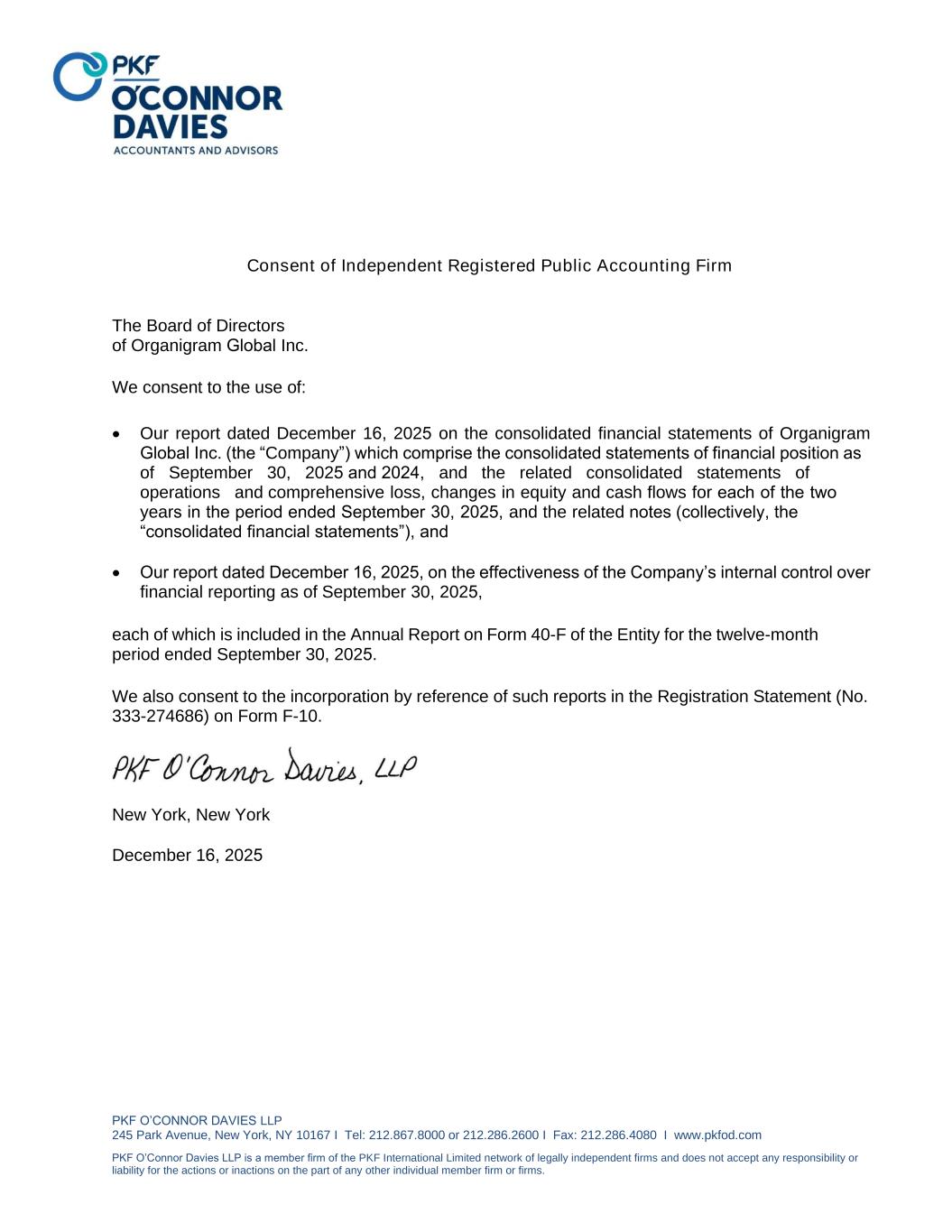
PKF O’Connor Davies, LLP, an Independent Registered Public Accounting Firm, has audited the Company's consolidated annual financial statements for the year ended September 30, 2025, and has issued an adverse report on the effectiveness of ICFR which is addressed to the Board of Directors of the Company and is included in the Company's audited consolidated annual financial statements filed as Exhibit 99.4 to this Annual Report.
There has been a change to the Company’s ICFR during the three months ended September 30, 2025 ("Q4 Fiscal 2025") that has materially affected, or is likely to materially affect, the Company’s ICFR.
During Q4 Fiscal 2025, staff turnover among personnel responsible for preparing and reviewing complex spreadsheets related to biological assets and inventory impacted management's ability to maintain effective operation of applicable controls.
With respect to the material weakness related to the information process during Fiscal 2025, the following remedial activities were completed and the material weakness assessed was remediated in Q4 Fiscal 2025:
•Engaged internal control specialists that assisted management in evaluating internal controls and in designing remediation plans;
•Hired a VP, Information Technology, to oversee and enhance the IT department and support the remediation of deficiencies in general IT controls;
•Hired and trained a dedicated resource to review the third-party service organization control reports and assess their impact in relation to the Company's control environment; and
•Remediated certain IT general controls.
The Board of Directors is responsible for the Company’s corporate governance and has the following separately designated standing committees: the Governance, Nominating and Sustainability Committee, the Compensation Committee, the Investment Committee, and the Audit Committee. The respective charters of the Governance, Nominating and Sustainability Committee, the Compensation Committee, the Investment Committee, and the Audit Committee can be viewed on the Company’s corporate website at www.organigram.ca. In addition, the Company’s Audit Committee Charter is attached as Appendix “A” to the AIF, which is filed as Exhibit 99.6 to this Annual Report.
The Governance, Nominating and Sustainability Committee is responsible for reviewing, overseeing and evaluating the governance, nominating and sustainability policies of the Company, and the Compensation Committee is responsible for reviewing, overseeing and evaluating the compensation policies of the Company.
The mandate of the Governance, Nominating and Sustainability Committee includes: (a) assessing the effectiveness of the Board of Directors, each of its committees and individual directors; (b) overseeing the recruitment and selection of candidates to be nominated for election as directors; (c) organizing an orientation and education program for new directors; (d) considering and approving proposals by the directors to engage outside advisors on behalf of the Board of Directors as a whole or on behalf of the independent directors; (e) reviewing and making recommendations to the Board of Directors concerning the size, composition and structure of the Board of Directors and its committees; and (f) overseeing management succession.
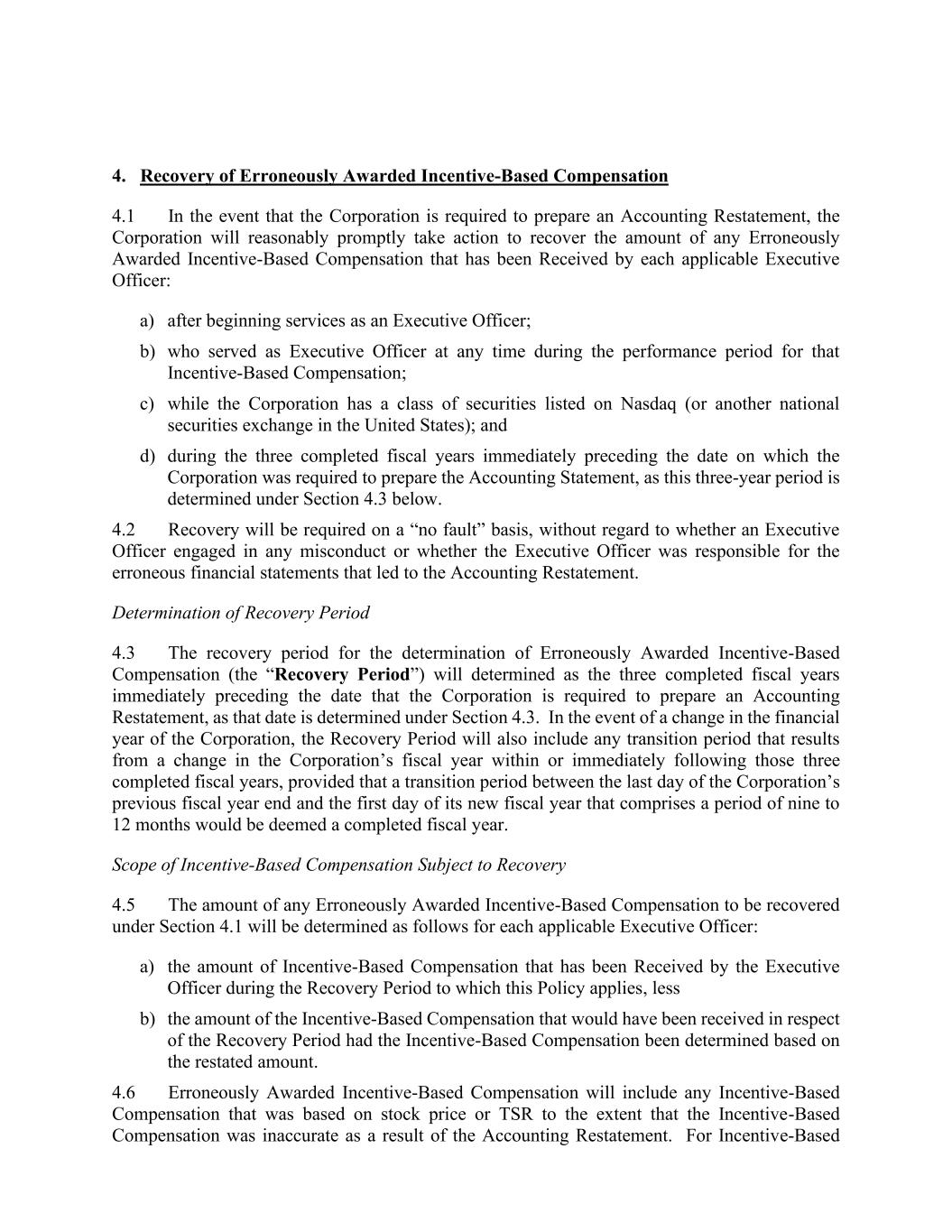
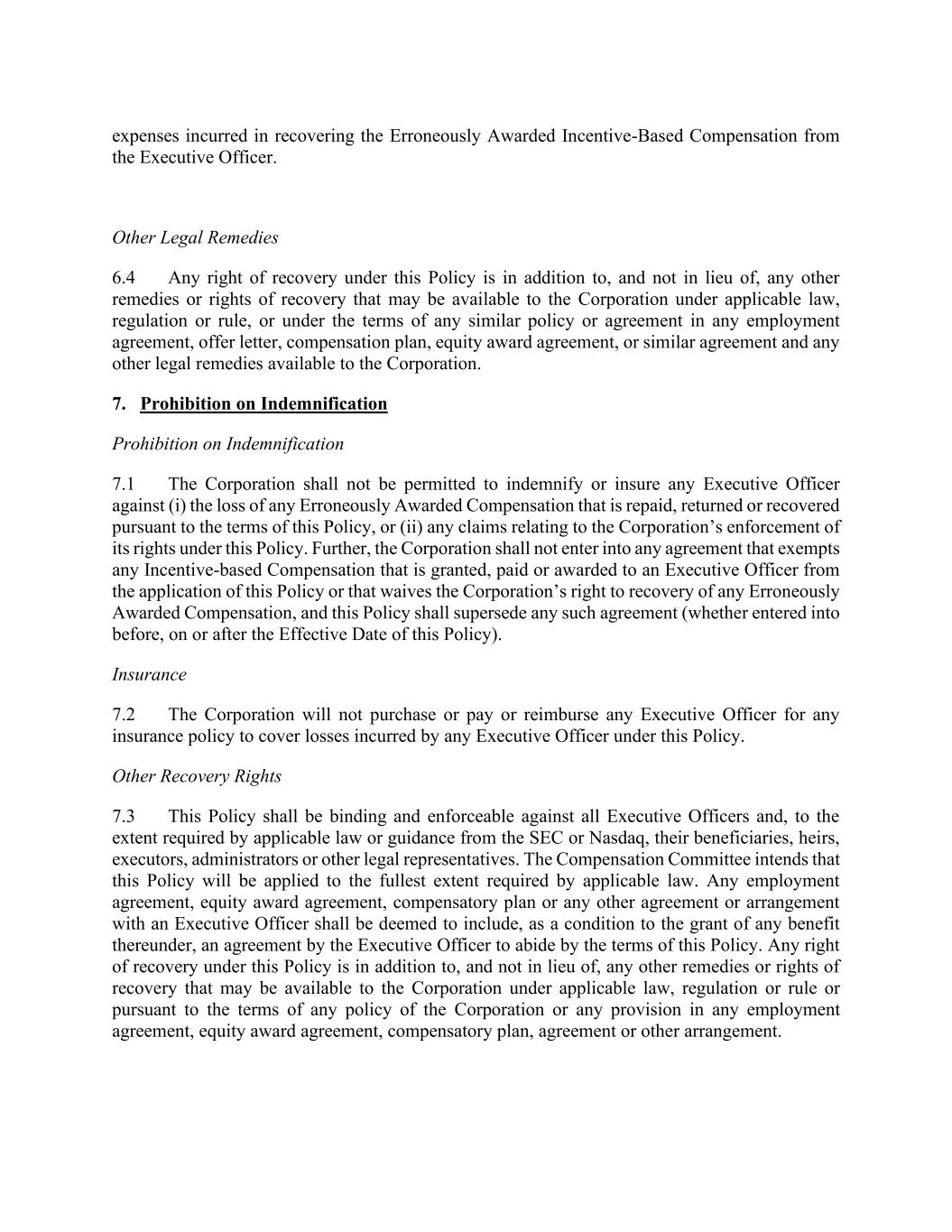
The Compensation Committee is responsible for: (a) administering any securities-based compensation plans of the Company; (b) assessing the performance of the Company's management; (c) reviewing and approving the compensation paid by the Company, if any, to the Company's officers; and (d) reviewing and making recommendations to the Board of Directors concerning the level and nature of the compensation payable to Company's directors and officers. The Compensation Committee is also responsible for administering the Company's Policy for the Recovery of Erroneously Awarded Incentive-Based Compensation (the "Recovery Policy"), which has been adopted by the Board of Directors pursuant to Rule 5608 of the NASDAQ Marketplace Rules. A copy of the Recovery Policy is filed as Exhibit 97.1 to this Annual Report, and is also available on the Company's corporate website at www.organigram.ca.
The Compensation Committee also reviews and makes recommendations to the Board of Directors at least annually with respect to the compensation of the Chief Executive Officer and other senior executive officers of the Company, including incentive compensation plans, equity-based plans, the terms of any employment agreements, severance arrangements, and change of control arrangements or provisions, and any special or supplemental benefits. In considering compensation matters, the Compensation Committee is required under its Charter to be guided by the following principles: (a) offering competitive compensation to attract, retain and motivate the very best qualified individuals in order for the Company to meet its goals; and (b) acting in the interests of the Company by being fiscally responsible.
The Company's Governance, Nominating and Sustainability Committee and the Company's Compensation Committee are required under their respective Charters to meet at least semi-annually and more frequently as circumstances require.
The Governance, Nominating and Sustainability Committee is comprised of Geoffrey Machum (Chair), Sherry Porter, Dexter John and Craig Harris. The Compensation Committee is comprised of Sherry Porter (Chair), Geoffrey Machum and Karina Gehring. The Board of Directors has determined that all members of each of the Governance, Nominating and Sustainability Committee and the Compensation Committee are independent, based on the criteria for independence prescribed by Rule 5605(a)(2) of the NASDAQ Marketplace Rules.
The Investment Committee's mandate is to assist the Board of Directors in discharging the Board of Directors' oversight responsibilities relating to proposed acquisitions, dispositions, major capital investments and financing arrangements. The Investment Committee is responsible for: (a) reviewing at least quarterly with management the Company's strategic business objectives, including potential acquisitions, dispositions, transaction opportunities and financing arrangements; (b) convening with management as needed to discuss and assess such opportunities, and reviewing and evaluating such opportunities with management on a regular basis; (c) monitoring the performance of the Company's completed transactions and investments by conducting periodic reviews for the purposes of evaluating the degree of success achieved, assessing the accuracy of projections and other assumptions relied upon in approving transactions, identifying the factors that differentiate more successful transactions from less successful ones, and evaluating the strategic contributions resulting from transactions; (d) considering, in conjunction with the Audit Committee as appropriate, the accounting treatment and impact of proposed investments; (e) when appropriate, making recommendations to the Board of Directors in respect of a proposed acquisition, disposition, financing or other arrangement (provided, however, that management may approve, without the requirement for further Committee or Board of Directors action, corporate development, business development, acquisitions and divestiture transactions in the normal course of business involving consideration up to $5,000,000); and (f) considering conformance with applicable law and compliance elements of proposed investments.
The Investment Committee is comprised of Dexter John (Chair), Stephen Smith, Marni Wieshofer, Simon Ashton and Craig Harris. The Board of Directors has determined that all five members of the Investment Committee are independent, based on the criteria for independence prescribed by Rule 5605(a)(2) of the NASDAQ Marketplace Rules.
Our Board of Directors has established the Audit Committee in accordance with section 3(a)(58)(A) of the Exchange Act and Rule 5605(c) of the NASDAQ Marketplace Rules for the purpose of overseeing our accounting and financial reporting processes and the audits of our annual financial statements and effectiveness of internal control over financial reporting.
The Audit Committee is comprised of Stephen Smith (Chair), Marni Wieshofer, Dexter John and Simon Ashton. Our Board of Directors has determined that the Audit Committee meets the composition requirements set forth by Section 5605(c)(2) of the NASDAQ Marketplace Rules, and that each of the members of the Audit Committee is independent as determined under Rule 10A-3 of the Exchange Act and Rule 5605(a)(2) of the NASDAQ Marketplace Rules. All four members of the Audit Committee are financially literate, meaning they are able to read and understand the Company's financial statements and to understand the breadth and level of complexity of the issues that can reasonably be expected to be raised by the Company's financial statements.
•qualifies as an "audit committee financial expert" (as defined in paragraph (8)(b) of General Instruction B to Form 40-F),
•has past employment experience in finance or accounting, requisite professional certification in accounting, or any other comparable experience or background which results in his financial sophistication (pursuant to Rule 5605(c)(2)(A) of the NASDAQ Marketplace Rules), and
•is independent (as determined under Exchange Act Rule 10A-3 and Rule 5605(a)(2) of the NASDAQ Marketplace Rules).
The Audit Committee Charter sets out responsibilities regarding the provision of non-audit services by the Company's external auditors and requires the Audit Committee to pre-approve all permitted non-audit services to be provided by the Company's external auditors, in accordance with applicable law.
As of June 28, 2024, our independent registered public accounting firm is PKF O’Connor Davies, LLP, New York, NY, Auditor Firm ID: 127. Prior to June 28, 2024, our independent registered public accounting firm was KPMG LLP, Vaughan, ON, Canada, Auditor Firm ID: 85. Tabular disclosure of the amounts billed to us by our independent auditors for each of our last fiscal years ended September 30, 2024 ("Fiscal 2024") and September 30, 2025 ("Fiscal 2025") as Audit Fees, Audit-Related Fees, Tax Fees and All Other Fees, is made on page 78 of the AIF, filed as Exhibit 99.6 to this Annual Report.
Audit Fees include fees necessary to perform the annual audit including the audit of internal controls over financial reporting and quarterly reviews of the Company’s financial statements. Audit Fees include fees for review of tax provisions and for accounting consultations on matters reflected in the financial statements. Audit Fees also include audit or other attest services required by legislation or regulation, such as comfort letters, consents, reviews of securities filings and statutory audits. For Fiscal 2024 audit fees were comprised of quarterly reviews and the annual audit (including the audit of internal controls over financial reporting) . For Fiscal 2025 audit fees were comprised of quarterly reviews and the annual audit (including the audit of internal controls over financial reporting).
Audit-related Fees include fees related to Public Company Accounting Oversight Board and Canadian Public Accountability in Fiscal 2025.
Tax Fees include fees for all tax services other than those included in "Audit Fees" and "Audit-Related Fees". This category includes fees for tax compliance and advisory in Fiscal 2024. Tax advice includes advice related to mergers and acquisitions and a captive insurance structure.
From time to time, management of the Company recommends to and requests approval from the Audit Committee for audit and non-audit services to be provided by the Company's external auditor.
The Audit Committee may delegate to one or more of its members the authority to pre-approve non-audit services to be provided to the Company or its subsidiaries by the Company's external auditor. The pre-approval of non-audit services must be presented to the Audit Committee at its first scheduled meeting following such pre-approval.
The Audit Committee may satisfy its duty to pre-approve non-audit services by adopting specific policies and procedures for the engagement of the non-audit services, provided the policies and procedures are detailed as to the particular service, the Audit Committee is informed of each non-audit service and the procedures do not include delegation of the Audit Committee's responsibilities to management.
There were no off-balance sheet arrangements during Q4 Fiscal 2025 and Fiscal 2025.
Disclosure of contractual obligations can be found under "Risk Factors - (ii) Liquidity Risk" beginning on page 23 of our MD&A, filed as Exhibit 99.5 to this Annual Report, which section is incorporated by reference.
We have adopted a Code of Business Conduct and Ethics (the "Code") that applies to our officers (including without limitation, the CEO and CFO), employees and directors of the Company and its subsidiaries and promotes, among other things, honest and ethical conduct. The Code meets the requirements for a "code of ethics" within the meaning of that term in Form 40-F.
The Code was reviewed and approved by the Board of Directors on September 26, 2025. The Code is available on the Company's corporate website at www.organigram.ca and under the Company's SEDAR+ profile on www.sedarplus.ca and is filed as Exhibit 99.7 to this Annual Report.
During Fiscal 2025, no material amendment was made to the Code which would be required to be disclosed pursuant to Paragraph 9 of General Instruction B, and no waivers of the Code were granted to any principal officer of the Company or any person performing similar functions.
There were no notices required by Rule 104 of Regulation BTR that the Company sent during Fiscal 2025, concerning any equity security subject to a blackout period under Rule 101 of Regulation BTR.
The Company complies with corporate governance requirements of the TSX. As a foreign private issuer, the Company is required to comply with some, but not all, of the corporate governance requirements of NASDAQ. Notwithstanding certain accommodations available to foreign private issuers under NASDAQ's corporate governance standards, the Company adopts best practices consistent with domestic NASDAQ listed companies when appropriate to its circumstances.
The Company has reviewed the NASDAQ corporate governance requirements and confirms that the Company is in compliance with the NASDAQ corporate governance standards that apply to the Company (taking into account the accommodations available for foreign private issuers) in all significant respects:
Executive Sessions: Under Rule 5605(b)(2) of the NASDAQ Marketplace Rules, a listed company must have regularly scheduled meetings at which only independent directors are present ("executive sessions"). The rule contemplates that executive sessions will occur at least twice a year, and perhaps more frequently, in conjunction with regularly scheduled board meetings. Under applicable Canadian rules, customs and practice, the Company's independent directors are not required to hold executive sessions. However, the Company is subject to certain disclosure requirements prescribed in Canadian Form 58-101F1 - Corporate Governance Disclosure ("Form 58-101F1"). In particular, the Company must disclose whether the independent directors hold executive sessions and, if such executive sessions are held, how many of these meetings have been held since the beginning of the Company's most recently completed financial year. If the Company does not hold executive sessions, the Company must describe what the Board of Directors does to facilitate open and candid discussion among its independent directors.
Contents of Audit Committee Charter: Under Rule 5605(c)(1) of the NASDAQ Marketplace Rules, a listed company must adopt a formal written charter that specifies the scope of its responsibilities and the means by which it carries out those responsibilities; the external auditor's accountability to the audit committee; and the audit committee's responsibility to ensure the independence of the outside auditor. In accordance with section 2.3(1) of Canadian National Instrument 52-110 - Audit Committees, the Company has adopted an Audit Committee Charter that sets out its mandate and responsibilities, and substantially complies with Rule 5605(c)(1) of the NASDAQ Marketplace Rules.
However, the Audit Committee Charter does not strictly comply with the requirement under Rule 5605(c)(1)(B) that an audit committee charter must specify the committee's responsibility for ensuring its receipt from the outside auditors of a formal written statement delineating all relationships between the auditor and the company, with the view to confirming the objectivity and independence of the external auditor. Instead, consistent with the laws, customs and practices in Canada, the Company's Audit Committee Charter provides that: (a) the Committee shall satisfy itself, on behalf of the Board of Directors, that the external auditor is independent of management; and (b) in assessing such independence, the Committee shall discuss with the external auditor, and may require a letter from the external auditor outlining, any relationships between the external auditor and the Company or its affiliates.
Composition of Compensation Committee: Under Rule 5605(d)(1) of the NASDAQ Marketplace Rules, a listed company must adopt a formal written compensation committee charter that specifies the scope of its responsibilities and the means by which it carries out those responsibilities, including structure, processes and membership requirements. Rule 5605(d)(2)(A) requires that, subject to a limited exception, the compensation committee must be composed of at least two members, each of whom must be an independent director as defined in Rule 5605(a)(2). Under applicable Canadian rules, the Company's compensation committee is not required to include a prescribed number of independent directors. However, pursuant to Form 58-101F1, the Company must disclose what steps its board of directors takes to ensure an objective process for determining the compensation of the directors and officers of the Company, if its compensation committee is not comprised entirely of independent directors.
Independent Director Oversight of Director Nominations: Rule 5605(e)(1) of the NASDAQ Marketplace Rules prescribes that, subject to a limited exception, director nominees must either be selected, or recommended for the Board of Directors' selection, either by: (a) independent directors (as defined in Rule 5605(a)(2)) constituting a majority of the Board of Directors' independent directors in a vote in which only independent directors participate, or (b) a nominations committee comprised solely of independent directors. Rule 5605(e)(2) requires a listed company to adopt a formal written charter or board resolution, as applicable, addressing the nominations process and such related matters as may be required under United States federal securities laws. Under applicable Canadian rules, the Company's nominating committee is not required to include a prescribed number of independent directors. However, pursuant to Form 58-101F1, the Company must disclose what steps its board of directors takes to ensure an objective process for encouraging an objective nomination process for new directors of the Company, if its nominating committee is not comprised entirely of independent directors.
The Company's Governance, Nominating and Sustainability Committee and Compensation Committee: The Company has adopted a Governance, Nominating and Sustainability Committee Charter and a Compensation Committee Charter (the "Charters") that substantially comply with Rules 5605(d)(1) and Rule 5605(e)(2) of the NASDAQ Marketplace Rules. However, in contrast to the requirements of Rules 5605(d)(2)(A) and 5605(e)(1), the Charters prescribe that only a majority of the Committee (which should be comprised of a minimum of three directors) must be independent as defined in Canadian National Instrument 58 101 - Disclosure of Corporate Governance Practices, and free from any relationship that, in the view of the Board of Directors, could be reasonably expected to interfere with the exercise of his or her independent judgment as a member of the Committee. This is consistent with the laws, customs and practices in Canada. As disclosed elsewhere in this Annual Report, the Company's Governance, Nominating and Sustainability Committee is currently comprised of Geoff Machum (Chair), Sherry Porter, Dexter John and Craig Harris, and the Compensation Committee is currently comprised of Sherry Porter (Chair), Geoff Machum and Karina Gehring, each of whom has been determined by the Board of Directors to be independent based on the criteria for independence prescribed by Rule 5605(a)(2) of the NASDAQ Marketplace Rules. In the event that the Governance, Nominating and Sustainability Committee or the Compensation Committee ceases to comprised of only independent directors, the Company will disclose the steps its Board of Directors takes to ensure an objective process for the nomination of new directors of the Company or the determination of the compensation of the Company's directors and officers, as the case may be.
Shareholder Meeting Quorum Requirement: Under Rule 5620(c) of the NASDAQ Marketplace Rules, a listed company that is not a limited partnership must provide in its by-laws for a quorum of not less than 33 1/3% of the outstanding shares of the company's common voting stock in respect of all meetings of the holders of its common stock. The Company's Bylaws provide that a quorum for a meeting of shareholders of the Company is present if two persons who are, or who represent by proxy, one or more shareholders who, in the aggregate, hold at least five percent of the issued shares. This quorum requirement is consistent with the laws, customs and practices in Canada.
Proxy Delivery Requirement: Under Rule 5620(b) of the NASDAQ Marketplace Rules, a listed company that is not a limited partnership must solicit proxies and provide proxy statements for all meetings of shareholders, and also provide copies of such proxy solicitation materials to NASDAQ. The Company is a "foreign private issuer" as defined in Rule 3b-4 under the Exchange Act, and the equity securities of the Company are accordingly exempt from the proxy rules set forth in Sections 14(a), 14(b), 14(c) and 14(f) of the Exchange Act. The Company solicits proxies in accordance with applicable rules and regulations in Canada.
Distribution of Annual Reports: NASDAQ Marketplace Rule 5250(d) requires a NASDAQ-listed Company to make available to shareholders an annual report containing audited financial statements of the Company and its subsidiaries (which, for example, may be on 40-F under the Exchange Act) within a reasonable period of time following the filing of the annual report with the SEC. The Company may comply with this requirement either:
•by mailing the report to shareholders (as opposed to electronic or notice-and-access delivery);
•by satisfying the requirements for furnishing an annual report contained in Rule 14a-16 under the Exchange Act; or
•by posting the annual report to shareholders on or through the Company's website, along with a prominent undertaking in the English language to provide shareholders, upon request, a hard copy of the annual report free of charge. A Company that chooses to satisfy this requirement pursuant in this manner must, simultaneous with this posting, issue a press release stating that its annual report has been filed with the Commission. The press release must also state that: (a) the annual report is available on the Company's website and include the website address, and (b) shareholders may receive a hard copy free of charge upon request.
As indicated above, the Company is exempt from the proxy rules set forth in Sections 14(a), 14(b), 14(c) and 14(f) of the Exchange Act (as well as Rule 14a-16 promulgated under the Exchange Act), and solicits proxies in accordance with applicable rules and regulations in Canada.
Section 437 of the TSX Company Manual requires that: (a) every TSX-listed company must forward annually to each shareholder who has requested them its annual financial statements and its related management's discussion and analysis in accordance with Canadian National Instrument 51-102 - Continuous Disclosure Obligations ("NI 51-102"); and (b) if a listed company produces an annual report, it must be filed publicly through SEDAR+, available at www.sedarplus.ca.
Pursuant to NI 51-102, the Company is required to send annually a request form to the registered holders and beneficial owners of its securities, other than debt instruments, that registered holders and beneficial owners may use to request a copy of the Company's annual financial statements and related management's discussion and analysis, the interim financial statements and related management's discussion and analysis, or both. If a registered holder or beneficial owner of securities, other than debt instruments, of the Company requests the Company's annual or interim financial statements, the Company must send a copy of the requested financial statements to the person or company that made the request, without charge, by the later of: (a) 10 days after the filing deadline for the financial statements, or (b) 10 calendar days after the Company receives the request.
If the Company sends financial statements it must also send, at the same time, the annual or interim management's discussion and analysis relating to the financial statements.
Shareholder Approval Requirements: Section 5635 of the NASDAQ Marketplace Rules requires shareholder approval for issuances of common shares, or any securities convertible or exercisable into common shares:
(i)where, due to the present or potential issuance of common shares (including shares issued pursuant to an earn-out or similar type of provision, or securities convertible into or exercisable for common shares) other than a public offering for cash:
(A)the common shares constitute or will upon issuance constitute at least 20% of the voting power outstanding before the issuance of the common shares (or, if applicable before the issuance of the securities convertible into or exercisable for common shares); or
(B)the common shares constitute or will upon issuance constitute at least 20% of the number of common shares outstanding before the issuance; or
(ii)if any director, officer or Substantial Shareholder (as defined by Rule 5635(e)(3) of the NASDAQ Marketplace Rules) of the listed company has a 5% or greater interest (or such persons collectively have a 10% or greater interest), directly or indirectly, in the target company or assets to be acquired, or in the consideration to be paid in the transaction or series of related transactions, and the present or potential issuance of common shares, or securities convertible into or exercisable for common shares, could result in an increase of 5% or more in the outstanding common shares or voting power of the listed company;
(b)where the common shares sold (or the number of common shares into which the securities sold are convertible or exercisable), either alone or together with sales by officers, directors or Substantial Shareholders of the listed company, constitute at least
(ii)20% of the voting power of the outstanding common shares before the issuance,
in either case except for (A) public offerings of common shares for cash, and (B) transactions involving the sale, issuance or potential issuance of common shares at a price, or securities convertible or exercisable into common shares with a conversion or exercise price, that is greater than or equal to the lesser of (1) the last closing price immediately preceding the signing of a binding agreement, and (2) the average closing price of the common shares on NASDAQ for the five trading days immediately preceding the signing of the binding agreement; and
(c)where the issuance would result in a change of control of the listed company.
The Company intends to follow TSX rules for shareholder approval of new issuances of its common shares. Following TSX rules, shareholder approval is required for certain issuances of shares that: (i) materially affect control of the listed issuer; or (ii) provide consideration to insiders in aggregate of 10% or greater of the market capitalization of the listed issuer, during any six-month period, and has not been negotiated at arm's length. Shareholder approval is also required, pursuant to TSX rules, in the case of private placements: (a) for an aggregate number of listed securities issuable greater than 25% of the number of securities of the listed issuer which are outstanding, on a non-diluted basis, prior to the date of closing of the transaction if the price per security is less than the market price; or (b) that during any six month period are to insiders for listed securities or options, rights or other entitlements to listed securities greater than 10% of the number of securities of the listed issuer which are outstanding, on a non-diluted basis, prior to the date of the closing of the first private placement to an insider during the six month period. The rules of the TSX also require shareholder approval in connection with an acquisition by a listed issuer where the number of securities issued or issuable in payment of the purchase price for the acquisition exceeds 25% of the number of securities of the listed issuer that are outstanding, on a non-diluted basis.
Equity Compensation Plans: Section 5635(c) of the NASDAQ Marketplace Rules also requires shareholder approval of all stock option or purchase plans or other arrangements that provide for equity securities as compensation to officers, directors, employees or consultants, and any material amendments to such plans or arrangements, except for certain plans and arrangements, including:
(a)stock purchase plans available on equal terms to all security holders of the listed company (such as a typical dividend reinvestment plan);
(b)tax qualified, non-discriminatory employee benefit plans (e.g., plans that meet the requirements of section 401(a) or 423 of the Internal Revenue Code) or parallel nonqualified plans, provided that such plans are approved by the listed company's independent compensation committee or a majority of the company's independent directors;
(c)those plans or arrangements allowing employees, directors or service providers to buy such securities on the open market or from the listed company for current fair market value;
(d)grants of options or other equity-based compensation as a material inducement to the grantee's entering into employment with the listed company, provided that such grants are approved by the listed company's independent compensation committee or a majority of the company's independent directors; and
(e)conversions, replacements or adjustments of outstanding options or other equity compensation awards to reflect a merger or acquisition.
The Company intends to follow TSX rules in respect of its security-based compensation arrangements. The TSX requires shareholder approval of all security-based compensation arrangements, and any material amendments to such arrangements, except for arrangements used as an inducement to persons or companies not previously employed by and not previously an insider of the listed issuer, provided that: (i) such persons or companies enter into a contract of full time employment as an officer of the listed issuer; and (ii) the number of securities made issuable to such persons or companies during any twelve month period does not exceed in aggregate 2% of the number of securities of the listed issuer which are outstanding, on a non-diluted basis, prior to the date the exemption is first used during such twelve month period. Such shareholder approval is required when the security-based arrangement is instituted and every three years thereafter if the arrangement does not have a fixed maximum aggregate of securities issuable. The TSX considers a security-based compensation arrangement to be any compensation or incentive mechanism involving the issuance from treasury or potential issuance from treasury of securities of a listed issuer.
Insiders of a listed issuer that are entitled to receive a benefit under a security-based compensation arrangement are not eligible to vote their securities in respect of the shareholder approval required by the TSX unless such security based compensation arrangement contains an "insider participation limit". An "insider participation limit" is a provision typically found in security-based compensation arrangements which limits the number of a listed issuer's securities: (i) issued to insiders of the listed issuer, within any one year period; and (ii) issuable to insiders of the listed issuer at any time, to 10% of the listed issuer's total issued and outstanding securities.
For the purposes of security-based compensation arrangements, the definition of "insider" would include the CEO, CFO, all directors of the listed issuer and its major subsidiaries, any person responsible for a principal business unit, division or function, and any shareholder that has beneficial ownership or control or direction over, more than 10% of the issued and outstanding common shares of the listed issuer. The Company obtains shareholder approval of its equity compensation plans in accordance with applicable rules and regulations of the TSX.
The foregoing are consistent with the laws, customs and practices in Canada.
Not applicable.
Not applicable.
Not applicable.
The Company undertakes to make available, in person or by telephone, representatives to respond to inquiries made by the Commission staff, and to furnish promptly, when requested to do so by the Commission staff, information relating to: the securities registered pursuant to Form 40-F; the securities in relation to which the obligation to file an annual report on Form 40-F arises; or transactions in said securities.
The Company has previously filed with the SEC a written consent to service of process on Form F-X. Any change to the name or address of the Company's agent for service shall be communicated promptly to the SEC by amendment to the Form F-X referencing the file number of the Company.
Pursuant to the requirements of the Exchange Act, the Company certifies that it meets all of the requirements for filing on Form 40-F and has duly caused this annual report to be signed on its behalf by the undersigned, thereunto duly authorized.
Date: December 16, 2025 Organigram Global Inc.
|
|
|
|
|
|
|
|
|
|
|
|
| TABLE OF CONTENTS |
|
|
|
| Management’s Responsibility for the Financial Statements |
|
|
|
Independent Auditor's Reports |
2 |
– |
8 |
Consolidated Statements of Financial Position |
|
|
9 |
Consolidated Statements of Operations and Comprehensive Loss |
|
|
|
Consolidated Statements of Changes in Equity |
|
|
|
Consolidated Statements of Cash Flows |
|
|
|
Notes to the Consolidated Financial Statements |
|
– |
|
|
|
|
|
|
|
|
|
December 11, 2025
Management’s Responsibility for the Financial Statements
The accompanying consolidated financial statements of Organigram Global Inc. (the “Company”) have been prepared by the Company’s management in accordance with International Financial Reporting Standards as issued by the International Accounting Standards Board and contain estimates based on management’s judgment. Internal control systems are maintained by management to provide reasonable assurance that assets are safe-guarded and financial information is reliable.
The Board of Directors of the Company is responsible for ensuring that management fulfills its responsibilities for financial reporting and is ultimately responsible for reviewing and approving the financial statements and the accompanying management discussion and analysis. The Board of Directors carries out this responsibility principally through its Audit Committee.
The Audit Committee is appointed by the Board of Directors. It meets with the Company’s management and auditors, and reviews internal controls and financial reporting matters to ensure that management is properly discharging its responsibilities before submitting the financial statements to the Board of Directors for approval.
|
|
|
|
|
|
| (signed) ‘Peter Amirault’ |
(signed) ‘Greg Guyatt’ |
Executive Chair |
Chief Financial Officer |
| Toronto, Ontario |
Toronto, Ontario |
CONSOLIDATED FINANCIAL STATEMENTS | FOR THE YEAR ENDED SEPTEMBER 30, 2025 AND 2024 1
CONSOLIDATED FINANCIAL STATEMENTS | FOR THE YEAR ENDED SEPTEMBER 30, 2025 AND 2024 2
CONSOLIDATED FINANCIAL STATEMENTS | FOR THE YEAR ENDED SEPTEMBER 30, 2025 AND 2024 3
CONSOLIDATED FINANCIAL STATEMENTS | FOR THE YEAR ENDED SEPTEMBER 30, 2025 AND 2024 4
CONSOLIDATED FINANCIAL STATEMENTS | FOR THE YEAR ENDED SEPTEMBER 30, 2025 AND 2024 5
CONSOLIDATED FINANCIAL STATEMENTS | FOR THE YEAR ENDED SEPTEMBER 30, 2025 AND 2024 6
CONSOLIDATED FINANCIAL STATEMENTS | FOR THE YEAR ENDED SEPTEMBER 30, 2025 AND 2024 7
CONSOLIDATED FINANCIAL STATEMENTS | FOR THE YEAR ENDED SEPTEMBER 30, 2025 AND 2024 8
ORGANIGRAM GLOBAL INC.
CONSOLIDATED STATEMENTS OF FINANCIAL POSITION
As at September 30, 2025 and September 30, 2024
(Expressed in CDN $000’s except share and per share amounts)
|
|
|
|
|
|
|
|
|
|
|
|
|
SEPTEMBER 30, 2025 |
|
SEPTEMBER 30,
2024 |
| ASSETS |
|
|
|
| Current assets |
|
|
|
Cash |
$ |
28,200 |
|
|
$ |
106,745 |
|
Restricted cash (Note 4) |
55,394 |
|
|
25,860 |
|
Short-term investments |
826 |
|
|
821 |
|
Accounts and other receivables (Note 5) |
64,859 |
|
|
37,153 |
|
Biological assets (Note 6) |
17,931 |
|
|
15,173 |
|
Inventories (Note 7) |
106,023 |
|
|
67,351 |
|
| Prepaid expenses and deposits |
11,664 |
|
|
9,116 |
|
|
284,897 |
|
|
262,219 |
|
|
|
|
|
|
|
|
|
Property, plant and equipment (Note 8) |
122,977 |
|
|
96,231 |
|
Intangible assets (Note 9) |
48,511 |
|
|
8,092 |
|
Goodwill (Note 10) |
52,524 |
|
|
— |
|
Deferred charges and deposits |
3,754 |
|
|
591 |
|
Other financial assets (Note 11) |
49,548 |
|
|
40,727 |
|
|
|
|
|
|
|
|
|
|
$ |
562,211 |
|
|
$ |
407,860 |
|
|
|
|
|
| LIABILITIES |
|
|
|
| Current liabilities |
|
|
|
| Accounts payable and accrued liabilities |
$ |
89,247 |
|
|
$ |
47,097 |
|
Other liabilities (Note 15) |
8,080 |
|
|
1,086 |
|
|
|
|
|
|
|
|
|
|
|
|
|
Derivative liabilities (Note 12) |
28,832 |
|
|
5,139 |
|
|
126,159 |
|
|
53,322 |
|
|
|
|
|
|
|
|
|
Derivative liabilities (Note 12) |
5,506 |
|
|
14,110 |
|
Preferred shares (Note 13 and 14) |
68,653 |
|
|
31,070 |
|
Other long-term liabilities (Note 15) |
12,763 |
|
|
3,369 |
|
|
|
|
|
|
213,081 |
|
|
101,871 |
|
|
|
|
|
| SHAREHOLDERS' EQUITY |
|
|
|
Share capital (Note 14) |
919,908 |
|
|
852,891 |
|
Equity reserves (Note 14) |
37,346 |
|
|
37,129 |
|
Accumulated other comprehensive income (loss) (Note 11) |
603 |
|
|
(63) |
|
Accumulated deficit |
(608,727) |
|
|
(583,968) |
|
|
349,130 |
|
|
305,989 |
|
|
$ |
562,211 |
|
|
$ |
407,860 |
|
On behalf of the Board:
/s/Peter Amirault, Director
/s/Stephen Smith, Director
The accompanying notes are an integral part of these Consolidated Financial Statements.
CONSOLIDATED FINANCIAL STATEMENTS | FOR THE YEAR ENDED SEPTEMBER 30, 2025 AND 2024 9
ORGANIGRAM GLOBAL INC.
CONSOLIDATED STATEMENTS OF OPERATIONS AND COMPREHENSIVE LOSS
For the year ended September 30, 2025 and 2024
(Expressed in CDN $000’s except share and per share amounts)
|
|
|
|
|
|
|
|
|
|
|
|
|
|
|
|
|
YEAR ENDED |
|
|
SEPTEMBER 30, 2025 |
|
SEPTEMBER 30,
2024 |
| REVENUE |
|
|
|
|
Gross revenue (Note 20) |
|
$ |
403,024 |
|
|
$ |
247,177 |
|
| Excise taxes |
|
(143,841) |
|
|
(87,336) |
|
| Net revenue |
|
259,183 |
|
|
159,841 |
|
Cost of sales (Note 7 and 21) |
|
174,850 |
|
|
111,390 |
|
| Gross margin before fair value adjustments |
|
84,333 |
|
|
48,451 |
|
Realized fair value on inventories sold and other inventory charges (Note 7) |
|
(67,125) |
|
|
(52,078) |
|
Unrealized gain on changes in fair value of biological assets (Note 6) |
|
73,008 |
|
|
51,151 |
|
| Gross margin |
|
90,216 |
|
|
47,524 |
|
|
|
|
|
|
| OPERATING EXPENSES |
|
|
|
|
General and administrative (Note 23) |
|
59,499 |
|
|
44,955 |
|
| Sales and marketing |
|
31,097 |
|
|
19,851 |
|
| Research and development |
|
10,945 |
|
|
11,200 |
|
Share-based compensation (Note 14 (iv)) |
|
3,975 |
|
|
6,274 |
|
|
|
|
|
|
|
|
|
|
|
| Total operating expenses |
|
105,516 |
|
|
82,280 |
|
|
|
|
|
|
LOSS FROM OPERATIONS |
|
(15,300) |
|
|
(34,756) |
|
|
|
|
|
|
Investment income, net of financing costs |
|
(1,150) |
|
|
(3,311) |
|
| Acquisition and transaction costs |
|
6,580 |
|
|
915 |
|
|
|
|
|
|
|
|
|
|
|
Share of loss from investments in associates |
|
— |
|
|
5,284 |
|
|
|
|
|
|
Loss (gain) on disposal of property, plant and equipment and intangible assets |
|
9 |
|
|
(633) |
|
Change in fair value of contingent consideration (Note 26) |
|
(9,743) |
|
|
(50) |
|
Change in fair value of derivative liabilities, preferred shares and other financial assets (Note 11, 12 and 13) |
|
27,505 |
|
|
7,718 |
|
|
|
|
|
|
Share issuance costs allocated to derivative liabilities and preferred shares (Note 14) |
|
170 |
|
|
937 |
|
Other non-operating income |
|
(142) |
|
|
(176) |
|
Loss before tax |
|
(38,529) |
|
|
(45,440) |
|
|
|
|
|
|
Income tax recovery (Note 24) |
|
|
|
|
|
|
|
|
|
| Deferred, net |
|
(13,770) |
|
|
— |
|
|
|
|
|
|
NET LOSS |
|
$ |
(24,759) |
|
|
$ |
(45,440) |
|
|
|
|
|
|
OTHER COMPREHENSIVE INCOME |
|
|
|
|
Change in fair value of investments at fair value through other comprehensive income (Note 11) |
|
666 |
|
|
96 |
|
|
|
|
|
|
COMPREHENSIVE LOSS |
|
$ |
(24,093) |
|
|
$ |
(45,344) |
|
Net loss per common share, basic and diluted (Note 14 (v)) |
|
$ |
(0.194) |
|
|
$ |
(0.477) |
|
|
|
|
|
|
The accompanying notes are an integral part of these Consolidated Financial Statements.
CONSOLIDATED FINANCIAL STATEMENTS | FOR THE YEAR ENDED SEPTEMBER 30, 2025 AND 2024 10
ORGANIGRAM GLOBAL INC.
CONSOLIDATED STATEMENTS OF CHANGES IN EQUITY
For the year ended September 30, 2025 and 2024
(Expressed in CDN $000’s except share and per share amounts)
|
|
|
|
|
|
|
|
|
|
|
|
|
|
|
|
|
|
|
|
|
|
|
|
|
|
|
|
|
|
|
|
|
|
|
|
|
NUMBER OF SHARES |
|
SHARE CAPITAL |
|
EQUITY RESERVES |
|
ACCUMULATED OTHER COMPREHENSIVE (LOSS) INCOME |
|
ACCUMULATED DEFICIT |
|
SHAREHOLDERS' EQUITY |
|
|
|
|
|
|
|
|
|
|
|
$ |
— |
|
Balance - October 1, 2023 |
81,161,630 |
|
$776,906 |
|
$33,404 |
|
$(159) |
|
$ |
(538,528) |
|
|
$271,623 |
|
|
|
|
|
|
|
|
|
|
|
|
Unit financing, net of issuance costs (Note 14 (iii)) |
8,901,000 |
|
|
19,157 |
|
|
— |
|
|
— |
|
|
— |
|
|
19,157 |
|
|
|
|
|
|
|
|
|
|
|
|
|
Private placement (Note 14 (iii)) |
17,322,915 |
|
|
53,365 |
|
|
— |
|
|
— |
|
|
— |
|
|
53,365 |
|
Share-based compensation (Note 14 (iv)) |
— |
|
|
— |
|
|
7,182 |
|
|
— |
|
|
— |
|
|
7,182 |
|
Exercise of stock options (Note 14 (iii)) |
3,942 |
|
|
11 |
|
|
(5) |
|
|
— |
|
|
— |
|
|
6 |
|
Exercise of restricted share units (Note 14 (iii)) |
1,193,789 |
|
|
3,430 |
|
|
(3,430) |
|
|
— |
|
|
— |
|
|
— |
|
Exercise of performance share units (Note 14 (iii)) |
2,216 |
|
|
22 |
|
|
(22) |
|
|
— |
|
|
— |
|
|
— |
|
|
|
|
|
|
|
|
|
|
|
|
|
|
|
|
|
|
|
|
|
|
|
|
|
|
|
|
|
|
|
|
|
|
|
|
|
| Net loss |
— |
|
|
— |
|
|
— |
|
|
— |
|
|
(45,440) |
|
|
(45,440) |
|
| Other comprehensive loss |
|
|
|
|
|
|
96 |
|
|
— |
|
|
96 |
|
Balance - September 30, 2024 |
108,585,492 |
|
|
$ |
852,891 |
|
|
$ |
37,129 |
|
|
$ |
(63) |
|
|
$ |
(583,968) |
|
|
$ |
305,989 |
|
|
|
|
|
|
|
|
|
|
|
|
|
Balance - October 1, 2024 |
108,585,492 |
|
|
$ |
852,891 |
|
|
$ |
37,129 |
|
|
$ |
(63) |
|
|
$ |
(583,968) |
|
|
$ |
305,989 |
|
|
|
|
|
|
|
|
|
|
|
|
|
Shares issued related to business combination, net of issue costs of $71 (Note 14 (iii) and Note 26) |
17,233,950 |
|
|
39,050 |
|
|
— |
|
|
— |
|
|
— |
|
|
39,050 |
|
Private placement (Note 14 (iii)) |
7,562,447 |
|
|
23,963 |
|
|
— |
|
|
— |
|
|
— |
|
|
23,963 |
|
Share-based compensation (Note 14 (iv)) |
— |
|
|
— |
|
|
4,217 |
|
|
— |
|
|
— |
|
|
4,217 |
|
Exercise of stock options (Note 14 (iii)) |
2,500 |
|
|
11 |
|
|
(7) |
|
|
— |
|
|
— |
|
|
4 |
|
Exercise of restricted share units (Note 14 (iii)) |
1,063,473 |
|
|
3,841 |
|
|
(3,841) |
|
|
— |
|
|
— |
|
|
— |
|
Exercise of performance share units (Note 14 (iii)) |
13,167 |
|
|
152 |
|
|
(152) |
|
|
— |
|
|
— |
|
|
— |
|
|
|
|
|
|
|
|
|
|
|
|
|
|
|
|
|
|
|
|
|
|
|
|
|
|
|
|
|
|
|
|
|
|
|
|
|
| Net loss |
— |
|
|
— |
|
|
— |
|
|
|
|
(24,759) |
|
|
(24,759) |
|
| Other comprehensive loss |
— |
|
|
— |
|
|
— |
|
|
666 |
|
|
— |
|
|
666 |
|
Balance - September 30, 2025 |
134,461,029 |
|
|
$ |
919,908 |
|
|
$ |
37,346 |
|
|
$ |
603 |
|
|
$ |
(608,727) |
|
|
$ |
349,130 |
|
The accompanying notes are an integral part of these Consolidated Financial Statements.
CONSOLIDATED FINANCIAL STATEMENTS | FOR THE YEAR ENDED SEPTEMBER 30, 2025 AND 2024 11
ORGANIGRAM GLOBAL INC.
CONSOLIDATED STATEMENTS OF CASH FLOWS
For the year ended September 30, 2025 and 2024
(Expressed in CDN $000’s except share and per share amounts)
|
|
|
|
|
|
|
|
|
|
|
|
|
|
|
|
|
|
|
YEAR ENDED |
|
|
|
|
|
SEPTEMBER 30, 2025 |
|
SEPTEMBER 30,
2024 |
CASH PROVIDED BY (USED IN) |
|
|
|
|
|
|
|
| OPERATING ACTIVITIES |
|
|
|
|
|
|
|
Net loss |
|
|
|
|
$ |
(24,759) |
|
|
$ |
(45,440) |
|
| Items not affecting operating cash: |
|
|
|
|
|
|
|
Share-based compensation (Note 14 (iv)) |
|
|
|
|
4,217 |
|
|
7,182 |
|
Depreciation and amortization (Note 8 and 9) |
|
|
|
|
17,975 |
|
|
12,079 |
|
Loss (gain) on disposal of property, plant and equipment and intangible assets |
|
|
|
|
9 |
|
|
(633) |
|
|
|
|
|
|
|
|
|
|
|
|
|
|
|
|
|
Realized fair value on inventories sold and other inventory charges (Note 7) |
|
|
|
|
67,125 |
|
|
52,078 |
|
Unrealized gain on changes in fair value of biological assets (Note 6) |
|
|
|
|
(73,008) |
|
|
(51,151) |
|
|
|
|
|
|
|
|
|
Investment income, net of financing costs |
|
|
|
|
(1,150) |
|
|
(3,311) |
|
Share of loss from investments in associates (Note 16) |
|
|
|
|
— |
|
|
5,284 |
|
Change in fair value of contingent consideration (Note 26) |
|
|
|
|
(9,743) |
|
|
(50) |
|
|
|
|
|
|
|
|
|
Bad debts and provision for expected credit losses (Note 5) |
|
|
|
|
274 |
|
|
4,222 |
|
| Change in fair value of derivative liabilities, preferred shares and other financial assets (Note 11, 12 and 13) |
|
|
|
|
27,505 |
|
|
7,718 |
|
| Share issuance costs allocated to derivative liabilities and preferred shares (Note 14) |
|
|
|
|
170 |
|
|
937 |
|
| Unrealized foreign exchange gain |
|
|
|
|
(313) |
|
|
— |
|
Income tax recovery (Note 24) |
|
|
|
|
(13,770) |
|
|
— |
|
| Cash used in operating activities before working capital changes |
|
|
|
|
(5,468) |
|
|
(11,085) |
|
| Changes in non-cash working capital: |
|
|
|
|
|
|
|
| Net change in accounts and other receivables, biological assets, inventories, prepaid expenses and deposits |
|
|
|
|
(15,287) |
|
|
(12,059) |
|
| Net change in accounts payable and accrued liabilities, provisions and other liabilities |
|
|
|
|
13,164 |
|
|
27,016 |
|
|
|
|
|
|
|
|
|
|
|
|
|
|
|
|
|
|
|
|
|
|
|
|
|
|
|
|
|
|
|
|
|
|
|
|
|
|
|
|
|
|
|
|
|
|
|
|
|
|
|
|
|
|
|
|
|
|
|
|
|
|
|
|
|
Net cash (used in) provided by operating activities |
|
|
|
|
(7,591) |
|
|
3,872 |
|
|
|
|
|
|
|
|
|
| FINANCING ACTIVITIES |
|
|
|
|
|
|
|
|
|
|
|
|
|
|
|
|
|
|
|
|
|
|
|
|
|
|
|
|
|
|
|
|
|
|
|
|
|
|
|
|
|
|
|
|
|
|
|
Proceeds from unit financing, net of issuance costs (Note 14 (iii)) |
|
|
|
|
— |
|
|
26,018 |
|
Private placement, net of share issuance costs (Note 14 (iii)) |
|
|
|
|
41,181 |
|
|
82,541 |
|
Payment of lease liabilities, net of sublease receipts (Note 15) |
|
|
|
|
(1,792) |
|
|
(710) |
|
| Payment of long-term debt |
|
|
|
|
(60) |
|
|
(76) |
|
|
|
|
|
|
|
|
|
Stock options exercised (Note 14 (iii)) |
|
|
|
|
4 |
|
|
6 |
|
|
|
|
|
|
|
|
|
Net cash provided by financing activities |
|
|
|
|
39,333 |
|
|
107,779 |
|
|
|
|
|
|
|
|
|
| INVESTING ACTIVITIES |
|
|
|
|
|
|
|
Purchase of short-term investments |
|
|
|
|
(800) |
|
|
(800) |
|
Proceeds from short-term investments |
|
|
|
|
897 |
|
|
— |
|
| Investment income |
|
|
|
|
1,601 |
|
|
3,518 |
|
|
|
|
|
|
|
|
|
|
|
|
|
|
|
|
|
Acquisition of subsidiary (Note 26) |
|
|
|
|
(65,620) |
|
|
— |
|
Other financial assets (Note 11) |
|
|
|
|
(207) |
|
|
(28,440) |
|
| Proceeds on sale of property, plant and equipment |
|
|
|
|
112 |
|
|
257 |
|
Purchase of property, plant and equipment (Note 8) |
|
|
|
|
(17,022) |
|
|
(4,731) |
|
Purchase of intangible assets (Note 9) |
|
|
|
|
(27) |
|
|
(607) |
|
Net cash used in investing activities |
|
|
|
|
(81,066) |
|
|
(30,803) |
|
|
|
|
|
|
|
|
|
| Effect of foreign exchange on cash |
|
|
|
|
$ |
313 |
|
|
$ |
— |
|
(DECREASE) INCREASE IN CASH |
|
|
|
|
$ |
(49,011) |
|
|
$ |
80,848 |
|
|
|
|
|
|
|
|
|
| CASH AND RESTRICTED CASH |
|
|
|
|
|
|
|
| Beginning of period |
|
|
|
|
$ |
132,605 |
|
|
$ |
51,757 |
|
| End of period |
|
|
|
|
$ |
83,594 |
|
|
$ |
132,605 |
|
|
|
|
|
|
|
|
|
Less: restricted cash |
|
|
|
|
(55,394) |
|
|
(25,860) |
|
Cash as presented on the statement of financial position |
|
|
|
|
$ |
28,200 |
|
|
$ |
106,745 |
|
The accompanying notes are an integral part of these Consolidated Financial Statements.
CONSOLIDATED FINANCIAL STATEMENTS | FOR THE YEAR ENDED SEPTEMBER 30, 2025 AND 2024 12
ORGANIGRAM GLOBAL INC.
NOTES TO THE CONSOLIDATED FINANCIAL STATEMENTS
For the year ended September 30, 2025 and 2024
(Expressed in CDN $000’s except share and per share amounts and unless otherwise specified)
1. NATURE OF OPERATIONS
Organigram Global Inc. (formerly known as "Organigram Holdings Inc.") (the “Company”) is a publicly listed corporation with its common shares (the “Common Shares”) trading on the Toronto Stock Exchange (“TSX”) and on the Nasdaq Global Select Market (“NASDAQ”) under the symbol “OGI”. The head office of the Company is 1400-145 King Street West, Toronto, Ontario, Canada, M5H 1J8 and the registered office is 35 English Drive, Moncton, New Brunswick, Canada, E1E 3X3.
On March 24, 2025, the shareholders of the Company at the annual and special meeting of shareholders approved an amendment to the articles of the Company to change the name of the Company to “Organigram Global Inc”. On March 31, 2025, the Company obtained all regulatory approvals for the change of name of the Company.
The Company’s wholly-owned subsidiaries are: (i) Organigram Inc., a licensed producer (“LP” or “Licensed Producer”) of cannabis and cannabis-derived products in Canada regulated by Health Canada under the Cannabis Act (Canada) and the Cannabis Regulations (Canada); (ii) 10870277 Canada Inc., a special purpose holding company for the Company; and (iii) Organigram USA Inc. (formerly known as Collective Project USA Limited) ("OGI USA"), a wholly-owned subsidiary of Organigram Inc. The Company was incorporated under the Business Corporations Act (British Columbia) on July 5, 2010, and continued under the Canada Business Corporations Act (“CBCA”) on April 6, 2016. Organigram Inc. was incorporated under the Business Corporations Act (New Brunswick) on March 1, 2013. 10870277 Canada Inc. was incorporated under the CBCA on July 4, 2018. OGI USA was incorporated under the General Corporate Law of the State of Delaware on April 12, 2019.
On October 1, 2023, Organigram Inc. amalgamated with the Company's then wholly-owned subsidiaries, The Edibles and Infusions Corporation ("EIC") and Laurentian Organic Inc. ("Laurentian") and continued as a single corporation under the name "Organigram Inc.", a 100% owned subsidiary of the Company. EIC was incorporated under the Business Corporations Act (Ontario) on September 20, 2018. Laurentian was incorporated under the CBCA on March 18, 2019.
On April 1, 2025, Organigram Inc. amalgamated with the Company's then wholly-owned subsidiary, Motif Labs Ltd. ("Motif") and continued as a single corporation under the name "Organigram Inc.", a 100% owned subsidiary of the Company. Motif was incorporated under the Business Corporations Act (Ontario) on December 18, 2017.
On October 1, 2025, Organigram Inc. amalgamated with the Company's then wholly-owned subsidiary, Collective Project Limited (“CPL”) and continued as a single corporation under the name "Organigram Inc.", a 100% owned subsidiary of the Company. CPL was incorporated under the CBCA on October 23, 2013.
2. BASIS OF PREPARATION
i.Statement of compliance
These consolidated financial statements have been prepared in accordance with International Financial Reporting Standards ("IFRS") as issued by the International Accounting Standards Board ("IASB") and interpretations of the IFRS Interpretations Committee (“IFRIC”).
These consolidated financial statements were approved and authorized for issue by the Board of Directors of the Company (the "Board of Directors") on December 11, 2025.
ii.Basis of measurement
These consolidated financial statements have been prepared on a historical cost basis except for biological assets, share-based compensation, contingent consideration, short-term investments, other financial assets and derivative liabilities, which are measured at fair value.
Historical cost is the fair value of the consideration given in exchange for goods and services, which is generally based upon the fair value of the consideration given in exchange for assets at the time of the transaction.
iii.Basis of consolidation
These consolidated financial statements include the accounts of the Company and its subsidiaries on a consolidated basis after elimination of intercompany transactions and balances. Subsidiaries are entities the Company controls when it is exposed, or has rights, to variable returns from its involvement and has the ability to affect those returns through its power to direct the relevant activities of the subsidiaries. The results of subsidiaries acquired during the year are consolidated from the date of acquisition.
Associates are all entities over which the Company has significant influence but not control or joint control. Investments in associates are accounted for using the equity method after initial recognition at cost. Joint operations are arrangements in
CONSOLIDATED FINANCIAL STATEMENTS | FOR THE YEAR ENDED SEPTEMBER 30, 2025 AND 2024 13
which the Company has joint control. The Company includes its proportionate share of the assets acquired and expenses incurred of the joint operation.
iv.Foreign currency translation
Functional and presentation currency
These consolidated financial statements are presented in Canadian dollars, which is the Company’s and its subsidiaries’ functional currency, except for the Company’s subsidiary, OGI USA, for which the functional currency has been determined to be United States dollars.
Transactions and balances
Foreign currency transactions are translated into the functional currency using the exchange rates prevailing at the dates of the transactions. Foreign exchange gains and losses resulting from the settlement of foreign currency transactions and from the translation at period-end exchange rates of monetary assets and liabilities denominated in currencies other than an operation’s functional currency are recognized in the consolidated statements of operations and comprehensive loss.
Foreign operations
The assets and liabilities of foreign operations, including goodwill and fair value adjustments arising on acquisition, are translated to Canadian dollars at exchange rates at the reporting date. The income and expenses of foreign operations are translated to Canadian dollars using average exchange rates for the month during which the transactions occurred. Foreign currency differences are recognized in the consolidated statements of operations and comprehensive loss within other comprehensive (loss) income and are accumulated in accumulated other comprehensive (loss) income.
When the Company disposes of its entire interest in a foreign operation, or loses control over a foreign operation, the foreign currency gains or losses accumulated in other comprehensive (loss) income related to the foreign operation are recognized in the consolidated statements of operations and comprehensive loss. If the Company disposes of part of an interest in a foreign operation that remains a subsidiary, a proportionate amount of foreign currency gains or losses accumulated in other comprehensive (loss) income related to the subsidiary is reallocated between controlling and non-controlling interests.
3. MATERIAL ACCOUNTING POLICY INFORMATION
i.Cash
Cash is a financial asset that is measured at amortized cost, which approximates fair value and includes cash-on-hand and deposits held with financing institutions.
ii.Short-term investments
The Company considers short-term investments in the form of guaranteed investment certificates to be an investing activity. These investments are measured at amortized cost.
iii.Financial assets
Accounts and other receivables are initially recognized when they are originated. All other financial assets are initially recognized when the Company becomes a party to the contractual provisions of the instrument. On initial recognition, financial assets are classified as measured at: amortized cost, fair value through profit or loss ("FVTPL") or fair value through other comprehensive income ("FVTOCI"). Financial assets are not reclassified subsequent to their initial recognition unless the Company changes its business model for managing financial assets, in which case all affected financial assets are reclassified on the first day of the first reporting period following the change in the business model.
A financial asset is measured at amortized cost if it meets both of the following conditions and is not designated as at FVTPL:
•it is held within a business model whose objective is to hold assets to collect contractual cash flows; and
•its contractual terms give rise on specified dates to cash flows that are solely payments of principal and interest on the principal amount outstanding.
On initial recognition of an equity investment that is not held for trading, the Company may irrevocably elect to present subsequent changes in the investment's fair value in other comprehensive income ("OCI"). This election is made on an investment-by-investment basis.
Financial assets not classified as being measured at amortized cost or FVTOCI as described above are measured at FVTPL. This includes all derivative financial assets. On initial recognition, the Company may irrevocably designate a financial asset
CONSOLIDATED FINANCIAL STATEMENTS | FOR THE YEAR ENDED SEPTEMBER 30, 2025 AND 2024 14
that otherwise meets the requirements to be measured at amortized cost or at FVTOCI as at FVTPL if doing so eliminates or significantly reduces an accounting mismatch that would otherwise arise.
The Company initially measures a financial asset at its fair value plus, in the case of a financial asset not at FVTPL, transaction costs. Subsequent to initial measurement, financial assets are measured as follows:
•Financial assets at FVTPL: These assets are subsequently measured at fair value. Net gains and losses, including any interest or dividend income, are recognized in the consolidated statements of operations and comprehensive loss.
•Financial assets at amortized cost: These assets are subsequently measured at amortized cost using the effective interest method. The amortized cost is reduced by impairment losses, if any. Interest income, foreign exchange gains and losses and impairment are recognized in the consolidated statements of operations. Any gain or loss on derecognition is recognized in the consolidated statements of operations and comprehensive loss.
•Debt investments at FVOCI: These assets are subsequently measured at fair value. Interest income calculated using the effective interest method, foreign exchange gains and losses and impairment are recognized in the consolidated statement of operations. Other net gains and losses are recognized in other comprehensive income (loss). On derecognition, gains and losses accumulated in OCI are reclassified to the consolidated statements of operations and comprehensive loss.
•Equity instruments at FVOCI: These assets are subsequently measured at fair value. Dividends are recognized in income in the consolidated statements of operations and comprehensive loss unless the dividend clearly represents a recovery of part of the cost of the investment. Other net gains and losses are recognized in OCI and are never reclassified to the consolidated statements of operations and comprehensive loss.
iv.Biological assets
While the Company’s biological assets are within the scope of IAS 41 Agriculture, the direct and indirect costs of biological assets are determined using an approach similar to the capitalization criteria outlined in IAS 2 Inventories. This includes the direct cost of labour, seeds and growing materials, as well as other indirect costs such as utilities and supplies used in the growing process. Indirect labour cost for individuals involved in the growing and quality control process is also included, as well as depreciation of manufacturing assets. All direct and indirect costs of biological assets are capitalized as they are incurred. Biological assets are measured at their fair value less costs to sell on the consolidated statements of financial position and unrealized fair value gains/losses on growth of biological assets are recorded on the consolidated statements of operations and comprehensive loss.
v.Inventories
Inventories of finished goods and packaging and supplies are initially valued at cost, and subsequently at the lower of cost and net realizable value on the consolidated statements of financial position. Net realizable value is the estimated selling price in the ordinary course of business, less the estimated costs to sell. The Company reviews inventories for obsolete, redundant and slow-moving goods and any such inventories identified are written down to net realizable value. The direct and indirect costs of finished goods inventory initially include the fair value of the biological asset at the time of harvest. They also include subsequent costs such as materials, labour and depreciation expense on equipment involved in packaging, labeling and inspection. All direct and indirect costs related to inventory are capitalized as they are incurred, and they are subsequently recorded within cost of sales on the consolidated statements of operations and comprehensive loss at the time the inventory is sold.
vi.Property, plant and equipment
Property, plant and equipment are initially recognized at acquisition cost or manufacturing cost, including any costs directly attributable to bringing the assets to the location and condition necessary for the asset to be capable of operating in the manner intended by the Company’s management. Property, plant and equipment are subsequently measured at cost, less accumulated depreciation and impairment losses, if any.
Depreciation is recognized on a straight-line basis to reduce the cost, less estimated residual value, of depreciable fixed assets. The following useful lives are applied:
|
|
|
|
|
|
|
|
|
|
Buildings |
5-25 years |
|
Growing and processing equipment |
2-10 years |
|
Computer equipment |
3-5 years |
|
Vehicles |
5 years |
|
Furniture and fixtures |
10 years |
|
Leasehold improvements |
5-20 years |
|
Right-of-use assets |
term of lease |
Gains or losses arising on the disposal of property, plant and equipment are determined as the difference between the disposal proceeds and the carrying amount of the assets, and are recognized as profit or loss within the consolidated statements of operations and comprehensive loss.
CONSOLIDATED FINANCIAL STATEMENTS | FOR THE YEAR ENDED SEPTEMBER 30, 2025 AND 2024 15
Construction in process is transferred to the appropriate asset class when available for use and depreciation of these assets commences at that point.
An asset’s residual value, useful life and depreciation method are reviewed each year and adjusted if appropriate. When parts of an item of equipment have different useful lives, they are accounted for as separate items (major components) and depreciated accordingly.
vii.Goodwill
Goodwill represents the future economic benefits arising from a business combination that are not individually identified and separately recognized. Goodwill is carried at cost less accumulated impairment losses, if any. The Company monitors goodwill at the group of cash-generating unit (“CGU”) level and accordingly for the purpose of impairment testing, goodwill has been allocated to the group of CGUs.
Goodwill is tested annually for impairment at year end, or more frequently when there is an indication that goodwill may be impaired. If the recoverable amount, representing the higher of its fair value less cost to sell and its value in use, of the group of CGUs is less than its carrying amount, any resulting impairment loss is first allocated to goodwill and subsequently to other assets on a pro rata basis, but not below the fair value of the assets, for each CGU. Any goodwill impairment loss is recorded in the consolidated statements of operations and comprehensive loss in the period of impairment. Previously recognized impairment losses for goodwill are not reversed in subsequent periods.
During the year ended September 30, 2025, the Company reassessed the identification of its CGUs in accordance with IAS 36. In the prior year, the Company had identified three CGUs: Moncton Campus, Lac-Supérieur, and Winnipeg Campus.
As a result of operational changes implemented in the current year, including the integration of production facilities and supply chain functions, centralization of budgeting and performance monitoring, and the acquisition of Motif and CPL, management determined that cash inflows can no longer be attributed to the three individual CGUs previously identified. The Company now monitors cash inflows at two CGUs: Canadian CGU representing all cannabis-related activities in Canada; and CPL CGU, representing the newly acquired CPL business.
The change in CGU structure did not result in an impairment test on previously recognized goodwill, as all goodwill had been fully impaired in the prior year. Comparative information has not been restated, as impairment testing for the prior year was performed using the CGU structure applicable at that time.
viii.Impairment of non-financial assets
Goodwill and indefinite life intangible assets are tested annually for impairment, or more frequently when there is an indication that goodwill and indefinite life intangible assets may be impaired. Property, plant and equipment and definite life intangible assets are reviewed each reporting period for indicators of impairment. For the purpose of impairment testing, assets that cannot be tested individually are grouped together into the smallest group of assets that generates cash inflows from continuing use that are largely independent of the cash inflows of other assets or groups of assets. The Company monitors goodwill at the group of CGUs level and accordingly for the purpose of impairment testing, goodwill has been allocated to the group of CGUs. There may be an indication of an impairment of an individual CGU within a group of CGUs containing the goodwill. In such circumstances, the Company tests the individual CGU for impairment first, and recognizes any impairment loss for that CGU, before testing for impairment of the group of CGUs to which the goodwill is allocated. If the recoverable amount of the individual CGU is less than its carrying amount, any resulting impairment loss is allocated to the assets within the individual CGU on a pro rata basis using the carrying amount of each asset within the individual CGU. If the recoverable amount of the group of CGUs is less than its carrying amount, any resulting impairment loss is first allocated to goodwill and subsequently to other assets on a pro rata basis for each individual CGU. In allocating an impairment loss, the Company does not reduce the carrying amount of an asset or lower level CGUs below its recoverable amount determined based on the higher of fair value less costs of disposal and value in use.
Except for goodwill, where an impairment loss subsequently reverses, the carrying amount of the asset is increased to the lesser of the revised estimate of recoverable amount, and the carrying amount that would have been recorded had no impairment loss been recognized previously.
ix.Share-based payments
The Company measures equity settled share-based payments based on their fair value at the grant date and recognizes compensation cost over the vesting period based on the Company’s estimate of equity instruments that will eventually vest. Fair value for options is determined using the Black-Scholes option pricing model and fair value for restricted share units ("RSUs") and performance share units ("PSUs") is determined using the Company’s share price at the grant date.
Expected forfeitures are estimated at the date of the grant and subsequently adjusted if further information indicates actual forfeitures may vary from the original estimate. The impact of the revision of the original estimate is recognized in profit or loss such that the cumulative cost recognized is reflected in the period the estimate is revised. Cancellations of unvested equity settled share-based payments are accounted for as an acceleration of vesting and any remaining unamortized costs are recognized immediately in profit or loss.
CONSOLIDATED FINANCIAL STATEMENTS | FOR THE YEAR ENDED SEPTEMBER 30, 2025 AND 2024 16
For stock options granted to non-employees, the cost is measured at the fair value of the goods and services received except when the fair value cannot be estimated, in which case it is measured at the fair value of the equity instrument granted.
Consideration paid by employees or non-employees on the exercise of options is recorded as an increase to share capital and the related share-based payment cost is transferred from equity reserves to share capital.
x.Investments in associates and joint operations
Associates are companies over which the Company has significant influence. Significant influence is presumed when the Company has an ownership interest greater than 20%, unless certain qualitative factors overcome this assumption. Conversely, where the Company has an ownership interest of less than 20%, it is presumed that the Company does not have significant influence, unless certain qualitative factors overcome this assumption. In assessing significant influence and the ownership interest, potential voting rights that are currently exercisable are taken into consideration.
Investments in associates are accounted for using the equity method and are initially recognized at cost, inclusive of transaction costs. The consolidated financial statements include the Company’s share of the income or loss and equity movement of equity accounted associates. In accordance with IFRS, the associate’s most recent available financial statements are used in the application of the equity method. Where the associate’s reporting period differs from the Company’s, the associate prepares financial information as of the same period end as the Company, unless it is impracticable to do so. Otherwise, the Company will adjust for its share of income and expenses and equity movement based on the associate’s most recently completed financial statements, adjusted for the effects of significant transactions. The Company does not recognize losses exceeding the carrying value of its interest in the associate.
The Company recognizes its share of the assets, liabilities, revenue and expenses of joint operations in accordance with the related agreements (Note 25).
Investments in associates are considered impaired and impairment losses are recognized if, and only if, there is objective evidence of impairment as a result of one or more events that occurred after the initial recognition of the net investment (a 'loss event') and that loss event (or events) has an impact on the estimated future cash flows from the net investment that can be reliably estimated. In such cases, the carrying value of the associate is written down to its recoverable amount which is the higher of value in use and fair value less costs of disposal.
xi.Intangible assets
Intangible assets are recorded at cost less accumulated amortization and impairment losses, if any. Intangible assets acquired in a business combination are measured at fair value at the acquisition date. Amortization of definite life intangible assets is recorded on a straight-line basis over their estimated useful lives, which do not exceed the contractual period, if any. Other intangible assets with a definite useful life are amortized over the estimated useful lives which are as follows:
|
|
|
|
|
|
|
|
|
|
License agreements |
1-5 years |
|
Brands |
5-15 years |
|
Non-compete agreements |
5 years |
|
Customer relationship |
5 years |
The estimated useful lives, residual values, and amortization methods are reviewed at each year end, and any changes in estimates are accounted for prospectively. Intangible assets with an indefinite life or not yet available for use are not subject to amortization, but are tested for impairment annually. The Company does not have intangible assets not yet in use or indefinite life intangible assets.
Research costs are expensed as incurred. Development expenditures are capitalized only if development costs can be measured reliably, the product or process is technically and commercially feasible, future economic benefits are probable, and the Company intends to and has sufficient resources to complete development to use or sell the asset. Research costs and other related expenditures that are not eligible to be capitalized are recognized as an expense in the consolidated statements of operations and comprehensive loss as incurred.
xii.Provisions
Provisions are recognized when the Company has a present legal or constructive obligation based on past events, it is probable that an outflow of economic resources will be required to settle the obligation and the amount can be reasonably estimated. Provisions are measured at the present value of the estimated expenditures expected to settle the obligation, if the effect of the time value of money is material.
xiii.Loss per share
Basic and diluted loss per share is calculated by dividing net loss attributable to common shareholders by the weighted average number of shares outstanding during the year. When there is net income, diluted loss per share is calculated in a similar manner, but with adjustments to give effect to all dilutive potential common shares outstanding during the year. The dilutive effect of warrants, options, Top-up Rights, RSUs and PSUs is calculated using the treasury stock method. Anti-dilutive effects of potential conversions of securities are ignored for this calculation.
CONSOLIDATED FINANCIAL STATEMENTS | FOR THE YEAR ENDED SEPTEMBER 30, 2025 AND 2024 17
xiv.Revenue recognition
Revenue from the direct sale of cannabis dried flower and cannabis derivative products for a fixed price is recognized when the Company transfers control of the goods to the customer. This transfer occurs either at the point of delivery or, in certain cases, when the product is shipped from the Company's facilities.
Gross revenue includes excise taxes, which the Company pays as principal, but excludes duties and taxes collected on behalf of third parties. Gross revenue also includes the net consideration to which the Company expects to be entitled. Gross revenue is recognized to the extent that it is highly probable that a significant reversal will not occur. Therefore, gross revenue is stated net of expected price discounts, allowances for customer returns, and certain promotional activities and similar items. Generally, payment of the transaction price is due within credit terms that are consistent with industry practices, with no element of financing.
Net revenue is revenue less excise taxes. Excise taxes are effectively a production tax which becomes payable when the product is removed from the Company’s premises and may or may not be directly related to the revenue depending on the province of sale. It is generally not included as a separate item on external invoices; increases in excise tax are not always passed on to the customer and where a customer fails to pay for product received, the Company cannot reclaim the excise tax. The Company therefore recognizes excise tax, unless it regards itself as an agent of the regulatory authorities, as a cost and reduction to revenue for the Company.
xv.Derivative liabilities
Derivative liabilities are initially recognized at fair value at the date on which the derivative contract was entered into. Any attributable transaction costs are recognized in the consolidated statements of operations and comprehensive loss as incurred. Subsequent to initial recognition, derivative liabilities are measured at fair value at each reporting date until settlement, with the re-measurement gain or loss being recognized immediately in the consolidated statements of operations and comprehensive loss. The Company does not enter into or hold derivative financial instruments for trading or speculative purposes.
For more details on derivative liabilities consisting of warrants, Top-up Rights, commitment to issue Preferred Shares (as defined in Note 12) in the future and a secured convertible loan, see Note 12.
xvi.Preferred shares
The Preferred Shares contain embedded derivatives that normally require bifurcation. However, the Company has elected to account for the entire instrument as FVTPL after determining under IFRS 9 that the Preferred Shares qualify to be accounted for under such FVTPL method.
xvii.Income taxes
The measurement of income taxes payable and deferred income tax assets and liabilities requires management to make judgments in the interpretation and application of the relevant tax laws. The actual amount of income taxes only becomes final upon filing and acceptance of the tax return by the relevant authorities, which occurs subsequent to the issuance of the consolidated financial statements.
Income tax expense in the consolidated statements of operations and comprehensive loss is the sum of current and deferred tax as explained below.
Current tax is the expected income tax payable (recoverable) on the taxable income (loss) for the year, using tax rates enacted, or substantively enacted, as at the end of the reporting year. Current tax expense (recovery) included in the consolidated statements of operations and comprehensive loss reflects the current tax for the reporting year, plus adjustments to the current tax of prior years, less current tax recorded directly in other comprehensive income (loss) or equity.
Deferred taxes are accounted for under the liability method and are the taxes expected to be payable or recoverable on the temporary differences between the carrying amounts of assets and liabilities in the consolidated financial statements and the corresponding tax bases used in the computation of taxable income. Deferred tax liabilities are generally recognized for all taxable temporary differences and deferred tax assets are recognized to the extent that it is probable that taxable income will be available against which deductible temporary differences and unused tax losses and tax credits can be utilized. Deferred tax is calculated on a non-discounted basis, using enacted or substantively enacted tax rates expected to apply to taxable income in the years in which those temporary differences are expected to be recovered or settled. The carrying amounts of individual deferred tax assets are reviewed at the end of each reporting date and are reduced to the extent that it is no longer probable that the related tax benefit will be realized; such reductions are reversed when the probability of future taxable profits improves. Unrecognized deferred tax assets are reassessed at each reporting date and recognized to the extent that it has become probable that future taxable profits will be available against which they can be used.
Deferred tax is not recognized for: i) temporary differences related to the initial recognition of assets or liabilities in a transaction that is not a business combination and that affects neither accounting nor taxable profit or loss; ii) differences relating to investments in subsidiaries to the extent that it is probable that they will not reverse in the foreseeable future; and iii) differences arising on the initial recognition of goodwill.
CONSOLIDATED FINANCIAL STATEMENTS | FOR THE YEAR ENDED SEPTEMBER 30, 2025 AND 2024 18
xviii.Borrowing costs
Borrowing costs directly attributable to the acquisition, construction or production of qualifying assets, which are assets that necessarily take a substantial period of time to get ready for their intended use or sale, are added to the cost of those assets, until such time that the assets are substantially ready for their intended use or sale. Other borrowing costs are expensed in the period in which they are incurred and reported in finance costs. No borrowing costs were capitalized during the years presented.
xix.Business combinations
The Company accounts for business combinations using the acquisition method when the acquired set of activities and assets meets the definition of a business and control is transferred to the Company. In determining whether a particular set of activities and assets is a business, the Company assesses whether the set of assets and activities acquired includes, at a minimum, an input and substantive process and whether the acquired set of assets and activities has the ability to produce outputs.
The Company has an option to apply a "concentration test" that permits a simplified assessment of whether an acquired set of activities and assets is not a business. The optional concentration test is met if substantially all of the fair value of the gross assets acquired is concentrated in a single identifiable asset or group of similar identifiable assets.
The consideration transferred in the acquisition is generally measured at fair value, as are the identifiable assets acquired and liabilities assumed. Goodwill is the excess of consideration transferred over the fair value of the net tangible and intangible assets acquired, at the acquisition date, and is tested annually for impairment, or when indicators of impairment arise. Any gain on a bargain purchase is recognized in profit or loss immediately. Transaction costs are expensed as incurred, except if related to the issuance of debt or equity securities. The consideration transferred does not include amounts related to the settlement of any pre-existing relationships. Such amounts are generally recognized in profit or loss.
Any contingent consideration is measured at fair value at the date of acquisition. If an obligation to pay contingent consideration that meets the definition of a financial instrument is classified as equity, then it is not remeasured, and settlement is accounted for within equity. Otherwise, other contingent consideration is remeasured at fair value at each reporting date and subsequent changes in the fair value of the contingent consideration are recognized in profit or loss.
xx.Critical accounting estimates and judgments
The preparation of the consolidated financial statements in conformity with IFRS requires management to make judgments, estimates and assumptions that affect the application of accounting policies and the reported amounts of assets, liabilities, income and expenses. Actual results may differ from these estimates. Estimates and underlying assumptions are reviewed on an ongoing basis. Revisions to accounting estimates are recognized in the year in which the estimates are revised and in any future years affected.
The following are the estimates and judgments made by management in applying the accounting policies of the Company that have the most significant effect on the consolidated financial statements:
1.Biological assets and inventories
Determination of the fair value of biological assets requires management to make a number of estimates, including estimating the average selling price per gram and expected average yield per plant. The Company records obsolete and unsalable inventories at the lower of cost and net realizable value. Adjustments to the carrying value of inventories are based on obsolescence trends, historical experience, forecast demand and average selling price for obsolete and unsalable inventories. Refer to Notes 6 and 7 for further information.
2.Useful lives and impairment of property, plant and equipment and finite-life intangible assets
Amortization of property, plant and equipment and finite life intangible assets requires estimates of useful lives, which are determined through the exercise of judgment. The assessment of any impairment of these assets is dependent upon estimates of recoverable amounts, taking into consideration factors such as economic and market conditions.
3.Share-based payments
In determining the fair value of options and related costs, management estimates the expected life of the option, the expected volatility of the Company’s share price, the risk-free interest rate, and the rate of forfeitures. Refer to Note 14 for further information.
4.Provision for returns and price adjustments
Government customers typically have the right to return products, and in some cases, the right to pricing adjustments for products that are subsequently discounted or sold for a lower price in another jurisdiction. The estimation of potential future returns and pricing adjustments includes the use of management estimates and assumptions that may not be certain given the evolving nature of the industry.
CONSOLIDATED FINANCIAL STATEMENTS | FOR THE YEAR ENDED SEPTEMBER 30, 2025 AND 2024 19
5.Impairment of non-financial assets
The recoverable amount of an individual CGU and group of CGUs is determined based on value in use which involves the use of a discounted cash flow model and significant assumptions which include forecasted cash flows, terminal growth rate and post-tax discount rates. In allocating any impairment loss, the Company determines the recoverable amounts of its property, plant and equipment. The recoverable amount of property and plant is determined based on fair value less costs of disposal and involves the use of capitalization rates, market rentals, market transactions and demolition costs. Refer to Note 8 for further information.
6. Derivative liabilities
Warrants issued pursuant to equity offerings that are potentially exercisable in cash or on a cashless basis resulting in a variable number of shares being issued are considered derivative liabilities and therefore measured at fair value through profit or loss. The Company uses the Black-Scholes option pricing model to estimate the fair value of such warrants at inception, on each exercise, and subsequently at the period end date. The key assumption used in the model is the expected future volatility in the price of the Company’s Common Shares.
The potential issuance of Common Shares related to Top-up Rights is classified as a derivative liability and is therefore measured at fair value through profit or loss. The Company uses the Monte Carlo pricing model to estimate the fair value of such Top-up Rights at inception, upon each exercise, and at year-end. The key assumption used in the model is the expected future volatility of the price of the Company's Common Shares. The impact of changes in these key assumptions is described in Note 12.
7. Recognition and measurement of preferred shares and derivative financial instrument
In determining the initial and subsequent measurement of the Preferred Shares and relative derivative, management has applied significant judgment and estimation in regards to the fair valuation of the Preferred Shares and related derivative liability. Refer to Notes 12 and 19 for further information.
8. Recognition and measurement of other financial assets
In determining the initial and subsequent recognition and measurement of the other financial assets, management has applied significant judgment and estimates including but not limited to determining the appropriate valuation methodology and key inputs. Refer to Notes 11 and 19 for further information.
9. Business Combinations
Management performs a valuation analysis to allocate the purchase price based on the acquisition date fair values of the identifiable assets acquired and liabilities assumed. Determining the fair value of identifiable assets acquired and liabilities assumed on the acquisition date and contingent consideration requires the use of judgment and estimates. With respect to the acquisitions, the significant assumptions related to estimating the fair value of the acquired brands and customer relationships, included: the royalty rate, forecasted revenues, and forecasted cash flows. Valuations are highly dependent on the inputs used and assumptions made by management regarding the future performance of these assets and any changes in the discount rate applied.
New and amended accounting standards effective for the current year
Amendments to IAS 1: Classification of Liabilities as Current or Non-Current and Non-current Liabilities with Covenants
In January 2020 and October 2022, the IASB issued amendments to IAS 1 to specify the requirements relating to determining whether a liability should be presented as current or non-current in the statement of financial position. Under the new requirements, the assessment of whether a liability is presented as current or non-current is based on the contractual arrangements in place as at the reporting date and does not impact the amount or timing of recognition. These amendments also clarify how conditions with which an entity must comply within twelve months after the reporting period affect the classification of a liability. The amendments apply retrospectively for annual reporting periods beginning on or after January 1, 2024. These amendments do not have a material impact on the Company’s consolidated financial statements.
Amendments to IFRS 16: Lease Liability in a Sale and Leaseback
On September 22, 2022, the IASB issued amendments to IFRS 16 Leases, to specify the requirements that a seller-lessee uses in measuring the lease liability arising in a sale and leaseback transaction, to ensure the seller-lessee does not recognize any amount of the gain or loss that relates to the right of use it retains. The amendments are effective for annual reporting periods beginning on or after January 1, 2024 and must be applied retrospectively to sale and leaseback transactions entered into after the date of initial application of IFRS 16. Earlier application is permitted and that fact must be disclosed. The Company has not entered into any sale and leaseback transactions in the past and does not anticipate doing so in the future. Therefore, these amendments do not have an impact on the Company's consolidated financial statements.
Amendments to IAS 7 and IFRS 7: Supplier Finance Arrangements
In May 2023, the IASB issued amendments to IAS 7 Statement of Cash Flows and IFRS 7 Financial Instruments: Disclosures to clarify the characteristics of supplier finance arrangements and require additional disclosure of such arrangements. The disclosure requirements in the amendments are intended to assist users of financial statements in understanding the effects of
CONSOLIDATED FINANCIAL STATEMENTS | FOR THE YEAR ENDED SEPTEMBER 30, 2025 AND 2024 20
supplier finance arrangements on an entity’s liabilities, cash flows and exposure to liquidity risk. These amendments do not have an impact on the Company’s consolidated financial statements.
Accounting standards issued but not yet effective
The new and amended standards and interpretations that are issued, but are not yet effective, up to the date of issuance of the Company's consolidated financial statements are disclosed below. The Company intends to adopt these new and amended standards and interpretations when they become effective.
Amendment to the Classification and Measurement of Financial Instruments – Amendments to IFRS 9 and IFRS 7
In May 2024, the IASB issued amendments to IFRS 9 and IFRS 7 to respond to recent questions arising in practice, and to include new requirements not only for financial institutions but also for corporate entities. These amendments:
•clarify the date of recognition and derecognition of some financial assets and liabilities, with a new exception for some financial liabilities settled through an electronic cash transfer system;
•clarify and add further guidance for assessing whether a financial asset meets the solely payments of principal and interest (SPPI) criterion;
•add new disclosures for certain instruments with contractual terms that can change cash flows (such as some financial instruments with features linked to the achievement of environment, social and governance targets); and
•update the disclosures for equity instruments designated at fair value through other comprehensive income (FVOCI).
These amendments are effective for annual reporting periods beginning on or after January 1, 2026, and must be applied retrospectively. Earlier application is permitted. The Company is currently evaluating the full potential impact of these amendments on the consolidated financial statements.
IFRS 18 Presentation and Disclosure in Financial Statements
In April 2024, the IASB issued IFRS 18, which replaces IAS 1 Presentation of financial statements. IFRS 18 introduces new requirements for presentation within the statement of profit or loss, including specified totals and subtotals. Furthermore, entities are required to classify all income and expenses within the statement of profit or loss into one of five categories: operating, investing, financing, income taxes and discontinued operations, whereof the first three are new.
It also requires disclosure of newly defined management-defined performance measures, subtotals of income and expenses, and includes new requirements for aggregation and disaggregation of financial information based on the identified "roles" of the primary financial statements (PFS) and the notes.
In addition, narrow-scope amendments have been made to IAS 7 Statement of Cash Flows. These include changing the starting point for determining cash flows from operations under the indirect method from "profit or loss" to "operating profit or loss" and removing the optionality around classification of cash flows from dividends and interest. In addition, there are consequential amendments to several other standards.
IFRS 18 and the amendments to the other standards, are effective for annual reporting periods beginning on or after January 1, 2027, but earlier application is permitted and must be disclosed. IFRS 18 will apply retrospectively. The Company is currently evaluating the potential impact of IFRS 18 on the Company’s consolidated financial statements.
IFRS 19 Subsidiaries without Public Accountability: Disclosures and amendment
In May 2024, the IASB issued amendments to IFRS 19, which permits an eligible subsidiary (i.e., a subsidiary without public accountability, whose ultimate or intermediate parent prepares consolidated financial statements under IFRS) to apply reduced disclosure requirements while otherwise applying full IFRS recognition, measurement and presentation requirements.The standard is effective for annual periods beginning on or after January 1, 2027 and may be applied prospectively, with earlier application permitted.
As the Company is not a subsidiary and has public accountability (its shares are publicly traded), it is not eligible to apply IFRS 19 and therefore these amendments are not expected to have any impact on the Company’s consolidated financial statements.
Amendments to IAS 21 - Lack of Exchangeability
In August 2023, the IASB amended IAS 21 to clarify when a currency is exchangeable into another currency and how a company estimates a spot rate when a currency lacks exchangeability. The amendments are effective for annual reporting periods beginning on or after January 1, 2025 and must be applied prospectively to foreign-currency items entered into after the date of initial application. These amendments are not expected to have a material impact on the Company’s consolidated financial statements.
4. RESTRICTED CASH
As at September 30, 2025, the Company held restricted cash balances of $55,394 (September 30, 2024 - $25,860). These balances represent proceeds received under the product development collaboration agreement dated March 10, 2021 (the
CONSOLIDATED FINANCIAL STATEMENTS | FOR THE YEAR ENDED SEPTEMBER 30, 2025 AND 2024 21
"PDC Agreement"), and the subscription agreement dated November 5, 2023, with BT DE Investments Inc., a wholly-owned subsidiary of British American Tobacco p.l.c (together with investments Inc., "BAT"), and are subject to contractual restrictions that limit their use for general corporate purposes. Accordingly, these amounts are presented separately in the consolidated statements of financial position and excluded from cash and cash equivalents in the consolidated statements of cash flows.
As of September 30, 2025, the Company had access to $10 million of previously restricted funds pursuant to a temporary waiver granted by BAT. The waiver permits use of these funds for general purposes through November 8, 2026, after which the original restrictions are reinstated. The Company has classified these funds as unrestricted cash based on the terms and substance of the arrangement.
5. ACCOUNTS AND OTHER RECEIVABLES
The Company’s accounts receivable include the following balances as at September 30, 2025 and September 30, 2024:
|
|
|
|
|
|
|
|
|
|
|
|
|
SEPTEMBER 30, 2025 |
|
SEPTEMBER 30,
2024 |
Gross trade receivables |
$ |
69,288 |
|
|
$ |
37,851 |
|
| Less: reserves for product returns and price adjustments |
(734) |
|
|
(501) |
|
| Less: expected credit losses |
(4,969) |
|
|
(4,695) |
|
Trade receivables |
63,585 |
|
|
32,655 |
|
Receivable from related party |
701 |
|
|
3,169 |
|
Sales taxes receivable |
403 |
|
|
14 |
|
Current portion of net investment in subleases |
12 |
|
|
513 |
|
Other receivables |
158 |
|
|
802 |
|
|
$ |
64,859 |
|
|
$ |
37,153 |
|
During the year ended September 30, 2025, the Company recognized a provision for expected credit losses of $274 (September 30, 2024 - $4,222), included in general and administrative expenses in the consolidated statements of operations and comprehensive loss. The provision for expected credit losses on receivables is determined as described in Note 19.
6. BIOLOGICAL ASSETS
The Company measures biological assets, which consist of cannabis plants, at fair value less costs to sell up to the point of harvest, which then becomes the basis for the cost of finished goods inventories after harvest. Subsequent expenditures incurred on these finished goods inventories after harvest are capitalized based on IAS 2 Inventories.
The changes in the carrying value of biological assets as at September 30, 2025 and September 30, 2024 are as follows:
|
|
|
|
|
|
|
|
|
|
|
|
|
|
|
|
|
|
|
CAPITALIZED COST |
|
BIOLOGICAL ASSET FAIR VALUE ADJUSTMENT |
|
AMOUNT |
Balance, September 30, 2023 |
$ |
6,945 |
|
|
$ |
10,410 |
|
|
$ |
17,355 |
|
|
|
|
|
|
|
| Unrealized gain on changes in fair value of biological assets |
— |
|
|
51,151 |
|
|
51,151 |
|
| Production costs capitalized |
40,229 |
|
|
— |
|
|
40,229 |
|
| Transfer to inventory upon harvest |
(41,226) |
|
|
(52,336) |
|
|
(93,562) |
|
Balance, September 30, 2024 |
$ |
5,948 |
|
|
$ |
9,225 |
|
|
$ |
15,173 |
|
|
|
|
|
|
|
| Unrealized gain on changes in fair value of biological assets |
— |
|
|
73,008 |
|
|
73,008 |
|
| Production costs capitalized |
40,450 |
|
|
— |
|
|
40,450 |
|
| Transfer to inventory upon harvest |
(40,366) |
|
|
(70,334) |
|
|
(110,700) |
|
Balance, September 30, 2025 |
$ |
6,032 |
|
|
$ |
11,899 |
|
|
$ |
17,931 |
|
The fair value less costs to sell of biological assets is determined using a model which estimates the expected harvest yield in grams for plants currently being cultivated, then adjusts that amount for the average selling price per gram, and for any additional costs to be incurred, such as post-harvest costs. The following unobservable inputs, all of which are classified as level 3 within the fair value hierarchy (see Note 19), are used in determining the fair value of biological assets:
i.average selling price per gram – calculated as the weighted average current selling price of cannabis sold by the Company, adjusted for expectations about future pricing;
ii.expected average yield per plant – represents the number of grams of finished cannabis inventory which is expected to be obtained from each harvested cannabis plant currently under cultivation;
iii.wastage of plants based on their various stages of growth – represents the weighted average percentage of biological assets which are expected to fail to mature into cannabis plants that can be harvested;
CONSOLIDATED FINANCIAL STATEMENTS | FOR THE YEAR ENDED SEPTEMBER 30, 2025 AND 2024 22
iv.post-harvest costs – calculated as the cost per gram of harvested cannabis to complete the sale of cannabis plants post-harvest, consisting of the cost of direct and indirect materials and labour related to drying, labelling, and packaging; and
v.stage of completion in the cultivation process – calculated by taking the average number of weeks in production over a total average grow cycle of approximately 14 weeks.
The Company estimates the harvest yields for the cannabis on plants at various stages of growth, based on expected yield of mature plants. As of September 30, 2025, it is expected that the Company’s biological assets will yield 35,108 kg (September 30, 2024 – 28,889 kg) of cannabis when eventually harvested. The Company’s estimates are, by their nature, subject to change, and differences from the expected yield will be reflected in the fair value adjustment to biological assets in future periods. The Company accretes fair value on a straight-line basis according to stage of growth. As a result, a cannabis plant that is 50% through its 14-week growing cycle would be ascribed approximately 50% of its harvest date expected fair value less costs to sell (subject to wastage adjustments).
Management believes the most significant unobservable inputs and their impact on fair value are as follows:
|
|
|
|
|
|
|
|
|
|
|
|
|
|
|
|
|
|
|
|
|
|
|
|
|
|
|
|
|
|
| SIGNIFICANT INPUTS & |
WEIGHTED AVERAGE INPUT |
|
|
|
EFFECT ON FAIR VALUE |
| ASSUMPTIONS |
September 30, 2025 |
|
September 30, 2024 |
|
SENSITIVITY |
|
September 30, 2025 |
|
September 30, 2024 |
Average selling price per gram (excluding trim) |
$ |
1.78 |
|
|
$ |
1.59 |
|
|
Increase or decrease
by 10% per gram
|
|
$ |
1,756 |
|
|
$ |
1,463 |
|
Expected average yield per plant |
188 |
grams |
|
187 |
grams |
|
Increase or decrease
by 10 grams
|
|
$ |
946 |
|
|
$ |
781 |
|
The expected average yield per plant at September 30, 2025 primarily reflects the average yield of the flower component of the plant.
7. INVENTORIES
The Company’s inventories are comprised of the following balances as at September 30, 2025 and September 30, 2024:
|
|
|
|
|
|
|
|
|
|
|
|
|
|
|
|
|
|
|
SEPTEMBER 30, 2025 |
|
CAPITALIZED COST |
|
FAIR VALUE ADJUSTMENT |
|
CARRYING VALUE |
| Plants in drying stage |
$ |
4,794 |
|
|
$ |
2,928 |
|
|
$ |
7,722 |
|
| Dry cannabis |
|
|
|
|
|
| Available for packaging |
14,266 |
|
|
17,265 |
|
|
31,531 |
|
| Packaged inventory |
4,088 |
|
|
2,884 |
|
|
6,972 |
|
| Flower and trim available for extraction |
2,336 |
|
|
1,237 |
|
|
3,573 |
|
| Concentrated extract |
4,711 |
|
|
1,499 |
|
|
6,210 |
|
| Formulated extracts |
|
|
|
|
|
| Available for packaging |
20,267 |
|
|
668 |
|
|
20,935 |
|
| Packaged inventory |
11,414 |
|
|
346 |
|
|
11,760 |
|
| Packaging and supplies |
17,320 |
|
|
— |
|
|
17,320 |
|
|
$ |
79,196 |
|
|
$ |
26,827 |
|
|
$ |
106,023 |
|
CONSOLIDATED FINANCIAL STATEMENTS | FOR THE YEAR ENDED SEPTEMBER 30, 2025 AND 2024 23
|
|
|
|
|
|
|
|
|
|
|
|
|
|
|
|
|
|
|
SEPTEMBER 30, 2024 |
|
CAPITALIZED COST |
|
FAIR VALUE ADJUSTMENT |
|
CARRYING VALUE |
| Plants in drying stage |
$ |
1,390 |
|
|
$ |
2,225 |
|
|
$ |
3,615 |
|
| Dry cannabis |
|
|
|
|
|
| Available for packaging |
12,059 |
|
|
10,570 |
|
|
22,629 |
|
| Packaged inventory |
3,297 |
|
|
2,493 |
|
|
5,790 |
|
| Flower and trim available for extraction |
1,354 |
|
|
1,950 |
|
|
3,304 |
|
| Concentrated extract |
7,283 |
|
|
3,833 |
|
|
11,116 |
|
| Formulated extracts |
|
|
|
|
|
| Available for packaging |
5,958 |
|
|
2,091 |
|
|
8,049 |
|
| Packaged inventory |
3,119 |
|
|
366 |
|
|
3,485 |
|
| Packaging and supplies |
9,363 |
|
|
— |
|
|
9,363 |
|
|
$ |
43,823 |
|
|
$ |
23,528 |
|
|
$ |
67,351 |
|
Flower and trim available for extraction are converted into concentrated extract, which can then be used for oil formulation (combining with a carrier oil) or other products such as edibles, hash and vaporizable products.
The amount of inventory expensed in cost of sales for the year ended September 30, 2025 was $128,821 (September 30, 2024 - $86,546). The amount of inventory provisions and processing and packaging waste for the year ended September 30, 2025 was $9,203 (September 30, 2024 - $11,216), which includes provisions for excess and unsalable inventories of $3,085 (September 30, 2024 - $4,657), adjustments to net realizable value of $1,133 (September 30, 2024 - $826) and processing and packaging waste of $4,985 (September 30, 2024 - $5,733), which is comprised of the production or purchase costs of these inventories. The remaining balance of cost of sales relates to freight and operational overheads.
The amount of realized fair value on inventories sold and other inventory charges for the year ended September 30, 2025 was $67,125 (September 30, 2024 - $52,078), including realized fair value on inventories sold of $61,954 (September 30, 2024 - $43,275). Inventory provisions to recognize the realized fair value on waste and to adjust to net realizable value during the year ended September 30, 2025 were $6,304 (September 30, 2024 - $9,629) consisting of $1,133 (September 30, 2024 - $826) recognized in cost of sales and $5,171 (September 30, 2024 - $8,803) recognized in fair value adjustments.
8. PROPERTY, PLANT AND EQUIPMENT
|
|
|
|
|
|
|
|
|
|
|
|
|
|
|
|
|
|
|
|
|
|
|
|
|
|
|
|
|
|
|
|
|
|
|
|
|
|
|
|
|
|
|
|
|
LAND |
|
BUILDINGS |
|
|
|
GROWING & PROCESSING
EQUIPMENT |
|
LEASEHOLD IMPROVEMENTS |
|
OTHER |
|
RIGHT-OF-USE ASSETS |
|
TOTAL |
| Cost |
|
|
|
|
|
|
|
|
|
|
|
|
|
|
|
Balance, September 30, 2023 |
$ |
4,705 |
|
|
$ |
160,980 |
|
|
|
|
$ |
166,940 |
|
|
$ |
555 |
|
|
$ |
14,419 |
|
|
$ |
4,600 |
|
|
$ |
352,199 |
|
|
|
|
|
|
|
|
|
|
|
|
|
|
|
|
|
|
|
|
|
|
|
|
|
|
|
|
|
|
|
|
|
| Additions |
— |
|
|
1,811 |
|
|
|
|
2,253 |
|
|
— |
|
|
180 |
|
|
1,384 |
|
|
5,628 |
|
|
|
|
|
|
|
|
|
|
|
|
|
|
|
|
|
|
|
|
|
|
|
|
|
|
|
|
|
|
|
|
|
| Disposals |
— |
|
|
— |
|
|
|
|
(241) |
|
|
— |
|
|
(1) |
|
|
(2,225) |
|
|
(2,467) |
|
Balance, September 30, 2024 |
$ |
4,705 |
|
|
$ |
162,791 |
|
|
|
|
$ |
168,952 |
|
|
$ |
555 |
|
|
$ |
14,598 |
|
|
$ |
3,759 |
|
|
$ |
355,360 |
|
Acquisitions through business combinations (Note 26) |
— |
|
|
— |
|
|
|
|
7,596 |
|
|
10,383 |
|
|
1,885 |
|
|
5,744 |
|
|
25,608 |
|
| Additions |
— |
|
|
1,216 |
|
|
|
|
10,441 |
|
|
214 |
|
|
1,299 |
|
|
— |
|
|
13,170 |
|
|
|
|
|
|
|
|
|
|
|
|
|
|
|
|
|
|
|
|
|
|
|
|
|
|
|
|
|
|
|
|
|
| Disposals |
— |
|
|
— |
|
|
|
|
(679) |
|
|
— |
|
|
— |
|
|
— |
|
|
(679) |
|
|
|
|
|
|
|
|
|
|
|
|
|
|
|
|
|
Balance, September 30, 2025 |
$ |
4,705 |
|
|
$ |
164,007 |
|
|
|
|
$ |
186,310 |
|
|
$ |
11,152 |
|
|
$ |
17,782 |
|
|
$ |
9,503 |
|
|
$ |
393,459 |
|
|
|
|
|
|
|
|
|
|
|
|
|
|
|
|
|
| Accumulated depreciation and impairment |
|
|
|
|
|
|
|
|
|
|
|
|
|
|
|
Balance, September 30, 2023 |
$ |
(2,721) |
|
|
$ |
(99,897) |
|
|
|
|
$ |
(136,571) |
|
|
$ |
(415) |
|
|
$ |
(11,178) |
|
|
$ |
(2,236) |
|
|
$ |
(253,018) |
|
| Adjustment |
— |
|
|
(3,420) |
|
|
|
|
4,011 |
|
|
— |
|
|
— |
|
|
— |
|
|
591 |
|
| Depreciation |
— |
|
|
(2,882) |
|
|
|
|
(5,200) |
|
|
— |
|
|
(499) |
|
|
(359) |
|
|
(8,940) |
|
|
|
|
|
|
|
|
|
|
|
|
|
|
|
|
|
| Disposals |
— |
|
|
— |
|
|
|
|
176 |
|
|
— |
|
|
1 |
|
2,061 |
|
|
2,238 |
|
|
|
|
|
|
|
|
|
|
|
|
|
|
|
|
|
Balance, September 30, 2024 |
$ |
(2,721) |
|
|
$ |
(106,199) |
|
|
|
|
$ |
(137,584) |
|
|
$ |
(415) |
|
|
$ |
(11,676) |
|
|
$ |
(534) |
|
|
$ |
(259,129) |
|
|
|
|
|
|
|
|
|
|
|
|
|
|
|
|
|
| Depreciation |
— |
|
|
(3,023) |
|
|
|
|
(6,324) |
|
|
(912) |
|
|
(592) |
|
|
(1,060) |
|
|
(11,911) |
|
|
|
|
|
|
|
|
|
|
|
|
|
|
|
|
|
| Disposals |
— |
|
|
— |
|
|
|
|
558 |
|
|
— |
|
|
— |
|
|
— |
|
|
558 |
|
|
|
|
|
|
|
|
|
|
|
|
|
|
|
|
|
Balance, September 30, 2025 |
$ |
(2,721) |
|
|
$ |
(109,222) |
|
|
|
|
$ |
(143,350) |
|
|
$ |
(1,327) |
|
|
$ |
(12,268) |
|
|
$ |
(1,594) |
|
|
$ |
(270,482) |
|
|
|
|
|
|
|
|
|
|
|
|
|
|
|
|
|
| Carrying amount |
|
|
|
|
|
|
|
|
|
|
|
|
|
|
|
| September 30, 2024 |
$ |
1,984 |
|
|
$ |
56,592 |
|
|
|
|
$ |
31,368 |
|
|
$ |
140 |
|
|
$ |
2,922 |
|
|
$ |
3,225 |
|
|
$ |
96,231 |
|
September 30, 2025 |
$ |
1,984 |
|
|
$ |
54,785 |
|
|
|
|
$ |
42,960 |
|
|
$ |
9,825 |
|
|
$ |
5,514 |
|
|
$ |
7,909 |
|
|
$ |
122,977 |
|
CONSOLIDATED FINANCIAL STATEMENTS | FOR THE YEAR ENDED SEPTEMBER 30, 2025 AND 2024 24
Included in deferred charges and deposits is $3,540 (September 30, 2024 - $471) paid to secure the acquisition of growing and processing equipment. The amounts will be recorded within property, plant and equipment as the equipment is received.
Reconciliation of property, plant, and equipment additions to the statements of cash flows
The following table reconciles additions of property, plant, and equipment per the above table to the purchases of property, plant, and equipment per the statements of cash flows:
|
|
|
|
|
|
|
|
|
|
|
|
|
SEPTEMBER 30, 2025 |
|
SEPTEMBER 30,
2024 |
| Total additions (including right-of-use lease assets) |
$ |
38,778 |
|
|
$ |
5,763 |
|
| Additions related to business combinations |
(25,608) |
|
|
— |
|
| Additions related to right-of-use lease assets |
— |
|
|
(1,384) |
|
| Net change in deferred charges and deposits related to purchases of property, plant and equipment |
3,798 |
|
|
258 |
|
|
|
|
|
| Net change in accounts payable and accrued liabilities related to purchases of property, plant and equipment |
54 |
|
|
94 |
|
| Purchase of property, plant and equipment |
$ |
17,022 |
|
|
$ |
4,731 |
|
9. INTANGIBLE ASSETS
|
|
|
|
|
|
|
|
|
|
|
|
|
|
|
|
|
|
|
|
|
|
|
|
|
|
|
|
|
|
|
|
|
|
|
|
|
|
|
|
|
LICENSE AGREEMENTS |
|
BRANDS |
|
COMPUTER SOFTWARE |
|
NON-COMPETE AGREEMENT |
|
CUSTOMER RELATIONSHIP |
|
TOTAL |
| Cost |
|
|
|
|
|
|
|
|
|
|
|
|
|
Balance, September 30, 2023 |
|
|
$ |
12,941 |
|
|
$ |
6,258 |
|
|
$ |
848 |
|
|
$ |
585 |
|
|
$ |
— |
|
|
$ |
20,632 |
|
|
|
|
|
|
|
|
|
|
|
|
|
|
|
| Additions |
|
|
607 |
|
|
— |
|
|
— |
|
|
— |
|
|
— |
|
|
607 |
|
|
|
|
|
|
|
|
|
|
|
|
|
|
|
Balance, September 30, 2024 |
|
|
$ |
13,548 |
|
|
$ |
6,258 |
|
|
$ |
848 |
|
|
$ |
585 |
|
|
$ |
— |
|
|
$ |
21,239 |
|
Acquisitions through business combinations (Note 26) |
|
|
— |
|
|
41,126 |
|
|
130 |
|
|
— |
|
|
5,200 |
|
|
46,456 |
|
| Additions |
|
|
27 |
|
|
— |
|
|
— |
|
|
— |
|
|
— |
|
|
27 |
|
|
|
|
|
|
|
|
|
|
|
|
|
|
|
Balance, September 30, 2025 |
|
|
$ |
13,575 |
|
|
$ |
47,384 |
|
|
$ |
978 |
|
|
$ |
585 |
|
|
$ |
5,200 |
|
|
$ |
67,722 |
|
|
|
|
|
|
|
|
|
|
|
|
|
|
|
Accumulated amortization
and impairment |
|
|
|
|
|
|
|
|
|
|
|
|
|
Balance, September 30, 2023 |
|
|
$ |
(5,527) |
|
|
$ |
(3,340) |
|
|
$ |
(848) |
|
|
$ |
(293) |
|
|
$ |
— |
|
|
$ |
(10,008) |
|
| Amortization |
|
|
(2,124) |
|
|
(898) |
|
|
— |
|
|
(117) |
|
|
— |
|
|
(3,139) |
|
|
|
|
|
|
|
|
|
|
|
|
|
|
|
|
|
|
|
|
|
|
|
|
|
|
|
|
|
Balance, September 30, 2024 |
|
|
$ |
(7,651) |
|
|
$ |
(4,238) |
|
|
$ |
(848) |
|
|
$ |
(410) |
|
|
$ |
— |
|
|
$ |
(13,147) |
|
| Amortization |
|
|
(2,124) |
|
|
(2,962) |
|
|
(8) |
|
|
(117) |
|
|
(853) |
|
|
(6,064) |
|
|
|
|
|
|
|
|
|
|
|
|
|
|
|
|
|
|
|
|
|
|
|
|
|
|
|
|
|
Balance, September 30, 2025 |
|
|
$ |
(9,775) |
|
|
$ |
(7,200) |
|
|
$ |
(856) |
|
|
$ |
(527) |
|
|
$ |
(853) |
|
|
$ |
(19,211) |
|
|
|
|
|
|
|
|
|
|
|
|
|
|
|
Carrying amount |
|
|
|
|
|
|
|
|
|
|
|
|
|
| September 30, 2024 |
|
|
$ |
5,897 |
|
|
$ |
2,020 |
|
|
$ |
— |
|
|
$ |
175 |
|
|
$ |
— |
|
|
$ |
8,092 |
|
| September 30, 2025 |
|
|
$ |
3,800 |
|
|
$ |
40,184 |
|
|
$ |
122 |
|
|
$ |
58 |
|
|
$ |
4,347 |
|
|
$ |
48,511 |
|
10. GOODWILL
i.Goodwill
During the year ended September 30, 2025, the Company acquired 100% of the issued and outstanding shares of Motif and CPL. As a result of these acquisitions, the company recognized goodwill of $52,524. Further details regarding the recognition of the assets acquired and liabilities assumed in connection with these acquisitions are provided in Note 26.
The Company performed its annual goodwill impairment test as at September 30, 2025. The recoverable amount of the group of CGUs to which goodwill is allocated was determined based on a value in use calculation using cash flow projections derived from financial budgets approved by senior management covering a four-year period. Management concluded that the recoverable amount exceeded the carrying value by approximately $28,900 as at September 30, 2025. Accordingly, no impairment of goodwill was recognized during the year.
The significant assumptions applied in the determination of the recoverable amount are described below:
CONSOLIDATED FINANCIAL STATEMENTS | FOR THE YEAR ENDED SEPTEMBER 30, 2025 AND 2024 25
a.Forecasted cash flows: Estimated cash flows were projected based on actual operating results and the growth plans for the future. Forecasted cash flows are based on the Company's expectation about market share assumptions. Although management expects the Company’s market share to further increase, an overall decline of 8.0% in the forecasted cash flows would result in the carrying amount of the group of CGUs exceeding its recoverable amount;
b.Post-tax discount rate: The post-tax discount rate applied to forecasted cash flow was 16.8%, which was reflective of the group of CGUs weighted average cost of capital ("WACC"). An increase in the post-tax discount rate to 18.0% (i.e., 1.9% increase) would result in carrying amount of the group of CGUs exceeding its recoverable amount; and
c.Terminal growth rate: The forecasted cash flows beyond the four-year period are extrapolated using a 3.0% growth rate based on projected consumer price inflation and industry growth. A decline by 1.6% in the terminal growth rate would result in the carrying amount of the group of CGUs exceeding its recoverable amount.
ii.CGU Impairment
In addition to performing its annual goodwill impairment test, the Company assesses at the end of each reporting period whether there are any indicators of impairment for any CGU. This assessment considers both external and internal factors, including overall financial performance, market conditions, changes in the business environment, and entity-specific developments that could indicate a potential impairment. As at September 30, 2025, management did not identify any events or changes in circumstances that would indicate that any CGU was impaired.
11. OTHER FINANCIAL ASSETS
The following table outlines changes in other financial assets. Note 19 provides additional details on the fair value calculation of each investment.
|
|
|
|
|
|
|
|
|
|
|
|
|
|
|
|
|
|
|
|
|
|
|
|
|
|
|
|
|
|
| ENTITY |
|
ASSET TYPE |
|
BALANCE, SEPTEMBER 30, 2024 |
|
FUNDED DURING THE YEAR |
FAIR VALUE CHANGES |
|
BALANCE, SEPTEMBER 30, 2025 |
| Weekend Holdings Corp. ("WHC") |
|
Preferred shares |
|
$ |
5,441 |
|
|
$ |
— |
|
$ |
666 |
|
|
$ |
6,107 |
|
Phylos Bioscience Inc. ("Phylos") |
|
Secured convertible loan |
|
$ |
9,285 |
|
|
$ |
— |
|
$ |
3,174 |
|
|
$ |
12,459 |
|
| Steady State LLC (d/b/a Open Book Extracts) ("OBX") |
|
Convertible loan |
|
$ |
2,881 |
|
|
$ |
207 |
|
$ |
374 |
|
|
$ |
3,462 |
|
| Sanity Group GmbH ("Sanity Group") |
|
Convertible loan |
|
$ |
19,153 |
|
|
$ |
— |
|
$ |
4,399 |
|
|
$ |
23,552 |
|
| Sanity Group |
|
Common shares |
|
$ |
3,967 |
|
|
$ |
— |
|
$ |
1 |
|
|
$ |
3,968 |
|
|
|
|
|
$ |
40,727 |
|
|
$ |
207 |
|
$ |
8,614 |
|
|
$ |
49,548 |
|
i.Weekend Holdings Corp.
On March 30, 2023, the Company entered into a product purchase agreement with Greentank Technologies Corp. ("Greentank"), a leading vaporization technology company, and a subscription agreement with Greentank’s parent company, WHC. The product purchase agreement grants the Company an exclusivity period in Canada for the new technology used in 510 vape cartridges and other formats for cannabis, including the development of a proprietary custom all-in-one device. The period of exclusivity is 18 months following its commercialization. Under the terms of the subscription agreement, the Company subscribed for preferred shares of WHC for an aggregate subscription price of US$4.0 million ($5,504 including transaction costs of $73) representing an approximate 2.6% interest in WHC.
At initial recognition, the investment in WHC is classified as an equity investment and the Company irrevocably elected to measure this investment at fair value through other comprehensive income. As at September 30, 2025, the investment had a fair value of $6,107 (September 30, 2024 – $5,441). During the year ended September 30, 2025, the Company recognized an increase in fair value of $666 (September 30, 2024 – $96) in the consolidated statements of operations and comprehensive loss within other comprehensive income.
ii.Phylos Bioscience Inc.
On May 25, 2023, the Company entered into a secured convertible loan agreement (the "Secured Convertible Loan Agreement") with Phylos, a cannabis genetics company and provider of production ready seeds, based in Portland, Oregon. Under the terms of this agreement, the Company will advance up to US$8 million to Phylos in three tranches structured as a secured convertible loan. The Company advanced Phylos an initial US$3.25 million on the closing date of the first tranche of the secured convertible loan. The secured convertible loan accrues paid-in-kind interest (“PIK”) at a rate of the U.S. Prime Rate + 3.5% (with an overall cap of 11%) subject to certain conditions. The maturity date of the secured convertible loan will be on the fifth anniversary of the initial closing date subject to one-year extensions at the Company's discretion and certain other conditions stipulated in the Secured Convertible Loan Agreement. The secured convertible loan (principal and PIK outstanding) is convertible into common share equity of Phylos under certain circumstances.
In November 2023 and May 2024, Phylos met the first and second milestones, respectively, under the Secured Convertible Loan Agreement and the Company funded the second tranche of US$2.75 million ($3,746) and partial third tranche of
CONSOLIDATED FINANCIAL STATEMENTS | FOR THE YEAR ENDED SEPTEMBER 30, 2025 AND 2024 26
US$1 million ($1,357). The initial recognition of these tranches was adjusted against the value of the derivative liability that was already recognized as part of the overall transaction at the time of initial recognition of the first tranche of the secured convertible loan. Refer to Note 12 (iii) for further information.
As at September 30, 2025, the secured convertible loan had a total fair value of $12,459 (September 30, 2024 – $9,285). During the year ended September 30, 2025, the Company recognized an increase in fair value of $3,174 (September 30, 2024 – $3,227) in the consolidated statements of operations and comprehensive loss.
iii.Steady State LLC (d/b/a Open Book Extracts)
In March 2024, the Company made its first investment from the Jupiter Pool (as defined in Note 14) and invested US$2 million ($2,717) in OBX in the form of a convertible promissory note. U.S. based OBX specializes in legal cannabinoid ingredient production and serves as a one-stop formulation and finished goods manufacturer, simplifying its clients’ supply chains. This convertible promissory note accrues simple interest at the Bank of England base rate plus 8%, capped to a maximum of 15%. All accrued interest is due and payable in full upon maturity, conversion, or prepayment of the convertible promissory note. Unless converted earlier, the principal amount and all accrued interest will be due and payable on October 16, 2026. Upon maturity of the convertible promissory note, the principal amount and unpaid accrued interest may be converted, at the Company’s option, into shares of OBX. The Company incurred transaction costs of $286 this was recognized as an expense in the consolidated statements of operations and comprehensive loss.
In September 2025, the company advanced an additional loan ("Term Note") of US$0.15 million ($207) to OBX. This Term Note accrues simple interest at the annual rate of eighteen percent (18%), computed on a 365 days per year basis. The principal amount and all accrued interest will be due and payable on September 30, 2026.
As at September 30, 2025, the convertible promissory note had a total fair value of $3,462 (September 30, 2024 – $2,881). During the year ended September 30, 2025, the Company recognized an increase in fair value of $374 (September 30, 2024 – $164) in the consolidated statements of operations and comprehensive loss.
iv.Sanity Group GmbH
In June 2024, the Company entered into an arrangement with Sanity Group, a cannabis company based in Berlin, Germany. As per the arrangement, the Company agreed to acquire a minority stake in Sanity Group by purchasing equity interests from existing Sanity Group founders and shareholders for €2.5 million, and to advance €11.5 million to Sanity Group by way of an unsecured convertible note ("Convertible Note") for a total initial investment of €14 million ($21 million).
On June 27, 2024, the Company advanced a first tranche of the Convertible Note of €11.5 million ($16,900), with an option to advance a further €3 million in the future subject to the satisfaction of certain conditions. This Convertible Note accrues simple interest of 10% per annum and has a fixed term of 36 months from the closing date of first tranche of June 27, 2024, being the maturity date. On the maturity date, unless converted earlier due to certain events, the Company will have three options (i) repay the principal amount and all accrued interest; (ii) extend the maturity date by 12 months; or (iii) convert the note into the most senior class of shares. As at September 30, 2025, the Convertible Note had a total fair value of $23,552 (September 30, 2024 – $19,153). During the year ended September 30, 2025, the Company recognized an increase in fair value of $4,399 (September 30, 2024 – $2,253) in the consolidated statements of operations and comprehensive loss.
On July 4, 2024, the Company completed the purchase of equity interests for €2.5 million ($3,720). As at September 30, 2025, the Company revalued its equity interests in Sanity Group and recognized an increase in fair value of $1 (September 30, 2024 – $247) in the consolidated statements of operations and comprehensive loss. The Company incurred transaction costs of $Nil (September 30, 2024 – $243) and this was recognized as an expense in the consolidated statements of operations and comprehensive loss.
The Company made the aforementioned investments in Sanity Group from the Jupiter Pool.
12. DERIVATIVE LIABILITIES
The following table outlines changes in derivative liabilities, which are measured at fair value with changes recognized in the statements of operations and comprehensive loss.
|
|
|
|
|
|
|
|
|
|
|
|
|
|
|
|
|
|
|
|
|
|
|
|
|
SEPTEMBER 30, 2025 |
|
SEPTEMBER 30, 2024 |
|
CURRENT |
|
LONG-TERM |
|
CURRENT |
|
LONG-TERM |
| Top-up Rights |
$ |
28,821 |
|
|
$ |
— |
|
|
$ |
— |
|
|
$ |
6,338 |
|
| Secured Convertible Loan Agreement |
11 |
|
|
— |
|
|
368 |
|
|
— |
|
| Non-voting Class A preferred shares |
— |
|
|
— |
|
|
4,771 |
|
|
— |
|
| Warrants |
— |
|
|
5,506 |
|
|
— |
|
|
7,772 |
|
|
$ |
28,832 |
|
|
$ |
5,506 |
|
|
$ |
5,139 |
|
|
$ |
14,110 |
|
i.Warrants
CONSOLIDATED FINANCIAL STATEMENTS | FOR THE YEAR ENDED SEPTEMBER 30, 2025 AND 2024 27
Unit offering 2024
On April 2, 2024, the Company closed the unit offering (the "Offering") for gross proceeds of $28.8 million. The Company sold 8,901,000 units (each a "Unit") at a price of $3.23 per Unit, which included 1,161,000 Units sold pursuant to the exercise in full of the underwriters’ over-allotment option. Each Unit is comprised of one Common Share and one-half of one warrant (each, a "Warrant"). Each Warrant is exercisable to acquire one Common Share (each, a "Warrant Share") for a period of four years following the closing date of the Offering at an exercise price of $3.65 per Warrant Share, subject to adjustment in certain events. The holders of the Warrants issued pursuant to the Offering may elect, if the Company does not have an effective registration statement under the United States Securities Act of 1933, as amended, or the prospectus contained therein is not available for the offer and sale of the Common Shares to the Warrant holder, in lieu of exercising the Warrants for cash, a cashless exercise option to receive Warrant Shares equal to the fair value of the gain implied by the Warrants at the time of exercise. The fair value is determined by multiplying the number of Warrants to be exercised by the weighted average market price less the exercise price with the difference being divided by the weighted average market price. If a Warrant holder exercises this option, there will be variability in the number of shares issued per Warrant.
In accordance with IAS 32 Financial Instruments: Presentation, a contract to issue a variable number of shares fails to meet the definition of equity and must instead be classified as a derivative liability and measured at fair value with changes in fair value recognized in the statement of operations and comprehensive loss at each reporting period. The derivative warrant liabilities are expected to ultimately be converted into the Company’s equity (Common Shares) when the Warrants are exercised or will be extinguished on the expiry of the outstanding Warrants and will not result in the outlay of any cash by the Company.
At initial recognition on April 2, 2024, the Company recorded derivative liabilities of $7,798 based on the estimated fair value of the Warrants at that date using the Black-Scholes option pricing model. Share issuance costs of $668 were recognized as costs allocated to derivative liabilities based on a pro-rata allocation of total issuance costs based on the relative fair value of the Warrants and the Common Shares issued as part of the Offering.
As at September 30, 2025, the Company revalued the remaining derivative liabilities to an estimated fair value of $5,506 (September 30, 2024 - $7,772). The Company recorded a decrease in the estimated fair value change of the derivative liabilities for the year ended September 30, 2025 of $2,266 (September 30, 2024 - $26).
The following inputs were used to estimate the fair value of the Warrants at September 30, 2025 and September 30, 2024:
|
|
|
|
|
|
|
|
|
|
|
|
SEPTEMBER 30, 2025 |
SEPTEMBER 30,
2024 |
|
|
| Risk free interest rate |
2.47 |
% |
2.70 |
% |
|
|
| Life of Warrants (years) |
2.51 |
3.51 |
|
|
| Market price of Common Shares |
$ |
2.82 |
|
$ |
2.45 |
|
|
|
| Expected future volatility of Common Shares |
83.00 |
% |
123.00 |
% |
|
|
| Fair value per Warrant |
$ |
1.24 |
|
$ |
1.75 |
|
|
|
Unit offering 2020
No warrants were exercised during the year ended September 30, 2025 (September 30, 2024 - Nil warrants). The warrants expired on November 12, 2023 and as at September 30, 2025 there were no warrants outstanding.
ii. Top-up Rights
On March 10, 2021, through the strategic investment from BT DE Investments Inc., a wholly-owned subsidiary of BAT, the Company issued 14,584,098 Common Shares, resulting in BAT's beneficial ownership in the Company of approximately 19.9%.
Pursuant to the Investor Rights Agreement dated March 10, 2021, as amended and restated on January 23, 2024 (the "Amended IRA") between the Company and BAT, the Company granted BAT certain rights, including pre-emptive rights, to participate in distributions of Common Shares to maintain its proportionate ownership in certain circumstances, as well as other rights ("Top-up Rights") to subscribe for additional Common Shares in specified circumstances where the pre-emptive rights are not applicable (referred to in the Amended IRA as hereinafter defined, "Exempt Distributions") and in specified circumstances where pre-emptive rights were not exercised (referred to in the Amended IRA as “bought deal Distributions”).
The price per Common Share to be paid by BAT pursuant to the exercise of its Top-up Rights will equal the price paid by other participants in the Exempt Distribution or bought deal Distribution, subject to certain restrictions (including, if such price is not permitted pursuant to applicable securities laws, at the lowest price permitted thereunder).
The Company has classified the Top-up Rights as a derivative liability, and pursuant to the exercise of stock options, restricted share units, performance share units and warrants that were outstanding at initial recognition on March 10, 2021 (the date of the IRA), the Company recorded a derivative liability of $2,740 based on the estimated fair value of the Top-up Rights at this date using a Monte Carlo pricing model.
CONSOLIDATED FINANCIAL STATEMENTS | FOR THE YEAR ENDED SEPTEMBER 30, 2025 AND 2024 28
In connection with the closing of the first tranche of the Follow-on BAT Investment (as defined in Note 14), the Company and BAT entered into the Amended IRA that has superseded the earlier investor rights agreement dated March 10, 2021. Refer to Note 14 for further information.
As at September 30, 2025, the Company revalued the Top-up Rights of BAT pursuant to the Amended IRA to an estimated fair value of $28,821 (September 30, 2024 – $6,338). The Company recorded an increase in the estimated fair value of the Top-up Rights for the year ended September 30, 2025 of $22,483 (September 30, 2024 - $6,208).
The following inputs were used to estimate the fair value of the Top-up Rights as at September 30, 2025, and September 30, 2024:
|
|
|
|
|
|
|
|
|
|
|
|
|
|
|
|
|
|
|
|
|
|
|
|
|
|
|
|
SEPTEMBER 30, 2025 |
|
STOCK OPTIONS |
|
WARRANTS |
|
PSUs |
|
RSUs |
TOP-UP OPTIONS |
Average exercise price(1) |
$1.20 - $45.08 |
|
$2.50 |
|
$— |
|
$— |
$1.20 - $2.23 |
| Risk free interest rate |
2.44% - 2.57% |
|
2.50% |
|
2.48% |
|
2.46% |
3.10% |
| Expected future volatility of Common Shares |
60.00% - 70.00% |
|
70.00% |
|
70.00% |
|
70.00% |
40.00% |
Expected life(1) |
1.42 - 3.26 |
|
2.42 |
|
2.10 |
|
1.75 |
0.34 |
| Forfeiture rate |
10% |
|
—% |
|
25% |
|
5% |
—% |
|
|
|
|
|
|
|
|
|
|
|
|
|
|
|
|
|
|
|
|
|
|
|
|
|
|
|
|
|
|
|
SEPTEMBER 30, 2024 |
|
STOCK OPTIONS |
|
WARRANTS |
|
PSUs |
|
RSUs |
|
TOP-UP OPTIONS |
Average exercise price(1) |
$1.20 - $45.08 |
|
$2.50 |
|
$— |
|
$— |
|
1.20 - 2.23 |
| Risk free interest rate |
2.78% - 2.89% |
|
2.79% |
|
2.83% |
|
2.87% |
|
3.10% |
| Expected future volatility of Common Shares |
75.00% - 85.00% |
|
75.00% |
|
75.00% |
|
75.00% |
|
60.00% |
Expected life(1) |
2.14 - 4.40 |
|
0.12 |
|
5.92 |
|
5.18 |
|
1.41 |
| Forfeiture rate |
10% |
|
—% |
|
25% |
|
6% |
|
—% |
|
|
|
|
|
|
|
|
|
|
(1)Exercise price and expected life for stock options were determined using the range of exercise prices disclosed in Note 14(iv). |
|
|
iii. Secured Convertible Loan Agreement
On May 25, 2023, the Company entered into the Secured Convertible Loan Agreement with Phylos. Under the terms of this agreement, upon the completion of certain milestones the Company has a commitment to fund US $4.75 million over two tranches within 12 and 24 months from the initial closing date. This commitment meets the definition of a derivative and the value of such derivative was considered as part of the overall transaction price in the initial recognition of the secured convertible loan and intangible assets. At initial recognition, the Company recorded a derivative liability of $1,424 based on the estimated fair value of the secured convertible loan.
In November 2023, the Company funded the second tranche of US$2.75 million and a derivative liability of $1,385 was derecognized. Thereafter, in July 2024, the Company also funded US$1 million for the third tranche and a derivative liability of $752 was derecognized. As at September 30, 2025, the Company revalued the commitment to fund remaining third tranche at an estimated fair value of $11 (September 30, 2024 – $368) and recorded a change in fair value of $357 (September 30, 2024 – $762) for the year ended September 30, 2025. The derivative liability is included in the current derivative liabilities on the consolidated statements of financial position.
iv. Non-voting Class A convertible preferred shares
In relation to the Follow-on BAT Investment, the Company is required to issue non-voting Class A convertible preferred shares ("Preferred Shares"). The Preferred Shares to be issued as part of future tranches represent an obligation for the Company to deliver a variable number of its own Common Shares and hence meet the definition of an instrument classified as a derivative financial instrument as per IAS 32 Financial Instruments: Presentation. The Company measured the derivative at fair value on initial recognition. The derivative financial instrument is classified as a derivative asset or a derivative liability depending partly on whether the fair value of the Company's Preferred Shares is above or below the $3.2203 subscription price. At initial recognition, the derivative financial instrument was recognized as a derivative financial liability with a fair value of $1,921. Refer to Note 13 and 14 (iii) for further information regarding the Follow-on BAT Investment.
In August 2024, the Company closed the second tranche of the Follow-on BAT Investment and issued 8,463,435 Preferred Shares. The fair value of the derivative liability that was derecognized on closing of the second tranche was $4,339. Subsequently, in February 2025, the Company closed the third and final tranche and issued 5,330,728 Preferred Shares. At the time of closing of the final tranche, the Company derecognized the derivative of $2,165.
CONSOLIDATED FINANCIAL STATEMENTS | FOR THE YEAR ENDED SEPTEMBER 30, 2025 AND 2024 29
As at September 30, 2025, the fair value of the derivative was $nil (September 30, 2024 – $4,771). During the year ended September 30, 2025, the Company recognized a fair value gain of $6,937 (September 30, 2024 – loss of $7,189) in the consolidated statements of operations and comprehensive loss.
13. PREFERRED SHARES
On August 30, 2024, in relation to the Follow-on BAT Investment, the Company issued 8,463,435 Preferred Shares of the Company. The Preferred Shares are eligible for conversion into Common Shares at BAT’s option, provided that such conversion would not result in BAT’s voting interest in the Company exceeding 30%. Each Preferred Share is economically equivalent to a Common Share and is convertible into Common Shares without payment of any additional consideration. The initial conversion ratio is one-for-one, and this ratio increases at a rate of 7.5% per annum, compounded annually, until such time as the Preferred Shares are converted into Common Shares or the aggregate equity interest of BAT in the Company (inclusive of both the Common Shares and Preferred Shares as if converted into Common Shares) reaches 49%. The Preferred Shares are not entitled to vote until they are converted into Common Shares. BAT is required to periodically convert Preferred Shares to the extent that its holding of the Common Shares falls below 30%. Refer to Note 14 (iii) for additional information on the Follow-on BAT Investment.
As the number of Common Shares to be issued upon conversion is not fixed, the Preferred Shares are classified as financial liabilities under IFRS 9 and are measured at FVTPL. Although the conversion feature represents an embedded derivative that would qualify for bifurcation, the Company has elected to measure the entire instrument at FVTPL as permitted by IFRS 9.
On initial recognition, these Preferred Shares were measured at a fair value of $31,594. At the time of closing of the first tranche Follow-on BAT Investment, the Company incurred transaction costs of $1,259 and $410 was recognized as prepaid expenses and deposits for the closing of second tranche. Out of total of $410, $269 was allocated to Preferred Shares and was recognized as an expense in the consolidated statements of operations and comprehensive loss. Refer to Note 14 (iii) for further details.
In February 2025, the Company closed the third and final tranche of the Follow-on BAT Investment and issued an additional 5,330,728 Preferred Shares of the Company. On initial recognition, these Preferred Shares were measured at a fair value of $15,053. The Company had previously incurred transaction costs of $1,259 at the time of the first tranche closing, of which $410 was recognized as prepaid expenses and deposits related to this final tranche. Of this amount, $170 was allocated to Preferred Shares and recognized as an expense in the consolidated statements of operations and comprehensive loss.
As at September 30, 2025, the Preferred Shares had an estimated fair value of $68,653 (September 30, 2024 - $31,070). For the year ended September 30, 2025, the Company recognized a fair value loss of $22,530 (September 30, 2024 - gain of $524) in the consolidated statements of operations and comprehensive loss.
14. SHARE CAPITAL
i. Authorized share capital
The authorized share capital of the Company is an unlimited number of Common Shares without par value and an unlimited number of preferred shares without par value.
ii. Issued share capital
As at September 30, 2025, the Company’s issued and outstanding share capital consisted of 134,461,029 (September 30, 2024 – 108,585,492) Common Shares with a carrying value of $919,908 (September 30, 2024 - $852,891).
iii. Issuances of share capital
The Motif Labs Ltd. acquisition
On December 6, 2024, the Company issued 17,233,950 Common Shares in connection with its acquisition of Motif as described in Note 26 (i). The fair value of the Common Shares on the date of issuance was $2.270 per share. Share issuance costs incurred were $71 related to listing fees and were allocated to the Common Shares recorded in share capital.
Follow-on BAT Investment
In November 2023, the Company entered into a subscription agreement (the "Subscription Agreement") with BAT for a $124.6 million follow-on investment (the "Follow-on BAT Investment"), whereby BAT, acting through its wholly owned subsidiary BT DE Investments Inc., agreed to subscribe for a total of 38,679,525 shares at a price of $3.2203 per share through three tranches, subject to the receipt of shareholder approval, certain regulatory approvals and other conditions.
In January 2024, the Company obtained shareholder and other regulatory approvals and closed the first of three tranches of the Follow-on BAT Investment. Pursuant to the first tranche closing, BAT acquired 12,893,175 Common Shares of the Company at a price of $3.2203 per share for gross proceeds of $41,520. Considering at the time of closing of first tranche, it was estimated that the Company will be issuing the Preferred Shares as part of future tranches, which represented an obligation for the Company to deliver a variable number of its own Common Shares and hence met the definition of an instrument classified as a derivative financial instrument as per IAS 32 Financial Instruments: Presentation. IFRS 9 requires the value of such derivative to be recognized as part of closing of the first tranche and therefore, the carrying amount of the
CONSOLIDATED FINANCIAL STATEMENTS | FOR THE YEAR ENDED SEPTEMBER 30, 2025 AND 2024 30
Common Shares issued in the first tranche on initial recognition was measured at the gross proceeds of $41,520 received from BAT for the first tranche minus transaction costs of $420 and the fair value of the derivative of $1,921. Refer to Note 12 (iv) for further details.
At the time of closing of the first tranche, the Company incurred total transaction costs of $1,259 in the form of listing fees, regulatory fees, and legal and professional fees. Out of this total cost, $420 was allocated to the Common Shares that were issued on closing of the first tranche of the Follow-on BAT Investment. Of the remaining costs, $19 were allocated to the derivative liability and recognized as an expense in the consolidated statements of operations and comprehensive loss and $820 was recognized as prepaid expenses and deposits related to a future issuance of shares through the second and third tranches.
On August 30, 2024, the Company closed the second of three tranches and issued 4,429,740 Common Shares and 8,463,435 Preferred Shares of the Company at a price of $3.2203 per share for gross proceeds of $41,582. On initial recognition, the Company recognized the total consideration for the second tranche, which consisted of the recognition of gross proceeds of $41,582 and derecognized the derivative financial liability of $4,339 for the second tranche. The carrying amount of the Common Shares issued in the second tranche was measured as the residual of the total consideration for the second tranche and the fair value of the Preferred Shares of $31,594. In addition, transaction costs of $141 in relation to the issuance of the Common Shares were deducted from the carrying amount of the Common Shares and the remaining second tranche transaction costs of $269 were allocated to Preferred Shares and were recognized as an expense in the consolidated statements of operations and comprehensive loss. Refer to Note 12 (iv) for further details.
In February 2025, the Company closed the third and final tranche of the Follow-on BAT Investment and issued 7,562,447 Common Shares and 5,330,728 Preferred Shares of the Company at a price of $3.2203 per share for gross proceeds of $41,520. On initial recognition, the Company recognized the total consideration for this tranche, which consisted of the recognition of gross proceeds of $41,520 and derecognition of the derivative assets of $2,165 for the final tranche. The carrying amount of the Common Shares issued in the final tranche was measured as the residual of the total consideration for the final tranche and the fair value of the Preferred Shares and derivative assets of $15,053 and $2,165, respectively.
At the time of closing of the first tranche Follow-on BAT Investment, the Company incurred transaction costs of $1,259 and $410 was recognized as prepaid expenses and deposits for the closing of this final tranche. Out of total of $410, $170 was allocated to Preferred Shares and was recognized as an expense in the consolidated statements of operations and comprehensive loss, while $240 was deducted from the carrying amount of the Common Shares.
In addition to the above transaction costs, the Company incurred $99 directly related to issuance of Common shares, which was also deducted from the carrying amount of the Common Shares.
Pursuant to the Subscription Agreement, one-half of each of the first tranche subscription proceeds and the second tranche subscription proceeds, and all of the third tranche subscription proceeds, are required to be segregated from the Company's regular cash in order to fund a strategic investment pool (the "Jupiter Pool") that is designed to expand the Company's geographic footprint and capitalize on emerging growth opportunities. In accordance with the requirement of the Subscription Agreement, one-half of the first and second tranche gross proceeds of $83,102 was segregated from the Company's regular cash and was classified as restricted cash on the consolidated statements of financial position.
In connection with the closing of the first tranche, the Company and BAT also entered the Amended IRA, pursuant to which BAT is eligible to appoint up to 30% of the Board of Directors. Furthermore, the Amended IRA extends the period within which BAT is eligible to exercise certain Top-Up Rights to 12 months after the closing date of the final tranche of the Follow-on BAT Investment.
Unit offering
On April 2, 2024, the Company closed the Offering for gross proceeds of $28.8 million. The Company sold 8,901,000 Units at a price of $3.23 per Unit, which included 1,161,000 Units sold pursuant to the exercise in full of the underwriters’ over-allotment option. Each Unit is comprised of one Common Share of the Company and one-half of one Warrant. Each Warrant is exercisable to acquire one Warrant Share for a period of four years following the closing date of the Offering at an exercise price of $3.65 per Warrant Share, subject to adjustment in certain events. As described in Note 12, $7,798 of the gross proceeds was allocated to derivative liabilities with the residual, $20,953, which represents the value allocated to the Common Shares, being recorded in share capital. Share issuance costs were $2,464 which included a 4.7% cash commission of $1,366 paid to placement agents with the balance related to filing, legal, and other professional fees directly related to the Offering. Of the total, $668 of the share issuance costs were allocated to the derivative liabilities and expensed in the consolidated statements of operations and comprehensive loss and the balance of $1,796 was allocated to the Common Shares recorded in share capital.
Exercise of stock options
During the year ended September 30, 2025, 2,500 (September 30, 2024 – 3,942) share options were exercised at an average exercise price of $1.60 (September 30, 2024 - $1.49) for cash proceeds of $4 (September 30, 2024 - $39) and an increase of $11 (September 30, 2024 - $11) to share capital and a decrease to equity reserves of $7 (September 30, 2024 - $5).
CONSOLIDATED FINANCIAL STATEMENTS | FOR THE YEAR ENDED SEPTEMBER 30, 2025 AND 2024 31
Exercise of RSUs
During the year ended September 30, 2025, 1,063,473 (September 30, 2024 – 1,193,789) RSUs were exercised for an increase of $3,841 (September 30, 2024 - $3,430) to share capital and a decrease to equity reserves of $3,841 (September 30, 2024 - $3,430).
Exercise of PSUs
During the year ended September 30, 2025, 13,167 (September 30, 2024 – 2,216) PSUs were exercised for an increase of $152 (September 30, 2024 - $22) to share capital and a decrease to equity reserves of $152 (September 30, 2024 - $22).
Exercise of warrants
During the year ended September 30, 2025, nil (September 30, 2024- nil) warrants were exercised.
iv. Share-based compensation
During the year ended September 30, 2025, the Company recognized total share-based compensation charges, including those related to production employees that are charged to biological assets and inventory, of $4,217 (September 30, 2024 – $7,182).
Stock options
The following table summarizes changes in the Company’s outstanding stock options for the year ended September 30, 2025:
|
|
|
|
|
|
|
|
|
|
|
|
|
NUMBER |
|
WEIGHTED AVERAGE EXERCISE PRICE |
|
|
|
|
|
|
|
|
|
|
|
|
|
|
|
|
Balance - September 30, 2024 |
2,691,336 |
|
|
$ |
9.89 |
|
|
|
|
|
| Exercised |
(2,500) |
|
|
$ |
1.60 |
|
|
|
|
|
| Expired |
(387,162) |
|
|
$ |
9.06 |
|
Balance - September 30, 2025 |
2,301,674 |
|
|
$ |
10.03 |
|
The following is a summary of the outstanding stock options as at September 30, 2025:
|
|
|
|
|
|
|
|
|
|
|
|
|
|
|
| OPTIONS OUTSTANDING |
|
OPTIONS EXERCISABLE |
Range of Exercise
Prices |
Quantity Outstanding |
Weighted Average Remaining
Contractual Life (years) |
|
Quantity Exercisable |
$1.20 - $3.00 |
61,828 |
|
3.6 |
|
61,828 |
|
$3.01 - $5.00 |
212,087 |
|
6.5 |
|
212,087 |
|
$5.01 - $10.00 |
1,234,667 |
|
6.5 |
|
1,234,667 |
|
$10.01 - $20.00 |
598,542 |
|
3.9 |
|
598,542 |
|
$20.01 - $30.00 |
90,800 |
|
3.1 |
|
90,800 |
|
$30.01 - $45.08 |
103,750 |
|
3.6 |
|
103,750 |
|
|
|
|
|
|
|
2,301,674 |
|
5.5 |
|
2,301,674 |
|
Total share-based compensation expenses, including those related to production employees that are charged to biological assets and inventory for the year ended September 30, 2025 were $23 (September 30, 2024 – $974) related to the Company’s stock option plan. The fair value of options granted during the year ended September 30, 2025 was $nil (September 30, 2024 - $123). These options are measured at fair value at the date of grant and are expensed over the option’s vesting period, which is typically a three-year term with options vesting in annual tranches evenly over this time period. The Company used the Black-Scholes option pricing model to estimate the fair value of options granted.
Equity Incentive Plan
During the year ended September 30, 2025, the Company has granted both RSUs and PSUs under the 2020 New Equity Incentive Plan. The grant price of any RSU or PSU was determined based on the market price calculated in accordance with TSX rules at the time of grant and with respect to PSUs, adjusted for any non-market and market performance vesting conditions in accordance with IFRS 2 Share-based Payment.
The following table summarizes the movements in the Company’s outstanding RSUs:
|
|
|
|
|
|
|
NUMBER |
|
|
|
|
|
|
|
|
Balance - September 30, 2024 |
2,973,643 |
|
| Granted |
1,327,676 |
|
| Exercised |
(1,063,473) |
|
| Cancelled / Forfeited |
(241,052) |
|
Balance - September 30, 2025 |
2,996,794 |
|
CONSOLIDATED FINANCIAL STATEMENTS | FOR THE YEAR ENDED SEPTEMBER 30, 2025 AND 2024 32
The estimated fair value of the equity settled RSUs granted during the year ended September 30, 2025 was $3,177 (September 30, 2024 - $6,869), which was based on the Company’s share price at the grant date and will be recognized as an expense over the vesting period of the RSUs, which is over a period of three years for most grants. For the year ended September 30, 2025, $3,106 (September 30, 2024 - $5,676) has been recognized as share-based compensation expense.
The following table summarizes the movements in the Company’s outstanding PSUs:
|
|
|
|
|
|
|
NUMBER |
|
|
|
|
|
|
|
|
Balance - September 30, 2024 |
1,117,218 |
|
| Granted |
797,461 |
|
| Exercised |
(13,167) |
|
| Cancelled / Forfeited |
(223,750) |
|
Balance - September 30, 2025 |
1,677,762 |
|
The estimated fair value of the equity settled PSUs granted during the year ended September 30, 2025 was $1,947 (September 30, 2024 - $846), which was based on the Company’s share price at the grant date, adjusted for an estimate of likelihood of forfeiture, and will be recognized as an expense over the vesting period of the PSUs, which is three years for most grants. For the year ended September 30, 2025, $1,088 (September 30, 2024 - $532) has been recognized as share-based compensation expense.
v. Loss per share
Basic and diluted loss per share represents net loss attributable to common shareholders divided by the weighted average number of Common Shares outstanding during the year.
The weighted average number of Common Shares, used in the calculation of basic loss per share for the year ended September 30, 2025 was 127,674,167 (September 30, 2024 - 95,293,899).
The outstanding number and types of potential ordinary shares that could dilute basic EPS in the future, but were excluded from the calculation of diluted EPS because their effect was anti-dilutive, include stock options, warrants, RSUs, PSUs, and convertible Preferred Shares.
15. OTHER CURRENT AND LONG-TERM LIABILITIES
The carrying value of other current and long-term liabilities as at September 30, 2025 and September 30, 2024 consists of:
|
|
|
|
|
|
|
|
|
|
|
|
|
|
|
|
|
|
|
|
|
|
|
|
|
SEPTEMBER 30, 2025 |
|
SEPTEMBER 30, 2024 |
|
CURRENT |
|
LONG-TERM |
|
CURRENT |
|
LONG-TERM |
| Lease liabilities |
$ |
979 |
|
|
$ |
7,748 |
|
|
$ |
1,026 |
|
|
$ |
3,344 |
|
Contingent consideration (Note 26) |
6,719 |
|
|
$ |
5,015 |
|
|
— |
|
|
— |
|
Deferred consideration (Note 26) |
357 |
|
|
$ |
— |
|
|
— |
|
|
— |
|
| Long-term debt |
25 |
|
|
— |
|
|
60 |
|
|
25 |
|
|
$ |
8,080 |
|
|
$ |
12,763 |
|
|
$ |
1,086 |
|
|
$ |
3,369 |
|
The Company records its leases in accordance with IFRS 16, and as a result recognizes the right-of-use (“ROU”) assets and corresponding lease liabilities. ROU assets are recorded under property, plant, and equipment (Note 8) with current and long-term portion of lease liabilities recorded under other liabilities.
The changes in the carrying value of current and long-term lease liabilities are as follows:
|
|
|
|
|
|
|
|
|
SEPTEMBER 30, 2025 |
|
|
Balance, September 30, 2024 |
$ |
4,370 |
|
|
|
|
|
|
|
Acquisitions through business combinations (Note 26) |
5,681 |
|
|
|
|
|
|
|
| Lease payments |
(1,878) |
|
|
|
|
|
|
|
| Interest expense on lease liabilities |
554 |
|
|
|
Balance, September 30, 2025 |
8,727 |
|
|
|
| Current portion (included in other liabilities) |
(979) |
|
|
|
| Long-term portion |
$ |
7,748 |
|
|
|
CONSOLIDATED FINANCIAL STATEMENTS | FOR THE YEAR ENDED SEPTEMBER 30, 2025 AND 2024 33
The undiscounted contractual payments relating to the current and future lease liabilities is:
|
|
|
|
|
|
|
|
|
|
|
|
|
SEPTEMBER 30, 2025 |
|
SEPTEMBER 30, 2024 |
| Less than 1 year |
$ |
1,584 |
|
|
$ |
1,266 |
|
| 1 to 2 years |
1,557 |
|
|
691 |
|
| 2 to 3 years |
1,602 |
|
|
648 |
|
| 3 to 4 years |
1,581 |
|
|
661 |
|
| 4 to 5 years |
1,358 |
|
|
618 |
|
| Thereafter |
3,616 |
|
|
1,531 |
|
| Total |
$ |
11,298 |
|
|
$ |
5,415 |
|
16. INVESTMENTS IN ASSOCIATES
a.Hyasynth Biologicals Inc.
On September 12, 2018, the Company invested in Hyasynth Biologicals Inc. (“Hyasynth”) by way of convertible secured debentures, to be purchased in three tranches and valued in the aggregate amount of $10,000. The first tranche ("Tranche 1") was issued on September 12, 2018, the second tranche (“Tranche 2”) was issued on October 23, 2020 (as described below), and the third tranche ("Tranche 3") was issued on December 22, 2021 (as described below).
Hyasynth is a privately held biotechnology company based in Montreal, Quebec, specializing in cannabinoid science and biosynthesis. The Company’s investment is in the form of convertible debentures, which provide a potential ownership interest of up to 49.9% based on the cumulative investment from Tranche 1, Tranche 2 and Tranche 3.
Concurrent with the Company’s investment in Hyasynth, the parties entered into a cannabidol ("CBD") supply agreement, whereby the Company has the ability to purchase up to 100% of Hyasynth’s annual cannabinoid or cannabinoid-related production at a 10% discount to the agreed upon wholesale market price for a period of 10 years from the date Hyasynth commences commercial production.
Tranche 1 of the convertible debentures has a face value of $5,000, bears interest at 8.0% per annum, is secured, and matures on the earlier of August 31, 2023 or the closing date of a qualified sale transaction, unless an automatic or optional conversion has occurred. Tranche 1 of the convertible debentures is convertible at the option of the holder at any time at a price of $40 per share, or into 125,000 common shares. Conversion of the debentures may be automatically triggered based on the completion of a qualified transaction or Hyasynth’s facility reaching a pre-defined production capacity.
On October 23, 2020, the Company advanced an additional $2,500 to Hyasynth by way of convertible debentures as a result of Hyasynth’s achievement of the contractual production-related milestone for Tranche 2 of the convertible debentures.
On December 22, 2021, the previously issued debenture agreement was amended to waive the milestone requirement for the Tranche 3 convertible debenture. Subsequently, the Company advanced an additional $2,500 (plus transaction costs of $124) to Hyasynth for the Tranche 3 convertible debentures bringing the Company's total investment in Hyasynth to $10,000, which provides the Company with a potential ownership interest of up to 49.9% on a fully diluted basis.
In addition to the ownership interest, the Company also considered various qualitative factors to conclude that significant influence exists, including representation on Hyasynth’s board of directors. Based on this assessment, the Company concluded that the equity method of accounting is appropriate. The Company has appointed two directors to the board of Hyasynth.
Following the original maturity date of the debentures, the Company entered into two amendments which amended the maturity date initially to March 15, 2024 and then, subsequently to June 30, 2025. On the amended maturity date, the Company has the right to give Hyasynth 30 days prior written notice to convert the debentures to common equity or demand repayment of the outstanding balance of the debentures. As at September 30, 2024, the Company's potential ownership interest was reduced to 48.3% on a fully diluted basis.
As at September 30, 2024, the Company determined that there are indicators of impairment related to its investment in Hyasynth. The Company determined the recoverable amount to be approximately $nil. An impairment loss of $4,773 was recognized in the consolidated statement of operations and comprehensive loss for the year ended September 30, 2024. Following this, no further share of profit or loss has been recognized. As at September 30, 2025, the carrying amount of the investment is $nil.
17. RELATED PARTY TRANSACTIONS
Key management personnel are those persons having the authority and responsibility for planning, directing, and controlling activities of the Company, directly or indirectly. The key management personnel of the Company are the members of the Company’s executive management team and Board of Directors.
CONSOLIDATED FINANCIAL STATEMENTS | FOR THE YEAR ENDED SEPTEMBER 30, 2025 AND 2024 34
Management and Board compensation
For the year ended September 30, 2025 and the year ended September 30, 2024, the Company’s expenses included the following management and Board of Directors compensation:
|
|
|
|
|
|
|
|
|
|
|
|
|
|
|
|
|
|
|
|
|
YEAR ENDED |
|
|
|
|
|
SEPTEMBER 30, 2025 |
|
SEPTEMBER 30,
2024 |
| Salaries, bonus and consulting fees |
|
|
|
|
$ |
5,616 |
|
|
$ |
7,155 |
|
| Share-based compensation |
|
|
|
|
2,698 |
|
|
4,620 |
|
| Total key management compensation |
|
|
|
|
$ |
8,314 |
|
|
$ |
11,775 |
|
During the year ended September 30, 2025, nil stock options (September 30, 2024 – 62,000) were granted to key management personnel with an aggregate fair value of $nil (September 30, 2024 – $123). In addition, during the year ended September 30, 2025, 404,905 RSUs (September 30, 2024 – 2,175,879), were granted to key management personnel with an aggregate fair value of $1,538 (September 30, 2024 – $4,373). For the year ended September 30, 2025, 404,905 PSUs, (September 30, 2024 – 678,717) were issued to key management personnel with an aggregate fair value of $457 (September 30, 2024 – $543).
Significant Transactions with Associates and Joint Operations
The Company has transactions with related parties, as defined in IAS 24 Related Party Disclosures, all of which are undertaken in the normal course of business.
For the year ended September 30, 2025, under the PDC Agreement between the Company and BAT, BAT incurred $2,965 (September 30, 2024 – $3,708) of direct expenses and the Company incurred $5,421 (September 30, 2024 – $9,623) of direct expenses and capital expenditures of $9 (September 30, 2024 – $96) related to the Center of Excellence ("CoE"). The Company recorded, in the year ended September 30, 2025, $4,193 (September 30, 2024 – $6,666) of these expenditures within research and development expense in the consolidated statement of operations and comprehensive loss. For the year ended September 30, 2025, the Company recorded $5 (September 30, 2024 – $49) of capital expenditures which are included in the consolidated statement of financial position.
During the year ended September 30, 2025, BAT exercised nil (September 30, 2024 – $nil) Top-up Rights. As at September 30, 2025, there is a balance receivable from BAT of $701 (September 30, 2024 – $3,169).
In November 2023, the Company entered into a subscription agreement with BAT in relation to the Follow-on BAT Investment. Refer to Note 14 (iii) for further information.
18. CAPITAL MANAGEMENT
The Company's capital consists of long-term debt (including current portion), derivative liabilities, preferred shares, share capital, equity reserves, accumulated other comprehensive income (loss), and accumulated deficit, which as at September 30, 2025 is $452,146 (September 30, 2024 - $356,333). Equity reserves is comprised of any amounts recorded with respect to the recognition of share-based compensation expense (options, RSUs, or PSUs) or the fair value of warrants issued. Accumulated other comprehensive loss is entirely comprised of fair value changes recorded on the Company’s investment in WHC.
The Company manages its capital structure and adjusts it based on funds available to the Company, in order to fund its growth. The Board of Directors does not establish quantitative return on capital criteria for management, but rather relies on the expertise of the Company’s management to sustain future development of the business.
Management reviews its capital management approach on an ongoing basis and believes that this approach, given the relative stage of the Company, is reasonable. There were no changes to the Company's approach to capital management during the year.
19. FAIR VALUE OF FINANCIAL INSTRUMENTS AND FINANCIAL RISK FACTORS
i.Fair value of financial instruments
Financial instruments recorded at fair value on the consolidated statements of financial position are classified using a fair value hierarchy that reflects the significance of the inputs used in making the measurements. The Company categorizes its fair value measurements according to a three-level hierarchy. The hierarchy prioritizes the inputs used by the Company’s valuation techniques. A level is assigned to each fair value measurement based on the lowest-level input significant to the fair value measurement in its entirety.
The three levels of the fair value hierarchy are described as follows:
CONSOLIDATED FINANCIAL STATEMENTS | FOR THE YEAR ENDED SEPTEMBER 30, 2025 AND 2024 35
•Level 1 inputs are quoted prices in active markets for identical assets or liabilities that the entity can access at the measurement date;
•Level 2 inputs, other than quoted prices included within Level 1, that are observable for the asset or liability, either directly or indirectly; and
•Level 3 inputs are unobservable inputs for the asset or liability.
The fair values of cash, short-term investments, accounts and other receivables, accounts payable and accrued liabilities and restricted cash approximate their carrying amounts due to their short-term nature. The fair value of long-term debt approximates $25 (September 30, 2024 – $85), which is its carrying value.
The fair value of the investment in WHC is primarily based on Level 3 unobservable inputs and is determined using a market-based approach, based on revenue multiples for comparable companies.
In determining the impairment loss, the FVLCD of property, plant and equipment was determined based on a third-party appraisal using market and replacement cost approaches. Consideration is given to information from historical data and industry standards which constitute both observable and unobservable inputs (Level 2 and Level 3).
The fair value of the convertible promissory note issued to OBX was determined using the binomial lattice model. The key assumptions used in the model are OBX stock price, dividend yield, expected future volatility of OBX stock, credit risk-adjusted discounting rate, risk-free rate, and probability and timing of certain qualified events. The credit risk-adjusted discounting rate and the expected equity volatility are based on unobservable inputs and are categorized as Level 3 in the fair value hierarchy.
The fair value of the secured convertible loan advanced to Phylos was determined using the binomial lattice model and has been classified as level 3 in the fair value hierarchy. The fair value of the secured convertible loan was based on certain assumptions, including likelihood, and timing of the federal legalization or decriminalization of cannabis in the United States. Similarly, the fair value of the commitment to fund an additional US $1 million was based on certain assumptions, including the probability of Phylos meeting certain required milestones.
The fair value of the Laurentian contingent share consideration is primarily based on Level 3 unobservable inputs in a Monte Carlo pricing model. The determination of the fair value of this liability is primarily driven by the Company’s expectations of Laurentian achieving its business objectives. The key assumptions used in the model are the expected future sales volumes and selling prices used in determining Laurentian's future adjusted earnings before interest, taxes, depreciation and amortization and WACC.
The fair value of the Convertible Note advanced to Sanity Group was determined using the binomial lattice model. The key assumptions used in the Model for are Sanity Group stock price, dividend yield, expected future volatility of Sanity Group stock, credit risk-adjusted discounting rate, risk-free rate, and probability and timing of certain qualified and non-qualified events. The credit risk-adjusted discounting rate and the expected equity volatility are based on unobservable inputs and are categorized as Level 3 in the fair value hierarchy.
The fair value of equity interest in the Sanity Group was determined using the option pricing model wherein the current value of the Sanity Group was allocated to the various types of shares based on their rights and preferences. The current value of the Sanity Group was determined using the backsolve approach which benchmarks the original issue price of the Sanity Group's latest funding transaction.
The fair value of derivative warrant liabilities is based on Level 1 and 2 inputs utilized in a Black-Scholes option pricing model to estimate the fair value of such Warrants. The key assumption used in the model is the expected future volatility in the price of the Company’s Common Shares. If the expected future volatility in the Common Share price of the Company increased by 10%, the estimated fair value of the derivative warrant liability and net loss would increase by $456, or if it decreased by 10%, the estimated fair value of the derivative warrant liability and net loss would decrease by $508.
The fair value of the Top-up Rights is based on Level 3 inputs utilized in a Monte Carlo pricing model to estimate the fair value of such Top-up Rights. The key assumptions used in the model are the expected future price of the Company’s Common Shares, the weighted average expected life of the instruments and the expected future volatility in the price of Common Shares. A sensitivity analysis for changes in key inputs was not presented as it was deemed that the impact of reasonable changes in key inputs would not be significant.
The fair value of the contractual commitment to issue Preferred Shares in the future is based on Level 1, Level 2 and Level 3 inputs and is determined based on estimated fair value of the Preferred Shares and the present value of the share price agreed with BAT. The fair value of the Preferred Shares was estimated using certain assumptions, including tenure of BAT's common shares and potential shareholding meeting 30% and 49% thresholds, respectively, market price and volatility of the Company's Common Shares, risk free rate and discount for lack of marketability.
CONSOLIDATED FINANCIAL STATEMENTS | FOR THE YEAR ENDED SEPTEMBER 30, 2025 AND 2024 36
The fair value of Preferred Shares is based on Level 1, Level 2 and Level 3 inputs and is determined based on market price and volatility of the Company's Common Shares, risk free rate and discount for lack of marketability.
During the year, there were no transfers of amounts between Levels 1, 2 and 3.
For the year ended September 30, 2025 and September 30, 2024, the Company recorded the following fair value changes related to its financial instruments:
|
|
|
|
|
|
|
|
|
|
|
|
|
|
|
|
|
|
|
|
|
YEAR ENDED |
|
|
|
|
|
SEPTEMBER 30, 2025 |
|
SEPTEMBER 30,
2024 |
| Investment in Phylos |
|
|
|
|
$ |
(3,174) |
|
|
$ |
(3,227) |
|
| Investment in OBX |
|
|
|
|
(374) |
|
|
(164) |
|
| Investment in Sanity Group (convertible loan) |
|
|
|
|
(4,399) |
|
|
(2,253) |
|
| Investment in Sanity Group (common shares) |
|
|
|
|
(1) |
|
|
(247) |
|
| Top-up Rights |
|
|
|
|
22,483 |
|
|
6,208 |
|
| Commitment to fund third tranche of Phylos convertible loan |
|
|
|
|
(357) |
|
|
762 |
|
| Commitment to issue Preferred Shares |
|
|
|
|
(6,937) |
|
|
7,189 |
|
| Warrants |
|
|
|
|
(2,266) |
|
|
(26) |
|
| Preferred shares |
|
|
|
|
22,530 |
|
|
(524) |
|
|
|
|
|
|
$ |
27,505 |
|
|
$ |
7,718 |
|
Additionally, for the year ended September 30, 2025, the Company also fair valued its investment in WHC and recognized an increase in fair value of $666 (September 30, 2024 – $96) in the consolidated statements of operations and comprehensive loss within other comprehensive income.
ii.Financial risk factors
The Company is exposed to various risks through its financial instruments, as follows:
(a) Credit risk arises from deposits with banks, short-term investments, outstanding trade and other receivables, restricted cash and other financial assets. For trade receivables, the Company does not hold any collateral as security but mitigates this risk by dealing only with what management believes to be financially sound counterparties and, accordingly, does not anticipate significant loss for non-performance, except potentially from outstanding receivable from one of our international customers. For certain trade and other receivables, management also obtains insurance, guarantees or general security agreements, where applicable. The maximum exposure to credit risk of cash, short-term investments, restricted cash, other financial assets and accounts and other receivables on the consolidated statements of financial position as at September 30, 2025 approximates $198,827 (September 30, 2024 - $211,306).
As of September 30, 2025 and September 30, 2024, the Company’s aging of trade receivables was as follows:
|
|
|
|
|
|
|
|
|
|
|
|
|
SEPTEMBER 30, 2025 |
|
SEPTEMBER 30, 2024 |
| 0-90 days |
$ |
56,442 |
|
|
$ |
32,349 |
|
| More than 90 days |
12,846 |
|
|
5,502 |
|
| Gross trade receivables |
$ |
69,288 |
|
|
$ |
37,851 |
|
| Less: Expected credit losses and reserve for product returns and price adjustments |
(5,703) |
|
|
(5,196) |
|
|
$ |
63,585 |
|
|
$ |
32,655 |
|
(b) Liquidity risk is the risk that the Company will not be able to meet its financial obligations as they become due. The Company manages its liquidity risk by reviewing on an ongoing basis its capital requirements. As at September 30, 2025, the Company had $28,200 (September 30, 2024 – $106,745) of cash and working capital of $158,738 (September 30, 2024 - $208,897). Further, the Company may access equity capital through the capital markets and may also obtain debt financing, if required.
CONSOLIDATED FINANCIAL STATEMENTS | FOR THE YEAR ENDED SEPTEMBER 30, 2025 AND 2024 37
The Company is obligated to the following contractual maturities relating to their undiscounted cash flows as at September 30, 2025:
|
|
|
|
|
|
|
|
|
|
|
|
|
|
|
|
|
|
|
|
|
|
Carrying Amount |
Contractual Cash Flows |
Less than
1 year |
1 to 3 years |
3 to 5 years |
More than
5 years |
| Accounts payable and accrued liabilities |
$ |
89,247 |
|
$ |
89,247 |
|
$ |
89,247 |
|
$ |
— |
|
$ |
— |
|
$ |
— |
|
| Long-term debt |
25 |
|
25 |
|
25 |
|
— |
|
— |
|
— |
|
| Lease obligations |
8,727 |
|
11,298 |
|
1,584 |
|
3,159 |
|
2,939 |
|
3,616 |
|
|
$ |
97,999 |
|
$ |
100,570 |
|
$ |
90,856 |
|
$ |
3,159 |
|
$ |
2,939 |
|
$ |
3,616 |
|
The contractual maturities noted above are based on contractual due dates of the respective financial liabilities.
In connection with the Company’s facilities, the Company is contractually committed to approximately $266 of capital expenditures.
(c) Market risk is the risk that the fair value or future cash flows of a financial instrument will fluctuate because of changes in market prices. Market risk for the Company is comprised of:
Interest rate risk is the risk that the fair value or future cash flows of a financial instrument will fluctuate because of changes in market interest rates. The Company’s exposure to the risk of changes in market interest rates relates primarily to the Company’s debt obligations with a floating interest rate. The Company has determined that a 1% change in rates would not have a material impact on the consolidated financial statements.
20. REVENUE
Net revenue for the Company is defined as gross revenue, which is net of any customer discounts, rebates, and sales returns and recoveries, less excise taxes.
Revenue for the year ended September 30, 2025 and September 30, 2024 is disaggregated as follows:
|
|
|
|
|
|
|
|
|
|
|
|
|
|
|
|
|
|
|
|
|
YEAR ENDED |
|
|
|
|
|
SEPTEMBER 30, 2025 |
|
SEPTEMBER 30,
2024 |
| Recreational revenue (Canadian) |
|
|
|
|
$ |
364,790 |
|
|
$ |
230,387 |
|
| Direct to patient medical and medical wholesale revenue (Canadian) |
|
|
|
|
2,400 |
|
|
1,732 |
|
| International wholesale |
|
|
|
|
26,336 |
|
|
9,651 |
|
| Wholesale to licensed producers (Canadian) |
|
|
|
|
9,356 |
|
|
5,310 |
|
| Other revenue |
|
|
|
|
142 |
|
|
97 |
|
| Gross revenue |
|
|
|
|
$ |
403,024 |
|
|
$ |
247,177 |
|
| Excise taxes |
|
|
|
|
(143,841) |
|
|
(87,336) |
|
| Net revenue |
|
|
|
|
$ |
259,183 |
|
|
$ |
159,841 |
|
Recreational revenue is primarily comprised of provincial government bodies and large retailers that sell cannabis through their respective distribution models, whereas international and domestic wholesale revenue is comprised of wholesale shipments to other cannabis companies, including licensed producers, for further processing and sales onto their end customers.
During the year ended September 30, 2025, the Company had four customers (September 30, 2024 – four customers), that individually represented more than 10% of the Company’s net revenue.
21. COST OF SALES
Cost of sales is comprised of the cost of inventories sold during the year, shipping expenses, the production cost of late-stage biological assets that are disposed of, provisions for inventory that do not pass the Company’s quality assurance standards and obsolete products and packaging, and other production overhead.
During the year ended September 30, 2025, the Company recorded provisions in relation to excess and unsalable inventories and biological assets as well as adjustments to net realizable value totaling $4,218 (September 30, 2024 - $5,483), which are detailed in Note 7.
22. CONTINGENCIES
The Company recognizes loss contingency provisions for probable losses when management can reasonably estimate the loss. When the estimated loss lies within a range, the Company records a loss contingency provision based on its best estimate of the probable loss. If no particular amount within that range is a better estimate than any other amount, the mid-point of the range is used. As information becomes known a loss contingency provision is recorded when a reasonable
CONSOLIDATED FINANCIAL STATEMENTS | FOR THE YEAR ENDED SEPTEMBER 30, 2025 AND 2024 38
estimate can be made. The estimates are reviewed at each reporting date and the estimates are changed when expectations are revised. An outcome that deviates from the Company’s estimate may result in an additional expense or release in a future accounting period.
23. GENERAL AND ADMINISTRATIVE EXPENSES BY NATURE
|
|
|
|
|
|
|
|
|
|
|
|
|
|
|
|
|
|
|
|
|
YEAR ENDED |
|
|
|
|
|
SEPTEMBER 30, 2025 |
|
SEPTEMBER 30,
2024 |
|
|
|
|
|
|
|
|
| Office and general |
|
|
|
|
$ |
18,196 |
|
|
$ |
18,194 |
|
| Wages and benefits |
|
|
|
|
22,912 |
|
|
15,414 |
|
| Professional fees |
|
|
|
|
9,208 |
|
|
6,287 |
|
|
|
|
|
|
|
|
|
| Depreciation and amortization |
|
|
|
|
7,695 |
|
|
3,851 |
|
| Travel and accommodation |
|
|
|
|
668 |
|
|
628 |
|
| Utilities |
|
|
|
|
820 |
|
|
581 |
|
|
|
|
|
|
|
|
|
| Total general and administrative expenses |
|
|
|
|
$ |
59,499 |
|
|
$ |
44,955 |
|
During the year ended September 30, 2025, the Company recognized a provision for expected credit losses of $274 (September 30, 2024 - $4,222) included in the office and general category above.
24. INCOME TAXES
Components of income tax recovery are as follows:
|
|
|
|
|
|
|
|
|
|
|
|
|
YEAR ENDED |
|
SEPTEMBER 30, 2025 |
|
SEPTEMBER 30,
2024 |
Current tax |
|
|
|
| Current expense |
$ |
— |
|
|
$ |
— |
|
|
|
|
|
|
$ |
— |
|
|
$ |
— |
|
Deferred tax |
|
|
|
| Origination and reversal of temporary differences |
$ |
(9,251) |
|
|
(7,564) |
|
| Change in tax rate and rate differences |
281 |
|
|
512 |
|
| Change in unrecognized temporary differences |
(4,800) |
|
|
4,666 |
|
Prior year adjustments |
— |
|
|
2,386 |
|
|
$ |
(13,770) |
|
|
$ |
— |
|
Total income tax recovery |
$ |
(13,770) |
|
|
$ |
— |
|
A reconciliation of income tax recovery at the statutory rate to amounts recorded in the consolidated financial statements is provided below:
|
|
|
|
|
|
|
|
|
|
|
|
|
YEAR ENDED |
|
SEPTEMBER 30, 2025 |
|
SEPTEMBER 30,
2024 |
Loss before income taxes |
$ |
(38,529) |
|
|
$ |
(45,440) |
|
| Statutory income tax rate |
29.0 |
% |
|
29.0 |
% |
| Tax calculated at statutory rate |
(11,173) |
|
|
(13,178) |
|
| Non-deductible (non-taxable) items |
1,922 |
|
|
5,614 |
|
|
|
|
|
Change in unrecognized temporary differences |
(4,800) |
|
|
4,666 |
|
Tax rate differences and tax rate changes |
281 |
|
|
512 |
|
|
|
|
|
| Prior year tax adjustments |
— |
|
|
2,386 |
|
Income tax recovery |
$ |
(13,770) |
|
|
$ |
— |
|
CONSOLIDATED FINANCIAL STATEMENTS | FOR THE YEAR ENDED SEPTEMBER 30, 2025 AND 2024 39
Recognized deferred tax assets and liabilities consist of the following:
|
|
|
|
|
|
|
|
|
|
|
|
|
SEPTEMBER 30, 2025 |
|
SEPTEMBER 30,
2024 |
| Deferred tax assets are attributable to the following: |
|
|
|
| Non-capital losses |
$ |
24,340 |
|
|
$ |
10,485 |
|
|
|
|
|
|
|
|
|
| Lease liabilities |
2,302 |
|
|
985 |
|
| Deferred tax assets |
26,642 |
|
|
11,470 |
|
| Set-off of tax |
(26,642) |
|
|
(11,470) |
|
| Net deferred tax asset |
$ |
— |
|
|
$ |
— |
|
|
|
|
|
| Deferred tax liabilities are attributable to the following: |
|
|
|
Property, plant and equipment |
$ |
(30) |
|
|
$ |
(375) |
|
Intangible assets |
(9,752) |
|
|
(1,773) |
|
| Biological assets |
(3,380) |
|
|
(2,499) |
|
| Inventories |
(7,450) |
|
|
(5,859) |
|
Right-of-use assets |
(2,293) |
|
|
(927) |
|
Net investment in sublease |
— |
|
|
(13) |
|
| Other |
(3,737) |
|
|
(24) |
|
| Deferred tax liabilities |
(26,642) |
|
|
(11,470) |
|
| Set-off of tax |
26,642 |
|
|
11,470 |
|
| Net deferred tax liability |
$ |
— |
|
|
$ |
— |
|
The changes in temporary differences during the year ended and year ended September 30, 2025 and September 30, 2024, respectively, were as follows:
|
|
|
|
|
|
|
|
|
|
|
|
|
|
|
|
NET BALANCE AT SEPTEMBER 30,
2024 |
RECOGNIZED IN PROFIT OR LOSS |
ACQUIRED IN A BUSINESS COMBINATION |
NET BALANCE AT SEPTEMBER 30, 2025 |
| Non-capital losses |
$ |
10,485 |
|
$ |
11,058 |
|
$ |
2,797 |
|
$ |
24,340 |
|
|
|
|
|
|
Property, plant and equipment |
(1,302) |
|
3,418 |
|
(4,440) |
|
(2,324) |
|
Intangible assets |
(1,773) |
|
4,963 |
|
(12,942) |
|
(9,752) |
|
| Biological assets |
(2,499) |
|
(882) |
|
— |
|
(3,381) |
|
| Inventories |
(5,859) |
|
(631) |
|
(958) |
|
(7,448) |
|
| Lease liabilities |
985 |
|
(188) |
|
1,505 |
|
2,302 |
|
|
|
|
|
|
Net investment in sublease |
(13) |
|
13 |
|
— |
|
— |
|
| Other |
(24) |
|
(3,981) |
|
268 |
|
(3,737) |
|
Net tax (liabilities) assets |
$ |
— |
|
$ |
13,770 |
|
$ |
(13,770) |
|
$ |
— |
|
|
|
|
|
|
|
|
|
|
|
|
|
|
|
NET BALANCE AT SEPTEMBER 30, 2023 |
RECOGNIZED IN PROFIT OR LOSS |
|
NET BALANCE AT SEPTEMBER 30,
2024 |
| Non-capital losses |
$ |
12,136 |
|
$ |
(1,651) |
|
|
$ |
10,485 |
|
|
|
|
|
|
Property, plant and equipment |
(1,557) |
|
255 |
|
|
(1,302) |
|
| Intangibles |
(2,117) |
|
344 |
|
|
(1,773) |
|
| Biological assets |
(2,832) |
|
333 |
|
|
(2,499) |
|
| Inventories |
(6,328) |
|
469 |
|
|
(5,859) |
|
| Lease liabilities |
1,041 |
|
(56) |
|
|
985 |
|
|
|
|
|
|
| Net investment in sublease |
(316) |
|
303 |
|
|
(13) |
|
| Other |
(27) |
|
3 |
|
|
(24) |
|
Net tax liabilities |
$ |
— |
|
$ |
— |
|
|
$ |
— |
|
As at September 30, 2025, the Company has $445,728 (September 30, 2024 - $397,826) non-capital loss carryforwards available to offset future taxable income in Canada, which begin to expire in 2035.
The Company recognizes tax benefits on losses or other deductible amounts where the probable criteria for the recognition of deferred tax assets has been met. The Company's unrecognized deductible temporary differences and unused tax losses for which no deferred tax asset is recognized consist of the following amounts:
CONSOLIDATED FINANCIAL STATEMENTS | FOR THE YEAR ENDED SEPTEMBER 30, 2025 AND 2024 40
|
|
|
|
|
|
|
|
|
|
|
|
|
SEPTEMBER 30, 2025 |
|
SEPTEMBER 30,
2024 |
| Deductible temporary differences |
$ |
92,055 |
|
|
$ |
93,950 |
|
| Tax losses |
363,803 |
|
|
362,311 |
|
|
$ |
455,858 |
|
|
$ |
456,261 |
|
25. PRODUCT DEVELOPMENT COLLABORATION
On March 10, 2021, in conjunction with the strategic investment received as described herein, the Company and BAT entered into the PDC Agreement pursuant to which the CoE was established to focus on developing the next generation of cannabis products with an initial focus on CBD. The CoE is located at the Company’s Moncton Campus, in respect of which Organigram Inc. holds the Health Canada licenses required to conduct research and development (“R&D”) activities with cannabis products. Both companies are contributing scientists, researchers, and product developers to the CoE and it is supervised by a steering committee consisting of an equal number of senior members from both companies. Under the terms of the PDC Agreement, both the Company and BAT have access to certain of each other’s intellectual property (“IP”) and, subject to certain limitations, have the right to independently, globally commercialize the products, technologies and IP created by the CoE pursuant to the PDC Agreement.
Pursuant to the terms of the PDC Agreement, $31,109 of the investment proceeds were reserved as restricted cash in order to satisfy certain of the Company’s future obligations under the PDC Agreement, including the Company’s portion of its funding obligations under a mutually agreed initial budget for the CoE. Costs relating to the CoE are funded equally by the Company and BAT. Balances are transferred from restricted cash to the Company's general operating account as CoE related expenditures are periodically reconciled and approved. The balance in restricted cash as at September 30, 2025 is $6,445 (September 30, 2024 - $8,175).
The CoE is accounted for as a joint operation, with the Company and BAT each paying 50% of the costs incurred by the CoE. The Company recognized its share of the expenses incurred by the CoE in the consolidated statements of operations and comprehensive loss under Research and development. For the year ended September 30, 2025, $4,193 (September 30, 2024 - $6,666) of expenses have been recorded in the statements of operations and comprehensive loss.
26. ACQUISITION OF SUBSIDIARIES
i.Acquisition of Motif
On December 6, 2024, the Company acquired 100% of the issued and outstanding shares of Motif, a Canadian leader in the vape and infused pre-roll categories backed by a portfolio of strong owned brands, for upfront consideration of $90 million. This included $50 million in cash and $40 million of the Company's common shares priced based on the 30-day trading volume-weighted average price ("VWAP") of $2.3210. In addition, Motif's former shareholders are entitled to receive an additional contingent consideration of $10 million payable in the Company's common shares, conditional on the Company achieving a price per share exceeding $3.2203 per share, based on the rolling 30-trading day VWAP on the TSX, within 12 months of the date of the transaction.
The Company elected not to apply the optional concentration test and, as such, carried out a detailed analysis of inputs, outputs and substantive processes. Included in the identifiable assets acquired and liabilities assumed at the date of acquisition of Motif are inputs (production equipment, manufacturing facility and a sales license), production processes and an organized workforce. The Company has determined that together the acquired inputs and processes significantly contribute to the ability to create revenue. The Company has concluded that the acquired set is a business.
Equity instruments issued
The fair value of the 17,233,950 Common Shares issued was $39,121, based on the TSX-listed share price of $2.27 per share of the Company at the closing on December 5, 2024. The number of Common Shares issued was determined by dividing the total share consideration of $40 million, as per the share purchase agreement, by the 5-day volume-weighted average TSX-listed share price of $2.3210 preceding the closing date.
Acquisition costs
The Company incurred $3,849 in acquisition-related costs for legal fees and due diligence. Of this amount, $3,778 was recorded in the statement of operations and comprehensive loss, while $71 was capitalized as share issuance costs.
Assets acquired and liabilities assumed
The following table summarizes management's recognition of assets acquired and liabilities assumed at the date of acquisition:
|
|
|
|
|
|
|
|
|
|
|
|
|
|
|
|
|
|
|
FAIR VALUE ON ACQUISITION |
| Assets |
|
|
|
|
| Accounts and other receivable |
|
|
|
$ |
21,618 |
|
CONSOLIDATED FINANCIAL STATEMENTS | FOR THE YEAR ENDED SEPTEMBER 30, 2025 AND 2024 41
|
|
|
|
|
|
|
|
|
|
|
|
|
|
|
| Cash |
|
|
|
5,055 |
|
| Inventories |
|
|
|
24,474 |
|
| Property, plant and equipment |
|
|
|
19,864 |
|
| Right-of-use assets |
|
|
|
5,744 |
|
| Intangible assets |
|
|
|
34,330 |
|
| Prepaid expenses and deposits |
|
|
|
1,338 |
|
| Total assets |
|
|
|
$ |
112,423 |
|
|
|
|
|
|
| Liabilities |
|
|
|
|
| Accounts payable and accrued liabilities |
|
|
|
27,708 |
|
| Lease liability |
|
|
|
5,681 |
|
| Other liabilities |
|
|
|
12,056 |
|
| Loan payable |
|
|
|
236 |
|
| Deferred income taxes |
|
|
|
9,837 |
|
| Total liabilities |
|
|
|
$ |
55,518 |
|
| Total identifiable net assets at fair value |
|
|
|
$ |
56,905 |
|
|
|
|
|
|
| Consideration transferred |
|
|
|
|
| Cash consideration |
|
|
|
$ |
52,171 |
|
Equity instruments (7,562,447 Common Shares) |
|
|
|
39,121 |
|
| Contingent consideration |
|
|
|
4,472 |
|
| Settlement of pre-acquisition relationship |
|
|
|
(89) |
|
| Working capital adjustment |
|
|
|
(541) |
|
|
|
|
|
$ |
95,134 |
|
|
|
|
|
|
| Goodwill arising on acquisition |
|
|
|
$ |
38,229 |
|
Goodwill arising from the acquisition represents the expected synergies, future income and growth and other intangibles that do not qualify for separate recognition. None of the goodwill recognized is expected to be deductible for tax purposes. The deferred tax liability mainly comprises the tax effect of the accelerated depreciation for tax purposes of tangible and intangible assets.
Contingent Consideration
As at September 30, 2025, the Company revalued the contingent consideration to an estimated fair value of $2,919. During the year ended September 30, 2025, a decrease in fair valuation of $1,553 was recognized in the consolidated statements of operations and comprehensive loss.
On April 1, 2025, Motif amalgamated with Organigram Inc. and continued as a single corporation under the name "Organigram Inc.". Prior to the amalgamation, Motif contributed $50,343 in gross revenue and $135 in net income to the consolidated results. If the acquisition had occurred on October 1, 2024, management estimates consolidated gross revenue for the twelve months ended September 30, 2025 would have been approximately $434,124, and consolidated net loss would have been approximately $38,275.
ii.Acquisition of CPL
On March 31, 2025, the Company acquired 100% of the issued and outstanding shares of CPL, a Canadian company operating in the THC and hemp-derived THC beverage categories, supported by a portfolio of strong owned brands, for upfront consideration of $6 million ("Original Consideration"). CPL's former shareholders (the "Seller") are also entitled to receive up to $24 million in contingent consideration, subject to achievement of certain milestone and earnout targets.
The Company elected not to apply the optional concentration test and, as such, carried out a detailed analysis of inputs, outputs and substantive processes. Included in the identifiable assets acquired and liabilities assumed at the date of acquisition of CPL are inputs (formulations), distributor relationships and an organized workforce. The Company has determined that the acquired inputs and processes collectively represent a substantive integrated set that is capable of generating revenue. As such, the Company has concluded that the acquired set meets the definition of a business under IFRS 3.
Acquisition costs
CONSOLIDATED FINANCIAL STATEMENTS | FOR THE YEAR ENDED SEPTEMBER 30, 2025 AND 2024 42
The Company incurred $172 in acquisition-related costs for legal fees and due diligence. This amount was recorded in the consolidated statements of operations and comprehensive loss.
Assets acquired and liabilities assumed
Because the transaction was closed on the last day of the reporting period, the Company has not yet finalized the purchase accounting including determination of any final working capital adjustment. The following table summarizes management's provisional recognition of assets acquired and liabilities assumed at the date of acquisition:
|
|
|
|
|
|
|
|
|
|
|
|
|
|
|
|
|
|
|
FAIR VALUE ON ACQUISITION |
| Assets |
|
|
|
|
| Accounts and other receivable |
|
|
|
$ |
1,258 |
|
| Cash |
|
|
|
118 |
|
| Inventories |
|
|
|
1,134 |
|
| Intangible assets |
|
|
|
12,126 |
|
| Prepaid expenses and deposits |
|
|
|
13 |
|
| Total assets |
|
|
|
$ |
14,649 |
|
|
|
|
|
|
| Liabilities |
|
|
|
|
| Accounts payable and accrued liabilities |
|
|
|
$ |
1,097 |
|
| Deferred income taxes |
|
|
|
3,933 |
|
| Total liabilities |
|
|
|
$ |
5,030 |
|
|
|
|
|
|
| Total identifiable net assets at fair value |
|
|
|
$ |
9,619 |
|
|
|
|
|
|
| Consideration transferred |
|
|
|
|
| Cash consideration |
|
|
|
$ |
4,893 |
|
| Contingent consideration |
|
|
|
17,090 |
|
| Deferred consideration |
|
|
|
1,307 |
|
| Working capital adjustment |
|
|
|
624 |
|
|
|
|
|
$ |
23,914 |
|
|
|
|
|
|
| Goodwill arising on acquisition |
|
|
|
$ |
14,295 |
|
Goodwill arising from the acquisition represents the expected synergies, future income and growth and other intangibles that do not qualify for separate recognition. None of the goodwill recognized is expected to be deductible for tax purposes. The deferred tax liability mainly comprises the tax effect of the accelerated depreciation for tax purposes of tangible and intangible assets.
Contingent Consideration
The acquisition of CPL includes the following milestone and earnout payments (collectively called "Contingent Consideration"):
Milestone Payments
a.If, on or before June 30, 2025, CPL achieves cumulative sales of at least US$0.5 million from its U.S. hemp-derived beverage business, the Company shall, within 30 days of the delivery of the achievement of such milestone, pay the Seller a milestone payment ("First Milestone") in the amount of $2 million by wire transfer of immediately available funds to an account designated by the Seller. CPL did not achieve the specified cumulative sales target by the required date, and therefore no milestone payment was incurred; and
b.If, on or before September 30, 2025, CPL achieves cumulative sales of at least US$1 million from its U.S. hemp-derived beverage business, the Company shall, within 30 days of the delivery of the achievement of such milestone, pay the Seller a milestone payment ("Second Milestone") in the amount of $2 million by wire transfer of immediately available funds to an account designated by the Seller. CPL did not achieve the specified cumulative sales target by the required date, and therefore no milestone payment was incurred.
Earnout Payments
a.The first eligible earnout payment (“First Earnout”), if applicable, shall be paid by the end of calendar year 2025 based on 2.5 times the trailing twelve months' net revenue to September 30, 2025, of CPL, less any consideration paid to
CONSOLIDATED FINANCIAL STATEMENTS | FOR THE YEAR ENDED SEPTEMBER 30, 2025 AND 2024 43
date, including the Original Consideration, First Milestone and Second Milestone. The First Earnout, if applicable, is to be paid 50% in cash and 50% in the Company's Common Shares priced at the five-day TSX VWAP the day prior to settlement. As at September 30, 2025, the Company expects to pay approximately $3.8 million for the First Earnout and this amount is included in the other current liabilities; and
b.The second eligible earnout payment (“Second Earnout”), if applicable, shall be paid by the end of calendar 2026 based on 2.5 times the trailing twelve months' net revenue to September 30, 2026, of CPL, less any consideration paid to date, including the Original Consideration, First Milestone, Second Milestone and the First Earnout. The Second Earnout, if applicable, is to be paid 50% in cash and 50% in the Company's Common Shares priced at the five-day TSX VWAP the day prior to settlement.
As at the acquisition date, the fair value of the Contingent Consideration was estimated to be $17,090. As at September 30, 2025, the Contingent Consideration was adjusted to $8,815. During the year ended September 30, 2025, the Company recognized a decrease in fair valuation of $8,190 in the consolidated statements of operations and comprehensive loss. Of the total contingent consideration, $6,925 is included in the other current liabilities and the remaining amount is included in other long term liabilities.
27. OPERATING SEGMENTS
An operating segment is a component of the Company for which discrete financial information is available and whose operating results are regularly reviewed by the Company's chief operating decision maker, to make decisions about resources to be allocated to the segment and assess its performance, and that engages in business activities from which it may earn revenue and incur expenses. The Company only has one operating segment.
28. COMPARATIVE FIGURES
Certain reclassifications have been made to the prior periods comparative figures to enhance comparability with the current period financial statements, none of the reclassifications result in a change to net loss or shareholders' equity.
CONSOLIDATED FINANCIAL STATEMENTS | FOR THE YEAR ENDED SEPTEMBER 30, 2025 AND 2024 44
 エドガーで原本を確認する