Document
Management’s Discussion and Analysis
|
|
|
|
|
|
For the three and nine months ended June 30, 2025 and 2024 |
|
|
Management’s Discussion and Analysis | For the three and nine months ended June 30, 2025 and 2024

July 30, 2025
BASIS OF PRESENTATION
This Management’s Discussion and Analysis of the Financial Position and Results of Operations (MD&A) is a responsibility of management and has been reviewed and approved by the Board of Directors. This MD&A has been prepared in accordance with the rules and regulations of the Canadian Securities Administrators. The Board of Directors is ultimately responsible for reviewing and approving the MD&A. The Board of Directors carries out this responsibility through its Audit and Risk Management Committee, which is appointed by the Board of Directors and is comprised entirely of independent and financially literate directors.
Throughout this document, CGI Inc. is referred to as “CGI”, “we”, “us”, “our” or “Company”. This MD&A provides information management believes is relevant to an assessment and understanding of the consolidated results of operations and financial condition of the Company. This document should be read in conjunction with the interim condensed consolidated financial statements and the notes thereto for the three and nine months ended June 30, 2025 and 2024. CGI’s accounting policies are in accordance with International Financial Reporting Standards as issued by the International Accounting Standards Board (IFRS Accounting Standards). All dollar amounts are in Canadian dollars unless otherwise noted.
During the first quarter of Fiscal 2025, the Company combined the previously reported Acquisition-related and integration costs and the Cost Optimization Program into one operating expenses line called Restructuring, acquisition and related integration costs. Comparative figures were combined to align with the new presentation. See section 3.6.1. for more details.
MATERIALITY OF DISCLOSURES
This MD&A includes information we believe is material to investors. We consider something to be material if it results in, or would reasonably be expected to result in, a significant change in the market price or value of our shares, or if it is likely that a reasonable investor would consider the information to be important in making an investment decision.
FORWARD-LOOKING STATEMENTS
This MD&A contains “forward-looking information” within the meaning of Canadian securities laws and “forward-looking statements” within the meaning of the United States Private Securities Litigation Reform Act of 1995 and other applicable United States safe harbours. All such forward-looking information and statements are made and disclosed in reliance upon the safe harbour provisions of applicable Canadian and United States securities laws. Forward-looking information and statements include all information and statements regarding CGI’s intentions, plans, expectations, beliefs, objectives, future performance, and strategy, as well as any other information or statements that relate to future events or circumstances and which do not directly and exclusively relate to historical facts. Forward-looking information and statements often but not always use words such as “believe”, “estimate”, “expect”, “intend”, “anticipate”, “foresee”, “plan”, “predict”, “project”, “aim”, “seek”, “strive”, “potential”, “continue”, “target”, “may”, “might”, “could”, “should”, and similar expressions and variations thereof. These information and statements are based on our perception of historic trends, current conditions and expected future developments, as well as other assumptions, both general and specific, that we believe are appropriate in the circumstances. Such information and statements are, however, by their very nature, subject to inherent risks and uncertainties, of which many are beyond the control of the Company, and which give rise to the possibility that actual results could differ materially from our expectations expressed in, or implied by, such forward-looking information or forward-looking statements. These risks and uncertainties include but are not restricted to: risks related to the market such as the level of business activity of our clients, which is affected by economic and political conditions, additional external risks (such as pandemics, armed conflict, climate-related issues, inflation, tariffs and/or trade wars) and our ability to negotiate new contracts; risks related to our industry such as competition and our ability to develop and expand our services to address emerging business demands and technology trends (such as artificial intelligence), to penetrate new markets, and to protect our intellectual property rights; risks related to our business such as risks associated with our growth strategy, including the integration of new operations, financial and operational risks inherent in worldwide operations, legal and operational risks inherent in contracting with government clients, foreign exchange risks, income tax laws and other tax programs, the termination, modification, delay or suspension of our contractual agreements, our expectations regarding future revenue resulting from bookings and backlog, our ability to attract
Management’s Discussion and Analysis | For the three and nine months ended June 30, 2025 and 2024
and retain qualified employees, to negotiate favourable contractual terms, to deliver our services and to collect receivables, to disclose, manage and implement environmental, social and governance (ESG) initiatives and standards, and to achieve ESG commitments and targets, including without limitation, our commitment to net-zero carbon emissions, as well as the reputational and financial risks attendant to cybersecurity breaches and other incidents, including through the use of artificial intelligence, and financial risks such as liquidity needs and requirements, maintenance of financial ratios, our ability to declare and pay dividends, interest rate fluctuations and changes in creditworthiness and credit ratings; as well as other risks identified or incorporated by reference in this MD&A and in other documents that we make public, including our filings with the Canadian Securities Administrators (on SEDAR+ at www.sedarplus.ca) and the U.S. Securities and Exchange Commission (on EDGAR at www.sec.gov). Unless otherwise stated, the forward-looking information and statements contained in this MD&A are made as of the date hereof and CGI disclaims any intention or obligation to publicly update or revise any forward-looking information or forward-looking statements, whether as a result of new information, future events or otherwise, except as required by applicable law. While we believe that our assumptions on which these forward-looking information and forward-looking statements are based were reasonable as at the date of this MD&A, readers are cautioned not to place undue reliance on these forward-looking information or statements. Furthermore, readers are reminded that forward-looking information and statements are presented for the sole purpose of assisting investors and others in understanding our objectives, strategic priorities and business outlook as well as our anticipated operating environment. Readers are cautioned that such information may not be appropriate for other purposes. Further information on the risks that could cause our actual results to differ significantly from our current expectations may be found in section 8 - Risk Environment, which is incorporated by reference in this cautionary statement. We also caution readers that the risks described in the previously mentioned section and in other sections of this MD&A are not the only ones that could affect us. Additional risks and uncertainties not currently known to us or that we currently deem to be immaterial could also have a material adverse effect on our financial position, financial performance, cash flows, business or reputation.
Management’s Discussion and Analysis | For the three and nine months ended June 30, 2025 and 2024
KEY PERFORMANCE MEASURES
The reader should note that the Company reports its financial results in accordance with IFRS Accounting Standards. However, we use a combination of GAAP, non-GAAP and supplementary financial measures and ratios to assess the Company’s performance. The non-GAAP measures used in this MD&A do not have any standardized meaning prescribed by IFRS Accounting Standards and are therefore unlikely to be comparable to similar measures presented by other issuers. These measures should be considered as supplemental in nature and not as a substitute for the related financial information prepared in accordance with IFRS Accounting Standards.
The table below summarizes our most relevant key performance measures:
|
|
|
|
|
|
Growth |
Revenue prior to foreign currency impact (non-GAAP) – is a measure of revenue before foreign currency translation impacts. This is calculated by translating current period results in local currency using the conversion rates in the equivalent period from the prior year. Given that we have a strong presence globally and are affected by most major international currencies, management believes that it is helpful to adjust revenue to exclude the impact of currency fluctuations to facilitate period-to-period comparisons of business performance and that this measure is useful for investors for the same reason. A reconciliation of the revenue prior to foreign currency impact to its closest IFRS Accounting Standards measure can be found in section 3.4. of the present document. |
|
Constant currency revenue growth (non-GAAP) – is a measure of revenue growth before foreign currency translation impacts. This is calculated by translating current period results in local currency using the conversion rates in the equivalent period from the prior year. Management believes its use of this measure is helpful for investors to facilitate period-to-period comparisons of our business growth. |
|
Bookings – are new binding contractual agreements including wins, extensions and renewals. In addition, our bookings are comprised of committed spend and estimates from management that are subject to change, including demand-driven usage, such as volume-based and time and material contracts, as well as price indexation and option years. Management evaluates factors such as prices and past history to support its estimates. Management believes that it is a key indicator of the volume of our business over time and potential future revenue and that it is useful trend information to investors for the same reason. Information regarding our bookings is not comparable to, nor should it be substituted for, an analysis of our revenue. Additional information on bookings can be found in section 3.1. of the present document. |
|
Backlog – includes bookings, backlog acquired through business acquisitions, backlog consumed during the period as a result of client work performed as well as the impact of foreign currencies to our existing contracts. Backlog incorporates estimates from management that are subject to change and are mainly driven from bookings. Backlog is adjusted when there are reductions in contractual commitments, resulting from client decisions, such as contract terminations. Management tracks this measure as it is a key indicator of our best estimate of contracted revenue to be realized in the future and believes that this measure is useful trend information to investors for the same reason. |
|
Book-to-bill ratio – is a measure of the proportion of the value of our bookings to our revenue in the quarter. This metric allows management to monitor the Company’s business development efforts during the quarter to grow our backlog and our business over time and management believes that this measure is useful for investors for the same reason. |
|
Book-to-bill ratio trailing twelve months – is a measure of the proportion of the value of our bookings to our revenue over the last trailing twelve-month period as management believes that monitoring the Company's bookings over a longer period is a more representative measure as the services and contract type, size and timing of bookings could cause this measurement to fluctuate significantly if taken for only a three-month period and as such is useful for investors for the same reason. Management's objective is to maintain a target ratio greater than 100% over a trailing twelve-month period. |
Management’s Discussion and Analysis | For the three and nine months ended June 30, 2025 and 2024
|
|
|
|
|
|
Profitability |
Restructuring, acquisition and related integration costs – restructuring costs mainly include costs related to termination of employment and vacated leased premises under specific initiatives. Acquisition-related costs mainly include third-party professional fees incurred to close acquisitions. Integration costs are mainly comprised of expenses due to redundancy of employment and contractual agreements, cancellation of acquired leased premises and costs related to the integration towards the CGI operating model. |
|
Earnings before income taxes – is a measure of earnings generated for shareholders before income taxes. |
|
Earnings before income taxes margin – is obtained by dividing our earnings before income taxes by our revenues. Management believes a percentage of revenue measure is meaningful for better comparability from period-to-period. |
|
Adjusted EBIT (non-GAAP) – is a measure of earnings excluding restructuring, acquisition and related integration costs, net finance costs and income tax expense. Management believes its use of this measure, which excludes items that are non-related to day-to-day operations, such as the impact of these costs, capital structure and income taxes, is helpful to investors to better evaluate the Company's core operating performance. This measure also allows for better comparability from period-to-period and trend analysis. A reconciliation of the adjusted EBIT to its closest IFRS Accounting Standard measure can be found in section 3.6. of the present document. |
|
Adjusted EBIT margin (non-GAAP) – is obtained by dividing our adjusted EBIT by our revenues. Management believes its use of this measure, which evaluates our core operating performance before restructuring, acquisition and related integration costs, capital structure and income taxes when compared to our revenues, is relevant to investors for better comparability from period-to-period. This measure demonstrates the Company's ability to grow in a cost-effective manner, executing on our Build and Buy profitable growth strategy. A reconciliation of the adjusted EBIT to its closest IFRS Accounting Standards measure can be found in section 3.6. of the present document. |
|
Net earnings – is a measure of earnings generated for shareholders. |
|
Net earnings margin – is obtained by dividing our net earnings by our revenues. Management believes a percentage of revenue measure is meaningful for better comparability from period-to-period. |
|
Diluted earnings per share (diluted EPS) – is a measure of net earnings generated for shareholders on a per share basis, assuming all dilutive elements are exercised. See note 5 of our interim condensed consolidated financial statements for additional information on earnings per share. |
|
Adjusted net earnings (non-GAAP) – is a measure of net earnings excluding restructuring, acquisition and related integration costs. Management believes its use of this measure best demonstrates to investors the net earnings generated from our day-to-day operations by excluding these costs, for better comparability from period-to-period. A reconciliation of the adjusted net earnings to its closest IFRS Accounting Standards measure can be found in section 3.8.3. of the present document. |
|
Adjusted net earnings margin (non-GAAP) – is obtained by dividing our adjusted net earnings by our revenues. Management believes its use of this measure, which evaluates our core operating performance when compared to our revenues, is relevant to investors to assess their returns and for better comparability from period-to-period. This measure demonstrates the Company's ability to grow in a cost-effective manner, executing on our Build and Buy profitable growth strategy. A reconciliation of the adjusted net earnings to its closest IFRS Accounting Standards measure can be found in section 3.8.3. of the present document. |
Management’s Discussion and Analysis | For the three and nine months ended June 30, 2025 and 2024
|
|
|
|
|
|
|
Adjusted diluted earnings per share (non-GAAP) – is defined as the adjusted net earnings on a per share basis. Management believes its use of this measure is useful for investors as excluding restructuring, acquisition and related integration costs best reflects the Company's ongoing operating performance on a per share basis and allows for better comparability from period-to-period. The diluted earnings per share reported in accordance with IFRS Accounting Standards can be found in section 3.8. of the present document while the adjusted basic and diluted earnings per share can be found in section 3.8.3. of the present document. |
|
Adjusted income tax expense (non-GAAP) – is defined as our income tax expense before the tax expense related to restructuring, acquisition and related integration costs. Management believes its use of this measure allows for better comparability from period-to-period of its income tax expense on its operations, and is useful for investors for the same reason. A reconciliation of the adjusted income tax expense to its closest IFRS Accounting Standards measure can be found in section 3.8.3. of the present document. |
|
Adjusted effective tax rate (non-GAAP) – is obtained by dividing our income tax expense by earnings before income taxes, before restructuring, acquisition and related integration costs. Management believes its use of this measure allows for better comparability from period-to-period of its effective tax rate on its operations, and is useful for investors for the same reason. A reconciliation of the adjusted effective tax rate to its closest IFRS Accounting Standards measure can be found in section 3.8.3. of the present document. |
Liquidity |
Cash provided by operating activities – is a measure of cash generated from managing our day-to-day business operations. Management believes strong operating cash flow is indicative of financial flexibility, allowing us to execute the Company's Build and Buy profitable growth strategy. |
|
Cash provided by operating activities as a percentage of revenue – is obtained by dividing our cash provided by operating activities by our revenues. Management believes strong operating cash flow compared to our revenues is a key indicator of our financial flexibility to execute the Company's Build and Buy profitable growth strategy. |
|
Days sales outstanding (DSO) – is the average number of days needed to convert our trade receivables and work in progress into cash. DSO is obtained by subtracting deferred revenue from trade accounts receivable and work in progress; the result is divided by our most recent quarter’s revenue over 90 days. Management tracks this metric closely to ensure timely collection and healthy liquidity. Management believes that this measure is useful for investors as it demonstrates the Company's ability to timely convert its trade receivables and work in progress into cash. |
|
|
|
|
|
|
|
|
|
|
Management’s Discussion and Analysis | For the three and nine months ended June 30, 2025 and 2024
|
|
|
|
|
|
Capital Structure |
Net debt (non-GAAP) – is obtained by subtracting from our debt and lease liabilities, our cash and cash equivalents, short-term investments, long-term investments and adjusting for fair value of foreign currency derivative financial instruments related to debt. Management believes its use of the net debt metric to monitor the Company's financial leverage is useful for investors as it provides insight into its financial strength. A reconciliation of net debt to its closest IFRS Accounting Standards measure can be found in section 4.5. of the present document. |
|
Net debt to capitalization ratio (non-GAAP) – is a measure of our level of financial leverage and is obtained by dividing the net debt by the sum of shareholders' equity and net debt. Management believes its use of the net debt to capitalization ratio is useful for investors as it monitors the proportion of debt versus capital used to finance the Company's operations. |
|
Return on invested capital (ROIC) (non-GAAP) – is a measure of the Company’s efficiency at allocating the capital under its control to profitable investments and is calculated as the proportion of the net earnings excluding net finance costs after-tax for the last twelve months, over the last four quarters' average invested capital, which is defined as the sum of shareholders' equity and net debt. Management believes its use of this ratio is useful for investors as it assesses how well it is using its capital to generate returns. |
Management’s Discussion and Analysis | For the three and nine months ended June 30, 2025 and 2024
REPORTING SEGMENTS
Effective October 1, 2024, the Company realigned its management structure, resulting in the reorganization of its operating segments. The former operating segments of Scandinavia and Central Europe (Germany, Sweden, and Norway) and Northwest and Central-East Europe (primarily Netherlands, Denmark, and Czech Republic) were reorganized into Scandinavia, Northwest, and Central-East Europe operating segment (primarily Sweden, Netherlands, Norway, Denmark, and Czech Republic), and Germany operating segment. As a result, the Company is managed through the following nine operating segments: Western and Southern Europe (primarily France, Portugal and Spain); United States (U.S.) Commercial and State Government; U.S. Federal; Canada; Scandinavia, Northwest and Central-East Europe (primarily Sweden, Netherlands, Norway, Denmark and Czech Republic); United Kingdom (U.K.) and Australia; Germany; Finland, Poland and Baltics; and Asia Pacific Global Delivery Centers of Excellence (mainly India and Philippines) (Asia Pacific).
The Company has restated the segmented information for the comparative period to conform to the new segmented information structure.
See sections 3.4. and 3.7. of the present document and note 10 of our interim condensed consolidated financial statements for additional information on our operating segments.
Management’s Discussion and Analysis | For the three and nine months ended June 30, 2025 and 2024
MD&A OBJECTIVES AND CONTENTS
In this document, we:
•Provide a narrative explanation of the interim condensed consolidated financial statements through the eyes of management;
•Provide the context within which the interim condensed consolidated financial statements should be analyzed, by giving enhanced disclosure about the dynamics and trends of the Company’s business; and
•Provide information to assist the reader in ascertaining the likelihood that past performance may be indicative of future performance.
In order to achieve these objectives, this MD&A is presented in the following main sections:
|
|
|
|
|
|
|
|
|
|
| Section |
Contents |
|
Pages |
|
|
|
|
Overview |
|
|
|
|
|
|
|
|
|
|
|
Performance |
|
|
|
Measures |
|
|
|
|
|
|
|
|
|
|
|
|
|
|
|
|
|
|
|
|
|
|
|
|
|
|
|
|
|
|
|
|
|
|
|
|
|
|
|
|
|
|
|
|
|
|
|
|
|
|
|
|
|
|
|
|
|
|
|
|
|
|
|
|
|
|
|
Management’s Discussion and Analysis | For the three and nine months ended June 30, 2025 and 2024
|
|
|
|
|
|
|
|
|
|
|
| Section |
|
Contents |
|
Pages |
|
|
A summary of accounting standards adopted and future accounting standard changes. |
|
|
|
|
A discussion of the critical accounting estimates made in the preparation of the
interim condensed consolidated financial statements. |
|
|
|
|
A discussion of the existence of appropriate information systems, procedures
and controls to ensure that information used internally and disclosed externally
is complete and reliable. |
|
|
|
|
|
|
|
|
|
|
|
|
Management’s Discussion and Analysis | For the three and nine months ended June 30, 2025 and 2024
1. Corporate Overview
1.1. ABOUT CGI
Founded in 1976 and headquartered in Montréal, Canada, CGI is a leading IT and business consulting services firm with approximately 93,000 consultants and professionals worldwide. We use the power of technology to help clients accelerate their holistic digital transformation.
CGI has a people-centered culture, operating where our clients live and work to build trusted relationships and to advance our shared communities. Our consultants and professionals are committed to providing actionable insights that help clients achieve their business outcomes. CGI’s global delivery centers complement our proximity-based teams, offering clients added options that deliver scale, innovation and delivery excellence in every engagement.
End-to-end services and solutions
CGI delivers end-to-end services that help clients achieve the highest returns on their digital investments. We call this ROI-led digitization. Our insights-driven end-to-end services and solutions work together to help clients design, implement, run and operate the technology critical to achieving their business strategies. Our portfolio encompasses:
i.Business and strategic IT consulting, and systems integration services: CGI helps clients drive sustainable value in critical consulting areas, including strategy, organization and change management, core operations and technology. Within each of these areas, our consultants also deliver a broad range of business offerings to address client executives' priorities, including designing and advancing strategies for the responsible use of artificial intelligence (AI), sustainable supply chain management, environmental, social and governance (ESG), mergers and acquisitions, and more. In the area of systems integration, we help clients accelerate the enterprise modernization of their legacy systems and adopt new technologies to drive innovation and deliver real-time and insight-driven customer and citizen services.
ii.Managed IT and business process services: Working as an extension of our clients’ organizations, we take on full or partial responsibility for managing their IT functions, freeing them up to focus on their strategic business direction. Our services enable clients to reinvest, alongside CGI, in the successful execution of their digital transformation roadmaps. We help them increase agility, scalability and resilience; deliver operational efficiencies, innovations and reduced costs; and embed security and data privacy controls. Typical services include: application development, modernization and maintenance; holistic enterprise digitization, automation, hybrid and cloud management; and business process services.
iii.Intellectual property (IP) business solutions: CGI's portfolio of IP solutions are highly configurable “business platforms as a service” that are embedded within our end-to-end service offerings and utilize integrated security, data privacy practices, provider-neutral cloud approaches, and advanced AI capabilities to provide immediate benefits to clients. We invest in, and deliver, market-leading IP to drive business outcomes within each of our target industries. We also collaborate with clients to build and evolve IP-based solutions while enabling a higher degree of flexibility and customization for their unique modernization and digitization needs.
Deep industry and technology expertise
CGI has long-standing and focused practices in all of its core industries, providing clients with a partner that is not only an expert in IT, but also an expert in their respective industries. This combination of business knowledge and digital technology expertise allows us to help our clients navigate complex challenges and focus on value creation. In the process, we evolve the services and solutions we deliver within our targeted industries and provide thought leadership, blueprints, frameworks and technical accelerators that help clients evolve their ecosystems.
Our targeted industries include financial services (including banking and insurance), government (including space), manufacturing, retail and distribution (including consumer services, transportation and logistics), communications and utilities (including energy and media), and health (including life sciences). To help orchestrate our global posture across these industries, our leaders regularly participate in cabinet meetings and councils to advance the strategies, services and solutions we deliver to our clients.
Management’s Discussion and Analysis | For the three and nine months ended June 30, 2025 and 2024
Helping clients leverage technology to its fullest
Macro trends such as supply chain reconfiguration, climate change and energy transition, and demographic shifts including aging populations and talent shortages require new business models and ways of working. At the same time, technology is reshaping our future and creating new opportunities.
Accelerating digitization provides the inclusive, economically vibrant, and sustainable future our clients’ customers and citizens demand. Leveraging technology to its fullest helps clients to lead within their industries. Our end-to-end digital services, industry and technology expertise, and operational excellence combine to help clients advance their holistic digital transformation.
Through our proprietary Voice of Our Clients research, we analyzed the characteristics of leading digital organizations and found these common attributes:
•Strategic alignment and business agility: Digital leaders have highly agile business models to address digitization and are better at aligning and integrating business and IT operations to support and execute strategy.
•Digitization: They have mature strategies to leverage data and digitization to achieve business model resilience, are less challenged by legacy systems, and extend their digitization strategy to their external ecosystem.
•Data, automation and AI: They adopt a holistic data strategy for the enterprise and ecosystem and have a higher rate of being in progress with or having implemented both traditional and generative AI.
•Data privacy and protection: They produce greater results from their data privacy and protection strategy, which also extends to their external ecosystem. Their cybersecurity programs are highly mature in terms of connected assets.
Digital leaders across industries seek new ways to evolve their strategy and operational models and use technology and information to improve how they operate, deliver products and services, and create value.
CGI helps clients adopt leading digital attributes and design, manage, protect and evolve their digital value chains to accelerate business outcomes.
Quality processes
Our clients expect consistent service wherever and whenever they engage us. We have an outstanding track record of on-time, within-budget delivery as a result of our commitment to excellence and our robust governance model - CGI's Management Foundation.
Our Management Foundation provides a common business language, frameworks and practices for managing operations consistently across the globe, driving continuous improvement. We also invest in rigorous quality and service delivery standards including the International Organization for Standardization (ISO) and Capability Maturity Model Integration (CMMI) certification programs, as well as a comprehensive Client Satisfaction Assessment Program, with signed client assessments, to ensure high satisfaction on an ongoing basis.
1.2. VISION AND STRATEGY
CGI is unique compared to most companies, as our vision is based on a dream: “To create an environment in which we enjoy working together and, as owners, contribute to building a company we can be proud of.” This dream has motivated us since our founding in 1976 and drives our vision: “To be a global, world-class end-to-end IT and business consulting services leader helping our clients succeed.” For further details, see section 1.2. of CGI's MD&A for the years ended September 30, 2024 and 2023, which is available on CGI's website at www.cgi.com and which was filed with Canadian securities regulators on SEDAR+ at www.sedarplus.ca and the U.S. Securities and Exchange Commission on EDGAR at www.sec.gov.
Management’s Discussion and Analysis | For the three and nine months ended June 30, 2025 and 2024
1.3. COMPETITIVE ENVIRONMENT
There have been no significant changes to our competitive environment since the end of Fiscal 2024. For further details, please refer to section 1.3. of CGI's MD&A for the years ended September 30, 2024 and 2023 which is available on CGI's website at www.cgi.com and which was filed with Canadian securities regulators on SEDAR+ at www.sedarplus.ca and the U.S. Securities and Exchange Commission on EDGAR at www.sec.gov.
Management’s Discussion and Analysis | For the three and nine months ended June 30, 2025 and 2024
2. Highlights and Key Performance Measures
2.1. SELECTED QUARTERLY INFORMATION & KEY PERFORMANCE MEASURES
|
|
|
|
|
|
|
|
|
|
|
|
|
|
|
|
|
|
|
|
|
|
|
|
|
|
|
|
|
|
|
|
|
|
| As at and for the three months ended |
Jun. 30, 2025 |
Mar. 31, 2025 |
Dec. 31, 2024 |
Sep. 30, 2024 |
Jun. 30, 2024 |
Mar. 31, 2024 |
Dec. 31, 2023 |
Sep. 30, 2023 |
|
|
|
|
|
|
|
| In millions of CAD unless otherwise noted |
|
|
|
|
|
|
|
| Growth |
|
|
|
|
|
|
|
|
|
|
|
|
|
|
|
| Revenue |
4,090.2 |
4,023.4 |
3,785.2 |
3,660.4 |
3,672.0 |
3,740.8 |
3,603.0 |
3,507.3 |
|
|
|
|
|
|
|
| Year-over-year revenue growth |
11.4% |
7.6% |
5.1% |
4.4% |
1.3% |
0.7% |
4.4% |
8.0% |
|
|
|
|
|
|
|
| Constant currency revenue growth |
7.0% |
3.3% |
2.7% |
2.0% |
0.2% |
0.0% |
1.5% |
2.2% |
|
|
|
|
|
|
|
Backlog1 |
30,580 |
30,987 |
29,765 |
28,724 |
27,563 |
26,823 |
26,573 |
26,059 |
|
|
|
|
|
|
|
| Bookings |
4,146 |
4,485 |
4,156 |
3,823 |
4,280 |
3,754 |
4,187 |
3,996 |
|
|
|
|
|
|
|
| Book-to-bill ratio |
101.4% |
111.5% |
109.8% |
104.4% |
116.6% |
100.4% |
116.2% |
113.9% |
|
|
|
|
|
|
|
| Book-to-bill ratio trailing twelve months |
106.7% |
110.6% |
107.8% |
109.3% |
111.7% |
112.8% |
113.6% |
113.7% |
|
|
|
|
|
|
|
| Profitability |
|
|
|
|
|
|
|
|
|
|
|
|
|
|
|
| Earnings before income taxes |
551.6 |
582.6 |
591.7 |
592.4 |
594.0 |
577.4 |
527.1 |
557.9 |
|
|
|
|
|
|
|
| Earnings before income taxes margin |
13.5% |
14.5% |
15.6% |
16.2% |
16.2% |
15.4% |
14.6% |
15.9% |
|
|
|
|
|
|
|
Adjusted EBIT2 |
666.1 |
665.7 |
611.7 |
600.2 |
602.8 |
628.5 |
584.2 |
573.0 |
|
|
|
|
|
|
|
| Adjusted EBIT margin |
16.3% |
16.5% |
16.2% |
16.4% |
16.4% |
16.8% |
16.2% |
16.3% |
|
|
|
|
|
|
|
| Net earnings |
408.6 |
429.7 |
438.6 |
435.9 |
440.1 |
426.9 |
389.8 |
414.5 |
|
|
|
|
|
|
|
| Net earnings margin |
10.0% |
10.7% |
11.6% |
11.9% |
12.0% |
11.4% |
10.8% |
11.8% |
|
|
|
|
|
|
|
| Diluted EPS (in dollars) |
1.82 |
1.89 |
1.92 |
1.91 |
1.91 |
1.83 |
1.67 |
1.76 |
|
|
|
|
|
|
|
Adjusted net earnings2 |
470.1 |
480.7 |
449.0 |
439.1 |
440.2 |
459.4 |
427.2 |
421.2 |
|
|
|
|
|
|
|
| Adjusted net earnings margin |
11.5% |
11.9% |
11.9% |
12.0% |
12.0% |
12.3% |
11.9% |
12.0% |
|
|
|
|
|
|
|
Adjusted diluted EPS (in dollars)2 |
2.10 |
2.12 |
1.97 |
1.92 |
1.91 |
1.97 |
1.83 |
1.79 |
|
|
|
|
|
|
|
| Liquidity |
|
|
|
|
|
|
|
|
|
|
|
|
|
|
|
| Cash provided by operating activities |
486.6 |
438.2 |
646.4 |
629.1 |
496.7 |
502.0 |
577.2 |
628.7 |
|
|
|
|
|
|
|
| As a percentage of revenue |
11.9% |
10.9% |
17.1% |
17.2% |
13.5% |
13.4% |
16.0% |
17.9% |
|
|
|
|
|
|
|
| Days sales outstanding |
43 |
40 |
38 |
41 |
42 |
40 |
41 |
44 |
|
|
|
|
|
|
|
| Capital structure |
|
|
|
|
|
|
|
|
|
|
|
|
|
|
|
Long-term debt and lease liabilities3 |
4,244.1 |
4,367.9 |
3,400.2 |
3,308.4 |
3,045.6 |
3,028.9 |
3,001.1 |
3,742.3 |
|
|
|
|
|
|
|
Net debt2 |
3,115.8 |
3,237.4 |
1,569.8 |
1,819.8 |
1,854.0 |
1,730.5 |
1,843.7 |
2,134.6 |
|
|
|
|
|
|
|
| Net debt to capitalization ratio |
23.4% |
24.1% |
13.7% |
16.2% |
17.2% |
16.4% |
17.6% |
20.4% |
|
|
|
|
|
|
|
| Return on invested capital |
14.6% |
15.4% |
16.2% |
16.0% |
16.1% |
15.9% |
15.9% |
16.0% |
|
|
|
|
|
|
|
| Balance sheet |
|
|
|
|
|
|
|
|
|
|
|
|
|
|
|
| Cash and cash equivalents, and short-term investments |
1,134.8 |
1,101.3 |
1,803.0 |
1,464.4 |
1,158.7 |
1,273.0 |
1,141.0 |
1,575.6 |
|
|
|
|
|
|
|
| Total assets |
19,191.2 |
18,723.4 |
17,924.0 |
16,685.5 |
15,793.9 |
15,737.4 |
15,513.5 |
15,799.5 |
|
|
|
|
|
|
|
Long-term financial liabilities4 |
4,226.7 |
4,245.8 |
3,252.1 |
3,176.9 |
2,389.5 |
2,363.1 |
2,319.4 |
2,386.2 |
|
|
|
|
|
|
|
1 Approximately $11.7 billion of our backlog as at June 30, 2025 is expected to be converted into revenue within the next twelve months, $10.2 billion within one to three years, $4.1 billion within three to five years and $4.6 billion in more than five years.
2 See Adjusted EBIT by Segment, Adjusted Net Earnings and Adjusted Earnings per Share and Selected Measures of Capital Resources and Liquidity sections of each quarter's respective MD&A for the reconciliation of non-GAAP financial measures.
3 Long-term debt and lease liabilities include both the current and long-term portions of the long-term debt and lease liabilities.
4 Long-term financial liabilities include the long-term portion of the debt, long-term portion of lease liabilities and the long-term derivative financial instruments.
Management’s Discussion and Analysis | For the three and nine months ended June 30, 2025 and 2024
2.2. STOCK PERFORMANCE
2.2.1. Q3 2025 Trading Summary
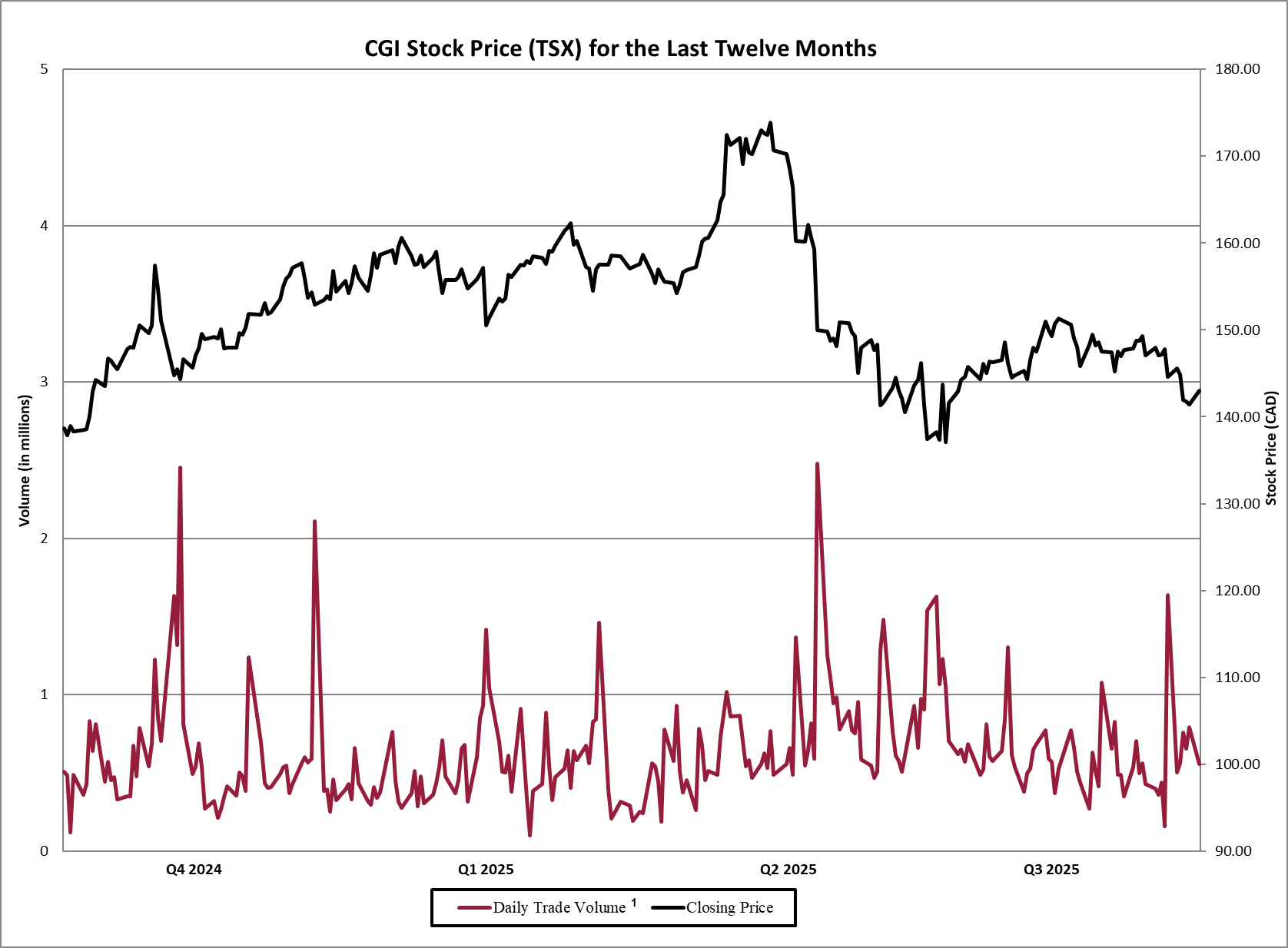
CGI’s shares are listed on the Toronto Stock Exchange (TSX) (stock quote – GIB.A) and the New York Stock Exchange (NYSE) (stock quote – GIB) and are included in key indices such as the S&P/TSX 60 Index.
|
|
|
|
|
|
|
|
|
|
|
|
|
|
|
| TSX |
(CAD) |
|
NYSE |
(USD) |
| Open: |
143.66 |
|
|
Open: |
99.57 |
|
| High: |
152.63 |
|
|
High: |
110.07 |
|
| Low: |
132.09 |
|
|
Low: |
92.85 |
|
| Close: |
143.01 |
|
|
Close: |
104.83 |
|
CDN average daily trading volumes1: |
673,971 |
|
|
NYSE average daily trading volumes: |
279,061 |
|
1 Includes the average daily volumes of both the TSX and alternative trading systems.
Management’s Discussion and Analysis | For the three and nine months ended June 30, 2025 and 2024
2.2.2. Normal Course Issuer Bid (NCIB)
On January 28, 2025, the Company’s Board of Directors authorized and subsequently received regulatory approval from the TSX for the renewal of its NCIB, which allows for the purchase for cancellation of up to 20,196,413 Class A subordinate voting shares (Class A shares) representing 10% of the Company’s public float as of the close of business on January 23, 2025. Class A shares may be purchased for cancellation under the NCIB commencing on February 6, 2025, until no later than February 5, 2026, or on such earlier date when the Company has either acquired the maximum number of Class A shares allowable under the NCIB or elects to terminate the bid.
During the three months ended June 30, 2025, the Company purchased for cancellation 1,919,410 Class A shares under its current NCIB for a total cash consideration of $278.7 million, at a weighted average price of $145.20. In addition, the Company paid for and cancelled 52,700 Class A shares under its current NCIB for a total cash consideration of $7.5 million, which were purchased but were neither paid nor cancelled as at March 31, 2025.
During the nine months ended June 30, 2025, the Company purchased for cancellation 5,181,943 Class A shares under the previous and current NCIB for a total cash consideration of $770.2 million, at a weighted average price of $148.63.
As at June 30, 2025, the Company could purchase up to 16,449,069 Class A shares for cancellation under its current NCIB.
2.2.3. Capital Stock and Options Outstanding
The following table provides a summary of the Capital Stock and Options Outstanding as at July 25, 2025:
|
|
|
|
|
|
| Capital Stock and Options Outstanding |
As at July 25, 2025 |
| Class A subordinate voting shares |
198,795,366 |
| Class B shares (multiple voting) |
24,122,758 |
| Options to purchase Class A subordinate voting shares |
3,051,560 |
2.2.4. Dividends
During the three and nine months ended June 30, 2025, the Company declared and paid quarterly cash dividends for holders of Class A shares and Class B shares (multiple voting) of $0.15 per share representing $33.6 million and $101.8 million, respectively (nil for the three and nine months ended June 30, 2024, respectively).
On July 29, 2025, the Company’s Board of Directors approved a quarterly cash dividend for holders of Class A shares and Class B shares (multiple voting) of $0.15 per share. This dividend is payable on September 19, 2025 to shareholders of record as of the close of business on August 15, 2025.
Future dividends and the amounts will be at the discretion of the Board of Directors after taking into account the Company’s cash flow, earnings, financial position, market conditions and other factors the Board of Directors deems relevant, and will be communicated on a quarterly basis.
Management’s Discussion and Analysis | For the three and nine months ended June 30, 2025 and 2024
2.3. INVESTMENT IN SUBSIDIARIES
On December 13, 2024, the Company acquired all of the issued and outstanding equity interests of Daugherty Systems, Inc. (Daugherty), a professional services firm specializing in artificial intelligence, data analytics, strategic IT consulting, and business advisory services, based in St. Louis, U.S., for a total purchase price of $343.0 million. Daugherty employed approximately 1,100 professionals.
On February 24, 2025, the Company acquired all of the issued and outstanding shares of BJSS Ltd (BJSS), a technology and engineering consultancy known for its IT solutions and software engineering expertise, based in the U.K., for a total purchase price of $1,255.6 million. BJSS employed approximately 2,400 professionals.
On March 20, 2025, the Company acquired all of the issued and outstanding shares of Novatec Holding GmbH (Novatec), a professional services firm specializing in cloud-based solutions, agile software development, digital strategy, and business and IT consulting, based in Germany with operations in Spain. Novatec employed approximately 300 professionals.
On March 24, 2025, the Company acquired all of the issued and outstanding shares of Momentum Technologies Inc. (Momentum), a professional services firm specializing in digital transformation, managed services, cloud computing, and enterprise software development, based in Québec City, Canada. Momentum employed approximately 250 professionals.
Management’s Discussion and Analysis | For the three and nine months ended June 30, 2025 and 2024
3. Financial Review
3.1. BOOKINGS AND BOOK-TO-BILL RATIO
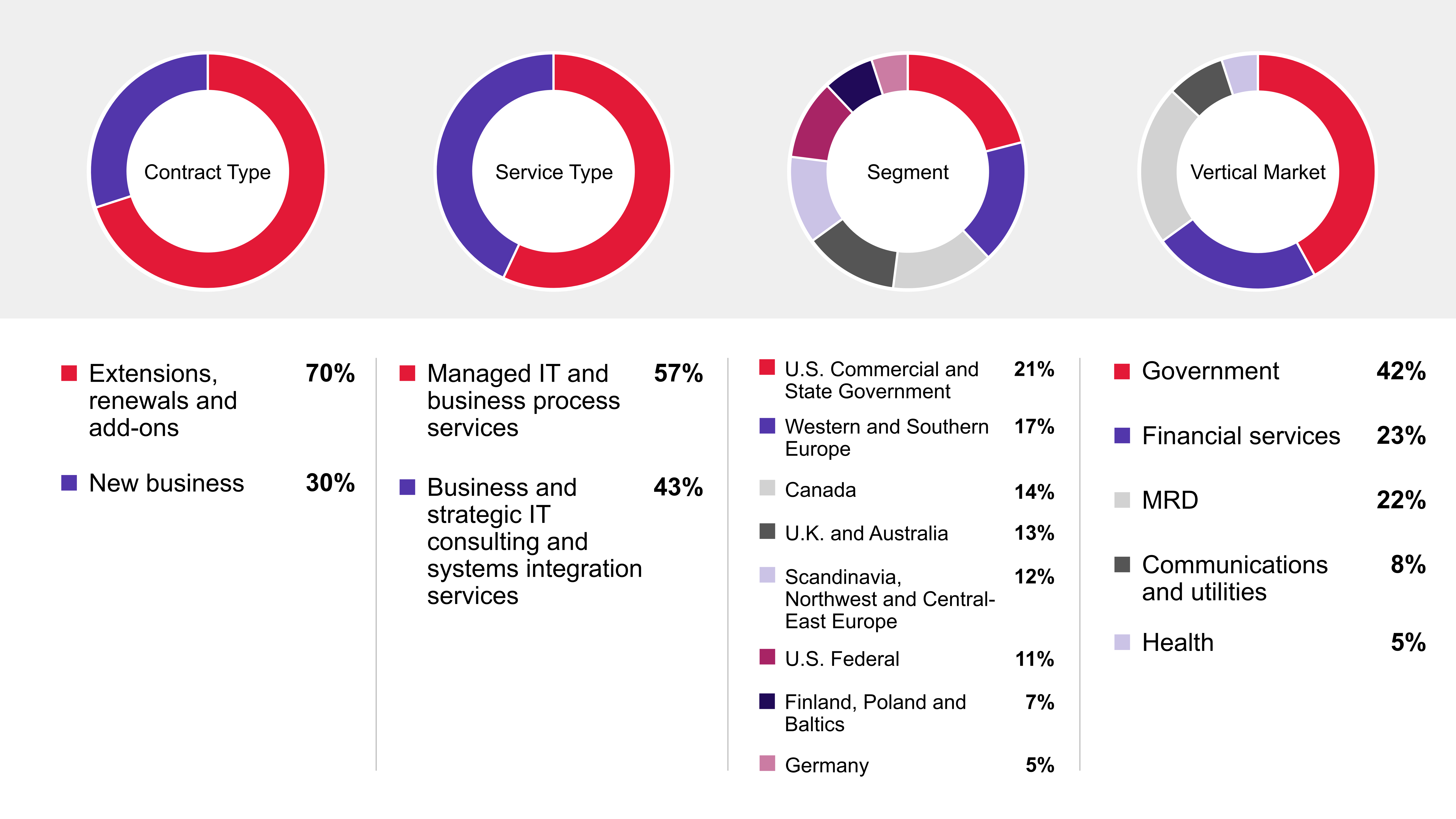
Bookings for the quarter ended June 30, 2025, were $4.1 billion representing a book-to-bill ratio of 101.4%. The breakdown of the new bookings signed during the quarter is as follows:
Information regarding our bookings is a key indicator of the volume of our business over time. Additional information on bookings can be found in the Key Performance Measures section of the present document. The following table provides a summary of the bookings and book-to-bill ratio by segment:
|
|
|
|
|
|
|
|
|
|
|
|
|
|
| In thousands of CAD except for percentages |
|
|
Bookings for the three months ended June 30, 2025 |
Bookings for the trailing twelve months ended June 30, 2025 |
Book-to-bill ratio for the trailing twelve months ended June 30, 2025 |
| Total CGI |
|
|
4,146,160 |
|
16,608,977 |
|
106.7 |
% |
| U.S. Commercial and State Government |
|
|
871,107 |
|
3,695,969 |
|
134.1 |
% |
| Western and Southern Europe |
|
|
691,547 |
|
2,629,879 |
|
102.5 |
% |
| Canada |
|
|
577,978 |
|
2,568,163 |
|
112.1 |
% |
| U.K. and Australia |
|
|
545,031 |
|
1,953,807 |
|
93.7 |
% |
| Scandinavia, Northwest and Central-East Europe |
|
|
481,902 |
|
1,897,341 |
|
110.7 |
% |
| U.S. Federal |
|
|
479,794 |
|
1,567,119 |
|
70.3 |
% |
| Finland, Poland and Baltics |
|
|
282,495 |
|
848,514 |
|
89.0 |
% |
| Germany |
|
|
216,306 |
|
1,448,185 |
|
150.1 |
% |
Management’s Discussion and Analysis | For the three and nine months ended June 30, 2025 and 2024
3.2. FOREIGN EXCHANGE
The Company operates globally and is exposed to changes in foreign currency rates. Accordingly, as prescribed by IFRS Accounting Standards, we measure assets, liabilities and transactions that are measured in foreign currencies using various exchange rates. We report all amounts in Canadian dollars.
Closing foreign exchange rates
|
|
|
|
|
|
|
|
|
|
|
|
As at June 30, |
2025 |
2024 |
Change |
| U.S. dollar |
1.3623 |
1.3686 |
(0.5%) |
| Euro |
1.6031 |
1.4660 |
9.4% |
| Indian rupee |
0.0159 |
0.0164 |
(3.0%) |
| British pound |
1.8689 |
1.7296 |
8.1% |
| Swedish krona |
0.1436 |
0.1291 |
11.2% |
Average foreign exchange rates
|
|
|
|
|
|
|
|
|
|
|
|
|
|
|
|
|
|
|
|
|
|
|
|
|
|
|
|
|
For the three months ended June 30, |
For the nine months ended June 30, |
|
2025 |
2024 |
Change |
2025 |
2024 |
Change |
| U.S. dollar |
1.3842 |
1.3683 |
1.2% |
1.4056 |
1.3597 |
3.4% |
| Euro |
1.5698 |
1.4731 |
6.6% |
1.5241 |
1.4674 |
3.9% |
| Indian rupee |
0.0162 |
0.0164 |
(1.2%) |
0.0164 |
0.0163 |
0.6% |
| British pound |
1.8483 |
1.7267 |
7.0% |
1.8161 |
1.7091 |
6.3% |
| Swedish krona |
0.1433 |
0.1281 |
11.9% |
0.1359 |
0.1285 |
5.8% |
Management’s Discussion and Analysis | For the three and nine months ended June 30, 2025 and 2024
3.3. REVENUE DISTRIBUTION
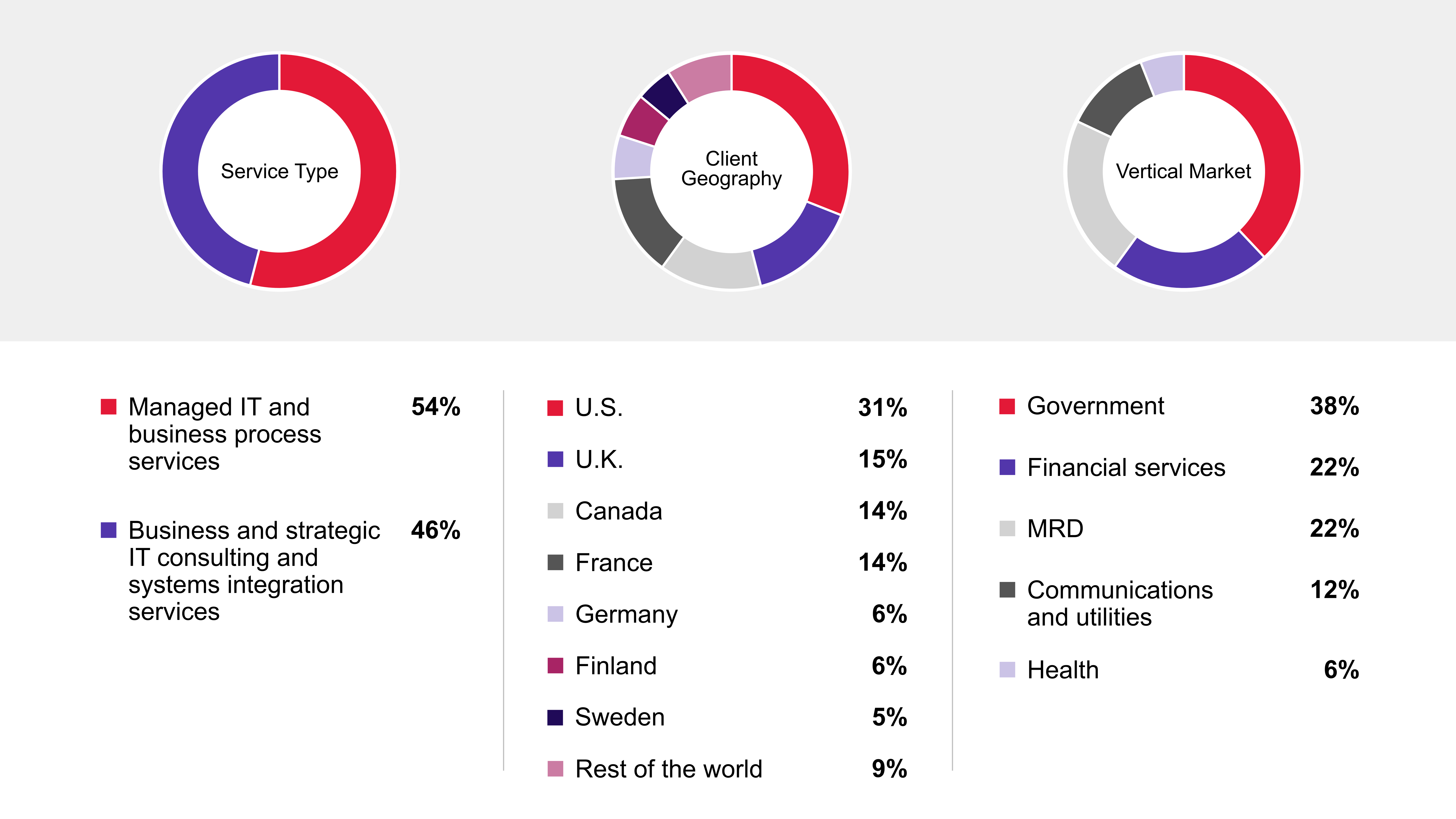
The following charts provide additional information regarding our revenue mix for the quarter:
3.3.1. Client Concentration
IFRS Accounting Standards guidance on segment disclosures defines a single customer as a group of entities that are known to the reporting entity to be under common control. As a consequence, our work for the U.S. federal government including its various agencies represented 13.6% of our revenue for the three months ended June 30, 2025 as compared to 13.5% for the three months ended June 30, 2024.
For the nine months ended June 30, 2025 and 2024, we generated 14.3% and 13.4%, respectively, of our revenue from the U.S. federal government including its various agencies.
Management’s Discussion and Analysis | For the three and nine months ended June 30, 2025 and 2024
3.4. REVENUE BY SEGMENT
Our segments are reported based on where the client's work is delivered from within our geographic delivery model.
The following table provides a summary of the year-over-year changes in our revenue, in total and by segment before eliminations, separately showing the impacts of foreign currency exchange rate variations between Q3 2025 and Q3 2024. For the three and nine months ended June 30, 2025, revenues by segment were recorded reflecting the actual foreign exchange rates for the respective period. The foreign exchange impact is the difference between the current period’s actual results and the same period’s results converted with the prior year’s foreign exchange rates.
|
|
|
|
|
|
|
|
|
|
|
|
|
|
|
|
|
|
|
|
|
|
|
|
For the three months ended June 30, |
For the nine months ended June 30, |
2025 |
2024 |
|
% |
2025 |
2024 |
|
% |
| In thousands of CAD except for percentages |
|
|
|
|
|
|
|
|
|
|
|
|
|
|
|
|
|
|
| Total CGI revenue |
4,090,182 |
3,671,977 |
|
11.4% |
11,898,836 |
11,015,761 |
|
8.0% |
| Constant currency revenue growth |
7.0% |
|
|
|
4.4% |
|
|
|
| Foreign currency impact |
4.4% |
|
|
|
3.6% |
|
|
|
| Variation over previous period |
11.4% |
|
|
|
8.0% |
|
|
|
| Western and Southern Europe |
|
|
|
|
|
|
|
|
| Revenue prior to foreign currency impact |
627,749 |
643,571 |
|
(2.5%) |
1,920,845 |
1,979,354 |
|
(3.0%) |
| Foreign currency impact |
42,577 |
|
|
|
77,304 |
|
|
|
| Western and Southern Europe revenue |
670,326 |
643,571 |
|
4.2% |
1,998,149 |
1,979,354 |
|
0.9% |
| U.S. Commercial and State Government |
|
|
|
|
|
|
|
|
| Revenue prior to foreign currency impact |
637,643 |
592,233 |
|
7.7% |
1,832,576 |
1,748,997 |
|
4.8% |
| Foreign currency impact |
7,658 |
|
|
|
62,688 |
|
|
|
| U.S. Commercial and State Government revenue |
645,301 |
592,233 |
|
9.0% |
1,895,264 |
1,748,997 |
|
8.4% |
| U.S. Federal |
|
|
|
|
|
|
|
|
| Revenue prior to foreign currency impact |
551,690 |
499,046 |
|
10.5% |
1,643,558 |
1,478,563 |
|
11.2% |
| Foreign currency impact |
6,660 |
|
|
|
56,283 |
|
|
|
| U.S. Federal revenue |
558,350 |
499,046 |
|
11.9% |
1,699,841 |
1,478,563 |
|
15.0% |
| Canada |
|
|
|
|
|
|
|
|
| Revenue prior to foreign currency impact |
526,351 |
506,750 |
|
3.9% |
1,581,428 |
1,522,671 |
|
3.9% |
| Foreign currency impact |
283 |
|
|
|
562 |
|
|
|
| Canada revenue |
526,634 |
506,750 |
|
3.9% |
1,581,990 |
1,522,671 |
|
3.9% |
| Scandinavia, Northwest and Central-East Europe |
|
|
|
|
|
|
|
|
| Revenue prior to foreign currency impact |
404,568 |
407,398 |
|
(0.7%) |
1,216,792 |
1,218,436 |
|
(0.1%) |
| Foreign currency impact |
35,484 |
|
|
|
55,197 |
|
|
|
| Scandinavia, Northwest and Central-East Europe revenue |
440,052 |
407,398 |
|
8.0% |
1,271,989 |
1,218,436 |
|
4.4% |
| U.K. and Australia |
|
|
|
|
|
|
|
|
| Revenue prior to foreign currency impact |
534,339 |
390,041 |
|
37.0% |
1,368,336 |
1,163,509 |
|
17.6% |
| Foreign currency impact |
36,482 |
|
|
|
85,641 |
|
|
|
| U.K. and Australia revenue |
570,821 |
390,041 |
|
46.3% |
1,453,977 |
1,163,509 |
|
25.0% |
| Germany |
|
|
|
|
|
|
|
|
| Revenue prior to foreign currency impact |
212,349 |
215,704 |
|
(1.6%) |
641,475 |
670,632 |
|
(4.3%) |
| Foreign currency impact |
14,195 |
|
|
|
25,206 |
|
|
|
| Germany revenue |
226,544 |
215,704 |
|
5.0% |
666,681 |
670,632 |
|
(0.6%) |
|
|
|
|
|
|
|
|
|
Management’s Discussion and Analysis | For the three and nine months ended June 30, 2025 and 2024
|
|
|
|
|
|
|
|
|
|
|
|
|
|
|
|
|
|
|
|
|
|
|
|
For the three months ended June 30, |
For the nine months ended June 30, |
2025 |
2024 |
|
% |
2025 |
2024 |
|
% |
| In thousands of CAD except for percentages |
|
|
|
|
|
|
|
|
| Finland, Poland and Baltics |
|
|
|
|
|
|
|
|
| Revenue prior to foreign currency impact |
221,249 |
220,231 |
|
0.5% |
664,682 |
656,131 |
|
1.3% |
| Foreign currency impact |
14,889 |
|
|
|
27,034 |
|
|
|
| Finland, Poland and Baltics revenue |
236,138 |
220,231 |
|
7.2% |
691,716 |
656,131 |
|
5.4% |
| Asia Pacific |
|
|
|
|
|
|
|
|
| Revenue prior to foreign currency impact |
257,048 |
241,597 |
|
6.4% |
752,663 |
709,122 |
|
6.1% |
| Foreign currency impact |
(2,213) |
|
|
|
6,387 |
|
|
|
| Asia Pacific revenue |
254,835 |
241,597 |
|
5.5% |
759,050 |
709,122 |
|
7.0% |
|
|
|
|
|
| Eliminations |
(38,819) |
(44,594) |
|
(13.0%) |
(119,821) |
(131,654) |
|
(9.0%) |
|
|
|
|
|
|
|
|
|
For the three months ended June 30, 2025, revenue was $4,090.2 million, an increase of $418.2 million or 11.4% over the same period last year. On a constant currency basis, revenue increased by $257.3 million or 7.0%. The increase in revenue was mainly due to recent business acquisitions and organic growth within the government and financial services vertical markets. This was partially offset by lower demand within the MRD vertical market, lower volumes related to our IP enabled business process services in the U.S. Federal segment and one less available day to bill in most segments.
For the nine months ended June 30, 2025, revenue was $11,898.8 million, an increase of $883.1 million or 8.0% over the same period last year. On a constant currency basis, revenue increased by $479.5 million or 4.4%. The increase in revenue was mainly due to recent business acquisitions and organic growth within the government and financial services vertical markets. This was partially offset by lower demand within the MRD and communications and utilities vertical markets and lower volumes related to our IP enabled business process services in the U.S. Federal segment.
3.4.1. Western and Southern Europe
For the three months ended June 30, 2025, revenue in the Western and Southern Europe segment was $670.3 million, an increase of $26.8 million or 4.2% over the same period last year. On a constant currency basis, revenue decreased by
$15.8 million or 2.5%. The change in revenue was mainly due to lower demand within the MRD vertical market and in business consulting services.
For the nine months ended June 30, 2025, revenue in the Western and Southern Europe segment was $1,998.1 million, an increase of $18.8 million or 0.9% over the same period last year. On a constant currency basis, revenue decreased by
$58.5 million or 3.0%. The change in revenue was mainly due to the same factors identified for the quarter.
On a client geographic basis, the top two Western and Southern Europe vertical markets were MRD and financial services, generating combined revenues of approximately $392 million and $1,162 million for the three and nine months ended June 30, 2025, respectively.
3.4.2. U.S. Commercial and State Government
For the three months ended June 30, 2025, revenue in the U.S. Commercial and State Government segment was
$645.3 million, an increase of $53.1 million or 9.0% over the same period last year. On a constant currency basis, revenue increased by $45.4 million or 7.7%. The increase in revenue was mainly due to a recent business acquisition. This was partially offset by the increased use of our Asia Pacific offshore delivery centers for client work and the impact of the reevaluation of cost to complete on a project.
For the nine months ended June 30, 2025, revenue in the U.S. Commercial and State Government segment was
$1,895.3 million, an increase of $146.3 million or 8.4% over the same period last year. On a constant currency basis, revenue increased by $83.6 million or 4.8%. The increase in revenue was mainly due to a recent business acquisition, partially offset by the increased use of our Asia Pacific offshore delivery centers for client work.
Management’s Discussion and Analysis | For the three and nine months ended June 30, 2025 and 2024
On a client geographic basis, the top two U.S. Commercial and State Government vertical markets were financial services and government, generating combined revenues of approximately $404 million for the three months ended June 30, 2025. For the nine months ended June 30, 2025, the top two U.S. Commercial and State Government vertical markets were government and financial services, generating combined revenues of approximately $1,211 million.
3.4.3. U.S. Federal
For the three months ended June 30, 2025, revenue in the U.S. Federal segment was $558.4 million, an increase of
$59.3 million or 11.9% over the same period last year. On a constant currency basis, revenue increased by $52.6 million or 10.5%. The increase in revenue was mainly due to a recent business acquisition and the ramp up of a new project, partially offset by lower volumes related to our IP enabled business process services.
For the nine months ended June 30, 2025, revenue in the U.S. Federal segment was $1,699.8 million, an increase of
$221.3 million or 15.0% over the same period last year. On a constant currency basis, revenue increased by $165.0 million or 11.2%. The increase in revenue was mainly due to a recent business acquisition, partially offset by lower volumes related to our IP enabled business process services.
For the three and nine months ended June 30, 2025, $475 million and $1,440 million of revenues in the U.S. Federal segment were federal civilian based agencies for both periods.
3.4.4. Canada
For the three months ended June 30, 2025, revenue in the Canada segment was $526.6 million, an increase of $19.9 million or 3.9% over the same period last year. On a constant currency basis, revenue increased by $19.6 million or 3.9%. The increase in revenue was mainly due to recent business acquisitions and organic growth within the financial services vertical market. This was partially offset by lower demand within the MRD and communications and utilities vertical markets and one less available day to bill.
For the nine months ended June 30, 2025, revenue in the Canada segment was $1,582.0 million, an increase of $59.3 million or 3.9% over the same period last year. On a constant currency basis, revenue increased by $58.8 million or 3.9%. The increase in revenue was mainly due to recent business acquisitions and organic growth within the financial services vertical market. This was partially offset by lower demand within the MRD and communications and utilities vertical markets.
On a client geographic basis, the top two Canada vertical markets were financial services and government, generating combined revenues of approximately $388 million and $1,148 million for the three and nine months ended June 30, 2025, respectively.
3.4.5. Scandinavia, Northwest and Central-East Europe
For the three months ended June 30, 2025, revenue in the Scandinavia, Northwest and Central-East Europe segment was $440.1 million, an increase of $32.7 million or 8.0% over the same period last year. On a constant currency basis, revenue decreased by $2.8 million or 0.7%. The change in revenue was mainly due to lower demand within the MRD vertical market and one less available day to bill, partially offset by organic growth within the financial services vertical market.
For the nine months ended June 30, 2025, revenue in the Scandinavia, Northwest and Central-East Europe segment was $1,272.0 million, an increase of $53.6 million or 4.4% over the same period last year. On a constant currency basis, revenue decreased by $1.6 million or 0.1%. The change in revenue was mainly due to two less available days to bill, a favourable contract settlement and a project related equipment sale, both in the prior year, and lower demand within the MRD vertical market. This was partially offset by organic growth within the financial services vertical market.
On a client geographic basis, the top two Scandinavia, Northwest and Central-East Europe vertical markets were MRD and government, generating combined revenues of approximately $286 million and $838 million for the three and nine months ended June 30, 2025, respectively.
Management’s Discussion and Analysis | For the three and nine months ended June 30, 2025 and 2024
3.4.6. U.K. and Australia
For the three months ended June 30, 2025, revenue in the U.K. and Australia segment was $570.8 million, an increase of $180.8 million or 46.3% over the same period last year. On a constant currency basis, revenue increased by
$144.3 million or 37.0%. The increase in revenue was mainly due to a recent business acquisition and organic growth within the government vertical market.
For the nine months ended June 30, 2025, revenue in the U.K. and Australia segment was $1,454.0 million, an increase of $290.5 million or 25.0% over the same period last year. On a constant currency basis, revenue increased by $204.8 million or 17.6%. The increase in revenue was mainly due to the same factors identified for the quarter.
On a client geographic basis, the top two U.K. and Australia vertical markets were government and MRD, generating combined revenues of approximately $436 million for the three months ended June 30, 2025. For the nine months ended June 30, 2025, the top two U.K. and Australia vertical markets were government and communications and utilities, generating combined revenues of approximately $1,154 million.
3.4.7. Germany
For the three months ended June 30, 2025, revenue in the Germany segment was $226.5 million, an increase of $10.8 million or 5.0% over the same period last year. On a constant currency basis, revenue decreased by $3.4 million or 1.6%. The change in revenue was mainly due to lower demand within the MRD vertical market and one less available day to bill, partially offset by a recent business acquisition.
For the nine months ended June 30, 2025, revenue in the Germany segment was $666.7 million, a decrease of $4.0 million or 0.6% over the same period last year. On a constant currency basis, revenue decreased by $29.2 million or 4.3%. The change in revenue was mainly due to lower demand within the MRD and the government vertical markets, partially offset by a recent business acquisition.
On a client geographic basis, the top two Germany vertical markets were government and MRD, generating combined revenues of approximately $176 million and $512 million for the three and nine months ended June 30, 2025, respectively.
3.4.8. Finland, Poland and Baltics
For the three months ended June 30, 2025, revenue in the Finland, Poland and Baltics segment was $236.1 million, an increase of $15.9 million or 7.2% over the same period last year. On a constant currency basis, revenue increased by
$1.0 million or 0.5%. The increase in revenue was mainly due to organic growth within most vertical markets, partially offset by one less available day to bill.
For the nine months ended June 30, 2025, revenue in the Finland, Poland and Baltics segment was $691.7 million, an increase of $35.6 million or 5.4% over the same period last year. On a constant currency basis, revenue increased by
$8.6 million or 1.3%. The increase in revenue was mainly due to organic growth within most vertical markets, including IP-based revenue.
On a client geographic basis, the top two Finland, Poland and Baltics vertical markets were financial services and government, generating combined revenues of approximately $135 million and $401 million for the three and nine months ended June 30, 2025, respectively.
3.4.9. Asia Pacific
For the three months ended June 30, 2025, revenue in the Asia Pacific segment was $254.8 million, an increase of
$13.2 million or 5.5% over the same period last year. On a constant currency basis, revenue increased by $15.5 million or 6.4%. The increase in revenue was mainly due to the continued demand for our offshore delivery centers, partially offset by one less available day to bill.
For the nine months ended June 30, 2025, revenue in the Asia Pacific segment was $759.1 million, an increase of
$49.9 million or 7.0% over the same period last year. On a constant currency basis, revenue increased by $43.5 million or 6.1%. The increase in revenue was mainly due to the continued demand for our offshore delivery centers.
Management’s Discussion and Analysis | For the three and nine months ended June 30, 2025 and 2024
3.5. OPERATING EXPENSES
|
|
|
|
|
|
|
|
|
|
|
|
|
|
|
|
|
|
|
|
|
|
|
|
|
|
|
|
|
|
|
|
|
|
|
|
|
|
|
|
|
|
For the three months ended June 30, |
For the nine months ended June 30, |
|
|
2025 |
% of revenue |
2024 |
% of revenue |
|
|
2025 |
% of revenue |
2024 |
% of revenue |
|
|
|
|
|
|
|
|
|
|
|
|
|
|
|
|
|
|
|
|
|
|
|
|
|
| In thousands of CAD except for percentages |
|
|
|
|
|
|
|
|
|
|
|
| Costs of services, selling and administrative |
3,423,833 |
83.7% |
3,070,655 |
83.6% |
|
|
9,955,180 |
83.7% |
9,199,955 |
83.5% |
|
| Foreign exchange loss (gain) |
206 |
—% |
(1,510) |
—% |
|
|
132 |
—% |
286 |
—% |
|
|
|
|
|
|
|
|
|
|
|
|
|
|
|
|
|
|
|
|
|
|
|
|
|
3.5.1. Costs of Services, Selling and Administrative
Costs of services include the costs of serving our clients, which mainly consist of salaries, net of tax credits, performance based compensation and other direct costs, including travel expenses. These also mainly include professional fees and contracted labour costs, as well as hardware, software and delivery center related costs.
Costs of selling and administrative mainly include salaries, performance based compensation, office space, internal solutions, business development related costs such as travel expenses, and other administrative and management costs.
For the three months ended June 30, 2025, costs of services, selling and administrative expenses amounted to
$3,423.8 million, an increase of $353.2 million when compared to the same period last year. As a percentage of revenue, costs of services, selling and administrative expenses increased to 83.7% from 83.6%.
As a percentage of revenue, costs of services increased compared to the same period last year, mainly due to the temporary dilutive impact of recent business acquisitions, lower volumes related to our IP enabled business process services in the U.S. Federal segment and one less available day to bill in most segments.
As a percentage of revenue, costs of selling and administrative expenses decreased compared to the same period last year, mainly due to lower performance based compensation accruals and savings generated from restructuring, partially offset by the temporary dilutive impact of recent business acquisitions.
For the nine months ended June 30, 2025, costs of services, selling and administrative expenses amounted to
$9,955.2 million, an increase of $755.2 million when compared to the same period last year. As a percentage of revenue, costs of services, selling and administrative expenses increased to 83.7% from 83.5%.
As a percentage of revenue, costs of services increased compared to the same period last year, mainly due to the temporary dilutive impact of recent business acquisitions and lower volumes related to our IP enabled business process services in the U.S. Federal segment.
As a percentage of revenue, costs of selling and administrative expenses decreased compared to the same period last year, mainly due to lower performance based compensation accruals, partially offset by the temporary dilutive impact of recent business acquisitions.
During the three months ended June 30, 2025, the translation of the results of our foreign operations from their local currencies to the Canadian dollar unfavourably impacted costs by $131.1 million, which was offset by the favourable translation impact of $160.9 million on our revenue.
During the nine months ended June 30, 2025, the translation of the results of our foreign operations from their local currencies to the Canadian dollar unfavourably impacted costs by $327.6 million, which was offset by the favourable translation impact of $403.6 million on our revenue.
Management’s Discussion and Analysis | For the three and nine months ended June 30, 2025 and 2024
3.5.2. Foreign Exchange Loss
During the three months and nine months ended June 30, 2025, CGI incurred $0.2 million and $0.1 million of foreign exchange losses respectively, mainly driven by the timing of payments combined with the volatility of foreign exchange rates. The Company, in addition to its natural hedges, uses derivatives as a strategy to manage its exposure, to the extent possible.
Management’s Discussion and Analysis | For the three and nine months ended June 30, 2025 and 2024
3.6. EARNINGS BEFORE INCOME TAXES
The following table provides a reconciliation between our earnings before income taxes, which is reported in accordance with IFRS Accounting Standards, and adjusted EBIT:
|
|
|
|
|
|
|
|
|
|
|
|
|
|
|
|
|
|
|
|
|
|
|
|
|
|
|
|
|
|
|
|
For the three months ended June 30, |
For the nine months ended June 30, |
|
|
|
2025 |
% of revenue |
2024 |
% of revenue |
2025 |
% of revenue |
2024 |
% of revenue |
|
|
|
|
|
|
|
|
|
|
|
|
|
|
|
|
|
|
|
|
|
|
|
|
|
|
| In thousands of CAD except for percentage |
|
|
|
|
|
|
|
|
|
|
|
| Earnings before income taxes |
|
551,587 |
13.5% |
593,967 |
16.2% |
1,725,949 |
14.5% |
1,698,539 |
15.4% |
|
|
| Plus the following items: |
|
|
|
|
|
|
|
|
|
|
|
| Restructuring, acquisition and related integration costs |
|
83,695 |
2.0% |
100 |
—% |
163,471 |
1.4% |
93,486 |
0.8% |
|
|
| Restructuring |
|
45,547 |
1.1% |
— |
—% |
98,000 |
0.8% |
— |
—% |
|
|
Cost Optimization Program |
|
— |
—% |
— |
—% |
— |
—% |
91,063 |
0.8% |
|
|
| Acquisition and related integration costs |
|
38,148 |
0.9% |
100 |
—% |
65,471 |
0.6% |
2,423 |
—% |
|
|
| Net finance costs |
|
30,861 |
0.8% |
8,765 |
0.2% |
54,104 |
0.5% |
23,495 |
0.2% |
|
|
| Adjusted EBIT |
|
666,143 |
16.3% |
602,832 |
16.4% |
1,943,524 |
16.3% |
1,815,520 |
16.5% |
|
|
|
|
|
|
|
|
|
|
|
|
|
|
3.6.1. Restructuring, Acquisition and Related Integration Costs
The Company continued executing its restructuring program announced during the three months ended December 31, 2024, most of which continues to be targeted within its Continental European operations. The Company expects to incur approximately $100.0 million to complete the previously announced restructuring program over the remainder of calendar 2025. During the three and nine months ended June 30, 2025, the Company recorded costs for terminations of employment of $45.2 million and $93.0 million, respectively, under this initiative, as well as costs of vacating leased premises of $0.3 million and $5.0 million, respectively.
During the year ended September 30, 2023, the Company initiated a cost optimization program to accelerate actions to improve operational efficiencies, including the increased use of automation and global delivery, and to rightsize its global real estate portfolio. As at March 31, 2024, the Company completed its Cost Optimization Program for a total cost of $100.0 million. During the three and nine months ended June 30, 2024, the Company recorded nil and $91.1 million, respectively of costs under the Cost Optimization Program, which included costs for terminations of employment of nil and $69.5 million, respectively, and costs of vacating leased premises of nil and $21.6 million, respectively.
During the three and nine months ended June 30, 2025, the Company incurred $38.1 million and $65.5 million, respectively, of acquisition and related integration costs ($0.1 million and $2.4 million for the three and nine months ended June 30, 2024, respectively). The acquisition and related integration costs during the three and nine months ended June 30, 2025, were mainly costs related to redundancy of employment of $14.5 million and $23.2 million, respectively ($0.1 million and $0.4 million for the three and nine months ended June 30, 2024, respectively), costs of vacating leased premises of $13.0 million and $14.2 million, respectively (nil and $0.8 million for the three and nine months ended June 30, 2024, respectively), as well as legal and professional fees of nil and $11.2 million respectively (nil and $0.2 million for the three and nine months ended June 30, 2024, respectively).
During the first quarter of Fiscal 2025, the Company combined the previously reported Acquisition-related and integration costs and the Cost Optimization Program into one operating expenses line called Restructuring, acquisition and related integration costs. Comparative figures were combined to align with the new presentation.
Management’s Discussion and Analysis | For the three and nine months ended June 30, 2025 and 2024
3.6.2. Net Finance Costs
Net finance costs mainly include interest on our long-term debt, lease liabilities and financial assets. For the three and nine months ended June 30, 2025, the net finance costs increased by $22.1 million and $30.6 million, respectively, mainly driven by an increase in interest due to the issuance of senior unsecured notes on March 14, 2025, and lower interest on our cash balances.
Management’s Discussion and Analysis | For the three and nine months ended June 30, 2025 and 2024
3.7. ADJUSTED EBIT BY SEGMENT
|
|
|
|
|
|
|
|
|
|
|
|
|
|
|
|
|
|
|
|
|
|
|
|
|
|
|
|
For the three months ended June 30, |
For the nine months ended June 30, |
|
|
2025 |
2024 |
|
Change |
2025 |
2024 |
|
Change |
|
|
|
|
| In thousands of CAD except for percentages |
|
|
|
|
|
|
|
|
|
|
|
|
|
|
|
|
|
|
|
|
|
|
|
|
|
| Western and Southern Europe |
80,255 |
78,097 |
|
2.8% |
261,845 |
269,056 |
|
(2.7%) |
|
|
|
|
| As a percentage of segment revenue |
12.0% |
12.1% |
|
|
13.1% |
13.6% |
|
|
|
|
|
|
| U.S. Commercial and State Government |
95,129 |
94,282 |
|
0.9% |
272,281 |
244,210 |
|
11.5% |
|
|
|
|
| As a percentage of segment revenue |
14.7% |
15.9% |
|
|
14.4% |
14.0% |
|
|
|
|
|
|
| U.S. Federal |
91,992 |
83,515 |
|
10.2% |
243,178 |
228,660 |
|
6.3% |
|
|
|
|
| As a percentage of segment revenue |
16.5% |
16.7% |
|
|
14.3% |
15.5% |
|
|
|
|
|
|
| Canada |
117,900 |
110,169 |
|
7.0% |
361,070 |
352,300 |
|
2.5% |
|
|
|
|
| As a percentage of segment revenue |
22.4% |
21.7% |
|
|
22.8% |
23.1% |
|
|
|
|
|
|
| Scandinavia, Northwest and Central-East Europe |
59,614 |
48,900 |
|
21.9% |
171,006 |
148,649 |
|
15.0% |
|
|
|
|
| As a percentage of segment revenue |
13.5% |
12.0% |
|
|
13.4% |
12.2% |
|
|
|
|
|
|
| U.K. and Australia |
78,154 |
62,292 |
|
25.5% |
214,187 |
189,341 |
|
13.1% |
|
|
|
|
| As a percentage of segment revenue |
13.7% |
16.0% |
|
|
14.7% |
16.3% |
|
|
|
|
|
|
| Germany |
27,343 |
12,825 |
|
113.2% |
78,418 |
64,567 |
|
21.5% |
|
|
|
|
| As a percentage of segment revenue |
12.1% |
5.9% |
|
|
11.8% |
9.6% |
|
|
|
|
|
|
| Finland, Poland and Baltics |
39,085 |
37,155 |
|
5.2% |
105,810 |
94,775 |
|
11.6% |
|
|
|
|
| As a percentage of segment revenue |
16.6% |
16.9% |
|
|
15.3% |
14.4% |
|
|
|
|
|
|
| Asia Pacific |
76,671 |
75,597 |
|
1.4% |
235,729 |
223,962 |
|
5.3% |
|
|
|
|
| As a percentage of segment revenue |
30.1% |
31.3% |
|
|
31.1% |
31.6% |
|
|
|
|
|
|
| Adjusted EBIT |
666,143 |
602,832 |
|
10.5% |
1,943,524 |
1,815,520 |
|
7.1% |
|
|
|
|
| Adjusted EBIT margin |
16.3% |
16.4% |
|
|
16.3% |
16.5% |
|
|
|
|
|
|
For the three months ended June 30, 2025, adjusted EBIT was $666.1 million, an increase of $63.3 million when compared to the same period last year. Adjusted EBIT margin decreased to 16.3% from 16.4%. This was mainly due to the temporary dilutive impact of recent business acquisitions, lower volumes related to our IP enabled business process services in the U.S. Federal segment and one less available day to bill in most segments. This was partially offset by savings generated from restructuring, the impact of the reevaluation of cost to complete on two projects in the prior year, profitable organic growth within the financial services vertical market and lower performance based compensation accruals.
For the nine months ended June 30, 2025, adjusted EBIT was $1,943.5 million, an increase of $128.0 million when compared to the same period last year. Adjusted EBIT margin decreased to 16.3% from 16.5%. This was mainly due to the temporary dilutive impact of recent business acquisitions and lower volumes related to our IP enabled business process services in the U.S. Federal segment. This was partially offset by lower performance based compensation accruals.
3.7.1. Western and Southern Europe
For the three months ended June 30, 2025, adjusted EBIT in the Western and Southern Europe segment was $80.3 million, an increase of $2.2 million when compared to the same period last year. Adjusted EBIT margin decreased to 12.0% from 12.1%. The change in adjusted EBIT margin was mainly due to lower billable utilization, mainly within the MRD vertical market, partially offset by lower performance based compensation accruals.
For the nine months ended June 30, 2025, adjusted EBIT in the Western and Southern Europe segment was $261.8 million, a decrease of $7.2 million when compared to the same period last year. Adjusted EBIT margin decreased to 13.1% from 13.6%. The change in adjusted EBIT margin was mainly due to lower billable utilization, mainly within the MRD vertical market. This
Management’s Discussion and Analysis | For the three and nine months ended June 30, 2025 and 2024
was partially offset by the retroactive impact of a new fringe benefit legislation in France in the prior year and lower performance based compensation accruals.
3.7.2. U.S. Commercial and State Government
For the three months ended June 30, 2025, adjusted EBIT in the U.S. Commercial and State Government segment was
$95.1 million, an increase of $0.8 million when compared to the same period last year. Adjusted EBIT margin decreased to 14.7% from 15.9%. The change in adjusted EBIT margin was mainly due to the temporary dilutive impact of a recent business acquisition and the impact of the reevaluation of cost to complete on a project.
For the nine months ended June 30, 2025, adjusted EBIT in the U.S. Commercial and State Government segment was
$272.3 million, an increase of $28.1 million when compared to the same period last year. Adjusted EBIT margin increased to 14.4% from 14.0%. The increase in adjusted EBIT margin was mainly due to higher billable utilization and an impairment taken on a business solution in the prior year, partially offset by the temporary dilutive impact of a recent business acquisition.
3.7.3. U.S. Federal
For the three months ended June 30, 2025, adjusted EBIT in the U.S. Federal segment was $92.0 million, an increase of
$8.5 million when compared to the same period last year. Adjusted EBIT margin decreased to 16.5% from 16.7%. The change in adjusted EBIT margin was mainly due to lower volumes related to our IP enabled business process services, partially offset by the impact of the reevaluation of cost to complete on a project in the prior year and the ramp up of a new project.
For the nine months ended June 30, 2025, adjusted EBIT in the U.S. Federal segment was $243.2 million, an increase of
$14.5 million when compared to the same period last year. Adjusted EBIT margin decreased to 14.3% from 15.5%. The change in adjusted EBIT margin was mainly due to lower volumes related to our IP enabled business process services and the temporary dilutive impact of a recent business acquisition. This was partially offset by the impact of the reevaluation of cost to complete on a project in the prior year.
3.7.4. Canada
For the three months ended June 30, 2025, adjusted EBIT in the Canada segment was $117.9 million, an increase of
$7.7 million when compared to the same period last year. Adjusted EBIT margin increased to 22.4% from 21.7%. The increase in adjusted EBIT was mainly due to profitable organic growth within the financial services vertical market and higher billable utilization within the communications and utilities vertical market as a result of restructuring actions. This was partially offset by the temporary dilutive impact of recent business acquisitions and one less available day to bill.
For the nine months ended June 30, 2025, adjusted EBIT in the Canada segment was $361.1 million, an increase of
$8.8 million when compared to the same period last year. Adjusted EBIT margin decreased to 22.8% from 23.1%. The change in adjusted EBIT was mainly due to the temporary dilutive impact of recent business acquisitions.
3.7.5. Scandinavia, Northwest and Central-East Europe
For the three months ended June 30, 2025, adjusted EBIT in the Scandinavia, Northwest and Central-East Europe segment was $59.6 million, an increase of $10.7 million when compared to the same period last year. Adjusted EBIT margin increased to 13.5% from 12.0%. The increase in adjusted EBIT was mainly due to savings generated from restructuring and profitable organic growth within the financial services vertical market. This was partially offset by one less available day to bill and lower demand within the MRD vertical market.
For the nine months ended June 30, 2025, adjusted EBIT in the Scandinavia, Northwest and Central-East Europe segment was $171.0 million, an increase of $22.4 million when compared to the same period last year. Adjusted EBIT margin increased to 13.4% from 12.2%. The increase in adjusted EBIT was mainly due to profitable organic growth within most vertical markets, and savings generated from restructuring. This was partially offset by two less available days to bill.
Management’s Discussion and Analysis | For the three and nine months ended June 30, 2025 and 2024
3.7.6. U.K. and Australia
For the three months ended June 30, 2025, adjusted EBIT in the U.K. and Australia segment was $78.2 million, an increase of $15.9 million when compared to the same period last year. Adjusted EBIT margin decreased to 13.7% from 16.0%. The change in adjusted EBIT margin was mainly due to the temporary dilutive impact of a recent business acquisition.
For the nine months ended June 30, 2025, adjusted EBIT in the U.K. and Australia segment was $214.2 million, an increase of $24.8 million when compared to the same period last year. Adjusted EBIT margin decreased to 14.7% from 16.3%. The change in adjusted EBIT margin was mainly due to the temporary dilutive impact of a recent business acquisition and a favourable impact from a settlement with a supplier in the prior year.
3.7.7. Germany
For the three months ended June 30, 2025, adjusted EBIT in the Germany segment was $27.3 million, an increase of
$14.5 million when compared to the same period last year. Adjusted EBIT margin increased to 12.1% from 5.9%. The increase in adjusted EBIT margin was mainly due to the impact of the reevaluation of cost to complete on a project in the prior year and savings generated from restructuring, partially offset by one less available day to bill.
For the nine months ended June 30, 2025, adjusted EBIT in the Germany segment was $78.4 million, an increase of
$13.9 million when compared to the same period last year. Adjusted EBIT margin increased to 11.8% from 9.6%. The increase in adjusted EBIT margin was mainly due to the impact of the reevaluation of cost to complete on a project in the prior year and the successful completion of a project.
3.7.8. Finland, Poland and Baltics
For the three months ended June 30, 2025, adjusted EBIT in the Finland, Poland and Baltics segment was $39.1 million, an increase of $1.9 million when compared to the same period last year. Adjusted EBIT margin decreased to 16.6% from 16.9%. The change in adjusted EBIT margin was mainly due to one less available day to bill.
For the nine months ended June 30, 2025, adjusted EBIT in the Finland, Poland and Baltics segment was $105.8 million, an increase of $11.0 million when compared to the same period last year. Adjusted EBIT margin increased to 15.3% from 14.4%. The increase in adjusted EBIT margin was mainly due to profitable organic growth within most vertical markets including IP-based revenue.
3.7.9. Asia Pacific
For the three months ended June 30, 2025, adjusted EBIT in the Asia Pacific segment was $76.7 million, an increase of
$1.1 million when compared to the same period last year. Adjusted EBIT remained strong at 30.1% compared to 31.3%. The change was mainly due to the revenue mix and one less available day to bill.
For the nine months ended June 30, 2025, adjusted EBIT in the Asia Pacific segment was $235.7 million, an increase of
$11.8 million when compared to the same period last year. Adjusted EBIT margin remained strong at 31.1% compared to 31.6%.
Management’s Discussion and Analysis | For the three and nine months ended June 30, 2025 and 2024
3.8. NET EARNINGS AND EARNINGS PER SHARE
The following table sets out the information supporting the earnings per share calculations:
|
|
|
|
|
|
|
|
|
|
|
|
|
|
|
|
|
|
|
|
|
|
|
|
For the three months ended June 30, |
For the nine months ended June 30, |
2025 |
2024 |
|
Change |
2025 |
2024 |
|
Change |
|
|
|
|
|
|
|
|
|
|
|
|
|
|
|
|
|
|
| In thousands of CAD except for percentage and shares data |
|
|
|
|
|
|
|
|
| Earnings before income taxes |
551,587 |
593,967 |
|
(7.1%) |
1,725,949 |
1,698,539 |
|
1.6% |
| Income tax expense |
142,975 |
153,843 |
|
(7.1%) |
449,019 |
441,747 |
|
1.6% |
| Effective tax rate |
25.9% |
25.9% |
|
|
26.0% |
26.0% |
|
|
| Net earnings |
408,612 |
440,124 |
|
(7.2%) |
1,276,930 |
1,256,792 |
|
1.6% |
| Net earnings margin |
10.0% |
12.0% |
|
|
10.7% |
11.4% |
|
|
|
|
|
|
|
|
|
|
|
| Weighted average number of shares outstanding |
|
|
|
|
|
|
|
|
| Class A subordinate voting shares and Class B multiple voting shares (basic) |
221,781,407 |
227,154,246 |
|
(2.4%) |
223,752,383 |
229,023,242 |
|
(2.3%) |
| Class A subordinate voting shares and Class B multiple voting shares (diluted) |
224,356,551 |
230,540,966 |
|
(2.7%) |
226,568,058 |
232,607,988 |
|
(2.6%) |
| Earnings per share (in dollars) |
|
|
|
|
|
|
|
|
| Basic |
1.84 |
1.94 |
|
(5.2%) |
5.71 |
5.49 |
|
4.0% |
| Diluted |
1.82 |
1.91 |
|
(4.7%) |
5.64 |
5.40 |
|
4.4% |
|
|
|
|
|
|
|
|
|
3.8.1. Income Tax Expense
For the three months ended June 30, 2025, income tax expense was $143.0 million compared to $153.8 million over the same period last year and our effective tax rate remained unchanged at 25.9%. When excluding the tax effects from restructuring, acquisition and related integration costs, the effective tax rate increased to 26.0% from 25.9%, which is mainly explained by the increase in the France minimum income tax charge.
For the nine months ended June 30, 2025, income tax expense was $449.0 million compared to $441.7 million over the same period last year and our effective tax rate remained unchanged at 26.0%. When excluding the tax effects from restructuring, acquisition and related integration costs, the effective tax rate decreased to 25.9% from 26.0%, which is mainly explained by the change in profitability mix in certain geographies, partially offset by the increase in the France minimum income tax charge.
The table in section 3.8.3. shows the year-over-year comparison of the tax rate with the impact of restructuring, acquisition and related integration costs removed.
Based on the enacted rates at the end of Q3 2025 and our current profitability mix, we expect our adjusted effective tax rate to be in the range of 25.5% to 26.5% in subsequent periods.
3.8.2. Weighted Average Number of Shares Outstanding
For Q3 2025, CGI’s basic and diluted weighted average number of shares outstanding decreased compared to Q3 2024 due to the impact of the purchase for cancellation of Class A shares, partially offset by the exercise of stock options. The table in section 3.8.3. shows the year-over-year comparison of the weighted average number of shares outstanding. See note 5 of our interim condensed consolidated financial statements for additional information.
Management’s Discussion and Analysis | For the three and nine months ended June 30, 2025 and 2024
3.8.3. Adjusted Net Earnings and Earnings per Share
The following table provides a reconciliation between our earnings before income taxes, which is reported in accordance with IFRS Accounting Standards, and adjusted net earnings:
|
|
|
|
|
|
|
|
|
|
|
|
|
|
|
|
|
|
|
|
|
|
|
|
|
|
For the three months ended June 30, |
For the nine months ended June 30, |
|
2025 |
2024 |
|
Change |
2025 |
2024 |
|
Change |
| In thousands of CAD except for percentages and shares data |
|
|
|
|
|
|
|
|
|
|
|
|
|
|
|
|
|
|
|
|
|
|
|
|
|
|
|
|
|
| Earnings before income taxes |
|
551,587 |
593,967 |
|
(7.1%) |
1,725,949 |
1,698,539 |
|
1.6% |
| Add back: |
|
|
|
|
|
|
|
|
|
| Restructuring, acquisition and related integration costs |
|
83,695 |
100 |
|
|
163,471 |
93,486 |
|
|
| Restructuring |
|
45,547 |
— |
|
|
98,000 |
— |
|
|
| Cost Optimization Program |
|
— |
— |
|
|
— |
91,063 |
|
|
| Acquisition and related integration costs |
|
38,148 |
100 |
|
|
65,471 |
2,423 |
|
|
|
|
|
|
|
|
|
|
|
|
|
|
|
|
|
|
|
|
|
|
| Adjusted earnings before income taxes |
|
635,282 |
594,067 |
|
6.9% |
1,889,420 |
1,792,025 |
|
5.4% |
|
|
|
|
|
|
|
|
|
|
|
|
|
|
|
|
|
|
|
|
| Income tax expense |
|
142,975 |
153,843 |
|
(7.1%) |
449,019 |
441,747 |
|
1.6% |
| Effective tax rate |
|
25.9% |
25.9% |
|
|
26.0% |
26.0% |
|
|
| Add back: |
|
|
|
|
|
|
|
|
|
| Tax deduction on restructuring, acquisition and related integration costs |
|
22,199 |
22 |
|
|
40,620 |
23,440 |
|
|
| Impact on effective tax rate |
|
0.1% |
—% |
|
|
(0.1%) |
—% |
|
|
| Tax deduction on restructuring |
|
12,397 |
— |
|
|
26,741 |
— |
|
|
| Impact on effective tax rate |
|
0.1% |
—% |
|
|
0.1% |
—% |
|
|
| Tax deduction on Cost Optimization Program |
|
— |
— |
|
|
— |
22,956 |
|
|
| Impact on effective tax rate |
|
—% |
—% |
|
|
—% |
—% |
|
|
| Tax deduction on acquisition and related integration costs |
|
9,802 |
22 |
|
|
13,879 |
484 |
|
|
| Impact on effective tax rate |
|
—% |
—% |
|
|
(0.2%) |
—% |
|
|
| Adjusted income tax expense |
|
165,174 |
153,865 |
|
7.3% |
489,639 |
465,187 |
|
5.3% |
| Adjusted effective tax rate |
|
26.0% |
25.9% |
|
|
25.9% |
26.0% |
|
|
|
|
|
|
|
|
|
|
|
|
|
|
|
|
|
|
|
|
|
|
| Adjusted net earnings |
|
470,108 |
440,202 |
|
6.8% |
1,399,781 |
1,326,838 |
|
5.5% |
| Adjusted net earnings margin |
|
11.5% |
12.0% |
|
|
11.8% |
12.0% |
|
|
|
|
|
|
|
|
|
|
|
|
| Weighted average number of shares outstanding |
|
|
|
|
|
|
|
|
|
| Class A subordinate voting shares and Class B multiple voting shares (basic) |
|
221,781,407 |
227,154,246 |
|
(2.4%) |
223,752,383 |
229,023,242 |
|
(2.3%) |
| Class A subordinate voting shares and Class B multiple voting shares (diluted) |
|
224,356,551 |
230,540,966 |
|
(2.7%) |
226,568,058 |
232,607,988 |
|
(2.6%) |
| Adjusted earnings per share (in dollars) |
|
|
|
|
|
|
|
|
|
|
|
|
|
|
|
|
|
|
|
| Basic |
|
2.12 |
1.94 |
|
9.3% |
6.26 |
5.79 |
|
8.1% |
| Diluted |
|
2.10 |
1.91 |
|
9.9% |
6.18 |
5.70 |
|
8.4% |
|
|
|
|
|
|
|
|
|
|
Management’s Discussion and Analysis | For the three and nine months ended June 30, 2025 and 2024
4. Liquidity
4.1. INTERIM CONDENSED CONSOLIDATED STATEMENTS OF CASH FLOWS
CGI’s growth is financed through a combination of cash flow from operations, drawing on our unsecured committed revolving credit facility, the issuance of long-term debt, and the issuance of equity. One of our financial priorities is to maintain an optimal level of liquidity through the active management of our assets and liabilities as well as our cash flows.
As at June 30, 2025, cash and cash equivalents were $1,130.2 million. Cash included in funds held for clients was
$700.0 million. The following table provides a summary of the generation and use of cash and cash equivalents for the three and nine months ended June 30, 2025 and 2024.
|
|
|
|
|
|
|
|
|
|
|
|
|
|
|
|
|
|
|
|
|
|
|
|
|
|
For the three months ended June 30, |
For the nine months ended June 30, |
|
|
|
|
|
2025 |
2024 |
Change |
2025 |
2024 |
Change |
|
|
|
|
| In thousands of CAD |
|
|
|
|
|
|
|
|
|
|
| Cash provided by operating activities |
486,605 |
496,725 |
(10,120) |
1,571,183 |
1,575,922 |
(4,739) |
|
|
|
|
| Cash (used in) provided by investing activities |
(109,754) |
26,849 |
(136,603) |
(1,878,758) |
(210,195) |
(1,668,563) |
|
|
|
|
| Cash provided by (used in) financing activities |
71,461 |
(519,367) |
590,828 |
369,045 |
(1,639,245) |
2,008,290 |
|
|
|
|
| Effect of foreign exchange rate changes on cash, cash equivalents and cash included in funds held for clients |
7,330 |
16,699 |
(9,369) |
73,993 |
24,008 |
49,985 |
|
|
|
|
| Net increase (decrease) in cash, cash equivalents and cash included in funds held for clients |
455,642 |
20,906 |
434,736 |
135,463 |
(249,510) |
384,973 |
|
|
|
|
Management’s Discussion and Analysis | For the three and nine months ended June 30, 2025 and 2024
4.1.1. Cash Provided by Operating Activities
For the three months ended June 30, 2025, cash provided by operating activities was $486.6 million or 11.9% of revenue compared to $496.7 million or 13.5% of revenue for the same period last year. For the nine months ended June 30, 2025, cash provided by operating activities was $1,571.2 million or 13.2% of revenue compared to $1,575.9 million or 14.3% of revenue for the same period last year.
The following table provides a summary of the generation and use of cash from operating activities:
|
|
|
|
|
|
|
|
|
|
|
|
|
|
|
|
|
|
|
|
|
|
|
|
|
|
For the three months ended June 30, |
For the nine months ended June 30, |
|
|
|
|
|
2025 |
2024 |
Change |
2025 |
2024 |
Change |
|
|
|
|
| In thousands of CAD |
|
|
|
|
|
|
|
|
|
|
|
|
|
|
|
|
|
|
|
|
|
|
|
|
|
|
|
|
|
|
|
|
|
|
|
|
|
|
|
|
|
|
|
| Net earnings |
408,612 |
440,124 |
(31,512) |
1,276,930 |
1,256,792 |
20,138 |
|
|
|
|
| Amortization, depreciation and impairment |
172,843 |
131,535 |
41,308 |
461,767 |
413,809 |
47,958 |
|
|
|
|
| Deferred income tax expense (recovery) |
8,394 |
(27,236) |
35,630 |
(9,821) |
(89,077) |
79,256 |
|
|
|
|
Other adjustments1 |
25,700 |
14,089 |
11,611 |
57,051 |
44,068 |
12,983 |
|
|
|
|
| Cash flow from operating activities before net change in non-cash working capital items and others |
615,549 |
558,512 |
57,037 |
1,785,927 |
1,625,592 |
160,335 |
|
|
|
|
| Net change in non-cash working capital items and others: |
|
|
|
|
|
|
|
|
|
|
| Accounts receivable, work in progress and deferred revenue |
(211,735) |
(84,975) |
(126,760) |
(57,926) |
39,156 |
(97,082) |
|
|
|
|
| Accounts payable and accrued liabilities, accrued compensation and employee-related liabilities and provisions |
134,267 |
52,000 |
82,267 |
(156,363) |
(14,714) |
(141,649) |
|
|
|
|
| Income taxes |
(65,012) |
(9,739) |
(55,273) |
(40,898) |
(70,446) |
29,548 |
|
|
|
|
Others2 |
13,536 |
(19,073) |
32,609 |
40,443 |
(3,666) |
44,109 |
|
|
|
|
| Net change in non-cash working capital items and others |
(128,944) |
(61,787) |
(67,157) |
(214,744) |
(49,670) |
(165,074) |
|
|
|
|
| Cash provided by operating activities |
486,605 |
496,725 |
(10,120) |
1,571,183 |
1,575,922 |
(4,739) |
|
|
|
|
1 Comprised of foreign exchange loss (gain), share-based payment costs and gain on sale of property, plant and equipment and on lease terminations.
2 Comprised of prepaid expenses and other assets, long-term financial assets (excluding long-term receivables), derivative financial instruments, long-term liabilities and retirement benefits obligations.
The decrease of $10.1 million from our cash provided by operating activities during the three months ended June 30, 2025 was mostly due to timing of client collections. This was partially offset by restructuring provisions and the timing of supplier payments.
The decrease of $4.7 million from our cash provided by operating activities during the nine months ended June 30, 2025 was mostly due to timing of client collections, $97.0 million of additional restructuring, acquisition and related integration payments and the timing of supplier payments. This was partially offset by the growth in earnings before amortization, depreciation and impairment and the timing of tax instalment payments.
The timing of our working capital inflows and outflows will always have an impact on the cash flow from operations.
Management’s Discussion and Analysis | For the three and nine months ended June 30, 2025 and 2024
4.1.2. Cash (Used in) Provided by Investing Activities
For the three and nine months ended June 30, 2025, $109.8 million and $1,878.8 million, respectively, were used in investing activities while $26.8 million was provided by and $210.2 million was used in investing activities over the same periods last year, respectively.
The following table provides a summary of the use of cash from investing activities:
|
|
|
|
|
|
|
|
|
|
|
|
|
|
|
|
|
|
|
|
|
|
|
|
|
For the three months ended June 30, |
For the nine months ended June 30, |
|
|
|
|
2025 |
2024 |
Change |
2025 |
2024 |
Change |
|
|
|
|
|
|
|
|
|
|
|
|
|
|
|
|
|
|
|
|
|
|
|
|
|
|
|
|
|
|
|
|
|
|
|
|
|
|
|
|
|
|
|
| In thousands of CAD |
|
|
|
|
|
|
|
|
|
| Business acquisitions (net of cash acquired) |
(1,839) |
(764) |
(1,075) |
(1,592,433) |
(50,155) |
(1,542,278) |
|
|
|
| Loan receivable |
— |
1,898 |
(1,898) |
9,915 |
5,520 |
4,395 |
|
|
|
| Purchase of property, plant and equipment |
(36,058) |
(27,878) |
(8,180) |
(88,866) |
(86,348) |
(2,518) |
|
|
|
| Proceeds from sale of property, plant and equipment |
— |
— |
— |
1,295 |
— |
1,295 |
|
|
|
| Additions to contract costs |
(29,404) |
(22,691) |
(6,713) |
(79,392) |
(71,865) |
(7,527) |
|
|
|
| Additions to intangible assets |
(39,626) |
(40,569) |
943 |
(119,682) |
(120,850) |
1,168 |
|
|
|
| Net change in short-term and long-term investments |
(2,827) |
116,853 |
(119,680) |
(9,595) |
113,503 |
(123,098) |
|
|
|
| Cash (used in) provided by investing activities |
(109,754) |
26,849 |
(136,603) |
(1,878,758) |
(210,195) |
(1,668,563) |
|
|
|
The change of $136.6 million in cash (used in) provided by investing activities during the three months ended June 30, 2025 was mainly due to net impact of proceeds and purchases of our funds held for clients' investments in the prior year.
The change of $1,668.6 million in cash used in investing activities during the nine months ended June 30, 2025 was mainly due to cash used for recent business acquisitions payments related to Daugherty, BJSS, Novatec and Momentum.
Management’s Discussion and Analysis | For the three and nine months ended June 30, 2025 and 2024
4.1.3. Cash Provided by (Used in) Financing Activities
For the three and nine months ended June 30, 2025, $71.5 million and $369.0 million were provided by financing activities respectively, while $519.4 million and $1,639.2 million were used over the same period last year, respectively.
The following table provides a summary of the use of cash from financing activities:
|
|
|
|
|
|
|
|
|
|
|
|
|
|
|
|
|
|
|
|
|
|
For the three months ended June 30, |
For the nine months ended June 30, |
|
2025 |
2024 |
Change |
2025 |
2024 |
Change |
|
|
|
|
|
|
|
|
|
|
|
|
|
|
|
|
|
|
|
|
|
|
|
|
|
|
|
|
|
|
|
|
|
|
| In thousands of CAD |
|
|
|
|
|
|
| Increase of long-term debt |
— |
— |
— |
923,922 |
— |
923,922 |
| Repayment of long-term debt |
— |
(960) |
960 |
— |
(679,085) |
679,085 |
| Settlement of derivative financial instruments |
— |
— |
— |
— |
18,087 |
(18,087) |
| Payment of lease liabilities |
(46,670) |
(40,169) |
(6,501) |
(126,115) |
(118,349) |
(7,766) |
| Net change in clients' funds obligations |
425,949 |
14,818 |
411,131 |
471,101 |
48,743 |
422,358 |
| Purchase for cancellation of Class A subordinate voting shares and related tax |
(286,186) |
(499,284) |
213,098 |
(783,765) |
(885,399) |
101,634 |
| Issuance of Class A subordinate voting shares |
12,882 |
6,841 |
6,041 |
53,798 |
58,486 |
(4,688) |
| Purchase of Class A subordinate voting shares held in trusts |
— |
— |
— |
(13,323) |
(66,847) |
53,524 |
| Withholding taxes remitted on the net settlement of performance share units |
(934) |
(613) |
(321) |
(52,631) |
(14,881) |
(37,750) |
| Cash dividends paid |
(33,580) |
— |
(33,580) |
(101,770) |
— |
(101,770) |
| Repayment of debt assumed in a business acquisition |
— |
— |
— |
(2,172) |
— |
(2,172) |
Cash provided by (used in) financing activities |
71,461 |
(519,367) |
590,828 |
369,045 |
(1,639,245) |
2,008,290 |
The change of $590.8 million in cash provided by (used in) financing activities during the three months ended June 30, 2025 was mainly driven by the net change in clients' funds obligations related to our payroll services and by a decrease in cash used for the repurchase for cancellation of Class A shares under the NCIB program, partially offset by the cash dividends paid.
The change of $2,008.3 million in cash provided by (used in) financing activities during the nine months ended June 30, 2025 was mainly driven by the issuance of senior unsecured notes in March 2025 in the amount of $923.9 million, by the scheduled repayment in full in December 2023 of the unsecured committed term loan credit facility in the amount of $670.4 million (US$500.0 million), the net change in clients' funds obligations related to our payroll services and by a decrease in cash used for the repurchase for cancellation of Class A shares under the NCIB program. This was partially offset by the cash dividends paid.
4.1.4. Effect of Foreign Exchange Rate Changes on Cash, Cash Equivalents and Cash Included in Funds Held for Clients
For the three and nine months ended June 30, 2025, the effect of foreign exchange rate changes on cash, cash equivalents and cash included in funds held for clients had a favourable impact of $7.3 million and $74.0 million, respectively. This amount had no effect on net earnings as it was recorded in other comprehensive income.
Management’s Discussion and Analysis | For the three and nine months ended June 30, 2025 and 2024
4.2. CAPITAL RESOURCES
The following provides a summary of capital resources information as at June 30, 2025:
|
|
|
|
|
|
|
Available |
|
|
|
|
| In thousands of CAD |
|
| Cash and cash equivalents |
1,130,220 |
| Short-term investments |
4,568 |
| Long-term investments |
27,676 |
| Unsecured committed revolving credit facility |
1,496,325 |
Capital resources available1 |
2,658,789 |
1 Excludes cash, term deposits and long-term bonds included in funds held for clients for $700.0 million, $50.0 million and $228.8 million, respectively.
Cash and cash equivalents and investments represented $1,162.5 million. Short-term and long-term investments include corporate bonds with maturities ranging from 91 days to five years, with a credit rating of A- or higher.
CGI was showing a positive working capital (total current assets minus total current liabilities) of $1,130.4 million.
The Company also had $1,496.3 million available under its unsecured committed revolving credit facility and is generating a significant level of cash, which CGI's management currently considers will allow the Company to fund its operations while maintaining adequate levels of liquidity. Letters of credit in the amount of $3.7 million were outstanding against this
$1,500.0 million unsecured committed revolving credit facility.
The Company was in compliance with all of its restrictive covenants contained in its senior unsecured notes and its restrictive covenants and ratios contained in its unsecured committed revolving credit facility.
The tax implications and impact related to the repatriation of cash will not materially affect the Company’s liquidity.
4.3. CONTRACTUAL OBLIGATIONS
We are committed under the terms of contractual obligations which have various expiration dates, primarily related to long-term debt and the rental of premises, computer equipment used in outsourcing contracts and long-term service agreements. Other than an issuance of senior unsecured notes on March 14, 2025 for an amount of $934.0 million, there have been no material changes to these obligations since September 30, 2024.
4.4. FINANCIAL INSTRUMENTS AND HEDGING TRANSACTIONS
We use various financial instruments to help us manage our exposure to fluctuations of foreign currency exchange rates and interest rates. See note 11 of our interim condensed consolidated financial statements for additional information on our financial instruments and hedging transactions.
Management’s Discussion and Analysis | For the three and nine months ended June 30, 2025 and 2024
4.5. SELECTED MEASURES OF CAPITAL RESOURCES AND LIQUIDITY
|
|
|
|
|
|
|
|
|
|
|
|
| As at June 30, |
2025 |
2024 |
|
|
|
| In thousands of CAD except for percentages |
|
|
|
|
|
|
|
|
|
|
|
|
|
|
|
|
|
|
|
|
|
|
|
|
|
|
|
|
|
|
|
|
|
|
|
|
|
|
|
|
|
|
|
|
|
|
|
|
|
|
|
|
|
Reconciliation between long-term debt and lease liabilities1 and net debt: |
|
|
|
|
|
Long-term debt and lease liabilities1 |
4,244,106 |
3,045,603 |
|
|
|
| Minus the following items: |
|
|
|
|
|
| Cash and cash equivalents |
1,130,220 |
1,155,400 |
|
|
|
| Short-term investments |
4,568 |
3,277 |
|
|
|
| Long-term investments |
27,676 |
23,840 |
|
|
|
| Fair value of foreign currency derivative financial instruments related to debt |
(34,154) |
9,125 |
|
|
|
| Net debt |
3,115,796 |
1,853,961 |
|
|
|
| Net debt to capitalization ratio |
23.4% |
17.2% |
|
|
|
| Return on invested capital |
14.6% |
16.1% |
|
|
|
| Days sales outstanding |
43 |
42 |
|
|
|
1 As at June 30, 2025, long-term debt and lease liabilities were $3,575.2 million ($2,437.5 million as at June 30, 2024) and $668.9 million ($608.1 million as at June 30, 2024), respectively, including their current portions.
During the last twelve months, our long-term debt and lease liabilities increased by $1,198.5 million mainly driven by the issuance of senior unsecured notes for an amount of $1,671.0 million partially offset by the scheduled repayment of the senior unsecured notes for an amount of $475.8 million (US$350.0 million).
We use the net debt to capitalization ratio as an indication of our financial leverage in order to realize our Build and Buy profitable growth strategy (see section 1.2. of CGI's MD&A for the year ended September 30, 2024 for additional information on our Build and Buy profitable growth strategy). The net debt to capitalization ratio increased to 23.4% in Q3 2025 from 17.2% in Q3 2024 mostly due to recent business acquisitions and by the repurchase of shares, partially offset by our cash generation during the last four quarters.
ROIC is a measure of the Company’s efficiency in allocating the capital under our control to profitable investments. The return on invested capital ratio decreased to 14.6% in Q3 2025 from 16.1% in Q3 2024. The decrease in ROIC was mainly the result of capital allocated to recent business acquisitions which are in the process of being integrated and restructuring costs.
DSO increased to 43 days at the end of Q3 2025 when compared to 42 days in Q3 2024. This increase is mainly due to lower cash collections relative to our revenue growth.
Management’s Discussion and Analysis | For the three and nine months ended June 30, 2025 and 2024
4.6. GUARANTEES
In the normal course of operations, we may enter into agreements to provide financial or performance assurances to third parties on the sale of assets, business divestitures and guarantees on government and commercial contracts.
In connection with sales of assets and business divestitures, the Company may be required to pay counterparties for costs and losses incurred as a result of breaches in our contractual obligations, including representations and warranties, intellectual property right infringement claims and litigation against counterparties, among others.
While some of the agreements specify a maximum potential exposure, others do not specify a maximum amount or a maturity date or survival period. It is not possible to reasonably estimate the maximum amount that may have to be paid under such guarantees. The amounts are dependent upon the outcome of future contingent events, the nature and likelihood of which cannot be determined at this time. No amount has been accrued in the consolidated balance sheets relating to this type of guarantee or indemnification as at June 30, 2025. The Company does not expect to incur any potential payment in connection with these guarantees that could have a material adverse effect on its interim condensed consolidated financial statements.
In the normal course of business, we may secure bid and performance bonds from third party financial institutions to offer to certain clients, principally governmental entities. In general, we would only be liable for the amount of the bid bonds if we refuse to perform the project once we are awarded the bid. We would also be liable for the performance bonds in the event of a default in the performance of our obligations. As at June 30, 2025, we had committed a total of $269.8 million for these bonds. To the best of our knowledge, the Company complies with our performance obligations under all service contracts for which there was a bid or performance bond, and the ultimate liability, if any, incurred in connection with these guarantees, would not have a material adverse effect on the Company's consolidated results of operations or financial condition.
4.7. CAPABILITY TO DELIVER RESULTS
CGI's management believes that the Company has sufficient capital resources to support ongoing business operations and execute our Build and Buy profitable growth strategy. Our principal and most accretive uses of cash are: to invest in our business (procuring new large managed IT and business process services contracts and developing business and IP solutions); to pursue accretive acquisitions; to purchase for cancellation Class A shares and pay down debt. In terms of financing, we are well positioned to continue executing our four-pillar growth strategy in Fiscal 2025.
To successfully implement the Company's strategy, CGI relies on a strong leadership team, supported by highly knowledgeable consultants and professionals with relevant relationships and significant experience in both IT and our targeted industries. CGI fosters leadership development through the CGI Leadership Institute ensuring continuity and knowledge transfer across the organization. For key positions, a detailed succession plan is established and revised frequently.
As a Company built on human capital, the knowledge of our consultants and professionals are critical to delivering quality service to our clients. Our human resources program allows us to attract and retain the best talent as it provides competitive compensation and benefits, a favourable working environment, training programs and career development opportunities. Employee satisfaction is monitored annually through a Company-wide survey. In addition, a majority of our professionals are owners of CGI through our Share Purchase Plan, which, along with our Profit Participation Plan, allows them to share in the Company's success, further aligning stakeholder interests.
In addition to capital resources and talent, CGI has established the Management Foundation, which encompasses governance policies, organizational models and sophisticated management frameworks for our business units and corporate processes. This robust governance model provides a common business language for managing all operations consistently across the globe, driving a focus on continuous improvement. CGI’s operations maintain appropriate certifications in accordance with service requirements such as ISO and CMMI certification programs.
Management’s Discussion and Analysis | For the three and nine months ended June 30, 2025 and 2024
5. Changes in Accounting Policies
The interim condensed consolidated financial statements for the three and nine months ended June 30, 2025 and 2024 include all adjustments that CGI’s management considers necessary for the fair presentation of its financial position, results of operations, and cash flows.
ADOPTION OF ACCOUNTING STANDARD AMENDMENTS
The following standard amendments have been adopted by the Company on October 1, 2024:
Classification of Liabilities as Current or Non-current and Information about long-term debt with covenants –Amendments to IAS 1
In January 2020, the IASB amended IAS 1 Presentation of Financial Statements, clarifying that the classification of liabilities as current or non-current is based on existing rights at the end of the reporting period, independent of whether the Company will exercise its right to defer settlement of a liability. Subsequently, in October 2022, the IASB introduced additional amendments to IAS 1, emphasizing that covenants for long-term debt, regardless whether the covenants were compliant after the reporting date, should not affect debt classification; instead, companies are required to disclose information about these covenants in the notes accompanying their financial statements.
Supplier Finance Arrangements - Amendments to IAS 7 and IFRS 7
In May 2023, the IASB amended IAS 7 Statement of Cash Flows and IFRS 7 Financial Instruments: Disclosures to introduce new disclosure requirements to enhance the transparency on supplier finance arrangements and their impact on the Company’s liabilities, cash flows and liquidity exposure. The new disclosure requirements include information such as terms and conditions, the carrying amount of liabilities, the range of payment due dates, non-cash changes and liquidity risk information around supplier finance arrangements.
The implementation of these standard amendments resulted in no impact on the Company's interim condensed consolidated financial statements.
ACCOUNTING STANDARD CLARIFICATIONS
International Financial Reporting Interpretations Committee (“IFRIC”) Agenda Decision on Segment Reporting
In 2024, the IFRS Interpretations Committee issued an agenda decision clarifying disclosure requirements for reportable segments under IFRS 8 Operating Segments. The decision emphasizes the need to disclose certain specified items if these are included in the measure of segment profit or loss reviewed by the Chief Operating Decision Maker (CODM) or are otherwise regularly provided to the CODM, even if not included in that measure of segment profit or loss. Following its evaluation of the IFRIC agenda decision, the Company has expanded its segment disclosures to reflect salaries, other employee costs and contracted labour costs. The comparative financial information has been updated accordingly.
FUTURE ACCOUNTING STANDARD CHANGES
There have been no significant updates to future accounting standard changes applicable or consequential to the Company since those disclosed in the annual consolidated financial statements for the year ended September 30, 2024.
Management’s Discussion and Analysis | For the three and nine months ended June 30, 2025 and 2024
6. Critical Accounting Estimates
The Company’s significant accounting policies are described in note 3 of the audited consolidated financial statements for the years ended September 30, 2024 and 2023. Certain of these accounting policies, listed below, require management to make accounting estimates and judgements that affect the reported amounts of assets, liabilities and equity and the accompanying disclosures at the date of the interim condensed consolidated financial statements as well as the reported amounts of revenue and expenses during the reporting period. These accounting estimates are considered critical because they require management to make subjective and/or complex judgements that are inherently uncertain and because they could have a material impact on the presentation of our financial condition, changes in financial condition or results of operations.
|
|
|
|
|
|
|
|
|
|
|
|
|
|
|
|
|
|
|
|
|
| Areas impacted by estimates |
Consolidated balance sheets |
Consolidated statements of earnings |
|
|
Revenue |
Cost of services, selling and administrative |
Amortization and depreciation |
Net finance costs |
Income
taxes |
Revenue recognition1 |
|
|
|
|
|
|
| Goodwill impairment |
|
|
|
|
|
|
| Right-of-use assets and lease liabilities |
|
|
|
|
|
|
| Business combinations |
|
|
|
|
|
|
| Income taxes |
|
|
|
|
|
|
| Litigation and claims |
|
|
|
|
|
|
|
|
|
|
|
|
|
1 Affects the balance sheet through trade accounts receivable, work in progress, provision on revenue-generating contracts and deferred revenue.
Revenue recognition
Relative stand-alone selling price
If an arrangement involves the provision of multiple performance obligations, the total arrangement value is allocated to each performance obligation based on its relative stand-alone selling price. At least on a yearly basis, the Company reviews its best estimate of the stand-alone selling price which is established by using a reasonable range of prices for the various services and solutions offered by the Company based on local market information available. Information used in determining the range is mainly based on recent contracts signed and the economic environment. A change in the range could have a material impact on the allocation of total arrangement value, and therefore on the amount and timing of revenue recognition.
Business and strategic IT consulting and systems integration services under fixed fee arrangements
Revenue from business and strategic IT consulting and systems integration services under fixed-fee arrangements is recognized using the percentage-of-completion method over time, as the Company has no alternative use for the asset created and has an enforceable right to payment for performance completed to date. The Company primarily uses labour costs to measure the progress towards completion. Project managers monitor and re-evaluate project forecasts on a monthly basis. Forecasts are reviewed to consider factors such as: delays in reaching milestones and complexities in the project delivery. Forecasts can also be affected by market risks such as the availability and retention of qualified IT professionals and/or the ability of the subcontractors to perform their obligations within agreed budget and time frames. To the extent that actual labour costs could vary from estimates, adjustments to revenue following the review of the costs to complete on projects are reflected in the period in which the facts that give rise to the revision occur. Whenever the total costs are forecasted to be higher than the total revenue, a provision on revenue-generating contract is recorded.
Management’s Discussion and Analysis | For the three and nine months ended June 30, 2025 and 2024
Goodwill impairment
The carrying value of goodwill is tested for impairment annually or if events or changes in circumstances indicate that the carrying value may be impaired. In order to determine if a goodwill impairment test is required, management reviews different factors on a quarterly basis, such as changes in technological or market environment, changes in assumptions used to derive the weighted average cost of capital and actual financial performance compared to planned performance.
The recoverable amount of each operating segment has been determined based on its value in use calculation, which includes estimates about their future financial performance based on cash flows approved by management. However, factors such as our ability to continue developing and expanding services offered to address emerging business demands and technology trends, a lengthened sales cycle and our ability to hire and retain qualified IT professionals affect future cash flows, and actual results might differ from future cash flows used in the goodwill impairment test. Key assumptions used in goodwill impairment testing are presented in note 12 of the audited consolidated financial statements for the years ended September 30, 2024 and 2023. Historically, the Company has not recorded an impairment charge on goodwill.
Right-of-use assets
Estimates of the lease term
The Company estimates the lease term in order to calculate the value of the lease liability at the initial date of the lease. Management uses judgement to determine the appropriate lease term based on the conditions of each lease. Lease extension or termination options are only considered in the lease term if it is reasonably certain of being exercised. Factors evaluated include value of leasehold improvements required and any potential incentive to take the option.
Discount rate for leases
The discount rate is used to determine the initial carrying amount of the lease liabilities and the right-of-use assets. The Company estimates the incremental borrowing rate for each lease or portfolio of leased assets, as most of the implicit interest rates in the leases are not readily determinable. To calculate the incremental borrowing rate, the Company considers its credit worthiness, the term of the arrangement, any collateral received and the economic environment at the lease date. Lease liabilities are remeasured (along with the corresponding adjustment to the right-of-use asset), whenever the following situations occur:
–a modification in the lease term or a change in the assessment of an option to extend, purchase or terminate the lease, for which the lease liability is remeasured by discounting the revised lease payments using a revised discount rate; and
–a modification in the residual guarantees or in future lease payments due to a change of an index or rate tied to the payments, for which the lease liability is remeasured by discounting the revised lease payments using the initial discount rate determined when setting up the liability.
In addition, upon partial or full termination of a lease, the difference between the carrying amounts of the lease liability and the right-of-use asset is recorded in the consolidated statements of earnings.
Business combinations
Management makes assumptions when determining the acquisition-date fair value of the identifiable tangible and intangible assets acquired and liabilities assumed which involve estimates, such as the forecasting of future cash flows, discount rates and the useful lives of the assets acquired.
Additionally, management's judgement is required in determining whether an intangible asset is identifiable and should be recorded separately from goodwill.
Changes in the above assumptions, estimates and judgements could affect our acquisition-date fair values and therefore could have material impacts on our interim condensed consolidated financial statements. These changes are recorded as part of the purchase price allocation and therefore result in corresponding goodwill adjustments if they occurred during the measurement period, which does not exceed one year. All other subsequent changes are recorded in our consolidated statement of earnings.
Management’s Discussion and Analysis | For the three and nine months ended June 30, 2025 and 2024
Income taxes
Deferred tax assets are recognized for unused tax losses and deductible temporary differences to the extent that it is probable that taxable profit will be available for their utilization. The Company considers the analysis of forecast and future tax planning strategies. Estimates of taxable profit are reviewed each reporting period and updated, based on the forecast by jurisdiction on an undiscounted basis. Due to the uncertainty and the variability of the factors mentioned above, deferred tax assets are subject to change. Management reviews its assumptions on a quarterly basis and adjusts the deferred tax assets when appropriate.
The Company is subject to income tax laws in numerous jurisdictions. Judgement is required in determining the worldwide provision for income taxes as the determination of tax liabilities and assets involves uncertainties in the interpretation of complex tax regulations and requires estimates and assumptions considering the existing facts and circumstances. The Company provides for potential tax liabilities based on the most likely amount of the possible outcomes. Estimates are reviewed each reporting period and updated, based on new information available, and could result in changes to the income tax liabilities and deferred tax liabilities in the period in which such determinations are made.
Litigation and claims
Provisions are recognized when the Company has a present legal or constructive obligation as a result of a past event, it is probable that an outflow of resources embodying economic benefits will be required to settle the obligation and a reliable estimate can be made of the amount of the obligation. The accrued litigation and legal claim provisions are based on historical experience, current trends and other assumptions that are believed to be reasonable under the circumstances. Estimates include the period in which the underlying cause of the claim occurred and the degree of probability of an unfavourable outcome. Management reviews assumptions and facts surrounding outstanding litigation and claims on a quarterly basis, involves external counsel when necessary and adjusts such provisions accordingly. The Company has to be compliant with applicable law in many jurisdictions which increases the complexity of determining the adequate provision following a litigation review. Since the outcome of such litigation and claims is not predictable with assurance, those provisions are subject to change. Adjustments to litigation and claims provisions are reflected in the period when the facts that give rise to an adjustment occur.
Management’s Discussion and Analysis | For the three and nine months ended June 30, 2025 and 2024
7. Integrity of Disclosure
The Board of Directors has the responsibility under its charter and under the securities laws that govern CGI’s continuous disclosure obligations to oversee CGI's compliance with its continuous and timely disclosure obligations, as well as the integrity of the Company's internal controls and management information systems. The Board of Directors carries out this responsibility mainly through its Audit and Risk Management Committee.
CGI's Audit and Risk Management Committee is composed entirely of independent directors who meet the independence and experience requirements of National Instrument 52-110 adopted by the Canadian Securities Administrators as well as those of the New York Stock Exchange (NYSE) and the U.S. Securities and Exchange Commission (SEC). The role and responsibilities of the Audit and Risk Management Committee include: (i) reviewing public disclosure documents containing financial information concerning CGI; (ii) identifying and examining material financial and operating risks to which the Company is exposed, reviewing the various policies and practices of the Company that are intended to manage those risks, and reporting on a regular basis to the Board of Directors concerning risk management; (iii) reviewing and assessing the effectiveness of CGI’s accounting policies and practices concerning financial reporting; (iv) reviewing and monitoring CGI’s internal control procedures, programs and policies and assessing their adequacy and effectiveness; (v) reviewing the adequacy of CGI’s internal audit resources including the mandate and objectives of the internal auditor; (vi) recommending to the Board of Directors the appointment of the external auditor, assessing the external auditor’s independence, reviewing the terms of their engagement, conducting an annual auditor's performance assessment, and pursuing ongoing discussions with them; (vii) reviewing related party transactions in accordance with the rules of the NYSE and other applicable laws and regulations; (viii) reviewing the audit procedures including the proposed scope of the external auditor's examinations; and (ix) performing such other functions as are usually attributed to audit committees or as directed by the Board of Directors. In making its recommendation to the Board of Directors in relation to the annual appointment of the external auditor, the Audit and Risk Management Committee conducts an annual assessment of the external auditor's performance following the recommendations of the Chartered Professional Accountants of Canada. The formal assessment is concluded in advance of the Annual General Meeting of Shareholders and is conducted with the assistance of key CGI employees.
The Company has established and maintains disclosure controls and procedures designed to provide reasonable assurance that material information relating to the Company is made known to the Chief Executive Officer and the Chief Financial Officer by others, particularly during the period in which annual and interim filings are prepared, and that information required to be disclosed by the Company in its annual filings, interim filings or other reports filed or submitted by the Company under Canadian and U.S. securities laws is recorded, processed, summarized and reported within the time periods specified under those laws and the related rules.
The Company has also established and maintains internal control over financial reporting, as defined under National Instrument 52-109 and in Rule 13(a)-15(f) under the U.S. Securities Exchange Act of 1934, as amended. The Company’s internal control over financial reporting is a process designed under the supervision of the Chief Executive Officer and the Chief Financial Officer, and effected by management and other key CGI employees, to provide reasonable assurance regarding the reliability of financial reporting and the preparation of financial statements for external purposes in accordance with IFRS Accounting Standards. However, because of its inherent limitations, internal control over financial reporting may not prevent or detect misstatements on a timely basis.
For the quarter ended June 30, 2025, there was no change in the Company's internal control over financial reporting that materially affected, or is reasonably likely to materially affect the Company's internal controls over financial reporting.
The Company’s assessment and conclusion on the effectiveness of internal controls over financial reporting excludes the controls, policies and procedures of each of Aeyon LLC (Aeyon), the control of which was acquired on September 13, 2024, BJSS, the control of which was acquired on February 24, 2025, Novatec, the control of which was acquired on March 20, 2025, and Momentum, the control of which was acquired on March 24, 2025. The scope limitation is in accordance with section 3.3(1)(b) of National Instrument 52-109, which allows an issuer to limit the design of disclosure controls and procedures and internal control over financial reporting to exclude controls, policies, and procedures of a business that the issuer acquired not more than 365 days before the end of the financial period in question. Aeyon, BJSS, Novatec and
Management’s Discussion and Analysis | For the three and nine months ended June 30, 2025 and 2024
Momentum's aggregated results since the acquisition represented approximately 5.0% of the revenue for the quarter ended and 3.3% for nine months ended June 30, 2025, respectively, and constituted approximately 9.7% of total assets as at June 30, 2025.
Management’s Discussion and Analysis | For the three and nine months ended June 30, 2025 and 2024
8. Risk Environment
8.1. RISKS AND UNCERTAINTIES
While we are confident about our long-term prospects, a number of risks and uncertainties could affect our ability to achieve our strategic vision and objectives for growth. The following risks and uncertainties should be considered when evaluating our potential as an investment.
8.1.1. External Risks
We may be adversely affected by volatile, negative or uncertain economic and political conditions and the effects of these conditions on our clients’ businesses and levels of activity.
Economic and political conditions in the markets in which we operate have a bearing upon the results of our operations, directly and through their effect on the level of business activity of our clients. We can neither predict the impact that current economic and political conditions will have on our future revenue, nor predict changes in economic conditions or future political uncertainty. The level of activity of our clients and potential clients may be affected by an economic downturn or political uncertainty. Clients may cancel, reduce or defer existing contracts and delay entering into new engagements and may decide to undertake fewer IT systems projects resulting in limited implementation of new technology and smaller engagements. Since there may be fewer engagements, competition may increase and pricing for services may decline as competitors may decrease rates to maintain or increase their market share in our industry and this may trigger pricing adjustments related to the benchmarking obligations within our contracts. Economic downturns and political uncertainty make it more difficult to meet business objectives and may divert management’s attention and time from operating and growing our business. Our business, results of operations and financial condition could be negatively affected as a result of these factors.
We may be adversely affected by additional external risks, such as terrorism, armed conflict, labour or social unrest, inflation, tariffs and/or trade wars, rising energy and commodity costs, recession, criminal activity, hostilities, disease, illness or health emergencies, natural disasters and climate change and the effects of these conditions on our clients, our business and on market volatility.
Additional external risks that could adversely impact the markets in which we operate, our industry and our business include terrorism, armed conflict, labour or social unrest, inflation, tariffs and/or trade wars, recession, criminal activity, regional and international hostilities and international responses to these hostilities, and disease, illness or health emergencies that affect local, national or international economies. Additionally, the potential impacts of climate change are unpredictable and natural disasters, sea-level rise, floods, droughts or other weather-related events present additional external risks, as they could disrupt our internal operations or the operations of our clients, impact our employee's health and safety and increase insurance and other operating costs. Climate change risks can arise from physical risks (risks related to the physical effects of climate change), transition risks (risks related to regulatory, legal, technological and market changes), as well as reputational risks related to our management of climate-related issues and our level of disclosure related to such matters (see Our inability to meet regulatory requirements and/or stakeholders expectations of disclosure, management and implementation of ESG initiatives and standards, could have a material adverse effect on our business). Climate change risk, and/or any of these additional external risks, may affect us or affect the financial viability of our clients leading to a reduction of demand and loss of business from such clients. Each of these risks could negatively impact our business, results of operation and financial condition.
As a result of external risks, inflation, tariffs and/or trade wars, and rising energy and commodity costs, global equity and capital markets may experience significant volatility and weakness. Tariffs and/or trade wars, if widespread and prolonged, can lead to volatility in capital markets and slower economic growth. The duration and impact of these events are unknown at this time, nor is the impact on our operations and the market for our securities.
Prolonged periods of inflation could increase our costs and impact our profitability, which could have a material adverse effect on our business and financial condition.
Management’s Discussion and Analysis | For the three and nine months ended June 30, 2025 and 2024
High levels of inflation may subject us to significant cost pressures and lead to market volatility. As a result, governments may adopt initiatives to combat inflation (for example, raising benchmark interest rates), thus increasing our cost of borrowing and decreasing the liquidity of capital markets. Our clients may have difficulty budgeting for external IT services or delay their payment for services provided. High inflation can lead to increased costs of labour and our employee compensation expenses. The heightened economic uncertainty driven by tariffs, the threat of tariffs, and changing government policies, could reignite inflationary pressures, impact central bank policy, and raise recessionary risks. If our costs were to become subject to significant inflationary pressures, we may not be able to fully offset such higher costs through price increases, and there is no assurance that our revenues will increase at the same rate to maintain the same level of profitability. Our inability or failure to do so could harm our business and financial condition.
The imposition of tariffs and retaliatory measures between governments may cause multifaceted effects on the economies in which we operate, including, but not limited to, supply chain disruptions, economic downturn, inflationary pressures, and uncertainty in capital markets. Failure to mitigate the negative effects of tariffs and/or trade wars on our business could adversely affect our business, results of operations and financial condition.
Pandemics may cause disruptions in our operations and the operations of our clients (which may lead to increased risk and frequency of cybersecurity incidents), market volatility and economic disruption, which could adversely affect us.
A pandemic can create significant volatility and uncertainty and economic disruption and can pose the risk that our employees, clients, contractors and business partners may be prevented from, or restricted in, conducting business activities for an indefinite period, including due to the transmission of the disease or to emergency measures or restrictions that may be requested or mandated by governmental authorities. A pandemic may also result in governments worldwide enacting emergency preventive measures, such as the implementation of border closures, travel bans or restrictions, lock-downs, quarantine periods, vaccine mandates or passports, social distancing, testing requirements, stay-at-home and work-from-home policies and the temporary closure of non-essential businesses. These emergency measures and restrictions, and future measures and restrictions taken in response to a pandemic may cause material disruptions to businesses globally and have an adverse impact on global economic conditions and consumer confidence and spending, which could materially adversely affect our business.
Additionally, the onset of a pandemic may affect the financial viability of our clients, and could cause them to exit certain business lines, or change the terms on which they are willing to purchase services and solutions. Clients may also slow down decision-making, delay planned work, seek to terminate existing agreements, not renew existing agreements or be unable to pay us in accordance with the terms of existing agreements.
As a result of increased remote working arrangements due to a pandemic, the exposure to, and reliance on, networked systems and the internet can increase. This can lead to increased risk and frequency of cybersecurity incidents. Cybersecurity incidents can result from unintentional events or deliberate attacks by insiders or third parties, including cybercriminals, competitors, nation-states, and hacktivists. Any of these events could cause or contribute to risk and uncertainty and could adversely affect our business, results of operations and financial condition.
As a result of a pandemic, global equity and capital markets can experience significant volatility and weakness, leading governments and central banks to react with significant monetary and fiscal interventions designed to stabilize economic conditions.
It is not possible to reliably estimate the length and severity of a pandemic or any impact on our financial results, share price and financial condition in future periods. There can be no assurance that our actions taken in response to a pandemic will succeed in preventing or mitigating any negative impacts on our Company, employees, clients, contractors and business partners.
As a foreign private issuer who files using the multijurisdictional disclosure system (MJDS), we are subject to different U.S. securities laws and rules, which could limit our level of disclosure to investors.
We are a “foreign private issuer” for purposes of U.S. securities laws who files disclosure documents using the multijurisdictional disclosure system (MJDS) and, as a result, are not subject to the same requirements that are imposed upon U.S. domestic issuers by the SEC. In particular, we are exempt from the rules and regulations under the U.S. securities laws
Management’s Discussion and Analysis | For the three and nine months ended June 30, 2025 and 2024
related to the furnishing and content of proxy statements, and our officers, directors and principal shareholders are exempt from the reporting and short-swing profit recovery provisions contained in Section 16 of the Securities Exchange Act of 1934 (the “Exchange Act”). We also are exempt from the provisions of Regulation FD under the Exchange Act, which in certain circumstances prohibits the selective disclosure of material non-public information, although we generally attempt to comply with Regulation FD. These exemptions and leniencies may reduce the frequency and scope of information that we disclose relative to the information generally provided by U.S. domestic companies.
It may be difficult to enforce civil liabilities under U.S. securities laws.
The Company is governed by the Business Corporations Act (Quebec) and with its principal place of business in Canada. The enforcement by investors of civil liabilities under U.S. securities laws may be affected adversely by the fact that we are organized under the laws of Canada, that some or all of our officers and directors may be residents of a foreign country, and that a substantial portion of our assets and those of said persons may be located outside the United States.
8.1.2. Risks Related to our Industry
The markets in which we operate are highly competitive.
CGI operates in a global marketplace in which competition among providers of IT services is vigorous. Some of our competitors possess greater financial, marketing and sales resources, and larger geographic scope in certain parts of the world than we do, which, in turn, provides them with additional leverage in the competition for contracts. In certain niche, regional or metropolitan markets, we face smaller competitors with specialized capabilities who may be able to provide competing services with greater economic efficiency. Some of our competitors have more significant operations than we do in lower cost countries that can serve as a platform from which to provide services worldwide on terms that may be more favourable. Increased competition among IT services firms often results in corresponding pressure on prices. There can be no assurance that we will succeed in providing competitively priced services at levels of service and quality that will enable us to maintain and grow our market share.
We derive significant revenue from contracts awarded through competitive bidding processes, which limit the Company's ability to negotiate certain contractual terms and conditions. Risks related to competitive bidding processes also involve substantial cost and managerial time and effort spent by the Company to prepare bids and proposals for contracts that may or may not be awarded to the Company, as well as expenses and delays that may arise if the Company's competitors protest or challenge awards made to the Company pursuant to competitive bidding processes.
Even when a contract is awarded to the Company following a competitive bidding process, we may fail to accurately estimate the resources and costs required to fulfill the contract.
We may not be able to continue developing and expanding service offerings to address emerging business demands and technology trends.
The rapid pace of change in all aspects of IT and the continually declining costs of acquiring and maintaining IT infrastructure mean that we must anticipate changes in our clients’ needs. To do so, we must adapt our services and our solutions so that we maintain and improve our competitive advantage and remain able to provide cost effective services and solutions. Offerings relating to digital, cloud and security services are examples of areas that are continually evolving, as well as changes and developments in artificial intelligence (including generative AI, as well as automation and machine learning) (AI). The markets in which we operate are extremely competitive and there can be no assurance that we will succeed in developing and adapting our business in a timely manner nor that we will be able to penetrate new markets successfully. If we do not keep pace with meeting the evolving needs of clients, including in the emerging field of AI, our ability to retain existing clients and gain new business may be adversely affected. As we expand our offerings of services and solutions, and as we expand such offerings into new markets, we may be exposed to operational, legal, regulatory, ethical, technological and other risks specific to such expanded services and solutions and such new markets. These factors may result in pressure on our revenue, net earnings and resulting cash flow from operations.
Management’s Discussion and Analysis | For the three and nine months ended June 30, 2025 and 2024
We may infringe on the intellectual property rights of others.
Despite our efforts, the steps we take to ensure that our services and offerings do not infringe on the intellectual property rights of third parties may not be adequate to prevent infringement and, as a result, claims may be asserted against us or our clients. We enter into licensing agreements for the right to use intellectual property and may otherwise offer indemnities against liability and damages arising from third-party claims of patent, copyright, trademark or trade secret infringement in respect of our own intellectual property or software or other solutions developed for our clients. In some instances, the amount of these indemnity claims could be greater than the revenue we receive from the client (see Indemnity provisions and guarantees in various agreements to which we are party may require us to compensate our counterparties). Intellectual property claims or litigation could be time-consuming and costly, harm our reputation, require us to enter into additional royalty or licensing arrangements, or prevent us from providing some solutions or services. Any limitation on our ability to sell or use solutions or services that incorporate software or technologies that are the subject of a claim could cause us to lose revenue-generating opportunities or require us to incur additional expenses to modify solutions for future projects.
We may be unable to protect our intellectual property rights.
Our success depends, in part, on our ability to protect our proprietary methodologies, processes, know-how, tools, techniques and other intellectual property that we use to provide our services. Although CGI takes reasonable steps (e.g. available copyright protection and, in some cases, patent protection) to protect and enforce its intellectual property rights, there is no assurance that such measures will be enforceable or adequate. The cost of enforcing our rights, or our inability to protect against infringement or unauthorized copying or use, can be substantial and, in certain cases, may prove to be uneconomic. In addition, the laws of some countries in which we conduct business may offer only limited intellectual property rights protection. Despite our efforts, the steps taken to protect our intellectual property may not be adequate to prevent or deter infringement or other misappropriation of intellectual property, and we may not be able to detect unauthorized use of our intellectual property, or take appropriate steps to enforce our intellectual property rights.
We face risks associated with benchmarking provisions within certain contracts.
Some of our managed IT and business process services contracts contain clauses allowing our clients to externally benchmark the pricing of agreed upon services against those offered by other providers in a peer comparison group. The uniqueness of the client environment should be factored in and, if results indicate a difference outside the agreed upon tolerance, we may be required to work with clients to reset the pricing for their services. There can be no assurance that benchmarks will produce accurate or reliable data, including pricing data. This may result in pressure on our revenue, net earnings and resulting cash flow from operations.
8.1.3. Risks Related to our Business
We may not be able to successfully implement and manage our growth strategy.
CGI’s Build and Buy profitable growth strategy is founded on four pillars of growth: first, profitable organic growth through contract wins, renewals and extensions with new and existing clients in our targeted industries; second, the pursuit of new large long-term managed IT and business process services contracts; third, metro market acquisitions; and fourth, large transformational acquisitions.
Our ability to achieve organic growth is affected by a number of factors outside of our control, including a lengthening of our sales cycle for major managed IT and business process services contracts.
Our ability to grow through metro market and transformational acquisitions requires that we identify suitable acquisition targets that we correctly evaluate their potential as transactions that will meet our financial and operational objectives, and that we successfully integrate them into our business. There can, however, be no assurance that we will be able to identify suitable acquisition targets and consummate additional acquisitions that meet our economic thresholds, or that future acquisitions will be successfully integrated into our operations and yield the tangible accretive value that had been expected. If we are unable to implement our Build and Buy profitable growth strategy, we will likely be unable to maintain our historic or expected growth rates.
Management’s Discussion and Analysis | For the three and nine months ended June 30, 2025 and 2024
Our use of AI and machine learning may present additional risks, including risks associated with the use of AI algorithms and tools, the data sets used to train AI-powered models, the content produced by AI and the complex, developing regulatory environment.
We are making investments in expanding the AI capabilities available in our services and solutions, including the ongoing deployment and improvement of existing machine learning and AI technologies. AI tools and algorithms may rely on third-party AI with unclear intellectual property rights or interests. Intellectual property ownership and license rights, including copyright, of generative and other AI output, have not been fully interpreted by courts or lawmakers, and we cannot predict how future interpretations may impact our business. Certain jurisdictions have enacted, or are considering the enactment, of comprehensive legal compliance frameworks specifically related to AI. Any failure or perceived failure by us, our service providers or our clients to comply with such requirements, if applicable, could have an adverse impact on our business. Additionally, AI decisions or output that are based (partially or solely) on automated processing or profiling, inappropriate or controversial data practices, or insufficient disclosures regarding AI-generated content, may: undermine the decisions, predictions, analysis or solutions AI tools produce; lead to unintentional bias or discrimination; or impair the acceptance of AI solutions, subjecting us to legal liability, regulatory investigations, or competitive, reputational or other harm, which may negatively impact the value of our business, our intellectual property and our brand. The rapid evolution of AI and machine learning may require us to allocate additional resources to help implement AI and machine learning in a responsible and ethical way, in order to minimize unintended or harmful impacts, and may also require us to make investments in the development of proprietary datasets, machine learning models or other systems, which could be costly and negatively impact our profitability.
We may experience fluctuations in our financial results, making it difficult to predict future results.
Our ability to maintain and increase our revenue is affected not only by our success in implementing our Build and Buy profitable growth strategy, but also by a number of other factors, which could cause the Company's financial results to fluctuate. These factors include: (i) our ability to introduce and deliver new services and business solutions; (ii) our potential exposure to a lengthened sales cycle; (iii) the cyclicality of the purchases of our technology services and solutions; (iv) the nature of our client’s business (for example, if a client encounters financial difficulty (including as a result of external risks such as climate change or a pandemic), it may be forced to cancel, reduce or defer existing contracts with us); and (v) the structure of our agreements with clients (for example, some of CGI's agreements with clients contain clauses allowing the clients to benchmark the pricing of services provided by CGI against the prices offered by other providers). These, and other factors, make it difficult to predict financial results for any given period.
Our revenues may be exposed to fluctuations based on our business mix.
The proportion of revenue that we generate from shorter-term system integration and consulting projects (SI&C), versus revenue from long-term managed IT and business process services contracts, will fluctuate at times, affected by acquisitions or other transactions. An increased exposure to revenue from SI&C projects may result in greater quarterly revenue variations, as the revenue from SI&C projects does not provide long-term consistency in revenue.
Our current operations are international in scope, subjecting us to a variety of financial, regulatory, cultural, political and social challenges.
We manage operations in numerous countries around the world including offshore delivery centers. The scope of our operations (including our offshore delivery centers) subjects us to issues that can negatively impact our operations, including: (i) currency fluctuations (see We may be adversely affected by currency fluctuations); (ii) the burden of complying with a wide variety of national and local laws (see Changes in the laws and regulations within the jurisdictions in which we operate may have a material adverse effect on our global business operations and profitability); (iii) the differences in and uncertainties arising from local business culture and practices; (iv) and political, social and economic instability. Any or all of these risks could impact our global business operations and cause our revenue and/or profitability to decline.
Management’s Discussion and Analysis | For the three and nine months ended June 30, 2025 and 2024
We may be unable to integrate new operations, which could impact our ability to achieve our growth and profitability objectives.
The realization of anticipated benefits from mergers, acquisitions and related activities depends, in part, upon our ability to integrate the acquired business, the realization of synergies, efficient consolidation of the operations of the acquired businesses into our existing operations, cost management to avoid duplication, information systems integration, staff reorganization, establishment of controls, procedures and policies, performance of the management team and other employees of the acquired operations as well as cultural alignment.
The successful integration of new operations arising from our acquisition strategy or from large managed IT and business process services contracts requires that a substantial amount of management time and attention be focused on integration tasks. Management time that is devoted to integration activities may detract from management’s normal operations focus with resulting pressure on the revenues and earnings from our existing operations. In addition, we may face complex and potentially time-consuming challenges in implementing uniform standards, controls, procedures and policies across new operations when harmonizing their activities with those of our existing business units. Integration activities can result in unanticipated operational problems, expenses and liabilities.
Following an acquisition closing date, we may remain reliant on a target’s employees, good faith, expertise, historical performance, technical resources and information systems, proprietary information and judgment in providing any transitional services. Accordingly, we may continue to be exposed to adverse developments in the business and affairs of parties with whom we contract.
If we are not successful in executing our integration strategies in a timely and cost-effective manner, we will have difficulty achieving our growth and profitability objectives.
If we are unable to manage the organizational challenges associated with our size, we may not be able to achieve our growth and profitability objectives.
Our culture, standards, core values, internal controls and our policies need to be instilled across newly acquired businesses as well as maintained within our existing operations. To effectively communicate and manage these standards throughout a large global organization is both challenging and time consuming. Newly acquired businesses may be resistant to change and may remain attached to past methods, standards and practices which may compromise our business agility in pursuing opportunities. Cultural differences in various countries may also present barriers to introducing new ideas or aligning our vision and strategy with the rest of the organization. If we cannot overcome these obstacles in maintaining a strategic bond throughout the Company worldwide, we may not be able to achieve our growth and profitability objectives.
Material developments regarding our major commercial clients resulting from mergers or business acquisitions could impair our future prospects and growth strategy.
Consolidation among our clients resulting from mergers and acquisitions may result in loss or reduction of business when the successor business’ IT needs are served by another service provider or are provided by the successor company’s own employees. Growth in a client’s IT needs resulting from acquisitions or operations may mean that we no longer have a sufficient geographic scope or the critical mass to serve the client’s needs efficiently, resulting in the loss of the client’s business and impairing our future prospects. There can be no assurance that we will be able to achieve the objectives of our growth strategy in order to maintain and increase our geographic scope and critical mass in our targeted markets.
Legal proceedings could have a material adverse effect on our business, financial performance and reputation.
During the ordinary course of conducting our business, we may be threatened with, and/or become subject or a party to, a variety of litigation or other claims and suits that arise from time to time. These legal proceedings may involve current and former employees, clients, partners, subcontractors, suppliers, competitors, shareholders, government agencies or others through private actions, class actions, whistleblower claims, administrative proceedings, regulatory actions or other litigation. Regardless of the merits of the claims, the cost to defend current and future litigation may be significant, and such matters can be time-consuming and divert management’s attention and resources. The results of litigation, claims and other legal proceedings are inherently uncertain, and adverse judgments or settlements in some or all of these legal disputes may result
Management’s Discussion and Analysis | For the three and nine months ended June 30, 2025 and 2024
in materially adverse monetary damages, fines, penalties or injunctive relief against us. While we maintain insurance for certain liabilities, there is no assurance that such insurance coverage will be sufficient in type or amount to cover the costs, damages, liabilities or losses that can result from these litigations or claims.
Changes in our tax levels, as well as reviews, audits, investigations and tax proceedings or changes in tax laws or in their interpretation or enforcement, could have a material adverse effect on our net income or cash flow.
In estimating our income tax payable, management uses accounting principles to determine income tax positions that are likely to be sustained by applicable tax authorities. However, there is no assurance that our tax benefits or tax liability will not materially differ from our estimates or expectations. The tax legislation, regulation and interpretation that apply to our operations are continually changing. In addition, future tax benefits and liabilities are dependent on factors that are inherently uncertain and subject to change, including future earnings, future tax rates, and anticipated business mix in the various jurisdictions in which we operate. Moreover, our tax returns are continually subject to review by applicable tax authorities and we are subject to ongoing audits, investigations and tax proceedings in various jurisdictions. These tax authorities determine the actual amounts of taxes payable or receivable, of any future tax benefits or liabilities and of income tax expense that we may ultimately recognize. Tax authorities have disagreed and may in the future disagree with our income tax positions and are taking increasingly aggressive positions in respect of income tax positions, including with respect to intercompany transactions.
Our effective tax rate in the future could be adversely affected by challenges to intercompany transactions, changes in the value of deferred tax assets and liabilities, changes in tax law or in their interpretation or enforcement, changes in the mix of earnings in countries with differing statutory tax rates, the expiration of tax benefits and changes in accounting principles, including the introduction of the Pillar Two model rules designed to ensure large multinational corporations pay a minimum level of tax on income arising in each jurisdiction they operate. Tax rates in the jurisdictions in which we operate may change as a result of shifting economic conditions and tax policies.
A number of countries in which the Company does business have implemented, or are considering implementing, changes in relevant tax, accounting and other laws, regulations and interpretations and the overall tax environment has made it increasingly challenging for multinational corporations to operate with certainty about taxation in many jurisdictions.
Any of the above factors could have a material adverse effect on our net income or cash flow by affecting our operations and profitability, our effective tax rate, the availability of tax credits, the cost of the services we provide, and the availability of deductions for operating losses.
Reductions, eliminations or amendments to government sponsored programs from which we currently benefit may have a material adverse effect on our net earnings or cash flow.
We benefit from government sponsored programs designed to support research and development, labour and economic growth in jurisdictions where we operate. Government programs reflect government policies and depend on various political and economic factors. There can be no assurance that such government programs will continue to be available to the Company in the future, or will not be reduced, amended or eliminated. Any future government program reductions or eliminations or other amendments to the tax credit programs could increase operating or capital expenditures incurred by the Company and have a material adverse effect on its net earnings or cash flow.
We are exposed to credit risks with respect to accounts receivable and work in progress.
In order to sustain our cash flow from operations, we must invoice and collect the amounts owed to us in an efficient and timely manner. Although we maintain provisions to account for anticipated shortfalls in amounts collected from clients, the provisions we take are based on management estimates and on our assessment of our clients’ creditworthiness which may prove to be inadequate in the light of actual results. To the extent that we fail to perform our services in accordance with our contracts and our clients’ reasonable expectations, and to the extent that we fail to invoice clients and to collect the amounts owed to the Company for our services correctly in a timely manner, our collections could suffer, which could materially adversely affect our revenue, net earnings and cash flow. In addition, a prolonged economic downturn may cause clients to curtail or defer projects,
Management’s Discussion and Analysis | For the three and nine months ended June 30, 2025 and 2024
impair their ability to pay for services already provided, and ultimately cause them to default on existing contracts, in each case, causing a shortfall in revenue and impairing our future prospects.
We face risks associated with early termination, modification, delay or suspension of our contractual agreements, and our bookings and backlog may not be indicative of future revenues.
The early termination, modification, delay, or suspension of our contractual agreements may have a material adverse effect on future revenues and profitability. If we should fail to deliver our services according to contractual agreements, some of our clients could elect to terminate, modify, delay or suspend contracts before their agreed expiry date, which would result in a reduction of our revenues and/or earnings and cash flow and may impact the value of our bookings and backlog. In addition, a number of our managed IT and business process services contractual agreements have termination for convenience and change of control clauses according to which a change in the client’s intentions or a change in control of CGI could lead to a termination of these agreements. Early contract termination can also result from the exercise of a legal right or when circumstances that are beyond our control or beyond the control of our client prevent the contract from continuing. In cases of early termination, we may not be able to recover capitalized contract costs and we may not be able to eliminate ongoing costs incurred to support the contract.
We may not be able to successfully estimate the cost, timing and resources required to fulfill our contracts, which could have a material adverse effect on our net earnings.
In order to generate acceptable margins, our pricing for services is dependent on our ability to accurately estimate the costs and timing for completing projects or long-term managed IT and business process services contracts, which can be based on a client's bid specification, sometimes in advance of the final determination of the full scope and design of the contract. In addition, a significant portion of our project-oriented contracts are performed on a fixed-price basis. Billing for fixed-price engagements is carried out in accordance with the contract terms agreed upon with our client, and revenue is recognized based on the percentage of effort incurred to date in relation to the total estimated efforts to be incurred over the duration of the respective contract. These estimates reflect our best judgement regarding the efficiencies of our methodologies and professionals as we plan to apply them to the contracts in accordance with the CGI Client Partnership Management Framework (CPMF), a framework that contains high standards of contract management to be applied throughout the Company. If we fail to apply the CPMF correctly or if we are unsuccessful in accurately estimating the time or resources required to fulfill our obligations under a contract, or if unexpected factors, including those outside of our control (such as labour shortages, supply chain or manufacturing disruptions, inflation, tariffs and/or trade wars and other external risk factors), arise, there may be an impact on costs or the delivery schedule which could have a material adverse effect on our expected net earnings.
We rely on relationships with other providers in order to generate business and fulfill certain of our contracts; if we fail to maintain our relationships with these providers, our business, prospects, financial condition and operating results could be materially adversely affected.
We derive revenue from contracts where we enter into teaming agreements with other providers. In some teaming agreements we are the prime contractor whereas in others we act as a subcontractor. In both cases, we rely on our relationships with other providers to generate business and we expect to continue to do so in the foreseeable future. Where we act as prime contractor, if we fail to maintain our relationships with other providers, we may have difficulty attracting suitable participants in our teaming agreements. Similarly, where we act as subcontractor, if our relationships are impaired, other providers might reduce the work they award to us, award that work to our competitors, or choose to offer the services directly to the client in order to compete with our business. In either case, if we fail to maintain our relationship with these providers or if our relationship with these providers is otherwise impaired, our business, prospects, financial condition and operating results could be materially adversely affected.
Our profitability may be adversely affected if our partners are unable to deliver on their commitments.
Increasingly large and complex contracts may require that we rely on third party subcontractors including software and hardware vendors to help us fulfill our commitments. Under such circumstances, our success depends on the ability of the
Management’s Discussion and Analysis | For the three and nine months ended June 30, 2025 and 2024
third parties to perform their obligations within agreed upon budgets and timeframes. If our partners fail to deliver, our ability to complete the contract may be adversely affected, which could have an unfavourable impact on our profitability.
Indemnity provisions and guarantees in various agreements to which we are party may require us to compensate our counterparties.
In the normal course of business, we enter into agreements that may provide for indemnification and guarantees to counterparties in transactions such as consulting and managed IT and business process services, business divestitures, lease agreements and financial obligations. These indemnification undertakings and guarantees may require us to compensate counterparties for costs and losses incurred as a result of various events, including breaches of representations and warranties, intellectual property right infringement, claims that may arise while providing services or as a result of litigation that may be suffered by counterparties. If we are required to compensate counterparties due to such arrangements and our insurance does not provide adequate coverage, our business, prospects, financial condition and results of operations could be materially adversely affected.
We may not be able to hire or retain enough qualified IT professionals to support our operations.
There is strong demand for qualified individuals in the IT industry. Hiring and retaining a sufficient number of individuals with the desired knowledge and skill set may be difficult. Therefore, it is important that we remain able to successfully attract and retain highly qualified professionals and establish an effective succession plan. If our comprehensive programs aimed at attracting and retaining qualified and dedicated professionals do not ensure that we have staff in sufficient numbers and with the appropriate training, expertise and suitable government security clearances required to serve the needs of our clients, we may have to rely on subcontractors or transfers of staff to fill resulting gaps. If our succession plan fails to identify those with potential or to develop these key individuals, we may be unable to replace key employees who retire or leave the Company and may be required to recruit and/or train new employees. This might result in lost revenue or increased costs, thereby putting pressure on our net earnings.
If we fail to retain our key employees and management, our business could be adversely affected.
The success of our business, in part, depends on the continued employment of certain key employees and senior management. This dependence is important to our business being that personal relationships are fundamental in obtaining and maintaining client engagements. While our Board of Directors annually reviews our succession plan, if we fail to establish an effective succession plan, or if key employees or senior management were unable or unwilling to continue employment, our business could be adversely affected until qualified replacements are retained.
We may be unable to maintain our human resources utilization rates.
In order to maintain our net earnings, it is important that we maintain the appropriate availability of professional resources in each of our geographies by having a high utilization rate while still being able to assign additional resources to new work. Maintaining an efficient utilization rate requires us to forecast our need for professional resources accurately and to manage recruitment activities, professional training programs, attrition rates and restructuring programs appropriately. To the extent that we fail to do so, or to the extent that laws and regulations restrict our ability to do so, our utilization rates may be reduced; thereby having an impact on our revenue and profitability. Conversely, we may find that we do not have sufficient resources to deploy against new business opportunities in which case our ability to grow our revenue would suffer.
If the business awarded to us by various U.S. federal government departments and agencies is limited, reduced or eliminated, our business, prospects, financial condition and operating results could be materially and adversely affected.
We derive a significant portion of our revenue from the services we provide to various U.S. federal government departments and agencies. We expect that this will continue for the foreseeable future. There can be, however, no assurance that each such U.S. federal government department and agency will continue to utilize our services to the same extent, or at all in the future. In the event that a major U.S. federal government department or agency were to limit, reduce, or eliminate the business it awards to us, we might be unable to recover the lost revenue with work from other U.S. federal government departments or agencies or other clients, and our business, prospects, financial condition and operating results could be materially and
Management’s Discussion and Analysis | For the three and nine months ended June 30, 2025 and 2024
adversely affected. Although IFRS Accounting Standards consider a national government and its departments and agencies as a single client, our client base in the U.S. federal government sector is in fact diversified with contracts from many different federal departments and agencies. The U.S. federal government is currently focused on reducing spend through program modification and driving efficiencies. If some or all of CGI Federal Inc.’s portfolio of federal government contracts were cancelled or reduced, if new procurement were cancelled or delayed, or if reductions in contract scope or price were to occur, it could have a material adverse impact on our business, results of operations and financial condition.
Our work with government clients exposes us to additional risks inherent in the government contracting environment.
Changes in government spending policies or budget priorities could directly affect our financial performance. Among the factors that could harm our government contracting business are: the curtailment of governments’ use of consulting and IT services firms; a significant decline in spending by governments in general, or by specific departments or agencies in particular; the adoption of new legislation and/or actions affecting companies that provide services to governments; delays in the payment of our invoices by government; and general economic and political conditions. These or other factors could cause government agencies and departments to reduce their purchases under contracts, to exercise their right to terminate contracts, to issue temporary stop work orders, or not to exercise options to renew contracts, any of which would cause us to lose future revenue. Government spending reductions or budget cutbacks at these departments or agencies could materially harm our continued performance under these contracts, or limit the awarding of additional contracts from these agencies.
Changes in the laws and regulations within the jurisdictions in which we operate may have a material adverse effect on our global business operations and profitability.
Our global operations require us to be compliant with laws and regulations in many jurisdictions on matters such as: anti-corruption, trade restrictions, immigration, taxation, securities, antitrust, data privacy, labour relations, and the environment, amongst others. Complying with these diverse requirements worldwide is a challenge and consumes significant resources. The laws and regulations frequently change and some may impose conflicting requirements which may expose us to penalties for non-compliance and harm our reputation. Furthermore, in some jurisdictions, we may face the absence of effective laws and regulations to protect our intellectual property rights and there may be restrictions on the movement of cash and other assets, on the import and export of certain technologies, and on the repatriation of earnings. Any or all of these risks could impact our global business operations and cause our profitability to decline.
Our business with the U.S. federal government departments and agencies also requires that we comply with complex laws and regulations relating to government contracts. We are routinely subject to audits by U.S. government departments and agencies with respect to compliance therewith. These laws and regulations relate to the integrity of the procurement process, impose disclosure requirements, and address national security concerns, among other matters. On January 21, 2025, an executive order was issued requiring U.S. federal contractors to certify that they do not operate any programs promoting diversity, equity and inclusion that violate any applicable federal anti-distrimination laws. If we fail to comply with these requirements we may be subject to litigation or investigations initiated by government authorities or private actors, or otherwise incur penalties and sanctions, including contract termination, suspension of payments, suspension or debarment from doing business with the federal government, and fines.
There can be no assurance that our ethics and compliance practices will be sufficient to prevent violations of legal and ethical standards.
Our employees, officers, directors, suppliers and other business partners are expected to comply with applicable legal and ethical standards including, without limitation, anti-bribery laws, as well as with our governance policies and contractual obligations. Failure to comply with such laws, policies and contractual obligations could expose us to litigation and significant fines and penalties, and result in reputational harm or being disqualified from bidding on contracts. While we have developed and implemented strong ethics and compliance practices, including through our Code of Ethics, which must be observed by all of our employees, our Third Party Code of Ethics as well as ethics and compliance trainings, there can be no assurance that such practices and measures will be sufficient to prevent violations of legal and ethical standards. Any such failure or violation could have an adverse effect on our business, financial performance and reputation. This risk of improper conduct may
Management’s Discussion and Analysis | For the three and nine months ended June 30, 2025 and 2024
increase as we continue to expand globally, with greater opportunities and demands to do more business with local and new partners.
Changes to, and delays or defects in, our client projects and solutions may subject us to legal liability, which could materially adversely affect our business, operating results and financial condition and may negatively affect our professional reputation.
We create, implement and maintain IT solutions that are often critical to the operations of our clients’ business. Our ability to complete large projects as expected could be adversely affected by unanticipated delays, renegotiations, and changing client requirements. Also, our solutions may suffer from defects that adversely affect their performance; they may not meet our clients’ requirements or may fail to perform in accordance with applicable service levels. Such problems could subject us to legal liability, which could materially adversely affect our business, operating results and financial condition, and may negatively affect our professional reputation. While we typically use reasonable efforts to include provisions in our contracts which are designed to limit our exposure to legal claims relating to our services and the applications we develop, we may not always be able to include such provisions and, where we are successful, such provisions may not protect us adequately or may not be enforceable under some circumstances or under the laws of some jurisdictions.
We are subject to stringent and changing privacy laws, regulations and standards, information security policies and contractual obligations related to data privacy and security. Our actual or perceived failure to comply with such obligations could expose us to government sanctions and cause damage to our brand and reputation.
Our business often requires that our clients’ applications and information, which may include their proprietary information and personal information they manage, be processed and stored on our networks and systems, and in data centers that we manage. We also process and store proprietary information relating to our business, and personal information relating to our employees. The Company is subject to numerous laws and regulations designed to protect information, such as the European Union’s General Data Protection Regulation (GDPR), various laws and regulations in Canada, the U.S. and other countries in which the Company operates governing the protection of health or other personally identifiable information and data privacy. These laws and regulations are increasing in number and complexity and are being adopted and amended with greater frequency, which results in greater compliance risk and cost. The potential financial penalties for non-compliance with these laws and regulations have significantly increased with the adoption of the GDPR. The Company's Chief Data Protection Officer oversees the Company's compliance with the laws that protect the privacy of personal information. The Company faces risks inherent in protecting the security of such personal data which have grown in complexity, magnitude and frequency in recent years. Digital information and equipment are subject to loss, theft or destruction, and services that we provide may become temporarily unavailable as a result of those risks, or upon an equipment or system malfunction. The causes of such failures include human error in the course of normal operations (including from advertent or inadvertent actions or inactions by our employees), maintenance and upgrading activities, as well as hacking, vandalism (including denial of service attacks and computer viruses), theft, and unauthorized access, as well as power outages or surges, floods, fires, natural disasters and many other causes. The measures that we take to protect against all information infrastructure risks, including both physical and logical controls on access to premises and information may prove in some circumstances to be inadequate to prevent the improper disclosure, loss, theft, misappropriation of, unauthorized access to, or destruction of client information, or service interruptions. Such events may expose the Company to financial loss arising from the costs of remediation and those arising from litigation from our clients and third parties (including under the laws that protect the privacy of personal information), claims and damages, as well as expose the Company to government sanctions and damage to our brand and reputation.
We could face legal, reputational and financial risks if we fail to protect our and/or client data from security incidents or cyberattacks.
The volume, velocity and sophistication of security threats and cyber-attacks continue to grow. This includes criminal hackers, hacktivists, state-sponsored organizations, industrial espionage, employee misconduct, and human or technological errors. The current geopolitical instability, as well as the adoption of emerging technologies, such as AI, has exacerbated these threats, which could lead to increased risk and frequency of security and cybersecurity incidents.
As a global IT and business consulting firm providing services to private and public sectors, we process and store increasingly large amounts of data for our clients, including proprietary information and personal information. These activities could
Management’s Discussion and Analysis | For the three and nine months ended June 30, 2025 and 2024
increase through the use of AI. Consequently, our business could be negatively impacted by physical and cyber threats, which could affect our future sales and financial position or increase our costs. An unauthorized disclosure of sensitive or confidential client or employee information, including cyber-attacks or other security breaches, could cause a loss of data, give rise to remediation or other expenses, expose us to liability under federal and state laws, and subject us to litigation and investigations, which could have an adverse effect on our business, cash flows, financial condition and results of operations. These security risks to the Company include potential attacks not only of our own solutions, services and systems, but also those of our clients, contractors, business partners, vendors and other third parties. Moreover, the use of AI may give rise to issues and risks related to harmful content, inaccurate content, bias, intellectual property right infringement or misappropriation, data privacy and cybersecurity, among others, and may also bring the possibility of ethical concerns and/or new or enhanced governmental or regulatory scrutiny, litigation or other legal liability.
The Company’s Chief Security Officer is responsible for overseeing the security of the Company. Any local issue in a business unit could have a global impact on the entire Company, thus visibility and timely escalation on potential issues are key. We seek to detect and investigate all security incidents and to prevent their occurrence or recurrence, by: (i) developing and regularly reviewing policies and standards related to information security, data privacy, physical security and business continuity; (ii) monitoring the Company’s performance against these policies and standards; (iii) developing strategies intended to seek to mitigate the Company’s risks, including through security trainings for all employees to increase awareness of potential cyber threats; (iv) implementing security measures to ensure an appropriate level of control based on the nature of the information and the inherent risks attached thereto, including through access management, security monitoring and testing to mitigate and help detect and respond to attempts to gain unauthorized access to information systems and networks; and (v) working with the industry and governments against cyber threats. However, because of the evolving nature and sophistication of these security threats, there can be no assurance that our safeguards will detect or prevent the occurrence of material cyber breaches, intrusions or attacks.
We are regularly the target of attempted cyber and other security threats and must continuously monitor and develop our information technology networks and infrastructure to detect, address and mitigate the risk of unauthorized access, misuse, computer viruses and other events that could have a security and reputational impact. If security protection does not evolve at the same pace as threats, a growing gap on our level of protection will be created. Technology evolution and global trends like digital transformation, cloud and mobile computing amongst others are disrupting the security operating model, thus security should evolve to address new relevant security requirements and build new capabilities to address the changes. Increasing detection and automated response capabilities are key to improve visibility and contain any negative potential impact. Automating security processes and integrating with IT, business and security solutions could address shortage of technical security staff and avoid introducing human intervention and errors.
Insider or employee cyber and security threats are increasingly a concern for all large companies, including ours. CGI is continuously working to install new, and upgrade its existing, information technology systems and provide employees awareness training around phishing, malware, and other cyber risks to ensure that the Company is protected, to the greatest extent possible, against cyber risks and security breaches. While CGI selects third-party vendors carefully, it does not control their actions. Any problems caused by these third parties, including those resulting from breakdowns or other disruptions in communication services provided by a vendor, failure of a vendor to handle current or higher volumes, cyber-attacks and security breaches at a vendor could adversely affect our ability to deliver solutions and services to our clients and otherwise conduct business.
The Company and certain of its clients, contractors, business partners, vendors and other third parties use open-source services, which can entail risk to end-user security. These open source projects are often created and maintained by volunteers, who do not always have adequate resources and employees for incident response and proactive maintenance even as their projects are critical to the internet economy. Vulnerabilities discovered in these open source services can be exploited by attackers, which could compromise our system infrastructure and/or lead to a loss or breach of personal and/or proprietary information, financial loss, and other irreversible harm.
While our liability insurance policy covers cyber risks, there is no assurance that such insurance coverage will be sufficient in type or amount to cover the costs, damages, liabilities or losses that can result from security breaches, cyber-attacks and other
Management’s Discussion and Analysis | For the three and nine months ended June 30, 2025 and 2024
related breaches. As the cyber threat landscape evolves, and CGI and our clients increase our digital footprint, we may find it necessary to make additional significant investments to protect data and infrastructure. Occurrence of any of the aforementioned security threats could expose the Company, our clients or other third parties to potential liability, litigation, and regulatory action, in addition to loss of client confidence, loss of existing or potential clients, loss of sensitive government contracts, damage to brand and reputation, and other financial loss.
Damage to our reputation may harm our ability to obtain new clients and retain our existing clients.
CGI’s reputation as a capable and trustworthy service provider and long-term business partner is key to our ability to compete effectively in the market for IT services. The nature of our operations exposes us to the potential loss, unauthorized access to, or destruction of our clients’ information, as well as temporary service interruptions. Depending on the nature of the information or services, such events may have a negative impact on how the Company is perceived in the marketplace. Under such circumstances, our ability to obtain new clients and retain existing clients could suffer with a resulting impact on our revenue and net earnings.
Our inability to meet regulatory requirements and/or stakeholders expectations of disclosure, management and implementation of ESG initiatives and standards, could have an adverse effect on our business.
Certain shareholders, investors, clients, employees and other stakeholders take the view that ESG issues have become a current and imminent concern. As such, perceptions of our operations held by our stakeholders may depend, in part, on the ESG initiatives and standards that we have chosen to implement, or not to implement, and in the former case whether or not we meet them.
We are subject to evolving regulatory requirements, which can both be contradictory and vary significantly by jurisdiction. In some jurisdictions, we have set a number of ambitious ESG commitments and targets to monitor our ESG performance and align our strategic imperatives, including without limitation, our commitment to net-zero carbon emissions as defined under Scope 1, 2, and the business travel of Scope 3 of the greenhouse gas protocol. Where applicable, our ability to meet and adapt to a variety of applicable requirements and to meet and achieve these commitments and targets depends on many factors and is subject to many risks that could cause our assumptions or estimates to be inaccurate and cause actual results or events to differ materially from those expressed in, or implied by, these requirements, commitments and targets. Where applicable, the failure to effectively manage and sufficiently report ESG matters could lead to negative business, financial, legal and regulatory consequences for the Company.
Our revenue and profitability may decline and the accuracy of our financial reporting may be impaired if we fail to design, implement, monitor and maintain effective internal controls.
Due to the inherent limitations of internal controls including the circumvention or overriding of controls, or fraud, there can only be reasonable assurance that the Company’s internal controls will detect and prevent a misstatement. If the Company is unable to design, implement, monitor and maintain effective internal controls throughout its different business environments, the efficiency of our operations might suffer, resulting in a decline in revenue and profitability, and the accuracy of our financial reporting could be impaired.
Future funding requirements may affect our business and growth opportunities and we may not have access to favourable financing opportunities in the future.
The Company’s future growth is contingent on the execution of its business strategy, which, in turn, is dependent on its ability to grow the business organically as well as through business acquisitions. In the event we would need to raise additional funds through equity or debt financing to fund any currently unidentified or unplanned future acquisitions and other growth opportunities, there can be no assurance that such financing will be available in amounts and on terms acceptable to us. Factors such as capital market disruptions, interest rate changes, inflation, tariffs and/or trade wars, recession, political, economic and financial market instability, government policies, central bank monetary policies, and changes to bank regulations, could reduce the availability of capital or increase the cost of such capital. Our ability to raise the required funding depends on prevailing market conditions, the capacity of the capital markets to meet our equity and/or debt financing needs in a timely fashion and on the basis of interest rates and/or share prices that are reasonable in the context of our commercial
Management’s Discussion and Analysis | For the three and nine months ended June 30, 2025 and 2024
objectives. Increasing interest rates, volatility in our share price, rising inflation, tariffs and/or trade wars and the capacity of our current lenders to meet our additional liquidity requirements are all factors that may have a material adverse effect on any acquisitions or growth activities that we may, in the future, identify or plan. If we are unable to obtain the necessary funding, we may be unable to achieve our growth objectives.
The inability to service our debt and other financial obligations, or our inability to fulfill our financial covenants, could have a material adverse effect on our business, financial condition and results of operations.
The Company has a substantial amount of debt and significant interest payment requirements. A portion of cash flows from operations goes to the payment of interest on the Company’s indebtedness. The Company’s ability to service its debt and other financial obligations is affected by prevailing economic conditions in the markets that we serve and financial, business and other factors, many of which are beyond our control. We may be unable to generate sufficient cash flow from operations and future borrowings or other financing may be unavailable in an amount sufficient to enable us to fund our future financial obligations or our other liquidity needs. In addition, we are party to a number of financing agreements, including our credit facility, and the indentures governing our senior unsecured notes, which agreements, indentures and instruments contain financial and other covenants, including covenants that require us to maintain financial ratios and/or other financial or other covenants. If we were to breach the covenants contained in our financing agreements, we may be required to redeem, repay, repurchase or refinance our existing debt obligations prior to their scheduled maturity and our ability to do so may be restricted or limited by the prevailing conditions in the capital markets, available liquidity and other factors. Our inability to service our debt and other financial obligations, or our inability to fulfill our financial or other covenants in our financing agreements, could have an adverse effect on our business, financial condition and results of operations.
We may be adversely affected by interest rate fluctuations.
Although a significant portion of the Company’s indebtedness bears interest at fixed rates, the Company remains exposed to interest rate risk under its credit facility. If interest rates increase, debt service obligations on the variable rate indebtedness would increase even though the amount borrowed remained the same, and net income and cash flows would decrease, which could materially adversely affect the Company’s financial condition and operating results.
Changes in the Company’s creditworthiness or credit ratings could affect the cost at which the Company can access capital or credit markets.
The Company and each of the U.S. dollar denominated and Canadian dollar denominated senior unsecured notes received credit ratings. Credit ratings are generally evaluated and determined by independent third parties and may be impacted by events outside of the Company’s control, as well as other material decisions made by the Company. Credit rating agencies perform independent analysis when assigning credit ratings and such analysis includes a number of criteria. Such criteria are reviewed on an on-going basis and are therefore subject to change. Any rating assigned to the Company or to our debt securities may be revised or withdrawn entirely by a rating agency if, in that rating agency’s judgment, future circumstances relating to the basis of the rating, such as adverse changes, so warrant. Real or anticipated changes in the perceived creditworthiness of the Company and/or in the credit rating of its debt obligations could affect the market value of such debt obligations and the ability of the Company to access capital or credit markets, and/or the cost at which it can do so.
We may be adversely affected by currency fluctuations.
The majority of our revenue and costs are denominated in currencies other than the Canadian dollar. Foreign exchange fluctuations impact the results of our operations as they are reported in Canadian dollars. This risk is partially mitigated by a natural hedge in matching our costs with revenue denominated in the same currency and through the use of derivatives in our global hedging strategy. However, as we continue our global expansion, natural hedges may begin to diminish and the use of hedging contracts exposes us to the risk that financial institutions could fail to perform their obligations under our hedging instruments. Furthermore, there can be no assurance that our hedging strategy and arrangements will offset the impact of fluctuations in currency exchange rates, which could materially adversely affect our business revenues, results of operations, financial condition or prospects. Other than the use of financial products to deliver on our hedging strategy, we do not trade derivative financial instruments.
Management’s Discussion and Analysis | For the three and nine months ended June 30, 2025 and 2024
Our functional and reporting currency is the Canadian dollar. As such, our European, U.S., U.K., Asian and Australian investments, operations and assets are exposed to net change in currency exchange rates. Volatility in exchange rates could have an adverse effect on our business, financial condition and results of operations.
Our ability to declare and pay dividends is subject to discretion and future performance.
We have announced a dividend program providing for a cash dividend on our Class A shares and our Class B shares (multiple voting). There can be no assurance as to our ability to declare and pay dividends in accordance with the dividend program, whether or when we will declare and pay dividends in the future, or the frequency or amount of any such dividend. Our ability to declare and pay dividends will depend on various factors that are not presently known, including our future operating cash flows, sources of capital, the satisfaction of solvency tests and other financial requirements, our operations and financial results, our potential alternative uses of cash, such as acquisitions, our ability to repatriate cash from our subsidiaries, as well as our periodic review of our dividend program and other policies.
8.2. LEGAL PROCEEDINGS
The Company is involved in legal proceedings, audits, claims and litigation arising in the ordinary course of its business. Certain of these matters seek damages in significant amounts. Although the outcome of such matters is not predictable with assurance, the Company has no reason to believe that the disposition of any such current matter could reasonably be expected to have a material adverse effect on the Company’s financial position, results of operations or the ability to carry on any of its business activities.
Management’s Discussion and Analysis | For the three and nine months ended June 30, 2025 and 2024
Transfer Agent
Computershare Investor Services Inc.
+1(800) 564-6253
Investor Relations
Kevin Linder
Senior Vice-President, Investor Relations
Telephone: +1(905) 973-8363
kevin.linder@cgi.com
1350 René-Lévesque Boulevard West
25th Floor
Montréal, Quebec
H3G 1T4
Canada
cgi.com
 エドガーで原本を確認する