0001841425false2024FY0.5iso4217:USDxbrli:sharesiso4217:USDxbrli:sharesxbrli:purecenqu:votecenqu:membercenqu:segment00018414252024-01-012024-12-310001841425cenqu:ClassACommonStockParValue00001PerShareMember2024-01-012024-12-310001841425cenqu:WarrantsEachWholeWarrantExercisableForOneShareOfClassACommonStockAtAnExercisePriceOf1150PerShareMember2024-01-012024-12-3100018414252024-06-280001841425us-gaap:CommonClassAMember2025-03-280001841425us-gaap:CommonClassCMember2025-03-2800018414252024-12-3100018414252023-12-310001841425us-gaap:RelatedPartyMember2024-12-310001841425us-gaap:RelatedPartyMember2023-12-310001841425us-gaap:CommonClassAMember2023-12-310001841425us-gaap:CommonClassAMember2024-12-310001841425us-gaap:CommonClassCMember2024-12-310001841425us-gaap:CommonClassCMember2023-12-3100018414252023-01-012023-12-310001841425us-gaap:CommonClassAMember2024-01-012024-12-310001841425us-gaap:CommonClassAMember2023-01-012023-12-310001841425srt:ScenarioPreviouslyReportedMembercenqu:MembersEquityMember2022-12-310001841425srt:ScenarioPreviouslyReportedMemberus-gaap:CommonStockMemberus-gaap:CommonClassAMember2022-12-310001841425srt:ScenarioPreviouslyReportedMemberus-gaap:CommonStockMemberus-gaap:CommonClassCMember2022-12-310001841425srt:ScenarioPreviouslyReportedMemberus-gaap:AdditionalPaidInCapitalMember2022-12-310001841425srt:ScenarioPreviouslyReportedMemberus-gaap:RetainedEarningsMember2022-12-310001841425srt:ScenarioPreviouslyReportedMemberus-gaap:NoncontrollingInterestMember2022-12-310001841425srt:ScenarioPreviouslyReportedMember2022-12-310001841425us-gaap:CommonStockMemberus-gaap:CommonClassAMember2022-12-310001841425us-gaap:CommonStockMemberus-gaap:CommonClassCMember2022-12-310001841425us-gaap:AdditionalPaidInCapitalMember2022-12-310001841425cenqu:MembersEquityMember2022-12-310001841425us-gaap:RetainedEarningsMember2022-12-310001841425us-gaap:NoncontrollingInterestMember2022-12-3100018414252022-12-310001841425cenqu:MembersEquityMember2023-01-012023-12-310001841425us-gaap:CommonStockMemberus-gaap:CommonClassAMember2023-01-012023-12-310001841425us-gaap:CommonStockMemberus-gaap:CommonClassCMember2023-01-012023-12-310001841425us-gaap:AdditionalPaidInCapitalMember2023-01-012023-12-310001841425us-gaap:RetainedEarningsMember2023-01-012023-12-310001841425us-gaap:NoncontrollingInterestMember2023-01-012023-12-310001841425cenqu:MembersEquityMember2023-12-310001841425us-gaap:CommonStockMemberus-gaap:CommonClassAMember2023-12-310001841425us-gaap:CommonStockMemberus-gaap:CommonClassCMember2023-12-310001841425us-gaap:AdditionalPaidInCapitalMember2023-12-310001841425us-gaap:RetainedEarningsMember2023-12-310001841425us-gaap:NoncontrollingInterestMember2023-12-310001841425us-gaap:CommonStockMemberus-gaap:CommonClassAMember2024-01-012024-12-310001841425us-gaap:AdditionalPaidInCapitalMember2024-01-012024-12-310001841425us-gaap:NoncontrollingInterestMember2024-01-012024-12-310001841425us-gaap:RetainedEarningsMember2024-01-012024-12-310001841425us-gaap:CommonStockMemberus-gaap:CommonClassAMember2024-12-310001841425us-gaap:CommonStockMemberus-gaap:CommonClassCMember2024-12-310001841425us-gaap:AdditionalPaidInCapitalMember2024-12-310001841425us-gaap:RetainedEarningsMember2024-12-310001841425us-gaap:NoncontrollingInterestMember2024-12-3100018414252023-02-132023-02-130001841425srt:MinimumMemberus-gaap:ComputerEquipmentMember2024-12-310001841425srt:MaximumMemberus-gaap:ComputerEquipmentMember2024-12-310001841425us-gaap:FurnitureAndFixturesMember2024-12-310001841425us-gaap:MachineryAndEquipmentMember2024-12-310001841425cenqu:A2023PlanMember2023-03-310001841425us-gaap:RestrictedStockUnitsRSUMember2024-12-3100018414252022-01-012022-12-310001841425us-gaap:SeriesOfIndividuallyImmaterialBusinessAcquisitionsMember2024-12-310001841425us-gaap:CommonClassCMembercenqu:CENAQMember2024-12-310001841425us-gaap:SeriesOfIndividuallyImmaterialBusinessAcquisitionsMembercenqu:CENAQMemberus-gaap:CommonClassCMember2023-02-150001841425cenqu:ClassCOpCoUnitsMember2023-02-152023-02-150001841425us-gaap:CommonClassAMember2023-02-152023-02-150001841425us-gaap:CommonClassAMember2023-02-150001841425cenqu:CENAQMember2023-02-152023-02-150001841425us-gaap:SeriesOfIndividuallyImmaterialBusinessAcquisitionsMemberus-gaap:CommonClassAMember2023-02-152023-02-150001841425cenqu:HoldingsMember2023-02-152023-02-1500018414252023-02-152023-02-150001841425cenqu:VerdeCleanFuelsMember2023-02-150001841425cenqu:VerdeCleanFuelsMemberus-gaap:CommonClassAMember2023-02-150001841425cenqu:VerdeCleanFuelsMemberus-gaap:CommonClassCMember2023-02-150001841425cenqu:CenaqPublicStockholdersMember2023-02-152023-02-150001841425cenqu:HoldingsMember2023-02-152023-02-150001841425cenqu:NewPipeInvestorsExcludingHoldingsMember2023-02-152023-02-150001841425cenqu:SponsorAndOtherInvestorsMember2023-02-152023-02-150001841425cenqu:SponsorEarnOutSharesMember2023-02-152023-02-150001841425us-gaap:SeriesOfIndividuallyImmaterialBusinessAcquisitionsMember2023-02-152023-02-150001841425cenqu:CenaqPublicStockholdersMemberus-gaap:CommonClassAMember2023-02-152023-02-150001841425cenqu:CenaqPublicStockholdersMembercenqu:CommonnClassAForfeitedUnderwritersSharesMember2023-02-152023-02-150001841425cenqu:HoldingsMemberus-gaap:CommonClassCMember2023-02-152023-02-150001841425cenqu:HoldingsMemberus-gaap:CommonClassAMember2023-02-152023-02-150001841425cenqu:NewPipeInvestorsExcludingHoldingsMemberus-gaap:CommonClassAMember2023-02-152023-02-150001841425cenqu:SponsorInvestorsMemberus-gaap:CommonClassAMember2023-02-152023-02-150001841425cenqu:OtherInvestorsMemberus-gaap:CommonClassAMember2023-02-152023-02-150001841425cenqu:SponsorEarnOutSharesMemberus-gaap:CommonClassAMember2023-02-152023-02-150001841425cenqu:SponsorEarnOutSharesMemberus-gaap:CommonClassAMembercenqu:PrivatePlacementWarrantsMember2023-02-152023-02-150001841425us-gaap:CommonClassCMember2023-02-152023-02-150001841425us-gaap:CommonClassAMembercenqu:PublicWarrantsMember2023-02-152023-02-150001841425us-gaap:CommonClassAMembercenqu:PrivatePlacementWarrantsMember2023-02-152023-02-150001841425cenqu:PIPEsMember2023-02-152023-02-150001841425us-gaap:ConstructionInProgressMember2024-12-310001841425us-gaap:ConstructionInProgressMember2023-12-310001841425us-gaap:OfficeEquipmentMember2024-12-310001841425us-gaap:OfficeEquipmentMember2023-12-310001841425us-gaap:FurnitureAndFixturesMember2023-12-310001841425us-gaap:MachineryAndEquipmentMember2023-12-310001841425us-gaap:GeneralAndAdministrativeExpenseMember2024-01-012024-12-310001841425us-gaap:ResearchAndDevelopmentExpenseMember2024-01-012024-12-310001841425us-gaap:GeneralAndAdministrativeExpenseMember2023-01-012023-12-310001841425us-gaap:ResearchAndDevelopmentExpenseMember2023-01-012023-12-3100018414252022-08-162022-08-160001841425us-gaap:RelatedPartyMember2024-01-012024-12-310001841425cenqu:SponsorMember2023-02-150001841425us-gaap:RelatedPartyMemberus-gaap:CommonClassAMember2024-02-152024-02-150001841425us-gaap:RelatedPartyMemberus-gaap:CommonClassAMember2024-01-012024-12-3100018414252023-08-3100018414252023-02-2800018414252023-02-012023-02-280001841425us-gaap:InterestExpenseMember2024-01-012024-12-310001841425us-gaap:InterestExpenseMember2023-01-012023-12-310001841425cenqu:OperatingMember2024-12-310001841425cenqu:OperatingLeaseMember2024-01-012024-12-310001841425cenqu:OperatingLeaseMember2023-01-012023-12-310001841425cenqu:OperatingLeaseMember2024-12-310001841425cenqu:OperatingLeaseMember2023-12-310001841425cenqu:SponsorEarnOutSharesMember2024-12-310001841425cenqu:SponsorEarnOutSharesMember2024-01-012024-12-310001841425cenqu:HoldingsMember2023-02-150001841425cenqu:SponsorEarnOutSharesMember2023-02-150001841425cenqu:EarnoutSharesMember2023-02-152023-02-150001841425srt:MinimumMember2023-02-152023-02-150001841425srt:MaximumMember2023-02-152023-02-150001841425cenqu:SeriesAIncentiveUnitsMember2024-12-310001841425cenqu:SeriesAIncentiveUnitsMember2020-08-070001841425cenqu:FounderIncentiveUnitsMember2020-08-070001841425cenqu:SeriesAIncentiveUnitsMember2020-08-072020-08-070001841425cenqu:SeriesAIncentiveUnitsAndFounderIncentiveUnitsMember2022-08-052022-08-050001841425cenqu:StockOptionsMember2023-01-012023-12-310001841425cenqu:StockOptionsMember2024-01-012024-12-310001841425cenqu:StockOptionsMemberus-gaap:ShareBasedPaymentArrangementEmployeeMember2024-01-012024-12-310001841425cenqu:StockOptionsMemberus-gaap:ShareBasedPaymentArrangementEmployeeMember2023-01-012023-12-310001841425cenqu:StockOptionsMemberus-gaap:ShareBasedPaymentArrangementNonemployeeMember2024-01-012024-12-310001841425cenqu:StockOptionsMember2023-12-310001841425cenqu:StockOptionsMember2024-12-310001841425cenqu:StockOptionsMembercenqu:EmployeesAndOfficersMember2024-01-012024-12-310001841425cenqu:StockOptionsMembercenqu:NonEmployeeDirectorsMember2024-01-012024-12-310001841425cenqu:StockOptionsMembercenqu:EmployeesAndOfficersMember2024-12-310001841425cenqu:StockOptionsMembercenqu:NonEmployeeDirectorsMember2024-12-310001841425us-gaap:RestrictedStockUnitsRSUMember2023-12-310001841425us-gaap:RestrictedStockMember2023-01-012023-12-310001841425us-gaap:RestrictedStockUnitsRSUMember2024-01-012024-12-310001841425us-gaap:RestrictedStockUnitsRSUMember2023-01-012023-12-310001841425us-gaap:RestrictedStockUnitsRSUMember2024-04-300001841425us-gaap:RestrictedStockMemberus-gaap:CommonStockMember2024-04-012024-04-300001841425us-gaap:RestrictedStockMember2024-12-310001841425us-gaap:WarrantMember2024-01-012024-12-310001841425us-gaap:WarrantMemberus-gaap:CommonClassAMember2023-01-012023-12-310001841425us-gaap:WarrantMember2023-12-310001841425us-gaap:WarrantMember2024-01-012024-12-310001841425us-gaap:WarrantMember2023-01-012023-12-310001841425cenqu:EarnoutSharesMember2024-01-012024-12-310001841425cenqu:EarnoutSharesMember2023-01-012023-12-310001841425us-gaap:ConvertibleDebtSecuritiesMember2024-01-012024-12-310001841425us-gaap:ConvertibleDebtSecuritiesMember2023-01-012023-12-310001841425cenqu:StockOptionsMember2024-01-012024-12-310001841425cenqu:StockOptionsMember2023-01-012023-12-310001841425us-gaap:RestrictedStockUnitsRSUMember2024-01-012024-12-310001841425us-gaap:RestrictedStockUnitsRSUMember2023-01-012023-12-310001841425us-gaap:CommonClassCMember2023-01-012023-12-310001841425us-gaap:CommonClassCMember2024-01-012024-12-310001841425cenqu:CommonClassAShareholdersMembersrt:MinimumMember2023-02-150001841425cenqu:NoncontrollingInterestsMemberMembersrt:MaximumMember2023-02-150001841425cenqu:CommonClassAShareholdersMembersrt:MinimumMember2024-12-310001841425cenqu:NoncontrollingInterestsMemberMembersrt:MaximumMember2024-12-310001841425cenqu:ReportableSegmentMember2024-01-012024-12-310001841425cenqu:ReportableSegmentMember2023-01-012023-12-310001841425us-gaap:CommonClassAMemberus-gaap:SubsequentEventMembercenqu:PurchaseAgreementWithCottonmouthMember2025-01-292025-01-290001841425us-gaap:CommonClassAMemberus-gaap:SubsequentEventMembercenqu:PurchaseAgreementWithCottonmouthMember2025-01-290001841425us-gaap:SubsequentEventMembercenqu:PurchaseAgreementWithCottonmouthMember2025-01-292025-01-290001841425cenqu:CottonmouthMemberus-gaap:SubsequentEventMember2025-01-290001841425us-gaap:CommonClassCMemberus-gaap:SubsequentEventMember2025-01-280001841425us-gaap:CommonClassCMemberus-gaap:SubsequentEventMember2025-01-290001841425us-gaap:SubsequentEventMember2025-01-280001841425us-gaap:SubsequentEventMember2025-01-29
UNITED STATES
SECURITIES AND EXCHANGE COMMISSION
Washington, D.C. 20549
FORM 10-K
(Mark One)
x ANNUAL REPORT PURSUANT TO SECTION 13 OR 15(d) OF THE SECURITIES EXCHANGE ACT OF 1934
For the fiscal year ended December 31, 2024
o TRANSITION REPORT PURSUANT TO SECTION 13 OR 15(d) OF THE SECURITIES EXCHANGE ACT OF 1934
For the transition period from _____to _____
Commission File Number: 001-40743
Verde Clean Fuels, Inc.
(Exact name of registrant as specified in its charter)
|
|
|
|
|
|
|
|
|
Delaware |
|
85-1863331 |
|
(State or other jurisdiction of
incorporation or organization)
|
|
(I.R.S. Employer
Identification Number)
|
|
|
|
|
|
|
|
|
|
711 Louisiana St, Suite 2160
Houston, Texas |
|
77002 |
| (Address of principal executive offices) |
|
(Zip Code) |
Registrant’s telephone number, including area code: (908) 281-6000
Securities registered pursuant to Section 12(b) of the Act:
|
|
|
|
|
|
|
|
|
|
|
|
|
|
|
| Title of each class |
|
Trading Symbol(s) |
|
Name of each exchange on which registered |
| Class A Common Stock, par value $0.0001 per share |
|
VGAS |
|
The Nasdaq Stock Market LLC |
| Warrants, each whole warrant exercisable for one share of Class A Common Stock at an exercise price of $11.50 per share |
|
VGASW |
|
The Nasdaq Stock Market LLC |
Securities registered pursuant to section 12(g) of the Act:
None.
Indicate by check mark if the registrant is a well-known seasoned issuer, as defined in Rule 405 of the Securities Act. Yes o No x
Indicate by check mark if the registrant is not required to file reports pursuant to Section 13 or Section 15(d) of the Act. Yes o No x
Indicate by check mark whether the registrant (1) has filed all reports required to be filed by Section 13 or 15(d) of the Securities Exchange Act of 1934 during the preceding 12 months (or for such shorter period that the registrant was required to file such reports), and (2) has been subject to such filing requirements for the past 90 days. Yes x No o
Indicate by check mark whether the registrant has submitted electronically every Interactive Data File required to be submitted pursuant to Rule 405 of Regulation S-T (§ 232.405 of this chapter) during the preceding 12 months (or for such shorter period that the registrant was required to submit such files). Yes x No o
Indicate by check mark whether the registrant is a large accelerated filer, an accelerated filer, a non-accelerated filer, smaller reporting company, or an emerging growth company. See the definitions of “large accelerated filer,” “accelerated filer,” “smaller reporting company,” and “emerging growth company” in Rule 12b-2 of the Exchange Act.
|
|
|
|
|
|
|
|
|
|
|
|
| Large accelerated filer |
o |
Accelerated filer |
o |
| Non-accelerated filer |
x |
Smaller reporting company |
x |
| Emerging growth company |
x |
|
|
If an emerging growth company, indicate by check mark if the registrant has elected not to use the extended transition period for complying with any new or revised financial accounting standards provided pursuant to Section 13(a) of the Exchange Act. x
Indicate by check mark whether the registrant has filed a report on and attestation to its management’s assessment of the effectiveness of its internal control over financial reporting under Section 404(b) of the Sarbanes-Oxley Act (15 U.S.C. 7262(b)) by the registered public accounting firm that prepared or issued its audit report. o
If securities are registered pursuant to Section 12(b) of the Act, indicate by check mark whether the financial statements of the registrant included in the filing reflect the correction of an error to previously issued financial statements. o
Indicate by check mark whether any of those error corrections are restatements that required a recovery analysis of incentive-based compensation received by any of the registrant’s executive officers during the relevant recovery period pursuant to §240.10D-1(b). o
Indicate by check mark whether the registrant is a shell company (as defined in Rule 12b-2 of the Exchange Act). Yes o No x
As of June 28, 2024, the last business day of the registrant’s most recently completed second fiscal quarter, the aggregate market value of the voting and non-voting common stock outstanding held by non-affiliates of the registrant was approximately $35.7 million (based on the closing sales price of the Class A common stock on June 28, 2024 of $4.14 per share as reported on the Nasdaq Capital Market).
As of March 28, 2025, there were 22,049,621 shares of Class A common stock and 22,500,000 shares of Class C common stock of the registrant outstanding.
DOCUMENTS INCORPORATED BY REFERENCE
Certain sections of the Registrant’s definitive Proxy Statement for its 2025 Annual Meeting of Stockholders to be filed with the Securities and Exchange Commission (the “SEC”) within 120 days of the Registrant’s fiscal year ended December 31, 2024, are incorporated by reference in Part III of this Annual Report on Form 10-K (this “Report” and "Annual Report").
Verde Clean Fuels, Inc.
FORM 10-K
For the Fiscal Year Ended December 31, 2024
TABLE OF CONTENTS
CAUTIONARY NOTE REGARDING FORWARD-LOOKING STATEMENTS
This Report includes “forward-looking statements” within the meaning of Section 27A of the Securities Act of 1933, as amended (the “Securities Act”), and Section 21E of the Securities Exchange Act of 1934, as amended (the “Exchange Act”). All statements, other than statements of present or historical fact, included in this Report, including, without limitation, statements under the headings “Business” and “Management’s Discussion and Analysis of Financial Condition and Results of Operations,” regarding the Company’s expectations and any future financial performance, as well as the Company’s strategy, future operations, financial position, prospects, plans and objectives of management are forward-looking statements. The words “could,” “should,” "would," “will,” “aim,” “may,” “focus,” “believe,” “anticipate,” ”intend,” “estimate,” “expect,” "advance," ”project,” “plan,” “potential,” "goal,” “strategy,” “proposed,” "positions," the negative of such terms and other similar expressions are intended to identify forward-looking statements, although not all forward-looking statements contain such identifying words. Such forward-looking statements are not guarantees of future performance, conditions or results, and involve a number of known and unknown risks, uncertainties, assumptions and other important factors, many of which are outside the control of the Company, that could cause actual results or outcomes to differ materially from those discussed in the forward-looking statements. Important factors, among others, that may affect actual results or outcomes include:
•the financial and business performance of the Company;
•the ability to maintain the listing of the Class A Common Stock and Public Warrants (each as defined below) on Nasdaq (as defined below), and the potential liquidity and trading of such securities;
•the failure to realize the anticipated benefits of the Business Combination (as defined below) that the Company consummated in February 2023, which may be affected by, among other things, competition;
•the Company’s ability to develop and operate anticipated and new projects;
•the Company’s ability to obtain financing for any current or future projects;
•the reduction or elimination of government economic incentives to the renewable energy market;
•delays in acquisition, financing, construction and development of new or anticipated projects;
•the length of development cycles for new or anticipated projects, including the design and construction processes for the Company’s projects;
•the Company’s ability to identify suitable locations for new or anticipated projects;
•the Company’s dependence on suppliers;
•changes in local, state, and federal laws, regulations or policies that may affect our business or our industry (such as the effects of tax law changes, and changes in environmental, health, and safety regulation and regulations addressing climate change, and trade policy);
•decline in public and governmental acceptance and support of renewable energy development and projects;
•demand for renewable energy not being sustained;
•impacts of climate change, changing weather patterns and conditions, and natural disasters;
•the ability to secure necessary governmental and regulatory approvals;
•the availability of, and our ability to qualify for, federal or state level low-carbon fuel credits or other carbon credits;
•any decline in the value of federal or state level low-carbon fuel credits or other carbon credits and the development of the carbon credit markets;
•risks relating to the Company’s status as a development stage company with a history of net losses and no revenue;
•risks relating to the uncertainty of success, any commercial viability, or delays of the Company’s research and development efforts, including any study in which the Company participates that is funded by the Department of Energy or any other governmental agency;
•significant developments in macroeconomic and political conditions beyond the Company’s control, including disruptions in the supply chain, increased costs due to inflation, the imposition of tariffs or trade disputes;
•the Company’s success in retaining or recruiting, or changes required in, its officers, key employees or directors;
•the ability of the Company to execute its business model, including market acceptance of gasoline derived from renewable feedstocks;
•litigation and the ability to adequately protect intellectual property rights;
•competition from companies with greater resources and financial strength in the industries in which the Company operates;
•other economic, competitive, governmental, legislative, regulatory, geopolitical, and technological factors that may negatively impact our businesses or operations; and
•other factors detailed under the section titled “Risk Factors.”
The forward-looking statements contained in this Report are based on the Company’s current expectations and beliefs concerning future developments and their potential effects on the Company. There can be no assurance that future developments affecting the Company will be those that the Company has anticipated. These forward-looking statements involve a number of risks, uncertainties (many of which are beyond the Company’s control) or other assumptions that may cause actual results or performance to be materially different from those expressed or implied by these forward-looking statements. These risks and uncertainties include, but are not limited to, those factors described or incorporated by reference under the heading “Risk Factors” below. Should one or more of these risks or uncertainties materialize, or should any of the assumptions prove incorrect, actual results may vary in material respects from those projected in these forward-looking statements. There may be additional risks that the Company considers immaterial or which are unknown. It is not possible to predict or identify all such risks. The Company will not and does not undertake any obligation to update or revise any forward-looking statements, whether as a result of new information, future events or otherwise, except as may be required under applicable securities laws.
SUMMARY OF SELECTED RISKS ASSOCIATED WITH OUR BUSINESS
Our business faces significant risks and uncertainties. If any of the following risks are realized, our business, financial condition and results of operations could be materially and adversely affected. You should carefully review and consider the full discussion of our risk factors in the section titled “Risk Factors” in Part I, Item 1A of this Report. Some of the more significant risks include the following:
Risks Related to Our Business, Operations and Industry
•Our commercial success depends on our ability to develop and operate plants for the commercial production of gasoline;
•Our limited history, lack of revenue and limited liquidity makes it difficult to evaluate our business and prospects and may increase the risks associated with your investment;
•We are a development stage company with a history of net losses, we are currently not profitable and we may not achieve or maintain profitability, and if we incur substantial losses, we may have to curtail our operations, which may prevent us from successfully operating and expanding our business;
•Significant capital investment is required to develop and conduct our operations and we intend to raise additional funds and these funds may not be available with acceptable terms or may not be available when needed;
•In order to construct new commercial production plants, we typically face a long and variable design, fabrication, and construction development cycle that requires significant resource commitments and may create fluctuations in whether and when any revenue is recognized, and may have an adverse effect on our business;
•Disruption in the supply chain, including increases in costs, shortage of materials or other disruption of supply, or in the workforce could materially adversely affect our business;
•We have entered into relatively new markets, including renewable natural gas, renewable gasoline and biofuel and these new markets are highly volatile and have significant risk associated with current market conditions;
•Fluctuations in the price of product inputs, including natural gas or renewable feedstocks, may affect our cost structure;
•Fluctuations in petroleum prices and customer demand patterns may reduce demand for renewable fuels and bio-based chemicals and a prolonged environment of low petroleum prices or reduced demand for renewable fuels or biofuels could have a material adverse effect on our long-term business prospects, financial condition and results of operations;
•We may face substantial competition from companies with greater resources and financial strength, which could adversely affect our performance and growth;
•Our proposed growth projects may not be completed or, if completed, may not perform as expected and our project development activities may consume a significant portion of our management’s focus, and if not successful, reduce any anticipated profitability;
•Fluctuations in the price and availability of energy to power our facilities may harm our performance;
•We may not be able to develop, maintain and grow strategic relationships, identify new strategic relationship opportunities, or form strategic relationships, in the future;
•Failure of third parties to manufacture quality products or provide reliable services in accordance with schedules, prices, quality and volumes that are acceptable to us could cause delays in developing and operating our commercial production plants, which could damage our reputation, adversely affect our partner relationships or adversely affect our growth;
•We may be unable to successfully perform under future supply and distribution agreements to provide our gasoline, which could harm our commercial prospects;
•Our facilities and processes may fail to produce renewable gasoline at the volumes, rates and costs we expect;
•Even if we are successful in completing our first commercial production plant and consistently producing renewable gasoline on a commercial scale, we may not be successful in commencing and expanding commercial operations to support the growth of our business;
•Our actual costs may be greater than expected in developing our commercial production plants or growth projects, causing us to realize significantly lower profits, if any, or greater losses;
•Our industry and our technologies are rapidly evolving and may be subject to unforeseen changes and developments in alternative technologies may adversely affect the demand for renewable gasoline, and if we fail to make the right investment decisions in our technologies and products, we may be at a competitive disadvantage;
Legal, Legislative and Regulatory Matters
•We may be unable to qualify for existing federal or state level low-carbon fuel credits and other carbon credits and the carbon credit markets may not develop as quickly or efficiently as we anticipate or at all;
•Liabilities and costs associated with hazardous materials, contamination and other environmental conditions may require us to conduct investigations or remediation or expose us to other liabilities, both of which may adversely impact our operations and financial condition;
•Our operations, and future planned operations, are subject to certain environmental, health and safety laws and permitting requirements, which could result in increased compliance costs or additional operating costs and restrictions. Failure to comply with such laws and regulations could result in substantial fines or other limitations that could adversely impact our financial results or operations;
•Increased geopolitical uncertainty, including as a result of evolving domestic and foreign tariff policies, may adversely affect us by increasing the costs of our business;
Risks Related to Ownership of Our Securities and Our Capital Structure
•We are a “controlled company” within the meaning of Nasdaq Capital Market rules and, as a result, qualify for exemptions from certain corporate governance requirements, and as a result, you do not have the same protections afforded to stockholders of companies that are not exempt from such corporate governance requirements; and
•We will be required to make payments under the Tax Receivable Agreement (as defined below) for certain tax benefits that it may claim, and the amounts of such payments could be significant.
Risks Related to Information Technology, Intellectual Property and Cybersecurity
•Failure to protect our intellectual property, inability to enforce our intellectual property rights or loss of our intellectual property rights through costly litigation or administrative proceedings, could adversely affect our ability to compete and our business;
PART I
ITEM 1. Business.
Overview
Verde Clean Fuels, Inc. (“we,” “us,” “our,” “Verde,” “Verde Clean Fuels” or the “Company”) is a clean fuels company focused on the deployment of our innovative and proprietary liquid fuels processing technology through development of commercial production plants. Our synthesis gas ("syngas")-to-gasoline plus (STG+®) process converts syngas, derived from diverse feedstocks, into fully finished liquid fuels that require no additional refining. Verde is currently focused on identifying and evaluating opportunities to convert associated natural gas into gasoline, which is expected to provide a market for such natural gas with the added potential benefits of flare mitigation and production of gasoline with a lower carbon intensity than conventional gasoline.
We are a Delaware corporation headquartered in Houston, Texas. Our principal executive offices are located at 711 Louisiana St, Suite 2160, Houston, Texas 77002. We also have a demonstration plant (the "demonstration plant") and office in Hillsborough, New Jersey.
Our shares of Class A Common Stock and Public Warrants (each as defined below) are listed on the Nasdaq Capital Market ("Nasdaq") under the symbols “VGAS” and “VGASW,” respectively. Our primary stockholder is Bluescape Clean Fuels Holdings, LLC (“Holdings”). Holdings is an affiliate of Bluescape Energy Partners, an alternative investment firm.
As of December 31, 2024, the Company is still in the process of developing its first commercial production facility and has not derived revenue from its principal business activities.
“Clean” or “lower-carbon” as used to describe the Company’s products refers to lower carbon intensity (“CI”), lower lifecycle emissions, and lower quantity of greenhouse gas (“GHG”) emissions resulting directly from fuel combustion, relative to gasoline derived from petroleum refining. “Renewable” as used in relation to the Company’s products refers to energy or fuel derived from biomass feedstock.
Development
We acquired our STG+® technology from Primus Green Energy (“Primus”) in 2020, which was originally founded in 2007 and invested over $110 million in developing and demonstrating such technology, including the construction and operation of the demonstration plant. The demonstration plant represents the scalable nature of our operational modular commercial design which has fully integrated reactors and recycle lines and is designed with key variables, like gas velocity and catalyst bed length, at a one-to-one scale with our commercial design.
The demonstration plant began operations in 2013, completed over 10,500 hours of operation and is currently maintained in an idle state.
Technology
Our innovative and proprietary STG+® process converts syngas, derived from diverse feedstocks, such as natural gas or biomass, into fully finished liquid fuels. Our process begins with syngas, consisting primarily of carbon monoxide and hydrogen, that is produced through conventional methods depending on the feedstock utilized. Our process then compresses and passes the syngas through a series of four catalytic reactors in a proprietary sequence to produce fully finished liquid fuels. Such fuels would be free of sulfur and benzene and require no additional refining. The catalysts employed in our process are standard and widely available.
Our proposed commercial production plants would utilize readily available and well-known commercial process equipment components. Furthermore, we will employ a modularized approach to design and build our proposed commercial production plants, with large sections, or modules, fabricated, assembled, and tested in an offsite fabrication shop. The modules would then be transported to the plant site where they would be assembled and integrated with the balance of plant equipment. As a result, our solution is modular and scalable, enabling us to competitively deploy commercial production plants in areas with abundant and low-cost feedstock.
We have developed two different pathways to gasoline production, namely natural gas-to-gasoline and biomass-to-gasoline. In each case, syngas is generated from the feedstock, which is then further refined through the STG+® process to produce reformulated blendstock for oxygenate blending (“RBOB”) gasoline. The gasoline produced is suitable in quality to be considered a “drop-in” substitute to gasoline derived from petroleum refining.
When using natural gas as the feedstock, our technology provides an alternative use for natural gas that is stranded or would otherwise be vented or flared by converting such natural gas to RBOB gasoline. Our technology generates in-basin demand for associated natural gas resulting from oil production, alleviating pipeline and takeaway constraints. This enables oil and gas companies to transform surplus associated natural gas into a high-value marketable product while reducing carbon emissions.
When using biomass as the feedstock, our technology provides an alternative to landfill disposal of organic matter such as agricultural byproducts by converting such biomass to renewable gasoline. Our renewable gasoline, when paired with carbon capture and sequestration, represents a significant reduction in lifecycle carbon emissions as compared to the carbon emissions resulting from gasoline derived from petroleum refining. Our renewable gasoline could also benefit from various federal and state carbon credit programs designed to incentivize reductions in lifecycle CI and GHG emissions.
While we are currently focused on pathways to gasoline production, we believe our STG+® process could also be applied to produce other fully finished liquid fuels, including methanol, renewable diesel, or sustainable aviation fuel.
Growth Strategy
We intend to grow our business by leveraging our competitive advantages in the design and implementation of small-scale modular facilities that can be situated in proximity to renewable feedstock or natural gas sources. We believe we have a number of avenues to achieve our growth objectives:
Construction and Development of Commercial Production Plants
A critical step in our success will be the successful construction and operation of the first commercial production plant using our STG+® technology.
Concurrent with the Business Combination, Diamondback Energy, Inc (“Diamondback”) through its wholly-owned subsidiary, Cottonmouth Ventures LLC (“Cottonmouth"), made a $20 million equity investment in Verde and entered into an equity participation right agreement pursuant to which Verde must grant Cottonmouth the right to participate and jointly develop facilities in the Permian Basin utilizing Verde’s STG+® technology for the production of gasoline derived from economically disadvantaged natural gas feedstocks. Diamondback is an independent oil and natural gas company headquartered in Midland, Texas, focused on the acquisition, development, exploration and exploitation of unconventional, onshore oil and natural gas reserves in the Permian Basin in West Texas. The production of gasoline from natural gas sourced from the Permian Basin is designed to allow Diamondback to mitigate the flaring of natural gas while also producing a high-margin product from natural gas streams that are subject to being price disadvantaged compared to other natural gas basins.
In August 2023, we announced a non-binding carbon dioxide management agreement with Carbon TerraVault JV HoldCo, LLC focused on carbon capture and sequestration development with respect to a potential renewable gasoline production facility in Kern County, California, to produce renewable gasoline from biomass and other agricultural waste feedstock. To date, there has been no material progress with respect to this potential project and there is no assurance that this project will materialize.
In February 2024, Verde and Cottonmouth entered into a joint development agreement (the “JDA”) for the proposed development, construction, and operation of a facility to produce commodity-grade gasoline using natural gas feedstock supplied from Diamondback’s operations in the Permian Basin. The JDA provides a pathway forward for the parties to reach final definitive documents and final investment decision (“FID”). The JDA frames the contracts contemplated to be entered into between the parties, including an operating agreement, ground lease agreement, construction agreement, license agreement and financing agreements as well as conditions precedent to close such as FID. We expect that the proposed facility, which is to be located in the Permian Basin (the "Permian Basin Project"), could serve as a template for additional natural gas-to-gasoline projects throughout the Permian Basin and other pipeline-constrained basins in the U.S., as well as addressing flared or stranded natural gas opportunities internationally.
In December 2024, we entered into a Class A Common Stock Purchase Agreement with Cottonmouth (the “Purchase Agreement"), pursuant to which we agreed to issue and sell to Cottonmouth in a private placement an aggregate of 12,500,000 shares (the “PIPE Shares”) of our Class A common stock, par value $0.0001 ("“Class A Common Stock"”), at a price of $4.00 per share for an aggregate purchase price of $50,000,000 (the “PIPE Investment”). Closing of the PIPE Investment occurred on January 29, 2025. We expect to use the proceeds from the PIPE Investment to further the development and construction of potential natural gas-to-gasoline production plants in the Permian Basin and for other general corporate purposes. See Item 5. “Management’s Discussion and Analysis of Financial Condition and Results of Operations – Recent Developments” and Note 15 in the accompanying Consolidated Financial Statements for further information.
We plan to grow our business by building and operating a portfolio of commercial production plants. In addition to the Permian Basin Project that may be jointly developed with Cottonmouth, we have identified potential opportunities to produce gasoline from natural gas in other pipeline-constrained production areas as well as opportunities to produce renewable gasoline from biomass in locations with access to suitable feedstock, carbon sequestration, and markets.
Expansion of Commercial Operations and Customer Base
We believe there are growth opportunities utilizing our technology for the production of gasoline derived from existing locations with economically disadvantaged natural gas, flared natural gas and stranded natural gas feedstocks. We also plan to achieve growth through the expansion of our in-process projects as the facilities are expanded or otherwise begin to produce renewable gasoline. We also intend to license our technology in places where we do not anticipate deploying our own capital. Additionally, we intend to expand internationally to regions interested in our STG+® process, like the European Union and United Kingdom, and may enter relationships with other businesses to expand our operations and to create service networks to support our production and delivery of renewable gasoline.
Establishing and Maintaining Relationships with Key Strategic Partners
We have established, maintained and managed strategic relationships with certain key strategic partners, including Cottonmouth, who have the resources to promote mutually beneficial business relationships and grow our business. To expand our business, we plan to continue to identify and evaluate development and partnership opportunities and other suitable and scalable business relationships.
Other Important Relationships
In June 2024, the Company entered into a contract with Chemex Global, LLC (“Chemex”), a Shaw Group company (“Shaw Group”), for a front-end engineering and design (“FEED”) study related to the Permian Basin Project. Assuming the Permian Basin Project achieves FID, Chemex would also be expected to perform engineering, procurement, and construction (“EPC”) services. The EPC contractor will be an important strategic relationship for Verde to support the strategy of engineering a system once and building many with minimal changes.
Koch Modular Process Systems, LLC (“Koch”) is expected to be an important EPC subcontractor and equipment manufacturer. Koch specializes in the design and manufacturing of modular mass transfer systems, which we intend to employ to design and build our proposed commercial production plants.
Formation, Business Combination and Related Transactions
On February 15, 2023 (the “Closing Date”), we consummated (the "Closing") a business combination (the "Business Combination") pursuant to that certain business combination agreement, dated as of August 12, 2022 (“Business Combination Agreement”), by and among CENAQ Energy Corp. (“CENAQ”), a Delaware corporation, Verde Clean Fuels OpCo, LLC, a Delaware limited liability company and a wholly owned subsidiary of CENAQ (“OpCo”), Holdings, Bluescape Clean Fuels Intermediate Holdings, LLC, a Delaware limited liability company and a wholly-owned subsidiary of Holdings (“Intermediate”), and CENAQ Sponsor LLC (“Sponsor”). Immediately upon the completion of the Business Combination, CENAQ was renamed as "Verde Clean Fuels, Inc."
Pursuant to the Business Combination Agreement: (i) CENAQ filed a fourth amended and restated certificate of incorporation (the “Fourth A&R Charter”) with the Secretary of State of the State of Delaware reflecting the name change to “Verde Clean Fuels, Inc.” and increasing the number of authorized shares of Verde Clean Fuels’ capital stock, par value $0.0001 per share, to 376,000,000 shares, consisting of (A) 350,000,000 shares of Class A Common Stock, (B) 25,000,000 shares of Class C common stock, par value $0.0001 per share (the "Class C Common Stock" and together with the Class A Common Stock, the "Common Stock") and (C) 1,000,000 shares of preferred stock, par value $0.0001 per share; (ii) (A) CENAQ contributed to OpCo (1) all of its assets (excluding its interests in OpCo and the aggregate amount of cash required to satisfy any exercise by CENAQ stockholders of their Redemption Rights (as defined below)) and (2) 22,500,000 newly issued shares of Class C Common Stock (such shares, the “Holdings Class C Shares”) and (B) in exchange therefor, OpCo issued to CENAQ a number of Class A common units of OpCo (the “Class A OpCo Units”) equal to the number of total shares of Class A Common Stock issued and outstanding immediately after the consummation of the transactions (the “Transactions”) contemplated by the Business Combination Agreement (such transactions, the “SPAC Contribution”); and (iii) immediately following the SPAC Contribution, (A) Holdings contributed to OpCo 100% of the issued and outstanding limited liability company interests of Intermediate and (B) in exchange therefor, OpCo transferred to Holdings (1) 22,500,000 Class C common units of OpCo (the “Class C OpCo Units” and, together with the Class A OpCo Units, the “OpCo Units”) and (2) the Holdings Class C Shares (such transactions, the "Holdings Contribution").
Additionally, the following transactions occurred in connection with the Business Combination:
•The issuance and sale of 3,200,000 shares of Class A Common Stock for a purchase price of $10.00 per share (Holdings purchased 800,000 of these shares of Class A Common Stock), for an aggregate purchase price of $32,000,000, in a private placement (the “PIPE Financing”);
•An aggregate of $158.8 million was paid from the CENAQ trust account to holders of 15,403,880 shares of Class A Common Stock that exercised their redemption rights (“Redemption Rights”) and the balance of $19,031,516 of proceeds from CENAQ’s trust account related to non-redeeming holders of 1,846,120 shares of Class A Common Stock were released from trust and delivered to Verde Clean Fuels as part of the Business Combination;
•We repaid $3,750,000 of capital contributions made by Holdings and paid $10,043,793 of transaction expenses including deferred underwriting fees of $1,700,000;
•As additional consideration for the Holdings Contribution, the Company will cause OpCo to transfer to Holdings up to 3,500,000 Class C OpCo Units and a corresponding 3,500,000 shares of Class C Common Stock (the “Earn Out Equity”), upon the occurrence of a Triggering Event (as defined below). A Triggering Event occurs on the date on which the Company's Class A Common Stock's volume-weighted average share price for any 20 trading days within any period of 30 consecutive trading days during the period between the Closing Date, being February 15, 2023, and the earlier of the five-year anniversary of the Closing Date or the date a Company Sale (as defined in the Business Combination Agreement) is consummated (the “Earn Out Period”) is greater than or equal to $15.00 (“Triggering Event I”) or $18.00 (“Triggering Event II” and, together with Triggering Event I, Triggering Event"). Upon the occurrence of Triggering Event I within the Earn Out Period, an aggregate of 1,750,000 Class C OpCo Units and a corresponding 1,750,000 shares of Class C Common Stock will be transferred to Holdings, and upon the occurrence of Triggering Event II within the Earn Out Period, an aggregate of 1,750,000 Class C OpCo Units and a corresponding 1,750,000 shares of Class C Common Stock will be transferred to Holdings. If there is a Company Sale during the Earn Out Period pursuant to which the Company or any of its holders of Class A Common Stock have the right to receive consideration implying a value per share of Class A Common Stock that is greater than or equal to the applicable price specified in the Triggering Events, any Earn Out Equity that has not previously transferred will be deemed to have been transferred immediately prior to the closing of such Company Sale, and Holdings will be eligible to participate in such Company Sale with respect to the Earn Out Equity deemed transferred on the same terms, and subject to the same conditions, as apply to the holders of Class A Common Stock generally. Upon consummation of a Company Sale, the Earn Out Period will terminate and Holdings will have no further right to receive or earn the Earn Out Equity other than in accordance with the Triggering Events, with respect to such Company Sale;
•The Sponsor agreed to forfeit 2,475,000 of its Private Placement Warrants (as defined below), retaining 2,475,000 Private Placement Warrants for which it paid $2,475,000 to CENAQ in a private placement transaction that occurred concurrent with the closing of the initial public offering;
•Sponsor agreed to subject 3,234,375 shares (the “Sponsor Subject Shares”) of its 3,487,500 shares of Class A Common Stock received upon conversion of its founder shares to forfeiture if a Triggering Event, does not occur during the time period between the Closing Date, being February 15, 2023, and the earlier of (i) the five-year anniversary of the Closing Date or (ii) the date a Company Sale is consummated (the “Forfeiture Period”); 50% of the Sponsor Subject Shares will no longer be subject to forfeiture if Triggering Event I occurs during the Forfeiture Period and the balance of 50% of the Sponsor Subject Shares will no longer be subject to forfeiture if Triggering Event II occurs during the Forfeiture Period. If during the Forfeiture Period there is a Company Sale pursuant to which the Company or its holders of Class A Common Stock have the right to receive consideration implying a per share value of Class A Common Stock of greater than or equal to $15.00 or $18.00, respectively, then a Triggering Event will be deemed to have occurred. If neither Triggering Event occurs during the Forfeiture Period, upon the expiration of the Forfeiture Period, the Sponsor Subject Shares will immediately be forfeited to the Company for no consideration and immediately cancelled;
•The forfeiture by underwriters of 189,750 shares of Class A Common Stock; and
•The issuance of 253,125 and 825,000 shares of Class A Common Stock to the Sponsor and certain other investors in CENAQ’s initial public offering upon conversion of shares of Class B common stock of CENAQ.
Total proceeds raised from the Business Combination were $51,122,970 consisting of $32,000,000 in PIPE Financing proceeds, $19,031,516 from the CENAQ trust, and $91,454 from the CENAQ operating account offset by $10,043,793 in transaction expenses which were recorded as a reduction to additional paid in capital, and offset by a $3,750,000 capital repayment to Holdings, resulting in net proceeds of $37,329,178. As of the consummation of the Business Combination, there were (i) 31,858,620 shares of our Common Stock issued and outstanding, comprised of 9,358,620 shares of Class A Common Stock and 22,500,000 shares of Class C Common Stock and (ii) 2,475,000 shares of our Class A Common Stock reserved for issuance upon exercise of 2,475,000 private placement warrants originally issued by CENAQ (“Private Placement Warrants”) and 12,937,479 shares of our Class A Common Stock reserved for issuance upon exercise of our 12,937,479 public warrants issued in the initial public offering (“Public Warrants” and, together with the Private Placement Warrants, the “Warrants”). Each of the Warrants is currently exercisable to purchase one share of Class A Common Stock at $11.50 per share on or prior to February 15, 2028, except for 29,216 Public Warrants that were exercised for cash of $335,984 in connection with the issuance of 29,216 shares of Class A Common Stock during the fiscal year beginning January 1, 2023.
Prior to the Business Combination, Verde Clean Fuels, previously CENAQ, was a special purpose acquisition company (“SPAC”) incorporated for the purpose of effecting a merger, share exchange, asset acquisition, share purchase, reorganization or similar business combination with one or more businesses.
Pursuant to Accounting Standards Codification ("ASC") 805 – Business Combinations (“ASC 805”), the Business Combination was accounted for as a common control reverse recapitalization where Intermediate was deemed the accounting acquirer and Verde Clean Fuels was treated as the accounting acquiree, with no goodwill or other intangible assets recorded, in accordance with accounting principles generally accepted in the United States of America (“U.S. GAAP”). The Business Combination was not treated as a change in control of Intermediate. This determination reflects Holdings holding a majority of the voting power of Verde Clean Fuels, Intermediate’s pre-Business Combination operations being the majority post-Business Combination operations of Verde Clean Fuels, and Intermediate’s management team retaining similar roles at Verde Clean Fuels. Further, Holdings continues to control the Company's Board of Directors (the "Board" or "Board of Directors") through its majority voting rights. Under ASC 805, the assets, liabilities, and noncontrolling interests of Intermediate are recognized at their carrying amounts on the date of the Business Combination.
Following the completion of the Business Combination, the combined company is organized in an “Up-C” structure and the only direct assets of Verde Clean Fuels consists of equity interests in OpCo, whose only direct assets consists of equity interests in Intermediate. The up-C structure allows Holdings to retain its equity ownership through OpCo, an entity that is classified as a partnership for U.S. federal income tax purposes, in the form of Class C OpCo Units, and provides potential future tax benefits for Verde Clean Fuels when the holders of Class C OpCo Units ultimately exchange their Class C OpCo Units and shares of the Company’s Class C Common Stock for shares of Class A Common Stock in Verde Clean Fuels. We are the sole managing member of OpCo. As such, we consolidate OpCo, and the unitholders that hold economic interests directly in OpCo are presented as redeemable noncontrolling interests in our financial statements.
Holders of Class C OpCo Units, other than Verde Clean Fuels, have the right (a "redemption right"), subject to certain limitations, to exchange all or a portion of its Class C OpCo Units and a corresponding number of shares of Class C Common Stock for, at OpCo’s election, (i) shares of Class A Common Stock on a one-for-one basis, subject to adjustment for stock splits, stock dividends, reorganizations, recapitalizations and the like, or (ii) an equivalent amount of cash.
On the Closing Date, in connection with the consummation of the Business Combination, Verde Clean Fuels entered into a tax receivable agreement (the “Tax Receivable Agreement”) with Holdings (together with its permitted transferees, the “TRA Holders,” and each a “TRA Holder”). Pursuant to the Tax Receivable Agreement, Verde Clean Fuels is required to pay each TRA Holder 85% of the amount of net cash savings, if any, in U.S. federal, state and local income and franchise tax that Verde Clean Fuels actually realizes (computed using certain simplifying assumptions) or is deemed to realize in certain circumstances in periods after the Closing Date as a result of, as applicable to each such TRA Holder, (i) certain increases in tax basis that occur as a result of Verde Clean Fuels’ acquisition (or deemed acquisition for U.S. federal income tax purposes) of all or a portion of such TRA Holder’s Class C OpCo Units pursuant to the exercise of the OpCo exchange right, a mandatory exchange or the call right (collectively referred to as “Exchange Right, a Mandatory Exchange or the Call Right”) and (ii) imputed interest deemed to be paid by Verde Clean Fuels as a result of, and additional tax basis arising from, any payments Verde Clean Fuels makes under the Tax Receivable Agreement. Verde Clean Fuels will retain the benefit of the remaining 15% of these net cash savings. The Tax Receivable Agreement contains a payment cap of $50,000,000 (the "Payment Cap"), which applies only to certain payments required to be made in connection with the occurrence of a change of control. The Payment Cap would not be reduced or offset by any amounts previously paid under the Tax Receivable Agreement or any amounts that are required to be paid (but have not yet been paid) for the year in which the change of control occurs or any prior years.
Intellectual Property
As of December 31, 2024, we held 28 patents globally, including 8 patents in the U.S., and had 3 pending patent applications globally. These patents, filed across 14 jurisdictions, including the U.S., protect key aspects of our technology, including the STG+® process, our proprietary method for converting syngas into gasoline. We believe our intellectual property rights are important assets for our success, providing a significant competitive advantage, and we aggressively protect these rights to maintain our competitive advantage in the market. Our U.S. patents expire on dates ranging from 2032 through 2039. We regularly review our development efforts to assess the existence and patentability of new technology and inventions, and we are prepared to file additional patent applications when we determine it would benefit our business to do so.
We own or have adequate rights to use the intellectual property associated with the STG+® technology. Approximately 17 patents or patent applications in our patent portfolio support and protect our ability to produce commodity-grade gasoline from syngas, 14 patents or patent applications relate to the specific fuel composition produced by our proprietary systems and certain claims of our patents relate potential future enhancements to our technology. We manage our patent portfolio to maximize the lifecycle of protecting our intellectual property and various components and aspects of our system are protected by patents that will expire at staggered times.
Market Opportunity
Demand for Renewable and Lower-Carbon Gasoline
Energy markets are undergoing dramatic changes as they shift from fossil fuels to carbon-reduced and carbon-free sources. A series of technological, economic, regulatory, social and investor pressures are leading the drive to decarbonize energy and sectors that are major energy consumers, such as transportation.
According to the U.S. Energy Information Administration’s (the “EIA”) “U.S. Energy-Related Carbon Dioxide Emissions, 2023,” gasoline accounted for more than 20% of the U.S.’s energy-related carbon dioxide (“CO2”) emissions in 2023 and overall, transportation represented approximately 39% of total U.S. energy-related CO2 emissions (or 1,856 million tons of CO2). Within the approximately 39% of total U.S. energy-related CO2 emissions caused by the transportation sector, in 2023, gasoline accounted for approximately 56% of the total (or 1,033 million tons of CO2) and accounted for over twice the emissions of diesel (which produced approximately 460 million tons of CO2) and over four times the emissions of jet fuel (which produced approximately 247 million tons of CO2). Uptake on competing emissions-reduction technologies, such as electric vehicles, is growing, but, according to BloombergNEF, is only expected to reach 24% of the projected 2035 total vehicle fleet in the U.S. As a result, the EIA predicts 2035 gasoline demand to be at 92-102% of 2022 levels. According to the EIA’s “2022 Annual Energy Outlook,” petroleum and natural gas are projected to remain as the most-consumed source of energy in the U.S. through 2050, and motor gasoline is projected to be the most commonly used transportation fuel despite electric vehicles gaining market share.
Production of renewable gasoline paired with carbon capture and sequestration results in a fuel that has a negative CI score, meaning that more carbon is sequestered in the production of a gallon of fuel than is emitted by the consumption of that same quantity of fuel.
According to the U.S. Department of Energy, there are approximately 241 million tons per year of waste forest resources and 318 million tons per year of agricultural waste generated annually in the U.S. Using Verde’s STG+® process to produce gasoline from biomass, waste from forest and agricultural sources could produce over 25 billion gallons of gasoline per year. Achieving production of 25 billion gallons of renewable gasoline could meet approximately 19% of the EIA’s estimated 2022 gasoline demand of 132 billion gallons. Renewable gasoline can be utilized within the existing 268 million internal combustion engine (“ICE”) vehicles in the U.S. without vehicle modification. We believe that our renewable gasoline will be able to utilize essentially all of the existing fossil fuel gasoline distribution and retailing infrastructure, including existing gas stations, making our renewable gasoline a drop-in solution that does not require a change in consumer behavior.
Based on the Fuel Institute’s “Life Cycle Analysis Comparison, 2022,” a single conventional ICE vehicle is accountable for approximately 66 tons of CO2 over a 200,000-mile life, which includes 5 tons of CO2 generated from the manufacturing process, 12 tons of CO2 generated from the production and processing of the oil and gasoline fuel used in the vehicle and 48 tons of CO2 generated from vehicle emissions. We estimate that an ICE vehicle utilizing renewable gasoline produced using our STG+® process with carbon sequestration would be accountable for approximately negative 81 tons of CO2 over a 200,000-mile life, which includes five tons of CO2 generated from the manufacturing process, negative 134 tons of CO2 from the production of the renewable gasoline fuel used in the vehicle and 48 tons of CO2 generated from vehicle emissions.
As a result, we estimate that an ICE vehicle running solely on renewable gasoline produced using our STG+® process with carbon sequestration would account for over 200% less CO2 emissions over its lifecycle than the same vehicle running on traditional hydrocarbon-based gasoline.
Competition
Our traditional competitors in the renewable fuel market include companies in the incumbent petroleum-based industry, as well as those in the emerging renewable fuels industry and others selling carbon credits as a commodity. Our direct competitors are limited. There are only two other companies of which we are aware that also have their own technology to convert syngas into renewable gasoline: ExxonMobil Corporation (“Exxon”) and Topsoe A/S (“Topsoe”). Although Exxon’s chemistry process is similar to ours, Exxon has historically focused on larger scale projects and markets. Topsoe, although it also focuses on larger scale projects, only licenses its technology and processes to others and does not produce renewable liquid hydrocarbons. We expect other market participants to emerge as competitors in the future.
We believe our technology, scale, and development capabilities are the competitive strengths that differentiate us from our competition. Utilizing biomass through a gasifier to produce syngas, our proprietary STG+® process can efficiently and economically convert syngas to gasoline. We plan to design our facilities to use modular construction and to operate at a scale that makes the use of renewable feedstocks viable. We believe that when using biomass as a feedstock, our ability to design facilities on a smaller scale gives us a competitive advantage, because we are able to deploy equipment to the feedstock rather than being required to build a large central facility. Our analysis suggests that the economies of scale that may benefit a larger facility are lost with the increased logistics and materials handling costs that come with the larger supply radius required to feed a large-scale facility. Our process remains in a vapor phase throughout resulting in a lower piece-count and, therefore, lower capital cost. We expect that emerging technologies in the future may also present competition to us.
Raw Materials and Suppliers
We plan to use renewable feedstocks, such as biomass, and other feedstocks, such as natural gas, to produce our renewable or lower-carbon gasoline. We plan on contracting with various suppliers for renewable feedstocks, and intend to work with other commercial waste companies, agricultural industry participants and landowners to source our renewable feedstocks and maintain an established supply of product inputs. Additionally, to lower feedstock costs and maximize the ease of access to sufficient feedstock volumes for commercial production, we intend to develop future commercial production plants in locations near biomass, natural gas or other feedstock sources. We do not intend to be dependent on sole source or limited source suppliers for any of our raw materials or chemicals. Additionally, as we intend to rely on various suppliers for the catalysts we use in our STG+® process, we do not expect to be dependent on a sole source for our supply of catalysts.
Customers
With RBOB as our product, we are able to market to a broad range of potential counterparties including refiners and importers of gasoline, distributors, blenders, retailers and trading organizations, among others. We intend to enter into offtake agreements with creditworthy counterparties with terms that are acceptable to lenders and us as support for our project financing.
Renewable Gasoline. We transitioned into the renewable energy industry after applying our STG+® technology to focus on renewable inputs, expanding our potential customer base beyond the natural gas sector and traditional gasoline consumers in this space. Our potential customers will generally include companies obligated to purchase physical volumes of renewable fuel under the RFS program, such as refiners, blenders, fuel distributors and retailers and marketers, as well as trading shops.
Natural Gas. We have a strategic partnership with Cottonmouth to develop natural gas-to-gasoline facilities in the Permian Basin. We believe that these facilities will create a higher-value sales channel for natural gas producers by converting economically disadvantaged natural gas into high value gasoline. Verde believes that similar strategic partnerships can be formed in other natural gas constrained basins such as the Appalachian Basin, the Williston Basin, and the Uinta Basin. These opportunities are not limited to producing basins in the United States. The Company expects to find similar opportunities globally.
Carbon Credits. Expanding the application of our STG+® technology could also expand how we can create revenue opportunities. The value of our operations could include carbon credits derived from converting waste and other bio-feedstocks into a single, finished fuel, which can have value. For example, certain gasoline produced from renewable feedstock, such as cellulosic biomass, qualifies under the federal renewable fuel standard (“RFS”) for a D3 renewable identification number, a renewable fuel credit based, in part, on GHG intensity (“RIN”).
Similarly, we believe that gasoline produced in this fashion could also qualify for various state carbon programs including California’s low carbon fuel standard ("LCFS"). However, as with other government programs, the use requirements of the RFS program and similar state-level programs are subject to change, which could impact potential opportunities.
Regulatory Environment
Demand for renewable fuel has grown significantly over the past several years and is expected to continue to grow due in part to federal requirements for cellulosic biofuel volume obligations through programs such as the RFS, which was created under the Energy Policy Act of 2005 (the “Energy Act”), which amended the Clean Air Act (“CAA”) and was expanded through the Energy Independence and Security Act of 2007 (the “EISA”). The EISA requires the use of specific volumes of biofuel in the U.S. and is aimed at (i) increasing energy security by reducing U.S. dependence on foreign oil and establishing domestic green fuel related industries and (ii) improving the environment through the reduction of GHG emissions. Under the RFS program, transportation fuel sold in the U.S. must contain a certain minimum volume of renewable fuel. The U.S. Environmental Protection Agency (the "EPA") administers the RFS program with volume requirements for several categories of renewable fuels, which volume requirements are established through a notice-and-comment rulemaking process intended to occur at least 14 months prior to the year in which the volume will be required. In July 2023 (as corrected in August 2023), EPA issued its latest final rule that establishes the biofuel volume requirements for 2023 to 2025. Importantly, these most recent volume requirements include a steady growth of biofuels for 2023, 2024 and 2025. EPA is expected to issue its next notice of proposed rulemaking for the RFS program in 2025. See “Item 1. Business—Environmental, Social and Governance—Sustainability” for more information. However, as stated above, the RFS program is subject to change, including by modification or repeal by Congressional action or action by the EPA or the EPA administrator and EPA has, in some cases, failed to issue volume requirements sufficiently far in advance, which can contribute to uncertainty for producers of renewable fuels. Similarly, state-level programs like California’s LCFS are also subject to change.
Our future operations are subject to stringent and complex laws and regulations governing environmental protection and human health and safety. Compliance with such laws and regulations can be costly, and noncompliance can result in substantial penalties. Laws and regulations that may have an impact on our business include:
•The federal Comprehensive Environmental Response, Compensation and Liability Act (or “CERCLA”) and analogous state laws, impose joint and several liability, without regard to fault or the legality of the original act, on certain classes of persons that contributed to the release of a hazardous substance into the environment. These persons include the owner and operator of the site where the release occurred, past owners and operators of the site, and companies that disposed of or arranged for the disposal of hazardous substances found at the site. Responsible parties under CERCLA may be liable for the costs of cleaning up hazardous substances that have been released into the environment and for damages to natural resources. Additionally, it is not uncommon for third parties to assert claims for personal injury and property damage allegedly caused by the release of hazardous substances or other pollutants into the environment.
•The federal Solid Waste Disposal Act, as amended by the Resource Conservation and Recovery Act (or “RCRA”), is the principal federal statute governing the management of wastes, including the treatment, storage and disposal of hazardous wastes. RCRA imposes stringent operating requirements and liability for failure to meet such requirements, on a person who is either a generator or transporter of hazardous waste or an owner or operator of a hazardous waste treatment, storage, or disposal facility. We anticipate that many wastes generated by our manufacturing facility or process will be governed by RCRA.
•The federal Water Pollution Control Act (also referred to as the “Clean Water Act”) imposes restrictions and controls on the discharge of pollutants into navigable waters. These controls have become more stringent over the years, and it is possible that additional restrictions may be imposed in the future. Permits must be obtained to discharge pollutants into state and federal waters. The Clean Water Act provides for civil, criminal and administrative penalties for discharges of oil and other pollutants and imposes liability on parties responsible for those discharges for the costs of cleaning up any environmental damage caused by the release and for natural resource damages resulting from the release. Comparable state statutes impose liability and authorize penalties in the case of an unauthorized discharge of petroleum or its derivatives or other pollutants into state waters.
•The CAA and associated state laws and regulations restrict the emission of air pollutants from many sources, including facilities involved in manufacturing biofuels. New facilities are generally required to obtain permits before operations can commence, and new or existing facilities may be required to incur certain capital expenditures to install air pollution control equipment in connection with obtaining and maintaining operating permits and approvals. Federal and state regulatory agencies can impose administrative, civil, and criminal penalties for non-compliance with permits or other requirements of the CAA and associated state laws and regulations.
•The federal Endangered Species Act, the federal Marine Mammal Protection Act and similar federal and state wildlife protection laws prohibit or restrict activities that could adversely impact protected plant and animal species or habitats. Construction of facilities could be prohibited or delayed in areas where such protected species or habitats may be located, or mitigation may be required to accommodate such activities. There is also increasing interest in nature-related matters beyond protected species, such as general biodiversity, which may similarly require us or our customers to incur costs or take other measures which may adversely impact our business or operations.
•The Inflation Reduction Act of 2022 (the “IR Act”) provides for, among other things, a new clean hydrogen production tax credit, a new credit for sustainable aviation fuel, credits for the production and purchase of electric vehicles, expanding eligibility for and increasing the value of the carbon capture and sequestration credit, extending the biodiesel, renewable diesel and alternative fuels tax credit, funding biofuel refueling infrastructure and providing additional funding for working lands conservation programs for farmers. The IR Act could have many potential impacts on our business that we are continuing to evaluate, including new opportunities to access production tax credits, carbon sequestration credits, and other benefits, which could result in changes in the configuration of the plant, and could slightly delay commercial operation. In January 2025, President Trump issued an executive order directing an immediate pause on the disbursement of funds appropriated through the Infrastructure Investment and Jobs Act and the IR Act. This pause on disbursements is subject to ongoing legal challenges. Furthermore, the IR Act may be subject to attempts to amend or repeal, including through Congressional budget reconciliation. The full impact of these actions and next steps remains uncertain at this time.
We may be required to obtain certain permits to construct and operate our facilities, including those related to air emissions, solid and hazardous waste management and water quality. These permits can be difficult and expensive to obtain and maintain. Our ability to obtain these permits could be impacted by opposition from various stakeholders. Once operational, our facilities will also need to maintain compliance with these permits.
In addition to compliance with environmental regulations, we expect that our future operations will be subject to federal RFS program regulations. The EPA administers the RFS program with volume requirements for several categories of renewable fuels, which volume requirements are established through a notice-and-comment rulemaking process intended to occur at least 14 months prior to the year in which the volume will be required. In July 2023 (as corrected in August 2023), EPA issued a final rule that establishes the biofuel volume requirements for 2023 to 2025. EPA is expected to issue its next notice of proposed rulemaking for the RFS program in 2025. The EPA calculates a blending standard annually based on estimates of gasoline usage from the EIA. Different quotas and blending requirements are determined for cellulosic biofuels, biomass-based diesel, advanced biofuels and total renewable fuel. RINs are used to ensure that the prescribed levels of blending are met. EPA’s RFS regulations establish rules for fuel supplied and administer the RIN system for compliance, trading credits and rules for waivers. We anticipate that our renewable gasoline and other future products will benefit from the RFS program. However, as stated above, the use requirements of the RFS program or state programs could change, which may impact our products and harm our ability to operate profitably. See “Item 1. Business—Environmental, Social and Governance—Sustainability" for more information.
Environmental, Social and Governance (“ESG”)
Sustainability. Climate change continues to attract considerable public and scientific attention. As a result, numerous proposals have been made and may continue to be made at the international, national, regional, and state levels of government to monitor and limit emissions of GHGs, with the reduction of GHG from the energy and transportation sectors being a key focus.
The RFS program was created under the Energy Act, which amended the CAA. The EISA further amended the CAA by expanding the RFS program. The EPA implements the RFS program under the guidance of the U.S. Department of Agriculture and the Department of Energy.
We have participated in carbon lifecycle studies to validate the scoring of our CI, which we define as the quantity of GHG emissions associated with producing, distributing, and consuming a fuel, per unit of fuel energy and reduced lifecycle emissions (the GHG emissions associated with the production, distribution, and consumption of a fuel) of our renewable gasoline as well as fuel, blending and engine testing to validate the specification and performance of our gasoline product.
Our CI score is based on an analysis styled after the Department of Energy’s Greenhouse gases Regulated Emissions, and Energy use in Technologies (“GREET”) lifecycle analysis.
We believe our gasoline produced from renewable feedstock, such as biomass, would qualify under the RFS program for a D3 RIN, which could have significant value. Similarly, gasoline produced from our process may also qualify for various state carbon programs, including California’s LCFS.
The RFS program is a federal policy that requires a certain volume of renewable fuel to replace or reduce the quantity of petroleum-based transportation fuel, heating oil or aviation fuel. The four renewable fuel categories under the RFS are each assigned a “D-code” — a code that identifies the renewable fuel type — based on the feedstock used, fuel type produced, energy inputs and GHG reduction thresholds, among other requirements. The four categories of renewable fuel have the following assigned D-codes, as shown below. Lifecycle GHG reduction comparisons are based on a 2005 petroleum baseline as mandated by EISA. Biofuel facilities (domestic and foreign) that were producing fuel prior to enactment of EISA in 2007 are considered “grandfathered” under the statute, meaning these facilities are not required to meet the GHG reductions.
•Cellulosic biofuel, must be produced from cellulose, hemicellulose or lignin and must meet a 60% lifecycle GHG reduction, is assigned a D-code of 3 (cellulosic biofuel) or a D-code of 7 (cellulosic diesel);
•Biomass-based diesel, which must meet a 50% lifecycle GHG reduction, is assigned a D-code of 4;
•Advanced biofuel which can be produced from qualifying renewable biomass (except corn starch) and must meet a 50% GHG reduction, is assigned a D-code of 5; and
•Renewable fuel (non-advanced/conventional biofuel, like ethanol from corn starch) is assigned a D-code of 6 (grandfathered fuels are also assigned a D-code of 6) and must meet a 20% lifecycle GHG reduction threshold.
The 2007 enactment of EISA significantly increased the size of the program and included key changes, including:
•boosting the long-term goals to 36 billion gallons of renewable fuel;
•extending yearly volume requirements out to 2022 by statute and, after 2022, establishing a notice-and-comment rulemaking process by which EPA must determine the applicable volumes at least 14 months prior to the year in which the volume will be required;
•adding explicit definitions for renewable fuels to qualify (e.g., renewable biomass, GHG emissions) versus a 2005 petroleum baseline;
•creating grandfathering allowances for volumes from certain existing facilities; and
•including specific types of waiver authorities.
The EPA has the authority to adjust cellulosic, advanced and total volumes set by Congress as part of the annual rule process.
The statute also contains a general waiver authority that allows the Administrator to waive the RFS volumes, in whole or in part, based on a determination that implementation of the program is causing severe economic or environmental harm, or based on inadequate domestic supply.
The EPA has approved fuel pathways under the RFS program under all four categories of renewable fuel. Advanced pathways already approved include ethanol made from sugarcane, jet fuel made from camelina, cellulosic ethanol made from corn stover, compressed natural gas from municipal wastewater treatment facility digesters and others. We believe our fuel will qualify for Pathway M.
Lifecycle GHG reduction comparisons are based on a 2005 petroleum baseline as mandated by EISA. Biofuel facilities (domestic and foreign) that were producing fuel prior to enactment of EISA in 2007 are “grandfathered” under the statute, meaning these facilities are not required to meet the GHG reductions.
The EPA continues to review and approve new pathways, including for fuels made with advanced technologies or with new feedstocks. Certain biofuels, such as our renewable gasoline, are similar enough to gasoline or diesel that they do not have to be blended, but can be simply “dropped in” to existing petroleum-based fuels.
These drop-in biofuels directly replace petroleum-based fuels and hold particular promise for the future.
Obligated parties under the RFS program are refiners or importers of gasoline or diesel fuel (“Obligated Parties”). Compliance is achieved by blending renewable fuels into transportation fuel, or by obtaining credits, RINs, to meet an EPA-specified renewable volume obligation (“RVO”).
The EPA calculates and establishes RVOs every year through rulemaking, based on the CAA volume requirements and projections of gasoline and diesel production for the coming year. The standards are converted into a percentage and Obligated Parties must demonstrate compliance annually.
Obligated Parties use RINs to demonstrate compliance with the standard. These parties must obtain sufficient RINs for each category in order to demonstrate compliance with the annual standard. Some of the regulations regarding RINs include the following:
•RINs are generated when a producer makes a gallon of renewable fuel;
•At the end of the compliance year, Obligated Parties use RINs to demonstrate compliance;
•RINs can be traded between parties;
•Obligated Parties can buy gallons of renewable fuel with RINs attached, and they can also buy RINs on the open market; and
•Obligated Parties can carry over unused RINs between compliance years. They may carry a compliance deficit into the next year. This deficit must be made up the following year.
The RFS program’s four renewable fuel categories are “nested” within each other. This means the fuel with a higher GHG reduction threshold can be used to meet the standards for a lower GHG reduction threshold. For example, fuels or RINs for advanced biofuel (e.g., cellulosic, biodiesel or sugarcane ethanol) can be used to meet the total renewable fuel standards.
For cellulosic standards, an additional flexibility is provided by statute. Cellulosic waiver credits (“CWCs”) have historically been offered at a price determined by a formula in the Energy Act. Obligated Parties had the option of purchasing CWCs plus an advanced RIN in lieu of blending cellulosic biofuel or obtaining a cellulosic RIN. As a result, CWCs, in some cases, set a ceiling for cellulosic RIN prices. However, in the EPA’s July 2023 rule (as corrected in August 2023), EPA interpreted its authority in setting RIN volumes for 2023 through 2025 (which, for the first time were not set forth in statute) so as to preclude it from issuing CWCs in those years, absent a future waiver of EPA-established cellulosic standards. The EPA is expected to issue its next notice of proposed rulemaking for the RFS program in 2025.
In November 2021, the U.S. Infrastructure Investment and JOBS Act was signed into law that includes $65 billion in funding for power and grid investments. This includes investments in grid reliability and resiliency as well as clean energy technologies such as carbon capture, hydrogen and advanced nuclear, including small modular reactors. Additionally, in December 2021, President Biden signed an executive order mandating all electricity procured by the government be 100% carbon pollution-free by 2030, including at least 50% from around-the-clock dispatchable generation sources. The order also requires that federally owned buildings produce no net emissions by 2045 and that each federal agency achieve 100% zero-emission vehicle acquisitions by 2035. In January 2025, President Trump issued an executive order directing an immediate pause on the disbursement of funds appropriated through the Infrastructure Investment and Jobs Act and the IR Act. This pause on disbursements is subject to ongoing legal challenges. Furthermore, the IR Act may be subject to attempts to amend or repeal, including through Congressional budget reconciliation. The full impact of these actions and next steps remains uncertain at this time.
Efforts have been made and continue to be made in the international community toward the adoption of international treaties or protocols intended to address
global climate change issues. These include the Paris Agreement (an international agreement from the 21st Conference of the Parties ("COP") of the United Nations Framework Convention on Climate Change that is aimed at addressing climate change with member countries agreeing to nationally determine their contributions and set GHG emission reduction goals every five years, and the Global Methane Pledge, a pact that aims to reduce global methane emissions at least 30% below 2020 levels by 2030, including “all feasible reductions” in the energy sector. Since its formal launch at the 26th COP, over 150 countries have joined the pledge.
At the 27th COP, the EPA’s supplemental proposed rule to reduce methane emissions from existing oil and gas sources was announced and the U.S. agreed, in conjunction with the European Union and a number of other partner countries, to develop standards for monitoring and reporting methane emissions to help create a market for low methane intensity natural gas. Subsequently, at the 28th COP, member countries (including the United States) entered into an agreement that calls for actions toward achieving, at a global scale, a tripling of renewable energy capacity and doubling energy efficiency improvements by 2030. At the 29th COP, participants representing 159 countries met to review progress toward the goals of the Global Methane Pledge and the addition of nearly $500 million in new grant funding for methane abatement. However, in January 2025, President Trump issued an executive order directing immediate notice to the United Nations of the United States’ withdrawal from the Paris Agreement and all other agreements made under the United Nations Framework Convention on Climate Change. The full impact of these actions remains unclear at this time. However,many state and local leaders have intensified or stated their intent to intensify efforts to support international climate commitments and treaties, in addition to considering or enacting laws requiring the disclosure of climate-related information and developing programs that are aimed at reducing GHG emissions by means of cap and trade programs, carbon taxes or encouraging the use of renewable energy or alternative low-carbon fuels. Many such initiatives at the international, state and local levels are expected to continue.
In addition, in March 2024, the SEC issued final rules regarding the enhancement and standardization of mandatory climate-related disclosures for investors. In April 2024, the SEC issued an administrative stay of the implementation of the rules, pending judicial review. Accordingly, we cannot predict whether the rules will be implemented as finalized, when they will become effective, if at all, nor the costs of implementation or any potential resulting adverse impacts.
Investor Pressures
The effects of climate change, including extreme weather events and rising temperature and the increased health and socio-economic stability of at-risk populations, have increased public focus on reducing GHGs and moving toward reduced carbon energy solutions. Because of this, we see environmentally conscious policies, initiatives and businesses growing in value and preference among certain stakeholders.
For example, certain segments of the investor community have enhanced their consideration of ESG factors during the investment process and/or shifted their portfolios away from carbon-intensive assets. In addition, a number of large integrated energy companies have set decarbonization strategies and diversified into different forms of carbon-free and carbon-reduced energy.
Human Capital Resources
As of December 31, 2024, our workforce consisted of 10 employees and 4 contractors. Our workforce is mostly concentrated in proximity to our offices in Houston, Texas and Hillsborough, New Jersey. We have not experienced any work stoppages and consider our relationship with our employees to be in good standing.
Available Information
Our internet website address is www.verdecleanfuels.com.
We furnish or file with the SEC our Annual Reports on Form 10-K, our Quarterly Reports on Form 10-Q, and our Current Reports on Form 8-K. We make these documents available free of charge on our website under the “Investors” tab as soon as reasonably practicable after they are filed or furnished with the SEC. In addition, corporate governance information, including our corporate governance guidelines and code of ethics, is also available on our investor relations website under the heading “Governance Documents.” Information contained on, or accessible through, our website is not incorporated by reference into this Annual Report or any of our other filings with the SEC. The SEC also maintains an Internet website that contains reports, proxy statements and other information about issuers, like us, that file electronically with the SEC. The address of that website is www.sec.gov.
Emerging Growth Company and Smaller Reporting Company Status
We qualify as an “emerging growth company” as defined in the Jumpstart Our Business Startups Act of 2012 (the “JOBS Act”). Section 107 of the JOBS Act permits an “emerging growth company” to take advantage of an extended transition time to comply with new or revised accounting standards as applicable to public companies. Thus, an emerging growth company can delay the adoption of certain accounting standards until those standards would otherwise apply to private companies. We have irrevocably opted out of this exemption from new or revised accounting standards and, therefore, will be subject to the same new or revised accounting standards as other public companies that are not emerging growth companies.
As a result, our financial statements may not be comparable to other emerging growth companies that elect to take advantage of the extended transition period.
We will cease to be an “emerging growth company” upon the earliest to occur of: (i) the last day of the fiscal year in which we have more than $1.235 billion in annual revenue; (ii) the date we qualify as a large accelerated filer, with at least $700 million of equity securities held by non-affiliates; (iii) the date on which we have, in any three-year period, issued more than $1 billion in non-convertible debt securities; and (iv) December 31, 2026 (the last day of the fiscal year following the fifth anniversary of CENAQ becoming a public company).
We are also a “smaller reporting company” as defined in the Exchange Act and may continue to be a smaller reporting company even after we are no longer an emerging growth company. We may take advantage of certain of the scaled disclosures and reporting requirements available to smaller reporting companies until the fiscal year following the determination that our voting and non-voting common stock held by non-affiliates is $250 million or more measured on the last business day of our second fiscal quarter, or our annual revenues $100 million or more during the most recently completed fiscal year and our voting and non-voting common stock held by non-affiliates is $700 million or more measured on the last business day of our second fiscal quarter.
Controlled Company Status
We are a “controlled company” within the meaning of the Nasdaq Stock Market LLC corporate governance standards. As a controlled company, we may elect not to comply with certain Nasdaq corporate governance standards. See “Item 1A. Risk Factors—Risks Related to Ownership of Our Securities and Our Capital Structure—We are a “controlled company” within the meaning of Nasdaq rules and, as a result, qualify for exemptions from certain corporate governance requirements, and as a result, you do not have the same protections afforded to stockholders of companies that are not exempt from such corporate governance requirements."
ITEM 1A. Risk Factors.
Risk Factors
This Annual Report contains forward-looking information based on our current expectations. Our business involves significant risks, some of which are described below. You should carefully consider these risk factors, together with all of the other information included in this Annual Report, as well as our other publicly available filings with the SEC. The occurrence of any of the events or developments described in the following risk factors and the risks described elsewhere in this Annual Report and our other filings with the SEC could harm our business, financial condition, results of operations, cash flows, and the trading price of our securities, and cause actual results to differ materially from those anticipated in the forward-looking statements.
We may face additional risks and uncertainties that are not presently known to us, or that we currently deem immaterial, which may also impair our business or financial condition.
Risks Related to Our Business, Operations and Industry
Our commercial success depends on our ability to develop and operate plants for the commercial production of gasoline.
Our business strategy includes growth primarily through the construction and development of commercial production plants. This strategy depends on our ability to successfully construct and complete commercial production plants on favorable terms and on our expected schedule, obtain the necessary permits, governmental approvals and carbon credit qualifications needed to operate our commercial production plants and identify and evaluate development and partnership opportunities to expand our business. We cannot guarantee that we will be able to successfully develop any commercial production plants, obtain necessary approvals, qualifications and permits necessary to operate, identify new opportunities and develop new technologies and commercial production plants, or establish and maintain our relationships with key strategic partners. In addition, we will compete with other companies for these development opportunities, which may increase our costs. We also expect to achieve growth through the expansion of our in-process projects as the facilities are expanded or otherwise begin to produce renewable gasoline, but we cannot assure you that we will be able to reach or renew the necessary agreements to complete these commercial production plants or expansions. If we are unable to successfully identify and consummate future commercial production plant opportunities or complete or expand our planned commercial production plants, it will impede our ability to execute our growth strategy.
There is no assurance that our JDA with Cottonmouth will result in a FID to proceed and/or entry into final definitive agreements with respect to the proposed project in the Permian Basin. We will be required to expend development costs prior to such determination, which costs we will not recoup if such project does not proceed.
Our ability to develop and operate commercial production plants, as well as expand production at future commercial production plants, is subject to many risks beyond our control, including:
•regulatory changes that affect the value of renewable fuels or low-carbon fuels including changes to existing federal RFS program or state level low-carbon fuel credit systems, which could have a significant effect on the financial performance of our commercial production plants and the number of potential projects with attractive economics;
•technological risks, including technological advances or changes in production methods that may render our technologies and products obsolete or uneconomical, delaying or failing to adapt or incorporate technological advances, new standards or production technologies that may require us to make significant expenditures to replace or modify our operations, and challenges in obtaining, implementing or financing any new technologies;
•competition from other fuel producers that may have greater resources than us;
•changes in energy commodity prices, such as crude oil and natural gas as well as wholesale electricity prices, which could have a significant effect on our revenues and expenses;
•changes in quality standards or other regulatory changes that may limit our ability to produce gasoline or increase the costs of processing gasoline, or limit the attractiveness of our technology;
•changes in the broader waste collection industry or changes to environmental regulations governing the waste collection industry, including changes affecting the waste collection and biogas potential of the landfill industry, which could limit the renewable fuel feedstock for our commercial production plants;
•substantial construction risks, including the risk of delay, that may arise due to forces outside of our control, including those related to engineering problems, changes in laws and regulations and inclement weather and labor disruptions;
•the ability to establish and maintain our relationships with key strategic partners, on favorable terms or at all;
•disruptions in sales, production, service or other business activities or our inability to attract and retain qualified personnel;
•operating risks and the effect of disruptions on our business, including the effects of global health crises or pandemics (such as COVID-19), weather conditions, catastrophic events such as fires, explosions, earthquakes, droughts and acts of terrorism, and other force majeure events on us, our customers, suppliers, distributors and subcontractors;
•accidents involving personal injury or the loss of life;
•entering into markets where we have less experience than our competitors;
•challenges arising from our ability to recruit and retain key personnel;
•the ability to obtain financing for a commercial production plant on acceptable terms or at all and the need for substantially more capital than initially budgeted to complete a commercial production plant and exposure to liabilities as a result of unforeseen environmental, construction, technological or other complications;
•failures or delays in obtaining desired or necessary land rights, including ownership, leases, easements, zoning rights or building permits;
•global and regional macroeconomic conditions, such as tariffs, high inflation, high interest rates, changes to monetary policy, and military hostilities in multiple geographies (including the ongoing conflict between Ukraine and Russia and the conflict in the Middle East);
•a decrease in the availability, pricing or timeliness of delivery of raw materials and components, necessary for the commercial production plants to function;
•increased geopolitical uncertainty, including as a result of evolving domestic and foreign tariff policies,may adversely affect us by increasing costs of our business;
•obtaining and keeping in good standing permits, authorizations and consents (including environmental and operating permits) from local city, county, state or U.S. federal governments as well as local and U.S. federal governmental organizations;
•difficulties in identifying, obtaining and permitting suitable sites for new commercial production plants; and
•identifying potential customers for our products or entering into contracts to sell our products on favorable terms.
Any of these factors could prevent us from developing, operating or expanding our commercial production plants, or otherwise adversely affect our business, financial condition and results of operations.
Our limited history, lack of revenue and limited liquidity makes it difficult to evaluate our business and prospects and may increase the risks associated with your investment.
Although our core syngas-to-gasoline technology has been developed and tested since 2007, we have not produced gasoline on a large-scale, commercial level. As a result, we have a limited operating history upon which to evaluate our business and future prospects, which subjects us to a number of risks and uncertainties, including our ability to plan for and predict future growth. Since the acquisition of the STG+® technology, we have made progress towards constructing our first commercial production plant, including more recently focusing on our development of projects that we believe have quicker paths to commercial operations. For example, we anticipate the Permian Basin Project to result in our first commercial production plant.
We have encountered and expect to continue to encounter risks and difficulties experienced by growing companies in rapidly developing and changing industries, including challenges related to achieving market acceptance of our low-carbon or renewable fuels, competing against companies with greater financial and technical resources, competing against entrenched incumbent competitors that have long-standing relationships with our prospective customers in the commercial renewable fuels market, recruiting and retaining qualified employees, and making use of our limited resources. We cannot ensure that we will be successful in addressing these and other challenges that we may face in the future, and our business may be adversely affected if we do not manage these risks appropriately. As a result, we may not attain sufficient revenue (if any) to achieve or maintain positive cash flow from operations or profitability in any given future period, if at all.
To date, we have not generated any revenue. We do not expect to generate any meaningful revenue unless and until we are able to commercialize our first production plant. Since inception, we have incurred significant operating losses and negative operating cash flows. We expect that operating losses and negative cash flows will continue to be generated due to ongoing funding of general and administrative expenses and development activities until such time as our proposed commercial production plants become operational.
Further, we expect that additional capital will be required in order to complete our first commercial production plant. There can be no assurance that we will be able to obtain this financing on acceptable terms, or at all, if and when required.
We are a development stage company with a history of net losses, we are currently not profitable and we may not achieve or maintain profitability and if we incur substantial losses, we may have to curtail our operations, which may prevent us from successfully operating and expanding our business.
We have incurred net losses since our inception. We are currently in the development stage and have not yet commenced principal operations or generated revenue. Furthermore, we expect to spend significant amounts on further development of our technology, acquiring or otherwise gaining access to commercial production plants, marketing and general and administrative expenses associated with our planned growth and management of operations as a public company. In some market environments, we may have limited access to incremental financing, which could defer or cancel growth projects, reduce business activity or cause us to default under any debt agreements if we are unable to meet our payment schedules. In addition, the cost of preparing, filing, prosecuting, maintaining and enforcing patent, trademark and other intellectual property rights and defending ourselves against claims by others that we may be violating their intellectual property rights may be significant. As a result, even if we are able to generate revenues in future periods, we expect that our expenses will exceed revenues for the foreseeable future. We do not expect to achieve profitability in the near future, and may never achieve it.
If we fail to achieve profitability, or if the time required to achieve profitability is longer than we anticipate, we may not be able to continue our business. Even if we do achieve profitability, we may not be able to sustain or increase profitability on a quarterly or annual basis. As such, we are exposed to the risk of being a development-stage company with a history of losses in an early-stage of operations.
Significant capital investment is required to develop and conduct our operations and we intend to raise additional funds and these funds may not be available with acceptable terms or may not be available when needed.
The construction and development of our proposed commercial production plants, including the Permian Basin Project, requires substantial capital investment. We may be required to raise additional funds to finance such developments or operations, and there can be no assurance that we will be able to obtain financing on acceptable terms, or at all, if and when required for these purposes .
We have been in discussions with banks and other credit counterparties regarding our debt financing options, including project financing, industrial revenue or pollution control bonds, and other debt instruments. While these discussions have led to indications of interest from lenders, there can be no assurance that we will be successful in obtaining such financing. If we are unable to obtain debt financing on favorable terms or at all, our development timeline may be delayed, the costs of such financing may be higher than anticipated, or we may be required to raise additional capital by other means.
Notwithstanding the PIPE Investment, we will likely be required to raise additional funds through the issuance of equity, equity-related or debt securities, through obtaining credit from government or financial institutions or by engaging in joint ventures or other alternative forms of financing. We cannot be certain that additional funds will be available on favorable terms when required, or at all. If we cannot raise additional funds when needed, our financial condition, results of operations, business and prospects could be materially and adversely affected. If we raise funds through the issuance of debt securities or through loan arrangements, the terms of such debt securities or loan arrangements could require significant interest payments, contain covenants that restrict our business, or contain other unfavorable terms. The current high interest rate environment adds additional risk and expense to the issuance of debt securities or loan arrangements to fund capital investment. In addition, to the extent we raise funds through the sale of additional equity securities, our stockholders would experience additional dilution.
In order to construct new commercial production plants, we typically face a long and variable design, fabrication, and construction development cycle that requires significant resource commitments and may create fluctuations in whether and when any revenue is recognized, and may have an adverse effect on our business.
The timeframe to develop, design and construct our commercial production plants is uncertain. The development process typically begins by conducting a preliminary review and assessment as to whether the commercial production plant is commercially viable based on our expected return on investment, investment payback period, and other operating metrics, as well as the necessary permits to develop such commercial production plant. This extended development process requires the dedication of significant time and resources from our management team, with no certainty of success or recovery of our expenses, which could result in adverse financial consequences for our business.
If the preliminary review and assessment merits moving forward with the proposed project, the next step in development process would be to complete a FEED study for the proposed project. We expect that a FEED study will generally last up to 12 months, on average. Variables such as power and water may impact and extend the duration of a FEED study.
If, after completing the FEED study, the project achieves FID, the next step in the development process would be to complete engineering, procurement and construction. We expect that the engineering, procurement and construction process for our commercial production plants will generally last from 18 to 24 months, on average. Variables such as lead times for essential components and weather may impact and extend the duration of the engineering, procurement and construction process.
As such, there are many risks and uncertainties leading up to any construction of a commercial production plant. If a commercial production plant commences operations, we expect that it may take six months or longer for the commercial production plant to ramp up to its expected production level. All of these factors, and in particular, increased spending that is not offset by anticipated increased revenues, can contribute to fluctuations in our quarterly financial performance and increase the likelihood that our operating results in a particular period will fall below investor expectations.
Our business will require suitable tracts of real property, with access to power and water, upon which to construct and operate the specialized equipment supporting our commercial production plants. We anticipate that such tracts of real property will be predominantly leased from third parties under long-term land leases, but it is possible that some of such tracts may be purchased by us.
If we are unable to identify such suitable tracts of real property, or if we are unable to purchase or lease such tracts at commercially reasonable rates and under terms favorable to us, our business may be adversely affected.
The construction and operation of the equipment supporting our commercial production plants' sales may require specialized permitting from applicable governmental authorities. We may be unable to obtain such specialized permitting, or we may experience significant delays in obtaining such specialized permitting, and this may delay our ability to launch these facilities for commercial operations, which may have a significant impact on any anticipated revenue and profitability.
The complexity, expense, and nature of customer procurement processes result in a lengthy customer acquisition and sales process. We anticipate that it may take us months to attract, obtain an award from, contract with, and recognize revenue from the production of renewable gasoline by a new commercial production plant, if we are successful at all.
We have entered into relatively new markets, including renewable natural gas, renewable gasoline and biofuel, and these new markets are highly volatile and have significant risk associated with current market conditions.
We have limited experience in marketing and selling gasoline, whether renewable or not. Moreover, renewable fuel markets are subject to additional factors, such as variability in feedstock availability and pricing, and uncertainty regarding long-term demand. We are a relatively new entrant to these markets. As such, we may not be able to compete successfully with existing or new competitors in supplying gasoline to potential customers. If we are unable to establish production and sales channels that allow us to offer comparable products at attractive prices, we may not be able to compete effectively in the market. Furthermore, there can be no assurance that our gasoline business will ever generate significant revenues or maintain profitability. The failure to do so could have a material adverse effect on our business and results of operations.
Fluctuations in the price of product inputs, including natural gas or renewable feedstocks, may affect our cost structure.
Our approach to the gasoline market will be dependent on the price of feedstocks, such as natural gas or biomass, which will be used to produce our gasoline. A decrease in the availability of feedstocks or an increase in the price may have a material adverse effect on our financial condition and operating results. At certain levels, prices may make these products uneconomical to use and produce as we may be unable to pass the full amount of feedstock cost increases on to our customers.
The price and availability of natural gas or other feedstocks may be influenced by general economic, market and regulatory factors. These factors include, but are not limited to, geopolitical uncertainty, including as a result of evolving domestic and foreign tariff policies, the impact of proposed environmental regulations and other government policies and subsidies with respect to agriculture and global supply and demand. For example, renewable feedstock prices may increase significantly in response to increased demand for biomass for the production of competing renewable fuels.
Fluctuations in petroleum prices and customer demand patterns may reduce demand for renewable fuels and bio-based chemicals and a prolonged environment of low petroleum prices or reduced demand for renewable fuels or biofuels could have a material adverse effect on our long-term business prospects, financial condition and results of operations.
Our natural-gas-based and renewable gasolines may be considered alternatives to petroleum-based fuels. Therefore, if the price of crude oil falls, any revenues that we generate from our gasoline could decline and we may be unable to produce products that are a commercially viable alternative to petroleum-based fuels. Additionally, demand for liquid transportation fuels, including renewable gasoline, may decrease due to economic conditions or other factors outside of our control, which could have a material adverse impact on our business and results of operations.
Long-term renewable fuels prices may fluctuate substantially due to factors outside of our control. The price of renewable fuels can vary significantly for many reasons, including: (i) increases and decreases in the number of internal combustion engines in operation in our markets; (ii) changes in competing liquid hydrocarbon technologies or fuel transportation capacity constraints or inefficiencies; (iii) energy or renewable fuel supply disruptions; (iv) weather conditions (which may be affected by climate change); (v) seasonal fluctuations; (vi) changes in consumer preferences and/or the demand for energy or in patterns of renewable fuel usage, including the potential development of demand-side management tools and practices; (vi) development of new fuels or new technologies for the production of renewable fuels; (vii) federal and state regulations; and (viii) then prevailing global and regional macroeconomic conditions.
Inflation may adversely affect us by increasing costs of our business.
Inflation can adversely affect us by increasing costs of feedstock, equipment, materials, and labor. In addition, inflation is often accompanied by higher interest rates. In an inflationary environment, such as the current economic environment, depending on other economic conditions, we may be unable to raise prices of our fuels or products to keep up with the rate of inflation, which would reduce our profit margins. Given the recent inflation rates we have experienced, and continue to experience, increases in prices of feedstock, equipment, materials, and labor. Continued inflationary pressures could impact our financial results.
We may face substantial competition from companies with greater resources and financial strength, which could adversely affect our performance and growth.
We may face substantial competition in the market for renewable fuel and gasoline generally. Our competitors include companies in the incumbent petroleum-based industry as well as those in the emerging renewable fuels industry. The petroleum-based industry benefits from a large established infrastructure, production capability and business relationships. The greater resources and financial strength in this industry provide significant competitive advantages that we may not be able to overcome in a timely manner.
Our ability to compete successfully will depend on our ability to develop proprietary products that reach the market in a timely manner and are technologically superior to and/or are less expensive than other products on the market. Many of our competitors have substantially greater production, financial, research and development, personnel and marketing resources than we do. In addition, certain of our competitors may also benefit from local government subsidies and other incentives that are not available to us. As a result, our competitors may be able to develop competing and/or superior technologies and processes, and compete more aggressively and sustain that competition over a longer period of time than we could. Our technologies and products may be rendered obsolete or uneconomical by technological advances or entirely different approaches developed by one or more of our competitors. As more companies develop new intellectual property in our markets, the possibility of a competitor acquiring patent or other rights that may limit our business or operations increases, which could lead to litigation. Furthermore, to secure purchase agreements from certain customers, we may be required to enter into exclusive supply contracts, which could limit our ability to further expand our sales to new customers. Likewise, major potential customers may be locked into long-term, exclusive agreements with our competitors, which could inhibit our ability to compete for their business.
Our ability to compete successfully also depends on our ability to identify, hire, attract, train and develop and retain highly qualified personnel. We may not be able to recruit and hire a sufficient number of such personnel which may adversely affect our results of operations, sales capabilities and financial position. New hires require significant training and time before they achieve full productivity and the ability to attract, hire and retain them depends on our ability to provide competitive compensation. There is significant competition for personnel with strong sales skills and technical knowledge. We may be unable to hire or retain sufficient numbers of qualified individuals and such failure could adversely affect our business, including the execution of our proposed growth projects.
In addition, various governments have recently announced a number of spending programs focused on the development of clean technologies, including alternatives to petroleum-based fuels and the reduction of carbon emissions. Such spending programs could lead to increased funding for our competitors or a rapid increase in the number of competitors within those markets.
We also may face substantial competition as we develop our commercial production plants and STG+® technology and seek to work with energy participants, agricultural industry participants, commercial waste companies and landowners to source our renewable feedstocks, including biomass and MSW, and other feedstocks, including natural gas, and lease or acquire land to install and operate commercial production plants. Our competitors include established companies and developers with significantly greater resources and financial strength, which may provide them with competitive advantages that we may not be able to overcome in a timely manner, or at all.
Our limited resources relative to many of our competitors may cause us to fail to anticipate or respond adequately to new developments and other competitive pressures. This failure could reduce our competitiveness and market share, adversely affect our results of operations and financial position and prevent us from obtaining or maintaining profitability.
Our proposed growth projects may not be completed or, if completed, may not perform as expected and our project development activities may consume a significant portion of our management’s focus, and if not successful, reduce any anticipated profitability.
We plan to grow our business by building multiple commercial production plants, including our first commercial STG+® based production plant in the United States, along with our additional planned and identified potential commercial production plants, with which we expect to produce low-carbon or renewable fuels, depending upon feedstocks utilized.. Development projects may require us to spend significant sums for engineering, permitting, legal, financial advisory and other expenses before we determine whether a development project is feasible, economically attractive or capable of being financed.
Our development projects are typically planned to be large and complex, and we may not be able to complete them. There can be no assurance that we will be able to negotiate the required agreements, overcome any local opposition, or obtain the necessary approvals, licenses, permits and financing. Failure to achieve any of these elements may prevent the development and construction of a project. If that were to occur, we could lose all of our investment in development expenditures and may be required to write-off project development assets.
We may not be able to develop, maintain and grow strategic relationships, identify new strategic relationship opportunities, or form strategic relationships, in the future.
We expect that our ability to establish, maintain, and manage strategic relationships, such as our relationships with Cottonmouth, could have a significant impact on the success of our business, although there can be no guarantee that these relationships will provide such impact. While we expect that our STG+® technology will enable us to become a more substantial operating entity in the future, there can be no assurance that we will be able to identify or secure suitable and scalable business relationship opportunities in the future or that our competitors will not capitalize on such opportunities before we do.
Additionally, we cannot guarantee that the companies with which we have developed or will develop strategic relationships will continue to devote the resources necessary to promote mutually beneficial business relationships and grow our business. Our current arrangements are not exclusive, and some of our strategic partners work with our competitors. If we are unsuccessful in establishing or maintaining our relationships with key strategic partners, our overall growth could be impaired, and our business, prospects, financial condition, and operating results could be adversely affected.
We may acquire or invest in additional companies, which may divert our management’s attention, result in additional dilution to our stockholders, and consume resources that are necessary to sustain our business.
Although we have not made any acquisitions to date, our business strategy in the future may include acquiring other complementary products, technologies, or businesses. We also may enter relationships with other businesses to expand our operations and to create service networks to support our production and delivery of renewable gasoline. An acquisition, investment, or business relationship may result in unforeseen operating difficulties and expenditures. We may encounter difficulties assimilating or integrating the businesses, technologies, products, services, personnel, or operations of the acquired companies particularly if the key personnel of the acquired companies choose not to work for us. Acquisitions may also disrupt our business, divert our resources, and require significant management attention that would otherwise be available for the development of our business. Moreover, the anticipated benefits of any acquisition, investment, or business relationship may not be realized or we may be exposed to unknown liabilities.
Negotiating these transactions can be time consuming, difficult, and expensive, and our ability to close these transactions may often be subject to approvals that are beyond our control. Consequently, these transactions, even if undertaken and announced, may not close. Even if we do successfully complete acquisitions, we may not ultimately strengthen our competitive position or achieve our goals, and any acquisitions we complete could be viewed negatively by our customers, securities analysts, and investors.
Fluctuations in the price and availability of energy to power our facilities may harm our performance.
We anticipate that our commercial production plants will require significant amounts of energy to produce our gasoline. Accordingly, our business is dependent upon energy supplied by third parties. The prices and availability of energy resources are subject to volatile market conditions. These market conditions are affected by factors beyond our control, such as weather conditions, overall economic conditions and governmental regulations. Should the price of energy increase or should access to the required energy sources be unavailable, our business could suffer and have a material adverse impact on our results of operations.
In addition, a lack of availability of sufficient amounts of renewable energy to effectively decarbonize our facilities could have a material impact on our business and results of operations.
We may be subject to liabilities and losses that may not be covered by insurance.
Our employees and facilities are and will be subject to the hazards associated with producing renewable gasoline. Operating hazards can cause personal injury and loss of life, damage to, or destruction of, property, plant and equipment and environmental damage. We continue to maintain insurance coverage in amounts against the risks that we believe are consistent with industry practice, and maintain a safety program. However, we could sustain losses for uninsurable or uninsured risks, or in amounts in excess of existing insurance coverage. Events that result in significant personal injury or damage to our property or to property owned by third parties or other losses that are not fully covered by insurance could have a material adverse effect on our results of operations and financial position.
Insurance liabilities are difficult to assess and quantify due to unknown factors, including the severity of an injury, the determination of our liability in proportion to other parties, the number of incidents not reported and the effectiveness of our safety program. If we were to experience insurance claims or costs above our coverage limits or that are not covered by our insurance, we might be required to use working capital to satisfy these claims rather than to maintain or expand our operations. To the extent that we experience a material increase in the frequency or severity of accidents or workers’ compensation claims, or unfavorable developments on existing claims, our operating results and financial condition could be materially and adversely affected.
Renewable gasoline has not previously been used as a commercial fuel in significant amounts, its use subjects us to product liability risks and we may become subject to product liability claims, which could harm our financial condition and liquidity if we are not able to successfully defend or insure against such claims.
Renewable gasoline has not been used as a commercial fuel in large quantities or for a long period of time. Research regarding this product and its distribution infrastructure is ongoing. Although renewable gasoline has been tested on some engines, there is a risk that it may damage engines or otherwise fail to perform as expected. If renewable gasoline degrades the performance or reduces the life-cycle of engines, or causes them to fail to meet emissions standards, market acceptance could be slowed or stopped, and we could be subject to product liability claims. A significant product liability lawsuit could substantially impair our production efforts and could have a material adverse effect on our business, reputation, financial condition and results of operations.
While we intend to carry insurance for product liability, it is possible that our insurance coverage may not cover the full exposure on a product liability claim of significant magnitude. A successful product liability claim against us could require us to pay a substantial monetary award. A product liability claim could also generate substantial negative publicity about our business and operations and could have an adverse effect on our brand, business, prospects, financial condition, and operating results.
Failure of third parties to manufacture quality products or provide reliable services in accordance with schedules, prices, quality and volumes that are acceptable to us could cause delays in developing and operating our commercial production plants, which could damage our reputation, adversely affect our partner relationships or adversely affect our growth.
Our success depends on our ability to develop and operate our commercial production plants in a timely manner, which depends in part on the ability of third parties to provide us with timely and reliable products and services. In developing and operating our commercial production plants and technologies, we rely on products meeting our design specifications and components manufactured and supplied by third parties, and on services performed by contractors and subcontractors. We also rely on contractors and subcontractors to perform substantially all of the construction and installation work related to our commercial production plants, and we often need to engage contractors or subcontractors with whom we have no past experience.
If any of our contractors or subcontractors are unable to provide services that meet or exceed our expectations or satisfy our contractual commitments, our reputation, business and operating results could be harmed. In addition, if we are unable to avail ourselves of warranties and other contractual protections with providers of products and services, we may incur liability to our customers or additional costs related to the affected products, which could adversely affect our business, financial condition and results of operations. Moreover, any delays, malfunctions, inefficiencies or interruptions in these products or services could adversely affect the quality and performance of our commercial production plants and require considerable expense to find replacement products and to maintain and repair our facilities. This could cause us to experience interruption in our production and distribution of renewable gasoline, difficulty retaining current relationships and attracting new relationships, or harm our brand, reputation or growth.
We may be unable to successfully perform under future supply and distribution agreements to provide our gasoline, which could harm our commercial prospects.
Our business strategy is to enter into multiple supply agreements pursuant to which we will supply our gasoline to various customers. Under certain of these supply agreements, we expect the purchasers will agree to pay for and receive, or cause to be received by a third party, or pay for even if not taken, the gasoline under contract (a “take-or-pay” arrangement). We anticipate that the timing and volume commitment of certain of these agreements will be conditioned upon, and subject to, our ability to complete the construction of our first commercial production plant and our additional planned and identified potential commercial production plants. In order to construct and commence operations of commercial production plants, we must secure third-party financing. While we believe that we will be able to secure adequate financing in order to commence construction of and complete our commercial production plants and, in turn, perform under these agreements, we cannot assure you that we will in the future be able to obtain adequate financing on favorable terms, or at all. Furthermore, we have not demonstrated that we can meet the production levels and specifications contemplated in anticipated or future supply agreements. If our production is slower than we expect, if demand decreases or if we encounter difficulties in successfully completing our first commercial production plant and our additional planned and identified potential commercial production plants, the counterparties may terminate the supply agreements and potential customers may be less willing to negotiate definitive supply agreements with us, and therefore adversely impact our anticipated financial performance.
In addition, from time to time, we may enter into letters of intent, memoranda of understanding and other largely non-binding agreements or understandings with potential customers or partners in order to develop our business and the markets that we serve. We can make no assurance that legally binding, definitive agreements reflecting the terms of such non-binding agreements will be completed with such customers or partners, or at all.
Our facilities and processes may fail to produce gasoline at the volumes, rates and costs we expect.
Some, or all, of our future commercial production plants may be in locations distant from natural gas, biomass and MSW, or other feedstock sources, which could increase our feedstock costs or prevent us from acquiring sufficient feedstock volumes for commercial production. General market conditions might also cause increases in feedstock prices, which could likewise increase our production costs.
Even if we secure access to sufficient volumes of feedstock, our commercial production plants may fail to perform as expected. The equipment and subsystems that we install in our commercial production plants may never operate as planned. Unexpected problems may force us to cease or delay production and the time and costs involved with such delays may prove prohibitive. Any or all of these risks could prevent us from achieving the production throughput and yields necessary to achieve our target annualized production run rates and/or to meet the future volume demands or minimum requirements of our customers, including pursuant to definitive supply or distribution agreements that we may enter into, which may subject us to monetary damages. Failure to achieve these rates or meet these minimum requirements, or achieving them only after significant additional expenditures, could substantially harm our commercial performance.
Even if we are successful in completing the first commercial production plant and consistently producing renewable gasoline on a commercial scale, we may not be successful in commencing and expanding commercial operations to support the growth of our business.
Our ability to achieve meaningful future revenue will depend in large part upon our ability to attract customers and enter into contracts on favorable terms. We expect that many of our customers will be large companies with extensive experience operating in the fuels or chemicals markets. We lack significant commercial operating experience and may face difficulties in developing marketing expertise in these fields. Our business model relies upon our ability to successfully implement the first commercial production plant and commence and expand commercial operations and successfully negotiate, structure and fulfill long-term supply agreements for our renewable gasoline. Agreements with potential customers may initially only provide for the purchase of limited quantities from us. Our ability to increase our sales will depend in large part upon our ability to expand these existing customer relationships into long-term supply agreements. Establishing, maintaining and expanding relationships with customers can require substantial investment without any assurance from customers that they will place significant orders. In addition, many of our potential customers may be more experienced in these matters than we are, and we may fail to successfully negotiate these agreements in a timely manner or on favorable terms which, in turn, may force us to slow our production, dedicate additional resources to increasing our storage capacity and/or dedicate resources to sales in spot markets. Furthermore, should we become more dependent on spot market sales, any potential profitability will become increasingly vulnerable to short-term fluctuations in the price and demand for petroleum-based fuels and competing substitutes.
Our actual costs may be greater than expected in developing our commercial production plants or growth projects, causing us to realize significantly lower profits, if any, or greater losses.
We generally must estimate the costs of completing a specific commercial production plant or growth project prior to the construction of the facility or project. The actual cost of labor and materials may vary from the costs we originally estimated. These variations may cause the gross cost for a commercial production plant or growth project to differ from those we originally estimated. Cost overruns on our commercial production plants and growth projects could occur due to changes in a variety of factors such as:
•failure to properly estimate costs of engineering, materials, equipment, labor or financing;
•unanticipated technical problems with the structures, materials or services;
•unanticipated project modifications;
•changes in the costs of equipment, materials, labor or contractors (whether as a result of supply chain issues, macroeconomic conditions or otherwise);
•our strategic partners, suppliers’ or contractors’ failure to perform;
•changes in laws and regulations; and
•delays caused by weather conditions.
As commercial production plants or projects grow in size and complexity, multiple factors may contribute to reduced profit or greater losses, and depending on the size of the particular project, variations from the estimated costs could have a material adverse effect on our business. For example, if costs exceed our estimates, it could cause us to realize significantly lower profits or greater losses.
Business interruptions, including those related to the widespread outbreak of an illness, pandemic (such as COVID-19), adverse weather conditions, manmade problems such as terrorism and other catastrophic events, may have an adverse impact on our business and results of operations.
We are vulnerable to natural disasters, the intensity or frequency of which may be influenced by climate change, and other events that could disrupt our operations. Any of our facilities or future facilities or operations may be harmed or rendered inoperable by catastrophic events, such as natural disasters, including earthquakes, tornadoes, hurricanes, wildfires, floods; nuclear disasters, riots, civil disturbances, war, acts of terrorism or other criminal activities; pandemics (such as COVID-19); power outages and other events beyond our control. We do not have a detailed disaster recovery plan. In addition, we may not carry sufficient business interruption or other insurance to compensate us for losses that may occur and it is possible that sufficient insurance coverage may not be available on acceptable terms, if at all. Any losses or damages we incur could have a material adverse effect on our cash flows and success as an overall business.
In the event of natural disaster or other catastrophic event, we may be unable to continue our operations and may endure production interruptions, reputational harm, delays in manufacturing, delays in the development and testing of our STG+® solutions, and related technologies, and the loss of critical data, all of which could have an adverse effect on our business, prospects, financial condition, and operating results. If our facilities are damaged by such natural disasters or catastrophic events, the repair or replacement would likely be costly and any such efforts would likely require substantial time that may affect our ability to produce and deliver our renewable gasoline. Any future disruptions in our operations could negatively impact our business, prospects, financial condition, and operating results and harm our reputation. In addition, we may not carry enough insurance to compensate for the losses that may occur.
Disruption in the supply chain, including increases in costs, shortage of materials or other disruption of supply, or in the workforce could materially adversely affect our business.
We rely on our suppliers and strategic partners for our business, from feedstocks to materials for our commercial production plants and our STG+® technology. Future delays or interruptions in the supply chain could expose us to the various risks which would likely significantly increase our costs and/or impact our operations or business plans including:
•we or our strategic partners may have excess or inadequate inventory of feedstocks for operation of our facilities;
•we may face delays in construction or development of our growth projects;
•we may not be able to timely procure parts or equipment to upgrade, replace, or repair our facilities and technology system; and
•our suppliers may encounter financial hardships unrelated to our demand, which could inhibit their ability to fulfill our orders and meet our requirements.
Our industry and our technologies are rapidly evolving and may be subject to unforeseen changes, and developments in alternative technologies may adversely affect the demand for renewable and natural-gas-derived gasoline, and if we fail to make the right investment decisions in our technologies and products, we may be at a competitive disadvantage.
The renewable and low-carbon fuels industry is relatively new and has experienced substantial change in the last several years. As more companies invest in renewable or low-carbon energy technology and alternative energy sources, we may be unable to keep up with technology advancements and, as a result, our competitiveness may suffer. As technologies change, we plan to spend significant resources in ongoing research and development, and to upgrade or adapt our gasoline production, and introduce new products and services in order to continue to provide renewable or low-carbon gasoline and related products with the latest technology. Our research and development efforts may not be sufficient or could involve substantial costs and delays and lower our return on investment for our technologies. Delays or missed opportunities to adopt new technologies could adversely affect our business, prospects, financial condition, and operating results. In addition, we may not be able to compete effectively with other alternative fuel products and integrate the latest technology into our STG+® process and related technologies. Even if we are able to keep pace with changes in technology and develop new products, we are subject to the risk that our prior products and production process will become obsolete more quickly than expected, resulting in less efficient facilities and potentially reducing our return on investment. Moreover, developments in alternative technologies, such as advanced diesel, ethanol, hydrogen fuel cells, compressed natural gas, improvements in the fuel economy of the internal combustion engine, or increased adoption of electric vehicles may adversely affect our business and prospects in ways we do not currently anticipate. Any developments with respect to these technologies and related renewables research, or the perception that they may occur, may prompt us to invest heavily in additional research to compete effectively with these advances, which research and development may not be effective. Any failure by us to successfully react to changes in existing technologies could adversely affect our competitive position and growth prospects.
Our business and prospects depend significantly on our ability to build our brand and we may not succeed in continuing to establish, maintain, and strengthen our brand, and our brand and reputation could be harmed by negative publicity regarding our company or products.
Our business and prospects are dependent on our ability to develop, maintain, and strengthen our brand. Promoting and positioning our brand will depend significantly on our ability to provide high quality clean, renewable gasoline. In addition, we expect that our ability to develop, maintain, and strengthen our brand will also depend heavily on the success of our branding efforts. To promote our brand, we need to incur increased expenses, such as the costs associated with conducting product demonstrations and attending trade conferences. Brand promotion activities may not yield increased revenue, and even if they do, the increased revenue may not offset the expenses we incur in building and maintaining our brand and reputation. If we fail to promote and maintain our brand successfully or to maintain loyalty among our customers, or if we incur substantial expenses in an unsuccessful attempt to promote and maintain our brand, we may fail to attract new customers and partners, or retain our existing customers and partners and our business and financial condition may be adversely affected.
We also believe that the protection of our trademark rights is an important factor in product recognition, protecting our brand and maintaining goodwill. We may be unable to obtain trademark protection for our technologies, logos, slogans and brands, and our existing trademark registrations and applications, and any trademarks that may be used in the future, may not provide us with competitive advantages or distinguish our products and services from those of our competitors. Further, we may not timely or successfully register our trademarks.
If we do not adequately protect our rights in our trademarks from infringement and unauthorized use, any goodwill that we have developed in those trademarks could be lost or impaired, which could harm our brand and our business.
Moreover, any negative publicity relating to our employees, current or future partners, our STG+® technology, our clean, renewable gasoline, or customers who use our technology or gasoline, or others associated with these parties may also tarnish our own reputation simply by association and may reduce the value of our brand. Additionally, if safety or other incidents or defects in our gasoline occur or are perceived to have occurred, whether or not such incidents or defects are our fault, we could be subject to adverse publicity, which could be particularly harmful to our business given our limited operating history. Given the popularity of social media, any negative publicity about our products, whether true or not, could quickly proliferate and harm customer and community perceptions and confidence in our brand. Other businesses, including our competitors, may also be incentivized to fund negative campaigns against our company to damage our brand and reputation to further their own purposes. Future customers of our products and services may have similar sensitivities and may be subject to similar public opinion and perception risks. Damage to our brand and reputation may result in reduced demand for our products and increased risk of losing market share to our competitors. Any efforts to restore the value of our brand and rebuild our reputation may be costly and may not be successful, and our inability to develop and maintain a strong brand could have an adverse effect on our business, prospects, financial condition, and operating results.
Legal, Legislative and Regulatory Matters
We may be unable to qualify for existing federal and state level low-carbon fuel credits and other carbon credits and the carbon credit markets may not develop as quickly or efficiently as we anticipate or at all.
The continued development of carbon credit marketplaces will be crucial for our success, as we expect carbon credits (including, for example, the RFS for the D3 RIN and renewable-fuel credit various state carbon programs such as California’s LCFS) to be a significant source of future revenue. At the same time, the efficiency and integrity of the voluntary carbon credit market is currently subject to pressures and scrutiny relating to a number of factors including insufficiency of credit demand, the risk that carbon credits could be counted multiple times, concerns regarding the additionality or permanence of climate benefits that the credits represent, lack of standardization of and concerns regarding the integrity of credit verification. Additionally, such forces could put negative pressure on the value of voluntary carbon credits or otherwise make it more difficult to monetize any climate benefits that may be associated with our products. More broadly, the value of products produced using our process technologies may be dependent on the value of carbon credits which may fluctuate based on these market forces relevant to regulatory carbon markets or voluntary carbon markets. Under the current RFS regulations, renewable gasoline produced from separated yard waste, crop residue, slash, and pre-commercial thinnings, biogenic components of separated municipal solid waste (“MSW”), cellulosic components of separated food waste, and cellulosic components of annual cover crops through a gasification and upgrading process qualifies for D3 RINs. We intend for our commercial production plants to ultimately utilize gasification and upgrading to produce renewable gasoline from one or more of these feedstocks. Accordingly, we believe that the renewable gasoline produced by our commercial production plants will qualify for D3 RINs and intend to register with EPA as a producer of RINs prior to the commercial operation of our first commercial production plant. However, if our renewable gasoline is unable to qualify under the RFS for the D3 RIN and various state carbon programs, or for the generation of quality voluntary carbon credits that can be sold on registries preferred by consumers, or if changes to regulatory or voluntary standards otherwise limit the potential for such qualification, our financial condition and results of operations could be adversely impacted. Delayed development of carbon credit markets, as well as any decline in the value of carbon credits or other incentives associated with products produced using our process technologies, could also negatively impact the commercial viability of our commercial production plants and could limit the growth of the business and adversely impact our financial condition and future results. There is a risk that the supply of low-carbon alternative materials and products outstrips demand, resulting in the value of carbon credits declining. Any decline in the value of carbon credits or other incentives associated with products produced using our process technologies could harm our results of operations, cash flow and financial condition. The value of carbon credits and other incentives may also be adversely affected by legislative, agency, or judicial determinations.
Our operations, and future planned operations, are subject to certain environmental, health and safety laws or permitting requirements, which could result in increased compliance costs or additional operating costs and restrictions. Failure to comply with such laws and regulations could result in substantial fines or other limitations that could adversely impact our financial results or operations.
Our operations, as well as our contractors, suppliers, and customers, are subject to certain federal, state, local and foreign environmental, health and safety laws and regulations governing, among other things, the generation, storage, transportation, and disposal of hazardous substances and wastes.
We or others in our supply chain may be required to obtain permits and comply with procedures that impose various restrictions and operations that could have adverse effects on our operations. If key permits and approvals cannot be obtained on acceptable terms, or if other operations requirements cannot be met in a manner satisfactory for our operations or on a timeline that meets our commercial obligations, it may adversely impact our business. There are also significant capital, operating and other costs associated with compliance with these environmental, health and safety laws and regulations.
Environmental and health and safety laws and regulations are subject to change and may become more stringent over time, such as through new regulations enacted at the international, national, state, and/or local level or new or modified regulations that may be implemented under existing law. The nature and extent of any changes in these laws, rules, regulations, and permits could have material effects on our business. Future legislation and regulations or changes in existing legislation and regulations, or interpretations thereof, could cause additional expenditures, restrictions, and delays in connection with our operations as well as our other future projects.
Future changes to our operations, such as siting of new facilities or the implementation of manufacturing processes at our planned future facilities, could result in increased expenditures to comply with environmental laws, or to obtain and comply with pre-construction and operating permits. For example, federal siting requirements could require us to consider alternative sites for our manufacturing facilities or we could be subject to challenges from stakeholders regarding the use of land for such facilities, which could lead to delays or an inability to construct new facilities. Additionally, future planned operations may create regulated emissions which may require obtaining permits, adhering to permit limits, and/or the use of emissions control technology at our manufacturing facilities. Should permitted limits or other requirements applicable to our current or future operations change in the future, we may be required to install additional, more costly control technology to ensure continued compliance with environmental laws or permits. Any failure to comply with environmental laws could result in significant fines and penalties or business interruptions that could adversely impact our financial results or operations.
Transition risks related to climate change could have a material and adverse effects on us.
We are committed to a clean energy future and we believe our business is well-positioned to benefit from growing regulatory and policy support for decarbonization and other trends related to climate change. However, we cannot rule out the possibility that these developments may in the future adversely affect the business, our suppliers, and the demand for our product while supporting the development of competing technologies and energy sources. For example, the adoption of legislation or regulatory programs to reduce emissions of GHGs (including carbon pricing schemes), or the adoption and implementation of regulations that require reporting of GHG emissions or other climate-related information, could adversely affect our business, including by requiring us or our suppliers to incur increased operating costs, stimulating demand for electric vehicles, restricting our ability to execute on our business strategy, reducing our access to financial markets, or creating greater potential for governmental investigations or litigation. See “Item 1. Business—Environmental, Social and Governance—Sustainability” for further discussion of the laws and regulations related to GHGs and climate change. We could incur increased costs and compliance burden relating to the assessment and disclosure of climate-related risks. We may also face increased litigation risks related to disclosures made pursuant to the rule if finalized as proposed.
Liabilities and costs associated with hazardous materials, contamination and other environmental conditions may require us to conduct investigations or remediation or expose us to other liabilities, both of which may adversely impact our operations and financial condition.
We may incur liabilities for the investigation and cleanup of any environmental contamination at our commercial production plants, or at off-site locations where we arrange for the disposal of hazardous substances or wastes. For example, under CERCLA and other federal, state and local laws, certain broad categories of persons, including an owner or operator of a property, or businesses may become liable for costs of investigation and remediation, impacts to human health and for damages to natural resources. These laws often impose strict and joint and several liability without regard to fault or degree of contribution or whether the owner or operator knew of, or was responsible for, the release of such hazardous substances or whether the conduct giving rise to the release was legal at the time it occurred. We also may be subject to related claims by private parties, including employees, contractors, or the general public, alleging property damage and personal injury due to exposure to hazardous or other materials at or from those properties. We may incur substantial costs or other damages associated with these obligations, which could adversely impact our business, financial condition and results of operations.
Furthermore, we rely on third parties to ensure compliance with certain environmental laws, including those relating to the disposal of wastes. Any failure to properly handle or dispose of wastes, regardless of whether such failure is ours or our contractors, could result in liability under environmental, health and safety laws.
The costs of liability could have a material adverse effect on our business, financial condition or results of operations.
Increased focus on sustainability and ESG matters could impact our operations and expose us to additional risks.
Companies across all industries are facing increasing scrutiny from a variety of stakeholders, including investor advocacy groups, proxy advisory firms, certain institutional investors, and lenders, investment funds and other influential investors and rating agencies, related to their ESG and sustainability practices. The success of our business in part depends on customers and financial institutions viewing our business and operations as having a positive ESG profile. Increasing attention to, and societal expectations regarding, climate change, human rights, and other ESG topics may require us to make certain changes to our business operations to satisfy the expectations of customers and financial institutions. Additionally, our customers may be driven to purchase our fuel products due to their own sustainability or ESG commitments, which may entail holding their suppliers — including us — to ESG standards that go beyond compliance with laws and regulations and our ability to comply with such standards. Failure to maintain operations that align with such “beyond compliance” standards may negatively impact our reputation, cause potential customers to not do business with us or otherwise hurt demand for our products. More broadly, if we do not adapt to or comply with investor or other stakeholder expectations and standards on ESG and sustainability matters as they continue to evolve, or if we are perceived to have not responded appropriately or quickly enough to growing concern for ESG and sustainability issues, regardless of whether there is a regulatory or legal requirement to do so, we may suffer from reputational damage and our business, prospects, financial condition and operating results could be materially and adversely affected.
In addition, growing interest on the part of stakeholders regarding sustainability information and growing scrutiny of sustainability-related claims and disclosure has also increased the risk that companies could be perceived as, or accused of, making inaccurate or misleading statements, often referred to as “greenwashing.” Such perception or accusation could damage our reputation and result in litigation or regulatory actions. Further, organizations that provide information to investors on corporate governance and related matters have developed ratings processes for evaluating companies on their approach to ESG matters. Such ratings are used by some investors to inform their investment and voting decisions. Unfavorable ESG ratings could lead to increased negative investor sentiment toward us and our industry and to the diversion of investment to other industries, which could have a negative impact on our stock price and our access to and costs of capital.
Third parties on whom we may rely for transportation services are subject to complex federal, state and other laws that could adversely affect our operations.
The operations of third parties on whom we may rely for transportation services are subject to complex and stringent laws and regulations that require obtaining and maintaining numerous permits, approvals and certifications from various federal, state and local government authorities. These third parties may incur substantial costs in order to comply with existing laws and regulations. If existing laws and regulations governing such third-party services are revised or reinterpreted, or if new laws and regulations become applicable to their operations, these changes may affect the costs that we pay for services. Similarly, a failure to comply with such laws and regulations by the third parties could have a material adverse effect on our business, financial condition and results of operations.
We may not be able to obtain, or comply with terms and conditions for, government grants, loans, and other incentives for which we may apply for in the future, which may limit our opportunities to expand our business.
We anticipate that in the future there will be new opportunities for us to apply for grants, loans, and other federal and state incentives. Our ability to obtain funds or incentives from government sources is subject to the availability of funds under applicable government programs and approval of our applications to participate in such programs. The application process for these programs and other incentives is and will remain highly competitive. We may not be successful in obtaining any of these additional grants, loans, and other incentives. We may in the future fail to comply with the conditions of these incentives, which could cause us to lose funding or negotiate with governmental entities to revise such conditions. We may be unable to find alternative sources of funding to meet our planned capital needs, in which case, our business, prospects, financial condition, and operating results could be adversely affected.
We may expand our operations globally, which would subject us to anti-corruption, anti-bribery, anti-money laundering, trade compliance, economic sanctions and similar laws, and non-compliance with such laws may subject us to criminal or civil liability and harm our business, financial condition and/or results of operations. We may also be
subject to governmental export and import controls that could impair our ability to compete in international markets or subject us to liability if we violate the controls.
If we expand our operations globally, we would be subject to the U.S. Foreign Corrupt Practices Act of 1977, as amended, U.S. domestic bribery laws, and other anti-corruption and anti-money laundering laws in the countries in which we would conduct business. Anti-corruption and anti-bribery laws have been enforced aggressively in recent years and are interpreted broadly to generally prohibit companies, their employees, and their third-party intermediaries from authorizing, offering, or providing, directly or indirectly, improper payments or benefits to recipients in the public or private sector. If we engage in international operations, sales and business with partners and third-party intermediaries to market our products, we may be required to obtain additional permits, licenses, and other regulatory approvals. In addition, we or our third-party intermediaries may have direct or indirect interactions with officials and employees of government agencies or state-owned or affiliated entities. If we engage in international operations, sales and business with the public sector, we can be held liable for the corrupt or other illegal activities of these third-party intermediaries, our employees, agents, representatives, contractors, and partners, even if we do not explicitly authorize such activities.
We face risks associated with increased geopolitical uncertainty, including as a result of evolving domestic and foreign tariff policies.
Ongoing and potential military actions across the globe, including the ongoing conflicts in Ukraine and the Middle East, as well as the sanctions, bans and other measures taken by governments, organizations and companies against the involved countries and certain citizens of those countries in response thereto, has increased the global political uncertainty and has strained the relations between a significant number of governments, including the U.S. The duration and outcome of these conflicts, any retaliatory actions or escalation, and the impact on regional or global economies is unknown but could have a material adverse effect on our business, financial condition and results of its operations.
In addition, the current U.S. administration has signaled intentions to substantially alter prior U.S. government international trade policy and has commenced activities to renegotiate, or potentially terminate, certain existing bilateral or multi-lateral trade agreements and treaties with foreign countries. Furthermore, such administration has initiated, or is considering imposing, tariffs on certain foreign goods. Related to this action, certain foreign governments, including China, have instituted, or are considering imposing, tariffs on certain U.S. goods. It remains unclear what the current U.S. administration or foreign governments will or will not do with respect to tariffs or other international trade agreements and policies. A trade war or other governmental action related to tariffs or international trade agreements or policies has the potential to have a material adverse impact on our financial condition by increasing our construction costs and costs to conduct and implement our business plan.
Concerns regarding the environmental impact of renewable gasoline production could affect public policy which could impair our ability to operate at a profit and substantially harm our revenues and operating margins.
Under the EISA, the EPA is required to produce a report to Congress every three years of the environmental impacts associated with current and future biofuel production and use, including effects on air and water quality, soil quality and conservation, water availability, energy recovery from secondary materials, ecosystem health and biodiversity, invasive species and international impacts. The first report to Congress was completed in 2011 and provided an assessment of the environmental and resource conservation impacts associated with increased biofuel production. The second report to Congress, completed in 2018, reaffirmed the overarching conclusions of the first report. The third report to Congress was published in January 2025. Should such EPA reports, or other analyses find that biofuel production and use has resulted in, or could in the future result in, adverse environmental impacts, such findings could also negatively impact public perception and acceptance of biofuel as an alternative fuel, which also could result in the loss of political support. To the extent that state or federal laws are modified or public perception turns against biofuels or other renewable fuels, use requirements such as RFS and LCFS may not continue, which could materially impact our ability to ever operate profitably.
From time to time, we may be involved in litigation, regulatory actions or government investigations and inquiries, which could have an adverse impact on our financial results and consolidated financial position.
We may be involved in a variety of litigation, other claims, suits, regulatory actions or government investigations and inquiries and commercial or contractual disputes that, from time to time, are significant. In addition, from time to time, we may also be involved in legal proceedings and investigations arising in the normal course of business including, without limitation, commercial or contractual disputes, including warranty claims and other disputes with potential customers, former employees and suppliers, intellectual property matters, personal injury claims, environmental issues, tax matters, and employment matters. It is difficult to predict the outcome or ultimate financial exposure, if any, represented by these matters, and there can be no assurance that any such exposure will not be material.
Such claims may also negatively affect our reputation.
Changes in laws or regulations, or a failure to comply with any laws or regulations, may adversely affect our business, investments and results of operations.
We are subject to laws and regulations enacted by national, regional and local governments. In particular, we are required to comply with certain SEC and other legal requirements. Compliance with, and monitoring of, applicable laws and regulations may be difficult, time consuming and costly. Those laws and regulations and their interpretation and application may also change from time to time and those changes could have a material adverse effect on our business, investments and results of operations. In addition, a failure to comply with applicable laws or regulations, as interpreted and applied, could have a material adverse effect on our business and results of operations.
As a result of plans to expand our business operations, including to jurisdictions in which tax laws may not be favorable, our obligations may change or fluctuate, become significantly more complex or become subject to greater risk of examination by taxing authorities, any of which could adversely affect our after-tax profitability and financial results.
Our effective tax rates may fluctuate widely in the future, particularly if our business expands domestically or internationally. Future effective tax rates could be affected by operating losses in jurisdictions where no tax benefit can be recorded under U.S. GAAP, changes in deferred tax assets and liabilities, or changes in tax laws. Factors that could materially affect our future effective tax rates include, but are not limited to: (a) changes in tax laws or the regulatory environment, (b) changes in accounting and tax standards or practices, (c) changes in the composition of operating income by tax jurisdiction and (d) pre-tax operating results of our business.
Additionally, we may be subject to significant income, withholding, and other tax obligations in the United States and may become subject to taxation in numerous additional U.S. state and local and non-U.S. jurisdictions with respect to income, operations and subsidiaries related to those jurisdictions. Our after-tax profitability and financial results could be subject to volatility or be affected by numerous factors, including (a) the availability of tax deductions, credits, exemptions, refunds and other benefits to reduce tax liabilities, (b) changes in the valuation of deferred tax assets and liabilities, if any, (c) the expected timing and amount of the release of any tax valuation allowances, (d) the tax treatment of stock-based compensation, (e) changes in the relative amount of earnings subject to tax in the various jurisdictions, (f) the potential business expansion into, or otherwise becoming subject to tax in, additional jurisdictions, (g) changes to existing intercompany structure (and any costs related thereto) and business operations, (h) the extent of intercompany transactions and the extent to which taxing authorities in relevant jurisdictions respect those intercompany transactions and (i) the ability to structure business operations in an efficient and competitive manner. Outcomes from audits or examinations by taxing authorities could have an adverse effect on our after-tax profitability and financial condition. Additionally, the U.S. Internal Revenue Service (“IRS”) and several foreign tax authorities have increasingly focused attention on intercompany transfer pricing with respect to sales of products and services and the use of intangibles. Tax authorities could disagree with our intercompany charges, cross-jurisdictional transfer pricing or other matters and assess additional taxes. If we do not prevail in any such disagreements, our financial results may be affected.
Our after-tax profitability and financial results may also be adversely affected by changes in relevant tax laws and tax rates, treaties, regulations, administrative practices and principles, judicial decisions and interpretations thereof, in each case, possibly with retroactive effect.
Changes in tax laws or the imposition of new or increased taxes may adversely affect our financial condition, results of operations and cash flows.
We are a U.S. corporation and thus are subject to U.S. corporate income tax on our worldwide income. Further, our operations and customers will be located in the United States, and, as a result, we will be subject to various U.S. federal, state and local taxes. U.S. federal, state and local and non-U.S. tax laws, policies, statutes, rules, regulations or ordinances could be interpreted, changed, modified or applied adversely to us and may have an adverse effect on our financial condition, results of operations and cash flows.
For example, in the United States, several tax law changes have been previously proposed that would, if ultimately enacted, impact the U.S. federal income taxation of corporations. Such proposals have included an increase in the U.S. income tax rate applicable to corporations (such as us) from 21% to 28%. It is unclear whether this, similar or other changes will be enacted and, if enacted, how soon any such changes could take effect, and we cannot predict how any future changes in tax laws might affect us. Additionally, states in which we operate or own assets may impose new or increased taxes. Changes in tax laws or the imposition of new or increased taxes could adversely affect our financial condition, results of operations and cash flows.
The new 1% U.S. federal excise tax on repurchases of corporate stock included in the IR Act could cause a reduction in the value of our Class A Common Stock.
On August 16, 2022, the IR Act was signed into law. The IR Act provides for, among other changes, a new 1% U.S. federal excise tax on certain repurchases of stock by publicly traded U.S. corporations after December 31, 2022. The excise tax is imposed on the repurchasing corporation itself, not on its stockholders from whom the shares are repurchased. The amount of the excise tax is generally 1% of any positive difference between the fair market value of any shares repurchased by the repurchasing corporation during a taxable year and the fair market value of certain new stock issuances by the repurchasing corporation during the same taxable year.
In addition, a number of exceptions will apply to this excise tax. The U.S. Department of the Treasury (the “Treasury”) has been given authority to provide regulations and other guidance to carry out, and prevent the abuse or avoidance of, this excise tax.
Risks Related to Management and Our Employees
If we lose key personnel, including key management personnel, or are unable to attract and retain additional personnel, it could delay our development and harm our research, make it more difficult to pursue partnerships or develop our own products or otherwise have a material adverse effect on our business.
Our business is complex and we intend to target a variety of markets. Therefore, it is critical that our management team and employee workforce are knowledgeable in the areas in which we operate. The departure, illness or absence of any key members of our management, including our named executive officers, or the failure to attract or retain other key employees who possess the requisite expertise for the conduct of our business, could prevent us from developing and commercializing our renewable gasoline for our target markets and entering into partnership arrangements to execute our business strategy. In addition, the loss of any key scientific staff, or the failure to attract or retain other key scientific employees, could prevent us from developing and commercializing our renewable gasoline for our target markets and entering into partnership arrangements to execute our business strategy. Certain key members of management have entered into employment agreements, which can be terminated by either party, subject to post-termination obligations. All other employees are at-will employees, meaning that either the employee or we may terminate their employment at any time.
We also engage a number of individuals as independent contractors to provide certain material scientific and engineering services. The failure to retain access to the services provided by these individuals, or to attract and retain individuals to provide consulting or other services, could also delay or prevent us from developing and commercializing our renewable gasoline for our target markets and entering into partnership arrangements to execute our business strategy, and otherwise executing on our business plans.
Our management team has limited experience in operating a public company.
Our executive officers have limited experience in the management of a publicly traded company. Our management team may not successfully or effectively manage our operations to comply with the regulatory oversight and reporting obligations under federal securities laws. We may not have adequate personnel with the appropriate level of knowledge, experience, and training in the policies, practices or internal controls over financial reporting required of public companies in the United States. As a result, we may be required to pay higher outside legal, accounting or consulting costs than our competitors, and our management team members may have to devote a higher proportion of their time to issues relating to compliance with the laws applicable to public companies, both of which might put us at a disadvantage relative to competitors.
The loss of our senior management or technical personnel could adversely affect our ability to successfully operate our business.
While the success of the Company is dependent upon, along with other factors, the service of our executive officers and additional employees that we engage, there is no assurance that key personnel will continue with the Company. The loss of the services of our senior management or technical personnel could have a material adverse effect on our business, financial condition and results of operations. In addition, the Company believes that the future success will depend in large part of its ability to attract and retain qualified management and technical personnel, and there can be no assurance that such personnel can be attracted and retained.
Agreements containing confidentiality provisions and restrictive covenants with employees, contractors, consultants and other third-parties may not adequately prevent disclosures of trade secrets and other proprietary information.
We rely in part on trade secret protection to protect our confidential and proprietary information and processes. However,trade secrets are difficult to protect. We have taken measures to protect our trade secrets and proprietary information, but these measures may not be effective. We generally require our employees, consultants and contractors to enter into confidentiality agreements with us. We cannot guarantee that we have entered into such agreements with each party who has developed intellectual property on our behalf and each party that has or may have had access to our confidential information, know-how and trade secrets. We intend for new employees, consultants and other third parties to execute confidentiality agreements or agreements containing confidentiality provisions upon the commencement of an employment or consulting arrangement with us. These agreements generally require that all confidential information developed by the individual or made known to the individual by us during the course of the individual’s relationship with us be kept confidential and not disclosed to third parties. These agreements also generally provide that know-how and inventions conceived by the individual in the course of rendering services to us shall be our exclusive property. Nevertheless, these agreements may be insufficient or breached, or may not be enforceable, our proprietary information may be disclosed, third parties could reverse engineer our biocatalysts and others may independently develop substantially equivalent proprietary information and techniques or otherwise gain access to our trade secrets. Moreover, these agreements may not provide an adequate remedy for breaches or in the event of unauthorized use or disclosure of our confidential information or technology. Costly and time-consuming litigation could be necessary to enforce and determine the scope of our proprietary rights, and failure to obtain or maintain trade secret protection could adversely affect our competitive business position. In addition, trade secrets and know-how can be difficult to protect and some courts inside and outside of the United States are less willing or unwilling to protect trade secrets and know-how. If any of our trade secrets were to be lawfully obtained or independently developed by a competitor or other third party, we would not be able to prevent them from using that technology or information to compete with us, and our competitive position could be materially and adversely harmed. An unauthorized breach in our information technology systems may expose our trade secrets and other proprietary information to unauthorized parties.
We may be subject to claims that our employees, consultants or independent contractors have wrongfully used or disclosed confidential information or alleged trade secrets of third parties or competitors or are in breach of noncompetition or non-solicitation agreements with our competitors or their former employers.
We also may employ or otherwise engage personnel who were previously or are concurrently employed or engaged at research institutions or other clean technology companies, including our competitors or potential competitors. We may be subject to claims that these personnel, or we, have inadvertently or otherwise used or disclosed trade secrets or other proprietary information of their former or concurrent employers, or that patents and applications we have filed to protect inventions of these personnel, even those related to our technology, are rightfully owned by their former or concurrent employer. Litigation may be necessary to defend against these claims. Even if we are successful in defending against these claims, litigation could adversely affect our operations, result in substantial costs and be a distraction to management.
Risks Related to Ownership of Our Securities and Our Capital Structure
Future sales and issuances of shares of our Class A Common Stock could result in additional dilution of the percentage ownership of our stockholders and could cause our share price to fall.
We expect that significant additional capital will be needed in the future to pursue our growth plan. To raise capital, we may sell shares of our Class A Common Stock, convertible securities or other equity securities in one or more transactions at prices and in a manner we determine from time to time. If we sell shares of our Class A Common Stock, convertible securities or other equity securities, investors may be materially diluted by subsequent sales. Such sales may also result in material dilution to our existing stockholders, and new investors could gain rights, preferences, and privileges senior to existing holders of our Class A Common Stock.
Future sales of a substantial number of shares of our Class A Common Stock, or the perception in the market that the holders of a large number of shares of Class A Common Stock intend to sell shares, could reduce the market price of our Class A Common Stock.
Sales of a substantial number of shares of our Class A Common Stock in the public market could occur at any time as substantially all of our shares of Class A Common Stock are eligible to be sold pursuant to Rule 144, subject to volume limitations. These sales, or the perception in the market that the holders of a large number of shares of Class A Common Stock intend to sell shares, could reduce the market price of our Class A Common Stock.
We may issue additional shares of Class A Common Stock under an employee incentive plan. Any such issuances would dilute the interest of our stockholders and likely present other risks.
We may issue a substantial number of additional shares of Class A Common Stock under an employee incentive plan. The issuance of additional shares of common or preferred stock:
•may significantly dilute the equity interests of our investors;
•may subordinate the rights of holders of Class A Common Stock if preferred stock is issued with rights senior to those afforded our Class A Common Stock;
•could cause a change in control if a substantial number of shares of our Class A Common Stock are issued, which may affect, among other things, our ability to use our net operating loss carry forwards, if any, and could result in the resignation or removal of our present officers and directors; and
•may adversely affect prevailing market prices for our Class A Common Stock and/or Public Warrants.
Holdings owns the majority of our voting stock and has the right to appoint a majority of our board members, and our interests may conflict with those of other stockholders.
Holdings owns the majority of our voting stock and is entitled to appoint the majority of our Board. As a result, Holdings is able to substantially influence matters requiring our stockholder or board approval, including the election of directors, approval of any potential acquisition of us, changes to our organizational documents and significant corporate transactions. This concentration of ownership makes it unlikely that any other holder or group of holders of Class A Common Stock will be able to affect the way we are managed or the direction of our business. The interests of Holdings with respect to matters potentially or actually involving or affecting us, such as future acquisitions, financings and other corporate opportunities and attempts to acquire us, may conflict with the interests of our other stockholders.
For example, Holdings may have different tax positions from us, especially in light of the Tax Receivable Agreement, that could influence our decisions regarding whether and when to support the disposition of assets, a change of control transaction, the incurrence or refinancing of new or existing indebtedness, or the termination of the Tax Receivable Agreement and acceleration of our obligations thereunder. In addition, the determination of future tax reporting positions, the structuring of future transactions and the handling of any challenge by any taxing authority to our tax reporting positions may take into consideration tax or other considerations of Holdings, including the effect of such positions on our obligations under the Tax Receivable Agreement, which may differ from the considerations of ours or other stockholders.
Cottonmouth owns a significant percentage of our Class A Common Stock following the consummation of the PIPE Investment and will be able to exert significant control over matters subject to stockholder approval.
As a result of the consummation of the PIPE Investment in January 2025, Cottonmouth became our second largest stockholder and beneficially owns a significant percentage of our Class A Common Stock. As a result, Cottonmouth will have significant influence over the outcome of corporate actions requiring stockholder approval, including the election of directors, approval of any potential acquisition of us, changes to our organizational documents and significant corporate transactions.
In addition, pursuant to the Company’s fifth amended and restated certificate of incorporation (the “Restated Charter”) adopted in connection with the consummation of the PIPE Investment, the size of our Board of Directors was increased from seven directors to eight directors, and our Board appointed a designee of Cottonmouth to fill the newly created vacancy and to serve on our Board as a Class I director. Further, so long as Cottonmouth and its affiliates beneficially own at least 10% of the voting power of the then outstanding shares of Class A Common Stock of the Company, we will have the obligation to support the nomination of, and to cause our Board to include in the slate of nominees recommended to our stockholders for election, one individual designated by Cottonmouth, subject to customary conditions and exceptions, as well as the obligation to designate one individual as an observer to attend all meetings of the Board and all meetings of the committees of our Board as a nonvoting observer, subject to customary conditions and exceptions. As a result, Cottonmouth will be able to influence matters requiring our stockholder or Board approval.
The interests of Cottonmouth, or our other principal stockholders, with respect to matters potentially or actually involving or affecting us, such as the election of directors, approval of any potential acquisition of us, changes to our organizational documents and significant corporate transactions, may not be the same as, and may even conflict with the interests of our other stockholders.
The significant concentration of stock ownership may adversely affect the per-share trading price of our Class A Common Stock due to investors’ perception that conflicts of interest may exist or arise.
We may amend the terms of the Warrants in a manner that may be adverse to holders of Public Warrants with the approval by the holders of at least 50% of the then-outstanding Public Warrants. As a result, the exercise price and the exercise period of the Warrants could be changed and the number of shares of our Class A Common Stock purchasable upon exercise of a Warrant could be decreased, all without a holder’s approval.
Our Public Warrants were issued in registered form under a warrant agreement between Continental Stock Transfer & Trust Company, as warrant agent, and us. The warrant agreement provides that the terms of the Warrants may be amended without the consent of any holder (i) to cure any ambiguity or to correct any mistake, including to conform the provisions therein to the descriptions of the terms of the Warrants, or to cure, correct or supplement any defective provision, or (ii) to add or change any other provisions with respect to matters or questions arising under the warrant agreement as the parties to the warrant agreement may deem necessary or desirable and that the parties deem to not adversely affect the interests of the registered holders of the Warrants. The warrant agreement requires the approval by the holders of at least 50% of the then-outstanding Public Warrants to make any change that adversely affects the interests of the registered holders of Public Warrants. Accordingly, we may amend the terms of the Public Warrants in a manner adverse to a holder if holders of at least 50% of the then-outstanding Public Warrants approve of such amendment. Although our ability to amend the terms of the Public Warrants with the consent of at least 50% of the then-outstanding Public Warrants is unlimited, examples of such amendments could be amendments to, among other things, increase or decrease of the exercise price of the Warrants, convert the Warrants into cash or stock (at a ratio different than initially provided), shorten the exercise period or decrease the number of shares of our Class A Common Stock purchasable upon exercise of a Warrant.
There can be no assurance that we will be able to comply with the continued listing standards of Nasdaq.
Our shares of Class A Common Stock and the Public Warrants are listed on Nasdaq under the symbols “VGAS” and “VGASW,” respectively. If Nasdaq delists our securities from trading on its exchange for failure to meet the continued listing standards, we and our stockholders could face significant negative consequences. The consequences of failing to meet the listing requirements include:
•a limited availability of market quotations for our securities;
•reduced liquidity for our securities;
•a determination that our Class A Common Stock is a “penny stock” which will require brokers trading in our Class A Common Stock to adhere to more stringent rules and possibly result in a reduced level of trading activity in the secondary trading market for our securities;
•a limited amount of news and analyst coverage; and
•a decreased ability to issue additional securities or obtain additional financing in the future.
Because there are no current plans to pay cash dividends on shares of Class A Common Stock for the foreseeable future, you may not receive any return on investment unless you sell your shares of Class A Common Stock for a price greater than that which you paid for it.
We intend to retain future earnings, if any, for future operations, expansion and debt repayment and there are no current plans to pay any cash dividends for the foreseeable future. The declaration, amount and payment of any future dividends on shares of Class A Common Stock will be at the sole discretion of our board, who may take into account general and economic conditions, our financial condition and results of operations, our available cash and current and anticipated cash needs, capital requirements, contractual, legal, tax, and regulatory restrictions, implications on the payment of dividends by us to our its stockholders or by our subsidiaries to us and such other factors our board may deem relevant. In addition, our ability to pay dividends will likely be limited by covenants of any indebtedness we incur. As a result, you may not receive any return on an investment in the shares of Class A Common Stock unless you sell your shares of Class A Common Stock for a price greater than that which you paid for it.
The trading price of our securities is limited and volatile and subject to wide fluctuations in response to various factors, some of which are beyond our control.
There is a limited market for our securities and there can be no assurance that such a market for our securities will continue. The trading price of our securities has been and may continue to be volatile and subject to wide fluctuations in response to various factors, some of which are beyond our control. In connection with the PIPE Investment, we issued shares of Class A Common Stock to Cottonmouth at a price of $4.00 per share and this pricing may impact future trading prices of shares of our Class A Common Stock. Additionally, any of the factors listed below could have a material adverse effect on your investment in our securities and our securities may trade at prices significantly below the price you paid for them. In such circumstances, the trading price of our securities may not recover and may experience a further decline.
Factors affecting the trading price of our securities may include:
•actual or anticipated fluctuations in our quarterly financial results or the quarterly financial results of companies perceived to be similar to us;
•changes in the market’s expectations about our operating results;
•success of competitors;
•our operating results failing to meet the expectation of securities analysts or investors in a particular period;
•changes in financial estimates and recommendations by securities analysts concerning us or the market in general;
•operating and stock price performance of other companies that investors deem comparable to us;
•our ability to market new or enhanced products and technologies on a timely basis;
•changes in laws and regulations affecting our business;
•our ability to meet compliance requirements;
•commencement of, or involvement in, litigation involving us;
•changes in our capital structure, such as future issuances and pricings of securities or the incurrence of additional debt;
•the volume of shares of our Class A Common Stock available for public sale;
•any major change in our Board or management;
•sales of substantial amounts of Class A Common Stock by our directors, executive officers or significant stockholders or the perception that such sales could occur; and
•general economic and political conditions such as recessions, tariffs, interest rates, inflation, fuel prices, international currency fluctuations and acts of war (such as the Russia-Ukraine conflict and the conflict in the Middle East) or terrorism.
Broad market and industry factors may materially harm the market price of our securities irrespective of our operating performance. The stock market in general and Nasdaq have experienced price and volume fluctuations that have often been unrelated or disproportionate to the operating performance of the particular companies affected. The trading prices and valuations of these stocks, and of our securities, may not be predictable. A loss of investor confidence in the market for retail stocks or the stocks of other companies which investors perceive to be similar to us could depress our stock price regardless of our business, prospects, financial condition or results of operations. A decline in the market price of our securities also could adversely affect our ability to issue additional securities and our ability to obtain additional financing in the future.
If securities or industry analysts do not publish or cease publishing research or reports about us, our business or our market, or if they change their recommendations regarding our Class A Common Stock adversely, the price and trading volume of our Class A Common Stock could decline.
The trading market for our shares of Class A Common Stock will be influenced by the research and reports that industry or securities analysts may publish about us, our business, our market or our competitors. If any of the analysts who may cover us change their recommendation regarding our stock adversely, or provide more favorable relative recommendations about our competitors, the price of our shares of Class A Common Stock would likely decline. If any analyst who may cover us were to cease their coverage or fail to regularly publish reports on us, we could lose visibility in the financial markets, which could cause our stock price or trading volume to decline.
We are a holding company, and our only material asset is our equity interest in OpCo, and we will accordingly be dependent upon distributions from OpCo to pay taxes, make payments under the Tax Receivable Agreement and cover our corporate and other overhead expenses.
We are a holding company and have no material assets other than our equity interest in OpCo. We have no independent means of generating revenue. To the extent OpCo has available cash, we intend to cause OpCo to make (i) generally pro rata distributions to the holders of OpCo Units, including us, in an amount at least sufficient to allow us to pay our taxes and make payments under the Tax Receivable Agreement and any subsequent tax receivable agreement that we may enter into in connection with future acquisitions and (ii) non-pro rata payments to us to reimburse us for our corporate and other overhead expenses. To the extent that we need funds and OpCo or its subsidiaries are restricted from making such distributions or payments under applicable law or regulation or under the terms of any current or future financing arrangements, or are otherwise unable to provide such funds, our liquidity and financial condition could be materially adversely affected.
Moreover, because we have no independent means of generating revenue, our ability to make tax payments and payments under the Tax Receivable Agreement will be dependent on the ability of OpCo to make distributions to us in an amount sufficient to cover our tax obligations (and those of its wholly owned subsidiaries) and obligations under the Tax Receivable Agreement. This ability, in turn, may depend on the ability of OpCo’s subsidiaries to make distributions to it. We intend that such distributions from OpCo and its subsidiaries be funded with cash from operations or from future borrowings. The ability of OpCo, its subsidiaries and other entities in which it directly or indirectly holds an equity interest to make such distributions will be subject to, among other things, (i) the applicable provisions of Delaware law (or other applicable jurisdiction) that may limit the amount of funds available for distribution and (ii) restrictions in relevant debt instruments issued by OpCo or its subsidiaries and other entities in which it directly or indirectly holds an equity interest. To the extent that we are unable to make payments under the Tax Receivable Agreement for any reason, such payments will be deferred and will accrue interest until paid.
In the event that payment obligations under the Tax Receivable Agreement are accelerated in connection with certain mergers, other forms of business combinations or other changes of control, the consideration payable to holders of our Class A Common Stock could be substantially reduced.
In connection with the Business Combination, we entered into the Tax Receivable Agreement with the TRA Holders. This agreement generally provides for the payment by us to the TRA Holders of 85% of the net cash savings, if any, in U.S. federal, state and local income tax and franchise tax (computed using simplifying assumptions to address the impact of state and local taxes) that we actually realize (or are deemed to realize in certain circumstances) in periods after the Business Combination as a result of certain increases in tax basis available to us pursuant to the exercise of the OpCo Exchange Right, a Mandatory Exchange or the Call Right and certain benefits attributable to imputed interest. We will retain the benefit of the remaining 15% of any actual net cash tax savings.
The term of the Tax Receivable Agreement will continue until all tax benefits that are subject to the Tax Receivable Agreement have been utilized or expired, unless we experience a change of control (as defined in the Tax Receivable Agreement, which includes certain mergers, asset sales, or other forms of business combinations) or the Tax Receivable Agreement otherwise terminates early (at our election or as a result of our breach or the commencement of bankruptcy or similar proceedings by or against us), and we make the termination payments specified in the Tax Receivable Agreement in connection with such change of control or other early termination.
If we experience a change of control (as defined under the Tax Receivable Agreement, which includes certain mergers, asset sales and other forms of business combinations), we would be obligated to make a substantial immediate lump-sum payment, and such payment may be significantly in advance of, and may materially exceed, the actual realization, if any, of the future tax benefits to which the payment relates; provided that any such payment would be subject to the Payment Cap of $50,000,000, which applies only to certain payments required to be made under the Tax Receivable Agreement in connection with the occurrence of a change of control.
The Payment Cap would not be reduced or offset by any amounts previously paid under the Tax Receivable Agreement or any amounts that are required to be paid (but have not yet been paid) for the year in which the change of control occurs or any prior years. As a result of this payment obligation, holders of our Class A Common Stock could receive substantially less consideration in connection with a change of control transaction than they would receive in the absence of such obligation. Further, any payment obligations under the Tax Receivable Agreement will not be conditioned upon the TRA Holders’ having a continued interest in us or OpCo. Accordingly, the TRA Holders’ interests may conflict with those of the holders of our Class A Common Stock. Please read “Risk Factors—Risks Related to the Company—In certain cases, payments under the Tax Receivable Agreement may be accelerated and/or significantly exceed the actual benefits, if any, we realize in respect of the tax attributes subject to the Tax Receivable Agreement.”
In certain circumstances, OpCo will be required to make tax distributions to the OpCo unitholders, including us, and the tax distributions that OpCo will be required to make may be substantial. The OpCo tax distribution requirement may complicate our ability to maintain our intended capital structure.
OpCo will generally make quarterly tax distributions to the OpCo unitholders, including us. Such distributions will be pro rata and be in an amount sufficient to cause each OpCo unitholder to receive a distribution at least equal to (i) such OpCo unitholder’s allocable share of net taxable income (in the case of each OpCo unitholder other than us, taking into account prior normal operating pro rata distributions made to such OpCo unitholders in such year and calculated under certain assumptions), and (ii) with respect to us, any payments required to be made by us under the Tax Receivable Agreement or any similar subsequent tax receivable agreements that it may enter into in connection with future acquisitions (in each case, calculated under certain assumptions) multiplied by an assumed tax rate. The assumed tax rate for this purpose will be the combined maximum U.S. federal, state, and local rate of tax applicable to us for the applicable taxable year unless otherwise determined by OpCo. As a result of certain assumptions in calculating the tax distribution payments, we may receive tax distributions from OpCo in excess of its actual tax liability and its obligations under the Tax Receivable Agreement.
The receipt of such excess distributions would complicate our ability to maintain certain aspects of our capital structure. Such cash, if retained, could cause the value of a Class A OpCo Unit to deviate from the value of a share of Class A Common Stock. If we retain such cash balances, the holders of Class C OpCo Units would benefit from any value attributable to such accumulated cash balances as a result of their exercise of the OpCo Exchange Right, a Mandatory Exchange or the Call Right. We intend to take steps to eliminate any material cash balances. Such steps could include distributing such cash balances as dividends on our Class A Common Stock and reinvesting such cash balances in OpCo for additional Class A OpCo Units (with an accompanying stock dividend with respect to our Class A Common Stock or an adjustment to the one-to-one exchange ratio applicable to the exercise of the OpCo Exchange Right, a Mandatory Exchange or the Call Right).
The tax distributions to the OpCo unitholders may be substantial and may, in the aggregate, exceed the amount of taxes that OpCo would have paid if it were a similarly situated corporate taxpayer. Funds used by OpCo to satisfy its tax distribution obligations will generally not be available for reinvestment in its business.
The JOBS Act permits “emerging growth companies” like us to take advantage of certain exemptions from various reporting requirements applicable to other public companies that are not emerging growth companies.
We qualify as an “emerging growth company” as defined in Section 2(a)(19) of the Securities Act, as modified by the JOBS Act. As such, we take advantage of certain exemptions from various reporting requirements applicable to other public companies that are not emerging growth companies, including (a) the exemption from the auditor attestation requirements with respect to internal control over financial reporting under Section 404 of the Sarbanes-Oxley Act, (b) the exemptions from say-on-pay, say-on-frequency and say-on-golden parachute voting requirements and (c) reduced disclosure obligations regarding executive compensation in our periodic reports and registration statements. As a result, our stockholders may not have access to certain information they deem important. We will remain an emerging growth company until the earliest of (a) the last day of the fiscal year (i) following August 17, 2026, the fifth anniversary of our initial public offering, (ii) in which we have total annual gross revenue of at least $1.235 billion (as adjusted for inflation pursuant to SEC rules from time to time) or (iii) in which we are deemed to be a large accelerated filer, which means the market value of our Class A Common Stock that is held by non-affiliates exceeds $700 million as of the last business day of our prior second fiscal quarter, and (b) the date on which we have issued more than $1.0 billion in non-convertible debt during the prior three year period.
In addition, Section 107 of the JOBS Act provides that an emerging growth company can take advantage of the exemption from complying with new or revised accounting standards provided in Section 7(a)(2)(B) of the Securities Act as long as we are an emerging growth company. An emerging growth company can therefore delay the adoption of certain accounting standards until those standards would otherwise apply to private companies. The JOBS Act provides that a company can elect to opt out of the extended transition period and comply with the requirements that apply to non-emerging growth companies, but any such election to opt out is irrevocable. We have elected to irrevocably opt out of such extended transition period, which means that when a standard is issued or revised and it has different application dates for public or private companies, we will adopt the new or revised standard at the time public companies adopt the new or revised standard. This may make comparison of our financial statements with another emerging growth company that has not opted out of using the extended transition period difficult or impossible because of the potential differences in accounting standards used.
We cannot predict if investors will find our Class A Common Stock less attractive because we will rely on these exemptions. If some investors find our Class A Common Stock less attractive as a result, there may be less active trading market for our Class A Common Stock and our stock price may be more volatile.
We are a smaller reporting company, and we cannot be certain if the reduced reporting requirements applicable to smaller reporting companies will make our Class A Common Stock less attractive to investors.
We are a smaller reporting company under Rule 12b-2 of the Securities Exchange Act of 1934. For as long as we continue to be a smaller reporting company, we may take advantage of exemptions from various reporting requirements that are applicable to other public companies that are not smaller reporting companies, including reduced disclosure obligations regarding executive compensation in our periodic reports and proxy statements. We cannot predict if investors will find our Class A Common Stock less attractive because we may rely on smaller reporting company exemptions. If some investors find our Class A Common Stock less attractive as a result, there may be a less active trading market for our Class A Common Stock, and our stock price may be more volatile.
We are a “controlled company” within the meaning of Nasdaq rules and, as a result, qualify for exemptions from certain corporate governance requirements, and as a result, you do not have the same protections afforded to stockholders of companies that are not exempt from such corporate governance requirements.
Over 50% of our voting power for the election of directors is held by an individual, group or another company. As a result, we are a controlled company within the meaning of Nasdaq’s corporate governance standards. Under Nasdaq’s rules, a controlled company may elect not to comply with certain Nasdaq corporate governance requirements, including the requirements that:
•a majority of the board consist of independent directors under Nasdaq's rules;
•the nominating and governance committee be composed entirely of independent directors with a written charter addressing the committee’s purpose and responsibilities; and
•the compensation committee be composed entirely of independent directors with a written charter addressing the committee’s purpose and responsibilities.
These requirements will not apply to us as long as we remain a controlled company. We may utilize some or all of these exemptions. Accordingly, you may not have the same protections afforded to stockholders of companies that are subject to all of Nasdaq’s corporate governance requirements.
The Charter designates state courts within the State of Delaware as the exclusive forum for certain types of actions and proceedings that may be initiated by our stockholders, which could limit stockholders’ ability to obtain a favorable judicial forum for disputes with us or our directors, officers, employees or agents.
The Charter provides that, unless we consent in writing to the selection of an alternative forum, (a) the Court of Chancery of the State of Delaware shall, to the fullest extent permitted by law, be the sole and exclusive forum for (i) any derivative action or proceeding brought on behalf of us, (ii) any action asserting a claim of breach of a fiduciary duty owed by, or other wrongdoing by, any current or former director, officer, employee or agent of ours to us or our stockholders, or a claim of aiding and abetting any such breach of fiduciary duty, (iii) any action asserting a claim against us or any director, officer, employee or agent of ours arising pursuant to any provision of the Delaware General Corporation Law (“DGCL”), the Charter or the Bylaws (as either may be amended, restated, modified, supplemented or waived from time to time), (iv) any action to interpret, apply, enforce or determine the validity of the Charter or the Bylaws (as either may be amended, restated, modified, supplemented or waived from time to time), (v) any action asserting a claim against us or any director, officer, employee or agent of ours that is governed by the internal affairs doctrine or (vi) any action asserting an “internal corporate claim” as that term is defined in Section 115 of the DGCL.
In addition, the Charter provides that, unless we consent in writing to the selection of an alternative forum, the federal district courts of the United States of America shall, to the fullest extent permitted by law, be the sole and exclusive forum for the resolution of any complaint asserting a cause of action arising under the Securities Act and the rules and regulations promulgated thereunder. Notwithstanding the foregoing, the Charter provides that the exclusive forum provision will not apply to claims seeking to enforce any liability or duty created by the Exchange Act or any other claim for which the U.S. federal courts have exclusive jurisdiction.
This choice of forum provision may limit a stockholder’s ability to bring a claim in a judicial forum that it finds favorable for disputes with us or any of our directors, officers, other employees or stockholders, which may discourage lawsuits with respect to such claims, although our stockholders will not be deemed to have waived our compliance with federal securities laws and the rules and regulations thereunder. Alternatively, if a court were to find the choice of forum provision contained in our amended and restated bylaws to be inapplicable or unenforceable in an action, we may incur additional costs associated with resolving such action in other jurisdictions, which could harm our business, operating results and financial condition.
We will be required to make payments under the Tax Receivable Agreement for certain tax benefits that it may claim, and the amounts of such payments could be significant.
The payment obligations under the Tax Receivable Agreement are our obligations and not obligations of OpCo, and we expect that the payments required to be made under the Tax Receivable Agreement will be substantial. Estimating the amount and timing of payments that may become due under the Tax Receivable Agreement is by its nature imprecise. For purposes of the Tax Receivable Agreement, net cash tax savings generally are calculated by comparing our actual tax liability (determined by using the actual applicable U.S. federal income tax rate and an assumed combined state and local income and franchise tax rate) to the amount we would have been required to pay had it not been able to utilize any of the tax benefits subject to the Tax Receivable Agreement. The actual increases in tax basis covered by the Tax Receivable Agreement, as well as the amount and timing of any payments under the Tax Receivable Agreement, will vary depending on a number of factors, including the timing of any redemption of Class C OpCo Units, the per share price of our Class A Common Stock at the time of each redemption, the extent to which such redemptions are taxable transactions, the amount of the redeeming OpCo unitholder’s tax basis in its Class C OpCo Units at the time of the relevant redemption, the depreciation and amortization periods that apply to the increase in tax basis, the amount and timing of taxable income we generate in the future, the U.S. federal income tax rates then applicable, and the portion of our payments under the Tax Receivable Agreement that constitute imputed interest or give rise to depreciable or amortizable tax basis. The Tax Receivable Agreement contains the Payment Cap, which applies only to certain payments required to be made in connection with the occurrence of a change of control. The Payment Cap would not be reduced or offset by any amounts previously paid under the Tax Receivable Agreement or any amounts that are required to be paid (but have not yet been paid) for the year in which the change of control occurs or any prior years. Any distributions made by OpCo to us in order to enable us to make payments under the Tax Receivable Agreement, as well as any corresponding pro rata distributions made to the OpCo unitholders, could have an adverse impact on our liquidity.
The payments under the Tax Receivable Agreement will not be conditioned upon a TRA Holder having a continued ownership interest in us or OpCo.
In certain cases, payments under the Tax Receivable Agreement may be accelerated and/or significantly exceed the actual benefits, if any, we realize in respect of the tax attributes subject to the Tax Receivable Agreement.
If we experience a change of control (as defined under the Tax Receivable Agreement, which includes certain mergers, asset sales and other forms of business combinations) or the Tax Receivable Agreement otherwise terminates early (at our election or as a result of our breach or the commencement of bankruptcy or similar proceedings by or against us), our obligations under the Tax Receivable Agreement would accelerate and we would be required to make an immediate payment equal to the present value of the anticipated future payments to be made by it under the Tax Receivable Agreement and such payment is expected to be substantial. The calculation of anticipated future payments would be based upon certain assumptions and deemed events set forth in the Tax Receivable Agreement, including (i) that we have sufficient taxable income to fully utilize the tax benefits covered by the Tax Receivable Agreement, and (ii) that any OpCo Units (other than those held by us) outstanding on the termination date are deemed to be redeemed on the termination date.
If we were to experience a change of control, we estimate that the early termination payment, calculated on the basis of the above assumptions, would be approximately $32 million (calculated using a discount rate equal to (i) the greater of (A) 0.25% and (B) the Secured Overnight Financing Rate (“SOFR”), plus (ii) 150 basis points, applied against an undiscounted liability of $48 million based on the 21% U.S. federal corporate income tax rate and estimated applicable state and local income tax rates). The foregoing amount is merely an estimate and the actual payment could differ materially. In connection with a change of control, any early termination payment would be subject to the Payment Cap. The Payment Cap would not be reduced or offset by any amounts previously paid under the Tax Receivable Agreement or any amounts that are required to be paid (but have not yet been paid) for the year in which the change of control occurs or any prior years.
Any early termination payment may be made significantly in advance of, and may materially exceed, the actual realization, if any, of the future tax benefits to which the termination payment relates. Moreover, the obligation to make an early termination payment upon a change of control could have a substantial negative impact on our liquidity and could have the effect of delaying, deferring or preventing certain mergers, asset sales, or other forms of business combinations or changes of control.
There can be no assurance that we will be able to satisfy our obligations under the Tax Receivable Agreement.
We will not be reimbursed for any payments made under the Tax Receivable Agreement in the event that any tax benefits are subsequently disallowed.
Payments under the Tax Receivable Agreement will be based on the tax reporting positions that we will determine. The IRS or another taxing authority may challenge all or part of the tax basis increases covered by the Tax Receivable Agreement, as well as other related tax positions we take, and a court could sustain such challenge. The TRA Holders will not reimburse us for any payments previously made under the Tax Receivable Agreement if any tax benefits that have given rise to payments under the Tax Receivable Agreement are subsequently disallowed, except that excess payments made to any TRA Holder will be netted against future payments that would otherwise be made to such TRA Holder, if any, after our determination of such excess (which determination may be made a number of years following the initial payment and after future payments have been made). As a result, in such circumstances, we could make payments that are greater than our actual cash tax savings, if any, and we may not be able to recoup those payments, which could materially adversely affect our liquidity.
If OpCo were to become a publicly traded partnership taxable as a corporation for U.S. federal income tax purposes, we and OpCo might be subject to potentially significant tax inefficiencies, and we would not be able to recover payments previously made by us under the Tax Receivable Agreement even if the corresponding tax benefits were subsequently determined to have been unavailable due to such status.
We intend to operate such that OpCo does not become a publicly traded partnership taxable as a corporation for U.S. federal income tax purposes. A “publicly traded partnership” is a partnership the interests of which are traded on an established securities market or are readily tradable on a secondary market or the substantial equivalent thereof. Under certain circumstances, the exchange of Class C OpCo Units pursuant to the OpCo Exchange Right or Mandatory Exchange (or acquisitions of Class C OpCo Units pursuant to the Call Right) or other transfers of Class C OpCo Units could cause OpCo to be treated as a publicly traded partnership. Applicable U.S. Treasury regulations provide for certain safe harbors from treatment as a publicly traded partnership, and we intend to operate such that redemptions or other transfers of OpCo Units qualify for one or more of such safe harbors. For example, we limited the number of holders of OpCo Units, and the OpCo operating agreement (“A&R LLC Agreement”), provides for certain limitations on the ability of holders of OpCo Units to transfer their OpCo Units and provides us, as the manager of OpCo, with the right to prohibit the exercise of an OpCo Exchange Right if it determines (based on the advice of counsel) there is a material risk that OpCo would be a publicly traded partnership as a result of such exercise.
If OpCo were to become a publicly traded partnership taxable as a corporation for U.S. federal income tax purposes, significant tax inefficiencies might result for us and for OpCo, including as a result of our inability to file a consolidated U.S. federal income tax return with OpCo. In addition, we might not be able to realize tax benefits covered under the Tax Receivable Agreement, and we would not be able to recover any payments previously made by us under the Tax Receivable Agreement, even if the corresponding tax benefits (including any claimed increase in the tax basis of OpCo’s assets) were subsequently determined to have been unavailable.
Risks Related to Financial and Accounting Matters
The Company identified material weaknesses in its internal control over financial reporting that have been remediated, and if we are unable to maintain an effective system of internal control over financial reporting, we may not be able to
accurately report our financial results in a timely manner, which may adversely affect investor confidence in us and materially and adversely affect our business and operating results, and we may face litigation as a result.
In connection with the preparation of Intermediate’s financial statements for the year ended December 31, 2022 and the period from July 31, 2020 (inception) to December 31, 2021, management noted a material weakness in our internal control over financial reporting as described in the Company’s quarterly report on Form 10-Q for the period ended March 31, 2023. Management did not maintain effective internal control over the reconciliation of the final fair value of the unit-based compensation awards prepared by third party valuation specialists to the accounting records due to a lack of professionals with defined roles within the accounting function providing financial reporting oversight. Additionally, management did not maintain effective internal control regarding the date on which to apply new accounting standards based upon CENAQ’s elections made under the JOBS Act, as described in the Company’s quarterly report on Form 10-Q for the period ended March 31, 2023, which required Intermediate to apply new accounting standards as if it were a public business entity. These material weaknesses have been remediated.
A material weakness is a deficiency, or a combination of deficiencies, in internal control over financial reporting such that there is a reasonable possibility that a material misstatement of annual or interim financial statements will not be prevented, or detected and corrected, on a timely basis. Effective internal controls are necessary to provide reliable financial reports and prevent fraud, and material weaknesses could limit the ability to prevent or detect a misstatement of accounts or disclosures that could result in a material misstatement of annual or interim financial statements. In such a case, we may be unable to maintain compliance with securities law requirements regarding timely filing of periodic reports in addition to applicable stock exchange continued listing requirements, investors may lose confidence in our financial reporting, our securities price may decline and we may face litigation as a result. While we have remediated the material weaknesses described above, there can be no assurance that the measures we have taken to date, or any measures we may take in the future, will be sufficient to avoid potential future material weaknesses.
There are inherent limitations in all control systems, and misstatements due to error or fraud that could seriously harm our business may occur and not be detected.
Our management does not expect that our internal and disclosure controls will prevent all possible error and all fraud. A control system, no matter how well conceived and operated, can provide only reasonable, not absolute, assurance that the objectives of the control system are met. In addition, the design of a control system must reflect the fact that there are resource constraints and the benefit of controls must be relative to their costs. Because of the inherent limitations in all control systems, an evaluation of controls can only provide reasonable assurance that all material control issues and instances of fraud, if any, have been detected.
These inherent limitations include the realities that judgments in decision-making can be faulty and that breakdowns can occur because of simple error or mistake. Further, controls can be circumvented by the individual acts of some persons or by collusion of two or more persons. The design of any system of controls is based in part upon certain assumptions about the likelihood of future events, and there can be no assurance that any design will succeed in achieving its stated goals under all potential future conditions. Because of inherent limitations in a cost-effective control system, misstatements due to error or fraud may occur and not be detected. A failure of our controls and procedures to detect error or fraud could seriously harm our business and results of operations.
If our estimates or judgments relating to our critical accounting policies prove to be incorrect or financial reporting standards or interpretations change, our operating results could be adversely affected.
The preparation of financial statements in conformity with U.S. GAAP requires management to make estimates, judgments, and assumptions that affect the amounts reported in our financial statements and accompanying notes. We base our estimates on historical experience and on various other assumptions that we believe to be reasonable under the circumstances, as described in the section titled “Management’s Discussion and Analysis of Financial Condition and Results of Operations.” The results of these estimates form the basis for making judgments about the carrying values of assets, liabilities, and equity as of the date of the financial statements, and the amount of revenue and expenses, during the periods presented, that are not readily apparent from other sources. Significant assumptions and estimates used in preparing our financial statements include those related to impairment of intangible and long-lived assets, and share-based compensation. Our operating results may be adversely affected if our assumptions change or if actual circumstances differ from those in our assumptions, which could cause our operating results to fall below the expectations of industry or financial analysts and investors, resulting in a decline in the trading price of our Class A Common Stock.
Additionally, we regularly monitor our compliance with applicable financial reporting standards and review new pronouncements and drafts thereof that are relevant to us.
As a result of new standards, changes to existing standards, and changes in interpretation, we might be required to change our accounting policies, alter our operational policies, or implement new or enhance existing systems so that they reflect new or amended financial reporting standards, or we may be required to restate our published financial statements. Changes to existing standards or changes in their interpretation may have an adverse effect on our reputation, business, financial position, and profit, or cause an adverse deviation from our revenue and operating profit target, which may negatively impact our financial results.
We may in the future use hedging arrangements to mitigate certain risks, but the use of such derivative instruments could have a material adverse effect on our results of operations.
We are likely in the future to use interest rate swaps to manage interest rate risk. In addition, we may use forward energy sales and other types of hedging contracts, including foreign currency hedges if we do expand into other countries. If we elect to enter into these type of hedging arrangements, our related assets could recognize financial losses on these arrangements as a result of volatility in the market values of the underlying asset or if a counterparty fails to perform under a contract. If actively quoted market prices and pricing information from external sources are not available, the valuation of these contracts would involve judgment or the use of estimates. As a result, changes in the underlying assumptions or use of alternative valuation methods could affect the reported fair value of these contracts. If the values of these financial contracts change in a manner that we do not anticipate, or if a counterparty fails to perform under a contract, it could harm our business, financial condition, results of operations and cash flows.
Risks Related to Information Technology, Intellectual Property and Cybersecurity
Failure to protect our intellectual property, inability to enforce our intellectual property rights or loss of our intellectual property rights through costly litigation or administrative proceedings, could adversely affect our ability to compete and our business.
Our success depends in large part on our ability to obtain and maintain patent and other proprietary protection for commercially important inventions, to obtain and maintain know-how related to our business, including our proprietary manufacturing technology, to defend and enforce our intellectual property rights, in particular our patent rights, to preserve the confidentiality of our trade secrets, and to operate without infringing, misappropriating, or violating the valid and enforceable patents and other intellectual property rights of third parties. We rely on various intellectual property rights, including patents, trademarks, and trade secrets, as well as confidentiality provisions and contractual arrangements, and other forms of statutory protection to protect our proprietary rights. We will be able to protect our proprietary rights from unauthorized use by third parties only to the extent that our proprietary technologies and future products are covered by valid and enforceable patents or are effectively maintained as trade secrets. If we do not protect and enforce our intellectual property rights adequately and successfully, our competitive position may suffer, which could have a material adverse effect on our business, prospects, financial condition, and operating results.
Our pending patent or trademark applications may not be approved, or competitors or others may challenge the validity, enforceability, or scope of our patents, the registrability of our trademarks or the trade secret status of our proprietary information. There can be no assurance that additional patents will be issued or that any issued patents will provide significant protection for our intellectual property or for those portions of our proprietary technology and software that are the most key to our competitive positions in the marketplace. In addition, our patents, trademarks, trade secrets, and other intellectual property rights may not provide us a significant competitive advantage. There is no assurance that the forms of intellectual property protection that we seek, including business decisions about when and where to file patents and when and how to maintain and protect trade secrets, license and other contractual rights will be adequate to protect our business.
Moreover, recent amendments to developing jurisprudence and current and possible future changes to intellectual property laws and regulations, including U.S. and foreign patent, trade secret and other statutory law, may affect our ability to protect and enforce our intellectual property rights and to protect our proprietary technology. Despite our precautions, our intellectual property is vulnerable to unauthorized access and copying through employee, contractor or other third-party error or actions, including malicious state or state-sponsored actors, theft, hacking, cybersecurity incidents, and other security breaches and incidents, and such incidents may be difficult to detect or may be unknown for a significant period of time. It is possible for third parties to infringe upon or misappropriate our intellectual property, to copy or reverse engineer our proprietary manufacturing process, and to use information that we regard as proprietary to create products and services that compete with ours.
Intellectual property laws, procedures, and restrictions provide only limited protection and any of our intellectual property rights may be challenged, invalidated, circumvented, infringed, or misappropriated. Further, the laws of certain countries do not protect proprietary rights to the same extent as the laws of the United States, and, therefore, in certain jurisdictions, we may be unable to protect our proprietary technology. Effective patent, trademark and other intellectual property protection may not be available in every country in which our services are made available.
To the extent we expand our international activities, our exposure to unauthorized copying and use of our intellectual property and proprietary information may increase. Consequently, we may not be able to prevent third parties from infringing on our intellectual property in all countries outside the U.S., or from selling or importing products made using our intellectual property in and into the U.S. or other jurisdictions. Competitors may use our technologies in jurisdictions where we have not obtained patent protection to develop their own products and may also export infringing products to territories where we have patent protection, but enforcement of patents and other intellectual protection is not as strong as that in the U.S. These products may compete with our products and our patents or other intellectual property rights may not be effective or sufficient to prevent them from competing.
As we move into new markets and expand our products or services offerings, incumbent participants in such markets may assert their intellectual property and other proprietary rights against us as a means of slowing our entry into such markets or as a means to extract substantial license and royalty payments from us. In addition, our agreements with some of our customers, suppliers or other entities with whom we do business requires us to defend or indemnify these parties to the extent they become involved in infringement claims, including the types of claims described above. As a result, we could incur significant costs and expenses that could adversely affect our business, operating results or financial condition.
We have entered into confidentiality agreements with certain contractors and consultants as well as agreements containing restrictive covenants and confidentiality provisions with certain employees, and we may enter into agreements with similar provisions with our employees and with other third parties in the future. We cannot ensure that these agreements, or all the terms thereof, will be enforceable or compliant with applicable law, or otherwise effective in controlling access to, use of, reverse engineering, and distribution of our proprietary information. Further, these agreements with our employees, contractors, and other parties may not prevent other parties from independently developing technologies, products and services that are substantially equivalent or superior to our technologies, products and services.
We believe that our proprietary manufacturing technology is a unique aspect in the current market and provides us with a significant competitive advantage. Our ability to prevent competitors from replicating this technology depends on our ability to obtain, maintain, protect, defend and enforce our intellectual property rights in the processes that comprise the technology and/or keep those processes and the underlying technology secret. We may not be able to prevent competitors from replicating or developing a better version of our proprietary manufacturing technology, which could result in a substantial decrease in our revenue and limit demand for our services.
We may need to spend significant resources securing and monitoring our intellectual property rights, and we may or may not be able to detect infringement by third parties. The steps we take to protect our intellectual property rights may not be sufficient to effectively prevent third parties from infringing, misappropriating, diluting or otherwise violating our intellectual property rights or to prevent unauthorized disclosure or unauthorized use of our trade secrets or other confidential information. Our competitive position may be adversely impacted if we cannot detect infringement or enforce our intellectual property rights quickly or at all. In some circumstances, we may choose not to pursue enforcement because an infringer has a dominant intellectual property position, because of uncertainty relating to the scope of our intellectual property or the outcome of an enforcement action, or for other business reasons. In addition, competitors might avoid infringement by designing around our intellectual property rights or by developing non-infringing competing technologies. Litigation brought to protect and enforce our intellectual property rights could be costly, time-consuming, and distracting to management and our development teams and could result in the impairment or loss of portions of our intellectual property. Further, our efforts to enforce our intellectual property rights may be met with defenses, counterclaims attacking the scope, validity, and enforceability of our intellectual property rights, or with counterclaims and countersuits asserting infringement by us of third-party intellectual property rights. Our failure to secure, protect, and enforce our intellectual property rights could adversely affect our brand and our business, any of which could have an adverse effect on our business, prospects, financial condition, and operating results.
If we fail to comply with our obligations under license or technology agreements with third parties or are unable to license rights to use technologies on reasonable terms, we may be required to pay damages and could potentially lose license rights that are critical to our business.
We license certain intellectual property, including technologies, data, content and software from third parties, that is important to our business, and in the future we may enter into additional agreements that provide us with licenses to valuable intellectual property or technology. If we fail to comply with any of the obligations under our license agreements, we may be required to pay damages and the licensor may have the right to terminate the license. Termination by the licensor would cause us to lose valuable rights, and could prevent us from selling our products and services, or inhibit our ability to commercialize future products and services. Our business would suffer if any current or future licenses terminate, if the licensors fail to abide by the terms of the license, if the licensed intellectual property rights are found to be invalid or unenforceable, or if we are unable to enter into necessary licenses on acceptable terms.
Moreover, our licensors may own or control intellectual property that has not been licensed to us and, as a result, we may be subject to claims, regardless of their merit, that we are infringing or otherwise violating the licensor’s rights.
In the future, we may identify additional third-party intellectual property we may need to license in order to engage in our business. However, such licenses may not be available on acceptable terms or at all. The licensing or acquisition of third-party intellectual property rights is a competitive area, and several more-established companies may pursue strategies to license or acquire third-party intellectual property rights that we may consider attractive or necessary. In addition, companies that perceive us to be a competitor may be unwilling to assign or license rights to us. Even if such licenses are available, we may be required to pay the licensor substantial royalties based on sales of our products and services. Such royalties are a component of the cost of our products or services and may affect the margins on our products and services. In addition, such licenses may be non-exclusive, which could give our competitors access to the same intellectual property licensed to us. Any of the foregoing could have a material adverse effect on our competitive position, business, financial condition and results of operations.
Obtaining and maintaining our patent protection depends on compliance with various procedural, documentary, fee payment and other requirements imposed by governmental patent agencies, and our patent protection could be reduced or eliminated for non-compliance with these requirements.
The United States Patent and Trademark Office, or USPTO, and various foreign governmental patent agencies require compliance with a number of procedural, documentary, fee payment and other similar provisions during the patent prosecution process. When related patents are pursued concurrently in multiple jurisdictions, international treaties may impose additional procedural, documentary, fee payment and other provisions. Periodic maintenance or annuity fees and various other governmental fees on any issued patent and/or pending patent applications are due to be paid to the USPTO and foreign patent agencies in several stages over the lifetime of a patent or patent application. Our outside counsel has systems in place to remind us to pay these fees, and we rely on our outside counsel and their third-party vendors to pay these fees. While an inadvertent lapse may sometimes be cured by payment of a late fee or by other means in accordance with the applicable rules, there are many situations in which noncompliance can result in abandonment or lapse of the patent or patent application, resulting in partial or complete loss of patent rights in the relevant jurisdiction.
Non-compliance events that could result in abandonment or lapse of a patent or patent application include failure to respond to official actions within prescribed time limits, non-payment of fees and failure to properly legalize and submit formal documents. If we fail to maintain the patents and patent applications directed to our proprietary technology, our competitors might be able to enter the market, which could harm our business, financial condition, results of operations, and prospects.
Changes in patent law could diminish the value of patents in general, thereby impairing our ability to protect our technology.
Our success is dependent on intellectual property, particularly patents. Obtaining and enforcing patents in our industry involves both technological and legal complexity and is therefore costly, time-consuming and inherently uncertain, due in part to ongoing changes in patent laws. Depending on decisions by Congress, the federal courts and the USPTO, and equivalent institutions in other jurisdictions, the laws and regulations governing patents, and interpretation thereof, could change in unpredictable ways that could weaken our ability to obtain new patents or to enforce existing or future patents. We cannot predict future changes in the interpretation of patent laws or changes to patent laws that might be enacted into law. Those changes may materially affect our patents or patent applications and our ability to obtain additional patent protection in the future.
Patent law can be highly uncertain and involve complex legal and factual questions for which important principles remain unresolved. In the United States and in many international jurisdictions, policy regarding the breadth of claims allowed in patents can be inconsistent. The U.S. Supreme Court and the Court of Appeals for the Federal Circuit have made, and will likely continue to make, changes in how they interpret the patent laws of the United States. Similarly, international courts have made, and will likely continue to make, changes in how they interpret the patent laws in their respective jurisdictions. We cannot predict future changes in the interpretation of patent laws or changes to patent laws that might be enacted into law by U.S. and international legislative bodies. Those changes may materially affect our patent rights and our ability to obtain issued patents.
We may be subject to intellectual property rights claims by third parties, which could be costly to defend, could require us to pay significant damages and, if we are unsuccessful in defending such claims, could limit our ability to use certain technologies and compete.
Third parties may assert claims of infringement of intellectual property rights or violation of other statutory, license or contractual rights in technology against us or against our customers for which we may be liable or have an indemnification obligation. Any such claim by a third party, even if without merit, could cause us to incur substantial costs defending against such claim and could distract our management and our development teams from our business.
Although third parties may offer a license to their technology the terms of any offered license may not be acceptable and the failure to obtain a license or the costs associated with any license could cause our business, prospects, financial condition, and operating results to be adversely affected. In addition, some licenses may be non-exclusive, and therefore our competitors may have access to the same technology licensed to us. Alternatively, we may be required to develop non-infringing technology which could require significant effort and expense and ultimately may not be successful. Furthermore, a successful claimant could secure a judgment or we may agree to a settlement that prevents us from selling certain products or performing certain services or that requires us to pay substantial damages, including treble damages if we are found to have willfully infringed such claimant’s patents, copyrights, trade secrets or other statutory rights, royalties or other fees. Any of these events could have an adverse effect on our business, prospects, financial condition, and operating results.
Our ability to successfully maintain and upgrade our information technology systems, and to respond effectively to failures, disruptions, compromises or breaches of our information technology systems, may adversely affect our competitiveness and profitability.
Our business is dependent on proprietary technologies, processes and information that we have developed, much of which is stored on our computer systems. We also have entered into agreements with third parties for hardware, software, telecommunications and other information technology (“IT”) services in connection with our operations. Our operations depend, in part, on how well we and our vendors protect networks, equipment, IT systems and software against damage from a number of threats, including, but not limited to, cable cuts, damage to physical plants, natural disasters, intentional damage and destruction, fire, power loss, hacking, computer viruses, vandalism, theft, malware, ransomware and phishing attacks. Any of these and other events could result in IT system failures, delays, a material disruption of our business or increases in capital expenses. In addition, as artificial intelligence capabilities and other new or evolving technologies improve and gain widespread use, the cybersecurity threats we face and incidents we experience from time to time may become even more challenging to prevent, detect and mitigate to the extent they increasingly use artificial intelligence or other new or evolving technologies. These attacks could be designed to directly attack information systems with increased speed and/or efficiency or create more effective phishing techniques. It is also possible for a threat to be introduced as a result of our prospective customers and third-party providers using the output of an artificial intelligence tool or other new or evolving technologies that include a threat, such as introducing malicious code by incorporating artificial intelligence-generated source code. We also face threats and experience cybersecurity incidents and attempts from time to time, not only from hackers that are intent on theft and disruption, but also from negligent employees or malicious insiders that may attempt to steal our information. Our operations also depend on the timely maintenance, upgrade and replacement of networks, equipment and IT systems and software, as well as preemptive expenses to mitigate the risks of failures.
Furthermore, the importance of such IT systems and networks has increased due to many of our employees working remotely on less secure systems and environments. Additionally, if one of our service providers were to fail and we were unable to find a suitable replacement in a timely manner, we could be unable to properly administer our outsourced functions. If we cannot continue to retain these services provided by our vendors on acceptable terms, our access to the IT system and services could be interrupted. Any security breach, interruption or failure in our IT system and operations could impair quality of services, increase costs, prompt litigation and other consumer claims, result in liability under our contracts and damage our reputation, any of which could substantially harm our business, financial condition or the results of operations.
As cyber threats continue to evolve, we may be required to expend significant additional resources to continue to modify or enhance our protective measures or to investigate and remediate any information security vulnerabilities. While we have implemented security resources to protect our data security and IT systems, such measures may not prevent such events. Certain measures that could increase the security of our IT system take significant time and resources to deploy broadly, and such measures may not be deployed in a timely manner or be effective against an attack. The inability to implement, maintain and upgrade adequate safeguards could have a material and adverse impact on our business, financial condition and results of operations. Significant disruption to our IT system or breaches of data security could also have a material adverse effect on our business, financial condition and results of operations.
Cyber-attacks are of ever-increasing levels of sophistication, and despite our security measures, our IT and infrastructure may be vulnerable to such attacks or may be breached, including due to employee error or malfeasance.
In addition, the Company is subject to a variety of laws and regulations in the United States regarding privacy, data protection, and data security, including those related to the collection, storage, handling, use, disclosure, transfer and security of personal data. Compliance with and interpretation of various data privacy regulations continue to evolve and any violation could subject the Company to legal claims, regulatory penalties and damage to its reputation. Our failure to comply with these evolving regulations, whether as a result of a cyber-attack or otherwise, could expose us to fines, sanctions, penalties and other costs that could harm our reputation and adversely impact our financial results.
Cyber incidents or attacks directed at us could result in information theft, data corruption, operational disruption and/or financial loss.
We depend on digital technologies, including information systems, infrastructure and cloud applications and services, including those of third parties with which we may deal. Sophisticated and deliberate attacks on, or security breaches in, our systems or infrastructure, or the systems or infrastructure of third parties or the cloud, could lead to corruption or misappropriation of our assets, proprietary information and sensitive or confidential data. As an early-stage company without significant investments in data security protection, we may not be sufficiently protected against such occurrences. We may not have sufficient resources to adequately protect against, or to investigate and remediate any vulnerability to, cyber incidents. It is possible that any of these occurrences, or a combination of them, could have adverse consequences on our business and lead to financial loss. We are also dependent, in part, upon Intermediate’s information. A failure in the security of Intermediate’s information systems could seriously harm our business and results of operations.
ITEM 1B. Unresolved Staff Comments.
None.
ITEM 1C. Cybersecurity.
Risk Management and Strategy
We have established processes for assessing, identifying, and managing material risk from cybersecurity threats, and have integrated these processes into our overall risk management systems and processes. We routinely assess material risks from cybersecurity threats, including any potential unauthorized attempts to access our information systems that may result in adverse effects on the confidentiality, integrity, or availability of those systems.
These risk assessments include identification of reasonably foreseeable internal and external risks, the likelihood and potential damage that could result from such risks, and the sufficiency of existing policies, procedures, systems, and safeguards in place to manage such risks. Following these risk assessments, if necessary, we would re-design and implement reasonable additional safeguards to minimize identified risks and address any identified gaps in existing safeguards.
Primary responsibility for assessing, monitoring, and managing our cybersecurity risks rests with our third-party IT service provider who reports to our Chief Technology Officer, to manage the risk assessment and mitigation process.
As part of our overall risk management system, we monitor and test our safeguards and we train our relevant employees on these safeguards, in collaboration with our third-party IT provider and management. Since users are typically the weakest link in any information system, we periodically train all our employees on good cybersecurity practices, including password management, phishing prevention, and other security awareness issues.
We have not encountered cybersecurity threats or challenges that have materially impaired our operations, business strategy or financial condition.
Governance
Our Board of Directors is responsible for monitoring and assessing strategic risk exposure including cybersecurity risk, and our executive officers are responsible for the day-to-day management of the material risks we face. Our Board of Directors administers its cybersecurity risk oversight function directly as a whole, as well as through the Audit Committee.
Our Chief Technology Officer is primarily responsible for assessing and managing our material risks from cybersecurity threats with assistance from our third-party IT service provider.
Our Chief Technology Officer oversees our cybersecurity policies and processes and will provide periodic briefings to the Chief Executive Officer, the Audit Committee and/or the Board of Directors as needed regarding any material cybersecurity risks or activities, including any recent cybersecurity incidents and related responses.
ITEM 2. Properties.
Our corporate headquarters is located at 711 Louisiana St, Suite 2160, Houston, Texas 77002. The office lease for our corporate headquarters expires in February 2027. We also have a demonstration plant and lease commercial office space in Hillsborough, New Jersey pursuant to an operating lease that expires in April 2026.
Leasing our facilities gives us the flexibility to expand or reduce our office space as appropriate as we shift from product development to deployment. We believe our current facilities are adequate for our current operating needs, and we anticipate that we will have access to other facilities, through future contractual arrangements, for development, testing and production.
ITEM 3. Legal Proceedings.
We do not consider any claims, lawsuits or proceedings that are currently pending against us, individually or in the aggregate, to be material to our business or likely to result in a material adverse effect on our future operating results, financial condition or cash flows. However, from time to time, we may be subject to various claims, lawsuits and other legal and administrative proceedings that may arise in the ordinary course of business. Some of these claims, lawsuits and other proceedings may involve highly complex issues that are subject to substantial uncertainties, and could result in damages, fines, penalties, non-monetary sanctions or relief. We recognize provisions for claims or pending litigation when we determine that an unfavorable outcome is probable and the amount of loss can be reasonably estimated. Due to the inherent uncertain nature of litigation, the ultimate outcome or actual cost of settlement may materially vary from estimates. As of December 31, 2024 and 2023, we did not recognize any provisions for legal proceedings.
ITEM 4. Mine Safety Disclosures.
Not applicable.
PART II
ITEM 5. Market for Registrant’s Common Equity, Related Stockholder Matters, and Issuer Purchases of Equity Securities.
Market Information
Verde Clean Fuels’ Class A Common Stock and Public Warrants currently trade on Nasdaq under the trading symbols of “VGAS” and “VGASW,” respectively, and on March 28, 2025, the Company had 22,049,621 shares of Class A Common Stock issued and outstanding, 22,500,000 shares of Class C Common Stock issued and outstanding and 15,383,263 Warrants issued and outstanding.
Holders
On March 28, 2025, there were 25 holders of record of our Class A Common Stock, 1 holder of record of our Class C Common Stock and 13 holders of record of our Warrants. We believe a substantially greater number of beneficial owners hold shares of Class A Common Stock and Public Warrants through brokers, banks or other nominees.
Dividends
The Company has never declared or paid any cash dividends and does not presently plan to pay cash dividends in the foreseeable future. The payment of cash dividends in the future will be dependent upon our revenues and earnings, if any, capital requirements and general financial condition. The payment of any cash dividends will be within the discretion of the Company’s board of directors at such time. In addition, the Company’s board of directors is not currently contemplating and does not anticipate declaring any stock dividends in the foreseeable future.
Recent Sales of Unregistered Securities
None other than as previously reported.
Purchases of Equity Securities by the Issuer and Affiliated Purchasers
We did not repurchase any shares of Class A Common Stock or Public Warrants during the three months ended December 31, 2024.
ITEM 6. [Reserved].
ITEM 7. Management’s Discussion And Analysis Of Financial Condition And Results Of Operations.
The following discussion and analysis provides information which we believe is relevant to an assessment and understanding of our results of operations and financial condition. This discussion and analysis should be read together with the audited consolidated financial statements and related notes that are included elsewhere in this Report, as well as with “Item 1. Business – Formation, Business Combination and Related Transactions.” In addition to historical financial information, this discussion and analysis contains forward-looking statements based upon current expectations that involve risks, uncertainties and assumptions. See the sections entitled “Cautionary Note Regarding Forward-Looking Statements” and Item 1A. “Risk Factors” elsewhere in this Report. Actual results and timing of selected events may differ materially from those anticipated in these forward-looking statements as a result of various factors, including those set forth under Item 1A. “Risk Factors.”
Overview
We are a clean fuels company focused on the deployment of our innovative and proprietary liquid fuels processing technology through development of commercial production plants. Verde’s syngas-to-gasoline plus (STG+®) process converts syngas, derived from diverse feedstocks, into fully finished liquid fuels that require no additional refining. Verde is currently focused on identifying and evaluating opportunities to convert associated natural gas into gasoline, which is expected to provide a market for such natural gas with the added potential benefits of flare mitigation and production of gasoline with a lower carbon intensity than conventional gasoline.
As of December 31, 2024, the Company is still in the process of developing its first commercial production facility and has not derived revenue from its principal business activities. The Company is managed as an integrated business and there is only one reportable segment.
Development
We acquired our STG+® technology from Primus in 2020, which was originally founded in 2007 and invested over $110 million in developing and demonstrating such technology, including the construction and operation of the demonstration plant. The demonstration plant began operations in 2013, completed over 10,500 hours of operation and is currently maintained in an idle state.
Recent Developments
PIPE Investment
On December 18, 2024, the Company entered into the Purchase Agreement with Cottonmouth, a subsidiary of Diamondback, pursuant to which the Company agreed to issue and sell the PIPE Shares to Cottonmouth in a private placement. The Company consummated the transactions contemplated by the Purchase Agreement on January 29, 2025.
In connection with the closing of the PIPE Investment, on January 29, 2025, (i) Cottonmouth and the Company amended that certain equity participation right agreement, dated February 13, 2023 (the “Existing Equity Participation Right Agreement”), to remove certain preemptive rights with respect to the Company’s equity securities granted to Cottonmouth under the Existing Equity Participation Right Agreement and (ii) the Company entered into that certain Second Amended and Restated Registration Rights Agreement with Cottonmouth and the other parties thereto, which amended and restated that certain Amended and Restated Registration Rights Agreement, dated February 15, 2023, by and among the Company and certain stockholders named therein (the “Existing Registration Rights Agreement”), to add Cottonmouth as a party to the Existing Registration Rights Agreement.
Restated Charter
On December 18, 2024, the holder of a majority of the issued and outstanding shares of Class A Common Stock and Class C Common Stock, adopted resolutions by written consent, in lieu of a meeting of stockholders to, among other things, amend and restate, immediately prior to and contingent upon the consummation of the closing of the PIPE Investment, our Fourth A&R Charter to (A) increase the amount of authorized shares of Class C Common Stock from 25,000,000 to 26,000,000 and (B) increase the size of our Board from seven to eight and to provide Cottonmouth with certain director designation and board observer rights. The Restated Charter was approved and recommended by the Board prior to the stockholder action by written consent.
Immediately prior to closing of the PIPE Investment, on January 29, 2025, the Company filed the Restated Charter with the Delaware Secretary of State.
Key Factors and Trends Influencing our Prospects and Future Results
We believe that our performance and future success depend on a number of factors that present significant opportunities for us but also pose risks and challenges, including competition from other carbon-based and other non-carbon-based fuel producers, changes to existing federal and state level low-carbon fuel credit systems, and other factors discussed under the section titled “Risk Factors.” We believe the factors described below are key to our success.
Commencing and Expanding Commercial Operations
A critical step in our business strategy will be the successful construction and operation of the first commercial production plant using our patented STG+® technology.
Concurrent with the Business Combination, Diamondback through its wholly-owned subsidiary, Cottonmouth, made a $20 million equity investment in Verde and entered into an equity participation right agreement pursuant to which Verde must grant Cottonmouth the right to participate and jointly develop facilities in the Permian Basin utilizing Verde’s STG+® technology for the production of gasoline derived from economically disadvantaged natural gas feedstocks. Diamondback is an independent oil and natural gas company headquartered in Midland, Texas, focused on the acquisition, development, exploration and exploitation of unconventional, onshore oil and natural gas reserves in the Permian Basin in West Texas. The production of gasoline from natural gas sourced from the Permian Basin is designed to allow Diamondback to mitigate the flaring of natural gas while also producing a high-margin product from natural gas streams that are subject to being price disadvantaged compared to other natural gas basins.
In February 2024, Verde and Cottonmouth entered into the JDA, which provides a pathway forward for the parties to reach final definitive documents and FID.
The JDA frames the contracts contemplated to be entered into between the parties, including an operating agreement, ground lease agreement, construction agreement, license agreement and financing agreements as well as conditions precedent to close such as FID. The expectation for the project is to produce approximately 3,000 barrels per day of fully-refined gasoline utilizing Verde’s patented STG+® process. We expect that the proposed facility, which is to be located in the Permian Basin, could serve as a template for additional natural gas-to-gasoline projects throughout the Permian Basin and other pipeline-constrained basins in the U.S., as well as addressing flared or stranded natural gas opportunities internationally.
In June 2024, the Company entered into a contract with Chemex for a FEED study related to the Permian Basin Project. In connection with entering into the JDA and the commencement of FEED, we began to incur development costs with respect to the project. Under the terms of the JDA, 65% of the approved development costs that we incur (which includes the FEED costs) are reimbursed by Cottonmouth. The construction in progress balance as of December 31, 2024 is comprised of capitalized FEED costs of $2,937,528 and is net of $1,908,628 of cost reimbursements from Cottonmouth. Upon FEED completion and reaching FID, it is anticipated that engineering, procurement and construction work will then commence. It is expected that commercial operations will be achieved with 18-24 months from commencement of engineering, procurement and construction work.
Key Components of Results of Operations
We are an early-stage company with no revenues, and our historical results may not be indicative of our future results. Accordingly, the drivers of any future financial results, as well as any components thereof, may not be comparable to our historical or future results of operations.
Revenue
We have not generated any revenue to date. We expect to generate a significant portion of our future revenue from activities related to the proposed Permian Basin Project, which will produce RBOB grade gasoline. These revenues are currently expected to be comprised of distributions from our share of ownership of the Permian Basin Project as well as fees from our role as operator of such project.
Expenses
General and Administrative Expense
General and administrative expenses consist of compensation costs including salaries, benefits and share-based compensation expense, for personnel in executive, finance, accounting and other administrative functions. General and administrative expenses also include outside service costs, such as legal fees, professional fees paid for accounting, auditing and consulting services, and insurance costs. Following the Business Combination, we incurred and expect to continue to incur higher general and administrative expenses for public company costs such as compliance with the regulations of the SEC and Nasdaq.
Research and Development Expense
Our research and development (“R&D”) expenses consist primarily of internal and external expenses incurred in connection with our R&D activities. These expenses include labor directly performed on our projects and fees paid to third parties working on and testing specific aspects of our STG+® design and gasoline product output. R&D costs are expensed as incurred. We expect R&D expenses to grow as we continue to develop the STG+® technology and develop market and strategic relationships with other businesses.
Contingent consideration
Prior to the Business Combination, we had an arrangement payable to our Chief Executive Officer and a consultant whereby a contingent payment would become payable if certain return on investment hurdles were met within five years of an asset purchase arrangement. The contingent consideration was forfeited in connection with the Closing.
Other Income
Other income primarily consists of interest and dividend income earned on our cash and cash equivalents balances.
Income Tax Effects
We hold 29.8% of the economic interest in OpCo, which is treated as a partnership for U.S. federal income tax purposes. As a partnership, OpCo generally is not subject to U.S. federal income tax under current U.S. tax laws. We are subject to U.S. federal income taxes, in addition to state and local income taxes, with respect to our distributive share of the net taxable income (loss) and any related tax credits of OpCo.
Intermediate was historically and remains a disregarded subsidiary of a partnership for U.S. Federal income tax purposes. As a direct result of the Business Combination, OpCo became the sole member of Intermediate. As such, OpCo’s distributive share of any net taxable income or loss and any related tax credits of Intermediate are then distributed to us.
Results of Operations
Comparison of the years ended December 31, 2024 and 2023
|
|
|
|
|
|
|
|
|
|
|
|
|
For the
Year Ended |
|
December 31,
2024 |
|
December 31,
2023 |
| General and administrative expenses |
$ |
11,205,770 |
|
|
$ |
11,515,192 |
|
| Contingent consideration |
- |
|
|
(1,299,000) |
|
| Research and development expenses |
451,072 |
|
|
329,194 |
|
| Total Operating loss |
11,656,842 |
|
|
10,545,386 |
|
|
|
|
|
| Other (income) |
(1,193,273) |
|
|
(447,074) |
|
| Interest expense |
- |
|
|
236,699 |
|
| Loss before income taxes |
10,463,569 |
|
|
10,335,011 |
|
| Provision for income taxes |
51,465 |
|
|
166,265 |
|
| Net loss |
$ |
10,515,034 |
|
|
$ |
10,501,276 |
|
General and Administrative
General and administrative expenses decreased approximately $0.3 million, or 3%, for the year ended December 31, 2024 as compared to the year ended December 31, 2023. The decrease was primarily due to $2.1 million of unit-based compensation expense recorded in the year ended December 31, 2023 associated with the accelerated vesting of all the outstanding Series A Incentive Units and Founder Incentive Units (each as defined in Note 9 in the accompanying Consolidated Financial Statements) as a result of the Business Combination, as well as decreases in miscellaneous general and administrative expenses of $0.4 million. These decreases were partially offset by higher employee compensation-related expense of $0.9 million attributable to an increase in headcount, higher outside services expense of $0.7 million and higher share-based compensation expense of $0.6 million associated with restricted stock units and stock options granted in 2023 and stock options granted in 2024.
Contingent Consideration
The $1.3 million decrease in contingent consideration for the year ended December 31, 2024 as compared to the prior year reflects the reversal during the year ended December 31, 2023 of the remaining accrual made by Holdings for certain contingent payments due to a contractual forfeiture of the payments following the close of the Business Combination on February 15, 2023. See Note 3 in the accompanying Consolidated Financial Statements for further information.
Research and Development
R&D expenses for the year ended December 31, 2024 increased approximately $0.1 million, or 37%, as compared to the prior year. The increase was primarily due to higher employee compensation-related expense attributable to an increase in headcount, partially offset by lower outside services expense.
Other Income
Other income increased approximately $0.7 million for the year ended December 31, 2024 as compared to the prior year. The increase was primarily attributable to higher interest and dividend income earned as a result of our money market investment.
Interest Expense
Interest expense decreased approximately $0.2 million for the year ended December 31, 2024 as compared to the prior year. The decrease was primarily due to our former land lease in Maricopa, Arizona, which was classified as a finance lease until the third quarter of 2023, at which time the lease was modified and reclassified to an operating lease. The lease was exited on December 31, 2023.
Provision for Income Taxes
The provision for income taxes decreased approximately $0.1 million for the year ended December 31, 2024 as compared to the prior year. The decrease was primarily due to changes in estimations related to CENAQ’S fiscal year 2022 tax obligations. See Note 12 to the accompanying Consolidated Financial Statements for further information.
Liquidity and Capital Resources
As of December 31, 2024, we are in process of developing our first commercial production plant and have not derived revenue from our principal business activities. We do not expect to generate any meaningful revenue unless and until we are able to commercialize our first production plant. Since inception, we have incurred operating losses and generated negative operating cash flows primarily attributable to our ongoing general and administrative expenses and development activities.
We measure liquidity in terms of our ability to fund the cash requirements of our development activities and our near-term business operations, including our contractual obligations and other commitments. Our current liquidity needs primarily involve general and administrative expenses and activities related to the ongoing development of our first commercial production plant.
As of December 31, 2024, we had cash and cash equivalents of $19.0 million.
We expect that our cash and cash equivalents, including the net proceeds from the PIPE Investment received after December 31, 2024, will be sufficient to fund our cash requirements, including ongoing general and administrative expenses and planned development activities through the 2025 fiscal year. However, notwithstanding the PIPE Investment, we further expect that additional capital will be required in order to complete our first commercial production plant. The exact timing of these additional cash requirements will depend on the pacing of our development activities, which is uncertain and subject to a variety of factors, many of which are outside of our control.
Accordingly, we will likely be required to raise additional funds through the issuance of equity, equity-related or debt securities, through obtaining credit from government or financial institutions or by engaging in joint ventures or other alternative forms of financing. We cannot be certain that additional funds will be available on favorable terms when required, or at all. If we cannot raise additional funds when needed, our financial condition, results of operations, business and prospects could be materially and adversely affected. Our ability to raise funds through equity offerings may be limited by the significant number of shares that may be publicly sold as well as by the amount of publicly traded Class A Common Stock as well as outstanding Warrants, stock options, restricted stock units ("RSUs") or Earn Out Equity. As the exercise price of our Warrants is $11.50 per share of Class A Common Stock, we do not expect that Warrants will be exercised in the foreseeable future. In addition, to the extent we raise funds through the sale of additional equity securities, our stockholders would experience additional dilution. If we raise funds through the issuance of debt securities or through loan arrangements, the terms of such debt securities or loan arrangements could require significant interest payments, contain covenants that restrict our business, or contain other unfavorable terms. The current high interest rate environment adds additional risk and expense to the issuance of debt securities or loan arrangements to fund capital investment.
Comparison of Cash Flows for the Years Ended December 31, 2024 and 2023
The following table sets forth the primary sources and uses of cash, cash equivalents and restricted cash for the periods presented below:
|
|
|
|
|
|
|
|
|
|
|
|
|
For the Year Ended
December 31, |
|
2024 |
|
2023 |
| Net cash used in operating activities |
$ |
(8,880,184) |
|
|
$ |
(9,112,666) |
|
| Net cash used in investing activities |
(854,926) |
|
|
(58,588) |
|
| Net cash provided by financing activities |
- |
|
|
37,495,502 |
|
| Net increase in cash, cash equivalents and restricted cash |
$ |
(9,735,110) |
|
|
$ |
28,324,248 |
|
Cash Flows Used in Operating Activities
Net cash used in operating activities decreased $0.2 million during the year ended December 31, 2024 as compared to the prior year. The decrease was primarily due to higher operating cash flows from interest and dividend income, partially offset by higher operating expenses, including employee compensation-related and outside services.
Cash Flows Used In Investing Activities
Net cash used in investing activities increased $0.8 million during the year ended December 31, 2024 as compared to the prior year. The increase was primarily attributable to development costs incurred in connection with the JDA upon commencement of FEED study in June 2024, partially offset by cash reimbursements for certain capital expenditures received from Cottonmouth. See Notes 4, 7 and 13 in the accompanying Consolidated Financial Statements for further information.
Cash Flows From Financing Activities
Net cash provided by financing activities was zero for the year ended December 31, 2024 as compared to $37.5 million for the prior year. Net cash provided by financing activities for the year ended December 31, 2023 consisted of the net proceeds received from the closing of the Business Combination and PIPE Financing. Following the Business Combination and the closing of the PIPE Financing, we received approximately $37.3 million in cash, net of approximately $10.0 million of transaction expenses and the repayment of approximately $3.8 million of capital contributions made by Holdings since December 2021. The gross amount, before expenses, was composed of approximately $19.0 million release from CENAQ’s trust account, after payment of approximately $158.8 million to public stockholders who exercised Redemption Rights (representing a redemption rate of approximately 89.3%), and $32.0 million of proceeds from the PIPE Financing. We also received $0.1 million from the CENAQ operating account.
Commitments and Contractual Obligations
In October 2022, we entered into a 25-year land lease in Maricopa, Arizona with the intent of building a biofuel processing facility. The commencement date of the lease occurred in February 2023 contemporaneous with us obtaining control of the identified asset. The lease was modified during the third quarter of 2023, resulting in a reclassification of the lease from finance to operating. We exited the lease as of December 31, 2023. See Note 8 to the accompanying Consolidated Financial Statements for further information.
The Company had a restricted cash balance of $100,000 as of both December 31, 2024 and December 31, 2023. The restricted cash balance is maintained in support of a letter of credit.
Off-Balance Sheet Arrangements
As of December 31, 2024 and during the year ended December 31, 2024, we had not engaged in any off-balance sheet arrangements, as defined in the rules and regulations of the SEC.
Critical Accounting Policies
Our consolidated financial statements have been prepared in conformity with U.S. GAAP as determined by the Financial Accounting Standards Board. The preparation of consolidated financial statements in conformity with U.S.
GAAP requires management to make estimates and assumptions that affect the reported amounts of assets and liabilities, disclosure of contingent assets and liabilities at the date of the condensed consolidated financial statements and the reported amounts of expenses and allocated charges during the reporting period. The following is a summary of certain critical accounting policies and estimates that are impacted by judgments and uncertainties and under which different amounts might be reported using different assumptions or estimation methodologies.
Income taxes
The Company follows the asset and liability method of accounting for income taxes under ASC 740, Income Taxes (“ASC 740”). Deferred tax assets and liabilities are recognized for the estimated future tax consequences attributable to differences between the financial statements carrying amounts of existing assets and liabilities and their respective tax bases. Deferred tax assets and liabilities are measured using enacted tax rates expected to apply to taxable income in the years in which those temporary differences are expected to be recovered or settled. The effect on deferred tax assets and liabilities of a change in tax rates is recognized in income in the period that included the enactment date. The Company has elected to use the outside basis approach to measure the deferred tax assets or liabilities based on its investment in its subsidiaries without regard to the underlying assets or liabilities.
In assessing the realizability of deferred tax assets, management considered whether it is more likely than not that some portion or all of the deferred tax assets will not be realized. The ultimate realization of deferred tax assets is dependent upon the generation of future taxable income during the periods in which those temporary differences become deductible. Management considers the scheduled reversal of deferred tax liabilities, projected future taxable income, and tax planning strategies in making this assessment.
ASC 740 prescribes a recognition threshold and a measurement attribute for the financial statement recognition and measurement of tax positions taken or expected to be taken in a tax return. For those benefits to be recognized, a tax position must be more likely than not to be sustained upon examination by taxing authorities. The Company recognizes accrued interest and penalties related to unrecognized tax benefits as income tax expense. There were no unrecognized tax benefits and no amounts accrued for interest and penalties as of December 31, 2024 and December 31, 2023. The Company is currently not aware of any issues under review that could result in significant payments, accruals or material deviation from its position. The Company is subject to income tax examinations by major taxing authorities since inception.
Impairment of Long-Lived Assets
We evaluate the carrying value of long-lived assets when indicators of impairment exist. The carrying value of a long-lived asset is considered impaired when the estimated separately identifiable, undiscounted cash flows from such asset are less than the carrying value of the asset. In that event, a loss is recognized based on the amount by which the carrying value exceeds the fair value of the long-lived asset. Fair value is determined primarily using the estimated cash flows discounted at a rate commensurate with the risk involved. There were no impairment charges in any of the periods presented.
Impairment of Intangible Assets
Substantially all of the value of the acquired assets from Primus was attributable to the intellectual property and patented technology. Such technology has remained our core asset since its acquisition and we have continued to develop such technology and expand its application to other feedstocks.
A qualitative assessment of indefinite-lived intangible assets is performed in order to determine whether further impairment testing is necessary. In performing this analysis, we consider macroeconomic conditions, industry and market considerations, current and forecasted financial performance, entity-specific events and changes in the composition or carrying amount of net assets. Following our analysis of qualitative impairment indicators, intellectual property is tested for impairment using certain valuation methods, such as the discounted cash flow or relief-from-royalty methods. If the fair value of an indefinite-lived intangible asset is less than its carrying amount, an impairment loss is recognized equal to the difference.
The Company also considered market transactions (such as the PIPE Investment and Business Combination) in qualitatively assessing impairment. We further determined our estimated enterprise value utilizing a mix of market approach, discounted cash flow and relief from royalty methods (obtained from various analyses including the determination of the grant date fair value of our securities in connection with the share-based compensation awarded in 2024 and 2023), and the estimated enterprise value exceeded the carrying amount of this intangible asset by a substantial amount.
During the years ended December 31, 2024 and 2023, we placed the most weight on the PIPE Investment and Business Combination, respectively, in concluding that no impairment testing was required. Such transactions served to support management’s conclusion that fair value of our indefinite-lived intangible asset is greater than its carrying amount by a substantial amount, and no impairment charges were recognized in any of the periods presented. Additionally, during the year ended December 31, 2024, there were no events or changes in circumstances noted that would indicate that the carrying amount of the indefinite-lived intangible asset may not be recoverable.
Unit-Based Compensation
We apply the fair value method under ASC 718, “Compensation — Stock Compensation” (“ASC 718”), in accounting for unit-based compensation to employees. Service-based units compensation cost is measured at the grant date based on the fair value of the equity instruments awarded and is recognized over the period during which an employee is required to provide service in exchange for the award, or the requisite service period, which is usually the vesting period. The fair value of the equity award granted is estimated on the date of the grant. Performance-based units are expensed over the requisite service period, based on the probability of achieving the performance goal, with changes in expectations recognized as an adjustment to earnings in the period of the change. If the performance goal is not met, no unit-based compensation expense is recognized. We accelerated the unvested service and performance-based units during the year ended December 31, 2023 in connection with the Business Combination. No service-based or performance-based incentive units were granted during the year ended December 31, 2024.
Share-Based Compensation
We apply ASC 718 in accounting for share-based compensation to employees. We estimate the fair value of stock options on the date of grant using the Black-Scholes model. The fair value of RSUs granted is determined based on the value of our stock price on the date of the award subject to a discount for lack of marketability. Share-based compensation expense is recorded over the period during which the grantee is required to provide service in exchange for the award. Forfeitures are recognized as they occur.
The determination of fair value requires significant judgment and the use of estimates, particularly with regard to Black-Scholes assumptions such as stock price volatility and expected option term. We estimate the expected term of options granted based on peer benchmarking and expectations. We use the treasury yield curve rates for the risk-free interest rate in the option valuation model with maturities similar to the expected term of the options. Volatility is determined by reference to the actual volatility of several publicly traded peer companies that are similar to us in our industry sector. We do not anticipate paying cash dividends and therefore use an expected dividend yield of zero in the option valuation model. We assess whether a discount for lack of marketability is applied based on certain liquidity factors. All equity-based payment awards subject to graded vesting based only on a service condition are amortized on a straight-line basis over the requisite service periods.
There is substantial judgment in selecting the assumptions which we use to determine the fair value of such equity awards, and other companies could use similar market inputs and arrive at different conclusions.
Recent Accounting Pronouncements
See Note 2 in the accompanying Consolidated Financial Statements for information regarding accounting pronouncements.
JOBS Act
We qualify as an “emerging growth company” and under the JOBS Act are allowed to comply with new or revised accounting pronouncements based on the effective date for private (not publicly traded) companies. CENAQ previously elected to irrevocably opt out of such extended transition period, which means that when a standard is issued or revised and it has different application dates for public or private companies, we will adopt the new or revised standard at the time public companies adopt the new or revised standard. This may make comparison of our consolidated financial statements with another emerging growth company that has not opted out of using the extended transition period difficult or impossible because of the potential differences in accountant standards used. Additionally, we are not required to, among other things, provide an auditor’s attestation report on our system of internal controls over financial reporting pursuant to Section 404 of the Sarbanes-Oxley Act.
ITEM 7A. Quantitative and Qualitative Disclosures about Market Risk.
Pursuant to Item 305(e) of Regulation S-K (§ 229.305(e)), the Company is not required to provide the information required by this Item as it is a “smaller reporting company,” as defined by Rule 229.10(f)(1).
ITEM 8. Financial Statements and Supplementary Data
REPORT OF INDEPENDENT REGISTERED PUBLIC ACCOUNTING FIRM
To the stockholders and the Board of Directors of Verde Clean Fuels, Inc.
Opinion on the Financial Statements
We have audited the accompanying consolidated balance sheets of Verde Clean Fuels, Inc. and subsidiaries (the "Company") as of December 31, 2024 and 2023, the related consolidated statements of operations, changes in stockholders’ equity, and cash flows, for each of the two years in the period ended December 31, 2024, and the related notes (collectively referred to as the "financial statements"). In our opinion, the financial statements present fairly, in all material respects, the financial position of the Company as of December 31, 2024 and 2023, and the results of its operations and its cash flows for each of the two years in the period ended December 31, 2024, in conformity with accounting principles generally accepted in the United States of America.
Basis for Opinion
These financial statements are the responsibility of the Company's management. Our responsibility is to express an opinion on the Company's financial statements based on our audits. We are a public accounting firm registered with the Public Company Accounting Oversight Board (United States) (PCAOB) and are required to be independent with respect to the Company in accordance with the U.S. federal securities laws and the applicable rules and regulations of the Securities and Exchange Commission and the PCAOB.
We conducted our audits in accordance with the standards of the PCAOB. Those standards require that we plan and perform the audit to obtain reasonable assurance about whether the financial statements are free of material misstatement, whether due to error or fraud. The Company is not required to have, nor were we engaged to perform, an audit of its internal control over financial reporting. As part of our audits, we are required to obtain an understanding of internal control over financial reporting but not for the purpose of expressing an opinion on the effectiveness of the Company’s internal control over financial reporting. Accordingly, we express no such opinion.
Our audits included performing procedures to assess the risks of material misstatement of the financial statements, whether due to error or fraud, and performing procedures that respond to those risks. Such procedures included examining, on a test basis, evidence regarding the amounts and disclosures in the financial statements. Our audits also included evaluating the accounting principles used and significant estimates made by management, as well as evaluating the overall presentation of the financial statements. We believe that our audits provide a reasonable basis for our opinion.
/s/ Deloitte & Touche LLP
Dallas, Texas
March 28, 2025
We have served as the Company's auditor since 2022.
VERDE CLEAN FUELS, INC.
CONSOLIDATED BALANCE SHEETS
|
|
|
|
|
|
|
|
|
|
|
|
|
As of |
|
December 31,
2024 |
|
December 31,
2023 |
| ASSETS |
|
|
|
| Current assets: |
|
|
|
| Cash and cash equivalents |
$ |
19,044,067 |
|
|
$ |
28,779,177 |
|
| Restricted cash |
100,000 |
|
|
100,000 |
|
| Accounts receivable – other |
226,157 |
|
|
- |
|
| Other current assets |
804,186 |
|
|
373,324 |
|
| Total current assets |
20,174,410 |
|
|
29,252,501 |
|
|
|
|
|
| Non-current assets: |
|
|
|
| Property, plant and equipment, net |
1,096,270 |
|
|
62,505 |
|
| Intellectual property and patented technology |
1,925,151 |
|
|
1,925,151 |
|
| Operating lease right-of-use assets, net |
215,806 |
|
|
524,813 |
|
| Deposits |
160,669 |
|
|
160,669 |
|
| Total non-current assets |
3,397,896 |
|
|
2,673,138 |
|
| Total assets |
$ |
23,572,306 |
|
|
$ |
31,925,639 |
|
|
|
|
|
| LIABILITIES AND STOCKHOLDERS’ EQUITY |
|
|
|
| Current liabilities: |
|
|
|
| Accounts payable |
$ |
734,374 |
|
|
$ |
184,343 |
|
| Accrued liabilities |
1,907,165 |
|
|
1,976,812 |
|
| Operating lease liabilities |
153,917 |
|
|
297,380 |
|
| Other current liabilities |
15,129 |
|
|
- |
|
| Total current liabilities |
2,810,585 |
|
|
2,458,535 |
|
|
|
|
|
| Non-current liabilities: |
|
|
|
| Promissory note – related party |
- |
|
|
409,612 |
|
| Operating lease liabilities |
78,245 |
|
|
232,162 |
|
| Total non-current liabilities |
78,245 |
|
|
641,774 |
|
| Total liabilities |
2,888,830 |
|
|
3,100,309 |
|
| Commitments and Contingencies (see Note 8) |
|
|
|
|
|
|
|
| Stockholders’ equity |
|
|
|
Class A common stock, par value $0.0001 per share, 9,549,621 and 9,387,836 shares issued and outstanding as of December 31, 2024 and 2023, respectively |
955 |
|
|
939 |
|
Class C common stock, par value $0.0001 per share, 22,500,000 shares issued and outstanding as of December 31, 2024 and 2023, respectively |
2,250 |
|
|
2,250 |
|
| Additional paid in capital |
37,502,903 |
|
|
35,014,836 |
|
| Accumulated deficit |
(27,257,086) |
|
|
(23,922,730) |
|
| Noncontrolling interest |
10,434,454 |
|
|
17,730,035 |
|
| Total stockholders’ equity |
20,683,476 |
|
|
28,825,330 |
|
| Total liabilities and stockholders’ equity |
$ |
23,572,306 |
|
|
$ |
31,925,639 |
|
The accompanying notes are an integral part of these consolidated financial statements.
VERDE CLEAN FUELS, INC.
CONSOLIDATED STATEMENTS OF OPERATIONS
|
|
|
|
|
|
|
|
|
|
|
|
|
For The Year Ended
December 31, |
|
2024 |
|
2023 |
|
|
|
|
| General and administrative expenses |
$ |
11,205,770 |
|
|
$ |
11,515,192 |
|
| Contingent consideration |
- |
|
|
(1,299,000) |
|
| Research and development expenses |
451,072 |
|
|
329,194 |
|
| Total operating loss |
11,656,842 |
|
|
10,545,386 |
|
|
|
|
|
| Other (income) |
(1,193,273) |
|
|
(447,074) |
|
| Interest expense |
- |
|
|
236,699 |
|
| Loss before income taxes |
(10,463,569) |
|
|
(10,335,011) |
|
| Income tax provision |
51,465 |
|
|
166,265 |
|
| Net loss |
$ |
(10,515,034) |
|
|
$ |
(10,501,276) |
|
| Net loss attributable to noncontrolling interest |
$ |
(7,180,678) |
|
|
$ |
(7,757,688) |
|
| Net loss attributable to Verde Clean Fuels, Inc. |
$ |
(3,334,356) |
|
|
$ |
(2,743,588) |
|
|
|
|
|
| Earnings per share |
|
|
|
| Weighted average Class A common stock outstanding, basic and diluted |
6,286,033 |
|
6,140,529 |
| Loss per share of Class A common stock |
$ |
(0.53) |
|
|
$ |
(0.45) |
|
The accompanying notes are an integral part of these consolidated financial statements.
VERDE CLEAN FUELS, INC.
CONSOLIDATED STATEMENTS OF CHANGES IN STOCKHOLDERS’ EQUITY
For The Year Ended December 31, 2023
|
|
|
|
|
|
|
|
|
|
|
|
|
|
|
|
|
|
|
|
|
|
|
|
|
|
|
|
|
|
|
|
|
|
|
|
|
|
|
|
|
|
|
|
|
|
|
|
|
|
|
|
|
|
|
Member’s
Equity |
|
Class A
Common |
|
Class C
Common |
|
Additional
Paid In
Capital |
|
Accumulated
Deficit |
|
Non
controlling
Interest |
|
Total
Stockholders’
Equity |
|
|
Shares |
|
Values |
|
Shares |
|
Values |
|
|
|
|
| Balance – December 31, 2022 |
$ |
12,775,901 |
|
|
- |
|
$ |
- |
|
|
- |
|
$ |
- |
|
|
$ |
- |
|
|
$ |
(11,672,536) |
|
|
$ |
- |
|
|
$ |
1,103,365 |
|
| Retroactive application of recapitalization |
- |
|
|
- |
|
936 |
|
|
- |
|
2,573 |
|
|
(3,509) |
|
|
- |
|
|
- |
|
|
- |
|
| Adjusted beginning balance |
12,775,901 |
|
|
- |
|
936 |
|
|
- |
|
2,573 |
|
|
(3,509) |
|
|
(11,672,536) |
|
|
- |
|
|
1,103,365 |
|
| Reversal of Intermediate original equity |
(12,775,901) |
|
|
- |
|
(936) |
|
|
- |
|
(2,573) |
|
|
3,509 |
|
|
11,672,536 |
|
|
- |
|
|
(1,103,365) |
|
| Recapitalization transaction |
- |
|
|
9,358,620 |
|
936 |
|
|
22,500,000 |
|
2,250 |
|
|
15,391,286 |
|
|
(4,793,142) |
|
|
25,487,723 |
|
|
36,089,053 |
|
| Class A Sponsor earn out shares |
- |
|
|
- |
|
- |
|
|
- |
|
- |
|
|
5,792,000 |
|
|
(5,792,000) |
|
|
- |
|
|
- |
|
| Class C Sponsor earn out shares |
- |
|
|
- |
|
- |
|
|
- |
|
- |
|
|
10,594,000 |
|
|
(10,594,000) |
|
|
- |
|
|
- |
|
| Share-based compensation |
- |
|
|
- |
|
- |
|
|
- |
|
- |
|
|
2,901,569 |
|
|
- |
|
|
- |
|
|
2,901,569 |
|
| Warrant exercise |
- |
|
|
29,216 |
|
3 |
|
|
- |
|
- |
|
|
335,981 |
|
|
- |
|
|
- |
|
|
335,984 |
|
| Net loss |
- |
|
|
- |
|
- |
|
|
- |
|
- |
|
|
- |
|
|
(2,743,588) |
|
|
(7,757,688) |
|
|
(10,501,276) |
|
| Balance – December 31, 2023 |
$ |
- |
|
|
9,387,836 |
|
$ |
939 |
|
|
22,500,000 |
|
$ |
2,250 |
|
|
$ |
35,014,836 |
|
|
$ |
(23,922,730) |
|
|
$ |
17,730,035 |
|
|
$ |
28,825,330 |
|
For The Year Ended December 31, 2024
|
|
|
|
|
|
|
|
|
|
|
|
|
|
|
|
|
|
|
|
|
|
|
|
|
|
|
|
|
|
|
|
|
|
|
|
|
|
|
|
|
|
|
|
|
|
|
|
|
Class A
Common |
|
Class C
Common |
|
Additional
Paid In
Capital |
|
Accumulated
Deficit |
|
Non
controlling
Interest |
|
Total
Stockholders’
Equity |
|
Shares |
|
Values |
|
Shares |
|
Values |
|
|
|
|
| Balance – December 31, 2023 |
9,387,836 |
|
$ |
939 |
|
|
22,500,000 |
|
$ |
2,250 |
|
|
$ |
35,014,836 |
|
|
$ |
(23,922,730) |
|
|
$ |
17,730,035 |
|
|
$ |
28,825,330 |
|
| Settlement of Promissory Note |
40,961 |
|
4 |
|
|
- |
|
- |
|
|
409,608 |
|
|
- |
|
|
- |
|
|
409,612 |
|
| Conversion of restricted stock units |
120,824 |
|
12 |
|
|
- |
|
- |
|
|
(12) |
|
|
- |
|
|
- |
|
|
- |
|
| Share-based compensation |
- |
|
- |
|
|
- |
|
- |
|
|
1,354,005 |
|
|
- |
|
|
- |
|
|
1,354,005 |
|
| Rebalancing of ownership percentage for issuance of Class A shares |
- |
|
- |
|
|
- |
|
- |
|
|
114,903 |
|
|
- |
|
|
(114,903) |
|
|
- |
|
| Adjustment of excise tax accrual |
- |
|
- |
|
|
- |
|
- |
|
|
609,563 |
|
|
- |
|
|
- |
|
|
609,563 |
|
| Net loss |
- |
|
- |
|
|
- |
|
- |
|
|
- |
|
|
(3,334,356) |
|
|
(7,180,678) |
|
|
(10,515,034) |
|
| Balance – December 31, 2024 |
9,549,621 |
|
$ |
955 |
|
|
22,500,000 |
|
$ |
2,250 |
|
|
$ |
37,502,903 |
|
|
$ |
(27,257,086) |
|
|
$ |
10,434,454 |
|
|
$ |
20,683,476 |
|
The accompanying notes are an integral part of these consolidated financial statements.
VERDE CLEAN FUELS, INC.
CONSOLIDATED STATEMENTS OF CASH FLOWS
|
|
|
|
|
|
|
|
|
|
|
|
|
Year Ended
December 31, |
|
2024 |
|
2023 |
| Cash flows from operating activities |
|
|
|
| Net loss |
$ |
(10,515,034) |
|
|
$ |
(10,501,276) |
|
| Adjustments to reconcile net loss to net cash used in operating activities |
|
|
|
| Contingent consideration |
- |
|
|
(1,299,000) |
|
| Depreciation |
13,083 |
|
|
3,497 |
|
| Share-based compensation expense |
1,354,005 |
|
|
2,901,569 |
|
| Finance lease amortization |
- |
|
|
127,617 |
|
| Deferred financing fee write-off |
- |
|
|
28,847 |
|
| Amortization of right-of-use assets |
309,007 |
|
|
413,354 |
|
| Changes in operating assets and liabilities |
|
|
|
| Other current assets |
(430,861) |
|
|
(259,648) |
|
| Accounts payable |
144,304 |
|
|
(6,645) |
|
| Accrued liabilities |
539,916 |
|
|
185,912 |
|
| Operating lease liabilities |
(297,380) |
|
|
(383,778) |
|
| Other changes in operating assets and liabilities |
2,776 |
|
|
(323,115) |
|
| Net cash used in operating activities |
(8,880,184) |
|
|
(9,112,666) |
|
|
|
|
|
| Cash flows from investing activities |
|
|
|
| Purchases of property, plant and equipment |
(2,549,747) |
|
|
(58,588) |
|
| Reimbursement of capital expenditures |
1,694,821 |
|
|
- |
|
| Net cash used in investing activities |
(854,926) |
|
|
(58,588) |
|
|
|
|
|
| Cash flows from financing activities |
|
|
|
| PIPE proceeds |
- |
|
|
32,000,000 |
|
| Cash received from Trust |
- |
|
|
19,031,516 |
|
| Transaction expenses |
- |
|
|
(10,043,793) |
|
| BCF Holdings capital repayment |
- |
|
|
(3,750,000) |
|
| Repayments of notes payable - insurance premium financing |
- |
|
|
(11,166) |
|
| Repayments of the principal portion of finance lease liabilities |
- |
|
|
(44,469) |
|
| Warrant exercises |
- |
|
|
335,984 |
|
| Deferred financing costs |
- |
|
|
(22,570) |
|
| Net cash provided by financing activities |
- |
|
|
37,495,502 |
|
|
|
|
|
| Net change in cash, cash equivalents and restricted cash |
(9,735,110) |
|
|
28,324,248 |
|
| Cash, cash equivalents and restricted cash, beginning of year |
28,879,177 |
|
|
463,475 |
|
| CENAQ operating cash balance acquired |
- |
|
|
91,454 |
|
| Cash, cash equivalents and restricted cash, end of period |
$ |
19,144,067 |
|
|
$ |
28,879,177 |
|
|
|
|
|
| Supplemental cash flow information |
|
|
|
| Non-cash income tax payable and deferred tax liability obtained from CENAQ |
$ |
- |
|
|
$ |
431,632 |
|
| Non-cash impact of debt issuance through the business combination |
$ |
- |
|
|
$ |
409,612 |
|
| Capital expenditures in accounts payable and accrued expenses (at period end) |
$ |
405,727 |
|
|
$ |
- |
|
| Accounts receivable for reimbursement of capital expenditures (at period end) |
$ |
213,807 |
|
|
$ |
- |
|
| Cash paid for interest |
$ |
- |
|
|
$ |
236,699 |
|
| Cash paid for income taxes |
$ |
45,896 |
|
|
$ |
431,632 |
|
The accompanying notes are an integral part of these consolidated financial statements.
NOTE 1 — THE COMPANY
Overview
Verde Clean Fuels, Inc. (the “Company”, “Verde” and “Verde Clean Fuels”) is a clean fuels company focused on the deployment of its innovative and proprietary liquid fuels processing technology through development of commercial production plants. Verde’s syngas-to-gasoline plus (STG+®) process converts syngas, derived from diverse feedstocks, into fully finished liquid fuels that require no additional refining. Verde is currently focused on identifying and evaluating opportunities to convert associated natural gas into gasoline, which is expected to provide a market for such natural gas with the added potential benefits of flare mitigation and production of gasoline with a lower carbon intensity than conventional gasoline.
The Company is a Delaware corporation headquartered in Houston, Texas. The Company’s principal executive offices are located at 711 Louisiana St, Suite 2160, Houston, Texas 77002. The Company also has a demonstration plant and office in Hillsborough, New Jersey. The Company’s shares of Class A common stock, par value $0.0001 per share (the “Class A common stock”), and warrants are listed on Nasdaq under the symbols “VGAS” and “VGASW,” respectively. The Company’s primary stockholder is Bluescape Clean Fuels Holdings, LLC (“Holdings”). Holdings is an affiliate of Bluescape Energy Partners, an alternative investment firm. See Note 7 for further information.
Business Combination
On February 15, 2023 (the “Closing Date”), the Company consummated (the “Closing”) a business combination (the “Business Combination”) pursuant to that certain business combination agreement, dated as of August 12, 2022 (the “Business Combination Agreement”) by and among CENAQ Energy Corp. (“CENAQ”), Verde Clean Fuels OpCo, LLC, a Delaware limited liability company and a wholly owned subsidiary of CENAQ (“OpCo”), Holdings, Bluescape Clean Fuels Intermediate Holdings, LLC, a Delaware limited liability company (“Intermediate”), and CENAQ Sponsor LLC (“Sponsor”). Immediately upon the completion of the Business Combination, CENAQ was renamed as Verde Clean Fuels, Inc. See Notes 3 and 7 for further information. Following the completion of the Business Combination, the combined company is organized under an umbrella partnership C corporation (“Up-C”) structure, and the direct assets of the Company consist of equity interests in OpCo, whose direct assets consist of equity interests in Intermediate. Immediately following the Business Combination, Verde Clean Fuels is the sole manager of and controls OpCo.
Prior to the Business Combination, and up to the Closing Date, Verde Clean Fuels, previously CENAQ Energy Corp., was a special purpose acquisition company (“SPAC”) incorporated for the purpose of effecting a merger, share exchange, asset acquisition, share purchase, reorganization or similar business combination with one or more businesses. See Note 3 for further information.
Relationship with Cottonmouth Ventures, LLC and Permian Basin Project
In connection with the Closing, the Company issued and sold to Cottonmouth Ventures, LLC (“Cottonmouth”), a wholly-owned subsidiary of Diamondback Energy, Inc (“Diamondback”), 2,000,000 shares of its Class A common stock in a private placement for an aggregate purchase price of $20,000,000 and entered into that certain Equity Participation Right Agreement, dated as of February 13, 2023, by and among the Company and Cottonmouth, pursuant to which Verde granted Cottonmouth the right to participate and jointly develop facilities in the Permian Basin utilizing Verde’s STG+® technology for the production of gasoline derived from economically disadvantaged natural gas feedstocks (the “Permian Basin Project”).
In February 2024, Verde and Cottonmouth entered into a Joint Development Agreement (the “JDA”) for the proposed development, construction, and operation of a commercial production plant to produce commodity-grade gasoline using natural gas feedstock supplied from Diamondback’s operations in the Permian Basin.
In June 2024, the Company entered into a contract with Chemex Global, LLC (“Chemex”), a Shaw Group company (“Shaw Group”), for a front-end engineering and design (“FEED”) study related to the Permian Basin Project.
As of December 31, 2024, the Company and Cottonmouth are advancing the development activities related to the Permian Basin Project, including the FEED study. See Notes 4, 7, 13 and 15 for further information.
NOTE 2 — SIGNIFICANT ACCOUNTING POLICIES
Basis of Presentation
The accompanying consolidated financial statements are presented in conformity with accounting principles generally accepted in the United States of America (“U.S. GAAP”) and pursuant to the rules and regulations of the U.S. Securities and Exchange Commission (the “SEC”). In the opinion of management, all adjustments (consisting of normal recurring adjustments) have been made that are necessary to present fairly the financial position, and the results of its operations and its cash flows.
Risks and Uncertainties
The Company is currently in the development stage and has not yet commenced principal operations or generated revenue. The development of the Company’s projects are subject to a number of risks and uncertainties including, but not limited to, the receipt of the necessary permits and regulatory approvals, commodity price risk impacting the decision to go forward with the projects, the availability and ability to obtain the necessary financing for the construction and development of projects.
The Company’s ability to develop and operate commercial production plants, as well as expand production at future commercial production plants, is subject to many risks beyond its control, including regulatory developments, construction risks, and global and regional macroeconomic developments.
Use of Estimates
The preparation of consolidated financial statements in conformity with U.S. GAAP requires the Company’s management to make estimates and assumptions that affect the reported amounts of assets and liabilities and disclosure of contingent assets and liabilities at the date of the consolidated financial statements and the reported amounts of revenues and expenses during the reporting period.
Making estimates requires management to exercise significant judgment. It is at least reasonably possible that the estimate of the effect of a condition, situation or set of circumstances that existed at the date of the consolidated financial statements, which management considered in formulating its estimate, could change in the near term due to one or more future confirming events. The most significant estimates pertain to the calculations of the fair values of equity instruments, impairment of intangible and long-lived assets and income taxes. Such estimates may be subject to change as more current information becomes available. Accordingly, the actual results could differ significantly from those estimates.
Consolidation
The Company consolidates all entities that it controls by ownership interest or other contractual rights giving the Company control over the most significant activities of an investee. The Company’s consolidated financial statements include its subsidiaries as follows:
•OpCo;
•Intermediate;
•Bluescape Clean Fuels Employee Holdings, LLC;
•Bluescape Clean Fuels EmployeeCo., LLC;
•Bluescape Clean Fuels, LLC; and
•Maricopa Renewable Fuels I, LLC.
The Company has reclassified certain comparative amounts to conform to the current period presentation. These reclassifications had no effect on the reported results of operations. All intercompany balances and transactions have been eliminated in consolidation.
Statements of Operations
The Company’s general and administrative expenses primarily consist of compensation costs including salaries, benefits and stock-based compensation expense for personnel in executive, finance, accounting, and other administrative functions. General and administrative expenses also include outside service costs, such as legal fees, professional fees paid for accounting, auditing and consulting services, and insurance costs.
Research and development expenses consist primarily of internal and external expenses, including labor directly performed on our projects and fees paid to third parties working on and testing specific aspects of our STG+® technology.
Other income is primarily related to interest and dividend income earned as a result of our money market investments, which are included within cash equivalents in the consolidated balance sheet.
Cash, Cash Equivalents and Restricted Cash
The Company considers all short-term investments with an original maturity of three months or less when purchased to be cash equivalents. Cash equivalents are comprised of funds held in a short-term money market fund having investments in high-quality short-term securities that are issued or guaranteed by the U.S. government or by U.S. government agencies and instrumentalities.
The Company also has a restricted cash balance that is included in the determination of cash and restricted cash in the Consolidated Statements of Cash Flows. See Note 8 for further information.
Concentration of Credit Risk
Financial instruments that potentially subject the Company to concentrations of credit risk consist of cash accounts in a financial institutions, which, at times, may exceed the Federal Deposit Insurance Corporation (“FDIC”) coverage limit of $250,000. Additionally, the majority of the Company’s cash and cash equivalents are held in a short-term money market fund that is not guaranteed by the FDIC. As of December 31, 2024, the Company has not experienced losses on these accounts, and management believes the Company is not exposed to significant risks on such accounts.
Accounts Receivable – Other
Accounts receivable – other primarily consists of amounts to be reimbursed to the Company from Cottonmouth in connection with the terms of the JDA between the Company and Cottonmouth. See Notes 1, 4 and 13 for further information. In accordance with Accounting Standards Update (“ASU”) 2016-13, “Financial Instruments – Credit Losses (Topic 326): Measurement of Credit Losses on Financial Instruments”, the Company’s accounts receivable are required to be presented at the net amount expected to be collected through an allowance for credit losses that are expected to occur over the life of the remaining life of the asset, rather than incurred losses. The Company considers the amounts due from Cottonmouth to be fully collectible and, accordingly, there was no allowance for credit losses recorded by the Company as of December 31, 2024.
Other Current Assets
As of December 31, 2024, other current assets included $469,612 of deferred equity issuance costs that were incurred in connection with the Company’s issuance of shares of its Class A common stock to Cottonmouth in January 2025. See Notes 1 and 15 for further information. Prepaid expenses are also included within other current assets.
Fair Value of Financial Instruments
The fair value of the Company’s assets and liabilities, which qualify as financial instruments under ASC 820, “Fair Value Measurements and Disclosures” (“ASC 820”), approximates the carrying amounts represented in the balance sheet, primarily due to their short-term nature. The fair values of cash, restricted cash, cash equivalents, receivables, prepaid expenses, accounts payable and accrued expenses are estimated to approximate their respective carrying values as of December 31, 2024 and 2023 due to the short-term maturities of such instruments.
In determining fair value, the valuation techniques consistent with the market approach, income approach and cost approach shall be used to measure fair value. ASC 820 establishes a fair value hierarchy for inputs, which represent the assumptions used by the buyer and seller in pricing the asset or liability. These inputs are further defined as observable and unobservable inputs. Observable inputs are those that buyer and seller would use in pricing the asset or liability based on market data obtained from sources independent of the Company. Unobservable inputs reflect the Company’s assumptions about the inputs that the buyer and seller would use in pricing the asset or liability developed based on the best information available in the circumstances.
The fair value hierarchy is categorized into three levels based on the inputs as follows:
|
|
|
|
|
|
| Level 1 — |
Valuations based on unadjusted quoted prices in active markets for identical assets or liabilities that the Company has the ability to access. Valuation adjustments and block discounts are not being applied. Since valuations are based on quoted prices that are readily and regularly available in an active market, valuation of these securities does not entail a significant degree of judgment. |
|
|
| Level 2 — |
Valuations based on (i) quoted prices in active markets for similar assets and liabilities, (ii) quoted prices in markets that are not active for identical or similar assets, (iii) inputs other than quoted prices for the assets or liabilities, or (iv) inputs that are derived principally from or corroborated by market through correlation or other means. |
|
|
| Level 3 — |
Valuations based on inputs that are unobservable and significant to the overall fair value measurement. |
Net Loss Per Share of Common Stock
Subsequent to the Business Combination, the Company’s capital structure is comprised of shares of Class A common stock and shares of Class C common stock, par value $0.0001 per share (the “Class C common stock”). Public stockholders, the Sponsor, and the investors in a private offering of shares of Class A common stock (the “PIPE Financing”) hold shares of Class A common stock and Warrants (as defined below), and Holdings owns shares of Class C common stock and Class C units of OpCo (the “Class C OpCo Units”). Holders of Class C OpCo Units, other than Verde Clean Fuels, have the right, subject to certain limitations, to exchange all or a portion of its Class C OpCo Units and a corresponding number of shares of Class C common stock for, at Opco’s election, (i) shares of Class A common stock on a one-for-one basis, subject to adjustment for stock splits, stock dividends, reorganizations, recapitalizations and the like, or (ii) an equivalent amount of cash. Each share of Class C common stock represents the right to cast one vote per share at the Verde Clean Fuels level and carries no economic rights, including rights to dividends or distributions upon liquidation. Thus, shares of Class C common stock are not participating securities per ASC 260, “Earnings Per Share”. As the shares of Class A common stock represent the only participating securities, the application of the two-class method is not required.
Antidilutive instruments including outstanding warrants, stock options, certain restricted stock units (“RSUs”) and earn out shares, were excluded from diluted earnings per share for the years ended December 31, 2024 and 2023 because the inclusion of such instruments would be anti-dilutive. As a result, diluted net loss per share of common stock is the same as basic net loss per share of common stock for all periods presented.
Warrants
The Company accounts for warrants as either equity-classified or liability-classified instruments based on an assessment of the warrant’s specific terms and applicable authoritative guidance in ASC 480, “Distinguishing Liabilities from Equity” (“ASC 480”) and ASC 815, “Derivatives and Hedging” (“ASC 815”). The Company’s assessment considers whether the warrants are freestanding financial instruments pursuant to ASC 480, whether they meet the definition of a liability pursuant to ASC 480, and whether the warrants meet all of the requirements for equity classification under ASC 815, including whether the warrants are indexed to the Company’s own common stock and whether the warrant holders could potentially require “net cash settlement” in a circumstance outside of the Company’s control, among other conditions for equity classification. This assessment, which requires the use of professional judgment, is conducted at the time of warrant issuance and as of each subsequent quarterly period-end date while the warrants are outstanding.
For issued or modified warrants that meet all of the criteria for equity classification, they are recorded as a component of additional paid-in capital at the time of issuance. For issued or modified warrants that do not meet all the criteria for equity classification, they are recorded at their initial fair value on the date of issuance and subject to remeasurement each balance sheet date with changes in the estimated fair value of the warrants to be recognized as a non-cash gain or loss in the consolidated statement of operations. See Note 10 for further information.
Income Taxes
The Company follows the asset and liability method of accounting for income taxes under ASC 740, “Income Taxes” (“ASC 740”). Deferred tax assets and liabilities are recognized for the estimated future tax consequences attributable to differences between the financial statement carrying amounts of existing assets and liabilities and their respective tax bases.
Deferred tax assets and liabilities are measured using enacted tax rates expected to apply to taxable income in the years in which those temporary differences are expected to be recovered or settled. The effect on deferred tax assets and liabilities of a change in tax rates is recognized in income in the period that included the enactment date. The Company has elected to use the outside basis approach to measure the deferred tax assets or liabilities based on its investment in its subsidiaries without regard to the underlying assets or liabilities. In assessing the realizability of deferred tax assets, management considered whether it is more likely than not that some portion or all of the deferred tax assets will not be realized. The ultimate realization of deferred tax assets is dependent upon the generation of future taxable income during the periods in which those temporary differences become deductible. Management considers the scheduled reversal of deferred tax liabilities, projected future taxable income, and tax planning strategies in making this assessment.
ASC 740 prescribes a recognition threshold and a measurement attribute for the financial statement recognition and measurement of tax positions taken or expected to be taken in a tax return. For those benefits to be recognized, a tax position must be more likely than not to be sustained upon examination by taxing authorities. The Company recognizes accrued interest and penalties related to unrecognized tax benefits as income tax expense. There were no unrecognized tax benefits and no amounts accrued for interest and penalties as of December 31, 2024 and 2023. The Company is currently not aware of any issues under review that could result in significant payments, accruals or material deviation from its position. The Company is subject to income tax examinations by major taxing authorities since inception.
Reverse Recapitalization
The Business Combination was accounted for in accordance with ASC 805, “Business Combinations” (“ASC 805”) as a common control reverse recapitalization, with no goodwill or other intangible assets recorded. This determination reflects Holdings holding a majority of the voting power of Intermediate’s pre and post Business Combination operations and Intermediate’s management team retaining similar roles at Verde Clean Fuels. Further, Holdings continues to have control of the Company's Board of Directors (the “Board” or “Board of Directors”) through its majority voting rights.
Under the guidance in ASC 805, for transactions between entities under common control, the assets, liabilities and noncontrolling interests of CENAQ and Intermediate are recognized at their carrying amounts on the date of the business combination. Under this method of accounting, CENAQ is treated as the “acquired” company for financial reporting purposes. Accordingly, for accounting purposes, the business combination is treated as the equivalent of Intermediate issuing stock for the net assets of CENAQ, accompanied by a recapitalization. The net assets of Intermediate are stated at their historical value within the financial statements with no goodwill or other intangible assets recorded.
Property, Plant and Equipment
Property, plant and equipment are stated at cost, less accumulated depreciation. Depreciation is computed using the straight-line method over the estimated useful life of the related asset. The estimated useful lives of assets are as follows:
|
|
|
|
|
|
| Computers, office equipment and hardware |
3 – 5 years |
| Furniture and fixtures |
7 years |
| Machinery and equipment |
7 years |
| Leasehold improvements |
Shorter of the lease term (including estimated renewals) or the estimated useful lives of the improvement |
Directly identifiable costs incurred in connection with constructing an asset are capitalized as construction in progress assets from the time that a project is deemed probable of occurring. Depreciation expense is not recorded for construction in progress assets until construction is completed and the construction in progress assets are placed into service. Cost reimbursement from project participants related to assets under construction is recorded as an offset to the construction in progress assets. Upon entry into the JDA with Cottonmouth, the Company determined that the Permian Basin Project was probable of occurring and began capitalizing associated costs as construction in progress, net of reimbursements received. See Notes 1, 4 and 13 for further information.
Maintenance and repairs are charged to expense as incurred, and improvements are capitalized.
When assets are retired or otherwise disposed of, the cost and accumulated depreciation are removed from the accounts, and any resulting gain or loss is recorded in the period realized.
Indefinite-Lived Intangible Assets
The Company’s intangible asset consists of its intellectual property and patented technology associated with the Company’s patented STG+® process technology, and is considered an indefinite-lived intangible and is not subject to amortization.
Impairments
Long-Lived Assets
The Company evaluates the carrying value of long-lived assets when indicators of impairment exist. The carrying value of a long-lived asset is considered impaired when the estimated separately identifiable, undiscounted cash flows from such asset are less than the carrying value of the asset. In that event, a loss is recognized based on the amount by which the carrying value exceeds the fair value of the long-lived asset. Fair value is determined primarily using the estimated cash flows discounted at a rate commensurate with the risk involved. During the years ended December 31, 2024 and 2023, the Company did not record any impairment charges.
Intangible Assets
A qualitative assessment of indefinite-lived intangible assets is performed in order to determine whether further impairment testing is necessary. In performing this analysis, macroeconomic conditions, industry and market conditions are considered in addition to current and forecasted financial performance, entity-specific events and changes in the composition or carrying amount of net assets.
During the years ended December 31, 2024 and 2023, the Company did not record any impairment charges.
Leases
The Company accounts for leases under ASC 842, “Leases” (“ASC 842)”. The core principle of this standard is that a lessee should recognize the assets and liabilities that arise from leases, by recognizing in the consolidated balance sheet a liability to make lease payments (the lease liability) and a right-of-use asset (“ROU asset”) representing its right to use the underlying asset for the lease term. In accordance with the guidance of ASC 842, leases are classified as finance or operating leases, and both types of leases are recognized on the consolidated balance sheet.
Certain lease arrangements may contain renewal options. Renewal options are included in the expected lease term only if they are reasonably certain of being exercised by the Company.
The Company elected the practical expedient to not separate non-lease components from lease components for real-estate lease arrangements. The Company combines the lease and non-lease component into a single accounting unit and accounts for the unit under ASC 842 where lease and non-lease services are included in the classification of the lease and the calculation of the ROU asset and lease liability. In addition, the Company has elected the practical expedient to not apply lease recognition requirements to leases with a term of one year or less. Under this expedient, lease costs are not capitalized; rather, are expensed on a straight-line basis over the lease term. The Company’s leases do not contain residual value guarantees or material restrictions or covenants.
The Company determines if an arrangement is, or contains, a lease at contract inception based on whether that contract conveys the right to control the use of an identified asset in exchange for consideration for a period of time. Leases are classified as either finance or operating. This classification dictates whether lease expense is recognized based on an effective interest method or on a straight-line basis over the term of the lease. For all lease arrangements with a term of greater than 12 months, the Company presents at the commencement date: a lease liability, which is a lessee’s obligation to make lease payments arising from a lease, measured on a discounted basis; and a right-of-use asset, which is an asset that represents the lessee’s right to use, or control the use of, a specified asset for the lease term.
The Company uses either the rate implicit in the lease, if readily determinable, or the Company’s incremental borrowing rate for a period comparable to the lease term in order to calculate the net present value of the lease liability. The incremental borrowing rate represents the rate that would approximate the rate to borrow funds on a collateralized basis over a similar term and in a similar economic environment.
See Note 8 for further information.
Other Current Liabilities
Other current liabilities primarily consist of deferred income and deposits associated with a sublease arrangement.
Emerging Growth Company Accounting Election
The Company is an “emerging growth company,” as defined in Section 2(a) of the Securities Act of 1933, as amended, (the “Securities Act”), as modified by the Jumpstart our Business Startups Act of 2012, (the “JOBS Act”), and it may take advantage of certain exemptions from various reporting requirements that are applicable to other public companies that are not emerging growth companies including, but not limited to, not being required to comply with the auditor attestation requirements of Section 404 of the Sarbanes-Oxley Act, reduced disclosure obligations regarding executive compensation in its periodic reports and proxy statements, and exemptions from the requirements of holding a nonbinding advisory vote on executive compensation and stockholder approval of any golden parachute payments not previously approved.
Additionally, section 102(b)(1) of the JOBS Act exempts emerging growth companies from being required to comply with new or revised financial accounting standards until private companies are required to comply with the new or revised financial accounting standards. The JOBS Act provides that a company can elect not to take advantage of the extended transition period and comply with the requirements that apply to non-emerging growth companies, and any such election to not take advantage of the extended transition period is irrevocable. The Company expects to be an emerging growth company through 2026. Prior to the Business Combination, CENAQ elected to irrevocably opt out of the extended transition period, which means that when a standard is issued or revised and it has different application dates for public or private companies, the Company will adopt the new or revised standard when those standards are effective for public registrants.
Equity-Based Compensation
The Company applies ASC 718, “Compensation — Stock Compensation” (“ASC 718”), in accounting for its unit and share-based compensation arrangements.
Unit-Based Compensation
Service-based units compensation cost is measured at the grant date based on the fair value of the equity instruments awarded and is recognized over the period during which an employee is required to provide service in exchange for the award, or the requisite service period, which is usually the vesting period. Performance-based unit compensation cost is measured at the grant date based on the fair value of the equity instruments awarded and is expensed over the requisite service period, based on the probability of achieving the performance goal, with changes in expectations recognized as an adjustment to earnings in the period of the change. If the performance goal is not met, no unit-based compensation expense is recognized and any previously recognized unit-based compensation expense is reversed. Forfeitures of service-based and performance-based units are recognized upon the time of occurrence.
Equity-Based Awards
In March 2023, the Company authorized and approved the Verde Clean Fuels, Inc. 2023 Omnibus Incentive Plan (the “2023 Plan”) which authorizes up to 4,727,112 shares that may be granted under the 2023 Plan in connection with equity-based compensation awards. During the years ended December 31, 2024 and 2023, the Company granted equity-based awards to certain employees and officers and to non-employee directors, consistent with the terms of the 2023 Plan.
The Company estimates the fair value of stock options on the date of grant using the Black-Scholes model and the fair value of RSUs on the date of grant based on the value of the stock price on that date. The fair value of equity instruments are subject to a discount for lack of marketability.
The cost of awarded equity instruments is recognized based on each instrument’s grant-date fair value over the period during which the grantee is required to provide service in exchange for the award. The determination of fair value requires significant judgment and the use of estimates, particularly with regard to Black-Scholes assumptions such as stock price volatility and expected option term. Equity-based compensation is recorded as a general and administrative expense in the Consolidated statements of operations.
The Company estimates the expected term of options granted based on peer benchmarking and expectations. The Company uses U.S. Treasury yield curve rates for the risk-free interest rate in the option valuation model with maturities similar to the expected term of the options. Volatility is determined by reference to the actual volatility of several publicly traded peer companies that are similar to the Company in its industry sector.
The Company does not anticipate paying cash dividends and therefore uses an expected dividend yield of zero in the option valuation model. Forfeitures are recognized as they occur. The Company assesses whether a discount for lack of marketability is applied based on certain liquidity factors. All equity-based payment awards subject to graded vesting based only on a service condition are amortized on a straight-line basis over the requisite service periods.
There is substantial judgment in selecting the assumptions used to determine the fair value of such equity awards and other companies could use similar market inputs and experience and arrive at different conclusions. See Note 9 for further information.
RSUs represent an unsecured right to receive one share of the Company’s Class A common stock equal to the per share value of the Class A common stock on the settlement date. RSUs have a zero-exercise price and vest over time in whole after the first anniversary of the date of grant subject to continuous service through the vesting date.
See Note 9 for further information.
Contingent Consideration
Holdings had an arrangement payable to the Company’s Chief Executive Officer (“CEO”) and a consultant whereby a contingent payment could become payable in the event that certain return on investment hurdles were met. On August 5, 2022, Holdings entered into an agreement with the Company’s management and CEO whereby if the Business Combination was completed, the contingent consideration would be forfeited.
As of December 31, 2022, the Company remeasured the liability of this arrangement and reassessed the probability of the completion of the Business Combination and reversed $7,551,000 of the accrued expense through earnings resulting in a contingent consideration liability of $1,299,000.
The Business Combination closed on February 15, 2023, and therefore the contingent consideration arrangement was terminated, and no payments were made. Thus, $1,299,000 of accrued contingent consideration was reversed through earnings for the year ended December 31, 2023. No contingent consideration was recorded during the year ended December 31, 2024. See Note 5 for further information.
Recent Accounting Standards
In November 2023, the Financial Accounting Standards Board (“FASB”) issued ASU 2023-07, “Segment Reporting (Topic 280): Improvements to Reportable Segment Disclosures” (“ASU 2023-07”). ASU 2023-07 enhances segment reporting under Topic 280 by expanding the breadth and frequency of segment disclosures. ASU 2023-07 requires disclosure of significant expenses that are regularly provided to an entity’s Chief Operating Decision Maker (“CODM”) and included in the reported measure(s) of a segment’s profit or loss. When applying this disclosure requirement, an entity identifies the segment expenses that are regularly provided to the CODM or easily computable from information that is regularly provided to the CODM. Entities are also required to disclose other segment items, i.e., the difference between reported segment revenue less the significant segment expenses and the reported measure(s) of a segment’s profit or loss. ASU 2023-07 also clarifies that single reportable segment entities are subject to Topic 280 in its entirety. ASU 2023-07 is effective for public entities for fiscal years beginning after December 15, 2023, and interim periods in fiscal years beginning after December 15, 2024. The amendments in ASU 2023-07 should be adopted retrospectively unless impracticable. Early adoption is permitted. The disclosures required by ASU 2023-07 are included within Note 14.
In December 2023, the FASB issued ASU 2023-09, “Income Taxes (Topic 740): Improvements to Income Tax Disclosures” (“ASU 2023-09”). ASU 2023-09 requires public entities, on an annual basis, to provide: a tabular rate reconciliation (using both percentages and reporting currency amounts) of (1) the reported income tax expense (or benefit) from continuing operations, to (2) the product of the income (or loss) from continuing operations before income taxes and the applicable statutory federal (national) income tax rate of the jurisdiction (country) of domicile using specific categories, and separate disclosure for any reconciling items within certain categories that are equal to or greater than a specified quantitative threshold. For each annual period presented, ASU 2023-09 also requires all reporting entities to disclose the year-to-date amount of income taxes paid (net of refunds received) disaggregated by federal (national), state, and foreign. It also requires additional disaggregated information on income taxes paid (net of refunds received) to an individual jurisdiction equal to or greater than 5% of total income taxes paid (net of refunds received). ASU 2023-09 is effective for public entities for fiscal years beginning after December 15, 2024. ASU 2023-09 is to be applied on a prospective basis with the option to apply the standard retrospectively. Early adoption is permitted. The Company is currently evaluating the impact that ASU 2023-09 will have on its consolidated financial statements.
In March 2024, the SEC issued Release No. 33-11275, “The Enhancement and Standardization of Climate-Related Disclosures for Investors”, which will mandate detailed disclosure of certain climate-related information, including, among other items, material climate-related risks and related governance, strategy and risk management processes, certain financial statement disclosures, and Scopes 1 and 2 greenhouse gas emissions, if material, for certain public companies. In April 2024, the SEC issued an administrative stay of the implementation of Release No. 33-11275, pending judicial review. Prior to the stay, the required disclosures were subject to a phased compliance timeline, with initial disclosures for non-accelerated filers and smaller reporting companies commencing with the fiscal year beginning January 1, 2027. The Company is currently monitoring the status of Release No. 33-11275 and is evaluating the impact that the release would have on its consolidated financial statements.
In November 2024, the FASB issued ASU 2024-03, “Income Statement—Reporting Comprehensive Income—Expense Disaggregation Disclosures (Subtopic 220-40) – Disaggregation of Income Statement Expenses” (“ASU 2024-03”), which requires additional disclosure about specified categories of expenses included in relevant expense captions presented on the income statement. The amendments are effective for annual periods beginning after December 15, 2026, and for interim periods within fiscal years beginning after December 15, 2027. Early adoption is permitted. The amendments may be applied either prospectively or retrospectively. The Company is currently evaluating the impact that ASU 2024-03 will have on its disclosures.
The Company considers the applicability and impact of all ASUs issued by the FASB. There are no other accounting pronouncements which have been issued but are not yet effective that would have a material impact on the consolidated financial statements when adopted.
NOTE 3 — BUSINESS COMBINATION
Pursuant to the Business Combination Agreement, (i) (A) CENAQ contributed to OpCo (1) all of its assets (excluding its interests in OpCo and the aggregate amount of cash required to satisfy any exercise by CENAQ stockholders of their redemption rights (the “Redemption Rights”)) and (2) the shares of Class C common stock (the “Holdings Class C Shares”) and (B) in exchange therefor, OpCo issued to CENAQ a number of Class A common units of OpCo (“Class A OpCo Units” and, together with the Class C OpCo Units, the “OpCo Units”) equal to the number of total shares of Class A common stock issued and outstanding immediately after the Closing Date (taking into account the PIPE Financing) and following the exercise of Redemption Rights (such transactions, the “SPAC Contribution”) and (ii) immediately following the SPAC Contribution, (A) Holdings contributed to OpCo 100% of the issued and outstanding limited liability company interests of Intermediate and (B) in exchange therefor, OpCo transferred to Holdings the Class A OpCo Units and the Holdings Class C Shares. Holdings holds 22,500,000 OpCo Units and an equal number of shares of Class C common stock.
Pursuant to ASC 805, “Business Combinations” (“ASC 805”), the Business Combination was accounted for as a common control reverse recapitalization where Intermediate is deemed the accounting acquirer and the Company is treated as the accounting acquiree, with no goodwill or other intangible assets recorded, in accordance with U.S. GAAP. Accordingly, for accounting purposes, the Business Combination was treated as the equivalent of Intermediate issuing stock for the net assets of CENAQ, accompanied by a recapitalization. The Business Combination is not treated as a change in control of Intermediate. This determination reflects Holdings holding a majority of the voting power of Verde Clean Fuels, Intermediate’s pre-Business Combination operations being the majority post-Business Combination operations of Verde Clean Fuels, and Intermediate’s management team retaining similar roles at Verde Clean Fuels. Further, Holdings continues to have control of the Board of Directors through its majority voting rights. Under ASC 805, the assets, liabilities, and noncontrolling interests of Intermediate are recognized at their respective carrying amounts on the date of the Business Combination.
The Business Combination included:
•Holdings contributing 100% of the issued and outstanding limited liability company interests of Intermediate to OpCo in exchange for 22,500,000 Class C OpCo Units and an equal number of shares of Class C common stock;
•The issuance and sale of 3,200,000 shares of Class A common stock for a purchase price of $10.00 per share, for an aggregate purchase price of $32,000,000 in the PIPE Financing pursuant to the subscription agreements;
•Delivery of $19,031,516 of proceeds from CENAQ’s trust account related to non-redeeming holders of 1,846,120 shares of Class A common stock; and
•Repayment of $3,750,000 of capital contributions made by Holdings since December 2021 and payment of $10,043,793 of transaction expenses including deferred underwriting fees of $1,700,000.
The following summarizes the shares of Verde Clean Fuels' Class A common stock and Class C common stock (collectively, the “Common Stock”) outstanding as of February 15, 2023. The percentage of beneficial ownership is based on 31,858,620 shares of the Company's Common Stock issued and outstanding as of February 15, 2023, comprised of 9,358,620 shares of Class A common stock and 22,500,000 shares of Class C common stock.
|
|
|
|
|
|
|
|
|
|
|
|
|
Shares |
|
% of
Common
Stock |
CENAQ Public Stockholders(a) |
1,846,120 |
|
5.79 |
% |
Holdings(b) |
23,300,000 |
|
73.14 |
% |
New PIPE Investors (excluding Holdings)(c) |
2,400,000 |
|
7.53 |
% |
Sponsor and other investors(d) |
1,078,125 |
|
3.39 |
% |
Sponsor Earn Out shares(e) |
3,234,375 |
|
10.15 |
% |
| Total Shares of Common Stock at Closing |
31,858,620 |
|
100.00 |
% |
Earn Out Equity shares(f) |
3,500,000 |
|
|
Total diluted shares at Closing (including shares above)(g) |
35,358,620 |
|
|
(a)CENAQ public stockholders holding 15,403,880 shares of Class A common stock exercised their right to redeem such shares for a pro rata portion of the funds in the trust account. Excludes 189,750 underwriters forfeited shares owned by Imperial Capital, LLC and I-Bankers Securities, Inc. that were forfeited as of the Closing Date.
(b)Includes (i) 22,500,000 shares of Class C common stock issued to Holdings at Closing, representing 100% of the shares of Class C common stock outstanding as of February 15, 2023, and (ii) 800,000 shares of Class A common stock acquired by Holdings in the PIPE Financing.
(c)Excludes 800,000 shares of Class A common stock acquired by Holdings in the PIPE Financing.
(d)Includes 253,125 and 825,000 shares of Class A common stock issued to the Sponsor and other investors, respectively, upon conversion of a portion of their current Class B common stock at Closing.
(e)Includes 3,234,375 shares of Class A common stock issued to the Sponsor that are subject to forfeiture. These shares will no longer be subject to forfeiture upon the occurrence of the Triggering Events. Excludes 2,475,000 shares of Class A common stock issuable upon the exercise of warrants held by Sponsor (“Private Placement Warrants”).
(f)Includes 3,500,000 shares of Class C common stock issuable to Holdings upon the occurrence of Triggering Events.
(g)Excludes 12,937,479 and 2,475,000 shares of Class A common stock issuable upon the exercise of the warrants issued in the initial public offering (“Public Warrants” and, together with the Private Placement Warrants, the “Warrants”) and Private Placement Warrants, respectively.
Total proceeds raised from the Business Combination were $37,329,178, consisting of $32,000,000 in PIPE Financing proceeds, $19,031,516 from the CENAQ trust, and $91,454 from the CENAQ operating account offset by $10,043,793 in transaction expenses which were recorded as a reduction to additional paid in capital and offset by a $3,750,000 capital repayment to Holdings.
NOTE 4 — PROPERTY, PLANT AND EQUIPMENT
Major classes of property, plant, and equipment are as follows:
|
|
|
|
|
|
|
|
|
|
|
|
|
As of |
|
December 31,
2024 |
|
December 31,
2023 |
| Construction in progress |
$ |
1,028,900 |
|
|
$ |
- |
|
| Computers, office equipment and hardware |
34,330 |
|
|
16,956 |
|
| Furniture and fixtures |
47,256 |
|
|
47,256 |
|
| Machinery and equipment |
43,799 |
|
|
43,799 |
|
| Property, plant and equipment |
1,154,285 |
|
|
108,011 |
|
| Less: Accumulated depreciation |
58,015 |
|
|
45,506 |
|
| Property, plant and equipment, net |
$ |
1,096,270 |
|
|
$ |
62,505 |
|
The construction in progress balance is comprised of capitalized FEED costs, net of reimbursements to be received from Cottonmouth, related to the joint development of the Permian Basin Project. The construction in progress balance as of December 31, 2024 is comprised of capitalized FEED costs of $2,937,528 and is net of $1,908,628 of cost reimbursements from Cottonmouth. See Notes 1, 7 and 13 for further information.
Depreciation expense was $13,083 and $3,497 for the year ended December 31, 2024 and 2023, respectively. Depreciation expense of $10,277 and $2,806 is included in general and administrative and research and development expense, respectively, for the year ended December 31, 2024. Depreciation expense of $1,662 and $1,835 is included in general and administrative and research and development expense, respectively, for the year ended December 31, 2023.
NOTE 5 — FAIR VALUE MEASUREMENTS
As of December 31, 2024 and 2023, the Company had cash equivalents of $17,559,091 and $26,155,789, respectively, which consisted of funds held in a short-term money market fund and are classified as Level 1 in the fair value hierarchy. See Note 2 for further information.
The Company measured the liability for contingent consideration as of December 31, 2022 using Level 3 inputs and valued the contingent consideration at $1,299,000. There was no liability for contingent consideration as of December 31, 2023 as this liability was reversed and recognized in earnings during the year ended December 31, 2023 as a result of the close of the Business Combination.
At December 31, 2024 and 2023, there were no other assets or liabilities measured at fair value on a recurring basis, as the Earn Out Equity (as defined below), Public Warrants, and Private Placement Warrants are equity-classified.
NOTE 6 — ACCRUED LIABILITIES
Accrued liabilities consist of the following:
|
|
|
|
|
|
|
|
|
|
|
|
|
As of |
|
December 31,
2024 |
|
December 31,
2023 |
| Accrued bonus |
$ |
331,398 |
|
|
$ |
- |
|
|
|
|
|
| Accrued legal fees |
467,645 |
|
|
237,839 |
|
| Accrued professional fees |
68,000 |
|
|
143,900 |
|
| Accrued excise tax liability |
978,412 |
|
|
1,587,975 |
|
| Other accrued expenses |
61,710 |
|
|
7,098 |
|
| Total accrued liabilities |
$ |
1,907,165 |
|
|
$ |
1,976,812 |
|
Inflation Reduction Act of 2022
On August 16, 2022, the Inflation Reduction Act of 2022 (the “IR Act”) was signed into federal law. The IR Act provides for, among other things, a new U.S. federal 1% excise tax on certain repurchases of stock occurring on or after January 1, 2023. The excise tax is imposed on the repurchasing corporation itself, not its stockholders from which shares are repurchased. The amount of the excise tax is generally 1% of the fair market value of the shares repurchased at the time of the repurchase. The amount of repurchases applicable to the excise tax can be reduced by the fair market value of any issuances at the time of issuance that occurred during the year, as well as certain exceptions provided by the U.S. Department of the Treasury.
As of December 31, 2024, the Company has recorded an accrual for excise tax liability of $978,412. During the year ended December 31, 2024, the Company reduced the estimated excise tax liability by $609,563, which was recorded as an increase to additional paid in capital within stockholders’ equity upon finalization of the calculation of the amount owed and ultimate submission of the excise tax return filed.
NOTE 7 — RELATED PARTY TRANSACTIONS
Holdings
The Company has a related party relationship with Holdings whereby Holdings holds a majority ownership in the Company via voting shares and has control of its Board of Directors. Further, Holdings possesses 3,500,000 earn out shares. Certain of the Company's management hold Series A Incentive Units and Founder Incentive Units (each as defined below) that entitle them to participate in the earnings of and distributions by Holdings after a specified return to the Series A Preferred Unit holders. See Notes 1, 3 and 9 for further information.
Chemex
In June 2024, the Company entered into a contract with Chemex, a Shaw Group company, for a FEED study related to the Permian Basin Project. Also in June 2024, the parent organization of Holdings, through a separate subsidiary, made an unrelated preferred equity investment in the Shaw Group and, in connection with the investment, Jonathan Siegler, a Company director, was appointed as a director of the Shaw Group. Total FEED study costs incurred as of December 31, 2024, net of reimbursement from Cottonmouth, were $1.0 million, and are recorded to construction in progress within property, plant and equipment, net on the Company’s consolidated balance sheets. See Notes 1, 2, 4 and 13 for further information.
Five Star
A subsidiary of the Company is a party to a letter agreement with Five Star Clean Fuels LLC, formerly known as Arb Clean Fuels Management LLC (“Five Star”), whereby it granted Five Star certain non-exclusive rights to utilize the STG+® technology and agreed to enter into mutually acceptable to be negotiated agreements related to a potential site in Odessa, Texas. To date, there have been no material developments with respect to this arrangement, nor has the Company received any consideration from Five Star or incurred any expense in connection therewith. Martijn Dekker, a Company director, is an officer and director of Five Star and his affiliate has an ownership interest in Five Star.
Promissory Note
On February 15, 2023, the Company entered into a promissory note with the Sponsor totaling $409,612 (the “Promissory Note”). The Promissory Note canceled and superseded all prior promissory notes. The Promissory Note was non-interest bearing and the entire principal balance of the Promissory Note was payable on or before February 15, 2024 in cash or shares at the Company’s election. On February 15, 2024, the Company settled the Promissory Note through the issuance of shares of its Class A common stock at a conversion price of $10.00 per share. As a result, during the year ended December 31, 2024, the Company issued 40,961 shares of its Class A common stock and recorded an increase to additional paid-in capital of $409,608.
NOTE 8 — COMMITMENTS AND CONTINGENCIES
Leases
The Company leases office space and other office equipment under operating lease arrangements with initial terms greater than twelve months. The office lease in Hillsborough, New Jersey was extended until 2025. In August 2023, the Company entered into a 40-month office lease in Houston, Texas commencing in November 2023. Office space is leased to provide adequate workspace for all employees.
In February 2023, the Company commenced a 25-year land lease in Maricopa, Arizona with the intent of building a renewable gasoline processing facility. On the commencement date, the present value of the minimum lease payments exceeded the fair value of the land, and, accordingly, the lease was classified as a finance lease. On August 31, 2023, the Company terminated the land lease in Maricopa, Arizona. In connection with the termination, the Company incurred a termination fee of three months’ base rent. The termination was effective four months after the termination notice; thus, the Company had a continued right-of-use and obligation to make rental payments for use of the land through December 31, 2023. The Company accounted for the termination with a continued right-of-use as a lease modification resulting in a reclassification of the lease from finance to operating as of the lease modification date. Accordingly, the Company incurred finance lease costs up to the modification date and operating lease costs subsequent to the modification until lease termination. The Company exited the lease as of December 31, 2023.
Lease costs for the Company’s operating and finance leases are presented below.
|
|
|
|
|
|
|
|
|
|
|
|
|
|
|
|
|
|
|
|
|
| Lease Cost |
|
Statements of Operations Classification |
|
For the
Year Ended
December 31, 2024 |
|
For the
Year Ended
December 31, 2023 |
| Amortization of finance lease ROU asset |
|
General and administrative expense |
|
$ |
- |
|
|
$ |
127,617 |
|
| Interest on finance lease liability |
|
Interest expense |
|
- |
|
|
236,699 |
|
| Total finance lease cost |
|
|
|
$ |
- |
|
|
$ |
364,316 |
|
|
|
|
|
|
|
|
| Operating lease cost |
|
General and administrative expense |
|
$ |
336,415 |
|
|
$ |
431,245 |
|
| Variable lease cost |
|
General and administrative expense |
|
169,541 |
|
|
151,731 |
|
| Total operating lease cost |
|
|
|
$ |
505,956 |
|
|
$ |
582,976 |
|
|
|
|
|
|
|
|
| Total lease cost |
|
|
|
$ |
505,956 |
|
|
$ |
947,292 |
|
Maturities of the Company’s operating leases as of December 31, 2024 are presented below.
|
|
|
|
|
|
|
|
|
| Maturity of lease liabilities |
|
Operating Leases |
| 2025 |
|
$ |
162,409 |
|
| 2026 |
|
69,531 |
|
| 2027 |
|
11,823 |
|
| 2028 |
|
- |
|
| Thereafter |
|
- |
|
| Total future minimum lease payments |
|
243,763 |
|
| Less: interest |
|
(11,601) |
|
| Present value of lease liabilities |
|
$ |
232,162 |
|
Supplemental information related to the Company’s operating lease arrangements was as follows:
|
|
|
|
|
|
|
|
|
|
|
|
|
|
|
| Operating leases - supplemental information |
|
As of
December 31,
2024 |
|
As of
December 31,
2023 |
| ROU assets obtained in exchange for operating lease liabilities |
|
$ |
353,162 |
|
|
$ |
524,813 |
|
| Remaining lease term - operating leases |
|
16 months |
|
23 months |
| Discount rate - operating leases |
|
7.50 |
% |
|
7.50 |
% |
Commitments
The Company had a restricted cash balance of $100,000 as of both December 31, 2024 and 2023. The restricted cash balance is maintained in support of a letter of credit.
NOTE 9 — STOCKHOLDERS’ EQUITY
Earn Out Consideration
Earn out shares potentially issuable as part of the Business Combination are recorded within stockholder’s equity as the instruments are deemed to be indexed to the Company’s common stock and meet the equity classification criteria under ASC 815-40-25. Earn out shares contain market conditions for vesting and were awarded to eligible stockholders, as described further below, and not to current employees.
As consideration for the contribution of the equity interests in Intermediate, Holdings received earn out consideration (“Holdings earn out”) of 3,500,000 shares of Class C common stock and a corresponding number of Class C OpCo Units subject to vesting with the achievement of separate market conditions. One half of the Holdings earn out shares will meet the market condition when the volume-weighted average share price (“VWAP”) of the Class A common stock is greater than or equal to $15.00 for any 20 trading days within any period of 30 consecutive trading days within five years of the Closing Date. The second half will vest when the VWAP of the Class A common stock is greater than or equal to $18.00 over the same measurement period.
Additionally, the Sponsor received earn out consideration (“Sponsor earn out” and, together with Holdings earn out, the “Earn Out Equity”) of 3,234,375 shares of Class A common stock subject to forfeiture which will no longer be subject to forfeiture with the achievement of separate market conditions (the “Sponsor Shares”). One half of the Sponsor earn out will no longer be subject to forfeiture if the VWAP of Class A common stock is greater than or equal to $15.00 for any 20 trading days within any period of 30 consecutive trading days within five years of the Closing Date. The second half will no longer be subject to forfeiture when the VWAP of the Class A common stock is greater than or equal to $18.00 over the same measurement period.
Notwithstanding the forgoing, the shares of Earn Out Equity will vest in the event of a sale of the Company at a price that is equal to or greater than the applicable trigger price payable to the buyer of the Company. The Earn Out Equity was issued in connection with the Business Combination on February 15, 2023. Holdings earn out shares are neither issued nor outstanding as of December 31, 2024 as the performance requirements for vesting were not achieved. All Sponsor Shares granted in connection with the Business Combination were issued and outstanding as of December 31, 2024 and 2023.
Sponsor Shares subject to forfeiture pursuant to the above terms that do not vest in accordance with such terms shall be forfeited.
The grant-date fair value of the Earn Out Equity, using a Monte Carlo simulation model, was $10,594,000 and $5,791,677 attributable to Holdings and the Sponsor, respectively. The following table provides a summary of key inputs utilized in the valuation of the Earn Out Equity on February 15, 2023:
|
|
|
|
|
|
|
|
|
| Inputs |
|
As of
February 15,
2023 |
| Expected volatility |
|
50.00% |
| Expected dividends |
|
0% |
| Remaining expected term (in years) |
|
5.0 years |
| Risk-free rate |
|
4.7% |
| Discount Rate (WACC) |
|
14.7% |
| Payment Probability |
|
12.6% to 18.3%
based on
Triggering Event
|
The earn out arrangements are akin to a distribution to our stockholders, similar to the declaration of a pro rata dividend, and the fair value of the shares are a reduction to retained earnings.
Based on the per share Class A common stock trading price, the market conditions were not met and no shares of Earn Out Equity vested as of December 31, 2024.
Share-based Compensation
Compensation expense related to share-based compensation arrangements is included within general and administrative expenses. The total compensation expense incurred related to the Company’s equity-based compensation plans was $1,354,005 and $2,901,569 for the years ended December 31, 2024 and December 31, 2023, respectively. As a taxable event has not occurred, there were no income tax benefits recorded for these awards for the years ended December 31, 2024 and 2023.
Incentive Units
Prior to Closing, certain subsidiaries of the Company, including Intermediate, were wholly owned subsidiaries of Holdings. Holdings, which was outside of the Business Combination perimeter, had entered into several compensation related arrangements with certain of Intermediate's management and employees. Compensation costs associated with those arrangements were allocated by Holdings to Intermediate as the employees were rendering services to Intermediate. However, the ultimate contractual obligation related to these awards, including any future settlement, rested and continues to rest with Holdings.
The Holdings equity compensation instruments consist of 1,000 authorized and issuable Series A Incentive Units (the "Series A Incentive Units") and 1,000 authorized and issuable Founder Incentive Units (the "Founder Incentive Units"). Both Series A Incentive Unit holders and Founder Incentive Unit holders are entitled to participate in the earnings of and distributions by Holdings after a specified return to the Series A Preferred Unit holders.
On August 7, 2020, Holdings issued 800 Series A Incentive Units and 1,000 Founder Incentive Units to certain of Intermediate's management and employees in compensation for their services.
The Series A Incentive Units were deemed to be service-based awards under ASC 718 due to vesting conditions. Vesting of the service-based units was to occur in equal installments of 25% on each of the first through fourth anniversaries of the August 7, 2020 grant date subject to the participant’s continuous service through such dates. The Founder Incentive Units were deemed to be performance-based units as no vesting conditions existed.
On August 5, 2022, certain amendments to the existing Series A Incentive Units and Founder Incentive Units were made whereby all outstanding unvested Series A Incentive Units and Founder Incentive Units would become fully vested upon completion of the Business Combination. Additionally, as part of the amendment to these agreements, the priority of distributions under the Series A Incentive Units and Founder Incentive Units was also revised such that participants receive 10% of distributions after a specified return to the Series A Incentive Unit holders.
In connection with the Closing, and as a result of the August 5, 2022 amendments, all of the outstanding and unvested Series A Incentive Units and Founder Incentive Units became fully vested. As such, the Company accelerated the remaining service-based share-based payment expense related to these awards of $2,146,792. The accelerated share-based payment expense was included in general and administrative expenses for the year ended December 31, 2023. Performance conditions for the performance-based Founder Incentive Units had not and were unlikely to be met as of December 31, 2024. As such, no share-based compensation cost was recorded for these units.
See Notes 2 and 7 for further information.
Equity Awards
Under the terms of the 2023 Plan, the Company granted stock options to certain employees, officers and non-employee directors, and RSUs to non-employee directors. In addition to stock options and RSUs, the 2023 Plan authorizes for the future potential grant of stock appreciation rights, restricted stock, performance awards, stock awards, dividend equivalents, other stock-based awards, cash awards and substitute awards to certain employees (including executive officers), consultants and non-employee directors, and is intended to align the interests of the Company’s service providers with those of the stockholders.
Stock Options
Stock options represent the contingent right of award holders to purchase shares of the Company’s common stock at a stated price for a limited time. The stock options granted in 2023 have an exercise price of $11.00 per share and will expire 7 years from the date of grant. The stock options granted in 2024 have an exercise price equal to $5.99 per share and will expire on May 29, 2031.
Stock options granted to employees and officers will vest at a rate of 25% on each of the first, second, third and fourth anniversaries of the date of grant, subject to continued service through the vesting dates. Stock options granted to non-employee directors will vest one year from the date of grant, subject to continued service through the vesting date.
The Company estimates the fair value of stock options on the date of grant using the Black-Scholes model and the following underlying assumptions. Expected volatility was based on historical volatility for public company peers that operate in the Company’s industry. The expected term of awards granted represents management’s estimate for the number of years until a liquidity event as of the grant date. The risk-free rate for the period of the expected term was based on the U.S. Treasury yield curve in effect at the time of grant.
The fair value of stock options granted during the years ended December 31, 2024 and 2023 were determined using the following assumptions as of the grant date:
|
|
|
|
|
|
|
|
|
|
|
|
|
For the Year Ended |
|
December 31,
2024 |
|
December 31,
2023 |
| Risk-free interest rate |
4.5 |
% |
|
3.4 |
% |
| Expected term |
3.5 years |
|
7 years |
| Volatility |
50.1 |
% |
|
48.2 |
% |
| Dividend yield |
Zero |
|
Zero |
| Discount for lack of marketability- employee and officer awards |
19 |
% |
|
10 |
% |
| Discount for lack of marketability – non-employee director awards |
14 |
% |
|
N/A |
The weighted average grant date fair value of options granted for the years ended December 31, 2024 and 2023 was $1.40 per share and $1.50 per share, respectively.
The table below presents activity related to stock options during the year ended December 31, 2024:
|
|
|
|
|
|
|
|
|
|
|
|
|
|
|
|
|
|
|
Number of
options |
|
Weighted
average
exercise
price per
share |
|
Weighted
average
remaining
contractual
life (years) |
| Outstanding as of December 31, 2023 |
1,236,016 |
|
$ |
11.00 |
|
|
6.3 |
| Granted |
2,151,622 |
|
$ |
5.99 |
|
|
7.0 |
| Exercised |
- |
|
- |
|
|
- |
| Forfeited / expired |
- |
|
- |
|
|
- |
| Outstanding as of December 31, 2024 |
3,387,638 |
|
$ |
7.82 |
|
|
5.7 |
| Vested as of December 31, 2024 |
309,002 |
|
$ |
11.00 |
|
|
- |
| Unvested as of December 31, 2024 |
3,078,636 |
|
$ |
7.50 |
|
|
5.7 |
| Exercisable as of December 31, 2024 |
- |
|
- |
|
|
- |
Stock options granted during the year ended December 31, 2024 consisted of 1,711,060 options granted to certain employees and officers and 440,562 options granted to non-employee directors.
The grant-date fair value of stock options granted in 2024 was $1.38 per share for options granted to employees and officers and $1.48 per share for options granted to non-employee directors. As of December 31, 2024, there were 2,947,076 options granted to employees and officers outstanding, of which 2,638,074 were unvested, and 440,562 options granted to non-employee directors outstanding, all of which were unvested.
Stock-based compensation expense related to stock options was $1,155,879 and $334,832 for the years ended December 31, 2024 and 2023, respectively. As of December 31, 2024, unrecognized compensation expense related to unvested stock options was $3,372,562. The remaining compensation cost is expected to be recognized over a weighted-average period of 1.8 years. The weighted average remaining contractual term for all options outstanding as of December 31, 2024 was 5.7 years. There was no cash received for the exercise of stock options for the years ended December 31, 2024 and 2023.
Restricted Stock Units
In 2023, the Company granted 141,656 non-employee time-based RSU awards. RSUs represent an unsecured right to receive one share of the Company’s common stock equal to the per share value of the common stock on the settlement date. RSUs have a zero-exercise price and vest over time in whole after the first anniversary of the date of grant subject to continuous service through the vesting date.
The fair value of RSUs granted in 2023 were determined by the value of the stock price on the date of the award subject to a discount for lack of marketability of 13% for a per unit value of $4.35. The discount due to lack of marketability was applied because of the limited trading activity of the Company’s public equity.
RSU activity for the year ended December 31, 2024 was as follows:
|
|
|
|
|
|
|
Time-
based
RSUs |
| Unvested as of December 31, 2023 |
141,656 |
| Granted |
- |
| Vested |
(141,656) |
| Forfeited |
- |
| Unvested December 31, 2024 |
- |
The RSU awards had an aggregate fair value of $616,204 as of the grant date. RSU compensation expense was $198,125 and $419,945 for the years ended December 31, 2024 and 2023, respectively.
In April 2024, all 141,656 of RSUs outstanding were vested. Of these vested RSUs, 120,824 were converted into an equal number of shares of the Company’s Class A common stock, and the remaining 20,832 were outstanding as of December 31, 2024, as the director elected to defer receipt. As of December 31, 2024, there was no unrecognized compensation expense related to RSUs.
As of December 31, 2024, the Company had not granted RSUs that vest based on the achievement of certain market or performance metrics.
Recast of Intermediate Equity
The Business Combination was structured as a reverse merger and recapitalization which results in a common control arrangement where Holdings, the party that controls the reporting entity prior to the Business Combination, continues to control the Company immediately after the Business Combination. As such, there is not a new basis of accounting and the financial statements of the combined company represent a continuation of the financial statements of Intermediate where assets and liabilities of Intermediate continue to be reported at historical value. However, the reverse recapitalization requires a recast of Intermediate’s equity and earnings per share and is adjusted to reflect the par value of the outstanding capital stock of CENAQ. For periods before the reverse recapitalization, stockholders’ equity of Intermediate is presented based on the historical equity of Intermediate restated using the Exchange Ratio (as defined below) to reflect the equity structure of CENAQ.
Management evaluated the impact of the number of shares issued by CENAQ to affect the Business Combination in exchange for the shares of Intermediate (the “Exchange Ratio”) and concluded the recast of historical equity based on the Exchange Ratio did not result in a significant impact to historical equity.
NOTE 10 — WARRANTS
There were 15,383,263 Warrants outstanding as of December 31, 2024. Each Warrant entitles the registered holder to purchase one share of Class A common stock at a price of $11.50 per share, subject to adjustment as discussed below. However, no Warrants will be exercisable for cash unless there is an effective and current registration statement covering the shares of Class A common stock issuable upon exercise of the Warrants and a current prospectus relating to such shares of Class A common stock. Notwithstanding the foregoing, if a registration statement covering the shares of Class A common stock issuable upon exercise of the Warrants is not effective within a specified period following the consummation of the Business Combination, Warrant holders may, until such time as there is an effective registration statement and during any period when we shall have failed to maintain an effective registration statement, exercise Warrants on a cashless basis pursuant to the exemption provided by Section 3(a)(9) of the Securities Act, provided that such exemption is available. If that exemption, or another exemption, is not available, holders will not be able to exercise their Warrants on a cashless basis. In the event of such cashless exercise, each holder would pay the exercise price by surrendering the Warrants for that number of shares of Class A common stock equal to the quotient obtained by dividing (x) the product of the number of shares of Class A common stock underlying the Warrants, multiplied by the difference between the exercise price of the Warrants and the “fair market value” (defined below) by (y) the fair market value. The “fair market value” for this purpose will mean the average reported last sale price of the shares of Class A common stock for the five trading days ending on the trading day prior to the date of exercise. The Warrants will expire on February 15, 2028, at 5:00 p.m., New York City time, or earlier upon redemption or liquidation.
The Company may call the Warrants for redemption, in whole and not in part, at a price of $0.01 per Warrant:
•at any time after the Warrants become exercisable;
•upon not less than 30 days’ prior written notice of redemption to each Warrant holder;
•if, and only if, the reported last sale price of the shares of Class A common stock equals or exceeds $18.00 per share (as adjusted for stock splits, stock dividends, reorganizations and recapitalizations), for any 20 trading days within a 30-trading day period commencing at any time after the Warrants become exercisable and ending on the third business day prior to the notice of redemption to Warrant holders; and
•if, and only if, there is a current registration statement in effect with respect to the shares of Class A common stock underlying such Warrants.
If and when the Warrants become redeemable by the Company, the Company may exercise its redemption right even if it is unable to register or qualify the underlying securities for sale under all applicable state securities laws.
An aggregate of 29,216 Warrants were exercised on various dates during the year ended December 31, 2023, resulting in the issuance of 29,216 shares of the Company’s Class A common stock. The Company received cash of $335,984 related to such Warrant exercises during the year ended December 31, 2023.
No Warrants were exercised during the year ended December 31, 2024.
NOTE 11 — LOSS PER SHARE
Loss per share
Prior to the reverse recapitalization in connection with the Business Combination, all net loss was attributable to the noncontrolling interest.
Basic net loss per share has been computed by dividing net loss attributable to Class A common stockholders for the period subsequent to the Business Combination by the weighted average number of shares of Class A common stock outstanding for the same period. Diluted loss per share of Class A common stock were computed by dividing net loss attributable to Class A common stockholders by the weighted-average number of shares of Class A common stock outstanding adjusted to give effect to potentially dilutive securities.
The Company’s potentially dilutive securities have been excluded from the computation of diluted net loss per share as the effect would be to reduce the net loss per share. Therefore, the weighted average number of shares of Common Stock outstanding used to calculate both basic and diluted net loss per share is the same. The following table sets forth the computation of net loss used to compute basic net loss per share of Class A common stock for the years ended December 31, 2024 and 2023.
|
|
|
|
|
|
|
|
|
|
|
|
|
For the Year Ended
December 31, |
|
2024 |
|
2023 |
| Net loss attributable to Verde Clean Fuels, Inc. |
(3,334,356) |
|
(2,743,588) |
| Basic weighted-average shares outstanding |
6,286,033 |
|
6,140,529 |
| Dilutive effect of share-based awards |
- |
|
- |
| Diluted weighted-average shares outstanding |
6,286,033 |
|
6,140,529 |
| Basic loss per share |
$ |
(0.53) |
|
|
$ |
(0.45) |
|
| Diluted loss per share |
$ |
(0.53) |
|
|
$ |
(0.45) |
|
The Company’s Warrants, earn out shares and stock options could have the most significant impact on diluted shares should the instruments represent dilutive instruments. However, securities that could potentially be dilutive are excluded from the computation of diluted earnings per share when a loss from continuing operations exists or when the exercise price exceeds the average closing price of the Company’s shares of Class A common stock during the period, because their inclusion would result in an anti-dilutive effect on per share amounts.
The following amounts were not included in the calculation of net loss per diluted share for the periods presented because their effects were anti-dilutive:
|
|
|
|
|
|
|
|
|
|
|
|
|
As of December 31, |
|
2024 |
|
2023 |
| Warrants |
15,383,263 |
|
15,383,263 |
| Earn out shares (1) |
3,234,375 |
|
3,234,375 |
| Convertible debt |
- |
|
40,961 |
| Stock options |
3,387,638 |
|
1,236,016 |
| RSUs (2) |
- |
|
141,656 |
| Total anti-dilutive instruments |
22,005,276 |
|
20,036,271 |
(1)Excludes 3,500,000 Class C common stock earn out shares convertible into shares of Class A common stock. Shares of Class C common stock are not participating securities; thus, the application of the two-class method is not required.
(2)Excludes 20,832 of vested and deferred RSUs outstanding as of December 31, 2024. Such shares are included within weighted-average shares outstanding for the computation of basic and diluted loss per share. See Note 9 for further information.
Noncontrolling Interests
Following the Business Combination, holders of Class A common stock own direct controlling interest in the results of the combined entity, while Holdings own an economic interest in the Company, shown as noncontrolling interests (“NCI”) in stockholders’ equity in the Company’s consolidated financial statements. The indirect economic interests are held by Holdings in the form of Class C OpCo Units.
Following the completion of the Business Combination, the ownership interests of the Class A common stockholders and the NCI were 29.38% and 70.62%, respectively. As of December 31, 2024, the ownership interests of the Class A common stockholders and the NCI were 29.8% and 70.2%, respectively. The change in ownership interests was due to Warrant exercises during the year ended December 31, 2023, as well as the settlement of the Promissory Note and the issuance of shares of Class A common stock as a result of RSUs vesting during the year ended December 31, 2024. See Notes 7, 9 and 10 for further information. The NCI may further decrease according to the number of shares of Class C common stock and Verde Clean Fuels OpCo LLC Class C units that are exchanged for shares of Class A common stock or due to the issuance of additional shares of Class A common stock.
As a result of these exchanges, the Company’s equity attributable to the NCI and the Class A common stockholders was rebalanced to reflect the change in ownership percentage, as calculated based on the respective ownership interests of the combined equity interests.
NOTE 12 — INCOME TAX
As of December 31, 2024, Verde Clean Fuels, Inc. holds 29.8% of the economic interest in OpCo, which is treated as a partnership for U.S. federal income tax purposes. As a partnership, OpCo generally is not subject to U.S. federal income tax under current U.S. tax laws. Verde Clean Fuels, Inc. is subject to U.S. federal income taxes, in addition to state and local income taxes, with respect to its distributive share of the net taxable income (loss) and any related tax credits of OpCo.
Intermediate was historically and remains a disregarded subsidiary of a partnership for U.S. Federal income tax purposes. As a direct result of the Business Combination, OpCo became the sole member of Intermediate. As such, OpCo’s distributive share of any net taxable income or loss and any related tax credits of Intermediate are then distributed to the Company.
For the days and periods prior to the reverse recapitalization, Intermediate was a disregarded subsidiary of an entity treated as a partnership. As such, its net taxable loss and any related tax credits were allocated to its members. The period as of and for the year ended December 31, 2024 discussed below represents the period beginning January 1, 2024 and ending December 31, 2024.
The components of income taxes are as follows:
|
|
|
|
|
|
|
|
|
|
|
|
|
For The Year Ended
December 31, |
|
2024 |
|
2023 |
| Current: |
|
|
|
| Federal |
$ |
50,665 |
|
|
$ |
166,265 |
|
| State |
800 |
|
|
- |
|
| Total current |
51,465 |
|
|
166,265 |
|
| Deferred: |
|
|
|
| Federal |
- |
|
|
- |
|
| State |
- |
|
|
- |
|
| Total deferred |
- |
|
|
- |
|
| Total income tax expense |
$ |
51,465 |
|
|
$ |
166,265 |
|
Income tax expense for the year ended December 31, 2024 consisted of $62,896 of current income taxes, and interest and penalties of $0 and $(11,431), respectively. Income tax expense for the year ended December 31, 2023 consisted of $119,186 of current income taxes, and interest and penalties of $15,701 and $31,377, respectively. As a policy election, the Company records interest and penalties within income tax expense.
The Company’s effective tax rate was (0.5)% and (1.6)% for the years ended December 31, 2024 and 2023, respectively. The effective income tax rates for each period differed significantly from the statutory rate primarily due to the losses allocated to noncontrolling interests and the recognition of a valuation allowance as a result of the Company’s tax structure. The effective tax rate for the year ended December 31, 2023 also included a return to provision adjustment.
A reconciliation of income tax expense with amounts computed at the federal statutory tax rate is as follows:
|
|
|
|
|
|
|
|
|
|
|
|
|
For the Year Ended |
|
December 31,
2024 |
|
December 31,
2023 |
Computed tax (21%) |
$ |
(2,197,349) |
|
|
$ |
(2,170,352) |
|
| Income attributable to legacy Intermediate holders |
- |
|
|
516,715 |
|
| Income tax benefits attributable to noncontrolling interests |
1,509,352 |
|
|
1,112,400 |
|
| Change in tax basis of Opco |
1,555,355 |
|
|
- |
|
| Change in valuation allowance |
(755,189) |
|
|
561,578 |
|
| Other permanent items |
- |
|
|
36,793 |
|
| Other items |
(60,704) |
|
|
109,131 |
|
| Income tax provision |
$ |
51,465 |
|
|
$ |
166,265 |
|
Deferred income taxes reflect the net tax effects of temporary differences between the carrying amounts of assets and liabilities for financial reporting purposes and the amounts used for income tax purposes. Noncurrent deferred tax assets (liabilities) were as follows:
|
|
|
|
|
|
|
|
|
|
|
|
|
As of |
|
December 31,
2024 |
|
December 31,
2023 |
| Deferred tax liabilities: |
|
|
|
| Total deferred tax liabilities |
$ |
- |
|
|
$ |
- |
|
| Deferred tax assets: |
|
|
|
| Start-up costs |
$ |
193,765 |
|
|
$ |
193,765 |
|
| Stock-based compensation |
98,701 |
|
|
46,568 |
|
| Investment in OpCo. |
7,891,033 |
|
|
8,168,987 |
|
| Federal net operating loss (“NOL”) carryforwards |
- |
|
|
553,497 |
|
| Total deferred tax assets |
8,183,499 |
|
|
8,962,817 |
|
| Valuation allowance |
(8,183,499) |
|
|
(8,962,817) |
|
|
|
|
|
| Total net deferred tax assets |
$ |
- |
|
|
$ |
- |
|
The Company has assessed the realizability of the net deferred tax assets and that analysis has considered the relevant positive and negative evidence available to determine whether it is more likely than not that some portion or all of the deferred tax assets will be realized. In making such a determination, the Company considered all available positive and negative evidence, including future reversals of existing taxable temporary differences, projected future taxable income, tax planning strategies, and recent results of operations. After consideration of all available evidence, the Company has recorded a full valuation allowance against the deferred tax assets at Verde Clean Fuels, Inc. as of the Closing Date and as of December 31, 2024 and 2023. The full valuation allowance is expected to be maintained until there is sufficient evidence to support the reversal of all or some portion of these allowances. The initial recognition of the Company’s deferred tax assets and valuation allowance in connection with the Business Combination was recorded to additional paid-in-capital on the consolidated balance sheet. As noted above, the valuation allowance completely offset the deferred tax assets of Verde Clean Fuels, Inc., which resulted in a net zero impact to the Company’s consolidated balance sheet as of the Closing Date.
As of December 31, 2024, the Company did not have any U.S. federal NOL carryforwards.
The Company recognizes the financial statement effects of uncertain income tax positions when it is more likely than not, based on the technical merits, that the position will be sustained upon examination. To the extent the Company’s assessment of such tax positions changes, the change in estimations will be recorded in the period in which the determination is made. As of December 31, 2024, the Company has not recorded any uncertain tax positions, as well as any accrued interest and penalties on the consolidated balance sheet.
The Company’s income tax filings will be subject to audit by various taxing jurisdictions. The Company will monitor the status of U.S. Federal, state and local income tax returns that may be subject to audit in future periods. No U.S. Federal, state and local income tax returns are currently under examination by the respective taxing authorities.
Tax Receivable Agreement
On the Closing Date, in connection with the consummation of the Business Combination and as contemplated by the Business Combination Agreement, Verde Clean Fuels entered into a tax receivable agreement (the “Tax Receivable Agreement”) with Holdings (together with its permitted transferees, the “TRA Holders,” and each a “TRA Holder”) and the Agent (as defined in the Tax Receivable Agreement). Pursuant to the Tax Receivable Agreement, Verde Clean Fuels is required to pay each TRA Holder 85% of the amount of net cash savings, if any, in U.S. federal, state and local income and franchise tax that Verde Clean Fuels actually realizes (computed using certain simplifying assumptions) or is deemed to realize in certain circumstances in periods after the Closing Date as a result of, as applicable to each such TRA Holder, (i) certain increases in tax basis that occur as a result of Verde Clean Fuels’ acquisition (or deemed acquisition for U.S. federal income tax purposes) of all or a portion of such TRA Holder’s Class C OpCo Units pursuant to the exercise of the OpCo Exchange Right, a Mandatory Exchange or the Call Right (each as defined in the Amended and Restated LLC Agreement of OpCo) and (ii) imputed interest deemed to be paid by Verde Clean Fuels as a result of, and additional tax basis arising from, any payments Verde Clean Fuels makes under the Tax Receivable Agreement. Verde Clean Fuels will retain the benefit of the remaining 15% of these net cash savings. The Tax Receivable Agreement contains a payment cap of $50,000,000, which applies only to certain payments required to be made in connection with the occurrence of a change of control. The payment cap would not be reduced or offset by any amounts previously paid under the Tax Receivable Agreement or any amounts that are required to be paid (but have not yet been paid) for the year in which the change of control occurs or any prior years.
As of December 31, 2024, the Company did not have a tax receivable balance.
NOTE 13 — JOINT DEVELOPMENT AGREEMENT WITH COTTONMOUTH
On February 6, 2024, the Company and Cottonmouth, a subsidiary of Diamondback Energy, Inc., entered into the JDA for the proposed development, construction, and operation of a facility to produce commodity-grade gasoline using natural gas feedstock supplied from Diamondback’s operations in the Permian Basin.
Diamondback is an independent oil and natural gas company headquartered in Midland, Texas, focused on the acquisition, development, exploration and exploitation of unconventional, onshore oil and natural gas reserves in the Permian Basin in West Texas.
The JDA provides a pathway forward for the parties to reach final definitive documents and final investment decision (“FID”). The JDA frames the contracts contemplated to be entered into between the parties, including an operating agreement, ground lease agreement, construction agreement, license agreement and financing agreements, as well as conditions precedent to close, such as FID.
In June 2024, the Company entered into a contract with Chemex for a FEED study related to the Permian Basin Project. In connection with entering into the JDA and the commencement of FEED, the Company began to incur development costs with respect to the project. Under the terms of the JDA, 65% of the approved development costs that we incur (which includes the FEED costs) are reimbursed by Cottonmouth. See Notes 4 and 7 for further information.
NOTE 14 — SEGMENT INFORMATION
Operating segments are defined as components of an entity for which separate financial information is available and that is regularly reviewed by the CODM in deciding how to allocate resources to an individual segment and in assessing performance. The Company’s CODM is its CEO. The Company has determined that it operates in one operating segment, as the CODM reviews financial information presented on a combined basis for purposes of making operating decisions, allocating resources, and evaluating financial performance.
The Company’s CODM uses consolidated operating loss as the measure to evaluate the segment’s operating performance and to monitor budgeted to actual expenditures associated with capital projects.
The net loss before income taxes of the segment is the same as the Company’s consolidated net loss before income taxes as reported on the consolidated statements of operations. The measure of segment assets is reported on the Company’s consolidated balance sheets as total assets.
The following table presents information about the Company’s significant expenses. A significant segment expense is an expense that is significant to the segment considering qualitative and quantitative factors, regularly provided or easily computed from information regularly provided to the CODM and is included in the reported measure of segment profit or loss.
The Company’s significant expenses are aggregated and presented as general and administrative and research and development financial statement line items on the consolidated statements of operations. The Company's significant expenses are primarily related to compensation, outside services, and insurance. Other segment items represent the difference between reported significant segment expenses and consolidated operating loss. Significant segment expenses and other segment items are reviewed by the CODM on a disaggregated basis as follows:
|
|
|
|
|
|
|
|
|
|
|
|
|
For the Year Ended |
|
December 31,
2024 |
|
December 31,
2023 |
| Outside services |
$ |
4,947,965 |
|
|
$ |
4,436,230 |
|
| Employee compensation-related |
2,632,371 |
|
|
1,524,777 |
|
| Insurance |
1,394,539 |
|
|
1,497,402 |
|
| Share-based compensation |
1,354,005 |
|
|
2,901,569 |
|
| Rent, property and office |
888,209 |
|
|
988,546 |
|
| Contingent consideration |
- |
|
|
(1,299,000) |
|
| Other segment items (1) |
439,753 |
|
|
495,862 |
|
| Total operating loss |
$ |
11,656,842 |
|
|
$ |
10,545,386 |
|
(1)Other segment items primarily include depreciation and amortization, meals, travel and conference expense and franchise taxes.
NOTE 15 — SUBSEQUENT EVENTS
The Company evaluated subsequent events and transactions that occurred after the balance sheet date, up to the date which the consolidated financial statements were issued. Based upon this review, the Company did not identify any other subsequent events, not previously disclosed, that would have required adjustment or disclosure in the consolidated financial statements, except as described below:
PIPE Investment
On December 18, 2024, the Company entered into a Class A Common Stock Purchase Agreement (the “Purchase Agreement”) with Cottonmouth pursuant to which the Company agreed to issue and sell to Cottonmouth in a private placement an aggregate of 12,500,000 shares of its Class A common stock, par value $0.0001 (“Class A Common Stock”), at a price of $4.00 per share for an aggregate purchase price of $50,000,000 (the “PIPE Investment”). Closing of the PIPE Investment occurred on January 29, 2025. The Company expects to use proceeds from the PIPE Investment to further the development and construction of potential natural gas-to-gasoline production plants in the Permian Basin and for other general corporate purposes.
The investment represents the second investment by Cottonmouth in Verde over the past two years, for a total investment of $70 million, making Cottonmouth the second largest stockholder of the Company.
Organizational Changes
In connection with the consummation of the transactions contemplated by the Purchase Agreement, the Company amended and restated its fourth amended and restated certificate of incorporation (the “Fourth A&R Charter” and such amended and restated Fourth A&R Charter is referred to as the “Restated Charter”). In accordance with the Restated Charter, effective January 29, 2025, the Company (i) increased the number of authorized shares of Class C Common Stock from 25,000,000 to 26,000,000 (the "Share Increase”) and (ii) increased the size of its Board of Directors from seven to eight and to provide Cottonmouth with certain director designation and board observer rights. The Restated Charter was approved and recommended by the Board prior to stockholder action by written consent.
ITEM 9. Changes in and Disagreements with Accountants on Accounting and Financial Disclosure.
None.
ITEM 9A. Controls and Procedures.
Evaluation of Disclosure Controls and Procedures
Disclosure controls and procedures are controls and other procedures that are designed to ensure that information required to be disclosed in our reports filed or submitted under the Exchange Act is recorded, processed, summarized and reported within the time periods specified in the SEC’s rules and forms. Disclosure controls and procedures include, without limitation, controls and procedures designed to ensure that information required to be disclosed in Company reports filed or submitted under the Exchange Act is accumulated and communicated to management, including our Chief Executive Officer and Chief Financial Officer, to allow timely decisions regarding required disclosure.
As required by Rules 13a-15 and 15d-15 under the Exchange Act, our Chief Executive Officer and Chief Financial Officer carried out an evaluation of the effectiveness of the design and operation of our disclosure controls and procedures as of December 31, 2024. Based upon their evaluation, our Chief Executive Officer and Chief Financial Officer concluded that our disclosure controls and procedures (as defined in Rules 13a-15(e) and 15d-15(e) under the Exchange Act) were effective as of the end of the period covered by this Annual Report.
Limitations of the Effectiveness of Control
A control system, no matter how well conceived and operated, can provide only reasonable, not absolute, assurance that the objectives of the control system are met. Because of the inherent limitations of any control system, no evaluation of controls can provide absolute assurance that all control issues, if any, within a company have been detected.
Management’s Report on Internal Controls Over Financial Reporting
As required by SEC rules and regulations implementing Section 404 of the Sarbanes-Oxley Act, our management is responsible for establishing and maintaining adequate internal control over financial reporting. Our internal control over financial reporting is designed to provide reasonable assurance regarding the reliability of financial reporting and the preparation of our consolidated financial statements for external reporting purposes in accordance with U.S. GAAP. Our internal control over financial reporting includes those policies and procedures that:
(1)pertain to the maintenance of records that, in reasonable detail, accurately and fairly reflect the transactions and dispositions of the assets of our Company,
(2)provide reasonable assurance that transactions are recorded as necessary to permit preparation of consolidated financial statements in accordance with U.S. GAAP, and that our receipts and expenditures are being made only in accordance with authorizations of our management and directors, and
(3)provide reasonable assurance regarding prevention or timely detection of unauthorized acquisition, use or disposition of our assets that could have a material effect on the consolidated financial statements.
Because of its inherent limitations, internal control over financial reporting may not prevent or detect errors or misstatements in our financial statements. Also, projections of any evaluation of effectiveness to future periods are subject to the risk that controls may become inadequate because of changes in conditions, or that the degree or compliance with the policies or procedures may deteriorate. Management assessed the effectiveness of our internal control over financial reporting at December 31, 2024. In making these assessments, management used the criteria set forth by the Committee of Sponsoring Organizations of the Treadway Commission (“COSO”) in Internal Control — Integrated Framework (2013). Based on our assessments and those criteria, management determined that its internal controls over financial reporting as of December 31, 2024 were effective.
This Annual Report does not include an attestation report of our independent registered public accounting firm due to our status as an emerging growth company under the JOBS Act.
Changes in Internal Control over Financial Reporting
There has been no change in our internal control over financial reporting, during the most recently completed fiscal quarter, that has materially affected, or is reasonably likely to materially affect, our internal control over financial reporting.
ITEM 9B. Other Information.
None.
ITEM 9C. Disclosure Regarding Foreign Jurisdictions That Prevent Inspections.
Not applicable.
PART III
ITEM 10. Directors, Executive Officers and Corporate Governance
Code of Business Conduct and Ethics
Our board adopted a Code of Business Conduct and Ethics on February 15, 2023 (the “Code of Ethics”) that applies to all of our directors, officers and employees, including our principal executive officer, principal financial officer and principal accounting officer, which is available on our website. Our Code of Ethics is a “code of ethics,” as defined in Item 406(b) of Regulation S-K. We will make any legally required disclosures regarding amendments to, or waivers of, provisions of our code of ethics on our website at www.verdecleanfuels.com.
Insider Trading Policy
We have adopted an Insider Trading Policy governing the purchase, sale and/or other dispositions of our securities by our directors, officers and employees. A copy of the Insider Trading Policy is filed as an exhibit to this Annual Report.
Limitation on Liability and Indemnification Matters
Our charter contains provisions that limit the liability of our directors for damages to the fullest extent permitted by Delaware law. Consequently, our directors will not be personally liable to us or our stockholders for damages as a result of an act or failure to act in his or her capacity as a director, unless:
•the presumption that directors are acting in good faith, on an informed basis, and with a view to the interests of Verde Clean Fuels has been rebutted; and
•it is proven that the director’s act or failure to act constituted a breach of his or her fiduciary duties as a director and such breach involved intentional misconduct, fraud or a knowing violation of law.
The remaining information required by Item 10 is incorporated herein by reference from our Definitive Proxy Statement for the 2025 Annual Meeting of Stockholders (“2025 Proxy”) to be filed pursuant to Regulation 14A within 120 days after the close of the fiscal year ended December 31, 2024.
ITEM 11. Executive Compensation
The information required by Item 11 is incorporated herein by reference from our 2025 Proxy to be filed pursuant to Regulation 14A within 120 days after the close of the fiscal year ended December 31, 2024.
ITEM 12. Security Ownership of Certain Beneficial Owners and Management and Related Stockholder Matters
The information required by Item 12 is incorporated herein by reference from our 2025 Proxy to be filed pursuant to Regulation 14A within 120 days after the close of the fiscal year ended December 31, 2024.
ITEM 13. Certain Relationships and Related Transactions, and Director Independence
The information required by Item 13 is incorporated herein by reference from our 2025 Proxy to be filed pursuant to Regulation 14A within 120 days after the close of the fiscal year ended December 31, 2024.
ITEM 14. Principal Accountant Fees and Services.
The Company’s independent registered public accounting firm is Deloitte & Touche LLP, PCAOB ID: 34
The information required by Item 14 is incorporated herein by reference from our 2025 Proxy to be filed pursuant to Regulation 14A within 120 days after the close of the fiscal year ended December 31, 2024.
PART IV
ITEM 15. Exhibits, Consolidated Financial Statement Schedules
(a)The following documents are filed as part of this Annual Report:
(1)Consolidated Financial Statements:
See Item 8. Financial Statements and Supplementary Data.
(2)Consolidated Financial Statement Schedules:
None.
(3)Exhibits
The following is a list of exhibits filed as part of this Annual Report:
|
|
|
|
|
|
|
|
|
|
|
|
|
|
|
|
|
|
|
|
|
|
|
|
|
|
|
|
|
|
|
|
|
|
|
|
|
|
|
|
|
|
|
|
|
|
|
|
|
Incorporated by Reference |
|
Filed/Furnished
Herewith |
|
|
Exhibit No. |
|
Description |
|
Form |
|
File No. |
|
Exhibit |
|
Filing
Date |
|
|
|
| 2.1† |
|
|
|
8-K |
|
001-40743 |
|
2.1 |
|
8/12/2022 |
|
|
|
|
| 2.2 |
|
|
|
8-K |
|
001-40743 |
|
2.2 |
|
2/21/2023 |
|
|
|
|
| 3.1 |
|
|
|
8-K |
|
001-40743 |
|
3.1 |
|
1/29/2025 |
|
|
|
|
| 3.2 |
|
|
|
8-K |
|
001-40743 |
|
3.2 |
|
2/21/2023 |
|
|
|
|
| 4.1 |
|
|
|
S-1 |
|
333-253695 |
|
4.1 |
|
8/6/2021 |
|
|
|
|
| 4.2 |
|
|
|
S-1 |
|
333-253695 |
|
4.2 |
|
8/6/2021 |
|
|
|
|
| 4.3 |
|
|
|
S-1 |
|
333-253695 |
|
4.3 |
|
8/6/2021 |
|
|
|
|
| 4.4 |
|
|
|
8-K |
|
001-40743 |
|
4.4 |
|
8/17/2021 |
|
|
|
|
| 4.5 |
|
|
|
10-K |
|
|
|
|
|
|
|
X |
|
|
| 10.1 |
|
|
|
8-K |
|
001-40743 |
|
10.1 |
|
2/21/2023 |
|
|
|
|
| 10.2 |
|
|
|
8-K |
|
001-40743 |
|
10.2 |
|
2/21/2023 |
|
|
|
|
| 10.3 |
|
|
|
10-Q |
|
001-40743 |
|
10.1 |
|
8/13/2024 |
|
|
|
|
| 10.4 |
|
|
|
8-K |
|
001-40743 |
|
10.1 |
|
8/17/2021 |
|
|
|
|
|
|
|
|
|
|
|
|
|
|
|
|
|
|
|
|
|
|
|
|
|
|
|
|
|
|
|
|
|
|
|
|
|
|
|
|
|
|
|
|
|
|
|
|
|
|
|
|
|
Incorporated by Reference |
|
Filed/Furnished
Herewith |
|
|
Exhibit No. |
|
Description |
|
Form |
|
File No. |
|
Exhibit |
|
Filing
Date |
|
|
|
| 10.5 |
|
|
|
8-K |
|
001-40743 |
|
10.9 |
|
2/21/2023 |
|
|
|
|
| 10.6 |
|
|
|
8-K |
|
001-40743 |
|
10.10 |
|
2/21/2023 |
|
|
|
|
| 10.7 |
|
|
|
8-K |
|
001-40743 |
|
10.1 |
|
8/12/2022 |
|
|
|
|
| 10.8 |
|
|
|
8-K |
|
001-40743 |
|
10.2 |
|
8/12/2022 |
|
|
|
|
| 10.9 |
|
|
|
8-K |
|
001-40743 |
|
10.3 |
|
8/12/2022 |
|
|
|
|
| 10.10 |
|
|
|
8-K |
|
001-40743 |
|
10.5 |
|
2/21/2023 |
|
|
|
|
| 10.11 |
|
|
|
8-K |
|
001-40743 |
|
10.6 |
|
2/21/2023 |
|
|
|
|
| 10.12 |
|
|
|
8-K |
|
001-40743 |
|
10.7 |
|
2/21/2023 |
|
|
|
|
| 10.13 |
|
|
|
8-K |
|
001-40743 |
|
10.5 |
|
8/12/2022 |
|
|
|
|
| 10.14 |
|
|
|
8-K |
|
001-40743 |
|
10.4 |
|
2/14/2023 |
|
|
|
|
| 10.15 |
|
|
|
10-K |
|
001-40743 |
|
10.13 |
|
3/31/2023 |
|
|
|
|
| 10.16 |
|
|
|
10-K |
|
001-40743 |
|
10.14 |
|
3/31/2023 |
|
|
|
|
| 10.17 |
|
|
|
10-K |
|
001-40743 |
|
10.15 |
|
3/31/2023 |
|
|
|
|
| 10.18 |
|
|
|
10-K |
|
001-40743 |
|
10.16 |
|
3/31/2023 |
|
|
|
|
| 10.19 |
|
|
|
10-K |
|
001-40743 |
|
10.17 |
|
3/31/2023 |
|
|
|
|
|
|
|
|
|
|
|
|
|
|
|
|
|
|
|
|
|
|
|
|
|
|
|
|
|
|
|
|
|
|
|
|
|
|
|
|
|
|
|
|
|
|
|
|
|
|
|
|
|
Incorporated by Reference |
|
Filed/Furnished
Herewith |
|
|
Exhibit No. |
|
Description |
|
Form |
|
File No. |
|
Exhibit |
|
Filing
Date |
|
|
|
| 10.20 |
|
|
|
10-K |
|
001-40743 |
|
10.18 |
|
3/31/2023 |
|
|
|
|
| 10.21 |
|
|
|
10-K |
|
001-40743 |
|
10.19 |
|
3/31/2023 |
|
|
|
|
| 10.22 |
|
|
|
10-K |
|
001-40743 |
|
10.20 |
|
3/31/2023 |
|
|
|
|
| 10.23 |
|
|
|
8-K |
|
001-40743 |
|
10.1 |
|
4/17/2023 |
|
|
|
|
| 10.24 |
|
|
|
8-K |
|
001-40743 |
|
10.2 |
|
4/17/2023 |
|
|
|
|
| 10.25 |
|
|
|
10-K |
|
001-40743 |
|
10.22 |
|
3/28/2024 |
|
|
|
|
| 10.26 |
|
|
|
|
|
|
|
|
|
|
|
X |
|
|
| 10.27 |
|
|
|
8-K |
|
001-40743 |
|
10.1 |
|
9/30/2024 |
|
|
|
|
| 10.28 |
|
|
|
8-K |
|
001-40743 |
|
10.1 |
|
12/19/2024 |
|
|
|
|
| 10.29 |
|
|
|
|
|
|
|
|
|
|
|
X |
|
|
| 10.30 |
|
|
|
8-K |
|
001-40743 |
|
10.1 |
|
1/29/2025 |
|
|
|
|
| 10.31 |
|
|
|
8-K |
|
001-40743 |
|
10.1 |
|
1/29/2025 |
|
|
|
|
| 19.1 |
|
|
|
10-K |
|
001-40743 |
|
19.1 |
|
3/28/2024 |
|
|
|
|
| 21.1 |
|
|
|
8-K |
|
001-40743 |
|
21.1 |
|
2/21/2023 |
|
|
|
|
| 23.1 |
|
|
|
|
|
|
|
|
|
|
|
X |
|
|
| 24.1 |
|
|
|
|
|
|
|
|
|
|
|
X |
|
|
|
|
|
|
|
|
|
|
|
|
|
|
|
|
|
|
|
|
|
|
|
|
|
|
|
|
|
|
|
|
|
|
|
|
|
|
|
|
|
|
|
|
|
|
|
|
|
|
|
Incorporated by Reference |
|
Filed/Furnished
Herewith |
|
|
Exhibit No. |
|
Description |
|
Form |
|
File No. |
|
Exhibit |
|
Filing
Date |
|
|
|
| 31.1 |
|
|
|
|
|
|
|
|
|
|
|
X |
|
|
| 31.2 |
|
|
|
|
|
|
|
|
|
|
|
X |
|
|
| 32.1 |
|
|
|
|
|
|
|
|
|
|
|
X |
|
|
| 32.2 |
|
|
|
|
|
|
|
|
|
|
|
X |
|
|
| 97.1 |
|
|
|
10-K |
|
001-40743 |
|
97.1 |
|
3/28/2024 |
|
|
|
|
| 101.INS |
|
Inline XBRL Instance Document. |
|
|
|
|
|
|
|
|
|
X |
|
|
| 101.SCH |
|
Inline XBRL Taxonomy Extension Schema Document. |
|
|
|
|
|
|
|
|
|
X |
|
|
| 101.CAL |
|
Inline XBRL Taxonomy Extension Calculation Linkbase Document. |
|
|
|
|
|
|
|
|
|
X |
|
|
| 101.DEF |
|
Inline XBRL Taxonomy Extension Definition Linkbase Document. |
|
|
|
|
|
|
|
|
|
X |
|
|
| 101.LAB |
|
Inline XBRL Taxonomy Extension Label Linkbase Document. |
|
|
|
|
|
|
|
|
|
X |
|
|
| 101.PRE |
|
Inline XBRL Taxonomy Extension Presentation Linkbase Document. |
|
|
|
|
|
|
|
|
|
X |
|
|
| 104 |
|
Cover Page Interactive Data File (formatted as Inline XBRL and contained in Exhibit 101). |
|
|
|
|
|
|
|
|
|
|
|
|
†Schedules and exhibits to this Exhibit omitted pursuant to Regulation S-K Item 601(b)(2). The Company agrees to furnish supplementally a copy of any omitted schedule or exhibit to the SEC upon request.
ITEM 16. Form 10-K Summary
None.
SIGNATURES
Pursuant to the requirements of Section 13 or 15(d) of the Securities Act of 1934, the Registrant has duly caused this Report to be signed on its behalf by the undersigned, thereunto duly authorized.
|
|
|
|
|
|
|
|
|
March 28, 2025 |
Verde Clean Fuels, Inc. |
|
|
|
By: |
/s/ Ernest Miller |
|
Name: |
Ernest Miller |
|
Title: |
Chief Executive Officer |
|
|
(Principal Executive Officer) |
|
|
|
|
|
|
|
|
|
|
|
|
March 28, 2025 |
|
|
|
|
By: |
/s/ George Burdette |
|
|
Name: |
George Burdette |
|
|
Title: |
Chief Financial Officer |
|
|
|
(Principal Financial Officer) |
POWER OF ATTORNEY
Each person whose individual signature appears below hereby authorizes and appoints Ernest Miller as his or her true and lawful attorney-in-fact and agent to act in his or her name, place and stead and to execute in the name and on behalf of each person, individually and in each capacity stated below, and to file any and all amendments to this Annual Report on Form 10-K and to file the same, with all exhibits thereto, and other documents in connection therewith, with the Securities and Exchange Commission, granting unto said attorneys-in-fact and agents, and each of them, full power and authority to do and perform each and every act and thing, ratifying and confirming all that said attorneys-in-fact and agents or any of them or their or his or her substitute or substitutes may lawfully do or cause to be done by virtue thereof.
Pursuant to the requirements of the Securities Exchange Act of 1934, this Report has been signed below by the following persons on behalf of the registrant and in the capacities and on the dates indicated.
|
|
|
|
|
|
|
|
|
|
|
|
|
|
|
| Name |
|
Position |
|
Date |
|
|
|
|
|
| /s/ Ernest Miller |
|
Chief Executive Officer |
|
March 28, 2025 |
| Ernest Miller |
|
(Principal Executive Officer) |
|
|
|
|
|
|
|
| /s/ George Burdette |
|
Chief Financial Officer |
|
March 28, 2025 |
| George Burdette |
|
(Principal Financial Officer and Principal Accounting Officer) |
|
|
|
|
|
|
|
| /s/ Ron Hulme |
|
Chairman of the Board |
|
March 28, 2025 |
| Ron Hulme |
|
|
|
|
|
|
|
|
|
| /s/ Martijn Dekker |
|
Director |
|
March 28, 2025 |
| Martijn Dekker |
|
|
|
|
|
|
|
|
|
/s/ Johnny Dossey |
|
Director |
|
March 28, 2025 |
Johnny Dossey |
|
|
|
|
|
|
|
|
|
| /s/ Curtis Hébert, Jr. |
|
Director |
|
March 28, 2025 |
| Curtis Hébert, Jr. |
|
|
|
|
|
|
|
|
|
| /s/ Duncan Palmer |
|
Director |
|
March 28, 2025 |
| Duncan Palmer |
|
|
|
|
|
|
|
|
|
| /s/ Jonathan Siegler |
|
Director |
|
March 28, 2025 |
| Jonathan Siegler |
|
|
|
|
|
|
|
|
|
| /s/ Dail St. Claire |
|
Director |
|
March 28, 2025 |
| Dail St. Claire |
|
|
|
|
|
|
|
|
|
| /s/ Graham van’t Hoff |
|
Director |
|
March 28, 2025 |
| Graham van’t Hoff |
|
|
|
|
EX-4.5
2
vgasw-20241231xex45.htm
EX-4.5
Document
DESCRIPTION OF REGISTRANT’S SECURITIES
Verde Clean Fuels, Inc. (“Verde Clean Fuels,” “we,” “our,” “us,” or the “Company”) has two classes of securities registered under Section 12 of the Securities Exchange Act of 1934, as amended (the “Exchange Act”): Class A common stock, par value $0.0001 par value per share (“Class A Common Stock”), and public warrants, each whole public warrant exercisable for one share of Class A Common Stock at an exercise price of $11.50 per share (the “Public Warrants”).
The following description of capital stock and warrants is based on our Fifth Amended and Restated Certificate of Incorporation (our “certificate of incorporation”), our Amended and Restated Bylaws (our “bylaws”), the Second A&R Registration Rights Agreement, and the Public Warrant-related documents, each of which is filed as an exhibit to our Annual Report on Form 10-K for the fiscal year ended December 31, 2024 (“Annual Report”). The following description of the material terms of the capital stock and warrants is not intended to be a complete summary of the rights and preferences of such securities and is qualified by reference to the provisions of applicable law and to our certificate of incorporation, bylaws, Second A&R Registration Rights Agreement and Public Warrant-related documents.
We urge you to read each of our certificate of incorporation, bylaws, the Public Warrant-related documents and the applicable provisions of the Delaware General Corporation Law (the “DGCL”) for more information. Except as otherwise stated, capitalized terms used but not otherwise defined herein shall have the meanings provided in the Annual Report.
Authorized Capital Stock
Our certificate of incorporation authorizes us to issue up to 377,000,000 shares of capital stock, consisting of: (i) 376,000,000 shares of Common Stock, divided into (a) 350,000,000 shares of Class A Common Stock, and (b) 26,000,000 shares of Class C common stock, with the par value of $0.0001 per share (the “Class C Common Stock” and, together with Class A Common Stock, the “Common Stock”); and (ii) 1,000,000 shares of preferred stock, with the par value of $0.0001 per share (the “Preferred Stock”).
Class A Common Stock
Voting Rights
Holders of shares of our Class A Common Stock are entitled to one vote per share held of record on all matters to be voted upon by the stockholders. Under our certificate of incorporation, holders of shares of our Class A Common Stock do not have cumulative voting rights in the election of directors. Under the certificate of incorporation, holders of shares of our Class A Common Stock and Class C Common Stock vote together as a single class on all matters presented to our stockholders for their vote or approval, except with respect to the amendment of certain provisions of our certificate of incorporation (including any designation of Preferred Stock) that relates to the terms of one or more outstanding series of Preferred Stock if the holders of such affected series are entitled, either separately or together with the holders of one or more other such series, to vote thereon pursuant to the certificate of incorporation (including any designation of Preferred Stock) or required by law.
Dividend Rights
Holders of shares of our Class A Common Stock are entitled to ratably receive dividends when and if declared by our Board of Directors out of funds legally available for that purpose, subject to any statutory or contractual restrictions on the payment of dividends and to any prior rights and preferences that may be applicable to any outstanding Preferred Stock.
Liquidation
Upon our liquidation, dissolution, distribution of assets or other winding up, holders of shares of our Class A Common Stock are entitled to receive ratably the assets available for distribution to the stockholders after payment of liabilities and the liquidation preference of any of our outstanding shares of Preferred Stock.
Other Matters
The shares of Class A Common Stock have no preemptive or conversion rights and are not subject to further calls or assessment by us. There are no redemption or sinking fund provisions applicable to the Class A Common Stock. All outstanding shares of our Class A Common Stock are fully paid and non-assessable.
Class C Common Stock
Voting Rights
Holders of shares of our Class C Common Stock are entitled to one vote per share held of record on all matters to be voted upon by the stockholders. Holders of shares of our Class A Common Stock and Class C Common Stock vote together as a single class on all matters presented to our stockholders for their vote or approval, except with respect to the amendment of certain provisions of our certificate of incorporation (including any designation of Preferred Stock) that relates to the terms of one or more outstanding series of Preferred Stock if the holders of such affected series are entitled, either separately or together with the holders of one or more other such series, to vote thereon pursuant to the certificate of incorporation (including any designation of Preferred Stock) or required by law.
Dividend and Liquidation Rights
Holders of our Class C Common Stock do not have any right to receive dividends, unless (i) the dividend consists of shares of our Class C Common Stock or of rights, options, warrants or other securities convertible or exercisable into or exchangeable for shares of Class C Common Stock paid proportionally with respect to each outstanding share of our Class C Common Stock and (ii) a dividend consisting of shares of Class A Common Stock or of rights, options, warrants or other securities convertible or exercisable into or exchangeable for shares of Class A Common Stock on the same terms is simultaneously paid to the holders of Class A Common Stock. Holders of our Class C Common Stock do not have any right to receive a distribution upon our liquidation or winding up.
Other Matters
The shares of Class C Common Stock have no preemptive rights and are not subject to further calls or assessment by us. There are no redemption or sinking fund provisions applicable to the Class C Common Stock. All outstanding shares of our Class C Common Stock are fully paid and non-assessable.
Preferred Stock
Our certificate of incorporation provides that shares of Preferred Stock may be issued from time to time in one or more series of any number of shares, provided that the aggregate number of shares issued and not retired of any and all such series shall not exceed the total number of shares of Preferred Stock authorized. Our Board is expressly authorized, subject to any limitations prescribed by the laws of the State of Delaware, by resolution or resolutions adopted from time to time, to provide for the designation and issuance of shares of Preferred Stock, and with such powers, including voting powers, if any, and the designations, preferences and relative, participating, optional or other special rights, if any, and any qualifications, limitations or restrictions thereof. The powers, including voting powers, if any, preferences and relative, participating, optional and other special rights of each series of Preferred Stock, and the qualifications, limitations or restrictions thereof, if any, may differ from those of any and all other series at any time outstanding. The ability of our Board to issue Preferred Stock without stockholder approval could have the effect of delaying, deferring or preventing a change of control of us or the removal of existing management. Although we do not currently intend to issue any shares of Preferred Stock, we cannot assure you that we will not do so in the future.
Authorized But Unissued Capital Stock
As it relates to Class A Common Stock, we will at all times reserve and keep available out of our authorized and unissued shares of Class A Common Stock, solely for the purpose of the issuance in connection with the exchange of Class C OpCo Units pursuant to the A&R LLC Agreement, the number of shares of Class A Common Stock that are issuable upon exchange of all outstanding Class C OpCo Units, pursuant to the A&R LLC Agreement.
Certain Anti-Takeover Effects of Provisions of Delaware Law and our Certificate of Incorporation and Bylaws
Certain provisions of our certificate of incorporation and our bylaws could discourage potential acquisition proposals and could delay or prevent a change in control. These provisions are intended to enhance the likelihood of continuity and stability in the composition of our Board and in the policies formulated by our Board and to discourage certain types of transactions that may involve an actual or threatened change of control. These provisions are designed to reduce our vulnerability to an unsolicited acquisition proposal or proxy fight. Such provisions could have the effect of discouraging others from making tender offers for our shares and, as a consequence, they also may inhibit fluctuations in the market price of Class A Common Stock that could result from actual or rumored takeover attempts. Such provisions also may have the effect of preventing changes in our management or delaying or preventing a transaction that might benefit you or other minority stockholders.
These provisions include, among other things:
Corporate Opportunities. Our certificate of incorporation sets forth provisions to regulate and define the conduct of certain of our affairs with respect to certain classes or categories of business opportunities as they may involve any of Intermediate, the non-employee directors or their respective affiliates and the powers, rights, duties and liabilities of us and our directors, officers and stockholders in connection therewith. Under Section 203 of the DGCL, we will be prohibited from engaging in any business combination with any stockholder for a period of three years following the time that such stockholder (the “interested stockholder”) came to own at least 15% of our outstanding voting stock (the “acquisition”), except if: (i) our Board approved the acquisition prior to its consummation; (ii) the interested stockholder owned at least 85% of the outstanding voting stock upon consummation of the acquisition; or (iii) the business combination is approved by our Board, and by a 2/3 majority vote of the other stockholders in a meeting.
Written Consent by Stockholders. Under our certificate of incorporation, subject to the rights of holders of Preferred Stock, any action required or permitted to be taken by our stockholders may be effected (i) at a duly called annual or special meeting of our stockholders or (ii) until such time that we are no longer a “Controlled Company” pursuant to Nasdaq Listing Rule 5615(c)(1) (the “Controlled Company Event”), by the consent in writing of the holders of a majority of the total voting power of our outstanding shares of capital stock entitled to vote generally in the election of directors, voting together as a single class, in lieu of a duly called annual or special meeting of stockholders.
Special Meeting of Stockholders. Under our certificate of incorporation, subject to any special rights of the holders of any series of Preferred Stock, and to the requirements of applicable law, special meetings of our stockholders may be called only by the chairperson of our Board, our chief executive officer, at the direction of our Board pursuant to a written resolution adopted by a majority of the total number of directors that we would have if there were no vacancies, or, until the Controlled Company Event, pursuant to a written resolution adopted by holders of a majority of the total voting power of the outstanding shares of our capital stock entitled to vote generally in the election of directors, voting together as a single class. Any business transacted at any special meeting of stockholders shall be limited to matters relating to the purpose or purposes stated in the notice of meeting.
Advance Notice Requirements for Stockholder Proposals and Director Nominations. Under our certificate of incorporation, advance notice of stockholder nominations for the election of directors and of business to be brought by stockholders before any meeting of our stockholders shall be given in the manner and to the extent provided in our bylaws.
Exclusive Forum
The certificate of incorporation provides that, unless we consent in writing to the selection of an alternative forum, (a) the Court of Chancery of the State of Delaware shall, to the fullest extent permitted by law, be the sole and exclusive forum for (i) any derivative action or proceeding brought on our behalf, (ii) any action asserting a claim of breach of a fiduciary duty owed by, or other wrongdoing by, any of our current or former directors, officers, employees or agents to us or our stockholders, or a claim of aiding and abetting any such breach of fiduciary duty, (iii) any action asserting a claim against us or any of our directors, officers, employees or agents arising pursuant to any provision of the DGCL the certificate of incorporation or the bylaws, (iv) any action to interpret, apply, enforce or determine the validity of the certificate of incorporation or the bylaws, (v) any action asserting a claim against us or any of our directors, officers, employees or agents that is governed by the internal affairs doctrine or (vi) any action asserting an “internal corporate claim” as that term is defined in Section 115 of the DGCL and (b) the federal district courts shall, to the fullest extent permitted by law, be the sole and exclusive forum for the resolution of any complaint asserting a cause of action arising under the Securities Act. Notwithstanding the foregoing, this shall not apply to claims seeking to enforce any liability or duty created by the Exchange Act or any other claim for which the U.S. federal courts have exclusive jurisdiction. Any person or entity purchasing or otherwise acquiring any interest in any of our securities shall be deemed to have notice of and consented to these provisions.
Registration Rights
The Second A&R Registration Rights Agreement provides the holders party thereto (the “Reg Rights Holders”) with certain registration rights whereby, at any time, subject to certain lockup restrictions and the other terms and conditions of the Second A&R Registration Rights Agreement, they will have the right to require us to register under the Securities Act certain Registrable Securities (as defined in the Second A&R Registration Rights Agreement). The Second A&R Registration Rights Agreement also provides for piggyback registration rights for the Reg Rights Holders, subject to certain conditions and exceptions. The Second A&R Registration Rights Agreement does not provide for the payment of any cash penalties by us if it fails to satisfy any of its obligations under the Second A&R Registration Rights Agreement.
Warrants
Each whole Warrant entitles the registered holder to purchase one share of Class A Common Stock at a price of $11.50 per share, subject to adjustment as discussed below. Pursuant to the warrant agreement, a warrantholder may exercise its Warrant only for a whole number of Class A Common Stock. This means only a whole Warrant may be exercised at a given time by a warrantholder. The Warrants will expire on February 15, 2028, at 5:00 p.m., New York City time, or earlier upon redemption or liquidation.
We will not be obligated to deliver any Class A Common Stock pursuant to the exercise of a warrant and will have no obligation to settle such warrant exercise unless a registration statement under the Securities Act with respect to the Class A Common Stock underlying the warrants is then effective and a prospectus relating thereto is current, subject to us satisfying our obligations described below with respect to registration, or a valid exemption from registration is available. No warrant will be exercisable and we will not be obligated to issue a share of Class A Common Stock upon exercise of a warrant unless the share of Class A Common Stock issuable upon such warrant exercise has been registered, qualified or deemed to be exempt under the securities laws of the state of residence of the registered holder of the warrants. In the event that the conditions in the two immediately preceding sentences are not satisfied with respect to a warrant, the holder of such warrant will not be entitled to exercise such warrant and such warrant may have no value and expire worthless. In no event will we be required to net cash settle any warrant. In the event that a registration statement is not effective for the exercised warrants, the purchaser of a unit containing such warrant will have paid the full purchase price for the unit solely for the share of Class A Common Stock underlying such unit.
Redemption of Warrants when the price per share of Class A Common Stock equals or exceeds $18.00. Once the Warrants become exercisable, we may redeem the outstanding Warrants:
•in whole and not in part;
•at a price of $0.01 per Warrant;
•at any time after the Warrants become exercisable until the expiration of the Warrants;
•upon a minimum of 30 days’ prior written notice of redemption to each warrantholder;
•if, and only if, the reported last sale price of the Class A Common Stock equals or exceeds $18.00 per share (as adjusted for stock splits, stock dividends, reorganizations and recapitalizations) for any 20 trading days within any period of 30 consecutive trading days commencing at any time after the Warrants become exercisable and ending on the third business day prior to the notice of redemption to warrantholders; and
•if, and only if, there is a current registration statement in effect with respect to the shares of Class A Common Stock underlying such warrants.
We will not redeem the warrants as described above unless a registration statement under the Securities Act covering the issuance of the Class A Common Stock issuable upon exercise of the warrants is then effective and a current prospectus relating to those shares of Class A Common Stock is available throughout the 30-day redemption period. If and when the warrants become redeemable by us, we may exercise our redemption right even if we are unable to register or qualify the underlying securities for sale under all applicable state securities laws.
The redemption criteria for our Warrants have been established at a price which is intended to provide warrantholders a reasonable premium to the initial exercise price and provide a sufficient differential between the then-prevailing share price and the Warrant exercise price so that if the share price declines as a result of our redemption call, the redemption will not cause the share price to drop below the exercise price of the Warrants.
The right to exercise will be forfeited unless the Warrants are exercised prior to the date specified in the notice of redemption. On and after the redemption date, a record holder of a Warrant will have no further rights except to receive the redemption price for such holder’s Warrant upon surrender of such Warrant.
The exercise price and number of shares of Class A Common Stock issuable on exercise of the Warrant may be adjusted in certain circumstances including in the event of a stock dividend, extraordinary dividend or our recapitalization, reorganization, merger or consolidation. However, except as described herein, the Warrants will not be adjusted for issuances of shares of Class A Common Stock at a price below their respective exercise prices.
If we issue a notice of redemption of the Warrants, each warrantholder will be entitled to exercise his, her or its Warrant prior to the scheduled redemption date. However, the price of the shares of Class A Common Stock may fall below the $18.00 redemption trigger price (as adjusted for adjustments to the number of shares issuable upon exercise or the exercise price of a Warrant as described under the heading “—Anti-dilution adjustments”) as well as the $11.50 (for whole shares) Warrant exercise price after the redemption notice is issued.
Beginning on the date the notice of redemption is given until the Warrants are redeemed or exercised, holders may elect to exercise their Public Warrants on a cashless basis.
No fractional shares of Class A Common Stock will be issued upon exercise of the Warrants. If, upon exercise of the Warrants, a holder would be entitled to receive a fractional interest in a share, we will, upon exercise round up to the nearest whole number of the number of shares of Class A Common Stock to be issued to the warrantholder.
Redemption procedures
Warrantholders may elect to be subject to a restriction on the exercise of their Warrants such that an electing warrantholder would not be able to exercise their Warrants to the extent that, after giving effect to such exercise, such warrantholder would beneficially own in excess of 9.8% of the shares of Class A Common Stock outstanding.
Anti-dilution adjustments
If the number of outstanding shares of Class A Common Stock is increased by a stock dividend paid in shares of Class A Common Stock, or by a split up of shares of Class A Common Stock or other similar event, then, on the effective date of such stock dividend, split up or similar event, the number of shares of Class A Common Stock issuable on exercise of each Warrant will be increased in proportion to such increase in the outstanding shares of Class A Common Stock.
In addition, if we, at any time while the Warrants are outstanding and unexpired, pay a dividend or make a distribution in cash, securities or other assets to the holders of shares of Class A Common Stock on account of such shares (or other securities into which the Warrants are convertible) (an “Extraordinary Dividend”), other than (a) as described above or (b) any cash dividends or cash distributions which, when combined on a per share basis with all other cash dividends and cash distributions paid on the shares of Class A Common Stock during the 365-day period ending on the date of declaration of such dividend or distribution does not exceed $0.50 per share (as adjusted to appropriately reflect any other adjustments and excluding cash dividends or cash distributions that resulted in an adjustment to the exercise price or to the number of shares of Class A Common Stock issuable on exercise of each Warrant) but only with respect to the amount of the aggregate cash dividends or cash distributions equal to or less than $0.50 per share, then the Warrant exercise price will be decreased, effective immediately after the effective date of such Extraordinary Dividend, by the amount of cash and the fair market value (as determined by our Board, in good faith) of any securities or other assets paid in respect of such Extraordinary Dividend divided by all outstanding shares of the Company at such time (whether or not any shareholders waived their right to receive such dividend).
If the number of outstanding shares of Class A Common Stock is decreased by a consolidation, combination, reverse stock split or reclassification of shares of Class A Common Stock or other similar event, then, on the effective date of such consolidation, combination, reverse stock split or reclassification or similar event, the number of shares of Class A Common Stock issuable on exercise of each Warrant will be decreased in proportion to such decrease in the outstanding shares of Class A Common Stock.
Whenever the number of shares of Class A Common Stock purchasable upon the exercise of the Warrants is adjusted, as described above, the Warrant exercise price will be adjusted (to the nearest cent) by multiplying the Warrant exercise price immediately prior to such adjustment by a fraction (x) the numerator of which will be the number of shares of Class A Common Stock purchasable upon the exercise of the Warrants immediately prior to such adjustment and (y) the denominator of which will be the number of shares of Class A Common Stock so purchasable immediately thereafter.
In case of any reclassification or reorganization of the outstanding shares of Class A Common Stock (other than those that solely affects the par value of such shares of Class A Common Stock), or in the case of any merger or consolidation of us with or into another corporation (other than a consolidation or merger in which we are the continuing corporation and that does not result in any reclassification or reorganization of our outstanding shares of Class A Common Stock), or in the case of any sale or conveyance to another corporation or entity of our assets or other property as an entirety or substantially as an entirety in connection with which we are dissolved, the holders of the Warrants will thereafter have the right to purchase and receive, upon the basis and upon the terms and conditions specified in the warrants and in lieu of the shares of Class A Common Stock immediately theretofore purchasable and receivable upon the exercise of the rights represented thereby, the kind and amount of shares of Class A Common Stock or other securities or property (including cash) receivable upon such reclassification, reorganization, merger or consolidation, or upon a dissolution following any such sale or transfer, that the holder of the Warrants would have received if such holder had exercised their Warrant(s) immediately prior to such event.
The Warrants were originally issued in registered form under a warrant agreement between Continental Stock Transfer & Trust Company, as warrant agent, and our predecessor registrant, CENAQ Energy Corp. The warrant agreement provides that the terms of the Warrants may be amended without the consent of any holder (i) to cure any ambiguity or correct any mistake, including to conform the provisions of the warrant agreement to the description of the terms of the Warrants, or to cure, correct or supplement any defective provision, or (ii) to add or change any other provisions with respect to matters or questions arising under the warrant agreement as the parties to the warrant agreement may deem necessary or desirable and that the parties deem to not adversely affect the interests of the registered holders of the Warrants. The warrant agreement requires the approval, by written consent or vote, of the holders of at least 50% of the then outstanding Public Warrants in order to make any change that adversely affects the interests of the registered holders.
You should review a copy of the warrant agreement, which is filed as an exhibit to this Annual Report, for a complete description of the terms and conditions applicable to the Warrants.
The Warrants may be exercised upon surrender of the warrant certificate on or prior to the expiration date at the offices of the warrant agent, with the exercise form on the reverse side of the warrant certificate completed and executed as indicated, accompanied by full payment of the exercise price, by good certified check or wire payable to the warrant agent, for the number of Warrants being exercised. The warrantholders do not have the rights or privileges of holders of Class A Common Stock or any voting rights until they exercise their Warrants and receive shares of Class A Common Stock. After the issuance of shares of Class A Common Stock upon exercise of the Warrants, each warrantholder will be entitled to one (1) vote for each share held of record on all matters to be voted on by stockholders.
If, upon exercise of the Warrants, a warrantholder would be entitled to receive a fractional interest in a share, we will, upon exercise, round up to the nearest whole number the number of shares of Class A Common Stock to be issued to the warrantholder.
We have agreed that, subject to applicable law, any action, proceeding or claim against us arising out of or relating in any way to the warrant agreement, including under the Securities Act, will be brought and enforced in the courts of the State of New York or the United States District Court for the Southern District of New York, and we irrevocably submit to such jurisdiction. This exclusive forum provision shall not apply to suits brought to enforce a duty or liability created by the Exchange Act, any other claim for which the federal district courts of the United States of America are the sole and exclusive forum.
Our Transfer Agent and Warrant Agent
The transfer agent and registrar for our securities is the Continental Stock Transfer & Trust Company.
Listing of Common Stock
The shares of Class A Common Stock and Public Warrants are listed on Nasdaq under the symbols “VGAS” and “VGASW,” respectively.
EX-10.26
3
vgasw-20241231xex1026.htm
EX-10.26
Document
Joint Development Agreement
This Joint Development Agreement (this “JDA”) is dated effective as of February 6, 2024 (the “Effective Date”) between Cottonmouth Ventures LLC, a Delaware limited liability company (“Cottonmouth”), and Verde Clean Fuels, Inc., a Delaware corporation (“Verde”). Cottonmouth and Verde may be referred to herein individually as a “Party” and collectively as the “Parties”.
WITNESSETH:
WHEREAS, the Parties intend, subject to the terms and conditions set forth herein, to work together to develop, own and operate a facility capable of converting natural gas to gasoline in Martin County, Texas, with an expected nameplate capacity of approximately 2,913 barrels of gasoline per day (the “Plant”);
WHEREAS, as soon as reasonably possible after the execution of this JDA, Verde will enter into an agreement for the performance of the front-end engineering and design for the Plant (the “FEED Agreement”) with a to be selected contractor (“FEED Co”), pursuant to which, among other things, FEED Co will provide a proposal for project cost, on a lump sum, turnkey basis, to engineer, procure equipment for, design, construct, install, commission, performance test, warrant and guarantee the Plant to final completion (the total project cost as so proposed, the “Total Project Cost Estimate”).
WHEREAS, in connection with the development of the Project, the Parties (or their Affiliates) intend to prepare, negotiate and enter into certain agreements relating to the Project, subject to mutual agreement of the Parties and receipt of all internal approvals by each Party, including (i) a limited liability company agreement or similar operating agreement for the Project Company (the “LLC Agreement”), (ii) a turnkey engineering, procurement and construction contract between the Project Company and a third party contractor whereby such third party contractor would engineer, procure equipment for, design, construct, install, commission, performance test, warrant and guarantee, on a lump sum, turnkey basis, the Plant (the “Construction Agreement”), (iii) a construction management agreement between the Project Company and Verde (or its Affiliate) pursuant to which Verde would be responsible for managing and overseeing the development of the Project through commencement of commercial operations (the “Construction Management Agreement”), (iv) a license agreement between the Project Company and Verde (or its Affiliate) whereby Verde would, on a non-exclusive basis, license to the Project Company the Verde Intellectual Property, including the proprietary technology developed by Verde and necessary to construct, operate and maintain the Plant and the Project (the “License Agreement”), (v) a lease agreement between the Project Company and Cottonmouth (or its Affiliate) for a long-term lease of property on which the Plant will be built (the “Ground Lease Agreement”), (vi) an administrative services agreement between the Project Company and Verde (or its Affiliate) whereby Verde would be responsible for managing and overseeing the maintenance, operations and management services for the Project (the “Administrative Services Agreement”), and (vii) a gas tolling agreement between Project Company and an Affiliate of Cottonmouth whereby such Affiliate of Cottonmouth shall deliver natural gas feedstock to Project Company at the Plant and such Affiliate of Cottonmouth shall take the processed plant products at the tailgate for a multi-year term (the “Gas Tolling Agreement”);
WHEREAS, each of Cottonmouth and Verde intend for Verde to take the lead coordinating role in connection with the development stage activities for the Project contemplated by this JDA; and
WHEREAS, this JDA sets forth the Parties’ understanding of their rights and commitments with respect to the development of the Project, their rights to participate in the ownership of the Project Company, their rights and obligations regarding construction, financing, operation and maintenance of the Project, and other matters related to the Project.
NOW, THEREFORE, in consideration of the mutual covenants and agreements made in this JDA, and for other good and valuable consideration, the receipt and sufficiency of which is hereby acknowledged, the Parties, intending to be legally bound, hereby agree as follows:
Article 1. Definitions; Interpretation
1.1.Defined Terms.
The following terms, when used herein, shall have the meanings set forth below. The meanings specified herein are applicable both to the singular and the plural and to the masculine and feminine forms:
“Affiliate” means, as applied to any Person, any other Person directly or indirectly controlling, controlled by, or under common control with, that Person. For the purposes of this definition, “control” (including, with correlative meanings, the terms “controlling”, “controlled by” and “under common control with”), as applied to any Person, means the possession, directly or indirectly, of the power to direct or cause the direction of the management and policies of that Person, whether through the ownership of voting securities, by contract or otherwise. For purposes of this JDA, Cottonmouth and its Affiliates shall be deemed not to be Affiliates of Viper Energy, Inc. and its subsidiaries, and vice versa.
“Assets” means, as to any Person, all assets and properties of every kind, nature, character and description (whether real, personal or mixed, whether tangible or intangible, and wherever situated) operated, owned or leased by such Person.
“Business Day” means any day other than a Saturday, a Sunday, or a day on which banks in Houston, Texas are authorized or required by law to be closed.
“Development Budget” means the budget attached hereto as Exhibit B (plus up to 10% more than the aggregate amount of all expenditures set forth therein) setting forth approved “Third Party Costs” and other reimbursable expenses expected to be incurred by the Parties in connection with the development of the Project, as it may be revised with the written approval of the Management Committee.
“Development Costs” means Third Party Costs and other reimbursable expenses incurred after the Effective Date in connection with the development of the Project, which are either (a) included in the Development Budget or (b) approved in writing by the Management Committee.
“Dollar” means the lawful currency of the United States of America.
“Financing Agreement” means any of: (a) the Project Company’s agreements with other Persons for the making available to the Project Company of loans, credit facilities, letters of credit, or other funds for the design, engineering, procurement of equipment, construction, installation, commissioning, performance testing, warranting and guaranteeing of the Project and any term financing to replace any such prior financings or other refinancing; and (b) the security documents, direct agreements, and other ancillary undertakings in favor of Lenders required pursuant to the agreements referred to in clause (a) above.
“FID” means a final investment decision by the boards of directors or other governing bodies of each of the Parties to proceed with the Project.
“Intellectual Property Rights” means any and all proprietary, industrial and intellectual property rights, under the law of any jurisdiction or rights under international treaties, both statutory and common law rights, including (a) patents and utility models, and applications therefore (including any continuations, continuations-in-part, divisionals, reissues, renewals, extensions or modifications for any of the foregoing); (b) trade secrets, know-how and all other rights in or to confidential business or technical information, in each case whether registered, registrable or not, including confidential information regarding business and manufacturing processes, apparatuses, control systems, operational data, designs, studies, models, drawings, customer and vendor lists, supplier lists, financial models, testing results, and computer programs and software; (c) copyrights, copyright registrations and applications therefore, moral rights and all other rights corresponding to the foregoing; (d) industrial design rights and any registrations and applications therefore; (e) databases and data collections (including knowledge databases, customer lists and customer databases) under the laws of any jurisdiction, whether registered or unregistered, and any applications for registration therefor; (f) any similar, corresponding or equivalent rights to any of the foregoing, including applications and rights to apply for registrations for any of the foregoing, including any extensions, divisions, continuations, continuations-in-part, reexaminations, and reissues thereof; and (g) the right to sue for past, present, or future infringement or misappropriation of any of the foregoing and collect and retain damages.
“Lenders” means the Persons providing loans, credit, letters of credit or other funding under the Financing Agreements or a trustee or agent acting for them.
“Ownership Interests” means, at any specified time with respect to any Person, the membership or ownership interest of such Person in the Project Company, expressed as a percentage of the total membership or ownership interests in the Project Company.
“Person” means any governmental authority or any individual, firm, partnership, corporation, company, limited liability company, association, joint venture, trust, unincorporated organization or other entity or organization.
“Project” means the development, construction, operation, maintenance, financing and ownership of the Plant and the negotiation of the Project Agreements related thereto.
“Project Agreements” means the LLC Agreement, the Construction Agreement, the License Agreement, the Ground Lease Agreement, the Construction Management Agreement, the Administrative Services Agreement, the Gas Tolling Agreement, the Financing Agreements and any other agreements entered into or to be entered into by the Project Company or the direct owner or owners of the Project Company with respect to the Project.
“Specified Rate” means, for any period for which interest is to be calculated, the lesser of (a) the per annum rate of interest equal to the prime lending rate as may from time to time be published in The Wall Street Journal under “Money Rates” on such day (or if not published on such day on the most recent preceding day on which published) plus two percent (2%), and (b) the maximum rate of interest permitted by applicable law.
“Third Party Costs” means all amounts actually paid by any Party to a third party (other than to a Party’s Affiliate) in connection with the Project, which are either (a) included in the Development Budget, or (b) with respect to which the Management Committee has provided prior written consent.
“Verde Intellectual Property” means all Intellectual Property Rights owned by, licensed to or developed by Verde or its Affiliates, whether before or after the Effective Date, that are necessary to construct, operate and maintain the Plant, including any Intellectual Property Rights of Verde or its Affiliates incorporated into the deliverables under the FEED Agreement; provided, however, that the deliverables (excluding any Verde Intellectual Property contained therein) under the FEED Agreement shall not constitute “Verde Intellectual Property”.
1.2.Other Definitions
Each of the terms below has the meaning set forth in the provision of this JDA identified opposite such term in the table below.
|
|
|
|
|
|
Term |
Provision |
Administrative Services Agreement |
Recitals |
Balancing Payment |
Section 5.2.2 |
Conditions Precedent |
Section 3.2 |
Construction Agreement |
Recitals |
Construction Management Agreement |
Recitals |
Contractors |
Section 2.7.2 |
Cottonmouth |
Preamble |
Default Withdrawal |
Section 9.1 |
Default Withdrawing Party |
Section 9.1 |
Derivatives |
Section 6.1.3 |
Drop Dead Date |
Section 2.5 |
Effective Date |
Preamble |
Equity Interest Holders |
Section 12.3 |
EPRA |
Section 2.8 |
FEED Agreement |
Recitals |
Ground Lease Agreement |
Recitals |
Gas Tolling Agreement |
Recitals |
Information |
Section 11.1 |
JDA |
Preamble |
License Agreement |
Recitals |
|
|
|
|
|
|
LLC Agreement |
Recitals |
Management Committee |
Section 4.1.1 |
Management Committee Representative |
Section 4.1.2 |
Party or Parties |
Preamble |
Plant |
Recitals |
Project Books & Records |
Section 2.6 |
Project Company |
Section 3.1 |
Project Working Team |
Section 4.1.1 |
Public Official |
Section 12.3 |
Receiving Party |
Section 11.3 |
Representatives |
Section 2.2 |
Site |
Section 2.1 |
Term |
Section 2.5 |
Term Sheet |
Section 16.9 |
Total Project Cost Estimate |
Recitals |
Verde |
Preamble |
|
|
1.3.Other References
Unless otherwise provided, when used in this JDA: all references to “Articles” and “Sections” are to Articles and Sections of this JDA; all references to “Exhibits” are to Exhibits attached to this JDA, each of which is made a part of this JDA for all purposes; and the words “hereof,” “herein,” and “hereunder” refer to this JDA as a whole and not to any particular provision of this JDA. References to any gender include all others if applicable in the context. Terms defined in the singular shall have the corresponding meaning when used in the plural and vice versa. All uses of “include” or “including” mean “without limitation”. References to a law, rule, regulation, contract or other agreement mean that law, rule, regulation, contract or agreement as amended, modified, or supplemented, and in effect from time to time. Any definition of one part of speech of a word, such as definition of the noun form of that word, shall have a comparable meaning when used as a different part of speech, such as the verb form of that word. References to “calendar” mean the Gregorian calendar. All references to currency shall be deemed to be Dollars unless otherwise specified. Words and abbreviations not defined in this JDA that have well-known technical or gasoline manufacturing industry meanings in the United States are used in this JDA in accordance with those recognized meanings.
Article 2. Development Activities; Relationship of Parties
1.1.Development Generally
On and subject to the terms of this JDA, during the Term of this JDA, the Parties agree to use commercially reasonable efforts to develop the Project on a site owned by Cottonmouth (or its Affiliate) in Martin County, Texas (the “Site”) that will be leased to the Project Company under the Ground Lease Agreement. In this regard, each Party (or one or more of its Affiliates, if appropriate) shall use commercially reasonable efforts to perform the services, cooperate with the other Party and their Affiliates, and supply the elements of the Project set forth for that Party on Exhibit A, as appropriate, as of any given time, for the current stage of development of the Project. With respect to a function as to which a Party has a lead role (L) (as noted on Exhibit A), such Party shall keep the other Party with a supporting role (S) reasonably informed of the status of such function and shall consider in good faith suggestions by the supporting Party regarding material developments related to such function.
1.2.Exclusive Development
1.2.1.During the Term of this JDA, each Party agrees that it will not, and will not permit any Affiliate, to develop, construct, own, operate or maintain a natural gas to gasoline plant within a one hundred (100) mile radius of Martin County, Texas (but expressly excluding any other facility that converts natural gas to products other than gasoline, including methanol), other than the Project, and each Party agrees that it shall not, and shall cause its Affiliates and their respective officers, directors, managers, employees, agents and representatives (collectively, “Representatives”) not to, directly or indirectly, initiate, solicit or engage in negotiations with any other Person regarding such development, construction, ownership, operation or maintenance of a natural gas to gasoline plant within a one hundred (100) mile radius of Martin County, Texas. This JDA shall not extend to or prohibit any activities, transactions, relationships or work by or between the Parties except as expressly set forth in this JDA.
1.3.Obligations of the Parties
During the Term of this JDA, each of the Parties shall cooperate fully with the other Party in the performance of its obligations under this JDA and in the development of the Project. For the avoidance of doubt, no Party shall be required to incur any cost or expense other than as specifically contemplated by the Development Budget (plus up to 10% more than the aggregate amount of all expenditures set forth therein) or that is otherwise expressly approved in writing by the Management Committee. Accordingly, during the Term of this JDA, Cottonmouth agrees to fund sixty five percent (65%) of the Development Costs and Verde agrees to fund thirty five percent (35%) of the Development Costs, as and when due.
Except as provided in Section 2.4, this JDA does not create any partnership or other agency relationship; accordingly, no Party has any fiduciary, quasi-fiduciary or other similar duty to the other Party in making any decision, casting any vote or granting any consent under this JDA in its capacity as a Party (and thus each Party may so act in its sole discretion), and each Party hereby releases (and as applicable, shall vote to cause the Project Company to release) the other Party from liability for any decisions, votes or consents made or given in such other Party’s capacity as a Party.
1.4.Relationship
Prior to the formation of the Project Company, the Parties shall conduct their business as an unincorporated consortium acting through the Management Committee.
No Party shall be deemed to be a representative, an agent or an employee of the other Party, nor, unless otherwise expressly specified herein, shall any Party have any authority or right to assume or create any obligation of any kind or nature, express or implied, on behalf of, or in the name of the other Party, nor bind the other Party in any respect, without the prior written authorization of the other Party. Notwithstanding any other provision of this JDA to the contrary, (a) it is not the intention of the Parties to create, nor will this JDA be deemed to create, any partnership, agency, joint venture or trust, or to authorize any Party to act as an agent, servant or employee for any other Party, (b) neither Party will be entitled to act for, or have any power or authority to assume any obligation or responsibility on behalf of the other Party, (c) each Party will remain solely responsible for the actions of its own employees, and (d) the rights, duties, obligations and liabilities of the Parties under this JDA will be individual and not joint or collective. Without limiting the foregoing, except as expressly provided in this JDA, nothing in this JDA is intended to require a Party to transfer, assign, license or otherwise convey any ownership rights in any Assets, including Intellectual Property Rights or corporate know-how, to the other Party, nor render any Party liable for any obligations or liabilities incurred by the other Party or its Representatives. No Party is authorized to enter into any agreement for or on behalf of the other Party or such Party’s Representatives, to collect any obligation due or owed to the other Party or such Party’s Representatives, to accept any service of process for the other Party or other Party’s Representatives, or to bind the other Party or its Representatives in any manner whatsoever.
1.5.Term
The term (the “Term”) of this JDA shall commence on the Effective Date, and unless earlier terminated in accordance with Section 10.1, shall expire on the date that is six (6) months after the date on which FEED Co delivers to the Management Committee the proposal for the Total Project Cost Estimate under the FEED Agreement, which date may be extended by the unanimous vote of the Management Committee (the “Drop Dead Date”).
1.6.Access to Information
Subject to Article 11 and Section 2.7, each Party shall provide to the other Party and its Representatives and consultants reasonable access to books, records, files, data, information, and other documents of such Party and its Affiliates to the extent relating to the Project (the “Project Books & Records”) and the other Assets of such Party and its Affiliates to the extent relating to the Project in order to allow the other Party to fulfill its obligations under this JDA and to perform an adequate due diligence review of the Project, as well as allow the Management Committee to make informed decisions under this JDA. Accordingly, each Party will provide the other Party and its Representatives and consultants with reasonable access, upon reasonable prior written notice and during normal business hours, to (a) the Party’s and its Affiliates key Representatives developing the Project on the Party’s behalf, (b) the Project Books & Records of the Party and its Affiliates and any other Assets to the extent directly relating to the development of the Project, including, with respect to Verde as the Party, the Verde Intellectual Property, and (c) the material Project Books & Records of such Party or its Affiliates, but only to the extent, in each case, that such access does not unreasonably interfere with the business of the Party or its Affiliates and under the supervision of the Party’s personnel; provided, however, that (i) the Party shall have the right to (A) have a Representative present for any communication with personnel, and (B) impose reasonable restrictions and requirements for safety purposes, and (ii) the Party shall not be required to provide access to any information that (A) is subject to attorney-client privilege or other privilege, (B) is prohibited by applicable law, or (C) is subject to contractual prohibitions against disclosure to the extent doing so would violate such prohibition.
1.7.Site.
1.7.1.Information. During the Term, Cottonmouth will provide to Verde, its Representatives and Contractors such information about the Site that is in Cottonmouth’s or its Affiliates’ possession as may be reasonably necessary to enable the relevant recipient to progress the development and/or design of the Project, including identification and/or mapping of all sub-surface structures.
1.7.2.Entry. During the Term, Verde and its Representatives, vendors, suppliers, contractors (including FEED Co) and/or subcontractors (collectively “Contractors”) shall have the right to enter the Site to: (i) perform any activity necessary or in connection with Verde’s obligations, commitments and responsibilities under this JDA or as may be reasonably necessary in connection with the development of the Project and (ii) perform an adequate due diligence review of the Site. Except to the extent that any subsurface work and/or testing is approved by the Management Committee under the FEED Agreement, neither Verde nor its Contractors shall perform or cause to be performed any subsurface work and/or testing in any way related to the Site (including with regard to wells, subsurface areas, subsurface facilities and/or pipelines) without Cottonmouth’s advance written consent, which consent will not be unreasonably withheld or delayed. Except to the extent any subsurface work and/or testing is approved by the Management Committee under the FEED Agreement, neither Verde nor its Contractors shall have any right to conduct environmental testing, sampling or other invasive activities on the Site without Cottonmouth’s written consent, which consent may be withheld or conditioned in Cottonmouth’s sole discretion. Cottonmouth acknowledges and agrees that the FEED Agreement will permit FEED Co to conduct any environmental testing, sampling and/or invasive activities at the Site that are included under the scope of the FEED Agreement.
1.7.3.Notice Prior to Entry; Confidentiality.
(a)The FEED Agreement will govern the physical access of FEED Co to the Site.
(b)For any access to the Site not contemplated by the FEED Agreement: (i) Verde will provide Cottonmouth with at least five (5) Business Days advance written notice each time that Verde or any Contractors of Verde plan to physically be on the Site and shall identify in such written notice any Contractors that Verde desires be granted access to physically enter onto the Site; (ii) regardless whether or not Cottonmouth has previously provided prior written approval to any Person to enter the Site, Cottonmouth shall have the right in its sole discretion to disapprove and deny access to any Person whom it reasonably believes to be unqualified or a potential threat to the health or safety of the Site or Persons located nearby or thereon; (iii) access shall be only on Business Days during normal business hours; (iv) Cottonmouth hereby reserves the right to have a representative present at the time Verde or any Contractor conducts any inspection of the Site; and (v) in making any inspection, Verde will treat, and will cause any Contractors and Representatives of Verde to treat, all information obtained by Verde pursuant to the terms of this JDA as confidential in accordance with the terms of Article 11.
1.7.4.Insurance.
(a)The FEED Agreement will provide for insurance to be carried and provided by FEED Co and shall name Cottonmouth as an additional insured under the commercial general liability excess/umbrella liability and, if applicable, automobile insurance policies of FEED Co and include a waiver of subrogation in favor of Cottonmouth.
(b)With respect to any Person entering the Site for Verde or any Contractor other than pursuant to the FEED Agreement, Verde agrees that prior to any such entry onto the Site, Verde shall provide Cottonmouth with insurance certificates evidencing the insurance of Verde in the following amounts:
1)Workers Compensation - Statutory Limits;
2)Employers’ Liability - $1,000,000.00 each accident;
3)Commercial General - $1,000,000.00 per occurrence & $2,000,000.00 in the aggregate;
4)Automobile Liability - $1,000,000.00 per occurrence; and
5)Excess/Umbrella Liability – $5,000,000.00 per occurrence & $5,000,000.00 aggregate.
Cottonmouth shall be named as an additional insured as its rights appear by contract under the commercial general liability, automobile and excess/umbrella liability insurance policies and each such policy shall include a waiver of subrogation in favor of Cottonmouth.
2.1.1.Restoration; Indemnification.
(a)The FEED Agreement will contain indemnification provisions relating to the activities conducted under that Agreement and shall name Cottonmouth and its Affiliates as an indemnified party.
(b)If the Site or any adjacent property of Cottonmouth or its Affiliates is damaged in any manner as a result of the negligence, gross negligence or willful misconduct of Verde or its Contractors other than FEED Co while Verde or any such Contractor is on the Site, then Verde shall restore the Site (and/or as applicable, the adjacent property) as soon as reasonably practicable to substantially its original condition as existed prior to such entry (except for ordinary wear and tear or any defects or conditions that were merely discovered (and not exacerbated) by Verde’s entry and inspections).
(c)FURTHERMORE, VERDE HEREBY AGREES TO AND SHALL INDEMNIFY, DEFEND, PROTECT AND HOLD COTTONMOUTH AND ITS AFFILIATES, REPRESENTATIVES, THEIR SUCCESSORS AND ASSIGNS, HARMLESS FOR, FROM AND AGAINST ANY AND ALL LIABILITIES, SUITS, CLAIMS, LOSSES, CAUSES OF ACTION, LIENS, FINES, PENALTIES, COSTS AND EXPENSES, INCLUDING, WITHOUT LIMITATION, COURT COSTS, REASONABLE ATTORNEY’S FEES AND COSTS, AND DAMAGES ASSERTED BY ANY THIRD PARTY AGAINST COTTONMOUTH, ITS AFFILIATES, REPRESENTATIVES OR THEIR SUCCESSORS OR ASSIGNS ARISING OUT OF OR IN CONNECTION WITH ANY BODILY INJURY, ILLNESS OR DEATH OF ANY PERSON OR THE LOSS OR DESTRUCTION OF ANY PROPERTY, TO THE EXTENT ARISING OUT OF OR RELATED TO VERDE’S, ITS CONTRACTORS’ (OTHER THAN FEED CO’S) OR THEIR RESPECTIVE REPRESENTATIVES’ NEGLIGENCE, GROSS NEGLIGENCE OR WILLFUL MISCONDUCT IN CONNECTION WITH THEIR INSPECTION OF THE SITE OR ENTRY ONTO THE SITE PURSUANT TO THIS AGREEMENT.
(d)Notwithstanding anything herein to the contrary, Cottonmouth hereby waives and releases Verde, its Representatives and its Contractors other than FEED Co from any and all rights of recovery under Section 2.7.5(b) to the extent of insurance proceeds actually received by Cottonmouth or its Representatives or their successors and assigns under any responsive insurance policy.
1.8.Equity Participation Right Agreement
The Parties are entering into this JDA pursuant to that certain Equity Participation Right Agreement dated February 13, 2023 (the “EPRA”) between CENAQ Energy Corp., Verde Clean Fuels OpCo, LLC and Cottonmouth. With respect to the Project (as defined herein), this JDA supersedes and replaces the EPRA in all respects. Notwithstanding anything to the contrary in this JDA, this JDA does not supersede or amend or otherwise modify the EPRA in any respect with respect to any project other than the Project (as defined herein), and the EPRA remains in full force and effect in accordance with its terms with respect to all projects other than the Project (as defined herein).
Article 3. Project Company
1.1.Formation of Project Company
The Parties intend that the Project will be owned by a limited liability company to be established under the laws of the State of Delaware by the Parties (or their Affiliate) for the purpose of undertaking the Project (the “Project Company”). The LLC Agreement shall include, among other things, substantially the same terms and conditions set forth in Exhibit C hereto.
Each Party (or its Affiliate) shall have an initial Ownership Interest in the Project Company equal to 65% for Cottonmouth and 35% for Verde.
1.2.Conditions Precedent
Formation of, and investment in, the Project Company will be subject to satisfaction of the following conditions (the “Conditions Precedent”):
1.2.1.Finalization of the LLC Agreement by the Parties (or their applicable Affiliate) (which shall contain substantially the same terms and conditions set forth in Exhibit C hereto);
1.2.2.Finalization of each of the Construction Management Agreement (which will contain substantially the same terms and conditions set forth in Exhibit D hereto), the License Agreement (which shall contain substantially the same terms and conditions set forth in Exhibit E hereto), the Ground Lease Agreement (which shall contain substantially the same terms and conditions set forth in Exhibit F hereto), the Administrative Services Agreement (which shall contain substantially the same and conditions set forth in Exhibit G hereto), the Gas Tolling Agreement (which shall contain substantially the same terms and conditions set forth in Exhibit H hereto) and the Construction Agreement (which shall contain terms satisfactory to each Party);
1.2.3.Obtaining terms and conditions for the Financing Agreements described in Section 7.1 satisfactory to each Party;
1.2.4.Obtaining all the necessary permits for the construction, ownership or operation of the Plant that are required to execute and enter into the Financing Agreements and close the financing for the Project;
1.2.5.Finalization of the other applicable Project Agreements by the applicable parties thereto; and
1.2.6.Receipt of the FID by each Party (which may be granted or withheld in such Party’s sole discretion).
1.3.FID
1.3.1.Until satisfaction of all Conditions Precedent (including a positive FID by each Party), no Project Agreement between the Parties shall be effective, and no Party will be under any legal obligation of any kind whatsoever (except for the rights and obligations of the Parties under this JDA).
1.3.2.To facilitate the Parties’ FID, Verde shall use commercially reasonable efforts to cause the FEED Co to promptly provide its written proposal pursuant to the FEED Agreement to the Management Committee, including the Total Project Cost Estimate.
Article 4. Management Committee
1.1.Management Committee and Project Working Team
1.1.1.The Parties shall establish a committee (the “Management Committee”) pursuant to this Article 4 to serve as the governing body for the Project and the performance of the Parties’ obligations under this JDA. In turn, the Management Committee shall designate a team comprised of representatives of both Verde and Cottonmouth to handle day-to-day management of the Project (the “Project Working Team”). The Project Working Team will assign individuals with responsibility for key functional development areas and consistent with Exhibit A.
1.1.2.The Management Committee shall be comprised of two (2) representatives of Cottonmouth and two (2) representatives of Verde (the “Management Committee Representatives”). The two (2) Management Committee Representatives of each Party, acting jointly, shall have the authority to act on behalf of such Party and bind such Party in all respects under this JDA, and the other Party (and its Management Committee Representatives) may consult with such Management Committee Representatives at all reasonable times; provided, however, no Management Committee Representative shall have the authority to amend or modify this JDA, except to the extent expressly contemplated in this JDA. The name of each initial Management Committee Representative of each Party and his or her contact information for notices is:
|
|
|
|
|
|
Verde Representatives |
Cottonmouth Representatives |
|
Name: Ernest B. Miller
Address: Verde Clean Fuels Inc.
711 Louisiana St., Suite 2160
Houston, Texas 77002
Email: emiller@verdecleanfuels.com
Phone: 908-281-6000
|
Name:
Address: Cottonmouth Ventures LLC
500 West Texas, Suite 100
Midland, Texas 79701
Email:
Phone:
|
|
Name: Ron Hulme
Address: Verde Clean Fuels Inc.
711 Louisiana St., Suite 2160
Houston, Texas 77002
Email: rhulme@bluescapepartners.com
Phone: 908-281-6000
|
Name:
Address: Cottonmouth Ventures LLC
500 West Texas, Suite 100
Midland, Texas 79701
Email:
Phone:
|
1.1.3.Each Party shall be entitled to remove or re-designate any Management Committee Representative appointed by it, and to designate a replacement Management Committee Representative, by providing written notice of such removal and appointment to the other Party. The Management Committee shall meet at such times and at such places as may be determined by the Management Committee Representatives.
1.1.4.The Management Committee and the Project Working Team shall perform the functions set forth in this Section 4.1.3.
(a)The Project Working Team shall consult with each other regularly in order to ensure effective communication among the Parties regarding development of all aspects of the Project.
(b)The Project Working Team designees of a Party shall coordinate the day-to-day performance by such Party of the work allocated to such Party on Exhibit A.
(c)Each Party agrees to cause their respective Project Working Team designees to use commercially reasonable efforts to make themselves available and work together to develop the Project.
(d)Subject to the other provisions of this JDA, the Project Working Team shall in good faith attempt to resolve any disputes that may arise among the Parties under this JDA or in connection with the development of the Project.
(e)The Management Committee and the Management Committee Representatives shall oversee the Project Working Team and perform all other actions specifically described in this JDA as being performed by the Management Committee and the Management Committee Representatives, including, to the extent not delegated to a Party pursuant to Section 2.1:
i.oversight of and guidance to the Project Working Team;
ii.establishment of Project economics;
iii.approval of any revisions to the Development Budget along with milestone schedules and any modifications thereto and authorization of all payments to third parties not included in or inconsistent with the Development Budget, including the Third Party Costs and Development Costs; iv.reviewing the progress of the Project development and the projected financial performance of the Project;
v.approval of the selection, terms and scope of engagement of all advisers, consultants and other third parties;
vi.approval of any press release with respect to the Project;
vii.selection of FEED Co and execution, termination or material amendment or modification (or the waiver by Verde of any material term, covenant or condition) of the FEED Agreement; and
viii.resolution of disputes that the Project Working Team is unable to resolve (provided, however, if a dispute under this JDA ultimately cannot be resolved by the Management Committee or the Parties, Article 14 shall govern for all purposes under this JDA).
1.2.Meetings of the Management Committee
1.2.1.The Management Committee shall meet on a monthly basis. Additionally, any Management Committee Representative may call for a special meeting of the Management Committee by written notice to the other Management Committee Representatives, which notice must specify the date and time of the meeting (which may be no earlier than the fifth Business Day following the notice) and its location or that the meeting will be conducted by telephone or video conference whereby all Management Committee Representatives present are able to simultaneously communicate with each other.
1.2.2.A quorum of the Management Committee shall be deemed to exist if at least one Management Committee Representative of each Party is present throughout the meeting. At each meeting of the Management Committee, additional non-voting attendees shall be entitled to attend as appropriate and subject to prior agreement of the Parties. All matters relating to the development of the Project shall be referred to the Management Committee and all decisions shall be made by the unanimous vote of all of the Management Committee Representatives. All matters considered and all decisions taken by the Management Committee shall be recorded in written minutes or memorialized in a unanimous written consent signed by all of the Management Committee Representatives. All Management Committee meetings may be held in person, by telephone or video conference, at such time and place as the Management Committee may determine is convenient and appropriate.
Article 5. Development Costs
1.1.Cost Sharing
1.1.1.The Parties shall be responsible for, and shall fund, all Development Costs properly incurred hereunder as follows:
•Cottonmouth: sixty-five percent (65%)
•Verde: thirty-five percent (35%)
1.1.2.Except as set forth in the Development Budget, each Party shall be solely responsible for all of its costs and expenses (a) incurred prior to the Effective Date or (b) not constituting Development Costs and, in each case, no such costs or expenses shall be eligible for Balancing Payments, as set forth in Section 5.2, or otherwise reimbursable hereunder.
1.1.3.Development Costs are eligible for Balancing Payments on a monthly basis as set forth in this Article 5.
1.2.Procedures
1.2.1.On or before the fifth day of each month, each Party shall provide the other Party with a detailed report with reasonable supporting evidence of the Development Costs that it and its Affiliates properly incurred for the preceding month that are eligible for Balancing Payments.
1.2.2.On or before the twentieth day following each Party’s provision of the report described in Section 5.2.1, (a) if Cottonmouth has properly incurred more Development Costs than Verde in such month, Verde shall reimburse Cottonmouth for thirty five percent (35%) of such difference or (b) if Verde has properly incurred more Development Costs than Cottonmouth in such month, Cottonmouth shall reimburse Verde for sixty five percent (65%) of such difference (each, a “Balancing Payment”). Under no circumstances shall a Party be required to reimburse another Party for any Development Costs to the extent that such Party has already paid or reimbursed Development Costs equal to the sum of sixty five percent (65%) in the case of Cottonmouth, or thirty five percent (35%) in the case of Verde of the Development Costs set forth in the Development Budget, plus the amount of additional Development Costs expressly approved in writing by the Management Committee. Both Parties shall coordinate closely with one another to ensure there is no duplication of Development Costs incurred by them. If a Party disputes that any development costs claimed by the other Party were not properly incurred in a given month, the Party shall pay the other Party, either sixty five percent (65%) in the case of Cottonmouth, or thirty five percent (35%) in the case of Verde, of the difference (if positive) between (i) the Development Costs the Party agrees were properly incurred in such month, less (ii) the Development Costs the Party incurred in such month, and any remainder claimed by the other Party shall be submitted to dispute resolution in accordance with Article 14.
1.2.3.If a Party does not make the payment required in Section 5.2.3 on or before the tenth (10th) day following the date due, the Party also shall pay interest at the Specified Rate on the owed amount from the date due until paid in full.
1.2.4.The timing of these reports and payments will be expedited as necessary to accommodate any Development Costs that are subject to non-standard payment terms.
Article 6. Joint Development Agreement Assets
1.1.Ownership
1.1.1.All the Intellectual Property Rights, including trademarks, owned by a Party prior to the Effective Date or developed for a Party outside the scope of this JDA or License Agreement shall remain, at all times, such Party’s sole and exclusive property and, except as expressly provided herein, no rights or licenses are being granted to the other Party under this JDA. Moreover, in no event shall a Party or any of its Affiliates, directly or indirectly, register or attempt to register in any jurisdiction any Intellectual Property Rights of the other Party.
1.1.2.Before the formation of the Project Company, excluding any Intellectual Property Rights owned by Cottonmouth and any Verde Intellectual Property, all Assets, including contracts and rights, in each case, to the extent relating exclusively to the Project, which are held or obtained by any Party or its Affiliate individually, shall be held in trust for both Parties on an undivided basis. Upon the formation of the Project Company, the Parties shall, and shall cause their Affiliates to, assign and transfer to the Project Company, for no additional consideration, all such Assets relating to the Project; provided that, (a) neither Party shall have an obligation to contribute its Intellectual Property Rights to the Project Company, and (b) Verde shall license the Verde Intellectual Property to the Project Company, on a nonexclusive basis, pursuant to the License Agreement, the right of use of such Verde Intellectual Property solely for the Project. Upon the formation of the Project Company, the Parties shall assign to the Project Company, and cause the Project Company to assume all obligations undertaken by the Parties or their applicable Affiliate with respect to, such Assets relating to the Project. Verde shall have the right to use all data, information and other work product developed or generated as a result of the Development Costs, including under this JDA and under the FEED Agreement, for the development, construction, operation, maintenance, financing and ownership of any gas to liquids facility that is developed, owned or operated by Verde or its Affiliates.
1.1.3.Verde shall own any modifications and improvements of the Verde Intellectual Property made after the Effective Date under this JDA (“Derivatives”), provided that all such Derivatives shall be automatically included under the license to the Project Company under the License Agreement.
1.2.FEED Agreement
1.2.1.Verde agrees to send all material notices received under the FEED Agreement to Cottonmouth’s designee in Article 15 below and shall promptly provide to Cottonmouth any deliverables or other documentation received by Verde from FEED Co pursuant to the FEED Agreement, including any progress updates with respect to the status of FEED Co’s proposal development under the FEED Agreement and the proposed Total Project Cost Estimate. In addition, to the extent permitted under the FEED Agreement, Verde shall request from FEED Co any other information reasonably requested by Cottonmouth.
1.2.2.In the event that Verde is responsible for a default under the FEED Agreement, Verde agrees to allow Cottonmouth the right to remedy the default and to assign the FEED Agreement to Cottonmouth or its designee.
1.2.3.Verde shall not select the FEED Co or execute, terminate or materially amend or modify, or grant any waiver of any material term, covenant, or condition of, the FEED Agreement without written approval of the Management Committee.
Article 7. Financing
1.1.Financing Agreements
1.1.1.In furtherance of the provisions of Section 2.1, subject to the consent of the Management Committee, the Parties intend to arrange for financing of the costs of developing, constructing, and equipping the Project on a non-recourse, project-financed basis through one or more sources.
1.1.2.If required in connection with any such financing, the Project Company shall collaterally assign its Assets, including its rights under Project Agreements, to the Lenders on customary terms and the direct owners of the Project Company shall pledge to the Lenders their Ownership Interests.
1.1.3.Each Party shall, and shall cause each of its Affiliates that is a party to a Project Agreement to, execute and deliver customary consents, acknowledgments, pledges of interests in the entities and opinions in connection with any such financing and provide all financial and credit information about it and its applicable Affiliates that is customary for financings of this nature.
Article 8. Assignment and Transfer
1.1.Transfer to Third Parties
Subject to Section 8.2, this JDA is personal to the Parties and neither Party shall directly or indirectly assign, transfer, sell or subcontract all or any part of its rights or obligations under this JDA, without the prior written consent of the other Party (which consent may be granted or denied at the sole discretion of the other Party), and in the event of such consent, such assignment nevertheless shall not relieve such assigning Party of any of its obligations under this JDA without the prior written consent of the other Party.
1.2.Transfer to Affiliates
Each of the Parties may transfer and assign its rights, obligations and interest in this JDA and the Project, without the consent of the other Party, to an Affiliate that remains an Affiliate provided the Affiliate assumes all of the Party’s obligations under this JDA and (a) the Affiliate has the same or better creditworthiness as the assigning Party and demonstrates to the reasonable satisfaction of the other Party that the Affiliate has the ability to meet the financial commitments and other obligations of the assigning Party, or (b) the assigning Party guarantees all of the obligations of the Affiliate under this JDA.
Article 9. Default Withdrawal
1.1.Upon the occurrence of any of the events described in Sections 9.1.1 through 9.1.4 with respect to a Party (the “Default Withdrawing Party”), the other Party shall have the right, upon delivery of a written notice to the Default Withdrawing Party, to require the Default Withdrawing Party to terminate its participation in the Project (“Default Withdrawal”) as provided below:
1.1.1.The failure of a Party to pay its share of undisputed Development Costs, as and when due and payable, which failure continues for sixty (60) days following receipt of written notice from the other Party of such failure; or
1.1.2.A Party’s breach of a material obligation under this JDA (including, for the avoidance of doubt, Section 2.2), which breach continues for thirty (30) days following receipt of written notice from the other Party of such breach, provided that, if the breach is curable and the Party commences within such thirty (30) day period and continues with due diligence to cure the breach, a Default Withdrawal will not be deemed to occur unless such breach continues for an additional sixty (60) days (for an aggregate of ninety (90) days) without being cured; or
1.1.3.If a Party shall commence proceedings seeking liquidation, reorganization or other relief with respect to itself or its debts under any bankruptcy, insolvency or other similar law now or hereafter in effect or seeking the appointment of the trustee, receiver, liquidator, custodian or other similar official of it or any substantial part of its Assets, or shall consent to any such relief or to the appointment of or taking possession by any such official in an involuntary case or other proceedings commenced against it, or shall make a general assignment for the benefit of creditors, or shall fail generally to pay its debts as they become due, or shall take any corporate, company or partnership action to authorize any of the foregoing; or
1.1.4.If a Party has any petition or application for appointment of a trustee, liquidator or receiver filed against it or other relief with respect to it or its debts under any bankruptcy, insolvency or other similar law now or hereafter in effect or seeking the appointment of a trustee, receiver, liquidator, custodian or other similar official of it or any substantial part of its property, and such involuntary case or proceeding shall remain undismissed and unstayed for a period of sixty (60) days.
1.2.Following a Default Withdrawal, as the sole remedy of the non-defaulting Party and sole liability of the Default Withdrawing Party:
1.2.1.the Default Withdrawing Party shall not be entitled to any payment of or reimbursement for Development Costs paid by it;
1.2.2.the Default Withdrawing Party shall remain liable for its share of all Development Costs approved by the Management Committee; and
1.2.3.the Parties shall continue to be bound by (a) Section 13.2 indefinitely, (b) Articles 14, 15 and 16 indefinitely, (c) Article 11 for a period of thirty six (36) months following the date of the Default Withdrawal, and (d) Section 2.2 for a period of twelve (12) months following the date of the Default Withdrawal.
Article 10. Termination
1.1.This JDA shall terminate upon the occurrence of any of the following events:
1.1.1.unanimous vote of the Management Committee to terminate this JDA;
1.1.2.Default Withdrawal of a Party from this JDA pursuant to Article 9;
1.1.3.the Drop Dead Date; or
1.1.4.upon the execution of an LLC Agreement by the Parties or their applicable Affiliate(s), which expressly supersedes this JDA.
1.2.Following termination of this JDA:
(a)Each Party shall remain liable to perform all of its obligations under this JDA incurred prior to termination, including its obligation to pay its share of all Development Costs approved by the Management Committee prior to the time of such termination;
(b)Pursuant to Section 10.1.1, subject to the restrictions in Article 11, each of the Parties shall have the right to use all data and information developed or generated as a result of the Development Costs; provided that Cottonmouth shall only have the right to use such data and information with respect to a facility constructed at the Site;
(c)Pursuant to Section 10.1.2, subject to the restrictions in Article 11, the non-defaulting Party shall have the right to use all data and information developed or generated as a result of the Development Costs; provided that Cottonmouth shall only have the right to use such data and information with respect to a facility constructed at the Site; and
(d)the Parties shall continue to be bound by (a) Section 13.2 indefinitely, (b) Article 14, 15 and 16 indefinitely, and (b) Article 11 for a period of thirty six (36) months following the date of a Default Withdrawal.
Article 11. Confidentiality
1.1.Each Party hereby acknowledges that any and all information, data or advice received by it in whatever form from the other Party whether before or after the Effective Date relating directly or indirectly to the Project (the “Information”) is of a strictly confidential nature. Each Party shall, and shall cause its Affiliates and its and their respective Representatives not to disclose the Information except in accordance with this JDA; provided that the foregoing provisions of this Section 11.1 and the other provisions of this JDA shall not apply to Information which:
(a)at the time of disclosure is already in the possession of the Party to whom it has been disclosed other than as a result of a breach of any non-disclosure obligation of which the Party is aware; or
(b)is at the time of its disclosure in the public domain; or
(c)is lawfully acquired from a third party by the Party to whom it has been disclosed other than as a result of any breach of any non-disclosure obligation of which the Party is aware; or
(d)is developed or derived by the Party without the aid, application or use of other Information disclosed to it; or
(e)falls into the public domain otherwise than through any breach of the terms of this JDA on the part of the Party to whom it has been disclosed.
1.2.Each of the Parties agrees, and shall cause its Representatives, not to use Information for any purpose other than for the Project.
1.3.A Party receiving Information (the “Receiving Party”) shall not further disclose Information to any third party whatsoever without the prior written consent (such consent not to be unreasonably withheld, conditioned or delayed) of, and subject to such terms and conditions as may be reasonably required by, the Party disclosing the Information save:
(a)to the Receiving Party’s and its Representatives who have a need to know such Information in connection with the performance of the Party’s obligations under this JDA;
(b)to any professional consultant, adviser, or current or prospective capital provider or Affiliate thereof provided (i) a confidentiality agreement (on terms no less restrictive than this Article 11) has been signed by such professional consultant, adviser, capital provider or Affiliate thereof, or (ii) such professional consultant or adviser is subject to rules of professional responsibility that would prohibit the improper disclosure of the Information;
(c)to the extent required by any applicable law or by the regulations of a recognized stock exchange, provided that written notice of any such further disclosure is given by the Receiving Party to the disclosing Party as soon as practicable; or
(d)in response to a lawful subpoena or order of the court or other legal process binding on the Receiving Party provided that written notice of any such further disclosure is given by the Receiving Party to the disclosing Party as soon as practicable; or
(e)in response to a legal obligation to, or binding request or direction of, any government department, government regulatory agency or other governmental authority, provided that written notice of any such further disclosure is given by the Receiving to the disclosing Party as soon as practicable.
1.4.Each of the Parties shall:
(a)ensure that its officers, directors, employees, Affiliates, and professional consultants, capital providers and advisers to whom any Information is further disclosed shall be made aware of the provisions of this Article 11; and
(b)take reasonable steps to ensure that such Persons, Affiliates and professional consultants, capital providers, and advisers, comply with this Article 11 (or are otherwise subject to rules of professional responsibility that would prohibit the improper disclosure of the Information).
1.5.The Parties shall, and shall ensure that, subject to Section 11.4, their Affiliates and professional consultants, capital providers and advisers shall, at the written request of the Party originally providing the Information, either destroy the Information or forthwith return any Information provided to that Party in a written or other permanent form together with any copies thereof, subject to compliance with any bona fide document retention policy of such Party or applicable law.
1.6.The Parties acknowledge that no warranty is given or implied as to the accuracy of any information provided by each Party and neither Party shall rely on the accuracy of the same, except to the extent agreed to in writing in a separate agreement by the disclosing Party.
1.7.The Parties shall not, and shall procure that their Representatives and professional consultants and advisors shall not, make any announcements or press releases in respect of the arrangements between the Parties or any other matters related thereto, except as may be mutually agreed by the Parties.
1.8.The obligations of confidentiality contained in this Article 11 shall enter into force on the Effective Date and shall terminate upon the earlier of:
(a)the date thirty six (36) months after the termination (for whatever reason) of this JDA; or
(b)the execution of any agreement between the Parties in relation to the Project which incorporates confidentiality provisions on terms acceptable to the Parties.
Article 12. Performance of Obligations; Anticorruption
1.1.In the performance of its obligations under this JDA, each Party shall, and shall cause its Representatives to, comply with all applicable laws, regulations and orders of the jurisdiction in which the Project will be constructed and all other applicable jurisdictions. Any Party that breaches this Article shall indemnify and hold any non-breaching Party, and its Representatives, harmless against any and all claims, losses and liabilities attributable to such breach.
1.2.In connection with the performance of its obligations under this JDA, each of the Parties and its Equity Interest Holders (as defined below), and its and their respective directors, managers, officers, employees, agents and representatives, has not and will not pay or give (or promise to offer to pay or give, or authorize, facilitate, encourage or otherwise incite any payment or the giving or making of any promise or offer to pay or give) any money, service, or other item or benefit of value, whether directly or through intermediaries, to any Public Official (as defined below), for such Public Official or any third party, in order to induce any such Public Official to take any action or make any decision, or to make any omission, or to exercise any influence with any third party, in each case for the purpose of obtaining or retaining any business or benefit for any party.
1.3.As used in this Article 12, (a) the term “Public Official” means (i) any official or agent of any national, regional, local, municipal government, or any ministry, department, agency, bureau, office or other subdivision of any thereof, including any military organization, (ii) any judge, official or agent of any court or other judicial body, (iii) any director, manager, officer, employee, representative or agent of any government owned or controlled enterprise, (iv) any official or agent of a political party or any candidate for political office (v) any person conducting any activity in the public interest or exercising any other public function or (vi) any official or agent of any public international organization, and (b) the term “Equity Interest Holders” shall mean (i) when used in respect of a corporation, all shareholders or equity participants thereof regardless of the class or preference of the shares or equity participations held and (ii) when used in respect of a limited liability company, all members thereof.
Article 13. Representations and Warranties; Limitation of Liability
1.1.General Representations and Warranties.
Each Party represents and warrants to the other Party that: (a) such Party is duly incorporated or formed, as applicable, validly existing and is duly qualified to do business in the state of its incorporation or formation and as a foreign corporation or company, as applicable, in all other places where necessary in light of the business it conducts and the property it owns, (b) has the full power and authority to execute, deliver and perform this JDA and to carry out the transactions contemplated by this JDA; (c) the execution and delivery of this JDA by such Party and the carrying out by such Party of the transactions contemplated by this JDA have been duly authorized by all requisite corporate or company action, as applicable, and this JDA has been duly executed and delivered by such Party and constitutes the legal, valid and binding obligation of such Party, enforceable against the Party in accordance with the terms of this JDA, subject to bankruptcy, insolvency or similar laws and general equitable principles regardless of whether the issue of enforceability is considered in a proceeding in equity or at law; (d) no authorization, consent, permit, license, approval, notice to or registration or filing with or from any governmental authority is required for the execution, delivery and performance by such Party of this JDA, except for those not currently required and which are expected to be obtained in the ordinary course of business when required; (e) none of the execution, delivery and performance by such Party of this JDA conflicts with or will result in a breach or violation of any law, contract or instrument to which such Party is a party or is bound; and (f) there are no legal or arbitral proceedings by or before any governmental authority, now pending or (to the knowledge of such Party) threatened, that if adversely determined could have a material adverse effect on such Party’s ability to perform the Party’s obligations under this JDA.
1.2.Limitation of Liability.
EXCEPT AS EXPRESSLY SET FORTH IN THIS JDA, THERE IS NO WARRANTY OF MERCHANTABILITY OR FITNESS FOR A PARTICULAR PURPOSE, AND ANY AND ALL IMPLIED WARRANTIES ARE DISCLAIMED. THE PARTIES CONFIRM THAT THE EXPRESS REMEDIES AND MEASURES OF DAMAGES PROVIDED IN THIS JDA SATISFY THE ESSENTIAL PURPOSES OF THIS JDA. FOR BREACH OF ANY PROVISION FOR WHICH AN EXPRESS REMEDY OR MEASURE OF DAMAGES IS PROVIDED, SUCH EXPRESS REMEDY OR MEASURE OF DAMAGES SHALL BE THE SOLE AND EXCLUSIVE REMEDY, THE APPLICABLE PARTY’S LIABILITY SHALL BE LIMITED AS SET FORTH IN SUCH PROVISION AND ALL OTHER REMEDIES OR DAMAGES AT LAW OR IN EQUITY ARE WAIVED. IF NO REMEDY OR MEASURE OF DAMAGES IS EXPRESSLY PROVIDED IN THIS JDA, THE APPLICABLE PARTY’S LIABILITY SHALL BE LIMITED TO DIRECT ACTUAL DAMAGES ONLY, SUCH DIRECT ACTUAL DAMAGES SHALL BE THE SOLE AND EXCLUSIVE REMEDY AND ALL OTHER REMEDIES OR DAMAGES AT LAW OR IN EQUITY ARE WAIVED. NO PARTY SHALL BE LIABLE FOR CONSEQUENTIAL, INCIDENTAL, PUNITIVE, EXEMPLARY OR INDIRECT DAMAGES, LOST PROFITS, LOSS OF USE, LOSS OF REVENUES, LOSS OF CONTRACTS, LOSS OF OPPORTUNITIES, LOSS OF GOODWILL, LOSS OF BUSINESS OR OTHER BUSINESS INTERRUPTION DAMAGES, BY STATUTE, IN TORT (INCLUDING NEGLIGENCE), STRICT LIABILITY, CONTRACT OR OTHERWISE. IT IS THE INTENT OF THE PARTIES THAT THE LIMITATIONS HEREIN IMPOSED ON REMEDIES AND THE MEASURE OF DAMAGES BE WITHOUT REGARD TO THE CAUSE OR CAUSES RELATED THERETO, INCLUDING THE NEGLIGENCE OF ANY PARTY, WHETHER SUCH NEGLIGENCE BE SOLE, JOINT OR CONCURRENT, OR ACTIVE OR PASSIVE. TO THE EXTENT ANY DAMAGES REQUIRED TO BE PAID HEREUNDER ARE LIQUIDATED, THE PARTIES ACKNOWLEDGE THAT THE DAMAGES ARE DIFFICULT OR IMPOSSIBLE TO DETERMINE, OR OTHERWISE OBTAINING AN ADEQUATE REMEDY IS INCONVENIENT AND THE DAMAGES CALCULATED UNDER THIS JDA CONSTITUTE A REASONABLE APPROXIMATION OF THE HARM OR LOSS.
Article 14. Governing Law, Jurisdiction and Waiver of Jury Trial
1.1.Governing Law
THIS JDA SHALL BE GOVERNED BY AND CONSTRUED IN ACCORDANCE WITH THE LAWS OF THE STATE OF TEXAS, EXCLUDING ANY CONFLICTS OF LAWS RULE OR PRINCIPLE THAT MIGHT REFER THE GOVERNANCE OR CONSTRUCTION OF THIS JDA TO THE LAW OF ANOTHER JURISDICTION.
1.2.Dispute Resolution
1.2.1.The Parties shall use their commercially reasonable efforts to settle amicably any disputes arising out of or in connection with this JDA or the interpretation hereof.
1.2.2.Any dispute, controversy or claim arising out of, or in connection with, or relating to this JDA, or the breach, termination, or invalidity hereof and its implementation, shall be definitively settled by a panel of three arbitrators who will be appointed and shall act in accordance with the Commercial Rules of Arbitration of the American Arbitration Association. The Parties declare to have full knowledge of the above-mentioned rules.
1.2.3.Arbitration proceedings shall be held in Houston, Texas and shall be conducted in the English language.
1.2.4.The Parties agree that the decision of the arbitrators shall be final and binding and shall be enforceable in any court of competent jurisdiction, and the Parties hereby waive any objections to or claims of immunity in respect of such enforcement.
1.3.Waiver of Jury Trial
EACH OF THE PARTIES HEREBY KNOWINGLY, VOLUNTARILY AND INTENTIONALLY WAIVES THE RIGHT EITHER OF THEM MAY HAVE TO A TRIAL BY JURY IN RESPECT OF ANY LITIGATION BASED ON THIS JDA, OR ARISING OUT OF, UNDER OR IN CONNECTION WITH THIS JDA OR ANY COURSE OF CONDUCT, COURSE OF DEALING, STATEMENTS (WHETHER VERBAL OR WRITTEN) OR ACTIONS OF EITHER PARTY. THIS PROVISION IS A MATERIAL INDUCEMENT FOR THE PARTIES ENTERING INTO THIS JDA.
Article 15. Notices
All notices and communications required or permitted to be given under this JDA by the Parties shall be made by registered or certified mail, postage prepaid, overnight courier or email to the following addresses:
If to Cottonmouth:
Cottonmouth Ventures LLC
500 West Texas, Suite 100
Midland, Texas 79701
Attn: Matthew Kaes Van’t Hof
Email: kvanthof@diamondbackenergy.com
With copies to (which shall not constitute notice):
Cottonmouth Ventures LLC
500 West Texas, Suite 100
Midland, Texas 79701
Attn: Matthew Zmigrosky
Email: mzmigrosky@diamondbackenergy.com
Akin Gump Strauss Hauer & Feld LLP
1111 Louisiana Street, 44th Floor
Houston, Texas 77002
Attention: John Goodgame
Email: jgoodgame@akingump.com
If to Verde:
Verde Clean Fuels, Inc.
600 Travis Street, Suite 5050
Houston, TX 77002
Attn: Ernest B. Miller
Email: emiller@verdecleanfuels.com
With a copy to (which shall not constitute notice):
Vinson & Elkins LLP
845 Texas Avenue, Suite 4700
Houston, TX 77002
Attn: Stephanie Coco
Email: scoco@velaw.com
Article 16. Miscellaneous
1.1.Language
The English language is the official language to be used under this JDA and shall be used by the Parties in all notices, communications, statements and any technical or commercial documentation to be prepared and presented under this JDA.
1.2.Management Approval
By signing below, all Parties confirm that they have received all necessary board and shareholder or member approvals to enter into this JDA.
1.3.Further Assurances
From time to time after the execution of this JDA, each Party shall execute such documents and agreements, upon the request of the other Party, as may be necessary or appropriate, to carry out the intent of this JDA.
1.4.Entire Agreement
This JDA constitutes the entire agreement of the Parties relating to the subject matter of this JDA and supersedes all prior agreements and undertakings, oral or written, among the Parties with respect to the subject matter of this JDA.
1.5.Amendments
An amendment or modification of this JDA shall be effective or binding on the Parties only if it is in writing and signed by both Parties.
1.6.Waiver
No failure, course of dealing or delay on the part of a Party in exercising any right under this JDA shall operate as a waiver, nor shall any single or partial exercise of any such right preclude any other or further exercise of that right or the exercise of any other right under this JDA. No waiver of any provision or the waiver of any breach of any provision of this JDA shall be effective unless the waiver is contained in a written instrument duly executed on behalf of the Party giving the waiver and then such waiver shall be effective only in the specific instance and for the specific purpose for which the waiver is given and shall not operate as waiver of any future application of such provision.
1.7.No Third Party Beneficiaries
Except as provided herein, this JDA is solely for the benefit of the Parties and their respective successors and permitted assigns, and this JDA shall not otherwise be deemed to confer upon or give to any other third party, including any Lender or other creditor, any remedy, claim, liability, reimbursement, cause of action or other right.
1.8.Severability
If any of the provisions of this JDA are held to be invalid or unenforceable under the applicable law of any jurisdiction, the remaining provisions shall not be affected, and any such invalidity or unenforceability shall not invalidate or render unenforceable that provision in any other jurisdiction. In that event, the Parties agree that the provisions of this JDA shall be modified and reformed so as to affect the original intent of the Parties as closely as possible with respect to those provisions that were held to be invalid or unenforceable.
1.9.Term Sheets
The term sheets for the Project Agreements included in Exhibits C – H of this JDA (“Term Sheets”) are draft, non-binding term sheets for discussion purposes only and do not constitute a legally binding agreement or an offer by any Party that is capable of acceptance. Any definitive agreement between the Parties with regard to the matters in each Term Sheet is subject to each Party’s management approval, and the terms and conditions for the matters contained in each of the Term Sheets may only be set forth in a definitive, legally binding Project Agreement. The Term Sheets do not contain and are not intended to contain all of the terms and conditions of the final, definitive Project Agreements.
1.10.Counterparts
This JDA may be executed in two or more counterparts, each of which shall be deemed an original, but all of which constitute but one agreement.
1.11.Drafting
Preparation of this JDA has been a joint effort of the Parties and the resulting document shall not be construed more severely against one of the Parties than against the other Party.
1.12.Headings
Titles or captions of Sections or Articles contained in this JDA are inserted only as a matter of convenience and for reference, and in no way define, limit, extend or describe the scope of this JDA or the intent of any provision hereof.
1.13.Successors
The Parties and their respective successors and any permitted assigns shall be bound and take the benefit of this JDA.
1.14.No Recourse to Affiliates
This JDA is solely and exclusively between Verde and Cottonmouth, and any obligations created in this JDA will be the sole obligations of the Parties. No Party will have recourse to any parent, subsidiary, partner, joint venture, Affiliate, director, member, manager or officer of the other Party for performance of such obligations, unless the obligations are assumed in writing by the Person against whom recourse is sought.
1.15.Survival
Despite termination of this JDA for any reason, notwithstanding any provision of this JDA to the contrary, all provisions in this JDA containing representations, warranties, releases and indemnities, and all provisions relating to confidentiality, disclaimer of certain remedies, limitations of liability, ownership or use of Information, retention and inspection of records, dispute resolution and governing law, and all causes of action which arose prior to expiration or termination, shall survive indefinitely until, by their respective terms (including any specific period of survival stated therein), they are no longer operative or are otherwise limited by an applicable statute of limitations.
[Remainder of the Page left intentionally blank; signatures follow]
IN WITNESS WHEREOF, each of the Parties have caused this JDA to be signed by its duly authorized representative as of the Effective Date.
COTTONMOUTH VENTURES LLC By: /s/ Kaes Van’t Hoff Kaes Van’t Hoff President and Chief Financial Officer VERDE CLEAN FUELS, INC. By: /s/ Ernest B. Miller Ernest B. Miller Chief Financial Officer
Exhibit A
Development Stage Activities; Responsibilities of Each Party
Exhibit B
Development Budget
Exhibit C
LLC Agreement Term Sheet
Capitalized terms used but not otherwise defined in this LLC Agreement Term Sheet have the meanings ascribed to such terms in the Joint Development Agreement.
|
|
|
|
|
|
1.Parties |
Cottonmouth Ventures LLC, a Delaware limited liability company, or its applicable affiliate (“Cottonmouth”).
Verde Clean Fuels, Inc., a Delaware corporation, or its applicable affiliate (“Verde”).
Cottonmouth and Verde are herein each sometimes referred to as a “Party” or “Member” and collectively, as “Parties” or “Members.”
|
2. Joint Venture; Capitalization |
The Parties propose to make equity investments in a newly formed Delaware limited liability company (the “Project Company”), in respect of the development, construction, operation, maintenance, financing and ownership of a facility capable of converting natural gas to gasoline in Martin County, Texas (the “Project”).
•Pursuant to the Project Company’s limited liability company agreement (the “LLC Agreement”), each Member’s interest in the Project Company will be represented by membership interests (“Membership Interests”), with Cottonmouth’s percentage ownership of outstanding Membership Interests (its “Percentage Interest”) initially being 65% and Verde’s initial Percentage Interest being 35%. From and after the execution of the LLC Agreement (the “Closing”), each Member’s Percentage Interest will be calculated based on Capital Contributions made by the Members from time to time under the LLC Agreement.
|
3. Initial Capital Contributions |
At Closing, Cottonmouth will make an initial contribution of cash to the Project Company in the amount to be mutually agreed by the Parties at Closing and Verde will make an initial contribution to the Project Company of (1) cash in the amount to be mutually agreed by the Parties at Closing and (2) a license to the applicable Verde Intellectual Property on the terms set forth in the License Agreement Term Sheet. |
|
|
|
|
|
|
4. Required Capital Contributions |
From and after Closing, if the Management Committee (as defined below) or Verde in its capacity as the operator of the Project Company (the “Operator”) determines in good faith that the Project Company requires additional capital (1) to fund the current Annual Budget (including Permitted Overruns) (each as defined below), (2) to fund amounts necessary to pay for expenditures incurred from time to time in responding to any Emergency (as defined on the Administrative Services Agreement Term Sheet), (3) to fund any required expenditures that the Management Committee determines are necessary in responding to any Required Upgrade (as defined on the Administrative Services Agreement Term Sheet) or (4) for any other purpose approved by the Management Committee in good faith, then the Management Committee or the Operator may issue a capital call notice to the Members requesting such additional capital. Upon receipt of a capital call notice, each Member will be required to fund its pro rata share of any such capital call based on relative Percentage Interests (a “Required Capital Contribution”).
If either Member fails to timely fund a Required Capital Contribution and such failure is not cured within time period to be mutually agreed in the definitive documents (a “Contribution Default”), the non-Defaulting Member may elect to make a dilutive elective contribution. The Default remedies as detailed in the “Member Defaults” section below shall also apply with respect to Contribution Defaults.
|
5. Member Defaults |
The following shall result in a Member being in “Default” under the LLC Agreement (subject to mutually agreed upon cure periods where applicable): (1) a Contribution Default, (2) a material breach of the transfer provisions or (3) a Member bankruptcy event.
Members in Default will be subject to loss of governance rights (other than certain fundamental rights to be mutually agreed), loss of transfer rights (except that a Member in Contribution Default may transfer if as a condition to, and at closing of, such transfer, the transferee pays in full the transferring Member’s defaulted Capital Contribution or any loan made by a non-Defaulting Member with respect thereto), withholding and/or redirection of distributions and any other customary remedies mutually agreed upon in definitive documents.
|
|
|
|
|
|
|
6. Management / Management Committee |
Subject to the authority expressly delegated to the Operator under the Administrative Services Agreement between the Project Company and the Operator, the Project Company will be governed by a management committee (the “Management Committee”), which will be comprised of three managers appointed by Verde and three managers appointed by Cottonmouth, with customary fall-away rights if Members sell their Membership Interests. Decisions of the Management Committee (including the matters specified below) will require the vote of Management Committee members appointed by Members with an aggregate Percentage Interest of 100%. Management Committee members will be “managers” for purposes of the Delaware Limited Liability Company Act.
Management Committee meetings shall be no less often than quarterly, and any member of the Management Committee may seek to schedule a Management Committee meeting upon reasonable advance notice.
For the avoidance of doubt, the matters below will require Management Committee approval:
1. Creating any new subsidiaries of the Project Company;
2. Changing the name or jurisdiction of the Project Company or any subsidiary or materially amending or modifying the organizational documents of any subsidiary;
3. Any sale, exchange, transfer, lease, or other disposition of assets to a third party with a fair market value greater than $[•] (other than as contemplated by the Annual Budget);
4. Other than any default rollover budget, approval of any Annual Budget other than the Initial Budget (as defined below), or any amendment to the Initial Budget or any other Annual Budget;
5. Making expenditures other than (a) in accordance with applicable Annual Budget or default budget, (b) with respect to each such Annual Budget, up to 10% more than the aggregate amount of all expenditures set forth therein (“Permitted Overruns”), (c) emergency expenditures or (d) expenditures necessary to comply with law or contractual obligations;
|
|
|
|
|
|
|
|
6. Establishing the minimum operating reserve for purposes of determining available cash for distributions;
7. Commencing any action at law or suit in equity against any person or entity, or settling, releasing or compromising any claim against the Project Company or its subsidiaries (a) for an amount in excess of $[•] for any individual settlement or $[•] in any one year, (b) that would result in the admission of liability by the Project Company or its subsidiaries or (c) that would result in a restriction on any geographic area or line of business in which the Project Company or its subsidiaries may operate;
8. Settling any tax audit, contest or other judicial or administrative proceeding with respect to certain significant tax returns;
9. Entering into any agreement containing any non-compete, exclusivity or similar provision binding on the Project Company or any of its subsidiaries;
10. Making a determination to not take any “bonus depreciation” under Code Section 168(k) (or other applicable provisions of the Code) for any applicable property;
11. Hiring of any Project Company employees and enacting any Project Company employee benefit plans;
12. Sale of the Project Company or any of its subsidiaries or abandonment (other than through abandonment of a Project or as contemplated by the Annual Budget) of more than $[•] of assets;
13. Initiating any initial public offering;
14. Entering into, terminating, amending or waiving any rights under any agreements between the Project Company or any of its subsidiaries, on the one hand, and any Member(s) or their affiliates or direct or indirect equity owners, on the other hand;
15. Incurring, creating, assuming, or guaranteeing any indebtedness, other than certain permitted indebtedness to be mutually agreed upon in the definitive documents;
|
|
|
|
|
|
|
|
16. Entering into any partnership, joint venture or similar transaction;
17. Causing the Project Company or any of its subsidiaries to be treated or taxed as other than a partnership for U.S. federal income tax purpose;
18. Any issuance, sale, repurchase or redemption of equity interests of the Project Company or any subsidiary or issuance of any option, warrant or other security convertible into or exercisable for any equity interests of the Project Company or any of its subsidiaries;
19. Merging, acquiring, disposing, consolidating, combining, subdividing, reclassifying, recapitalizing or otherwise reorganizing the Project Company or any of its subsidiaries;
20. Changing the distribution policy of the Project Company or making any distributions other than quarterly distributions of available cash;
21. With respect to the Project Company or any subsidiary, voluntarily filing a petition in bankruptcy, making an assignment for the benefit of creditors, filing a petition or answer seeking, consenting to or acquiescing in any reorganization, arrangement, readjustment, liquidation, dissolution or similar relief under any statute, law or regulation or taking any action seeking, consenting to or acquiescing in the appointment of a trustee, receiver or liquidator for any substantial part of the properties and assets of such entity;
22. Making capital calls or accepting capital contributions other than as provided in the “Capital Contributions” section of this term sheet;
23. Amending, replacing, modifying or waiving the LLC Agreement or other organizational documents of the Project Company, other than amendments that do not materially adversely and disproportionately impact the rights of Members;
24. Liquidating or dissolving the Project Company or any of its subsidiaries or abandoning any Project;
25. Changing, or engaging in any activities that are outside of the scope of, the purpose of the Project Company as set forth in the LLC Agreement; and
26. Entering into any contract providing for or otherwise committing to take any of the foregoing actions.
|
|
|
|
|
|
|
7. Budgets |
The go-forward construction budget for the Project Company (the “Construction Budget”) and a preliminary consolidated annual operating expenditure budget for the Project Company (the “Annual Operating Budget”, and together with the Construction Budget, the “Annual Budget”) for the remainder of calendar year 2023 will be attached to the LLC Agreement (the “Initial Budget”).
Within 30 days prior to the commercial operation date (“COD”) of the Project, the Operator will prepare for Management Committee approval a final operating budget for such Project covering the period between COD of such Project and the remainder of the calendar year in which COD occurs, which once approved by the Management Committee, will automatically be deemed to amend the Annual Operating Budget. Any amendments to the Annual Budget will require Management Committee approval; provided that the Construction Budget included in each Annual Budget will not be changed.
No later than November 15th of each calendar year beginning with the year following the year in which COD occurs, the Operator shall prepare an Annual Budget for the upcoming calendar year for review and approval by the Management Committee. If the Management Committee does not approve the proposed Annual Budget for the succeeding calendar year by December 15th, then a default rollover budget will apply for such succeeding year until the Management Committee approves an Annual Budget for that year. Such rollover budget shall include (1) the actual operating expenditures of the Project Company and its subsidiaries for the prior calendar year, increased by CPI, and (2) any capital expenditures approved by the Management Committee regardless of whether included in the preceding year’s approved Annual Budget.
|
8. Information Rights |
Each Member will have customary information and audit rights with respect to the Project Company, including the right to receive monthly business reports, quarterly unaudited financial statements and audited financial statements. |
9. Tax |
The Project Company will be an organization classified as a partnership for purposes of United States federal income tax. |
|
|
|
|
|
|
10. Preemptive Rights |
Each Member will have preemptive rights to purchase its pro rata portion of any equity issued by the Project Company, subject to customary exclusions (including, for example, mergers with third parties and equity issued to third-party lenders). |
11. Transfer Restrictions |
Each Member’s Membership Interests will be subject to customary transfer restrictions, including (1) a right of first offer in favor of the other Member and (2) a requirement to transfer a to-be-agreed minimum amount of such Member’s interest in any permitted transfer; provided, however, so long as Verde is the Operator, Verde’s Percentage Interest shall not be less than 20% following any such transfer. If the Member who is (or whose affiliate is) the Operator proposes to directly or indirectly transfer any of its Membership Interests such that it would own less than 20% of the outstanding Membership Interests after such transfer, (i) it would be required to resign as Operator, (ii) the Management Committee will appoint a successor operator in connection with such transfer and (iii) the transferee and successor operator must be reasonably acceptable to the other Member. Transfers to a Member’s affiliates are permitted so long as such affiliate is at least as creditworthy as the transferring Member, including the transferring Member guaranteeing such affiliate’s obligations. |
12. Distributions |
Subject to approval by the Management Committee, the Project Company would make distributions in an amount equal to 100% of available cash (generally, revenues, less budgeted operating costs and capital costs, less reasonable reserves for 6 months following the expected date of such distribution) on a quarterly basis. Distributions shall be made in accordance with each Member’s Percentage Interest. |
13. Indemnification |
The LLC Agreement will contain indemnification provisions in favor of the Members and managers and officers of the Project Company. |
|
|
|
|
|
|
14. Fiduciary Duties |
Any and all fiduciary duties of the Members and the managers will be waived to the maximum extent permitted by applicable law. All decisions of the managers appointed by the Members may be made in the sole discretion of the Member that appointed such manager. Officers and employees of the Project Company will be subject to standard Delaware fiduciary duties.
Other than as set forth in the “Project Opportunities” section below, no Member or manager who acquires knowledge of a potential transaction, agreement, arrangement or other matter that may be an opportunity for the Project Company, shall have any duty to communicate or offer such opportunity to the Project Company, and such Member or manager shall not be liable to the Project Company for breach of any duty by reason of the fact that such Member or manager pursues or acquires for itself, directs such opportunity to another person or entity or does not communicate such opportunity or information to the Project Company; provided, however, that such Member or manager does not engage in such business or activity using confidential or proprietary information provided by or on behalf of the Project Company to such Member or manager in its capacity as such. Such corporate opportunity waiver will also apply with respect to the Members’ affiliates, including Bluescape Energy Partners and its affiliates.
|
15. Project Opportunities |
Each Member will be required to first offer any Project opportunity in the AMI to the Project Company before it or any of its affiliates may pursue such opportunity. |
16. Governing Law |
The LLC Agreement will be governed by Delaware law. |
17. Expenses |
Under the terms of the JDA, the Parties will be reimbursed for expenses incurred by them during the term of the JDA and included in the Annual Budget. Each Member will receive capital account credit for such expenses incurred by such Member in connection with the Project prior to the Closing and included in the Annual Budget. |
Exhibit D
Construction Management Agreement Term Sheet
Exhibit E
License Agreement Term Sheet
Exhibit F
Ground Lease Term Sheet
Annex A
SITE MAP
Exhibit G
Administrative Services Agreement Term Sheet
Exhibit H
Gas Tolling Agreement Term Sheet
Attachment 1
EX-10.29
4
vgasw-20241231xex1029.htm
EX-10.29
vgasw-20241231xex1029
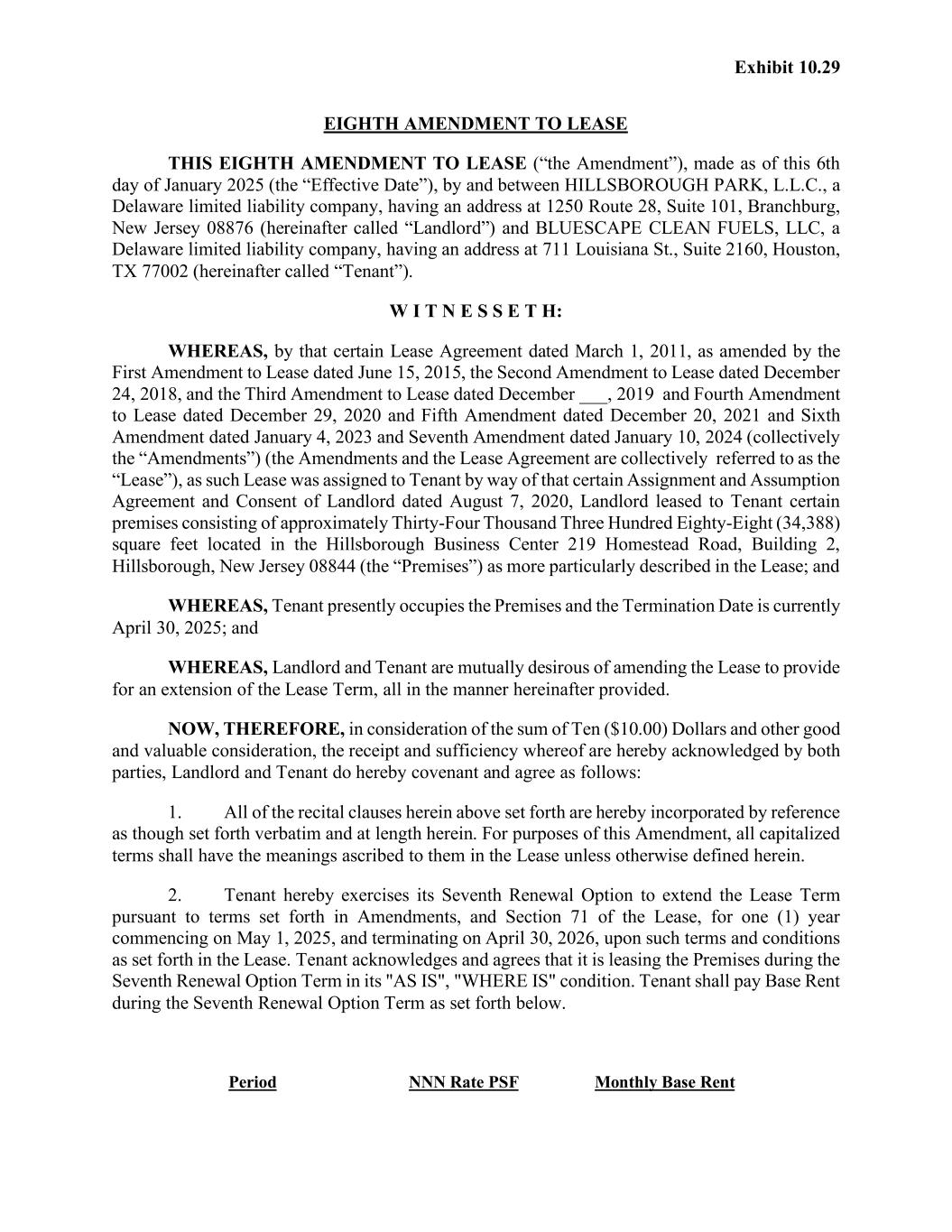
Exhibit 10.29 EIGHTH AMENDMENT TO LEASE THIS EIGHTH AMENDMENT TO LEASE (“the Amendment”), made as of this 6th day of January 2025 (the “Effective Date”), by and between HILLSBOROUGH PARK, L.L.C., a Delaware limited liability company, having an address at 1250 Route 28, Suite 101, Branchburg, New Jersey 08876 (hereinafter called “Landlord”) and BLUESCAPE CLEAN FUELS, LLC, a Delaware limited liability company, having an address at 711 Louisiana St., Suite 2160, Houston, TX 77002 (hereinafter called “Tenant”). W I T N E S S E T H: WHEREAS, by that certain Lease Agreement dated March 1, 2011, as amended by the First Amendment to Lease dated June 15, 2015, the Second Amendment to Lease dated December 24, 2018, and the Third Amendment to Lease dated December ___, 2019 and Fourth Amendment to Lease dated December 29, 2020 and Fifth Amendment dated December 20, 2021 and Sixth Amendment dated January 4, 2023 and Seventh Amendment dated January 10, 2024 (collectively the “Amendments”) (the Amendments and the Lease Agreement are collectively referred to as the “Lease”), as such Lease was assigned to Tenant by way of that certain Assignment and Assumption Agreement and Consent of Landlord dated August 7, 2020, Landlord leased to Tenant certain premises consisting of approximately Thirty-Four Thousand Three Hundred Eighty-Eight (34,388) square feet located in the Hillsborough Business Center 219 Homestead Road, Building 2, Hillsborough, New Jersey 08844 (the “Premises”) as more particularly described in the Lease; and WHEREAS, Tenant presently occupies the Premises and the Termination Date is currently April 30, 2025; and WHEREAS, Landlord and Tenant are mutually desirous of amending the Lease to provide for an extension of the Lease Term, all in the manner hereinafter provided. NOW, THEREFORE, in consideration of the sum of Ten ($10.00) Dollars and other good and valuable consideration, the receipt and sufficiency whereof are hereby acknowledged by both parties, Landlord and Tenant do hereby covenant and agree as follows: 1. All of the recital clauses herein above set forth are hereby incorporated by reference as though set forth verbatim and at length herein. For purposes of this Amendment, all capitalized terms shall have the meanings ascribed to them in the Lease unless otherwise defined herein. 2. Tenant hereby exercises its Seventh Renewal Option to extend the Lease Term pursuant to terms set forth in Amendments, and Section 71 of the Lease, for one (1) year commencing on May 1, 2025, and terminating on April 30, 2026, upon such terms and conditions as set forth in the Lease. Tenant acknowledges and agrees that it is leasing the Premises during the Seventh Renewal Option Term in its "AS IS", "WHERE IS" condition. Tenant shall pay Base Rent during the Seventh Renewal Option Term as set forth below. Period NNN Rate PSF Monthly Base Rent

05/01/2025 thru 04/30/2026 $9.50 $27,223.83 3. It is expressly agreed and understood between the Landlord and the Tenant, provided that the Tenant is not then in default beyond any applicable notice and/or cure periods of any terms, conditions or covenant of said Lease, that Tenant shall have the option ("Eighth” Renewal Option") to extend the term of this Lease for one ( l) renewal term of one ( 1) year, such renewal term, if timely exercised, to start immediately following the expiration of the 7th Renewal Option Term, subject to mutual execution of an Amendment. The foregoing option shall be exercised, if at all, by Tenant providing the Landlord with a written notice within six (6) months prior to the expiration of the Seventh Renewal Option Term, TIME HEREBY BEING MADE OF THE ESSENCE. Tenant's triple net Base Rent during the renewal period shall be based on the following schedule. Period NNN Rate PSF Monthly Base Rent 05/01/2026 thru 04/30/2027 $11.25 $32,238.75 4. If Tenant fails to provide the Landlord with the required six (6) month written notification, it is agreed between both parties that this Lease shall terminate and the Tenant shall surrender the Premises in the condition required under the Lease, Third Amendment, Second Amendment, and Assignment, including by way of example but not limitation Section 19 and Section 20, and the three (3) letters dated May 1, 2013, and repair any and all injury done by or in connection with the installation or removal of said property and surrender the keys and Premises to the Landlord, broom clean and in satisfactory condition, ordinary wear excepted. Tenant's obligations shall include the removal of the improvements shown on the photo contained in Exhibits A of the Second Amendment to the Lease dated December 24th, 2018. 5. ANNEXED TO THIS LEASE AS EXHIBIT (C) IS LANDLORD’S DISCLOSURE FORM PROVIDED PURSUANT TO N.J.S.A.46:8-50. TENANT ACKNOWLEDGES (1) THE DISCLOSURES MADE BY LANDLORD, (2) THE DISCLOSURES ARE MADE TO THE ACTUAL KNOWLEDGE OF LANDLORD WHICH MEANS THE ACTUAL KNOWLEDGE OF PROPERTY MANAGEMENT, WITHOUT THE BENEFIT OF ANY INSPECTION OR INVESTIGATION; (3) THAT LANDLORD HAS SATISFIED ITS STATUTORY DISCLOSURE REQUIREMENTS WITH RESPECT TO FLOOD HAZARDS REQUIRED UNDER N.J.S.A. 46:8-50; AND (4) THAT TENANT WAIVES ANY CLAIMS, RIGHTS AND REMEDIES AGAINST LANDLORD, COVENANTS NOT TO SUE LANDLORD WITH RESPECT TO ANY AND ALL CLAIMS, AND RELEASES LANDLORD FROM ANY AND ALL CLAIMS, UNDER THE LAW, AND IN EQUITY, WITH RESPECT TO N.J.S.A.46:8-50, AND ANY REGULATIONS PROMULGATED THEREUNDER, THAT NOW OR HEREINAFTER ARE IN EFFECT. 6. Except as modified by this Amendment, the Lease and all the covenants, agreements, terms, amendments, provisions and conditions thereof shall remain in full force and effect and are hereby ratified and affirmed. The covenants, agreements, terms, provisions and
conditions contained in this Amendment shall bind and inure to the benefit of the parties hereto and their respective successors and assigns. In the event of any conflict between the terms contained in this Amendment and the Lease, the terms herein contained shall supersede and control the obligations and liabilities of the parties. 7. This Amendment may be executed and delivered (including by facsimile, "pdf' or other electronic transmission) in two or more counterparts, each of which shall be deemed an original, but all of which together shall constitute one and the same instrument. Landlord and Tenant hereby acknowledge and agree that electronic signatures, including execution using Adobe Sign, DocuSign, or other signature generating software or signatures transmitted by electronic mail in so-called "pdf' format, shall be legal and binding without the need to deliver an original of this Amendment. Landlord and Tenant (i) intend to be bound by the signatures (whether original or electronic) on any document sent by electronic mail, (ii) are aware that the other party will rely on such signatures, and (iii) hereby waive any defenses to the enforcement of the terms of this Amendment based on the foregoing forms of electronic signatures. 8. The submission of this Amendment for examination does not become effective only upon execution and delivery thereof by Landlord and Tenant. 9. This Amendment shall be binding upon and inure to the benefit of, the parties hereto and their respective successors. This Amendment shall be governed and construed in accordance with the laws of the state in which the Premises is located. [NO FURTHER TEXT. SIGNATURES TO FOLLOW ON THE NEXT PAGE]
The parties hereto execute this Amendment by their respective duly authorized representative as of the day and year first above written. HILLSBOROUGH PARK, LLC, a Delaware limited liability company (Landlord) 1/6/25 DATE By: /s/ David B. Gardner Name: David B. Gardner Title: Manager 1/2/2025 DATE BLUESCAPE CLEAN FUELS, LLC, a Delaware limited liability company (Tenant) By: /s/ Ernest Miller Name: Ernest Miller Title: Chief Executive Officer

Exhibit C FLOOD RISK NOTICE
EX-23.1
5
vgasw-20241231xex231.htm
EX-23.1
Document
Exhibit 23.1
CONSENT OF INDEPENDENT REGISTERED PUBLIC ACCOUNTING FIRM
We consent to the incorporation by reference in Registration Statement No. 333-271360 on Form S-3 and 333-271477 on Form S-8 of our report dated March 28, 2025, relating to the financial statements of Verde Clean Fuels, Inc. appearing in this Annual Report on Form 10-K for the year ended December 31, 2024.
/s/ Deloitte & Touche LLP
Dallas, Texas
March 28, 2025
EX-31.1
6
vgasw-20241231xex311.htm
EX-31.1
Document
Exhibit 31.1
CERTIFICATION OF PRINCIPAL EXECUTIVE OFFICER
PURSUANT TO SECTION 302 OF THE SARBANES-OXLEY ACT OF 2002
I, Ernest Miller, certify that:
1.I have reviewed this annual report on Form 10-K of Verde Clean Fuels, Inc.;
2.Based on my knowledge, this report does not contain any untrue statement of a material fact or omit to state a material fact necessary to make the statements made, in light of the circumstances under which such statements were made, not misleading with respect to the period covered by this report;
3.Based on my knowledge, the financial statements, and other financial information included in this report, fairly present in all material respects the financial condition, results of operations and cash flows of the registrant as of, and for, the periods presented in this report;
4.The registrant’s other certifying officer(s) and I are responsible for establishing and maintaining disclosure controls and procedures (as defined in Exchange Act Rules 13a-15(e) and 15d-15(e)) and internal control over financial reporting (as defined in Exchange Act Rules 13a-15(f) and 15d-15(f)) for the registrant and have:
(a)Designed such disclosure controls and procedures, or caused such disclosure controls and procedures to be designed under our supervision, to ensure that material information relating to the registrant, including its consolidated subsidiaries, is made known to us by others within those entities, particularly during the period in which this report is being prepared;
(b)Designed such internal control over financial reporting, or caused such internal control over financial reporting to be designed under our supervision, to provide reasonable assurance regarding the reliability of financial reporting and the preparation of financial statements for external purposes in accordance with generally accepted accounting principles;
(c)Evaluated the effectiveness of the registrant’s disclosure controls and procedures and presented in this report our conclusions about the effectiveness of the disclosure controls and procedures, as of the end of the period covered by this report based on such evaluation; and
(d)Disclosed in this report any change in the registrant’s internal control over financial reporting that occurred during the registrant’s most recent fiscal quarter (the registrant’s fourth fiscal quarter in the case of an annual report) that has materially affected, or is reasonably likely to materially affect, the registrant’s internal control over financial reporting; and
5.The registrant’s other certifying officer(s) and I have disclosed, based on our most recent evaluation of internal control over financial reporting, to the registrant’s auditors and the audit committee of the registrant’s board of directors (or persons performing the equivalent functions):
(a)All significant deficiencies and material weaknesses in the design or operation of internal control over financial reporting which are reasonably likely to adversely affect the registrant’s ability to record, process, summarize and report financial information; and
(b)Any fraud, whether or not material, that involves management or other employees who have a significant role in the registrant’s internal control over financial reporting.
|
|
|
|
|
|
Date: March 28, 2025 |
/s/ Ernest Miller |
|
Ernest Miller |
|
Chief Executive Officer
(Principal Executive Officer)
|
EX-31.2
7
vgasw-20241231xex312.htm
EX-31.2
Document
Exhibit 31.2
CERTIFICATION OF CHIEF FINANCIAL OFFICER
PURSUANT TO SECTION 302 OF THE SARBANES-OXLEY ACT OF 2002
I, George W. Burdette III, certify that:
1.I have reviewed this annual report on Form 10-K of Verde Clean Fuels, Inc.;
2.Based on my knowledge, this report does not contain any untrue statement of a material fact or omit to state a material fact necessary to make the statements made, in light of the circumstances under which such statements were made, not misleading with respect to the period covered by this report;
3.Based on my knowledge, the financial statements, and other financial information included in this report, fairly present in all material respects the financial condition, results of operations and cash flows of the registrant as of, and for, the periods presented in this report;
4.The registrant’s other certifying officer(s) and I are responsible for establishing and maintaining disclosure controls and procedures (as defined in Exchange Act Rules 13a-15(e) and 15d-15(e)) and internal control over financial reporting (as defined in Exchange Act Rules 13a-15(f) and 15d-15(f)) for the registrant and have:
(a)Designed such disclosure controls and procedures, or caused such disclosure controls and procedures to be designed under our supervision, to ensure that material information relating to the registrant, including its consolidated subsidiaries, is made known to us by others within those entities, particularly during the period in which this report is being prepared;
(b)Designed such internal control over financial reporting, or caused such internal control over financial reporting to be designed under our supervision, to provide reasonable assurance regarding the reliability of financial reporting and the preparation of financial statements for external purposes in accordance with generally accepted accounting principles;
(c)Evaluated the effectiveness of the registrant’s disclosure controls and procedures and presented in this report our conclusions about the effectiveness of the disclosure controls and procedures, as of the end of the period covered by this report based on such evaluation; and
(d)Disclosed in this report any change in the registrant’s internal control over financial reporting that occurred during the registrant’s most recent fiscal quarter (the registrant’s fourth fiscal quarter in the case of an annual report) that has materially affected, or is reasonably likely to materially affect, the registrant’s internal control over financial reporting; and
5.The registrant’s other certifying officer(s) and I have disclosed, based on our most recent evaluation of internal control over financial reporting, to the registrant’s auditors and the audit committee of the registrant’s board of directors (or persons performing the equivalent functions):
(a)All significant deficiencies and material weaknesses in the design or operation of internal control over financial reporting which are reasonably likely to adversely affect the registrant’s ability to record, process, summarize and report financial information; and
(b)Any fraud, whether or not material, that involves management or other employees who have a significant role in the registrant’s internal control over financial reporting.
|
|
|
|
|
|
|
|
|
Date: March 28, 2025 |
|
/s/ George W. Burdette III |
|
|
George W. Burdette III |
|
|
Chief Financial Officer
(Principal Financial Officer) |
EX-32.1
8
vgasw-20241231xex321.htm
EX-32.1
Document
Exhibit 32.1
CERTIFICATION OF CHIEF EXECUTIVE OFFICER PURSUANT TO 18 U.S.C. SECTION 1350, AS ADOPTED
PURSUANT TO SECTION 906 OF THE SARBANES-OXLEY ACT OF 2002
In connection with the Annual Report on Form 10-K for the year ended December 31, 2024 of Verde Clean Fuels, Inc. (the “Company”), as filed with the Securities and Exchange Commission on the date hereof (the “Report”), I, Ernest Miller, Chief Executive Officer of the Company, certify, pursuant to 18 U.S.C. Section 1350, as adopted pursuant to Section 906 of the Sarbanes- Oxley Act of 2002, that, to the best of my knowledge and belief:
(1)The Report fully complies with the requirements of Section 13(a) or 15(d) of the Securities Exchange Act of 1934; and
(2)The information contained in the Report fairly presents, in all material respects, the financial condition and results of operations of the Company.
|
|
|
|
|
|
Date: March 28, 2025 |
/s/ Ernest Miller |
|
Ernest Miller |
|
Chief Executive Officer
(Principal Executive Officer)
|
EX-32.2
9
vgasw-20241231xex322.htm
EX-32.2
Document
Exhibit 32.2
CERTIFICATION OF CHIEF FINANCIAL OFFICER PURSUANT TO 18 U.S.C. SECTION 1350, AS ADOPTED
PURSUANT TO SECTION 906 OF THE SARBANES-OXLEY ACT OF 2002
In connection with the Annual Report on Form 10-K for the year ended December 31, 2024 of Verde Clean Fuels, Inc. (the “Company”), as filed with the Securities and Exchange Commission on the date hereof (the “Report”), I, George W. Burdette III, Chief Financial Officer of the Company, certify, pursuant to 18 U.S.C. Section 1350, as adopted pursuant to Section 906 of the Sarbanes-Oxley Act of 2002, that, to the best of my knowledge and belief:
(1)The Report fully complies with the requirements of Section 13(a) or 15(d) of the Securities Exchange Act of 1934; and
(2)The information contained in the Report fairly presents, in all material respects, the financial condition and results of operations of the Company.
|
|
|
|
|
|
Date: March 28, 2025 |
/s/ George W. Burdette III |
|
George W. Burdette III |
|
Chief Financial Officer
(Principal Financial Officer)
|
 エドガーで原本を確認する