false2024FY0001831840http://fasb.org/us-gaap/2024#OtherLiabilitiesCurrent http://fasb.org/us-gaap/2024#OtherLiabilitiesNoncurrentP7Y0.6667197iso4217:USDxbrli:sharesiso4217:USDxbrli:sharessemr:segmentxbrli:puresemr:leasesemr:classsemr:votesemr:paymentiso4217:PLNxbrli:shares00018318402024-01-012024-12-3100018318402024-06-280001831840us-gaap:CommonClassAMember2025-02-240001831840us-gaap:CommonClassBMember2025-02-2400018318402024-12-3100018318402023-12-310001831840us-gaap:CommonClassAMember2024-12-310001831840us-gaap:CommonClassAMember2023-12-310001831840us-gaap:CommonClassBMember2024-12-310001831840us-gaap:CommonClassBMember2023-12-3100018318402023-01-012023-12-3100018318402022-01-012022-12-3100018318402021-12-310001831840us-gaap:CommonStockMemberus-gaap:CommonClassAMember2021-12-310001831840us-gaap:CommonStockMemberus-gaap:CommonClassBMember2021-12-310001831840us-gaap:AdditionalPaidInCapitalMember2021-12-310001831840us-gaap:AccumulatedOtherComprehensiveIncomeMember2021-12-310001831840us-gaap:RetainedEarningsMember2021-12-310001831840us-gaap:ParentMember2021-12-310001831840us-gaap:NoncontrollingInterestMember2021-12-310001831840us-gaap:CommonStockMemberus-gaap:CommonClassAMember2022-01-012022-12-310001831840us-gaap:CommonStockMemberus-gaap:CommonClassBMember2022-01-012022-12-310001831840us-gaap:AdditionalPaidInCapitalMember2022-01-012022-12-310001831840us-gaap:ParentMember2022-01-012022-12-310001831840us-gaap:AccumulatedOtherComprehensiveIncomeMember2022-01-012022-12-310001831840us-gaap:RetainedEarningsMember2022-01-012022-12-3100018318402022-12-310001831840us-gaap:CommonStockMemberus-gaap:CommonClassAMember2022-12-310001831840us-gaap:CommonStockMemberus-gaap:CommonClassBMember2022-12-310001831840us-gaap:AdditionalPaidInCapitalMember2022-12-310001831840us-gaap:AccumulatedOtherComprehensiveIncomeMember2022-12-310001831840us-gaap:RetainedEarningsMember2022-12-310001831840us-gaap:ParentMember2022-12-310001831840us-gaap:NoncontrollingInterestMember2022-12-310001831840us-gaap:CommonStockMemberus-gaap:CommonClassAMember2023-01-012023-12-310001831840us-gaap:CommonStockMemberus-gaap:CommonClassBMember2023-01-012023-12-310001831840us-gaap:AdditionalPaidInCapitalMember2023-01-012023-12-310001831840us-gaap:ParentMember2023-01-012023-12-310001831840us-gaap:AccumulatedOtherComprehensiveIncomeMember2023-01-012023-12-310001831840us-gaap:RetainedEarningsMember2023-01-012023-12-310001831840us-gaap:NoncontrollingInterestMember2023-01-012023-12-310001831840us-gaap:CommonStockMemberus-gaap:CommonClassAMember2023-12-310001831840us-gaap:CommonStockMemberus-gaap:CommonClassBMember2023-12-310001831840us-gaap:AdditionalPaidInCapitalMember2023-12-310001831840us-gaap:AccumulatedOtherComprehensiveIncomeMember2023-12-310001831840us-gaap:RetainedEarningsMember2023-12-310001831840us-gaap:ParentMember2023-12-310001831840us-gaap:NoncontrollingInterestMember2023-12-310001831840us-gaap:CommonStockMemberus-gaap:CommonClassAMember2024-01-012024-12-310001831840us-gaap:CommonStockMemberus-gaap:CommonClassBMember2024-01-012024-12-310001831840us-gaap:AdditionalPaidInCapitalMember2024-01-012024-12-310001831840us-gaap:ParentMember2024-01-012024-12-310001831840us-gaap:AccumulatedOtherComprehensiveIncomeMember2024-01-012024-12-310001831840us-gaap:NoncontrollingInterestMember2024-01-012024-12-310001831840us-gaap:RetainedEarningsMember2024-01-012024-12-310001831840us-gaap:CommonStockMemberus-gaap:CommonClassAMember2024-12-310001831840us-gaap:CommonStockMemberus-gaap:CommonClassBMember2024-12-310001831840us-gaap:AdditionalPaidInCapitalMember2024-12-310001831840us-gaap:AccumulatedOtherComprehensiveIncomeMember2024-12-310001831840us-gaap:RetainedEarningsMember2024-12-310001831840us-gaap:ParentMember2024-12-310001831840us-gaap:NoncontrollingInterestMember2024-12-3100018318402024-01-012024-12-310001831840srt:MinimumMemberus-gaap:ComputerEquipmentMember2024-12-310001831840srt:MaximumMemberus-gaap:ComputerEquipmentMember2024-12-310001831840srt:MinimumMemberus-gaap:FurnitureAndFixturesMember2024-12-310001831840srt:MaximumMemberus-gaap:FurnitureAndFixturesMember2024-12-310001831840us-gaap:USTreasuryBondSecuritiesMember2024-12-310001831840us-gaap:USTreasuryBondSecuritiesMember2023-12-310001831840srt:MaximumMember2022-01-010001831840semr:BelgradeSerbiaMember2024-12-310001831840us-gaap:MoneyMarketFundsMemberus-gaap:FairValueInputsLevel1Memberus-gaap:FairValueMeasurementsRecurringMember2024-12-310001831840us-gaap:MoneyMarketFundsMemberus-gaap:FairValueInputsLevel2Memberus-gaap:FairValueMeasurementsRecurringMember2024-12-310001831840us-gaap:MoneyMarketFundsMemberus-gaap:FairValueInputsLevel3Memberus-gaap:FairValueMeasurementsRecurringMember2024-12-310001831840us-gaap:MoneyMarketFundsMemberus-gaap:FairValueMeasurementsRecurringMember2024-12-310001831840us-gaap:FairValueInputsLevel1Memberus-gaap:FairValueMeasurementsRecurringMemberus-gaap:USTreasuryBondSecuritiesMember2024-12-310001831840us-gaap:FairValueInputsLevel2Memberus-gaap:FairValueMeasurementsRecurringMemberus-gaap:USTreasuryBondSecuritiesMember2024-12-310001831840us-gaap:FairValueInputsLevel3Memberus-gaap:FairValueMeasurementsRecurringMemberus-gaap:USTreasuryBondSecuritiesMember2024-12-310001831840us-gaap:FairValueMeasurementsRecurringMemberus-gaap:USTreasuryBondSecuritiesMember2024-12-310001831840us-gaap:FairValueInputsLevel1Memberus-gaap:FairValueMeasurementsRecurringMemberus-gaap:CommercialPaperMember2024-12-310001831840us-gaap:FairValueInputsLevel2Memberus-gaap:FairValueMeasurementsRecurringMemberus-gaap:CommercialPaperMember2024-12-310001831840us-gaap:FairValueInputsLevel3Memberus-gaap:FairValueMeasurementsRecurringMemberus-gaap:CommercialPaperMember2024-12-310001831840us-gaap:FairValueMeasurementsRecurringMemberus-gaap:CommercialPaperMember2024-12-310001831840us-gaap:FairValueInputsLevel1Memberus-gaap:FairValueMeasurementsRecurringMemberus-gaap:ConvertibleDebtSecuritiesMember2024-12-310001831840us-gaap:FairValueInputsLevel2Memberus-gaap:FairValueMeasurementsRecurringMemberus-gaap:ConvertibleDebtSecuritiesMember2024-12-310001831840us-gaap:FairValueInputsLevel3Memberus-gaap:FairValueMeasurementsRecurringMemberus-gaap:ConvertibleDebtSecuritiesMember2024-12-310001831840us-gaap:FairValueMeasurementsRecurringMemberus-gaap:ConvertibleDebtSecuritiesMember2024-12-310001831840us-gaap:FairValueInputsLevel1Memberus-gaap:FairValueMeasurementsRecurringMember2024-12-310001831840us-gaap:FairValueInputsLevel2Memberus-gaap:FairValueMeasurementsRecurringMember2024-12-310001831840us-gaap:FairValueInputsLevel3Memberus-gaap:FairValueMeasurementsRecurringMember2024-12-310001831840us-gaap:FairValueMeasurementsRecurringMember2024-12-310001831840us-gaap:MoneyMarketFundsMemberus-gaap:FairValueInputsLevel1Memberus-gaap:FairValueMeasurementsRecurringMember2023-12-310001831840us-gaap:MoneyMarketFundsMemberus-gaap:FairValueInputsLevel2Memberus-gaap:FairValueMeasurementsRecurringMember2023-12-310001831840us-gaap:MoneyMarketFundsMemberus-gaap:FairValueInputsLevel3Memberus-gaap:FairValueMeasurementsRecurringMember2023-12-310001831840us-gaap:MoneyMarketFundsMemberus-gaap:FairValueMeasurementsRecurringMember2023-12-310001831840us-gaap:FairValueInputsLevel1Memberus-gaap:FairValueMeasurementsRecurringMemberus-gaap:USTreasuryBondSecuritiesMember2023-12-310001831840us-gaap:FairValueInputsLevel2Memberus-gaap:FairValueMeasurementsRecurringMemberus-gaap:USTreasuryBondSecuritiesMember2023-12-310001831840us-gaap:FairValueInputsLevel3Memberus-gaap:FairValueMeasurementsRecurringMemberus-gaap:USTreasuryBondSecuritiesMember2023-12-310001831840us-gaap:FairValueMeasurementsRecurringMemberus-gaap:USTreasuryBondSecuritiesMember2023-12-310001831840us-gaap:FairValueInputsLevel1Memberus-gaap:FairValueMeasurementsRecurringMember2023-12-310001831840us-gaap:FairValueInputsLevel2Memberus-gaap:FairValueMeasurementsRecurringMember2023-12-310001831840us-gaap:FairValueInputsLevel3Memberus-gaap:FairValueMeasurementsRecurringMember2023-12-310001831840us-gaap:FairValueMeasurementsRecurringMember2023-12-310001831840us-gaap:ConvertibleDebtSecuritiesMember2022-12-310001831840us-gaap:ConvertibleDebtSecuritiesMember2023-01-012023-12-310001831840us-gaap:ConvertibleDebtSecuritiesMember2023-12-310001831840us-gaap:ConvertibleDebtSecuritiesMember2024-01-012024-12-310001831840us-gaap:ConvertibleDebtSecuritiesMember2024-12-310001831840semr:InvestmentLoanReceivableMember2023-12-310001831840semr:InvestmentLoanReceivableMember2024-01-012024-12-310001831840semr:InvestmentLoanReceivableMember2024-12-310001831840semr:DatosAcquisitionMember2024-12-310001831840semr:DatosAcquisitionMember2023-12-310001831840semr:ContingentConsiderationLiabilityMember2023-12-310001831840semr:ContingentConsiderationLiabilityMember2024-01-012024-12-310001831840semr:ContingentConsiderationLiabilityMember2024-12-310001831840us-gaap:ComputerEquipmentMember2024-12-310001831840us-gaap:ComputerEquipmentMember2023-12-310001831840us-gaap:FurnitureAndFixturesMember2024-12-310001831840us-gaap:FurnitureAndFixturesMember2023-12-310001831840us-gaap:LeaseholdImprovementsMember2024-12-310001831840us-gaap:LeaseholdImprovementsMember2023-12-310001831840us-gaap:ConvertibleDebtSecuritiesMember2024-07-012024-07-310001831840us-gaap:ConvertibleDebtSecuritiesMember2024-07-310001831840us-gaap:ConvertibleDebtSecuritiesMember2024-01-012024-12-3100018318402024-03-012024-03-3100018318402024-03-3100018318402024-09-012024-09-3000018318402021-03-310001831840us-gaap:CommonClassAMember2021-03-310001831840us-gaap:CommonClassBMember2021-03-310001831840us-gaap:CommonClassAMember2021-03-012021-03-3100018318402021-03-012021-03-310001831840us-gaap:EmployeeStockOptionMember2024-01-012024-12-310001831840us-gaap:EmployeeStockOptionMember2023-01-012023-12-310001831840us-gaap:EmployeeStockOptionMember2022-01-012022-12-310001831840us-gaap:RestrictedStockMember2024-01-012024-12-310001831840us-gaap:RestrictedStockMember2023-01-012023-12-310001831840us-gaap:RestrictedStockMember2022-01-012022-12-310001831840us-gaap:EmployeeStockOptionMember2024-01-012024-12-310001831840us-gaap:EmployeeStockOptionMember2023-01-012023-12-310001831840us-gaap:EmployeeStockOptionMember2022-01-012022-12-310001831840semr:RestrictedStockAwardsRestrictedStockUnitsAndPerformanceShareUnitsMember2024-01-012024-12-310001831840semr:RestrictedStockAwardsRestrictedStockUnitsAndPerformanceShareUnitsMember2023-01-012023-12-310001831840semr:RestrictedStockAwardsRestrictedStockUnitsAndPerformanceShareUnitsMember2022-01-012022-12-310001831840us-gaap:PerformanceSharesMemberus-gaap:CommonClassAMember2024-01-012024-12-310001831840us-gaap:PerformanceSharesMemberus-gaap:CommonClassAMember2023-01-012023-12-310001831840us-gaap:PerformanceSharesMemberus-gaap:CommonClassAMember2022-01-012022-12-310001831840semr:ThirdDoorMediaMember2024-10-160001831840semr:ThirdDoorMediaMember2024-10-162024-10-160001831840semr:ThirdDoorMediaMembersrt:ScenarioForecastMember2025-01-012025-03-310001831840semr:ThirdDoorMediaMembersrt:ScenarioForecastMember2025-10-012025-12-310001831840semr:ThirdDoorMediaMembersrt:ScenarioForecastMember2026-04-012026-06-300001831840semr:ThirdDoorMediaMember2024-12-310001831840semr:ThirdDoorMediaMemberus-gaap:CustomerRelationshipsMember2024-12-310001831840semr:ThirdDoorMediaMemberus-gaap:CustomerRelationshipsMember2024-10-162024-10-160001831840semr:ThirdDoorMediaMemberus-gaap:TechnologyBasedIntangibleAssetsMember2024-10-162024-10-160001831840semr:ThirdDoorMediaMemberus-gaap:TradeNamesMember2024-10-162024-10-160001831840semr:ThirdDoorMediaMember2024-01-012024-12-310001831840semr:ExplodingTopicsMember2024-08-152024-08-150001831840semr:ExplodingTopicsMember2024-08-150001831840semr:ExplodingTopicsMembersemr:ContentMember2024-08-152024-08-150001831840semr:ExplodingTopicsMemberus-gaap:CustomerRelationshipsMember2024-08-152024-08-150001831840semr:ExplodingTopicsMemberus-gaap:TechnologyBasedIntangibleAssetsMember2024-08-152024-08-150001831840semr:ExplodingTopicsMember2024-01-012024-12-310001831840semr:RyteMember2024-07-110001831840semr:RyteMember2024-07-112024-07-110001831840semr:RyteMembersrt:ScenarioForecastMember2025-07-112025-07-110001831840semr:RyteMembersrt:ScenarioForecastMember2026-01-112026-01-110001831840semr:RyteMember2024-12-310001831840semr:RyteMemberus-gaap:TechnologyBasedIntangibleAssetsMember2024-12-310001831840semr:RyteMemberus-gaap:TechnologyBasedIntangibleAssetsMember2024-07-112024-07-110001831840semr:RyteMemberus-gaap:CustomerRelationshipsMember2024-07-112024-07-110001831840semr:RyteMemberus-gaap:TradeNamesMember2024-07-112024-07-110001831840semr:RyteMember2024-01-012024-12-310001831840semr:Brand24Member2024-04-290001831840semr:Brand24Member2024-04-292024-04-290001831840semr:Brand24Membersrt:ScenarioForecastMember2025-11-122025-11-120001831840semr:Brand24Member2024-12-312024-12-310001831840semr:Brand24Member2024-04-302024-12-310001831840semr:Brand24Member2024-12-310001831840semr:Brand24Memberus-gaap:CustomerRelationshipsMember2024-12-310001831840semr:Brand24Memberus-gaap:CustomerRelationshipsMember2024-04-292024-04-290001831840semr:Brand24Memberus-gaap:TechnologyBasedIntangibleAssetsMember2024-04-292024-04-290001831840semr:Brand24Memberus-gaap:TradeNamesMember2024-04-292024-04-290001831840semr:Brand24Member2024-01-012024-12-310001831840semr:Brand24ManagementMember2024-01-012024-12-310001831840srt:SubsidiariesMembersemr:Brand24Member2024-05-310001831840srt:SubsidiariesMembersemr:Brand24Member2024-05-012024-05-310001831840semr:Brand24Membersrt:SubsidiariesMember2024-07-012024-07-310001831840semr:Brand24Membersrt:SubsidiariesMember2024-07-310001831840semr:Brand24Membersrt:SubsidiariesMember2024-08-012024-12-310001831840semr:Brand24Membersrt:SubsidiariesMember2024-12-310001831840semr:DatosMember2023-12-010001831840semr:DatosMember2023-12-012023-12-010001831840semr:DatosMember2024-03-012024-03-310001831840semr:DatosMember2024-08-012024-08-310001831840semr:DatosMember2024-09-300001831840semr:DatosMember2024-01-012024-12-310001831840semr:TrafficThinkTankMember2023-02-232023-02-230001831840semr:TrafficThinkTankMembersemr:A12MonthHoldbackAmountMember2024-02-012024-02-280001831840semr:TrafficThinkTankMembersemr:A12MonthHoldbackAmountMember2023-02-232023-02-230001831840semr:TrafficThinkTankMembersemr:A18MonthHoldbackAmountMember2024-08-012024-08-310001831840semr:TrafficThinkTankMembersemr:A18MonthHoldbackAmountMember2023-02-232023-02-230001831840us-gaap:TechnologyBasedIntangibleAssetsMember2024-01-012024-12-310001831840us-gaap:TechnologyBasedIntangibleAssetsMember2024-12-310001831840us-gaap:TradeNamesMember2024-01-012024-12-310001831840us-gaap:TradeNamesMember2024-12-310001831840semr:ContentMember2024-01-012024-12-310001831840semr:ContentMember2024-12-310001831840us-gaap:CustomerRelationshipsMember2024-01-012024-12-310001831840us-gaap:CustomerRelationshipsMember2024-12-310001831840us-gaap:SoftwareDevelopmentMember2024-01-012024-12-310001831840us-gaap:SoftwareDevelopmentMember2024-12-310001831840us-gaap:TechnologyBasedIntangibleAssetsMember2023-01-012023-12-310001831840us-gaap:TechnologyBasedIntangibleAssetsMember2023-12-310001831840us-gaap:TradeNamesMember2023-01-012023-12-310001831840us-gaap:TradeNamesMember2023-12-310001831840semr:ContentMember2023-01-012023-12-310001831840semr:ContentMember2023-12-310001831840us-gaap:CustomerRelationshipsMember2023-01-012023-12-310001831840us-gaap:CustomerRelationshipsMember2023-12-310001831840us-gaap:SoftwareDevelopmentMember2023-01-012023-12-310001831840us-gaap:SoftwareDevelopmentMember2023-12-310001831840us-gaap:SoftwareDevelopmentMember2022-01-012022-12-310001831840us-gaap:DomesticCountryMember2024-12-310001831840us-gaap:CapitalLossCarryforwardMemberus-gaap:DomesticCountryMember2024-12-310001831840us-gaap:StateAndLocalJurisdictionMember2024-12-310001831840semr:OtherForeignLocationsMemberus-gaap:ForeignCountryMember2024-12-310001831840us-gaap:CommonClassAMember2024-01-012024-12-310001831840us-gaap:EmployeeStockOptionMembersemr:A2021StockOptionAndIncentivePlanMember2024-12-310001831840us-gaap:CommonStockMembersemr:A2021StockOptionAndIncentivePlanMember2024-12-310001831840semr:RestrictedStockUnitsAndPerformanceStockUnitsMembersemr:A2021StockOptionAndIncentivePlanMember2024-12-310001831840semr:A2021StockOptionAndIncentivePlanMember2024-12-310001831840semr:A2021StockOptionAndIncentivePlanMember2021-03-150001831840semr:A2021StockOptionAndIncentivePlanMember2021-03-152021-03-150001831840us-gaap:RestrictedStockUnitsRSUMembersemr:A2021StockOptionAndIncentivePlanMember2024-01-012024-12-310001831840us-gaap:RestrictedStockUnitsRSUMembersemr:A2021StockOptionAndIncentivePlanMember2023-01-012023-12-310001831840us-gaap:RestrictedStockUnitsRSUMembersemr:A2021StockOptionAndIncentivePlanMember2022-01-012022-12-310001831840us-gaap:RestrictedStockUnitsRSUMember2023-12-310001831840us-gaap:RestrictedStockUnitsRSUMember2024-01-012024-12-310001831840us-gaap:RestrictedStockUnitsRSUMember2024-12-310001831840us-gaap:PerformanceSharesMembersemr:A2021StockOptionAndIncentivePlanMember2024-01-012024-12-310001831840us-gaap:PerformanceSharesMembersemr:A2021StockOptionAndIncentivePlanMember2022-01-012022-12-310001831840us-gaap:PerformanceSharesMembersemr:A2021StockOptionAndIncentivePlanMember2023-01-012023-12-310001831840us-gaap:PerformanceSharesMember2023-12-310001831840us-gaap:PerformanceSharesMember2024-01-012024-12-310001831840us-gaap:PerformanceSharesMember2024-12-310001831840us-gaap:CostOfSalesMember2024-01-012024-12-310001831840us-gaap:CostOfSalesMember2023-01-012023-12-310001831840us-gaap:CostOfSalesMember2022-01-012022-12-310001831840us-gaap:SellingAndMarketingExpenseMember2024-01-012024-12-310001831840us-gaap:SellingAndMarketingExpenseMember2023-01-012023-12-310001831840us-gaap:SellingAndMarketingExpenseMember2022-01-012022-12-310001831840us-gaap:ResearchAndDevelopmentExpenseMember2024-01-012024-12-310001831840us-gaap:ResearchAndDevelopmentExpenseMember2023-01-012023-12-310001831840us-gaap:ResearchAndDevelopmentExpenseMember2022-01-012022-12-310001831840us-gaap:GeneralAndAdministrativeExpenseMember2024-01-012024-12-310001831840us-gaap:GeneralAndAdministrativeExpenseMember2023-01-012023-12-310001831840us-gaap:GeneralAndAdministrativeExpenseMember2022-01-012022-12-310001831840semr:ReportableSegmentMember2024-01-012024-12-310001831840semr:ReportableSegmentMember2023-01-012023-12-310001831840semr:ReportableSegmentMember2022-01-012022-12-310001831840country:US2024-01-012024-12-310001831840country:US2023-01-012023-12-310001831840country:US2022-01-012022-12-310001831840country:GB2024-01-012024-12-310001831840country:GB2023-01-012023-12-310001831840country:GB2022-01-012022-12-310001831840semr:OtherGeographicalAreaMember2024-01-012024-12-310001831840semr:OtherGeographicalAreaMember2023-01-012023-12-310001831840semr:OtherGeographicalAreaMember2022-01-012022-12-310001831840country:US2024-12-310001831840country:US2023-12-310001831840country:NL2024-12-310001831840country:NL2023-12-310001831840country:ES2024-12-310001831840country:ES2023-12-310001831840country:CZ2024-12-310001831840country:CZ2023-12-310001831840semr:OtherGeographicalAreaMember2024-12-310001831840semr:OtherGeographicalAreaMember2023-12-3100018318402024-10-012024-12-310001831840semr:OlegShchegolevMember2024-10-012024-12-310001831840semr:OlegShchegolevMember2024-12-31
UNITED STATES
SECURITIES AND EXCHANGE COMMISSION
Washington, D.C. 20549
FORM 10-K
(Mark One)
|
|
|
|
|
|
| ☒ |
ANNUAL REPORT PURSUANT TO SECTION 13 OR 15(d) OF THE SECURITIES EXCHANGE ACT OF 1934 |
For the fiscal year ended December 31, 2024
OR
|
|
|
|
|
|
| ☐ |
TRANSITION REPORT PURSUANT TO SECTION 13 OR 15(d) OF THE SECURITIES EXCHANGE ACT OF 1934 |
For the transition period from to
Commission file number 001-40276
Semrush Holdings, Inc.
(Exact name of registrant as specified in its charter)
|
|
|
|
|
|
|
|
|
| Delaware |
|
84-4053265 |
|
(State or Other Jurisdiction of
Incorporation or Organization)
|
|
(I.R.S. Employer
Identification Number)
|
800 Boylston Street, Suite 2475
Boston, MA 02199
(Address of principal executive offices including zip code)
(800) 851-9959
(Registrant’s telephone number, including area code)
Securities registered pursuant to Section 12(b) of the Act:
|
|
|
|
|
|
|
|
|
|
|
|
|
|
|
| Title of each class |
|
Trading symbol(s) |
|
Name of each exchange on which registered |
Class A Common Stock, $0.00001 par value per share |
|
SEMR |
|
The New York Stock Exchange |
Securities registered pursuant to section 12(g) of the Act: None
Indicate by check mark if the registrant is a well-known seasoned issuer, as defined in Rule 405 of the Securities Act. ☒ Yes or ☐ No.
Indicate by check mark if the registrant is not required to file reports pursuant to Section 13 or Section 15(d) of the Act. ☐ Yes or ☒ No.
Indicate by check mark whether the registrant: (1) has filed all reports required to be filed by Section 13 or 15(d) of the Securities Exchange Act of 1934 during the preceding 12 months (or for such shorter period that the registrant was required to file such reports); and (2) has been subject to such filing requirements for the past 90 days. ☒ Yes or ☐ No.
Indicate by check mark whether the registrant has submitted electronically and posted on its corporate web site, if any, every Interactive Data File required to be submitted and posted pursuant to Rule 405 of Regulation S-T (§232.405 of this chapter) during the preceding 12 months (or for such shorter period that the registrant was required to submit and post such files). ☒ Yes or ☐ No.
Indicate by check mark whether the registrant is a large accelerated filer, an accelerated filer, a non-accelerated filer, or a smaller reporting company, or an emerging growth company. See the definitions of “large accelerated filer,” “accelerated filer” and “smaller reporting company” and “emerging growth company” in Rule 12b-2 of the Exchange Act.
|
|
|
|
|
|
|
|
|
|
|
|
| Large accelerated filer |
☒ |
Accelerated filer |
☐ |
| Non-accelerated filer |
☐ |
Smaller reporting company |
☐ |
|
|
Emerging growth company |
☐ |
If an emerging growth company, indicate by check mark if the registrant has elected not to use the extended transition period for complying with any new or revised financial accounting standards provided pursuant to Section 13(a) of the Exchange Act. ☐
Indicate by check mark whether the registrant has filed a report on and attestation to its management’s assessment of the effectiveness of its internal control over financial reporting under Section 404(b) of the Sarbanes-Oxley Act (15 U.S.C. 7262(b)) by the registered public accounting firm that prepared or issued its audit report. ☒
If securities are registered pursuant to Section 12(b) of the Act, indicate by check mark whether the financial statements of the registrant included in the filing reflect the correction of an error to previously issued financial statements. ☐
Indicate by check mark whether any of those error corrections are restatements that required a recovery analysis of incentive-based compensation received by any of the registrant’s executive officers during the relevant recovery period pursuant to §240.10D-1(b). ☐
Indicate by check mark whether the registrant is a shell company (as defined in Rule 12b-2 of the Act). ☐ Yes or ☒ No
The aggregate market value of stock held by non-affiliates as of June, 28, 2024, (the last business day of the registrant's most recently completed second fiscal quarter) was approximately $740.0 million based upon $13.39 per share, the closing price on June, 28, 2024 on the New York Stock Exchange. Determination of stock ownership by non-affiliates was made solely for the purpose of responding to this requirement and the registrant is not bound by this determination for any other purpose.
As of February 24, 2025, there were 126,141,031 shares of the registrant’s Class A Common Stock and 20,908,410 shares of the registrant’s Class B Common Stock, $0.00001 par value per share, outstanding.
DOCUMENTS INCORPORATED BY REFERENCE
Portions of the registrant's definitive Proxy Statement for the 2025 Annual Meeting of Stockholders are incorporated herein by reference in Part III of this Annual Report on Form 10-K to the extent stated herein. Such Proxy Statement will be filed with the Securities and Exchange Commission within 120 days of the registrant's fiscal year ended December 31, 2024.
TABLE OF CONTENTS
SPECIAL NOTE REGARDING FORWARD-LOOKING STATEMENTS
This Annual Report on Form 10-K contains forward-looking statements about us and our industry that involve substantial risks and uncertainties. All statements other than statements of historical facts contained in this Annual Report on Form 10-K are forward-looking statements. In some cases, you can identify forward-looking statements because they contain words such as “anticipate,” “believe,” “contemplate,” “continue,” “could,” “estimate,” “expect,” “intend,” “may,” “plan,” “potential,” “predict,” “project,” “should,” “target,” “will,” or “would,” or the negative of these words or other similar terms or expressions. These forward-looking statements are based on management’s current expectations and assumptions about future events, which are inherently subject to uncertainties, risks, and changes in circumstances that are difficult to predict. Forward-looking statements contained in this Annual Report on Form 10-K include, but are not limited to, statements concerning the following:
•our future financial performance, including our revenue, annual recurring revenue (“ARR”), dollar-based net revenue retention rate, costs of revenue, gross profit or gross margin and operating expenses;
•the sufficiency of our cash and cash equivalents to meet our liquidity needs;
•anticipated trends and growth rates in our business and in the markets in which we operate;
•our ability to maintain the security and availability of our internal networks and platform;
•our ability to attract new paying customers and convert free customers into paying customers;
•our ability to retain and expand sales to our existing paying customers, including upgrades to premium subscriptions and purchases of add-on offerings;
•our ability to access, collect, and analyze data;
•our ability to successfully expand in our existing markets and into new markets, including executing on anticipated market opportunities and growth strategies;
•our ability to effectively manage our growth and future expenses;
•our ability to continue to innovate and develop new products and features, improve our data assets, and adopt and enhance our technological capabilities, including the use of artificial intelligence and other new and evolving technologies;
•our expectations regarding user behavior online, including use of traditional search engines and newer AI-driven search technologies;
•our ability to maintain, protect, and enhance our intellectual property;
•our ability to build, maintain, and enhance our brand, including through informational resources, advertisements, and referrals;
•our ability to comply with modified or new laws and regulations applying to our business, including in any new jurisdictions in which we operate;
•the attraction and retention of qualified employees and key personnel;
•expected changes to our executive management team;
•our anticipated investments in sales and marketing, and research and development;
•our ability to successfully defend litigation brought against us;
•our expectations regarding identifying, evaluating, executing, and integrating strategic acquisitions and related financial considerations such as purchase price allocation; and
•the impact of global financial, economic, and political events on our business, industry and supply chain, including health epidemics, rising inflation, fluctuating interest rates, and market uncertainty and volatility.
You should not rely upon forward-looking statements as predictions of future events. We have based the forward-looking statements contained in this Annual Report on Form 10-K primarily on our current expectations and projections about future events and trends that we believe may affect our business, financial condition, results of operations and prospects. The outcome of the events described in these forward-looking statements is subject to risks, uncertainties and other factors described in the section titled “Risk Factors” and elsewhere in this Annual Report on Form 10-K. Moreover, we operate in a very competitive and rapidly changing environment. New risks and uncertainties emerge from time to time, and it is not possible for us to predict all risks and uncertainties that could have an impact on the forward-looking statements contained in this Annual Report on Form 10-K. The results, events and circumstances reflected in the forward-looking statements may not be achieved or occur, and actual results, events, or circumstances could differ materially from those described in the forward-looking statements.
The forward-looking statements made in this Annual Report on Form 10-K relate only to events as of the date on which the statements are made. We undertake no obligation to update any forward-looking statements made in this Annual Report on Form 10-K to reflect events or circumstances after the date of this Annual Report on Form 10-K or to reflect new information or the occurrence of unanticipated events, except as required by law. We may not actually achieve the plans, intentions or expectations disclosed in our forward-looking statements and you should not place undue reliance on our forward-looking statements. Our forward-looking statements do not reflect the potential impact of any future acquisitions, mergers, dispositions, joint ventures, or investments we may make.
In addition, statements that “we believe” and similar statements reflect our beliefs and opinions on the relevant subject. Unless stated otherwise, these statements are based upon information available to us as of the date of this Annual Report on Form 10-K. While we believe such information provides a reasonable basis for such statements, such information may be limited or incomplete. Our statements should not be read to indicate that we have conducted an exhaustive inquiry into, or review of, all potentially available relevant information. These statements are inherently uncertain and you are cautioned not to unduly rely upon these statements.
This Annual Report on Form 10-K contains statistical data, estimates, and forecasts from various sources, including independent industry publications and other information from our internal sources. This information is based upon a number of assumptions and limitations, and you are cautioned not to give undue weight to such information. While we believe the market and industry data included in this Annual Report on Form 10-K are reliable and are based on reasonable assumptions, we have not independently verified any of the data from third-party sources nor have we ascertained the underlying economic assumptions relied on therein. The industry in which we operate is subject to a high degree of uncertainty and risk due to a variety of factors, including those described in the section titled “Risk Factors” that could cause results to differ materially.
RISK FACTORS SUMMARY
The following is a summary of the principal risks that could materially adversely affect our business, results of operations, and financial condition. Additional discussion of the risks included in this summary, and other risks that we face, can be found below and should be carefully considered, together with other information in this Annual Report on Form 10-K in its entirety before making investment decisions regarding our Class A common stock. This summary should not be relied upon as an exhaustive summary of the material risks facing our business.
•Our business and operating results may be negatively affected if our paying customers do not renew or do not upgrade their premium subscriptions or if they fail to purchase additional products.
•If we fail to attract new potential customers, register them for trials, and convert them into paying customers, our operating results would be negatively affected.
•The market in which we operate is intensely competitive, and if we do not compete effectively, our ability to attract and retain customers could be harmed, which would negatively impact our business and operating results.
•We have incurred losses in the past and may not consistently maintain profitability in the future.
•Our products depend in part on publicly available, internally developed, and paid third-party data sources, and, if we lose access to data provided by such data sources or the terms and conditions on which we obtain such access becomes less favorable, our business could suffer.
•If we are unable to maintain and enhance our brand, or if events occur that damage our reputation and brand, our ability to maintain and expand our customer base may be impaired, and our business and financial results may be harmed.
•We depend on our executive officers and other key employees, and the loss of one or more of these employees could harm our business.
•If we fail to maintain and improve our methods and technologies, or fail to anticipate new methods or technologies for data collection and analysis, infrastructure, hardware, software, and software-related technologies, including those pertaining to artificial intelligence, competing products and services could surpass ours in depth, breadth, or accuracy of our data, the insights that we offer or in other respects, which could result in a loss of customers, impact our ability to acquire new customers, and harm our business and financial results.
•Failures or loss of, or material changes with respect to, the third-party hardware, software, and infrastructure on which we rely, including third-party data center hosting facilities and third-party distribution channels to support our operations, could adversely affect our business.
•If the security of the confidential information or personal information of our customers on our platform is breached or otherwise subjected to unauthorized access or disclosure, our reputation may be harmed, and we may be exposed to significant liability.
•The use of artificial intelligence and other new and evolving technologies in our offerings may result in spending material resources and presents risks and challenges that can impact our business including by posing security and other risks to our confidential information, proprietary information and personal information, and as a result we may be exposed to reputational harm and liability.
•Rapid advancements in AI-driven search technologies may alter how users discover and interact with online content, potentially diminishing reliance on traditional search engines or changing algorithms in ways that impact our solutions. If we do not continue to innovate and adapt our offerings in response to these evolving technologies, the perceived value or demand for our products could decrease, which could adversely affect our business, operating results, and financial condition.
•We are exposed to risks associated with payment processing and any disruption to such processing systems could adversely affect our business and results of operations.
•A significant portion of our operations are located outside of the United States, which subjects us to additional risks, including increased complexity, the costs of managing international operations, geopolitical instability, and fluctuations in currency exchange rates.
•Adverse or weakened general economic and market conditions may reduce spending on sales and marketing technology and information technology which could harm our revenue, results of operations, and cash flows.
•We may be subject to litigation for any of a variety of claims, which could harm our reputation and adversely affect our business, results of operations, and financial condition.
•The dual class structure of our common stock has the effect of concentrating voting control with those stockholders who held our capital stock prior to the completion of our initial public offering (“IPO”), including our directors, executive officers, and their affiliates, who as of December 31, 2024 held in the aggregate 79% of the voting power of our capital stock, which will limit your ability to influence corporate matters.
Part I
Item 1. Business
Overview
We are a leading online visibility management software-as-a-service (“SaaS”) platform. We enable companies globally to identify and reach the right audience for their content, in the right context, and through the right channels. Our platform utilizes data and intelligence at the core surrounded by AI-powered interconnected hubs focused on search engine optimization, paid advertising, social media management, local marketing, brand marketing, and content marketing. Each of these marketing channel hubs is uniquely designed to ensure our customers can analyze, enhance and measure website navigation and performance, content relevance and authority, and overall prospective customer interests and engagement, and most importantly show how each channel is connected to the others to provide a much needed means for our customers to optimize returns on their investments.
The evolving online landscape and information overload from online content have made it increasingly difficult for companies to understand and manage their online visibility. Our proprietary online visibility management SaaS platform (our “platform”) enables us to aggregate and enrich trillions of data points collected from more than 808 million unique domains. Our platform enables our customers to understand trends and act upon unique insights to improve their online visibility, drive high-quality traffic to their websites and social media pages, as well as online listings, distribute highly targeted content to their customers, and measure the effectiveness of their digital marketing campaigns. As of December 31, 2024 and 2023, our differentiated platform empowered more than 1,049,000 and 1,041,000 active free customers, respectively, and approximately 117,000 and 108,000 paying customers, respectively, in over 150 countries.
As interactions between companies and their customers continue to shift online, managing a company’s online visibility has become critical. With over 5.5 billion internet users in 2024, according to research platforms, and consumers worldwide spending an average of over six and a half hours per day online, according to GlobalWebIndex, digital channels are essential for customer engagement. While these digital channels have made it easier for companies to have an online presence, with so many different sources of media competing for customers’ attention, it has become increasingly difficult for companies to be discovered by, and engage with, their customers. Most companies do not have the technology or resources to effectively ingest, aggregate, process, and analyze the vast amount of fragmented data from these diverse sources at scale to derive and act upon actionable insights. Companies often attempt to address individual aspects of online visibility, such as search engine optimization (“SEO”), search engine marketing (“SEM”), content marketing, social media management (“SMM”), brand marketing, and competitive intelligence, among others. Fully integrated solutions are more likely to drive long-term traffic improvement than siloed approaches, offering more comprehensive functionality and insights, and combining strategies across owned, earned, and paid media.
Our fully integrated online visibility management SaaS platform leverages our proprietary technology, differentiated data, and actionable insights to improve online visibility. We utilize machine learning capabilities to synthesize broad and deep data sets to derive actionable insights and analytics. Our ability to aggregate, crawl, and process massive data sets, including search engine, website traffic, backlink, online advertising, panel, and social media data, combined with our ability to obtain data from our customers through application programming interfaces (“APIs”), enables our software to generate a comprehensive view of a company’s online visibility profile and identify the specific keywords, advertisements, third-party websites, and content that are driving traffic. Our platform creates significant network effects as we grow the number of our customers and our customers provide us with more data. By combining our customer data with our own market data, we are able to improve our algorithms and, in turn, increase the accuracy of our metrics and analytics. We also integrate with third-party solutions to create comprehensive end-to-end workflows across the entire marketing funnel.
These workflows include analyzing trends, identifying potential opportunities to optimize visibility, creating high-quality content efficiently, helping customers assess different marketing approaches, executing campaigns regularly, and measuring the effectiveness of their marketing campaigns. As a result, we empower companies to improve their online visibility across key channels through a holistic strategy.
In a highly fragmented market with a myriad of network- and channel-specific solutions, our differentiated and integrated platform provides comprehensive insights into a company’s online visibility. Some large technology platforms including Google and Facebook offer their own solutions but are incentivized to prioritize their own paid channels, lack independence, and do not operate across rival networks. Meanwhile, individual solutions targeted at addressing one or a subset of business problems, or point solutions, rely on limited, channel-specific data, providing only partial, incomplete perspectives. Our technology collects, aggregates, and enriches a broad set of fragmented data across networks and channels, which we leverage to derive valuable and actionable insights that we provide our customers. As our data assets grow, our ability to provide insights improves, attracting more customers to our platform and enabling us to invest in new and existing products, thereby further strengthening our competitive position. According to G2.com, Inc. (“G2”), our platform is listed in the Best Global Software Companies and listed as a leader across 17 software categories including SEO, competitive intelligence, marketing analytics, content analytics, and social media analytics, which reinforces the strategic advantages of providing a comprehensive solution. G2 ranks different products and vendors based on reviews gathered from its user community (subject to certain minimum requirements concerning sample size and reviewer composition), as well as data aggregated from online sources and social networks, to which it applies its proprietary algorithm to calculate satisfaction and market presence scores ranging from 0 to 100 from which the products are ranked.
Within our platform, we offer our solutions on a multi-price point, recurring subscription basis, which provides incremental levels of access to our products, tools, and add-ons across online visibility management. Some customers start using our products, tools, and add-ons on a free basis before purchasing a subscription to receive premium functionality and additional user licenses. Our compelling value proposition, effective go-to-market strategy, and recurring revenue model drives efficient unit economics.
Our multi-price point structure also drives meaningful upsell opportunities through higher usage limits, greater product functionality, additional user licenses, and product add-ons, as reflected by our dollar-based net revenue retention rate of 106% and 107% as of December 31, 2024 and 2023, respectively, and our compounded average annual revenue growth rate of 35% between the years ended December 31, 2018 and December 31, 2024. We have grown our ARR per paying customer to $3,522 as of December 31, 2024, up from $3,125 as of December 31, 2023, driven by strong upsell activity. We define ARR as the total subscription revenue as of a given date that we expect to contractually receive over the subsequent 12 months from customers on an annualized basis, assuming no increases, reductions or cancellations.
We calculate our dollar-based net revenue retention rate as of the end of a period by using (a) the revenue from our customers during the twelve month period ending one year prior to such period as the denominator and (b) the revenue from those same customers during the twelve months ending as of the end of such period as the numerator. This calculation excludes revenue from new customers and any non-recurring revenue.
Our culture is driven by a collaborative and innovative leadership style and team, which has fostered our ability to expand from a single product in 2008 to our comprehensive online visibility management SaaS platform comprising the products, tools, and add-ons we offer today. Since our inception 16 years ago, we have been led by our co-founder and Chief Executive Officer (“CEO”), Oleg Shchegolev. On February 26, 2025, we announced that William (Bill) R. Wagner has been named the new CEO, effective March 10, 2025, and Oleg Shchegolev will assume the role of Chief Technology Officer (“CTO”).
We believe this transition will further bolster our leadership team and culture of continuous improvement as it will allow Mr. Shchegolev to focus on artificial intelligence (“AI”) and other product innovation matters in his new role as CTO, while also ensuring strong leadership in the CEO position from Mr. Wagner who is a SaaS industry veteran with over 30 years in the technology sector and who has served as a member of our Board of Directors since September 2022.
Our capital efficient model has enabled us to grow to $411.6 million in ARR as of December 31, 2024 from $337.1 million in ARR as of December 31, 2023. For the years ended December 31, 2024, 2023, and 2022, our revenue was $376.8 million, $307.7 million, and $254.3 million, respectively, representing growth of 22% and 21%, respectively. For the years ended December 31, 2024, 2023, and 2022, our net income (loss) was $7.4 million, $1.0 million, and $(33.8) million, respectively.
The Benefits of Our Platform
The key benefits of our platform include:
•All-in-one platform to provide comprehensive online visibility. Our software products cover key aspects of online visibility, including search engine optimization, paid advertising, local marketing, content marketing, competitive research, social media management, and brand marketing. Our comprehensive online visibility management SaaS platform is built with differentiated insights into traffic sources for specific sites, analysis of drivers of traffic to a company’s and its competitors’ websites, the keywords and backlinks that are driving this traffic, and the effectiveness of a company’s content marketing strategy.
•Robust, proprietary technology platform and datasets. We developed our technology platform over the last 16 years, leveraging machine learning to aggregate, cleanse, and analyze an immense amount of proprietary and third-party unstructured data. Our data assets include more than 808 million domains, 26 billion keywords, click stream panel data from billions of events per week, over 43 trillion backlinks, over 10 billion URLs crawled per day on average, and a range of data aggregated from social media networks, all of which scale continuously as customers use our platform.
•End-to-end workflows with third-party integrations. Our platform maintains a range of seamless third-party integrations for data, workflow, reporting and AI capabilities, enabling our customers to manage every critical step in optimizing their online visibility. Notable integrations include Google Analytics, Google Ads, Microsoft Ads, Meta Ads, TikTok ads, Amazon ads, Salesforce, HubSpot, YouTube, Facebook, Instagram, X, LinkedIn, Pinterest, Yext, and Microsoft Outlook.
•Intuitive, easy-to-use platform. Our platform prioritizes the customer experience and promotes collaboration across functional teams. We have developed easy-to-use dashboards, report builders, project sharing, and task management capabilities that streamline the analytics process for our customers through an intuitive and modern customer experience, while enabling intra-company teams to work together seamlessly to manage a company’s online visibility.
•Strong value proposition. Our comprehensive product suite delivers differentiated insights through a multi-faceted platform that enables companies to efficiently manage online visibility, reduce traffic acquisition costs, promote consumer engagement, minimize the cost associated with managing multiple third-party vendors, and acquire new customers.
Our Growth Strategies
The key elements of our growth strategy include:
•Acquire new customers. We expect to continue to target new customers who have not yet adopted online visibility management solutions and those who are currently using our free offering. Our sales model for new customers is highly efficient due to our low-friction, self-service onboarding capabilities that allow us to acquire new customers with relatively low sales investment.
•Expand the use of our platform by our existing paying customer base. Our substantial base of approximately 117,000 paying customers as of December 31, 2024 presents a significant opportunity to increase monetization. We expect to continue to grow our revenue from our existing customers as they seek to add premium features and additional user licenses, as reflected by our dollar-based net revenue retention rate of 106% as of December 31, 2024.
•Focus on expanding the adoption of our Enterprise SEO solution. For both the acquisition of new customers and the expansion of the use of our platform by our existing paying customer base, we expect to continue to heavily market, cross-sell and up-sell our Enterprise SEO solution for which general availability was launched in June 2024. Our Enterprise SEO solution, which is built on top of our SEO platform but with additional features and functionalities, is typically sold at a higher subscription price point (as compared to our other product subscriptions), and subscriptions are typically at least an annual term. It is targeted at larger enterprise customers who often have a need for higher quantities of license entitlements, which in turn drives an increase in average ARR per customer.
•Continue to innovate and develop new products and features. We continue to invest in research and development to enhance our platform and release new products and features, including our Enterprise SEO solution, while bolstering one of the largest independent data sets for online visibility. We maintain close relationships with our customer base who provide us with frequent and real-time feedback, which we leverage to rapidly update and optimize our platform. The release of new products, tools, add-ons, and features has enabled us to drive higher monetization over time as we have increased our ARR per paying customer to $3,522 as of December 31, 2024 from $3,125 as of December 31, 2023.
•Pursue opportunistic Mergers & Acquisitions. Our management team expects to continue to allocate resources to identify, evaluate, and execute strategic acquisitions. For example, we acquired Backlinko.com (“Backlinko”) in January 2022, Intellikom Inc. dba Kompyte (“Kompyte”) in March 2022, Rank, LLC (“Traffic Think Tank”) in February 2023, a majority stake in Datos Inc. (“Datos”) in December 2023, a majority stake in Brand 24 S.A. (“Brand 24”) in April 2024, Ryte GmbH (“Ryte”) in July 2024, substantially all of the assets of Backlinko, LLC dba Exploding Topics (“Exploding Topics”) in August 2024, and Third Door Media, Inc. (“Third Door Media”) in October 2024, to expand our technological capabilities and solutions offerings. See Note 9 “Acquisitions, Intangible Assets, and Goodwill” to the audited consolidated financial statements included elsewhere in this Annual Report on Form 10-K for further detail on our merger and acquisition (“M&A”) activity during 2024.
Our Platform, Solutions and Product Offerings
Our online visibility management SaaS platform has been purpose-built to help companies manage their online visibility and ensure they identify and reach the right audience in the right context and through the right channels. We utilize proprietary technology and machine learning capabilities to aggregate, cleanse, and analyze broad and deep datasets to derive differentiated insights and analytics for our customers to manage their online visibility.
Our unique set of data assets have been developed over the last 16 years and includes more than 808 million domains, 26 billion keywords, click stream panel data from billions of events per week, 43 trillion backlinks, 10 billion URLs crawled per day on average, and a range of data aggregated from social media networks.
We obtain data through a mix of proprietary and third-party data sources. Our data sources include:
•Data we collect from websites algorithmically through our proprietary data collection techniques, including web crawling of third-party websites;
•Data purchased from independent third-party data providers, which includes clickstream data, search engine data, online advertising data, and data from social media sources; and
•Reference data that our customers grant us access to, which includes our customers’ website and social media data. We obtain social media data through APIs that connect to social media platform operators, including Facebook, X, Instagram, Pinterest, and LinkedIn.
We integrate with a wide range of third-party solutions to seamlessly create comprehensive end-to-end workflows across the key components of a company’s online strategy. These workflows include analyzing trends, identifying potential opportunities, creating high-quality content efficiently, helping customers assess different marketing approaches, executing campaigns regularly, and measuring the effectiveness of their digital marketing campaigns. Our intuitive, easy-to-use platform prioritizes customer experience and collaboration to empower companies to develop a holistic strategy for their online visibility across key channels.
We have developed our technology platform, and various products, tools, and features, over the last 16 years. Since our founding in 2008, our platform has evolved through technology innovation as we have added these new products, tools, and features. We offer a broad range of paid products and tools, bundled into different solutions, that are designed to help customers with SEO, SMM, content marketing, brand marketing, data and intelligence, local marketing, and paid advertising, among others. Our solutions are made available via monthly or annual subscription plans, as well as one-time and ongoing add-ons. Our subscription-based model enables customers to select a plan aligned with their needs and to license various solutions on a monthly or annual basis. For example, we maintain three paid subscription tiers for our SEO solution (Pro, Guru, and Business), four paid subscription tiers for our Enterprise SEO solution (Bronze, Silver, Gold, and Platinum) and additional tiered subscription structures across our paid advertising, social media management, data & intelligence, local marketing, brand marketing and content marketing solutions.
We offer time-limited free trials, which allow prospective customers to experience the functionality of certain plans (for example, our Pro or Guru plans) and decide whether to transition to a paid subscription. At the end of the trial, customers either become paying subscribers or move to our free plan.
Free. Our free plan grants limited access to our platform by restricting the number of results, keywords to track, and projects. This free offering helps generate demand for our paid solutions by letting users experience basic features and functionality before deciding to upgrade.
Pro. Our Pro subscription provides access to our SEO solution and ongoing software updates, giving customers the tools to run SEO, pay-per-click, and SMM projects with advanced features.
Guru. Our Guru subscription includes the same features as under Pro plus additional capabilities, such as our content marketing and content creation tools, historical data, extended limits, and Google Data Studio integration.
Business. Our Business subscription includes the same features as under Guru, but builds on Guru with further enhancements, such as API access, extended usage limits, and share-of-voice metrics.
Enterprise. Our Enterprise SEO subscription includes the same features as under the Business subscription, plus AI-driven analysis, customizable dashboards, comprehensive reporting capabilities, and extended limits. Within our Enterprise SEO solution, we currently have four paid subscription tiers — Bronze, Silver, Gold, and Platinum — which differ in terms of usage limits, features, and support levels.
Similarly, our other social media, data & intelligence, local marketing, brand marketing, content marketing, and paid advertising products may offer their own tiered packages or optional add-ons to accommodate varying customer needs. We have a demonstrated track record of upgrading customers to higher-priced plans, whether to increase usage limits or to access specialized features and functionalities — such as content marketing tools or historical data tracking. Within each subscription tier, customers can also purchase incremental usage limits (e.g., additional projects, more keywords to track, extra user licenses) without necessarily moving to a higher-priced plan. This dynamic pricing model allows customers to tailor their subscription to their strategic goals and supports further expansion within our customer base as they seek additional functionality.
Sales & Marketing
Our customer acquisition strategy is built around three core Go-To-Market (“GTM”) motions: Product-Led Growth (“PLG”), Sales-Assisted, and Sales-Led. Each motion is tailored to different buyer segments, considering factors such as customer acquisition costs (“CAC”), lifetime value (“LTV”) potential, and engagement strategies. We believe this multi-faceted approach allows us to optimize efficiency while scaling across a broad addressable market.
Product-Led Growth Motion: Automation & Volume
Our PLG motion is centered on automation and self-service, enabling high-volume, low-touch customer acquisition. Through our one-to-many approach, we attract prospective users via:
•Organic online visibility powered by our own online visibility management platform;
•Content marketing initiatives, including online advertising, blogs, podcasts, ebooks, and webinars; and
•The Semrush Academy, a free learning platform with over 1.1 million enrolled students and 500,000 certifications issued as of December 31, 2024, which enhances our brand awareness and builds credibility for our products.
To increase brand awareness and generate customer demand, we also maintain partnerships with various entities, including: agencies, influencers, strategic partners, and referral affiliates. The Semrush Affiliate Program contributes to the enhancement of our brand awareness and the generation of customer demand by offering a commission for each new registration, trial, and subscription activated through a referral affiliate’s promotion.
Once engaged, customers enter a self-guided purchase journey with standardized pricing. This motion thrives on low CAC and high scalability, making it a cornerstone of our market penetration strategy.
Sales-Assisted Motion: Expansion & Engagement
Our Sales-Assisted motion complements our PLG strategy by targeting mid-market customers, sophisticated small and midsize business (“SMB”) customers who demonstrate strong potential for expansion and deeper engagement and marketing specialists across all digital marketing disciplines within large agencies or enterprise-size businesses.
These customers often start within our self-service ecosystem but require additional support to unlock full value. To foster such expansion and deeper engagement, as part of our “Sales-Assisted” motion:
•Sales plays a key role in identifying expansion opportunities, reaching out on a 1:1 basis to guide users toward advanced features, add-ons, and higher-tier subscriptions;
•Our account managers focus on onboarding new paid customers, ensuring they maximize their usage of Semrush tools, aligning them with specific business needs; and
•Our customer success team provides product training, usage assistance, and ongoing support to maintain engagement and drive renewals.
Sales-Led Motion: Personalized, High-Value Engagement
For our most sophisticated enterprise-size customers, we deploy a “Sales-Led” motion designed to create a one-on-one, highly personalized experience. These customers require deeper strategic engagement, custom solutions, and negotiated contracts.
•The Sales-Led motion for enterprise-size customers starts with demand generation, leveraging both inbound and outbound strategies. While traditional outbound demand generation remains part of our playbook, most leads come from inbound interest, referrals, and cross-sell opportunities.
•A structured B2B sales process follows:
◦Discovery phase to understand customer pain points;
◦Tailored product demonstrations showcasing relevant Semrush capabilities;
◦Technical deep dives for complex integrations; and
◦Negotiation and contract finalization for customized pricing and enterprise-grade solutions.
•Many of our enterprise-size and Fortune 500 accounts have existing master subscription agreements from their prior subscription, designed to allow us to accelerate sales cycles and unlock cross-sell and up-sell opportunities efficiently after the initial contracting stage.
Aligning Our GTM Motions For Impact
We believe each of these GTM motions serves a unique purpose but operates within a cohesive strategy to drive revenue growth across different customer segments and geographies. While PLG fuels our pipeline at scale, we believe our Sales-Assisted motion enhances expansion, and Sales-Led motion maximizes long-term value and retention for our most sophisticated customers. By aligning these approaches, we expect to maintain and strengthen our position as the global platform leader in online visibility management, while continuing to efficiently balance CAC and LTV, ensuring long-term sustainable growth. As of December 31, 2024, we had 540 full-time employees and 95 contractors in our sales and marketing organization.
Product and Development
Our product and development team has delivered high-quality products and new capabilities to increase the functionality of our platform and maximize the value we deliver to our customers. Our product development organization plays a critical role in maintaining the effectiveness and differentiation of our technology in an evolving landscape and maximizing retention of our existing customers.
Our online visibility management SaaS platform depends on innovating new tools and features to continually improve our offerings. We work closely with our customers and partners to understand their needs and incorporate their feedback as we innovate our platform.
We invest substantial resources in research and development to continue to drive our technology innovation. Our research and development efforts are focused on designing, testing, and refining our products, as well as operating and scaling our technology infrastructure. We will continue our investment to improve and increase our data assets, the accuracy of results, and the integration of new data assets. We plan to focus research and development investments to increase the functionality of our online visibility management SaaS platform in order to adapt to the latest changes in the digital marketing landscape, leverage AI, and ensure our platform maintains leading technology innovations. Research and development expenses accounted for $80.1 million for the year ended December 31, 2024.
As of December 31, 2024, we had 563 full-time employees and 57 contractors in our product and development organization. We have primary development hubs in Prague, Czech Republic; Limassol, Cyprus; Warsaw, Poland; Barcelona, Spain; Amsterdam, the Netherlands; and Berlin, Germany. We deploy a mix of third-party owned and managed data centers and virtual cloud environments to host our data in the United States and Europe.
Our Customers
We serve a range of customers from SMBs to enterprise-size businesses and marketing agencies, across a wide variety of verticals, including consumer internet, digital media, education, financial services, healthcare, retail, software, and telecommunications, among others. As of December 31, 2024, we had approximately 117,000 paying customers and 1,049,000 active free customers on our platform across 153 countries. No single customer accounted for more than 10% of our revenue in the year ended December 31, 2024.
Intellectual Property
We protect our intellectual property through a combination of trademarks, domain names, copyrights, and trade secrets, as well as contractual provisions and restrictions on access to our proprietary technology.
“SEMRush” is our registered trademark in the United States, Australia, Bahrain, Belarus, Bosnia and Herzegovina, Brazil, Canada, China, the European Union (“EU”), Iceland, India, Iran, Israel, Japan, Kazakhstan, Liechtenstein, Monaco, Montenegro, New Zealand, Norway, Philippines, Russia, Serbia, Singapore, South Korea, Swaziland, Switzerland, Turkey, Ukraine, and Vietnam. We have additional registered trademarks in the United States, including for the “Prowly” marks, Semrush, Ryte and Prowly logos, and registrations of other trademarks in the EU and other countries, including for the “Prowly”, “Ryte” and “Sellzone” marks and the Prowly, Ryte and Semrush logos, with additional trademark registration applications pending in other countries. We hold registered trademarks in the EU and UK for “Kompyte” and “Ryte”. Other trademarks and trade names referred to in this Annual Report on Form 10-K are the property of their respective owners.
We are the registered holder of a variety of domestic and international domain names that include “www.semrush.com”, “www.prowly.com”, “www.backlinko.com”, “www.kompyte.com”, “www.ryte.com”, www.explodingtopics.com”, “www.thirddoormedia.com” and similar variations of them.
In addition to the protection provided by our intellectual property rights, we enter into confidentiality and proprietary rights or similar agreements with our employees, consultants, and contractors. Our employees, consultants, and contractors are also generally subject to invention assignment agreements.
We further control the use of our proprietary technology and intellectual property through provisions in both general and product-specific terms of use.
Human Capital
As of December 31, 2024, we had 1,561 full-time employees, consisting of 452 in Spain, 326 in the United States, 153 in Germany, 142 in the Netherlands, 129 in Serbia, 122 in Cyprus, 119 in the Czech Republic, and 118 employees located in other countries and employees working remotely. In addition, as of December 31, 2024, we had a total of 183 contractors located in various countries. None of our employees are represented by labor unions or covered by collective bargaining agreements. We consider our relationship with our employees to be good and we have not experienced any work stoppages.
Government Regulations
We operate globally and are subject to numerous U.S. federal and state, and foreign laws and regulations covering a wide variety of subject matters that are constantly evolving and developing, including laws regarding intellectual property, artificial intelligence, data collection, privacy and security, human resources, consumer protection and marketing, anti-bribery and anti-corruption laws, and tax regulations. Our compliance with applicable laws and regulations may be onerous and could, individually or in the aggregate, increase our cost of doing business, impact our competitive position relative to our peers, and/or otherwise have an adverse impact on our business, reputation, financial condition, and operating results. For additional information about governmental regulations applicable to our business, refer to “Risk Factors” in Item 1A.
Channels for Disclosure of Information
Our Annual Report on Form 10-K, quarterly reports on Form 10-Q, current reports on Form 8-K, and amendments to those reports, filed or furnished pursuant to Sections 13(a) or 15(d) of the Securities Exchange Act of 1934, as amended (the “Exchange Act”), are available, free of charge, on our website (www.semrush.com) as soon as reasonably practicable after such reports are electronically filed with, or furnished to, the Securities and Exchange Commission, (the “SEC”). These reports may be accessed through our website's investor relations page at investors.semrush.com. Further, the SEC's website, www.sec.gov, contains reports and other information regarding our filings.
Investors, the media, and others should note that, we announce material information to the public through filings with the SEC, the investor relations page on our website, press releases and public conference calls and webcasts. We also use the following social media channels as a means of disclosing information about the company, our platform, our planned financial and other announcements, and other matters and for complying with our disclosure obligations under Regulation FD:
–Semrush X Account (https://x.com/semrush)
–Semrush Facebook Page (https://www.facebook.com/Semrush)
–Semrush LinkedIn Page (https://www.linkedin.com/company/semrush)
–Semrush Instagram Account (https://www.instagram.com/semrush)
–Semrush Threads Account (https://www.threads.net/@semrush)
–Semrush YouTube Account (https://www.youtube.com/@semrush)
–Semrush TikTok Account (https://www.tiktok.com/@semrush)
–Semrush Bluesky Account (https://bsky.app/profile/semrushofficial.bsky.social)
The information disclosed by the foregoing channels could be deemed to be material information. As such, we encourage investors, the media, and others to follow the channels listed above and to review the information disclosed through such channels. Any updates to the list of disclosure channels through which we will announce information will be posted on the investor relations page on our website. The information on our website and that we disclose through social media channels is not incorporated by reference in this Annual Report on Form 10-K or in any other filings we make with the SEC.
Corporate Information
We were founded in 2008. We completed our initial public offering in 2021 and our Class A common stock is currently listed on the New York Stock Exchange under the symbol “SEMR”. Our principal executive offices are located at 800 Boylston Street, Suite 2475, Boston, MA 02199, and our telephone number is (800) 851-9959.
Item 1A. Risk Factors
A description of the risks and uncertainties associated with our business is set forth below. Investing in our securities involves a high degree of risk. You should carefully consider the risks and uncertainties described below, together with all of the other information in this Annual Report on Form 10-K, before making a decision to invest in our securities. If any of the risks actually occur, our business, results of operations, financial condition, and prospects could be harmed. In that event, the trading price of our securities could decline, and you could lose part or all of your investment. Additional risks and uncertainties not presently known to us or that we currently deem immaterial also may impair our business operations.
Most Material Risks to Us
We derive, and expect to continue to derive, substantially all of our revenue and cash flows from our paying customers with premium subscriptions, and our business and operating results may be negatively affected if our paying customers do not renew their premium subscriptions.
We derive, and expect to continue to derive, substantially all of our revenue and cash flows from our paying customers with premium subscriptions. Our business and financial results depend on our paying customers renewing their subscriptions for our products when existing contract terms expire. Although our customer agreements generally provide for auto-renewal of subscriptions, our paying customers have no obligation to renew their premium subscriptions if they provide proper notice of their desire not to renew, and we cannot guarantee that they will renew their premium subscriptions for the same or longer terms, the same or a greater number of user licenses or products and add-ons, or at all. We offer premium subscriptions on a monthly, annual or multi-year basis with our annual and multi-year subscriptions typically receiving a discount for the longer-term commitment. Our paying customers predominantly choose monthly subscription terms, which allow them to terminate or adjust their premium subscriptions on a monthly basis. Because of the short-term nature of these agreements, paying customers can, and sometimes do, terminate with little to no notice and these terminations could cause our results of operations to fluctuate significantly from quarter to quarter. Our renewal rates, including our dollar-based net revenue retention rate, may decline or fluctuate as a result of a number of factors, including customer satisfaction with our platform and products, reliability of our products, our customer success and support experience, the price and functionality of our platform, products and add-ons relative to those of our competitors, mergers and acquisitions affecting our customer base, the effects of global economic conditions and other external factors, or reductions in our customers’ spending levels. For example, we believe recent macro-economic pressures affecting some customers in the lower end of our market have contributed to decreased renewal rates and/or lower spending among such customers, impacting our financial results. Our business and operating results will be adversely affected if our paying customers do not renew or downgrade their premium subscriptions.
Our business and operating results may be negatively affected if our paying customers do not upgrade and/or retain their premium subscriptions or if they fail to purchase additional products.
Our future financial performance also depends in part on our ability to continue to upgrade paying customers to higher-price point subscriptions and sell additional user licenses, and products such as social media, data & intelligence, local marketing, brand marketing, content marketing, and paid advertising products. In 2024, we also launched the general availability of our Enterprise SEO solution, which is tailored for larger sized businesses, and is typically sold at a significantly higher subscription fee (as compared to our other solution subscriptions) and typically with at least an annual subscription term. Conversely, our paying customers may also convert to lower-cost or free subscriptions at the end of their subscription term if they do not perceive value in continuing to pay for our higher-price point subscriptions, thereby impacting our ability to increase revenue. For example, a paying customer subscribing to our SEO solution through a “Business” subscription may downgrade to the “Guru” subscription if they do not deem the additional features and functionality of “Business” worth the incremental costs.
Our customers’ decisions as to whether to upgrade their subscriptions or not is driven by a number of factors, including customer satisfaction with the additional features and functionality, performance, security and reliability of our platform and products, the perceived quality of our customer service, general economic conditions, the price and functionality of our platform and products relative to those of our competitors, and customer reaction to the price for the upgraded subscription. If our efforts to expand our relationships with our existing paying and free customers are not successful, our revenue growth rate may decline and our business and operating results will be adversely affected.
If we fail to attract new potential customers, register them for free trials, and convert them into paying customers, our operating results would be negatively affected. Additionally, our sales expenses may increase and our average sales cycles may lengthen and become less predictable as our customer base continues to expand to include larger enterprise customers.
The number of new customers we attract, whether as free or paying customers, is a key factor in growing our customer and premium subscription base, which customer base drives our revenues and collections. We utilize various unpaid content marketing strategies, including blogs, webinars, thought leadership, and social media engagement, as well as paid advertising, to attract visitors to our websites. We cannot guarantee that these unpaid or paid marketing efforts will continue to attract the same volume and quality of traffic to our websites or will continue to result in the same level of registrations for free or premium subscriptions as they have in the past. In the future, we may be required to increase our marketing spend to maintain the same volume and quality of traffic. Moreover, we cannot be certain that increased sales and marketing spend will generate more paying customers without increasing our customer acquisition costs on a per paying customer basis.
We have materially grown our number of paying customers through the provision of free subscriptions and through trials of a premium version of our platform and products. Trial subscriptions automatically become premium subscriptions if the customer does not opt out of the trial subscription after the trial period is over, and such trial subscriptions can be upgraded to obtain additional features, functionality, entitlements, and varying levels of access and report generating capabilities. In the future, we may be required to provide additional functionality to our free subscriptions to attract visitors to our websites and incent visitors to sign up for free subscriptions. In addition, we encourage our free customers to upgrade to premium subscriptions through in-product prompts and notifications, by recommending additional features and functionality, and by providing customer support to explain such additional features and functionality. Our failure to attract new free customers and convert them into paying customers could have a material adverse effect on our operating results as our business may be adversely affected by the costs of, and sales lost from, making certain of our products available on a free basis.
Our strategy is to sell premium subscriptions of our platform, including our Enterprise SEO solution, to paying customers of all sizes, from sole proprietors, to SMBs, to large enterprise customers. Selling monthly premium subscriptions to SMBs generally involves lower or plateauing premium subscription upgrade potential, lower retention rates (especially in times of economic uncertainty where marketing and sales budgets are subject to increased scrutiny and reduction), and more limited interaction with our sales and other personnel than sales to large enterprises. Conversely, sales to large enterprises generally entail longer sales cycles, more significant and costly selling and support efforts, and greater uncertainty of completing the sale than sales to SMBs. As our paying customer base continues to expand to include more large enterprise customers, our sales expenses may increase, sales cycles may lengthen and become less predictable, and we may see a greater number of paying customers with longer terms and extended payment terms which, in turn, may increase our paying customer acquisition costs, increase our credit risk, and may in other ways adversely affect our financial results.
The market in which we operate is intensely competitive, and if we do not innovate and compete effectively, our ability to attract and retain customers could be harmed, which would negatively impact our business and operating results.
Our business environment is rapidly evolving and intensely competitive. We also face changing technologies, shifting user needs, and frequent introductions of rival products and services. To compete successfully, we must accurately anticipate technology developments and deliver innovative, relevant and useful products, services, and technologies in a timely manner. Likewise, we anticipate continuing pressure to innovate and develop a wider range of products and services. This will result in us needing to expend significant resources in research and development and potentially acquisitions of other companies or assets, to enhance our technology and new and existing products and services. To remain competitive and to acquire and retain new customers, we must deliver features and functionality that enhance the utility and perceived value of our platform, products, and add-ons to our prospective and existing customers. Our platform, products, and add-ons must (i) operate without the presence of material software defects, whether actual or perceived, (ii) maintain deep, rich and continuously improving data sources, (iii) adapt to the changing needs of our current and prospective customers including by developing new technology, (iv) adapt to changing functionality and provide interoperability with third-party APIs, (v) maintain and develop integrations with complementary third-party services that provide value to our customers, (vi) be easy to use and visually pleasing, (vii) deliver rapid and quantifiable return on investment to our customers across multiple functions within their organizations, and (viii) be delivered with a superior customer support experience. We may not be successful in delivering on some or all of the foregoing or in doing so while maintaining competitive pricing, which could result in customer dissatisfaction leading to termination, non-renewals or downgrades of premium subscriptions, fewer new customers, fewer subscription upgrades or lower dollar-based net revenue retention rates, prospective customers’ selection of our competitors’ products over our own, and other adverse effects on our business.
Some of our current and future competitors may benefit from competitive advantages over us, such as greater name recognition, longer operating histories, more targeted products for specific use cases, larger sales and more established relationships or integrations with third-party data providers, search engines, online retail platforms, and social media networking sites, and more established relationships with customers in the market. Additionally, many of our competitors may expend a considerably greater amount of funds on their research and development efforts, and those that do not may be acquired by larger companies that would allocate greater resources to our competitors’ research and development programs.
Demand for our platform is also price sensitive. Many factors, including our marketing, sales and technology costs, and the pricing and marketing strategies of our competitors, can significantly affect our pricing strategies. Certain competitors offer, or may in the future offer, lower-priced or free products that compete with our platform, products, and/or add-ons, or may bundle their solutions with other companies’ offerings to provide a broader range of functionality at reduced volume pricing. Similarly, certain competitors may use marketing strategies that enable them to acquire customers at a lower cost than we do. Even if such competitive products do not include all the features and functionality that our platform provides, we could face pricing pressure to the extent that customers find such alternative products to be sufficient to meet their needs or do not perceive a material return on investment from the additional features and functionality they would obtain by purchasing our platform relative to the competitive point solutions. Additionally, our competitors may further drive down the price through strategic business combinations. We may be forced to engage in price-cutting initiatives, offer other discounts, limit or curtail price increases, or increase our sales and marketing and other expenses to attract and retain free and paying customers in response to competitive pressures, any of which would harm our business and operating results.
We have incurred losses in the past and may not consistently maintain profitability in the future.
We have incurred net losses in the past and, although we have achieved profitability in certain periods, we may not be able to achieve or sustain profitability in the future. We generated a net loss of $33.8 million for the year ended December 31, 2022, and net income of $1.0 million and $7.4 million for the years ended December 31, 2023 and 2024, respectively. We had an accumulated deficit of $63.8 million as of December 31, 2024. We plan to continue to invest in our research and development, and sales and marketing efforts, and we anticipate that our operating expenses will continue to increase as we scale our business and expand our operations. We also expect our general and administrative expenses to increase as a result of our growth and operating as a public company. Our ability to achieve and sustain profitability in future periods is based on numerous factors, many of which are beyond our control.
Our platform and products depend in part on publicly available, internally developed, and paid third-party data sources, and, if we lose access to data provided by such data sources or the terms and conditions on which we obtain such access become less favorable, our business could suffer.
We developed our platform, products, and add-ons to rely in part on access to data from third-party sources. The primary sources of third-party data include data collected from third-party websites algorithmically through our proprietary data collection techniques, including web crawling of third-party websites, data purchased from independent third-party data providers, which includes clickstream data, search engine data, online advertising data and data from social media sources, and reference data that our customers grant us access to, which includes our customers’ website and social media data. We obtain social media data through APIs that connect to social media platform operators, including Facebook, X, Instagram, Pinterest, and LinkedIn. We also collect data from our customers in connection with their use of our platform and other products.
To date, our relationships with most data providers (including social media platforms) are governed by such data providers’ respective standard terms and conditions, which govern the availability and access to, and permitted uses of such data (including via APIs), and which are subject to change. Similarly, our access to publicly available data may depend on restrictions that website owners may impose through technical measures or otherwise, including restrictions on automated data collection. We cannot accurately predict the impact of changes in the terms of data providers that may impede our access to the data. If these data providers or websites choose not to make their data available on the same terms, or at all, we would have to seek alternative sources, which could prove expensive and time-consuming, and may be less efficient or effective.
We also rely on negotiated agreements with other data providers from whom we purchase independently sourced data, including clickstream data, search engine data, online advertising data, data from social media, and other sources. These negotiated agreements provide access to additional data that allow us to provide a more comprehensive solution for our customers. These agreements are subject to termination in certain circumstances, and there can be no assurance that we will be able to renew those agreements or that the terms of any such renewal, including pricing and levels of service, will be favorable.
In addition, there can be no assurance that we will not be required to enter into new negotiated agreements with data providers in the future to maintain or enhance the level of functionality of our platform and products, or that the terms and conditions of such agreements, including pricing and levels of service, will not be less favorable, which could adversely affect our results of operations. If we are not able to obtain data, including third-party data, on commercially reasonable terms, if data providers stop making their data available to us, if there are changes or limits in how we may use such data, if currently publicly available data ceases to be available, if we are limited in our ability to collect data from consumers, or if our competitors are able to purchase such data on better terms, the functionality of our platform and our ability to compete could be harmed.
Risks Related to Our Business
Our ability to introduce new products, tools, and add-ons is dependent on adequate research and development resources. If we do not adequately fund our research and development efforts or use product and development teams effectively, our business and operating results may be harmed.
To remain competitive, we must continue to develop new product offerings, as well as features and enhancements to our existing platform and products. Maintaining adequate research and development personnel and resources to meet the demands of the market is essential. If we experience high turnover of our product and development personnel, a lack of management ability to guide our research and development, or a lack of other research and development resources, we may miss or fail to execute on new product development and strategic opportunities and consequently lose potential and actual market share. The success of our business is dependent on our product and development teams developing and executing on a product roadmap that allows us to retain and increase the spending of our existing customers, attract new customers, and upgrade our free customers to premium subscriptions. Our failure to maintain adequate research and development resources, to use our research and development resources efficiently and effectively, or to address the demands and anticipate future demands of our prospective and actual customers could materially adversely affect our business.
If we are unable to maintain and enhance our brand, or if events occur that damage our reputation and brand, our ability to maintain and expand our customer base may be impaired, and our business and financial results may be harmed.
Maintaining, promoting, and enhancing our brand is critical to maintaining and expanding our customer base. We seek to build our brand through a mix of free and paid initiatives. We market our platform and products through free information resources on our website, including our blog and online digital marketing courses (including through our Semrush Academy), pay-per-click advertisements on search engines and social networking sites, participation in social networking sites, free and paid banner advertisements on other websites, participation at annual industry conferences, and by hosting our own marketing conference (Spotlight by Semrush). The strength of our brand further drives free traffic sources, including customer referrals, word-of-mouth, and direct searches for our “Semrush” name, or web presence solutions, in search engines. In addition, we maintain relationships with agencies and affiliates to further increase brand awareness and generate customer demand. To the extent that new customers are increasingly derived from paid as opposed to free marketing initiatives, our customer acquisition cost will increase.
Beyond direct sales and marketing efforts, maintaining and enhancing our brand will depend largely on our ability to continue to provide a well-designed, useful, reliable, and innovative platform, efficient sales process, and high-quality customer service, which we may not do successfully.
We depend on our executive officers and other key employees, and the loss of one or more of these employees could harm our business.
Our success depends largely upon the continued services of our executive officers and other key employees. We rely on our leadership team in the areas of research and development, operations, security, marketing, sales, customer service, and general and administrative functions, and on individual contributors and team leaders in our research and development and operations. From time to time, there may be changes in our executive management team resulting from the hiring or departure of executives, which could disrupt our business. For example, on February 26, 2025, we announced that Bill Wagner, a current member of our Board of Directors, has been named the new CEO, effective March 10, 2025, and Oleg Shchegolev, our current CEO, will assume the role of CTO. Additionally, effective March 10, 2025, Vitalii Obischenko will transition from Chief Operating Officer to Chief Product Officer. We cannot provide assurances that we will effectively manage this transition. While we will strive to make this transition as smooth as possible, the loss or transition in roles of one or more of our executive officers or key employees might significantly delay or prevent the achievement of our business objective and could materially harm our business.
Changes in our executive management team may also cause disruptions in, and harm to, our business. If we fail to develop effective succession plans for our senior management team, and to identify, recruit, onboard, train and integrate strategic hires, our business, operating results, and financial condition could be adversely affected.
Changes by search engines, social networking sites, and other third-party services to their underlying technology configurations or policies regarding the use of their platforms and/or technologies for commercial purposes, including anti-spam policies, may limit the efficacy of certain of our products, tools, and add-ons and as a result, our business may suffer.
Our online visibility management SaaS platform is designed to help our customers connect with consumers across a variety of digital channels, search engines, social networking sites, and other third-party services. These third-party services may adapt and change their strategies and policies over time. Search engines typically provide two types of search results, organic (i.e., non-paid) and purchased listings. Organic search results are determined and organized solely by automated criteria set by the search engine, and a ranking level cannot be purchased. Search engines revise their algorithms from time to time in an attempt to optimize their search result listings, and typically do not publicize the full extent of what has changed in their algorithm (although certain changes may be publicly announced). Changes to search engine algorithms may diminish the efficacy of certain of our products, tools, and add-ons, and potentially render them obsolete. For example, if a given search engine stopped using backlinks in its ranking algorithm, our customers’ perception of our backlink analytics tool, which enables customers to analyze and monitor the backlink profile of their own and other websites, may be adversely impacted. Similarly, if a search engine ceases to manually penalize or take action against web pages for unnatural backlinks, then our customers may determine that auditing their backlinks is unnecessary which could cause them to devalue our backlink audit tool, which enables companies to check whether malicious websites have links to their sites, or cease using it altogether. Additionally, increased adoption of artificial intelligence for use and responses to internet search queries may result in significant changes to how search engines rank, return, and display responses. As a result of these types of changes we may be required to recalibrate our solutions, products and add-ons by reducing prices, discontinuing the affected product or tool, or otherwise develop new products or tools to meet the needs of our customers. These responses may be costly, may not be effective, and our business may suffer.
Additionally, search engines, social networking sites, third-party artificial intelligence services and other third-party services typically have terms of service, guidelines, and other policies to which its users are contractually obligated to adhere. For example, Google’s Gmail offering has a spam and abuse policy that prohibits sending spam, distributing viruses, or otherwise abusing the service. Our email distribution tool enables our customers to send emails to their desired recipients, such as journalists and bloggers. Our email distribution tool relies on a DMARC integration which enables our customers to send emails using our platform as if they were sending emails directly from their email provider, and our product involves emails initiated by customers over our servers. Our customers’ actions using either the link building tool or email distribution tool could be flagged under Google’s spam and abuse policy or in the future such actions may be prohibited by subsequent changes to Google’s policies. Any change to the policies of the third-party services with which our products, tools, and add-ons integrate or interact, or with which our products are intended to be used, including any anti-spam policies, or any actions taken by these third-party service providers under their policies could adversely impact the efficacy and perceived value of our products, tools, and add-ons, and as a result, our business may be harmed.
If third-party applications change such that we do not or cannot maintain the compatibility of our platform with these applications or if we fail to integrate with or provide third-party applications that our customers desire to use with our products, demand for our solutions and platform could decline.
The attractiveness of our platform depends, in part, on our ability to integrate via APIs with third-party applications that our customers desire to use with our products, such as Google, Facebook, Instagram, X, YouTube, LinkedIn, Pinterest, AIOSEO, Monday.com, Pagecloud, Renderforest, Scalenut, SurferSEO, Wix, Quickblog, Zoho and others. Third-party application providers may change the features of their applications and platforms, including their APIs, or alter the terms governing use of their applications and platforms in an adverse manner. Further, third-party application providers may refuse to partner with us, may implement an expensive fee based model for API integration, or otherwise limit or restrict our access to their applications and platforms. Such changes could functionally limit or terminate our ability to use these third-party applications with our platform, which could negatively impact our offerings and the customer experience, and ultimately harm our business. If we fail to integrate our platform with new third-party applications that our customers desire, or to adapt to the data transfer requirements of such third-party applications and platforms, we may not be able to offer the functionality that our customers expect, which would negatively impact our offerings and, as a result, harm our business. Additionally, our business could be harmed if our customers have negative experiences in using the third-party integrations that we offer.
If we fail to maintain and improve our methods and technologies, or fail to anticipate new methods or technologies for data collection and analysis, hardware, software, and software-related technologies, competing products and services could surpass ours in depth, breadth, or accuracy of our data, the insights that we offer or in other respects, which could result in a loss of customers, impact our ability to acquire new customers, and harm our business and financial results.
We expect continuous development in the market with respect to data matching, data filtering, data predicting, algorithms, machine learning, artificial intelligence, and other related technologies and methods for gathering, cataloging, updating, processing, analyzing, and communicating data and other information about how consumers find, interact with, and digest digital content. Similarly, we expect continuous changes in computer hardware and software, network operating systems, programming tools, programming languages, operating systems, the use of the internet, and the variety of network, hardware, browser, mobile, and browser-side platforms, and related technologies with which our platform and products must integrate. Further, changes in customer preferences, including greater adoption of artificial intelligence, or regulatory requirements may require changes in the technology used to gather and process the data necessary to deliver our customers the insights that they expect. As a result, we may be required to commit significant resources to developing new products, software, and services before knowing whether such investments will result in products or services that the market will accept. Any of these developments and changes could also create opportunities for a competitor to create products or a platform comparable or superior to ours, or that takes material market share from us in one or more product categories, and create challenges and risks for us if we are unable to successfully modify and enhance our products to adapt accordingly.
If we fail to anticipate and adapt to new and increasingly prevalent social media platforms, and the growing use of artificial intelligence platforms, other competing products and services that do so more effectively could surpass us and lead to decreased demand for our platform and products.
The use of both social media and artificial intelligence platforms, such as ChatGPT, throughout the world is pervasive and growing. The social media industry has experienced, and is likely to continue to experience, rapid change due to the evolving trends, tastes and preferences of users. Likewise, we expect to see continued and rapid growth of chatbot platforms that leverage the use of artificial intelligence and could result in lower demand for traditional search engine technologies. If consumers widely adopt new social media networks and artificial intelligence platforms, we will need to develop integrations and functionality related to these new networks and platforms.
These development efforts may require significant compliance, research and development, and sales and marketing resources, as well as licensing fees, all of which could adversely affect our business and operating results. In addition, new social media networks and artificial intelligence platforms may not provide us with sufficient access to data from their networks and platforms, preventing us from building effective integrations with our platform and products, or preventing us from building products and offerings that provide our customers with useful insights from such new social media networks and artificial intelligence platforms. Changing consumer tastes may also render our current integrations or functionality obsolete and the financial terms, if any, under which we would obtain integrations or functionality, unfavorable. Any failure of our products to operate effectively with the social media networks used most frequently by consumers, or emerging artificial intelligence platforms, could reduce the demand for our products. If we are unable to respond to these changes in a cost-effective and timely manner, our products and aspects of our platform may become less marketable and less competitive or obsolete, and our operating results may be negatively affected.
Failures or loss of, or material changes with respect to, the third-party hardware, software, and infrastructure on which we rely, including third-party data center hosting facilities and third-party distribution channels to support our operations, could adversely affect our business.
We rely on leased and third-party owned and managed hardware, software and infrastructure, including third-party data centers and virtual cloud environments and third-party distribution channels to support our operations. With respect to customer data stored in our platform, we primarily use two data centers in the US, as well as Google Cloud and AWS locations in the US. Additionally, for other company data and for certain of our other products, we also use Google Cloud and AWS locations elsewhere in the United States and western Europe, and a data center located in Poland. If any of our cloud or data center suppliers experience disruptions or failures, it would take time for the applicable backup data center to become fully functioning, and we would likely experience delays in delivering the affected products and segments of our platform, which may involve incurring significant additional expenses.
Furthermore, the owners and operators of our cloud and data center facilities do not guarantee that access to our platform will be uninterrupted or error-free. We do not control the operation of these third-party providers’ facilities, which could be subject to break-ins, cybersecurity incidents (including system-encrypting ransomware), sabotage, intentional acts of vandalism and other misconduct. Further, health epidemics, natural disasters, terrorist attacks, power loss, telecommunications failures or similar catastrophic events could cause our third-party data center hosting facilities, leased servers, and cloud computing platform providers, which are critical to our infrastructure, to shut down their operations, experience technical or security incidents that delay or disrupt performance or delivery of services to us, or experience interference with the supply chain of hardware required by their systems and services, any of which could materially adversely affect our business. For example, we previously experienced delays in migrating to our data center in Virginia, due to the limited availability of certain required hardware components resulting from supply chain delays caused by the COVID-19 pandemic. If there were to be a significant outage or disaster that rendered one of our servers or data centers inoperable for any length of time, we would have to undertake recovery operations for the impacted products, which could interrupt the availability of our platform. If we were unable to restore the availability of our platform and products within a reasonable period of time, our customer satisfaction could suffer, damaging our reputation as a result, our customers may invoke contractual termination rights or other service credit rights that are triggered upon material downtime, and we could lose customers to our competition, which would materially and adversely affect our business and results of operations.
In addition, third-party data hosting and transmission services comprise a significant portion of our operating costs. If the costs for such services increase due to vendor consolidation, regulation, contract renegotiation, or otherwise, we may not be able to increase the fees for our platform or products to cover the changes, which would have a negative impact on our results of operations.
If the security of the confidential information or personal information of our customers on our platform is breached or otherwise subjected to unauthorized access or disclosure, our reputation may be harmed, and we may be exposed to significant liability.
With consent from our customers, we obtain personal, confidential, and other customer data from our customers’ websites, social media accounts, and Google Analytics’ accounts to operate certain functionality on our platform or within products that we offer. In addition, with consent from our customers, we collect and store certain personally identifiable information (“personal data”), credit card information, and other data needed to create, support, and administer the customer account, to collect premium subscription fees, conduct our business, and comply with legal obligations, including rules imposed by the Payment Card Industry networks.
We take reasonable steps designed to protect the security, confidentiality, integrity, and availability of the information we and our third-party service providers hold, but there is no guarantee that despite our efforts, inadvertent disclosure (such as may arise from software bugs or other technical malfunctions, employee or vendor error or malfeasance, improper use of third-party artificial intelligence services, or other factors) or unauthorized access, acquisition, misuse, disclosure or loss of personal or other confidential information will not occur or that third parties will not gain unauthorized access to this information or disrupt or disable our systems or infrastructure. Attacks on information technology systems are increasing in their frequency, levels of persistence, sophistication and intensity, and they are being conducted by increasingly sophisticated and organized groups and individuals with a wide range of motives and expertise, including nation-state actors. Such attacks could include the deployment of harmful malware, system-disrupting ransomware, denial-of-service attacks, social engineering (including phishing attacks) and other means to affect service reliability and threaten the confidentiality, integrity and availability of information. Further, the prevalence of remote work by our employees and those of our third-party service providers creates increased risk that a cybersecurity incident or data breach may occur.
Like other companies in our industry, we, and our third party vendors, have experienced and expect to continue to experience threats and cybersecurity incidents relating to our information technology systems and infrastructure. For example, we have been the target of attempts to identify and exploit system vulnerabilities and/or penetrate or bypass our security measures to gain unauthorized access to our systems. Since techniques used to conduct malicious cyber activities change frequently, we and our third-party service providers may be unable to anticipate these techniques or to implement adequate measures to prevent or detect them. If our security measures or the security measures of our third-party service providers fail, or if vulnerabilities in our software are exposed and exploited, and, as a result, a third party disrupts the operations of our systems or obtains unauthorized access to any customers’ data, our relationships with our customers may be damaged, and we could incur liability. Further, our customers with annual subscription terms may have the right to terminate their subscriptions before the end of the subscription term due to our uncured material breach of agreement, including with respect to our data security obligations. It is also possible that unauthorized access to customer data may be obtained through inadequate use of security controls by customers, suppliers or other vendors. While we are not currently aware of any impact that supply chain attacks may have had on our business, these events are complex, difficult to defend against, and of unknown scope, therefore we could face a level of ongoing residual risk of data breaches or other cybersecurity incidents resulting from this type of event.
We may also be subject to additional liability risks for failing to disclose data breaches or other cybersecurity incidents under state data breach notification laws or under the private right of action granted to individuals under certain data privacy laws for actions arising from certain data breaches or cybersecurity incidents, such as the California Consumer Privacy Act (“CCPA”) (which is further discussed below in this “Risk Factors” section). In addition, some regions, such as the EU, the United Kingdom (“UK”), and the United States, have enacted mandatory notification requirements which require companies to notify data protection authorities, state and federal agencies, or affected stakeholders, including affected individuals, of cybersecurity incidents or data breaches. We may also be contractually required to notify certain customers in the event of a cybersecurity incident or data breach pursuant to the applicable customer agreement.
These mandatory disclosures regarding a cybersecurity incident or data breach may lead to negative publicity and may cause our customers to lose confidence in the effectiveness of our data security measures. Any cybersecurity incident or data breach, whether actual or perceived, may harm our reputation, and we could lose customers or fail to acquire new customers.
Federal, state, and provincial regulators and industry groups may also consider and implement from time to time new privacy and security requirements that apply to our business, such as the long established Massachusetts data security regulations and the New York Stop Hacks and Improve Electronic Data Act, both of which establish administrative, technical, and physical data security requirements for companies, and permit civil penalties for each violation.
Compliance with evolving privacy and security laws, requirements, and regulations may result in cost increases due to necessary systems changes, new limitations or constraints on our business models and the development of new administrative processes. They also may impose further restrictions on our collection, disclosure, and use of personal data kept in our databases or those of our vendors. If our security measures fail to protect credit card information adequately, we could be liable to both our customers and their users for their losses, as well as the vendors under our agreements with them such that we could be subject to fines and higher transaction fees, we could face regulatory action, and our customers and vendors could end their relationships with us, any of which could harm our business, results of operations or financial condition. Any intentional or inadvertent cybersecurity incidents, data breaches or other unauthorized access to or disclosure of personal data could expose us to enforcement actions, regulatory or governmental audits, investigations, litigation, fines, penalties, adverse publicity, downtime of our systems, and other possible liabilities. There can be no assurance that the limitations of liability in our contracts would be enforceable or adequate or would otherwise protect us from any such liabilities or damages with respect to any particular claim. In addition, our cybersecurity insurance coverage may be inadequate to cover all costs and expenses associated with a security incident that may occur in the future. We may need to devote significant resources to defend against, respond to and recover from cybersecurity incidents and data breaches, diverting resources from the growth and expansion of our business.
Technical problems or disruptions that affect either our customers’ (and their users’) ability to access our platform and products, or the software, internal applications, database, and network systems underlying our platform and products, could damage our reputation and brands, lead to reduced demand for our platform and products, lower revenues, and increased costs.
Our business, brands, reputation, and ability to attract and retain customers depend upon the satisfactory performance, reliability, and availability of our platform and products, which in turn depend upon the availability of the internet and our third-party service providers. Interruptions in these systems, whether due to system failures, computer viruses, software errors, physical or electronic break-ins, malicious hacks or attacks on our systems (such as denial of service attacks), or force majeure events, could affect the security and availability of our platform and products and prevent or inhibit the ability of customers to access our platform and products. In addition, the software, internal applications, and systems underlying our platform and products are complex and may not be error-free. We may encounter technical problems when we attempt to perform routine maintenance or enhance our software, internal applications, and systems. In addition, our platform may be negatively impacted by technical issues experienced by our third-party service providers. Any inefficiencies, errors, or technical problems with our software, internal applications, and systems could reduce the quality of our platform and products or interfere with our customers’ (and their users’) use of our platform and products, which could negatively impact our brand, reduce demand, trigger termination rights or other financial recourse for our paying customers under our customer agreements, lower our revenues, and increase our costs.
The use of artificial intelligence and other new and evolving technologies in our offerings may result in spending material resources and presents risks and challenges that can impact our
business including by posing security and other risks to our confidential information, proprietary information and personal information, and as a result we may be exposed to reputational harm and liability.
We continue to build and integrate artificial intelligence into our platform and products, and this innovation presents risks and challenges that could affect its adoption, and therefore our business. The use of certain artificial intelligence technology can give rise to intellectual property risks, including compromises to proprietary intellectual property and intellectual property infringement, and data protection related risks, including the use of data to train artificial intelligence models. Additionally, we expect to see increasing government and supranational regulation related to artificial intelligence use and ethics, which may also significantly increase the burden and cost of research, development and compliance in this area, which may give rise to increased contractual and technical requirements from our customers thereby impacting the time required to, and our ability to, acquire and retain customers. For example, the EU’s Artificial Intelligence Act (“EU AI Act”) — the world’s first comprehensive AI law — entered into force in August 2024 and most provisions will become effective on August 2, 2026. The EU AI Act imposes significant obligations on providers and deployers of high risk artificial intelligence systems, and encourages providers and deployers of artificial intelligence systems to account for EU ethical principles in their development and use of these systems. Additionally, the EU Commission is developing a Code of Practice for providers of general-purpose artificial intelligence (“GPAI”) models, which will address critical areas such as transparency, copyright-related rules and risk management, which Code of Practice is expected to be finalized by April 2025 and enter into application in August 2025. In the United States, a number of states have proposed and passed laws regulating various uses of AI, and federal regulators have issued guidance affecting the use of AI in regulated sectors. Outside of the EU and the United States, other countries such as Peru, China, South Korea and Thailand have adopted AI related laws and regulations, and many other countries such as Canada, the United Kingdom and Brazil have draft laws, regulations and guidance in various stages of drafting, introduction and adoption.
If we develop or use AI systems that are governed by the EU AI Act, or other applicable AI related laws and regulations, it may necessitate ensuring higher standards of data quality, transparency, and human oversight, as well as adhering to specific and potentially burdensome and costly ethical, accountability, administrative and contractual requirements. The rapid evolution of artificial intelligence will require the application of significant resources to design, develop, test and maintain our products and services to help ensure that artificial intelligence is implemented in accordance with applicable law and regulation and in a socially responsible manner and to minimize any real or perceived unintended harmful impacts. Our vendors may in turn incorporate artificial intelligence tools into their own offerings, and the providers of these artificial intelligence tools may not meet existing or rapidly evolving regulatory or industry standards, including with respect to privacy and data security. Further, bad actors around the world use increasingly sophisticated methods, including the use of artificial intelligence, to engage in illegal activities involving the theft and misuse of personal information, confidential information and intellectual property. Other new and evolving technologies may result in similar risks to those currently arising in the artificial intelligence context. Any of these effects could damage our reputation, result in the loss of valuable property and information, cause us to breach applicable laws and regulations, and adversely impact our business. If we enable or offer solutions that draw controversy due to perceived or actual negative societal impact, we may experience brand or reputational harm, competitive harm or legal liability.
We are exposed to risks associated with payment processing and any disruption to such processing systems could adversely affect our business and results of operations.
We significantly rely on our own billing systems to manage our subscriptions and billing frequencies, and we use third-party subscription management and payment processing platforms for some of our products. If we or any of our third-party vendors were to experience an interruption, delay, or outage in service and availability, we may be unable to process new and renewals of subscriptions and our ability to process such subscription and credit card payments would be delayed while we activate an alternative billing platform.
Although alternative third-party providers may be available to us, we may incur significant expenses and research and development efforts to deploy any alternative providers. To the extent there are disruptions in our billing systems or third-party subscription and payment processing systems, we could experience revenue loss, accounting issues, and harm to our reputation and customer relationships, which would adversely affect our business and results of operations.
We are subject to a number of risks related to credit and debit card payments, including:
•we pay interchange and other fees, which may increase over time and could require us to either increase the prices we charge for our products or experience an increase in our operating expenses;
•if our billing systems fail to work properly and the failure has an adverse effect on our customer satisfaction, causes credit and debit card issuers to disallow our continued use of their payment products, or, does not permit us to automatically charge our paying customers’ credit and debit cards on a timely basis or at all, we could lose or experience a delay in collection of customer payments;
•if we are unable to maintain our chargeback rate at acceptable levels, we may face civil liability, diminished public perception of our security measures and our credit card fees for chargeback transactions or our fees for other credit and debit card transactions or issuers may increase, or issuers may terminate their relationship with us; and
•we could be significantly impaired in our ability to operate our business if we lose our ability to process payments on any major credit or debit card.
A significant portion of our operations is located outside of the United States, which subjects us to additional risks, including increased complexity, the costs of managing international operations, geopolitical instability, and fluctuations in currency exchange rates.
The design and development of our products is primarily conducted by our subsidiaries in the Czech Republic, Cyprus, Spain, Serbia, Armenia, Germany, the Netherlands, and Poland. We also have marketing and administrative operations in the same jurisdictions. In addition, members of our sales force are located in Europe, the United Kingdom, and Asia. Approximately 55% and 52% of our revenue for the years ended December 31, 2024 and 2023, respectively, was generated from sales to paying customers located outside the United States including indirect sales through our resellers outside of the United States. Additionally, approximately 30% of our expenses are denominated in Euros. As a result of our international operations and sales efforts, we face numerous challenges and risks that could harm our international operations, delay new product releases, increase our operating costs, and hinder our ability to grow and detect underlying trends in our operations and business, and consequently adversely impact our business, financial condition, and results of operations. Such risks include but are not limited to the following:
•geopolitical and economic instability in and impacting the localities where we have foreign operations;
•rising inflation impacting the stability of our workforce and foreign operations;
•military conflicts impacting the localities where we have foreign operations;
•limited protection for, and vulnerability to theft of, our intellectual property rights, including our trade secrets;
•compliance with local laws and regulations, and unanticipated changes in local laws and regulations, including tax laws and regulations;
•trade and foreign exchange restrictions and higher tariffs;
•the complexity of managing international trade sanctions and export restrictions imposed by the United States government and other jurisdictions in which we have foreign operations;
•fluctuations in foreign currency exchange rates which may make our premium subscriptions more expensive for international paying customers and which may increase our expenses for employee compensation and other operating expenses that are paid in currencies other than U.S. dollars;
•difficulties in staffing international operations;
•changes in immigration policies which may impact our ability to hire personnel;
•differing employment practices, laws, and labor relations; and
•regional health issues and the impact of public health epidemics and pandemics on employees and the global economy.
Further, it is possible that governments of one or more foreign countries may seek to limit access to the internet or our platform, products or certain features in their countries, or impose other restrictions that may affect the availability of our platform, products, or certain features in their countries for an extended period of time or indefinitely. For example, China is among a number of countries that have blocked certain online services, including Amazon Web Services, making it difficult for such services to access those markets. In addition, governments in certain countries may seek to restrict or prohibit access to our platform if they consider us to be in violation of their laws (including privacy laws) and may require us to disclose or provide access to information in our possession. If we fail to anticipate developments in the law or fail for any reason to comply with relevant laws, our platforms could be further blocked or restricted and we could be exposed to significant liability that could harm our business. In the event that access to our platform is restricted, in whole or in part, in one or more countries or our competitors are able to successfully penetrate geographic markets that we cannot access, our ability to acquire new customers or renew or grow the premium subscriptions of existing paying customers may be adversely affected, we may not be able to maintain or grow our revenue as anticipated and our business, results of operations, and financial condition could be adversely affected.
Adverse or weakened general economic and market conditions may reduce spending on sales and marketing technology and information technology, which could harm our revenue, results of operations, and cash flows.
Our revenue, results of operations, and cash flows depend on the overall demand for and use of technology and information for sales and marketing, which depends in part on the amount of spending allocated by our paying customers or potential paying customers on sales and marketing technology and information. In addition to the internal strategy of our paying customers, which is not predictable and is subject to change, this spending depends on worldwide economic and geopolitical conditions. As we continue to see increased economic uncertainty in the United States and abroad, we may see customers, especially SMBs that are disproportionately impacted by these conditions, reduce or stop spending on our products. Specifically, most of our paying customers are on month-to-month premium subscriptions that can be canceled at any time.
Furthermore, the spending patterns of the SMBs that make up a portion of our paying customer base are difficult to predict and are typically more susceptible to the adverse effects of economic fluctuations.
Adverse changes in the economic environment or business failures of our SMB customers may have a greater impact on us than our competitors who do not focus on SMBs to the extent that we do.
As we acquire and invest in companies or technologies, we may not realize expected business or financial benefits and the acquisitions or investments could prove difficult to integrate, disrupt our business, dilute stockholder value and adversely affect our business, results of operations, and financial condition.
As part of our business strategy, we evaluate and may make investments in, or acquisitions of, complementary companies, services, databases, and technologies, and we expect that we will continue to evaluate and pursue such investments and acquisitions in the future to further grow and augment our business, our platform, and product offerings. For example, we acquired Backlinko in January 2022, Kompyte in March 2022, Traffic Think Tank in February 2023, a majority stake in Datos in December 2023, a majority stake in Brand 24 in April 2024, Ryte in July 2024, Exploding Topics in August 2024, and Third Door Media in October 2024 to expand our technological capabilities and solutions offerings. We have incurred and will continue to incur costs to integrate the businesses of the companies we acquire or invest in into our business and to integrate their products into our platform, such as software and security related integration expenses and costs related to the renegotiation of redundant vendor agreements, and we expect to incur similar costs to integrate future acquisitions. We may have difficulty effectively integrating the personnel, businesses, and technologies of these acquisitions into our company and platform and product offerings and achieving the strategic goals of those acquisitions. Addressing such integration difficulties may involve significant diversion of internal resources, which may be costly and time consuming.
We may not be able to find suitable acquisition candidates, and we may not be able to complete acquisitions on favorable terms, if at all. Acquired assets, data, or companies may not be successfully integrated into our operations, costs in connection with acquisitions and integrations may be higher than expected, and we may also incur unanticipated acquisition-related costs or liabilities. These costs or liabilities could adversely affect our financial condition, results of operations, or prospects. Any acquisition we complete could be viewed negatively by customers, users, developers, and other employees, partners, or investors, and could have adverse effects on our existing business relationships and company culture.
In addition, to facilitate these acquisitions or investments, we may seek additional equity or debt financing, which may not be available on terms favorable to us or at all, may affect our ability to complete subsequent acquisitions or investments and may affect the risks of owning our Class A common stock. For example, if we finance acquisitions by issuing equity or convertible debt securities or loans, our existing stockholders may be diluted, or we could face constraints related to the terms of, and repayment obligations related to, the incurrence of indebtedness that could affect the market price of our Class A common stock.
We may be subject to litigation for any of a variety of claims, which could harm our reputation and adversely affect our business, results of operations, and financial condition.
In the ordinary course of business, we may be involved in and subject to litigation for a variety of claims or disputes and receive regulatory inquiries. These claims, lawsuits, and proceedings could include labor and employment, wage and hour, income tax, commercial, data privacy, intellectual property, antitrust, alleged securities law violations or other investor claims, and other matters. The number and significance of these potential claims and disputes may increase as our business expands. Any claim against us, regardless of its merit, could be costly, divert management’s attention and operational resources, and harm our reputation. As litigation is inherently unpredictable, we cannot assure you that any potential claims or disputes will not have a material adverse effect on our business, results of operations, and financial condition.
Any claims or litigation, even if fully indemnified or insured, could make it more difficult to compete effectively or to obtain adequate insurance in the future.
In addition, we may be required to spend significant resources to monitor and protect our contractual, intellectual property, and other rights, including collection of payments and fees. Litigation has been and may be necessary in the future to enforce such rights. Such litigation could be costly, time consuming, and distracting to management and could result in the impairment or loss of our rights. Furthermore, our efforts to enforce our rights may be met with defenses, counterclaims, and countersuits attacking the validity and enforceability of such rights. Our inability to protect our rights, as well as any costly litigation or diversion of our management’s attention and resources, could have an adverse effect on our business, results of operations, and financial condition or harm our reputation.
Our failure to raise additional capital or generate cash flows necessary to expand our operations and invest in new technologies in the future could reduce our ability to compete successfully and harm our results of operations.
We may require additional financing, and we may not be able to obtain debt or equity financing on favorable terms, if at all. Any debt financing obtained by us could involve restrictive covenants relating to financial and operational matters, which may make it more difficult for us to obtain additional capital and to pursue business opportunities, including potential acquisitions. If we raise additional funds through further issuances of equity, convertible debt securities or other securities convertible into equity, our existing stockholders could experience significant dilution, and any new equity securities we issue could have rights, preferences, and privileges senior to those of holders of our Class A common stock. The terms of any debt financing may include liquidity requirements, restrict our ability to pay dividends, and require us to comply with other covenants restrictions. If we need additional capital and cannot raise it on acceptable terms, or at all, we may not be able to, among other things:
•develop new features, integrations, capabilities, and enhancements;
•continue to expand our product and development, and sales and marketing teams;
•hire, train, and retain employees;
•respond to competitive pressures or unanticipated working capital requirements; or
•pursue acquisition opportunities.
Increases in labor costs, including wages, and an overall tightening of the labor market, could adversely affect our business, results of operations or financial condition.
The labor costs associated with our business are subject to several external factors, including unemployment levels and the quality and the size of the labor market, prevailing wage rates, minimum wage laws, wages and other forms of remuneration and benefits offered to prospective employees by competitor employers, potential collective bargaining arrangements, health insurance costs and other insurance costs and changes in employment and labor legislation or other workplace regulation From time to time, the labor market becomes increasingly competitive. Although we have not experienced any material labor shortage to date, we have observed an overall tightening and increasingly competitive labor market and have recently experienced and expect to continue to experience some labor cost pressures. Furthermore, we have recently experienced costs and operational complexities with relocating personnel. Any of these factors or events, if not mitigated, could negatively impact us, for example by increasing our labor costs, making it more difficult to acquire and retain talent, creating customer service issues, or requiring us to increase our prices, the result of which could have an adverse effect on our business, results of operations or financial condition.
Our business would be adversely affected if our contract workers were classified as employees.
The classification of contractors is being challenged across many industries by courts, by legislatures, by government agencies in the United States and abroad, as well as by the contractors themselves. Though we are not currently involved in any material legal disputes regarding contractor work, a determination in, or settlement of, any legal proceeding that results in the reclassification of contractors as employees could cause harm to our business, financial condition and results of operations, including as a result of, monetary exposure arising from or relating to failure to withhold and remit taxes, unpaid wages and wage and hour laws and requirements (such as those pertaining to failure to pay minimum wage and overtime, or to provide required breaks and wage statements), expense reimbursement, litigation costs, statutory and punitive damages, penalties, or other regulatory restrictions on our business.
We could be required to collect additional sales and other similar taxes or be subject to other tax liabilities that may increase the costs our customers would have to pay for our subscriptions and adversely affect our operating results.
Sales and use, value-added, goods and services, and similar tax laws and rates are complicated and vary greatly by jurisdiction. There is significant uncertainty as to what constitutes sufficient nexus for a national, state or local jurisdiction to levy taxes, fees, and surcharges for sales made over the internet, as well as whether our subscriptions are subject to tax in various jurisdictions. Certain countries and the vast majority of states have considered or adopted laws that impose tax collection obligations on out-of-state companies. Additionally, online sellers can be required to collect sales and use tax despite not having a physical presence in the buyer’s nation or state, and nations, states, or local governments may enforce laws requiring us to calculate, collect, and remit taxes on sales in their jurisdictions. We have not always collected sales and other similar taxes in all jurisdictions in which we are required to. We may be obligated to collect and remit sales tax in jurisdictions in which we have not previously collected and remitted sales tax. We could also be subject to audits in states and non-U.S. jurisdictions for which we have not accrued tax liabilities. A successful assertion by one or more countries or states requiring us to collect taxes where we historically have not or presently do not do so could result in substantial tax liabilities, including taxes on past sales, as well as penalties and interest. The imposition by national, state or local governments of sales tax collection obligations on out-of-state sellers could also create additional administrative burdens for us and decrease our future sales, which could adversely affect our business and operating results.
Risks Related to the Regulatory Framework that Governs Us
If the use of cookies or other tracking technologies becomes subject to unfavorable legislation or regulation, is restricted by internet users or other third parties or is blocked or limited by users or by technical changes on end users’ devices, our activities could be restricted including, our ability to attract new customers, convert traffic to paying customers and to develop and provide certain products could be diminished or eliminated.
We rely on cookies and other technologies, such as web beacons (collectively, “cookies”) which are placed on internet browsers to gather data regarding the content of a user’s web browsing activity. We use cookies to store users’ settings between sessions and to enable visitors to our website to use certain features, such as gaining access to secure areas of the website. We also use cookies, including cookies placed by third-party services with which we integrate, to enable us to gather statistics about our visitors’ use of our website and to allow our website visitors to connect our platform to their social networking sites, which enables us to advertise our products to them using retargeting methods. The availability of this data may be limited by numerous potential factors, including government legislation or regulation restricting the use of cookies for certain purposes, such as retargeting, browser limitations on the collection or use of cookies, or internet users deleting or blocking cookies on their web browsers or on our website.
Our ability, like those of other technology companies, to collect, augment, analyze, use, and share information collected through the use of third-party cookies for online behavioral advertising is governed by U.S. and foreign laws and regulations which change from time to time, such as those regulating the level of consumer notice and consent required before a company can employ cookies to collect data about interactions with users online. In the United States, both state and federal legislation govern activities such as the collection and use of data, and privacy in the advertising technology industry has frequently been subject to review, and occasional enforcement, by the Federal Trade Commission (the “FTC”), U.S. Congress, and individual states. Our use of online tracking technologies are regulated by the CCPA and other state privacy laws that require companies to offer consumers the right to opt out of certain tracking activities.
As our business is global, our activities are also subject to foreign legislation and regulation. In the EU, the EU Directive 2002/58/EC (as amended by Directive 2009/136/EC), commonly referred to as the e-Privacy Directive, and related implementing legislation in the EU member states, and in the UK, the Privacy and Electronic Communications (EC Directive) Regulations 2003, require that accessing or storing information on an internet user’s device, such as through a cookie, is allowed only if the internet user has been informed thereof, and provided prior unambiguous, specific, and informed consent for the placement of a cookie on a user’s device. A new e-Privacy Regulation is currently under discussion by EU member states to replace the e-Privacy Directive. Although it remains under debate, the proposed e-Privacy Regulation would amend rules on third-party cookies and significantly increase penalties for non-compliance. We cannot yet determine the impact such future laws, regulations, and standards may have on our use of third-party cookies. Additionally, the use of third-party cookies in the digital advertising ecosystem, particularly in the context of real-time bidding advertising auctions, is subject to increased regulatory scrutiny in the EU and the UK. Several European data protection authorities (including in Belgium, Ireland, UK, Poland, Spain, Luxembourg, and the Netherlands) have launched investigations or inquiries over Google’s and other AdTech companies’ practices concerning the collection and sharing of consumer data through cookies, the outcome of which is still uncertain. These investigations or inquiries could result in the imposition of more stringent standards around consent to place cookies or otherwise restrict the use of third-party cookies for online behavioral advertising. We have also received inquiries from, and engaged in correspondence with, European data protection authorities regarding our practices regarding cookies used on our websites, and the outcome of these inquiries is still uncertain.
Additionally, new and expanding “Do Not Track” regulations have been enacted or proposed that protect users’ right to choose whether or not to be tracked online. These regulations seek, among other things, to allow end users to have greater control over the use of private information collected online, to forbid the collection or use of online information, to demand a business to comply with their choice to opt out of such collection or use, and to place limits upon the disclosure of information to third-party websites.
Continued regulation of cookies, and changes in the interpretation and enforcement of existing laws, regulations, standards, and other obligations, as well as increased enforcement by industry groups or data protection authorities, could restrict our activities, such as efforts to understand users’ internet usage and engage in marketing activities, or require changes to our practices.
New and evolving laws and regulations, and public perception concerning data protection, privacy and cybersecurity, or changes in the interpretation or patterns of enforcement of existing laws and regulations, could impair our efforts to maintain and expand our customer base, impact the manner in which we can interact with our current and prospective customers or users, or impair the ability of our customers and users to use our platform and some or all of our products. Compliance efforts may be costly, and breaches of laws and regulations concerning data protection privacy and cybersecurity could impact our reputation, expose us to significant fines and other penalties, and impact our ability to successfully run our business.
We collect and process personal data about a variety of individuals, such as our customers, users, employees, contractors, and business partners, in connection with our relationship with such individuals, including to collect and process payment from our customers, provide our products and services to our customers, communicate with and recommend products to our customers and prospective customers through our marketing and advertising efforts, comply with legal obligations, and for other internal business purposes.
Such processing of personal data is increasingly subject to new and rapidly evolving legislation and regulation globally.
In the United States, we are subject to rules and regulations promulgated under the authority of the Federal Trade Commission, the CCPA and similar state privacy laws, and state breach notification laws. At the federal level, failing to take appropriate steps to keep consumers’ personal information secure may constitute unfair acts or practices in or affecting commerce in violation of Section 5(a) of the Federal Trade Commission Act (the FTCA), 15 U.S.C § 45(a). The FTC expects a company’s data security measures to be reasonable and appropriate in light of the sensitivity and volume of consumer information it holds, the size and complexity of its business and the cost of available tools to improve security and reduce vulnerabilities. Through executive and legislative action, the federal government has also taken steps to restrict data transactions involving certain sensitive data categories with persons affiliated with China, Russia, and other countries of concern.
In addition, certain state laws govern privacy and security of personal information. The CCPA (as amended by the California Privacy Rights Act (“CPRA”)), for example, broadly defines personal information and provides an expansive meaning to activity considered to be a sale of personal information, requires covered companies to provide specific disclosures to California residents, and gives California residents expanded privacy rights and protections, including the right to opt out of the sale or sharing of personal information. The CCPA also provides for civil penalties for violations and a private right of action for certain data breaches involving personal information, which may increase our exposure to litigation. The CPRA, which went into effect January 1, 2023, imposed additional obligations on companies covered by the legislation, including by expanding consumer rights with respect to certain categories of sensitive information. Additionally, similar comprehensive privacy laws have passed in many other states. Other states have also proposed new privacy laws which, if enacted, may add additional complexity, variation in requirements, restrictions and potential legal risk, require additional investment of resources in compliance programs, impact strategies and the availability of previously useful data and could result in increased compliance costs and/or changes in business practices and policies. U.S. state privacy laws are changing rapidly and the U.S. Congress has also contemplated federal data privacy legislation to which we could become subject to, if enacted.
Many foreign jurisdictions in which we do business, including the European Union (“EU”), European Economic Area (“EEA”), United Kingdom (“UK”), Canada, Australia, Japan and others have laws and regulations addressing the collection and use of personal data obtained in connection with their territories, which are more restrictive in certain respects than those in the U.S. We maintain offices in the EU (including Cyprus, the Czech Republic, Germany, the Netherlands, Poland, and Spain), and we have customers in the EEA and the UK. Accordingly, we are subject to the General Data Protection Regulation (EU) 2016/679 (the “EU GDPR”), the UK General Data Protection Regulation (“UK GDPR”), and related or otherwise applicable data protection laws in effect in the member states of the EEA and in the UK (together, the “European Data Protection Law”) in connection with the activities of our establishments in the EEA and UK, our offering of goods or services to individuals in the EEA and the UK, and the monitoring of their behavior in these regions. European Data Protection Law places a number of obligations on controllers and processors of personal data, while also establishing rights for individuals with respect to their personal data, including rights of access and deletion in certain circumstances. These obligations include the requirement to obtain consent from individuals in specific situations, provide additional disclosures to individuals regarding data processing activities, implement safeguards to protect the security and confidentiality of personal data, limit personal data retention periods, conduct mandatory data breach notifications in certain circumstances, and put in place specific measures (including contractual requirements) when engaging third-party service providers.
European Data Protection Law also imposes strict rules on the transfer of personal data out of the EEA/UK to third countries deemed to lack adequate privacy protections, including the United States in certain circumstances, unless a derogation applies, or an appropriate transfer safeguard specified by the European Data Protection Law is implemented, such as the Standard Contractual Clauses (“SCCs”) approved by the European Commission and the “International Data Transfer Agreement or Addendum (“IDTA”) approved by the UK Information Commissioner’s Office. International transfers made pursuant to the SCCs and IDTA also need to be analyzed on a case-by-case basis to ensure EEA/UK standards of data protection are met in the jurisdiction where the data importer is based. Any inability to transfer personal data from the EEA/UK to the United States in compliance with data protection laws may impede our operations. Following the UK’s exit from the EU or Brexit, there will be increasing scope for divergence in application, interpretation and enforcement of the data protection laws between these territories. For example, the UK has introduced the Data Reform Bill into the UK legislative process with the intention for this bill to reform the UK’s data protection regime following Brexit. If passed, the final version of the Data Reform Bill may have the effect of further altering the similarities between the UK and EEA data protection regimes and threaten the UK adequacy decision from the EU Commission allowing the free flow of personal data from the UK to the EEA, which may lead to additional compliance costs and could increase our overall risk. This lack of clarity on future UK laws and regulations and their interaction with those of the EEA could add legal risk, uncertainty, complexity, and cost to our handling of European personal data and our privacy and security compliance programs, and could require us to implement different compliance measures for the UK and EEA.
Following the UK’s exit from the EU, or Brexit, there will be increasing scope for divergence in application, interpretation and enforcement of the data protection laws between these territories. For example, the UK has introduced the Data (Use and Access) Bill into the UK legislative process with the intention for this bill to reform the UK’s data protection regime following Brexit. If passed, the final version of the bill may have the effect of further altering the similarities between the UK and EEA data protection regimes and threaten the UK adequacy decision from the EU Commission allowing the free flow of personal data from the UK to the EEA, which may lead to additional compliance costs and could increase our overall risk. This lack of clarity on future UK laws and regulations and their interaction with those of the EEA could add legal risk, uncertainty, complexity, and cost to our handling of European personal data and our privacy and security compliance programs, and could require us to implement different compliance measures for the UK and EEA.
We have implemented measures designed to comply with the requirements of applicable data protection, privacy and cybersecurity laws and regulations. In respect of these measures, we rely on positions and interpretations of the law that have yet to be fully tested before the relevant courts and regulators. If a regulator or court of competent jurisdiction determines that one or more of our compliance efforts (such as our data collection and processing consents) does not satisfy the applicable requirements of the law, or if any party brought a claim in this regard, we could be subject to governmental or regulatory investigations, enforcement actions, regulatory fines, compliance orders, litigation or public statements against us by consumer advocacy groups or others, any of which could restrict our ability to collect or otherwise process personal data, cause customers to lose trust in us, or otherwise damage our reputation and business. Likewise, a change in guidance could be costly and have an adverse effect on our business. With regards to data that we license or otherwise receive from third parties, we may not be able to verify with complete certainty the source of such data, how it was collected, and that such data was collected and is being shared with us in compliance with all applicable data protection and privacy laws. Our use of personal data obtained from third-party vendors could result in potential regulatory investigations, fines, penalties, compliance orders, liability, litigation, and remediation costs, as well as reputational harm, any of which could materially adversely affect our business and financial results. The requirements of laws and regulations (including European Data Protection Law) pertaining to the licensing of data or obtaining such data from third parties are not entirely clear in all cases. It is possible that third parties may bring claims against us, alleging non-compliance with such requirements, and seeking damages, seeking to prevent us from using certain data, or seeking to prevent us from using data in particular ways. Such claims could potentially adversely affect our ability to provide our services and the current level of functionality of our platform in such circumstances, which could adversely affect our results of operations.
These new and evolving laws and regulations may, among other things, complicate our compliance efforts and impact how we collect and process personal data, conduct data protection assessments, and transfer personal data to affiliates and other third parties, which could in turn require us to make changes to our platform or products in order to comply, increase the cost of delivering our platform and products in some markets, reduce our ability to lawfully collect personal data used in our platform and products, impact how we respond to consumer rights requests, restrict our ability to reach current and prospective customers, increase the likelihood that we may be subject to enforcement actions or otherwise incur liability for noncompliance, and limit our ability to derive insights from data globally. A new Data (Use and Access) Bill (UK Bill) has now been introduced into parliament.
The uncertain and shifting regulatory environment and trust climate may cause concerns regarding data privacy and may cause our vendors, customers and users to resist providing the data necessary to allow us to offer our platform and products to our customers and users effectively, or could prompt individuals to opt out of our collection of their personal data. Even the perception that the privacy of personal data is not satisfactorily protected or does not meet regulatory requirements could discourage prospective customers from subscribing to our products or discourage current customers from renewing their subscriptions.
Additionally, the evolving nature and complexity of privacy and data security legislation may further increase our risk of litigation, adverse publicity and regulatory or governmental enforcement actions, including fines for non-compliance. For example, CCPA allows for fines of up to $7,500 for each violation, while European Data Protection Law imposes fines up to the greater of €20 million (£17.5 million for the UK) and 4% of worldwide gross annual revenue, also conferring a private right of action on data subjects and consumer associations to lodge complaints with supervisory authorities, seek judicial remedies, and obtain compensation for damages resulting from violations of European Data Protection Law. Our compliance efforts could reduce demand for our platform or products and compliance itself could require us to take on more onerous obligations in our contracts which may expose us to more contractual risk, and may slow the pace at which we close sales transactions. Taken as a whole, these complexities and the evolving nature of data protection and privacy and cybersecurity laws and regulations could have a material adverse effect on our reputation, business and financial results.
Federal, state, and foreign laws regulate internet tracking software, the sending of commercial emails and text messages, sales activities, and other activities, which could impact the use of our platform and products, and potentially subject us to regulatory enforcement or private litigation.
Federal, state, and foreign laws in the jurisdictions in which we operate regulate various aspects regarding the development and commercialization of our platform and products, including the use of internet tracking software, the sending of commercial emails and text messages, and how we contract with our customers and sell our products, amongst other areas, all of which could impact the use of our platform and products by our customers, and potentially subject us to regulatory enforcement or private litigation. As a provider of subscription-based products and services, we may be impacted by laws or regulations that govern or regulate how businesses may periodically charge its customers for subscription renewals and how customers may cancel or get out of such subscriptions. While we operate as a business-to-business (“B2B”) company whose customers consist of other businesses looking to utilize our platform and products for search engine optimization, content marketing, competitive analysis and other related services, laws and regulations that were historically aimed at protecting consumers only (in the “business-to-consumer” or “B2C” context) may be expanded, or new laws and regulations adopted, to address conversion, renewal and cancellations of subscriptions in the B2B context as well. For example, the FTC adopted its Pre-Notification Negative Option Rule in 2024 (with most provisions of the rule to take effect in April 2025) which imposes additional requirements on the marketing and sale of subscription-based products and services. We are closely monitoring this rule, which is currently being challenged in the federal circuit court system, to determine if we may be required to make changes to the manner in which we market and sell our subscription-based products and services.
Compliance with the proposed rule could be costly, and related changes to our platform, products, marketing strategies and administrative processes could adversely affect free to paid customer conversion, upgrades and renewal rates.
We are subject to laws and regulations that govern sending marketing and advertising by electronic means, such as email and telephone. For example, in the United States, the Controlling the Assault of Non-Solicited Pornography and Marketing Act of 2003 (the “CAN-SPAM Act”), among other things, obligates the sender of commercial emails to provide recipients with the ability to opt out of receiving future commercial emails from the sender. In addition, the Telephone Consumer Protection Act (the “TCPA”) imposes certain notice, consent, and opt-out obligations on companies that send telephone or text communications using automatic telephone dialing systems, or artificial or prerecorded voice to consumers, and provides consumers with private rights of action for violations. The FCC and the FTC have responsibility for regulating various aspects of these laws. Among other requirements, the TCPA requires us to obtain prior express written consent for certain telemarketing calls. Many states have similar consumer protection laws regulating telemarketing. These laws limit our ability to communicate with potential customers and reduce the effectiveness of our marketing programs. The TCPA does not currently distinguish between voice and data, and, as such, SMS/MMS messages are also “calls” for the purpose of TCPA obligations and restrictions. For violations of the TCPA, the law provides for a private right of action under which a plaintiff may recover monetary damages of $500 for each call or text made in violation of the prohibitions on calls made using an “artificial or pre-recorded voice” or an automatic telephone dialing system. Various state law equivalents of the TCPA may also provide for monetary damages in amounts greater than those provided for under the TCPA. A court may also treble the amount of damages upon a finding of a “willful or knowing” violation. There is no statutory cap on maximum aggregate exposure. An action may be brought by the FCC, a state attorney general, an individual, or a class of individuals. If in the future we are found to have violated the TCPA, or a state law equivalent, the amount of damages and potential liability could be extensive and adversely impact our business. Accordingly, were such a class certified or if we are unable to successfully defend such a suit, then TCPA or other state law damages could have a material adverse effect on our results of operations and financial condition.
Further, certain states and foreign jurisdictions, such as Australia, Canada, and the EU, have enacted laws that prohibit sending unsolicited marketing emails unless the recipient has provided its prior consent to receipt of such email, or in other words has “opted-in” to receiving it. A requirement that recipients opt into, or the ability of recipients to opt out of, receiving commercial emails may minimize the effectiveness of our marketing, which could adversely affect our ability to attract new customers or entice existing customers to upgrade their subscriptions.
We are required to comply with U.S. economic sanctions, export control and anti-corruption laws, and regulations that could impair our ability to compete in international markets or expose us to liability if we were to violate such laws and regulations.
We are required to comply with U.S. economic sanctions and export control laws and regulations that prohibit the provision of certain products and services to certain targeted countries, governments, and persons. We have adopted a company-wide Trade Compliance Policy and implemented certain precautions to prevent our platform and products from being exported or accessed in violation of U.S. export controls or U.S. sanctions laws and regulations. However, we cannot be certain that each of our employees will fully comply with the Trade Compliance Policy, nor can we be certain that the precautions we take will prevent all violations of these laws.
We have previously identified, and may in the future identify, customer accounts for our platform and products that may originate from, or are intended to benefit, persons in countries that are subject to U.S. embargoes, including transactions or events in or relating to Cuba, Iran, North Korea, Syria, the Crimea region of Ukraine and the so-called Donetsk People’s Republic and Luhansk People’s Republic regions of Ukraine.
If we are found to be in violation of U.S. sanctions or export control laws, we may be fined or other penalties could be imposed. Furthermore, the laws and regulations concerning export controls and economic sanctions are complex and constantly changing. Changes in export control or economic sanctions laws and enforcement could also result in increased compliance requirements and related costs, which could materially adversely affect our business, results of operations, financial condition, and/or cash flows.
We are also subject to various U.S. and international anti-corruption laws, such as the U.S. Foreign Corrupt Practices Act and the UK Bribery Act, as well as other similar anti-bribery and anti-kickback laws and regulations. These laws and regulations generally prohibit companies and their employees and intermediaries from authorizing, offering, or providing improper payments or benefits to government officials and other recipients for improper purposes. Our exposure for violating these laws may increase as we continue to expand our international presence, and any failure to comply with such laws could harm our business.
Failure to maintain effective internal controls over financial reporting in accordance with Section 404 of Sarbanes-Oxley Act of 2002, as amended (“SOX”) could impair our ability to produce timely and accurate financial statements or comply with applicable regulations and have a material adverse effect on our business. In the future, our disclosure controls and procedures may not prevent or detect all errors or acts of fraud.
As a public company, we are subject to certain reporting requirements of the Exchange Act and have significant requirements for enhanced financial reporting and internal controls. Our disclosure controls and procedures are designed to reasonably assure that information required to be disclosed by us in reports we file or submit under the Exchange Act is accumulated and communicated to management, recorded, processed, summarized, and reported within the time periods specified in the rules and forms of the SEC. The process of designing and implementing effective internal controls is a continuous effort that requires us to anticipate and react to changes in our business and the economic and regulatory environments, and to expend significant resources to maintain a system of internal controls that is adequate to satisfy our reporting obligations as a public company. If we are unable to maintain appropriate internal financial reporting controls and procedures, it could cause us to fail to meet our reporting obligations on a timely basis, result in material misstatements in our consolidated financial statements, cause us to have to clawback incentive-based compensation from our executives, and harm our operating results. We believe that any disclosure controls and procedures or internal controls and procedures, no matter how well conceived and operated, can provide only reasonable, not absolute, assurance that the objectives of the control system are met. These inherent limitations include the realities that judgments in decision-making can be faulty, and that breakdowns can occur because of simple error or mistake. Additionally, controls can be circumvented by the individual acts of some persons, by collusion of two or more people or by an unauthorized override of the controls. Accordingly, because of the inherent limitations in our control system, misstatements or insufficient disclosures due to error or fraud may occur and not be detected.
In addition, as of December 31, 2024, we were no longer considered to be an emerging growth company, and are now required to comply with Section 404(b) of SOX. We are required to disclose changes made in our internal controls and procedures on a quarterly basis and our management is required to assess the effectiveness of these controls annually. Our independent registered public accounting firm is required to attest to the effectiveness of our internal controls over financial reporting pursuant to Section 404(b) of SOX. An independent assessment of the effectiveness of our internal controls over financial reporting could detect problems that our management’s assessment might not. Undetected material weaknesses in our internal controls over financial reporting could lead to restatements of our financial statements and require us to incur the expense of remediation.
Matters impacting our internal controls may cause us to be unable to report our financial information on a timely basis and thereby subject us to adverse regulatory consequences, including sanctions by the SEC or violations of applicable stock exchange listing rules, which may result in a breach of the covenants under future financing arrangements. There also could be a negative reaction in the financial markets due to a loss of investor confidence in us and the reliability of our consolidated financial statements. Confidence in the reliability of our consolidated financial statements also could suffer if we or our independent registered public accounting firm report a material weakness in our internal controls over financial reporting. This could materially adversely affect us and lead to a decline in the market price of our Class A common stock.
We expect to continue our efforts to improve our control processes, though there can be no assurance that our efforts will be successful or avoid potential future material weaknesses, and we expect to incur additional costs as a result of these efforts. If we are unable to successfully remediate future material weaknesses in our internal control over financial reporting the accuracy and timing of our financial reporting may be adversely affected, we may be unable to maintain compliance with securities law requirements regarding timely filing of periodic reports in addition to applicable stock exchange listing requirements, investors may lose confidence in our financial reporting, and our stock price may decline as a result. We also could become subject to investigations by the New York Stock Exchange (“NYSE”), the SEC or other regulatory authorities.
Unanticipated changes in our effective tax rate and additional tax liabilities may impact our financial results.
We are subject to income taxes in the United States and various jurisdictions outside of the United States. Our income tax obligations are generally determined based on our business operations in these jurisdictions. Significant judgment is often required in the determination of our worldwide provision for income taxes. Our effective tax rate could be impacted by changes in the earnings and losses in countries with differing statutory tax rates, changes in non-deductible expenses, changes in excess tax benefits of stock-based compensation, changes in the valuation of deferred tax assets and liabilities and our ability to utilize them, the applicability of withholding taxes, effects from acquisitions, changes in accounting principles, and changes in tax laws in jurisdictions where we operate, such as Section 174 of the Code. Any changes, ambiguity, or uncertainty in taxing jurisdictions’ administrative interpretations, decisions, policies, and positions could also materially impact our income tax liabilities.
As our business continues to grow and if we become more profitable, we anticipate that our income tax obligations could significantly increase. If our existing tax credits and net operating loss carry-forwards become fully utilized, we may be unable to offset or otherwise mitigate our tax obligations to the same extent as in prior years. This could have a material impact to our future cash flows or operating results. As of December 31, 2024, 54 countries in Europe, Eurasia, the Middle East, Africa, Asia-Pacific, and the Americas have enacted various aspects of the Organization for Economic Co-operation and Development’s Base Erosion and Profit Shifting (“BEPS”) 2.0 Pillar Two global minimum tax (GMT). In 35 of those countries, the GMT is effective beginning in 2024. Based on currently enacted law, the impact of GMT on our 2024 results is not expected to be material, however, the impact could change in the future.
In addition, recent global tax developments applicable to multinational companies, including certain approaches of addressing taxation of digital economy recently proposed or enacted by the Organisation for Economic Co-operation and Development, the European Commission or certain major jurisdictions where we operate or might in the future operate, might have a material impact to our business and future cash flow from operating activities, or future financial results. We are also subject to tax examinations in multiple jurisdictions. While we regularly evaluate new information that may change our judgment resulting in recognition, derecognition, or changes in measurement of a tax position taken, there can be no assurance that the final determination of any examinations will not have an adverse effect on our operating results and financial position. In addition, our operations may change, which may impact our tax liabilities. As our brand becomes increasingly recognizable both domestically and internationally, our tax planning structure and corresponding profile may be subject to increased scrutiny, and if we are perceived negatively, we may experience brand or reputational harm.
We may also be subject to additional tax liabilities and penalties due to changes in non-income based taxes resulting from changes in federal, state, or international tax laws, changes in taxing jurisdictions’ administrative interpretations, decisions, policies and positions, results of tax examinations, settlements or judicial decisions, changes in accounting principles, and changes to the business operations, including acquisitions, as well as the evaluation of new information that results in a change to a tax position taken in a prior period. Any resulting increase in our tax obligation or cash taxes paid could adversely affect our cash flows and financial results.
Our international operations may subject us to greater than anticipated tax liabilities.
We are expanding our international operations to better support our growth into international markets. We are also hiring workers in several jurisdictions outside our local offices. Our corporate structure and associated transfer pricing policies contemplate future growth in international markets, and consider the functions, risks, and assets of the various entities involved in intercompany transactions. The amount of taxes we pay in different jurisdictions may depend on the application of the tax laws of various jurisdictions, including the United States, to our international business activities, changes in tax rates, new or revised tax laws or interpretations of existing tax laws and policies, and our ability to operate our business in a manner consistent with our corporate structure and intercompany arrangements. The taxing authorities of the jurisdictions in which we operate may challenge our methodologies for pricing intercompany transactions pursuant to our intercompany arrangements or disagree with our determinations as to the income and expenses attributable to specific jurisdictions. If such a challenge or disagreement were to occur, and our position was not sustained, we could be required to pay additional taxes, interest, and penalties, which could result in one-time tax charges, higher effective tax rates, reduced cash flows, and lower overall profitability of our operations and we may be required to revise our intercompany agreements. Our consolidated financial statements could fail to reflect adequate reserves to cover such a contingency.
Risks Related to Our Intellectual Property
We may not be able to adequately protect our proprietary and intellectual property rights in our data or technology.
Our success is dependent, in part, upon protecting our proprietary information and technology. Our intellectual property portfolio primarily consists of registered and unregistered trademarks, unregistered copyrights, domain names, know-how, and trade secrets. We may be unsuccessful in adequately protecting our intellectual property. No assurance can be given that confidentiality, non-disclosure, or invention or copyright assignment agreements with employees, consultants, partners or other parties have been entered into, will not be breached, or will otherwise be effective in establishing our rights in intellectual property and in controlling access to and distribution of our platform, or certain aspects of our platform, and proprietary information. Further, these agreements do not prevent our competitors from independently developing technologies that are substantially equivalent or superior to our platform. Additionally, certain unauthorized use of our intellectual property may go undetected, or we may face legal or practical barriers to enforcing our legal rights even where unauthorized use is detected.
Current laws may not provide for adequate protection of our platform or data, especially in foreign jurisdictions which may have laws that provide insufficient protections to companies. Moreover, our exposure to unauthorized copying of certain aspects of our platform, or our data may increase. As our platform and products increasingly integrate with artificial intelligence, the impact of the uncertainties regarding the applicability of intellectual property laws and rights to outputs generated through the use of artificial intelligence becomes more material and increases the risk that we may not be able to adequately protect our platform or data. Further, competitors, foreign governments, foreign government-backed actors, criminals, or other third parties may gain unauthorized access to our proprietary information and technology.
Accordingly, despite our efforts, we may be unable to prevent third parties from infringing upon or misappropriating our technology and intellectual property or claiming that we infringe upon or misappropriate their technology and intellectual property.
To protect our intellectual property rights, we may be required to spend significant resources to monitor, protect, and defend these rights, and we may or may not be able to detect infringement by our customers or third parties. Litigation has been and may be necessary in the future to enforce our intellectual property rights and to protect our trade secrets. Such litigation could be costly, time consuming, and distracting to management and could result in the impairment or loss of portions of our intellectual property. Our inability to protect our proprietary technology against unauthorized copying or use, as well as any costly litigation or diversion of our management’s attention and resources, could delay further sales or the implementation of our platform, impair the functionality of our platform, delay introductions of new features, integrations, and capabilities, result in our substituting inferior or more costly technologies into our platform, or injure our reputation.
If third parties claim that we infringe upon or otherwise violate their intellectual property rights, our business could be adversely affected.
We have in the past and may in the future be subject to claims that we have infringed or otherwise violated third parties’ intellectual property rights. There is patent, copyright, and other intellectual property development and enforcement activity in our industry and relating to the technology we use in our business. Our future success depends in part on not infringing upon or otherwise violating the intellectual property rights of others. From time to time, our competitors or other third parties (including non-practicing entities and patent holding companies) may claim that we are infringing upon or otherwise violating their intellectual property rights, and we may be found to be infringing upon or otherwise violating such rights. In addition, we do not own any issued patents, nor do we have any pending patents, which limits our ability to deter patent infringement claims by competitors and other third parties who hold patents. We may be unaware of the intellectual property rights of others that may cover some or all of our current or future technology or conflict with our rights, and the patent, copyright, and other intellectual property rights of others may limit our ability to improve our technology and compete effectively. Any claims of intellectual property infringement or other intellectual property violations, even those without merit, could:
•be expensive and time consuming to defend;
•cause us to cease making, licensing or using our platform or products that incorporate the challenged intellectual property;
•require us to modify, redesign, reengineer or rebrand our platform or products, if feasible;
•divert management’s attention and resources; or
•require us to enter into royalty or licensing agreements to obtain the right to use a third-party’s intellectual property.
Any royalty or licensing agreements, if required, may not be available to us on acceptable terms or at all. A successful claim of infringement against us could result in our being required to pay significant damages, enter into costly settlement agreements, or prevent us from offering our platform or products, any of which could have a negative impact on our operating profits and harm our future prospects. We may also be obligated to indemnify our customers or business partners in connection with any such litigation and to obtain licenses, modify our platform or products, or refund premium subscription fees, which could further exhaust our resources. Such disputes could also disrupt our platform or products, adversely affecting our customer satisfaction and ability to attract customers.
Our use of “open source” software could negatively affect our ability to offer and sell access to our platform and products, and subject us to possible litigation.
We use open source software in our platform and products, and expect to continue to use open source software in the future. There are uncertainties regarding the proper interpretation of and compliance with open source licenses, and there is a risk that such licenses could be construed in a manner that imposes unanticipated conditions or restrictions on our ability to use such open source software, and consequently to provide or distribute our platform and products. Although use of open source software has historically been free, recently several open source providers have begun to charge license fees for use of their software. If our current open source providers were to begin to charge for these licenses or increase their license fees significantly, we would have to choose between paying such license fees or incurring the expense to replace the open source software with other software or with our own software, which would increase our research and development costs, and have a negative impact on our results of operations and financial condition.
Additionally, we may from time to time face claims from third parties claiming ownership of, or seeking to enforce the terms of, an open source license, including by demanding release of source code for the open source software, derivative works or our proprietary source code that was developed using or that is distributed with such open source software. These claims could also result in litigation and could require us to make our proprietary software source code freely available, require us to devote additional research and development resources to change our platform or incur additional costs and expenses, any of which could result in reputational harm and would have a negative effect on our business and operating results. In addition, if the license terms for the open source software we utilize change, we may be forced to reengineer our platform or incur additional costs to comply with the changed license terms or to replace the affected open source software. Further, use of certain open source software can lead to greater risks than use of third-party commercial software, as open source licensors generally do not provide warranties or controls on the origin of software or indemnification for third-party infringement claims. Although we have implemented policies to regulate the use and incorporation of open source software into our platform and products, we cannot be certain that we have not incorporated open source software in our platform and products in a manner that is inconsistent with such policies.
Risks Related to Ownership of Our Class A Common Stock
An active public market for our Class A common stock may not be sustained and could be highly volatile, and you may not be able to resell your shares at or above your original purchase price, if at all. You may lose all or part of your investment.
We have a limited trading history. Since shares of our Class A common stock were sold in our initial public offering on March 24, 2021 at a price of $14.00 per share, our stock price has ranged from $7.16 to $32.48 through December 31, 2024. If you purchase shares of our Class A common stock, you may not be able to resell those shares at or above the price you paid. The market prices of the securities of other newly public companies have historically been highly volatile. The market price of our Class A common stock may fluctuate significantly in response to numerous factors, many of which are beyond our control, including:
•actual or anticipated fluctuations in our results of operations;
•variance in our results of operations from the expectations of market analysts;
•announcements by us or our competitors of significant business developments, changes in service provider relationships, acquisitions or expansion plans;
•changes in the prices of our products;
•our involvement in litigation;
•our sale of Class A common stock or other securities in the future;
•market conditions in our industry;
•changes in key personnel;
•the trading volume of our Class A common stock;
•changes in the estimation of the future size and growth rate of our markets; and
•general economic and market conditions.
In addition, the stock markets have experienced extreme price and volume fluctuations. Broad market and industry factors may materially harm the market price of our Class A common stock, regardless of our results of operation. In the past, following periods of volatility in the market price of a company’s securities, securities class action litigation has often been instituted against that company. If we were involved in any similar litigation we could incur substantial costs, and our management’s attention and resources could be diverted.
If you purchase shares of our Class A common stock, you may not be able to resell those shares at or above the price you originally paid. An active or liquid market in our Class A common stock may not be sustainable, which could adversely affect your ability to sell your shares and could depress the market price of our Class A common stock.
The issuance of additional stock in connection with financings, acquisitions, investments, our stock incentive plans or otherwise will dilute all other stockholders.
Our amended and restated certificate of incorporation authorizes us to issue up to 1,000,000,000 shares of Class A common stock and up to 100,000,000 shares of preferred stock with such rights and preferences as may be determined by our Board. Subject to compliance with applicable rules and regulations, we may issue our shares of Class A common stock or securities convertible into our Class A common stock from time to time in connection with a financing, acquisition, investment, our stock incentive plans or otherwise. Any such issuance could result in substantial dilution to our existing stockholders and cause the trading price of our Class A common stock to decline.
If we do not meet the expectations of equity research analysts, if they do not publish research or reports about our business or if they issue unfavorable commentary or downgrade our Class A common stock, the price of our Class A common stock could decline.
The trading market for our Class A common stock will depend in part on the research and reports that equity research analysts publish about us and our business. The analysts’ estimates are based upon their own opinions and are often different from our estimates or expectations. If our results of operations are below the estimates or expectations of public market analysts and investors, our stock price could decline. Moreover, the price of our Class A common stock could decline if one or more securities analysts downgrade our Class A common stock or if those analysts issue other unfavorable commentary or cease publishing reports about us or our business.
The dual class structure of our common stock has the effect of concentrating voting control with those stockholders who held our capital stock prior to the completion of our IPO, including our directors, executive officers, and their affiliates, who as of December 31, 2024 held in the
aggregate 79% of the voting power of our capital stock, which will limit your ability to influence corporate matters.
Our Class B common stock has ten votes per share, and our Class A common stock has one vote per share. As of December 31, 2024, our directors, executive officers, and their affiliates, held in the aggregate 79% of the voting power of our capital stock. Because of the ten-to-one voting ratio between our Class B common stock and Class A common stock, the holders of our Class B common stock collectively will continue to control a majority of the combined voting power of our common stock and therefore will be able to control all matters submitted to our stockholders for approval until the earlier of (a) March 29, 2028, (b) such time as the outstanding shares of Class B common stock represent less than ten percent of the aggregate number of shares of our outstanding common stock and (c) the date the holders of two-thirds of our Class B common stock elect to convert the Class B common stock to Class A common stock. Our dual class structure and concentrated control may limit or preclude your ability to influence corporate matters for the foreseeable future, including the election of directors, amendments of our organizational documents, and any merger, consolidation, sale of all or substantially all of our assets, or other major corporate transaction requiring stockholder approval. In addition, this may prevent or discourage unsolicited acquisition proposals or offers for our capital stock that you may feel are in your best interest as one of our stockholders, and may suppress our stock price, for example by making us ineligible for inclusion on certain market indices.
Future transfers by holders of Class B common stock will generally result in those shares converting to Class A common stock, subject to limited exceptions, such as certain transfers effected for estate planning purposes. The conversion of Class B common stock to Class A common stock will have the effect, over time, of increasing the relative voting power of those holders of Class B common stock who retain their shares in the long term.
We do not expect to declare any dividends in the foreseeable future.
We do not anticipate declaring any cash dividends to holders of our common stock in the foreseeable future. Consequently, investors may need to rely on sales of their Class A common stock after price appreciation, which may never occur, as the only way to realize any future gains on their investment. Investors seeking cash dividends should not purchase our Class A common stock.
General Risk Factors
Provisions in our charter documents and under Delaware law could make an acquisition of our company more difficult, limit attempts by our stockholders to replace or remove our current Board, and limit the market price of our Class A common stock.
Provisions in our amended and restated certificate of incorporation and third amended and restated bylaws may have the effect of delaying or preventing a change of control or changes in our management. Our amended and restated certificate of incorporation and third amended and restated bylaws, include provisions that:
•provide that the authorized but unissued shares of our common stock and our preferred stock are available for future issuance without stockholder approval;
•provide that our Board is classified into three classes of directors with staggered three-year terms;
•permit the Board to establish the number of directors and fill any vacancies and newly created directorships;
•require super-majority voting to amend some provisions in our amended and restated certificate of incorporation and third amended and restated bylaws;
•authorize the issuance of “blank check” preferred stock that our Board could use to implement a stockholder rights plan;
•provide that only the Chairperson of our Board, our Chief Executive Officer, or a majority of our Board will be authorized to call a special meeting of stockholders;
•provide for a dual class common stock structure in which holders of our Class B common stock have the ability to control the outcome of matters requiring stockholder approval, even if they own significantly less than a majority of the outstanding shares of our Class A and Class B common stock, including the election of directors and significant corporate transactions, such as a merger or other sale of our company or its assets;
•prohibit stockholder action by written consent, which requires all stockholder actions to be taken at a meeting of our stockholders;
•provide that the Board is expressly authorized to make, alter or repeal our bylaws; and
•advance notice requirements for nominations for election to our Board or for proposing matters that can be acted upon by stockholders at annual stockholder meetings.
Moreover, Section 203 of the Delaware General Corporation Law may discourage, delay, or prevent a change in control of our company. Section 203 imposes certain restrictions on mergers, business combinations, and other transactions between us and holders of 15% or more of our common stock.
Our third amended and restated bylaws designate certain courts as the sole and exclusive forum for certain types of actions and proceedings that may be initiated by our stockholders, which could limit our stockholders’ ability to obtain a favorable judicial forum for disputes with us or our directors, officers, or employees.
Our third amended and restated bylaws provide that, unless we consent in writing to an alternative forum, the Court of Chancery of the State of Delaware will be the sole and exclusive forum for any state law claim for (i) any derivative action or proceeding brought on our behalf, (ii) any action asserting a claim of breach of or based on a fiduciary duty owed by any of our current or former directors, officers, or employees to us or our stockholders, (iii) any action asserting a claim arising pursuant to any provision of the Delaware General Corporation Law, our amended and restated certificate of incorporation or our third amended and restated bylaws (including the interpretation, validity or enforceability thereof) or (iv) any action asserting a claim that is governed by the internal affairs doctrine (the “Delaware Forum Provision”). The Delaware Forum Provision will not apply to any causes of action arising under the Securities Act or the Exchange Act. Our third amended and restated bylaws further provide that, unless we consent in writing to the selection of an alternative forum, the federal district courts of the United States shall be the sole and exclusive forum for resolving any complaint asserting a cause of action arising under the Securities Act (the “Federal Forum Provision”). In addition, our third amended and restated bylaws provide that any person or entity purchasing or otherwise acquiring any interest in shares of our common stock is deemed to have notice of and consented to the foregoing provisions; provided, however, that stockholders cannot and will not be deemed to have waived our compliance with the federal securities laws and the rules and regulations thereunder. While the Delaware Supreme Court and other courts have upheld the validity of provisions purporting to require claims under the Securities Act be brought in federal court, it is possible that a court could find these types of provisions to be inapplicable or unenforceable.
The Delaware Forum Provision and the Federal Forum Provision in our third amended and restated bylaws may impose additional litigation costs on stockholders in pursuing any such claims.
Additionally, the forum selection clauses in our third amended and restated bylaws may limit our stockholders’ ability to bring a claim in a forum that they find favorable for disputes with us or our directors, officers or employees, which may discourage such lawsuits against us and our directors, officers and employees even though an action, if successful, might benefit our stockholders. In addition, while the Delaware Supreme Court and other state courts have upheld the validity of federal forum selection provisions purporting to require claims under the Securities Act be brought in federal court, there is uncertainty as to whether other courts will enforce our Federal Forum Provision. If the Federal Forum Provision is found to be unenforceable, we may incur additional costs associated with resolving such matters. The Federal Forum Provision may also impose additional litigation costs on stockholders who assert that the provision is not enforceable or invalid. The Court of Chancery of the State of Delaware and the federal district courts of the United States may also reach different judgments or results than would other courts, including courts where a stockholder considering an action may be located or would otherwise choose to bring the action, and such judgments may be more or less favorable to us than our stockholders.
Item 1B. Unresolved Staff Comments
None.
Item 1C. Cybersecurity
Cybersecurity Risk Management and Strategy
We are committed to developing and maintaining cybersecurity policies and procedures that are designed to protect the Company against risks from continually evolving cybersecurity threats.
Our cybersecurity program maintains processes designed to identify, measure, and mitigate cybersecurity risks. These processes include internal semi-annual technical audits of existing cybersecurity controls, which are informed by industry standards and frameworks including, but not limited to, the National Institute of Standards and Technology Cybersecurity Framework (NIST CSF) and the Center for Internal Controls (CIS) critical security controls. These audits are informed by interviews with Company stakeholders to inform cybersecurity priorities.
Our cybersecurity program also includes external and internal penetration tests and vulnerability assessments. We also operate a bug bounty program to encourage proactive vulnerability reporting, and conduct employee training. Additionally, we take part in ongoing cybersecurity industry research and cybersecurity framework development.
We provide periodic updates on cybersecurity risk identification, assessment, and mitigation to executive management, the Audit Committee of the Board of Directors, and the full Board of Directors. Based on their feedback, and in combination with a continuous maturity self-assessment process, we make periodic personnel, processes, or technology adjustments for the cybersecurity program, as appropriate.
To address cybersecurity risks posed by third-party vendors, our cybersecurity program includes processes for third-party vendor risk assessment and management. Based on the sensitivity of the data involved and other business context, our vendor evaluation process may include technical assessments, questionnaires, market analysis, and reviewing references. Based on this information, vendors may be continuously monitored, and reassessments may be conducted on a periodic basis to evaluate ongoing compliance.
Although risks from cybersecurity threats have to date not materially affected, and we do not believe they are reasonably likely to materially affect, us, our business strategy, results of operations or financial condition, we have, from time to time, experienced threats and security incidents relating to our and our third party vendors’ information systems. For more information, see Item 1A. Risk Factors.
Governance Related to Cybersecurity Risks
Our cybersecurity program is directed by our Chief Information Officer (“CIO”), along with the Senior Vice President ("SVP") of Security, who oversees our Cyber Resilience Department. Our CIO has over twenty-five (25) years of experience in the information technology (“IT”) industry, where he has held various chief information officer and technology leadership roles, including as the chief information officer at a public technology company. Our SVP of Security also has over twenty-five (25) years of experience in the IT and information security industries, and previously served as the chief information security officer at a public technology company.
The CIO reports to senior management on the Company’s cybersecurity governance program. Our CIO and SVP of Security are members of our cyber resilience steering committee. This committee consists of leaders across the Company in the areas of information security, governance, and oversight. The committee meets periodically and as needed to, as relevant, discuss oversight of the Company’s cybersecurity program, program enhancements, and emerging cybersecurity risks or threats.
Our Board of Directors holds ultimate responsibility for risk oversight, including cybersecurity. The CIO provides an annual cybersecurity update to the Board of Directors. Our Audit Committee, pursuant to its charter, has been tasked by our Board of Directors with oversight of cybersecurity risk management. The CIO and SVP of Security report to the Audit Committee on cybersecurity matters on a periodic basis.
Item 2. Properties
Our headquarters are located at 800 Boylston Street, Suite 2475, Boston, Massachusetts, USA 02199, where we lease 16,467 square feet of office space. The lease expires in 2027. We use this facility for administration, sales and marketing, technology and development, and professional services. Additionally, we lease 39,877 square feet of office space in Prague, Czech Republic, 19,763 square feet of office space in Barcelona, Spain, 16,921 square feet of office space in Amsterdam, Netherlands, 8,890 square feet of office space in Limassol, Cyprus, 7,287 square feet of office space in Munich, Germany, and 4,365 square feet of office space in Dallas, Texas. The leases expire at various dates between May 31, 2025 and December 31, 2028, respectively. We rent serviced office spaces with 25 or more desks in Belgrade, Serbia and Berlin, Germany. The service office contracts have expirations during 2026 and 2027, respectively. We believe that these facilities are generally suitable to meet our current needs.
We lease space in data centers in the US and Poland. We also rely on third-party owned and managed virtual cloud environments, including locations in the US and in western Europe. Our data center leases expire between fiscal years 2026 and 2027. We have excess capacity built into our primary data center leases to accommodate infrastructure growth within the lease periods should we need to add more space or power to our existing footprint. See Note 4 “Leases” to the audited consolidated financial statements included elsewhere in this Annual Report on Form 10-K for additional information on our data centers.
Item 3. Legal Proceedings
From time to time we may become involved in legal proceedings or be subject to claims arising in the ordinary course of our business. Although the results of litigation and claims cannot be predicted with certainty, we currently believe that the ultimate costs to resolve any pending matter will not have a material adverse effect on our business, operating results, financial condition, or cash flows. Regardless of the outcome, litigation can have an adverse impact on us because of defense and settlement costs, diversion of management resources and other factors.
Item 4. Mine Safety Disclosures
Not applicable.
Part II
Item 5. Market for Registrant’s Common Equity, Related Stockholder Matters, and Issuer Purchases of Equity Securities
Market Information
Our Class A common stock is listed on the New York Stock Exchange under the symbol “SEMR” since March 2021. Prior to that date, there was no public market for our Class A common stock.
Our Class B common stock is neither listed nor traded.
Stockholders
As of February 21, 2025, we had 5 holders of record of our Class A common stock and 5 holders of record of our Class B common stock. The actual number of Class A beneficial stockholders is greater than the number of holders of record because a large portion of our Class A common stock is held in street name by brokers and other nominees.
Dividend Policy
We have never declared or paid any cash dividends on our common stock. We currently intend to retain all available funds and any future earnings for use in the operation of our business and do not expect to pay any dividends on our common stock in the foreseeable future. Any future determination to declare dividends will be made at the discretion of our board of directors, subject to applicable laws, and will depend on a number of factors, including our financial condition, results of operations, capital requirements, contractual restrictions, general business conditions, and other factors that our board of directors may deem relevant.
Use of Proceeds from Registered Securities
On March 29, 2021, we closed the IPO, in which we issued 10,000,000 shares of Class A common stock, and on April 23, 2021 we closed the partial exercise of the underwriter’s option to purchase additional shares of our Class A common stock, in which we issued an additional 719,266 shares of Class A common stock, at a price to the public of $14.00 for aggregate net proceeds of $135.9 million after deducting underwriting discounts, commissions and expenses payable by us.
The offer and sale of all of the shares in the IPO were registered under the Securities Act pursuant to the prospectus filed with the SEC on March 25, 2021 in connection with the IPO (the “Prospectus”). No payments were made by us to directors, officers or persons owning ten percent or more of our common stock or to their associates, or to our affiliates, other than payments in the ordinary course of business to officers for salaries and to non-employee directors pursuant to our director compensation policy.
There has been no material change in the planned use of proceeds from the IPO as described in the Prospectus. We invested the funds received in accordance with our Board approved investment policy, which provides for investments in obligations of the U.S. and foreign governments, money market instruments, registered money market funds, corporate and municipal bonds.
Issuer Purchases of Equity Securities
None.
Item 6. Reserved
Not applicable.
Item 7. Management’s Discussion and Analysis of Financial Condition and Results of Operations
You should read the following discussion and analysis of our financial condition and results of operations together with the consolidated financial statements and related notes that are included elsewhere in this Annual Report on Form 10-K. Some of the information contained in this discussion and analysis, including information with respect to our planned investments in our research and development, sales and marketing, and general and administrative functions, contains forward-looking statements based upon current plans, beliefs, and expectations that involve risks, uncertainties, and assumptions. Our actual results may differ materially from those anticipated in these forward-looking statements as a result of various factors, including those set forth under the section titled “Special Note Regarding Forward-Looking Statements” and Item 1A. Risk Factors included elsewhere in this Annual Report on Form 10-K. This section of this Annual Report on Form 10-K discusses 2024 and 2023 items and year-to-year comparisons between 2024 and 2023. Discussions of 2022 items and year-to-year comparisons between 2023 and 2022 have been omitted from this Annual Report but can be found in “Management’s Discussion and Analysis of Financial Condition and Results of Operations” in Part II, Item 7 of our Annual Report on Form 10-K for the fiscal year ended December 31, 2023, which was filed with the SEC on March 7, 2024. The period-to-period comparison of financial results is not necessarily indicative of future results.
Company Overview
We are a leading online visibility management SaaS platform, enabling companies globally to identify and reach the right audience in the right context and through the right channels. Since our founding in 2008, we have achieved a number of significant milestones, including:
•2010: Surpassed 1,000 customers.
•2015: Surpassed 10,000 customers.
•2016: Launched Semrush Brand and Content Marketing tools.
•2017: Completed our first round of financing and introduced collaboration features, including the ability to add users and share projects and received U.S. and UK search awards for the “Best SEO Software Suite”.
•2018: Completed another round of financing led by Greycroft and e.ventures; surpassed $70 million in ARR; and launched Semrush Local and Semrush Intelligence.
•2019: Surpassed 50,000 customers and $100 million in ARR.
•2020: Received multiple awards, including “Best SEO Software Suite” and “Best Search Software Tool” according to the European Search Awards, our headcount grew to more than 900 employees globally.
•2021: Completed our IPO and the Follow-On Offering and surpassed $200 million in ARR.
•2022: Launched our first AI product powered by ChatGPT 1.0.
•2023: Surpassed $300 million in ARR, 100,000 paying customers, and 1,000,000 active free customers.
•2024: Surpassed $400 million in ARR and launched the general availability of the Enterprise SEO solution.
Key Factors Affecting Our Performance
We regularly review a number of factors that have impacted, and we believe will continue to impact, our results of operations and growth. These factors include:
Acquiring New Paying Customers
We expect increasing demand for third-party online visibility software to accelerate adoption of our platform and products. Our recurring subscription model provides significant visibility into our future results and we believe Annual Recurring Revenue (“ARR”) is the best indicator of the scale of our platform and products, while mitigating fluctuations due to seasonality and contract term. We define ARR as the total subscription revenue as of a given date that we expect to contractually receive over the subsequent 12 months from customers on an annualized basis, assuming no increases, reductions or cancellations.
This ARR definition has been updated to simplify the explanation of our calculation around the treatment of monthly and longer-term contracts, and to be more consistent with other SaaS businesses, which we believe improves the ability for investors to compare our metric against other businesses. ARR for prior periods have not been adjusted to reflect this change as there is no variance between the two definitions for the periods presented.
As of December 31, 2024 and 2023, we had approximately 117,000 paying customers and 108,000 paying customers, respectively, accounting for $411.6 million and $337.1 million in ARR, respectively.
Retaining and Expanding Sales to Our Existing Customers
We serve a diverse customer base across a variety of sizes and industries that is focused on maximizing their online visibility. We believe there is significant opportunity to expand within our existing customer base as customers often initially purchase our entry-level subscription, which offers lower usage limits and limited user licenses, as well as fewer features and functionality. We have demonstrated the ability to expand contract values with our existing customers as they use our products and recognize the critical nature of our platform and often seek premium offerings through incremental usage, features, add-ons, and additional user licenses.
Our sales team is largely focused on driving account expansion by encouraging our customers to fully recognize the potential benefit from our comprehensive platform and the additional features and functionalities available in our Enterprise SEO solution. As a result, we have become increasingly efficient at acquiring customers who increase their spend with us over time. The chart below illustrates the subscription revenue from each customer cohort based on the year in which they became customers during the year presented. As indicated in the chart, our customer cohorts typically experience their lowest dollar-based net revenue retention rate during their second full year after becoming a customer, after which the dollar-based net revenue retention rate typically improves and we are able to drive increased spending across the remaining customers within the cohort.
We calculate our dollar-based net revenue retention rate as of the end of a period by using (a) the revenue from our customers during the twelve month period ending one year prior to such period as the denominator and (b) the revenue from those same customers during the twelve months ending as of the end of such period as the numerator. In 2024, macro-economic pressure in the lower end of our market was a contributing factor to a slight decrease of our dollar-based net revenue retention rate from 107% to 106% as of December 31, 2023 and 2024, respectively. This calculation excludes revenue from new customers and any non-recurring revenue.
We have successfully increased ARR per paying customer over time and believe this metric is an indicator of our ability to grow the long-term value of our platform and products. We expect ARR per paying customer to continue to increase as customers adopt our premium offerings and we continue to introduce new products and functionality. Our ARR per paying customer as of December 31, 2024 and 2023 was $3,522 and $3,125, respectively, in absolute unrounded amounts. We define ARR per paying customer as of a given date as ARR from our paying customers as of that date divided by the number of paying customers as of that date. We define the number of paying customers as the number of unique business and individual customers as of a given date. We define a business customer as all accounts that contain a common non-individual business email domain (e.g., all subscriptions with an email domain of @XYZ.com will be considered to be one customer), and an individual customer as an account that uses an individual non-business email domain.
Sustaining Product and Technology Innovation
We have a strong track record of developing new products that have high adoption rates among our paying customers. Our product development organization plays a critical role in continuing to enhance the effectiveness and differentiation of our technology in an evolving landscape and maximizing retention of our existing customers. We intend to continue investing in product development to improve our data assets, expand our products and enhance our technological capabilities.
Non-GAAP Financial Measures
In addition to our financial results determined in accordance with U.S. generally accepted accounting principles (“GAAP”), we believe that non-GAAP income from operations, non-GAAP income from operations margin, free cash flow and free cash flow margin, each a non-GAAP financial measure, are useful in evaluating the performance of our business.
Non-GAAP income from operations and non-GAAP income from operations margin
We define non-GAAP income from operations as GAAP income from operations, excluding stock-based compensation, amortization of acquired intangible assets, acquisition-related costs, restructuring costs and other one-time expenses outside the ordinary course of business. We define non-GAAP operating margin as non-GAAP income from operations divided by GAAP revenue. We believe investors may want to consider our results with and without the effects of these items in order to compare our financial performance with that of other companies that exclude such items and to compare our results to prior periods.
Stock-based compensation. Stock-based compensation is a non-cash expense accounted for in accordance with FASB ASC Topic 718. We believe that the exclusion of stock-based compensation expense allows for financial results that are more indicative of our operational performance and provide for a useful comparison of our operating results to prior periods and to our peer companies because stock-based compensation expense varies from period to period and company to company due to such things as differing valuation methodologies, timing of awards and changes in stock price.
Amortization of acquired intangible assets. Excluding amortization of acquired intangible assets from non-GAAP expense and income measures allows management and investors to evaluate results “as-if” the acquired intangible assets had been developed internally rather than acquired and, therefore, provides a supplemental measure of performance in which our acquired intellectual property is treated in a comparable manner to our internally developed intellectual property. These amounts are inconsistent in amount and frequency and are significantly impacted by the timing and size of acquisitions. Although we exclude amortization of acquired intangible assets from our non-GAAP expenses, we believe that it is important for investors to understand that such intangible assets contribute to revenue generation.
Restructuring and other costs. Restructuring and other costs include restructuring expenses as well as other charges that are unusual in nature, are the result of unplanned events, and arise outside the ordinary course of our business. Restructuring expenses consist of employee severance costs, charges for the closure of excess facilities and other contract termination costs. Other costs include litigation contingency reserves, asset impairment charges, relocation expenses associated with the migration of employees in 2022 that occurred throughout 2022 and early 2023, and gains or losses on the sale or disposition of certain non-strategic assets or product lines.
Acquisition-related costs. In recent years, we have completed a number of acquisitions, which result in transition, integration and other acquisition-related expense which would not otherwise have been incurred, are unpredictable and dependent on a significant number of factors that are deal-specific or outside of our control, are not indicative of our operational performance (or that of the acquired businesses or assets) and are likely to fluctuate as our acquisition activity increases or decreases in future periods. By excluding acquisition-related costs and adjustments from our non-GAAP measures, management is better able to evaluate our ability to utilize our existing assets and estimate the long-term value that acquired assets will generate for us.
|
|
|
|
|
|
|
|
|
|
|
|
|
Year Ended December 31, |
|
2024 |
|
2023 |
|
(in thousands) |
| Income (loss) from operations |
$ |
8,308 |
|
|
$ |
(7,667) |
|
| Stock-based compensation expense |
27,999 |
|
|
15,337 |
|
| Amortization of acquired intangibles |
$ |
4,346 |
|
|
$ |
2,307 |
|
| Restructuring and other costs |
$ |
2,230 |
|
|
$ |
1,292 |
|
| Acquisition-related costs |
$ |
2,917 |
|
|
$ |
372 |
|
| Non-GAAP income from operations |
$ |
45,800 |
|
|
$ |
11,641 |
|
|
|
|
|
|
|
|
|
|
|
|
|
|
Year Ended December 31, |
|
2024 |
|
2023 |
| Income (loss) from operations (as a percentage of revenue) |
2.2 |
% |
|
(2.5) |
% |
| Stock-based compensation expense (as a percentage of revenue) |
7.4 |
% |
|
5.0 |
% |
| Amortization of acquired intangibles (as a percentage of revenue) |
1.2 |
% |
|
0.8 |
% |
| Restructuring and other costs (as a percentage of revenue) |
0.6 |
% |
|
0.4 |
% |
| Acquisition-related costs (as a percentage of revenue) |
0.8 |
% |
|
0.1 |
% |
| Non-GAAP income from operations margin |
12.2 |
% |
|
3.8 |
% |
Free cash flow and free cash flow margin
We define free cash flow, a non-GAAP financial measure, as net cash provided by operating activities less purchases of property and equipment and capitalized software development costs. We define free cash flow margin as free cash flow divided by GAAP revenue. We monitor free cash flow and free cash flow margin as two measures of our overall business performance, which enables us to analyze our future performance without the effects of non-cash items and allows us to better understand the cash needs of our business. While we believe that free cash flow and free cash flow margin are useful in evaluating our business, free cash flow and free cash flow margin are each non-GAAP financial measures that have limitations as an analytical tool, and free cash flow and free cash flow margin should not be considered as an alternative to, or substitute for, net cash provided by operating activities in accordance with GAAP. The utility of free cash flow and free cash flow margin as a measure of our liquidity is further limited as each measure does not represent the total increase or decrease in our cash balance for any given period. In addition, other companies, including companies in our industry, may calculate free cash flow and free cash flow margin differently or not at all, which reduces the usefulness of free cash flow and free cash flow margin as a tool for comparison. A summary of our cash flows from operating, investing, and financing activities is provided below. We recommend that you review the reconciliation of free cash flow to net cash provided by operating activities, the most directly comparable GAAP financial measure, and the reconciliation of free cash flow margin to net cash provided by operating activities (as a percentage of revenue), the most directly comparable GAAP financial measure, and that you not rely on free cash flow, free cash flow margin or any single financial measure to evaluate our business.
|
|
|
|
|
|
|
|
|
|
|
|
|
Year Ended December 31, |
|
2024 |
|
2023 |
|
(in thousands) |
| Net cash provided by operating activities |
$ |
46,996 |
|
|
$ |
7,986 |
|
| Net cash used in investing activities |
(58,222) |
|
|
(29,068) |
|
| Net cash provided by (used in) financing activities |
1,870 |
|
|
(19) |
|
| Effect of exchange rate changes on cash and cash equivalents |
(432) |
|
|
184 |
|
| Decrease in cash and cash equivalents |
$ |
(9,788) |
|
|
$ |
(20,917) |
|
|
|
|
|
|
|
|
|
|
|
|
|
|
Year Ended December 31, |
|
2024 |
|
2023 |
|
(in thousands) |
| Net cash provided by operating activities |
$ |
46,996 |
|
|
$ |
7,986 |
|
| Purchases of property and equipment |
(3,802) |
|
|
(2,486) |
|
| Capitalization of internal-use software costs |
(7,862) |
|
|
(5,165) |
|
| Free cash flow |
$ |
35,332 |
|
|
$ |
335 |
|
|
|
|
|
|
|
|
|
|
|
|
|
|
Year Ended December 31, |
|
2024 |
|
2023 |
| Net cash provided by operating activities (as a percentage of revenue) |
12.5 |
% |
|
2.6 |
% |
| Purchases of property and equipment (as a percentage of revenue) |
(1.0) |
% |
|
(0.8) |
% |
| Capitalization of internal-use software costs (as a percentage of revenue) |
(2.1) |
% |
|
(1.7) |
% |
| Free cash flow margin |
9.4 |
% |
|
0.1 |
% |
Components of our Results of Operations
Revenue
We generate nearly all of our revenue from subscriptions to our online visibility management SaaS platform under a SaaS model. Subscription revenue is recognized ratably over the contract term beginning on the date on which we provide the customer access to our platform. Our customers do not have the right to take possession of our software. Our subscriptions are generally non-cancellable during the contractual subscription term, however some of our subscription contracts contain a right to a refund if requested within seven days of purchase.
Cost of Revenue
Cost of revenue primarily consists of expenses related to hosting our platform and products, acquiring data, merchant account fees, and providing support to our customers. These expenses are comprised of personnel and related costs, including salaries, benefits, incentive compensation, and stock-based compensation expense related to the management of our data centers, our customer support team, and our customer success team.
In addition to these expenses, we incur third-party service provider costs, such as data center and networking expenses, data acquisition costs, allocated overhead costs, depreciation and amortization expense associated with our property and equipment, and amortization of capitalized software development costs and intangible assets acquired through business combinations and asset acquisitions. We allocate overhead costs, such as rent and facility costs, certain information technology costs, and employee benefit costs to all departments based on headcount. As such, general overhead expenses are reflected in cost of revenue and each operating expense category.
We expect our cost of revenue to increase in absolute dollars due to expenditures related to the purchase of hardware, data, expansion, and support of our data center operations and customer support/success teams. We have seen improvement in our cost of revenue as a percentage of revenue, and expect it to remain near current levels. It may fluctuate from period to period depending on the timing of significant expenditures. To the extent that our customer base grows, we intend to continue to invest additional resources in expanding the delivery capability of our products and other services. The timing of these additional expenses could affect our cost of revenue, both in terms of absolute dollars and as a percentage of revenue in any particular quarterly or annual period.
Operating Expenses
Sales and Marketing
Sales and marketing expenses primarily consist of personnel and related costs directly associated with our sales and marketing department, including salaries, benefits, incentive compensation, and stock-based compensation, online advertising expenses, and marketing and promotional expenses, as well as allocated overhead costs. We expense all costs as they are incurred, excluding sales commissions identified as incremental costs to obtain a contract, which are capitalized and amortized on a straight-line basis over the average period of benefit, which we estimate to be two years. We expect that our sales and marketing expenses will fluctuate as a percentage of revenue based on the timing of related costs. New sales personnel require training and may take several months or more to achieve productivity; as such, the costs we incur in connection with the hiring of new sales personnel in a given period are not typically offset by increased revenue in that period and may not result in new revenue if these sales personnel fail to become productive.
Research and Development
Research and development expenses primarily consist of personnel and related costs, including salaries, benefits, incentive compensation, stock-based compensation, and allocated overhead costs. Research and development expenses also include depreciation expense and other expenses associated with product development. Other than internal-use software costs that qualify for capitalization, research and development costs are expensed as incurred. We plan to increase the dollar amount of our investment in research and development for the foreseeable future as we focus on developing new products, features, and enhancements to our platform. We believe that investing in the development of new products, features, and enhancements improves customer experience, makes our platform more attractive to new paying customers, and provides us with opportunities to expand sales to existing paying customers and convert free customers to paying customers.
General and Administrative
General and administrative expenses primarily consist of personnel and related expenses, including salaries, benefits, incentive compensation, and stock-based compensation, associated with our finance, legal, human resources, IT, and other administrative employees. Our general and administrative expenses also include professional fees for external legal, accounting, and other consulting services, insurance, depreciation and amortization expense, as well as allocated overhead. We expect to increase the size of our general and administrative functions to support the growth of our business.
We expect to continue to incur additional expenses as a result of operating as a public company, including costs to comply with rules and regulations applicable to companies listed on a U.S. securities exchange, costs related to compliance and reporting obligations pursuant to the rules and regulations of the SEC, increases in insurance premiums, investor relations, and professional services. We expect our general and administrative expenses to decrease as a percentage of revenue over time.
Exit Costs
During the second quarter of 2022, we began relocating our Russia-based workforce to other jurisdictions. As of June 30, 2023, we had substantially completed our relocation efforts. All costs associated with our relocation efforts are included in the consolidated statements of operations in our operating expenses under the line item, Exit Costs. Exit costs in connection with our relocation efforts include employee severance and fringe benefit costs, the loss on the sales of our Russian subsidiaries, and other associated relocation costs. We do not expect to incur exit costs associated with our relocation efforts in future periods.
Other Income, Net
Included in other income, net are foreign currency transaction gains and losses. The functional currencies of our international locations are the local currencies for these regions. Any differences resulting from the re-measurement of assets and liabilities denominated in a currency other than the functional currency are recorded within other income, net. We expect our foreign currency exchange gains and losses to continue to fluctuate in the future as foreign currency exchange rates change.
Other income, net also includes amounts for interest income and expense, other miscellaneous income and expense, and gains and losses unrelated to our core operations. We have elected the fair value option in respect to the accounting for our convertible debt security and investment receivable investments, allowing for increases and decreases in the fair value of such investments to be recorded to other income, net for each reporting period. Interest expense is related to interest associated with outstanding finance leases.
Income Tax Provision
We operate in several tax jurisdictions and are subject to taxes in each country or jurisdiction in which we conduct business. We account for income taxes in accordance with the asset and liability method. Under this method, deferred tax assets and liabilities are recognized based on temporary differences between the financial reporting and income tax bases of assets and liabilities using statutory rates. In addition, this method requires a valuation allowance against net deferred tax assets if, based upon the available evidence, it is more likely than not that some or all of the deferred tax assets will not be realized. To date, we have incurred cumulative net losses and maintain a full valuation allowance on our net deferred tax assets. We expect this trend to continue for the foreseeable future. Our tax expense for the years ended December 31, 2024 and 2023 primarily relates to increased profits in our foreign subsidiaries, the non-deductibility of certain equity awards and the requirement to capitalize certain research and development costs which results in a current U.S. tax provision but no deferred tax benefit as a result of the valuation allowance maintained against our net deferred tax assets.
Results of Operations for the Years Ended December 31, 2024 and 2023
The following tables set forth information comparing our results of operations in dollars and as a percentage of total revenue for the periods presented. The period-to-period comparison of results is not necessarily indicative of results for future periods.
|
|
|
|
|
|
|
|
|
|
|
|
|
For the Year Ended December 31, |
|
2024 |
|
2023 |
|
(in thousands) |
| Revenue |
$ |
376,815 |
|
|
$ |
307,675 |
|
| Cost of revenue (1) |
65,477 |
|
|
52,327 |
|
| Gross profit |
311,338 |
|
|
255,348 |
|
| Operating expenses |
|
|
|
| Sales and marketing (1) |
144,340 |
|
|
126,871 |
|
| Research and development (1) |
80,080 |
|
|
57,442 |
|
| General and administrative (1) |
78,610 |
|
|
77,410 |
|
| Exit Costs |
— |
|
|
1,292 |
|
| Total operating expenses |
303,030 |
|
|
263,015 |
|
| Income (loss) from operations |
8,308 |
|
|
(7,667) |
|
| Other income, net |
12,094 |
|
|
12,313 |
|
| Income before income taxes |
20,402 |
|
|
4,646 |
|
| Provision for income taxes |
13,027 |
|
|
3,696 |
|
| Net income |
7,375 |
|
|
950 |
|
| Net loss attributable to noncontrolling interest in consolidated subsidiaries |
(861) |
|
|
— |
|
| Net income attributable to Semrush Holdings, Inc. |
$ |
8,236 |
|
|
$ |
950 |
|
|
|
|
|
(1)Includes stock-based compensation expense as follows:
|
|
|
|
|
|
|
|
|
|
|
|
|
For the Year Ended December 31, |
|
2024 |
|
2023 |
|
(in thousands) |
| Cost of revenue |
$ |
239 |
|
|
$ |
130 |
|
| Sales and marketing |
4,742 |
|
|
3,077 |
|
| Research and development |
5,906 |
|
|
2,213 |
|
| General and administrative |
17,112 |
|
|
9,917 |
|
| Total stock-based compensation |
$ |
27,999 |
|
|
$ |
15,337 |
|
The following table sets forth our consolidated statements of operations data expressed as a percentage of revenue for the periods indicated (amounts may not sum due to rounding):
|
|
|
|
|
|
|
|
|
|
|
|
|
For the Year Ended December 31, |
|
2024 |
|
2023 |
| Revenue |
100 |
% |
|
100 |
% |
| Cost of revenue |
17 |
% |
|
17 |
% |
| Gross profit |
83 |
% |
|
83 |
% |
| Operating expenses |
|
|
|
| Sales and marketing |
38 |
% |
|
41 |
% |
| Research and development |
21 |
% |
|
19 |
% |
| General and administrative |
21 |
% |
|
25 |
% |
| Exit Costs |
— |
% |
|
— |
% |
| Total operating expenses |
80 |
% |
|
85 |
% |
| Income (loss) from operations |
3 |
% |
|
(2) |
% |
| Other income, net |
3 |
% |
|
4 |
% |
| Income before income taxes |
6 |
% |
|
2 |
% |
| Provision for income taxes |
3 |
% |
|
1 |
% |
| Net income |
3 |
% |
|
1 |
% |
| Net loss attributable to noncontrolling interest in consolidated subsidiaries |
— |
% |
|
— |
% |
| Net income attributable to Semrush Holdings, Inc. |
3 |
% |
|
1 |
% |
Comparison of the Years Ended December 31, 2024 and 2023
Revenue
Our revenue during the years ended December 31, 2024 and 2023 was as follows:
|
|
|
|
|
|
|
|
|
|
|
|
|
|
|
|
|
|
|
|
|
|
|
|
|
|
|
|
|
For the Year Ended December 31, |
|
Change |
|
|
2024 |
|
2023 |
|
Amount |
|
% |
|
|
(dollars in thousands) |
|
|
| Revenue |
|
$ |
376,815 |
|
|
307,675 |
|
$ |
69,140 |
|
|
22 |
% |
For the year ended December 31, 2024, revenue increased by $69.1 million. The majority of this increase was driven by an increase in average ARR per paying customer to $3,522 as of December 31, 2024 from $3,125 as of December 31, 2023, driven by strong upsell activity. This increase was also driven by an increase in the number of paying customers to approximately 117,000 as of December 31, 2024 from nearly 108,000 as of December 31, 2023.
Cost of Revenue, Gross Profit and Gross Margin
|
|
|
|
|
|
|
|
|
|
|
|
|
|
|
|
|
|
|
|
|
|
|
|
|
For the Year Ended December 31, |
|
Change |
|
2024 |
|
2023 |
|
Amount |
|
% |
|
(dollars in thousands) |
|
|
| Cost of revenue |
$ |
65,477 |
|
|
$ |
52,327 |
|
|
$ |
13,150 |
|
|
25 |
% |
| Gross profit |
$ |
311,338 |
|
|
$ |
255,348 |
|
|
$ |
55,990 |
|
|
22 |
% |
| Gross margin |
83 |
% |
|
83 |
% |
|
|
|
|
For the year ended December 31, 2024, cost of revenue increased by $13.2 million. This increase was primarily driven by a $3.9 million increase to integration and data costs, primarily as a result of increasing costs incurred related to new products and customer growth, a $3.5 million increase to depreciation and amortization expense primarily related to increased intangible asset balances as of December 31, 2024, a $1.7 million increase to personnel costs, a $1.6 million increase to merchant fees commensurate with revenue growth, and an overall increase in allocable overhead costs.
Operating Expenses
Sales and Marketing
|
|
|
|
|
|
|
|
|
|
|
|
|
|
|
|
|
|
|
|
|
|
|
|
|
Year Ended December 31, |
|
Change |
|
2024 |
|
2023 |
|
Amount |
|
% |
|
(dollars in thousands) |
|
|
| Sales and marketing |
$ |
144,340 |
|
|
$ |
126,871 |
|
|
$ |
17,469 |
|
|
14 |
% |
| Percentage of total revenue |
38 |
% |
|
41 |
% |
|
|
|
|
For the year ended December 31, 2024, sales and marketing expense increased by $17.5 million. This increase was primarily driven by an increase to personnel costs of $20.4 million primarily as a result of increased wage, contractor, and stock based compensation costs, which increased year over year, and an overall increase in allocable overhead costs. These increases were partially offset by a $3.5 million decrease to marketing and advertising expense as a result of decreased expenses for paid video and paid search marketing.
Research and Development
|
|
|
|
|
|
|
|
|
|
|
|
|
|
|
|
|
|
|
|
|
|
|
|
|
Year Ended December 31, |
|
Change |
|
2024 |
|
2023 |
|
Amount |
|
% |
|
(dollars in thousands) |
|
|
| Research and development |
$ |
80,080 |
|
|
$ |
57,442 |
|
|
$ |
22,638 |
|
|
39 |
% |
| Percentage of total revenue |
21 |
% |
|
19 |
% |
|
|
|
|
For the year ended December 31, 2024, research and development costs increased by $22.6 million, primarily due to a $12.8 million increase to personnel costs, which includes a $3.7 million increase to stock based compensation expense, primarily as a result of a 11% increase in headcount as compared to the year ended December 31, 2023. This increase was also driven by a $1.5 million increase in rent and office expenses, a $1.5 million increase to professional services costs related to outsourcing, a $0.9 million increase to depreciation and amortization costs, primarily due to a higher intangible asset balance in the current year, and an overall increase in allocable overhead costs.
General and administrative
|
|
|
|
|
|
|
|
|
|
|
|
|
|
|
|
|
|
|
|
|
|
|
|
|
Year Ended December 31, |
|
Change |
|
2024 |
|
2023 |
|
Amount |
|
% |
|
(dollars in thousands) |
|
|
| General and administrative |
$ |
78,610 |
|
|
$ |
77,410 |
|
|
$ |
1,200 |
|
|
2 |
% |
| Percentage of total revenue |
21 |
% |
|
25 |
% |
|
|
|
|
For the year ended December 31, 2024, general and administrative expense increased by $1.2 million, primarily driven by a $1.4 million increase in professional services due to increased acquisition costs.
Other Income, Net
|
|
|
|
|
|
|
|
|
|
|
|
|
|
|
|
|
|
|
|
|
|
|
|
|
Year Ended December 31, |
|
Change |
|
2024 |
|
2023 |
|
Amount |
|
% |
|
(dollars in thousands) |
|
|
| Other income, net |
$ |
12,094 |
|
|
$ |
12,313 |
|
|
$ |
(219) |
|
|
(2) |
% |
| Percentage of total revenue |
3 |
% |
|
4 |
% |
|
|
|
|
For the year ended December 31, 2024, other income, net decreased by $0.2 million. The change in other income, net for the year ended December 31, 2024 compared to the year ended December 31, 2023 was primarily due to a decrease in fair value adjustments compared to the prior year. This decrease was partially offset by increases to foreign currency gains.
Provision for Income Taxes
|
|
|
|
|
|
|
|
|
|
|
|
|
|
|
|
|
|
|
|
|
|
|
|
|
Year Ended December 31, |
|
Change |
|
2024 |
|
2023 |
|
Amount |
|
% |
|
(dollars in thousands) |
|
|
| Provision for income taxes |
$ |
13,027 |
|
|
$ |
3,696 |
|
|
$ |
9,331 |
|
|
252 |
% |
| Percentage of total revenue |
3.5 |
% |
|
1.2 |
% |
|
|
|
|
For the year ended December 31, 2024, the provision for income taxes increased by $9.3 million. The increase in the provision for income taxes for the year ended December 31, 2024 compared to the year ended December 31, 2023 was primarily due to increased profits in our foreign subsidiaries, the non-deductibility of certain equity awards and the requirement to capitalize certain research and development costs which results in a current U.S. tax provision but no deferred tax benefit as a result of the valuation allowance maintained against our net deferred tax assets.
Liquidity and Capital Resources
As of December 31, 2024, we had cash and cash equivalents of $48.9 million, short-term investments of $186.7 million and accounts receivable of $9.0 million.
Our principal uses of cash in recent periods have been to fund operations, invest in capital expenditures and short-term investments, and strategically acquire new businesses and assets. This cash is held in deposits and money market funds.
We believe our existing cash, cash equivalents, and short-term investments, will be sufficient to meet our operating and capital needs for at least the next 12 months. Our future capital requirements will depend on many factors, including those set forth under Item 1A. Risk Factors.
Operating Activities
Our largest source of operating cash is cash collections from our customers for subscription services. Our primary uses of cash from operating activities are for online advertising, personnel costs across the sales and marketing, product and development, and general and administrative departments, and hosting costs.
Net cash provided by operating activities during the year ended December 31, 2024 was $47.0 million, which resulted from net income of $7.4 million adjusted for non-cash charges of $51.1 million and a net cash outflow of $11.5 million from changes in operating assets and liabilities. Non-cash charges primarily consisted of $28.0 million of stock-based compensation expense, $12.5 million for amortization of deferred contract costs related to capitalized commissions, $10.1 million of depreciation and amortization expense, and $4.6 million of non-cash lease expense; partially offset by $3.3 million for accretion of premiums and discounts on investments. The change in operating assets and liabilities was primarily the result of a $12.9 million increase in deferred contract costs, a $4.8 million increase in prepaid expenses and other current assets, and a $4.4 million decrease in operating lease liabilities. These outflows were partially offset by an $8.5 million increase in deferred revenue due to the addition of new customers and expansion of the business and a $1.4 million increase in accrued expenses.
Net cash provided by operating activities during the year ended December 31, 2023 was $8.0 million, which resulted from net income of $1.0 million adjusted for non-cash charges of $28.3 million and a net cash outflow of $21.3 million from changes in operating assets and liabilities. Non-cash charges primarily consisted of $15.3 million of stock-based compensation expense, $10.4 million for amortization of deferred contract costs related to capitalized commissions, $6.8 million of depreciation and amortization expense, and $3.9 million of non-cash lease expense; partially offset by $6.1 million for accretion of premiums and discounts on investments. The change in operating assets and liabilities was primarily the result of a $14.0 million increase in deferred contract costs, a $7.4 million decrease in accounts payable, a $3.9 million decrease in operating lease liabilities, and a $3.8 million increase in accounts receivable, and a $2.3 million increase in prepaid expenses and other current assets. These outflows were partially offset by an $8.8 million increase in deferred revenue due to the addition of new customers and expansion of the business and a $1.6 million increase in accrued expenses.
Investing Activities
Net cash used in investing activities for the year ended December 31, 2024 was $58.2 million, which resulted from $151.2 million used to purchase short-term investments, $25.9 million used in cash paid for acquisition of assets and businesses, net of cash acquired, $7.9 million in capitalization of internal-use software costs, $7.8 million used in funding of investment loan receivables, $5.4 million used for the purchasing of noncontrolling interest shares, and $3.8 million used in purchases of property and equipment. These cash outflows were partially offset by $147.5 million in proceeds from sales and maturities of short-term investments.
Net cash used in investing activities for the year ended December 31, 2023 was $29.1 million, which resulted from $257.5 million used to purchase short-term investments, $5.2 million in capitalization of internal-use software costs, $5.1 million used in cash paid for acquisition of assets and businesses, and $2.5 million used in purchases of property and equipment. These cash outflows were partially offset by $241.6 million in proceeds from sales and maturities of short-term investments.
Financing Activities
Net cash provided by financing activities for the year ended December 31, 2024 was $1.9 million and consisted of $4.1 million in proceeds related to the exercises of stock options; partially offset by $1.6 million in repayment of acquired debt and $0.6 million of cash outflows relating to payments on finance leases.
Net cash used in financing activities for the year ended December 31, 2023 consisted of $2.5 million in cash outflows relating to payments on finance leases. These outflows were partially offset by $2.2 million in proceeds related to the exercises of stock options and $0.3 million in proceeds related to shares issued in connection with the Employee Stock Purchase Plan.
Contractual Obligations and Commitments
Our principal commitments consist of obligations under leases for office space and leases for data center facilities. For more information regarding our lease obligations, see Note 4 “Leases” to the consolidated financial statements of this Annual Report on Form 10-K. In addition to our leases, we also have multi-year commitments with certain data providers expiring at various dates through 2026. For more information regarding our commitments with data providers, see Note 15 “Commitments and Contingencies” to the consolidated financial statements of this Annual Report on Form 10-K. We expect to fund these obligations with cash flows from operations and cash on our balance sheet.
Recent Accounting Pronouncements
Refer to sections titled “Recent Accounting Pronouncements” in Note 2 “Summary of Significant Accounting Policies” to the audited consolidated financial statements included elsewhere in this Annual Report on Form 10-K for more information.
Critical Accounting Policies and Estimates
Our audited consolidated financial statements are prepared in accordance with accounting principles generally accepted in the United States. The preparation of these audited consolidated financial statements in conformity with GAAP requires management to make estimates, judgments, and assumptions that affect the reported amounts of assets and liabilities and the disclosure of contingent assets and liabilities at the date of the financial statements and the reported amounts of revenue and expenses during the reporting periods. On an ongoing basis, we evaluate our estimates and assumptions. Our actual results may differ from these estimates.
We believe that of our significant accounting policies, which are described in Note 2 “Summary to Significant Accounting Policies” to the audited consolidated financial statements included elsewhere in this Annual Report on Form 10-K, the following accounting policies involve a greater degree of judgment and complexity. Accordingly, these are the policies we believe are the most critical to aid in fully understanding and evaluating our audited consolidated financial condition and results of operations.
Revenue Recognition
Revenue Recognition Policy
We generate revenue primarily from subscriptions to our online visibility management SaaS platform, which is comprised of subscription fees from customers accessing our SaaS services and related customer support. We offer subscriptions to our platform primarily on a monthly or annual basis, and we sell our products and services primarily through a self-service model and also directly through our sales force. Our subscription arrangements provide customers the right to access our hosted software applications and customers do not have the right to take possession of our software during the hosting arrangement.
We recognize revenue in accordance with ASC 606, Revenue from Contracts with Customers (“ASC 606”). Revenue is recognized upon transfer of control of promised products or services to customers in an amount that reflects the consideration we expect to receive in exchange for those products or services.
We recognize subscription and support revenue ratably over the term of the contract, beginning on the date the customer is provided access to our service. These subscriptions are generally stand-ready obligations as the customer has access to the service throughout the term of the subscription, and our performance obligations are satisfied with the customer over time. We consider the SaaS subscription and related support services to have the same pattern of transfer to the customer. As such, they are accounted for as a single performance obligation.
Amounts that have been invoiced are recorded in accounts receivable and in deferred revenue or revenue, depending on whether the revenue recognition criteria have been met. We primarily invoice and collect payments from our customers on a monthly or annual basis.
Deferred revenue represents amounts billed for which revenue has not yet been recognized. Deferred revenue that is expected to be recognized during the succeeding twelve-month period is recorded as current deferred revenue and the remaining portion is recorded as non-current in the accompanying consolidated balance sheets.
Revenue is presented net of any taxes collected from customers.
Costs to Obtain a Contract
We capitalize incremental direct costs of obtaining revenue contracts, which primarily consist of sales commissions paid for new subscription contracts. We amortize these commissions over a period of approximately 24 months on a systematic basis, consistent with the pattern of transfer of the goods or services to which the asset relates. The 24-month period represents the estimated benefit period of the customer relationship and has been determined by taking into consideration the type of product sold, the commitment term of the customer contract, the nature of our technology development life-cycle, and an estimated customer relationship period based on historical experience and future expectations. Deferred contract costs that will be recorded as expense during the succeeding 12-month period are recorded as current deferred contract costs, and the remaining portion is recorded as deferred contract costs, net of current portion. Amortization of deferred contract costs is included in sales and marketing expense in the accompanying consolidated statements of operations and comprehensive income (loss).
Stock-Based Compensation
We measure stock options and other stock-based awards granted to employees and members of our board of directors for their services as directors based on the fair value on the date of the grant and recognize the corresponding compensation expense of those awards over the requisite service period, which is generally the vesting period of the respective award. We have only issued stock options with service-based vesting conditions and record the expense for these awards using the straight-line method. See Note 14 “Stock-Based Compensation” to the consolidated financial statements of this Annual Report on Form 10-K for additional information on fair value measurement of stock-based awards.
Item 7A. Quantitative and Qualitative Disclosures About Market Risk
Quantitative and Qualitative Disclosures of Market Risk
We are exposed to market risk in the ordinary course of our business. Market risk represents the risk of loss that may impact our financial position due to adverse changes in financial market prices and rates. Our market risk exposure is primarily a result of fluctuations in foreign currency exchange rates, interest rates, and inflation. We do not hold or issue financial instruments for trading purposes.
Interest Rate Risk
We are exposed to market risk related to changes in interest rates. Our investments primarily consist of short-term investments and money market funds. As of December 31, 2024 and 2023, we had cash, cash equivalents, and short-term investments of $235.6 million and $238.6 million, respectively. The carrying amount of our cash and cash equivalents reasonably approximates fair value, due to the short maturities of these investments. The primary objectives of our investment activities are the preservation of capital, the fulfillment of liquidity needs and the fiduciary control of cash and investments. We are obligated by our investment policy to invest the majority of our portfolio into U.S. government securities. We do not enter into investments for trading or speculative purposes. Our investments are exposed to market risk due to a fluctuation in interest rates, which may affect our interest income and the fair market value of our investments. Due to the short-term nature of our investment portfolio, we believe only dramatic fluctuations in interest rates would have a material effect on our investments. We do not believe that an immediate 10% increase in interest rates would have a material effect on the fair market value of our portfolio. As such we do not expect our operating results or cash flows to be materially affected by a sudden change in market interest rates.
Foreign Currency Exchange Risk
We are not currently subject to significant foreign currency exchange risk with respect to revenue as our U.S. and international sales are predominantly denominated in U.S. dollars. However, we have some foreign currency risk related to a small amount of sales denominated in euros, and expenses denominated in euros, Czech korunas, and Polish zloty. Sales denominated in euros reflect the prevailing U.S. dollar exchange rate on the date of invoice for such sales. Increases in the relative value of the U.S. dollar to the euro may negatively affect revenue and other operating results as expressed in U.S. dollars. We incur significant expenses outside the United States denominated in these foreign currencies, primarily the euro. If the average exchange rates of any of these foreign currencies strengthen against the dollar, the dollar value of our expenses outside the United States will increase. For example, an immediate 10% decrease or increase in the relative value of the U.S. dollar to the euro would result in a $10.0 million gain or loss on our consolidated statements of operations and cash flows.
We have not engaged in the hedging of foreign currency transactions to date. However, as our international operations expand, our foreign currency exchange risk may increase. If our foreign currency exchange risk increases in the future, we may evaluate the costs and benefits of initiating a foreign currency hedge program in connection with non-U.S. dollar denominated transactions.
Item 8. Financial Statements and Supplementary Data
SEMRUSH HOLDINGS, INC.
INDEX TO CONSOLIDATED FINANCIAL STATEMENTS
|
|
|
|
|
|
|
Page |
Audited Consolidated Financial Statements |
|
|
|
|
|
|
|
|
|
|
|
|
|
Report of Independent Registered Public Accounting Firm
To the Stockholders and the Board of Directors of Semrush Holdings, Inc.
Opinion on the Financial Statements
We have audited the accompanying consolidated balance sheets of Semrush Holdings, Inc. (the Company) as of December 31, 2024 and 2023, the related consolidated statements of operations and comprehensive income (loss), redeemable noncontrolling interest and stockholders’ equity and cash flows for each of the three years in the period ended December 31, 2024, and the related notes (collectively referred to as the “consolidated financial statements”). In our opinion, the consolidated financial statements present fairly, in all material respects, the financial position of the Company at December 31, 2024 and 2023, and the results of its operations and its cash flows for each of the three years in the period ended December 31, 2024, in conformity with U.S. generally accepted accounting principles.
We also have audited, in accordance with the standards of the Public Company Accounting Oversight Board (United States) (PCAOB), the Company's internal control over financial reporting as of December 31, 2024, based on criteria established in Internal Control—Integrated Framework issued by the Committee of Sponsoring Organizations of the Treadway Commission (2013 framework), and our report dated March 3, 2025 expressed an unqualified opinion thereon.
Basis for Opinion
These financial statements are the responsibility of the Company’s management. Our responsibility is to express an opinion on the Company’s financial statements based on our audits. We are a public accounting firm registered with the PCAOB and are required to be independent with respect to the Company in accordance with the U.S. federal securities laws and the applicable rules and regulations of the Securities and Exchange Commission and the PCAOB.
We conducted our audits in accordance with the standards of the PCAOB. Those standards require that we plan and perform the audit to obtain reasonable assurance about whether the financial statements are free of material misstatement, whether due to error or fraud. Our audits included performing procedures to assess the risks of material misstatement of the financial statements, whether due to error or fraud, and performing procedures that respond to those risks. Such procedures included examining, on a test basis, evidence regarding the amounts and disclosures in the financial statements. Our audits also included evaluating the accounting principles used and significant estimates made by management, as well as evaluating the overall presentation of the financial statements. We believe that our audits provide a reasonable basis for our opinion.
Critical Audit Matters
The critical audit matters communicated below are matters arising from the current period audit of the financial statements that were communicated or required to be communicated to the audit committee and that: (1) relate to accounts or disclosures that are material to the financial statements and (2) involved our especially challenging, subjective or complex judgments. The communication of critical audit matters does not alter in any way our opinion on the consolidated financial statements, taken as a whole, and we are not, by communicating the critical audit matters below, providing separate opinions on the critical audit matters or on the accounts or disclosures to which they relate.
|
|
|
|
|
|
|
|
|
|
|
Revenue Recognition – Subscription Revenue
|
| Description of the Matter |
|
The Company recorded consolidated revenue of $376.8 million for the year ended December 31, 2024. As described in Note 2 to the consolidated financial statements, the Company generates revenue primarily from subscriptions to its software-as-a-service offerings and related customer support. The Company offers both monthly and annual subscriptions that provide customers the right to access the Company’s hosted software applications. The Company’s customers do not have the right to take possession of the software during the hosting arrangement.
Auditing the Company’s subscription revenue recognition was especially challenging due to the high volume of transactions and the audit effort required in performing procedures and evaluating audit evidence related to the Company’s subscription revenue.
|
| How We Addressed the Matter in Our Audit |
|
Our audit procedures included, among others, testing, on a sample basis, the completeness, accuracy and occurrence of subscription revenue recognized by obtaining and inspecting source documents such as customer agreements, invoices, and cash receipts from customers, where applicable, and recalculating revenue recognized based on the subscription term. |
|
|
|
|
|
|
|
|
|
|
|
Accounting for Acquisitions – Valuation of Customer Relationships
|
| Description of the Matter |
|
As described in Note 9 to the consolidated financial statements, during 2024, the Company completed the acquisition of the majority of the voting equity interests in Brand 24 S.A. (“Brand 24”) for total purchase consideration of $23.3 million. This transaction was accounted for as a business combination using the acquisition method of accounting which requires, among other things, the assets acquired, and liabilities assumed be recognized at their respective fair values as of the acquisition date.
Auditing the Company’s accounting for its acquisition of Brand 24 was complex due to the significant estimation uncertainty in the Company’s determination of the fair value of the acquired customer relationships. The Company allocated $8.0 million of the $23.3 million in total purchase consideration to acquired customer relationships. The significant estimation uncertainty was primarily due to the sensitivity of the fair value to the underlying assumptions about the future performance of the acquired business. The Company used a discounted cash flow model to measure the customer relationship intangible asset. The significant assumptions used to estimate the fair value of the intangible asset included a discount rate and certain assumptions that form the basis of the forecasted results (e.g., annual revenue growth rate and customer attrition rate). These significant assumptions are forward looking and could be affected by future economic and market conditions.
|
|
|
|
|
|
|
|
|
|
| How We Addressed the Matter in Our Audit |
|
To test the estimated fair value of the acquired customer relationship intangible asset, our audit procedures included, among others, evaluating the valuation methodology used, testing the significant assumptions discussed above, and testing the completeness and accuracy of the underlying data supporting the significant assumptions and estimates used by the Company in the valuation. We involved our valuation specialists to assist in evaluating the methodology used to estimate the fair value of the acquired customer relationship intangible asset and to test certain significant assumptions, including the discount rate. We tested significant assumptions through a combination of procedures as applicable for each assumption. For the forecasted annual revenue growth rates, for example, we compared the selected rates to current and forecasted industry and economic trends, the historical results of the acquired business, and other guideline companies within the same industry. For the forecasted customer attrition rate, for example, we tested the completeness and accuracy of the underlying historical data of the acquired business used to calculate the basis for the customer attrition rate, compared the attrition rate to historical acquisitions of similar companies, and compared to current industry trends. We also performed sensitivity analyses to evaluate the changes in fair value of the acquired customer relationship intangible asset that would result from changes in the significant assumptions.
|
/s/ Ernst & Young LLP
We have served as the Company’s auditor since 2019.
Boston, Massachusetts
March 3, 2025
SEMRUSH HOLDINGS, INC.
CONSOLIDATED BALANCE SHEETS
(in thousands, except per share data)
|
|
|
|
|
|
|
|
|
|
|
|
|
As of December 31, |
|
2024 |
|
2023 |
| Assets |
|
|
|
| Current assets |
|
|
|
| Cash and cash equivalents |
$ |
48,875 |
|
|
$ |
58,848 |
|
| Short-term investments |
186,693 |
|
|
179,721 |
|
| Accounts receivable |
8,955 |
|
|
7,897 |
|
| Deferred contract costs, current portion |
10,044 |
|
|
9,074 |
|
| Prepaid expenses and other current assets |
21,617 |
|
|
10,014 |
|
| Total current assets |
276,184 |
|
|
265,554 |
|
| Property and equipment, net |
6,534 |
|
|
6,686 |
|
| Operating lease right-of-use assets |
11,126 |
|
|
14,069 |
|
| Intangible assets, net |
32,055 |
|
|
16,083 |
|
| Goodwill |
56,139 |
|
|
24,879 |
|
| Deferred contract costs, net of current portion |
3,080 |
|
|
3,586 |
|
| Other long-term assets |
5,825 |
|
|
633 |
|
| Total assets |
$ |
390,943 |
|
|
$ |
331,490 |
|
| Liabilities and stockholders' equity |
|
|
|
| Current liabilities |
|
|
|
| Accounts payable |
$ |
10,463 |
|
|
$ |
9,187 |
|
| Accrued expenses |
20,216 |
|
|
19,891 |
|
| Deferred revenue |
71,827 |
|
|
58,310 |
|
| Current portion of operating lease liabilities |
4,669 |
|
|
4,274 |
|
| Other current liabilities |
6,913 |
|
|
2,817 |
|
| Total current liabilities |
114,088 |
|
|
94,479 |
|
| Deferred revenue, net of current portion |
235 |
|
|
331 |
|
| Deferred tax liability |
1,621 |
|
|
839 |
|
| Operating lease liabilities, net of current portion |
7,602 |
|
|
10,331 |
|
| Other long-term liabilities |
1,045 |
|
|
1,195 |
|
| Total liabilities |
124,591 |
|
|
107,175 |
|
| Commitments and contingencies (Note 15) |
|
|
|
| Stockholders' equity |
|
|
|
Undesignated preferred stock, $0.00001 par value — 100,000 shares authorized, and no shares issued or outstanding as of December 31, 2024 or 2023 |
— |
|
|
— |
|
Class A common stock, $0.00001 par value — 1,000,000 shares authorized and 125,834 shares issued and outstanding as of December 31, 2024; 120,629 shares issued and outstanding as of December 31, 2023 |
1 |
|
|
1 |
|
Class B common stock, $0.00001 par value — 160,000 shares authorized, and 21,009 shares issued and outstanding as of December 31, 2024; 23,482 shares issued and outstanding as of December 31, 2023 |
— |
|
|
— |
|
| Additional paid-in capital |
322,586 |
|
|
291,898 |
|
| Accumulated other comprehensive loss |
(2,221) |
|
|
(752) |
|
| Accumulated deficit |
(63,762) |
|
|
(71,998) |
|
| Total stockholders' equity attributable to Semrush Holdings, Inc. |
256,604 |
|
|
219,149 |
|
| Noncontrolling interest in consolidated subsidiaries |
9,748 |
|
|
5,166 |
|
| Total stockholders’ equity |
266,352 |
|
|
224,315 |
|
| Total liabilities and stockholders' equity |
$ |
390,943 |
|
|
$ |
331,490 |
|
The accompanying notes are an integral part of these consolidated financial statements.
71
SEMRUSH HOLDINGS, INC.
CONSOLIDATED STATEMENTS OF OPERATIONS AND COMPREHENSIVE INCOME (LOSS)
(in thousands, except per share data)
|
|
|
|
|
|
|
|
|
|
|
|
|
|
|
|
|
|
|
For the Year Ended |
|
December 31, |
|
2024 |
|
2023 |
|
2022 |
| Revenue |
$ |
376,815 |
|
|
$ |
307,675 |
|
|
$ |
254,316 |
|
| Cost of revenue |
65,477 |
|
|
52,327 |
|
|
48,553 |
|
| Gross profit |
311,338 |
|
|
255,348 |
|
|
205,763 |
|
| Operating expenses |
|
|
|
|
|
| Sales and marketing |
144,340 |
|
|
126,871 |
|
|
126,889 |
|
| Research and development |
80,080 |
|
|
57,442 |
|
|
41,204 |
|
| General and administrative |
78,610 |
|
|
77,410 |
|
|
62,779 |
|
| Exit Costs |
— |
|
|
1,292 |
|
|
11,264 |
|
| Total operating expenses |
303,030 |
|
|
263,015 |
|
|
242,136 |
|
| Income (loss) from operations |
8,308 |
|
|
(7,667) |
|
|
(36,373) |
|
| Other income, net |
12,094 |
|
|
12,313 |
|
|
3,456 |
|
| Income (loss) before income taxes |
20,402 |
|
|
4,646 |
|
|
(32,917) |
|
| Provision for income taxes |
13,027 |
|
|
3,696 |
|
|
931 |
|
| Net income (loss) |
7,375 |
|
|
950 |
|
|
(33,848) |
|
| Net loss attributable to noncontrolling interest in consolidated subsidiaries |
(861) |
|
|
— |
|
|
— |
|
| Net income (loss) attributable to Semrush Holdings, Inc. |
$ |
8,236 |
|
|
$ |
950 |
|
|
$ |
(33,848) |
|
|
|
|
|
|
|
| Net income (loss) attributable to Semrush Holdings, Inc. per share attributable to common stockholders—basic: |
$ |
0.06 |
|
|
$ |
0.01 |
|
|
$ |
(0.24) |
|
| Net income (loss) attributable to Semrush Holdings, Inc. per share attributable to common stockholders—diluted: |
$ |
0.06 |
|
|
$ |
0.01 |
|
|
$ |
(0.24) |
|
|
|
|
|
|
|
| Weighted-average number of shares of common stock used in computing net income (loss) per share attributable to common stockholders—basic: |
145,865 |
|
|
142,593 |
|
|
141,160 |
|
| Weighted-average number of shares of common stock used in computing net income (loss) per share attributable to common stockholders—diluted: |
148,862 |
|
|
146,065 |
|
|
141,160 |
|
|
|
|
|
|
|
| Net income (loss) |
$ |
7,375 |
|
|
$ |
950 |
|
|
$ |
(33,848) |
|
| Other comprehensive income (loss): |
|
|
|
|
|
| Foreign currency translation adjustments |
(1,585) |
|
|
451 |
|
|
(851) |
|
| Unrealized gain (loss) on investments |
116 |
|
|
3 |
|
|
(125) |
|
| Comprehensive income (loss) |
5,906 |
|
|
1,404 |
|
|
(34,824) |
|
| Comprehensive loss attributable to noncontrolling interest in consolidated subsidiaries |
(861) |
|
|
— |
|
|
— |
|
| Comprehensive income (loss) attributable to Semrush Holdings, Inc. |
$ |
6,767 |
|
|
$ |
1,404 |
|
|
$ |
(34,824) |
|
The accompanying notes are an integral part of these consolidated financial statements.
72
SEMRUSH HOLDINGS, INC.
CONSOLIDATED STATEMENTS OF REDEEMABLE NONCONTROLLING INTEREST AND STOCKHOLDERS’ EQUITY
(in thousands, except share data)
|
|
|
|
|
|
|
|
|
|
|
|
|
|
|
|
|
|
|
|
|
|
|
|
|
|
|
|
|
|
|
|
|
|
|
|
|
|
|
|
|
|
|
|
|
|
|
|
|
|
|
|
|
|
|
|
|
|
|
|
|
|
|
|
|
|
|
|
|
|
Redeemable Noncontrolling Interest |
|
|
Class A Common Stock |
|
Class B Common Stock |
|
Additional Paid-in Capital |
|
Accumulated Other Comprehensive Loss |
|
Accumulated Deficit |
|
Total Semrush Stockholders' Equity |
|
Noncontrolling Interest |
|
Total Stockholders’ Equity |
|
|
|
Shares |
|
Amount |
|
Shares |
|
Amount |
|
|
|
|
|
|
| Balances at December 31, 2021 |
$ |
— |
|
|
|
31,841,061 |
|
|
$ |
— |
|
|
108,870,126 |
|
|
$ |
1 |
|
|
$ |
264,871 |
|
|
$ |
(230) |
|
|
$ |
(39,100) |
|
|
225,542 |
|
|
$ |
— |
|
|
225,542 |
|
| Conversion of Class B common stock to Class A common stock |
— |
|
|
|
11,078,315 |
|
|
— |
|
|
(11,078,315) |
|
|
— |
|
|
— |
|
|
— |
|
|
— |
|
|
— |
|
|
— |
|
|
— |
|
| Issuance of common stock upon exercise of stock options |
— |
|
|
|
681,860 |
|
|
— |
|
|
— |
|
|
— |
|
|
981 |
|
|
— |
|
|
— |
|
|
981 |
|
|
— |
|
|
981 |
|
| Issuance of common stock in connection with Employee Stock Purchase Plan |
— |
|
|
|
64,756 |
|
|
— |
|
|
— |
|
|
— |
|
|
758 |
|
|
— |
|
|
— |
|
|
758 |
|
|
— |
|
|
758 |
|
| Issuance of common stock upon vesting of restricted stock units |
— |
|
|
|
77,182 |
|
|
— |
|
|
51,759 |
|
|
— |
|
|
— |
|
|
— |
|
|
— |
|
|
— |
|
|
— |
|
|
— |
|
| Stock-based compensation expense |
— |
|
|
|
— |
|
|
— |
|
|
— |
|
|
— |
|
|
7,447 |
|
|
— |
|
|
— |
|
|
7,447 |
|
|
— |
|
|
7,447 |
|
| Cumulative translation adjustment |
— |
|
|
|
— |
|
|
— |
|
|
— |
|
|
— |
|
|
— |
|
|
(851) |
|
|
— |
|
|
(851) |
|
|
— |
|
|
(851) |
|
| Unrealized loss on investments |
— |
|
|
|
— |
|
|
— |
|
|
— |
|
|
— |
|
|
— |
|
|
(125) |
|
|
— |
|
|
(125) |
|
|
— |
|
|
(125) |
|
| Net loss |
— |
|
|
|
— |
|
|
— |
|
|
— |
|
|
— |
|
|
— |
|
|
— |
|
|
(33,848) |
|
|
(33,848) |
|
|
— |
|
|
(33,848) |
|
| Balances at December 31, 2022 |
— |
|
|
|
43,743,174 |
|
|
— |
|
|
97,843,570 |
|
|
1 |
|
|
274,057 |
|
|
(1,206) |
|
|
(72,948) |
|
|
199,904 |
|
|
— |
|
|
199,904 |
|
| Conversion of Class B common stock to Class A common stock |
— |
|
|
|
74,414,844 |
|
|
1 |
|
|
(74,414,844) |
|
|
(1) |
|
|
— |
|
|
— |
|
|
— |
|
|
— |
|
|
— |
|
|
— |
|
| Issuance of common stock upon exercise of stock options |
— |
|
|
|
1,917,922 |
|
|
— |
|
|
— |
|
|
— |
|
|
2,240 |
|
|
— |
|
|
— |
|
|
2,240 |
|
|
— |
|
|
2,240 |
|
| Issuance of common stock in connection with Employee Stock Purchase Plan |
— |
|
|
|
38,879 |
|
|
— |
|
|
— |
|
|
— |
|
|
264 |
|
|
— |
|
|
— |
|
|
264 |
|
|
— |
|
|
264 |
|
| Issuance of common stock upon vesting of restricted stock units |
— |
|
|
|
514,328 |
|
|
— |
|
|
53,331 |
|
|
— |
|
|
— |
|
|
— |
|
|
— |
|
|
— |
|
|
— |
|
|
— |
|
| Stock-based compensation expense |
— |
|
|
|
— |
|
|
— |
|
|
— |
|
|
— |
|
|
15,337 |
|
|
— |
|
|
— |
|
|
15,337 |
|
|
— |
|
|
15,337 |
|
| Cumulative translation adjustment |
— |
|
|
|
— |
|
|
— |
|
|
— |
|
|
— |
|
|
— |
|
|
451 |
|
|
— |
|
|
451 |
|
|
— |
|
|
451 |
|
| Unrealized gain on investments |
— |
|
|
|
— |
|
|
— |
|
|
— |
|
|
— |
|
|
— |
|
|
3 |
|
|
— |
|
|
3 |
|
|
— |
|
|
3 |
|
| Net income |
— |
|
|
|
— |
|
|
— |
|
|
— |
|
|
— |
|
|
— |
|
|
— |
|
|
950 |
|
|
950 |
|
|
— |
|
|
950 |
|
| Acquisition of noncontrolling interest (See Note 9) |
— |
|
|
|
— |
|
|
— |
|
|
— |
|
|
— |
|
|
— |
|
|
— |
|
|
— |
|
|
— |
|
|
5,166 |
|
|
5,166 |
|
| Balances at December 31, 2023 |
— |
|
|
|
120,629,147 |
|
|
1 |
|
|
23,482,057 |
|
|
— |
|
|
291,898 |
|
|
(752) |
|
|
(71,998) |
|
|
219,149 |
|
|
5,166 |
|
|
224,315 |
|
| Conversion of Class B Common Stock to Class A Common Stock |
— |
|
|
|
2,472,847 |
|
|
— |
|
|
(2,472,847) |
|
|
— |
|
|
— |
|
|
— |
|
|
— |
|
|
— |
|
|
— |
|
|
— |
|
| Issuance of common stock upon exercise of stock options |
— |
|
|
|
1,534,375 |
|
|
— |
|
|
— |
|
|
— |
|
|
4,118 |
|
|
— |
|
|
— |
|
|
4,118 |
|
|
— |
|
|
4,118 |
|
| Issuance of common stock upon vesting of restricted stock units |
— |
|
|
|
1,197,503 |
|
|
— |
|
|
— |
|
|
— |
|
|
— |
|
|
— |
|
|
— |
|
|
— |
|
|
— |
|
|
— |
|
| Stock-based compensation expense |
— |
|
|
|
— |
|
|
— |
|
|
— |
|
|
— |
|
|
27,548 |
|
|
— |
|
|
— |
|
|
27,548 |
|
|
— |
|
|
27,548 |
|
| Cumulative translation adjustment |
— |
|
|
|
— |
|
|
— |
|
|
— |
|
|
— |
|
|
— |
|
|
(1,585) |
|
|
— |
|
|
(1,585) |
|
|
— |
|
|
(1,585) |
|
| Unrealized gain on investments |
— |
|
|
|
— |
|
|
— |
|
|
— |
|
|
— |
|
|
— |
|
|
116 |
|
|
— |
|
|
116 |
|
|
— |
|
|
116 |
|
| Acquisition of redeemable noncontrolling interest (See Note 9) |
9,846 |
|
|
|
— |
|
|
— |
|
|
— |
|
|
— |
|
|
— |
|
|
— |
|
|
— |
|
|
— |
|
|
— |
|
|
— |
|
| Reclassification for Tender Offer obligations (See Note 9) |
(3,636) |
|
|
|
— |
|
|
— |
|
|
— |
|
|
— |
|
|
— |
|
|
— |
|
|
— |
|
|
— |
|
|
— |
|
|
— |
|
| Redeemable noncontrolling interest at redemption value |
978 |
|
|
|
— |
|
|
— |
|
|
— |
|
|
— |
|
|
(978) |
|
|
— |
|
|
— |
|
|
(978) |
|
|
— |
|
|
(978) |
|
| Net loss attributable to redeemable noncontrolling interest |
(70) |
|
|
|
— |
|
|
— |
|
|
— |
|
|
— |
|
|
— |
|
|
— |
|
|
— |
|
|
— |
|
|
— |
|
|
— |
|
| Reclassification of redeemable noncontrolling interest to noncontrolling interest |
(7,118) |
|
|
|
— |
|
|
— |
|
|
— |
|
|
— |
|
|
— |
|
|
— |
|
|
— |
|
|
— |
|
|
7,118 |
|
|
7,118 |
|
| Net income |
— |
|
|
|
— |
|
|
— |
|
|
— |
|
|
— |
|
|
— |
|
|
— |
|
|
8,236 |
|
|
8,236 |
|
|
— |
|
|
8,236 |
|
| Net loss attributable to noncontrolling interest |
— |
|
|
|
— |
|
|
— |
|
|
— |
|
|
— |
|
|
— |
|
|
— |
|
|
— |
|
|
— |
|
|
(791) |
|
|
(791) |
|
| Acquisition of additional noncontrolling shares |
— |
|
|
|
— |
|
|
— |
|
|
— |
|
|
— |
|
|
— |
|
|
— |
|
|
— |
|
|
— |
|
|
(1,745) |
|
|
(1,745) |
|
| Balances at December 31, 2024 |
$ |
— |
|
|
|
125,833,872 |
|
|
$ |
1 |
|
|
21,009,210 |
|
|
$ |
— |
|
|
$ |
322,586 |
|
|
$ |
(2,221) |
|
|
$ |
(63,762) |
|
|
$ |
256,604 |
|
|
$ |
9,748 |
|
|
$ |
266,352 |
|
The accompanying notes are an integral part of these consolidated financial statements.
73
SEMRUSH HOLDINGS, INC.
CONSOLIDATED STATEMENTS OF CASH FLOWS
(in thousands)
|
|
|
|
|
|
|
|
|
|
|
|
|
|
|
|
|
|
|
For the Year Ended |
|
December 31, |
| Operating Activities |
2024 |
|
2023 |
|
2022 |
| Net income (loss) |
$ |
7,375 |
|
|
$ |
950 |
|
|
$ |
(33,848) |
|
| Adjustments to reconcile net income (loss) to net cash provided by (used in) operating activities |
|
|
|
|
|
| Depreciation and amortization expense |
10,068 |
|
|
6,790 |
|
|
6,650 |
|
| Amortization of deferred contract costs |
12,451 |
|
|
10,379 |
|
|
8,988 |
|
| Amortization (accretion) of premiums and discounts on investments |
(3,270) |
|
|
(6,067) |
|
|
— |
|
| Non-cash lease expense |
4,570 |
|
|
3,940 |
|
|
4,520 |
|
| Stock-based compensation expense |
27,999 |
|
|
15,337 |
|
|
7,393 |
|
| Non-cash interest expense |
— |
|
|
209 |
|
|
242 |
|
| Change in fair value included in other income, net |
(1,114) |
|
|
(3,552) |
|
|
(1,152) |
|
| Deferred taxes |
(1,094) |
|
|
301 |
|
|
(253) |
|
| Intangible asset impairment expense |
511 |
|
|
122 |
|
|
642 |
|
| Loss on disposal of subsidiaries |
— |
|
|
— |
|
|
1,738 |
|
| Other non-cash items |
978 |
|
|
858 |
|
|
— |
|
| Changes in operating assets and liabilities |
|
|
|
|
|
| Accounts receivable |
708 |
|
|
(3,789) |
|
|
(3,317) |
|
| Deferred contract costs |
(12,915) |
|
|
(13,982) |
|
|
(9,452) |
|
| Prepaid expenses and other current assets |
(4,786) |
|
|
(2,347) |
|
|
(2,446) |
|
| Accounts payable |
450 |
|
|
(7,394) |
|
|
6,793 |
|
| Accrued expenses |
1,384 |
|
|
1,627 |
|
|
(848) |
|
| Other current liabilities |
(507) |
|
|
(238) |
|
|
(394) |
|
| Deferred revenue |
8,479 |
|
|
8,755 |
|
|
9,133 |
|
| Other long-term liabilities |
91 |
|
|
— |
|
|
94 |
|
| Change in operating lease liability |
(4,382) |
|
|
(3,913) |
|
|
(4,107) |
|
| Net cash provided by (used in) operating activities |
46,996 |
|
|
7,986 |
|
|
(9,624) |
|
| Investing Activities |
|
|
|
|
|
| Purchases of property and equipment |
(3,802) |
|
|
(2,486) |
|
|
(4,234) |
|
| Capitalization of internal-use software costs |
(7,862) |
|
|
(5,165) |
|
|
(1,706) |
|
| Purchases of short-term investments |
(151,170) |
|
|
(257,516) |
|
|
(157,899) |
|
| Proceeds from sales and maturities of short-term investments |
147,500 |
|
|
241,641 |
|
|
— |
|
| Purchases of convertible debt securities |
(3,650) |
|
|
(326) |
|
|
(2,000) |
|
| Funding of investment loan receivables |
(7,757) |
|
|
— |
|
|
— |
|
| Cash paid for acquisition of assets and businesses, net of cash acquired |
(25,902) |
|
|
(5,066) |
|
|
(13,993) |
|
| Purchase of noncontrolling interest |
(5,383) |
|
|
— |
|
|
— |
|
| Purchases of other investments |
(196) |
|
|
(150) |
|
|
— |
|
| Net cash used in investing activities |
(58,222) |
|
|
(29,068) |
|
|
(179,832) |
|
| Financing Activities |
|
|
|
|
|
| Proceeds from exercise of stock options |
4,118 |
|
|
2,240 |
|
|
981 |
|
| Proceeds from issuance of shares in connection with Employee Stock Purchase Plan |
— |
|
|
264 |
|
|
758 |
|
| Repayment of acquired debt |
(1,618) |
|
|
— |
|
|
— |
|
| Payment of finance leases |
(630) |
|
|
(2,523) |
|
|
(2,084) |
|
| Net cash provided by (used in) financing activities |
1,870 |
|
|
(19) |
|
|
(345) |
|
| Effect of exchange rate changes on cash and cash equivalents |
(432) |
|
|
184 |
|
|
(275) |
|
| Decrease in cash, cash equivalents and restricted cash |
(9,788) |
|
|
(20,917) |
|
|
(190,076) |
|
| Cash, cash equivalents and restricted cash, beginning of period |
58,848 |
|
|
79,765 |
|
|
269,841 |
|
| Cash, cash equivalents and restricted cash, end of period |
$ |
49,060 |
|
|
$ |
58,848 |
|
|
$ |
79,765 |
|
| Supplemental cash flow disclosures |
|
|
|
|
|
| Cash paid for interest |
$ |
— |
|
|
$ |
197 |
|
|
$ |
229 |
|
| Cash paid for income taxes |
$ |
12,851 |
|
|
$ |
3,097 |
|
|
$ |
603 |
|
| Property and equipment purchases included in accounts payable |
$ |
49 |
|
|
$ |
585 |
|
|
$ |
— |
|
| Acquisition of fixed assets under finance leases |
$ |
— |
|
|
$ |
— |
|
|
$ |
1,050 |
|
| Unrealized gain (loss) on short-term investments |
$ |
116 |
|
|
$ |
3 |
|
|
$ |
(125) |
|
| Right-of-use assets obtained in exchange for new operating lease liabilities |
$ |
2,525 |
|
|
$ |
5,739 |
|
|
$ |
18,359 |
|
| Accrued purchase consideration |
$ |
4,279 |
|
|
$ |
2,071 |
|
|
$ |
— |
|
|
|
|
|
|
|
The accompanying notes are an integral part of these consolidated financial statements.
74
SEMRUSH HOLDINGS, INC.
NOTES TO CONSOLIDATED FINANCIAL STATEMENTS
Years ended December 31, 2024, 2023, and 2022
(in thousands, except share and per share data, unless otherwise noted)
1.Organization and Description of Business
Description of Business
Semrush Holdings, Inc. (“Semrush Holdings”) and its subsidiaries (together the “Company”, or “Semrush”) provide an online visibility management software-as-a-service (“SaaS”) platform. The Company’s platform enables its subscribers to improve their online visibility and drive traffic, including on their websites and social media pages, and distribute highly relevant content to their customers on a targeted basis across various channels to drive high-quality traffic and measure the effectiveness of their digital marketing campaigns. The Company is headquartered in Boston, Massachusetts, and as of December 31, 2024 has wholly owned subsidiaries in the United States, Spain, the Czech Republic, the Netherlands, Cyprus, Serbia, Poland, Germany, Armenia, Canada, France, and Vietnam.
The Company is subject to a number of risks and uncertainties common to companies in similar industries and stages of development that could affect future operations and financial performance. These risks include, but are not limited to, rapid technological change, competitive pressure from substitute products or larger companies, protection of proprietary technology, management of international activities, and dependence on third parties and key individuals.
2.Summary of Significant Accounting Policies
The accompanying consolidated financial statements reflect the application of certain significant accounting policies as described below and elsewhere in these notes to the consolidated financial statements. The Company believes that a significant accounting policy is one that is both important to the portrayal of the Company’s financial condition and results, and requires management’s most difficult, subjective, or complex judgments, often as the result of the need to make estimates about the effect of matters that are inherently uncertain.
Basis of Presentation
The accompanying consolidated financial statements have been prepared in conformity with accounting principles generally accepted in the United States of America (“GAAP”). Any reference in these notes to applicable guidance is meant to refer to the authoritative United States generally accepted accounting principles as found in the Accounting Standards Codification (“ASC”) and Accounting Standards Update (“ASU”) of the Financial Accounting Standards Board (“FASB”).
Principles of Consolidation
The consolidated financial statements include the accounts of the Company, its wholly owned subsidiaries, and subsidiaries in which it holds a controlling interest. All intercompany transactions and balances have been eliminated in consolidation. Ownership interests in subsidiaries represented by other parties that do not control the entity are presented in the consolidated financial statements as activities and balances attributable to noncontrolling interests.
Use of Estimates
The preparation of financial statements in conformity with GAAP requires management to make estimates and assumptions that affect the reported amounts of assets and liabilities, the disclosure of contingent assets and liabilities at the date of the consolidated financial statements, and the reported amounts of revenue and expenses during the reporting period. Significant estimates relied upon in preparing these consolidated financial statements include, but are not limited to, expected future cash flows used to evaluate the recoverability of long-lived assets, contingent liabilities, expensing and capitalization of research and development costs for internal-use software, the average period of benefit associated with costs capitalized to obtain revenue contracts, the determination of the fair value of stock-based awards issued, stock-based compensation expense, the determination of the estimated fair value of loan receivables and convertible debt securities held by the Company, the valuations of the intangible assets acquired through acquisitions, the estimation of the Company’s incremental borrowing rate, and the recoverability of the Company’s net deferred tax assets and related valuation allowance.
Although the Company regularly assesses these estimates, actual results could differ materially from these estimates. Changes in estimates are recorded in the period in which they become known. The Company bases its estimates on historical experience and various other assumptions that it believes to be reasonable under the circumstances. Actual results may differ from management’s estimates if these results differ from historical experience, or other assumptions do not turn out to be substantially accurate, even if such assumptions are reasonable when made.
Subsequent Events Considerations
The Company considers events or transactions that occur after the balance sheet date but prior to the issuance of the consolidated financial statements to provide additional evidence for certain estimates or to identify matters that require additional disclosure. Subsequent events have been evaluated as required. See Note 18 “Subsequent Events” for further details.
Revenue Recognition
The Company primarily derives revenue from subscriptions to the Company’s SaaS services and related customer support. For the years ended December 31, 2024, 2023, and 2022, subscription revenue accounted for nearly all of the Company’s revenue. Revenue related to other revenue was not material for the years ended December 31, 2024, 2023 and 2022.
The Company offers subscriptions to its platform primarily on a monthly or annual basis. The Company sells its products and services primarily through a self-service model and also directly through its sales force. The Company’s subscription arrangements provide customers the right to access the Company’s hosted software applications. Customers do not have the right to take possession of the Company’s software during the hosting arrangement. Subscriptions are generally non-cancellable during the contractual subscription term; however, some subscription contracts contain a right to a refund if requested within seven days of purchase.
The Company recognizes revenue in accordance with ASC 606, Revenue from Contracts with Customers (“ASC 606”). Revenue is recognized upon transfer of control of promised products or services to customers in an amount that reflects the consideration it expects to receive in exchange for those products or services. To achieve the core principle of ASC 606, the Company performs the following steps:
1)Identify the contract(s) with a customer;
2)Identify the performance obligations in the contract; 4)Allocate the transaction price to the performance obligations in the contract; and
3)Determine the transaction price;
5)Recognize revenue when (or as) the Company satisfies a performance obligation.
The Company recognizes subscription and support revenue ratably over the term of the contract, beginning on the date the customer is provided access to the Company’s service. These subscriptions are generally stand-ready obligations as the customer has access to the service throughout the term of the subscription, and the Company’s performance obligations are satisfied with the customer over time. The Company considers the SaaS services and related support services to have the same pattern of transfer to the customer. As such, they are accounted for as a single performance obligation.
Amounts that have been invoiced are recorded in accounts receivable and in deferred revenue or revenue, depending on whether the revenue recognition criteria have been met. The Company primarily invoices and collects payments from customers for its services in advance on a monthly or annual basis.
Deferred revenue represents amounts billed for which revenue has not yet been recognized. Deferred revenue that will be recognized during the succeeding 12-month period is recorded as deferred revenue, and the remaining portion is recorded as deferred revenue, net of current portion. Deferred revenue increased by $13,421 and $9,165 during the years ended December 31, 2024 and 2023, respectively. During the years ended December 31, 2024, 2023, and 2022, $56,050, $48,870, and $40,232 of revenue was recognized that was included in deferred revenue at the beginning of each respective period.
The Company has elected to exclude amounts charged to customers for sales tax from the transaction price. Accordingly, revenue is presented net of any sales tax collected from customers.
Transaction Price Allocated to Future Performance Obligations
ASC 606 requires that the Company disclose the aggregate amount of the transaction price that is allocated to performance obligations that have not yet been satisfied as of the balance sheet dates reported.
For contracts with an original expected duration greater than one year, the aggregate amount of the transaction price allocated to the performance obligations that were unsatisfied as of December 31, 2024 was $1,009, of which the Company expects to recognize $774 over the next 12 months.
For contracts with an original expected duration of one year or less, the Company has applied the practical expedient available under ASC 606 to not disclose the amount of transaction price allocated to unsatisfied performance obligations as of December 31, 2024. For performance obligations not satisfied as of December 31, 2024, and to which this expedient applies, the nature of the performance obligations is consistent with performance obligations satisfied as of December 31, 2024. The remaining durations are less than one year.
Costs to Obtain a Contract
The incremental direct costs of obtaining a contract, which primarily consist of sales commissions paid for new subscription contracts, are deferred and recorded as deferred contract costs in the consolidated balance sheet and are amortized over a period of approximately 24 months on a systematic basis, consistent with the pattern of transfer of the goods or services to which the asset relates. The 24-month period represents the estimated benefit period of the customer relationship and has been determined by taking into consideration the type of product sold, the commitment term of the customer contract, the nature of the Company’s technology development life-cycle, and an estimated customer relationship period based on historical experience and future expectations. Deferred contract costs that will be recorded as expense during the succeeding 12-month period are recorded as deferred contract costs, current portion, and the remaining portion is recorded as deferred contract costs, net of current portion.
Amortization of deferred contract costs is included in sales and marketing expense in the accompanying consolidated statements of operations and comprehensive income (loss).
Cost of Revenue
Cost of revenue primarily consists of expenses related to supporting and hosting the Company’s platform, acquiring data, merchant account fees, and providing support to the Company’s customers. These costs include salaries, benefits, incentive compensation and stock-based compensation expense related to the management of the Company’s data centers, and the customer support team. In addition to these expenses, the Company incurs third-party service provider costs, such as merchant account fees, data center and networking expenses, allocated overhead costs, depreciation and amortization expense associated with the Company’s property and equipment, and amortization of capitalized software development costs and intangible assets acquired through business combinations and asset acquisitions.
Concentrations of Credit Risk and Significant Customers
The Company has no off-balance sheet risk, such as foreign exchange contracts, option contracts, or other hedging arrangements. Credit losses historically have not been significant and the Company generally has not experienced any material losses related to receivables from individual customers, or groups of customers. Due to these factors, no additional credit risk beyond amounts provided for collection losses is believed by management to be probable in the Company’s accounts receivable.
Credit risk with respect to accounts receivable is dispersed due to the large number of customers of the Company. The Company routinely assesses the creditworthiness of its customers and generally does not require its customers to provide collateral or other security to support accounts receivable.
As of December 31, 2024 and 2023, no individual customer represented more than 10% of the Company’s accounts receivable. During the years ended December 31, 2024, 2023, and 2022, no individual customer represented more than 10% of the Company’s revenue.
Allowance for doubtful accounts
The Company reduces gross trade accounts receivable by an allowance for doubtful accounts based upon the Company’s best estimate of the amount of probable credit losses in the Company’s existing accounts receivable and based upon historical loss patterns, the number of days that billings are past due, and an evaluation of the potential risk of loss associated with specific accounts. Provisions for the allowance for doubtful accounts are recorded in general and administrative expense. As of December 31, 2024 and 2023, the Company recorded an immaterial allowance for doubtful accounts.
Property and Equipment
Property and equipment are stated at cost less accumulated depreciation and amortization using the straight-line method over the estimated useful lives of the assets. Leasehold improvements are amortized over the shorter of the lease term or the estimated useful life of the related asset. The estimated useful lives of the Company’s property and equipment are as follows:
|
|
|
|
|
|
|
Estimated Useful Life |
| Computer equipment |
2 to 5 years |
| Furniture and office equipment |
5 to 7 years |
| Leasehold improvements |
Lesser of asset life or lease term |
Expenditures for maintenance and repairs are charged to expense as incurred, whereas major betterments are capitalized as additions to property and equipment.
Capitalized Software Development Costs
Costs incurred to develop software applications used in the Company’s online visibility management SaaS platform consist of certain direct costs of materials and services incurred in developing or obtaining internal-use computer software, and payroll and payroll-related costs for employees who are directly associated with, and who devote time to, the project. These costs generally consist of internal labor during configuration, coding, and testing activities. Research and development costs incurred during the preliminary project stage or costs incurred for data conversion activities, training, maintenance, and general and administrative or overhead costs are expensed as incurred. Once a project has reached the application development stage, internal and external costs, if direct and incremental, are capitalized until the project is substantially complete and ready for its intended use. Qualified costs incurred during the post-implementation stage of the Company’s software applications relating to upgrades and enhancements are capitalized to the extent it is probable that they will result in added functionality, while costs incurred for maintenance of, and minor upgrades and enhancements to, internal-use software are expensed as incurred.
Capitalized software development costs are amortized on a straight-line basis over their estimated useful life of three years. Management evaluates the useful lives of these assets on an annual basis and tests for impairment whenever events or changes in circumstances occur that could impact the recoverability of these assets.
Business Combinations
In accordance with ASC 805, Business Combinations (“ASC 805”), the Company recognizes the tangible and intangible assets acquired and liabilities assumed based on their estimated fair values. Determining these fair values requires management to make significant estimates and assumptions, especially with respect to intangible assets.
The Company recognizes identifiable assets acquired, liabilities assumed, and noncontrolling interest at their acquisition date fair value. Goodwill as of the acquisition date is measured as the excess of consideration transferred over the net of the acquisition date fair value of the assets acquired and the liabilities assumed and represents the expected future economic benefits arising from other assets acquired that are not individually identified and separately recognized. While the Company uses its best estimates and assumptions as part of the purchase price allocation process to accurately value assets acquired and liabilities assumed at the acquisition date, its estimates are inherently uncertain and subject to refinement. Assumptions may be incomplete or inaccurate, and unanticipated events or circumstances may occur, which may affect the accuracy or validity of such assumptions, estimates, or actual results. As a result, during the measurement period, which may be up to one year from the acquisition date, the Company records adjustments to the assets acquired and liabilities assumed with the corresponding offset to goodwill to the extent that it identifies adjustments to the preliminary purchase price allocation. Upon the conclusion of the measurement period or final determination of the values of assets acquired or liabilities assumed, whichever comes first, any subsequent adjustments are recorded to the consolidated statements of operations and comprehensive income (loss).
The Company records contingent consideration resulting from a business combination at its fair value on the acquisition date. The Company generally determines the fair value of the contingent consideration using the Monte Carlo simulation model. Each reporting period thereafter, these obligations are revalued and increases or decreases in their fair value are recorded as an adjustment to operating expenses within the consolidated statements of operations and comprehensive income (loss). Changes in the fair value of the contingent consideration can result from changes in assumed discount periods and rates, and from changes pertaining to the achievement of the defined milestones. Significant judgment is employed in determining the appropriateness of these assumptions as of the acquisition date and for each subsequent period.
Accordingly, future business and economic conditions, as well as changes in any of the assumptions described above, can materially impact the amount of contingent consideration expense the Company records in any given period.
Goodwill and acquired intangible assets
Goodwill is not amortized, but is evaluated for impairment annually, or whenever events or changes in circumstances indicate that the carrying value may not be recoverable. The Company has determined that there is a single reporting unit for the purpose of conducting this goodwill impairment assessment and the fair value of its reporting unit has been determined based on the Company’s enterprise value. As part of the annual goodwill impairment test, the Company has the option to perform a qualitative assessment to determine whether further impairment testing is necessary. Examples of events and circumstances that might indicate that the reporting unit’s fair value is less than its carrying amount include macro-economic conditions such as deterioration in the entity’s operating environment or industry or market considerations; entity-specific events such as increasing costs, declining financial performance, or loss of key personnel; or other events such as a sustained decrease in the stock price on either an absolute basis or relative to peers. If, as a result of its qualitative assessment, it is more likely than not (i.e., greater than 50% chance) that the fair value of the Company’s reporting unit is less than its carrying amount, the quantitative impairment test will be required. Otherwise, no further testing will be required. The Company completed its qualitative assessment and concluded that as of October 1, 2024, it is not more likely than not that the fair value of the Company’s reporting unit is less than its carrying amount.
Intangible assets acquired in a business combination are recorded at their estimated fair values at the date of acquisition. The Company amortizes acquired definite-lived intangible assets over their estimated useful lives based on the pattern of consumption of the economic benefits or, if that pattern cannot be readily determined, on a straight-line basis. The Company evaluates the recoverability of intangible assets periodically by taking into account events or circumstances that may warrant revised estimates of useful lives or that indicate the asset may be impaired. The Company considered potential impairment indicators of acquired intangible assets and noted no indicators of impairment as of December 31, 2024.
Impairment of Long-Lived Assets
Long-lived assets consist of property and equipment, intangible assets, and capitalized software development costs. Long-lived assets to be held and used are tested for recoverability whenever events or changes in business circumstances indicate that the carrying amount of the assets may not be fully recoverable. Factors that the Company considers in deciding when to perform an impairment review include significant underperformance of the business in relation to expectations, significant negative industry or economic trends and significant changes or planned changes in the use of the assets. If an impairment review is performed to evaluate a long-lived asset group for recoverability, the Company compares forecasts of undiscounted cash flows expected to result from the use and eventual disposition of the long-lived asset group to its carrying value. An impairment loss would be recognized when estimated undiscounted future cash flows expected to result from the use of an asset group are less than its carrying amount. The impairment loss would be based on the excess of the carrying value of the impaired asset group over its fair value, determined based on discounted cash flows.
For the years ended December 31, 2024, 2023, and 2022 the Company recorded $511, $122, and $642 of impairment expense related to its capitalized software development costs, respectively. Impairment expense related to capitalized software development costs is included in “research and development” in the accompanying consolidated statements of operations and comprehensive income (loss) for the years ended December 31, 2024, 2023, and 2022, respectively.
Disclosure of Fair Value of Financial Instruments
The Company’s financial instruments include cash, cash equivalents, investments, accounts receivable, loan receivables, convertible debt securities, accounts payable, and accrued expenses. The Company’s investments are classified as available-for-sale and reported at fair value in accordance with the market approach utilizing quoted prices that were directly or indirectly observable. The Company has elected the fair value option in respect to the accounting for its loan receivable investments and convertible debt securities, resulting in increases and decreases in the fair value of such investments being recorded to other income, net for each reporting period. The carrying amount of the remainder of the Company’s financial instruments approximated their fair values as of December 31, 2024 and 2023, due to the short-term nature of these instruments.
The Company has evaluated the estimated fair value of financial instruments using available market information. The use of different market assumptions and/or estimation methodologies could have a significant effect on the estimated fair value amounts. See below for further discussion.
Fair Value Measurements
ASC 820, Fair Value Measurements and Disclosures (“ASC 820”), establishes a three-level valuation hierarchy for instruments measured at fair value that distinguishes between assumptions based on market data (observable inputs) and the Company’s own assumptions (unobservable inputs). Observable inputs are those that market participants would use in pricing the asset or liability based on market data obtained from sources independent of the Company. Unobservable inputs are inputs that reflect the Company’s assumptions about the inputs that market participants would use in pricing the asset or liability and are developed based on the best information available in the circumstances.
This guidance further identifies fair value as the exchange price, or exit price, representing the amount that would be received to sell an asset or paid to transfer a liability in an orderly transaction between market participants based on the highest and best use of the asset or liability. As such, fair value is a market-based measurement that should be determined based on assumptions that market participants would use in pricing an asset or liability. The Company uses valuation techniques to measure fair value that maximize the use of observable inputs and minimize the use of unobservable inputs. These inputs are prioritized as follows:
Level 1 inputs—Unadjusted observable quoted prices in active markets for identical assets or liabilities that the reporting entity has the ability to access at the measurement date.
Level 2 inputs—Inputs other than quoted prices included in Level 1 that are observable for the asset or liability, either directly or indirectly.
Level 3 inputs—Unobservable inputs for determining the fair values of assets or liabilities that reflect an entity’s own assumptions about the assumptions of that market.
To the extent that the valuation is based on models or inputs that are less observable or unobservable in the market, the determination of fair value requires more judgment. Accordingly, the degree of judgment exercised by the Company in determining fair value is greatest for instruments categorized in Level 3. A financial instrument’s level within the fair value hierarchy is based on the lowest level of any input that is significant to the fair value measurement.
The Company evaluates assets and liabilities subject to fair value measurements on a recurring and nonrecurring basis to determine the appropriate level to classify them for each reporting period.
Advertising Costs
Advertising costs are expensed as incurred. Advertising expense, which is included within sales and marketing expense in the consolidated statements of operations and comprehensive income (loss), was $43,199, $46,745, and $66,319 for the years ended December 31, 2024, 2023, and 2022, respectively.
Leases
The Company classifies leases at the lease commencement date. At the commencement date, the Company recognizes a right-of-use asset (“ROUA”) and a lease liability on the balance sheet for all leases with the exception of those with a lease term of 12 months or less. A contract is or contains a lease if the contract conveys the right to control the use of an identified asset for a period of time in exchange for consideration.
The Company has elected to account for lease and non-lease components as a single lease component.
Lease liabilities and their corresponding ROUAs are recorded based on the present value of lease payments over the expected lease term. The implicit rate within the Company’s leases is generally not determinable and therefore the Company uses the incremental borrowing rate at the lease commencement date to determine the present value of lease payments. The Company determines its incremental borrowing rate for each lease based on the rate of interest that the Company would have to pay to borrow an amount equal to the lease payments on a collateralized basis over a similar term. Certain of the Company’s leases include options to extend or terminate the lease. An option to extend the lease is considered in connection with determining the ROUA and lease liability when it is reasonably certain the Company will exercise that option. An option to terminate is considered unless it is reasonably certain the Company will not exercise the option.
See Note 4 “Leases” for further information.
Foreign Currency Translation
The Company operates in a multi-currency environment having transactions in such currencies as the U.S. dollar, Polish zloty, Czech koruna, euro, and others. The reporting currency of the Company is the U.S. dollar.
Assets and liabilities of the Company’s foreign subsidiaries that maintain local currencies as functional currencies are translated into U.S. dollars using period-end exchange rates, and revenues and expenses are translated into U.S. dollars using average exchange rates in effect during each period. The Company includes the effects of these foreign currency translation adjustments in accumulated other comprehensive loss, a separate component of stockholders’ equity.
The foreign currency exchange gain (loss) included in other income, net for the years ended December 31, 2024, 2023, and 2022 was $501, $(1,116), and $(1,302), respectively.
Income Taxes
The Company recognizes deferred tax assets and liabilities for the expected future tax consequences of events that have been included in the Company’s consolidated financial statements and tax returns. Deferred tax assets and liabilities are determined based upon the differences between the financial statement carrying amounts and the tax bases of existing assets and liabilities and for loss and credit carryforwards, using enacted tax rates expected to be in effect in the year in which the differences are expected to reverse. Deferred tax assets are reduced by a valuation allowance if it is more likely than not that these assets may not be realized.
The Company provides reserves for potential payments of tax to various tax authorities related to uncertain tax positions. Amounts recognized are based on a determination of whether a tax benefit taken by the Company is more likely than not to be sustained upon audit. The amount recognized is equal to the largest amount that is more than 50% likely to be sustained. Interest and penalties associated with such uncertain tax positions are recorded as a component of income tax expense. As of December 31, 2024 and 2023, the Company has not recorded any reserves related to uncertain tax positions.
Stock-Based Compensation
The Company accounts for stock-based compensation awards in accordance with the provisions of ASC 718, Compensation—Stock Compensation (“ASC 718”), which requires the recognition of expense related to the fair value of stock-based compensation awards in the statements of operations and comprehensive income (loss). For service-based awards, the Company recognizes stock-based compensation expense on a straight-line basis over the requisite service period of the award with actual forfeitures recognized as they occur.
See Note 14 “Stock-Based Compensation” for further description of the Company’s stock-based compensation plans and a summary of the stock-based award activity for the years ended December 31, 2024, 2023, and 2022.
Comprehensive Income (Loss)
Comprehensive income (loss) is comprised of two components: net income (loss) and other comprehensive income (loss), which includes other changes in stockholders’ equity that result from transactions and economic events other than those with stockholders. Such changes include the cumulative foreign currency translation adjustment and unrealized gain (loss) on investments. The tax effect of the cumulative foreign currency translation adjustment and unrealized gain (loss) on investments was not significant for the years ended December 31, 2024, 2023, and 2022.
Contingent Liabilities
The Company has certain contingent liabilities that arise in the ordinary course of business activities. The Company accrues for loss contingencies when losses become probable and are reasonably estimable. If the reasonable estimate of the loss is a range and no amount within the range is a better estimate, the minimum amount of the range is recorded as a liability. The Company does not accrue for contingent losses that, in its judgment, are considered to be reasonably possible, but not probable; however, it discloses the range of such reasonably possible losses.
Segment Information
Operating segments are identified as components of an enterprise about which separate discrete financial information is available for evaluation by the chief operating decision maker, or decision-making group, in making decisions on how to allocate resources and assess performance. The Company’s chief operating decision maker is the Chief Executive Officer (“CEO”). The Company and the CEO view the Company’s operations and manage its business as one operating segment.
Recently Adopted Accounting Pronouncements
From time to time, new accounting pronouncements are issued by the FASB or other standard setting bodies and adopted by the Company as of the specified effective date. Unless otherwise discussed, the Company believes that the impact of recently issued standards that are not yet effective will not have a material impact on its financial position or results of operations upon adoption.
In November 2023, the FASB issued Accounting Standards Update (“ASU”) 2023-07, Segment Reporting (Topic 280): Improvements to Reportable Segment Disclosures (“ASU 2023-07”). ASU 2023-07 expands public entities’ segment disclosures by requiring disclosure of significant segment expenses that are regularly provided to the chief operating decision maker and included within each reported measure of segment profit or loss, an amount and description of its composition for other segment items, and interim disclosures of a reportable segment’s profit or loss and assets. ASU 2023-07 is effective for fiscal years beginning after December 15, 2023 and for interim periods within fiscal years beginning after December 15, 2024, with early application permitted. The Company adopted the standard as of December 31, 2024. The adoption of the standard did not have a material impact on the Company’s consolidated financial statements and disclosures.
Recent Accounting Pronouncements Not Yet Adopted
In November 2024, the FASB issued ASU 2024-03, Income Statement-Reporting Comprehensive Income-Expense Disaggregation Disclosures, which requires additional disclosure of certain costs and expenses within the notes to the financial statements. The amendments in ASU 2024-03 are effective for fiscal years beginning after December 15, 2026 and interim periods beginning after December 15, 2027. We are currently evaluating the impact that the updated standard will have on our financial statement disclosures.
In December 2023, the FASB issued ASU 2023-09, Income Taxes (Topic 740)-Improvements to Income Tax Disclosures (“ASU 2023-09”). ASU 2023-09 requires that an entity disclose specific categories in the effective tax rate reconciliation as well as provide additional information for reconciling items that meet a quantitative threshold. Further, ASU 2023-09 requires certain disclosures of state versus federal income tax expense and taxes paid. The amendments in ASU 2023-09 are required to be adopted for fiscal years beginning after December 15, 2024, with early adoption permitted. The amendments should be applied on a prospective basis although retrospective application is permitted. The Company is evaluating the impact of adoption on our financial disclosures.
3. Cash, Cash Equivalents, Restricted Cash, and Investments
The Company considers all highly liquid instruments purchased with an original maturity date of 90 days or less from the date of purchase to be cash equivalents. Cash and cash equivalents consist of cash on deposit with banks, amounts held in interest-bearing money market funds, and commercial paper. Cash equivalents are carried at cost, which approximates their fair market value. Short-term investments consist of investments with original maturities greater than 90 days, as of the date of purchase. The Company considers its investment portfolio available-for-sale. The Company adjusts the cost of investments for amortization of premiums and accretion of discounts to maturity. The Company includes such amortization and accretion in interest income in the consolidated statements of operations and comprehensive income (loss).
When the Company holds debt investments classified as available-for-sale pursuant to ASC 320, Investments — Debt Securities, it records available-for-sale securities at fair value, with unrealized gains and losses included in accumulated other comprehensive loss in stockholders’ equity. The Company has classified its investments with maturities beyond one year as short term, based on their highly liquid nature and because such marketable securities represent the investment of cash that is available for current operations. The Company includes interest and dividends on securities classified as available-for-sale in interest income in the consolidated statements of operations and comprehensive income (loss). Realized gains and losses are recorded in the consolidated statements of operations and comprehensive income (loss) based on the specific-identification method. There were no material realized gains or losses on investments for the years ended December 31, 2024 or 2023. As of December 31, 2024 and 2023, the aggregate fair value of investments held by the Company in an unrealized loss position for less than twelve months was $47,597 and $89,381, respectively.
As of December 31, 2024, the aggregate fair value of investments held by the Company in an unrealized loss position for greater than twelve months was $38,348. The Company did not hold any investments in an unrealized loss position for greater than twelve months as of December 31, 2023.
On January 1, 2023, the Company adopted ASU 2016-13, Financial Instruments - Credit Losses (Topic 326) and ASU 2019-04, Codification Improvements to Topic 326, Financial Instruments - Credit Losses, Topic 815 Derivatives and Hedging and Topic 825, Financial Instruments. Under these standards, the Company reviews available-for-sale securities for impairment whenever the fair value of the security is less than its amortized cost. If impairment exists and the Company intends to sell the security or it is more likely than not that the Company will be required to sell the security before recovery of the amortized cost basis, the Company will write down the amortized cost basis to its fair value at the reporting date, recognizing the difference as a loss within other income, net in the consolidated statements of operations. If the Company does not intend to sell the security nor is it more likely than not that the Company will be required to sell the security before recovery of the amortized cost basis, the Company will determine if any portion of the unrealized loss on the security is due to credit loss. If the impairment is entirely or partially due to credit loss, the Company will measure the credit loss up to the amount of the difference between fair value and amortized cost, and recognize an allowance for credit losses along with the related charge against earnings as a loss within other income, net in the consolidated statements of operations. The remaining impairment amount due to all other factors is recognized in accumulated other comprehensive income (loss) in the consolidated balance sheets. Subsequent changes to the Company’s estimate of credit losses will be recorded as adjustments to the allowance for credit losses and other income, net. For the year ended December 31, 2024, the Company determined that no impairments were required to be recognized in the consolidated statements of operations.
The following is a summary of cash, cash equivalents and short-term investments as of December 31, 2024 and December 31, 2023:
|
|
|
|
|
|
|
|
|
|
|
|
|
|
|
|
|
|
|
|
|
|
|
|
|
Amortized
Cost |
|
Gross
Unrealized
Gains |
|
Gross
Unrealized
Losses |
|
Estimated
Fair Value |
December 31, 2024: |
|
|
|
|
|
|
|
| Cash and cash equivalents |
$ |
48,875 |
|
|
$ |
— |
|
|
$ |
— |
|
|
$ |
48,875 |
|
| Short-term investments: |
|
|
|
|
|
|
|
| U.S. treasury securities |
186,719 |
|
|
349 |
|
|
(375) |
|
|
186,693 |
|
| Total short-term investments |
186,719 |
|
|
349 |
|
|
(375) |
|
|
186,693 |
|
| Total cash, cash equivalents, and short-term investments |
$ |
235,594 |
|
|
$ |
349 |
|
|
$ |
(375) |
|
|
$ |
235,568 |
|
|
|
|
|
|
|
|
|
|
|
|
|
|
|
|
|
|
|
|
|
|
|
|
|
|
Amortized
Cost |
|
Gross
Unrealized
Gains |
|
Gross
Unrealized
Losses |
|
Estimated
Fair Value |
December 31, 2023: |
|
|
|
|
|
|
|
| Cash and cash equivalents |
$ |
58,848 |
|
|
$ |
— |
|
|
$ |
— |
|
|
$ |
58,848 |
|
| Short-term investments: |
|
|
|
|
|
|
|
| U.S. treasury securities |
179,843 |
|
|
265 |
|
|
(387) |
|
|
179,721 |
|
| Total short-term investments |
179,843 |
|
|
265 |
|
|
(387) |
|
|
179,721 |
|
| Total cash, cash equivalents, and short-term investments |
$ |
238,691 |
|
|
$ |
265 |
|
|
$ |
(387) |
|
|
$ |
238,569 |
|
The Company considered the extent to which any unrealized losses on its marketable securities were driven by credit risk and other factors, including market risk, and if it is more-likely-than-not that the Company would have to sell the security before the recovery of the amortized cost basis. As of December 31, 2024 and 2023, the unrealized losses related to its marketable securities were due to rising market interest rates compared to when the investments were initiated. The Company does not believe the unrealized losses represent credit risk, and the Company does not intend to sell any of the securities in an unrealized loss position and it is not likely that the Company would be required to sell these securities before recovery of their amortized cost basis, which may be at maturity. Thus, no credit loss was recognized for the Company's marketable securities for the years ended December 31, 2024 and 2023.
As of December 31, 2024, the Company held $56,731 in U.S. treasury securities with maturities within one year and $129,962 in U.S. treasury securities with maturities after one year and within three years.
Restricted Cash
As of December 31, 2024, restricted cash totaled $185 related to cash held as collateral for a letter of credit related to the contractual provisions for one of the Company’s office leases.
The following table is a reconciliation of cash, cash equivalents, and restricted cash included in the accompanying consolidated balance sheets that sum to the total cash, cash equivalents, and restricted cash included in the accompanying consolidated statements of cash flows.
|
|
|
|
|
|
|
|
|
|
|
|
|
|
|
|
|
|
|
As of December 31, |
|
2024 |
|
2023 |
|
2022 |
| Cash and cash equivalents |
$ |
48,875 |
|
|
$ |
58,848 |
|
|
$ |
79,765 |
|
| Restricted cash included in "other long-term assets" |
185 |
|
|
— |
|
|
— |
|
| Cash, cash equivalents and restricted cash |
$ |
49,060 |
|
|
$ |
58,848 |
|
|
$ |
79,765 |
|
4. Leases
Lease Portfolio Overview
The Company’s operating lease obligations consist of various leases for office space in areas that include, among others, Austin, Texas; Boston, Massachusetts; Dallas, Texas; Trevose, Pennsylvania; Amsterdam, Netherlands; Barcelona, Spain; Limassol, Cyprus; Munich, Germany; Belgrade, Serbia; and Prague, Czech Republic. The company has lease terms which expire at various times through 2028. Certain leases include extension options, rent escalations, and non-cancellable terms.
The Company categorizes leases at commencement as either operating or finance leases. The Company has operating leases for data centers and facilities and finance leases for certain equipment. The leases have remaining lease terms of less than a year to 4 years, some of which include options to extend the leases for up to 10 years. The Company recognizes lease expense for operating leases on a straight-line basis over the lease term. Variable costs, which are based on actual usage, are not included in the measurement of ROUAs and lease liabilities but are expensed when the event determining the amount of variable consideration to be paid occurs. Amortization expense of the ROUA for finance leases is recognized on a straight-line basis over the lease term and interest expense for finance leases is recognized based on the effective interest method using an incremental borrowing rate.
The Company made an accounting policy election to not recognize a lease liability or right-of-use asset on its consolidated balance sheet for leases with an initial term of twelve months or less, and instead recognizes such lease payments in the consolidated statements of operations and comprehensive income (loss) on a straight-line basis over the lease term.
The components of lease expense were as follows:
|
|
|
|
|
|
|
|
|
|
|
|
|
Year Ended December 31, |
|
2024 |
|
2023 |
| Operating lease cost |
$ |
5,262 |
|
|
$ |
4,523 |
|
| Short-term lease cost |
954 |
|
|
1,631 |
|
| Variable lease cost |
4,609 |
|
|
5,491 |
|
| Total lease cost |
$ |
10,825 |
|
|
$ |
11,645 |
|
|
|
|
|
|
|
|
|
|
|
|
|
|
Year Ended December 31, |
|
2024 |
|
2023 |
| Amortization of lease assets |
$ |
816 |
|
|
$ |
2,282 |
|
| Interest on lease liabilities |
24 |
|
|
83 |
|
| Total finance lease cost |
$ |
840 |
|
|
$ |
2,365 |
|
Weighted-average remaining lease term and discount rate were as follows:
|
|
|
|
|
|
|
|
|
|
|
|
|
As of December 31, |
|
2024 |
|
2023 |
| Weighted-average remaining lease term (in years) |
|
|
|
| Operating leases |
2.7 |
|
3.6 |
| Finance leases |
0.8 |
|
1.1 |
| Weighted-average discount rate |
|
|
|
| Operating leases |
5.8 |
% |
|
5.3 |
% |
| Finance leases |
7.2 |
% |
|
5.0 |
% |
Future minimum amounts payable as of December 31, 2024 were as follows:
|
|
|
|
|
|
|
|
|
|
|
|
|
|
|
| Year Ending December 31, |
|
Operating Leases |
|
Finance
Leases |
| 2025 |
|
5,149 |
|
|
194 |
|
| 2026 |
|
4,285 |
|
|
— |
|
| 2027 |
|
2,370 |
|
|
— |
|
| 2028 and thereafter |
|
878 |
|
|
— |
|
| Total lease payments |
|
12,682 |
|
|
194 |
|
| Less: imputed interest |
|
(411) |
|
|
(5) |
|
| Total lease liabilities |
|
$ |
12,271 |
|
|
$ |
189 |
|
As of December 31, 2024 the Company had one additional operating lease with future lease payments of $430 that had not yet commenced in Barcelona, Spain. The lease commenced in January 2025. As of December 31, 2024, the Company had no finance leases that had not yet commenced.
Rent expense related to the Company’s office facilities was $6,216, $5,195, and $5,064 for the years ended December 31, 2024, 2023, and 2022, respectively.
5. Fair Value Measurement
The following tables summarize financial assets and liabilities measured and recorded at fair value on a recurring basis in the accompanying consolidated balance sheets as of December 31, 2024 and December 31, 2023, segregated by the level of the valuation inputs within the fair value hierarchy utilized to measure fair value:
|
|
|
|
|
|
|
|
|
|
|
|
|
|
|
|
|
|
|
|
|
|
|
|
|
December 31, 2024 |
|
Quoted Prices in Active Markets for Identical Assets (Level 1 Inputs) |
|
Significant Other Observable Inputs (Level 2 Inputs) |
|
Significant Unobservable Inputs
(Level 3 Inputs) |
|
Total |
| Assets: |
|
|
|
|
|
|
|
| Money market funds |
$ |
6,376 |
|
|
$ |
— |
|
|
$ |
— |
|
|
$ |
6,376 |
|
| U.S. treasury securities |
— |
|
|
186,693 |
|
|
— |
|
|
186,693 |
|
| Commercial paper |
$ |
— |
|
|
$ |
14,918 |
|
|
$ |
— |
|
|
14,918 |
|
| Convertible debt securities (See Note 7) |
$ |
— |
|
|
$ |
— |
|
|
$ |
3,593 |
|
|
3,593 |
|
| Investment loan receivables (See Note 7) |
$ |
— |
|
|
$ |
— |
|
|
$ |
7,676 |
|
|
7,676 |
|
| Total assets |
$ |
6,376 |
|
|
$ |
201,611 |
|
|
$ |
11,269 |
|
|
$ |
219,256 |
|
|
|
|
|
|
|
|
|
|
|
|
|
|
|
|
|
|
|
|
|
|
|
|
|
|
December 31, 2023 |
|
Quoted Prices in Active Markets for Identical Assets (Level 1 Inputs) |
|
Significant Other Observable Inputs (Level 2 Inputs) |
|
Significant Unobservable Inputs
(Level 3 Inputs) |
|
Total |
| Assets: |
|
|
|
|
|
|
|
| Money market funds |
$ |
54,269 |
|
|
$ |
— |
|
|
$ |
— |
|
|
$ |
54,269 |
|
| U.S. treasury securities |
— |
|
|
179,721 |
|
|
— |
|
|
179,721 |
|
| Total assets |
$ |
54,269 |
|
|
$ |
179,721 |
|
|
$ |
— |
|
|
$ |
233,990 |
|
|
|
|
|
|
|
|
|
| Liabilities: |
|
|
|
|
|
|
|
| Contingent consideration |
$ |
— |
|
|
$ |
— |
|
|
$ |
597 |
|
|
$ |
597 |
|
| Total liabilities |
$ |
— |
|
|
$ |
— |
|
|
$ |
597 |
|
|
$ |
597 |
|
Cash equivalents include money market funds and commercial paper with original maturities of 90 days or less from the date of purchase. The fair value measurement of the money market funds are based on quoted market prices in active markets for identical assets and, therefore, these assets are recorded at fair value on a recurring basis and classified as Level 1 in the fair value hierarchy. The Company’s investments primarily consist of U.S. treasury securities. The fair value measurement of these assets and the Company’s commercial paper are based on significant other observable inputs and, therefore, these assets are recorded at fair value on a recurring basis and classified as Level 2 in the fair value hierarchy.
As of December 31, 2024, the Company measured its investment loan receivables (see Note 7 “Other Assets”), its convertible debt securities (See Note 7 “Other Assets”) and its contingent consideration associated with the acquisition of Datos Inc. on a recurring basis using significant unobservable inputs (Level 3). As of December 31, 2023, the Company measured its contingent consideration associated with the acquisition of Datos, Inc. (See Note 9 “Acquisitions, Intangible Assets, and Goodwill”) on a recurring basis using significant unobservable inputs (Level 3).
Convertible Debt Securities
The Company records its convertible debt securities at fair value on the purchase date. The Company determines the fair value of these investments using the Black-Scholes Merton model. Each reporting period thereafter, these investments are revalued and increases or decreases in their fair values are recorded as adjustments to other income, net within the consolidated statements of operations and comprehensive income (loss) to reflect the gains and losses. Changes in the fair value of these investments can result from changes in the estimated enterprise value of the issuers, the likelihoods and methods of such conversions, and other market factors. Significant judgment is employed in determining the appropriateness of these assumptions as of the purchase date and for each subsequent period. Accordingly, changes in any of the assumptions described above can materially impact the amount of gain or loss the Company records in any given period.
A rollforward of the fair value measurements of the convertible debt securities for the years ended December 31, 2023 and 2024 is as follows:
|
|
|
|
|
|
Balance as of December 31, 2022 |
$ |
3,652 |
|
| Additional investment in convertible debt securities |
326 |
|
| Change in fair value included in other income, net |
3,552 |
|
| Conversion of convertible debt securities (See Note 9) |
(7,530) |
|
Balance as of December 31, 2023 |
— |
|
| Investment in convertible debt security |
3,000 |
|
| Change in fair value included in other income, net |
593 |
|
Balance as of December 31, 2024 |
$ |
3,593 |
|
Investment Loan Receivables
The Company elected to account for its investment loan receivables by utilizing the fair value option. The Company records investment loan receivables at their fair value on the agreement date. Each reporting period thereafter, these receivables are revalued and increases or decreases in their fair values are recorded as an adjustment to other income, net within the consolidated statements of operations and comprehensive income (loss). The Company generally determines the fair value using the discounted cash flow method. The significant assumptions used to estimate the fair value include the interest rate, risk-free rate, expected repayment date, equity value, equity volatility, expected timing of exercise, and the credit spread assumption specific to the investment loan. Significant judgment is employed in determining the appropriateness of these assumptions as of the acquisition date and for each subsequent period.
A rollforward of the fair value measurements of the investment loan receivable for the year ended December 31, 2024 is as follows:
|
|
|
|
|
|
Balance as of December 31, 2023 |
$ |
— |
|
| Initial funding of investment loan receivable |
7,000 |
|
| Additional funding of investment loan receivable |
757 |
|
| Change in fair value included in other income, net |
(81) |
|
Balance as of December 31, 2024 |
$ |
7,676 |
|
Contingent consideration
The Company records contingent consideration resulting from a business combination at its fair value on the acquisition date. The Company generally determines the fair value of the contingent consideration using the Monte Carlo simulation model. Each reporting period thereafter, these obligations are revalued and increases or decreases in their fair values are recorded as an adjustment to other income, net within the consolidated statements of operations and comprehensive income (loss). Changes in the fair value of the contingent consideration can result from changes in assumed discount periods and rates, and from changes pertaining to the estimated or actual achievement of the defined milestones. Significant judgment is employed in determining the appropriateness of these assumptions as of the acquisition date and for each subsequent period. Accordingly, future business and economic conditions, as well as changes in any of the assumptions described above, can materially impact the amount of contingent consideration expense the Company records in any given period.
The total estimated fair value of the contingent consideration payable was $0 and $597 as of December 31, 2024 and December 31, 2023, respectively. As of December 31, 2023, the primary inputs to the fair value of the contingent consideration were the risk free rate, the discount rate, and the revenue volatility. As of December 31, 2024, it was not probable that the payment would be earned.
Changes in the estimated fair value of the Datos contingent consideration payable will be recognized in other income, net. A rollforward of the fair value measurements of the contingent consideration liability for the year ended December 31, 2024 is as follows:
|
|
|
|
|
|
| Balance as of December 31, 2023 |
$ |
597 |
|
| Change in fair value included in other income, net |
(597) |
|
| Balance as of December 31, 2024 |
$ |
— |
|
6. Property and Equipment, Net
Property and equipment consists of the following:
|
|
|
|
|
|
|
|
|
|
|
|
|
December 31, |
|
2024 |
|
2023 |
| Computer equipment |
$ |
13,707 |
|
|
$ |
11,084 |
|
| Furniture and office equipment |
2,033 |
|
|
1,965 |
|
| Leasehold improvements |
2,738 |
|
|
2,469 |
|
| Total property and equipment |
18,478 |
|
|
15,518 |
|
| Less: accumulated depreciation and amortization |
(11,944) |
|
|
(8,832) |
|
| Property and equipment, net |
$ |
6,534 |
|
|
$ |
6,686 |
|
Depreciation and amortization expense related to property and equipment was $3,526, $3,762, and $4,200 for the years ended December 31, 2024, 2023, and 2022, respectively.
7. Other Assets
Investments in Convertible Debt
In July 2024, the Company purchased a convertible debt security for a total aggregate investment of $3,000 with a maturity date of July 22, 2027 and annual interest rate of 10%. Interest accrues on the note and becomes payable upon conversion or maturity of the note. This convertible debt security is classified as an available-for-sale security. The note was included in other long-term assets in the consolidated balance sheet as of December 31, 2024. The Company accounts for the investment by utilizing the fair value option within ASC 825, Financial Instruments (“ASC 825”). Increases and decreases in the fair value of these investments are recorded to other income, net for each reporting period. The Company recorded an increase in the fair value of the convertible debt security of $593 during the year ended December 31, 2024.
Investment Loan Receivable
In March 2024, the Company entered into a loan agreement in which it loaned $7,000 to the borrower with a repayment date in March 2025. In addition to the loan facility, the Company entered into an option agreement with the borrower in which the Company had the right, but not the obligation, to acquire a majority of the outstanding common stock of the borrower during the period beginning July 1, 2024 and ending August 31, 2024. The Company accounts for the loan agreement and option agreement as a single financial instrument (together, the “Investment Loan Receivable”). The Company recorded the Investment Loan Receivable at its fair value of $7,000 on the agreement date. The Company did not exercise the option agreement. During September 2024, the Company entered into an amended and restated loan agreement in which it loaned an additional $757 to the borrower with a repayment date in March 2025. The fair value of the Investment Loan Receivable was $7,676 and was included in prepaid expenses and other current assets in the consolidated balance sheet as of December 31, 2024.
With respect to the Investment Loan Receivable, the Company held a variable interest in the borrower, which is a variable interest entity. After evaluation of the relationship between the Company and this variable interest entity, the Company determined not to consolidate this variable interest entity’s results of operations for the year ended December 31, 2024. Significant judgments included the determination that the Company was not the primary beneficiary of the variable interest entity given the Company’s variable interests did not constitute a controlling financial interest.
8. Net Income (Loss) Per Share
In March 2021, the Company amended its certificate of incorporation to create two classes of common stock outstanding: Class A common stock and Class B common stock. As more fully described in Note 13 “Redeemable Noncontrolling Interest and Stockholders’ Equity”, the rights of the holders of Class A and Class B common stock are identical, except with respect to voting and conversion. Each share of Class A common stock is entitled to one (1) vote per share and each share of Class B common stock is entitled to ten (10) votes per share. Each share of Class B common stock is convertible into one share of Class A common stock at the option of the holder at any time. Shares of Class B common stock are automatically converted into Class A common stock upon sale or transfer, subject to certain limited exceptions. Shares of Class A common stock are not convertible. See Note 13 “Redeemable Noncontrolling Interest and Stockholders’ Equity” for additional information regarding the current conversion and transfer terms of the Company’s common stock. The Company allocates undistributed earnings attributable to common stock between the common stock classes on a one-to-one basis when computing net income (loss) per share.
As a result, basic and diluted net income (loss) per share of Class A common stock and share of Class B common stock are equivalent.
Net income (loss) per share information is determined using the two-class method, which includes the weighted-average number of shares of common stock outstanding during the period and other securities that participate in dividends (a participating security).
Under the two-class method, basic net income (loss) per share attributable to common stockholders is computed by dividing the net income (loss) attributable to common stockholders by the weighted-average number of shares of common stock outstanding during the period. Diluted net income (loss) per share attributable to common stockholders is computed using the more dilutive of (1) the two-class method or (2) the if-converted method.
Diluted net income (loss) per share gives effect to all potentially dilutive securities. Potential dilutive securities consist of shares of common stock issuable upon the exercise of stock options, and shares of common stock issuable upon the vesting of restricted stock awards.
For the years ended December 31, 2024 and 2023, diluted net income per share was calculated by dividing net income attributable to Semrush Holdings, Inc. by the weighted-average number of shares of common stock outstanding during the periods, including the dilutive impact of stock options and shares of common stock issuable upon the vesting of Restricted Stock Units (“RSUs”).
For the year ended December 31, 2022, the net loss attributable to Semrush Holdings, Inc. is divided by the weighted-average number of shares of common stock outstanding during the period to calculate both basic and diluted net loss per share. The dilutive effect of common stock equivalents has been excluded from the calculation of diluted net loss per share for this period as its effect would have been anti-dilutive due to the net loss attributable to Semrush Holdings, Inc. incurred for the period.
The following table presents a reconciliation of weighted-average shares outstanding used in the calculation of basic and diluted net income (loss) per share:
|
|
|
|
|
|
|
|
|
|
|
|
|
|
|
|
|
|
|
Year ended December 31, |
|
2024 |
|
2023 |
|
2022 |
| Weighted-average shares outstanding: |
|
|
|
|
|
| Weighted-average number of shares of common stock used in computing net income (loss) per share attributable to common stockholders — basic |
145,864,755 |
|
|
142,593,000 |
|
|
141,160,000 |
|
| Dilutive effect of share equivalents resulting from stock options |
1,823,191 |
|
|
3,403,051 |
|
|
— |
|
| Dilutive effect of share equivalents resulting from restricted stock awards |
1,173,900 |
|
|
69,282 |
|
|
— |
|
| Weighted-average number of shares of common stock used in computing net income (loss) per share attributable to common stockholders — diluted |
148,861,846 |
|
|
146,065,333 |
|
|
141,160,000 |
|
The following potentially dilutive common stock equivalents, including stock options and restricted stock units, have been excluded from the calculation of diluted weighted-average shares outstanding for the periods presented:
|
|
|
|
|
|
|
|
|
|
|
|
|
|
|
|
|
|
|
Year ended December 31, |
|
2024 |
|
2023 |
|
2022 |
| Stock options outstanding |
2,224,938 |
|
|
3,748,877 |
|
|
6,865,265 |
|
| Unvested RSAs, RSUs, and PSUs |
626,741 |
|
|
1,558,847 |
|
|
1,328,714 |
|
For the years ended December 31, 2024, 2023, and 2022, 1,128,021, 1,077,726, and 1,283,620 shares of Class A common stock potentially issuable under PSU awards were excluded from the table above, respectively. The performance-based conditions had not been met and were deemed improbable of achievement as of the reporting period end date. See Note 14 “Stock-Based Compensation” for additional information regarding the Company’s PSUs.
9. Acquisitions, Intangible Assets, and Goodwill
Acquisitions
Acquisitions
Third Door Media
On October 16, 2024, the Company acquired 100% of the outstanding shares of Third Door Media, Inc. ("Third Door Media"). The Company has accounted for this transaction as a business combination under the acquisition method. The purpose of this business combination was to expand the Company’s content and educational offerings. The acquisition date fair value of the consideration transferred consisted of the following:
|
|
|
|
|
|
|
|
|
|
|
Acquisition Date |
| Consideration transferred |
|
Fair Value |
| Cash paid at close |
|
$ |
5,424 |
|
| Fair value of deferred purchase payments |
|
750 |
|
| Total purchase consideration |
|
$ |
6,174 |
|
The Company determined that the fair value of the assets acquired and liabilities assumed was $6,174, including the cash paid at close and the fair value of the deferred purchase payments. The fair value of deferred purchase payments represents the fair value of three holdback payments of $250, $200, and $300, respectively, the first of which will be paid in the first quarter of 2025 and is included within other current liabilities within the consolidated balance sheet as of December 31, 2024. The second payment is due in the fourth quarter of 2025 and is included in other current liabilities within the consolidated balance sheet as of December 31, 2024. The third payment is due in the second quarter of 2026 and is included in other long term liabilities within the consolidated balance sheet as of December 31, 2024 The table below summarizes the Company’s preliminary purchase price allocation.
The allocation of the purchase price is preliminary as of December 31, 2024 as the Company continues to gather information supporting the acquired assets and liabilities to finalize the purchase price allocation. Purchase Price Assets acquired Allocation Cash and cash equivalents $ 1,755 Accounts Receivable 721 Prepaid Expenses 49 Identifiable intangible assets 2,350 Goodwill 2,769 Total assets acquired $ 7,644 Liabilities assumed Other current liabilities $ 59 Accrued liabilities 254 Deferred revenue 593 Deferred tax liabilities 564 Total Liabilities Assumed $ 1,470 Fair value of assets acquired and liabilities assumed, net $ 6,174
The Company allocated $2,350 of the purchase price to identifiable intangible assets, of which $1,830 related to customer relationships and the remainder related to developed technology and trade names. The Company amortizes the acquired intangible assets over the assets’ useful lives using a straight-line amortization method. The Company assigned useful lives to acquired customer relationships, developed technology, and trade names, of six years, three years, and five years, respectively. The Company used the multi-period excess earnings method to value the customer relationships. The Company used the replacement cost method to value the developed technology. The Company used the relief from royalty method to value the trade names. The significant assumptions used to estimate the value of the intangible assets included the discount rate, revenue growth rates, and adjusted operating margin. After allocating the purchase price to identifiable assets acquired and liabilities assumed, the remaining purchase price was allocated to goodwill, which primarily relates to expected synergies with our existing product offerings and is not deductible for tax purposes.
The Company recorded $739 in transaction costs related to the transaction during the year ended December 31, 2024, respectively, which are included in the consolidated statements of operations and comprehensive income (loss) in its income from continuing operations under the line item, General and administrative.
As of October 16, 2024, the results of Third Door Media’s operations are included within the Company’s consolidated financial statements. This business combination did not have a material impact on the Company’s consolidated financial statements. Therefore, actual results of operations subsequent to the acquisition date and pro forma results of operations have not been presented.
Exploding Topics
On August 15, 2024, the Company completed an asset purchase agreement with Backlinko, LLC, doing business as Exploding Topics, to acquire substantially all of the assets of Exploding Topics. The Company has accounted for this transaction as a business combination under the acquisition method. The purpose of this asset acquisition was to acquire the traffic generating content of Exploding Topics. The acquisition date fair value of the consideration transferred totaled $2,950 which includes a holdback of $531 to be paid on August 15, 2025.
This holdback amount is included in other current liabilities within the consolidated balance sheet as of December 31, 2024.
The Company assigned a value of $1,062 to the acquired identifiable intangible assets consisting of content, customer relationships, and developed technology, which are amortized over the assets’ useful lives using a straight-line amortization method. The Company assigned useful lives to the acquired content, customer relationships, and developed technology, of four years, three years, and three years, respectively. The Company used the guideline public company method to value the identifiable intangible assets. After allocating the purchase price to identifiable assets acquired and liabilities assumed, the remaining purchase price of $2,464 was allocated to goodwill, which primarily relates to expected future site traffic generation and is deductible for tax purposes. The allocation of the purchase price is preliminary as of December 31, 2024 as the Company continues to gather information supporting the acquired assets and liabilities to finalize the purchase price allocation. The Company recorded a measurement period adjustment of $577 related to deferred revenue as of the closing date, which increased the amount of the purchase price allocated to goodwill.
The Company recorded $132 in transaction costs related to the transaction during the year ended December 31, 2024, which are included in the consolidated statements of operations and comprehensive income (loss) in its income from continuing operations under the line item, General and administrative.
As of August 15, 2024, the results of Exploding Topics’ operations are included within the Company’s consolidated financial statements. This business combination did not have a material impact on the Company’s consolidated financial statements. Therefore, actual results of operations subsequent to the acquisition date and pro forma results of operations have not been presented.
Ryte
On July 11, 2024, the Company acquired 100% of the outstanding shares of Ryte GmbH ("Ryte"). The Company has accounted for this transaction as a business combination under the acquisition method. The purpose of this business combination was to expand the Company’s Enterprise SEO solution by adding enterprise site audit and website performance monitoring. The acquisition date fair value of the consideration transferred consisted of the following:
|
|
|
|
|
|
|
|
|
|
|
Acquisition Date |
| Consideration transferred |
|
Fair Value |
| Cash paid at close |
|
$ |
8,910 |
|
| Fair value of deferred purchase payments |
|
1,572 |
|
| Total purchase consideration |
|
$ |
10,482 |
|
The Company determined that the fair value of the assets acquired and liabilities assumed was $10,482, including the cash paid at close and the fair value of the deferred purchase payments. The fair value of deferred purchase payments represents the fair value of two payments of $786 each, the first of which will be paid July 11, 2025 and is included within other current liabilities within the consolidated balance sheet as of December 31, 2024. The second payment is due January 11, 2026 and is included in other long term liabilities within the consolidated balance sheet as of December 31, 2024.
The table below summarizes the Company’s preliminary purchase price allocation. The allocation of the purchase price is preliminary as of December 31, 2024 as the Company continues to gather information supporting the acquired assets and liabilities to finalize the purchase price allocation.
|
|
|
|
|
|
|
|
|
|
|
Purchase Price |
| Assets acquired |
|
Allocation |
| Cash and cash equivalents |
|
$ |
1,550 |
|
| Accounts Receivable |
|
742 |
|
| Prepaid Expenses |
|
463 |
|
| Other current assets |
|
676 |
|
| Other assets |
|
100 |
|
| Identifiable intangible assets |
|
2,630 |
|
| Goodwill |
|
10,489 |
|
| Total assets acquired |
|
$ |
16,650 |
|
| Liabilities assumed |
|
|
| Accounts payable |
|
$ |
194 |
|
| Short-term debt |
|
2,529 |
|
| Accrued liabilities |
|
457 |
|
| Deferred revenue |
|
2,708 |
|
| Other liabilities |
|
280 |
|
| Total Liabilities Assumed |
|
$ |
6,168 |
|
| Fair value of assets acquired and liabilities assumed, net |
|
$ |
10,482 |
|
The Company allocated $2,630 of the purchase price to identifiable intangible assets, of which $2,140 related to developed technology and the remainder related to customer relationships and trade names. The Company amortizes the acquired intangible assets over the assets’ useful lives using a straight-line amortization method. The Company assigned useful lives to acquired developed technology, customer relationships, and trade names, of five years, six years, and five years, respectively. The Company used the multi-period excess earnings method to value the developed technology. The Company used the distributor method, a variation of the multi-period excess earnings method to value the customer relationships. The Company used the relief from royalty method to value the trade names. Trade names primarily relate to the Ryte brand. The significant assumptions used to estimate the value of the intangible assets included the discount rate, revenue growth rates, adjusted operating margin, and obsolescence. After allocating the purchase price to identifiable assets acquired and liabilities assumed, the remaining purchase price was allocated to goodwill, which primarily relates to expected synergies with our existing product offerings and is not deductible for tax purposes.
The Company recorded $957 in transaction costs related to the transaction during the year ended December 31, 2024, which are included in the consolidated statements of operations and comprehensive income (loss) in its income from continuing operations under the line item, General and administrative.
As of July 11, 2024, the results of Ryte’s operations are included within the Company’s consolidated financial statements. This business combination did not have a material impact on the Company’s consolidated financial statements. Therefore, actual results of operations subsequent to the acquisition date and pro forma results of operations have not been presented.
Brand 24
On April 29, 2024, the Company completed a stock purchase agreement to acquire approximately 58% of the voting equity interests in Brand 24 S.A. (“Brand 24”). The Company has accounted for this transaction as a business combination under the acquisition method. The purpose of the business combination was to expand our public relations business and customer base.
The acquisition date fair value of the consideration transferred consisted of the following: Acquisition Date Consideration transferred Fair Value Cash paid at close $ 10,650 Fair value of deferred purchase payments 2,878 Consideration transferred $ 13,528
The Company determined that the fair value of the assets acquired and liabilities assumed was $23,374, including the fair value of the noncontrolling interest in Brand 24 of $9,846, which is reflected in the stockholders’ equity section of the consolidated balance sheet as of December 31, 2024. The fair value of the noncontrolling interest on the closing date was estimated considering the implied enterprise value and the acquired percentage of Brand 24. The fair value of deferred purchase payments represents the fair value of two payments of $1,500 each, the first of which was paid in December 2024. The second payment is due November 12, 2025 and is included in other current liabilities within the consolidated balance sheet as of December 31, 2024. The deferred purchase payments accrue interest of 2.5% per year.
The table below summarizes the Company’s preliminary purchase price allocation. The allocation of the purchase price is preliminary as of December 31, 2024 as the Company continues to gather information supporting the acquired assets and liabilities to finalize the purchase price allocation. The Company recorded measurement period adjustments related to deferred revenue of $349, operating leases of $331, and intangible assets of $180 which increased the amount of the purchase price allocated to goodwill by $529.
|
|
|
|
|
|
|
|
|
|
|
Purchase Price |
| Assets acquired |
|
Allocation |
| Cash and cash equivalents |
|
$ |
1,502 |
|
| Accounts Receivable |
|
139 |
|
| Operating lease right-of-use assets |
|
331 |
|
| Other assets |
|
686 |
|
| Identifiable intangible assets |
|
9,170 |
|
| Goodwill |
|
16,375 |
|
| Total assets acquired |
|
$ |
28,203 |
|
| Liabilities assumed |
|
|
| Deferred revenue, current |
|
1,196 |
|
| Deferred tax liabilities |
|
1,411 |
|
| Operating lease liabilities |
|
331 |
|
| Other liabilities |
|
1,891 |
|
| Total Liabilities Assumed |
|
$ |
4,829 |
|
| Fair value of assets acquired and liabilities assumed, net |
|
$ |
23,374 |
|
| Fair value of noncontrolling interest |
|
$ |
9,846 |
|
| Fair value of controlling interest acquired |
|
$ |
13,528 |
|
The Company allocated $9,170 of the purchase price to identifiable intangible assets, of which $8,040 related to customer relationships and the remainder related to developed technology and trade names. The Company amortizes the acquired intangible assets over the assets’ useful lives using a straight-line amortization method. The Company assigned useful lives to acquired customer relationships, developed technology, and trade names, of six years, five years, and five years, respectively. The Company used the multi-period excess earnings method to value the customer relationships. Customer relationships represent the underlying relationships with certain customers to provide ongoing services for products sold. To value the developed technology and trade names assets, the Company utilized the relief from royalty method.
Trade names primarily relate to the Brand 24 brand. The significant assumptions used to estimate the value of the intangible assets included the discount rate, revenue growth rates, and customer attrition rates. After allocating the purchase price to identifiable assets acquired and liabilities assumed, the remaining purchase price was allocated to goodwill, which primarily relates to expected synergies from combining operations and is not deductible for tax purposes.
The Company recorded $790 in transaction costs related to the transaction during the year ended December 31, 2024, which are included in the consolidated statements of operations and comprehensive income (loss) in its income from continuing operations under the line item, General and administrative.
As of April 29, 2024, the results of Brand 24’s operations are included within the Company’s consolidated financial statements. This business combination did not have a material impact on the Company’s consolidated financial statements. Therefore, actual results of operations subsequent to the acquisition date and pro forma results of operations have not been presented.
In April 2024 the Company entered into award agreements with certain members of Brand 24 Management. These awards are accounted for as liability-classified awards under ASC 718, Compensation - Stock Compensation. The fair value of the awards were estimated using a Monte Carlo Simulation. The Company recorded $393 in post-acquisition compensation expense related to these awards during the year ended December 31, 2024.
In May 2024, the Company announced a tender offer to purchase up to 944,616 shares of Brand 24 (the “Tender Offer”) at a price equal to PLN47.0 per share with an opening date for subscriptions of May 31, 2024 and a closing date for subscriptions of July 2, 2024. In July 2024, the Company completed the Tender Offer for outstanding shares of Brand 24 and purchased 135,500 incremental shares for an aggregate cost of $3,684 paid using cash on hand. The Tender Offer increased the Company’s ownership to 312,974 shares representing approximately 72% of the shares of Brand 24. Subsequent to the Tender Offer the Company purchased additional shares using $1,699 in cash on hand which brought the Company’s ownership to approximately 76.9% as of December 31, 2024.
Datos
On December 1, 2023, the Company completed a stock purchase agreement to acquire approximately 60% of the voting equity interests in Datos Inc. (“Datos”). The Company has accounted for this transaction as a business combination under the acquisition method. The primary purpose of this business combination is to acquire Datos’ valuable clickstream data software. The Company performed acquisition accounting as of December 1, 2023. The acquisition date fair value of the consideration transferred consisted of the following:
|
|
|
|
|
|
|
|
|
|
|
Acquisition Date |
| Consideration transferred |
|
Fair Value |
| Fair value of the January 2021 and February 2022 Convertible Notes |
|
$ |
7,530 |
|
| Cash paid at close |
|
4,255 |
|
| Other consideration |
|
2,070 |
|
| Total purchase consideration |
|
$ |
13,855 |
|
The Company determined that the fair value of the assets acquired and liabilities assumed was $19,021, including the fair value of the noncontrolling interest in Datos of $5,166. The fair value of the noncontrolling interest is inclusive of the fair value of the acquired call option, which gives the Company the right, but not the obligation, to purchase the remaining shares in Datos during the period beginning January 1, 2026 and ending on January 1, 2027 (the “Call Option”). The Company estimated the fair value of the noncontrolling interest, inclusive of the Call Option, using an option pricing method (a special case of the income approach), considering the initial transaction price and based on Level 3 significant unobservable inputs such as the total equity value of Datos, forecasted revenues, volatility, and risk-adjusted discount rates.
Other consideration includes the deferred purchase payments, the contingent payment, and additional consideration due to the seller. Payments of $501 and $500 were made during March 2024 and August 2024, respectively, related to other consideration. The remaining fair value of other consideration has been recorded to other current liabilities in the consolidated balance sheet as of December 31, 2024.
The table below summarizes the Company’s purchase price allocation. The allocation of the purchase price was final as of September 30, 2024.
|
|
|
|
|
|
|
|
|
|
|
Purchase Price |
| Assets acquired |
|
Allocation |
| Fair value of tangible assets: |
|
|
| Cash and cash equivalents |
|
$ |
549 |
|
| Accounts receivable |
|
518 |
|
| Prepaid expenses and other current assets |
|
320 |
|
| Property and equipment, net |
|
7 |
|
| Other long-term assets |
|
3 |
|
| Identifiable intangible assets |
|
2,780 |
|
| Goodwill |
|
16,895 |
|
| Total assets acquired |
|
$ |
21,072 |
|
| Liabilities assumed |
|
|
| Accounts payable |
|
342 |
|
| Deferred revenue |
|
367 |
|
| Accrued expenses |
|
213 |
|
| Other current liabilities |
|
609 |
|
| Other long-term liabilities |
|
520 |
|
| Total Liabilities Assumed |
|
$ |
2,051 |
|
| Fair value of assets acquired and liabilities assumed, net |
|
$ |
19,021 |
|
| Fair value of noncontrolling interest, including call option |
|
$ |
5,166 |
|
| Fair value of controlling interest acquired |
|
$ |
13,855 |
|
The Company recorded $100 in transaction costs related to the transaction during the year ended December 31, 2024, which are included in the consolidated statements of operations and comprehensive income (loss) in its income from continuing operations under the line item, General and administrative.
As of December 1, 2023, the results of Datos’ operations are included within the Company’s consolidated financial statements. This business combination did not have a material impact on the Company’s consolidated financial statements. Therefore, actual results of operations subsequent to the acquisition date and pro forma results of operations have not been presented.
Traffic Think Tank
On February 23, 2023, the Company completed a purchase agreement with Rank, LLC (“Traffic Think Tank”), acquiring certain intangible assets of Traffic Think Tank for total cash consideration of $1,800, of which $360 was paid during February 2024 (the “12-month holdback amount”) and $360 was paid during August 2024 (the “18-month holdback amount”). The remaining consideration was paid upon closing. The primary purpose of the acquisition was to acquire valuable brand and content related to Traffic Think Tank’s SEO community and courses.
This business combination did not have a material impact on the Company’s consolidated financial statements. Therefore, actual results of operations subsequent to the acquisition date and pro forma results of operations have not been presented.
Intangible Assets
Intangible assets consist of intangible assets resulting from the Company’s acquisitions and its capitalized internal-use software development costs. Intangible assets consist of the following:
|
|
|
|
|
|
|
|
|
|
|
|
|
|
|
|
|
|
|
|
|
|
|
|
|
As of December 31, 2024 |
|
Weighted |
|
|
|
|
|
|
|
Average |
|
|
|
|
|
|
|
Remaining |
|
Gross |
|
|
|
Net |
|
Useful Life |
|
Carrying |
|
Accumulated |
|
Carrying |
|
(years) |
|
Amount |
|
Amortization |
|
Amount |
| Developed technology |
3.8 |
|
$ |
8,671 |
|
|
$ |
(2,787) |
|
|
$ |
5,884 |
|
| Trade name |
3.3 |
|
5,324 |
|
|
(2,309) |
|
|
3,015 |
|
| Content |
2.5 |
|
3,142 |
|
|
(1,695) |
|
|
1,447 |
|
| Customer relationships |
5.3 |
|
12,058 |
|
|
(1,790) |
|
|
10,268 |
|
| Capitalized internal-use software |
2.6 |
|
15,803 |
|
|
(4,362) |
|
|
11,441 |
|
Total as of December 31, 2024 |
|
|
$ |
44,998 |
|
|
$ |
(12,943) |
|
|
$ |
32,055 |
|
|
|
|
|
|
|
|
|
|
|
|
|
|
|
|
|
|
|
|
|
|
|
|
|
|
As of December 31, 2023 |
|
Weighted |
|
|
|
|
|
|
|
Average |
|
|
|
|
|
|
|
Remaining |
|
Gross |
|
|
|
Net |
|
Useful Life |
|
Carrying |
|
Accumulated |
|
Carrying |
|
(years) |
|
Amount |
|
Amortization |
|
Amount |
| Developed technology |
4.1 |
|
$ |
5,604 |
|
|
$ |
(1,518) |
|
|
$ |
4,086 |
|
| Trade name |
3.7 |
|
4,451 |
|
|
(1,404) |
|
|
3,047 |
|
| Content |
2.3 |
|
2,387 |
|
|
(1,021) |
|
|
1,366 |
|
| Customer Relationships |
4.4 |
|
1,694 |
|
|
(396) |
|
|
1,298 |
|
| Capitalized internal-use software |
2.8 |
|
8,460 |
|
|
(2,174) |
|
|
6,286 |
|
Total as of December 31, 2023 |
|
|
$ |
22,596 |
|
|
$ |
(6,513) |
|
|
$ |
16,083 |
|
During the years ended December 31, 2024, 2023, and 2022, the Company capitalized $7,862, $5,165, and $1,760, respectively, of internal-use software development costs, which are classified as intangible assets on the accompanying consolidated balance sheets, and recorded amortization expense associated with its capitalized software development costs of $2,196, $721, and $570, respectively.
Amortization expense for acquired intangible assets was $4,346, $2,307, and $1,880 for the years ended December 31, 2024, 2023, and 2022, respectively.
As of December 31, 2024, future amortization expense is expected to be as follows:
|
|
|
|
|
|
|
|
|
| Fiscal Year Ended December 31, |
|
Amount |
| 2025 |
|
$ |
8,373 |
|
| 2026 |
|
7,414 |
|
| 2027 |
|
5,038 |
|
| 2028 |
|
3,199 |
|
| 2029 |
|
2,174 |
|
| Thereafter |
|
5,857 |
|
Total |
|
$ |
32,055 |
|
Goodwill
The changes in the carrying value of goodwill during the year ended December 31, 2024 were as follows:
|
|
|
|
|
|
|
|
|
|
|
Amount |
| Balance as of January 1, 2024 |
|
$ |
24,879 |
|
| Datos purchase price allocation adjustment |
|
(104) |
|
| Brand 24 acquisition |
|
16,375 |
|
| Ryte acquisition |
|
10,489 |
|
| Exploding Topics acquisition |
|
2,464 |
|
| Third Door Media acquisition |
|
2,769 |
|
| Foreign currency translation adjustment |
|
(733) |
|
| Balance as of December 31, 2024 |
|
$ |
56,139 |
|
10. Exit Costs
The Company did not incur exit costs during the year ended December 31, 2024. During the year ended December 31, 2023 and 2022, the Company incurred $1,292 and $11,264 in exit costs, respectively. All costs associated with the Company’s exit activities are included in the consolidated statements of operations and comprehensive income (loss) in its income from continuing operations under the line item, Exit Costs.
11. Accrued Expenses
Accrued expenses consist of the following:
|
|
|
|
|
|
|
|
|
|
|
|
|
As of December 31, |
|
2024 |
|
2023 |
| Employee compensation |
$ |
8,672 |
|
|
$ |
7,742 |
|
| Income taxes payable |
2,118 |
|
|
1,810 |
|
| Other taxes payable |
8,707 |
|
|
9,695 |
|
| Vacation reserves |
526 |
|
|
549 |
|
| Other |
193 |
|
|
95 |
|
| Total accrued expenses |
$ |
20,216 |
|
|
$ |
19,891 |
|
12. Income Taxes
Income (loss) before income taxes consists of the following:
|
|
|
|
|
|
|
|
|
|
|
|
|
|
|
|
|
|
|
Year Ended December 31, |
|
2024 |
|
2023 |
|
2022 |
| United States |
$ |
17,039 |
|
|
$ |
(3,568) |
|
|
$ |
(31,061) |
|
| Foreign |
3,363 |
|
|
8,214 |
|
|
(1,856) |
|
| Income (loss) before income taxes |
$ |
20,402 |
|
|
$ |
4,646 |
|
|
$ |
(32,917) |
|
The Company is subject to income taxes in U.S. federal, state, and foreign jurisdictions. The provision for income taxes in the accompanying consolidated financial statements is comprised of the following:
|
|
|
|
|
|
|
|
|
|
|
|
|
|
|
|
|
|
|
Year Ended December 31, |
|
2024 |
|
2023 |
|
2022 |
| Current taxes: |
|
|
|
|
|
| Federal |
$ |
9,477 |
|
|
$ |
836 |
|
|
$ |
156 |
|
| Foreign |
2,043 |
|
|
1,784 |
|
|
868 |
|
| State |
2,521 |
|
|
775 |
|
|
160 |
|
| Total current taxes |
14,041 |
|
|
3,395 |
|
|
1,184 |
|
| Deferred taxes: |
|
|
|
|
|
| Federal |
(871) |
|
|
227 |
|
|
11 |
|
| Foreign |
(222) |
|
|
74 |
|
|
(264) |
|
| State |
79 |
|
|
— |
|
|
— |
|
| Total deferred taxes |
(1,014) |
|
|
301 |
|
|
(253) |
|
| Provision for income taxes |
$ |
13,027 |
|
|
$ |
3,696 |
|
|
$ |
931 |
|
The reconciliation of the United States statutory tax rate to the Company’s effective tax rate included in the accompanying consolidated statements of operations is as follows:
|
|
|
|
|
|
|
|
|
|
|
|
|
|
|
|
|
|
|
Year Ended December 31, |
|
2024 |
|
2023 |
|
2022 |
| U.S. federal taxes at statutory rate |
21.0 |
% |
|
21.0 |
% |
|
21.0 |
% |
| State taxes, net of federal benefit |
6.7 |
|
|
26.4 |
|
|
2.4 |
|
| Foreign income tax rate differential |
(1.7) |
|
|
10.1 |
|
|
(4.1) |
|
| Impact of disposition of foreign subsidiaries |
— |
|
|
— |
|
|
6.1 |
|
| Non-deductible expenses |
— |
|
|
0.0 |
|
|
0.0 |
|
| Foreign derived intangible income deduction |
(11.7) |
|
|
(12.4) |
|
|
0.2 |
|
| Non-deductible executive compensation |
4.4 |
|
|
26.3 |
|
|
— |
|
| Permanent differences |
2.7 |
|
|
7.0 |
|
|
— |
|
| Deferred statutory rate changes |
— |
|
|
(0.7) |
|
|
(2.9) |
|
| Stock compensation |
8.0 |
|
|
3.5 |
|
|
(1.4) |
|
| Foreign research and development incentive |
(1.7) |
|
|
(7.7) |
|
|
1.7 |
|
| Tax attribute expiration |
4.3 |
|
|
37.4 |
|
|
(2.8) |
|
| Change in valuation allowance |
29.4 |
|
|
(28.7) |
|
|
(21.0) |
|
| Other, net |
2.1 |
|
|
(2.6) |
|
|
(2.0) |
|
| Effective tax rate |
63.5 |
% |
|
79.6 |
% |
|
(2.8) |
% |
The Company’s effective tax rate for the year ended December 31, 2024 differs from the U.S. statutory rate primarily due to non-deductible executive compensation, the jurisdictional mix of earnings, and state income taxes, partially offset by the change in the valuation allowance maintained against its net deferred tax assets.
The Company’s effective tax rate for the years ended December 31, 2023 and December 31, 2022 differs from the U.S. statutory rate primarily due to the jurisdictional mix of earnings and the valuation allowance maintained against its net deferred tax assets.
Deferred tax assets and liabilities reflect the net tax effects of net operating loss carryovers and the temporary differences between the assets and liabilities carrying value for financial reporting and the amounts used for income tax purposes. The Company’s significant deferred tax assets (liabilities) components are as follows:
|
|
|
|
|
|
|
|
|
|
|
|
|
As of December 31, |
|
2024 |
|
2023 |
| Deferred tax assets: |
|
|
|
| Net operating loss carryforwards |
$ |
9,152 |
|
|
$ |
4,788 |
|
| Capitalized research and development expenditures |
21,684 |
|
|
13,535 |
|
| Accruals and reserves |
3,109 |
|
|
1,868 |
|
| Stock-based compensation |
2,918 |
|
|
1,458 |
|
| Intangibles |
560 |
|
|
760 |
|
| Depreciation |
122 |
|
|
98 |
|
| Capital loss carryforwards |
1,837 |
|
|
1,838 |
|
| Finance lease |
2,881 |
|
|
3,749 |
|
| Other deferred tax asset carryforward |
331 |
|
|
754 |
|
| Gross deferred tax assets |
42,594 |
|
|
28,848 |
|
| Valuation allowance |
(33,037) |
|
|
(20,453) |
|
| Total deferred tax assets |
9,557 |
|
|
8,395 |
|
| Deferred tax liabilities: |
|
|
|
| Depreciation |
(483) |
|
|
(447) |
|
| Intangibles |
(3,159) |
|
|
(1,091) |
|
| Deferred commissions |
(3,070) |
|
|
(2,883) |
|
| Operating lease right-of-use assets |
(2,602) |
|
|
(3,663) |
|
| Other |
(1,864) |
|
|
(1,150) |
|
| Total deferred tax liabilities |
(11,178) |
|
|
(9,234) |
|
| Net deferred tax liabilities |
$ |
(1,621) |
|
|
$ |
(839) |
|
The Company’s valuation allowance increased by $12,584, primarily as a result of our current year operating results, an increase in the capitalized research and development expenses and an increase in the deferral of certain stock-based compensation expenses against which a valuation allowance is maintained during the year ended December 31, 2024. In assessing the ability to realize the Company’s net deferred tax assets, management considers various factors including taxable income in carryback years, future reversals of existing taxable temporary differences, tax planning strategies, and future taxable income projections to determine whether it is more likely than not that some portion or all of the net deferred tax assets will not be realized. Based on the negative evidence, including the worldwide cumulative losses that the Company has incurred, the Company has determined that the uncertainty regarding realizing its deferred tax assets is sufficient to warrant the need for a full valuation allowance against its worldwide net deferred tax assets.
As of December 31, 2024, the Company had no U.S. federal net operating loss carryforwards. As of December 31, 2024, the Company had a U.S. capital loss carryforward of $8,062 that expires in 2027. As of December 31, 2024, the Company had U.S. state net operating loss carryforwards of $12,940, substantially all of which expire at various dates through 2043. As of December 31, 2024, the Company had net operating loss carryforwards of $28,017 in other foreign jurisdictions that expire at various dates through 2029.
At December 31, 2024, 2023, and 2022, the Company had no recorded liabilities for uncertain tax positions. In addition, at December 31, 2024, 2023, and 2022, the Company had no accrued interest or penalties related to uncertain tax positions. The Company’s accounting policy is to recognize interest and penalties related to uncertain tax positions in income tax expense.
The Company files income tax returns in the U.S. federal tax jurisdiction, various state, and various foreign jurisdictions. The Company is currently open to examination under the statute of limitations by the Internal Revenue Service and material state jurisdictions for the tax years ended 2021 through 2023. Additionally, certain non-U.S. jurisdictions are no longer subject to income tax examinations by authorities for tax years before 2019.
The Company has not provided U.S. deferred income taxes or foreign withholding taxes on unremitted earnings of foreign subsidiaries of approximately $5,457, as such amounts are considered to be indefinitely reinvested in these jurisdictions. The accumulated earnings in the foreign subsidiaries are primarily utilized to fund working capital requirements as its subsidiaries continue to expand their operations and to fund future foreign acquisitions. The amount of any unrecognized deferred tax liability related to undistributed foreign earnings is immaterial.
13. Redeemable Noncontrolling Interest and Stockholders’ Equity
As of December 31, 2024, the total number of shares of all classes of stock which the Company shall have authority to issue was (i) 1,000,000,000 shares of Class A common stock, par value $0.00001 per share, and (ii) 160,000,000 shares of Class B common stock, par value $0.00001 per share, and (iii) 100,000,000 undesignated shares of Preferred Stock, par value $0.00001 per share.
Each share of Class A common stock entitles the holder to one vote for each share on all matters submitted to a vote of the Company's stockholders at all meetings of stockholders and written actions in lieu of meetings. Each share of Class B common stock entitles the holder to ten votes for each share on all matters submitted to a vote of the Company's stockholders at all meetings of stockholders and written actions in lieu of meetings.
Holders of Class A common stock and Class B common stock are entitled to receive dividends, when and if declared by the board of directors (the “Board”).
Each share of Class B common stock is convertible into one share of Class A common stock at the option of the holder at any time. Automatic conversion shall occur upon the occurrence of (i) a Transfer, as defined in the amended and restated certificate of incorporation, of such share of Class B common stock, (ii) the affirmative vote of at least two-thirds of the outstanding shares of Class B common stock, voting as a single class, or (iii) on or after the earlier to occur of (a) the seventh year anniversary of the effectiveness of the amended and restated certificate of incorporation or (b) the date on which the outstanding shares of Class B common stock represents less than 10% of the aggregate number of the then outstanding shares of Class A common stock and Class B common stock. Further, upon either the death or incapacitation of a holder of Class B common stock, the shares held by such shareholder shall automatically be converted into one share of Class A common stock.
Common Stock Reserved for Future Issuance
As of December 31, 2024, the Company had reserved the following shares of common stock for future issuance pursuant to the 2021 Stock Option and Incentive Plan (the “2021 Plan”):
|
|
|
|
|
|
| Options outstanding |
5,266,163 |
|
| Common stock reserved for future issuance |
11,766,884 |
|
| Restricted stock units and performance stock units outstanding |
6,675,432 |
|
| Total authorized shares of common stock reserved for future issuance |
23,708,479 |
|
n
14. Stock-Based Compensation
The 2021 Plan was adopted by the Board on March 3, 2021 and approved by stockholders on March 15, 2021 and became effective immediately prior to the effectiveness of the Company’s registration statement in connection with its IPO. The 2021 Plan allows the compensation committee of the Board to make equity-based and cash-based incentive awards to the Company’s officers, employees, directors and other key persons (including consultants).
The Company initially reserved 13,503,001 shares of Class A common stock for the issuance of awards under the 2021 Plan. The 2021 Plan provides that the number of shares reserved and available for issuance under the plan will automatically increase each January 1, beginning on January 1, 2022, by the lesser of 5% of the outstanding number of shares of Class A and Class B common stock on the immediately preceding December 31, or such lesser number of shares as determined by the compensation committee. This number is subject to adjustment in the event of a stock split, stock dividend or other change in the Company’s capitalization.
The Company accounts for stock-based compensation in accordance with the provisions of ASC 718 Compensation - Stock Compensation, which requires the recognition of expense related to the fair value of stock-based compensation awards in the statements of operations. For stock option awards issued under the Company’s stock-based compensation plans to employees and members of the Board for their services on the Board, the fair value of each option grant is estimated on the date of grant using the Black-Scholes option-pricing model as discussed further below. For restricted stock units (“RSUs”) granted subject to service-based vesting conditions, and performance-based stock units (“PSUs”) with both service and performance conditions, the fair value is determined based on the closing price of the Company’s Class A common stock, as reported on the New York Stock Exchange. For PSUs with both service and performance conditions, this grant-date fair value is also impacted by the number of units that are expected to vest during the performance period and is adjusted through the related stock-based compensation expense at each reporting period based on the probability of achievement of that performance condition. If the Company determines that an award is unlikely to vest, any previously recorded stock-based compensation expense is reversed in the period of that determination. The grant date fair value of PSUs with both service and market conditions is calculated using a model to estimate the probability of satisfying the performance condition stipulated in the award grant, including the possibility that the market condition may not be satisfied.
Awards granted prior to January 1, 2024 subject to service-based vesting conditions generally vest over a four-year requisite service period. Awards granted after January 1, 2024 subject to service-based vesting conditions generally vest over a three-year requisite service period. For all other service-based awards, the Company recognizes compensation expense on a straight-line basis over the requisite service period of the award with actual forfeitures recognized as they occur.
The fair value of each option award was estimated on the date of grant using the Black-Scholes option-pricing model. The Company determined the expected volatility for options granted using an average of the historical volatility measures of a peer group of companies that issued options with substantially similar terms.
The expected life of options granted to employees was calculated using the simplified method, which represents the average of the contractual term of the option and the weighted-average vesting period of the option. The Company uses the simplified method because it does not have sufficient historical option exercise data to provide a reasonable basis upon which to estimate expected term. The risk-free interest rate is based on a treasury instrument whose term is consistent with the expected life of the share option. The Company has not paid, nor anticipates paying, cash dividends on its ordinary shares; therefore, the expected dividend yield is assumed to be zero.
The weighted-average assumptions utilized to determine the fair value of options granted to employees are presented in the following table:
|
|
|
|
|
|
|
|
|
|
|
|
|
|
|
|
|
|
|
Year Ended December 31, |
|
2024 |
|
2023 |
|
2022 |
| Expected volatility |
61.8 |
% |
|
63.1 |
% |
|
53.3 |
% |
| Weighted-average risk-free interest rate |
4.28 |
% |
|
3.75 |
% |
|
2.72 |
% |
| Expected dividend yield |
— |
|
|
— |
|
|
— |
|
| Expected life – in years |
6 |
|
6 |
|
6 |
A summary of the Company’s option activity as of December 31, 2024, and changes during the year then ended are as follows:
|
|
|
|
|
|
|
|
|
|
|
|
|
|
|
|
|
|
|
Number of Options |
|
Weighted-Average Exercise Price (per share) |
|
Weighted-Average Remaining Contractual Term (in years) |
Outstanding at December 31, 2023 |
7,175,494 |
|
|
$ |
7.02 |
|
|
7.78 |
| Granted |
15,888 |
|
|
12.62 |
|
|
|
| Exercised |
(1,534,375) |
|
|
2.68 |
|
|
|
| Forfeited |
(390,844) |
|
|
9.21 |
|
|
|
Outstanding at December 31, 2024 |
5,266,163 |
|
|
8.14 |
|
|
7.08 |
Options exercisable at December 31, 2024 |
3,424,709 |
|
|
7.03 |
|
6.56 |
The weighted-average grant-date fair value of options granted during the years ended December 31, 2024, 2023, and 2022 was $7.71, $5.58, and $6.36 per share, respectively. Tax benefits of $815 and $1,301 were realized from options during the years ended December 31, 2024 and 2023, respectively. No tax benefits were realized from options during the year ended December 31, 2022.
The aggregate intrinsic value of options outstanding as of December 31, 2024 and 2023 was $21,689 and $49,221, respectively.
The aggregate intrinsic value for options exercised during the years ended December 31, 2024, 2023, and 2022 was $17,474, $15,279, and $6,687, respectively.
The aggregate intrinsic value for options exercisable as of December 31, 2024 was $18,180.
The aggregate intrinsic value was calculated based on the positive difference, if any, between the estimated fair value of the Company’s common stock on December 31, 2024 and 2023, respectively, or the date of exercise, as appropriate, and the exercise price of the underlying options.
During the years ended December 31, 2024, 2023, and 2022, the Company granted to employees RSU awards for 3,474,700, 1,984,086, and 1,181,782 shares of Class A common stock under the 2021 Plan, respectively.
A summary of RSU activity under the Company’s 2021 Plan for the year ended December 31, 2024 is as follows:
|
|
|
|
|
|
|
|
|
|
|
|
|
|
|
|
|
|
|
|
|
|
|
Number of Shares |
|
Weighted-Average Grant Date Fair Value |
|
Aggregate Fair Value |
| Unvested balance at January 1, 2024 |
|
2,571,318 |
|
|
$ |
9.88 |
|
|
$ |
25,405 |
|
| Granted |
|
3,474,700 |
|
|
12.69 |
|
|
44,094 |
|
| Vested |
|
(1,197,503) |
|
|
9.90 |
|
|
11,855 |
|
| Forfeited |
|
(325,016) |
|
|
10.04 |
|
|
3,263 |
|
| Unvested balance as of December 31, 2024 |
|
4,523,499 |
|
$ |
12.02 |
|
|
$ |
54,372 |
|
During the years ended December 31, 2024 and 2022, the Company granted PSU awards for 1,173,681 and 1,395,596 shares of Class A common stock under the 2021 Plan.
The Company records stock-based compensation expense related to PSU grants when it is probable that the underlying performance conditions will be recognized. During the year ended December 31, 2024, the Company granted PSUs to executives and in relation to certain acquisitions. The executive PSUs and a portion of the acquisition-related awards contained a market component. The Company did not grant PSU awards during the year ended December 31, 2023. During the year ended December 31, 2022, the Company granted PSUs to executives and in relation to certain acquisitions. The acquisition-related PSUs contained a market component.
A summary of PSU activity under the Company’s 2021 Plan for the year ended December 31, 2024 is as follows:
|
|
|
|
|
|
|
|
|
|
|
|
|
|
|
|
|
|
|
|
|
|
|
Number of Shares |
|
Weighted-Average Grant Date Fair Value |
|
Aggregate Fair Value |
| Unvested balance at January 1, 2024 |
|
1,077,726 |
|
|
$ |
11.61 |
|
|
$ |
12,512 |
|
| Granted |
|
1,173,681 |
|
|
12.58 |
|
|
14,765 |
|
| Vested |
|
— |
|
|
— |
|
|
— |
|
| Forfeited |
|
(99,474) |
|
|
10.05 |
|
|
1,000 |
|
| Unvested balance at December 31, 2024 |
|
2,151,933 |
|
|
$ |
12.21 |
|
|
$ |
26,275 |
|
The Company has recorded stock-based compensation expense of $27,999, $15,337, and $7,393 during the years ended December 31, 2024, 2023, and 2022, respectively. The following table shows stock-based compensation expense by where the stock-based compensation expense is recorded by line item in the Company’s consolidated statements of operations:
|
|
|
|
|
|
|
|
|
|
|
|
|
|
|
|
|
|
|
For the Year Ended December 31, |
|
2024 |
|
2023 |
|
2022 |
| Cost of revenue |
$ |
239 |
|
|
$ |
130 |
|
|
$ |
74 |
|
| Sales and marketing |
4,742 |
|
|
3,077 |
|
|
2,235 |
|
| Research and development |
5,906 |
|
|
2,213 |
|
|
1,123 |
|
| General and administrative |
17,112 |
|
|
9,917 |
|
|
3,961 |
|
| Total stock-based compensation |
$ |
27,999 |
|
|
$ |
15,337 |
|
|
$ |
7,393 |
|
As of December 31, 2024, there was $10,392 of unrecognized compensation cost related to unvested stock option arrangements, which is expected to be recognized over a weighted-average period of 1.99 years. As of December 31, 2024, there was $42,940 of unrecognized compensation cost related to unvested RSUs, which is expected to be recognized over a weighted-average period of 2.23 years. As of December 31, 2024, there was $8,837 of unrecognized compensation cost related to unvested PSUs, which is expected to be recognized over a weighted-average period of 2.13 years.
15. Commitments and Contingencies
Data Providers
The Company has multi-year commitments with certain data providers expiring at various dates through 2026. As of December 31, 2024, future commitments for data services are as follows:
|
|
|
|
|
|
|
|
|
| Fiscal year ended December 31, |
|
Amount |
| 2025 |
|
13,484 |
|
| 2026 |
|
225 |
|
| Total |
|
$ |
13,709 |
|
Litigation
From time to time the Company may become involved in legal proceedings or be subject to claims arising in the ordinary course of its business. Although the results of litigation and claims cannot be predicted with certainty, the Company currently believes that the final outcome of these ordinary course matters will not have a material adverse effect on its business, operating results, financial condition or cash flows. Regardless of the outcome, litigation can have an adverse impact on the Company because of defense and settlement costs, diversion of management resources, and other factors.
Indemnification
The Company typically enters into indemnification agreements with customers in the ordinary course of business. Pursuant to these agreements, the Company indemnifies and agrees to reimburse the indemnified party for losses suffered or incurred as a result of claims of intellectual property infringement. These indemnification agreements are provisions of the applicable customer agreement. Based on when clients first sign an agreement for the Company’s service, the maximum potential amount of future payments the Company could be required to make under certain of these indemnification agreements is unlimited. Based on historical experience and information known as of December 31, 2024, the Company has not incurred any costs for the above guarantees and indemnities.
In certain circumstances, the Company warrants that its services will perform in all material respects in accordance with its standard published specification documentation in effect at the time of delivery of the services to the customer for the term of the agreement. To date, the Company has not incurred significant expense under its warranties and, as a result, the Company believes the estimated fair value of these agreements is immaterial.
16. Components of Other Income, Net
The components of other income, net, are as follows:
|
|
|
|
|
|
|
|
|
|
|
|
|
|
|
|
|
|
|
For the Year Ended |
|
December 31, |
|
2024 |
|
2023 |
|
2022 |
| Foreign currency exchange gain (loss) |
501 |
|
|
(1,116) |
|
|
(1,302) |
|
| Interest income, net |
10,033 |
|
|
9,448 |
|
|
3,048 |
|
| Change in fair value of convertible debt securities |
593 |
|
|
3,552 |
|
|
1,152 |
|
| Other income, net |
967 |
|
|
429 |
|
|
558 |
|
| Total other income, net |
$ |
12,094 |
|
|
$ |
12,313 |
|
|
$ |
3,456 |
|
17. Segment and Geographic Information
Disclosure requirements about segments of an enterprise and related information establishes standards for reporting information regarding operating segments in annual financial statements and requires selected information of those segments to be presented in interim financial reports issued to shareholders. The Company’s chief operating decision maker (“CODM”) is the Chief Executive Officer. The Company and the CODM view the Company’s operations and manage its business as one operating segment. Operating segments are defined as components of an enterprise about which separate discrete financial information is available that is evaluated regularly by the CODM in deciding how to allocate resources and in assessing performance. The Company’s CODM assesses the Company’s performance and evaluates the allocation of resources on a consolidated basis. There is no expense or asset information, other than those included in the reconciliation below or disclosed in the consolidated financial statements, that are regularly provided to the CODM. The allocation of resources and assessment of performance of the operating segment is based on consolidated net income (loss). The CODM considers consolidated net income (loss) in evaluating the results of the Company, making decisions about the Company’s resource allocation, and in the forecasting process. Since the Company operates as one operating segment, segment asset information can be found in the consolidated financial statements. Significant segment expenses and other segment information were as follows:
|
|
|
|
|
|
|
|
|
|
|
|
|
|
|
|
|
|
|
For the Year Ended |
|
December 31, |
|
2024 |
|
2023 |
|
2022 |
| Revenue |
$ |
376,815 |
|
|
$ |
307,675 |
|
|
$ |
254,316 |
|
| Less: |
|
|
|
|
|
| Cost of revenue (a) |
62,026 |
|
|
50,901 |
|
|
47,429 |
|
| Sales (a) |
66,175 |
|
|
52,344 |
|
|
38,505 |
|
| Marketing (a) |
70,458 |
|
|
70,439 |
|
|
85,565 |
|
| Research and development (a) |
74,175 |
|
|
55,229 |
|
|
40,079 |
|
| General and administrative (a) |
58,181 |
|
|
67,121 |
|
|
58,574 |
|
| Other segment items (b) |
37,492 |
|
|
19,308 |
|
|
20,537 |
|
| Other income, net |
(12,094) |
|
|
(12,313) |
|
|
(3,456) |
|
| Provision for income taxes |
13,027 |
|
|
3,696 |
|
|
931 |
|
| Net income (loss) |
$ |
7,375 |
|
|
$ |
950 |
|
|
$ |
(33,848) |
|
(a) Excludes stock-based compensation, amortization of acquired intangible assets, restructuring, and acquisition-related costs.
(b) Other segments items include those noted in (a) above.
Geographic Data
The Company allocates, for the purpose of geographic data reporting, its revenue based upon the location of the customer. Total revenue by geographic area was as follows:
|
|
|
|
|
|
|
|
|
|
|
|
|
|
|
|
|
|
|
|
|
|
|
For the Year Ended |
|
|
December 31, |
|
|
2024 |
|
2023 |
|
2022 |
| Revenue: |
|
|
|
|
|
|
| United States |
|
$ |
170,732 |
|
|
$ |
146,408 |
|
|
$ |
119,775 |
|
| United Kingdom |
|
34,375 |
|
|
30,044 |
|
|
25,669 |
|
| Other |
|
171,708 |
|
|
131,223 |
|
|
108,872 |
|
| Total revenue |
|
$ |
376,815 |
|
|
$ |
307,675 |
|
|
$ |
254,316 |
|
Property and equipment, net by geographic location consists of the following:
|
|
|
|
|
|
|
|
|
|
|
|
|
As of December 31, |
|
2024 |
|
2023 |
| Property and equipment, net: |
|
|
|
| United States |
$ |
2,960 |
|
|
$ |
3,231 |
|
| Netherlands |
1,775 |
|
|
1,781 |
|
| Spain |
862 |
|
|
807 |
|
| Serbia |
202 |
|
|
278 |
|
| Other |
735 |
|
|
589 |
|
| Total assets |
$ |
6,534 |
|
|
$ |
6,686 |
|
18. Subsequent Events
The Company has completed an evaluation of all subsequent events after the audited balance sheet date of December 31, 2024 through March 3, 2025, the date this Annual Report on Form 10-K was filed with the SEC, to ensure that this filing includes appropriate disclosure of events both recognized in the consolidated financial statements as of December 31, 2024, and events which occurred subsequently but were not recognized in the consolidated financial statements. The Company has concluded that no subsequent events have occurred that require disclosure.
Item 9. Changes in and Disagreements With Accountants on Accounting and Financial Disclosure
None.
Item 9A. Controls and Procedures
(a) Evaluation of Disclosure Controls and Procedures
Our management, including our Chief Executive Officer and Chief Financial Officer, has evaluated the effectiveness of our disclosure controls and procedures (as defined in Rules 13a-15(e) and 15d-15(e) under the Securities Exchange Act of 1934, as amended (the “Exchange Act”) as of the end of the period covered by this Annual Report on Form 10-K.
Based on management’s evaluation as of December 31, 2024, our Chief Executive Officer and Chief Financial Officer have concluded that our disclosure controls and procedures were effective as of the end of the period covered by this Annual Report on Form 10-K.
(b) Management’s Annual Report on Internal Control over Financial Reporting
Our management is responsible for establishing and maintaining adequate internal control over financial reporting. Internal control over financial reporting is defined in Rule 13a-15(f) or 15d-15(f) promulgated under the Exchange Act as a process designed by, or under the supervision of, the company’s principal executive and principal financial officers and effected by the company’s board of directors, management and other personnel, to provide reasonable assurance regarding the reliability of financial reporting and the preparation of financial statements for external purposes in accordance with generally accepted accounting principles. Internal control over financial reporting includes those policies and procedures that:
•Pertain to the maintenance of records that in reasonable detail accurately and fairly reflect the transactions and dispositions of the assets of the company;
•Provide reasonable assurance that transactions are recorded as necessary to permit preparation of financial statements in accordance with generally accepted accounting principles, and that receipts and expenditures of the company are being made only in accordance with authorizations of management and directors of the company; and
•Provide reasonable assurance regarding prevention or timely detection of unauthorized acquisition, use or disposition of the company’s assets that could have a material effect on the financial statements
Because of its inherent limitations, internal control over financial reporting may not prevent or detect misstatements. Also, projections of any evaluation of effectiveness to future periods are subject to the risk that controls may become inadequate because of changes in conditions, or that the degree of compliance with the policies or procedures may deteriorate.
Management has excluded from its assessment of internal control over financial reporting as of December 31, 2024, the internal control over financial reporting of Brand 24 S.A., Ryte GmbH, Exploding Topics, and Third Door Media, Inc., which the Company acquired during 2024. This exclusion is consistent with guidance issued by the SEC that an assessment of a recently acquired business may be omitted from the scope of management's report on internal control over financial reporting in the year of acquisition. These are consolidated subsidiaries of the Company whose total assets and net liabilities (excluding goodwill and acquired intangible assets, which were included in management's assessment of internal control over financial reporting as of December 31, 2024) represented approximately 1.5% and 6.9%, respectively, of the related consolidated financial statement amounts as of December 31, 2024.
Total revenues excluded from management's assessment represented approximately 2.8% of the related consolidated financial statement amount for the Company for the year ended December 31, 2024.
Our management assessed the effectiveness of our internal control over financial reporting as of December 31, 2024. In making this assessment, our management used the criteria set forth by the Committee of Sponsoring Organizations of the Treadway Commission, or COSO, in Internal Control-Integrated 2013 Framework and concluded that our internal control over financial reporting was effective as of December 31, 2024.
The effectiveness of our internal control over financial reporting as of December 31, 2024, has been audited by Ernst & Young LLP an independent registered public accounting firm, as stated in its report which is included herein.
(c) Attestation Report of Independent Registered Public Accounting Firm
Report of Independent Registered Public Accounting Firm
To the Stockholders and the Board of Directors of Semrush Holdings, Inc.
Opinion on Internal Control Over Financial Reporting
We have audited Semrush Holdings, Inc.’s internal control over financial reporting as of December 31, 2024, based on criteria established in Internal Control—Integrated Framework issued by the Committee of Sponsoring Organizations of the Treadway Commission (2013 framework) (the COSO criteria). In our opinion, Semrush Holdings, Inc. (the Company) maintained, in all material respects, effective internal control over financial reporting as of December 31, 2024, based on the COSO criteria.
As indicated in the accompanying Management’s Annual Report on Internal Control over Financial Reporting, management’s assessment of and conclusion on the effectiveness of internal control over financial reporting did not include the internal controls of Brand 24 S.A., Ryte GmbH, Exploding Topics, and Third Door Media, Inc., which are included in the 2024 consolidated financial statements of the Company and constituted 1.5% of total assets, excluding the preliminary value of goodwill and other intangible assets, and 6.9% of net liabilities, respectively, as of December 31, 2024 and 2.8% of revenues for the year then ended. Our audit of internal control over financial reporting of the Company also did not include an evaluation of the internal control over financial reporting of Brand 24 S.A., Ryte GmbH, and Third Door Media, Inc.
We also have audited, in accordance with the standards of the Public Company Accounting Oversight Board (United States) (PCAOB), the consolidated balance sheets of the Company as of December 31, 2024 and 2023, the related consolidated statements of operations and comprehensive income (loss), redeemable noncontrolling interest and stockholders’ equity and cash flows for each of the three years in the period ended December 31, 2024, and the related notes and our report dated March 3, 2025 expressed an unqualified opinion thereon.
Basis for Opinion
The Company’s management is responsible for maintaining effective internal control over financial reporting and for its assessment of the effectiveness of internal control over financial reporting included in the accompanying Management’s Annual Report on Internal Control over Financial Reporting. Our responsibility is to express an opinion on the Company’s internal control over financial reporting based on our audit. We are a public accounting firm registered with the PCAOB and are required to be independent with respect to the Company in accordance with the U.S. federal securities laws and the applicable rules and regulations of the Securities and Exchange Commission and the PCAOB.
We conducted our audit in accordance with the standards of the PCAOB. Those standards require that we plan and perform the audit to obtain reasonable assurance about whether effective internal control over financial reporting was maintained in all material respects.
Our audit included obtaining an understanding of internal control over financial reporting, assessing the risk that a material weakness exists, testing and evaluating the design and operating effectiveness of internal control based on the assessed risk, and performing such other procedures as we considered necessary in the circumstances. We believe that our audit provides a reasonable basis for our opinion.
Definition and Limitations of Internal Control Over Financial Reporting
A company’s internal control over financial reporting is a process designed to provide reasonable assurance regarding the reliability of financial reporting and the preparation of financial statements for external purposes in accordance with generally accepted accounting principles. A company’s internal control over financial reporting includes those policies and procedures that (1) pertain to the maintenance of records that, in reasonable detail, accurately and fairly reflect the transactions and dispositions of the assets of the company; (2) provide reasonable assurance that transactions are recorded as necessary to permit preparation of financial statements in accordance with generally accepted accounting principles, and that receipts and expenditures of the company are being made only in accordance with authorizations of management and directors of the company; and (3) provide reasonable assurance regarding prevention or timely detection of unauthorized acquisition, use, or disposition of the company’s assets that could have a material effect on the financial statements.
Because of its inherent limitations, internal control over financial reporting may not prevent or detect misstatements. Also, projections of any evaluation of effectiveness to future periods are subject to the risk that controls may become inadequate because of changes in conditions, or that the degree of compliance with the policies or procedures may deteriorate.
/s/ Ernst & Young LLP
Boston, Massachusetts
March 3, 2025
(d) Changes in Internal Control Over Financial Reporting
No change to our internal control over financial reporting (as defined in Rules 13a-15(f) and 15d-15(f) under the Exchange Act) occurred during the fourth fiscal quarter of the fiscal year ended December 31, 2024, that has materially affected, or are reasonably likely to materially affect, our internal control over financial reporting.
Item 9B. Other Information
During the three months ended December 31, 2024, no director or officer (as defined in Rule 16a-1(f) under the Exchange Act) of the Company adopted or terminated a “Rule 10b5-1 trading arrangement” or “non-Rule 10b5-1 trading arrangement,” as each term is defined in Item 408(a) of Regulation S-K, except as described below:
On December 13, 2024, The Oleg Shchegolev Irrevocable Non-Exempt Trust of 2020 (the “Trust”), a trust established for the benefit of certain family members of Oleg Shchegolev, our Chief Executive Officer, adopted a Rule 10b5-1 Trading Plan. The Trust’s Rule 10b5-1 Trading Plan, was intended to commence on March 17, 2025 and end on September 30, 2025, and provide for the sale of up to 3,600,000 shares of our Class A common stock pursuant to the terms of the plan. Prior to the commencement of sales under the Trust’s Rule 10b5-1 Trading Plan, the Trust terminated such plan effective February 26, 2025, as such no shares will be sold under the plan.
Item 9C. Disclosure Regarding Foreign Jurisdictions that Prevent Inspections
Not applicable.
Part III
Item 10. Directors, Executive Officers and Corporate Governance
The information required by this item is incorporated by reference to the definitive Proxy Statement for our 2025 Annual Meeting of Stockholders (“2025 Proxy Statement”), which will be filed with the SEC, no later than 120 days after December 31, 2024. This incorporation by reference to the 2025 Proxy Statement excludes the information under the heading “Pay Versus Performance” therein.
The Company has adopted an insider trading policy that governs the purchase, sale, and/or other transaction of our securities by our directors, officers, employees and consultants. A copy of our insider trading policy is filed as Exhibit 19.1 to this Annual Report on Form 10-K. In addition, with regard to the Company’s trading in its own securities, it is the Company’s policy to comply with federal securities laws and the applicable exchange listing requirements.
Item 11. Executive Compensation
The information required by this item is incorporated by reference to the 2025 Proxy Statement (excluding the information under the heading “Pay Versus Performance” therein).
Item 12. Security Ownership of Certain Beneficial Owners and Management and Related Stockholder Matters
The information required by this item is incorporated by reference to the 2025 Proxy Statement (excluding the information under the heading “Pay Versus Performance” therein).
Item 13. Certain Relationships and Related Transactions, and Director Independence
The information required by this item is incorporated by reference to the 2025 Proxy Statement (excluding the information under the heading “Pay Versus Performance” therein).
Item 14. Principal Accounting Fees and Services
Our independent public accounting firm is Ernst & Young LLP, Boston, Massachusetts, PCAOB Auditor ID 42.
The information required by this item is incorporated by reference to the 2025 Proxy Statement under the captions “Report of the Audit Committee of the Board of Directors,” and “Proposal Two: Ratification of Appointment of Independent Registered Public Accounting Firm.”
Part IV
Item 15. Exhibits, Financial Statement Schedules
(a) The following documents are filed as part of this report:
1. Financial Statements
The financial statements of Semrush Holdings, Inc. are included in Item 8 of this Annual Report on Form 10-K.
2. Financial Statement Schedules.
All schedules are omitted because the required information is either not present, not present in material amounts or is presented within the consolidated financial statements included in the Annual Report on Form 10-K or the notes thereto.
3. Exhibits
The exhibits listed below are filed as part of this Annual Report on Form 10-K or are incorporated herein by reference, in each case as indicated below.
EXHIBIT INDEX
|
|
|
|
|
|
|
|
|
|
|
|
|
|
|
|
|
|
|
|
|
|
|
|
|
|
|
|
|
|
|
|
|
Incorporated by reference herein |
Exhibit Number |
|
Description |
Form |
|
File No. |
|
Exhibit |
|
Filing Date |
|
|
|
|
|
|
|
|
|
|
3.1 |
|
|
S-1/A |
|
333-253730 |
|
3.2 |
|
3/16/2021 |
|
|
|
|
|
|
|
|
|
|
| 3.2 |
|
|
8-K |
|
001-40276 |
|
3.1 |
|
6/10/2024 |
|
|
|
|
|
|
|
|
|
|
| 3.3 |
|
|
8-K |
|
001-40276 |
|
3.1 |
|
3/4/2024 |
|
|
|
|
|
|
|
|
|
|
4.1 |
|
|
S-1/A |
|
333-253730 |
|
4.1 |
|
3/16/2021 |
|
|
|
|
|
|
|
|
|
|
4.2 |
|
|
S-1 |
|
333-253730 |
|
4.2 |
|
3/1/2021 |
|
|
|
|
|
|
|
|
|
|
| 4.3* |
|
|
|
|
|
|
|
|
|
|
|
|
|
|
|
|
|
|
|
10.1# |
|
|
S-1/A |
|
333-253730 |
|
10.1 |
|
3/16/2021 |
|
|
|
|
|
|
|
|
|
|
10.2# |
|
|
S-1 |
|
333-253730 |
|
10.2 |
|
3/1/2021 |
|
|
|
|
|
|
|
|
|
|
10.3# |
|
|
S-1/A |
|
333-253730 |
|
10.3 |
|
3/16/2021 |
|
|
|
|
|
|
|
|
|
|
10.4# |
|
|
S-1/A |
|
333-253730 |
|
10.4 |
|
3/16/2021 |
|
|
|
|
|
|
|
|
|
|
10.5 |
|
|
S-1 |
|
333-253730 |
|
10.5 |
|
3/1/2021 |
|
|
|
|
|
|
|
|
|
|
10.6 |
|
|
8-K |
|
333-254724 |
|
10.1 |
|
6/25/2021 |
|
|
|
|
|
|
|
|
|
|
| 10.7# |
|
|
S-1/A |
|
333-253730 |
|
10.12 |
|
3/16/2021 |
|
|
|
|
|
|
|
|
|
|
10.8*# |
|
|
|
|
|
|
|
|
|
|
|
|
|
|
|
|
|
|
|
|
|
|
|
|
|
|
|
|
|
|
|
|
|
|
|
|
|
|
|
|
|
|
|
|
|
|
|
|
|
10.9# |
|
|
S-1 |
|
333-253730 |
|
10.16 |
|
3/1/2021 |
|
|
|
|
|
|
|
|
|
|
10.10# |
|
|
S-1/A |
|
333-253730 |
|
10.19 |
|
3/16/2021 |
|
|
|
|
|
|
|
|
|
|
| 10.11# |
|
|
10-Q |
|
001-40276 |
|
10.1 |
|
11/10/2021 |
|
|
|
|
|
|
|
|
|
|
| 10.12# |
|
|
10-Q |
|
001-40276 |
|
10.1 |
|
11/14/2022 |
|
|
|
|
|
|
|
|
|
|
| 10.13# |
|
|
10-Q |
|
001-40276 |
|
10.1 |
|
5/10/2023 |
|
|
|
|
|
|
|
|
|
|
| 10.14# |
|
|
8-K |
|
001-40276 |
|
10.1 |
|
09/14/2023 |
|
|
|
|
|
|
|
|
|
|
| 10.15# |
|
|
8-K |
|
001-40276 |
|
10.2 |
|
09/14/2023 |
|
|
|
|
|
|
|
|
|
|
| 10.16# |
|
|
10-Q |
|
001-40276 |
|
10.3 |
|
11/01/2023 |
|
|
|
|
|
|
|
|
|
|
| 10.17# |
|
|
10-Q |
|
001-40276 |
|
10.4 |
|
11/01/2023 |
|
|
|
|
|
|
|
|
|
|
| 10.18# |
|
|
10-Q |
|
001-40276 |
|
10.5 |
|
11/01/2023 |
|
|
|
|
|
|
|
|
|
|
| 10.19# |
|
|
10-Q |
|
001-40276 |
|
10.1 |
|
05/08/2024 |
|
|
|
|
|
|
|
|
|
|
| 10.20*# |
|
|
|
|
|
|
|
|
|
|
|
|
|
|
|
|
|
|
|
| 19.1* |
|
|
|
|
|
|
|
|
|
|
|
|
|
|
|
|
|
|
|
| 21.1* |
|
|
|
|
|
|
|
|
|
|
|
|
|
|
|
|
|
|
|
23.1* |
|
|
|
|
|
|
|
|
|
|
|
|
|
|
|
|
|
|
|
24.1* |
|
|
|
|
|
|
|
|
|
|
|
|
|
|
|
|
|
|
|
31.1* |
|
|
|
|
|
|
|
|
|
|
|
|
|
|
|
|
|
|
|
31.2* |
|
|
|
|
|
|
|
|
|
|
|
|
|
|
|
|
|
|
|
32.1** |
|
|
|
|
|
|
|
|
|
|
|
|
|
|
|
|
|
|
|
| 97.1 |
|
|
10-K |
|
001-40276 |
|
97.1 |
|
03/07/2024 |
|
|
|
|
|
|
|
|
|
|
101.INS* |
|
XBRL Instance Document. |
|
|
|
|
|
|
|
|
|
|
|
|
|
|
|
|
|
101.SCH* |
|
XBRL Taxonomy Extension Schema Document. |
|
|
|
|
|
|
|
|
|
|
|
|
|
|
|
|
|
101.CAL* |
|
XBRL Taxonomy Extension Calculation Linkbase Document. |
|
|
|
|
|
|
|
|
|
|
|
|
|
|
|
|
|
101.DEF* |
|
XBRL Taxonomy Extension Definition Linkbase Document. |
|
|
|
|
|
|
|
|
|
|
|
|
|
|
|
|
|
101.LAB* |
|
XBRL Taxonomy Extension Label Linkbase Document. |
|
|
|
|
|
|
|
|
|
|
|
|
|
|
|
|
|
101.PRE* |
|
XBRL Taxonomy Extension Presentation Linkbase Document. |
|
|
|
|
|
|
|
|
|
|
|
|
|
|
|
|
|
104* |
|
Cover Page Interactive Data File (formatted as inline XBRL with applicable taxonomy extension information contained in Exhibits 101.*). |
|
|
|
|
|
|
|
__________________
* Filed herewith.
** Furnished herewith.
# Indicates management contract or compensatory plan, contract or agreement.
Item 16. Form 10–K Summary
Not applicable.
SIGNATURES
Pursuant to the requirements of Section 13 or 15(d) of the Securities Exchange Act of 1934, as amended, the registrant has duly caused this Annual Report on Form 10-K to be signed on its behalf by the undersigned, thereunto duly authorized, in Boston, Massachusetts, on March 3, 2025.
|
|
|
|
|
|
| SEMRUSH HOLDINGS, INC. |
|
|
| By: |
/s/ Oleg Shchegolev |
| |
Oleg Shchegolev
Chief Executive Officer
|
POWER OF ATTORNEY
KNOW ALL PERSONS BY THESE PRESENTS, that each person whose signature appears below constitutes and appoints Oleg Shchegolev, Brian Mulroy, and David Mason, and each of them, as his or her true and lawful attorneys-in-fact and agents, with full power of substitution and resubstitution, for him or her and in his or her name, place and stead, in any and all capacities, to sign any and all amendments to this Annual Report on Form 10-K, and to file the same, with all exhibits thereto, and other documents in connection therewith, with the Securities and Exchange Commission, granting unto said attorneys-in-fact and agents, and each of them, full power and authority to do and perform each and every act and thing requisite or necessary to be done in connection therewith and about the premises, as fully to all intents and purposes as he or she might or could do in person, hereby ratifying and confirming all that said attorneys-in-fact and agents, or their, his or her substitute or substitutes, may lawfully do or cause to be done by virtue hereof.
Pursuant to the requirements of the Securities Exchange Act of 1934, as amended, this Report has been signed below by the following persons on behalf of the Registrant in the capacities and on the dates indicated.
|
|
|
|
|
|
|
|
|
|
|
|
|
|
|
Signature |
|
Title |
|
Date |
|
|
|
|
|
/s/ Oleg Shchegolev |
|
Chief Executive Officer and Director
(Principal Executive Officer)
|
|
March 3, 2025 |
Oleg Shchegolev |
|
|
|
|
|
|
|
| /s/ Brian Mulroy |
|
Chief Financial Officer (Principal Accounting
and Financial Officer)
|
|
March 3, 2025 |
Brian Mulroy |
|
|
|
|
|
|
|
| /s/ Dmitry Melnikov |
|
Director |
|
March 3, 2025 |
Dmitry Melnikov |
|
|
|
|
|
|
|
/s/ Dylan Pearce |
|
Director |
|
March 3, 2025 |
Dylan Pearce |
|
|
|
|
|
|
|
| /s/ Trynka Shineman Blake |
|
Director |
|
March 3, 2025 |
| Trynka Shineman Blake |
|
|
|
|
|
|
|
| /s/ William Wagner |
|
Director |
|
March 3, 2025 |
| William Wagner |
|
|
|
|
|
|
|
/s/ Mark Vranesh |
|
Director |
|
March 3, 2025 |
Mark Vranesh |
|
|
|
|
|
|
|
/s/ Anna Baird |
|
Director |
|
March 3, 2025 |
| Anna Baird |
|
|
|
|
|
|
|
/s/ Steven Aldrich |
|
Director |
|
March 3, 2025 |
| Steven Aldrich |
|
|
EX-4.3
2
exhibit43-semrushxdescri.htm
EX-4.3
exhibit43-semrushxdescri
ACTIVE/136235918.3 Exhibit 4.3 DESCRIPTION OF CAPITAL STOCK General As of December 31, 2024, Semrush Holdings, Inc. (“we,” “our” or “us”) had one class of securities registered under Section 12 of the Securities Exchange Act of 1934, as amended (the “Exchange Act”): our Class A common stock, $0.00001 per share. The following descriptions are summaries of the material terms of our Amended and Restated Certificate of Incorporation, as amended (“amended and restated certificate of incorporation”) and the Third Amended and Restated Bylaws (“amended and restated bylaws”). Because it is only a summary, it does not contain all the information that may be important to you. For a complete description of the matters set forth in this section titled “Description of Capital Stock,” you should refer to our amended and restated certificate of incorporation, amended and restated bylaws, and our investor’ rights agreement, which are included as exhibits to the Annual Report on Form 10-K of which this Exhibit 4.3 is a part, and to the applicable provisions of Delaware law. Our authorized capital stock consists of 1,000,000,000 shares of Class A common stock, $0.00001 par value per share, 160,000,000 shares of Class B common stock, $0.00001 par value per share, and 100,000,000 shares of undesignated preferred stock, $0.00001 par value per share. Class A Common Stock and Class B Common Stock Dividend Rights Subject to preferences that may apply to any shares of preferred stock outstanding at the time, the holders of our common stock are entitled to receive dividends out of funds legally available if our board of directors, in its discretion, determines to issue dividends and then only at the times and in the amounts that our board of directors may determine. Voting Rights Holders of our Class A common stock are entitled to one vote for each share, and holders of our Class B common stock are entitled to 10 votes per share, on all matters submitted to a vote of stockholders. The holders of our Class A common stock and Class B common stock generally vote together as a single class on all matters submitted to a vote of our stockholders, unless otherwise required by Delaware law or our amended and restated certificate of incorporation. Delaware law could require either holders of our Class A common stock or Class B common stock to vote separately as a single class in the following circumstances: • if we were to seek to amend our amended and restated certificate of incorporation to increase or decrease the par value of a class of our capital stock, then that class would be required to vote separately to approve the proposed amendment; and • if we were to seek to amend our amended and restated certificate of incorporation in a manner that alters or changes the powers, preferences, or special rights of a class of our capital stock in a manner that affected its holders adversely, then that class would be required to vote separately to approve the proposed amendment. Our amended and restated certificate of incorporation does not provide for cumulative voting for the election of directors. Our amended and restated certificate of incorporation and amended and restated bylaws established a classified board of directors that is divided into three classes with staggered three-year terms. Only the directors in one class are subject to election by a plurality of the votes cast at each annual
ACTIVE/136235918.3 meeting of our stockholders, with the directors in the other classes continuing for the remainder of their respective three-year terms. No Preemptive or Similar Rights Our common stock is not entitled to preemptive rights, and is not subject to conversion, redemption, or sinking fund provisions. Right to Receive Liquidation Distributions If we become subject to a liquidation, dissolution or winding-up, the assets legally available for distribution to our stockholders would be distributable ratably among the holders of our common stock and any participating preferred stock outstanding at that time, subject to prior satisfaction of all outstanding debt and liabilities and the preferential rights of and the payment of liquidation preferences, if any, on any outstanding shares of preferred stock. Conversion of Class B Common Stock Each share of Class B common stock is convertible at any time at the option of the holder into one share of Class A common stock. Shares of Class B common stock automatically convert into shares of Class A common stock upon sale or transfer, except certain transfers described in our amended and restated certificate of incorporation, including transfers for estate planning or tax purposes to: (i) family members, (ii) Qualifying Trustees of trusts for the benefit of the stockholder and/or their family members (except for remote contingent interests), and (iii) partnerships, corporations, and other entities owned by the stockholder or their family members or trusts described above. In addition, each outstanding share of Class B common stock held by a stockholder who is a natural person, or held by the permitted entities and permitted transferees of such natural person (as described in our amended and restated certificate of incorporation), convert automatically into one share of Class A common stock upon the death of such natural person. Each share of Class B common stock will convert automatically into one share of Class A common stock upon (i) the date specified by affirmative vote of the holders of two-thirds of the then outstanding shares of Class B common stock, (ii) the date on which the outstanding shares of Class B common stock represent less than 10% of the aggregate number of shares of the then outstanding Class A common stock and Class B common stock, or (iii) March 29, 2028. Once converted into a single class of common stock, the Class A and Class B common stock may not be reissued. Fully Paid and Non-Assessable All of the outstanding shares of our Class A common stock and Class B common stock are fully paid and non-assessable. Preferred Stock Our board of directors is authorized, subject to limitations prescribed by Delaware law, to issue preferred stock in one or more series, to establish from time to time the number of shares to be included in each series and to fix the designation, powers, preferences, and rights of the shares of each series and any of its qualifications, limitations or restrictions, in each case without further vote or action by our stockholders. Our board of directors can also increase or decrease the number of shares of any series of preferred stock, but not below the number of shares of that series then outstanding, without any further vote or action by our stockholders. Our board of directors may authorize the issuance of preferred stock with voting or conversion rights that could adversely affect the voting power or other rights of the holders of our common stock. The

ACTIVE/136235918.3 issuance of preferred stock, while providing flexibility in connection with possible acquisitions and other corporate purposes, could, among other things, have the effect of delaying, deferring, or preventing a change in control of our company and might adversely affect the market price of our Class A common stock and the voting and other rights of the holders of our Class A common stock and Class B common stock. We have no current plan to issue any shares of preferred stock. Registration Rights Certain holders of our common stock are entitled to rights with respect to the registration of their shares under the Securities Act. These registration rights are contained in our Investors’ Rights Agreement, or the IRA, dated as of December 19, 2019. We, along with certain holders of our common stock (including shares of our common stock issued or issuable upon conversion of our preferred stock and any other convertible securities), including our founders, Oleg Shchegolev and Dmitry Melnikov, are parties to the IRA. The registration rights set forth in the IRA will expire upon the earliest to occur of a deemed liquidation event or, with respect to any particular stockholder, when such stockholder is able to sell all of its shares pursuant to Rule 144 of the Securities Act during any three-month period. In an underwritten offering, the underwriters have the right, subject to specified conditions, to limit the number of shares such holders may include. Demand Registration Rights Certain holders of our common stock are entitled to certain demand registration rights. We are obligated to effect only one such registration. If we determine that it would be materially detrimental to our stockholders to effect such a demand registration, we have the right to defer such registration, not more than once in any 12-month period, for a period of up to 120 days. Additionally, we will not be required to effect a demand registration during the period beginning 60 days prior to our good faith estimate of the date of the filing of, and ending up to 180 days following the effectiveness of, a registration statement relating to the public offering of our common stock. Piggyback Registration Rights If we propose to register the offer and sale of our common stock under the Securities Act, in connection with the public offering of such common stock certain holders of our common stock are entitled to certain “piggyback” registration rights allowing the holders to include their shares in such registration, subject to certain marketing and other limitations. As a result, whenever we propose to file a registration statement under the Securities Act, other than with respect to (1) a registration related to a company stock plan, (2) a registration pursuant to Rule 145 of the Securities Act, (3) a registration on any form that does not include substantially the same information as would be required to be included in a registration statement covering the public offering of our common stock or (4) a registration in which the only common stock being registered is common stock issuable upon the conversion of debt securities that are also being registered, the holders of these shares are entitled to notice of the registration and have the right, subject to certain limitations, to include their shares in the registration. S-3 Registration Rights Certain holders of our common stock may make a written request that we register the offer and sale of their shares on a registration statement on Form S-3 if we are eligible to file a registration statement on Form S-3 so long as the request covers at least that number of shares with an anticipated offering price, net of underwriting discounts and commissions, of at least $5 million. These stockholders may make an unlimited number of requests for registration on Form S-3; however, we will not be required to effect a registration on Form S-3 if we have effected two such registrations within the 12-month period preceding the date of the request. If we determine that it would be materially detrimental to our stockholders to effect such a registration, we have the right to defer such registration, not more than once in any 12-month period, for a period of up to 90 days. Additionally, we will not be required to effect a registration on Form S-3 during the
ACTIVE/136235918.3 period beginning 30 days prior to our good faith estimate of the date of the filing of, and ending up to 90 days following the effectiveness of, a registration statement relating to the public offering of our common stock. Anti-Takeover Provisions The provisions of Delaware law, our amended and restated certificate of incorporation, and our amended and restated bylaws, which are summarized below, may have the effect of delaying, deferring, or discouraging another person from acquiring control of our company. They are also designed, in part, to encourage persons seeking to acquire control of us to negotiate first with our board of directors. We believe that the benefits of increased protection of our potential ability to negotiate with an unfriendly or unsolicited acquirer outweigh the disadvantages of discouraging a proposal to acquire us because negotiation of these proposals could result in an improvement of their terms. Delaware Law We are governed by the provisions of Section 203 of the Delaware General Corporation Law. In general, Section 203 prohibits a public Delaware corporation from engaging in a “business combination” with an “interested stockholder” for a period of three years after the date of the transaction in which the person became an interested stockholder, unless the business combination is approved in a prescribed manner. A “business combination” includes mergers, asset sales or other transactions resulting in a financial benefit to the stockholder. An “interested stockholder” is a person who, together with affiliates and associates, owns, or within three years did own, 15% or more of the corporation’s outstanding voting stock. These provisions may have the effect of delaying, deferring, or preventing a change in our control. Amended and Restated Certificate of Incorporation and Amended and Restated Bylaw Provisions Our amended and restated certificate of incorporation and our amended and restated bylaws include a number of provisions that could deter hostile takeovers or delay or prevent changes in control of our board of directors or management team, including the following: • Authorized but Unissued Shares. The authorized but unissued shares of our common stock and our preferred stock are available for future issuance without stockholder approval, subject to any limitations imposed by the listing standards of the NYSE. These additional shares may be used for a variety of corporate finance transactions, acquisitions, and employee benefit plans. The existences of authorized but unissued and unreserved common stock and preferred stock could make more difficult or discourage an attempt to obtain control of us by means of a proxy contest, tender offer, merger or otherwise. • Dual Class Stock. As described above in the subsection titled “-Class A Common Stock and Class B Common Stock-Voting Rights,” our amended and restated certificate of incorporation provides for a dual class common stock structure, which provides our founders, current investors, executives, and employees with significant influence over all matters requiring stockholder approval, including the election of directors and significant corporate transactions, such as a merger or other sale of our company of its assets. • Board of Directors Vacancies. Our amended and restated certificate of incorporation and amended and restated bylaws authorize only our board of directors to fill vacant directorships, including newly created seats. In addition, the number of directors constituting our board of directors is permitted to be set only by a resolution adopted by a majority vote of our entire board of directors. These provisions prevent a stockholder from increasing the size of our board of directors and then gaining control of our board of directors by filling the resulting vacancies with its own nominees. These provisions make it more difficult to change the composition of our board of directors and promote continuity of management.
ACTIVE/136235918.3 • Classified Board. Our amended and restated certificate of incorporation and amended and restated bylaws provide that our board of directors is classified into three classes of directors. A third-party may be discouraged from making a tender offer or otherwise attempting to obtain control of us as it is more difficult and time consuming for stockholders to replace a majority of the directors on a classified board of directors. See the section titled “Management-Board of Directors.” • Stockholder Action; Special Meeting of Stockholders. Our amended and restated certificate of incorporation provides that our stockholders may not take action by written consent but may only take action at annual or special meetings of our stockholders. As a result, a holder controlling a majority of our capital stock is not able to amend our amended and restated bylaws or remove directors without holding a meeting of our stockholders called in accordance with our amended and restated bylaws. Our amended and restated bylaws further provide that special meetings of our stockholders may be called only by a majority of our board of directors, thus prohibiting a stockholder from calling a special meeting. These provisions might delay the ability of our stockholders to force consideration of a proposal or for stockholders controlling a majority of our capital stock to take any action, including the removal of directors. • Advance Notice Requirements for Stockholder Proposals and Director Nominations. Our amended and restated bylaws provide advance notice procedures for stockholders seeking to bring business before our annual meeting of stockholders or to nominate candidates for election as directors at our annual meeting of stockholders. Our amended and restated bylaws also specify certain requirements regarding the form and content of a stockholder’s notice. These provisions might preclude our stockholders from bringing matters before our annual meeting of stockholders or from making nominations for directors at our annual meeting of stockholders if the proper procedures are not followed. We expect that these provisions may also discourage or deter a potential acquirer from conducting a solicitation of proxies to elect the acquirer’s own slate of directors or otherwise attempting to obtain control of our company. • No Cumulative Voting. The Delaware General Corporation Law provides that stockholders are not entitled to cumulate votes in the election of directors unless a corporation’s certificate of incorporation provides otherwise. Our amended and restated certificate of incorporation does not provide for cumulative voting. • Directors Removed Only for Cause. Our amended and restated certificate of incorporation provides that stockholders may remove directors only for cause. • Amendment of Charter Provisions. Any amendment of the above provisions in our amended and restated certificate of incorporation requires approval by holders of at least two-thirds of the voting power of our then outstanding capital stock. • Issuance of Undesignated Preferred Stock. Our board of directors has the authority, without further action by the stockholders, to issue up to 100,000,000 shares of undesignated preferred stock with rights and preferences, including voting rights, designated from time to time by our board of directors. The existence of authorized but unissued shares of preferred stock enables our board of directors to render more difficult or to discourage an attempt to obtain control of us by means of a merger, tender offer, proxy contest, or other means. • Exclusive Forum. Our amended and restated bylaws provide that, unless we consent in writing to an alternative forum, the Court of Chancery of the State of Delaware will be the sole and exclusive forum for any state law claim for (1) any derivative action or proceeding brought on our behalf, (2) any action asserting a claim of breach of or based on a fiduciary duty owed by any of our current or

ACTIVE/136235918.3 former directors, officers, or employees to us or our stockholders, (3) any action asserting a claim arising pursuant to any provision of the Delaware General Corporation Law, our amended and restated certificate of incorporation or our amended and restated bylaws (including the interpretation, validity or enforceability thereof) or (4) any action asserting a claim that is governed by the internal affairs doctrine, or the Delaware Forum Provision. The Delaware Forum Provision will not apply to any causes of action arising under the Securities Act or the Exchange Act. Our amended and restated bylaws further provide that, unless we consent in writing to the selection of an alternative forum, the federal district courts of the United States shall be the sole and exclusive forum for resolving any complaint asserting a cause of action arising under the Securities Act. In addition, our amended and restated bylaws provide that any person or entity purchasing or otherwise acquiring any interest in shares of our common stock is deemed to have notice of and consented to the foregoing provisions; provided, however, that stockholders cannot and will not be deemed to have waived our compliance with the federal securities laws and the rules and regulations thereunder. While the Delaware Supreme Court and other state courts have upheld the validity of provisions purporting to require claims under the Securities Act be brought in federal court, it is possible that a court could find these types of provisions to be inapplicable or unenforceable. Transfer Agent and Registrar The transfer agent and registrar for our Class A common stock and Class B common stock is Computershare Trust Company, N.A. The transfer agent and registrar’s address is 250 Royall Street, Canton, Massachusetts 02021, and its telephone number is (800) 962-4284. Listing Our Class A common stock is listed on the NYSE under the symbol “SEMR.”
EX-10.8
3
semrushnon-employeedirec.htm
EX-10.8
semrushnon-employeedirec
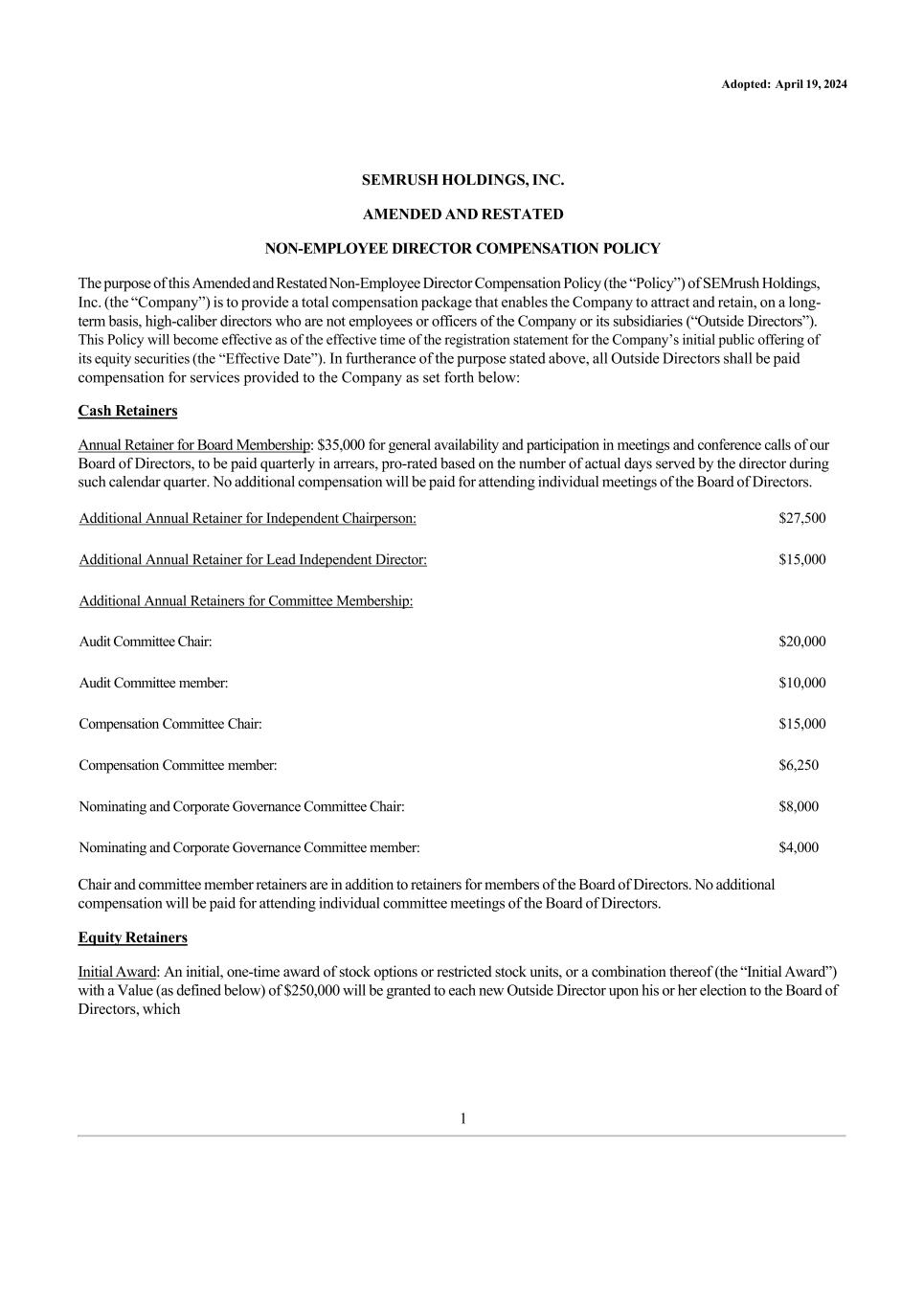
Adopted: April 19, 2024 SEMRUSH HOLDINGS, INC. AMENDED AND RESTATED NON-EMPLOYEE DIRECTOR COMPENSATION POLICY The purpose of this Amended and Restated Non-Employee Director Compensation Policy (the “Policy”) of SEMrush Holdings, Inc. (the “Company”) is to provide a total compensation package that enables the Company to attract and retain, on a long- term basis, high-caliber directors who are not employees or officers of the Company or its subsidiaries (“Outside Directors”). This Policy will become effective as of the effective time of the registration statement for the Company’s initial public offering of its equity securities (the “Effective Date”). In furtherance of the purpose stated above, all Outside Directors shall be paid compensation for services provided to the Company as set forth below: Cash Retainers Annual Retainer for Board Membership: $35,000 for general availability and participation in meetings and conference calls of our Board of Directors, to be paid quarterly in arrears, pro-rated based on the number of actual days served by the director during such calendar quarter. No additional compensation will be paid for attending individual meetings of the Board of Directors. Additional Annual Retainer for Independent Chairperson: $27,500 Additional Annual Retainer for Lead Independent Director: $15,000 Additional Annual Retainers for Committee Membership: Audit Committee Chair: $20,000 Audit Committee member: $10,000 Compensation Committee Chair: $15,000 Compensation Committee member: $6,250 Nominating and Corporate Governance Committee Chair: $8,000 Nominating and Corporate Governance Committee member: $4,000 Chair and committee member retainers are in addition to retainers for members of the Board of Directors. No additional compensation will be paid for attending individual committee meetings of the Board of Directors. Equity Retainers Initial Award: An initial, one-time award of stock options or restricted stock units, or a combination thereof (the “Initial Award”) with a Value (as defined below) of $250,000 will be granted to each new Outside Director upon his or her election to the Board of Directors, which 1
shall vest one-third on the earlier of (i) the first anniversary of the grant date or (ii) the next annual meeting of stockholders and the remaining two-thirds will vest in equal monthly installments over the next two years, provided, however, that all vesting shall cease if the director ceases to have a Service Relationship. If the Initial Award is a stock option award, such Initial Award shall expire ten years from the date of grant, and shall have a per share exercise price equal to the Fair Market Value (as defined in the Company’s 2021 Stock Option and Incentive Plan (the “2021 Plan”)) of the Company’s Class A Common Stock on the date of grant. This Initial Award applies only to Outside Directors who are first elected to the Board of Directors subsequent to the Effective Date. Annual Award: On each date of each Annual Meeting of Stockholders of the Company following the Effective Date (the “Annual Meeting”), each continuing Outside Director, other than a director receiving an Initial Award, will receive an annual award of stock options or restricted stock units, or a combination thereof, (the “Annual Award”) with a Value of $182,500, which shall vest in full upon the earlier of (i) the first anniversary of the date of grant or (ii) the date of the next Annual Meeting; provided, however, that all vesting shall cease if the director ceases to have a Service Relationship, unless the Board of Directors determines that the circumstances warrant continuation of vesting. If the Annual Award is a stock option award, such Annual Award shall expire ten years from the date of grant, and shall have a per share exercise price equal to the Fair Market Value (as defined in the 2021 Plan) of the Company’s Class A Common Stock on the date of grant. Value: For purposes of this Policy, “Value” means with respect to (i) any stock option award, the grant date fair value of the option (i.e., Black-Scholes Value) determined in accordance with the reasonable assumptions and methodologies employed by the Company for calculating the fair value of options under Financial Accounting Standard Board (“FASB”) Accounting Standards Codification (“ASC”) Topic 718; and (ii) any award of restricted stock or restricted stock units the product of (A) the average closing market price on Nasdaq Global Market (or such other market on which the Company’s Class A Common Stock is then principally listed) of one share of the Company’s Class A Common Stock over the trailing 30-day period ending on the last day of the month immediately prior to the month of the grant date, and (B) the aggregate number of shares of Class A Common Stock underlying such award. Acceleration: All outstanding Initial Awards and Annual Awards held by an Outside Director shall become fully vested nonforfeitable upon (i) the death or disability of the Outside Director or (ii) the termination of the Outside Director’s Service Relationship upon or within twelve (12) months following a Sale Event (as defined in the 2021 Plan). Expenses The Company will reimburse all reasonable out-of-pocket expenses incurred by non-employee directors in attending meetings of the Board of Directors or any committee thereof. 2

Maximum Annual Compensation The aggregate amount of compensation, including both equity compensation and cash compensation, paid by the Company to any Outside Director in a calendar year for services as an Outside Director shall not exceed $750,000 (or such other limit as may be set forth in Section 3(b) of the 2021 Plan or any similar provision of a successor plan). For this purpose, the “amount” of equity compensation paid in a calendar year shall be determined based on the grant date fair value thereof, as determined in accordance with FASB ASC Topic 718 or its successor provision, but excluding the impact of estimated forfeitures related to service-based vesting conditions. 3
EX-10.20
4
employementagreementbetw.htm
EX-10.20
employementagreementbetw
Exhibit 10.20 SEMRUSH, INC. EMPLOYMENT AGREEMENT This Employment Agreement (“Agreement”) dated as of March 10, 2025 (the “Effective Date”), is made between Semrush Holdings, Inc., a Delaware corporation, and/or to the extent applicable, its subsidiary entities (the “Company”), and William Wagner (the “Executive”). Except with respect to the Equity Documents (as defined below), this Agreement supersedes in all respects all prior agreements between you and the Company regarding the subject matter herein, including without limitation any offer letter, employment agreement or severance agreement (the “Prior Agreement”). NOW, THEREFORE, in consideration of the mutual covenants and agreements herein contained and other good and valuable consideration, the receipt and sufficiency of which is hereby acknowledged, the parties agree as follows: 1. Employment. (a) Term. The Company shall employ you and you shall be employed by the Company pursuant to this Agreement commencing as of the Effective Date and continuing until such employment is terminated in accordance with the provisions hereof (the “Term”). Your employment with the Company will continue to be “at will,” meaning that your employment may be terminated by the Company or you at any time and for any reason subject to the terms of this Agreement. (b) Position and Duties. You shall serve as the Chief Executive Officer of the Company and shall have such powers and duties as may from time to time be prescribed by the Board of Directors (the “Board”), including by the Compensation Committee. You shall devote your full working time and efforts to the business and affairs of the Company. Notwithstanding the foregoing, you may serve on other boards of directors, with the approval of the Board, or engage in religious, charitable or other community activities as long as such services and activities are disclosed to the Board and do not interfere with your performance of your duties to the Company. 2. Compensation and Related Matters. (a) Base Salary. Your initial base salary shall be paid at the rate of $500,000 per year. Your base salary shall be subject to periodic review, but at least annually, by the Board or the Talent and Compensation Committee of the Board (the “Compensation Committee”). The base salary in effect at any given time is referred to herein as “Base Salary.” The Base Salary shall be payable in a manner that is consistent with the Company’s usual payroll practices for executive officers. (b) Incentive Compensation. You shall be eligible to receive cash incentive compensation as determined by the Board or the Compensation Committee from time to time. Your initial target annual incentive compensation shall be one-hundred (100) percent of your
2 Base Salary. The target annual incentive compensation in effect at any given time is referred to herein as “Target Bonus.” The actual amount of your annual incentive compensation, if any, shall be determined in the sole discretion of the Board or the Compensation Committee, subject to the terms of any applicable incentive compensation plan that may be in effect from time to time. Except as otherwise provided herein, to earn incentive compensation, you must be employed by the Company on the day such incentive compensation is paid. (c) Expenses. You shall be entitled to receive prompt reimbursement for all reasonable expenses incurred by you during the Term in performing services hereunder, in accordance with the policies and procedures then in effect and established by the Company for its executive officers. (d) Other Benefits. You shall be eligible to participate in or receive benefits under the Company’s employee benefit plans in effect from time to time, subject to the terms of such plans. (e) Paid Time Off. You shall be entitled to take paid time off in accordance with the Company’s applicable paid time off policy for executives, as may be in effect from time to time. (f) Equity. The equity awards held by you shall continue to be governed by the terms and conditions of the Company’s applicable equity incentive plan(s) and the applicable award agreement(s) governing the terms of such equity awards held by you (collectively, the “Equity Documents”); provided, however, and notwithstanding anything to the contrary in the Equity Documents, Section 6(a)(ii) of this Agreement shall apply in the event of a termination by the Company without Cause or by you for Good Reason in either event within the Sale Event Period (as such terms are defined below). 3. Termination. Your employment hereunder may be terminated without any breach of this Agreement under the following circumstances: (a) Death. Your employment hereunder shall terminate upon death. (b) Disability. The Company may terminate your employment if you are disabled and unable to perform or expected to be unable to perform the essential functions of your then existing position or positions under this Agreement with or without reasonable accommodation for a period of 180 days (which need not be consecutive) in any 12-month period. If any question shall arise as to whether during any period you are disabled so as to be unable to perform the essential functions of your then existing position or positions with or without reasonable accommodation, you may, and at the request of the Company shall, submit to the Company a certification in reasonable detail by a physician selected by the Company to whom you or your guardian has no reasonable objection as to whether you are disabled or how long such disability is expected to continue, and such certification shall for the purposes of this Agreement be conclusive of the issue. You shall cooperate with any reasonable request of the physician in connection with such certification. If such question shall arise and you shall fail to submit such certification, the Company’s determination of such issue shall be binding on you. Nothing in this Section 3(b) shall be construed to waive your rights, if any, under existing law

3 including, without limitation, the Family and Medical Leave Act of 1993, 29 U.S.C. §2601 et seq. and the Americans with Disabilities Act, 42 U.S.C. §12101 et seq. (c) Termination by Company for Cause. The Company may terminate the your employment hereunder for Cause. For purposes of this Agreement, “Cause” shall mean any of the following: (i) subject to the Cure Period, conduct by you constituting a material act of misconduct in connection with the performance of your duties, including, without limitation, (A) willful failure or refusal to perform material responsibilities that have been requested by the Board; (B) dishonesty to the Board with respect to any material matter; or (C) misappropriation of funds or property of the Company or any of its subsidiaries or affiliates other than the occasional, customary and de minimis use of Company property for personal purposes; (ii) the commission by you of acts satisfying the elements of (A) any felony or (B) a misdemeanor involving moral turpitude, deceit, dishonesty or fraud; (iii) subject to the Cure Period, any misconduct by you, regardless of whether or not in the course of your employment, that would reasonably be expected to result in material injury or material reputational harm to the Company or any of its subsidiaries or affiliates if you were to continue to be employed in the same position; (iv) subject to the Cure Period, a material breach by you of any of the provisions contained in Section 8 of this Agreement or the Restrictive Covenants Agreement (as defined below); (v) subject to the Cure Period, a material violation by you of any of the Company’s written employment policies ; or (vi) subject to the Cure Period, your failure to cooperate with a bona fide internal investigation or an investigation by regulatory or law enforcement authorities, after being instructed by the Company to cooperate, or the willful destruction or failure to preserve documents or other materials known to be relevant to such investigation or the inducement of others to fail to cooperate or to produce documents or other materials in connection with such investigation. The “Cure Period” means that, if the alleged violation is reasonably, curable, (i) the Company provides you with 30 days’ advance written notice of the alleged violation(s); and (ii) you fail to cure the alleged violation within such 30 day period. Notwithstanding anything to the contrary in this Agreement, if the alleged violation is not curable, then the Cure Period shall not apply. (d) Termination by the Company without Cause. The Company may terminate your employment hereunder at any time without Cause. Any termination by the Company of your employment under this Agreement which does not constitute a termination for Cause under Section 3(c) and does not result from the death or disability of you under Section 3(a) or (b) shall be deemed a termination without Cause.
4 (e) Termination by You. You may terminate employment hereunder at any time for any reason, including but not limited to, Good Reason. For purposes of this Agreement, “Good Reason” shall mean that you have completed all steps of the Good Reason Process (hereinafter defined) following the occurrence of any of the following events without your consent (each, a “Good Reason Condition”): (i) a material diminution in your title, responsibilities, authority, reporting structure, or duties; (ii) a material diminution in your Base Salary except for across-the- board salary reductions based on the Company’s financial performance similarly affecting all or substantially all senior management employees of the Company; (iii) a material change in the geographic location at which you provide services to the Company, such that there is an increase of at least thirty (30) miles of driving distance to such location from your principal residence as of such change; or (iv) a material breach of this Agreement by the Company. The “Good Reason Process” consists of the following steps: (i) you reasonably determine in good faith that a Good Reason Condition has occurred; (ii) you notify the Company in writing of the Good Reason Condition within a reasonable time following the occurrence of such Good Reason Condition; (iii) you cooperate in good faith with the Company’s efforts, for a period of not less than 30 days following such notice (the “Cure Period”), to remedy the Good Reason Condition; (iv) notwithstanding such efforts, the Good Reason Condition continues to exist; and (v) you terminate employment within 60 days after the end of the Cure Period. If the parties agree in good faith that the Company cured the Good Reason Condition during the Cure Period, Good Reason shall be deemed not to have occurred. If your employment with the Company is terminated for any reason, the Company shall pay or provide to you (or your authorized representative or estate) (i) any Base Salary earned through the Date of Termination; (ii) unpaid expense reimbursements (subject to, and in accordance with, Section 2(c) of this Agreement); and (iii) any vested benefits you may have under any employee benefit plan of the Company through the Date of Termination, which vested benefits shall be paid and/or provided in accordance with the terms of such employee benefit plans (collectively, the “Accrued Obligations”).

5 4. Notice and Date of Termination. (a) Notice of Termination. Except for termination as specified in Section 3(a), any termination of your employment by the Company or any such termination by you shall be communicated by written Notice of Termination to the other party hereto. For purposes of this Agreement, a “Notice of Termination” shall mean a notice which shall indicate the specific termination provision in this Agreement relied upon. (b) Date of Termination. “Date of Termination” shall mean: (i) if your employment is terminated by death, the date of death; (ii) if your employment is terminated on account of disability under Section 3(b) or by the Company for Cause under Section 3(c), the date on which Notice of Termination is given; (iii) if your employment is terminated by the Company without Cause under Section 3(d), the date on which a Notice of Termination is given or the date otherwise specified by the Company in the Notice of Termination; (iv) if your employment is terminated by you under Section 3(e) other than for Good Reason, 30 days after the date on which a Notice of Termination is given, and (v) if your employment is terminated by you under Section 3(e) for Good Reason, the date on which a Notice of Termination is given after the end of the Cure Period. Notwithstanding the foregoing, in the event that you give a Notice of Termination to the Company, the Company may unilaterally accelerate the Date of Termination and such acceleration shall not result in a termination by the Company for purposes of this Agreement. 5. Severance Pay and Benefits Upon Termination by the Company without Cause or by You for Good Reason Outside the Sale Event Period. If your employment is terminated by the Company without Cause as provided in Section 3(d), or you terminate employment for Good Reason as provided in Section 3(e), each outside of the Sale Event Period (as defined below), then, in addition to the Accrued Obligations, and subject to (i) you signing a separation agreement and release in a form and manner reasonably satisfactory to the Company, which shall include, without limitation, a general release of claims against the Company and all related persons and entities, a reaffirmation of all of your Continuing Obligations (as defined below), and shall provide that if you breach any of the Continuing Obligations, all payments of the Severance Amount shall immediately cease (the “Separation Agreement and Release”), and (ii) the Separation Agreement and Release becoming irrevocable, all within 60 days after the Date of Termination (or such shorter period as set forth in the Separation Agreement and Release), which shall include a seven (7) business day revocation period: (a) the Company shall pay you an amount equal to twelve months of your Base Salary (the “Severance Amount”); and (b) subject to your copayment of premium amounts at the applicable active employees’ rate and your proper election to receive benefits under the Consolidated Omnibus Budget Reconciliation Act of 1985, as amended (“COBRA”), the Company shall pay to the group health plan provider, the COBRA provider or you a monthly payment equal to the monthly employer contribution that the Company would have made to provide health insurance to you if you had remained employed by the Company until the earliest of (A) the twelve month anniversary of the Date of Termination; (B) your eligibility for group medical plan benefits under any other employer’s group medical plan; or (C) the cessation of your continuation rights
6 under COBRA; provided, however, if the Company determines that it cannot pay such amounts to the group health plan provider or the COBRA provider (if applicable) without potentially violating applicable law (including, without limitation, Section 2716 of the Public Health Service Act), then the Company shall convert such payments to payroll payments directly to you for the time period specified above. Such payments shall be subject to tax-related deductions and withholdings and paid on the Company’s regular payroll dates. The amounts payable under Section 5, to the extent taxable, shall be paid out in substantially equal installments in accordance with the Company’s payroll practice over twelve months commencing within 60 days after the Date of Termination; provided, however, that if the 60-day period begins in one calendar year and ends in a second calendar year, the Severance Amount, to the extent it qualifies as “non-qualified deferred compensation” within the meaning of Section 409A of the Internal Revenue Code of 1986, as amended (the “Code”), shall begin to be paid in the second calendar year by the last day of such 60-day period; provided, further, that the initial payment shall include a catch-up payment to cover amounts retroactive to the day immediately following the Date of Termination. Each payment pursuant to this Agreement is intended to constitute a separate payment for purposes of Treasury Regulation Section 1.409A-2(b)(2). 6. Severance Pay and Benefits Upon Termination by the Company without Cause or by the You for Good Reason within the Sale Event Period. The provisions of this Section 6 shall apply in lieu of, and expressly supersede, the provisions of Section 5 if (i) your employment is terminated either (a) by the Company or its successor without Cause as provided in Section 3(d), or (b) by you for Good Reason as provided in Section 3(e), and (ii) the Date of Termination is within three (3) months prior to or within 12 months after the occurrence of the first event constituting a Sale Event (such period, the “Sale Event Period”) in which your equity award(s) is/are assumed, continued or substituted by the Company or its successor entity. Notwithstanding the foregoing or anything else to the contrary in this Agreement: (i) if the parties to such Sale Event do not provide for the assumption, continuation or substitution of your Time -Based Equity Awards (as defined below), upon the effective time of the Sale Event, subject to your employment with the Company at such time or your termination by the Company without Cause or by you for Good Reason, in either case within three (3) months immediately prior to a Sale Event, such equity award(s) shall become fully vested and exercisable or nonforfeitable. (a) If your employment is terminated by the Company or its successor without Cause as provided in Section 3(d) or you terminate employment for Good Reason as provided in Section 3(e) and in each case the Date of Termination occurs during the Sale Event Period, then, in addition to the Accrued Obligations, and subject to the signing of the Separation Agreement and Release by you and the Separation Agreement and Release becoming fully effective, all within the time frame set forth in the Separation Agreement and Release but in no event more than 60 days after the Date of Termination: (i) the Company shall pay you a lump sum in cash in an amount equal to (A) 1.5 times your then current Base Salary (or your Base Salary in effect immediately prior to the Sale Event, if higher) plus (B) your Target Bonus for the then-current year (the “Sale Event Payment”); and
7 (ii) notwithstanding anything to the contrary in any applicable option agreement or other stock-based award agreement, all time-based stock options and other stock-based awards subject to time-based vesting held by you (the “Time-Based Equity Awards”) shall immediately accelerate and become fully exercisable or nonforfeitable as of the later of (i) the Date of Termination or (ii) the effective date of the Separation Agreement and Release (the “Accelerated Vesting Date”); provided that any termination or forfeiture of the unvested portion of such Time-Based Equity Awards that would otherwise occur on the Date of Termination in the absence of this Agreement will be delayed until the effective date of the Separation Agreement and Release and will only occur if the vesting pursuant to this subsection does not occur due to the absence of the Separation Agreement and Release becoming fully effective within the time period set forth therein. Notwithstanding the foregoing, no additional vesting of the Time-Based Equity Awards shall occur during the period between your Date of Termination and the Accelerated Vesting Date; and (iii) subject to your copayment of premium amounts at the applicable active employees’ rate and your proper election to receive benefits under COBRA, the Company shall pay to the group health plan provider, the COBRA provider or you a monthly payment equal to the monthly employer contribution that the Company would have made to provide health insurance to you if you had remained employed by the Company until the earliest of (A) the eighteen month anniversary of the Date of Termination; (B) your eligibility for group medical plan benefits under any other employer’s group medical plan; or (C) the cessation of your continuation rights under COBRA; provided, however, if the Company determines that it cannot pay such amounts to the group health plan provider or the COBRA provider (if applicable) without potentially violating applicable law (including, without limitation, Section 2716 of the Public Health Service Act), then the Company shall convert such payments to payroll payments directly to you for the time period specified above. Such payments shall be subject to tax-related deductions and withholdings and paid on the Company’s regular payroll dates. The amounts payable under this Section 6(a), to the extent taxable, shall be paid or commence to be paid within 60 days after the Date of Termination; provided, however, that if the 60-day period begins in one calendar year and ends in a second calendar year, such payments to the extent they qualify as “non-qualified deferred compensation” within the meaning of Section 409A of the Code, shall be paid or commence to be paid in the second calendar year by the last day of such 60-day period. (b) Additional Limitation. (i) Anything in this Agreement to the contrary notwithstanding, in the event that the amount of any compensation, payment or distribution by the Company to or for the benefit of you, whether paid or payable or distributed or distributable pursuant to the terms of this Agreement or otherwise, calculated in a manner consistent with Section 280G of the Code, and the applicable regulations thereunder (the “Aggregate Payments”), would be subject to the excise tax imposed by Section 4999 of the Code, then the Aggregate Payments shall be reduced (but not below zero) so that the sum of all
8 of the Aggregate Payments shall be $1.00 less than the amount at which you became the subject to the excise tax imposed by Section 4999 of the Code; provided that such reduction shall only occur if it would result in you receiving a higher After Tax Amount (as defined below) than you would receive if the Aggregate Payments were not subject to such reduction. In such event, the Aggregate Payments shall be reduced in the following order, in each case, in reverse chronological order beginning with the Aggregate Payments that are to be paid the furthest in time from consummation of the transaction that is subject to Section 280G of the Code: (1) cash payments not subject to Section 409A of the Code; (2) cash payments subject to Section 409A of the Code; (3) equity- based payments and acceleration; and (4) non-cash forms of benefits; provided that in the case of all the foregoing Aggregate Payments all amounts or payments that are not subject to calculation under Treas. Reg. §1.280G-1, Q&A-24(b) or (c) shall be reduced before any amounts that are subject to calculation under Treas. Reg. §1.280G-1, Q&A- 24(b) or (c). (ii) For purposes of this Section 6(b), the “After Tax Amount” means the amount of the Aggregate Payments less all federal, state, and local income, excise and employment taxes imposed on you as a result of your receipt of the Aggregate Payments. For purposes of determining the After Tax Amount, you shall be deemed to pay federal income taxes at the highest marginal rate of federal income taxation applicable to individuals for the calendar year in which the determination is to be made, and state and local income taxes at the highest marginal rates of individual taxation in each applicable state and locality, net of the maximum reduction in federal income taxes which could be obtained from deduction of such state and local taxes. (iii) The determination as to whether a reduction in the Aggregate Payments shall be made pursuant to Section 6(b)(i) shall be made by a nationally recognized accounting firm selected by the Company (the “Accounting Firm”), which shall provide detailed supporting calculations both to the Company and you within 15 business days of the Date of Termination, if applicable, or at such earlier time as is reasonably requested by the Company or you. Any determination by the Accounting Firm shall be binding upon the Company and you. (c) Sale Event. For purposes of this Agreement, “Sale Event” is defined under the Company’s equity plan, which definition is reproduced herein for reference: (i) the sale of all or substantially all of the assets of the Company on a consolidated basis to an unrelated person or entity, (ii) a merger, reorganization or consolidation pursuant to which the holders of the Company’s outstanding voting power and outstanding stock immediately prior to such transaction do not own a majority of the outstanding voting power and outstanding stock or other equity interests of the resulting or successor entity (or its ultimate parent, if applicable) immediately upon completion of such transaction, (iii) the sale of all of the Stock (as defined in the Company’s equity plan) of the Company to an unrelated person, entity or group thereof acting in concert, or (iv) any other transaction in which the owners of the Company’s outstanding voting power immediately prior to such transaction do not own at least a majority of the outstanding voting power of the Company or any successor entity immediately upon completion of the transaction other than as a result of the acquisition of securities directly from the Company.
9 (d) If the terms of any individual equity award agreement are more favorable to you than this Agreement, the terms of such individual equity award agreement shall govern. 7. Section 409A. (a) Anything in this Agreement to the contrary notwithstanding, if at the time of your separation from service within the meaning of Section 409A of the Code, the Company determines that you are a “specified employee” within the meaning of Section 409A(a)(2)(B)(i) of the Code, then to the extent any payment or benefit that you become entitled to under this Agreement or otherwise on account of your separation from service would be considered deferred compensation otherwise subject to the 20 percent additional tax imposed pursuant to Section 409A(a) of the Code as a result of the application of Section 409A(a)(2)(B)(i) of the Code, such payment shall not be payable and such benefit shall not be provided until the date that is the earlier of (A) twelve months and one day after your separation from service, or (B) your death. If any such delayed cash payment is otherwise payable on an installment basis, the first payment shall include a catch-up payment covering amounts that would otherwise have been paid during the twelve-month period but for the application of this provision, and the balance of the installments shall be payable in accordance with their original schedule. (b) All in-kind benefits provided and expenses eligible for reimbursement under this Agreement shall be provided by the Company or incurred by you during the time periods set forth in this Agreement. All reimbursements shall be paid as soon as administratively practicable, but in no event shall any reimbursement be paid after the last day of the taxable year following the taxable year in which the expense was incurred. The amount of in-kind benefits provided or reimbursable expenses incurred in one taxable year shall not affect the in-kind benefits to be provided or the expenses eligible for reimbursement in any other taxable year (except for any lifetime or other aggregate limitation applicable to medical expenses). Such right to reimbursement or in-kind benefits is not subject to liquidation or exchange for another benefit. (c) To the extent that any payment or benefit described in this Agreement constitutes “non-qualified deferred compensation” under Section 409A of the Code, and to the extent that such payment or benefit is payable upon your termination of employment, then such payments or benefits shall be payable only upon your “separation from service.” The determination of whether and when a separation from service has occurred shall be made in accordance with the presumptions set forth in Treasury Regulation Section 1.409A-1(h). (d) The parties intend that this Agreement will be administered in accordance with Section 409A of the Code. To the extent that any provision of this Agreement is ambiguous as to its compliance with Section 409A of the Code, the provision shall be read in such a manner so that all payments hereunder comply with Section 409A of the Code. Each payment pursuant to this Agreement or the Restrictive Covenants Agreement is intended to constitute a separate payment for purposes of Treasury Regulation Section 1.409A-2(b)(2). The parties agree that this Agreement may be amended, as reasonably requested by either party, and as may be necessary to fully comply with Section 409A of the Code and all related rules and regulations in order to preserve the payments and benefits provided hereunder without additional cost to either party.
10 (e) The Company makes no representation or warranty and shall have no liability to you or any other person if any provisions of this Agreement are determined to constitute deferred compensation subject to Section 409A of the Code but do not satisfy an exemption from, or the conditions of, such Section. 8. Continuing Obligations. (a) Restrictive Covenants Agreement. The terms of the Employee Confidentiality, Invention Assignment and Nondisclosure Agreement, as of the date hereof (the “Restrictive Covenants Agreement”), between the Company and you, attached hereto as Exhibit A, continue to be in full force and effect. For purposes of this Agreement, the obligations in this Section 8 and those that arise in the Restrictive Covenants Agreement and any other agreement relating to confidentiality, assignment of inventions, or other restrictive covenants shall collectively be referred to as the “Continuing Obligations.” (b) Third-Party Agreements and Rights. You hereby confirm that you are not bound by the terms of any agreement with any previous employer or other party which restricts in any way your use or disclosure of information, other than confidentiality restrictions (if any), or your engagement in any business. You represent to the Company that your execution of this Agreement, your employment with the Company and the performance of your proposed duties for the Company will not violate any obligations you may have to any such previous employer or other party. In your work for the Company, you will not disclose or make use of any information in violation of any agreements with or rights of any such previous employer or other party, and you will not bring to the premises of the Company any copies or other tangible embodiments of non-public information belonging to or obtained from any such previous employment or other party. (c) Litigation and Regulatory Cooperation. During and after your employment, you shall reasonably cooperate with the Company in (i) the defense or prosecution of any claims or actions now in existence or which may be brought in the future against or on behalf of the Company which relate to events or occurrences that transpired while you were employed by the Company, and (ii) the investigation, whether internal or external, of any matters about which the Company believes you may have knowledge or information. Your reasonable cooperation in connection with such claims, actions or investigations shall include, but not be limited to, being available to meet with counsel to answer questions or to prepare for discovery or trial and to act as a witness on behalf of the Company at mutually convenient times. During and after your employment, you also shall reasonably cooperate with the Company in connection with any investigation or review of any federal, state or local regulatory authority as any such investigation or review relates to events or occurrences that transpired while you were employed by the Company. The Company shall reimburse you for any reasonable out of pocket expenses incurred in connection with your performance of obligations pursuant to this Section 8(c). (d) Relief. You agree that it would be difficult to measure any damages caused to the Company which might result from any breach by you of the Continuing Obligations, and that in any event money damages would be an inadequate remedy for any such breach. Accordingly, you agree that if you breach, or propose to breach, any portion of the Continuing Obligations, the Company shall be entitled, in addition to all other remedies that it
11 may have, to an injunction or other appropriate equitable relief to restrain any such breach without showing or proving any actual damage to the Company. (e) Protected Disclosures and Other Protected Action. Nothing in this Agreement shall be interpreted or applied to prohibit you from making any good faith report to any governmental agency or other governmental entity (a “Government Agency”) concerning any act or omission that you reasonably believe constitutes a possible violation of federal or state law or making other disclosures that are protected under the anti-retaliation or whistleblower provisions of applicable federal or state law or regulation. In addition, nothing contained in this Agreement limits your ability to communicate with any Government Agency or otherwise participate in any investigation or proceeding that may be conducted by any Government Agency, including your ability to provide documents or other information, without notice to the Company. In addition, for the avoidance of doubt, pursuant to the federal Defend Trade Secrets Act of 2016, you shall not be held criminally or civilly liable under any federal or state trade secret law or under this Agreement or the Restrictive Covenants Agreement for the disclosure of a trade secret that (a) is made (i) in confidence to a federal, state, or local government official, either directly or indirectly, or to an attorney; and (ii) solely for the purpose of reporting or investigating a suspected violation of law; or (b) is made in a complaint or other document filed in a lawsuit or other proceeding, if such filing is made under seal. 9. Arbitration of Disputes. (a) Arbitration Generally. Any controversy or claim arising out of or relating to this Agreement or the breach thereof or otherwise arising out of your employment or the termination of that employment (including, without limitation, any claims of unlawful employment discrimination or retaliation, whether based on race, religion, national origin, sex, gender, age, disability, sexual orientation, or any other protected class under applicable law, including without limitation Massachusetts General Laws Chapter 151B) shall, to the fullest extent permitted by law, be settled by arbitration in any forum and form agreed upon by the parties or, in the absence of such an agreement, under the auspices of JAMS in Boston, Massachusetts in accordance with the JAMS Employment Arbitration Rules, including, but not limited to, the rules and procedures applicable to the selection of arbitrators. You understand that you may only bring such claims in your individual capacity, and not as a plaintiff or class member in any purported class proceeding or any purported representative proceeding. You further understand that, by signing this Agreement, the Company and you are giving up any right they may have to a jury trial on all claims they may have against each other. Judgment upon the award rendered by the arbitrator may be entered in any court having jurisdiction thereof. This Section 9 shall be specifically enforceable. Notwithstanding the foregoing, this Section 9 shall not preclude either party from pursuing a court action for the sole purpose of obtaining a temporary restraining order or a preliminary injunction in circumstances in which such relief is appropriate, including without limitation relief sought under the Restrictive Covenants Agreement; provided that any other relief shall be pursued through an arbitration proceeding pursuant to this Section 9. (b) Arbitration Fees and Costs. You shall be required to pay an arbitration fee to initiate any arbitration equal to what you would be charged as a first appearance fee in court. The Company shall advance the remaining fees and costs of the arbitrator. However, to the
12 extent permissible under the law, and following the arbitrator’s ruling on the matter, the arbitrator may rule that the arbitrator’s fees and costs be distributed in an alternative manner. Each party shall pay its own costs and attorneys’ fees, if any. If, however, any party prevails on a statutory or contractual claim that affords the prevailing party attorneys’ fees (including pursuant to this Agreement), the arbitrator may award attorneys’ fees to the prevailing party to the extent permitted by law. 10. Consent to Jurisdiction. To the extent that any court action is permitted consistent with or to enforce Section 9 of this Agreement, the parties hereby consent to the jurisdiction of the state and federal courts of the Commonwealth of Massachusetts. Accordingly, with respect to any such court action, you (a) submit to the exclusive personal jurisdiction of such courts; (b) consent to service of process; and (c) waive any other requirement (whether imposed by statute, rule of court, or otherwise) with respect to personal jurisdiction or service of process. 11. Waiver of Jury Trial. You and the Company irrevocably and unconditionally WAIVES ALL RIGHT TO TRIAL BY JURY IN ANY PROCEEDING (WHETHER BASED ON CONTRACT, TORT OR OTHERWISE) ARISING OUT OF OR RELATING TO THIS AGREEMENT OR YOUR EMPLOYMENT BY THE COMPANY OR ANY AFFILIATE OF THE COMPANY, INCLUDING WITHOUT LIMITATION YOURS OR THE COMPANY’S PERFORMANCE UNDER, OR THE ENFORCEMENT OF, THIS AGREEMENT. 12. Integration. This Agreement constitutes the entire agreement between the parties with respect to the subject matter hereof and supersedes all prior agreements between the parties concerning such subject matter, provided that the Restrictive Covenants Agreement and the Equity Documents remain in full force and effect. 13. Withholding; Tax Effect. All payments made by the Company to you under this Agreement shall be net of any tax or other amounts required to be withheld by the Company under applicable law. Nothing in this Agreement shall be construed to require the Company to make any payments to compensate you for any adverse tax effect associated with any payments or benefits or for any deduction or withholding from any payment or benefit. 14. Assignment. Neither you nor the Company may make any assignment of this Agreement or any interest in it, by operation of law or otherwise, without the prior written consent of the other; provided, however, that the Company may assign its rights and obligations under this Agreement (including the Restrictive Covenants Agreement) without your consent to any affiliate or to any person or entity with whom the Company shall hereafter effect a reorganization, consolidate with, or merge into or to whom it transfers all or substantially all of its properties or assets; provided further that if you remain employed or become employed by the Company, the purchaser or any of their affiliates in connection with any such transaction, then you shall not be entitled to any payments, benefits or vesting pursuant to Section 5 or pursuant to Section 6 of this Agreement. This Agreement shall inure to the benefit of and be binding upon you and the Company, and each of yours and the Company’s respective successors, executors, administrators, heirs and permitted assigns. 15. Enforceability. If any portion or provision of this Agreement (including, without limitation, any portion or provision of any section of this Agreement) shall to any extent be
13 declared illegal or unenforceable by a court of competent jurisdiction, then the remainder of this Agreement, or the application of such portion or provision in circumstances other than those as to which it is so declared illegal or unenforceable, shall not be affected thereby, and each portion and provision of this Agreement shall be valid and enforceable to the fullest extent permitted by law. 16. Survival. The provisions of this Agreement shall survive the termination of this Agreement and/or the termination of your employment to the extent necessary to effectuate the terms contained herein. 17. Waiver. No waiver of any provision hereof shall be effective unless made in writing and signed by the waiving party. The failure of any party to require the performance of any term or obligation of this Agreement, or the waiver by any party of any breach of this Agreement, shall not prevent any subsequent enforcement of such term or obligation or be deemed a waiver of any subsequent breach. 18. Notices. Any notices, requests, demands and other communications provided for by this Agreement shall be sufficient if in writing and delivered in person or sent by a nationally recognized overnight courier service or by registered or certified mail, postage prepaid, return receipt requested, to you at the last address you has filed in writing with the Company or, in the case of the Company, at its main offices, attention of the Board. 19. Amendment. This Agreement may be amended or modified only by a written instrument signed by you and by a duly authorized representative of the Company. 20. Effect on Other Plans and Agreements. An election by you to resign for Good Reason under the provisions of this Agreement shall not be deemed a voluntary termination of employment by you for the purpose of interpreting the provisions of any of the Company's benefit plans, programs or policies. Nothing in this Agreement shall be construed to limit the rights of you under the Company’s benefit plans, programs or policies except as otherwise provided in Section 8 hereof, and except that you shall have no rights to any severance benefits under any Company severance pay plan, offer letter or otherwise. In the event that you are a party to an agreement with the Company providing for payments or benefits under such plan or agreement and under this Agreement, the terms of this Agreement shall govern and you may receive payment under this Agreement only and not both. Further, Section 5 and Section 6 of this Agreement are mutually exclusive and in no event shall you be entitled to payments or benefits pursuant to both Section 5 and Section 6 of this Agreement. 21. Governing Law. This is a Massachusetts contract and shall be construed under and be governed in all respects by the laws of the Commonwealth of Massachusetts, without giving effect to the conflict of laws principles thereof. With respect to any disputes concerning federal law, such disputes shall be determined in accordance with the law as it would be interpreted and applied by the United States Court of Appeals for the First Circuit. 22. Counterparts. This Agreement may be executed in any number of counterparts, each of which when so executed and delivered shall be taken to be an original; but such counterparts shall together constitute one and the same document.
IN WITNESS WHEREOF, the parties have executed this Agreement effective on the Effective Date. SEMRUSH HOLDINGS, INC. By: /s/ David Mason Its: Chief Legal Officer WILLIAM WAGNER /s/ William Wagner William Wagner 14

Exhibit A Restrictive Covenants Agreement Employee Confidentiality, Invention Assignment and Nondisclosure Agreement
EX-19.1
5
semrushinsidertradingpol.htm
EX-19.1
semrushinsidertradingpol

Revised July 25, 2023 SEMRUSH HOLDINGS, INC. INSIDER TRADING POLICY This memorandum sets forth the policy of Semrush Holdings, Inc. and its subsidiaries (collectively, the “Company”) regarding trading in the Company’s securities as described below and the disclosure of information concerning the Company. This Insider Trading Policy (the “Insider Trading Policy”) is designed to prevent insider trading or the appearance of impropriety, to satisfy the Company’s obligation to reasonably supervise the activities of Company personnel, and to help Company personnel avoid the severe consequences associated with violations of insider trading laws. It is your obligation to understand and comply with this Insider Trading Policy. PART I. OVERVIEW A. To Whom does this Insider Trading Policy Apply? This Insider Trading Policy is applicable to the Company’s directors, officers, and employees, consultants (including entities and individual persons employed by a professional employment organization and other co-employment arrangements, “Consultants”) and applies to any and all transactions by such persons and their affiliates (as defined below) in the Company’s securities, including its common stock, options to purchase common stock, any other type of securities that the Company may issue (such as preferred stock, convertible debentures, warrants, exchange-traded options or other derivative securities), and any derivative securities that provide the economic equivalent of ownership of any of the Company’s securities or an opportunity, direct or indirect, to profit from any change in the value of the Company’s securities. In addition, all directors, all officers, all employees and Consultants must comply with the Trading Procedures set forth in Part II of this Insider Trading Policy (the “Trading Procedures”) (collectively, and solely for the purposes of this Insider Trading Policy, these persons are referred to as “Designated Insiders”)1. Generally, the Trading Procedures (i) establish trading windows outside of which Insiders will be restricted from trading in the Company’s securities and (ii) require the pre-clearance of all transactions in the Company’s securities by Designated Insiders (and their affiliated persons). This Insider Trading Policy, including, if applicable, the Trading Procedures contained herein, also applies to the following persons (collectively, these persons and entities are referred to as “Affiliated Persons”): • your spouse, child, parent, significant other or other family member, in each case, living in the same household; 1 The list of “Designated Insiders” may be modified from time to time to add or remove individuals as determined by the Chief Executive Officer, Chief Financial Officer or General Counsel without any further action required by the Company’s board of directors.
2 • all trusts, family partnerships and other types of entities formed for your benefit of the Insider or for the benefit of a member of your family over which you have the ability to influence or direct investment decisions concerning securities; • all persons who execute trades on your behalf; and • all investment funds, trusts, retirement plans, partnerships, corporations and other types of entities over which you have the ability to influence or direct investment decisions concerning securities; provided, however, that the Trading Procedures shall not apply to any such entity that engages in the investment of securities in the ordinary course of its business (e.g., an investment fund or partnership) if such entity has established its own insider trading controls and procedures in compliance with applicable securities laws and an Insider has hereby represented to the Company that such Insider’s affiliated entities: (a) engage in the investment of securities in the ordinary course of their respective businesses; (b) have established insider trading controls and procedures in compliance with applicable securities laws; and (c) are aware such securities laws prohibit any person or entity who has material, nonpublic information concerning the Company from purchasing or selling securities of the Company or from communicating such information to any other person under circumstances in which it is reasonably foreseeable that such person is likely to purchase or sell securities. You are responsible for ensuring compliance with this Insider Trading Policy, including the Trading Procedures contained herein, by all of your Affiliated Persons. In the event that you leave the Company for any reason, this Insider Trading Policy, including, if applicable, the Trading Procedures contained herein, will continue to apply to you and your Affiliated Persons until the first trading day after any material nonpublic information known to you has become public or is no longer material. B. What is Prohibited by this Insider Trading Policy? It is generally illegal for you to trade in the securities of the Company, whether for your account or for the account of another, while in the possession of material, nonpublic information about the Company. It is also generally illegal for you to disclose material, nonpublic information about the Company to others who may trade on the basis of that information. These illegal activities are commonly referred to as “insider trading.” Prohibited Activities When you know or are in possession of material, nonpublic information about the Company, whether positive or negative, you are prohibited from the following activities: trading (whether for your account of for the account of another) in the Company’s securities, which includes common stock, options to purchase common stock, any other type of securities that the Company may issue (such as preferred stock, convertible debentures,

3 warrants, exchange-traded options or other derivative securities), and any derivative securities that provide the economic equivalent of ownership of any of the Company’s securities or an opportunity, direct or indirect, to profit from any change in the value of the Company’s securities, except for trades made in compliance with the affirmative defense of Rule 10b5-1 under Securities Exchange Act of 1934, as amended (the “Exchange Act”), such as when trades are made pursuant to a written plan that was adopted, or trading instructions that were given, before you knew or had possession of such material, nonpublic information and certain other conditions are satisfied; • having others trade in the Company’s securities for you; • giving trading advice of any kind about the Company; and • disclosing such material, nonpublic information about the Company, whether positive or negative, to anyone else (commonly known as “tipping”). This Insider Trading Policy applies to the use of outstanding Company securities to pay part or all of the exercise price of an option, any sale of stock as part of a broker-assisted cashless exercise of an option, or any other market sale for the purpose of generating the cash needed to pay the exercise price of an option or to cover tax withholding or other tax obligations resulting from vesting of restricted stock units or awards; however, please see below for exceptions relating to the withholding by the Company of shares of stock upon vesting of restricted stock or upon settlement of restricted stock units to satisfy applicable tax withholding requirements if (a) such withholding is required by the applicable plan or award agreement or (b) the election to exercise such tax withholding right was made by the Insider in compliance with the Trading Procedures. This policy does not apply to an exercise of an employee stock option when payment of the exercise price is made in cash These prohibitions continue whenever and for as long as you know or are in possession of material, nonpublic information. Remember, anyone scrutinizing your transactions will be doing so after the fact, with the benefit of hindsight. As a practical matter, before engaging in any transaction, you should carefully consider how enforcement authorities and others might view the transaction in hindsight. Definition of Material, Nonpublic Information This Insider Trading Policy prohibits you from trading in the Company’s securities if you are in possession of information about the Company that is both “material” and “nonpublic.” If you have a question whether certain information you are aware of is material or has been made public, you are encouraged to consult with the Compliance Officer. What is “Material” Information? Information about the Company is “material” if it could reasonably be expected to affect the investment or voting decisions of a stockholder or investor, or if the disclosure of the information could reasonably be expected to significantly alter the total mix of information in the marketplace about the Company. In simple terms, material information is any type of information that could reasonably be expected to affect the market price of the Company’s securities. Both positive and negative information may be material. While it is not possible to identify all information that would be deemed “material,” the following items are types of
4 information that should be considered carefully to determine whether they are material: • projections of future earnings or losses, or other earnings guidance; • projections of future non-financial key business metrics; • earnings or revenue that are inconsistent with the consensus expectations of the investment community; • potential restatements of the Company’s financial statements, changes in auditors or auditor notification that the Company may no longer rely on an auditor’s audit report; • pending or proposed corporate mergers, acquisitions, tender offers, joint ventures or dispositions of significant assets; • changes in management or the Board of Directors; • significant actual or threatened litigation or governmental investigations or major developments in such matters; • a cybersecurity incident; • significant developments regarding the products, platform, customers, suppliers, orders, partners, contracts or financing sources (e.g., the acquisition or loss of a contract); • changes in dividend policy, declarations of stock splits, or public or private sales of additional securities; • potential defaults under the Company’s credit agreements or indentures, or the existence of material liquidity deficiencies; and • bankruptcies or receiverships. By including the list above, the Company does not mean to imply that each of these items above is per se material. The information and events on this list still require determinations as to their materiality (although some determinations will be reached more easily than others). For example, some new products or contracts may clearly be material to an issuer; yet that does not mean that all product developments or contracts will be material. This demonstrates, in our view, why no “bright-line” standard or list of items can adequately address the range of situations that may arise. Furthermore, the Company cannot create an exclusive list of events and information that have a higher probability of being considered material. The Securities and Exchange Commission (the “SEC”) has stated that there is no fixed quantitative threshold amount for determining materiality, and that even very small quantitative changes can be qualitatively material if they would result in a movement in the price of the Company’s securities. What is “Nonpublic” Information? Material information is “nonpublic” if it has not been disseminated in a manner making it available to investors generally. To show that information is public, it is necessary to point to some fact that establishes that the information has become publicly available, such as the filing
5 of a report with the SEC, the distribution of a press release through a widely disseminated news or wire service, or by other means that are reasonably designed to provide broad public access. Before a person who possesses material, nonpublic information can trade, there also must be adequate time for the market as a whole to absorb the information that has been disclosed. For the purposes of this Insider Trading Policy, information will be considered public after the close of trading on the first full trading day following the Company’s public release of the information. For example, if the Company announces material nonpublic information of which you are aware before trading begins on a Tuesday, the first time you can buy or sell Company securities is the opening of the market on Wednesday. However, if the Company announces this material information after trading begins on that Tuesday, the first time that you can buy or sell Company securities is the opening of the market on Thursday. C. Are there any Restrictions on the Use of Social Media, Internet Discussion Boards or Websites? While the Company encourages its stockholders and potential investors to obtain as much information as possible about the Company, the Company believes that information should come from its publicly-filed SEC reports, press releases and external website or from a designated Company spokesperson, rather than from speculation or unauthorized disclosures by the Company’s directors, officers or employees. For this reason, the Company has designated certain members of management to respond to inquiries regarding the Company’s business and prospects. This centralization of communication is designed to ensure that the information the Company discloses is accurate and considered in light of previous disclosures. Formal announcements are generally reviewed by management and legal counsel before they are made public. Any communications that do not go through this review process create an increased risk to the Company, as well as to the individual responsible for the communication, of civil and criminal liability. In addition, with the emergence of social media and discussion boards, online discussions about companies and their business prospects have become common. Inappropriate communications disseminated on the Internet may pose an inherently greater risk due to the size of the audience they can reach. These forums have the potential to move a stock price significantly, and very rapidly – even though the information disseminated through electronic bulletin boards and discussion boards often is unreliable, and in some cases, may be deliberately false. The SEC has investigated and prosecuted a number of fraudulent schemes involving social media and discussion boards. You may encounter information about the Company on the Internet that you believe is harmful or inaccurate, or other information that you believe is true or beneficial for the Company. Although you may have a natural tendency to deny or confirm such information on social media or on a discussion board, any sort of response, even if it presents accurate information, could be considered improper disclosure and could result in legal liability to you and/or to the Company. The Company is committed to preventing inadvertent disclosures of material, nonpublic information, preventing unwitting participation in Internet-based securities fraud, and avoiding the appearance of impropriety by persons associated with the Company. Accordingly, this Insider Trading Policy prohibits you from discussing material, nonpublic information about the
6 Company with anyone, including other employees, except as required in the performance of your duties. You should not under any circumstances provide information or discuss matters involving the Company with the news media, any broker-dealer, analyst, investment banker, investment advisor, institutional investment manager, investment company or stockholder, even if you are contacted directly by such persons, without express prior authorization. This restriction applies whether or not you identify yourself as associated with the Company. You should refer all such contact or inquiries to the Company’s Compliance Officer or to Semrush Holdings, Inc., 800 Boylston Street, Suite 2475, Boston, MA 02199 USA, Attn: Investor Relations. This Insider Trading Policy also prohibits you from making any comments or postings about material, nonpublic information about the Company on any social media, discussion boards or websites, or responding to comments or postings about the Company’s business made by others. This restriction applies whether or not you identify yourself as associated with the Company. Sharing, posting links to or “re-tweeting” Company news announcements about the Company is permitted so long as the news announcement has already been posted to the Company’s public website (https://www.semrush.com/) or otherwise approved by the Compliance Officer and is not accompanied by commentary prohibited by this Insider Trading Policy. D. What are the Penalties for Insider Trading and Noncompliance with this Insider Trading Policy? Both the SEC and the national securities exchanges, through the Financial Industry Regulatory Authority (“FINRA”), investigate and are very effective at detecting insider trading. The SEC, together with the U.S. Attorneys, pursue insider trading violations vigorously. For instance, cases have been successfully prosecuted against trading by employees in foreign accounts, trading by family members and friends, and trading involving only a small number of shares. The penalties for violating insider trading or tipping rules can be severe and include: • disgorgement of the profit gained or loss avoided by the trading; • payment of the loss suffered by the persons who, contemporaneously with the purchase or sale of securities that are subject of such violation, have purchased or sold, as applicable, securities of the same class; • payment of criminal penalties of up to $5,000,000; • payment of civil penalties of up to three times the profit made or loss avoided; and • imprisonment for up to 20 years. The Company and/or the supervisors of the person engaged in insider trading may also be required to pay civil penalties of up to the greater of $2,166,279 or three times the profit made or loss avoided, as well as criminal penalties of up to $25,000,000, and could under certain circumstances be subject to private lawsuits. Violation of this Insider Trading Policy or any federal or state insider trading laws may
7 subject the person violating such policy or laws to disciplinary action by the Company up to and including termination. The Company reserves the right to determine, in its own discretion and on the basis of the information available to it, whether this Insider Trading Policy has been violated. The Company may determine that specific conduct violates this Insider Trading Policy, whether or not the conduct also violates the law. It is not necessary for the Company to await the filing or conclusion of a civil or criminal action against the alleged violator before taking disciplinary action. E. How Do You Report a Violation of this Insider Trading Policy? If you have a question about this Insider Trading Policy, including whether certain information you are aware of is material or has been made public, you are encouraged to consult with the Compliance Officer. In addition, if you violate this Insider Trading Policy or any federal or state laws governing insider trading, or know of any such violation by any director, officer, employee or Consultant of the Company, you should report the violation immediately to the Compliance Officer. PART II. TRADING PROCEDURES A. Special Trading Restrictions Applicable to Designated Insiders In addition to the restrictions on trading in Company securities set forth above, Designated Insiders and their Affiliated Persons are subject to the following special trading restrictions: 1. No Trading Except During Trading Windows; No Trading During Special Blackout Windows. Trading Windows. The announcement of the Company’s quarterly financial results almost always has the potential to have a material effect on the market for the Company’s securities. Although a Designated Insider may not know the financial results prior to public announcement, if a Designated Insider engages in a trade before the financial results are disclosed to the public, such trades may give an appearance of impropriety that could subject the Designated Insider and the Company to a charge of insider trading. Therefore, subject to limited exceptions described herein, Designated Insiders may trade in Company securities only during four quarterly trading windows and then only after obtaining pre-clearance from the Compliance Officer in accordance with the procedures set forth below. Unless otherwise advised, the four trading windows consist of the periods that begin no earlier than after market close on the first full trading day following the Company’s issuance of a press release (or other method of broad public dissemination) announcing its quarterly or annual earnings and end at the close of business on the 15th day before the end of the then-current quarter. Designated Insiders may be allowed to trade outside of a trading window only (a) pursuant to a pre- approved Rule 10b5-1 Plan as described below or (b) in accordance with the procedure for waivers as described below. Special Blackout Windows. Further, Designated Insiders may not trade in Company securities if they are notified by the Compliance Officer that the trading window is closed because of the existence of a material, nonpublic development. The Compliance Officer will subsequently notify the Designated Insiders once the material, nonpublic development is

8 disclosed to the public or resolved and that, as a result, the trading window is again open. While the Compliance Officer will undertake reasonable efforts to notify Designated Insiders of material, nonpublic events that have occurred, or are soon likely to occur, each Designated Insider has a duty not to trade in Company securities when material, nonpublic information exists, regardless of whether the Designated Insider is aware of that information. 2. Prohibited Transactions • No Short Sales. No Designated Insider may at any time sell any securities of the Company that are not owned by such Designated Insider at the time of the sale (a “short sale”). • No Purchases or Sales of Derivative Securities or Hedging Transactions. No Designated Insider may buy or sell puts, calls, other derivative securities of the Company or any derivative securities that provide the economic equivalent of ownership of any of the Company’s securities or an opportunity, direct or indirect, to profit from any change in the value of the Company’s securities or engage in any other hedging transaction with respect to the Company’s securities, at any time. • No Company Securities Subject to Margin Calls. No Designated Insider may use the Company’s securities as collateral in a margin account. • No Pledges. No Designated Insider may pledge Company securities as collateral for a loan (or modify an existing pledge). 3. Gifts. No Designated Insider may give or make any other transfer of Company securities without consideration (e.g., a gift) during a period when the Designated Insider is not permitted to trade. 4. No Trading During Retirement Plan Blackout Periods. If the Company adopts a policy to allow ownership of Company stock in the Company’s 401(k) or other retirement plan, then no Designated Insider may trade in any Company securities, which were acquired in connection with such Designated Insider’s service or employment with the Company, during a retirement plan “blackout period” except as specifically permitted below. A blackout period includes any period of more than three (3) consecutive business days during which at least fifty percent (50%) of all participants and beneficiaries under all of the individual account plans maintained by the Company and members of its controlled group are prohibited from trading in Company securities through their plan accounts. Designated Insiders will receive advance notice of any such blackout period from the Compliance Officer or his or her designee. B. Covered Persons: Pre-Clearance Requirements
9 All executive officers (“Executive Officers”) who are subject to the reporting requirements of Section 16 of the Securities Exchange Act of 1934, as amended, directors, and persons identified by the Compliance Officer (collectively, “Covered Persons”) must trade using the Company’s stock plan administration platform known as Shareworks (“Shareworks”) to trade in Company stock, unless otherwise authorized by the Company’s Compliance Officer or his or her designee. No Covered Person may trade in Company securities unless the trade has been approved by the Compliance Officer in accordance with the procedures set forth below. The Compliance Officer will review and either approve or prohibit all proposed trades by Covered Persons in accordance with the procedures set forth below. The Compliance Officer may consult with the Company’s other officers and/or outside legal counsel and will receive approval for his or her own trades from the Chief Financial Officer. 1. Procedures. No Covered Person may trade in Company securities until: • The Covered Person has notified the Compliance Officer of the amount and nature of the proposed trade(s) using the Stock Transaction Request form attached to this Insider Trading Policy as Exhibit A or another method approved by the Company within Shareworks. In order to provide adequate time for the preparation of any required reports under Section 16 of the Exchange Act, a Stock Transaction Request form should, if practicable, be received by the Compliance Officer at least two (2) business days prior to the intended trade date; • The Covered Person has certified to the Compliance Officer in writing prior to the proposed trade(s) that the Covered Person is not in possession of material, nonpublic information concerning the Company; • The Covered Person has informed the Compliance Officer, using the Stock Transaction Request form attached hereto as Exhibit A or another method approved by the Company within Shareworks, whether, to the Covered Person’s best knowledge, (a) the Covered Person has (or is deemed to have) engaged in any opposite way transactions within the previous six months that were not exempt from Section 16(b) of the Exchange Act and (b) if the transaction involves a sale by an “affiliate” of the Company or of “restricted securities” (as such terms are defined under Rule 144 under the Securities Act of 1933, as amended (“Rule 144”)), whether the transaction meets all of the applicable conditions of Rule 144; and • The Compliance Officer or his or her designee has approved the trade(s) and has certified such approval in writing. Such certification may be made via digitally-signed electronic mail. The Compliance Officer does not assume the responsibility for, and approval from the Compliance Officer does not protect the Covered Person from, the consequences of prohibited insider trading. 2. Additional Information.

10 Covered Persons shall provide to the Compliance Officer any documentation reasonably requested by him or her in furtherance of the foregoing procedures. Any failure to provide such requested information will be grounds for denial of approval by the Compliance Officer. 3. No Obligation to Approve Trades. The existence of the foregoing approval procedures does not in any way obligate the Compliance Officer to approve any trade requested by a Covered Person. The Compliance Officer may reject any trading request at his or her sole discretion. From time to time, an event may occur that is material to the Company and is known by only a few directors or executives. Covered Persons may not trade in Company securities if they are notified by the Compliance Officer that a proposed trade has not been cleared because of the existence of a material, nonpublic development. Even if that particular Covered Person is not aware of the material, nonpublic development involving the Company, if any Covered Person engages in a trade before a material, nonpublic development is disclosed to the public or resolved, the Covered Person and the Company might be exposed to a charge of insider trading that could be costly and difficult to refute even if the Covered Person was unaware of the development. So long as the event remains material and nonpublic, the Compliance Officer may determine not to approve any transactions in the Company’s securities. The Compliance Officer will subsequently notify the Covered Person once the material, nonpublic development is disclosed to the public or resolved. If a Covered Person requests clearance to trade in the Company’s securities during the pendency of such an event, the Compliance Officer may reject the trading request without disclosing the reason. 4. Completion of Trades. After receiving written clearance to engage in a trade signed by the Compliance Officer, a Covered Person must complete the proposed trade within five (5) business days or make a new trading request. 5. Post-Trade Reporting. Any transactions in the Company’s securities by a Covered Person (including transactions effected pursuant to a Rule 10b5-1 Plan) must be reported to the Compliance Officer on the same day in which such a transaction occurs. Each report a Covered Person makes to the Compliance Officer should include the date of the transaction, quantity of shares, price and broker-dealer through which the transaction was effected. This reporting requirement may be satisfied by sending (or having such Covered Person’s broker send) duplicate confirmations of trades to the Compliance Officer if such information is received by the Compliance Officer on or before the required date. Compliance by Covered Persons with this provision is imperative given the requirement of Section 16 of the Exchange Act that these persons generally must report changes in ownership of Company securities within two (2) business days. C. Exemptions 1. Pre-Approved Rule 10b5-1 Plan.
11 The adoption and application of any Rule 10b5-1 Plan (as defined below), must be made in accordance with the Company’s Rule 10b5-1 Trading Plan Policy (the “Trading Plan Policy”)2. Transactions effected pursuant to a Rule 10b5-1 Plan (as defined below) will not be subject to the Company’s trading windows, retirement plan blackout periods or pre-clearance procedures, and Designated Insiders are not required to complete a Stock Transaction Request form for such transactions. Rule 10b5-1 of the Exchange Act provides an affirmative defense from insider trading liability under the federal securities laws for trading plans, arrangements or instructions that meet certain requirements. A trading plan, arrangement or instruction that meets the requirements of Rule 10b5-1 (a “Rule 10b5-1 Plan”) enables Designated Insiders to establish arrangements to trade in Company securities outside of the Company’s trading windows, even when in possession of material, nonpublic information. 2. Employee Benefit Plans. Exercise of Stock Options. The trading prohibitions and restrictions set forth in the Trading Procedures do not apply to the exercise of an option to purchase securities of the Company when payment of the exercise price is made in cash. However, the exercise of an option to purchase securities of the Company is subject to the current reporting requirements of Section 16 of the Exchange Act and, therefore, Designated Insiders must comply with the post- trade reporting requirement described in Section C above for any such transaction. In addition, the securities acquired upon the exercise of an option to purchase Company securities are subject to all of the requirements of this Insider Trading Policy, including the Trading Procedures contained herein. Moreover, the Trading Procedures apply to the use of outstanding Company securities to pay part or all of the exercise price of an option, any net option exercise, any exercise of a stock appreciation right, share withholding, any sale of stock as part of a broker- assisted cashless exercise of an option, or any other market sale for the purpose of generating the cash needed to pay the exercise price of an option. Tax Withholding on Restricted Stock/Units. The trading prohibitions and restrictions set forth in the Trading Procedures do not apply to the withholding by the Company of shares of stock upon vesting of restricted stock or upon settlement of restricted stock units to satisfy applicable tax withholding requirements if (a) such withholding is required by the applicable plan or award agreement or (b) the election to exercise such tax withholding right was made by the Designated Insider in compliance with the Trading Procedures. Employee Stock Purchase Plan. The trading prohibitions and restrictions set forth in the Trading Procedures do not apply to periodic wage withholding contributions by the Company or employees of the Company which are used to purchase the Company’s securities pursuant to the employees’ advance instructions under the Company’s 2021 Employee Stock Purchase Plan. However, no Designated Insider may: (a) elect to participate in the plan or alter his or her instructions regarding the level of withholding or purchase by the Designated Insider of Company securities under such plan; or (b) make cash contributions to such plan (other than through periodic wage withholding) without complying with the Trading Procedures. Any sale of securities acquired under such plan is subject to the prohibitions and restrictions of the 2 The foregoing requirement shall not apply to 10b5-1 Plans implemented prior to the Company’s adoption of the Rule 10b5-1 Trading Plan Policy.

12 Trading Procedures. Retirement Plan. Should the Company establish such a plan in the future, the trading prohibitions and restrictions set forth in the Trading Procedures will not apply to purchases of Company securities pursuant to a Company-designated retirement plan (the “Retirement Plan”) resulting from periodic contributions by Designated Insiders to the Retirement Plan pursuant to payroll deduction elections. Such prohibitions and restrictions will apply, however, to certain elections Designated Insiders may make under the Retirement Plan, including: (a) an election to increase or decrease the percentage of periodic contributions that will be allocated to the Company stock fund; (b) an election to make an intra-plan transfer of an existing account balance into or out of the Company stock fund; (c) an election to borrow money against or receive a distribution from such Designated Insider’s Retirement Plan account if the loan or distribution will result in a liquidation of some or all of such Designated Insider’s Company stock fund balance; and (d) an election to pre-pay a plan loan if the pre- payment will result in an allocation of loan proceeds to the Company stock fund. Dividend Reinvestment Plan. Should the Company establish such a plan in the future, the trading prohibitions and restrictions set forth in the Trading Procedures will not apply to purchases of Company securities under a Company-designated dividend reinvestment plan resulting from the reinvestment by Designated Insiders of dividends paid on Company securities. Such prohibitions and restrictions do apply, however, to voluntary purchases of Company securities resulting from additional contributions by Designated Insiders to the plan (i.e., direct stock purchases), and to elections by Designated Insiders to participate in the plan or change the level of such participation. The Trading Procedures also apply to sales by Insiders of Company securities purchased pursuant to the plan. D. Waivers A waiver of any provision of this Insider Trading Policy, or the Trading Procedures contained herein, in a specific instance may be authorized in writing by the Audit Committee of the Board of Directors, and any such waiver shall be reported to the Company’s Board of Directors. PART III. ACKNOWLEDGEMENT This Insider Trading Policy will be delivered to all current Designated Insiders at the start of their employment or relationship with the Company. Upon first receiving a copy of this Insider Trading Policy, each individual must acknowledge that he or she has received a copy and agrees to comply with the terms of this Insider Trading Policy, and, if applicable, the Trading Procedures contained herein. The acknowledgment attached hereto as Exhibit B must be returned within ten (10) days of receipt to: Semrush Holdings, Inc. ATTN: General Counsel 800 Boylston Street Suite 2475 Boston, MA 02199

13 This acknowledgment will constitute consent for the Company to impose sanctions for violation of the Insider Trading Policy, including the Trading Procedures, and to issue any necessary stop-transfer orders to the Company’s transfer agent to ensure compliance. All directors, officers, employees and Consultants will be required upon the Company’s request to re-acknowledge and agree to comply with the Insider Trading Policy (including any amendments or modifications). For such purpose, an individual will be deemed to have acknowledged and agreed to comply with the Insider Trading Policy, as amended from time to time, when copies of such items have been delivered by regular or electronic mail (or other delivery option used by the Company) by the Compliance Officer or his or her designee. * * * Questions regarding this Insider Trading Policy are encouraged and may be directed to the Compliance Officer. ***** Adopted by the Board of Directors of Semrush Holdings, Inc. as of March 3, 2021 and most recently revised on July 25, 2023.
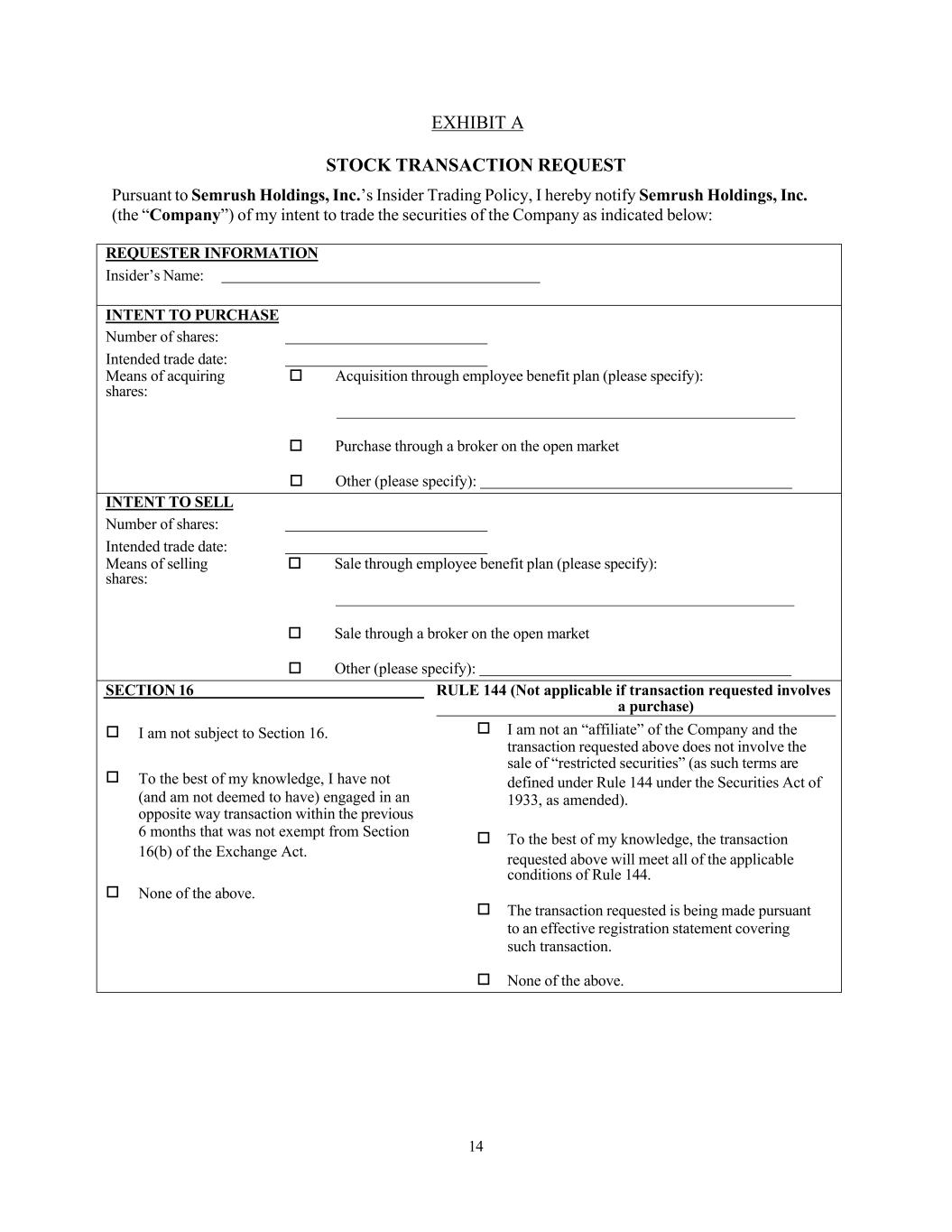
14 EXHIBIT A STOCK TRANSACTION REQUEST Pursuant to Semrush Holdings, Inc.’s Insider Trading Policy, I hereby notify Semrush Holdings, Inc. (the “Company”) of my intent to trade the securities of the Company as indicated below: REQUESTER INFORMATION Insider’s Name: INTENT TO PURCHASE Number of shares: Intended trade date: Means of acquiring o Acquisition through employee benefit plan (please specify): shares: o Purchase through a broker on the open market o Other (please specify): INTENT TO SELL Number of shares: Intended trade date: Means of selling o Sale through employee benefit plan (please specify): shares: o Sale through a broker on the open market o Other (please specify): SECTION 16 RULE 144 (Not applicable if transaction requested involves a purchase) o I am not subject to Section 16. o I am not an “affiliate” of the Company and the transaction requested above does not involve the sale of “restricted securities” (as such terms are o To the best of my knowledge, I have not defined under Rule 144 under the Securities Act of (and am not deemed to have) engaged in an 1933, as amended). opposite way transaction within the previous 6 months that was not exempt from Section o To the best of my knowledge, the transaction 16(b) of the Exchange Act. requested above will meet all of the applicable conditions of Rule 144. o None of the above. o The transaction requested is being made pursuant to an effective registration statement covering such transaction. o None of the above.
15 CERTIFICATION I hereby certify that I am not (1) in possession of any material, nonpublic information concerning the Company, as defined in the Company’s Statement of Company Policy on Insider Trading and Disclosure and (2) purchasing any securities of the Company on margin in contravention of the Company’s Trading Procedures. I understand that, if I trade while possessing such information or in violation of such trading restrictions, I may be subject to severe civil and/or criminal penalties, and may be subject to discipline by the Company including termination. Insider’s Signature Date AUTHORIZED APPROVAL Signature of Compliance Officer (or Date designee) *NOTE: Multiple lots must be listed on separate forms or broken out herein.

16 EXHIBIT B ACKNOWLEDGMENT I hereby acknowledge that I have read, that I understand, and that I agree to comply with, the Insider Trading Policy of Semrush Holdings, Inc. (the “Company”). I further acknowledge and agree that I am responsible for ensuring compliance with the Insider Trading Policy and the Trading Procedures included therein by all of my “Affiliated Persons” (including such persons listed below). I also understand and agree that I will be subject to sanctions, including termination of employment, that may be imposed by the Company, in its sole discretion, for violation of the Insider Trading Policy, and that the Company may give stop-transfer and other instructions to the Company’s transfer agent against the transfer of any Company securities in a transaction that the Company considers to be in contravention of the Insider Trading Policy. I hereby designate the following investment funds and partnerships as entities for which the Trading Procedures contained in the Insider Trading Policy shall not apply: . I hereby represent to the Company that such entities: (a) engage in the investment of securities in the ordinary course of their respective businesses; (b) have established insider trading controls and procedures in compliance with applicable securities laws; and (c) are aware such securities laws prohibit any person or entity who has material, nonpublic information concerning the Company from purchasing or selling securities of the Company or from communicating such information to any other person under circumstances in which it is reasonably foreseeable that such person is likely to purchase or sell securities. Date: Signature: Name: Title:
EX-21.1
6
exhibit21112312024.htm
EX-21.1
Document
Exhibit 21.1
List of Subsidiaries of Semrush Holdings, Inc.
|
|
|
|
|
|
|
|
|
| Subsidiary |
|
Jurisdiction of Organization |
| Semrush Inc. |
|
Delaware |
| Semrush Securities Corporation |
|
Massachusetts |
| SEMrush CZ s.r.o. |
|
Prague, Czech Republic |
| Datos, Inc. (60%) |
|
Delaware |
| SEMrush CY LTD |
|
Republic of Cyprus |
| Prowly.com s. p. z o. o. |
|
Poland |
| Brand 24 S.A. (76.9%) |
|
Poland |
| Semrush Development S.L.U. |
|
Spain |
| Semrush B.V. |
|
Netherlands |
| Semrush AM LLC |
|
Armenia |
| Semrush GmbH |
|
Germany |
| Semrush RS d.o.o. Beograd |
|
Serbia |
| Semrush Canada Inc. |
|
Canada |
| Semrush France s.a.r.l. |
|
France |
| Ryte GmbH |
|
Germany |
| Ryte Technology Services LLC |
|
Vietnam |
EX-23.1
7
exhibit23112312024.htm
EX-23.1
Document
Exhibit 23.1
Consent of Independent Registered Public Accounting Firm
We consent to the incorporation by reference in the following Registration Statements:
(1)Registration Statement (Form S-8 No. 333-254724) pertaining to the Semrush Holdings, Inc. Amended and Restated 2019 Stock Option and Grant Plan, the Semrush Holdings, Inc. 2021 Stock Option and Incentive Plan, and the Semrush Holdings, Inc. 2021 Employee Stock Purchase Plan,
(2)Registration Statement (Form S-8 No. 333-270575) pertaining to the Semrush Holdings, Inc. 2021 Stock Option and Incentive Plan, and
(3)Registration Statement (Form S-8 No. 333-277749) pertaining to the Semrush Holdings, Inc. 2021 Stock Option and Incentive Plan;
of our reports dated March 3, 2025, with respect to the consolidated financial statements of Semrush Holdings, Inc. and the effectiveness of internal control over financial reporting of Semrush Holdings, Inc. included in this Annual Report (Form 10-K) of Semrush Holdings, Inc. for the year ended December 31, 2024.
/s/ Ernst & Young LLP
Boston, Massachusetts
March 3, 2025
EX-31.1
8
exhibit31112312024.htm
EX-31.1
Document
Exhibit 31.1
CERTIFICATION PURSUANT TO RULE 13a-14(a) OR 15d-14(a) OF
THE SECURITIES EXCHANGE ACT OF 1934,
AS ADOPTED PURSUANT TO SECTION 302 OF THE SARBANES-OXLEY ACT OF 2002
I, Oleg Shchegolev, certify that:
1. I have reviewed this Annual Report on Form 10-K of Semrush Holdings, Inc.;
2. Based on my knowledge, this report does not contain any untrue statement of a material fact or omit to state a material fact necessary to make the statements made, in light of the circumstances under which such statements were made, not misleading with respect to the period covered by this report;
3. Based on my knowledge, the financial statements, and other financial information included in this report, fairly present in all material respects the financial condition, results of operations and cash flows of the registrant as of, and for, the periods presented in this report;
4. The registrant's other certifying officer and I are responsible for establishing and maintaining disclosure controls and procedures (as defined in Exchange Act Rules 13a-15(e) and 15d-15(e)) and internal control over financial reporting (as defined in Exchange Act Rules 13a-15(f) and 15d-15(f)) for the registrant and have:
a. designed such disclosure controls and procedures, or caused such disclosure controls and procedures to be designed under our supervision, to ensure that material information relating to the registrant, including its consolidated subsidiaries, is made known to us by others within those entities, particularly during the period in which this report is being prepared;
b. designed such internal control over financial reporting, or caused such internal control over financial reporting to be designed under our supervision, to provide reasonable assurance regarding the reliability of financial reporting and the preparation of financial statements for external purposes in accordance with generally accepted accounting principles.
c. evaluated the effectiveness of the registrant's disclosure controls and procedures and presented in this report our conclusions about the effectiveness of the disclosure controls and procedures, as of the end of the period covered by this report based on such evaluation; and
d. disclosed in this report any change in the registrant's internal control over financial reporting that occurred during the registrant's most recent fiscal quarter (the registrant's fourth fiscal quarter in the case of an annual report) that has materially affected, or is reasonably likely to materially affect, the registrant's internal control over financial reporting; and
5. The registrant's other certifying officer and I have disclosed, based on our most recent evaluation of internal control over financial reporting, to the registrant's auditors and the audit committee of the registrant's board of directors (or persons performing the equivalent functions):
a. all significant deficiencies and material weaknesses in the design or operation of internal control over financial reporting which are reasonably likely to adversely affect the registrant's ability to record, process, summarize and report financial information; and
b. any fraud, whether or not material, that involves management or other employees who have a significant role in the registrant's internal control over financial reporting.
|
|
|
|
|
|
|
|
|
|
|
|
|
|
|
| Date: |
March 3, 2025 |
Semrush Holdings, Inc. |
|
|
|
|
|
|
|
|
By: |
/s/ Oleg Shchegolev |
|
|
|
|
Oleg Shchegolev |
|
|
|
|
Chief Executive Officer |
|
|
|
|
(Principal Executive Officer) |
|
EX-31.2
9
exhibit31212312024.htm
EX-31.2
Document
Exhibit 31.2
CERTIFICATION PURSUANT TO RULE 13a-14(a) OR 15d-14(a) OF
THE SECURITIES EXCHANGE ACT OF 1934,
AS ADOPTED PURSUANT TO SECTION 302 OF THE SARBANES-OXLEY ACT OF 2002
I, Brian Mulroy, certify that:
1. I have reviewed this Annual Report on Form 10-K of Semrush Holdings, Inc.;
2. Based on my knowledge, this report does not contain any untrue statement of a material fact or omit to state a material fact necessary to make the statements made, in light of the circumstances under which such statements were made, not misleading with respect to the period covered by this report;
3. Based on my knowledge, the financial statements, and other financial information included in this report, fairly present in all material respects the financial condition, results of operations and cash flows of the registrant as of, and for, the periods presented in this report;
4. The registrant's other certifying officer and I are responsible for establishing and maintaining disclosure controls and procedures (as defined in Exchange Act Rules 13a-15(e) and 15d-15(e)) and internal control over financial reporting (as defined in Exchange Act Rules 13a-15(f) and 15d-15(f)) for the registrant and have:
a. designed such disclosure controls and procedures, or caused such disclosure controls and procedures to be designed under our supervision, to ensure that material information relating to the registrant, including its consolidated subsidiaries, is made known to us by others within those entities, particularly during the period in which this report is being prepared;
b. designed such internal control over financial reporting, or caused such internal control over financial reporting to be designed under our supervision, to provide reasonable assurance regarding the reliability of financial reporting and the preparation of financial statements for external purposes in accordance with generally accepted accounting principles.
c. evaluated the effectiveness of the registrant's disclosure controls and procedures and presented in this report our conclusions about the effectiveness of the disclosure controls and procedures, as of the end of the period covered by this report based on such evaluation; and
d. disclosed in this report any change in the registrant's internal control over financial reporting that occurred during the registrant's most recent fiscal quarter (the registrant's fourth fiscal quarter in the case of an annual report) that has materially affected, or is reasonably likely to materially affect, the registrant's internal control over financial reporting; and
5. The registrant's other certifying officer and I have disclosed, based on our most recent evaluation of internal control over financial reporting, to the registrant's auditors and the audit committee of the registrant's board of directors (or persons performing the equivalent functions):
a. all significant deficiencies and material weaknesses in the design or operation of internal control over financial reporting which are reasonably likely to adversely affect the registrant's ability to record, process, summarize and report financial information; and
b. any fraud, whether or not material, that involves management or other employees who have a significant role in the registrant's internal control over financial reporting.
|
|
|
|
|
|
|
|
|
|
|
|
|
|
|
| Date: |
March 3, 2025 |
Semrush Holdings, Inc. |
|
|
|
|
|
|
|
|
By: |
/s/ Brian Mulroy |
|
|
|
|
Brian Mulroy |
|
|
|
|
Chief Financial Officer |
|
|
|
|
(Principal Financial Officer) |
|
EX-32.1
10
exhibit32112312024.htm
EX-32.1
Document
Exhibit 32.1
CERTIFICATION OF CHIEF EXECUTIVE OFFICER AND CHIEF FINANCIAL OFFICER
PURSUANT TO 18 U.S.C. SECTION 1350,
AS ADOPTED PURSUANT TO SECTION 906 OF THE SARBANES-OXLEY ACT OF 2002
In connection with the Annual Report on Form 10-K of Semrush Holdings, Inc. for the year ended December 31, 2024 as filed with the Securities and Exchange Commission on the date hereof (the “Report”), I, Oleg Shchegolev, as Chief Executive Officer of Semrush Holdings, Inc., hereby certify, pursuant to 18 U.S.C. Section 1350, as adopted pursuant to Section 906 of the Sarbanes-Oxley Act of 2002, that, to my knowledge, the Report fully complies with the requirements of Section 13(a) or 15(d) of the Securities Exchange Act of 1934, as amended, and the information contained in the Report fairly presents, in all material respects, the financial condition and results of operations of Semrush Holdings, Inc.
|
|
|
|
|
|
|
|
|
|
|
|
| Date: |
March 3, 2025 |
By: |
/s/ Oleg Shchegolev |
|
|
|
Oleg Shchegolev |
|
|
|
Chief Executive Officer |
|
|
|
(Principal Executive Officer) |
The foregoing certification is being furnished pursuant to 18 U.S.C. Section 1350. It is not being filed for purposes of Section 18 of the Securities Exchange Act of 1934, as amended, and it is not to be incorporated by reference into any filing of Semrush Holdings, Inc., regardless of any general incorporation language in such filing.
In connection with the Annual Report on Form 10-K of Semrush Holdings, Inc. for the year ended December 31, 2024 as filed with the Securities and Exchange Commission on the date hereof (the “Report”), I, Brian Mulroy, as Chief Financial Officer of Semrush Holdings, Inc., hereby certify, pursuant to 18 U.S.C. Section 1350, as adopted pursuant to Section 906 of the Sarbanes-Oxley Act of 2002, that, to my knowledge, the Report fully complies with the requirements of Section 13(a) or 15(d) of the Securities Exchange Act of 1934, as amended, and the information contained in the Report fairly presents, in all material respects, the financial condition and results of operations of Semrush Holdings, Inc.
|
|
|
|
|
|
|
|
|
|
|
|
| Date: |
March 3, 2025 |
By: |
/s/ Brian Mulroy |
|
|
|
Brian Mulroy |
|
|
|
Chief Financial Officer |
|
|
|
(Principal Financial Officer) |
The foregoing certification is being furnished pursuant to 18 U.S.C. Section 1350. It is not being filed for purposes of Section 18 of the Securities Exchange Act of 1934, as amended, and it is not to be incorporated by reference into any filing of Semrush Holdings, Inc., regardless of any general incorporation language in such filing.
 エドガーで原本を確認する