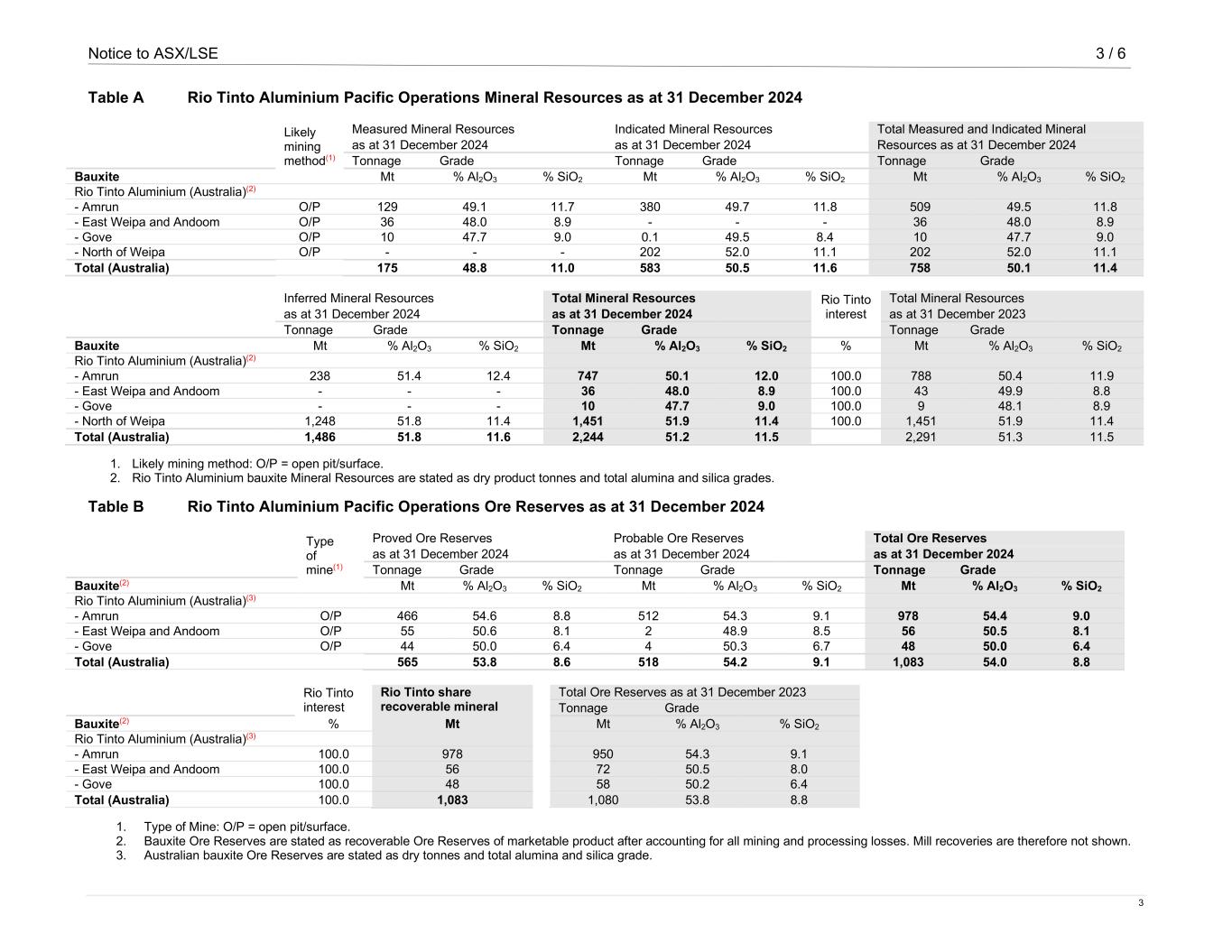
1 Notice to ASX Mineral Resources and Ore Reserves updates: supporting information and Table 1 checklists 19 February 2025 Rio Tinto today announces changes in Mineral Resources and Ore Reserves to support its 2024 annual reporting, including: • Increased Proved Ore Reserves and decreased Mineral Resources at the Rio Tinto Aluminium (RTA) Pacific Operations Amrun deposit in Queensland, Australia. • Increased Indicated Mineral Resources at the Rio Tinto Copper Winu project in Western Australia, Australia. • Increased Mineral Resources at the Rio Tinto Iron and Titanium Quebec Operations (RTITQO) in Quebec, Canada. • Increased Ore Reserves and decreased Mineral Resources at the RTA Atlantic Operations Porto Trombetas deposit in Brazil. Porto Trombetas is operated by the Mineração Rio do Norte (MRN) joint venture. The changes in Mineral Resources and Ore Reserves are reported in accordance with the Australasian Code for Reporting of Exploration Results, Mineral Resources and Ore Reserves, 2012 Edition (JORC Code) and the ASX Listing Rules. Supporting information relating to the changes of Mineral Resources and Ore Reserves is set out in this release and its appendices. Mineral Resources and Ore Reserves are quoted in this release on a 100 percent basis. Mineral Resources are reported in addition to Ore Reserves. The figures used to calculate Mineral Resources and Ore Reserves are often more precise than the rounded numbers shown in the tables, hence small differences may result if the calculations are repeated using the tabulated figures. These changes will be included in Rio Tinto’s 2024 Annual Report, to be released to the market on 19 February 2025 (London time), which will set out in full Rio Tinto’s Mineral Resources and Ore Reserves position as at 31 December 2024, and Rio Tinto’s interests. Rio Tinto Aluminium Pacific Operations – Amrun Mineral Resources and Ore Reserves for the RTA Pacific Operations, including the Amrun deposit, are presented in Table A and Table B. The updated Ore Reserves at Amrun reflect a material change in classification. Proved Ore Reserves have increased by 203 million tonnes (Mt) (77%), while Probable Ore Reserves have decreased by 176 Mt (26%). The change in Ore Reserves classification reflects a higher level of confidence in the modifying factors resulting from completion of an access study, and increased confidence in the underlying Mineral Resources as a result of updated orebody knowledge. There has been no material change to other modifying factors, including governmental, tenure, environmental, cultural heritage or community factors. Mineral Resources exclusive of Ore Reserves have decreased by 41 Mt (5%) at Amrun due to the conversion of Mineral Resources to Ore Reserves, and updated orebody knowledge. EXHIBIT 99.5

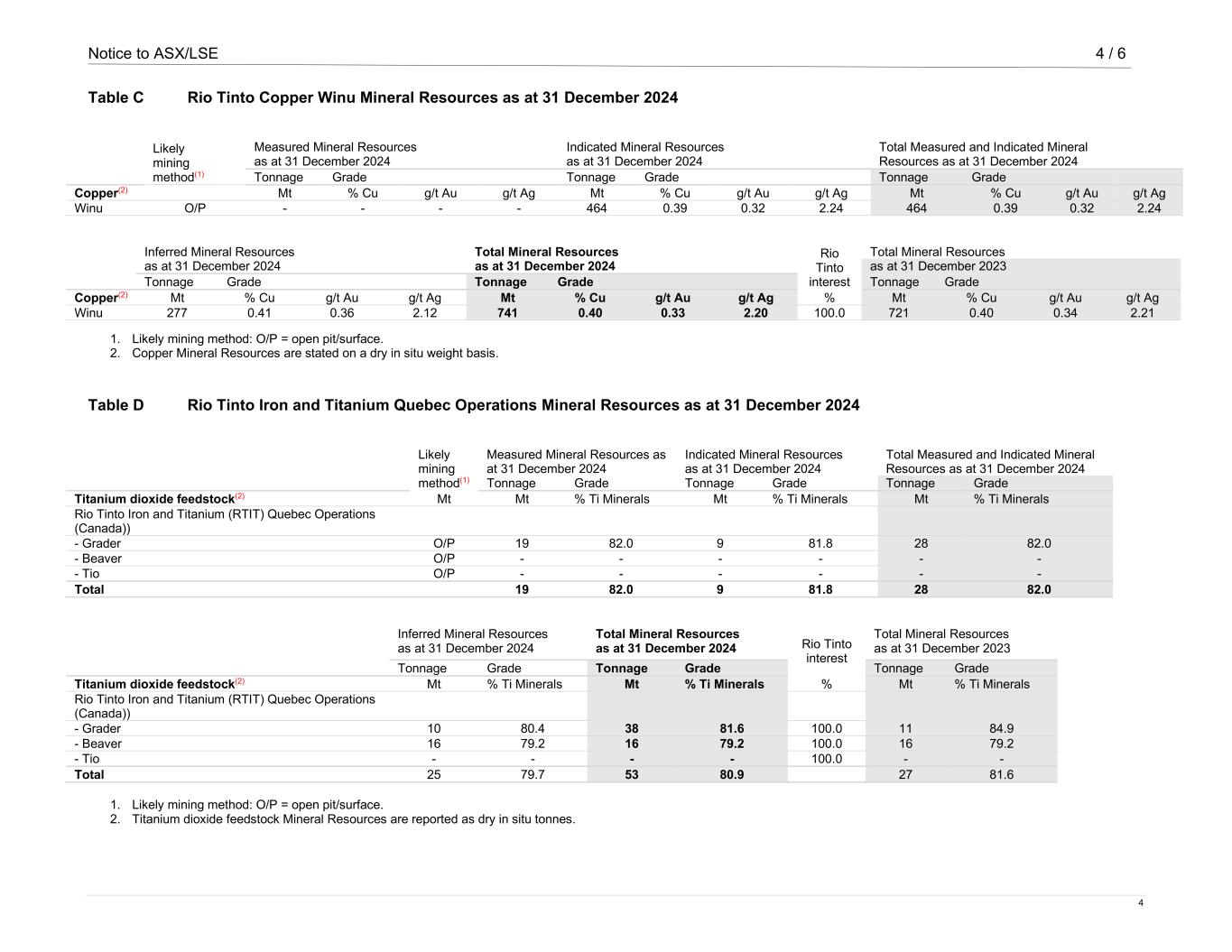
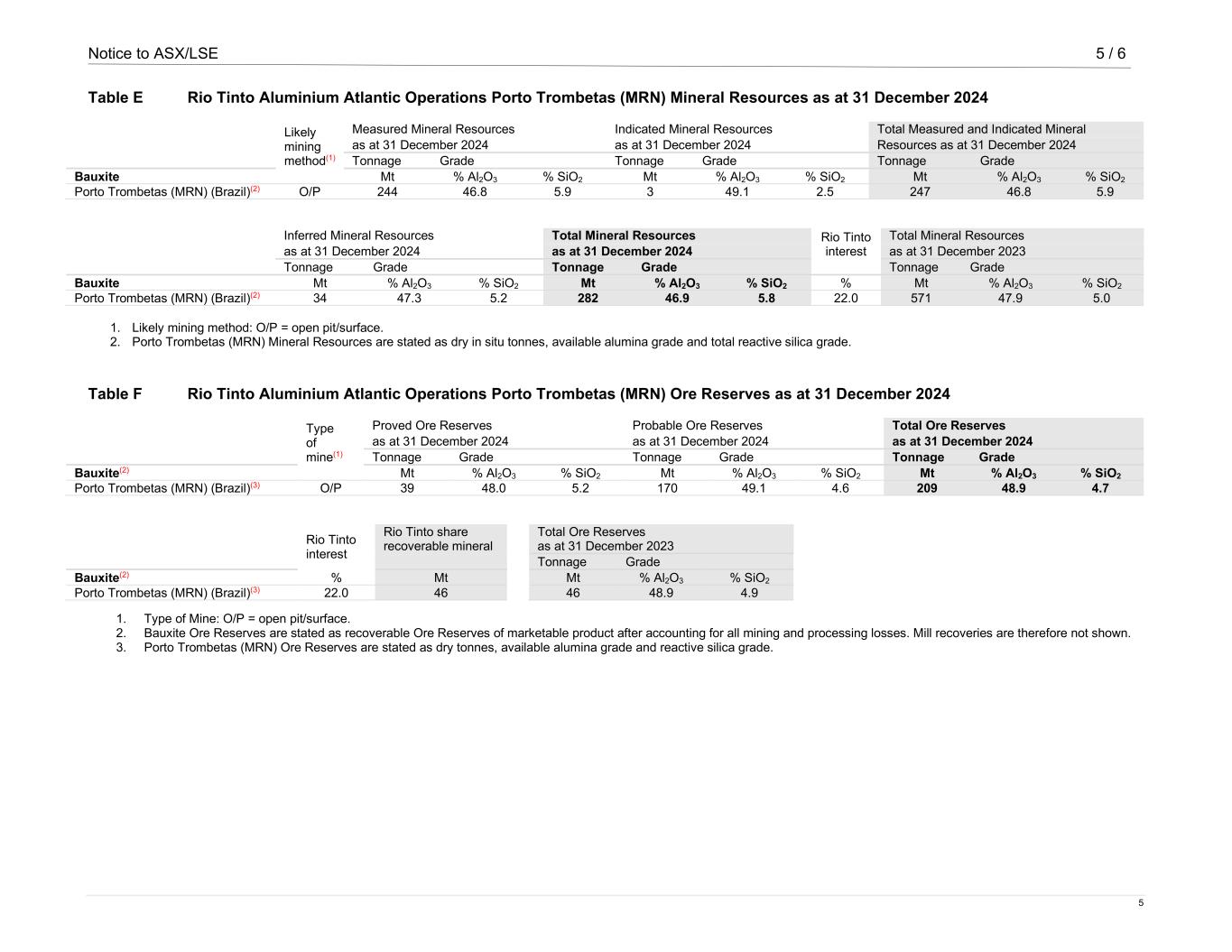
Notice to ASX 2 / 81 2 Rio Tinto Copper – Winu Mineral Resources for Winu are presented in Table C. Indicated Mineral Resources comprise 63% of these Mineral Resources, which is a substantial increase from the previously reported 31% of Mineral Resources. This change is the result of the implementation of a different classification methodology which uses the relationship between drill hole spacing and orebody uncertainty as determined by conditional simulation of copper grades. The total Mineral Resources tonnage has increased by 19 Mt (2.7%) in comparison to the previously reported estimates. Rio Tinto Iron and Titanium Quebec Operations Mineral Resources for RTITQO are presented in Table D. Significant technical work conducted from 2000 to 2024 on the Grader deposit situated 3 kilometres (km) from the main Lac Tio hemo-ilmenite deposit, with over 4,800 metres (m) of drilling, and the development of a new resource model, has resulted in a 26.7 Mt (100%) increase in Mineral Resources. Rio Tinto Aluminium Atlantic Operations – Porto Trombetas (MRN) Mineral Resources and Ore Reserves for the RTA Atlantic Operations, Porto Trombetas deposit are presented in Table E and Table F. Probable Ore Reserves have increased by 167 Mt, while Proved Ore Reserves have decreased by 4 Mt for an overall increase in Ore Reserves of 163 Mt (354%). The increase in Ore Reserves is attributed to the issuance of the Preliminary Licence for the New Mines Project by IBAMA (the Brazilian Federal Environmental Agency). There have been no other significant changes in modifying factors, including governmental, tenure, cultural heritage, community factors, or operational aspects. Measured Mineral Resources have decreased by 178 Mt and Inferred Mineral Resources have decreased by 112 Mt for an overall decrease of 290 Mt (50%). The decrease in Mineral Resources is partly due to the conversion of bauxite from Mineral Resources to Ore Reserves, as mentioned above, as well as to the downgrade of certain plateaus, containing only historical drilling data, from the Inferred Resource category to non-Resource status. The methodology for determining Mineral Resources remains unchanged.

Notice to ASX 3 / 81 3 Table A Rio Tinto Aluminium Pacific Operations Mineral Resources as at 31 December 2024 Likely mining method(1) Measured Mineral Resources Indicated Mineral Resources Total Measured and Indicated Mineral as at 31 December 2024 as at 31 December 2024 Resources as at 31 December 2024 Tonnage Grade Tonnage Grade Tonnage Grade Bauxite Mt % Al2O3 % SiO2 Mt % Al2O3 % SiO2 Mt % Al2O3 % SiO2 Rio Tinto Aluminium (Australia)(2) - Amrun O/P 129 49.1 11.7 380 49.7 11.8 509 49.5 11.8 - East Weipa and Andoom O/P 36 48.0 8.9 - - - 36 48.0 8.9 - Gove O/P 10 47.7 9.0 0.1 49.5 8.4 10 47.7 9.0 - North of Weipa O/P - - - 202 52.0 11.1 202 52.0 11.1 Total (Australia) 175 48.8 11.0 583 50.5 11.6 758 50.1 11.4 Inferred Mineral Resources Total Mineral Resources Rio Tinto interest Total Mineral Resources as at 31 December 2024 as at 31 December 2024 as at 31 December 2023 Tonnage Grade Tonnage Grade Tonnage Grade Bauxite Mt % Al2O3 % SiO2 Mt % Al2O3 % SiO2 % Mt % Al2O3 % SiO2 Rio Tinto Aluminium (Australia)(2) - Amrun 238 51.4 12.4 747 50.1 12.0 100.0 788 50.4 11.9 - East Weipa and Andoom - - - 36 48.0 8.9 100.0 43 49.9 8.8 - Gove - - - 10 47.7 9.0 100.0 9 48.1 8.9 - North of Weipa 1,248 51.8 11.4 1,451 51.9 11.4 100.0 1,451 51.9 11.4 Total (Australia) 1,486 51.8 11.6 2,244 51.2 11.5 2,291 51.3 11.5 1. Likely mining method: O/P = open pit/surface. 2. Rio Tinto Aluminium bauxite Mineral Resources are stated as dry product tonnes and total alumina and silica grades. Table B Rio Tinto Aluminium Pacific Operations Ore Reserves as at 31 December 2024 Type of mine(1) Proved Ore Reserves Probable Ore Reserves Total Ore Reserves as at 31 December 2024 as at 31 December 2024 as at 31 December 2024 Tonnage Grade Tonnage Grade Tonnage Grade Bauxite(2) Mt % Al2O3 % SiO2 Mt % Al2O3 % SiO2 Mt % Al2O3 % SiO2 Rio Tinto Aluminium (Australia)(3) - Amrun O/P 466 54.6 8.8 512 54.3 9.1 978 54.4 9.0 - East Weipa and Andoom O/P 55 50.6 8.1 2 48.9 8.5 56 50.5 8.1 - Gove O/P 44 50.0 6.4 4 50.3 6.7 48 50.0 6.4 Total (Australia) 565 53.8 8.6 518 54.2 9.1 1,083 54.0 8.8 Rio Tinto interest Rio Tinto share recoverable mineral Total Ore Reserves as at 31 December 2023 Tonnage Grade Bauxite(2) % Mt Mt % Al2O3 % SiO2 Rio Tinto Aluminium (Australia)(3) - Amrun 100.0 978 950 54.3 9.1 - East Weipa and Andoom 100.0 56 72 50.5 8.0 - Gove 100.0 48 58 50.2 6.4 Total (Australia) 100.0 1,083 1,080 53.8 8.8 1. Type of Mine: O/P = open pit/surface. 2. Bauxite Ore Reserves are stated as recoverable Ore Reserves of marketable product after accounting for all mining and processing losses. Mill recoveries are therefore not shown. 3. Australian bauxite Ore Reserves are stated as dry tonnes and total alumina and silica grade.
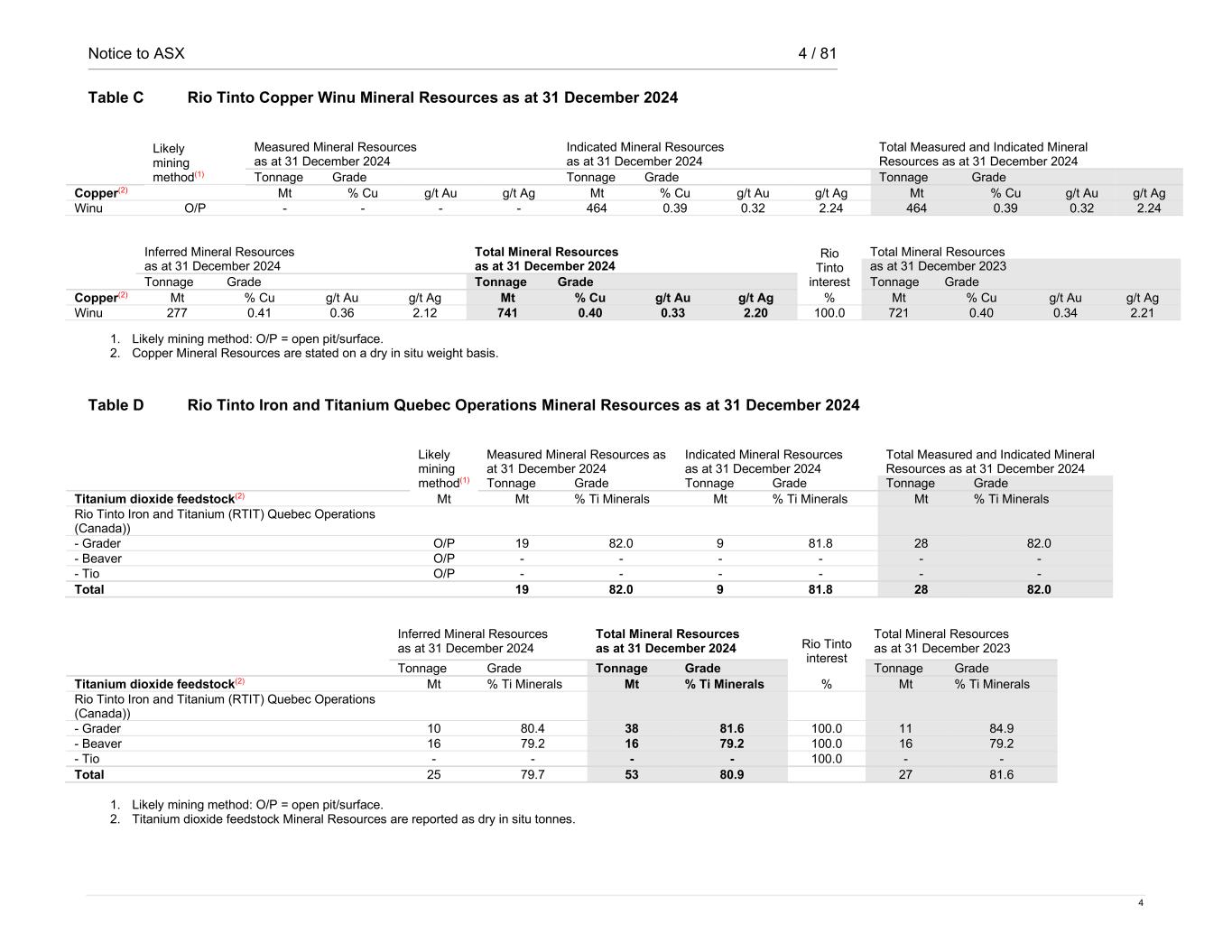
Notice to ASX 4 / 81 4 Table C Rio Tinto Copper Winu Mineral Resources as at 31 December 2024 Likely mining method(1) Measured Mineral Resources Indicated Mineral Resources Total Measured and Indicated Mineral as at 31 December 2024 as at 31 December 2024 Resources as at 31 December 2024 Tonnage Grade Tonnage Grade Tonnage Grade Copper(2) Mt % Cu g/t Au g/t Ag Mt % Cu g/t Au g/t Ag Mt % Cu g/t Au g/t Ag Winu O/P - - - - 464 0.39 0.32 2.24 464 0.39 0.32 2.24 Inferred Mineral Resources Total Mineral Resources Rio Tinto interest Total Mineral Resources as at 31 December 2024 as at 31 December 2024 as at 31 December 2023 Tonnage Grade Tonnage Grade Tonnage Grade Copper(2) Mt % Cu g/t Au g/t Ag Mt % Cu g/t Au g/t Ag % Mt % Cu g/t Au g/t Ag Winu 277 0.41 0.36 2.12 741 0.40 0.33 2.20 100.0 721 0.40 0.34 2.21 1. Likely mining method: O/P = open pit/surface. 2. Copper Mineral Resources are stated on a dry in situ weight basis. Table D Rio Tinto Iron and Titanium Quebec Operations Mineral Resources as at 31 December 2024 Likely mining method(1) Measured Mineral Resources as at 31 December 2024 Indicated Mineral Resources as at 31 December 2024 Total Measured and Indicated Mineral Resources as at 31 December 2024 Tonnage Grade Tonnage Grade Tonnage Grade Titanium dioxide feedstock(2) Mt Mt % Ti Minerals Mt % Ti Minerals Mt % Ti Minerals Rio Tinto Iron and Titanium (RTIT) Quebec Operations (Canada)) - Grader O/P 19 82.0 9 81.8 28 82.0 - Beaver O/P - - - - - - - Tio O/P - - - - - - Total 19 82.0 9 81.8 28 82.0 Inferred Mineral Resources as at 31 December 2024 Total Mineral Resources as at 31 December 2024 Rio Tinto interest Total Mineral Resources as at 31 December 2023 Tonnage Grade Tonnage Grade Tonnage Grade Titanium dioxide feedstock(2) Mt % Ti Minerals Mt % Ti Minerals % Mt % Ti Minerals Rio Tinto Iron and Titanium (RTIT) Quebec Operations (Canada)) - Grader 10 80.4 38 81.6 100.0 11 84.9 - Beaver 16 79.2 16 79.2 100.0 16 79.2 - Tio - - - - 100.0 - - Total 25 79.7 53 80.9 27 81.6 1. Likely mining method: O/P = open pit/surface. 2. Titanium dioxide feedstock Mineral Resources are reported as dry in situ tonnes.

Notice to ASX 5 / 81 5 Table E Rio Tinto Aluminium Atlantic Operations Porto Trombetas (MRN) Mineral Resources as at 31 December 2024 Likely mining method(1) Measured Mineral Resources Indicated Mineral Resources Total Measured and Indicated Mineral as at 31 December 2024 as at 31 December 2024 Resources as at 31 December 2024 Tonnage Grade Tonnage Grade Tonnage Grade Bauxite Mt % Al2O3 % SiO2 Mt % Al2O3 % SiO2 Mt % Al2O3 % SiO2 Porto Trombetas (MRN) (Brazil)(2) O/P 244 46.8 5.9 3 49.1 2.5 247 46.8 5.9 Inferred Mineral Resources Total Mineral Resources Rio Tinto interest Total Mineral Resources as at 31 December 2024 as at 31 December 2024 as at 31 December 2023 Tonnage Grade Tonnage Grade Tonnage Grade Bauxite Mt % Al2O3 % SiO2 Mt % Al2O3 % SiO2 % Mt % Al2O3 % SiO2 Porto Trombetas (MRN) (Brazil)(2) 34 47.3 5.2 282 46.9 5.8 22.0 571 47.9 5.0 1. Likely mining method: O/P = open pit/surface. 2. Porto Trombetas (MRN) Mineral Resources are stated as dry in situ tonnes, available alumina grade and total reactive silica grade. Table F Rio Tinto Aluminium Atlantic Operations Porto Trombetas (MRN) Ore Reserves as at 31 December 2024 Type of mine(1) Proved Ore Reserves Probable Ore Reserves Total Ore Reserves as at 31 December 2024 as at 31 December 2024 as at 31 December 2024 Tonnage Grade Tonnage Grade Tonnage Grade Bauxite(2) Mt % Al2O3 % SiO2 Mt % Al2O3 % SiO2 Mt % Al2O3 % SiO2 Porto Trombetas (MRN) (Brazil)(3) O/P 39 48.0 5.2 170 49.1 4.6 209 48.9 4.7 Rio Tinto interest Rio Tinto share recoverable mineral Total Ore Reserves as at 31 December 2023 Tonnage Grade Bauxite(2) % Mt Mt % Al2O3 % SiO2 Porto Trombetas (MRN) (Brazil)(3) 22.0 46 46 48.9 4.9 1. Type of Mine: O/P = open pit/surface. 2. Bauxite Ore Reserves are stated as recoverable Ore Reserves of marketable product after accounting for all mining and processing losses. Mill recoveries are therefore not shown. 3. Porto Trombetas (MRN) Ore Reserves are stated as dry tonnes, available alumina grade and reactive silica grade.

Notice to ASX 6 / 81 6 Rio Tinto Aluminium Pacific Operations - Amrun RTA Pacific Operations Mineral Resources and Ore Reserves are contained within two bauxite deposits, one at Gove (North Territory, Australia) and one at Weipa (Queensland, Australia; Figure 1). The Weipa deposit consist of three primary areas: Amrun, East Weipa/Andoom and North of Weipa. The change in Ore Reserves classification reflects a higher level of confidence in the modifying factors resulting from completion of an access study, and increased confidence in the underlying Mineral Resources as a result of updated orebody knowledge. There has been no material change to other modifying factors, including governmental, tenure, environmental, cultural heritage or community. The decrease in Amrun Mineral Resources coincides with the uptake of bauxite ore from Mineral Resources into Ore Reserves, due to an increase in orebody knowledge. The methodology of determining Mineral Resources has not changed. The bauxite assets have been in operation for more than fifty years and are well understood. Resource work is currently more focussed on asset evaluation rather than exploration, systematically bringing the bauxite classification to higher levels of confidence. Table G and Table H summarise the changes to the Mineral Resources and Ore Reserves. Figure 1 Property location map – Weipa operations
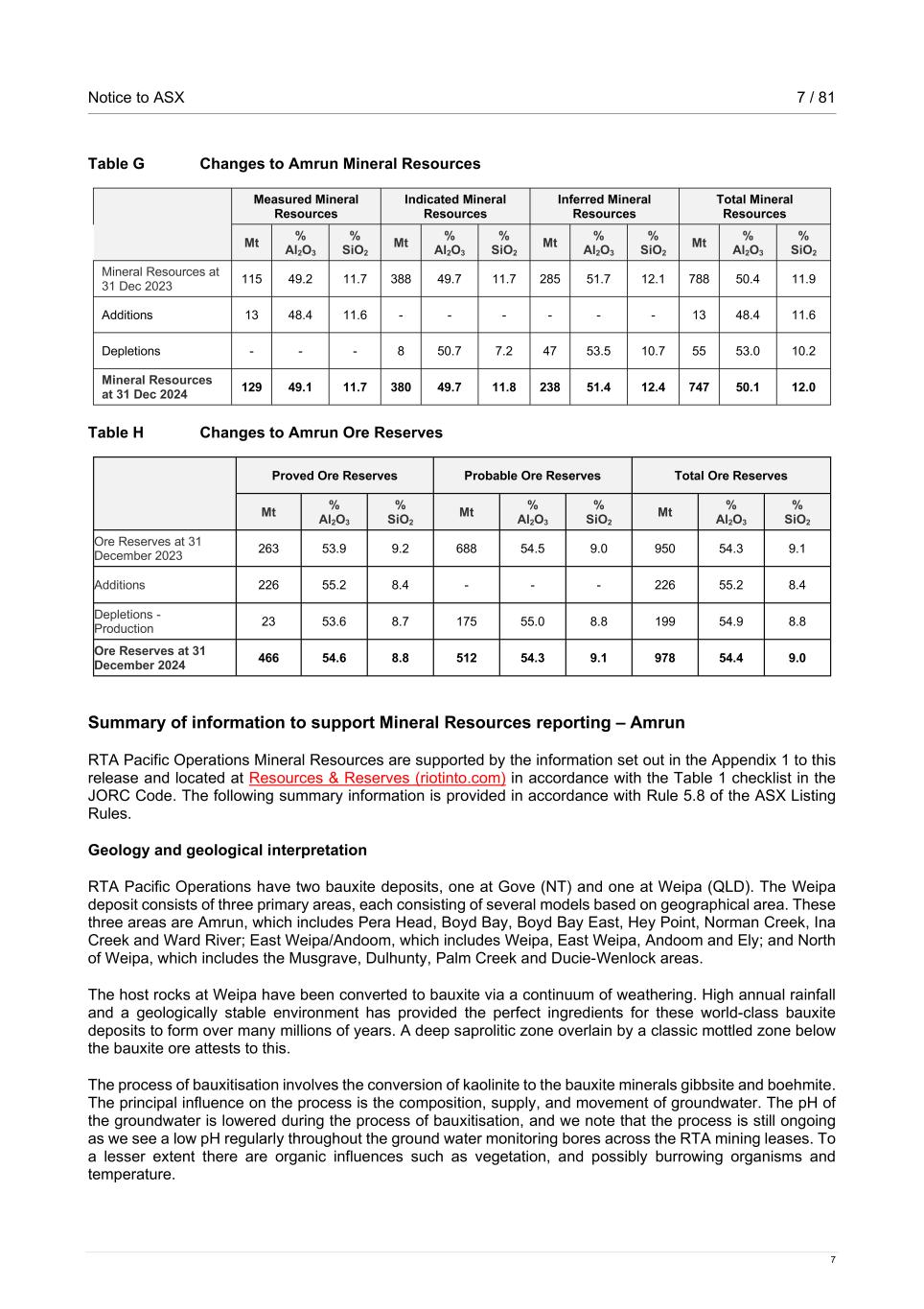
Notice to ASX 7 / 81 7 Table G Changes to Amrun Mineral Resources Measured Mineral Resources Indicated Mineral Resources Inferred Mineral Resources Total Mineral Resources Mt % Al2O3 % SiO2 Mt % Al2O3 % SiO2 Mt % Al2O3 % SiO2 Mt % Al2O3 % SiO2 Mineral Resources at 31 Dec 2023 115 49.2 11.7 388 49.7 11.7 285 51.7 12.1 788 50.4 11.9 Additions 13 48.4 11.6 - - - - - - 13 48.4 11.6 Depletions - - - 8 50.7 7.2 47 53.5 10.7 55 53.0 10.2 Mineral Resources at 31 Dec 2024 129 49.1 11.7 380 49.7 11.8 238 51.4 12.4 747 50.1 12.0 Table H Changes to Amrun Ore Reserves Proved Ore Reserves Probable Ore Reserves Total Ore Reserves Mt % Al2O3 % SiO2 Mt % Al2O3 % SiO2 Mt % Al2O3 % SiO2 Ore Reserves at 31 December 2023 263 53.9 9.2 688 54.5 9.0 950 54.3 9.1 Additions 226 55.2 8.4 - - - 226 55.2 8.4 Depletions - Production 23 53.6 8.7 175 55.0 8.8 199 54.9 8.8 Ore Reserves at 31 December 2024 466 54.6 8.8 512 54.3 9.1 978 54.4 9.0 Summary of information to support Mineral Resources reporting – Amrun RTA Pacific Operations Mineral Resources are supported by the information set out in the Appendix 1 to this release and located at Resources & Reserves (riotinto.com) in accordance with the Table 1 checklist in the JORC Code. The following summary information is provided in accordance with Rule 5.8 of the ASX Listing Rules. Geology and geological interpretation RTA Pacific Operations have two bauxite deposits, one at Gove (NT) and one at Weipa (QLD). The Weipa deposit consists of three primary areas, each consisting of several models based on geographical area. These three areas are Amrun, which includes Pera Head, Boyd Bay, Boyd Bay East, Hey Point, Norman Creek, Ina Creek and Ward River; East Weipa/Andoom, which includes Weipa, East Weipa, Andoom and Ely; and North of Weipa, which includes the Musgrave, Dulhunty, Palm Creek and Ducie-Wenlock areas. The host rocks at Weipa have been converted to bauxite via a continuum of weathering. High annual rainfall and a geologically stable environment has provided the perfect ingredients for these world-class bauxite deposits to form over many millions of years. A deep saprolitic zone overlain by a classic mottled zone below the bauxite ore attests to this. The process of bauxitisation involves the conversion of kaolinite to the bauxite minerals gibbsite and boehmite. The principal influence on the process is the composition, supply, and movement of groundwater. The pH of the groundwater is lowered during the process of bauxitisation, and we note that the process is still ongoing as we see a low pH regularly throughout the ground water monitoring bores across the RTA mining leases. To a lesser extent there are organic influences such as vegetation, and possibly burrowing organisms and temperature.

Notice to ASX 8 / 81 8 Pisolitic textures are dominant, with variable cementation. However, variably cemented coarser nodule horizons can occur. Modern day root channel structures and infill, in the upper part of the bauxite, are common. Gibbsite is the major mineralised mineral, with boehmite being of lesser significance. Bauxite occurs on laterally extensive plateaus. The bauxite orebodies are interpreted as flat-lying horizons with topography dictating the geometry. The orebodies are overlain by a thin (<1 m) overburden cover and occasional red soil. Beneath the bauxite mineralisation is often a transition zone defined by angular and lumpy textures and a geochemical signature of higher silica and lower alumina. The transition zone is often underlain by clay, with a distinct change in physical properties, particularly the colour. Drilling techniques; sampling, sub-sampling method and sample analysis method The current drilling method at Amrun utilises aircore drilling. The typical aircore rig is a Land Cruiser mounted rig with a small enough wheelbase to traverse drill lines cleared with one D-6 dozer blade width. Aircore drilling forces compressed air down a space inside the drill rods to the bit face, where the air is then used to return the sample up the inner tube of the drill rod and out via a cyclone. A three bladed HQ aircore bit is attached to 4 inch rods. The drilling system has been designed to reduce grinding of the sample. Logging is currently conducted on Panasonic Toughpads and data is captured in an offline acQuire™ logging package at the drill rig. This system allows for data validation to be applied during logging as well as a streamlined method of exporting the data for importing into the main RTA Geology database. Logging is qualitative in nature, i.e., based on lithology. Currently there are ~20 lithologies common to the deposits that get modelled into four horizons for the estimation of bauxite resources. All sample intervals (0.25 m) are logged. Logged lithologies are vetted against historical drill holes and assay parameters. Samples for geologic logging and analysis are collected on 0.25 m intervals (~2 to 3 kg) downhole. Whole samples are collected beneath a cyclone return system, i.e., no sample splitting is conducted, or sub samples taken. Multiscreen sampling is undertaken initially to determine optimum screen size for beneficiation at each deposit. Once determined, samples are then beneficiated at the appropriate screen size (1.7 mm for East Weipa, 0.3 mm for Andoom and 0.6 mm for the Amrun deposits). Samples are processed and X-ray florescence (XRF) analysed for the major oxides: Al2O3, SiO2, Fe2O3, TiO2 and LOI (loss on ignition), as well as minor elements and recovery. Estimation methodology Basic geostatistical analysis is used to help with domaining decisions. Most deposits are modelled as a single laterally extensive domain, apart from Moingum (Hey Point), where two laterally extensive domains have been modelled due to differences in source rocks affecting thickness and grade. Three horizon codes, based on the lithology and assays, are assigned for the modelling and estimation of bauxite resources at Weipa. Interpretation is undertaken using Leapfrog Geo while variography and estimation are performed using Maptek’s Vulcan software. The bauxite horizon is unfolded using the top and bottom contact surfaces at Amrun and Norman Creek. At Moingum (Hey Point) drill hole collars are flattened to constant elevation. The wireframes are filled with blocks on an in/out basis; there is no sub-blocking or block proportions used. For the bauxite horizon, major oxides; loss on ignition (LOI) and recovery are estimated into parent cells using ordinary kriging. Overburden is assigned 0% recovery for the estimation of resources. Cemented bauxite grade is estimated as part of the bauxite horizon and assigned a 100% recovery; the proportion of cemented bauxite is estimated as an indicator variable. Major oxide chemistry is also estimated for the overburden and floor horizons, where data is available. Ordinary kriging is used for interpolation, using the variogram models for the bauxite. Block sizes are determined by half the minimum drill hole spacing for each deposit. A multiple pass search strategy is used to estimate grades utilising different sized search ellipses that include a specified number of samples and drill holes. Maximum extrapolation distance is slightly less than the maximum search radii due to the requirement to use at least two holes to estimate each block.
Notice to ASX 9 / 81 9 Cut-off grades and modifying factors RTA Pacific Operations employs a standard approach to identify Mineral Resources volumes with reasonable prospects for eventual economic extraction. Once the Ore Reserves are defined based on applied economic factors in the reserving process, the remaining blocks are evaluated based on economic and grade cut-offs (Al2O3 ≥ 40%; SiO2 ≤ 15%), thickness cut-offs and location (environmental, cultural heritage and infrastructure buffers) for each of the different deposits, and Mineral Resources defined. Criteria used for Mineral Resources classification Classification within the bauxite horizon is based on the search pass used to estimate grades, using increasing search radii, and decreasing numbers of samples for each subsequent pass. Passes 1 and 2 are classified as Measured Mineral Resources (120 m to 180 m), Pass 3 as Indicated (360 m) and Pass 4 as Inferred (720 m). Data of lesser quality (e.g., 2D historical data) is downgraded in classification and needs to be re-drilled to increase confidence. Summary of information to support Ore Reserves reporting – Amrun RTA Pacific Operations Ore Reserves are supported by the information set out in Appendix 1 and located at Resources & Reserves (riotinto.com) in accordance with the Table 1 checklist in the JORC Code. The following summary information is provided in accordance with Rule 5.9 of the ASX Listing Rules. Economic assumptions and study outcomes The Amrun operation has been operating continuously for over six years, and the Ore Reserves estimate, and life of mine plans are updated annually. This includes the reconciliation of operating parameters and review of input assumptions into the planning processes. The Amrun feasibility study was completed and approved by Rio Tinto in 2015. Rio Tinto applies a common process to the generation of commodity price assumptions across the group. This involves generation of long-term price forecasts based on current sales contracts, industry capacity analysis, global commodity consumption and economic growth trends (this includes the bonus / penalty adjustments for quality). Exchange rates are also based on internal Rio Tinto modelling of expected future country exchange rates. Capital and operating cost estimates are sourced from internal Rio Tinto financial modelling and / or project capital estimates. Third party payments are reflective of the current agreements in place. Due to the commercial sensitivity of these assumptions, an explanation of the methodology used to determine these assumptions has been provided, rather than the actual figures. Mining method and assumptions The Ore Reserves are mined through shallow, open cut techniques developed over several decades at the greater Weipa operations. Once the area is tree cleared and the topsoil / overburden removed, the bauxite is hauled to the processing facility for washing and / or sizing. Product bauxite is stockpiled for shipping to both internal and external customers. Several mining areas are active at any one time to enable blending and to mitigate against operational risk. Dilution and mining recovery parameters are applied during the Ore Reserves estimation process, based on reconciliation of past performance, and are reviewed annually. As the Ore Reserves are shallow, geotechnical risks are low. Stockpile heights and wet road conditions are managed in accordance with standard operating procedures. Completion of the Norman Creek Access Study has provided certainty regarding capital infrastructure and operating practices relating to extraction of the Ore Reserves south of Norman Creek. This includes haulage strategy, capital expenditure and operating cost profile.

Notice to ASX 10 / 81 10 There has been no material change to other Ore Reserves modifying factors, such as: governmental, tenure, environmental, cultural heritage, social or community. Appropriate agreements and approvals remain in place to enable continued operation. Processing methods and assumptions Amrun bauxite is beneficiated through established techniques to improve product quality and handleability. This is achieved through the removal of the finer fraction, leaving the coarser material as product. Expected bauxite recovery and quality from the beneficiation process is assessed through laboratory scale test work of samples generated from the resource drilling process. Cut-off grades, estimation methodology and modifying factors The Ore Reserves cut-off is based on an economic parameter, summarised as the margin realised upon sale of the bauxite. The economic cut-off approach considers revenue (bonus/penalty), fixed / operating / capital costs, royalties, and other third-party payments. Bauxite that satisfies this economic cut-off, is considered for inclusion in the Ore Reserves. There has been no material change to the economic cut-off methodology or process. Criteria used for Ore Reserves classification Given the level of confidence in the Ore Reserves modifying factors, Measured Resources are converted to both Proved and Probable Ore Reserves, and all Indicated Resources are converted to Probable Ore Reserves. Inferred Resources are not considered in the estimation of Ore Reserves. Completion of the Norman Creek Access Study has resulted in more of the Measured Resources being converted into Proved Ore Reserves.

Notice to ASX 11 / 81 11 Rio Tinto Copper – Winu project The Winu copper-gold project is located in the Paterson region of Western Australia, approximately 330 km east-southeast of the town of Port Hedland in the East Pilbara mineral field (Figure 2). The 2024 Mineral Resources include a substantially increased Indicated proportion, from 31% to 63% in tonnage, in comparison to the previously reported Mineral Resources. This change is supported mostly by the implementation of a different classification methodology which uses the relationship between drill hole spacing and orebody uncertainty as determined by conditional simulation of copper grades. The total Mineral Resources tonnage has increased by 2.7% in comparison to the previous reporting, reflecting changes in economic factors (metal price assumptions and economic pit shell optimisation). No resource drilling occurred at Winu in 2024 and the resource estimate used as the basis of Mineral Resources reporting has not been updated since the 31 December 2022 Rio Tinto Annual Report. Drilling at Winu completed in the last 12 months has been focused on sterilisation drilling in proposed infrastructure locations, hydrogeology and exploration. The presence of copper, gold and silver mineralisation of a similar geological style and setting at the margins indicates that the Winu deposit remains open in several directions. In December 2024, Rio Tinto signed a Term Sheet with Sumitomo Metal Mining for a Joint Venture to deliver the Winu project. Binding definitive agreements are expected to be completed in the first half of this year, with Rio Tinto to continue to develop and operate Winu as managing partner and SMM to acquire a 30% equity share of the project. The Rio Tinto Winu project team continues to work with the Nyangumarta and Martu Traditional Owners, as well as government regulators, to progress the agreements and approvals required for the future operation. Study activities also continue to strengthen the development pathway ahead of all Traditional Owner and regulatory approvals. Figure 2 Property location map – Winu

Notice to ASX 12 / 81 12 A comparison of the Indicated and Inferred Mineral Resources between 31 December 2024 and 31 December 2023 reporting periods at a 0.20% copper equivalent (CuEq) cut-off is shown in Table I. Table I Changes to Winu Mineral Resources Indicated Mineral Resources Inferred Mineral Resources Total Mineral Resources Mt % Cu g/t Au g/t Ag Mt % Cu g/t Au g/t Ag Mt % Cu g/t Au g/t Ag Mineral Resources as at 31 Dec 2023 222 0.45 0.35 2.73 499 0.38 0.33 1.98 721 0.40 0.34 2.21 Additions 242 0.34 0.29 1.80 - - - - 242 0.34 0.29 1.80 Depletions - - - - 223 0.34 0.29 1.81 223 0.34 0.29 1.81 Mineral Resources as at 31 Dec 2024 464 0.39 0.32 2.24 277 0.41 0.36 2.12 741 0.40 0.33 2.20 The total Mineral Resources is inclusive of a higher grade and shallower body of mineralisation that is the subject of detailed geological and geotechnical assessments, mine design and processing studies, supporting a starter pit design. At a 0.45% CuEq cut-off the Mineral Resources inside the starter pit includes 123 Mt @ 0.77% CuEq Indicated Resources and 28 Mt @ 0.88% CuEq Inferred Resources for a total of 150 Mt @ 0.79% CuEq, as shown in Table J. Table J Component of the Winu Mineral Resources within starter pit as at 31 December 2024, at 0.45% CuEq cut-off Indicated Mineral Resources within starter pit as at 31 December 2024 Inferred Mineral Resources within starter pit as at 31 December 2024 Total Mineral Resources within starter pit as at 31 December 2024 Tonnage Grade Tonnage Grade Tonnage Grade Mt % Cu g/t Au g/t Ag Mt % Cu g/t Au g/t Ag Mt % Cu g/t Au g/t Ag 123 0.61 0.46 3.88 28 0.82 0.68 4.19 150 0.65 0.50 3.94 Summary of information to support Mineral Resources reporting – Winu Mineral Resources are supported by the information set out in Appendix 2 to this release and located at Resources & Reserves (riotinto.com) in accordance with the Table 1 checklist in the JORC Code 2012. The following summary information is provided in accordance with rule 5.8 of the ASX Listing Rules. Geology and geological interpretation Winu is interpreted as a structurally controlled vein hosted Cu-Au-Ag (copper-gold-silver) deposit focused on the core of an anticline in Neoproterozoic metasedimentary rocks. There are multiple vein generations and orientations, but the veins are interpreted as being predominantly parallel to the fanned axial planes of the major and parasitic folds. Drilling techniques; sampling and sub-sampling techniques; and sample analysis method Drilling has been carried out using a combination of angled diamond and vertical and angled reverse circulation (RC) drilling methods, with sampling predominantly on a 1 m sample interval but honouring geological boundaries in the diamond drilled core. RC samples are split by cone splitter mounted on a cyclone at the rig. Core samples are cut by diamond saw with half dispatched for analysis. All sample preparation, involving crushing, pulverising and splitting, is conducted at commercial facilities in Perth, Western Australia. All analytical work is conducted at accredited commercial facilities in Perth. A combination of assaying methods is used including sequential leach, full acid digest with Inductively Coupled Plasma (ICP) with atomic emission

Notice to ASX 13 / 81 13 spectroscopy (AES) and mass spectroscopy (MS) finish and 30 g fire assay for gold with atomic absorption spectroscopy (AAS) finish. Estimation methodology Grade estimation utilises ordinary kriging at panel scale of 40 m x 40 m x 5 m with recoverable estimation by localised uniform conditioning (LUC) based on 10 m x 10 m x 5 m blocks to reflect the anticipated selective mining unit (SMU). The objective of the panel scale estimation is to establish a least biased global estimate, taking into account the drill hole spacing. The objective of the SMU scale estimation is to predict the likely grade/tonnage distribution at the time of mining. Dry bulk density has been estimated by ordinary kriging on 10 m x 10 m x 5 m blocks using approximately 6,000 measurements from drill core. Cut-off grades and modifying factors The Mineral Resources are reported at a cut-off grade of 0.2% CuEq, which is the marginal cut-off grade for the notional pit. The mineralisation within the starter pit is reported at a cut-off grade of 0.45% CuEq, representing a possible economic cut-off within this higher-grade area. Copper equivalents have been calculated using the formula: CuEq = ((Cu% * Cu price * Cu recovery) + (Au ppm * Au price * Au recovery) + (Ag ppm * Ag price * Ag recovery)) / (Cu price). Details of recoveries based on test work are shown in Appendix 2 (JORC Table 1). The reasonable prospects for economic extraction test is met on the basis of mining and processing studies that have been developed throughout 2024. These studies indicate conventional open pit mining and processing routes will be appropriate for the exploitation of the Winu deposit. Criteria used for Mineral Resource classification Mineral Resources classification is based initially on the level of confidence assigned to interpretations of geology and mineralisation controls, and an assessment of the quality of fundamental assay and geological data. The methodology supporting the previous 31 December 2023 Mineral Resources report was based on a quantitative assessment of copper grade uncertainty using the results of conditional simulation of copper grade, taking into account proposed mining rates and schedule. This approach reflected the precision of grade estimates at the scale of planned annual production but did not reflect the uncertainty at the scale of selective mining units. Moreover, the method did not directly capture geological and grade continuity at the block level. The new classification methodology adopted for 31 December 2024 Mineral Resources reporting uses geometric criteria linked to drill spacing. The approach uses geostatistical parameters (the conditional coefficient of variation) from a set of realisations determined by conditional simulation of copper to calibrate Mineral Resources class to drilling spacing. The classification process is based only on copper grades as copper is the primary contributor to project value. The method is independent of the mine schedule, provides a simple link to the assessment of geological and grade continuity and provides an expression of the local (block scale) geological and grade uncertainty. The adopted classification criteria are: • Indicated Resources: a threshold of grade estimate error determined by geostatistical means, converted to minimum drill spacing required to meet criteria for Indicated Resources (50 m for hypogene and 25 m for supergene domains).

Notice to ASX 14 / 81 14 • Inferred Resources: grade continuity implied by observations between drill holes. Minimum distance to drill hole (150 m for hypogene and 100 m for supergene domains) determined from variogram, representing the maximum range of correlation between distant samples. A smoothing step is included in the classification process to ensure isolated blocks are not included. The specific definition of Indicated and Inferred Resources is described in Table 1. A notional Mineral Resources pit shell has been defined to a maximum depth of 725 m with sufficient support provided by preliminary mining, processing and other studies. Mineralised material outside of the notional Mineral Resources pit shell is not included in the 31 December 2024 Mineral Resources statement. The notional Mineral Resources pit shell includes a higher grade and shallower body of mineralisation that is the subject of detailed geological and geotechnical assessments, mine design and processing studies, supporting a starter pit design. The Mineral Resources in the starter pit are classified predominantly as Indicated Resources (81% in tonnage), on the basis of data density supporting sufficient confidence in geological and grade continuity.
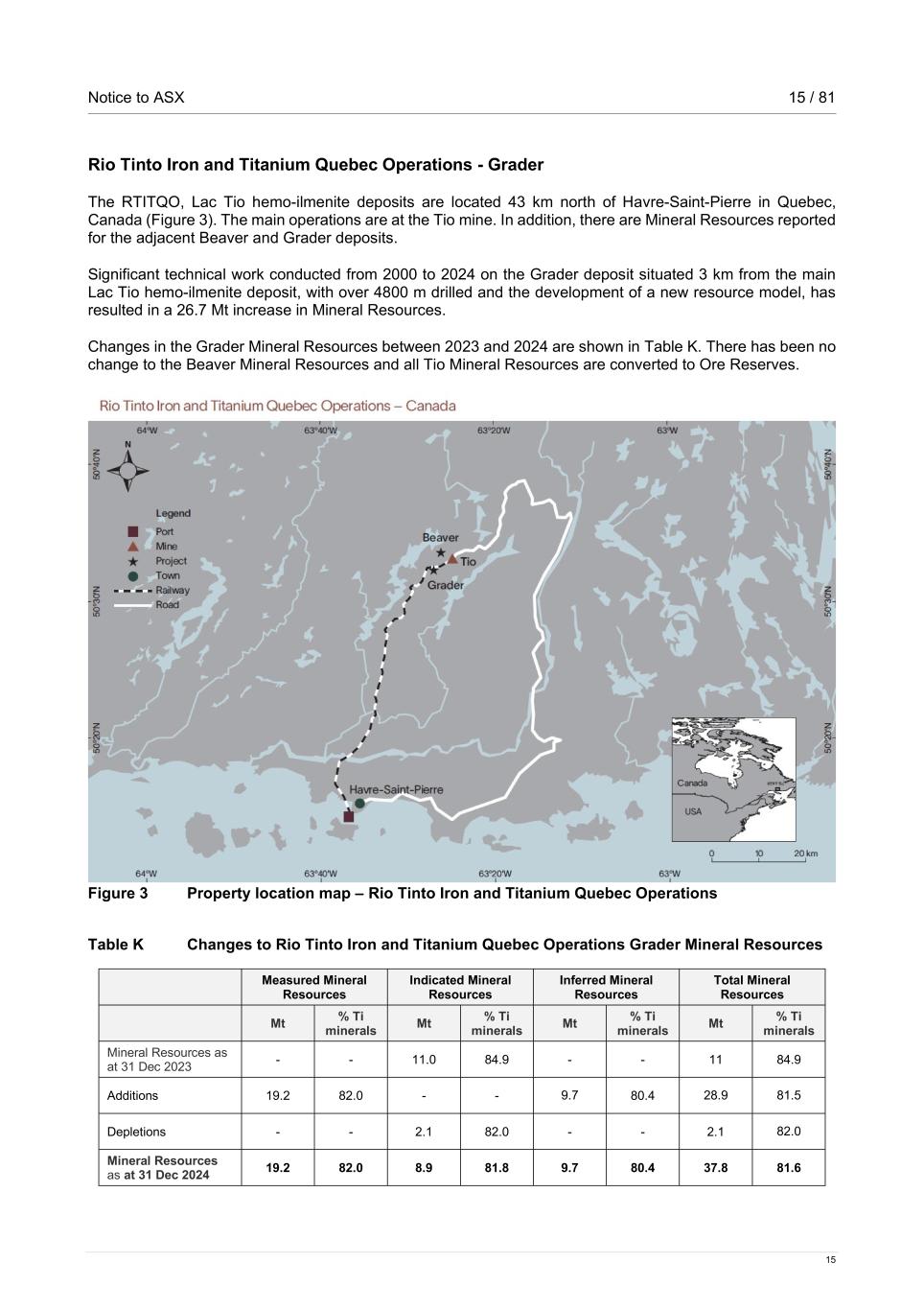
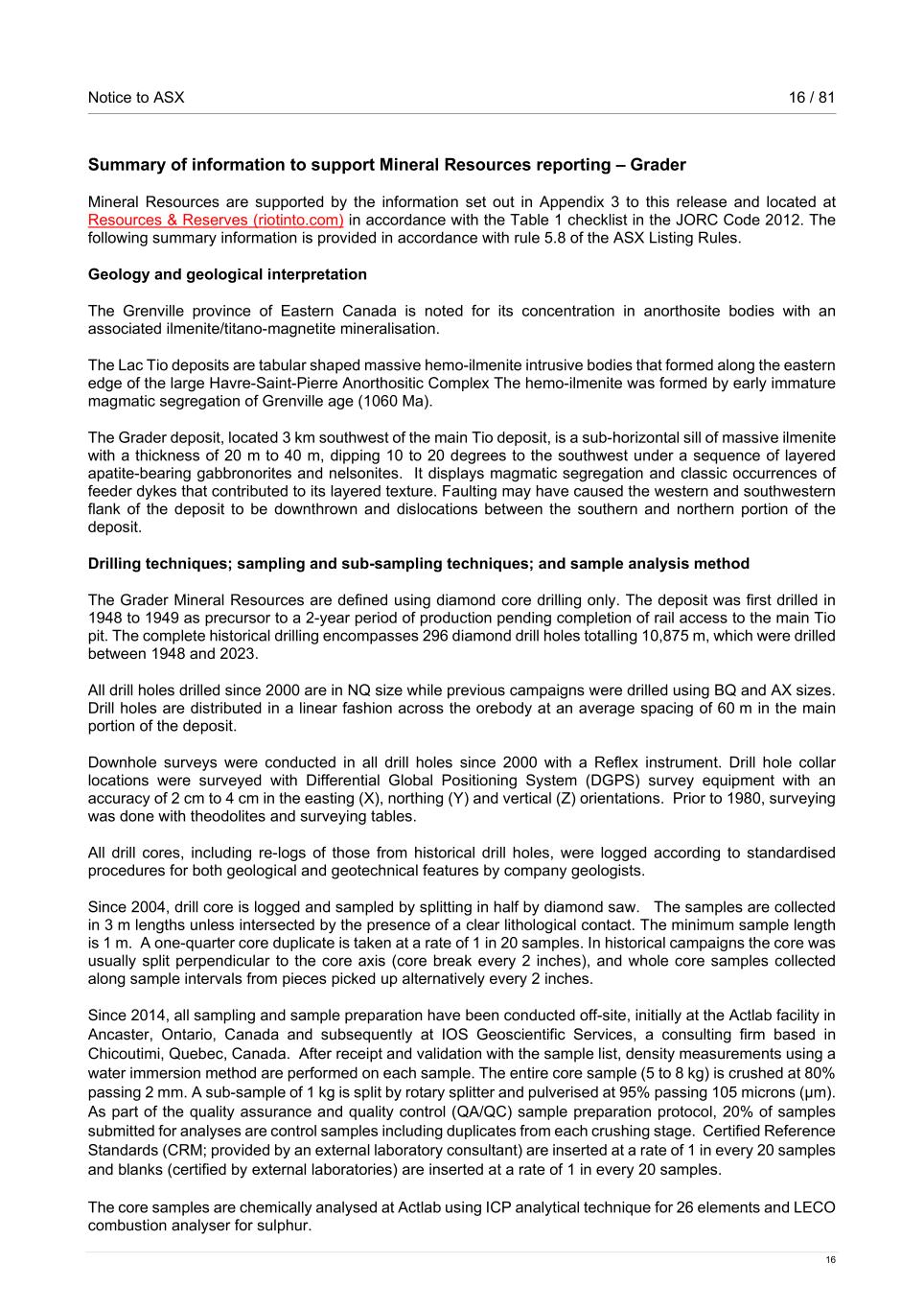
Notice to ASX 15 / 81 15 Rio Tinto Iron and Titanium Quebec Operations - Grader The RTITQO, Lac Tio hemo-ilmenite deposits are located 43 km north of Havre-Saint-Pierre in Quebec, Canada (Figure 3). The main operations are at the Tio mine. In addition, there are Mineral Resources reported for the adjacent Beaver and Grader deposits. Significant technical work conducted from 2000 to 2024 on the Grader deposit situated 3 km from the main Lac Tio hemo-ilmenite deposit, with over 4800 m drilled and the development of a new resource model, has resulted in a 26.7 Mt increase in Mineral Resources. Changes in the Grader Mineral Resources between 2023 and 2024 are shown in Table K. There has been no change to the Beaver Mineral Resources and all Tio Mineral Resources are converted to Ore Reserves. Figure 3 Property location map – Rio Tinto Iron and Titanium Quebec Operations Table K Changes to Rio Tinto Iron and Titanium Quebec Operations Grader Mineral Resources Measured Mineral Resources Indicated Mineral Resources Inferred Mineral Resources Total Mineral Resources Mt % Ti minerals Mt % Ti minerals Mt % Ti minerals Mt % Ti minerals Mineral Resources as at 31 Dec 2023 - - 11.0 84.9 - - 11 84.9 Additions 19.2 82.0 - - 9.7 80.4 28.9 81.5 Depletions - - 2.1 82.0 - - 2.1 82.0 Mineral Resources as at 31 Dec 2024 19.2 82.0 8.9 81.8 9.7 80.4 37.8 81.6
Notice to ASX 16 / 81 16 Summary of information to support Mineral Resources reporting – Grader Mineral Resources are supported by the information set out in Appendix 3 to this release and located at Resources & Reserves (riotinto.com) in accordance with the Table 1 checklist in the JORC Code 2012. The following summary information is provided in accordance with rule 5.8 of the ASX Listing Rules. Geology and geological interpretation The Grenville province of Eastern Canada is noted for its concentration in anorthosite bodies with an associated ilmenite/titano-magnetite mineralisation. The Lac Tio deposits are tabular shaped massive hemo-ilmenite intrusive bodies that formed along the eastern edge of the large Havre-Saint-Pierre Anorthositic Complex The hemo-ilmenite was formed by early immature magmatic segregation of Grenville age (1060 Ma). The Grader deposit, located 3 km southwest of the main Tio deposit, is a sub-horizontal sill of massive ilmenite with a thickness of 20 m to 40 m, dipping 10 to 20 degrees to the southwest under a sequence of layered apatite-bearing gabbronorites and nelsonites. It displays magmatic segregation and classic occurrences of feeder dykes that contributed to its layered texture. Faulting may have caused the western and southwestern flank of the deposit to be downthrown and dislocations between the southern and northern portion of the deposit. Drilling techniques; sampling and sub-sampling techniques; and sample analysis method The Grader Mineral Resources are defined using diamond core drilling only. The deposit was first drilled in 1948 to 1949 as precursor to a 2-year period of production pending completion of rail access to the main Tio pit. The complete historical drilling encompasses 296 diamond drill holes totalling 10,875 m, which were drilled between 1948 and 2023. All drill holes drilled since 2000 are in NQ size while previous campaigns were drilled using BQ and AX sizes. Drill holes are distributed in a linear fashion across the orebody at an average spacing of 60 m in the main portion of the deposit. Downhole surveys were conducted in all drill holes since 2000 with a Reflex instrument. Drill hole collar locations were surveyed with Differential Global Positioning System (DGPS) survey equipment with an accuracy of 2 cm to 4 cm in the easting (X), northing (Y) and vertical (Z) orientations. Prior to 1980, surveying was done with theodolites and surveying tables. All drill cores, including re-logs of those from historical drill holes, were logged according to standardised procedures for both geological and geotechnical features by company geologists. Since 2004, drill core is logged and sampled by splitting in half by diamond saw. The samples are collected in 3 m lengths unless intersected by the presence of a clear lithological contact. The minimum sample length is 1 m. A one-quarter core duplicate is taken at a rate of 1 in 20 samples. In historical campaigns the core was usually split perpendicular to the core axis (core break every 2 inches), and whole core samples collected along sample intervals from pieces picked up alternatively every 2 inches. Since 2014, all sampling and sample preparation have been conducted off-site, initially at the Actlab facility in Ancaster, Ontario, Canada and subsequently at IOS Geoscientific Services, a consulting firm based in Chicoutimi, Quebec, Canada. After receipt and validation with the sample list, density measurements using a water immersion method are performed on each sample. The entire core sample (5 to 8 kg) is crushed at 80% passing 2 mm. A sub-sample of 1 kg is split by rotary splitter and pulverised at 95% passing 105 microns (µm). As part of the quality assurance and quality control (QA/QC) sample preparation protocol, 20% of samples submitted for analyses are control samples including duplicates from each crushing stage. Certified Reference Standards (CRM; provided by an external laboratory consultant) are inserted at a rate of 1 in every 20 samples and blanks (certified by external laboratories) are inserted at a rate of 1 in every 20 samples. The core samples are chemically analysed at Actlab using ICP analytical technique for 26 elements and LECO combustion analyser for sulphur.

Notice to ASX 17 / 81 17 To validate the density derived ilmenite grade method used for historical drilling, a major re-sampling campaign of the 1976 to 2000 archived drill cores was conducted in 2019. 43% of the samples coming from the 1976 to 2000 drill cores were re-logged, analysed for density, and submitted to Actlab for ICP chemical analyses. The work, conducted under rigorous QA/QC protocols, confirmed the validity and accuracy of the original information, as the new ilmenite grades derived from chemical analyses confirmed that the original density analyses and grade values derived from density were adequate. Ilmenite grades for the initial 1948 to 1949 drilling campaign as well as the remaining 57% of the samples from the 1976 to 2000 drilling programs are still derived from density measurements only as the resampling program completed in 2019 proved that the grade derived from density methodology, which is based on a regression analysis of 3000 samples from the Tio and Grader deposits, is adequate. The analytical laboratory performs its own internal controls. Every 10th pulp sample is prepared and analysed in duplicate; and a blank is prepared every 30 samples and analysed. Samples are analysed using a Varian 735ES ICP and internal standards are used as part of the standard operating procedure. Estimation methodology Consultants ERM of Toronto, Ontario conducted the Mineral Resources estimate for the Grader deposit. The geological interpretation of the Grader deposit was completed using litho-geochemical analysis to define estimation domains. Consistent with the main lithologies recognised in drill cores, six domains were defined: massive ilmenite with intercalations of anorthosite lenses, anorthosite representing the anorthosite envelope, gabbronorite, and two domains of apatite-bearing lithologies: oxide-apatite-gabbronorite and nelsonite. An additional subdomain, within the anorthosite, was modelled to delineate anorthosites with a high content of P2O5 modelling was performed using Leapfrog Geo software. The Grader deposit exhibits strong correlations among multiple elements such as ilmenite, P2O5 and MgO, and preserving these correlations in the estimate is critical. Therefore, estimation was carried out using Sequential Gaussian Simulation (SGS) combined with the Projection Pursuit Multivariate Transform decorrelation method (PPMT) in Python using the Pygeostat library software. This approach allows for simulating the variables independently in each domain and subsequently re-correlating the variables using an inverse transform. A final estimate is produced by creating an average or E-Type model of several realisations. The use of simulation involves a normal score transformation of the data, first composited to a nominal length of 5.5 m, before performing the variography. Histograms, probability and log probability plots, deciles and percentiles plots, metal at-risk plots and capping sensitivity plots were created to guide the selection of capping values for all elements. The grade capping was performed on a domain basis. The results of outlier analysis resulted in a limited number of samples being globally capped for all elements to mitigate potential local overestimation. The influence of capping on the overall mean and the percentage of lost material is negligible. Correlograms were calculated and modelled for 15 elements and density in the six estimation domains. The block model is based on a SMU size of 10 m x 10 m x 11 m, first subdivided into sub-blocks of 5 m x 5 m x 5.5 m. The vertical dimension of the sub-blocks also matches the compositing size of samples, ensuring that the correlograms modelled are on the same support as the sub-blocks for the simulation. The search ellipse configurations for the 15 elements and density within the six domains was determined based on the full ranges of their respective correlogram models. The simulation was performed using a search of 48 composites. The 5 m x 5 m x 5.5 m sub-blocked model was re-blocked to the 10 m x 10 m x 11 m SMU by averaging the sub- blocks. This process represents a change of support, aligning with the final support for reporting resources. Nearest neighbour estimates using the same set of composites and estimation domains as the simulation were used to validate the estimate. Cut-off grades and modifying factors A cut-off grade of 74% ilmenite is applied in a pit optimisation process in order to yield a metallurgical target grade of 81.5% which meets Tio operation’s current production target. Ilmenite grade is calculated as sum of oxides (TiO2 + FeO + Fe2O3 + Cr2O3 + V2O5) in each sample to create the ilmenite variable. Achieving the target grade required adjusting the pit through the selection of cut-off grades. The pit optimisation process employed the Lerch-Grossmann algorithm to determine the optimal configuration of the open pit shell for Grader. This algorithm was applied using CAE Datamine’s Studio NPV Software.

Notice to ASX 18 / 81 18 In addition to the cut-off grade, several other economic parameters are involved in the optimisation process including economic parameters such as commodity prices and operational costs, as well as operational considerations such as plant recovery, slope angles and the starting topography surface. The Engineering Consulting firm BBA of Montreal, Quebec was mandated to carry out a prefeasibility study (PFS) to evaluate the operating and capital costs associated with the development and operation of the Grader deposit to supplement feed from the Tio pit. A conceptual design of an initial 10-year pit developed within the envelop of Measured and Indicated Resources aims at producing approximately 600 thousand tonnes per annum (ktpa) ilmenite to be treated at the Tio mine crushing facilities. The pit would be expandable to access the remaining Mineral Resources. Mineral Resources above the 74% ilmenite cut-off are reported using the constraint of the pit shell generated from the optimisation process. As the Grader mineralisation retains the same physical, textural, and chemical characteristics to the Tio deposit it is destined to be processed at the RTITQO Sorel metallurgical complex to yield titanium slag and pig iron. Criteria used for Mineral Resource classification The resource classification is conducted utilising an omnidirectional search ellipse and multiple passes, conducted independently from the simulation study and solely for classification purposes. The search distances considered are based on the range of the omnidirectional correlogram (120 m) of the ilmenite grade, as it is the most economically significant variable and correlates well with other elements. Half the range of the correlogram (60 m) is used to classify Measured Resources, while a search radius of 1.5 times the range of the correlogram (180 m) is employed for classifying Indicated Resources. Blocks beyond 180 m are classified as Inferred Resources. The range of 60 m for Measured Resources is also supported by a drillhole spacing study carried out for the Lac Tio Mineral Resources estimation. Finally, a categorical smoothing of the resource classification is performed to account for isolated blocks of a given category surrounded by different categories. The result is supported by the Competent Persons’s interpretation of continuity across the Grader deposit.
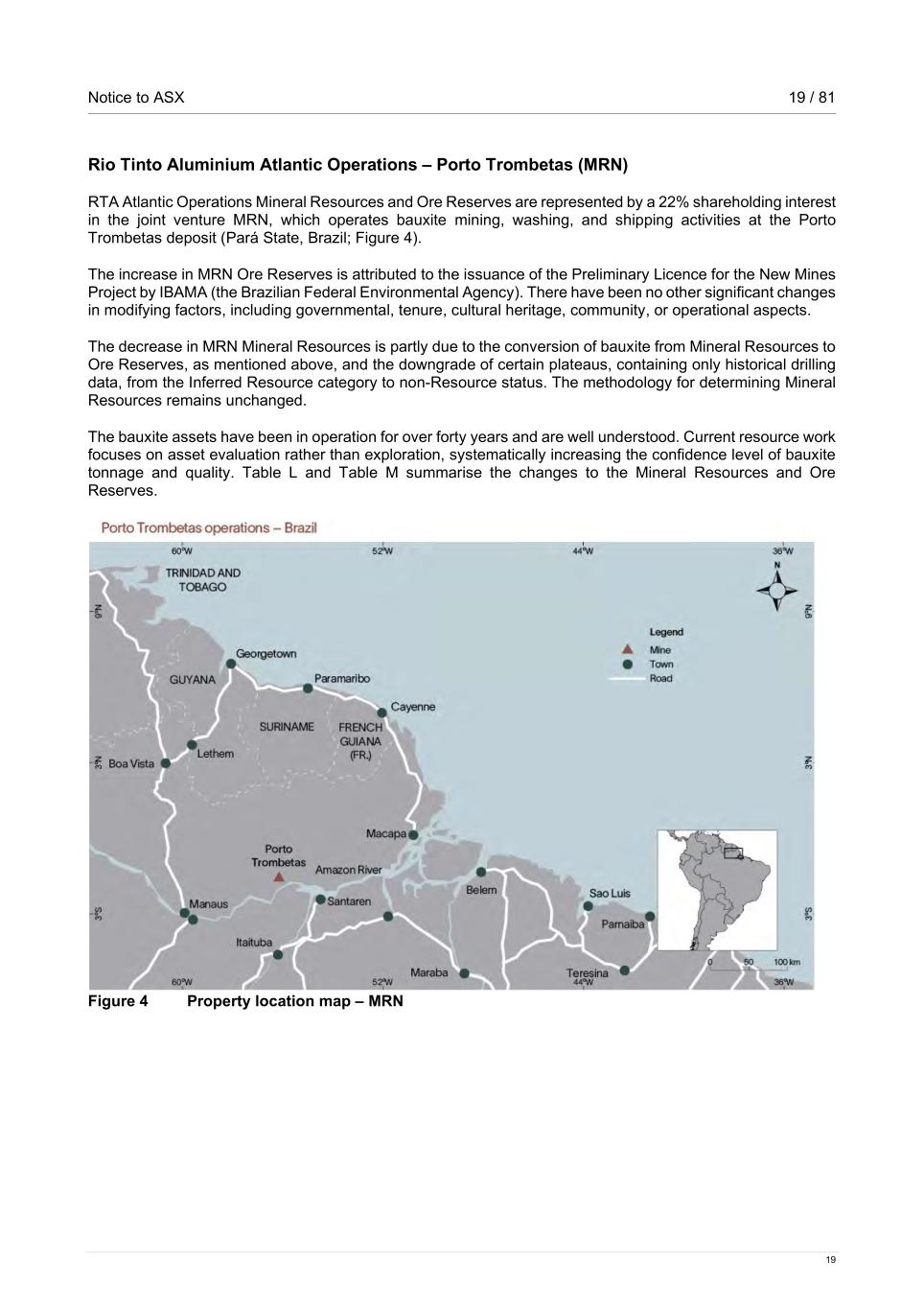
Notice to ASX 19 / 81 19 Rio Tinto Aluminium Atlantic Operations – Porto Trombetas (MRN) RTA Atlantic Operations Mineral Resources and Ore Reserves are represented by a 22% shareholding interest in the joint venture MRN, which operates bauxite mining, washing, and shipping activities at the Porto Trombetas deposit (Pará State, Brazil; Figure 4). The increase in MRN Ore Reserves is attributed to the issuance of the Preliminary Licence for the New Mines Project by IBAMA (the Brazilian Federal Environmental Agency). There have been no other significant changes in modifying factors, including governmental, tenure, cultural heritage, community, or operational aspects. The decrease in MRN Mineral Resources is partly due to the conversion of bauxite from Mineral Resources to Ore Reserves, as mentioned above, and the downgrade of certain plateaus, containing only historical drilling data, from the Inferred Resource category to non-Resource status. The methodology for determining Mineral Resources remains unchanged. The bauxite assets have been in operation for over forty years and are well understood. Current resource work focuses on asset evaluation rather than exploration, systematically increasing the confidence level of bauxite tonnage and quality. Table L and Table M summarise the changes to the Mineral Resources and Ore Reserves. Figure 4 Property location map – MRN

Notice to ASX 20 / 81 20 Table L Changes to MRN Mineral Resources Measured Mineral Resources Indicated Mineral Resources Inferred Mineral Resources Total Mineral Resources Mt % Al2O3 % SiO2 Mt % Al2O3 % SiO2 Mt % Al2O3 % SiO2 Mt % Al2O3 % SiO2 Mineral Resources as at 31 Dec 2023 422 47.3 5.3 3.5 48.9 2.5 146 49.5 4.0 571 47.9 5.0 Additions - - - - - - - - - - - - Depletions 178 48.0 4.5 0.1 42.4 3.4 112 50.1 3.6 290 48.8 4.2 Mineral Resources as at 31 Dec 2024 244 46.8 5.9 3.4 49.1 2.5 34 47.3 5.2 282 46.9 5.8 Table M Changes to MRN Ore Reserves Proved Ore Reserves Probable Ore Reserves Total Ore Reserves Mt % Al2O3 % SiO2 Mt % Al2O3 % SiO2 Mt % Al2O3 % SiO2 Ore Reserves as at 31 December 2023 43 48.9 4.9 3 49.0 4.9 46 48.9 4.9 Additions* 7 43.1 7.1 167 49.1 4.6 174 48.8 4.7 Depletions - Production 11 48.6 5.0 - - - 11 48.6 5.0 Ore Reserves as at 31 Dec 2024 39 48.0 5.2 170 49.1 4.6 209 48.9 4.7 * The additions in the ‘Proved’ category refer to the high silica project. In turn, the additions in the ‘Probable’ category refer to the new environmental licence. Summary of information to support Mineral Resources reporting – Porto Trombetas (MRN) RTA Atlantic Operations Mineral Resources are supported by the information set out in the Appendix 4 to this release and located at Resources & Reserves (riotinto.com) in accordance with the Table 1 checklist in the JORC Code. The following summary information is provided in accordance with Rule 5.8 of the ASX Listing Rules. Geology and geological interpretation The bauxite deposit is composed of a cluster of plateaus, geologically defined as mature lateritic covers formed during the Cenozoic-Paleogene period. These covers were weathered under an equatorial climate from clayey or arkosic sandstones of the Alter do Chão Formation in the Amazon Sedimentary Basin. The plateaus are deeply incised, with flattened tops at elevations ranging from 150 m to 200 m above sea level. They extend laterally for kilometres in length and width, covering up to thousands of hectares. The process of bauxitisation involves the conversion of kaolinite to the bauxite mineral gibbsite, driven by several weathering transformation fronts, including ferruginisation, silica and iron leaching, and alumina accumulation. In the deposit profile, the bauxite forms a continuous tabular layer with an average thickness of 4 m, covered by 6 m to 8 m of ferruginous laterite, nodular bauxite (not a Mineral Resource) and upper kaolinitic clay. Beneath this, it transitions to a mottled kaolinitic horizon. Although the dominant bauxite textures vary per plateau, they are primarily boxwork and concretionary, mixed with varying amounts of kaolinitic clay. Modern root channel structures and infill are common in the upper part of the layer. Gibbsite is the primary mineral, while boehmite is virtually absent.

Notice to ASX 21 / 81 21 Drilling techniques; sampling, sub-sampling method and sample analysis method The current drilling method utilised at MRN is the aircore. The typical aircore rig is a roto-pneumatic Prominas R-1HB model mounted on a regular road truck, with a drilling set composed of a 6 inch crown bit, core barrel, and rods. All profiles except the upper kaolinitic layer are recovered, and drilling ends upon reaching the bottom kaolinitic layer. As drilling progresses, the core is inserted into a PVC tube within the core barrel. Once filled, the tube is removed from the hole, replaced, and drilling continues. The PVC tube containing the geological core is identified, sealed and transported for sampling. The adopted grid spacing is 200 meters squared (m2), covering the entire surface of the plateaus. Recently, an infill campaign with 100 m spacing has been executed in the plateaus being mined. Additionally, a 50 m spaced grid is being implemented in areas designated for grade control. Logging is currently conducted on tablets, with data captured into the Seequent MX Deposit application. In addition to geological classification, physical features are recorded. Typical samples are 0.5 m in length, varying from 0.3 m to 0.8 m to respect geological contacts. Sample processing includes weighing (for density calculation), drying (for moisture calculation) and wet screening for tailings removal, determination of mass recovery and partitioning into coarse and fine granulometries. Chemical analysis is performed by XRF for major oxides: Al2O3, SiO2, Fe2O3, TiO2 and LOI (calculated by difference). Additionally, available alumina and reactive silica grades are assayed by volumetry and atomic absorption, after alkaline digestion. Estimation methodology Basic geostatistical analysis is used to help with domaining decisions. The deposit is modelled as single layers. Five horizon codes, based on the lithology and assays, are assigned for the modelling and estimation of bauxite resources at MRN. Interpretation is undertaken using CAE Datamine RM implicit interpolation tool, while variography and estimation are performed using Geovariances Isatis.Neo software. 50 m x 50 m x 0.5 m sized blocks are filled between two modelled surfaces for flagging each lithotype, as well as under the topographic digital terrain model. For estimates, bauxite horizon samples and blocks were (temporarily) flattened by the hangingwall or footwall (depending on the plateau). Furthermore, clustering assessments were made, resulting in three geostatistical subdomains for filtering the estimates. All grades available as well as LOI and mass recoveries were estimated, for all lithotypes, into parent cells using ordinary kriging. Search strategy parameters were optimised by using the kriging neighbourhood analysis tool. Cut-off grades and modifying factors At MRN, the bauxite lithotype is defined by the following cutoffs: AAl2O3[1] ≥ 35%, AAl2O3 > Fe2O3, and mass recovery ≥ 30%. To identify Mineral Resources volumes with reasonable prospects for eventual economic extraction, an additional cut-off is applied: mass recovery ≥ 50%. Bauxites that do not meet this criterion are downgraded to non-Resource status. It is important to note that this downgraded bauxite is in the lower part of the layer and has higher silica grades and clay content. This approach has been validated through an economic extraction assessment. Additionally, material converted into Ore Reserves, as represented by the mining plan volumes, has been removed. The remaining amounts constitute the reported Mineral Resources exclusive of Ore Reserves. Criteria used for Mineral Resources classification Classification within the bauxite layer is based on conditional simulation assessments, considering bauxite thickness and reactive silica grades. The narrowly simulated points were aggregated into 200 m x 200 m x 1 m panels, and the coefficients of variation were calculated for annual (CVY) and monthly (CVM) production level volumes. Bauxite blocks within panels with a probability above 50% of having a thickness less than 0.5 m were flagged as non-Resource; otherwise, they were classified as Inferred Mineral Resources. Inferred Mineral Resources [1] Available alumina
Notice to ASX 22 / 81 22 with CVY ≤ 15% were upgraded to the Indicated Resources category, and those with CVM ≤ 15% were upgraded to the Measured Resources category. Additional exception criteria adopted subsequently are: 1. Areas lacking drill holes (more than 200 m from the closest one), were automatically flagged as Inferred Resources. 2. Blocks with mass recovery under 50% were downgraded to non-Resource (as described previously). Plateaus with historical data (lower quality and transparency), located in the far west, have being downgraded to non-Resource status in this report and need to be re-drilled to increase confidence and potentially allow for future upgrades. Summary of information to support the Ore Reserves reporting – Porto Trombetas (MRN) RTA Atlantic Operations Ore Reserves are supported by the information set out in the Appendix 4 to this release and located at Resources & Reserves (riotinto.com) in accordance with the Table 1 checklist in the JORC Code. The following summary information is provided in accordance with rule 5.9 of the ASX Listing Rules. Economic assumptions and study outcomes MRN has been operating continuously for over forty years, and the Ore Reserves estimate, and life of mine plans are updated annually. This includes the reconciliation of operating parameters and review of input assumptions into the planning processes. MRN's Ore Reserves were audited in December 2023 by GE21 Consultoria Mineral Ltda. and are supported by a feasibility study. Rio Tinto applies a common process to the generation of bauxite price assumptions across the group and these assumptions are also applied to MRN. This involves generation of long-term price forecasts based on current sales contracts, industry capacity analysis, global commodity consumption and economic growth trends (this includes the bonus/penalty adjustments for quality). Exchange rates are also based on internal Rio Tinto modelling of expected future country exchange rates. Capital and operating cost estimates are sourced from internal MRN financial modelling and/or project capital estimates. Third party payments are reflective of the current agreements in place. Mining method and assumptions The mining method used at MRN is strip mining. The main operations are deforestation, stripping with dozers, scarification, excavation, and transportation with trucks. The mined bauxite is directed to two crushing systems and then passes through a washing plant. After washing, it is transported by rail to the port yards, and part of the bauxite goes through a drying process. The optimisation of the pits to support the Ore Reserves considers the following mining and processing costs: • Mining cost: Deforestation, reforestation, stripping, scarification, excavation, transportation, others, and crushing. • Process cost: Drying, wet process, final product process, and other process costs. The revenue includes the contractual sales values and the penalties and bonuses for quality and moisture. Mining dilution and recovery parameters are applied during the Ore Reserves estimation process, based on the last twelve months reconciliation, and are reviewed annually. As the mining method is strip mining and the pits are shallow, geotechnical risks are low. The increase in MRN Ore Reserves is attributed to the issuance of the Preliminary Licence for the New Mines Project by IBAMA (the Brazilian Federal Environmental Agency). There has been no material change to other Ore Reserves modifying factors, such as: governmental, tenure, environmental, cultural heritage, social or community. Appropriate agreements and approvals remain in place to enable continued operation.

Notice to ASX 23 / 81 23 Processing methods and assumptions The MRN bauxite is beneficiated using established techniques to improve quality (reduce RSiO2[2]). This is achieved by removing the finer fraction, leaving the coarser material as the product. The expected recovery and quality of bauxite from the beneficiation process is controlled by sampling and analysis at various points in the process. Cut-off grades, estimation methodology and modifying factors The cut-off for Ore Reserves is based on economic parameters, net present value (NPV) or internal rate of return (IRR) or cross margin > 0. This criterion was updated in July 2023; until July 2023 only NPV > 0 was considered. The economic cut-off approach considers revenue (bonus/penalty), fixed/operating/capital costs, royalties and other third-party payments. Bauxite that meets this economic cut-off is considered for inclusion in Ore Reserves. The following table shows the evolution of the criterion. Table N Evolution of MRN Ore Reserves cut-off grades Criteria Up to June 2023 From July 2023 to April 2024 From April 2024 Probable Ore Reserves Proved Ore Reserves Probable Ore Reserves Proved Ore Reserves Probable Ore Reserves Proved Ore Reserves Mineral Resources Indicated Measured Indicated or Measured Measured Indicated or Measured Measured Economic Issues - - NPV > 0 NPV > 0 NPV or IRR or Gross Margin > 0 NPV or IRR or Gross Margin > 0 Technical Studies - - FEL2: Pre- Feasibility FEL3: Feasibility FEL2: Pre- Feasibility FEL3: Feasibility Permitting and Legal Requirements Operation Licence Operation Licence Preliminary Licence Operation Licence Preliminary Licence Operation Licence Mineral Rights - - Mining Concession Mining Concession Mining Concession Mining Concession Classification Given the level of confidence in the Ore Reserves modifying factors, Measured Resources are converted to both Proved and Probable Ore Reserves, and all Indicated Resources are converted to Probable Ore Reserves. Inferred Resources are not considered in the estimation of Ore Reserves. 2 Reactive silica
Notice to ASX 24 / 81 24 Competent Persons’ statements Rio Tinto Aluminium Pacific Operations The information in this report that relates to RTA Pacific Operations Mineral Resources is based on information compiled under the supervision of Mr Angus C. McIntyre, who is a Member of the Australasian Institute of Mining and Metallurgy (MAusIMM). Mr McIntyre has sufficient experience that is relevant to the style of mineralisation and type of deposit under consideration and to the activity to which he is undertaking to qualify as a Competent Person as defined in the JORC Code. Mr McIntyre is a full-time employee of Rio Tinto and consents to the inclusion in this report of RTA Pacific Operations Bauxite Mineral Resources based on the information that he has prepared in the form and context in which it appears. The information in this report that relates to RTA Pacific Operations Ore Reserves is based on information compiled under the supervision of Mr William Saba who is a Member of the Australasian Institute of Mining and Metallurgy (MAusIMM). Mr Saba has sufficient experience which is relevant to the style of mineralisation and type of deposit under consideration and to the activity to which he is undertaking to qualify as a Competent Person as defined in the JORC Code. Mr Saba is a full-time employee of Rio Tinto and consents to the inclusion in this report of RTA Pacific Operations Bauxite Ore Reserves based on the information that he has prepared in the form and context in which it appears. Rio Tinto Copper - Winu project The information in this report that relates to Winu Mineral Resources is based on information compiled under the supervision of Mr James Pocoe, who is a Member of the Australasian Institute of Mining and Metallurgy (MAuslMM). Mr Pocoe has sufficient experience that is relevant to the style of mineralisation and type of deposit under consideration and to the activity to which he is undertaking to qualify as a Competent Person as defined in the JORC Code. Mr Pocoe is a full-time employee of Rio Tinto and consents to the inclusion in this report of Mineral Resources based on the information that he has prepared in the form and context in which it appears. Rio Tinto Iron and Titanium Quebec Operations The information in this report that relates to the data and geological models underpinning the Rio Tinto Iron and Titanium Quebec Operations Mineral Resources is based on information compiled under the supervision of Mr. Francois Kerr-Gillespie, who is a Member of the Ordre des geologues du Quebec. Mr Kerr-Gillespie has sufficient experience that is relevant to the style of mineralisation and type of deposit under consideration and to the activity to which he is undertaking to qualify as a Competent Person as defined in the JORC Code. Mr Kerr-Gillespie is a full-time employee of Rio Tinto and consents to the inclusion in this report of Mineral Resources based on the information that he has prepared in the form and context in which it appears. The information in this report that relates to Rio Tinto Iron and Titanium Quebec Operations Mineral Resources is based on information compiled under the supervision of Mr Jacques Dumouchel, who is a Member of the Ordre des geologues du Quebec. Mr Dumouchel has sufficient experience that is relevant to the style of mineralisation and type of deposit under consideration and to the activity to which he is undertaking to qualify as a Competent Person as defined in the JORC Code. Mr Dumouchel is a contract employee of Rio Tinto and consents to the inclusion in this report of Mineral Resources based on the information that he has prepared in the form and context in which it appears. Rio Tinto Aluminium Atlantic Operations – Porto Trombetas (MRN) The information in this report that relates to RTA Atlantic Operations - Porto Trombetas (MRN) Mineral Resources is based on information compiled under the supervision of Mr Robson Aglinskas, who is a Member of the Australasian Institute of Mining and Metallurgy (MAusIMM). Mr Aglinskas has sufficient experience that is relevant to the style of mineralisation and type of deposit under consideration and to the activity to which he is undertaking to qualify as a Competent Person as defined in the JORC Code. Mr Aglinskas is a full-time employee of Mineração Rio do Norte and consents to the inclusion in this report of RTA Atlantic Operations - Porto Trombetas (MRN) Bauxite Mineral Resources based on the information that he has prepared in the form and context in which it appears. The information in this report that relates to RTA Atlantic Operations - Porto Trombetas (MRN) Ore Reserves is based on information compiled under the supervision of Mr Luiz Henrique Diniz Costa who is a Member of the Australasian Institute of Mining and Metallurgy (MAusIMM). Mr Costa has sufficient experience which is

Notice to ASX 25 / 81 25 relevant to the style of mineralisation and type of deposit under consideration and to the activity to which he is undertaking to qualify as a Competent Person as defined in the JORC Code. Mr Costa is a consultant to Mineração Rio do Norte and consents to the inclusion in this report of RTA Atlantic Operations - Porto Trombetas (MRN) Bauxite Ore Reserves based on the information that he has prepared in the form and context in which it appears.

Notice to ASX 26 / 81 26 Contacts Please direct all enquiries to media.enquiries@riotinto.com Media Relations, United Kingdom David Outhwaite M +44 7787 597 493 Media Relations, Australia Matt Chambers M +61 433 525 739 Michelle Lee M +61 458 609 322 Rachel Pupazzoni M +61 438 875 469 Media Relations, Canada Simon Letendre M +1 514 796 4973 Malika Cherry M +1 418 592 7293 Vanessa Damha M +1 514 715 2152 Media Relations, US Jesse Riseborough M +1 202 394 9480 Investor Relations, United Kingdom Rachel Arellano M +44 7584 609 644 David Ovington M +44 7920 010 978 Laura Brooks M +44 7826 942 797 Wei Wei Hu M +44 7825 907 230 Investor Relations, Australia Tom Gallop M +61 439 353 948 Amar Jambaa M +61 472 865 948 Rio Tinto plc 6 St James’s Square London SW1Y 4AD United Kingdom T +44 20 7781 2000 Registered in England No. 719885 Rio Tinto Limited Level 43, 120 Collins Street Melbourne 3000 Australia T +61 3 9283 3333 Registered in Australia ABN 96 004 458 404 This announcement is authorised for release to the market by Andy Hodges, Rio Tinto’s Group Company Secretary. riotinto.com

Appendix 1 Notice to ASX 27 / 81 27 Rio Tinto Aluminium Pacific Operations – Amrun JORC Table 1 The following table provides a summary of important assessment and reporting criteria used for the reporting of Mineral Resources and Ore Reserves in accordance with the Table 1 checklist in The Australasian Code for the Reporting of Exploration Results, Mineral Resources and Ore Reserves (The JORC Code, 2012 Edition). Criteria in each section apply to all preceding and succeeding sections. Section 1: Sampling Techniques and Data Criteria Commentary Sampling techniques • Samples for geologic logging and analysis are collected on 0.25 m intervals (~2 to 3 kg) downhole using aircore drilling methods. • Whole samples are collected beneath a cyclone return system (i.e., no sample splitting is conducted). • Multiscreen sampling is undertaken to determine optimum screen size for beneficiation at each deposit. • Once determined, samples are then beneficiated at the appropriate screen size (0.6 mm for the Amrun deposits). Drilling techniques • The current drilling method utilises aircore drilling. • The typical aircore rig used at Weipa is a Land Cruiser mounted rig with a small enough wheelbase to traverse drill lines cleared with one D-6 dozer blade width. Aircore drilling forces compressed air down a space inside the drill rods to the bit face, where the air is then used to return the sample up the inner tube of the drill rod and out via a cyclone. A three bladed HQ aircore bit is attached to 4 inch rods. The drilling system has been designed to reduce grinding of the sample. Drill sample recovery • No direct recovery measurements of aircore drilling samples are performed. • Whole sample is taken. • Holes are re-drilled if there is excessive sample loss (determined visually). • Sample weights are recorded before and after beneficiation in the laboratory. Logging • Standardised RTA bauxite logging systems are utilised for drilling. • Logging is currently conducted on Panasonic Toughpads and data is captured in an offline acQuire™ logging package at the drill rig. This system allows for data validation to be applied during logging as well as a streamlined method of exporting the data for importing into the main RTA Geology database. • Logging is qualitative in nature, i.e., based on lithology. Currently there are ~20 lithologies common to the deposits that get modelled into four horizons for the estimation of bauxite resources. • All sample intervals (0.25 m) are logged. • The holes are terminated four samples (1 m) into the floor lithologies as observed by the rig geologist. • Logged lithologies are vetted against historical drill holes and assay parameters. Sub-sampling techniques and sample preparation • No sub-sampling is undertaken. • Sample preparation of the 2 kg to 3 kg bauxite samples at Weipa is carried out at the purpose- built facility. The sample sizes are appropriate to the grain size of the material being sampled. The facility consists of two Kason washing screens, two drying ovens, a multiple screening facility, and grinding units. Beneficiated, un-beneficiated (crude) and multiscreen drill samples pass through this area prior to their being assayed for the major oxides and LOI. • Sample preparation at ALS (Australian Laboratory Services) laboratory, Brisbane is set up with the same specifications of equipment as Weipa, however, it has been expanded to six Kasons, multiple, larger drying ovens, more grinding capability, and room for multi-screen preparation. • Samples that have completed the appropriate Kason wash screen are crushed to <2.37 mm, split and then ground to 150 µm pulps for XRF, LOI and reactive silica analyses. • The majority of analyses are undertaken at ALS laboratory in Brisbane since 2015, prior to that the majority of the analyses were done at the Weipa onsite laboratory. • The sample size and preparation techniques are appropriate for the style of mineralisation.

Appendix 1 Notice to ASX 28 / 81 28 Quality of assay data and laboratory tests • Bauxite industry standard XRF analysis of all major elements and a suite of trace elements are undertaken on all samples. • Matrix matched field standards are systematically used. The field team inserts field standards at a rate of 1 in every 50 samples. • Laboratory preparation blanks, duplicates and assay standards also form part of the QA/QC procedure. These are as follows: 2 blanks, 3 laboratory duplicates and 4 laboratory standards per batch (~100 samples). • Some of the historical data were processed at the Weipa Laboratory who participated in a “round robin” process managed through the RTA Process Improvement team. This process included all the RTA and affiliated laboratories and was reviewed on a quarterly basis to ensure that standards were maintained. The Weipa laboratory analysts also carried out internal checks on the assay data. Results not meeting certain criteria or outside a designated range were re-analysed. Field standards were also used by the Geology Department to monitor the performance of the laboratory via standard QA/QC routines. • The ALS Brisbane laboratory maintains its NATA accreditation through annual inspections and testing as required. RTA visit and audit both the preparation facility and analytical rooms regularly. • Every assay batch returned from the laboratories is checked through ioGAS QA/QC objects before being accepted to the database for use in resource estimation. Major oxides, LOI, and KSiO2 are checked routinely against performance of field standards, lab duplicates, and lab standards. • Analysis of the performance of certified standards, field duplicates, blanks and third-party check assaying has indicated an acceptable level of accuracy and precision with no significant bias or contamination. Verification of sampling and assaying • Infill drilling programs for resource definition return results in line with the wider spaced drilling. • Data validation occurs throughout the data collection process: during data capture, during importation into the database, following import into the database and during the modelling process (hole name, location checks, elevation checks, lithology order checks, missing data, and incorrect data). Location of data points • Pre-2016 drill hole peg locations were surveyed to Australian Height Datum (AHD) and the Geocentric Datum of Australia 1994 (GDA94) grid (and converted to local mine grids) by contract surveyors using DGPS survey equipment which was accurate to 10 cm in both horizontal and vertical directions. • Post 2016 surveys utilise GNSS GPS systems. Where a survey has not been completed, e.g., Amrun 2018 to 2019 drilling campaign, Light Detection and Ranging (LiDAR) positioning of drill collar elevations is utilised to provide the collar elevation. Data spacing and distribution • Drilling at Amrun is completed systematically according to the following spacing based on level of confidence: o Inferred Resources based on ~1200 m x 800 m. o Indicated Resources ~200 m x 400 m. o Measured Resources ~200 m x 100 m. o Assured (grade control) ~ 76 m x 76 m on an offset diamond pattern. • All downhole drill sampling is at 0.25 m intervals, and samples are taken of the cover and floor. • No sample compositing is done. • The data spacing and distribution is deemed sufficient by the Competent Person to establish geological and grade continuity appropriate for the Mineral Resources classification that has been applied. Orientation of data in relation to geological structure • Not applicable in lateritic bauxite deposits. All drill holes are vertical, which intersects the horizontal ore body perpendicularly. Sample security • Samples are collected, bagged, ticketed, and sealed at the drill sites. Samples are placed in bulk plastic containers, with a capacity of ~300 samples, for shipment to the laboratory. All samples are electronically logged into a system for tracking and validation. Samples are placed on a dispatch advice form and verified by the laboratory on arrival. All assay pulps are stored at Weipa or ALS Brisbane in purpose-built sample storage facilities. Audits or reviews • An external Mineral Resources and Ore Reserves audit was completed in 2019 on the Weipa deposit. This audit had an outcome of Satisfactory with one medium and five low rated potential

Appendix 1 Notice to ASX 29 / 81 29 risks to the Mineral Resources and Ore Reserves. Actions were put in place to address all findings. The same processes and procedures are utilised at Amrun. • The Amrun deposit itself underwent an external audit in quarter three of 2024. A result of Good was obtained (highest possible rating) with only three low findings outlined with recommendations, and no specific actions. • Numerous internal peer reviews and studies have also been undertaken over the years. These reviews concluded that the fundamental data collection and modelling techniques are appropriate. Section 2: Reporting of Exploration Results Criteria Commentary Mineral tenement and land tenure status • The Weipa bauxite deposits are located on the western side of the Cape York Peninsula in far north Queensland, Australia. Mining Lease (ML) 7024 and ML 7031 covers the various deposits (Figure 5). ML 7031 was obtained through the acquisition of Alcan in 2007. ML 6024 is a separate lease that is held to provide infrastructure access between the north of Embley and south of Embley operations at Weipa. • ML 7024 was granted by the State Government of Queensland under a separate Act of Parliament, “The Commonwealth Aluminium Corporation Pty. Limited Agreement Act 1957”. The effective date of the lease granted under this act is 1/1/1958 and the expiry date is 31/12/2041 with an option to extend to 31/12/2062. Lease extensions past 2062 can be obtained, beyond the initial renewal period, subject to both parties’ right to terminate on two years notice. • ML 7031 was granted by the State Government of Queensland under a separate Act of Parliament, “The Alcan Queensland Pty. Limited Agreement Act of 1965”. The effective date of the lease granted under this act is 1/1/1964 and the expiry date is 31/12/2047 with an option to extend to 31/12/2068. Lease extensions past 2068 can be obtained, beyond the initial renewal period, subject to both parties’ right to terminate on two years notice. Figure 5 Rio Tinto Aluminium tenement location plan

Appendix 1 Notice to ASX 30 / 81 30 Exploration done by other parties • Not applicable. Weipa is a mature mining operation with more than 50 years of operational and orebody knowledge. Geology • The rocks of the Cape York Peninsula are divided into two geological units: the sedimentary rocks on the western side of the peninsula and the igneous and metamorphic rocks exposed in the hills on the eastern side of the peninsula (the Coen Inlier). • The Cape York Peninsula bauxites are confined to a dissected laterite plateau, known officially as the Weipa Plateau on the west coast of Cape York Peninsula. The Weipa Plateau is one of three geomorphologic land units that are of particular interest to the geology of the bauxite and kaolin resources. The other two units are the Merluna Plain and the Mapoon Plain. • The Weipa Plateau is a low plateau, usually no more than a few tens of metres above sea level and has been dissected by various river systems resulting in a series of irregularly shaped islands. It is intensely weathered to a depth of 20 m to 30 m with the upper part of the weathered material reconstituted into various nodules as well as some partially cemented rocks. The flatness of the plateau has meant it has been immune to erosion other than by rivers eating away at the sides. Much of the plateau’s volume was removed in solution in the groundwater, which is also responsible for the formation of the bauxite. The sedimentary rocks of the Weipa Plateau fall into two categories: o The Rolling Downs Group Sediments; and o The Bulimba Formation Sediments (Weipa Beds). • These two groups of sediments are eroded and weathered to form the Weipa bauxites. The different sediments resulted in different types of bauxite formations. • The Bulimba Formation sediments lie on top of the Rolling Downs Group and occupy channels that cut down into them. The Rolling Downs Group were uplifted above sea level and weathered before the Bulimba Formation sediments deposited on them. The river sediments are less homogeneous than the marine ones. Deposition occurred as short erratic events rather than a slow continuous one and a changing sea level resulted in a mixture of sands and clays. The greater variability in the sediments is reflected in greater local variability in grade of the Weipa type bauxites. • Andoom type bauxites are derived from shallow marine sediments that are fine grained, with little quartz, and this material is screened at 0.3 mm. The Weipa type bauxites are derived from river deposited sediments that are coarse grained, with abundant quartz, and this material is therefore screened at 1.7 mm. Drilling at Amrun suggests a more intensely braided river system allowing more mixing between the Bulimba Formation and Rolling Downs Group. This fits with the optimum screen size of the area being between the Andoom and Weipa deposits. Amrun is currently screened at 0.6 mm. • The Cape York Peninsula bauxites are thin, tabular deposits that vary from zero to 10 m in thickness and are continuous laterally for many kilometres. The unconsolidated pisolites are overlain by 0.5 m topsoil and sit on an ironstone or clay base. • The rocks of the Bulimba Formation and Rolling Downs Group have been converted to bauxite via a continuum of weathering. An annual high rainfall and a geologically stable environment has provided the perfect ingredients for a world-class bauxite deposit to form over many millions of years. A deep saprolitic zone overlain by a classic mottled zone below the bauxite mineralisation attests to this. • The process of bauxitisation involves the conversion of kaolinite to the bauxite minerals gibbsite and boehmite. The principal influence on the process is the composition, supply, and movement of groundwater. The pH of the groundwater is lowered during the process of bauxitisation, and we note that the process is still ongoing as we see a low pH regularly throughout the ground water monitoring bores across the RTA mining leases. To a lesser extent there are organic influences such as vegetation, and possibly burrowing organisms and temperature. • The dissolution of both kaolin and quartz controls the distribution of silica grades in the deposits. The combination of kaolin and quartz distributions results in a typical vertical chemical profile that is usually found throughout the deposits and appears to be independent of the bauxite thickness i.e., the same vertical grade trend is found in both thin and thick bauxites. The typical vertical grade profile for silica is high silica at the top of the bauxite, which quickly drops to a much lower silica value that plateaus for most of the profile and then rises quickly back to high silica values again right at the base of the bauxite profile. As alumina is left behind by the dissolution of kaolinite, the typical vertical grade profile for alumina is the inverse of silica. The relationships between the genetic processes and the resulting grade profiles are displayed in the figure below.

Appendix 1 Notice to ASX 31 / 81 31 Figure 6 Relationships between the bauxite genetic processes and the resulting grade profiles Drill hole Information • As this report relates to Mineral Resources and no Exploration Results are being reported, this section is considered not applicable. Resource work is currently more focussed on asset evaluation rather than exploration, systematically bringing the bauxite classification to higher levels of confidence. Data aggregation methods • Not applicable as no Exploration Results are being reported. Weipa is a mature mining operation with more than 50 years of operational and orebody knowledge. Relationship between mineralisation widths and intercept lengths • All drill holes have been drilled perpendicular to the horizontal stratigraphy of the deposit. • All known horizons of the deposits: overburden, red soil, bauxite, and ironstone/clay are intersected and sampled during drilling. Drilling continues for 1 m into the ironstone/clay to ensure the transitional boundary between the ore and floor is intersected. Diagrams • RTA location and facilities are shown in Figure 1 in the body of this release. • Figure 7 and Figure 8 show a plan view of the current drill holes and a type cross section through the deposit.
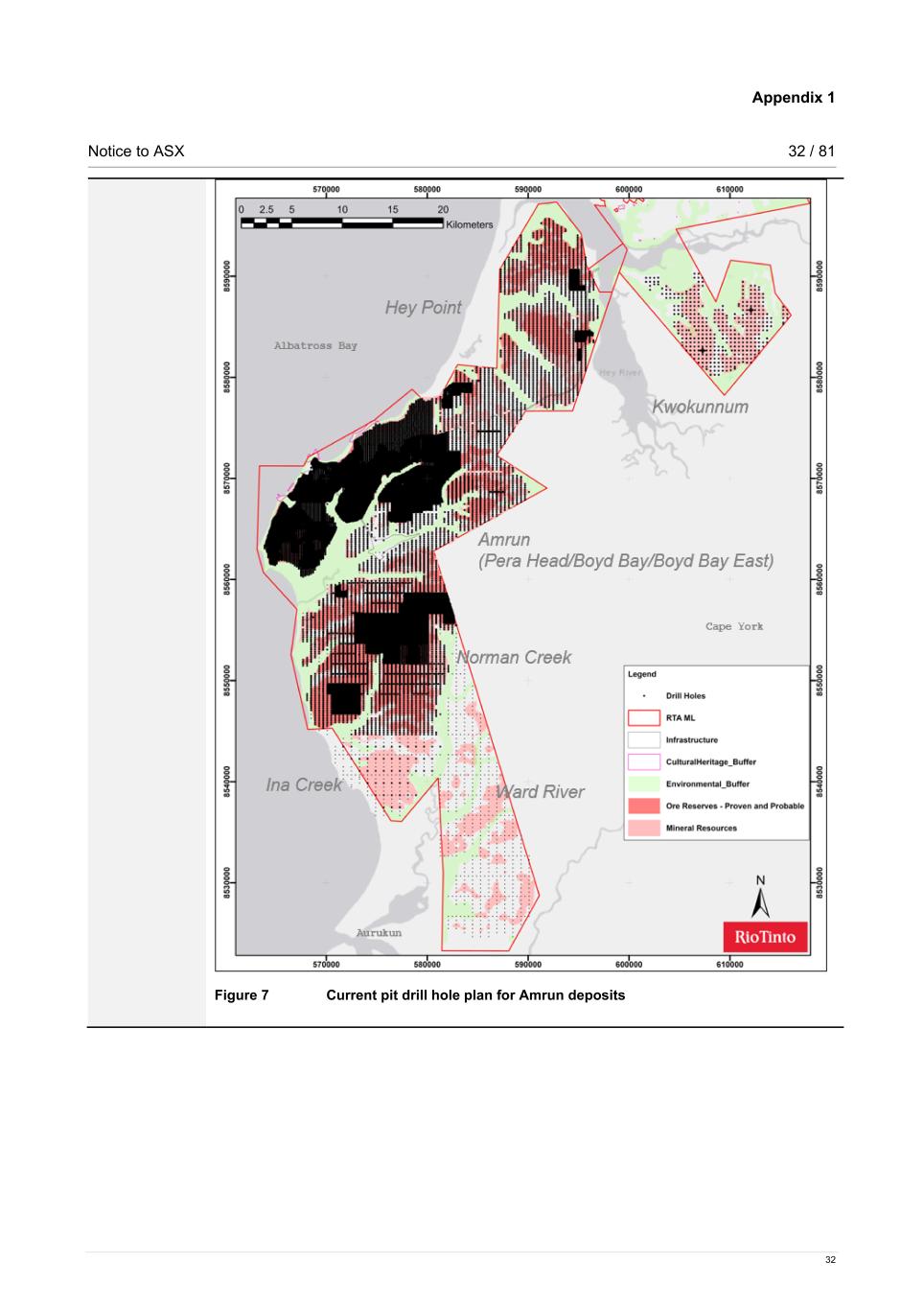
Appendix 1 Notice to ASX 32 / 81 32 Figure 7 Current pit drill hole plan for Amrun deposits

Appendix 1 Notice to ASX 33 / 81 33 Figure 8 Type section for Amrun deposits Balanced reporting • Not applicable as no Exploration Results are being reported. Weipa is a mature mining operation with more than 50 years of operational and orebody knowledge. The Amrun Mine started operations in 2018. Other substantive exploration data • Not applicable. Weipa is a mature mining operation with more than 50 years of operational and orebody knowledge. Further work • Drilling will continue in the future to further support the five-year and life of mine plans, as well as options for future growth. Section 3: Estimation and Reporting of Mineral Resources Criteria Commentary Database integrity • Data capture is on Panasonic Toughpad digital loggers that have internal validation rules that identify logging errors. • The geological drill hole database (RTA Geology) is managed by the Bauxite Geology Team within RTA. Drilling data is securely stored in a Microsoft SQL Server using an acQuire™ front end. acQuire™ is a third-party software product that provides a user-friendly interface to SQL Server and consists of two components: o a Relational Data Model (structured storage tables and links) optimised for the storing of exploration and mining data information; and o a Software System (objects for data collect/importing/exporting, validation, viewing, modification, etc.) to manage the data and provide end user functionality for the optimum use of exploration and mining data. • The database is located on a virtual server hosted in Rio Tinto’s Azure cloud servers in Sydney. They are backed up daily in accordance with Rio Tinto’s standard back up procedure. • The drill hole database used for Mineral Resources estimation has been internally validated. Methods include checking: o acQuire™ scripts for relational integrity, duplicates, total assay, and missing / blank assay values. o Domain names. o Null and negative grade values. o Missing or overlapping intervals. o Duplicate data. • Drill hole data was also validated visually by domain and compared to the geological model. Site visits • The Competent Person for the Weipa Mineral Resources, which include Amrun, visits the site on a regular basis and is involved in all aspects relating to the orebody knowledge.
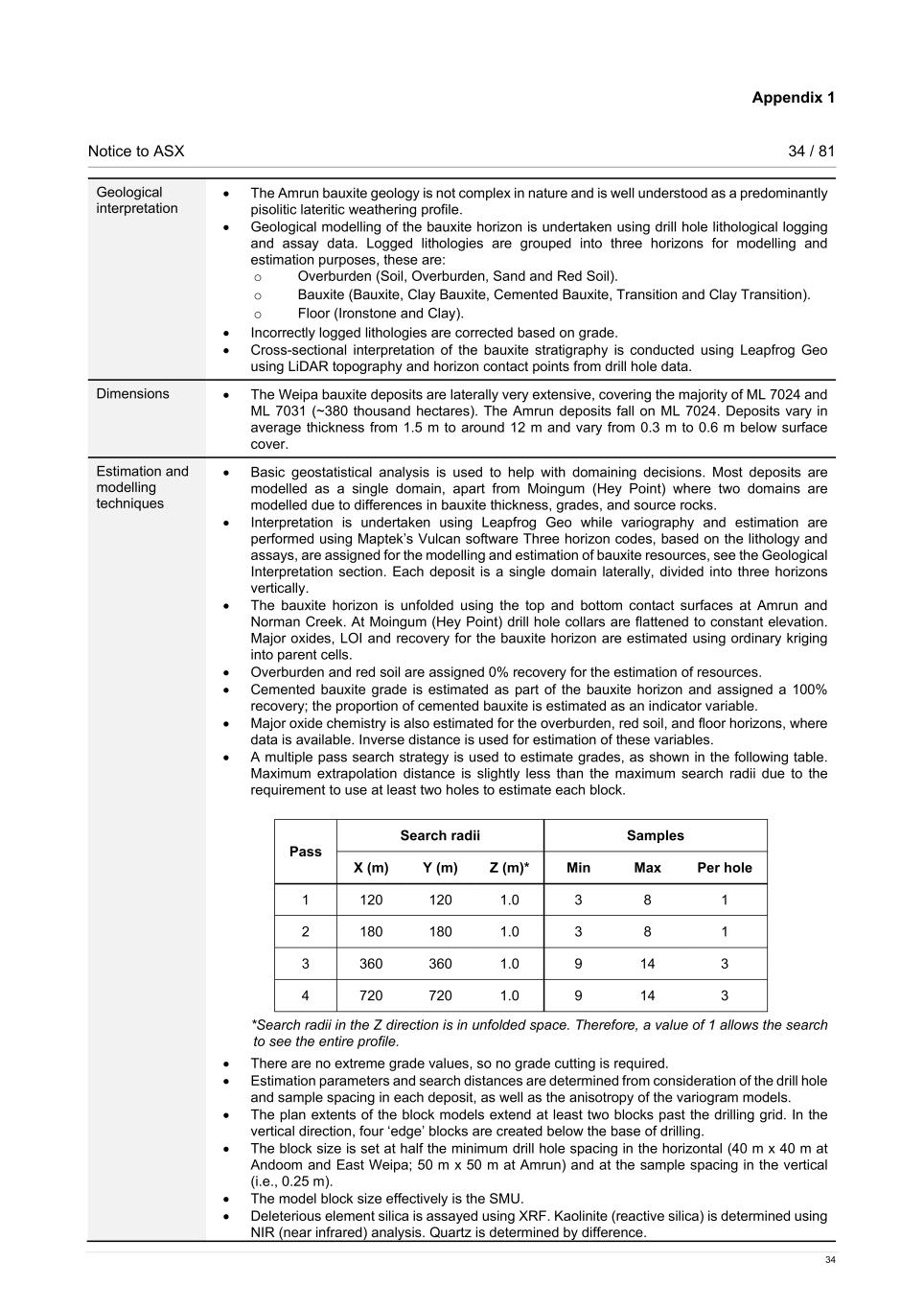
Appendix 1 Notice to ASX 34 / 81 34 Geological interpretation • The Amrun bauxite geology is not complex in nature and is well understood as a predominantly pisolitic lateritic weathering profile. • Geological modelling of the bauxite horizon is undertaken using drill hole lithological logging and assay data. Logged lithologies are grouped into three horizons for modelling and estimation purposes, these are: o Overburden (Soil, Overburden, Sand and Red Soil). o Bauxite (Bauxite, Clay Bauxite, Cemented Bauxite, Transition and Clay Transition). o Floor (Ironstone and Clay). • Incorrectly logged lithologies are corrected based on grade. • Cross-sectional interpretation of the bauxite stratigraphy is conducted using Leapfrog Geo using LiDAR topography and horizon contact points from drill hole data. Dimensions • The Weipa bauxite deposits are laterally very extensive, covering the majority of ML 7024 and ML 7031 (~380 thousand hectares). The Amrun deposits fall on ML 7024. Deposits vary in average thickness from 1.5 m to around 12 m and vary from 0.3 m to 0.6 m below surface cover. Estimation and modelling techniques • Basic geostatistical analysis is used to help with domaining decisions. Most deposits are modelled as a single domain, apart from Moingum (Hey Point) where two domains are modelled due to differences in bauxite thickness, grades, and source rocks. • Interpretation is undertaken using Leapfrog Geo while variography and estimation are performed using Maptek’s Vulcan software Three horizon codes, based on the lithology and assays, are assigned for the modelling and estimation of bauxite resources, see the Geological Interpretation section. Each deposit is a single domain laterally, divided into three horizons vertically. • The bauxite horizon is unfolded using the top and bottom contact surfaces at Amrun and Norman Creek. At Moingum (Hey Point) drill hole collars are flattened to constant elevation. Major oxides, LOI and recovery for the bauxite horizon are estimated using ordinary kriging into parent cells. • Overburden and red soil are assigned 0% recovery for the estimation of resources. • Cemented bauxite grade is estimated as part of the bauxite horizon and assigned a 100% recovery; the proportion of cemented bauxite is estimated as an indicator variable. • Major oxide chemistry is also estimated for the overburden, red soil, and floor horizons, where data is available. Inverse distance is used for estimation of these variables. • A multiple pass search strategy is used to estimate grades, as shown in the following table. Maximum extrapolation distance is slightly less than the maximum search radii due to the requirement to use at least two holes to estimate each block. Pass Search radii Samples X (m) Y (m) Z (m)* Min Max Per hole 1 120 120 1.0 3 8 1 2 180 180 1.0 3 8 1 3 360 360 1.0 9 14 3 4 720 720 1.0 9 14 3 *Search radii in the Z direction is in unfolded space. Therefore, a value of 1 allows the search to see the entire profile. • There are no extreme grade values, so no grade cutting is required. • Estimation parameters and search distances are determined from consideration of the drill hole and sample spacing in each deposit, as well as the anisotropy of the variogram models. • The plan extents of the block models extend at least two blocks past the drilling grid. In the vertical direction, four ‘edge’ blocks are created below the base of drilling. • The block size is set at half the minimum drill hole spacing in the horizontal (40 m x 40 m at Andoom and East Weipa; 50 m x 50 m at Amrun) and at the sample spacing in the vertical (i.e., 0.25 m). • The model block size effectively is the SMU. • Deleterious element silica is assayed using XRF. Kaolinite (reactive silica) is determined using NIR (near infrared) analysis. Quartz is determined by difference.

Appendix 1 Notice to ASX 35 / 81 35 • No specific assumptions are made regarding the correlation of variables during estimation as each element is estimated independently. Some attributes do show strong positive or negative correlation in the drill hole samples, and the similarity in variogram models for different attributes and identical search parameters effectively guarantee that these correlations are preserved in the estimates. • Routine validation of the block model estimation is completed using global model versus sample statistics, swathe plots, grade tonnage curves, volume checks, and visual cross- section comparisons (block estimates against drill hole samples). Filtering by search volume and number of samples can improve comparisons. • The Mineral Resource estimates take appropriate account of previous estimates and mine production. The new models are broadly comparable with previous estimates despite significant changes in methodology. New models appear to reconcile with mine production within tolerable limits, as previous estimates did. Moisture • All Mineral Resource tonnages are reported on a dry basis. • All Mineral Resources are reported as beneficiated dry product. Cut-off parameters • Grade cut-offs are routinely used to determine the potential Mineral Resources of the modelled horizons. Where lithological contacts are transitional, chemical cut-offs based on alumina and silica are used with <= 15% SiO2 and >= 40% Al2O3. These blocks are then reviewed against location (buffer areas), as well as thickness cut-offs ranging from 0.5 m to 1 m for each deposit. • The estimation of Ore Reserves utilises an economic parameter, summarised as the margin realised upon sale of the bauxite. The economic parameter is used as a check to validate technical resource assumptions (grade and thickness cut-off, material in exclusion buffers and declustering) applied in determining available resources. Mining factors or assumptions • Amrun is mined through shallow open cut techniques developed over several decades of operations. After topsoil is removed, front end loaders excavate the bauxite and belly dump trucks transport the bauxite to the beneficiation plant. • As the Amrun orebodies are shallow, geotechnical risks are extremely low. Pre-production drilling is completed to provide better definition of the roof and floor contacts for the five-year mine planning process. • Estimates include internal dilutional but no allowance for external dilution or mining recovery. Dilution and mining recovery are applied during the reserving process, not during estimation. • A minimum mining thickness for the bauxite horizon of 0.5 m is used for the final determination of resource figures. Metallurgical factors or assumptions • Amrun bauxite is beneficiated through established techniques to improve product quality and handleability. This is achieved through the removal of the finer fraction and leaves the coarser material as product. • The beneficiation process typically involves wet screening and may include the use of cyclones and classifiers depending on the part of the deposit being beneficiated. • Expected bauxite recovery and quality from the beneficiation process is assessed through laboratory scale test work of samples generated from the resource drilling process. • Bauxite mineralogy has been investigated through numerous studies, primarily using wet chemical techniques, to understand how it will react in the Bayer Process, which is used to extract the alumina at the refineries. • A proprietary mineralogical calculator “MinCalc” is used to estimate bauxite mineralogy and Bayer processing grade for Cape York ore from the routinely collected elemental chemistry and thermogravimetry, as routine wet chemical techniques are prohibitively expensive. MinCalc calibration is orebody specific and is validated and recalibrated during the life of mine operations. Environmental factors or assumptions • Amrun has obtained all relevant environmental approvals required to continue operations. • Operation of tailings dams at Amrun are covered by relevant government permits. Bulk density • Bulk density is not measured on drill hole samples. • Bulk density has been determined for each deposit at Amrun by using the Sand Replacement Method and Nuclear Density Gauge Testing according to Australian standards AS 1289.5.3.1- 1993 and AS 1289.5.8.1-1995. • Several studies have been conducted over the deposits with the most common test pit spacing being 5,000 m. This produced the bulk density utilised in resource tonne calculations.
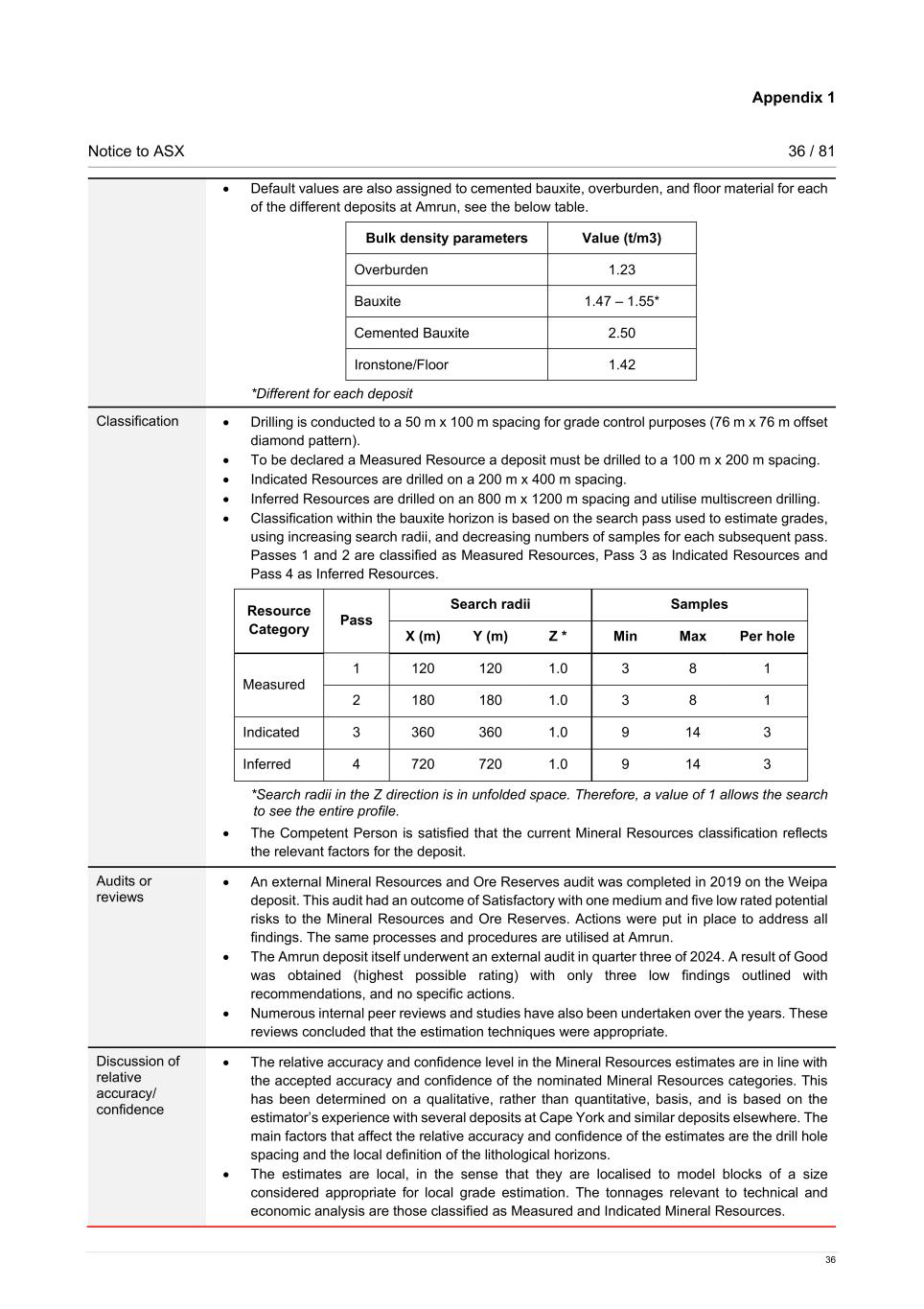
Appendix 1 Notice to ASX 36 / 81 36 • Default values are also assigned to cemented bauxite, overburden, and floor material for each of the different deposits at Amrun, see the below table. Bulk density parameters Value (t/m3) Overburden 1.23 Bauxite 1.47 – 1.55* Cemented Bauxite 2.50 Ironstone/Floor 1.42 *Different for each deposit Classification • Drilling is conducted to a 50 m x 100 m spacing for grade control purposes (76 m x 76 m offset diamond pattern). • To be declared a Measured Resource a deposit must be drilled to a 100 m x 200 m spacing. • Indicated Resources are drilled on a 200 m x 400 m spacing. • Inferred Resources are drilled on an 800 m x 1200 m spacing and utilise multiscreen drilling. • Classification within the bauxite horizon is based on the search pass used to estimate grades, using increasing search radii, and decreasing numbers of samples for each subsequent pass. Passes 1 and 2 are classified as Measured Resources, Pass 3 as Indicated Resources and Pass 4 as Inferred Resources. Resource Category Pass Search radii Samples X (m) Y (m) Z * Min Max Per hole Measured 1 120 120 1.0 3 8 1 2 180 180 1.0 3 8 1 Indicated 3 360 360 1.0 9 14 3 Inferred 4 720 720 1.0 9 14 3 *Search radii in the Z direction is in unfolded space. Therefore, a value of 1 allows the search to see the entire profile. • The Competent Person is satisfied that the current Mineral Resources classification reflects the relevant factors for the deposit. Audits or reviews • An external Mineral Resources and Ore Reserves audit was completed in 2019 on the Weipa deposit. This audit had an outcome of Satisfactory with one medium and five low rated potential risks to the Mineral Resources and Ore Reserves. Actions were put in place to address all findings. The same processes and procedures are utilised at Amrun. • The Amrun deposit itself underwent an external audit in quarter three of 2024. A result of Good was obtained (highest possible rating) with only three low findings outlined with recommendations, and no specific actions. • Numerous internal peer reviews and studies have also been undertaken over the years. These reviews concluded that the estimation techniques were appropriate. Discussion of relative accuracy/ confidence • The relative accuracy and confidence level in the Mineral Resources estimates are in line with the accepted accuracy and confidence of the nominated Mineral Resources categories. This has been determined on a qualitative, rather than quantitative, basis, and is based on the estimator’s experience with several deposits at Cape York and similar deposits elsewhere. The main factors that affect the relative accuracy and confidence of the estimates are the drill hole spacing and the local definition of the lithological horizons. • The estimates are local, in the sense that they are localised to model blocks of a size considered appropriate for local grade estimation. The tonnages relevant to technical and economic analysis are those classified as Measured and Indicated Mineral Resources.

Appendix 1 Notice to ASX 37 / 81 37 Section 4: Estimation and Reporting of Ore Reserves Criteria Commentary Mineral Resource estimate for conversion to Ore Reserves • The Ore Reserves estimates are developed from the geological models current as of September 2024, and the mineralogy model updated in 2022. • Mineral Resources are stated exclusive of Ore Reserves. Site visits • The Ore Reserves Competent Person has been employed by Rio Tinto for a significant period and has visited Weipa several times in recent years. Study Status • Amrun Operations has been operating continuously since 2019, and the Ore Reserves estimate, and life of mine plan are updated annually. This includes the reconciliation of operating parameters and review of input assumptions into the planning processes. The Amrun feasibility study was completed and approved by Rio Tinto in 2015. Completion of the Norman Creek Access Study in 2024 has provided certainty regarding capital infrastructure and operating practices relating to extraction of the Ore Reserves south of Norman Creek. This includes haulage strategy, capital expenditure and operating cost profile. Cut-off parameters • The Ore Reserves cut-off is based on an economic parameter, summarised as the margin realised upon sale of the bauxite. The economic cut-off approach considers revenue (bonus/penalty), fixed/operating/capital costs, royalties, and other third-party payments. Bauxite that satisfies this economic cut-off, is considered for inclusion in the Ore Reserves. Mining factors or assumptions • The Ore Reserves are mined through shallow, open cut techniques developed over several decades of operations. Once the area is tree cleared and the topsoil/overburden removed, the bauxite is hauled to the beneficiation plant for processing. Several mining areas are active at any one time to enable blending and to mitigate against operational risk. • As the Ore Reserves are shallow, geotechnical risks are low. Stockpile heights and wet road conditions are managed in accordance with standard operating procedures. • Dilution and mining recovery parameters are applied during the Ore Reserves estimation process, based on reconciliation of past performance, and reviewed annually. • Minimum bauxite mining thickness of 0.9 m is used for Amrun Ore Reserves estimation. • Inferred Mineral Resources are not considered in the estimation of Ore Reserves. Metallurgical factors or assumptions • Amrun bauxite is beneficiated through established techniques to improve product quality and handleability. This is achieved through the removal of the finer fraction, leaving the coarser material as product. • Expected bauxite recovery (averaging ~69%) and quality from the beneficiation process is assessed through laboratory scale test work of samples generated from the resource drilling process. • Extractable alumina is calculated through application of a mineralogy model. Environmental factors or assumptions • All relevant environmental approvals have been obtained to continue operations. • An Environmental Impact Statement (EIS) has been completed for Amrun with the relevant governmental approvals having been obtained. • Operation of tailings dam at Amrun is covered by relevant government permits. Infrastructure • Amrun is part of the greater Weipa Operation, which has all appropriate infrastructure for the existing operations already developed. This includes water, power, sewage, stores, maintenance workshops, administration buildings and the Weipa township. Any infrastructure expansion required in the future is allowed for in the financial modelling that supports the Ore Reserves. Costs • Operating and sustaining capital costs are sourced from the Weipa Operations financial model.

Appendix 1 Notice to ASX 38 / 81 38 • Future capital costs are based on project study estimates or five-year plan sustaining capital amounts. • Traditional owner and carbon tax assumptions are factored into the financial modelling. • Exchange rates are based on internal Rio Tinto modelling of expected future country exchange rates. Revenue factors • Commodity prices are based on internal Rio Tinto modelling of the future supply and demand balance for bauxite, alumina, and aluminium. This includes the bonus and penalty adjustments for quality. • Queensland royalties are included in the financial modelling at 10.0% of the bauxite price. • Exchange rates are based on internal Rio Tinto modelling of expected future country exchange rates. Market Assessment • Industry analysis is undertaken to assess the existing and future supply and demand balances in bauxite, alumina, and aluminium. This includes assessing likely incentive pricing required to bring on new capacity. • Internal Rio Tinto forecasting revises production guidance on an annual basis. Economic • Operating costs are built up from first principles while capital costs are included based on current estimates. Appropriate escalation is built in where capital costs are to be incurred in the future. • The discount rate to be used in the NPV model is supplied from Rio Tinto corporate and is set based on risk adjusted cost of capital. • Sensitivity analysis is carried out to assess key project drivers and the sensitivity of the project economics to movements in these drivers. Social • Weipa has in place the Weipa Community Co-existence Agreement (WCCCA) with local traditional owners. It also has a Community Relations department that seeks to build relationships with the local communities in and around Weipa. Other • Tenure to extract the Amrun deposit is granted through a single state agreement and is held through one mining lease: ML 7024. • The Queensland Government Comalco (ML 7024) lease expires in 2041 with an option of a 21-year extension, then two years’ notice of termination. • An EIS process was completed for the Amrun brown field mining expansion. Both the Queensland and Commonwealth governments have approved the EIS subject to several conditions. Classification • Given the level of confidence in the reserve modifying factors, Measured Resources are converted to both Proved and Probable Ore Reserves, and all Indicated Resources are converted to Probable Ore Reserves. • Completion of the Norman Creek Access Study has resulted in more of the Measured Resources being converted into Proved Ore Reserves. • Inferred Mineral Resources are not considered in the estimation of Ore Reserves. • The Competent Person is satisfied that the current classification is reasonable for the Amrun Ore Reserves and reflects the outcome of technical and economic studies. Audits or reviews • Multiple Mineral Resources and Ore Reserves internal audits have been completed (2024, 2019 and 2015) on the Weipa and Amrun deposits. These audits concluded that there were medium and low rated potential risks to the Mineral Resources and Ore Reserves. All findings from 2019 and 2015 audits have been actioned. There were no material findings from the 2024 Amrun Mineral Resources and Ore Reserves audit. Discussion of relative accuracy/ confidence • Ore Reserves estimates are compared with production data on an annual basis at Amrun. This reconciliation shows that for all key parameters, production was within ±5% of the estimates for calendar year 2024.
Appendix 2 Notice to ASX 39 / 81 39 Rio Tinto Copper – Winu JORC Table 1 The following table provides a summary of important assessment and reporting criteria used for the reporting of Mineral Resources and Ore Reserves in accordance with the Table 1 checklist in The Australasian Code for the Reporting of Exploration Results, Mineral Resources and Ore Reserves (The JORC Code, 2012 Edition). Criteria in each section apply to all preceding and succeeding sections. Section 1: Sampling Techniques and Data Criteria Commentary Sampling techniques • Samples used in the Mineral Resources estimate were obtained using either RC or diamond drilling. • RC drilling samples were collected from a static cone splitter on a cyclone at 2 m or 1 m intervals depending on drill hole purpose. The samples consisted of 12% and 8% respectively of the drilled metre with an average sample weight of 3.64 kg. • Most pre-collars for diamond drill holes were destructively drilled with either tri-cone rock rollers or mud rotary PCD (polycristalline diamond) techniques to a depth determined by the local geology in which Quaternary and Tertiary sand cover is penetrated, enabling safe installation of casing through the sand profile. Once through the sand cover, standard diamond coring techniques commence. • Several diamond holes were pre-collared utilising RC rigs. • All diamond core drilling is drilled using 3 m triple tube assemblies. Core sample intervals were selected predominantly at 1 m length, with modification by the geologist according to mineral/vein/contact locations. • All drilling has been carried out under Rio Tinto supervision by experienced drilling contractors. • Core is cut using an automated core-cutter and a half core sample was collected on intervals ranging from 0.1 m to 1.3 m length. Drilling techniques • RC drilling is from surface using RC with face sampling bit. RC holes are predominantly drilled at a -85 to -75 degree dip to the west and are cased between 50 m and 70 m. • Diamond drilling is from surface, commencing with either tri-cone rock rollers or mud rotary PCD through sand cover, enabling safe installation of casing through the sand profile. The drill holes are generally cased to 30 m. • Once through the sand cover, triple tube diamond coring techniques are utilised. Reduction from PQ to HQ is at 160 m on average, with depth varying from hole to hole. Most diamond drilling is inclined at approximately -60 degrees to the west; some west to east scissor holes and north-south oriented diamond holes have also been drilled. • Diamond core was oriented using an ACT III RD tool. At the end of each run, the low side of the core was marked by the driller, and this was used at the site for marking the whole drill core run with a reference line. Drill sample recovery • RC primary and duplicate samples were weighed upon collection at the rig and all RC samples were weighed upon arrival at the ALS laboratory, Perth, Western Australia sample preparation facility. • Beyond the depth that RC samples cannot be recovered dry, two additional 6 m rods were drilled. Drilling of the hole was stopped if these samples were wet. • Some wet RC samples drilled prior to 2020 were excluded from the resource database as recorded sample mass was considered too low for the drilled interval, and the quality of those samples could not be assured. Changes made to RC sampling processes in early 2020 resulted in representative sampling throughout the hole length. • Core recovery was measured and recorded continuously from the start of core drilling to the end of the hole for each drill hole. The end of each run was marked by a core block which provided the depth, core length drilled, and core recovered from block to block. • Core sample intervals did not consider drilling recovery except when core loss was greater than 0.4 m. • Sampling recovery, independent of drilling recovery, is not detailed in the current logging procedure, however it will be included in the next procedure edition. Logging • Logging of RC chips was completed after sieving and washing of representative material collected from the cyclone.

Appendix 2 Notice to ASX 40 / 81 40 • Detailed descriptions of core were logged on site qualitatively for lithological composition and texture, structures, veining and alteration. Visual percentage estimates were made for some minerals, including Cu-oxides and Fe-, Mo-, Zn-, and Bi-sulphides. • Structural measurements (orientations of structures such as fault contact, fault fabric, bedding, veins and stratigraphic contacts recorded) as well as geotechnical summary logging was completed. Holes with specific geotechnical purpose had comprehensive geotechnical logging completed, with associated orientations measured. All diamond holes were logged before sampling. • All recovered core was logged in detail. • The core was photographed both dry and wet inside the core trays. • All logging information was uploaded into an acQuire™ database. Sub-sampling techniques and sample preparation • RC samples split by static cone splitter on a cyclone were sent to an ALS laboratory, Perth. • PQ3 (83 mm) and HQ3 (61.1 mm) diamond core was sawn into two. Half was collected in a bag and submitted to ALS laboratory, Perth for analysis, the other half kept in the tray and stored. • At the laboratory, all samples were dried and crushed to 70% passing 2 mm and then split using a rotary splitter to produce a 750 g sub-sample. The crushed sub-sample was pulverised with 85% passing 75 µm using a LM2 mill and a 100 g pulp was then subsampled for ICP and 30 g to 50 g for fire assay. • A portion of the 2 mm sized material was used for VNIR/SWIR spectral readings, which were sent to aiSIRIS International for interpretation. • Preparation techniques and samples sizes are considered appropriate for the style of mineralisation. Quality of assay data and laboratory tests • 51 elements were analysed using 4-acid digestion followed by ICP-OES/MS measurements, including qualitative Au, Pt and Pd. • For gold, a 30 g sample was used for analysis by fire assay with AAS finish. • Portable XRF analysis on pulp for Cr, Nb, S, Si, Ta, Ti, Y and Zr was performed with a Delta and Vanta Olympus instrument. • Quality control samples consisted of field duplicates (3 per 100), crush duplicates (1 per 55), pulp duplicates (1 in every 55 samples), blanks (3 in every 100 samples) and certified reference materials (CRM; 3 in every 100 samples). All the results were checked in the acQuire™ database before being used, and the analysed batches regularly reviewed to ensure the performance is within acceptable accuracy and precision limits for the style of mineralisation. Failures during this quality control process triggered re-analysis of the batch prior to acceptance into the database. • Long term CRM performance is consistent across relevant grade ranges for payable metals, showing acceptable levels of accuracy. • A systematic analysis of duplicate samples was carried out at each stage of sampling including field, crush and pulp duplicates. The results from the duplicates indicate an acceptable level of precision for this type of mineralisation and the classification of the resource. The results from blanks did not indicate contamination during the laboratory procedure. Verification of sampling and assaying • All sample intervals were visually verified using high quality core photography and some selected samples were taken inside the mineralised interval for optical and petrographic microscopy by qualified petrographers. • No adjustments were made to the assay data that were electronically uploaded from the laboratory to the database. • The drill core logging data was managed by a computerised system and strict validation steps were followed. • The data are stored in a secured database with restricted access. • Several studies have identified small bias and precision differences between RC and diamond where paired data exist. The Competent Person considers the bias to be in an acceptable range. • Documentation of primary data, data entry procedures, data verification and data storage protocols have all been validated by a third-party audit. Location of data points • Drill hole collar locations were surveyed after drilling utilising a handheld Garmin GPS (accuracy 5 m), and on a campaign basis by an independent survey contractor using a Leica Viva GS15 GNSS base and rover system operating in RTK mode (accuracy +/- 20 mm). • Data for the collars are provided in the Geocentric Datum of Australia (GDA94 zone 51).

Appendix 2 Notice to ASX 41 / 81 41 • Downhole surveys were completed every 10, 25 or 50 m using a Reflex EZ Gyro or Reflex SPRINT-IQ. Some RC drill holes could not be completely surveyed due to downhole blockages. • The topography is relatively flat with average elevation of 240 m. The basis for the topography surface used in the resource estimate is a LiDAR survey completed at 1 m centres in 2019. A 5 m x 5 m gridded surface was imported into Vulcan software and used to limit the top of the resource model. Data spacing and distribution • Combined RC and diamond hole spacing is irregular with distances between holes ranging from 15 m to 150 m with an average of approximately 60 m inside the starter pit shell and 110 m outside the starter shell and inside the notional pit shell. • A pattern of 14 diamond holes at 15 m spacing north-south and east-west was completed as a part of the drilling included in this report. This close-spaced drilling targeted a representative section of the main mineralised corridor and supports the interpretation of important contacts between supergene and hypogene units and informs the choice of variogram model used in the kriging and recoverable estimation methodology. • Drilling completed to date provides sufficient information to support classification at Indicated status for a significant portion of the notional pit shell. • Drilling completed to date does not allow for definition of the full extent of the orebody beyond the notional pit shell. The presence of copper, gold and silver mineralisation of a similar geological style and setting at the margins indicates that the Winu deposit remains open in several directions. • The results of sterilisation and exploration drilling conducted in 2023 and 2024 highlighted opportunity for lateral pit extension towards the east and the west, as well as at depth. • Additional prospectivity towards the north and the south needs to be tested by further drilling. It is supported by conductivity anomalies from airborne geophysical survey as well as drilling mineralisation intercepts not closed off. • Land access restrictions have prevented drilling in a northern section of the deposit; it is intended to complete drilling in this area upon the granting of land clearances. Orientation of data in relation to geological structure • The majority of drilling is orientated to the west, perpendicular to the orientation of the dominant trend of the highest grade and thickest copper mineralisation which strikes north-northwest and dips moderately (56 degrees) to the east-northeast (080 degrees strike). • There are multiple mineralisation events and possible overlapping styles of mineralisation. Approximately 35% of drill holes are oriented other than west, to address possible sampling bias, particularly in locations where north-northwest is not the dominant mineralised orientation. • The deposit has been divided into several distinct structural domains since 2022 following geological and structural data analysis. Mineralisation orientation is slightly different per structural domain, and preferential drill orientations have been determined for each structural domain which will be utilised in future drill campaigns for optimal intersection of all mineralisation styles for both copper and gold. Sample security • Samples in calico bags were stored on site in enclosed Bulka-bags before being transported via road via Port Hedland to the ALS laboratory, Perth. • Unique sample numbers were generated directly from the database. • Each sample was given a barcode at the laboratory and the laboratory reconciled the received sample list with physical samples. Barcode readers were used at the different stages of the analytical process. • The laboratory uses a laboratory information management system (LIMS) system that further maintains the integrity of the results. • All sample pulps are stored in a secure warehouse facility. Audits or reviews • The database containing the Winu data was independently checked by a third party in August 2019 and shown to be accurate. • An independent database review was conducted in November 2024 with no major findings. There will be some recommendations to improve data management processes.

Appendix 2 Notice to ASX 42 / 81 42 Section 2: Reporting of Exploration Results Criteria Commentary Mineral tenement and land tenure status • All Rio Tinto tenements are managed in accordance with legislated obligations including minimum expenditure. The Winu project is located within Exploration Licence E45/4833, which is 100% owned by Rio Tinto Exploration and expires on 12 of October 2027 (Figure 9). Figure 9 Winu location map showing tenements Exploration done by other parties • No exploration had been carried out in the immediate Winu area prior to Rio Tinto work which commenced in 2016. Geology • The prospect is located on the Anketell Shelf of the Yeneena Basin, a Neoproterozoic sequence of metasedimentary rocks and granitoids (basement) that were truncated by an angular unconformity before being entirely covered by Phanerozoic sediments (mostly Permian) that range from 50 m to 100 m thick in the Winu area. The basement sediments have been folded and faulted both syn and post deposition in numerous tectonic events, and the mineralisation at Winu is located proximal to the hinge of the Winu anticline. • The main lithologies intercepted by the current drilling at Winu include metasedimentary rocks (quartzites, metasandstones and metasiltstones), unmetamorphosed sedimentary cover rocks (conglomerates, gritstones, sandstones and mudstones) and mafic intrusions. Host rocks to copper-gold mineralisation are fine to medium-grained sub-arkosic metasandstones and biotite- rich metasiltstones. • The mineralisation is predominantly vein and breccia controlled chalcopyrite and chalcocite with associated pyrite, pyrrhotite, molybdenite, scheelite, bismuthinite and wolframite. Several generations of veins and breccias are identified and characterised by different mineralogical assemblages and textures. The mineralisation associated with the main hydrothermal event is veins with quartz-potassium feldspar-sulphide-dolomite and dominantly potassium feldspar, muscovite, biotite and/or chlorite wall rock alteration. • Primary sulphide mineralisation is overlain by a supergene blanket containing secondary copper minerals as well as native copper in places. Minor secondary copper minerals are present in the hypogene where oxidation of mineralisation has occurred through preferential weathering within structures and areas of high fracture frequency of rock as conduits.

Appendix 2 Notice to ASX 43 / 81 43 Drill hole Information • Summary of drilling used for the Winu Mineral Resources estimate: Drill type Number of holes Total metres RC 605 144,385 Diamond 283 132,384 Total 888 276,769 Data aggregation methods • Not applicable as no Exploration Results are being reported. Relationship between mineralisation widths and intercept lengths • Previous public releases have reported intersections as apparent widths. • No individual drilling results are included in this release. Diagrams • Figure 2 in the body of this release shows the property location. • Figure 10 shows a plan view of the drill hole collars and Figure 11 and Figure 12 show two example cross sections through the deposit. Figure 10 Drill hole collar location plan for all Winu holes used in the 2022 Mineral Resources estimation supporting the 31 of December 2024 Mineral Resources statement - with cross section line locations shown
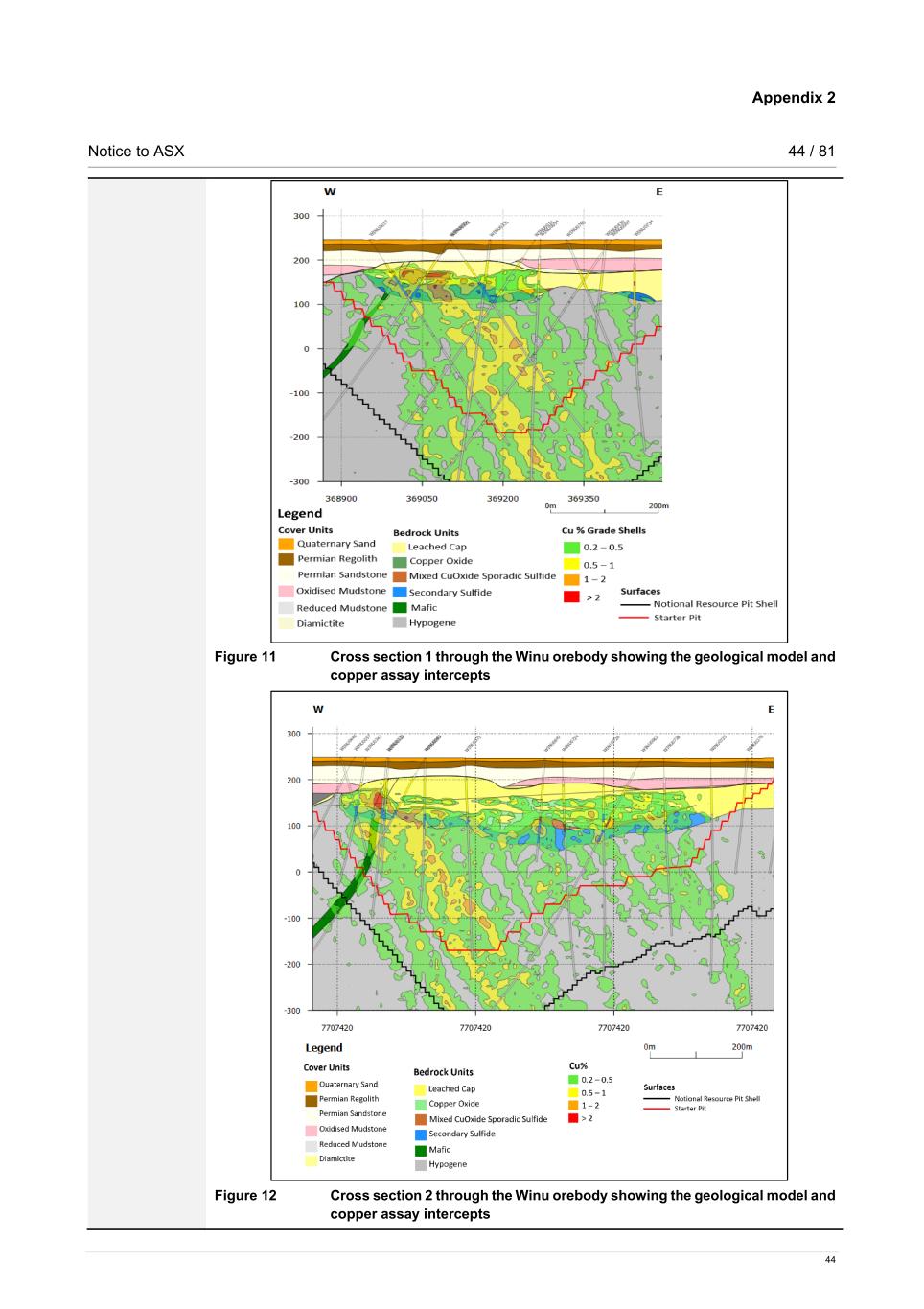
Appendix 2 Notice to ASX 44 / 81 44 Figure 11 Cross section 1 through the Winu orebody showing the geological model and copper assay intercepts Figure 12 Cross section 2 through the Winu orebody showing the geological model and copper assay intercepts
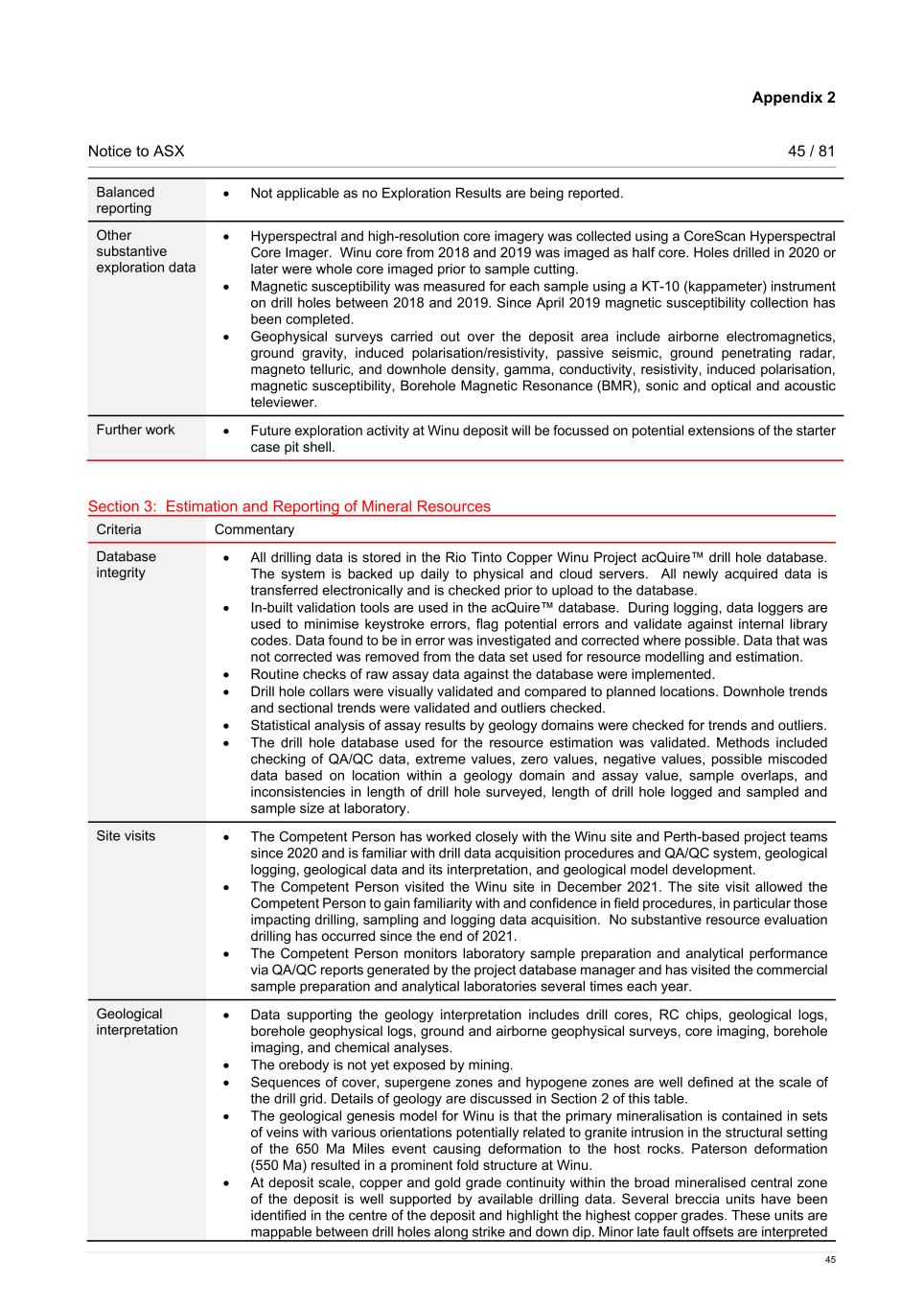
Appendix 2 Notice to ASX 45 / 81 45 Balanced reporting • Not applicable as no Exploration Results are being reported. Other substantive exploration data • Hyperspectral and high-resolution core imagery was collected using a CoreScan Hyperspectral Core Imager. Winu core from 2018 and 2019 was imaged as half core. Holes drilled in 2020 or later were whole core imaged prior to sample cutting. • Magnetic susceptibility was measured for each sample using a KT-10 (kappameter) instrument on drill holes between 2018 and 2019. Since April 2019 magnetic susceptibility collection has been completed. • Geophysical surveys carried out over the deposit area include airborne electromagnetics, ground gravity, induced polarisation/resistivity, passive seismic, ground penetrating radar, magneto telluric, and downhole density, gamma, conductivity, resistivity, induced polarisation, magnetic susceptibility, Borehole Magnetic Resonance (BMR), sonic and optical and acoustic televiewer. Further work • Future exploration activity at Winu deposit will be focussed on potential extensions of the starter case pit shell. Section 3: Estimation and Reporting of Mineral Resources Criteria Commentary Database integrity • All drilling data is stored in the Rio Tinto Copper Winu Project acQuire™ drill hole database. The system is backed up daily to physical and cloud servers. All newly acquired data is transferred electronically and is checked prior to upload to the database. • In-built validation tools are used in the acQuire™ database. During logging, data loggers are used to minimise keystroke errors, flag potential errors and validate against internal library codes. Data found to be in error was investigated and corrected where possible. Data that was not corrected was removed from the data set used for resource modelling and estimation. • Routine checks of raw assay data against the database were implemented. • Drill hole collars were visually validated and compared to planned locations. Downhole trends and sectional trends were validated and outliers checked. • Statistical analysis of assay results by geology domains were checked for trends and outliers. • The drill hole database used for the resource estimation was validated. Methods included checking of QA/QC data, extreme values, zero values, negative values, possible miscoded data based on location within a geology domain and assay value, sample overlaps, and inconsistencies in length of drill hole surveyed, length of drill hole logged and sampled and sample size at laboratory. Site visits • The Competent Person has worked closely with the Winu site and Perth-based project teams since 2020 and is familiar with drill data acquisition procedures and QA/QC system, geological logging, geological data and its interpretation, and geological model development. • The Competent Person visited the Winu site in December 2021. The site visit allowed the Competent Person to gain familiarity with and confidence in field procedures, in particular those impacting drilling, sampling and logging data acquisition. No substantive resource evaluation drilling has occurred since the end of 2021. • The Competent Person monitors laboratory sample preparation and analytical performance via QA/QC reports generated by the project database manager and has visited the commercial sample preparation and analytical laboratories several times each year. Geological interpretation • Data supporting the geology interpretation includes drill cores, RC chips, geological logs, borehole geophysical logs, ground and airborne geophysical surveys, core imaging, borehole imaging, and chemical analyses. • The orebody is not yet exposed by mining. • Sequences of cover, supergene zones and hypogene zones are well defined at the scale of the drill grid. Details of geology are discussed in Section 2 of this table. • The geological genesis model for Winu is that the primary mineralisation is contained in sets of veins with various orientations potentially related to granite intrusion in the structural setting of the 650 Ma Miles event causing deformation to the host rocks. Paterson deformation (550 Ma) resulted in a prominent fold structure at Winu. • At deposit scale, copper and gold grade continuity within the broad mineralised central zone of the deposit is well supported by available drilling data. Several breccia units have been identified in the centre of the deposit and highlight the highest copper grades. These units are mappable between drill holes along strike and down dip. Minor late fault offsets are interpreted

Appendix 2 Notice to ASX 46 / 81 46 although not explicitly modelled. Individual veins are narrow and show less persistence along strike and down dip and cannot be confidently mapped between drill holes. • A supergene zone consisting of copper oxides, leached cap and mixed secondary and primary sulphides has been modelled with available data including sequential copper analyses and mineralogy. Differentiation of units in the supergene zone is primarily reflective of differing metal recovery (geometallurgical) characteristics. Primary mineralisation is remobilised into the supergene zones that are discordant to the axial planar fabric. • Geological differentiation within the hypogene zone is limited to identified sulphide breccia units and proximal quartz-sulphide veins that are associated with most of the copper, gold and silver mineralisation. Several narrow marker units have been identified in the metasediments as well as a pre-mineral mafic sill, and several post-mineral mafic dykes. • Some stratigraphy-parallel veins have been identified, as well as sets of veins which appear to be strata-bound, perpendicular to stratigraphy and contained within zones of stratigraphy which shows preferential characteristics for hosting veining. These veins do not appear to make up the primary mineralisation when in proximity to the sulphide breccia but could add value distal to the breccia. • In the southeast corner of the proposed starter pit and extending into the notional resource pit shell, gold-dominant (low copper) mineralisation hosted in east-west trending near vertical and flat-lying quartz veins have been intersected in RC and diamond drilling. This is a different style of mineralisation to that seen in the main central mineralisation zone. More drilling is required to test grade continuity and to understand the geological controls. Geological work is planned to review the continuity of veining within zones of stratigraphy which could host more volumetrically significant mineralised veins. • The geology has been modelled in 3D by implicit modelling to suit the specific geometries and spatial continuity for lithology and geometallurgical units. The modelled units are used to control estimation. Dimensions • The drilled extent of continuous anomalous (>0.2% Cu) copper mineralisation strikes approximately north-northwest to south-southeast with a strike extent of 3,000 m. This feature has a width ranging from approximately 130 m in the southern end, 100 m in the northern end, and up to 400 m in the centre of the hypogene mineralisation. Supergene copper mineralisation is up to 700 m wide. Copper mineralisation occurs from approximately 80 m to approximately 740 m below surface. • A zone of gold-dominant mineralised veins in the southeast corner of the known mineralisation has an approximately east-west orientation with strike extent of 1000 m and up to 150 m true thickness. Estimation and modelling techniques • Cu, Au, Ag, Bi and S grades are estimated by a method consisting firstly of ordinary kriging onto 40 x 40 x 5 m panels followed by uniform conditioning by kriged panel grade (UC) and finally a localisation (LUC) onto blocks of 10 x 10 x 5 m. • A suite of additional elements including As, C, soluble Cu, Na2O, K2O, Al2O3, CaO, Fe2O3, Sb, MgO, SiO2, MnO, Pb and Zn for ore and waste characterisation are estimated onto 10 x 10 x 5 m blocks by either LUC or directly by ordinary kriging. • Raw RC and diamond assay samples, mostly at 1 m, are length weighted to regular 2 m composites prior to data analysis and estimation. • The supergene zone is divided into several discrete domains on the basis of sequential copper and mineralogy data and the domains are used to constrain grade estimation. • A low grade copper grade shell is used to limit grade estimation within the hypogene zone. The shell is defined at a low (0.2% Cu) copper grade and is modelled as an indicator by kriging onto blocks. A probability threshold of 0.5 was applied to the kriged indicator on blocks. • In the southeast corner of the deposit, a low grade gold shell is modelled to constrain estimation of Au and Bi. The shell is defined at 0.1 ppm Au and is modelled as an indicator by kriging onto blocks. A probability threshold of 0.25 was applied to the kriged indicator on blocks. • Exploratory data analysis was conducted to evaluate domain boundary conditions, establish variogram models, and define interpolation parameters. • The distribution of Cu and Au grades within each domain is typically skewed to the right. A small number of high grade samples are deemed to be unrepresentative outliers and those values were top cut back to better-supported grade values prior to use in estimation. The sensitivity of the top cutting of outlier values has decreased with each iteration of the estimate with the addition of drilling data. • No other modifications are made to the composite data used for analysis and estimation. • The raw Cu, Au, Ag, Bi and S values are transformed to normal distributions for data analysis and to choose variogram models. The normal-scores variogram models are back-transformed to raw grade scale prior to use in estimation.
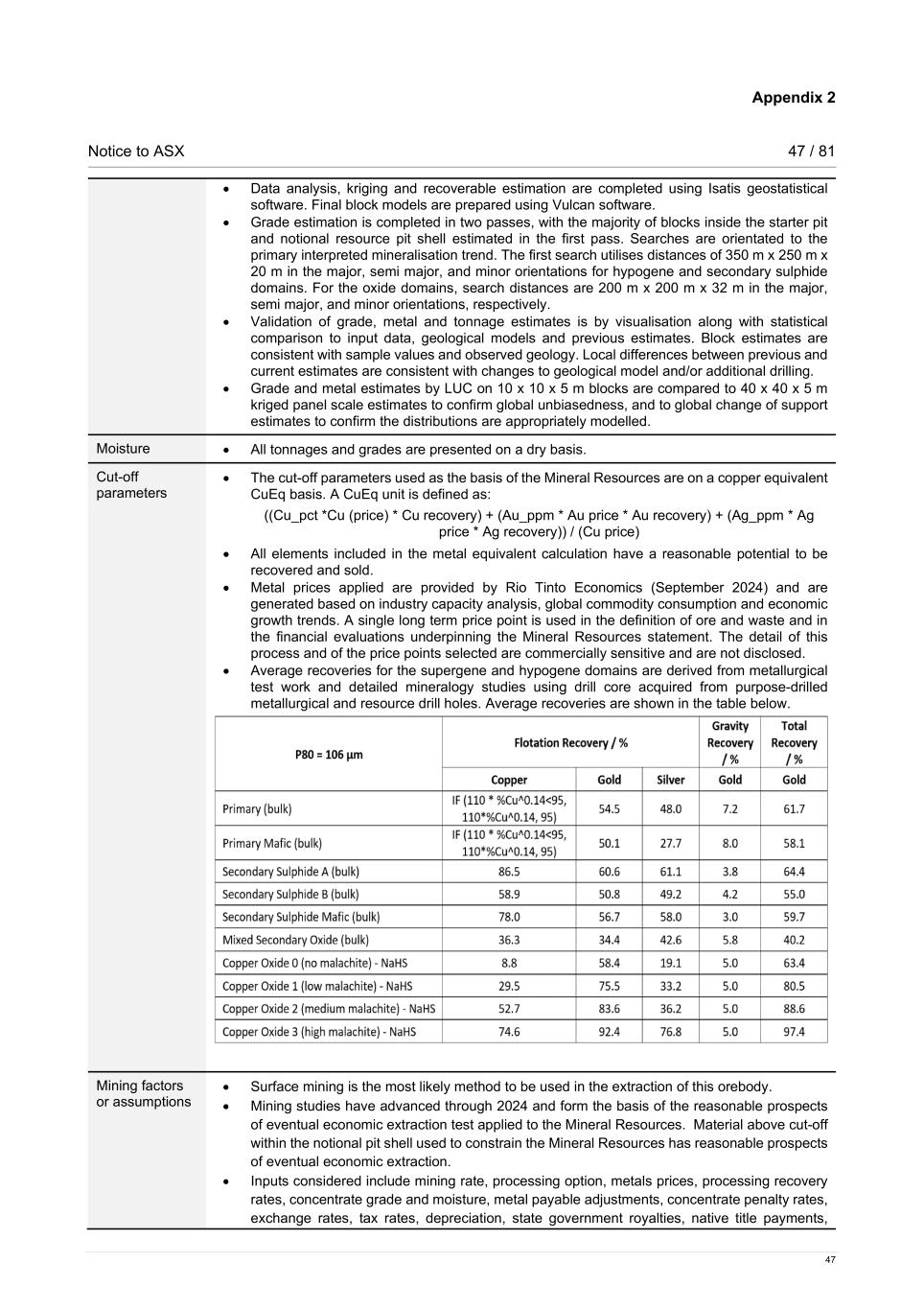
Appendix 2 Notice to ASX 47 / 81 47 • Data analysis, kriging and recoverable estimation are completed using Isatis geostatistical software. Final block models are prepared using Vulcan software. • Grade estimation is completed in two passes, with the majority of blocks inside the starter pit and notional resource pit shell estimated in the first pass. Searches are orientated to the primary interpreted mineralisation trend. The first search utilises distances of 350 m x 250 m x 20 m in the major, semi major, and minor orientations for hypogene and secondary sulphide domains. For the oxide domains, search distances are 200 m x 200 m x 32 m in the major, semi major, and minor orientations, respectively. • Validation of grade, metal and tonnage estimates is by visualisation along with statistical comparison to input data, geological models and previous estimates. Block estimates are consistent with sample values and observed geology. Local differences between previous and current estimates are consistent with changes to geological model and/or additional drilling. • Grade and metal estimates by LUC on 10 x 10 x 5 m blocks are compared to 40 x 40 x 5 m kriged panel scale estimates to confirm global unbiasedness, and to global change of support estimates to confirm the distributions are appropriately modelled. Moisture • All tonnages and grades are presented on a dry basis. Cut-off parameters • The cut-off parameters used as the basis of the Mineral Resources are on a copper equivalent CuEq basis. A CuEq unit is defined as: ((Cu_pct *Cu (price) * Cu recovery) + (Au_ppm * Au price * Au recovery) + (Ag_ppm * Ag price * Ag recovery)) / (Cu price) • All elements included in the metal equivalent calculation have a reasonable potential to be recovered and sold. • Metal prices applied are provided by Rio Tinto Economics (September 2024) and are generated based on industry capacity analysis, global commodity consumption and economic growth trends. A single long term price point is used in the definition of ore and waste and in the financial evaluations underpinning the Mineral Resources statement. The detail of this process and of the price points selected are commercially sensitive and are not disclosed. • Average recoveries for the supergene and hypogene domains are derived from metallurgical test work and detailed mineralogy studies using drill core acquired from purpose-drilled metallurgical and resource drill holes. Average recoveries are shown in the table below. Mining factors or assumptions • Surface mining is the most likely method to be used in the extraction of this orebody. • Mining studies have advanced through 2024 and form the basis of the reasonable prospects of eventual economic extraction test applied to the Mineral Resources. Material above cut-off within the notional pit shell used to constrain the Mineral Resources has reasonable prospects of eventual economic extraction. • Inputs considered include mining rate, processing option, metals prices, processing recovery rates, concentrate grade and moisture, metal payable adjustments, concentrate penalty rates, exchange rates, tax rates, depreciation, state government royalties, native title payments,

Appendix 2 Notice to ASX 48 / 81 48 ocean freight rates, mining costs, stockpile rehandle costs, processing costs, and sustaining capital requirements. Metallurgical factors or assumptions • The basis for predictions of metallurgical performance is the ongoing comminution and flotation test work conducted on samples composited from geometallurgical zones from numerous geometallurgical and resource diamond holes. • The studies confirm that the mineralisation is amenable to processing through conventional crushing, grinding, and flotation circuits. • Ongoing test work will focus on optimisation of metallurgical performance, including grind size optimisation and removal of penalty elements from concentrate. Environmental factors or assumptions • Closure studies continue to progress in preparation of approvals submission. • Environmental geochemistry assessments have been conducted in accordance with industry standards. The majority of waste is expected to be non acid-forming, however some potentially acid-forming waste rock and tailings will be present. A management strategy has been developed to minimise the risk for acid and metalliferous drainage. This strategy includes the encapsulation of potentially acid-forming waste rock and storing high sulphur tailings in separate lined tailings cells. • Desktop and basic surveys have been undertaken for subterranean fauna throughout the proposed mining operational area and potential remote bore field locations. The assessments indicate it is unlikely that subterranean fauna occurs in most geological units within the study area including the mining operational area and remote bore field locations. These assessments were supported by a sampling program which recorded no troglobitic or stygobitic specimens within the mining operational area, while identifying some simple stygobitic specimens in a remote bore field location, with additional survey effort and assessment ongoing. • Flora and fauna surveys have been conducted across the project area, with additional surveys planned as required. Targeted survey work has revealed some prospective Night Parrot habitat and confirmed transient occupancy in one of the potential bore field options. These areas of prospective Night Parrot habitat have been removed from the project development area, are localised and anomalous with the rest of the proposed project fauna habitats and are not within the proposed mining and processing area. • Installation of water bores and water monitoring points is ongoing, to allow aquifer testing and ongoing monitoring to provide data for groundwater modelling, in order to understand dewatering requirements, water supply and impact assessment as part of the hydrogeological investigation. Bulk density • Density measurements were taken on 20 cm lengths of solid core every 10 m or 20 m, representing different lithologies and mineralised intervals. The measurement used the hydrostatic/gravimetric method (Archimedes Principle of buoyancy). • Some variability exists between material types in the supergene zone. Dry bulk density values have low variability in the hypogene zone. • Dry bulk density is estimated directly onto 10 m x 10 m x 5 m blocks by ordinary co-kriging using dry bulk density as primary data and downhole geophysics derived density measurements as secondary data. Classification • The Competent Person considers that the classification reflects drill hole sample quality, style of mineralisation, grade continuity and confidence in mineralisation controls. • All data used for the estimation supporting the classification are valid; invalid samples such as 2019 wet RC samples were excluded from the dataset used for estimation. • The observed persistence of the sulphide breccia and zones of copper veining expressing grade continuity forms the basis of the Inferred resource status with a minimum distance to closest sample of 150 m for hypogene and 100 for supergene domains, determined from variograms, representing the maximum range of correlation between samples. • The adopted criteria for Indicated Resources is the distance to the three closest samples to be less than or equal to 50 m for hypogene and 25 m for supergene domains. Those values were defined using a conditional coefficient of variation approach using the results of conditional simulation to calibrate Mineral Resources class to drilling spacing.

Appendix 2 Notice to ASX 49 / 81 49 • Uncertainty in the lateral and vertical extent of modelled Copper Oxide domain restricts the class to Inferred Resources for that domain. • The Leach Cap domain is excluded from the Mineral Resources due to the lack of reasonable prospects of eventual economic extraction of that material. • Hypogene material on the southeastern part of the notional pit shell is classified as Inferred Resources due to the consistently high coefficient of variation values from conditional simulation, indicating greater uncertainty. • The low gold (<= 0.1 g/t Au) and low copper (<=0.1% Cu) grade component of the hypogene domain in the southeastern part of the notional pit shell is excluded from Mineral Resources due to the lack of confidence in the geological and grade continuity in this area. • Only mineralisation that is considered to have reasonable prospects of eventual economic extraction has been reported as Inferred or Indicated Resources. Mineralised material outside of the notional pit shell is excluded from the Mineral Resources due to the lack of reasonable prospects of eventual economic extraction. Audits or reviews • The 2022 workflow used to produce the current Mineral Resources estimate is mature and stable. The estimation workflow was refined on the basis of several recommendations from a 2020 audit and subsequent analysis in 2021 and 2022. • The current workflow was internally peer reviewed in December 2022; the review confirmed that the estimation methodology is appropriate for the style of mineralisation and for the evaluation of open pit mining options, and that the estimates reflect the underlying drill hole assay grades. • An external audit of the recoverable resource estimation methodology and results was conducted in 2020. The audit found that the estimation methodology was fit for purpose; no fatal flaws were identified. Discussion of relative accuracy/ confidence • The precision of copper grades estimates was determined using the results of a geostatistical simulation of copper grades and forms the basis of the resource classification method applied. • Confidence in geological boundaries has not been quantified in the same way. The Competent Person has taken into consideration the maturity of the geological model in determining that the continuity of geological features associated with copper and gold mineralisation is sufficient to support the classification of the Mineral Resources.

Appendix 3 Notice to ASX 50 / 81 50 Rio Tinto Iron and Titanium Quebec Operations – Grader JORC Table 1 The following table provides a summary of important assessment and reporting criteria used for the reporting of Mineral Resources and Ore Reserves in accordance with the Table 1 checklist in The Australasian Code for the Reporting of Exploration Results, Mineral Resources and Ore Reserves (The JORC Code, 2012 Edition). Criteria in each section apply to all preceding and succeeding sections. Section 1: Sampling Techniques and Data Criteria Commentary Sampling techniques • In historical campaigns the core was usually broken perpendicular to the core axis at 2 inch increments. The sampling process collected every second of the 2 inch length full core diameter fragments so that the overall sample consisted of half of the core length. In 2002, the drill core was split in half following the core axis with a hydraulic core splitter and half of the core was sent for analysis. Since 2004, the core is cut in half with a diamond saw along the core axis and the sample consists of half of the drill core. • At Grader, historical drill holes up to 2005 were selectively sampled in mineralised intervals only (>15% to 20% Ilmenite), after which all of the drill core was split in halves and sent for analytical results. • Despite the variation of sampling practices through time, the sample intervals typically represent half of the drill core material recovered on that specific interval. The sample intervals are usually 3 m long unless they intersect a lithological contact at which the sample interval is generally stopped before starting a new sample interval in the new lithological unit. The minimum sample interval length is 1 m. No sample compositing is done. • For a typical 3 m sample, the sample weight ranges approximately from 5 kg to 8 kg depending on the lithology intersected. • The sample intervals and selective sampling were all determined by a geologist. Drilling techniques • Diamond drilling techniques have been used for all drill holes at the Grader deposit. • Except for three occurrences, all of the drillholes completed at Grader were drilled vertically and no core orientation tests were made. • Drill core diameters varied through time as pre-2000 drill holes had a mix of AX and BQ diameters whereas post 2000 drill holes have a NQ core diameter. • Drill core recovery was made for drill runs of 3 m length with a single and triple tube core barrel. Drill sample recovery • Core recovery and competency is measured and registered by the logging geologist, typically for every 3 m intervals RQD (rock quality designation), SCR (solid core recovery) and TCR (total core recovery) are logged. • Due to the competency of the lithological units, the core recovery is usually above 85%. • Typical RQD at Grader is >85% with an overall of 92%, as massive oxides and anorthositic rock suites are competent and very few significant structural features are intersected within the deposit. • Since the economic mineralisation of the deposit is generally above 70% ilmenite, poor core recovery does not compromise/bias the grade. Logging • The entirety of the drill holes is logged geologically by geologists. Typically, the geologists logging the core are contractors, under supervision of company geologists. • The geological description of the drill core includes the lithological identification, the various alterations and textures that characterise the lithologies, the major and minor structures encountered as well as the proportion of the mineralogy observed with the naked eye. • The diamond drill core is also logged for basic geotechnical measurements according to industry standardised parameters (RQD, SCR and TCR). The vast majority of the historical drill holes pre-dating 2014 have missing RQD/SCR/TCR measurements (96%). From 2014, every drill hole has measurements for every 3 m interval. • Detailed geotechnical measurements that include joints, faults, veins, contacts and shear description and characterisation have been completed on rare occurrences prior to 2014 but steadily afterwards. • A minority of the drill holes completed before 1976 have been photographed. Most drill core intervals from 1976 to 2000 have been photographed and all drill core intervals from the year 2000 have been photographed. All drill core are photographed wet and dry and photos are stored on the server database. • Data is secured in an acQuire™ database.

Appendix 3 Notice to ASX 51 / 81 51 Sub-sampling techniques and sample preparation • Prior to 2014, the sampling and sample preparation exercises were conducted onsite at Havre- Saint-Pierre, Quebec, Canada. From 2014 to 2017 the exercise was completed directly at the Actlabs assaying laboratory facilities in Ancaster, Ontario, Canada. Since 2017 sampling and sample preparation is completed by IOS Geoscientific Services, a consulting firm based in Chicoutimi, Quebec, Canada. Once prepared, the pulps and rejects samples are shipped to Actlabs for chemical analysis. • Drill core sent to external laboratories for sample prep were secured in sealed core boxes and pulps and rejects were shipped in sealed containers. • Sample preparation consists of entirely crushing the sampled drill core at 90% passing 2 mm mesh size. A sub-sample of 1 kg is split by rotary splitter and pulverised at 95% passing 105 µm mesh size. A 15 g sub-sample is split and submitted for ICP analyses. • The sample size and preparation techniques are considered appropriate for the style of mineralisation. Quality of assay data and laboratory tests • The analysis technique used on the drill core is ICP for 26 elements and LECO for sulphur. • Selected samples suspected of having intercepted apatite mineralisation were also analysed for P2O5 by XRF. • CRMs provided by external laboratory consultants, are inserted at a rate of 1 in every 20 samples. 3 CRMs (certified for Ti, Fe, Al and Ca) are testing low, medium and high grades. • Blanks (certified pure silicate produced by external laboratory) are inserted at a rate of 1 in every 20 samples in the crushing and pulverising stages. • Field duplicates (quarter core) are inserted at a rate of 1 in every 20 samples. • The analytical laboratory (ActLabs) performs its own internal control. Every 10th pulp sample prepared is re-assayed and analysed as a duplicate and a blank is prepared every 30 samples and analysed. Samples are analysed using a Varian 735ES ICP and internal standards are used as part of the laboratories standard operating procedure. • Reports produced by the external laboratory are provided on demand and validated by the Rio Tinto company database manager. • Regular QA/QC reports are produced by the database manager upon receiving sample results certificates to compare analytical grade performance with their respective blanks, duplicates and standards. If biased data is observed, the laboratory is requested to reprocess a sample batch on demand. • Results of the QA/QC analysis indicate an acceptable level of precision and accuracy. The results from blanks do not indicate contamination during the laboratory procedures. • The laboratory has been audited and its performance validated through round robin studies. • In 2019, a major re-sampling campaign for the drill holes completed between 1976 and 2000 at the Grader deposit was conducted in large part to validate the historical grade information that were derived from density measurements. The core samples, representing 43% of historical drilling, were re-logged, re-analysed for density and submitted to Actlab for ICP chemical analyses. The work was conducted under rigorous QA/QC protocols and the results confirmed the validity and accuracy of the original historical density, grade derived from density and past analytical analyses. • Figure 13 shows the correlation between grade derived by density versus ICP grade from the re-sampling process of the historical drill holes (right side), and the 2022 drilling program (left side) for the Grader deposit. The circled area indicates results of gabbronorite samples that shows a weaker correlation; however, since the gabbronorite domain is not part of the Mineral Resources, the impact is negligible.
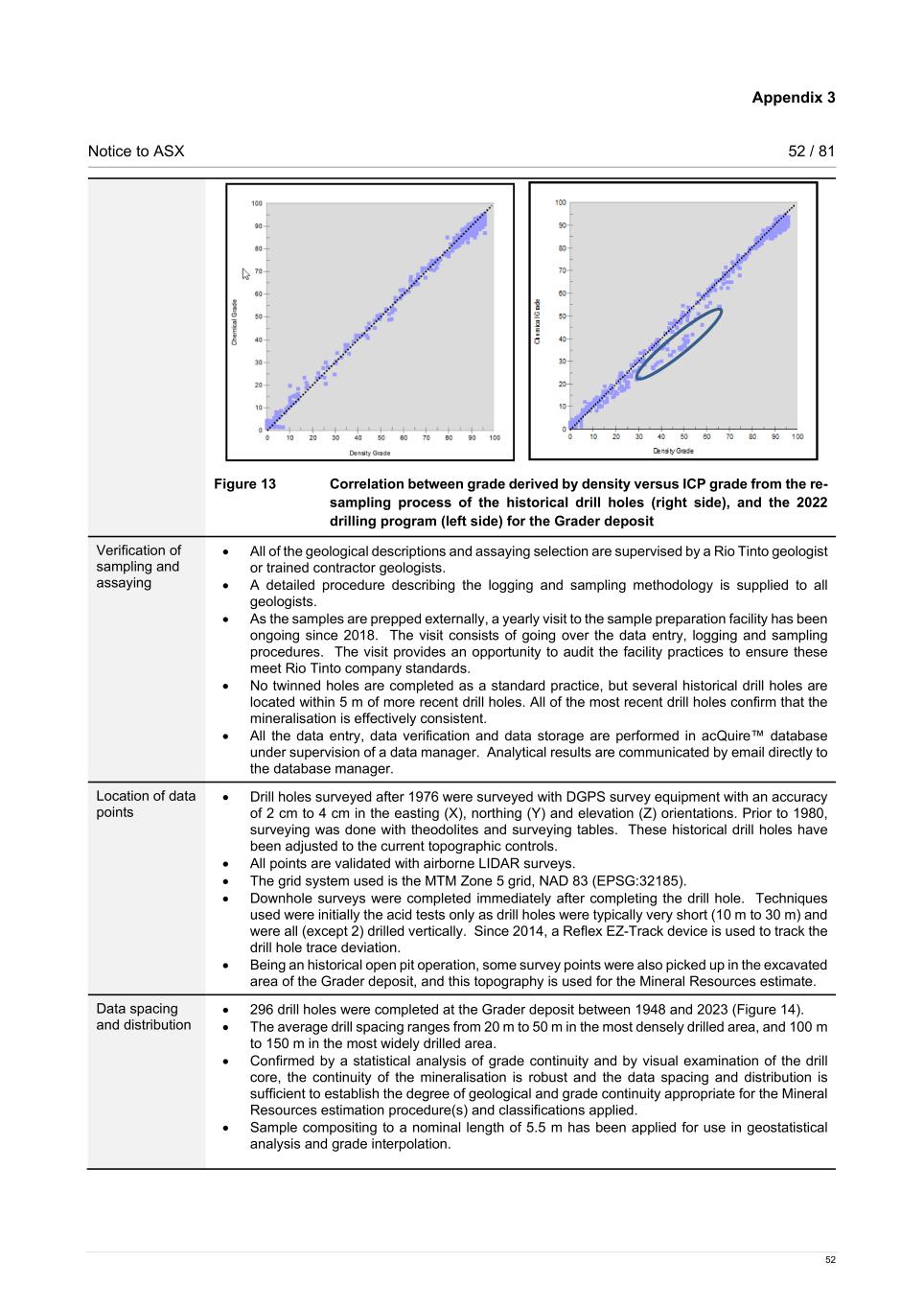
Appendix 3 Notice to ASX 52 / 81 52 Figure 13 Correlation between grade derived by density versus ICP grade from the re- sampling process of the historical drill holes (right side), and the 2022 drilling program (left side) for the Grader deposit Verification of sampling and assaying • All of the geological descriptions and assaying selection are supervised by a Rio Tinto geologist or trained contractor geologists. • A detailed procedure describing the logging and sampling methodology is supplied to all geologists. • As the samples are prepped externally, a yearly visit to the sample preparation facility has been ongoing since 2018. The visit consists of going over the data entry, logging and sampling procedures. The visit provides an opportunity to audit the facility practices to ensure these meet Rio Tinto company standards. • No twinned holes are completed as a standard practice, but several historical drill holes are located within 5 m of more recent drill holes. All of the most recent drill holes confirm that the mineralisation is effectively consistent. • All the data entry, data verification and data storage are performed in acQuire™ database under supervision of a data manager. Analytical results are communicated by email directly to the database manager. Location of data points • Drill holes surveyed after 1976 were surveyed with DGPS survey equipment with an accuracy of 2 cm to 4 cm in the easting (X), northing (Y) and elevation (Z) orientations. Prior to 1980, surveying was done with theodolites and surveying tables. These historical drill holes have been adjusted to the current topographic controls. • All points are validated with airborne LIDAR surveys. • The grid system used is the MTM Zone 5 grid, NAD 83 (EPSG:32185). • Downhole surveys were completed immediately after completing the drill hole. Techniques used were initially the acid tests only as drill holes were typically very short (10 m to 30 m) and were all (except 2) drilled vertically. Since 2014, a Reflex EZ-Track device is used to track the drill hole trace deviation. • Being an historical open pit operation, some survey points were also picked up in the excavated area of the Grader deposit, and this topography is used for the Mineral Resources estimate. Data spacing and distribution • 296 drill holes were completed at the Grader deposit between 1948 and 2023 (Figure 14). • The average drill spacing ranges from 20 m to 50 m in the most densely drilled area, and 100 m to 150 m in the most widely drilled area. • Confirmed by a statistical analysis of grade continuity and by visual examination of the drill core, the continuity of the mineralisation is robust and the data spacing and distribution is sufficient to establish the degree of geological and grade continuity appropriate for the Mineral Resources estimation procedure(s) and classifications applied. • Sample compositing to a nominal length of 5.5 m has been applied for use in geostatistical analysis and grade interpolation.
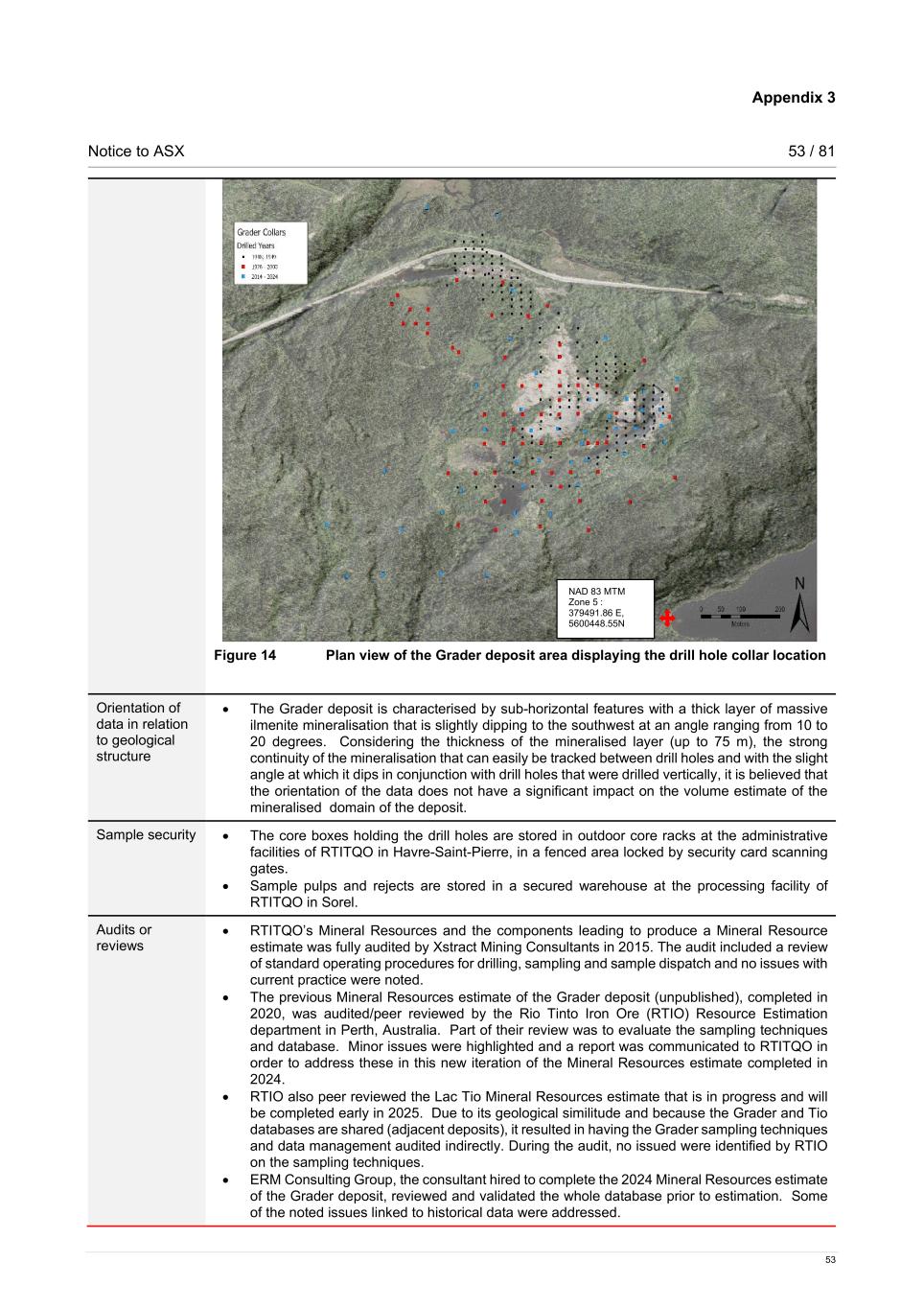
Appendix 3 Notice to ASX 53 / 81 53 Figure 14 Plan view of the Grader deposit area displaying the drill hole collar location Orientation of data in relation to geological structure • The Grader deposit is characterised by sub-horizontal features with a thick layer of massive ilmenite mineralisation that is slightly dipping to the southwest at an angle ranging from 10 to 20 degrees. Considering the thickness of the mineralised layer (up to 75 m), the strong continuity of the mineralisation that can easily be tracked between drill holes and with the slight angle at which it dips in conjunction with drill holes that were drilled vertically, it is believed that the orientation of the data does not have a significant impact on the volume estimate of the mineralised domain of the deposit. Sample security • The core boxes holding the drill holes are stored in outdoor core racks at the administrative facilities of RTITQO in Havre-Saint-Pierre, in a fenced area locked by security card scanning gates. • Sample pulps and rejects are stored in a secured warehouse at the processing facility of RTITQO in Sorel. Audits or reviews • RTITQO’s Mineral Resources and the components leading to produce a Mineral Resource estimate was fully audited by Xstract Mining Consultants in 2015. The audit included a review of standard operating procedures for drilling, sampling and sample dispatch and no issues with current practice were noted. • The previous Mineral Resources estimate of the Grader deposit (unpublished), completed in 2020, was audited/peer reviewed by the Rio Tinto Iron Ore (RTIO) Resource Estimation department in Perth, Australia. Part of their review was to evaluate the sampling techniques and database. Minor issues were highlighted and a report was communicated to RTITQO in order to address these in this new iteration of the Mineral Resources estimate completed in 2024. • RTIO also peer reviewed the Lac Tio Mineral Resources estimate that is in progress and will be completed early in 2025. Due to its geological similitude and because the Grader and Tio databases are shared (adjacent deposits), it resulted in having the Grader sampling techniques and data management audited indirectly. During the audit, no issued were identified by RTIO on the sampling techniques. • ERM Consulting Group, the consultant hired to complete the 2024 Mineral Resources estimate of the Grader deposit, reviewed and validated the whole database prior to estimation. Some of the noted issues linked to historical data were addressed. NAD 83 MTM Zone 5 : 379491.86 E, 5600448.55N

Appendix 3 Notice to ASX 54 / 81 54 Section 2: Reporting of Exploration Results Criteria Commentary Mineral tenement and land tenure status • The deposit is almost entirely located on the RTITQO mining concession (CM-381) with a small portion, located in the southwest, that is located on an adjoining claim, CDC-2318667. • All exploration claims and mining permits are wholly owned by RTITQO. • The mining and exploration tenements are administered by the Ministère des Resources Naturelles et des Forêts (MRNF) which is the government entity that manage mining and exploration activities through their online platform known as the Système d’Information Géominière (SIGEOM). • All mining concessions and exploration claims are in good standing and are managed internally by a GIS professional within the RTIT Canada Resource & Development Group. • The surrounding area (approximately 12 km x 6 km) is composed of exploration claims and a mining concession (Tio Mine) all belonging to RTITQO. Exploration done by other parties • RTITQO has held current claims and concessions since the initial discovery of the Grader deposit in 1948, to which it has exclusive exploration rights. Geology • The Grader deposit is a mafic intrusion-hosted, iron-titanium deposit hosted within the Havre- Saint-Pierre anorthositic complex located in the Grenville province in Quebec, Canada. The deposit shares many resemblances with the nearby Lac Tio deposit and displays layered mineralogical textures produced by the magma segregation during the cooling of the magmatic chamber. However, Grader distinguishes itself by the occurrence of high levels of phosphorus pentoxide (P2O5) contained in gabbroic-nelsonitic rocks in its western extension (also known as the Grader West mineral occurrence). Other characteristics noted at Grader are episodes of “feeder” dykes which contribute to the display of cyclic layering texture in some of the lithological domains. The deposit is truncated on all sides by regional faults that are located at the apparent contact between the anorthositic host-rock and the magmatic chamber. In addition, the general mineralisation trend of the deposit shows a general southwest orientation (N235°) at a dip of 10 to 20 degrees (Figure 15). • The mineralisation zone, which follows the general trend of the deposit geology, consists of a layer of massive ilmenite with grade reaching upwards of 95% ilmenite. The layer is about 20 m to 40 m thick in the northern part of the deposit while the southwest extension is characterised by a thicker layer that can reach up to 75 m in thickness. The lateral continuity and thickness of the ilmenite massive layer is very consistent and can be observed in Figure 15 and Figure 16. Figure 15 Plan view and cross sections of the Grader and Grader West deposits showing regional faulting systems, dip of the mineralised massive layer and basic lithological interpretation. Grader deposit is highlighted by a red halo. The grade west exploration area is highlighted by a darker grey delineation west f the Grader deposit

Appendix 3 Notice to ASX 55 / 81 55 Figure 16 Plan view of the Grader deposit displaying the drill hole collar and elevation/thickness contours of the massive ilmenite domain. Starting east, the basal contact of the massive ilmenite domain with an above sea level (ASL) altitude of 180 m dipping southwest to a 50 m ASL. Yellow lines represent 20 m isopach contours Drill hole Information • The drill hole database for the Grader deposit contains all drill holes drilled between 1948 and 2023. • A total of 296 diamond drill holes totalling 10,875.76 m drilled are registered in the database. Excluded from this total are six drill holes recently completed from which the analytical results were not yet received in time for this report. Consequently, they are currently excluded from consideration. • 99% of the drillholes were drilled vertically and their length ranges from 8.96 m to 188 m for an average of 44.04 m. • The drill pattern of choice for drilling dating prior to 2014 is square whereas post 2014 the drill pattern is staggered. • Drill hole collar elevation is ranges from 181 to 213 m above sea level (ASL). • Drill holes survey certificates use the North American Datum NAD 1983 MTM Zone 5 georeferencing system. • The following table provides a summary of drill holes completed at Grader deposit (excluding the six recent drill holes) Year drilled Number of holes Total metres 1948 1 19.20 1949 196 3,107.77 1976 38 2,871.29 2000 16 1,049.00 2014 1 101.00 2019 25 2,410.50

Appendix 3 Notice to ASX 56 / 81 56 2022 11 813.00 2023 8 504.00 Total 296 10,875.76 Data aggregation methods • Not applicable as no Exploration Results are being reported Relationship between mineralisation widths and intercept lengths • Geometry of the Grader deposit shows a slight dip of 10 to 20 degrees and since the drill holes are vertical the intersected width would be slightly less than true width. Diagrams • Figure 3 in the body of this release shows the property location. • See previous sections for plan view of drill holes, vertical section, structure and geological model. Balanced reporting • Not applicable as no Exploration Results are being reported Other substantive exploration data • Several geophysical surveys were completed at the Grader deposit (airborne DIGHEM-2001, airborne gravity-2003, and airborne magnetic survey “UAV-MAG™”-2018), the latest being completed by Geotech Ltd in 2022. A helicopter-supported geophysical survey was performed over the Grader deposit and the area south of the Tio Mine for a total of 277 km of survey lines (3 km lines at 50 m spacing; Figure 17). The instrument used was an airborne EM (electromagnetic) using the versatile time-domain electromagnetic (VTEM™) plus system with Full-Waveform processing. Measurements consisted of Vertical (Z) and In-line Horizontal (X and Y) components of the EM fields using an induction coil, and a horizontal magnetic gradiometer using two cesium magnetometers. The results were conclusive as several anomalies detected had signatures matching those of known mineralisation at Grader and Tio (Figure 18). Potential extension of the known deposits, potential satellite deposits as well as future prospective areas have also been confirmed in the area. • Field trips were completed to take structural measurements on the historical pit at Grader. Grader was mined in the late 40’s and early 50’s leaving behind an open pit where massive oxide mineralisation is easily accessible. Prospective exploration also confirmed several occurrences of massive ilmenite at surface towards the southwest extension of the deposit. • Geometallurgical liberation tests were completed by COREM in 2022 to investigate and ensure that the mineralisation at Grader could produce a product quality similar to that at the Lac Tio mine. The results were positive and confirmed that the same product quality was encountered at Grader. • A geotechnical conceptual pit study was completed in 2020 by Golder Associates to confirm that structural limitations would not limit the potential future open pit exploitation of the Grader deposit. A conceptual structural model was proposed, and the conclusion showed that Grader is a viable option as an open pit deposit. Further work was proposed to bring the deposit to a pre-feasibility and feasibility study level; this work is currently underway.
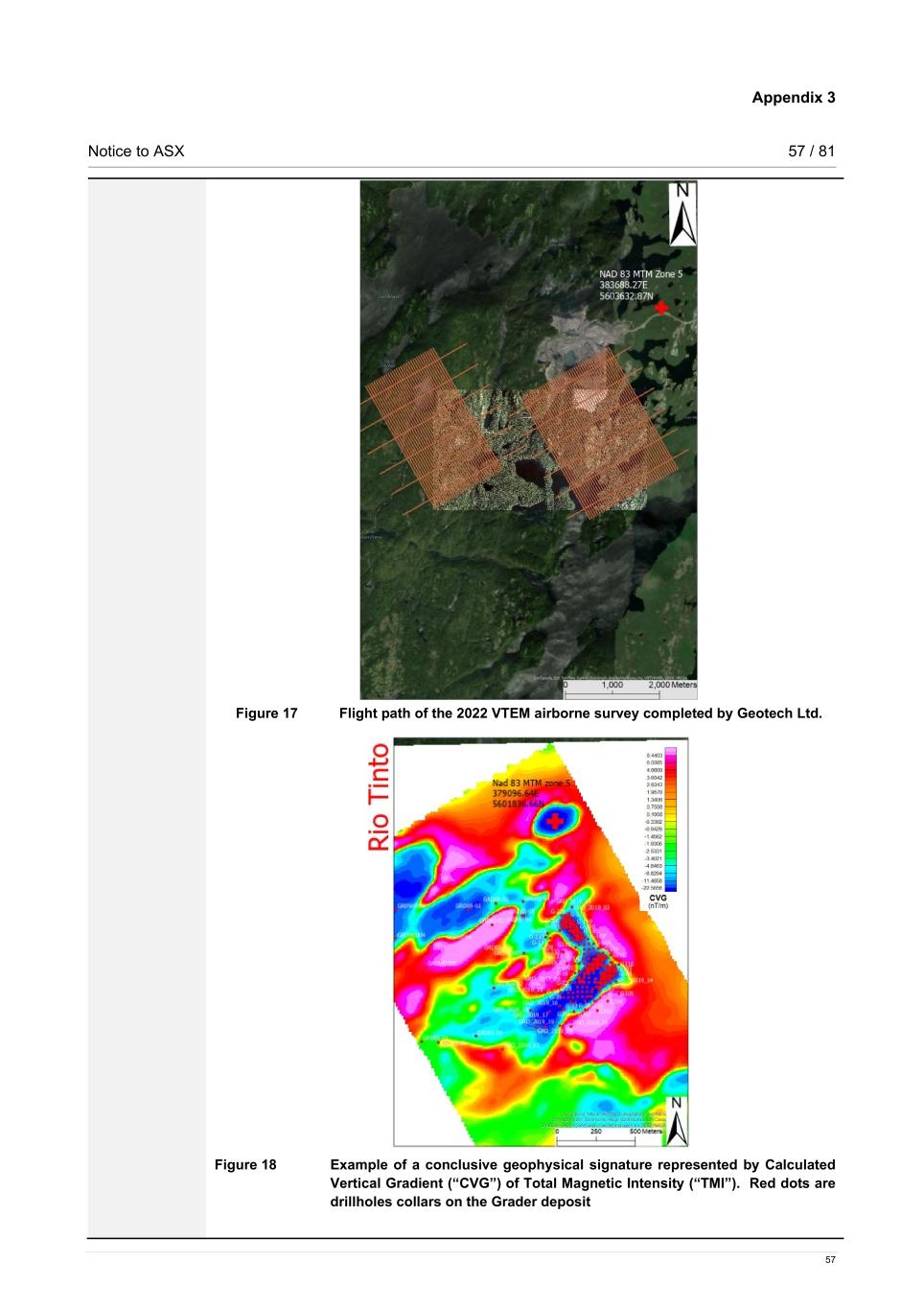
Appendix 3 Notice to ASX 57 / 81 57 Figure 17 Flight path of the 2022 VTEM airborne survey completed by Geotech Ltd. Figure 18 Example of a conclusive geophysical signature represented by Calculated Vertical Gradient (“CVG”) of Total Magnetic Intensity (“TMI”). Red dots are drillholes collars on the Grader deposit

Appendix 3 Notice to ASX 58 / 81 58 Further work • As of the end of 2024, the Grader deposit conceptual pit design phase 1 mostly comprises Measured Resources with a small portion of Indicated Resources. For the remaining phases of its potential mine life, additional drilling will be required to upgrade the classification of the remaining resource from Inferred to Measured and Indicated. A drilling program is currently budgeted for 2025 to accomplish this target. • A geotechnical drilling program is currently being completed by BBA consulting firm and a report should be completed by Q2 2025. This program aims at bringing the Grader deposit geotechnical knowledge to a feasibility study level and contains several drill holes that will be used in the future update of the Grader Mineral Resources estimate. Section 3: Estimation and Reporting of Mineral Resources Criteria Commentary Database integrity • To protect its integrity, the geological database is managed and accessed by a single database manager. The database manager is the sole executor of imports/exports and exchange of information coming from the database. • All of the information pertaining to the geological database is transmitted to the database manager for approval (structure and integrity) before being imported and added to the existing database. • The chemical analyses are transmitted electronically directly from the lab to the database manager. Upon receipt of a batch of data, QA/QC is performed on a timely manner and action is taken if necessary. • All of the information linked to the core logging, downhole surveys and any other relevant geological information is validated by the project manager before being forwarded to the database manager for visual validation and importing. • Upon completing a new Mineral Resources estimate, the database is reviewed and validated by the resource geologist whether the exercise is performed internally or by a consultant. • The geological database is managed in acQuire™ and the editing rights are only attributed to the database manager. In case of needs, read-only rights can be allocated to employees, but standard practices consist in sending a request to the database manager about the information needed. The database manager will then proceed in forwarding an export file to the requestor. • Recurrent backups of the database are made daily by the IST department. Site visits • Francois Kerr-Gillespie, co-Competent Person for Mineral Resources is also the project manager for the drilling programs and Mineral Resources estimates for the Tio and Grader deposits. He is responsible for overseeing, planning and directing the execution of those activities. Consequently, several site visits were recorded every year and are a prerequisite. Jacques Dumouchel, co-Competent Person for Mineral Resources for Tio and Grader deposits acts as a mentor and reviewer for the Mineral Resources estimate and its reporting. Geological interpretation • The level of confidence on the geological interpretation of Grader is high. As mentioned above, the geological domains (and the mineralised domain of interest) consist of continuous, lightly deformed lithological units, sub-horizontal to slightly dipping towards align the southwest (10 to 20 degrees). Magnetic geophysical surveys have a distinct signature that clearly map out the mineralised unit. In addition, the mineralisation outcrops at surface in an historical open pit excavation area which permits observation of the characteristics of the deposit. Correlation between drill holes is observed and the mineralised intersections can be predicted to a certain level of accuracy prior to completing new drill holes. • The data used for the geological interpretation is mostly based on drill hole geological description and analytical grade results. Outcrops next to the mineralisation at surface also display clear characteristics allowing the geologist to predict the behaviour of the deposit and its geological controls. • The three dimensional (3D) model for Grader consists of six different lithological domains, of which one mineralised domain (ILM) contains the Mineral Resources and consists of a massive hemo-ilmenite (typically 37% TiO2) layer (Figure 19). • Geological contacts follow the general trend of the deposit and lithological contacts are continuous. No major faults, deformation or metamorphism are overprinting the deposit area.
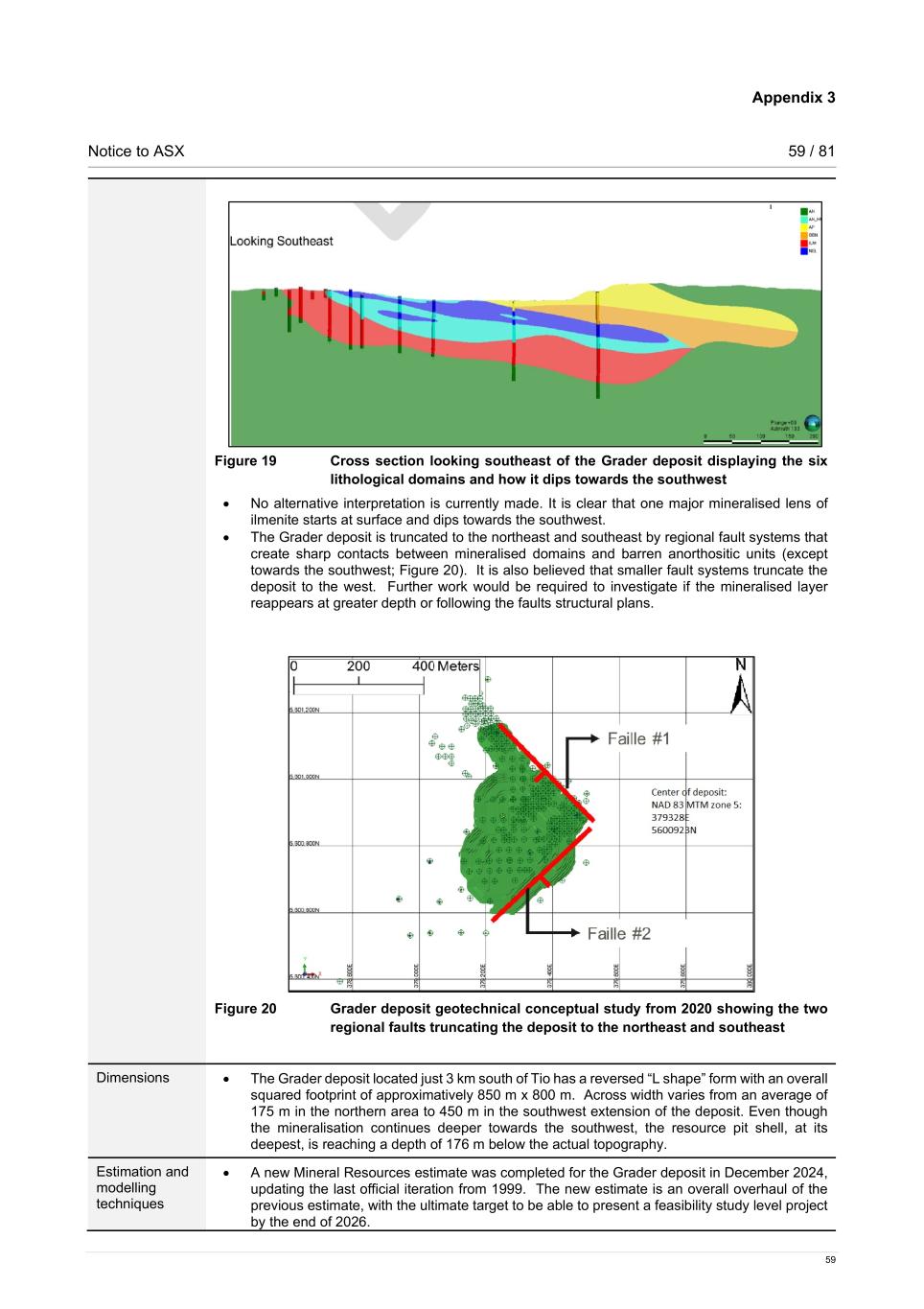
Appendix 3 Notice to ASX 59 / 81 59 Figure 19 Cross section looking southeast of the Grader deposit displaying the six lithological domains and how it dips towards the southwest • No alternative interpretation is currently made. It is clear that one major mineralised lens of ilmenite starts at surface and dips towards the southwest. • The Grader deposit is truncated to the northeast and southeast by regional fault systems that create sharp contacts between mineralised domains and barren anorthositic units (except towards the southwest; Figure 20). It is also believed that smaller fault systems truncate the deposit to the west. Further work would be required to investigate if the mineralised layer reappears at greater depth or following the faults structural plans. Figure 20 Grader deposit geotechnical conceptual study from 2020 showing the two regional faults truncating the deposit to the northeast and southeast Dimensions • The Grader deposit located just 3 km south of Tio has a reversed “L shape” form with an overall squared footprint of approximatively 850 m x 800 m. Across width varies from an average of 175 m in the northern area to 450 m in the southwest extension of the deposit. Even though the mineralisation continues deeper towards the southwest, the resource pit shell, at its deepest, is reaching a depth of 176 m below the actual topography. Estimation and modelling techniques • A new Mineral Resources estimate was completed for the Grader deposit in December 2024, updating the last official iteration from 1999. The new estimate is an overall overhaul of the previous estimate, with the ultimate target to be able to present a feasibility study level project by the end of 2026.

Appendix 3 Notice to ASX 60 / 81 60 • ERM consulting group completed the Mineral Resources estimate under the supervision of the Competent Persons. • Software used included custom Python coding for the exploratory data analysis (EDA), GSLIB/pygeostat for the interpolation (simulation) process, Leapfrog Geo + Edge for the geological modelling, variography and swath plots, IMDEX ioGAS for the lithogeochemical interpretation and finally CAE Datamine for the block model creation and pit optimisation. • For the EDA, all missing samples in the database needed to be populated to allow the sample decorrelation needed for the simulation process. Densities and ilmenite grade values were already fully populated but other geochemical elements were not always part of the analytical suite throughout the years; these are typically missing around 30% of the samples. To perform the imputation, a correlation study was made with the existing information and elements with linear correlations were used to populate missing elements for each geochemical domain. For elements that did not have a linear correlation between them, geostatistical multivariate imputation was performed (modelling of conditional probability of reproducibility within a variogram range) to populate the missing elements. The methodology employed by ERM is based on the research on multivariate imputation of unequally sampled geological variables developed by Barnett and Deutsch (2015). The results were validated against the geological interpretation. • Wireframes modelling was completed through Leapfrog’s implicit modelling feature except for the overburden unit which was generated using a conditional simulation described below. These estimation domains are based on lithogeochemical analysis of the multivariate cluster analysis (AN, AP (or OAGN), GBN, NEL, ILM). The anorthosite group (AN) was further separated with a new estimation domain called AN_HP to delineate samples with a higher amount of P2O5 than regular anorthosite samples. • Because of the nature of the deposit, the use of ilmenite grade is the most obvious criteria controlling the Mineral Resources estimation parameters. With an average grade of 81.5% ilmenite, the Ilmenite domain can be easily tracked with analytical grade values. • The ICP geochemical dataset was used to re-interpret the grade domains by studying the correlation between the 20+ elements. • The wireframe extrapolation is restricted to approximately 120 m in the southwest direction, which is consistent with correlogram ranges observed in Lac Tio, and limited to about 60 m in the northwest direction as illustrated in Figure 21. Figure 21 Grader deposit domains - Oblique view looking southeast (top) and in plan view (bottom)

Appendix 3 Notice to ASX 61 / 81 61 • Due to some inconsistencies in historical drillholes regarding overburden delineation and since the Grader deposit area was in large part cleared of the overburden before more recent drillholes were completed, it was deemed necessary to generate the overburden contact with a Sequential Gaussian Simulation (SGS) of the overburden thickness across a grid spanning the entire model. The method used honours the thickness locally and estimate it in areas with little information. This could not be achieved using implicit modelling or direct triangulation of the current contact points due to the limited number of holes relative to the total area to be modelled. • A correlation matrix was generated for the 15 elements and density to identify strong correlations between the variables especially in the ilmenite domain where the mineralisation is located. This was used to guide the estimation parameter selection. • The parent block of 10 m x 10 m x 11 m was selected to respect the SMU established for the deposit as well as the bench height (11 m). • A choice of a compositing length of 5.5 m was made to align with half the bench height and the requirements of the SGS which was performed with sub-blocks measuring 5 m x 5 m x 5.5 m, resulting in 8 sub-blocks per block in the final block model. • The model is unrotated. • The process or re-blocking SGS simulated sub-blocks to SMU block size by average block grades represents a change of support, aligning with the final support for reporting Mineral Resources. It results in reduced variance and extreme values compared to the sub-blocks, leading to a smoother model. • Histograms, probability and log probability plots, deciles and percentiles plots, metal at-risk plots and capping sensitivity plots were created to guide the selection of capping values for all elements globally within Grader. The capping was performed on <1% of composites to mitigate potential local overestimation (<1%). The influence of capping on the overall mean and the percentage of lost material (removed from sample population) is negligible. • Estimation methodology: The Grader deposit exhibits strong correlations among multiple elements. Utilising ordinary kriging independently for each variable fails to honour these correlations effectively, which is why SGS combined with the Projection Pursuit Multivariate Transform decorrelation method (PPMT) was applied. In this methodology, the variables are decorrelated first, then they are interpolated and finally they are re-correlated. • In summary, the PPMT workflow involves imputation of missing data, declustering, despiking, and normal score transformation of the variables, decorrelation of the variables, simulation of all variables in each domain independently, and then re-correlation of the variables using an inverse transform. Finally, the resulting model contains several realisations, and an estimate is produced by creating an average or E-Type model of the realisations, which is smoother than each individual simulation and yields a result that is similar to a kriging estimate but preserves the multivariate correlation present in the Grader deposit. • PPMT requires a homotopic dataset (no missing data) as input, making the imputation discussed above a crucial step to fill the data gaps. SGS also necessitates a normal score transformation of the data and the modelling and use of variograms/correlograms derived from the normal score transformed variables. • The declustering method used for the validation process was the Nearest Neighbour declustering methodology which assigns a weight to each data sample proportional to its area of influence. • The data is subjected to despiking before the normal score transformation. Despiking involves adding a very small random value to the constant value to make them inequal, thereby enhancing the results of the normal score transformation. • Experimental variograms for the 15 elements and density in six estimation domains were calculated and fitted with their appropriate variogram models. For domains that had limited amounts of samples for a specific element (e.g. P2O5) it was decided to use the same correlogram from other domains that had more samples of these elements. • Correlograms are constructed in the plane used to model the domain wireframes with implicit modelling (southwest direction with an azimuth of 232 degrees and a 10 degree dip). The minor axis is modelled as isotropic. • An anisotropy of 2:1 is observed in the Ilmenite domain only between the southwest and northwest directions for all variables in the Ilmenite domain. Other non-mineralised domains do not show preferential orientation. • The search ellipse configurations for the 15 elements and density within the six domains are determined based on the ranges of their respective correlogram models and are 200 m x 100 m x 55 m in the ilmenite domain and 100 m x 100 m x 55 m in the other domains with the exception of the high P2O5 anorthosite which has a search of 50 m x 50 m x 25 m. 48 samples were deemed a robust number to use in the simulation.

Appendix 3 Notice to ASX 62 / 81 62 • The simulation produced a total of 30 realisations. Each of the six domains is simulated independently, resulting in 30 realisations per domain, which are then back transformed to obtain grades in the original units. Following this, the 30 realisations are averaged to derive an E-Type model for the final block model. Each realisation is an equi-possible grade for the block in question. The average value represents the expected/estimated grade. Moreover, a coefficient of variation is calculated for each block to evaluate uncertainty zones, wherein high variation across the realisations indicates areas of greater uncertainty. • Once the simulations and E-Type model are completed, validation of the estimation is performed by reproducing the correlation of elements from the E-Type model and validating it against the original raw data. The same process was made with the correlograms and histograms for all 30 realisations against the initial dataset. • The reproduction of correlograms for all variables in each domain is acceptable and indicates a reasonable validation of the simulation results. Furthermore, when comparing the histogram of the realisation versus the original declustered histogram, the reproduction of the mean is excellent, with less than 0.5% difference and a consistent standard deviation between the data and estimate. • Global bias checks are applied to the blocks that have the potential to be classified into Measured Resources. The estimate block means for each element in every domain is compared to the nearest neighbour estimate used to reflect the declustered mean of the element in the domain. The results of the global bias check indicate that estimated grades for all elements and density values show negligible bias within the ilmenite domain, with biases measuring less than 1% for the most important variables (Fe, TiO2 and Best Grade) while secondary elements of importance (Mg, Cr, Co, MnO, Ni and V) are under 1.4%. • Local bias checks were also completed with swath plots comparing the estimated blocks, a nearest neighbour estimate, and the composites. The swath plot results reveal a satisfactory validation between the estimated blocks and nearest neighbour estimates at a local level, indicating a low degree of bias in these estimates. The plots confirm that no clear overestimation or underestimation is present. The E-Type model tends to show a smoother trend than the nearest neighbour. • Visual validation was conducted by comparing composites with the estimated blocks in plan and on section (before the reblocking to 10 m x 10 m x 11 m). Visual validation confirmed that SGS reproduces the composite data locally. Moisture • All tonnages for Mineral Resources are considered as dry. Cut-off parameters • Cut-off grade determination leading to the pit shell optimisation used to restrain the Mineral Resources at Grader is determined in large part by the prerequisite of respecting an ore feed grade of 81.5% +/- 1.5% (absolute difference) to the Ore Preparation Plant at Sorel. The same criterion is applied to the nearby Tio deposit. • The reasoning comes from furnace production optimisation (e.g. production time, minimising unwanted lower grade material in the furnaces containing more deleterious elements) and business plans towards profitability. • Consequently, the cut-off grade is back calculated from the target grade requested by the metallurgical production plant. Grade sensitivity analysis resulted in identifying a cut-off grade of 74% ilmenite to respect the target grade of 81.5% ilmenite. • This approach is conservative when evaluating potentially economically viable Mineral Resources. Since previous work suggested that the cut-off grade could be lowered while remaining economically viable, material slightly below the cut-off grade is considered when blending material, especially when very high grade material is planned for extraction. • Economic parameters that reflect ilmenite concentrate selling price, crushing costs, mill feed and waste mining costs, overall slope angle and annual discount rate were used in the pit optimisation process. CAE Datamine's Studio NPV software was used for the exercise. This software utilises the Lerchs-Grossmann algorithm as the basis for its pit optimisation analysis (Figure 22 and Figure 23).

Appendix 3 Notice to ASX 63 / 81 63 Figure 22 Plan view showing blocks inside optimised pit and pit surface. As seen in the legend, blocks are coded by grade range (% ilmenite). Red line represents a vertical section slice plan (see Figure 23) Figure 23 Southwest-northeast vertical section showing optimised pit with blocks colour coded by % ilmenite grade Mining factors or assumptions • It is assumed that the Grader deposit will be mined as a conventional open pit truck and shovel operation, applying a similar bench height (11 m), pit slope and ramp width as the adjacent Tio deposit. The main ramp will be designed to use Caterpillar 777 trucks in accordance with local mining regulations. • To define Mineral Resources, no mining dilution was applied during the pit optimisation exercise, but this will be evaluated during conversion from Mineral Resources to Ore Reserves. The mineralisation at Grader is very continuous and is mostly represented by a thick layer of massive ilmenite with a sharp contact with the underlying anorthositic host rock; this should limit mining dilution. • The strip ratio (as evaluated in a technical study in 2022) is very low, ranging from 0.37 (phase 1) to 1.2 (phase 2) and an overall strip ratio of about 1:1 which indicates the Grader deposit has potential for efficient mining. • Metallurgical testing has already been conducted at Grader and mineralisation is very similar to the Tio deposit which suggests reasonable metallurgical recovery should be achievable.

Appendix 3 Notice to ASX 64 / 81 64 • Grader mineralisation is present at surface and dips slowly towards the southwest (10 to 20 degrees) which will make for a shallow open pit design. • A conceptual pit study has been completed and a prefeasibility study level, incorporating Grader into the life of mine plan of the Tio-Grader-Beaver deposits. Grader has ranked 1st as the most attractive source or potential ore in that study. • The strategy highlighted that Grader’s proximity to Tio deposit’s infrastructures (waste dumps, crusher, and train loading belt feeder) is the most efficient and least capital intensive scenario. Consequently, the current plan assumptions would be to build a haul road between the Grader and Tio deposits to transport the ore and waste material to Tio’s facilities. A geotechnical study, that in part investigates the feasibility of building a haul road between the two deposits, is currently underway and should be completed in 2025. Metallurgical factors or assumptions • Metallurgical tests have been completed on Grader deposit drill core to investigate lliberation, granulometry of the ilmenite crystals, geochemical composition and more. Those studies highlighted that Grader exhibits the same physical, textural and chemical characteristics as the Tio deposit and it is assumed that the material will be processed with the same equipment and process flowsheet. Consequently, the plan to recover the material and how to process it is well defined and proven. Environmental factors or assumptions • The plan that was proposed in the potential ore sourcing strategy completed in 2022 and other internal evaluations was to dispose of the waste material at the Tio mine’s waste dumps. The Puyjalon waste dump, located south of the Tio deposit, is currently designed for a significant expansion which could accommodate the waste material production that would be generated by mining the Grader deposit. • Waste dumps at Tio deposit are monitored and controlled for the leaching of iron and nickel sulphides as the ilmenite-rich lithologies can carry accessory minerals that could potentially contaminate surrounding water plans. It is assumed that the waste material from Grader that would be dumped at the Puyjalon waste dump will be monitored similarly to the existing Tio deposit waste material as the lithological units are fairly the same and are composed of similar geochemical concentrations. • Water drainage maps and humid environments delineation covering the area surrounding the Grader deposit have been completed to ensure that potential drainage to water plans is understood and can be controlled in the eventuality that a mining operation will take place. • A geotechnical study, currently underway, is studying the hydrogeological characteristics of the Grader deposit. Part of this study will evaluate the status and behaviour of the water table surrounding the proposed pit area. Bulk density • Bulk density has been collected for every sample interval drilled at the Grader deposit. • Typically, the core (NQ diameter mostly) is sawed in half and the full half core length of the sample interval (typically 2 to 3 m) is selected and weighted in air and in water for specific gravity determination. • Density is determined by using weight in air/weight in water and by the water displacement method respectively for all diamond drill hole samples. • The rock lithologies at Grader are not very porous nor do they contain vugs that would necessitate an adjustment to the specific gravity measurements. The units are massive and rarely show alteration phases that would alter the rock to the point of affecting its competency. In addition, only a few occurrences of major deformations that would generate a low RQD are observed within the pit shell limits. • Based on a solid solution of pure anorthosite and pure hemo-ilmenite, a theoretical formula has also been developed to define the grade/density relationship. This formula has been tested and is proven to be very accurate as the grade and density correlate very well. This formula, derived from the Tio deposit data, can be used to validate the density with analytical grade values and vice versa for extra quality control. • Formula: Grade = A - (B/ density), where A and B are two constants related to the specific gravity of pure anorthosite and pure hemo-ilmenite respectively. The two constants were calibrated using experimental data (chemical analysis) of more than 3000 samples from blast holes and diamond drill holes collected from the Tio deposit. Classification • The classification of Mineral Resources is based on an anisotropic search and multiple passes conducted independently from the simulation study and solely for classification purposes. The correlogram model used for the classification is the same as the correlogram used for the estimation to reflect the geological anisotropy of the Grader deposit. The ellipses used for each pass are oriented in the same way as the ellipse used for estimation to account for and reflect the direction of continuity.
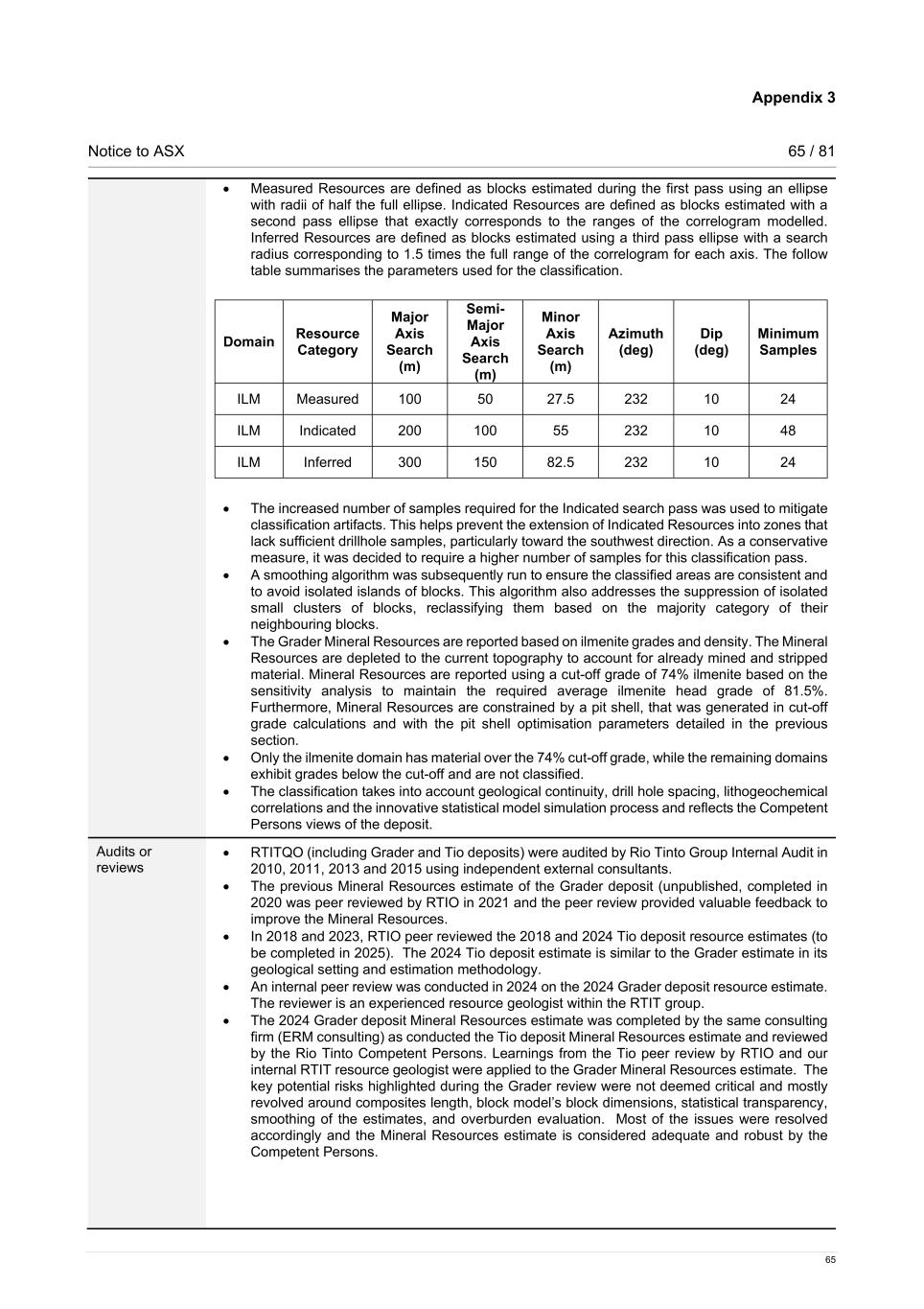
Appendix 3 Notice to ASX 65 / 81 65 • Measured Resources are defined as blocks estimated during the first pass using an ellipse with radii of half the full ellipse. Indicated Resources are defined as blocks estimated with a second pass ellipse that exactly corresponds to the ranges of the correlogram modelled. Inferred Resources are defined as blocks estimated using a third pass ellipse with a search radius corresponding to 1.5 times the full range of the correlogram for each axis. The follow table summarises the parameters used for the classification. Domain Resource Category Major Axis Search (m) Semi- Major Axis Search (m) Minor Axis Search (m) Azimuth (deg) Dip (deg) Minimum Samples ILM Measured 100 50 27.5 232 10 24 ILM Indicated 200 100 55 232 10 48 ILM Inferred 300 150 82.5 232 10 24 • The increased number of samples required for the Indicated search pass was used to mitigate classification artifacts. This helps prevent the extension of Indicated Resources into zones that lack sufficient drillhole samples, particularly toward the southwest direction. As a conservative measure, it was decided to require a higher number of samples for this classification pass. • A smoothing algorithm was subsequently run to ensure the classified areas are consistent and to avoid isolated islands of blocks. This algorithm also addresses the suppression of isolated small clusters of blocks, reclassifying them based on the majority category of their neighbouring blocks. • The Grader Mineral Resources are reported based on ilmenite grades and density. The Mineral Resources are depleted to the current topography to account for already mined and stripped material. Mineral Resources are reported using a cut-off grade of 74% ilmenite based on the sensitivity analysis to maintain the required average ilmenite head grade of 81.5%. Furthermore, Mineral Resources are constrained by a pit shell, that was generated in cut-off grade calculations and with the pit shell optimisation parameters detailed in the previous section. • Only the ilmenite domain has material over the 74% cut-off grade, while the remaining domains exhibit grades below the cut-off and are not classified. • The classification takes into account geological continuity, drill hole spacing, lithogeochemical correlations and the innovative statistical model simulation process and reflects the Competent Persons views of the deposit. Audits or reviews • RTITQO (including Grader and Tio deposits) were audited by Rio Tinto Group Internal Audit in 2010, 2011, 2013 and 2015 using independent external consultants. • The previous Mineral Resources estimate of the Grader deposit (unpublished, completed in 2020 was peer reviewed by RTIO in 2021 and the peer review provided valuable feedback to improve the Mineral Resources. • In 2018 and 2023, RTIO peer reviewed the 2018 and 2024 Tio deposit resource estimates (to be completed in 2025). The 2024 Tio deposit estimate is similar to the Grader estimate in its geological setting and estimation methodology. • An internal peer review was conducted in 2024 on the 2024 Grader deposit resource estimate. The reviewer is an experienced resource geologist within the RTIT group. • The 2024 Grader deposit Mineral Resources estimate was completed by the same consulting firm (ERM consulting) as conducted the Tio deposit Mineral Resources estimate and reviewed by the Rio Tinto Competent Persons. Learnings from the Tio peer review by RTIO and our internal RTIT resource geologist were applied to the Grader Mineral Resources estimate. The key potential risks highlighted during the Grader review were not deemed critical and mostly revolved around composites length, block model’s block dimensions, statistical transparency, smoothing of the estimates, and overburden evaluation. Most of the issues were resolved accordingly and the Mineral Resources estimate is considered adequate and robust by the Competent Persons.

Appendix 3 Notice to ASX 66 / 81 66 • Discussion of relative accuracy/ confidence • The Competent Persons are confident that the accuracy of the Mineral Resources is reflected in the classification. • The comprehensive Mineral Resources estimate conducted for the Grader deposit represents a substantial step forward in the assessment of the deposit. • This estimation involved a detailed and iterative process, including database refinement, identification of lithogeochemical domains and addressed missing data through imputation. • By utilising advanced geostatistical techniques such as conditional simulation, this study has provided a comprehensive understanding of mineral distribution within the deposit, reproducing the strong intrinsic correlation between the various elements in the final estimate. Additionally, the integration of cut-off grade sensitivity analysis has enriched the update process, enabling a more robust interpretation of the deposit's potential. • The Mineral Resources update and validation methodology applied contributes to having an adequate confidence level on the overall quality of the Mineral Resources estimate. • Even though the level of confidence on the methodology used on the Grader deposit Mineral Resources estimate is judged adequate and that the result is deemed accurate, some points could improve its accuracy/representativity even more. For example, there is a lack of geological information (e.g. structural plans and their impact on the delineation of the deposit) which makes the interpretation difficult when crossing the fault systems that truncates the mineralisation. Having a better understanding of those systems could help increase confidence in the Mineral Resources even more. In addition, further drilling in the southwest extension would ensure that the desired classification for each zone is attained to its highest level of confidence as the southwest extensions staggered drillhole pattern needs infill drilling to increase the confidence level (currently mostly Inferred Resources). Finally, the ilmenite domain harbours a significant amount of high grade ilmenite that could contain local pockets of lower grade material which can be disseminated within the predominant massive ilmenite domain. While this has not been identified as a significant issue, future Mineral Resources should investigate this possibility and evaluate if it has an impact on the overall grade of the Resources.

Appendix 4 Notice to ASX 67 / 81 67 Rio Tinto Aluminium Atlantic Operations – Porto Trombetas (MRN) JORC Table 1 The following table provides a summary of important assessment and reporting criteria used for the reporting of Mineral Resources and Ore Reserves in accordance with the Table 1 checklist in The Australasian Code for the Reporting of Exploration Results, Mineral Resources and Ore Reserves (The JORC Code, 2012 Edition). Criteria in each section apply to all preceding and succeeding sections. Section 1: Sampling Techniques and Data Criteria Commentary Sampling techniques • Historical data is based in wells dug manually during pioneer exploration, performed by Billiton staff in the 60s and 70s. The plateaus based only in this data are no longer reported as Mineral Resources. • Since the 2000s the exploration plan has comprised vertical drilling by air core methodology has been carried out, with core collected each 1.25 m length in 6 inches PVC tubes. • The first clay layer material is discarded, and the core recovery starts when the contact with the nodular bauxite layer is reached. The drill hole finishes when the entire bauxite layer is crossed, and the bottom clay layer is unequivocally reached. • Once filled, the tube with core is sealed, identified and transported for sampling Drilling techniques • The drilling method is the air core, executed by contractor – see Figure 24. • Drill holes have 6 inches of diameter by 1.25 m sample length, with the core inserted in PVC tubes concomitantly with the drilling advance (Figure 24 and Figure 25). • Depths are usually around 12 m. Figure 24 Drilling operation in MRN plateau
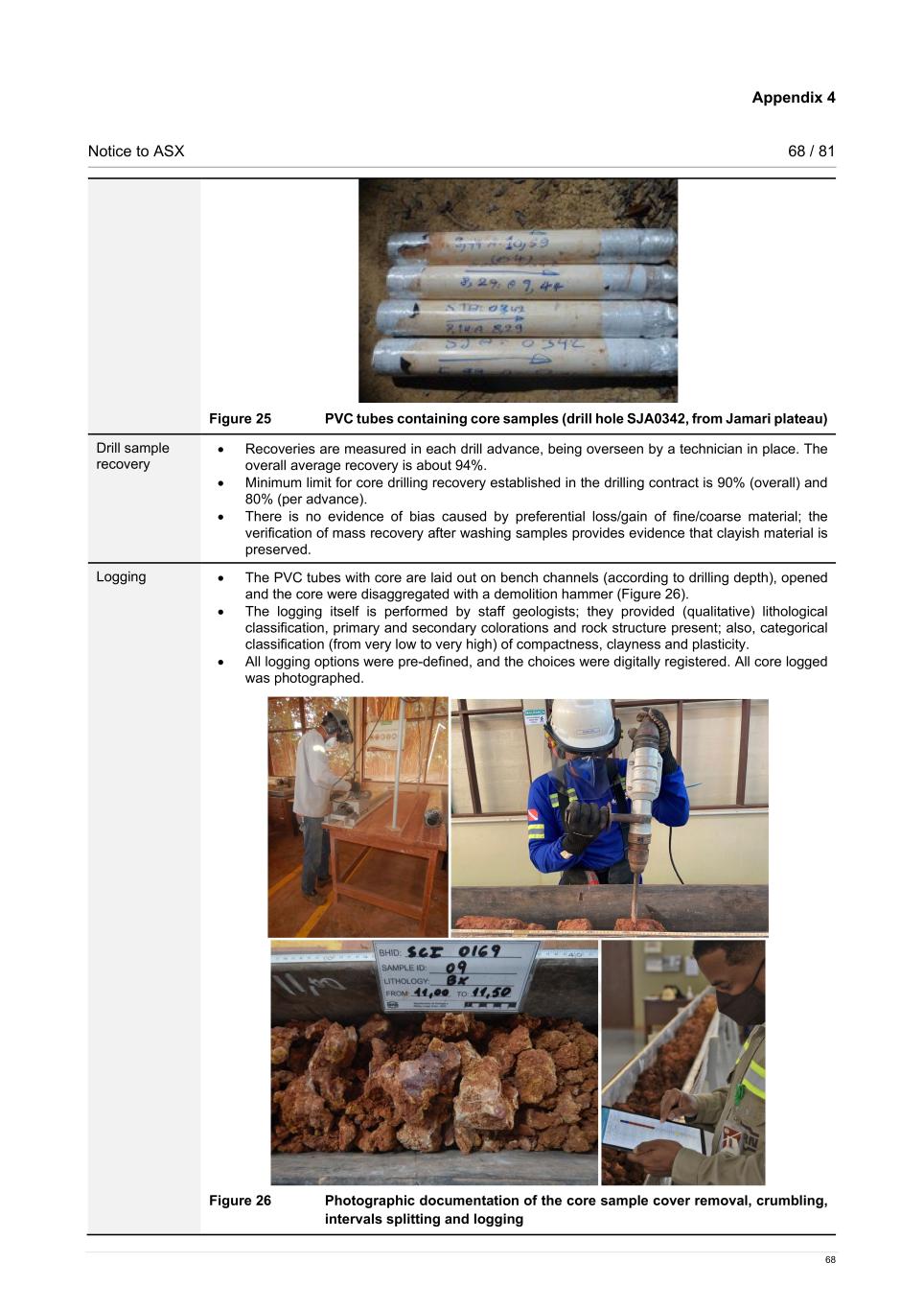
Appendix 4 Notice to ASX 68 / 81 68 Figure 25 PVC tubes containing core samples (drill hole SJA0342, from Jamari plateau) Drill sample recovery • Recoveries are measured in each drill advance, being overseen by a technician in place. The overall average recovery is about 94%. • Minimum limit for core drilling recovery established in the drilling contract is 90% (overall) and 80% (per advance). • There is no evidence of bias caused by preferential loss/gain of fine/coarse material; the verification of mass recovery after washing samples provides evidence that clayish material is preserved. Logging • The PVC tubes with core are laid out on bench channels (according to drilling depth), opened and the core were disaggregated with a demolition hammer (Figure 26). • The logging itself is performed by staff geologists; they provided (qualitative) lithological classification, primary and secondary colorations and rock structure present; also, categorical classification (from very low to very high) of compactness, clayness and plasticity. • All logging options were pre-defined, and the choices were digitally registered. All core logged was photographed. Figure 26 Photographic documentation of the core sample cover removal, crumbling, intervals splitting and logging

Appendix 4 Notice to ASX 69 / 81 69 Sub-sampling techniques and sample preparation • After logging, the geological contacts are marked and sub-samples of 0.5 m (ranging 0.3 m to 0.8 m to match with geological contacts) are set. • Each core sample is bagged and weighted for determinate of the in situ density. • The core is transported to the preparation facility for preparation and chemical analysis, which stages are described as follows: 1. Initial weighting (before drying). 2. Drying at 120°C for at least 8 hours. 3. Post-drying weighing (for determinate the in situ moisture). 4. Crushing by jaw crusher (1 inch top size). 5. Splitting and homogenising, separating the portion that will be stored. 6. New splitting and homogenising step, separating the portions that will be assayed as is (the crude portion) and the one that will be washed (simulating the beneficiation process). 7. Wet sieving, breaking down in coarse (+4.76 mm) and fine (-4.76 mm +0.037mm) portions. 8. Drying, crushing and pulverising of the coarse and fine portions, resulting in the final aliquots for assaying (separately). • The sample size and preparation techniques are considered appropriate for the style of mineralisation. Quality of assay data and laboratory tests • Assaying of all aliquots by XRF of pressed disc for total oxides (Al2O3, SiO2, Fe2O3 and TiO2), by volumetry after alkaline digestion for available alumina (AAl2O3), and atomic absorption for reactive silica (RSiO2). • LOI is not measured but calculated. • The QA/QC adopted for samples preparation and assaying are listed as follows: 1. DP1: Field blind duplicates (1 in every 20 samples), inserted by geology/exploration staff. 2. DP2 and DP3: Pulp (1 in every 20 samples) and coarse (1 in every 30 samples) duplicates, inserted by preparation staff. 3. Certified Reference Materials (1 in every 30 samples), inserted by lab staff. 4. Blank samples and solutions for AAl2O3 and RSiO2 grades (1 in every 30 samples). • Results of the QA/QC analysis indicate an acceptable level of precision and accuracy. The results from blanks do not indicate contamination during the laboratory procedures. Verification of sampling and assaying • For core samples, the mass loss as well the top sizing effectiveness are controlled during the crushing process. • Twinned holes were not executed, due of the relatively narrow grid applied (200 m). • Core preparations procedures were overseen by MRN geologists and assaying was overseen by the MRN chemist head. Location of data points • Collars are located in field on drilling roads already opened; these roads are straight along the plateau surface and are parallel to each other. • Their final location is defined with a handheld GPS device, with small relocations allowed for safety reasons. • Normally the real drilled collar is surveyed by topography staff (with total station or high precision GPS); in exceptions, the location coordinates are kept, and the elevations are given by projections to the plateau digital terrain model (DTM). • All topographic surveys are based on Sirgas2000 datum; calibrations are supported by topographic landmarks distributed over the project area. • Older drill holes (executed before 2008) were translated to the coordinate system in use and the elevations were given by projections to the plateau DTM. • The precision of DTM elevations (in the plateau areas) was assessed by a specific study comparing the real elevations against the projected in the surface. The differences are, on average, about 0.7 m; this was deemed as suitable for evaluating Mineral Resources. Data spacing and distribution • Drill holes are initially spaced regularly over a squared grid of 200 m, covering the whole plateau surface area (exploration plan; Figure 27). • 100 m infill drilling campaigns have been carried out across the plateaus and areas closer to being mined (infill; Figure 27). • Drilling on a 50 m grid spacing is executed in areas about to be mined, using same methodology as applied to the other drilling campaigns (short term; Figure 27). If available, these geological data are also used for geological modelling. • In the Competent Person’s opinion and based on their experience (reinforced by uncertainties assessments as well external experts through third party audits), this spacing grid is adequate to establish an appropriate degree of geological and grade continuity to apply in Mineral Resources evaluations.

Appendix 4 Notice to ASX 70 / 81 70 • No compositing has been applied, since the samples regular length (0.5 m) is the same as the vertical block increment; furthermore, the major grade variability is in the vertical direction. Figure 27 Drill holes distributed over the Teófilo plateau. The perimeter shaded in grey represents the depleted areas as at 30 June 2024 Orientation of data in relation to geological structure • Drilling is always vertical, cutting perpendicularly to the deposit layers. • Depths drilled are shallow (normally less than 12 m) and no deviations are expected. Sample security • PVC tubes, where the cores are introduced during drilling, have adequate resistance for handling and hauling. • Sealed bags are hauled to laboratory facility by paved road. • Half core samples are stored in the lithoteque (storage facility). Audits or reviews • MRN hired AMEC International (Chile) S.A. (in 2008), Tetra Tech Coffey (in 2014), and GE21 Consultoria Mineral (in 2020 and 2023) for audit and certification of the entire Mineral Resource evaluation process. • In all cases, no critical issues were reported. • Moreover, MRN procedures have been continuously verified by technical committee members (from shareholders), in order to guarantee the adoption of good practices. Section 2: Reporting of Exploration Results Criteria Commentary Mineral tenement and land tenure status • RTA Atlantic Operations Mineral Resources and Ore Reserves are represented by 22% shareholding interest in the joint venture Mineração Rio do Norte (MRN), which operates bauxite mining, washing, and shipping activities at the Porto Trombetas deposit (Pará State, Brazil). • MRN holds 44 mineral tenements that cover all plateaus being reported (Figure 28). • All these have the status of a mining concession and are located surrounding the Trombetas area; all these are grouped in a single lease ID (as predicated under Brazilian law), allowing it to be managed as if it were a single tenement. • All tenements are valid until the complete ore exhaustion; no expiration date is applied.

Appendix 4 Notice to ASX 71 / 81 71 • Tenure ownership is public and compounds a federal forest unit, as regulated by federal government. This regulation guarantees the mining activity by MRN in the bauxite deposits. Figure 28 MRN ownership tenures stated as mining concessions (red polygons),. Source: http://sigmine.dnpm.gov.br Exploration done by other parties • The initial exploration was carried out by the parent companies of current MRN shareholders (Billiton and Alcan), concomitantly in the 60s and 70s. • These activities supported the process of obtaining the mining concession for the current operation. • These data are deemed as the historical database and are no longer being used for reporting Mineral Resources. • No other party has carried out exploration activity since the establishment of MRN. Geology • The region of Trombetas is situated in the Low Amazon Sedimentary Basin, which is characterised by a clastic sedimentation of continental origin, lying unconformably over Palaeozoic sedimentary rocks (Figure 29). • The bedrock is the Alter do Chao Formation (Upper Cretaceous), constituted by clayey sandstone, sometimes arkose, intercalated with conglomerates, clays and siltstones. • Locally occurring above this formation is an immature lateritic covering (Paleogene), that is geomorphologically related to the plateaus and holds the bauxite mineralisation. N
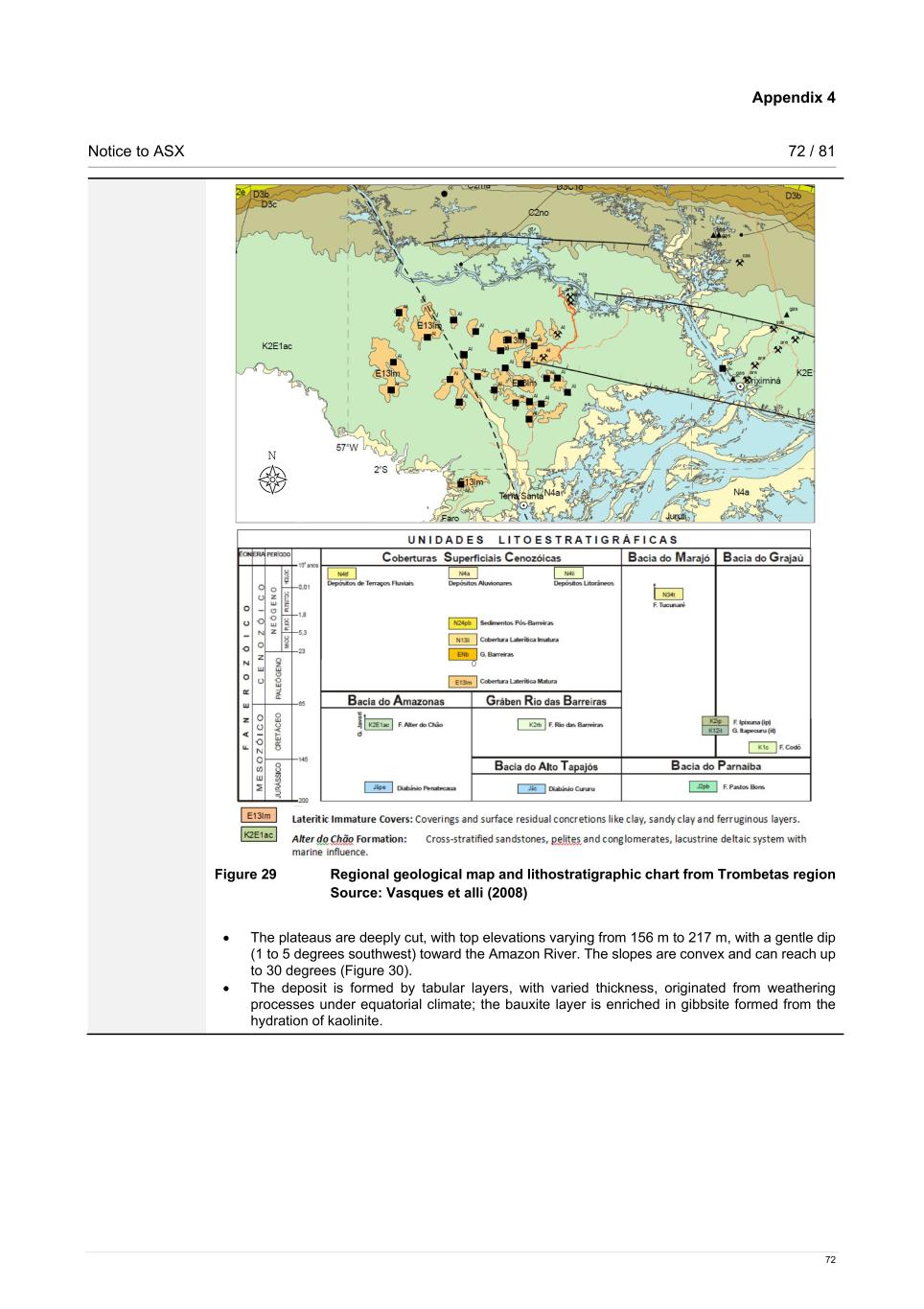
Appendix 4 Notice to ASX 72 / 81 72 Figure 29 Regional geological map and lithostratigraphic chart from Trombetas region Source: Vasques et alli (2008) • The plateaus are deeply cut, with top elevations varying from 156 m to 217 m, with a gentle dip (1 to 5 degrees southwest) toward the Amazon River. The slopes are convex and can reach up to 30 degrees (Figure 30). • The deposit is formed by tabular layers, with varied thickness, originated from weathering processes under equatorial climate; the bauxite layer is enriched in gibbsite formed from the hydration of kaolinite. 0 N
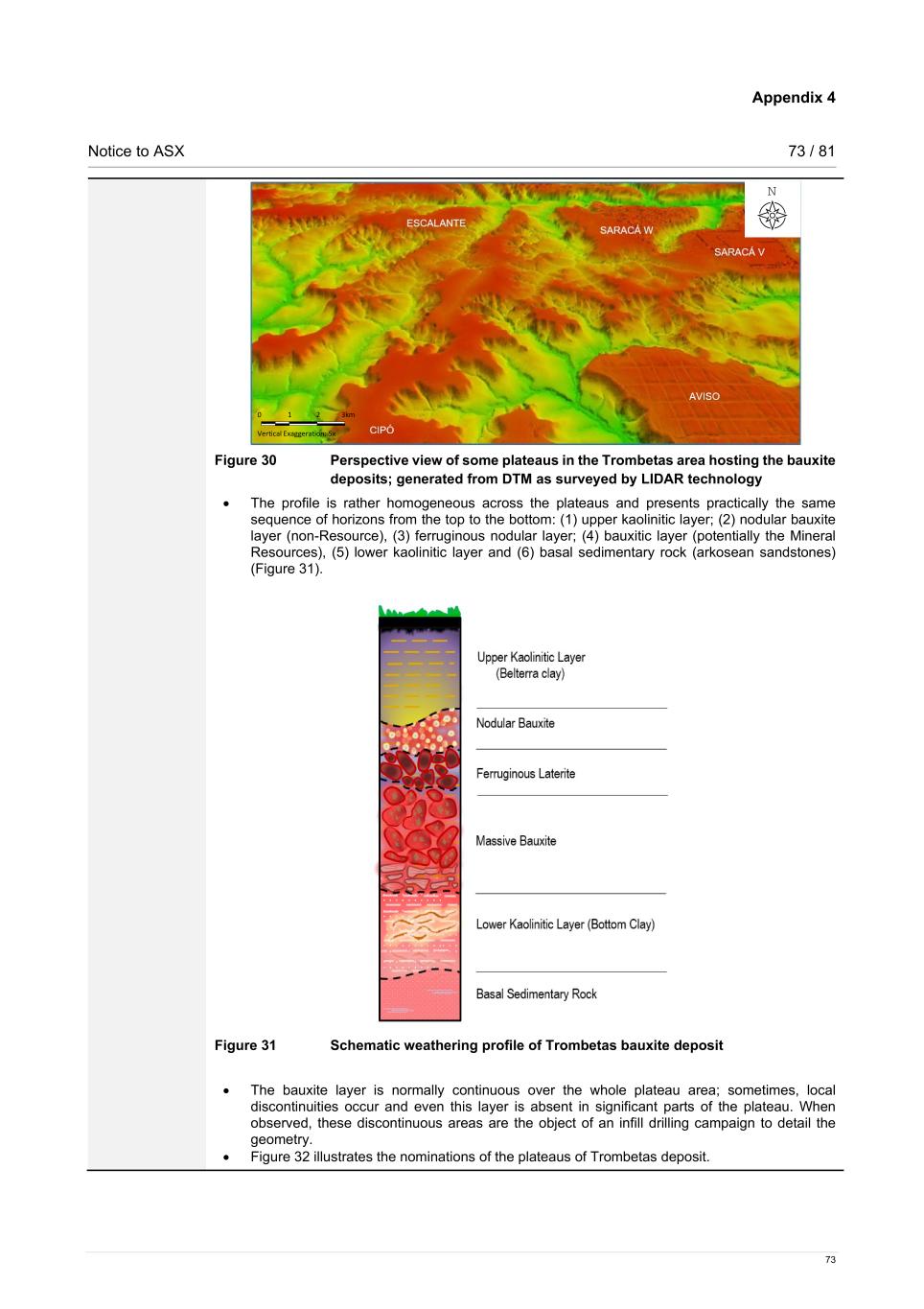
Appendix 4 Notice to ASX 73 / 81 73 Figure 30 Perspective view of some plateaus in the Trombetas area hosting the bauxite deposits; generated from DTM as surveyed by LIDAR technology • The profile is rather homogeneous across the plateaus and presents practically the same sequence of horizons from the top to the bottom: (1) upper kaolinitic layer; (2) nodular bauxite layer (non-Resource), (3) ferruginous nodular layer; (4) bauxitic layer (potentially the Mineral Resources), (5) lower kaolinitic layer and (6) basal sedimentary rock (arkosean sandstones) (Figure 31). Figure 31 Schematic weathering profile of Trombetas bauxite deposit • The bauxite layer is normally continuous over the whole plateau area; sometimes, local discontinuities occur and even this layer is absent in significant parts of the plateau. When observed, these discontinuous areas are the object of an infill drilling campaign to detail the geometry. • Figure 32 illustrates the nominations of the plateaus of Trombetas deposit. 0 1 2 3km Vertical Exaggeration: 5x N

Appendix 4 Notice to ASX 74 / 81 74 Figure 32 MRN plateaus nominations and zoning • The plateaus Papagaio, Periquito, Saracá, Aviso, Almeidas, Bacaba and Aramã are exhausted. • This reporting regards, as Mineral Resources, the plateaus: Monte Branco, Cipó, Teófilo, Bela Cruz, Greigh, Escalante, Rebolado, Jamari and Cruz Alta. • The plateaus Barone, Cruz Alta Leste, Cruz Alta Oeste, Peixinho, Morcego and Avertano are excluded from this reporting, are these are only supported by historical exploration. Drill hole Information • The amount of drill holes executed, per plateau being reported, is tabulated as follows Plateau Drill holes Total length (m) Average length (m) Standard grid Monte Branco 1,586 22,194 14.0 200 m squared, locally 100 m and 50 m squared. Cipó 546 5,887 10.8 200 m squared, locally 100 m and 50 m squared. Teófilo 529 6,393 12.1 200 m squared, locally 100 m and 50 m squared. Greigh 60 532 8.9 200 m squared, locally 200 m x 100 m. Jamari 809 9,006 11.1 200 m squared. Rebolado 810 9,621 11.9 200 m squared. Escalante 157 1,808 11.5 200 m squared. Cruz Alta 809 11,493 14.2 200 m squared. Total 5,306 66,934 Data aggregation methods • Not applicable, because no Exploration Results are being reported. Relationship between mineralisation widths and intercept lengths • The mineralisation is tabular and the drill holes are vertical, consequently, no apparent thickness effect is expected. • Despite being tabular, the thickness is not constant and varies with topographic surface as well other weathering related controls. • The layers are generally continuous until the plateau border, being truncated by its slope. Diagrams • Figure 4 in the body of this release shows the property location.
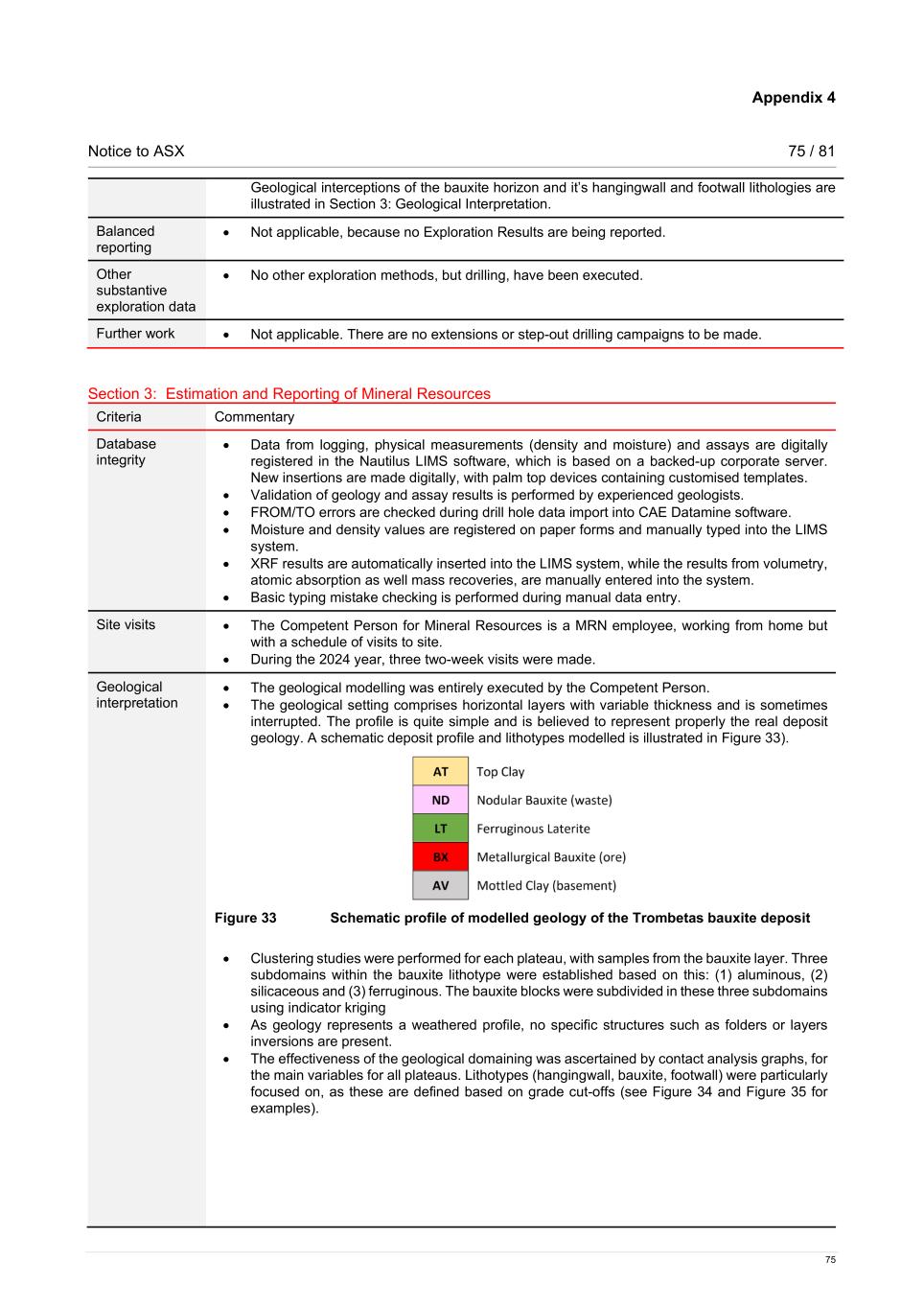
Appendix 4 Notice to ASX 75 / 81 75 Geological interceptions of the bauxite horizon and it’s hangingwall and footwall lithologies are illustrated in Section 3: Geological Interpretation. Balanced reporting • Not applicable, because no Exploration Results are being reported. Other substantive exploration data • No other exploration methods, but drilling, have been executed. Further work • Not applicable. There are no extensions or step-out drilling campaigns to be made. Section 3: Estimation and Reporting of Mineral Resources Criteria Commentary Database integrity • Data from logging, physical measurements (density and moisture) and assays are digitally registered in the Nautilus LIMS software, which is based on a backed-up corporate server. New insertions are made digitally, with palm top devices containing customised templates. • Validation of geology and assay results is performed by experienced geologists. • FROM/TO errors are checked during drill hole data import into CAE Datamine software. • Moisture and density values are registered on paper forms and manually typed into the LIMS system. • XRF results are automatically inserted into the LIMS system, while the results from volumetry, atomic absorption as well mass recoveries, are manually entered into the system. • Basic typing mistake checking is performed during manual data entry. Site visits • The Competent Person for Mineral Resources is a MRN employee, working from home but with a schedule of visits to site. • During the 2024 year, three two-week visits were made. Geological interpretation • The geological modelling was entirely executed by the Competent Person. • The geological setting comprises horizontal layers with variable thickness and is sometimes interrupted. The profile is quite simple and is believed to represent properly the real deposit geology. A schematic deposit profile and lithotypes modelled is illustrated in Figure 33). Figure 33 Schematic profile of modelled geology of the Trombetas bauxite deposit • Clustering studies were performed for each plateau, with samples from the bauxite layer. Three subdomains within the bauxite lithotype were established based on this: (1) aluminous, (2) silicaceous and (3) ferruginous. The bauxite blocks were subdivided in these three subdomains using indicator kriging • As geology represents a weathered profile, no specific structures such as folders or layers inversions are present. • The effectiveness of the geological domaining was ascertained by contact analysis graphs, for the main variables for all plateaus. Lithotypes (hangingwall, bauxite, footwall) were particularly focused on, as these are defined based on grade cut-offs (see Figure 34 and Figure 35 for examples).
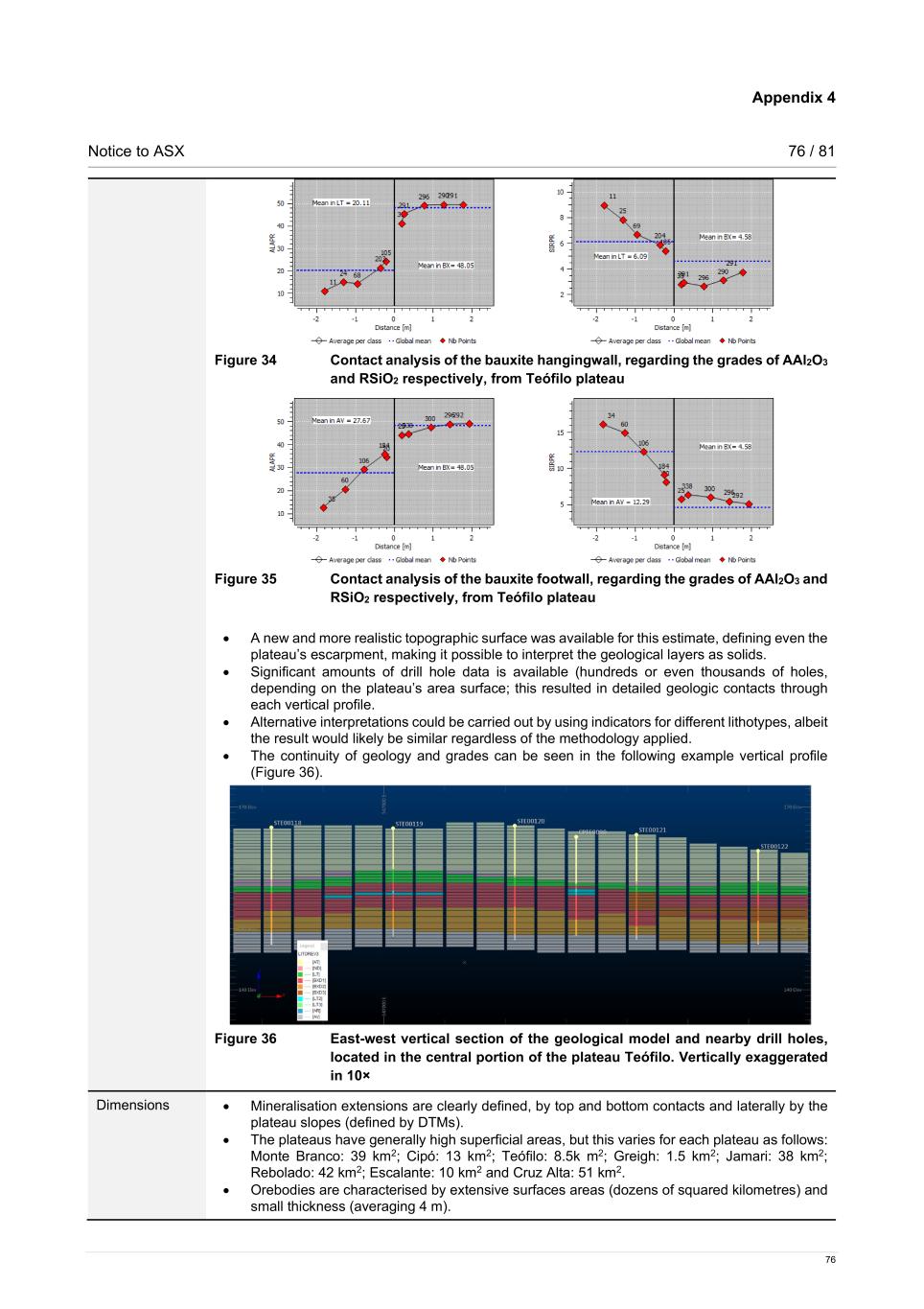
Appendix 4 Notice to ASX 76 / 81 76 Figure 34 Contact analysis of the bauxite hangingwall, regarding the grades of AAl2O3 and RSiO2 respectively, from Teófilo plateau Figure 35 Contact analysis of the bauxite footwall, regarding the grades of AAl2O3 and RSiO2 respectively, from Teófilo plateau • A new and more realistic topographic surface was available for this estimate, defining even the plateau’s escarpment, making it possible to interpret the geological layers as solids. • Significant amounts of drill hole data is available (hundreds or even thousands of holes, depending on the plateau’s area surface; this resulted in detailed geologic contacts through each vertical profile. • Alternative interpretations could be carried out by using indicators for different lithotypes, albeit the result would likely be similar regardless of the methodology applied. • The continuity of geology and grades can be seen in the following example vertical profile (Figure 36). Figure 36 East-west vertical section of the geological model and nearby drill holes, located in the central portion of the plateau Teófilo. Vertically exaggerated in 10× Dimensions • Mineralisation extensions are clearly defined, by top and bottom contacts and laterally by the plateau slopes (defined by DTMs). • The plateaus have generally high superficial areas, but this varies for each plateau as follows: Monte Branco: 39 km2; Cipó: 13 km2; Teófilo: 8.5k m2; Greigh: 1.5 km2; Jamari: 38 km2; Rebolado: 42 km2; Escalante: 10 km2 and Cruz Alta: 51 km2. • Orebodies are characterised by extensive surfaces areas (dozens of squared kilometres) and small thickness (averaging 4 m).

Appendix 4 Notice to ASX 77 / 81 77 Estimation and modelling techniques • All estimates were executed by the Competent Person for Mineral Resources. • No grade truncations have been made, as there is no presence of outliers; bauxite is characterised by high grades of available alumina (AAl2O3, varying from 35% to 55%). Reactive silica (RSiO2) is the most relevant contaminant for refining purposes and varies from 1% to 10%. • No compositing is applied, because the sample length is the same as the vertical block increment. • No metal equivalent is applied; the bauxite quality is given by AAl2O3 and RSiO2 grades. • All grades and physical variables (mass recoveries, density, moisture) were estimated by ordinary kriging into 50 m x 50 m x 0.5 m parent cells using CAE Datamine software. 25 m x 25 m x 0.5 m sub-celling was used to more accurate define the domain boundaries. • The block size of 50 m x 50 m x 0.5 m compared to the typical drill hole spacing of 200 m is considered as appropriate by the Competent Person. • Estimates for each variable were carried out for the product fraction (+0.037 mm granulometry, after washing), as well as the crude (unwashed) fraction. Coarse and fine fractions estimates were calculated by regressions from the estimated product fractions. • Estimates were controlled by lithotype and, specifically for the bauxite layer, by the aluminous, silicaceous and ferruginous subdomains. • The estimation parameters were optimised using kriging neighbourhood analysis (KNA), for each plateau and main variables. As a general case, the first searching ellipsoid axes are 650 m in the horizontal by 1 m in vertical, divided in 4 angular sectors; maximum of 4 samples per sector and minimum of 8 samples reached for estimate each block. Expanded searching volumes were allowed to possibly that all blocks had estimates. • Prior to estimation, bauxite samples and blocks vertical (Z) coordinates were stratigraphically corrected, lining them up by the hangingwall or footwall (according to a specific study made for each plateau). After estimation, these were relocated to the original positions. • Estimation validation was carried out using: 1. Comparing geological solids versus block model volumes. 2. Search volume of estimates (at least 70% of blocks should be estimated from the first searching volume). 3. Global estimation (samples versus blocks averages comparison). 4. Local estimation (by swath plots). 5. Blocks and samples grades convergence. Moisture • All tonnes are reported on a dry basis. Cut-off parameters • The bauxite lithotype was defined using the following cut-offs: o Bauxite hangingwall: AAl2O3 ≥ 35%, AAl2O3 > Fe2O3 o Bauxite footwall: mass recovery ≥ 30% • For establishing what is reported as Mineral Resources, a cut-off of mass recovery ≥ 50% was applied. This means that the bauxite unmatched by this cut-off (which is more argillaceous, containing higher grades of reactive silica and located in the bottom part of the layer), were downgraded to non-Resource. Mining factors or assumptions • Bauxite layers are locally diluted by lateritic interlayers, these are not abundant and are flagged via a nearest neighbour estimation with a narrow search. • No other adjustments or corrections were made, such as tonnages or grades factors. • For reporting purposes, the plateau perimeter limit was defined by a 6 degree slope theoretical line. Metallurgical factors or assumptions • Mineral Resources are reported as washed product, considering that all this material would be mined and washed in the MRN Beneficiation Plant. Environmental factors or assumptions • No such factors were applied. The bauxite reported as Mineral Resources exhibits no variation in environmental characteristics compared to the one currently being mined. Bulk density • Bulk density was measured for all samples intervals (regardless of lithotype) using weight in air versus volume of PVC tube where the samples were stored (adjusted where there is not full drill hole core recovery) using the formula:
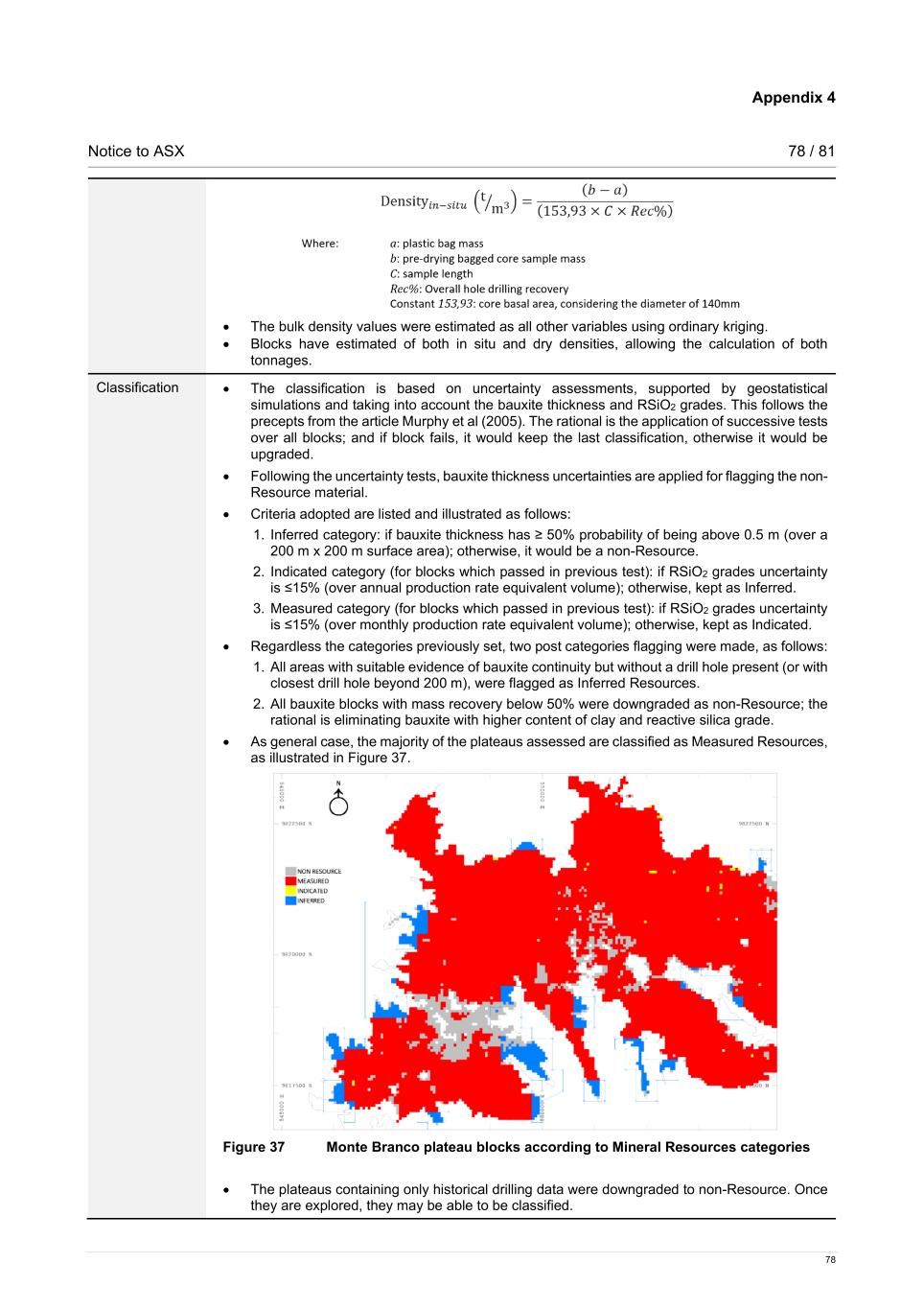
Appendix 4 Notice to ASX 78 / 81 78 • The bulk density values were estimated as all other variables using ordinary kriging. • Blocks have estimated of both in situ and dry densities, allowing the calculation of both tonnages. Classification • The classification is based on uncertainty assessments, supported by geostatistical simulations and taking into account the bauxite thickness and RSiO2 grades. This follows the precepts from the article Murphy et al (2005). The rational is the application of successive tests over all blocks; and if block fails, it would keep the last classification, otherwise it would be upgraded. • Following the uncertainty tests, bauxite thickness uncertainties are applied for flagging the non- Resource material. • Criteria adopted are listed and illustrated as follows: 1. Inferred category: if bauxite thickness has ≥ 50% probability of being above 0.5 m (over a 200 m x 200 m surface area); otherwise, it would be a non-Resource. 2. Indicated category (for blocks which passed in previous test): if RSiO2 grades uncertainty is ≤15% (over annual production rate equivalent volume); otherwise, kept as Inferred. 3. Measured category (for blocks which passed in previous test): if RSiO2 grades uncertainty is ≤15% (over monthly production rate equivalent volume); otherwise, kept as Indicated. • Regardless the categories previously set, two post categories flagging were made, as follows: 1. All areas with suitable evidence of bauxite continuity but without a drill hole present (or with closest drill hole beyond 200 m), were flagged as Inferred Resources. 2. All bauxite blocks with mass recovery below 50% were downgraded as non-Resource; the rational is eliminating bauxite with higher content of clay and reactive silica grade. • As general case, the majority of the plateaus assessed are classified as Measured Resources, as illustrated in Figure 37. Figure 37 Monte Branco plateau blocks according to Mineral Resources categories • The plateaus containing only historical drilling data were downgraded to non-Resource. Once they are explored, they may be able to be classified.
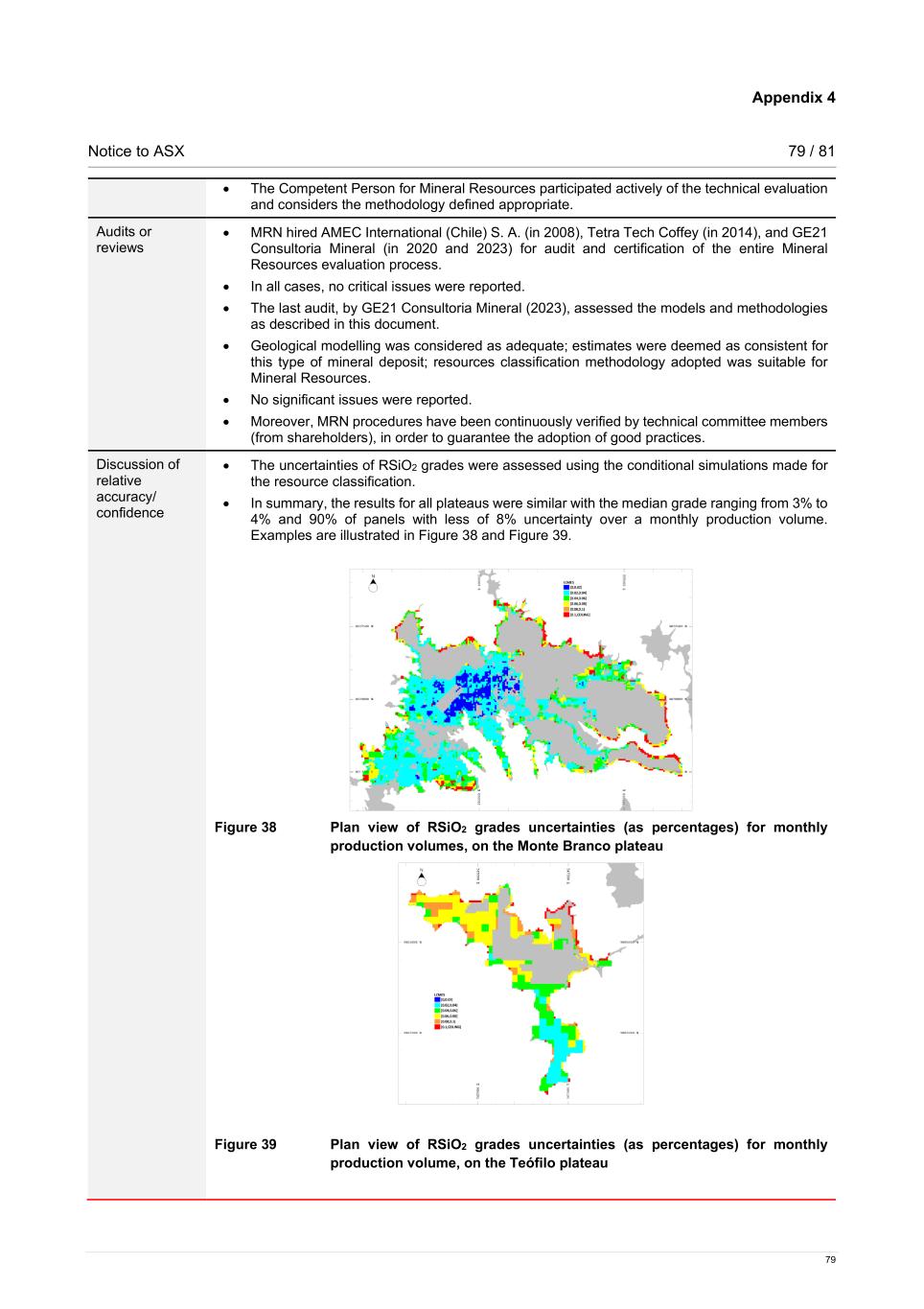
Appendix 4 Notice to ASX 79 / 81 79 • The Competent Person for Mineral Resources participated actively of the technical evaluation and considers the methodology defined appropriate. Audits or reviews • MRN hired AMEC International (Chile) S. A. (in 2008), Tetra Tech Coffey (in 2014), and GE21 Consultoria Mineral (in 2020 and 2023) for audit and certification of the entire Mineral Resources evaluation process. • In all cases, no critical issues were reported. • The last audit, by GE21 Consultoria Mineral (2023), assessed the models and methodologies as described in this document. • Geological modelling was considered as adequate; estimates were deemed as consistent for this type of mineral deposit; resources classification methodology adopted was suitable for Mineral Resources. • No significant issues were reported. • Moreover, MRN procedures have been continuously verified by technical committee members (from shareholders), in order to guarantee the adoption of good practices. Discussion of relative accuracy/ confidence • The uncertainties of RSiO2 grades were assessed using the conditional simulations made for the resource classification. • In summary, the results for all plateaus were similar with the median grade ranging from 3% to 4% and 90% of panels with less of 8% uncertainty over a monthly production volume. Examples are illustrated in Figure 38 and Figure 39. Figure 38 Plan view of RSiO2 grades uncertainties (as percentages) for monthly production volumes, on the Monte Branco plateau Figure 39 Plan view of RSiO2 grades uncertainties (as percentages) for monthly production volume, on the Teófilo plateau
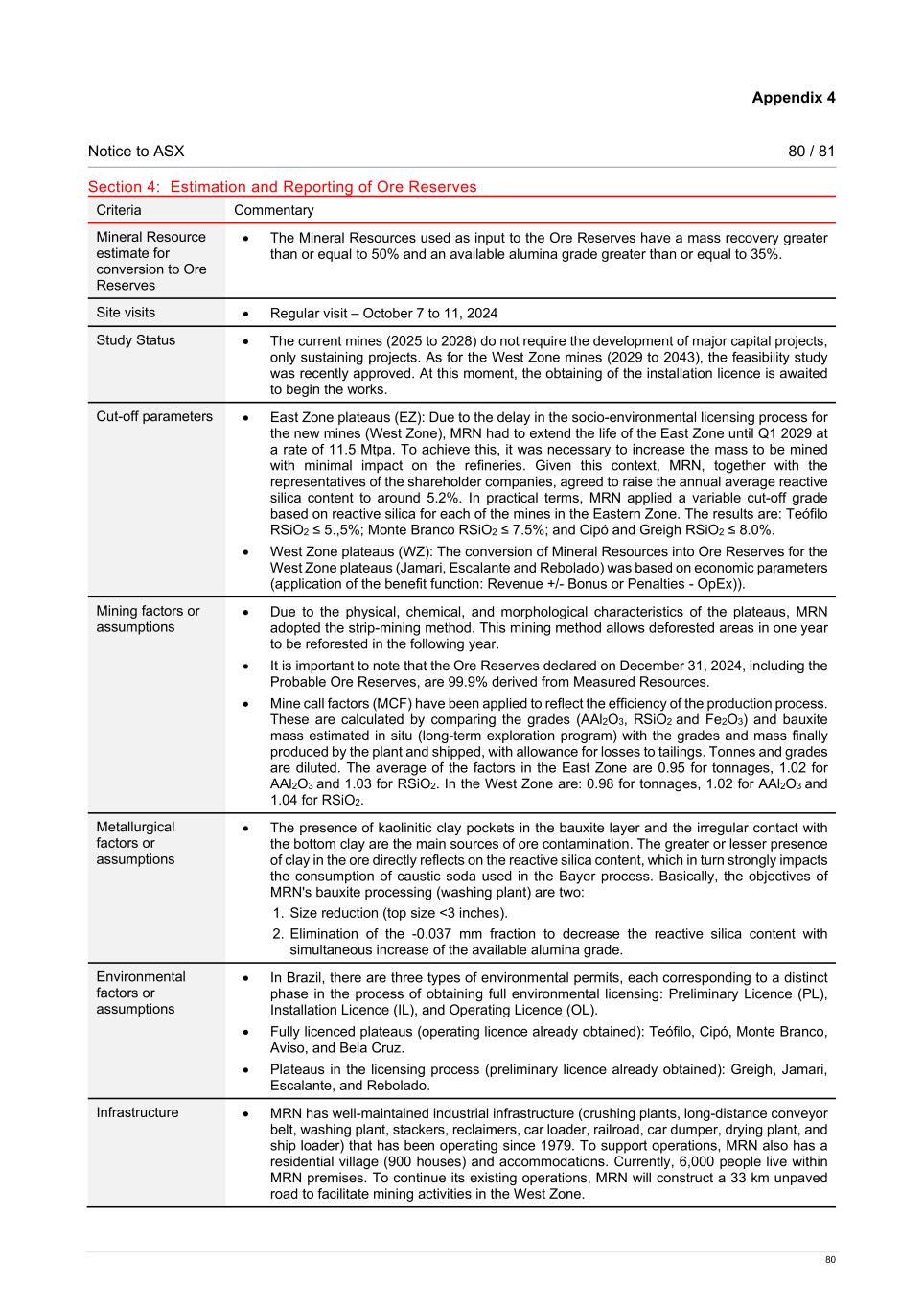
Appendix 4 Notice to ASX 80 / 81 80 Section 4: Estimation and Reporting of Ore Reserves Criteria Commentary Mineral Resource estimate for conversion to Ore Reserves • The Mineral Resources used as input to the Ore Reserves have a mass recovery greater than or equal to 50% and an available alumina grade greater than or equal to 35%. Site visits • Regular visit – October 7 to 11, 2024 Study Status • The current mines (2025 to 2028) do not require the development of major capital projects, only sustaining projects. As for the West Zone mines (2029 to 2043), the feasibility study was recently approved. At this moment, the obtaining of the installation licence is awaited to begin the works. Cut-off parameters • East Zone plateaus (EZ): Due to the delay in the socio-environmental licensing process for the new mines (West Zone), MRN had to extend the life of the East Zone until Q1 2029 at a rate of 11.5 Mtpa. To achieve this, it was necessary to increase the mass to be mined with minimal impact on the refineries. Given this context, MRN, together with the representatives of the shareholder companies, agreed to raise the annual average reactive silica content to around 5.2%. In practical terms, MRN applied a variable cut-off grade based on reactive silica for each of the mines in the Eastern Zone. The results are: Teófilo RSiO2 ≤ 5.,5%; Monte Branco RSiO2 ≤ 7.5%; and Cipó and Greigh RSiO2 ≤ 8.0%. • West Zone plateaus (WZ): The conversion of Mineral Resources into Ore Reserves for the West Zone plateaus (Jamari, Escalante and Rebolado) was based on economic parameters (application of the benefit function: Revenue +/- Bonus or Penalties - OpEx)). Mining factors or assumptions • Due to the physical, chemical, and morphological characteristics of the plateaus, MRN adopted the strip-mining method. This mining method allows deforested areas in one year to be reforested in the following year. • It is important to note that the Ore Reserves declared on December 31, 2024, including the Probable Ore Reserves, are 99.9% derived from Measured Resources. • Mine call factors (MCF) have been applied to reflect the efficiency of the production process. These are calculated by comparing the grades (AAl2O3, RSiO2 and Fe2O3) and bauxite mass estimated in situ (long-term exploration program) with the grades and mass finally produced by the plant and shipped, with allowance for losses to tailings. Tonnes and grades are diluted. The average of the factors in the East Zone are 0.95 for tonnages, 1.02 for AAl2O3 and 1.03 for RSiO2. In the West Zone are: 0.98 for tonnages, 1.02 for AAl2O3 and 1.04 for RSiO2. Metallurgical factors or assumptions • The presence of kaolinitic clay pockets in the bauxite layer and the irregular contact with the bottom clay are the main sources of ore contamination. The greater or lesser presence of clay in the ore directly reflects on the reactive silica content, which in turn strongly impacts the consumption of caustic soda used in the Bayer process. Basically, the objectives of MRN's bauxite processing (washing plant) are two: 1. Size reduction (top size <3 inches). 2. Elimination of the -0.037 mm fraction to decrease the reactive silica content with simultaneous increase of the available alumina grade. Environmental factors or assumptions • In Brazil, there are three types of environmental permits, each corresponding to a distinct phase in the process of obtaining full environmental licensing: Preliminary Licence (PL), Installation Licence (IL), and Operating Licence (OL). • Fully licenced plateaus (operating licence already obtained): Teófilo, Cipó, Monte Branco, Aviso, and Bela Cruz. • Plateaus in the licensing process (preliminary licence already obtained): Greigh, Jamari, Escalante, and Rebolado. Infrastructure • MRN has well-maintained industrial infrastructure (crushing plants, long-distance conveyor belt, washing plant, stackers, reclaimers, car loader, railroad, car dumper, drying plant, and ship loader) that has been operating since 1979. To support operations, MRN also has a residential village (900 houses) and accommodations. Currently, 6,000 people live within MRN premises. To continue its existing operations, MRN will construct a 33 km unpaved road to facilitate mining activities in the West Zone.

Appendix 4 Notice to ASX 81 / 81 81 Costs • Capital and operating cost estimates are sourced from internal MRN financial modelling and/or project capital estimates. • The operational costs consider future movements (transport distance, waste/ore ratio, bonuses or penalties due to quality, etc.) and improvements (energy matrix replacement, size of the mining fleet, etc.). • Third party payments are reflective of the current agreements in place. Revenue factors • Revenue factors are updated every year with long-term projections. Rio Tinto applies a common process to the generation of bauxite price assumptions across the group and these assumptions are also applied to MRN. This involves generation of long-term price forecasts based on current sales contracts, industry capacity analysis, global commodity consumption and economic growth trends (this includes the bonus/penalty adjustments for quality). Exchange rates are also based on internal Rio Tinto modelling of expected future country exchange rates. Market Assessment • As MRN is a joint venture created with the objective of supplying bauxite to its Shareholders, which means that the Shareholder’s refineries are the MRN market. Economic • The Measured and Indicated Resources selected and sequenced in the long-term mining plan (2025 to 2043) were converted into Probable and Proved Ore Reserves after a thorough economic analysis. The results of the cash flow (Revenue +/- Bonuses & Penalties - COGS) showed a positive gross margin. • Due to the high investment required to open the new mines in the West Zone, the project's NPV is negative. On the other hand, MRN ensures the long-term supply of bauxite to the shareholders' refineries. Alternatives to enable cash flow are under evaluation. Social • MRN is a sustainable operation that has been active in the region since 1979. The relationships with the surrounding communities are satisfactory, and recently, after public hearings, the company received the preliminary licence to open the new mines. Other • Mineral rights for the Ore Reserves which will be mined in accordance with long-term mine plan (2025 to 2043) are in place. Classification • The classification of MRN's Ore Reserves is guided by the JORC Code: 1. Probable Ore Reserves: Converted from Measured or Indicated Resources, with the Preliminary Licence (PL) in place and a positive gross margin. 2. Proved Ore Reserves: Converted from Measured Resources, with the Operation Licence (OL) in place and a positive gross margin. Audits or reviews • East Zone: The new Ore Reserves have not yet been audited. • West Zone: The Ore Reserves of the West Zone were audited in 2024 by GE21 Consultoria Mineral. Discussion of relative accuracy/ confidence • The accuracy and confidence intervals related to the modifying factors (tonnage and grades) applied to the dilution of the reserves were recently assessed and validated by the Competent Person and the MRN team.
 エドガーで原本を確認する