株探米国株
英語
エドガーで原本を確認する


UNITED STATES
SECURITIES AND EXCHANGE COMMISSION
Washington, D.C. 20549
                            
FORM 40-F
                            
☐    REGISTRATION STATEMENT PURSUANT TO SECTION 12 OF THE SECURITIES EXCHANGE ACT OF 1934
☒    ANNUAL REPORT PURSUANT TO SECTION 13(A) OR 15(D) OF THE SECURITIES EXCHANGE ACT OF 1934
For the fiscal year ended December 31, 2024
Commission File Number 001-39750
                            
DOCEBO INC.
(Exact name of registrant as specified in its charter)
                            
Ontario, Canada 7372     Not Applicable
(Province or other jurisdiction of
incorporation or organization)
(Primary standard industrial
classification code number,
if applicable)
(I.R.S. Employer Identification No.,
if applicable)
366 Adelaide St. West
Suite 701
Toronto, Ontario, Canada M5V 1R7
(800) 681-4601
(Address and telephone number of registrant's principal executive offices)
Docebo NA, Inc.
600 N. Thomas St., Suite A
Athens, GA 30601
Telephone: (800) 681-4601
(Name, address (including zip code) and telephone number (including area code)
of agent for service in the United States)
                            
Securities registered pursuant to Section 12(b) of the Act:
Title of each class: Trading Symbol(s): Name of each exchange on which registered:
Common Shares, no par value DCBO Nasdaq Global Select Market
Common Shares, no par value DCBO Toronto Stock Exchange
Securities registered pursuant to Section 12(g) of the Act: None
Securities for which there is a reporting obligation pursuant to Section 15(d) of the Act: None
For annual reports, indicate by check mark the information filed with this form:
☒    Annual Information Form       ☒  Audited Annual Financial Statements
                            
Indicate the number of outstanding shares of the issuer’s classes of capital or common stock as of the close of the period covered by the annual report:
30,255,955 Common Shares (as at December 31, 2024).
Indicate by check mark whether the registrant (1) has filed all reports required to be filed by Section 13 or 15(d) of the Exchange Act during the preceding 12 months (or for such shorter period that the Registrant was required to file such reports) and (2) has been subject to such filing requirements for the past 90 days.
Yes ☒     No ☐
Indicate by check mark whether the registrant has submitted electronically every Interactive Data File required to be submitted pursuant to Rule 405 of Regulation S-T (s.232.405 of this chapter) during the preceding 12 months (or for such shorter period that the Registrant was required to submit such files).
Yes ☒    No ☐
Indicate by check mark whether the registrant is an emerging growth company as defined in Rule 12b-2 of the Exchange Act. Emerging growth company
 ☐  
If an emerging growth company that prepares its financial statements in accordance with U.S. GAAP, indicate by check mark if the registrant has elected not to use the extended transition period for complying with any new or revised financial accounting standards† provided pursuant to Section 13(a) of the Exchange Act.
 ☐   
† The term “new or revised financial accounting standard” refers to any update issued by the Financial Accounting Standards Board to its Accounting Standards Codification after April 5, 2012.


Indicate by check mark whether the registrant has filed a report on and attestation to its management’s assessment of the effectiveness of its internal control over financial reporting under Section 404(b) of the Sarbanes-Oxley Act (15 U.S.C. 7262(b)) by the registered public accounting firm that prepared or issued its audit report.
 ☒    

If securities are registered pursuant to Section 12(b) of the Act, indicate by check mark whether the financial statements of the registrant included in the filing reflect the correction of an error to previously issued financial statements. ☐

Indicate by check mark whether any of those error corrections are restatements that required a recovery analysis of incentive-based compensation received by any of the registrant’s executive officers during the relevant recovery period pursuant to §240.10D-1(b). ☐


PRINCIPAL DOCUMENTS
The following documents are filed as part of this Annual Report on Form 40-F:
A.    Annual Information Form
For the Registrant’s Annual Information Form for the year ended December 31, 2024, see Exhibit 99.1 of this Annual Report on Form 40-F ("AIF").
B.    Audited Annual Financial Statements
For the Registrant’s Audited Consolidated Financial Statements for the year ended December 31, 2024 (the “2024 Financial Statements”), including the Reports of Independent Registered Public Accounting Firm with respect thereto, see Exhibit 99.2 of this Annual Report on Form 40-F.
C.    Management’s Discussion and Analysis
For the Registrant’s Management’s Discussion and Analysis of Financial Condition and Results of Operations for the year ended December 31, 2024 (“MD&A”), see Exhibit 99.3 of this Annual Report on Form 40-F.
CONTROLS AND PROCEDURES
A.    Certifications
The required disclosure is included in Exhibits 99.5, 99.6, 99.7 and 99.8 of this Annual Report on Form 40-F.
B.    Disclosure Controls and Procedures
The information provided under the heading “Disclosure Controls and Procedures and Internal Controls over Financial Reporting” contained in the MD&A, filed as Exhibit 99.3 to this Annual Report on Form 40-F, is incorporated by reference herein.
C.    Management’s Annual Report on Internal Control over Financial Reporting
The information provided under the heading “Disclosure Controls and Procedures and Internal Controls over Financial Reporting” contained in the MD&A, filed as Exhibit 99.3 to this Annual Report on Form 40-F, is incorporated by reference herein.
D.    Attestation Report of the Registered Public Accounting Firm
The effectiveness of the Registrant's internal control over financial reporting as of December 31, 2024, has been audited by KPMG LLP (Vaughan, Canada, PCAOB ID No.: 85), an independent registered public accounting firm, as stated in their report, which accompanies the 2024 Financial Statements, and is incorporated herein by reference.
E.    Changes in Internal Control over Financial Reporting
During the year ended December 31, 2024, there were no changes in the Registrant’s internal control over financial reporting that have materially affected, or are reasonably likely to materially affect, the Registrant’s internal control over financial reporting.
AUDIT COMMITTEE FINANCIAL EXPERT
The Registrant’s Board of Directors has determined that Mr. Steven Spooner, Mr. William Anderson and Ms. Trisha Price are serving on its audit committee and are “independent” (as defined by Rule 10A-3 of the Exchange Act and Rule 5605(a)(2) of the Nasdaq Marketplace Rules) and that Mr. Steven Spooner and Mr. William Anderson are “audit committee financial experts” (as that term is defined in paragraph 8(b) of General Instruction B to Form 40-F).
i


For a description of Mr. Steven Spooner’s, Mr. William Anderson’s and Ms. Trisha Price’s relevant experience in financial matters, see the biographical descriptions for Mr. Steven Spooner, Mr. William Anderson and Ms. Trisha Price under “Directors and Executive Officers” in the Registrant’s Annual Information Form for the year ended December 31, 2024, which is filed as Exhibit 99.1 to this Annual Report on Form 40-F.
The SEC has indicated that the designation of each of Mr. Steven Spooner and Mr. William Anderson as audit committee financial experts does not make them an “expert” for any purpose, impose any duties, obligations or liability on them that are greater than those imposed on members of the audit committee and board of directors who do not carry this designation or affect the duties, obligations or liability of any other member of the audit committee.
CODE OF ETHICS
The Registrant has adopted a “code of ethics” (as that term is defined in paragraph 9(b) of General Instruction B to Form 40-F) (“Code of Ethics”), which is applicable to all of its directors, managers, officers and employees (including its principal executive officer, principal financial officer, principal accounting officer or controller, and persons performing similar functions). The Code of Ethics entitled “Code of Business Conduct and Ethics” is available on the Registrant’s website at www.docebo.com.
In the past fiscal year, the Registrant has not granted any waiver, including an implicit waiver, from any provision of its Code of Ethics.
PRINCIPAL ACCOUNTANT FEES AND SERVICES
The required disclosure is included under the heading “External Independent Registered Public Accounting Firm Service Fees” contained in the AIF, filed as Exhibit 99.1 to this Annual Report on Form 40-F, and is incorporated by reference herein.
AUDIT COMMITTEE PRE-APPROVAL POLICIES

The disclosure provided under the heading “Pre-Approval Policies and Procedures” contained in the AIF, filed as Exhibit 99.1 to this Annual Report on Form 40-F, is incorporated by reference herein.
CONTRACTUAL OBLIGATIONS
The disclosure provided under the heading “Contractual Obligations” contained in the MD&A, filed as Exhibit 99.3 to this Annual Report on Form 40-F, is incorporated by reference herein.
IDENTIFICATION OF THE AUDIT COMMITTEE
The Registrant has a separately designated standing audit committee established in accordance with Section 3(a)(58)(A) of the Exchange Act. The Registrant’s Audit Committee members consist of that Mr. Steven Spooner, Mr. William Anderson and Ms. Trisha Price. See “Directors and Executive Officers” and “Audit Committee Information” in the Registrant’s Annual Information Form for the fiscal year ended December 31, 2024, which is filed as Exhibit 99.1 to this Annual Report on Form 40-F.
DIFFERENCES IN NASDAQ AND CANADIAN CORPORATE GOVERNANCE REQUIREMENTS
The Registrant is a foreign private issuer and its common shares are listed on the Nasdaq Global Select Market (“Nasdaq”).
Nasdaq Rule 5615(a)(3) permits a foreign private issuer to follow its home country practice in lieu of the requirements of the Rule 5600 Series, the requirement to distribute annual and interim reports set forth in Rule 5250(d), and the Direct Registration Program requirement set forth in Rules 5210(c) and 5255; provided, however, that such a company shall comply with the Notification of Material Noncompliance requirement (Rule 5625), the Voting Rights requirement (Rule 5640), have an audit committee that satisfies Rule 5605(c)(3), and ensure that such audit committee’s members meet the independence requirement in Rule 5605(c)(2)(A)(ii).
ii


The Registrant does not follow Rule 5605(d)(1), which requires companies to adopt a formal written compensation committee charter and have a compensation committee review and reassess the adequacy of the charter on an annual basis. In lieu of following Rule 5605(d)(1), the Registrant follows the rules of the Toronto Stock Exchange.
The Registrant does not follow Rule 5605(d)(2), which requires companies to have a compensation committee comprised of at least two members, with each member being Independent Director as defined under Rule 5605(a)(2). In lieu of following Rule 5605(d)(2), the Registrant follows the rules of the Toronto Stock Exchange.
The Registrant does not follow Rule 5605(e)(1), which requires independent director involvement in the selection of director nominees, by having a Nominations Committee comprised solely of independent directors. In lieu of following Rule 5605(e)(1), the Registrant follows the rules of the Toronto Stock Exchange.
The Registrant does not follow Rule 5605(e)(2), which requires companies to adopt a formal written charter or board resolution, as applicable, addressing the director nomination process and such related matters as may be required under the federal securities laws. In lieu of following Rule 5605(e)(2), the Registrant follows the rules of the Toronto Stock Exchange.
The Nasdaq minimum quorum requirement under Rule 5620(c) for a shareholder meeting is 33-1/3% of the outstanding shares of common stock. In addition, a registrant listed on Nasdaq is required to state its quorum requirement in its by-laws. The Registrant’s quorum requirement is set forth in its by-laws. A quorum for a meeting of shareholders of the Registrant is two shareholders or proxyholders that hold or represent, as applicable, not less than 25% of the issued and outstanding shares entitled to be voted at the meeting. The Registrant does not follow Rule 5620(c) (shareholder quorum) but instead follows its home country practice.
The foregoing is consistent with the laws, customs and practices in Canada.
FORWARD-LOOKING STATEMENTS
Certain statements in this Annual Report on Form 40-F are forward-looking statements within the meaning of Section 21E of the Exchange Act and Section 27A of the Securities Act of 1933, as amended. Please see “Forward Looking Information” in the AIF, filed as Exhibit 99.1 to this Annual Report on Form 40-F for a discussion of risks, uncertainties, and assumptions that could cause actual results to vary from those forward-looking statements.
UNDERTAKING
The Registrant undertakes to make available, in person or by telephone, representatives to respond to inquiries made by the Securities and Exchange Commission (the “Commission”) staff, and to furnish promptly, when requested to do so by the Commission staff, information relating to the securities in relation to which the obligation to file an annual report on Form 40-F arises or transactions in said securities.
CONSENT TO SERVICE OF PROCESS
The Registrant has previously filed a Form F-X in connection with the class of securities in relation to which the obligation to file this report arises.
Any change to the name or address of the Registrant’s agent for service shall be communicated promptly to the Commission by amendment to Form F-X referencing the file number of the Registrant.

iii


SIGNATURES
Pursuant to the requirements of the Exchange Act, the Registrant certifies that it meets all of the requirements for filing on Form 40-F and has duly caused this report to be signed on its behalf by the undersigned, thereto duly authorized.
Date: February 28, 2025                    Docebo Inc.

By:     /s/ Alessio Artuffo  
Name: Alessio Artuffo    
Title:   Chief Executive Officer 
Exhibit Index
Exhibit No. Document
10.1
97.1
99.1
99.2
99.3
99.4
99.5
99.6
99.7
99.8
101.INS Inline XBRL Instance Document.
101.SCH Inline XBRL Taxonomy Schema Linkbase Document.
101.CAL Inline XBRL Taxonomy Calculation Linkbase Document.
101.DEF Inline XBRL Taxonomy Definition Linkbase Document.
101.LAB Inline XBRL Taxonomy Extension Label Linkbase Document.
101.PRE Inline XBRL Taxonomy Presentation Linkbase Document.
104
Cover Page Interactive Data File (formatted as Inline XBRL and contained in Exhibit 101).

iv

EX-10.1 2 doceboinc-omnibusequityi.htm EX-10.1 doceboinc-omnibusequityi
DOCEBO INC. SECOND AMENDED AND RESTATED OMNIBUS EQUITY INCENTIVE PLAN MAY 9, 2024


(i) TABLE OF CONTENTS Page ARTICLE 1 PURPOSE ...................................................................................................................1 1.1 Purpose .................................................................................................................................1 ARTICLE 2 INTERPRETATION ...................................................................................................1 2.1 Definitions............................................................................................................................1 2.2 Interpretation ........................................................................................................................8 ARTICLE 3 ADMINISTRATION ..................................................................................................9 3.1 Administration .....................................................................................................................9 3.2 Delegation to Committee ...................................................................................................10 3.3 Determinations Binding .....................................................................................................10 3.4 Eligibility ...........................................................................................................................10 3.5 Plan Administrator Requirements ......................................................................................11 3.6 Total Shares Subject to Awards .........................................................................................11 3.7 Limits on Grants of Awards ...............................................................................................11 3.8 Award Agreements ............................................................................................................12 3.9 Non-transferability of Awards ...........................................................................................12 ARTICLE 4 OPTIONS ..................................................................................................................12 4.1 Granting of Options ...........................................................................................................12 4.2 Exercise Price.....................................................................................................................13 4.3 Term of Options .................................................................................................................13 4.4 Vesting and Exercisability .................................................................................................13 4.5 Payment of Exercise Price .................................................................................................13 ARTICLE 5 RESTRICTED SHARE UNITS ................................................................................14 5.1 Granting of RSUs ...............................................................................................................14 5.2 RSU Account .....................................................................................................................15 5.3 Vesting of RSUs ................................................................................................................15 5.4 Settlement of RSUs ............................................................................................................15 ARTICLE 6 PERFORMANCE SHARE UNITS ..........................................................................16 6.1 Granting of PSUs ...............................................................................................................16 6.2 Terms of PSUs ...................................................................................................................16 6.3 Performance Goals .............................................................................................................16 6.4 PSU Account ......................................................................................................................16 6.5 Vesting of PSUs .................................................................................................................16 6.6 Settlement of PSUs ............................................................................................................17 ARTICLE 7 DEFERRED SHARE UNITS ...................................................................................17 7.1 Granting of DSUs ..............................................................................................................17 7.2 DSU Account .....................................................................................................................19 7.3 Vesting of DSUs ................................................................................................................19 7.4 Settlement of DSUs............................................................................................................19


(ii) ARTICLE 8 ADDITIONAL AWARD TERMS ...........................................................................20 8.1 Dividend Equivalents .........................................................................................................20 8.2 Black-out Period ................................................................................................................20 8.3 Withholding Taxes .............................................................................................................20 8.4 Recoupment .......................................................................................................................21 ARTICLE 9 TERMINATION OF EMPLOYMENT OR SERVICES ..........................................21 9.1 Termination of Employee, Consultant or Director ............................................................21 9.2 Discretion to Permit Acceleration ......................................................................................23 ARTICLE 10 EVENTS AFFECTING THE CORPORATION ....................................................23 10.1 General ...............................................................................................................................23 10.2 Change in Control ..............................................................................................................23 10.3 Reorganization of Corporation’s Capital ...........................................................................25 10.4 Other Events Affecting the Corporation ............................................................................25 10.5 Immediate Acceleration of Awards ...................................................................................25 10.6 Issue by Corporation of Additional Shares ........................................................................26 10.7 Fractions .............................................................................................................................26 ARTICLE 11 U.S. TAXPAYERS .................................................................................................26 11.1 Provisions for U.S. Taxpayers ...........................................................................................26 11.2 ISOs....................................................................................................................................26 11.3 ISO Grants to 10% Shareholders .......................................................................................26 11.4 $100,000 Per Year Limitation for ISOs .............................................................................27 11.5 Disqualifying Dispositions.................................................................................................27 11.6 Section 409A of the Code ..................................................................................................27 11.7 Section 83(b) Election ........................................................................................................28 11.8 Application of Article 11 to U.S. Taxpayers .....................................................................28 ARTICLE 12 AMENDMENT, SUSPENSION OR TERMINATION OF THE PLAN ...............28 12.1 Amendment, Suspension, or Termination of the Plan .......................................................28 12.2 Shareholder Approval ........................................................................................................29 12.3 Permitted Amendments ......................................................................................................30 ARTICLE 13 MISCELLANEOUS ...............................................................................................30 13.1 Legal Requirement .............................................................................................................30 13.2 No Other Benefit ................................................................................................................30 13.3 Rights of Participant ..........................................................................................................30 13.4 Corporate Action ................................................................................................................31 13.5 Conflict ..............................................................................................................................31 13.6 Anti-Hedging Policy ..........................................................................................................31 13.7 Participant Information ......................................................................................................31 13.8 Participation in the Plan .....................................................................................................31 13.9 International Participants ...................................................................................................31 13.10 Successors and Assigns ......................................................................................................32 13.11 General Restrictions or Assignment ..................................................................................32 13.12 Severability ........................................................................................................................32 13.13 Notices ...............................................................................................................................32


(iii) 13.14 Governing Law ..................................................................................................................32 13.15 Submission to Jurisdiction .................................................................................................32


Docebo Inc. Omnibus Equity Incentive Plan ARTICLE 1 PURPOSE 1.1 Purpose The purpose of this Plan is to provide the Corporation with a share-related mechanism to attract, retain and motivate qualified Directors, Employees and Consultants of the Corporation and its subsidiaries, to reward such of those Directors, Employees and Consultants as may be granted Awards under this Plan by the Board from time to time for their contributions toward the long term goals and success of the Corporation and to enable and encourage such Directors, Employees and Consultants to acquire Shares as long term investments and proprietary interests in the Corporation. ARTICLE 2 INTERPRETATION 2.1 Definitions When used herein, unless the context otherwise requires, the following terms have the indicated meanings, respectively: “Affiliate” means any entity that is an “affiliate” for the purposes of National Instrument 45-106 – Prospectus Exemptions of the Canadian Securities Administrators, as amended from time to time; “Award” means any Option, Restricted Share Unit, Performance Share Unit or Deferred Share Unit granted under this Plan which may be denominated or settled in Shares, cash or in such other form as provided herein; “Award Agreement” means a signed, written agreement between a Participant and the Corporation, in the form or any one of the forms approved by the Plan Administrator, evidencing the terms and conditions on which an Award has been granted under this Plan and which need not be identical to any other such agreements; “Board” means the board of directors of the Corporation; “Business Day” means a day, other than a Saturday or Sunday, on which the principal commercial banks in the City of Toronto are open for commercial business during normal banking hours; “Canadian Taxpayer” means a Participant that is resident of Canada for purposes of the Tax Act; “Cash Fees” has the meaning set forth in Subsection 7.1(a); “Cashless Exercise” has the meaning set forth in Subsection 4.5(b); “Cause” means, with respect to a particular Participant:


- 2 - (a) “cause”(or any similar term) as such term is defined in the employment or other written agreement between the Corporation or a subsidiary of the Corporation and the Employee; (b) in the event there is no written or other applicable employment or other agreement between the Corporation or a subsidiary of the Corporation or “cause” (or any similar term) is not defined in such agreement, “cause” as such term is defined in the Award Agreement; or (c) in the event neither (a) nor (b) apply, then “cause” as such term is defined by applicable law or, if not so defined, such term shall refer to circumstances where (i) an employer may terminate an individual’s employment without notice or pay in lieu thereof or other damages, or (ii) the Corporation or any subsidiary thereof may terminate the Participant’s contract without notice or without pay in lieu thereof or other termination fee or damages; “Change in Control” means the occurrence of any one or more of the following events: (a) any transaction at any time and by whatever means pursuant to which any Person or any group of two (2) or more Persons acting jointly or in concert (other than the Corporation, a subsidiary of the Corporation or Intercap Equity Inc. and its Affiliates) hereafter acquires the direct or indirect “beneficial ownership” (as defined in the Securities Act (Ontario)) of, or acquires the right to exercise Control or direction over, securities of the Corporation representing more than 50% of the then issued and outstanding voting securities of the Corporation, including, without limitation, as a result of a take-over bid, an exchange of securities, an amalgamation of the Corporation with any other entity, an arrangement, a capital reorganization or any other business combination or reorganization; (b) the sale, assignment or other transfer of all or substantially all of the consolidated assets of the Corporation to a Person other than a subsidiary of the Corporation or Intercap Equity Inc. and its Affiliates; (c) the dissolution or liquidation of the Corporation, other than in connection with the distribution of assets of the Corporation to one (1) or more Persons which were Affiliates of the Corporation prior to such event or to Intercap Equity Inc. and its Affiliates; (d) the occurrence of a transaction requiring approval of the Corporation’s shareholders whereby the Corporation is acquired through consolidation, merger, exchange of securities, purchase of assets, amalgamation, statutory arrangement or otherwise by any other Person (other than a short form amalgamation or exchange of securities with a subsidiary of the Corporation or transaction with Intercap Equity Inc. and its Affiliates); or (e) individuals who comprise the Board as of the date hereof (the “Incumbent Board”) for any reason cease to constitute at least a majority of the members of the Board, unless the election, or nomination for election by the Corporation’s shareholders, of any new director was approved by a vote of at least a majority of the Incumbent


- 3 - Board or Intercap Equity Inc. and its Affiliates, and in that case such new director shall be considered as a member of the Incumbent Board; provided that, notwithstanding clause (a), (b), (c) and (d) above, a Change in Control shall be deemed not to have occurred if immediately following the transaction set forth in clause (a), (b), (c) or (d) above: (A) the holders of securities of the Corporation that immediately prior to the consummation of such transaction represented more than 50% of the combined voting power of the then outstanding securities eligible to vote for the election of directors of the Corporation hold (x) securities of the entity resulting from such transaction (including, for greater certainty, the Person succeeding to assets of the Corporation in a transaction contemplated in clause (b) above) (the “Surviving Entity”) that represent more than 50% of the combined voting power of the then outstanding securities eligible to vote for the election of directors or trustees (“voting power”) of the Surviving Entity, or (y) if applicable, securities of the entity that directly or indirectly has beneficial ownership of 100% of the securities eligible to elect directors or trustees of the Surviving Entity (the “Parent Entity”) that represent more than 50% of the combined voting power of the then outstanding securities eligible to vote for the election of directors or trustees of the Parent Entity, and (B) no Person or group of two or more Persons, acting jointly or in concert, is the beneficial owner, directly or indirectly, of more than 50% of the voting power of the Parent Entity (or, if there is no Parent Entity, the Surviving Entity) (any such transaction which satisfies all of the criteria specified in clauses (A) and (B) above being referred to as a “Non-Qualifying Transaction” and, following the Non-Qualifying Transaction, references in this definition of “Change in Control” to the “Corporation” shall mean and refer to the Parent Entity (or, if there is no Parent Entity, the Surviving Entity) and, if such entity is a company or a trust, references to the “Board” shall mean and refer to the board of directors or trustees, as applicable, of such entity). Notwithstanding the foregoing, for purposes of any Award that constitutes “deferred compensation” (within the meaning of Section 409A of the Code), the payment of which is triggered by or would be accelerated upon a Change in Control, a transaction will not be deemed a Change in Control for Awards granted to any Participant who is a U.S. Taxpayer unless the transaction qualifies as “a change in control event” within the meaning of Section 409A of the Code. “Code” means the United States Internal Revenue Code of 1986, as amended from time to time. Any reference to a section of the Code shall be deemed to include a reference to any regulations promulgated thereunder; “Committee” has the meaning set forth in Section 3.2; “Consultant” means any individual or entity engaged by the Corporation or any subsidiary of the Corporation to render consulting or advisory services (including as a director or officer of any subsidiary of the Corporation), other than as an Employee or Director, and whether or not compensated for such services; “Control” means the relationship whereby a Person is considered to be “controlled” by a Person if:


- 4 - (a) when applied to the relationship between a Person and a corporation, the beneficial ownership by that Person, directly or indirectly, of voting securities or other interests in such corporation entitling the holder to exercise control and direction in fact over the activities of such corporation; (b) when applied to the relationship between a Person and a partnership, limited partnership, trust or joint venture, means the contractual right to direct the affairs of the partnership, limited partnership, trust or joint venture; and (c) when applied in relation to a trust, the beneficial ownership at the relevant time of more than 50% of the property settled under the trust, and the words “Controlled by”, “Controlling” and similar words have corresponding meanings; provided that a Person who controls a corporation, partnership, limited partnership or joint venture will be deemed to Control a corporation, partnership, limited partnership, trust or joint venture which is Controlled by such Person and so on; “Corporation” means Docebo Inc.; “Date of Grant” means, for any Award, the date specified by the Plan Administrator at the time it grants the Award or if no such date is specified, the date upon which the Award was granted; “Deferred Share Unit” or “DSU” means a unit equivalent in value to a Share, credited by means of a bookkeeping entry in the books of the Corporation in accordance with Article 7; “Director” means a director of the Corporation who is not an Employee; “Director Fees” means the total compensation (including annual retainer and meeting fees, if any) paid by the Corporation to a Director in a calendar year for service on the Board; “Disabled” or “Disability” means, with respect to a particular Participant: (a) “disabled” or “disability” (or any similar terms) as such terms are defined in the employment or other written agreement between the Corporation or a subsidiary of the Corporation and the Participant; (b) in the event there is no written or other applicable employment or other agreement between the Corporation or a subsidiary of the Corporation, or “disabled” or “disability” (or any similar terms) are not defined in such agreement, “disabled” or “disability” as such term are defined in the Award Agreement; or (c) in the event neither (a) or (b) apply, then the incapacity or inability of the Participant, by reason of mental or physical incapacity, disability, illness or disease (as determined by a legally qualified medical practitioner or by a court) that prevents the Participant from carrying out his or her normal and essential duties as an Employee, Director or Consultant for a continuous period of six months or for any cumulative period of 180 days in any consecutive twelve month period, the foregoing subject to and as determined in accordance with procedures established by the Plan Administrator for purposes of this Plan;


- 5 - “Effective Date” means the effective date of this Plan, being October 8, 2019; “Elected Amount” has the meaning set forth in Subsection 7.1(a); “Electing Person” means a Participant who is, on the applicable Election Date, a Director; “Election Date” means the date on which the Electing Person files an Election Notice in accordance with Subsection 7.1(b); “Election Notice” has the meaning set forth in Subsection 7.1(b); “Employee” means an individual who: (a) is considered an employee of the Corporation or a subsidiary of the Corporation for purposes of source deductions under applicable tax or social welfare legislation; or (b) works full-time or part-time on a regular weekly basis for the Corporation or a subsidiary of the Corporation providing services normally provided by an employee and who is subject to the same control and direction by the Corporation or a subsidiary of the Corporation over the details and methods of work as an employee of the Corporation or such subsidiary. “Exchange” means the TSX and any other exchange on which the Shares are or may be listed from time to time; “Exercise Notice” means a notice in writing, signed by a Participant and stating the Participant’s intention to exercise a particular Option; “Exercise Price” means the price at which an Option Share may be purchased pursuant to the exercise of an Option; “Expiry Date” means , in respect of Options, the expiry date specified in the Award Agreement for an Option (which shall not be later than the tenth anniversary of the Date of Grant) or, if not so specified, means the tenth anniversary of the Date of Grant; “In the Money Amount” has the meaning given to it in Subsection 4.5(b); “Insider” means an “insider” as defined in the rules of the Exchange from time to time; “Italian Taxpayer” shall mean a Participant who, with respect to an Award, is subject to taxation under the applicable Italian tax laws; “Market Price” at any date in respect of the Shares shall be the volume weighted average closing price of Shares on the TSX, for the five (5) trading days immediately preceding the Date of Grant (or, if such Shares are not then listed and posted for trading on the TSX, on such stock exchange on which the Shares are listed and posted for trading as may be selected for such purpose by the Board); provided that, for so long as the Shares are listed and posted for trading on the TSX, the Market Price shall not be less than the market price, as calculated under the policies of the TSX; and provided, further, that with respect to an Award made to a U.S. Taxpayer or Italian Taxpayer such Participant and the number of Shares subject to such Award shall be identified by the Board


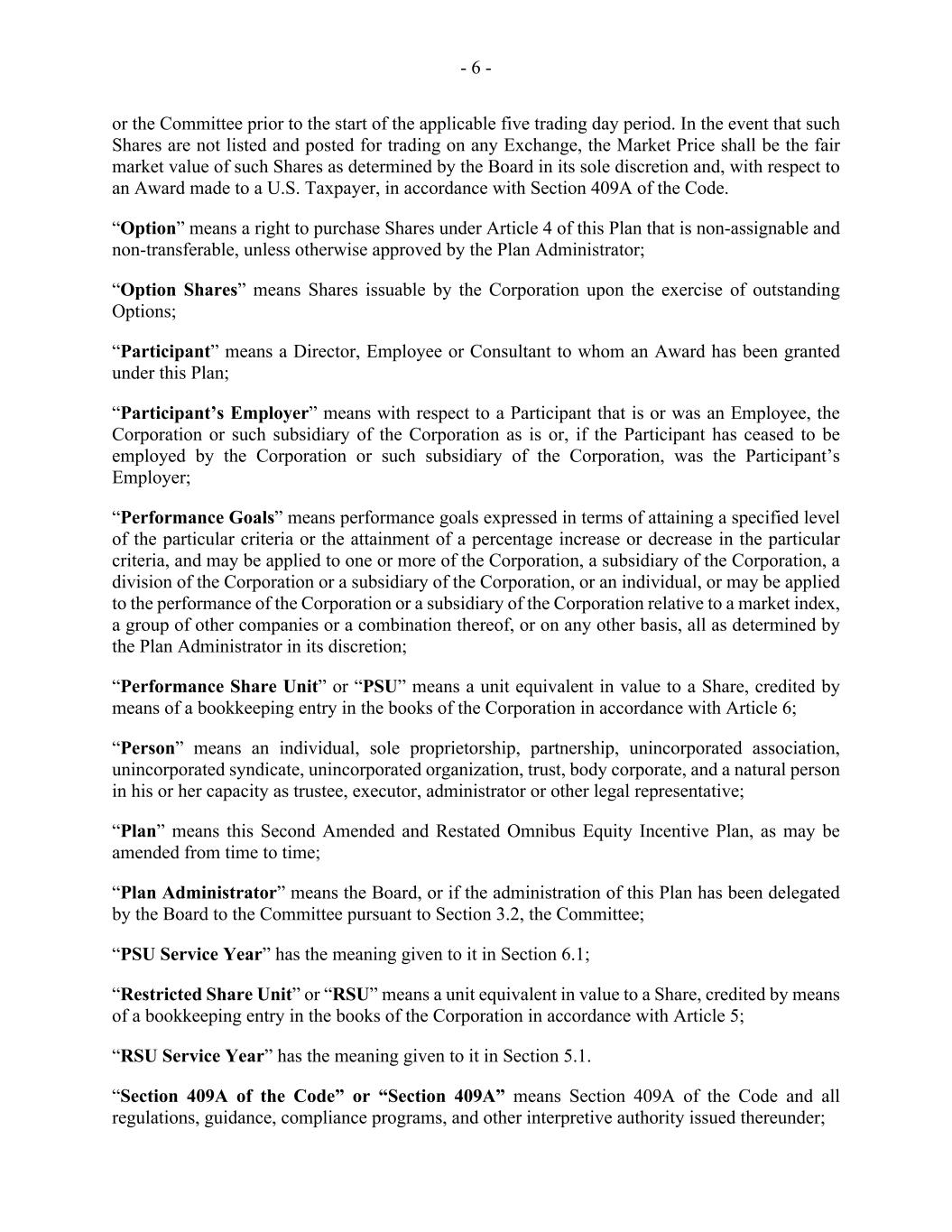
- 6 - or the Committee prior to the start of the applicable five trading day period. In the event that such Shares are not listed and posted for trading on any Exchange, the Market Price shall be the fair market value of such Shares as determined by the Board in its sole discretion and, with respect to an Award made to a U.S. Taxpayer, in accordance with Section 409A of the Code. “Option” means a right to purchase Shares under Article 4 of this Plan that is non-assignable and non-transferable, unless otherwise approved by the Plan Administrator; “Option Shares” means Shares issuable by the Corporation upon the exercise of outstanding Options; “Participant” means a Director, Employee or Consultant to whom an Award has been granted under this Plan; “Participant’s Employer” means with respect to a Participant that is or was an Employee, the Corporation or such subsidiary of the Corporation as is or, if the Participant has ceased to be employed by the Corporation or such subsidiary of the Corporation, was the Participant’s Employer; “Performance Goals” means performance goals expressed in terms of attaining a specified level of the particular criteria or the attainment of a percentage increase or decrease in the particular criteria, and may be applied to one or more of the Corporation, a subsidiary of the Corporation, a division of the Corporation or a subsidiary of the Corporation, or an individual, or may be applied to the performance of the Corporation or a subsidiary of the Corporation relative to a market index, a group of other companies or a combination thereof, or on any other basis, all as determined by the Plan Administrator in its discretion; “Performance Share Unit” or “PSU” means a unit equivalent in value to a Share, credited by means of a bookkeeping entry in the books of the Corporation in accordance with Article 6; “Person” means an individual, sole proprietorship, partnership, unincorporated association, unincorporated syndicate, unincorporated organization, trust, body corporate, and a natural person in his or her capacity as trustee, executor, administrator or other legal representative; “Plan” means this Second Amended and Restated Omnibus Equity Incentive Plan, as may be amended from time to time; “Plan Administrator” means the Board, or if the administration of this Plan has been delegated by the Board to the Committee pursuant to Section 3.2, the Committee; “PSU Service Year” has the meaning given to it in Section 6.1; “Restricted Share Unit” or “RSU” means a unit equivalent in value to a Share, credited by means of a bookkeeping entry in the books of the Corporation in accordance with Article 5; “RSU Service Year” has the meaning given to it in Section 5.1. “Section 409A of the Code” or “Section 409A” means Section 409A of the Code and all regulations, guidance, compliance programs, and other interpretive authority issued thereunder;


- 7 - “Securities Laws” means securities legislation, securities regulation and securities rules, as amended, and the policies, notices, instruments and blanket orders in force from time to time that govern or are applicable to the Corporation or to which it is subject; “Security Based Compensation Arrangement” means a stock option, stock option plan, employee stock purchase plan or any other compensation or incentive mechanism involving the issuance or potential issuance of Shares to Directors, officers, Employees and/or service providers of the Corporation or any subsidiary of the Corporation, including a share purchase from treasury which is financially assisted by the Corporation by way of a loan, guarantee or otherwise; “Share” means one (1) common share in the capital of the Corporation as constituted on the Effective Date or any share or shares issued in replacement of such common share in compliance with Canadian law or other applicable law, and/or one share of any additional class of common shares in the capital of the Corporation as may exist from time to time, or after an adjustment contemplated by Article 10, such other shares or securities to which the holder of an Award may be entitled as a result of such adjustment; “subsidiary” means an issuer that is Controlled directly or indirectly by another issuer and includes a subsidiary of that subsidiary, or any other entity in which the Corporation has an equity interest and is designated by the Plan Administrator, from time to time, for purposes of this Plan to be a subsidiary; “Tax Act” has the meaning set forth in Section 4.5(c); “Termination Date” means, subject to applicable law which cannot be waived: (a) in the case of an Employee whose employment with the Corporation or a subsidiary of the Corporation terminates, (i) the date designated by the Employee and the Corporation or a subsidiary of the Corporation as the “Termination Date” (or similar term) in a written employment or other agreement between the Employee and Corporation or a subsidiary of the Corporation, or (ii) if no such written employment or other agreement exists, the date designated by the Corporation or a subsidiary of the Corporation, as the case may be, on which the Employee ceases to be an employee of the Corporation or the subsidiary of the Corporation, as the case may be, provided that, in the case of termination of employment by voluntary resignation by the Participant, such date shall not be earlier than the date notice of resignation was given; and in any event, the “Termination Date” shall be determined without including any period of reasonable notice that the Corporation or the subsidiary of the Corporation (as the case may be) may be required by law to provide to the Participant or any pay in lieu of notice of termination, severance pay or other damages paid or payable to the Participant; (b) in the case of a Consultant whose agreement or arrangement with the Corporation or a subsidiary of the Corporation terminates, (i) the date designated by the Corporation or the subsidiary of the Corporation, as the “Termination Date” (or similar term) or expiry date in a written agreement between the Consultant and Corporation or a subsidiary of the Corporation, or (ii) if no such written agreement exists, the date designated by the Corporation or a subsidiary of the Corporation, as the case may be, on which the Consultant ceases to be a Consultant or a service


- 8 - provider to the Corporation or the subsidiary of the Corporation, as the case may be, or on which the Participant’s agreement or arrangement is terminated, provided that in the case of voluntary termination by the Participant of the Participant’s consulting agreement or other written arrangement, such date shall not be earlier than the date notice of voluntary termination was given; in any event, the “Termination Date” shall be determined without including any period of notice that the Corporation or the subsidiary of the Corporation (as the case may be) may be required by law to provide to the Participant or any pay in lieu of notice of termination, termination fees or other damages paid or payable to the Participant; (c) in the case of a Director, the date such individual ceases to be a Director, unless the individual continues to be a Participant in another capacity; and (d) in the case of a U.S. Taxpayer, a Participant’s “Termination Date” will be the date the Participant experiences a “separation from service” with the Corporation or a subsidiary of the Corporation within the meaning of Section 409A of the Code. “TSX” means the Toronto Stock Exchange; “U.S.” or “United States” means the United States of America, its territories and possessions, any State of the United States, and the District of Columbia; “U.S. Securities Act” means the United States Securities Act of 1933, as amended and the rules and regulations promulgated thereunder; and “U.S. Taxpayer” shall mean a Participant who, with respect to an Award, is subject to taxation under the applicable U.S. tax laws. 2.2 Interpretation (a) Whenever the Plan Administrator exercises discretion in the administration of this Plan, the term “discretion” means the sole and absolute discretion of the Plan Administrator. (b) As used herein, the terms “Article”, “Section”, “Subsection” and “clause” mean and refer to the specified Article, Section, Subsection and clause of this Plan, respectively. (c) Words importing the singular include the plural and vice versa and words importing any gender include any other gender. (d) Unless otherwise specified, time periods within or following which any payment is to be made or act is to be done shall be calculated by excluding the day on which the period begins, including the day on which the period ends, and abridging the period to the immediately preceding Business Day in the event that the last day of the period is not a Business Day. In the event an action is required to be taken or a payment is required to be made on a day which is not a Business Day such action shall be taken or such payment shall be made by the immediately preceding Business Day.


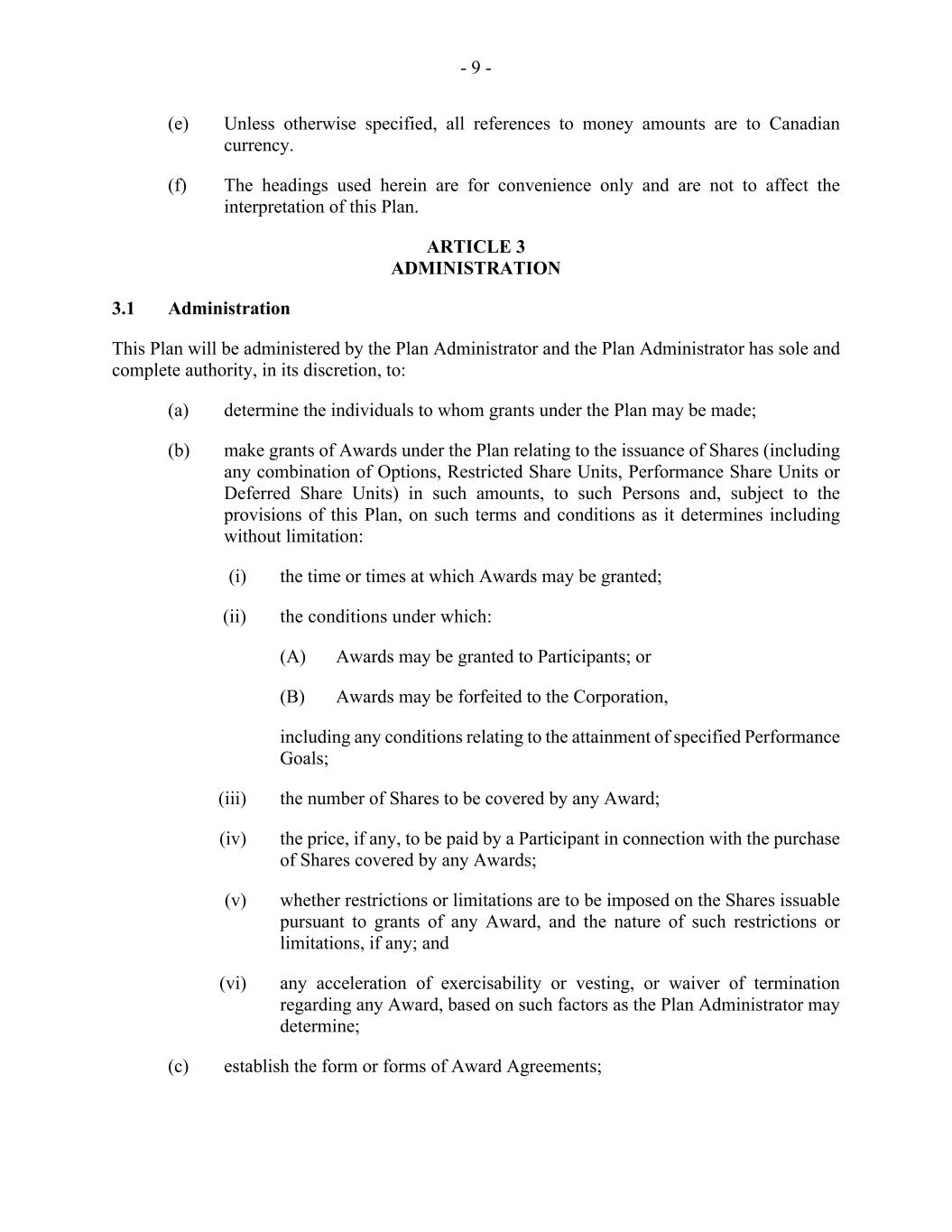
- 9 - (e) Unless otherwise specified, all references to money amounts are to Canadian currency. (f) The headings used herein are for convenience only and are not to affect the interpretation of this Plan. ARTICLE 3 ADMINISTRATION 3.1 Administration This Plan will be administered by the Plan Administrator and the Plan Administrator has sole and complete authority, in its discretion, to: (a) determine the individuals to whom grants under the Plan may be made; (b) make grants of Awards under the Plan relating to the issuance of Shares (including any combination of Options, Restricted Share Units, Performance Share Units or Deferred Share Units) in such amounts, to such Persons and, subject to the provisions of this Plan, on such terms and conditions as it determines including without limitation: (i) the time or times at which Awards may be granted; (ii) the conditions under which: (A) Awards may be granted to Participants; or (B) Awards may be forfeited to the Corporation, including any conditions relating to the attainment of specified Performance Goals; (iii) the number of Shares to be covered by any Award; (iv) the price, if any, to be paid by a Participant in connection with the purchase of Shares covered by any Awards; (v) whether restrictions or limitations are to be imposed on the Shares issuable pursuant to grants of any Award, and the nature of such restrictions or limitations, if any; and (vi) any acceleration of exercisability or vesting, or waiver of termination regarding any Award, based on such factors as the Plan Administrator may determine; (c) establish the form or forms of Award Agreements;


- 10 - (d) cancel, amend, adjust or otherwise change any Award under such circumstances as the Plan Administrator may consider appropriate in accordance with the provisions of this Plan; (e) construe and interpret this Plan and all Award Agreements; (f) adopt, amend, prescribe and rescind administrative guidelines and other rules and regulations relating to this Plan, including rules and regulations relating to sub- plans established for the purpose of satisfying applicable foreign laws or for qualifying for favorable tax treatment under applicable foreign laws; and (g) make all other determinations and take all other actions necessary or advisable for the implementation and administration of this Plan. 3.2 Delegation to Committee (a) The initial Plan Administrator shall be the Board. (b) To the extent permitted by applicable law, the Board may, from time to time, delegate to a committee of the Board (the “Committee”) all or any of the powers conferred on the Plan Administrator pursuant to this Plan, including the power to sub-delegate to any member(s) of the Committee or any specified officer(s) of the Corporation or its subsidiaries all or any of the powers delegated by the Board. In such event, the Committee or any sub-delegate will exercise the powers delegated to it in the manner and on the terms authorized by the delegating party. Any decision made or action taken by the Committee or any sub-delegate arising out of or in connection with the administration or interpretation of this Plan in this context is final and conclusive and binding on the Corporation and all subsidiaries of the Corporation, all Participants and all other Persons. 3.3 Determinations Binding Any decision made or action taken by the Board, the Committee or any sub-delegate to whom authority has been delegated pursuant to Section 3.2 arising out of or in connection with the administration or interpretation of this Plan is final, conclusive and binding on the Corporation, the affected Participant(s), their legal and personal representatives and all other Persons. 3.4 Eligibility All Directors, Employees and Consultants are eligible to participate in the Plan, subject to Section 9.1(e). Participation in the Plan is voluntary and eligibility to participate does not confer upon any Director, Employee or Consultant any right to receive any grant of an Award pursuant to the Plan. The extent to which any Director, Employee or Consultant is entitled to receive a grant of an Award pursuant to the Plan will be determined in the sole and absolute discretion of the Plan Administrator.


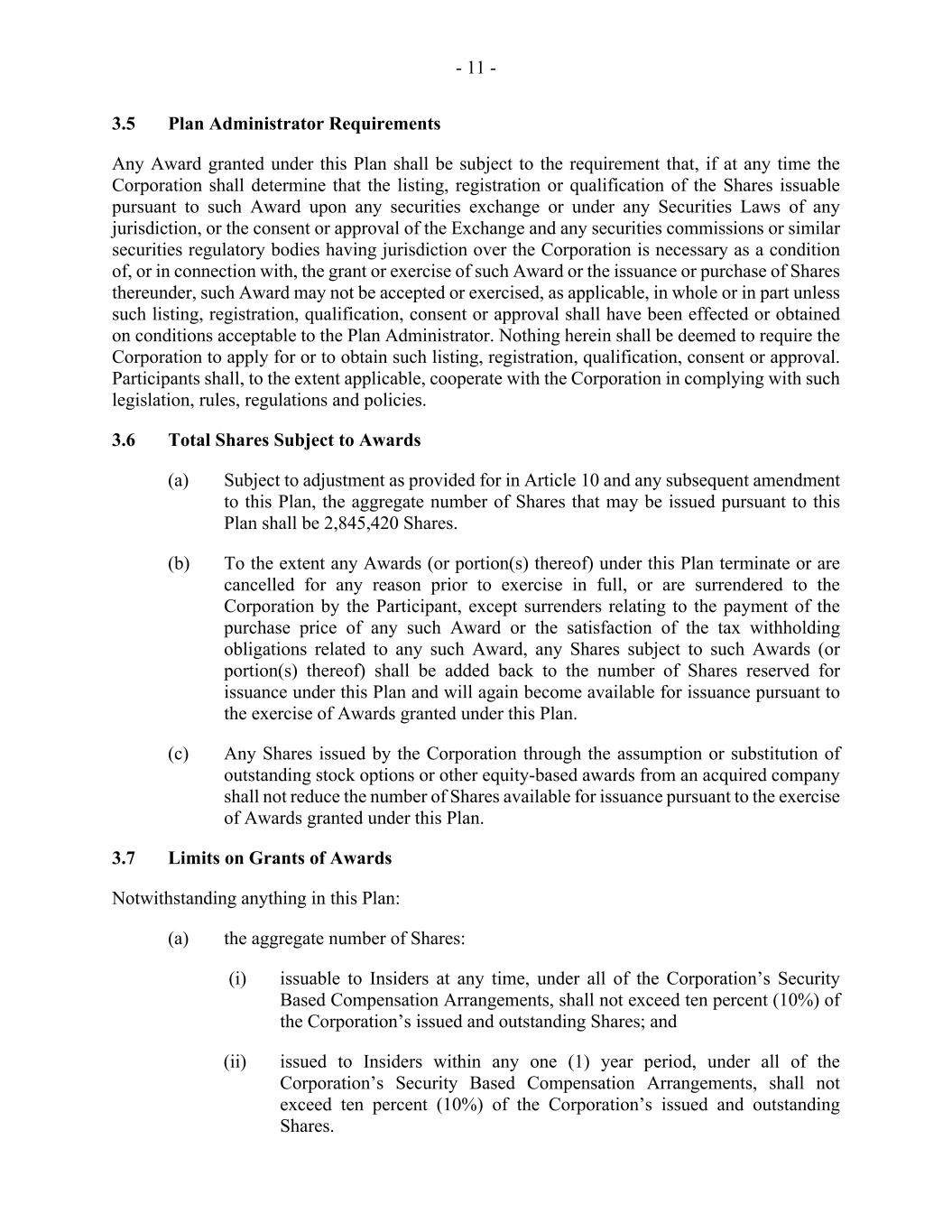
- 11 - 3.5 Plan Administrator Requirements Any Award granted under this Plan shall be subject to the requirement that, if at any time the Corporation shall determine that the listing, registration or qualification of the Shares issuable pursuant to such Award upon any securities exchange or under any Securities Laws of any jurisdiction, or the consent or approval of the Exchange and any securities commissions or similar securities regulatory bodies having jurisdiction over the Corporation is necessary as a condition of, or in connection with, the grant or exercise of such Award or the issuance or purchase of Shares thereunder, such Award may not be accepted or exercised, as applicable, in whole or in part unless such listing, registration, qualification, consent or approval shall have been effected or obtained on conditions acceptable to the Plan Administrator. Nothing herein shall be deemed to require the Corporation to apply for or to obtain such listing, registration, qualification, consent or approval. Participants shall, to the extent applicable, cooperate with the Corporation in complying with such legislation, rules, regulations and policies. 3.6 Total Shares Subject to Awards (a) Subject to adjustment as provided for in Article 10 and any subsequent amendment to this Plan, the aggregate number of Shares that may be issued pursuant to this Plan shall be 2,845,420 Shares. (b) To the extent any Awards (or portion(s) thereof) under this Plan terminate or are cancelled for any reason prior to exercise in full, or are surrendered to the Corporation by the Participant, except surrenders relating to the payment of the purchase price of any such Award or the satisfaction of the tax withholding obligations related to any such Award, any Shares subject to such Awards (or portion(s) thereof) shall be added back to the number of Shares reserved for issuance under this Plan and will again become available for issuance pursuant to the exercise of Awards granted under this Plan. (c) Any Shares issued by the Corporation through the assumption or substitution of outstanding stock options or other equity-based awards from an acquired company shall not reduce the number of Shares available for issuance pursuant to the exercise of Awards granted under this Plan. 3.7 Limits on Grants of Awards Notwithstanding anything in this Plan: (a) the aggregate number of Shares: (i) issuable to Insiders at any time, under all of the Corporation’s Security Based Compensation Arrangements, shall not exceed ten percent (10%) of the Corporation’s issued and outstanding Shares; and (ii) issued to Insiders within any one (1) year period, under all of the Corporation’s Security Based Compensation Arrangements, shall not exceed ten percent (10%) of the Corporation’s issued and outstanding Shares.


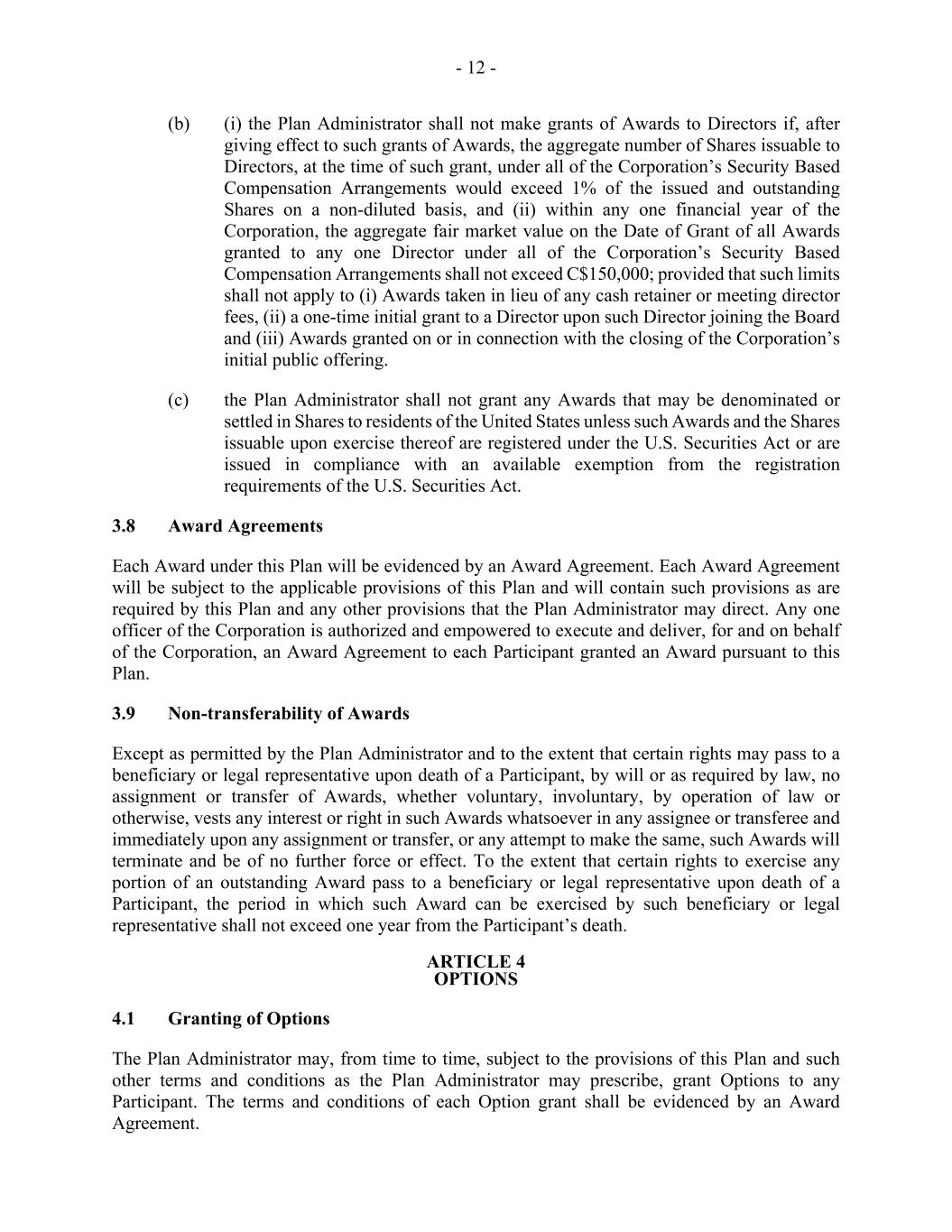
- 12 - (b) (i) the Plan Administrator shall not make grants of Awards to Directors if, after giving effect to such grants of Awards, the aggregate number of Shares issuable to Directors, at the time of such grant, under all of the Corporation’s Security Based Compensation Arrangements would exceed 1% of the issued and outstanding Shares on a non-diluted basis, and (ii) within any one financial year of the Corporation, the aggregate fair market value on the Date of Grant of all Awards granted to any one Director under all of the Corporation’s Security Based Compensation Arrangements shall not exceed C$150,000; provided that such limits shall not apply to (i) Awards taken in lieu of any cash retainer or meeting director fees, (ii) a one-time initial grant to a Director upon such Director joining the Board and (iii) Awards granted on or in connection with the closing of the Corporation’s initial public offering. (c) the Plan Administrator shall not grant any Awards that may be denominated or settled in Shares to residents of the United States unless such Awards and the Shares issuable upon exercise thereof are registered under the U.S. Securities Act or are issued in compliance with an available exemption from the registration requirements of the U.S. Securities Act. 3.8 Award Agreements Each Award under this Plan will be evidenced by an Award Agreement. Each Award Agreement will be subject to the applicable provisions of this Plan and will contain such provisions as are required by this Plan and any other provisions that the Plan Administrator may direct. Any one officer of the Corporation is authorized and empowered to execute and deliver, for and on behalf of the Corporation, an Award Agreement to each Participant granted an Award pursuant to this Plan. 3.9 Non-transferability of Awards Except as permitted by the Plan Administrator and to the extent that certain rights may pass to a beneficiary or legal representative upon death of a Participant, by will or as required by law, no assignment or transfer of Awards, whether voluntary, involuntary, by operation of law or otherwise, vests any interest or right in such Awards whatsoever in any assignee or transferee and immediately upon any assignment or transfer, or any attempt to make the same, such Awards will terminate and be of no further force or effect. To the extent that certain rights to exercise any portion of an outstanding Award pass to a beneficiary or legal representative upon death of a Participant, the period in which such Award can be exercised by such beneficiary or legal representative shall not exceed one year from the Participant’s death. ARTICLE 4 OPTIONS 4.1 Granting of Options The Plan Administrator may, from time to time, subject to the provisions of this Plan and such other terms and conditions as the Plan Administrator may prescribe, grant Options to any Participant. The terms and conditions of each Option grant shall be evidenced by an Award Agreement.


- 13 - 4.2 Exercise Price The Plan Administrator will establish the Exercise Price at the time each Option is granted, which Exercise Price must in all cases be not less than the Market Price on the Date of Grant. 4.3 Term of Options Subject to any accelerated vesting or termination as set forth in this Plan, each Option expires on its Expiry Date. 4.4 Vesting and Exercisability (a) The Plan Administrator shall have the authority to determine the vesting terms applicable to grants of Options. (b) Once an Option becomes vested, it shall remain vested and shall be exercisable until expiration or termination of the Option, unless otherwise specified by the Plan Administrator, or as may be otherwise set forth in any written employment agreement, Award Agreement or other written agreement between the Corporation or a subsidiary of the Corporation and the Participant. Each vested Option may be exercised at any time or from time to time, in whole or in part, for up to the total number of Option Shares with respect to which it is then exercisable. The Plan Administrator has the right to accelerate the date upon which any Option becomes exercisable. (c) Subject to the provisions of this Plan and any Award Agreement, Options shall be exercised by means of a fully completed Exercise Notice delivered to the Corporation. (d) The Plan Administrator may provide at the time of granting an Option that the exercise of that Option is subject to restrictions, in addition to those specified in this Section 4.4, such as vesting conditions relating to the attainment of specified Performance Goals. (e) No Option holder who is resident in the United States may exercise Options unless the Option Shares are registered under the U.S. Securities Act or are issued in compliance with an available exemption from the registration requirements of the U.S. Securities Act. 4.5 Payment of Exercise Price (a) Unless otherwise specified by the Plan Administrator at the time of granting an Option and set forth in the particular Award Agreement, the Exercise Notice must be accompanied by payment of the Exercise Price. The Exercise Price must be fully paid by certified cheque, wire transfer, bank draft or money order payable to the Corporation or by such other means as might be specified from time to time by the Plan Administrator, which may include (i) through an arrangement with a broker approved by the Corporation (or through an arrangement directly with the Corporation) whereby payment of the Exercise Price is accomplished with the


- 14 - proceeds of the sale of Shares deliverable upon the exercise of the Option, (ii) through the cashless exercise process set out in Section 4.5(b), or (iii) such other consideration and method of payment for the issuance of Shares to the extent permitted by Securities Laws, or any combination of the foregoing methods of payment. (b) A Participant may, in lieu of exercising an Option pursuant to an Exercise Notice, elect to surrender such Option to the Corporation (a “Cashless Exercise”) in consideration for an amount from the Corporation equal to (i) the Market Price of the Shares issuable on the exercise of such Option (or portion thereof) as of the date such Option (or portion thereof) is exercised, less (ii) the aggregate Exercise Price of the Option (or portion thereof) surrendered relating to such Shares, (the “In-the- Money Amount”) by written notice to the Corporation indicating the number of Options such Participant wishes to exercise using the Cashless Exercise, and such other information that the Corporation may require. Subject to Section 8.3, the Corporation shall satisfy payment of the In-the-Money Amount by delivering to the Participant such number of Shares (rounded down to the nearest whole number) having a fair market value equal to the In-the-Money Amount. Any Options surrendered in connection with a Cashless Exercise will not be added back to the number of Shares reserved for issuance under this Plan. No Shares will be issued or transferred until full payment therefor has been received by the Corporation. (c) If a Participant surrenders Options through a Cashless Exercise pursuant to Section 4.5(b), to the extent that such Participant would be entitled to a deduction under paragraph 110(1)(d) of the Income Tax Act (Canada) (the “Tax Act”) in respect of such surrender if the election described in subsection 110(1.1) of the Tax Act were made and filed (and the other procedures described therein were undertaken) on a timely basis after such surrender, the Corporation will cause such election to be so made and filed (and such other procedures to be so undertaken). ARTICLE 5 RESTRICTED SHARE UNITS 5.1 Granting of RSUs (a) The Plan Administrator may, from time to time, subject to the provisions of this Plan and such other terms and conditions as the Plan Administrator may prescribe, grant RSUs to any Participant in respect of a bonus or similar payment in respect of services rendered by the applicable Participant in a taxation year (the “RSU Service Year”). The terms and conditions of each RSU grant may be evidenced by an Award Agreement. Each RSU will consist of a right to receive a Share, cash payment, or a combination thereof (as provided in Section 5.4(a)), upon the settlement of such RSU. (b) The number of RSUs (including fractional RSUs) granted at any particular time pursuant to this Article 5 will be calculated by dividing (i) the amount of any bonus or similar payment that is to be paid in RSUs, as determined by the Plan Administrator, by (ii) the greater of (A) the Market Price of a Share on the Date of


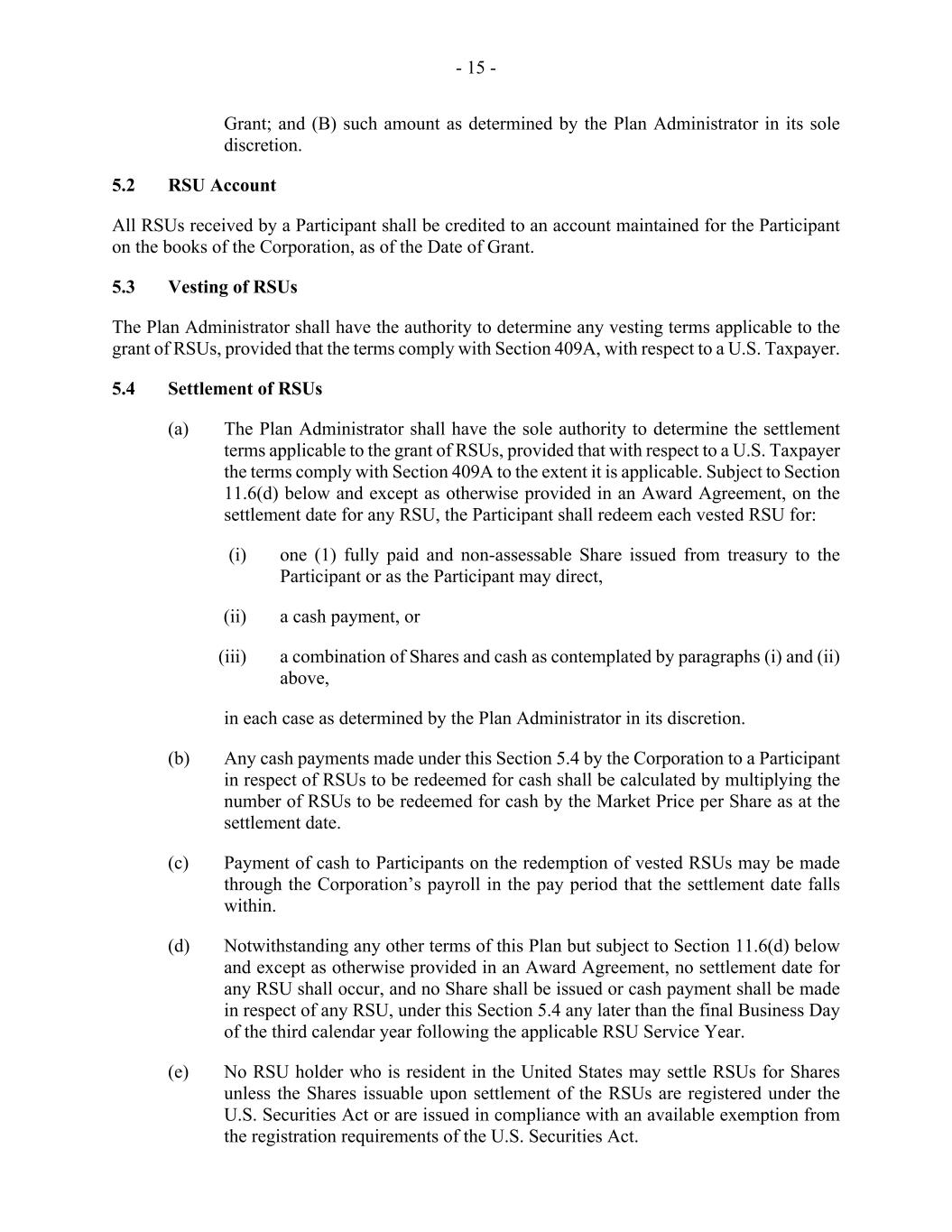
- 15 - Grant; and (B) such amount as determined by the Plan Administrator in its sole discretion. 5.2 RSU Account All RSUs received by a Participant shall be credited to an account maintained for the Participant on the books of the Corporation, as of the Date of Grant. 5.3 Vesting of RSUs The Plan Administrator shall have the authority to determine any vesting terms applicable to the grant of RSUs, provided that the terms comply with Section 409A, with respect to a U.S. Taxpayer. 5.4 Settlement of RSUs (a) The Plan Administrator shall have the sole authority to determine the settlement terms applicable to the grant of RSUs, provided that with respect to a U.S. Taxpayer the terms comply with Section 409A to the extent it is applicable. Subject to Section 11.6(d) below and except as otherwise provided in an Award Agreement, on the settlement date for any RSU, the Participant shall redeem each vested RSU for: (i) one (1) fully paid and non-assessable Share issued from treasury to the Participant or as the Participant may direct, (ii) a cash payment, or (iii) a combination of Shares and cash as contemplated by paragraphs (i) and (ii) above, in each case as determined by the Plan Administrator in its discretion. (b) Any cash payments made under this Section 5.4 by the Corporation to a Participant in respect of RSUs to be redeemed for cash shall be calculated by multiplying the number of RSUs to be redeemed for cash by the Market Price per Share as at the settlement date. (c) Payment of cash to Participants on the redemption of vested RSUs may be made through the Corporation’s payroll in the pay period that the settlement date falls within. (d) Notwithstanding any other terms of this Plan but subject to Section 11.6(d) below and except as otherwise provided in an Award Agreement, no settlement date for any RSU shall occur, and no Share shall be issued or cash payment shall be made in respect of any RSU, under this Section 5.4 any later than the final Business Day of the third calendar year following the applicable RSU Service Year. (e) No RSU holder who is resident in the United States may settle RSUs for Shares unless the Shares issuable upon settlement of the RSUs are registered under the U.S. Securities Act or are issued in compliance with an available exemption from the registration requirements of the U.S. Securities Act.


- 16 - ARTICLE 6 PERFORMANCE SHARE UNITS 6.1 Granting of PSUs The Plan Administrator may, from time to time, subject to the provisions of this Plan and such other terms and conditions as the Plan Administrator may prescribe, grant PSUs to any Participant in respect of a bonus or similar payment in respect of services rendered by the applicable Participant in a taxation year (the “PSU Service Year”). The terms and conditions of each PSU grant shall be evidenced by an Award Agreement, provided that with respect to a U.S. Taxpayer the terms comply with Section 409A to the extent it is applicable. Each PSU will consist of a right to receive a Share, cash payment, or a combination thereof (as provided in Section 6.6(a)), upon the achievement of such Performance Goals during such performance periods as the Plan Administrator shall establish. 6.2 Terms of PSUs The Performance Goals to be achieved during any performance period, the length of any performance period, the amount of any PSUs granted, the termination of a Participant’s employment and the amount of any payment or transfer to be made pursuant to any PSU will be determined by the Plan Administrator and by the other terms and conditions of any PSU, all as set forth in the applicable Award Agreement. 6.3 Performance Goals The Plan Administrator will issue Performance Goals prior to the Date of Grant to which such Performance Goals pertain. The Performance Goals may be based upon the achievement of corporate, divisional or individual goals, and may be applied to performance relative to an index or comparator group, or on any other basis determined by the Plan Administrator. The Plan Administrator may modify the Performance Goals as necessary to align them with the Corporation’s corporate objectives, subject to any limitations set forth in an Award Agreement or an employment or other agreement with a Participant. The Performance Goals may include a threshold level of performance below which no payment will be made (or no vesting will occur), levels of performance at which specified payments will be made (or specified vesting will occur), and a maximum level of performance above which no additional payment will be made (or at which full vesting will occur), all as set forth in the applicable Award Agreement. 6.4 PSU Account All PSUs received by a Participant shall be credited to an account maintained for the Participant on the books of the Corporation, as of the Date of Grant. 6.5 Vesting of PSUs The Plan Administrator shall have the authority to determine any vesting terms applicable to the grant of PSUs.


- 17 - 6.6 Settlement of PSUs (a) The Plan Administrator shall have the authority to determine the settlement terms applicable to the grant of PSUs provided that with respect to a U.S. Taxpayer the terms comply with Section 409A to the extent it is applicable. Subject to Section 11.6(d) below and except as otherwise provided in an Award Agreement, on the settlement date for any PSU, the Participant shall redeem each vested PSU for: (i) one fully paid and non-assessable Share issued from treasury to the Participant or as the Participant may direct, (ii) a cash payment, or (iii) a combination of Shares and cash as contemplated by paragraphs (i) and (ii) above, in each case as determined by the Plan Administrator in its discretion. (b) Any cash payments made under this Section 6.6 by the Corporation to a Participant in respect of PSUs to be redeemed for cash shall be calculated by multiplying the number of PSUs to be redeemed for cash by the Market Price per Share as at the settlement date. (c) Payment of cash to Participants on the redemption of vested PSUs may be made through the Corporation’s payroll in the pay period that the settlement date falls within. (d) Notwithstanding any other terms of this Plan but subject to Section 11.6(d) below and except as otherwise provided in an Award Agreement, no settlement date for any PSU shall occur, and no Share shall be issued or cash payment shall be made in respect of any PSU, under this Section 6.6 any later than the final Business Day of the third calendar year following the applicable PSU Service Year. (e) No PSU holder who is resident in the United States may settle PSUs for Shares unless the Shares issuable upon settlement of the PSUs are registered under the U.S. Securities Act or are issued in compliance with an available exemption from the registration requirements of the U.S. Securities Act. ARTICLE 7 DEFERRED SHARE UNITS 7.1 Granting of DSUs (a) The Board may fix from time to time a portion of the Director Fees that is to be payable in the form of DSUs. In addition, each Electing Person is given, subject to the conditions stated herein, the right to elect in accordance with Section 7.1(b) to participate in the grant of additional DSUs pursuant to this Article 7. An Electing Person who elects to participate in the grant of additional DSUs pursuant to this Article 7 shall receive their Elected Amount (as that term is defined below) in the form of DSUs. The “Elected Amount” shall be an amount, as elected by the


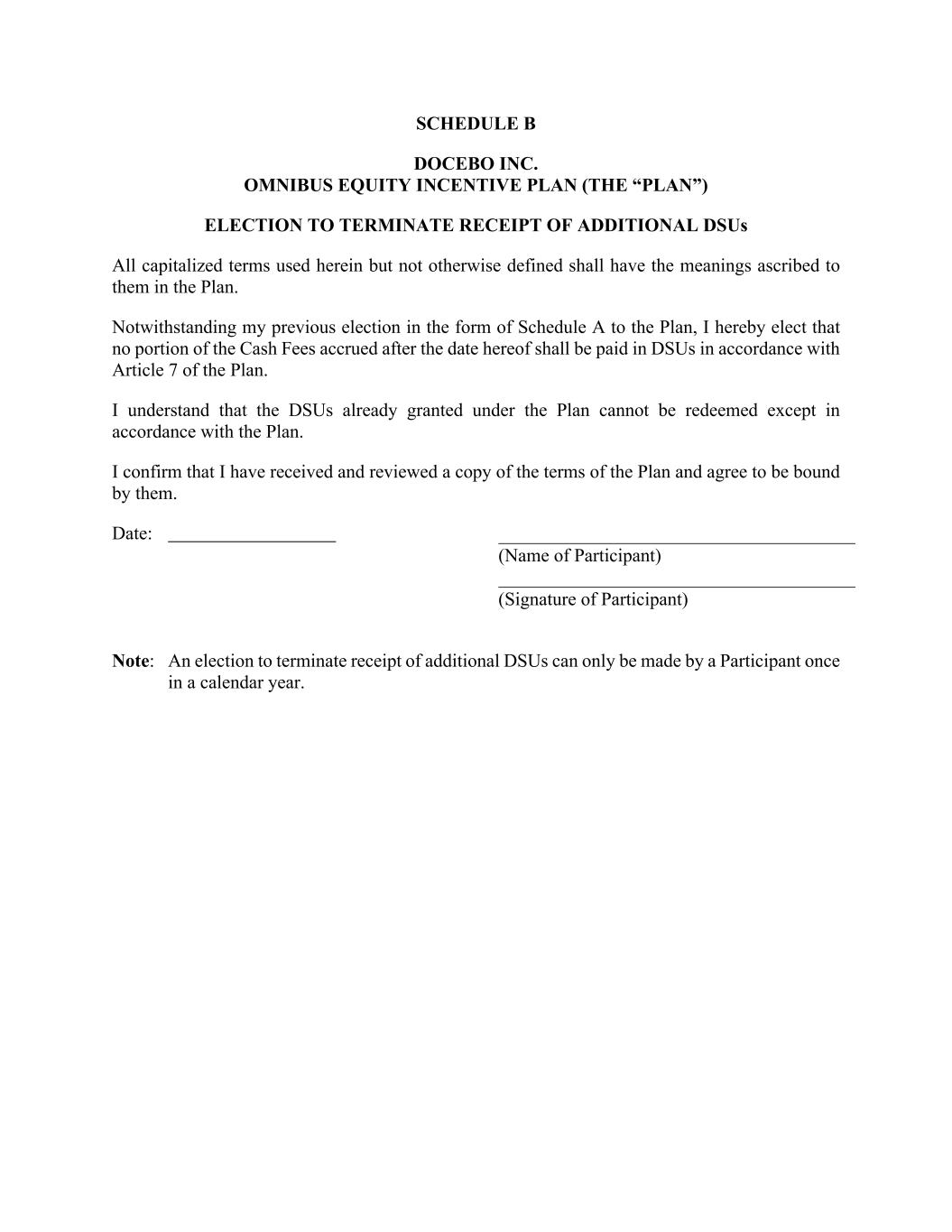
- 18 - Director, in accordance with applicable tax law, between 0% and 100% of any Director Fees that would otherwise be paid in cash (the “Cash Fees”). (b) Each Electing Person who elects to receive their Elected Amount in the form of DSUs will be required to file a notice of election in the form of Schedule A hereto (the “Election Notice”) with the Chief Financial Officer of the Corporation: (i) in the case of an existing Electing Person, by December 31st in the year prior to the year to which such election is to apply (other than for Director Fees payable for the 2019 financial year, in which case any Electing Person who is not a U.S. Taxpayer as of the date of this Plan shall file the Election Notice by the date that is 30 days from the Effective Date with respect to compensation paid for services to be performed after such date); and (ii) in the case of a newly appointed Electing Person who is not a U.S. Taxpayer, within 30 days of such appointment with respect to compensation paid for services to be performed after such date. In the case of an existing Electing Person who is a U.S. Taxpayer as of the Effective Date of this Plan, an initial Election Notice may be filed by the date that is 30 days from the Effective Date only with respect to compensation paid for services to be performed after the Election Date; and, in the case of a newly appointed Electing Person who is a U.S. Taxpayer, an Election Notice may be filed within 30 days of such appointment only with respect to compensation paid for services to be performed after the Election Date. If no election is made within the foregoing time frames, the Electing Person shall be deemed to have elected to be paid the entire amount of his or her Cash Fees in cash. (c) Subject to Subsection 7.1(d), the election of an Electing Person under Subsection 7.1(b) shall be deemed to apply to all Cash Fees paid subsequent to the filing of the Election Notice, and such Electing Person is not required to file another Election Notice for subsequent calendar years. (d) Each Electing Person who is not a U.S. Taxpayer is entitled once per calendar year to terminate his or her election to receive DSUs by filing with the Chief Financial Officer of the Corporation a termination notice in the form of Schedule B. Such termination shall be effective immediately upon receipt of such notice, provided that the Corporation has not imposed a “black-out” on trading. Thereafter, any portion of such Electing Person’s Cash Fees payable or paid in the same calendar year and, subject to complying with Subsection 7.1(b), all subsequent calendar years shall be paid in cash. For greater certainty, to the extent an Electing Person terminates his or her participation in the grant of DSUs pursuant to this Article 7, he or she shall not be entitled to elect to receive the Elected Amount, or any other amount of his or her Cash Fees in DSUs again until the calendar year following the year in which the termination notice is delivered. An election by a U.S. Taxpayer to receive the Elected Amount in DSUs for any calendar year is irrevocable for that calendar year after the expiration of the election period for that year and any termination of the election will not take effect until the first day of the calendar year following the calendar year in which the termination notice in the form of Schedule C is delivered.


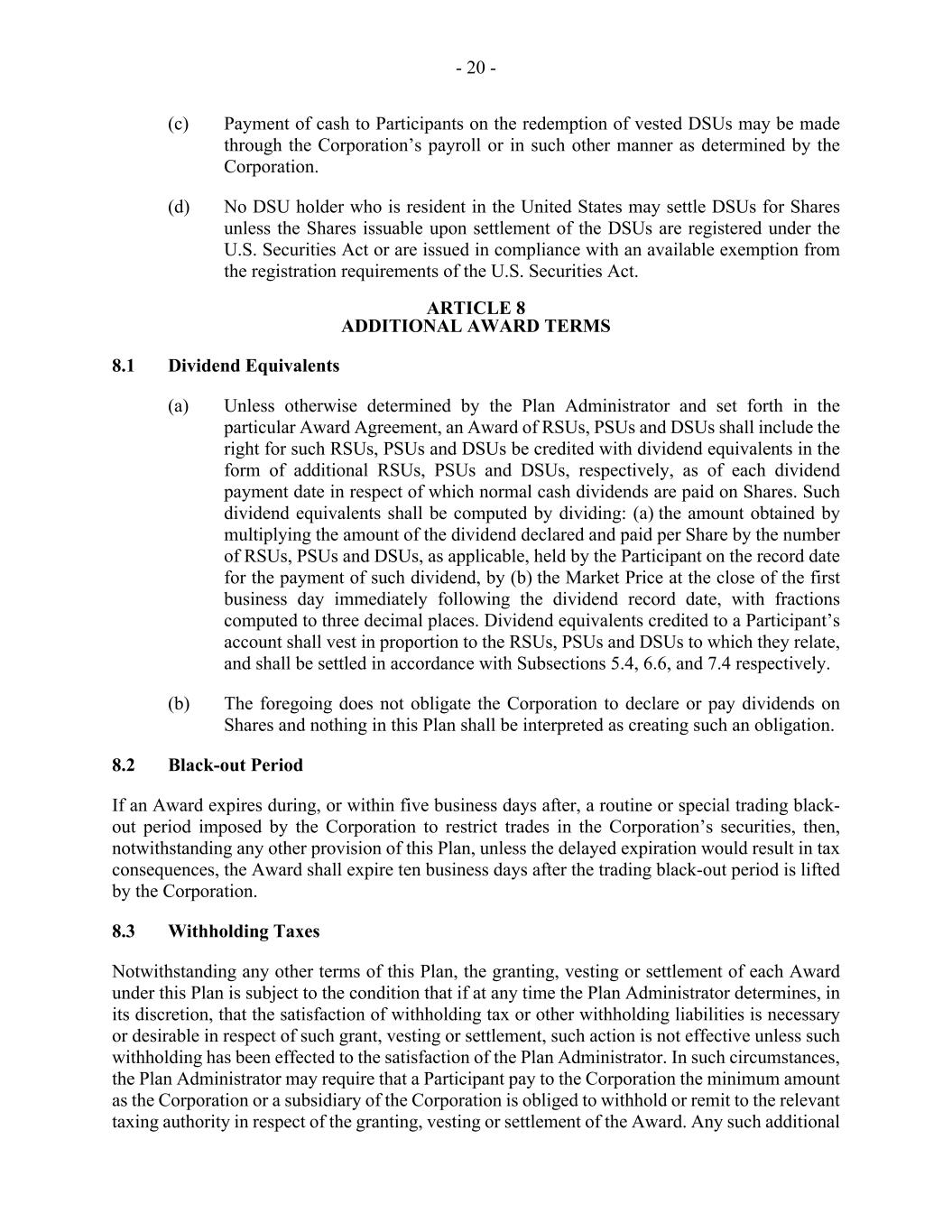
- 19 - (e) Any DSUs granted pursuant to this Article 7 prior to the delivery of a termination notice pursuant to Section 7.1(d) shall remain in the Plan following such termination and will be redeemable only in accordance with the terms of the Plan. (f) The number of DSUs (including fractional DSUs) granted at any particular time pursuant to this Article 7 will be calculated by dividing (i) the amount of any bonus or similar payment that are to be paid as DSUs, as determined by the Plan Administrator or Director Fees that are to be paid in DSUs (including any Elected Amount), by (ii) the Market Price of a Share on the Date of Grant. (g) In addition to the foregoing, the Plan Administrator may, from time to time, subject to the provisions of this Plan and such other terms and conditions as the Plan Administrator may prescribe, grant DSUs to any Participant. 7.2 DSU Account All DSUs received by a Participant (which, for greater certainty includes Electing Persons) shall be credited to an account maintained for the Participant on the books of the Corporation, as of the Date of Grant. The terms and conditions of each DSU grant shall be evidenced by an Award Agreement. 7.3 Vesting of DSUs Except as otherwise determined by the Plan Administrator, DSUs shall vest immediately upon grant. 7.4 Settlement of DSUs (a) DSUs shall be settled on the date established in the Award Agreement; provided, however that if there is no Award Agreement or the Award Agreement does not establish a date for the settlement of the DSUs, then, for a Participant who is not a U.S. Taxpayer the settlement date shall be the date determined by the Participant, and for a Participant who is a U.S. taxpayer, the settlement date shall be the date of the Participant’s “separation from service” under Section 409A and for greater certainty in all cases by the end of the year in which such separation from service occurs, subject to Section 11.6(d). On the settlement date for any DSU, the Participant shall redeem each vested DSU for: (i) one (1) fully paid and non-assessable Share issued from treasury to the Participant or as the Participant may direct; or (ii) at the election of the Participant and subject to the approval of the Plan Administrator, a cash payment. (b) Any cash payments made under this Section 7.4 by the Corporation to a Participant in respect of DSUs to be redeemed for cash shall be calculated by multiplying the number of DSUs to be redeemed for cash by the Market Price per Share as at the settlement date.


- 20 - (c) Payment of cash to Participants on the redemption of vested DSUs may be made through the Corporation’s payroll or in such other manner as determined by the Corporation. (d) No DSU holder who is resident in the United States may settle DSUs for Shares unless the Shares issuable upon settlement of the DSUs are registered under the U.S. Securities Act or are issued in compliance with an available exemption from the registration requirements of the U.S. Securities Act. ARTICLE 8 ADDITIONAL AWARD TERMS 8.1 Dividend Equivalents (a) Unless otherwise determined by the Plan Administrator and set forth in the particular Award Agreement, an Award of RSUs, PSUs and DSUs shall include the right for such RSUs, PSUs and DSUs be credited with dividend equivalents in the form of additional RSUs, PSUs and DSUs, respectively, as of each dividend payment date in respect of which normal cash dividends are paid on Shares. Such dividend equivalents shall be computed by dividing: (a) the amount obtained by multiplying the amount of the dividend declared and paid per Share by the number of RSUs, PSUs and DSUs, as applicable, held by the Participant on the record date for the payment of such dividend, by (b) the Market Price at the close of the first business day immediately following the dividend record date, with fractions computed to three decimal places. Dividend equivalents credited to a Participant’s account shall vest in proportion to the RSUs, PSUs and DSUs to which they relate, and shall be settled in accordance with Subsections 5.4, 6.6, and 7.4 respectively. (b) The foregoing does not obligate the Corporation to declare or pay dividends on Shares and nothing in this Plan shall be interpreted as creating such an obligation. 8.2 Black-out Period If an Award expires during, or within five business days after, a routine or special trading black- out period imposed by the Corporation to restrict trades in the Corporation’s securities, then, notwithstanding any other provision of this Plan, unless the delayed expiration would result in tax consequences, the Award shall expire ten business days after the trading black-out period is lifted by the Corporation. 8.3 Withholding Taxes Notwithstanding any other terms of this Plan, the granting, vesting or settlement of each Award under this Plan is subject to the condition that if at any time the Plan Administrator determines, in its discretion, that the satisfaction of withholding tax or other withholding liabilities is necessary or desirable in respect of such grant, vesting or settlement, such action is not effective unless such withholding has been effected to the satisfaction of the Plan Administrator. In such circumstances, the Plan Administrator may require that a Participant pay to the Corporation the minimum amount as the Corporation or a subsidiary of the Corporation is obliged to withhold or remit to the relevant taxing authority in respect of the granting, vesting or settlement of the Award. Any such additional


- 21 - payment is due no later than the date on which such amount with respect to the Award is required to be remitted to the relevant tax authority by the Corporation or a subsidiary of the Corporation, as the case may be. Alternatively, and subject to any requirements or limitations under applicable law, the Corporation or any Affiliate may (a) withhold such amount from any remuneration or other amount payable by the Corporation or any Affiliate to the Participant, (b) require the sale, on behalf of the applicable Participant, of a number of Shares issued upon exercise, vesting, or settlement of such Award and the remittance to the Corporation of the net proceeds from such sale sufficient to satisfy such amount, or (c) enter into any other suitable arrangements for the receipt of such amount. 8.4 Recoupment Notwithstanding any other terms of this Plan, Awards may be subject to potential cancellation, recoupment, rescission, payback or other action in accordance with the terms of any clawback, recoupment or similar policy adopted by the Corporation or the relevant subsidiary of the Corporation, or as set out in the Participant’s employment agreement, Award Agreement or other written agreement, or as otherwise required by law or the rules of the Exchange. The Plan Administrator may at any time waive the application of this Section 8.4 to any Participant or category of Participants. ARTICLE 9 TERMINATION OF EMPLOYMENT OR SERVICES 9.1 Termination of Employee, Consultant or Director Subject to Section 9.2, unless otherwise determined by the Plan Administrator or as set forth in an employment agreement, Award Agreement or other written agreement: (a) where a Participant’s employment, consulting or other agreement or arrangement is terminated or the Participant ceases to hold office or his or her position, as applicable, by reason of voluntary resignation by the Participant or termination by the Corporation or a subsidiary of the Corporation without Cause then, subject to applicable law that cannot be waived by the Participant: (i) each Award held by the Participant that has not vested as of the Termination Date is immediately forfeited and cancelled as of the Termination Date; and (ii) each Award held by a Participant that has vested may be exercised, settled or surrendered to the Corporation by the Participant at any time during the period that terminates on the earlier of: (A) the Expiry Date of such Award, and (B) the date that is 90 days after the Termination Date, provided that any Awards subject to Section 409A awarded to U.S. Taxpayers, shall be exercised, settled or surrendered within the same calendar year as the Participant’s “separation from service”. Any Award that has not been exercised, settled or surrendered at the end of such period being immediately forfeited and cancelled;


- 22 - (b) where a Participant’s employment, consulting or other agreement or arrangement is terminated o by the Corporation or a subsidiary of the Corporation for Cause then, subject to applicable law that cannot be waived by the Participant: (i) each Award held by the Participant that has not vested as of the Termination Date is immediately forfeited and cancelled as of the Termination Date; and (ii) each Award held by a Participant that has vested may be exercised, settled or surrendered to the Corporation by the Participant at any time during the period that terminates on the earlier of: (A) the Expiry Date of such Award, and (B) the date that is 15 days after the Termination Date, provided that any Awards subject to Section 409A awarded to U.S. Taxpayers, shall be exercised, settled or surrendered within the same calendar year as the Participant’s “separation from service”. Any Award that has not been exercised, settled or surrendered at the end of such period being immediately forfeited and cancelled; (c) where a Participant’s employment, consulting or other agreement or arrangement is terminated by reason of the death of the Participant, then each Award held by the Participant that has not vested as of the date of the death of such Participant but is scheduled to vest within the next year shall vest on such date and may be exercised, settled or surrendered to the Corporation by the Participant at any time during the period that terminates on the earlier of: (i) the Expiry Date of such Award, and (ii) the first anniversary of the date of the death of such Participant provided that any Awards subject to Section 409A awarded to U.S. Taxpayers, shall be exercised or surrendered within the same calendar year as the Participant’s death. Any Award that has not been exercised, settled or surrendered at the end of such period being immediately forfeited and cancelled. All other unvested Awards shall be immediately forfeited and cancelled; (d) where a Participant becomes Disabled, then each Award held by the Participant that has not vested as of the date of the Disability of such Participant and is scheduled to vest within the next year shall vest on such date and may be exercised or surrendered to the Corporation by a Participant at any time until the Expiry Date of such Award, provided that any Awards subject to Section 409A awarded to U.S. Taxpayers, shall be exercised or surrendered within the same calendar year as the Participant’s “separation from service”. Any Award that remains unexercised or has not been surrendered to the Corporation by the Participant shall be immediately forfeited upon the termination of such period. All other unvested Awards shall be immediately forfeited and cancelled; (e) a Participant’s eligibility to receive further grants of Awards under this Plan ceases as of the earliest of the following: (i) the Termination Date; (ii) the date that the Corporation or a subsidiary of the Corporation, as the case may be, provides the Participant with written notification that the


- 23 - Participant’s employment, consulting or other agreement or arrangement is terminated, notwithstanding that such date may be prior to the Termination Date; or (iii) the date of the death, Disability or the date notice is given of the resignation of the Participant; and (f) notwithstanding Subsection 9.1(a), Awards are not affected by a change of employment or directorship within or among the Corporation or a subsidiary of the Corporation so long as the Participant continues to be a Director or Employee, as applicable, of the Corporation or a subsidiary of the Corporation. For clarity, unless the Plan Administrator, in its discretion, determines otherwise, Awards will be forfeited and cancelled in accordance with Subsection 9.1(a) where a Participant ceases to be an Employee or Director but continues as (or transitions to) a Consultant of the Corporation or a subsidiary of the Corporation. 9.2 Discretion to Permit Acceleration Notwithstanding the provisions of Section 9.1, the Plan Administrator may, in its discretion, at any time prior to, or following the events contemplated in such Section, or in an employment agreement, Award Agreement or other written agreement between the Corporation or a subsidiary of the Corporation and the Participant, permit the acceleration of vesting of any or all Awards or waive termination of any or all Awards, all in the manner and on the terms as may be authorized by the Plan Administrator. ARTICLE 10 EVENTS AFFECTING THE CORPORATION 10.1 General The existence of any Awards does not affect in any way the right or power of the Corporation or its shareholders to make, authorize or determine any adjustment, recapitalization, reorganization or any other change in the Corporation’s capital structure or its business, or any amalgamation, combination, arrangement, merger or consolidation involving the Corporation, to create or issue any bonds, debentures, Shares or other securities of the Corporation or to determine the rights and conditions attaching thereto, to effect the dissolution or liquidation of the Corporation or any sale or transfer of all or any part of its assets or business, or to effect any other corporate act or proceeding, whether of a similar character or otherwise, whether or not any such action referred to in this Article 10 would have an adverse effect on this Plan or on any Award granted hereunder. 10.2 Change in Control Except as may be set forth in an employment agreement, Award Agreement or other written agreement between the Corporation or a subsidiary of the Corporation and the Participant: (a) Notwithstanding anything else in this Plan or any Award Agreement, the Plan Administrator may, without the consent of any Participant, take such steps as it deems necessary or desirable, including to cause (i) the conversion or exchange of any outstanding Awards into or for, rights or other securities of substantially


- 24 - equivalent value, as determined by the Plan Administrator in its discretion, in any entity participating in or resulting from a Change in Control; (ii) outstanding Awards to vest and become exercisable, realizable, or payable, or restrictions applicable to an Award to lapse, in whole or in part prior to or upon consummation of such merger or Change in Control, and, to the extent the Plan Administrator determines, terminate upon or immediately prior to the effectiveness of such merger or Change in Control; (iii) the termination of an Award in exchange for an amount of cash and/or property, if any, equal to the amount that would have been attained upon the exercise or settlement of such Award or realization of the Participant’s rights as of the date of the occurrence of the transaction (and, for the avoidance of doubt, if as of the date of the occurrence of the transaction the Plan Administrator determines in good faith that no amount would have been attained upon the exercise or settlement of such Award or realization of the Participant’s rights, then such Award may be terminated by the Corporation without payment); (iv) the replacement of such Award with other rights or property selected by the Board of Directors in its sole discretion; or (v) any combination of the foregoing. In taking any of the actions permitted under this Section 10.2(a), the Plan Administrator will not be required to treat all Awards similarly in the transaction. Notwithstanding the foregoing, in the case of Options held by a Canadian Taxpayer, the Plan Administrator may not cause the Canadian Taxpayer to receive (pursuant to this Subsection 10.2(a)) any property in connection with a Change in Control other than rights to acquire shares of a corporation or units of a “mutual fund trust” (as defined in the Tax Act), of the Corporation or a “qualifying person” (as defined in the Tax Act) that does not deal at arm’s length (for purposes of the Tax Act) with the Corporation, as applicable, at the time such rights are issued or granted. (b) Notwithstanding Section 9.1, and except as otherwise provided in a written employment or other agreement between the Corporation or a subsidiary of the Corporation and a Participant, if within 12 months following the completion of a transaction resulting in a Change in Control, a Participant’s employment, consultancy or directorship is terminated by the Corporation or a subsidiary of the Corporation without Cause: (i) any unvested Awards held by the Participant that have not been exercised, settled or surrendered as of the Termination Date shall immediately vest; and (ii) any vested Awards of Participants may be exercised, settled or surrendered to the Corporation by such Participant at any time during the period that terminates on the earlier of: (A) the Expiry Date of such Award; and (B) the date that is 90 days after the Termination Date, provided that any Awards subject to Section 409A awarded to U.S. Taxpayers, shall be exercised, settled or surrendered within the same calendar year as the Participant’s “separation from service”, with any Award that has not been exercised, settled or surrendered at the end of such period being immediately forfeited and cancelled.


- 25 - (c) Notwithstanding Subsection 10.2(a) and unless otherwise determined by the Plan Administrator, if, as a result of a Change in Control, the Shares will cease trading on an Exchange, then the Corporation may terminate all of the Awards, other than an Option held by a Participant that is a resident of Canada for the purposes of the Tax Act, granted under this Plan at the time of and subject to the completion of the Change in Control transaction by paying to each holder at or within a reasonable period of time following completion of such Change in Control transaction an amount for each Award equal to the fair market value of the Award held by such Participant as determined by the Plan Administrator, acting reasonably. (d) It is intended that any actions taken under this Section 10.2 will comply with the requirements of Section 409A of the Code with respect to Awards granted to U.S. Taxpayers. 10.3 Reorganization of Corporation’s Capital Should the Corporation effect a subdivision or consolidation of Shares or any similar capital reorganization or a payment of a stock dividend (other than a stock dividend that is in lieu of a cash dividend), or should any other change be made in the capitalization of the Corporation that does not constitute a Change in Control and that would warrant the amendment or replacement of any existing Awards in order to adjust the number of Shares that may be acquired on the vesting of outstanding Awards and/or the terms of any Award in order to preserve proportionately the rights and obligations of the Participants holding such Awards, the Plan Administrator will, subject to the prior approval of the Exchange, authorize such steps to be taken as it may consider to be equitable and appropriate to that end. 10.4 Other Events Affecting the Corporation In the event of an amalgamation, combination, arrangement, merger or other transaction or reorganization involving the Corporation and occurring by exchange of Shares, by sale or lease of assets or otherwise, that does not constitute a Change in Control and that warrants the amendment or replacement of any existing Awards in order to adjust the number of Shares that may be acquired on the vesting of outstanding Awards and/or the terms of any Award in order to preserve proportionately the rights and obligations of the Participants holding such Awards, the Plan Administrator will, subject to the prior approval of the Exchange, authorize such steps to be taken as it may consider to be equitable and appropriate to that end. 10.5 Immediate Acceleration of Awards In taking any of the steps provided in Sections 10.3 and 10.4, the Plan Administrator will not be required to treat all Awards similarly and where the Plan Administrator determines that the steps provided in Sections 10.3 and 10.4 would not preserve proportionately the rights, value and obligations of the Participants holding such Awards in the circumstances or otherwise determines that it is appropriate, the Plan Administrator may, but is not required to, permit the immediate vesting of any unvested Awards.


- 26 - 10.6 Issue by Corporation of Additional Shares Except as expressly provided in this Article 10, neither the issue by the Corporation of shares of any class or securities convertible into or exchangeable for shares of any class, nor the conversion or exchange of such shares or securities, affects, and no adjustment by reason thereof is to be made with respect to the number of Shares that may be acquired as a result of a grant of Awards. 10.7 Fractions No fractional Shares will be issued pursuant to an Award. Accordingly, if, as a result of any adjustment under this Article 10 or a dividend equivalent, a Participant would become entitled to a fractional Share, the Participant has the right to acquire only the adjusted number of full Shares and no payment or other adjustment will be made with respect to the fractional Shares, which shall be disregarded. ARTICLE 11 U.S. TAXPAYERS 11.1 Provisions for U.S. Taxpayers Options granted under this Plan to U.S. Taxpayers may be non-qualified stock options or incentive stock options qualifying under Section 422 of the Code (“ISOs”). Each Option shall be designated in the Award Agreement as either an ISO or a non-qualified stock option. The Corporation shall not be liable to any Participant or to any other Person if it is determined that an Option intended to be an ISO does not qualify as an ISO. Nonqualified stock options will be granted to a U.S. Taxayer only if (i) such U.S. Taxpayer performs services for the Corporation or any corporation or other entity in which the Corporation has a direct or indirect controlling interest or otherwise has a significant ownership interest, as determined under Section 409A, such that the Option will constitute an option to acquire “service recipient stock” within the meaning of Section 409A, or (ii) such option otherwise is exempt from Section 409A. 11.2 ISOs Subject to any limitations in Section 3.6, the aggregate number of Shares reserved for issuance in respect of granted ISOs shall not exceed 10,000,000 Shares, and the terms and conditions of any ISOs granted to a U.S. Taxpayer on the Date of Grant hereunder, including the eligible recipients of ISOs, shall be subject to the provisions of Section 422 of the Code, and the terms, conditions, limitations and administrative procedures established by the Plan Administrator from time to time in accordance with this Plan. At the discretion of the Plan Administrator, ISOs may be granted to any employee of the Corporation, or of a “parent corporation” or “subsidiary corporation”, as such terms are defined in Sections 424(e) and (f) of the Code. 11.3 ISO Grants to 10% Shareholders Notwithstanding anything to the contrary in this Plan, if an ISO is granted to a person who owns shares representing more than 10% of the voting power of all classes of shares of the Corporation or of a “parent corporation” or “subsidiary corporation”, as such terms are defined in Section 424(e) and (f) of the Code, on the Date of Grant, the term of the Option shall not exceed


- 27 - five years from the time of grant of such Option and the Exercise Price shall be at least 110% of the Market Price of the Shares subject to the Option. 11.4 $100,000 Per Year Limitation for ISOs To the extent the aggregate Market Price as at the Date of Grant of the Shares for which ISOs are exercisable for the first time by any person during any calendar year (under all plans of the Corporation) exceeds $100,000, such excess ISOs shall be treated as non-qualified stock options. 11.5 Disqualifying Dispositions Each person awarded an ISO under this Plan shall notify the Corporation in writing immediately after the date he or she makes a disposition or transfer of any Shares acquired pursuant to the exercise of such ISO if such disposition or transfer is made (a) within two years from the Date of Grant or (b) within one year after the date such person acquired the Shares. Such notice shall specify the date of such disposition or other transfer and the amount realized, in cash, other property, assumption of indebtedness or other consideration, by the person in such disposition or other transfer. The Corporation may, if determined by the Plan Administrator and in accordance with procedures established by it, retain possession of any Shares acquired pursuant to the exercise of an ISO as agent for the applicable person until the end of the later of the periods described in (a) or (b) above, subject to complying with any instructions from such person as to the sale of such Shares. 11.6 Section 409A of the Code (a) This Plan will be construed and interpreted to be exempt from, or where not so exempt, to comply with Section 409A of the Code to the extent required to preserve the intended tax consequences of this Plan. Any reference in this Plan to section 409A of the Code also include any regulation promulgated thereunder or any other formal guidance issued by the Internal Revenue Service with respect to section 409A of the Code. Each Award shall be construed and administered such that the Award either (A) qualifies for an exemption from the requirements of section 409A of the Code or (B) satisfies the requirements of section 409A of the Code. If an Award is subject to section 409A of the Code, (I) distributions shall only be made in a manner and upon an event permitted under section 409A of the Code, (II) payments to be made upon a termination of employment or service shall only be made upon a “separation from service” under section 409A of the Code, (III) unless the Award specifies otherwise, each installment payment shall be treated as a separate payment for purposes of section 409A of the Code, and (IV) in no event shall a Participant, directly or indirectly, designate the calendar year in which a distribution is made except in accordance with section 409A of the Code. To the extent that an Award or payment, or the settlement or deferral thereof, is subject to Section 409A of the Code, the Award will be granted, paid, settled or deferred in a manner that will meet the requirements of Section 409A of the Code, such that the grant, payment, settlement or deferral will not be subject to the additional tax or interest applicable under Section 409A of the Code. The Corporation reserves the right to amend this Plan to the extent it reasonably determines is necessary in order to preserve the intended tax consequences of this Plan in light of Section 409A of the Code. In no event will the Corporation or any of its subsidiaries or Affiliates be


- 28 - liable for any tax, interest or penalties that may be imposed on a Participant under Section 409A of the Code or any damages for failing to comply with Section 409A of the Code. (b) All terms of the Plan that are undefined or ambiguous must be interpreted in a manner that complies with Section 409A of the Code if necessary to comply with Section 409A of the Code. (c) The Plan Administrator, in its sole discretion, may permit the acceleration of the time or schedule of payment of a U.S. Taxpayer’s vested Awards in the Plan under circumstances that constitute permissible acceleration events under Section 409A of the Code. (d) Notwithstanding any provisions of the Plan to the contrary, in the case of any “specified employee” within the meaning of Section 409A of the Code who is a U.S. Taxpayer, distributions of non-qualified deferred compensation under Section 409A of the Code made in connection with a “separation from service” within the meaning set forth in Section 409A of the Code may not be made prior to the date which is six months after the date of separation from service (or, if earlier, the date of death of the U.S. Taxpayer). Any amounts subject to a delay in payment pursuant to the preceding sentence shall be paid as soon practicable following such six-month anniversary of such separation from service. 11.7 Section 83(b) Election If a Participant makes an election pursuant to Section 83(b) of the Code with respect to an Award of Shares subject to vesting or other forfeiture conditions, the Participant shall be required to promptly file a copy of such election with the Corporation. 11.8 Application of Article 11 to U.S. Taxpayers For greater certainty, the provisions of this Article 11 shall only apply to U.S. Taxpayers. ARTICLE 12 AMENDMENT, SUSPENSION OR TERMINATION OF THE PLAN 12.1 Amendment, Suspension, or Termination of the Plan The Plan Administrator may from time to time, without notice and without approval of the holders of voting shares of the Corporation, amend, modify, change, suspend or terminate the Plan or any Awards granted pursuant to the Plan as it, in its discretion determines appropriate, provided, however, that: (a) no such amendment, modification, change, suspension or termination of the Plan or any Awards granted hereunder may materially impair any rights of a Participant or materially increase any obligations of a Participant under the Plan without the consent of the Participant, unless the Plan Administrator determines such adjustment is required or desirable in order to comply with any applicable Securities Laws or Exchange requirements; and


- 29 - (b) any amendment that would cause an Award held by a U.S. Taxpayer to be subject to the additional tax penalty under Section 409A(1)(b)(i)(II) of the Code shall be null and void ab initio with respect to the U.S. Taxpayer unless the consent of the U.S. Taxpayer is obtained. 12.2 Shareholder Approval Notwithstanding Section 12.1 and subject to any rules of the Exchange, approval of the holders of Shares shall be required for any amendment, modification or change that: (a) increases the number of Shares reserved for issuance under the Plan, except pursuant to the provisions under Article 10 which permit the Plan Administrator to make equitable adjustments in the event of transactions affecting the Corporation or its capital; (b) increases or removes the 10% limits on Shares issuable or issued to Insiders as set forth in Subsection 3.7(a); (c) reduces the exercise price of an Option Award (for this purpose, a cancellation or termination of an Option Award of a Participant prior to its Expiry Date for the purpose of reissuing an Option Award to the same Participant with a lower exercise price shall be treated as an amendment to reduce the exercise price of an Option Award) except pursuant to the provisions in the Plan which permit the Plan Administrator to make equitable adjustments in the event of transactions affecting the Corporation or its capital; (d) extends the term of an Option Award beyond the original Expiry Date (except where an Expiry Date would have fallen within a blackout period applicable to the Participant or within five business days following the expiry of such a blackout period); (e) permits an Option Award to be exercisable beyond 10 years from its Date of Grant (except where an Expiry Date would have fallen within a blackout period of the Corporation); (f) increases or removes the limits on the participation of Directors; (g) permits Awards to be transferred to a Person; (h) changes the eligible participants of the Plan; or (i) deletes or reduces the range of amendments which require approval of shareholders under this Section 12.2.


- 30 - 12.3 Permitted Amendments Without limiting the generality of Section 12.1, but subject to Section 12.2, the Plan Administrator may, without shareholder approval, at any time or from time to time, amend the Plan for the purposes of: (a) making any amendments to the general vesting provisions of each Award; (b) making any amendments to the provisions set out in Article 9; (c) making any amendments to add covenants of the Corporation for the protection of Participants, as the case may be, provided that the Plan Administrator shall be of the good faith opinion that such additions will not be prejudicial to the rights or interests of the Participants, as the case may be; (d) making any amendments not inconsistent with the Plan as may be necessary or desirable with respect to matters or questions which, in the good faith opinion of the Plan Administrator, having in mind the best interests of the Participants, it may be expedient to make, including amendments that are desirable as a result of changes in law in any jurisdiction where a Participant resides, provided that the Plan Administrator shall be of the opinion that such amendments and modifications will not be prejudicial to the interests of the Participants and Directors; or (e) making such changes or corrections which, on the advice of counsel to the Corporation, are required for the purpose of curing or correcting any ambiguity or defect or inconsistent provision or clerical omission or mistake or manifest error, provided that the Plan Administrator shall be of the opinion that such changes or corrections will not be prejudicial to the rights and interests of the Participants. ARTICLE 13 MISCELLANEOUS 13.1 Legal Requirement The Corporation is not obligated to grant any Awards, issue any Shares or other securities, make any payments or take any other action if, in the opinion of the Plan Administrator, in its sole discretion, such action would constitute a violation by a Participant or the Corporation of any provision of any applicable statutory or regulatory enactment of any government or government agency or the requirements of any Exchange upon which the Shares may then be listed. 13.2 No Other Benefit No amount will be paid to, or in respect of, a Participant under the Plan to compensate for a downward fluctuation in the price of a Share, nor will any other form of benefit be conferred upon, or in respect of, a Participant for such purpose. 13.3 Rights of Participant No Participant has any claim or right to be granted an Award and the granting of any Award is not to be construed as giving a Participant a right to remain as an Employee, Consultant or Director.


- 31 - No Participant has any rights as a shareholder of the Corporation in respect of Shares issuable pursuant to any Award until the allotment and issuance to such Participant, or as such Participant may direct, of certificates representing such Shares. 13.4 Corporate Action Nothing contained in this Plan or in an Award shall be construed so as to prevent the Corporation from taking corporate action which is deemed by the Corporation to be appropriate or in its best interest, whether or not such action would have an adverse effect on this Plan or any Award. 13.5 Conflict In the event of any conflict between the provisions of this Plan and an Award Agreement, the provisions of the Award Agreement shall govern. 13.6 Anti-Hedging Policy By accepting an Award each Participant acknowledges that he or she is restricted from purchasing financial instruments such as prepaid variable forward contracts, equity swaps, collars, or units of exchange funds that are designed to hedge or offset a decrease in market value of Awards. 13.7 Participant Information Each Participant shall provide the Corporation with all information (including personal information) required by the Corporation in order to administer the Plan. Each Participant acknowledges that information required by the Corporation in order to administer the Plan may be disclosed to any custodian appointed in respect of the Plan and other third parties, and may be disclosed to such persons (including persons located in jurisdictions other than the Participant’s jurisdiction of residence), in connection with the administration of the Plan. Each Participant consents to such disclosure and authorizes the Corporation to make such disclosure on the Participant’s behalf. 13.8 Participation in the Plan The participation of any Participant in the Plan is entirely voluntary and not obligatory and shall not be interpreted as conferring upon such Participant any rights or privileges other than those rights and privileges expressly provided in the Plan. In particular, participation in the Plan does not constitute a condition of employment or engagement nor a commitment on the part of the Corporation to ensure the continued employment or engagement of such Participant. The Plan does not provide any guarantee against any loss which may result from fluctuations in the market value of the Shares. The Corporation does not assume responsibility for the income or other tax consequences for the Participants and Directors and they are advised to consult with their own tax advisors. 13.9 International Participants With respect to Participants who reside or work outside Canada and the United States, the Plan Administrator may, in its sole discretion, amend, or otherwise modify, without shareholder approval, the terms of the Plan or Awards with respect to such Participants in order to conform


- 32 - such terms with the provisions of local law, and the Plan Administrator may, where appropriate, establish one or more sub-plans to reflect such amended or otherwise modified provisions. 13.10 Successors and Assigns The Plan shall be binding on all successors and assigns of the Corporation and its subsidiaries. 13.11 General Restrictions or Assignment Except as required by law, the rights of a Participant under the Plan are not capable of being assigned, transferred, alienated, sold, encumbered, pledged, mortgaged or charged and are not capable of being subject to attachment or legal process for the payment of any debts or obligations of the Participant unless otherwise approved by the Plan Administrator. 13.12 Severability The invalidity or unenforceability of any provision of the Plan shall not affect the validity or enforceability of any other provision and any invalid or unenforceable provision shall be severed from the Plan. 13.13 Notices All written notices to be given by a Participant to the Corporation shall be delivered personally, e- mail or mail, postage prepaid, addressed as follows: Docebo Inc. 366 Adelaide Street West, Suite 701 Toronto, Ontario, M5V 1R9 Canada Attention: Chief Legal Officer All notices to a Participant will be addressed to the principal address of the Participant on file with the Corporation. Either the Corporation or the Participant may designate a different address by written notice to the other. Such notices are deemed to be received, if delivered personally or by e-mail, on the date of delivery, and if sent by mail, on the fifth business day following the date of mailing. Any notice given by either the Participant or the Corporation is not binding on the recipient thereof until received. 13.14 Governing Law This Plan and all matters to which reference is made herein shall be governed by and interpreted in accordance with the laws of the Province of Ontario and the federal laws of Canada applicable therein, without any reference to conflicts of law rules. 13.15 Submission to Jurisdiction The Corporation and each Participant irrevocably submits to the exclusive jurisdiction of the courts of competent jurisdiction in the Province of Ontario in respect of any action or proceeding relating


- 33 - in any way to the Plan, including, without limitation, with respect to the grant of Awards and any issuance of Shares made in accordance with the Plan.


SCHEDULE A DOCEBO INC. OMNIBUS EQUITY INCENTIVE PLAN (THE “PLAN”) ELECTION NOTICE All capitalized terms used herein but not otherwise defined shall have the meanings ascribed to them in the Plan. Pursuant to the Plan, I hereby elect to participate in the grant of DSUs pursuant to Article 7 of the Plan and to receive ____% of my Cash Fees in the form of DSUs. I confirm that: (a) I have received and reviewed a copy of the terms of the Plan and agreed to be bound by them. (b) I recognize that when DSUs credited pursuant to this election are redeemed in accordance with the terms of the Plan, income tax and other withholdings as required will arise at that time. Upon redemption of the DSUs, the Corporation will make all appropriate withholdings as required by law at that time. (c) The value of DSUs is based on the value of the Shares of the Corporation and therefore is not guaranteed. (d) To the extent I am a U.S. taxpayer, I understand that this election is irrevocable for the calendar year to which it applies and that any revocation or termination of this election after the expiration of the election period will not take effect until the first day of the calendar year following the year in which I file the revocation or termination notice with the Corporation. The foregoing is only a brief outline of certain key provisions of the Plan. For more complete information, reference should be made to the Plan’s text. Date: (Name of Participant) (Signature of Participant)


SCHEDULE B DOCEBO INC. OMNIBUS EQUITY INCENTIVE PLAN (THE “PLAN”) ELECTION TO TERMINATE RECEIPT OF ADDITIONAL DSUs All capitalized terms used herein but not otherwise defined shall have the meanings ascribed to them in the Plan. Notwithstanding my previous election in the form of Schedule A to the Plan, I hereby elect that no portion of the Cash Fees accrued after the date hereof shall be paid in DSUs in accordance with Article 7 of the Plan. I understand that the DSUs already granted under the Plan cannot be redeemed except in accordance with the Plan. I confirm that I have received and reviewed a copy of the terms of the Plan and agree to be bound by them. Date: (Name of Participant) (Signature of Participant) Note: An election to terminate receipt of additional DSUs can only be made by a Participant once in a calendar year.


SCHEDULE C DOCEBO INC. OMNIBUS EQUITY INCENTIVE PLAN (THE “PLAN”) ELECTION TO TERMINATE RECEIPT OF ADDITIONAL DSUs (U.S. TAXPAYERS) All capitalized terms used herein but not otherwise defined shall have the meanings ascribed to them in the Plan. Notwithstanding my previous election in the form of Schedule A to the Plan, I hereby elect that no portion of the Cash Fees accrued after the effective date of this termination notice shall be paid in DSUs in accordance with Article 5 of the Plan. I understand that this election to terminate receipt of additional DSUs will not take effect until the first day of the calendar year following the year in which I file this termination notice with the Corporation. I understand that the DSUs already granted under the Plan cannot be redeemed except in accordance with the Plan. I confirm that I have received and reviewed a copy of the terms of the Plan and agree to be bound by them. Date: (Name of Participant) (Signature of Participant) Note: An election to terminate receipt of additional DSUs can only be made by a Participant once in a calendar year. 1400-4038-0677


EX-97.1 3 a971secondarclawbackpolicy.htm EX-97.1 Document


DOCEBO INC.
Second Amended and Restated Compensation Claw Back Policy
1.Introduction
The Board of Directors (the “Board”) of Docebo Inc., an Ontario corporation (the “Company”), has determined that it is in the best interests of the Company and its shareholders to adopt this Second Amended and Restated Compensation Claw Back Policy (this “Policy”) providing for the Company’s recoupment of Recoverable Incentive Compensation that is received by Covered Officers of the Company under certain circumstances. This Policy was approved and adopted by the Board on February 27, 2025. Certain capitalized terms used in this Policy have the meanings given to such terms in Section 3 below.
This Policy is designed to comply with, and shall be interpreted to be consistent with, Section 10D of the Exchange Act, Rule 10D-1 promulgated thereunder (“Rule 10D-1”) and Nasdaq Listing Rule 5608 (the “Listing Standards”).
2.Effective Date
This Policy shall apply to all Incentive Compensation that is received by a Covered Officer on or after October 2, 2023 (the “Effective Date”). Incentive Compensation is deemed “received” in the Company’s fiscal period in which the Financial Reporting Measure specified in the Incentive Compensation award is attained, even if the payment or grant of such Incentive Compensation occurs after the end of that period.
3.Definitions
“Accounting Restatement” means an accounting restatement that the Company is required to prepare due to the material noncompliance of the Company with any financial reporting requirement under the applicable securities laws, including any required accounting restatement to correct an error in previously issued financial statements that is material to the previously issued financial statements, or that would result in a material misstatement if the error were corrected in the current period or left uncorrected in the current period.
“Accounting Restatement Date” means the earlier to occur of (a) the date that the Board, a committee of the Board authorized to take such action, or the officer or officers of the Company authorized to take such action if Board action is not required, concludes, or reasonably should have concluded, that the Company is required to prepare an Accounting Restatement, or (b) the date that a court, regulator or other legally authorized body directs the Company to prepare an Accounting Restatement.
“Administrator” means the Compensation Committee or, in the absence of such committee, the Board.
“Code” means the U.S. Internal Revenue Code of 1986, as amended, and the regulations promulgated thereunder.
“Compensation Committee” means the Compensation, Nominating and Governance Committee of the Board.


“Covered Officer” means each current and former Executive Officer.
“Exchange” means the Nasdaq Stock Market.
“Exchange Act” means the U.S. Securities Exchange Act of 1934, as amended.
“Executive Officer” means the Company’s president, principal financial officer, principal accounting officer (or if there is no such accounting officer, the controller), any vice-president of the Company in charge of a principal business unit, division, or function (such as sales, administration, or finance), any other officer who performs a policy-making function, or any other person who performs similar policy-making functions for the Company. Executive officers of the Company’s parent(s) or subsidiaries are deemed executive officers of the Company if they perform such policy-making functions for the Company. Policy-making function is not intended to include policy-making functions that are not significant. Identification of an executive officer for purposes of this Policy would include at a minimum executive officers identified pursuant to Item 401(b) of Regulation S-K promulgated under the Exchange Act.
“Financial Reporting Measures” means measures that are determined and presented in accordance with the accounting principles used in preparing the Company’s financial statements, and any measures derived wholly or in part from such measures, including Company stock price and total shareholder return (“TSR”). A measure need not be presented in the Company’s financial statements or included in a filing with the SEC in order to be a Financial Reporting Measure.
“Incentive Compensation” means any compensation that is granted, earned or vested based wholly or in part upon the attainment of a Financial Reporting Measure.
“Lookback Period” means the three completed fiscal years immediately preceding the Accounting Restatement Date, as well as any transition period (resulting from a change in the Company’s fiscal year) within or immediately following those three completed fiscal years (except that a transition period of at least nine months shall count as a completed fiscal year). Notwithstanding the foregoing, the Lookback Period shall not include fiscal years completed prior to the Effective Date.
“Recoverable Incentive Compensation” means Incentive Compensation received by a Covered Officer during the Lookback Period that exceeds the amount of Incentive Compensation that would have been received had such amount been determined based on the Accounting Restatement, computed without regard to any taxes paid (i.e., on a gross basis without regarding to tax withholdings and other deductions). For any compensation plans or programs that take into account Incentive Compensation, the amount of Recoverable Incentive Compensation for purposes of this Policy shall include, without limitation, the amount contributed to any notional account based on Recoverable Incentive Compensation and any earnings to date on that notional amount. For any Incentive Compensation that is based on stock price or TSR, where the Recoverable Incentive Compensation is not subject to mathematical recalculation directly from the information in an Accounting Restatement, the Administrator will determine the amount of Recoverable Incentive Compensation based on a reasonable estimate of the effect of the Accounting Restatement on the stock price or TSR upon which the Incentive Compensation was received. The Company shall maintain documentation of the determination of that reasonable estimate and provide such documentation to the Exchange in accordance with the Listing Standards.
“SEC” means the U.S. Securities and Exchange Commission.

2


4.Recoupment
(a)Applicability of Policy. This Policy applies to Incentive Compensation received by a Covered Officer (i) after beginning services as an Executive Officer, (ii) who served as an Executive Officer at any time during the performance period for such Incentive Compensation, (iii) while the Company had a class of securities listed on a national securities exchange or a national securities association, and (iv) during the Lookback Period.
(b)Recoupment due to an Accounting Restatement. Pursuant to the provisions of this Policy, if there is an Accounting Restatement, the Company must reasonably promptly recoup the full amount of the Recoverable Incentive Compensation, unless the conditions of one or more subsections of Section 4(d) of this Policy are met and the Compensation Committee, or, if such committee does not consist solely of independent directors, a majority of the independent directors serving on the Board, has made a determination that recoupment would be impracticable. Recoupment is required regardless of whether the Covered Officer engaged in any misconduct and regardless of fault, and the Company’s obligation to recoup Recoverable Incentive Compensation is not dependent on whether or when any restated financial statements are filed.
(c)Recoupment due to Non-Financial Material Breach. If the Board determines that a Covered Officer committed a material breach of the Company’s Code of Business Conduct and Ethics, the Board may direct the Company to recover all or a portion of any bonus or Incentive Compensation or cancel all or part of any equity-based awards granted to such Covered Officer, in each case, during the three year period preceding the discovery by the Board of the material breach.
(d)Impracticability of Recovery. Recoupment may be determined to be impracticable if, and only if:
(i)the direct expense paid to a third party to assist in enforcing this Policy would exceed the amount of the applicable Recoverable Incentive Compensation; provided that, before concluding that it would be impracticable to recover any amount of Recoverable Incentive Compensation based on expense of enforcement, the Company shall make a reasonable attempt to recover such Recoverable Incentive Compensation, document such reasonable attempt(s) to recover, and provide that documentation to the Exchange in accordance with the Listing Standards;
(ii)recoupment of the applicable Recoverable Incentive Compensation would violate home country law where that law was adopted prior to November 28, 2022; provided that, before concluding that it would be impracticable to recover any amount of Recoverable Incentive Compensation based on violation of home country law, the Company shall obtain an opinion of home country counsel, acceptable to the Exchange, that recoupment would result in such a violation, and shall provide such opinion to the Exchange in accordance with the Listing Standards; or
(iii)recoupment of the applicable Recoverable Incentive Compensation would likely cause an otherwise tax-qualified retirement plan, under which benefits are broadly available to employees of the Company, to fail to meet the requirements of Code Section 401(a)(13) or Code Section 411(a) and regulations thereunder.
3


(e)Sources of Recoupment. To the extent permitted by applicable law, the Administrator shall, in its sole discretion, determine the timing and method for recouping Recoverable Incentive Compensation hereunder, provided that such recoupment is undertaken reasonably promptly. The Administrator may, in its discretion, seek recoupment from a Covered Officer from any of the following sources or a combination thereof, whether the applicable compensation was approved, awarded, granted, payable or paid to the Covered Officer prior to, on or after the Effective Date: (i) direct repayment of Recoverable Incentive Compensation previously paid to the Covered Officer; (ii) cancelling prior cash or equity-based awards (whether vested or unvested and whether paid or unpaid); (iii) cancelling or offsetting against any planned future cash or equity-based awards; (iv) forfeiture of deferred compensation, subject to compliance with Code Section 409A; and (v) any other method authorized by applicable law or contract. Subject to compliance with any applicable law, the Administrator may effectuate recoupment under this Policy from any amount otherwise payable to the Covered Officer, including amounts payable to such individual under any otherwise applicable Company plan or program, e.g., base salary, bonuses or commissions and compensation previously deferred by the Covered Officer. The Administrator need not utilize the same method of recovery for all Covered Officers or with respect to all types of Recoverable Incentive Compensation.
(f)No Indemnification of Covered Officers. Notwithstanding any indemnification agreement, applicable insurance policy or any other agreement or provision of the Company’s certificate of incorporation or bylaws to the contrary, no Covered Officer shall be entitled to indemnification or advancement of expenses in connection with any enforcement of this Policy by the Company, including paying or reimbursing such Covered Officer for insurance premiums to cover potential obligations to the Company under this Policy.
(g)Indemnification of Administrator. Any members of the Administrator, and any other members of the Board who assist in the administration of this Policy, shall not be personally liable for any action, determination or interpretation made with respect to this Policy and shall be indemnified by the Company to the fullest extent under applicable law and Company policy with respect to any such action, determination or interpretation. The foregoing sentence shall not limit any other rights to indemnification of the members of the Board under applicable law or Company policy.
(h)No “Good Reason” for Covered Officers. Any action by the Company to recoup or any recoupment of Recoverable Incentive Compensation under this Policy from a Covered Officer shall not be deemed (i) “good reason” for resignation or to serve as a basis for a claim of constructive termination under any benefits or compensation arrangement applicable to such Covered Officer, or (ii) to constitute a breach of a contract or other arrangement to which such Covered Officer is party.
5.Administration
Except as specifically set forth herein, this Policy shall be administered by the Administrator. The Administrator shall have full and final authority to make any and all determinations required under this Policy. Any determination by the Administrator with respect to this Policy shall be final, conclusive and binding on all interested parties and need not be uniform with respect to each individual covered by this Policy. In carrying out the administration of this Policy, the Administrator is authorized and directed to consult with the full Board or such other committees of the Board as may be necessary or appropriate as to matters within the scope of such other committee’s responsibility and authority. Subject to applicable law, the Administrator may authorize and empower any officer or employee of the Company to take any and all actions that the Administrator, in its sole discretion, deems necessary or appropriate to carry out the purpose and intent of this Policy (other than with respect to any recovery under this Policy involving such officer or employee).

4


6.Severability
If any provision of this Policy or the application of any such provision to a Covered Officer shall be adjudicated to be invalid, illegal or unenforceable in any respect, such invalidity, illegality or unenforceability shall not affect any other provisions of this Policy, and the invalid, illegal or unenforceable provisions shall be deemed amended to the minimum extent necessary to render any such provision or application enforceable.
7.No Impairment of Other Remedies
Nothing contained in this Policy, and no recoupment or recovery as contemplated herein, shall limit any claims, damages or other legal remedies the Company or any of its affiliates may have against a Covered Officer arising out of or resulting from any actions or omissions by the Covered Officer. This Policy does not preclude the Company from taking any other action to enforce a Covered Officer’s obligations to the Company, including, without limitation, termination of employment and/or institution of civil proceedings. This Policy is in addition to the requirements of Section 304 of the Sarbanes-Oxley Act of 2002 (“SOX 304”) that are applicable to the Company’s Chief Executive Officer and Chief Financial Officer and to any other compensation recoupment policy and/or similar provisions in any employment, equity plan, equity award, or other individual agreement, to which the Company is a party or which the Company has adopted or may adopt and maintain from time to time; provided, however, that compensation recouped pursuant to this policy shall not be duplicative of compensation recouped pursuant to SOX 304 or any such compensation recoupment policy and/or similar provisions in any such employment, equity plan, equity award, or other individual agreement except as may be required by law.
8.Amendment; Termination
The Administrator may amend, terminate or replace this Policy or any portion of this Policy at any time and from time to time in its sole discretion. The Administrator shall amend this Policy as it deems necessary to comply with applicable law or any Listing Standard.
9.Successors
This Policy shall be binding and enforceable against all Covered Officers and, to the extent required by Rule 10D-1 and/or the applicable Listing Standards, their beneficiaries, heirs, executors, administrators or other legal representatives.
10.    Required Filings
    The Company shall make any disclosures and filings with respect to this Policy that are required by law, including as required by the SEC.
5


DOCEBO INC.
SECOND AMENDED AND RESTATED COMPENSATION CLAW BACK POLICY
Form of Executive Acknowledgment

* * * * * I, the undersigned, agree and acknowledge that I am bound by, and subject to, the Docebo Inc. Second Amended and Restated Compensation Claw Back Policy, as may be further amended, restated, supplemented or otherwise modified from time to time (the “Policy”). In the event of any inconsistency between the Policy and the terms of any employment agreement, offer letter or other individual agreement with Docebo Inc. (the “Company”) to which I am a party, or the terms of any compensation plan, program or agreement, whether or not written, under which any compensation has been granted, awarded, earned or paid to me, the terms of the Policy shall govern.
In the event that the Administrator (as defined in the Policy) determines that any compensation granted, awarded, earned or paid to me must be forfeited or reimbursed to the Company pursuant to the Policy, I will promptly take any action necessary to effectuate such forfeiture and/or reimbursement. I further agree and acknowledge that I am not entitled to indemnification, and hereby waive any right to advancement of expenses, in connection with any enforcement of the Policy by the Company.

Agreed and Acknowledged:

    
Name:     
Title:     
Date:     


EX-99.1 4 a9912024aifcorrect.htm EX-99.1 Document
        
image_2.jpg
ANNUAL INFORMATION FORM
for the year ended December 31, 2024
Dated: February 27, 2025


TABLE OF CONTENTS


(i)


ANNUAL INFORMATION FORM
Introduction
General
In this Annual Information Form, unless the context otherwise requires, “Docebo”, the “Company”, “we”, “us” or “our” refers to Docebo Inc., its subsidiaries and divisions and their respective predecessors. All references to “dollars”, “$” and “US$” are to United States dollars and all references to “C$” are to Canadian dollars. For an explanation of certain of the capitalized terms and expressions, please refer to the “Glossary of Terms” at the end of this Annual Information Form. Unless otherwise indicated, the information contained herein is given as at December 31, 2024.
Forward-Looking Information
All information other than statements of current and historical fact contained in this Annual Information Form is forward-looking information. In certain cases, forward-looking information can be identified by the use of words such as “plans”, “targets”, “expects”, “budget”, “scheduled”, “estimates”, “outlook”, “forecasts”, “intends”, “anticipates”, “projects”, “believes”, “pro forma” or variations of such words and phrases or state that certain actions, events or results “may”, “could”, “would”, “might” or “will”, “occur” or “be achieved” and similar words or the negative thereof. In addition, any statements that refer to expectations, intentions, projections or other characterizations of future events or circumstances contain forward-looking information. Statements containing forward-looking information are not historical facts but instead represent management’s expectations, estimates and projections regarding future events or circumstances.
Forward-looking information in this Annual Information Form includes, but is not limited to, statements regarding the Company’s business; future financial position and business strategy; the learning management industry; our growth rates and growth strategies; addressable markets for our solutions; the achievement of advances in and expansion of our platform; expectations regarding our revenue and the revenue generation potential of our platform; our business plans and strategies; use of artificial intelligence (“AI”) in our platform and its impact on the Company’s business; and our competitive position in our industry. This forward-looking information is based on our opinions, estimates and assumptions in light of our experience and perception of historical trends, current conditions and expected future developments, as well as other factors that we currently believe are appropriate and reasonable in the circumstances. Despite a careful process to prepare and review the forward-looking information, there can be no assurance that the underlying opinions, estimates and assumptions will prove to be correct. Certain assumptions include: our ability to build our market share and enter new markets and industry verticals; our ability to retain key personnel; our ability to maintain and expand geographic scope; our ability to execute on our expansion plans, including the continued incorporation of AI into our platform; our ability to continue investing in infrastructure to support our growth; our ability to obtain and maintain existing financing on acceptable terms; our ability to execute on, and the impact of, our ESG (as defined herein) initiatives; our ability to execute on profitability initiatives; currency exchange and interest rates; the impact of competition; our ability to respond to the changes and trends in our industry or the global economy; and the changes in laws, rules, regulations, and global standards are material factors made in preparing forward-looking information and management’s expectations.
Forward-looking information is necessarily based on a number of opinions, estimates and assumptions that, while considered by the Company to be appropriate and reasonable as of the date of this Annual Information Form, are subject to known and unknown risks, uncertainties, assumptions and other factors that may cause the actual results, level of activity, performance or achievements to be materially different from those expressed or implied by such forward-looking information, including but not limited to:
•the Company’s ability to execute its growth strategies;
•the impact of changing conditions in the global corporate e-learning market;
•increasing competition in the global corporate e-learning market in which the Company operates;


- 2 -
•fluctuations in currency exchange rates and volatility in financial markets;
•the Company’s ability to operate its business and effectively manage its growth under evolving macroeconomic conditions, such as high inflation and recessionary environments;
•fluctuations in the length and complexity of the sales cycle for our platform, especially for sales to larger enterprises;
•issues in the use of AI in our platform may result in reputational harm or liability;
•changes in the attitudes, financial condition and demand of our target market;
•developments and changes in applicable laws and regulations; and
•such other factors discussed in greater detail under “Risk Factors” in this Annual Information Form.
If any of these risks or uncertainties materialize, or if the opinions, estimates or assumptions underlying the forward-looking information prove incorrect, actual results or future events might vary materially from those anticipated in the forward-looking information. The opinions, estimates or assumptions referred to above and described in greater detail in “Risk Factors” should be considered carefully by readers of this Annual Information Form.
In addition, statements that “we believe” and similar statements reflect our beliefs and opinions on the relevant subject. Forward-looking information is provided for the purpose of presenting information about management’s current expectations and plans relating to the future and allowing investors and others to get a better understanding of our anticipated financial position, results of operations and operating environment. Readers are cautioned that such information may not be appropriate for other purposes.
Although we have attempted to identify important risk factors that could cause actual results to differ materially from those contained in forward-looking information, there may be other risk factors not presently known to us or that we presently believe are not material that could also cause actual results or future events to differ materially from those expressed in such forward-looking information. There can be no assurance that such information will prove to be accurate, as actual results and future events could differ materially from those anticipated in such information. Accordingly, readers should not place undue reliance on forward-looking information, which speaks only as of the date made. The forward-looking information contained in this Annual Information Form represents our expectations as of the date of specified herein, and are subject to change after such date. However, we disclaim any intention or obligation or undertaking to update or revise any forward-looking information whether as a result of new information, future events or otherwise, except as required under applicable securities laws.
All of the forward-looking information contained in this Annual Information Form is expressly qualified by the foregoing cautionary statements.


- 3 -

Corporate Structure
Name, Address and Incorporation
Docebo Inc. is an Ontario corporation existing under the Business Corporations Act (Ontario) (the “OBCA”).
The Company’s head and registered office is located at 366 Adelaide Street West, Suite 701, Toronto, Ontario M5V 1R9.
Intercorporate Relationships
The following diagram illustrates the inter-corporate relationships between the Company and its material subsidiaries (which are all wholly owned by the Company) as at the date of this Annual Information Form:
image_1.jpg
On October 1, 2019, the Company implemented a number of pre-closing reorganization steps. Specifically, the Company filed articles of amendment (“Articles”) to, among other things:
•change its name from “Docebo Canada Inc.” to “Docebo Inc.”;
•increase the number of issued and outstanding Common Shares of the Company on the basis of 100 Common Shares for each issued and outstanding Common Share; and
•set the voting, dividend and dissolution rights attaching to the Company’s Common Shares.
See “Description of Capital Structure” for more information about our current share capital.
General Development of the Business
The Docebo business was founded in 2005 as a learning management software company that develops and provides as a service to customers its learning management platform for training both internal and external workforces, partners and customers.
Docebo itself was incorporated in 2016 as Docebo Canada Inc. and all of the pre-existing operations of Docebo (primarily Docebo S.P.A. and Docebo NA, Inc.) were organized under the newly incorporated company. Since then, we have focused on developing our platform and growing our sales and marketing to expand our customer base. The Company completed its initial public offerings in Canada and the United States on October 8, 2019 and December 7, 2020, respectively.


- 4 -
On January 4, 2022, we announced the establishment of an at-the-market equity offering program that allows Intercap Equity Inc. (“Intercap Equity”) to sell up to US$200.0 million of outstanding Common Shares to the public, from time to time, at Intercap Equity’s discretion (the “ATM Program”). Docebo will not make any sales under, and will not receive any proceeds from, the ATM Program. No sales under the ATM Program will be made through a stock exchange or stock market in Canada.
On January 24, 2022, we announced the acquisition (the “Skillslive Acquisition”) of Skillslive Edu Pty Ltd., a consultancy and advisory organization specialized in providing elearning solutions and related professional services based in Melbourne, Australia.
On March 9, 2022, we announced the appointment of Sukaran Mehta as Chief Financial Officer of the Company. Mr. Mehta joined the Company in September 2019 as Vice President of Finance and was appointed interim Chief Financial Officer in September 2021.
On June 27, 2022, the Company announced the release of its inaugural Environmental, Social and Governance (“ESG”) report and a second report was issued in December 2023 (“ESG Report”) which highlights our ESG initiatives and best practices. In particular, the ESG Report outlines key areas of focus consistent among comparable companies in the software industry and alignment of the Company’s sustainability efforts with performance.
In September 2022 Alessio Artuffo became the Company’s President and Chief Operations Officer. Mr. Artuffo had served as the Company’s President since May 2021.
On April 4, 2023, we announced the acquisition (the “PeerBoard Acquisition”) of PeerBoard, a plug and play community-as-a-service platform owned and operated by Circles Collective Inc. (“PeerBoard”). The PeerBoard Acquisition enables Docebo to provide an integrated learning platform and community while enhancing the social learning experience for existing Docebo customers.
In May 2023, we announced a normal course issuer bid pursuant to which we have the ability to repurchase up to 1,650,672 of our Common Shares (the “NCIB”), representing approximately 5% of our issued and outstanding Common Shares as of May 1, 2023. In connection with the NCIB, we also entered into an automatic share purchase plan with our designated broker to facilitate the purchase of Common Shares under the NCIB at times when Docebo would ordinarily not be permitted to purchase Common Shares due to regulatory restrictions or self-imposed blackout periods. The NCIB commenced on May 18, 2023 and expired on May 17, 2024.
On June 12, 2023, we announced the acquisition (the “Edugo Acquisition”) of Edugo.AI (“Edugo”), a Generative AI-based Learning Technology that uses advanced Large Language Models (LLM) and algorithms to optimize learning paths and adapt to individual learner needs. The Edugo Acquisition was focused on two main objectives: enhancing its existing AI capabilities and adding new capabilities to the Docebo platform to better serve its customers. 
In December 2023, the Company completed a substantial issuer bid (the “SIB”) under which the Company purchased for cancellation US$100,000,000 of its outstanding Common Shares at a price of US$55.00 per Common Share, representing approximately 5.7% of our issued and outstanding Common Shares as of expiry of the bid. The SIB commenced on November 23, 2023 and expired on December 28, 2023.
On November 22, 2023, the Company announced a CEO succession plan for Claudio Erba pursuant to which Mr. Erba will step away from his role as Chief Executive Officer and a member of the Board and will transition to the non-executive role of Chief Innovation Officer effective February 29, 2024. The Company also announced the appointment of Mr. Artuffo to the role of Interim Chief Executive Officer effective March 1, 2024.
In May 2024, we announced the renewal of our NCIB pursuant to which we have the ability to repurchase up to 1,764,037 of our Common Shares, representing approximately 10% of the Company’s public float as of May 6, 2024. In connection with the renewal of the NCIB, we also renewed our automatic share purchase plan with our designated broker to facilitate the purchase of Common Shares under the NCIB at times when Docebo would ordinarily not be permitted to purchase Common Shares due to regulatory restrictions or self-imposed blackout periods.


- 5 -
The renewed NCIB commenced on May 20, 2024 and will terminate on May 19, 2025 or such earlier time as Docebo completes its purchases pursuant to the bid or provides notice of termination.
In September 2024 Alessio Artuffo became the Company’s Chief Executive Officer and a member of the Board. Mr. Artuffo continues to serve as President of the Company.
On January 2, 2025, the Company announced that Sukaran Mehta will be stepping down from his role as Chief Financial Officer effective February 28, 2025. The Board intends to conduct a search to identify a successor that will include both internal and external candidates. Upon Mr. Mehta’s departure, Brandon Farber, Senior Vice President – Finance, will serve as Interim Chief Financial Officer.
Description of the Business
Mission and Overview
At Docebo, our mission is to redefine the way enterprises, including their internal and external workforce, partners and customers, learn by applying new technologies to the traditional corporate learning management system (“LMS”) market. We provide an easy-to-use, highly configurable and affordable learning platform with the end-to-end capabilities and critical functionality needed to train both internal and external workforces, partners and customers. Our solution allows our customers to take control of their desired training strategies and retain institutional knowledge, while providing efficient course delivery, advanced reporting tools and analytics. Our robust platform helps our customers centralize a broad range of learning materials from peer enterprises and learners into one LMS to expedite and enrich the learning process, increase productivity and grow teams uniformly.
Our solutions are sold on a subscription model and our subscriptions are typically structured with an initial fixed term of between one and three years, without the ability for customers to terminate for convenience. We charge our customers based upon a per-learner, per-module basis, varying depending on the size of the organization and complexity. For Fiscal 2024, 94% of our revenue was generated from our recurring subscription-based plans for our learning management platform.
With over 900 employees across eight global offices, Docebo sells its products in approximately 70 countries and empowers nearly 3,900 companies as at the end of Fiscal 2024. Of our US$216.9 million of revenue for Fiscal 2024, approximately 76% originates from customers in North America, with the remainder coming primarily from Europe and a small component coming from the rest of the world. Our customers are diversified across various industries including technology and media (Thomson Reuters Corporation, HP Inc. and Amazon Web Services, Inc.), consulting and professional services (Booking.com, Bupa, Newcross Healthcare Solutions, Experian PLC, Randstad NV and lastminute.com) and manufacturing and retail (Deliveroo, Advanced Auto Parts, Dine Brands Global, Bojangles Opco, LLC, L’Oréal S.A., Heineken NV, BMW AG, Enterprise Holdings and Milwaukee Electric Tool Corporation).
Our solutions have won numerous awards and industry recognitions, including being named a 2024 AWS Rising Star Technology Partner of the Year; winning Gold at the Canadian Marketing Awards for it’s thought leadership program, Leaders In Learning; placing as a Strategic Challenger in Fosway Group’s 2024 9-gridTM for Learning Systems, after being in their Core Leader category for six consecutive years from 2018 to 2023; Named powerhouse learning system on the Talented Learning Right-Fit grid 2024; 2024 Top 10 Enterprise LMS Award from Talented Learning; 80+ awards from Brandon Hall Group’s Excellence in Technology and HCM Excellence Awards from 2015 – 2024, including 2024 Seven Gold medals for Best Advance in Generative AI Learning Solutions, Best Advanced in Learning Management Measurement/Business Impact Tools, Best Advance in Learning Management Technology (LMT), Best Advance in Learning Management Technology for Compliance Training; Best Advance in Learning Management Technology in External Training; Best Advance in Social Learning Technology, Best Advance in Business Strategy and Technology Innovation and two Silver awards for Best Avance in Sales Enablement and Performance Tools (SEP), and Best Advance in Business Automation; 2024 Top 20 People’s Choice LMS Software from eLearning Industries plus numerous awards from eLearning Industry including Top Microlearning LMS for Corporate Training, Top Cloud-Based Learning Management Systems For Corporate Training, Top LMS for Mobile Learning, Top LMS Software for Compliance Training, Top LMS for User Experience, Top LMS for Customer Experience, Top LMS for Employee Onboarding, Top LMS for Employee Training, Top LMS Tools for Learning Accessibility, Top Gamification LMS, Top LMS for Learning Analytics Tools, and Best Learning Management System of the Year; Top 20 Learning Management Systems from Training Industry in 2024; 30+ awards across multiple categories from G2 Crowd in 2024 based on customer reviews, including Enterprise Leader Fall 2024; placed on the 2024 Capterra Short-List for Learning Management Systems; named 2024 Front-Runner for Best Employee Training by Software Advice; the Bronze award for 2022 Learning Provider of the Year from the Learning Performance Institute; named as a Fastest Growing Company in 2022 & 2023 by The Financial Times; 2021 & 2022 Tech Cares Award from Trust Radius; 2020 and 2021 winner of Deloitte’s Technology Fast 50TM in the category of Enterprise Fast 15 and Deloitte’s Technology Fast 500TM.


- 6 -
Industry Background
The corporate LMS market is a subset of the global corporate e-learning market. According to Reports Monitor, the LMS market is projected to reach approximately US$37.9 billion in revenue by the end of 2026, representing a compound annual growth rate of 19.1% between 2021 and 2026.
As companies worldwide continue to face tight labor markets and talent shortages, the need to upskill and reskill employees with learning has become critical to ensure a sustainable and scalable business. As a result of labor shortages and economic conditions impacting hiring and retention, enterprise organizations are increasingly seeing a correlation between providing effective ongoing learning opportunities to employees and improved productivity, higher retention rates and overall employee engagement and work satisfaction. As a result, both global and mid-market enterprises are starting to recognize that e-learning is an integral part of their overall business strategy, driven by changing business needs and technological advancements. We believe the positive impacts to productivity and employee retention within an enterprise following implementation of corporate e-learning solutions have now allowed for these solutions to be considered increasingly core to an enterprise’s operations and productivity, similar to the early stages of adoption for Customer Relationship Management (“CRM”), Business Intelligence (“BI”), Collaboration, Supply Chain Management and other Office Productivity software systems.
Re-Thinking the Traditional LMS
Learning technology has evolved from systems built for administrators, designed to host, deliver, track and manage learning content, to secure, cloud-based systems designed for learners, optimized to increase engagement, time spent learning and course completions. Organizations are now fighting to acquire skills, boost productivity, innovate faster, drive revenue, and grow. Docebo is built to meet these tangible business needs and is a powerful tool for administrators and engaging and intuitive for learners.
Learning technology demand and adoption is growing and organizations are recognizing the value learning has on business growth and success. In order to truly create a culture of learning that drives business outcomes, learning platforms are evolving to include features that improve the learner experience such as adaptive and hyper-personalized learning paths, learning in the flow of work and social and community-based learning. Learning platforms are also optimizing the administrator experience with capabilities such as generative AI co-pilot, AI-powered content creation and translation and powerful automations and integrations making it easier than ever to administer scaled learning programs to any audience. With the focus on business impact, it’s critical that learning platforms have the ability to track content and program performance, measure impact on learners and correlate learning to business outcomes.
Social Learning & Community
Social learning is the practice of people learning from one another, through sharing, observation, imitation and modeling. According to the 702010 Institute, 70% of workplace learning is informal, social learning from on-the-job experience; 20% is from coaching, mentoring and interaction with peers; and only 10% is from formal learning. By promoting natural social interactions and collaborative behaviors, social learning encourages higher learner engagement and productivity.


- 7 -
Social and community-based learning tools have become a top priority among enterprises globally, as they seek to facilitate employee engagement and collaboration. Enterprises support the sharing of internally produced, learner-generated knowledge through the use of in-house social sharing tools. When used externally, community tools provide an added space for peer-to-peer learning, helping to empower learners to self-serve.
Knowledge and Skills Management
In today’s rapidly changing business landscape, organizations must continuously manage and develop their knowledge and skills to remain competitive. Modern learning platforms, like Docebo, empower organizations to effectively capture, organize, and share institutional knowledge while aligning learning initiatives with strategic goals.
By providing tools to map skills to roles, identify gaps, and facilitate targeted development plans, Docebo ensures that employees are equipped to meet the demands of their roles and contribute to organizational success. Integrating knowledge sharing with structured skill development supports businesses in fostering innovation, improving productivity, and driving growth. This holistic approach ensures employees not only retain critical knowledge but also acquire the skills needed to adapt to evolving challenges and opportunities.
A Shift to AI-Powered Administrative and Learner Experiences
Docebo believes that AI provides one of the most powerful opportunities for innovation in learning and development. Docebo’s learning platform is powered by AI and includes several AI features throughout the system to enhance the way businesses and enterprises deploy, manage and scale their learning programs. 
Docebo develops AI systems internally as well relies on third party LLMs. Currently, Docebo leverages AI to help administrators discover new content in our Content Marketplace, manage and map skills across content and learners, and automatically generate learning content and auto-graded assessments through our content creation tools. These components are the foundation for our ongoing work with AI, which looks to incorporate new capabilities through generative AI technologies in keeping with our guiding principles for effective and ethical use of AI.
Our guiding principles include:
•A pedagogy-first approach to product development and the use of AI.
•Continuous assessment of learner outcomes through AI, contributing to a comprehensive perspective on learning and content quality. 
•Personalized learning in the flow of work as inevitable outcomes of AI in learning. Docebo is focused on bringing this to our customers through safe, responsible and effective AI. 
•Inspectable, Explainable, Overridable. An effective AI for learning solution never removes humans from processes and outcomes. At Docebo, we design with these three core tenets at the heart of AI product development.
•Freeing users to focus on what matters by designing AI learning solutions that offload repetitive, time-consuming work so that learning designers and administrators can focus on strategically valuable tasks unique to their businesses.
Measuring the Impact of Learning
Docebo takes learning effectiveness seriously, recognizing that it goes beyond quantitative metrics like completion rates and test scores. The emphasis is on leveraging both qualitative and quantitative data to understand the true impact of learning initiatives on individuals and organizations. With ready-to-go questionnaires and built-in reporting, Docebo empowers customers to gather valuable insights that enable data-driven decisions to enhance the overall effectiveness of their training programs.


- 8 -
Docebo’s new insights capabilities further amplify this value by allowing organizations to build custom dashboards from scratch, tailored to their unique business needs and learning goals. This flexibility enables users to visualize data in ways that directly align with their strategic objectives, making it easier to identify trends, pinpoint areas for improvement, and communicate the tangible value of learning programs to stakeholders.
Moreover, Docebo addresses the challenge of breaking down organizational silos by providing a centralized hub for data. This ensures seamless integration of learning data into existing BI and data ecosystems, feeding data warehouses and other analytical tools. Through these capabilities, Docebo enables customers to measure, analyze, and improve learning value from a 360-degree perspective. Organizations can assess everything from learning engagement culture and knowledge retention to skills development, enablement, and business impact.
By demonstrating that learning is a strategic investment with measurable outcomes, Docebo empowers organizations to align their learning strategies with business objectives, driving sustainable growth and innovation.
Solutions
The Docebo Learning Platform currently includes the following capabilities: (i) “Learning Management and Delivery”, (ii) “Content Marketplace”, (iii) “Insights”, (iv) “Learning Evaluation”, (v) “Advanced Analytics”, (vi) “Communities”, (vii) “eCommerce”, (viii) “Integrations”, (ix) “Docebo Headless”, and (x) “AI Authoring”.
The Docebo Learning Platform is a cloud-based solution that allows learning administrators to deliver scalable and flexible personalized learning experiences, from formal training to social learning, to multiple internal, external and blended audiences.
Docebo’s Content Marketplace allows learning administrators to access the industry’s best off-the-shelf learning content and provide their learners with high-quality, predeveloped learning content. Learning administrators can partner with a Docebo Content specialist to help curate the right resources from our library of 40,000+ courses.
The Insights module allows organizations to understand the results of their learning programs with data visualizations that are straightforward and actionable. With features like modern interactive dashboards for Super Admins and Power Users, it offers a centralized source for all learning analytics needs. Customers can swiftly build, discover, and share meaningful insights, enabling quick and impactful decision-making on learning performance based on a single, reliable source of truth.
The Learning Evaluation module empowers learning administrators to incorporate the learner’s perspective into their analyses by facilitating the collection of feedback. This feedback enables organizations to demonstrate and enhance the effectiveness of their training programs while validating their investment in learning. Gain insights into how learning influences employee experience and performance through a combination of pre-built and custom questionnaires, tailored evaluation processes, and relevant learning benchmarks and metrics.
The Advanced Analytics pack combines two essential tools for organizations ready to elevate their learning data and analytics. It offers seamless integration of learning data into any data ecosystem and BI tool, allowing organizations to incorporate their learning and development data into a central repository. This integration helps them understand how learning impacts their business and contributes to their goals. Additionally, it unlocks a powerful BI tool within the Docebo platform, equipping Learning and Development teams with the resources they need to create customized metrics tailored to their specific needs. With advanced features at their fingertips, teams can confidently make data-driven decisions whenever necessary.
The Communities module seamlessly integrates a dynamic hub into the learning environment, enabling interactive learner communities to become a central part of the learning experience. With features like Q&A functionality, forums, spaces, personalized member profiles, rich moderation tools, and 1:1 messaging, the Communities module fosters a collaborative and engaging learning atmosphere.


- 9 -
Designed to enhance both knowledge sharing and community interaction, it enriches the overall learning journey by driving collaboration and creating a strong sense of belonging among users.
The eCommerce module allows administrators to monetize from digital training contents, seamlessly managing and selling training offerings—whether it is courses, subscriptions, or content licensing—all from a single platform. With centralized control over pricing, catalog management, and discounts, admins can create public landing pages to boost content visibility and customize learning by branch or group. Learners benefit from flexible purchasing options, including training credits, coupons, and discounts, ensuring a smooth, personalized buying experience through secure transactions across multiple payment gateways.
Docebo Integrations allow organizations to integrate Docebo with other business systems across their tech stack to improve the learner experience, drive efficiencies and scale learning programs. Connect with single sign-on, webinar tools, HR systems and more with off-the-shelf options or build and customize your own integrations and workflows for more unique requirements.
Docebo Headless allows businesses to build learning experiences outside of the Docebo learning environment in their own products or web environments so people can access learning where and when they need it, without having to switch between tools.
AI Authoring is an innovative package that empowers users to create tailored learning content effortlessly. Leveraging advanced AI capabilities, it allows users to generate content either from scratch or through an interactive chatbot experience. Whether crafting bespoke material or automating content creation, AI Authoring adapts to specific needs, ensuring relevance and personalization. This seamless and intuitive tool transforms content development, reducing time-to-market while maintaining high-quality outputs. Designed to enhance flexibility and creativity, AI Authoring is the ultimate solution for modern, dynamic learning experiences.
Additional modules can also be purchased for specific use cases and needs, including: “Docebo for Salesforce”, “Docebo Embed (OEM)”, “Docebo Mobile App Publisher”, and “Docebo for Microsoft Teams”. Docebo for Salesforce is a native integration that leverages Salesforce’s API and technology architecture to produce a learning experience that remains uniform no matter the use-case. Docebo Embed (OEM) eliminates disjointed learner experiences, long development cycles and ineffective partner models by allowing original equipment manufacturers (“OEMs”) to embed and re-sell the Docebo learning platform as a part of their software, including human capital management (“HCM”), risk management and retail/hospitality SaaS products. Docebo’s Mobile App Publisher product allows companies to create their own branded version of the award-winning “Docebo Go.Learn” mobile learning application and publish it as their own in Apple’s App Store, the Google Play Store or in their own Apple Store for Enterprise. Docebo Extended Enterprise breeds customer education, partner enablement, and retention by allowing customers to train multiple external audiences with a single LMS solution. Lastly, Docebo for Microsoft Teams is designed to remove barriers to learning, drive adoption and increase productivity by bringing learning directly into Microsoft Teams, where people at organizations who use this as their collaboration tool, already spend a large part of their time.
The modules and capabilities of our platform interconnect to deliver a holistic value proposition that has contributed to our success in the market, including the ability to:
•Offer hyper-personalized learning experiences to any audience/use case
•Monetize customer and partner learning programs with powerful e-commerce capabilities
•Enable social learning and unlock user-generated content via Docebo Communities
•Automate many repetitive tasks in the platform, from user provisioning to learner enrollments
•Provide access anywhere, anytime with a custom-branded mobile app, also available for offline learning


- 10 -
•Reach learners around the world with multi language and localization support available in over 40 languages
Docebo’s primary target market is comprised of (i) mid-market enterprises (“MMEs”) that use Docebo in individual divisions or as a global learning platform across their entire enterprise and (ii) larger enterprises for both internal and external use cases. The enterprises in our primary target market are broadly defined as having above 1,000 active users.
In December 2022 Docebo and aTalent, an Asia based leader in performance management, skills and competency, talent, succession and learning & development, expanded the current reseller relationship to an OEM partnership whereby aTalent will embed Docebo’s technology into their HCM suite.
In July 2023, Docebo announced a strategic partnership with OpenSesame, a leading provider of on-demand eLearning courses for enterprises. With more than 20,000 courses from the world’s leading publishers, OpenSesame boasts the broadest catalog of courses in the marketplace. The collaboration enables learning and development professionals to purchase OpenSesame eLearning courses directly from within their Docebo LMS.
In August 2023, Docebo announced a strategic partnership with Darwinbox, an end-to-end, mobile-first, and employee-first HCM platform built for enterprises. Darwinbox serves 850+ enterprises and 2.5 million+ employees across 116+ countries. Darwinbox has embedded the Docebo platform within their product and is marketing it as “Darwinbox LMS (Powered by Docebo)”.
In October 2024, Docebo and TEDAI Vienna, Europe’s inaugural TED conference dedicated entirely to artificial intelligence, announced their partnership for the highly anticipated TEDAI Vienna event. Docebo served as the official business learning partner for the conference, playing a pivotal role in shaping how enterprises and organizations leverage AI to transform workplace learning and development.
In November 2024, Docebo announced a strategic alliance with Deloitte, a leading provider of audit, consulting, tax and advisory services to many of the world’s most admired brands. We expect the alliance will guide companies as they evolve from transactional learning systems into agile and indispensable learning organizations, fully integrated with long-term business growth and operating efficiency.
In October 2024, Docebo expanded on their longstanding partnership with AWS by making the Docebo solutions available for purchase through the AWS Marketplace, allowing customers to get additional value in both their partnership with AWS and Docebo.
We believe our flexible platform is well-suited to support enterprises with particularly fragmented and complex use-cases, giving rise to multi-faceted training requirements such as employee certification, re-skilling, upskilling, knowledge retention, fast onboarding for high growth companies, customer training and partner training.
Growth Strategy
Our goal is to continue growing our business to become the leading provider of cloud-based subscription software applications to enterprises looking for innovative ways to train internal and external workforces, partners and customers as well as retain talent. By doing so, we enable our customers to efficiently and profitably develop and retain their workforces over time and provide them with a competitive advantage. We are focused on expanding our platform capabilities and features and intend to continue increasing our revenue by pursuing a growth strategy that includes the elements noted below.
Grow Enterprise Customer Base
We continue to build our direct sales force to take advantage of the growing demand for corporate learning solutions. We have significantly expanded our direct sales force to focus on MMEs and divisions of larger enterprises and have aligned our sales team’s compensation structure to fit this objective. In addition to expanding our sales force, we have also been able to drive substantial increases in the productivity and effectiveness of our sales personnel over time.


- 11 -
Land-and-Expand (Expansion Within Existing Customer Accounts)
We use a “land-and-expand” strategy to grow sales within businesses, beginning with either departmental deployments or individual learners. Currently, within any one customer account, individual employees, human resource and/or technical departments use our platform. Over the past two years we have increasingly concentrated on improving our efforts to up-sell our products within our existing customer base and we are beginning to yield positive results.
Artificial Intelligence
We believe the deployment of AI into our platform is critical to our ability to scale and differentiate our business over time. By expanding the use-cases of our key algorithms, we believe we can efficiently develop a platform and tools that can evolve to increasingly automate time-consuming administrative functions. One example would be automated course building using available public and private content, significantly reducing the cost and time associated with creating learning content. The Docebo platform currently uses AI in a variety of features, including virtual coach (which provides learners with a unique learning experience), AI-powered deep search (which enhances learning content discoverability), auto-tagging (which makes content easier to find), skill-tagging (which identifies relevant skills from the skills catalog) and personalized suggestions on training materials. Through the implementation of AI into our products, we believe that the nature and scope of learner interaction on our platform will expand considerably.
Build New Products
We have integrated several new features into our cloud-based technology learning platform, including social learning, training delivery and tracking, learning impact evaluation, and new analytics capabilities. We intend to continue to add features to our platform over time, including content catalogs and people analytics, which we believe will provide us the opportunity to generate more revenue from new and existing customers.
Opportunistic Acquisitions
While inorganic growth has not been part of our historical strategy, we selectively consider strategic acquisitions, investments and other relationships that we believe are consistent with our strategy and can significantly enhance the attractiveness of our technology platform or expand our end-markets. This may include acquisitions of teams and capabilities that will not immediately add to revenue, but serve to benefit the long-term growth of the Company.
Since the beginning of 2022, the Company has completed the Skillslive Acquisition, PeerBoard Acquisition and Edugo Acquisition. See “General Development of the Business”.
OEMs & Strategic Alliances
We continue to seek and develop relationships with third-party enterprises that offer differentiated and value-added channels to reach new customer accounts and existing customers. These may include independent referral or bidding relationships, co-selling arrangements, integrated service relationships, reciprocal sub-contracting, one-off projects or certain “white labelling” applications.
Geographic Expansion
For the fiscal year ended December 31, 2024, approximately 76% of our revenue came from customers based in North America. We see a significant opportunity to expand our reach into other regions, with a focus on Europe primarily, as well as the Asia-Pacific region, particularly in Australia and New Zealand. We have registered learners in approximately 70 countries globally as of December 31, 2024 and continue to expand our sales teams in both Europe and the Asia-Pacific region to further address these large markets.


- 12 -
Competitive Conditions
The learning and professional skill development market is rapidly evolving, fragmented and highly competitive. We expect to face continued competition in the future as competitors bundle new and more comprehensive offerings with their existing products and services, and as new products and product enhancements are introduced into the e-learning market. The Company faces direct and/or indirect competition from a variety of players, including:
•legacy corporate e-learning service providers such as Cornerstone On Demand and SAP SuccessFactors;
•corporate e-learning service providers such as SAP Litmos, Absorb LMS, MindTickle, Lessonly and SkillJar which offer solutions at comparable prices to our products;
•lower priced solutions such as 360Learning, Thrive, TalentLMS, Totara and LearnUpon;
•individual-focused e-learning services such as LinkedIn Learning, Udemy, Udacity and Pluralsight;
•Specialist providers focused on specific use cases such as Skilljar and Thought Industries (Customer Education), Seismic, Axonify and Schoox (Sales Enablement);
•local consulting firms that customize open source solutions such as Moodle; and
•free solutions such as YouTube and Google.
The competitive factors in Docebo’s principal market include flexibility and scalability across multiple use cases, platform features and functionality, reliability and uptime, scalability, learner experience, brand, service and support for learners and administrators, collaboration and engagement, software integration and third-party publisher partnerships, accessibility across several devices, operating systems and applications, powerful insights and data analytics, continued innovation and application of AI capabilities.
Docebo believes that it competes favourably across these factors and is not inhibited by legacy constraints given the relative nascency of the platform. However, many of Docebo’s competitors and potential competitors are larger and have greater brand name recognition, longer operating histories, access to larger customer bases, larger sales and marketing budgets and significantly greater resources. Moreover, because the Company’s principal market is changing rapidly, it is possible that additional new entrants, especially those with significant resources, more efficient operating models, more rapid technology development cycles and lower marketing costs, could introduce new products and services that disrupt the Company’s principal market and better address the needs of its customers and potential customers. For more information, see “Risk Factors – Risks Related to our Business and our Industry”.
Intellectual Property
Our intellectual property rights are important to our business. The Company has been issued trademark registrations in Canada, the United States, the European Union, and India covering the trademark “DOCEBO”. Docebo protects its intellectual property rights through a combination of trademarks and trade secret laws as well as contractual provisions.
The Company uses non-disclosure agreements with business partners, prospective customers, and other relationships where disclosure of proprietary information may be necessary. We also use such agreements with our employees and consultants which assign to us all intellectual property developed in the course of their employment or engagement. We also secure from such individuals obligations to execute such documentation as is reasonably required by the Company to evidence our ownership of such intellectual property.
We are subject to risks related to our intellectual property. For more information, see “Risk Factors – Risks Related to our Business and our Industry”.


- 13 -
Employees
As at December 31, 2024, the Company and its subsidiaries employed 991 employees, 253 of which are in Canada, 396 of which are in Italy, 187 of which are in the United States and 155 of which are located elsewhere.
Except for a limited group of employees located in Italy, none of our employees are represented by a labor organization or are party to a collective bargaining arrangement.
With offices in Toronto (Ontario), Biassono (Italy), Athens and Atlanta (Georgia), London (U.K.), Paris (France), Munich (Germany), Dubai (UAE) and Melbourne (Australia), we are truly a global organization with access to a large pool of talent, as these cities are home to excellent technical and business schools and universities. We recruit our employees in a variety of ways and look for talent that fits within the Company’s culture and is focused on growing with the Company over the long-term. We are also deeply committed to providing an inclusive environment valued on diversity and equality. As noted in the ESG Report, the Company currently has four resource groups to cultivate Diversity, Equity, and Inclusion throughout our employee team – Docebo Women’s Alliance, Docebo Pride, Docebo Green Ambassadors, and BIDOC – Black, Indigenous, Docebians of Color. We build industry-leading teams and highly encourage the development of women and other minorities in technology to bring our vision for e-learning to life. Docebo values curious minds, diverse backgrounds, fresh ideas, and those with a commitment to lifelong learning and continuous improvement.
We strive to combine the innovation and agility of a start-up with a history of deep sector expertise and operational proficiency. As a founder-led organization, we pride ourselves on helping pioneer the corporate LMS space, driven by the relentless pursuit of technological innovation and a highly engaged workforce.
Risk Factors
The following information is a summary only of certain risk factors and is qualified in its entirety by reference to, and must be read in conjunction with, the detailed information appearing elsewhere in this Annual Information Form. These risks and uncertainties are not the only ones facing the Company. Additional risks and uncertainties not currently known to the Company, or that the Company currently considers immaterial, may also impair the operations of the Company. If any such risks actually occur, the business, financial condition, or liquidity and results of operations of the Company, and the ability of the Company to pay dividends on the Common Shares, could be materially adversely affected.
Risks Related to our Business and our Industry
Market adoption of cloud-based learning solutions may not grow as we expect, which may harm our business and results of operations and even if market demand for such solutions increases, the demand for our platform may not increase.
We believe our future success will depend in part on the growth, if any, in the demand for cloud-based learning management solutions, particularly enterprise-grade solutions. The widespread adoption of our platform depends not only on strong demand for new forms of learning management, but also for solutions delivered via a SaaS business model in particular. The market for cloud-based learning solutions is less mature than the market for in-person learning solutions, which many businesses currently use, and these businesses may be slow or unwilling to migrate from these legacy approaches. As such, it is difficult to predict customer demand for our platform, customer adoption and renewal, the rate at which existing customers expand their engagement with our platform, the size and growth rate of the market for our platform, the entry of competitive products into the market, or the success of existing competitive products. Furthermore, even if businesses want to adopt a cloud-based technology learning solution, it may take them a long time to fully transition to this type of learning solution or they could be delayed due to budget constraints, weakening economic conditions, or other factors. A portion of our customer base is comprised of Small and Medium Sized Businesses (“SMBs”). We may experience customer turnover in respect of such SMBs, which are more susceptible than larger businesses to changes in general economic conditions and other risks affecting their businesses, such as uncertainty in the macroeconomic environment, including with respect to inflationary pressures, changes in consumer spending, exchange rate fluctuations, and increases of interest rates.


- 14 -
Many of these SMBs may be in the entrepreneurial stage of their development and there is no guarantee that their businesses will succeed. Some businesses may also have long-term contracts with existing vendors and cannot switch in the short term. Even if market demand for cloud-based technology learning solutions generally increases, we can make no assurance that adoption of our platform will also increase. If the market for cloud-based technology learning solutions does not grow as we expect or our platform does not achieve widespread adoption it could result in reduced customer spending, customer attrition, and decreased revenue, any of which would adversely affect our business and results of operations. We further believe that a significant portion of our market capitalization is based on our revenue growth rate. If we are unable to continue growing our revenues, or if new revenues are offset by the rate at which existing customers cancel, do not renew or downgrade their recurring subscriptions (known in the industry as “churn”), our market capitalization may be negatively impacted, which could limit our access to capital, deter potential new investors, and harm our overall business and operations.
If we are not able to develop new platform features that respond to the needs of our customers, our business and results of operations would be adversely affected.
We pride ourselves on the quality and functionality of our platform. However, we cannot make any assurance that any future features or enhancements that we develop will be successful. The success of any enhancement or new feature depends on several factors, including our understanding of market demand, timely execution, successful introduction, and market acceptance. We may not successfully develop new features or enhance our existing platform to meet customer needs or our new features and enhancements may not achieve adequate acceptance in the market. Additionally, we may not sufficiently increase our revenue to offset the upfront technology, sales and marketing, and other expenses we incur in connection with the development of platform features and enhancements. Any of the foregoing may adversely affect our business and results of operations.
Natural disasters, public health crises, political crises, or other catastrophic or adverse events, including adverse and uncertain macroeconomic conditions may adversely affect our business, operating results or financial position.
Natural disasters, such as earthquakes, hurricanes, tornadoes, floods, and other adverse weather and climate conditions; unforeseen public health crises, and other pandemics and epidemics; political crises, such as terrorist attacks, war, and other political instability; or other catastrophic events, have and could in the future disrupt our operations or the operations of one or more of our third-party providers and vendors.
Additionally, our business and results of operations have been, and may continue to be, impacted by recent adverse and uncertain macroeconomic conditions, including higher inflation, higher interest rates, and fluctuations or volatility in capital markets or foreign currency exchange rates, the collapse of financial institutions and related uncertainty regarding geopolitical events such as the ongoing conflict between Russia and Ukraine as well as Israel and the surrounding area. In particular, we have experienced in certain instances, and may continue to experience, longer sales cycles or generally increased scrutiny on spending from existing and potential customers due to macroeconomic uncertainty. We cannot be certain how long these uncertain macroeconomic conditions and the resulting effects on our industry, our business strategy, and customers will persist.
The market in which we participate is competitive, and if we do not compete effectively, our results of operations could be harmed.
The market for professional skill development is highly competitive, rapidly evolving, and fragmented, and we expect competition to continue to increase in the future. A significant number of companies have developed, or are developing, products and services that currently, or in the future may, compete with our offerings and be superior. This competition could result in decreased revenue, increased pricing pressure, increased sales and marketing expenses, and loss of market share, any of which could adversely affect our business, results of operations, and financial condition.


- 15 -
We face competition from traditional enterprise SaaS solutions, consumer-centric SaaS solutions, and free solutions. We compete directly or indirectly with:
•legacy corporate e-learning service providers such as Cornerstone On Demand, and SAP SuccessFactors;
•corporate e-learning service providers such as SAP Litmos, Absorb LMS, MindTickle, Lessonly and SkillJar which offer solutions at comparable prices to our products;
•lower priced solutions such as 360Learning, Thrive, TalentLMS, Totara and LearnUpon;
•individual-focused e-learning services such as LinkedIn Learning, Udemy, Udacity and Pluralsight;
•specialist providers focused on specific use cases such as Skilljar and Thought Industries (Customer Education), Seismic, Axonify and Schoox (Sales Enablement)
•local consulting firms that customize open source solutions such as Moodle; and
•free solutions such as YouTube and Google.
Many of our competitors and potential competitors are larger and have greater brand name recognition, longer operating histories, larger marketing budgets and established customer relationships, access to larger customer bases, and significantly greater resources for the development of their solutions. In addition, we face potential competition from participants in adjacent markets including human capital management solution providers that may enter our markets by leveraging related technologies and partnering with or acquiring other companies or providing alternative approaches to provide similar results. We may also face competition from companies entering our market, including large technology companies that could expand their offerings or acquire one of our competitors. While these companies may not currently focus on our market, they may have significantly greater financial resources and longer operating histories than we do. As a result, our competitors and potential competitors may be able to respond more quickly and effectively than we can to new or changing opportunities, technologies, or customer requirements. Further, some potential customers, particularly large enterprises, may elect to develop their own internal solutions that address their learning management needs.
Our ability to compete is also subject to the risk of future disruptive technologies. If new technologies emerge that are able to deliver learning solutions at lower prices, with greater feature sets, more efficiently, or more conveniently, such technologies could adversely impact our ability to compete. With the introduction of new technologies and market entrants, we expect competition to intensify in the future.
Some of our principal competitors offer their solutions at a lower price or for free, which may result in pricing pressures on us. Many of our competitors that offer free solutions are also integrating features found previously only with paid solutions, which puts additional pressure on our pricing and feature development. If we are unable to maintain our pricing levels and competitive differentiation in the market, our results of operations would be negatively impacted.
If for any reason we are not able to develop enhanced and new features, keep pace with technological developments or respond to future disruptive technologies, our business will be harmed.
Our future success will depend on our ability to adapt and innovate. To attract new customers and increase revenue from existing customers, we will need to continually enhance and improve our platform and introduce new features. The success of any enhancement or new feature depends on several factors, including timely completion, introduction, and market acceptance. If we are unable to successfully develop or acquire new features or enhance our existing platform to meet customer needs, our business and operating results could be adversely affected. In addition, because our products are designed to operate on a variety of network, hardware and software platforms using Internet tools and protocols, we will need to continuously modify and enhance our products to keep pace with changes in internet-related hardware, software, communication, browser, and database technologies. If we are unable to respond in a timely and cost-effective manner to these rapid technological developments, our platform may become less marketable and less competitive or obsolete and our operating results may be negatively impacted.


- 16 -
Finally, our ability to grow is subject to the risk of future disruptive technologies. If new technologies emerge that are able to deliver LMS products and services at lower prices, more efficiently or more conveniently, such technologies could adversely impact our ability to compete.
If we fail to retain key employees or to recruit qualified technical and sales personnel, our business could be harmed.
We believe that our success depends on the continued employment of our senior management and other key employees. In addition, because our future success is dependent on our ability to continue to enhance and introduce new platform features, we are heavily dependent on our ability to attract and retain qualified personnel with the requisite education, background, and industry experience. As we expand our business, our continued success will also depend, in part, on our ability to attract and retain qualified sales, marketing, and operational personnel capable of supporting a larger and more diverse customer base. We and our competitors continue to face significant turnover in our employee base. Qualified individuals are in high demand in our industry, and we may incur significant costs to attract and retain them. The loss of the services of a significant number of our technology or sales personnel could be disruptive to our business development efforts or customer relationships. In addition, if any of our key employees join a competitor or decides to otherwise compete with us, we may experience a material disruption of our operations and business strategy, which may cause us to lose customers or increase operating expenses and may divert our attention as we seek to recruit replacements for the departed employees. Further, changes we make to our current and future work environments may not meet the needs or expectations of our employees or may be perceived as less favourable compared to other companies’ policies, which could negatively impact our ability to hire and retain qualified personnel. Our future work strategy and continued efforts related to employee onboarding, training and development and retention may not be successful. Further, our future work strategy is continuing to evolve and may not meet the needs of our existing and potential future employees and they may prefer work models offered by other companies.
If our customers do not expand their use of our platform beyond their current organizational engagements or renew their existing contracts with us, our ability to grow our business and improve our results of operations may be adversely affected.
Our future success depends, in part, on our ability to increase the adoption of our platform by our existing customers and future customers. Many of our customers initially use our platform in specific groups or departments within their organization. In addition, our customers may initially use our platform for a specific use case. Our ability to grow our business depends in part on our ability to persuade customers to expand their use of our platform to address additional use cases. Further, to continue to grow our business, it is important that our customers renew their subscriptions when existing contracts expire and that we expand our relationships with our existing customers. Our customers have no obligation to renew their subscriptions, and our customers may decide not to renew their subscriptions with a similar contract period, at the same prices and terms, with the same or a greater number of learners, or at all. In the past, some of our customers have elected not to renew their agreements with us, and it is difficult to accurately predict whether we will have future success in retaining customers or expanding our relationships with them. We offer our customers the flexibility to choose annual or multi-year contract terms. Although our contracts generally contain cancellation penalties, the difficulty and costs associated with switching to a competitor may not be significant for certain customers. New customers joining our platform may also decide not to continue or renew their subscription for reasons outside of our control. We have experienced significant growth in the number of learners of our platform, but we do not know whether we will continue to achieve similar learner growth in the future, or whether learner growth could be offset by increased churn. Our ability to retain our customers and expand our deployments with them may decline or fluctuate as a result of a number of factors, including our customers’ satisfaction with our platform, our customer support, our prices, the prices and features of competing solutions, reductions in our customers’ spending levels, insufficient learner adoption of our platform, and new feature releases. If our customers do not purchase additional subscriptions or renew their existing subscriptions, renew on less favorable terms, or fail to continue to expand their engagement with our platform, our revenue may decline or grow less quickly than anticipated, which would harm our results of operations.


- 17 -
If we are unable to increase sales of subscriptions to our platform to customers while mitigating the risks associated with serving such customers, our business, financial condition, and results of operations would suffer.
Our growth strategy is largely dependent upon increasing sales of subscriptions to our platform to our customers. As we seek to increase our sales to our customers, we face upfront sales costs and longer sales cycles, higher customer acquisition costs, more complex customer requirements and volume discount requirements.
We may enter into customized contractual arrangements with our customers in which we offer more favorable pricing terms in exchange for larger total contract values that accompany large deployments. As we drive a greater portion of our revenue through our deployments with customers, we expect that our revenue will continue to grow significantly but the price we charge customers per learner may decline. This may result in reduced margins in the future if our cost of revenue increases. For example, customers may request that we integrate our platform with their existing technologies, and these customization efforts could create additional costs and delays in utilization. In addition, customers often begin to use our platform on a limited basis, but nevertheless require education and interactions with our sales team, which increases our upfront investment in the sales effort with no guarantee that these customers will use our platform widely enough across their organization to justify our upfront investment. As we continue to expand our sales efforts to customers, we will need to continue to increase the investments we make in sales and marketing, and there is no guarantee that our investments will succeed and contribute to additional customer acquisition and revenue growth. If we are unable to increase sales to customers while mitigating the risks associated with serving such customers, our business, financial condition, and results of operations will suffer.
Failure to effectively expand our sales and marketing capabilities or to select appropriate marketing channels could harm our ability to increase our customer base and achieve broader market acceptance of our platform.
Our ability to broaden our customer base and achieve broader market acceptance of our platform will depend to a significant extent on the ability of our sales and marketing organizations to work together to drive our sales pipeline and cultivate customer and partner relationships to drive revenue growth. We have invested in and plan to continue expanding our sales and marketing organizations, both domestically and internationally. Identifying, recruiting, and training sales personnel will require significant time, expense, and attention. We also plan to dedicate significant resources to sales and marketing programs, including lead generation activities and brand awareness campaigns, such as search engine and email marketing, online banner and video advertising, learner events, and webinars. If we are unable to hire, develop, and retain talented sales or marketing personnel, if our new sales or marketing personnel are unable to achieve desired productivity levels in a reasonable period of time, or if we fail to select appropriate marketing channels and our sales and marketing programs are not effective, our ability to broaden our customer base and achieve broader market acceptance of our platform could be harmed. In addition, the investments we make in our sales and marketing organization will occur in advance of experiencing benefits from such investments, making it difficult to determine in a timely manner if we are efficiently allocating our resources in these areas.
If we fail to effectively manage our growth, our business and results of operations could be harmed.
We have experienced, and may continue to experience, rapid growth and organizational change, which has placed, and may continue to place, significant demands on our management and our administrative, operational, and financial resources. In addition, we operate globally, and have employees in Canada, the United States, Europe, the United Kingdom, Australia, and other regions. We plan to continue to expand our operations into other countries in the future, which will place additional demands on our resources and operations. Additionally, we continue to increase the breadth and scope of our platform and our operations. To support this growth, and to manage any future growth effectively, we must continue to improve our IT and financial infrastructures, our operating and administrative systems, and our ability to manage headcount, capital, and internal processes in an efficient manner. As we continue to grow, so does the size of our customers. The increased resources required to service these relatively large customers may cause us to divert resources away from our existing customers, which may have an adverse impact on our ability to maintain existing customers and our results of operations. Our organizational structure is also becoming more complex as we grow our operational, financial, and management infrastructure and we must continue to improve our internal controls as well as our reporting systems and procedures. We intend to continue to invest to expand our business, including investing in technology and sales and marketing operations, hiring additional personnel, improving our internal controls, reporting systems and procedures, and upgrading our infrastructure.


- 18 -
These investments will require significant capital expenditures and the allocation of management resources, and any investments we make will occur in advance of experiencing the benefits from such investments, making it difficult to determine in a timely manner if we are efficiently allocating our resources. If we do not achieve the benefits anticipated from these investments, or if the achievement of these benefits is delayed, our results of operations may be adversely affected.
Our recent rapid growth makes it difficult to evaluate our future prospects and may increase the risk that we will not continue to grow at or near historical rates.
We have grown rapidly over the last several years, and as a result, our ability to forecast our future results of operations is subject to a number of uncertainties, including our ability to effectively plan for and model future growth. Any predictions about our future revenue and expenses may not be as accurate as they would be if we had a longer history of high sales or operated in a more predictable market. We have encountered in the past, and will encounter in the future, risks and uncertainties frequently experienced by growing companies in rapidly changing industries. If our assumptions regarding these risks and uncertainties, which we use to plan and operate our business, are incorrect or change, or if we do not address these risks successfully, our results of operations could differ materially from our expectations, our growth rates may slow, and our business would suffer.
Our growth could be adversely affected if we fail to execute our “land and expand” strategy.
Our revenue and growth are dependent, in part, on our ability to retain customers and sell them additional products and services. While not a focus for us historically, we have invested considerably over the last three years in upselling efforts. Our ability to execute this aspect of our growth strategy will depend on a variety of factors, including:
•customer willingness to accept any price increases;
•the quality and perceived value of our product and service offerings by existing customers;
•effective sales and marketing efforts with respect to existing customers;
•our speed to market and avoidance of difficulties or delays in development of new products and services;
•the successful implementation of products and services; and
•the regulatory needs and requirements facing us and our existing customers.
Our inability to retain existing customers, sell those customers additional products and services, or successfully develop and implement new and enhanced products and services and, accordingly, increase our revenues, could adversely affect our future results of operations.
If we cannot maintain our Company’s culture as we grow, we could lose the innovation, teamwork, passion, and focus on execution that we believe contribute to our success and our business may be harmed.
We believe that a critical component to our success has been our Company’s culture. Our Company is aligned behind our culture and key values and we have invested substantial time and resources in building our team within this culture. Additionally, as we grow we may find it difficult to maintain these important aspects of our Company’s culture. If we fail to preserve our culture, our ability to retain and recruit personnel, our ability to effectively focus on and pursue our corporate objectives, and our business could be harmed.


- 19 -
Our quarterly and annual results of operations may vary significantly and may be difficult to predict. If we fail to meet the expectations of investors or securities analysts, our stock price and the value of your investment could decline.
Our quarterly and annual billings, revenue and results of operations have fluctuated significantly in the past and may vary significantly in the future due to a variety of factors, many of which are outside of our control. Our financial results in any one quarter should not be relied upon as indicative of future performance. We may not be able to accurately predict our future billings, revenue or results of operations. Factors that may cause fluctuations in our quarterly results of operations include, but are not limited to, those listed below:
•fluctuations in the demand for our platform, and the timing of sales, particularly larger subscriptions;
•our ability to attract new customers or retain existing customers;
•changes in customer renewal rates and our ability to increase sales to our existing customers;
•the seasonal buying patterns of our customers;
•the budgeting cycles and internal purchasing priorities of our customers;
•the payment terms and subscription term length associated with our platform sales and their effect on our billings and free cash flow;
•our ability to anticipate or respond to changes in the competitive landscape, including consolidation among competitors;
•the timing of expenses and recognition of revenue;
•the amount and timing of operating expenses related to the maintenance and expansion of our business, operations, and infrastructure;
•the timing and success of new product feature and service introductions by us or our competitors;
•network outages or actual or perceived security breaches;
•changes in laws and regulations that impact our business; and our ability to operate the Company’s business and effectively manage its growth under evolving macroeconomic conditions, such as high inflation and recessionary environments.
If our billings, revenue or results of operations fall below the expectations of investors or securities analysts in a particular quarter, or below any guidance that we may provide, the price of our Common Shares could decline.
If our security measures are breached or unauthorized access to customer data is otherwise obtained, our platform may be perceived as insecure, we may lose existing customers or fail to attract new customers, our reputation may be harmed, and we may incur significant liabilities.
Unauthorized access to, or other security breaches of (including malware attacks), our platform or the other systems or networks used in our business, including those of our vendors, contractors, or those with which we have strategic relationships, could result in the loss, compromise or corruption of data, loss of business, reputational damage adversely affecting customer or investor confidence, regulatory investigations and orders, litigation, indemnity obligations, damages for contract breach, penalties for violation of applicable laws or regulations, significant costs for remediation, and other liabilities. We have insurance coverage, but this coverage may be insufficient to compensate us for all liabilities that we may incur. Further, an actual or perceived security breach affecting one of our competitors or any other company that provides hosting services or delivers applications under a SaaS model, even if no confidential information of our customers is compromised, may adversely affect the market perception of our security measures and we could lose potential sales and existing customers.


- 20 -
Our platform and the other systems or networks used in our business are also at risk for breaches as a result of third-party action, or employee, vendor, or contractor error or malfeasance. We have incurred and expect to continue to incur significant expenses to prevent security breaches, including deploying additional personnel and protection technologies, training employees, and engaging third-party experts and consultants. However, since the techniques used to obtain unauthorized access or to sabotage systems change frequently and generally are not identified until after they are launched against a target, we may be unable to anticipate these techniques or to implement adequate preventative measures. We may also experience security breaches that may remain undetected for an extended period and, therefore, have a greater impact on our platform, the proprietary and other confidential data contained therein or otherwise stored or processed in our operations, and ultimately on our business.
The Company’s management, Audit Committee, and Board are together responsible for the review and oversight of the Company’s privacy, information technology and cyber security risk exposures. To assist in identifying the principal risks faced by the Company, the Audit Committee and the Board receive regular presentations from management assessing the Company’s enterprise risk management framework, including information security risks.
The failure of information systems or a component of information systems could, depending on the nature of any such failure, adversely impact Docebo’s reputation and results of operations.
Docebo’s operations depend on information technology (“IT”) systems. These IT systems could be subject to network disruptions caused by a variety of sources, including computer viruses, security breaches and cyber-attacks, as well as disruptions resulting from incidents such as damage to equipment, natural disasters, terrorism, fire, loss of power, vandalism and theft. Docebo’s operations also depend on the timely maintenance, upgrade and replacement of networks, equipment, IT systems and software, as well as pre-emptive expenses to mitigate the risks of failures. Any of these and other events could result in information system failures, delays and/or increase in capital expenses. The failure of information systems or a component of information systems could, depending on the nature of any such failure, adversely impact Docebo’s reputation and results of operations. Although to date Docebo has not experienced any material losses relating to cyber-attacks or other information security breaches, there can be no assurance that Docebo will not incur such losses in the future.  Docebo’s risk and exposure to these matters cannot be fully mitigated because of, among other things, the evolving nature of these threats. As a result, cyber security and the continued development and enhancement of controls, processes and practices designed to protect systems, computers, software, data and networks from attack, damage or unauthorized access remain a priority. As cyber threats continue to evolve, Docebo may be required to expend additional resources to continue to modify or enhance protective measures or to investigate and remediate any security vulnerabilities.
Privacy, data protection, and information security concerns, and data collection and transfer restrictions and related domestic or foreign regulations, may limit the use and adoption of our platform and adversely affect our business.
Use of our platform involves the storage, transmission, and processing of data from our customers and their employees or other personnel, including certain personal or individually identifying information. Personal privacy, information security, and data protection are significant issues in North America, Europe, and many other jurisdictions where we offer our platform. The regulatory framework governing the collection, processing, storage, and use of business information, particularly information that includes personal data (or otherwise personal information), is rapidly evolving and any failure or perceived failure to comply with applicable privacy, security, or data protection laws, regulations and/or contractual obligations may adversely affect our business.
The Canadian federal and various provincial and territorial and foreign governments have adopted or proposed requirements regarding the collection, distribution, use, security, and storage of personally identifiable information and other data relating to individuals including the Personal Information Protection and Electronic Documents Act (Canada), and federal and provincial and territorial consumer protection laws are being applied to enforce regulations related to the online collection, use, and dissemination of data. Some of these requirements include obligations of companies to notify individuals of security breaches involving particular personal information, which could result from breaches experienced by us or by our vendors, contractors, or organizations with which we have formed strategic relationships. Even though we may have contractual protections with such vendors, contractors, or other organizations, notifications and follow-up actions related to a security breach could impact our reputation, cause us to incur significant costs, including legal expenses, harm customer confidence, hurt our expansion into new markets, cause us to incur remediation costs, or cause us to lose existing customers.


- 21 -
Further, many foreign countries, including the United States, Australia, and European Union, or EU, where we conduct business, have laws and regulations concerning the collection and use of personal data obtained from their residents or by businesses operating within their jurisdictions. These laws and regulations can be more restrictive than those in Canada. Laws and regulations in these jurisdictions apply broadly to the collection, use, storage, disclosure, and security of data that identifies or may be used to identify or locate an individual, such as names, email addresses and, in some jurisdictions, Internet Protocol, or IP, addresses and associated navigation data. The policies and frameworks we use to comply with these laws may be subject to legal challenge by data protection authorities, and we may experience reluctance or refusal by customers to use our platform due to potential risk exposure created by transferring personal data from Europe.
The European General Data Protection Regulations 2016/679 (“GDPR”) took effect on May 25, 2018. The GDPR applies to any company established in the EU as well as to those outside the EU if they collect and use personal data through the provision of goods or services to individuals in the EU or monitor their behavior. The GDPR enhances data protection obligations of businesses and provides direct legal obligations for service providers processing personal data on behalf of customers, including with respect to cooperation with European data protection authorities, implementation of security measures and keeping records of personal data processing activities. Noncompliance with the GDPR can trigger fines of up to €20 million or 4% of global annual revenues, whichever is higher. Separate EU laws and regulations (and member states’ implementations thereof) govern the protection of consumers and of electronic communications.
We expect that new laws, regulations, and industry standards concerning privacy, data protection, and information security may emerge in the United States, the EU, and other jurisdictions. These and other requirements could reduce demand for our platform, increase our costs, impair our ability to grow our business, restrict our ability to store and process data or, in some cases, impact our ability to offer our platform in some locations and may subject us to additional liabilities. Further, in view of new or modified federal, state, or foreign laws and regulations, industry standards, contractual obligations, and other legal obligations, or any changes in their interpretation, we may find it necessary or desirable to fundamentally change our business activities and practices or to expend significant resources to modify our platform and otherwise adapt to these changes. We may be unable to make such changes and modifications in a commercially reasonable manner, or at all, and our ability to develop new features could be limited.
The costs of compliance with and other burdens imposed by laws, regulations, and standards may limit the use and adoption of and reduce overall demand for our platform, or lead to significant fines, penalties, or liabilities for any noncompliance. Privacy, information security, and data protection concerns, actual and perceived, may inhibit market adoption of our platform, particularly in certain industries and foreign countries.
Negative publicity and sharing of information through social media could result in damage to the Company’s reputation and its business may suffer as a result.
There has been a marked increase in the use of social media platforms and similar channels, including blogs, social media websites and other forms of internet-based communications that provide individuals with access to a broad audience of consumers and other interested persons. The availability and impact of information on social media platforms is virtually immediate and the accuracy of such information is not independently verified. The opportunity for dissemination of information, including inaccurate information, is seemingly limitless and readily available. The Company’s reputation is important for attracting new customers as well as selling additional services to existing customers. While the Company believes that it has a good reputation and that it provides its clients with a superior experience, there can be no assurance that the Company will continue to maintain a good relationship with its customers or avoid negative publicity. Negative posts or comments about the Company or its business on the internet or any social networking website or platform could damage the Company’s reputation. In addition, despite our efforts to educate and inform our employees regarding confidential information, they or others may disclose non-public material information relating to the Company’s business through these channels.


- 22 -
Regulatory requirements placed on our software and services could impose increased costs on us, delay or prevent our introduction of new products and services and impair the function or value of our existing products and services.
Our products and services are currently subject to various regulatory requirements, including laws, regulations and policies that govern the amount and type of taxes we are required to collect and remit, including with respect to internet transactions with customers in jurisdictions in which we do not have a physical presence. New income, sales, use or other tax laws, statutes, rules, regulations, or ordinances applicable to solutions provided over the internet could be enacted at any time by any local, regional, or national governmental authority, possibly with retroactive effect. Recent jurisprudence of the U.S. Supreme Court requires that online retailers collect sales and use taxes imposed by various U.S. states, even if the retailer has no physical presence in that state. We may also be subject to anti-spam laws, regulations, and policies. In Canada, the regulatory authority responsible for enforcement of Canada’s Anti-Spam Legislation (“CASL”) has issued a bulletin that signals broad potential liability for electronic intermediaries (such as hosting providers and SaaS providers) for failing to take sufficient steps to stop third parties from using intermediary services and facilities to violate CASL, including prohibitions on sending electronic marketing messages or installing computer programs without consent.
Our business may become subject to increasing regulatory requirements, and as these requirements proliferate, we may be required to change or adapt our products and services to comply. Changing regulatory requirements might render our products and services obsolete or might block us from developing new products and services. This might in turn impose additional costs upon us to comply or to further develop our products and services. It might also make introduction of new products and services more costly or more time-consuming than we currently anticipate and could even prevent introduction by us of new products or services or cause the continuation of our existing products or services to become more costly. Accordingly, such regulatory requirements could have a material adverse effect on our business, financial condition, and results of operations.
Additionally, as with many innovations, machine learning and AI present additional risks and challenges that could affect their adoption and therefore our business. For example, the development of machine learning and AI present emerging governance and transparency issues, including with respect to ethics and human rights, and if we enable or offer solutions on this front that are controversial, due to their impact, or perceived impact, we may experience brand or reputational harm, competitive harm, or legal liability. New regulations or standards have been or may be adopted in the space of AI such as the Draft Bill C-27 (Canada), which includes the Artificial Intelligence and Data Act in Canada (June 2022) and the EU AI Act, which came into force on August 1, 2024 and includes a transitional period to be compliant with the law up to 24 months after its official publication. In the U.S., the National Institute for Standards and Technology (NIST) released, on January 26, 2023, the non-binding AI Risk Management Framework in the design, development, use and evaluation of AI products, services, and systems. In addition, the Federal Trade Commission issued several publications to set forth ground rules for AI development and can use its existing authority under various existing consumer protection laws to expand AI enforcement. The growing focus on AI regulations and guidelines may increase the burden and cost of research and development in this area, including by causing us to incur significant costs in order to adapt certain components of our platform to the requirements for the use of AI systems, subjecting us to brand or reputational harm, competitive harm, legal liability, or regulatory penalties. It may also restrict our or our customers’ ability to fully utilize AI and machine learning technologies as a result of legal and regulatory restrictions on data governance, including data collection and processing. Also, our positions on social and ethical issues may impact our ability to attract or retain employees, customers, other users and overall affect our public perception. In particular, our brand and reputation are associated with our public commitments to sustainability, equality, inclusivity, accessibility, and ethical use, and any perceived changes in our dedication to these commitments could impact our relationships with potential and current customers and other users. We cannot determine the impact these emerging and future laws, regulations, and standards may have on our business. Such laws, regulations and standards are often subject to differing interpretations and may be inconsistent among jurisdictions, leading to uncertainty about how government or regulatory authorities will assess our AI practices.


- 23 -
Our sales to government entities are subject to a number of challenges and risks, which could negatively impact our business.
We sell to U.S. and Canadian government customers. Sales to such entities, whether direct or indirect, are subject to a number of challenges and risks. Selling to such entities can be highly competitive, expensive, and time-consuming, often requiring significant upfront time and expense without any assurance that these efforts will generate a sale. Contracting with certain federal government entities (or higher-tier contractors to such entities) requires additional compliance from us and our offerings, including with contractual requirements, regulations, and executive orders; compliance with such requirements may require us to change certain of our operations and involve significant effort and expense, which could harm our margins, business, financial condition, and results of operations. If we fail to achieve compliance with these standards and requirements, we may be disqualified from selling our offerings to such governmental entities, or be at a competitive disadvantage, which would harm our business, operating results, and financial condition. Government contracting requirements may also change and in doing so restrict our ability to sell into the government sector until we have complied with such requirements. Further, achieving and maintaining certain government certifications, such as U.S. Federal Risk and Authorization Management Program (“FedRAMP”) authorization for our product offerings, may require significant upfront cost, time, and resources. FedRAMP is a U.S. government-wide program providing a standardized approach to security assessment, authorization and continuous monitoring for cloud products and services. We are in the process of seeking FedRAMP authorization for certain of our product offerings. If we do not obtain this authorization, we will not be able to sell our products, directly or indirectly, to certain federal government and other public sector customers as well as private sector customers that require such certification for their intended use cases, which could harm our growth, business, and results of operations. This may also harm our competitive position against larger enterprises whose competitive offerings are FedRAMP authorized. Further, there can be no assurance that we will secure commitments or contracts with government entities even if we obtain such certifications, which could harm our margins, business, financial condition, and results of operations. Government demand and payment for our offerings have been and may in the future be negatively impacted by public sector budgetary cycles and funding authorizations, such as federal government shutdowns, with funding reductions or delays adversely affecting public sector demand for our offering.
Further, governmental entities or their contractors may demand contract terms that differ from our standard arrangements and are less favorable than terms agreed with private sector customers. Such entities may have statutory, contractual or other legal rights to terminate contracts with us or our partners for convenience or for other reasons, some of which may be outside our control. Any termination for default/cause may adversely affect our ability to contract with other government customers as well as our reputation, business, financial condition, and results of operations. Governments and whistleblowers routinely investigate and audit government contractors’ administrative processes and compliance with applicable legal requirements. An unfavorable investigation or audit could result in the government refusing to continue buying our subscriptions, a reduction of revenue, suspension or debarment from government contracting, or fines or civil or criminal liability if the audit uncovers improper or illegal activities, including under the False Claims Act, which could adversely affect our results of operations and reputation.
Additionally, we generally contract with government customers through the indirect sales channel (i.e., resellers and distributors). Accordingly, a large majority of our revenue from public sector customers comes from a small number of distribution and resale partners. This concentration presents a risk of lost revenue in the case of a partner’s bankruptcy, a dispute, nonpayment, or other business disruptions, as well as a risk of loss of access to certain public sector customers if a partner shuts down for any reason, or is suspended or debarred from government contracting in the event of their noncompliance with their own contractual and regulatory requirements. The loss of a reseller with which we do a substantial amount of business, together with our inability to replace them, could negatively impact our business, growth, financial condition and results of operations.


- 24 -
We recognize revenue from subscriptions over the term of our customer contracts, and as such our reported revenue and billings may differ significantly in a given period, and our revenue in any period may not be indicative of our financial health and future performance.
We recognize revenue from subscriptions rateably over the subscription term of the underlying customer contract. Our billings are recorded upon invoicing for access to our platform, and thus a significant portion of the billings we report in each quarter, are generated from customer agreements entered and invoiced during the period. As a result, much of the revenue we report each quarter is derived from contracts that we entered into with customers in prior periods. Consequently, a decline in new or renewed subscriptions in any quarter will not be fully reflected in revenue or other results of operations in that quarter but will negatively affect our revenue and other results of operations across future quarters. It is difficult for us to rapidly increase our revenue from additional billings in a given period. Any increases in the average term of subscriptions would result in revenue for those contracts being recognized over longer periods of time with less positive impact on our results of operations in the near term. Accordingly, our revenue in any given period may not be an accurate indicator of our financial health and future performance.
Our sales cycles can be unpredictable, and our sales efforts require considerable time and expense. As a result, the timing of our billings and revenue are difficult to predict and may vary substantially from period to period, which may cause our results of operations to fluctuate significantly.
Our results of operations may fluctuate, in part, because of the resource intensive nature of our sales efforts, the length and variability of our sales cycle, and difficulty in adjusting our operating expenses in the short term. The length of our sales cycle, from identification of the opportunity to delivery of access to our platform, can vary from customer to customer, with sales to larger businesses typically taking longer to complete. In addition, as we increase our sales to larger businesses, we face longer more complex customer requirements, and substantial upfront sales costs. With larger businesses, the decision to subscribe to our platform frequently requires the approvals of multiple management personnel and more technical personnel than would be typical of a smaller organization and, accordingly, sales to larger businesses may require us to invest more time educating these potential customers. Purchases by larger businesses are also frequently subject to budget constraints and unplanned administrative, processing, and other delays, which means we may not be able to come to agreement on the terms of the sale to larger businesses. If there is a reduction in information technology spending, due to weak economic conditions or otherwise, it may take several months, or even several quarters, for marketing opportunities to materialize.
To the extent our competitors develop products that our prospective customers view as equivalent or superior to our platform, our average sales cycle may increase. Additionally, if a key sales member leaves our employment or if our primary point of contact at a customer or potential customers leaves his or her employment, our sales cycle may be further extended or customer opportunities may be lost. As a result of the buying behavior of enterprises and the efforts of our sales force and partners to meet or exceed their sales objectives by the end of each fiscal quarter, we may generate a substantial portion of billings towards the end of each fiscal quarter. If a customer’s decision to purchase our platform is delayed or if the implementation of our platform takes longer than originally anticipated, the date on which we may recognize revenues from these transactions may be delayed. The unpredictability of the timing of customer purchases, particularly large purchases, could cause our billings and revenue to vary from period to period or to fall below expected levels for a given period, which will adversely affect our business, results of operations, and financial condition.
We may not receive significant revenue as a result of our current research and development efforts.
We reinvest a large percentage of our revenue in research and development, including AI. Our investment in our current research and development efforts may not provide a sufficient, timely return. We make and will continue to make significant investments in software research and development and related product opportunities. Investments in new technology and processes are inherently speculative. Commercial success depends on many factors including the degree of innovation of the products developed through our research and development efforts, sufficient support from our strategic partners, and effective distribution and marketing. Accelerated product introductions and short product life cycles require high levels of expenditures for research and development. These expenditures may materially adversely affect our operating results if they are not offset by revenue increases.


- 25 -
We believe that we must continue to dedicate a significant amount of resources to our research and development efforts in order to maintain our competitive position. However, significant revenue from new product and service investments may not be achieved for a number of years, if at all. Moreover, new products and services may not be profitable.
We believe our long-term success depends in part on continuing to expand our international sales and operations and we are therefore subject to a number of risks associated with international sales and operations.
We intend to continue expanding our international operations. In order to maintain and expand our sales internationally, we need to hire and train experienced personnel to staff and manage our foreign operations. To the extent that we experience difficulties in recruiting, training, managing, and retaining international staff, and specifically sales and marketing personnel, we may experience difficulties in growing our international sales.
Additionally, our international sales are subject to a number of risks, including, but not limited to, the following:
•unexpected costs and errors in tailoring our products for individual markets, including translation into foreign languages and adaptation for local practices;
•difficulties in adapting to customer desires due to language and cultural differences;
•new and different sources of competition;
•increased financial accounting and reporting burdens and complexities;
•increased expenses associated with international sales and operations, including establishing and maintaining office space and equipment for our international operations;
•lack of familiarity and burdens of complying with foreign laws, legal standards, privacy standards, regulatory requirements, tariffs, and other barriers;
•greater difficulty in enforcing contracts and accounts receivable collection and longer collection periods;
•practical difficulties of enforcing intellectual property rights in countries with fluctuating laws and standards and reduced or varied protection for intellectual property rights in some countries;
•unexpected changes in regulatory requirements, taxes, trade laws, tariffs, export quotas, custom duties, or other trade restrictions, including the possibility of tariffs imposed by the U.S. federal government on the sale of Canadian software, which could have a direct or indirect impact on our international sales;;
•limitations on technology infrastructure, which could limit our ability to migrate international operations to our existing systems, which could result in increased costs;
•difficulties in managing and staffing international operations and differing employer/employee relationships and local employment laws;
•fluctuations in exchange rates that may increase the volatility of our foreign-based revenue; and
•potentially adverse tax consequences, including the complexities of foreign value added tax (or other tax) systems and restrictions on the repatriation of earnings.
Additionally, operating in international markets also requires significant management attention and financial resources. We plan to continue investing substantial time and resources to expand our international operations, but we cannot be certain that these investments will produce desired levels of revenue or profitability. Furthermore, the imposition of tariffs by the United States or other governments (including the Canadian government) could have a significant impact on the industries in which our current and potential customers operate, which could result in reduced customer spending and decreased revenue.


- 26 -
These factors and other factors could harm our ability to gain future international revenue and, consequently, materially affect our business, results of operations, and financial condition.
We may face exposure to foreign currency exchange rate fluctuations which may affect certain of our key performance indicators and our results of operations.
Revenues and operating expenses outside of Canada are often denominated in local functional currencies. Additionally, as we expand our international operations, we report our financial results in US dollars. Therefore, fluctuations in the value of foreign currencies, including but not limited to the Canadian dollar, when translated into US dollars may have a significant impact on certain of our key performance indicators, including but not limited to our Annual Recurring Revenue, or otherwise affect our results of operations. We do not currently engage in currency hedging activities to limit the risk of unfavourable exchange rate fluctuations. In the future, we may use derivative instruments, such as foreign currency forward and option contracts, to hedge certain exposures to fluctuations in foreign currency exchange rates. The use of such hedging activities may not offset any or more than a portion of the adverse financial effects of unfavourable movements in foreign exchange rates over the limited time the hedges are in place. Moreover, the use of hedging instruments may introduce additional risks if we are unable to structure effective hedges with such instruments.
If we fail to manage our hosting network infrastructure capacity, our existing customers may experience service outages and our new customers may experience delays in accessing our platform.
We host our platform on data centers provided by Amazon Web Services (“AWS”), a provider of cloud infrastructure services. Our operations depend on the virtual cloud infrastructure hosted in AWS as well as the information stored in these virtual data centers and which third-party internet service providers transmit. Although we have disaster recovery plans that utilize multiple AWS locations, any incident affecting their infrastructure that may be caused by fire, flood, severe storm, earthquake, power loss, telecommunications failures, unauthorized intrusion, computer viruses, disabling devices, natural disasters, war, criminal act, military actions, terrorist attacks, and other similar events beyond our control could negatively affect the availability and reliability of our platform. A prolonged AWS service disruption affecting our platform for any of the foregoing reasons or the termination of our relationship with AWS could damage our reputation with current and potential customers, expose us to liability, cause us to lose customers, or otherwise harm our business. We may also incur significant costs for using alternative equipment or taking other actions in preparation for, or in reaction to, events that damage the AWS services we use.
AWS enables us to order and reserve server capacity in varying amounts and sizes distributed across multiple regions and provides us with computing and storage capacity pursuant to an agreement that continues until terminated by either party. AWS may terminate the agreement by providing 30 days prior written notice and may, in some cases, terminate the agreement immediately for cause upon notice. Any disruption of our use of, or interference with, AWS would adversely affect our operations and business.
We have experienced significant growth in the number of learners, transactions, and data that our hosting infrastructure supports. We seek to maintain sufficient excess capacity in our hosting network infrastructure to meet the needs of all of our customers. However, the provision of new hosting infrastructure may require significant lead time and resources. If we do not accurately predict our infrastructure capacity requirements, our existing clients may experience service outages that may adversely impact our results of operations and lead to customer losses. If our hosting infrastructure capacity fails to keep pace with increased sales, customers may experience delays as we seek to obtain additional capacity, which could harm our reputation and adversely affect our revenue growth.
We rely upon SaaS technologies from third parties to operate our business, and interruptions or performance problems with these technologies may adversely affect our business and results of operations.
We rely on hosted SaaS applications from third parties in order to operate critical functions of our business, including platform delivery, enterprise resource planning, CRM, billing, project management, and accounting and financial reporting. If these services become unavailable due to extended outages, interruptions, or because they are no longer available on commercially reasonable terms, our expenses could increase, our ability to manage finances could be interrupted, and our processes for managing sales of our platform and supporting our customers could be impaired until equivalent services, if available, are identified, obtained, and implemented, all of which could adversely affect our business.


- 27 -
Our growth depends in part on the success of our relationships with third party vendors and suppliers.
We anticipate that the growth of our business will continue to depend on third-party relationships, including relationships with our suppliers, app developers, theme designers and referral sources.
Identifying, negotiating and documenting relationships with third party vendors and suppliers requires significant time and resources as does integrating third-party technology. Our agreements with providers of cloud hosting, technology, and consulting services are typically non-exclusive and do not prohibit such service providers from working with our competitors or from offering competing services. These third-party providers may choose to terminate their relationship with us or to make material changes to their businesses, products or services in a manner that is adverse to us.
The success of our platform depends, in part, on our ability to integrate third-party applications, themes and other offerings into our third-party ecosystem. Third-party developers may also change the features of their offering of applications and themes or alter the terms governing the use of their offerings in a manner that is adverse to us. If third- party applications and themes change such that we do not or cannot maintain the compatibility of our platform with these applications and themes, or if we fail to provide third-party applications and themes that our customers desire to add to their businesses, demand for our platform could decline. If we are unable to maintain technical interoperation, our customers may not be able to effectively integrate our platform with other systems and services they use. We may also be unable to maintain our relationships with certain third-party vendors if we are unable to integrate our platform with their offerings. In addition, third-party developers may refuse to partner with us or limit or restrict our access to their offerings. Such changes could functionally limit or terminate our ability to use these third-party offerings with our platform, which could negatively impact our solution offerings and harm our business. If we fail to integrate our platform with new third-party offerings that our customers need for their businesses, or to adapt to the data transfer requirements of such third-party offerings, we may not be able to offer the functionality that our customers and their clients expect, which would negatively impact our offerings and, as a result, harm our business.
Further, our competitors may effectively incentivize third-party developers to favor our competitors’ products or services, which could diminish our prospects for collaborations with third-parties and reduce subscriptions to our platform. In addition, providers of third-party offerings may not perform as expected under our agreements and we may in the future have disagreements or disputes with such providers. If any such disagreements or disputes cause us to lose access to products or services from a particular supplier or lead us to experience a significant disruption in the supply of products or services from a current supplier, especially a single-source supplier, they could have an adverse effect on our business and operating results.
Our growth depends in part on the success of our strategic relationships with strategic partners as well as our ability to successfully integrate our platform with third party applications.
In addition to growing our direct sales channels, we intend to pursue additional relationships with strategic partners, which includes OEMs, Value Added Resellers, system integrators and service partners. Identifying the proper strategic partners will be essential to this growth strategy. Negotiating and documenting relationships with appropriate strategic partners will require significant time and resources, as will integrating third-party content and technology. Our agreements with strategic partners may not prohibit them from working with our competitors or from offering competing services. Our competitors may be effective in providing incentives to strategic partners to favour their products or services or to prevent or reduce subscriptions to our solution, including through a simple integration. In addition, these distributors and providers may not perform as expected under our agreements, and we have had, and may in the future have, disagreements or disputes with such distributors and providers, which could negatively affect our brand and reputation. In addition, acquisitions of our strategic partners by our competitors or acquisitions by our strategic partners of our competitors could end our strategic relationship with the acquired or strategic partner and result in a decrease in the number of our current and potential customers. For example, in January 2024, an OEM partner that contributed approximately 9% of our 2023 revenue announced that it had acquired a competitive learning experience platform software provider.


- 28 -
We took legal measures to enforce the terms of the agreement, and the parties amicably resolved the dispute on a confidential basis and agreed to dismiss the litigation. However, we expect the OEM customer to favor its acquired product for its end customers over time, which we expect will result in reduced subscriptions for our solutions and negative impacts to our growth rate, which may harm our business, financial condition and results of operations. If we are unsuccessful in establishing or maintaining our strategic partnerships, our ability to compete in the marketplace or to grow our revenue could be impaired and our operating results could suffer. Even if we are successful, there can be no assurance that these relationships will result in improved operating results. A global economic slowdown and other factors could also adversely affect the businesses of our strategic partners, and it is possible that they may not be able to devote the resources we expect to the relationship.
We have incurred operating losses and negative cash flows in the past and may incur operating losses in the future.
Throughout most of our history, we have experienced net losses and negative cash flows from operations. For the year ended December 31, 2024, we had an operating profit of approximately $21.3 million and positive cash flow from operating activities, and for the year ended December 31, 2023, we had an operating loss of approximately $3.7 million and positive cash flows from operating activities. We expect our operating expenses to increase in the future as we expand our operations. Furthermore, as a dual listed public company, we incur legal, accounting, and other expenses that we did not incur as a private company, or as a public company listed only on one exchange. If our revenue does not grow to offset these increased expenses, we will not be profitable. We can make no assurance that we will be able to achieve or maintain profitability. Recent revenue growth should not be considered as indicative of our future performance.
If we do not maintain the compatibility of our solutions with third-party applications that our customers use in their business processes, demand for our solutions could decline.
Our solutions can be used alongside a wide range of other systems, such as enterprise software systems and business software applications used by our customers in their businesses. If we do not support the continued integration of our solutions with third-party applications, including through the provision of application programming interfaces that enable data to be transferred readily between our solutions and third-party applications, demand for our solutions could decline, and we could lose sales. We will also be required to make our solutions compatible with new or additional third-party applications that are introduced into the markets that we serve. We may not be successful in making our solutions compatible with these third-party applications, which could reduce demand for our solutions. In addition, prospective customers, especially large enterprise customers, may require heavily customized features and functions unique to their business processes. If prospective customers require customized features or functions that we do not offer, then the market for our solutions will be adversely affected.
If we are not able to keep pace with technological developments or new versions or updates of operating systems and internet browsers adversely impact the process by which our customers interface with our platform, our business will be harmed.
As our platform is designed to operate on a variety of network, hardware, and software platforms using internet tools and protocols, we will need to continuously modify and enhance our platform to keep pace with changes in internet-related hardware, software, communication, browser, and database technologies. If we are unable to respond in a timely and cost-effective manner to these rapid technological developments, our platform may become obsolete, which would adversely impact our results of operations.
In addition, the industry in which we compete is characterized by rapid technological change, frequent introductions of new products and evolving industry standards. Our ability to attract new customers and increase revenue from customers will depend in significant part on our ability to anticipate industry standards and to continue to enhance existing solutions or introduce or acquire new solutions on a timely basis to keep pace with technological developments. The success of any enhancement or new solution depends on several factors, including the timely completion and market acceptance of the enhancement or new solution. Any new solution we develop or acquire might not be introduced in a timely or cost-effective manner and might not achieve the broad market acceptance necessary to generate significant revenue.


- 29 -
If any of our competitors implements new technologies before we are able to implement them, those competitors may be able to provide more effective solutions than ours at lower prices.
If we fail to develop, maintain, and enhance our brand and reputation cost-effectively, our business and financial condition may be adversely affected.
We believe that developing, maintaining, and enhancing awareness and integrity of our brand and reputation in a cost-effective manner are important to achieving widespread acceptance of our platform and are important elements in maintaining existing customers and attracting new customers. We believe that the importance of our brand and reputation will increase as competition in our market further intensifies. Successful promotion of our brand will depend on the effectiveness of our marketing efforts, our ability to provide a reliable and useful platform at competitive prices, the perceived value of our platform, and our ability to provide quality customer support. Brand promotion activities may not yield increased revenue, and even if they do, the increased revenue may not offset the expenses we incur in building and maintaining our brand and reputation. If we fail to promote and maintain our brand successfully or to maintain loyalty among our customers, or if we incur substantial expenses in an unsuccessful attempt to promote and maintain our brand, we may fail to retain our existing customers and partners or attract new customers and partners and our business and financial condition may be adversely affected. Any negative publicity relating to our employees, partners, or other parties associated with us or them, may also tarnish our own reputation simply by association and may reduce the value of our brand. Damage to our brand and reputation may result in reduced demand for our platform and increased risk of losing market share to our competitors. Any efforts to restore the value of our brand and rebuild our reputation may be costly and may not be successful.
Mergers or other strategic transactions involving our competitors or customers could weaken our competitive position, which could harm our results of operations.
Some of our competitors may enter into new alliances with each other or may establish or strengthen cooperative relationships with systems integrators, third-party consulting firms or other parties, thereby limiting our ability to promote our products. Any such consolidation, acquisition, alliance, or cooperative relationship could lead to pricing pressure and our loss of market share and could result in a competitor with greater financial, technical, marketing, service, and other resources, all of which could have a material adverse effect on our business, results of operations and financial condition.
Consolidation within our existing and target markets as a result of mergers or other strategic transactions may also create uncertainty among customers as they realign their businesses and impact new sales and renewal rates. For example, mergers or strategic transactions by potential or existing customers may delay orders for our products and services or cause the use of our products to be discontinued, which could have a material adverse effect on our business, results of operations and financial condition.
If we fail to adequately protect our proprietary rights, our competitive position could be impaired and we may lose valuable assets, generate reduced revenue, or experience slower growth rates, and incur costly litigation to protect our rights.
The LMS industry is characterized by a large number of copyrights, trademarks, trade secrets, and other intellectual property rights. Our success is dependent, in part, upon protecting our proprietary information and technology. We rely on a combination of trademarks, copyrights, trade secrets, intellectual property assignment agreements, license agreements, confidentiality procedures, non-disclosure agreements, and employee non-disclosure and invention assignment agreements to establish and protect our proprietary rights. However, the steps we take to protect our intellectual property may be inadequate. We will not be able to protect our intellectual property if we are unable to enforce our rights or if we do not detect and mitigate unauthorized use of our intellectual property. Despite our precautions, it may be possible for unauthorized third parties to copy our platform and use information that we regard as proprietary to create solutions that compete with ours. Policing unauthorized use of our platform is difficult and the steps we take to combat such actions may prove ineffective. Some license provisions protecting against unauthorized use, copying, transfer, and disclosure of our platform may be unenforceable under the laws of certain jurisdictions and foreign countries. Further, the laws of some countries do not protect proprietary rights to the same extent as the laws of Canada, and mechanisms for enforcement of intellectual property rights in some foreign countries may be inadequate.


- 30 -
To the extent we expand our international activities, our exposure to unauthorized copying and use of our platform and proprietary information may increase. Accordingly, despite our efforts, we may be unable to prevent third parties from infringing upon or misappropriating our technology and intellectual property.
We rely in part on trade secrets, proprietary know-how, and other confidential information to maintain our competitive position. Although we enter into intellectual property assignment agreements or license agreements with our employees and contractors, confidentiality and invention assignment agreements with our employees and consultants, and confidentiality agreements with the parties with whom we have strategic relationships and business alliances, no assurance can be given that these agreements will be effective in controlling access to, and distribution of, our platform and proprietary information. Further, these agreements do not prevent our competitors from independently developing technologies that are substantially equivalent or superior to our platform.
To protect our intellectual property rights, we may be required to spend significant resources to monitor and protect these rights. Litigation may be necessary in the future to enforce our intellectual property rights and to protect our trade secrets. Such litigation could be costly, time-consuming, and distracting to management and could result in the impairment or loss of portions of our intellectual property. Furthermore, our efforts to enforce our intellectual property rights may be met with defenses, counterclaims, and countersuits attacking the validity and enforceability of our intellectual property rights. Our inability to protect our proprietary technology against unauthorized copying or use, as well as any costly litigation or diversion of our management’s attention and resources, could delay further sales or the implementation of our platform, impair the functionality of our platform, delay introductions of new platform features, result in our substituting inferior or more costly technologies into our platform, or injure our reputation. In addition, we may be required to license additional technology from third parties to develop and market new platform features or services, and we cannot guarantee that we will be able to license that technology on commercially reasonable terms or at all, and our inability to license this technology could harm our ability to compete.
An assertion by a third-party that we are infringing its intellectual property could subject us to costly and time-consuming litigation which could harm our business.
Our success depends in part upon our not infringing the intellectual property rights of others. However, our competitors, as well as a number of other entities and individuals, may own or claim to own intellectual property relating to our industry or, in some cases, our technology.
In the past, third parties have claimed that we were infringing their intellectual property rights. Such claims may reoccur in the future, and we may actually be found to be infringing on such rights. Any claims or litigation could cause us to incur significant expenses, and if successfully asserted against us, could require that we pay substantial damages or ongoing revenue share payments, indemnify our customers or distributors, obtain licenses, modify products, or refund fees, any of which would deplete our resources and adversely impact our business.
The use of open source software in our products may expose us to additional risks and harm our intellectual property.
We have in the past and may in the future leverage open source software components in our development processes. These components are developed by third parties over whom we have no control. We have no assurances that those components do not infringe upon the intellectual property rights of others. We could be exposed to infringement claims, security vulnerabilities and liability in connection with the use of those open source software components, and we may be forced to replace those components with internally developed software or software obtained from another supplier, which may increase our expenses. The developers of open source software are usually under no obligation to maintain or update that software and we may be forced to maintain or update such software ourselves or replace such software with internally developed software or software obtained from another supplier, which may increase our expenses. Making such replacements could also delay enhancements to our products. Certain open source software licenses provide that the licensed software may be freely used, modified and distributed to others provided that any modifications made to such software including the source code to such modifications, are also made available under the same terms and conditions.


- 31 -
As a result, any modifications we make to such software will be available to all downstream learners of the software, including our competitors.
Certain open source licenses (“Reciprocal Licenses”) provide that if we wish to combine the licensed software, in whole or in part, with our proprietary software, and distribute copies of the resulting combined work, we may only do so if such copies are distributed under the same terms and conditions as the open source software component of the work that was licensed to us, including the requirement to make the source code to the entire work available to recipients of such copies. The types of combinations of open source software and proprietary code that are covered by the requirement to release the source code to the entire combined work are uncertain and much debated by learners of open source software. There is little or no legal precedent governing the interpretation of many of the terms of these licenses. An incorrect determination as to whether a combination is governed by such provisions will result in non-compliance with the terms of the open source license. Such non-compliance could result in the termination of our license to use, modify and distribute copies of the affected open source software and we may be forced to replace such open source software with internally developed software or software obtained from another supplier, which may increase our expenses. In addition to terminating the affected open source license, the licensor of such open source software may seek to have a court order that the proprietary software that was combined with the open source software be made available to others, including our competitors, under the terms and conditions of the applicable open source license. For those reasons, we have instituted policies and practices which are intended to govern and limit the use of open source software that is distributed under the terms of a Reciprocal License.
In addition to risks related to license requirements, usage of open source software can lead to greater risks than the use of third-party commercial software, as open source licensors generally do not provide warranties, controls on the origin or development of the software, or remedies against the licensors. Many of the risks associated with usage of open source software cannot be eliminated and could adversely affect our business.
Risks and challenges with the use of AI in our platform, including flawed algorithms, insufficient data sets and biased information, may result in reputational harm or liability.
Our platform uses AI, and we expect to continue building AI into our platform in the future. We envision a future in which AI operates within our cloud-based platform to offer an efficient and effective e-learning solution for our customers. As with many disruptive innovations, AI presents risks and challenges that could affect its adoption, and therefore our business. AI algorithms may be flawed. Datasets may be insufficient or contain biased information. Inappropriate or controversial data practices by us or others could impair the acceptance, utility and effectiveness of AI solutions. Our management aims to mitigate these risks through the development, implementation and ongoing review of an AI governance policy that aligns with our values, adheres to legal and regulatory standards and promotes the safety and well-being of various internal and external stakeholders. Our Board oversees these efforts, taking into account ethical considerations, mitigating exposure to any related material risks and participating in relevant Board education. Nonetheless, these deficiencies could undermine the decisions, predictions, or analysis AI applications produce, subjecting us to competitive harm, legal liability, and brand or reputational harm. If we enable or offer AI solutions that are controversial because of their impact on human rights, privacy, employment, equity, accessibility or other social issues, we may experience brand or reputational harm. Also, decisions by our current suppliers of AI infrastructure, whether made voluntarily or compelled by external factors or regulatory requirements, to limit the provision of their services may result in our inability to procure alternatives from other suppliers in a timely and efficient manner or at all, and could adversely affect our ability to develop and operate AI systems for our customers.
Real or perceived errors, failures, vulnerabilities, or bugs in our platform could harm our business and results of operations.
Errors, failures, vulnerabilities, or bugs may occur in our platform, especially when updates are deployed or new features are rolled out. In addition, utilization of our platform in complicated, large-scale customer environments may expose errors, failures, vulnerabilities, or bugs in our platform. Any such errors, failures, vulnerabilities, or bugs may not be found until after they are deployed to our customers. As a provider of learning management solutions, our brand and reputation is particularly sensitive to such errors, failures, vulnerabilities, or bugs.


- 32 -
Real or perceived errors, failures, vulnerabilities, or bugs in our platform could result in negative publicity, loss of competitive position, loss of customer data, loss of or delay in market acceptance of our products, or claims by customers for losses sustained by them, all of which could harm our business and results of operations.
If we are unable to successfully refresh or update our source code or other aspects of our platform or detect and adequately address technological deficiencies in a timely and adequate manner, our competitive position could be negatively affected.
Our competitiveness depends, in part, on our ability to deliver an up-to-date learner interface and to promptly address technical deficiencies in a timely and efficient manner. Updates to our source code and other aspects of our platform require significant investment and we may not have the resources to make such investment. We may not be able to expand and upgrade our personnel, technology systems and infrastructure to accommodate increases in our business activity in a timely manner, which could lead to operational breakdowns and delays, loss of customers, a reduction in the growth of our customer base, increased operating expenses or financial losses.
Our products and services are complex and sophisticated and may contain design defects or errors that are difficult to detect and correct. Errors or defects may be found in new products or services after launch and, even if discovered, we may not be able to successfully correct such errors or defects in a timely manner or at all, which could adversely impact our business.
From time to time, we may become defendants in legal proceedings for which we are unable to assess our exposure and which could become significant liabilities in the event of an adverse judgment.
From time to time in the ordinary course of our business, we may become involved in various legal proceedings, including commercial, product liability, employment, class action and other litigation and claims, as well as governmental and other regulatory investigations and proceedings. Such matters can be time-consuming, divert management’s attention and resources and cause us to incur significant expenses. Furthermore, because litigation is inherently unpredictable, the results of any such actions may have a material adverse effect on our business, operating results or financial condition.
Any failure to offer high-quality customer support may harm our relationships with our customers and our results of operations.
Our customers depend on our customer support teams to resolve technical and operational issues if and when they arise. We may be unable to respond quickly enough to accommodate short-term increases in customer demand for customer support. Customer demand for support may also increase as we expand the features available on our platform. Increased customer demand for customer support, without corresponding revenue, could increase costs and harm our results of operations. In addition, as we continue to expand our customer base, we need to be able to provide efficient and effective customer support that meets our customers’ needs and expectations globally at scale. The number of our customers has grown significantly, which puts additional pressure on our support organization. In order to meet these needs, we have relied in the past and will continue to rely on self-service customer support to resolve common or frequently asked questions, which supplement our customer support teams. If we are unable to provide efficient and effective customer support globally at scale including through the use of self-service support, our ability to grow our operations may be harmed and we may need to hire additional support personnel, which could harm our margins and results of operations. Our sales are highly dependent on our business reputation and on positive recommendations from our existing customers. Any failure to maintain high- quality customer support, or a market perception that we do not maintain high-quality customer support, could harm our reputation, our ability to sell our platform to existing and prospective customers, our business, results of operations, and financial condition.
Adverse economic and market conditions and reductions in IT spending may adversely impact our business and results of operations.
Unfavorable general economic conditions, such as a recession or economic slowdown in one or more of our major markets, could adversely affect demand for our platform. As certain of our customers or potential customers experience downturns or uncertainty in their own business operations and revenue resulting from the current macroeconomic conditions, such as inflationary pressures, they have and may continue to decrease or delay their technology spending, request pricing concessions or payment extensions, or seek renegotiations of their contracts.


- 33 -
Subscriptions for our platform may be considered discretionary by many of our current and potential customers. As a result, businesses considering whether to purchase or renew subscriptions to our products may be influenced by macroeconomic factors.
In addition, recent events in the financial markets have demonstrated that businesses and industries throughout the world are very tightly connected to each other. Thus, financial developments seemingly unrelated to us or to our industry may materially adversely affect us over the course of time. Volatility in the market price of our Common Shares due to seemingly unrelated financial developments could hurt our ability to raise capital for the financing of acquisitions or other reasons. Potential price inflation caused by an excess of liquidity in countries where we conduct business may increase the cost we incur to provide our solutions and may reduce profit margins on agreements that govern our provision of products or services to customers over a multi-year period. A reduction in credit, combined with reduced economic activity, may materially adversely affect businesses and industries that collectively constitute a significant portion of our customer base. As a result, these customers may need to reduce their purchases of our products or services, or we may experience greater difficulty in receiving payment for the products or services that these customers purchase from us. Any of these events, or any other events caused by turmoil in world financial markets, may have a material adverse effect on our business, operating results, and financial conditions.
We incur increased costs as a result of being a public company in the United States, and our management is required to devote substantial time to United States public company compliance efforts.
As a public company in the United States, we incur additional legal, accounting, Nasdaq, reporting and other expenses that we did not incur as a public company in Canada. The additional demands associated with being a U.S. public company may disrupt regular operations of our business by diverting the attention of some of our senior management team away from revenue-producing activities to additional management and administrative oversight, adversely affecting our ability to attract and complete business opportunities and increasing the difficulty in both retaining professionals and managing and growing our business. Any of these effects could harm our business, results of operations and financial condition.
If our efforts to comply with new United States laws, regulations and standards differ from the activities intended by regulatory or governing bodies, such regulatory bodies or third parties may initiate legal proceedings against us and our business may be adversely affected. As a public company in the United States, it is more expensive for us to maintain director and officer liability insurance, and we may be required to accept reduced coverage or incur substantially higher costs to continue our coverage. These factors could also make it more difficult for us to attract and retain qualified directors.
The U.S. Sarbanes-Oxley Act 2002, as amended (the “U.S. Sarbanes-Oxley Act”) requires that we maintain effective disclosure controls and procedures and internal control over financial reporting. Pursuant to Section 404 of the U.S. Sarbanes-Oxley Act (“Section 404”), we are required to furnish a report by our management on our internal control over financial reporting (“ICFR”), which must be accompanied by an attestation report on ICFR issued by our independent registered public accounting firm.
To maintain compliance with Section 404 within the prescribed period, we will continue to document and evaluate our ICFR, which is both costly and challenging. In this regard, we will need to continue to dedicate internal resources and potentially engage outside consultants to continue to assess and document the adequacy of our ICFR, improve our control processes as appropriate, validate through testing that controls are functioning as documented and maintain our continuous reporting and improvement process for ICFR. Despite our efforts, there is a risk that neither we nor our independent registered public accounting firm will be able to conclude within the prescribed timeframe that our ICFR is effective as required by Section 404. This could result in a determination that there are one or more material weaknesses in our ICFR, which could cause an adverse reaction in the financial markets due to a loss of confidence in the reliability of our consolidated financial statements. In addition, in the event that we are not able to demonstrate compliance with the U.S. Sarbanes-Oxley Act, that our internal control over financial reporting is perceived as inadequate, or that we are unable to produce timely or accurate financial statements, investors may lose confidence in our operating results and the price of our Common Shares may decline.


- 34 -
In addition, if we are unable to continue to meet these requirements, we may not be able to remain listed on Nasdaq.
As a foreign private issuer, we are subject to different U.S. securities laws and rules than a domestic U.S. issuer, which may limit the information publicly available to our shareholders.
We are a “foreign private issuer” as such term is defined in Rule 405 under the United States Securities Act of 1933, as amended, and are permitted, under a multijurisdictional disclosure system adopted by the United States and Canada, to prepare our disclosure documents filed under the United States Securities Exchange Act of 1934 (the “Exchange Act”) in accordance with Canadian disclosure requirements. Under the Exchange Act, we are subject to reporting obligations that, in certain respects, are less detailed and less frequent than those of U.S. domestic reporting companies. As a result, we do not file the same reports that a U.S. domestic issuer would file with the U.S. Securities and Exchange Commission (the “SEC”), although we are required to file or furnish to the SEC the continuous disclosure documents that we are required to file in Canada under Canadian securities laws. In addition, our officers, directors, and principal shareholders are exempt from the reporting and “short swing” profit recovery provisions of Section 16 of the Exchange Act. Therefore, our shareholders may not know on as timely a basis when our officers, directors and principal shareholders purchase or sell shares, as the reporting deadlines under the corresponding Canadian insider reporting requirements are longer.
As a foreign private issuer, we are exempt from the rules and regulations under the Exchange Act related to the furnishing and content of proxy statements. We are also exempt from Regulation FD, which prohibits issuers from making selective disclosures of material non-public information. While we expect to comply with the corresponding requirements relating to proxy statements and disclosure of material non-public information under Canadian securities laws, these requirements differ from those under the Exchange Act and Regulation FD and shareholders should not expect to receive in every case the same information at the same time as such information is provided by U.S. domestic companies.
In addition, as a foreign private issuer, we have the option to follow certain Canadian corporate governance practices, except to the extent that such laws would be contrary to U.S. securities laws, and provided that we disclose the requirements we are not following and describe the Canadian practices we follow instead. For example, we currently utilize exemptions under Nasdaq listing standards from the requirement to have fully independent compensation and nominating and corporate governance committees, as defined under Nasdaq rules. In addition, we do not currently follow the minimum quorum requirements for shareholder meetings as well as certain shareholder approval requirements prior to the issuance of securities under Nasdaq listing standards, as permitted for foreign private issuers. As a result, our shareholders may not have the same protections afforded to shareholders of U.S. domestic companies that are subject to all U.S. corporate governance requirements.
We may cease to qualify as a foreign private issuer if a majority of our shares are held in the United States and we fail to meet the additional requirements necessary to avoid loss of foreign private issuer status, such as if (i) a majority of our directors or executive officers are U.S. citizens or residents; (ii) a majority of our assets are located in the United States; or (iii) our business is administered principally in the United States. If we cease to qualify, we will be subject to the same reporting requirements and corporate governance requirements as a U.S. domestic issuer which may increase our costs of being a public company in the United States. Additionally, the regulatory and compliance costs to us under securities laws as a U.S. domestic issuer will be significantly more than the costs incurred as a Canadian foreign private issuer.
We may acquire other companies or technologies which could divert our management’s attention, result in additional dilution to our Shareholders, and otherwise disrupt our operations and harm our results of operations.
We may in the future seek to acquire or invest in businesses, people, or technologies that we believe could complement or expand our platform or otherwise offer growth opportunities. The pursuit of potential acquisitions may divert the attention of management and cause us to incur various expenses in identifying, investigating, and pursuing suitable acquisitions, whether or not they are ultimately consummated.


- 35 -
Any integration process may result in unforeseen operating difficulties and require significant time and resources and, although we have been successful in the past, we may not be able to integrate the acquired personnel, operations, and technologies successfully or effectively manage the combined business in connection with any future acquisition. We may also not achieve the anticipated benefits from the acquired business due to a number of factors, including, among others:
•costs or liabilities associated with the acquisition;
•diversion of management’s attention from other business concerns;
•inability to integrate or benefit from acquired content, technologies, or services in a profitable manner;
•harm to our existing relationships with authors and customers as a result of the acquisition;
•difficulty integrating the accounting systems, operations, and personnel of the acquired business;
•difficulty converting the customers of the acquired business onto our platform and contract terms;
•the potential loss of key employees;
•use of resources that are needed in other parts of our business; and
•the use of substantial portions of our available cash or equity to consummate the acquisition.
In the future, if our acquisitions do not yield expected returns, we may be required to take charges for the write-down or impairment of amounts related to goodwill and intangible assets which could negatively impact our results of operations. We may issue additional equity securities in connection with any future acquisitions, that would dilute our existing Shareholders, use cash that we may need in the future to operate our business, incur debt on terms unfavorable to us or that we are unable to pay, incur large charges or substantial liabilities, and become subject to adverse tax consequences, substantial depreciation, or deferred compensation charges. These challenges could adversely affect our business, financial conditions, results of operations, and prospects.
We might require additional capital to support our growth, and this capital might not be available on acceptable terms, if at all.
We intend to continue making investments to support our growth and may require additional funds to respond to business challenges, including the need to develop new features or enhance our existing platform or acquire complementary businesses and technologies. Accordingly, we may need to engage in equity or debt financings to secure additional funds. If we raise additional funds through further issuances of equity or convertible debt securities, our existing Shareholders could suffer significant dilution, and any new equity securities we issue could have rights, preferences, and privileges superior to those of holders of our Common Shares. Any debt financing secured by us in the future could involve restrictive covenants relating to our capital-raising activities and other financial and operational matters, which may make it more difficult for us to obtain additional capital and to pursue business opportunities, including potential acquisitions. In addition, we may not be able to obtain additional financing on terms favorable to us, if at all. If we are unable to obtain adequate financing or financing on terms satisfactory to us when we require it, our ability to continue to support our growth and to respond to business challenges could be significantly impaired.
We are required to comply with laws and regulations affecting public companies, which may divert management attention away from the day-to-day management of our business.
Public companies are subject to significant regulatory oversight and reporting obligations under applicable securities laws and the continuous scrutiny of securities analysts and investors. These public company obligations and constituents require significant attention from our senior management and could divert their attention away from the day-to-day management of our business, which could harm our business, financial condition, and results of operations.


- 36 -
Our business is subject to a variety of international laws, including export and import controls and anti-corruption laws and regulations, that could subject us to claims, increase the cost of operations, impair our ability to compete in international markets, or otherwise harm our business due to changes in the laws, changes in the interpretations of the laws, greater enforcement of the laws, or investigations into compliance with the laws.
Our business is subject to regulation by various federal, provincial and territorial, local and foreign governmental agencies, including agencies responsible for monitoring and enforcing copyright laws, employment and labor laws, workplace safety, consumer protection laws, privacy and data protection laws, anti-bribery laws, import and export controls, federal securities laws, and tax laws and regulations. In certain foreign jurisdictions, these regulatory requirements may be more stringent than those in Canada. The U.S. export control laws and U.S. economic sanctions laws may include restrictions or prohibitions on the sale or supply of certain products and services to embargoed or sanctioned countries, governments, persons and entities. In addition, various countries regulate the import of certain encryption and other technology, including import and export permitting and licensing requirements, and have enacted or could enact laws that could limit our ability to distribute our platform, provide our customers access to our platform or could limit our customers’ ability to access or use our services in those countries. Changes in our platform, or future changes in export and import regulations may prevent our learners with international operations from utilizing our platform globally or, in some cases, prevent the export or import of our platform to certain countries, governments, or persons altogether. Any change in export or import regulations, economic sanctions, or related legislation, or change in the countries, governments, persons, or technologies targeted by such regulations, could result in decreased use of our platform by, or in our decreased ability to export or sell subscriptions to our platform to, existing or potential learners with international operations. Any decreased use of our platform or limitation on our ability to export or sell our platform would likely adversely affect our business, results of operations, and financial results.
We are also subject to various domestic and international anti-corruption laws, such as the Corruption of Foreign Public Officials Act (Canada), U.S. Foreign Corrupt Practices Act and the U.K. Bribery Act, as well as other similar anti-bribery and anti-kickback laws and regulations. These laws and regulations generally prohibit companies and their employees and intermediaries from authorizing, offering, providing, and accepting improper payments or benefits for improper purposes. These laws also require that we keep accurate books and records and maintain compliance procedures designed to prevent any such actions. Although we take precautions to prevent violations of these laws, our exposure for violating these laws increases as our international presence expands and as we increase sales and operations in foreign jurisdictions.
We are also subject to consumer protection laws that may impact our sales and marketing efforts, including laws related to subscriptions, billing, and auto-renewal. These laws, as well as any changes in these laws, could make it more difficult for us to retain existing customers and attract new ones.
These laws and regulations are subject to change over time and thus we must continue to monitor and dedicate resources to ensure continued compliance. Although we take precautions to prevent our platform from being provided in violation of such laws, our platform could be provided inadvertently in violation of such laws, despite the precautions we take. Non-compliance with applicable regulations or requirements could subject us to investigations, sanctions, enforcement actions, disgorgement of profits, fines, damages, civil and criminal penalties, or injunctions. If any governmental sanctions are imposed, or if we do not prevail in any possible civil or criminal litigation, our business, operating results, and financial condition could be materially adversely affected. We may also be adversely affected through penalties, reputational harm, loss of access to certain markets, or otherwise. In addition, responding to any action will likely result in a significant diversion of management’s attention and resources and an increase in professional fees. Enforcement actions and sanctions could harm our business, operating results and financial condition.
Trade wars and changes in international trade law and policies may have a material adverse effect on our business, financial condition and results of operations.
As a global company, our success depends on our ability to sell across borders. Trade wars and changes in laws and policy relating to trade or taxes may have an adverse effect on our business, financial condition and results of operations. More specifically, the geopolitical environment of the markets where we operate may influence customer demand for our products and may have an impact on input costs.


- 37 -
For instance, any potential changes in the economic and political climate in the U.S., such as the potential changes to, or the termination of, trade agreements between the U.S. and the European Union, or among Canada, the U.S. and Mexico, or the increased geopolitical uncertainty in Europe, could impact our business and our sales and profitability.
Our business could be adversely impacted by changes in internet access for our learners or laws specifically governing the internet.
Our platform depends on the quality of our learners’ access to the internet. Certain features of our platform require significant bandwidth and fidelity to work effectively. Internet access is frequently provided by companies that have significant market power that could take actions that degrade, disrupt, or increase the cost of learner access to our platform, which would negatively impact our business. We could incur greater operating expenses and our ability to acquire and retain customers could be negatively impacted if network operators:
•implement usage-based pricing;
•discount pricing for competitive products;
•otherwise materially change their pricing rates or schemes;
•charge us to deliver our traffic at certain levels or at all;
•throttle traffic based on its source or type;
•implement bandwidth caps or other usage restrictions; or
•otherwise try to monetize or control access to their networks.
As the internet continues to experience growth in the number of learners, frequency of use, and amount of data transmitted, the internet infrastructure that we and our learners rely on may be unable to support the demands placed upon it. The failure of the internet infrastructure that we or our learners rely on, even for a short period of time, could undermine our operations and harm our results of operations.
In the future, providers of internet browsers could introduce new features that would make it difficult for customers to use our platform. In addition, internet browsers for desktop, tablets or mobile devices could introduce new features, change existing browser specifications such that they would be incompatible with our platform. Any changes to technologies used in our platform, to existing features that we rely on, or to operating systems or internet browsers that make it difficult for customers to access our platform may make it more difficult for us to maintain or increase our revenues and could adversely impact our business and prospects.
In addition, there are various laws and regulations that could impede the growth of the internet or other online services, and new laws and regulations may be adopted in the future. These laws and regulations could, in addition to limiting internet neutrality, involve taxation, tariffs, privacy, data protection, information security, content, copyrights, distribution, electronic contracts and other communications, consumer protection, and the characteristics and quality of services, any of which could decrease the demand for, or the usage of, our platform. Legislators and regulators may make legal and regulatory changes, or interpret and apply existing laws, in ways that require us to incur substantial costs, expose us to unanticipated civil or criminal liability, or cause us to change our business practices. These changes or increased costs could materially harm our business, results of operations, and financial condition.


- 38 -
As the Company is a Canadian corporation and most of its directors and certain of its officers reside in Canada, it may be difficult or impossible for investors in the United States to effect service or to realize on judgments obtained in the United States. Similarly, it may be difficult or impossible for Canadian investors to enforce civil liabilities against our directors and officers residing outside of Canada. As well, it may be difficult or impossible for investors to enforce judgements against foreign subsidiaries of the Company.
The Company is governed by the OBCA with its principal place of business in Canada. Most of its directors and certain of its officers reside in Canada, and the majority of the Company’s assets are located outside the United States. Consequently, it may be difficult or impossible for investors who reside in the United States to effect service of process in the United States upon the Company or upon such persons who are not residents of the United States, or to realize upon judgments of courts of the United States predicated upon the civil liability provisions of the U.S. federal securities laws. A judgment of a U.S. court predicated solely upon such civil liabilities may be enforceable in Canada by a Canadian court if the U.S. court in which the judgment was obtained had jurisdiction, as determined by the Canadian court, in the matter. Investors should not assume that Canadian courts: (i) would enforce judgments of U.S. courts obtained in actions against the Company or such persons predicated upon the civil liability provisions of the U.S. federal securities laws or the securities or blue sky laws of any state within the United States, or (ii) would enforce, in original actions, liabilities against the Company or such persons predicated upon the U.S. federal securities laws or any such state securities or blue sky laws. Similarly, some of the Company’s directors and officers are residents of countries other than Canada and all or a substantial portion of the assets of such persons are located outside Canada. As a result, it may be difficult or impossible for Canadian investors to initiate a lawsuit within Canada against these persons. In addition, it may not be possible for Canadian investors to collect from these persons judgments obtained in courts in Canada predicated on the civil liability provisions of securities legislation of certain of the provinces and territories of Canada. It may also be difficult or impossible for Canadian investors to succeed in a lawsuit in the United States based solely on violations of Canadian securities laws.
Further, certain of the Company’s wholly-owned subsidiaries are organized under the laws of foreign jurisdictions. As a result, it may be difficult or impossible for investors to effect service within Canada upon such entities, or to realize against them in Canada upon judgments of courts of Canada predicated upon the civil liability provisions of applicable Canadian provincial securities laws. There is some doubt as to the enforceability in the United States or other foreign courts by a court in original actions, or in actions to enforce judgments of Canadian courts, of civil liabilities predicated upon such applicable Canadian provincial securities laws.
Our international operations subject us to potentially adverse tax consequences.
We are subject to income taxes as well as non-income-based taxes, such as payroll, sales, use, value-added, property and goods and services taxes, in Canada and various foreign jurisdictions. Our domestic and international tax liabilities are subject to various jurisdictional rules regarding the timing and allocation of revenue and expenses. Additionally, the amount of income taxes paid is subject to our interpretation of applicable tax laws in the jurisdictions in which we file and to changes in tax laws. Significant judgment is required in determining our worldwide provision for income taxes and other tax liabilities. From time to time, we may be subject to income and non-income tax audits. While we believe we have complied with all applicable income tax laws, there can be no assurance that a governing tax authority will not have a different interpretation of the law and assess us with additional taxes. Should we be assessed with additional taxes, there could be a material adverse effect on our business, results of operations, and financial condition.
Our future effective tax rate may be affected by such factors as changes in tax laws, regulations, or rates, changing interpretation of existing laws or regulations, the impact of accounting for equity-based compensation, the impact of accounting for business combinations, changes in our international organization, and changes in overall levels of income before tax. In addition, in the ordinary course of our global business, there are many intercompany transactions and calculations where the ultimate tax determination is uncertain. Although we believe that our tax estimates are reasonable, we cannot ensure that the final determination of tax audits or tax disputes will not be different from what is reflected in our historical income tax provisions and accruals.


- 39 -
We may have exposure to greater than anticipated tax liabilities and may be affected by changes in tax laws or interpretations, any of which could adversely impact our results of operations.
We are subject to income taxes in Canada and various jurisdictions outside of Canada. Our effective tax rate could fluctuate due to changes in the mix of earnings and losses in countries with differing statutory tax rates. Our tax expense could also be impacted by changes in non-deductible expenses, changes in excess tax benefits of equity-based compensation, changes in the valuation of deferred tax assets and liabilities and our ability to utilize them, the applicability of withholding taxes, effects from acquisitions, and the evaluation of new information that results in a change to a tax position taken in a prior period.
Our tax position could also be impacted by changes in accounting principles, changes in Canadian federal, provincial or territorial tax laws, or other international tax laws applicable to corporate multinationals, other fundamental law changes currently being considered by many countries, including Canada and the United States, and changes in taxing jurisdictions’ administrative interpretations, decisions, policies, and positions. Any of the foregoing changes could have an adverse impact on our results of operations, cash flows, and financial condition.
Our results of operations may be harmed if we are required to collect sales or other related taxes for our subscription services in jurisdictions where we have not historically done so.
We collect sales and value-added tax as part of our subscription agreements in a number of provinces. Sales and use, value-added, and similar tax laws and rates vary greatly by jurisdiction. One or more states or countries may seek to impose additional sales, use, or other tax collection obligations on us, including for past sales by us. A successful assertion by a province, state, country, or other jurisdiction that we should have been or should be collecting additional sales, use, or other taxes on our platform could, among other things, result in substantial tax liabilities for past sales, create significant administrative burdens for us, discourage customers from purchasing our platform, or otherwise harm our business, results of operations, and financial condition.
We may not be able to utilize a significant portion of our net operating loss, which could adversely affect our potential profitability.
We have net operating loss carry forwards, or net operating losses (“NOLs”), due to prior period losses. These NOLs, and NOLs of companies we may acquire, could expire unused and be unavailable to offset future income tax liabilities, which could adversely affect our potential profitability.
The nature of our business requires the application of complex revenue and expense recognition rules, and any significant changes in current rules could affect our financial statements and results of operations.
The accounting rules and regulations that we must comply with are complex and subject to interpretation by the Canada Accounting Standards Board, or the AcSB, the Canadian Securities Administrators, or the CSA, and various bodies formed to promulgate and interpret appropriate accounting principles. Recent actions and public comments from the AcSB and the CSA have focused on the integrity of financial reporting and internal controls over financial reporting. In addition, many companies’ accounting policies and practices are being subject to heightened scrutiny by regulators and the public. Further, the accounting rules and regulations are continually changing in ways that could materially impact our financial statements. We cannot predict the impact of future changes to accounting principles or our accounting policies on our financial statements going forward, which could have a significant effect on our reported financial results and could affect the reporting of transactions completed before the announcement of the change. In addition, if we were to change our critical accounting estimates, including those related to the recognition of license revenue and other revenue sources, our results of operations could be significantly affected.
If our judgments or estimates relating to our critical accounting policies are based on assumptions that change or prove to be incorrect, our results of operations could fall below expectations of securities analysts and investors, resulting in a decline in the price of Common Shares
The preparation of financial statements in conformity with IFRS Accounting Standards as issued by the International Accounting Standards Board (“IFRS”) requires management to make judgments, estimates, and assumptions that affect the amounts reported in the consolidated financial statements and accompanying notes.


- 40 -
We base our estimates on historical experience and on various other assumptions that we believe to be reasonable under the circumstances, the results of which form the basis for making judgments about the carrying values of assets, liabilities, and equity, and the amount of revenue and expenses that are not readily apparent from other sources. Our results of operations may be adversely affected if our assumptions change or if actual circumstances differ from those in our assumptions, which could cause our results of operations to fall below the expectations of securities analysts and investors, resulting in a decline in the trading price of our Common Shares. Significant judgments, estimates, and assumptions used in preparing our consolidated financial statements include, or may in the future include, those related to business combinations, contingent consideration, revenue recognition, contract costs, trade and other receivables impairment of non-financial assets, income taxes, functional currency and segment information.
If we fail to maintain an effective system of internal controls, our ability to produce timely and accurate financial statements or comply with applicable regulations could be impaired.
As a public company, we are subject to the reporting requirements of the CSA, and the U.S. Securities Exchange Act of 1934, as amended, and the rules and regulations of the listing standards of the TSX and Nasdaq and the U.S. Sarbanes-Oxley Act. The requirements of these laws, rules and regulations have increased and will continue to increase our legal, accounting, and financial compliance costs, make some activities more difficult, time-consuming, and costly, and place significant strain on our personnel, systems, and resources. We are continuing to develop and refine our disclosure controls and other procedures that are designed to ensure that information required to be disclosed by us in the reports that we will file with the CSA is recorded, processed, summarized, and reported within the time periods specified in CSA rules and forms and that information required to be disclosed in reports under applicable securities laws is accumulated and communicated to our principal executive and financial officers. We are also continuing to improve our internal control over financial reporting. In order to maintain and improve the effectiveness of our disclosure controls and procedures and internal control over financial reporting, we have expended, and anticipate that we will continue to expend, significant resources, including accounting-related costs and significant management oversight.
Our current controls and any new controls that we develop may become inadequate because of changes in conditions in our business. Further, weaknesses in our disclosure controls and internal control over financial reporting may be discovered in the future. Any failure to develop or maintain effective controls or any difficulties encountered in their implementation or improvement could harm our results of operations or cause us to fail to meet our reporting obligations and may result in a restatement of our financial statements for prior periods. Any failure to implement and maintain effective internal control over financial reporting also could adversely affect the results of periodic management evaluations and annual independent registered public accounting firm attestation reports regarding the effectiveness of our internal control over financial reporting that we will eventually be required to include in our periodic reports that will be filed with the CSA. Ineffective disclosure controls and procedures and internal control over financial reporting could also cause investors to lose confidence in our reported financial and other information, which could have a negative effect on the trading price of our Common Shares. In addition, if we are unable to continue to meet these requirements, we may not be able to remain listed on the TSX and/or Nasdaq.
Our Articles provide that any derivative actions, actions relating to breach of fiduciary duties and other actions asserting a claim relating to relationships among us, our affiliates and their respective shareholders, directors and/or officers are required to be litigated in Canada, which could limit your ability to obtain a favourable judicial forum for disputes with us.
We have included a forum selection provision in our Articles that provides that, unless we consent in writing to the selection of an alternative forum, the Superior Court of Justice of the Province of Ontario, Canada and appellate courts therefrom (or, failing such court, any other “court” as defined in the OBCA having jurisdiction, and the appellate courts therefrom), will be the sole and exclusive forum for (i) any derivative action or proceeding brought on our behalf; (ii) any action or proceeding asserting a breach of fiduciary duty owed by any of our directors, officers or other employees to us; (iii) any action or proceeding asserting a claim arising pursuant to any provision of the OBCA or our by-laws; or (iv) any action or proceeding asserting a claim otherwise related to the relationships among us, our affiliates and their respective shareholders, directors and/or officers, but excluding claims related to our business or such affiliates. Our forum selection provision also provides that our security holders are deemed to have consented to personal jurisdiction in the Province of Ontario and to service of process on their counsel in any foreign action initiated in violation of the foregoing provisions.


- 41 -
Therefore, it may not be possible for our Shareholders to litigate any action relating to the foregoing matters outside of the Province of Ontario. Our forum selection provision seeks to reduce litigation costs and increase outcome predictability by requiring derivative actions and other matters relating to our affairs to be litigated in a single forum. While forum selection clauses in corporate charters and by-laws are becoming more commonplace for public companies in the U.S. and have been upheld by courts in certain states, they are untested in Canada. It is possible that the validity of our forum selection provision could be challenged and that a court could rule that such provision is inapplicable or unenforceable. If a court were to find our forum selection provision inapplicable to, or unenforceable in respect of, one or more of the specified types of actions or proceedings, we may incur additional costs associated with resolving such matters in other jurisdictions and we may not obtain the benefits of limiting jurisdiction to the courts selected.
We incur increased costs and demands upon management as a result of complying with the laws and regulations affecting public companies, which could adversely affect our business, financial condition, and results of operations.
As a public company, we incur significant legal, accounting, and other expenses than we incurred as a private company. We are subject to the reporting requirements of the CSA and the rules and regulations of the TSX and Nasdaq. These requirements have increased and will continue to increase our legal, accounting, and financial compliance costs and have made, and will continue to make, some activities more time-consuming and costly. These rules and regulations make it more expensive for us to obtain director and officer liability insurance on an ongoing basis, and we may in the future be required to accept reduced policy limits and coverage or incur substantially higher costs to maintain the same or similar coverage. As a result, it may be more difficult for us to attract and retain qualified individuals to serve on our Board or as our executive officers. As a result of the foregoing, we expect a substantial increase in legal, accounting, insurance and certain other expenses in the future, which will negatively impact our financial performance and could cause our results of operations and financial condition to suffer.
The Company is governed by the corporate and securities laws of Canada which in some cases have a different effect on shareholders than the corporate laws of Delaware, U.S., and U.S. securities laws.
The Company is governed by the OBCA and other relevant laws, which may affect the rights of shareholders differently than those of a company governed by the laws of a U.S. jurisdiction, and may, together with the Company’s constating documents, have the effect of delaying, deferring or discouraging another party from acquiring control of the Company by means of a tender offer, a proxy contest or otherwise, or may affect the price an acquiring party would be willing to offer in such an instance. The material differences between the OBCA and Delaware General Corporation Law (“DGCL”) that may have the greatest such effect include, but are not limited to, the following: (i) for material corporate transactions (such as mergers and amalgamations, other extraordinary corporate transactions or amendments to the Articles) the OBCA generally requires a two-thirds majority vote by shareholders, whereas DGCL generally requires only a majority vote; and (ii) under the OBCA, holders of 5% or more of the Company’s shares that carry the right to vote at a meeting of shareholders can requisition a special meeting of shareholders, whereas such right does not exist under the DGCL.
We may incur additional costs to maintain legitimate means for our transfer and receipt of personal data from the European Economic Area (the “EEA”) and other countries of operations or may be unable to maintain such legitimate means.
With regard to transfers to the U.S. of personal data (as such term is defined under the GDPR) from our European employees, customers and users, the U.S. Department of Commerce and the European Commission have recently adopted an enhanced EU-U.S. data transfer mechanism (EU-US Data Privacy Framework) that complies with the Court of Justice of the European Union (the “CJEU”) decision invalidating the previous EU-U.S. Privacy Shield. Docebo promptly adhered to the new framework by committing to comply with a detailed set of privacy principles, allowing us to restore a stable and lawful flow of data across the two regions. While we welcome the progress made to effectively address the concerns raised by the CJEU in the past, the use of the EU-US Data Privacy Framework has already been challenged before the European courts, which could lead Docebo to make additional necessary or desirable changes to our handling of personal data of EEA residents. Also, unfavourable geopolitical events or changes may impact the validity of EU-US Data Privacy Framework and have a material effect on our data transfer processing of EEA residents to the U.S. without a GDPR-compliant solution.


- 42 -
Further, other countries are adopting more stringent rules concerning data location regimes and transfer of personal data. The regulatory regime applicable to the handling of Chinese residents’ personal data sets forth compliance measures required to be satisfied prior to exporting personal data outside of the country, including liaising with the Chinese data protection authority (and in some cases approvals from such authority). Accordingly, we may experience reluctance or refusal by current or prospective customers with a presence in China to use our products, and we may need to make further changes to our handling of personal data of Chinese residents. We may also be unsuccessful in maintaining legitimate means for our transfer and receipt of personal data from the Republic of China as some data localization requirements, and the regulator’s scrutiny, might make international transfers difficult to implement, leading to additional liabilities or costs, and could result in our business, operating results and financial condition being harmed.
Our financial condition may be adversely affected by geopolitical events in regions where the Company operates or has offices.
War, terrorism, threats of terrorist acts and related geopolitical risks have led, and may in the future lead, to increased market volatility and may have adverse long-term effects on particular markets, the global economy, and securities markets generally. In particular, Docebo has offices in Europe and the United Arab Emirates (UAE) and conducts business in other areas in the Middle East. Accordingly, political, economic, and military conditions in and surrounding Europe (including Ukraine), the UAE, and the Middle East generally, may directly affect our business. There can be no assurance that attacks will not reach, or come within close proximity of, our offices, which could result in a significant disruption to our business. In addition, there are significant ongoing hostilities in Ukraine and the Middle East, particularly in Syria, Iraq, and Israel and surrounding areas, which may impact other areas of Europe and the UAE, respectively, in the future. Any hostilities involving Europe and the UAE, a significant increase in terrorism or the interruption or curtailment of trade between Europe and the UAE and its present trading partners, or a significant downturn in the economic or financial condition of Europe and the UAE, could materially adversely affect our operations. Ongoing and revived hostilities or other European or UAE political or economic factors could have an adverse impact on our business, operating results, and financial condition. Further, restrictive laws, policies or practices directed towards certain areas of Europe (including Ukraine) and the UAE or European and UAE businesses could have an adverse impact on the expansion of our business.
Recent uprisings and armed conflicts in various countries in the Middle East are affecting the political stability of that region. This instability may lead to deterioration of the political and trade relationships that exist between the UAE and these countries. As a result, our business operations could be harmed.
Risks Related to Our Common Shares
There is no guarantee that our Common Shares will earn any positive return in the short term or long term.
A holding of our Common Shares is speculative and involves a high degree of risk and should be undertaken only by holders whose financial resources are sufficient to enable them to assume such risks and who have no need for immediate liquidity in their investment. A holding of our Common Shares is appropriate only for holders who have the capacity to absorb a loss of some or all of their holdings.
The price of our Common Shares may be volatile and may decline regardless of our operating performance.
The price of our Common Shares has fluctuated in the past and we expect it to fluctuate in the future, and it may decline. The trading prices of technology companies’ securities have been, and we expect them to continue to be, highly volatile. The market price of our Common Shares may fluctuate significantly in response to numerous factors, many of which are beyond our control, including, among others:
•actual or anticipated fluctuations in our revenue and other results of operations, including as a result of the addition or loss of any number of customers;


- 43 -
•announcements by us or our competitors of significant technical innovations, acquisitions, strategic partnerships, joint ventures, or capital commitments;
•the financial projections we may provide to the public, any changes in these projections, or our failure to meet these projections;
•failure of securities analysts to initiate or maintain coverage of us, changes in ratings and financial estimates and the publication of other news by any securities analysts who follow our company, or our failure to meet these estimates or the expectations of investors;
•changes in operating performance and stock market valuations of SaaS-based software or other technology companies, or those in our industry in particular;
•the size of our public float;
•price and volume fluctuations in the trading of our Common Shares and in the overall stock market, including as a result of trends in the economy as a whole;
•changes in global financial markets and global economies and general market conditions, such as interest rates;
•new laws or regulations or new interpretations of existing laws or regulations applicable to our business or industry, including data privacy, data protection, and information security;
•lawsuits threatened or filed against us for claims relating to intellectual property, employment issues, or otherwise;
•changes in our Board or management;
•short sales, hedging, and other derivative transactions involving our Common Shares;
•sales or perceived sales, or announcement of potential future sales, of our Common Shares including sales by our executive officers, directors, and significant Shareholders;
•sales or perceived sales of additional Common Shares;
•release or expiration of transfer restrictions on outstanding Common Shares (including Common Shares subject to lock-up restrictions);
•news reports relating to trends, concerns, technological or competitive developments, regulatory changes and other related issues in the Company’s industry or target markets; and
•other events or factors, including changes in general economic, industry, political, social, and market conditions, and trends, as well as any natural disasters or pandemics, which may affect our operations.
In addition, the stock markets have experienced price and volume fluctuations that have affected and continue to affect the market prices of equity securities of many technology companies. Share prices of many technology companies have fluctuated in a manner unrelated or disproportionate to the operating performance of those companies. In the past, shareholders have instituted securities class action litigation following periods of market volatility. If we were to become involved in securities litigation, it could subject us to substantial costs, divert resources and the attention of management, and harm our business.
Future sales, or the perception of future sales, of Common Shares by existing Shareholders could cause the price of our Common Shares to decline.
Sales of a substantial number of our Common Shares by our existing Shareholders in the public market could occur at any time. Moreover, Intercap Equity and Intercap Financial Inc. (together with Intercap Equity, “Intercap”) has the right under the Investor Rights Agreement to require us to file a prospectus covering their registrable securities in Canada and/or in the United States or to include their registrable securities in prospectuses or registration statements that we may file for ourselves or on behalf of Intercap in Canada and/or the United States.


- 44 -
Intercap has also informed us that, in connection with a credit agreement, it has pledged certain of the Common Shares it holds. Enforcement against such collateral by Intercap’s creditor could materially adversely affect the price of our Common Shares.
In addition, certain holders of options and other share-based awards will have an immediate income inclusion for tax purposes when they exercise their options or when their other awards are share-settled (that is, tax is not deferred until they sell the underlying Common Shares). As a result, these holders may need to sell Common Shares purchased on the exercise of options or issued upon share settlement of share-based awards in the same year that they exercise their options or in which their share-based awards are share-settled. This might result in a greater number of Common Shares being sold in the public market and reduced long-term holdings of Common Shares by our management and employees.
If our Shareholders sell, or the market perceives that our Shareholders intend to sell, substantial amounts of our Common Shares in the public market, the market price of our Common Shares could decline. The magnitude of this risk will be inversely proportional to the size of the public float.
Additionally, pursuant to the ATM Program, Intercap Equity may sell Common Shares from time to time, at its discretion. Sales under the ATM Program could reduce the prevailing market price for our Common Shares.
Our constating documents permit us to issue additional securities in the future, including Common Shares and preferred shares without additional shareholder approval.
Our Articles permit us to issue an unlimited number of Common Shares. We anticipate that we will, from time to time, issue additional Common Shares in the future, including in connection with potential acquisitions. Subject to the requirements of the TSX and Nasdaq, we will not be required to obtain the approval of shareholders for the issuance of additional Common Shares. Any further issuances of Common Shares will result in immediate dilution to existing shareholders and may have an adverse effect on the value of their shareholdings.
Our Articles also permit us to issue an unlimited number of preferred shares, issuable in series. While we have no present plans to issue any preferred shares, our Board has the authority to issue preferred shares and determine the price, designation, rights, (including voting and dividend rights), preferences, privileges, restrictions and conditions of such preferred shares and to determine to whom they shall be issued. Any issuance of preferred shares may result in further dilution to existing shareholders and have an adverse effect on the value of their shareholdings. We cannot foresee the terms and conditions of any future offerings of preferred shares nor the effect they may have on the market price of the Common Shares.
If securities or industry analysts do not publish research or reports about our business, or if they downgrade our Common Shares, the price of our Common Shares could decline.
The trading market for our Common Shares depends, in part, on the research and reports that securities or industry analysts publish about us or our business. We do not have any control over these analysts. If one or more of the analysts who cover us downgrade our stock or publish inaccurate or unfavorable research about our business, the price of our Common Shares would likely decline. In addition, if our results of operations fail to meet the forecast of analysts, the price of our Common Shares would likely decline. If one or more of these analysts cease coverage of our company or fail to publish reports on us regularly, demand for our Common Shares could decrease, which might cause the price and trading volume of our Common Shares to decline.
Our issuance of additional Common Shares or other securities that are convertible or exchangeable into Common Shares in connection with financings, acquisitions, investments, our equity incentive plans, or otherwise will dilute all other Shareholders.
We expect to issue additional securities in the future that will result in dilution to all other Shareholders. We expect to grant equity awards to employees, directors, and consultants under our equity incentive plans. As part of our business strategy, we may acquire or make investments in complementary companies, products, or technologies, and issue equity securities to pay for any such acquisition or investment.


- 45 -
Any such issuances of additional Common Shares or other securities that are convertible or exchangeable into Common Shares may cause Shareholders to experience significant dilution of their ownership interests and the per share value of our Common Shares to decline.
We may also raise capital through equity financings in the future. Any additional capital raised through the sale of equity may dilute existing Shareholders’ voting power and percentage ownership of our Common Shares and Shareholders could be asked in the future to approve the creation of new equity securities which could have rights, preferences and privileges superior to those of holders of our Common Shares. Capital raised through debt financing would require us to make periodic interest payments and may impose restrictive covenants on the conduct of our business. Furthermore, additional financings may not be available on terms favourable to us, or at all. A failure to obtain additional funding could prevent us from making expenditures that may be required to implement our growth strategy and grow or maintain our operations.
We generally do not currently intend to pay dividends for the foreseeable future.
We generally do not intend to pay dividends to the holders of our Common Shares for the foreseeable future. Our ability to pay dividends on our Common Shares is limited by our existing indebtedness and may be further restricted by the terms of any future debt incurred or preferred securities issued by us or our subsidiaries or law. Payments of future dividends, if any, will be at the discretion of our Board after considering various factors, including our business, financial condition, and results of operations, current and anticipated cash needs, plans for expansion and any legal or contractual limitation on our ability to pay dividends. As a result, any capital appreciation in the price of our Common Shares may be your only source of gain on your investment in our Common Shares.
Shareholders have limited control over our Company’s operations.
Shareholders have limited control over changes in our policies and operations, which increases the uncertainty and risks of an investment in our Company. The Board determines major policies, including policies regarding financing, growth, debt capitalization and any future dividends to Shareholders. Generally, the Board may amend or revise these and other policies without a vote of the Shareholders. Shareholders only have a right to vote in the circumstances described under “Description of Capital Structure – Common Shares”. The Board’s broad discretion in setting policies and the limited ability of Shareholders to exert control over those policies increases the uncertainty and risks of an investment in our Company.
Intercap Equity beneficially owns and controls approximately 41.8% of the voting power attached to our outstanding voting Common Shares and both Intercap and Klass are entitled to certain director nomination rights under the Investor Rights Agreement. See “Agreements with Shareholders – Investor Rights Agreement”. The Principal Shareholders have significant influence with respect to all matters submitted to the Company’s Shareholders for approval, including without limitation the election and removal of directors, amendments to the constating documents of the Company and the approval of certain material transactions.
Dual listed shares may be exposed to increased volatility.
The Company’s listing on both the TSX and Nasdaq may increase volatility due to the ability to buy and sell Common Shares in two places, different market conditions in different capital markets, and different trading volumes. This may result in less liquidity on both exchanges, different liquidity levels, and different prevailing trading prices.
If a United States person is treated as owning at least 10% of our Common Shares, such holder may be subject to adverse U.S. federal income tax consequences.
If a United States person is treated as owning (directly, indirectly, or constructively) at least 10% of the value or voting power of our Common Shares, such person may be treated as a “United States shareholder” with respect to each “controlled foreign corporation” in our group. Because our group includes one or more U.S. subsidiaries, we expect that certain of our non-U.S. subsidiaries will be treated as controlled foreign corporations (regardless of whether or not we are treated as a controlled foreign corporation).


- 46 -
A United States shareholder of a controlled foreign corporation may be required to report annually and include in its U.S. taxable income its pro rata share of “Subpart F income,” “global intangible low-taxed income,” and investments in U.S. property by controlled foreign corporations, regardless of whether we make any distributions. An individual that is a United States shareholder with respect to a controlled foreign corporation generally would not be allowed certain tax deductions or foreign tax credits that would be allowed to a United States shareholder that is a U.S. corporation. Failure to comply with these reporting obligations may subject a United States shareholder to significant monetary penalties and may prevent the statute of limitations with respect to such shareholder’s U.S. federal income tax return for the year for which reporting was due from starting. We cannot provide any assurances that we will assist investors in determining whether any of our non-U.S. subsidiaries is treated as a controlled foreign corporation or whether any investor is treated as a United States shareholder with respect to any such controlled foreign corporation or furnish to any United States shareholders information that may be necessary to comply with the aforementioned reporting and tax paying obligations. A United States investor should consult its advisors regarding the potential application of these rules to an investment in our Common Shares.
We may be a passive foreign investment company, which may result in adverse U.S. federal income tax consequences for U.S. Holders of Common Shares.
Generally, if for any taxable year 75% or more of our gross income is passive income, or at least 50% of the average quarterly value of our assets are held for the production of, or produce, passive income, we would be characterized as a passive foreign investment company (“PFIC”) for U.S. federal income tax purposes. Based on the nature of our income and the value and composition of our assets, we do not believe we were a PFIC during the taxable years ended December 31, 2023 and 2024. Because PFIC status is determined on an annual basis and generally cannot be determined until the end of the taxable year, there can be no assurance that we will not be a PFIC for the current or future taxable years and that we were not a PFIC in 2023 or 2024. If we are characterized as a PFIC, our shareholders who are U.S. Holders may suffer adverse tax consequences, including the treatment of gains realized on the sale of our Common Shares as ordinary income, rather than as capital gain, the loss of the preferential rate applicable to dividends received on our Common Shares by individuals who are U.S. Holders, and the addition of interest charges to the tax on such gains and certain distributions. A U.S. shareholder of a PFIC generally may mitigate these adverse U.S. federal income tax consequences by making a Qualified Electing Fund (“QEF”) election, or, to a lesser extent, a mark-to-market election. However, we do not intend to provide the information necessary for U.S. Holders to make QEF elections if we are classified as a PFIC.
Dividends
The Company currently intends to retain any future earnings to fund the development and growth of its business and/or to pay down debt and does not currently anticipate paying dividends on the Common Shares. Any determination to pay dividends in the future will be at the direction of the Board and will depend on many factors, including, among others, the Company’s financial condition, current and anticipated cash requirements, contractual restrictions and financing agreement covenants, solvency tests imposed by applicable corporate law and other factors that the Board may deem relevant.
Description of Capital Structure
The following description of our share capital summarizes certain provisions contained in our Articles and by-laws. These summaries do not purport to be complete and are subject to, and are qualified in their entirety by reference to, all of the provisions of our Articles and by-laws, which have been filed under the Company’s profile on SEDAR+ at www.sedarplus.ca.
Common Shares
The authorized capital of the Company consists of (i) an unlimited number of Common Shares and (ii) an unlimited number of preferred shares, issuable in series. As at December 31, 2024, 30,255,955 Common Shares were issued and outstanding.


- 47 -
Rank
The Common Shares rank pari passu with respect to the payment of dividends, return of capital and distribution of assets in the event of our liquidation, dissolution or winding-up.
Dividend Rights
Shareholders are entitled to receive dividends on a pari passu basis out of our assets legally available for the payment of dividends at such times and in such amount and form as our Board may from time to time determine, subject to any preferential rights of the holders of any outstanding preferred shares.
Voting Rights
Shareholders are entitled to one vote in respect of each Common Share held at meetings of Shareholders.
Meetings of Shareholders
Shareholders are entitled to receive notice of any meeting of Shareholders and may attend and vote at such meetings. A quorum for the transaction of business at a meeting of Shareholders is present if two or more Shareholders who, together, hold not less than 25% of the votes attaching to our outstanding Common Shares entitled to vote at the meeting are present in person or represented by proxy.
Pre-Emptive Rights
Certain Shareholders are entitled to certain pre-emptive rights to subscribe for additional Common Shares as set forth in the Investor Rights Agreement. See “Agreements with Shareholders – Investor Rights Agreement – Pre-Emptive Rights”.
Liquidation Rights
Upon our liquidation, dissolution or winding-up, whether voluntary or involuntary, the Shareholders, without preference or distinction, are entitled to receive rateably all of our assets remaining after payment of all debts and other liabilities, subject to any preferential rights of the holders of any outstanding preferred shares.
Preferred Shares
The authorized capital of the Company consists of (i) an unlimited number of Common Shares and (ii) an unlimited number of preferred shares, issuable in series. As at December 31, 2024, there are no preferred shares outstanding. Subject to the provisions of the OBCA and our Articles, our Board may, by resolution, from time to time before the issue thereof determine the maximum number of preferred shares of each series, create an identifying name for each series, attach special rights or restrictions to the preferred shares of each series including, without limitation, any right to receive dividends (which may be cumulative or non-cumulative and variable or fixed) or the means of determining such dividends, the dates of payment thereof, any terms or conditions of redemption or purchase, any conversion rights, any retraction rights, any rights on our liquidation, dissolution or winding-up and any sinking fund or other provisions, the whole to be subject to filing articles of amendment to create the series and to include the special rights or restrictions attached to the preferred shares of the series. Except as provided in any special rights or restrictions attaching to any series of preferred shares issued from time to time, the holders of preferred shares will not be entitled to receive notice of, attend or vote at any meeting of Shareholders.
Preferred shares of each series, if and when issued, will, with respect to the payment of dividends, rank pari passu with the preferred shares of every other series and be entitled to preference over the Common Shares and any other of our shares ranking junior to the preferred shares with respect to payment of dividends.
In the event of our liquidation, dissolution or winding-up, whether voluntary or involuntary, the holders of preferred shares will be entitled to preference with respect to distribution of our property or assets over the Common Shares and any other of our shares ranking junior to the preferred shares with respect to the repayment of capital paid up on and the payment of unpaid dividends accrued on the preferred shares.


- 48 -
We currently anticipate that there will be no pre-emptive, subscription, redemption or conversion rights attaching to any series of preferred shares issued from time to time.
Market for Securities
Common Shares
The Common Shares are listed and posted for trading on the TSX and Nasdaq under the symbol “DCBO”. The following tables show the monthly range of high and low prices per Common Share and total monthly volumes traded on the TSX and Nasdaq for the fiscal year ended 2024.
TSX
Month High Low Volume
January C$63.97 C$57.48 1,374,804
February C$74.30 C$56.02 1,424,215
March C$76.27 C$66.22 696,534
April C$66.89 C$59.61 575,276
May C$65.16 C$46.09 1,464,877
June C$53.16 C$47.05 890,258
July C$55.17 C$50.68 629,523
August C$61.47 C$48.55 1,055,019
September C$63.49 C$54.22 552,741
October C$64.86 C$56.60 526,541
November C$75.08 C$63.73 1,094,000
December C$72.00 C$64.17 874,400

Nasdaq
Month High Low Volume
January USD$47.79 USD$42.99 1,552,612
February USD$55.00 USD$41.25 2,104,256
March USD$56.41 USD$48.87 2,442,314
April USD$49.30 USD$43.05 1,453,152
May USD$47.50 USD$33.81 4,011,534
June USD$38.92 USD$34.54 2,074,877
July USD$40.06 USD$36.98 1,160,572
August USD$45.72 USD$34.20 2,219,478


- 49 -
September USD$47.21 USD$39.99 1,144,470
October USD$46.70 USD$41.10 761,884
November USD$53.86
USD$45.82
1,845,400
December
USD$50.80
USD$44.44 1,338,500

Agreements with Shareholders
Investor Rights Agreement
Intercap Equity owns 12,655,249 Common Shares, which represents an approximate 41.8% ownership interest in the Company on a non-diluted basis.
The following is a summary of the material attributes and characteristics of the Investor Rights Agreement among the Company, Intercap and Klass.com Subsidiary LLC (“Klass” and together with Intercap, the “Principal Shareholders”) as supplemented by the IRA Letter Agreement among the Company and Intercap Equity. The IRA Letter Agreement was entered into in connection with the Company’s initial public offering in the United States, and as required pursuant to Section 4.3 of the Investor Rights Agreement, provided Intercap with U.S. registration rights that are substantially similar to, and in addition to, those provided to Intercap under the Investor Rights Agreement in respect of Canadian offerings.
This summary is qualified in its entirety by reference to all of the provisions of that agreement, which contains a complete statement of those attributes and characteristics. The Investor Rights Agreement is available under the Company’s profile on SEDAR+ at www.sedarplus.ca.
Nomination Rights
The Investor Rights Agreement provides that Intercap shall be entitled to nominate directors commensurate with the ownership interests in the Company of the Principal Shareholders, as follows:
•Intercap can nominate a majority of the directors so long as Principal Shareholders together hold more than 50% of the issued and outstanding Common Shares on a non-diluted basis;
•Intercap can nominate 40% of the directors (rounding up to the nearest whole number) so long as Principal Shareholders together hold at least 40% of the issued and outstanding Common Shares on a non-diluted basis;
•Intercap can nominate 30% of the directors (rounding up to the nearest whole number) so long as Principal Shareholders together hold at least 30% of the issued and outstanding Common Shares on a non-diluted basis;
•Intercap can nominate 20% of the directors (rounding up to the nearest whole number) so long as Principal Shareholders together hold at least 20% of the issued and outstanding Common Shares on a non-diluted basis; and
•Intercap can nominate one director so long as Principal Shareholders together hold at least 10% of the issued and outstanding Common Shares on a non-diluted basis.
Additionally, so long as Klass holds at least 10% of the issued and outstanding Common Shares on a non-diluted basis, then Daniel Klass, or another individual designated by Klass, shall be one of Intercap’s nominees to the Board. There is no voting agreement between Intercap and Klass. We are informed that as at the date hereof, Klass holds less than 10% of the issued and outstanding Common Shares on a non-diluted basis.


- 50 -
So long as Intercap has the right to nominate at least one director to the Board, Intercap shall be entitled to have one of their director nominees serve on a standing committee of the Board, other than the Audit Committee, provided that their director nominee is not one of the Company’s officers. Additionally, as long as Intercap can nominate at least one-third of the directors, Intercap shall be entitled to have one of their director nominees serve as Chair of the Board.
The current nominees under the Investor Rights Agreement are Jason Chapnik, James Merkur and William Anderson. On October 1, 2020, Daniel Klass resigned from the Board.
Registration Rights
The Investor Rights Agreement, as supplemented by the IRA Letter Agreement, provides Intercap with the right (the “Demand Registration Right”), among others, to require the Company to use reasonable commercial efforts to file one or more prospectuses with applicable Canadian securities regulatory or and/or a registration statement with the SEC covering all or a portion of the Common Shares held by Intercap for a public offering in Canada or the United States, respectively, (a “Demand Distribution”), provided that the Company is not obliged to effect (i) more than two Demand Distributions in any 12-month period or (ii) any Demand Distribution where the value of the Common Shares offered under such demand registration is less than C$10 million in respect of a Demand Distribution in Canada or $10 million in respect of a Demand Distribution in the United States.
The Company may also distribute Common Shares in connection with a Demand Distribution provided that if the Demand Distribution involves an underwriting and the lead underwriter determines that the total number of Common Shares to be included in such Demand Distribution should be limited for certain prescribed reasons, the Common Shares to be included in the Demand Distribution will first be allocated to Intercap.
The Investor Rights Agreement also provides Intercap with the right (the “Piggy-Back Registration Right”) to require the Company to include its Common Shares in any future public offerings undertaken by the Company by way of prospectus that it may file with applicable Canadian securities regulatory authorities and/or in any U.S. public offerings undertaken by the Company by way of a registration statement filed with the SEC covering Common Shares (a “Piggy-Back Distribution”). The Company will be required to use reasonable commercial efforts to cause to be included in the Piggy-Back Distribution all of the Common Shares that Intercap requests to be sold, provided that if the Piggy-Back Distribution involves an underwriting and the lead underwriter determines that the total number of Common Shares to be included in such Piggy-Back Distribution should be limited for certain prescribed reasons, the Common Shares to be included in the Piggy-Back Distribution will first be allocated to the Company.
To exercise these registration rights, Intercap, together with its affiliates and joint actors, must collectively own, in the aggregate, at least owns 10% of the issued and outstanding Common Shares at the time of exercise. The Demand Registration Right and Piggy-Back Registration Right are also subject to various conditions and limitations, and the Company is entitled to defer any Demand Distribution in certain circumstances for a period not exceeding 90 days. The expenses in respect of a Demand Distribution, subject to certain exceptions, will be borne by the Company and Intercap on a proportionate basis according to the number of Common Shares distributed by each. The expenses in respect of a Piggy-Back Distribution, subject to certain exceptions, will be borne by the Company, except that any underwriting fee on the sale of Common Shares by Intercap and the fees of their external legal counsel will be borne by Intercap.
Pursuant to the Investor Rights Agreement, the Company will indemnify Intercap for any misrepresentation in a prospectus under which Intercap’s Common Shares are distributed (other than in respect of any prospectus disclosure provided by Intercap, in respect Intercap). Intercap will indemnify the Company for any prospectus disclosure provided by the Intercap in respect of Intercap.


- 51 -
Pre-Emptive Rights
In the event that the Company or any of its subsidiaries decides to issue Common Shares or any type of securities convertible into or exchangeable or redeemable for any shares or an option or other right to acquire such securities, each of Intercap and Klass, for so long as they continue to own at least 10% of the issued and outstanding Common Shares on a non-diluted basis, shall have pre-emptive rights to purchase Common Shares or such other securities as are being contemplated for issuance to maintain their pro rata ownership interest. Notice of exercise of such rights is to be provided in advance of the commencement of any offering of securities of the Company or such other securities as are being contemplated for issuance and otherwise in accordance with the terms and conditions to set out in the Investor Rights Agreement.
Pursuant to the Investor Rights Agreement, the pre-emptive rights do not apply to issuances in the following circumstances:
•to participants in any distribution reinvestment plan or similar plan;
•in respect of the exercise of options, warrants, rights or other securities issued under equity based compensation arrangements of the Company, which for clarity includes any employee share purchase plan adopted by the Company;
•to holders of Common Shares in lieu of cash dividends;
•exercise by a holder of a conversion, exchange or other similar right pursuant to the terms of a security in respect of which such Principal Shareholders did not exercise, failed to exercise, or waived its pre-emptive right or in respect of which the pre-emptive right did not apply;
•pursuant to a shareholders’ rights plan of the Company;
•to the Company or any subsidiary of the Company;
•pursuant to a share split, stock dividend or any similar recapitalization; and
•pursuant to any bona fide arm’s length acquisition by the Company of the shares, assets, properties or business of any person.
Directors and Executive Officers
Pursuant to the Articles, the Board shall consist of a minimum of three and a maximum of ten directors. The directors of the Company shall hold office until the next annual meeting of Shareholders or until their resignation or removal or until their respective successors have been duly elected or appointed.


- 52 -
Name, Occupation and Security Holdings
The following table sets out certain information with respect to the directors and executive officers of the Company as at the date of this Annual Information Form:
Name & Municipality of Residence Position with the Company Principal Occupation
Jason Chapnik(1)
Toronto, Ontario, Canada
Director (Chair) Chairman and Chief Executive Officer, Intercap Inc.
William Anderson(2)
Toronto, Ontario, Canada
Director Managing Partner, Klass Capital
Alessio Artuffo
Watkinsville, Georgia, USA
Director, President and Chief Executive Officer Director, President and Chief Executive Officer, Docebo
Kristin Halpin Perry(1)
Scottsdale, Arizona, USA
Director Chief People Officer, Polly.co
James Merkur
Toronto, Ontario, Canada
Director President, Intercap Inc.
Trisha Price(2)
Wilmington, North Carolina, USA
Director
Field Chief Product Officer, Pendo.io
Steven E. Spooner(1)(2)
Kanata, Ontario, Canada
Director (Lead Independent Director) Corporate Director
Francesca Bossi(3)
Lugano, Ticino, Switzerland
Chief Human Resources Officer Chief Human Resources Officer, Docebo
Domenic Di Sisto
Toronto, Ontario, Canada
Chief Legal Officer Chief Legal Officer, Docebo
Sukaran Mehta(4)
Boca Raton, Florida, USA
Chief Financial Officer Chief Financial Officer, Docebo
Fabio Pirovano
Sovico, Lombardy, Italy
Chief Product Officer Chief Product Officer, Docebo
Greg Swift
Huntsville, Ontario, Canada
Chief Revenue Officer Chief Revenue Officer, Docebo
Lauren Tropeano(5)
North Grafton, Massachusetts, USA
Chief People Officer Chief People Office, Docebo
_______________
Notes:
(1)Member of the Compensation, Nominating and Governance Committee. Jason Chapnik is the Chair of the Compensation, Nominating and Governance Committee.
(2)Member of the Audit Committee. Steven Spooner is the Chair of the Audit Committee.
(3)Francesca Bossi will cease to be the Chief Human Resources Officer of the Company on March 31, 2025.
(4)Sukaran Mehta will cease to be the Chief Financial Officer of the Company on February 28, 2025.
(5)Lauren Tropeano joined Docebo as Chief People Officer on January 7, 2025.


- 53 -
As a group, the directors and executive officers of the Company owned, controlled, or directed, directly or indirectly, 12,747,959 Common Shares, representing approximately 42.1% of the issued and outstanding Common Shares, as of December 31, 2024. The foregoing does not take into account Common Shares to be issued upon the potential exercise of options or deferred share units.
The following are brief biographies of the directors and executive officers of the Company:
Jason Chapnik has been on the Board of Docebo since April 2016. He is the Chair of the Board and serves as the Chair of the Company’s Compensation, Nominating and Governance Committee. He is the founder, Chief Executive Officer and Chair of Intercap Inc. and has over 30 years of experience as an investor and entrepreneur. He is also on the board of E Automotive Inc. (“E Inc.”), a provider of web solutions and online car auctions for automotive dealers, Guestlogix Inc., a technology company that provides onboard and off-board retail technology and merchandising systems (where he was appointed following its emergence from bankruptcy protection), StickerYou Inc., a platform for custom sticker creation, Kaboom Fireworks Inc., a Canadian fireworks superstore operating over 75 storefronts and a web-based store, Plex Inc., a personal media server system and software suite, Faraday, a provider of marketing solutions for e-commerce brands, Fiera Cosmetics, an online retailer of cosmetics, Sharestates, a real estate crowdfunding platform for private investors, Viafoura Inc., an online provider of community engagement and management systems (where he was appointed following the company’s emergence from bankruptcy protection), Vish, a provider of chemical and materials management for hair salons, OWL, a provider of software solutions for charitable organizations, and Chef Jasper Inc., a provider of automated food service solutions for senior living facilities and long term care homes. Previously, Mr. Chapnik served on several boards, including TouchTech Corporation (acquired by Move Inc.), The TV Corporation (acquired by Verisign Inc.), Dealer Dot Com, Inc. (“Dealer.com”), a digital marketing technology company, and then Dealertrack Inc., following its acquisition of Dealer.com. Mr. Chapnik holds a Bachelor of Commerce degree in Management Information Systems, Entrepreneurship and Real Estate Analysis from McGill University in Montreal, Quebec.
James Merkur has been on the Board of Docebo since July 2019. He has over 20 years of experience in the investment banking and private equity industry. He is the President at Intercap Equity Inc. Mr. Merkur also currently sits on the board of E Inc., Guestlogix Inc. (where he was appointed following its emergence from bankruptcy protection), a retail software business for airlines, Plex Inc., a media streaming business, Sharestates Inc., a mortgage originator and underwriter and Viafoura Inc. (post-bankruptcy), a company that works with brands to engage, convert and monetize digital audiences. He is also the Vice Chairman of Brass Enterprises, a real estate investment company. Prior to these roles, Mr. Merkur was Managing Director at Canaccord and has held senior roles at leading investment banks including Genuity Capital Markets, CIBC World Markets and Goldman Sachs. Mr. Merkur’s past board positions include Resolver Inc., NYX Gaming Group Ltd. (acquired by Scientific Games Corporation) and Canaccord Genuity Acquisition Corp. and Canaccord Genuity Growth Corp., both special purpose acquisition corporations. Mr. Merkur holds a Bachelor of Commerce degree from McGill University in Montreal, Quebec and a Juris Doctor and Master of Business Administration from the University of Toronto.
Kristin Halpin Perry has been on the Board of Docebo since October 2018 and serves as a member of the Company’s Compensation, Nominating and Governance Committee. She has over 35 years of experience as a human resources executive in a variety of different global business sectors, having worked in both large public companies and private high-growth technology companies. Ms. Halpin Perry is the founder and Human Resources Leader and Executive Coach of Veraz Consulting (“Veraz”), a human resources consulting firm. She is also currently the Chief People Officer of Polly (formerly DealerPolicy Inc.) and is on the board of Fluency Inc., an enterprise automation platform for advertising. Ms. Halpin Perry is also on the board of trustees for Champlain College. Prior to founding Veraz and becoming a board member of Docebo, Ms. Halpin Perry was the Chief Talent Officer at Dealer.com, a digital marketing technology company. Dealer.com was acquired by Dealertrack, where Ms. Halpin Perry was Senior Vice President of Human Resources and Internal Communications until Dealertrack was acquired by Cox Automotive Inc., where she then became Senior Vice President of Human Resources (Software Group) from 2015 to 2016. Prior to these roles, she was Senior Director, Human Resources at Development Alternatives, Inc., an international social and economic development company from 2009 to 2010. Between 2006 and 2008, Ms. Halpin Perry was Senior Human Resources Manager of GE Healthcare, a leading provider of medical imaging, monitoring, biomanufacturing and cell and gene therapy technologies and during this time she spent one year working in London, United Kingdom at IDX Systems Corporation, a medical software company that was acquired by GE Healthcare in 2005.


- 54 -
She was also the Head of Human Resources in Hong Kong, at Expedia APAC, a leading technology online travel agency. Ms. Halpin Perry holds an International Coach Federation License, an Associate of Arts degree in Business Administration from Champlain College in Vermont, a Bachelor of Science degree in Business Administration from Saint Michael’s College in Vermont and an Executive and Transitional Coaching Certification from the Hudson Institute of Coaching.
Steven Spooner has been on the Board of Docebo since July 2019. He is the Lead Independent Director and serves as the Chair of the Company’s Audit Committee and as a member of the Company’s Compensation, Nominating and Governance Committee. He has over 40 years of experience in the technology and telecommunications sector. In 2019, Mr. Spooner retired from his role as the Chief Financial Officer (held since 2003) at Mitel Networks Corporation (“Mitel”), a $1.3 billion global telecommunications company providing unified communications solutions for businesses. As Mitel’s Chief Financial Officer, he had global responsibility for finance, operations, legal, information technology, mergers and acquisitions and investor relations. Mitel was a publicly listed issuer on the TSX and NASDAQ stock exchanges until it was acquired by Searchlight Capital Partners, L.P. in 2018. Steve is currently Chair of the Audit Committee and Chair of the Compensation, Nominating & Governance committee at E. Inc., an automotive auction technology company. He also sits on the board of privately held Key DH Technologies, a manufacturer of electrolysis systems and producer of deuterium solutions, where he is Chair of the Compensation, Governance and Nominating Committee and a member of the Audit Committee. Steve is a Governor at The Ottawa Hospital, where he is Vice-Chair of the Finance and Audit Committee and a member of the New Campus Development Committee. From 2017 to 2023, he served as a director and Audit Committee Chair of Jamieson Wellness Inc., a TSX-listed branded manufacturer, distributor and marketer of high-quality natural health products in Canada. He is also a past member of the Carleton University Sprott School of Business Advisory Board. From 2009 to 2015, Mr. Spooner served as a director and Audit Committee Chair of Magor Corporation, a visual collaboration software company that was publicly listed on the TSX Venture Exchange prior to its acquisition by Harris Computer Systems Corporation. Mr. Spooner was also a director and Finance and Audit Committee Chair of The Ottawa Hospital Foundation from 2007 to 2016. He has also sat on several strategic advisory boards for emerging tech companies.
Previously, Mr. Spooner was the Chief Operating Officer at Wysdom Inc., a privately held mobile software company, Chief Executive Officer and board member at Stream Intelligent Networks Corp., a private telecommunications company and Chief Financial Officer at CrossKeys Systems Corp., a network management software company formerly listed on the TSX and NASDAQ. Steven has more than 35 years of U.S. GAAP reporting expertise and fifteen years of IFRS reporting oversight. He has also led two cross-border initial public offerings, overseen numerous mergers and acquisitions and raised several billion dollars in debt and equity financings. Mr. Spooner holds an Honours Bachelor of Commerce from Carleton University in Ottawa, Ontario. He is also a Fellow Chartered Professional Accountant, a Fellow Chartered Accountant and holds a Director designation from the Institute of Corporate Directors. He is currently the National Academic Director & Lead Instructor for the Institute’s Audit Committee Excellence program. Mr. Spooner was also recognized in October 2018 as the inaugural Chief Financial Officer of the Year by the Ottawa Board of Trade and Ottawa Business Journal.
William Anderson has been a member of Docebo’s Board of Directors since May 2017 and serves on the Company’s Audit Committee. With over 15 years of leadership experience in the software industry, Mr. Anderson is currently a Managing Partner at Klass Capital. He was previously the CEO of Resolver Inc. from 2014 to 2022, overseeing the company’s successful sale to Kroll where he was the Resolver Division President from 2022 to 2024. Prior to that, he served as Executive Vice President at Iron Data Solutions Inc. from 2010 to 2014 and held a number of roles at TSX listed Constellation Software (CSU.TO) from 2003 to 2010. Mr. Anderson holds an Honors Bachelor of Commerce in Finance from Queen’s University in Kingston, Ontario.
Trisha Price has been on the Board of Docebo since February 2021 and serves as a member of the Company’s Audit Committee. She has over 15 years of financial services and technology experience. Ms. Price is currently the Field Chief Product Officer at Pendo.io, a platform that combines in-app messaging with product analytics and user feedback. Prior to joining Pendo.io in 2021, she served as Chief Product Officer at nCino, Inc. (“nCino”), a single end-to-end digital banking platform, where she led the nCino team responsible for the design, development and roadmap of the nCino Bank Operating System.


- 55 -
Prior to joining nCino in 2019, Ms. Price held various positions at Primatics Financial, including Head of Global Sales, and at Fannie Mae. Ms. Price holds a Bachelor of Sciences degree in Mathematics and Mathematics Education from North Carolina State University in Raleigh, North Carolina, and a Master of Liberal Arts in Extension Studies, Software Engineering from Harvard University in Boston, Massachusetts.
Sukaran Mehta has been the Chief Financial Officer at Docebo since March 2022. Prior to that, he served as Docebo’s Vice President, Finance. Mr. Mehta brings more than 14 years of experience in technology, financial services, private equity and venture capital. Prior to joining Docebo, Mr. Mehta was Vice President, Finance at Finastra Limited (“Finastra”) (a Vista Equity Partners owned financial technology company), overseeing key finance operations, including business planning, finance systems implementation and recurring revenue operations. Prior to his role at Finastra, Mr. Mehta worked at Royal Bank of Canada on several financial initiatives, including the acquisition of City National Bank. Mr. Mehta began his career at PricewaterhouseCoopers LLP. Mr. Mehta is a graduate of the National University of Ireland, Galway and holds Chartered Professional Accountant (CPA), Chartered Accountant (CA) and Chartered Account (FCA), Ireland designations.
Alessio Artuffo has served as the President of Docebo since May 2021. Effective September 10, 2024, Mr. Artuffo became Docebo’s Chief Executive Officer and a member of the Board. Previously, Mr. Artuffo served as Interim Chief Executive Officer from March 1, 2024 to September 9, 2024, Chief Operating Officer from September 2022 to September 2024, and Chief Revenue Officer from 2015 to 2022. Alessio Artuffo has several years of experience in the e-learning and knowledge management industry. Prior to this role, he was Docebo’s Director, International Business Operations from 2012 to 2013 and later, the Company’s Chief Operating Officer in North America. Beginning in 2013, Mr. Artuffo played an integral role in establishing the operations of Docebo in North America and has led Docebo’s sales and revenue efforts to date. From 2009 to 2012, Mr. Artuffo was Country Manager for North America at eXact Learning Solutions S.r.l., (“eXact”) a software enterprise technology company providing software solutions for knowledge and learning content management. From 2007 to 2009, Mr. Artuffo was a Project Manager and later promoted to a Sales Engineer Manager at Giunti Labs, before it rebranded to eXact. Mr. Artuffo also serves as a member of the board of Viafoura.
Fabio Pirovano has been Docebo’s Chief Product Officer since September 2022 and prior to this was Docebo’s Chief Technology Officer since 2012. He has over 15 years of experience in e-learning software development. Mr. Pirovano has been with Docebo, in various roles, since 2005. Prior to his role as Chief Technology Officer, he worked with Mr. Erba to develop Docebo’s e-learning platform before being promoted to Team Leader of the Docebo LMS team. Mr. Pirovano holds a Bachelor of Science degree in computer science from Politecnico di Milano in Milan, Italy and an Executive MBA from SDA Bocconi School of Management, Italy.
Francesca Bossi has been Docebo’s Chief Human Resources Officer since 2017. Prior to that, she served as Docebo’s Human Resources Manager from 2015 to 2017, and Knowledge Manager from 2013 to 2017. Ms. Bossi has over a decade of experience in e-learning, digital environments and scalable processes. Ms. Bossi holds a degree in Educational Sciences from Università degli Studi di Milano-Bicocca in Milan, Italy.
Domenic Di Sisto has been Docebo’s Chief Legal Officer since September 2022. Mr. Di Sisto began his law career in 2004 with the law firm of McCarthy Tétrault LLP in its Business Law group in Toronto. He has extensive experience leading publicly traded companies on corporate/commercial transactions, including corporate financings, mergers and acquisitions, and providing counsel on complex legal, commercial, governance, and compliance matters. Prior to joining Docebo, Mr. Di Sisto was Vice President & General Counsel of Points.com Inc. an e-commerce and technology service provider to the loyalty industry listed on both TSX and Nasdaq. He holds a Bachelor of Laws Degree from Queen’s University, a Master of Arts (Financial Economics) and Bachelor of Commerce from the University of Toronto. Mr. Di Sisto was called to the Bar of Ontario in 2004.
Greg Swift joined Docebo in November 2022 and has since held several senior leadership and executive roles. Currently serving as Chief Revenue Officer, Mr. Swift leads global revenue operations, overseeing Docebo’s go-to-market strategy, execution, and the Customer First program. He has also been instrumental in securing many of Docebo’s largest enterprise contracts. Based in Docebo’s Toronto headquarters, Mr.


- 56 -
Swift brings over 25 years of sales and leadership experience from prominent software companies such as Oracle and SAP. He has also held Executive Positions in high-growth organizations, including President at Sowingo, Chief Operating Officer at LawyersInHouse.com, and Vice President of Sales at Canvass Analytics. Greg’s extensive expertise and leadership continue to drive Docebo’s success and commitment to its customers.
Lauren Tropeano was appointed Chief People Officer at Docebo in January 2025. She brings over 20 years of Human Resources expertise to Docebo, having led diverse, multinational teams for several global, high growth tech organizations. Prior to joining Docebo, Mrs. Tropeano was the Chief People Officer at Skillshare, a leader in creative learning, from 2022 to 2024. She also held several executive roles leading global People teams at tech companies such as DraftKings from 2018 to 2022, and Cogito, Pivotal Software and Dell/EMC prior. She is also the founder of Destination People, a boutique human resources consulting firm. Mrs. Tropeano received her MBA from the University of Massachusetts at Amherst and B.A. in Organizational Behavior from Boston College.
Audit Committee Information
The Audit Committee is a committee of the Board. Pursuant to applicable laws, the Company is required to have an audit committee comprised of not less than three Directors, a majority of whom are not officers, control persons or employees of the Company or an affiliate of the Company. National Instrument 52-110 - Audit Committees (“NI 52-110”) requires the Company to disclose annually in its annual information form certain information concerning the constitution of its audit committee and its relationship with its independent auditor. The members of the Audit Committee and the chair of the Audit Committee are appointed by the Board on an annual basis (or until their successors are duly appointed) for the purpose of overseeing the Company’s financial controls and reporting and monitoring whether the Company complies with financial covenants and legal regulatory requirements governing financial disclosure matters and financial risk management.
Composition
As at the date of this Annual Information Form, the Audit Committee is comprised of:
Name
Independent?(1)
Financially Literate?(2)
Steven Spooner (Chair) Yes Yes
William Anderson Yes Yes
Trisha Price Yes Yes
_______________
Notes:
(6)Pursuant to NI 52-110, a member of an audit committee is Independent if the member has no direct or indirect material relationship with the Company, which could, in the view of the Board of Directors, reasonably interfere with the exercise of a member’s independent judgment.
(7)An individual is financially literate if he or she has the ability to read and understand a set of financial statements that present a breadth of complexity of accounting issues that are generally comparable to the breadth and complexity of the issues that can reasonably be expected to be raised by the Company’s financial statements.
Relevant Education and Experience
Each member of the Company’s Audit Committee has adequate education and experience that will be relevant to his or her performance as an Audit Committee member and, in particular, the requisite education and experience that have provided the member with:
•an understanding of the accounting principles used by the Company to prepare its financial statements;


- 57 -
•the ability to assess the general application of the above noted principles in connection with estimates, accruals and reserves;
•experience preparing, auditing, analyzing or evaluating financial statements that present a breadth and level of complexity of accounting issues that are generally comparable to the breadth and complexity of issues that can reasonably be expected to be raised by the Company’s financial statements or experience actively supervising individuals engaged in such activities; and
•an understanding of internal controls and procedures for financial reporting.
See “Directors and Executive Officers” for further details.
Reliance on Certain Exemptions
At no time since the commencement of the Company’s most recently completed financial year has the Company relied on the exemption in Sections 2.4 (De Minimis Non-audit Services), 3.2 (Initial Public Offerings), 3.3(2) (Controlled Companies), 3.4 (Events Outside Control of Members), 3.5 (Death, Disability or Resignation of Audit Committee Member), 3.6 (Temporary Exemption for Limited and Exceptional Circumstances), 3.8 (Acquisition of Financial Literacy) of NI 52-110, or an exemption from NI 52-110, in whole or in part, granted under Part 8 thereof.
Audit Committee Oversight
At no time since the commencement of the Company’s most recently completed financial year has the Audit Committee made a recommendation to nominate or compensate an external auditor not adopted by the Board.
Pre-Approval Policies and Procedures
The Audit Committee, as part of its function in assisting the Board in fulfilling its oversight responsibilities (and without limiting the generality of the Audit Committee’s role), has the power and authority to pre-approve all non-audit services to be provided by the external auditor, or delegate such pre-approval of non-audit services to the Chair of the Audit Committee; provided that the Chair must notify the Audit Committee at each Committee meeting of the non-audit services they approved since the last Audit Committee meeting.
External Independent Registered Public Accounting Firm Service Fees
The Company’s Independent Registered Public Accounting Firm for the most recently completed financial year and for the fiscal year ended December 31, 2023, was KPMG LLP (PCAOB FirmID: 85).
The fees billed to the Company by its Independent Registered Public Accounting Firm for each of the fiscal years ended December 31, 2023 and December 31, 2024 are as follows:
Category of Fees Year Ended
December 31, 2023
Year Ended
December 31, 2024
Audit fees(1)
C$978,604 C$1,082,421
Audit-related fees(2)
C$51,224 C$32,602
Tax compliance and preparation(3)
Nil Nil
All other fees(4)
C$265,646 C$254,887

Notes:


- 58 -
(1)The aggregate of fees billed for annual audit services relating to the audit of the Company, interim reviews, statutory audits of certain of the Company’s subsidiaries, and involvement with registration statements and other filings with various regulatory authorities.
(2)The aggregate of fees billed for assurance and related services that are reasonably related to the performance of the audit or review of the Company’s financial statements which are not included under the heading “Audit Fees”.
(3)The aggregate fees billed for professional services rendered for tax compliance and tax preparation, including the preparation of corporate tax returns.
(4)The aggregate fees incurred for products and services other than set out under the headings, “Audit Fees” “Audit-Related Fees” and “Tax Fees”, including fees for information security reviews and services related to service organization control (SOC) reports.
Cease Trade Orders, Bankruptcies, Penalties or Sanctions
To the knowledge of the Company, none of the directors or executive officers of the Company is, or has been within 10 years before the date of this Annual Information Form, a director, chief executive officer or chief financial officer of any other company (including the Company) that:
(a)was subject to an order that was issued while the director or executive officer was acting in the capacity as director, chief executive officer or chief financial officer; or
(b)was subject to an order that was issued after the director or executive officer ceased to be a director, chief executive officer or chief financial officer and which resulted from an event that occurred while that person was acting in the capacity as director, chief executive officer or chief financial officer;
where “order” refers to a cease trade or similar order, or an order that denied the relevant company access to any exemption under securities legislation that was in effect for a period of more than 30 days.
To the knowledge of the Company, other than as set out below, none of the directors or executive officers of the Company, or a Shareholder holding a sufficient number of securities of the Company to affect materially the control of the Company:
(a)is, as at the date of this Annual Information Form, or has been within the 10 years before the date of this Annual Information Form, a director or executive officer of any company (including the Company) that, while that person was acting in that capacity, or within a year of that person ceasing to act in that capacity, became bankrupt, made a proposal under any legislation relating to bankruptcy or insolvency or was subject to or instituted any proceedings, arrangement or compromise with creditors or had a receiver, receiver manager or trustee appointed to hold its assets; or
(b)within the 10 years before the date of this Annual Information Form, became bankrupt, made a proposal under any legislation relating to bankruptcy or insolvency, or became subject to or instituted any proceedings, arrangement or compromise with creditors, or had a receiver, receiver manager or trustee appointed to hold the assets of the director, executive officer or shareholder.
Jason Chapnik was a director of Viafoura, a private company, until November 19, 2019. On December 1, 2019, Viafoura filed a notice of intention with the Official Receiver to make a proposal under the Bankruptcy and Insolvency Act (Canada) (“BIA”). On May 14, 2020, Viafoura filed a proposal (the “Viafoura Proposal”) with the Official Receiver under Section 62 of the BIA. A meeting of creditors to vote on the Viafoura Proposal was held on July 21, 2020. The Viafoura Proposal was approved by creditors. The Ontario Superior Court of Justice approved of the Viafoura Proposal on August 17, 2020.
Jason Chapnik was a director of Reset Beauty Inc. (“Reset”), a private company until its amalgamation into Intercap Equity on January 1, 2022. On April 29, 2021, Reset filed a notice of intention to make a proposal with the Official Receiver under the BIA. On May 17, 2021, Reset filed a proposal (the “Reset Proposal”) with the Official Receiver in accordance with Section 62(1) of the BIA. The Reset Proposal was accepted unanimously by Reset’s creditors on June 7, 2021, and approved by the Court on June 21, 2021.
To the knowledge of the Company, none of the directors or executive officers of the Company or Shareholders holding a sufficient number of Common Shares to affect materially the control of the Company has been subject to any penalties or sanctions imposed by a court relating to securities legislation or by a securities regulatory authority or has entered into a settlement agreement with a securities regulatory authority or been subject to any other penalties or sanctions imposed by a court or regulatory body that would likely be considered important to a reasonable investor making an investment decision.


- 59 -
Conflicts of Interest
To the knowledge of Docebo, there are no existing or potentially material conflicts of interest between Docebo or a subsidiary of Docebo and any director or officer of Docebo or of a subsidiary of Docebo, other than as described elsewhere in this Annual Information Form.
Legal Proceedings and Regulatory Actions
Legal Proceedings
In the course of its business, the Company from time to time becomes involved in various claims and legal proceedings. Litigation is subject to many uncertainties and the outcome of individual matters is not predictable. As of the date of this Annual Information Form, the Company is not aware of any current or contemplated legal proceedings to which it is a party or to which any of its property is subject which involves any material liability.
Interest of Management and Others in Material Transactions
To the knowledge of the Company, there are no material interests, direct or indirect, of any of the Company’s directors or executive officers, any shareholder that beneficially owns, or controls or directs (directly or indirectly), more than 10% of any class or series of the Company’s outstanding voting securities, or any associate or affiliate of any of the foregoing persons, in any transaction within the three years before the date hereof that has materially affected or is reasonably expected to materially affect the Company or any of its subsidiaries.
Transfer Agent and Registrar
The Company’s transfer agent and registrar is TSX Trust Company located at 100 Adelaide Street West, Suite 301, Toronto, Ontario M5H 4H1.
Material Contracts
The following are the only material agreements of the Company entered into within the last financial year or still in effect, other than contracts entered into in the ordinary course of business:
•Investor Rights Agreement, as described under “Agreements with Shareholders – Investor Rights Agreement”; and
•Equity Distribution Agreement among Canaccord Genuity LLC, ATB Capital Markets USA Inc., Docebo and Intercap Equity, forming part of the registration statement filed in connection with the ATM Program dated January 4, 2022.
Copies of the foregoing documents are available under the Company’s profile on SEDAR+ at www.sedarplus.ca.
Interest of Experts
KPMG LLP has audited the consolidated financial statements of the Company as at December 31, 2023 and 2024 and for the years then ended. KPMG LLP is independent with respect to the Company within the meaning of the Rules of Professional Conduct of the Institute of Chartered Accountants of Ontario and within the meaning of the United States Securities Act of 1933, as amended, and the applicable rules and regulations thereunder adopted by the Securities Exchange Commission and the Public Company Accounting Oversight Board (United States).


- 60 -
Additional Information
Additional information relating to the Company may be found at SEDAR+, which can be accessed at www.sedarplus.ca. Additional information, including directors’ and officers’ remuneration and indebtedness, principal holders of the Company’s securities and securities authorized for issuance under equity compensation plans, if applicable, will be contained in the Company’s information circular for its upcoming annual meeting of Shareholders. Additional financial information is provided in the Company’s financial statements and management’s discussion and analysis for the financial year ending December 31, 2024.
Glossary of Terms
“AI” has the meaning ascribed to it under “Forward-Looking Information”;
“Articles” means the Company’s articles of amendment dated October 1, 2019;
“ATM Program” has the meaning ascribed to it under “General Development of the Business”;
“AWS” has the meaning ascribed to it under “Risk Factors – Risks Related to our Business and our Industry”;
“BI” has the meaning ascribed to it under “Description of the Business – Industry Background”;
“Board” means the board of directors of the Company;
“CASL” has the meaning ascribed to it under “Risk Factors – Risks Related to our Business and our Industry”;
“CJEU” has the meaning ascribed to it under “Risk Factors – Risks Related to our Business and our Industry”;
“Common Shares” means common shares in the capital of the Company;
“CRM” has the meaning ascribed to it under “Description of the Business – Industry Background”;
“Demand Distribution” has the meaning ascribed to it under “Agreements with Shareholders – Investor Rights Agreement – Registration Rights”;
“Demand Registration Right” has the meaning ascribed to it under “Agreements with Shareholders – Investor Rights Agreement – Registration Rights”;
“DGCL” has the meaning ascribed to it under “Risk Factors – Risks Related to our Business and our Industry”;
“EEA” has the meaning ascribed to it under “Risk Factors – Risks Related to our Business and our Industry”;
“ESG” has the meaning ascribed to it under “General Development of the Business”;
“ESG Report” has the meaning ascribed to it under “General Development of the Business”;
“Exchange Act” has the meaning ascribed to it under “Risk Factors – Risks Related to our Business and our Industry”;
“Fiscal 2024” means the fiscal year ended December 31, 2024;
“GDPR” has the meaning ascribed to it under “Risk Factors – Risks Related to our Business and our Industry”;
“HCM” has the meaning ascribed to it under “Description of the Business – Solutions”; “ICFR” has the meaning ascribed to it under “Risk Factors – Risks Related to our Business and our Industry”;


- 61 -
“IFRS” has the meaning ascribed to it under “Risk Factors – Risks Related to our Business and our Industry”;
“Intercap” has the meaning ascribed to it under “Risk Factors – Risks Related to our Business and our Industry”;
“Intercap Equity” has the meaning ascribed to it under “General Development of the Business”;
“Investor Rights Agreement” means the investor rights agreement among the Company and certain Shareholders thereof dated October 8, 2019, as supplemented pursuant to the IRA Letter Agreement, as more particularly described under “Agreements with Shareholders – Investor Rights Agreement”;
“IRA Letter Agreement” means the letter agreement between the Company and Intercap dated December 7, 2020, as more particularly described under “Agreements with Shareholders – Investor Rights Agreement”;
“Klass” has the meaning ascribed to it under “Agreements with Shareholders – Investor Rights Agreement”;
“LMS” has the meaning ascribed to it under “Description of the Business – Mission and Overview”;
“MMEs” has the meaning ascribed to it under “Description of the Business – Solutions”;
“Nasdaq” means The Nasdaq Global Select Market;
“NI 52-110” has the meaning ascribed to it under “Directors and Executive Officers – Audit Committee Information”;
“NOLs” has the meaning ascribed to it under “Risk Factors – Risks Related to our Business and our Industry”;
“OBCA” has the meaning ascribed to it under “Corporate Structure – Name, Address and Incorporation”;
“OEMs” has the meaning ascribed to it under “Description of the Business – Solutions”;
“PFIC” has the meaning ascribed to it under “Risk Factors – Risks Related to Our Common Shares”;
“Piggy-Back Distribution” has the meaning ascribed to it under “Agreements with Shareholders – Investor Rights Agreement – Registration Rights”;
“Piggy-Back Registration Right” has the meaning ascribed to it under “Agreements with Shareholders – Investor Rights Agreement – Registration Rights”;
“Preferred Shares” means preferred shares of the Company;
“Principal Shareholders” has the meaning ascribed to it under “Agreements with Shareholders – Investor Rights Agreement”;
“QEF” has the meaning ascribed to it under “Risk Factors – Risks Related to Our Common Shares”;
“Reciprocal Licenses” has the meaning ascribed to it under “Risk Factors – Risks Related to our Business and our Industry”;
“SaaS” means Software-as-a-Service;
“SEC” has the meaning ascribed to it under “Risk Factors – Risks Related to our Business and our Industry”; “Section 404” has the meaning ascribed to it under “Risk Factors – Risks Related to our Business and our Industry”;


- 62 -
“Shareholders” means the holders of Common Shares of the Company;
“Skillslive Acquisition” has the meaning ascribed to it under “General Development of the Business”;
“SMBs” has the meaning ascribed to it under “Risk Factors – Risks Related to our Business and our Industry”;
“TSX” means the Toronto Stock Exchange;
“U.S. Holder” means a beneficial owner of Common Shares that is, for U.S. federal income tax purposes, (1) an individual who is a citizen or resident of the United States, (2) a corporation (or entity treated as a corporation for U.S. federal income tax purposes) created or organized in or under the laws of the United States, any state thereof, or the District of Columbia, (3) an estate the income of which is subject to U.S. federal income tax regardless of its source or (4) a trust (x) with respect to which a court within the United States is able to exercise primary supervision over its administration and one or more U.S. persons have the authority to control all of its substantial decisions or (y) that has elected under applicable U.S. Treasury regulations to be treated as a domestic trust for U.S. federal income tax purposes;
“U.S. Sarbanes-Oxley Act” has the meaning ascribed to it under “Risk Factors – Risks Related to our Business and our Industry”.


A
Appendix “A”

image_2.jpg
DOCEBO INC.
(THE “COMPANY”)
Charter of the Audit Committee
1.Purpose
The Audit Committee (the “Committee”) is a committee of the Board of Directors (the “Board”) of Docebo Inc. (the “Company”). The members of the Committee and the chair of the Committee (the “Chair”) are appointed by the Board on an annual basis (or until their successors are duly appointed) for the purpose of overseeing the Company’s financial controls and reporting and monitoring whether the Company complies with financial covenants and legal and regulatory requirements governing financial disclosure matters and financial risk management.
2.Composition
(1)The Committee should be comprised of a minimum of three directors and a maximum of five directors.
(2)The Committee must be constituted as required under National Instrument 52-110 – Audit Committees, as it may be amended or replaced from time to time (“NI 52-110”), and the Listing Rules of The Nasdaq Stock Market LLC (“Nasdaq Listing Rules”).
(3)All members of the Committee must (except to the extent permitted by NI 52-110 and applicable phase-in exemptions under Nasdaq Listing Rules) be (i) independent (as defined by NI 52-110), and free from any relationship that, in the view of the Board, could be reasonably expected to interfere with the exercise of his or her independent judgment as a member of the Committee and (ii) independent within the meaning of Nasdaq Listing Rules and Rule 10A-3 promulgated by the U.S. Securities and Exchange Commission (and any successor rules thereto).
(4)No members of the Committee shall receive, other than for service on the Board or the Committee or other committees of the Board, any consulting, advisory, or other compensatory fee from the Company or any of its related parties or subsidiaries.
(5)All members of the Committee must (i) (except to the extent permitted by NI 52-110) be financially literate (which is defined as the ability to read and understand a set of financial statements that present a breadth and level of complexity of accounting issues that are generally comparable to the breadth and complexity of the issues that can reasonably be expected to be raised by the Company’s financial statements) and (ii) be able to read and understand fundamental financial statements. No member of the Committee shall have participated in the preparation of financial statements of the Company or any current subsidiary of the Company for the preceding three full fiscal years. At least one member of the Committee shall at all times be financially sophisticated (within the meaning set forth in the Nasdaq Listing Rules).
(6)Any member of the Committee may be removed or replaced at any time by the Board and shall cease to be a member of the Committee on ceasing to be a director. The Board may fill vacancies on the Committee by election from among the Board. If and whenever a vacancy shall exist on the Committee, the remaining members may exercise all powers of the Committee so long as a quorum remains.


A-2
3.Limitations on Committee’s Duties
In contributing to the Committee’s discharge of its duties under this Charter, each member of the Committee shall be obliged only to exercise the care, diligence and skill that a reasonably prudent person would exercise in comparable circumstances. Nothing in this Charter is intended or may be construed as imposing on any member of the Committee a standard of care or diligence that is in any way more onerous or extensive than the standard to which any member of the Board may be otherwise subject.
Members of the Committee are entitled to rely, absent actual knowledge to the contrary, on (i) the integrity of the persons and organizations from whom they receive information, (ii) the accuracy and completeness of the information provided, (iii) representations made by management of the Company as to the non-audit services provided to the Company by the external auditor, (iv) financial statements of the Company represented to them by a member of management or in a written report of the external auditors to present fairly the financial position of the Company in accordance with applicable generally accepted accounting principles, and (v) any report of a lawyer, accountant, engineer, appraiser or other person whose profession lends credibility to a statement made by any such person.
4.Meetings
The Committee should meet not less than four times annually. The Committee should meet within 45 days following the end of the first three financial quarters of the Company and shall meet within 90 days following the end of the fiscal year of the Company. A quorum for the transaction of business at any meeting of the Committee shall be a majority of the members of the Committee or such greater number as the Committee shall by resolution determine. The Committee shall keep minutes of each meeting of the Committee. A copy of the minutes shall be provided to each member of the Committee. The Committee shall report to the Board in a timely manner with respect to each of its meetings held, which may take the form of circulating copies of the minutes of such meeting.
Meetings of the Committee shall be held from time to time and at such place as any member of the Committee shall determine upon two days’ prior notice to each of the other Committee members. The members of the Committee may waive the requirement for notice. In addition, each of the Chief Executive Officer, the Chief Financial Officer and the external auditor shall be entitled to request that the Chair call a meeting. If the Chair is absent from a meeting, the Committee members in attendance will serve as Co-Chairs for the purposes of that meeting.
The Committee may ask members of management and employees of the Company (including, for greater certainty, its affiliates and subsidiaries) or others (including the external auditor) to attend meetings and provide such information as the Committee requests. Members of the Committee shall have full access to information of the Company (including, for greater certainty, its affiliates, subsidiaries and their respective operations) and shall be permitted to discuss such information and any other matters relating to the results of operations and financial position of the Company with management, employees, the external auditor and others as they consider appropriate.
The Committee or its Chair should meet at least once per year with management and the external auditor in separate sessions to discuss any matters that the Committee or either of these groups desires to discuss privately. In addition, the Committee or its Chair should meet with management quarterly in connection with the review and approval of the Company’s interim financial statements.
The Committee shall determine any desired agenda items.
5.Committee Activities
As part of its function in assisting the Board in fulfilling its oversight responsibilities (and without limiting the generality of the Committee’s role), the Committee will have the power and authority to:


A-3
A.Disclosure
(1)Review, approve and recommend for Board approval the Company’s interim financial statements, including any certification, report, opinion or review rendered by the external auditor and the related management’s discussion and analysis and press release.
(2)Review, approve and recommend for Board approval the Company’s annual financial statements, including any certification, report, opinion or review rendered by the external auditor, the annual information form, and the related management’s discussion and analysis and press release.
(3)Review and approve any other press releases that contain material financial information and such other financial information of the Company provided to the public or any governmental body as the Committee requires.
(4)Satisfy itself that adequate procedures have been put in place by management for the review of the Company’s public disclosure of financial information extracted or derived from the Company’s financial statements and the related management’s discussion and analysis.
(5)Review any litigation, claim or other contingency and any regulatory or accounting initiatives that could have a material effect upon the financial position or operating results of the Company and the appropriateness of the disclosure thereof in the documents reviewed by the Committee.
(6)Receive periodically management reports assessing the adequacy and effectiveness of the Company’s disclosure controls and procedures.
(7)Review and approve the mandate of the Company’s disclosure committee.
(8)Review the Company’s disclosure committee’s quarterly reports to the Committee pertaining to the disclosure committee’s activities for the previous quarter.
B.Internal Control
(1)Review management’s process to identify and manage the significant risks associated with the activities of the Company.
(2)Review the effectiveness of the internal control systems for monitoring compliance with laws and regulations.
(3)Have the authority to communicate directly with the internal auditor, if applicable.
(4)Receive periodical management reports assessing the adequacy and effectiveness of the Company’s internal control systems.
(5)Assess the overall effectiveness of the internal control and risk management frameworks through discussions with management and the external auditors and assess whether recommendations made by the external auditors have been implemented by management.
C.Relationship with the External Auditor
(1)Recommend to the Board the selection of the external auditor and the fees and other compensation to be paid to the external auditor.
(2)Have the authority to communicate directly with the external auditor and arrange for the external auditor to be available to the Committee and the Board as needed.
(3)Advise the external auditor that it is required to report to the Committee, and not to management.
(4)Monitor the relationship between management and the external auditor, including reviewing any management letters or other reports of the external auditor, discussing any material differences of opinion between management and the external auditor and resolving disagreements between the external auditor and management.


A-4
(5)Review and discuss with the external auditor all critical accounting policies and practices to be used in the Company’s financial statements, all alternative treatments of financial information within generally accepted accounting principles that have been discussed with management, the ramifications of the use of such alternative treatments and the treatment preferred by the external auditor.
(6)Review any major issues regarding accounting principles and financial statement presentation with the external auditor and management, including any significant changes in the Company’s selection or application of accounting principles and any significant financial reporting issues and judgments made in connection with the preparation of the Company’s financial statements.
(7)If considered appropriate, establish separate systems of reporting to the Committee by each of management and the external auditor.
(8)Review and discuss on an annual basis with the external auditor all significant relationships they have with the Company, management or employees that might interfere with the independence of the external auditor.
(9)Pre-approve all non-audit services to be provided by the external auditor, or delegate such pre-approval of non-audit services to the Chair of the Committee; provided that the Chair shall notify the Committee at each Committee meeting of the non-audit services they approved since the last Committee meeting.
(10)Review the performance of the external auditor and recommend any discharge of the external auditor when the Committee determines that circumstances warrant.
(11)Periodically consult with the external auditor out of the presence of management about (a) any significant risks or exposures facing the Company, (b) internal controls and other steps that management has taken to control such risks, and (c) the fullness and accuracy of the financial statements of the Company, including the adequacy of internal controls to expose any payments, transactions or procedures that might be deemed illegal or otherwise improper.
(12)Review and approve any proposed hiring of current or former partners or employees of the current (and any former) external auditor of the Company.
D.Audit Process
(1)Review the scope, plan and results of the external auditor’s audit and reviews, including the auditor’s engagement letter, the post-audit management letter, if any, and the form of the audit report. The Committee may authorize the external auditor to perform supplemental reviews, audits or other work as deemed desirable.
(2)Following completion of the annual audit and quarterly reviews, review separately with each of management and the external auditor any significant changes to planned procedures, any difficulties encountered during the course of the audit and, if applicable, reviews, including any restrictions on the scope of work or access to required information and the cooperation that the external auditor received during the course of the audit and, if applicable, reviews.
(3)Review any significant disagreements among management and the external auditor in connection with the preparation of the financial statements.
(4)Where there are significant unsettled issues between management and the external auditor that do not affect the audited financial statements, the Committee shall seek to ensure that there is an agreed course of action leading to the resolution of such matters.
(5)Review with the external auditor and management significant findings and the extent to which changes or improvements in financial or accounting practices, as approved by the Committee, have been implemented.
(6)Review the system in place to seek to ensure that the financial statements, management’s discussion and analysis and other financial information disseminated to regulatory authorities and the public satisfy applicable requirements.


A-5
E.Financial Reporting Process
(1)Review the integrity of the Company’s financial reporting processes, both internal and external, in consultation with the external auditor.
(2)Monitor and review the effectiveness of the Company’s internal controls, including (i) ensuring that any internal control personnel have adequate monetary and other resources to complete their work and appropriate standing within the Company, (ii) regularly meeting with the personnel responsible for the Company’s internal controls and (iii) reviewing the internal control plan status, including progress on important report recommendations. If the Company has no internal auditors, consider, on an annual basis, whether the Company requires internal auditors, report to the Board on the internal auditors’ performance and make related recommendations to the Board.
(3)Review all material balance sheet issues, material contingent obligations and material related party transactions.
(4)Review with management and the external auditor the Company’s accounting policies and any changes that are proposed to be made thereto, including all critical accounting policies and practices used, any alternative treatments of financial information that have been discussed with management, the ramification of their use and the external auditor’s preferred treatment and any other material communications with management with respect thereto. Review the disclosure and impact of contingencies and the reasonableness of the provisions, reserves and estimates that may have a material impact on financial reporting.
F.Other
(1)Inform the Board of matters that may significantly impact on the financial condition or affairs of the business.
(2)Review the public disclosure regarding the Committee required from time to time by NI 52-110.
(3)Review in advance, and approve, the hiring and appointment of the Company’s Chief Financial Officer.
(4)Establish and oversee the effectiveness of procedures for the receipt, retention and treatment of complaints regarding accounting, internal accounting controls or auditing under the Company’s whistleblower policy.
(5)Consider and review annually with management and the Board the Company’s privacy, information technology and cyber security risk exposures identified by management, and the adequacy of the steps management has taken to monitor and mitigate such privacy, information technology and cyber security risks.
(6)Review the Company’s policies relating to the avoidance of conflicts of interest and monitor conflicts of interest (real or perceived) of members of the Board and management in accordance with applicable law and the Code of Business Conduct and Ethics, and review and approve all payments to be made pursuant to any related party transactions of the Company involving executive officers and members of the Board as may be necessary or desirable.
(7)Perform any other activities as the Committee or the Board deems necessary or appropriate.
6.Independent Advice
In discharging its mandate, the Committee shall have the authority to retain, at the expense of the Company, special advisors as the Committee determines to be necessary to permit it to carry out its duties.


A-6
7.Annual Evaluation
At least annually, the Committee shall, in a manner it determines to be appropriate:
(1)Perform a review and evaluation of the performance of the Committee and its members, including the compliance of the Committee with this Charter.
(2)Review and assess the adequacy of this Charter and recommend to the Board any improvements to this Charter that the Committee believes to be appropriate.
8.No Rights Created
This Charter is a broad policy statement and is attended to be part of the Committee’s flexible governance framework. While this Charter should comply with all applicable law and the Company’s constating documents, this Charter does not create any legally binding obligations on the Committee, the Board, any director or the Company.

1386-8898-4592

2024FY0001829959falseiso4217:USDiso4217:USDxbrli:sharesxbrli:sharesxbrli:puredocebo:revenue_sourceiso4217:CADxbrli:sharesdocebo:componentutr:Y00018299592024-12-3100018299592023-12-3100018299592024-01-012024-12-3100018299592023-01-012023-12-310001829959ifrs-full:OrdinarySharesMember2022-12-310001829959ifrs-full:AdditionalPaidinCapitalMember2022-12-310001829959ifrs-full:AccumulatedOtherComprehensiveIncomeMember2022-12-310001829959ifrs-full:RetainedEarningsMember2022-12-3100018299592022-12-310001829959ifrs-full:OrdinarySharesMember2023-01-012023-12-310001829959ifrs-full:AdditionalPaidinCapitalMember2023-01-012023-12-310001829959ifrs-full:RetainedEarningsMember2023-01-012023-12-310001829959ifrs-full:AccumulatedOtherComprehensiveIncomeMember2023-01-012023-12-310001829959ifrs-full:OrdinarySharesMember2023-12-310001829959ifrs-full:AdditionalPaidinCapitalMember2023-12-310001829959ifrs-full:AccumulatedOtherComprehensiveIncomeMember2023-12-310001829959ifrs-full:RetainedEarningsMember2023-12-310001829959ifrs-full:OrdinarySharesMember2024-01-012024-12-310001829959ifrs-full:AdditionalPaidinCapitalMember2024-01-012024-12-310001829959ifrs-full:RetainedEarningsMember2024-01-012024-12-310001829959ifrs-full:AccumulatedOtherComprehensiveIncomeMember2024-01-012024-12-310001829959ifrs-full:OrdinarySharesMember2024-12-310001829959ifrs-full:AdditionalPaidinCapitalMember2024-12-310001829959ifrs-full:AccumulatedOtherComprehensiveIncomeMember2024-12-310001829959ifrs-full:RetainedEarningsMember2024-12-310001829959docebo:DoceboSpAMember2024-01-012024-12-310001829959docebo:DoceboSpAMember2023-01-012023-12-310001829959docebo:DoceboNAIncMember2024-01-012024-12-310001829959docebo:DoceboNAIncMember2023-01-012023-12-310001829959docebo:DoceboEMEAFZLLCMember2024-01-012024-12-310001829959docebo:DoceboEMEAFZLLCMember2023-01-012023-12-310001829959docebo:DoceboUKMember2024-01-012024-12-310001829959docebo:DoceboUKMember2023-01-012023-12-310001829959docebo:DoceboFranceMember2024-01-012024-12-310001829959docebo:DoceboFranceMember2023-01-012023-12-310001829959docebo:DoceboGermanyMember2024-01-012024-12-310001829959docebo:DoceboGermanyMember2023-01-012023-12-310001829959docebo:DoceboAustraliaPtyLtdMember2024-01-012024-12-310001829959docebo:DoceboAustraliaPtyLtdMember2023-01-012023-12-310001829959docebo:FurnitureAndOfficeEquipmentMemberifrs-full:BottomOfRangeMember2024-01-012024-12-310001829959docebo:FurnitureAndOfficeEquipmentMemberifrs-full:TopOfRangeMember2024-01-012024-12-310001829959ifrs-full:BuildingsMember2024-01-012024-12-310001829959ifrs-full:BrandNamesMember2024-01-012024-12-310001829959ifrs-full:TechnologybasedIntangibleAssetsMemberifrs-full:BottomOfRangeMember2024-01-012024-12-310001829959ifrs-full:TechnologybasedIntangibleAssetsMemberifrs-full:TopOfRangeMember2024-01-012024-12-310001829959ifrs-full:CustomerrelatedIntangibleAssetsMemberifrs-full:BottomOfRangeMember2024-01-012024-12-310001829959ifrs-full:CustomerrelatedIntangibleAssetsMemberifrs-full:TopOfRangeMember2024-01-012024-12-310001829959ifrs-full:BottomOfRangeMemberdocebo:EmployeeStockOptionsMember2024-01-012024-12-310001829959ifrs-full:TopOfRangeMemberdocebo:EmployeeStockOptionsMember2024-01-012024-12-310001829959docebo:DeferredShareUnitsDSUMember2024-01-012024-12-310001829959docebo:RestrictedStockUnitsMember2024-01-012024-12-310001829959docebo:EmployeeStockPurchasePlanMember2024-01-012024-12-310001829959docebo:CirclesCollectiveIncMember2023-04-030001829959docebo:CirclesCollectiveIncMember2023-04-032023-04-030001829959docebo:CirclesCollectiveIncMember2023-01-012023-12-310001829959docebo:EdugoAIHKLimitedMember2023-06-090001829959ifrs-full:MajorBusinessCombinationMemberdocebo:EdugoAIHKLimitedMember2023-06-092023-06-090001829959docebo:EdugoAIHKLimitedMember2023-06-092023-06-090001829959docebo:EdugoAIHKLimitedMember2023-01-012023-12-310001829959ifrs-full:TradeReceivablesMember2024-12-310001829959ifrs-full:TradeReceivablesMember2023-12-310001829959ifrs-full:GrossCarryingAmountMemberifrs-full:LandAndBuildingsMember2022-12-310001829959ifrs-full:GrossCarryingAmountMemberifrs-full:OtherPropertyPlantAndEquipmentMember2022-12-310001829959ifrs-full:GrossCarryingAmountMember2022-12-310001829959ifrs-full:GrossCarryingAmountMemberifrs-full:LandAndBuildingsMember2023-01-012023-12-310001829959ifrs-full:GrossCarryingAmountMemberifrs-full:OtherPropertyPlantAndEquipmentMember2023-01-012023-12-310001829959ifrs-full:GrossCarryingAmountMember2023-01-012023-12-310001829959ifrs-full:GrossCarryingAmountMemberifrs-full:LandAndBuildingsMember2023-12-310001829959ifrs-full:GrossCarryingAmountMemberifrs-full:OtherPropertyPlantAndEquipmentMember2023-12-310001829959ifrs-full:GrossCarryingAmountMember2023-12-310001829959ifrs-full:GrossCarryingAmountMemberifrs-full:LandAndBuildingsMember2024-01-012024-12-310001829959ifrs-full:GrossCarryingAmountMemberifrs-full:OtherPropertyPlantAndEquipmentMember2024-01-012024-12-310001829959ifrs-full:GrossCarryingAmountMember2024-01-012024-12-310001829959ifrs-full:GrossCarryingAmountMemberifrs-full:LandAndBuildingsMember2024-12-310001829959ifrs-full:GrossCarryingAmountMemberifrs-full:OtherPropertyPlantAndEquipmentMember2024-12-310001829959ifrs-full:GrossCarryingAmountMember2024-12-310001829959ifrs-full:AccumulatedDepreciationAndAmortisationMemberifrs-full:LandAndBuildingsMember2022-12-310001829959ifrs-full:AccumulatedDepreciationAndAmortisationMemberifrs-full:OtherPropertyPlantAndEquipmentMember2022-12-310001829959ifrs-full:AccumulatedDepreciationAndAmortisationMember2022-12-310001829959ifrs-full:AccumulatedDepreciationAndAmortisationMemberifrs-full:LandAndBuildingsMember2023-01-012023-12-310001829959ifrs-full:AccumulatedDepreciationAndAmortisationMemberifrs-full:OtherPropertyPlantAndEquipmentMember2023-01-012023-12-310001829959ifrs-full:AccumulatedDepreciationAndAmortisationMember2023-01-012023-12-310001829959ifrs-full:AccumulatedDepreciationAndAmortisationMemberifrs-full:LandAndBuildingsMember2023-12-310001829959ifrs-full:AccumulatedDepreciationAndAmortisationMemberifrs-full:OtherPropertyPlantAndEquipmentMember2023-12-310001829959ifrs-full:AccumulatedDepreciationAndAmortisationMember2023-12-310001829959ifrs-full:AccumulatedDepreciationAndAmortisationMemberifrs-full:LandAndBuildingsMember2024-01-012024-12-310001829959ifrs-full:AccumulatedDepreciationAndAmortisationMemberifrs-full:OtherPropertyPlantAndEquipmentMember2024-01-012024-12-310001829959ifrs-full:AccumulatedDepreciationAndAmortisationMember2024-01-012024-12-310001829959ifrs-full:AccumulatedDepreciationAndAmortisationMemberifrs-full:LandAndBuildingsMember2024-12-310001829959ifrs-full:AccumulatedDepreciationAndAmortisationMemberifrs-full:OtherPropertyPlantAndEquipmentMember2024-12-310001829959ifrs-full:AccumulatedDepreciationAndAmortisationMember2024-12-310001829959ifrs-full:LandAndBuildingsMember2023-12-310001829959ifrs-full:OtherPropertyPlantAndEquipmentMember2023-12-310001829959ifrs-full:LandAndBuildingsMember2024-12-310001829959ifrs-full:OtherPropertyPlantAndEquipmentMember2024-12-310001829959ifrs-full:NotLaterThanOneYearMember2024-12-310001829959ifrs-full:LaterThanOneYearAndNotLaterThanTwoYearsMember2024-12-310001829959ifrs-full:LaterThanTwoYearsAndNotLaterThanThreeYearsMember2024-12-310001829959ifrs-full:LaterThanThreeYearsAndNotLaterThanFourYearsMember2024-12-310001829959ifrs-full:GrossCarryingAmountMemberdocebo:FurnituresAndOfficeEquipmentMember2022-12-310001829959ifrs-full:GrossCarryingAmountMemberifrs-full:LeaseholdImprovementsMember2022-12-310001829959ifrs-full:GrossCarryingAmountMemberifrs-full:LandAndBuildingsMember2022-12-310001829959ifrs-full:GrossCarryingAmountMemberifrs-full:ConstructionInProgressMember2022-12-310001829959ifrs-full:GrossCarryingAmountMemberdocebo:FurnituresAndOfficeEquipmentMember2023-01-012023-12-310001829959ifrs-full:GrossCarryingAmountMemberifrs-full:LeaseholdImprovementsMember2023-01-012023-12-310001829959ifrs-full:GrossCarryingAmountMemberifrs-full:LandAndBuildingsMember2023-01-012023-12-310001829959ifrs-full:GrossCarryingAmountMemberifrs-full:ConstructionInProgressMember2023-01-012023-12-310001829959ifrs-full:GrossCarryingAmountMemberdocebo:FurnituresAndOfficeEquipmentMember2023-12-310001829959ifrs-full:GrossCarryingAmountMemberifrs-full:LeaseholdImprovementsMember2023-12-310001829959ifrs-full:GrossCarryingAmountMemberifrs-full:LandAndBuildingsMember2023-12-310001829959ifrs-full:GrossCarryingAmountMemberifrs-full:ConstructionInProgressMember2023-12-310001829959ifrs-full:GrossCarryingAmountMemberdocebo:FurnituresAndOfficeEquipmentMember2024-01-012024-12-310001829959ifrs-full:GrossCarryingAmountMemberifrs-full:LeaseholdImprovementsMember2024-01-012024-12-310001829959ifrs-full:GrossCarryingAmountMemberifrs-full:LandAndBuildingsMember2024-01-012024-12-310001829959ifrs-full:GrossCarryingAmountMemberifrs-full:ConstructionInProgressMember2024-01-012024-12-310001829959ifrs-full:GrossCarryingAmountMemberdocebo:FurnituresAndOfficeEquipmentMember2024-12-310001829959ifrs-full:GrossCarryingAmountMemberifrs-full:LeaseholdImprovementsMember2024-12-310001829959ifrs-full:GrossCarryingAmountMemberifrs-full:LandAndBuildingsMember2024-12-310001829959ifrs-full:GrossCarryingAmountMemberifrs-full:ConstructionInProgressMember2024-12-310001829959ifrs-full:AccumulatedDepreciationAndAmortisationMemberdocebo:FurnituresAndOfficeEquipmentMember2022-12-310001829959ifrs-full:AccumulatedDepreciationAndAmortisationMemberifrs-full:LeaseholdImprovementsMember2022-12-310001829959ifrs-full:AccumulatedDepreciationAndAmortisationMemberifrs-full:LandAndBuildingsMember2022-12-310001829959ifrs-full:AccumulatedDepreciationAndAmortisationMemberifrs-full:ConstructionInProgressMember2022-12-310001829959ifrs-full:AccumulatedDepreciationAndAmortisationMemberdocebo:FurnituresAndOfficeEquipmentMember2023-01-012023-12-310001829959ifrs-full:AccumulatedDepreciationAndAmortisationMemberifrs-full:LeaseholdImprovementsMember2023-01-012023-12-310001829959ifrs-full:AccumulatedDepreciationAndAmortisationMemberifrs-full:LandAndBuildingsMember2023-01-012023-12-310001829959ifrs-full:AccumulatedDepreciationAndAmortisationMemberifrs-full:ConstructionInProgressMember2023-01-012023-12-310001829959ifrs-full:AccumulatedDepreciationAndAmortisationMemberdocebo:FurnituresAndOfficeEquipmentMember2023-12-310001829959ifrs-full:AccumulatedDepreciationAndAmortisationMemberifrs-full:LeaseholdImprovementsMember2023-12-310001829959ifrs-full:AccumulatedDepreciationAndAmortisationMemberifrs-full:LandAndBuildingsMember2023-12-310001829959ifrs-full:AccumulatedDepreciationAndAmortisationMemberifrs-full:ConstructionInProgressMember2023-12-310001829959ifrs-full:AccumulatedDepreciationAndAmortisationMemberdocebo:FurnituresAndOfficeEquipmentMember2024-01-012024-12-310001829959ifrs-full:AccumulatedDepreciationAndAmortisationMemberifrs-full:LeaseholdImprovementsMember2024-01-012024-12-310001829959ifrs-full:AccumulatedDepreciationAndAmortisationMemberifrs-full:LandAndBuildingsMember2024-01-012024-12-310001829959ifrs-full:AccumulatedDepreciationAndAmortisationMemberifrs-full:ConstructionInProgressMember2024-01-012024-12-310001829959ifrs-full:AccumulatedDepreciationAndAmortisationMemberdocebo:FurnituresAndOfficeEquipmentMember2024-12-310001829959ifrs-full:AccumulatedDepreciationAndAmortisationMemberifrs-full:LeaseholdImprovementsMember2024-12-310001829959ifrs-full:AccumulatedDepreciationAndAmortisationMemberifrs-full:LandAndBuildingsMember2024-12-310001829959ifrs-full:AccumulatedDepreciationAndAmortisationMemberifrs-full:ConstructionInProgressMember2024-12-310001829959docebo:FurnituresAndOfficeEquipmentMember2023-12-310001829959ifrs-full:LeaseholdImprovementsMember2023-12-310001829959ifrs-full:LandAndBuildingsMember2023-12-310001829959ifrs-full:ConstructionInProgressMember2023-12-310001829959docebo:FurnituresAndOfficeEquipmentMember2024-12-310001829959ifrs-full:LeaseholdImprovementsMember2024-12-310001829959ifrs-full:LandAndBuildingsMember2024-12-310001829959ifrs-full:ConstructionInProgressMember2024-12-310001829959ifrs-full:GrossCarryingAmountMemberifrs-full:CustomerrelatedIntangibleAssetsMember2022-12-310001829959ifrs-full:GrossCarryingAmountMemberifrs-full:TechnologybasedIntangibleAssetsMember2022-12-310001829959ifrs-full:GrossCarryingAmountMemberifrs-full:BrandNamesMember2022-12-310001829959ifrs-full:GrossCarryingAmountMemberifrs-full:CustomerrelatedIntangibleAssetsMember2023-01-012023-12-310001829959ifrs-full:GrossCarryingAmountMemberifrs-full:TechnologybasedIntangibleAssetsMember2023-01-012023-12-310001829959ifrs-full:GrossCarryingAmountMemberifrs-full:BrandNamesMember2023-01-012023-12-310001829959ifrs-full:GrossCarryingAmountMemberifrs-full:CustomerrelatedIntangibleAssetsMember2023-12-310001829959ifrs-full:GrossCarryingAmountMemberifrs-full:TechnologybasedIntangibleAssetsMember2023-12-310001829959ifrs-full:GrossCarryingAmountMemberifrs-full:BrandNamesMember2023-12-310001829959ifrs-full:GrossCarryingAmountMemberifrs-full:CustomerrelatedIntangibleAssetsMember2024-01-012024-12-310001829959ifrs-full:GrossCarryingAmountMemberifrs-full:TechnologybasedIntangibleAssetsMember2024-01-012024-12-310001829959ifrs-full:GrossCarryingAmountMemberifrs-full:BrandNamesMember2024-01-012024-12-310001829959ifrs-full:GrossCarryingAmountMemberifrs-full:CustomerrelatedIntangibleAssetsMember2024-12-310001829959ifrs-full:GrossCarryingAmountMemberifrs-full:TechnologybasedIntangibleAssetsMember2024-12-310001829959ifrs-full:GrossCarryingAmountMemberifrs-full:BrandNamesMember2024-12-310001829959ifrs-full:AccumulatedDepreciationAndAmortisationMemberifrs-full:CustomerrelatedIntangibleAssetsMember2022-12-310001829959ifrs-full:AccumulatedDepreciationAndAmortisationMemberifrs-full:TechnologybasedIntangibleAssetsMember2022-12-310001829959ifrs-full:AccumulatedDepreciationAndAmortisationMemberifrs-full:BrandNamesMember2022-12-310001829959ifrs-full:AccumulatedDepreciationAndAmortisationMemberifrs-full:CustomerrelatedIntangibleAssetsMember2023-01-012023-12-310001829959ifrs-full:AccumulatedDepreciationAndAmortisationMemberifrs-full:TechnologybasedIntangibleAssetsMember2023-01-012023-12-310001829959ifrs-full:AccumulatedDepreciationAndAmortisationMemberifrs-full:BrandNamesMember2023-01-012023-12-310001829959ifrs-full:AccumulatedDepreciationAndAmortisationMemberifrs-full:CustomerrelatedIntangibleAssetsMember2023-12-310001829959ifrs-full:AccumulatedDepreciationAndAmortisationMemberifrs-full:TechnologybasedIntangibleAssetsMember2023-12-310001829959ifrs-full:AccumulatedDepreciationAndAmortisationMemberifrs-full:BrandNamesMember2023-12-310001829959ifrs-full:AccumulatedDepreciationAndAmortisationMemberifrs-full:CustomerrelatedIntangibleAssetsMember2024-01-012024-12-310001829959ifrs-full:AccumulatedDepreciationAndAmortisationMemberifrs-full:TechnologybasedIntangibleAssetsMember2024-01-012024-12-310001829959ifrs-full:AccumulatedDepreciationAndAmortisationMemberifrs-full:BrandNamesMember2024-01-012024-12-310001829959ifrs-full:AccumulatedDepreciationAndAmortisationMemberifrs-full:CustomerrelatedIntangibleAssetsMember2024-12-310001829959ifrs-full:AccumulatedDepreciationAndAmortisationMemberifrs-full:TechnologybasedIntangibleAssetsMember2024-12-310001829959ifrs-full:AccumulatedDepreciationAndAmortisationMemberifrs-full:BrandNamesMember2024-12-310001829959ifrs-full:CustomerrelatedIntangibleAssetsMember2023-12-310001829959ifrs-full:TechnologybasedIntangibleAssetsMember2023-12-310001829959ifrs-full:BrandNamesMember2023-12-310001829959ifrs-full:CustomerrelatedIntangibleAssetsMember2024-12-310001829959ifrs-full:TechnologybasedIntangibleAssetsMember2024-12-310001829959ifrs-full:BrandNamesMember2024-12-310001829959ifrs-full:GoodwillMember2022-12-310001829959ifrs-full:GoodwillMember2023-01-012023-12-310001829959ifrs-full:GoodwillMember2023-12-310001829959ifrs-full:GoodwillMember2024-01-012024-12-310001829959ifrs-full:GoodwillMember2024-12-310001829959docebo:CostToSellMeasurementInputMember2024-12-310001829959ifrs-full:PresentValueOfDefinedBenefitObligationMember2023-12-310001829959ifrs-full:PresentValueOfDefinedBenefitObligationMember2022-12-310001829959ifrs-full:PresentValueOfDefinedBenefitObligationMember2024-01-012024-12-310001829959ifrs-full:PresentValueOfDefinedBenefitObligationMember2023-01-012023-12-310001829959ifrs-full:PresentValueOfDefinedBenefitObligationMember2024-12-310001829959ifrs-full:ActuarialAssumptionOfDiscountRatesMember2024-12-310001829959ifrs-full:ActuarialAssumptionOfExpectedRatesOfInflationMember2024-12-3100018299592023-04-2700018299592023-05-152023-05-1500018299592023-05-1500018299592023-12-282023-12-2800018299592024-05-062024-05-0600018299592024-05-0600018299592024-04-032024-04-030001829959docebo:EmployeeStockOptionsMember2024-01-012024-12-310001829959docebo:EmployeeStockOptionsMember2023-01-012023-12-310001829959docebo:DeferredShareUnitsDSUMember2023-01-012023-12-310001829959docebo:RestrictedStockUnitsMember2023-01-012023-12-310001829959docebo:EmployeeSharePurchasePlanMember2024-01-012024-12-310001829959docebo:EmployeeSharePurchasePlanMember2023-01-012023-12-310001829959ifrs-full:CostOfSalesMember2024-01-012024-12-310001829959ifrs-full:CostOfSalesMember2023-01-012023-12-310001829959docebo:GeneralAndAdministrativeMember2024-01-012024-12-310001829959docebo:GeneralAndAdministrativeMember2023-01-012023-12-310001829959docebo:SalesAndMarketingExpenseMember2024-01-012024-12-310001829959docebo:SalesAndMarketingExpenseMember2023-01-012023-12-310001829959docebo:ResearchAndDevelopmentExpensesMember2024-01-012024-12-310001829959docebo:ResearchAndDevelopmentExpensesMember2023-01-012023-12-310001829959ifrs-full:BottomOfRangeMemberdocebo:ExercisePriceRangeOneMember2024-12-310001829959ifrs-full:TopOfRangeMemberdocebo:ExercisePriceRangeOneMember2024-12-310001829959docebo:ExercisePriceRangeOneMember2024-12-310001829959docebo:ExercisePriceRangeOneMember2024-01-012024-12-310001829959ifrs-full:BottomOfRangeMemberdocebo:ExercisePriceRangeTwoMember2024-12-310001829959ifrs-full:TopOfRangeMemberdocebo:ExercisePriceRangeTwoMember2024-12-310001829959docebo:ExercisePriceRangeTwoMember2024-12-310001829959docebo:ExercisePriceRangeTwoMember2024-01-012024-12-310001829959ifrs-full:BottomOfRangeMemberdocebo:ExercisePriceRangeThreeMember2024-12-310001829959ifrs-full:TopOfRangeMemberdocebo:ExercisePriceRangeThreeMember2024-12-310001829959docebo:ExercisePriceRangeThreeMember2024-12-310001829959docebo:ExercisePriceRangeThreeMember2024-01-012024-12-310001829959ifrs-full:BottomOfRangeMemberdocebo:ExercisePriceRangeFourMember2024-12-310001829959ifrs-full:TopOfRangeMemberdocebo:ExercisePriceRangeFourMember2024-12-310001829959docebo:ExercisePriceRangeFourMember2024-12-310001829959docebo:ExercisePriceRangeFourMember2024-01-012024-12-310001829959ifrs-full:BottomOfRangeMemberdocebo:ExercisePriceRangeFiveMember2024-12-310001829959ifrs-full:TopOfRangeMemberdocebo:ExercisePriceRangeFiveMember2024-12-310001829959docebo:ExercisePriceRangeFiveMember2024-12-310001829959docebo:ExercisePriceRangeFiveMember2024-01-012024-12-310001829959ifrs-full:BottomOfRangeMemberdocebo:ExercisePriceRangeOneMember2023-12-310001829959ifrs-full:TopOfRangeMemberdocebo:ExercisePriceRangeOneMember2023-12-310001829959docebo:ExercisePriceRangeOneMember2023-12-310001829959docebo:ExercisePriceRangeOneMember2023-01-012023-12-310001829959ifrs-full:BottomOfRangeMemberdocebo:ExercisePriceRangeTwoMember2023-12-310001829959ifrs-full:TopOfRangeMemberdocebo:ExercisePriceRangeTwoMember2023-12-310001829959docebo:ExercisePriceRangeTwoMember2023-12-310001829959docebo:ExercisePriceRangeTwoMember2023-01-012023-12-310001829959ifrs-full:BottomOfRangeMemberdocebo:ExercisePriceRangeThreeMember2023-12-310001829959ifrs-full:TopOfRangeMemberdocebo:ExercisePriceRangeThreeMember2023-12-310001829959docebo:ExercisePriceRangeThreeMember2023-12-310001829959docebo:ExercisePriceRangeThreeMember2023-01-012023-12-310001829959ifrs-full:BottomOfRangeMemberdocebo:ExercisePriceRangeFourMember2023-12-310001829959ifrs-full:TopOfRangeMemberdocebo:ExercisePriceRangeFourMember2023-12-310001829959docebo:ExercisePriceRangeFourMember2023-12-310001829959docebo:ExercisePriceRangeFourMember2023-01-012023-12-310001829959ifrs-full:BottomOfRangeMemberdocebo:ExercisePriceRangeFiveMember2023-12-310001829959ifrs-full:TopOfRangeMemberdocebo:ExercisePriceRangeFiveMember2023-12-310001829959docebo:ExercisePriceRangeFiveMember2023-12-310001829959docebo:ExercisePriceRangeFiveMember2023-01-012023-12-310001829959docebo:DeferredShareUnitsDSUMember2022-12-310001829959ifrs-full:BottomOfRangeMemberdocebo:DeferredShareUnitsDSUMember2023-01-012023-12-310001829959ifrs-full:TopOfRangeMemberdocebo:DeferredShareUnitsDSUMember2023-01-012023-12-310001829959docebo:DeferredShareUnitsDSUMember2023-12-310001829959ifrs-full:BottomOfRangeMemberdocebo:DeferredShareUnitsDSUMember2024-01-012024-12-310001829959ifrs-full:TopOfRangeMemberdocebo:DeferredShareUnitsDSUMember2024-01-012024-12-310001829959docebo:DeferredShareUnitsDSUMember2024-12-310001829959docebo:RestrictedStockUnitsMember2022-12-310001829959ifrs-full:BottomOfRangeMemberdocebo:RestrictedStockUnitsMember2023-01-012023-12-310001829959ifrs-full:TopOfRangeMemberdocebo:RestrictedStockUnitsMember2023-01-012023-12-310001829959docebo:RestrictedStockUnitsMember2023-12-310001829959ifrs-full:BottomOfRangeMemberdocebo:RestrictedStockUnitsMember2024-01-012024-12-310001829959ifrs-full:TopOfRangeMemberdocebo:RestrictedStockUnitsMember2024-01-012024-12-310001829959docebo:RestrictedStockUnitsMember2024-12-310001829959ifrs-full:ShareOptionsMember2024-01-012024-12-310001829959ifrs-full:ShareOptionsMember2023-01-012023-12-310001829959docebo:SubscriptionRevenueMember2024-01-012024-12-310001829959docebo:SubscriptionRevenueMember2023-01-012023-12-310001829959docebo:ProfessionalServicesRevenueMember2024-01-012024-12-310001829959docebo:ProfessionalServicesRevenueMember2023-01-012023-12-310001829959ifrs-full:NotLaterThanOneYearMemberdocebo:SubscriptionRevenueMember2024-12-310001829959ifrs-full:LaterThanOneYearAndNotLaterThanTwoYearsMemberdocebo:SubscriptionRevenueMember2024-12-310001829959docebo:LaterThanTwoYearsMemberdocebo:SubscriptionRevenueMember2024-12-310001829959ifrs-full:NotLaterThanOneYearMemberdocebo:ProfessionalServicesRevenueMember2024-12-310001829959ifrs-full:LaterThanOneYearAndNotLaterThanTwoYearsMemberdocebo:ProfessionalServicesRevenueMember2024-12-310001829959docebo:LaterThanTwoYearsMemberdocebo:ProfessionalServicesRevenueMember2024-12-310001829959docebo:LaterThanTwoYearsMember2024-12-310001829959ifrs-full:CostsToObtainContractsWithCustomersMember2024-01-012024-12-310001829959ifrs-full:CostsToObtainContractsWithCustomersMember2023-01-012023-12-310001829959ifrs-full:SetupCostsMember2024-01-012024-12-310001829959ifrs-full:SetupCostsMember2023-01-012023-12-310001829959docebo:ItalianInvestmentTaxCreditMember2024-01-012024-12-310001829959docebo:ItalianInvestmentTaxCreditMember2023-01-012023-12-310001829959ifrs-full:UnusedTaxLossesMember2023-12-310001829959ifrs-full:UnusedTaxLossesMember2024-01-012024-12-310001829959ifrs-full:UnusedTaxLossesMember2024-12-310001829959docebo:NetCapitalLossCarryForwardsMember2023-12-310001829959docebo:NetCapitalLossCarryForwardsMember2024-01-012024-12-310001829959docebo:NetCapitalLossCarryForwardsMember2024-12-310001829959docebo:ReservesRelatedTemporaryDifferencesMember2023-12-310001829959docebo:ReservesRelatedTemporaryDifferencesMember2024-01-012024-12-310001829959docebo:ReservesRelatedTemporaryDifferencesMember2024-12-310001829959docebo:PropertPlantAndEquipmentAndOTherAssetsRelatedTemporaryDifferencesMember2023-12-310001829959docebo:PropertPlantAndEquipmentAndOTherAssetsRelatedTemporaryDifferencesMember2024-01-012024-12-310001829959docebo:PropertPlantAndEquipmentAndOTherAssetsRelatedTemporaryDifferencesMember2024-12-310001829959docebo:ShareBasedCompensationMember2023-12-310001829959docebo:ShareBasedCompensationMember2024-01-012024-12-310001829959docebo:ShareBasedCompensationMember2024-12-310001829959docebo:FinanceChargesRelatedTemporaryDifferencesMember2023-12-310001829959docebo:FinanceChargesRelatedTemporaryDifferencesMember2024-01-012024-12-310001829959docebo:FinanceChargesRelatedTemporaryDifferencesMember2024-12-310001829959ifrs-full:OtherTemporaryDifferencesMember2023-12-310001829959ifrs-full:OtherTemporaryDifferencesMember2024-01-012024-12-310001829959ifrs-full:OtherTemporaryDifferencesMember2024-12-310001829959docebo:ReclassificationRelatedTemporaryDifferencesMember2023-12-310001829959docebo:ReclassificationRelatedTemporaryDifferencesMember2024-01-012024-12-310001829959docebo:ReclassificationRelatedTemporaryDifferencesMember2024-12-310001829959ifrs-full:UnrealisedForeignExchangeGainsLossesMember2023-12-310001829959ifrs-full:UnrealisedForeignExchangeGainsLossesMember2024-01-012024-12-310001829959ifrs-full:UnrealisedForeignExchangeGainsLossesMember2024-12-310001829959docebo:ContractAssetRelatedTemporaryDifferencesMember2023-12-310001829959docebo:ContractAssetRelatedTemporaryDifferencesMember2024-01-012024-12-310001829959docebo:ContractAssetRelatedTemporaryDifferencesMember2024-12-310001829959docebo:IntangibleAssetRelatedTemporaryDifferencesMember2023-12-310001829959docebo:IntangibleAssetRelatedTemporaryDifferencesMember2024-01-012024-12-310001829959docebo:IntangibleAssetRelatedTemporaryDifferencesMember2024-12-310001829959docebo:PensionRelatedTemporaryDifferencesMember2023-12-310001829959docebo:PensionRelatedTemporaryDifferencesMember2024-01-012024-12-310001829959docebo:PensionRelatedTemporaryDifferencesMember2024-12-310001829959ifrs-full:UnusedTaxLossesMember2022-12-310001829959ifrs-full:UnusedTaxLossesMember2023-01-012023-12-310001829959docebo:NetCapitalLossCarryForwardsMember2022-12-310001829959docebo:NetCapitalLossCarryForwardsMember2023-01-012023-12-310001829959docebo:ReservesRelatedTemporaryDifferencesMember2022-12-310001829959docebo:ReservesRelatedTemporaryDifferencesMember2023-01-012023-12-310001829959docebo:PropertPlantAndEquipmentAndOTherAssetsRelatedTemporaryDifferencesMember2022-12-310001829959docebo:PropertPlantAndEquipmentAndOTherAssetsRelatedTemporaryDifferencesMember2023-01-012023-12-310001829959docebo:FinanceChargesRelatedTemporaryDifferencesMember2022-12-310001829959docebo:FinanceChargesRelatedTemporaryDifferencesMember2023-01-012023-12-310001829959ifrs-full:OtherTemporaryDifferencesMember2022-12-310001829959ifrs-full:OtherTemporaryDifferencesMember2023-01-012023-12-310001829959docebo:ReclassificationRelatedTemporaryDifferencesMember2022-12-310001829959docebo:ReclassificationRelatedTemporaryDifferencesMember2023-01-012023-12-310001829959ifrs-full:UnrealisedForeignExchangeGainsLossesMember2022-12-310001829959ifrs-full:UnrealisedForeignExchangeGainsLossesMember2023-01-012023-12-310001829959docebo:ContractAssetRelatedTemporaryDifferencesMember2022-12-310001829959docebo:ContractAssetRelatedTemporaryDifferencesMember2023-01-012023-12-310001829959docebo:IntangibleAssetRelatedTemporaryDifferencesMember2022-12-310001829959docebo:IntangibleAssetRelatedTemporaryDifferencesMember2023-01-012023-12-310001829959docebo:PensionRelatedTemporaryDifferencesMember2022-12-310001829959docebo:PensionRelatedTemporaryDifferencesMember2023-01-012023-12-310001829959docebo:UnusedNonCapitalTaxLossesMember2024-12-310001829959docebo:UnusedNonCapitalTaxLossesMember2023-12-310001829959docebo:UnusedCapitalTaxLossesMember2024-12-310001829959docebo:UnusedCapitalTaxLossesMember2023-12-310001829959docebo:YearOfExpiryIn20392042Member2024-12-310001829959docebo:YearOfExpiry20362042Member2023-12-310001829959docebo:YearOfExpiryIndefiniteMember2024-12-310001829959docebo:YearOfExpiryIndefiniteMember2023-12-310001829959ifrs-full:CurrentMemberifrs-full:TradeReceivablesMemberifrs-full:GrossCarryingAmountMember2024-12-310001829959ifrs-full:CurrentMemberifrs-full:TradeReceivablesMemberifrs-full:GrossCarryingAmountMember2023-12-310001829959ifrs-full:NotLaterThanOneMonthMemberifrs-full:TradeReceivablesMemberifrs-full:GrossCarryingAmountMember2024-12-310001829959ifrs-full:NotLaterThanOneMonthMemberifrs-full:TradeReceivablesMemberifrs-full:GrossCarryingAmountMember2023-12-310001829959ifrs-full:LaterThanOneMonthAndNotLaterThanTwoMonthsMemberifrs-full:TradeReceivablesMemberifrs-full:GrossCarryingAmountMember2024-12-310001829959ifrs-full:LaterThanOneMonthAndNotLaterThanTwoMonthsMemberifrs-full:TradeReceivablesMemberifrs-full:GrossCarryingAmountMember2023-12-310001829959ifrs-full:LaterThanTwoMonthsAndNotLaterThanThreeMonthsMemberifrs-full:TradeReceivablesMemberifrs-full:GrossCarryingAmountMember2024-12-310001829959ifrs-full:LaterThanTwoMonthsAndNotLaterThanThreeMonthsMemberifrs-full:TradeReceivablesMemberifrs-full:GrossCarryingAmountMember2023-12-310001829959ifrs-full:LaterThanThreeMonthsAndNotLaterThanFourMonthsMemberifrs-full:TradeReceivablesMemberifrs-full:GrossCarryingAmountMember2024-12-310001829959ifrs-full:LaterThanThreeMonthsAndNotLaterThanFourMonthsMemberifrs-full:TradeReceivablesMemberifrs-full:GrossCarryingAmountMember2023-12-310001829959ifrs-full:LaterThanFourMonthsMemberifrs-full:TradeReceivablesMemberifrs-full:GrossCarryingAmountMember2024-12-310001829959ifrs-full:LaterThanFourMonthsMemberifrs-full:TradeReceivablesMemberifrs-full:GrossCarryingAmountMember2023-12-310001829959ifrs-full:GrossCarryingAmountMemberifrs-full:TradeReceivablesMember2024-12-310001829959ifrs-full:GrossCarryingAmountMemberifrs-full:TradeReceivablesMember2023-12-310001829959ifrs-full:AccumulatedImpairmentMemberifrs-full:TradeReceivablesMember2024-12-310001829959ifrs-full:AccumulatedImpairmentMemberifrs-full:TradeReceivablesMember2023-12-310001829959ifrs-full:AccumulatedImpairmentMemberifrs-full:TradeReceivablesMember2022-12-310001829959ifrs-full:AccumulatedImpairmentMemberifrs-full:TradeReceivablesMember2024-01-012024-12-310001829959ifrs-full:AccumulatedImpairmentMemberifrs-full:TradeReceivablesMember2023-01-012023-12-310001829959docebo:CashAndCashEquivalents1Membercurrency:EURifrs-full:CurrencyRiskMember2024-12-310001829959docebo:CashAndCashEquivalents1Membercurrency:CADifrs-full:CurrencyRiskMember2024-12-310001829959docebo:CashAndCashEquivalents1Membercurrency:EURifrs-full:CurrencyRiskMember2023-12-310001829959docebo:CashAndCashEquivalents1Membercurrency:CADifrs-full:CurrencyRiskMember2023-12-310001829959docebo:TradeAndOtherCurrentReceivablesMembercurrency:EURifrs-full:CurrencyRiskMember2024-12-310001829959docebo:TradeAndOtherCurrentReceivablesMembercurrency:CADifrs-full:CurrencyRiskMember2024-12-310001829959docebo:TradeAndOtherCurrentReceivablesMembercurrency:EURifrs-full:CurrencyRiskMember2023-12-310001829959docebo:TradeAndOtherCurrentReceivablesMembercurrency:CADifrs-full:CurrencyRiskMember2023-12-310001829959currency:EURdocebo:TradeAndOtherCurrentPayablesMemberifrs-full:CurrencyRiskMember2024-12-310001829959currency:CADdocebo:TradeAndOtherCurrentPayablesMemberifrs-full:CurrencyRiskMember2024-12-310001829959currency:EURdocebo:TradeAndOtherCurrentPayablesMemberifrs-full:CurrencyRiskMember2023-12-310001829959currency:CADdocebo:TradeAndOtherCurrentPayablesMemberifrs-full:CurrencyRiskMember2023-12-310001829959currency:EURifrs-full:CurrencyRiskMember2024-12-310001829959currency:CADifrs-full:CurrencyRiskMember2024-12-310001829959currency:EURifrs-full:CurrencyRiskMember2023-12-310001829959currency:CADifrs-full:CurrencyRiskMember2023-12-310001829959ifrs-full:CurrencyRiskMember2024-01-012024-12-310001829959currency:EURifrs-full:CurrencyRiskMember2024-01-012024-12-310001829959currency:CADifrs-full:CurrencyRiskMember2024-01-012024-12-310001829959currency:EURifrs-full:CurrencyRiskMember2023-01-012023-12-310001829959currency:CADifrs-full:CurrencyRiskMember2023-01-012023-12-310001829959ifrs-full:CurrencyRiskMember2023-01-012023-12-310001829959docebo:ForMetrisSocieteParActionsSimplifieeMember2020-10-300001829959docebo:ForMetrisSocieteParActionsSimplifieeMember2023-01-012023-12-310001829959country:CA2024-01-012024-12-310001829959country:CA2023-01-012023-12-310001829959country:US2024-01-012024-12-310001829959country:US2023-01-012023-12-310001829959docebo:RestOfWorldMember2024-01-012024-12-310001829959docebo:RestOfWorldMember2023-01-012023-12-310001829959country:CA2024-12-310001829959country:CA2023-12-310001829959country:US2024-12-310001829959country:US2023-12-310001829959docebo:RestOfWorldMember2024-12-310001829959docebo:RestOfWorldMember2023-12-310001829959dei:BusinessContactMember2024-01-012024-12-310001829959exch:XNMS2024-01-012024-12-310001829959exch:XTSE2024-01-012024-12-31


Report of Independent Registered Public Accounting Firm

To the Shareholders and Board of Directors of Docebo Inc.

Opinion on the Consolidated Financial Statements

We have audited the accompanying consolidated statements of financial position of Docebo, Inc. (the Company) as of December 31, 2024 and 2023, the related consolidated statements of income and comprehensive income, changes in shareholders’ equity, and cash flows for each of the years in the two-year period ended December 31, 2024, and the related notes (collectively, the consolidated financial statements). In our opinion, the consolidated financial statements present fairly, in all material respects, the financial position of the Company as of December 31, 2024 and 2023, and its financial performance and its cash flows for each of the years in the two-year period ended December 31, 2024, in conformity with International Financial Reporting Standards as issued by the International Accounting Standards Board.

We also have audited, in accordance with the standards of the Public Company Accounting Oversight Board (United States) (PCAOB), the Company’s internal control over financial reporting as of December 31, 2024, based on criteria established in Internal Control – Integrated Framework (2013) issued by the Committee of Sponsoring Organizations of the Treadway Commission, and our report dated February 27, 2025 expressed an unqualified opinion on the effectiveness of the Company’s internal control over financial reporting.

Basis for Opinion

These consolidated financial statements are the responsibility of the Company’s management. Our responsibility is to express an opinion on these consolidated financial statements based on our audits. We are a public accounting firm registered with the PCAOB and are required to be independent with respect to the Company in accordance with the U.S. federal securities laws and the applicable rules and regulations of the Securities and Exchange Commission and the PCAOB.

We conducted our audits in accordance with the standards of the PCAOB. Those standards require that we plan and perform the audit to obtain reasonable assurance about whether the consolidated financial statements are free of material misstatement, whether due to error or fraud. Our audits included performing procedures to assess the risks of material misstatement of the consolidated financial statements, whether due to error or fraud, and performing procedures that respond to those risks. Such procedures included examining, on a test basis, evidence regarding the amounts and disclosures in the consolidated financial statements. Our audits also included evaluating the accounting principles used and significant estimates made by management, as well as evaluating the overall presentation of the consolidated financial statements. We believe that our audits provide a reasonable basis for our opinion.

Critical Audit Matter

The critical audit matter communicated below is a matter arising from the current period audit of the consolidated financial statements that was communicated or required to be communicated to the audit committee and that: (1) relates to accounts or disclosures that are material to the consolidated financial statements and (2) involved our especially challenging, subjective, or complex judgments. The communication of a critical audit matter does not alter in any way our opinion on the consolidated financial statements, taken as a whole, and we are not, by communicating the critical audit matter below, providing a separate opinion on the critical audit matter or on the accounts or disclosures to which it relates.

Evaluation of Revenue Related to Contracts with Non-Standard Terms and Conditions, Pricing and Promised Services


As discussed in Note 2 to the consolidated financial statements, the Company enters into significant revenue contracts with certain large enterprise customers that contain non-standard terms and conditions, pricing and promised services. Significant management judgment can be required to assess the impact of these items on the amount and timing of revenue recognition for these contracts. Areas which require judgment include the determination of performance obligations, calculation of transaction price, allocation of transaction price across performance obligations, and timing of revenue recognition.

We identified the evaluation of revenue related to contracts with non-standard terms and conditions, pricing and promised services as a critical audit matter. Significant auditor judgment and effort was required to evaluate their impact on revenue recognition, including the determination of performance obligations, calculation of transaction price, allocation of transaction price across performance obligations, and timing of revenue recognition.

The following are the primary procedures we performed to address this critical audit matter. We evaluated the design and tested the operating effectiveness of certain internal controls related to the critical audit matter. This included controls over the execution of contracts and the review of contracts with non-standard terms and conditions, pricing and promised services to analyze the impact on revenue recognition. We tested a selection of contracts by reading the underlying customer contracts and evaluating the Company’s assessment of non-standard terms and conditions, pricing and promised services and considering the impact on the amount and timing of revenue recognition. Our evaluation included the determination of performance obligations, calculation of the transaction price, allocation of the transaction price to the identified performance obligations and the timing of revenue recognition in accordance with IFRS 15, Revenue from contracts with customers.


/s/ KPMG LLP

Chartered Professional Accountants, Licensed Public Accountants

We have served as the Company’s auditor since 2021.

Vaughan, Canada
February 27, 2025


Report of Independent Registered Public Accounting Firm

To the Shareholders and Board of Directors of Docebo Inc.:

Opinion on Internal Control Over Financial Reporting

We have audited Docebo Inc.’s internal control over financial reporting as of December 31, 2024, based on criteria established in Internal Control – Integrated Framework (2013) issued by the Committee of Sponsoring Organizations of the Treadway Commission. In our opinion, Docebo Inc. (the Company) maintained, in all material respects, effective internal control over financial reporting as of December 31, 2024, based on criteria established in Internal Control – Integrated Framework (2013) issued by the Committee of Sponsoring Organizations of the Treadway Commission.

We also have audited, in accordance with the standards of the Public Company Accounting Oversight Board (United States) (PCAOB), the consolidated statements of financial position of the Company as of December 31, 2024 and 2023, the related consolidated statements of income and comprehensive income, changes in shareholders’ equity, and cash flows for each of the years in the two-year period ended December 31, 2024, and the related notes (collectively, the consolidated financial statements), and our report dated February 27, 2025 expressed an unqualified opinion on those consolidated financial statements.

Basis for Opinion

The Company’s management is responsible for maintaining effective internal control over financial reporting and for its assessment of the effectiveness of internal control over financial reporting, included under the heading Disclosure Controls and Procedures and Internal Control over Financial Reporting contained within Management’s Discussion and Analysis for the year ended December 31, 2024. Our responsibility is to express an opinion on the Company’s internal control over financial reporting based on our audit. We are a public accounting firm registered with the PCAOB and are required to be independent with respect to the Company in accordance with the U.S. federal securities laws and the applicable rules and regulations of the Securities and Exchange Commission and the PCAOB.

We conducted our audit in accordance with the standards of the PCAOB. Those standards require that we plan and perform the audit to obtain reasonable assurance about whether effective internal control over financial reporting was maintained in all material respects. Our audit of internal control over financial reporting included obtaining an understanding of internal control over financial reporting, assessing the risk that a material weakness exists, and testing and evaluating the design and operating effectiveness of internal control based on the assessed risk. Our audit also included performing such other procedures as we considered necessary in the circumstances. We believe that our audit provides a reasonable basis for our opinion.

Definition and Limitations of Internal Control Over Financial Reporting

A company’s internal control over financial reporting is a process designed to provide reasonable assurance regarding the reliability of financial reporting and the preparation of financial statements for external purposes in accordance with generally accepted accounting principles. A company’s internal control over financial reporting includes those policies and procedures that (1) pertain to the maintenance of records that, in reasonable detail, accurately and fairly reflect the transactions and dispositions of the assets of the company; (2) provide reasonable assurance that transactions are recorded as necessary to permit preparation of financial statements in accordance with generally accepted accounting principles, and that receipts and expenditures of the company are being made only in accordance with authorizations of management and directors of the company; and (3) provide reasonable assurance regarding prevention or timely detection of unauthorized acquisition, use, or disposition of the company’s assets that could have a material effect on the financial statements.


Because of its inherent limitations, internal control over financial reporting may not prevent or detect misstatements. Also, projections of any evaluation of effectiveness to future periods are subject to the risk that controls may become inadequate because of changes in conditions, or that the degree of compliance with the policies or procedures may deteriorate.


/s/ KPMG LLP

Chartered Professional Accountants, Licensed Public Accountants

Vaughan, Canada
February 27, 2025


DOCEBO INC.
CONSOLIDATED STATEMENTS OF FINANCIAL POSITION
(expressed in thousands of United States dollars)


December 31, December 31,
2024
2023
$ $
Assets
Current assets:
Cash and cash equivalents 92,540  71,950 
Trade and other receivables (Note 5)
45,566  41,775 
Income taxes receivable 36  964 
Prepaids and deposits 8,604  5,987 
Net investment in finance lease 43  83 
Contract costs, net (Note 15)
7,452  6,394 
154,241  127,153 
Non-current assets:
Contract costs, net (Note 15)
12,606  10,750 
Net investment in finance lease —  45 
Deferred tax asset (Note 18)
5,207  325 
Right-of-use assets, net (Note 6)
1,131  1,342 
Property and equipment, net (Note 7)
2,003  2,108 
Intangible assets, net (Note 8)
1,671  2,401 
Goodwill (Note 9)
13,854  14,251 
190,713  158,375 
Liabilities
Current liabilities:
Trade and other payables 34,861  31,663 
Automatic share repurchase plan liability (Note 12)
18,297  — 
Income taxes payable 343  251 
Deferred revenue (Note 15)
72,922  67,268 
Lease obligations (Note 6)
1,341  1,470 
Acquisition holdback payables 838  — 
128,602  100,652 
Non-current liabilities:
Acquisition holdback payables —  1,045 
Deferred revenue (Note 15)
794  617 
Lease obligations (Note 6)
154  639 
Employee benefit obligations (Note 11)
3,373  3,285 
Deferred tax liability (Note 18)
29  1,416 
132,952  107,654 
Shareholders’ equity
Share capital (Note 12)
253,295  247,496 
Contributed surplus 19,109  13,960 
Accumulated other comprehensive loss
(9,275) (5,946)
Deficit
(205,368) (204,789)
Total equity 57,761  50,721 
190,713  158,375 
Commitments and contingencies (Note 19)
The accompanying notes are an integral part of these consolidated financial statements.

5

DOCEBO INC.
CONSOLIDATED STATEMENTS OF INCOME AND COMPREHENSIVE INCOME
(expressed in thousands of United States dollars, except per share amounts)
  
December 31,
2024
2023
$ $
Revenue (Note 15)
216,931  180,839 
Cost of revenue (Note 16)
41,295  34,498 
Gross profit 175,636  146,341 
Operating expenses
General and administrative 32,589  33,788 
Sales and marketing 69,518  67,204 
Research and development 43,908  35,479 
Share-based compensation (Note 13)
7,330  6,049 
Foreign exchange (gain) loss
(2,385) 4,390 
Depreciation and amortization (Note 6, 7 and 8)
3,384  3,141 
154,344  150,051 
Operating income (loss)
21,292  (3,710)
Finance income, net (Note 10)
(2,404) (8,737)
Other (income) expense, net
(17) 181 
Income before income taxes
23,713  4,846 
Income tax (recovery) expense (Note 18)
(3,023) 2,006 
Net income
26,736  2,840 
Other comprehensive loss
Item that may be reclassified subsequently to income:
Exchange loss (gain) on translation of foreign operations
3,387  (3,955)
Item not subsequently reclassified to income:
Actuarial (gain) loss (Note 11)
(58) 330 
3,329  (3,625)
Comprehensive income
23,407  6,465 
Earnings per share - basic (Note 14)
0.88 0.09
Earnings per share - diluted (Note 14)
0.86 0.08
Weighted average number of common shares outstanding - basic (Note 14)
30,273,036  32,525,229 
Weighted average number of common shares outstanding - diluted (Note 14)
30,989,537  33,678,624 

The accompanying notes are an integral part of these consolidated financial statements.

6

DOCEBO INC.
CONSOLIDATED STATEMENTS OF CHANGES IN SHAREHOLDERS’ EQUITY
(expressed in thousands of United States dollars, except number of shares)

Share capital Contributed surplus
Accumulated other comprehensive loss
Deficit
Total
# $ $ $ $ $
Balance, December 31, 2022
32,913,955  268,194  8,458  (9,571) (74,870) 192,211 
Exercise of stock options (Note 12 and 13)
641,396  2,887  (1,243) —  —  1,644 
Share-based compensation (Note 13)
—  —  6,049  —  —  6,049 
Share issuance under employee share purchase plan (Note 12 and 13)
16,685  614  (90) —  —  524 
Release of restricted share units (Note 12 and 13)
24,359  865  (865) —  —  — 
Issuance of common shares related to business combination 50,550  1,625  —  —  —  1,625 
Shares repurchased for cancellation (Note 12)
(3,341,789) (26,689) —  —  (132,759) (159,448)
Excess tax benefit on stock compensation
—  —  1,651  —  —  1,651 
Comprehensive income (loss) —  —  —  3,625  2,840  6,465 
Balance, December 31, 2023
30,305,156  247,496  13,960  (5,946) (204,789) 50,721 
Balance, December 31, 2023
30,305,156  247,496  13,960  (5,946) (204,789) 50,721 
Exercise of stock options (Note 12 and 13)
144,142  4,610  (1,526) —  —  3,084 
Share-based compensation (Note 13)
—  —  7,330  —  —  7,330 
Share issuance under employee share purchase plan (Note 12 and 13)
14,426  613  (91) —  —  522 
Release of restricted share units (Note 12 and 13)
65,997  2,457  (2,457) —  —  — 
Release of shares in escrow related to business combination (Note 12)
8,728  330  (330) —  —  — 
Shares repurchased for cancellation (Note 12)
(282,494) (2,211) —  —  (8,907) (11,118)
Share repurchase commitment under the automatic share purchase plan (Note 12)
—  —  —  —  (18,408) (18,408)
Excess tax benefit on stock compensation —  —  2,223  —  —  2,223 
Comprehensive (loss) income
—  —  —  (3,329) 26,736  23,407 
Balance, December 31, 2024
30,255,955  253,295  19,109  (9,275) (205,368) 57,761 
The accompanying notes are an integral part of these consolidated financial statements.

7

DOCEBO INC.
CONSOLIDATED STATEMENTS OF CASH FLOWS
(expressed in thousands of United States dollars)

  
December 31,
2024
2023
$ $
Cash flows from operating activities
Net income
26,736  2,840 
Adjustments to reconcile net income to net cash from operating activities:
Depreciation and amortization 3,384  3,141 
Share-based compensation 7,330  6,049 
Loss on disposal of asset
196 
Unrealized foreign exchange (gain) loss
(3,573) 3,965 
Income tax (recovery) expense
(3,023) 2,006 
Finance income, net
(2,404) (8,737)
Changes in non-cash working capital items:
Trade and other receivables (4,472) (3,732)
Prepaids and deposits (2,892) 555 
Contract costs, net
(3,454) (6,264)
Trade and other payables 4,518  5,529 
Employee benefit obligations 246  362 
Deferred revenue 7,144  10,938 
Income taxes paid (292) (884)
Cash from operating activities
29,249  15,964 
Cash flows used in investing activities
Purchase of property and equipment (1,245) (635)
Payments related to acquisitions (250) (216)
Acquisition of business, net of cash acquired —  (8,671)
Cash used in investing activities
(1,495) (9,522)
Cash flows used in financing activities
Payments received on net investment in finance lease 80  105 
Repayment of lease obligations (1,969) (1,781)
Interest received 2,466  7,953 
Proceeds from exercise of stock options 3,084  1,644 
Proceeds from share issuance under employee share purchase plan 522  524 
Shares repurchased for cancellation (11,024) (159,448)
Cash used in financing activities
(6,841) (151,003)
Net change in cash and cash equivalents during the year
20,913  (144,561)
Effect of foreign exchange on cash and cash equivalents (323) 218 
Cash and cash equivalents, beginning of the year
71,950  216,293 
Cash and cash equivalents, end of the year
92,540  71,950 

The accompanying notes are an integral part of these consolidated financial statements.

8

DOCEBO INC.
NOTES TO THE CONSOLIDATED FINANCIAL STATEMENTS
December 31, 2024 and 2023
(expressed in thousands of US dollars, except share amounts)
1 Nature of business

Docebo Inc. (“Docebo” or the “Company”), a leading learning platform provider, was incorporated on April 21, 2016 under the Canada Business Corporations Act and is domiciled in Ontario, Canada. The Company’s head office is located at Suite 701, 366 Adelaide Street West, Toronto, Canada, M5V 1R9.

The Company’s shares are listed on both the Toronto Stock Exchange (“TSX”), as of October 8, 2019, and the Nasdaq Global Select Market (“Nasdaq”), as of December 3, 2020, under the stock symbol “DCBO”.

2 Basis of preparation

Statement of compliance

These consolidated financial statements have been prepared in accordance with International Financial Reporting Standards (“IFRS”) as issued by the International Accounting Standards Board (“IASB”) and authorized for issue by the Company’s Board of Directors on February 27, 2025.

Basis of measurement

These consolidated financial statements have been prepared on a going-concern basis under the historical cost method except for certain financial instruments measured at fair value. Historical cost is generally based on the fair value of the consideration given in exchange for goods and services received.

Functional and presentation currency

These consolidated financial statements are presented in thousands of United States dollars, except as otherwise noted. Docebo’s functional currency is Canadian dollars (“C$”). The presentation currency is different than the functional currency of the Company for industry and market comparability purposes.

Basis of consolidation

These consolidated financial statements comprise the financial statements of the Company and its material subsidiaries, noted below.
Entity name Country
Ownership percentage
December 31,
2024
Ownership percentage
December 31, 2023
% %
Docebo S.P.A Italy 100 100
Docebo NA, Inc. United States 100 100
Docebo EMEA FZ-LLC United Arab Emirates 100 100
Docebo UK Limited England and Wales 100 100
Docebo France Société par Actions Simplifiée ("Docebo France") France 100 100
Docebo DACH GmbH ("Docebo Germany") Germany 100 100
Docebo Australia Pty Ltd. ("Docebo Australia") Australia 100 100

Subsidiaries are entities over which the Company has control. The Company controls an entity when it is exposed to, or has rights to, variable returns from its involvement with the entity and has the ability to affect those returns through its power over the entity. The financial statements of all subsidiaries are included in the consolidated financial statements, using consistent accounting policies, from the date on which control commences until the date on which control ceases.

9

DOCEBO INC.
NOTES TO THE CONSOLIDATED FINANCIAL STATEMENTS
December 31, 2024 and 2023
(expressed in thousands of US dollars, except share amounts)

All intercompany balances, transactions, unrealized gains and losses resulting from intercompany transactions and dividends are eliminated on consolidation.

Use of estimates and judgments

The preparation of these consolidated financial statements in conformity with IFRS requires management to make estimates and judgments about the future that affect the application of accounting policies and the reported amounts of assets, liabilities, income and expenses. Actual results may differ from these estimates.

Estimates and underlying assumptions are reviewed on an ongoing basis and the effects of revisions are recorded in the consolidated financial statements in the period in which the estimates are revised and in any future periods affected.

Information about assumptions and estimation uncertainties at the reporting date that have a significant risk of resulting in a material adjustment to the carrying amounts of assets and liabilities are as follows:

•Business combinations

Business combinations are accounted for in accordance with the acquisition method. The consideration transferred and the acquiree’s identifiable assets, and liabilities are measured at their fair value. The Company determines fair value by using appropriate valuation techniques which are generally based on a forecast of the total expected future net discounted cash flows. These evaluations are linked closely to the assumptions made by management regarding the future performance of the related assets. The allocation of the purchase price to assets acquired and liabilities assumed, in particular intangible assets, are based upon a preliminary valuation for all items and finalized within the 12-month measurement period following the acquisition date.

•Income taxes

The Company computes an income tax provision in each of the tax jurisdictions in which it operates. Actual amounts of income tax expense only become final upon filing and acceptance of the tax return by the relevant tax authorities, which occurs subsequent to the issuance of the consolidated financial statements. Additionally, estimation of income taxes includes evaluating the recoverability of deferred tax assets against future taxable income based on an assessment of the ability to use the underlying future tax deductions before they expire. To the extent that estimates of future taxable income differ from the tax return, earnings would be affected in a subsequent period.

In determining the amount of current and deferred tax, the Company takes into account the impact of uncertain tax positions and whether additional taxes and interest may be due. This assessment relies on estimates and assumptions and may involve a series of judgements about future events. New information may become available that causes the Company to change its judgement regarding the adequacy of existing tax liabilities; such changes to tax liabilities will impact tax expense in the period that such a determination is made.

Information about judgements made in applying accounting policies that have the most significant effects on the amounts recognized in the financial statements are as follows:

•Revenue recognition


10

DOCEBO INC.
NOTES TO THE CONSOLIDATED FINANCIAL STATEMENTS
December 31, 2024 and 2023
(expressed in thousands of US dollars, except share amounts)
The Company derives its revenues from two main sources: software as-a-service application (“SaaS”); and professional and premium support services revenue, which includes services such as initial implementation, project management, training and integration.

The Company enters into significant revenue contracts with certain large enterprise customers that contain non-standard terms and conditions, pricing and promised services. Significant management judgment can be required to assess the impact of these items on the amount and timing of revenue recognition for these contracts including the determination of performance obligations, calculation of transaction price, allocation of transaction price across performance obligations, and timing of revenue recognition.

•Contract costs

Contract costs include customer acquisition costs, which consist of commissions paid to sales personnel. These costs are deferred as a contract cost asset as they are considered to be incremental costs incurred to obtain a customer contract and amortized on a straight-line basis over a period consistent with the pattern of transfer of the products and services to which the asset relate, including specifically identifiable expected renewals. The Company has determined the period of benefit to be five years. The Company uses judgement to determine the period of benefit by taking into consideration its customer contracts and customer life, life of its revenue generating platform technology and other factors.

•Trade and other receivables

The recognition of trade and other receivables and provisions for expected credit losses requires the Company to assess credit risk and collectability. The Company considers historical trends and any available information indicating a customer could be experiencing liquidity or going concern problems and the status of any contractual or legal disputes with customers in performing this assessment.

•Segment information

The Company uses judgement in determining its operating segments by taking into consideration the Chief Operating Decision Maker’s (“CODM”) assessment of overall performance and decisions such as resource allocations and delegation of authority. The Company has determined that it operates as a single operating and reporting segment.

3 Summary of material accounting policies

The material accounting policies adopted in the preparation of these financial statements are set out below. The policies have been consistently applied to all periods presented, unless stated otherwise.

Functional currency

The functional currency for each entity within the consolidated group is determined based on an evaluation of the currency of each respective entities’ primary economic environment. This requires an evaluation of the currency that primarily influences selling prices and the currency which mainly influences expenses and cash outflows, among other factors.

Foreign currency

Foreign currency transactions are translated into functional currencies at the exchange rates at the dates of the transactions.


11

DOCEBO INC.
NOTES TO THE CONSOLIDATED FINANCIAL STATEMENTS
December 31, 2024 and 2023
(expressed in thousands of US dollars, except share amounts)
Monetary assets and liabilities denominated in foreign currencies are translated into the functional currency at the exchange rate at the reporting date. Non-monetary items that are measured based on historical cost in a foreign currency are translated at the exchange rate at the date of the transaction. Foreign currency differences are presented within foreign exchange gains and losses in the consolidated statement of income and comprehensive income (loss).

The assets and liabilities of foreign operations are translated into US dollars at the exchange rates at the reporting date. The revenue and expenses of foreign operations are translated into US dollars at the average rate for the period.

Foreign currency differences are recognized in other comprehensive income and accumulated in the translation reserve. When a foreign operation is disposed of, the cumulative amount in the translation reserve related to that foreign operation is reclassified to the consolidated statement of income and comprehensive income (loss) as part of the gain or loss on disposal.

Revenue recognition and related cost recognition

The Company recognizes revenue to depict the transfer of promised products and services to customers in an amount that reflects the consideration to which the Company expects to be entitled in exchange for those products and services by applying the following steps:

•identify the contract with a customer;
•identify the performance obligations in the contract;
•determine the transaction price;
•allocate the transaction price; and
•recognize revenue when, or as, the Company satisfies a performance obligation.

Revenue represents the amount the Company expects to receive for products and services in its contracts with customers, net of discounts and sales taxes. The Company derives revenue from subscriptions to access its hosted SaaS platform, including related support and maintenance (“subscription revenue”), and from the provision of professional services including implementation services, technical services and training. Professional services offered by the Company do not include significant customization to, or development of, the software.

The Company recognizes revenue upon transfer of control of products or services to customers. The Company’s contracts with customers often include multiple products and services. The Company evaluates these arrangements to determine the appropriate unit(s) of accounting (performance obligation(s)) for revenue recognition purposes based on whether the product or service is distinct from some or all of the other products or services in the arrangement. A product or service is distinct if the customer can benefit from it on its own or together with other readily available resources and the Company’s promise to transfer the good or service is separately identifiable from other promises in the contractual arrangement with the customer. Non-distinct products and services are combined with other goods or services until they are distinct as a bundle and therefore form a single performance obligation. Subscription revenue and professional services are generally capable of being distinct for the Company and are accounted for as separate performance obligations.

The total consideration for the arrangement is allocated to the separate performance obligations based on their relative standalone selling price and the revenue is recognized for each performance obligation when the requirements for revenue recognition have been met. The Company determines the standalone selling price (“SSP”) of each performance obligation based on the normal or consistently applied selling price range when they are sold separately. We update our estimates of SSP on an annual basis through internal periodic reviews and as events or circumstances may require.

Subscription revenue related to the provision of access to the SaaS platform is recognized ratably over the enforceable subscription contract term, once the customer has been provisioned access to the platform. Ratable recognition reflects its continuous obligation to stand-ready to provide access to the platform and provide technical support and maintenance including when-and-if-available software upgrades to the customer.

12

DOCEBO INC.
NOTES TO THE CONSOLIDATED FINANCIAL STATEMENTS
December 31, 2024 and 2023
(expressed in thousands of US dollars, except share amounts)
The customer receives and consumes the benefit of access to the SaaS platform equally on a daily basis.

Professional services revenue is recognized over time as services are performed based on the proportion performed to date relative to the total expected services to be performed, which is normally over the first few months of a contract with progress being measured over the implementation and training period. The Company applies labour hours expended which is an input method to measure progress towards complete satisfaction of professional services revenue performance obligations. Labour hours expended relative to the total expected labour hours to be expended provides a faithful depiction of the Company's performance towards complete satisfaction of the professional services performance obligations as it closely reflects the completion of activities based on budgeted labour hours and the value of the services transferred cannot be measured directly.

The Company records contract costs which consists of two components, customer acquisition costs and costs to fulfill a contract.

The Company recognizes an asset for the incremental costs of obtaining a contract with a customer if it expects the costs to be recoverable. Capitalized contract acquisition cost assets are amortized on a straight-line basis over a period consistent with the pattern of transfer of the products and services to which the asset relate, including specifically identifiable expected renewals. The amortization of customer acquisition costs is recognized as a sales and marketing expense.

Costs to fulfill a contract, or fulfillment costs, are recognized as an asset if they relate directly to a contract with a customer, the costs generate or enhance resources that will be used to satisfy the performance obligations in the future, and the costs are expected to be recoverable. Fulfillment costs are amortized over the term of the initial contract signed with the customer. The amortization of fulfillment costs is recognized as a cost of revenue.

The timing of revenue recognition often differs from contract payment schedules, resulting in revenue that has been recognized but not billed. These amounts are included in accrued revenue within trade and other receivables. Amounts billed in accordance with customer contracts, but not yet recognized in revenue, are recorded and presented as part of deferred revenue.

Cost of revenue

Cost of revenue is comprised of costs related to provisioning and hosting the learning platform and related products and the delivery of support and professional services. Significant expenses included in cost of revenue include employee wages and benefits expenses, web hosting fees, software and partner fees.

Cash and cash equivalents

Cash and cash equivalents include cash held at financial institutions and highly liquid short-term interest-bearing marketable securities with maturities at the date of purchase of one year or less and are redeemable after 90 days.

Property and equipment

Property and equipment are measured at cost less accumulated depreciation and any accumulated impairment losses. Cost includes expenditures that are directly attributable to the acquisition or construction of the asset. Depreciation is calculated under the straight-line method over their estimated useful lives. Land is not depreciated.

The estimated useful lives of property and equipment are as follows:

Furniture and office equipment 3 - 5 years Depreciation methods, useful lives and residual values are reviewed on an annual basis and adjusted if appropriate.
Leasehold improvements         Lease term
Building                25 years             

13

DOCEBO INC.
NOTES TO THE CONSOLIDATED FINANCIAL STATEMENTS
December 31, 2024 and 2023
(expressed in thousands of US dollars, except share amounts)


Any gain or loss on disposal of an item of property and equipment is recognized in profit or loss.

Business combinations

Business combinations are accounted for under the acquisition method when the acquired set of activities and assets meets the definition of a business and control is transferred to the Company. The consideration transferred in the acquisition is measured at fair value on the date of the acquisition, as are the identifiable net assets acquired. Any goodwill that arises is tested annually for impairment. Transaction costs incurred in connection with a business combination are expensed as incurred.

Any contingent consideration is measured at fair value at the date of acquisition. The Company accounts for contingent consideration as part of the business combination when it does not require continued employment services. Contingent consideration classified as a liability is remeasured at fair value each reporting period and subsequent changes in fair value are recognized in profit and loss.

Acquired intangible assets and goodwill

The Company’s intangible assets relate to acquired identifiable intangible assets, such as trademarks, software technology and customer relationships. These intangible assets are recorded at fair value at the date of acquisition. The Company has not capitalized internally developed intangibles as the requirements for capitalization have not been met.

Intangible assets with a finite life are amortized over the estimated useful life on a straight-line basis as follows:

Trademarks            3 years
Technology             5 - 10 years
Customer relationships        5 - 10 years

The amortization period and the amortization method for intangible assets with a finite useful life are reviewed at the end of each reporting period. Changes in the expected useful life or the expected pattern of consumption of future economic benefits embodied in the asset are accounted for by changing the amortization period or method, as appropriate, and are treated as changes in accounting estimates.

Goodwill arises from a business combination as the excess of the consideration transferred over the identifiable net assets acquired. After initial recognition, goodwill is measured at cost less any accumulated impairment losses.

Impairment of long-lived assets, intangible assets and goodwill

Impairment testing compares the carrying values of the assets or cash-generating units (“CGU”) being tested with their recoverable amounts. The recoverable amount is the higher of fair value less costs to sell and value in use. To the extent that the carrying value of an asset or CGU exceeds its recoverable amount, the excess amount would be recorded as an impairment loss. Should the recoverable amounts for impaired assets or CGUs subsequently increase, the impairment losses previously recognized (other than in respect of goodwill) may be reversed.

Property and equipment and acquired intangible assets are reviewed for indicators of impairment at each reporting period. Whenever events or changes in circumstances indicate that the carrying amounts may not be recoverable, the asset or CGU is tested for impairment.

For the purpose of impairment testing, goodwill is allocated to each CGU or group of CGUs that are expected to benefit from the related business combination. The Company as a whole has been assessed as a CGU. Goodwill is tested for impairment annually, during the fourth quarter of each fiscal year, and in the interim whenever events or changes in circumstances indicate that the carrying amount may not be recoverable.

14

DOCEBO INC.
NOTES TO THE CONSOLIDATED FINANCIAL STATEMENTS
December 31, 2024 and 2023
(expressed in thousands of US dollars, except share amounts)

Government assistance

Government assistance, which mainly includes research and development and other tax credits, is recognized when there is reasonable assurance it will be received and all related conditions will be complied with. Government assistance is recognized as a reduction of the related expenditure over the period necessary to match the government assistance on a systematic basis to the costs it is intended to subsidize.

Research and development

Expenditures on research activities, undertaken with the prospect of gaining technical knowledge and understanding, are recognized in profit or loss as an expense as incurred. The Company may capitalize certain development costs incurred in connection with its internal use software. The Company expenses costs in the preliminary stages of development and may capitalize direct and incremental costs through technological feasibility, in which capitalization ceases once the additional features and functionality are put into service.

Provisions

Provisions are recognized when the Company has a present obligation (legal or constructive) (a) as a result of a past event; (b) when it is more probable than not that an outflow of resources embodying economic benefits will be required to settle the obligation; and (c) when a reliable estimate can be made of the amount of the obligation.

Leases

At inception of a contract, the Company assesses whether a contract is, or contains, a lease. A contract is, or contains, a lease if the contract conveys the right to control the use of an identified asset for a period of time in exchange for consideration.

The Company recognizes a right-of-use asset (“ROU asset”) and a lease liability at the lease commencement date. The ROU asset is initially measured based on the initial amount of the lease liability adjusted for any lease payments made at or before the commencement date, plus any initial direct costs incurred, and restoration costs, less any lease incentives received. The ROU assets are depreciated to the earlier of the end of useful life of the ROU asset or the lease term using the straight-line method as this most closely reflects the expected pattern of the consumption of the future economic benefits. The lease term includes periods covered by an option to extend if the Company is reasonably certain to exercise that option. In addition, the ROU asset can be periodically reduced by impairment losses, if any, and adjusted for certain remeasurements of the lease liability.

The lease liability is initially measured at the present value of the lease payments that are not paid at the commencement date, discounted using the interest rate implicit in the lease or, if that rate cannot be readily determined, the Company’s incremental borrowing rate.

Lease payments included in the measurement of the lease liability comprise the following:

•fixed payments (including any in-substance fixed payments, less any lease incentives receivable);
•variable lease payments that are based on an index or a rate;
•amounts expected to be payable by the lessee under residual value guarantees;
•exercise price of any purchase option if the Company is reasonably certain to exercise that option; and
•payments for penalties for terminating the lease, if the lease term reflects the Company exercising that option.

15

DOCEBO INC.
NOTES TO THE CONSOLIDATED FINANCIAL STATEMENTS
December 31, 2024 and 2023
(expressed in thousands of US dollars, except share amounts)

The lease liability is measured at amortized cost using the effective interest method. It is remeasured when there is a change in future lease payments arising from change in an index or rate, if there is a change in the Company’s estimate of the amount expected to be payable under a residual value guarantee, or if the Company changes its assessment of whether it will exercise a purchase, extension or termination option.

When the lease liability is remeasured in this way, a corresponding adjustment is made to the carrying amount of the ROU asset, or is recorded in profit or loss if the carrying amount of the ROU has been reduced to nil.

The Company has elected to apply the practical expedient not to recognize ROU assets and lease liabilities for short-term leases that have a lease term of twelve months or less and for leases of low value assets. The lease payments associated with those leases is recognized as an expense on a straight-line basis over the lease term.

Employee benefit obligations

The Company provides an employee severance indemnity, which is mandatory pursuant to the Italian Civil Code. Under this arrangement, the Company is obligated to pay deferred compensation based on the employees’ years of service and the compensation earned by the employee during the service period. The expected costs of these benefits are accrued over the period of employment using the same accounting methodology as used for a defined benefit plan. These benefits are unfunded. The cost of providing benefits under the defined benefit plan is determined using the projected unit credit method.

Remeasurement gains and losses arising from experience adjustments and changes in actuarial assumptions are charged or credited to equity in other comprehensive income in the period in which they arise, and are not reclassified to profit or loss in subsequent periods. These obligations are valued annually.

Past service costs are recognized in profit or loss on the earlier of:

•the date of the plan amendment or curtailment; and
•the date that the Company recognizes related restructuring costs.

Net interest is calculated by applying the discount rate to the net defined benefit liability or asset. The Company recognizes the following changes in the net defined benefit obligation:

•service costs comprising current service costs, past-service costs, gains and losses on curtailments and non-routine settlements; and
•net interest expense or income.

Income taxes

Income tax expense represents the sum of the tax currently payable, deferred tax and any adjustments of tax payable or receivable in respect of previous years.

The tax currently payable is based on taxable profit for the year. Taxable profit differs from “profit before tax” as reported in the consolidated statement of income and comprehensive income because of items of income or expense that are taxable or deductible in other years and items that are never taxable or deductible. The Company’s current tax is calculated using tax rates that have been enacted or substantively enacted by the end of the year.

Deferred tax is recognized on temporary differences between the carrying amounts of assets and liabilities in the financial statements and the corresponding tax bases used in the computation of taxable profit. Deferred tax liabilities are generally recognized for all taxable temporary differences. Deferred tax assets are generally recognized for all deductible temporary differences to the extent it is probable taxable profits will be available against which those deductible temporary differences can be utilized. Such deferred tax assets and liabilities are not recognized if the temporary difference arises from the initial recognition of assets and liabilities in a transaction that affects neither the taxable profit nor the accounting profit.

16

DOCEBO INC.
NOTES TO THE CONSOLIDATED FINANCIAL STATEMENTS
December 31, 2024 and 2023
(expressed in thousands of US dollars, except share amounts)

The carrying amount of deferred tax assets is reviewed at the end of each year and reduced to the extent it is not probable sufficient taxable profits will be available to allow all or part of the asset to be recovered. Deferred tax liabilities and assets are measured at the tax rates that are expected to apply in the year in which the liability is settled or the asset realized, based on tax rates (and tax laws) that have been enacted or substantively enacted by the end of the year.

The measurement of deferred tax liabilities and assets reflects the tax consequences that would follow from the manner in which the Company expects, at the end of the year, to recover or settle the carrying amount of its assets and liabilities.

Current and deferred taxes are recognized in profit or loss, except when they relate to items that are recognized in other comprehensive income or directly in equity, in which case the current and deferred taxes are also recognized in other comprehensive income or directly in equity, respectively.

Share-based payments

The Company has multiple components of its equity incentive plan including stock options, deferred share units (“DSUs”), restricted share units (“RSUs”), and shares issued pursuant to the employee share purchase plan (“ESPP”). The Company uses the fair value based method to measure share-based compensation for all share-based awards made to employees and directors. The grant date fair value of equity-settled share-based payment awards granted to employees is generally recognized as an expense, with a corresponding increase in equity, over the vesting period of the awards.

The Company grants equity-settled stock options to purchase common shares to certain employees and officers. Stock options vest over 4 or 5 years and expire after 5 or 10 years.

The fair value of the stock options is determined using the Black-Scholes option-pricing model. Estimates are required for inputs to this model including the fair value of the underlying shares, the expected life of the option, volatility, expected dividend yield and the risk-free interest rate. Variation in actual results for any of these inputs will result in a different value of the stock option realized from the original estimate.

The Company’s Board of Directors may fix, from time to time, a portion of the total compensation (including annual retainer) paid by the Company to a director in a calendar year for service on the Board (the “Director Fees”) that are to be payable in the form of DSUs. Directors may elect to receive all or portion of their quarterly retainer Director Fees in the form of DSUs. The number of DSUs that a director will receive in respect of any period is calculated by dividing (a) the amount of any bonus or similar payment that is to be paid in DSUs by (b) the market price of a share on the date of the grant, with the balance, if any being paid in cash. The DSUs are treated as equity-settled instruments for accounting purposes. We expect that vested DSUs will be paid at settlement through the issuance of one common share per DSU. DSUs shall vest immediately upon grant or be subject to a one-year vesting period.

The Company has granted RSUs to employees of the Company. The RSUs are treated as equity-settled instruments for accounting purposes. The Company expects that vested RSUs will be settled through the issuance of one common share per RSU. The RSUs vest over a period of four years. The fair value is determined based on the market value of the Company's shares at the time of grant.

Share-based compensation expense related to the ESPP is measured based on the grant date at fair value of the expected discount to be provided to the employees who are registered in the plan. The Company recognizes share-based compensation expense related to shares issued pursuant to the ESPP on a straight-line basis over the offering period, which is 6 months. The ESPP allows employees to purchase shares of the Company's common stock at a 15 percent discount from the Company’s stock price on the last day of the offering period. Under the plan, employees may withdraw from the plan at any time during the offering period.

17

DOCEBO INC.
NOTES TO THE CONSOLIDATED FINANCIAL STATEMENTS
December 31, 2024 and 2023
(expressed in thousands of US dollars, except share amounts)
Other changes to the percentage contributions can be made at any time during the offering period but will only take effect the next offering period. The ESPP does not include any buy-back provisions or price protection against reductions in share price.

Earnings per share

Basic earnings per share is calculated by dividing the net income attributable to common shareholders of the Company by the weighted average number of common shares outstanding during the year. Diluted earnings per share is calculated by dividing the net income attributable to common shareholders of the Company by the weighted average number of common shares outstanding during the year, plus the weighted average number of common shares that would be issued on the exercise of stock options and settlement of DSUs and RSUs. The Company uses the treasury stock method to the extent that the effect is dilutive.

Financial instruments

Financial assets and financial liabilities are recognized when the Company becomes a party to the contractual provisions of the instruments.

Financial assets and financial liabilities are initially measured at fair value. Transaction costs that are directly attributable to the acquisition or issue of financial assets and financial liabilities (other than financial assets and financial liabilities at fair value through profit or loss) are added to or deducted from the fair value of the financial assets or financial liabilities, as appropriate, on initial recognition. Transaction costs directly attributable to the acquisition of financial assets or financial liabilities at fair value through profit or loss are recognized immediately in profit or loss.

•Financial assets

On initial recognition, a financial asset is classified as measured at amortized cost, fair value through other comprehensive income (“FVOCI”), or fair value through profit and loss (“FVTPL”). The classification of financial assets is based on the business model in which a financial asset is managed and its contractual cash flow characteristics.
A financial asset is measured at amortized cost if it meets both of the following conditions and is not designated as at FVTPL:

•it is held within a business model whose objective is to hold assets to collect contractual cash flows; and

•its contractual terms give rise on specified dates to cash flows that are solely payments of principal and interest on the principal amount outstanding.

A financial asset (unless it is a trade receivable without a significant financing component that is initially measured at the transaction price) is initially measured at fair value plus, for an item not at FVTPL, transaction costs that are directly attributable to its acquisition.

The following accounting policies apply to the subsequent measurement of financial assets.
Financial assets at FVTPL Subsequently measured at fair value. Net gains and losses, including any interest or dividend income, are recognized in profit or loss.
Financial assets at amortized cost Subsequently measured at amortized cost using the effective interest method, less any impairment losses. Interest income, foreign exchange gains and losses and impairment losses are recognized in profit or loss. Any gain or loss on derecognition is recognized in profit or loss.

18

DOCEBO INC.
NOTES TO THE CONSOLIDATED FINANCIAL STATEMENTS
December 31, 2024 and 2023
(expressed in thousands of US dollars, except share amounts)

•Financial liabilities

The Company initially recognizes financial liabilities at fair value on the date that the Company becomes a party to the contractual provisions of the instrument.

The Company classifies its financial liabilities as either financial liabilities at FVTPL or amortized cost.

Subsequent to initial recognition, other liabilities are measured at amortized cost using the effective interest method. Financial liabilities at FVTPL are stated at fair value with changes in fair value being recognized in profit or loss.

The Company derecognizes a financial liability when its contractual obligations are discharged or cancelled or expire.

•Financial liabilities and equity instruments

•Classification as debt or equity

Debt and equity instruments issued by the Company are classified as either financial liabilities or as equity in accordance with the substance of the contractual arrangements and the definitions of a financial liability and an equity instrument.

•Equity instruments

An equity instrument is any contract that evidences a residual interest in the assets of an entity after deducting all of its liabilities. Equity instruments issued by a group entity are recognized at the proceeds received, net of direct issue costs.

Repurchase of the Company’s own equity instruments is recognized and deducted directly in equity. No gain or loss is recognized in profit or loss on the purchase, sale, issue or cancellation of the Company’s own equity instruments.

•Classification of financial instruments

The Company classifies its financial assets and liabilities depending on the purpose for which the financial instruments were acquired, their characteristics and management intent as outlined below:

Cash and cash equivalents        Amortized cost
Trade and other receivables        Amortized cost
Trade and other payables        Amortized cost
Contingent consideration        Fair value through profit or loss
Lease obligations        Amortized cost

•Impairment of financial assets

An expected credit loss (“ECL”) model applies to financial assets measured at amortized cost. The Company’s financial assets measured at amortized cost and subject to the ECL model consist primarily of trade receivables. The Company applies the simplified approach to impairment for trade and other receivables by recognizing lifetime expected losses on initial recognition through both the analysis of historical defaults and a reassessment of counterparty credit risk in revenue contracts on an annual basis.

New standards, amendments and interpretations

19

DOCEBO INC.
NOTES TO THE CONSOLIDATED FINANCIAL STATEMENTS
December 31, 2024 and 2023
(expressed in thousands of US dollars, except share amounts)

Standards, interpretations and amendments issued and adopted

The Company assessed the impact of the following amendments and determined there is no material impact to the consolidated financial statements:

•Classification of Liabilities as Current or Non-current (Amendments to IAS 1)

Standards, interpretations and amendments not yet effective

•Classification and Measurement of Financial Instruments (Amendments to IFRS 9 and IFRS 7)

•Presentation and Disclosure in Financial Statements (IFRS 18)

The Company is still in the process of assessing the impact of these new standards.

4 Business combinations

Circles Collective Inc.

On April 3, 2023, the Company acquired all of the issued and outstanding shares of Circles Collective Inc. (o/a PeerBoard), a plug and play community-as-a-service platform based in the United States. The acquisition of PeerBoard will expand Docebo’s external training offering and enhance the Company’s social learning capabilities.

Total purchase consideration of $2,991, consisting of: (i) cash paid on closing of $2,526; and (ii) a cash holdback amount of $466 (maximum undiscounted amount of $500) payable on the second year anniversary of the acquisition. The issuance of an additional 26,185 common shares, at a fair value of $40.74 (C$51.68) per share, is payable through April 2026 to an employee of the acquiree contingent on continued employment and is accounted for as compensation for post-acquisition services.

In addition, potential future consideration of up to $4,000 in cash over the three years following the closing date is owing to an employee of the acquiree based on the achievement of both performance milestones and continued employment. Given the continued employment requirement, these earn-out payouts will be accounted for as compensation for post-acquisition services.

Transaction costs relating to due diligence fees, legal costs, accounting fees, advisory fees and other professional fees for the year ended December 31, 2023 amounting to $522 were incurred in relation to the acquisition. These amounts have been expensed as incurred within general and administrative expenses.

The following table summarizes the allocation of the consideration paid and the amounts of fair value of the assets acquired and liabilities assumed at the acquisition date:
Fair value recognized on acquisition
$
Assets
Current assets:
Cash and cash equivalents
Non-current assets:
Technology 1,830 
Goodwill 1,210 

20

DOCEBO INC.
NOTES TO THE CONSOLIDATED FINANCIAL STATEMENTS
December 31, 2024 and 2023
(expressed in thousands of US dollars, except share amounts)
Total assets 3,042 
Liabilities
Current liabilities:
Trade and other payables
Deferred revenue
Non-current liabilities:
Deferred tax liability 48 
Total liabilities 51 
Fair value of net assets acquired 2,991 
Paid in cash 2,526 
Holdback payable 466 
Working capital adjustment (1)
Total purchase consideration 2,991 

The goodwill related to the acquisition of PeerBoard reflects the benefits attributable to future market development and the fair value of an assembled workforce. These benefits were not recognized separately from goodwill because they did not meet the recognition criteria for identifiable intangible assets. This goodwill is not deductible for income tax purposes.

The technology acquired is amortized on a straight-line basis over its estimated useful life of 5 years.

Since the date of acquisition, the acquisition has not had a significant impact on revenue and net earnings for the years ended December 31, 2024 and 2023 other than the impact of the compensation for post-acquisition services discussed above. Pro forma results of operations for this acquisition have not been presented because they are not material to the Company’s consolidated results of operations.

Edugo AI HK Limited

On June 9, 2023, the Company acquired all of the issued and outstanding shares of Edugo AI HK Limited, a Generative AI-based Learning Technology that uses advanced Large Language Models and algorithms to optimize learning paths and adapt to individual learner needs.

Total purchase consideration of $6,731 consisted of: (i) cash paid on closing of $6,151; (ii) a cash holdback amount of $552 (maximum undiscounted amount of $603) payable on the second year anniversary of the acquisition; and (iii) a pre-closing expense advance and post-close working capital adjustment of $28.

In addition, up to $8,028 of additional cash consideration may be payable over the three years following the closing of the transaction, representing the earn-out portion of the consideration paid by the Company or subsidiary thereof in connection with the transaction, based on the achievement of certain performance milestones and employment obligations. Given the continued employment requirement, these earn-out payouts will be accounted for as compensation for post-acquisition services.

Transaction costs relating to due diligence fees, legal costs, accounting fees, advisory fees and other professional fees for the year ended December 31, 2023 amounting to $551 were incurred related to the acquisition and expensed as incurred within general and administrative expenses.


21

DOCEBO INC.
NOTES TO THE CONSOLIDATED FINANCIAL STATEMENTS
December 31, 2024 and 2023
(expressed in thousands of US dollars, except share amounts)
The following table summarizes the allocation of the consideration paid and the amounts of fair value of the assets acquired and liabilities assumed at the acquisition date:
Fair value recognized on acquisition
$
Assets
Current assets:
Cash and cash equivalents
Non-current assets:
Goodwill 6,898 
Total assets 6,902 
Liabilities
Current liabilities:
Trade and other payables 171 
Total liabilities 171 
Fair value of net assets acquired 6,731 
Paid in cash 6,151 
Holdback payable 552 
Pre-funded expenses 38 
Working capital adjustment (10)
Total purchase consideration 6,731 

The goodwill related to the acquisition of Edugo.AI reflects the benefits attributable to future market development and the fair value of an assembled workforce. These benefits were not recognized separately from goodwill because they did not meet the recognition criteria for identifiable intangible assets. This goodwill is not deductible for income tax purposes.

Since the date of acquisition, the acquisition has not had a significant impact on revenue and net earnings for the years ended December 31, 2024 and 2023 other than the impact of the compensation for post-acquisition services discussed above. Pro forma results of operations for this acquisition have not been presented because they are not material to the Company’s consolidated results of operations.

5 Trade and other receivables

The Company’s trade and other receivables as at December 31, 2024 and December 31, 2023 include the following:
2024
2023
$ $
Trade receivables 39,265  36,355 
Accrued revenues 3,962  3,486 
Tax credits receivable 1,651  1,890 
Interest receivable 213  — 
Other receivables 475  44 
45,566  41,775 

Included in trade receivables is a provision for expected credit losses of $1,085 as at December 31, 2024 and $1,053 as at December 31, 2023.

22

DOCEBO INC.
NOTES TO THE CONSOLIDATED FINANCIAL STATEMENTS
December 31, 2024 and 2023
(expressed in thousands of US dollars, except share amounts)

6 Leases

The Company’s right-of-use assets by class of assets are as follows:
Premises Others Total
$ $ $
Costs
Balance – December 31, 2022
4,717 382 5,099
Additions 593 29 622
Modifications to and disposals of lease contracts (256) (75) (331)
Effects of foreign exchange 100 (4) 96
Balance – December 31, 2023
5,154 332 5,486
Additions 1,321 1,321
Modifications to and disposals of lease contracts (236) (154) (390)
Effects of foreign exchange (358) (15) (373)
Balance – December 31, 2024
5,881 163 6,044
Accumulated amortization
Balance – December 31, 2022
2,796 265 3,061
Amortization 1,304 54 1,358
Modifications to and disposals of lease contracts (256) (69) (325)
Effects of foreign exchange 42 8 50
Balance – December 31, 2023
3,886 258 4,144
Amortization 1,429 26 1,455
Modifications to and disposals of lease contracts (217) (154) (371)
Effects of foreign exchange (322) 7 (315)
Balance – December 31, 2024
4,776 137 4,913
Carrying value
Net balance – December 31, 2023
1,268 74 1,342
Net balance – December 31, 2024
1,105 26 1,131

The Company’s lease obligations are as follows:
2024
2023
$ $
Balance – January 1 2,109  3,066 
Additions 1,321  622 
Disposals (29) (7)
Interest accretion 142  206 
Lease repayments (1,969) (1,781)
Effects of foreign exchange (79)
Balance -December 31
1,495  2,109 
Current 1,341  1,470 
Non-current 154  639 
1,495  2,109 

As at December 31, 2024, the Company is committed under operating and finance leases, primarily relating to office space and equipment leases, for the following minimum annual rentals:

23

DOCEBO INC.
NOTES TO THE CONSOLIDATED FINANCIAL STATEMENTS
December 31, 2024 and 2023
(expressed in thousands of US dollars, except share amounts)
$
2025 1,393 
2026 113 
2027 40 
2028 — 
1,546 

Expenses incurred for the years ended December 31, 2024 and 2023 relating to short-term leases and leases of low-value assets were $95 and $115, respectively.

7 Property and equipment
Furniture and office equipment Leasehold improvements Land and Building Construction in-progress Total
$ $ $ $
Cost
Balance – December 31, 2022
2,983  1,864  332  —  5,179 
Additions 545  90  —  —  635 
Effects of foreign exchange 70  19  16  —  105 
Balance – December 31, 2023
3,598  1,973  348  —  5,919 
Additions 945  20  —  280  1,245 
Dispositions —  (13) (71) —  (84)
Effects of foreign exchange (193) (68) (10) (12) (283)
Balance – December 31, 2024
4,350  1,912  267  268  6,797 
Accumulated depreciation
Balance – December 31, 2022
1,493  979  83  —  2,555 
Depreciation 836  323  11  —  1,170 
Effects of foreign exchange 53  26  —  86 
Balance – December 31, 2023
2,382  1,328  101  —  3,811 
Depreciation 862  330  44  —  1,236 
Dispositions —  —  (73) —  (73)
Effects of foreign exchange (131) (51) —  (180)
Balance – December 31, 2024
3,113  1,607  74  —  4,794 
Carrying value
Balance – December 31, 2023
1,216  645  247  —  2,108 
Balance – December 31, 2024
1,237  305  193  268  2,003 

8 Intangible assets
Acquired
Customer relationships Technology Trademarks Total
$ $ $ $
Cost
Balance – December 31, 2022
1,335  502  43  1,880 
Acquired in business combination —  1,830  —  1,830 
Effects of foreign exchange 47  17  65 

24

DOCEBO INC.
NOTES TO THE CONSOLIDATED FINANCIAL STATEMENTS
December 31, 2024 and 2023
(expressed in thousands of US dollars, except share amounts)
Acquired
Customer relationships Technology Trademarks Total
Balance – December 31, 2023
1,382  2,349  44  3,775 
Effects of foreign exchange (81) (30) (3) (114)
Balance – December 31, 2024
1,301  2,319  41  3,661 
Accumulated amortization
Balance – December 31, 2022
483  218  29  730 
Amortization 226  373  14  613 
Effects of foreign exchange 20  10  31 
Balance – December 31, 2023
729  601  44  1,374 
Amortization 224  469  —  693 
Effects of foreign exchange (51) (23) (3) (77)
Balance – December 31, 2024
902  1,047  41  1,990 
Carrying value
Balance – December 31, 2023
653  1,748  —  2,401 
Balance – December 31, 2024
399  1,272  —  1,671 

9 Goodwill

$
Balance – December 31, 2022
5,982 
Additions 8,108 
Effects of foreign exchange 161 
Balance – December 31, 2023
14,251 
Effects of foreign exchange (397)
Balance – December 31, 2024
13,854 

The Company performed an annual goodwill impairment test of the Company’s single CGU using the fair value less costs to sell model. The fair value measurement was determined based on the Company’s market capitalization, which is categorized as Level 1 in the fair value hierarchy, and the costs to sell were assumed to be approximately 5% of the fair value measurement. The recoverable amount of goodwill exceeded the carrying value as at December 31, 2024 and 2023, therefore no impairment loss was recorded. Reasonable possible changes in key assumptions would not cause the recoverable amount of goodwill to fall below the carrying value.


25

DOCEBO INC.
NOTES TO THE CONSOLIDATED FINANCIAL STATEMENTS
December 31, 2024 and 2023
(expressed in thousands of US dollars, except share amounts)
10 Finance income, net

Finance income for the years ended December 31, 2024 and 2023 is comprised of:
  December 31,
2024
2023
$ $
Interest on acquisition related consideration 43  90 
Interest on lease obligations 142  206 
Interest income (2,681) (7,964)
Change in fair value of contingent consideration —  (1,155)
Bank fees and other 92  86 
(2,404) (8,737)

11 Employee benefit obligation

The Company’s employee benefit obligation relates to an employee severance indemnity, which is mandatory pursuant to the Italian Civil Code and obligates the employer to pay deferred compensation based on the employees’ years of service and the compensation earned by the employee during the service period. From January 1, 2007, Italian law gives an employee the choice of directing his or her entitlement either to a supplementary pension fund or to leave the severance indemnity as an obligation to the Company. The liability is calculated by an external actuary using the projected unit credit method.

The carrying value of the benefit obligation as at December 31, 2024 and 2023 is:
2024
2023
$ $
Balance - January 1 3,285  2,423 
Increases
Provision for the year 693  746 
Actuarial (gain) loss (58) 330 
Interest expense 95  85 
Reductions
Payments (419) (402)
Effects of foreign exchange (223) 103 
Balance - December 31 3,373  3,285 

The change in liability was recognized in statement of income (loss) and comprehensive loss as follows:
2024
2023
$ $
Cost recognized in profit or loss
Current period cost 693  746 
Interest cost on defined benefit obligation 95  85 
Remeasurement (gain) loss recognized in OCI (58) 330 
Annual weighted average assumptions
Discount rate 3.38  % 3.17  %
Price inflation 2.00  % 2.50  %

A decrease of 50 basis points in the discount rate would result in an increase of the liability by $225; a corresponding increase in basis points would result in a reduction of liability by $218.


26

DOCEBO INC.
NOTES TO THE CONSOLIDATED FINANCIAL STATEMENTS
December 31, 2024 and 2023
(expressed in thousands of US dollars, except share amounts)
A decrease of 50 basis points of price inflation would result in reduction of the liability by $101; a corresponding increase in basis points would result in an increase of liability by $88.

12 Share capital
Authorized:
Unlimited common shares with no par value
Issued and outstanding:
Number of shares
Amount
# $
Balance – December 31, 2022
32,913,955  268,194 
Exercise of stock options 641,396  2,887 
Issuance of common shares under employee share purchase plan 16,685  614 
Release of restricted share units 24,359  865 
Issuance of common shares related to contingent consideration(i)
50,550  1,625 
Purchase of common shares held for cancellation (ii)
(3,341,789) (26,689)
Balance – December 31, 2023
30,305,156  247,496 
Exercise of stock options 144,142  4,610 
Issuance of common shares under employee share purchase plan 14,426  613 
Release of restricted share units 65,997  2,457 
Release of shares in escrow related to business combination (iii)
8,728  330 
Purchase of common shares held for cancellation (ii)
(282,494) (2,211)
Balance – December 31, 2024
30,255,955  253,295 

(i) On April 27, 2023, the Company issued a total of 50,550 common shares from treasury as part of the contingent
consideration earn-out payments due to the sellers of forMetris Société par Actions Simplifiée for meeting certain
revenue conditions in the second year following the date of acquisition. The shares were issued based on the fair
value thereof, which was determined to be $32.09 (C$44.74).

(ii) On May 15, 2023, the Company announced the commencement of a normal course issuer bid (“NCIB”) to repurchase and cancel up to 1,650,672 of its common shares, representing approximately 5% of the total shares outstanding, over the 12-month period commencing May 18, 2023, and ending no later than May 17, 2024. All repurchases are made through the facilities of the Toronto Stock Exchange and are done at market prices. The amounts paid in excess of the average book value of the common shares are charged to deficit. During the year ended December 31, 2023, the Company repurchased a total of 1,523,608 common shares for cancellation at an average price of $38.56 (C$51.13) per common share for total cash consideration of $58,748 including transaction costs.

On December 28, 2023, the Company completed its substantial issuer bid (“SIB”). A total of 1,818,181 common shares were purchased at a price of $55.00 per share and cancelled, for aggregate consideration of $100,000. The amounts paid in excess of the average book value of the common shares was charged to deficit. The Company incurred transaction costs of $700 during the year ended December 31, 2023 which were recognized in deficit.

On May 6, 2024, the Company renewed its normal course issuer bid (“NCIB”) to repurchase and cancel up to 1,764,037 of its common shares, representing approximately 10% of the public float, over the 12-month period commencing May 20, 2024, and ending no later than May 19, 2025. The amounts paid in excess of the average book value of the common shares are charged to deficit. During the fiscal year ended December 31, 2024, the Company repurchased a total of 282,494 common shares for cancellation at an average price of $39.01 (C$53.04) per common share for total cash consideration of $11,024 including transaction costs.


27

DOCEBO INC.
NOTES TO THE CONSOLIDATED FINANCIAL STATEMENTS
December 31, 2024 and 2023
(expressed in thousands of US dollars, except share amounts)
In connection with the NCIB, the Company entered into an automatic share purchase plan ("ASPP") with a designated broker for the purpose of allowing the Company to purchase its common shares under the NCIB during self-imposed trading blackout periods. Under the ASPP, the broker is authorized to repurchase common shares during blackout periods, without consultation with the Company, on predefined terms, including share price, time period and subject to other limitations imposed by the Company and subject to rules and policies of the TSX and applicable securities laws, such as a daily purchase restriction.

A liability, representing the maximum amount that the Company could be required to pay the designated broker under the ASPP, was recorded for $18,297 as at December 31, 2024. The offsetting amount to the liability has been recorded within deficit.

(iii) Purchase consideration for the acquisition of Circles Collective Inc. (O/A PeerBoard) included the issuance of an additional 26,185 common shares, at a fair value of $40.74 (C$51.68) per share, payable through April 2026 to an employee of the acquiree contingent on continued employment and is accounted for as compensation for post-acquisition services. On April 3, 2024, 8,728 of the shares were released from escrow and recognized in share capital.

13 Share-based compensation

The Company has four components within its share-based compensation plan: stock options, DSUs, RSUs and shares issued pursuant to the ESPP.

Share-based compensation expense associated with each component is as follows for the year ended December 31:

  December 31,
2024
2023
$ $
Stock options 2,968  2,330 
DSUs 1,009  987 
RSUs 3,258  2,625 
ESPP 95  107 
7,330  6,049 

The following table presents share-based compensation expense by function for the year ended December 31:

  December 31,
2024
2023
$ $
Cost of revenue 334  212 
General and administrative 4,671  3,423 
Sales and marketing 1,514  1,461 
Research and development 811  953 
7,330  6,049 

Stock options

In 2016, the Company established a stock option plan (the “Legacy Option Plan”) for directors, officers, employees and consultants of the Company. The Company’s Board of Directors has the authority to determine, among other things, the eligibility of individuals to participate in the Legacy Option Plan and the term, vesting periods and the exercise price of options granted to individuals under the Legacy Option Plan, subject to the provisions of the Legacy Option Plan.

28

DOCEBO INC.
NOTES TO THE CONSOLIDATED FINANCIAL STATEMENTS
December 31, 2024 and 2023
(expressed in thousands of US dollars, except share amounts)
Each share option is exercisable for one common share of the Company. No amounts were paid or payable by the individual on receipt of the option. The options carry neither rights to dividends nor voting rights.

In connection with the IPO on October 8, 2019, the Legacy Option Plan was amended such that no further awards can be made under the Legacy Option Plan. In connection with the IPO, the Company adopted an omnibus incentive plan (the “Omnibus Incentive Plan”) which allows the Board of Directors to grant long-term equity-based awards, including stock options, DSUs, RSUs and PSUs, to eligible participants. As determined by the Company’s Board of Directors, the Compensation Nominating and Governance Committee of the Company’s Board of Directors is the Plan Administrator (as defined in the Omnibus Incentive Plan) of the Omnibus Incentive Plan. The Plan Administrator determines, subject to full approval of the Board of Directors, which directors, officers, consultants and employees are eligible to receive awards under the Omnibus Incentive Plan, the time or times at which awards may be granted, the conditions under which awards may be granted or forfeited to the Company, the number of common shares to be covered by any award, the exercise price of any award, whether restrictions or limitations are to be imposed on the common shares issuable pursuant to grants of any award, and the nature of any such restrictions or limitations, any acceleration of exercisability or vesting, or waiver of termination regarding any award, based on such factors as the Plan Administrator may determine.

As of December 31, 2024, the number of common shares reserved for issuance under the Omnibus Incentive Plan is 2,845,420.

The changes in the number of stock options during the years ended December 31, 2024 and 2023 were as follows:
2024
2023
Number of options Weighted average exercise price Number of options Weighted average exercise price
# C$ # C$
Options outstanding – January 1 825,091  28.37  1,349,001  13.60 
Options granted 211,350  61.80  245,215  52.73 
Options forfeited (63,540) 62.98  (127,729) 44.25 
Options exercised (144,142) 28.99  (641,396) 3.46 
Options expired (1,117) 52.46  —  — 
Options outstanding – December 31
827,642  34.11  825,091  28.37 
Options exercisable – December 31
484,483  18.46  456,218  13.85 

The weighted average fair value of share options granted during the years ended December 31, 2024 and 2023 was estimated at the date of grant using the Black-Scholes option pricing model using the following inputs:

2024
2023
C$ C$
Weighted average stock price valuation $ 61.80  $ 52.73 
Weighted average exercise price $ 61.80  $ 52.73 
Risk-free interest rate 3.54  % 3.14  %
Expected life in years 4.5 4.5
Expected dividend yield —  % —  %
Volatility 57  % 64  %
Weighted average fair value of options issued $ 30.76  $ 28.44 

The following table is a summary of the Company’s stock options outstanding as at December 31, 2024:

29

DOCEBO INC.
NOTES TO THE CONSOLIDATED FINANCIAL STATEMENTS
December 31, 2024 and 2023
(expressed in thousands of US dollars, except share amounts)
Options outstanding Options exercisable
Exercise price range Number outstanding Weighted average remaining contractual life (years) Exercise price range Number exercisable
C$ # # C$ #
0.0001 - 1.09
234,120  1.73
0.0001 - 1.09
234,120 
8.86 - 11.06
23,985  5.99
8.86 - 11.06
21,242 
15.79 - 16.00
93,947  4.77
15.79 - 16.00
93,947 
26.43 - 60.00
385,966  4.71
26.43 - 60.00
125,813 
60.01 - 95.12
89,624  4.50
60.01 - 95.12
9,361 
827,642  3.89 484,483 

The following table is a summary of the Company’s stock options outstanding as at December 31, 2023:
Options outstanding Options exercisable
Exercise price range Number outstanding Weighted average remaining contractual life (years) Exercise price range Number exercisable
C$ # # C$ #
0.0001 - 1.09
235,320  2.73
0.0001 - 1.09
235,320 
8.86 - 11.06
26,185  7.01
8.86 - 11.06
9,500 
15.79 - 16.00
179,354  5.77
15.79 - 16.00
137,885 
26.43 - 60.00
348,091  5.48
26.43 - 60.00
58,511 
60.01 - 95.12
36,141  3.66
60.01 -95.12
15,002 
825,091  5.18 456,218 

DSUs

The following table presents information on the Company’s DSUs for the years presented:
#
DSUs – December 31, 2022
87,222 
Granted (at $43.93 - $53.15 per unit)
28,354 
DSUs – December 31, 2023
115,576 
Granted (at C$51.95 - C$68.04 per unit)
27,019 
DSUs - December 31, 2024
142,595 

RSUs

The following table presents information on the Company’s RSUs for the years presented:
#
RSUs – December 31, 2022
103,626 
Granted (at C$43.55 - $69.71 per unit)
132,254 
Released (at C$40.30 - $86.38 per unit)
(24,359)
Forfeited (at C$42.24 - $86.38 per unit)
(51,371)
RSUs – December 31, 2023
160,150 
Granted (at C$50.39 - C$73.54 per unit)
105,175 
Released (at C$40.30 - $86.38 per unit)
(65,997)
Forfeited (at C$40.94 - $86.38 per unit)
(27,684)
RSUs - December 31, 2024
171,644 


30

DOCEBO INC.
NOTES TO THE CONSOLIDATED FINANCIAL STATEMENTS
December 31, 2024 and 2023
(expressed in thousands of US dollars, except share amounts)
14 Earnings per share

Basic and diluted net income per share for the years ended December 31 are calculated as follows:
  December 31,
2024
2023
Net income attributable to common shareholders $ 26,736  $ 2,840 
Basic weighted average number of common shares outstanding 30,273,036  32,525,229 
Stock options 384,702  875,478 
DSUs 129,193  101,836 
RSUs 202,606  176,081 
Diluted weighted average number of common shares outstanding 30,989,537  33,678,624 
Basic earnings per common share $ 0.88  $ 0.09 
Diluted earnings per common share $ 0.86  $ 0.08 

For the year ended December 31, 2024, there were 25,648 stock options (year ended December 31, 2023 - 76,033 stock options) that were not taken into account in the calculation of diluted earnings per share because their effect was anti-dilutive.

15 Revenue and related balances

Disaggregated revenue

The Company derives its revenues from two main sources, subscription to its SaaS application and associated premium support services, and professional services revenue, which includes services such as initial implementation, project management, training, and integration.

The following table presents a disaggregation of revenue for the years ended December 31:
  December 31,
2024
2023
$ $
Subscription revenue 204,302  169,764 
Professional services 12,629  11,075 
216,931  180,839 


The following table presents revenue expected to be recognized in future years related to performance obligations that are unsatisfied as at December 31:
2025
2026 2027 and thereafter
$ $ $
Subscription revenue 156,936  83,520  63,775 
Professional services 4,483  169  — 
161,419  83,689  63,775 


31

DOCEBO INC.
NOTES TO THE CONSOLIDATED FINANCIAL STATEMENTS
December 31, 2024 and 2023
(expressed in thousands of US dollars, except share amounts)
Contract costs

The following table provides information about contract costs as at December 31:
2024
2023
$ $
Balance - January 1 17,144  10,709 
Contract costs 19,121  12,476 
Amortization expense - acquisition costs (5,137) (3,195)
Amortization expense - fulfillment costs (10,476) (2,846)
Effects of foreign exchange (594) — 
Balance - December 31 20,058  17,144 
Current 7,452  6,394 
Non-current 12,606  10,750 
20,058  17,144 

Accrued revenues

The following table provides information about accrued revenues:
2024
2023
$ $
Balance - January 1 3,486  3,288 
Decrease from transfers to trade receivables (2,146) (4,068)
Increase from revenue recognized 2,622  4,266 
Balance - December 31 3,962  3,486 

Deferred revenue

The following table provides information about deferred revenue:
2024
2023
$ $
Balance - January 1 67,885  56,307 
Decrease from revenue recognized (213,508) (181,678)
Increase due to amounts invoiced 220,490  192,716 
Foreign currency translation and other movements (1,151) 540 
Balance - December 31 73,716  67,885 
Current 72,922  67,268 
Non-current 794  617 
73,716  67,885 


32

DOCEBO INC.
NOTES TO THE CONSOLIDATED FINANCIAL STATEMENTS
December 31, 2024 and 2023
(expressed in thousands of US dollars, except share amounts)
16 Cost of revenue

The following table represents cost of revenue for the years ended December 31:
  December 31,
2024
2023
$ $
Employee salaries and benefits 19,222  18,305 
Web hosting fees 6,402  5,170 
Third party service fees 14,479  9,777 
Other 1,192  1,246 
41,295  34,498 

17 Employee compensation

The total employee compensation comprising salaries and benefits, inclusive of tax credits, and excluding share-based compensation for the year ended December 31, 2024 was $114,854 (2023 - $108,672).
Employee compensation costs were included in the following expenses for the year ended December 31, 2024 and 2023 is as follows:    
  December 31,
2024
2023
$ $
Cost of revenue 19,222  18,305 
General and administrative 16,864  15,494 
Sales and marketing 48,040  47,997 
Research and development1
30,728  26,876 
114,854  108,672 

1Included in research and development costs was an incremental $1,518 in acquisition related compensation paid to the vendors of acquired businesses compared to the prior year. Investment tax credits included as a reduction in research and development costs for the year ended December 31, 2024 were $590 (2023 - $286).

18 Income taxes

The components of current and deferred tax expense were as follows:
2024
2023
$ $
Current tax expense
          Current year 1,218  1,474 
          Adjustment for prior years 12  171 
1,230  1,645 
Deferred tax expense
          Origination and reversal of temporary differences 2,976  (2,892)
          Change in unrecognized losses and deductible temporary differences (7,229) 3,253 
(4,253) 361 
(3,023) 2,006 


33

DOCEBO INC.
NOTES TO THE CONSOLIDATED FINANCIAL STATEMENTS
December 31, 2024 and 2023
(expressed in thousands of US dollars, except share amounts)
Rate reconciliation

A reconciliation of income tax expense and the product of accounting income before income taxes multiplied by the combined Canadian federal and provincial statutory income tax rate is as follows:
2024
2023
$ $
Income before income taxes
23,713  4,846 
Statutory tax rate 26.5  % 26.5  %
Tax at statutory rate 6,284  1,284 
Foreign tax rate differential (352)
Effect of permanent differences (3,218) (1,906)
Foreign exchange 1,492  (652)
Change in unrecognized deferred tax asset (7,229) 3,276 
Income tax (recovery) expense
(3,023) 2,006 

Deferred tax assets and liabilities

The tax effect of temporary differences that give rise to deferred tax assets and liabilities as at December 31, 2024 and 2023, including the movement in deferred tax balances, are as follows:

34

DOCEBO INC.
NOTES TO THE CONSOLIDATED FINANCIAL STATEMENTS
December 31, 2024 and 2023
(expressed in thousands of US dollars, except share amounts)
2023
Recognized in statement of income Recognized in equity Acquired in
business
combinations
Other
2024
$
Deferred tax assets
Non-capital loss carry forwards 2,071  4,514  —  —  —  6,585 
Net capital loss carry forwards (4) —  —  —  — 
Reserves 738  25  —  —  —  763 
Property, plant and equipment and other assets 445  (241) —  —  —  204 
Share based compensation —  640  2,063  —  —  2,703 
Financing charges 543  (534) —  —  — 
Other 56  47  —  —  (47) 56 
Reclassification (3,532) —  —  —  (1,581) (5,113)
325  4,447  2,063  —  (1,628) 5,207 
Deferred tax liabilities
Unrealized foreign exchange gains (79) (14) —  —  —  (93)
Contract asset (3,623) (430) —  —  —  (4,053)
Intangible assets (346) 64  —  —  —  (282)
Property, plant and equipment and other assets (360) 195  —  —  —  (165)
Pension (89) —  —  —  (86)
Other (451) (12) —  —  —  (463)
Reclassification 3,532  —  —  —  1,581  5,113 
(1,416) (194) —  —  1,581  (29)
Net deferred tax assets / (liabilities) (1,091) 4,253  2,063  —  (47) 5,178 


35

DOCEBO INC.
NOTES TO THE CONSOLIDATED FINANCIAL STATEMENTS
December 31, 2024 and 2023
(expressed in thousands of US dollars, except share amounts)
2022
Recognized in statement of income Recognized in equity Acquired in
business
combinations
Other
2023
$
Deferred tax assets
Non-capital loss carry forwards 1,402  (200) 453  416  —  2,071 
Net capital loss
carry forwards
—  —  —  — 
Reserves 126  612  —  —  —  738 
Property, plant and equipment and other assets 895  (450) —  —  —  445 
Financing charges 1,264  (721) —  —  —  543 
Other 48  —  —  56 
Reclassification (3,617) —  —  —  85  (3,532)
118  (750) 453  416  88  325 
Deferred tax liabilities
Unrealized foreign exchange gains (1,203) 1,124  —  —  —  (79)
Contract asset (2,620) (1,003) —  —  —  (3,623)
Intangible assets (287) 384  —  (443) —  (346)
Property, plant and equipment and other assets (373) 13  —  —  —  (360)
Pension (65) (24) —  —  —  (89)
Other (345) (105) —  —  (1) (451)
Reclassification 3,617  —  —  —  (85) 3,532 
(1,276) 389  —  (443) (86) (1,416)
Net deferred tax asset / (liabilities) (1,158) (361) 453  (27) (1,091)

The reclassification reflects the offsetting of deferred tax assets and deferred tax liabilities to the extent they relate to the same taxing authorities and there is a legally enforceable right to such offset.

Unrecognized deferred tax assets

Deferred tax assets have not been recognized in respect of the following attributes because it is not probable that future taxable profit will be available against which the Company can realize the benefits. Deferred tax assets for Canadian tax attributes are recognized based on management's determination that sufficient future taxable profits in Canada are expected to be available to utilize the benefits of the associated deductible temporary differences and unused tax losses.

2024
2023
$ $
Non-capital loss carry forwards 49,299  72,669 
Other deductible temporary differences 14,661  18,370 
Total unrecognized deductible temporary differences 63,960  91,039 

Non-capital loss carryforwards expire pursuant to the table below and other deductible temporary differences have an unlimited carry forward period pursuant to current tax laws.

36

DOCEBO INC.
NOTES TO THE CONSOLIDATED FINANCIAL STATEMENTS
December 31, 2024 and 2023
(expressed in thousands of US dollars, except share amounts)

Unrecognized non-capital tax losses

Non-capital tax losses for which no deferred tax asset was recognized expire as follows:

2024
Expiry date
2023
Expiry date
$ $
Expire 671  2042  24,289  2039-2042
Never expire 48,628  Indefinite 48,381  Indefinite
49,299  72,670 

Unrecognized deferred tax liabilities

As at December 31, 2024, the aggregate amount of temporary differences associated with investments in subsidiaries for which the Company has not recognized deferred tax liabilities is $15,014 (2023 - $8,790) as the Company ultimately controls whether the such liabilities will be incurred and it is satisfied that it will not be incurred in the foreseeable future. The temporary differences relate to undistributed earnings of the Company's subsidiaries.

19 Commitments and contingencies

Commitments

Refer to Note 6 for the Company’s obligations under lease liabilities as at December 31, 2024.

Contingencies

In the ordinary course of business, from time to time, the Company is involved in various claims related to operations, rights, commercial, employment, patent infringement or other claims. Although such matters cannot be predicted with certainty, management does not consider the Company’s exposure to these claims to be material to these financial statements.

20 Related party transactions

Key management personnel are those persons having the authority and responsibility for planning, directing and controlling activities of the Company, directly or indirectly. Key management personnel includes the Company’s Directors and Officers.

Compensation awarded to key management personnel for the years ended December 31, 2024 and 2023 is as follows:
  December 31,
2024
2023
$ $
Salaries and benefits 3,538  4,689 
Share-based compensation 3,638  4,318 
7,176  9,007 


37

DOCEBO INC.
NOTES TO THE CONSOLIDATED FINANCIAL STATEMENTS
December 31, 2024 and 2023
(expressed in thousands of US dollars, except share amounts)
21 Capital management
The Company’s capital management objectives are to maintain financial flexibility in order to pursue its strategy of organic and acquisition growth and to provide returns to its shareholders. The Company defines capital as the aggregate of its capital stock and borrowings.

The Company manages its capital structure in accordance with changes in economic conditions. In order to maintain or adjust its capital structure, the Company may elect to issue or repay financial liabilities, issue shares, repurchase shares, pay dividends or undertake any other activities as deemed appropriate under the specific circumstances. The Company is not subject to any externally imposed capital requirements.

Refer to Note 12 for information on the Company’s capital stock. The Company currently does not have any borrowings.

22 Financial instruments and risk management

Credit risk

Credit risk is the risk of financial loss to the Company if a customer or counterparty to a financial instrument fails to meet its contractual obligations, and arises principally from deposits with banks and outstanding receivables. The Company trades only with recognized, creditworthy third parties. Due to the Company’s diversified customer base, there is no particular concentration of credit risk related to the Company’s trade and other receivables. Trade and other receivables are monitored on an ongoing basis to ensure timely collection of amounts.

The Company does not hold any collateral as security but mitigates this risk by dealing only with what management believes to be financially sound counterparties and, accordingly, does not anticipate significant loss for non-performance.

The aging of trade receivables is as follows:
2024
2023
$ $
Not past due 30,561  26,161 
1-30 days past due 3,601  4,727 
31-60 days past due 2,154  2,757 
61-90 days past due 1,009  941 
91-120 days past due 422  284 
Greater than 120 days past due 2,603  2,538 
40,350  37,408 
Less: provision for expected credit losses 1,085  1,053 
39,265  36,355 

Changes in the provision for expected credit losses was as follows:
2024
2023
$ $
Balance - January 1 1,053  719 
Write-offs (565) (1,667)
Expected credit losses 597  2,001 
Balance - December 31 1,085  1,053 


38

DOCEBO INC.
NOTES TO THE CONSOLIDATED FINANCIAL STATEMENTS
December 31, 2024 and 2023
(expressed in thousands of US dollars, except share amounts)
Liquidity risk

Liquidity risk is the risk the Company will not be able to meet its financial obligations as they come due. The Company mitigates liquidity risk by management of working capital, cash flows, the issuance of share capital and the issuance of debt. Our trade and other payables are all due within twelve months from the date of these financial statements.

If unanticipated events occur that impact the Company’s ability to meet its forecast and continue to fund customer acquisition cost, infrastructure improvement, maintenance and administrative requirements, the Company may need to take additional measures to increase its liquidity and capital resources, including obtaining additional debt or equity financing or strategically altering the business forecast and plan. In this case, there is no guarantee that the Company will obtain satisfactory financing terms or adequate financing. Failure to obtain adequate financing on satisfactory terms could have a material adverse effect on the Company’s results of operations or financial condition.

Market risk

Market risk is the risk the fair value or future cash flows of a financial instrument will fluctuate because of changes in market prices. Market risk comprises three types of risk: foreign currency risk, interest rate risk and other price risk.

•Foreign currency risk

Foreign currency risk arises on financial instruments that are denominated in a currency other than the functional currency in which they are measured. The Company’s primary exposure with respect to foreign currencies is from US dollar denominated cash, trade and other receivables, trade and other payables and borrowings in entities whose functional currency is other than US dollars. The net carrying value of these US denominated balances held in entities with Euro, Pound Sterling and Canadian dollars as their functional currency as at December 31, 2024 and 2023 presented in US dollars is as follows:

2024
2023
EUR CAD EUR CAD
$ $ $ $
Cash and cash equivalents 1,382  16,655  520  30,358 
Trade and other receivables 1,286  1,877  783  1,692 
Trade and other payables (813) (2,587) (143) (2,028)
1,855  15,945  1,160  30,022 

A 1% strengthening of the above currencies against the US dollar would have a corresponding increase (decrease) in net income (loss) by the amounts shown below. The sensitivity associated with a 1% weakening of a particular currency would be equal and opposite. This assumes that each currency moves in isolation.

EUR CAD Total
$ $ $
2024
19  159  178 
2023
12  300  312 

•Interest rate risk

Interest rate risk is the risk the fair value or future cash flows of a financial instrument will fluctuate because of changes in market interest rates. The Company is not exposed to interest rate risk as at December 31, 2024 and 2023 as there are no long-term borrowings outstanding.

39

DOCEBO INC.
NOTES TO THE CONSOLIDATED FINANCIAL STATEMENTS
December 31, 2024 and 2023
(expressed in thousands of US dollars, except share amounts)

•Other price risk

Other price risk is the risk the fair value or future cash flows of a financial instrument will fluctuate because of changes in market prices (other than those arising from interest rate risk or currency risk), whether those changes are caused by factors specific to the individual financial instrument or its issuer, or factors affecting all similar financial instruments traded in the market. The Company is not exposed to other price risk as at December 31, 2024 and 2023.

Fair values

The carrying values of cash and cash equivalents, trade and other receivables, and trade and other payables approximate fair values due to the short-term nature of these items or being carried at fair value. The risk of a material change in fair value is not considered to be significant. The Company does not use derivative financial instruments to manage this risk.

Financial instruments recorded at fair value on the consolidated statement of financial position are classified using a fair value hierarchy that reflects the significance of the inputs used in making the measurements. The Company categorizes its fair value measurements according to a three-level hierarchy. The hierarchy prioritizes the inputs used by the Company’s valuation techniques. A level is assigned to each fair value measurement based on the lowest-level input significant to the fair value measurement in its entirety. The three levels of the fair value hierarchy are defined as follows:

•Level 1 - Unadjusted quoted prices as at the measurement date for identical assets or liabilities in active markets.

•Level 2 - Observable inputs other than quoted prices included in Level 1, such as quoted prices for similar assets and liabilities in active markets; quoted prices for identical or similar assets and liabilities in markets that are not active; or other inputs that are observable or can be corroborated by observable market data.

•Level 3 - Significant unobservable inputs that are supported by little or no market activity. The fair value hierarchy also requires an entity to maximize the use of observable inputs and minimize the use of unobservable inputs when measuring fair value.

The fair value hierarchy requires the use of observable market inputs whenever such inputs exist. A financial instrument is classified to the lowest level of the hierarchy for which a significant input has been considered in measuring fair value.

Contingent consideration is classified as a Level 3 financial instrument as the inputs are not observable and there is no market based activity. The fair value of the contingent consideration has been calculated using discounted cash flows and was $2,630 as at the date of acquisition. At December 31, 2023, management determined that the performance milestones for the fiscal year ended 2023 were not achieved, and therefore, a change in fair value of contingent consideration of $1.2 million was recognized, resulting in the extinguishment of the contingent consideration liability of $1.2 million.

During the years ended December 31, 2024 and 2023, there were no transfers of amounts between levels in the fair value hierarchy.

23 Segment information

The Company reports segment information based on internal reports used by the chief operating decision maker (“CODM”) to make operating and resource allocation decisions and to assess performance. The CODM is the Chief Executive Officer.

40

DOCEBO INC.
NOTES TO THE CONSOLIDATED FINANCIAL STATEMENTS
December 31, 2024 and 2023
(expressed in thousands of US dollars, except share amounts)
The CODM makes decisions and assesses performance of the Company on a consolidated basis such that the Company is a single reportable operating segment.

Geographic information

The following table presents total revenues by geographic location for the years ended December 31:
2024
2023
$ $
North America
Canada 13,196  11,965 
United States 150,826  125,627 
Rest of World 52,909  43,247 
216,931  180,839 

The following table presents property and equipment by geographic location as at December 31:
2024
2023
$ $
Canada 259  217 
United States 384  404 
Rest of World 1,360  1,487 
2,003 2,108

The following table presents ROU asset by geographic location as at December 31:
2024
2023
$ $
Canada 167  422 
United States 200  202 
Rest of World 764  718 
1,131  1,342 


41
EX-99.3 6 docebo2024q4mda.htm EX-99.3 Document

MANAGEMENT’S DISCUSSION AND ANALYSIS OF FINANCIAL CONDITION AND RESULTS OF OPERATIONS FOR THE YEAR ENDED DECEMBER 31, 2024

As used in this management’s discussion and analysis of financial condition and results of operations (“MD&A”), unless the context indicates or requires otherwise, all references to the “Company”, “Docebo”, “we”, “us” or “our” refer to Docebo Inc., together with our subsidiaries, on a consolidated basis as constituted on December 31, 2024.

This MD&A for the fourth quarter and fiscal years ended December 31, 2024 and 2023 should be read in conjunction with the Company’s audited consolidated financial statements and accompanying notes thereto for the year ended December 31, 2024 and 2023. The financial information presented in this MD&A is derived from the Company’s audited consolidated financial statements for the years ended December 31, 2024 and 2023 which have been prepared in accordance with International Financial Reporting Standards (“IFRS”) as issued by the International Accounting Standards Board (“IASB”). All amounts are in thousands of United States dollars except where otherwise indicated.

This MD&A is dated as of February 27, 2025.

Forward-looking Information

This MD&A contains “forward-looking information” and “forward-looking statements” (collectively, “forward-looking information”) within the meaning of applicable securities laws. Forward-looking information may relate to our future financial outlook and anticipated events or results and may include information regarding our financial position, business strategy, macroeconomic conditions and global economic uncertainty, war and inflation, including actions of Central banks to contain it, on our business, growth strategies, addressable markets, budgets, operations, financial results, taxes, dividend policy, plans and objectives. Particularly, information regarding our expectations of future results, performance, achievements, prospects or opportunities or the markets in which we operate is forward-looking information.

In some cases, forward-looking information can be identified by the use of forward-looking terminology such as “plans”, “targets”, “expects”, “is expected”, “an opportunity exists”, “budget”, “scheduled”, “estimates”, “outlook”, “forecasts”, “projection”, “prospects”, “strategy”, “intends”, “anticipates”, “believes”, or variations of such words and phrases or statements that certain actions, events or results “may”, “could”, “would”, “might” or, “will”, “occur” or “be achieved”, and similar words or the negative of these terms and similar terminology. In addition, any statements that refer to expectations, intentions, projections or other characterizations of future events or circumstances contain forward-looking information. Statements containing forward-looking information are not historical facts but instead represent management’s expectations, estimates and projections regarding future events or circumstances.

This forward-looking information includes, but is not limited to, statements regarding the Company’s business; future financial position and business strategy; the learning management industry; our growth rates and growth strategies; addressable markets for our solutions; the achievement of advances in and expansion of our platform; expectations regarding our revenue and the revenue generation potential of our platform and other products; our business plans and strategies; use of artificial intelligence (“AI”) in our platform and its impact on the Company’s business; and our competitive position in our industry; and our expectations regarding a key OEM customer’s intentions to reduce subscriptions for our solution. This forward-looking information is based on our opinions, estimates and assumptions in light of our experience and perception of historical trends, current conditions and expected future developments, as well as other factors that we currently believe are appropriate and reasonable in the circumstances. Despite a careful process to prepare and review the forward-looking information, there can be no assurance that the underlying opinions, estimates and assumptions will prove to be correct. Certain assumptions include: our ability to build our market share and enter new markets and industry verticals; our ability to attract and retain key personnel; our ability to maintain and expand geographic scope; our ability to execute on our expansion plans, including the continued incorporation of AI into our platform; our ability to continue investing in infrastructure to support our growth; our ability to obtain and maintain existing financing on acceptable terms; our ability to execute on profitability initiatives; our ability to successfully integrate the companies we have acquired
1


and to derive the benefits we expect from the acquisition thereof; currency exchange and interest rates; the impact of inflation and global macroeconomic conditions; the impact of competition; our ability to respond to the changes and trends in our industry or the global economy; and the changes in laws, rules, regulations, and global standards are material factors made in preparing forward-looking information and management’s expectations.

Forward-looking information is necessarily based on a number of opinions, estimates and assumptions that, while considered by the Company to be appropriate and reasonable as of the date of this MD&A, are subject to known and unknown risks, uncertainties, assumptions and other factors that may cause the actual results, level of activity, performance or achievements to be materially different from those expressed or implied by such forward-looking information, including but not limited to:
•the Company’s ability to execute its growth strategies;
•the impact of changing conditions in the global corporate e-learning market;
•increasing competition in the global corporate e-learning market in which the Company operates;
•fluctuations in currency exchange rates and volatility in financial markets;
•the Company’s ability to operate its business and effectively manage its growth under evolving macroeconomic conditions, such as high inflation and recessionary environments;
•fluctuations in the length and complexity of the sales cycle for our platform, especially for sales to larger enterprises;
•issues in the use of AI in our platform and potential resulting reputational harm or liability;
•changes in the attitudes, financial condition and demand of our target market;
•developments and changes in applicable laws and regulations;
•such other factors discussed in greater detail under the “Risk Factors” section of our Annual Information Form dated February 27, 2025 (“AIF”), which is available under our profile on SEDAR+ at www.sedarplus.ca.

If any of these risks or uncertainties materialize, or if the opinions, estimates or assumptions underlying the forward-looking information prove incorrect, actual results or future events might vary materially from those anticipated in the forward-looking information. The opinions, estimates or assumptions referred to above and described in greater detail in “Summary of Factors Affecting our Performance” and in the “Risk Factors” section of our AIF, should be considered carefully by prospective investors.

Although we have attempted to identify important risk factors that could cause actual results to differ materially from those contained in forward-looking information, there may be other risk factors not presently known to us or that we presently believe are not material that could also cause actual results or future events to differ materially from those expressed in such forward-looking information. There can be no assurance that such information will prove to be accurate, as actual results and future events could differ materially from those anticipated in such information. No forward-looking statement is a guarantee of future results. Accordingly, you should not place undue reliance on forward-looking information, which speaks only as of the date made. The forward-looking information contained in this MD&A represents our expectations as of the date specified herein, and are subject to change after such date. However, we disclaim any intention or obligation or undertaking to update or revise any forward-looking information whether as a result of new information, future events or otherwise, except as required under applicable securities laws.

All of the forward-looking information contained in this MD&A is expressly qualified by the foregoing cautionary statements.

Additional information relating to Docebo, including our AIF, can be found on SEDAR+ at www.sedarplus.ca.

Overview

At Docebo, our mission is to redefine the way enterprises, including their internal and external workforces, partners and customers, learn by applying new technologies to the traditional corporate learning management system (“LMS”) market. Founded in 2005, Docebo is a powerful learning platform, built for the business of learning. Docebo helps organizations around the world deliver scalable, personalized learning to customers, partners, and employees, driving productivity, engagement, revenue, and growth. The Docebo Platform is stable and intuitive, with innovative technology for content generation, automation, and analytics, along with the advanced AI capabilities.
2


This enables businesses to create and manage content, effectively train diverse audiences, and measure the impact of their learning programs, all from a single platform.

Our platform is now used by almost 4,000 companies of all sizes, providing access to learners situated around the world in a variety of languages. Our customers range from Small and Medium Sized Businesses (SMBs) to large globally distributed enterprises in a wide variety of industries. We have registered offices in Toronto, Canada, Athens, Georgia (USA), Wilmington, Delaware (USA), Biassono, Italy, Dubai, United Arab Emirates, London, England, Paris, France, Frankfurt, Germany, Melbourne, Australia, and Dublin, Ireland. Our platform is sold primarily through a direct sales force located in several of these offices. We also have relationships with channel, service, technology and systems integrator partners around the world.

The Docebo Learning Platform currently includes the following capabilities: (i) “Learning Management and Delivery”, (ii) “Content Marketplace”, (iii) “Insights”, (iv) “Learning Evaluation”, (v) “Advanced Analytics”, (vi) “Communities”, (vii) “eCommerce”, (viii) “Integrations”, (ix) “Headless Learning”, and (x) “AI Authoring”.

The Docebo Learning Platform is a cloud-based solution that allows learning administrators to deliver scalable and flexible personalized learning experiences, from formal training to social learning, to multiple internal, external and blended audiences.

Docebo’s Content Marketplace allows learning administrators to access the industry’s best off-the-shelf learning content and provide their learners with high-quality, predeveloped learning content. Learning administrators can partner with a Docebo Content specialist to help curate the right resources from our library of 40,000+ courses.

The Insights module allows organizations to understand the results of their learning programs with data visualizations that are straightforward and actionable. With features like modern interactive dashboards for Super Admins and Power Users, it offers a centralized source for all learning analytics needs. Customers can swiftly build, discover, and share meaningful insights, enabling quick and impactful decision-making on learning performance based on a single, reliable source of truth.

The Learning Evaluation module empowers learning administrators to incorporate the learner’s perspective into their analyses by facilitating the collection of feedback. This feedback enables organizations to demonstrate and enhance the effectiveness of their training programs while validating their investment in learning. Admins can gain insights into how learning influences employee experience and performance through a combination of pre-built and custom questionnaires, tailored evaluation processes, and relevant learning benchmarks and metrics.

The Advanced Analytics Pack combines two essential tools for organizations ready to elevate their learning data and analytics. It offers seamless integration of learning data into any data ecosystem and Business Intelligence (BI) tool, allowing organizations to incorporate their learning and development data into a central repository. This integration helps them understand how learning impacts their business and contributes to their goals. Additionally, it unlocks a powerful BI tool within the Docebo platform, equipping Learning and Development teams with the resources they need to create customized metrics tailored to their specific needs. With advanced features at their fingertips, teams can confidently make data-driven decisions whenever necessary.

The Communities module seamlessly integrates a dynamic hub into the learning environment, enabling interactive learner communities to become a central part of the learning experience. With features like Q&A functionality, forums, spaces, personalized member profiles, rich moderation tools, and 1:1 messaging, the Communities module fosters a collaborative and engaging learning atmosphere. Designed to enhance both knowledge sharing and community interaction, it enriches the overall learning journey by driving collaboration and creating a strong sense of belonging among users.

The eCommerce module allows administrators to monetize from digital training content, seamlessly managing and selling training offerings—whether it is courses, subscriptions, or content licensing—all from a single platform. With centralized control over pricing, catalog management, and discounts, admins can create public landing pages to boost content visibility and customize learning by branch or group. Learners benefit from flexible purchasing options, including Training Credits, coupons, and discounts, ensuring a smooth, personalized buying experience through secure transactions across multiple payment gateways.
3


Docebo Integrations allow organizations to integrate Docebo with other business systems across their tech stack to improve the learner experience, drive efficiencies and scale learning programs. Connect with SSO, webinar tools, HR systems and more with off-the-shelf options or build and customize your own integrations and workflows for more unique requirements.

Headless Learning allows businesses to build learning experiences outside of the Docebo learning environment in their own products or web environments so people can access learning where and when they need it, without having to switch between tools.

AI Authoring allows users to use artificial intelligence to help create modern e-learning courses directly within Docebo. This capability is a fast-moving and evolving part of the platform, and users can expect rapid development here to enhance Docebo’s AI offering.

Additional modules can also be purchased for specific use cases and needs, including: “Docebo for Salesforce”, “Docebo Embed (OEM)”, “Docebo Mobile App Publisher”, and “Docebo for Microsoft Teams”. Docebo for Salesforce is a native integration that leverages Salesforce’s API and technology architecture to produce a learning experience that remains uniform no matter the use-case. Docebo Embed (OEM) eliminates disjointed learner experiences, long development cycles and ineffective partner models by allowing original equipment manufacturers (“OEMs”) to embed and re-sell the Docebo learning platform as a part of their software, including human capital management (“HCM”), risk management and retail/hospitality SaaS products. Docebo’s Mobile App Publisher product allows companies to create their own branded version of the award-winning “Docebo Go.Learn” mobile learning application and publish it as their own in Apple’s App Store, the Google Play Store or in their own Apple Store for Enterprise. Docebo Extended Enterprise breeds customer education, partner enablement, and retention by allowing customers to train multiple external audiences with a single LMS solution. Lastly, Docebo for Microsoft Teams is designed to remove barriers to learning, drive adoption and increase productivity by bringing learning directly into Microsoft Teams, where people at organizations who use this as their collaboration tool, already spend a large part of their time.

We generate revenue primarily from the provision of access to our platform, which is typically provided on the basis of an annual subscription fee and prepaid on a quarterly, semi-annual, or annual basis. We offer our customers the flexibility to choose annual or multi-year contract terms, with the majority of our enterprise customers choosing multi-year terms. This results in a relatively smooth revenue curve with good visibility into near-term revenue growth. We typically enter into subscription agreements with our customers, with pricing based on the number of active or registered users, with minimum user commitment levels, in a measured time period, and the number of modules requested by the customer. Our goal is to continue to grow revenues arising from our existing customer base as well as adding new subscription customers to our platform. Our business does not have significant seasonal attributes, although historically sales in the fourth quarter have tended to be slightly stronger than the first three. The Company operates on a global basis and for this reason has decided to report its consolidated financial results in U.S. dollars notwithstanding that the Company’s functional currency is the Canadian dollar. The Company does not currently hedge its exposure to currencies different than its functional currency.

The Company’s shares are listed under the symbol “DCBO” on both the Toronto Stock Exchange, as of October 8, 2019, following the completion of its initial public offering in Canada (the “TSX IPO”) and the Nasdaq Global Select Market (the “Nasdaq”), as of December 3, 2020, following the completion of its initial public offering in the United States (the “Nasdaq IPO” and together with the TSX IPO, the “IPOs”).

Non-IFRS Measures and Reconciliation of Non-IFRS Measures

This MD&A makes reference to certain non-IFRS measures including key performance indicators used by management and typically used by our competitors in the software-as-a-service (“SaaS”) industry. These measures are not recognized measures under IFRS and do not have a standardized meaning prescribed by IFRS and are therefore not necessarily comparable to similar measures presented by other companies. Rather, these measures are provided as additional information to complement those IFRS measures by providing further understanding of our results of operations from management’s perspective.
4


Accordingly, these measures should not be considered in isolation nor as a substitute for analysis of our financial information reported under IFRS. These non-IFRS measures are used to provide investors with alternative measures of our operating performance and liquidity and thus highlight trends in our business that may not otherwise be apparent when relying solely on IFRS measures. We also believe that securities analysts, investors and other interested parties frequently use non-IFRS measures, including SaaS industry metrics, in the evaluation of companies in the SaaS industry. Management also uses non-IFRS measures to facilitate operating performance comparisons from period to period, the preparation of annual operating budgets and forecasts and to determine components of executive compensation. The non-IFRS measures referred to in this MD&A include “Annual Recurring Revenue”, “Average Contract Value”, “Adjusted EBITDA”, “Adjusted Net Income”, “Adjusted Earnings per Share - Basic and Diluted”, “Working Capital” and “Free Cash Flow”.

Key Performance Indicators

We recognize subscription revenues ratably over the term of the subscription period under the provisions of our agreements with customers. The terms of our agreements, combined with high customer retention rates, provides us with a significant degree of visibility into our near-term revenues. Management uses a number of metrics, including the ones identified below, to measure the Company’s performance and customer trends, which are used to prepare financial plans and shape future strategy. Our key performance indicators may be calculated in a manner different than similar key performance indicators used by other companies.

•Annual Recurring Revenue: We define Annual Recurring Revenue as the annualized equivalent value of the subscription revenue of all existing contracts (including OEM contracts) as at the date being measured, excluding non-recurring revenues from implementation, support and maintenance fees. Our customers generally enter into annual or multi-year contracts which are non-cancellable or cancellable with penalty. Accordingly, our calculation of Annual Recurring Revenue assumes that customers will renew the contractual commitments on a periodic basis as those commitments come up for renewal. Subscription agreements may be subject to price increases upon renewal reflecting both inflationary increases and the additional value provided by our solutions. In addition to the expected increase in subscription revenue from price increases over time, existing customers may subscribe for additional features, learners or services during the term. We believe that this measure provides a fair real-time measure of performance in a subscription-based environment. Annual Recurring Revenue provides us with visibility for consistent and predictable growth to our cash flows. Our strong total revenue growth coupled with increasing Annual Recurring Revenue indicates the continued strength in the expansion of our business and will continue to be our focus on a go-forward basis.

•Average Contract Value: Average Contract Value is calculated as total Annual Recurring Revenue divided by the number of active customers. All references to the number of customers or companies we serve is based on contracted customers, including underlying OEM customers.

•Net Dollar Retention Rate: We believe that our ability to retain and expand a customer relationship is an indicator of the stability of our revenue base and long-term value of our customers. We assess our performance in this area using a metric we refer to as Net Dollar Retention Rate. We compare the aggregate subscription fees contractually committed for a full month under all customer agreements (the “Total Contractual Monthly Subscription Revenue”) of our total customer base (excluding OEM partners with revenue share agreements) as of the beginning of each month to the Total Contractual Monthly Subscription Revenue of the same group at the end of the month. The Net Dollar Retention Rate includes the effect, on a dollar-weighted value basis, of our subscriptions that expand, renew, contract, or attrit, but excludes the Total Contractual Monthly Subscription Revenue from new customers during the years.

Annual Recurring Revenue, Average Contract Value and Net Dollar Retention Rate for the years ended December 31, 2024 and 2023, were as follows:
5


2024
2023
Change Change %
Annual Recurring Revenue (in millions of US dollars) 219.7 194.3 25.4 13.1%
Average Contract Value (in thousands of US dollars)
55.2
51.7
3.5 6.8%
Net Dollar Retention Rate 100% 104% (4.0)% (3.8)%

Adjusted EBITDA

Adjusted EBITDA is defined as net income excluding net finance income, depreciation and amortization, income taxes, share-based compensation and related payroll taxes, other income, foreign exchange gains and losses, acquisition related compensation, transaction related expenses and restructuring costs, if any.

The IFRS measure most directly comparable to Adjusted EBITDA presented in our financial statements is net income.

The following table reconciles Adjusted EBITDA to net income for the periods indicated:
Three months ended December 31,
Fiscal year ended December 31,
2024
2023
2024
2023
$ $ $ $
Net income
11,910  3,222  26,736  2,840 
Finance income, net(1)
(565) (2,231) (2,404) (8,737)
Depreciation and amortization(2)
865  554  3,384  3,141 
Income tax (recovery) expense
(3,519) 88  (3,023) 2,006 
Share-based compensation(3)
1,660  1,611  7,330  6,049 
Other (income) expense, net(4)
(1) —  (17) 181 
Foreign exchange (gain) loss(5)
(1,841) 3,025  (2,385) 4,390 
Acquisition related payments(6)
1,006  231  3,995  2,477 
Transaction related expenses(7)
—  —  —  1,081 
Restructuring(8)
—  —  —  2,849 
Adjusted EBITDA 9,515  6,500  33,616  16,277 
Adjusted EBITDA as a percentage of total revenue 16.7  % 13.2  % 15.5  % 9.0  %

(1)Finance income, net, is primarily related to interest income earned on cash and cash equivalents as the funds are invested in highly liquid short-term interest-bearing marketable securities which is offset by interest expenses incurred on lease obligations, and contingent consideration as well as bank fees and other expenses.

(2)Depreciation and amortization expense is primarily related to depreciation expense on right-of-use assets (“ROU assets”), property and equipment and acquired intangible assets.

(3)These expenses represent non-cash expenditures recognized in connection with the issuance of share-based compensation to our employees and directors and cash payroll taxes paid on gains earned by option holders when stock options are exercised.

(4)Other (income) expense, net is primarily comprised of rental income from subleasing office space.

(5)These non-cash gains and losses relate to foreign exchange translation.

(6)These costs represent the earn-out portion of the consideration paid to the vendors of previously acquired businesses that is associated with the achievement of certain acquisition related performance and other obligations.

(7)These expenses relate to professional, legal, consulting, accounting and other fees related to acquisition activities that would otherwise have not been incurred and are not considered an expense indicative of continuing operations.

(8)    There was a reduction in workforce during the second quarter of 2023 that resulted in severance payments to employees. Certain functions and the associated management structure were reorganized to realize synergies and ensure organizational agility.


6


Adjusted Net Income and Adjusted Earnings per Share - Basic and Diluted

Adjusted Net Income is defined as net income excluding amortization of intangible assets, share-based compensation and related payroll taxes, acquisition related compensation, transaction related expenses, restructuring costs, foreign exchange gains and losses, and income taxes.

Adjusted Earnings per share - basic and diluted is defined as Adjusted Net Income divided by the weighted average number of common shares (basic and diluted).

The IFRS measure most directly comparable to Adjusted Net Income presented in our financial statements is net income.

The following table reconciles net income to Adjusted Net Income for the periods indicated:

Three months ended December 31,
Fiscal year ended December 31,
2024
2023
2024
2023
$ $ $ $
Net income
11,910  3,222  26,736  2,840 
Amortization of intangible assets 172  (79) 693  613 
Share-based compensation 1,660  1,611  7,330  6,049 
Acquisition related compensation 1,006  231  3,995  2,477 
Transaction related expenses —  —  —  1,081 
Restructuring —  —  —  2,849 
Foreign exchange (gain) loss
(1,841) 3,025  (2,385) 4,390 
Deferred income tax (recovery) expense (4,249) 293  (4,253) 860 
Adjusted net income 8,658  8,303  32,116  21,159 
Weighted average number of common shares - basic 30,217,283 31,900,115 30,273,036 32,525,229
Weighted average number of common shares - diluted 30,944,952 32,858,853 30,989,537 33,678,624
Adjusted earnings per share - basic 0.29 0.26  1.06  0.65 
Adjusted earnings per share - diluted 0.28 0.25  1.04  0.63 

See “Liquidity, Capital Resources and Financing - Working Capital” and “Liquidity, Capital Resources and Financing - Free Cash Flow” in this MD&A for an explanation of Working Capital and Free Cash Flow (and, in the case of Free Cash Flow, a reconciliation of such measure to the most directly comparable IFRS measure presented in our financial statements).

Summary of Factors Affecting Our Performance

We believe that the growth and future success of our business depends on many factors, including those described below. While each of these factors presents significant opportunities for our business, they also pose important challenges, some of which are discussed below and in the “Risk Factors” section of the AIF.

Market adoption of cloud-based learning solutions may not grow as we expect, which may harm our business and results of operations and even if market demand for such solutions increases, the demand for our platform may not increase.

We believe our future success will depend in part on the growth, if any, in the demand for cloud-based learning management solutions, particularly enterprise-grade solutions. The widespread adoption of our platform depends not only on strong demand for new forms of learning management, but also for solutions delivered via a SaaS business model in particular. The market for cloud-based learning solutions is less mature than the market for in-person learning solutions, which many businesses currently use, and these businesses may be slow or unwilling to migrate from these legacy approaches. As such, it is difficult to predict customer demand for our platform, customer adoption and renewal, the rate at which existing customers expand their engagement with our platform, the size and growth rate of the market for our platform, the entry of competitive products into the market, or the success of existing competitive products.
7


Furthermore, even if businesses want to adopt a cloud-based technology learning solution, it may take them a long time to fully transition to this type of learning solution or they could be delayed due to budget constraints, weakening economic conditions, or other factors. A portion of our customer base is comprised of Small and Medium Sized Businesses (“SMBs”). We may experience customer turnover in respect of such SMBs, which are more susceptible than larger businesses to changes in general economic conditions and other risks affecting their businesses, such as uncertainty in the macroeconomic environment, including with respect to inflationary pressures, changes in consumer spending, exchange rate fluctuations, and increases of interest rates. Many of these SMBs may be in the entrepreneurial stage of their development and there is no guarantee that their businesses will succeed. Some businesses may also have long-term contracts with existing vendors and cannot switch in the short term. Even if market demand for cloud-based technology learning solutions generally increases, we can make no assurance that adoption of our platform will also increase. If the market for cloud-based technology learning solutions does not grow as we expect or our platform does not achieve widespread adoption it could result in reduced customer spending, customer attrition, and decreased revenue, any of which would adversely affect our business and results of operations. We further believe that a significant portion of our market capitalization is based on our revenue growth rate. If we are unable to continue growing our revenues, or if new revenues are offset by the rate at which existing customers cancel, do not renew or downgrade their recurring subscriptions (known in the industry as “churn”), our market capitalization may be negatively impacted, which could limit our access to capital, deter potential new investors, and harm our overall business and operations.

Natural disasters, public health crises, political crises, or other catastrophic or adverse events, including adverse and uncertain macroeconomic conditions may adversely affect our business, operating results or financial position.

Natural disasters, such as earthquakes, hurricanes, tornadoes, floods, and other adverse weather and climate conditions; unforeseen public health crises, and other pandemics and epidemics; political crises, such as terrorist attacks, war, and other political instability; or other catastrophic events, have and could in the future disrupt our operations or the operations of one or more of our third-party providers and vendors.

Additionally, our business and results of operations have been, and may continue to be, impacted by recent adverse and uncertain macroeconomic conditions, including higher inflation, higher interest rates, and fluctuations or volatility in capital markets or foreign currency exchange rates, the collapse of financial institutions and related uncertainty regarding geopolitical events such as the ongoing conflict between Russia and Ukraine as well as Israel and the surrounding area. In particular, we have experienced in certain instances, and may continue to experience, longer sales cycles or generally increased scrutiny on spending from existing and potential customers due to macroeconomic uncertainty. We cannot be certain how long these uncertain macroeconomic conditions and the resulting effects on our industry, our business strategy, and customers will persist.

If we fail to retain key employees or to recruit qualified technical and sales personnel, our business could be harmed.

We believe that our success depends on the continued employment of our senior management and other key employees. In addition, because our future success is dependent on our ability to continue to enhance and introduce new platform features, we are heavily dependent on our ability to attract and retain qualified personnel with the requisite education, background, and industry experience. As we expand our business, our continued success will also depend, in part, on our ability to attract and retain qualified sales, marketing, and operational personnel capable of supporting a larger and more diverse customer base. We and our competitors continue to face significant turnover in our employee base. Qualified individuals are in high demand in our industry, and we may incur significant costs to attract and retain them. The loss of the services of a significant number of our technology or sales personnel could be disruptive to our business development efforts or customer relationships. In addition, if any of our key employees join a competitor or decides to otherwise compete with us, we may experience a material disruption of our operations and business strategy, which may cause us to lose customers or increase operating expenses and may divert our attention as we seek to recruit replacements for the departed employees. Further, changes we make to our current and future work environments may not meet the needs or expectations of our employees or may be perceived as less favourable compared to other companies’ policies, which could negatively impact our ability to hire and retain qualified personnel. Our future work strategy and continued efforts related to employee onboarding, training and development and retention may not be successful.
8


Further, our future work strategy is continuing to evolve and may not meet the needs of our existing and potential future employees and they may prefer work models offered by other companies.

If our customers do not expand their use of our platform beyond their current organizational engagements or renew their existing contracts with us, our ability to grow our business and improve our results of operations may be adversely affected.

Our future success depends, in part, on our ability to increase the adoption of our platform by our existing customers and future customers. Many of our customers initially use our platform in specific groups or departments within their organization. In addition, our customers may initially use our platform for a specific use case. Our ability to grow our business depends in part on our ability to persuade customers to expand their use of our platform to address additional use cases. Further, to continue to grow our business, it is important that our customers renew their subscriptions when existing contracts expire and that we expand our relationships with our existing customers. Our customers have no obligation to renew their subscriptions, and our customers may decide not to renew their subscriptions with a similar contract period, at the same prices and terms, with the same or a greater number of learners, or at all. In the past, some of our customers have elected not to renew their agreements with us, and it is difficult to accurately predict whether we will have future success in retaining customers or expanding our relationships with them. We offer our customers the flexibility to choose annual or multi-year contract terms. Although our contracts generally contain cancellation penalties, the difficulty and costs associated with switching to a competitor may not be significant for certain customers. New customers joining our platform may also decide not to continue or renew their subscription for reasons outside of our control. We have experienced significant growth in the number of learners of our platform, but we do not know whether we will continue to achieve similar learner growth in the future, or whether learner growth could be offset by increased churn. Our ability to retain our customers and expand our deployments with them may decline or fluctuate as a result of a number of factors, including our customers’ satisfaction with our platform, our customer support, our prices, the prices and features of competing solutions, reductions in our customers’ spending levels, insufficient learner adoption of our platform, and new feature releases. If our customers do not purchase additional subscriptions or renew their existing subscriptions, renew on less favorable terms, or fail to continue to expand their engagement with our platform, our revenue may decline or grow less quickly than anticipated, which would harm our results of operations.

Regulatory requirements placed on our software and services could impose increased costs on us, delay or prevent our introduction of new products and services and impair the function or value of our existing products and services.

Our products and services are currently subject to various regulatory requirements, including laws, regulations and policies that govern the amount and type of taxes we are required to collect and remit, including with respect to internet transactions with customers in jurisdictions in which we do not have a physical presence. New income, sales, use or other tax laws, statutes, rules, regulations, or ordinances applicable to solutions provided over the internet could be enacted at any time by any local, regional, or national governmental authority, possibly with retroactive effect. Recent jurisprudence of the U.S. Supreme Court requires that online retailers collect sales and use taxes imposed by various U.S. states, even if the retailer has no physical presence in that state. We may also be subject to anti-spam laws, regulations, and policies. In Canada, the regulatory authority responsible for enforcement of Canada’s Anti-Spam Legislation (“CASL”) has issued a bulletin that signals broad potential liability for electronic intermediaries (such as hosting providers and SaaS providers) for failing to take sufficient steps to stop third parties from using intermediary services and facilities to violate CASL, including prohibitions on sending electronic marketing messages or installing computer programs without consent.

Our business may become subject to increasing regulatory requirements, and as these requirements proliferate, we may be required to change or adapt our products and services to comply. Changing regulatory requirements might render our products and services obsolete or might block us from developing new products and services. This might in turn impose additional costs upon us to comply or to further develop our products and services. It might also make introduction of new products and services more costly or more time-consuming than we currently anticipate and could even prevent introduction by us of new products or services or cause the continuation of our existing products or services to become more costly.
9


Accordingly, such regulatory requirements could have a material adverse effect on our business, financial condition, and results of operations.

Additionally, as with many innovations, machine learning and AI present additional risks and challenges that could affect their adoption and therefore our business. For example, the development of machine learning and AI present emerging governance and transparency issues, including with respect to ethics and human rights, and if we enable or offer solutions on this front that are controversial, due to their impact, or perceived impact, we may experience brand or reputational harm, competitive harm, or legal liability. New regulations or standards have been or may be adopted in the space of AI such as the Draft Bill C-27 (Canada), which includes the Artificial Intelligence and Data Act in Canada (June 2022) and the EU AI Act, which came into force on August 1, 2024 and includes a transitional period to be compliant with the law up to 24 months after its official publication. In the U.S., the National Institute for Standards and Technology (NIST) released, on January 26, 2023, the non-binding AI Risk Management Framework in the design, development, use and evaluation of AI products, services, and systems. In addition, the Federal Trade Commission issued several publications to set forth ground rules for AI development and can use its existing authority under various existing consumer protection laws to expand AI enforcement. The growing focus on AI regulations and guidelines may increase the burden and cost of research and development in this area, including by causing us to incur significant costs in order to adapt certain components of our platform to the requirements for the use of AI systems, subjecting us to brand or reputational harm, competitive harm, legal liability, or regulatory penalties. It may also restrict our or our customers’ ability to fully utilize AI and machine learning technologies as a result of legal and regulatory restrictions on data governance, including data collection and processing. Also, our positions on social and ethical issues may impact our ability to attract or retain employees, customers, other users and overall affect our public perception. In particular, our brand and reputation are associated with our public commitments to sustainability, equality, inclusivity, accessibility, and ethical use, and any perceived changes in our dedication to these commitments could impact our relationships with potential and current customers and other users. We cannot determine the impact these emerging and future laws, regulations, and standards may have on our business. Such laws, regulations and standards are often subject to differing interpretations and may be inconsistent among jurisdictions, leading to uncertainty about how government or regulatory authorities will assess our AI practices.

Our sales to government entities are subject to a number of challenges and risks, which could negatively impact our business.

We sell to U.S. and Canadian government customers. Sales to such entities, whether direct or indirect, are subject to a number of challenges and risks. Selling to such entities can be highly competitive, expensive, and time-consuming, often requiring significant upfront time and expense without any assurance that these efforts will generate a sale. Contracting with certain federal government entities (or higher-tier contractors to such entities) requires additional compliance from us and our offerings, including with contractual requirements, regulations, and executive orders; compliance with such requirements may require us to change certain of our operations and involve significant effort and expense, which could harm our margins, business, financial condition, and results of operations. If we fail to achieve compliance with these standards and requirements, we may be disqualified from selling our offerings to such governmental entities, or be at a competitive disadvantage, which would harm our business, operating results, and financial condition. Government contracting requirements may also change and in doing so restrict our ability to sell into the government sector until we have complied with such requirements. Further, achieving and maintaining certain government certifications, such as U.S. Federal Risk and Authorization Management Program (“FedRAMP”) authorization for our product offerings, may require significant upfront cost, time, and resources. FedRAMP is a U.S. government-wide program providing a standardized approach to security assessment, authorization and continuous monitoring for cloud products and services. We are in the process of seeking FedRAMP authorization for certain of our product offerings. If we do not obtain this authorization, we will not be able to sell our products, directly or indirectly, to certain federal government and other public sector customers as well as private sector customers that require such certification for their intended use cases, which could harm our growth, business, and results of operations. This may also harm our competitive position against larger enterprises whose competitive offerings are FedRAMP authorized. Further, there can be no assurance that we will secure commitments or contracts with government entities even if we obtain such certifications, which could harm our margins, business, financial condition, and results of operations. Government demand and payment for our offerings have been and may in the future be negatively impacted by public sector budgetary cycles and funding authorizations, such as federal government shutdowns, with funding reductions or delays adversely affecting public sector demand for our offering.
10


Further, governmental entities or their contractors may demand contract terms that differ from our standard arrangements and are less favorable than terms agreed with private sector customers. Such entities may have statutory, contractual or other legal rights to terminate contracts with us or our partners for convenience or for other reasons, some of which may be outside our control. Any termination for default/cause may adversely affect our ability to contract with other government customers as well as our reputation, business, financial condition, and results of operations. Governments and whistleblowers routinely investigate and audit government contractors’ administrative processes and compliance with applicable legal requirements. An unfavorable investigation or audit could result in the government refusing to continue buying our subscriptions, a reduction of revenue, suspension or debarment from government contracting, or fines or civil or criminal liability if the audit uncovers improper or illegal activities, including under the False Claims Act, which could adversely affect our results of operations and reputation.

Additionally, we generally contract with government customers through the indirect sales channel (i.e., resellers and distributors). Accordingly, a large majority of our revenue from public sector customers comes from a small number of distribution and resale partners. This concentration presents a risk of lost revenue in the case of a partner’s bankruptcy, a dispute, nonpayment, or other business disruptions, as well as a risk of loss of access to certain public sector customers if a partner shuts down for any reason, or is suspended or debarred from government contracting in the event of their noncompliance with their own contractual and regulatory requirements. The loss of a reseller with which we do a substantial amount of business, together with our inability to replace them, could negatively impact our business, growth, financial condition and results of operations.

Our sales cycles can be unpredictable, and our sales efforts require considerable time and expense. As a result, the timing of our billings and revenue are difficult to predict and may vary substantially from period to period, which may cause our results of operations to fluctuate significantly.

Our results of operations may fluctuate, in part, because of the resource intensive nature of our sales efforts, the length and variability of our sales cycle, and difficulty in adjusting our operating expenses in the short term. The length of our sales cycle, from identification of the opportunity to delivery of access to our platform, can vary from customer to customer, with sales to larger businesses typically taking longer to complete. In addition, as we increase our sales to larger businesses, we face longer more complex customer requirements, and substantial upfront sales costs. With larger businesses, the decision to subscribe to our platform frequently requires the approvals of multiple management personnel and more technical personnel than would be typical of a smaller organization and, accordingly, sales to larger businesses may require us to invest more time educating these potential customers. Purchases by larger businesses are also frequently subject to budget constraints and unplanned administrative, processing, and other delays, which means we may not be able to come to agreement on the terms of the sale to larger businesses. If there is a reduction in information technology spending, due to weak economic conditions or otherwise, it may take several months, or even several quarters, for marketing opportunities to materialize.

To the extent our competitors develop products that our prospective customers view as equivalent or superior to our platform, our average sales cycle may increase. Additionally, if a key sales member leaves our employment or if our primary point of contact at a customer or potential customers leaves his or her employment, our sales cycle may be further extended or customer opportunities may be lost. As a result of the buying behavior of enterprises and the efforts of our sales force and partners to meet or exceed their sales objectives by the end of each fiscal quarter, we may generate a substantial portion of billings towards the end of each fiscal quarter. If a customer’s decision to purchase our platform is delayed or if the implementation of our platform takes longer than originally anticipated, the date on which we may recognize revenues from these transactions may be delayed. The unpredictability of the timing of customer purchases, particularly large purchases, could cause our billings and revenue to vary from period to period or to fall below expected levels for a given period, which will adversely affect our business, results of operations, and financial condition.

We may not receive significant revenue as a result of our current research and development efforts.

11


We reinvest a large percentage of our revenue in research and development, including AI. Our investment in our current research and development efforts may not provide a sufficient, timely return. We make and will continue to make significant investments in software research and development and related product opportunities. Investments in new technology and processes are inherently speculative. Commercial success depends on many factors including the degree of innovation of the products developed through our research and development efforts, sufficient support from our strategic partners, and effective distribution and marketing. Accelerated product introductions and short product life cycles require high levels of expenditures for research and development. These expenditures may materially adversely affect our operating results if they are not offset by revenue increases. We believe that we must continue to dedicate a significant amount of resources to our research and development efforts in order to maintain our competitive position. However, significant revenue from new product and service investments may not be achieved for a number of years, if at all. Moreover, new products and services may not be profitable.

We believe our long-term success depends in part on continuing to expand our international sales and operations and we are therefore subject to a number of risks associated with international sales and operations.

We intend to continue expanding our international operations. In order to maintain and expand our sales internationally, we need to hire and train experienced personnel to staff and manage our foreign operations. To the extent that we experience difficulties in recruiting, training, managing, and retaining international staff, and specifically sales and marketing personnel, we may experience difficulties in growing our international sales.

Additionally, our international sales are subject to a number of risks, including, but not limited to, the following:

•unexpected costs and errors in tailoring our products for individual markets, including translation into foreign languages and adaptation for local practices;

•difficulties in adapting to customer desires due to language and cultural differences;

•new and different sources of competition;

•increased financial accounting and reporting burdens and complexities;

•increased expenses associated with international sales and operations, including establishing and maintaining office space and equipment for our international operations;

•lack of familiarity and burdens of complying with foreign laws, legal standards, privacy standards, regulatory requirements, tariffs, and other barriers;

•greater difficulty in enforcing contracts and accounts receivable collection and longer collection periods;

•practical difficulties of enforcing intellectual property rights in countries with fluctuating laws and standards and reduced or varied protection for intellectual property rights in some countries;

•unexpected changes in regulatory requirements, taxes, trade laws, tariffs, export quotas, custom duties, or other trade restrictions, including the possibility of tariffs imposed by the U.S. federal government on the sale of Canadian software, which could have a direct or indirect impact on our international sales;

•limitations on technology infrastructure, which could limit our ability to migrate international operations to our existing systems, which could result in increased costs;

•difficulties in managing and staffing international operations and differing employer/employee relationships and local employment laws;

•fluctuations in exchange rates that may increase the volatility of our foreign-based revenue; and

12


•potentially adverse tax consequences, including the complexities of foreign value added tax (or other tax) systems and restrictions on the repatriation of earnings.

Additionally, operating in international markets also requires significant management attention and financial resources. We plan to continue investing substantial time and resources to expand our international operations, but we cannot be certain that these investments will produce desired levels of revenue or profitability. Furthermore, the imposition of tariffs by the United States or other governments (including the Canadian government) could have a significant impact on the industries in which our current and potential customers operate, which could result in reduced customer spending and decreased revenue.

These factors and other factors could harm our ability to gain future international revenue and, consequently, materially affect our business, results of operations, and financial condition.

We may face exposure to foreign currency exchange rate fluctuations which may affect certain of our key performance indicators and our results of operations.

Revenues and operating expenses outside of Canada are often denominated in local functional currencies. Additionally, as we expand our international operations, we report our financial results in US dollars. Therefore, fluctuations in the value of foreign currencies, including but not limited to the Canadian dollar, when translated into US dollars may have a significant impact on certain of our key performance indicators, including but not limited to our Annual Recurring Revenue, or otherwise affect our results of operations. We do not currently engage in currency hedging activities to limit the risk of unfavourable exchange rate fluctuations. In the future, we may use derivative instruments, such as foreign currency forward and option contracts, to hedge certain exposures to fluctuations in foreign currency exchange rates. The use of such hedging activities may not offset any or more than a portion of the adverse financial effects of unfavourable movements in foreign exchange rates over the limited time the hedges are in place. Moreover, the use of hedging instruments may introduce additional risks if we are unable to structure effective hedges with such instruments.

Our growth depends in part on the success of our strategic relationships with strategic partners as well as our ability to successfully integrate our platform with third party applications.

In addition to growing our direct sales channels, we intend to pursue additional relationships with strategic partners, which includes OEMs, Value Added Resellers, system integrators and service partners. Identifying the proper strategic partners will be essential to this growth strategy. Negotiating and documenting relationships with appropriate strategic partners will require significant time and resources, as will integrating third-party content and technology. Our agreements with strategic partners may not prohibit them from working with our competitors or from offering competing services. Our competitors may be effective in providing incentives to strategic partners to favour their products or services or to prevent or reduce subscriptions to our solution, including through a simple integration. In addition, these distributors and providers may not perform as expected under our agreements, and we have had, and may in the future have, disagreements or disputes with such distributors and providers, which could negatively affect our brand and reputation. In addition, acquisitions of our strategic partners by our competitors or acquisitions by our strategic partners of our competitors could end our strategic relationship with the acquired or strategic partner and result in a decrease in the number of our current and potential customers. For example, in January 2024, an OEM partner that contributed approximately 9% of our 2023 revenue announced that it had acquired a competitive learning experience platform software provider. We took legal measures to enforce the terms of the agreement, and the parties amicably resolved the dispute on a confidential basis and agreed to dismiss the litigation. However, we expect the OEM customer to favor its acquired product for its end customers over time, which we expect will result in reduced subscriptions for our solutions and negative impacts to our growth rate, which may harm our business, financial condition and results of operations. If we are unsuccessful in establishing or maintaining our strategic partnerships, our ability to compete in the marketplace or to grow our revenue could be impaired and our operating results could suffer. Even if we are successful, there can be no assurance that these relationships will result in improved operating results. A global economic slowdown and other factors could also adversely affect the businesses of our strategic partners, and it is possible that they may not be able to devote the resources we expect to the relationship.

13


Risks and challenges with the use of AI in our platform, including flawed algorithms, insufficient data sets and biased information, may result in reputational harm or liability.

Our platform uses AI, and we expect to continue building AI into our platform in the future. We envision a future in which AI operates within our cloud-based platform to offer an efficient and effective e-learning solution for our customers. As with many disruptive innovations, AI presents risks and challenges that could affect its adoption, and therefore our business. AI algorithms may be flawed. Datasets may be insufficient or contain biased information. Inappropriate or controversial data practices by us or others could impair the acceptance, utility and effectiveness of AI solutions. Our management aims to mitigate these risks through the development, implementation and ongoing review of an AI governance policy that aligns with our values, adheres to legal and regulatory standards and promotes the safety and well-being of various internal and external stakeholders. Our Board oversees these efforts, taking into account ethical considerations, mitigating exposure to any related material risks and participating in relevant Board education. Nonetheless, these deficiencies could undermine the decisions, predictions, or analysis AI applications produce, subjecting us to competitive harm, legal liability, and brand or reputational harm. If we enable or offer AI solutions that are controversial because of their impact on human rights, privacy, employment, equity, accessibility or other social issues, we may experience brand or reputational harm. Also, decisions by our current suppliers of AI infrastructure, whether made voluntarily or compelled by external factors or regulatory requirements, to limit the provision of their services may result in our inability to procure alternatives from other suppliers in a timely and efficient manner or at all, and could adversely affect our ability to develop and operate AI systems for our customers.

Key Components of Results of Operations

Docebo has always been operated and managed as a single economic entity, notwithstanding the fact that it has operations in several different countries. There is one management team that directs the activities of all aspects of the Company and it is managed globally through global department heads. As a result, we believe that we have one operating segment, being the consolidated company. Over time, this may change as the Company grows and when this occurs we will reflect the change in our reporting practice.

Revenue

We generate revenue from the following two primary sources:

•Recurring Subscriptions to Our Learning Platform and Related Products. Our customers enter into agreements that provide for recurring subscription fees. The majority of the customer agreements currently being entered into have a term of one to three years and are non-cancellable or cancellable with penalty. Subscription revenue per contract will vary depending upon the particular products that each customer subscribes for, the number and type of learners intended to utilize the platform and the term of the agreement. Subscription revenue is typically recognized evenly over the enforceable term of a contract, commencing on the in-service date.

•Professional Services. Our customers generally require support in implementing our product and training their learners. This support can include system integration, application integration, learner training and any required process-change analysis. Normally, these services are purchased at the same time as the original customer agreement is completed and while they are usually delivered during the 60-180 days immediately following the effective date of the customer agreement, timing can vary. As a result, unlike the recognition of recurring subscription revenue, the recognition of professional service revenue can be recorded unevenly from period to period. When customer agreements are renewed, there is not typically a need for additional professional services so as overall revenue increases over time, the percentage of revenue that is generated from professional services will decrease. Revenues derived from professional services are recognized over the term that the service is provided.

Our agreements generally do not contain any cancellation or refund provisions without penalty, other than in the case of our default.

14


Cost of Revenue

Cost of revenue is comprised of costs related to provisioning and hosting our learning platform and related products, the delivery of professional services, and customer support. Significant expenses included in cost of revenue include employee salaries and benefits expenses, web hosting fees, third party service fees, and software costs.

Operating Expenses

Our primary operating expenses are as follows:

•General and Administrative. General and administrative expenses consist of employee salaries and benefits expenses for our finance, legal, administrative, human resources, and information technology and security teams. These costs also include consulting and professional service fees, transaction costs related to our acquisitions, software, travel, general office and administrative expenses, credit impairment losses, as well as public company costs including directors and officers liability insurance.

•Sales and Marketing. Sales and marketing expenses are comprised primarily of employee salaries and benefits expenses for our sales and marketing teams, amortization of contract acquisition costs, software, travel and advertising and marketing event costs. We intend to continue to grow our sales and marketing teams to support our growth strategy.

•Research and Development. Research and development expenses are comprised primarily of employee salaries and benefits for our product and innovation-related functions (net of tax credits), consulting and professional service fees, software, travel and web hosting fees, along with acquisition related payments. Our research and development team is focused on both continuous improvement of our existing learning platform, as well as developing new product modules and features. As Docebo’s growth continues, we expect our research and development costs to increase.

•Share-based Compensation. Share-based compensation expenses are comprised of the value of stock options granted to employees expensed over the vesting period of the options, deferred share units (“DSUs”), restricted share units (“RSUs”) and shares issued pursuant to the Employee Share Purchase Plan. In addition, the Company’s board of directors may fix, from time to time, a portion of the total compensation (including an annual retainer) paid by the Company to a director in a calendar year for service on the Board and directors may elect to receive a portion of their total compensation (including cash retainer) in the form of DSUs.

•Foreign Exchange. Foreign exchange primarily relates to translation of monetary assets and liabilities denominated in foreign currencies into functional currencies at the foreign exchange rate applicable at the end of each period.

•Depreciation and Amortization. Depreciation and amortization expense primarily relates to depreciation on property and equipment, and amortization of ROU assets and intangible assets. Property and equipment are comprised of furniture and office equipment, leasehold improvements and land and building. ROU assets are comprised of capitalized leases. Intangible assets are comprised of acquired intangible assets.

Other Expenses

Finance Income, net. This includes costs related to interest income less interest on lease obligations, accretion of interest on contingent consideration and acquisition holdback payables, and bank fees and other expenses.

•Other (Income) Expense, net. These costs are comprised of rental income from subleasing office space.

15


Results of Operations

The following table outlines our consolidated statements of income and comprehensive income for the periods indicated:

Three months ended December 31,
Fiscal year ended December 31,
2024
2023
2024
2023
$ $ $ $
Revenue 57,041  49,280  216,931  180,839 
Cost of revenue 10,650  9,255  41,295  34,498 
Gross profit 46,391  40,025  175,636  146,341 
Operating expenses
General and administrative 7,874  8,570  32,589  33,788 
Sales and marketing 18,431  16,163  69,518  67,204 
Research and development 11,577  9,023  43,908  35,479 
Share-based compensation 1,660  1,611  7,330  6,049 
Foreign exchange (gain) loss
(1,841) 3,025  (2,385) 4,390 
Depreciation and amortization 865  554  3,384  3,141 
38,566  38,946  154,344  150,051 
Operating income (loss)
7,825  1,079  21,292  (3,710)
Finance income, net
(565) (2,231) (2,404) (8,737)
Other (income) expense, net
(1) (17) 181 
Income before income taxes
8,391  3,310  23,713  4,846 
Income tax (recovery) expense
(3,519) 88  (3,023) 2,006 
Net income
11,910  3,222  26,736  2,840 
Other comprehensive loss (income)
Item that may be reclassified subsequently to income:
Exchange loss (gain) on translation of foreign operations
2,804  (3,363) 3,387  (3,955)
Item not subsequently reclassified to income:
Actuarial (gain) loss
(58) 330  (58) 330 
2,746  (3,033) 3,329  (3,625)
Comprehensive income
9,164  6,255  23,407  6,465 
Earnings per share - basic 0.39 0.10 0.88 0.09
Earnings per share - diluted 0.38 0.10 0.86 0.08
Weighted average number of common shares outstanding - basic 30,217,283  31,900,115  30,273,036  32,525,229 
Weighted average number of common shares outstanding - diluted 30,944,952  32,858,853  30,989,537  33,678,624 


Review of Operations for the three months and fiscal year ended December 31, 2024

16


Revenue
Three months ended December 31,
Fiscal year ended December 31,
2024
2023
Change Change
2024
2023
Change Change
$ $ $ % $ $ $ %
Subscription revenue 53,976  46,486  7,490  16  % 204,302  169,764  34,538  20  %
Professional services 3,065  2,794  271  10  % 12,629  11,075  1,554  14  %
Total revenue 57,041  49,280  7,761  16  % 216,931  180,839  36,092  20  %


Total revenue increased by $7.8 million or 16% for the three months ended December 31, 2024 compared to the three months ended December 31, 2023 and increased by $36.1 million or 20% for the fiscal year ended December 31, 2024 compared to the fiscal year ended December 31, 2023. The increase in both periods was primarily due to growth in our customer base, as well as up-selling to existing customers, as the number of customers rose from 3,759 as at December 31, 2023 to 3,978 as at December 31, 2024 and the Average Contract Value per customer increased from approximately $52 thousand as at December 31, 2023 to approximately $55 thousand as at December 31, 2024. Average Contract Value is not a recognized measure under IFRS. See “Non-IFRS Measures and Reconciliation of Non-IFRS Measures”.

Subscription revenue increased by $7.5 million or 16% for the three months ended December 31, 2024 compared to the three months ended December 31, 2023 and increased by $34.5 million or 20% for the fiscal year ended December 31, 2024 compared to the fiscal year ended December 31, 2023. The increase in both periods was driven by revenue recognized from new customers, and growth from existing customers.

Professional services revenue increased by $0.3 million or 10% for the three months ended December 31, 2024 compared to the three months ended December 31, 2023 and increased by $1.6 million or 14% for the fiscal year ended December 31, 2024 compared to the fiscal year ended December 31, 2023.

Cost of Revenue

Three months ended December 31,
Fiscal year ended December 31,
2024
2023
Change Change
2024
2023
Change Change
$ $ $ % $ $ $ %
Cost of revenue 10,650  9,255  1,395  15  % 41,295  34,498  6,797  20  %
Percentage of total revenue 18.7  % 18.8  % 19.0  % 19.1  %

Cost of revenue increased by $1.4 million or 15% for the three months ended December 31, 2024 compared to the three months ended December 31, 2023 and increased by $6.8 million or 20% for the fiscal year ended December 31, 2024 compared to the fiscal year ended December 31, 2023. The increase in both periods was primarily driven by increased fees related to provisioning and hosting our learning platform as well as third party service fees.

Gross Profit

Three months ended December 31,
Fiscal year ended December 31,
2024
2023
Change Change
2024
2023
Change Change
$ $ $ % $ $ $ %
Gross profit 46,391  40,025  6,366  16  % 175,636  146,341  29,295  20  %
Percentage of total revenue 81.3  % 81.2  % 81.0  % 80.9  %

Gross profit for the three months ended December 31, 2024 increased by $6.4 million or 15.9% and remained relatively flat at 81.3% of revenue for the three months ended December 31, 2024 compared to 81.2% for the three months ended December 31, 2023. Gross profit for the fiscal year ended December 31, 2024 increased by $29.3 million or 20.0% and remained relatively flat at 81.0% of revenue for the fiscal year ended December 31, 2024 compared to 80.9% for the fiscal year ended December 31, 2023.
17


Operating Expenses

Three months ended December 31,
Fiscal year ended December 31,
2024
2023
Change Change
2024
2023
Change Change
$ $ $ % $ $ $ %
General and administrative 7,874  8,570  (696) (8) % 32,589  33,788  (1,199) (4) %
Sales and marketing 18,431  16,163  2,268  14  % 69,518  67,204  2,314  %
Research and development 11,577  9,023  2,554  28  % 43,908  35,479  8,429  24  %
Share-based compensation 1,660  1,611  49  % 7,330  6,049  1,281  21  %
Foreign exchange (gain) loss
(1,841) 3,025  (4,866) 161  % (2,385) 4,390  (6,775) 154  %
Depreciation and amortization 865  554  311  56  % 3,384  3,141  243  %
Total operating expenses 38,566  38,946  (380) (1) % 154,344  150,051  4,293  %

General and Administrative Expenses

Three months ended December 31,
Fiscal year ended December 31,
2024
2023
Change Change
2024
2023
Change Change
$ $ $ % $ $ $ %
General and administrative 7,874  8,570  (696) (8) % 32,589  33,788  (1,199) (4) %
Percentage of total revenue 13.8  % 17.4  % 15.0  % 18.7  %

General and administrative expenses decreased by $0.7 million or 8% for the three months ended December 31, 2024 compared to the three months ended December 31, 2023 and decreased by $1.2 million or 4% for the fiscal year ended December 31, 2024 compared to the fiscal year ended December 31, 2023. General and administrative expenses decreased due to successful cost optimization efforts.

Our general and administrative expenses as a percentage of total revenue decreased from 17.4% to 13.8% for the three months ended December 31, 2023 and December 31, 2024, respectively, and decreased from 18.7% to 15.0% for the fiscal year ended December 31, 2023 and December 31, 2024, respectively.

In Q1 2025, the Company initiated a workforce reduction of approximately 6.5% of its current workforce. The restructuring will result in one-time charges of approximately $3 million to $4 million recognized during the three months ended March 31, 2025. These actions are expected to be largely completed by the end of the quarter, subject to local legal and consultation requirements. While certain roles are are being reduced, the Company remains committed to hiring in key strategic areas, with a strong focus on innovation, product development, and accelerating our AI product roadmap.

Sales and Marketing Expenses

Three months ended December 31,
Fiscal year ended December 31,
2024
2023
Change Change
2024
2023
Change Change
$ $ $ % $ $ $ %
Sales and marketing 18,431  16,163  2,268  14  % 69,518  67,204  2,314  %
Percentage of total revenue 32.3  % 32.8  % 32.0  % 37.2  %

Sales and marketing expenses increased by $2.3 million or 14% for the three months ended December 31, 2024 compared to the three months ended December 31, 2023 and increased by $2.3 million for the fiscal year ended December 31, 2024 compared to the fiscal year ended December 31, 2023. The increase was driven by an increase in personnel on the sales and marketing teams to support the Company’s growing customer base and sales expansion in new markets, as well as higher marketing and marketing event costs.

18


Our sales and marketing expenses as a percentage of total revenue decreased from 32.8% to 32.3% for the three months ended December 31, 2023 and December 31, 2024, respectively, and decreased from 37.2% to 32.0% for the fiscal year ended December 31, 2023 and December 31, 2024, respectively. We expect to continue to grow our sales and marketing team and incrementally invest in advertising and marketing events for so long as we can efficiently increase our revenue base.

Research and Development Expenses

Three months ended December 31,
Fiscal year ended December 31,
2024
2023
Change Change
2024
2023
Change Change
$ $ $ % $ $ $ %
Research and development 11,577  9,023  2,554  28  % 43,908  35,479  8,429  24  %
Percentage of total revenue 20.3  % 18.3  % 20.2  % 19.6  %

Research and development expenses increased by $2.6 million or 28% for the three months ended December 31, 2024 compared to the three months ended December 31, 2023 and increased by $8.4 million or 24% for the fiscal year ended December 31, 2024 compared to the fiscal year ended December 31, 2023. The increase in both periods was driven by the Company’s continued focus on maintaining and improving its existing platform and the development of new products, which resulted in higher personnel costs due to an increase in employee headcount, as well as additional consulting fees related to platform improvements. The increase was also driven by acquisition related compensation paid to the vendors of acquired businesses. For the three months-end December 31, 2023, a $0.8 million earn-out reversal occurred due to unmet performance obligations. For the fiscal year ended December 31, 2024, acquisition related compensation added $1.5 million in costs compared to the prior year. On an absolute basis, we expect that research and development expenses will continue to grow as the Company maintains its efforts to keep its product at the leading edge of learning technology but will decrease as a percentage of revenue over time.

Our research and development expenses as a percentage of total revenue increased from 18.3% to 20.3% for the three months ended December 31, 2023 and December 31, 2024, respectively, and increased from 19.6% to 20.2% for the fiscal year ended December 31, 2023 and December 31, 2024, respectively.

Share-Based Compensation

Three months ended December 31,
Fiscal year ended December 31,
2024
2023
Change Change
2024
2023
Change Change
$ $ $ % $ $ $ %
Share-based compensation 1,660  1,611  49  % 7,330  6,049  1,281  21  %
Percentage of total revenue 2.9  % 3.3  % 3.4  % 3.3  %

Share-based compensation expense remained relatively flat for the three months ended December 31, 2024 compared to the three months ended December 31, 2023 and increased by $1.3 million or 21% for the fiscal year ended December 31, 2024 compared to the fiscal year ended December 31, 2023. The increase was driven by equity compensation granted throughout the year.

Foreign Exchange (Gain) Loss

Three months ended December 31,
Fiscal year ended December 31,
2024
2023
Change Change
2024
2023
Change Change
$ $ $ % $ $ $ %
Foreign exchange (gain) loss
(1,841) 3,025  (4,866) 161  % (2,385) 4,390  (6,775) 154  %
Percentage of total revenue (3.2) % 6.1  % (1.1) % 2.4  %

19


Foreign exchange (gain) loss primarily relates to translation of monetary assets and liabilities denominated in foreign currencies into functional currencies at the foreign exchange rate applicable at the end of each period. The Company holds cash and cash equivalents denominated in United States dollars. As a result of the movement of the United States dollar in comparison to the Canadian dollar (the Company’s functional currency), an unrealized foreign exchange gain was recorded for the three months and fiscal year ended December 31, 2024, which represents a significant portion of the movement during the periods.

Depreciation and Amortization

Three months ended December 31,
Fiscal year ended December 31,
2024
2023
Change Change
2024
2023
Change Change
$ $ $ % $ $ $ %
Depreciation and amortization 865  554  311  56  % 3,384  3,141  243  %
Percentage of total revenue 1.5  % 1.1  % 1.6  % 1.7  %


Depreciation and amortization expense increased by $0.3 million or 56% for the three months ended December 31, 2024 compared to the three months ended December 31, 2023 and increased by $0.2 million for the fiscal year ended December 31, 2024 compared to the fiscal year ended December 31, 2023. The increase in depreciation and amortization expense was primarily due to the purchase of office equipment and office lease extensions as a result of
the continued growth of the Company’s personnel.

Non-Operating Income

Three months ended December 31,
Fiscal year ended December 31,
2024
2023
Change Change
2024
2023
Change Change
$ $ $ % $ $ $ %
Finance income, net (565) (2,231) 1,666  (75) % (2,404) (8,737) 6,333  (72) %
Other (income) expense, net
(1) —  (1) 100  % (17) 181  (198) 109  %

Finance Income, net

Finance income, net, decreased by $1.7 million or 75% for the three months ended December 31, 2024 compared to the three months ended December 31, 2023 and decreased by $6.3 million or 72% for the fiscal year ended December 31, 2024 compared to the fiscal year ended December 31, 2023. The decrease was driven by a lower cash balance as some of the funds invested in highly liquid short-term interest-bearing marketable securities were redeemed to repurchase common shares under the Company’s substantial issuer bid at the end of fiscal 2023, and under the normal course issuer bid during the fiscal year ended December 31, 2024.

Other Expense (Income), net

Other (income) expense in the prior year is primarily comprised of losses incurred as a result of a terminated sublease offset by rental income from subleasing office space.

20


Selected Annual Information

2024
2023
2022
$ $ $
Revenue 216,931  180,839  142,912 
Net income for the year
26,736  2,840  7,018 
Net income attributable to equity owners of the Company
26,736  2,840  7,018 
Earnings per share - basic
0.88  0.09  0.21 
Earnings per share - diluted 0.86  0.08  0.21 
Total assets 190,713  158,375  283,669 
Total liabilities 132,952  107,654  91,458 

Revenue

Fiscal 2024 Compared to Fiscal 2023

See “Management’s Discussion and Analysis of Financial Condition and Results of Operations - Results of Operations” for a more detailed discussion of the 2024-2023 year-over-year changes in revenue.

Fiscal 2023 Compared to Fiscal 2022

For the fiscal years ended December 31, 2023 and 2022, revenues were $180.8 million and $142.9 million, respectively, an increase of $37.9 million or 27%. The significant revenue increase was primarily attributed to revenue from new customers, as well as up-selling to existing customers, as the number of customers rose from 3,394 as at December 31, 2022 to 3,759 as at December 31, 2023 and the Average Contract Value per customer increased from approximately $46 thousand as at December 31, 2022 to approximately $52 thousand as at December 31, 2023. Subscription revenue increased by $38.2 million or 29% for the fiscal year ended December 31, 2023 compared to the fiscal year ended December 31, 2022 due to initial revenues from customers who did not contribute to subscription revenue during the prior period, and growth from existing customers. Professional services
revenue decreased by $0.2 million or 2% for the fiscal year ended December 31, 2023 compared to the fiscal year ended December 31, 2022.

Net Income

Fiscal 2024 Compared to Fiscal 2023

See “Management’s Discussion and Analysis of Financial Condition and Results of Operations - Results of Operations” for a more detailed discussion of the 2024-2023 year-over-year changes in net income.

Fiscal 2023 Compared to Fiscal 2022

For the years ended December 31, 2023 and 2022, net income was $2.8 million and $7.0 million, respectively. Notwithstanding the significant increase in revenue in each period, the Company also incurred substantial increases in operating expenses to support the continued revenue growth which resulted in lower net income in 2023. The increase in operating expenses were primarily due to higher salaries and benefits related to an increase in headcount, and other operating costs required to support the Company’s growing operations, as well as foreign exchange fluctuations.

Total Assets

Fiscal 2024 Compared to Fiscal 2023

Total assets increased by $32.3 million or 20% in fiscal 2024 compared to fiscal 2023. The main driver of this amount was an increase in cash and cash equivalents of $20.6 million due to increased revenues and timing of collections from customers.
21


Trade and other receivables and contract costs increased by $3.8 million and $2.9 million, respectively, as a result of higher revenue recognized and the related receivables along with increased contract acquisition and fulfillment costs.

Fiscal 2023 Compared to Fiscal 2022

Total assets decreased by $125.3 million or 44% in fiscal 2023 compared to fiscal 2022. The main driver of this amount was a decrease in cash and cash equivalents of $144.3 million due to purchases made under the NCIB and SIB, as defined under “Normal Course Issuer Bid” and “Substantial Issuer Bid” in this MD&A. The decrease in total
assets was partially offset by an increase in intangible assets and goodwill, contract costs, and trade and other receivables. The increase in intangible assets and goodwill of $9.5 million was a result of the acquisitions of PeerBoard and Edugo AI HK Limited (“Edugo.AI”). Contract costs and trade and other receivables increased by $6.4 million and $4.2 million, respectively, as a result of higher revenue recognized and the related receivables along with increased contract acquisition and fulfillment costs.

Total Liabilities

Fiscal 2024 Compared to Fiscal 2023

Total liabilities increased by $25.3 million or 23% in fiscal 2024 compared to fiscal 2023. The main drivers of this increase was due to the automatic share purchase plan (“ASPP”) liability of $18.3 million in fiscal 2024. Additionally, deferred revenue increased by $5.8 million as we expanded our customer base and renewed existing customers, and trade and other payables increased by $3.2 million due to higher employee compensation-related expenses along with the timing of payments to vendors.

Fiscal 2023 Compared to Fiscal 2022

Total liabilities increased by $16.2 million or 18% in fiscal 2023 compared to fiscal 2022. The main drivers of this increase were increases in deferred revenue of $11.6 million as we expanded our customer base and renewed existing customers, and trade and other payables of $5.6 million attributed to higher employee compensation-related expenses along with the timing of payments to vendors.

Quarterly Results of Operations

The following table sets forth selected unaudited quarterly statements of operations data for each of the eight quarters ended March 31, 2023 to ended December 31, 2024. The information for each of these quarters has been prepared on the same basis as the audited annual financial statements for the year ended December 31, 2024. This data should be read in conjunction with our audited annual financial statements for the year ended December 31, 2024. These quarterly operating results are not necessarily indicative of our operating results for a full year or any future period.

Three months ended
(In thousands of US dollars, except per share data)
Q4 2024
Q3 2024
Q2 2024
Q1 2024
Q4 2023
Q3 2023
Q2 2023
Q1 2023
$ $ $ $ $ $ $ $
Revenue 57,041  55,433  53,054  51,403  49,280  46,506  43,594  41,459 
Net income (loss) before taxes
8,391  5,341  5,208  4,773  3,310  5,044  (5,116) 1,608 
Net income (loss) attributable to equity owners of the Company
11,910  4,959  4,698  5,169  3,222  4,047  (5,674) 1,245 
Earnings per share - basic 0.39  0.16  0.15  0.17  0.10  0.12  (0.17) 0.04 
22


Earnings per share - diluted 0.38  0.16  0.15  0.17  0.10  0.12  (0.17) 0.04 
Revenue

Our total quarterly revenue increased sequentially for all periods presented which was primarily attributable to revenue from new customers, strong revenue retention and up-selling from existing customers, and delivery of professional services to customers. We cannot provide assurance that this pattern of sequential growth in revenue will continue.

Net Income (Loss)

Net income has improved or remained consistent relative to preceding periods as the Company continues to grow its revenue base while costs generally continue to decrease as a percentage of total revenue. The net losses incurred in prior periods were primarily attributable to unrealized losses in foreign exchange due to the weakening of the Canadian dollar relative to the US dollar.

See "Results of Operations" in this MD&A for a more detailed discussion of the year-over-year changes in revenues and net income.

Liquidity, Capital Resources and Financing

Overview

The general objectives of our capital management strategy are to preserve our capacity to continue operating, provide benefits to our stakeholders and provide an adequate return on investment to our shareholders by selling our platform and services at a price that is commensurate with the level of operating risk we assume. We thus determine the total amount of capital required consistent with risk levels. This capital structure is adjusted on a timely basis depending on changes in the economic environment and risks of the underlying assets. We are not subject to any externally imposed capital requirements.

Working Capital

Our primary source of cash flow is revenue from operations. Our approach to managing liquidity is to ensure, to the extent possible, that we always have sufficient liquidity to meet our liabilities as they become due. We do so by monitoring cash flow and performing budget-to-actual analysis on a regular basis.

Working Capital as at December 31, 2024 and 2023 was $19.5 million and $21.5 million, respectively. Working Capital is defined as current assets, excluding the current portion of the net investment in finance lease and contract costs, minus current liabilities, excluding borrowings, if any, and the current portion of contingent consideration and lease obligations. Working Capital is not a recognized measure under IFRS. See “Non-IFRS Measures and Reconciliation of Non-IFRS Measures”.

The following table represents the Company’s Working Capital position as at December 31, 2024 and 2023:
2024
2023
$ $
Current assets 154,241  127,153 
Less: Current portion of net investment in finance lease (43) (83)
Less: Current portion of contract costs (7,452) (6,394)
Current assets, net of net investment in finance lease and contract costs 146,746  120,676 
Current liabilities 128,602  100,652 
Less: Current portion of lease obligations (1,341) (1,470)
Current liabilities, net of lease obligations 127,261  99,182 
Working Capital 19,485  21,494 
23


Our principal cash requirements are for Working Capital. Given our existing cash and cash equivalents, we believe there is sufficient liquidity to meet our current and short-term growth requirements in addition to our long-term strategic objectives.

Cash Flows

The following table presents cash and cash equivalents as at December 31, 2024 and 2023, and cash flows from operating, investing, and financing activities for the years ended December 31, 2024 and 2023:

Three months ended December 31,
Fiscal year ended December 31,
2024
2023
2024
2023
$ $ $ $
Cash and cash equivalents 92,540  71,950  92,540  71,950 
Net cash provided by (used in):
Operating activities 9,727  6,476  29,249  15,964 
Investing activities (287) (249) (1,495) (9,522)
Financing activities 2,008  (105,383) (6,841) (151,003)
Effect of foreign exchange on cash and cash equivalents (941) 458  (323) 218 
Net increase (decrease) in cash and cash equivalents
10,507  (98,698) 20,590  (144,343)

Cash Flows from Operating Activities

Cash flows from operating activities for the three months ended December 31, 2024 were $9.7 million compared to $6.5 million for the three months ended December 31, 2023. The increase was driven by strong customer collections and the timing of payments to vendors.

Cash flows from operating activities for the fiscal year ended December 31, 2024 were $29.2 million compared to $16.0 million for the fiscal year ended December 31, 2023. The increase was driven by improved income before non-cash items as a result of stronger revenues while costs generally decreased as a percentage of total revenue compared to the same period in the prior year.

Cash Flows Used in Investing Activities

Cash flows used in investing activities for the three months ended December 31, 2024 were $0.3 million compared to $0.2 million for the three months ended December 31, 2023. Cash outflows for investing activities primarily relate to investments in property and equipment to support business growth.

Cash flows used in investing activities for the fiscal year ended December 31, 2024 were $1.5 million compared to $9.5 million for the fiscal year ended December 31, 2023. Cash outflows for investing activities in the comparative period primarily related to approximately $2.5 million cash consideration paid in connection with the acquisition of PeerBoard in April 2023 and approximately $6.2 million of cash consideration paid in connection with the acquisition of Edugo.AI in June 2023.

Cash Flows Used in Financing Activities

Cash flows from financing activities for the three months ended December 31, 2024 were $2.0 million compared to $105.4 million used in financing activities for the three months ended December 31, 2023. The increase in cash flows from financing activities for the three months ended December 31, 2024 was mainly due to cash inflows associated with the exercise of stock options and interest income earned on cash and cash equivalents, while the outflows during the three months ended December 31, 2023 related to the repurchase of common shares for cancellation of $108.2 million.

24


Cash flows used in financing activities for the fiscal year ended December 31, 2024 were $6.8 million compared to $151.0 million for the fiscal year ended December 31, 2023. The decrease in cash flows used in financing activities was driven by a reduction in cash outflows for common shares repurchased and cancelled, as the Company repurchased $11.0 million worth of common shares in 2024 compared to $159.4 million in 2023.

Free Cash Flow

Free Cash Flow is defined as cash flows from operating activities less cash used for purchases of property and equipment and capitalized internal-use software costs, plus non-recurring expenditures such as the payment of acquisition-related compensation, the payment of transaction-related costs, and the payment of restructuring costs. Free Cash Flow is not a recognized measure under IFRS. See “Non-IFRS Measures and Reconciliation of Non-IFRS Measures”. The IFRS measure most directly comparable to Free Cash Flow presented in our financial statements is cash flow from operating activities.

The following table reconciles our cash flows from operating activities to Free Cash Flow for the three months and fiscal years ended December 31, 2024 and 2023 and 2023:

Three months ended December 31,
Fiscal year ended December 31,
2024
2023
2024
2023
$ $ $ $
Cash flows from operating activities
9,727  6,476  29,249  15,964 
Purchases of property and equipment (287) (249) (1,245) (635)
Acquisition related compensation paid 669  669  3,976  858 
Transaction related expenses paid —  90  306  1,081 
Restructuring costs paid —  18  —  2,849 
Free Cash Flow 10,109  7,004  32,286  20,117 
Free Cash Flow as a percentage of total revenue 17.7  % 14.2  % 14.9  % 11.1  %

Normal Course Issuer Bid and Substantial Issuer Bid

On May 15, 2023, the Company announced the commencement of a normal course issuer bid (“NCIB”) to repurchase and cancel up to 1,650,672 of its common shares, representing approximately 5% of the total shares outstanding, over the 12-month period commencing May 18, 2023, and ending no later than May 17, 2024. All repurchases are made through the facilities of the Toronto Stock Exchange and are done at market prices.

In May 2023, the Company also entered into an automatic share purchase plan (“ASPP”) with a third-party broker for purposes of allowing the Company to purchase common shares under the NCIB during the Company's self-imposed trading blackout periods. Under the ASPP, the broker is authorized to repurchase common shares during blackout periods, without consultation with the Company, on predefined terms, including share price, time period and subject to other limitations imposed by the Company and subject to rules and policies of the TSX and applicable securities laws, such as a daily purchase restriction.

Under the previous NCIB, the Company repurchased and cancelled a total of 1,523,608 common shares at an average price of $38.56 (C$51.13) per common share for total cash consideration, including transaction costs, of $58.7 million.

In December 2023, the Company completed a substantial issuer bid (the “SIB”) under which the Company purchased for cancellation 1,818,181 of its outstanding common shares, at a price of $55.00 per common share, for aggregate consideration of $100 million, representing approximately 5.7% of the Company’s issued and outstanding common shares as of expiry of the bid. The SIB commenced on November 23, 2023 and expired on December 28, 2023.

On May 6, 2024, the Company renewed its NCIB to repurchase and cancel up to 1,764,037 of its common shares, representing approximately 10% of the public float, over the 12-month period commencing May 20, 2024, and ending no later than May 19, 2025.
25


All repurchases are made through the facilities of the Toronto Stock Exchange and are done at market prices. In connection with the renewed NCIB, the Company entered into a new ASPP. The amounts paid in excess of the average book value of the common shares are charged to deficit. During the fiscal years ended December 31, 2024 and 2023, the Company repurchased a total of 282,494 common shares for cancellation at an average price of $39.01 (C$53.04) per common share for total cash consideration of $11.0 million, including transaction costs.

A liability, representing the maximum amount the Company could be required to pay the designated broker under the ASPP, was recorded for $18.3 million as at December 31, 2024. The offsetting amount to the liability has been recorded within deficit.

Contractual Obligations

We have contractual obligations with a variety of expiration dates. The table below outlines our contractual obligations as at December 31, 2024:

Payments due by period
< 1 Year 1 to 3 Years > 4 Years Total
$ $ $
Accounts payable and accrued liabilities 34,861  —  —  34,861 
Lease obligations1
1,393  153  —  1,546 
Acquisition holdback payable2
838  —  —  838 
Total 37,092  153  —  37,245 

1    Included in the lease obligations are short term leases and variable lease payments for operating and finance leases. Lease obligations primarily relate to office space and equipment leases. The remaining lease terms are between one and four years. See Note 6 of our audited consolidated financial statements for further details regarding leases.
2    Acquisition holdback payable relates to the purchase consideration from the PeerBoard and Edugo.AI acquisitions. The holdbacks are payable within two years from the date of acquisition.

Off-Balance Sheet Arrangements

In relation to the PeerBoard acquisition, as at December 31, 2024, $1.3 million of up to $4.0 million in additional consideration was paid. The remainder may be payable over the three years following the closing date of April 3, 2023, representing the earn-out portion of the consideration paid by the Company or one of its subsidiaries in connection with the transaction, based on certain performance milestones and employment obligations.

In relation to the Edugo.AI acquisition, as at December 31, 2024, $3.3 million of up to $8.0 million in additional consideration was paid. The remainder may be payable over the three years following the closing date of June 9, 2023, representing the earn-out portion of the consideration paid by the Company or one of its subsidiaries in connection with the transaction, based on certain performance milestones and employment obligations.

We have no other material off-balance sheet arrangements, other than certain operating leases that are not recognized as ROU assets under IFRS 16. From time to time, we may be contingently liable with respect to litigation and claims that arise in the normal course of operations.

Related Party Transactions

In the ordinary course of business, we may provide services (including our Platform) to, and enter into contracts with, related parties on terms similar to those offered to non-related parties. We have no related party transactions, other than those noted in Note 20 in our audited consolidated financial statements.

Financial Instruments and Other Instruments

Credit Risk
26


Generally, the carrying amount in our consolidated statement of financial position exposed to credit risk, net of any applicable provisions for losses, represents the maximum amount exposed to credit risk.

Our credit risk is primarily attributable to our cash and cash equivalents and trade and other receivables. We do not require guarantees from our customers. Credit risk with respect to cash and cash equivalents is managed by maintaining balances only with highly-rated financial institutions.

Due to our diverse customer base, there is no particular concentration of credit risk related to our trade and other receivables. Moreover, balances for trade and other receivables are managed and analyzed on an ongoing basis to ensure provisions for expected credit losses are established and maintained at an appropriate amount.

We estimate provisions for expected credit losses based upon the expected collectability of all trade and other receivables, which takes into account the number of days past due, collection history, identification of specific customer exposure and current economic trends. A provision for expected credit loss on trade and other receivables is calculated as the difference between the carrying amount and the present value of the estimated future cash flow. Provisions for expected credit losses are charged to general and administrative expense in the consolidated statements of income. Receivables for which an expected credit loss provision was recognized are written off against the corresponding provision when they are deemed uncollectible. Expected credit losses for trade receivables are based on the expected credit loss model. The Company applies the simplified approach to determine the provision for trade and other receivables by recognizing lifetime expected losses on initial recognition through both the analysis of historical defaults and a reassessment of counterparty credit risk in revenue contracts on an annual basis.

The maximum exposure to credit risk at the date hereof is the carrying value of each class of receivables mentioned above. We do not hold any collateral as security.

Foreign Currency Risk

We are exposed to currency risk due to financial instruments denominated in foreign currencies. The Company’s primary exposure with respect to foreign currencies is from U.S. dollar denominated cash and cash equivalents, trade and other receivables, trade and other payables and borrowings in entities whose functional currency is other than U.S. dollars. The net carrying value of these U.S. denominated balances held in entities with Euro and Canadian dollars as their functional currency as at December 31, 2024 and 2023 presented in U.S. dollars is as follows:

2024
2023
EUR CAD EUR CAD
$ $ $ $
Cash and cash equivalents 1,382  16,655  520  30,358 
Trade and other receivables 1,286  1,877  783  1,692 
Trade and other payables (813) (2,587) (143) (2,028)
1,855  15,945  1,160  30,022 

A 1% strengthening of the above currencies against the US dollar would have a corresponding increase (decrease) in net income (loss) by the amounts shown below. The sensitivity associated with a 1% weakening of a particular currency would be equal and opposite. This assumes that each currency moves in isolation.

EUR CAD Total
$ $ $
2024
19  159  178 
2023
12  300  312 

We have not entered into arrangements to hedge our exposure to currency risk.

27


Inflation Risk

We do not believe that inflation has had a material effect on our business, financial condition or results of operations. If our costs were to become subject to significant inflationary pressures, we may not be able to fully offset such higher costs through price increases. Our inability or failure to do so could harm our business, financial condition and results of operations.

Critical Accounting Policies and Estimates

The preparation of our consolidated financial statements in conformity with IFRS requires management to make estimates and assumptions that affect the amounts reported in the consolidated financial statements and accompanying notes. We review these estimates on an ongoing basis based on management’s best knowledge of current events and actions that we may undertake in the future. Actual results could differ from these estimates. Areas requiring the most significant estimates and judgments which are deemed critical are outlined below.

Revenue Recognition

Revenue recognition requires judgment and the use of estimates, especially in evaluating the various non-standard terms and conditions in our contracts with customers as to their effect on reported revenue.

The Company derives its revenues from two main sources: subscription and professional services revenue, which includes professional and premium support services such as initial implementation, project management, training, and integration. Professional services do not include significant customization to, or development of, the software. Revenue is recognized by applying the five-step framework under IFRS 15 Revenue from contracts with customers, as described in Note 3 of our audited annual consolidated financial statements for the year ended December 31, 2024.

The Company enters into significant revenue contracts with certain large enterprise customers that contain non-standard terms and conditions, pricing and promised services. Significant management judgement can be required to assess the impact of these items on the amount and timing of revenue recognition for these contracts including the determination of performance obligations, calculation of transaction price, allocation of transaction price across performance obligations, and timing of revenue recognition.

Outstanding Share Information

We are currently authorized to issue an unlimited number of common shares. As of the date hereof, 30,278,951 common shares, 793,514 stock options, 143,295 DSUs and 156,146 RSUs are issued and outstanding.

Foreign Currency Exchange (“FX”) Rates

Although our functional currency is the Canadian dollar, we have elected to report our financial results in U.S. dollars to improve the comparability of our financial results with our peers. Reporting our financial results in U.S. dollars also reduces the impact of foreign currency exchange fluctuations in the Company’s reported amounts, as our transactions denominated in U.S. dollars are significantly larger than Canadian dollars or Euros.

Our consolidated financial position and operating results have been translated to U.S. dollars applying FX rates outlined in the table below. FX rates are expressed as the amount of U.S. dollars required to purchase one Canadian dollar.

Period
Consolidated Statement of Financial Position
Consolidated Statement of Income and Comprehensive Income
Current Rate
Average Rate
Three months ended December 31, 2023
$0.7547 $0.7345
Three months ended December 31, 2024
$0.6956 $0.7140

28


Disclosure Controls and Procedures and Internal Controls over Financial Reporting

Management of the Company, under the supervision of the Chief Executive Officer and Chief Financial Officer, is responsible for establishing and maintaining disclosure controls and procedures (as defined under applicable Canadian securities laws and by the United States Securities and Exchange Commission (“SEC”) in Rule 13a-15(e) under the Securities Exchange Act of 1934, as amended (the “Exchange Act”) for the Company to ensure that material information relating to the Company, including its consolidated subsidiaries, that is required to be made known to the Chief Executive Officer and Chief Financial Officer by others within the Company and disclosed by the Company in reports filed or submitted by it under the Exchange Act is (i) recorded, processed, summarized and reported within the time periods specified in the SEC’s rules and forms; and (ii) accumulated and communicated to the Company’s management, including its Chief Executive Officer and Chief Financial Officer, to allow timely decisions regarding required disclosure. We, including the Chief Executive Officer and Chief Financial Officer, have evaluated the effectiveness of the Company’s disclosure controls and procedures as of December 31, 2024 and have concluded that the Company’s disclosure controls and procedures were effective as of December 31, 2024.

The Company’s management is responsible for establishing and maintaining adequate internal control over financial reporting. Internal control over financial reporting is a process designed by, or under the supervision of, the Chief Executive Officer and the Chief Financial Officer and effected by the Company’s Board of Directors, management and other personnel to provide reasonable assurance regarding the reliability of financial reporting and the preparation of financial statements for external purposes in accordance with International Financial Reporting Standards as issued by the International Accounting Standards Board.

Management assessed the effectiveness of the Company’s internal control over financial reporting as of December 31, 2024, based on the criteria set forth in Internal Control – Integrated Framework (2013) issued by the Committee of Sponsoring Organizations of the Treadway Commission.

Based on this assessment, management concluded that, as of December 31, 2024, the Company’s internal control over financial reporting was effective. In addition, management determined that there were no material weaknesses in the Company’s internal control over financial reporting as of December 31, 2024.

There have been no changes to the Company’s internal controls over financial reporting during the quarter and year ended December 31, 2024 that have materially affected, or are reasonably likely to materially affect, its internal controls over financial reporting.

29
EX-99.4 7 kpmgconsentletter.htm EX-99.4 Document
image_0.jpg
KPMG LLP
Vaughan Metropolitan Centre
100 New Park Place
Suite 1400
Vaughan, ON Canada L4K 0J3
Telephone (905) 265-5900
Fax (905) 265-6390
www.kpmg.ca
Consent of Independent Registered Public Accounting Firm
The Board of Directors of Docebo Inc.
We consent to the use of:
•our report of independent registered public accounting firm dated February 27, 2025, on the consolidated financial statements of Docebo Inc. (the “Company”), which comprise the consolidated statements of financial position as at December 31, 2024 and 2023, the related consolidated statements of income and comprehensive income, changes in shareholders’ equity, and cash flows for the years then ended, and the related notes, and
•our report of independent registered public accounting firm dated February 27, 2025 on the effectiveness of the Company’s internal control over financial reporting as of December 31, 2024
each of which are included in this Annual Report on Form 40-F of the Company for the year ended December 31, 2024.
We also consent to the incorporation by reference of the above-mentioned reports in the registration statements on Form F-10 (File No. 333-251046), Form S-8 (File No. 333-251417) and Form F-3/A (File No. 333-262000) of the Company.
s/KPMG LLP
Chartered Professional Accountants, Licensed Public Accountants
Vaughan, Canada
February 28, 2025
KPMG LLP, an Ontario limited liability partnership and member firm of the KPMG global organization of independent
member firms affiliated with KPMG International Limited, a private English company limited by guarantee.
KPMG Canada provides services to KPMG LLP.
EX-99.5 8 dcbo12312024ex-995.htm EX-99.5 Document
Exhibit 99.5
CERTIFICATION PURSUANT TO RULE 13a-14 OR 15d-14 OF
THE SECURITIES EXCHANGE ACT OF 1934, AS ADOPTED PURSUANT TO
SECTION 302 OF THE SARBANES-OXLEY ACT OF 2002

I, Alessio Artuffo, certify that:
1. I have reviewed this annual report on Form 40-F of Docebo Inc.;
2. Based on my knowledge, this report does not contain any untrue statement of a material fact or omit to state a material fact necessary to make the statements made, in light of the circumstances under which such statements were made, not misleading with respect to the period covered by this report;
3. Based on my knowledge, the financial statements, and other financial information included in this report, fairly present in all material respects the financial condition, results of operations and cash flows of the issuer as of, and for, the periods presented in this report;
4. The issuer's other certifying officer and I are responsible for establishing and maintaining disclosure controls and procedures (as defined in Exchange Act Rules 13a-15(e) and 15d-15(e)) and internal control over financial reporting (as defined in Exchange Act Rules 13a-15(f) and 15d-15(f)) for the issuer and have:
(a) Designed such disclosure controls and procedures, or caused such disclosure controls and procedures to be designed under our supervision, to ensure that material information relating to the issuer, including its consolidated subsidiaries, is made known to us by others within those entities, particularly during the period in which this report is being prepared;
(b) Designed such internal control over financial reporting, or caused such internal control over financial reporting to be designed under our supervision, to provide reasonable assurance regarding the reliability of financial reporting and the preparation of financial statements for external purposes in accordance with generally accepted accounting principles;
(c) Evaluated the effectiveness of the issuer's disclosure controls and procedures and presented in this report our conclusions about the effectiveness of the disclosure controls and procedures, as of the end of the period covered by this report based on such evaluation; and
(d) Disclosed in this report any change in the issuer's internal control over financial reporting that occurred during the period covered by the annual report that has materially affected, or is reasonably likely to materially affect, the issuer's internal control over financial reporting; and
5. The issuer's other certifying officer and I have disclosed, based on our most recent evaluation of internal control over financial reporting, to the issuer's auditors and the audit committee of the issuer's board of directors (or persons performing the equivalent functions):
(a) All significant deficiencies and material weaknesses in the design or operation of internal control over financial reporting which are reasonably likely to adversely affect the issuer's ability to record, process, summarize and report financial information; and
(b) Any fraud, whether or not material, that involves management or other employees who have a significant role in the issuer's internal control over financial reporting.
Date: February 28, 2025

By:/s/ Alessio Artuffo  
Name: Alessio Artuffo  
Title: Chief Executive Officer
EX-99.6 9 dcbo12312024ex-996.htm EX-99.6 Document
Exhibit 99.6
CERTIFICATION PURSUANT TO RULE 13a-14 OR 15d-14 OF
THE SECURITIES EXCHANGE ACT OF 1934, AS ADOPTED PURSUANT TO
SECTION 302 OF THE SARBANES-OXLEY ACT OF 2002

I, Sukaran Mehta, certify that:
1. I have reviewed this annual report on Form 40-F of Docebo Inc.;
2. Based on my knowledge, this report does not contain any untrue statement of a material fact or omit to state a material fact necessary to make the statements made, in light of the circumstances under which such statements were made, not misleading with respect to the period covered by this report;
3. Based on my knowledge, the financial statements, and other financial information included in this report, fairly present in all material respects the financial condition, results of operations and cash flows of the issuer as of, and for, the periods presented in this report;
4. The issuer's other certifying officer and I are responsible for establishing and maintaining disclosure controls and procedures (as defined in Exchange Act Rules 13a-15(e) and 15d-15(e)) and internal control over financial reporting (as defined in Exchange Act Rules 13a-15(f) and 15d-15(f)) for the issuer and have:
(a) Designed such disclosure controls and procedures, or caused such disclosure controls and procedures to be designed under our supervision, to ensure that material information relating to the issuer, including its consolidated subsidiaries, is made known to us by others within those entities, particularly during the period in which this report is being prepared;
(b) Designed such internal control over financial reporting, or caused such internal control over financial reporting to be designed under our supervision, to provide reasonable assurance regarding the reliability of financial reporting and the preparation of financial statements for external purposes in accordance with generally accepted accounting principles;
(c) Evaluated the effectiveness of the issuer's disclosure controls and procedures and presented in this report our conclusions about the effectiveness of the disclosure controls and procedures, as of the end of the period covered by this report based on such evaluation; and
(d) Disclosed in this report any change in the issuer's internal control over financial reporting that occurred during the period covered by the annual report that has materially affected, or is reasonably likely to materially affect, the issuer's internal control over financial reporting; and
5. The issuer's other certifying officer and I have disclosed, based on our most recent evaluation of internal control over financial reporting, to the issuer's auditors and the audit committee of the issuer's board of directors (or persons performing the equivalent functions):
(a) All significant deficiencies and material weaknesses in the design or operation of internal control over financial reporting which are reasonably likely to adversely affect the issuer's ability to record, process, summarize and report financial information; and
(b) Any fraud, whether or not material, that involves management or other employees who have a significant role in the issuer's internal control over financial reporting.
Date: February 28, 2025

By:/s/ Sukaran Mehta
Name: Sukaran Mehta
                                Title: Chief Financial Officer

EX-99.7 10 dcbo12312024ex-997.htm EX-99.7 Document
Exhibit 99.7


CERTIFICATION PURSUANT TO 18 U.S.C. SECTION 1350,
AS ADOPTED PURSUANT TO SECTION 906 OF THE SARBANES-OXLEY ACT OF 2002

In connection with the Annual Report of Docebo Inc. (the “Company”) on Form 40-F for the fiscal year ended December 31, 2024, as filed with the Securities and Exchange Commission on the date hereof (the “Report”), I, Alessio Artuffo, certify, pursuant to 18 U.S.C. section 1350, as adopted pursuant to Section 906 of the Sarbanes-Oxley Act of 2002, that to the best of my knowledge:


1.  The Report fully complies with the requirements of section 13(a) or 15(d) of the Securities Exchange Act of 1934; and

2. The information contained in the Report fairly presents, in all material respects, the financial condition and results of operations of the Company.

Dated: February 28, 2025
 
By:
/s/ Alessio Artuffo  
Name:
Alessio Artuffo  
Title: Chief Executive Officer


EX-99.8 11 dcbo12312024ex-998.htm EX-99.8 Document
Exhibit 99.8


CERTIFICATION PURSUANT TO 18 U.S.C. SECTION 1350,
AS ADOPTED PURSUANT TO SECTION 906 OF THE SARBANES-OXLEY ACT OF 2002

In connection with the Annual Report of Docebo Inc. (the “Company”) on Form 40-F for the fiscal year ended December 31, 2024, as filed with the Securities and Exchange Commission on the date hereof (the “Report”), I, Sukaran Mehta, certify, pursuant to 18 U.S.C. section 1350, as adopted pursuant to Section 906 of the Sarbanes-Oxley Act of 2002, that to the best of my knowledge:


1.  The Report fully complies with the requirements of section 13(a) or 15(d) of the Securities Exchange Act of 1934; and

2. The information contained in the Report fairly presents, in all material respects, the financial condition and results of operations of the Company.

Dated: February 28, 2025
By:
/s/ Sukaran Mehta
Name: Sukaran Mehta
Title: Chief Financial Officer