falseFY000113595100P1YP1YP1YRevenues for the year ended March 31, 2025 do not include inter-segment revenues from the PSAI segment to the Global Generics segment, which amount to Rs.9,389 (as compared to Rs.10,707 and Rs.7,321 for the years ended March 31, 2024 and 2023, respectively) and from the PSAI segment to the Others segment which amount to Rs.0 (as compared to Rs.72 and Rs.128 for the years ended March 31, 2024 and 2023, respectively) As the revenues and gross profits of the Proprietary Products segment are considerably lower than the quantitative thresholds mentioned in IFRS 8, “Operating Segments”, the Company believes that Proprietary Products segment no longer qualifies to be a reportable segment and consequently, effective April 1, 2022, the Company included the financial information relating to the Proprietary Products segment in “Others”. The corresponding information relating to Proprietary Products segment for earlier periods has been restated to reflect the aforementioned change.Others include Germany, the United Kingdom, Ukraine, Romania, Brazil, South Africa, China, Canada and other countries across the world.During the year ended March 31, 2022, there was a significant decline in expected cash flows of the Company’s subsidiary, Dr. Reddy’s Laboratories Louisiana, LLC (the Shreveport Cash Generating Unit or “CGU”) resulting in the recoverable amount of the CGU being lower than it’s carrying amount. Accordingly, the Company recognized an impairment loss for the entire carrying value of Rs.2,570 for property, plant, and equipment, Rs.89 for capital work-in-progress and Rs.392 for goodwill. Further, impairment losses of Rs.94, representing additions to property, plant, and equipment in subsequent years, have been recognized as the recoverable amount continues to be lower than the carrying value.Refer to Note 36 of these consolidated financial statements for details regarding goodwill arising on business combinations.Primarily represents the investment in shares of Curis, Inc. The cost of acquisition was Rs.2,699. As of March 31, 2025 and 2024, the Company has recognized an unrealized loss of Rs.2,651 and Rs.2,451, respectively, in the OCI for the fair value changes.Balances and receivables from statutory authorities primarily consist of amounts recoverable towards the goods and service tax (“GST”), value added tax, and from customs authorities of India.Primarily consist of amounts receivable from various government authorities of India towards incentives on export sales made by the Company and other incentives.Others primarily includes claims receivable and security deposits.
During the year ended March 31, 2024, Others primarily includes advances to vendorsIncludes Rs.181 representing the goodwill on acquisition of investment.BRL” means Brazilian reals, “EUR” means Euro, “INR” means Indian rupees, “MXN” means Mexican pesos, “RUB” means Russian rubles and “U.S.$” means U.S. dollars.“CDI” means Brazilian interbank deposit rate (Certificado de Depósito Interbancário), “Key rate” means the key interest rate published by the Central Bank of Russia, “SOFR” means Secured Overnight Financing Rate, “T-bill” means India Treasury bill interest rate and “TIIE” means the Equilibrium Inter-banking Interest Rate (Tasa de Interés Interbancaria de Equilibrio).The Rupee term loan obtained from a bank by the Company’s subsidiary, Aurigene Pharmaceutical Services Limited is subject to certain covenants that are required to be maintained on a consolidated basis during the period of the loan. The covenant is to be tested on an annual basis at the end of each financial year. As at March 31, 2025 and March 31, 2024, the Company is in compliance with the covenants and has no indication that it will have difficulty in complying with the same.Includes current portion.Does not include movement in bank overdraft.The Board of Directors of the Company at their meeting held on July 27,2024 approved the sub-division/ stock split of each equity share having a face value of Rupees five each, fully paid-up, into five equity shares having a face value of Rupee One each, fully paid-up (the “stock split”), by alteration of the capital clause of the Memorandum of Association of the Company. Further, each American Depositary Share (“ADS”) of the Company continued to represent one underlying equity share and, therefore, the number of ADSs held by an American Depositary Receipt (“ADR”) holder consequently increased in proportion to the increase in number of equity shares. On September 12, 2024, the approval of the shareholders of the Company was obtained through a postal ballot process with a requisite majority. Consequently, the authorized share capital, the outstanding shares and Treasury shares were sub-divided into equity shares having a face value of Rupees One each effective as of the record date of October 28, 2024.Excluding dividend paid on treasury sharesEarnings per share is computed after giving effect to 1:5 forward stock split effective October 28, 2024 for all periods presented. Refer to Note 20 of these consolidated financial statements for further details regarding such stock split.As of March 31, 2025, 2024 and 2023, 941,080, 1,227,725 and 1,432,665 options, respectively, were excluded from the diluted weighted average number of equity shares calculation because their effect would have been anti-dilutive. The average market value of the Company’s shares for the purpose of calculating the dilutive effect of stock options was based on quoted market prices for the year during which the options were outstanding.Pursuant to approval by the Nomination, Governance and Compensation Committee, 37,268 granted options were cancelled on October 27, 2022.Includes earn-out consideration payable to Haleon UK Enterprises Limited. Refer to Note 36.B of these consolidated financial statements for further details.
Primarily consists of provision recorded towards the potential liability arising out of a litigation relating to cardiovascular and anti-diabetic formulations. Refer to Note 32 (“Contingencies”) of these consolidated financial statements under “Product and patent related matters - Matters relating to National Pharmaceutical Pricing Authority and Litigation relating to Cardiovascular and Anti-diabetic formulations” for further details.As a result of the acquisition of a unit of The Dow Chemical Company in April 2008, the Company assumed a liability for contamination of the Mirfield site acquired of Rs.39 (carrying value Rs.61). The seller is required to indemnify the Company for this liability. Accordingly, a corresponding asset has also been recorded in the consolidated statements of financial position.Refund liability is accounted for by recording a provision based on the Company’s estimate of expected sales returns. See Note 3.m of these consolidated financial statements for the Company’s accounting policy on refund liability.Refer to Note 22 (“Revenue from contracts with customers and trade receivables”) of these consolidated financial statements for details of deferred revenue.
During the year ended March 31, 2025, the license fees includes an amount of Rs.1,266 (U.S.$15) as a milestone payment receivable upon U.S. FDA approval of DFD 29, in accordance with the license and collaboration agreement dated June 29, 2021 with Journey Medical Corporation. This transaction pertains to the Company’s Others segment.(a) Gain on sale of non-current assets during the year ended March 31, 2025 includes:
- a cumulative foreign exchange gain of Rs.1,551, reclassified from the foreign currency translation reserve to the income statement, and
- a loss of Rs.52 due to turnaround fees paid to the buyer upon divestment of the membership interest Dr. Reddy’s Laboratories Louisiana LLC.
Refer to Note 12 (“Property, Plant and Equipment”) of these consolidated financial statements for further details.
(b) Miscellaneous income for the year ended March 31, 2023 include an amount of Rs.991 (EUR 11.36) representing the loss on sale of assets, pursuant to an agreement with Delpharm Development Leiden B.V for the transfer of certain assets, liabilities and employees at its site at Leiden, Netherlands. This transaction pertains to the Company’s Global Generics segment.Other assets that are not financial assets (such as receivables from statutory authorities, export benefit receivables, prepaid expenses, advances paid and certain other receivables) of Rs.20,598 and Rs.15,191 as of March 31, 2024 and 2023, respectively, are not included.Other liabilities and provisions that are not financial liabilities (such as statutory dues payable, deferred revenue, advances from customers and certain other accruals) of Rs.17,156 and Rs.16,907 as of March 31, 2024 and 2023, respectively, are not included.
Other liabilities and provisions includes amount measured at amortized cost of Rs.30,388 and Rs.26,023 as of March 31, 2024 and 2023, respectively, and contingent consideration measured at FVTPL of Rs.187 and Rs.187 as of March 31, 2024 and 2023, respectively.The Company enters into derivative financial instruments with various counterparties, principally financial institutions and banks. Derivatives which are valued using valuation techniques with market observable inputs are mainly interest rate swaps, foreign exchange forward option and swap contracts. The most frequently applied valuation techniques include forward pricing, swap models and Black-Scholes-Merton models (for option valuation), using present value calculations. The models incorporate various inputs, including foreign exchange forward rates, interest rate curves and forward rate curves.Other primarily consists of Swiss francs, U.K. pounds sterling, Chinese yuans (Renminbi) and Romanian leu.Others primarily consists of Romanian new leus, Chinese yuans (Renminbi), U.K. pounds sterling and Japanese yen.Rounded to the nearest million.The Company has created a Special Economic Zone (“SEZ”) Reinvestment Reserve out of profits of its eligible SEZ Units in accordance with the terms of Section 10AA(1) of the Indian Income Tax Act, 1961. This reserve was utilized by the Company for acquiring plant and machinery in accordance with Section 10AA(2) of such Act.The Company has created a Debenture Redemption Reserve out of profits of its subsidiary Aurigene Pharmaceutical Services Limited that issued debentures in accordance with the terms of Section 18(7)(iv) & 18(7)(v) AA(1) of the of Companies (Share Capital and Debentures) Rules, 2014. This reserve is to be utilized by the Company for redemption of debentures. During the year ended March 31, 2024, upon redemption of debentures the Company has transferred the balance from the Debenture Redemption Reserve to Retained earnings.Represents mark to market gain or loss on financial assets classified as fair value through other comprehensive income (“FVTOCI”). Depending on the category and type of the financial asset, the mark to market gain or loss is either reclassified to the income statement or to retained earnings upon disposal of the investment. Refer to Note 33 (“Merger of Dr. Reddy’s Holdings Limited into Dr. Reddy’s Laboratories Limited”) of these consolidated financial statements.Following the acquisition of a non-controlling interest (“NCI”) in the Nutraceuticals subsidiary by Nestle India, the difference between cash consideration received from such NCI and the proportionate share of net assets is recognized in “Other reserves” within equity.Pursuant to the special resolution approved by the shareholders in the Annual General Meeting held on July 27, 2018, the Dr. Reddy’s Employees ESOS Trust (the “ESOS Trust”) was formed to support the Dr. Reddy’s Employees Stock Option Scheme, 2018 by acquiring, from the Company or through secondary market acquisitions, equity shares which are used for issuance to eligible employees (as defined therein) upon exercise of stock options thereunder. During the years ended March 31, 2024 and 2023, an aggregate of 81,353 and 49,295 equity shares, respectively were issued as a result of the exercise of vested options granted to employees pursuant to the Dr. Reddy’s Employees Stock Option Scheme, 2018. The options exercised had an exercise price of Rs.2,607, Rs.2,814, Rs.3,679, Rs.4,212, Rs.4,338 or Rs,5,301 per share. Upon the exercise of such options, the amount of compensation cost (computed using the grant date fair value) previously recognized in the “share based payment reserve” was transferred to “securities premium” in the statement of changes in equity. In addition, any difference between the carrying amount of treasury shares and the consideration received was recognized in the “securities premium”.
During the year ended March 31, 2023, an aggregate of 48,032 equity shares representing unappropriated inventory of shares that are not backed by grants, acquired through secondary market acquisitions were sold for an aggregate consideration of Rs.211 in the secondary market pursuant to requirements under Chapter II Regulation 3(12) of the SEBI (share based employee benefits and sweat equity) Regulations, 2021.The Company’s overall provision for refund liability as of March 31, 2025 relating to the Company’s North America Generics business was U.S.$41, compared to a liability of U.S.$35 as of March 31, 2024. The refund liability created for new product launches and volume growth, were off-set by the reductions in the contract prices and by product mix changes.The Company had created a Debenture Redemption Reserve out of profits of its subsidiary Aurigene Pharmaceutical Services Limited that issued debentures in accordance with the terms of Sections 18(7)(iv) and 18(7)(v) AA(1) of the Companies (Share Capital and Debentures) Rules, 2014. During the year ended March 31, 2024, upon redemption of debentures the Company has transferred the balance from the Debenture Redemption Reserve to Retained earnings.Adjusted for bank overdraft of Rs.61 for the year ended March 31, 2025.Pursuant to the special resolution approved by the shareholders in the Annual General Meeting held on July 27, 2018, the Dr. Reddy’s Employees ESOS Trust (the “ESOS Trust”) was formed to support the Dr. Reddy’s Employees Stock Option Scheme, 2018 by acquiring, from the Company or through secondary market acquisitions, equity shares which are used for issuance to eligible employees (as defined therein) upon exercise of stock options thereunder. During the year ended March 31, 2025, 1,168,490 shares were acquired from the open market. The total amount paid to acquire these shares was Rs. 1,389. During the years ended March 31, 2025 and March 31, 2024, an aggregate of 22,077 (prior to stock split) and 54,800 (after stock split) and 81,353 equity shares, respectively, were issued as a result of the exercise of vested options granted to employees pursuant to the Dr. Reddy’s Employees Stock Option Scheme, 2018. The options exercised had an exercise price of Rs. 2,607, Rs. 2,814, Rs. 3,679, Rs. 3,906, Rs. 4,212, Rs. 4,663 or Rs, 5,301 (prior to stock split) and Rs.521, Rs.563, Rs.736, Rs. 886, Rs.933, Rs.981 and Rs. 1,060 (after stock split) per share. Upon the exercise of such options, the amount of compensation cost (computed using the grant date fair value) previously recognized in the “share based payment reserve” was transferred to “securities premium” in the statement of changes in equity. In addition, any difference between the carrying amount of treasury shares and the consideration received was recognized in the “securities premium.”Currently, the Company does not separately track provisions and adjustments, in each case to the extent relating to prior years for chargebacks. However, the adjustments are expected to be non-material. The volumes used to calculate the closing balance of chargebacks represent approximately 1.0 to 1.4 months equivalent of sales, which corresponds to the pending chargeback claims yet to be processed.Fair value of these instruments is determined based on an independent valuation report, which uses the net asset value method.Indirectly owned through Aurigene Oncology Limited (Formerly, Aurigene Discovery Technologies Limited).Indirectly owned through Reddy Holding GmbH.
Indirectly owned through Dr. Reddy’s Laboratories SA.Indirectly owned through North Star Switzerland SARL.Accounted using equity method as per IAS 28, “Investment in Associates and Joint Ventures”.Indirectly owned through Dr. Reddy’s Laboratories Inc.Indirectly owned through Dr. Reddy’s Laboratories (EU) Limited.
Chargebacks provisions and payments for the year ended March 31, 2025 were each lower as compared to the year ended March 31, 2024, primarily as a result of reduction in the invoice price to wholesalers for few of the Company’s major products. This was offset to some extent due to higher pricing rates on account of reductions in the contract prices through which the product is resold in the retail part of the supply chain for certain of the Company’s products.Chargebacks provisions and payments for the year ended March 31, 2024 were each higher as compared to the year ended March 31, 2023, primarily as a result of the Company’s acquisition of a U.S. generic prescription products portfolio from Mayne Pharma Group Limited in April 2023, higher sales volumes and also due to higher pricing rates per unit for chargebacks. Such higher pricing rates were on account of reductions in the contract prices through which the product is resold in the retail part of the supply chain for certain of our products. Chargebacks provisions and payments for the year ended March 31, 2024 were each higher as compared to the year ended March 31, 2023, primarily as a result of the Company’s acquisition of a U.S. generic prescription products portfolio from Mayne Pharma Group Limited in April 2023, higher sales volumes and also due to higher pricing rates per unit for chargebacks. Such higher pricing rates were on account of reductions in the contract prices through which the product is resold in the retail part of the supply chain for certain of the Company’s products.
The rebate provisions and payments for the year ended March 31, 2024 were each higher as compared to the year ended March 31, 2023, primarily as a result of the aforesaid generic portfolio acquisition from Mayne Pharma Group Limited, as well as higher sales volumes for the Company’s base portfolio products.Chargebacks provisions and payments for the year ended March 31, 2023 were each higher as compared to the year ended March 31, 2022, primarily as a result of higher sales volumes and also due to higher pricing rates per unit for chargebacks on account of reductions in the contract prices through which the product is resold in the retail part of the supply chain for certain of the Company’s products.
The foregoing were partially off-set due to a lower pricing rates per unit for chargebacks, primarily on account of a reduction in the invoice price to wholesalers for certain of the Company’s products. The rebate provisions and payments for the year ended March 31, 2023 were each lower as compared to the year ended March 31, 2022, primarily as a result of lower pricing rates per unit for rebates, due to reduction in the contract prices through which the product is resold in the retail part of the supply chain for certain of the Company’s products.Chargebacks provisions and payments for the year ended March 31, 2024 were each higher as compared to the year ended March 31, 2023, primarily as a result of the Company’s acquisition of a U.S. generic prescription products portfolio from Mayne Pharma Group Limited in April 2023, higher sales volumes and also due to higher pricing rates per unit for chargebacks. Such higher pricing rates were on account of reductions in the contract prices through which the product is resold in the retail part of the supply chain for certain of the Company’s products.Currently, the Company does not separately track the credits and payments, in each case to the extent relating to prior years for chargebacks, rebates, Medicaid payments or refund liability.Kunshan Rotam Reddy Pharmaceutical Co. Limited and Kunshan Rotam Reddy Medicine Company Limited are subsidiaries as per Indian Companies Act, 2013, as the Company holds a 51.33% stake. However, the Company accounts for this investment by the equity method and does not consolidate it in the Company’s financial statements.“INR” means Indian rupees.Reversal of impairment on capitalization of assets for the Shreveport Cash Generating Unit.“T-bill” means India Treasury bill interest rate.Miscellaneous income for the year ended March 31, 2024 includes:
- Rs.984 recognized pursuant to a settlement of product related litigation by the Company and its affiliates in the United Kingdom; and
- Rs.540 recognized pursuant to a settlement agreement with Janssen Group, in settlement of the claim brought in the Federal Court of Canada by the Company and its affiliates for damages under section 8 of the Canadian Patented Medicines (Notice of Compliance) Regulations in regard to the Company’s ANDS for a generic version of Zytiga® (Abiraterone).Includes reclassification of cumulative amount of foreign exchange gain from Foreign currency translation reserve to the income statement upon divestment or liquidation of foreign operations during the year ended March 31, 2025. Refer to Note 23 of these consolidated financial statements for details.Refer to Note 36.A of these consolidated financial statements for details regarding non-controlling interests.Refer to Note 36.B of these consolidated financial statements for details regarding cash flow hedge gain.Represents gain on disposal of equity instrument classified as FVTOCI instrument, which was subsequently classified to retained earnings.Fair value through profit and lossDuring the years ended March 31, 2025, and March 31, 2024, equity shares were issued as a result of the exercise of vested options granted to employees pursuant to the Dr. Reddy’s Employees Stock Option Scheme, 2002 and the Dr. Reddy’s Employees Stock Option Scheme, 2007. The options exercised had an exercise price of Rs. 5, Rs. 1,982, Rs. 2,607, Rs. 2,814, Rs. 3,679 or Rs. 5,301 (prior to stock split) and Rs.1 (after stock split) per share. Upon the exercise of such options, the amount of compensation cost (computed using the grant date fair value) previously recognized in the “share based payment reserve” was transferred to “securities premium” in the Consolidated Statement of Changes in Equity.
0001135951
2024-04-01
2025-03-31
0001135951
2024-03-31
0001135951
2025-03-31
0001135951
2022-04-01
2023-03-31
0001135951
2023-04-01
2024-03-31
0001135951
2023-03-31
0001135951
2024-01-29
2024-01-29
0001135951
2024-11-04
2024-11-04
0001135951
2006-04-01
2009-03-31
0001135951
2009-04-01
2011-03-31
0001135951
2011-04-01
2014-03-31
0001135951
2023-05-10
2023-05-10
0001135951
2024-05-06
2024-05-06
0001135951
2023-10-26
2023-10-26
0001135951
2022-02-28
2022-02-28
0001135951
2020-01-31
0001135951
2020-01-31
2020-01-31
0001135951
2024-08-01
2024-08-01
0001135951
2024-08-01
0001135951
2022-03-31
0001135951
ifrs-full:OrdinarySharesMember
2024-03-31
0001135951
rdy:ParentCompanyGratuityPlanMember
2024-03-31
0001135951
rdy:BankOverdraftMember
2024-03-31
0001135951
rdy:OtherWorkingCapitalBorrowingsMember
2024-03-31
0001135951
rdy:PreshipmentCreditMember
2024-03-31
0001135951
ifrs-full:KeyManagementPersonnelOfEntityOrParentMember
2024-03-31
0001135951
rdy:KunshanRotamReddyPharmaceuticalsCompanyLimitedMember
2024-03-31
0001135951
rdy:DresEnergyPrivateLimitedMember
2024-03-31
0001135951
rdy:GreenParkHotelsAndResortsLimitedMember
2024-03-31
0001135951
rdy:StamloIndustriesLimitedMember
2024-03-31
0001135951
rdy:ZenfoldSustainableTechnologyPrivateLimitedMember
2024-03-31
0001135951
rdy:GreenParkHospitalityServicesPrivateLimitedMember
2024-03-31
0001135951
rdy:IndusProjectsPrivateLimitedMember
2024-03-31
0001135951
rdy:AssetTypeMember
2024-03-31
0001135951
rdy:KunshanRotamReddyPharmaceuticalsCoLimitedMember
2024-03-31
0001135951
rdy:LaterThanFourYearsMember
2024-03-31
0001135951
ifrs-full:LaterThanThreeYearsAndNotLaterThanFourYearsMember
2024-03-31
0001135951
ifrs-full:LaterThanTwoYearsAndNotLaterThanThreeYearsMember
2024-03-31
0001135951
ifrs-full:LaterThanOneYearAndNotLaterThanTwoYearsMember
2024-03-31
0001135951
ifrs-full:NotLaterThanOneYearMember
2024-03-31
0001135951
rdy:FundsManagedByInsurersMember
rdy:ParentCompanyGratuityPlanMember
2024-03-31
0001135951
rdy:IndiaCountryMember
2024-03-31
0001135951
rdy:SwitzerlandCountryMember
2024-03-31
0001135951
country:US
2024-03-31
0001135951
rdy:GermanyCountryMember
2024-03-31
0001135951
rdy:OtherCountriesMember
2024-03-31
0001135951
ifrs-full:FinancialAssetsImpairedMember
ifrs-full:LaterThanOneYearMember
2024-03-31
0001135951
ifrs-full:FinancialAssetsImpairedMember
ifrs-full:NotLaterThanOneYearMember
2024-03-31
0001135951
ifrs-full:FinancialAssetsPastDueButNotImpairedMember
ifrs-full:NotLaterThanOneYearMember
2024-03-31
0001135951
ifrs-full:FinancialAssetsPastDueButNotImpairedMember
ifrs-full:LaterThanOneYearMember
2024-03-31
0001135951
rdy:NeitherPastDueMember
ifrs-full:FinancialAssetsPastDueButNotImpairedMember
2024-03-31
0001135951
ifrs-full:IndividualAssetsOrCashgeneratingUnitsWithSignificantAmountOfGoodwillOrIntangibleAssetsWithIndefiniteUsefulLivesMember
rdy:OtherCashgeneratingUnitsMember
2024-03-31
0001135951
ifrs-full:IndividualAssetsOrCashgeneratingUnitsWithSignificantAmountOfGoodwillOrIntangibleAssetsWithIndefiniteUsefulLivesMember
rdy:GlobalGenericsNorthAmericaOperationsMember
2024-03-31
0001135951
ifrs-full:IndividualAssetsOrCashgeneratingUnitsWithSignificantAmountOfGoodwillOrIntangibleAssetsWithIndefiniteUsefulLivesMember
rdy:GlobalGenericsBrandedFormulationsMember
2024-03-31
0001135951
ifrs-full:IndividualAssetsOrCashgeneratingUnitsWithSignificantAmountOfGoodwillOrIntangibleAssetsWithIndefiniteUsefulLivesMember
2024-03-31
0001135951
ifrs-full:IndividualAssetsOrCashgeneratingUnitsWithSignificantAmountOfGoodwillOrIntangibleAssetsWithIndefiniteUsefulLivesMember
rdy:PsaiActivePharmaceuticalOperationsMember
2024-03-31
0001135951
ifrs-full:IndividualAssetsOrCashgeneratingUnitsWithSignificantAmountOfGoodwillOrIntangibleAssetsWithIndefiniteUsefulLivesMember
rdy:GlobalGenericsComplexInjectablesMember
2024-03-31
0001135951
ifrs-full:IndividualAssetsOrCashgeneratingUnitsWithSignificantAmountOfGoodwillOrIntangibleAssetsWithIndefiniteUsefulLivesMember
rdy:GlobalGenericsConsumerHealthcareBusinessMember
2024-03-31
0001135951
ifrs-full:LaterThanFourYearsAndNotLaterThanFiveYearsMember
2024-03-31
0001135951
ifrs-full:LaterThanFiveYearsMember
2024-03-31
0001135951
ifrs-full:GrossCarryingAmountMember
2024-03-31
0001135951
rdy:GratuityBenefitsOfParentMember
2024-03-31
0001135951
rdy:NonderivativeFinancialInstrumentsMember
srt:OtherCurrencyMember
2024-03-31
0001135951
rdy:ForeignCurrencyRiskFromNonderivativeFinancialInstrumentsMember
2024-03-31
0001135951
rdy:NonderivativeFinancialInstrumentsMember
rdy:UsDollarsMember
2024-03-31
0001135951
rdy:NonderivativeFinancialInstrumentsMember
rdy:EurosMember
2024-03-31
0001135951
rdy:NonderivativeFinancialInstrumentsMember
rdy:RussianRoublesMember
2024-03-31
0001135951
rdy:NoncurrentAssetsMember
2024-03-31
0001135951
rdy:AurigenePharmaceuticalServicesLimitedMember
2024-03-31
0001135951
rdy:EmployeeBenefitObligationsMember
rdy:ParentCompanyGratuityPlanMember
2024-03-31
0001135951
ifrs-full:RecurringFairValueMeasurementMember
rdy:InvestmentInEquityMember
2024-03-31
0001135951
ifrs-full:RecurringFairValueMeasurementMember
rdy:InvestmentInMfMember
2024-03-31
0001135951
ifrs-full:RecurringFairValueMeasurementMember
rdy:InvestmentInLimitedLiabilityPartnershipFirmMember
2024-03-31
0001135951
ifrs-full:Level1OfFairValueHierarchyMember
ifrs-full:RecurringFairValueMeasurementMember
rdy:InvestmentInEquityMember
2024-03-31
0001135951
ifrs-full:Level2OfFairValueHierarchyMember
ifrs-full:RecurringFairValueMeasurementMember
rdy:InvestmentInEquityMember
2024-03-31
0001135951
ifrs-full:Level3OfFairValueHierarchyMember
ifrs-full:RecurringFairValueMeasurementMember
rdy:InvestmentInEquityMember
2024-03-31
0001135951
ifrs-full:Level3OfFairValueHierarchyMember
ifrs-full:RecurringFairValueMeasurementMember
rdy:InvestmentInLimitedLiabilityPartnershipFirmMember
2024-03-31
0001135951
ifrs-full:Level1OfFairValueHierarchyMember
ifrs-full:RecurringFairValueMeasurementMember
rdy:InvestmentInMfMember
2024-03-31
0001135951
ifrs-full:Level2OfFairValueHierarchyMember
ifrs-full:RecurringFairValueMeasurementMember
rdy:InvestmentInMfMember
2024-03-31
0001135951
ifrs-full:Level3OfFairValueHierarchyMember
ifrs-full:RecurringFairValueMeasurementMember
rdy:InvestmentInMfMember
2024-03-31
0001135951
ifrs-full:Level1OfFairValueHierarchyMember
ifrs-full:RecurringFairValueMeasurementMember
rdy:InvestmentInLimitedLiabilityPartnershipFirmMember
2024-03-31
0001135951
ifrs-full:Level2OfFairValueHierarchyMember
ifrs-full:RecurringFairValueMeasurementMember
rdy:InvestmentInLimitedLiabilityPartnershipFirmMember
2024-03-31
0001135951
rdy:ComponentOfEquityBeforeTaxAdjustmentMember
2024-03-31
0001135951
rdy:EquitySettledShareBasedPaymentExpenseMember
rdy:DrlTwoThousandEighteenPlanMember
2024-03-31
0001135951
rdy:CategoriesBMember
rdy:Drl2007PlansMember
2024-03-31
0001135951
rdy:CategoriesAMember
rdy:Drl2007PlansMember
2024-03-31
0001135951
rdy:AdjustmentOfRecognisedDirectlyInEquityMember
2024-03-31
0001135951
rdy:InvestmentInEquitySecuritiesMember
rdy:AtFairValueOrAmortizedCostMember
2024-03-31
0001135951
rdy:BondMember
rdy:AdjustmentOfRecognisedDirectlyInEquityMember
2024-03-31
0001135951
rdy:BondMember
rdy:AtFairValueOrAmortizedCostMember
2024-03-31
0001135951
rdy:TermDepositsWithBanksMember
rdy:AtFairValueOrAmortizedCostMember
2024-03-31
0001135951
rdy:InvestmentInCommercialPaperMember
rdy:AtFairValueOrAmortizedCostMember
2024-03-31
0001135951
rdy:AtFairValueOrAmortizedCostMember
ifrs-full:InvestmentFundsMember
2024-03-31
0001135951
rdy:OthersInvestmentMember
rdy:AtFairValueOrAmortizedCostMember
2024-03-31
0001135951
rdy:AtFairValueOrAmortizedCostMember
2024-03-31
0001135951
rdy:TermDepositsWithBanksMember
rdy:AdjustmentOfRecognisedDirectlyInEquityMember
2024-03-31
0001135951
rdy:InvestmentInCommercialPaperMember
rdy:AdjustmentOfRecognisedDirectlyInEquityMember
2024-03-31
0001135951
rdy:InvestmentInCommercialPaperMember
ifrs-full:AtCostMember
2024-03-31
0001135951
rdy:OthersInvestmentMember
ifrs-full:AtCostMember
2024-03-31
0001135951
rdy:BondMember
ifrs-full:AtCostMember
2024-03-31
0001135951
rdy:AdjustmentOfRecognisedDirectlyInEquityMember
ifrs-full:InvestmentFundsMember
2024-03-31
0001135951
ifrs-full:AtCostMember
ifrs-full:InvestmentFundsMember
2024-03-31
0001135951
rdy:OthersInvestmentMember
rdy:AdjustmentOfRecognisedDirectlyInEquityMember
2024-03-31
0001135951
rdy:TermDepositsWithBanksMember
ifrs-full:AtCostMember
2024-03-31
0001135951
ifrs-full:AtCostMember
2024-03-31
0001135951
rdy:InvestmentInEquitySecuritiesMember
rdy:AdjustmentOfRecognisedDirectlyInEquityMember
2024-03-31
0001135951
rdy:InvestmentInEquitySecuritiesMember
ifrs-full:AtCostMember
2024-03-31
0001135951
rdy:InvestmentInLimitedLiabilityPartnershipMember
rdy:AdjustmentOfRecognisedDirectlyInEquityMember
2024-03-31
0001135951
rdy:InvestmentInLimitedLiabilityPartnershipMember
ifrs-full:AtCostMember
2024-03-31
0001135951
rdy:DepositsWithBanksAndFinancialInstitutionMember
rdy:AtFairValueOrAmortizedCostMember
2024-03-31
0001135951
rdy:DepositsWithBanksAndFinancialInstitutionMember
ifrs-full:AtCostMember
2024-03-31
0001135951
rdy:DepositsWithBanksAndFinancialInstitutionMember
rdy:AdjustmentOfRecognisedDirectlyInEquityMember
2024-03-31
0001135951
rdy:InvestmentInLimitedLiabilityPartnershipMember
rdy:AtFairValueOrAmortizedCostMember
2024-03-31
0001135951
rdy:TotalFairValueMember
2024-03-31
0001135951
rdy:CardiovascularMember
2024-03-31
0001135951
rdy:CompensatedAbsencesMember
2024-03-31
0001135951
rdy:CategoryBParValueOptionsMember
rdy:Drl2002PlanMember
rdy:ExercisepricesRs5Member
2024-03-31
0001135951
rdy:CategoryBParValueOptionsMember
rdy:DrlTwoThousandSevenPlanMember
rdy:ExercisepricesRs5Member
2024-03-31
0001135951
rdy:ForwardContractGbpUsBuyMember
rdy:ContractTwelveMember
rdy:HedgesOfRecognisedAssetsAndLiabilitiesMember
2024-03-31
0001135951
rdy:ForwardContractUsAudBuyMember
rdy:ContractThirteenMember
rdy:HedgesOfRecognisedAssetsAndLiabilitiesMember
2024-03-31
0001135951
rdy:OptionContractUsInrSellMember
rdy:ContractFourteenMember
rdy:HedgesOfRecognisedAssetsAndLiabilitiesMember
2024-03-31
0001135951
rdy:OptionContractRubUsDollarSellMember
rdy:ContractFifteenMember
rdy:HedgesOfRecognisedAssetsAndLiabilitiesMember
2024-03-31
0001135951
rdy:CurrencySwapEurBrlBuyMember
rdy:ContractSixteenMember
rdy:HedgesOfRecognisedAssetsAndLiabilitiesMember
2024-03-31
0001135951
rdy:ForwardContractUsInrSellMember
rdy:ContractSeventeenMember
rdy:HedgesOfHighlyProbableForecastedTransactionsMember
2024-03-31
0001135951
rdy:ForwardContractEurInrSellMember
rdy:ContractSixMember
rdy:HedgesOfRecognisedAssetsAndLiabilitiesMember
2024-03-31
0001135951
rdy:ForwardContractUsBrlBuyMember
rdy:ContractSevenMember
rdy:HedgesOfRecognisedAssetsAndLiabilitiesMember
2024-03-31
0001135951
rdy:ForwardContractUsClpBuyMember
rdy:ContractEightMember
rdy:HedgesOfRecognisedAssetsAndLiabilitiesMember
2024-03-31
0001135951
rdy:ForwardContractUsCopBuyMember
rdy:ContractNineMember
rdy:HedgesOfRecognisedAssetsAndLiabilitiesMember
2024-03-31
0001135951
rdy:ForwardContractUsRonBuyMember
rdy:ContractTenMember
rdy:HedgesOfRecognisedAssetsAndLiabilitiesMember
2024-03-31
0001135951
rdy:ForwardContractEurUsBuyMember
rdy:ContractElevenMember
rdy:HedgesOfRecognisedAssetsAndLiabilitiesMember
2024-03-31
0001135951
rdy:ForwardContractRubInrSellMember
rdy:ContractOneMember
rdy:HedgesOfRecognisedAssetsAndLiabilitiesMember
2024-03-31
0001135951
rdy:ForwardContractUsInrSellMember
rdy:ContractTwoMember
rdy:HedgesOfRecognisedAssetsAndLiabilitiesMember
2024-03-31
0001135951
rdy:ForwardContractZarInrSellMember
rdy:ContractThreeMember
rdy:HedgesOfRecognisedAssetsAndLiabilitiesMember
2024-03-31
0001135951
rdy:ForwardContractGbpinrSellMember
rdy:ContractFourMember
rdy:HedgesOfRecognisedAssetsAndLiabilitiesMember
2024-03-31
0001135951
rdy:ForwardContractAudInrSellsMember
rdy:ContractFiveMember
rdy:HedgesOfRecognisedAssetsAndLiabilitiesMember
2024-03-31
0001135951
rdy:ForwardContractRubInrSellMember
rdy:ContractEighteenMember
rdy:HedgesOfHighlyProbableForecastedTransactionsMember
2024-03-31
0001135951
rdy:OptionContractUsInrSellMember
rdy:ContractNineteenMember
rdy:HedgesOfHighlyProbableForecastedTransactionsMember
2024-03-31
0001135951
rdy:OptionContractRubUsDollarSellMember
rdy:ContractTwentyMember
rdy:HedgesOfHighlyProbableForecastedTransactionsMember
2024-03-31
0001135951
rdy:UnutilizedCreditLimitsMember
2024-03-31
0001135951
ifrs-full:CashFlowHedgesMember
2024-03-31
0001135951
rdy:LoanOneMember
ifrs-full:FloatingInterestRateMember
2024-03-31
0001135951
rdy:LoanTwoMember
ifrs-full:FloatingInterestRateMember
2024-03-31
0001135951
rdy:LoanThreeMember
ifrs-full:FloatingInterestRateMember
2024-03-31
0001135951
rdy:InvestmentInUnquotedEquitySharesMember
rdy:CleanRenewableEnergyKK2APrivateLimitedMember
2024-03-31
0001135951
rdy:InvestmentInUnquotedEquitySharesMember
rdy:DresEnergyPrivateLimitedMember
2024-03-31
0001135951
rdy:InvestmentInUnquotedEquitySharesMember
rdy:KunshanRotamReddyPharmaceuticalsCoLimitedMember
2024-03-31
0001135951
rdy:InvestmentInUnquotedEquitySharesMember
2024-03-31
0001135951
rdy:DresEnergyPrivateLimitedMember
2024-03-31
0001135951
ifrs-full:Level1OfFairValueHierarchyMember
ifrs-full:RecurringFairValueMeasurementMember
rdy:InvestmentInMarketLinkedDebenturesMember
2024-03-31
0001135951
ifrs-full:Level2OfFairValueHierarchyMember
ifrs-full:RecurringFairValueMeasurementMember
rdy:InvestmentInMarketLinkedDebenturesMember
2024-03-31
0001135951
ifrs-full:Level3OfFairValueHierarchyMember
ifrs-full:RecurringFairValueMeasurementMember
rdy:InvestmentInMarketLinkedDebenturesMember
2024-03-31
0001135951
ifrs-full:RecurringFairValueMeasurementMember
rdy:InvestmentInMarketLinkedDebenturesMember
2024-03-31
0001135951
ifrs-full:RecurringFairValueMeasurementMember
2024-03-31
0001135951
ifrs-full:Level3OfFairValueHierarchyMember
ifrs-full:RecurringFairValueMeasurementMember
2024-03-31
0001135951
ifrs-full:Level2OfFairValueHierarchyMember
ifrs-full:RecurringFairValueMeasurementMember
2024-03-31
0001135951
ifrs-full:Level1OfFairValueHierarchyMember
ifrs-full:RecurringFairValueMeasurementMember
2024-03-31
0001135951
rdy:RefundLiabilityMember
2024-03-31
0001135951
rdy:GlobalGenericsNorthAmericaOperationsMember
2024-03-31
0001135951
rdy:CategoryMember
rdy:DrlTwoThousandSevenPlanMember
2024-03-31
0001135951
rdy:EquitySettledShareBasedPaymentExpenseMember
2024-03-31
0001135951
rdy:CashSettledSharebasedPaymentMember
2024-03-31
0001135951
rdy:DrlTwoThousandEighteenPlanMember
2024-03-31
0001135951
rdy:DrlTwoThousandEighteenPlanMember
ifrs-full:BottomOfRangeMember
2024-03-31
0001135951
rdy:DrlTwoThousandEighteenPlanMember
ifrs-full:TopOfRangeMember
2024-03-31
0001135951
rdy:CategoryMember
rdy:DrlTwoThousandSevenPlanMember
ifrs-full:BottomOfRangeMember
2024-03-31
0001135951
rdy:CategoryMember
rdy:DrlTwoThousandSevenPlanMember
ifrs-full:TopOfRangeMember
2024-03-31
0001135951
rdy:DrReddysEmployeesStockOptionScheme2018Member
2024-03-31
0001135951
ifrs-full:FactoringOfReceivablesMember
2024-03-31
0001135951
rdy:TermDepositsWithBanksAndBondsMember
2024-03-31
0001135951
rdy:WorkingsCapitalBorrowingsBrlMember
2024-03-31
0001135951
rdy:CurisIncMember
2024-03-31
0001135951
rdy:ProfitTaxImpactMember
2024-03-31
0001135951
ifrs-full:FinancialAssetsPastDueButNotImpairedMember
2024-03-31
0001135951
rdy:InvestmentInCompulsoryConvertibleDebenturesMember
rdy:O2RenewableEnergyIxPrivateLimitedMember
2024-03-31
0001135951
rdy:InvestmentInCompulsoryConvertibleDebenturesMember
2024-03-31
0001135951
rdy:O2RenewableEnergyIxPrivateLimitedMember
2024-03-31
0001135951
rdy:ObligationsUnderLeasesMember
2024-03-31
0001135951
rdy:RouAssetTemporaryDifferencesMember
2024-03-31
0001135951
rdy:InventoryTemporaryDifferenceMember
2024-03-31
0001135951
ifrs-full:OtherTemporaryDifferencesMember
2024-03-31
0001135951
rdy:TaxAssetsLiabilitiesTemporaryDifferencesMember
2024-03-31
0001135951
rdy:LeaseLiabilitiesTemporaryDifferencesMember
2024-03-31
0001135951
rdy:PropertyPlantAndEquipmentTemporaryDifferenceMember
2024-03-31
0001135951
rdy:OtherIntangibleAssetsTemporaryDifferenceMember
2024-03-31
0001135951
rdy:OperatingAndOtherTaxLossCarryforwardMember
2024-03-31
0001135951
rdy:TradeAndOtherReceivablesTemporaryDifferenceMember
2024-03-31
0001135951
rdy:OtherCurrentAssetsAndOtherCurrentLiabilitiesNetTemporaryDifferenceMember
2024-03-31
0001135951
rdy:SetOffOfTaxesMemberTemporaryDifferencesMember
2024-03-31
0001135951
ifrs-full:Level1OfFairValueHierarchyMember
ifrs-full:RecurringFairValueMeasurementMember
ifrs-full:ContingentConsiderationMember
2024-03-31
0001135951
ifrs-full:Level2OfFairValueHierarchyMember
ifrs-full:RecurringFairValueMeasurementMember
ifrs-full:ContingentConsiderationMember
2024-03-31
0001135951
ifrs-full:Level3OfFairValueHierarchyMember
ifrs-full:RecurringFairValueMeasurementMember
ifrs-full:ContingentConsiderationMember
2024-03-31
0001135951
ifrs-full:RecurringFairValueMeasurementMember
ifrs-full:ContingentConsiderationMember
2024-03-31
0001135951
rdy:CleanRenewableEnergyKK2APrivateLimitedMember
2024-03-31
0001135951
ifrs-full:OrdinarySharesMember
2025-03-31
0001135951
rdy:ParentCompanyGratuityPlanMember
2025-03-31
0001135951
rdy:BankOverdraftMember
2025-03-31
0001135951
rdy:OtherWorkingCapitalBorrowingsMember
2025-03-31
0001135951
rdy:PreshipmentCreditMember
2025-03-31
0001135951
ifrs-full:KeyManagementPersonnelOfEntityOrParentMember
2025-03-31
0001135951
rdy:KunshanRotamReddyPharmaceuticalsCompanyLimitedMember
2025-03-31
0001135951
rdy:DresEnergyPrivateLimitedMember
2025-03-31
0001135951
rdy:GreenParkHospitalityServicesPrivateLimitedMember
2025-03-31
0001135951
rdy:IndusProjectsPrivateLimitedMember
2025-03-31
0001135951
rdy:ZenfoldSustainableTechnologyPrivateLimitedMember
2025-03-31
0001135951
rdy:GreenParkHotelsAndResortsLimitedMember
2025-03-31
0001135951
rdy:StamloIndustriesLimitedMember
2025-03-31
0001135951
rdy:AssetTypeMember
2025-03-31
0001135951
rdy:KunshanRotamReddyPharmaceuticalsCoLimitedMember
2025-03-31
0001135951
rdy:LaterThanFourYearsMember
2025-03-31
0001135951
ifrs-full:LaterThanThreeYearsAndNotLaterThanFourYearsMember
2025-03-31
0001135951
ifrs-full:LaterThanTwoYearsAndNotLaterThanThreeYearsMember
2025-03-31
0001135951
ifrs-full:LaterThanOneYearAndNotLaterThanTwoYearsMember
2025-03-31
0001135951
ifrs-full:NotLaterThanOneYearMember
2025-03-31
0001135951
rdy:FundsManagedByInsurersMember
rdy:ParentCompanyGratuityPlanMember
2025-03-31
0001135951
rdy:IndiaCountryMember
2025-03-31
0001135951
rdy:SwitzerlandCountryMember
2025-03-31
0001135951
country:US
2025-03-31
0001135951
rdy:GermanyCountryMember
2025-03-31
0001135951
rdy:OtherCountriesMember
2025-03-31
0001135951
ifrs-full:OtherEnvironmentRelatedProvisionMember
2025-03-31
0001135951
rdy:NeitherPastDueMember
ifrs-full:FinancialAssetsPastDueButNotImpairedMember
2025-03-31
0001135951
ifrs-full:FinancialAssetsImpairedMember
ifrs-full:NotLaterThanOneYearMember
2025-03-31
0001135951
ifrs-full:FinancialAssetsImpairedMember
ifrs-full:LaterThanOneYearMember
2025-03-31
0001135951
ifrs-full:FinancialAssetsPastDueButNotImpairedMember
ifrs-full:LaterThanOneYearMember
2025-03-31
0001135951
ifrs-full:FinancialAssetsPastDueButNotImpairedMember
ifrs-full:NotLaterThanOneYearMember
2025-03-31
0001135951
ifrs-full:IndividualAssetsOrCashgeneratingUnitsWithSignificantAmountOfGoodwillOrIntangibleAssetsWithIndefiniteUsefulLivesMember
rdy:GlobalGenericsBrandedFormulationsMember
2025-03-31
0001135951
ifrs-full:IndividualAssetsOrCashgeneratingUnitsWithSignificantAmountOfGoodwillOrIntangibleAssetsWithIndefiniteUsefulLivesMember
rdy:OtherCashgeneratingUnitsMember
2025-03-31
0001135951
ifrs-full:IndividualAssetsOrCashgeneratingUnitsWithSignificantAmountOfGoodwillOrIntangibleAssetsWithIndefiniteUsefulLivesMember
rdy:GlobalGenericsConsumerHealthcareBusinessMember
2025-03-31
0001135951
ifrs-full:IndividualAssetsOrCashgeneratingUnitsWithSignificantAmountOfGoodwillOrIntangibleAssetsWithIndefiniteUsefulLivesMember
2025-03-31
0001135951
ifrs-full:IndividualAssetsOrCashgeneratingUnitsWithSignificantAmountOfGoodwillOrIntangibleAssetsWithIndefiniteUsefulLivesMember
rdy:PsaiActivePharmaceuticalOperationsMember
2025-03-31
0001135951
ifrs-full:IndividualAssetsOrCashgeneratingUnitsWithSignificantAmountOfGoodwillOrIntangibleAssetsWithIndefiniteUsefulLivesMember
rdy:GlobalGenericsComplexInjectablesMember
2025-03-31
0001135951
ifrs-full:IndividualAssetsOrCashgeneratingUnitsWithSignificantAmountOfGoodwillOrIntangibleAssetsWithIndefiniteUsefulLivesMember
rdy:GlobalGenericsNorthAmericaOperationsMember
2025-03-31
0001135951
ifrs-full:GrossCarryingAmountMember
2025-03-31
0001135951
ifrs-full:LaterThanFourYearsAndNotLaterThanFiveYearsMember
2025-03-31
0001135951
ifrs-full:LaterThanFiveYearsMember
2025-03-31
0001135951
rdy:GratuityBenefitsOfParentMember
2025-03-31
0001135951
rdy:NonderivativeFinancialInstrumentsMember
rdy:UsDollarsMember
2025-03-31
0001135951
rdy:NonderivativeFinancialInstrumentsMember
rdy:EurosMember
2025-03-31
0001135951
rdy:NonderivativeFinancialInstrumentsMember
rdy:RussianRoublesMember
2025-03-31
0001135951
rdy:NonderivativeFinancialInstrumentsMember
srt:OtherCurrencyMember
2025-03-31
0001135951
rdy:ForeignCurrencyRiskFromNonderivativeFinancialInstrumentsMember
2025-03-31
0001135951
rdy:NoncurrentAssetsMember
2025-03-31
0001135951
rdy:AurigenePharmaceuticalServicesLimitedMember
2025-03-31
0001135951
rdy:FiftyBasisPointsIncreaseMember
rdy:ParentCompanyGratuityPlanMember
rdy:SalaryGrowthMember
2025-03-31
0001135951
rdy:FiftyBasisPointsDecreaseMember
rdy:ParentCompanyGratuityPlanMember
rdy:SalaryGrowthMember
2025-03-31
0001135951
rdy:FiftyBasisPointsDecreaseMember
rdy:ParentCompanyGratuityPlanMember
rdy:DiscountRateMember
2025-03-31
0001135951
rdy:FiftyBasisPointsIncreaseMember
rdy:ParentCompanyGratuityPlanMember
rdy:DiscountRateMember
2025-03-31
0001135951
rdy:EmployeeBenefitObligationsMember
rdy:ParentCompanyGratuityPlanMember
2025-03-31
0001135951
ifrs-full:Level2OfFairValueHierarchyMember
ifrs-full:RecurringFairValueMeasurementMember
rdy:InvestmentInMfMember
2025-03-31
0001135951
ifrs-full:Level3OfFairValueHierarchyMember
ifrs-full:RecurringFairValueMeasurementMember
rdy:InvestmentInMfMember
2025-03-31
0001135951
ifrs-full:Level1OfFairValueHierarchyMember
ifrs-full:RecurringFairValueMeasurementMember
rdy:InvestmentInLimitedLiabilityPartnershipFirmMember
2025-03-31
0001135951
ifrs-full:RecurringFairValueMeasurementMember
rdy:InvestmentInOthersMember
2025-03-31
0001135951
ifrs-full:Level3OfFairValueHierarchyMember
ifrs-full:RecurringFairValueMeasurementMember
rdy:InvestmentInEquityMember
2025-03-31
0001135951
ifrs-full:Level3OfFairValueHierarchyMember
ifrs-full:RecurringFairValueMeasurementMember
rdy:InvestmentInLimitedLiabilityPartnershipFirmMember
2025-03-31
0001135951
ifrs-full:RecurringFairValueMeasurementMember
rdy:InvestmentInEquityMember
2025-03-31
0001135951
ifrs-full:Level1OfFairValueHierarchyMember
ifrs-full:RecurringFairValueMeasurementMember
rdy:InvestmentInOthersMember
2025-03-31
0001135951
ifrs-full:Level2OfFairValueHierarchyMember
ifrs-full:RecurringFairValueMeasurementMember
rdy:InvestmentInOthersMember
2025-03-31
0001135951
ifrs-full:Level3OfFairValueHierarchyMember
ifrs-full:RecurringFairValueMeasurementMember
rdy:InvestmentInOthersMember
2025-03-31
0001135951
ifrs-full:Level2OfFairValueHierarchyMember
ifrs-full:RecurringFairValueMeasurementMember
rdy:InvestmentInLimitedLiabilityPartnershipFirmMember
2025-03-31
0001135951
ifrs-full:RecurringFairValueMeasurementMember
rdy:InvestmentInMfMember
2025-03-31
0001135951
ifrs-full:RecurringFairValueMeasurementMember
rdy:InvestmentInLimitedLiabilityPartnershipFirmMember
2025-03-31
0001135951
ifrs-full:Level1OfFairValueHierarchyMember
ifrs-full:RecurringFairValueMeasurementMember
rdy:InvestmentInEquityMember
2025-03-31
0001135951
ifrs-full:Level1OfFairValueHierarchyMember
ifrs-full:RecurringFairValueMeasurementMember
rdy:InvestmentInMfMember
2025-03-31
0001135951
ifrs-full:Level2OfFairValueHierarchyMember
ifrs-full:RecurringFairValueMeasurementMember
rdy:InvestmentInEquityMember
2025-03-31
0001135951
rdy:ComponentOfEquityBeforeTaxAdjustmentMember
2025-03-31
0001135951
rdy:EquitySettledShareBasedPaymentExpenseMember
rdy:DrlTwoThousandEighteenPlanMember
2025-03-31
0001135951
rdy:CategoriesBMember
rdy:Drl2007PlansMember
2025-03-31
0001135951
rdy:CategoriesAMember
rdy:Drl2007PlansMember
2025-03-31
0001135951
rdy:InvestmentInCommercialPaperMember
rdy:AtFairValueOrAmortizedCostMember
2025-03-31
0001135951
rdy:InvestmentInCommercialPaperMember
rdy:AdjustmentOfRecognisedDirectlyInEquityMember
2025-03-31
0001135951
rdy:InvestmentInCommercialPaperMember
ifrs-full:AtCostMember
2025-03-31
0001135951
rdy:BondMember
rdy:AdjustmentOfRecognisedDirectlyInEquityMember
2025-03-31
0001135951
rdy:BondMember
ifrs-full:AtCostMember
2025-03-31
0001135951
rdy:InvestmentInEquitySecuritiesMember
ifrs-full:AtCostMember
2025-03-31
0001135951
rdy:OthersInvestmentMember
rdy:AtFairValueOrAmortizedCostMember
2025-03-31
0001135951
rdy:OthersInvestmentMember
rdy:AdjustmentOfRecognisedDirectlyInEquityMember
2025-03-31
0001135951
rdy:OthersInvestmentMember
ifrs-full:AtCostMember
2025-03-31
0001135951
rdy:BondMember
rdy:AtFairValueOrAmortizedCostMember
2025-03-31
0001135951
rdy:AtFairValueOrAmortizedCostMember
ifrs-full:InvestmentFundsMember
2025-03-31
0001135951
rdy:AdjustmentOfRecognisedDirectlyInEquityMember
ifrs-full:InvestmentFundsMember
2025-03-31
0001135951
ifrs-full:AtCostMember
ifrs-full:InvestmentFundsMember
2025-03-31
0001135951
rdy:InvestmentInEquitySecuritiesMember
rdy:AtFairValueOrAmortizedCostMember
2025-03-31
0001135951
rdy:InvestmentInEquitySecuritiesMember
rdy:AdjustmentOfRecognisedDirectlyInEquityMember
2025-03-31
0001135951
rdy:TermDepositsWithBanksMember
rdy:AtFairValueOrAmortizedCostMember
2025-03-31
0001135951
rdy:TermDepositsWithBanksMember
rdy:AdjustmentOfRecognisedDirectlyInEquityMember
2025-03-31
0001135951
rdy:TermDepositsWithBanksMember
ifrs-full:AtCostMember
2025-03-31
0001135951
rdy:AtFairValueOrAmortizedCostMember
2025-03-31
0001135951
rdy:AdjustmentOfRecognisedDirectlyInEquityMember
2025-03-31
0001135951
ifrs-full:AtCostMember
2025-03-31
0001135951
rdy:GlobalGenericsComplexInjectablesMember
2025-03-31
0001135951
rdy:InvestmentInLimitedLiabilityPartnershipMember
rdy:AtFairValueOrAmortizedCostMember
2025-03-31
0001135951
rdy:InvestmentInLimitedLiabilityPartnershipMember
rdy:AdjustmentOfRecognisedDirectlyInEquityMember
2025-03-31
0001135951
rdy:InvestmentInLimitedLiabilityPartnershipMember
ifrs-full:AtCostMember
2025-03-31
0001135951
rdy:DepositsWithBanksAndFinancialInstitutionMember
rdy:AtFairValueOrAmortizedCostMember
2025-03-31
0001135951
rdy:DepositsWithBanksAndFinancialInstitutionMember
rdy:AdjustmentOfRecognisedDirectlyInEquityMember
2025-03-31
0001135951
rdy:DepositsWithBanksAndFinancialInstitutionMember
ifrs-full:AtCostMember
2025-03-31
0001135951
rdy:TotalFairValueMember
2025-03-31
0001135951
rdy:ConsumerHealthcareBusinessMember
2025-03-31
0001135951
rdy:OtherCashgeneratingUnitsMember
2025-03-31
0001135951
rdy:AfterTaxMember
rdy:ActivePharmaceuticalOperationsMember
2025-03-31
0001135951
rdy:BeforeTaxMember
rdy:BrandedFormulationsMember
2025-03-31
0001135951
rdy:AfterTaxMember
rdy:ComplexInjectablesAndNorthAmericaOperationsMember
2025-03-31
0001135951
rdy:BeforeTaxMember
rdy:ComplexInjectablesAndNorthAmericaOperationsMember
2025-03-31
0001135951
rdy:AfterTaxMember
rdy:ConsumerHealthcareBusinessMember
2025-03-31
0001135951
rdy:BeforeTaxMember
rdy:ConsumerHealthcareBusinessMember
2025-03-31
0001135951
rdy:FuelSurchargeAdjustmentsMember
2025-03-31
0001135951
rdy:CardiovascularMember
2025-03-31
0001135951
rdy:CompensatedAbsencesMember
2025-03-31
0001135951
rdy:CategoryBParValueOptionsMember
rdy:Drl2002PlanMember
rdy:ExercisepricesRs5Member
2025-03-31
0001135951
rdy:CategoryBParValueOptionsMember
rdy:DrlTwoThousandSevenPlanMember
rdy:ExercisepricesRs5Member
2025-03-31
0001135951
rdy:CategoriesBMember
rdy:Drl2002PlanMember
2025-03-31
0001135951
rdy:Drl2002PlanMember
2025-03-31
0001135951
rdy:CategoriesAMember
rdy:Drl2002PlanMember
2025-03-31
0001135951
rdy:Drl2007PlansMember
2025-03-31
0001135951
rdy:ForwardContractCadInrSellMember
rdy:ContractOneMember
rdy:HedgesOfRecognisedAssetsAndLiabilitiesMember
2025-03-31
0001135951
rdy:OptionContractUsInrSellMember
rdy:ContractTwentyMember
rdy:HedgesOfHighlyProbableForecastedTransactionsMember
2025-03-31
0001135951
rdy:ForwardContractUsAudBuyMember
rdy:ContractFourteenMember
rdy:HedgesOfRecognisedAssetsAndLiabilitiesMember
2025-03-31
0001135951
rdy:ForwardContractUsRonBuyMember
rdy:ContractFifteenMember
rdy:HedgesOfRecognisedAssetsAndLiabilitiesMember
2025-03-31
0001135951
rdy:InterestRateSwapContractusInrsellMember
rdy:ContractSixteenMember
rdy:HedgesOfRecognisedAssetsAndLiabilitiesMember
2025-03-31
0001135951
rdy:ForwardContractUsInrSellMember
rdy:ContractSeventeenMember
rdy:HedgesOfHighlyProbableForecastedTransactionsMember
2025-03-31
0001135951
rdy:ForwardContractrubUssellMember
rdy:ContractEighteenMember
rdy:HedgesOfHighlyProbableForecastedTransactionsMember
2025-03-31
0001135951
rdy:ForwardContractUsBrlBuyMember
rdy:ContractNineteenMember
rdy:HedgesOfHighlyProbableForecastedTransactionsMember
2025-03-31
0001135951
rdy:ForwardContractUsClpBuyMember
rdy:ContractEightMember
rdy:HedgesOfRecognisedAssetsAndLiabilitiesMember
2025-03-31
0001135951
rdy:ForwardContractUsCopBuyMember
rdy:ContractNineMember
rdy:HedgesOfRecognisedAssetsAndLiabilitiesMember
2025-03-31
0001135951
rdy:ForwardContractUsKztBuyMember
rdy:ContractTenMember
rdy:HedgesOfRecognisedAssetsAndLiabilitiesMember
2025-03-31
0001135951
rdy:ForwardContractrubUssellMember
rdy:ContractElevenMember
rdy:HedgesOfRecognisedAssetsAndLiabilitiesMember
2025-03-31
0001135951
rdy:ForwardContractEurUsBuyMember
rdy:ContractTwelveMember
rdy:HedgesOfRecognisedAssetsAndLiabilitiesMember
2025-03-31
0001135951
rdy:ForwardContractGbpUsBuyMember
rdy:ContractThirteenMember
rdy:HedgesOfRecognisedAssetsAndLiabilitiesMember
2025-03-31
0001135951
rdy:ForwardContractUsInrSellMember
rdy:ContractTwoMember
rdy:HedgesOfRecognisedAssetsAndLiabilitiesMember
2025-03-31
0001135951
rdy:ForwardContractZarInrSellMember
rdy:ContractThreeMember
rdy:HedgesOfRecognisedAssetsAndLiabilitiesMember
2025-03-31
0001135951
rdy:ForwardContractGbpinrSellMember
rdy:ContractFourMember
rdy:HedgesOfRecognisedAssetsAndLiabilitiesMember
2025-03-31
0001135951
rdy:ForwardContractAudInrSellsMember
rdy:ContractFiveMember
rdy:HedgesOfRecognisedAssetsAndLiabilitiesMember
2025-03-31
0001135951
rdy:ForwardContractEurInrSellMember
rdy:ContractSixMember
rdy:HedgesOfRecognisedAssetsAndLiabilitiesMember
2025-03-31
0001135951
rdy:ForwardContractUsBrlBuyMember
rdy:ContractSevenMember
rdy:HedgesOfRecognisedAssetsAndLiabilitiesMember
2025-03-31
0001135951
rdy:UnutilizedCreditLimitsMember
2025-03-31
0001135951
ifrs-full:CashFlowHedgesMember
2025-03-31
0001135951
rdy:LoanFourMember
ifrs-full:FloatingInterestRateMember
2025-03-31
0001135951
rdy:LoanFiveMember
ifrs-full:FloatingInterestRateMember
2025-03-31
0001135951
rdy:LoanSixMember
ifrs-full:FloatingInterestRateMember
2025-03-31
0001135951
rdy:LoanOneMember
ifrs-full:FloatingInterestRateMember
2025-03-31
0001135951
rdy:LoanTwoMember
ifrs-full:FloatingInterestRateMember
2025-03-31
0001135951
rdy:LoanThreeMember
ifrs-full:FloatingInterestRateMember
2025-03-31
0001135951
rdy:HaleonUkEnterprisesLimitedMember
2025-03-31
0001135951
rdy:MaynePharmaGroupLimitedMember
2025-03-31
0001135951
rdy:ShanghaiHenliusBiotechzincMember
2025-03-31
0001135951
rdy:NovartisAGMember
2025-03-31
0001135951
rdy:UcbIndiaPrivateLimitedAndAffiliatesMember
2025-03-31
0001135951
rdy:WockhardtLimitedMember
2025-03-31
0001135951
rdy:InvestmentInUnquotedEquitySharesMember
rdy:CleanRenewableEnergyKK2APrivateLimitedMember
2025-03-31
0001135951
rdy:InvestmentInUnquotedEquitySharesMember
rdy:DresEnergyPrivateLimitedMember
2025-03-31
0001135951
rdy:InvestmentInUnquotedEquitySharesMember
rdy:KunshanRotamReddyPharmaceuticalsCoLimitedMember
2025-03-31
0001135951
rdy:InvestmentInUnquotedEquitySharesMember
2025-03-31
0001135951
rdy:InvestmentInUnquotedEquitySharesMember
rdy:O2RenewableEnergyIxPrivateLimitedMember
2025-03-31
0001135951
rdy:DresEnergyPrivateLimitedMember
2025-03-31
0001135951
ifrs-full:Level1OfFairValueHierarchyMember
ifrs-full:RecurringFairValueMeasurementMember
2025-03-31
0001135951
ifrs-full:RecurringFairValueMeasurementMember
2025-03-31
0001135951
ifrs-full:Level3OfFairValueHierarchyMember
ifrs-full:RecurringFairValueMeasurementMember
2025-03-31
0001135951
ifrs-full:Level2OfFairValueHierarchyMember
ifrs-full:RecurringFairValueMeasurementMember
2025-03-31
0001135951
rdy:RefundLiabilityMember
2025-03-31
0001135951
rdy:GlobalGenericsNorthAmericaOperationsMember
2025-03-31
0001135951
rdy:CategoryMember
rdy:DrlTwoThousandSevenPlanMember
2025-03-31
0001135951
rdy:EquitySettledShareBasedPaymentExpenseMember
2025-03-31
0001135951
rdy:CashSettledSharebasedPaymentMember
2025-03-31
0001135951
rdy:DrlTwoThousandEighteenPlanMember
2025-03-31
0001135951
rdy:DrlTwoThousandEighteenPlanMember
ifrs-full:BottomOfRangeMember
2025-03-31
0001135951
rdy:DrlTwoThousandEighteenPlanMember
ifrs-full:TopOfRangeMember
2025-03-31
0001135951
ifrs-full:LegalProceedingsProvisionMember
2025-03-31
0001135951
ifrs-full:RefundsProvisionMember
2025-03-31
0001135951
rdy:ParentCompanyGratuityPlanMember
rdy:Year4Member
2025-03-31
0001135951
rdy:ParentCompanyGratuityPlanMember
rdy:AfterYear5Member
2025-03-31
0001135951
rdy:ParentCompanyGratuityPlanMember
rdy:Year3Member
2025-03-31
0001135951
rdy:ParentCompanyGratuityPlanMember
rdy:Year2Member
2025-03-31
0001135951
rdy:ParentCompanyGratuityPlanMember
rdy:Year1Member
2025-03-31
0001135951
rdy:DrReddysEmployeesStockOptionScheme2007Member
2025-03-31
0001135951
rdy:PriorToStockSplitDrReddysEmployeesStockOptionScheme2018Member
2025-03-31
0001135951
rdy:CategoryMember
rdy:DrlTwoThousandSevenPlanMember
ifrs-full:BottomOfRangeMember
2025-03-31
0001135951
rdy:CategoryMember
rdy:DrlTwoThousandSevenPlanMember
ifrs-full:TopOfRangeMember
2025-03-31
0001135951
rdy:DrReddysEmployeesStockOptionScheme2018Member
2025-03-31
0001135951
ifrs-full:FactoringOfReceivablesMember
2025-03-31
0001135951
rdy:TermDepositsWithBanksAndBondsMember
2025-03-31
0001135951
rdy:WorkingsCapitalBorrowingssInrMember
2025-03-31
0001135951
rdy:CurisIncMember
2025-03-31
0001135951
rdy:ProfitTaxImpactMember
2025-03-31
0001135951
ifrs-full:FinancialAssetsPastDueButNotImpairedMember
2025-03-31
0001135951
rdy:InvestmentInCompulsoryConvertibleDebenturesMember
rdy:O2RenewableEnergyIxPrivateLimitedMember
2025-03-31
0001135951
rdy:InvestmentInCompulsoryConvertibleDebenturesMember
2025-03-31
0001135951
rdy:O2RenewableEnergyIxPrivateLimitedMember
2025-03-31
0001135951
rdy:ObligationsUnderLeasesMember
2025-03-31
0001135951
rdy:RouAssetTemporaryDifferencesMember
2025-03-31
0001135951
rdy:InventoryTemporaryDifferenceMember
2025-03-31
0001135951
ifrs-full:OtherTemporaryDifferencesMember
2025-03-31
0001135951
rdy:TaxAssetsLiabilitiesTemporaryDifferencesMember
2025-03-31
0001135951
rdy:LeaseLiabilitiesTemporaryDifferencesMember
2025-03-31
0001135951
rdy:PropertyPlantAndEquipmentTemporaryDifferenceMember
2025-03-31
0001135951
rdy:OtherIntangibleAssetsTemporaryDifferenceMember
2025-03-31
0001135951
rdy:OperatingAndOtherTaxLossCarryforwardMember
2025-03-31
0001135951
rdy:OtherCurrentAssetsAndOtherCurrentLiabilitiesNetTemporaryDifferenceMember
2025-03-31
0001135951
rdy:TradeAndOtherReceivablesTemporaryDifferenceMember
2025-03-31
0001135951
rdy:SetOffOfTaxesMemberTemporaryDifferencesMember
2025-03-31
0001135951
ifrs-full:Level1OfFairValueHierarchyMember
ifrs-full:RecurringFairValueMeasurementMember
ifrs-full:ContingentConsiderationMember
2025-03-31
0001135951
ifrs-full:Level2OfFairValueHierarchyMember
ifrs-full:RecurringFairValueMeasurementMember
ifrs-full:ContingentConsiderationMember
2025-03-31
0001135951
ifrs-full:RecurringFairValueMeasurementMember
ifrs-full:ContingentConsiderationMember
2025-03-31
0001135951
ifrs-full:Level3OfFairValueHierarchyMember
ifrs-full:RecurringFairValueMeasurementMember
ifrs-full:ContingentConsiderationMember
2025-03-31
0001135951
rdy:NestleIndiaMember
2025-03-31
0001135951
rdy:HaleonMember
2025-03-31
0001135951
rdy:NestleIndiaMember
rdy:NutraceuticalsSubsidiaryMember
2025-03-31
0001135951
rdy:NrtMember
rdy:HaleonMember
rdy:NorthstarSwitzerlandSarlMember
2025-03-31
0001135951
rdy:HaleonMember
rdy:NorthstarSwitzerlandSarlMember
rdy:SalesTarget2024Member
2025-03-31
0001135951
rdy:CleanRenewableEnergyKK2APrivateLimitedMember
2025-03-31
0001135951
ifrs-full:DerivativesMember
2022-04-01
2023-03-31
0001135951
rdy:KeyManagementPersonnelMember
2022-04-01
2023-03-31
0001135951
ifrs-full:OrdinarySharesMember
2022-04-01
2023-03-31
0001135951
rdy:EquitySharedPaymentSettledMember
2022-04-01
2023-03-31
0001135951
rdy:SellingGeneralAndAdministrativeExpensesOneMember
2022-04-01
2023-03-31
0001135951
rdy:ResearchAndDevelopmentExpensesMember
2022-04-01
2023-03-31
0001135951
rdy:CostOfRevenuesMember
2022-04-01
2023-03-31
0001135951
ifrs-full:CountryOfDomicileMember
2022-04-01
2023-03-31
0001135951
ifrs-full:ForeignCountriesMember
2022-04-01
2023-03-31
0001135951
rdy:CashSettledSharebasedPaymentMember
2022-04-01
2023-03-31
0001135951
rdy:ParentCompanyGratuityPlanMember
2022-04-01
2023-03-31
0001135951
rdy:KunshanRotamReddyPharmaceuticalsCoLimitedMember
2022-04-01
2023-03-31
0001135951
rdy:PharmaceuticalServicesAndActiveIngredientsMember
2022-04-01
2023-03-31
0001135951
rdy:OtherSegmentMember
2022-04-01
2023-03-31
0001135951
rdy:GlobalGenericsMember
2022-04-01
2023-03-31
0001135951
rdy:OthersCountriesCountryMember
2022-04-01
2023-03-31
0001135951
rdy:RussiaCountryMember
2022-04-01
2023-03-31
0001135951
rdy:IndiaCountryMember
2022-04-01
2023-03-31
0001135951
country:US
2022-04-01
2023-03-31
0001135951
rdy:GlobalGenericMember
rdy:CostOfRevenuesMember
2022-04-01
2023-03-31
0001135951
rdy:PharmaceuticalServicesAndActiveIngredientMember
rdy:CostOfRevenuesMember
2022-04-01
2023-03-31
0001135951
rdy:GlobalGenericMember
2022-04-01
2023-03-31
0001135951
rdy:OtherGlobalGenericsMember
rdy:GlobalGenericMember
2022-04-01
2023-03-31
0001135951
rdy:CentralNervousSystemMember
rdy:GlobalGenericMember
2022-04-01
2023-03-31
0001135951
rdy:OncologyMember
rdy:GlobalGenericMember
2022-04-01
2023-03-31
0001135951
rdy:GastrointestinalMember
rdy:GlobalGenericMember
2022-04-01
2023-03-31
0001135951
rdy:PainManagementMember
rdy:GlobalGenericMember
2022-04-01
2023-03-31
0001135951
rdy:AntiinfectiveMember
rdy:GlobalGenericMember
2022-04-01
2023-03-31
0001135951
rdy:RespiratoryMember
rdy:GlobalGenericMember
2022-04-01
2023-03-31
0001135951
rdy:NutraceuticalMember
rdy:GlobalGenericMember
2022-04-01
2023-03-31
0001135951
rdy:DiabetologyMember
rdy:GlobalGenericMember
2022-04-01
2023-03-31
0001135951
rdy:DermatologyMember
rdy:GlobalGenericMember
2022-04-01
2023-03-31
0001135951
rdy:HematologyMember
rdy:GlobalGenericMember
2022-04-01
2023-03-31
0001135951
rdy:CardiovascularMember
rdy:GlobalGenericMember
2022-04-01
2023-03-31
0001135951
rdy:GenitourinaryMember
rdy:PharmaceuticalServicesAndActiveIngredientMember
2022-04-01
2023-03-31
0001135951
rdy:DermatologyMember
rdy:PharmaceuticalServicesAndActiveIngredientMember
2022-04-01
2023-03-31
0001135951
rdy:GastrointestinalMember
rdy:PharmaceuticalServicesAndActiveIngredientMember
2022-04-01
2023-03-31
0001135951
rdy:DiabetologyMember
rdy:PharmaceuticalServicesAndActiveIngredientMember
2022-04-01
2023-03-31
0001135951
rdy:PainManagementMember
rdy:PharmaceuticalServicesAndActiveIngredientMember
2022-04-01
2023-03-31
0001135951
rdy:AntiInfectiveOneMember
rdy:PharmaceuticalServicesAndActiveIngredientMember
2022-04-01
2023-03-31
0001135951
rdy:HematologyMember
rdy:PharmaceuticalServicesAndActiveIngredientMember
2022-04-01
2023-03-31
0001135951
rdy:PharmaceuticalServicesAndActiveIngredientMember
2022-04-01
2023-03-31
0001135951
rdy:OtherPsaiMember
rdy:PharmaceuticalServicesAndActiveIngredientMember
2022-04-01
2023-03-31
0001135951
rdy:RespiratoryMember
rdy:PharmaceuticalServicesAndActiveIngredientMember
2022-04-01
2023-03-31
0001135951
rdy:CentralNervousSystemMember
rdy:PharmaceuticalServicesAndActiveIngredientMember
2022-04-01
2023-03-31
0001135951
rdy:CardiovascularMember
rdy:PharmaceuticalServicesAndActiveIngredientMember
2022-04-01
2023-03-31
0001135951
rdy:OncologyMember
rdy:PharmaceuticalServicesAndActiveIngredientMember
2022-04-01
2023-03-31
0001135951
ifrs-full:RetainedEarningsMember
2022-04-01
2023-03-31
0001135951
ifrs-full:ReserveOfChangeInValueOfForeignCurrencyBasisSpreadsMember
2022-04-01
2023-03-31
0001135951
rdy:FairValueReserveMember
2022-04-01
2023-03-31
0001135951
ifrs-full:ReserveOfSharebasedPaymentsMember
2022-04-01
2023-03-31
0001135951
ifrs-full:TreasurySharesMember
2022-04-01
2023-03-31
0001135951
ifrs-full:SharePremiumMember
2022-04-01
2023-03-31
0001135951
ifrs-full:IssuedCapitalMember
2022-04-01
2023-03-31
0001135951
ifrs-full:ReserveOfCashFlowHedgesMember
2022-04-01
2023-03-31
0001135951
rdy:SpecialEconomicZoneReinvestmentReserveMember
2022-04-01
2023-03-31
0001135951
rdy:ActuarialGainsLossesMember
2022-04-01
2023-03-31
0001135951
ifrs-full:CapitalRedemptionReserveMember
2022-04-01
2023-03-31
0001135951
rdy:DebentureRedemptionReserveMember
2022-04-01
2023-03-31
0001135951
ifrs-full:InterestRateSwapContractMember
2022-04-01
2023-03-31
0001135951
rdy:ProvidentFundBenefitsMember
2022-04-01
2023-03-31
0001135951
rdy:SuperannuationBenefitsMember
2022-04-01
2023-03-31
0001135951
rdy:Us401kretirementSavingsPlanMember
2022-04-01
2023-03-31
0001135951
rdy:UkSocialSecuriyPlanMember
2022-04-01
2023-03-31
0001135951
rdy:DresEnergyPrivateLimitedMember
2022-04-01
2023-03-31
0001135951
rdy:RebatesMember
2022-04-01
2023-03-31
0001135951
rdy:ChargebacksMember
2022-04-01
2023-03-31
0001135951
rdy:MedicaidMember
2022-04-01
2023-03-31
0001135951
rdy:RefundLiabilityMember
2022-04-01
2023-03-31
0001135951
rdy:JbChemicalsAndPharmaceuticalsLimitedMember
2022-04-01
2023-03-31
0001135951
rdy:TorrentPharmaceuticalsLimitedMember
2022-04-01
2023-03-31
0001135951
rdy:ErisLifesciencesLimitedMember
2022-04-01
2023-03-31
0001135951
rdy:SettlementAgreementMember
rdy:IndiviorIncIndiviorUkLimitedAndaquestivetherapeuticsIncMember
rdy:ProprietaryProductsMember
2022-04-01
2023-03-31
0001135951
rdy:DelpharmDevelopmentLeidenBvMember
2022-04-01
2023-03-31
0001135951
rdy:DrReddysEmployeesStockOptionScheme2018Member
2022-04-01
2023-03-31
0001135951
rdy:AfterStockSplitDrReddysEmployeesStockOptionScheme2018Member
2022-04-01
2023-03-31
0001135951
rdy:O2RenewableEnergyIxPrivateLimitedMember
2022-04-01
2023-03-31
0001135951
rdy:CleanRenewableEnergyKK2APrivateLimitedMember
2022-04-01
2023-03-31
0001135951
ifrs-full:DerivativesMember
2023-04-01
2024-03-31
0001135951
rdy:KeyManagementPersonnelMember
2023-04-01
2024-03-31
0001135951
ifrs-full:IntangibleAssetsUnderDevelopmentMember
2023-04-01
2024-03-31
0001135951
ifrs-full:OrdinarySharesMember
2023-04-01
2024-03-31
0001135951
rdy:EquitySharedPaymentSettledMember
2023-04-01
2024-03-31
0001135951
rdy:ResearchAndDevelopmentExpensesMember
2023-04-01
2024-03-31
0001135951
rdy:SellingGeneralAndAdministrativeExpensesOneMember
2023-04-01
2024-03-31
0001135951
rdy:CostOfRevenuesMember
2023-04-01
2024-03-31
0001135951
ifrs-full:CountryOfDomicileMember
2023-04-01
2024-03-31
0001135951
ifrs-full:ForeignCountriesMember
2023-04-01
2024-03-31
0001135951
rdy:CashSettledSharebasedPaymentMember
2023-04-01
2024-03-31
0001135951
rdy:ParentCompanyGratuityPlanMember
2023-04-01
2024-03-31
0001135951
rdy:KunshanRotamReddyPharmaceuticalsCoLimitedMember
2023-04-01
2024-03-31
0001135951
currency:USD
2023-04-01
2024-03-31
0001135951
rdy:OtherCountriesMember
2023-04-01
2024-03-31
0001135951
rdy:IndiaCountryMember
2023-04-01
2024-03-31
0001135951
rdy:SwitzerlandCountryMember
2023-04-01
2024-03-31
0001135951
rdy:PharmaceuticalServicesAndActiveIngredientsMember
2023-04-01
2024-03-31
0001135951
rdy:OtherSegmentMember
2023-04-01
2024-03-31
0001135951
rdy:GlobalGenericsMember
2023-04-01
2024-03-31
0001135951
rdy:OthersCountriesCountryMember
2023-04-01
2024-03-31
0001135951
rdy:RussiaCountryMember
2023-04-01
2024-03-31
0001135951
country:US
2023-04-01
2024-03-31
0001135951
rdy:GratuityBenefitsOfParentMember
2023-04-01
2024-03-31
0001135951
ifrs-full:LongtermBorrowingsMember
2023-04-01
2024-03-31
0001135951
ifrs-full:ShorttermBorrowingsMember
2023-04-01
2024-03-31
0001135951
rdy:WorkingsCapitalBorrowingsRubMember
2023-04-01
2024-03-31
0001135951
rdy:WorkingCapitalBorrowingsMxnMember
2023-04-01
2024-03-31
0001135951
rdy:WorkingsCapitalBorrowingssInrMember
2023-04-01
2024-03-31
0001135951
rdy:WorkingsCapitalBorrowingsBrlMember
2023-04-01
2024-03-31
0001135951
rdy:PackingCreditBorrowingsInrMember
2023-04-01
2024-03-31
0001135951
ifrs-full:NotLaterThanOneMonthMember
rdy:BrazilianRealsMember
2023-04-01
2024-03-31
0001135951
ifrs-full:LaterThanOneMonthAndNotLaterThanThreeMonthsMember
rdy:BrazilianRealsMember
2023-04-01
2024-03-31
0001135951
ifrs-full:LaterThanThreeMonthsAndNotLaterThanSixMonthsMember
rdy:BrazilianRealsMember
2023-04-01
2024-03-31
0001135951
ifrs-full:LaterThanSixMonthsAndNotLaterThanOneYearMember
rdy:BrazilianRealsMember
2023-04-01
2024-03-31
0001135951
rdy:UsDollarsMember
2023-04-01
2024-03-31
0001135951
ifrs-full:LaterThanSixMonthsAndNotLaterThanOneYearMember
rdy:RussianRoublesMember
2023-04-01
2024-03-31
0001135951
rdy:BrazilianRealsMember
2023-04-01
2024-03-31
0001135951
ifrs-full:NotLaterThanOneMonthMember
rdy:UsDollarsMember
2023-04-01
2024-03-31
0001135951
ifrs-full:LaterThanThreeMonthsAndNotLaterThanSixMonthsMember
rdy:RussianRoublesMember
2023-04-01
2024-03-31
0001135951
ifrs-full:LaterThanOneMonthAndNotLaterThanThreeMonthsMember
rdy:RussianRoublesMember
2023-04-01
2024-03-31
0001135951
ifrs-full:LaterThanSixMonthsAndNotLaterThanOneYearMember
rdy:UsDollarsMember
2023-04-01
2024-03-31
0001135951
ifrs-full:LaterThanThreeMonthsAndNotLaterThanSixMonthsMember
rdy:UsDollarsMember
2023-04-01
2024-03-31
0001135951
ifrs-full:LaterThanOneMonthAndNotLaterThanThreeMonthsMember
rdy:UsDollarsMember
2023-04-01
2024-03-31
0001135951
ifrs-full:NotLaterThanOneMonthMember
rdy:RussianRoublesMember
2023-04-01
2024-03-31
0001135951
rdy:RussianRoublesMember
2023-04-01
2024-03-31
0001135951
ifrs-full:OrdinarySharesMember
2023-04-01
2024-03-31
0001135951
rdy:OperatingAndOtherTaxLossCarryforwardMember
2023-04-01
2024-03-31
0001135951
rdy:InventorydeferredTaxLiabilityAssetMember
2023-04-01
2024-03-31
0001135951
rdy:OtherCurrentAssetsAndOtherCurrentLiabilitiesNetdeferredTaxLiabilityAssetMember
2023-04-01
2024-03-31
0001135951
rdy:PropertyPlantAndEquipmentdeferredTaxLiabilityAssetMember
2023-04-01
2024-03-31
0001135951
rdy:OthersdeferredTaxLiabilityAssetMember
2023-04-01
2024-03-31
0001135951
rdy:IntangibleAssetsdeferredTaxLiabilityAssetMember
2023-04-01
2024-03-31
0001135951
rdy:TradeAndOtherReceivablesdeferredTaxLiabilityAssetMember
2023-04-01
2024-03-31
0001135951
rdy:LeaseLiabilitiesTemporaryDifferencesMember
2023-04-01
2024-03-31
0001135951
rdy:RouAssetTemporaryDifferencesMember
2023-04-01
2024-03-31
0001135951
rdy:GlobalGenericMember
rdy:CostOfRevenuesMember
2023-04-01
2024-03-31
0001135951
rdy:PharmaceuticalServicesAndActiveIngredientMember
rdy:CostOfRevenuesMember
2023-04-01
2024-03-31
0001135951
rdy:OncologyMember
rdy:GlobalGenericMember
2023-04-01
2024-03-31
0001135951
rdy:OtherGlobalGenericsMember
rdy:GlobalGenericMember
2023-04-01
2024-03-31
0001135951
rdy:PainManagementMember
rdy:GlobalGenericMember
2023-04-01
2024-03-31
0001135951
rdy:CentralNervousSystemMember
rdy:GlobalGenericMember
2023-04-01
2024-03-31
0001135951
rdy:RespiratoryMember
rdy:GlobalGenericMember
2023-04-01
2024-03-31
0001135951
rdy:GastrointestinalMember
rdy:GlobalGenericMember
2023-04-01
2024-03-31
0001135951
rdy:CardiovascularMember
rdy:GlobalGenericMember
2023-04-01
2024-03-31
0001135951
rdy:AntiinfectiveMember
rdy:GlobalGenericMember
2023-04-01
2024-03-31
0001135951
rdy:GlobalGenericMember
2023-04-01
2024-03-31
0001135951
rdy:DiabetologyMember
rdy:GlobalGenericMember
2023-04-01
2024-03-31
0001135951
rdy:NutraceuticalMember
rdy:GlobalGenericMember
2023-04-01
2024-03-31
0001135951
rdy:DermatologyMember
rdy:GlobalGenericMember
2023-04-01
2024-03-31
0001135951
rdy:HematologyMember
rdy:GlobalGenericMember
2023-04-01
2024-03-31
0001135951
rdy:GenitourinaryMember
rdy:PharmaceuticalServicesAndActiveIngredientMember
2023-04-01
2024-03-31
0001135951
rdy:DermatologyMember
rdy:PharmaceuticalServicesAndActiveIngredientMember
2023-04-01
2024-03-31
0001135951
rdy:DiabetologyMember
rdy:PharmaceuticalServicesAndActiveIngredientMember
2023-04-01
2024-03-31
0001135951
rdy:RespiratoryMember
rdy:PharmaceuticalServicesAndActiveIngredientMember
2023-04-01
2024-03-31
0001135951
rdy:AntiInfectiveOneMember
rdy:PharmaceuticalServicesAndActiveIngredientMember
2023-04-01
2024-03-31
0001135951
rdy:GastrointestinalMember
rdy:PharmaceuticalServicesAndActiveIngredientMember
2023-04-01
2024-03-31
0001135951
rdy:HematologyMember
rdy:PharmaceuticalServicesAndActiveIngredientMember
2023-04-01
2024-03-31
0001135951
rdy:CentralNervousSystemMember
rdy:PharmaceuticalServicesAndActiveIngredientMember
2023-04-01
2024-03-31
0001135951
rdy:PainManagementMember
rdy:PharmaceuticalServicesAndActiveIngredientMember
2023-04-01
2024-03-31
0001135951
rdy:PharmaceuticalServicesAndActiveIngredientMember
2023-04-01
2024-03-31
0001135951
rdy:OtherPsaiMember
rdy:PharmaceuticalServicesAndActiveIngredientMember
2023-04-01
2024-03-31
0001135951
rdy:CardiovascularMember
rdy:PharmaceuticalServicesAndActiveIngredientMember
2023-04-01
2024-03-31
0001135951
rdy:OncologyMember
rdy:PharmaceuticalServicesAndActiveIngredientMember
2023-04-01
2024-03-31
0001135951
ifrs-full:GrossCarryingAmountMember
2023-04-01
2024-03-31
0001135951
ifrs-full:GrossCarryingAmountMember
ifrs-full:OtherIntangibleAssetsMember
2023-04-01
2024-03-31
0001135951
ifrs-full:GrossCarryingAmountMember
ifrs-full:CustomerrelatedIntangibleAssetsMember
2023-04-01
2024-03-31
0001135951
ifrs-full:GrossCarryingAmountMember
ifrs-full:RecipesFormulaeModelsDesignsAndPrototypesMember
2023-04-01
2024-03-31
0001135951
ifrs-full:ClassesOfPropertyPlantAndEquipmentDomain
2023-04-01
2024-03-31
0001135951
ifrs-full:ReserveOfCashFlowHedgesMember
2023-04-01
2024-03-31
0001135951
ifrs-full:ReserveOfChangeInValueOfForeignCurrencyBasisSpreadsMember
2023-04-01
2024-03-31
0001135951
rdy:FairValueReserveMember
2023-04-01
2024-03-31
0001135951
ifrs-full:ReserveOfSharebasedPaymentsMember
2023-04-01
2024-03-31
0001135951
ifrs-full:TreasurySharesMember
2023-04-01
2024-03-31
0001135951
ifrs-full:SharePremiumMember
2023-04-01
2024-03-31
0001135951
ifrs-full:IssuedCapitalMember
2023-04-01
2024-03-31
0001135951
rdy:ActuarialGainsLossesMember
2023-04-01
2024-03-31
0001135951
rdy:DebentureRedemptionReserveMember
2023-04-01
2024-03-31
0001135951
rdy:SpecialEconomicZoneReinvestmentReserveMember
2023-04-01
2024-03-31
0001135951
ifrs-full:CapitalRedemptionReserveMember
2023-04-01
2024-03-31
0001135951
ifrs-full:RetainedEarningsMember
2023-04-01
2024-03-31
0001135951
rdy:AccumulatedDepreciationAndImpairmentMember
2023-04-01
2024-03-31
0001135951
rdy:AccumulatedDepreciationAndImpairmentMember
ifrs-full:OtherIntangibleAssetsMember
2023-04-01
2024-03-31
0001135951
rdy:AccumulatedDepreciationAndImpairmentMember
ifrs-full:CustomerrelatedIntangibleAssetsMember
2023-04-01
2024-03-31
0001135951
rdy:AccumulatedDepreciationAndImpairmentMember
ifrs-full:RecipesFormulaeModelsDesignsAndPrototypesMember
2023-04-01
2024-03-31
0001135951
ifrs-full:InterestRateSwapContractMember
2023-04-01
2024-03-31
0001135951
rdy:ProvidentFundBenefitsMember
2023-04-01
2024-03-31
0001135951
rdy:SuperannuationBenefitsMember
2023-04-01
2024-03-31
0001135951
rdy:UkSocialSecuriyPlanMember
2023-04-01
2024-03-31
0001135951
rdy:Us401kretirementSavingsPlanMember
2023-04-01
2024-03-31
0001135951
rdy:CategoryBParValueOptionsMember
rdy:DrlTwoThousandSevenPlanMember
rdy:ExercisepricesRs5Member
2023-04-01
2024-03-31
0001135951
rdy:CategoryBParValueOptionsMember
rdy:Drl2002PlanMember
rdy:ExercisepricesRs5Member
2023-04-01
2024-03-31
0001135951
ifrs-full:GrossCarryingAmountMember
ifrs-full:LandMember
2023-04-01
2024-03-31
0001135951
ifrs-full:GrossCarryingAmountMember
ifrs-full:BuildingsMember
2023-04-01
2024-03-31
0001135951
ifrs-full:GrossCarryingAmountMember
rdy:PlantAndEquipmentMember
2023-04-01
2024-03-31
0001135951
ifrs-full:GrossCarryingAmountMember
ifrs-full:OfficeEquipmentMember
2023-04-01
2024-03-31
0001135951
ifrs-full:GrossCarryingAmountMember
ifrs-full:VehiclesMember
2023-04-01
2024-03-31
0001135951
rdy:CategoriesBMember
rdy:Drl2007PlansMember
2023-04-01
2024-03-31
0001135951
rdy:CategoriesAMember
rdy:Drl2007PlansMember
2023-04-01
2024-03-31
0001135951
rdy:EquitySettledShareBasedPaymentExpenseMember
rdy:DrlTwoThousandEighteenPlanMember
2023-04-01
2024-03-31
0001135951
rdy:Drl2002PlanMember
2023-04-01
2024-03-31
0001135951
rdy:EquitySettledShareBasedPaymentExpenseMember
2023-04-01
2024-03-31
0001135951
rdy:CashSettledSharebasedPaymentMember
2023-04-01
2024-03-31
0001135951
rdy:LoanThreeMember
ifrs-full:FloatingInterestRateMember
2023-04-01
2024-03-31
0001135951
rdy:LoanTwoMember
ifrs-full:FloatingInterestRateMember
2023-04-01
2024-03-31
0001135951
rdy:LoanOneMember
ifrs-full:FloatingInterestRateMember
2023-04-01
2024-03-31
0001135951
rdy:DresEnergyPrivateLimitedMember
2023-04-01
2024-03-31
0001135951
rdy:AccumulatedDepreciationAndImpairmentMember
ifrs-full:VehiclesMember
2023-04-01
2024-03-31
0001135951
rdy:AccumulatedDepreciationAndImpairmentMember
ifrs-full:LandMember
2023-04-01
2024-03-31
0001135951
rdy:AccumulatedDepreciationAndImpairmentMember
ifrs-full:BuildingsMember
2023-04-01
2024-03-31
0001135951
rdy:AccumulatedDepreciationAndImpairmentMember
rdy:PlantAndEquipmentMember
2023-04-01
2024-03-31
0001135951
rdy:AccumulatedDepreciationAndImpairmentMember
ifrs-full:OfficeEquipmentMember
2023-04-01
2024-03-31
0001135951
rdy:SaxagliptinMember
2023-04-01
2024-03-31
0001135951
rdy:OtherSegmentsMember
2023-04-01
2024-03-31
0001135951
rdy:Product1RelatedIntangiblesMember
rdy:GlobalGenericMember
2023-04-01
2024-03-31
0001135951
rdy:Product2RelatedIntangiblesMember
rdy:GlobalGenericMember
2023-04-01
2024-03-31
0001135951
rdy:ChargebacksMember
2023-04-01
2024-03-31
0001135951
rdy:RefundLiabilityMember
2023-04-01
2024-03-31
0001135951
rdy:MedicaidMember
2023-04-01
2024-03-31
0001135951
rdy:RebatesMember
2023-04-01
2024-03-31
0001135951
rdy:CategoryMember
rdy:DrlTwoThousandSevenPlanMember
2023-04-01
2024-03-31
0001135951
rdy:CategoryMember
rdy:DrlTwoThousandSevenPlanMember
ifrs-full:BottomOfRangeMember
2023-04-01
2024-03-31
0001135951
rdy:CategoryMember
rdy:DrlTwoThousandSevenPlanMember
ifrs-full:TopOfRangeMember
2023-04-01
2024-03-31
0001135951
rdy:DrlTwoThousandEighteenPlanMember
2023-04-01
2024-03-31
0001135951
rdy:DrlTwoThousandEighteenPlanMember
ifrs-full:BottomOfRangeMember
2023-04-01
2024-03-31
0001135951
rdy:DrlTwoThousandEighteenPlanMember
ifrs-full:TopOfRangeMember
2023-04-01
2024-03-31
0001135951
rdy:SettlementAgreementMember
2023-04-01
2024-03-31
0001135951
rdy:AccumulatedDepreciationMember
ifrs-full:VehiclesMember
2023-04-01
2024-03-31
0001135951
rdy:AccumulatedDepreciationMember
rdy:PlantAndEquipmentMember
2023-04-01
2024-03-31
0001135951
rdy:AccumulatedDepreciationMember
ifrs-full:BuildingsMember
2023-04-01
2024-03-31
0001135951
rdy:AccumulatedDepreciationMember
ifrs-full:LandMember
2023-04-01
2024-03-31
0001135951
rdy:AccumulatedDepreciationMember
rdy:FurnitureFixturesAndOfficeEquipmentMember
2023-04-01
2024-03-31
0001135951
rdy:AccumulatedDepreciationMember
2023-04-01
2024-03-31
0001135951
ifrs-full:GrossCarryingAmountMember
ifrs-full:BuildingsMember
2023-04-01
2024-03-31
0001135951
ifrs-full:GrossCarryingAmountMember
rdy:FurnitureFixturesAndOfficeEquipmentMember
2023-04-01
2024-03-31
0001135951
ifrs-full:GrossCarryingAmountMember
rdy:PlantAndEquipmentMember
2023-04-01
2024-03-31
0001135951
ifrs-full:GrossCarryingAmountMember
ifrs-full:LandMember
2023-04-01
2024-03-31
0001135951
ifrs-full:GrossCarryingAmountMember
ifrs-full:VehiclesMember
2023-04-01
2024-03-31
0001135951
rdy:DrReddysEmployeesStockOptionScheme2007Member
2023-04-01
2024-03-31
0001135951
rdy:DrReddysEmployeesStockOptionScheme2018Member
2023-04-01
2024-03-31
0001135951
rdy:AfterStockSplitDrReddysEmployeesStockOptionScheme2018Member
2023-04-01
2024-03-31
0001135951
rdy:WockhardtLimitedMember
2023-04-01
2024-03-31
0001135951
rdy:TermLoanFromBankMember
currency:INR
2023-04-01
2024-03-31
0001135951
rdy:ToripalimabMember
2023-04-01
2024-03-31
0001135951
rdy:GenericPrescriptionProductsPortfolioMember
2023-04-01
2024-03-31
0001135951
rdy:O2RenewableEnergyIxPrivateLimitedMember
2023-04-01
2024-03-31
0001135951
rdy:TransitionalDistributionServicesAgreementMember
rdy:HaleonMember
2023-04-01
2024-03-31
0001135951
rdy:TransitionalDistributionServicesAgreementMember
ifrs-full:SellingGeneralAndAdministrativeExpenseMember
rdy:HaleonMember
2023-04-01
2024-03-31
0001135951
rdy:CleanRenewableEnergyKK2APrivateLimitedMember
2023-04-01
2024-03-31
0001135951
ifrs-full:DerivativesMember
2024-04-01
2025-03-31
0001135951
ifrs-full:ReportableSegmentsMember
2024-04-01
2025-03-31
0001135951
rdy:KunshanRotamReddyPharmaceuticalsCoLimitedMember
2024-04-01
2025-03-31
0001135951
rdy:KeyManagementPersonnelMember
2024-04-01
2025-03-31
0001135951
ifrs-full:IntangibleAssetsUnderDevelopmentMember
2024-04-01
2025-03-31
0001135951
ifrs-full:OrdinarySharesMember
2024-04-01
2025-03-31
0001135951
rdy:EquitySharedPaymentSettledMember
2024-04-01
2025-03-31
0001135951
rdy:ResearchAndDevelopmentExpensesMember
2024-04-01
2025-03-31
0001135951
rdy:CostOfRevenuesMember
2024-04-01
2025-03-31
0001135951
rdy:SellingGeneralAndAdministrativeExpensesOneMember
2024-04-01
2025-03-31
0001135951
ifrs-full:CountryOfDomicileMember
2024-04-01
2025-03-31
0001135951
ifrs-full:ForeignCountriesMember
2024-04-01
2025-03-31
0001135951
rdy:CashSettledSharebasedPaymentMember
2024-04-01
2025-03-31
0001135951
rdy:ParentCompanyGratuityPlanMember
2024-04-01
2025-03-31
0001135951
rdy:KunshanRotamReddyPharmaceuticalsCoLimitedMember
2024-04-01
2025-03-31
0001135951
rdy:OtherCountriesMember
2024-04-01
2025-03-31
0001135951
rdy:IndiaCountryMember
2024-04-01
2025-03-31
0001135951
rdy:SwitzerlandCountryMember
2024-04-01
2025-03-31
0001135951
currency:USD
2024-04-01
2025-03-31
0001135951
rdy:GlobalGenericsMember
2024-04-01
2025-03-31
0001135951
rdy:OtherSegmentMember
2024-04-01
2025-03-31
0001135951
rdy:PharmaceuticalServicesAndActiveIngredientsMember
2024-04-01
2025-03-31
0001135951
rdy:OthersCountriesCountryMember
2024-04-01
2025-03-31
0001135951
rdy:RussiaCountryMember
2024-04-01
2025-03-31
0001135951
country:US
2024-04-01
2025-03-31
0001135951
rdy:GratuityBenefitsOfParentMember
2024-04-01
2025-03-31
0001135951
ifrs-full:LegalProceedingsProvisionMember
2024-04-01
2025-03-31
0001135951
ifrs-full:RefundsProvisionMember
2024-04-01
2025-03-31
0001135951
rdy:Drl2002PlanMember
2024-04-01
2025-03-31
0001135951
ifrs-full:OtherEnvironmentRelatedProvisionMember
2024-04-01
2025-03-31
0001135951
rdy:CategoryMember
rdy:Drl2002PlanMember
2024-04-01
2025-03-31
0001135951
rdy:CategoryBMember
rdy:Drl2002PlanMember
2024-04-01
2025-03-31
0001135951
rdy:Drl2002PlanMember
2024-04-01
2025-03-31
0001135951
rdy:CategoryMember
rdy:Drl2007PlansMember
2024-04-01
2025-03-31
0001135951
rdy:Drl2007PlansMember
2024-04-01
2025-03-31
0001135951
rdy:DRL2018PlanMember
2024-04-01
2025-03-31
0001135951
ifrs-full:LongtermBorrowingsMember
2024-04-01
2025-03-31
0001135951
ifrs-full:ShorttermBorrowingsMember
2024-04-01
2025-03-31
0001135951
rdy:WorkingsCapitalBorrowingsRubMember
2024-04-01
2025-03-31
0001135951
rdy:WorkingCapitalBorrowingsMxnMember
2024-04-01
2025-03-31
0001135951
rdy:PackingCreditBorrowingsUsdMember
2024-04-01
2025-03-31
0001135951
rdy:WorkingsCapitalBorrowingssInrMember
2024-04-01
2025-03-31
0001135951
rdy:PackingCreditBorrowingsInrMember
2024-04-01
2025-03-31
0001135951
rdy:WorkingsCapitalBorrowingsBrlMember
2024-04-01
2025-03-31
0001135951
rdy:PackingCreditBorrowingsInrOneMember
2024-04-01
2025-03-31
0001135951
ifrs-full:LaterThanSixMonthsAndNotLaterThanOneYearMember
rdy:BrazilianRealsMember
2024-04-01
2025-03-31
0001135951
rdy:BrazilianRealsMember
2024-04-01
2025-03-31
0001135951
ifrs-full:NotLaterThanOneMonthMember
rdy:BrazilianRealsMember
2024-04-01
2025-03-31
0001135951
ifrs-full:LaterThanOneMonthAndNotLaterThanThreeMonthsMember
rdy:BrazilianRealsMember
2024-04-01
2025-03-31
0001135951
ifrs-full:LaterThanThreeMonthsAndNotLaterThanSixMonthsMember
rdy:BrazilianRealsMember
2024-04-01
2025-03-31
0001135951
ifrs-full:LaterThanOneMonthAndNotLaterThanThreeMonthsMember
rdy:RussianRoublesMember
2024-04-01
2025-03-31
0001135951
ifrs-full:NotLaterThanOneMonthMember
rdy:UsDollarsMember
2024-04-01
2025-03-31
0001135951
ifrs-full:LaterThanOneMonthAndNotLaterThanThreeMonthsMember
rdy:UsDollarsMember
2024-04-01
2025-03-31
0001135951
ifrs-full:LaterThanSixMonthsAndNotLaterThanOneYearMember
rdy:RussianRoublesMember
2024-04-01
2025-03-31
0001135951
ifrs-full:LaterThanThreeMonthsAndNotLaterThanSixMonthsMember
rdy:RussianRoublesMember
2024-04-01
2025-03-31
0001135951
rdy:RussianRoublesMember
2024-04-01
2025-03-31
0001135951
ifrs-full:LaterThanSixMonthsAndNotLaterThanOneYearMember
rdy:UsDollarsMember
2024-04-01
2025-03-31
0001135951
ifrs-full:LaterThanThreeMonthsAndNotLaterThanSixMonthsMember
rdy:UsDollarsMember
2024-04-01
2025-03-31
0001135951
rdy:UsDollarsMember
2024-04-01
2025-03-31
0001135951
ifrs-full:NotLaterThanOneMonthMember
rdy:RussianRoublesMember
2024-04-01
2025-03-31
0001135951
ifrs-full:OrdinarySharesMember
2024-04-01
2025-03-31
0001135951
rdy:LeaseLiabilitiesTemporaryDifferencesMember
2024-04-01
2025-03-31
0001135951
rdy:RouAssetTemporaryDifferencesMember
2024-04-01
2025-03-31
0001135951
rdy:OperatingAndOtherTaxLossCarryforwardMember
2024-04-01
2025-03-31
0001135951
rdy:OtherCurrentAssetsAndOtherCurrentLiabilitiesNetdeferredTaxLiabilityAssetMember
2024-04-01
2025-03-31
0001135951
rdy:PropertyPlantAndEquipmentdeferredTaxLiabilityAssetMember
2024-04-01
2025-03-31
0001135951
rdy:OthersdeferredTaxLiabilityAssetMember
2024-04-01
2025-03-31
0001135951
rdy:IntangibleAssetsdeferredTaxLiabilityAssetMember
2024-04-01
2025-03-31
0001135951
rdy:TradeAndOtherReceivablesdeferredTaxLiabilityAssetMember
2024-04-01
2025-03-31
0001135951
rdy:InventorydeferredTaxLiabilityAssetMember
2024-04-01
2025-03-31
0001135951
rdy:GlobalGenericMember
rdy:CostOfRevenuesMember
2024-04-01
2025-03-31
0001135951
rdy:PharmaceuticalServicesAndActiveIngredientMember
rdy:CostOfRevenuesMember
2024-04-01
2025-03-31
0001135951
rdy:OncologyMember
rdy:GlobalGenericMember
2024-04-01
2025-03-31
0001135951
rdy:OtherGlobalGenericsMember
rdy:GlobalGenericMember
2024-04-01
2025-03-31
0001135951
rdy:DiabetologyMember
rdy:GlobalGenericMember
2024-04-01
2025-03-31
0001135951
rdy:PainManagementMember
rdy:GlobalGenericMember
2024-04-01
2025-03-31
0001135951
rdy:CentralNervousSystemMember
rdy:GlobalGenericMember
2024-04-01
2025-03-31
0001135951
rdy:RespiratoryMember
rdy:GlobalGenericMember
2024-04-01
2025-03-31
0001135951
rdy:GastrointestinalMember
rdy:GlobalGenericMember
2024-04-01
2025-03-31
0001135951
rdy:CardiovascularMember
rdy:GlobalGenericMember
2024-04-01
2025-03-31
0001135951
rdy:AntiinfectiveMember
rdy:GlobalGenericMember
2024-04-01
2025-03-31
0001135951
rdy:GlobalGenericMember
2024-04-01
2025-03-31
0001135951
rdy:NutraceuticalMember
rdy:GlobalGenericMember
2024-04-01
2025-03-31
0001135951
rdy:DermatologyMember
rdy:GlobalGenericMember
2024-04-01
2025-03-31
0001135951
rdy:HematologyMember
rdy:GlobalGenericMember
2024-04-01
2025-03-31
0001135951
rdy:GenitourinaryMember
rdy:PharmaceuticalServicesAndActiveIngredientMember
2024-04-01
2025-03-31
0001135951
rdy:DermatologyMember
rdy:PharmaceuticalServicesAndActiveIngredientMember
2024-04-01
2025-03-31
0001135951
rdy:DiabetologyMember
rdy:PharmaceuticalServicesAndActiveIngredientMember
2024-04-01
2025-03-31
0001135951
rdy:RespiratoryMember
rdy:PharmaceuticalServicesAndActiveIngredientMember
2024-04-01
2025-03-31
0001135951
rdy:AntiInfectiveOneMember
rdy:PharmaceuticalServicesAndActiveIngredientMember
2024-04-01
2025-03-31
0001135951
rdy:GastrointestinalMember
rdy:PharmaceuticalServicesAndActiveIngredientMember
2024-04-01
2025-03-31
0001135951
rdy:HematologyMember
rdy:PharmaceuticalServicesAndActiveIngredientMember
2024-04-01
2025-03-31
0001135951
rdy:PainManagementMember
rdy:PharmaceuticalServicesAndActiveIngredientMember
2024-04-01
2025-03-31
0001135951
rdy:PharmaceuticalServicesAndActiveIngredientMember
2024-04-01
2025-03-31
0001135951
rdy:OtherPsaiMember
rdy:PharmaceuticalServicesAndActiveIngredientMember
2024-04-01
2025-03-31
0001135951
rdy:OncologyMember
rdy:PharmaceuticalServicesAndActiveIngredientMember
2024-04-01
2025-03-31
0001135951
rdy:CardiovascularMember
rdy:PharmaceuticalServicesAndActiveIngredientMember
2024-04-01
2025-03-31
0001135951
rdy:CentralNervousSystemMember
rdy:PharmaceuticalServicesAndActiveIngredientMember
2024-04-01
2025-03-31
0001135951
ifrs-full:GrossCarryingAmountMember
2024-04-01
2025-03-31
0001135951
ifrs-full:GrossCarryingAmountMember
ifrs-full:OtherIntangibleAssetsMember
2024-04-01
2025-03-31
0001135951
ifrs-full:GrossCarryingAmountMember
ifrs-full:CustomerrelatedIntangibleAssetsMember
2024-04-01
2025-03-31
0001135951
ifrs-full:GrossCarryingAmountMember
ifrs-full:RecipesFormulaeModelsDesignsAndPrototypesMember
2024-04-01
2025-03-31
0001135951
ifrs-full:ClassesOfPropertyPlantAndEquipmentDomain
2024-04-01
2025-03-31
0001135951
ifrs-full:EquityAttributableToOwnersOfParentMember
2024-04-01
2025-03-31
0001135951
ifrs-full:NoncontrollingInterestsMember
2024-04-01
2025-03-31
0001135951
rdy:ActuarialGainsLossesMember
2024-04-01
2025-03-31
0001135951
rdy:SpecialEconomicZoneReinvestmentReserveMember
2024-04-01
2025-03-31
0001135951
ifrs-full:CapitalRedemptionReserveMember
2024-04-01
2025-03-31
0001135951
ifrs-full:ReserveOfCashFlowHedgesMember
2024-04-01
2025-03-31
0001135951
ifrs-full:ReserveOfChangeInValueOfForeignCurrencyBasisSpreadsMember
2024-04-01
2025-03-31
0001135951
rdy:FairValueReserveMember
2024-04-01
2025-03-31
0001135951
ifrs-full:IssuedCapitalMember
2024-04-01
2025-03-31
0001135951
ifrs-full:RetainedEarningsMember
2024-04-01
2025-03-31
0001135951
ifrs-full:ReserveOfSharebasedPaymentsMember
2024-04-01
2025-03-31
0001135951
ifrs-full:TreasurySharesMember
2024-04-01
2025-03-31
0001135951
ifrs-full:SharePremiumMember
2024-04-01
2025-03-31
0001135951
ifrs-full:OtherReservesMember
2024-04-01
2025-03-31
0001135951
rdy:AccumulatedDepreciationAndImpairmentMember
2024-04-01
2025-03-31
0001135951
rdy:AccumulatedDepreciationAndImpairmentMember
ifrs-full:OtherIntangibleAssetsMember
2024-04-01
2025-03-31
0001135951
rdy:AccumulatedDepreciationAndImpairmentMember
ifrs-full:RecipesFormulaeModelsDesignsAndPrototypesMember
2024-04-01
2025-03-31
0001135951
rdy:AccumulatedDepreciationAndImpairmentMember
ifrs-full:CustomerrelatedIntangibleAssetsMember
2024-04-01
2025-03-31
0001135951
ifrs-full:InterestRateSwapContractMember
2024-04-01
2025-03-31
0001135951
rdy:ProvidentFundBenefitsMember
2024-04-01
2025-03-31
0001135951
rdy:SuperannuationBenefitsMember
2024-04-01
2025-03-31
0001135951
rdy:LandPollutionMember
2024-04-01
2025-03-31
0001135951
rdy:UkSocialSecuriyPlanMember
2024-04-01
2025-03-31
0001135951
rdy:Us401kretirementSavingsPlanMember
2024-04-01
2025-03-31
0001135951
rdy:CategoryBParValueOptionsMember
rdy:DrlTwoThousandSevenPlanMember
rdy:ExercisepricesRs5Member
2024-04-01
2025-03-31
0001135951
rdy:CategoryBParValueOptionsMember
rdy:Drl2002PlanMember
rdy:ExercisepricesRs5Member
2024-04-01
2025-03-31
0001135951
ifrs-full:GrossCarryingAmountMember
ifrs-full:LandMember
2024-04-01
2025-03-31
0001135951
ifrs-full:GrossCarryingAmountMember
ifrs-full:BuildingsMember
2024-04-01
2025-03-31
0001135951
ifrs-full:GrossCarryingAmountMember
rdy:PlantAndEquipmentMember
2024-04-01
2025-03-31
0001135951
ifrs-full:GrossCarryingAmountMember
ifrs-full:OfficeEquipmentMember
2024-04-01
2025-03-31
0001135951
ifrs-full:GrossCarryingAmountMember
ifrs-full:VehiclesMember
2024-04-01
2025-03-31
0001135951
rdy:CategoriesBMember
rdy:Drl2007PlansMember
2024-04-01
2025-03-31
0001135951
rdy:CategoriesAMember
rdy:Drl2007PlansMember
2024-04-01
2025-03-31
0001135951
rdy:EquitySettledShareBasedPaymentExpenseMember
rdy:DrlTwoThousandEighteenPlanMember
2024-04-01
2025-03-31
0001135951
rdy:EquitySettledShareBasedPaymentExpenseMember
2024-04-01
2025-03-31
0001135951
rdy:CashSettledSharebasedPaymentMember
2024-04-01
2025-03-31
0001135951
rdy:NorfloxacinIndiaLitigationMember
2024-04-01
2025-03-31
0001135951
rdy:LoanTwoMember
ifrs-full:FloatingInterestRateMember
2024-04-01
2025-03-31
0001135951
rdy:LoanOneMember
ifrs-full:FloatingInterestRateMember
2024-04-01
2025-03-31
0001135951
rdy:LoanSixMember
ifrs-full:FloatingInterestRateMember
2024-04-01
2025-03-31
0001135951
rdy:LoanFiveMember
ifrs-full:FloatingInterestRateMember
2024-04-01
2025-03-31
0001135951
rdy:LoanFourMember
ifrs-full:FloatingInterestRateMember
2024-04-01
2025-03-31
0001135951
rdy:LoanThreeMember
ifrs-full:FloatingInterestRateMember
2024-04-01
2025-03-31
0001135951
rdy:KunshanRotamReddyPharmaceuticalCo.LimitedMember
2024-04-01
2025-03-31
0001135951
rdy:LacockHoldingsLimitedMember
2024-04-01
2025-03-31
0001135951
rdy:NimbusHealthGmbhMember
2024-04-01
2025-03-31
0001135951
rdy:NorthStarOpCoLimitedFromSeptember302024Member
2024-04-01
2025-03-31
0001135951
rdy:ReddyPharmaItaliaSrlMember
2024-04-01
2025-03-31
0001135951
rdy:ReddyPharmasSasMember
2024-04-01
2025-03-31
0001135951
rdy:SvaasWellnessLimitedFormerlyRegkineticsServicesLimitedMember
2024-04-01
2025-03-31
0001135951
rdy:NorthstarSwitzerlandSARLFromSeptember302024Member
2024-04-01
2025-03-31
0001135951
rdy:O2RenewableEnergyIxPrivateLimitedMember
2024-04-01
2025-03-31
0001135951
rdy:PromiusPharmaLlcMember
2024-04-01
2025-03-31
0001135951
rdy:ReddyHoldingGmbhMember
2024-04-01
2025-03-31
0001135951
rdy:ReddyNetherlandsBvMember
2024-04-01
2025-03-31
0001135951
rdy:ReddyPharmaIberiaSauMember
2024-04-01
2025-03-31
0001135951
rdy:NorthStarSwedenABFromSeptember302024Member
2024-04-01
2025-03-31
0001135951
rdy:DresEnergyPrivateLimitedMember
2024-04-01
2025-03-31
0001135951
rdy:DrlImpexLimitedMember
2024-04-01
2025-03-31
0001135951
rdy:Idea2enterprisesIndiaPvtLimitedMember
2024-04-01
2025-03-31
0001135951
rdy:ImperialOwnersAndLandPossessionsPrivateLimitedFormerlyImperialCreditPrivateLimitedEntityUnderLiquidationMember
2024-04-01
2025-03-31
0001135951
rdy:IndustriasQuimicasFalconDeMexicoSaDeCvMember
2024-04-01
2025-03-31
0001135951
rdy:KunshanRotamReddyMedicineCompanyLimitedMember
2024-04-01
2025-03-31
0001135951
rdy:DrreddysNewZealandLimitedMember
2024-04-01
2025-03-31
0001135951
rdy:DrreddysResearchFoundationMember
2024-04-01
2025-03-31
0001135951
rdy:DrReddysSrlMember
2024-04-01
2025-03-31
0001135951
rdy:DrReddysVenezuelaCAdissolvedonJune52024Member
2024-04-01
2025-03-31
0001135951
rdy:DrReddysDenmarkApSFromOctober42024Member
2024-04-01
2025-03-31
0001135951
rdy:DrReddysNetherlandsBVformerlyDrReddysResearchAndDevelopmentBVMember
2024-04-01
2025-03-31
0001135951
rdy:Dr.ReddysLaboratoriesNewYorkLlc.Member
2024-04-01
2025-03-31
0001135951
rdy:DrReddysLaboratoriesPhilippinesMember
2024-04-01
2025-03-31
0001135951
rdy:DrreddysLaboratoriesRomaniaSrlMember
2024-04-01
2025-03-31
0001135951
rdy:DrreddysLaboratoriesSaMember
2024-04-01
2025-03-31
0001135951
rdy:DrReddysLaboratoriesSasMember
2024-04-01
2025-03-31
0001135951
rdy:DrReddysLaboratoriesTaiwanLimitedMember
2024-04-01
2025-03-31
0001135951
rdy:DrReddysLaboratoriesJapanKkMember
2024-04-01
2025-03-31
0001135951
rdy:DrReddysLaboratoriesKazakhstanLlpMember
2024-04-01
2025-03-31
0001135951
rdy:DrreddysLaboratoriesLlcMember
2024-04-01
2025-03-31
0001135951
rdy:DrReddysLaboratoriesLLCUkraineMember
2024-04-01
2025-03-31
0001135951
rdy:DrReddysLaboratoriesLouisianaLLCDivestedOnMarch212025Member
2024-04-01
2025-03-31
0001135951
rdy:DrReddysLaboratoriesMalaysiaSdnBhdMember
2024-04-01
2025-03-31
0001135951
rdy:DrReddysLaboratoriesthailandMember
2024-04-01
2025-03-31
0001135951
rdy:DrreddysLaboratoriesUkLimitedMember
2024-04-01
2025-03-31
0001135951
rdy:DrreddysLaboratoriesCanadaIncMember
2024-04-01
2025-03-31
0001135951
rdy:DrReddysLaboratoriesChileSpaMember
2024-04-01
2025-03-31
0001135951
rdy:DrreddysLaboratoriesIncMember
2024-04-01
2025-03-31
0001135951
rdy:Dr.ReddysLaboratoriesJamaicaLimitedFromSeptember252023Member
2024-04-01
2025-03-31
0001135951
rdy:DrreddysFarmaceuticaDoBrasilLtdaMember
2024-04-01
2025-03-31
0001135951
rdy:DrReddysFinlandOyFromDecember202024Member
2024-04-01
2025-03-31
0001135951
rdy:Dr.ReddysFormulationsLimitedMember
2024-04-01
2025-03-31
0001135951
rdy:DrreddysLaboratoriesAustraliaPtyLimitedMember
2024-04-01
2025-03-31
0001135951
rdy:DrreddysLaboratoriesEuLimitedMember
2024-04-01
2025-03-31
0001135951
rdy:DrreddysLaboratoriesProprietaryLimitedMember
2024-04-01
2025-03-31
0001135951
rdy:ChirotechTechnologyLimitedDissolvedOnSeptember182024Member
2024-04-01
2025-03-31
0001135951
rdy:CleanRenewableEnergyKK2APrivateLimitedFromJuly312024Member
2024-04-01
2025-03-31
0001135951
rdy:DrReddysBeijingPharmaceuticalCoLimitedMember
2024-04-01
2025-03-31
0001135951
rdy:DrReddysAndNestleHealthScienceLimitedFormerlyDrReddysNutraceuticalsLimitedMember
2024-04-01
2025-03-31
0001135951
rdy:DrreddysBiosciencesLimitedMember
2024-04-01
2025-03-31
0001135951
rdy:DrReddysLaboratoriesEsosTrustMember
2024-04-01
2025-03-31
0001135951
rdy:AurigeneOncologyLimitedFormerlyAurigeneDiscoveryTechnologiesLimitedMember
2024-04-01
2025-03-31
0001135951
rdy:AurigenePharmaceuticalServicesLimitedMember
2024-04-01
2025-03-31
0001135951
rdy:BetaInstitutGemeinnutzigeGmbhMember
2024-04-01
2025-03-31
0001135951
rdy:BetapharmArzneimittelGmbhMember
2024-04-01
2025-03-31
0001135951
rdy:CheminorEmployeesWelfareTrustsMember
2024-04-01
2025-03-31
0001135951
rdy:CheminorInvestmentsLimitedMember
2024-04-01
2025-03-31
0001135951
rdy:AurigeneDiscoveryTechnologiesMalaysiaSdnBhdMember
2024-04-01
2025-03-31
0001135951
rdy:HaleonUkEnterprisesLimitedMember
2024-04-01
2025-03-31
0001135951
rdy:WockhardtLimitedMember
2024-04-01
2025-03-31
0001135951
rdy:ShanghaiHenliusBiotechzincMember
2024-04-01
2025-03-31
0001135951
rdy:NovartisAGMember
2024-04-01
2025-03-31
0001135951
rdy:MaynePharmaGroupLimitedMember
2024-04-01
2025-03-31
0001135951
rdy:UcbIndiaPrivateLimitedAndAffiliatesMember
2024-04-01
2025-03-31
0001135951
rdy:DresEnergyPrivateLimitedMember
2024-04-01
2025-03-31
0001135951
rdy:DRL2018PlanMember
rdy:SecuritiesIssuedByTheCompanyMember
2024-04-01
2025-03-31
0001135951
rdy:DRL2018PlanMember
2024-04-01
2025-03-31
0001135951
rdy:DRL2018PlanMember
rdy:SecuritiesAcquiredFromSecondaryMarketMember
2024-04-01
2025-03-31
0001135951
rdy:O2RenewableEnergyIxPrivateLimitedMember
2024-04-01
2025-03-31
0001135951
rdy:CleanRenewableEnergyKK2APrivateLimitedMember
2024-04-01
2025-03-31
0001135951
rdy:AccumulatedDepreciationAndImpairmentMember
ifrs-full:VehiclesMember
2024-04-01
2025-03-31
0001135951
rdy:AccumulatedDepreciationAndImpairmentMember
ifrs-full:LandMember
2024-04-01
2025-03-31
0001135951
rdy:AccumulatedDepreciationAndImpairmentMember
ifrs-full:BuildingsMember
2024-04-01
2025-03-31
0001135951
rdy:AccumulatedDepreciationAndImpairmentMember
rdy:PlantAndEquipmentMember
2024-04-01
2025-03-31
0001135951
rdy:AccumulatedDepreciationAndImpairmentMember
ifrs-full:OfficeEquipmentMember
2024-04-01
2025-03-31
0001135951
rdy:MayneMember
rdy:NuvaringMember
2024-04-01
2025-03-31
0001135951
rdy:NuvaringMember
2024-04-01
2025-03-31
0001135951
rdy:IndiaAndEuropeMember
rdy:GlobalGenericsMember
2024-04-01
2025-03-31
0001135951
rdy:RefundLiabilityMember
2024-04-01
2025-03-31
0001135951
rdy:MedicaidMember
2024-04-01
2025-03-31
0001135951
rdy:RebatesMember
2024-04-01
2025-03-31
0001135951
rdy:ChargebacksMember
2024-04-01
2025-03-31
0001135951
rdy:CategoryMember
rdy:DrlTwoThousandSevenPlanMember
2024-04-01
2025-03-31
0001135951
rdy:CategoryMember
rdy:DrlTwoThousandSevenPlanMember
rdy:MiddleRangeOneMember
2024-04-01
2025-03-31
0001135951
rdy:CategoryMember
rdy:DrlTwoThousandSevenPlanMember
ifrs-full:BottomOfRangeMember
2024-04-01
2025-03-31
0001135951
rdy:CategoryMember
rdy:DrlTwoThousandSevenPlanMember
ifrs-full:TopOfRangeMember
2024-04-01
2025-03-31
0001135951
rdy:DrlTwoThousandEighteenPlanMember
2024-04-01
2025-03-31
0001135951
rdy:DrlTwoThousandEighteenPlanMember
ifrs-full:BottomOfRangeMember
2024-04-01
2025-03-31
0001135951
rdy:DrlTwoThousandEighteenPlanMember
ifrs-full:TopOfRangeMember
2024-04-01
2025-03-31
0001135951
dei:AdrMember
2024-04-01
2025-03-31
0001135951
rdy:PriorToStockSplitDrReddysEmployeesStockOptionScheme2018Member
2024-04-01
2025-03-31
0001135951
rdy:AfterStockSplitDrReddysEmployeesStockOptionScheme2018Member
2024-04-01
2025-03-31
0001135951
rdy:AccumulatedDepreciationMember
ifrs-full:BuildingsMember
2024-04-01
2025-03-31
0001135951
rdy:AccumulatedDepreciationMember
ifrs-full:LandMember
2024-04-01
2025-03-31
0001135951
rdy:AccumulatedDepreciationMember
rdy:FurnitureFixturesAndOfficeEquipmentMember
2024-04-01
2025-03-31
0001135951
rdy:AccumulatedDepreciationMember
rdy:PlantAndEquipmentMember
2024-04-01
2025-03-31
0001135951
rdy:AccumulatedDepreciationMember
ifrs-full:VehiclesMember
2024-04-01
2025-03-31
0001135951
rdy:AccumulatedDepreciationMember
2024-04-01
2025-03-31
0001135951
ifrs-full:GrossCarryingAmountMember
ifrs-full:BuildingsMember
2024-04-01
2025-03-31
0001135951
ifrs-full:GrossCarryingAmountMember
ifrs-full:LandMember
2024-04-01
2025-03-31
0001135951
ifrs-full:GrossCarryingAmountMember
rdy:PlantAndEquipmentMember
2024-04-01
2025-03-31
0001135951
ifrs-full:GrossCarryingAmountMember
rdy:FurnitureFixturesAndOfficeEquipmentMember
2024-04-01
2025-03-31
0001135951
ifrs-full:GrossCarryingAmountMember
ifrs-full:VehiclesMember
2024-04-01
2025-03-31
0001135951
rdy:PlantAndEquipmentMember
ifrs-full:TopOfRangeMember
2024-04-01
2025-03-31
0001135951
ifrs-full:FixturesAndFittingsMember
ifrs-full:BottomOfRangeMember
2024-04-01
2025-03-31
0001135951
ifrs-full:FixturesAndFittingsMember
ifrs-full:TopOfRangeMember
2024-04-01
2025-03-31
0001135951
ifrs-full:VehiclesMember
ifrs-full:BottomOfRangeMember
2024-04-01
2025-03-31
0001135951
ifrs-full:VehiclesMember
ifrs-full:TopOfRangeMember
2024-04-01
2025-03-31
0001135951
rdy:FactoryAndAdministrativeBuildingsMember
ifrs-full:BottomOfRangeMember
2024-04-01
2025-03-31
0001135951
rdy:FactoryAndAdministrativeBuildingsMember
ifrs-full:TopOfRangeMember
2024-04-01
2025-03-31
0001135951
rdy:AncillaryStructuresMember
ifrs-full:BottomOfRangeMember
2024-04-01
2025-03-31
0001135951
rdy:AncillaryStructuresMember
ifrs-full:TopOfRangeMember
2024-04-01
2025-03-31
0001135951
rdy:PlantAndEquipmentMember
ifrs-full:BottomOfRangeMember
2024-04-01
2025-03-31
0001135951
ifrs-full:RecipesFormulaeModelsDesignsAndPrototypesMember
ifrs-full:TopOfRangeMember
2024-04-01
2025-03-31
0001135951
ifrs-full:OtherIntangibleAssetsMember
ifrs-full:BottomOfRangeMember
2024-04-01
2025-03-31
0001135951
ifrs-full:OtherIntangibleAssetsMember
ifrs-full:TopOfRangeMember
2024-04-01
2025-03-31
0001135951
ifrs-full:RecipesFormulaeModelsDesignsAndPrototypesMember
ifrs-full:BottomOfRangeMember
2024-04-01
2025-03-31
0001135951
rdy:GlobalGenericsComplexInjectablesMember
2024-04-01
2025-03-31
0001135951
rdy:ExercisePriceOneMember
rdy:DrReddysEmployeesStockOptionScheme2018Member
2024-04-01
2025-03-31
0001135951
rdy:ExercisePriceOneMember
rdy:PriorToStockSplitDrReddysEmployeesStockOptionScheme2018Member
2024-04-01
2025-03-31
0001135951
rdy:ExercisePriceOneMember
rdy:AfterStockSplitDrReddysEmployeesStockOptionScheme2018Member
2024-04-01
2025-03-31
0001135951
rdy:WockhardtLimitedMember
2024-04-01
2025-03-31
0001135951
rdy:ExercisePriceTwoMember
rdy:PriorToStockSplitDrReddysEmployeesStockOptionScheme2018Member
2024-04-01
2025-03-31
0001135951
rdy:ExercisePriceTwoMember
rdy:AfterStockSplitDrReddysEmployeesStockOptionScheme2018Member
2024-04-01
2025-03-31
0001135951
dei:BusinessContactMember
2024-04-01
2025-03-31
0001135951
ifrs-full:TopOfRangeMember
2024-04-01
2025-03-31
0001135951
rdy:TermLoanFromBankMember
currency:INR
2024-04-01
2025-03-31
0001135951
rdy:DrReddysEmployeesStockOptionScheme2018Member
2024-04-01
2025-03-31
0001135951
rdy:ExercisePriceOneMember
rdy:DrReddysEmployeesStockOptionScheme2007Member
2024-04-01
2025-03-31
0001135951
rdy:ExercisePriceTwoMember
rdy:DrReddysEmployeesStockOptionScheme2007Member
2024-04-01
2025-03-31
0001135951
rdy:AfterStockSplitEmployeesStockOptionSchemeMember
2024-04-01
2025-03-31
0001135951
rdy:DaratumumabBiosimilarMember
2024-04-01
2025-03-31
0001135951
rdy:HenliusMember
2024-04-01
2025-03-31
0001135951
rdy:DenosumabMember
2024-04-01
2025-03-31
0001135951
rdy:HelinormMember
2024-04-01
2025-03-31
0001135951
rdy:Drl2007PlansMember
ifrs-full:BottomOfRangeMember
2024-04-01
2025-03-31
0001135951
rdy:Drl2007PlansMember
ifrs-full:TopOfRangeMember
2024-04-01
2025-03-31
0001135951
rdy:Drl2002PlanMember
ifrs-full:BottomOfRangeMember
2024-04-01
2025-03-31
0001135951
rdy:Drl2002PlanMember
ifrs-full:TopOfRangeMember
2024-04-01
2025-03-31
0001135951
rdy:HaleonMember
2024-04-01
2025-03-31
0001135951
rdy:NestlIndiaMember
2024-04-01
2025-03-31
0001135951
rdy:NestleIndiaMember
2024-04-01
2025-03-31
0001135951
rdy:TransitionalDistributionServicesAgreementMember
rdy:HaleonMember
2024-04-01
2025-03-31
0001135951
rdy:TransitionalDistributionServicesAgreementMember
ifrs-full:SellingGeneralAndAdministrativeExpenseMember
rdy:HaleonMember
2024-04-01
2025-03-31
0001135951
rdy:DrreddysLaboratoriesLouisianaLlcMember
2024-04-01
2025-03-31
0001135951
rdy:AssetAcquisitionAgreementMember
rdy:MaynePharmaGroupLimitedMember
rdy:PipelineProductsMember
2023-02-27
0001135951
rdy:AssetAcquisitionAgreementMember
rdy:MaynePharmaGroupLimitedMember
2023-02-27
0001135951
rdy:AssetAcquisitionAgreementMember
rdy:MaynePharmaGroupLimitedMember
rdy:ApprovedNonMarketedProductsMember
2023-02-27
0001135951
rdy:AssetAcquisitionAgreementMember
rdy:MaynePharmaGroupLimitedMember
ifrs-full:MajorPurchasesOfAssetsMember
2023-04-06
0001135951
rdy:KunshanRotamReddyPharmaceuticalsCoLimitedMember
2023-03-31
0001135951
rdy:EmployeeBenefitObligationsMember
rdy:ParentCompanyGratuityPlanMember
2023-03-31
0001135951
rdy:GlobalGenericsComplexInjectablesMember
2023-03-31
0001135951
rdy:DresEnergyPrivateLimitedMember
2023-03-31
0001135951
rdy:O2RenewableEnergyIxPrivateLimitedMember
2023-03-31
0001135951
rdy:CleanRenewableEnergyKK2APrivateLimitedMember
2023-03-31
0001135951
rdy:CardiovascularMember
2017-07-27
0001135951
rdy:CardiovascularMember
2017-08-08
0001135951
rdy:CardiovascularMember
2017-09-13
0001135951
rdy:CardiovascularMember
2017-09-15
0001135951
rdy:FuelSurchargeAdjustmentsMember
2008-04-01
2013-03-31
0001135951
rdy:FuelSurchargeAdjustmentsMember
2012-04-01
2013-03-31
0001135951
rdy:FuelSurchargeAdjustmentsMember
2016-04-01
2016-06-30
0001135951
rdy:DrReddysHoldingsLimitedMember
2019-07-29
2019-07-29
0001135951
rdy:EventsAfterReportingPeriodMember
2022-04-08
2022-04-08
0001135951
rdy:EventsAfterReportingPeriodMember
2022-04-08
0001135951
rdy:NorfloxacinIndiaLitigationMember
2006-03-31
0001135951
rdy:NorfloxacinIndiaLitigationMember
2008-03-31
0001135951
rdy:OptionOneOnMaySixthTwentyTwentyFourMember
2024-05-06
2024-05-06
0001135951
rdy:OptionTwoOnMaySixthTwentyTwentyFourMember
2024-05-06
2024-05-06
0001135951
rdy:OptionOneOnOctoberTwentySixthTwentyTwentyThreeMember
2023-10-26
2023-10-26
0001135951
rdy:OptionTwoOnOctoberTwentySixthTwentyTwentyThreeMember
2023-10-26
2023-10-26
0001135951
rdy:OptionTwoOnNinthMayTwoThousandTwentyThreeMember
2023-05-09
2023-05-09
0001135951
rdy:OptionOneOnNinthMayTwoThousandTwentyThreeMember
2023-05-09
2023-05-09
0001135951
rdy:NestleIndiaMember
2024-08-01
2024-08-01
0001135951
rdy:DrReddysLaboratoriesMember
2024-08-01
2024-08-01
0001135951
rdy:NestleIndiaMember
rdy:NutraceuticalsSubsidiaryMember
2024-08-01
2024-08-01
0001135951
rdy:DrReddysLaboratoriesMember
rdy:NutraceuticalsSubsidiaryMember
2024-08-01
2024-08-01
0001135951
rdy:HaleonMember
rdy:NorthstarSwitzerlandSarlMember
2024-06-26
2024-06-26
0001135951
rdy:HaleonMember
2024-06-26
0001135951
rdy:HaleonMember
rdy:NorthstarSwitzerlandSarlMember
2024-06-26
0001135951
ifrs-full:RetainedEarningsMember
2022-03-31
0001135951
rdy:ActuarialGainsLossesMember
2022-03-31
0001135951
rdy:DebentureRedemptionReserveMember
2022-03-31
0001135951
rdy:SpecialEconomicZoneReinvestmentReserveMember
2022-03-31
0001135951
ifrs-full:CapitalRedemptionReserveMember
2022-03-31
0001135951
ifrs-full:ReserveOfSharebasedPaymentsMember
2022-03-31
0001135951
ifrs-full:TreasurySharesMember
2022-03-31
0001135951
ifrs-full:SharePremiumMember
2022-03-31
0001135951
ifrs-full:IssuedCapitalMember
2022-03-31
0001135951
ifrs-full:ReserveOfCashFlowHedgesMember
2022-03-31
0001135951
ifrs-full:ReserveOfChangeInValueOfForeignCurrencyBasisSpreadsMember
2022-03-31
0001135951
rdy:FairValueReserveMember
2022-03-31
0001135951
rdy:ChargebacksMember
2022-03-31
0001135951
rdy:RefundLiabilityMember
2022-03-31
0001135951
rdy:MedicaidMember
2022-03-31
0001135951
rdy:RebatesMember
2022-03-31
0001135951
rdy:RefundLiabilityMember
2023-03-31
0001135951
rdy:MedicaidMember
2023-03-31
0001135951
rdy:RebatesMember
2023-03-31
0001135951
rdy:ChargebacksMember
2023-03-31
0001135951
ifrs-full:OtherIntangibleAssetsMember
2023-03-31
0001135951
ifrs-full:RecipesFormulaeModelsDesignsAndPrototypesMember
2023-03-31
0001135951
ifrs-full:CustomerrelatedIntangibleAssetsMember
2023-03-31
0001135951
rdy:FairValueReserveMember
2023-03-31
0001135951
ifrs-full:ReserveOfSharebasedPaymentsMember
2023-03-31
0001135951
ifrs-full:TreasurySharesMember
2023-03-31
0001135951
ifrs-full:SharePremiumMember
2023-03-31
0001135951
ifrs-full:IssuedCapitalMember
2023-03-31
0001135951
ifrs-full:RetainedEarningsMember
2023-03-31
0001135951
rdy:ActuarialGainsLossesMember
2023-03-31
0001135951
rdy:SpecialEconomicZoneReinvestmentReserveMember
2023-03-31
0001135951
ifrs-full:CapitalRedemptionReserveMember
2023-03-31
0001135951
ifrs-full:ReserveOfCashFlowHedgesMember
2023-03-31
0001135951
ifrs-full:ReserveOfChangeInValueOfForeignCurrencyBasisSpreadsMember
2023-03-31
0001135951
rdy:DebentureRedemptionReserveMember
2023-03-31
0001135951
rdy:ExcludingCapitalworkinprogressMember
2023-03-31
0001135951
rdy:ExcludingCapitalworkinprogressMember
ifrs-full:VehiclesMember
2023-03-31
0001135951
rdy:ExcludingCapitalworkinprogressMember
ifrs-full:OfficeEquipmentMember
2023-03-31
0001135951
rdy:ExcludingCapitalworkinprogressMember
rdy:PlantAndEquipmentMember
2023-03-31
0001135951
rdy:ExcludingCapitalworkinprogressMember
ifrs-full:BuildingsMember
2023-03-31
0001135951
rdy:ExcludingCapitalworkinprogressMember
ifrs-full:LandMember
2023-03-31
0001135951
ifrs-full:LandMember
2023-03-31
0001135951
rdy:FurnitureFixturesAndOfficeEquipmentMember
2023-03-31
0001135951
ifrs-full:VehiclesMember
2023-03-31
0001135951
rdy:PlantAndEquipmentMember
2023-03-31
0001135951
ifrs-full:BuildingsMember
2023-03-31
0001135951
ifrs-full:IntangibleAssetsUnderDevelopmentMember
2023-03-31
0001135951
rdy:GratuityBenefitsOfParentMember
2023-03-31
0001135951
ifrs-full:LongtermBorrowingsMember
2023-03-31
0001135951
ifrs-full:ShorttermBorrowingsMember
2023-03-31
0001135951
rdy:ParentCompanyGratuityPlanMember
2023-03-31
0001135951
ifrs-full:OrdinarySharesMember
2023-03-31
0001135951
rdy:TradeAndOtherReceivablesdeferredTaxLiabilityAssetMember
2023-03-31
0001135951
rdy:RouAssetTemporaryDifferencesMember
2023-03-31
0001135951
rdy:PropertyPlantAndEquipmentdeferredTaxLiabilityAssetMember
2023-03-31
0001135951
rdy:OthersdeferredTaxLiabilityAssetMember
2023-03-31
0001135951
rdy:IntangibleAssetsdeferredTaxLiabilityAssetMember
2023-03-31
0001135951
rdy:LeaseLiabilitiesTemporaryDifferencesMember
2023-03-31
0001135951
rdy:InventorydeferredTaxLiabilityAssetMember
2023-03-31
0001135951
rdy:OperatingAndOtherTaxLossCarryforwardMember
2023-03-31
0001135951
rdy:OtherCurrentAssetsAndOtherCurrentLiabilitiesNetdeferredTaxLiabilityAssetMember
2023-03-31
0001135951
ifrs-full:GrossCarryingAmountMember
2023-03-31
0001135951
ifrs-full:GrossCarryingAmountMember
ifrs-full:OtherIntangibleAssetsMember
2023-03-31
0001135951
ifrs-full:GrossCarryingAmountMember
ifrs-full:CustomerrelatedIntangibleAssetsMember
2023-03-31
0001135951
ifrs-full:GrossCarryingAmountMember
ifrs-full:RecipesFormulaeModelsDesignsAndPrototypesMember
2023-03-31
0001135951
rdy:AccumulatedDepreciationAndImpairmentMember
2023-03-31
0001135951
rdy:AccumulatedDepreciationAndImpairmentMember
ifrs-full:OtherIntangibleAssetsMember
2023-03-31
0001135951
rdy:AccumulatedDepreciationAndImpairmentMember
ifrs-full:CustomerrelatedIntangibleAssetsMember
2023-03-31
0001135951
rdy:AccumulatedDepreciationAndImpairmentMember
ifrs-full:RecipesFormulaeModelsDesignsAndPrototypesMember
2023-03-31
0001135951
rdy:AccumulatedDepreciationAndImpairmentMember
ifrs-full:LandMember
2023-03-31
0001135951
rdy:AccumulatedDepreciationAndImpairmentMember
ifrs-full:BuildingsMember
2023-03-31
0001135951
rdy:AccumulatedDepreciationAndImpairmentMember
rdy:PlantAndEquipmentMember
2023-03-31
0001135951
rdy:AccumulatedDepreciationAndImpairmentMember
ifrs-full:OfficeEquipmentMember
2023-03-31
0001135951
rdy:AccumulatedDepreciationAndImpairmentMember
ifrs-full:VehiclesMember
2023-03-31
0001135951
ifrs-full:GrossCarryingAmountMember
ifrs-full:OfficeEquipmentMember
2023-03-31
0001135951
ifrs-full:GrossCarryingAmountMember
rdy:PlantAndEquipmentMember
2023-03-31
0001135951
ifrs-full:GrossCarryingAmountMember
ifrs-full:BuildingsMember
2023-03-31
0001135951
ifrs-full:GrossCarryingAmountMember
ifrs-full:LandMember
2023-03-31
0001135951
ifrs-full:GrossCarryingAmountMember
ifrs-full:VehiclesMember
2023-03-31
0001135951
rdy:CategoryBParValueOptionsMember
rdy:Drl2002PlanMember
rdy:ExercisepricesRs5Member
2023-03-31
0001135951
rdy:CategoryBParValueOptionsMember
rdy:DrlTwoThousandSevenPlanMember
rdy:ExercisepricesRs5Member
2023-03-31
0001135951
rdy:MedicaidMember
2024-03-31
0001135951
rdy:ChargebacksMember
2024-03-31
0001135951
rdy:RebatesMember
2024-03-31
0001135951
rdy:CategoryMember
rdy:DrlTwoThousandSevenPlanMember
2023-03-31
0001135951
rdy:CategoryMember
rdy:DrlTwoThousandSevenPlanMember
ifrs-full:TopOfRangeMember
2023-03-31
0001135951
rdy:CategoryMember
rdy:DrlTwoThousandSevenPlanMember
ifrs-full:BottomOfRangeMember
2023-03-31
0001135951
rdy:DrlTwoThousandEighteenPlanMember
2023-03-31
0001135951
rdy:DrlTwoThousandEighteenPlanMember
ifrs-full:BottomOfRangeMember
2023-03-31
0001135951
rdy:DrlTwoThousandEighteenPlanMember
ifrs-full:TopOfRangeMember
2023-03-31
0001135951
ifrs-full:LongtermBorrowingsMember
2024-03-31
0001135951
ifrs-full:ShorttermBorrowingsMember
2024-03-31
0001135951
ifrs-full:GrossCarryingAmountMember
ifrs-full:VehiclesMember
2023-03-31
0001135951
ifrs-full:GrossCarryingAmountMember
rdy:FurnitureFixturesAndOfficeEquipmentMember
2023-03-31
0001135951
ifrs-full:GrossCarryingAmountMember
rdy:PlantAndEquipmentMember
2023-03-31
0001135951
ifrs-full:GrossCarryingAmountMember
ifrs-full:BuildingsMember
2023-03-31
0001135951
ifrs-full:GrossCarryingAmountMember
ifrs-full:LandMember
2023-03-31
0001135951
rdy:AccumulatedDepreciationMember
rdy:PlantAndEquipmentMember
2023-03-31
0001135951
rdy:AccumulatedDepreciationMember
rdy:FurnitureFixturesAndOfficeEquipmentMember
2023-03-31
0001135951
rdy:AccumulatedDepreciationMember
ifrs-full:VehiclesMember
2023-03-31
0001135951
rdy:AccumulatedDepreciationMember
2023-03-31
0001135951
rdy:AccumulatedDepreciationMember
ifrs-full:LandMember
2023-03-31
0001135951
rdy:AccumulatedDepreciationMember
ifrs-full:BuildingsMember
2023-03-31
0001135951
ifrs-full:GrossCarryingAmountMember
ifrs-full:RecipesFormulaeModelsDesignsAndPrototypesMember
2024-03-31
0001135951
ifrs-full:GrossCarryingAmountMember
ifrs-full:CustomerrelatedIntangibleAssetsMember
2024-03-31
0001135951
ifrs-full:RecipesFormulaeModelsDesignsAndPrototypesMember
2024-03-31
0001135951
ifrs-full:OtherIntangibleAssetsMember
2024-03-31
0001135951
rdy:AccumulatedDepreciationAndImpairmentMember
ifrs-full:OtherIntangibleAssetsMember
2024-03-31
0001135951
rdy:AccumulatedDepreciationAndImpairmentMember
2024-03-31
0001135951
rdy:AccumulatedDepreciationAndImpairmentMember
ifrs-full:CustomerrelatedIntangibleAssetsMember
2024-03-31
0001135951
ifrs-full:CustomerrelatedIntangibleAssetsMember
2024-03-31
0001135951
rdy:AccumulatedDepreciationAndImpairmentMember
ifrs-full:RecipesFormulaeModelsDesignsAndPrototypesMember
2024-03-31
0001135951
ifrs-full:GrossCarryingAmountMember
ifrs-full:OtherIntangibleAssetsMember
2024-03-31
0001135951
ifrs-full:GrossCarryingAmountMember
2024-03-31
0001135951
ifrs-full:RetainedEarningsMember
2024-03-31
0001135951
rdy:ActuarialGainsLossesMember
2024-03-31
0001135951
rdy:SpecialEconomicZoneReinvestmentReserveMember
2024-03-31
0001135951
ifrs-full:ReserveOfCashFlowHedgesMember
2024-03-31
0001135951
ifrs-full:ReserveOfChangeInValueOfForeignCurrencyBasisSpreadsMember
2024-03-31
0001135951
rdy:FairValueReserveMember
2024-03-31
0001135951
ifrs-full:ReserveOfSharebasedPaymentsMember
2024-03-31
0001135951
ifrs-full:TreasurySharesMember
2024-03-31
0001135951
ifrs-full:SharePremiumMember
2024-03-31
0001135951
ifrs-full:IssuedCapitalMember
2024-03-31
0001135951
ifrs-full:CapitalRedemptionReserveMember
2024-03-31
0001135951
rdy:DebentureRedemptionReserveMember
2024-03-31
0001135951
ifrs-full:IntangibleAssetsUnderDevelopmentMember
2024-03-31
0001135951
rdy:ExcludingCapitalworkinprogressMember
2024-03-31
0001135951
rdy:ExcludingCapitalworkinprogressMember
ifrs-full:LandMember
2024-03-31
0001135951
rdy:ExcludingCapitalworkinprogressMember
ifrs-full:BuildingsMember
2024-03-31
0001135951
rdy:ExcludingCapitalworkinprogressMember
rdy:PlantAndEquipmentMember
2024-03-31
0001135951
rdy:ExcludingCapitalworkinprogressMember
ifrs-full:OfficeEquipmentMember
2024-03-31
0001135951
rdy:ExcludingCapitalworkinprogressMember
ifrs-full:VehiclesMember
2024-03-31
0001135951
ifrs-full:ConstructionInProgressMember
2024-03-31
0001135951
rdy:AccumulatedDepreciationAndImpairmentMember
ifrs-full:BuildingsMember
2024-03-31
0001135951
rdy:AccumulatedDepreciationAndImpairmentMember
rdy:PlantAndEquipmentMember
2024-03-31
0001135951
rdy:AccumulatedDepreciationAndImpairmentMember
ifrs-full:OfficeEquipmentMember
2024-03-31
0001135951
rdy:AccumulatedDepreciationAndImpairmentMember
ifrs-full:VehiclesMember
2024-03-31
0001135951
ifrs-full:GrossCarryingAmountMember
ifrs-full:BuildingsMember
2024-03-31
0001135951
ifrs-full:GrossCarryingAmountMember
rdy:PlantAndEquipmentMember
2024-03-31
0001135951
ifrs-full:GrossCarryingAmountMember
ifrs-full:OfficeEquipmentMember
2024-03-31
0001135951
ifrs-full:GrossCarryingAmountMember
ifrs-full:VehiclesMember
2024-03-31
0001135951
rdy:AccumulatedDepreciationAndImpairmentMember
ifrs-full:LandMember
2024-03-31
0001135951
ifrs-full:GrossCarryingAmountMember
ifrs-full:LandMember
2024-03-31
0001135951
rdy:PropertyPlantAndEquipmentdeferredTaxLiabilityAssetMember
2024-03-31
0001135951
rdy:IntangibleAssetsdeferredTaxLiabilityAssetMember
2024-03-31
0001135951
rdy:OthersdeferredTaxLiabilityAssetMember
2024-03-31
0001135951
rdy:InventorydeferredTaxLiabilityAssetMember
2024-03-31
0001135951
rdy:TradeAndOtherReceivablesdeferredTaxLiabilityAssetMember
2024-03-31
0001135951
rdy:OperatingAndOtherTaxLossCarryforwardMember
2024-03-31
0001135951
rdy:OtherCurrentAssetsAndOtherCurrentLiabilitiesNetdeferredTaxLiabilityAssetMember
2024-03-31
0001135951
rdy:LeaseLiabilitiesTemporaryDifferencesMember
2024-03-31
0001135951
rdy:RouAssetTemporaryDifferencesMember
2024-03-31
0001135951
ifrs-full:GrossCarryingAmountMember
ifrs-full:VehiclesMember
2024-03-31
0001135951
rdy:AccumulatedDepreciationMember
ifrs-full:VehiclesMember
2024-03-31
0001135951
rdy:AccumulatedDepreciationMember
2024-03-31
0001135951
rdy:AccumulatedDepreciationMember
ifrs-full:LandMember
2024-03-31
0001135951
rdy:PlantAndEquipmentMember
2024-03-31
0001135951
ifrs-full:BuildingsMember
2024-03-31
0001135951
ifrs-full:LandMember
2024-03-31
0001135951
ifrs-full:VehiclesMember
2024-03-31
0001135951
rdy:FurnitureFixturesAndOfficeEquipmentMember
2024-03-31
0001135951
rdy:AccumulatedDepreciationMember
rdy:PlantAndEquipmentMember
2024-03-31
0001135951
rdy:AccumulatedDepreciationMember
ifrs-full:BuildingsMember
2024-03-31
0001135951
rdy:AccumulatedDepreciationMember
rdy:FurnitureFixturesAndOfficeEquipmentMember
2024-03-31
0001135951
ifrs-full:GrossCarryingAmountMember
rdy:FurnitureFixturesAndOfficeEquipmentMember
2024-03-31
0001135951
ifrs-full:GrossCarryingAmountMember
rdy:PlantAndEquipmentMember
2024-03-31
0001135951
ifrs-full:GrossCarryingAmountMember
ifrs-full:BuildingsMember
2024-03-31
0001135951
ifrs-full:GrossCarryingAmountMember
ifrs-full:LandMember
2024-03-31
0001135951
ifrs-full:LegalProceedingsProvisionMember
2024-03-31
0001135951
ifrs-full:OtherEnvironmentRelatedProvisionMember
2024-03-31
0001135951
ifrs-full:RefundsProvisionMember
2024-03-31
0001135951
ifrs-full:OtherReservesMember
2024-03-31
0001135951
ifrs-full:NoncontrollingInterestsMember
2024-03-31
0001135951
ifrs-full:EquityAttributableToOwnersOfParentMember
2024-03-31
0001135951
rdy:MedicaidMember
2025-03-31
0001135951
rdy:RebatesMember
2025-03-31
0001135951
rdy:ChargebacksMember
2025-03-31
0001135951
ifrs-full:LongtermBorrowingsMember
2025-03-31
0001135951
ifrs-full:ShorttermBorrowingsMember
2025-03-31
0001135951
ifrs-full:RecipesFormulaeModelsDesignsAndPrototypesMember
2025-03-31
0001135951
rdy:AccumulatedDepreciationAndImpairmentMember
ifrs-full:RecipesFormulaeModelsDesignsAndPrototypesMember
2025-03-31
0001135951
rdy:AccumulatedDepreciationAndImpairmentMember
ifrs-full:OtherIntangibleAssetsMember
2025-03-31
0001135951
rdy:AccumulatedDepreciationAndImpairmentMember
2025-03-31
0001135951
rdy:AccumulatedDepreciationAndImpairmentMember
ifrs-full:CustomerrelatedIntangibleAssetsMember
2025-03-31
0001135951
ifrs-full:CustomerrelatedIntangibleAssetsMember
2025-03-31
0001135951
ifrs-full:GrossCarryingAmountMember
ifrs-full:RecipesFormulaeModelsDesignsAndPrototypesMember
2025-03-31
0001135951
ifrs-full:GrossCarryingAmountMember
ifrs-full:CustomerrelatedIntangibleAssetsMember
2025-03-31
0001135951
ifrs-full:GrossCarryingAmountMember
ifrs-full:OtherIntangibleAssetsMember
2025-03-31
0001135951
ifrs-full:GrossCarryingAmountMember
2025-03-31
0001135951
ifrs-full:OtherIntangibleAssetsMember
2025-03-31
0001135951
ifrs-full:NoncontrollingInterestsMember
2025-03-31
0001135951
ifrs-full:OtherReservesMember
2025-03-31
0001135951
ifrs-full:RetainedEarningsMember
2025-03-31
0001135951
ifrs-full:SharePremiumMember
2025-03-31
0001135951
ifrs-full:IssuedCapitalMember
2025-03-31
0001135951
rdy:ActuarialGainsLossesMember
2025-03-31
0001135951
ifrs-full:CapitalRedemptionReserveMember
2025-03-31
0001135951
ifrs-full:EquityAttributableToOwnersOfParentMember
2025-03-31
0001135951
rdy:SpecialEconomicZoneReinvestmentReserveMember
2025-03-31
0001135951
ifrs-full:ReserveOfCashFlowHedgesMember
2025-03-31
0001135951
ifrs-full:ReserveOfChangeInValueOfForeignCurrencyBasisSpreadsMember
2025-03-31
0001135951
rdy:FairValueReserveMember
2025-03-31
0001135951
ifrs-full:ReserveOfSharebasedPaymentsMember
2025-03-31
0001135951
ifrs-full:TreasurySharesMember
2025-03-31
0001135951
ifrs-full:IntangibleAssetsUnderDevelopmentMember
2025-03-31
0001135951
ifrs-full:GrossCarryingAmountMember
ifrs-full:BuildingsMember
2025-03-31
0001135951
rdy:ExcludingCapitalworkinprogressMember
ifrs-full:LandMember
2025-03-31
0001135951
rdy:ExcludingCapitalworkinprogressMember
ifrs-full:BuildingsMember
2025-03-31
0001135951
rdy:ExcludingCapitalworkinprogressMember
rdy:PlantAndEquipmentMember
2025-03-31
0001135951
rdy:ExcludingCapitalworkinprogressMember
ifrs-full:OfficeEquipmentMember
2025-03-31
0001135951
rdy:ExcludingCapitalworkinprogressMember
ifrs-full:VehiclesMember
2025-03-31
0001135951
rdy:ExcludingCapitalworkinprogressMember
2025-03-31
0001135951
ifrs-full:ConstructionInProgressMember
2025-03-31
0001135951
ifrs-full:GrossCarryingAmountMember
ifrs-full:LandMember
2025-03-31
0001135951
rdy:AccumulatedDepreciationAndImpairmentMember
ifrs-full:VehiclesMember
2025-03-31
0001135951
ifrs-full:GrossCarryingAmountMember
rdy:PlantAndEquipmentMember
2025-03-31
0001135951
ifrs-full:GrossCarryingAmountMember
ifrs-full:OfficeEquipmentMember
2025-03-31
0001135951
ifrs-full:GrossCarryingAmountMember
ifrs-full:VehiclesMember
2025-03-31
0001135951
rdy:AccumulatedDepreciationAndImpairmentMember
ifrs-full:LandMember
2025-03-31
0001135951
rdy:AccumulatedDepreciationAndImpairmentMember
ifrs-full:BuildingsMember
2025-03-31
0001135951
rdy:AccumulatedDepreciationAndImpairmentMember
rdy:PlantAndEquipmentMember
2025-03-31
0001135951
rdy:AccumulatedDepreciationAndImpairmentMember
ifrs-full:OfficeEquipmentMember
2025-03-31
0001135951
rdy:OthersdeferredTaxLiabilityAssetMember
2025-03-31
0001135951
rdy:InventorydeferredTaxLiabilityAssetMember
2025-03-31
0001135951
rdy:TradeAndOtherReceivablesdeferredTaxLiabilityAssetMember
2025-03-31
0001135951
rdy:OperatingAndOtherTaxLossCarryforwardMember
2025-03-31
0001135951
rdy:OtherCurrentAssetsAndOtherCurrentLiabilitiesNetdeferredTaxLiabilityAssetMember
2025-03-31
0001135951
rdy:LeaseLiabilitiesTemporaryDifferencesMember
2025-03-31
0001135951
rdy:RouAssetTemporaryDifferencesMember
2025-03-31
0001135951
rdy:PropertyPlantAndEquipmentdeferredTaxLiabilityAssetMember
2025-03-31
0001135951
rdy:IntangibleAssetsdeferredTaxLiabilityAssetMember
2025-03-31
0001135951
ifrs-full:GrossCarryingAmountMember
ifrs-full:VehiclesMember
2025-03-31
0001135951
rdy:AccumulatedDepreciationMember
ifrs-full:VehiclesMember
2025-03-31
0001135951
rdy:AccumulatedDepreciationMember
2025-03-31
0001135951
rdy:AccumulatedDepreciationMember
ifrs-full:LandMember
2025-03-31
0001135951
rdy:PlantAndEquipmentMember
2025-03-31
0001135951
rdy:FurnitureFixturesAndOfficeEquipmentMember
2025-03-31
0001135951
ifrs-full:VehiclesMember
2025-03-31
0001135951
rdy:AccumulatedDepreciationMember
ifrs-full:BuildingsMember
2025-03-31
0001135951
ifrs-full:BuildingsMember
2025-03-31
0001135951
ifrs-full:LandMember
2025-03-31
0001135951
ifrs-full:GrossCarryingAmountMember
rdy:PlantAndEquipmentMember
2025-03-31
0001135951
ifrs-full:GrossCarryingAmountMember
ifrs-full:BuildingsMember
2025-03-31
0001135951
ifrs-full:GrossCarryingAmountMember
ifrs-full:LandMember
2025-03-31
0001135951
rdy:AccumulatedDepreciationMember
rdy:FurnitureFixturesAndOfficeEquipmentMember
2025-03-31
0001135951
rdy:AccumulatedDepreciationMember
rdy:PlantAndEquipmentMember
2025-03-31
0001135951
ifrs-full:GrossCarryingAmountMember
rdy:FurnitureFixturesAndOfficeEquipmentMember
2025-03-31
iso4217:INR
xbrli:shares
iso4217:USD
xbrli:pure
utr:Year
iso4217:EUR
iso4217:RUB
iso4217:GBP
iso4217:INR
xbrli:shares
rdy:INRPerUSD
iso4217:USD
xbrli:shares
rdy:Number
iso4217:INR
utr:acre
utr:acre
utr:Month
rdy:Pipeline_Products
rdy:CommercialProducts
rdy:Approved_Non-marketed_Products
utr:M
SECURITIES AND EXCHANGE COMMISSION
|
|
REGISTRATION STATEMENT PURSUANT TO SECTION 12(b) OR (g) OF THE SECURITIES EXCHANGE ACT OF 1934 |
|
|
ANNUAL REPORT PURSUANT TO SECTION 13 OR 15(d) OF THE SECURITIES EXCHANGE ACT OF 1934 |
For the Fiscal Year Ended March 31, 2025
|
|
TRANSITION REPORT PURSUANT TO SECTION 13 OR 15(d) OF THE SECURITIES EXCHANGE ACT OF 1934 |
|
|
SHELL COMPANY REPORT PURSUANT TO SECTION 13 OR 15(d) OF THE SECURITIES EXCHANGE ACT OF 1934 |
Commission File Number: 1-15182
DR. REDDY’S LABORATORIES LIMITED
(Exact name of Registrant as specified in its charter)
|
|
|
|
(Translation of Registrant’s name |
|
(Jurisdiction of incorporation or |
|
|
|
|
8-2-337, Road No. 3, Banjara Hills
Hyderabad, Telangana 500 034, India
(Address of principal executive offices)
M.V. Narasimham,
Chief Financial Officer,
+91-40-66022564, narasimhammv@drreddys.com
8-2-337, Road No. 3, Banjara Hills, Hyderabad, Telangana 500 034, India
(Name, telephone, e-mail and/or facsimile number and address of company contact person)
Securities registered or to be registered pursuant to Section 12(b) of the Act.
|
|
|
|
|
Name of Each Exchange on which Registered |
American depositary shares, each |
|
|
|
|
representing one equity share |
|
|
|
|
|
|
Not for trading, but only in connection with the registration of American Depositary Shares, pursuant to the requirements of the Securities and Exchange Commission .
|
Securities registered or to be registered pursuant to Section 12(g) of the Act. None.
Securities for which there is a reporting obligation pursuant to Section 15(d) of the Act. None.
Indicate the number of outstanding shares of each of the issuer’s classes of capital or common stock as of the close of the period covered by the annual report.
834,455,365 Equity Shares
Indicate by check mark if the registrant is a well-known seasoned issuer, as defined in Rule 405 of the Securities Act.
If this report is an annual or transition report, indicate by check mark if the registrant is not required to file reports pursuant to Section 13 or 15(d) of the Securities Exchange Act of 1934.
Note — Checking the box above will not relieve any registrant required to file reports pursuant to Section 13 or 15(d) of the Securities Exchange Act of 1934 from their obligations under those Sections.
Indicate by check mark whether the registrant (1) has filed all reports required to be filed by Section 13 or 15(d) of the Securities Exchange Act of 1934 during the preceding 12 months (or for such shorter period that the registrant was required to file such reports), and (2) has been subject to such filing requirements for the past 90 days.
Indicate by check mark whether the registrant has submitted electronically every Interactive Data File required to be submitted pursuant to Rule 405 of Regulation S-T (§232.405 of this chapter) during the preceding 12 months (or for such shorter period that the registrant was required to submit and post such files).
Indicate by check mark whether the registrant is a large accelerated filer, an accelerated filer, a non-accelerated filer or an emerging growth company. See the definitions of “accelerated filer”, “large accelerated filer” and “emerging growth company” in Rule 12b-2 of the Exchange Act. (Check one):
Large accelerated filer
R
|
|
|
Emerging growth company
¨
|
If an emerging growth company that prepares its financial statements in accordance with U.S. GAAP, indicate by check mark if the registrant has elected not to use the extended transition period for complying with any new or revised financial accounting standards† provided pursuant to Section 13(a) of the Exchange Act.
¨
† The term “new or revised financial accounting standard” refers to any update issued by the Financial Accounting Standards Board to its Accounting Standards Codification after April 5, 2012.
Indicate by check mark whether the registrant has filed a report on and attestation to its management’s assessment of the effectiveness of its internal control over financial reporting under Section 404(b) of the Sarbanes-Oxley Act (15 U.S.C. 7262(b)) by the registered public accounting firm that prepared or issued its audit report.
R
If securities are registered pursuant to Section 12(b) of the Act, indicate by check mark whether the financial statements of the registrant included in the filing reflect the correction of an error to previously issued financial statements.
¨
Indicate by check mark whether any of those error corrections are restatements that required a recovery analysis of incentive-based compensation received by any of the registrant’s executive officers during the relevant recovery period pursuant to §240.10D-1(b).
¨
Indicate by check mark which basis of accounting the registrant has used to prepare the financial statements included in this filing:
|
|
|
International Financial Reporting Standards as issued
by the International Accounting Standards Board
R
|
|
|
If “Other” has been checked in response to the previous question, indicate by check mark which financial statement item the registrant has elected to follow.
If this is an annual report, indicate by check mark whether the registrant is a shell company (as defined in Rule 12b-2 of the Securities Exchange Act of 1934).
Currency of Presentation and Certain Defined Terms
In this annual report on Form 20-F, references to “$” or “U.S.$” or “dollars” or “U.S. dollars” are to the legal currency of the United States and references to “Rs.” or “rupees” or “Indian rupees” or “INR” are to the legal currency of India, references to “MXN” are to the legal currency of Mexico, references to “ZAR” are to the legal currency of South Africa, references to “UAH” are to the legal currency of Ukraine, references to “GBP” are to the legal currency of the United Kingdom, references to “RUB” or “rouble” or “ruble” are to the legal currency of the Russian Federation, references to “EUR” or “euros” are to the legal currency of the European Union and references to “CAD” are to the legal currency of Canada. Our financial statements are prepared in accordance with International Financial Reporting Standards, or “IFRS”, as issued by the International Accounting Standards Board, or “IASB”. These standards include International Accounting Standards, or “IAS”, and their interpretations issued by the International Financial Reporting Interpretations Committee, or “IFRIC”, or its predecessor, the Standing Interpretations Committee, or “SIC”. References to a particular “fiscal” year are to our fiscal year ended March 31 of such year. References to our “ADSs” are to our American Depositary Shares. References to “OCI” are to other comprehensive income, to “FVTOCI” are to fair value through other comprehensive income, to “FVTPL” are to fair value through profit and loss and to “NCI” are to non-controlling interests.
References to “U.S. FDA” are to the United States Food and Drug Administration, to “ANDS” are to Abbreviated New Drug Submissions, to “NDAs” are to New Drug Applications, to “ANDAs” are to Abbreviated New Drug Applications,
to “BLAs” are to Biologics License Applications, to “INDs” are to Investigational New Drug Applications, to “MAAs” are to Marketing Authorization Applications and to “NDSs” are to New Drug Submissions. References to the “SEC” are to the U.S. Securities and Exchange Commission.
References to “U.S.” or “United States” are to the United States of America, its territories and its possessions. References to “India” are to the Republic of India. References to “EU” are to the European Union. All references to “we,” “us”, “our”, “DRL”, “Dr. Reddy’s” or the “Company” shall mean Dr. Reddy’s Laboratories Limited and its subsidiaries. “Dr. Reddy’s” is a registered trademark of Dr. Reddy’s Laboratories Limited in India. Other trademarks or trade names used in this annual report on Form 20-F are trademarks registered in the name of Dr. Reddy’s Laboratories Limited or are pending before the respective trademark registries, unless otherwise specified. Market share data is based on information provided by IQVIA Holdings Inc. (formerly Quintiles IMS Holdings Inc.) (“IQVIA”), a provider of market research to the pharmaceutical industry, unless otherwise stated. References to “HUF” are to a Hindu Undivided Family, a form of entity found in India among related family members.
Our financial statements are presented in Indian rupees and translated into U.S. dollars for the convenience of the reader. Except as otherwise stated in this report, all convenience translations from Indian rupees to U.S. dollars are at the certified foreign exchange rate of U.S.$1 = Rs.85.43, as published by Federal Reserve Board of Governors on March 31, 2025. No representation is made that the Indian rupee amounts have been, could have been or could be converted into U.S. dollars at such a rate or any other rate. Any discrepancies in any table between totals and sums of the amounts listed are due to rounding.
Our main corporate website address is
https://www.drreddys.com
. Information contained in our website,
www.drreddys.com
, is not part of this Annual Report and no portion of such information is incorporated herein.
Forward-Looking Statements and Risk Factor Summary
In addition to historical information, this annual report, and the reports and documents incorporated by reference in this annual report, contains certain forward-looking statements within the meaning of Section 27A of the Securities Act of 1933, as amended (the “
Securities
Act”), and Section 21E of the Securities Exchange Act of 1934, as amended (the “Exchange Act”). In addition to statements which are forward-looking by reason of context, the words “may”, “will”, “should”, “expects”, “plans”, “intends”, “anticipates”, “believes”, “estimates”, “predicts”, “potential”, or “continue” and similar expressions identify forward-looking statements. The forward-looking statements contained herein are subject to certain risks and uncertainties that could cause actual results to differ materially from those reflected in the forward-looking statements. Factors that might cause such a difference include, but are not limited to, risks relating to:
|
|
our business and operations in general, including: our ability to develop and commercialize additional pharmaceutical products; manufacturing, safety or quality control problems, which may damage our reputation for quality production and require costly remediation; interruptions in our supply chain; disruptions of our or third party information technology systems or breaches of our data security or other cyber-attacks; the failure to recruit or retain key personnel; significant sales to a limited number of customers in our U.S. market; and our ability to successfully undertake licensing opportunities;
|
|
|
our generics medicines business, including: consolidation of our customer base and commercial alliances among our customers; the increase in the number of competitors targeting generic opportunities and seeking U.S. market exclusivity for generic versions of significant products; price erosion relating to our generic products, both from competing products and increased regulation; delays in launches of new generic products; efforts of pharmaceutical companies to limit the use of generics including through legislation and regulations; the difficulty and expense of obtaining licenses to proprietary technologies; and returns, allowances and chargebacks;
|
|
|
compliance, regulatory and litigation matters, including: uncertainties regarding actual or potential legal proceedings; costs and delays resulting from the extensive governmental regulation to which we are subject; the effects of reforms in healthcare regulation and reductions in pharmaceutical pricing, reimbursement and coverage; governmental investigations into selling and marketing practices; potential liability for patent infringement; product liability claims; increased government scrutiny of our patent settlement agreements; failure to comply with complex Medicare and Medicaid reporting and payment obligations; and environmental risk; |
|
|
the effects of changes in U.S. tariffs or foreign trade laws, or retaliatory measures by other countries in response, including: increased business costs and impacts on supply chains; new operational challenges as we navigate a more complex business landscape; and business uncertainty that adversely affects macroeconomic conditions; |
|
|
changes in U.S. laws or policies designed to facilitate most-favored-nation (“MFN”) pricing for prescription drugs;
|
|
|
current challenges associated with conducting business globally, including uncertainty regarding the conflict between India and Pakistan, in the middle east, and between Russia and Ukraine, its adverse effects or economic instability, major hostilities or terrorism; |
|
|
other financial and economic risks, including: our exposure to currency fluctuations and restrictions as well as credit risks; potential impairments of our intangible assets; potential significant increases in tax liabilities; and the effect on our overall effective tax rate of the termination or expiration of governmental programs or tax benefits, or of a change in our business; |
|
|
compliance matters, including lapses by our U.S. or overseas employees, third-party distributors or marketing and distribution agents in complying with the U.S. Foreign Corrupt Practices Act and other worldwide anti-bribery laws, which could result in adverse consequences to us, including without limitation causing us to be subject to injunctions or limitations on future conduct, be required to modify our business practices and compliance programs and/or have a compliance monitor imposed on us, or suffer other criminal or civil penalties or adverse impacts, including lawsuits by private litigants or investigations and fines imposed by local authorities; |
|
|
risks of reputational damage and other adverse effects in the event of inadequate performance and management of environmental, social and governance (“ESG”) and climate change topics; and |
|
|
those discussed in the sections entitled “risk factors”, “business overview” and “operating and financial review and prospects” and elsewhere in this report. |
Readers are cautioned not to place undue reliance on these forward-looking statements, which reflect management’s analysis and assumptions only as of the date hereof. In addition, readers should carefully review the other information in this annual report and in our periodic reports and other documents filed with and/or furnished to the
SEC
from time to time.
ITEM 1. IDENTITY OF DIRECTORS, SENIOR MANAGEMENT AND ADVISERS
ITEM 2. OFFER STATISTICS AND EXPECTED TIMETABLE
3.B. Capitalization and indebtedness
3.C. Reasons for the offer and use of proceeds
You should carefully consider all of the information set forth in this Form 20-F and in other documents we file with or furnish to the SEC, including the following risk factors that we face and that are faced by our industry. The risks below are not the only ones we face. Additional risks not currently known to us or that we presently deem immaterial may also affect our business operations. Our business, financial condition, results of operations and/or cash flows could be materially or adversely affected by any of these risks. This Form 20-F also contains forward-looking statements that involve risks and uncertainties. Our results could materially differ from those anticipated in these forward-looking statements as a result of certain factors, including the risks we face as described below and elsewhere in this report and our other SEC filings. For a summary of the risk factors included in this Item 3.D. and for further details on our forward-looking statements, see “Forward-Looking Statements and Risk Factors Summary” on page 2.
MATERIAL RISKS RELATING TO OUR COMPANY AND OUR BUSINESS
Our success depends on our ability to successfully develop and commercialize
new pharmaceutical products.
Our future results of operations depend, to a significant degree, upon our ability to successfully develop and commercialize additional products in our Global Generics and Pharmaceutical Services and Active Ingredients segments.
Our research and development efforts are also dependent on collaborating with third party partners and contract research organizations which have the capability to handle complex technologies and products. Lack of effective project management at our end, or any failure to manage collaboration arrangements among multiple partners, may pose significant risks to product development, to our ability to obtain requisite regulatory approvals in a timely manner, and to our ability to successfully and profitably produce and market such products.
The development process, including drug formulation, testing and
regulatory approvals
, often takes many years, and is informed by factors outside of our control, including but not limited to staffing and policy changes at the
U.S. FDA and other regulatory agencies
.
In March 2025, the U.S. presidential administration announced a plan to cut 3,500 jobs from the U.S. FDA. The cuts may include staff involved with the drug review process, which may delay the approval processes and timelines for new drugs.
Additionally, if we fail to adequately protect critical proprietary or confidential information or associated intellectual property rights or fail to manage third party partners and contract research organizations that our business depends on, it might have a material adverse impact on our product development execution.
From time to time, we also acquire in-process research and development assets, which require significant resources and expenditures to continue to develop, both through our own efforts and through collaborations. Because of the inherent risk associated with research and development efforts in our industry, including the high cost and uncertainty of conducting clinical trials (where required), such efforts may not result in the successful introduction of new pharmaceutical products approved by the relevant regulatory bodies.
Our results of operations may suffer if these products are not timely developed, approved or successfully commercialized. Refer to Note 12 (“Property, plant and equipment”), Note 13 (“Goodwill”) and Note 14 (“Other intangible assets”) of our consolidated financial statements for details of impairment of non-current assets.
We must develop, test and manufacture generic products as well as prove that our generic products are bio-equivalent or biosimilar to their branded counterparts, either directly or in partnership with contract research organizations. The development and commercialization process, particularly with respect to complex molecules and biosimilars, is both time consuming and costly and involves a high degree of business risk.
In addition, the competitive landscape includes a high level of uncertainty as numerous companies are working on or may be evaluating similar targets, and a product considered as promising at the beginning of its development may become less attractive if a competitor addressing the same unmet need reaches the market earlier.
Our products currently under development, if and when fully developed and tested, may not perform as we expect or meet our standards of safety and efficacy. Necessary regulatory approvals may not be obtained in a timely manner, if at all, and we may not be able to successfully and profitably produce and market such products. Our approved products may not achieve expected levels of market acceptance.
If we fail to comply fully with government regulations or to maintain continuing regulatory oversight applicable to our research and development activities or if a regulatory agency delays or denies approvals for new products, it may affect realization of product revenues.
Our research and development activities are heavily regulated. If we fail to comply fully with applicable regulations, then there could be a delay in the submission or approval of potential new products for marketing approval. In addition, the submission of an application to a regulatory authority does not guarantee that approvals required to market the product will be granted. Each authority may impose its own requirements and/or delay or refuse to grant approval, even when a product has already been approved in another country. This approval process increases the cost of developing new products to us and increases the risk that we will not be able to successfully sell such new products.
Delays in the receipt of, or failure to obtain approvals for, future products, or new indications or life cycle management activities and uses, could result in delayed realization of product revenues, reduction in revenues and substantial additional costs.
If we fail to comply with the regulatory standards of various regulatory agencies in manufacturing of quality products, it may have potential impact on our business, financials and operations
.
Governmental authorities, including among others the U.S. Food and Drug Administration (“U.S. FDA”) and the U.K. Medicines and Healthcare Products Regulatory Agency (“MHRA”), heavily regulate the manufacturing of our products, including manufacturing quality standards. Periodic inspections are conducted on our manufacturing sites, and if the regulatory and quality standards and systems are not found adequate, it could result in an inspection observation (on Form 483, if from the U.S. FDA), or a subsequent investigative letter which may require further corrective actions. In recent years, a number of Indian generic pharmaceutical companies have been issued Official Action Indicated (“OAI”) status notices and warning letters by the U.S. FDA. A significant proportion of our manufacturing base of active pharmaceutical ingredients and formulations plants servicing the United States and other markets of our Global Generics business is based out of India. While our quality practices and quality management systems are designed and maintained in a manner to comply with the highest regulatory and quality standards, the inspections may often lead to non-conformity observations requiring corrective actions. Based on the criticality of the observations and the circumstances, the U.S. FDA may classify the inspection as Voluntary Action Indicated (“VAI”) status or OAI status, may issue warning letters and/or place our products on import alert detention lists.
More generally,
unless and until an issue,
raised in
a warning letter from the U.S. FDA is resolved to the agency’s satisfaction, they may withhold approvals of new products and new drug applications, issue import alert notices and/or take additional regulatory or legal action. The delay in approvals due to moving to an alternate site or alternate vendor, or the cost incurred in connection with remedial actions, can have significant adverse impacts on ongoing business, financial results and operations. Refer to Note 35 (“Regulatory inspection of facilities”) of our consolidated financial statements for the status of U.S. FDA inspections. See also the discussion of our inspections by the China National Medical Products Administration in Item 4.B. of this report under “Our Principal areas of Operations - ‘Rest of the World’ markets of our Global Generics segment”.
We deal with numerous third party manufacturers and, despite our oversight
, any lapse in their quality practices and quality management systems could lead to similar adverse outcomes in the event of an inspection by the U.S. FDA. or other regulators.
If we fail to meet all the quality and regulatory requirements of biologic drugs and fail to successfully challenge third party patents as allowed by national patent offices, it may impact production and revenues.
A portion of our portfolio are “biologic” products. Unlike traditional “small-molecule” drugs, biologic drugs cannot be manufactured synthetically, but typically must be produced from living animal cells or micro-organisms. As a result, the production of biologic drugs that meet all quality and regulatory requirements are especially complex Failures in clinical trials or delays in the complex and costly R&D processes for biologic drugs can be a significant setback.
Typically, biological therapeutics are extensively protected by innovators and biologic therapeutics have to work around third party intellectual property rights, otherwise known as freedom to operate (“FTO”) aspects. Further, our ability to successfully challenge third party patent rights is dependent on the laws of the applicable countries.
The regulatory requirements are still evolving and are dynamic in many emerging markets where we sell or manufacture products, including our biologic drugs, and regulatory requirements may be unclear due to lack of precedents, among other reasons, which may lead to delays in product approvals, reapproval or re-licensure process, or other sanctions and, in turn, additional cost to operations. In the United States, the Biologics Price Competition and Innovation Act of 2009 (“BPCIA”) created a statutory pathway and abbreviated approval processes for the approval of biosimilar versions of branded biological products. Further, several legal challenges concerning the requirements of the abbreviated biosimilar pathway, patent exchange and other provisions of BPCIA have been adjudicated in U.S. courts, legal challenges concerning FTO, patent exchange and trade matters, among others, continue.
For example, in October 2023 the U.S. FDA inspected our Biologics facility in Hyderabad, India. In November 2024, the U.S. FDA issued a complete response letter (“CRL”) with additional queries in reference to the ongoing resolution of observations arising from the October 2023 inspection, as well as certain aspects pertaining to our biologics license application (“BLA”) for a biosimilar rituximab. While we submitted a deficiency response letter for the CRL in April 2025, and resubmitted our BLA, there is no certainty on timelines as to when the U.S. FDA will ultimately approve our resubmitted BLA, or guaranty of such approval, and we could experience further delays relating to the development of the biosimilar product.
Changes in tariffs and trade policies, and any retaliatory measures by other countries, could increase business costs, impact supply chains and cause business uncertainty, any of which may adversely impact our operations, supply chain, cash flows and profitability.
Escalating trade tensions have led to increased tariffs and trade restrictions. Since taking office in January 2025, the current U.S. presidential administration has issued numerous executive orders implementing or revising tariffs and international trade policies, seeking to prioritize U.S. domestic industry and rebalance global trade dynamics.
For example, the “Liberation Day” tariffs announced on April 2, 2025 included universal tariffs on imported goods, along with additional “reciprocal” tariffs on dozens of named countries. Although these tariffs include certain pharmaceutical product exemptions, the tariffs may nevertheless have a direct and/or indirect impact on products or components that we import. Subsequently, President Trump indicated that various additional changes in U.S. tariffs and trade policies may be forthcoming, including tariffs on pharmaceutical imports, including potential tariffs pursuant to Section 232 of the Trade Expansion Act of 1962. Other countries have implemented retaliatory tariffs in response and may announce additional tariffs or trade restrictions in the future.
Any trade policy change, through the implementation of tariffs or otherwise, or uncertainty regarding their implementation or final rates can create a volatile business environment, affecting strategic planning and investment decisions, and may have a material adverse effect on global trade, macroeconomic and geopolitical conditions and the stability of global financial markets.
Tariff could increase our cost of goods, including the availability and costs of API and raw materials. Depending upon shape and form in which tariffs and new trade policies are ultimately implemented, these could result in higher business decision complexity, additional operational expenses, tax complexity and profit margin pressure. They can also complicate supplier management and adversely impact supply chain flexibility and supply chain traceability. Moreover, they can have an added burden on asset management, with lower landed cost visibility.
Changes in laws or policies related to pricing for prescription drugs, including most-favored-nation (“MFN”) requirements, could adversely affect our product prices and profit margins, and thereby our operations, revenues and profits.
The adoption in new jurisdictions of laws and policies that reduce, establish or mandate price controls or establish prices paid by government entities or programs for our products, or the implementation of more restrictive controls in existing jurisdictions, could adversely affect our product prices and profit margins, and thereby our operations, revenues and profits. The failure to establish or maintain timely or adequate pricing may also adversely impact operations, revenues and profits. We expect that pricing pressures will continue globally.
For example, On May 12, 2025, the U.S. President issued an executive order "Delivering Most-Favored-Nation Prescription Drug Pricing to American Patients," directing executive agencies to take steps to facilitate most-favored-nation (“MFN”) pricing for prescription drugs in the United States. The executive order directs the Secretary of Health and Human Services (“HHS”) to communicate MFN pricing targets to pharmaceutical manufacturers by June 11, 2025. Manufacturers are expected to make “significant progress” toward meeting these targets. If they fail to do so, then other regulatory actions are to be pursued, including proposing rules to implement MFN pricing, working with Congress to allow for expanded drug importation, exploring U.S. FDA drug approval reforms, increased antitrust enforcement and review of drug export practices. The order does not specify which drugs would be subject to MFN pricing, which countries will be considered, how MFN targets will be set or enforced, or what qualifies as “significant progress.”
The May 12
, 2025
executive order also calls on the Secretary of Commerce and the U.S. Trade Representative to address foreign pricing practices that may harm U.S. interests, including suppressing drug prices abroad and shifting the global research burden to American consumers. Additionally, the order directs HHS to support direct-to-consumer sales at MFN prices, seeking to bypass intermediaries in the current U.S. drug supply chain. We cannot predict the ultimate effect of this executive order on our business, but this could adversely affect our product prices and profit margins, and thereby our operations, revenues and profits. The executive order may also face lawsuits challenging the enforceability of certain of its terms, the outcome of which is inherently uncertain. As the implementation of this executive order evolves, we will continue to assess its impact on us.
Significant disruptions of information technology systems, breaches of data security or other cyber-attacks could
adversely affect our business.
Our business is dependent upon increasingly complex and interdependent information technology (“IT”) systems, including internet and
cloud based systems, to support our business processes as well as internal and external communications. In addition, our businesses and operating models increasingly depend on outsourcing and collaboration, which requires exchanging data and information. The size and complexity and interconnectivity of our computer systems make them potentially vulnerable to breakdown, malicious intrusion, computer viruses and other cyber-attacks.
We and our third party service providers perform regular risk assessments and take precautions intended to protect against and detect such risks, but we cannot be assured that these measures will be successful in preventing the compromise and/or disruption of our information technology systems and related data, especially as the external cyber-attack threat continues to grow.
Any such compromise or disruption may result in the loss, theft or unauthorized disclosure of key information and/or disruption of production and business processes, such as the conduct of scientific research and clinical trials, the submission of the results of such efforts to regulatory authorities in support of requests for product approvals, the functioning of our manufacturing and supply chain processes, our compliance with legal obligations and other key business activities, any of which could materially and adversely affect our business.
We maintain cybersecurity insurance to further mitigate these risks, but there can be no assurance that a policy exclusion will not apply, or that our insurance coverage limits will be sufficient to protect us against the financial, legal, business or reputational losses that may result from an interruption or breach of our systems.
In our pursuit of operational excellence, several change management initiatives across our organization are ongoing, including but not limited to information technology automation in the areas of manufacturing, research and development, supply chain and shared services. As part of our resiliency strategy, we have an IT disaster recovery plan in place for our key applications in order to minimize impacts from any unanticipated events and breakdowns.
We have outsourced our IT hardware and applications in order to improve IT capability and performance. Any failure by such outsourced service providers to deliver timely and quality services and to co-operate with one another could create disruption, which could materially adversely affect our business or results of operations. Further, any failure by us to effectively manage such change initiatives or implement adequate controls in automation, security or availability of information technology systems could have a material adverse effect on our business.
Increased outsourcing or use of cloud services for conducting our business requires highly secure controls to ensure adequate security of information, considering potential for sabotage as well as availability. Data integrity, confidentiality and data privacy requirements are increasingly concerning regulators, and are incorporated into legal contracts. While we have invested heavily in the protection of data and information technology to reduce these risks, there can be no assurance that our efforts or those of our third-party service providers would be sufficient to protect against data from being stolen or corrupted in the event of a security breach.
In cases where our personnel work remotely, their dependence on secure access may cause the risk of cyber incidents to remain elevated. If our information technology systems are unsuccessfully implemented, fail, suffer errors or interruptions, or become unavailable, that might have a materially adverse impact on our business operations and our financial position or results of operations and/or cash flows.
See also the risk factors regarding artificial intelligence set forth in “EMERGING RISKS” below.
We have operations in certain countries and geographies susceptible to political and economic instability that could lead to disruption or other adverse impact on such operations.
We expect to derive an increasing portion of our sales from regions such as Latin America, Russia and other countries of the former Soviet Union, China Central Europe, Eastern Europe and South Africa, all of which may be more susceptible to political and economic instability.
In February 2022, Russia initiated military action against Ukraine. In response, the United States and certain other countries imposed significant sanctions and trade actions against Russia, which are continuing. The broader economic consequences of the military conflict, geopolitical instability, the imposition of sanctions and other restrictive measures against Russia and any retaliatory actions taken by Russia in response to such measures could adversely affect the global geopolitical and economic environment. And that could in turn adversely impact our operations, cash flows and growth in Russia and other countries of the former Soviet Union. For details on the impacts of this conflict on our business, see the discussion in Section 4.B. of this report under “Our Principal Areas of Operations - Global Generics Segment - Russia and other Countries of the former Soviet Union and Romania - Impact on our Operations due to the military conflict between Russia and Ukraine.”
If the military conflict between Russia and Ukraine results in further deterioration of their region’s economies, or if the negotiations between Russia and Ukraine to end the conflict and stand taken by the United States significantly deteriorates and the United States or other countries impose additional economic sanctions or supply chain restrictions, it could adversely impact our sales or cost of doing business in the region.
In April 2025, a major terrorist attack in Pahalgam, Jammu and Kashmir, India resulted in significant casualties and escalated military tensions between India and Pakistan. Although a ceasefire was agreed on May 10, 2025, the situation remains unpredictable
.
In addition, the war declared by Israel on Hamas in October 2023, and the military activity in the region, remain ongoing.
We continue to monitor the effects of these military conflicts, as well as to monitor significant political, legal, regulatory and other susceptible economic developments in these regions and attempt to mitigate our exposure where possible. However, mitigation is not always possible, and our domestic and international operations could be adversely affected by political, legal, regulatory and economic developments, such as changes in capital and exchange controls; expropriation and other restrictive government actions; intellectual property protection and remedy laws; trade regulations; procedures and actions affecting approval, manufacturing and production, pricing, distribution and marketing of, reimbursement for and access to our products; and intergovernmental disputes, including embargoes and/or military hostilities.
Significant portions of our manufacturing operations for markets outside India in which our products are sold, and accordingly we often import a substantial number of products into such markets. We may, therefore, be denied access to our customers or suppliers or denied the ability to ship products from any of our sites as a result of closing of the borders of the countries in which we sell our products, or in which our operations are located.
This may result from economic, legislative, political or military conditions, including hostilities or acts of terror, in such countries. We currently face increased logistics costs as a result of requirements that we ship through longer marine routes or choose air shipments over sea routes.
A relatively small group of products may represent a significant portion of our
net revenues, gross profit or net earnings from time to time.
In certain markets, sales of a limited number of products may represent a significant portion of our net revenues, gross profit and net earnings. If the volume or pricing of such products declines in the future, or if new product approvals get delayed by regulatory bodies, our business, financial position, results of operations and/or cash flows could be materially adversely affected.
We are subject to the U.S. Foreign Corrupt Practices Act
,
similar anti-bribery laws
and other worldwide laws regarding marketing practices
, which impose restrictions and may carry substantial penalties.
The U.S. Foreign Corrupt Practices Act, the U.K. Bribery Act and similar anti-bribery laws in other jurisdictions generally prohibit companies and their intermediaries from making improper payments to public officials or otherwise for the purpose of obtaining or retaining business. These laws may also require us to maintain accurate books and records, as well as to establish and monitor adequate controls, policies and processes to ensure business is conducted without the influence of bribery and corruption.
Ethics and compliance is core to our values and, in this pursuit, we have established a strong compliance framework program. Our policies mandate compliance with these anti-bribery laws, which if not complied, often carry substantial penalties including fines, criminal prosecution and potential debarment from public procurement contracts. Failure to comply may also result in reputational damages.
We operate in certain jurisdictions that experience governmental corruption to some degree or, are found to be low on the Transparency International Corruption Perceptions Index and, in some circumstances, anti-bribery and anti-corruption (“ABAC”) laws may conflict with some local customs and practices. Business activities in many of these markets have historically been more susceptible to corruption. In many less-developed markets, we work with third party distributors and other agents for the marketing and distribution of our products. Our third party risk management (“TPRM”) policy sets forth the ABAC policy standards required for all of our vendors and third party agents. In addition to requiring initial due diligence screenings and ABAC training and certification, our TPRM policy mandates that contracts with these third parties include ABAC compliance obligations. Nonetheless, any lapses in complying with ABAC laws by these third parties despite our TPRM policy may adversely impact us.
If our efforts to maintain a strong TPRM policy or adequate controls fail, we could be held responsible for the non-compliance of third-party agents and distributors under applicable laws and regulations, including the U.S. Foreign Corrupt Practices Act and other anti-bribery laws. In such an event, we may be subject to injunctions or limitations on future conduct, be required to modify our business practices and compliance programs and/or have a compliance monitor imposed on us or suffer other criminal or civil penalties or adverse impacts, including lawsuits by private litigants or investigations and fines imposed by local authorities. Refer to Note 32 (“Contingencies - Internal Investigation”) of our consolidated financial statements for current internal investigation details.
From time to time
, any change in regulatory requirements in the key geographies in which we operate might require us, along with the rest of the industry, to make necessary corresponding changes in our approach
. Compliance
with India’s Uniform Code for
Pharmaceutical Marketing Practices (“UCPMP”) was changed from voluntary to mandatory in March 2024.
Our code of con
duct in all areas of work, including ethical marketing practices, our transparent guidelines for interaction with healthcare professionals, and our culture of adherence to all applicable laws help us in being compliant and adapt to any changes in the
future.
Pharmaceutical industry associations such as the Organization of Pharmaceutical Producers of India (“OPPI”) have made presentations to the government
on the difficulties of implementation of the UCPMP as it stands today. As a company, we continue to work with industry associations such as the Indian Pharmaceutical Alliance (“IPA”) and the Federation of Indian Chambers of Commerce and Industry (“FICCI”)
on such matters of policy.
he
nuf
ur
ng
nd
k
ng
of drug
,
rug
pro
u
s
nd
o
s
n Ind
a
s
go
rn
d
by
y
u
,
r
gu
ons
nd gu
d
n
,
n
d
ng
but
ot
d
o
he fo
o
ng:
|
|
The Drugs and Cosmetics Act, 1940 and the Drugs and Cosmetics Rules, 1945;
|
|
|
The Drugs and Magic Remedies (Objectionable Advertisements) Act, 1954;
|
|
|
The Narcotic Drugs and Psychotropic Substances Act, 1985; |
|
|
The Drugs (Price Control) Order, 1995 and 2013, read in conjunction with the Essential Commodities Act, 1955; |
|
|
The National Pharmaceuticals Pricing Policy, 2012 ; and
|
|
|
Uniform Code for Pharmaceutical Marketing Practices, 2024. |
We need to constantly review and update our compliance program to keep it current and active. If we fail to do so, our vulnerabilities may increase and our controls may be found to be inadequate.
Actions by our employees, or third-party intermediaries acting on our behalf, in violation of such laws, whether carried out in the United States or elsewhere, may expose us to liability for violations of such anti-bribery laws and accordingly may have a material adverse effect on our reputation and our business, financial condition, results of operations and/or cash flows.
If there is delay and/or failure in supplies of materials, services and
finished goods from third parties or failure of finished goods from our key
manufacturing sites, it may adversely affect our business and results of
operations.
In some of our businesses, we rely on third parties for the timely supply of active pharmaceutical ingredients (“API”), specified raw materials, equipment, formulation or packaging services and maintenance services, and in some cases there could be a single source of supply.
Although, we actively manage these third party relationships to ensure continuity of supplies and services on time and to our required specifications, events beyond our control could result in the complete or partial failure of supplies and services or in supplies and services not being delivered on time.
We collaborate with several third-party contract research organizations and contract manufacturing organizations to facilitate the development and commercialization of certain drugs. However, any financial limitations or compliance challenges encountered by these external partners may lead to delays in product launches or cancellation of planned launches. In the event that we experience a shortage in our supply of raw materials, we might be unable to fulfill all of the API needs of our Global Generics segment, which could result in a loss of production capacity for this segment. Moreover, we may continue to be dependent on vendors, strategic partners and alliance partners for supplies of some of our existing products and new generic launches.
Any unanticipated capacity or supply related constraints affecting such vendors, strategic partners or alliance partners can adversely affect our business or results of operations. Our key generics manufacturing sites also may have capacity constraints and, at times, we may not be able to generate sufficient supplies of finished goods.
The ongoing macroeconomic environment and trade policy changes (i.e., tariffs imposed by the United States and retaliatory tariffs from other countries in response) or any escalation thereof, or an escalation in the currently ongoing military conflicts between India and Pakistan, in Ukraine or in the middle east, could also lead to challenges in supply fulfillment from our contract manufacturing organizations and other key suppliers of API and raw materials. That could impact our operations and delay our ability to manufacture finished dosages.
If we fail to maintain a supply of compliant, quality product
, it may adversely affect our reputation and our business
We may experience difficulties, delays and interruptions in the manufacturing and supply of our products for various reasons, including among other reasons:
|
|
demand significantly in excess of forecast demand, which may lead to supply shortages (this is particularly challenging before the
launch of a new product);
|
|
|
supply chain
disruptions, including those due to natural or man-made disasters at one of our facilities or at a critical supplier or vendor;
|
|
|
delays in construction of new facilities or the expansion of existing facilities, including those intended to support future demand for our products (the complexities associated with biosimilar facilities, especially for drug substance, increases the probability of delay); |
|
|
the inability to supply products due to a product quality failure or regulatory agency compliance action such as license withdrawal, product recall or product seizure. For example, during the year ended March 31, 2025, we had a Class I recall of Sapropterin Dihydrochloride (Javygtor) Powder for Oral Solution and Levetiracetam Injection in the United States; |
|
|
other manufacturing or distribution problems, including changes in manufacturing production sites, limits to manufacturing capacity due to regulatory requirements, changes in the types of products produced, or physical limitations or other business interruptions that could impact continuous supply;
and
|
|
|
the difficulties inherent in the manufacture and sale of sterile products, including oncology products, which are technically complex to manufacture, and require sophisticated environmental controls. Because the production process for such products is so complex and sensitive, any production failures may lead to lengthy supply interruptions.
|
Our success depends on our ability to retain and attract qualified
personnel and, if we are not able to retain them or recruit additional
qualified personnel, we may be unable to successfully develop our business.
We are highly dependent on the principal members of our management and scientific staff, the loss of whose services might significantly delay or prevent the achievement of our business or scientific objectives. In the United States, executive officers and key employees typically provide a very short termination notice period (usually two weeks or less) unless specified otherwise in their contracts. However, in India, employment agreements generally mandate a termination notice period of several months. At present, we are not aware of any executive officer’s or key employee’s departure - planned or otherwise - that has had or is expected to have a material impact on our operations. Competition among pharmaceutical companies for qualified employees is intense, and the ability to retain and attract qualified individuals is critical to our success. Current or prospective employees may have changing expectations around workplace flexibility and diversity and inclusion, and a failure to meet these expectations may affect our ability to attract and retain top talent to support our business growth. There can be no assurance that we will be able to retain and attract such individuals currently or in the future on acceptable terms, or at all, and the failure to do so could have a material adverse effect on our business, financial condition, results of operations and/or cash flows.
Reforms in the health care industry and the uncertainty associated with
pharmaceutical pricing, reimbursement and related matters could adversely
affect the marketing, pricing and demand for our products.
Our businesses are operating in an ever more challenging environment, with significant pressures on the pricing of our products and on our ability to obtain and maintain satisfactory rates of reimbursement for our products by governments, insurers and other payors.
For example, in the United States, Congress passed the Inflation Reduction Act of 2022 (the “IRA”), which makes significant changes to how drugs are covered and paid for under the Medicare program, including the creation of new rebates and financial penalties for drugs (including
single-source generics)
whose prices rise faster than the rate of inflation, redesign of the Medicare Part D program to require manufacturers to bear more of the liability for certain drug benefits, and government price-setting for certain Medicare Part D drugs, starting in 2026, and Medicare Part B drugs starting in 2028. The long-term implications of the IRA remain uncertain and we are continuing to evaluate this law and its impact on our business.
The U.S. Congress also continues to consider other drug pricing legislation that, if passed and signed into law, could impact companies’ ability to increase prices for prescription drugs, even in case of increase in our input costs, to maintain our margins. For instance, the U.S. Department of Health and Human Services and U.S. FDA’s Safe Importation Action Plan was announced in July 2019. Following this framework, the U.S. FDA enacted a rule, which became effective in November 2020. Under the rule, states or certain other non-federal governmental entities may submit importation program proposals to the U.S. FDA for review and authorization of two-year programs (with the opportunity to extend for two more years). The FDA's Safe Importation Action Plan has been implemented, allowing states to import certain prescription drugs from Canada under specific conditions. In January 2024, Florida became the first state authorized to implement a Section 804 Importation Program to import drugs from Canada. Although the U.S. FDA has authorized Florida to import specific drugs from Canada, the plan is still in its early stages and requires further steps before it can be fully implemented. It is unclear how this program will be implemented, including which drugs will be chosen, and whether it will be subject to legal challenges in the United States or Canada. Other states have also submitted importation program proposals that are pending review by the U.S. FDA. Any such importation plans, when approved and implemented, may result in lower drug prices for products covered by those programs. Certain states have also proposed other measures that are designed to control the costs of pharmaceuticals for which they provide reimbursement.
The growth of overall healthcare costs as a percentage of gross domestic product in many countries means that governments and payors are under intense pressure to control healthcare spending even more tightly than in the past.
These pressures are particularly strong given the persistently weak economic and financial environment in many countries and the increasing demand for healthcare resulting from the aging of the global population and associated increases in non-communicable diseases. These pressures are further compounded by consolidation among distributors, retailers, private insurers, managed care organizations and other private payors, which can increase their negotiating power. For example, there are three large Group Purchasing Organizations that account for a substantial majority of generics purchases in the United States in 2025. In addition, these pressures are augmented by intense publicity regarding the pricing of pharmaceuticals by our competitors, as well as government investigations and legal proceedings regarding pharmaceutical pricing practices. Refer to Note 32 (“Contingencies”) of our consolidated financial statements for current investigations and legal proceedings. In many countries in which we currently operate, pharmaceutical prices are increasingly subject to regulation.
Our products continue to be subject to increasing price and reimbursement pressure that can limit the revenues we earn from our products in many countries due to, among other things:
|
|
the existence of government-imposed price controls, tender systems, mandatory discounts and rebates, pricing transparency mandates and drug importation program; |
|
|
more governments using international reference pricing to set the price of drugs based on international comparisons (Refer to “Our Principal areas of Operations - Global Generic segment” in Item 4.B. of this report); |
|
|
increased difficulty in obtaining and maintaining satisfactory drug reimbursement rates; |
|
|
increase in cost containment policies related to health expenses in the context of economic slowdown; |
|
|
more demanding evaluation criteria applied by health technology assessment agencies when considering whether to cover new drugs at a certain price level; and |
|
|
the ongoing macroeconomic environment and tariffs (i.e., tariffs imposed by the United States and retaliatory tariffs from other countries in response) or any escalation thereof could force us to evaluate our product pricing. |
We expect these efforts to continue as healthcare payors around the globe, in particular government-controlled health authorities, insurance companies and managed care organizations, step up initiatives to reduce the overall cost of healthcare.
We operate in a highly competitive and rapidly consolidating industry which may adversely affect our revenues and
O
u
r products face intense competition from products commercialized or under development by competitors in all of our business segments based and geographies in which we operate. Many of our competitors have greater financial resources and marketing capabilities than we do.
Our competitors may succeed in developing technologies and products that are more effective, more popular or cheaper than any we may develop or license, thus rendering our technologies and products obsolete or uncompetitive, which would harm our business and financial results. It is also possible that alternate therapies or substitutable products that we developed for the same indication would lead to cannibalization of revenues from our products.
The U.S. FDA’s efforts to increase the pace at which generics enter the market has also resulted in higher competition and in a trend of many first-time generic manufacturers entering the market, which is further increasing competition in the market and increasing pressure on pricing.
In recent years, there has also been an increase in the number of generic manufacturers targeting significant new generic opportunities with exclusivity under the Hatch-Waxman Act, or which are complex to develop. Many of the smaller generic manufacturers have increased their capabilities, level of sophistication and development resources in recent years.
Our generics business is also facing increasing competition from brand-name manufacturers who do not face any significant regulatory approvals or barriers to enter into the generics market. These brand name manufacturers have devised numerous strategies to do so including, for example, by selling generic versions of their products directly, by forming strategic alliances with our competitor generic pharmaceutical companies or by granting them rights to sell “authorized generics”. Moreover, brand companies continually seek new ways to delay the introduction of generic products and decrease the impact of generic competition, such as by: filing new patents on drugs whose original patent protection is about to expire, developing patented controlled-release products, changing the dosage form or dosing regimen of the brand product prior to generic introduction while the generic applicant seeks to amends its ANDA dossier to match the changes in the brand product; changing product claims and product labeling; developing and marketing as over-the-counter products those branded products that are about to face generic competition; or pricing the branded product at a discount equivalent to generic pricing.
We are subject to data protection laws and regulations in many different jurisdictions and countries where we do business, and a failure to comply by us or by our third parties acting on our behalf could result in fines, administrative and criminal penalties, reputational damage, and could adversely
impact the way we operate our business.
We are
subject to laws and regulations governing the collection, use, transfer and retention of personal data, including health information. As the legislative and regulatory landscape continues to evolve around the world, there has been an increasing focus on data privacy and protection issues that may affect our business. The European Union’s (EU) General Data Protection Regulation (“GDPR”), which became fully effective in May 2018, implemented stringent requirements on how a company may gather, retain, use and manage personal and sensitive personal data, as well as mandatory data breach notification requirements. The GDPR grants national authorities the power to apply fines of up to EUR 20 million or 4% of the previous financial year’s global turnover (whichever is greater).
Additionally, the California Consumer Privacy Act (“CCPA”) of 2018, as amended by California Privacy Rights Act (“CPRA”) of 2020, created new individual privacy rights for California consumers and increased the privacy and security obligations on business entities handling personal data of consumers or households. These laws require businesses to provide new disclosures to California consumers, provide such consumers with new ways to opt-out of certain sales of personal information, and allow for a new cause of action for data breaches. Similarly, several other U.S. states have recently enacted privacy laws which are either currently in effect or are in process of being implemented.
More recently, the Digital Personal Data Protection Act of India (the “DPDP Act”) was passed in 2023, with extra-territorial scope. The DPDP Act puts several obligations on ‘data fiduciaries’ which process digital personal data collected in India or processed in connection with offering goods and services to individuals in India. As per the DPDP Act, penalties levied for data breaches can be up to Rs.2.5 billion. The DPDP Act has not yet come into force, pending notification of its final implementation rules by the Government of India.
Other countries in which we do business have, or are developing, or strengthening data protection laws that may affect our business or require us to adapt our technologies and organizational measures.
Also, data localization requirements and enforcement in countries such as Russia and China, along with the EU’s restrictions related to cross-border transfer of personal data to third countries, further limits the ease of transfer of personal data from such countries to the rest of the world.
Evolving third-party relationships beyond the traditional vendor/supplier model and the increased use of digital solutions and medical devices, including those utilizing emerging technologies such as artificial intelligence (“AI”), pose new privacy, and security challenges. These will require constant monitoring of new guidelines and regulations (e.g. the EU AI act) around the world, such as the EU AI Act
(Regulation (EU) 2024/1689 laying down harmonized rules on artificial intelligence
), as well as a need for us to assess and upgrade our capabilities in these areas.
The burdensome and often conflicting requirements under these various Data Protection laws as well as emerging AI and guidelines, require us to allocate increasingly greater resources towards ensuring compliance with them. Among other things, there is significant additional cost associated with the development, implementation and maintenance of upgrades to our information technology systems, as well as ongoing monitoring and governance efforts.
Impairment charges or write downs in our books could have a significant adverse effect on our results of operations and financial results.
A substantial portion of the value of our assets pertains to various intangible assets and goodwill. The proportion of the intangible assets and goodwill to our total assets could increase significantly as we pursue various growth strategies. The value of these intangible assets and goodwill could be substantially impaired upon indications of impairment, with adverse effects on our financial condition and the value of our assets.
Our results of operations may suffer if our products are not timely developed, approved or successfully commercialized. Certain of our products were impaired during the years ended March 31, 2025, 2024 and 2023. Refer to Note 12 (“Property, plant and equipment”), Note 13 (“Goodwill”) and Note 14 (“Other intangible assets”) of our consolidated financial statements for further details.
If we fail to comply with environmental laws and regulations, or face environmental litigation, our costs may increase, or our revenues may decrease.
We may incur substantial costs complying with requirements of environmental laws and regulations. In addition, we may discover currently unknown environmental problems or conditions. In all countries where we have production facilities, we are subject to significant environmental laws and regulations that govern the discharge, emission, storage, handling and disposal of a variety of substances that may be used in or result from our operations. In the normal course of our business, we are exposed to risks relating to possible releases of hazardous substances into the environment, which could cause environmental or property damage or personal injuries, and that could require remediation of contaminated soil and groundwater, which could cause us to incur substantial remediation costs that could adversely affect our consolidated financial position, results of operations or liquidity. Refer to Note 32 (“Contingencies - Environmental matters”) of our consolidated financial statements for further details on current environmental matters.
If any of our plants or the operations of such plants are shut down, it may severely hamper our ability to supply our customers and we may continue to incur costs in complying with regulations, appealing any decision to close our facilities, maintaining production at our existing facilities and continuing to pay labor and other costs, which may continue even if the facility is closed.
Environmental regulatory requirements in different countries where we operate continue to evolve and may require us to incur additional costs to comply with such requirements.
If we elect to sell a generic product prior to the final resolution of
outstanding patent litigation, we could be subject to liabilities for damages.
At times we seek approval to market generic products before the expiration of patents for those products, based upon our belief that such patents are invalid, unenforceable, or would not be infringed by our products. As a result, we might be involved in patent litigation, the outcome of which could materially adversely affect our business. Based upon a complex analysis of a variety of legal and commercial factors, we may elect to market a generic product even though litigation is still pending. This could be before any court decision is rendered or while an appeal of a lower court decision is pending. To the extent we elect to proceed in this manner, if the final court decision is adverse to us, we could be required to cease the sale of the infringing products and face substantial liability for patent infringement. These damages may be significant as they may be measured by a royalty on our sales or by such damages as may be awarded by the court as a result of final litigation outcome. Refer to Note 32 (“Contingencies”) for further details on our current product and patent related litigations.
Because of the discount pricing typically involved with generic pharmaceutical products, patented brand products generally realize a significantly higher profit margin than generic pharmaceutical products. Furthermore, there may be risks involved in entering into in-licensing arrangements for products, which are often conditioned upon the licensee’s sharing in the patent-related risks.
For business reasons, we continue to examine such product opportunities (i.e., involving non-expired patents) going forward and this could result in patent litigation, the outcomes of which may have a material adverse effect on our results of operations, financial condition and/or cash flows.
If we improperly handle any of the dangerous materials used in our business and
accidents result, we could face significant liabilities that would adversely affect our business, reputation and result of operations.
We handle dangerous materials, including explosive, toxic and combustible materials. If improperly handled or subjected to the wrong conditions, these materials could cause accidents resulting in injury, property and environment damage, and business disruptions. Changes in business and operations in our plants from the introduction of new products, or increased demand for existing products, can also pose increased safety hazards. Such hazards can be addressed and mitigated through project risk assessment, employee and contractor training, proper governance systems and other safety measures, and the failure to carry these out can lead to industrial accidents.
Any of the foregoing could subject us to significant litigation, which could lower our profits in the event we were found liable and could also adversely impact our reputation.
In a worst case scenario, this could also result in a government forced shutdown of our manufacturing plants, which in turn could lead to product shortages that delay or prevent us from fulfilling our obligations to customers and would adversely affect our business and results of operations.
Fluctuations in exchange rates and interest rate movements may adversely affect
our business and results of operations.
A significant portion of our revenues are in currencies other than the Indian rupee, especially in the U.S. dollar, the Euro, the Russian rouble, the U.K. pound sterling, and the Brazilian reals, while a significant portion of our costs are in Indian rupees. As a result, if the value of the Indian rupee appreciates relative to these other currencies, our revenues measured in Indian rupees may decrease and our financial performance may be adversely impacted.
Further, we may also be exposed to credit risks in some of the emerging markets from our customers on account of adverse economic conditions.
We use derivative financial instruments to manage interest rate fluctuations and some of our net exposure to currency exchange rate fluctuations in certain key foreign currencies.
We may be susceptible to significant product liability claims that are not covered by insurance.
Our business inherently exposes us to potential product liability claims, and the severity and timing of such claims are unpredictable. Notwithstanding pre-clinical and clinical trials conducted during the development of potential products to determine the safety and efficacy of products for use by humans following approval by regulatory authorities, unanticipated side effects may become evident only when drugs are introduced into the marketplace. Due to this fact, our customers and participants in clinical trials may bring lawsuits against us for alleged product defects. In other instances, third parties may perform analyses of published clinical trial results which raise questions regarding the safety of pharmaceutical products, and which may be publicized by the media. Even if such reports are inaccurate or misleading, in whole or in part, they may nonetheless result in claims against us for alleged product defects.
Under the current regulatory scheme in the United States, branded drug manufacturers can independently update product labeling through the “changes being effected” (“CBE”) supplement process, but a generic manufacturer is only permitted to use the CBE process to update its label if the branded drug manufacturer changes its label first. This can prevent generic manufacturers from complying with state law warning requirements and, as a result, state product liability suits based on failure-to-warn and design defect claims against generics manufacturers have generally been determined to be preempted by Federal law.
However, emerging developments in various countries laws relating to the liability of generic pharmaceutical manufacturers for certain product liability claims could increase our exposure to litigation costs and damages. This potential exposure to lawsuits would also have increased the risk that, in the future, we would not be able to obtain the type and amount of insurance coverage we desire at an acceptable price The risk of exposure to lawsuits is likely to increase as we develop limited competition/complex products, such as injectable vaccines or biosimilar products, in addition to making generic versions of drugs that have been in the market for some time. In addition, the existence or even threat of a major product liability claim could also damage our reputation and affect consumers’ views of our other products, thereby negatively affecting our business, financial condition, results of operations and cash flows.
If we are unable to defend ourselves in patent challenges, we could be subject
to injunctions preventing us from selling our products, or we could be subject to substantial liabilities that could adversely affect
our profits and cash flows. Further, our patent settlement agreements with the innovators may face government scrutiny, exposing us to significant damages.
There has been substantial patent related litigation in the pharmaceutical industry concerning the manufacture, use and sale of various products. In the normal course of business, we are regularly subject to lawsuits and the ultimate outcome of litigation could adversely affect our results of operations, financial condition, and cash flow. Regardless of regulatory approval, lawsuits are periodically commenced against us with respect to alleged patent infringements by us, such suits often being triggered by our filing of an application for governmental approval, such as an ANDA or NDA.
The expense of any such litigation and the resulting disruption to our business, whether or not we are successful, could harm our business. The uncertainties inherent in patent litigation make it difficult for us to predict the outcome of any such litigation.
California passed the Preserving Access to Affordable Drugs (AB-824), legislation that could adversely impact our ability to settle patent litigations. The law, which took effect on January 1, 2020, creates a presumption that a patent settlement has anti-competitive effects, and thus violates California's state antitrust law, if it provides for the generic pharmaceutical company to receive “anything of value” from the branded pharmaceutical company and if the generic pharmaceutical company agrees to delay the launch of a generic product for any period of time. The law specifically identifies exclusive licenses and agreements by the branded pharmaceutical company “not to launch an authorized generic version” of its branded product as things of value that would trigger the presumption. Such presumption may make it more difficult to negotiate settlement agreements which are subject to this new law.
If we are unsuccessful in defending ourselves against these suits, we could be subject to injunctions preventing us from selling our products, resulting in a decrease in revenues, or to damages, which may be substantial. An injunction or substantial damages resulting from these suits could adversely affect our consolidated financial position, results of operations or liquidity.
Further, we have been involved in various litigations involving challenges to the validity or enforceability of registered patents and therefore settling such patent litigations has been and is likely to continue to be an important part of our business.
Parties to patent litigation settlement agreements in the United States, including us, are required by law to file them with the Federal Trade Commission (“FTC”) and the Antitrust Division of the Department of Justice for review. The FTC has publicly stated that, in its view, some of the brand-generic settlement agreements violate the antitrust laws and has brought actions against some brand and generic companies that have entered into such agreements. Accordingly, such settlement agreements may expose us to antitrust violation claims.
Class action lawsuits could expose us to significant liabilities, result in negative publicity, harm our
reputation and have a material adverse effect on the price of our ADSs.
Shareholders of a public company sometimes bring securities class action lawsuits against the company following periods of instability in the market price of that company’s securities. As a public company grows in size, the risk of such litigations may increase. If we were to be sued in any such class action suit, irrespective of the merits of the underlying case, it could have adverse effects on us, including among other things: (a) a diversion of management’s time and attention and other resources from our business and operations, which could harm our results of operations; (b) negative publicity, which could harm our reputation and restrict our ability to raise capital in the future; (c) require us to incur significant expenses to defend the suit; and (d) if a claim against us is successful, we may be required to pay significant damages and, in certain circumstances, to indemnify our directors and officers if they are named as defendants in the class action suit. Any of the foregoing could, individually or in the aggregate, have a material adverse effect on our financial condition, results of operations, cash flows and/or the price of our ADSs.
The off-label use of our products may result in costly investigations, fines or sanctions by regulatory bodies if we or our distributors are deemed to have engaged in the promotion of these uses.
While physicians may prescribe products for uses that are not described in the product labeling and that differ from those approved by the U.S. FDA or other similar regulatory authorities (an “off label” use), we and our distributors are permitted to market our products only for the indications for which they have been approved. The U.S. FDA and other regulatory agencies actively enforce regulations prohibiting promotion of off-label uses, and significant liability can be imposed on manufacturers found to be engaged in off-label marketing violations, including substantial civil penalties and fines, as well as criminal sanctions or exclusion from participation in government healthcare programs. If some of our products are prescribed off label, regulatory authorities such as the U.S. FDA could take enforcement actions if they conclude that we or our distributors have engaged in off label marketing.
OTHER RISKS GENERALLY APPLICABLE TO OUR INDUSTRY OR THE GEOGRAPHIES IN WHICH WE OPERATE
Current economic conditions may adversely affect our industry, financial
position, results of operations and cash flows.
In recent years, the global economy has experienced volatility and an unfavorable economic environment, and these trends may continue in the future. The growth of our business may be negatively affected by high unemployment levels and increases in co-pays, which may lead some patients to delay treatments, skip doses or use less effective treatments to reduce their costs.
We have exposure to many different industries and counterparties, including our partners under our alliance, research and promotional services agreements, suppliers of raw materials, drug wholesalers and other customers, who may be unstable or may become unstable in the current economic environment. We run the risk of delayed payments or even non-payment by our customers, which consist principally of wholesalers, distributors, pharmacies, hospitals, clinics and government agencies.
Significant changes and volatility in the consumer environment and in the competitive landscape may make it increasingly difficult for us to predict our future revenues and earnings.
In addition, there has recently been an accelerated rate of inflation (a trend which is expected to continue in the near future) that has resulted, and may continue to result, in increased costs of labor, raw materials, other supplies and commodity prices and freight and distribution costs, among others. For the pharmaceutical industry, the pricing dynamics of our products generally does not provide the opportunity to pass on such costs to customers. Inflation may also result in higher interest rates and increased costs of capital.
versions of our products could harm our patients and reputation.
Our indust
ry has been increasingly challenged by the vulnerability of distribution channels to illegal counterfeiting and the
presence of counterfeit products in a growing number of markets and over the internet. Third parties may illegally distribute and sell counterfeit versions of our products, which do not meet the rigorous manufacturing and testing standards that our products undergo. Counterfeit products are frequently unsafe or ineffective and can be potentially life-threatening.
Counterfeit medicines may contain harmful substances, the wrong dose of the API or no API at all. Counterfeiters may use the same brand name and packaging as the genuine pharmaceutical company, so as to make it visually indistinguishable from the authentic version and thereby deceive distributors and consumers. Counterfeit medicines are manufactured in unsafe conditions and are not approved by regulatory authorities. They are inherently unsafe and pose a serious risk to public health.
Reports of adverse reactions to counterfeit drugs or increased levels of counterfeiting could materially affect patient confidence in the authentic product, and harm the business of companies such as ours. Additionally, it is possible that adverse events caused by unsafe counterfeit products would mistakenly be attributed to the authentic product.
Various governments have enacted laws intended to combat counterfeiting, including the U.S. Drug Quality and Security Act and the EU’s Falsified Medicines Directive, as further discussed in Section 4.B. (Business Overview). In addition to complying with these laws, we have put in place internal mechanisms to monitor incidents that come to our notice and we proactively carry out regional surveys.
With an increased focus from key stakeholders on climate-related and other environmental, social and governance (“ESG”) disclosures, an inadequate performance and management of ESG topics could materially affect our growth and reputation.
As ESG continues to gain significance with governments, corporates and investors, there have been multiple shifts in the global ESG regulatory and reporting landscape, along with changing stakeholder expectations. Disclosure requirements are becoming more complex with constantly evolving and newly emerging ESG reporting regulations, and mandatory and voluntary frameworks such as the Corporate Sustainability Reporting Directive (CSRD) and International Sustainability Standards Board (ISSB) sustainability disclosure standards, with little or no standardization across methodologies. Many voluntary disclosures on human rights-related or climate-related issues and topics are expected due to their growing global significance and need for urgent solutions. As we engage in voluntary reporting and prepare for compliance with mandatory standards, we face greater pressure to ensure the accuracy, reliability, and verifiability of our ESG data, requiring strong internal controls and processes to internally and externally assure, and deliver timely reporting to our stakeholders.
Climate change has the potential to increase the frequency and severity of natural disasters and extreme weather events. Even if we take precautions to provide back-up support in the event of such a natural disaster, the disaster may nonetheless affect our facilities, harming production and ultimately our business. And, even if our manufacturing facilities are not directly damaged, a large natural disaster may result in disruptions in distribution channels or supply chains.
We are an integrated pharmaceutical company operating in multiple geographies such as India, Mexico, the United States and the United Kingdom. Several of our operations can be exposed to different climate-related regulations. In addition, current or emerging laws or regulations intended to limit greenhouse gas emissions or water usage, such as carbon pricing, taxes on emissions, fuel and energy, or to mitigate the impacts of climate change may become more prevalent, which could increase our operating costs and the costs charged by suppliers. These events could have a material adverse effect on our business. Our customers conduct audits on a continual basis on matters related to sustainability including climate change adaption and mitigation. Inadequate management of environmental resources could lead to loss of revenue, higher operational costs, and incidents that could harm our communities and the environment, leading to financial and reputational implications. Moving to new, more sustainable solutions for resource conservation may require increased capital expenditure.
We are subject to various laws and regulations concerning, among other things: employee safety; product safety; the handling, transportation, storage, use and disposal of chemicals; and the discharge of regulated materials and pollutants into the environment. Failure to adapt to or comply with existing or new regulatory requirements, or investor or stakeholder expectations and standards, on these ESG matters could negatively impact our reputation or harm our business.
Our suppliers, business partners, or other stakeholders are subject to similar expectations, which may augment or create additional risks.
We have set ambitious strategic ESG goals in line with our vision, and our targets, stated strategy, and the ability to achieve our goals are based on assumptions that are subject to change in the future. Meeting our access to medicines goals involves navigating complex factors such as government regulations, socioeconomic factors, the availability, quality, and increasing costs of medicines, healthcare expenditures etc., and may impact our ability to deliver affordable and innovative treatment to patients. Achieving our targets on carbon neutrality and renewable energy is dependent on multiple external factors including the pace of deployment of renewable energy, intermittency and variability, storage capacity and infrastructure challenges, technical challenges, the cost of carbon offsets etc. These factors may impact our ability to meet our goals or meet them within our stated timelines, including heightened stakeholder expectations, and our reputation may be harmed. Additionally, our value chain partners may not comply with our ESG commitments, and this may have a negative influence on our business.
In recent years, in addition to financial results, companies are increasingly being judged by their ESG practices. Several global and national organizations including ESG rating agencies, research analysts, and disclosure and standards organizations evaluate our work through in-depth analyses of our sustainability efforts. These include reviews of our publicly available documents, and independent quantitative and qualitative assessments, often involving discussions with our management and employees. The results of these ratings are publicly and widely available. Any negative score could adversely impact our reputation and brand value, and the trust placed in us by our stakeholders. This could negatively impact our ability to attract and retain employees, the implementation of our strategic objectives, our operational and financial results, our access to capital, and share price.
With growing pressure to improve and expand our ESG disclosures, we need to engage with our investors frequently and keep a close eye on their ESG-related concerns. Investor sentiment is also driven by global shifts, the political climate, and international policies.
Simultaneously, other stakeholders (including regulators and legislators) have increasingly expressed or pursued opposing views, legislation and investment expectations with respect to sustainability initiatives, including the enactment or proposal of “anti-ESG” legislation or policies. These opposing views may also be adopted by our investors.
Considering the fast pace of change of external expectations and regulations, there can be no certainty that we will manage such issues successfully, that the ESG standards we currently use to measure our performance against will remain the same, or that we will successfully meet society or investors’ expectations.
An inability to manage investor sentiment or conflicting s
takeholder expectations
may negatively impact our positioning and valuation.
Stringent labor laws may adversely affect our ability to have flexible human
resource policies; labor union problems could negatively affect our production
capacity and overall profitability.
Labor laws may restrict our ability to have human resource policies that would allow us to react swiftly to the needs of our business. As of March 31, 2025, approximately 1.7% of our employees belonged to a number of different labor unions. If we experience problems with our labor unions, that may adversely affect our production capacity and our overall results and operations.
India’s Code on Social Security, 2020, which aims to consolidate, codify and revise certain existing social security laws, received Presidential assent in September 2020 and has been published in the Gazette of India. However, the related final rules have not yet been issued and the date on which this Code will come into effect has not been announced. We will assess the impact of this Code and the rules thereunder when they come into effect.
If we have difficulty in identifying candidates for or consummating acquisitions and strategic alliances, our competitiveness and our growth prospects may be harmed.
In order to enhance our business, we frequently seek to acquire or make strategic investments in complementary businesses or products, or to enter into strategic partnerships or alliances with third parties. It is possible that we may not identify suitable acquisition, strategic investment or strategic partnership candidates, or if we do identify suitable candidates, we may not complete those transactions on terms commercially acceptable to us. We compete with others to acquire companies, and we believe that this competition has intensified and may result in decreased availability or increased prices for suitable acquisition candidates. Even after we identify acquisition candidates and/or announce that we plan to acquire a company, we may ultimately fail to consummate the acquisition. For example, we may be unable to obtain necessary regulatory approvals, including the approval of antitrust regulatory bodies.
All acquisitions involve known and unknown risks that could adversely affect our future revenues and operating results. For example:
|
|
We may fail to successfully integrate our acquisitions in accordance with our business strategy. |
|
|
The initial rationale for the acquisition may not remain viable due to a variety of factors, including unforeseen regulatory changes and market dynamics after the acquisition, and this may result in a significant delay and/or reduction in the profitability of the acquisition. |
|
|
We may not be able to retain the skilled employees and experienced management that may be necessary to operate the businesses we acquire. If we cannot retain such personnel, we may not be able to locate or hire new skilled employees and experienced management to replace them. |
|
|
We may purchase a company that has contingent liabilities that include, among others, known or unknown patent or product liability claims or environmental liability claims. |
|
|
We may purchase companies located in jurisdictions where we do not have operations and as a result we may not be able to anticipate local regulations and the impact such regulations have on our business. |
A pandemic, epidemic or outbreak of an infectious disease, such as COVID-19,
and the resulting restrictive measures and economic impacts
may materially and adversely impact our business and results of our operations.
The pandemic, epidemic or outbreak of an infectious disease, such as COVID-19, and responses to curtail them may have a number of risks and challenges for our business, including among others its impacts on the global supply chain, on governmental processing time for product and patent approvals, on health and safety of employees and on the economy in general.
In
the years ended March 31,
2025 and 2024, we did not experience significant impacts or delays from any pandemic or epidemic on our business operations. However,
we had experienced certain disruptions relating to the COVID-19 pandemic during the year ended March 31, 2021, and
we cannot be certain whether COVID-19 or other pandemics will adversely impact our business operations and results in future periods.
Changes in tax regulations of the countries we operate in may increase our tax liabilities and thus adversely affect our financial results.
Currently we are entitled to concessional tax rate under Indian tax laws for one of our subsidiaries in India. Concessional tax rates are reduced rates applicable to companies engaged in manufacturing activities which have been set-up and registered in India on or after October 1, 2019 and which commenced manufacturing or production on or before March 31, 2024. Any changes in these laws may increase our tax liability and thus affect our financial results accordingly.
India’s Finance Act, 2016 amended the test of residence for foreign companies. While a non-resident company is generally taxed only on its Indian sourced income, a resident company is taxed on its global income. Under the amended rule, a company not formed under the laws of India would be considered a resident in India if its place of effective management in the previous year was in India.
The term “place of effective management” (or “PoEM”) has been defined to mean a place where key management operates and commercial decisions that are necessary for the conduct of the business of an entity as a whole are in substance made.
We operate in various countries, and changes in tax rate or tax laws of countries in which we have significant operations could result in a material impact on our tax liabilities and tax charges, resulting in either an increase or a reduction in financial results depending upon the nature of the change. There may be changes in tax rates in a few countries due to initiatives such as the Pillar Two Inclusive Framework on the Base Erosion and Profit Shifting (“BEPS”) project undertaken by the Organization for Economic Cooperation and Development (“OECD”), which seeks to establish a global minimum tax rate of 15%. Currently, numerous countries are drafting or have enacted legislation to implement Pillar Two rules with some effective dates as early as January 1, 2024. Tax and compliance costs are expected to be increased by the adoption of Pillar Two regulations in these countries. We continue to monitor pending OECD guidance and legislation enactment and implementation by individual countries.
We operate in jurisdictions that impose transfer pricing and other tax-related regulations on our intercompany arrangements, and any failure to comply could materially and adversely affect our profitability.
We are required to comply with various transfer pricing regulations in India and other countries. Failure to comply with such regulations may impact our effective tax rates and consequently affect our net margins. Additionally, we operate in numerous countries and our failure to comply with the local and municipal tax regimes may result in additional taxes, penalties and enforcement actions from such authorities.
Although our intercompany arrangements are based on accepted tax standards, tax authorities in various jurisdictions may disagree with and subsequently challenge the amount of profits taxed in such jurisdictions, which may increase our tax liabilities and could have a material adverse effect on the results of our operations and cash flows. Further, the BEPS project undertaken by the OECD contemplates changes to numerous international tax principles. Various countries have incorporated such tax principles into their domestic legislations by way of enactment. These enactments are significant in nature and require compliance on a regular basis. Although we will continue to adhere to such compliance, significant uncertainties remain as to the outcome of these efforts.
From time to time we enter new markets, and face risks arising out of our limited knowledge of the market and the customs, laws and regulatory systems that may apply.
From time to time, we enter new markets in which we have limited knowledge of the market and the customs, laws, regulatory, political and social systems that may apply. Our success in these new markets is dependent upon the acceptability of our product and brand, the ease of doing business in such market and various other social and economic factors that may be specific to such market. Further, limitations by the local authorities of repatriation of generated funds may pose a risk to our success in these new markets. Our sales and profit margins may be adversely affected if we fail to provide competitive options in the market or our brands fail to gain acceptability in the market.
We analyze reports and insights issued by the World Economic Forum, audit and consulting firms, banks and insurance companies, and investigations on the internet from selected reliable sources, regarding trends for the coming years and main threats and opportunities to be anticipated by pharmaceutical industry.
Given the relatively recent development of AI and Generative AI and its rapidly evolving nature, new risks and opportunities continue to emerge.
Artificial intelligence (“AI”) and generative AI present opportunities to
analyze data,
improve performance and productivity and generate business growth, but also
poses inherent risks
.
Flaws, biases, or malfunctions in these systems could lead to operational disruptions, data loss, or erroneous decision-making, impacting our business operations, financial condition, and reputation. Ethical and legal challenges may arise, including biases or discrimination in AI outcomes, non-compliance with data protection regulations, and lack of transparency. Furthermore, the deployment of AI systems could expose us to increased cybersecurity threats, such as data breaches and unauthorized access leading to financial losses, legal liabilities, and reputational damage. We also face competitive risks if we fail to adopt AI or other machine learning technologies in a timely fashion.
There is also a rapidly evolving landscape for AI governance and compliance. There are challenges in ensuring an understanding, and implementation, of country specific regulations, managing data privacy and intellectual property and securing AI platforms. While we look forward to adapting newer AI technologies, we continue to evaluate use cases, and their risk benefit ratios, prior to operationalizing its usage.
RISKS RELATING TO INVESTMENTS IN INDIAN COMPANIES
We are an Indian company. Our headquarters are located in India, a substantial part of our operations are conducted in India, and a significant part of our infrastructure and other assets are located in India. In addition, a portion of our total revenues for the year ended March 31, 2025 continued to be derived from sales in India. As a result, the following additional risk factors apply that are not specific to our company or industry.
We may be subjected to additional compliance and litigation risks as a result of periodic amendments in certain key Indian regulations, including The Indian Companies Act, 2013, SEBI (Listing Obligations and Disclosure
Requirements) Regulations, 2015, the Foreign Exchange Management Act, 1999 and other laws, regulations, as applicable to our company.
As a company
that is incorporated in India, we are governed by certain key Indian rules and regulations, including The Companies Act, 2013. Some of the significant changes from The Companies Act, 2013 were in the areas of board and governance processes, boardroom responsibilities, disclosures, corporate social responsibility, audit matters, initiation of class action suits by shareholders or depositors, fraud reporting and whistle-blower mechanisms.
In addition, the Securities and Exchange Board of India (“SEBI”) issued the SEBI (Listing Obligations and Disclosure Requirements) Regulations, 2015 (the “Listing Regulations”) which replaced the former Listing Agreement, that must be followed by all listed Indian public companies. The Listing Regulations were intended to consolidate and streamline the provisions of the then existing listing agreements for different segments of the capital markets (e.g., equity securities, debt securities, Indian depository receipts, etc.). The Listing Regulations have thus been structured to provide ease of reference by consolidating into one single document across various types of securities listed on the stock exchanges.
Key features of the Listing Regulations include:
|
|
A framework has been prescribed for disclosure of material events and information by listed entities to the Indian stock exchanges. Certain events mentioned in the regulations are deemed material and disclosure is mandatory. Subject companies are also required to make adequate disclosure of events or information which may have material effect. Certain events are to be disclosed based on application of the guidelines for materiality as prescribed. The Board of Directors is required to frame a policy for
determination of materiality and disclose the same on the website of the company.
|
|
|
Entities are required to frame policies
on preservation of documents, determination of material subsidiaries, risk management, code of conduct, remuneration of directors, key managerial personnel and other employees, board diversity, materiality of related party transactions and dealing with related party transactions, criteria for evaluation of directors, and certain other matters.
|
However, certain provisions of the Companies Act, 2013 and the SEBI Listing Regulations provisions are subject to varying interpretations and their application in practice may evolve over time as additional guidance is provided by regulatory and governing bodies. Further, the Companies Act, 2013, the rules made thereunder and the SEBI Listing Regulations have been and are being amended from time to time.
These amendments relate to, among other things, governance, related party transactions, financial reporting, audits and auditors, disclosures and other board and shareholders related matters. All of the foregoing may collectively result in continuing uncertainty regarding compliance matters and higher costs of compliance as a result of ongoing revisions.
RISKS RELATING TO OUR ADSS
THAT ARE NOT SPECIFIC TO OUR COMPANY OR INDUSTRY
Our principal shareholders have significant influence over us and, if they take
actions that are not in the best interests of our minority shareholders, the value of their investment in
our ADSs may be harmed.
Our full time executive directors and members of their immediate families, in the aggregate, beneficially owned 26.64% of our issued shares as of March 31, 2025. As a result, these people, acting in concert, are likely to have the ability to exercise significant influence over most matters requiring approval by our shareholders, including the election and removal of directors and significant corporate transactions. This significant influence by these directors and their family members could delay, defer or prevent a change in control, impede a merger, consolidation, takeover or other business combination involving us, or discourage a potential acquirer from making a tender offer or otherwise attempting to obtain control of us. As a result, the value of the equity shares and/or ADSs of our minority shareholders may be adversely affected or our minority shareholders might be deprived of a potential opportunity to sell their equity shares and/or ADSs at a premium.
Fluctuations in our quarterly revenues, operating results and cash flows may
adversely affect the trading price of our shares and ADSs.
Our quarterly revenues, operating results and cash flows have fluctuated significantly in the past and may fluctuate substantially from quarter to quarter in the future. Such fluctuations result from a variety of factors, including but not limited to changes in demand for our products, timing of regulatory approvals and of launches of new products by us and our competitors (particularly where we obtain the 180-day period of market exclusivity in the United States provided under the Hatch-Waxman Act of 1984), timing of our retailers’ promotional programs and successful development and commercialization of limited competition and complex products. Such fluctuations may result in volatility in the price of our equity shares and our ADSs. In such an event, the trading price of our shares and ADSs may be adversely affected.
Negative media coverage and public scrutiny may adversely affect the prices of our equity shares and ADSs.
Media coverage, including social media coverage such as blogs, of us has increased dramatically over the past several years. Any negative media coverage, regardless of the accuracy of such reporting, may have an adverse impact on our reputation and investor confidence, resulting in a decline in the share price of our equity shares and our ADSs.
Indian law imposes certain restrictions that limit a holder’s ability to
transfer the equity shares obtained upon conversion of ADSs and repatriate the
proceeds of such transfer, which may cause our ADSs to trade at a premium or
discount to the market price of our equity shares.
Under certain circumstances, the Reserve Bank of India must approve the sale of equity shares underlying ADSs by a non-resident of India to a resident of India. The Reserve Bank of India has given general permission to effect sales of existing shares or convertible debentures of an Indian company by a resident to a non-resident, subject to certain conditions, including the price at which the shares must be sold. Additionally, except under certain limited circumstances, if an investor seeks to convert the Indian rupee proceeds from sale of equity shares in India into foreign currency and then repatriate that foreign currency from India, he or she will have to obtain an additional approval from the Reserve Bank of India for each such transaction. Required approval from the Reserve Bank of India or any other government agency may not be obtained on terms favorable to a non-resident investor or at all.
Investors who exchange our ADSs for our underlying equity shares may be subject to the provisions of the Companies Act, 2013 and to the disclosure obligations that may be necessary pursuant to the deposit agreement with our applicable depositary. The Companies Act, 2013 requires that, where the registered owner of shares does not hold the beneficial interest in such shares, both the registered owner and the beneficial owner of such equity shares are required to disclose to the company the nature of their interest, particulars of the registered owner and certain other details.
There are limits and conditions to the deposit of shares into the ADS facility.
Indian legal restrictions may limit the supply of our ADSs. The only way to add to the supply of our ADSs will be through a primary issuance because the depositary is not permitted to accept deposits of our outstanding shares and issue ADSs representing those shares. However, an investor in our ADSs who surrenders an ADS and withdraws our shares will be permitted to redeposit those shares in the depositary facility in exchange for our ADSs. In addition, an investor who has purchased our shares in the Indian market will be able to deposit them in the ADS program, but only in a number that does not exceed the number of underlying shares that have been withdrawn from and not re-deposited into the depositary facility. Moreover, there are restrictions on foreign institutional ownership of our equity shares as opposed to our ADSs.
The global pandemic, geo-political conflicts, persistently weak global economic and financial environment in many
other countries, particularly emerging market
countries, and increasing political and social instability could have a material adverse effect on our business and the price and liquidity of our
shares and our ADSs.
It is uncertain how long the effects of global pandemic, geo-political conflicts, persistently weak global economic and financial environment, and increasing political and social instability in many other countries, particularly emerging market countries will last, or whether economic and financial trends will worsen or improve. These effects could have a material adverse effect on our business and the price and liquidity of our shares and our ADSs.
If U.S. investors in our ADSs are unable to exercise preemptive rights available to our non-U.S.
shareholders due to the registration requirements of U.S. securities laws, the investment of such U.S. investors in our ADSs may be diluted.
A company incorporated in India must offer its holders of shares preemptive rights to subscribe and pay for a proportionate number of shares to maintain their existing ownership percentages prior to the issuance of any shares, unless these rights have been waived by at least 75% of its shareholders present and voting at a shareholders’ general meeting.
U.S. investors in our ADSs may be unable to exercise preemptive rights for the shares underlying our ADSs unless a registration statement under the Securities Act of 1933 is effective with respect to the rights or an exemption from the registration requirements of the Securities Act is available. Our decision to file a registration statement will depend on the costs and potential liabilities associated with a registration statement as well as the perceived benefits of enabling U.S. investors in our ADSs to exercise their preemptive rights and any other factors we consider appropriate at the time. We might choose not to file a registration statement under these circumstances. If we issue any of these securities in the future, such securities may be issued to the depositary, which may sell them in the securities markets in India for the benefit of the investors in our ADSs.
There can be no assurances as to the value, if any, the depositary would receive upon the sale of these securities. To the extent that U.S. investors in our ADSs are unable to exercise preemptive rights, their proportional interests in us would be reduced.
Our equity shares and our ADSs may be subject to market price volatility, and
the market price of our equity shares and ADSs may decline disproportionately
in response to adverse developments that are unrelated to our operating
performance.
Market prices for the securities of Indian pharmaceutical companies, including our own, have historically been highly volatile, and the market has from time to time experienced significant price and volume fluctuations that are unrelated to the operating performance of particular companies.
Factors such as the following can have an adverse effect on the market price of our ADSs and equity shares:
|
|
general market conditions, |
|
|
speculative trading in our shares and ADSs, and |
|
|
developments relating to our peer companies in the pharmaceutical industry. |
Investors who hold our ADSs may not be able to sell their ADSs at or above the price at which they purchased such ADSs. The price of our ADSs fluctuate from time to time, and we cannot predict the price of our ADSs at any given time. The risk factors described herein could also cause the price of our ADSs to fluctuate materially.
These broad market and industry factors may materially harm the market price of our ADSs, regardless of our operating performance. In addition, the price of our ADSs may be affected by the valuations and recommendations of the analysts who cover us, and if our results do not meet the analysts’ forecasts and expectations, the price of our ADSs could decline as a result of analysts lowering their valuations and recommendations or otherwise.
There may be less company information available in Indian securities markets
than securities markets in developed countries.
We are incorporated in India, and there are certain differences in the rights and protections of shareholders under the laws of India as compared to the laws of the United States and other developed economies.
For example, there is a difference between the level of regulation and monitoring of the Indian securities markets over the activities of investors, brokers and other participants, as compared to the level of regulation and monitoring of markets in such other countries. The Securities and Exchange Board of India is responsible for improving disclosure and other regulatory standards for the Indian securities markets. The Securities and Exchange Board of India has issued regulations and guidelines on disclosure requirements, insider trading and other matters. There may, however, be less publicly available information about Indian companies than is regularly made available by public companies in developed countries, which could affect the market for our equity shares and ADSs.
Indian stock exchange closures, broker defaults, settlement delays, and Indian
Government regulations on stock market operations could affect the market price
and liquidity of our equity shares.
The Indian securities markets are smaller than the securities markets in the United States and Europe and have experienced volatility from time to time. The regulation and monitoring of the Indian securities market and the activities of investors, brokers and other participants differ, in some cases significantly, from those in the United States and some European countries. Indian stock exchanges have at times experienced problems, including temporary exchange closures, broker defaults and settlement delays and if similar problems were to recur, they could affect the market price and liquidity of the securities of Indian companies, including our shares. Furthermore, any change in Indian Government regulations of stock markets could affect the market price and liquidity of our equity shares and ADSs.
Sale of our equity shares may adversely affect the prices of our equity shares and ADSs.
The Government of India’s Depository Receipts Scheme, 2014, permits liberalized rules for sponsored and unsponsored secondary market issue of depository receipts, subject to the existing sectorial cap on foreign investment. Under the regulations implemented, an Indian company’s equity shares can be freely issued to a depository for the purpose of issuing depository receipts through any mode permissible for the issue of such securities to other investors. This enables us to more readily issue shares to the depositary for our ADSs and conduct U.S. securities issuances of our ADSs, which may impact the share price and available float in Indian stock exchanges as well as the price and availability of our ADSs on the NYSE. Refer to Item 10.D. of this report under “Exchange controls – ADS guidelines” for further details.
Further, the SEBI introduced a detailed framework for issuance of Depository Receipts (“DRs”) by a company incorporated and listed on a recognized stock exchange in India pursuant to its circular dated October 10, 2019. The framework inter alia sets out eligibility requirements, permissible jurisdictions, international exchanges, and permissible holder of DRs, as well as certain other obligations to be complied with by issuers of DRs, the Indian depository, the foreign depository and the domestic custodian. Further, pursuant to its circular dated November 28, 2019 and December 18, 2020, the SEBI gave notice of the permissible jurisdictions for listing of DRs and amended the scope and process for permissible holders of DRs, respectively.
The price of our ADSs and the U.S. dollar value of any dividends we declare may be negatively affected by fluctuations in the U.S. dollar to Indian rupee exchange rate.
Our ADSs trade on the NYSE in U.S. Dollars. Since the equity shares underlying the ADSs are listed in India on the BSE and the NSE and trade in Indian Rupees, the value of our ADSs may be affected by exchange rate fluctuations between the U.S. dollar and the Indian Rupee. In addition, dividends declared, if any, are denominated in Indian Rupees, and therefore the value of the dividends received by the holders of ADSs in U.S. Dollars will be affected by exchange rate fluctuations.
ITEM 4. INFORMATION ON THE COMPANY History and development of the Company
Dr. Reddy’s Laboratories Limited was incorporated in India under the Companies Act, 1956, by its promoter and our former Chairman, the late Dr. K. Anji Reddy, as a Private Limited Company on February 24, 1984. We were converted to a Public Limited Company on December 6, 1985 and listed on the BSE Limited (formerly known as the Bombay Stock Exchange Limited), the National Stock Exchange of India Limited and certain other Indian stock exchanges in August 1986, and on the New York Stock Exchange on April 11, 2001. We also listed on the NSE IFSC Limited, a stock exchange in the International Financial Services Centre in Gujarat, India, on December 9, 2020. We are registered with the Registrar of Companies, Hyderabad, Telangana, India as Company Identification No. L85195TG1984PLC004507. Our registered office is situated at 8-2-337, Road No. 3, Banjara Hills, Hyderabad, Telangana 500 034, India and the telephone number of our registered office is +91-40-49002900. The name and address of our registered agent in the United States is Dr. Reddy’s Laboratories, Inc., 107 College Road East, Princeton, New Jersey 08540. Our main corporate website address
https://www.drreddys.com
.
The SEC maintains an Internet website (at www.sec.gov) that contains reports, proxy and information statements, and other information regarding issuers that file electronically with the SEC. This annual report on Form 20-F and other information filed by us with or furnished by us to the SEC can be accessed via such website. Certain (but not all) of such materials are also available on our website, at www.drreddys.com, as soon as reasonably practicable after having been electronically filed with or furnished to the SEC. Information contained in our website,
www.drreddys.co
m, is not part of this annual report on Form 20-F and no portion of such information is incorporated herein or any other materials filed with or furnished to the SEC.
Key business developments:
Agreement with Nestlé India Limited (“Nestlé India”)
In April 2024, we entered into a definitive agreement with Nestlé India Limited (“Nestlé India”), for manufacturing, developing, promoting, marketing, selling, distributing, and commercializing nutraceutical products and supplements in India and other geographies as may be agreed by the parties. The aforesaid business activities are carried out through Dr. Reddy’s Nutraceuticals Limited (the “Nutraceuticals subsidiary”) which was incorporated on March 14, 2024.
Subsequently, the Nutraceuticals subsidiary’s name was changed to Dr. Reddy’s and Nestlé Health Science Limited on June 13, 2024. The closing conditions were satisfied, and the transaction was completed on August 1, 2024.
This arrangement is strategically important for both companies as it allows to combine their complementary strengths and expand their reach in the nutraceutical market.
Refer to Note 36.A. (“Business Combination -
Agreement with Nestlé India Limited”)
of our consolidated financial statements for further details.
Agreement with Alvotech hf. (''Alvotech'')
In May 2024, we entered into a license and supply agreement with Alvotech for the commercialization of 'AVT03, Alvotech’s biosimilar candidate to Prolia® and Xgeva® (denosumab). This product is intended for the treatment of various diseases, including osteoporosis in postmenopausal women, and for the prevention of skeletal-related events in adults with advanced malignancies. This collaboration combines our global commercial presence with Alvotech’s proven capabilities in developing biosimilars for worldwide markets.
Alvotech is responsible for the development and manufacturing of the product, while we are responsible for its registration and commercialization in applicable markets. As part of this agreement, we have obtained exclusive rights for the U.S. market and semi-exclusive rights for the European markets.
In March 2025, the U.S. FDA accepted a Biologic License Application submission for AVT03, which marks an important milestone in bringing this biosimilar medication to more patients throughout the U.S.
Distribution Agreement with Novartis Pharma LLC (“Novartis Pharma”)
In May 2024, we entered into a distribution agreement with Novartis Pharma LLC (“Novartis Pharma”) to sell and distribute the anti-diabetes products Galvus® and Galvus Met®, which are leading brands among Dipeptidyl Peptidase-4 (DPP4) molecules. This partnership brings us synergies in our cardio and diabetes portfolio in the
Russia territory
.
Under this agreement, Novartis Pharma will continue to own and manufacture these products and supply them to us and we will distribute the products in the retail market and work with health care professionals, using our own sales force team and pharmacy chains management.
Acquisition of business from Haleon UK Enterprises Limited (“Haleon”)
In June 2024, we entered into a definitive agreement with Haleon UK Enterprises Limited (“Haleon”) to acquire Haleon’s global portfolio outside of the United States of consumer healthcare brands in the Nicotine Replacement Therapy category (the “NRT Business”) for a total consideration of up to Rs.56,121 million (GBP 500 million), including an upfront cash payment of Rs.51,407 million (GBP 458 million) and earn-out consideration of up to Rs.4,714 million (GBP 42 million). The acquisition is structured by way of purchase of all of the shares in Northstar Switzerland SARL, a Haleon group company whose assets include intellectual property, employees, agreements with commercial manufacturing organization, marketing authorizations and other assets relating to the commercialization of brands including Nicotinell (with extensive presence in Europe, Asia including Japan, and Latin America), Nicabate (in Australia), and other brands in Canada and New Zealand.
The acquisition was inclusive of all formats such as lozenge, patch, spray and/or gum in all applicable global markets outside of the United States.
The closing conditions were satisfied, and the transaction was completed on September 30, 2024. Upon completion, we purchased 100% of the shares of Northstar Switzerland SARL and paid an upfront cash payment of Rs.51,407 million (GBP 458 million).
The integration of the operations of the acquired NRT Business into our company will happen gradually in a phased approach between April 2025 and February 2026 until the local marketing authorizations for respective geographies are transferred in our name. For the interim transition period until transfer of marketing authorisations is complete, we have entered into a Transition Distribution Services Agreement whereby Haleon will provide temporary distribution and related services up to February 2026 across all markets, subject to a potential extension as may be determined mutually by the parties.
We believe that the acquired business strengthens our position in global consumer healthcare OTC business.
Refer to Note 36.B. (“Business combination - Business transfer agreement with Haleon”) of our consolidated financial statements for further details.
Agreement with Shanghai Henlius Biotech, Inc. (''Henlius'')
In February 2025, we entered into a licensing agreement with Shanghai Henlius Biotech, Inc. (''Henlius'') to commercialize both the subcutaneous and intravenous formulations of the biosimilar product, ‘daratumumab biosimilar HLX15' in the United States and Europe. This product is intended for the treatment of multiple myeloma. This collaboration combines our global commercial presence with Henlius’ proven capabilities in developing biosimilars for markets worldwide.
Under the terms of the agreement, Henlius is responsible for the development, manufacturing and commercial supply of the product, while we are responsible for its commercialization.
We paid an upfront consideration of Rs.2,872 million (U.S.$33 million) and further milestones are payable upon achievement of commercial milestones, bringing up the total potential consideration (including upfront consideration) to Rs.11,249 million (U.S. $131.6 million). In addition, Henlius is eligible to receive royalties on annual net sales of the product upon commercialization.
Principal capital expenditures
During the years ended March 31, 2025, 2024 and 2023, we invested Rs.33,154 million, Rs.26,350 million and Rs.18,784 million (net of sales of capital assets), respectively, in capital expenditures for manufacturing, research and development facilities and other assets.
We believe that these investments will create the capacity to support our strategic growth agenda.
As of March 31, 2025,
we also had contractual commitments of Rs.14,567 million for capital expenditures. We currently intend to finance our additional capital expansion plans entirely through our internal operating cash flows and other investments.
Established in 1984, we are an integrated global pharmaceutical company committed
to accelerating access to
affordable and innovative medicines. Our reportable operating segments are as follows:
|
|
Pharmaceutical Services and Active Ingredients (“PSAI”); and |
This segment consists of our business of manufacturing and marketing prescription and over-the-counter finished pharmaceutical products ready for consumption by the patient, marketed under a brand name (branded formulations) or as generic finished dosages with therapeutic equivalence to branded formulations (generics). This segment includes the operations of our biologics business,
and the portfolio of consumer healthcare brands in the Nicotine Replacement Therapy category (the “NRT Business”) that we recently acquired is also included in this segment.
Pharmaceutical Services and Active Ingredients
. This segment primarily consists of our business of manufacturing and marketing active pharmaceutical ingredients and intermediates, also known as “API”, which are the principal ingredients for finished pharmaceutical products. Active pharmaceutical ingredients and intermediates become finished pharmaceutical products when the dosages are fixed in a form ready for human consumption such as a tablet, capsule or liquid using additional inactive ingredients. We also serve our customers with incremental value added products including semi-finished and finished formulations, which are included in this segment. This segment also includes our pharmaceutical services business, which provides contract research services and manufactures and sells active pharmaceutical ingredients in accordance with the specific customer requirements.
This segment consists of our other business operations which includes our wholly-owned subsidiaries, Aurigene Oncology Limited (“AOL”) (formerly Aurigene Discovery Technologies Limited) and our Proprietary Products business. AOL is a specialized biotechnology company engaged in discovery and early clinical development of novel, best-in-class therapies in the fields of oncology and inflammation. AOL works with established pharmaceutical and biotechnology companies through customized models of drug-discovery collaborations. Our Proprietary Products business is focused on the research, development and commercialization of differentiated formulations and we derive revenues from such assets through event specific milestones and subsequent royalties, if any.
Our key markets include the United States, India, Russia and other countries of the former Soviet Union, and Europe.
Our strategy is guided by our core purpose of “Good Health
Can’t Wait” which enables us to accelerate access to affordable and innovative medicines. Escalating health care costs across the world have put many medicines out of the reach of millions of people. As a global generic pharmaceutical company, we believe that our responsibility to patients worldwide is to offer affordable alternatives to expensive medicines and to help patients better manage their health.
Our Promises and our Core Tenets:
We deliver on our purpose through a set of promises we make to our customers and partners:
|
|
to bring expensive medicines within reach; |
|
|
to address unmet patient needs; |
|
|
to help patients manage disease better; |
|
|
to work with partners to help them succeed; and |
|
|
to enable our partners to ensure that our products are available where needed. |
The work we do to deliver on these promises is guided by our core tenets of:
|
|
pioneering work based on science; |
|
|
progressive people practices; and
|
Our Product and Service Offerings
: We aim to provide access to affordable medication through generics, both for small and large molecules. We have also diversified into consumer health and innovative products with
the
aim to improve the standard of care available to patients.
|
|
Branded and Unbranded Generics: We develop, manufacture, and market a portfolio of high-quality generic drugs at an affordable price. We seek to have a portfolio of credible brands, focused on delivering first-to-market, differentiated products to doctors and patients in both branded and unbranded generics markets. Our vertical integration helps ensure that quality products are always available to patients. We have also entered into strategic partnerships with third parties to sell our products in markets where we do not have our own sales and distribution operations.
|
|
|
We seek to accelerate access to generic versions of biological products globally through our own fully integrated organization that spans development, manufacturing and marketing activities, in combination with strategic partnerships. Having launched multiple biosimilar products in India and other emerging markets, we have also taken this business into highly regulated markets.
|
|
|
We offer differentiated, science-backed and clinically proven consumer health products to holistically improve patients’ health outcomes and quality of life.
|
|
|
We seek to cater to unserved, underserved or unarticulated patient needs by leveraging our current endowments to bring innovation to the patient, including new chemical entities (“NCEs”)/ new biological entities (“NBEs”), cell and gene therapy (“CGT”) and digital therapeutics.
|
Pharmaceutical Services and Active Ingredients (“PSAI”)
: Our PSAI segment is comprised of our
active pharmaceutical ingredients (“API”) business and our pharmaceutical services business. Through both these businesses, we aim to offer technologically advanced products and niche product services, internally and externally.
|
|
Our product offerings include complex, differentiated, high quality and affordable APIs, backed by strong chemistry and synthesis skills. This enables launches at competitive prices of our own products as well as of our customers.
|
|
|
We aim to offer niche product service capabilities, technology platforms, and competitive cost structures to innovator and biotechnology companies.
|
:
This segment consists of various other business operations including our wholly-owned subsidiaries, AOL and our Proprietary Products business.
AOL is a specialized biotechnology company engaged in discovery and early clinical development of novel, best-in-class therapies to treat cancer and inflammatory diseases.
Our Proprietary Products business focuses on commercialization of differentiated formulations through partnerships to maximize value.
We continue to strengthen on our core generic businesses and build on our future growth drivers to meaningfully improve the lives of patients by addressing unmet patient needs across the illness-to-wellness spectrum
.
To create sustainable customer value across our operations, we have been investing in the following priorities:
|
|
The concept of safety has been imbued in the operating culture throughout our organization. Specific initiatives are being carried out to increase safety awareness, to achieve a safe working environment, to avoid accidents and injuries, and to minimize the loss of manufacturing time.
|
|
|
We are fully dedicated to quality and have robust quality processes and systems in place at our developmental and manufacturing facilities to ensure that every product is safe and of high quality. In addition, we have integrated “Quality by Design” to build quality into all processes and use quality tools to minimize process risks.
|
|
|
We apply a continuous improvement framework to the critical operations and processes in our value chain. With an operating and management review rhythm, we review and refine the business processes across the organization to measure and improve their performance.
|
|
|
We are focused on developing leaders, as well as enhancing leadership behavior, across our organization through focused efforts and structured leadership development programs.
|
Pillars of our growth Strategy
To maximize our impact and reach more patients, o
ur growth strategy is built on three pillars:
|
|
Market leadership in our chosen spaces: We strive to increase product launches which are first to market, develop complex and differentiated products, enhance access to innovative products and deepen our market presence through new ‘go to market’ channels. We offer a strong value proposition through cost leadership, backward integration, reliable customer service, and a strong compliance track record for our customers.
|
|
|
|
|
|
Operational excellence and continuous improvement: Our aim is to significantly to continually optimize productivity and resource utilization to accelerate product launches, improve cost competitiveness, and enhance responsiveness to customer needs.
|
|
|
|
|
|
Patient focused innovation: We aim to offer a portfolio of innovative, differentiated products in chosen spaces through to address the unmet needs of the patient, better condition management and enhanced and consistent customer engagement.
|
These three pillars are underpinned by sustainability, which drives our resolve to address societal needs through our sustainability goals of:
|
|
being committed to environmental stewardship; |
|
|
making our products accessible and affordable for patients; |
|
|
contributing to a fairer and more socially inclusive world; and |
|
|
enhancing trust with our stakeholders. |
Refer to our Sustainability disclosures available on our website for more detailed information regarding our environmental goals and activities. Nothing on our website or any section thereof shall be deemed incorporated by reference into this Annual Report on Form 20-F or any other filing with the U.S. Securities and Exchange Commission.
OUR PRINCIPAL AREAS OF OPERATIONS
The following table shows our revenues and the percentage of total revenues of our business segments for the years ended March 31, 2025, 2024 and 2023, respectively:
|
|
|
|
|
|
|
|
|
|
|
|
|
|
|
|
(Rs. in million, U.S.$ in million) |
|
|
|
|
|
|
|
|
|
|
|
|
|
|
|
|
|
|
|
|
|
|
|
|
|
|
|
|
|
|
|
|
|
|
|
|
|
|
|
|
|
|
|
|
|
|
|
|
|
|
|
|
|
|
|
|
|
|
|
|
|
|
|
|
|
|
|
|
|
|
|
|
|
|
|
|
|
|
|
|
|
|
|
|
|
|
|
|
|
|
|
|
|
|
|
|
|
|
|
|
|
|
|
|
|
|
|
|
|
|
|
|
|
|
|
|
|
Revenues by country and by therapeutic area for the years ended March 31, 2025, 2024 and 2023 are discussed in Note 5
(“Segment Reporting”)
to our consolidated financial statements
.
Revenues from our Global Generics segment were Rs.289,522 million for the year ended March 31, 2025, an increase of 18% as compared to Rs.245,453 million for the year ended March 31, 2024. The revenue increase was in all four business geographies of this segment: North America (the United States and Canada), Europe, “Emerging Markets” (which is comprised of Russia, other countries of the former Soviet Union, Romania and certain other countries from our “Rest of the World” markets, including Brazil, South Africa, China and Australia) and India.
T
he
pro
d
u
c
t
i
on
pro
c
e
ss
e
s
f
or
f
i
n
i
s
h
e
d
d
o
s
a
g
e
s of generics
a
re
s
i
m
i
l
a
r
,
t
o
a
c
e
r
t
a
i
n
e
x
t
e
n
t
,
r
e
g
a
rd
l
e
s
s
of
w
h
e
t
h
e
r
t
he
f
i
n
i
s
h
e
d
d
o
s
a
g
e
s
a
re
to
be
m
a
r
k
e
t
e
d
t
o
h
i
gh
l
y
r
e
g
u
la
t
e
d
or
l
e
s
s
r
e
gu
l
a
t
e
d
m
a
r
k
e
t
s
. In
m
a
ny
c
a
s
e
s
,
t
he
pro
c
e
ss
e
s
s
h
a
re
c
o
m
m
on
a
nd
i
n
t
e
r
c
h
a
n
g
e
a
b
l
e
f
a
c
il
i
t
i
es
a
nd
e
m
p
l
o
y
e
e b
a
s
e
s
,
a
nd
u
s
e
s
i
m
i
la
r
r
a
w
m
a
t
e
r
i
a
l
s
.
H
o
w
e
v
e
r, d
i
f
f
e
r
e
n
c
e
s
r
e
m
a
i
n
b
e
t
w
e
e
n
h
i
gh
l
y
r
e
g
u
l
a
te
d
a
nd
l
e
s
s
r
e
gu
l
a
t
e
d
m
a
rk
e
t
s
i
n
t
e
r
m
s
o
f
m
a
nu
f
a
c
t
ur
i
ng, p
a
c
k
a
g
i
ng
a
nd
l
a
b
e
l
i
ng
r
e
qu
i
r
e
m
e
n
t
s
a
nd
t
he
i
n
t
e
n
s
i
t
y
of
r
e
gu
l
a
t
ory
o
v
e
r
s
i
g
h
t
,
a
s
w
e
l
l
a
s
t
he
c
o
m
p
l
e
x
i
t
y
of p
a
t
e
nt
r
e
g
i
m
e
s
.
While the degree of regulation in certain markets may impact product development, we are observing increasing convergence of development needs throughout both highly regulated and less regulated markets. As a result, when we begin the development of a product, we may not necessarily target it at a particular market, but will instead target the product towards a cluster of markets that will include both highly regulated and less regulated markets.
T
od
a
y,
w
e
a
re
o
n
e
of
t
h
e
l
e
a
d
i
ng
g
e
n
e
r
i
c
ph
a
r
m
a
c
e
u
t
i
c
a
l
c
o
m
p
a
n
i
e
s
i
n
t
he
w
or
l
d.
W
i
t
h
t
he
i
n
t
e
gr
a
t
i
on
of
a
l
l
t
h
e
m
a
rk
e
t
s
w
h
e
re
w
e
a
re
s
e
l
l
i
ng
g
e
n
e
r
i
c ph
a
r
m
a
c
e
u
t
i
c
a
l
s
i
n
t
o
our
G
l
ob
a
l
G
e
n
e
r
i
c
s
s
e
g
m
e
n
t
, our
fron
t
-
e
nd
bu
s
i
n
e
s
s
s
t
r
a
t
e
g
i
e
s
i
n
v
a
r
i
ous
m
a
r
k
et
s
a
nd
our
s
uppo
r
t
s
e
rv
i
c
e
s
i
n
In
d
i
a
a
re
i
n
c
r
e
a
s
i
n
g
l
y
b
e
i
ng
d
e
v
e
l
op
e
d
w
i
t
h
a v
i
e
w
t
o
l
e
v
e
r
a
ge our
g
l
ob
a
l
i
nfr
a
s
t
ru
c
t
ur
e
.
The following is a discussion of the key markets in our Global Generics segment.
During the year ended March 31, 2025, India accounted for
19%
of our total Global Generics segment sales. In India, our key therapeutic categories include gastro-intestinal, cardiovascular and anti-diabetic, dermatology, oncology, respiratory, stomatology, urology, nephrology, Vaccines and pain management.
As of March 31, 2025, we had a total of 443 branded products in India. Our top ten branded products together accounted for 23% of our revenues in India in the year ended March 31, 2025. According to IQVIA, a provider of market research to the pharmaceutical industry, in its moving annual total report for the twelve-month period ended March 31, 2025, our secondary sales in India grew by 8.41%. In comparison, the Indian pharmaceutical market experienced growth of 8.03% during such period. Strategic Marketing Solutions and Research Center Private Limited (“SMSRC”), a prescription market research firm, in its report measuring pharmaceutical prescriptions in India for the twelve-month period ended February 2025, ranked us 7
th
in terms of the number of prescriptions generated in India during such period.
S
a
l
e
s
,
m
a
r
k
e
t
i
ng
a
n
d
d
i
s
t
r
i
bu
t
i
on
n
e
t
w
ork
We generate demand for our products through our ~9,000 sales representatives (which include representatives engaged by us on a contract basis through a service provider) and front line managers, who frequently visit doctors to detail our related product portfolio. They also visit various pharmacies to ensure that our brands are adequately stocked.
We sell our products primarily through clearing and forwarding agents to approximately 5,900 wholesalers who decide which brands to buy based on demand. The wholesalers pay for our products within an agreed credit period and in turn sell these products to retailers. Our clearing and forwarding agents are responsible for transporting our products to the wholesalers. We pay our clearing and forwarding agents on a commission basis. We have insurance policies that cover our products during shipment and storage at clearing and forwarding locations.
W
e
c
o
m
p
e
t
e
w
i
t
h
d
i
ff
e
r
e
n
t
c
o
m
p
a
n
i
e
s
i
n
t
he
I
n
d
i
a
n
f
or
m
u
l
a
ti
o
ns
m
a
r
k
e
t
,
d
e
p
e
nd
i
ng
upon
t
h
e
r
a
p
e
u
t
i
c
a
n
d
p
rodu
c
t
c
a
t
e
gor
i
e
s
a
nd,
w
i
t
h
i
n
e
a
c
h
c
a
t
e
g
o
ry,
u
pon
do
s
a
ge
s
t
r
e
ng
t
hs
a
nd
d
rug
d
e
li
v
e
ry.
O
n
t
h
e
b
a
s
i
s
of
s
a
l
e
s
,
w
e
w
e
re
t
he
la
r
g
e
s
t
p
h
a
r
m
a
c
e
u
t
i
c
a
l
c
o
m
p
a
ny
i
n
I
nd
i
a
,
w
it
h
a
m
a
rk
e
t
s
h
a
re
of
3.1%
,
a
c
c
or
d
i
ng
t
o
I
QVIA
i
n
i
t
s
moving annual total
r
e
po
r
t
f
o
r
t
h
e
twelve-month
p
e
r
i
od
e
nd
e
d
M
a
r
c
h
31, 2025.
Our competitors in the Indian market include Cipla Limited, GlaxoSmithKline Pharmaceuticals Limited, Zydus Lifesciences Limited, Sun Pharmaceutical Industries Limited, Alkem Limited, Abbott India Limited, Lupin Limited, Aristo Pharma Limited, Intas Pharmaceuticals Limited, Glenmark Pharmaceuticals Limited, Mankind Pharma Limited, Torrent Pharmaceuticals Limited, Macleods Pharma and Emcure Pharmaceuticals Limited.
G
o
v
e
rn
m
e
n
t
r
e
g
u
l
a
ti
o
ns
From time to time, any change in regulatory requirements in the key geographies in which we operate might require us, along with the rest of the industry, to make necessary corresponding changes in our approach
. Compliance
with India’s Uniform Code for Pharmaceutical Marketing Practices (“UCPMP”) was changed from voluntary to mandatory in March 2024.
Our code of conduct in all areas of work, including ethical marketing practices, our transparent guidelines for interaction with healthcare professionals, and our culture of adherence to all applicable laws help us in being compliant and adapt to any changes in the future.
Pharmaceutical industry associations such as the Organization of Pharmaceutical Producers of India (“OPPI”) have made presentations to the government on the difficulties of implementation of the UCPMP as it stands today. As a company, we continue to work with industry associations such as the Indian Pharmaceutical Alliance (“IPA”) and the Federation of Indian Chambers of Commerce and Industry (“FICCI”) on such matters of policy.
T
he
m
a
nuf
a
c
t
ur
i
ng
a
nd
m
a
r
k
e
t
i
ng
of drug
s
,
d
rug
pro
d
u
c
t
s
a
nd
c
o
s
m
e
t
i
c
s
i
n Ind
i
a
i
s
go
v
e
rn
e
d
by
m
a
n
y
s
t
a
t
u
t
e
s
,
r
e
gu
l
a
t
i
ons
a
nd gu
i
d
e
l
i
n
e
s
,
i
n
c
l
u
d
i
ng
but
n
ot
l
i
m
i
t
e
d
t
o
t
he fo
l
l
o
w
i
ng:
|
|
T
he D rugs
a nd Co s
m
e
t
i
c s
A
c
t , 1940
a nd
t he D ru g s
a nd
C o s
m
e
t
i
c s
R u l
e
s , 1945; |
|
|
T
he D rugs
a nd M
a
g
i c R e
m
e d i
e s
(
O
b
j
e
ct
i on a b l e A d v
e r t
i
s
e
me n t
s ) A
ct , 1954; |
|
|
T
he N
a r c o t
i c D rugs
a nd Ps y c
h o t ro p
i c S ub s
t
a n c
e s
A
c
t , 1985; |
|
|
T
he D rugs ( P
r
i
c e Con t ro l ) O rd e r, 19 9 5 and 2013, r e
a d
i n
c
o n j un c
t
i on w
it h
t he E
ss
e n t
i
a l Co mm od i
t
i
e s
A
c
t , 19 5 5; |
|
|
T
he National Pharmaceuticals Pricing Policy, 2012 ; and
|
|
|
Uniform Code for Pharmaceutical Marketing Practices, 2024.
|
These statutes, regul
a
t
i
ons
a
nd
gu
i
d
e
l
i
n
e
s
gov
e
rn
t
he
m
a
nuf
a
ct
u
r
i
n
g
,
t
e
s
t
i
ng,
p
a
c
k
a
g
i
n
g
,
l
a
b
e
li
n
g
,
s
t
or
i
ng,
r
e
c
ord-k
e
e
p
i
ng,
s
a
f
e
t
y
,
a
p
p
rov
a
l
, pricing,
a
dv
e
r
ti
s
i
ng, pr
o
m
o
t
i
on,
s
a
l
e
a
nd
d
i
s
t
r
i
b
u
ti
o
n
of
ph
a
r
m
a
c
e
u
t
i
c
a
l p
r
odu
c
t
s
.
An approval is required from the Ministry of Health before a generic equivalent of an existing or referenced brand drug can be marketed. When processing a generics application, the Ministry of Health usually waives the requirement of conducting complete clinical studies, although it generally requires bio-availability and/or bio-equivalence studies. “Bio-availability” indicates the rate and extent of absorption and levels of concentration of a drug product in the blood stream needed to produce a therapeutic effect. “Bio-equivalence” compares the bioavailability of one drug product with another, and when established, indicates that the rate of absorption and levels of concentration of the active drug substance in the body are equivalent for the generic drug with the previously approved drug. A generic application may be submitted for a drug on the basis that it is the equivalent of a previously approved drug. Before approving our generic products, the Ministry of Health also requires that our procedures and operations conform to current Good Manufacturing Practice (“cGMP”) regulations, relating to good manufacturing practices as defined by various countries. We must follow the cGMP regulations at all times during the manufacture of our products. We continue to spend significant time, money and effort in the areas of production and quality testing to help ensure full compliance with cGMP regulations. The timing of final Ministry of Health approval of a generic application depends on various factors, including patent expiration dates, sufficiency of data and regulatory approvals.
Pursuant to the amendments in May 2005 to Schedule Y of the Drugs and Cosmetics Act, 1940, manufacturers of finished dosages are required to
s
u
b
m
i
t
a
dd
i
t
i
on
a
l
t
e
c
hn
i
c
a
l
d
a
t
a
t
o
t
he
D
r
ugs
Co
n
t
ro
l
l
e
r
G
e
n
e
r
a
l
of
I
n
d
i
a
i
n
or
d
e
r
t
o
o
b
t
a
i
n a
no-ob
j
e
c
t
i
on
c
e
r
t
i
f
i
c
a
t
e for
c
ondu
c
t
i
ng
c
l
i
n
i
c
a
l trials as well as to manufacture new drugs for marketing.
On March 22, 2005, the Government of India passed the Patents (Amendment) Bill, 2005 (the “2005 Amendment”), introducing a product patent regime for food, chemicals and pharmaceuticals in India. The 2005 Amendment specifically provides that new medicines (patentability of which is not specifically excluded) for which a patent has been applied for in India on or after January 1, 1995 and for which a patent is granted cannot be manufactured or sold in India by anyone other than the patent holder and its assignees and licensees. This has resulted in a reduction of new product introductions in India for all Indian pharmaceutical companies engaged in the development and marketing of generic finished dosages and APIs. Processes for the manufacture of APIs and formulations were patentable in India even prior to the 2005 Amendment, so no additional impact results from patenting of such processes.
Under the present drug policy of the Government of India, certain drugs have been specified under the Drugs (Prices Control) Order, 2013
(the “
DPCO”) as subject to price control. The Government of India established the National Pharmaceutical Pricing Authority, 2012 (“NPPA”), to control pharmaceutical prices. Under the DPCO, the NPPA has the authority to fix the maximum selling price for specified products.
During the year ended March 31, 2013, the Department of Pharmaceuticals under the Ministry of Chemicals and Fertilizers of the Government of India proposed the National Pharmaceuticals Pricing Policy, 2012, a revised National Pharmaceutical Pricing Policy to apply price controls to 348 drugs listed in National List of Essential Medicines. Some of our formulation products were subject to these price controls. The National List of Essential Medicines, as revised in 2016, now contains 376 drugs.
On March 12, 2016, the Department of Health and Family Welfare under the Ministry of Health and Family Welfare of the Government of India banned 344 fixed dose combination drugs (i.e., two or more active drugs combined in a fixed ratio into a single dosage). A number of pharmaceutical companies, including us, filed a writ petition before the Delhi High Court challenging the ban. The Delhi High Court initially granted an interim stay on the ban notification and on December 1, 2016, it overturned the government imposed ban on the 344 fixed dosage combinations. Subsequently, the Government of India filed an appeal of the decision in the Supreme Court of India. In December 2017, the Supreme Court of India referred the issue to the government’s expert body, the Drugs Technical Advisory Board (“DTAB”), for a fresh review of safety, efficacy and therapeutic justification of the drugs before recommending action. DTAB subsequently completed its review and, in September 2018, the Government of India banned 328 fixed dose combination drugs. The impact of this ban was negligible on our revenues.
On February 27, 2019, the NPPA invoked special powers granted under paragraph 19 of the DPCO, and released an Office Memorandum through which it brought 42 non-scheduled anti-cancer medications under price control by capping their trade margin (the difference between the price at which the manufacturers sell the medicines to distributors and the price paid by the end user) at 30%. This Office Memorandum had no material financial impact on our revenues.
In November 2022, the Government of India issued the Drug (Prices Control) Amendment Order 2013. Pursuant to its terms, the NPPA issued revised ceiling prices which reduced the maximum retail prices for various formulations listed in the DPCO.
From time to time (most recently on March 31, 2025), the NPPA has announced an upward revision in the maximum prices of various drugs, as a result of positive inflation as measured by India’s Wholesale Price Index.
Such ongoing price control changes, product bans and other changes can disrupt the Indian branded pharmaceutical market and negatively impact the revenues and profitability of our Indian business and our company.
Russia and other Countries of the former Soviet Union and Romania
Russia accounted for
9%
of our Global Generics segment’s revenues in the year ended March 31, 2025. IQVIA ranked us 17
th
in retail sales in Russia, with a market share of 1.7% for the twelve months ended March 31, 2025.
According to IQVIA, as per its moving annual total report for the twelve months ended March 31, 2025, our sales value increase was
10.0
% and our sales volume decreased by
0.5
% for such period, as compared to the Russian pharmaceutical market value growth of 14.3% for such period. The Russian pharmaceutical market’s volume also decreased by
2
.7% for such period. We were the top ranked Indian pharmaceutical company in Russia for such period.
Our top five brands, Nise
,
Omez
,
Femibion
®
, Ibuclin
and Nasivin
accounted for 58.7% of our retail sales in Russia for the 12 months ended March 31, 2025, according to IQVIA data. Nise
(pain management product, including systemic and topical form), Omez
(an anti-ulcerant product), Femibion
®
(vitamins for pregnant women), Ibuclin
(for cold and flu) and Nasivin
(for cold and flu) were ranked as the 39
th
, 65
th
, 130
h
, 102
rd
and 125
th
best-selling formulation brands, respectively, in the Russian market by IQVIA in its retail segment report for the moving twelve months ended March 31, 2025. (Note that Nasivin
and Femibion
®
are distributed and promoted by us under a licensing agreement and the brand is owned by the licensor). Our strategy in Russia is to focus on the gastro-intestinal, pain management, cough and cold, allergy and oncology therapeutic areas. Our focus is on building leading brands in these therapeutic areas in prescription, over-the-counter and hospital sales.
Our Global Generics segment’s revenues measured in Indian rupees, in Russia increased by 16% during the year ended March 31, 2025 as compared to the year ended March 31, 2024.
In Russian rouble absolute currency terms (i.e., Russian roubles without taking into account the effect of currency exchange rates), such revenues
in
creased by
24
% for the year ended March 31, 202
5
as compared to the year ended March 31, 202
4
.
This
revenue increase
was supported by higher volumes (9%), new products (8%) and higher prices (7%). All promoted brands (excluding certain products with production delay issues) showed double-digit growth. Such growth was driven in part by external factors, such as a more severe allergy season as well as stock shortages by certain of our competitors in the allergy and pain therapeutic areas.
Impact on our operations due to the military conflict between Russia and Ukraine
We operate in Russia through our subsidiary Dr. Reddy’s Laboratories LLC, Russia with an employee headcount of 911.
Since the beginning of the military conflict between Russia and Ukraine, we are continuously monitoring emerging risks in the areas of safety of employees, supply chain disruption, repatriation of funds and information technology, including cyber security related risks.
Impact on Supply Chain: We primarily source our products from India and from other European countries. Due to the ongoing geopolitical situation, our supply chain has been impacted, both in terms of increased cost to import due to higher freight costs and increase in the lead time required by our suppliers to deliver the products. However, we have been able to service our customers with timely supply of products without any significant shortages or disruptions.
Impact on information technology including cyber security risks: As part of our resiliency strategy, we have an information technology disaster recovery plan in place for our key applications in order to minimize impacts from any unanticipated events and breakdowns. We have implemented continuous threat monitoring and risk prevention for all critical and non-critical areas.
Other Countries of the former Soviet Union and Romania
We operate in other countries of the former Soviet Union, including Ukraine, Kazakhstan, Belarus, Uzbekistan and Romania. For the year ended March 31, 2025, revenues from these countries accounted for 3% of our total Global Generics segment’s revenues. Due to the military conflict between Russia and Ukraine, there has been an imposition of martial law in Ukraine. Our business in Ukraine has been marginally impacted and currently the operations are being continued with flexible schedules. All employees have been relocated to safer locations and continue to fulfill their responsibilities in hybrid format depending on local safety consideration. We continue to ensure availability of our products in these markets. Management continues to monitor the current evolving situation and respond accordingly.
Sales, marketing and distribution network
Our marketing and promotion efforts in our Russia market is driven by a team of 565 medical representatives and 69 managers to detail our products to doctors in 70 cities in Russia. Our commercial team consists of 16 key account managers and is focused on establishing a network of relationships with key pharmacy chains. Our Russia hospital division has 32 hospital specialists focused on expanding our presence in hospitals.
In Russia, we generally extend credit only to customers after they have established a satisfactory history of payment with us. The credit terms offered to these customers are based on turnover, payment record and the number of the customers’ branches or pharmacies, and are reviewed on a periodic basis. We review the credit terms offered to our key customers on a periodic basis and modify them to take into account the macro-economic scenario in Russia.
Our principal competitors in the Russian market include Berlin-Chemie/Menarini Pharma GmbH, KRKA Pharma Limited, Teva Pharmaceutical Industries Limited, Lek-Sandoz Pharmaceuticals (an affiliate of Novartis Pharma A.G.) and Zao Ranbaxy (an affiliate of Sun Pharmaceutical Industries Limited).
Healthcare system development in Russia
In order to promote local industry, in the year 2011 the Russian government approved the Strategy of Pharmaceutical Industry Development in the Russian Federation for the period up to the year 2020 (or the “Pharma 2020 plan”), which aimed to develop the research, development and manufacturing of pharmaceutical products by Russia’s domestic pharmaceutical industry.
The goal of the Pharma 2020 plan was to reduce Russia’s reliance on imported pharmaceutical products and increase Russia’s self-sufficiency in that regard. According to this program, 90% of drugs from the list of “Essential and Vital Drugs” (also known as the “ZhNVLP”) should be produced by local pharmaceutical companies. By the end of the year 2018, this target was almost achieved (84.2% vs planned 90%).
In the year 2018, the Russian government announced a new planned “Pharma-2030” program for the further development of Russian pharmaceutical production. This program was adopted by the Russian government on December 29, 2021 as amendments to the Strategy State Program “The Development of the Pharmaceutical and Medical Industry” approved by the Order of the Government of the Russian Federation No 2544. The main goal of this amended program is to increase the volume of production of Russian domestic medicines and medical devices in monetary terms by two times by 2030 as compared to 2021. The main expected results of this Strategy State Program by the end of 2030 are expected to be: an increase in the volume of production of medicines and medical devices to 1,472 billion rubles; the growth in the volume of exports of medicines and medical devices to 311 billion rubles; and an increase of up to 90% of the share of strategically important medicines, the production of which is carried out according to the full production cycle on the territory of the Russian Federation.
The Russian government approved the State Program for Healthcare System Development on December 26, 2017. The objectives of this program are increasing life expectancy at birth, reducing mortality of the working-age population, reducing mortality from circulatory diseases and tumors (including malignant ones) and raising medical care quality satisfaction.
In September 2020, the Government of the Russian Federation approved a Strategy for the development of immunoprophylaxis for the next 15 years. The document was developed on behalf of the President of Russia and defines an action plan until 2035. The strategy focuses on the immunoprophylaxis of a number of infections, such as diphtheria, measles, rubella, viral hepatitis B, and seasonal flu. The strategy's activities are divided into six main areas:
|
|
Optimizing the national calendar of preventive vaccinations and vaccinations according to epidemiological indicators. It will include the most complete list of infections, the incidence of which is controlled by the vaccine.
|
|
|
|
|
|
To stimulate scientific development and preclinical research in the field of creating immunobiological drugs.
|
|
|
|
|
|
The localization of the full cycle of vaccine production in domestic organizations.
|
|
|
|
|
|
To ensure safe conditions for immunization and pharmacovigilance of its results.
|
|
|
|
|
|
The improvement of the state policy in the field of immunoprophylaxis of infectious diseases.
|
|
|
|
|
|
To increase public awareness of the benefits of vaccination.
|
During the year ended March 31, 2010, the Russian government announced a reference pricing regime, pursuant to which a price freeze on certain drugs categorized as “essential”, based on a list of “Essential and Vital Drugs” (also known as the “ZhNVLP”, which was updated in 2019). This was implemented effective as of April 2010.
For the past several years, the Russian Ministry of Industry and Trade has enacted and renewed short-term government regulations under which local manufacturers (i.e., in
Russia, Belarus and Kazakhstan)
get a 15% price preference over non-local manufacturers in procurement tenders by the state.
A draft of “Rules for State registration and re-registration of the maximum ex-works manufacturer prices of medicines included in EDL” was published by the Russian Ministry of Health in 2017 and subsequently has undergone several changes. Federal Law No. 134-FZ dated June 6, 2019 establishes, and obligates the holder of a registration certificate for a reference drug to re-register, the maximum selling prices for drugs included in the list of vital and essential drugs. It also provides for an automatic re-registration of maximum selling prices for generics and biosimilar based on step-down coefficient.
On April 8, 2025, Russia approved Resolution
No. 462,
“On state regulation of prices for medicines included in the list of vital and essential medicines for medical use.”
The document establishes the possibility of accessing the aforementioned registration service electronically, including via the public services portal, and introduces some changes to process and deadlines.
The resolution comes into force on September 1, 2025 and is valid until September 1, 2031.
State Regulation of Prices for Vital and Essential Medicines
Russia’s Federal Laws No. 34-FZ dated March 8, 2015 and No. 134-FZ dated June
6
, 2019 amended the Federal Law 61-FZ “On Circulation of Medicines”. The amendments created
rules for the registration, manufacture and quality control of medicines, including rules for the calculation, registration and re-registration of the maximum retail prices of vital and essential medicines
established by the ZhNVLP (the “EDL”).
Calculation of the maximum
sale price for medicines included in the EDL list is determined by the Government
of the Russian Federation
taking into account a variety of
economic and/or social criteria. The updated EDL lists for 2020, approved by the Decree of the Government No. 2406-p dated October 12, 2019, became effective from January 1, 2020. These lists include the list of drugs and medical supplies from the 14 Nosologies program list (which covers expensive treatments for patients with certain severe chronic diseases), as well as the minimum range of medicines required for medical aid.
Restrictions on access of foreign drugs
In 2015, the Russian Government enacted the Priority Action Plan for sustainable economic and social stability development and regulation No. 98-r. This plan and regulation affects medicines included in the EDL, and some of their key terms that have impacted the pharmaceutical industry are (i) supporting import substitution; (ii) optimizing budget costs and reducing inefficient expenses; and (iii) restrictions on access of foreign drugs to state procurement tenders, if two or more locally manufactured drugs participate in the relevant tender.
Interactions between healthcare professionals and medical product companies
Federal Law No. 323-FZ, titled “On the Fundamentals of Healthcare for Russian Citizens” imposes stringent restrictions on interactions between (i) medical and pharmaceutical workers (physicians and pharmacists), healthcare management organizations and certain other parties (collectively referred to as “healthcare professionals”) and (ii) pharmacies or companies that develop, produce or distribute drugs or medical devices (collectively referred to as “medicinal product companies”) and any representatives or intermediaries acting on their behalf (collectively referred to as “medical product representatives”).
Some of the key provisions of this law are prohibitions on:
|
|
one-on-one meetings and communications between healthcare professionals and medicinal product representatives, except for participation in clinical trials, pharmacovigilance, group educational events for healthcare professionals and certain other events approved by Russia’s Healthcare Organization Administration and aimed to provide information on pharmacovigilance; |
|
|
|
|
|
the acceptance by a healthcare professional of gifts, monetary transactions (except for remuneration under contracts for clinical trials of medicinal products, clinical trials of medical devices, remuneration related to teaching and/or research activities of a healthcare professional) or any payment for entertainment, recreation, transportation to the place of recreation, as well as participation in entertainment events held at the expense of the medical product companies; |
|
|
the agreement by a healthcare professional to prescribe or recommend a drug product or medical device (except for clinical trials of drugs or medical devices); |
|
|
|
|
|
receipt of samples of medicinal products, medical devices from the company, company representative for delivery to patients (except for cases related to clinical trials of medicinal products, clinical trials of medical devices) |
|
|
|
|
|
provision of unreliable and (or) incomplete information about the medicinal products and medical devices used when prescribing a course of treatment to a patient, including concealing information about the availability of similar medicinal products and medical devices in circulation; |
|
|
|
|
|
issuance of prescriptions for medicinal products and medical devices on forms (receipts) containing information of an advertising nature, as well as on prescription forms on which the name of the medicinal product or medical device is pre-printed. |
Moreover, healthcare professionals shall disclose any “conflict of interest” during their routine work or in case of development and review of clinical recommendations to head of healthcare institution or head of pharmacy, the latter shall also inform the federal executive body in 7-day period. The conflict of interest shall be settled by a federal executive body which forms a designated commission.
The Federal Law 61-FZ “On Circulation of Medicines” also restricts the same interactions as described above, but further includes regulations on interactions between pharmaceutical companies and medical professionals in connection with events sponsored by pharmaceutical companies. Under these regulations, in the event that pharmaceutical companies wish to sponsor certain scientific, medical education or similar events, they are required not to:
|
|
impale the competitors (companies that produce or sell medicinal products for medical use with a similar mechanism of pharmacological action) from participating in these events |
|
|
|
|
|
create discriminatory conditions for some participants as compared to other participants |
|
|
|
|
|
provide different amount of time for the participants' lectures, different places for demonstration of drug samples or drug advertising materials at expositions, stands, except if the time and placement difference is stipulated in the contract between organizations; |
|
|
|
|
|
set the fee for participants which exceeds the cost of organizing the said events and leads to an unreasonable limitation of the number of participants. |
Organizations shall make certain disclosures on their websites and to Russia’s Federal Healthcare Surveillance Service (Roszdravnadzor) two months prior to event, describing the date, place and time of the event and the plans, preliminary programs and participant’s lists for discussion.
Liability for non-compliance with such restrictions extends to both the healthcare professionals and the pharmaceutical companies. No specific liability has currently been prescribed for pharmaceutical companies, however, some transactions (such as gifts and entertainment) may fall under article 19.28 of the Code of Administrative Offences (illegal remuneration on behalf of the company).
On November 24, 2021, the Ministry of Health of the Government of Russia adopted an order No. 1094n
(effective until March 1, 2028)
that binds physicians to prescribe medicinal products by International Nonproprietary Name (“INN”) (i.e., active substance) and in case of INN absence - by grouping or chemical name. In the absence of both INN grouping or chemical name of a drug, the drug is prescribed by a physician by trade name. In case of special medical indications (i.e. individual intolerance) by decision of the medical commission of a healthcare institution drugs that are not included in the standards of medical care or clinical recommendations may be prescribed.
Russia is a member of a common market for medicines within the Eurasian Economic Union
The Eurasian Economic Union (“EEU”) was established in January 2015 with the aim of creating a shared economic space for its members. EEU rules for the circulation of medicines have been in effect since 2017. In 2018, the information base of the pharmaceutical market of the Union was created. In 2019, the EEU began re-registering medicines under the EEU rules, which allow manufacturers in EEU countries to re-register medicines under common procedures and reduce costs.
More than three dozen medicines and medical devices have already been registered under the EEU’s rules, and more than 200 applications for registration are in process. Work is being actively carried out to inspect pharmaceutical production facilities for compliance with the rules of good manufacturing practice (“GMP”) of the EEU, and about 20 certificates have already been issued. This year the first part of the first volume of the Union Pharmacopoeia is releasing.
In 2020-2022, the Eurasian Economic Commission (“EEC”) updated or plans to update a number of documents of the Union on good practices in the field of circulation of medicines (GMP, Good Pharmacovigilance Practice (“GVP”), and Good Clinical Practice (“GCP”), rules for registration of medicines, and requirements for inspection of pharmaceutical production. It is also continuing to develop new recommendations on certain aspects of treatment, such as clinical research, biostatistics, and peculiarities of production of certain types of drugs.
The Union Pharmacopoeia was established by Decision of College of the Eurasian Economic Commission № 100 dated August 11, 2020. According to relevant decision The Union Pharmacopoeia came into effect on March 1, 2021. Registration dossiers must be for compliance with its requirements by January 1, 2026. Decision of the Board of the Eurasian Economic Commission of August 11, 2020 No. 100 amended the Union Pharmacopoeia by including therein 144 new general pharmacopoeia articles, and also providing for amendments to a number of existing general pharmacopoeia articles. These changes came into force on April 1, 2023.
The decision of the Council of the Eurasian Economic Commission № 128 dated December 23, 2020 was made to extend for six months (until July 1, 2021) the opportunity for pharmaceutical manufacturers to choose the registration of new drugs according to the national procedure in four union states (the Republic of Armenia, the Republic of Belarus, the Republic of Kazakhstan and the Kyrgyz Republic).
From July 1, 2021 (and in the Russian Federation - from January 1, 2021), new medicinal products (that is, medicinal products that are not valid registration certificates of the Member States of the Union) can be registered only in accordance with the Rules for the registration and examination of medicinal products for medical application approved by the Decision of the EEC Council No. 78 dated November 3, 2016.
Union market participants should take into account that all registration certificates issued under the
“
national” rules of the member states are valid until their expiration, but no later than December 31, 2025.
With regard to inspection, one of the recent innovations in this area can be considered the decree of the Government of the Russian Federation dated September 5, 2020 No. 1361 “On Amending the Rules for the Organization and Conduct of Inspection of Medicinal Products Manufacturers for Compliance with the Requirements of Good Manufacturing Practice, as well as the issuance on the compliance of the manufacturer of medicinal products with the specified requirements”. Previously, foreign drug manufacturers could confirm the fact that the discovered remarks were eliminated only during the next inspection. Now, in the event of inconsistencies, foreign companies will be able to submit a corrective action plan even before the inspection report is generated.
Mutual recognition of national GMP certificates of the EEU members was adopted. Decision of the EEC Council No. 66 of September 4, 2020 establishes for the period from 2021 to 2025, mutual recognition of, firstly, national GMP certificates of the states of the Eurasian Economic Union, secondly, GMP certificates of the Union when making changes to the registration dossier and renewing national registration certificates for medicines produced in the EEU, and thirdly, during the national registration of the Union's GMP certificates for medicines produced in third countries.
These changes will make it possible to exclude the resumption of repeated inspections of drug manufacturers by the authorized bodies of the EEU states from January 1, 2021.
An important innovation is the granting of the Russian Ministry of Industry and Trade the status of an authorized organization for organizing and/or conducting pharmaceutical inspections of the production of medicines for medical use for compliance with the requirements of the GMP rules of the EEU, including jointly with the pharmaceutical inspectorates of another state which is a member of the EEU (see the Resolution of the Government of the Russian Federation of September 15, 2020 No. 1446).
A distinctive feature of 2020 is the transition to remote inspection. As of September 18, 2020, 184 such remote inspections were held by the Federal State Institution «State Institute of Drugs and Good Practices» (also known as “FSI «SID & GP»”), a subordinate agency of the Russian Ministry of Industry and Trade.
On January 30, 2024, Federal Law No. 1-FZ was adopted, amending Law No. 61-FZ “On the Circulation of Medicines”. The changes are aimed at consolidating the Russian legislation with uniform requirements for the circulation of medicines within the EEU, as well as improving existing regulation. This new law includes changes in the data exclusivity regime that (i) protects data from preclinical and clinical research for six years after the registration of the reference drug, and (ii) prohibits filing an application for registration of a generic within four years, or of a biosimilar within three years, after the registration of the reference drug.
Monitoring System of Movement of Medicines, Food Supplements and Cosmetics from the Producer to the Final Consumer
In 2019, the Ministry of Health in Russia proposed a full serialization system to track and trace the passage of pharmaceuticals through the entire supply chain, from the manufacturers to the end users, known as Markirovka or “MDLP”. The proposed federal repository and tracking system would provide the manufacturers, supply chain and end users of pharmaceuticals many functionalities. Listed below are some of the functions that would be available in addition to the usual authentication and track and trace services:
|
|
the system would provide price controls on products designated as vital and essential medicines;
|
|
|
|
|
|
consumers would be able to compare the price of the drug to its official price limit, find which pharmacies do have the drug available, and get the product information;
|
|
|
|
|
|
manufacturers would be able to get real time data on the logistics and storage of their products in the market;
|
|
|
|
|
|
pharmacists could get information related to the price, and monitor expiration dates;
|
|
|
|
|
|
health care institutions would be able to track registration and prices; and
|
|
|
|
|
|
federal agencies would have capability to monitor all medicinal products on the market to facilitate price controls as well as report on and analyze the industry.
|
The provisions on manufacturers’ obligations to label the package with the identification marks, to submit the data to the monitoring system as well as the terms governing liability for non-compliance will become effective starting July 1, 2020.
(As per Art. 2, Federal Law No. 462-FZ dated December 27, 2019).
Under Resolution of the Government of the Russian Federation of April 29, 2021 No. 673, until February 28, 2023, an experiment on labeling serialization of food supplements took place in Russia. The mandatory labeling of certain food supplements started on October 1, 2023 under Governmental Decree No 866 dated May 31, 2023.
Governmental act of the Government of the Russian Federation from 30.11.2024 No 1681 defining the mandatory labeling of cosmetics products in Russia starting from October 1, 2025.
Antimonopoly compliance in Russia
On March 1, 2020, the Russian President signed the bill setting forth the legal framework for the internal systems of antimonopoly compliance, which amends Federal Law No. 135-FZ «On protection of competition» with article 9.1 (the "Compliance Amendments"). The Compliance Amendments came into force on March 12, 2020.
The Compliance Amendments set forth the optional right of Russian companies to introduce an internal system of antimonopoly compliance which is designed to assess and prevent violations of Russian antimonopoly laws and promote internal controls for the same (the "Compliance System"). If a Compliance System is adopted by a company and properly functions, this can serve as a mitigating factor, and potentially reduce liability, in the event of an antimonopoly law violation.
This Compliance system must include at minimum:
|
|
Requirements for the procedure to assess the risks of antitrust law violations related to the business entity's operations;
|
|
|
|
|
|
Measures aimed at reducing the business entity's risks of violating antitrust law during its activities
|
|
|
|
|
|
Measures for the business entity to monitor the functioning of the internal compliance system with antitrust requirements;
|
|
|
|
|
|
Procedures for informing the entity’s employees about the internal act(s);
|
|
|
|
|
|
Information about the official responsible for ensuring the functioning of the internal antitrust compliance system.
|
A Russian company may send the Compliance System to the Russian Federal Antimonopoly Service (the “FAS”) for prior approval, and approval shall be granted by the FAS in 30 calendar days. This mechanism allows minimizing risks of violation of the antimonopoly law and imposition of the respective administrative fines if the Compliance System is approved by the FAS and the company follows it in practice. This incentive was established by Clarification of FAS of Russia dated 02.07.2021 N 20 (on the system of internal compliance with antimonopoly legislation requirements).
E-Commerce for Medical Products
In light of the volatile situation with COVID-19, on April 3, 2020 the President of Russia signed Decree No. 187 dated March 17, 2020 “On Retail Trade of Medicines for Medical Use” under which online retail sales of over-the-counter medicinal products (except illegal drugs, psychedelic medicines and medicines containing over 25% of ethyl alcohol) in the Russian Federation is now permitted. In the case of prescription medicines, online retail sales are now permitted in cases of urgent medical need and emergency or where there is an “occurrence of a threat of transmission of a disease constituting a danger to the public.” The online retail sales of medicines can be undertaken by any person (including medicine manufacturers and retail traders) that trades through a licensed pharmacy and has obtained the requisite government agency permission. The law does not set forth any procedures for e-commerce authorization issuance and medical product delivery. The permits are granted by the Federal Service for Surveillance in Healthcare, also known as the Roszdravnadzor.
Russia’s Federal Laws No. 405-FZ dated October 20, 2022 amended the Federal Law 61-FZ “On Circulation of Medicines”. The amendments created rules on procedure for the retail sale of medicines, dispensed by prescription, by remote means in certain cases.
Russia has a number of recently enacted or amended laws on data protection, including the following:
|
|
Federal Law No. 421-FZ (Effective December 11, 2024): Introduced criminal penalties for the illegal use, transmission, collection, or storage of personal data. Penalties also apply to creating or operating information resources designed for such illegal activities. |
|
|
Federal Law No. 420-FZ (Effective May 30, 2025): Imposes fines for unauthorized disclosure, misuse of biometric data, and failure to notify the Roskomnadzor ( Russian data protection authority ) of breaches. Fines for companies range from RUB 20m (U.S.$ 200,000) to RUB 500m (U. S$ 5 million) or 1–3% of annual revenue. |
|
|
Amendments to Federal Law No. 152-FZ Stricter Localization Rules (Effective July 1, 2025): This mandates that personal data of Russian citizens must be stored on servers within Russia. Applies to both data controllers and third-party processors. Organizations must also notify the Roskomnadzor of cross-border transfers and meet compliance standards. |
Recent regulatory trends in Russia include proactive enforcement, higher penalties, and an emphasis on data sovereignty and localization, reflecting a stronger regulatory approach to privacy.
North America (the United States and Canada)
During the year ended March 31, 2025, North America (the United States and Canada) accounted for 50% of our total Global Generics segment sales. In the United States, we sell generic drugs that are the chemical and therapeutic equivalents of reference branded drugs, typically sold under their generic chemical names at prices below those of their brand drug equivalents. Generic drugs are finished pharmaceutical products ready for consumption by the patient. These drugs are required to meet the U.S. FDA or Health Canada, as applicable, standards that are similar to those applicable to their brand-name equivalents and must receive regulatory approval prior to their sale.
Generic drugs may be manufactured and marketed only if relevant patents on their brand name equivalents and any additional government-mandated market exclusivity periods have expired, been challenged and invalidated, or otherwise validly circumvented. Generic pharmaceutical companies sometimes conduct “at-risk launches”, in which the product is launched prior to resolution of a patent challenge.
Generic pharmaceutical sales increased significantly in the last decade, primarily due to an increased awareness and acceptance among consumers, physicians and pharmacists that generic drugs are the equivalent of brand name drugs, and have resulted in substantial cost savings to U.S. healthcare and further due to support by governments through passage of legislation permitting generic drug alternatives.
However, the generic pharmaceutical business has been negatively impacted by consolidation among wholesalers and retailers and the formation of group purchasing organizations (“GPOs”), which has led to increased pricing pressures in the market. In addition, accelerated approval from the U.S. FDA under the timelines of the Generic Drug User Fee Act, as amended, has led to more competition and resulted in a decline in the growth of the generic companies in North America. We intend to continue building our presence in the region by leveraging our product development capabilities and alliance management, manufacturing capacities inspected by various international regulatory agencies and access to our own APIs, which offer significant supply chain efficiencies.
Through coordinated efforts of our teams in the United States and India, we constantly seek to expand our pipeline of generic products. During the year ended March 31, 2025, we filed 10 new Abbreviated New Drug Applications
(“
ANDAs
”)
with the U.S. FDA. As of March 31, 2025, 76 generic filings were pending approval from the U.S. FDA. These are comprised of 73 ANDAs and 3 New Drug Applications (“NDAs”) filed under Section 505(b)(2) of the U.S. Federal Food, Drug, and Cosmetic Act. Of the 73 ANDAs, 44 are Paragraph IV applications, and we believe that 20 of these have the ‘First to File’ status.
We have two ongoing Investigational New Drugs (“IND”) applications for our proposed biosimilars. For Rituximab, all clinical trials have been successfully completed, and our Biologics License Application (“BLA”) and New Drug Submission (“NDS”) are under active review with the U.S. FDA and Health Canada, respectively. We also received marketing authorizations for our Rituximab product in the European Union and the United Kingdom in 2024. For Abatacept, our clinical studies are ongoing.
We have also filed a BLA or Marketing Authorization Application (“MAA”) for our proposed biosimilar Denosumab with the U.S. FDA and the European Medicines Agency (“EMA”), respectively and our applications have been accepted for review. We also have pre-INDs opened for two other early-stage molecules.
Our Canada business generated revenues of Rs.2,731
million during the year ended March 31, 2025. This business includes revenues from certain profit sharing arrangements with distributors who market certain of our generic products. As of March 31, 2025 we have filed a cumulative total of six
NDSs, one Drug Identification Number (“DIN-A”) Application, 80 Abbreviated New Drug Submissions (“ANDS”) and one Class III Natural Health Product (NHP) in Canada, out of which 52 were approved, one tentatively approved (with Intellectual Property Hold status), 14 were withdrawn or cancelled and 20 are pending approval. Additionally, Dr. Reddy’s Canada has expanded its presence in the Natural Health Products landscape, adding ten in-licensed Natural Health Products to its portfolio in the year ended March 31, 2025.
Sales, Marketing and Distribution Network
Dr. Reddy’s Laboratories, Inc., our wholly-owned subsidiary headquartered in Princeton, New Jersey, United States, is primarily engaged in the marketing of our generic products in the United States. In early 2003, we commenced sales of generic products under our own label. We have our own sales and marketing team to market these generic products. Our key account representatives for generic products call on procurement buyers for chain drug stores, drug wholesalers and distributors, mass merchandisers, GPOs for hospitals, specialty distributors and pharmacy buying groups.
The majority of revenue from our North America Generics business is derived from sales of various products (both oral solids and OTC products) to retail chains, wholesalers and private labels, as well as sales of oral solids to other categories of customers. This portion of the business represents nearly three quarters of this segment’s gross revenues for this region. The product portfolio includes a wide range of therapeutic areas.
Our over-the-counter (“OTC”) division primarily markets and distributes store brand OTC products, but expanded into the branded OTC segment in May 2016, developing a new channel for our growth. This division has successfully launched over 25 products. OTC products include store brand generic equivalents of products that approved to be sold Over-the-counter in the U.S. market. Many of the products may also originally have had prescription drug status and are switched to OTC drug status by the innovator upon U.S. FDA approval (sometimes called “Rx-to-OTC switch” products). Our OTC division services a broad range of customers, including drug retailers, mass merchandisers, food chains, drug wholesalers, distributors, GPOs, and more recently, e-commerce or online retailers as well. Over last few years, we have substantially expanded our portfolio offering. We launched four new products in the market during the year ended March 31, 2025, which included OTC Esomeprazole Tabs, OTC Omeprazole and Sodium Bicarbonate Powder for Oral Suspension, OTC Acetaminophen and Ibuprofen Tabs and OTC Esomeprazole Mini Capsules.
During the year ended March 31, 2025, we continued to build out our presence in the Self-care and Wellness space by focusing on building out our consumer health brands as part of our innovation initiatives. This included ramping our e-commerce only brand HealthCareAisle, which included growing our share on base products and launching of multiple new products on the Amazon marketplace. We also started renovating our existing brands of Doan’s
®
and Habitrol
®
and we also completed the integration of the MenoLabs
®
business, which we acquired from Amyris in its Chapter 11 bankruptcy sales process back in Dec 2023. MenoLabs
®
is a leading women’s health and dietary supplement branded portfolio which includes multiple branded products designed to provide health support and address symptoms of perimenopause and menopause.
A portion of our revenues are derived from the sale of injectable products in the therapeutic areas of oncology and critical care. We have also expanded our presence from drug wholesalers to specialty distributors, integrated distribution networks, clinics, and hospitals to market these products. We also supply products for private label customers for injectable prescription products.
Revenues and gross profit derived from the sales of generic pharmaceutical products are affected by certain regulatory and competitive factors. As patents and regulatory exclusivity for brand name products expire, the first manufacturer to receive regulatory approval for generic equivalents of such products is generally able to achieve significant market penetration. As competing manufacturers receive regulatory approvals on similar products, market share, revenues and gross profit typically decline, in some cases significantly. Accordingly, the level of market share, revenues and gross profit attributable to a particular generic product is normally dependent upon the number of competitors and the timing of that product’s regulatory approval and launch, in relation to competing approvals and launches. Consequently, we must continue to develop and introduce new products in a timely and cost-effective manner to maintain our revenues and gross margins.
In addition, the other competitive factors critical to this business include price, product quality, consistent and reliable product supplies, customer service and reputation. Our major competitors in the United States include Teva, Viatris Inc., Sandoz (a division of Novartis Pharma A.G.), Endo International plc (including its subsidiaries Endo Pharmaceuticals Inc. and Par Pharmaceutical Inc.), Sun Pharmaceuticals Limited, Lupin Limited, Aurobindo Pharma Limited,
Fresenius Kabi, Sagent Pharmaceuticals, Amneal Pharmaceuticals, Inc., Zydus Pharmaceuticals (USA) Inc., and Hikma Pharmaceuticals plc.
Consolidation of customer purchasing power through acquisitions, alliances and joint ventures impacts pricing. New manufacturers continue to enter the generic market in the United States, which may further lower our pricing power and adversely affect our revenues in that market.
Brand name manufacturers have devised numerous strategies to delay competition by introducing lower-cost generic versions of their products. One of these strategies is to change the dosage form or dosing regimen of the brand product prior to generic introduction, which may reduce the demand for the original dosage form as sought by a generic ANDA dossier applicant or create regulatory delays, sometimes significant, while the generic applicant, to the extent possible, amends its ANDA dossier to match the changes in the brand product. In many of these instances, the changes to the brand product may be protected by patent or exclusivities, further delaying generic introduction. Another strategy is the launch by the innovator or its licensee of an “authorized generic” during the 180-day generic exclusivity period, resulting in two generic products competing in the market rather than just the product that obtained the generic exclusivity. This may result in reduced revenues for the generic company which has been awarded the generic exclusivity period.
The U.S. market for OTC pharmaceutical products is highly competitive. Competition is based on a variety of factors, including price, quality, product mix, customer service, marketing support, and the reliability and flexibility of the supply chain for products. Our competition in store brand and innovator branded products in the United States consists of several publicly traded and privately owned companies, including large brand-name pharmaceutical companies.
The competition is highly fragmented in terms of both geographic market coverage and product categories, such that a competitor generally does not compete across all product lines. In the store brand market, we compete directly with companies, such as Perrigo, Apotex, Aurobindo, Sun Pharma and Granules that sell store brand OTC products. In the branded market, we compete directly with companies, such as Bayer and GSK, which sell branded OTC products.
The competitive landscape and market dynamics of the OTC market are rapidly evolving. Large brand-name pharmaceutical companies have begun to pursue Rx-to-OTC switches more aggressively in new categories, which could present opportunities for us and other companies that sell store brand products. At the same time, pricing pressures continue to increase with the entry of new competitors in the market. On key select molecules, the expectation is that competition in this area will continue to grow as newer categories experience Rx-to-OTC switches.
U.S. REGULATORY ENVIRONMENT
Pharmaceutical
companies
operating in the United States are subject to extensive regulation by the U.S. Food and Drug Administration (
the “U.S.
FDA
”)
and other federal agencies under statutes such as the Federal Food, Drug, and Cosmetic Act, the Hatch-Waxman Act, and the Generic Drug Enforcement Act. These regulations govern all aspects of product development and commercialization, including testing, manufacturing, labeling, storage, distribution, and marketing
.
Our facilities and products are routinely inspected by the
U.S.
FDA to ensure compliance with current Good Manufacturing Practices
(“
cGMP
”).
Non-compliance may result in significant enforcement actions, including warning letters, product recalls, import alerts, suspension of manufacturing or distribution, and civil or criminal penalties. The
U.S.
FDA also has the authority to deny or revoke product approvals and halt operations of non-compliant facilities.
We invest substantial resources in quality systems, regulatory compliance, and manufacturing excellence to maintain high standards and ensure uninterrupted market access for our generic products in the
United States
.
U.S.
FDA approval timelines for ANDAs are influenced by patent challenges and statutory exclusivity periods, including “Pediatric Exclusivity” that adds six months to existing exclusivity if pediatric studies are conducted for eligible products, “Orphan Drug Exclusivity” that grants seven years of market exclusivity for drugs treating rare diseases and “180-Day Exclusivity” that is available to first Paragraph IV filers, subject to forfeiture under certain conditions per the Medicare Modernization Act of 2003.
These regulatory frameworks significantly impact the timing and ability to bring generic products to market in the
United States
.
The U.S. Controlled Substances Act
(“
CSA
”)
establishes a closed system for the distribution of controlled substances, overseen by the Drug Enforcement Administration
(“
DEA
”).
Entities involved in the manufacture, distribution, import, or export of controlled substances must register annually and comply with stringent requirements related to security, recordkeeping, and reporting. The DEA categorizes substances into five schedules based on potential for abuse and medical use.
Non-compliance can result in civil penalties, registration revocation, or criminal prosecution. In early 2025, the DEA introduced new regulations for prescribing controlled substances via telehealth, aiming to balance access to care with safeguards against misuse.
Title XI of the Medicare Prescription Drug, Improvement, and Modernization Act of 2003
(“
MMA
”)
On October 6, 2016, the U.S. FDA
issued a final rule to implement new regulations that govern the approval of applications under Section 505(b)(2) of the Federal Food, Drug and Cosmetic Act
(“FD&C Act”)
in the United States, and of ANDAs. This rule
revised
and
clarified
U.S. FDA regulations as to matters such as: the procedures and requirements for providing notice to each patent owner and the NDA holder of certain patent certifications made by applicants submitting 505(b)(2) applications or ANDAs; the availability of 30-month stays of approval on 505(b)(2) applications and ANDAs that are otherwise ready to be approved; submission of amendments and supplements to 505(b)(2) applications and ANDAs; and the types of bioavailability and bioequivalence data that can be used to support these applications. This rule was effective December 5, 2016
FDA Safety and Innovation Act and User Fee Programs
The Food and Drug Administration Safety and Innovation Act
(“
FDASIA
”)
of 2012 strengthened oversight of the U.S. drug supply chain by requiring routine
U.S.
FDA inspections of both domestic and foreign manufacturers. It also introduced the Generic Drug User Fee Act
(“
GDUFA
”)
and Biosimilar User Fee Act
(“
BsUFA
”),
enabling the
U.S.
FDA to collect user fees to support the review of generic and biosimilar applications.
The FDA Reauthorization Act of 2017
(“
FDARA
”)
extended these programs through 2022, introducing new fee structures and review goals to improve efficiency. FDARA also established the Competitive Generic Therapy
(“
CGT
”)
designation to promote competition in markets with limited generic options, offering potential 180-day exclusivity.
Subsequent reauthorizations—GDUFA III and BSUFA III—effective through 2027, continue to enhance regulatory efficiency, support first-cycle approvals, and improve communication between the FDA and industry. These programs also address emerging issues such as nitrosamine impurity risk and complex product development.
The Prescription Drug User Fee Act (“PDUFA”) VII was reauthorized in 2024, which includes provisions to enhance the U.S. FDA's ability to review and approve new drugs more efficiently.
Other Recent Developments and Trends for the U.S. FDA
In recent years, the U.S. FDA has undertaken several initiatives to modernize and streamline regulatory processes. In October 2024, the agency began a reorganization aimed at improving operational efficiency. The
U.S.
FDA continues to prioritize accelerated approval pathways and is exploring the use of emerging technologies, such as artificial intelligence, in clinical trials and drug evaluations.
The agency expanded its authority over drug advertising through the implementation of a final rule aimed at improving the clarity and transparency of direct-to-consumer
(“
DTC
”)
prescription drug advertisements on television and radio. It also issued final guidance in August 2023 on acceptable intake limits for nitrosamine impurities and draft guidance in February 2024 on reporting manufacturing disruptions under section 506C of the FD&C Act.
In March 2025, the U.S. administration announced plans to reduce
U.S.
FDA staffing by 3,500 positions, potentially impacting drug review timelines. These developments reflect the
U.S.
FDA’s evolving regulatory landscape and may influence the timing and approval of generic drug applications.
Prescription Drug Marketing Act and Laws Regulating Payments to Healthcare Professionals
The U.S. FDA also enforces the requirements of the Prescription Drug Marketing Act, which, among other things, imposes various requirements in connection with the distribution of product samples to physicians. Sales, marketing and scientific/educational grant programs must comply with the federal anti-kickback statute, the Medicare-Medicaid Anti-Fraud and Abuse Act, as amended, the False Claims Act, as amended, and similar state laws. Pricing and rebate programs must comply with the Medicaid rebate requirements of the Omnibus Budget Reconciliation Act of 1990, as amended.
We are also subject to Section 6002 of the Patient Protection and Affordable Care Act, commonly known as the Physician Payment Sunshine Act, which regulates disclosure of payments to certain healthcare professionals and providers.
Patient Protection and Affordable Care Act and Medicaid Drug Rebate Program
The Patient Protection and Affordable Care Act (“ACA”) of 2010 requires individuals to have health insurance and to control the rate of growth in healthcare spending through, among other things, stronger prevention and wellness measures, increased access to primary care, changes in healthcare delivery systems and the creation of health insurance exchanges.
The ACA requires the pharmaceutical industry to share in the costs of reform by increasing Medicaid rebates, expanding Medicaid rebates to Medicaid managed care programs and funding of pharmaceutical costs for Medicare patients in excess of the prescription drug coverage limit and below the catastrophic coverage threshold. Additionally, the ACA established a branded prescription drug fee that pharmaceutical manufacturers of certain branded prescription drugs must pay to the federal government.
The Centers for Medicare & Medicaid Services (“CMS”) administers the Medicaid drug rebate program, in which pharmaceutical manufacturers pay quarterly rebates to each state Medicaid agency. Rebate calculations and price reporting rules are complex, but are generally based on the average manufacturer price and/or commercial best price for the product.
The American Rescue Plan Act of 2021, enacted in March 2021, included a provision eliminating the statutory cap on rebates that drug manufacturers pay to Medicaid programs for Medicaid-covered drugs, which eliminated the rebate cap of 100% of the
average manufacturer price (“AMP”)
beginning January 1, 2024.
Various state Medicaid programs have implemented voluntary supplemental drug rebate programs that may provide states with additional manufacturer rebates in exchange for preferred status on a state’s formulary or for patient populations that are not included in the traditional Medicaid drug benefit coverage.
Drug Quality and Security Act and Drug Supply Chain Security Act
The Drug Supply Chain Security Act (DSCSA), enacted in 2013, established a federal system for tracking prescription drugs through the U.S. supply chain. It mandates serialization of drug packages and electronic traceability to enhance drug distribution security and prevent counterfeit products. As of November 27, 2023, all trading partners are required to use secure, interoperable electronic systems to exchange and verify transaction data at the package level.
The law also
strengthened
licensing requirements for wholesale distributors and third-party logistics providers. In October 2024, the
U.S.
FDA granted temporary exemptions from certain DSCSA requirements to allow additional time for trading partners to implement necessary data connections.
The Biologics Price Competition and Innovation Act of 2009 (“BPCIA”) created a statutory pathway and abbreviated approval processes for the approval of biosimilar versions of branded biological products.
Under the BPCIA, a biosimilar must be highly similar with no clinically meaningful differences compared to the reference medicine. Approval of a biosimilar in the United States requires the submission of a BLA to the U.S. FDA, including an assessment of immunogenicity, and pharmacokinetics or pharmacodynamics. The BLA for a biosimilar can be submitted as soon as four years after the initial approval of the reference biologic, but can only be approved 12 years after the initial approval of the reference biologic. This pathway is still relatively new and some aspects remain untried, controversial and subject to ongoing litigation.
Though the U.S. FDA has issued and updated various technical guidance documents addressing quality considerations, scientific considerations and questions and answers regarding commonly posed issues to assist the biopharmaceutical industry in developing biosimilar products in compliance with the BPCIA, there remains some uncertainty regarding the abbreviated biosimilar pathway. On December 11, 2018, the U.S. FDA released final guidance defining biologics, transitioning biological products approved under an NDA to a deemed BLA, and outlining an abbreviated pathway for biosimilar licensure. As part of the publication of the final guidance, the U.S. FDA is allowing for ongoing comments from the public, which may result in further changes or revisions to such guidance. On May 10, 2019, the U.S. FDA issued final guidance on “Considerations in Demonstrating Interchangeability with a Reference Product,” which is intended to provide guidance as to how to demonstrate that a proposed therapeutic protein product is interchangeable with a reference product for the purposes of submitting a marketing application or supplement under section 351(k) of the Public Health Service Act (PHS Act) (42 U.S.C. 262(k)).
On December 13, 2016, the 21st Century Cures Act was enacted into law in the United States, and
was
intended to promote biomedical innovation and personalized medicines. The 21st Century Cures Act increased funding for the National Institutes of Health and the U.S. FDA and
provided
for the implementation of, among other reforms, enhanced pathways for medical product approval and the modernization and harmonization of clinical trial procedures over a period of several years.
Blueprint to Lower Drug Prices and Safe Importation Action Plan
In May 2018, U.S. President Trump released “American Patients First: The Trump Administration Blueprint to Lower Drug Prices and Reduce Out-of-Pocket Costs,” which outlined actions that his administration proposed to take to lower prescription drug prices, including certain actions that would be taken immediately by the U.S. Department of Health and Human Services (“HHS”) and issues on which HHS would solicit public feedback before determining any additional reform proposals. This blueprint sought to increase competition, improve negotiation, and incentivize lower list prices and lower out-of-pocket costs.
It called for, among other things, greater transparency of drug prices, better informing consumers about prescription drugs, increased promotion of generic drugs and experimenting with value-based payment. We are currently evaluating the impact of this blueprint on our business, and we cannot yet be certain what the effect will be.
To create better incentives for lower list prices, the blueprint called for HHS to consider requiring the inclusion of list prices in direct-to-consumer advertising.
On May 30, 2018, the CMS announced a final rule that requires direct-to-consumer television advertisements for prescription pharmaceuticals covered by Medicare or Medicaid to include the list price if such price is equal to or greater than $35 for a month’s supply or the usual course of therapy. This rule became effective starting on July 9, 2019.
The U.S. Department of Health and Human Services and U.S. FDA’s Safe Importation Action Plan was announced in July 2019. Following this framework, the U.S. FDA proposed a draft rule in December 2019 that would allow importation of certain lower-cost prescription drugs from Canada, and in September 2020 the rulemaking was finalized by the U.S. FDA along with an industry guidance document. The new rule became effective on November 30, 2020, although its implementation has been delayed and its impact is uncertain, in part because lawsuits have been filed challenging the government’s authority to promulgate it.
State Efforts to Lower Drug Prices
A number of states have passed legislation intended to impact pricing or requiring price transparency reporting, including among others California, Colorado, Connecticut, Louisiana, Maine, Maryland, Nevada, Oregon, Texas, Vermont, and Washington, and a number of other states have proposed such legislation is recent years. While the disclosure requirements vary by state, these laws typically require manufacturers to report certain product price information or other financial data to the state, and, in some cases, provide advance notification of price increases. It is expected that states will continue their focus on pharmaceutical price transparency and that this focus will continue to exert pressure on product pricing.
In May 2019, the U.S. Department of Health and Human Services (“HHS”) published final rules to enforce so-called “conscience laws,” a series of previously enacted laws that allow health professionals, insurers and employers to opt out of participating in certain health care activities that violate the worker's conscience or religious beliefs, such as abortion, sterilization, vaccination or assisted suicide. The final rule would significantly expand the authority of HHS’s Office of Conscience and Religious Freedom to enforce federal conscience protection laws and implement new enforcement mechanisms. The conscience laws and the final rule could potentially impact certain pharmaceutical products, including the availability of such products from hospitals and other prescribers and the availability of insurance coverage for such products. A number of lawsuits were filed challenging the final rule’s constitutionality and, before it became effective, three federal courts in New York, Washington and California issued rulings invalidating the final rule. Although the Trump administration appealed these decisions, the Biden administration subsequently moved to delay the appeals, indicating that new leadership at HHS would reassess the rule. Accordingly, the overall status of the final conscience rule is uncertain. We are currently evaluating the impact of these conscience laws and the final rule on our business, and we cannot yet be certain what their effect will be.
Coronavirus Aid, Relief, and Economic Security
(“
CARES
”)
Act 2020
The CARES Act, enacted in March 2020 in response to the COVID-19 pandemic, expanded the U.S. FDA’s authority to address drug shortages and modernize regulatory oversight. It
mandated
annual reporting of drug manufacturing volumes and
enhanced
supply chain transparency. The Act also introduced reforms to the regulation of over-the-counter
(“
OTC
”)
monograph drugs, replacing the rulemaking process with an administrative order system and establishing a user fee program to support timely
U.S.
FDA reviews.
Additionally, the
U.S.
FDA issued guidance on remote regulatory assessments and risk management plans to mitigate drug shortages. Although the COVID-19 public health emergency expired in May 2023, the
U.S.
FDA remains actively engaged in pandemic-related oversight and preparedness.
The Inflation Reduction Act and Certain Government Programs
The Inflation Reduction Act (“IRA”) of 2022 was signed into law in August 2022. The IRA restructures Medicare’s benefit design and requires manufacturers of certain drugs to engage in price negotiations with Medicare, imposes rebates and discount requirements under Medicare Part B and Medicare Part D, and replaces the Part D coverage gap discount program with a new discounting program. In particular, the U.S. Department of Health and Human Services (“HHS”) is directed to negotiate a subset of medicines with the highest annual expenditures to Medicare Parts B and D that have been on the market for 9 years (or 13 years for biologics) without an available generic (or biosimilar) on the market. Drugs with an available generic or biosimilar, certain drugs that represent a limited portion of Medicare program spending, drugs with an orphan designation as their only U.S. FDA approved indication, and all plasma-derived products are exempt from direct negotiation. The law allows HHS to levy an excise tax and civil monetary penalties against non-compliant manufacturers or those who refuse to negotiate.
The IRA also imposes rebate requirements on manufacturers of single-source generics and other drugs covered under Medicare Part B and Part D where the price increases of the drug outpaces inflation. Multisource generics and all products with an average manufacturer’s price less than $100 per year, per individual, are exempt from rebate requirements. The Centers for Medicare and Medicaid Services (“CMS”) will monitor for products with price increases higher than the rate of inflation on a quarterly basis. Rebates will be calculated as the total number of units sold multiplied by the amount the product exceeds the inflation-adjusted price, with 2021 as the base year to measure cumulative changes relative to inflation. Noncompliant manufacturers will be subject to a civil monetary penalty of at least 125% of the calculated rebate amount.
The CMS administers the Medicaid drug rebate program, in which pharmaceutical manufacturers pay quarterly rebates to each state Medicaid agency. Generally, for generic drugs marketed under ANDAs, manufacturers (including Teva) are required to rebate 13% of the average manufacturer price, and for products marketed under NDAs or BLAs, manufacturers are required to rebate the greater of 23.1% of the average manufacturer price or the difference between such price and the commercial best price during a specified period. An additional rebate for products marketed under ANDAs, NDAs or BLAs is payable if the average manufacturer price increases at a rate higher than inflation and other methodologies apply to new formulations of existing drugs.
All state Medicaid programs have implemented voluntary supplemental drug rebate programs that may provide states with additional manufacturer rebates in exchange for preferred status on a state’s formulary or for patient populations that are not included in the traditional Medicaid drug benefit coverage. In addition, a number of states, including New York, have enacted legislation that requires entities to pay assessments or taxes on the sale or distribution of opioid medications in order to address the misuse of prescription opioid medications. Finally, a number of states have implemented IRA-like price controls on pharmaceutical manufacturers. These proposals create new authorities for state regulatory bodies to limit reimbursement for certain drugs. Such efforts may expand to additional states.
Refer to Note 32 (“Contingencies”) of our consolidated financial statements for discussions of the following lawsuits, investigations and proceedings:
·
Ranitidine recall and litigation;
·
United States Antitrust Multi-District Litigations; and
·
Revlimid
®
Antitrust Litigation.
CANADA REGULATORY ENVIRONMENT
In Canada, we are required to file product dossiers with the Health Canada for permission to market a generic pharmaceutical product. The regulatory authorities may inspect our manufacturing facility before approval of the dossier. As of March 31, 2025 we have filed a cumulative total of six New Drug Submission (“NDS”), one Drug Identification Number (“DIN-A”) Application, 80 Abbreviated New Drug Submissions (“ANDS”) and one Class III Natural Health Product (NHP) in Canada, out of which 52 were approved, 1 tentatively approved (IP Hold), 14were withdrawn or cancelled and 20 are pending approval. Additionally, Dr. Reddy’s Canada has expanded its presence in the Natural Health Products landscape, adding ten in-licensed Natural Health Products to its portfolio in the year ended March 31, 2025.
Our sales of generic medicines in Europe for the year ended March 31, 2025 were Rs.35,882 million, which accounted for 12% of our Global Generics segment’s sales. Our principal markets in Europe are Germany, France, Italy, Spain, and United Kingdom
as well as the global portfolio outside of the United States of consumer brands in the Nicotine Replacement Therapy category which we acquired from Haleon UK Enterprises Limited (the “Acquired NRT Business”).
In addition, through distribution partners we access our portfolio of hospital customers. These markets include Austria, Albania Belgium, Czech Republic, Denmark, Finland, Ireland, Kosovo, Netherlands, Poland, Portugal, Slovakia, Norway, and Sweden.
Sales, Marketing and Distribution Network
In Germany, we sell a broad range of generic pharmaceutical products under the “betapharm” brand. The German generics market continues to be centered on affordability and significantly contributes to controlling the country’s healthcare system’s costs. Since the healthcare reform by the government in 2007, Germany has largely operated a tender-like system for generic procurement. Statutory health insurance funds have enacted tender (i.e., competitive bidding) processes to determine which pharmaceutical companies they will enter into rebate contracts with. This has resulted in more than 90% of generic products currently sold in German retail outlets being supplied through contracts procured in competitive bidding tenders, thereby causing significant pressure on product margins.
Germany – acquisition of medical Cannabis Business Nimbus Health
The acquisition of Nimbus Health GmbH (“Nimbus Health”) in February 2022 marked our entry into the medical cannabis sector. Founded in 2018, Nimbus Health is one of Germany’s pioneer companies for medical cannabis. The acquisition allows us to build on Nimbus Health’s strengths and introduce medical cannabis-based medicines as a promising treatment option for patients. The acquired company operates under the brand Nimbus Health and is our wholly-owned subsidiary. Germany is one of the only markets where statutory health insurance funds reimburse medical cannabis under certain conditions. In April 2024, Germany legalized the possession and consumption of limited quantities of cannabis, marking another shift in the legal treatment and cultural acceptance of cannabis.
Switzerland - acquisition of Haleon’s Global Portfolio of Consumer Health Brands
During the year ended March 31, 2025, we completed the acquisition of Haleon UK Enterprises Limited’s global portfolio of consumer healthcare brands, outside of the United States, in the Nicotine Replacement Therapy category. We continue to manage this business, including contract manufacturing activities, from Switzerland. (Refer to Note 36.B. (
“Business combination - Business transfer agreement with Haleon”) of our consolidated financial statements for further details).
United Kingdom and other Countries within Europe
We market our pharmaceutical products in the United Kingdom through our U.K. subsidiary, Dr. Reddy’s Laboratories (U.K.) Limited, which was formed in 2003.We currently sell more than 65 products in the United Kingdom, covering both International Nonproprietary Name generics, branded generics, biosimilars and over-the-counter medicines. Our portfolio is sold via wholesale, retail and hospital channels, OTC products are available in mass channels and via e-commerce channels. While the retail business covers a broad range of therapeutic areas, the hospital business focuses on key areas such as oncology, anti-invective and HIV. In this fiscal year, we launched our first private label product to leading pharmacy chain continuing our efforts in OTC segment. We have successfully started distribution of the biosimilars in UK, launching bevacizumab with brand name Versavo.
Through our subsidiaries in France, Italy and Spain we have established ourselves as a trusted partner for the countries hospitals segment.
Our product mix in these markets focuses on a limited number of key therapy areas such as pulmonary hypertension, oncology, anti-infective and HIV, leveraging our portfolio.
We work with partners who make our products available in Austria, Albania Belgium, Czech Republic, Denmark, Finland, Ireland, Kosovo, Netherlands, Poland, Portugal, Slovakia, Norway, and Sweden. This strategy allows us to scale our operations across Europe.
The German market is highly competitive as a result of a large number of generic players and the predominance of a tender system which drives competition. Our key competitors within the German generics market include Sandoz International GmbH, Teva Pharmaceutical Industries Limited (“Teva”), Zentiva Pharma GmbH and Stada Arzneimittel AG.
According to the British Generic Manufacturers Association, the United Kingdom is one of the largest markets for generic pharmaceuticals in Europe, with generic penetration of around 84%, and is also one of the most price competitive markets due to a high degree of vertical integration and consolidation of buyers, as more than approximately 60% of the retail pharmacies are owned by wholesalers or are part of retail chains. In addition, the market has relatively low barriers of entry. The generic market is dominated by global pharmaceutical companies such as Teva, Accord, and Sandoz.
In Italy, Spain and France, we compete with companies such as, Zentiva, Ever Pharma, Medac, Teva and Accord Healthcare Limited (an affiliate of Intas Pharmaceuticals Ltd.), each of which has a well-established presence in the hospital segment of these countries.
In the EU, the manufacture and sale of pharmaceutical products is regulated in a manner substantially similar to that in the United States. Legal requirements generally prohibit the handling, manufacture, marketing and importation of any pharmaceutical product unless it is properly registered and manufactured in accordance with applicable law. The registration file relating to any particular product must contain scientific data related to product chemistry, efficacy and safety, including results of clinical testing and references to medical publications, as well as detailed information regarding production methods and quality control. Regulatory authorities are authorized to suspend, restrict or cancel the registration of a product if it is found to be harmful or ineffective, or manufactured and marketed other than in accordance with registration conditions. Additionally, a product registration can be cancelled, if the registration is not used for more than three years (under the regulation’s “sun-set clause”) or the renewal deadline is missed based on local regulations.
The activities of pharmaceutical companies within the EU are governed in particular by Directives 2001/83/EC and 2003/94/EC and Regulation 1234/2008, in each case as amended, and as implemented in national laws within the countries of the EU. The Directives outline the legislative framework, including the legal basis of marketing authorization procedures, and quality standards including manufacture, patient information and pharmacovigilance activities.
Prior approval of a marketing authorization is required to supply products within the EU. Such marketing authorizations may be restricted to one-member state, cover a selection of member states or can be for the whole of the EU, depending upon the type of registration procedure selected.
An abridged application can be filed for obtaining EU marketing authorization for a generic drug. Generic or abridged applications contain limited non-clinical and clinical data, depending upon the legal basis of the application or to address a specific issue. However, the applicant is required to demonstrate that its generic product contains the same active pharmaceutical ingredients in an equivalent dosage form for the same indication as the innovator product.
Specific data is included in the application to demonstrate that the proposed generic product is interchangeable to the innovator product with respect to quality, safe usage and continued efficacy. EU laws prevent regulatory authorities from accepting applications for registration of generics that rely on the safety and efficacy data of an innovator of a branded product until the expiration of the innovator’s data exclusivity period (usually eight years from the first marketing authorization in the EU, depending on the circumstances). The applicant is also required to demonstrate bioequivalence or bioavailability, respectively, with the EU reference product. Once all these criteria are met, a marketing authorization may be considered for grant.
Unlike in the United States, there is no equivalent regulatory mechanism within the EU to incentivize challenge to any patent protection, nor is any period of market exclusivity conferred upon the first generic approval.
In situations where the period of data exclusivity given to the innovator of a branded product expires before their patent expires, the launch of our product would then be delayed until patent expiration.
Our U.K. facilities are licensed and periodically inspected by the U.K. Medicines and Healthcare Products Regulatory Agencies (“MHRA”) good manufacturing practice Inspectorate, which has extensive enforcement powers over the activities of pharmaceutical manufacturers. Non-compliance can result in product recall, plant closure or other penalties and restrictions. In addition, the MHRA Inspectorate has approved and periodically inspected our manufacturing facilities based in Hyderabad and Vishakhapatnam, India, for the manufacture of generic medicines for supply to the United Kingdom.
All pharmaceutical companies that manufacture and market human medicinal products in Germany are subject to the applicable rules and regulations executed by the Federal Institute for Drugs and Medical devices (“BfArM”) or the Paul-Ehrlich-Institut and the supervisory authorities of the respective federal state in Germany.
All pharmaceutical companies in Upper Bavaria, Germany are periodically inspected by the Regierung von Oberbayern (the district government of Upper Bavaria in Germany), which has extensive enforcement powers over the activities of pharmaceutical companies. Non-compliance can result in closure of the facility. The Regierung von Oberbayern has approved and periodically inspected our manufacturing facilities in Hyderabad and Visakhapatnam, for the manufacture of generic medicines for supply to Europe.
The German Social Code’s price freeze imposed on reimbursable drugs, which was due to expire at the end of 2017, was extended until December 31, 2022 for all patent free drugs launched before August 1, 2010, although the continued price freeze will not apply to medicines subject to internal reference pricing. The SHI Financial Stabilisation Act of 2022 extended the price moratorium until December 31, 2026.
European pharmacovigilance was reinforced through adoption of Regulation (EU) No 1235/2010 and Regulation (EU) No 1027/2012, amending Regulation (EC) No 726/2004 and Directives 2010/84/EU) and Directive 2012/26/EU amending Directive 2001/83/EC, the operational aspects of implementing the new legislation being governed by Commission Implementing Regulation No 520/2012.
Regulation 205B (Guidance in respect of good pharmacovigilance practice and post authorization efficacy studies) of the U.K. Human Medicines Regulations 2012, as inserted by regulation 169 of SI 2019 No. 775, states that the guidance issued by the Commission under Article 108a of the 2001 Directive on good pharmacovigilance practices (“GVP”) continues to apply to both the MHRA and U.K. marketing authorization holders until the date on which the MHRA publishes guidance on GVP. It also states that while the Commission guidance on GVP continues to apply in the United Kingdom, the MHRA may determine that specific provisions of it no longer apply in the United Kingdom or are to be read subject to modification.
The International Standards for Identification of Medicinal Products (“IDMP”), comprising five International Organization for Standardization (“ISO”) standards, were approved in calendar year 2012. These standards are designed to allow unambiguous identification of medicinal products across companies and regions in order to support and improve pharmacovigilance and other activities.
For various reasons, the implementation of IDMP has experienced a series of delays. However, the EMA has now published the Product Management Service system publicly and transferred the authorized products data from its current SIAMED and xEVMPD systems. At present, marketing authorisation holders (“MAHs”) are required to submit the data through xEVMPD. Eventually, direct updates to the new system are expected to occur after 2025.
The EMA has adopted the Health Level 7 Fast Healthcare Interoperability Resources messaging standard for the EU wide implementation of IDMP, and the full implementation will happen through four domains: Substance, Product, Organization, and Reference Data.
The submission of medicinal product data to support pharmacovigilance has been required since 2012 in the EU. The original European database for data regarding medicinal products, the Eudravigilance Medicinal Product Dictionary (“EVMPD”), was launched by the EMA at the end of 2001. It was designed to standardize the collection, reporting, coding, and evaluation of authorized and investigational medicinal product information. In 2012 it became mandatory for marketing-authorization holders to supply information to the extended version of the EVMPD (xEVMPD or Article 57 database). However, this currently contains only a fraction of the data that eventually will have to be submitted to the IDMP-compliant database for each authorized product in the EU. In order for us to support the maintenance of medicinal product data in the IDMP-compliant database, we will have to make significant changes to our processes and procedures.
To prevent counterfeit medicines from entering the supply chain, in October 2015, as part of the Falsified Medicines Directive (the “FMD”), the
European Commission
adopted regulations providing detailed rules for the safety features appearing on the packaging of medicinal products for human use.
Accordingly, all medicinal products generally subject to prescription must bear safety features that facilitate specifically the identification of individual packs and the verification of their authenticity. Effective as of February 9, 2019, we have successfully implemented the FMD and only those prescription drugs which have a unique serial number on the pack, and where the integrity of the pack can be seen, have been placed on the market ever since.
The decision for the United Kingdom to exit from the EU (the “Brexit”) and the related Windsor Framework agreement between the EU and the U.K. has impacted pharmacovigilance operations. The Brexit transition period ended as of December 31, 2020 and the MHRA issued guidance for the pharmaceutical industry to follow from January 1, 2021. The requirements include the appointment of a “Qualified Person” for pharmacovigilance for U.K. nationally authorized products. The MHRA will continue to support EU harmonized approaches for certain safety data, but require U.K. specific supplemental information to be provided. In addition, parallel, U.K. specific processes must be implemented for certain activities including adverse event reporting. These additional requirements are expected to result in increased costs for the marketing authorization holders (“MAHs”). Effective as of January 1, 2025, packaging of U.K. medicines is subject to new regulations under the Windsor Framework agreement.
In the EU, there must be at least a “Qualified Person” who is responsible for a medicinal product’s batch certification and release. Each batch of an imported medicinal product placed onto the market in the EU must be re-tested in a laboratory in the EU prior certification. The MAH’s Qualified Person, or a qualified partner, must then certify that the product is in accordance with the requirement of Annex 16 of the EU-GMP Guidelines (Certification by a Qualified Person and Batch Release) and can therefore be released to the market. As a consequence of the Brexit, this activity will no longer be able to be conducted in the United Kingdom for the EU. Following the Brexit vote, the EU moved the headquarters of the EMA from the United Kingdom to the Netherlands in March 2019.
In the European Union, the term of certain pharmaceutical patents may be extended by up to five years (subject to further patent term extension under certain conditions) through a Supplementary Patent Certificate (“SPC”). The purpose of this extension is to compensate for the patent term lost during regulatory review processes.
Effective July 2019, the European Union’s new SPC Manufacturing Waiver Regulation exempts businesses which satisfy its conditions from infringement of a pharmaceutical product protected by a SPC. The exemption covers the manufacture of a product for either the purpose of exporting it to countries outside the European Union, during the entire term of the SPC or for the purpose of manufacturing and stockpiling the product within six months before the SPC expires for launch in the European Union immediately upon SPC expiration.
” markets of our Global Generics segment
We refer to all markets
of our Global Generics segment other than North America, Europe, Russia and other countries of the former Soviet Union and Romania and India as our “Rest of the World” markets. Our significant Rest of the World markets include Brazil, South Africa, China, Vietnam, Colombia, Australia and Myanmar.
We started our operations in China in the year 2000, by setting up a joint venture in the city of Kunshan, Jiangsu Province. Over the past several years, our joint venture called Kunshan Rotam Reddy Pharmaceuticals Company Limited (“KRRP”) has commercialized several products. Some of these products are manufactured by KRRP at its manufacturing plant in Kunshan while some others are imported in bulk packs, repackaged and sold in China. In calendar year 2020, KRRP started manufacturing capacity expansion at the Kunshan facility, and commercial operations started in the second half of the calendar year 2024.
Over the last few years, we have also increased our operations with respect to the filing of dossiers and obtaining new product registrations in China. Upon successful registration and approval by the China regulatory authorities, we intend to launch these products in the coming years.
Our product Olanzapine, which we had commercialized in China through a distribution and supply agreement with a Chinese company, was successfully listed in volume based procurement program, which is a tender-style bidding system for centralized procurement of medicines in China.
For the year ended March 31, 2025, revenues from our “Rest of the World” markets accounted for 7% of our total Global Generics segment’s revenues. Our
revenues from our “Rest of the World” markets were Rs.19,894 million in the year ended March 31, 2025, growth of 12% as compared to the year ended March 31, 2024. This increase was largely due to new product launches and strong business performance in Brazil and Africa.
Global Generics Manufacturing and Raw Materials
Manufacturing for our Global Generics segment entails converting API into finished dosages. As of March 31, 2025, we had ten manufacturing facilities within this segment located in India, including four in a Special Economic Zone. All of the facilities are designed in accordance with and are compliant with current cGMP requirements and are used for the manufacture of tablets, hard gelatin capsules, injections, liquids and creams for sale in India as well as other markets. All of our manufacturing sites’ laboratories and facilities are designed and maintained to meet increasingly stringent requirements of safety and quality. Each of our sites outside of India is approved by the respective regulatory body in the jurisdiction it is located.
We manufacture most of our finished products at these facilities and also use contract manufacturing arrangements as we determine necessary. For each of our products, we continue to identify, upgrade and develop alternate vendors as part of risk mitigation and continual improvement.
The ingredients for the manufacture of the finished products are sourced from in-house API manufacturing facilities and from vendors, both local and non-local. Each of these vendors undergo a thorough assessment as part of the vendor qualification process before they qualify as an approved source. We attempt to identify more than one supplier in each drug application or make plans for alternate vendor development from time to time, considering the supplier’s history and future product requirements. Arrangements with international raw material suppliers are subject to, among other things, respective country regulations, various import duties and other government clearances. The prices of our raw materials generally fluctuate in line with commodity cycles. Raw material expense forms the largest portion of our cost of revenues. We evaluate and manage our commodity price risk exposure through our operating procedures and sourcing policies.
The logistics services for storage and distribution in the United States, the European Union, Russia, Brazil, South Africa, Australia and other emerging markets are outsourced to third party service providers.
We manufacture formulations in various dosage forms including tablets, capsules, injections, liquids and creams. These dosage forms are then packaged, quarantined and subject to stringent quality tests, to assure product quality before release into the market.
All pharmaceutical manufacturers that sell products in any country are subject to regulations issued by the Ministry of Health (or its equivalent) of the respective country. These regulations govern, or influence the testing, manufacturing, packaging, labeling, storing, record-keeping, safety, approval, advertising, promotion, sale and distribution of products.
Our facilities and products are periodically inspected by various regulatory authorities such as the U.S. FDA, the U.K. MHRA, the German BfARM, the South African Medicines Control Council, the Brazilian ANVISA, the Romanian National Medicines Agency, Ukrainian State Pharmacological Center, the local World Health Organization and Drug Control Authority of India, all of which have extensive enforcement powers over the activities of pharmaceutical manufacturers operating within their jurisdiction.
In May 2024, the U.S. FDA completed a routine GMP inspection at our formulations manufacturing facilities (FTO-7 and FTO-9) in Duvvada, Visakhapatnam. We were issued a Form 483 with two observations. We responded to the observations
on June 7, 2024. On August 11, 2024, an
Establishment Inspection Report (“
EIR
”)
was issued by the U.S. FDA indicating the closure of audit and the inspection of the facility was classified as Voluntary Action Indicated (“VAI”).
In August 2024, the China National Medical Products Administration (“NMPA”) conducted a remote inspection of
our
formulations manufacturing facility (FTO-3) for Atomoxetine Hydrochloride Capsules, and concluded that the production quality management of Atomoxetine Hydrochloride Capsules does not meet the requirements of China's "Good Manufacturing Practice for Drugs (Revised in 2010)". The NMPA has suspended the import, sale, and use of
our
Atomoxetine Hydrochloride Capsules effective August 30, 2024. Further,
the
National Drug Joint Procurement Office, China (“NDJPO”), having considered the said order of the NMPA, has decided to cancel Atomoxetine Hydrochloride Capsules “won” status and list
our
company on the "Violation List", suspending
our
eligibility to participate in national centralized drug procurement activities from August 30, 2024 to February 28, 2026. We have already submitted the Corrective and Preventive Action plan to the NMPA and undertaken corrective action.
Pharmaceutical Services and Active Ingredients (“PSAI”) segment
Our
P
SAI segment primarily includes our business of manufacturing and marketing active pharmaceutical ingredients (“APIs”) including intermediates, as well as our pharmaceutical services business.
Active Pharmaceutical Ingredients
Our more than 150 different APIs have regulatory approvals filed in numerous markets and enable our generic manufacturing partners to bring formulated products in forms such as tablets, capsules, or injectable to patients worldwide. Thanks to our backward integration, we can also provide customers with intermediates, which are the pre-stage of a final API. In addition to our external partners, our API business also supplies our own generic business.
Our PSAI segment’s revenues for the year ended March 31, 2025 were Rs.33,846 million, as compared to Rs.29,801 million for the year ended March 31, 2024. Our PSAI segment accounted for
10%
of our total revenues for the year ended March 31, 2025.
During, the year ended March 31, 2025, we filed 111 Drug Master Files (“DMFs”) worldwide, of which 14 were filed in the United States, 8 were filed in Canada, 8 were filed in Europe and 81
were filed in other countries. Cumulatively, our total active DMFs filed worldwide as of March 31, 2025 were 1,629, including 264 active DMFs filed in the United States.
We export APIs to more than 70 countries, and our main markets include North America (the United States and Canada), Europe and Southeast Asia, Middle East and Africa. The research and development group within our API business contributes to our business by creating intellectual properties, principally by developing novel and non-infringing manufacturing processes and polymorphs. Besides the development of new products, the research also focuses on further optimizing our manufacturing processes, which allows us to produce our APIs at a competitive price.
Pharmaceutical Services business – Aurigene Pharmaceutical Services Limited
Our PSAI segment also includes our Pharmaceutical Services business, which provides contract discovery (research), development, and manufacturing to global pharmaceutical companies. As a contract development and manufacturing organization (“CDMO”), the business is operated independently under its own entity Aurigene Pharmaceutical Services Limited and works on new chemical entities (“NCEs”) and new biological entities (“NBEs”) for global pharmaceutical companies and biotechnology companies. The pharmaceutical services (contract research, development and manufacturing) arm of our PSAI segment was established in 2001 to leverage our strength in research and development to serve the niche segment of the innovator pharmaceutical and biotechnology companies. Our objective is to be the preferred partner for innovator pharmaceutical companies, providing a complete range of services that are necessary to support their innovations to bring a new drug to the market quickly and efficiently.
The focus is to leverage our skills in discovery, CDMO (process and analytical development for drug substance and formulation), and large scale commercial manufacturing to serve outsourcing needs of global pharmaceutical and biotechnology companies. We have positioned our PSAI segment’s Pharmaceutical Services business to be the partner of choice for large, medium and emerging innovator companies across the globe, with service offerings spanning the entire value chain of pharmaceutical services.
Effective June 1, 2020, we carved out our discovery service business from Aurigene Oncology Limited (“AOL”) (formerly Aurigene Discovery Technologies Limited) and our contract development and manufacturing services business from Dr. Reddy’s Limited and the integrated business model was commenced under Aurigene Pharmaceutical Services Limited (“APSL”). APSL is a subsidiary of AOL within our group. APSL was formed to service the needs of innovator customers in the areas of discovery, development and manufacturing services for clinical and commercial needs. Our aspiration is to make APSL a global leader in offering end-to-end integrated solutions across discovery, development and manufacturing.
Sales, Marketing and Distribution
We support our local customers through our commercial offices in various markets, including Brazil, China, Europe, India, Japan, Mexico, the United States, United Arab Emirates and Russia with colleagues from regulatory affairs and commercial.
Our PSAI segment’s principal overseas markets are the United States and Europe, which contributed Rs.16,039 million and accounted for 48% of our PSAI segment’s revenue for the year ended March 31, 2025.
In the United States and Europe, in recent
years
expirations of the patent protection for high value branded pharmaceutical products
were much less frequent, which resulted in a decrease in new opportunities in these markets for the customers of our PSAI segment. We market our products through our subsidiaries in the United States and Europe. These subsidiaries are engaged in all aspects of marketing activity and support our customers’ pursuit of regulatory approval for their products, focusing on building long-term partnerships through customer service excellence.
India is an important market for our PSAI segment, with total sales of Rs.2,096 million, and it accounted for 7% of the PSAI segment’s revenues in the year ended March 31, 2025. The market in India is highly competitive, with severe pricing pressure and competition from lower cost foreign imports.
Our PSAI segment’s sales to all of the other markets (excluding the United States, Europe and India) was Rs.15,711 million for the year ended March 31, 2025 and accounted for 46% of our PSAI segment’s revenues for the year.
China is an important and attractive market to operate in. Our commitment to the Chinese market shows through a strong pipeline of products for the Chinese market and our local presence of business development and regulatory affairs experts. Further key markets include Brazil, Mexico Korea and Japan. While we work through our agents in some of these markets our local marketing and regulatory affairs associates are an important interface to understand and serve customers in those regions.
For our contract development and manufacturing services line of business, we have focused business development teams dedicated to our key geographies of North America (the United States and Canada), the European Union and Asia Pacific. These teams target large, medium and emerging innovator companies to build long-term business relationships focused on catering to their outsourcing needs from discovery to commercialization.
Going forward, we expect our PSAI segment to show growth on account of our investments in technologies and platforms such as peptides. We are also pursuing a partnership model to enable our customers to reach more markets faster and efficiently by leveraging our cost leadership and presence across the globe. Our PSAI Segment has been investing in digital solutions to revitalize our engagement and transparency with our customers. We laid an important foundation with these initiatives, which we continue to build on.
We are committed to enhancing the accessibility and affordability of medicines for vulnerable populations, promoting greater equity in healthcare. Our mission aligns with the World Health Organization Sustainable Development Goals of 2030, as we strive to create a sustainable future for all. To achieve this, we have identified crucial areas of focus and continue to establish partnerships with multilateral agencies and pharmaceutical organizations. Together, we aim to develop an enduring pipeline of ground-breaking medicines that are affordable to people worldwide.
The infrastructure for our PSAI segment consists of eight U.S. FDA-inspected plants (six in India, including one in a Special Economic Zone, one in Mexico, and one in Mirfield, United Kingdom) and two technology development centers (one in Hyderabad, India and one in Cambridge, United Kingdom).
: All of our facilities in India are located in the states of Andhra Pradesh and Telangana. We have the flexibility to produce quantities that range from a few kilograms to several metric tons. The manufacturing process consumes a wide variety of raw materials that we obtain from various sources that comply with the requirements of regulatory authorities in the markets to which we supply our products. We procure raw materials on the basis of our requirement planning cycles. We utilize a broad base of suppliers in order to minimize risk arising from dependence on a single supplier.
: Our manufacturing plant in Cuernavaca, Mexico (the “Mexico facility”) was acquired from Roche during the year ended March 31, 2006. In addition to active pharmaceutical ingredients, naproxen and naproxen sodium and a range of intermediates, the Mexico facility manufactures steroids as active ingredients for use in human and veterinary pharmaceutical products.
The small molecules business continues to supply complex APIs to customers at a range of scales. This business is also able to provide cost effective contract development and manufacturing organization solutions to innovators developing new pharmaceutical products, tapping into the expertise of our parent company as required.
We have invested in this business to update equipment and implement modern data acquisition systems to meet today’s stringent regulatory requirements.
For our contract development and manufacturing services, we have well-resourced synthetic organic chemistry laboratories, medicinal chemistry analytical laboratories and kilo laboratories at our research and development centers at Hyderabad and Bengaluru in India. Our chemists and process engineers are experts in discovery, development and manufacturing services, from the pre-clinical stage to commercialization. To complete the full value chain in development services, we also provide formulation development services. We have facilities for pre-formulation and formulation development, analytical development, clinical trial supplies, pilot scale and product regulatory support. This facility also follows rigorous Safety and Information Security practices and is certified against ISO 27001:2013 standards for information security. Larger quantities of APIs can be manufactured from our API plants in India, the United Kingdom and Mexico. We also offer end to end project management support for effective deliveries.
Our contract development and manufacturing services are uniquely positioned in the market where it utilizes assets (both in terms of physical assets and technical know-how) of a vertically integrated pharmaceutical company and combines this with the service model which we have built over the years.
Raw material expense forms the largest portion of our cost of revenues. Raw materials consist of fine and specialty chemicals, bulk chemicals, solvents, catalysts, and basic and advanced intermediates. The prices of these raw materials generally fluctuate in line with commodity cycles, demand supply situations, changes to government policies and geo-political conflicts. We evaluate and manage our commodity price risk exposure through periodical supply contracts as well as agile and responsive sourcing and procurement practices.
The global API market can broadly be divided into regulated and less regulated markets. The less regulated markets offer low entry barriers in terms of regulatory requirements and intellectual property rights. The regulated markets, like the United States and Europe, have high entry barriers in terms of intellectual property rights and regulatory requirements, including facility approvals. As a result, there is a premium for quality and regulatory compliance along with relatively greater stability for both volumes and prices. As an API supplier, we compete with a number of manufacturers within and outside India, which vary in size. Our main competitors in this segment are Divis Laboratories Limited, Aurobindo Pharma Limited, Cipla Limited, Mylan Laboratories Limited, Sun Pharmaceutical Industries Limited and MSN Laboratories Limited, all based or operating in India. In addition, we experience competition from European and Chinese manufacturers such as Zhejiang Huahai, Tianyu, as well as from Teva Pharmaceuticals Industries Limited, based in Israel. Our service excellence, sustainable manufacturing and robust supplies helped us to build a strong positioning in the market.
With respect to our contract development and manufacturing organization (“CDMO”) services, we believe that contract research and manufacturing is a significant opportunity for Indian pharmaceutical companies, based on their strengths of a skilled workforce and low-cost manufacturing infrastructure. Key competitors in India include Syngene International Ltd., Aragen Life Sciences, Sai Life Sciences and Piramal Pharma Ltd. Key competitors from outside India include Lonza Group, Patheon Inc., Catalent Inc., Cambrex Inc., and WuXi Apptec. We offer a wide range of services spanning the entire value chain from discovery to commercial manufacturing (drug substances and drug products). Growth in contract research and manufacturing services is likely to be driven by increased outsourcing by large and medium size pharmaceutical companies. We distinguish ourselves from Indian competitors by offering a wider range of services spanning the entire pharmaceutical value chain from early discovery to final manufacturing.
All pharmaceutical companies that manufacture and market drugs, medical devices and cosmetics in India are subject to various national and state laws and regulations, which principally include the Drugs and Cosmetics Act, 1940 and the Drugs and Cosmetics Rules 1945, the New Drugs and Clinical Trials. Rules, 2019, the Cosmetics Rules, 2020, the Medical Devices Rules 2017, the Drugs (Prices Control) Order, 2013, as well as various environmental laws and other government statutes and regulations. These regulations govern the manufacturing, testing, packaging, labeling, storing, recordkeeping, safety, approval, sale and distribution of pharmaceutical products.
In India, manufacturing licenses for drugs, cosmetics and medical devices are generally issued by state licensing authorities. Under the Drugs and Cosmetics Act, 1940, the state licensing authorities are empowered to issue manufacturing licenses for drugs if they are approved for marketing in India by the Drug Controller General of India (“DCGI”). Prior to granting licenses for any new drugs or combinations of new drugs, the DCGI clearance has to be obtained in accordance with the Drugs and Cosmetics Act, 1940 and the New Drugs and Clinical Trials Rules, 2019.
We submit a DMF for active pharmaceutical ingredients to be commercialized in the United States. Any drug product for which an ANDA is being filed must have a DMF in place with respect to a particular supplier supplying the underlying API.
The manufacturing facilities are inspected by the U.S. FDA to assess compliance with cGMP. The manufacturing facilities and production procedures must meet U.S. FDA standards. For European markets, we submit a European DMF and, wherever applicable, obtain a certificate of suitability from European Directorate for the Quality of Medicines.
Our Others segment consists of business operations of our wholly-owned subsidiary, Aurigene Oncology Limited (“AOL”) (formerly Aurigene Discovery Technologies Limited) and our Proprietary Products business.
AOL is a clinical stage biotech company committed to developing innovative and effective cancer therapeutics. AOL has successfully discovered 21 novel chemical entities for clinical development. Some of these molecules were developed in collaboration with global pharmaceutical and biotechnology companies while others were developed independently. We have out-licensed several first-in-class and best-in-class assets to pharmaceutical and biotechnology companies for global clinical development, while undertaking clinical proof of concept studies for a few programs on our own. Over the years, AOL has developed multiple discovery platforms, including kinase inhibitors, targeted protein degraders, antibody engineering and cell and gene therapy, resulting in a pipeline of first-in-class and best-in-class assets.
Our Proprietary Products business, over the years, focused on the development of differentiated pharmaceutical products across multiple therapeutic areas including dermatology and central nervous system. Initially the commercialization of these products was carried out through launching in the U.S. market and subsequently through product divestiture and out-licensing to various partners in the United States and Europe. The products licensed out included not only the approved and marketed products but also the ones in the development stages. We derive revenues from these products through event specific milestones and royalties.
4.C.
Organizational structure
Dr. Reddy’s Laboratories Limited is the parent company in our group. Refer to Note 38 (“Organizational Structure”) of our consolidated financial statements for a list of our subsidiaries, joint ventures and associates.
4.D.
Property, plant and equipment
Our principal executive offices are located in Hyderabad, Telangana, India. Our business operates through a number of subsidiaries having offices, research facilities and production sites throughout the world. The following table sets forth current information relating to our principal facilities:
| |
|
|
|
|
|
|
|
|
|
|
|
|
|
|
|
|
|
|
|
|
|
|
|
|
|
|
|
|
|
|
|
|
|
API Hyderabad Plant 1, Telangana, India |
|
|
|
|
|
|
|
|
|
|
|
API Hyderabad Plant 2, Telangana, India |
|
|
|
|
|
|
|
|
|
|
|
API Hyderabad Plant 3, Telangana, India |
|
|
|
|
|
|
|
|
|
|
|
API Nalgonda Plant, Telangana, India |
|
|
|
|
|
|
|
|
|
|
|
API Srikakulam Plant, Andhra Pradesh, India |
|
|
|
|
|
|
|
|
|
|
|
API Srikakulam Plant (SEZ), Andhra Pradesh, India |
|
|
|
|
|
|
|
|
|
|
|
Aurigene Pharmaceutical Services Limited, Hyderabad, Telangana, India |
|
|
|
|
|
|
|
|
|
|
|
Technology Development Centre (FTDC2) Hyderabad, Telangana, India |
|
|
|
|
|
|
|
|
|
|
|
Integrated Product Development Center (Pilot Plant), Telangana, India |
|
|
|
|
|
|
|
|
|
|
|
Formulations Hyderabad Plant 2, Telangana, India |
|
|
|
|
|
|
|
|
|
|
|
Formulations Baddi Plant 1, Himachal Pradesh, India |
|
|
|
|
|
|
|
|
|
|
|
Formulations Baddi Plant 2, Himachal Pradesh, India |
|
|
|
|
|
|
|
|
|
|
|
Formulations Baddi Plant 3, Himachal Pradesh, India |
|
|
|
|
|
|
|
|
|
|
|
Biologics Hyderabad, Telangana, India |
|
|
|
|
|
|
|
|
|
|
|
Formulations Hyderabad Plant 3, Telangana, India |
|
|
|
|
|
|
|
|
|
| 16 |
|
Formulations Srikakulam Plant 1 (SEZ), Andhra Pradesh, India |
|
|
|
|
|
|
|
|
|
|
|
Formulations Srikakulam Plant 2 (SEZ), Andhra Pradesh, India |
|
|
|
|
|
|
|
|
|
|
|
Formulations Srikakulam Plant 11, Andhra Pradesh, India |
|
|
|
|
|
|
|
|
|
|
|
Formulations Visakhapatnam Plant 1 (SEZ), Andhra Pradesh, India |
|
|
|
|
|
|
|
|
|
|
|
Formulations Visakhapatnam Plant 2 (SEZ), Andhra Pradesh, India |
|
|
|
|
|
|
|
|
|
|
|
Aurigene Pharmaceutical Services Limited, Bengaluru, Karnataka, India |
|
|
|
|
|
|
|
|
|
|
|
Aurigene Oncology Limited, Bengaluru, Karnataka, India |
|
|
|
|
|
|
|
|
|
|
|
Integrated Product Development Center, Telangana, India |
|
|
|
|
|
|
|
Global Generics, PSAI and Others |
|
|
|
Aurigene Pharmaceutical Services Limited, Hyderabad, Telangana, India (CDMO) |
|
|
|
|
|
|
|
|
|
|
|
CAR-T (Biologics), Bengaluru, Karnataka, India |
|
|
|
|
|
|
|
|
|
|
|
Dr. Reddy’s Formulations Limited -1, Srikakulam, Andhra Pradesh, India |
|
|
|
|
|
|
|
|
|
|
|
Dr. Reddy’s Formulations Limited -2, Srikakulam, Andhra Pradesh, India |
|
|
|
|
|
|
|
|
|
| |
|
|
|
|
|
|
|
|
|
|
|
|
|
|
|
|
|
|
|
|
|
|
|
|
|
|
|
|
|
|
|
|
|
|
|
|
|
|
|
|
|
|
|
API Cuernavaca Plant, Mexico |
|
|
|
|
|
|
|
|
|
|
|
API Mirfield Plant, United Kingdom |
|
|
|
|
|
|
|
|
|
|
|
API Middleburgh Plant, New York, United States |
|
|
|
|
|
|
|
|
|
|
|
Technology Development Centre, Cambridge, United Kingdom |
|
|
|
|
|
|
|
|
|
|
|
Aurigene Discovery Technologies, Malaysia |
|
|
|
|
|
|
|
|
|
During the year ended March 31, 2025, we divested our Formulations Shreveport Plant at Louisiana, United States, which was part of our Global Generics Segment. Refer to Note 23 (“Other income, net”) of our consolidated financial statements for further details.
During the year ended March 31, 2023, we sold our Technology Development Centre in Leiden, the Netherlands,
which
served
our Global Generics and our PSAI segment.
We generally own our facilities. However, some of our sites (primarily office space) are leased. All properties identified above, including leased properties, are either used for manufacturing and packaging of pharmaceutical products or for research and development activities. In addition to the above, we have sales, marketing and administrative offices, some of which are owned and some others are leased properties.
Material plans to construct, expand and improve facilities
During the year ended March 31, 2025, we expanded the production capacity for multiple products in our API and Formulation plants located in Srikakulam, Andhra Pradesh, India
,
created new infrastructure at our Biologics facility at Hyderabad and a new leased
premises
for Biologics at Bengaluru, Karnataka, India.
During the year ended March 31, 2024, we enhanced the capacity for multiple products in our API Srikakulam Plants located in Andhra Pradesh, India. We also incurred substantial capital expenditures to enhance the capacity of both our “Formulations Visakhapatnam Plant 2 (FTO9)” and our “Formulations Srikakulam Plant 11”, each located in Andhra Pradesh, India.
During the year ended March 31, 2023, we enhanced the capacity for multiple products in our API Srikakulam Plant (SEZ) located in Andhra Pradesh, India. We also incurred substantial capital expenditures to enhance the capacity of our Formulations injectable facility at our “Srikakulam Plant 11”, located in Andhra Pradesh, India.
As of March 31, 2025, we had capital work-in-progress of Rs.24,837 million and capital commitments of Rs.14,567 million for expansion of our manufacturing and research facilities, primarily relating to facilities located in India. Our current capital work-in-progress and capital commitments primarily consist of projects to enhance the capacity of our formulations injectable facility at Srikakulam, Andhra Pradesh, India and new infrastructure at our Biologics facility at Hyderabad, Telangana, India. We currently intend to finance our additional expansion plans entirely through our operating cash flows, cash and cash equivalents, other investments and
the cash flows from borrowings as required.
A majority of these projects are expected to be completed during the fiscal year ending March 31, 2026.
Environmental laws and regulations
We are subject to significant national and state environmental laws and regulations which govern the discharge, emission, storage, handling and disposal of a variety of substances that may be used in or result from our operations at the above facilities. Non-compliance with the applicable laws and regulations may subject us to penalties and may also result in the closure of our facilities. Refer to Note 18 (“Provisions”) and Note 32 (“Contingencies - Environmental matters”) of our consolidated financial statements for details as to environmental matters and liabilities.
ITEM 4A. UNRESOLVED STAFF COMMENTS ITEM 5.
OPERATING AND FINANCIAL REVIEW AND PROSPECTS We are an integrated global pharmaceutical company committed to accelerating access to affordable and innovative medicines.
We derive our revenues from the sale of finished dosage forms, active pharmaceutical ingredients and intermediates, development and manufacturing services provided to innovator pharmaceutical and biotechnology companies, and license fees from marketing authorizations for our products.
The Chief Operating Decision Maker (“CODM”) evaluates our performance and allocates resources based on an analysis of various performance indicators by operating segments. The CODM reviews revenues and gross profit as the performance indicator for all of the operating segments, and does not review the total assets and liabilities of an operating segment. Our Chief Executive Officer (“CEO”) is the CODM of our company.
Our reportable operating segments are as follows:
|
|
Pharmaceutical Services and Active Ingredients; and |
This segment consists of our business of manufacturing and marketing prescription and over-the-counter finished pharmaceutical products ready for consumption by the patient, marketed under a brand name (branded formulations) or as generic finished dosages with therapeutic equivalence to branded formulations (generics). This segment includes the operations of our biologics business,
and the portfolio of consumer healthcare brands in the Nicotine Replacement Therapy category (the “NRT Business”) that we recently acquired is also included in this segment.
Pharmaceutical Services and Active Ingredients.
This segment primarily consists of our business of manufacturing and marketing active pharmaceutical ingredients and intermediates, also known as “API”, which are the principal ingredients for finished pharmaceutical products. Active pharmaceutical ingredients and intermediates become finished pharmaceutical products when the dosages are fixed in a form ready for human consumption such as a tablet, capsule or liquid using additional inactive ingredients. We also serve our customers with incremental value added products including semi-finished and finished formulations, which are included in this segment. This segment also includes our pharmaceutical services business, which provides contract research services and manufactures and sells active pharmaceutical ingredients in accordance with the specific customer requirements.
This segment consists of our other business operations which includes our wholly-owned subsidiaries, Aurigene Oncology Limited (“AOL”) (formerly Aurigene Discovery Technologies Limited) and our Proprietary Products business. AOL is a specialized biotechnology company engaged in discovery and early clinical development of novel, best-in-class therapies in the fields of oncology and inflammation. AOL works with established pharmaceutical and biotechnology companies through customized models of drug-discovery collaborations. Our Proprietary Products business is focused on the research, development and commercialization of differentiated formulations and we derive revenues from such assets through event specific milestones and subsequent royalties, if any.
The measurement of each segment’s revenues, expenses and assets is consistent with the accounting policies that are used in preparation of our consolidated financial statements.
Critical Accounting Policies
Critical accounting policies are defined as those that in our view are the most important to the portrayal of our financial condition and results and that require the most exercise of management’s judgment. We consider the policies discussed under the following paragraphs to be critical for an understanding of our financial statements. The basis for preparation of our financial statements, accounting policies and application of these are discussed in detail in Notes 2, 3 and 4 to our consolidated financial statements.
Accounting estimates and judgments
While preparing financial statements in conformity with IFRS, we make certain estimates and assumptions that require difficult, subjective and complex judgments. These judgments affect the application of accounting policies and the reported amount of assets, liabilities, income and expenses, the accompanying disclosures, and the disclosure of contingent liabilities at the statement of financial position date and the reported amount of income and expenses for the reporting period. Financial reporting results rely on our estimate of the effect of certain matters that are inherently uncertain.
Future events rarely develop exactly as forecast and the best estimates require adjustments, as actual results may differ from these estimates under different assumptions or conditions. We continually evaluate these estimates and assumptions based on the most recently available information.
Revisions to accounting estimates are recognized in the period in which the estimates are revised and in any future periods affected. Refer to Note 2(d) (“Use of judgements, estimates and assumptions”) in our consolidated financial statements for information about significant areas of estimation uncertainty and critical judgments.
Accounting policy relating to Revenue from contracts with customers
Our revenue is derived from sales of goods, service income and income from licensing arrangements. Most of such revenue is generated from the sale of goods. We have generally concluded that we are the principal in our revenue arrangements.
Accounting policies relating to revenues are as follows:
Revenue is recognized when the control of the goods has been transferred to a third party. This is usually when the title passes to the customer, either upon shipment or upon receipt of goods by the customer, as per the terms agreed upon with the customer. At that point, the customer has full discretion over the channel and price to sell the products, and there are no unfulfilled obligations that could affect the customer’s acceptance of the product.
Revenue from the sale of goods is measured at the transaction price which is the consideration received or receivable, net of expected returns, taxes and applicable trade discounts and allowances. Revenue includes shipping and handling costs billed to the customer, since we act as a principal in rendering those services.
In arriving at the transaction price, we consider the terms of the contract with the customers and our customary business practices. The transaction price is the amount of consideration we are entitled to receive in exchange for transferring promised goods or services, excluding amounts collected on behalf of third parties. The amount of consideration varies because of estimated rebates, returns and chargebacks, which are considered to be key estimates. Any amount of variable consideration is recognized as revenue only to the extent that it is highly probable that a significant reversal will not occur. We estimate the amount of variable consideration using the expected value method.
Presented below are the points of recognition of revenue with respect to our sales of goods:
|
|
Point of recognition of revenue |
Sales of generic products in India
|
|
Control is transferred upon delivery of products to distributors by clearing and forwarding agents.
|
Sales of active pharmaceutical ingredients and intermediates in India
|
|
Upon delivery of products to customers, unless the terms of the applicable contract provide for specific revenue generating activities to be completed, in which case revenue is recognized once all such activities are completed.
|
Export sales and other sales outside of India
|
|
Upon delivery or dispatch of products to customers , subject to the terms of the applicable contract. |
From time to time, we enter into marketing arrangements with certain business partners for the sale of our products in certain markets. Under such arrangements, we sell our products to the business partners at a non-refundable base purchase price agreed upon in the arrangement and are also entitled to a profit share which is over and above the base purchase price. The profit share is typically dependent on the business partner’s ultimate net sale proceeds or net profits, subject to any reductions or adjustments that are required by the terms of the arrangement. Such arrangements typically require the business partner to provide confirmation of units sold and net sales or net profit computations for the products covered under the arrangement.
Revenue in an amount equal to the base sale price is recognized in these transactions upon delivery of products to the business partners. An additional amount representing the profit share component is recognized as revenue only to the extent that it is highly probable that a significant reversal will not occur.
At the end of each reporting period, we update the estimated transaction price (including updating our assessment of whether an estimate of variable consideration is constrained) to represent faithfully the circumstances present at the end of the reporting period and the changes in circumstances during the reporting period.
Out licensing arrangements, milestone payments and royalties
Our revenues include amounts derived from product out-licensing agreements. These arrangements typically consist of an initial up-front payment received on inception of the license and subsequent payments dependent on achieving certain milestones in accordance with the terms prescribed in the agreement. In cases where the transaction has two or moreperformance obligations, we account for the completed obligation (for example the transfer of title) as a separate unit of accounting and record revenue upon delivery of that component, provided that we can make a reasonable estimate of the fair value of the undelivered component. Otherwise, non-refundable up-front license fees received in connection with product out-licensing agreements are deferred and recognized over the balance period in which we have pending performance obligations. Milestone payments which are contingent on achieving certain clinical milestones are recognized as revenues on achievement of such milestones, or over the performance period depending on the terms of the contract. If milestone payments are creditable against future royalty payments, the milestones are deferred and released over the period in which the royalties are anticipated to be paid.
Royalty income earned through a license is recognized when the underlying sales have occurred
.
Provision for chargeback, rebates, sales returns and discounts
In our North America Generics business, our gross revenues are significantly reduced by chargebacks, rebates, sales returns, discounts, shelf stock adjustments, Medicaid payments and similar “gross-to-net” adjustments. Each of such adjustments are discussed in detail below.
|
|
: Chargebacks are issued to wholesalers for the difference between our invoice price to the wholesaler and the contract price through which the product is resold in the retail part of the supply chain. The information that we consider for establishing a chargeback accrual includes the historical average chargeback rate over a period of time, current contract prices with wholesalers and other customers, and estimated inventory holding by the wholesaler. With this methodology, we believe that the results are more realistic and closest to the potential chargeback claims that may be received in the future period relating to inventory on which a claim is yet to be received as at the end of the reporting period. In addition, as part of our book closure process, a chargeback validation is performed in which we track and reconcile the volume of inventory for which we should carry an appropriate provision for chargeback. We procure the inventory holding statements and data from our wholesalers (representing approximately 96% of the total value of chargebacks outstanding at every year end reporting date) as part of this reconciliation. On the basis of this volume reconciliation, chargeback accrual is validated. For the chargeback rate computation, we consider different contract prices for each product across our customer base. This chargeback rate is adjusted (if necessary) on a periodic basis for expected future price reductions.
|
|
|
Shelf stock adjustments are credits issued to customers to reflect decreases in the selling price of products sold by us, and accruals for shelf stock adjustments depend on future events upon material right obtained by customer when the prices of certain products decline as a result of price competition, new competitive launches or otherwise. These credits are customary in the pharmaceutical industry, and are intended to reduce the customer inventory cost to better reflect the current market prices. The determination to grant a shelf stock adjustment to a customer is based on the terms of the applicable contract, which may or may not specifically limit the age of the stock on which a credit would be offered.
|
|
|
: Rebates (direct and indirect) are generally provided to customers as an incentive to stock and sell our products. Rebate amounts are based on a customer’s purchases made during an applicable period. Rebates are
deductions based on contractual obligations, and include direct rebates, indirect rebates and other pricing adjustments
paid to wholesalers, chain drug stores, health maintenance organizations or pharmacy buying groups under a contract with us. We determine our estimates of rebate accruals primarily based on the contracts entered into with our wholesalers and other direct customers and the information received from them for secondary sales made by them. For direct rebates, liability is accrued whenever we invoice to direct customers. For indirect rebates, the accruals are based on a representative weighted average percentage of the contracted rebate amount applied to inventory sold and delivered by us to wholesalers or other direct customers.
|
|
|
|
|
|
We account for sales returns accrual by recording refund liability
concurrent with the recognition of revenue at the time of a product sale.
This liability is based on our estimate of expected sales returns.
We deal in various products and operate in various markets.
Accordingly, our estimate of sales returns is determined primarily by our historical experience in the applicable market in which we operate.
|
With respect to established products, we determine an estimate of sales returns provision primarily based on historical experience of the actual sales returns. Additionally, other factors that we consider in determining the estimate include levels of inventory in the distribution channel, estimated shelf life, any revision in the shelf life of the product, product discontinuances, price changes of competitive products, and introduction of competitive new products, to the extent each of these factors impact our business and markets.
We consider all of these factors and adjust the sales return provision to reflect our actual experience. With respect to new products introduced by us, those have historically been either extensions of an existing product line where we have historical experience or in a general therapeutic category where established products exist and are sold either by us or our competitors. We have not yet introduced products in a new therapeutic category where the sales returns experience of such products by us or our competitors (as we understand based on industry publications) is not known. The amount of sales returns for our newly launched products has not historically differed significantly from the sales returns experience of the then current products marketed by us or our competitors (as we understand based on industry publications). Accordingly, we do not expect sales returns for new products to be significantly different from expected sales returns of current products. We evaluate sales returns of all our products at the end of each reporting period and record necessary re-measurements to the refund liability and related asset, if any.
|
|
We estimate the portion of our sales that may get dispensed to customers covered under Medicaid programs based on the proportion of units sold in the previous two quarters for which a Medicaid claim could be received as compared to the total number of units sold in the previous two quarters. The proportion is based on an analysis of the actual Medicaid claims received for the preceding four quarters. In addition, we also apply the same percentage on the derived estimated inventory sold and delivered by us to our wholesalers and other direct customers to arrive at the potential volume of products on which a Medicaid claim could be received. We use this approach because we believe that it corresponds to the approximate six-month time period it takes for us to receive claims from the various Medicaid programs. After estimating the number of units on which a Medicaid claim is to be paid, we use the latest available Medicaid reimbursement rate per unit to calculate the Medicaid accrual. In the case of new products, accruals are done based on specific inputs from our marketing team or data from the publications of IQVIA.
|
|
|
|
|
|
We offer cash discounts to our customers, on a selective basis and in line with industry practice, to encourage prompt payment. Accruals for such cash discounts do not involve any significant variables. These are accrued for at the time of invoicing and adjusted subsequently to reflect the actual experience.
|
We believe our estimation processes are reasonable methods of determining accruals for the “gross-to-net” adjustments. Chargeback accrual accounts for the highest element among the “gross-to-net” adjustments, and constituted approximately
86
% of such “gross-to-net” adjustments for our North America Generics business for the year ended March 31, 2025. For the purpose of the following discussion, we are therefore restricting our explanations to this specific element. While chargeback accruals depend on multiple variables, the most pertinent variables are our estimates of inventories on which a chargeback claim is yet to be received and the unit price at which the chargeback will be processed. To determine the chargeback accrual applicable for a reporting period, we perform the following procedures to calculate these two variables:
|
|
—Inventory volumes on which a chargeback claim that is expected to be received in the future are determined using the validation process and methodology described above (see “Chargebacks” above). When such a validation process is performed, we note that the difference represents an immaterial variation. Therefore, we believe that our estimation process regarding this variable is reasonable.
|
|
|
|
|
|
—At any point in time, inventory volumes on which we carry our chargeback accrual represents approximately 1.0 to 1.4 month of sales volumes. Therefore, the sensitivity of price changes on our chargeback accrual only relates to such volumes. Assuming that the chargebacks were processed within such period
, we analyzed
the impact of changes of prices for the periods beginning April 1, 2024, 2023 and 2022, respectively, and ended March 31, 2025, 2024 and 2023, respectively, on our estimated inventory levels computed based on the methodology described above (see “Chargebacks” above). The impact on net sales on account of such price variation may not be significant.
|
A roll-forward for each major accrual for our North America Generics business is presented below for our fiscal years ended March 31, 2023, 2024 and 2025:
|
|
|
|
|
|
|
|
|
|
|
|
|
|
|
(All amounts in U.S.$ million) |
|
Beginning Balance: April 1, 2022 |
|
|
|
|
|
|
|
|
|
|
|
|
|
|
|
|
Current provisions relating to sales during the year |
|
|
|
|
|
|
|
|
|
|
|
|
|
|
|
|
Provisions and adjustments relating to sales in prior years |
|
|
|
|
|
|
|
|
|
|
|
|
|
|
|
|
|
|
|
|
|
|
|
|
|
|
|
|
|
|
|
|
|
Ending Balance: March 31, 2023 |
|
|
|
|
|
|
|
|
|
|
|
|
|
|
|
|
|
|
|
|
|
|
|
|
|
|
|
|
|
|
|
|
|
Beginning Balance: April 1, 2023 |
|
|
|
|
|
|
|
|
|
|
|
|
|
|
|
|
Current provisions relating to sales during the year (1)
|
|
|
|
|
|
|
|
|
|
|
|
|
|
|
|
|
Provisions and adjustments relating to sales in prior years |
|
|
|
|
|
|
|
|
|
|
|
|
|
|
|
|
|
|
|
|
|
|
|
|
|
|
|
|
|
|
|
|
|
Ending Balance: March 31, 2024 |
|
|
|
|
|
|
|
|
|
|
|
|
|
|
|
|
|
|
|
|
|
|
|
|
|
|
|
|
|
|
|
|
|
Beginning Balance: April 1, 2024 |
|
|
|
|
|
|
|
|
|
|
|
|
|
|
|
|
Current provisions relating to sales during the year (2)
|
|
|
|
|
|
|
|
|
|
|
|
|
|
|
|
|
Provisions and adjustments relating to sales in prior years |
|
|
|
|
|
|
|
|
|
|
|
|
|
|
|
|
|
|
|
|
|
|
|
|
|
|
|
|
|
|
|
|
|
Ending Balance: March 31, 2025 |
|
|
|
|
|
|
|
|
|
|
|
|
|
|
|
|
|
|
Currently, we do not separately track provisions and adjustments, in each case to the extent relating to prior years for chargebacks. However, the adjustments are expected to be non-material. The volumes used to calculate the closing balance of chargebacks represent approximately 1.0 to 1.4 months equivalent of sales, which corresponds to the pending chargeback claims yet to be processed. |
|
|
Currently, we do not separately track the credits and payments, in each case to the extent relating to prior years for chargebacks, rebates, Medicaid payments or refund liability.
|
|
|
Chargebacks provisions and payments for the year ended March 31, 2024 were each higher as compared to the year ended March 31, 2023, primarily as a result of our acquisition of a U.S. generic prescription products portfolio from Mayne Pharma Group Limited in April 2023, higher sales volumes and also due to higher pricing rates per unit for chargebacks. Such higher pricing rates were on account of reductions in the contract prices through which the product is resold in the retail part of the supply chain for certain of our products. |
The rebate provisions and payments for the year ended March 31, 2024 were each higher as compared to the year ended March 31, 2023, primarily as a result of the aforesaid generic portfolio acquisition from Mayne Pharma Group Limited, as well as higher sales volumes for our base portfolio products.
|
|
Chargebacks provisions and payments for the year ended March 31, 2025 were each as compared to the year ended March 31, 2024, primarily as a result of reduction in the invoice price to wholesalers for few of our major products. This was offset to some extent
due to higher pricing rates per unit on
,
on account of reductions in the contract prices through which the product is resold in the retail part of the supply chain for certain of |
|
|
Our overall provision for refund liability as of March 31, 2025 relating to ca Generics business was U.S.$ , compared to a liability of U.S.$35 as of March 31, 2024. The refund liability created for new product launches and volume growth, were off-set by the reductions in the contract prices and by product mix changes.
|
The estimates of “gross-to-net” adjustments for our operations in India and other countries outside of the United States relate mainly to refund liability in all such operations, and certain rebates to healthcare insurance providers are specific to our German operations. The pattern of such refund liability is generally consistent with our gross sales. In Germany, the rebates to healthcare insurance providers mentioned above are contractually fixed in nature and do not involve significant estimations by us.
Revenue from services rendered, which primarily relate to contract research, is recognized in the consolidated income statement as the underlying services are performed. Upfront non-refundable payments received under these arrangements are deferred and recognized as revenue over the expected period over which the related services are expected to be performed.
License fees primarily consist of income from the out-licensing of intellectual property, and other licensing and supply arrangements with various parties. Revenue from license fees is recognized when control transfers to the third party and our performance obligations are satisfied. Some of these arrangements include certain performance obligations by us. Revenue from such arrangements is recognized in the period in which we complete all of our performance obligations.
For other details on our material accounting policies, please refer to
Note
3 of our consolidated financial statements.
|
|
For the year ended March 31, |
|
|
|
|
|
|
|
|
|
|
|
|
|
|
|
|
(Rs. in millions, U.S.$ in millions) |
|
|
|
|
|
|
|
|
|
|
|
|
|
|
|
|
|
|
|
|
Rs. |
|
|
|
Rs. |
|
|
|
Rs. |
|
|
|
|
|
|
|
|
|
|
|
|
|
|
|
|
|
|
|
|
|
|
|
|
|
|
|
|
|
|
|
|
|
|
|
|
Selling, general and administrative expenses |
|
|
|
|
|
|
|
|
|
|
|
|
|
|
|
|
Research and development expenses |
|
|
|
|
|
|
|
|
|
|
|
|
|
|
|
|
Impairment of non-current assets, net |
|
|
|
|
|
|
|
|
|
|
|
|
|
|
|
|
|
|
|
|
|
|
|
|
|
|
|
|
|
|
|
|
|
Results from operating activities |
|
|
|
|
|
|
|
|
|
|
|
|
|
|
|
|
|
|
|
|
|
|
|
|
|
|
|
|
|
|
|
|
|
Share of profit of equity accounted investees, net of tax |
|
|
|
|
|
|
|
|
|
|
|
|
|
|
|
|
|
|
|
|
|
|
|
|
|
|
|
|
|
|
|
|
|
|
|
|
|
|
|
|
|
|
|
|
|
|
|
|
|
|
|
|
U.S.$ |
|
|
|
|
|
|
|
|
|
|
|
|
|
|
|
|
|
|
|
|
|
|
|
|
|
|
|
|
|
|
|
|
|
|
|
|
|
|
|
|
|
|
|
|
|
|
|
|
Equity holders of the parent company
|
|
|
|
|
|
|
|
|
|
|
|
|
|
|
|
|
Non-controlling interests
|
|
|
|
|
|
|
|
|
|
|
|
|
|
|
|
|
The following table sets forth, for the periods indicated, financial data as percentages of total revenues and the increase (or decrease) by item as a percentage of the amount over the comparable period in the previous years.
|
|
|
|
|
|
|
|
|
For the year ended March 31, |
|
|
|
|
|
|
|
|
|
|
|
|
|
|
|
|
|
|
|
|
|
|
|
|
|
|
|
|
|
|
|
|
|
|
|
|
|
|
|
|
|
|
|
|
|
|
|
|
|
|
|
|
|
|
|
|
|
|
|
|
|
|
Selling, general and administrative expenses |
|
|
|
|
|
|
|
|
|
|
|
|
|
|
|
|
|
|
|
|
Research and development expenses |
|
|
|
|
|
|
|
|
|
|
|
|
|
|
|
|
|
|
|
|
Impairment of non-current assets |
|
|
|
|
|
|
|
|
|
|
|
|
|
|
|
|
|
|
|
|
Other expense/(income), net |
|
|
|
|
|
|
|
|
|
|
|
|
|
|
|
|
|
|
|
|
Results from operating activities |
|
|
|
|
|
|
|
|
|
|
|
|
|
|
|
|
|
|
|
|
|
|
|
|
|
|
|
|
|
|
|
|
|
|
|
|
|
|
|
|
|
Share of profit of equity accounted investees, net of tax |
|
|
|
|
|
|
|
|
|
|
|
|
|
|
|
|
|
|
|
|
|
|
|
|
|
|
|
|
|
|
|
|
|
|
|
|
|
|
|
|
|
|
|
|
|
|
|
|
|
|
|
|
|
|
|
|
|
|
|
|
|
|
|
|
|
|
|
|
|
|
|
|
|
|
|
|
|
|
|
|
|
|
|
|
|
|
|
|
|
|
|
|
|
|
|
|
|
|
|
|
|
|
|
|
|
|
|
|
|
|
|
|
|
|
|
|
|
|
|
|
|
|
|
|
|
Equity holders of the parent company
|
|
|
|
|
|
|
|
|
|
|
|
|
|
|
|
|
|
|
|
|
Non-controlling interests
|
|
|
|
|
|
|
|
|
|
|
|
|
|
|
|
|
|
|
|
|
The following table sets forth, for the periods indicated, our consolidated revenues by segment:
|
|
For the year ended March 31, |
|
|
|
|
|
|
|
|
|
|
|
|
|
|
|
|
|
|
|
|
|
|
|
|
|
|
|
|
|
|
|
|
|
|
|
|
|
|
|
|
|
|
|
|
|
|
|
|
|
|
|
|
|
|
|
|
|
|
|
|
|
|
|
|
|
|
|
|
|
|
|
|
|
|
|
|
|
|
|
|
|
|
|
|
|
|
|
|
|
|
|
|
|
|
|
|
|
|
|
|
|
|
|
|
|
|
|
|
|
|
|
|
|
|
|
|
|
|
|
|
|
|
|
|
|
|
|
|
|
|
|
|
|
|
Fiscal Year Ended March 31, 2025 compared to Fiscal Year Ended March 31, 2024
Our overall consolidated revenues were Rs.325,535 million for the year ended March 31, 2025, an increase of 17%, as compared to Rs.279,164 million for the year ended March 31, 2024. This revenue growth for the year ended March 31, 2025 was largely driven by a
net increase in the sales volumes of certain of our existing products, and revenue contributions from acquisitions and
new product launches
made during the year ended March 31, 2025
. This was partially offset by price erosion in our Global Generics segment markets of North America
and Europe
.
The following table sets forth, for the periods indicated, our consolidated revenues by geography:
|
|
For the year ended March 31, |
|
|
|
|
|
|
|
|
|
|
|
|
|
|
|
|
|
|
|
|
|
|
|
|
|
|
|
|
|
|
|
|
|
|
|
|
|
|
|
|
|
|
|
|
|
|
|
|
|
|
|
|
|
|
|
|
|
|
|
North America (the United States and Canada) |
|
|
|
|
|
|
|
|
|
|
|
|
|
|
|
|
|
|
|
|
|
|
|
|
|
|
|
|
|
|
|
|
|
|
|
|
|
|
|
|
|
|
|
|
|
|
|
|
|
|
|
|
|
|
|
|
|
|
|
|
|
|
|
|
|
|
|
|
|
|
|
|
|
|
|
|
|
|
|
|
|
|
|
|
|
|
|
|
|
|
|
|
|
|
|
|
|
|
|
Other countries of the former Soviet Union and Romania |
|
|
|
|
|
|
|
|
|
|
|
|
|
|
|
|
|
|
|
|
|
|
|
|
|
|
|
|
|
|
|
|
|
|
|
|
|
|
|
|
|
|
|
|
|
|
|
|
|
|
|
|
|
|
|
|
|
|
|
|
|
|
|
|
|
|
|
|
|
|
|
|
|
|
|
|
|
|
|
|
|
|
|
|
|
|
|
|
|
|
|
|
|
|
|
|
|
|
|
|
|
|
|
|
|
|
|
|
|
|
|
|
|
|
|
|
|
|
|
|
|
|
|
|
|
|
Percentages mentioned against the segments are with reference to the total revenue of our company; and percentages mentioned against geographies represent the sales in the respective geography as a percentage of the total revenue from that segment.
|
|
|
Includes revenues of Rs.12,020 million from the recently acquired Nicotine Replacement Therapy Business.
|
For the year ended March 31, 2025, the average exchange rate of the U.S. dollar appreciated by 2.2%, that of the Euro appreciated by 1.1%, and that of the Russian rouble depreciated by 1.9%, against the Indian rupee compared to the year ended March 31, 2024. These changes in exchange rates on an overall basis increased our reported revenues.
Revenues from our Global Generics segment were Rs.289,552 million for the year ended March 31, 2025, an increase of 18% compared to Rs.245,453 million for the year ended March 31, 2024. The revenue increase was in all four business geographies of this segment: North America (the United States and Canada), Europe, “Emerging Markets” (which is comprised of Russia, other countries of the former Soviet Union, Romania and certain other countries from our “Rest of the World” markets, including Brazil, South Africa, China and Australia) and India.
The foregoing increase in revenues of this segment was attributable to the following factors:
|
|
an increase of approximately 14% resulting from a net increase in the sales volumes of certain of our existing products in this segment; |
|
|
an increase of approximately 7% resulting from acquisitions during the year ended March 31, 2025; |
|
|
an increase of approximately 4% resulting from new products launched during the year ended March 31, 2025; and |
the foregoing was partially offset by:
|
|
a decrease of approximately 7% resulting from the net impact of changes in sales prices of certain of our existing products in this segment. |
North America (the United States and Canada):
Our Global Generics segment’s revenues from North America were Rs.145,164 million for the year ended March 31, 2025, an increase of 12% compared to Rs.
129,895
million for the year ended March 31, 2024. In U.S. dollar absolute currency terms (i.e., U.S. dollars without taking into account the effect of currency exchange rates), such revenues increased by 10% for the year ended March 31, 2025, compared to the year ended March 31, 2024.
This
revenue
increase was largely attributable to
a net increase in the sales volumes of certain of our existing products, partially offset by price erosion from increased competition for certain of our existing products.
During the year ended March 31, 2025, we launched 18 new products in North America and made 10 new ANDA filings with the U.S. FDA. As of March 31, 2025, our cumulative ANDA filings
were 329. As of March 31, 2025, we had 76 filings pending approval with the U.S. FDA (73 ANDAs and three NDAs under the 505(b)(2) route), including 19 tentative approvals. Of the 76 filings which are pending approval, 46 are Para
graph
IV filings, and we believe that we are the first to file with respect to 20 of these filings.
Our Global Generics segment’s revenues from Europe are primarily derived from Germany, the United Kingdom, Italy, Spain and France as well as the global portfolio outside of the United States of consumer brands in the Nicotine Replacement Therapy category which we acquired from Haleon UK Enterprises Limited (the “Acquired NRT Business”). Such revenues from Europe were Rs.35,882 million for the year ended March 31, 2025, an increase of 75% compared to Rs.20,511 million for the year ended March 31, 2024. After taking into account the impact of exchange rate fluctuations of the Indian rupee against the currencies in the markets in which we operate, the foregoing increase was primarily on account of the revenues from the Acquired NRT Business of Rs.12,020 million for the year ended March 31, 2025, a net increase in sales volumes of certain of our existing products and revenues from new products launched during the year ended March 31, 2025, all of which were partially offset by price erosion in certain of our existing products.
During the year ended March 31, 2025, we launched 39 new products in Europe (excluding the Acquired NRT Business).
Our Global Generics segment’s revenues from India were Rs.53,734 million
for the year ended March 31, 2025, an increase of 16% compared to
Rs.46,407
million for the year ended March 31, 2024. This increase in revenues was largely attributable to revenues from distribution of the vaccines portfolio in-licensed from Sanofi Healthcare India Private Limited (“Sanofi India”), integration of the products under Dr. Reddy’s and Nestlé Health Science Limited (the “Nutraceuticals subsidiary”), revenues from new products launched
during the year ended March 31, 2025
and a net increase in the sales prices of certain of our existing products, all of which were partially offset by a net decrease in sales volumes of certain of our existing products
.
According to IQVIA in its Moving Annual Total report for the year ended March 31, 2025, our secondary sales in India grew by 8.4% during such period, compared to the India pharmaceutical market’s growth of 8.0% during the same period.
During the year ended March 31, 2025, we launched 23 new brands in India, apart from the
vaccines portfolio in-licensed from Sanofi India and products under our
aforementioned
Nutraceuticals subsidiary.
Our Global Generics segment’s
re
venues from “Emerging Markets” (which is comprised of Russia, other countries of the former Soviet Union, Romania and certain other countries from our “Rest of the World” markets,
including Brazil, South Africa, China and Australia)
were Rs.54,772 million for the year ended March 31, 2025,
an increase of 13% compared to
compared to Rs.48,640 million for the year ended March 31, 2024.
During the year ended March 31, 2025, we launched 85 new products across geographies in Emerging Markets.
Our Global Generics segment’s
re
venues from Russia were Rs.25,958 million for the year ended March 31, 2025
, an increase of 16%
compared to
Rs.22,301
million for the year ended
March 31, 2024
.
In Russian rouble absolute currency terms (i.e., Russian roubles without taking into account the effect of currency exchange rates), such revenues increased by 24% for the year ended March 31, 2025, compared to the year ended March 31, 2024.
This
revenue increase in absolute currency
terms
was largely attributable to a net increase in sales volumes and
prices
of certain of our existing products and
to
revenues from new products launched
during the year ended March 31, 2025
.
Our over-the-counter (“OTC”) division’s revenues from Russia for the year ended March 31, 2025 were approximately 50% of our total revenues from Russia in this segment.
According to IQVIA, as per its report
for the year ended March 31, 2025
, our sales value (in Russian roubles) growth and volume growth from Russia for such period, as compared to the Russian pharmaceutical market was as follows:
|
|
Year ended March 31, 2025 |
|
|
|
|
|
|
|
|
|
|
Russian pharmaceutical market |
|
|
|
|
|
|
|
|
|
|
|
|
|
|
|
|
|
|
|
|
|
|
|
|
|
|
|
|
|
|
|
|
|
|
|
|
|
|
|
|
|
|
|
|
|
|
|
|
|
|
|
|
|
|
|
|
|
|
|
|
|
|
|
|
|
As per the above referenced IQVIA report, our market shares in Russia for the
ended March 31, 2025 and March 31, 2024 were as follows:
Other countries of the former Soviet Union and Romania:
Our Global Generics segment’s revenues from other countries of the former Soviet Union and Romania were Rs.8,920 million for the year ended March 31, 2025
, an increase of 3%
compared to Rs.8,626 million for
the year ended
March 31, 2024. After taking into account the impact of exchange rate fluctuations of the Indian rupee against the currencies in the markets in which we operate, the foregoing increase was on account of a net
increase in the sales prices of certain of our existing products and revenues from new products launched during the year ended March 31, 2025, both of which
were partially offset by a net
decrease in sales volumes of certain of our existing products
.
“Rest of the World” Markets
:
We refer to all markets of this segment, other than North America, Europe, Russia and other countries of the former Soviet Union, Romania and India, as our “Rest of the World” markets.
Our Global Generics segment’s revenues from our “Rest of the World” markets were Rs.19,894 million for the year ended March 31, 2025, an increase of 12% compared to Rs.17,713 million for the year ended March 31, 2024. The increase is largely attributable to a net increase in the sales volumes of certain of our existing products and revenues from new products launched during the year ended March 31, 2025, both of which were partially offset by a net decrease in the sales prices of certain of our existing products.
Pharmaceutical Services and Active Ingredients (“PSAI”)
Our PSAI segment’s revenues were Rs.33,846 million for the year ended March 31, 2025, an increase of 14% compared to
Rs.
29,801
million for the year ended
March 31, 2024
.
T
he increase in revenue was largely attributable to a net increase in sales volumes of certain of our existing products and
revenues from new products launched during the year ended March 31, 2025, both of which were partially offset by a net decrease in the sales prices of certain of our existing products.
During the year ended March 31, 2025, we filed 111 Drug Master Files (“DMFs”) worldwide. Cumulatively, our total active worldwide DMFs as of March 31, 2025, were 1,629, including 264 active DMFs in the United States.
Our total gross profit
was Rs.190,428 million for the year ended March 31, 2025, representing 58.5% of our revenues for that period, compared to Rs.163,607 million for the year
ended
March 31, 2024
, representing 58.6% of
our
revenues
for that period.
The following table sets forth, for the period indicated, our gross profit by segment:
|
|
For the year ended March 31, |
|
|
|
|
|
|
|
|
|
|
|
|
|
|
|
|
|
|
|
|
|
|
|
|
|
|
|
|
|
|
|
|
|
|
|
|
|
|
|
|
|
|
|
|
|
|
|
|
|
|
|
|
|
|
|
|
|
|
|
|
|
|
|
|
|
|
|
|
|
|
|
|
|
|
|
|
|
|
|
|
|
|
|
|
|
|
|
|
|
|
|
|
|
|
|
|
|
|
|
|
|
|
|
|
|
|
|
|
|
|
|
|
|
|
|
|
|
|
|
|
|
|
|
|
|
|
|
|
|
|
|
|
|
|
The gross profit as a percentage of revenue from our Global Generics segment decreased to 62.0% for the year ended March 31, 2025, from 62.9% for the year ended March 31, 2024. This decrease was largely on account of price erosion in certain of our existing products.
The gross profit as a percentage of revenue from our PSAI segment increased to 27.1% for the year ended March 31, 2025, from 23.2% for the year ended March 31, 2024. This increase was primarily on account of lower manufacturing overheads and material costs.
Selling, general and administrative expenses
Our selling, general and administrative expenses were Rs.93,870 million
for the year ended March 31, 2025, an increase of 22% compared to Rs.77,201 million for the year
ended
March 31, 2024
. After taking into account the impact of exchange rate fluctuations of the Indian rupee against multiple currencies in the markets in which we operate, this increase was largely attributable to the following:
|
|
an increase of 7% on account of higher sales and marketing expenses; |
|
|
an increase of 6% on account of increased personnel costs, primarily on account of annual raises and new hires; |
|
|
an increase of 3% on account of freight outward expenses; |
|
|
an increase of 1% on account of higher legal and professional fees; and |
|
|
an increase of 5% due to higher spending on other costs, including travel expenses, depreciation and amortization. |
As a proportion of our total revenues, our selling, general and administrative expenses were at 28.8% for the year ended March 31, 2025, compared to 27.7% for the year ended March 31, 2024.
Research and development expenses
Our research and development expenses were Rs.27,380 million for the year ended March 31, 2025, an increase of 20% compared to Rs.22,873 million for the year ended March 31, 2024. This increase was primarily on account of higher development expenditures on certain products in our Global Generics segment, our biosimilars business and our PSAI segment, as well as on our novel oncology assets.
As a proportion of our total revenues, our research and development expense were higher at 8.4% for the year ended March 31, 2025, compared to 8.2% for the year ended March 31, 2024.
Impairment of non-current assets
Impairment of non-current assets were Rs.1,693 million for the year ended March 31, 2025, compared to Rs.3 million for the year ended March 31, 2024. Please refer to
Note
12 (“Property, plant and equipment”) and
Note
14 (“Other intangible assets”) of our
consolidated financial statements
for further details.
Our Other income, net was Rs.4,358 million for the year ended March 31, 2025, an increase of 4% compared to Rs.4,199 million for the year ended March 31, 2024. Please refer to
Note
23 (“Other income, net”) of our
consolidated financial statements
for further details.
Our Finance income, net was higher at Rs.4,724 million for the year ended March 31, 2025, as compared to Rs.3,944 million for the year ended March 31, 2024.
This increase in net finance income was largely attributable to:
|
|
higher net foreign exchange gains of Rs.1,322 million for the year ended March 31, 2025, compared to Rs.278 million for the year ended March 31, 2024; |
|
|
an increase in fair value changes and profit on sale of financial instruments measured at FVTPL, net of Rs.3,544 million for the year ended March 31, 2025, compared to fair value changes and profit on sale of financial instruments measured at FVTPL, net of Rs.3,149 million for the year ended March 31, 2024; and |
|
|
a net interest expense of Rs.152 million for the year ended March 31, 2025, compared to a net interest income of Rs.567 million for the year ended March 31, 2024. |
As a result of the above, our profit before taxes was Rs.76,784 million for the year ended March 31, 2025, an increase of 7% compared to Rs.71,870 million for the year ended March 31, 2024.
Our consolidated weighted average tax rate was 25.4% for the year ended March 31, 2025, compared to 22.5% for the year ended March 31, 2024.
Our tax expense was Rs.19,539 million for the year ended March 31, 2025, compared to Rs.16,186 million for the year ended March 31, 2024.
Please refer to
Note
25 (“Income taxes”) of our
consolidated financial statements
for further details.
As a result of the above, our net profit was Rs.57,245 million for the year ended March 31, 2025, representing 17.6% of our total revenues for such year, compared to Rs.55,684 million for the year ended March 31, 2024, representing 19.9% of our total revenues for such year.
Profit after tax attributable to the equity holders of the parent company was Rs.56,544 million for the year ending March 31, 2025, representing 17.4% of our total revenues for such period
.
Fiscal Year Ended March 31, 2024 compared to Fiscal Year Ended March 31, 2023
Refer to Item 5.A. of our Annual Report on Form 20-F for the fiscal year ended March 31, 2024.
Fiscal Year Ended March 31, 2023 compared to Fiscal Year Ended March 31, 2022
Refer to Item 5.A. of our Annual Report on Form 20-F for the fiscal year ended March 31, 2023.
5.B.
Liquidity and capital resources
We have primarily financed our operations through cash flows generated from operations and a mix of long-term and short-term borrowings. Our principal liquidity and capital needs are for the purchase of property, plant and equipment, regular business operations and research and development.
Our principal sources of short-term liquidity are internally generated funds and short-term borrowings, which we believe are sufficient to meet our working capital requirements, in both the short term (i.e., the 12 months following the year ended March 31, 2025) and the long term (i.e., beyond such additional 12-month period).
Summary of statements of cash flows
The following table summarizes our statements of cash flows for the years presented:
|
|
|
|
|
|
|
|
|
|
|
|
|
|
|
|
|
|
|
|
|
|
|
|
|
|
|
|
|
|
|
|
|
|
|
|
|
|
|
|
|
|
|
|
|
|
|
|
|
|
|
|
|
|
|
|
|
|
|
|
|
|
|
|
|
|
|
|
|
|
Net increase/(decrease) in cash and cash equivalents |
|
|
|
|
|
Rs.
|
|
|
|
Rs. |
|
|
In addition to cash, inventory and accounts receivable, we had uncommitted lines of credit of Rs.
50,904
million as of March 31, 2025 from our banks for working capital requirements. We draw upon these lines of credit based on our working capital requirements.
Cash Flow from Operating Activities
Year ended March 31, 2025 compared to year ended March 31, 2024
The result of operating activities was a net cash inflow of Rs.46,428 million for the year ended March 31, 2025, as compared to a net cash inflow of Rs.45,433 million for the year ended March 31, 2024.
The increase in net cash inflow of Rs.995 million was primarily due to a decrease in our working capital requirements.
Our average days’ sales outstanding (“DSO”) as of March 31, 2025 and March 31, 2024 were 95 days and 103 days, respectively.
Year ended March 31, 2024 compared to year ended March 31, 2023
The result of operating activities was a net cash inflow of Rs.45,433 million for the year ended
March 31, 2024,
as compared to a net cash inflow of Rs.58,875 million for the year ended
March 31, 2023
.
The decrease in net cash inflow of Rs.13,442 million was primarily due to an increase in our working capital requirements.
Our average days’ sales outstanding (“DSO”) as of March 31, 2024 and March 31, 2023 were 103 days and 103 days, respectively.
Cash Flow from Investing Activities
Year ended March 31, 2025 compared to year ended March 31, 2024
Our investing activities resulted in net cash outflows of Rs.58,077 million and Rs.40,283 million for the years ended March 31, 2025 and 2024, respectively, which was primarily on account of the following
:
|
|
net proceeds from sale of other investments of Rs.25,118 million for the year ended March 31, 2025, as compared to net purchases of other investments of Rs.15,704 million for the year ended March 31, 2024;
|
|
|
acquisition of property, plant and equipment, and other intangible assets, net of disposals, of Rs.33,154 million for the year ended March 31, 2025, as compared to Rs.26,350 million for the year ended March 31, 2024; and |
|
|
the business acquisitions made of Rs.53,096 million for the year ended March 31, 2025, as compared to the business acquisitions made of Rs.0 million for the year ended March 31, 2024; |
Year ended March 31, 2024 compared to year ended March 31, 2023
Our investing activities resulted in net cash outflows of Rs.40,283 million and Rs.41,373 million for the years ended
March 31, 2024
and 2023, respectively, which was
primarily on account of the following:
|
|
net purchases of other investments of Rs.15,704 million for the year ended March 31, 2024, as compared to net purchases of other investments of Rs.23,366 million for the year ended March 31, 2023; and
|
|
|
the acquisition of property, plant and equipment, and other intangible assets, net of disposals, of Rs.26,350 million for the year ended March 31, 2024, as compared to Rs.18,784 million for the year ended March 31, 2023. |
Cash Flow from Financing Activities
Year ended March 31, 2025 compared to year ended March 31, 2024
Our financing activities resulted in net cash inflows of Rs.18,911 million as compared to net cash outflows of Rs.3,763 million for the years ended March 31, 2025 and 2024, respectively, which was primarily on account of the following:
|
|
net proceeds from short-term borrowings of Rs.24,490 million for the year ended March 31, 2025, as compared to net proceeds from short-term borrowings of Rs.5,493 million for the year ended March 31, 2024; |
|
|
payments of dividends of Rs.6,662 million for the year ended March 31, 2025, as compared to payments of dividends of Rs.6,648 million for the year ended March 31, 2024; |
|
|
interest payments of Rs.3,483 million for the year ended March 31, 2025, as compared to interest payments of Rs.2,266 million for the year ended March 31, 2024;
|
|
|
payments of the principal portion of lease liabilities of Rs.1,294 million for the year ended March 31, 2025, as compared to payments of the principal portion of lease liabilities of Rs.1,147 million for the year ended March 31, 2024; |
|
|
payments
made for the purchase of treasury shares of Rs.1,389 million for the year ended March 31, 2025,
as
compared to
payments
made for the purchase of treasury shares of Rs.0 million for the year ended March 31, 2024 ; and
|
|
|
proceeds from the issuance of
non-controlling interest (“NCI”)
equity shares in a subsidiary of Rs.7,056 million for the year ended March 31, 2025, as compared to proceeds from issuance of NCI equity shares in a subsidiary of Rs.0 million for the year ended March 31, 2024.
|
Year ended March 31, 2024 compared to year ended March 31, 2023
Our financing activities resulted in net cash outflows of Rs.3,763 million and Rs.26,861 million for the years ended
March 31, 2024
and 2023, respectively, which was primarily on account of the following:
|
|
net proceeds from short-term borrowings of Rs.5,493 million for the year ended March 31, 2024, as compared to net repayment of short-term borrowings of Rs.19,382 million for the year ended March 31, 2023; |
|
|
payments of dividends of Rs.6,648 million for the year ended March 31, 2024, compared to payments of dividends of Rs.4,979 million for the year ended March 31, 2023; |
|
|
interest payments of Rs.2,266 million for the year ended March 31, 2024, compared to interest payments of Rs.1,853 million for the year ended March 31, 2023; and |
|
|
payments of the principal portion of lease liabilities of Rs.1,147 million for the year ended March 31, 2024 compared to payments of the principal portion of lease liabilities of Rs.1,015 million for the year ended March 31, 2023. |
Liquidity and working capital
We manage our liquidity by ensuring, to the extent possible, that we will always have sufficient liquidity to meet our liabilities when due, under both normal and stressed conditions, without incurring unacceptable losses or risk to our reputation.
As of March 31, 2025, we had working capital of Rs.119,720 million, including cash and cash equivalents of Rs.14,654 million, investments in term deposits with banks, bonds and commercial papers of Rs.9,948 million and investments in units of mutual funds of Rs.33,186 million.
As of March 31, 2024, we had working capital of Rs.152,010 million, including cash and cash equivalents of Rs.7,107 million, investments in term deposits with banks, bonds and commercial papers of Rs.33,599 million and investments in units of mutual funds of Rs.40,597 million.
Principal debt obligations
The following table summarizes our principal debt obligations (excluding obligations under leases) outstanding as of March 31, 2025:
|
|
|
|
Principal debt obligations |
|
|
|
|
|
|
|
|
|
|
|
|
|
|
|
|
Short-term borrowings (includes bank overdraft)
|
|
|
|
|
|
Rs. |
|
|
|
Rs. |
|
|
|
Rs. |
|
|
|
|
|
|
|
|
Rs. |
|
|
|
Rs. |
|
|
|
Rs. |
|
|
|
|
|
|
|
|
|
|
|
|
|
|
|
|
|
|
|
The following table provides details of annual rates of interest for our principal debt obligations (excluding obligations under leases) outstanding as of March 31, 2025:
|
|
|
|
|
|
|
|
|
|
Working capital borrowings
|
|
|
|
|
|
|
|
|
|
|
Key rate + 470 bps to 590 bps |
|
|
|
|
|
|
|
|
|
|
|
|
|
|
|
|
|
|
|
|
|
|
|
|
|
|
|
|
|
|
|
|
|
|
|
|
|
|
|
|
|
|
|
|
|
|
|
|
|
|
|
3 Month T-bill + 35 bps to 60 bps |
|
|
|
|
|
|
|
|
|
|
|
|
|
|
|
|
|
|
|
|
|
|
|
|
|
6 Month SOFR + 10 bps to 65 bps |
|
|
|
|
|
|
|
|
|
|
|
|
|
|
|
|
“BRL” means Brazilian reals, “EUR” means Euro, “INR” means Indian rupees, “MXN” means Mexican pesos, “RUB” means Russian rubles and “U.S.$” means U.S. dollars. |
|
|
“CDI” means Brazilian interbank deposit rate (Certificado de Depósito Interbancário), “Key rate” means the key interest rate published by the Central Bank of Russia, “SOFR” means Secured Overnight Financing Rate, “T-bill” means India Treasury bill interest rate and “TIIE” means the Equilibrium Inter-Banking Interest Rate (Tasa de Interés Interbancaria de Equilibrio). |
Our short-term borrowings from banks are repayable within 12 months from the date of drawdown. Our objective in determining the borrowing maturity is to ensure a balance between flexibility, cost and continuing availability of funds.
Subject to obtaining certain regulatory approvals, there are no legal or economic restrictions on the transfer of funds between us and our subsidiaries or for the transfer of funds in the form of cash dividends, loans or advances.
Consistent with our risk management policy, we use interest rate swaps to mitigate the risk of changes in interest rates.
Cash and cash equivalents are primarily held in U.S. dollars, Euros, Indian rupees, Russian rubles, Chinese yuans (Renminbi), Romanian new leus and U.K. pounds sterling.
Material cash requirements
During the year ended March 31, 2025 our principal cash requirements were utilized for the purchase of property, plant and equipment of Rs.27,504 million, other intangible assets of Rs.6,894 million and business acquisition of Rs.53,096 million.
As of March 31, 2025, we had committed to spend Rs.14,567 million in capital expenditures under agreements to purchase property, plant and equipment. These amounts are net of capital advances paid in respect of such purchase commitments.
These commitments will be funded through the cash flows generated from operations, cash and cash equivalents, other investments and the cash flows from borrowings as required.
As of March 31, 2025 and 2024, we had uncommitted lines of credit from banks of Rs.
50,904
million and Rs.61,131 million, respectively.
5.C.
Research and development, patents and licenses, etc.
Our research and development activities can be classified into several categories, which run parallel to the activities in our principal areas of operations:
|
|
, where our research and development activities are directed at the development of product formulations, process validation, bioequivalence testing and other data needed to prepare a growing list of drugs that are equivalent to numerous brand name products for sale in the highly regulated markets of the United States and Europe as well as emerging markets. Global Generics also includes our biologics business, where research and development activities are directed at the development of biologics products for the emerging as well as highly regulated markets. Our biologics research and development facility caters to the highest development standards, including cGMP, Good Laboratory Practices and bio-safety level
IIA. Global Generics also include the products where
we focus on the research, development, and commercialization of differentiated formulations.
|
|
|
|
|
|
Services and Active Ingredients , where our research and development activities concentrate on development of chemical processes for the synthesis of API for use in our Global Generics segment and for sales in the emerging and developed markets to third parties. Our research and development activities also support our pharmaceutical services business, where we continue to leverage the strength of our process chemistry and finished dosage development expertise to target innovator as well as emerging pharmaceutical companies. The research and development is directed toward providing services to support the entire pharmaceutical value chain, from discovery all the way to the market.
|
In the years ended March 31, 2025, 2024 and 2023, we expended Rs.27,380 million, Rs.22,873 million and Rs.
19,381
million, respectively, on research and development activities. These increases were primarily on account of higher developmental expenditures in our Global Generics business and PSAI business. Each of these business segments has its own research and development and patent policies, and has numerous products in various stages of development. For further information on these policies and these products, see “Item 4. Information on the Company - Item 4.B Business overview.”
Patents, Trademarks and Licenses
We have filed and been issued num
e
rous patents in our principal areas of operations: Global Generics and Pharmaceutical Services and Active Ingredients. We expect to continue to file patent applications seeking to protect our innovations and novel processes in several countries, including the United States. Any existing or future patents issued to or licensed by us may not provide us with any competitive advantages for our products or may even be challenged, invalidated or circumvented by our competitors. In addition, such patent rights may not prevent our competitors from developing, using or commercializing products that are similar or functionally equivalent to our products. As of March 31, 2025, we have more than 2,600 trademarks filed with the Registrar of Trademarks in India which are either registered or are pending registration. We have also filed registration applications for non-U.S. trademarks in other countries in which we do business. We market several products under licenses in several countries where we operate.
In recent years, there has been an accelerated rate of global inflation (a trend which might continue in the near future) that has resulted, and may continue to result, in increased costs of labor, raw materials, other supplies and freight and distribution costs, among others. For the pharmaceutical industry, the pricing dynamics of our products generally does not provide the opportunity to pass on such costs to customers. Inflation may also result in higher interest rates and increased costs of capital. For additional details, see the discussion in Item 3.D. of this report under “Risk factors - Current economic conditions may adversely affect our industry, financial position, results of operations and cash flows.”
While the broader economic consequences of the military conflict between Russia and Ukraine are currently difficult to predict, geopolitical instability, the imposition of sanctions and other restrictive measures against Russia and any retaliatory actions taken by Russia in response to such measures could adversely affect the global geopolitical and economic environment, which could in turn adversely impact our operations and growth in Russia and other countries of the former Soviet Union. Similarly, the recent escalations in military tensions between India and Pakistan could worsen, which could adversely impact our operations in India and/or the global geopolitical and economic environment. Moreover, the war declared by Israel on Hamas in October 2023 and the ongoing military activity in the region could escalate and involve surrounding countries in the Middle East, which could adversely affect the global geopolitical and economic environment. For additional details, see the discussion in Item 4.B. of this report under “Our Principal Areas of Operations - Global Generics Segment - Russia and other Countries of the former Soviet Union and Romania - Impact on our Operations due to the military conflict between Russia and Ukraine” and Item 3.D. of this report under “Risk Factors - We have operations in certain countries and geographies susceptible to political and economic instability that could lead to disruption or other adverse impact on such operations”.
For additional trend information, please see “Item 5.A - Fiscal Year Ended March 31, 2025 compared to Fiscal Year Ended March 31, 2024” and “Item 4. - Information on the Company”.
5.E.
Critical Accounting Estimates
ITEM 6. DIRECTORS, SENIOR MANAGEMENT AND EMPLOYEES
6.A.
Directors and senior management
The list of our directors and executive officers and their respective age and position as of March 31, 2025 was as follows:
|
|
|
|
|
|
Mr. K. Satish Reddy (2)(3)
|
|
|
|
|
|
|
|
|
|
|
|
Co-Chairman and Managing Director |
|
|
|
|
|
|
|
|
|
|
|
|
|
|
|
|
|
|
|
|
|
|
|
|
|
|
|
|
|
|
|
|
|
|
|
|
|
|
|
|
|
|
|
|
|
|
|
|
|
|
|
|
|
|
|
|
|
|
|
|
|
|
|
|
|
|
Except for Mr. K. Satish Reddy and Mr. G.V. Prasad, all of the directors are independent directors under the corporate governance rules of the New York Stock Exchange. |
|
|
Brother-in-law of Mr. G.V. Prasad. |
|
|
Brother-in-law of Mr. K. Satish Reddy. |
|
|
Term as a director ended on July 30, 2024. |
We classify our officers as “executive officers” if they have membership on our Management Council. Our Management Council consists of various business and functional heads and is also referred to as our senior management. As of March 31, 2025, the Management Council consisted of:
|
|
|
|
|
|
|
|
|
|
|
|
|
|
|
|
|
|
|
|
|
|
|
Director, Globe Organics Limited |
|
Co-Chairman and Managing Director |
|
|
|
|
|
|
|
|
|
Promoter Director, Benzex Labs
Private Limited |
|
|
|
|
Graduate Bar Ilan University MBA in Finance and Marketing Bar Ilan University |
|
|
|
|
|
|
|
Executive Officer Enzymotec |
|
Chief Financial Officer (3)
|
|
Chartered Accountant (CA), Company Secretary (CS) |
|
|
|
|
|
|
|
CFO-Health, Reckitt Benckiser PLC |
|
Chief Executive Officer - Branded Markets (India and Emerging Countries) |
|
|
|
|
|
|
|
|
|
|
|
Chief Human Resource Officer |
|
|
|
|
|
|
|
|
|
Human Resources head
(Global commercial business) Royal Dutch Shell |
|
Global Head of Manufacturing |
|
B. Tech (IIT), Business Leader’s program (IIM) and
General Management program (IIM) |
|
|
|
|
|
|
|
Integrated Supply Chain Operations
(Coca Cola)
for India and South Asia |
|
|
|
|
|
|
|
|
|
|
|
|
Asst. Divisional Engineer, Indian Railways |
|
|
|
|
BE, M Sc, M.Sc - Technology, PhD |
|
|
|
|
|
|
|
Senior Vice President, Biological E. Limited |
|
Chief Executive Officer -North America Generics (4)
|
|
MBA, BA (Molecular and Cell Biology) |
|
|
|
|
|
|
|
CEO, Americas for Zydus Pharmaceuticals, Inc. |
|
Head of Generics, Europe, and Head of Consumer Health
|
|
|
|
|
|
|
|
|
|
|
|
Chief Information Officer
|
|
Bachelors in Engineering From BITS Pilani and an MBA from IIM Bangalore |
|
|
|
|
|
|
|
Senior Manager- Hewlett Packard |
|
Global Head of Integrated Product Development Organisation |
|
|
|
|
|
|
|
|
|
Executive Vice President and Head - Global
Pharmaceutical Development, Glenmark |
|
Chief Financial Officer (5)
|
|
|
|
|
|
|
|
|
|
|
|
Global Head - Quality and Pharmacovigilance |
|
MS degree in Pharmaceutics from University of
Mississippi and a B. Pharm degree from BITS Pilani |
|
|
|
|
|
|
|
Director - Teva Pharmaceuticals |
|
Chief Executive Officer-North America Generics (6)
|
|
Bachelor of Science degree in Management Science and Information
Systems from Rutgers University,
School of Business; and an MBA from
Carnegie Mellon University, Tepper School of Business |
|
|
|
|
|
|
|
|
|
|
|
Brother-in-law of Mr. G.V. Prasad. |
|
Brother-in-law of Mr. K. Satish Reddy. |
|
Ceased to be Chief Financial Officer effective as of July 31, 2024.
|
|
Ceased to be member of Management Council member and Senior Management Personnel effective as of May 24, 2024 |
|
Appointed as Chief Financial Officer of the company effective as of August 1, 2024. |
|
Appointed as Chief Executive Officer-North America Generics
effective as of
May 25, 2024
|
There was no arrangement or understanding with major shareholders, customers, suppliers or others pursuant to which any director or executive officer referred to above was selected as a director or member of our Management Council.
is the Chairman of our company. He joined us in 1993 and since then has held positions of increasing responsibility. He led the organization’s transition from a uni-focused manufacturer of APIs (active pharmaceutical ingredients) to a company that moved up the value-chain with a diverse product portfolio of Finished Dosage Formulations. He oversaw the expansion and establishing of a strong footprint for finished dosage products in Russia, China and other emerging markets.
As an active member of major industry associations and governmental panels, he plays a key role in shaping policies concerning the pharmaceutical sector that include India’s patent law, drug pricing and important amendments to the Drugs & Cosmetics Act. He is the Member of the CII Governing Council and a Member of the IGBA CEO Advisory Committee. He also plays a key role in shaping Skill Development in India. He is the governing board member of the Young India Skill University and in the past, he was the Chairman of the Life Sciences Skill Development Council under The National Skill Development Corporation (NSDC), an organization, working in partnership with various stakeholder groups, to serve and address the skill shortfalls in the Life Sciences Sector across India. He has also led various National Committees on the India G20 Presidency for 2023. He was the President of the Indian Pharmaceutical Alliance, a premier industry association of leading research based Indian companies from 2019-2021 & 2013-2015. He was the Chairman of the Board of Governors of NIPER Hyderabad. He was a member of the Drugs Technical Advisory Board of India, the Chairman of the Andhra Pradesh Chapter of the Confederation of Indian Industries (CII) and head of its National Committee on Pharmaceuticals. In May 2015, the Ministry of Labour and Employment, Government of India, nominated him as Chairman of the Board of Governors of the National Safety Council.
Keeping true to the legacy of
the
founder
of our company
, Dr. Anji Reddy,
he
drives
our
Corporate Social Responsibility initiatives. The Dr. Reddy’s Foundation, of which he is Chairman, works to help the less privileged create sustainable livelihoods through appropriate vocational education. He is a Trustee of the Naandi Foundation, which works in the areas of child rights and education, safe drinking water, agriculture export marketing support and other much needed empowerment initiatives that India need.
He
is also one of the Directors of Dr. Reddy’s Institute of Life Sciences, the not- for-profit institute engaged in pioneering and innovative research in unifying areas of chemistry, biology and chemical biology.
He was identified as a “Young Global Leader for 2007” by the World Economic Forum, and was presented with the “IBLA - India Corporate Citizen of the Year” award by CNBC in 2005 for his contributions to Corporate Social Responsibility. He holds a degree in Chemical Engineering from Osmania University, India, and an M.S. in Medicinal Chemistry from Purdue University, USA, where he received the 2009 Distinguished Alumnus Award from the School of Pharmacy and Pharmaceutical Sciences.
is a member of our Board of Directors and serves as our Co-Chairman and Managing Director.
He has a Bachelor of Engineering degree in Chemical Engineering from Illinois Institute of Technology, Chicago in the United States of America, and an M.S. in Industrial Administration from Purdue University, Indiana in United States of America.
Mr.
Prasad’s emphasis on research, innovation, transparency, business ethics and leaner corporate structures has helped shape
our company
into what it is today - an organization of global repute, recognized industry-wide for scientific innovation, progressive people practices and high standards of corporate governance. He is driving the necessary imperatives for our company to engage even more deeply with the human aspects of health. Mr. Prasad focuses on mentoring leaders, driving innovation in science, technology and digitalization while championing the cause of the planet, purpose, and patients. Mr.
Prasad also ensures that
our
company is well-positioned for our future, drawing upon his
36
years plus of leadership experience in the pharmaceutical industry to help our company anticipate trends and envision the future of healthcare.
Mr.
Prasad is active on the boards of public and private institutions such as the Indian School of Business
(
ISB
)
and the International Foundation for Research and Education. Mr. Prasad is also a member of the governing body of Mckinsey Centre for CEO Excellence and Institute of Public Health Sciences Hyderabad Society.
Mr. Prasad was listed among the Top 50 CEOs that India ever had by Outlook magazine in 2017 and was recognized as one the top 5 Most Valuable CEOs of India by Business World in 2016. He was also listed in the prestigious ‘Medicine Maker 2018 Power List’ of most inspirational professionals shaping the future of drug development, and has been named India Business Leader of the year by CNBC Asia, in 2014
&
2015.
has been a member of our Board of Directors since October 2018
, and serves as the lead independent director
. Mr. Puri was the Managing Director of UTI Asset Management Co. Ltd. from August 2013 to August 2018. Mr. Puri assumed office of the Chairman of JP Morgan Chase for South and South East Asia in late 2020 for three years. Since late 2023, he has assumed an advisory role as Co- Chairman, Asia Advisory Council. In his career of
nearly four decades,
worked as Director with McKinsey and Company and as Managing Director with Warburg Pincus. Mr. Puri has worked in the United Kingdom, the United States and Asia. Since 1994, he has primarily worked in India. At McKinsey, he has advised leading financial institutions, conglomerates and investment institutions in strategy and operational issues. He has contributed to the development of knowledge and public policy through advice to regulators and government officials. At Warburg Pincus, he was responsible for leading and managing investments across industries in India. He also contributed to financial services investments in the international portfolio as a member of the global partnership. Mr. Puri is
an independent
director on the Board of Hindustan Unilever Limited and
is the independent chairman of Fortis Healthcare Ltd. He served as an independent director on the board of
Tata Sons
, till the expiry of his term in March 2025.
Mr. Puri has a Master’s degree in P.P.E. from University of Oxford, and a Master’s degree in Law from University of Cambridge.
has been a member of our Board of Directors since January 2019. Ms. Sharma was the Managing Director and CEO of Axis Bank, India’s third largest private sector bank from June 2009 until December 2018. As a leader adept at managing change, she led the Bank on a transformation journey from being primarily a corporate lender to a bank with a strong retail deposit franchise and a balanced lending book. Ms. Sharma has more than three decades of experience in the financial sector, having begun her career with ICICI Bank Ltd in 1980. During her tenure with the ICICI group, she was instrumental in setting up ICICI Securities. As Managing Director and CEO of ICICI Prudential Life Insurance Company Ltd., she led that company to become the No. 1 private sector life insurance company in India.
She was a member of the Reserve Bank of India (“RBI”) Technical Advisory Committee, the RBI’s panel on Financial Inclusion, and the RBI’s Committee on Comprehensive Financial Services for Small Businesses and Low-Income Household. She has chaired CII’s National Committee on Banking 2015-2017. Ms. Sharma holds an MBA from the Indian Institute of Management, Ahmedabad, B.A. (Hons.) in Economics and a Post Graduate Diploma in Software Technology from National Centre for Software Technology (NCST), Mumbai.
Ms. Sharma is also an independent director on the Boards of Mahindra and Mahindra Ltd, Tech Mahindra Ltd, Piramal Enterprises Limited and Tata Consumer Products Ltd (Formerly known as Tata Global Beverages Ltd.). She is a member of the Board of Governors of the
Indian Institute of Management (“IIM”) Lucknow, and an advisor to several companies in India.
has been a member of our Board of Directors since January 2022.
For nearly 37 years, Dr. Krishnan served in the Indian Administrative Service (“IAS”). He superannuated from the IAS in December 31, 2019. In his IAS career he has served in various field and secretariat positions in the Government of India, Government of Karnataka and at the World Bank. Besides field positions like District Collector Mangalore, in the Government of Karnataka he served in the departments dealing with agriculture, co-operatives and marketing, urban development and infrastructure, commercial taxes and finance. His key roles in the Government of India include: a) Secretary, Ministry of Skill Development and Entrepreneurship; b) Special/Additional Secretary, Department of Land Resources, Ministry of Rural Development; c) Additional Secretary, Department of Economic Affairs, Ministry of Finance; d) Secretary, Prime Minister’s Economic Advisory Council; and e) Joint Secretary, Department of Economic Affairs, Ministry of Finance. In these positions he served on the boards of corporations as well as boards of statutory regulatory authorities. In parallel with his government career, Dr. Krishnan has been a strong researcher/academic. Besides being visiting faculty at IIM Bangalore, ISB and Ashoka University, he held the prestigious Bok Visiting Professor of Regulation at the University of Pennsylvania Law School in 2012-13. From August 7, 2020 until December 31, 2021, he served as the IEPF Chair Professor of Economics at the National Council of Applied Economic Research (NAER) New Delhi. At present, he is an Independent Director on the Boards of Tata Consumer Products Limited, Shriram Capital Private Limited, Helios Trustee Private Limited and a director in the Indian Institute of Human Settlements. Dr. Krishnan was educated in Economics at St. Stephens College and Law at the Campus Law Centre University of Delhi. He joined the IAS in August 1983 and belongs to the Karnataka cadre. He joined IIM Bangalore in 1999 and was awarded FPM (Ph.D) in Economics in the 2003 graduation ceremony.
has been a member of our Board of Directors since January 2022. She was most recently Amgen’s Vice President of the Japan and Asia Pacific region. With over 20 years of experience in the biopharmaceuticals industry, she led Amgen’s geographic expansion efforts in the region. Since joining Amgen in 2014, she has been instrumental in building its commercial presence across the region, ensuring that innovative medicines reach patients, payers and physicians in these markets. Prior to Amgen, Ms. Wan was General Manager of Roche Pharma China, which became one of the fastest growing multinational corporations in that country. She spearheaded innovative partnership solutions with government, professional and patient groups to improve access and outcomes for patients. Ms. Wan also worked in the pharmaceuticals division of Wyeth, where she held various management, marketing and commercial positions in the United States, Hong Kong, and Taiwan. During her time in China, Ms. Wan served as an executive committee member of RDPAC (R&D based Pharmaceutical Association Committee), where she led the industry-shaping efforts in biologics and served as Vice President of the Shanghai Association of Enterprises with Foreign Investments. She received the 2013 White Magnolia Memorial Award from the Shanghai municipality in recognition of her contributions to the city. Ms. Wan brings deep experience across healthcare. She has comprehensive management experience and strategic skills in leading sales and marketing, manufacturing, business development, start-up, country and regional operations in global markets, including China and Japan in world class pharma and healthcare companies. Additionally, Ms. Wan has worked across multiple sectors in pharmaceuticals, infant formula, nutrition, vaccines, immunology, oncology, cardiovascular, bone and mental health, among others. Ms Wan co-founded and is the chairwoman of Heronova Life Sciences Holding. Ms. Wan holds a Graduate Diploma in business administration from Monash University and Chinese University of Hong Kong and a Bachelor of Science in Biochemistry and Pharmacology from Monash University of Australia.
has been a member of our Board of Directors since August 2022. He
is a Managing Partner at Celesta Capital, a leading deep technology venture capital firm that leverages synergies between leading centres of innovation in the United States and India to create globally impactful enterprises. In February 2022, Mr. Arun completed his five-year term as the Chairman and CEO of KPMG in India. In this role, he led a large organization of thousands of talented professionals engaged in providing assurance, tax, and advisory services, through a period of extraordinary organizational transformation and growth. He was a member of the global board of directors of KPMG as well as its Europe, Middle East and Africa (“EMA”) board. Mr. Arun previously served in President Obama’s Administration as Assistant Secretary of Commerce for Global Markets and as Director General of the U.S. & Foreign Commercial Service (“USFCS”), under the leadership of Commerce Secretary Penny Pritzker. As the Administration’s lead official to promote U.S. exports, foreign direct investment, and enhanced market access around the world, he led a team of 1,700 professionals in 78 countries and all 50 states of the United States. The Global Markets unit and USFCS saw substantial growth in coverage and impact during his tenure.
During that time, Mr. Arun also had a special focus on the U.S.-India economic relationship, helping establish high level bilateral dialogues in areas ranging from innovation to infrastructure and working closely with the U.S. India CEO Forum. Prior to his nomination by President Obama, Mr. Arun was a partner at KPMG LLP in the United States and was a member of the Board of the firm. Based in Silicon Valley, he led KPMG’s Management Consulting practice in the West. Before joining KPMG, he was a co-founder, CEO, and CFO of three technology companies in Silicon Valley; over the years, Mr. Arun has been a mentor to entrepreneurs in Silicon Valley and India. Mr. Arun is a member of the Council on Foreign Relations. Mr. Arun is an advisor to the Board of Directors of the U.S.-India Business Council. He serves on the board of Indiaspora, an organization that links accomplished and influential people of Indian origin in many countries to enhance the relationships between their country of residence and India. Mr. Arun serves as a director on the Board of our wholly owned U.S. subsidiary Dr. Reddy’s Laboratories Inc
. and serves as a Nominee Director on the Board of Agnikul Cosmos Private Limited. He is the author of “The Global Trade Paradigm,” published by HarperCollins in 2023.Mr.
Arun received his master’s degree from the MIT Sloan School of Management. He earned his undergraduate degree, in physics, as a National Science Talent Scholar, from the University of Kerala.
most recently was a co-founder and managing partner of Albrecht, Prock & Partners and, until August 31, 2018, was the CEO of the publicly listed STADA AG. Before this assignment Dr. Albrecht worked in and with the Generic industry for more than 30 years. Dr. Albrecht started his pharmaceutical career at Sandoz in 1987 in Austria and became General Manager of its generic businesses in the Netherlands, in Germany and the USA, before leaving to become CEO of the Ratiopharm Group in 2000. In his time as CEO of the Ratiopharm Group, he was driving the internationalization process of the German drug maker beyond Europe and was material in the initiation of the development, manufacturing and commercialization project of Ratiopharm’s Biosimilars program. Ratiopharm was first to market with the Biosimilar Filgrastim in Europe. In 2007, Dr. Albrecht founded together with Peter Prock the strategy consulting firm CoMeth in Slovakia before he was asked to assume the role of CEO and Chairman of the Board of the Actavis Group. Actavis was operating in over 50 countries worldwide with standalone 2012 revenues in excess of € 2 billion. Under his leadership, Actavis was sold to Watson for U.S.$ 6 billion, which represented an above average industry multiple. As CEO of Actavis, Dr. Albrecht initiated a total turn around process and started a joint venture for the development and commercialization of recombinant Insulin and its analogues with the objective to build the first Generic “one stop shop” in Diabetes. After the divestiture of Actavis, Dr. Albrecht founded with Peter Prock the Zug/Switzerland based Albrecht, Prock & Partners AG (“AP&P”). Together with private equity and strategic investors, AP&P worked on numerous acquisition projects amongst which the take private initiative for STADA AG was the most significant. STADA AG was the largest leveraged buyout of a German listed company ever. Dr. Albrecht agreed to manage the company for an interim period of one year and led all the necessary changes and strategic initiatives. In September 2018, Dr. Albrecht returned to AP&P. Claudio holds a PhD in law
.
served as the President and Chief Executive Officer of Nura Bio Inc., a neurology pharmaceutical company for three years, until she retired starting October 2022. Prior to this, Dr. Seth was the Chief Operating Officer of Vir Bio Inc., a biopharma pioneer for treating infectious diseases. Before that, for nearly two decades from 1998 to 2017, Dr. Seth was a senior executive at Biogen Inc., a leading global biopharmaceutical company. Here, over the years she undertook several leadership roles with increasing profit and loss responsibility, spanning research and development to commercialization of new drugs, globally. She was instrumental in establishing Biogen’s strategic expansion in Asia as a founding Managing Director in India with its HQ in Gurgaon and then returning to Biogen’s global HQ in the U.S to lead the launch of its largest multibillion-dollar neurology drug franchise world-wide. In 2014 as Senior Vice President, she moved to Europe to spearhead Biogen’s foray into biosimilars with the creation of one of the fastest growing biosimilars businesses in the industry. Along with deep and broad industry expertise in biopharma, Dr. Seth’s experience includes health care and life sciences tools, industrial biotechnology, diagnostics, and management consulting. In addition to North America, she has lived and worked in Asia and in Europe. Dr. Seth has a track-record of creating and leading new businesses across therapeutic areas and modalities including biologics, small molecules, gene therapy and RNA-based therapeutics. In addition, Dr. Seth brings extensive corporate governance and strategic oversight experience as a member of the Board of Directors of large publicly listed multinationals and VC-funded private biotech companies.
Dr. Seth previously served on the board of directors of Seagen Inc. from 2018 until its acquisition by Pfizer Inc. in December 2023.
Dr. Seth currently serves as an independent Director on the boards of two public (NASDAQ listed) companies- Bio-Techne and Keros Therapeutics. Dr. Seth received a Ph.D. in biochemistry and molecular biology from University of Massachusetts Medical School and conducted her post-doctoral research at Harvard University in immunology and structural biology, both as a Howard Hughes Medical Institute Fellow. She is also a graduate of Harvard Business School’s Advanced Management Program.
is the Executive Chairman of
L
Catterton India, a private equity enterprise, Board Member (Non-Executive) of Air India Ltd & Danone S.A., France and is the President Commissioner (Non-Executive Chairman) of PT Unilever TbK, Indonesia. Mr Mehta has been the Chairman/ CEO and Managing Director (2013-23) of Hindustan Unilever Limited (“HUL”) which is India’s foremost fast-moving consumer goods company. During his 10 years at the helm of HUL, its market capitalization increased from $17 billion to $76 billion, making it the fifth most valuable company in India and the most valuable business for Unilever. Mr. Mehta was also the President of Unilever South Asia, having a combined turnover of $9 billion, and a member of ‘Unilever Leadership Executive’, the global executive board of the consumer goods giant. Mr. Mehta has been the CEO / Executive Chairman of Unilever Businesses in different parts of the world for 21 years from 2002-23. He was Chairman and Managing Director of Unilever Bangladesh Limited (2002-06), Chairman and CEO of Unilever Philippines Inc. (2007-08), Chairman of Unilever - North Africa and Middle East (2008-13) and took over India and South Asia responsibilities from 2013. In each of these roles he left his imprint by turning around businesses in trouble, winning major competitive battles and accelerating growth and margins.
Mr. Mehta has done his Bachelor’s in Commerce, Chartered Accountancy and has also completed his Advanced Management Program (Harvard Business School). Mr. Mehta has been the President of India’s oldest and largest trade body FICCI (Federation of Indian Chambers of Commerce and Industry) during 2021-22, is a member of the South Asia Advisory Board of Harvard Business School and is Chairman Emeritus of ‘Vikaasa’, a coalition of top Indian and multi-national companies.
During the period when Mr. Mehta was heading HUL it won several recognitions, including the prestigious The Economic Times ‘Company of the Year’ & ‘Corporate Citizen of the Year’ awards, Business Standard’s ‘Company of the year’ award, the ‘Best Governed Company’ award by the Asian Centre for Corporate Governance and Sustainability and the 'Outstanding Company of the Year' award at CNBC-TV18’s India Business Leader Awards (“IBLA”). Forbes rated HUL as the most innovative company in India and the 8th most innovative company in the world. Aon Hewitt in a global study rated HUL as the 3rd best company globally for building leaders. Mr. Mehta was conferred the honorary degree of ‘Doctor of Philosophy in Business Management’ by Xavier University (Xavier Institute of Management) in 2019. He has received several personal recognitions including the ‘Best CEO Multinational’ by Forbes, the ‘Management Man of the Year’ by Bombay Management Association, the ‘CA Business Leader’ by The Institute of Chartered Accountants of India, the ‘Best Transformational Leader’ by the Asian Centre for Corporate Governance and Sustainability, the ‘Business Leader of the Year’ by The Economic Times, ‘Best CEO’ Award from Business Today, Pralhad P. Chhabria Memorial Global Award, the ‘JRD Tata Corporate Leadership award’ by the All India Management Association, the ‘Sir Jehangir Ghandy Medal’ by Xavier School of Management (XLRI), Jamshedpur, ‘IMPACT Person of the Year’ by exchange4media group (Business World), ‘Lifetime Achievement Award’ by CEO’s Association for Inclusive India -SKOCH Group, ‘CEO of the year’ by Business Standard and ‘Best of the Best CEO’s’ by Fortune. He has also been inducted into the ‘Hall of Fame’ by The Institute of Chartered Accountants of India.
Biographies - Executive Officers
is Chief Executive Officer of our company and prior to that he was our Chief Operating Officer and the Global Head of Generics and PSAI business. He joined
us
in 2018. With over 31 years of experience in the pharmaceutical industry, Mr. Israeli is an accomplished leader with a proven track record of achievement. Prior to joining us, Mr. Israeli was President and Chief Executive Officer of Enzymotec. Prior to that, he spent 23 years working at Teva Pharmaceutical Industries Limited (“Teva”), where he held several leadership positions in the API and pharmaceutical (Generics, Specialty and OTC) businesses. His positions of responsibility included Vice President Marketing & Sales for North America, Vice President Asia Operations, President of Teva API, Group Executive Vice President, Head of Global Quality, and President & CEO of Growth Markets. He was also the Head of the Global Quality function for Teva and has held Board positions at subsidiaries of Teva. He graduated from Bar Ilan University in Israel, majoring in art, economics and business administration, and received an MBA in Finance and Marketing from Bar Ilan University. Under Mr. Israeli leadership, our company has seen significant growth in both revenue and profitability. Our company has concluded acquisitions of key assets in India and internationally as well as launched several first-to-market products. Mr. Israeli has also steered us through our pandemic response, ensuring that commitments to supply medicines to patients and to employees’ safety are met. Under Mr. Israeli’s guidance, we have also broken new ground on digitalization across Research & Development, Manufacturing and Sales – along with our focus on innovation, this will yield significant dividends in the years to come.
is
Chief Executive Officer,
Branded Markets (India and Emerging Markets
) and leads innovation for our company.
In this role, he leads a multicultural team
in 45
countries.
A passionate believer in the organization’s purpose of accelerating access to innovative and affordable healthcare, Mr. Ramana has spearheaded our company’s foray into several new markets and spaces and has secured its position as a leading generics player in them. He is also a member of Management Council of our company. As the CEO of Branded Markets, dealing with complex, ambiguous business environments which present a huge growth potential; Mr. Ramana has been able to think ahead and build robust strategies which have delivered market beating growth in their respective spaces. Not only has he been able to push the envelope on new therapy areas but has also built new age skills in the space of sales, marketing and portfolio building.
Mr.
Ramana has demonstrated ambidexterity and an appetite for risk as he spearheads disruptive spaces, navigating new business models and leveraging both deep science and technology platforms. Leading multiple workstreams across business units and geographies, he is currently engaged in building the Innovative Products side of the business across our company. Mr.
Ramana
joined us as a Management Trainee in
1992 in
the International Marketing division of
the
Branded Formulations business.
Since then
, he has handled various critical assignments
from
setting up the
business
in several countries across Asia, Latin America, Africa
Russia,
the Middle East
. He is an MBA from Osmania University, Hyderabad and has done the ISB-Kellogg management development programme
.
is our Chief Human Resources Officer and a member of our Management Council. Ms. Bhaskar oversees our Human Resources and Corporate Communications. She joined our company in June 2017 and has more than 33 years of people management experience across diverse industries, geographies and companies. Prior to joining us, Ms. Bhaskar was with Royal Dutch Shell, Singapore, where she was global head of Human Resources for the Commercial Businesses. Earlier, she worked with Unilever, where she held positions of European and global responsibility, as well as large Indian corporations with whom she consulted in professionalizing Human Resources policies and practices. Ms. Bhaskar is an alumna of Lady Shri Ram College, Delhi University, where she majored in Psychology and Mathematics and the Indian Institute of Management, Bengaluru from where she completed her Master’s Degree in Business Administration.
is our Global Head of Manufacturing. He leads our manufacturing and supply chain, and also anchors our product selection to commercialization and our environmental, social and governance (“ESG”) efforts. Sanjay is a Transformational Leader with close to 34 years in the FMCG & Pharmaceuticals industry handling diverse set of roles spanning across Manufacturing, Supply Chain, Sales, ESG and Business Transformation in both emerging and developed markets. Sanjay holds a Bachelor’s degree in Chemical Engineering from IIT Delhi, and General Management from IIM Ahmedabad. He also completed the Advanced Management Program (AMP) from Harvard Business School.
is the Global Head of the Pharmaceutical Services and Active Ingredients (“PSAI”) business. As part of his role, he heads the API business, the Aurigene Pharmaceutical Services Limited (“APSL”) business, public health initiatives and business to business collaborations for our company. In addition, he also heads Global Portfolio and Product Management for Dr Reddy’s. Mr. Sapra joined our company in 2003 from the Indian Institute of Management (“IIM”), Bangalore and has since then undertaken various roles in Marketing, Sales, Business Development and Portfolio covering most markets around the world. He also led the COVID initiatives for Dr Reddy’s on therapeutics as well as on vaccines. Mr. Sapra education is in engineering and management. Prior to joining our company, he worked in the Indian Railway Services, Government of India. He has also been a Fulbright fellow and a Chevening scholar. He is also a published author and his first book was published in 2018. He is also the co-founder of a charitable trust that works for people with disabilities in eastern India.
is the Global Head of Biologics, having joined Dr. Reddy’s Laboratories in May 2021. With an extensive career spanning 25 years, Dr. Sridhar has progressively taken on leadership roles of increasing responsibility in Biologics at companies specializing in the development and manufacturing of vaccines, novel biologics, and biosimilars. He has been instrumental in the development, launch and commercial manufacturing of six novel vaccines/biologics and over twenty biosimilar products in both highly regulated and emerging markets. Additionally, Dr. Sridhar has built and led teams across three continents (the United States, Europe and India) while working with renowned organizations such as Merck, BioMarin, Biocon, Cipla BioTec, Alvotech, Biological E and presently Dr. Reddy’s Biologics. Dr. Sridhar is passionate about organizational development, technical problem-solving, and people leadership and mentoring.
serves as Head of Generics, Europe, and Head of Consumer Health. He has been with us since 2019, and has worked in pharmaceuticals for 30 years. He started his career with Glaxo SmithKline Consumer Health, where he held various General Management positions for 8 years. He then moved to the prescription business, when he joined Novartis Pharma. After 5 years with Novartis, he joined Sanofi, where he held various senior General Management and regional head roles for 10 years. His last assignment with Sanofi was to divest the European generic business in October 2018, now known as Zentiva. Mr. Aghanian
has experience spanning originator, consumer health and generic pharmaceuticals, including specialist fields such as Oncology, Diabetes and rare diseases.
Patrick earned his Master of Business Administration (MBA) from the UCLA Anderson School of Management/University of California, Los Angeles and holds a Bachelor of Arts from the University of California, Los Angeles.
serves
as the Chief Digital and Information Officer of our company. In this role, he has global responsibility for Digital Transformation, Process Excellence and Information Technology Management of our company. Mr. Phanimitra joined our company in 2014 and played various roles – setting up the Analytics Centre of Excellence, leading corporate strategy and digital transformation for Dr. Reddy’s India and Emerging markets businesses. Before joining our company, he worked with Hewlett Packard for over 11 years with roles in strategy, analytics & transformation consulting for customers across industries in the United States, India and Asia-Pacific region. In 2021, he was listed in the Analytics India Magazine’s 50 Most Influential AI Leaders in India. He holds a Bachelors in Engineering from BITS Pilani and an MBA from IIM Bangalore.
serves as the Global Head of the Integrated Product Development Organization (“IPDO”). With more than 28 years of experience in the pharmaceutical industry, he specializes in Product Research and Development. He brings extensive expertise in diverse dosage forms, including oral solids, dermatological formulations, injectables, respiratory treatments, and transdermal systems. Mr. Kulkarni has played a pivotal role in leading technical, regulatory, and project management teams in product development, ensuring regulatory approvals, commercial launches, and subsequent life cycle management activities across various geographies. He is passionate about driving management teams to achieve new business heights. Throughout his career, Mr. Kulkarni has worked with esteemed pharmaceutical companies such as Glenmark, Zydus, Torrent, Sandoz, and Rhone Poulenc. He holds a master’s degree in pharmacy from Bombay College of Pharmacy, Mumbai University, and remains dedicated to leading management teams toward continued success.
serves as the Chief Financial Officer of
our company.
With a distinguished career spanning over three decades, Mr. Narasimham brings a wealth of expertise and strategic insight to the role. He is a Chartered Accountant by qualification and has held various pivotal positions within
our
company since joining in 2000. In his previous capacity as Deputy Chief Financial Officer, Mr. Narasimham was responsible for global commercial business finance and global taxation, overseeing critical financial functions that spanned across geographies. His leadership was instrumental in steering the financial operations of
our
Pharmaceutical Services and Active Ingredients (PSAI) and Global Generics segments from 2006 to 2012. Under his stewardship, these divisions experienced significant growth and operational efficiency. Since 2012, Mr. Narasimham has been at the helm of Corporate Finance, managing crucial areas such as Direct and Indirect Taxation, Consolidation, and Corporate Analytics. His role extended beyond traditional finance, encompassing the comprehensive management of
our
Global Business finance, including both India and international operations. His deep understanding of complex financial landscapes and his commitment to excellence have consistently driven
our
company’s financial strategy and performance.
is the Global Head of Quality & Pharmacovigilance. Mr. Venkatesh has over 29 years of experience in the pharmaceutical industry and has been with our company for 15 years. His experiences span across areas of product development, process engineering, technology transfer and manufacturing operations. Prior to joining our company, he worked with Barr Pharmaceuticals and Teva in the United States. Mr. Venkatesh holds an MS degree in Pharmaceutics from University of Mississippi and a B. Pharm degree from BITS Pilani
.
Mr. Milan Kalawadia
serves as Chief Executive Officer, North America, and is based out of the Princeton, New Jersey office. He is responsible for leading the North America business and serves as a member of the Board of Dr. Reddy’s Laboratories, Inc. Mr. Kalawadia is an accomplished senior executive, having served our company in various positions of increasing responsibility for more than
19
years. Prior to his appointment as CEO, Milan served as Chief Commercial Officer, responsible for the customer-facing and commercialization operations for the three main verticals of the core North America business: retail Rx, hospital/institutional injectable, and private label OTC. Milan’s efforts as Chief Commercial Officer were instrumental in driving our North America business to three consecutive years of growth over the $1 billion revenue threshold. He led the early efforts to develop strategies for our Biosimilars and Self-care & Wellness business units in the United States. He also played a critical role in driving various new growth initiatives, including the acquisition of over-the-counter brands; the development of our e-commerce presence on Amazon; and engaging with alternate channel partners. Mr. Kalawadia holds a Bachelor of Science degree in Management Science and Information Systems from Rutgers University, School of Business; and a Master of Business Administration degree from Carnegie Mellon University, Tepper School of Business.
: The compensation of our Chairman and our Co-Chairman and Managing Director (who we refer to as our “full-time directors”) is divided into salary, commission and benefits. They are not eligible to participate in our stock option plans. The Nomination, Governance and Compensation Committee of the Board of Directors initially recommends the compensation for full-time directors. The compensation of the full-time directors is then approved by the Board. Appointment/re-appointment/compensation of the full-time directors is placed for approval of shareholders along with the proposal for their appointment or re-appointment. The salary, commission and benefits of the full-time directors for year ended March 31, 2025 were within the limits approved by our shareholders in line with the provisions of the Indian Companies Act, 2013.
The Chairman of our Board and our Co-Chairman and Managing Director are each entitled to receive a maximum commission of up to 0.75% of our net profit (as defined under the Indian Companies Act, 2013) for the fiscal year. The Nomination, Governance and Compensation Committee, which is entirely composed of independent directors, recommends the commission for the Chairman of our Board and our Co-Chairman and Managing Director within the limits of 0.75% each, of our net profits (as defined under the Indian Companies Act, 2013) for each fiscal year. The Board, based on the recommendation of the Nomination, Governance and Compensation Committee, approves the commission of the Chairman and Co-Chairman and Managing Director.
In the year ended March 31, 2025, none of our non-full time directors were paid any sum as attendance fees. Non-full time directors are eligible to receive a commission on our net profit (as defined under the Indian Companies Act) for each fiscal year. Our shareholders have approved a maximum commission of up to 1% of the net profits (as defined under the Indian Companies Act, 2013) for each fiscal year for all non-full time directors in a year. The Board determines the entitlement of each of the non-full time directors to commission within the overall limit. The non-full time directors were not granted stock options under the Dr. Reddy’s Employees Stock Option Scheme, 2002, the Dr. Reddy’s Employees ADR Stock Option Scheme, 2007 or the Dr. Reddy’s Employees Stock Option Scheme, 2018 in the year ended March 31, 2025.
For
the year ended March 31, 2025, the directors were entitled to the following amounts as compensation:
(
Amounts Rs. in millions)
|
|
Compensation for part of the year, term ended on July 30, 2024. |
|
|
who are resident outside India are entitled to get overseas travel compensation for travelling for Board Meetings within the overall commission approved by the shareholders.
|
Executive officers’ compensation
The initial compensation to all our executive officers is determined through appointment letters issued at the time of employment. The appointment letter provides the initial amount of salary and benefits the executive officer will receive as well as a confidentiality provision and a non-compete provision applicable during the course of the executive officer’s employment with us. We provide salary, certain perquisites, retirement benefits, stock options and variable pay to our executive officers. The Nomination, Governance and Compensation Committee of the Board reviews the compensation of executive officers on a periodic basis.
All of our employees at the managerial and staff levels are eligible to participate in a variable pay program, which consists of performance bonuses based on the performance of their function or business unit, and a profit sharing plan through which part of our profits can be shared with our employees. Our variable pay program is aimed at rewarding the individual based on performance of such individual, their business unit/function and our company as a whole, with significantly higher rewards for superior performances.
We also have three employee stock option schemes: The Dr. Reddy’s Employees Stock Option Scheme, 2002, the Dr. Reddy’s Employees ADR Stock Option Scheme, 2007 and the Dr. Reddy’s Employees Stock Option Scheme, 2018. The Dr. Reddy’s Employees Stock Option Scheme, 2002 ended in January 2022, however the options already granted under this scheme to eligible employees can be exercised for allotment of equity shares, until the end of the expiry period of such options. The stock option schemes are applicable to all of our employees including directors, and employees and directors of our subsidiaries.
The stock option schemes are not applicable to promoter directors, promoter employees, non-full time directors (independent directors) and persons holding 2% or more of our outstanding share capital. The Nomination, Governance and Compensation Committee of the Board of Directors awards options pursuant to the stock option schemes based on the employee’s performance appraisal. Some employees have also been granted options upon joining us.
Compensation for executive officers who are full time directors is summarized in the table under “Directors’ compensation” above.
The following table presents the annual compensation paid or payable to other executive officers for services rendered to us for the year ended March 31, 2025 and stock options issued to all of our other executive officers during the year ended March 31, 2025:
Compensation for Executive Officers
|
|
These compensation amounts do not include share based payment expense arising from stock options. However, the number of options granted during the year are mentioned separately in the above table. |
|
|
These compensation amounts include superannuation benefits and provident fund benefits. The executive officers are also covered under our Gratuity and Compensated Absences Plans along with the other employees. Proportionate amounts of the cost for gratuity and compensated absences accrued under the plans have not been separately computed or included in the above disclosure, as the amount payable to the officer is inherently variable and our annual contributions to funds established to furnish such payments are lump sums based on actuarial projections for the fund as a whole. Refer to Note 27 (“Employee benefits”) of our consolidated financial statements for further details on the foregoing benefits.
|
|
|
The options granted during the year ended March 31, 2025 vest 100% at the end of the third year from the date of grant, subject to the employee being in continued service on the date of vesting. The options expire after five years from the date of vesting. The options are granted under the Dr. Reddy’s Employees ADR Stock Option Scheme, 2007 and the Dr. Reddy’s Employees Stock Option Scheme, 2018. For each of the foregoing options, one equity share or ADR (as applicable) will be issued upon its exercise.
|
|
|
These grants were in the form of options to acquire our ADRs. |
|
|
These executive officers served for part of the year. Mr. Parag Agarwal and Mr. Marc Kikuchi ceased as members of the Management Council on July 31, 2024 and May 24, 2024, respectively. Mr. Milan Kalawadia was inducted into the Management Council effective as of May 25, 2024. The remuneration has been shown for the period the applicable executive officer served as a member of the Management Council. |
Compensation details on executive officers Mr. K Satish Reddy and Mr. G.V. Prasad are discussed under “Directors’ Compensation” above.
Our Articles of Association require us to have a minimum of three and a maximum of fifteen directors. As of March 31, 2025, we had ten directors on our Board, of which eight were non-full time independent directors.
The Companies Act, 2013 and our Articles of Association require that at least two-thirds of our directors be subject to re-election by our shareholders in rotation and that, at every annual general meeting, one-third of the directors who are subject to re-election must retire from the Board. However, if eligible for re-election, they may be re-elected by our shareholders at the annual general meeting.
Due to India’s adoption of the Companies Act, 2013, effective as of April 1, 2014, and amended from time to time, non-full time independent directors are no longer required to retire from the Board by rotation. As a result, at annual general meetings held after April 1, 2014, our non-full time independent directors are excluded from the calculation of the two-thirds directors who are subject to re-election by our shareholders in rotation.
Our non-full time independent directors hold office for a term of up to five consecutive years from the date of initial appointment under the provisions of the Companies Act, 2013. The appointment of any non-full time independent director requires approval of our shareholders through a special resolution within a period of three months from the date of appointment or at our next shareholders meeting, whichever is earlier.
Each such non-full time independent director shall be eligible for re-appointment for a second term of up to five consecutive years if determined by a special resolution passed by our shareholders.
The terms of each of our directors and their current expected expiration dates are provided in the table below:
|
|
Non-full time independent director.
|
|
|
Reflects service through May 31, 2025. |
The directors are not eligible for any termination benefit on the termination of their tenure with us. Our full time directors are subject to retirement by rotation. As a result, Mr. G.V. Prasad shall retire by rotation, and the proposal to reappoint him is being placed before our shareholders at our annual general meeting scheduled on July 24, 2025.
Committees constituted by the Board focus on specific areas and take decisions within the authority delegated to them.
The Committees also make specific recommendations to the Board on various matters from time-to-time. All decisions and recommendations of the Committees are placed before the Board for information, review and/or approval. We had seven Board-level Committees as of March 31, 2025:
|
|
Nomination, Governance and Compensation Committee. |
|
|
Science, Technology and Operations Committee. |
|
|
Risk Management Committee. |
|
|
Stakeholders’ Relationship Committee. |
|
|
Sustainability and Corporate Social Responsibility Committee. |
|
|
Banking , Authorisations and Allotment Committee. |
We have adopted charters for our Audit Committee, Nomination, Governance and Compensation Committee, Science, Technology and Operations Committee, Risk Management Committee, Stakeholders’ Relationship Committee and Sustainability and Corporate Social Responsibility Committee, formalizing the applicable committee’s procedures and duties. Each of these charters is available on our website at
https://www.drreddys.com/investor#governance#committees-of-the-board
. The Board has also approved the Charter of the Banking,
Authorisations
and Allotment Committee.
Our management is primarily responsible for our internal controls and financial reporting process. Our independent registered public accounting firm is responsible for performing independent audits of our financial statements in accordance with the standards of the Public Company Accounting Oversight Board (United States) and for issuing reports based on such audits. The Board of Directors has entrusted the Audit Committee to supervise these processes and thus ensure accurate and timely disclosures that maintain the transparency, integrity and quality of financial controls and reporting.
The Audit Committee consisted of the following four non-full time, independent directors as of March 31, 2025:
|
|
Mr. Arun M. Kumar (Chairman); |
Ms. Kalpana Morparia ceased to be a member of the Audit Committee when her term as a Director ended on July 30, 2024. Ms. Penny Wan was appointed as a member of the Committee effective as of July 31, 2024.
Our Company Secretary is the Secretary of the Audit Committee. This Committee met six times during the year ended March 31, 2025. Our independent registered public accounting firm was present at all Audit Committee meetings during the year.
The primary responsibilities of the Audit Committee are inter alia to:
|
|
Supervise our financial reporting process; |
|
|
Review our consolidated financial statements, including among other things the investments made by them;
|
|
|
Review of the consolidated financial statements of our subsidiary companies, including among other things the investments, if any, made by them;
|
|
|
Review our quarterly and annual financial results, along with related public disclosures and filings, before providing them to the Board; |
|
|
Review the adequacy of our internal controls, including the plan, scope and performance of our internal audit function; |
|
|
Discuss with management our major policies with respect to risk assessment and risk management; |
|
|
Hold discussions with external auditors on the nature, scope and process of audits and any views that they have about our financial control and reporting processes; |
|
|
Ensure compliance with accounting standards and with listing requirements with respect to the consolidated financial statements; |
|
|
Recommend the appointment and removal of external auditors and their remuneration; |
|
|
Recommend the appointment of cost auditors; |
|
|
Review the independence of auditors; |
|
|
Ensure that adequate safeguards have been taken for legal compliance both for us and for our subsidiaries; |
|
|
Review and approve related party transactions; |
|
|
Review the rationale, cost-benefits and impact of mergers, demergers, amalgamations and other reorganizations on our company and its shareholders; |
|
|
Review the functioning of whistle blower mechanism; |
|
|
Review the implementation of applicable provisions of the Sarbanes-Oxley Act, 2002; |
|
|
Scrutinize our inter-company loans and investments; |
|
|
Examine the valuation of our undertakings or assets, wherever it is necessary; |
|
|
Review compliances undertaken under insider trading laws;
|
|
|
Review the sexual harassment complaints and outcome of investigations, if any; |
|
|
To suggest revisions to our insider trading policies to the Board and ensure the effective implementation of insider trading laws; |
|
|
Evaluate internal financial controls; and |
|
|
Review suspected fraud, if any, committed against our company.
|
Nomination, Governance and Compensation Committee.
The primary functions of the Nomination, Governance and Compensation Committee are inter alia to:
|
|
Examine the structure, composition and functioning of the Board, and recommend changes, as necessary, to improve the Board’s effectiveness; |
|
|
Formulate policies on remuneration of Directors, key managerial personnel and other employees, and on Board diversity; |
|
|
Formulate criteria for evaluation of Directors and the Board as a whole and the Committees; |
|
|
Assess our policies and processes in key areas of corporate governance, other than those explicitly assigned to other Board Committees, with a view to ensuring that we are at the forefront of good governance practices; and |
|
|
Regularly examine ways to strengthen our organizational health, by improving the hiring, retention, motivation, development, deployment and behavior of management and other employees. In this context, the Committee also reviews the framework and processes for motivating and rewarding performance at all levels of the organization, reviews the resulting compensation awards, and makes appropriate proposals for Board approval. In particular, it recommends all forms of compensation to be granted to our Directors, executive officers and key managerial personnel. |
The Nomination, Governance and Compensation Committee also administers our Employee Stock Option Schemes.
The Nomination, Governance and Compensation Committee consisted of the following non-full time, independent directors as of March 31, 2025:
|
|
Mr. Sanjiv Mehta (Chairman); |
Ms. Kalpana Morparia ceased to be chairperson and a member of the Nomination, Governance and Compensation Committee when her term as a Director ended on July 30, 2024. Mr. Sanjiv Mehta was appointed as Chairman of the Committee effective as of July 31, 2024.
The corporate officer heading our Human Resources function serves as the Secretary of the Committee. The Nomination, Governance and Compensation Committee met
four
times during the year ended March 31, 2025.
Science, Technology and Operations Committee.
The primary functions of the Science, Technology and Operations Committee are inter alia to:
|
|
Review scientific, medical and technical matters and operations involving our development and discovery programs (generic and proprietary), including major internal projects, business development opportunities, interaction with academic and other outside research organizations; |
|
|
Review and monitor management’s actions in creating valuable intellectual property; |
|
|
Review safety and quality of our operations;
|
|
|
Review the status of non-infringement patent challenges; and |
|
|
Review and monitor management’s actions and plans in building and nurturing science in our organization in line with our business strategy. |
The Science, Technology and Operations Committee consisted of the following non-full time, independent directors as of March 31, 2025:
|
|
Dr. Claudio Albrecht (Chairman) |
Ms. Penny Wan ceased to be a member of the Science, Technology and Operations Committee effective as of July 31, 2024.
The corporate officers heading our Integrated Product Development Operations, Global Manufacturing Organization, Quality and Biologics functions serve as Secretaries of the Committee with regard to their respective businesses. The Science, Technology and Operations Committee met four times during the year ended March 31, 2025.
Risk Management Committee.
The primary functions of the Risk Management Committee are inter alia to:
|
|
Formulate a detailed Risk Management Policy which shall include: |
|
|
A framework for identification of internal and external risks specifically faced by our company, including financial, operational, sectoral, sustainability (particularly, ESG related risks), information, cyber security risks or any other risk as may be determined by the Committee; |
|
|
Measures for risk mitigation including systems and processes for internal control of identified risks; and |
|
|
A business continuity plan. |
|
|
Discuss with senior management our enterprise risk management and provide oversight as may be needed; |
|
|
Review and recommend changes to the Risk Management Policy and its implementation, including evaluating the adequacy of risk management systems, and associated frameworks, processes, practices and measures for risk mitigation and compliance with the risk management requirements of the SEBI (Listing Obligations and Disclosure Requirements) Regulations, 2015
;
|
|
|
To ensure that appropriate methodology, processes and systems are in place to monitor and evaluate risks associated with our business; |
|
|
Be aware of and approve our company’s risk appetite including risk levels, if any, set for financial and operational risk, disaster risk and legal risk; |
|
|
Ensure that it is apprised of our more significant risks, including certain country risks and cyber security risks, along with the risk mitigation steps implemented to ensure effective enterprise risk management; and |
|
|
Review risk disclosure statements in any public documents or disclosures, where applicable. |
The Risk Management Committee consisted of the following non-full time, independent directors as of March 31, 2025:
|
|
Ms. Shikha Sharma (Chairperson); |
|
|
Dr. Claudio Albrecht; and |
Our Chief Risk Officer or, in his/her absence, our Chief Financial Officer acts as the Secretary of the Risk Management Committee. This Committee met three times during the year ended March 31, 2025.
Sustainability and Corporate Social Responsibility (“SCSR”) Committee.
The primary responsibilities of the committee are divided as follows:
|
|
To review our sustainability and other environment, social and governance related vision and goals on an ongoing basis; |
|
|
To review and provide oversight over our programs, policies, practices, and strategies related to sustainability; |
|
|
To review sustainability and environmental, social and governance (“ESG”) disclosures; and |
|
|
To act as a nodal committee for guidance on sustainability and overall ESG goals and to review and monitor progress and all other matters incidental thereto.
|
|
|
Formulate and recommend to the Board, a Corporate Social Responsibility Policy (“CSR Policy”) which shall indicate the activities to be undertaken by us as specified in Schedule VII of the Companies Act, 2013; |
|
|
Provide guidance on our various CSR initiatives undertaken and monitor implementation and adherence to our CSR programs and policies from time to time; |
|
|
Recommend to the Board an Annual CSR Action Plan delineating the CSR projects or programs to be undertaken during the financial year; and |
|
|
Appoint an independent agency/firm to carry out impact assessment study, if any. |
The Sustainability and Corporate Social Responsibility Committee consisted of the following directors as of March 31, 2025:
|
|
Dr. K.P. Krishnan (Chairman); |
Ms. Kalpana Morparia, ceased to be the member of the Sustainability and Corporate Social Responsibility Committee when her term as a Director ended on July 30, 2024.
The Company Secretary serves as the Secretary of the Committee. This Committee met four times during the year ended March 31, 2025.
Stakeholders’ Relationship Committee
The primary functions of the Stakeholders’ Relationship Committee are inter alia to:
|
|
Review of investor complaints and how they were redressed; |
|
|
Review of queries received from investors; |
|
|
Review of work done by our share transfer agent; and |
|
|
Review of corporate actions related to our security holders. |
The Stakeholders Relationship Committee consisted of the following directors as of March 31, 2025:
|
|
Mrs. Leo Puri (Chairman); |
Ms. Kalpana Morparia ceased to be the chairperson and a member of the Stakeholders Relationship Committee when her term as a Director ended on July 30, 2024.
Mr. Leo Puri was inducted as Chairman of the Stakeholders Relationship Committee effective as of July 31, 2024.
Our Company Secretary is the Secretary of the Stakeholders’ Relationship Committee. This Committee met four times during the year ended March 31, 2025.
The following table sets forth the number of our employees as of March 31, 2025, 2024 and 2023.
|
|
|
|
|
|
|
|
|
|
|
|
|
|
|
|
|
|
|
|
|
|
|
|
|
|
|
|
|
|
|
|
|
|
|
|
|
|
|
|
|
|
|
|
|
|
|
|
|
|
|
|
|
|
|
|
|
|
|
|
|
|
Research and development (3)
|
|
|
|
|
|
|
|
|
|
|
|
|
|
|
|
|
|
|
|
|
|
|
|
|
|
|
|
|
|
|
|
|
|
|
|
|
|
|
|
|
|
|
|
|
|
|
|
|
|
|
|
|
|
|
|
|
|
|
|
|
|
|
|
|
|
|
|
|
|
|
|
|
|
|
|
|
|
|
|
|
|
|
|
|
|
|
|
|
|
|
|
|
|
|
|
|
|
|
|
|
|
|
|
|
|
|
|
|
|
|
|
|
|
|
|
|
|
|
|
|
|
|
|
|
Research and development (3)
|
|
|
|
|
|
|
|
|
|
|
|
|
|
|
|
|
|
|
|
|
|
|
|
|
|
|
|
|
|
|
|
|
|
|
|
|
|
|
|
|
|
|
|
|
|
|
|
|
|
|
|
|
|
|
|
|
|
|
|
|
|
|
|
|
|
|
|
|
|
|
|
|
|
|
|
|
|
|
|
|
|
|
|
|
|
|
|
|
|
|
|
|
|
|
|
|
|
|
|
|
|
|
|
|
|
|
|
|
|
|
|
|
|
|
|
|
|
|
|
|
|
|
|
|
Research and development (3)
|
|
|
|
|
|
|
|
|
|
|
|
|
|
|
|
|
|
|
|
|
|
|
|
|
|
|
|
|
|
|
|
|
|
|
|
|
|
|
|
|
|
|
|
|
|
|
|
|
|
|
|
|
|
|
|
|
|
|
|
|
|
|
|
|
Includes quality, technical services and warehouse. |
|
|
Includes business development. |
|
|
Includes employees engaged in contract research services provided to other companies.
|
|
|
Includes shared services, corporate business development and the intellectual property management team.
|
We did not experience any significant work stoppages in the years ended March 31, 2025, 2024 and 2023, and we consider our relationship with our employees and labor unions to be good. Approximately 1.7% of our employees belonged to labor unions as of March 31, 2025.
The following table sets forth, as of March 31, 2025 for each of our directors and executive officers, the total number of our equity shares, ADRs and options owned by them:
|
|
All shares have voting rights. |
|
|
Not eligible for grant of stock options. |
|
|
These grants were in the form of options to acquire ADRs. |
|
|
“No. of shares held” represents the shares underlying ADRs. |
|
|
These include both vested and unvested options . The options have vested on various dates between the year ending March 31, 2020 and the year ending March 31, 2025. The unvested options will vest on various dates between the year ending March 31, 2025 and the year ending March 31, 2028. Each option expires after five years from vesting and converts into one equity share or ADR upon its exercise. |
Employee Stock Incentive Plans
We have adopted a number of stock option incentive plans covering either our ordinary shares or our ADRs, and during the year ended March 31, 2025 we operated under the Dr. Reddy’s Employees Stock Option Scheme, 2002 (the “DRL 2002 Plan”), the Dr. Reddy’s Employees ADR Stock Option Scheme, 2007 (the “DRL 2007 Plan”) and the Dr. Reddy’s Employees Stock Option Scheme, 2018 (the “DRL 2018 Plan”). Each such option granted had an expiration date of five years from the vesting date. Dr. Reddy’s Employees Stock Option Scheme, 2002 ended in January 2022, however the options already granted under this scheme to eligible employees can be exercised for allotment of equity shares, until the end of the expiry period of such options.
During the year ended March 31, 2025, options to purchase ordinary shares and ADRs were awarded to various of our executive officers and other employees under the DRL 2007 Plan and the DRL 2018 Plan as follows:
|
|
Adjusted after giving effect to the 1:5 forward stock split implemented in October 2024. |
|
|
No options were granted at an exercise price of Rs.1/-. |
|
|
100% vesting at the end of third year. |
|
|
Equal vesting over a period of three years. |
|
|
25% vesting each year over a period of four years. |
The Dr. Reddy’s Employees ESOS Trust was formed to support the DRL 2018 Plan by acquiring, including through secondary market acquisitions, equity shares which are issued to eligible employees upon exercise of stock options thereunder. From the plan’s inception through March 31, 2025, we have granted an aggregate of 5,279,535 options, with a fair market value exercise price, under the DRL 2018 Plan. As of March 31, 2025, the Dr. Reddy’s Employees ESOS Trust has purchased an aggregate of 4,476,495 shares, at an average rate of Rs.802.20, for the purpose of issuing the shares to such employees upon exercise of these options under the DRL 2018 plan.
For the years ended March 31, 2025 and 2024, Rs.424 million and Rs.407 million, respectively, have been recorded as employee share-based payment expense under all of our employee stock incentive plans. As of March 31, 2025 and 2024, there was Rs.430 million and Rs.469 million, respectively of total unrecognized compensation cost related to unvested stock options. This cost is expected to be recognized over a weighted-average period of 1.68 years and 1.69 years, respectively. For further information regarding our options and stock option incentive plans, refer to
Note
28 (“Share-based payments”) to our consolidated financial statements.
6.F.
Disclosure of a registrant’s action to recover erroneously awarded compensation
There are no events triggering restatement and recovery of compensation. The Dr. Reddy’s Laboratories Limited Recovery Policy, our clawback policy, is included as Exhibit 97 to our annual report on Form 20-F for the year ended March 31, 2024.
ITEM 7. MAJOR SHAREHOLDERS AND RELATED PARTY TRANSACTIONS
All of our equity shares have the same voting rights. As of March 31, 2025, a total of 26.64% of our equity shares were held by the following parties:
|
|
Mr. K. Satish Reddy (Chairman of the Board); |
|
|
Mr. G.V. Prasad (Co-Chairman and Managing Director); |
|
|
Mrs. Deepti Reddy, wife of Mr. K. Satish Reddy, Mrs. G. Anuradha, wife of Mr. G.V. Prasad, Mr. G. Sharathchandra Reddy, son of Mr. G.V. Prasad, and Ms. G. Vani Sanjana Reddy and Ms. G. Mallika Reddy, daughters of Mr. G.V. Prasad (hereafter collectively referred as the “Family Members”); and |
|
|
Kallam Satish Reddy HUF, which is affiliated with Mr. K. Satish Reddy, and G.V. Prasad HUF, which is affiliated with Mr. G.V. Prasad
.
|
Dr. Reddy’s Holdings Limited was merged with Dr. Reddy’s Laboratories Limited effective as of April 8, 2022 (see Note 33 (“Merger of Dr. Reddy’s Holdings Limited into Dr. Reddy’s Laboratories Limited”) of our consolidated financial statements for further details). Consequently, the equity shares of our company held by Dr. Reddy’s Holdings Limited were cancelled and our company had issued and allotted an equal number of equity shares to the shareholders of Dr. Reddy’s Holdings Limited on April 22, 2022.
The following table sets forth information regarding the beneficial ownership of our shares by the foregoing persons as of March 31, 2024 and as of March 31, 2025:
|
|
Equity Shares Beneficially Owned (1)
|
|
|
|
|
|
|
|
|
|
|
|
|
|
|
|
|
|
|
|
|
|
|
|
|
|
|
|
|
|
|
|
|
|
|
|
|
|
|
Mr. K. Satish Reddy (3)(4)
|
|
|
|
|
|
|
|
|
|
|
|
|
|
|
|
|
|
|
|
|
|
|
|
|
|
|
|
|
|
|
|
|
|
|
|
|
|
|
|
|
|
|
|
|
|
|
|
|
|
|
|
|
|
|
|
|
|
|
|
|
|
|
|
|
|
|
|
|
|
|
|
|
|
|
|
|
|
|
|
|
|
|
|
|
|
|
|
|
|
|
|
|
|
|
|
|
|
|
|
|
|
|
|
|
|
|
|
|
|
|
|
|
|
|
|
|
|
|
Total number of shares outstanding |
|
|
|
|
|
|
|
|
|
|
|
|
|
|
|
|
|
|
Beneficial ownership is determined in accordance with rules of the U.S. Securities and Exchange Commission, which provides that shares are beneficially owned by any person who has voting or investment power with respect to the shares. All information with respect to the beneficial ownership of any principal shareholder has been furnished by that shareholder and, unless otherwise indicated below, we believe that persons named in the table have sole voting and sole investment power with respect to all shares shown as beneficially owned, subject to community property laws where applicable. |
|
|
Shares mentioned as on March 31, 2025 are after giving effect to the 1:5 forward stock split effective October 28, 2024, and represent face value of Rs.1 each.
|
|
|
Mr. G.V. Prasad and Mr. K. Satish Reddy were the trustees of the APS Trust as on March 31, 2024. Accordingly, each of Mr. G.V. Prasad and Mr. K. Satish Reddy may be deemed to have beneficially owned all of the equity shares directly held by the APS Trust on such date. Each of Mr. G.V. Prasad and Mr. K. Satish Reddy disclaims such beneficial ownership pursuant to Rule 13d-4 of the Securities Exchange Act of 1934.
|
In addition, the Deed of Family Settlement of the APS Trust provides for the parties thereto to exercise all rights, including voting rights, with respect to their personally held equity shares in accordance with the directions of the board of trustees of the APS Trust. As a result, each of Mr. K. Satish Reddy and Mr. G.V. Prasad may be deemed to beneficially own all of the equity shares directly held by each other or by any of the other parties to such Deed of Family Settlement. Based on the Amendment No. 4 to Schedule 13D filed with the U.S. Securities and Exchange Commission on May 2, 2022, such equity shares held by other parties to the Deed of Family Settlement consisted of, in each case as of May 2, 2022, an aggregate of 5,523,677 Equity Shares directly held by the K. Satish Reddy HUF, 2,543,418 Equity Shares directly held by the G.V. Prasad HUF, 1,120,499 equity shares directly held by Late Mrs. K. Samrajyam (mother of Mr. K. Satish Reddy) and 9,205 equity shares directly held by Mrs. G. Anuradha (wife of Mr. G.V. Prasad). Each of Mr. G.V. Prasad and Mr. K. Satish Reddy disclaims all such beneficial ownership pursuant to Rule 13d-4 of the Securities Exchange Act of 1934.
On May 22, 2024, the APS Trust transferred 15,126,124 equity shares, representing 9.07% of our outstanding equity shares, to Mr. K. Satish Reddy and 19,219,184 equity shares, representing 11.52% of our outstanding equity shares, to Mr. G.V. Prasad. There was no change in the total promoter shareholding in our company. The APS Trust no longer holds any shares in our company after May 22, 2024. Immediately after these transfers, the total shareholdings of Mr. K. Satish Reddy was 16,027,126 shares and of Mr. G.V. Prasad was 19,219,184 shares, representing 9.61% and 11.52% of our then outstanding equity shares, respectively.
Effective October 28, 2024,
we
implemented a 1:5 forward stock split, pursuant to which each of
our
equity shares of Rs.5 each (each, a “Pre-Split Share”) was split into five (5) equity shares of Rs.1 each (each, a “Post-Split Share”). As a result, below is the impact of forward stock split on the shareholding of promoter group as on March 31, 2025:
|
|
|
|
|
|
|
|
|
|
|
|
|
|
|
|
|
|
|
|
|
|
|
Add: transfer from APS Trust |
|
|
|
|
|
|
|
|
|
|
|
|
|
|
|
|
|
|
|
|
|
|
|
|
|
|
|
|
|
|
|
|
|
|
|
Add: transfer from APS Trust |
|
|
|
|
|
|
|
|
Add: transmitted from Late. Mrs. K. Samrajyam (family member) |
|
|
|
|
|
|
|
|
|
|
|
|
|
|
|
|
|
|
|
|
|
|
|
|
|
|
|
|
|
|
|
|
|
|
|
|
|
|
|
|
|
|
|
|
|
|
|
|
|
|
|
|
|
Less: transmitted to Mr. K. Satish Reddy |
|
|
|
|
|
|
|
|
|
|
|
|
|
|
|
|
|
|
|
|
|
|
|
|
|
|
|
|
Family members include the late Mrs. K. Samrajyam Reddy (mother of Mr. K Satish Reddy). She expired on February 19, 2025, and her shares were transmitted to Mr. K. Satish Reddy.
|
As otherwise stated above and to the best of our knowledge, we are not owned or controlled directly or indirectly by any government or by any other corporation or by any other natural or legal persons. We are not aware of any arrangement, the consummation of which may at a subsequent date result in a change in our control.
The following shareholders held more than 5% of our equity shares as of:
|
|
|
|
|
|
|
|
|
|
|
|
|
|
|
|
|
|
|
|
|
|
|
|
|
|
|
|
|
|
|
|
|
|
|
|
|
|
|
|
|
|
|
|
|
|
|
|
|
|
|
|
|
|
Life Insurance Corporation of India and Associates |
|
|
|
|
|
|
|
|
|
|
|
|
|
|
|
|
|
|
|
|
|
|
|
|
|
|
|
|
|
|
|
|
|
|
|
|
|
|
|
|
|
|
|
|
|
|
|
|
|
|
|
|
|
|
|
|
|
|
|
|
|
|
|
|
|
|
|
|
|
|
|
|
|
|
|
|
Shares mentioned as on March 31, 2025 are after giving effect to the 1:5 forward stock split effective October 28, 2024, and represent face value of Rs.1 each. |
|
|
Each of the APS Trust, Mr. G.V. Prasad and Mr. K. Satish Reddy may be deemed to have beneficially owned all of these equity shares on the applicable date. |
On May 22, 2024, the APS Trust transferred 15,126,124 equity shares, representing 9.07% of our outstanding equity shares, to Mr. K. Satish Reddy and 19,219,184 equity shares, representing 11.52% of our outstanding equity shares, to Mr. G.V. Prasad. There was no change in the total promoter shareholding in our company. The APS no longer holds any shares in our company after May 22, 2024. Immediately after these transfers, the total shares directly held by Mr. K. Satish Reddy was 16,027,126 shares and by Mr. G.V. Prasad was 19,219,184 shares, representing 9.61% and 11.52% of our then outstanding equity shares, respectively.
As of March 31, 2025, we had
834,455,365
outstanding equity shares. As of March 31, 2025, there were
459,605
record holders of our equity shares listed and traded on the Indian stock exchanges. Our American Depositary Shares (“ADSs”), as evidenced by American Depositary Receipts (or “ADRs”), are listed on the New York Stock Exchange. Our ADSs are also listed on NSE IFSC Limited. One ADS represents one equity share of Rs.1 par value per share. As of March 31, 2025, 11.54% of our issued and outstanding equity shares were owned through ADSs, as evidenced by ADRs. On March 31, 2025 we had approximately 54 registered holders, 34,569 beneficial holders and 2,524 Small Bank and Brokers of record of our ADSs, as evidenced by ADRs, in the United States.
7.B.
Related party transactions
Refer to Note 29 (“Related parties”) of our consolidated financial statements.
7.C.
Interests of experts and counsel 8.A.
ITEM 8. FINANCIAL INFORMATION
Consolidated statements and other financial information
The following financial statements and auditors’ report appear under Item 18 of this Annual Report on Form 20-F and are incorporated herein by reference:
|
|
R
eport of Independent Registered Public Accounting Firm
|
|
|
Consolidated statements of financial position as of March 31, 2025 and 2024
|
|
|
Consolidated income statements for the years ended March 31, 2025, 2024 and 2023 |
|
|
Consolidated statements of comprehensive income for the years ended March 31, 2025, 2024 and 2023 |
|
|
Consolidated statements of changes in equity for the years ended March 31, 2025, 2024 and 2023 |
|
|
Consolidated statements of cash flows for the years ended March 31, 2025, 2024 and 2023 |
|
|
Notes to the consolidated financial statements |
Our financial statements included in this Annual Report on Form 20-F have been prepared in accordance with International Financial Reporting Standards as issued by the International Accounting Standards Board. The consolidated financial statements included herein are for our three most recent fiscal years.
For the year ended March 31, 2025, our export revenues (i.e., revenues from all geographies other than India) were Rs.269,705 million and accounted for 83% of our total revenues.
Refer to Note 32 (“Contingencies”) of our consolidated financial statements.
In the years ended March 31, 2023, 2024 and 2025, we paid cash dividends (
prior to effect of stock split)
of Rs.30 per equity share, Rs.40 per equity share and Rs.40 per equity share, respectively. Every year our Board of Directors recommends the amount of dividends to be paid to shareholders, if any, based upon conditions then existing, including our earnings, financial condition, capital requirements and other factors. At our Board of Directors’ meeting held on May 9, 2025, the Board of Directors proposed a dividend per share of Rs.8 for the year ended March 31, 2025 and aggregating to Rs.6,676 million, all of which is subject to the approval of our shareholders.
Holders of our ADSs are entitled to receive dividends payable on equity shares represented by such ADSs. Cash dividends on equity shares represented by our ADSs are paid to the depositary in Indian rupees and are converted by the depositary into U.S. dollars and distributed, net of depositary fees, taxes, if any, and expenses, to the holders of such ADSs.
Refer to Note 37 (“Subsequent events”) of our consolidated financial statements.
ITEM 9. THE OFFER AND LISTING See Item 9.C “Markets” below.
9.A.
Offer and listing details
See also Exhibit 2.2 (“Description of the Securities”) to this Annual Report on Form 20-F.
9.B.
Plan of distribution
Markets on Which Our Shares Trade
Our equity shares are traded on the BSE Limited (formerly known as the Bombay Stock Exchange Limited) (“BSE”) and National Stock Exchange of India Limited (“NSE”), (collectively, the “Indian Stock Exchanges”) under the ticker symbols “500124” and “DRREDDY”, respectively. Our American Depositary Shares (or “ADSs”), as evidenced by American Depositary Receipts (or “ADRs”), are traded in the United States on the New York Stock Exchange (“NYSE”) under the ticker symbol “RDY” and on NSE IFSC Limited under the ticker symbol “DRREDDY”. Each ADS represents one equity share. Our ADSs, as evidenced by ADRs, began trading on the NYSE and NSE IFSC Limited on April 11, 2001 and December 9, 2020, respectively.
9.D.
Selling shareholders
9.F.
Expenses of the issue
ITEM 10. ADDITIONAL INFORMATION
10.B.
Memorandum and articles of association
Dr. Reddy’s Laboratories Limited was incorporated under the Indian Companies Act, 1956. We are registered with the Registrar of Companies, Hyderabad, Telangana, India, with Company Identification No. L85195AP1984PLC004507. Our company’s registration number changed to L85195TG1984PLC004507 effective as of June 2, 2014.
Our registered office is located at 8-2-337, Road No. 3, Banjara Hills, Hyderabad, Telangana 500 034, India and the telephone number of our registered office is +91-40-49002900. The summary of our Articles of Association and Memorandum of Association that is included in our registration statement on Form F-1 filed with the U.S. Securities and Exchange Commission (the “SEC”) on April 11, 2001, together with copies of the Articles of Association and Memorandum of Association that are included in our registration statement on Form F-1, are incorporated herein by reference.
The Memorandum and Articles of Association were amended at the 17th Annual General Meeting held on September 24, 2001, 18th Annual General Meeting held on August 26, 2002, the 20th Annual General Meeting held on July 28, 2004 and the 22nd Annual General Meeting held on July 28, 2006. A full description of these amendments was given in the Form 20-F filed with the SEC on September 30, 2003, September 30, 2004 and October 2, 2006, which description is incorporated herein by reference. The Memorandum and Articles of Association were amended at the 22nd Annual General Meeting held on July 28, 2006 to increase the authorized share capital in connection with the stock split effected in the form of a stock dividend that occurred on August 30, 2006.
The Memorandum and Articles of Association were further amended in accordance with the terms of an Order of the High Court of Judicature, Andhra Pradesh, dated June 12, 2009 to effect an increase in our company’s authorized share capital pursuant to the amalgamation of Perlecan Pharma Private Limited into our company. In a related order dated June 12, 2009, the High Court concluded that there was no need to have a shareholders’ meeting in order to affect such amendment.
The Memorandum and Articles of Association were further amended in accordance with the terms of an Order of the High Court of Judicature, Andhra Pradesh, dated July 19, 2010 to provide for the capitalization or utilization of undistributed profit or retained earnings or security premium account or any other reserve or fund of ours with the approval of our shareholders in connection with our bonus debentures.
The Memorandum and Articles of Association were amended by adopting a new set of Articles of Association which replaced and superseded in its entirety our then existing Articles of Association. This was primarily done to align the Articles of Association with the new Companies Act, 2013 and the rules thereunder. This amendment was approved by our shareholders on September 17, 2015. The revised Articles of Association were furnished to the SEC on a Form 6-K on September 25, 2015.
The authorized share capital clause of the Memorandum and Articles of Association was altered and revised to Rs.1,450,000,000 divided into 290,000,000 equity shares of Rs.5 each. This alteration has taken place automatically due to approval of the Scheme of Amalgamation and Arrangement by the Hon’ble National Company Law Tribunal, Hyderabad Bench on April 5, 2022 and effective from April 8, 2022.
The Memorandum and Articles of Association were further amended in accordance with the terms of an Order of Hon’ble National Company Law Tribunal (“NCLT”), Hyderabad Bench, dated April 5, 2022 to effect an increase in our company’s authorized share capital pursuant to the amalgamation of Dr. Reddy’s Holdings Limited into our company. The amended Memorandum and Articles of Association reflecting the foregoing is attached as Exhibit 99.2 to our Form 6-K dated June 2, 2022.
Our Board of Directors at their meeting held on July 27, 2024 approved the sub-division/ split of each equity share having a face value of Rupees five each, fully paid-up, into five equity shares having a face value of Rupee One each, fully paid-up (the "stock split"), by alteration of the capital clause of our Memorandum of Association and consequently, the authorized share capital of Rs.1,450,000,000 divided into 1,450,000,000 equity shares of Rs.1/- each. Further, each of our American Depositary Shares (“ADSs”) continued to represent one underlying equity share and, therefore, the number of ADSs held by an American Depositary Receipt (“ADR”) holder consequently increased in proportion to the increase in number of equity shares. On September 12, 2024 the approval of our shareholders was obtained through a postal ballot process with a requisite majority.
Consequently, stock split was implemented effective as of the record date of October 28, 2024.
Said amendment to the Memorandum and Articles of Association is attached as Exhibit 1.8 to this Annual Report on Form 20-F.
Agreement with Haleon UK Enterprises Limited for the Sale and Purchase of Northstar Switzerland SARL
In June 2024, we entered into an Agreement for the Sale and Purchase of all of the Quotas of Northstar Switzerland SARL (the “Northstar Purchase Agreement”) with Haleon UK Enterprises Limited (“Haleon”) to acquire Haleon’s global portfolio outside of the United States of consumer healthcare brands in the Nicotine Replacement Therapy category (the “NRT Business”) for a total consideration of up to Rs.56,121 million (GBP 500 million), including an upfront cash payment of Rs.51,407 million (GBP 458 million) and earn-out consideration of up to Rs.4,714 million (GBP 42 million). The acquisition was structured as a purchase of all of the shares in Northstar Switzerland SARL, a Haleon group company whose assets include intellectual property, employees, agreements with commercial manufacturing organization, marketing authorizations and other assets relating to the commercialization of brands including Nicotinell (with extensive presence in Europe, Asia including Japan, and Latin America), Nicabate (in Australia), and other brands in Canada and New Zealand.
The acquisition was inclusive of all formats such as lozenge, patch, spray and/or gum in all applicable global markets outside of the United States.
The closing conditions were satisfied, and the transaction was completed on September 30, 2024. Upon completion, we purchased 100% of the shares of Northstar Switzerland SARL and paid an upfront cash payment of Rs.51,407 million (GBP 458 million) as per the terms of the Northstar Purchase Agreement. In March 2025, we paid the first earn-out milestone to Haleon of Rs.1,655 million (GBP 15 million) based on the achievement of NRT Business sales targets for calendar year 2024 and meeting other parameters. Additional earn-out consideration of up to Rs.2,951 million (GBP 27 million) is payable to Haleon contingent upon achievement of agreed-upon NRT Business sales targets for calendar year 2025 and meeting other parameters. The integration of the operations of the acquired NRT Business into our company will happen gradually in a phased approach between April 2025 and February 2026 until the local marketing authorizations for respective geographies are transferred in our name. For the interim transition period until transfer of marketing authorisations is complete, we have entered into a Transition Distribution Services Agreement whereby Haleon will provide temporary distribution and related services up to February 2026 across all markets, subject to a potential extension as may be determined mutually by the parties.
The Northstar Purchase Agreement has been attached as Exhibit 4.2 to this Annual Report on Form 20-F. Such document has been included to provide you with information regarding its terms. Except for its status as a contractual document that establishes and governs the legal relations among the parties thereto with respect to the purchase transaction thereunder, we do not intend for its text to be a source of factual, business or operational information about us. Such agreement contains representations, warranties and covenants that are qualified and limited, including by information in the schedules that the parties delivered in connection with the execution of such documents. Representations and warranties may be used as a tool to allocate risks between the respective parties to such documents, including where the parties do not have complete knowledge of all facts, instead of establishing such matters as facts. Furthermore, the representations and warranties may be subject to different standards of materiality applicable to the contracting parties, which may differ from what may be viewed as material to stockholders. These representations and warranties may or may not have been accurate as of any specific date and do not purport to be accurate as of the date of this report on Form 20-F. You should not rely on its representations, warranties or covenants as characterizations of the actual state of facts or condition of us or any of our affiliates.
Other than the foregoing and other than contracts entered into in the ordinary course of business, there are no material contracts to which we or any of our direct and indirect subsidiaries are a party for the two years immediately preceding the date of publication of this report.
Foreign investment in Indian securities, whether in the form of foreign direct investment or in the form of portfolio investment, is governed by the Foreign Exchange Management Act, 1999, as amended (“FEMA”), and the rules, regulations and notifications issued thereunder. Set forth below is a summary of the restrictions on transfers applicable to both foreign direct investments and portfolio investments, including the requirements under Indian law applicable to the issuance and transfer of ADSs.
Foreign Direct Investment
FEMA empowers the Reserve Bank of India (the “RBI”) to frame regulations to prohibit, restrict or regulate the transfer or issuance of any security by a person resident outside India. These regulations were published as the Foreign Exchange Management (Transfer or Issue of Security by a Person Resident Outside India) Regulations, 2017. The Government of India superseded these regulations on October 17, 2019 through its notification of the Foreign Exchange Management (Non-debt Instruments) Rules, 2019.
As per these regulations, foreign direct investments can be made in India, other than in certain prohibited sectors, through the “automatic route” or, if the sectors or activities are not permitted under the automatic route, then under the “government route”. If the automatic route applies, then the non-resident investor or the Indian company does not require any approval from Government of India for the investment. If the government route applies, then prior approval of the Government of India is required. Proposals for foreign investment under the government route, are considered by the respective administrative ministry or department.
These regulations also contain provisions regarding sector specific guidelines for foreign direct investment and the levels of permitted equity participation. The total foreign investment shall not exceed the sectoral or statutory cap limit indicated for each sector. In sectors or activities for which no sectoral or statutory cap limit is indicated or not prohibited under these regulations, foreign investment is permitted up to 100% under the automatic route, subject to applicable laws/regulations, security and other conditions.
In May 1994, the Government of India announced that purchases by foreign investors of ADSs, as evidenced by ADRs, and foreign currency convertible bonds of Indian companies would be treated as foreign direct investment in the equity issued by Indian companies for such offerings. Therefore, offerings that involve the issuance of equity that results in Foreign Direct Investors holding more than the stipulated percentage of direct foreign investments (which depends on the category of industry) would require approval from the Foreign Investment Promotion Board.
For investments in the pharmaceutical sector, the Foreign Direct Investment limit is 100%. However, unlike Foreign Direct Investments in new pharmaceutical projects (sometimes called “greenfield” investments), Foreign Direct Investments in existing Indian pharmaceutical companies (sometimes called “brownfield” investments) are nonetheless subject to approval by the Foreign Investment Promotion Board in excess of 74% (which can incorporate conditions for its approval at the time of grant). Thus, foreign ownership of in excess of 74% of our equity shares would be allowed but would require certain approvals.
The Ministry of Finance abolished the Foreign Investment Promotion Board in May 2017 and the processing of applications for Foreign Direct Investment and approval of the Government thereon under the Policy and FEMA, was transferred to be handled by the concerned Ministries/Departments in consultation with the Department for Promotion of Industry and Internal Trade.
Portfolio Investment Scheme
Under Indian law, persons or entities residing outside of India cannot acquire securities of an Indian company listed on a stock exchange (“Portfolio Investments”) unless such non-residents are (a) persons of Indian nationality or origin residing outside of India (also known as Non-Resident Indians or “NRIs”) or (b) registered Foreign Institutional Investors (“FIIs”) or Foreign Portfolio Investors (“FPIs”).
Portfolio Investments by NRIs
A variety of methods for investing in shares of Indian companies are available to NRIs. These methods allow NRIs to make Portfolio Investments in existing shares and other securities of Indian companies on a basis not generally available to other foreign investors.
Portfolio Investments by FIIs
In September 1992, the Government of India issued guidelines that enable FIIs, including institutions such as pension funds, investment trusts, asset management companies, nominee companies and incorporated/institutional portfolio managers, to invest in all of the securities traded on the primary and secondary markets in India. Under the guidelines, FIIs are required to obtain an initial registration from the Securities and Exchange Board of India (“SEBI”), and a general permission from the RBI to engage in transactions regulated under the Foreign Exchange Management Act. FIIs must also comply with the provisions of the SEBI (Foreign Institutional Investors Regulations) 1995. When it receives the initial registration, the FII also obtains general permission from the RBI to engage in transactions regulated under the Foreign Exchange Management Act. Together, the initial registration and the RBI’s general permission enable the registered FII to: (i) buy (subject to the ownership restrictions discussed below) and sell unrestricted securities issued by Indian companies; (ii) realize capital gains on investments made through the initial amount invested in India; (iii) participate in rights offerings for shares; (iv) appoint a domestic custodian for custody of investments held; and (v) repatriate the capital, capital gains, dividends, interest income and any other compensation received pursuant to rights offerings of shares.
Portfolio Investments by FPIs
The regime permitting Portfolio Investments by FIIs was previously governed by the SEBI (Foreign Portfolio Investors) Regulations, 2014 (the “2014 FPI Regulations”). Further with a view to ease investments by FPIs, the 2014 FPI Regulations were amended through the SEBI (Foreign Portfolio Investors) Regulations, 2019, which was notified on September 23, 2019 (the “2019 FPI Regulations” and, together with the 2014 FPI Regulations, the “FPI Regulations”).
A person which has been registered as a FPI under chapter II of the 2019 FPI Regulations may purchase or sell capital instruments of an Indian company on a recognized stock exchange in India as well as purchase shares and convertible debentures offered to the public under the FPI Regulations.
A FPI is defined as any investment made by a person resident outside India in capital instruments where such investment is (a) less than 10% of the post issue paid-up equity capital on a fully diluted basis of a listed Indian company or (b) less than 10% of the paid up value of each series of capital instruments of a listed Indian company. FPIs are subject to ownership limits in Portfolio Investments, as further described below, and only certain categories of FPIs may invest or deal in exchange traded derivative contracts approved by SEBI from time to time. FPIs are required to be registered with the designated depositary participant on behalf of SEBI subject to compliance with “Know Your Customer” rules.
The 2019 FPI Regulations have categorized FPIs based on regulatory status and country of residence — that is, whether the entity is from a Financial Action Task Force (“FATF”) member country. The operating guidelines have provided guidance on re-categorization of FPIs. While Category-I FPIs under the 2014 FPI Regulations would remain the same, the former Category-II FPIs have been re-characterized under the 2019 FPI Regulations as Category-I or –II, depending upon their eligibility.
A FPI may purchase or sell capital instruments of an Indian company on a recognized stock exchange in India as well as purchase shares and convertible debentures offered to the public under the FPI Regulations.
Further, a FPI may sell shares or convertible debentures so acquired (i) in an open offer in accordance with the Securities Exchange Board of India (Substantial Acquisition of Shares and Takeovers) Regulations, 2011; or (ii) in an open offer in accordance with the Securities Exchange Board of India (Delisting of Equity Shares) Regulations, 2009; or (iii) through buyback of shares by a listed Indian company in accordance with the Securities Exchange Board of India (Buy-back of Securities) Regulations, 2018. A FPI may also acquire shares or convertible debentures (i) in any bid for, or acquisition of securities in response to an offer for disinvestment of shares made by the central government or any state government of India; or (ii) in any transaction in securities pursuant to an agreement entered into with merchant banker in the process of market making or subscribing to unsubscribed portion of the issue in accordance with SEBI (ICDR) Regulations, 2018.
The SEBI and the RBI regulations restrict portfolio investments in Indian companies by FIIs, NRIs and FPIs, all of which we refer to as “foreign portfolio investors.” Under current Indian law, FPIs may in the aggregate hold not more than 24.0% of the equity shares of an Indian company, and NRIs in the aggregate may hold not more than 10.0% of the shares of a publicly traded Indian company through
portfolio investments.
The Foreign Exchange Management (Non-Debt Instruments) Rules, 2019 (the “NDI Rules”) has brought about a substantial change in the Schedule II to the NDI Rules, stating that
effective as of April 1, 2020, the aggregate limit would be the sectoral cap applicable to such Indian company. An Indian company may, with the approval by resolution of its board of directors and by special resolution of its members: (i) decrease the aggregate limit before March 31, 2020 to a lower threshold of 24%, 49% or 74%, as it deems fit, or (ii) increase the aggregate limit to 49% or 74%, or the sectoral cap or statutory ceiling, as it deems fit. However, once the aggregate limit is increased, the limit cannot be reduced later.
Our shareholders on September 24, 2001 had passed a resolution enhancing the limits of portfolio investment by FIIs in the aggregate to 49% and NRIs in the aggregate may hold not more than 10.0% of our equity shares through portfolio investments. However pursuant to the applicability of the NDI rules, the sectoral cap applicable to our company is 74%. Holders of ADSs are not subject to the rules governing FPIs unless they convert their ADSs into equity shares.
If a FPI’s investments exceed the prescribed limits, the FPI will have the option to divest its excess holdings within five trading days, failing which the entire investment in the company will be considered a Foreign Direct Investment (“FDI”). If the investment falls under a category where FDI is prohibited, the aggregate FPI limit is capped at 24%.
No single FPI may hold more than 10.0% of the shares of an Indian company and no single NRI may hold more than 5.0% of the shares of an Indian company. If multiple entities have at least 50% overlap in their ownership (direct or ultimate beneficial owners), then such entities shall be treated as part of the same group and the above percentage of FPI investment limit shall apply to the entire group as if they were a single FPI.
As of March 31, 2025, FIIs and FPIs collectively held 25.75% of our equity shares, foreign nationals and companies held 0.02% of our equity shares and NRIs held 0.93% of our equity shares.
In September 2011, the Securities and Exchange Board of India (“SEBI”) enacted the SEBI (Substantial Acquisition of Shares and Takeovers) Regulations, 2011 (the “2011 Takeover Code”), which replaces the SEBI (Substantial Acquisition of Shares and Takeovers) Regulations, 1997. The 2011 Takeover Code was thereafter amended from time to time.
Under the 2011 Takeover Code, upon acquisition of shares or voting rights in a publicly listed Indian company (the “target company”) such that the aggregate shareholding of the acquirer (meaning a person who directly or indirectly, acquires or agrees to acquire shares or voting rights in the target company, or acquires or agrees to acquire control over the target company, either alone or together with any persons acting in concert), is 5% or more of the shares of the target company, the acquirer is required to, within two working days of such acquisition, disclose the aggregate shareholding and voting rights in the target company to the target company and to the stock exchanges in which the shares of the target company are listed.
Furthermore, an acquirer who, together with persons acting in concert with such acquirer, holds shares or voting rights entitling them to 5% or more of the shares or voting rights in a target company must disclose every sale or acquisition of shares representing 2% or more of the shares or voting rights of the target company to the target company and to the stock exchanges in which the shares of the target company are listed within two working days of such acquisition or sale or receipt of intimation of allotment of such shares.
Every acquirer, who together with persons acting in concert with such acquirer, holds shares or voting rights entitling such acquirer to exercise 25% or more of the voting rights in a target company, has to disclose to the target company and to stock exchanges in which the shares of the target company are listed, their aggregate shareholding and voting rights as of the thirty-first day of March, in such target company within seven working days from the end of the fiscal year of that company.
The acquisition of shares or voting rights that entitles the acquirer to exercise 25% or more of the voting rights in or control over the target company triggers a requirement for the acquirer to make an open offer to acquire additional shares representing at least 26% of the total shares of the target company for an offer price determined as per the provisions of the 2011 Takeover Code. The acquirer is required to make a public announcement for an open offer on the date on which it is agreed to acquire such shares or voting rights. Such open offer shall only be for such number of shares as is required to adhere to the maximum permitted non-public shareholding.
Since we are a listed company in India, the provisions of the 2011 Takeover Code will apply to us and to any person acquiring our ADSs, equity shares or voting rights in our company.
Pursuant to the 2011 Takeover Code, we must report to the Indian stock exchanges on which our equity shares are listed, any disclosures made to us under 2011 Takeover Code.
Holders of ADSs may be required to comply with such notification and disclosure obligations pursuant to the provisions of the Deposit Agreement entered into by such holders, our company and the depositary of our ADRs.
Subsequent transfer of shares
A person resident outside India holding the shares or debentures of an Indian company may transfer the equity instruments held by him, in compliance with the conditions specified in the
Foreign Exchange Management (Non-Debt Instruments) Rules, 2019 (“NDI Rules”),
as follows:
|
|
A person resident outside India who is not a NRI, an overseas citizen of India or a former Overseas Corporate Body (“OCB”), may transfer by way of sale or gift, the equity instruments held by him to any person resident outside India; |
|
|
A NRI may transfer by way of sale or gift, the equity instruments held by that person to another NRI or to any person resident outside India; or |
|
|
A person resident outside India holding the equity instruments of an Indian company in accordance with the NDI Rules, (a) may transfer such equity instrument to a person resident in India by way of sale or gift; or (b) may sell such equity instrument on a recognized Stock Exchange in India through a registered broker. |
In enacting the NDI Rules, the Central Government superseded the Foreign Exchange Management (Transfer or Issue of Securities
by a person Resident Outside India) Regulations, 2017.
The NDI Rules give the readers a consolidated view of the transfer or issue of securities by a person resident outside India and also clarifies several aspects of FDI. These regulations aim towards further simplification and provide greater clarity on differentiation between FDI and FPI.
Shares of Indian companies represented by ADSs may be approved for issuance to foreign investors by the Government of India under the Issue of Foreign Currency Convertible Bonds and Ordinary Shares (Through Depositary Receipt Mechanism) Scheme, 1993 (the “1993 Scheme”), as modified from time to time, promulgated by the Government of India. The 1993 Scheme is in addition but without prejudice to the other policies or facilities, as described below, relating to investments in Indian companies by foreign investors. The issuance of ADSs pursuant to the 1993 Scheme also affords to holders of the ADSs the benefits of Section 115AC of the Income Tax Act, 1961 for purpose of the application of Indian tax laws. In March 2001, the RBI issued a notification permitting, subject to certain conditions, two-way fungibility of ADSs. This notification provides that ADSs converted into Indian shares can be converted back into ADSs, subject to compliance with certain requirements and the limits of sectorial caps.
The Ministry of Finance, Government of India, enacted The Depository Receipts Scheme, 2014 (the “Depository Receipts Scheme”) effective as of December 15, 2014. In order to facilitate the issuance of depository receipts by Indian companies outside India, the Depository Receipts Scheme repeals the former provisions dealing with depository receipts in the Foreign Currency Convertible Bonds and Ordinary Shares (Through Depositary Receipt Mechanism) Scheme, 1993. The Depository Receipts Scheme now governs the issue or transfer of permissible securities to a foreign depository by eligible persons and defines the rights and duties of a foreign depository and obligations of a domestic custodian.
There are certain relaxations provided under the Depository Receipts Scheme subject to prior approval of the Ministry of Finance. For example, a registered broker is permitted to purchase shares of an Indian company on behalf of a person resident outside of India for the purpose of converting those shares into ADSs. However, such conversion is subject to compliance with the provisions of the Depository Receipts Scheme and the periodic guidelines issued by the regulatory authorities. Therefore, depository receipts converted into Indian shares may be converted back into depository receipts, subject to certain limits of sectorial caps.
Under the Depository Receipts Scheme, a foreign depository may take instructions from depository receipts holders to exercise the voting rights with respect to the underlying equity securities. Additionally, a domestic custodian has been defined to include a custodian of securities, an Indian depository, a depository participant or a bank having permission from SEBI to provide services as custodian.
Further, the Depository Receipts Scheme provides that the aggregate of permissible securities which may be issued or transferred to foreign depositories for issue of depository receipts, along with permissible securities already held by persons resident outside India, shall not exceed the limit on foreign holding of such permissible securities under the Foreign Exchange Management Act, 1999.
The SEBI introduced a framework for the issuance of Depository Receipts (“DRs”) by companies listed on stock exchanges in India and for the “permissible securities” underlying any such DR issuance (“DR Framework”), pursuant to its circular dated October 10, 2019. Further, the SEBI issued circulars dated November 28, 2019 and December 18, 2020, on the framework for the issuance of DRs and amended the scope and process for permissible holder of DRs, respectively. The requirements for issuance of DRs set out in the DR Framework are in addition to the requirements under the Companies Act, 2013 and rules thereunder, the 2014 Scheme and the foreign exchange regulations. The key aspects provided under the DR Framework are:
|
|
Eligible Issuer – Only a company incorporated in India and listed on a recognized stock exchange in India is allowed to issue the underlying securities for issuance of DRs, which must be permissible securities (as discussed below), and only their holders may transfer such underlying securities. |
|
|
Permissible Holders – Indian residents and NRIs are not allowed to be permissible holders or beneficial owners of DRs. However, this restriction is not applicable in case the DRs are issued to NRIs pursuant to any share-based employee benefit scheme(s), that are implemented by the listed company in line with the SEBI (Share Based Employee Benefits and Sweat Equity) Regulations, 2021, or any bonus issue or any rights issue of shares. |
|
|
Obligations of Listed Company – The listed company must comply with applicable laws and regulations and ensure that only permissible securities are issued as the underlying securities for any DR issuance. Further, the listed company must issue such permissible securities only to the permissible holders. The listed company shall be responsible for identification of any holder (like NRI), who are issued DRs in terms of any share-based employee benefit scheme(s). Further, the listed company must provide the information of NRI DR holders to the designated depository in India, for the purpose of monitoring foreign investment limits. |
|
|
Minimum Public Shareholding – In the case of issuance of new DRs, the listed company shall ensure that the limit on foreign holding of permissible securities as prescribed under applicable FEMA regulations is not exceeded and shall comply with the minimum public shareholding norms in India, after excluding the permissible securities held by the depository. |
|
|
Minimum Price - The minimum price for the issuance or transfer of permissible securities is the price applicable to the corresponding mode of issue (i.e., public offer, preferential allotment or qualified institutions placement) to domestic investors in India under applicable laws. |
The jurisdictions where DRs may be issued and exchanges where DRs may be listed pursuant to the DR Framework were set forth in a circular dated November 28, 2019. While the DR framework for listed entities has been operationalized, further amendments and requirements may be notified from time to time.
Under the DR Framework, “permissible securities” means equity shares and debt securities, which are in a dematerialized form and rank pari passu with the securities issued and listed on a recognized stock exchange. Previously, under the 2014
Depository Receipts S
cheme, companies were only required to comply with eligibility requirements pertaining to prohibition from accessing capital markets or dealing in securities.
The Department of Economic Affairs, Ministry of Finance made amendments to certain provisions of the Securities Contracts (Regulation) Rules, 1957 pursuant to Securities Contracts (Regulation) (Amendment) Rules, 2015, on February 25, 2015. An amended, the “public shareholding” for our equity shares held by the public includes shares underlying depository receipts if the holder of such depository receipts has the right to issue voting instruction and such depository receipts are listed on an international stock exchange in accordance with the Depository Receipts Scheme.
A registered broker in India can purchase shares of an Indian company that issued ADSs, on behalf of a person residing outside India, for the purposes of converting the shares into ADSs.
The Depository Receipts Scheme states that the aggregate of permissible securities which may be issued or transferred to foreign depositories for issue of depository receipts, along with permissible securities already held by persons resident outside India, shall not exceed the limit on foreign holding of such permissible securities under the Foreign Exchange Management Act, 1999.
A person resident outside India may transfer ADSs held in an Indian company to another person resident outside India without any permission. A person resident in India is not permitted to hold ADSs of an Indian company, except in connection with the exercise of stock options.
Shareholders resident outside India who intend to sell or otherwise transfer equity shares within India should seek the advice of Indian counsel to understand the requirements applicable at that time.
General.
The following summary is based on the law and practice of the Income-tax Act, 1961 (the “Income-tax Act”), including the special tax regime contained in Sections 115AC and 115ACA of the Income-tax Act read with the Issue of Foreign Currency Convertible Bonds and Ordinary Shares (through Depository Receipt Mechanism) Scheme, 1993 (collectively, the “Income-tax Act Scheme”), as amended on January 19, 2000. The Income-tax Act is amended every year by the Finance Act of the relevant year. Some or all of the tax consequences of Sections 115AC and 115ACA may be amended or changed by future amendments to the Income-tax Act.
We believe this information is materially complete as of the date hereof. However, this summary is not intended to constitute an authoritative analysis of the individual tax consequences to non-resident holders or employees under Indian law for the acquisition, ownership and sale of ADSs and equity shares.
EACH PROSPECTIVE INVESTOR SHOULD CONSULT TAX ADVISORS WITH RESPECT TO TAXATION IN INDIA OR THEIR RESPECTIVE LOCATIONS ON ACQUISITION, OWNERSHIP OR DISPOSING OF EQUITY SHARES OR ADSs.
Residence.
For purposes of the Income-tax Act, an individual is considered to be a resident of India during any fiscal year (i.e., April 1 to March 31) if he or she is in India in that year for:
|
|
a period or periods of at least 182 days; or |
|
|
at least 60 days and, within the four preceding fiscal years has been in India for a period or periods amounting to at least 365 days . |
The period of 60 days referred to above shall be 182 days in case of a citizen of India or a Person of Indian Origin living outside India for the purpose of employment outside India who is visiting India.
For Indian citizens or persons of Indian origin residing abroad who visit India, if their total income, excluding income from foreign sources, exceeds Rs.1.5 million, their required period of stay will be considered as 120 days instead of the above threshold of 182 days. Additionally, such individuals will be classified as Not Ordinarily Resident (“NOR”) if their stay in India is less than 182 days. In this context, foreign source income is defined as income that accrues or arises outside India, excluding income generated from a business controlled in or a profession set up in India, and income not deemed to accrue or arise in India. This provision does not apply to individuals classified as residents of India.
An Indian citizen will be deemed a resident of India if their income, excluding income from foreign sources, exceeds Rs.1.5 million during the previous year, and if they are not liable to pay income tax in any other country or territory due to domicile, residence, or similar criteria. Such individuals, deemed residents, will be classified as NOR.
A company is considered a resident of India if it is an Indian company or if its place of effective management during the relevant year is located in India. Individuals and companies that do not meet these criteria will be treated as non-residents under the provisions of the Income Tax Act.
Taxation of Distributions.
The Finance Act, 2020 made section 115-O and 115R of the Income-tax Act ineffective starting April 1, 2020. Pursuant to this amendment, the responsibility for paying taxes on dividends declared by domestic company and income distributed by equity oriented mutual funds has shifted from domestic companies/mutual funds to shareholders/unit holders. In summary, effective as of April 1, 2020, dividend distribution tax has been abolished and dividend received are now t taxable in the hands of shareholder/unit holder at their applicable income tax slab rates.
Additionally, section 10(34) and section 10(35) of the Income-tax Act, which provide tax exemption to shareholders/unit holders for dividends received from domestic company/mutual funds, ceased to be effective as of April 1, 2020. Also, section 115BBDA of the Income-tax Act, which imposed tax on dividend exceeding Rs.1,000,000 received by specified assesses, also became inoperative effective as of April 1, 2020.
As the Finance Act, 2020 has shifted taxation of dividends from the distributor of dividends to the recipient, companies are under an obligation to withhold taxes at specified rates while making dividend payments to shareholders.
Taxation of Capital Gains.
The following is a brief summary of capital gains taxation of non-resident holders and resident employees relating to the sale of ADSs and equity shares received upon redemption of ADSs. The relevant provisions are contained mainly in sections 2(42A), 45, 47(viia), 49(2ABB),111A, 115AC and 115ACA, of the Income-tax Act, in conjunction with the Income- tax Scheme.
You should consult your own tax advisor concerning the tax consequences of your particular situation.
Shares (including shares issuable on the conversion of the ADSs) held by the non-resident investor for a period of more than 12 months are treated as long term capital assets. If the shares are held for a period of less than 12 months from the date of conversion of the ADSs, the same are treated as short term capital assets.
Capital gains are taxed as follows:
|
|
gains from a sale of ADSs outside India by a non-resident to another non-resident are not taxable in India; |
|
|
long-term capital gains realized by a resident from the transfer of the ADSs will be subject to tax at the rate of 10%, plus the applicable surcharges and the health and education cess. Short-term capital gains on such a transfer will be taxed at graduated rates with a maximum of 30%, plus the applicable surcharges and the Health and Education cess. As per the Finance (No. 2) Act, 2024, the tax rate for long-term capital gains on the transfer of ADS after July 23, 2024, has been increased to 12.5%. |
|
|
long-term capital gains realized by a non-resident upon the sale of equity shares obtained from the conversion of ADSs are subject to tax at a rate of 10%, plus applicable surcharges and the Health and Education Cess. Short-term capital gains on such a transfer will be taxed at the ordinary income tax rate applicable to the seller plus the applicable surcharges and the health and education cess, wherever applicable. As per the Finance (No. 2) Act, 2024, the tax rate for long-term capital gains on the transfer of ADS after July 23, 2024 has been increased to 12.5%. |
|
|
The Finance Act, 2018 has amended the Income Tax Act to provide that Long Term Capital Gain exceeding Rs.100,000 arising from sale of equity shares in a company will be taxable at a rate of 10% without indexation benefits.
This applies if the transaction takes place on a recognized stock exchange and the Securities Transaction Tax (“STT”) is paid.
|
However, gains from sale of equity shares acquired on or prior to January 31, 2018 are grandfathered. The short-term capital gains are taxed at 15%, plus applicable surcharges and the Health and Education Cess, provided the sale occurs on a recognized stock exchange and the STT is paid.
As per the Finance (No. 2) Act, 2024, for any transfer occurring on or after July 23, 2024, the tax rate on long-term capital gains exceeding Rs.1,25,000 has been increased to 12.5% and the rate of short-term capital gains has been increased to 20%.
The applicable rate of surcharge on companies is as follows:
Total Taxable Income Range |
|
|
|
|
|
|
More than Rs.10,000,000 but not more Rs.100,000,000
|
|
|
|
|
|
|
|
|
|
|
|
|
|
|
|
|
|
The maximum surcharge for domestic companies opting under section 115BAA is capped at 10%, regardless of their total income.
The applicable rate of surcharge on individuals is as follows:
Total Taxable Income Range |
|
|
|
Rs.5,000,000 to Rs.10,000,000
|
|
|
|
|
Rs.10,000,000 to Rs.20,000,000
|
|
|
|
|
Rs.20,000,000 to Rs.50,000,000
|
|
|
|
|
|
|
|
|
|
*The surcharge of 25% or 37% does not apply to capital gains arising from the sale of equity shares in a company or units of equity-oriented funds under sections 111A and 112A of the Income-tax Act, as well as to dividend income. Additionally, the surcharge of 25% or 37% is not levied on the income of foreign institutional investors (FIIs) from securities specified under section 115AD of the Income-tax Act.
The taxes and applicable surcharge will be increased by an incremental levy known as the ‘Health and Education Cess’ at a 4% rate.
As per the Finance Act (No.2) 2024,
the default tax regime for Individuals or HUF is the new tax regime under section 115BAC, which offers lower tax rates. However, taxpayers opting for this simplified regime will forfeit eligibility for certain specified deductions and exemptions.
As per Finance Act (No. 2) 2024, an Individual or HUF taxpayer may choose to be taxed under the old tax regime by filing their income tax return in the prescribed manner. For taxpayers with business income, once this option is exercised, it becomes mandatory for all subsequent assessment years. However, for taxpayers without business income, this option can be exercised annually while filing the income tax return under section 139(1).
All assesses, including individuals, whose advance tax payable is Rs.10,000 or more during the year are required to pay advance tax in four installments as follows:
|
|
|
Not less than 15% of such advance tax. |
On or before September 15 |
Not less than 45% of such advance tax, as reduced by the amounts (if any) paid in earlier installments. |
|
Not less than 75% of such advance tax, as reduced by the amounts (if any) paid in earlier installments. |
|
The whole amount of such advance tax, as reduced by the amounts (if any) paid in earlier installments. |
As per the Finance (No.2) Act, 2024, in a sale and purchase of securities entered into through a recognized stock exchange, a STT may be imposed upon one or both of the parties as follows:
|
|
With respect to a sale and purchase of equity shares (i) both the buyer and seller are required to pay a STT at the rate of 0.1% of the transaction value of the securities, if the transaction is a delivery based transaction (i.e., the transaction involves actual delivery or transfer of shares); or (ii) the seller of the shares is required to pay a STT at the rate of 0.025% of the transaction value of the securities, if the transaction is a non-delivery based transaction (i.e., the transaction is settled without taking delivery of the shares). |
|
|
With respect to a sale and purchase of an option with respect to securities (i) upon the sale of the option, the seller is required to pay a STT at the rate of 0.1% % of the option premium; and (ii) upon exercise of the option, the buyer is required to pay a STT at the rate of 0.125% of the settlement price. |
|
|
With respect to a sale and purchase of futures with respect to securities, the seller is required to pay a STT at the rate of 0.02% of the transaction value. |
Any resulting taxes on capital gains arising out of such transaction may be offset by the applicable credit mechanism allowed under double tax avoidance agreements. The capital gains tax is computed by applying the appropriate tax rates to the difference between the sale price and the purchase price of the ADSs or equity shares. Under the Income-tax Scheme, the purchase price of equity shares in an Indian listed company received in exchange for ADSs will be the market price of the underlying shares on the date that the Depositary gives notice to the custodian of the delivery of the equity shares in exchange for the corresponding ADSs, or the “stepped up” basis purchase price. The market price will be the price of the equity shares prevailing on the Stock Exchange, Bombay or the National Stock Exchange, as applicable.
There is no corresponding provision under the Income-tax Act in relation to the “stepped up” basis for the purchase price of equity shares. However, to the best of our knowledge, the tax department in India has not denied this benefit. In the event that the tax department denies this benefit, the original purchase price of ADSs would be considered the purchase price for computing the capital gains tax.
According to the Income-tax Scheme, a non-resident holder’s holding period for the purposes of determining the applicable Indian capital gains tax rate relating to equity shares received in exchange for ADSs commences on the date of the notice of the redemption by the Depositary to the custodian. However, the Income-tax Scheme does not address this issue in the case of resident employees, and it is therefore unclear as to when the holding period for the purposes of determining capital gains tax commences for such a resident employee.
It is unclear as to whether section 115AC of the Income Tax Act and the rest of the Income-tax Scheme are applicable to a non- resident who acquires equity shares outside India from a non-resident holder of equity shares after receipt of the equity shares upon redemption of the ADSs.
Withholding Tax on Capital Gains.
Any gain realized by a non-resident or resident employee on the sale of equity shares is subject to Indian capital gains tax, which, in the case of a non-resident is to be withheld at the source by the buyer. However, as per the provisions of Section 196D(2) of the Income-tax Act, no withholding tax is required to be deducted from any income by way of capital gains arising to FIIs (as defined in Section 115AD of the Act) on the transfer of securities (as defined in Section 115AD of the Act).
All domestic companies are required to pay tax on the buyback of shares at the rate of 20%, plus applicable surcharges and the Health and Education Cess. Consequently, shareholders would benefit from an income tax exemption under Section 10(34A) of the Income Tax Act.
As per the Finance (No. 2) Act, 2024:
|
|
The tax on the buyback of shares will no longer apply to companies for buybacks taking place on or after October 1, 2024. |
|
|
The definition of "dividend" has been broadened to include payments made by a company for the purchase of its own shares from shareholders, in accordance with the provisions of the Companies Act, 2013. |
It is important to note that the non-resident shareholder's statutory obligation to pay tax dues on gains (if any) in the country of their tax residence remains separate and independent from the company's obligation for taxes on buyback. Shareholders are advised to consult their tax advisors regarding the tax treatment or obligations, if applicable.
Stamp Duty and Transfer Tax.
Upon issuance of the equity shares underlying our ADSs, we are required to pay a stamp duty of Rs.10 per share certificate evidencing such underlying equity shares. A transfer of ADSs is not subject to Indian stamp duty. A sale of equity shares in physical form by a non-resident holder is also subject to Indian stamp duty at the rate of 0.25% of the market value of the equity shares on the trade date, although customarily such duty is borne by the transferee. Shares must be traded in dematerialized form. Effective as of July 1, 2020, the issuance or transfer of shares in dematerialized form is also subject to stamp duty of 0.005% or 0.015%, respectively.
Currently, there is no wealth tax.
Gift Tax and Estate Duty.
Currently, there are no gift taxes or estate duties. These taxes and duties could be restored in future. Non-resident holders are advised to consult their own tax advisors regarding this issue.
. Brokerage fees or commissions paid to stockbrokers in connection with the sale or purchase of shares are subject to a Goods and Service Tax (“GST”) of 18%. The stockbroker is responsible for collecting the GST from the shareholder and paying it to the relevant authority.
Material United States Federal Income and Estate Tax Consequences
The following is intended only as a descriptive summary of the material U.S. federal income and estate tax consequences that may be relevant with respect to the acquisition, ownership and disposition of our equity shares or ADSs and is for general information only and does not purport to be a complete analysis or listing of all potential tax effects relevant to the ownership or disposition of our equity shares or ADSs. This summary addresses the U.S. federal income and estate tax considerations of holders that are U.S. holders. “U.S. holders” are beneficial holders of our equity shares or ADSs who are (i) citizens or residents of the United States, (ii) corporations (or other entities treated as corporations for U.S. federal tax purposes) created in or organized in the United States or under the laws of the United States or any state thereof or any political subdivision thereof or therein, (iii) estates, the income of which is subject to U.S. federal income taxation regardless of its source, and (iv) trusts having a valid election to be treated as U.S. persons in effect under U.S. Treasury Regulations or for which a U.S. court exercises primary supervision and a U.S. person has the authority to control all substantial decisions.
This summary is limited to U.S. holders who will hold our equity shares or ADSs as capital assets (generally, property held for investment). In addition, this summary is limited to U.S. holders who are not residents in India for purposes of the Convention between the Government of the United States of America and the Government of the Republic of India for the Avoidance of Double Taxation and the Prevention of Fiscal Evasion with respect to Taxes on Income (the “Treaty”). If a partnership, including any entity treated as a partnership for U.S. federal income tax purposes, holds our equity shares or ADSs, the tax treatment of a partner will generally depend upon the status of the partner and upon the activities of the partnership. A partner in a partnership holding our equity shares or ADSs should consult his, her or its own tax advisor regarding the tax treatment of an investment in our equity shares or ADSs.
This summary does not address tax considerations applicable to holders that may be subject to special tax rules, such as banks, insurance companies, certain financial institutions, regulated investment companies, real estate investment trusts, broker dealers, traders in securities that elect to use the mark–to-market method of accounting, United States expatriates, persons liable for alternative minimum tax, persons holding our equity shares or ADSs through partnerships or other pass-through entities, persons that have a “functional currency” other than the U.S. dollars, tax-exempt entities, persons that will hold our equity shares or ADSs as a position in a “straddle” or as part of a “hedging” or “conversion” transaction for tax purposes and/or corporate holders of 10% or more, by voting power or value, of the shares of our company. This summary is based on the U.S. Internal Revenue Code of 1986, as amended and as in effect on the date of this Annual Report on Form 20-F and on United States Treasury Regulations in effect or, in some cases, proposed, as of the date of this Annual Report on Form 20-F, as well as judicial and administrative interpretations thereof available on or before such date, and is based in part on the assumption that each obligation in the deposit agreement and any related agreement will be performed in accordance with its terms. All of the foregoing is subject to change, which change could apply retroactively, or the Internal Revenue Service may interpret existing authorities differently, and a court may sustain such an interpretation, any of which could affect the tax consequences described below. This summary does not address the U.S. federal tax laws other than income or estate tax, and does not address U.S. state or local or non-U.S. tax laws.
EACH INVESTOR OR PROSPECTIVE INVESTOR SHOULD CONSULT HIS, HER OR ITS OWN TAX ADVISOR WITH RESPECT TO THE U.S. FEDERAL, STATE, LOCAL AND NON-U.S. TAX CONSEQUENCES OF ACQUIRING, OWNING OR DISPOSING OF OUR EQUITY SHARES OR ADSs.
. For U.S. federal income tax purposes, holders of our ADSs will generally be treated as the holders of equity shares represented by such ADSs.
. Subject to the passive foreign investment company rules described below, except for our equity shares or ADSs, if any, distributed pro rata to all of our shareholders, including holders of our ADSs, the gross amount of any distributions of cash or property with respect to our equity shares or ADSs (before reduction for any Indian withholding taxes) will generally be included in income by a U.S. holder as foreign source dividend income at the time of receipt, which in the case of a U.S. holder of ADSs generally should be the date of receipt by the Depositary, to the extent such distributions are made from our current or accumulated earnings and profits (as determined under U.S. federal income tax principles). Such dividends will not be eligible for the dividends received deduction generally allowed to corporate U.S. holders in respect of dividends received from United States corporations. To the extent, if any, that the amount of any distribution by us exceeds our current and accumulated earnings and profits (as determined under U.S. federal income tax principles) such excess will be treated first as a tax-free return of capital to the extent of the U.S. holder’s tax basis in our equity shares or ADSs, and thereafter as capital gain.
With respect to certain non-corporate U.S. holders, subject to certain limitations, including certain limitations based on taxable income and filing status, qualifying dividends paid to non-corporate U.S. holders, including individuals, may be eligible for a reduced rate of taxation if we are deemed to be a “qualified foreign corporation” for United States federal income tax purposes and certain holding period requirements are met (including the requirement that the non-corporate U.S. holder holds the ADSs for more than 60 days during the 121-day period beginning 60 days before the ex-dividend date). A qualified foreign corporation includes a foreign corporation if (1) its shares (or, according to legislative history, it’s ADSs) are readily tradable on an established securities market in the United States or (2) it is eligible for the benefits under a comprehensive income tax treaty with the United States. In addition, a corporation is not a qualified foreign corporation if it is a passive foreign investment company (as discussed below) for either its taxable year in which the dividend is paid or the preceding taxable year. Our ADSs are traded on the New York Stock Exchange, an established securities market in the United States as identified by Internal Revenue Service guidance. Due to the absence of specific statutory provisions addressing ADSs, however, there can be no assurance that we are a qualified foreign corporation solely as a result of our listing on the New York Stock Exchange. Nonetheless, we may be eligible for benefits under the Treaty.
Qualifying dividends will generally be taxed at a maximum income tax rate of 15% except for U.S. individual holders with incomes exceeding $533,400 or, in the case of taxpayers filing joint tax returns (or as a qualifying widow or widower), with incomes exceeding $600,050 which will be subject to tax at the rate of 20% on such qualifying dividends. Further, qualifying dividends received by U.S. individual holders with incomes less than $48,350 or, in the case of taxpayers filing joint returns (or as a qualifying widow or widower), $96,700 will be subject to tax at the rate of 0% on such qualifying dividends. Different amounts apply for estates and trusts. Each U.S. holder should consult his, her or its own tax advisor regarding the treatment of dividends and such holder’s eligibility for a reduced rate of taxation.
Subject to certain conditions and limitations, any Indian withholding tax imposed upon distributions paid to a U.S. holder with respect to our equity shares or ADSs should be eligible for credit against the U.S. holder’s federal income tax liability. Alternatively, a U.S. holder may claim a deduction for such amount, but only for a year in which a U.S. holder does not claim a credit with respect to any foreign income taxes. The overall limitation on foreign taxes eligible for credit is calculated separately with respect to specific classes of income. For this purpose, distributions on our equity shares or ADSs generally will be foreign source income, for purposes of computing the United States foreign tax credit allowable to a U.S. holder.
The rules governing the foreign tax credit are very complex and each U.S. holder should consult his, her or its own tax advisors regarding the availability of the foreign tax credit under such holder’s own particular circumstances.
If dividends are paid in Indian rupees, the amount of the dividend distribution included in the income of a U.S. holder will be in the U.S. dollar value of the payments made in Indian rupees, determined utilizing the spot exchange rate between Indian rupees and U.S. dollars applicable to the date such dividend is included in the income of the U.S. h
older. Generally, any gain or loss resulting from currency exchange fluctuations during the period from the dividend date to the date such payment is converted into U.S. dollars will be treated as U.S. source ordinary income or loss. Each U.S. holder is urged to consult his, her or its own tax advisors regarding the taxation of currency gain or loss.
EACH U.S. HOLDER SHOULD CONSULT HIS, HER OR ITS OWN TAX ADVISOR REGARDING THE TREATMENT OF DIVIDENDS AND SUCH HOLDER’S ELIGIBILITY FOR REDUCED RATE OF TAXATION UNDER THE LAW IN EFFECT FOR THE YEAR OF THE DIVIDEND.
Sale or exchange of our equity shares or ADSs
. Subject to the passive foreign investment company rules described below, a U.S. holder generally will recognize gain or loss on the sale or exchange of our equity shares or ADSs equal to the difference between the amount realized on such sale or exchange and the U.S. holder’s adjusted tax basis in such equity shares or ADSs, as the case may be. Such gain or loss will generally be capital gain or loss, and will be long-term capital gain or loss if such equity shares or ADSs, as the case may be, were held for more than one year (currently, for individuals and certain other non-corporate holders, long-term capital gains are taxed at a maximum rate of 20%, plus potential net investment income tax discussed below). Gain or loss, if any, recognized by a U.S. holder generally will be treated as U.S. source passive category income or loss for U.S. foreign tax credit purposes. In the case of capital losses, a U.S. holder is eligible to claim a capital loss deduction subject to significant limitations. If a U.S. holder is unable to claim these losses on his, her or its U.S. federal income tax return, the U.S. holder may be eligible to carryover the amount of the unused capital loss to future years, subject to additional limitations provided under U.S. tax regulations. Capital gains realized by a U.S. holder upon the sale of our equity shares (but not ADSs) may be subject to certain tax in India. See “Taxation-Indian Taxation-Taxation of Capital Gains” set forth above in this Annual Report. Due to limitations on foreign tax credits, however, a U.S. holder may not be able to utilize any such taxes as a credit against the U.S. holder’s federal income tax liability.
. An individual U.S. holder who is a citizen or resident of the United States for U.S. federal estate tax purposes will have the value of our equity shares or ADSs held by such holder included in his or her gross estate for U.S. federal estate tax purposes. An individual holder who actually pays Indian estate tax with respect to our equity shares will, however, be entitled to credit the amount of such tax against his or her U.S. federal estate tax liability, subject to a number of conditions and limitations.
Additional Tax on Investment Income
. U.S. holders that are individuals, estates or trusts and whose income exceeds certain thresholds (the lesser of the U.S holder’s net investment income or modified adjusted gross income, to that extent such amount in a taxable year exceeds $200,000 (a special rule applies to a married individual filing a separate return) or, in the case of taxpayers filing joint tax returns, $250,000) will be subject to a 3.8% Medicare contribution tax on certain net investment income, including, among other things, dividends on, and capital gains from the sale or other taxable disposition of, our equity shares or ADSs, subject to certain limitations and exceptions.
Backup withholding tax and information reporting requirements
. Any dividends paid on, or proceeds from a sale of, our equity shares or ADSs to or by a U.S. holder may be subject to U.S. information reporting, and a backup withholding tax (currently at a rate of 24%) may apply unless the holder establishes that he, she or it is an exempt recipient or provides a U.S. taxpayer identification number and certifies under penalty of perjury that such number is correct and that such holder is not subject to backup withholding and otherwise complies with any applicable backup withholding requirements.
Any amount withheld under the backup withholding rules will be allowed as a credit against the holder’s U.S. federal income tax liability and may entitle such holder to a refund, provided that the required information is timely furnished to the Internal Revenue Service. Certain U.S. holders are required to report information with respect to their investment in our equity shares or ADSs not held through a custodial account with a U.S. financial institution on Internal Revenue Service Form 8938, which must be attached to the U.S. holder’s annual income tax return. Investors who fail to report required information could become subject to substantial penalties.
In addition, a U.S. holder should consider the possible obligation to file online a FinCEN Form 114 – Foreign Bank and Financial Accounts Report as a result of holding ordinary shares or ADSs. Each U.S. holder should consult his, her or its tax advisor concerning his, her or its obligation to file Internal Revenue Service Form 8938 and/or FinCEN Form 114.
Passive foreign investment company
. A non-U.S. corporation will be classified as a passive foreign investment company for U.S. federal income tax purposes if either:
|
|
75% or more of its gross income for the taxable year is passive income; or |
|
|
on average for the taxable year, 50% or more of the total value of its assets produce or are held for the production of passive income (generally measured as of the end of each quarter of its taxable year). |
We do not believe that we satisfy either of the tests for passive foreign investment company status for the fiscal year ended March 31, 2025. Because this determination is made on an annual basis and depends on a variety of factors (including the value of our ADSs), no assurance can be given that we will not be considered a passive foreign investment company in future taxable years. If we were to be a passive foreign investment company for any taxable year, dividends would not be eligible for the preferential tax treatment applicable to qualified dividends income but would instead be taxable at rates applicable to ordinary income.
Further, if we were to be a passive foreign investment company for any taxable year, U.S. holders would be required to:
| |
|
pay an interest charge together with tax calculated at ordinary income rates on “excess distributions” (as the term is defined in relevant provisions of the U.S. tax laws) and on any gain on a sale or other disposition of our equity shares or ADSs; |
| |
|
if an election is made to be a “qualified electing fund” (as the term is defined in relevant provisions of the U.S. tax laws), include in their taxable income their pro rata shares of undistributed amounts of our income; or |
| |
|
if the equity shares are “marketable” and a mark-to-market election is made, to mark-to-market the equity shares each taxable year and recognize ordinary gain and, to the extent of prior ordinary gain, recognize ordinary loss for the increase or decrease in market value for such taxable year. |
If we are treated as a passive foreign investment company, we do not plan to provide information necessary for the U.S. holder to make a “qualified electing fund” election.
In addition, certain information reporting obligations (i.e., filing Internal Revenue Service Form 8621) may apply to U.S holders if we are determined to be a passive foreign investment company.
THE ABOVE SUMMARY IS NOT INTENDED TO CONSTITUTE A COMPLETE ANALYSIS OF ALL TAX CONSEQUENCES RELATING TO THE OWNERSHIP, ACQUISITION OR DISPOSITION OF OUR EQUITY SHARES OR ADSs. YOU SHOULD CONSULT YOUR OWN TAX ADVISOR CONCERNING THE TAX CONSEQUENCES TO YOU BASED ON YOUR PARTICULAR SITUATION.
10.F.
Dividends and paying agents
10.G.
Statements by experts
10.H.
Documents on display
This annual report on Form 20-F and other information filed or to be filed by us with or furnished by us to the SEC can be accessed via the SEC’s website at
.
Certain (but not all) of such materials
are also available on our website at
, as soon as reasonably practicable after having been electronically filed or furnished to the SEC.
Information contained in our website, www.drreddys.com, is not part of this annual report on Form 20-F and no portion of such information is incorporated herein or any other materials filed with or furnished to the SEC.
Additionally, documents referred to in this Form 20-F may be inspected at our corporate office, which is located at 8-2-337, Road No. 3, Banjara Hills, Hyderabad, Telangana, 500 034, India.
10.I.
Subsidiary information
ITEM 11. QUANTITATIVE AND QUALITATIVE DISCLOSURES ABOUT MARKET RISK
Market risk is the risk of loss of future earnings, fair values or future cash flows that may result from adverse changes in market rates and prices (such as interest rates, foreign currency exchange rates and commodity prices) or in the price of market risk-sensitive instruments as a result of such adverse changes in market rates and prices. Market risk is attributable to all market risk-sensitive financial instruments, all foreign currency receivables and payables and all short-term and long-term debt. We are exposed to market risk primarily related to foreign exchange rate risk, interest rate risk and the market value of its investments. Thus, our exposure to market risk is a function of investing and borrowing activities and revenue generating and operating activities in foreign currencies.
Our Board of Directors and its Audit Committee are responsible for overseeing our risk assessment and management policies. Our major market risks of foreign exchange, interest rate and counter-party risk are managed centrally by our group treasury department, which evaluates and exercises independent control over the entire process of market risk management.
We have a written treasury policy, and we do regular reconciliations of our positions with our counter-parties. In addition, internal audits of the treasury function are performed at regular intervals.
Components of Market Risk
Our foreign exchange risk arises from our foreign operations, foreign currency revenues and expenses (primarily in U.S. dollars, Russian roubles, U.K. pounds sterling and Euros), foreign currency investments (primarily in U.S. dollars and Euros) and foreign currency borrowings (in Russian roubles, Euros, Ukrainian hryvnia, Mexican pesos and Brazilian reals). A significant portion of our revenues are in these foreign currencies, while a significant portion of our costs are in Indian rupees. As a result, if the value of the Indian rupee appreciates relative to these foreign currencies, our revenues measured in Indian rupees may decrease. The exchange rate between the Indian rupee and these foreign currencies has changed substantially in recent periods and may continue to fluctuate substantially in the future. Consequently, we use both derivative and non-derivative financial instruments, such as foreign exchange forward contracts, option contracts, currency swap contracts and foreign currency financial liabilities, to mitigate the risk of changes in foreign currency exchange rates in respect of our highly probable forecast transactions and recognized assets and liabilities. We do not use derivative financial instruments for trading or speculative purposes.
We had the following derivative financial instruments to hedge the foreign exchange rate risk as of March 31, 2025:
|
|
|
|
|
|
|
|
|
|
|
|
|
|
|
|
Hedges of recognized assets and liabilities
|
|
|
|
|
|
|
|
|
|
|
|
|
|
|
|
|
|
|
|
|
|
|
|
|
|
|
|
|
|
|
|
|
|
|
|
|
|
|
|
|
|
|
|
|
|
|
|
|
|
|
|
|
|
|
|
|
|
|
|
|
|
|
|
|
|
|
|
|
|
|
|
|
|
|
|
|
|
|
|
|
|
|
|
|
|
|
|
|
|
|
|
|
|
|
|
|
|
|
|
|
|
|
|
|
|
|
|
|
|
|
|
|
|
|
|
|
|
|
|
|
|
|
|
|
|
|
|
|
|
|
|
|
|
|
|
|
|
|
|
|
|
|
|
|
|
|
|
|
|
|
|
|
|
|
|
|
|
|
|
|
|
|
|
|
|
|
|
|
|
|
|
|
|
|
|
|
|
|
|
|
|
|
|
|
|
|
|
|
|
|
|
|
|
|
|
|
|
|
|
|
|
|
|
|
|
|
|
|
|
|
|
|
|
|
|
|
|
|
|
|
|
|
|
|
|
|
|
|
|
|
|
|
|
|
|
|
|
|
|
|
|
|
|
|
|
|
|
|
|
|
|
|
|
|
|
|
|
|
|
|
|
|
|
|
|
|
|
|
|
|
|
|
|
|
|
|
|
|
|
|
|
|
|
|
|
|
|
|
|
|
|
|
|
|
|
|
|
|
|
|
|
|
|
|
|
|
|
|
|
|
|
|
|
|
|
|
|
Interest rate swap contract |
|
|
|
|
|
|
|
|
|
|
|
|
|
|
|
|
|
Hedges of highly probable forecast transactions |
|
|
|
|
|
|
|
|
|
|
|
|
|
|
|
|
|
|
|
|
|
|
|
|
|
|
|
|
|
|
|
|
|
|
|
|
|
|
|
|
|
|
|
|
|
|
|
|
|
|
|
|
|
|
|
|
|
|
|
|
|
|
|
|
|
|
|
|
|
|
|
|
|
|
|
|
|
|
|
|
|
|
|
|
|
“AUD” means Australian dollars, “BRL” means Brazilian reals, “CAD” means Canadian dollars, “COP” means Colombian pesos, “CLP” means Chilean pesos, “EUR” means Euros, “GBP” means U.K. pounds sterling, “INR” means Indian rupees, “
KZT”
means Kazakhstan tenge, “RON” means Romanian new leus, “RUB” means Russian roubles, “U.S.$” means United States dollars and “ZAR” means South African rands.
|
In respect of our forward, option contracts and currency swaps, a 10% decrease/increase in the respective exchange rates of each of the currencies underlying such contracts would have resulted in an approximately Rs.6,053/(6,184) million increase/(decrease) in our hedging reserve and an approximately Rs.5,927/(5,927) million increase/(decrease) in our net profit from such contracts as of March 31, 2025.
For a detailed analysis of our foreign exchange risk, please refer to
Note
30 (“Financial instruments”) and
Note
31 (“Financial risk management”)
of
our consolidated financial statements.
Our exposure to market risk with respect to commodity prices primarily arises from our purchases and sales of active pharmaceutical ingredients, including the raw material components for such active pharmaceutical ingredients. These are commodity products whose prices may fluctuate significantly over short periods of time. The prices of our raw materials generally fluctuate in line with commodity cycles, although the prices of raw materials used in our active pharmaceutical ingredients business are generally more volatile. Costs of raw materials forms the largest portion of our cost of revenues. We evaluate and manage our commodity price risk exposure through our operating procedures and sourcing policies. As of March 31, 2025, we have not entered into any material derivative contracts to hedge our exposure to fluctuations in commodity prices.
As of March 31, 2025, we had outstanding: Rs.
22,800 million of loans carrying a floating interest rate of 3 Months T-bill + 35 bps to 84 bps; Rs.3,000 million of loans carrying a floating interest rate of 1 Months T-bill + 35 bps; Rs.10,856 million of loans carrying a floating interest rate of 6 Months SOFR + 10 bps to 65 bps; Rs.1,274 million of loans carrying a floating interest rate of Key rate + 4.7% to 5.9%; Rs.2,217 million of loans carrying a floating interest rate of TIIE + 1.35%; and Rs.595 million of loans carrying a floating interest rate of CDI + 1.55%
“CDI” means the Interbank Certificate of Deposit (Certificado de Depósito Interbancário), “Key rate” means the key interest rate published by the Central Bank of Russia, “SOFR” means Secured Overnight Financing Rate”, “T-bill” means India Treasury bill and “TIIE” means the Equilibrium Inter-banking Interest Rate (Tasa de Interés Interbancaria de Equilibrio).
These loans expose us to risks of changes in interest rates. Our treasury department monitors the interest rate movement and manages the interest rate risk based on its policies, which include entering into interest rate swaps as considered necessary.
The interest rate profile of our short-term borrowings from banks is as follows:
|
|
|
|
|
|
|
|
|
|
|
|
|
|
|
|
|
|
|
|
|
|
|
|
Working capital borrowings
|
|
|
|
|
|
|
Key rate + 470 bps to 590 bps |
|
|
|
|
|
|
|
Key rate + 253 bps to 276 bps |
|
|
|
|
|
|
|
|
|
|
|
|
|
|
|
|
|
|
|
|
|
|
|
|
|
|
|
|
|
|
|
|
|
|
|
|
|
|
|
|
|
|
|
|
|
|
|
|
|
|
|
|
|
|
|
|
|
|
|
3 Month T-bill + 35 bps to 60 bps |
|
|
|
|
|
|
|
|
|
|
|
|
|
|
|
|
|
|
|
|
|
|
|
|
|
|
|
|
|
|
|
|
|
6 Month SOFR + 10 bps to 65 bps |
|
|
|
|
|
|
|
|
|
The interest rate profile of our long-term borrowings (other than obligations under leases) is as follows:
|
|
|
|
|
|
|
|
|
|
|
|
|
|
|
|
|
|
|
|
|
|
|
|
Rupee term loan from bank |
|
|
|
|
|
|
|
|
|
|
|
|
|
|
|
|
|
|
“BRL” means Brazilian reals, “EUR” means Euro, “INR” means Indian rupees, “MXN” means Mexican pesos, “RUB” means Russian rubles and “U.S.$” means U.S. dollars. |
|
|
“CDI” means Brazilian interbank deposit rate (Certificado de Depósito Interbancário), “Key rate” means the key interest rate published by the Central Bank of Russia, “SOFR” means Secured Overnight Financing Rate, “T-bill” means India Treasury bill interest rate and “TIIE” means the Equilibrium Inter-Banking Interest Rate (Tasa de Interés Interbancaria de Equilibrio). |
The aggregate maturities of interest-bearing long-term borrowings (other than obligations under leases), based on contractual maturities, as of March 31, 2025 are as follows:
Maturing in the year ending |
|
|
|
|
|
|
|
|
|
|
|
|
|
Counter-party risk encompasses settlement risk on derivative contracts and credit risk on cash and term deposits (i.e., certificates of deposit). Exposure to these risks is closely monitored and kept within predetermined parameters. Our group treasury department does not expect any losses from non-performance by these counter-parties.
For the year ended March 31, 2025, every 10% increase or decrease in the floating interest rate component applicable to our loans and borrowings would affect our net profit by Rs.271 million.
ITEM 12. DESCRIPTION OF SECURITIES OTHER THAN EQUITY SECURITIES 12.B.
12.D. American Depositary Shares.
Amended and Restated Deposit Agreement
In connection with the 1:5 forward stock split implemented in October 2024, we entered into an Amended and Restated Deposit Agreement with the Depositary (as defined below). For details on the Amended and Restated Deposit Agreement, see Exhibit 2.
1
(“Form of Amended and Restated Deposit Agreement”) and Exhibit 2.2 (“Description of the Securities”) to this Annual Report on Form 20-F.
Fees and Charges for Holders of American Depositary Shares
J.P. Morgan Chase Bank, N.A., as the U.S. depositary for our ADSs (the “Depositary”), collects fees for the issuance and cancellation of ADSs from the holders of our ADSs, or intermediaries acting on their behalf, against the deposit or withdrawal of ordinary shares in the custodian account. The Depositary also collects the following fees from holders of ADRs or intermediaries acting in their behalf:
|
|
|
|
|
(a) Depositing or substituting the underlying shares
|
Issuing ADSs upon deposits of shares, including deposits and issuances in respect of share distributions, stock splits, rights, mergers, exchanges of securities or any other transaction or event or other distribution affecting the ADSs or the deposited shares. |
U.S.$5.00 for each 100 ADSs (or portion thereof) evidenced by the new shares deposited. |
(b) Receiving or distributing dividends
|
Distribution of dividends. |
Up to U.S.$0.05 per ADS (U.S.$5.00 per 100 ADSs). |
(c) Selling or exercising rights
|
Distribution of securities or sale of securities in connection with a distribution. |
Up to U.S.$0.05 per ADS (U.S.$5.00 per 100 ADSs). |
(d) Withdrawing an underlying security
|
Acceptance of ADSs surrendered for withdrawal of deposited shares. |
U.S.$5.00 for each 100 ADSs (or portion thereof) evidenced by the shares withdrawn. |
(e) General depositary services, particularly those charged on an annual basis.
|
Other services performed by the Depositary in administering the ADSs. |
U.S.$0.05 per ADS (or portion thereof) not more than once each calendar year. |
|
Expenses incurred on behalf of holders in connection with: |
The amount of such expenses incurred by the Depositary or its agents. |
|
|
compliance with foreign exchange control regulations or any law or regulation relating to foreign investment; |
|
|
|
the Depositary’s or its custodian’s compliance with applicable law, rule or regulation;
|
|
|
|
stock transfer or other taxes and other governmental charges; |
|
|
|
SWIFT, facsimile transmission or any other method of communication and any applicable delivery charges;
|
|
|
|
transfer or registration fees in connection with the deposit or withdrawal of deposited securities;
|
|
|
|
expenses of the Depositary in connection with the conversion of foreign currency into U.S. dollars; or
|
|
|
|
transaction fees and applicable delivery expenses for any requested cancellation of ADSs; |
|
|
|
any other charge payable by the Depositary or its agents. |
|
As provided in the Amended and Restated Deposit Agreement, the Depositary may charge fees for making cash and other distributions to holders by deduction from distributable amounts or by selling a portion of the distributable property. The Depositary may generally refuse to provide services until its fees for those services are paid.
The Depositary has agreed to reimburse certain reasonable expenses related to our ADS program and incurred by us in connection with the program upon such terms and conditions as we and the Depositary may agree from time to time. In the year ended March 31, 2025, the Depositary reimbursed us for an amount of U.S.$3,179,054. The amounts the Depositary reimburses are not related to the fees collected by the Depositary from ADS holders. Under certain circumstances, we may be required to repay to the Depositary amounts reimbursed in prior periods.
The table below sets forth the types of expenses that the Depositary has agreed to reimburse us for and the amounts reimbursed during the fiscal year ended March 31, 2025.
|
|
Amount reimbursed during the year
|
|
Legal and accounting fees incurred in connection with preparation of Form 20-F and ongoing SEC compliance and listing requirements |
|
|
|
|
|
|
|
|
|
|
|
|
|
|
Advertising and public relations |
|
|
|
|
|
|
|
|
|
As part of its service to us, the Depositary has agreed to waive fees for the standard costs associated with the administration of our ADS program, associated operating expenses and investor relations advice. The Depository has not paid any expenses on our behalf.
ITEM 13. DEFAULTS, DIVIDEND ARREARAGES AND DELINQUENCIES ITEM 14.
MATERIAL MODIFICATIONS TO THE RIGHTS OF SECURITY HOLDERS AND USE OF PROCEEDS
Modification in the rights of security holders ITEM 15.
(a)
Disclosure Controls and Procedures
As of the end of the period covered by this Annual Report on Form 20-F,
we carried out an evaluation, under the supervision and with the participation of our management, including our Chief Executive Officer and Chief Financial Officer
, of the effectiveness of the design and operation of our disclosure controls and procedures (as defined in Rules 13a-15(e) and 15d-15(e) of the Exchange Act).
In accordance with guidance issued by the Securities and Exchange Commission, companies are permitted to exclude acquisitions from their final assessment of internal control over financial reporting for a period not to exceed one year from the date of acquisition. Our management's evaluation and conclusion regarding internal control over financial reporting excludes the controls of Northstar Switzerland SARL and its subsidiaries (the “Northstar entities”) acquired from Haleon UK Enterprises Limited on September 30, 2024, as detailed in Note 36.B
.
"Business Transfer Agreement with Haleon," of our consolidated financial statements. The financial results of these Northstar entities have been included in our consolidated financial statements from the acquisition date. The Northstar entities accounted for approximately
of our total revenues for the year ended March 31, 2025, and
13
of our total assets as of March 31, 2025, primarily consisting of Goodwill and Other intangibles.
Based on this evaluation, our Chief Executive Officer and Chief Financial Officer concluded that our disclosure controls and procedures are effective, as of March 31, 2025, to provide reasonable assurance that the information required to be disclosed in filings and submissions under the Exchange Act is recorded, processed, summarized, and reported within the time periods specified by the SEC’s rules and forms, and that such information is accumulated and communicated to our management, including our Chief Executive Officer and Chief Financial Officer, as appropriate to allow timely decisions about required disclosure.
(b)
Management’s Annual Report on Internal Control Over Financial Reporting
Our management is responsible for establishing and maintaining adequate internal control over financial reporting and for the assessment of the effectiveness of internal control over financial reporting. As defined by the SEC, internal control over financial reporting is a process designed under the supervision of our principal executive and principal financial officers, and effected by our board of directors, management and other personnel, to provide reasonable assurance regarding the reliability of financial reporting and the preparation of financial statements in accordance with International Financial Reporting Standards, as issued by the International Accounting Standards Board.
Our internal control over financial reporting is supported by written policies and procedures, that (1) pertain to the maintenance of records that, in reasonable detail, accurately and fairly reflect the transactions and dispositions of our assets; (2) provide reasonable assurance that transactions are recorded as necessary to permit preparation of financial statements in accordance with International Financial Reporting Standards as issued by the International Accounting Standards Board, and that our receipts and expenditures are being made only in accordance with authorizations of our management and directors; and (3) provide reasonable assurance regarding prevention or timely detection of unauthorized acquisition, use or disposition of our assets that could have a material effect on our financial statements.
Because of its inherent limitations, internal control over financial reporting may not prevent or detect misstatements. Projections of any evaluation of effectiveness to future periods are subject to the risk that controls may become inadequate because of changes in conditions, or that the degree of compliance with the policies or procedures may deteriorate.
Our management conducted an assessment of the effectiveness of our internal control over financial reporting as of March 31, 2025 based on criteria established in Internal Control - Integrated Framework (2013) issued by the Committee of Sponsoring Organizations of the Treadway Commission (the “COSO Framework”). Based on this assessment, our management has concluded that our internal control over financial reporting was effective as of March 31, 2025.
The effectiveness of our internal control over financial reporting as of March 31, 2025 has been audited by Ernst & Young Associates LLP (“EY”), the independent registered public accounting firm that audited our financial statements, as stated in their report, a copy of which is included in this annual report on Form 20-F.
(c)
Attestation Report of the Registered Public Accounting Firm.
Report of Independent Registered Public Accounting Firm
To the Shareholders and the Board of Directors of Dr. Reddy’s Laboratories Limited
Opinion on Internal Control Over Financial Reporting
We have audited Dr. Reddy’s Laboratories Limited and subsidiaries’ internal control over financial reporting as of March 31, 2025, based on criteria established in Internal Control—Integrated Framework issued by the Committee of Sponsoring Organizations of the Treadway Commission (2013 framework), (the COSO criteria). In our opinion, Dr. Reddy’s Laboratories Limited and subsidiaries (the Company) maintained, in all material respects, effective internal control over financial reporting as of March 31, 2025, based on the COSO criteria.
As indicated in the accompanying Management’s Annual Report on Internal Control Over Financial Reporting, management’s assessment of and conclusion on the effectiveness of internal control over financial reporting did not include the internal the controls of Northstar Switzerland SARL and its subsidiaries, which is included in the March 31, 2025 consolidated financial statements of the Company and constituted 13% of total assets as at March 31, 2025 and 3.7% of revenues, respectively, for the year then ended. Our audit of internal control over financial reporting of the Company also did not include an evaluation of the internal control over financial reporting of Northstar Switzerland SARL and its subsidiaries.
We also have audited, in accordance with the standards of the Public Company Accounting Oversight Board (United States) (PCAOB), the consolidated statements of financial position of the Company as of March 31, 2025 and 2024, the related consolidated income statements, statements of comprehensive income
changes in equity and cash flows for each of the three years in the period ended March 31, 2025, and the related notes and our report dated June
6, 2025 expressed an unqualified opinion thereon.
The Company’s management is responsible for maintaining effective internal control over financial reporting and for its assessment of the effectiveness of internal control over financial reporting included in the accompanying Management’s Annual Report on Internal Control Over Financial Reporting. Our responsibility is to express an opinion on the Company’s internal control over financial reporting based on our audit. We are a public accounting firm registered with the PCAOB and are required to be independent with respect to the Company in accordance with the U.S. federal securities laws and the applicable rules and regulations of the Securities and Exchange Commission and the PCAOB.
We conducted our audit in accordance with the standards of the PCAOB. Those standards require that we plan and perform the audit to obtain reasonable assurance about whether effective internal control over financial reporting was maintained in all material respects.
Our audit included obtaining an understanding of internal control over financial reporting, assessing the risk that a material weakness exists, testing and evaluating the design and operating effectiveness of internal control based on the assessed risk, and performing such other procedures as we considered necessary in the circumstances. We believe that our audit provides a reasonable basis for our opinion.
Definition and Limitations of Internal Control Over Financial Reporting
A company’s internal control over financial reporting is a process designed to provide reasonable assurance regarding the reliability of financial reporting and the preparation of financial statements for external purposes in accordance with generally accepted accounting principles. A company’s internal control over financial reporting includes those policies and procedures that (1) pertain to the maintenance of records that, in reasonable detail, accurately and fairly reflect the transactions and dispositions of the assets of the company; (2) provide reasonable assurance that transactions are recorded as necessary to permit preparation of financial statements in accordance with generally accepted accounting principles, and that receipts and expenditures of the company are being made only in accordance with authorizations of management and directors of the company; and (3) provide reasonable assurance regarding prevention or timely detection of unauthorized acquisition, use, or disposition of the company’s assets that could have a material effect on the financial statements.
Because of its inherent limitations, internal control over financial reporting may not prevent or detect misstatements. Also, projections of any evaluation of effectiveness to future periods are subject to the risk that controls may become inadequate because of changes in conditions, or that the degree of compliance with the policies or procedures may deteriorate.
/s/ Ernst & Young Associates LLP
(d) Changes in internal control over financial reporting
There were no changes to our internal control over financial reporting that occurred during the period covered by this Form 20‑F that have materially affected, or are reasonably likely to materially affect, our internal control over financial reporting. As part of ongoing improvement in our control environment, changes have been made to the design of controls which have been documented and tested for effectiveness.
ITEM 16.A. AUDIT COMMITTEE FINANCIAL EXPERT
The Audit Committee of our Board of Directors is entirely composed of independent directors and brings in expertise in the fields of finance, economics, human resource development, strategy and management. Please see “Item 6. Directors, Senior Management and Employees” for the experience and qualifications of the members of the Audit Committee of our Board of Directors. Our Board of Directors has determined that Mr. Arun M Kumar is an audit committee financial expert, as defined in Item 401(h) of Regulation S-K, and is independent pursuant to applicable NYSE rules.
ITEM 16.B. CODE OF ETHICS
We have a Code of
Business Conduct and Ethics (the “COBE”), which applies to all Directors and employees of our company and its subsidiaries and affiliates. The COBE
is included as Exhibit 11.1 to our annual report on Form 20-F for the year ended March 31, 2024 and ITEM 16.C.
is also available on our corporate website at https://www.drreddys.com/investors/governance/code-of-business-conduct-and-ethics-obe/#governance#code-of-business-conduct-and-ethics. The COBE has provisions for employees and other stakeholders to raise concerns regarding possible violations of the COBE under the Ombudsperson Policy. Reporting channels under the Ombudsperson Policy include an independent hotline, a web based reporting site (drreddys.ethicspoint.com) and dedicated email addresses for our Chief Compliance Officer and our Chief Ombudsperson. Our Non-Retaliation Policy also safeguards against retaliation of those who raise concerns in good faith.
PRINCIPAL ACCOUNTANT FEES AND SERVICES
Ernst & Young Associates LLP served as our independent registered public accounting firm for the years ended March 31, 2025 and 2024 for which audited statements appear in this Annual Report.
The following table sets forth the aggregate fees paid to Ernst & Young Associates LLP and the various member firms of Ernst & Young Associates LLP in the years ended March 31, 2025 and 2024.
|
|
|
|
|
|
|
|
|
|
|
|
|
|
|
|
|
|
|
|
|
|
|
|
|
|
|
|
|
|
|
|
|
|
Audit and review of financial statements |
|
|
|
|
|
|
|
|
|
|
|
Statutory certifications and other matters |
|
|
|
|
|
|
|
|
|
|
|
Tax and transfer pricing related services |
|
|
|
|
|
|
|
|
|
|
|
|
|
|
In accordance with the requirement of the charter of the Audit Committee of our Board of Directors, we obtain the prior approval of the Audit Committee on every occasion we engage our principal accountants or their associated entities to provide us any services. We disclose to the Audit Committee of our Board of Directors the nature of services that are provided and the fees to be paid for the services. The fees listed in the above table were approved by the Audit Committee of our Board of Directors.
ITEM 16.D. EXEMPTION FROM THE LISTING STANDARDS FOR AUDIT COMMITTEES
We have not sought any exemption from the listing standards for audit committees applicable to us as a foreign private issuer.
ITEM 16.E. PURCHASES OF EQUITY SECURITIES BY THE ISSUER AND AFFILIATED PURCHASERS
On July 27, 2018, pursuant to the special resolution approved by our shareholders at the Annual General Meeting, we formed the Dr. Reddy’s Employees ESOS Trust (the “ESOS Trust”) to support the Dr. Reddy’s Employees Stock Option Scheme, 2018 by acquiring, including through secondary market acquisitions, equity shares which are used for issuance to eligible employees upon exercise of stock options thereunder.
Tabulated below are the details of the equity shares acquired under such plan during the year ended March 31, 2025
|
|
|
|
|
|
|
|
|
|
|
|
|
April 1, 2024 to March 31, 2025 |
|
|
|
|
|
|
|
|
|
|
|
|
|
|
|
|
|
|
The ESOS Trust has purchased an aggregate of 4,476,495 equity shares as of March 31, 2025. Out of these, an aggregate of 17,84,075 equity shares were transferred to employees (including 165,185 shares transferred during the year ended March 31, 2025) pursuant to exercises of stock options (cash and cashless exercises) granted under the Dr. Reddy’s Employees Stock Option Scheme, 2018. The ESOS Trust sold an aggregate of 240,160 (adjusted with effect of forward stock split) equity shares on the market during the year ended March 31, 2023 in connection with cashless exercises. |
Refer to Note 28 (“Share-based payments”) of
our
consolidated financial statements for further details on the Dr. Reddy’s Employees Stock Option Scheme, 2018.
ITEM 16.F. CHANGE IN REGISTRANT’S CERTIFYING ACCOUNTANT Companies listed on the New York Stock Exchange (“NYSE”) must comply with certain standards regarding corporate governance as codified in Section 303A of the NYSE’s Listed Company Manual.
ITEM 16.G. CORPORATE GOVERNANCE
Listed companies that are foreign private issuers (as such term is defined in Rule 3b-4 under the Securities Exchange Act of 1934, as amended (the “Exchange Act”)) are permitted to follow home country practice in lieu of the provisions of Section 303A, except that such companies are required to comply with the requirements of Sections 303A.06, 303A.11 and 303A.12(b) and (c), which are as follows:
|
|
establish an independent audit committee that has specified responsibilities; |
|
|
provide prompt certification by its chief executive officer of any non-compliance with any corporate governance rules; |
|
|
provide periodic written affirmations to the NYSE with respect to its corporate governance practices; and |
|
|
provide a brief description of significant differences between its corporate governance practices and those followed by U.S. companies. |
The following table compares our principal corporate governance practices to those required of U.S. NYSE listed companies.
Standard for U.S. NYSE Listed Companies |
|
Listed companies must have a majority of “independent directors,” as defined by the NYSE. |
We comply with this standard. Eight of our ten directors are “independent directors,” as defined by the NYSE as on March 31, 2025. |
The non-management directors of each listed company must meet at regularly scheduled executive sessions without management. |
We comply with this standard. Our non-management directors meet periodically without management directors in scheduled executive sessions. |
Standard for U.S. NYSE Listed Companies |
|
Listed companies must have a nominating/corporate governance committee composed entirely of independent directors. The nominating/corporate governance committee must have a written charter that is made available on the listed company’s website and that addresses the committee’s purpose and responsibilities, subject to the minimum purpose and responsibilities established by the NYSE, and an annual evaluation of the committee. |
We have a Nomination, Governance and Compensation Committee composed entirely of independent directors that meets these requirements. The committee has a written charter that meets these requirements. We have evaluated the performance of the Nomination, Governance and Compensation Committee. |
Listed companies must have a compensation committee composed entirely of independent directors. The compensation committee must have a written charter that is made available on the listed company’s website and that addresses the committee’s purpose and responsibilities, subject to the minimum purpose and responsibilities established by the NYSE, and an annual evaluation of the committee. |
We have a Nomination, Governance and Compensation Committee composed entirely of independent directors that meets these requirements. The committee has a written charter that meets these requirements. We have evaluated the performance of our Nomination, Governance and Compensation Committee. |
Listed companies must have an audit committee that satisfies the requirements of Rule 10A-3 under the Exchange Act. |
Our Audit Committee satisfies the requirements of Rule 10A-3 under the Exchange Act. |
The audit committee must have a minimum of three members all being independent directors. The audit committee must have a written charter that is made available on the listed company’s website and that addresses the committee’s purpose and responsibilities, subject to the minimum purpose and responsibilities established by the NYSE, and an annual evaluation of the committee. |
We have an Audit Committee composed of four members, all being independent directors as on March 31, 2025. The committee has a written charter that meets these requirements. We have evaluated the performance of our Audit Committee. |
Each listed company must have an internal audit function. |
We have an internal audit function. |
Shareholders must be given the opportunity to vote on all equity-compensation plans and material revisions thereto, with limited exceptions. |
We comply with this standard. Our Employee Stock Option Plans were approved by our shareholders. |
Listed companies must adopt and disclose corporate governance guidelines. |
We have not adopted corporate governance guidelines. But we adhere to the applicable corporate governance requirements under the SEBI (Listing Obligations and Disclosure Requirements) Regulations, 2015 and the Indian Companies Act, 2013. |
All listed companies, U.S. and foreign, must adopt and disclose a code of business conduct and ethics for directors, officers and employees that is made available on the listed company’s website and, and promptly disclose any waivers of the code for directors or executive officers. |
We comply with this standard. More details on our Code of Business Conduct and Ethics are given under Item 16.B. |
Listed companies must solicit proxies for all meetings of shareholders. |
We do not solicit proxies because we are prohibited from doing so under Section 105 of the Indian Companies Act, 2013. However, we give each of our shareholders written notices of all of our shareholder meetings. |
Listed foreign private issuers must disclose any significant ways in which their corporate governance practices differ from those followed by domestic companies under NYSE listing standards. |
This requirement is being addressed by way of this table. |
Standard for U.S. NYSE Listed Companies |
|
Each listed company CEO must certify to the NYSE each year that he or she is not aware of any violation by the company of NYSE corporate governance listing standards, qualifying the certification to the extent necessary. |
This is not applicable to us. But we adhere to the applicable corporate governance requirements under the SEBI (Listing Obligations and Disclosure Requirements) Regulations, 2015 and the Indian Companies Act, 2013. |
Each listed company CEO must promptly notify the NYSE in writing after any executive officer of the listed company becomes aware of any non-compliance with any applicable provisions of this Section 303A. |
There have been no such instances. |
Each listed company's audit committee, or another independent body of the board of directors, shall conduct a reasonable prior review and oversight of all related party transactions that require disclosure pursuant to Item 7.B. of this Form 20-F for potential conflicts of interest, and will prohibit such a transaction if it determines it to be inconsistent with the interests of the listed company and its shareholders. |
Under the SEBI’s Listing Regulations and the Indian Companies Act, 2013, our Audit Committee’s prior approval is required for all transactions with related parties or any subsequent material modification of such transactions. These laws also empower our Audit Committee to grant omnibus approval for our proposed related party transactions, subject to certain prescribed conditions. As a result, our Audit Committee reviews all transactions with related parties at the start of the year and on a quarterly basis. In addition, the Indian Companies Act, 2013 also requires us to seek prior approval of our Board or shareholders (as the case may be) for any material related party transaction, unless such transaction is (i) in the ordinary course of business and on an arms’ length basis, or (ii) with our wholly owned subsidiaries, whose financial statements are consolidated with us. |
Each listed company must submit an executed Written Affirmation annually to the NYSE. In addition, each listed company must submit an interim Written Affirmation each time that any of the following occurs: • an audit committee member who was deemed independent is no longer independent; • a member has been added to the audit committee; • the listed company or a member of its audit committee is eligible to rely on and is choosing to rely on a Securities Exchange Act Rule 10A-3 (“Rule 10A-3”) exemption; • the listed company or a member of its audit committee is no longer eligible to rely on or is choosing to no longer rely on a previously applicable Rule 10A-3 exemption; • a member has been removed from the listed company’s audit committee resulting in the company no longer having a Rule 10A-3 compliant audit committee; or • the listed company determined that it no longer qualifies as a foreign private issuer and will be considered a domestic company under Section 303A. |
We filed our most recent annual written affirmation, in the form specified by the NYSE, on July 11, 2024. Further, an interim annual written affirmation was filed on August 12, 2024 in regard to the induction of Ms. Penny Wan, Independent Director of our company, as a member of the Audit Committee.
|
The annual and interim Written Affirmations must be in the form specified by the NYSE. |
We have filed the annual and interim Written Affirmations in the form specified by the NYSE. |
Each listed company must adopt a recovery policy for compensation erroneously paid to executive officers .
|
We have adopted a recovery policy for compensation erroneously paid to executive officers, a copy of which is included as Exhibit 97 to our annual report on Form 20-F for the year ended March 31, 2024.
|
ITEM 16.H. MINE SAFETY DISCLOSURE ITEM 16.I.
DISCLOSURE REGARDING FOREIGN JURISDICTIONS THAT PREVENT INSPECTIONS
ITEM 16.J. INSIDER TRADING POLICIES
In addition to the insider trading policies included in our Code of Business Conduct and Ethics (see Item 16.b. above), we have adopted a Code of Conduct to Regulate, Monitor and Report Trading by Designated Persons. These codes contain insider trading policies and procedures governing the purchase, sale and other dispositions of our securities by directors, senior management and employees that is reasonably designed to promote compliance with all applicable insider trading laws, rules and regulations, and all applicable listing standards.
Copies of these Codes are included as
Exhibits
11.1 and 11.2, respectively to our annual report on Form 20-F for the year ended March 31, 2024.
Risk Management and Strategy
Our Information Security Management System is based on internationally recognized frameworks such as the ISO27001 standard published by the International Organization for Standardization and the Cybersecurity Framework published by the U.S. National Institute of Standards and Technology. We use a comprehensive technology stack to implement the above control framework and perform periodic independent assessments to review the effectiveness of these controls. Any gaps identified in the control framework go through an established risk management process.
From a process perspective, our cybersecurity practices work under three pillars: (1) Cyber Risk, (2) Cyber Defense and (3) Strategy and Governance. The ‘Cyber Risk’ pillar is responsible for identifying the threat landscape and necessary attack vectors. The ‘Cyber Defense’ pillar is responsible for monitoring the technology stack for any anomaly and taking necessary steps to control any issues in collaboration with the applicable technology and location teams. The ‘Strategy and Governance’ pillar is responsible for tracking and managing the risks identified by the other pillars and ensuring that necessary governance is in place. These services are managed with the help of outside cybersecurity consultants, currently including one of the leading consulting companies, and the respective lead from the function manages the deliverables under the leadership of our Chief Information Security Officer (“CISO”). On a regular basis, we perform simulated external and internal cyber-attacks to baseline the response from the respective team and perform continuous improvement.
Governance of Cybersecurity Risk
The governance of cybersecurity risk happens at different levels.
The CISO is responsible for managing day to day operations related to cybersecurity. The CISO has monthly governance meetings with technology leadership teams, including our Chief Information Officer (“CIO”). Our CIO and CISO have worked for services, industry and consulting firms, with each of them having nearly two decades of experience in their specific domains. The status of cybersecurity progress and related matters are updated to the CEO on a quarterly basis.
Our Board considers cybersecurity risk as part of its oversight function and has delegated the oversight of cybersecurity and other information technology risks to the Risk Management Committee of the Board.
The Risk Management Committee is apprised of cybersecurity risks along with the risk mitigations steps implemented by the CISO and Chief Risk Officer (“CRO”) to ensure effective enterprise risk management.
ITEM 17. FINANCIAL STATEMENTS
ITEM 18. FINANCIAL STATEMENTS
The following financial statement and auditor’s report for the year ended March 31, 2025 are incorporated herein by reference and are included in this Item 18 of this report on Form 20-F:
Report of Independent Registered Public Accounting Firm
To the Shareholders and the Board of Directors of Dr. Reddy’s Laboratories Limited
Opinion on the Financial Statements
We have audited the accompanying consolidated statements of financial position of Dr. Reddy’s Laboratories Limited (and subsidiaries) (the Company) as of March 31, 2025 and 2024, the related consolidated income statements, statements of comprehensive income, changes in equity and cash flows for each of the three years in the period ended March 31, 2025, and the related notes (collectively referred to as the “consolidated financial statements”). In our opinion, the consolidated financial statements present fairly, in all material respects, the financial position of the Company at March 31, 2025, and 2024, and the results of its operations and its cash flows for each of the three years in the period ended March 31, 2025, in conformity with International Financial Reporting Standards as issued by the International Accounting Standards Board.
We also have audited, in accordance with the standards of the Public Company Accounting Oversight Board (United States) (PCAOB), the Company's internal control over financial reporting as of March 31,
2025
, based on criteria established in Internal Control-Integrated Framework issued by the Committee of Sponsoring Organizations of the Treadway Commission (2013 framework), and our report dated June
6, 2025
, expressed an unqualified opinion thereon.
These financial statements are the responsibility of the Company's management. Our responsibility is to express an opinion on the Company’s financial statements based on our audits. We are a public accounting firm registered with the PCAOB and are required to be independent with respect to the Company in accordance with the U.S. federal securities laws and the applicable rules and regulations of the Securities and Exchange Commission and the PCAOB.
We conducted our audits in accordance with the standards of the PCAOB. Those standards require that we plan and perform the audit to obtain reasonable assurance about whether the financial statements are free of material misstatement, whether due to error or fraud. Our audits included performing procedures to assess the risks of material misstatement of the financial statements, whether due to error or fraud, and performing procedures that respond to those risks. Such procedures included examining, on a test basis, evidence regarding the amounts and disclosures in the financial statements. Our audits also included evaluating the accounting principles used and significant estimates made by management, as well as evaluating the overall presentation of the financial statements. We believe that our audits provide a reasonable basis for our opinion.
The critical audit matters communicated below are matters arising from the current period audit of the financial statements that were communicated or required to be communicated to the audit committee and that: (1) relate to accounts or disclosures that are material to the financial statements and (2) involved our especially challenging, subjective or complex judgments. The communication of critical audit matters does not alter in any way our opinion on the consolidated financial statements, taken as a whole, and we are not, by communicating the critical audit matters below, providing separate opinions on the critical audit matters or on the accounts or disclosures to which they relate.
Contingencies, including litigations
Description of the matter |
|
As described in Note 3(I) and 32 to the consolidated financial statements, the Company is involved in disputes, lawsuits, claims, governmental and / or regulatory inspections, inquiries, investigations and proceedings, including patent and commercial matters that arise from time to time in the ordinary course of business. The Company recognizes a liability for those legal contingencies for which it has a possible or a present obligation
that can be estimated reliably, and it is probable that an outflow of economic benefits will be required to settle the obligation. The Company assisted by their internal and external legal counsel assesses the need to make provision or discloses information with respect to the nature and facts of the case.
Auditing management's determination of whether a loss for a contingency is probable and reasonably estimable, reasonably possible or remote, and the related disclosures, is highly subjective and requires significant judgment. |
How we addressed the Matter in Our Audit |
|
We obtained an understanding, evaluated the design and tested the operating effectiveness of the Company's internal controls related to the completeness, valuation, presentation and disclosure of legal contingencies. This included testing controls related to the Company's process for identification, recognition, measurement and disclosure of contingencies, including litigations. To test the Company's contingencies, our substantive audit procedures included, among others, testing the completeness of the contingencies subject to evaluation by the Company through review of minutes of board meetings and evaluation of legal expenses. We also evaluated the Company's analysis of its assessment of the probability of outcome for each material contingency through inspection of responses to inquiry letters sent to external legal counsel, discussions with internal counsel, as well as external legal counsel, when deemed necessary, to confirm our understanding of the allegations and potential outcomes and obtaining written representations from executives of the Company.
We also evaluated the adequacy of Company’s disclosures in relation to these matters.
|
Chargebacks related to Revenue
Description of the matter |
|
As described in Note 3(m) and 22 to the consolidated financial statements, revenues from product sales are recognized upon transfer of control to a customer, usually when the title passes to the customer, either upon shipment or upon receipt of goods by the customer, net of estimated chargeback accruals, which are estimated at the time of sale, to reflect the amount of consideration to which the Company expects to be entitled. Auditing the estimation of chargeback accruals, which are netted against product sales, is complex and requires significant judgment. The estimated chargeback accruals are based on assumptions and inputs used in the estimate, such as current contractual terms, wholesaler inventory levels, and historical data. |
|
|
|
How we addressed the Matter in Our Audit |
|
We obtained an understanding, evaluated the design and tested the operating effectiveness of internal controls over the chargeback process. This included, for example, testing controls over management’s review of significant assumptions and inputs used in the estimate of chargeback accruals, including actual sales, contractual terms, and historical data such as actual customer inventory levels of the Company’s products, and estimated sales subject to chargeback. We also tested management’s controls relating to the accuracy and completeness of the estimates used to calculate chargeback accruals.
To test management’s estimated chargeback accruals, our audit procedures included, among others, evaluating the methodology used and the underlying data used by the Company. For example, we tested management’s estimates over the determination of chargeback accruals by comparing the rates and pricing clauses used in management’s estimate to the underlying contracts and historical chargebacks data and where relevant to current payment trends. We also considered the historical accuracy of management’s estimates in prior years, and to assess the estimated amounts, we evaluated trends in actual sales and chargeback accrual balances. We also tested the underlying data used in management's calculations for accuracy and completeness, which included inspection of source data supporting product pricing, inventory levels and chargeback claims paid subsequent to period end and settled during the period.
We also evaluated the adequacy of the Company’s disclosures in relation to these matters.
|
Acquisition from Haleon UK Enterprises Limited |
Description of the matter |
|
As described in Note 36(B) to the consolidated financial statements, the Company completed the acquisition of Haleon UK Enterprises Limited (“Haleon”) on
September 30, 2024,
for consideration of
up to Rs.56,121 million, including an upfront cash payment of Rs.51,407 million and earn-out consideration of up to Rs.4,450 million
. This acquisition has been accounted for as a business combination. In connection with the acquisition, management recognized product related intangible assets of Rs.54,973 million.
Auditing the valuation of the product related intangible assets is complex and judgmental due to the use of subjective assumptions in the valuation model used by management when determining their estimated fair value. In particular, the fair value estimates for the product related intangible assets are sensitive to changes in assumptions for projected revenue growth rates and discount rate, which are forward looking and could be affected by future economic or market conditions. |
How we addressed the Matter in Our Audit |
|
We obtained an understanding, evaluated the design and tested the operating effectiveness of controls over the Company’s accounting for business combinations process. For example, we tested controls over management’s review of the significant assumptions described above.
To test the estimated fair value of the product related intangibles acquired by the Company, we performed audit procedures that included, among others, involving our valuation specialists in assessing the appropriateness of fair value methodologies utilized by management in accordance with the requirements of IFRS 3. We evaluated
management’s ability to reasonably estimate
projected revenue growth rates
by understanding management’s basis for developing such rates, evaluating historical revenue trends of the acquired business and comparing actual results to management’s forecasts.
With regard to the discount rate, we involved our valuation specialists to develop an independent estimate to assist us in evaluating such rates used by the Company. We also performed sensitivity analyses of the significant assumptions to evaluate the changes in the fair value estimates of the product related intangible assets that would result from changes in such assumptions. In addition, we
evaluated the adequacy of the Company’s disclosures, as described in notes 3(d) and 36(B) of consolidated financial statements.
|
/s/ Ernst & Young Associates LLP
We have served as the Company’s auditor since 2018.
DR. REDDY’S LABORATORIES LIMITED AND SUBSIDIARIES
CONSOLIDATED STATEMENTS OF FINANCIAL POSITION
(in millions, except share and per share data)
|
|
|
|
|
|
|
|
|
|
|
|
|
|
|
|
|
|
|
|
|
|
|
|
|
|
|
|
|
|
|
|
|
|
|
|
|
|
|
|
|
|
|
|
|
|
|
|
|
|
|
|
|
|
|
|
|
|
|
|
|
|
|
|
|
|
|
|
|
|
Cash and cash equivalents |
|
|
|
|
|
|
|
|
|
Rs. |
|
|
|
Rs.
|
|
|
|
|
|
|
|
|
|
|
|
|
|
|
|
|
|
|
|
|
Trade and other receivables |
|
|
|
|
|
|
|
|
|
|
|
|
|
|
|
|
|
|
|
|
|
|
|
|
|
|
|
|
|
|
|
|
|
|
Derivative financial instruments |
|
|
|
|
|
|
|
|
|
|
|
|
|
|
|
|
|
|
|
|
|
|
|
|
|
|
|
|
|
|
|
|
|
|
|
|
|
|
|
|
|
|
|
|
|
|
|
|
|
|
|
|
|
|
|
|
|
|
|
|
|
|
|
|
|
|
|
|
|
|
Property, plant and equipment |
|
|
|
|
|
|
|
|
|
Rs.
|
|
|
|
Rs.
|
|
|
|
|
|
|
|
|
|
|
|
|
|
|
|
|
|
|
|
|
|
|
|
|
|
|
|
|
|
|
|
|
|
|
|
|
|
|
Investment in equity accounted investees |
|
|
|
|
|
|
|
|
|
|
|
|
|
|
|
|
|
|
|
|
|
|
|
|
|
|
|
|
|
|
|
|
|
|
|
|
|
|
|
|
|
|
|
|
|
|
|
|
|
|
|
|
|
|
|
|
|
|
|
|
|
|
|
|
|
|
|
|
|
|
|
|
|
|
|
|
|
|
|
|
|
|
|
|
|
|
|
|
|
|
|
|
|
|
|
|
|
|
|
|
|
|
|
|
|
|
|
|
|
|
|
|
|
|
|
|
|
|
|
|
|
|
|
|
|
|
|
|
|
|
|
|
|
|
|
|
|
|
|
|
|
|
|
|
|
|
|
|
|
|
|
|
|
|
|
|
|
|
|
|
|
|
|
|
|
|
|
|
|
|
|
Rs.
|
|
|
|
Rs.
|
|
|
|
|
|
|
|
|
|
|
|
|
|
|
|
|
|
|
|
|
Long-term borrowings, current portion |
|
|
|
|
|
|
|
|
|
|
|
|
|
|
|
|
|
|
|
|
|
|
|
|
|
|
|
|
|
|
|
|
|
|
|
|
|
|
|
|
|
|
|
|
|
|
|
|
|
|
|
|
Derivative financial instruments |
|
|
|
|
|
|
|
|
|
|
|
|
|
|
|
|
Other current liabilities |
|
|
|
|
|
|
|
|
|
|
|
|
|
|
|
|
Total current liabilities |
|
|
|
|
|
|
|
|
|
|
|
|
|
|
|
|
|
|
|
|
|
|
|
|
|
|
|
|
|
|
|
|
|
|
|
|
|
|
|
|
|
|
|
|
|
Rs.
|
|
|
|
Rs.
|
|
|
|
|
|
|
|
|
|
|
|
|
|
|
|
|
|
|
|
|
|
|
|
|
|
|
|
|
|
|
|
|
|
|
|
|
|
|
Other non-current liabilities |
|
|
|
|
|
|
|
|
|
|
|
|
|
|
|
|
Total non-current liabilities |
|
|
|
|
|
|
|
|
|
|
|
|
|
|
|
|
|
|
|
|
|
|
|
|
|
|
|
|
|
|
|
|
|
|
|
|
|
|
|
|
|
|
|
|
|
|
|
|
|
|
|
|
|
|
|
|
|
|
|
|
|
|
|
Rs.
|
|
|
|
Rs.
|
|
|
|
|
|
|
|
|
|
|
|
|
|
|
|
|
|
|
|
|
|
|
|
|
|
|
|
|
|
|
|
|
|
|
|
|
|
|
Share-based payment reserve |
|
|
|
|
|
|
|
|
|
|
|
|
|
|
|
|
Capital redemption reserve |
|
|
|
|
|
|
|
|
|
|
|
|
|
|
|
|
Special economic zone re-investment reserve |
|
|
|
|
|
|
|
|
|
|
|
|
|
|
|
|
|
|
|
|
|
|
|
|
|
|
|
|
|
|
|
|
|
|
|
|
|
|
|
|
|
|
|
|
|
|
|
|
|
|
|
|
Other components of equity |
|
|
|
|
|
|
|
|
|
|
|
|
|
|
|
|
Equity attributable to equity holders of the parent company |
|
|
|
|
|
|
|
|
|
|
|
|
|
|
|
|
Non-controlling interests |
|
|
|
|
|
|
|
|
|
|
|
|
|
|
|
|
|
|
|
|
|
|
|
|
|
|
|
|
|
|
|
Rs. |
|
|
Total liabilities and equity |
|
|
|
|
|
|
|
|
|
|
|
|
|
|
|
|
The accompanying notes form an integral part of these consolidated financial statements.
DR. REDDY’S LABORATORIES LIMITED AND SUBSIDIARIES
CONSOLIDATED INCOME STATEMENTS
(in millions, except share and per share data)
|
|
|
|
|
For the Years Ended March 31, |
|
|
|
|
|
|
|
|
|
|
|
|
|
|
|
|
|
|
|
|
|
|
|
|
|
|
|
|
|
|
|
|
|
|
|
|
|
|
|
|
|
|
|
|
|
|
|
|
|
|
|
|
|
|
|
|
|
|
|
|
|
|
|
|
|
|
|
|
|
|
|
|
|
|
|
|
|
|
|
|
|
|
|
|
|
|
|
|
|
|
|
|
|
|
|
|
|
|
|
|
Selling, general and administrative expenses |
|
|
|
|
|
|
|
|
|
|
|
|
|
|
|
|
|
|
|
|
Research and development expenses |
|
|
|
|
|
|
|
|
|
|
|
|
|
|
|
|
|
|
|
|
Impairment of non-current assets, net |
|
|
|
|
|
|
|
|
|
|
|
|
|
|
|
|
|
|
|
|
|
|
|
|
|
|
|
|
|
|
|
|
|
|
|
|
|
|
|
|
|
|
|
|
|
|
|
|
|
|
|
|
|
|
|
|
|
|
|
|
|
|
|
|
Results from operating activities (A) |
|
|
|
|
|
|
|
|
|
|
|
|
|
|
|
|
|
|
|
|
|
|
|
|
|
|
|
|
|
|
|
|
|
|
|
|
|
|
|
|
|
|
|
|
|
|
|
|
|
|
|
|
|
|
|
|
|
|
|
|
|
|
|
|
|
|
|
|
|
|
|
|
|
|
|
|
|
|
|
|
|
|
|
|
|
|
Share of profit of equity accounted investees, net of tax (C)
|
|
|
|
|
|
|
|
|
|
|
|
|
|
|
|
|
|
|
|
|
Profit before tax [(A)+(B)+(C)] |
|
|
|
|
|
|
|
|
|
|
|
|
|
|
|
|
|
|
|
|
|
|
|
|
|
|
|
|
|
|
|
|
|
|
|
|
|
|
|
|
|
|
|
|
|
|
|
|
|
|
|
|
|
|
|
|
|
|
|
|
|
|
|
|
|
|
|
|
|
|
|
|
|
|
|
|
|
|
|
|
|
|
|
|
|
|
|
|
|
|
|
|
|
|
|
|
|
|
|
|
|
|
|
|
|
|
|
|
Equity holders of the parent company |
|
|
|
|
|
U.S.$
|
|
|
|
|
|
|
|
|
|
|
|
|
|
|
Non-controlling interests |
|
|
|
|
|
|
|
|
|
|
|
|
|
|
|
|
|
|
|
|
|
|
|
|
|
|
|
|
|
|
|
|
|
|
|
|
|
|
|
|
|
|
Earnings per share attributable to equity holders of the parent company* |
|
|
|
|
|
|
|
|
|
|
|
|
|
|
|
|
|
|
|
|
Basic earnings per share of Rs.1/- each
|
|
|
|
|
|
U.S.$
|
|
|
|
|
|
|
|
|
|
|
|
|
|
|
Diluted earnings per share of Rs.1/- each |
|
|
|
|
|
U.S.$
|
|
|
|
|
|
|
|
|
|
|
|
|
|
|
|
|
Earnings per share is computed after giving effect to 1:5 forward stock split effective October 28, 2024 for all periods presented. Refer to Note 20 of these consolidated financial statements for further details regarding such stock split. |
The accompanying notes form an integral part of these consolidated financial statements.
DR. REDDY’S LABORATORIES LIMITED AND SUBSIDIARIES
CONSOLIDATED STATEMENTS OF COMPREHENSIVE INCOME
(in millions, except share and per share data)
|
|
For the Years Ended March 31, |
|
|
|
|
|
|
|
|
|
|
|
|
|
|
|
|
|
|
|
|
|
|
|
|
|
|
|
|
|
U.S.$ |
|
|
|
|
|
|
|
|
|
|
|
|
|
|
Other comprehensive income/(loss) |
|
|
|
|
|
|
|
|
|
|
|
|
|
|
|
|
Items that will not be reclassified to the consolidated income statement: |
|
|
|
|
|
|
|
|
|
|
|
|
|
|
|
|
Changes in the fair value of financial instruments |
|
U.S.$ |
|
|
|
|
|
|
|
|
|
|
|
|
|
|
Actuarial gains/(losses) on post-employment benefit obligations
|
|
|
|
|
|
|
|
|
|
|
|
|
|
|
|
|
Tax impact on above items |
|
|
|
|
|
|
|
|
|
|
|
|
|
|
|
|
Total of items that will not be reclassified to the consolidated income statement |
|
|
|
|
|
|
|
|
|
|
|
|
|
|
|
|
Items that will be reclassified subsequently to the consolidated income statement: |
|
|
|
|
|
|
|
|
|
|
|
|
|
|
|
|
Changes in fair value of financial instruments |
|
U.S.$ |
|
|
|
|
|
|
|
|
|
|
|
|
|
|
Foreign currency translation adjustments |
|
|
|
|
|
|
|
|
|
|
|
|
|
|
|
|
Foreign currency translation reserve re-classified to the income statement on divestment of foreign operation
|
|
|
(18
|
|
|
|
|
|
|
|
|
|
|
|
|
|
Effective portion of changes in fair value of cash flow hedges |
|
|
|
|
|
|
|
|
|
|
|
|
|
|
|
|
Tax impact on above items |
|
|
|
|
|
|
|
|
|
|
|
|
|
|
|
|
Total of items that will be reclassified subsequently to the consolidated income statement |
|
|
|
|
|
|
|
|
|
|
|
|
|
|
|
|
Other comprehensive loss for the year, net of tax |
|
|
|
|
|
|
|
|
|
|
|
|
|
|
|
|
Total comprehensive income for the year, net of tax |
|
|
|
|
|
|
|
|
|
|
|
|
|
|
|
|
|
|
|
|
|
|
|
|
|
|
|
|
|
|
|
|
|
|
|
|
|
|
|
|
|
|
|
|
|
|
|
|
|
|
Equity holders of the parent company
|
|
U.S.$ |
|
|
|
|
|
|
|
|
|
|
|
|
|
|
Non-controlling interests |
|
|
|
|
|
|
|
|
|
|
|
|
|
|
|
|
The accompanying notes form an integral part of these consolidated financial statements.
DR. REDDY’S LABORATORIES LIMITED AND SUBSIDIARIES
CONSOLIDATED STATEMENTS OF CHANGES IN EQUITY
(in millions, except share and per share data)
|
|
|
Attributable to the equity holders of the parent company |
|
|
|
|
|
|
|
|
|
|
|
|
|
|
|
|
|
|
|
|
|
|
|
|
|
|
|
|
|
|
|
|
|
|
|
|
|
|
|
|
|
|
|
|
|
|
|
|
|
|
|
|
|
Balance as of April 1, 2024 (A) |
|
|
|
|
|
|
|
|
|
|
|
|
|
|
|
|
|
|
|
|
|
|
|
|
|
|
|
|
|
|
|
|
|
|
|
|
|
|
|
|
|
|
|
|
|
|
|
|
|
|
|
|
|
|
|
|
|
|
|
|
|
|
|
|
|
|
|
|
|
|
|
|
|
|
|
|
|
|
|
|
|
|
|
|
|
|
|
|
|
|
|
|
|
|
|
|
|
|
|
|
|
|
|
|
|
|
|
|
|
|
|
|
|
|
|
|
|
|
|
|
|
|
Net change in fair value of equity and debt instruments |
|
|
|
|
|
|
|
|
|
|
|
|
|
|
|
|
|
|
|
|
|
|
|
|
|
|
|
|
|
|
|
|
|
|
|
|
|
|
|
|
|
|
|
|
|
|
|
|
|
|
|
|
|
|
|
|
|
|
|
|
Foreign currency translation adjustments, net of tax expense of Rs.
0
|
|
|
|
|
|
|
|
|
|
|
|
|
|
|
|
|
|
|
|
|
|
|
|
|
|
|
|
|
|
|
|
|
|
|
|
|
|
|
|
|
|
|
|
|
|
|
|
|
|
|
|
|
|
|
|
|
|
|
|
|
Reclassification adjustment upon divestment, net of tax expense of Rs.
0
|
|
|
|
|
|
|
|
|
|
|
|
|
|
|
|
|
|
|
|
|
|
|
|
|
|
|
|
|
|
|
|
|
|
|
|
|
|
|
|
|
|
|
|
|
|
|
|
|
|
|
|
|
|
|
|
|
|
|
|
|
Effective portion of changes in fair value of cash flow hedges, net of tax expense of Rs.
58
|
|
|
|
|
|
|
|
|
|
|
|
|
|
|
|
|
|
|
|
|
|
|
|
|
|
|
|
|
|
|
|
|
|
|
|
|
|
|
|
|
|
|
|
|
|
|
|
|
|
|
|
|
|
|
|
|
|
|
|
|
Actuarial gain/(loss) on post - employment benefit obligations, net of tax benefit of Rs. 24
|
|
|
|
|
|
|
|
|
|
|
|
|
|
|
|
|
|
|
|
|
|
|
|
|
|
|
|
|
|
|
|
|
|
|
|
|
|
|
|
|
|
|
|
|
|
|
|
|
|
|
|
|
|
|
|
|
|
|
|
|
Total comprehensive income (B) |
|
|
|
|
|
|
|
|
|
|
|
|
|
|
|
|
|
|
|
|
|
|
|
|
|
|
|
|
|
|
|
|
|
|
|
|
|
|
|
|
|
|
|
|
|
|
|
|
|
|
|
|
|
|
|
|
|
|
|
|
Acquisition of interest by NCI in subsidiary (4)
|
|
|
|
|
|
|
|
|
|
|
|
|
|
|
|
|
|
|
|
|
|
|
|
|
|
|
|
|
|
|
|
|
|
|
|
|
|
|
|
|
|
|
|
|
|
|
|
|
|
|
|
|
|
|
|
|
|
|
|
|
Issue of equity shares on exercise of options |
|
|
|
|
|
|
|
|
|
|
|
|
|
|
|
|
|
|
|
|
|
|
|
|
|
|
|
|
|
|
|
|
|
|
|
|
|
|
|
|
|
|
|
|
|
|
|
|
|
|
|
|
|
|
|
|
|
|
|
|
Purchase of treasury shares |
|
|
|
|
|
|
|
|
|
|
|
|
|
|
|
|
|
|
|
|
|
|
|
|
|
|
|
|
|
|
|
|
|
|
|
|
|
|
|
|
|
|
|
|
|
|
|
|
|
|
|
|
|
|
|
|
|
|
|
|
Share-based payment expense |
|
|
|
|
|
|
|
|
|
|
|
|
|
|
|
|
|
|
|
|
|
|
|
|
|
|
|
|
|
|
|
|
|
|
|
|
|
|
|
|
|
|
|
|
|
|
|
|
|
|
|
|
|
|
|
|
|
|
|
|
|
|
|
|
|
|
|
|
|
|
|
|
|
|
|
|
|
|
|
|
|
|
|
|
|
|
|
|
|
|
|
|
|
|
|
|
|
|
|
|
|
|
|
|
|
|
|
|
|
|
|
|
|
|
|
|
|
|
|
|
|
|
|
|
|
|
|
|
|
|
|
|
|
|
|
|
|
|
|
|
|
|
|
|
|
|
|
|
|
|
|
|
|
|
|
|
|
|
|
|
|
|
|
|
|
|
|
|
|
|
|
|
|
|
|
|
|
|
|
|
|
|
|
|
Adjustment of cash flow hedge gain to purchase consideration (5)
|
|
|
|
|
|
|
|
|
|
|
|
|
|
|
|
|
|
|
|
|
|
|
|
|
|
|
|
|
|
|
|
|
|
|
|
|
|
|
|
|
|
|
|
|
|
|
|
|
|
|
|
|
|
|
|
|
|
|
|
|
Transfer from special economic zone re-investment reserve on utilization
|
|
|
|
|
|
|
|
|
|
|
|
|
|
|
|
|
|
|
|
|
|
|
|
|
|
|
|
|
|
|
|
|
|
|
|
|
|
|
|
|
|
|
|
|
|
|
|
|
|
|
|
|
|
|
|
|
|
|
|
|
|
|
|
|
|
|
|
|
|
|
|
|
|
|
|
|
|
|
|
|
|
|
|
|
|
|
|
|
|
|
|
|
|
|
|
|
|
|
|
|
|
|
|
|
|
|
|
|
|
|
|
|
|
|
|
|
|
|
|
|
|
|
Balance as of March 31, 2025 [(A)+(B)+(C)+(D)] |
|
|
|
|
|
|
|
|
|
|
|
|
|
|
|
|
|
|
|
|
|
|
|
|
|
|
|
|
|
|
|
|
|
|
|
|
|
|
|
|
|
|
|
|
|
|
|
|
|
|
|
|
|
|
|
|
|
|
|
|
Convenience translation (See note 2(e)) |
|
|
|
|
|
|
|
|
|
|
|
|
|
|
|
|
|
|
|
|
|
|
|
|
|
|
|
|
|
|
|
|
|
|
|
|
|
|
|
|
|
|
|
|
|
|
|
|
|
|
|
|
|
|
|
|
|
|
|
|
[Continued from above table, first column repeated]
DR. REDDY’S LABORATORIES LIMITED AND SUBSIDIARIES
CONSOLIDATED STATEMENTS OF CHANGES IN EQUITY
(in millions, except share and per share data)
|
Attributable to the equity holders of the parent company |
|
|
|
|
|
|
|
|
|
|
|
|
|
|
|
|
|
|
|
|
|
|
|
|
|
|
|
|
|
|
|
|
|
|
|
|
|
|
|
|
|
Balance as of April 1, 2023 (A) |
|
|
|
|
|
|
|
|
|
|
|
|
|
|
|
|
|
|
|
|
|
|
|
|
|
|
|
|
|
|
|
|
|
|
|
|
|
|
|
|
|
|
|
|
|
|
|
|
|
|
|
|
|
|
|
|
|
|
|
|
|
|
|
|
|
|
|
|
|
|
|
|
|
|
|
|
|
|
|
|
|
|
|
|
|
|
|
|
|
|
|
|
|
|
|
|
|
|
|
|
|
|
|
|
|
Net change in fair value of equity and debt instruments |
|
|
|
|
|
|
|
|
|
|
|
|
|
|
|
|
|
|
|
|
|
|
|
|
|
|
|
|
|
|
|
|
|
|
|
|
|
|
|
|
|
|
|
|
|
|
|
|
|
|
|
|
Foreign currency translation adjustments, net of tax expense of Rs.
0
|
|
|
|
|
|
|
|
|
|
|
|
|
|
|
|
|
|
|
|
|
|
|
|
|
|
|
|
|
|
|
|
|
|
|
|
|
|
|
|
|
|
|
|
|
|
|
|
|
|
|
|
|
Effective portion of changes in fair value of cash flow hedges, net of tax benefit of Rs.
117
|
|
|
|
|
|
|
|
|
|
|
|
|
|
|
|
|
|
|
|
|
|
|
|
|
|
|
|
|
|
|
|
|
|
|
|
|
|
|
|
|
|
|
|
|
|
|
|
|
|
|
|
|
Actuarial loss on post-employment benefit obligations, net of tax benefit of Rs.
4
|
|
|
|
|
|
|
|
|
|
|
|
|
|
|
|
|
|
|
|
|
|
|
|
|
|
|
|
|
|
|
|
|
|
|
|
|
|
|
|
|
|
|
|
|
|
|
|
|
|
|
|
|
Total comprehensive income (B) |
|
|
|
|
|
|
|
|
|
|
|
|
|
|
|
|
|
|
|
|
|
|
|
|
|
|
|
|
|
|
|
|
|
|
|
|
|
|
|
|
|
|
|
|
|
|
|
|
|
|
|
|
Issue of equity shares on exercise of options |
|
|
|
|
|
|
|
|
|
|
|
|
|
|
|
|
|
|
|
|
|
|
|
|
|
|
|
|
|
|
|
|
|
|
|
|
|
|
|
|
|
|
|
|
|
|
|
|
|
|
|
|
Share-based payment expense |
|
|
|
|
|
|
|
|
|
|
|
|
|
|
|
|
|
|
|
|
|
|
|
|
|
|
|
|
|
|
|
|
|
|
|
|
|
|
|
|
|
|
|
|
|
|
|
|
|
|
|
|
|
|
|
|
|
|
|
|
|
|
|
|
|
|
|
|
|
|
|
|
|
|
|
|
|
|
|
|
|
|
|
|
|
|
|
|
|
|
|
|
|
|
|
|
|
|
|
|
|
|
|
|
|
Total transactions with owners of the Company (C)
|
|
|
|
|
|
|
|
|
|
|
|
|
|
|
|
|
|
|
|
|
|
|
|
|
|
|
|
|
|
|
|
|
|
|
|
|
|
|
|
|
|
|
|
|
|
|
|
|
|
|
|
|
Transfer from special economic zone re-investment reserve on utilization |
|
|
|
|
|
|
|
|
|
|
|
|
|
|
|
|
|
|
|
|
|
|
|
|
|
|
|
|
|
|
|
|
|
|
|
|
|
|
|
|
|
|
|
|
|
|
|
|
|
|
|
|
Transfer to/(from) debenture redemption reserve
|
|
|
|
|
|
|
|
|
|
|
|
|
|
|
|
|
|
|
|
|
|
|
|
|
|
|
|
|
|
|
|
|
|
|
|
|
|
|
|
|
|
|
|
|
|
|
|
|
|
|
|
|
|
|
|
|
|
|
|
|
|
|
|
|
|
|
|
|
|
|
|
|
|
|
|
|
|
|
|
|
|
|
|
|
|
|
|
|
|
|
|
|
|
|
|
|
|
|
|
|
|
|
|
|
|
Balance as of March 31, 2024 [(A)+(B)+(C)+(D)] |
|
|
|
|
|
|
|
|
|
|
|
|
|
|
|
|
|
|
|
|
|
|
|
|
|
|
|
|
|
|
|
|
|
|
|
|
|
|
|
|
|
|
|
|
|
|
|
|
|
|
|
|
|
|
|
|
|
|
|
|
|
|
|
|
|
|
|
|
|
|
|
|
|
|
|
|
|
|
|
|
|
|
|
|
|
|
|
|
|
|
|
|
|
|
|
|
|
|
|
|
|
|
|
|
|
Balance as of April 1, 2022 (A) |
|
|
|
|
|
|
|
|
|
|
|
|
|
|
|
|
|
|
|
|
|
|
|
|
|
|
|
|
|
|
|
|
|
|
|
|
|
|
|
|
|
|
|
|
|
|
|
|
|
|
|
|
|
|
|
|
|
|
|
|
|
|
|
|
|
|
|
|
|
|
|
|
|
|
|
|
|
|
|
|
|
|
|
|
|
|
|
|
|
|
|
|
|
|
|
|
|
|
|
|
|
|
|
|
|
|
Net change in fair value of equity and debt instruments |
|
|
|
|
|
|
|
|
|
|
|
|
|
|
|
|
|
|
|
|
|
|
|
|
|
|
|
|
|
|
|
|
|
|
|
|
|
|
|
|
|
|
|
|
|
|
|
|
|
|
|
|
Foreign currency translation adjustments, net of tax expense of Rs.
48
|
|
|
|
|
|
|
|
|
|
|
|
|
|
|
|
|
|
|
|
|
|
|
|
|
|
|
|
|
|
|
|
|
|
|
|
|
|
|
|
|
|
|
|
|
|
|
|
|
|
|
|
|
Effective portion of changes in fair value of cash flow hedges, net of tax benefit of Rs.
354
|
|
|
|
|
|
|
|
|
|
|
|
|
|
|
|
|
|
|
|
|
|
|
|
|
|
|
|
|
|
|
|
|
|
|
|
|
|
|
|
|
|
|
|
|
|
|
|
|
|
|
|
|
Actuarial loss on post-employment benefit obligations, net of tax expense of Rs.
69
|
|
|
|
|
|
|
|
|
|
|
|
|
|
|
|
|
|
|
|
|
|
|
|
|
|
|
|
|
|
|
|
|
|
|
|
|
|
|
|
|
|
|
|
|
|
|
|
|
|
|
|
|
Total comprehensive income (B) |
|
|
|
|
|
|
|
|
|
|
|
|
|
|
|
|
|
|
|
|
|
|
|
|
|
|
|
|
|
|
|
|
|
|
|
|
|
|
|
|
|
|
|
|
|
|
|
|
|
|
|
|
Issue of equity shares on exercise of options |
|
|
|
|
|
|
|
|
|
|
|
|
|
|
|
|
|
|
|
|
|
|
|
|
|
|
|
|
|
|
|
|
|
|
|
|
|
|
|
|
|
|
|
|
|
|
|
|
|
|
|
|
Share-based payment expense |
|
|
|
|
|
|
|
|
|
|
|
|
|
|
|
|
|
|
|
|
|
|
|
|
|
|
|
|
|
|
|
|
|
|
|
|
|
|
|
|
|
|
|
|
|
|
|
|
|
|
|
|
|
|
|
|
|
|
|
|
|
|
|
|
|
|
|
|
|
|
|
|
|
|
|
|
|
|
|
|
|
|
|
|
|
|
|
|
|
|
|
|
|
|
|
|
|
|
|
|
|
|
|
|
|
|
|
|
|
|
|
|
|
|
|
|
|
|
|
|
|
|
|
|
|
|
|
|
|
|
|
|
|
|
|
|
|
|
|
|
|
|
|
|
|
|
|
|
|
|
|
|
|
|
|
|
|
|
Total transactions with owners of the Company (C)
|
|
|
|
|
|
|
|
|
|
|
|
|
|
|
|
|
|
|
|
|
|
|
|
|
|
|
|
|
|
|
|
|
|
|
|
|
|
|
|
|
|
|
|
|
|
|
|
|
|
|
|
|
Transfer to special economic zone re-investment reserve |
|
|
|
|
|
|
|
|
|
|
|
|
|
|
|
|
|
|
|
|
|
|
|
|
|
|
|
|
|
|
|
|
|
|
|
|
|
|
|
|
|
|
|
|
|
|
|
|
|
|
|
|
Transfer from special economic zone re-investment reserve on utilization |
|
|
|
|
|
|
|
|
|
|
|
|
|
|
|
|
|
|
|
|
|
|
|
|
|
|
|
|
|
|
|
|
|
|
|
|
|
|
|
|
|
|
|
|
|
|
|
|
|
|
|
|
Transfer to debenture redemption reserve |
|
|
|
|
|
|
|
|
|
|
|
|
|
|
|
|
|
|
|
|
|
|
|
|
|
|
|
|
|
|
|
|
|
|
|
|
|
|
|
|
|
|
|
|
|
|
|
|
|
|
|
|
|
|
|
|
|
|
|
|
|
|
|
|
|
|
|
|
|
|
|
|
|
|
|
|
|
|
|
|
|
|
|
|
|
|
|
|
|
|
|
|
|
|
|
|
|
|
|
|
|
|
|
|
|
Balance as of March 31, 2023 [(A)+(B)+(C)+(D)] |
|
|
|
|
|
|
|
|
|
|
|
|
|
|
|
|
|
|
|
|
|
|
|
|
|
|
|
|
|
|
|
|
|
|
|
|
|
|
|
|
|
|
|
|
|
|
|
|
|
|
|
|
Rounded to the nearest million
excluding dividend paid on treasury shares
DR. REDDY’S LABORATORIES LIMITED AND SUBSIDIARIES
CONSOLIDATED STATEMENTS OF CHANGES IN EQUITY
(in millions, except share and per share data)
|
|
Represents mark to market gain or loss on financial assets classified as fair value through other comprehensive income (“FVTOCI”). Depending on the category and type of the financial asset, the mark to market gain or loss is either reclassified to the income statement or to retained earnings upon disposal of the investment. |
|
|
The Company has created a Special Economic Zone (“SEZ”) Reinvestment Reserve out of profits of its eligible SEZ Units in accordance with the terms of Section 10AA(1) of the Indian Income Tax Act, 1961. This reserve was utilized by the Company for acquiring plant and machinery in accordance with Section 10AA(2) of such Act. |
|
|
The Company had created a Debenture Redemption Reserve out of profits of its subsidiary Aurigene Pharmaceutical Services Limited that issued debentures in accordance with the terms of Sections 18(7)(iv) and 18(7)(v) AA(1) of the Companies (Share Capital and Debentures) Rules, 2014.
During the year ended March 31, 2024, upon redemption of debentures the Company has transferred the balance from the Debenture Redemption Reserve to Retained earnings.
|
|
|
Refer to Note 36.A of these consolidated financial statements for details
regarding non-controlling interests.
|
|
|
Refer to Note 36.B of these consolidated financial statements for details regarding cash flow hedge gain. |
|
|
Following the acquisition of a non-controlling interest (“NCI”) in the Nutraceuticals subsidiary by Nestle India, the difference between cash consideration received from such NCI and the proportionate share of net assets is recognized in “Other reserves” within equity. |
|
|
Represents gain on disposal of equity instrument classified as FVTOCI instrument, which was subsequently classified to retained earnings. |
|
Refer to Note 33 (“Merger of Dr. Reddy’s Holdings Limited into Dr. Reddy’s Laboratories Limited”) of these consolidated financial statements.
|
|
Includes reclassification of cumulative amount of foreign exchange gain from f oreign currency translation reserve to the income statement upon divestment or liquidation of foreign operations during the year ended March 31, 2025. Refer to Note 23 of these consolidated financial statements for details. |
The accompanying notes form an integral part of these consolidated financial statements.
DR. REDDY’S LABORATORIES LIMITED AND SUBSIDIARIES
CONSOLIDATED STATEMENTS
OF CASH FLOWS
(in millions, except share and per share data)
|
|
|
For the Years Ended March 31,
|
|
|
|
|
|
|
|
|
|
|
|
|
|
|
|
|
|
|
|
|
|
|
|
|
|
|
|
|
|
Cash flows from/(used in) operating activities: |
|
|
|
|
|
|
|
|
|
|
|
|
|
|
|
|
|
|
|
|
|
|
|
|
|
|
|
|
|
|
|
|
|
|
|
|
|
|
|
|
|
|
|
|
|
|
|
|
|
|
|
|
|
|
|
|
|
|
|
|
|
|
|
|
|
|
|
|
|
|
Fair value changes and profit on sale of financial instruments measured at FVTPL, net |
|
|
|
|
|
|
|
|
|
|
|
|
|
|
|
|
Depreciation and amortization |
|
|
|
|
|
|
|
|
|
|
|
|
|
|
|
|
Impairment of non-current assets, net |
|
|
|
|
|
|
|
|
|
|
|
|
|
|
|
|
Allowance for credit losses (on trade receivables and other advances) |
|
|
|
|
|
|
|
|
|
|
|
|
|
|
|
|
(Profit)/ Loss on sale/disposal of assets, net |
|
|
|
|
|
|
|
|
|
|
|
|
|
|
|
|
Share of profit of equity accounted investees |
|
|
|
|
|
|
|
|
|
|
|
|
|
|
|
|
Unrealized exchange (gain)/loss, net |
|
|
|
|
|
|
|
|
|
|
|
|
|
|
|
|
Interest (income)/expense, net |
|
|
|
|
|
|
|
|
|
|
|
|
|
|
|
|
|
|
|
|
|
|
|
|
|
|
|
|
|
|
|
|
|
|
Equity settled share-based payment expense |
|
|
|
|
|
|
|
|
|
|
|
|
|
|
|
|
|
|
|
|
|
|
|
|
|
|
|
|
|
|
|
|
|
|
Changes in operating assets and liabilities: |
|
|
|
|
|
|
|
|
|
|
|
|
|
|
|
|
Trade and other receivables |
|
|
|
|
|
|
|
|
|
|
|
|
|
|
|
|
|
|
|
|
|
|
|
|
|
|
|
|
|
|
|
|
|
|
|
|
|
|
|
|
|
|
|
|
|
|
|
|
|
|
|
|
Other assets and other liabilities, net |
|
|
|
|
|
|
|
|
|
|
|
|
|
|
|
|
Cash generated from operations |
|
|
|
|
|
|
|
|
|
|
|
|
|
|
|
|
|
|
|
|
|
|
|
|
|
|
|
|
|
|
|
|
|
|
Net cash from operating activities |
|
|
|
|
|
|
|
|
|
|
|
|
|
|
|
|
Cash flows from/(used in) investing activities: |
|
|
|
|
|
|
|
|
|
|
|
|
|
|
|
|
Purchase of property, plant and equipment |
|
U.S.$
|
|
|
|
|
|
|
|
|
|
|
|
|
|
|
Proceeds from sale of property, plant and equipment |
|
|
|
|
|
|
|
|
|
|
|
|
|
|
|
|
Purchase of other intangible assets |
|
|
|
|
|
|
|
|
|
|
|
|
|
|
|
|
Proceeds from sale of other intangible assets |
|
|
|
|
|
|
|
|
|
|
|
|
|
|
|
|
Payment for acquisition of businesses
(Refer to Note 36 for details)
|
|
|
|
|
|
|
|
|
|
|
|
|
|
|
|
|
|
|
|
|
|
|
|
|
|
|
|
|
|
|
|
|
|
|
Purchase of other investments (including bank deposits) |
|
|
|
|
|
|
|
|
|
|
|
|
|
|
|
|
Proceeds from sale of other investments (including bank deposits) |
|
|
|
|
|
|
|
|
|
|
|
|
|
|
|
|
Dividends received from equity accounted investees |
|
|
|
|
|
|
|
|
|
|
|
|
|
|
|
|
Interest and dividend received |
|
|
|
|
|
|
|
|
|
|
|
|
|
|
|
|
Net cash used in investing activities |
|
|
|
|
|
|
|
|
|
|
|
|
|
|
|
|
Cash flows from/(used in) financing activities: |
|
|
|
|
|
|
|
|
|
|
|
|
|
|
|
|
Proceeds from issuance of equity shares (including treasury shares) |
|
U.S.$
|
|
|
|
|
|
|
|
|
|
|
|
|
|
|
Purchase of treasury shares |
|
|
|
|
|
|
|
|
|
|
|
|
|
|
|
|
Proceeds from sale of treasury shares |
|
|
|
|
|
|
|
|
|
|
|
|
|
|
|
|
Proceeds from/(repayment of) short-term borrowings, net |
|
|
|
|
|
|
|
|
|
|
|
|
|
|
|
|
Proceeds from long-term borrowings (Refer to Note 17 for details)
|
|
|
|
|
|
|
|
|
|
|
|
|
|
|
|
|
Repayment of long-term borrowings (Refer to Note 17 for details)
|
|
|
|
|
|
|
|
|
|
|
|
|
|
|
|
|
Proceeds from issuance of equity shares in subsidiary to Non-controlling interest (Refer to Note 36.A for details)
|
|
|
|
|
|
|
|
|
|
|
|
|
|
|
|
|
Payment of principal portion of lease liabilities (Refer to Note 17 for details)
|
|
|
|
|
|
|
|
|
|
|
|
|
|
|
|
|
|
|
|
|
|
|
|
|
|
|
|
|
|
|
|
|
|
|
|
|
|
|
|
|
|
|
|
|
|
|
|
|
|
|
|
|
Net cash from//(used) in financing activities |
|
|
|
|
|
|
|
|
|
|
|
|
|
|
|
|
Net increase/(decrease) in cash and cash equivalents
|
|
|
|
|
|
|
|
|
|
|
|
|
|
|
|
|
Effect of exchange rate changes on cash and cash equivalents |
|
|
|
|
|
|
|
|
|
|
|
|
|
|
|
|
Cash and cash equivalents at the beginning of the year |
|
|
|
|
|
|
|
|
|
|
|
|
|
|
|
|
Cash and cash equivalents at the end of the year (Refer to Note 7 for details)**
|
|
|
|
|
|
|
|
|
|
|
|
|
|
|
|
|
* Rounded to the nearest million.
**Adjusted for bank overdraft of Rs.61 for the year ended March 31, 2025.
The accompanying notes form an integral part of these consolidated financial statements.
DR. REDDY’S LABORATORIES LIMITED AND SUBSIDIARIES
NOTES TO CONSOLIDATED FINANCIAL STATEMENTS
(in millions, except share and per share data)
Dr. Reddy’s Laboratories Limited (the “parent company”), together with its subsidiaries (collectively, the “Company”), joint ventures and associates is a leading India-based pharmaceutical company headquartered and having its registered office in Hyderabad, Telangana, India. The Company offers a portfolio of products and services including active pharmaceutical ingredients (“APIs”), generics, branded generics, biosimilars, over the counter (“OTC”) products and pharmaceutical services.
The Company’s
principal research and development facilities are located in the states of Telangana and Andhra Pradesh in India, Cambridge in the United Kingdom; its principal manufacturing facilities are located in the states of Telangana, Andhra Pradesh and Himachal Pradesh in India, Cuernavaca-Cuautla in Mexico and Mirfield in the United Kingdom; and its principal markets are in India, Russia, and Germany. The Company’s shares trade on the Bombay Stock Exchange, the National Stock Exchange, the NSE IFSC Limited in India and on the New York Stock Exchange in the United States.
2. Basis of preparation of financial statements
a. Statement of compliance
These consolidated financial statements as of and for the year ended March 31, 2025 comply in all material aspects with the International Financial Reporting Standards and its interpretations (“IFRS”) as issued by the International Accounting Standards Board (“IASB”). The consolidated financial statements provide comparative information in respect of the previous period.
These consolidated financial statements have been prepared by the Company as a going concern on the basis of relevant IFRS that are effective at the Company’s annual reporting date, March 31, 2025. These consolidated financial statements were authorized for issuance by the Company’s Board of Directors on June 6
, 2025
.
These consolidated financial statements have been prepared on the historical cost convention, except for the following material items in the statement of financial position
which are measured on the basis stated below and in accordance with the respective accounting policies
:
|
|
derivative financial instruments are measured at fair value; |
|
|
financial assets and financial liabilities are measured either at fair value or at amortized cost, depending on the classification based on accounting policy; |
|
|
long-term borrowings are measured at amortized cost using the effective interest rate method; |
|
|
equity-settled and cash-settled share-based payments are measured at fair value on the grant date and the reporting date, respectively; |
|
|
assets acquired and liabilities assumed as part of business combinations are measured at fair value on the acquisition date; and |
|
|
contingent consideration arising out of business combination are measured at fair value. |
c. Convenience translation (unaudited)
These consolidated financial statements have been prepared in Indian rupees. Solely for the convenience of the reader, these consolidated financial statements as of and for the year ended March 31, 2025 have been translated into U.S. dollars at the certified foreign exchange rate of U.S.$1.00 = Rs.85.43, as published by the Federal Reserve Board of Governors on March 31, 2025. No representation is made that the Indian rupee amounts have been, could have been or could be converted into U.S. dollars at such a rate or any other rate. Such convenience translation is not subject to audit by the Company’s Independent Registered Public Accounting Firm.
DR. REDDY’S LABORATORIES LIMITED AND SUBSIDIARIES
NOTES TO CONSOLIDATED FINANCIAL STATEMENTS
(in millions, except share and per share data)
2. Basis of preparation of financial statements (continued)
d. Use of judgments, estimates and assumptions
The preparation of financial statements in conformity with IFRS requires management to
make
judgments, estimates and assumptions that affect the application of accounting policies and the reported amounts of assets, liabilities, income and expenses, the accompanying disclosures, and the disclosure of contingent liabilities.
Uncertainty about these assumptions and estimates implies that
actual results may differ from these estimates. Estimates and underlying assumptions are reviewed on an ongoing basis. Revisions to accounting estimates are recognized in the period in which the estimates are revised and in any future periods affected. In particular, information about significant areas of estimation uncertainty and critical judgments in applying accounting policies that have the most significant effect on the amounts recognized in the consolidated financial statements is included in the following notes:
|
|
Notes 3(a) and 15 — Evaluation of joint arrangements;
|
|
|
Note 3(b) — Assessment of functional currency;
|
|
|
Notes 3(c), 30 and 31 — Financial instruments;
|
|
|
Notes 3(d) — Business combinations;
|
|
|
Notes 3(e) and (f) — Useful lives of property, plant and equipment and intangible assets;
|
|
|
Notes 3(h) and 10— Valuation of inventories;
|
|
|
Notes 3(i), 12, 13 and 14— Measurement of recoverable amounts of cash-generating units;
|
|
|
Note 3(l) and 18 — Provisions and other accruals;
|
|
|
Note 3(m) — Measurement of transaction price in a revenue transaction (sales returns, rebates, medicaid and chargeback provisions);
|
|
|
Note 3(p) and 25 — Evaluation of recoverability of deferred tax assets, and estimation of income tax payable and income tax expense in relation to uncertain tax positions; and
|
|
|
Note 3(l) and 32 — Contingencies. |
e. Current and non-current classification
The Company segregates assets and liabilities into current and non-current categories for presentation in the statement of financial position after considering its normal operating cycle and other criteria set out in International Accounting Standards (IAS) 1, “
Presentation of financial statements
”. For this purpose, current assets and liabilities include the current portion of non-current assets and liabilities respectively. Deferred tax assets and liabilities are always classified as non-current.
The operating cycle is the time between the acquisition of assets for processing and their realization in cash and cash equivalents. The Company has identified period up to twelve months as its operating cycle.
DR. REDDY’S LABORATORIES LIMITED AND SUBSIDIARIES
NOTES TO CONSOLIDATED FINANCIAL STATEMENTS
(in millions, except share and per share data)
3. Material accounting policies information
New Standards, interpretations and amendments adopted by the Company effective from April 1, 2024
The Company applied for the first time the below amendments, which are effective for annual periods beginning on or after January 1, 2024. The Company has not early adopted any other standard, interpretation or amendment that has been issued but is not yet effective.
Amendments to IFRS 16: Lease Liability in a Sale and Leaseback
In September 2022, the IASB issued amendments to IFRS 16, “
Lease Liability in a Sale and Leaseback
”, to specify the requirements that a seller-lessee uses in measuring the lease liability arising in a sale and leaseback transaction, to ensure the seller-lessee does not recognize any amount of the gain or loss that relates to the right of use it retains.
This amendment had no impact on these consolidated financial statements.
Amendments to IAS 1: Classification of Liabilities as Current or Non-current
In January 2020 and October 2022, the IASB issued amendments to paragraphs 69 to 76 of IAS 1, “
Classification of Liabilities as Current or Non-current
”, to specify the requirements for classifying liabilities as current or non-current. The amendments clarify:
|
|
what is meant by a right to defer settlement; |
|
|
that a right to defer must exist at the end of the reporting period; |
|
|
that classification is unaffected by the likelihood that an entity will exercise its deferral right; and |
|
|
that only if an embedded derivative in a convertible liability is itself an equity instrument would the terms of a liability not impact its classification. |
This amendment did not affect the classification or disclosures in these consolidated financial statements.
Supplier Finance Arrangements - Amendments to IAS 7 and IFRS 7
The amendments to IAS 7, “
Statement of Cash Flows”
and IFRS 7
“Financial Instruments: Disclosures
”, issued by the IASB in May 2023 clarify the characteristics of supplier finance arrangements and require additional disclosure of such arrangements. The disclosure requirements in the amendments are intended to assist users of financial statements in understanding the effects of supplier finance arrangements on an entity’s liabilities, cash flows and exposure to liquidity risk.
This amendment had no impact on these consolidated financial statements.
DR. REDDY’S LABORATORIES LIMITED AND SUBSIDIARIES
NOTES TO CONSOLIDATED FINANCIAL STATEMENTS
(in millions, except share and per share data)
3. Material accounting policies information (continued)
Standards issued but not yet effective
The new and amended standards that are issued, but not yet effective, up to the date of issuance of these consolidated financial statements are disclosed below.
The Company intends to adopt these new and amended standards, if applicable, when they become effective.
Amendments to IAS 21: Lack of exchangeability
In August 2023, the IASB issued amendments to IAS 21 The Effects of Changes in Foreign Exchange Rates to specify how an entity should assess whether a currency is exchangeable and how it should determine a spot exchange rate when exchangeability is lacking.
The amendments also require disclosure of information that enables users of an entity’s financial statements to understand how the currency not being exchangeable into the other currency affects, or is expected to affect, the entity’s financial performance, financial position and cash flows.
The amendments will be effective for annual reporting periods beginning on or after January 1, 2025. Early adoption is permitted, but will need to be disclosed. When applying the amendments, an entity cannot restate comparative information.
This amendment is not expected to have a material impact on the consolidated financial statements.
IFRS 18, “
Presentation and Disclosure in Financial Statements”
In April 2024, the IASB issued IFRS 18, “
Presentation and Disclosure in Financial Statements
”, which replaces IAS 1 Presentation of Financial Statements. IFRS 18 introduces new requirements for presentation within the statement of profit or loss, including specified totals and subtotals.
Furthermore, entities are required to classify all income and expenses within the statement of profit or loss into one of five categories: operating, investing, financing, income taxes and discontinued operations. The first three categories are new. It also requires disclosure of newly defined management-defined performance measures, subtotals of income and expenses, and includes new requirements for aggregation and disaggregation of financial information based on the identified ‘roles’ of the primary financial statements and the notes.
In addition, narrow-scope amendments have been made to IAS 7 Statement of Cash Flows, which include changing the starting point for determining cash flows from operations under the indirect method, from ‘profit or loss’ to ‘operating profit or loss’ and removing the optionality around classification of cash flows from dividends and interest. In addition, there are consequential amendments to several other standards.
IFRS 18, and the amendments to the other standards, are effective retrospectively for annual reporting periods beginning on or after January 1, 2027. Earlier application is permitted, but will need to be disclosed.
The Company is currently assessing the impact of adopting IFRS 18 and other amendments on these consolidated financial statements.
Amendments to IFRS 9 and IFRS 7 for Classification and Measurement of financial instruments
On May 30, 2024, the IASB issued amendments to IFRS 9, “
Financial Instruments
”, and IFRS 7, “
Financial Instruments: Disclosures
”, relating to the classification and measurement of financial instruments, which:
|
|
clarify that a financial liability is derecognized on the 'settlement date' - i.e., the date when the related obligation is discharged or cancelled or expires or the liability otherwise qualifies for derecognition. They also introduce an accounting policy option to derecognize financial liabilities that are settled through an electronic payment system before the settlement date, if certain conditions are met; |
|
|
clarify how to assess the contractual cash flow characteristics of financial assets that include environmental, social and governance (“ESG”) linked features and other similar contingent features; |
|
|
clarify the treatment of non-recourse assets and contractually linked instruments; and |
|
|
require additional disclosures in IFRS 7 for financial assets and liabilities with contractual terms that reference a contingent event (including those that are ESG-linked), and equity instruments classified at fair value through other comprehensive income (“FVTOCI”). |
The amendments are effective for annual periods starting on or after January 1, 2026. Early adoption is permitted, with an option to early adopt the amendments for contingent features only. The Company is currently assessing the impact of adopting IFRS 9 and IFRS 7
on these consolidated financial statements.
DR. REDDY’S LABORATORIES LIMITED AND SUBSIDIARIES
NOTES TO CONSOLIDATED FINANCIAL STATEMENTS
(in millions, except share and per share data)
3. Material accounting policies information (continued)
Amendments to IFRS 9 and IFRS 7: Contracts Referencing Nature-dependent Electricity
In December 2024, the IASB issued amendments to IFRS 9 “
Financial Instruments”
and IFRS 7 “
Financial Instruments: Disclosures”
, to help companies better report the financial effects of nature-dependent electricity contracts, which are often structured as power purchase agreements.
Nature-dependent electricity contracts help companies to secure their electricity supply from sources such as wind and solar power. The amount of electricity generated under these contracts can vary based on uncontrollable factors such as weather conditions.
|
|
clarifying the application of the ‘own-use’ requirements for in-scope contracts;
|
|
|
permitting hedge accounting if these contracts are used as hedging instruments; and |
|
|
adding new disclosure requirements to enable investors to understand the effect of these contracts on a company’s financial performance and cash flows. |
The amendments will be effective for annual reporting periods beginning on or after January 1, 2026. Early adoption is permitted, but will need to be disclosed. The IFRS 7 disclosure amendments must be applied when the IFRS 9 amendments are applied. The Company is currently assessing the impact of adopting IFRS 9 and IFRS 7 on these consolidated financial statements.
Summary of material accounting policies
a. Basis of consolidation
The consolidated financial statements comprise the consolidated financial statements of the parent company and its subsidiaries as at March 31, 2025. Subsidiaries are all entities that are controlled by the Company. Control exists when the Company
(i) has power over the investee (i.e., existing rights that give it the current ability to direct the relevant activities of the investee), (ii)
is exposed to, or has rights to variable returns from its involvement with the entity and (iii) has the ability to affect those returns through power over the entity.
The Company re-assesses whether or not it controls a subsidiary if facts and circumstances indicate that there are changes to one or more of the elements of control. The consolidated financial statements of subsidiaries are included in these consolidated financial statements from the date when the Company obtains control and continues until the date that control ceases.
Joint arrangements (equity accounted investees)
Joint arrangements are those arrangements over which the parties have joint control, established by contractual agreement and requiring unanimous consent for strategic financial and operating decisions. The considerations made in determining whether significant influence or joint control are similar to those necessary to determine control over the subsidiaries. A joint venture is a joint arrangement whereby the parties that have joint control of the arrangement have rights to the net assets of the arrangement.
Investments in joint ventures are accounted for using the equity method and are initially recognized at cost. The carrying value of the Company’s investment includes goodwill identified on acquisition, net of any accumulated impairment losses. The Company does not consolidate entities where the non-controlling interest (“NCI”) holders have certain significant participating rights that provide for effective involvement in significant decisions in the ordinary course of business of such entities.
Subsequent to initial recognition, the investment includes the Company’s share of the profit or loss and Other Comprehensive Income (“OCI”) of equity accounted investees, until the date on which joint control ceases.
Associates (equity accounted investees)
An associate is an entity over which the Company has significant influence. Significant influence is the power to participate in the financial and operating policy decisions of the investee, but is not control or joint control over those policies. Interests in Associates are accounted using the equity method. They are initially recognized at cost.
Profits and losses arising on transactions between the Company and its associates are recognized only to the extent of unrelated investors' interests in the associate. The investor's share in the associate's profits and losses resulting from these transactions is eliminated against the carrying value of the associate.
In respect of equity accounted investees, the carrying amount of goodwill is included in the carrying amount of the investment, and any impairment loss on such an investment is not allocated to any asset, including goodwill, that forms part of the carrying value of the equity accounted investee.
DR. REDDY’S LABORATORIES LIMITED AND SUBSIDIARIES
NOTES TO CONSOLIDATED FINANCIAL STATEMENTS
(in millions, except share and per share data)
3. Material accounting policies information (continued)
a. Basis of consolidation (continued)
Changes in ownership interests:
Acquisition of some or all of the NCIs in an entity and changes in the interests in subsidiaries that do not result in a loss of control are accounted for as a transaction with equity holders in their capacity as equity holders. Consequently, the difference arising between the fair value of the purchase consideration received and the carrying value of the NCI is recorded as an adjustment to Other reserves that is attributable to the parent company. The associated cash flows are classified as financing activities. No goodwill is recognized as a result of such transactions.
Profit, loss, and equity attributed to NCIs in subsidiaries are shown separately in the consolidated income statement, consolidated statement of comprehensive income, consolidated statement of changes in equity and consolidated statement of financial position, respectively.
Assets, liabilities, income and expenses of a subsidiary during the year are included in the consolidated financial statements. Profit or loss and each component of OCI are attributed to the equity holders of the parent of the Company and to the non-controlling interests, even if this results in the non-controlling interests having a deficit balance.
All intra-group assets and liabilities, equity, income, expenses and cash flows relating to transactions between members of the Company are eliminated in full on consolidation.
For the purpose of preparing these consolidated financial statements, the accounting policies of subsidiaries, joint ventures and associates have been changed where necessary to align them with the policies adopted by the Company. Furthermore, the consolidated financial statements of subsidiaries, joint ventures and associates are prepared for the same reporting period as of the Company.
If the Company loses control over a subsidiary, it derecognizes the related assets (including goodwill), liabilities, non-controlling interest and other components of equity, while any resultant gain or loss is recognized in profit or loss
.
Functional and presentation currency
These consolidated financial statements are presented in Indian rupees, which is the functional currency of the parent company. All financial information presented, except information related to share and per share data, in Indian rupees has been rounded to the nearest million.
In respect of certain non-Indian subsidiaries that operate as marketing arms of the parent company in their respective countries/regions, the functional currency has been determined to be the functional currency of the parent company (i.e., the Indian rupee). The operations of these entities are largely restricted to importing of finished goods from the parent company in India, sales of these products in the foreign country and making of import payments to the parent company. The cash flows realized from sales of goods are available for making import payments to the parent company and cash is paid to the parent company on a regular basis. The costs incurred by these entities are primarily the cost of goods imported from the parent company. The financing of these subsidiaries is done directly or indirectly by the parent company.
In respect of subsidiaries whose operations are self-contained and integrated within their respective countries/regions, the functional currency has been generally determined to be the local currency of those countries/regions, unless use of a different currency is considered appropriate.
Foreign currency transactions
Transactions in foreign currencies are translated to the respective functional currencies of entities within the Company at exchange rates at the dates of the transactions. Monetary assets and liabilities denominated in foreign currencies at the reporting date are translated into the functional currency at the exchange rate at that date. Non-monetary items that are measured based on historical cost in a foreign currency are translated at the exchange rate at the date of the transaction.
Exchange differences arising on the settlement of monetary items or on translating monetary items at rates different from those at which they were translated on initial recognition during the period or in previous financial statements are recognized in the consolidated income statement in the period in which they arise.
However, foreign currency differences arising from the translation of the following items are recognized in OCI:
|
|
certain equity instruments where the Company had made an irrevocable election to present subsequent changes in the fair value in OCI; and |
|
|
qualifying cash flow hedges, to the extent that the hedges are effective. |
DR. REDDY’S LABORATORIES LIMITED AND SUBSIDIARIES
NOTES TO CONSOLIDATED FINANCIAL STATEMENTS
(in millions, except share and per share data)
3. Material accounting policies information (continued)
b. Foreign currency (continued)
When several exchange rates are available, the rate used is that at which the future cash flows represented by the transaction or balance could have been settled if those cash flows had occurred at the measurement date.
In case of foreign operations whose functional currency is different from the parent company’s functional currency, the assets and liabilities of such foreign operations, including goodwill and fair value adjustments arising upon acquisition, are translated to the reporting currency at exchange rates at the reporting date. The income and expenses of such foreign operations are translated to the reporting currency at the monthly average exchange rates prevailing during the year. Resulting foreign currency differences are recognized in OCI and presented within equity as part of FCTR. When a foreign operation is disposed of in its entirety or partially such that control, significant influence or joint control is lost, the relevant amount in the FCTR is reclassified to the consolidated income statement.
A financial instrument is any contract that gives rise to a financial asset of one entity and a financial liability or equity instrument of another entity.
Initial recognition and measurement
All financial assets are recognized initially at fair value plus, in the case of financial assets not recorded at fair value through profit or loss, transaction costs that are attributable to the acquisition of the financial asset.
Purchases or sales of financial assets that require delivery of assets within a time frame established by regulation or convention in the marketplace (e.g., regular way trades) are recognized on the trade date, i.e., the date that the Company commits to purchase or sell the asset.
Trade receivables generally do not contain any significant financing component requiring separation and are therefore recognized initially at the transaction price determined as per IFRS 15,
“Revenue from Contracts with Customers”.
For purposes of subsequent measurement, financial assets are classified in four categories:
|
|
Debt instruments at amortized cost;
|
|
|
Debt instruments at Fair Value Through OCI (“FVTOCI”);
|
|
|
Debt instruments, derivatives and equity instruments at Fair Value Through Profit or Loss (“FVTPL”); and
|
|
|
Equity instruments measured at FVTOCI. |
Debt instruments at amortized cost
A “debt instrument” is measured at the amortized cost if both the following conditions are met:
|
|
the asset is held within a business model whose objective is to hold assets for collecting contractual cash flows; and |
|
|
contractual terms of the asset give rise on specified dates to cash flows that are solely payments of principal and interest (“SPPI”) on the principal amount outstanding. |
After initial measurement, such financial assets are subsequently measured at amortized cost using the effective interest rate method and are subject to impairment. Amortized cost is calculated by taking into account any discount or premium on acquisition and fees or costs that are an integral part of the effective interest rate.
Interest income from these financial assets is included in finance income using the effective interest rate method. Any gain or loss arising on de-recognition is recognized directly in the consolidated income statement and presented in “other income, net”. The losses arising from impairment are recognized in the consolidated income statement. This category generally applies to trade and other receivables.
Debt instrument at FVTOCI
A “debt instrument” is classified as at the FVTOCI if both of the following criteria are met:
|
|
the objective of the business model is achieved both by collecting contractual cash flows and selling the financial assets; and |
|
|
the asset’s contractual cash flows represent SPPI. |
Debt instruments included within the FVTOCI category are measured initially at fair value plus transaction cost and subsequently at each reporting date at the fair value. Fair value movements are recognized in the OCI. However, the Company recognizes interest income (calculated using the effective interest rate method), impairment losses and reversals and foreign exchange gain or loss in the consolidated income statement. On de-recognition of the asset, cumulative gain or loss previously recognized in OCI is reclassified to the consolidated income statement.
DR. REDDY’S LABORATORIES LIMITED AND SUBSIDIARIES
NOTES TO CONSOLIDATED FINANCIAL STATEMENTS
(in millions, except share and per share data)
3. Material accounting policies information (continued)
c. Financial instruments (continued)
All equity investments within the scope of IFRS 9 are measured at fair value. Equity instruments which are held for trading and contingent consideration recognized by an acquirer in a business combination to which IFRS 3 applies, are classified as at FVTPL. For all other equity instruments, the Company may make an irrevocable election to present subsequent changes in the fair value in OCI. The Company makes such election upon initial recognition on an instrument-by-instrument basis. The classification is made upon initial recognition and is irrevocable.
If the Company decides to classify an equity instrument as at FVTOCI, then all fair value changes on the instrument, excluding dividends, are recognized in the OCI. There is no recycling of the amounts from OCI to the consolidated income statement, even on sale of investment.
However, on sale the Company may transfer the cumulative gain or loss within equity.
Equity instruments included within the FVTPL category are measured at fair value with all changes recognized in the consolidated income statement.
A financial asset (or, where applicable, a part of a financial asset or part of a group of similar financial assets) is derecognized (i.e., removed from the Company’s consolidated statement of financial position) when:
|
|
the rights to receive cash flows from the asset have expired; or
|
|
|
both (1) the Company has transferred its rights to receive cash flows from the asset or has assumed an obligation to pay the received cash flows in full without material delay to a third party under a “pass-through” arrangement; and (2) either (a) the Company has transferred substantially all the risks and rewards of the asset, or (b) the Company has neither transferred nor retained substantially all the risks and rewards of the asset, but has transferred control of the asset. |
When the Company has transferred its rights to receive cash flows from an asset or has entered into a pass-through arrangement, it evaluates if and to what extent it has retained the risks and rewards of ownership. When it has neither transferred nor retained substantially all of the risks and rewards of the asset, nor transferred control of the asset, the Company continues to recognize the transferred asset to the extent of the Company’s continuing involvement. In that case, the Company also recognizes an associated liability. The transferred asset and the associated liability are measured on a basis that reflects the rights and obligations that the Company has retained.
Impairment of trade receivables and other financial assets
In accordance with IFRS 9, the Company applies the expected credit loss (“ECL”) model for measurement and recognition of impairment loss on trade receivables and other financial assets, if any, representing a contractual right to receive cash or another financial asset.
For this purpose, the Company follows a “simplified approach” for recognition and measurement of impairment loss allowance on the contract asset and trade receivable balances. The application of this simplified approach does not require the Company to track changes in credit risk. Rather, it recognizes impairment loss allowance based on lifetime ECLs at each reporting date, right from its initial recognition.
As a practical expedient, the Company uses a provision matrix to determine impairment loss allowance on portfolio of its trade receivables. The provision matrix is based on its historically observed default rates over the expected life of the trade receivables and is adjusted for forward-looking estimates. At every reporting date, the historical observed default rates are updated and changes in the forward-looking estimates are analyzed.
Initial recognition and measurement
Financial liabilities are classified, at initial recognition, as financial liabilities at FVTPL, loans and borrowings, payables, or as derivatives designated as hedging instruments in an effective hedge, as appropriate.
All financial liabilities are recognized initially at fair value and, in the case of loans and borrowings and payables, net of directly attributable transaction costs.
The Company’s financial liabilities include trade and other payables, loans and borrowings including bank overdrafts and derivative financial instruments.
DR. REDDY’S LABORATORIES LIMITED AND SUBSIDIARIES
NOTES TO CONSOLIDATED FINANCIAL STATEMENTS
(in millions, except share and per share data)
3. Material accounting policies information (continued)
c. Financial instruments (continued)
The measurement of financial liabilities depends on their classification, as described below:
Financial liabilities at FVTPL
Financial liabilities at FVTPL include financial liabilities held for trading and financial liabilities designated upon initial recognition as at FVTPL. Financial liabilities at FVTPL primarily comprise derivative financial instruments entered into by the Company and not designated as hedging instruments in a hedge relationship as defined by IFRS 9.
Gains or losses on such financial liabilities are recognized in the consolidated income statement.
The Company has not designated any financial liability as FVTPL.
Borrowings are initially recognized at fair value, net of transaction costs incurred. Borrowings are subsequently measured at amortized cost using the effective interest rate method and, thereby, any difference between the proceeds (net of transaction costs) and the redemption amount is recognized in the consolidated income statement over the period of the borrowings.
The effective interest rate amortization is included under the head finance expense in the consolidated income statement.
A financial liability is derecognized when the obligation under the liability is discharged or cancelled or expires. Gain or loss arising on de-recognition, measured as difference between, the carrying amount of financial liability and the settlement amount, is recognized under the head finance expense in the consolidated income statement.
Derivative financial instruments
The Company is exposed to exchange rate risk which arises from its foreign exchange revenues and expenses, primarily in U.S. dollars, U.K. pounds sterling, Russian roubles, Brazilian reals, Swiss francs, South African rands, Kazakhstan tenges, Romanian new leus, Australian dollars and Euros, and foreign currency debt in U.S. dollars, Russian roubles, Mexican pesos, Ukrainian hryvnias and Brazilian reals.
The Company uses derivative financial instruments such as foreign exchange forward contracts, option contracts and swap contracts to mitigate its risk of changes in foreign currency exchange rates. The Company also uses non-derivative financial instruments as part of its foreign currency exposure risk mitigation strategy. Derivatives are classified as financial assets when the fair value is positive and as financial liabilities when the fair value is negative.
Hedges of highly probable forecasted transactions
The Company classifies its derivative financial instruments that hedge foreign currency risk associated with highly probable forecasted transactions as cash flow hedges and measures them at fair value. The effective portion of such cash flow hedges is recorded in the OCI and accumulated in the hedging reserve as a component of equity. If the hedged transaction subsequently results in the recognition of a non-financial item, the amount accumulated in equity is removed from the hedging reserve and included in the initial cost or other carrying amount of the hedged asset or liability. In all other cases, the amount so accumulated is re-classified to the consolidated income statement and presented as part of the hedged item in the same period in which the forecasted transaction impacts the consolidated income statement. The ineffective portion of such cash flow hedges is recorded in the consolidated income statement as finance costs immediately.
The Company also designates certain non-derivative financial liabilities, such as foreign currency borrowings from banks, as hedging instruments for hedge of foreign currency risk associated with highly probable forecasted transactions. Accordingly, the Company applies cash flow hedge accounting to such relationships. Re-measurement gains or loss on such non-derivative financial liabilities are recorded in the same manner as stated above for derivative instruments designated as hedging instruments.
If the hedging instrument no longer meets the criteria for hedge accounting, expires or is sold, terminated or exercised, then hedge accounting is discontinued prospectively. The cumulative gain or loss previously recognized in OCI remains there until the forecasted transaction occurs. If the forecasted transaction is no longer expected to occur, then the balance in OCI is recognized immediately in the consolidated income statement.
Cash and cash equivalents
Cash and cash equivalents consist of cash on hand, demand deposits and short-term highly liquid investments that are readily convertible into known amounts of cash and which are subject to insignificant risk of changes in value. For this purpose, “short-term” means investments having original maturities of three months or less from the date of investment. Bank overdrafts, which are repayable on demand and form an integral part of the Company’s cash management, are included as a component of cash and cash equivalents for the purpose of the consolidated statement of cash flows.
DR. REDDY’S LABORATORIES LIMITED AND SUBSIDIARIES
NOTES TO CONSOLIDATED FINANCIAL STATEMENTS
(in millions, except share and per share data)
3. Material accounting policies information (continued)
d. Business combinations and goodwill
Business combinations are accounted for using the acquisition method, regardless of whether equity instruments or other assets are acquired, unless the transaction is treated as an asset acquisition by applying the optional concentration test or otherwise. The optional concentration test permits the acquirer to make an election on a transaction-by-transaction basis, and apply a simplified assessment for determining whether an acquired set of activities and assets is a business. The optional concentration test is met, and the acquired set of activities and assets is not a business, if substantially all of the fair value of the gross assets acquired is concentrated in a single identifiable asset or group of similar identifiable assets. The acquisition date is the date on which control is transferred to the acquirer. Judgment is applied in determining the acquisition date and determining whether control is transferred from one party to another.
The Company determines that it has acquired a business when the acquired set of activities and assets include an input and a substantive process that together significantly contribute to the ability to create outputs. The acquired process is considered substantive if it is critical to the ability to continue producing outputs, and the inputs acquired include an organized workforce with the necessary skills, knowledge, or experience to perform that process or it significantly contributes to the ability to continue producing outputs and is considered unique or scarce or cannot be replaced without significant cost, effort, or delay in the ability to continue producing outputs.
The consideration transferred for the acquisition is comprise
d
of:
|
|
fair values of the assets transferred;
|
|
|
fair values of liabilities incurred to the former owners of the acquired business;
|
|
|
equity interests issued by the Company;
|
|
|
fair value of any asset or liability resulting from a contingent consideration arrangement; and
|
|
|
fair value of any pre-existing equity interest. |
At the acquisition date, identifiable assets acquired and liabilities and contingent liabilities assumed in a business combination are, with limited exceptions, measured initially at their fair values. For each business combination, the Company elects whether to measure the non-controlling interests in the acquiree at fair value or at the proportionate share of the acquiree’s identifiable net assets.
Acquisition-related costs are expensed as incurred.
Any contingent consideration to be transferred by the acquirer will be recognized at fair value at the acquisition date. Contingent consideration is classified either as equity or a financial liability. Contingent consideration classified as equity is not re-measured and its subsequent settlement is accounted for within equity. Contingent consideration classified as a financial liability is subsequently re-measured to fair value, with changes in fair value recognized in the consolidated income statement.
Goodwill is initially measured at cost, being the excess of (i) the aggregate of the consideration transferred, the amount of non-controlling interest in the acquired entity, and the acquisition date fair value of any previous equity interest in the acquired entity, over (ii) the fair value of the Company’s share of net identifiable assets acquired.
If those amounts are less than the fair value of the net identifiable assets of the business acquired, the difference, after reassessment, is recognized in the consolidated income statement as a bargain purchase.
After initial recognition, goodwill is measured at cost less any accumulated impairment losses. For the purpose of impairment testing, goodwill acquired in a business combination is, from the acquisition date, allocated to each of the Company’s cash-generating units or the group of cash generating units that are expected to benefit from the combination, irrespective of whether other assets or liabilities of the acquiree are assigned to those units.
e. Property, plant and equipment
Recognition and measurement
Items of property, plant and equipment are measured at cost less accumulated depreciation and accumulated impairment losses, if any. Cost includes expenditures that are directly attributable to the acquisition of the asset. The cost of self-constructed assets includes the cost of materials and other costs directly attributable to bringing the asset to a working condition for its intended use.
Software for internal use which is acquired from third-party vendors and forms an integral part of a tangible asset, including consultancy charges for implementing the software, is capitalized as part of the related tangible asset. Subsequent costs associated with maintaining such software are recognized as expense as incurred.
Advances paid towards the acquisition of property, plant and equipment outstanding at each reporting date and the cost of property, plant and equipment not ready to use before such date are disclosed under capital work-in-progress. Assets not ready for use are not depreciated but are tested for impairment.
DR. REDDY’S LABORATORIES LIMITED AND SUBSIDIARIES
NOTES TO CONSOLIDATED FINANCIAL STATEMENTS
(in millions, except share and per share data)
Material accounting policies information (continued)
e. Property, plant and equipment (continued)
Borrowing costs consist of interest and other costs that an entity incurs in connection with the borrowing of funds. Borrowing cost also includes exchange differences to the extent regarded as an adjustment to the borrowing costs. Borrowing costs directly attributable to the acquisition, construction or production of an asset that necessarily takes a substantial period of time to get ready for its intended use or sale are capitalized as part of the cost of the asset. All other borrowing costs are expensed in the period in which they occur.
The cost of replacing part of an item of property, plant and equipment is recognized in the carrying amount of the item if it is probable that the future economic benefits embodied within the part will flow to the Company and its cost can be measured reliably. The costs of repairs and maintenance are recognized in the consolidated income statement as incurred.
Capital work in progress is stated at cost, net of accumulated impairment loss, if any.
An item of property, plant and equipment and any significant part initially recognized is derecognized upon disposal or when no future economic benefits are expected from its use or disposal. Gains and losses upon disposal of an item of property, plant and equipment are determined by comparing the proceeds from disposal with the carrying amount of property, plant and equipment and are recognized net within “Other income, net” in the consolidated income statement.
Depreciation is recognized in the consolidated income statement on a straight-line basis over the estimated useful lives of property, plant and equipment. The depreciation expense is included in the costs of the functions using the asset. Land is not depreciated but subject to impairment.
When parts of an item of property, plant and equipment have different useful lives, they are depreciated separately based on their respective economic useful lives.
Depreciation methods, useful lives and residual values are reviewed at each reporting date and any changes are considered prospectively. The estimated useful lives are as follows:
|
|
|
|
|
|
|
|
|
- Factory and administrative buildings |
|
|
|
|
|
|
|
|
|
|
|
|
|
|
Furniture, fixtures and office equipment |
|
|
|
|
|
|
|
|
|
The capitalized costs of software are amortized over the estimated useful life or the remaining useful life of the related tangible fixed asset, whichever is lower.
f. Intangible assets other than goodwill
Expenditures on research activities undertaken with the prospect of gaining new scientific or technical knowledge and understanding are recognized in the consolidated income statement when incurred. Development activities involve a plan or design for the production of new or substantially improved products and processes.
Development expenditures are capitalized only if:
|
|
development costs can be measured reliably; |
|
|
the product or process is technically and commercially feasible; |
|
|
future economic benefits are probable; and |
|
|
the Company intends to, and has sufficient resources, to complete development and to use or sell the asset. |
The expenditures to be capitalized include the cost of materials and other costs directly attributable to preparing the asset for its intended use. Other development expenditures are recognized in the consolidated income statement as incurred.
As of March 31, 2025, none of the development expenditure amounts have met the aforesaid recognition criteria for capitalization.
Acquired research and development intangible assets that are under development are recognized as In-Process Research and Development (“IPR&D”) assets.
Subsequent expenditures on an IPR&D project acquired separately or in a business combination are:
|
|
recognized as an expense when incurred, if it is a research expenditure;
|
|
|
recognized as an expense when incurred, if it is a development expenditure that does not satisfy the criteria for recognition as an intangible asset in paragraph 57 of IAS 38; or
|
|
|
added to the carrying amount of the acquired IPR&D project, if it is a development expenditure that satisfies the recognition criteria in paragraph 57 of IAS 38. |
DR. REDDY’S LABORATORIES LIMITED AND SUBSIDIARIES
NOTES TO CONSOLIDATED FINANCIAL STATEMENTS
(in millions, except share and per share data)
3. Material accounting policies information (continued)
f. Intangible assets other than goodwill (continued)
IPR&D assets are not amortized, but evaluated for potential impairment on an annual basis or when there are indications that the carrying value may not be recoverable. Any impairment charge on such IPR&D assets is recorded in the consolidated income statement under “Impairment of non-current assets”.
Payments for intangible assets that are acquired by the Company from third parties as in-licensed or purchased intellectual property rights, compounds and products are capitalized. If additional payments are made to the originator company to continue performing research and development (“R&D”) activities an evaluation is made as to the nature of the payments. Such additional payments will be expensed if they represent the compensation for subcontracted R&D services not resulting in an additional transfer of intellectual property rights to the Company. Such additional payments will be capitalized if they represent the compensation for the transfer to the Company of additional intellectual property developed at the risk of the originator company.
Intangible assets that have been acquired through a business combination are initially recorded at fair value at the date of acquisition.
Intangible assets available for use with a definitive useful life are amortized on a straight-line basis and evaluated for potential impairment whenever facts and circumstances indicate that their carrying value may not be recoverable. Amortization is recognized in the consolidated income statement on a straight-line basis over the estimated useful lives of intangible assets. The amortization expense is recognized in the income statement in the expense category that is consistent with the function of the intangible asset.
The estimated useful lives are as follows:
|
|
|
|
Product related intangibles |
|
|
|
|
|
|
|
|
|
The amortization period and the amortization method for intangible assets with a finite useful life are reviewed at each reporting date. Changes in the expected useful lives or expected pattern of consumption of future economic benefits embodied in the assets are considered to modify the amortization period or method, as appropriate and are treated as change in accounting estimate.
Goodwill, intangible assets relating to products in development, other intangible assets not available for use and intangible assets having indefinite useful life are subject to impairment testing at each reporting date. All other intangible assets are tested for impairment when there are indications that the carrying value may not be recoverable. All impairment losses are recognized immediately in the consolidated income statement under “Impairment of non-current assets”.
De-recognition of intangible assets
Intangible assets are de-recognized either on their disposal or where no future economic benefits are expected from their use. Losses arising on such de-recognition are recorded in the consolidated income statement, and are measured as the difference between the net disposal proceeds, if any, and the carrying amount of respective intangible assets as at the date of de-recognition.
The Company recognizes a right-of-use asset and a corresponding lease liability for all arrangements in which it is a lessee, except for leases with a term of 12 months or less (short-term leases) and low-value leases. For these short-term and low-value leases, the Company recognizes the lease payments as an operating expense on a straight-line basis over the term of the lease. In the case of arrangements involving lease and non-lease components, the Company allocates the consideration in the lease contract to the lease and non-lease components on the basis of the relative standalone price of each component.
Right-of-use assets are measured at cost less accumulated depreciation and accumulated impairment loss, if any. The cost of right-of-use assets includes the amount of lease liabilities recognized, initial direct costs incurred, and lease payments made at or before the commencement date less any lease incentives received.
Right-of-use assets are depreciated on a straight-line basis from the commencement date of the lease over the shorter of the useful life of the right-of-use asset or the end of the lease term, and are assessed for impairment whenever there is an indication that the carrying amount may not be recoverable using cash flow projections for the useful life.
Lease liabilities include the net present value of the fixed and variable lease payments that depend on an index or a rate to be made over the lease term. The lease payments are discounted using the interest rate implicit in the lease or the Company’s incremental borrowing rate at the lease commencement date if the interest rate implicit in the lease is not readily determinable.
Lease payments are allocated between principal and interest cost. The interest cost is charged to consolidated income statement over the lease period so as to produce a constant periodic rate of interest on the remaining balance of the liability for each period.
Short-term leases are leases with a lease term of 12 months or less. Low-value assets comprise information technology equipment and small items of office furniture.
DR. REDDY’S LABORATORIES LIMITED AND SUBSIDIARIES
NOTES TO CONSOLIDATED FINANCIAL STATEMENTS
(in millions, except share and per share data)
3. Material accounting policies information (continued)
Inventories are valued at the lower of cost or net realizable value.
Inventories consist of raw materials, stores and spares, work in progress and finished goods. The cost of all categories of inventories is determined based on the weighted average method. Cost includes purchase cost less refundable taxes, production or conversion costs and other costs incurred in bringing them to their existing location and condition. In the case of finished goods and work in progress, cost includes an appropriate share of overheads based on normal operating capacity. Stores and spares consists of packing materials, engineering spares (such as machinery spare parts) and consumables (such as lubricants, cotton waste and oils), which are used in operating machines or consumed as indirect materials in the manufacturing process.
Net realizable value is the estimated selling price in the ordinary course of business, less the estimated costs of completion and selling expenses.
The factors that the Company considers in determining the provision for slow moving, obsolete and other non-saleable inventory include estimated shelf life, planned product discontinuances, price changes, aging of inventory and introduction of competitive new products, to the extent each of these factors impact the Company’s business and markets. The Company considers all these factors and adjusts the inventory provision to reflect its actual experience on a periodic basis.
The carrying amounts of the Company’s non-financial assets, other than inventories and deferred tax assets are reviewed at each reporting date to determine whether there is any indication of impairment. If any such indication exists, then the recoverable amount is estimated for the asset or the cash generating unit to which the asset belongs. For goodwill and intangible assets that have indefinite lives or that are not yet available for use, an impairment test is performed each year at March 31 or when circumstances indicate that carrying value may be impaired.
The recoverable amount of an asset or cash-generating unit (as defined below) is the greater of its value in use and its fair value less costs to sell. In assessing value in use, the estimated future cash flows are discounted to their present value using a pre-tax discount rate that reflects current market assessments of the time value of money and the risks specific to the asset or the cash-generating unit. For the purpose of impairment testing, assets are grouped together into the smallest group of assets that generate cash inflows from continuing use that are largely independent of the cash inflows of other assets or groups of assets (the “cash-generating unit”).
An impairment loss is recognized in the consolidated income statement if the estimated recoverable amount of an asset or its cash-generating unit is lower than its carrying amount. Impairment losses recognized in respect of cash-generating units are allocated first to reduce the carrying amount of any goodwill allocated to the units and then to reduce the carrying amount of the other assets in the unit on a pro-rata basis.
An impairment loss in respect of goodwill is not reversed. In respect of other assets, impairment losses recognized in prior periods are assessed at each reporting date for any indications that the loss has decreased or no longer exists. An impairment loss is reversed if there has been a change in the estimates used to determine the recoverable amount. An impairment loss is reversed only to the extent that the asset’s carrying amount does not exceed its recoverable amount, nor exceed the carrying amount that would have been determined, net of depreciation or amortization, if no impairment loss had been recognized.
Goodwill that forms part of the carrying amount of an investment in a joint venture is not recognized separately, and therefore is not tested for impairment separately. Instead, the entire amount of the investment in a joint venture is tested for impairment as a single asset when there are indicators that the investment in a joint venture may be impaired.
An impairment loss in respect of equity accounted investee is measured by comparing the recoverable amount of investment with its carrying amount. An impairment loss is recognized in the consolidated income statement, and reversed if there has been a favorable change in the estimates used to determine the recoverable amount.
Short-term employee benefits are expensed as the related service is provided. A liability is recognized for the amount expected to be paid if the Company has a present legal or constructive obligation to pay this amount as a result of past service provided by the employee and the obligation can be estimated reliably.
The Company’s contributions to defined contribution plans are charged to the consolidated income statement as and when the services are received from the employees.
DR. REDDY’S LABORATORIES LIMITED AND SUBSIDIARIES
NOTES TO CONSOLIDATED FINANCIAL STATEMENTS
(in millions, except share and per share data)
3. Material accounting policies information (continued)
j. Employee benefits (continued)
The liability in respect of defined benefit plans and other post-employment benefits is measured as the defined benefit obligation calculated annually by independent actuaries using the projected unit credit method. The current service cost of the defined benefit plan is recognized in the consolidated income statement. Past service costs are recognized immediately in the consolidated income statement.
Actuarial gains and losses arising from experience adjustments and changes in actuarial assumptions for defined benefit obligation and plan assets are recognized in OCI in the period in which they arise
Other long-term employee benefits
The Company’s net obligation in respect of other long-term employee benefits is the amount of future benefit that employees have earned in return for their service in the current and previous periods. That benefit is discounted to determine its present value by independent actuaries using the projected unit credit method. The current service cost, past service cost as well as re‑measurements are recognized in the consolidated income statement in the period in which they arise.
The Company’s current policies permit certain categories of its employees to accumulate and carry forward a portion of their unutilized compensated absences and utilize them in future periods or receive cash in lieu thereof in accordance with the terms of such policies. The Company measures the expected cost of accumulating compensated absences as the additional amount that the Company incurs as a result of the unused entitlement that has accumulated at the reporting date. Such measurement is based on actuarial valuation as at the reporting date carried out by a qualified actuary. The resultant expenses are recognized in the consolidated income statement.
Equity settled share-based payment transactions
The grant date fair value of options granted to employees is recognized as an expense in the consolidated income statement, with a corresponding increase in equity, over the period that the employees become unconditionally entitled to the options. The amount recognized as an expense is adjusted to reflect the number of awards for which the related service conditions are expected to be met, such that the amount ultimately recognized is based on the number of awards that meet the related service at the vesting date. The expense is recorded for each separately vesting portion of the award if each portion of the award was, in substance, a separate award. The increase in equity recognized in connection with share-based payment transaction is presented as a separate component in equity under “share-based payment reserve”. The amount recognized as an expense is adjusted to reflect the actual number of stock options that vest.
The fair value of employee stock options is measured using the Black-Scholes-Merton valuation model. Measurement inputs include the share price on the grant date, the exercise price of the instrument, the expected volatility (based on weighted average historical volatility), the expected life of the instrument (based on historical experience), the expected dividends, and the risk free interest rate (based on government bonds).
Cash settled share-based payment transactions
The fair value of the amount payable to employees in respect of share-based payment transactions which are settled in cash is recognized as an expense, with a corresponding increase in liabilities, over the period during which the employees become unconditionally entitled to payment. The liability is re-measured at each reporting date and at the settlement date based on the fair value of the share-based payment transaction. Any changes in the liability are recognized in the consolidated income statement.
A provision is recognized in the consolidated income statement if, as a result of a past event, the Company has a present legal or constructive obligation that can be estimated reliably, and it is probable that an outflow of economic benefits will be required to settle the obligation. If the effect of the time value of money is material, provisions are determined by discounting the expected future cash flows at a pre-tax rate that reflects current market assessments of the time value of money and the risks specific to the liability. Where discounting is used, the increase in the provision due to the passage of time is recognized as a finance cost.
A provision for onerous contracts is recognized in the consolidated income statement when the expected benefits to be derived by the Company from a contract are lower than the unavoidable cost of meeting its obligations under the contract. The provision is measured at the present value of the lower of the expected cost of terminating the contract and the expected net cost of continuing with the contract. Before a provision is established, the Company recognizes any impairment loss on the assets associated with that contract.
DR. REDDY’S LABORATORIES LIMITED AND SUBSIDIARIES
NOTES TO CONSOLIDATED FINANCIAL STATEMENTS
(in millions, except share and per share data)
3. Material accounting policies information (continued)
l. Provisions (continued)
Contingent liabilities and contingent assets
A disclosure for a contingent liability is made when there is a possible obligation or a present obligation that may, but probably will not, require an outflow of resources. Where there is a possible obligation or a present obligation in respect of which the likelihood of outflow of resources is remote, no provision or disclosure is made.
Contingent assets are not recognized in the consolidated financial statements. A contingent asset is disclosed where an inflow of economic benefits is probable. Contingent assets are assessed continually and, if it is virtually certain that an inflow of economic benefits will arise, the asset and related income are recognized in the period in which the change occurs.
The Company’s revenue is derived from sales of goods, service income and income from licensing arrangements. Most of such revenue is generated from the sale of goods. The Company has generally concluded that it is the principal in its revenue arrangements.
Revenue is recognized when the control of the goods has been transferred to a third party. This is usually when the title passes to the customer, either upon shipment or upon receipt of goods by the customer as per the terms agreed upon with the customer. Generally, at that point, the customer has full discretion over the channel and price to sell the products, and there are no unfulfilled obligations that could affect the customer’s acceptance of the product.
Revenue from the sale of goods is measured at the transaction price which is the consideration received or receivable, net of expected returns, taxes and applicable trade discounts and allowances. Revenue includes shipping and handling costs billed to the customer since the Company acts as a principal in rendering those services.
In arriving at the transaction price, the Company considers the terms of the contract with the customers and its customary business practices. The transaction price is the amount of consideration the Company is entitled to receive in exchange for transferring promised goods or services, excluding amounts collected on behalf of third parties. The amount of consideration varies because of estimated rebates, returns and chargebacks, which are considered to be key estimates. Any amount of variable consideration is recognized as revenue only to the extent that it is highly probable that a significant reversal will not occur. The Company estimates the amount of variable consideration using the expected value method.
Presented below are the points of recognition of revenue with respect to the Company’s sale of goods:
|
Point of recognition of revenue |
Sales of generic products in India |
Control is transferred upon delivery of products to distributors by clearing and forwarding agents of the Company.
|
Sales of active pharmaceutical ingredients and intermediates in India |
Upon delivery of products to customers, unless the terms of the applicable contract provide for specific revenue generating activities to be completed, in which case revenue is recognized once all such activities are completed.
|
Export sales and other sales outside of India |
Upon delivery or dispatch of products to customers, subject to the terms of the applicable contract.
|
The Company from time to time enters into marketing arrangements with certain business partners for the sale of its products in certain markets. Under such arrangements, the Company sells its products to the business partners at a non-refundable base purchase price agreed upon in the arrangement and is also entitled to a profit share which is over and above the base purchase price. The profit share is typically dependent on the business partner’s ultimate net sale proceeds or net profits, subject to any reductions or adjustments that are required by the terms of the arrangement. Such arrangements typically require the business partner to provide confirmation of units sold and net sales or net profit computations for the products covered under the arrangement.
Revenue in an amount equal to the base sale price is recognized in these transactions upon delivery of products to the business partners. An additional amount representing the profit share component is recognized as revenue only to the extent that it is highly probable that a significant reversal will not occur.
At the end of each reporting period, the Company updates the estimated transaction price (including updating its assessment of whether an estimate of variable consideration is constrained) to represent faithfully the circumstances present at the end of the reporting period and the changes in circumstances during the reporting period.
DR. REDDY’S LABORATORIES LIMITED AND SUBSIDIARIES
NOTES TO CONSOLIDATED FINANCIAL STATEMENTS
(in millions, except share and per share data)
3. Material accounting policies information (continued)
Out licensing arrangements, milestone payments and royalties
Revenues include amounts derived from product out-licensing agreements. These arrangements typically consist of an initial up-front payment received on inception of the license and subsequent payments dependent on achieving certain milestones in accordance with the terms prescribed in the agreement. In cases where the transaction has two or moreperformance obligations, the Company accounts for the completed obligation (for example the transfer of title) as a separate unit of accounting and record revenue upon delivery of that component, provided that the Company can make a reasonable estimate of the fair value of the undelivered component. Otherwise, non-refundable up-front license fees received in connection with product out-licensing agreements are deferred and recognized over the balance period in which the Company has pending performance obligations. Milestone payments which are contingent on achieving certain clinical milestones are recognized as revenues on achievement of such milestones, or over the performance period depending on the terms of the contract. If milestone payments are creditable against future royalty payments, the milestones are deferred and released over the period in which the royalties are anticipated to be paid.
Royalty income earned through a license is recognized when the underlying sales have occurred.
Provision for chargeback, rebates and discounts
Provisions for chargeback, rebates, discounts and Medicaid payments are estimated and provided for in the year of sales and recorded as reduction of revenue. A chargeback claim is a claim made by the wholesaler for the difference between the price at which the product is initially invoiced to the wholesaler and the net price at which it is agreed to be procured from the Company. Rebates are deductions based on contractual obligations and may include direct rebates, indirect rebates and other pricing adjustments. Provisions for such chargebacks, rebates and discounts are accrued and estimated based on the terms of the agreement with the wholesaler, historical average chargeback rate actually claimed over a period of time, current contract prices with wholesalers/other customers and estimated inventory holding by the wholesaler. The provision represents estimates of the related obligations, requiring the use of judgment when estimating the effect of these revenue deductions.
Shelf stock adjustments are credits issued to customers to reflect decreases in the selling price of products sold by the Company, and accruals for shelf stock adjustments are recognized when the customer has a material right to them under the terms of the applicable contract. Such right is often contingent upon future events such as a decline in the prices of certain products as a result of price competition or new competitive launches. These credits are customary in the pharmaceutical industry, and are intended to reduce the customer inventory cost to better reflect the current market prices. The determination to grant a shelf stock adjustment to a customer is based on the terms of the applicable contract, which may or may not specifically limit the age of the stock on which a credit would be offered.
The Company accounts for sales returns accrual by recording refund liability concurrent with the recognition of revenue at the time of a product sale. This liability is based on the Company’s estimate of expected sales returns. The Company deals in various products and operates in various markets. Accordingly, the estimate of sales returns is determined primarily by the Company’s historical experience in the markets in which the Company operates. With respect to established products, the Company considers its historical experience of actual sales returns, levels of inventory in the distribution channel, estimated shelf life, any revision in the shelf life of the product, product discontinuances, price changes of competitive products, and the introduction of competitive new products, to the extent each of these factors impact the Company’s business and markets. With respect to new products introduced by the Company, such products have historically been either extensions of an existing line of product where the Company has historical experience or in therapeutic categories where established products exist and are sold either by the Company or the Company’s competitors. At the time of recognizing the refund liability, the Company also recognizes an asset, (i.e., the right to the returned goods) which is included in inventories for the products expected to be returned. The Company initially measures this asset at the former carrying amount of the inventory, less any expected costs to recover the goods, and any potential decreases in the value of the returned goods.
Along with re-measuring the refund liability at the end of each reporting period, the Company updates the measurement of the asset recorded for any revisions to its expected level of returns, as well as any additional decreases in the value of the returned products.
Revenue from services rendered, which primarily relate to contract research, is recognized in the consolidated income statement as the underlying services are performed. Upfront non-refundable payments received under these arrangements are deferred and recognized as revenue over the expected period over which the related services are expected to be performed.
License fees primarily consist of income from the out-licensing of the intellectual property, and other licensing and supply arrangements with various parties. Revenue from license fees is recognized when control transfers to the third party and the Company’s performance obligations are satisfied. Some of these arrangements include certain performance obligations by the Company. Revenue from such arrangements is recognized in the period in which the Company completes all its performance obligations.
DR. REDDY’S LABORATORIES LIMITED AND SUBSIDIARIES
NOTES TO CONSOLIDATED FINANCIAL STATEMENTS
(in millions, except share and per share data)
3. Material accounting policies information (continued)
n. Shipping and handling costs
Shipping and handling costs incurred to transport products to customers, and internal transfer costs incurred to transport the products from the Company’s factories to its various points of sale, are included in selling, general and administrative expenses.
o. Finance income and expense
Finance income include interest income on funds invested, dividend income and gains on the disposal of financial assets. Interest income is recognized in the consolidated income statement as it accrues, using the effective interest method. Dividend income is recognized in the consolidated income statement on the date that the Company’s right to receive payment is established. The associated cash flows are classified as investing activities in the statement of cash flows.
Finance expenses consist of interest expense on loans and borrowings.
Borrowing costs are recognized in the consolidated income statement using the effective interest method unless capitalization criteria are met as per the accounting policy on Property, plant and equipment. The associated cash flows are classified as financing activities in the statement of cash flows.
Foreign currency gains and losses are reported on a net basis within finance income and expense. These primarily include: exchange differences arising on the settlement or translation of monetary items; changes in the fair value of derivative contracts that economically hedge monetary assets and liabilities in foreign currencies and for which no hedge accounting is applied; and the ineffective portion of cash flow hedges.
Income tax expense consists of current and deferred tax. Income tax expense is recognized in the consolidated income statement except to the extent that it relates to items recognized in OCI or directly in equity, in which case it is recognized in OCI or directly in equity, respectively. Current tax is the expected tax payable on the taxable income for the year, using tax rates enacted or substantively enacted at the reporting date, and any adjustment to tax payable in respect of previous years.
Deferred tax is recognized using the balance sheet method, providing for temporary differences between the carrying amounts of assets and liabilities for financial reporting purposes and the amounts used for taxation purposes.
Deferred tax is not recognized for:
|
|
temporary differences on the initial recognition of assets or liabilities in a transaction that is not a business combination if at the time of the transaction, it |
|
|
affects neither accounting nor taxable profit or loss, and |
|
|
does not give rise to equal taxable and deductible temporary differences; |
|
|
temporary differences relating to investments in subsidiaries, joint ventures and associates if the timing of the reversal of the temporary differences can be controlled and it is probable that the temporary differences will not reverse in the foreseeable future; and
|
|
|
taxable temporary differences arising upon the initial recognition of goodwill. |
Deferred tax assets are recognized for all deductible temporary differences, the carry forward of unused tax credits and any unused tax losses to the extent that it is probable that taxable profit will be available against which the deductible temporary differences, and the carry forward of unused tax credits and unused tax losses can be utilized.
Any deferred tax asset or liability arising from deductible or taxable temporary differences in respect of unrealized inter-company profit or loss on inventories held by the Company in different tax jurisdictions is recognized using the tax rate of the jurisdiction in which such inventories are held. Withholding tax arising out of payment of dividends to shareholders under the Indian Income tax regulations is not considered a tax expense for the Company and all such taxes are recognized in the statement of changes in equity as part of the associated dividend payment.
Deferred tax is measured at the tax rates that are expected to be applied to the temporary differences when they reverse, based on the laws that have been enacted or substantively enacted at the reporting date. Deferred tax assets and liabilities are offset if there is a legally enforceable right to offset current tax liabilities and assets, and they relate to income taxes levied by the same tax authority on the same taxable entity, or on different tax entities, but they intend to settle current tax liabilities and assets on a net basis or their tax assets and liabilities will be realized simultaneously,
in each future period in which significant amounts of deferred tax liabilities or assets are expected to be settled or recovered.
DR. REDDY’S LABORATORIES LIMITED AND SUBSIDIARIES
NOTES TO CONSOLIDATED FINANCIAL STATEMENTS
(in millions, except share and per share data)
3. Material accounting policies information (continued)
Accruals for uncertain tax positions are measured using either the most likely amount or the expected value amount, depending on which method the entity expects to better predict the resolution of the uncertainty. Tax benefits are not recognized unless the tax positions will probably be accepted by the tax authorities. This is based upon management’s interpretation of applicable laws and regulations and the expectation of how the tax authority will resolve the matter. Once considered probable of not being accepted, management reviews each material tax benefit and reflects the effect of the uncertainty in determining the related taxable amounts.
The Company applies the exception to not recognize or disclose information about deferred tax assets and deferred tax liabilities related to countries that have enacted tax legislation that comply with the Organization for Economic Cooperation and Development (“OECD”) Pillar Two model rules.
Operating segments are reported in a manner consistent with the internal reporting provided to the chief operating decision maker. The Chief Executive Officer of the Company is responsible for allocating resources and assessing performance of the operating segments and accordingly is identified as the chief operating decision maker.
Government grants and incentives
The Company recognizes government grants only when there is reasonable assurance that the conditions attached to them will be complied with, and the grants will be received. Grants related to income and other incentives are deducted in reporting the related expense in the consolidated income statement.
The Company recognizes a liability to pay a dividend when the distribution is authorized, and the distribution is no longer at the discretion of the Company.
In the case of interim dividends to equity shareholders, this is when declared by the Board of Directors. In the case of final dividends, this is when approved by the shareholders at the Annual General Meeting of the Company.
All amounts disclosed in the consolidated financial statements and notes have been rounded off to the nearest million currency units unless otherwise stated.
DR. REDDY’S LABORATORIES LIMITED AND SUBSIDIARIES
NOTES TO CONSOLIDATED FINANCIAL STATEMENTS
(in millions, except share and per share data)
4
. Determination of fair values
The Company’s accounting policies and disclosures require the determination of fair value, for all financial and certain non-financial assets and liabilities. Fair values have been determined for measurement and/or disclosure purposes based on the following methods. When applicable, further information about the assumptions made in determining fair values is disclosed in the notes specific to that asset or liability.
Fair value is the price that would be received to sell an asset or paid to transfer a liability in an orderly transaction between market participants at the measurement date. The fair value measurement is based on the presumption that the transaction to sell the asset or transfer the liability takes place either: in the principal market for the asset or liability, or in the absence of a principal market, in the most advantageous market for the asset or liability. The principal or the most advantageous market must be accessible by the Company.
The fair value of an asset or a liability is measured using the assumptions that market participants would use when pricing the asset or liability, assuming that market participants act in their economic best interest.
All assets and liabilities for which fair value is measured or disclosed in the consolidated financial statements are categorized within the fair value hierarchy, described as follows, based on the lowest level input that is significant to the fair value measurement as a whole:
|
|
Level 1 — Quoted (unadjusted) market prices in active markets for identical assets or liabilities.
|
|
|
Level 2 — Valuation techniques for which the lowest level input that is significant to the fair value measurement is directly or indirectly observable.
|
|
|
Level 3 — Valuation techniques for which the lowest level input that is significant to the fair value measurement is unobservable. |
For assets and liabilities that are recognized in the consolidated financial statements at fair value on a recurring basis, the Company determines whether transfers have occurred between levels in the hierarchy by re-assessing categorization (based on the lowest level input that is significant to the fair value measurement as a whole) at the end of each reporting period.
External valuers are involved for valuation of significant assets, such as assets acquired in a business combination and significant liabilities, such as contingent consideration. Involvement of external valuers is determined by the management, based on market knowledge, reputation, independence and whether professional standards are maintained.
The fair value of brands, product related intangibles and other intangible assets acquired in business combinations are determined using the multi-period excess earnings method (i.e., a form of the income approach). Under this method, values are estimated as the present value of the benefits anticipated from ownership of the intangible assets in excess of the returns required or the investment in the contributory assets necessary to realize those benefits.
The fair value of inventories acquired in a business combination is determined based on its estimated selling price in the ordinary course of business less the estimated costs of completion and sale, and a reasonable profit margin based on the effort required to complete and sell the inventories.
(iii) Investment in equity and debt securities and units of mutual funds
The fair value of marketable equity and debt securities is determined by reference to their quoted market price at the reporting date. For debt securities where quoted market prices are not available, fair value is determined using pricing techniques such as discounted cash flow analysis.
In respect of investments in mutual funds, the fair values represent net asset value as stated by the issuers of these mutual fund units in the published statements. Net asset values represent the price at which the issuer will issue further units in the mutual fund and the price at which issuers will redeem such units from the investors.
Accordingly, such net asset values are analogous to fair market value with respect to these investments, as transactions of these mutual funds are carried out at such prices between investors and the issuers of these units of mutual funds.
The fair value of foreign exchange forward contracts is estimated by discounting the difference between the contractual forward price and the current forward price for the residual maturity of the contract using a risk-free interest rate (based on government bonds). The fair value of foreign currency option and swap contracts and interest rate swap contracts is determined based on the appropriate valuation techniques, considering the terms of the contract.
(v) Non-derivative financial liabilities
Fair value, which is determined for disclosure purposes, is calculated based on the present value of future principal and interest cash flows, discounted at the market rate of interest at the reporting date. In respect of the Company’s borrowings that have floating rates of interest, their fair value approximates carrying value.
DR. REDDY’S LABORATORIES LIMITED AND SUBSIDIARIES
NOTES TO CONSOLIDATED FINANCIAL STATEMENTS
(in millions, except share and per share data)
Determination of fair values
(vi) Contingent consideration
The fair value of the contingent consideration arising out of business combination is estimated by applying the income approach. The fair value measurement is based on significant inputs that are not observable in the market, which IFRS 13, “Fair Value Measurement” refers to as Level 3 inputs.
The Chief Operating Decision Maker (“CODM”) evaluates the Company’s performance and allocates resources based on an analysis of various performance indicators by operating segments. The CODM reviews revenue and gross profit as the performance indicator for all of the operating segments, and does not review the total assets and liabilities of an operating segment. The Company’s Chief Executive Officer (“CEO”) is currently the CODM of the Company.
The Company’s reportable operating segments are as follows:
|
|
Pharmaceutical Services and Active Ingredients (“PSAI”); and |
This segment consists of the Company’s business of manufacturing and marketing prescription and over-the-counter finished pharmaceutical products ready for consumption by the patient, marketed under a brand name (branded formulations) or as generic finished dosages with therapeutic equivalence to branded formulations (generics). This segment includes the operations of the Company’s biologics business and the portfolio of consumer healthcare brands in the Nicotine Replacement Therapy category (the “NRT Business”) that we recently acquired is also included in this segment
.
Pharmaceutical Services and Active Ingredients
. This segment primarily consists of the Company’s business of manufacturing and marketing active pharmaceutical ingredients and intermediates, also known as “API”, which are the principal ingredients for finished pharmaceutical products. Active pharmaceutical ingredients and intermediates become finished pharmaceutical products when the dosages are fixed in a form ready for human consumption such as a tablet, capsule or liquid using additional inactive ingredients. The Company also serves its customers with incremental value added products, including semi-finished and finished formulations, which are included in this segment. This segment also includes the Company’s pharmaceutical services business, which provides contract research services and manufactures and sells active pharmaceutical ingredients in accordance with the specific customer requirements.
This segment consists of the Company’s other business operations, which includes the Company’s wholly-owned subsidiaries, Aurigene Oncology Limited (“AOL”) (formerly Aurigene Discovery Technologies Limited) and the Company’s Proprietary Products business. AOL is a discovery stage biotechnology company developing novel and best-in-class therapies in the fields of oncology and inflammation. AOL works with established pharmaceutical and biotechnology companies through customized models of drug-discovery collaborations. The Proprietary Products business focuses on the research and development of differentiated formulations and is expected to earn revenues arising out of monetization of such assets and subsequent royalties, if any.
The measurement of each segment’s revenues, expenses and assets is consistent with the accounting policies that are used in preparation of the Company’s consolidated financial statements.
DR. REDDY’S LABORATORIES LIMITED AND SUBSIDIARIES
NOTES TO CONSOLIDATED FINANCIAL STATEMENTS
(in millions, except share and per share data)
5. Segment reporting (continued)
The measurement of each segment’s revenues, expenses and assets is consistent with the accounting policies that are used in preparation of the Company’s consolidated financial statements.
|
|
For the Year Ended March 31, |
|
|
|
|
|
|
|
|
|
|
|
|
|
|
| |
|
|
|
|
|
|
|
|
|
|
|
|
|
|
|
|
|
|
|
|
|
|
|
|
|
|
|
|
|
|
|
|
|
|
|
|
|
|
|
|
|
|
|
|
|
|
|
|
|
|
|
|
|
|
|
|
|
|
|
|
|
|
|
|
|
|
|
|
|
|
|
|
|
|
|
|
|
|
|
|
|
|
|
|
|
|
|
|
|
|
|
|
|
|
|
|
|
|
|
|
|
|
|
|
|
|
|
|
|
|
|
|
|
|
|
|
|
|
|
|
|
|
|
|
|
|
|
|
|
|
|
|
|
Selling, general and administrative expenses |
|
|
|
|
|
|
|
|
|
|
|
|
|
|
|
|
|
|
|
|
|
|
|
|
|
|
|
|
|
|
|
|
|
|
|
|
|
|
|
|
|
|
|
|
|
|
|
|
Research and development expenses |
|
|
|
|
|
|
|
|
|
|
|
|
|
|
|
|
|
|
|
|
|
|
|
|
|
|
|
|
|
|
|
|
|
|
|
|
|
|
|
|
|
|
|
|
|
|
|
|
Impairment of non-current assets, net |
|
|
|
|
|
|
|
|
|
|
|
|
|
|
|
|
|
|
|
|
|
|
|
|
|
|
|
|
|
|
|
|
|
|
|
|
|
|
|
|
|
|
|
|
|
|
|
|
|
|
|
|
|
|
|
|
|
|
|
|
|
|
|
|
|
|
|
|
|
|
|
|
|
|
|
|
|
|
|
|
|
|
|
|
|
|
|
|
|
|
|
|
|
|
|
|
|
Results from operating activities |
|
|
|
|
|
|
|
|
|
|
|
|
|
|
|
|
|
|
|
|
|
|
|
|
|
|
|
|
|
|
|
|
|
|
|
|
|
|
|
|
|
|
|
|
|
|
|
|
|
|
|
|
|
|
|
|
|
|
|
|
|
|
|
|
|
|
|
|
|
|
|
|
|
|
|
|
|
|
|
|
|
|
|
|
|
|
|
|
|
|
|
|
|
|
|
|
|
Share of profit of equity accounted investees, net of tax
|
|
|
|
|
|
|
|
|
|
|
|
|
|
|
|
|
|
|
|
|
|
|
|
|
|
|
|
|
|
|
|
|
|
|
|
|
|
|
|
|
|
|
|
|
|
|
|
|
|
|
|
|
|
|
|
|
|
|
|
|
|
|
|
|
|
|
|
|
|
|
|
|
|
|
|
|
|
|
|
|
|
|
|
|
|
|
|
|
|
|
|
|
|
|
|
|
|
|
|
|
|
|
|
|
|
|
|
|
|
|
|
|
|
|
|
|
|
|
|
|
|
|
|
|
|
|
|
|
|
|
|
|
|
|
|
|
|
|
|
|
|
|
|
|
|
|
|
|
|
|
|
|
|
|
|
|
|
|
|
|
|
|
|
|
|
|
|
|
|
|
|
|
|
|
|
|
|
|
|
|
|
|
|
|
|
|
|
|
|
|
|
|
|
|
|
|
|
Revenues for the year ended March 31, 2025 do not include inter-segment revenues from the PSAI segment to the Global Generics segment, which amount to Rs.9,389 (as compared to Rs.10,707 and Rs.7,321 for the years ended March 31, 2024 and 2023, respectively) and from the PSAI segment to the Others segment which amount to Rs.0 (as compared to Rs.72 and Rs.128 for the years ended March 31, 2024 and 2023, respectively) |
DR. REDDY’S LABORATORIES LIMITED AND SUBSIDIARIES
NOTES TO CONSOLIDATED FINANCIAL STATEMENTS
(in millions, except share and per share data)
5. Segment reporting (continued)
Revenues within the Global Generics segment:
Revenues by therapeutic areas in the Company’s Global Generics segment is given below:
|
|
For the Year Ended March 31, |
|
|
|
|
|
|
|
|
|
|
|
|
|
|
|
|
|
|
|
|
|
|
|
|
|
|
|
|
|
|
|
|
|
|
|
|
|
|
|
|
|
|
|
|
|
|
|
|
|
|
|
|
|
|
|
|
|
|
|
|
|
|
|
|
|
|
|
|
|
|
|
|
|
|
|
|
|
|
|
|
|
|
|
|
|
|
|
|
|
|
|
|
|
|
|
|
|
|
|
|
|
|
|
|
|
|
|
|
|
|
|
|
|
|
|
|
|
|
|
|
|
|
|
|
|
|
|
|
|
|
|
|
|
|
|
|
|
|
|
|
|
|
|
|
|
|
|
|
|
|
|
|
|
|
|
|
|
|
|
|
|
|
|
|
|
|
|
|
|
|
|
|
|
|
|
|
|
|
|
|
Revenues within the PSAI segment:
Revenues by therapeutic areas in the Company’s PSAI segment is given below
:
|
|
For the Year Ended March 31, |
|
|
|
|
|
|
|
|
|
|
|
|
|
|
|
|
|
|
|
|
|
|
|
|
|
|
|
|
|
|
|
|
|
|
|
|
|
|
|
|
|
|
|
|
|
|
|
|
|
|
|
|
|
|
|
|
|
|
|
|
|
|
|
|
|
|
|
|
|
|
|
|
|
|
|
|
|
|
|
|
|
|
|
|
|
|
|
|
|
|
|
|
|
|
|
|
|
|
|
|
|
|
|
|
|
|
|
|
|
|
|
|
|
|
|
|
|
|
|
|
|
|
|
|
|
|
|
|
|
|
|
|
|
|
|
|
|
|
|
|
|
|
|
|
|
|
|
|
|
|
|
|
|
|
|
|
|
|
|
|
|
|
|
|
|
|
|
|
|
|
|
|
|
|
|
|
|
|
|
|
The following table shows the distribution of the Company’s revenues by country, based on the location of the customers:
|
|
For the Year Ended March 31,
|
|
|
|
|
|
|
|
|
|
|
|
|
|
|
|
|
|
|
|
|
|
|
|
|
|
|
|
|
|
|
|
|
|
|
|
|
|
|
|
|
|
|
|
|
|
|
|
|
|
|
|
|
|
|
|
|
|
|
|
|
|
|
|
|
|
|
|
|
|
|
|
|
|
|
|
|
|
|
Others include Germany, the United Kingdom, Ukraine, Romania, Brazil, South Africa, China, Canada and other countries across the world. |
DR. REDDY’S LABORATORIES LIMITED AND SUBSIDIARIES
NOTES TO CONSOLIDATED FINANCIAL STATEMENTS
(in millions, except share and per share data)
5. Segment reporting (continued)
The following table shows the distribution of the Company’s non-current assets (other than financial instruments and deferred tax assets) by country, based on the location of assets:
The following table shows the distribution of the Company’s property, plant and equipment including capital work in progress and intangible assets acquired during the year (other than goodwill arising on business combination) by country, based on the location of assets:
|
|
For the Year Ended March 31, |
|
|
|
|
|
|
|
|
|
|
|
|
|
|
|
|
|
|
|
|
|
|
|
|
|
|
|
|
|
|
|
|
|
|
|
|
|
|
|
|
|
|
|
|
|
|
|
|
|
|
|
|
|
Depreciation and amortization, included in cost of revenues, by reportable segments:
|
|
For the Year Ended March 31, |
|
|
|
|
|
|
|
|
|
|
|
|
|
|
|
|
|
|
|
|
|
|
|
|
|
|
|
|
|
|
|
|
|
|
|
|
|
|
|
|
|
|
|
|
|
|
|
|
|
|
|
|
|
|
|
|
|
|
|
|
|
|
|
Information about major customers
There are no customers which individually accounted for more than 10% of the Company’s revenues during the years ended March 31, 2025 and 2024.
6. Agreement with Mayne Pharma Group Limited (“Mayne”)
On February 27, 2023, the Company entered into an asset purchase agreement with Australia based Mayne, to acquire its U.S. generic prescription product portfolio. The portfolio consists of 44 commercial products, 42 approved non-marketed products and four pipeline products, including a number of generic products focused on women’s health. Approved high-value products include a hormonal vaginal ring, a birth control pill and a cardiovascular product.
The acquisition was consummated on April 6, 2023, upon the completion of all closing conditions. Under the terms of the agreement, the Company acquired a portfolio of product-related intangible assets for an upfront cash consideration of U.S.$90, and inventories valued at U.S.$24 for additional contingent consideration (net of accrued channel liabilities), which were determined as of the closing date.
During the year ended March 31, 2025 certain intangible assets from this portfolio were impaired.
Refer to Note 14 for further details.
DR. REDDY’S LABORATORIES LIMITED AND SUBSIDIARIES
NOTES TO CONSOLIDATED FINANCIAL STATEMENTS
(in millions, except share and per share data)
7. Cash and cash equivalents
Cash and cash equivalents consist of the following:
|
|
|
|
|
|
|
|
|
|
|
|
|
|
|
|
|
|
|
|
|
|
|
|
|
|
|
|
|
Term deposits with banks (original maturities less than 3 months) |
|
|
|
|
|
|
|
|
Cash and cash equivalents in the statement of financial position |
|
|
|
|
|
|
|
|
Bank overdrafts used for cash management purposes |
|
|
61 |
|
|
|
|
|
Cash and cash equivalents in the statement of cash flow s
|
|
|
|
|
|
|
|
|
Restricted cash balances included above |
|
|
|
|
|
|
|
|
Balance in unclaimed dividend
|
|
|
|
|
|
|
|
|
Other restricted cash balances |
|
|
|
|
|
|
|
|
Total restricted cash balances |
|
|
|
|
|
|
|
|
Other investments consist of investments in units of mutual funds, equity securities, bonds, commercial paper, limited liability partnership firm interests and term deposits with banks (i.e., certificates of deposit having an original maturity period exceeding three months). The details of such investments as of March 31, 2025 and 2024 are as follows:
|
|
|
|
|
|
|
|
|
|
|
|
|
|
|
|
|
|
|
|
|
|
|
|
|
|
|
|
|
|
|
|
|
|
|
|
|
|
|
|
|
|
|
|
|
|
|
|
|
|
|
|
|
|
|
|
|
|
|
|
|
|
|
|
|
|
|
|
|
|
|
|
|
|
|
|
|
|
|
|
|
|
|
|
|
|
|
In term deposits with banks |
|
|
|
|
|
|
|
|
|
|
|
|
|
|
|
|
|
|
|
|
|
|
|
|
|
|
|
|
|
|
|
|
|
|
|
|
|
|
|
|
|
|
|
|
|
|
|
|
|
|
|
|
|
|
|
|
|
|
|
|
|
|
|
|
|
|
|
|
|
|
|
|
|
|
|
|
|
|
|
|
|
|
|
|
|
|
|
|
|
|
|
|
|
|
|
|
|
|
|
|
|
|
|
|
|
|
|
|
|
|
|
|
|
|
|
|
|
|
|
|
|
|
|
|
|
|
|
|
|
|
|
|
|
|
|
|
|
|
|
|
|
|
|
|
|
|
|
|
|
|
|
|
|
|
|
|
|
|
|
|
|
|
|
|
|
|
|
|
|
|
|
|
|
|
|
|
|
|
|
|
|
|
|
|
|
|
|
|
|
|
|
|
|
|
|
|
|
|
|
|
|
|
|
|
|
|
|
|
|
|
|
|
|
|
|
|
|
|
|
|
|
|
|
|
|
|
|
|
|
|
|
In limited liability partnership firms |
|
|
|
|
|
|
|
|
|
|
|
|
|
|
|
|
|
|
|
|
|
|
|
|
|
|
|
|
In term deposits with banks and financial institution |
|
|
|
|
|
|
|
|
|
|
|
|
|
|
|
|
|
|
|
|
|
|
|
|
|
|
|
|
|
|
|
|
|
|
|
|
|
|
|
|
|
|
|
|
|
|
|
|
|
|
|
|
|
|
|
|
|
|
|
|
|
|
|
|
|
|
|
|
|
|
|
|
|
|
|
|
|
|
|
|
|
|
|
|
|
|
|
|
|
|
|
|
|
|
|
|
|
|
|
|
|
|
|
|
|
|
|
|
|
|
|
|
|
|
|
|
|
Primarily represents the investment in shares of Curis, Inc. The cost of acquisition was Rs.2,699. As of March 31, 2025 and 2024, the Company has recognized an unrealized loss of Rs.2,651 and Rs.2,451, respectively, in the OCI for the fair value changes. |
DR. REDDY’S LABORATORIES LIMITED AND SUBSIDIARIES
NOTES TO CONSOLIDATED FINANCIAL STATEMENTS
(in millions, except share and per share data)
Trade and other receivables
|
|
|
|
|
|
|
|
|
|
|
|
|
|
|
|
|
|
|
|
|
|
|
Trade and other receivables, gross |
|
|
|
|
|
|
|
|
Less: Allowance for credit losses |
|
|
|
|
|
|
|
|
Trade and other receivables, net |
|
|
|
|
|
|
|
|
Pursuant to certain arrangements with banks, the Company has periodically sold to these bank certain of its trade receivables forming part of its Global Generics segment, on a non-recourse basis. The receivables sold were mutually agreed upon with the respective bank after considering the creditworthiness and contractual terms with the customer. The Company has transferred substantially all the risks and rewards of ownership of such receivables sold to the respective bank, and accordingly, the same were derecognized in the statements of financial position.
During the years ended
March 31, 2025 and 2024, the amount of trade receivables de-recognized pursuant to the aforesaid arrangement was Rs.13,739 and Rs.14,790, respectively.
In accordance with IFRS 9, the Company uses the expected credit loss (“ECL”) model for measurement and recognition of impairment loss on its trade receivables or any contractual right to receive cash or another financial asset that result from transactions that are within the scope of IFRS 15.
For this purpose, the Company uses a provision matrix to compute the expected credit loss amount for trade receivables. The provision matrix takes into account external and internal credit risk factors and historical data of credit losses from various customers.
The details of changes in allowance for credit losses during the years ended March 31, 2025 and 2024, are as follows:
|
|
|
For the Year Ended March 31, |
|
|
|
|
|
|
|
|
|
Balance at the beginning of the year |
|
|
|
|
|
|
|
|
Provision made during the year, net of reversals |
|
|
|
|
|
|
|
|
Trade and other receivables written off & exchange differences |
|
|
|
|
|
|
|
|
Balance at the end of the year |
|
|
|
|
|
|
|
|
Inventories consist of the following:
|
|
|
|
|
|
|
|
|
|
|
|
|
|
|
|
|
|
|
|
|
|
|
|
|
|
|
|
|
|
|
|
|
Finished goods (includes stock-in-trade) |
|
|
|
|
|
|
|
|
Packing materials, stores and spares |
|
|
|
|
|
|
|
|
|
|
|
|
|
|
|
|
|
|
Details of inventories recognized in the consolidated income statement are as follows:
|
|
|
For the Year Ended March 31, |
|
|
|
|
|
|
|
|
|
|
|
|
Raw materials, consumables and changes in finished goods and work in progress |
|
|
|
|
|
|
|
|
|
|
|
|
|
|
|
|
|
|
|
|
|
|
|
|
|
|
During the years ended March 31, 2025 and 2024, amounts of Rs.3,331 and Rs.4,232, respectively, representing government grants, has been accounted for as a reduction from cost of revenues.
DR. REDDY’S LABORATORIES LIMITED AND SUBSIDIARIES
NOTES TO CONSOLIDATED FINANCIAL STATEMENTS
(in millions, except share and per share data)
|
|
|
|
|
|
|
|
|
|
|
|
|
|
|
|
|
|
|
|
|
Balances and receivables from statutory authorities (1)
|
|
|
|
|
|
|
|
|
Government incentives receivable (2) |
|
|
|
|
|
|
|
|
|
|
|
|
|
|
|
|
|
|
Advances to vendors and employees |
|
|
|
|
|
|
|
|
|
|
|
|
|
|
|
|
|
|
|
|
|
|
|
|
|
|
|
|
|
|
|
|
|
|
|
|
|
|
|
|
|
|
|
|
|
|
|
|
|
|
|
|
|
|
|
|
|
|
|
|
|
|
|
|
|
|
|
|
Balances and receivables from statutory authorities primarily consist of amounts recoverable towards the goods and service tax (“GST”), value added tax, and from customs authorities of India. |
|
|
Primarily consist of amounts receivable from various government authorities of India towards incentives on export sales made by the Company and other incentives. |
|
|
Others primarily includes claims receivable and security deposits. |
|
|
During the year ended March 31, 2024, Others primarily includes advances to vendors |
Refer to Note 30 for further details and a breakup of financial and
n
on-financial assets.
Property, plant and equipment
The following is a summary of the changes in carrying value of property, plant and equipment:
|
|
|
|
|
|
|
|
|
|
|
|
|
|
|
|
|
|
|
|
|
|
|
|
|
|
|
|
|
|
|
|
|
|
|
|
|
|
|
|
|
|
|
|
|
|
Balance as of April 1, 2023
|
|
|
|
|
|
|
|
|
|
|
|
|
|
|
|
|
|
|
|
|
|
|
|
|
|
|
|
|
|
|
|
|
|
|
|
|
|
|
|
|
|
|
|
|
|
|
|
|
|
|
|
|
|
|
|
|
|
|
|
|
|
|
|
|
|
|
|
|
|
|
|
|
|
|
|
|
Effect of changes in foreign exchange rates
|
|
|
|
|
|
|
|
|
|
|
|
|
|
|
|
|
|
|
|
|
|
|
|
|
Balance as of March 31, 2024 |
|
|
|
|
|
|
|
|
|
|
|
|
|
|
|
|
|
|
|
|
|
|
|
|
|
|
|
|
|
|
|
|
|
|
|
|
|
|
|
|
|
|
|
|
|
|
|
|
|
|
Balance as of April 1, 2024
|
|
|
|
|
|
|
|
|
|
|
|
|
|
|
|
|
|
|
|
|
|
|
|
|
|
|
|
|
|
|
|
|
|
|
|
|
|
|
|
|
|
|
|
|
|
|
|
|
|
|
|
|
|
|
|
|
|
|
|
|
|
|
|
|
|
|
|
|
|
|
|
|
|
|
|
|
Effect of changes in foreign exchange rates |
|
|
|
|
|
|
|
|
|
|
|
|
|
|
|
|
|
|
|
|
|
|
|
|
Balance as of March 31, 2025 |
|
|
|
|
|
|
|
|
|
|
|
|
|
|
|
|
|
|
|
|
|
|
|
|
|
|
|
|
|
|
|
|
|
|
|
|
|
|
|
|
|
|
|
|
|
|
|
|
|
|
Accumulated Depreciation/Impairment loss |
|
|
|
|
|
|
|
|
|
|
|
|
|
|
|
|
|
|
|
|
|
|
|
|
Balance as of April 1, 2023 |
|
|
|
|
|
|
|
|
|
|
|
|
|
|
|
|
|
|
|
|
|
|
|
|
Depreciation for the year |
|
|
|
|
|
|
|
|
|
|
|
|
|
|
|
|
|
|
|
|
|
|
|
|
|
|
|
|
|
|
|
|
|
|
|
|
|
|
|
|
|
|
|
|
|
|
|
|
|
|
|
|
|
|
|
|
|
|
|
|
|
|
|
|
|
|
|
|
|
|
|
|
|
|
|
|
Effect of changes in foreign exchange rates |
|
|
|
|
|
|
|
|
|
|
|
|
|
|
|
|
|
|
|
|
|
|
|
|
Balance as of March 31, 2024 |
|
|
|
|
|
|
|
|
|
|
|
|
|
|
|
|
|
|
|
|
|
|
|
|
|
|
|
|
|
|
|
|
|
|
|
|
|
|
|
|
|
|
|
|
|
|
|
|
|
|
Balance as of April 1, 2024 |
|
|
|
|
|
|
|
|
|
|
|
|
|
|
|
|
|
|
|
|
|
|
|
|
Depreciation for the year |
|
|
|
|
|
|
|
|
|
|
|
|
|
|
|
|
|
|
|
|
|
|
|
|
|
|
|
|
|
|
|
|
|
|
|
|
|
|
|
|
|
|
|
|
|
|
|
|
|
|
|
|
|
|
|
|
|
|
|
|
|
|
|
|
|
|
|
|
|
|
|
|
|
|
|
|
Effect of changes in foreign exchange rates |
|
|
|
|
|
|
|
|
|
|
|
|
|
|
|
|
|
|
|
|
|
|
|
|
Balance as of March 31, 2025 |
|
|
|
|
|
|
|
|
|
|
|
|
|
|
|
|
|
|
|
|
|
|
|
|
DR. REDDY’S LABORATORIES LIMITED AND SUBSIDIARIES
NOTES TO CONSOLIDATED FINANCIAL STATEMENTS
(in millions, except share and per share data)
12. Property, plant and equipment (continued)
|
|
|
|
|
|
|
|
|
|
|
|
|
|
|
|
|
|
|
|
|
|
|
|
|
|
|
|
|
|
|
|
|
|
|
|
|
|
|
|
|
|
|
|
|
|
|
|
|
|
|
|
|
|
|
|
|
|
|
|
|
|
|
|
|
|
|
|
|
|
|
|
|
|
|
|
|
|
|
|
|
|
|
|
|
|
|
|
|
|
|
|
|
|
Add: Capital-work-in-progress |
|
|
|
|
|
|
|
|
|
|
|
|
|
|
|
|
|
|
|
|
|
|
|
|
Add: Impairment reversal of Capital-work-in-progress (1)(2)
|
|
|
|
|
|
|
|
|
|
|
|
|
|
|
|
|
|
|
|
|
|
|
|
|
Total as of March 31, 2024 |
|
|
|
|
|
|
|
|
|
|
|
|
|
|
|
|
|
|
|
|
|
|
|
|
|
|
|
|
|
|
|
|
|
|
|
|
|
|
|
|
|
|
|
|
|
|
|
|
|
Add: Capital-work-in-progress |
|
|
|
|
|
|
|
|
|
|
|
|
|
|
|
|
|
|
|
|
|
|
|
|
Less: Impairment of Capital-work-in-progress (1)
|
|
|
|
|
|
|
|
|
|
|
|
|
|
|
|
|
|
|
|
|
|
|
|
|
Total as of March 31, 2025 |
|
|
|
|
|
|
|
|
|
|
|
|
|
|
|
|
|
|
|
|
|
|
|
|
|
|
This represents the impairment loss recognized on additions made during the year in respect of the subsidiary, Dr. Reddy’s Laboratories Louisiana, LLC, as the recoverable amount remained lower than the carrying amount. The subsidiary had been fully impaired during the previous year ended March 31, 2022.
During the year ended March 31, 2025, the Company divested its membership interest in this subsidiary and accordingly derecognized property, plant, and equipment that were fully depreciated and impaired. As a result, an amount of
was reduced from both the gross carrying amount and accumulated depreciation.
(Refer to Note 23 of these consolidated financial statements for further details on the divestment of Dr. Reddy’s Laboratories Louisiana, LLC.) |
|
|
Reversal of impairment on capitalization of assets for the Shreveport Cash Generating Unit. |
DR. REDDY’S LABORATORIES LIMITED AND SUBSIDIARIES
NOTES TO CONSOLIDATED FINANCIAL STATEMENTS
(in millions, except share and per share data)
12.Property, plant and equipment (continued)
Below are the carrying amounts of right-of-use assets recognized and the movements during the year included in the above property, plant and equipment.
|
|
|
|
|
|
|
|
|
|
|
|
|
|
|
|
|
|
|
|
|
|
|
|
|
|
|
|
|
|
|
|
|
|
|
|
|
|
|
|
|
|
|
|
Balance as of April 1, 2023
|
|
|
|
|
|
|
|
|
|
|
|
|
|
|
|
|
|
|
|
|
|
|
|
|
|
|
|
|
|
|
|
|
|
|
|
|
|
|
|
|
|
|
|
|
|
|
|
|
|
|
|
|
|
|
|
|
|
|
|
|
|
|
|
|
|
|
|
|
|
|
|
|
|
|
Effect of changes in foreign exchange rates
|
|
|
|
|
|
|
|
|
|
|
|
|
|
|
|
|
|
|
|
|
|
|
|
|
Balance as of March 31, 2024 |
|
|
|
|
|
|
|
|
|
|
|
|
|
|
|
|
|
|
|
|
|
|
|
|
|
|
|
|
|
|
|
|
|
|
|
|
|
|
|
|
|
|
|
|
|
|
|
|
|
Balance as of April 1, 2024
|
|
|
|
|
|
|
|
|
|
|
|
|
|
|
|
|
|
|
|
|
|
|
|
|
|
|
|
|
|
|
|
|
|
|
|
|
|
|
|
|
|
|
|
|
|
|
|
|
|
|
|
|
|
|
|
|
|
|
|
|
|
|
|
|
|
|
|
|
|
|
|
|
|
|
Effect of changes in foreign exchange rates
|
|
|
|
|
|
|
|
|
|
|
|
|
|
|
|
|
|
|
|
|
|
|
|
|
Balance as of March 31, 2025 |
|
|
|
|
|
|
|
|
|
|
|
|
|
|
|
|
|
|
|
|
|
|
|
|
|
|
|
|
|
|
|
|
|
|
|
|
|
|
|
|
|
|
|
|
|
|
|
|
|
|
|
|
|
|
|
|
|
|
|
|
|
|
|
|
|
|
|
|
|
|
|
|
|
|
Balance as of April 1, 2023
|
|
|
|
|
|
|
|
|
|
|
|
|
|
|
|
|
|
|
|
|
|
|
|
|
Depreciation for the year |
|
|
|
|
|
|
|
|
|
|
|
|
|
|
|
|
|
|
|
|
|
|
|
|
|
|
|
|
|
|
|
|
|
|
|
|
|
|
|
|
|
|
|
|
|
|
|
|
|
Effect of changes in foreign exchange rates |
|
|
|
|
|
|
|
|
|
|
|
|
|
|
|
|
|
|
|
|
|
|
|
|
Balance as of March 31, 2024 |
|
|
|
|
|
|
|
|
|
|
|
|
|
|
|
|
|
|
|
|
|
|
|
|
|
|
|
|
|
|
|
|
|
|
|
|
|
|
|
|
|
|
|
|
|
|
|
|
|
Balance as of April 1, 2024 |
|
|
|
|
|
|
|
|
|
|
|
|
|
|
|
|
|
|
|
|
|
|
|
|
Depreciation for the year |
|
|
|
|
|
|
|
|
|
|
|
|
|
|
|
|
|
|
|
|
|
|
|
|
|
|
|
|
|
|
|
|
|
|
|
|
|
|
|
|
|
|
|
|
|
|
|
|
|
Effect of changes in foreign exchange rates |
|
|
|
|
|
|
|
|
|
|
|
|
|
|
|
|
|
|
|
|
|
|
|
|
Balance as of March 31, 2025 |
|
|
|
|
|
|
|
|
|
|
|
|
|
|
|
|
|
|
|
|
|
|
|
|
|
|
|
|
|
|
|
|
|
|
|
|
|
|
|
|
|
|
|
|
|
|
|
|
|
|
|
|
|
|
|
|
|
|
|
|
|
|
|
|
|
|
|
|
|
|
|
|
|
|
|
|
|
|
|
|
|
|
|
|
|
|
|
|
|
|
|
|
|
|
|
|
|
|
|
|
|
|
|
|
|
|
|
|
|
|
|
|
|
|
|
|
|
|
|
|
|
|
|
|
|
|
|
|
|
|
|
|
|
|
|
|
|
|
|
|
|
|
|
|
|
|
|
|
|
The following are the amounts recognized in income statement:
|
|
For the Year Ended March 31, |
|
|
|
|
|
|
|
|
Depreciation expense of right-of-use assets |
|
|
|
|
|
|
|
|
Interest expense on lease liabilities |
|
|
|
|
|
|
|
|
The Company had total cash outflows for leases of Rs.2,186, Rs.1,807 and Rs.1,571 during the years ended March 31, 2025, 2024 and 2023, respectively. The maturity analysis of lease liabilities is disclosed in Note 17 of these consolidated financial statements.
DR. REDDY’S LABORATORIES LIMITED AND SUBSIDIARIES
NOTES TO CONSOLIDATED FINANCIAL STATEMENTS
(in millions, except share and per share data)
12. Property, plant and equipment (continued)
As of March 31, 2025 and 2024, the Company was committed to spend Rs.14,567 and Rs.18,177, respectively, under agreements to purchase property, plant and equipment. This amount is net of capital advances paid in respect of such purchase commitments.
During the years ended March 31, 2025 and 2024, the Company capitalized interest cost of Rs.729 and Rs.488, respectively, with respect to qualifying assets. The rate for capitalization of interest cost for the years ended March 31, 2025 and 2024 was approximately 7.01% and 9.31%, respectively.
Goodwill arising upon business combinations is not amortized but tested for impairment at least annually or more frequently if there is any indication that the cash generating unit to which goodwill is allocated is impaired.
The following table presents the changes in goodwill during the years ended March 31, 2025 and 2024:
|
|
|
|
|
|
|
|
|
|
|
|
|
|
|
|
|
|
|
|
Goodwill arising on business combinations (1)
|
|
|
|
|
|
|
|
|
Effect of translation adjustments |
|
|
|
|
|
|
|
|
|
|
|
|
|
|
|
|
|
|
|
|
|
|
|
|
|
|
The carrying amount of goodwill (other than those arising upon investment in a joint venture) was allocated to the cash generating units as follows:
|
|
|
|
|
|
|
|
|
|
|
PSAI-Active Pharmaceutical Operations |
|
|
|
|
|
|
|
|
Global Generics-Complex Injectables |
|
|
|
|
|
|
|
|
Global Generics-North America Operations |
|
|
|
|
|
|
|
|
Global Generics-Branded Formulations (1)
|
|
|
|
|
|
|
|
|
Global Generics-Consumer Healthcare Business (1)
|
|
|
|
|
|
|
|
|
|
|
|
|
|
|
|
|
|
|
|
|
|
|
|
|
|
|
|
|
Refer to Note 36 of these consolidated financial statements for details regarding goodwill arising on business combinations. |
|
|
The impairment loss of Rs.16,948 includes the following:
|
|
|
Rs.16,003 pertaining to the Company’s German subsidiary, betapharm Arzneimittel GmbH, which is part of the Company’s Global Generics segment. This impairment loss was recorded for the years ended March 31, 2009 and 2010. |
|
|
Rs.272 pertaining to the Company’s Nimbus Heath business, which is part of the Company’s Global Generics segment. This impairment loss was for the year ended March 31, 2023. |
For the purpose of impairment testing, goodwill is allocated to a cash generating unit, representing the lowest level within the Company at which goodwill is monitored for internal management purposes and which is not higher than the Company’s operating segment.
The recoverable amounts of the above cash generating units have been assessed using a value-in-use model. Value in use is generally calculated as the net present value of the projected post-tax cash flows plus a terminal value of the cash generating unit to which the goodwill is allocated. Initially, a post-tax discount rate is applied to calculate the net present value of the post-tax cash flows. Key assumptions upon which the Company has based its determinations of value-in-use include:
|
|
Estimated cash flows for five years, based on management’s projections. |
|
|
The post- tax discount rates used are based on the Company’s weighted average cost of capital. |
|
|
Terminal value is arrived at by extrapolating the last forecasted year cash flows to perpetuity, using constant long-term growth rate of 1.50% for Consumer Healthcare Business CGU and
0% for other CGU’s. This long-term growth rate takes into consideration external macroeconomic sources of data. Such long-term growth rate considered does not exceed that of the relevant business and industry sector. |
|
|
The post-tax discount rates and pre-tax discount rates used for Active Pharmaceutical Operations and Branded Formulations are 10.88% and 14.54% respectively.
|
|
|
The post-tax discount rates and pre-tax discount rates used for Complex Injectables and North America Operations are 7.44% and 8.55% respectively.
|
|
|
The post-tax discount rates and pre-tax discount rates used for Consumer Healthcare Business is 11.00% and 12.73% respectively.
|
The Company believes that any reasonably possible change in the key assumptions on which a recoverable amount is based would not cause the aggregate carrying amount to exceed the aggregate recoverable amount of the cash-generating unit.
DR. REDDY’S LABORATORIES LIMITED AND SUBSIDIARIES
NOTES TO CONSOLIDATED FINANCIAL STATEMENTS
(in millions, except share and per share data)
The following is a summary of changes in the carrying value of intangible assets:
|
|
|
|
|
|
|
|
|
|
|
|
|
|
|
|
|
|
|
|
|
|
|
|
|
|
|
|
|
|
Balance as of April 1, 2023 |
|
|
|
|
|
|
|
|
|
|
|
|
|
|
|
|
|
|
|
|
|
|
|
|
|
|
|
|
|
|
|
|
|
Effect of changes in foreign exchange rates |
|
|
|
|
|
|
|
|
|
|
|
|
|
|
|
|
Balance as of March 31, 2024 |
|
|
|
|
|
|
|
|
|
|
|
|
|
|
|
|
|
|
|
|
|
|
|
|
|
|
|
|
|
|
|
|
|
Balance as of April 1, 2024
|
|
|
|
|
|
|
|
|
|
|
|
|
|
|
|
|
|
|
|
|
|
|
|
|
|
|
|
|
|
|
|
|
|
Assets acquired through business combinations (2)
|
|
|
|
|
|
|
|
|
|
|
|
|
|
|
|
|
Disposals/De-recognitions |
|
|
|
|
|
|
|
|
|
|
|
|
|
|
|
|
Effect of changes in foreign exchange rates
|
|
|
|
|
|
|
|
|
|
|
|
|
|
|
|
|
Balance as of March 31, 2025 |
|
|
|
|
|
|
|
|
|
|
|
|
|
|
|
|
|
|
|
|
|
|
|
|
|
|
|
|
|
|
|
|
|
Amortization/impairment loss |
|
|
|
|
|
|
|
|
|
|
|
|
|
|
|
|
Balance as of April 1, 2023 |
|
|
|
|
|
|
|
|
|
|
|
|
|
|
|
|
Amortization for the year |
|
|
|
|
|
|
|
|
|
|
|
|
|
|
|
|
|
|
|
|
|
|
|
|
|
|
|
|
|
|
|
|
|
Effect of changes in foreign exchange rates |
|
|
|
|
|
|
|
|
|
|
|
|
|
|
|
|
Balance as of March 31, 2024 |
|
|
|
|
|
|
|
|
|
|
|
|
|
|
|
|
|
|
|
|
|
|
|
|
|
|
|
|
|
|
|
|
|
Balance as of April 1, 2024
|
|
|
|
|
|
|
|
|
|
|
|
|
|
|
|
|
Amortization for the year
|
|
|
|
|
|
|
|
|
|
|
|
|
|
|
|
|
|
|
|
|
|
|
|
|
|
|
|
|
|
|
|
|
|
Disposals/De-recognitions |
|
|
|
|
|
|
|
|
|
|
|
|
|
|
|
|
Effect of changes in foreign exchange rates |
|
|
|
|
|
|
|
|
|
|
|
|
|
|
|
|
Balance as of March 31, 2025 |
|
|
|
|
|
|
|
|
|
|
|
|
|
|
|
|
|
|
|
|
|
|
|
|
|
|
|
|
|
|
|
|
|
|
|
|
|
|
|
|
|
|
|
|
|
|
|
|
|
|
|
|
|
|
|
|
|
|
|
|
|
|
|
|
|
|
|
|
|
|
|
|
|
|
|
|
|
|
|
|
|
|
|
|
|
|
|
|
|
|
|
|
|
|
|
|
|
|
|
|
|
|
|
Additions during the year ended March 31, 2025, primarily consists of: |
|
|
Rs.5,025 (U.S.$58) pertaining to the upfront consideration paid and other additional milestone consideration pursuant to the acquisition of exclusive rights to commercialize daratumumab biosimilar HLX 15
in
the United States and Europe from Shanghai Henlius Biotech, Inc. (“Henlius”). Under the terms of the agreement, Henlius will be responsible for development, manufacturing and commercial supply, and is eligible to receive consideration upon achievement of commercial milestones, bringing the total potential consideration (including upfront consideration and milestone payments) of up to
Rs.11,243 (U.S.$131.6). In addition, Henlius is eligible to receive royalties on annual net sales of the product upon commercialization.
|
|
|
Rs.1,764 (U.S.$ 20.70) paid as upfront consideration and additional milestone consideration for the acquisition of exclusive rights in the United States, and semi-exclusive rights in Europe and the United Kingdom, to commercialize AVT03 (denosumab), a biosimilar candidate to Prolia® and Xgeva®. |
|
|
The acquisition of the rights to commercialize Helinorm, a food supplement product, in Russia and other countries, for a consideration of Rs.820 (RUB 970). |
Additions during the year ended March 31, 2024, primarily consists of:
|
|
The acquisition of a generic prescription products portfolio in the United States from Mayne Pharma Group Limited, which includes consideration of Rs.7,395 (U.S.$90) attributable to product related intangibles. The portfolio consists of 44 commercial products, 42 approved non-marketed products and four pipeline products, including a number of generic products focused on women’s health. Approved high-value products include a hormonal vaginal ring, a birth control pill and a cardiovascular product. |
|
|
The acquisition of rights to commercialize toripalimab in India and eight other countries from Shanghai Junshi Biosciences Co., Limited for a consideration of Rs.824 (U.S.$10). |
DR. REDDY’S LABORATORIES LIMITED AND SUBSIDIARIES
NOTES TO CONSOLIDATED FINANCIAL STATEMENTS
(in millions, except share and per share data)
Other intangible assets (continued)
|
|
Refer to Note 36 of these consolidated financial statements for details regarding assets acquired through business combinations during the year ended March 31, 2025. |
In-process research and development assets (“IPR&D”)
Tabulated below is the reconciliation of amounts relating to in-process research and development assets as at the beginning and at the end of the year:
|
|
|
|
|
|
|
|
|
|
|
|
|
|
|
|
|
|
|
|
Additions during the year
|
|
|
|
|
|
|
|
|
Capitalizations during the year
|
|
|
|
|
|
|
|
|
|
|
|
|
|
|
|
|
|
Effect of changes in foreign exchange rates |
|
|
|
|
|
|
|
|
|
|
|
|
|
|
|
|
|
|
|
Impairment losses recorded for the year ended March 31, 2025 |
Impairment of intangibles pertaining to acquisition from Mayne consists of:
| |
|
an amount of Rs.907 towards Haloette® (a generic equivalent to Nuvaring®), a product-related intangible, due to constraints on procurement of the underlying product from its contract manufacturer, resulting in a lower recoverable value compared to the carrying value. |
| |
|
an amount of Rs.270 pertaining to impairment of certain product related intangibles, due to adverse market conditions resulting in lower recoverable value compared to the carrying value. |
During the year ended March 31, 2025, consequent to adverse market conditions with respect to certain product related intangibles, the company assessed the recoverable value of certain products and recognized impairment loss of Rs.512
primarily pertaining to business in India and Europe.
The above impairment charge pertains to the Company’s Global Generics segment.
|
|
Impairment losses recorded for the year ended March 31, 2024 |
Impairment of intangibles pertaining to saxagliptin/metformin and enalaprilat:
|
|
For the year ended March 31, 2024, the Company recorded a reversal of impairment loss of Rs.226 with respect to saxagliptin/metformin (a generic version of Kombiglyze ® - XR) and enalaprilat (a generic version of Vasotec ® ) pursuant to the launches of these two products during the year. |
As a result of favorable changes in market conditions and in the circumstances that led to the initial impairment during the year ended March 31, 2021, the Company revisited the market volumes, share and price assumptions of these two products and re-assessed the recoverable amount. Accordingly, these products were capitalized as product related intangibles, with a corresponding reversal of impairment loss of Rs.191 and Rs.35, respectively.
These impairment loss reversals pertain to the Company’s Global Generics segment.
|
|
Consequent to adverse market conditions with respect to certain products related intangibles and software platforms, the Company assessed the recoverable amount and recognized impairment loss of Rs.86 and Rs.99 forming part of the Company’s Global Generics segment and Others segment, respectively, for the year ended March 31, 2024. |
The Company used the discounted cash flow approach to calculate the value-in-use which considered assumptions such as revenue projections, rate of generic penetration, estimated price erosion, the useful life of the asset and the net cash flows have been discounted based on post tax discount rate.
DR. REDDY’S LABORATORIES LIMITED AND SUBSIDIARIES
NOTES TO CONSOLIDATED FINANCIAL STATEMENTS
(in millions, except share and per share data)
14. Other intangible assets (continued)
Details of significant acquired intangible assets as of March 31, 2025 are as follows:
|
|
|
|
|
Consumer Healthcare Portfolio of Nicotine Replacement Therapy |
|
Haleon UK Enterprises Limited |
|
|
Select portfolio of branded generics business |
|
|
|
|
daratamumab biosimilar HLX 15 |
|
Shanghai Henlius Biotechz,Inc |
|
|
Cardiovascular brand Cidmus
in India
|
|
|
|
|
Portfolio of generic prescription products |
|
Mayne Pharma Group Limited |
|
|
Select portfolio of dermatology, respiratory and pediatric assets |
|
UCB India Private Limited and affiliates |
|
|
Investment in equity accounted investees
Details of Investment in equity accounted investees:
|
|
|
|
|
|
|
|
|
|
|
Investment in unquoted equity shares |
|
|
|
|
|
|
|
|
Equity shares held in Kunshan Rotam Reddy Pharmaceutical Company Limited, China |
|
|
|
|
|
|
|
|
Equity shares held in DRES Energy Private Limited, India |
|
|
|
|
|
|
|
|
Equity shares held in O2 Renewable Energy IX Private Limited, India |
|
|
|
|
|
|
|
|
Equity shares held in Clean Renewable Energy KK2A Private Limited, India |
|
|
|
|
|
|
|
|
|
|
|
|
|
|
|
|
|
Investment in compulsory convertible debentures |
|
|
|
|
|
|
|
|
Compulsory convertible debentures in O2 Renewable Energy IX Private Limited, India |
|
|
|
|
|
|
|
|
|
|
|
|
|
|
|
|
|
Total Investment in equity accounted investees |
|
|
|
|
|
|
|
|
Details of the Company’s investment in Kunshan Rotam Reddy Pharmaceuticals Company Limited:
Kunshan Rotam Reddy Pharmaceuticals Company Limited (“Reddy Kunshan”) is engaged in manufacturing and marketing of finished dosages in China. The Company’s interest in Reddy Kunshan was 51.3% as of March 31, 2025 and 2024. Four directors of the Company are on the board of Reddy Kunshan, which consists of eight directors. Under the terms of the joint venture agreement, all major decisions with respect to operating activities, significant financing and other activities are taken by the approval of at least five of the eight directors of Reddy Kunshan’s board. As the Company does not control Reddy Kunshan’s board and the other partners have significant participation rights, the Company’s interest in Reddy Kunshan has been accounted for under the equity method of accounting.
Summary financial information of Reddy Kunshan, as translated into the reporting currency of the Company and not adjusted for the percentage ownership held by the Company, is as follows:
|
|
As of/for the Year Ended March 31, |
|
|
|
|
|
|
|
|
|
|
|
|
|
|
|
|
|
|
|
|
|
|
|
|
|
|
|
|
|
|
|
|
|
|
|
|
|
|
|
|
|
|
|
|
|
|
|
|
|
|
|
|
|
|
|
|
|
|
|
|
|
|
|
|
|
|
|
|
|
|
|
|
|
|
|
|
|
|
|
|
|
|
|
|
|
|
|
|
|
Total equity and liabilities |
|
|
|
|
|
|
|
|
|
|
|
|
|
|
|
|
|
|
|
|
|
|
|
|
|
|
|
|
|
|
|
|
|
|
|
|
|
|
|
|
|
|
|
|
|
|
|
|
|
|
|
Company’s share of profits for the year
|
|
|
|
|
|
|
|
|
|
|
|
|
Carrying value of the Company’s investment (1)
|
|
|
|
|
|
|
|
|
|
|
|
|
Translation adjustment arising out of translation of foreign currency balances |
|
|
|
|
|
|
|
|
|
|
|
|
|
|
Includes Rs.181 representing the goodwill on acquisition of investment. |
The Company recognized an amount of Rs.0 and Rs.445 as of March 31, 2025 and 2024, respectively, representing its share of dividend declared by its equity accounted investee, Reddy Kunshan. The amount of dividend is adjusted against the carrying amount of investment in the consolidated statement of financial position
.
DR. REDDY’S LABORATORIES LIMITED AND SUBSIDIARIES
NOTES TO CONSOLIDATED FINANCIAL STATEMENTS
(in millions, except share and per share data)
15. Investment in equity accounted investees (continued)
Details of the Company’s investment in DRES Energy Private Limited:
|
|
As of/for the Year Ended March 31, |
|
|
|
|
|
|
|
|
|
|
|
Carrying value of the Company’s investment
|
|
|
|
|
|
|
|
|
|
|
|
|
Company’s share of Profit/(loss) for the year |
|
|
|
|
|
|
|
|
|
|
|
|
Details of the Company’s investment in O2 Renewable Energy IX Private Limited:
|
|
As of/for the Year Ended March 31, |
|
|
|
|
|
|
|
|
|
|
|
Carrying value of the Company’s investment
|
|
|
|
|
|
|
|
|
|
|
|
|
Company’s share of loss for the year |
|
|
|
|
|
|
|
|
|
|
|
|
|
|
Rounded to the nearest million |
Details of the Company’s investment in
Clean Renewable Energy KK2A Private Limited:
|
|
As of/for the Year Ended March 31, |
|
|
|
|
|
|
|
|
|
|
|
Carrying value of the Company’s investment
|
|
|
|
|
|
|
|
|
|
|
|
|
Company’s share of loss for the year |
|
|
|
|
|
|
|
|
|
|
|
|
Trade and other payables consist of the following:
|
|
|
|
|
|
|
|
|
|
|
|
|
|
|
|
|
|
|
|
Due to creditors for expenses |
|
|
|
|
|
|
|
|
|
|
|
|
|
|
|
|
|
|
|
|
|
|
|
|
|
|
For details regarding the Company’s exposure to currency and liquidity risks, see Note 31 of these consolidated financial statements under “Liquidity risk”.
DR. REDDY’S LABORATORIES LIMITED AND SUBSIDIARIES
NOTES TO CONSOLIDATED FINANCIAL STATEMENTS
(in millions, except share and per share data)
Short-term borrowings primarily consist of “pre-shipment credit” drawn by the parent company and other unsecured loans drawn by parent company and certain of its subsidiaries in Russia, Brazil and Mexico which are repayable within 12 months from the date of drawdown.
Short-term borrowings consist of the following:
|
|
|
|
|
|
|
|
|
|
|
|
|
|
|
|
|
|
|
|
Working capital borrowings |
|
|
|
|
|
|
|
|
|
|
|
|
|
|
|
|
|
|
|
|
|
|
|
|
|
|
The interest rate profile of short-term borrowings from banks is given below:
|
|
|
|
|
|
|
|
|
|
|
|
|
|
|
|
|
Working capital borrowings |
|
|
|
Key rate + 470 bps to 590 bps |
|
|
|
Key rate + 253 bps to 276 bps |
|
|
|
|
|
|
|
|
|
|
|
|
|
|
|
|
|
|
|
|
BRL |
|
CDI+1.55% |
|
|
|
|
|
|
|
|
3 Month T-bill + 35 bps to 60 bps |
|
INR |
|
|
|
|
INR |
|
1 Month T-bill + 35 bps |
|
|
|
|
|
|
|
|
6 Month SOFR + 10 bps to 65 bps |
|
|
|
|
|
|
“BRL” means Brazilian reals, “EUR” means Euro, “INR” means Indian rupees, “MXN” means Mexican pesos, “RUB” means Russian rubles and “U.S.$” means U.S. dollars. |
|
|
“CDI” means Brazilian interbank deposit rate (Certificado de Depósito Interbancário), “Key rate” means the key interest rate published by the Central Bank of Russia, “SOFR” means Secured Overnight Financing Rate, “T-bill” means India Treasury bill interest rate and “TIIE” means the Equilibrium Inter-banking Interest Rate (Tasa de Interés Interbancaria de Equilibrio). |
Long-term borrowings consist of the following:
|
|
|
|
|
|
|
|
|
|
|
|
|
|
|
|
|
|
|
|
Rupee term loan from bank to subsidiary (1)
|
|
|
|
|
|
|
|
|
|
|
|
|
|
|
|
|
|
|
|
|
|
|
|
|
|
|
|
|
|
|
|
|
|
|
|
|
|
|
|
|
|
|
|
|
|
|
|
|
|
|
|
|
The Rupee term loan obtained from a bank by the Company’s subsidiary, Aurigene Pharmaceutical Services Limited is subject to certain covenants that are required to be maintained on a consolidated basis during the period of the loan. The covenant is to be tested on an annual basis at the end of each financial year. As at March 31, 2025 and March 31, 2024, the Company is in compliance with the covenants and has no indication that it will have difficulty in complying with the same. |
The interest rate profiles of long-term borrowings (other than obligations under leases) as of March 31, 2025 and 2024 were as follows:
|
|
|
|
|
|
|
|
|
|
|
|
|
|
|
|
|
|
|
|
|
Rupee term loan from bank |
|
|
|
|
3 Months T-bill + 84 bps |
|
|
|
|
|
|
|
|
“INR” means Indian rupees. |
|
|
“T-bill” means India Treasury bill interest rate. |
DR. REDDY’S LABORATORIES LIMITED AND SUBSIDIARIES
NOTES TO CONSOLIDATED FINANCIAL STATEMENTS
(in millions, except share and per share data)
17. Loans and borrowings (continued)
The aggregate maturities of long-term loans and borrowings, based on contractual maturities, as of March 31, 2025 were as follows:
The aggregate maturities of long-term loans and borrowings, based on contractual maturities, as of March 31, 2024 were as follows:
Uncommitted lines of credit from banks
The Company has uncommitted lines of credit of Rs.50,904 and Rs.61,131 as of March 31, 2025 and 2024, respectively, from its banks for working capital requirements. The Company draw upon these lines of credit based on its working capital requirements.
Reconciliation of liabilities arising from financing activities during the year ended March 31, 2025:
|
|
|
|
|
|
|
|
|
|
|
|
|
|
|
|
|
|
|
|
|
|
|
Recognition of right-of-use liability during the year |
|
|
|
|
|
|
|
|
|
|
|
|
Payment of principal portion of lease liabilities |
|
|
|
|
|
|
|
|
|
|
|
|
Borrowings made during the year |
|
|
|
|
|
|
|
|
|
|
|
|
Borrowings repaid during the year |
|
|
|
|
|
|
|
|
|
|
|
|
Effect of changes in foreign exchange rates |
|
|
|
|
|
|
|
|
|
|
|
|
|
|
|
|
|
|
|
|
|
|
|
|
|
Reconciliation of liabilities arising from financing activities during the year ended March 31, 2024:
|
|
|
|
|
|
|
|
|
|
|
|
|
|
|
|
|
|
|
|
|
|
|
Recognition of right-of-use liability during the year |
|
|
|
|
|
|
|
|
|
|
|
|
Payment of principal portion of lease liabilities |
|
|
|
|
|
|
|
|
|
|
|
|
Borrowings made during the year |
|
|
|
|
|
|
|
|
|
|
|
|
Borrowings repaid during the year |
|
|
|
|
|
|
|
|
|
|
|
|
Effect of changes in foreign exchange rates |
|
|
|
|
|
|
|
|
|
|
|
|
|
|
|
|
|
|
|
|
|
|
|
|
|
|
|
Includes current portion. |
|
|
Does not include movement in bank overdraft. |
DR. REDDY’S LABORATORIES LIMITED AND SUBSIDIARIES
NOTES TO CONSOLIDATED FINANCIAL STATEMENTS
(in millions, except share and per share data)
The details of changes in provisions during the year ended March 31, 2025 are as follows:
|
|
|
|
|
|
|
|
|
|
|
|
|
|
Balance as at beginning of the year |
|
|
|
|
|
|
|
|
|
|
|
|
|
|
|
|
Provision made during the year, net of reversals |
|
|
|
|
|
|
|
|
|
|
|
|
|
|
|
|
Provision used during the year |
|
|
|
|
|
|
|
|
|
|
|
|
|
|
|
|
Effect of changes in foreign exchange rates |
|
|
|
|
|
|
|
|
|
|
|
|
|
|
|
|
Balance as at end of the year |
|
|
|
|
|
|
|
|
|
|
|
|
|
|
|
|
|
|
|
|
|
|
|
|
|
|
|
|
|
|
|
|
|
|
|
|
|
|
|
|
|
|
|
|
|
|
|
|
|
|
|
|
|
|
|
|
|
|
|
|
|
|
|
|
|
|
|
|
|
Refund liability is accounted for by recording a provision based on the Company’s estimate of expected sales returns. See Note 3.m of these consolidated financial statements for the Company’s accounting policy on refund liability. |
|
|
As a result of the acquisition of a unit of The Dow Chemical Company in April 2008, the Company assumed a liability for contamination of the Mirfield site acquired of Rs.39 (carrying value Rs.64). The seller is required to indemnify the Company for this liability. Accordingly, a corresponding asset has also been recorded in the consolidated statements of financial position. |
|
|
Primarily consists of provision recorded towards the potential liability arising out of a litigation relating to cardiovascular and anti-diabetic formulations. Refer to Note 32 (“Contingencies”) of these consolidated financial statements under “Product and patent related matters - Matters relating to National Pharmaceutical Pricing Authority and Litigation relating to Cardiovascular and Anti-diabetic formulations” for further details. |
Other liabilities consist of the following:
|
|
|
|
|
|
|
|
|
|
|
|
|
|
|
|
|
|
|
|
|
|
|
|
|
|
|
|
|
Employee benefits payable |
|
|
|
|
|
|
|
|
|
|
|
|
|
|
|
|
|
|
|
|
|
|
|
|
|
|
|
|
|
|
|
|
|
|
|
|
|
|
|
|
|
|
|
|
|
|
|
|
|
|
|
|
|
|
|
|
|
|
|
|
|
|
|
|
|
|
|
|
|
|
|
|
|
|
|
|
|
|
|
|
|
|
|
|
|
|
|
|
|
|
|
Refer to Note 22 (“Revenue from contracts with customers and trade receivables”)
of these consolidated financial statements
for details of deferred revenue.
|
|
|
Includes earn-out consideration payable to Haleon UK Enterprises Limited. Refer to Note 36.B of these consolidated financial statements for further details. |
Refer to Note 30 for further details and a breakup of financial and non-financial liabilities.
DR. REDDY’S LABORATORIES LIMITED AND SUBSIDIARIES
NOTES TO CONSOLIDATED FINANCIAL STATEMENTS
(in millions, except share and per share data)
|
|
|
|
|
|
|
|
|
|
|
|
|
|
|
|
|
|
|
|
|
|
|
|
|
|
|
|
|
|
|
|
|
|
|
|
|
|
|
|
|
Fully paid up share capital |
|
|
|
|
|
|
|
|
|
|
|
|
|
|
|
|
Opening number of outstanding equity shares/share capital (face value of Rs.5 each) |
|
|
|
|
|
|
|
|
|
|
|
|
|
|
|
|
Add: Equity shares issued pursuant to employee stock option plans (1) prior to stock split |
|
|
|
|
|
|
|
|
|
|
|
|
|
|
|
|
Add: Increase in outstanding shares on account of stock split **
|
|
|
|
|
|
|
|
|
|
|
|
|
Add: Equity shares issued pursuant to employee stock option plans (1) after stock split |
|
|
|
|
|
|
|
|
|
|
|
|
|
|
|
|
Closing number of outstanding equity shares/share capital |
|
|
|
|
|
|
|
|
|
|
|
|
|
|
|
|
|
|
|
|
|
|
|
|
|
|
|
|
|
|
|
|
|
|
|
Rounded to the nearest million. |
|
|
The Board of Directors of the Company at their meeting held on July 27,2024 approved the sub-division/ stock split of each equity share having a face value of Rupees five each, fully paid-up, into five equity shares having a face value of Rupee One each, fully paid-up (the “stock split”), by alteration of the capital clause of the Memorandum of Association of the Company. Further, each American Depositary Share (“ADS”) of the Company continued to represent one underlying equity share and, therefore, the number of ADSs held by an American Depositary Receipt (“ADR”) holder consequently increased in proportion to the increase in number of equity shares. On September 12, 2024, the approval of the shareholders of the Company was obtained through a postal ballot process with a requisite majority. Consequently, the authorized share capital, the outstanding shares and Treasury shares were sub-divided into equity shares having a face value of Rupees One each effective as of the record date of October 28, 2024. |
|
|
During the years ended March 31, 2025, and March 31, 2024, equity shares were issued as a result of the exercise of vested options granted to employees pursuant to the Dr. Reddy’s Employees Stock Option Scheme, 2002 and the Dr. Reddy’s Employees Stock Option Scheme, 2007. The options exercised had an exercise price of Rs.5, Rs.2,607, Rs. 3,679 or Rs. 5,301 (prior to stock split) and Rs. 1 (after stock split) per share. Upon the exercise of such options, the amount of compensation cost (computed using the grant date fair value) previously recognized in the “share based payment reserve” was transferred to “securities premium” in the Consolidated Statement of Changes in Equity. |
|
|
Pursuant to the special resolution approved by the shareholders in the Annual General Meeting held on July 27, 2018, the Dr. Reddy’s Employees ESOS Trust (the “ESOS Trust”) was formed to support the Dr. Reddy’s Employees Stock Option Scheme, 2018 by acquiring, from the Company or through secondary market acquisitions, equity shares which are used for issuance to eligible employees (as defined therein) upon exercise of stock options thereunder. During the year ended March 31, 2025, 1,168,490 shares were acquired from the open market. The total amount paid to acquire these shares was Rs . 1,389. During the years ended March 31, 2025 and March 31, 2024, an aggregate of 22,077 (prior to stock split) and 54,800 (after stock split) and 81,353 equity shares, respectively, were issued as a result of the exercise of vested options granted to employees pursuant to the Dr. Reddy’s Employees Stock Option Scheme, 2018. The options exercised had an exercise price of Rs.2,607, Rs.2,814, Rs.3,679, Rs. 3,906, Rs.4,212, Rs.4,663 or Rs,5,301 (prior to stock split) and Rs.521, Rs.563, Rs.736, Rs. 889, Rs.933, Rs.981 and Rs.1,060 (after stock split) per share. Upon the exercise of such options, the amount of compensation cost (computed using the grant date fair value) previously recognized in the “share based payment reserve” was transferred to “securities premium” in the statement of changes in equity. In addition, any difference between the carrying amount of treasury shares and the consideration received was recognized in the “securities premium.” |
As of March 31, 2025 and 2024, the ESOS Trust had outstanding 2,452,260 (after stock split) and 289,791 shares, respectively, which it purchased from the secondary market for an aggregate consideration of Rs.2,264 and Rs.991, respectively. Refer to Note 28 of these consolidated financial statements for further details on the Dr. Reddy’s Employees Stock Option Scheme, 2018.
The Company has only one class of equity shares having a par value of Rs.1 per share after giving effect to the aforementioned stock split (prior to such stock split, the par value was Rs.5 per share). For all matters submitted to vote in a shareholders meeting of the Company, every holder of an equity share, as reflected in the records of the Company as on the record date set for the shareholders meeting, shall have one vote in respect of each share held.
DR. REDDY’S LABORATORIES LIMITED AND SUBSIDIARIES
NOTES TO CONSOLIDATED FINANCIAL STATEMENTS
(in millions, except share and per share data)
Share Capital (continued)
Should the Company declare and pay any dividends, such dividends will be paid in Indian rupees to each holder of equity shares in proportion to the number of shares held to the total equity shares outstanding as on that date. Indian law on foreign exchange governs the remittance of dividends outside India.
In the event of liquidation of the Company, all preferential amounts, if any, shall be discharged by the Company. The remaining assets of the Company shall be distributed to the holders of equity shares in proportion to the number of shares held to the total equity shares outstanding as on that date.
Final dividends on equity shares (including dividend tax on distribution of such dividends, if any) are recorded as a liability on the date of their approval by the shareholders and interim dividends are recorded as a liability on the date of declaration by the Company’s Board of Directors.
The details of dividends paid by the Company are as follows:
|
|
During the Year Ended March 31, |
|
|
|
|
|
|
|
|
|
|
|
Dividend per share prior to effect of stock split (in absolute Rs.) |
|
|
|
|
|
|
|
|
|
|
|
|
Dividend paid during the year* |
|
|
|
|
|
|
|
|
|
|
|
|
|
|
|
|
|
|
|
|
|
|
|
|
|
|
|
dividend paid on treasury shares
|
At the Company’s Board of Directors’ meeting held on May 9, 2025, the Board proposed a dividend of Rs.8 per share and aggregating to Rs.6,676, which is subject to the approval of the Company’s shareholders.
DR. REDDY’S LABORATORIES LIMITED AND SUBSIDIARIES
NOTES TO CONSOLIDATED FINANCIAL STATEMENTS
(in millions, except share and per share data)
The calculation of basic and diluted earnings per share for the years ended March 31, 2025, 2024 and 2023 was based on the profit attributable to equity shareholders of the Company, being Rs.56,544, Rs.55,684 and Rs.45,067, respectively.
The weighted average number of equity shares outstanding, used for calculating the basic earnings per share, are as follows:
|
|
|
|
|
|
|
|
|
|
|
|
|
|
Number of equity shares at the beginning of the year (excluding treasury shares) |
|
|
|
|
|
|
|
|
|
|
|
|
Effect of treasury shares sold during the year |
|
|
|
|
|
|
|
|
|
|
|
|
Effect of equity shares issued on exercise of stock options |
|
|
|
|
|
|
|
|
|
|
|
|
Weighted average number of equity shares – Basic |
|
|
|
|
|
|
|
|
|
|
|
|
Earnings per share of par value Rs.1 – Basic |
|
|
|
|
|
|
|
|
|
|
|
|
Earnings per share is computed after giving effect to 1:5 forward stock split effective October 28, 2024 for all periods presented. Refer to Note 20 of these consolidated financial statements for further details regarding such stock split.
The weighted average number of equity shares outstanding, used for calculating the diluted earnings per share, are as follows:
|
|
|
|
|
|
|
|
|
|
|
|
|
|
Weighted average number of equity shares – Basic |
|
|
|
|
|
|
|
|
|
|
|
|
Dilutive effect of stock options outstanding (1)
|
|
|
|
|
|
|
|
|
|
|
|
|
Weighted average number of equity shares – Diluted |
|
|
|
|
|
|
|
|
|
|
|
|
Earnings per share of par value Rs.1 – Diluted |
|
|
|
|
|
|
|
|
|
|
|
|
|
|
As of March 31, 2025, 2024 and 2023, 941,080, 1,227,725 and 1,432,665 options, respectively, were excluded from the diluted weighted average number of equity shares calculation because their effect would have been anti-dilutive. The average market value of the Company’s shares for the purpose of calculating the dilutive effect of stock options was based on quoted market prices for the year during which the options were outstanding. |
Revenue from contracts with customers and trade receivables
Revenue from contracts with customers:
|
|
For the Year Ended March 31, |
|
|
|
|
|
|
|
|
|
|
|
|
|
|
|
|
|
|
|
|
|
|
|
|
|
|
|
|
|
|
|
|
|
|
|
|
|
|
|
|
|
|
|
|
|
|
|
|
|
|
|
|
|
|
|
|
|
|
|
|
|
|
|
|
|
During the year ended March 31, 2025, the license fees includes an amount of Rs.1,266 (U.S.$15) as a milestone payment receivable upon U.S. FDA approval of DFD 29, in accordance with the license and collaboration agreement dated June 29, 2021 with Journey Medical Corporation. This transaction pertains to the Company’s Others segment.
|
During the year ended March 31, 2023,
the license fee primarily includes the following amounts:
|
|
Rs.902 from the sale of brands Z&D, Pedicloryl, Pecef and Ezinapi to J.B. Chemicals and Pharmaceuticals Limited; |
|
|
Rs.1,399 from the sale of brands Styptovit-E, Finast, Finast-T and Dynapres to Torrent Pharmaceuticals Limited; and |
|
|
Rs.2,640 from the sale of certain non-core dermatology brands to Eris Lifesciences Limited. |
The amounts recognized above are adjusted for expected sales returns. These transactions pertain to the Company’s Global Generics segment.
Refer to Note 5 (“Segment reporting”) of these consolidated financial statements for details on revenues by therapeutic area, and revenues by geography.
DR. REDDY’S LABORATORIES LIMITED AND SUBSIDIARIES
NOTES TO CONSOLIDATED FINANCIAL STATEMENTS
(in millions, except share and per share data)
22. Revenue from contracts with customers and trade receivables (continued)
Tabulated below is the reconciliation of deferred revenue for the years ended March 31, 2025 and 2024.
|
|
For the Year Ended March 31, |
|
|
|
|
|
|
|
|
|
|
|
|
|
|
|
|
|
Revenue recognized during the year |
|
|
|
|
|
|
|
|
Milestone payment received during the year |
|
|
|
|
|
|
|
|
|
|
|
|
|
|
|
|
|
|
|
|
|
|
|
|
|
|
|
|
|
|
|
|
|
|
|
Significant gross to net adjustments relating to Company’s North America Generics business (amounts in U.S.$ millions):
A roll-forward for each major accrual for the Company’s North America Generics business for the fiscal years ended March 31, 2023, 2024 and 2025 is as follows:
|
|
|
|
|
|
|
|
|
|
|
|
|
|
|
|
|
Beginning Balance: April 1, 2022 |
|
|
|
|
|
|
|
|
|
|
|
|
|
|
|
|
Current provisions relating to sales during the year
|
|
|
|
|
|
|
|
|
|
|
|
|
|
|
|
|
Provisions and adjustments relating to sales in prior years |
|
|
|
|
|
|
|
|
|
|
|
|
|
|
|
|
|
|
|
|
|
|
|
|
|
|
|
|
|
|
|
|
|
Ending Balance: March 31, 2023 |
|
|
|
|
|
|
|
|
|
|
|
|
|
|
|
|
|
|
|
|
|
|
|
|
|
|
|
|
|
|
|
|
|
Beginning Balance: April 1, 2023 |
|
|
|
|
|
|
|
|
|
|
|
|
|
|
|
|
Current provisions relating to sales during the year (1)
|
|
|
|
|
|
|
|
|
|
|
|
|
|
|
|
|
Provisions and adjustments relating to sales in prior years |
|
|
|
|
|
|
|
|
|
|
|
|
|
|
|
|
|
|
|
|
|
|
|
|
|
|
|
|
|
|
|
|
|
Ending Balance: March 31, 2024 |
|
|
|
|
|
|
|
|
|
|
|
|
|
|
|
|
|
|
|
|
|
|
|
|
|
|
|
|
|
|
|
|
|
Beginning Balance: April 1, 2024 |
|
|
|
|
|
|
|
|
|
|
|
|
|
|
|
|
Current provisions relating to sales during the year (2)
|
|
|
|
|
|
|
|
|
|
|
|
|
|
|
|
|
Provisions and adjustments relating to sales in prior years |
|
|
|
|
|
|
|
|
|
|
|
|
|
|
|
|
|
|
|
|
|
|
|
|
|
|
|
|
|
|
|
|
|
Ending Balance: March 31, 2025 |
|
|
|
|
|
|
|
|
|
|
|
|
|
|
|
|
|
|
Currently, the Company does not separately track provisions and adjustments, in each case to the extent relating to prior years for chargebacks. However, the adjustments are expected to be non-material. The volumes used to calculate the closing balance of chargebacks represent approximately 1.0 to 1.4 months equivalent of sales, which corresponds to the pending chargeback claims yet to be processed. |
|
|
Currently, the Company does not separately track the credits and payments, in each case to the extent relating to prior years for chargebacks, rebates, Medicaid payments or refund liability. |
|
|
C
hargebacks provisions and payments for the year ended March 31, 2024 were each higher as compared to the year ended March 31, 2023, primarily as a result of the Company’s acquisition of a U.S. generic prescription products portfolio from Mayne Pharma Group Limited in April 2023, higher sales volumes and also due to higher pricing rates per unit for chargebacks. Such higher pricing rates were on account of reductions in the contract prices through which the product is resold in the retail part of the supply chain for certain of the Company’s products.
|
The rebate provisions and payments for the year ended March 31, 2024 were each higher as compared to the year ended March 31, 2023, primarily as a result of the aforesaid generic portfolio acquisition from Mayne Pharma Group Limited, as well as higher sales volumes for the Company’s base portfolio products.
DR. REDDY’S LABORATORIES LIMITED AND SUBSIDIARIES
NOTES TO CONSOLIDATED FINANCIAL STATEMENTS
(in millions, except share and per share data)
22. Revenue from contracts with customers and trade receivables (continued)
|
|
Chargebacks provisions and payments for the year ended March 31, 2025 were each lower as compared to the year ended March 31, 2024, primarily as a result of reduction in the invoice price to wholesalers for few of the Company’s major products. This was offset to some extent due to higher pricing rates per unit on chargebacks, on account of reductions in the contract prices through which the product is resold in the retail part of the supply chain for certain of the Company’s products. |
|
|
The Company’s overall provision for refund liability as of March 31, 2025 relating to the Company’s North America Generics business was U.S.$42, compared to a liability of U.S.$35 as of March 31, 2024. The refund liability created for new product launches and volume growth, were off-set by the reductions in the contract prices and by product mix changes. |
The estimates of “gross-to-net” adjustments for the Company’s operations in India and other countries outside of the United States relate mainly to refund liability in all such operations, and certain rebates to healthcare insurance providers are specific to the Company’s German operations. The pattern of such refund liability is generally consistent with the Company’s gross sales. In Germany, the rebates to healthcare insurance providers mentioned above are contractually fixed in nature and do not involve significant estimations by the Company.
|
|
|
For the Year Ended March 31, |
|
|
|
|
|
|
|
|
|
Balance at the beginning of the year |
|
|
|
|
|
|
|
|
Provision made during the year, net of reversals |
|
|
|
|
|
|
|
|
Provision used during the year |
|
|
|
|
|
|
|
|
Effect of changes in foreign exchange rates |
|
|
|
|
|
|
|
|
Balance at the closing of the year |
|
|
|
|
|
|
|
|
|
|
|
|
|
|
|
|
|
|
|
|
|
|
|
|
|
|
|
|
As mentioned in the accounting policies for refund liability set forth in Note 3.m. of these consolidated financial statements, the Company recognizes an asset (i.e., the right to the returned goods), for the products expected to be returned. The Company initially measures this asset at the former carrying amount of the inventory, less any expected costs to recover the goods, including any potential decreases in the value of the returned goods. Along with re-measuring the refund liability at the end of each reporting period, the Company updates the measurement of the asset recorded for any revisions to its expected level of returns, as well as any additional decreases in the value of the returned products.
As of March 31, 2025 and 2024, the Company had Rs.51 and Rs.48, respectively, as contract assets representing the right to returned goods.
DR. REDDY’S LABORATORIES LIMITED AND SUBSIDIARIES
NOTES TO CONSOLIDATED FINANCIAL STATEMENTS
(in millions, except share and per share data)
Other income, net consists of the following:
|
|
|
For the Year Ended March 31, |
|
|
|
|
|
|
|
|
|
|
|
|
(Gain)/loss on sale/disposal of non-current assets, net (1)
|
|
|
|
|
|
|
|
|
|
|
|
|
|
|
|
|
|
|
|
|
|
|
|
|
|
|
|
|
|
|
|
|
|
|
|
|
|
|
|
|
Miscellaneous income, net (2) |
|
|
|
|
|
|
|
|
|
|
|
|
|
|
|
|
|
|
|
|
|
|
|
|
|
|
|
|
Included in the year ended March 31, 2025, is a cumulative amount of foreign exchange gains of Rs.1,551, reclassified from the foreign currency translation reserve , and a loss of Rs.52 due to turn around fees paid upon divestment of the membership interest in the subsidiary “Dr. Reddy’s Laboratories Louisiana LLC”, including the manufacturing facility and related assets, to Jaguar Labs Holdings LLC. |
In addition to the above, in connection with this divestment the Company also has recognized an amount of Rs.293, primarily comprising severance payments to employees in the consolidated income statement. This transaction pertains to the Company’s Global Generics Segment.
Included in the year ended March 31, 2023,
is
an amount of Rs.991 (EUR 11.36) representing the loss on sale of assets, pursuant to an agreement with Delpharm Development Leiden B.V for the transfer of certain assets, liabilities and employees at its site at Leiden, Netherlands. This transaction pertains to the Company’s Global Generics segment.
|
|
Miscellaneous income for the year ended March 31, 2024 includes: |
|
|
Rs.984 recognized pursuant to a settlement of product related litigation by the Company and its affiliates in the United Kingdom; and |
|
|
Rs.540 recognized pursuant to a settlement agreement with Janssen Group, in settlement of the claim brought in the Federal Court of Canada by the Company and its affiliates for damages under section 8 of the Canadian Patented Medicines (Notice of Compliance) Regulations in regard to the Company’s ANDS for a generic version of Zytiga ® (Abiraterone). |
Miscellaneous income for the year ended March 31, 2023 includes an amount of Rs.5,638 (U.S.$71.39 discounted to present value) towards the settlement of an ongoing patent litigation relating to the launch of a product with Indivior Inc., Indivior UK Limited, and Aquestive Therapeutics, Inc.
Finance income, net consists of the following:
|
|
|
For the Year Ended March 31, |
|
|
|
|
|
|
|
|
|
|
|
|
|
|
|
|
|
|
|
|
|
|
|
|
|
|
Fair value changes and profit on sale of financial instruments measured at FVTPL, net |
|
|
|
|
|
|
|
|
|
|
|
|
F
or e
i gn e
x
c h a nge g a
i n, net
|
|
|
|
|
|
|
|
|
|
|
|
|
|
|
|
|
|
|
|
|
|
|
|
|
|
|
|
|
|
|
|
|
|
|
|
|
|
|
|
|
|
|
|
|
|
|
|
|
|
|
|
|
|
|
Finance income, net [(A)+(B)] |
|
|
|
|
|
|
|
|
|
|
|
|
DR. REDDY’S LABORATORIES LIMITED AND SUBSIDIARIES
NOTES TO CONSOLIDATED FINANCIAL STATEMENTS
(in millions, except share and per share data)
Income tax expense/(benefit) recognized in the consolidated income statement consists of the following:
|
|
For the Year Ended March 31, |
|
|
|
|
|
|
|
|
|
|
|
|
|
|
|
|
|
|
|
|
|
|
|
|
|
|
|
|
|
|
|
|
|
|
|
|
|
|
|
|
|
|
|
|
|
|
|
|
|
|
|
|
|
|
|
|
|
|
|
|
|
|
|
|
|
|
|
|
|
|
|
|
|
|
|
|
|
|
|
|
|
|
|
|
|
|
|
|
|
|
|
|
|
|
|
|
|
|
|
|
|
|
|
|
|
|
|
|
|
|
|
|
|
|
|
|
|
|
|
|
|
|
|
|
|
|
|
|
Income tax expense/(benefit) recognized directly in other comprehensive (loss)/ income
Income tax expense/(benefit) recognized directly in other comprehensive (loss)/income consists of the following:
|
|
For the Year Ended March 31, |
|
| |
|
|
|
|
|
|
|
|
Tax effect on changes in fair value of other investments |
|
|
|
|
|
|
|
|
|
|
|
|
Tax effect on effective portion of change in fair value of cash flow hedges |
|
|
|
|
|
|
|
|
|
|
|
|
Tax effect on foreign currency translation differences |
|
|
|
|
|
|
|
|
|
|
|
|
Tax effect on actuarial gains/losses on defined benefit obligations |
|
|
|
|
|
|
|
|
|
|
|
|
|
|
|
|
|
|
|
|
|
|
|
|
|
Reconciliation of effective tax rate
The following is a reconciliation of the Company’s effective tax rates for the years ended March 31, 2025, 2024 and 2023:
|
|
For the Year Ended March 31, |
|
| |
|
|
|
|
|
|
|
|
Profit before income taxes |
|
|
|
|
|
|
|
|
|
|
|
|
Enacted tax rate in India |
|
|
|
|
|
|
|
|
|
|
|
|
Computed expected tax expense |
|
|
|
|
|
|
|
|
|
|
|
|
|
|
|
|
|
|
|
|
|
|
|
|
|
Differences between Indian and foreign tax rates |
|
|
|
|
|
|
|
|
|
|
|
|
Unrecognized deferred tax assets/(recognition of previously unrecognized deferred tax assets, net) |
|
|
|
|
|
|
|
|
|
|
|
|
Expenses not deductible for tax purposes |
|
|
|
|
|
|
|
|
|
|
|
|
Income exempt from income taxes |
|
|
|
|
|
|
|
|
|
|
|
|
Foreign exchange differences |
|
|
|
|
|
|
|
|
|
|
|
|
Reversal of deferred tax asset on Indexation of land
|
|
|
|
|
|
|
|
|
|
|
|
|
Income from sale of capital assets |
|
|
|
|
|
|
|
|
|
|
|
|
|
|
|
|
|
|
|
|
|
|
|
|
|
|
|
|
|
|
|
|
|
|
|
|
|
|
|
|
|
|
|
|
|
|
|
|
|
|
|
The Company’s effective tax rate for the year ended March 31, 2025, was higher as compared to the year ended March 31, 2024. This increase was primarily on account of:
|
|
the reversal of a previously recognized deferred tax asset on indexation of land, consequent to amendments made pursuant to the Finance Act (No.2) 2024 to the Income Tax Act, 1961 in India; |
|
|
the recognition of a previously unrecognized deferred tax asset on operating tax losses, primarily pertaining to Dr. Reddy’s Laboratories SA, Switzerland during the year ended March 31, 2024; and |
|
|
an increase in the proportion of the Company’s profits coming from higher tax jurisdictions and a decrease in the proportion of profits from lower tax jurisdictions for the period ended March 31, 2025, as compared to the period ended March 31, 2024. |
DR. REDDY’S LABORATORIES LIMITED AND SUBSIDIARIES
NOTES TO CONSOLIDATED FINANCIAL STATEMENTS
(in millions, except share and per share data)
The Company’s effective tax rate for the year ended March 31, 2024 was lower as compared to year ended March 31, 2023. This reduction was primarily on account of a decrease in the corporate income tax rate of the parent company as a result of the adoption of the corporate tax rate under section 115BAA of the Income Tax Act of India. Also, the tax expense/(benefit), net recorded for the year ended March 31, 2024, include certain credits and reversals arising on account of resolution/conclusion of tax matters pertaining to past assessment years. However, the impact of such decrease in the corporate income tax rate was partially offset by the following factors:
|
|
changes in the jurisdictional mix of earnings (i.e., an increase in the proportion of the Company’s profits coming from higher tax jurisdictions and a decrease in the proportion of profits from lower tax jurisdictions) for the year ended March 31, 2024, as compared to the year ended March 31, 2023; |
|
|
the Company had higher income from sale of capital assets in the year ended March 31, 2023 which was taxed at a lower rate compared to the corporate tax rate; and |
|
|
during the year ended March 31, 2023, the parent company was eligible to claim certain tax deductions for income generated from its units located in special zones, which deductions were not available during the year ended March 31, 2024. |
Overall, while the adoption of the new corporate tax rate contributed towards a reduction in the Company's effective tax rate, various factors as described above played a role in partially offsetting this impact for the period ended March 31, 2024.
d. Unrecognized deferred tax assets
The details of unrecognized deferred tax assets are summarized below:
|
|
|
|
|
|
|
|
|
|
|
Deductible temporary differences, net |
|
|
|
|
|
|
|
|
Operating tax loss carry-forward |
|
|
|
|
|
|
|
|
|
|
|
|
|
|
|
|
|
Deferred tax liability is not provided on undistributed earnings of Rs.43,442 and Rs.39,949 as of March 31, 2025 and 2024, respectively of subsidiaries and joint ventures, where it is expected that earnings of the subsidiaries will not be distributed in the foreseeable future. Generally, the Company indefinitely reinvests all of the accumulated undistributed earnings of subsidiaries, and accordingly, has not recorded any deferred taxes in relation to such undistributed earnings of its subsidiaries.
Deferred tax assets and liabilities
The tax effects of significant temporary differences that resulted in deferred tax assets and liabilities and a description of the items that created these differences is given below:
|
|
|
|
|
|
|
|
|
|
|
|
|
|
Deferred tax assets/(liabilities): |
|
|
|
|
|
|
|
|
|
|
|
|
|
|
|
|
|
|
|
|
|
|
|
|
|
|
|
|
|
Trade and other receivables |
|
|
|
|
|
|
|
|
|
|
|
|
|
|
|
|
Operating/other tax loss carry-forward |
|
|
|
|
|
|
|
|
|
|
|
|
|
|
|
|
Other current assets and other current liabilities, net |
|
|
|
|
|
|
|
|
|
|
|
|
|
|
|
|
|
|
|
|
|
|
|
|
|
|
|
|
|
|
|
|
|
Property, plant and equipment |
|
|
|
|
|
|
|
|
|
|
|
|
|
|
|
|
|
|
|
|
|
|
|
|
|
|
|
|
|
|
|
|
|
|
|
|
|
|
|
|
|
|
|
|
|
|
|
|
|
|
|
|
|
|
|
|
|
|
|
|
|
|
|
|
|
|
|
|
|
|
|
|
|
|
|
|
|
|
|
|
|
|
|
|
|
|
|
|
|
|
|
|
|
|
|
|
|
|
|
|
|
Net tax assets/(liabilities) |
|
|
|
|
|
|
|
|
|
|
|
|
|
|
|
|
DR. REDDY’S LABORATORIES LIMITED AND SUBSIDIARIES
NOTES TO CONSOLIDATED FINANCIAL STATEMENTS
(in millions, except share and per share data)
In assessing whether the deferred tax assets will be realized, management considers whether some portion or all of the deferred tax assets will not be realized. The ultimate realization of the deferred tax assets and tax loss carry-forwards is dependent upon the generation of future taxable income during the periods in which the temporary differences become deductible. Management considers the scheduled reversals of deferred tax
liabilities, projected future taxable income and tax planning strategy in making this assessment. Based on the level of historical taxable income and projections of future taxable income over the periods in which the deferred tax assets are deductible, management believes that the Company will realize the benefits of those recognized deductible differences and tax loss carry-forwards. Recoverability of deferred tax assets is based on estimates of future taxable income. Any changes in such future taxable income would impact the recoverability of deferred tax assets.
Operating loss carry-forward consists of business losses, unabsorbed depreciation and unabsorbed interest carry-forwards. A portion of this total loss can be carried indefinitely and the remaining amounts expire at various dates ranging from 2026 through 2041.
Movement in deferred tax assets and liabilities during the years ended March 31, 2025 and
|
|
|
|
|
|
|
|
|
|
|
|
|
|
|
|
Deferred tax assets/(liabilities): |
|
|
|
|
|
|
|
|
|
|
|
|
|
|
|
|
|
|
|
|
|
|
|
|
|
|
|
|
|
|
|
|
|
|
|
|
|
|
|
|
|
|
Trade and other receivables |
|
|
|
|
|
|
|
|
|
|
|
|
|
|
|
|
|
|
|
|
Operating/other tax loss carry-forward |
|
|
|
|
|
|
|
|
|
|
|
|
|
|
|
|
|
|
|
|
Other current assets
and other current liabilities, net
|
|
|
|
|
|
|
|
|
|
|
|
|
|
|
|
|
|
|
|
|
|
|
|
|
|
|
|
|
|
|
|
|
|
|
|
|
|
|
|
|
|
|
|
|
|
|
|
|
|
|
|
|
|
|
|
|
|
|
|
|
|
|
|
|
Property, plant and equipment |
|
|
|
|
|
|
|
|
|
|
|
|
|
|
|
|
|
|
|
|
|
|
|
|
|
|
|
|
|
|
|
|
|
|
|
|
|
|
|
|
|
|
|
|
|
|
|
|
|
|
|
|
|
|
|
|
|
|
|
|
|
|
|
|
|
|
|
|
|
|
|
|
|
|
|
|
|
|
|
|
|
|
|
|
|
|
The details of movement in deferred tax assets and liabilities are summarized below:
|
|
|
|
|
|
|
|
|
|
|
|
|
Deferred tax assets/(liabilities): |
|
|
|
|
|
|
|
|
|
|
|
|
|
|
|
|
|
|
|
|
|
|
|
|
|
|
|
|
|
|
|
|
|
|
Trade and other receivables |
|
|
|
|
|
|
|
|
|
|
|
|
|
|
|
|
Operating/other tax loss carry-forward |
|
|
|
|
|
|
|
|
|
|
|
|
|
|
|
|
Other current assets
and other current liabilities, net
|
|
|
|
|
|
|
|
|
|
|
|
|
|
|
|
|
|
|
|
|
|
|
|
|
|
|
|
|
|
|
|
|
|
|
|
|
|
|
|
|
|
|
|
|
|
|
|
|
|
|
|
|
Property, plant and equipment |
|
|
|
|
|
|
|
|
|
|
|
|
|
|
|
|
|
|
|
|
|
|
|
|
|
|
|
|
|
|
|
|
|
|
|
|
|
|
|
|
|
|
|
|
|
|
|
|
|
|
|
|
|
|
|
|
|
|
|
|
|
|
|
|
|
|
|
|
|
|
DR. REDDY’S LABORATORIES LIMITED AND SUBSIDIARIES
NOTES TO CONSOLIDATED FINANCIAL STATEMENTS
(in millions, except share and per share data)
The amounts recognized in the consolidated income statement for the years ended March 31, 2025 and 2024 include Rs
and Rs.
109
, respectively, which represent exchange differences arising due to foreign currency translations.
Uncertain tax positions – Tax litigations
The Company is contesting various disallowances by the Income Tax authorities. The associated tax impact for disallowances being more likely than not to be accepted by tax authorities is Rs.
2,875
and Rs.
2,965
as of
March 31, 2025 and 2024, respectively.
Accordingly, no provision is made in these consolidated financial statements as of March 31, 2025.
Assessment of exposure to Pillar Two rules
Legislation to implement the Pillar Two model rules of the OECD has been enacted or substantively enacted in certain jurisdictions where the Company operates. The legislation will be effective for the Company’s reporting year beginning April 1, 2024. The Company is within the scope of the enacted or substantively enacted legislation.
The Company’s assessment of the potential exposure to Pillar Two income taxes is based on the most recent country-by-country reporting, income tax returns and financial statements of the constituent entities within the Company.
Based on the assessment, the Pillar Two effective tax rates in most of the jurisdictions in which the Company operates are above 15%, and thus Pillar Two income taxes would not apply. However, there are a limited number of jurisdictions where the transitional safe harbour relief does not apply, and the Pillar Two effective tax rate is lower than 15%. The Company does not expect a material exposure to Pillar Two income taxes in those jurisdictions.
The following table shows supplemental information related to certain “nature of expense” items for the years ended March 31, 2025, 2024 and 2023:
|
|
|
For the Year Ended March 31, |
|
| |
|
|
|
|
|
|
|
|
|
|
|
|
|
|
|
|
|
|
|
|
|
|
Selling, general and administrative expenses |
|
|
|
|
|
|
|
|
|
|
|
|
Research and development expenses |
|
|
|
|
|
|
|
|
|
|
|
|
|
|
|
|
|
|
|
|
|
|
|
|
|
|
|
|
For the Year Ended March 31, |
|
|
|
|
|
|
|
|
|
|
|
|
|
|
|
|
|
|
|
|
|
|
|
|
|
|
Selling, general and administrative expenses |
|
|
|
|
|
|
|
|
|
|
|
|
Research and development expenses |
|
|
|
|
|
|
|
|
|
|
|
|
|
|
|
|
|
|
|
|
|
|
|
|
|
|
|
For the Year Ended March 31, |
|
|
|
|
|
|
|
|
|
|
|
|
|
|
|
|
|
|
|
|
|
|
|
|
|
|
Selling, general and administrative expenses |
|
|
|
|
|
|
|
|
|
|
|
|
Research and development expenses |
|
|
|
|
|
|
|
|
|
|
|
|
|
|
|
|
|
|
|
|
|
|
|
|
|
In addition, for details relating to costs of material consumed, refer to Note 10 of these consolidated financial statements.
DR. REDDY’S LABORATORIES LIMITED AND SUBSIDIARIES
NOTES TO CONSOLIDATED FINANCIAL STATEMENTS
(in millions, except share and per share data)
Total employee benefits expenses, including share-based payments, incurred during the years ended March 31, 2025, 2024 and 2023 amounted to Rs.55,800, Rs.50,300 and Rs.46,465, respectively.
Gratuity benefits provided by the parent company
In accordance with applicable Indian laws, the parent company has a defined benefit plan which provides for gratuity payments (the “Gratuity Plan”) and covers certain categories of employees in India. The Gratuity Plan provides a lump sum gratuity payment to eligible employees at retirement or termination of their employment. The amount of the payment is based on the respective employee’s last drawn salary and the years of employment with the Company. Effective September 1, 1999, the Company established the Dr. Reddy’s Laboratories Gratuity Fund (the “Gratuity Fund”) to fund the Gratuity Plan. Liabilities in respect of the Gratuity Plan are determined by an actuarial valuation, based upon which the Company makes contributions to the Gratuity Fund. Trustees administer the contributions made to the Gratuity Fund.
The components of gratuity cost recognized in the income statement for the years ended March 31, 2025, 2024 and 2023 consist of the following:
|
|
|
For the Year Ended March 31, |
|
|
|
|
|
|
|
|
|
|
|
|
|
|
|
|
|
|
|
|
|
|
|
|
|
|
Interest on defined benefit liability |
|
|
|
|
|
|
|
|
|
|
|
|
|
|
|
|
|
|
|
|
|
|
|
|
|
|
Gratuity cost recognized in income statement |
|
|
|
|
|
|
|
|
|
|
|
|
Details of the employee benefits obligations and plan assets are provided below:
|
|
|
|
|
|
|
|
|
|
|
|
|
P
r e
s
e nt v a
l ue of funded ob l
i g a
t
i ons
|
|
|
|
|
|
|
|
|
F
a
i
r v
a
l ue of p l
a n a
ss
e
t s
|
|
|
|
|
|
|
|
|
Net defined benefit liability r
|
|
|
|
|
|
|
|
|
Details of changes in the present value of defined benefit obligations are as follows:
|
|
|
|
|
|
|
|
|
|
|
|
|
D
e
f
i
n e d b
e n e f i t o b
l
i
g
a
t
i ons a t t he b e g i nn i ng of t he y
e
a r
|
|
|
|
|
|
|
|
|
|
|
|
|
|
|
|
|
|
|
In t
e r e
s t on defined obligations |
|
|
|
|
|
|
|
|
|
|
|
|
|
|
|
|
|
|
|
|
|
|
|
|
|
|
|
|
Actuarial loss/(gain) due to change in financial assumptions |
|
|
|
|
|
|
|
|
Actuarial loss/(gain) due to demographic assumptions |
|
|
|
|
|
|
|
|
Actuarial loss/(gain) due to experience changes |
|
|
|
|
|
|
|
|
|
|
|
|
|
|
|
|
|
|
Liabilities transferred (1)
|
|
|
|
|
|
|
|
|
n e d b
e n e f i t o b
l
i
g
a
t
i ons a t t he e nd o f t he y e
a r
|
|
|
|
|
|
|
|
|
|
|
During the year ended March 31, 2025, an amount of Rs.7 (rounded to the nearest million) represents the transfer of liabilities on account of transfer of employees between the parent company and its subsidiaries.
|
|
|
During the year ended March 31, 2024, an amount of Rs.9 (rounded to the nearest million) represents the transfer of liabilities on account of transfer of employees between the parent company and its subsidiaries.
|
DR. REDDY’S LABORATORIES LIMITED AND SUBSIDIARIES
NOTES TO CONSOLIDATED FINANCIAL STATEMENTS
(in millions, except share and per share data)
27.
Employee benefits (continued)
Details of changes in the fair value of plan assets are as follows:
|
|
|
|
|
|
|
|
|
|
|
|
|
Fair value of plan assets at the beginning of the year |
|
|
|
|
|
|
|
|
|
|
|
|
|
|
|
|
|
|
|
|
|
|
|
|
|
|
|
|
|
|
|
|
|
|
|
|
|
|
Return on plan assets excluding interest on plan assets |
|
|
|
|
|
|
|
|
|
|
|
|
|
|
|
|
|
|
|
|
|
|
|
|
|
|
|
|
Plan assets at the end of the year |
|
|
|
|
|
|
|
|
|
|
During the year ended March 31, 2025, an amount of Rs.0 represents the transfer of plan assets on account of the transfer of employees between the parent company and its subsidiaries. |
|
|
During the year ended March 31, 2024, an amount of Rs.(9) represents the transfer of plan assets on account of the transfer of employees between the parent company and its subsidiaries. |
|
|
|
|
|
Defined benefit obligation without effect of projected salary growth |
|
|
|
|
Add: Effect of salary growth |
|
|
|
|
Defined benefit obligation with projected salary growth |
|
|
|
|
Defined benefit obligation, using salary growth rate plus 50 basis points |
|
|
|
|
Defined benefit obligation, using salary growth rate minus 50 basis points |
|
|
|
|
Defined benefit obligation, using discount rate minus 50 basis points |
|
|
|
|
Defined benefit obligation, using discount rate plus 50 basis points |
|
|
|
|
Summary of the actuarial assumptions:
The actuarial assumptions used in accounting for the Gratuity plan are as follows:
|
|
|
For the Year Ended March 31, |
|
|
|
|
|
|
|
|
|
|
|
|
|
|
|
|
|
|
|
|
|
|
|
|
|
|
Rate of compensation increase |
|
|
|
|
|
|
|
|
|
|
|
|
Disaggregation of plan assets:
The Gratuity Plan’s weighted-average asset allocation as of March 31, 2025 and 2024, by asset category, was as follows:
|
|
|
|
|
|
|
|
|
|
|
|
|
Funds managed by insurers |
|
|
|
|
|
|
|
|
The expected future cash flows in respect of gratuity as of March 31, 2025 were as follows:
|
|
|
|
|
During the year ended March 31, 2026 (estimated) |
|
|
|
|
|
|
|
|
|
|
Expected future benefit payments |
|
|
|
|
|
|
|
|
|
|
|
|
|
|
|
|
|
|
|
|
|
|
|
|
|
|
|
|
|
|
|
|
|
|
The weighted average duration to the payment of these cash flows at the year ended March 31, 2025 is
5.40
years (March 31, 2024 :
5.91
years)
DR. REDDY’S LABORATORIES LIMITED AND SUBSIDIARIES
NOTES TO CONSOLIDATED FINANCIAL STATEMENTS
(in millions, except share and per share data)
27.
Employee benefits (continued)
Certain categories of employees of the Company receive benefits from a provident fund, a defined contribution plan. Both the employee and employer each make monthly contributions to a government administered fund equal to 12% of the covered employee’s qualifying salary. The Company has no further obligations under the plan beyond its monthly contributions. The Company contributed Rs.1,464, Rs.1,316 and Rs.1,142 to the provident fund plan during the years ended March 31, 2025, 2024 and 2023, respectively.
Certain categories of employees of the Company participate in superannuation, a defined contribution plan administered by the Life Insurance Corporation of India. The Company makes monthly contributions based on a specified percentage of each covered employee’s salary. The Company has no further obligations under the plan beyond its monthly contributions. The Company contributed Rs.151, Rs.133 and Rs.127 to the superannuation plan during the years ended March 31, 2025, 2024 and 2023, respectively.
In the United States, the Company sponsors a defined contribution 401(k) retirement savings plan for all eligible employees who meet minimum age and service requirements. The Company contributed Rs.241, Rs.225 and Rs.171 to the 401(k) retirement savings plan during the years ended March 31, 2025, 2024 and 2023, respectively. The Company has no further obligations under the plan beyond its monthly matching contributions.
In the United Kingdom, certain social security benefits (such as pension, unemployment and disability) are funded by employers and employees through mandatory National Insurance contributions. The contribution amounts are determined based upon the employee’s salary. The Company has no further obligations under the plan beyond its monthly contributions. The Company contributed Rs.293, Rs.251 and Rs.214 to the National Insurance during the years ended March 31, 2025, 2024 and 2023, respectively.
The Company provides for accumulation of compensated absences by certain categories of its employees. These employees can carry forward a portion of the unutilized compensated absences and utilize them in future periods or receive cash in lieu thereof as per the Company’s policy. The Company records a liability for compensated absences in the period in which the employee renders the services that increases this entitlement. The total liability recorded by the Company towards this obligation was Rs.939 and Rs.1,205 as of March 31, 2025 and 2024, respectively.
Dr. Reddy’s Employees Stock Option Scheme, 2002 (the “DRL 2002 Plan”):
The Company instituted the DRL 2002 Plan for all eligible employees pursuant to the special resolution approved by the shareholders in the Annual General Meeting held on September 24, 2001. The DRL 2002 Plan covers all employees and directors (excluding promoter directors) of the parent company and its subsidiaries (collectively, “eligible employees”). The Nomination, Governance and Compensation Committee of the Board of the parent company (the “Committee”) administers the DRL 2002 Plan and grants stock options to eligible employees. The Committee determines which eligible employees will receive options, the number of options to be granted, the exercise price, the vesting period and the exercise period. The vesting period is determined for all options issued on the date of grant. The options issued under the DRL 2002 Plan vest in periods ranging between
one
and four years and generally have a maximum contractual term of five years from the vesting date.
The DRL 2002 Plan, as amended at annual general meetings of shareholders held on July 28, 2004 and on July 27, 2005, provides for stock option grants in two categories:
: 1,500,000 stock options out of the total of 11,477,390 options reserved for grant having an exercise price equal to the fair market value of the underlying equity shares on the date of grant; and
: 9,977,390 stock options out of the total of 11,477,390 options reserved for grant having an exercise price equal to the par value of the underlying equity shares (i.e., Rs.1 per option).
Under the DRL 2002 Plan, the exercise price of the fair market value options granted under Category A above is determined based on the average closing price for 30 days prior to the grant in the stock exchange where there is highest trading volume during that period. Notwithstanding the foregoing, the Committee may, after obtaining the approval of the shareholders in the annual general meeting, grant options with a per share exercise price other than fair market value and par value of the equity shares.
DR. REDDY’S LABORATORIES LIMITED AND SUBSIDIARIES
NOTES TO CONSOLIDATED FINANCIAL STATEMENTS
(in millions, except share and per share data)
28. Share-based payments (continued)
After the stock split effected in the form of a stock dividend issued by the Company in August 2006 and October 2024, the DRL 2002 Plan provides for stock option grants in the above two categories as follows:
|
|
|
|
|
|
|
|
|
|
|
Options reserved under original Plan |
|
|
|
|
|
|
|
|
|
|
|
|
Options exercised prior to stock dividend date (A) |
|
|
|
|
|
|
|
|
|
|
|
|
Balance of shares that can be allotted on exercise of options (B) |
|
|
|
|
|
|
|
|
|
|
|
|
Options arising from stock dividend (C) |
|
|
|
|
|
|
|
|
|
|
|
|
Options reserved after stock dividend (A+B+C) |
|
|
|
|
|
|
|
|
|
|
|
|
The term of the DRL 2002 plan was extended for a period of 10 years effective as of January 29, 2012 by the shareholders at the Company’s Annual General Meeting held on July 20, 2012.
Stock option activity under the DRL 2002 Plan for the two categories of options during the years ended March 31, 2025 and 2024 is as follows:
Category A — Fair Market Value Options:
There was no stock activity under this category
during the years ended March 31, 2025 and 2024, and there were no stock options outstanding under this category as of March 31, 2025 and 2024.
Category B — Par Value Options:
Stock options activity under this category during the years ended March 31, 2025 and 2024 was as set forth in the below table after giving effect
to the
stock split in October 2024.
|
|
|
For the Year Ended March 31, 2025 |
|
Category B — Par Value Options |
|
|
|
|
|
|
|
|
|
|
|
|
Outstanding at the beginning of the year |
|
|
|
|
|
|
|
|
|
|
|
|
|
|
|
|
Expired/forfeited during the year |
|
|
|
|
|
|
|
|
|
|
|
|
|
|
|
|
Exercised during the year |
|
|
|
|
|
|
|
|
|
|
|
|
|
|
|
|
Outstanding at the end of the year |
|
|
|
|
|
|
|
|
|
|
|
|
|
|
|
|
Exercisable at the end of the year |
|
|
|
|
|
|
|
|
|
|
|
|
|
|
|
|
|
|
|
For the Year Ended March 31, 2024 |
|
Category B — Par Value Options |
|
|
|
|
|
|
|
|
|
|
|
|
Outstanding at the beginning of the year |
|
|
|
|
|
|
|
|
|
|
|
|
|
|
|
|
Expired/forfeited during the year |
|
|
|
|
|
|
|
|
|
|
|
|
|
|
|
|
Exercised during the year |
|
|
|
|
|
|
|
|
|
|
|
|
|
|
|
|
Outstanding at the end of the year |
|
|
|
|
|
|
|
|
|
|
|
|
|
|
|
|
Exercisable at the end of the year |
|
|
|
|
|
|
|
|
|
|
|
|
|
|
|
|
The weighted average share price on the date of allotment of options during the years ended March 31, 2025 and 2024 was Rs.1,242 and Rs.1,047 per share, respectively.
Dr. Reddy’s Employees ADR Stock Option Scheme, 2007 (the “DRL 2007 Plan”)
The Company instituted the DRL 2007 Plan for all eligible employees in pursuance of the special resolution approved by the shareholders in the Annual General Meeting held on July 27, 2005. The DRL 2007 Plan became effective upon its approval by the Board of Directors on January 22, 2007. The DRL 2007 Plan covers all employees and directors (excluding promoter directors) of DRL and its subsidiaries (collectively, “eligible employees”). The Committee administers the DRL 2007 Plan and grants stock options to eligible employees. The Committee determines which eligible employees will receive the options, the number of options to be granted, the exercise price, the vesting period and the exercise period. The vesting period is determined for all options issued on the date of grant. The options issued under the DRL 2007 Plan vest in periods ranging between
one
and
four years
and generally have a maximum contractual term of
five years
from vesting date.
DR. REDDY’S LABORATORIES LIMITED AND SUBSIDIARIES
NOTES TO CONSOLIDATED FINANCIAL STATEMENTS
(in millions, except share and per share data)
28. Share-based payments (continued)
The DRL 2007 Plan provides for option grants in two categories:
: 1,913,475 stock options out of the total of 7,653,895 stock options reserved for grant having an exercise price equal to the fair market value of the underlying equity shares on the date of grant; and
: 5,740,420 stock options out of the total of 7,653,895 stock options reserved for grant having an exercise price equal to the par value of the underlying equity shares (i.e., Rs.1 per option).
Stock options activity under the DRL 2007 Plan for the above two categories of options during the years ended March 31, 2025 and 2024 was as follows after giving effect
tock split in October 2024:
|
|
|
For the Year Ended March 31, 2025 |
|
Category A — Fair Market Value Options |
|
|
|
|
|
|
|
|
|
|
|
|
Outstanding at the beginning of the year |
|
|
|
|
|
|
|
|
|
|
|
|
|
|
|
|
|
|
|
|
|
|
|
|
|
|
|
|
|
|
|
|
|
|
Expired/forfeited during the year |
|
|
|
|
|
|
|
|
|
|
|
|
|
|
|
|
Exercised during the year |
|
|
|
|
|
|
|
|
|
|
|
|
|
|
|
|
Outstanding at the end of the year |
|
|
|
|
|
|
|
|
|
|
|
|
|
|
|
|
Exercisable at the end of the year |
|
|
|
|
|
|
|
|
|
|
|
|
|
|
|
|
|
|
|
For the Year Ended March 31, 2024 |
|
Category A — Fair Market Value Options |
|
|
|
|
|
|
|
|
|
|
|
|
Outstanding at the beginning of the year |
|
|
|
|
|
|
|
|
|
|
|
|
|
|
|
|
|
|
|
|
|
|
|
|
|
|
|
|
|
|
|
|
|
|
Expired/forfeited during the year |
|
|
|
|
|
|
|
|
|
|
|
|
|
|
|
|
Exercised during the year |
|
|
|
|
|
|
|
|
|
|
|
|
|
|
|
|
Outstanding at the end of the year |
|
|
|
|
|
|
|
|
|
|
|
|
|
|
|
|
Exercisable at the end of the year |
|
|
|
|
|
|
|
|
|
|
|
|
|
|
|
|
The weighted average grant date fair value of options granted during the years ended March 31, 2025 and 2024 was Rs.455 and Rs.362 per option, respectively. The weighted average share prices on the date of allotment of options during the years ended March 31, 2025 and 2024 was Rs.1,383 and Rs.1,134 per share, respectively.
|
|
|
For the Year Ended March 31, 2025 |
|
Category B — Par Value Options |
|
|
|
|
|
|
|
|
|
|
|
|
Outstanding at the beginning of the year |
|
|
|
|
|
|
|
|
|
|
|
|
|
|
|
|
Expired/forfeited during the year |
|
|
|
|
|
|
|
|
|
|
|
|
|
|
|
|
Exercised during the year |
|
|
|
|
|
|
|
|
|
|
|
|
|
|
|
|
Outstanding at the end of the year |
|
|
|
|
|
|
|
|
|
|
|
|
|
|
|
|
Exercisable at the end of the year |
|
|
|
|
|
|
|
|
|
|
|
|
|
|
|
|
DR. REDDY’S LABORATORIES LIMITED AND SUBSIDIARIES
NOTES TO CONSOLIDATED FINANCIAL STATEMENTS
(in millions, except share and per share data)
28. Share-based payments (continued)
|
|
|
For the Year Ended March 31, 2024 |
|
Category B — Par Value Options |
|
|
|
|
|
|
|
|
|
|
|
|
Outstanding at the beginning of the year |
|
|
|
|
|
|
|
|
|
|
|
|
|
|
|
|
Expired/forfeited during the year |
|
|
|
|
|
|
|
|
|
|
|
|
|
|
|
|
Exercised during the year |
|
|
|
|
|
|
|
|
|
|
|
|
|
|
|
|
Outstanding at the end of the year |
|
|
|
|
|
|
|
|
|
|
|
|
|
|
|
|
Exercisable at the end of the year |
|
|
|
|
|
|
|
|
|
|
|
|
|
|
|
|
The weighted average grant date fair value of options granted during the years ended March 31, 2025 and 2024 was Rs.0 and Rs.0, respectively. The weighted average share price on the date of allotment of options during the years ended March 31, 2025 and 2024 was Rs.1,363 and Rs.1,101 per share, respectively.
Dr. Reddy’s Employees Stock Option Scheme, 2018 (the “DRL 2018 Plan”)
The Company instituted the DRL 2018 Plan for all eligible employees pursuant to the special resolution approved by the shareholders at the Annual General Meeting held on July 27, 2018. The DRL 2018 Plan covers all employees and directors (excluding independent and promoter directors) of the parent company and its subsidiaries (collectively, “eligible employees”). Upon the exercise of options granted under the DRL 2018 Plan, the applicable equity shares may be issued directly by the Company to the eligible employee or may be transferred from the Dr. Reddy’s Employees ESOS Trust (the “ESOS Trust”) to the eligible employee. The ESOS Trust may acquire such equity shares through primary issuances by the Company and/or by way of secondary market acquisitions funded through loans from the Company. The Nomination, Governance and Compensation Committee of the Board of the parent company (the “Compensation Committee”) administers the DRL 2018 Plan and grants stock options to eligible employees, but may delegate functions and powers relating to the administration of the DRL 2018 Plan to the ESOS Trust. The Compensation Committee determines which eligible employees will receive the options, the number of options to be granted, the exercise price, the vesting period and the exercise period. The vesting period is determined for all options issued on the date of grant. The options issued under the DRL 2018 Plan vest in periods ranging between the end of
one
and five years, and generally have a maximum contractual term of five years from vesting date.
The DRL 2018 Plan provides for option grants having an exercise price equal to the fair market value of the underlying equity shares on the date of grant are as follows after giving effect of stock split in October 2024:
|
|
|
|
|
|
|
|
|
|
|
Options reserved against equity shares |
|
|
|
|
|
|
|
|
|
|
|
|
Options reserved against ADRs |
|
|
|
|
|
|
|
|
|
|
|
|
|
|
|
|
|
|
|
|
|
|
|
|
|
|
The outstanding shares purchased from secondary market as of March 31,2025 and 2024, are 2,452,260 and 289,791 shares for an aggregate consideration of Rs.2,264 and Rs.991, respectively.
Stock option activity under the DRL 2018 Plan during the years ended March 31, 2025 and 2024 was as follows:
|
|
|
For the Year Ended March 31, 2025 |
|
Fair Market Value Options |
|
|
|
|
|
|
|
|
|
|
|
|
Outstanding at the beginning of the year |
|
|
|
|
|
|
|
|
|
|
|
|
|
|
|
|
|
|
|
|
|
|
|
|
|
|
|
|
|
|
|
|
|
|
Expired/forfeited during the year |
|
|
|
|
|
|
|
|
|
|
|
|
|
|
|
|
Exercised during the year |
|
|
|
|
|
|
|
|
|
|
|
|
|
|
|
|
Outstanding at the end of the year |
|
|
|
|
|
|
|
|
|
|
|
|
|
|
|
|
Exercisable at the end of the year |
|
|
|
|
|
|
|
|
|
|
|
|
|
|
|
|
DR. REDDY’S LABORATORIES LIMITED AND SUBSIDIARIES
NOTES TO CONSOLIDATED FINANCIAL STATEMENTS
(in millions, except share and per share data)
28. Share-based payments (continued
)
|
|
|
For the Year Ended March 31, 2024 |
|
Fair Market Value Options |
|
|
|
|
|
|
|
|
|
|
|
|
Outstanding at the beginning of the year |
|
|
|
|
|
|
|
|
|
|
|
|
|
|
|
|
|
|
|
|
|
|
|
|
|
|
|
|
|
|
|
|
|
|
Expired/forfeited during the year |
|
|
|
|
|
|
|
|
|
|
|
|
|
|
|
|
Exercised during the year |
|
|
|
|
|
|
|
|
|
|
|
|
|
|
|
|
Outstanding at the end of the year |
|
|
|
|
|
|
|
|
|
|
|
|
|
|
|
|
Exercisable at the end of the year |
|
|
|
|
|
|
|
|
|
|
|
|
|
|
|
|
The weighted average grant date fair value of options granted during the years ended March 31,2025 and 2024 was Rs.454 and Rs.362 per option, respectively. The weighted average share price on the date of allotment of options during the years ended March 31,2025 and 2024 was Rs.1,290 and Rs.1,085 per share, respectively.
Valuation of stock options:
The fair value of services received in return for stock options
granted to employees is measured by reference to the fair value of stock options granted. The fair value of stock options granted under the DRL 2002 Plan, DRL 2007 Plan and the DRL 2018 Plan has been measured using the Black–Scholes-Merton model at the date of the grant.
The Black-Scholes-Merton model includes assumptions regarding dividend yields, expected volatility, expected terms and risk free interest rates. In respect of par value options granted, the expected term of an option (or “option life”) is estimated based on the vesting term and contractual term, as well as the expected exercise behavior of the employees receiving the option. In respect of fair market value options granted, the option life is estimated based on the simplified method. Expected volatility of the option is based on historical volatility, during a period equivalent to the option life, of the observed market prices of the Company’s publicly traded equity shares. Dividend yield of the options is based on recent dividend activity. Risk-free interest rates are based on the government securities yield in effect at the time of the grant. These assumptions reflect management’s best estimates, but these assumptions involve inherent market uncertainties based on market conditions generally outside of the Company’s control.
As a result, if other assumptions had been used in the current period, stock-based compensation expense could have been materially impacted. Further, if management uses different assumptions in future periods, stock based compensation expense could be materially impacted in future years.
The estimated fair value of stock options is recognized in the consolidated income statement on a straight-line basis over the requisite service period for each separately vesting portion of the award as if the award was, in substance, multiple awards.
The weighted average inputs used in computing the fair value of options granted were as follows:
DR. REDDY’S LABORATORIES LIMITED AND SUBSIDIARIES
NOTES TO CONSOLIDATED FINANCIAL STATEMENTS
(in millions, except share and per share data)
28. Share-based payments (continued)
Share-based payment expense
|
|
For the Year Ended March 31, |
|
|
|
|
|
|
|
|
|
|
|
|
Equity settled share-based payment expense (1)
|
|
|
|
|
|
|
|
|
|
|
|
|
Cash settled share-based payment expense (2)
|
|
|
|
|
|
|
|
|
|
|
|
|
|
|
|
|
|
|
|
|
|
|
|
|
|
|
|
|
As of March 31,2025 and 2024, there was Rs.430 and Rs.469, respectively, of total unrecognized compensation cost related to unvested stock options. This cost is expected to be recognized over a weighted-average period of 1.68 years and 1.69 years, respectively. |
|
|
Certain of the Company’s employees are eligible to receive share based payment awards that are settled in cash. These awards vest only upon satisfaction of certain service conditions which range from 1 to 4 years. A category of these awards are also linked to the overall performance of the company. These awards entitle the employees to a cash payment on the vesting date. The amount of the cash payment is determined based on the share price of the Company at the time of vesting. As of March 31, 2025 and 2024, there was Rs.366 and Rs.453, respectively, of total unrecognized compensation cost related to unvested awards. This cost is expected to be recognized over a weighted-average period of 1.57 years and 1.81 years, respectively. This scheme does not involve dealing in or subscribing to or purchasing securities of the Company, directly or indirectly. |
The Company has entered into transactions with the following related parties:
Enterprises over which key management personnel have control or significant influence
|
|
Green Park Hotel and Resorts Limited for hotel services; |
|
|
Green Park Hospitality Services Private Limited for catering and other services; |
|
|
Dr. Reddy’s Foundation towards contributions for social development; |
|
|
Indus Projects Private Limited for engineering services relating to civil works; |
|
|
Dr. Reddy’s Institute of Life Sciences for research and development services;
|
|
|
Stamlo Industries Limited for hotel services; |
|
|
Iosynth Labs Private Limited for
research and development services;
|
|
|
|
AverQ Inc. for professional consulting services; (ceased to be related party effective as of July 30, 2024);
|
|
|
|
Araku Originals Private Limited for the purchase of coffee powder; and |
|
|
Zenfold Sustainable Technology Private Limited for sale and purchase of goods .
|
Joint Venture and Associates
|
|
Kunshan Rotam Reddy Pharmaceuticals Company Limited for sales of goods, for research and development services and for dividend income received; |
|
|
Kunshan Rotam Reddy Medicine Company Limited (a subsidiary of Kunshan Rotam Reddy Pharmaceuticals Company Limited) for sales of goods; |
|
|
O2 Renewable Energy IX Private Limited for an investment; |
|
|
Clean Renewable Energy KK2A Private Limited for an investment; and |
|
|
DRES Energy Private Limited for the purchase of solar power and lease rentals received. |
“Key management personnel” consists of the Company’s Directors and members of the Company’s Management Council. The Company has also entered into cancellable operating lease transactions with key management personnel and close members of their families.
Further, the Company contributes to the Dr. Reddy’s Laboratories Gratuity Fund, which maintains the plan assets of the Company’s Gratuity Plan for the benefit of its employees. See Note 27
of these consolidated financial statements for information on transactions between the Company and the Gratuity Fund.
DR. REDDY’S LABORATORIES LIMITED AND SUBSIDIARIES
NOTES TO CONSOLIDATED FINANCIAL STATEMENTS
(in millions, except share and per share data)
29. Related parties (continued)
The following is a summary of significant related party transactions:
|
|
|
|
|
|
|
|
|
|
|
|
|
|
Transactions with relatives of key management personnel or enterprises over which key management personnel have control or significant influence |
|
|
|
|
|
|
|
|
|
|
|
|
|
|
|
|
|
|
|
|
|
|
|
|
|
|
|
|
|
|
|
|
|
|
|
|
|
|
Contributions towards social development |
|
|
|
|
|
|
|
|
|
|
|
|
Research and development services received |
|
|
|
|
|
|
|
|
|
|
|
|
|
|
|
|
|
|
|
|
|
|
|
|
|
Facility management services paid |
|
|
|
|
|
|
|
|
|
|
|
|
|
|
|
|
|
|
|
|
|
|
|
|
|
Salaries to relatives of key management personnel |
|
|
|
|
|
|
|
|
|
|
|
|
|
|
|
|
|
|
|
|
|
|
|
|
|
Professional consultancy services paid |
|
|
|
|
|
|
|
|
|
|
|
|
|
|
|
|
|
|
|
|
|
|
|
|
|
|
|
|
|
|
|
|
|
|
|
|
|
|
|
|
|
|
|
|
|
|
|
|
|
|
|
Transactions with Joint Ventures and Associates |
|
|
|
|
|
|
|
|
|
|
|
|
Investment in O2 Renewable Energy IX Private Limited |
|
|
|
|
|
|
|
|
|
|
|
|
|
|
|
|
|
|
|
|
|
|
|
|
|
|
|
|
|
|
|
|
|
|
|
|
|
|
Investment in Clean Renewable Energy KK2A Private Limited |
|
|
|
|
|
|
|
|
|
|
|
|
|
|
|
|
|
|
|
|
|
|
|
|
|
Research and development services provided |
|
|
|
|
|
|
|
|
|
|
|
|
|
|
|
|
|
|
|
|
|
|
|
|
|
The Company had the following amounts due from related parties:
|
|
|
|
|
|
|
|
|
|
|
Kunshan Rotam Reddy Pharmaceuticals Company Limited |
|
|
|
|
|
|
|
|
DRES Energy Private Limited |
|
|
|
|
|
|
|
|
Key management personnel and close members of their families
|
|
|
|
|
|
|
|
|
The Company had the following amounts due to related parties:
|
|
|
|
|
|
|
|
|
|
|
Zenfold Sustainable Technology Private Limited |
|
|
|
|
|
|
|
|
Indus Projects Private Limited |
|
|
|
|
|
|
|
|
Green Park Hospitality Services Private Limited |
|
|
|
|
|
|
|
|
DRES Energy Private Limited |
|
|
|
|
|
|
|
|
Green Park Hotels and Resorts Limited |
|
|
|
|
|
|
|
|
Stamlo Industries Limited |
|
|
|
|
|
|
|
|
|
|
Rounded to the nearest million. |
DR. REDDY’S LABORATORIES LIMITED AND SUBSIDIARIES
NOTES TO CONSOLIDATED FINANCIAL STATEMENTS
(in millions, except share and per share data)
29. Related parties (continued)
The following table describes the components of compensation paid or payable to key management personnel for the services rendered during the applicable year
ended:
|
|
For the Year Ended March 31, |
|
|
|
|
|
|
|
|
|
|
|
S
a
l
a
r i
e s a nd o t h e r b e n e
f
it s |
|
|
|
|
|
|
|
|
|
|
|
|
Co n
t r i bu t
i ons t o d e f i n e d c on t
r
i bu t
i on p l
a ns |
|
|
|
|
|
|
|
|
|
|
|
|
Co mm
i
ss
i on t o d i r e
c
t o r s |
|
|
|
|
|
|
|
|
|
|
|
|
S
h a r e -b a
s
e d p a y m
e n t s expense |
|
|
|
|
|
|
|
|
|
|
|
|
|
|
|
|
|
|
|
|
|
|
|
|
|
Some of the key management personnel of the Company are also covered under the Company’s Gratuity Plan along with the other employees of the Company. Proportionate amounts of gratuity accrued under the Company’s Gratuity Plan have not been separately computed or included in the above disclosure.
Financial instruments by category
The carrying value and fair value of financial instruments as of March 31, 2025 and 2024, respectively were as follows:
|
|
As of March 31, 2025 |
|
|
As of March 31, 2024 |
|
|
|
|
|
|
|
|
|
|
|
|
|
|
|
|
|
|
|
|
|
|
|
|
|
|
|
|
|
|
|
|
|
|
|
Cash and cash equivalents |
|
|
|
|
|
|
|
|
|
|
|
|
|
|
|
|
|
|
|
|
|
|
|
|
|
|
|
|
|
|
|
|
|
|
|
|
|
Trade and other receivables |
|
|
|
|
|
|
|
|
|
|
|
|
|
|
|
|
|
|
Derivative financial instruments |
|
|
|
|
|
|
|
|
|
|
|
|
|
|
|
|
|
|
|
|
|
|
|
|
|
|
|
|
|
|
|
|
|
|
|
|
|
|
|
|
|
|
|
|
|
|
|
|
|
|
|
|
|
|
|
|
|
|
|
|
|
|
|
|
|
|
|
|
|
|
|
|
|
|
|
|
|
|
|
|
|
|
|
|
|
|
|
|
|
|
|
|
|
|
Derivative financial instrument |
|
|
|
|
|
|
|
|
|
|
|
|
|
|
|
|
|
|
|
|
|
|
|
|
|
|
|
|
|
|
|
|
|
|
|
|
|
|
|
|
|
|
|
|
|
|
|
|
|
|
|
|
|
|
|
|
Other liabilities and provisions (2)
|
|
See below discussion in this Note 30 |
|
|
|
|
|
|
|
|
|
|
|
|
|
|
|
|
|
|
|
|
|
|
|
|
|
|
|
|
|
|
|
|
|
|
|
|
|
Other assets that are not financial assets (such as receivables from statutory authorities, government incentives receivable, prepaid expenses, advances paid and certain other receivables) of Rs.27,162 and Rs.20,598 as of March 31, 2025 and 2024, respectively, are not included. |
|
|
Other liabilities and provisions that are not financial liabilities (such as statutory dues payable, deferred revenue, advances from customers and certain other accruals) of Rs.18,195 and Rs.21,735 as of March 31, 2025 and 2024, respectively, are not included. |
Other liabilities and provisions includes amount measured at amortized cost of Rs.34,001 and Rs.30,388 as of March 31, 2025 and 2024, respectively, and contingent consideration measured at FVTPL of Rs.2,916 and Rs.187 as of March 31, 2025 and 2024, respectively.
For trade receivables, trade payables, other assets and payables maturing within one year from the reporting date, the carrying amounts approximate fair value due to the short maturity of these instruments.
Level 1
- Quoted prices (unadjusted) in active markets for identical assets or liabilities.
Level 2
- Inputs other than quoted prices included within Level 1 that are observable for the asset or liability, either directly (i.e., as prices) or indirectly (i.e., derived from prices).
Level 3
- Inputs for the assets or liabilities that are not based on observable market data (unobservable inputs).
DR. REDDY’S LABORATORIES LIMITED AND SUBSIDIARIES
NOTES TO CONSOLIDATED FINANCIAL STATEMENTS
(in millions, except share and per share data)
30. Financial instruments (continued)
The following table presents the fair value hierarchy of assets and liabilities measured at fair value on a recurring basis as of March 31, 2025:
|
|
|
|
|
|
|
|
|
|
|
|
|
FVTPL - Financial asset - Investments in units of mutual funds |
|
|
|
|
|
|
|
|
|
|
|
|
|
|
|
|
FVTPL - Financial asset - Investment in limited liability partnership firm (2) |
|
|
|
|
|
|
|
|
|
|
|
|
|
|
|
|
FVTPL - Financial asset - Investments in equity securities |
|
|
|
|
|
|
|
|
|
|
|
|
|
|
|
|
FVTPL – Financial asset - Investments in others |
|
|
|
|
|
|
|
|
|
|
|
|
|
|
|
|
FVTOCI - Financial asset - Investments in equity securities |
|
|
|
|
|
|
|
|
|
|
|
|
|
|
|
|
Derivative financial instruments - net loss on outstanding foreign exchange forward, option, swap contracts and interest rate swap contracts (1)
|
|
|
|
|
|
|
|
|
|
|
|
|
|
|
|
|
FVTPL – Financial liability - Contingent consideration |
|
|
|
|
|
|
|
|
|
|
|
|
|
|
|
|
The following table presents the fair value hierarchy of assets and liabilities measured at fair value on a recurring basis as of March 31, 2024:
|
|
|
|
|
|
|
|
|
|
|
|
|
FVTPL - Financial asset - Investments in units of mutual funds |
|
|
|
|
|
|
|
|
|
|
|
|
|
|
|
|
FVTPL - Financial asset - Investment in limited liability partnership firm (2) |
|
|
|
|
|
|
|
|
|
|
|
|
|
|
|
|
FVTPL - Financial asset - Investments in equity securities |
|
|
|
|
|
|
|
|
|
|
|
|
|
|
|
|
FVTPL – Financial asset - Investments in others |
|
|
|
|
|
|
|
|
|
|
|
|
|
|
|
|
FVTOCI - Financial asset - Investments in equity securities |
|
|
|
|
|
|
|
|
|
|
|
|
|
|
|
|
Derivative financial instruments - net loss on outstanding foreign exchange forward, option and swap contracts (1)
|
|
|
|
|
|
|
|
|
|
|
|
|
|
|
|
|
FVTPL – Financial liability - Contingent consideration |
|
|
|
|
|
|
- |
|
|
|
(187 |
) |
|
|
|
|
|
|
The Company enters into derivative financial instruments with various counterparties, principally financial institutions and banks. Derivatives which are valued using valuation techniques with market observable inputs are mainly interest rate swaps, foreign exchange forward option and swap contracts. The most frequently applied valuation techniques include forward pricing, swap models and Black-Scholes-Merton models (for option valuation), using present value calculations. The models incorporate various inputs, including foreign exchange forward rates, interest rate curves and forward rate curves. |
|
|
Fair value of these instruments is determined based on an independent valuation report, which uses the net asset value method. |
As of March 31, 2025 and 2024, the changes in counterparty credit risk had no material effect on the hedge effectiveness assessment for derivatives designated in hedge relationships and other financial instruments recognized at fair value.
Derivative financial instruments
The Company had a derivative financial asset and derivative financial liability of Rs.557 and Rs.1,286, respectively, as of March 31, 2025, as compared to derivative financial asset and derivative financial liability of Rs.169 and Rs.468, respectively, as of March 31, 2024, towards these derivative financial instruments.
Details of gain/(loss) recognized in respect of derivative contracts
The following table presents details in respect of the gain/(loss) recognized in respect of derivative contracts to hedge highly probable forecast transactions during the applicable year ended:
|
|
For the Year Ended March 31, |
|
|
|
|
|
|
|
|
|
|
|
Net loss recognized in finance costs in respect of foreign exchange derivative contracts |
|
|
|
|
|
|
|
|
|
|
|
|
Net (loss)/gain recognized in OCI in respect of hedges of highly probable forecast transactions (refer to Note 36.B for details) |
|
|
|
|
|
|
|
|
|
|
|
|
Net (loss)/gain reclassified from OCI and recognized as component of revenue upon occurrence of forecasted transaction |
|
|
|
|
|
|
|
|
|
|
|
|
The net carrying amount of the Company’s “hedging reserve” as a component of equity before adjusting for tax impact was a gain of Rs.143 as of March 31, 2025, compared to a loss of Rs.91 as of March 31, 2024.
DR. REDDY’S LABORATORIES LIMITED AND SUBSIDIARIES
NOTES TO CONSOLIDATED FINANCIAL STATEMENTS
(in millions, except share and per share data)
30. Financial instruments (continued)
Outstanding foreign exchange derivative contracts
The following table gives details in respect of the notional amount of outstanding foreign exchange derivative contracts as of March 31, 2025.
|
|
|
|
|
|
|
|
|
|
|
|
|
|
|
|
Hedges of recognized assets and liabilities |
|
|
|
|
|
|
|
|
|
|
|
|
|
|
|
|
|
|
|
|
|
|
|
|
|
|
|
|
|
|
|
|
|
|
|
|
|
|
|
|
|
|
|
|
|
|
|
|
|
|
|
|
|
|
|
|
|
|
|
|
|
|
|
|
|
|
|
|
|
|
|
|
|
|
|
|
|
|
|
|
|
|
|
|
|
|
|
|
|
|
|
|
|
|
|
|
|
|
|
|
|
|
|
|
|
|
|
|
|
|
|
|
|
|
|
|
|
|
|
|
|
|
|
|
|
|
|
|
|
|
|
|
|
|
|
|
|
|
|
|
|
|
|
|
|
|
|
|
|
|
|
|
|
|
|
|
|
|
|
|
|
|
|
|
|
|
|
|
|
|
|
|
|
|
|
|
|
|
|
|
|
|
|
|
|
|
|
|
|
|
|
|
|
|
|
|
|
|
|
|
|
|
|
|
|
|
|
|
|
|
|
|
|
|
|
|
|
|
|
|
|
|
|
|
|
|
|
|
|
|
|
|
|
|
|
|
|
|
|
|
|
|
|
|
|
|
|
|
|
|
|
|
|
|
|
|
|
|
|
|
|
|
|
|
|
|
|
|
|
|
|
|
|
|
|
|
|
|
|
|
|
|
|
|
|
|
|
|
|
|
|
|
|
|
|
|
|
|
|
|
|
|
|
|
|
|
|
|
|
|
|
|
|
|
|
|
|
Interest rate swap contract |
|
|
|
|
|
|
|
|
|
|
|
|
|
|
|
|
|
Hedges of highly probable forecast transactions |
|
|
|
|
|
|
|
|
|
|
|
|
|
|
|
|
|
|
|
|
|
|
|
|
|
|
|
|
|
|
|
|
|
|
|
|
|
|
|
|
|
|
|
|
|
|
|
|
|
|
|
|
|
|
|
|
|
|
|
|
|
|
|
|
|
|
|
|
|
|
|
|
|
|
|
|
|
|
|
|
|
|
|
The following table gives details in respect of the notional amount of outstanding foreign exchange derivative contracts as of March 31, 2024.
|
|
|
|
|
|
|
|
|
|
|
|
|
|
|
|
Hedges of recognized assets and liabilities |
|
|
|
|
|
|
|
|
|
|
|
|
|
|
|
|
|
|
|
|
|
|
|
|
|
|
|
|
|
|
|
|
|
|
|
|
|
|
|
|
|
|
|
|
|
|
|
|
|
|
|
|
|
|
|
|
|
|
|
|
|
|
|
|
|
|
|
|
|
|
|
|
|
|
|
|
|
|
|
|
|
|
|
|
|
|
|
|
|
|
|
|
|
|
|
|
|
|
|
|
|
|
|
|
|
|
|
|
|
|
|
|
|
|
|
|
|
|
|
|
|
|
|
|
|
|
|
|
|
|
|
|
|
|
|
|
|
|
|
|
|
|
|
|
|
|
|
|
|
|
|
|
|
|
|
|
|
|
|
|
|
|
|
|
|
|
|
|
|
|
|
|
|
|
|
|
|
|
|
|
|
|
|
|
|
|
|
|
|
|
|
|
|
|
|
|
|
|
|
|
|
|
|
|
|
|
|
|
|
|
|
|
|
|
|
|
|
|
|
|
|
|
|
|
|
|
|
|
|
|
|
|
|
|
|
|
|
|
|
|
|
|
|
|
|
|
|
|
|
|
|
|
|
|
|
|
|
|
|
|
|
|
|
|
|
|
|
|
|
|
|
|
|
|
|
|
|
|
|
|
|
|
|
|
|
|
|
|
|
|
|
|
|
|
|
|
|
|
|
|
|
|
|
|
|
|
|
|
|
|
|
|
|
|
|
|
|
|
|
|
|
|
|
|
|
|
|
|
|
|
|
|
|
|
|
Hedges of highly probable forecast transactions |
|
|
|
|
|
|
|
|
|
|
|
|
|
|
|
|
|
|
|
|
|
|
|
|
|
|
|
|
|
|
|
|
|
|
|
|
|
|
|
|
|
|
|
|
|
|
|
|
|
|
|
|
|
|
|
|
|
|
|
|
|
|
|
|
|
|
|
|
|
|
|
|
|
|
|
|
|
|
|
|
|
|
|
|
|
“AUD” means Australian dollars, “BRL” means Brazilian reals, “CAD” means Canadian dollars, “COP” means Colombian pesos, “CLP” means Chilean pesos, “EUR” means Euros, “GBP” means U.K. pounds sterling, “INR” means Indian rupees, “
KZT”
means Kazakhstan tenge, “RON” means Romanian new leus, “RUB” means Russian roubles, “U.S.$” means United States dollars and “ZAR” means South African rands.
|
DR. REDDY’S LABORATORIES LIMITED AND SUBSIDIARIES
NOTES TO CONSOLIDATED FINANCIAL STATEMENTS
(in millions, except share and per share data)
30. Financial instruments (continued)
The table below summarizes the periods when the cash flows associated with highly probable forecast transactions that are classified as cash flow hedges are expected to occur:
|
|
|
|
|
|
|
|
|
|
|
Cash flows in U.S dollars |
|
|
|
|
|
|
|
|
|
|
|
|
|
|
|
|
|
Later than one month and not later than three months |
|
|
|
|
|
|
|
|
Later than three
months
and not later than six months
|
|
|
|
|
|
|
|
|
Later than six
months
and not later than one year
|
|
|
|
|
|
|
|
|
|
|
|
|
|
|
|
|
|
Cash flows in Russian roubles |
|
|
|
|
|
|
|
|
|
|
|
|
|
|
|
|
|
Later than one month and not later than three months |
|
|
|
|
|
|
|
|
Later than three
months
and not later than six months
|
|
|
|
|
|
|
|
|
Later than six
months
and not later than one year
|
|
|
|
|
|
|
|
|
|
|
|
|
|
|
|
|
|
Cash flows in Brazilian reals |
|
|
|
|
|
|
|
|
|
|
|
|
|
|
|
|
|
Later than one month and not later than three months |
|
|
|
|
|
|
|
|
Later than three
months
and not later than six months
|
|
|
|
|
|
|
|
|
Later than six
months
and not later than one year
|
|
|
|
|
|
|
|
|
|
|
|
|
|
|
|
|
|
Hedges of changes in the interest rates:
Consistent with its risk management policy, the Company uses interest rate swaps (including cross currency interest rate swaps) to mitigate the risk of changes in interest rates. The Company does not use them for trading or speculative purposes.
A net gain/(loss) of Rs.0 for each of the years ended March 31, 2025, 2024 and 2023, representing the changes in the fair value of interest rate swaps used as hedging instrument in a cash flow hedge is recognized in the statement of comprehensive income. For balance interest rate swaps, the changes in fair value (including cross currency interest rate swaps) are recognized as part of the finance costs. Accordingly, the Company has recorded, as part of finance cost, a net (loss)/gain of Rs.0, Rs.(77) and Rs.0 for the years ended March 31, 2025, 2024 and 2023, respectively.
31.Financial risk management
The Company’s activities expose it to a variety of financial risks, including market risk, credit risk and liquidity risk. The Company’s primary risk management focus is to minimize potential adverse effects of market risk on its financial performance. The Company’s risk management assessment and policies and processes are established to identify and analyze the risks faced by the Company, to set appropriate risk limits and controls, and to monitor such risks and compliance with the same. Risk assessment and management policies and processes are reviewed regularly to reflect changes in market conditions and the Company’s activities. The Board of Directors and the Audit Committee is responsible for overseeing the Company’s risk assessment and management policies and processes.
Market risk is the risk of loss of future earnings, fair values or future cash flows that may result from adverse changes in market rates and prices (such as interest rates, foreign currency exchange rates and commodity prices) or in the price of market risk-sensitive instruments as a result of such adverse changes in market rates and prices. Market risk is attributable to all market risk-sensitive financial instruments, all foreign currency receivables and payables and all short-term and long-term debt. The Company is exposed to market risk primarily related to foreign exchange rate risk, interest rate risk and the market value of its investments. Thus, the Company’s exposure to market risk is a function of investing and borrowing activities and revenue generating and operating activities in foreign currencies.
DR. REDDY’S LABORATORIES LIMITED AND SUBSIDIARIES
NOTES TO CONSOLIDATED FINANCIAL STATEMENTS
(in millions, except share and per share data)
31. Financial risk management (continued)
The Company is exposed to exchange rate risk which arises from its foreign exchange revenues and expenses, primarily in U.S. dollars, U.K. pounds sterling, Russian roubles, Brazilian reals, Swiss francs, South African rands, Kazakhstan tenges, Romanian new leus, Australian dollars and Euros, and foreign currency debt in U.S. dollars, Russian roubles, Mexican pesos, Ukrainian hryvnias, Euro and Brazilian reals. A significant portion of the Company’s revenues are in these foreign currencies, while a significant portion of its costs are in Indian rupees. As a result, if the value of the Indian rupee appreciates relative to these foreign currencies, the Company’s revenues measured in Indian rupees may decrease. The exchange rate between the Indian rupee and these foreign currencies has changed substantially in recent periods and may continue to fluctuate substantially in the future. Consequently, the Company uses both derivative and non-derivative financial instruments, such as foreign exchange forward contracts, option contracts, currency swap contracts and foreign currency financial liabilities, to mitigate the risk of changes in foreign currency exchange rates in respect of its highly probable forecast transactions and recognized assets and liabilities.
The details in respect of the outstanding foreign exchange forward contracts, option contracts and currency swaps are given in Note 30
of
these consolidated financial statements.
In respect of the Company’s forward, option contracts and currency swaps, a 10% decrease/increase in the respective exchange rates of each of the currencies underlying such contracts would have resulted in:
|
|
a Rs.6,053/(6,184) increase/(decrease) in the Company’s hedging reserve and a Rs.5,927/(5,927) increase/(decrease) in the Company’s profit from such contracts, as of March 31, 2025; |
|
|
a Rs.7,041/(7,269) increase/(decrease) in the Company’s hedging reserve and a Rs.2,203/(2,315) increase/(decrease) in the Company’s profit from such contracts, as of March 31, 2024; and |
|
|
as Rs.5,902/(5,905) increase/(decrease) in the Company’s hedging reserve and a Rs.3,118/(3,118) increase/(decrease) in the Company’s profit from such contracts, as of March 31, 2023. |
The following table analyzes foreign currency risk from non-derivative financial instruments as of March 31, 2025:
|
|
|
|
|
|
|
|
|
|
|
|
|
|
|
|
|
|
|
|
|
|
|
|
|
|
|
|
|
|
|
|
|
|
|
|
|
Cash and cash equivalents |
|
|
|
|
|
|
|
|
|
|
|
|
|
|
|
|
|
|
|
|
|
|
|
|
|
|
|
|
|
|
|
|
|
|
|
|
|
|
|
|
|
Trade and other receivables |
|
|
|
|
|
|
|
|
|
|
|
|
|
|
|
|
|
|
|
|
|
|
|
|
|
|
|
|
|
|
|
|
|
|
|
|
|
|
|
|
|
|
|
|
|
|
|
|
|
|
|
|
|
|
|
|
|
|
|
|
|
|
|
|
|
|
|
|
|
|
|
|
|
|
|
|
|
|
|
|
|
|
|
|
|
|
|
|
|
|
|
|
|
|
|
|
|
|
|
|
|
|
|
|
|
|
|
|
|
|
|
|
|
|
|
|
|
|
|
|
|
|
|
|
|
|
|
|
|
|
|
|
|
|
|
|
|
|
|
|
|
|
|
|
|
|
Other liabilities and provisions |
|
|
|
|
|
|
|
|
|
|
|
|
|
|
|
|
|
|
|
|
|
|
|
|
|
|
|
|
|
|
|
|
|
|
|
|
|
|
|
|
|
|
|
Other primarily consists of Swiss francs, U.K. pounds sterling, Chinese yuans (Renminbi) and Romanian leu. |
The following table analyzes foreign currency risk from non-derivative financial instruments as of March 31, 2024:
|
|
|
|
|
|
|
|
|
|
|
|
|
|
|
|
|
|
|
|
|
|
|
|
|
|
|
|
|
|
|
|
|
|
|
|
|
Cash and cash equivalents |
|
|
|
|
|
|
|
|
|
|
|
|
|
|
|
|
|
|
|
|
|
|
|
|
|
|
|
|
|
|
|
|
|
|
|
|
|
|
|
|
|
Trade and other receivables |
|
|
|
|
|
|
|
|
|
|
|
|
|
|
|
|
|
|
|
|
|
|
|
|
|
|
|
|
|
|
|
|
|
|
|
|
|
|
|
|
|
|
|
|
|
|
|
|
|
|
|
|
|
|
|
|
|
|
|
|
|
|
|
|
|
|
|
|
|
|
|
|
|
|
|
|
|
|
|
|
|
|
|
|
|
|
|
|
|
|
|
|
|
|
|
|
|
|
|
|
|
|
|
|
|
|
|
|
|
|
|
|
|
|
|
|
|
|
|
|
|
|
|
|
|
|
|
|
|
|
|
|
|
|
|
|
|
|
|
|
|
|
|
|
|
|
Other liabilities and provisions |
|
|
|
|
|
|
|
|
|
|
|
|
|
|
|
|
|
|
|
|
|
|
|
|
|
|
|
|
|
|
|
|
|
|
|
|
|
|
|
|
|
|
|
Others primarily consists of
Romanian new leus, Chinese yuans (Renminbi), U.K. pounds sterling and Japanese yen.
|
DR. REDDY’S LABORATORIES LIMITED AND SUBSIDIARIES
NOTES TO CONSOLIDATED FINANCIAL STATEMENTS
(in millions, except share and per share data)
31. Financial risk management (continued)
For the years ended March 31, 2025 and 2024, every 10% depreciation/appreciation in the exchange rate between the Indian rupee and the respective currencies for the above mentioned financial assets/liabilities would affect the Company’s net profit by Rs.3,742 and Rs.3,698, respectively.
As of March 31, 2025, the Company had loans with floating interest rates as follows:
|
|
Rs.22,800 of loans carrying a floating interest rate of 3 Months T-bill + 35 bps to 84 bps; |
|
|
Rs.3,000 of loans carrying a floating interest rate of 1 Months T-bill + 35 bps; |
|
|
Rs.10,856 of loans carrying a floating interest rate of 6 Months SOFR + 10 bps to 65 bps; |
|
|
Rs.1,274 of loans carrying a floating interest rate of Key rate + 4.7% to 5.9%; |
|
|
Rs.2,217 of loans carrying a floating interest rate of TIIE + 1.35%; and |
|
|
Rs.595 of loans carrying a floating interest rate of CDI + 1.55%. |
As of March 31, 2024, the Company had loans with floating interest rates as follows:
|
|
Rs.10,900 of loans carrying a floating interest rate of the 3 Months T-bill + 5 bps to 84 bps; |
|
|
Rs.2,302 of loans carrying a floating interest rate of the Key Rate + 253 bps to 276 bps; and |
|
|
Rs.2,673 of loans carrying a floating interest rate of TIIE + 1.35%. |
For details of the Company’s short-term and long-term loans and borrowings, including interest rate profiles, refer to Note 17 of these consolidated financial statements.
For the years ended March 31, 2025 and 2024, every 10% increase or decrease in the floating interest rate component applicable to its loans and borrowings would affect the Company’s net profit by Rs.271 and Rs.144 respectively.
The carrying value of the Company’s borrowings, interest component of which was designated in a cash flow hedge, was Rs.0 as of March 31, 2025 and 2024.
The Company’s investments in term deposits (i.e., certificates of deposit) with banks and short-term liquid mutual funds are for short durations, and therefore do not expose the Company to significant interest rates risk.
Note that “CDI” means the Interbank Certificate of Deposit (Certificado de Depósito Interbancário), “Key rate” means the key interest rate published by the Central Bank of Russia, “SOFR” means Secured Overnight Financing Rate, “T-bill” means the India Treasury bill and “TIIE” means the Equilibrium Inter-Banking Interest Rate (Tasa de Interés Interbancaria de Equilibrio).
Exposure to market risk with respect to commodity prices primarily arises from the Company’s purchases and sales of active pharmaceutical ingredients, including the raw material components for such active pharmaceutical ingredients. These are commodity products, whose prices may fluctuate significantly over short periods of time. The prices of the Company’s raw materials generally fluctuate in line with commodity cycles, although the prices of raw materials used in the Company’s active pharmaceutical ingredients business are generally more volatile. Cost of raw materials forms the largest portion of the Company’s cost of revenues. Commodity price risk exposure is evaluated and managed through operating procedures and sourcing policies. As of March 31, 2025, the Company had not entered into any material derivative contracts to hedge exposure to fluctuations in commodity prices.
Credit risk is the risk of financial loss to the Company if a customer or counterparty to a financial instrument fails to meet its contractual obligations, and arises principally from the Company’s receivables from customers and investment securities. The Company establishes an allowance for doubtful debts and impairment that represents its estimate of expected losses in respect of trade and other receivables and investments.
Trade and other receivables
The Company’s exposure to credit risk is influenced mainly by the individual characteristics of each customer. The demographics of the customer, including the default risk of the industry and country in which the customer operates, also has an influence on credit risk assessment. Credit risk is managed through credit approvals, establishing credit limits and continuously monitoring the creditworthiness of customers to which the Company grants credit terms in the normal course of business.
The Company limits its exposure to credit risk by generally investing in liquid securities and only with counterparties that have a good credit rating. The Company does not expect any losses from non-performance by these counter-parties, and does not have any significant concentration of exposures to specific industry sectors or specific country risks.
DR. REDDY’S LABORATORIES LIMITED AND SUBSIDIARIES
NOTES TO CONSOLIDATED FINANCIAL STATEMENTS
(in millions, except share and per share data)
31. Financial risk management (continued)
Details of financial assets – not due, past due and impaired
None of the Company’s cash equivalents, including term deposits (i.e., certificates of deposit) with banks, were past due or impaired as of March 31, 2025 and March 31, 2024. The Company’s credit period for trade and other receivables payable by its customers generally ranges from 20 - 180 days.
The aging of trade and other receivables is given below:
|
|
|
|
|
|
|
|
|
|
|
|
|
Neither past due nor impaired |
|
|
|
|
|
|
|
|
|
|
|
|
|
|
|
|
|
|
|
|
|
|
|
|
|
|
|
|
|
|
|
|
|
|
|
|
|
|
|
|
|
|
|
|
|
|
|
|
|
|
|
|
|
|
|
|
|
|
|
|
|
|
|
|
|
|
|
|
|
|
|
|
|
|
|
|
|
|
Allowance for credit losses
|
|
|
|
|
|
|
|
|
|
|
|
|
|
|
|
|
|
|
See Note 9 of these consolidated financial statements for the activity in the allowance for credit losses on trade and other receivables.
Other than trade and other receivables, the Company has no significant class of financial assets that is past due but not impaired.
Liquidity risk is the risk that the Company will not be able to meet its financial obligations as they become due. The Company manages its liquidity risk by ensuring, as far as possible, that it will always have sufficient liquidity to meet its liabilities when due, under both normal and stressed conditions, without incurring unacceptable losses or risk to the Company’s reputation.
As of March 31, 2025 and 2024, the Company had uncommitted lines of credit from banks of Rs.50,904 and Rs.61,131 respectively.
As of March 31, 2025,
had working capital of Rs.119,720 million, including cash and cash equivalents of Rs.14,654 million, investments in term deposits with banks, bonds and commercial papers of Rs.9,948 million and investments in units of mutual funds of Rs.33,186 million.
As of March 31, 2024, the Company had
working capital of Rs.152,010, including cash and cash equivalents of Rs.7,107, investments in term deposits with banks, bonds and commercial papers of Rs.33,599 and investments in units of mutual funds of Rs.40,597.
The table below provides details regarding the contractual maturities of significant financial liabilities (other than long-term borrowings and obligations under leases, which have been disclosed in Note 17 to these consolidated financial statements) as of March 31, 2025:
|
|
|
|
|
|
|
|
|
|
|
|
|
|
|
|
|
|
|
|
|
|
|
|
|
|
|
|
|
|
|
|
|
|
|
|
|
|
|
|
|
|
|
|
|
|
|
|
|
|
|
|
|
|
|
|
|
|
|
|
|
|
|
|
|
|
|
|
|
|
|
|
Derivative financial instruments |
|
|
|
|
|
|
|
|
|
|
|
|
|
|
|
|
|
|
|
|
|
|
|
|
Other liabilities and provisions |
|
|
|
|
|
|
|
|
|
|
|
|
|
|
|
|
|
|
|
|
|
|
|
|
The table below provides details regarding the contractual maturities of significant financial liabilities (other than long-term borrowings and obligations under leases, which have been disclosed in Note 17 to these consolidated financial statements) as of March 31, 2024:
|
|
|
|
|
|
|
|
|
|
|
|
|
|
|
|
|
|
|
|
|
|
|
|
|
|
|
|
|
|
|
|
|
|
|
|
|
|
|
|
|
|
|
|
|
|
|
|
|
|
|
|
|
|
|
|
|
|
|
|
|
|
|
|
|
|
|
|
|
|
|
|
Derivative financial instruments |
|
|
|
|
|
|
|
|
|
|
|
|
|
|
|
|
|
|
|
|
|
|
|
|
Other liabilities and provisions |
|
|
|
|
|
|
|
|
|
|
|
|
|
|
|
|
|
|
|
|
|
|
|
|
DR. REDDY’S LABORATORIES LIMITED AND SUBSIDIARIES
NOTES TO CONSOLIDATED FINANCIAL STATEMENTS
(in millions, except share and per share data)
The Company is involved in disputes, lawsuits, claims, governmental and/or regulatory inspections, inquiries, investigations and proceedings (collectively, “Legal Proceedings”), including patent and commercial matters that arise from time to time in the ordinary course of business. Most of the claims involve complex issues. Often, these issues are subject to uncertainties and therefore the probability of a loss, if any, being sustained and an estimate of the amount of any loss is often difficult to ascertain. Consequently, for a majority of these claims, it is not possible to make a reasonable estimate of the expected financial effect, if any, that will result from ultimate resolution of the proceedings. This is due to a number of factors, including: the stage of the proceedings (in many cases trial dates have not been set) and the overall length and extent of pre-trial discovery; the entitlement of the parties to an action to appeal a decision; clarity as to theories of liability; damages and governing law; uncertainties in timing of litigation; and the possible need for further legal proceedings to establish the appropriate amount of damages, if any. In these cases, the Company, based on internal and external legal advice, assesses the need to make a provision or discloses information with respect to the nature and facts of the case.
The Company also believes that disclosure of the amount sought by plaintiffs, if that is known, would not be meaningful with respect to those legal proceedings.
Although there can be no assurance regarding the outcome of any of the Legal Proceedings referred to in this Note, the Company does not expect them to have a materially adverse effect on its financial position, results of operations or cash flows, as it believes that the likelihood of loss in excess of amounts accrued (if any) is not probable. However, if one or more of such Legal Proceedings were to result in judgments against the Company, such judgments could be material to its results of operations or cash flows in a given period.
Product and patent related matters
Matters relating to National Pharmaceutical Pricing Authority
Norfloxacin, India litigation
The Company manufactures and distributes Norfloxacin, a formulations product, and in limited quantities, the active pharmaceutical ingredient norfloxacin. Under the Drugs (Prices Control) Order (the “DPCO”), the National Pharmaceutical Pricing Authority (the “NPPA”) established by the Government of India had the authority to designate a pharmaceutical product as a “specified product” and fix the maximum selling price for such product. In 1995, the NPPA issued a notification and designated Norfloxacin as a “specified product” and fixed the maximum selling price. In 1996, the Company filed a statutory Form III before the NPPA for the upward revision of the maximum selling price and a writ petition in the Andhra Pradesh High Court (the “High Court”) challenging the validity of the designation on the grounds that the applicable rules of the DPCO were not complied with while fixing the maximum selling price. The High Court had previously granted an interim order in favour of the Company; however, it subsequently dismissed the case in April 2004.
The Company filed a review petition in the High Court in April 2004 which was also dismissed by the High Court in October 2004. Subsequently, the Company appealed to the Supreme Court of India, New Delhi (the “Supreme Court”) by filing a Special Leave Petition.
During the year ended March 31, 2006, the Company received a notice from the NPPA demanding the recovery of the price charged by the Company for sales of Norfloxacin in excess of the maximum selling price fixed by the NPPA, which was
Rs.285 including interest.
The Company filed a writ petition in the High Court challenging this demand order. The High Court admitted the writ petition and granted an interim order, directing the Company to deposit 50% of the principal amount claimed by the NPPA, which was Rs.77. The Company deposited this amount with the NPPA in November 2005. In February 2008, the High Court directed the Company to deposit an additional amount of Rs.30, which was deposited by the Company in March 2008. In November 2010, the High Court allowed the Company’s application to include additional legal grounds that the Company believed strengthened its defence against the demand. For example, the Company added as grounds that trade margins should not be included in the computation of amounts overcharged, and that it was necessary for the NPPA to set the active pharmaceutical ingredient price before the process of determining the ceiling on the formulation price. In October 2013, the Company filed an additional writ petition before the Supreme Court challenging the inclusion of Norfloxacin as a “specified product” under the DPCO. In January 2015, the NPPA filed a counter affidavit stating that the inclusion of Norfloxacin was based upon the recommendation of a committee consisting of experts in the field. On July 20, 2016, the Supreme Court remanded the matters concerning the inclusion of Norfloxacin as a “specified product” under the DPCO back to the High Court for further proceedings. During the three months ended September 30, 2016, the Supreme Court dismissed the Special Leave Petition pertaining to the fixing of prices for Norfloxacin formulations.
During the three months ended December 31, 2016, a writ petition pertaining to Norfloxacin was filed by the Company with the Delhi High Court. In addition, the Company has filed writ petitions challenging the inclusion and designation of Theophylline/Doxofylline, Cloxacillin and Ciprofloxacin as “specified products” under the DPCO and the related demand notices issued thereunder. These matters were consolidated with the Norfloxacin matter and have been adjourned to July 29, 2025 for hearing.
Based on its best estimate, the Company has recorded a provision for potential liability for sale proceeds in excess of the notified selling prices, including the interest thereon, and believes that the likelihood of any further liability that may arise on account of penalties pursuant to this litigation is not probable.
Litigation relating to Cardiovascular and Anti-diabetic formulations
In July 2014, the NPPA, pursuant to the guidelines issued in May 2014 and the powers granted by the Government of India under the Drugs (Price Control) Order, 2013, issued certain notifications regulating the prices for 108 formulations in the cardiovascular and antidiabetic therapeutic areas. The Indian Pharmaceutical Alliance (“IPA”), in which the Company is a member, filed a writ petition in the Bombay High Court challenging the notifications issued by the NPPA on the grounds that they were ultra vires, ex facie and ab initio void. The Bombay High Court issued an order to stay the writ in July 2014. On September 26, 2016, the Bombay High Court dismissed the writ petition filed by the IPA and upheld the validity of the notifications/orders passed by the NPPA in July 2014. Further, on October 25, 2016, the IPA filed a Special Leave Petition with the Supreme Court, which was dismissed by the Supreme Court.
DR. REDDY’S LABORATORIES LIMITED AND SUBSIDIARIES
NOTES TO CONSOLIDATED FINANCIAL STATEMENTS
(in millions, except share and per share data)
32. Contingencies(Continued)
Litigation relating to Cardiovascular and Anti-diabetic formulations (Continued)
During the three months ended December 31, 2016, the NPPA issued show-cause notices relating to allegations that the Company exceeded the notified maximum prices for 11 of its products. The Company has responded to these notices.
On March 20, 2017, the IPA filed an application before the Bombay High Court for the recall of the judgment of the Bombay High Court dated September 26, 2016. This recall application filed by the IPA was dismissed by the Bombay High Court on October 4, 2017. Further, on December 13, 2017, the IPA filed a Special Leave Petition with the Supreme Court for the recall of the judgment of the Bombay High Court dated October 4, 2017, which was dismissed by Supreme Court on January 10, 2018.
During the three months ended March 31, 2017, the NPPA issued notices to the Company demanding payments relating to the foregoing products for the allegedly overcharged amounts, along with interest. On July 13, 2017, in response to a writ petition which the Company had filed, the Delhi High Court set aside all the demand notices of the NPPA and directed the NPPA to provide a personal hearing to the Company and pass a speaking order. A personal hearing in this regard was held on July 21, 2017. On July 27, 2017, the NPPA passed a speaking order along with the demand notice directing the Company to pay an amount of Rs.776. On August 3, 2017, the Company filed a writ petition challenging the speaking order and the demand notice. Upon hearing the matter on August 8, 2017, the Delhi High Court stayed the operation of the demand order and directed the Company to deposit Rs.100 and furnish a bank guarantee for Rs.676. Pursuant to the order, the Company deposited Rs.100 on September 13, 2017 and submitted a bank guarantee of Rs.676 dated September 15, 2017 to the Registrar General, Delhi High Court. On November 22, 2017, the Delhi High Court directed the Union of India to file a final counter affidavit within six weeks, subsequent to which the Company could file a rejoinder. On May 10, 2018, the counter affidavit was filed by the Union of India. The Company subsequently filed a rejoinder and both were taken on record by the Delhi High Court. The matter has been adjourned to July 08, 2025 for hearing.
Based on its best estimate, the Company has recorded a cumulative provision of Rs.479 (Rs.437 through March 31, 2024) under “Selling, general and administrative expenses” as a potential liability for sale proceeds in excess of the notified selling prices, including the interest thereon, and believes that the likelihood of any further liability that may arise on account of penalties pursuant to this litigation is not probable.
However, if the Company is unsuccessful in such litigation, it will be required to remit the sale proceeds in excess of the notified selling prices to the Government of India with interest and could potentially include penalties, which amounts are not readily ascertainable.
Other product and patent related matters
Ranitidine recall and litigation
On October 1, 2019, the Company initiated a voluntary nationwide recall (at the retail level for over-the-counter products and at the consumer level for prescription products) of its generic ranitidine products sold in the United States due to the presence of N-Nitrosodimethylamine (“NDMA”) above levels established by the U.S. FDA. On April 1, 2020, the U.S. FDA requested manufacturers to withdraw all ranitidine products from the market immediately.
Federal Multidistrict Litigation - MDL 2924
On February 6, 2020, the Judicial Panel for Multidistrict Litigation established MDL 2924,
In re Zantac (Ranitidine) Products Liability Litigation
, in the United States District Court for the Southern District of Florida (the “MDL 2924”). Federal court cases, including personal injury lawsuits and putative class actions, were transferred to the MDL 2924 and consolidated for pre-trial purposes. To date, the Company (and/or one or more of its affiliates) has been named as a defendant in more than 3,275 lawsuits in the MDL 2924.
On December 31, 2020, the MDL 2924 Court granted the generic manufacturers’ motion to dismiss all claims alleged against generic manufacturers in all the master complaints based on federal preemption. The plaintiffs’ failure-to-warn and design defect claims were dismissed with prejudice, but the Court permitted plaintiffs to amend their pleadings as to all other claims. Plaintiffs elected not to file an amended master complaint for the third-party payor class action. For all other remaining claims, plaintiffs filed amended master complaints. The defendants filed a second round of motions to dismiss on March 24, 2021. On July 8, 2021, the Court dismissed all remaining claims against the generic manufacturers with prejudice based on federal preemption. The MDL 2924 Court’s preemption rulings as to the generic manufacturer defendants were appealed in piecemeal fashion to the United States Court of Appeals for the 11th Circuit. On November 7, 2022, the 11th Circuit affirmed the dismissal of the third-party payor claims. All other appeals related to the generic defendants were stayed for many months in light of bankruptcy proceedings involving other defendants.
The brand manufacturers continued to litigate in the MDL 2924 following dismissal of the generic manufacturers. On December 6, 2022, the MDL 2924 Court entered an Order granting the brand defendants’ motions to exclude all plaintiffs’ expert witnesses and entering summary judgment in favor of the brand defendants as to all claims involving bladder, esophageal, gastric, liver, and pancreatic cancers (the “designated cancers”). The MDL 2924 Court then set a deadline of April 12, 2023 for plaintiffs to identify general causation experts as to any non-designated cancers. On May 15, 2023, the MDL 2924 Court entered summary judgment on the basis of Daubert as to all defendants (including generics) in all cases alleging designated cancers. On July 14, 2023, the MDL 2924 Court entered an Order dismissing all non-designated cancer cases with prejudice as to all defendants (including generic manufacturers) based on plaintiffs’ failure to disclose experts. The MDL 2924 Court dismissed all economic loss class action cases on July 26, 2023 for lack of standing and granted summary judgment in defendants’ favor on the medical monitoring class action cases in light of Daubert.
DR. REDDY’S LABORATORIES LIMITED AND SUBSIDIARIES
NOTES TO CONSOLIDATED FINANCIAL STATEMENTS
(in millions, except share and per share data)
32. Contingencies (continued)
Ranitidine recall and litigation (continued)
The MDL 2924 Court’s Orders on Daubert and summary judgment did not apply to cases for which plaintiffs had already filed a Notice of Appeal, because the MDL 2924 Court lacked jurisdiction over those cases. To streamline the appeals, the MDL 2924 Court issued an indicative ruling, finding that, if the 11th Circuit were to return jurisdiction to the MDL 2924 Court, the MDL 2924 Court would grant summary judgment in favor of the generic manufacturer defendants based on Daubert. In light of the indicative ruling, the non-brand manufacturer defendants asked the 11th Circuit to remand the pending appeals back to the MDL 2924 Court. On September 8, 2023, the 11th Circuit severed the bankrupt defendant entities and remanded all appeals of cases naming branded and generic manufacturer defendants (“mixed-use cases”). On September 26, 2023, the MDL 2924 Court entered Rule 58 final judgment in favor of all defendants as to all designated cancer cases. On November 14, 2023, the MDL 2924 Court entered Rule 58 final judgment in favor of all defendants in non-designated cancer cases. On December 26, 2023, the 11th Circuit consolidated the appeals arising from the MDL 2924 for disposition before the same panel. The Court ordered the parties to brief generic preemption separately, but on the same schedule with all the other issues on appeal. Plaintiffs filed their opening merits briefs on April 10, 2024. Defendants’ briefs were filed on July 25, 2024. Plaintiffs’ reply briefs were filed on November 8, 2024. Oral argument will take place during the week of July 28, 2025. An exact date and time will be set 6 to 8 weeks in advance.
State Court Ranitidine-related Actions
Several ranitidine-related actions are currently pending against the Company in state courts. The New Mexico State Attorney General filed suit against the Company’s U.S. subsidiary and multiple other manufacturers and retailers asserting public nuisance and negligence claims. The court denied the generic defendants’ preemption motion to dismiss. Trial was scheduled for September 15, 2025, but the parties have requested a continuance. The City of Baltimore filed a similar public nuisance action, but the Maryland state court granted the generic defendants’ preemption motion to dismiss with prejudice. In January 2021, the Company was served in a Proposition 65 case filed by the Center for Environmental Health (“CFEH”) in the Superior Court of Alameda County, California. The Company and other defendants filed preemption demurrers and on May 7, 2021, the Court granted the generic manufacturer defendants’ demurrers without leave to amend. Plaintiff appealed that decision and lost in the appellate court. The Supreme Court of California denied plaintiff’s petition for review.
More than 360 plaintiffs filed suit against the Company in California, Illinois, New Jersey, New York, and Pennsylvania state courts. Generally, they alleged failure to warn, design defect, and negligence claims. The Company has been voluntarily dismissed from all cases filed against it in New Jersey, New York, and Pennsylvania. In Illinois, all cases alleging personal injuries from Zantac/ranitidine were consolidated for pre-trial purposes in Cook County. On August 17, 2023, the judge presiding over the consolidated Illinois state court proceedings granted the generic manufacturers’ motion to dismiss all claims in the Master Complaint with prejudice based on federal preemption. Plaintiffs filed an appeal in Valadez, the first ranitidine case to go to trial. In Valadez, the plaintiffs did not appeal the defense verdict in favor of the brands, but they did appeal the pre-trial dismissal of the generic defendants on preemption grounds. The defendants’ merits brief in Valadez was filed on April 3, 2025. Separately, plaintiffs filed a Rule 304(a) motion seeking an interlocutory appeal of Judge Trevino’s preemption decision as to the generic manufacturer defendants in all Illinois state court cases. That appellate briefing was completed on May 1, 2025, and the case now is ripe for decision by the First District Court of Appeals in Illinois. The Valadez Court denied the motion without prejudice on February 10, 2025. In California, the Company was named in approximately 214 cases. All the California cases were transferred to the existing Judicial Council Coordination Proceedings (“JCCP”) in Alameda County. After multiple rounds of demurrers on preemption, the JCCP Court allowed several of plaintiffs’ claims to proceed against generic manufacturer defendants, including negligent storage and transportation, negligent product containers, failure to warn the U.S. FDA through adverse event reporting, and manufacturing defects. On December 23, 2024, the Company and plaintiffs’ counsel executed a confidential master settlement agreement to resolve the California cases pending against the Company.
The Company believes that all of the aforesaid complaints and asserted claims are without merit and it denies any wrongdoing and intends to vigorously defend itself against the allegations. Any liability that may arise on account of these claims is unascertainable at this time. Accordingly, no provision was made in these consolidated financial statements
.
Class Action under the Canadian Competition Act filed in Federal Court in Toronto, Canada
On June 3, 2020, a Class Action Statement of Claim was filed by an individual consumer in Federal Court in Toronto, Canada, against the Company’s U.S. and Canadian subsidiaries and 52 other generic drug companies. The Statement of Claim alleges an industry-wide, overarching conspiracy to violate Sections 45 and 46 of the Canadian Competition Act by conspiring to allocate the market, fix prices, and maintain the supply of generic drugs in Canada. The action is brought on behalf of a class of all persons, from January 1, 2012 to the present, who purchased generic drugs in the private sector. The Statement of Claim states that it seeks damages against all defendants on a joint and several basis, attorney’s fees and costs of investigation and prosecution. An Amended Statement of Claim was served on the Company’s U.S. and Canadian subsidiaries on January 15, 2021 and added an additional 20 generic drug companies. The Amended Statement of Claim also removed the identification of defendant companies with conspiracy allegations regarding specific generic drugs and alleges a conspiracy to allocate the North America Market as to all generic drugs in Canada. A Second Fresh as Amended Statement of Claim was served on the Company's U.S. and Canadian subsidiaries on August 24, 2022 and adds an additional 10 drug companies. The Second Fresh as Amended Statement of Claim reinstituted the identification of defendant companies with conspiracy allegations regarding specific generic drugs. On June 1, 2023, plaintiffs served and filed a Motion Record for Certification of the proposed class action. On January 15, 2024, the plaintiffs served and filed a Third Fresh as Amended Statement of Claim, clarifying the proposed class as including: consumers who purchased generic drugs at pharmacies; prescription drug plan holders or sponsors including employers, businesses, governments, and individual plan holders or sponsors; private insurers and insurance companies that purchase or reimburse for generic drugs; and corporate and other entities that purchase or reimburse for generic drugs in the private sector. It also clarifies the proposed class as excluding distributors, wholesalers, and pharmacies. On June 17, 2024, the plaintiffs served and filed a Supplementary Motion Record for Certification.
DR. REDDY’S LABORATORIES LIMITED AND SUBSIDIARIES
NOTES TO CONSOLIDATED FINANCIAL STATEMENTS
(in millions, except share and per share data)
32. Contingencies (continued)
Class Action under the Canadian Competition Act filed in Federal Court in Toronto, Canada
The Company’s and all defendants’ responding evidence to the certification motion was delivered on August 2, 2024. The plaintiffs’ reply evidence for the certification motion was delivered November 15, 2024. At the same time, the plaintiffs delivered a further amended claim (the Fourth Amended Statement of Claim), which advances new allegations representing a significant shift in the core conspiracy claim and theory of the case. In addition to the alleged market allocation conspiracy, the plaintiffs now allege that the defendant generic drug manufacturers also conspired with pharmacies to “fix invoice prices for generic drugs in Canada at the maximum formulary price,” and that the defendants facilitated this alleged conspiracy through the use of “illegal and anticompetitive kickbacks” paid to pharmacies.
The certification motion previously set by the court for five days was rescheduled to the week of October 27, 2025. Defendants’ sur-reply evidence is was filed on April 25, 2025, and the plaintiffs’ sur-sur-reply evidence was filed on May 23, 2025. Cross-examinations on the affidavits are to be completed by June 27, 2025. The plaintiffs’ and defendants’ written arguments are to be delivered by August 1, 2025 and September 12, 2025, respectively.
The Company believes that the asserted claims are without merit and intends to vigorously defend itself against the allegations. Any liability that may arise on account of this claim is unascertainable. Accordingly, no provision was made in these consolidated financial statements of the Company.
United States Antitrust Multi-District Litigations
Since November 2016, the
Generic Drug Price Fixing Antitrust Multi-District Litigation
, MDL 2724 (the “MDL 2724”) has been pending in the United States District Court in Philadelphia, Pennsylvania. A multi-district litigation or MDL is a U.S. legal proceeding in which all cases relating to the same subject and claims filed anywhere in the United States are sent and consolidated into one legal proceeding in a single U.S. court for purposes of all pretrial activities, such as discovery (including document production and depositions), motions and other legal proceedings. These legal proceedings are administered on a joint or consolidated basis up until trial and then, when all pretrial proceedings have been concluded, cases are sent back to the courts where they were originally filed (if not originally filed in the MDL District) for trial purposes.
All cases filed in the MDL 2724 encompass claims that certain generic drug manufacturers/sellers in the United States (and certain named individual defendants) engaged in a conspiracy, beginning approximately in the year 2009, to agree on the prices at which each generic drug would be sold, and also on the market shares and customers that each manufacturer would have for a generic drug. They include alleged violations of federal antitrust laws and of state consumer protection and antitrust laws of numerous jurisdictions, as well as claims of unjust enrichment.
As of the date of this report, there are approximately 250 plaintiffs having filed a total of 206 cases. The claims in all the cases encompass a total of 404 generic drugs sold during a period beginning approximately in the year 2009. The Company (through its U.S. subsidiary, Dr. Reddy’s Laboratories, Inc.) is named specifically as a defendant with respect to 23 generic drugs that it sold during this period of time.
In addition, even though each defendant (including the Company) did not sell all the drugs encompassed by the claims, the plaintiffs assert that there was an “overarching conspiracy” among the generic manufacturers which encompassed an agreement and understanding throughout the industry that generic manufacturers would cooperate with each other on prices, customers and market shares on
all
generic drugs sold in the United States, and that each manufacturer would cooperate on the “fair share” conspiracy whenever it entered or sold a drug in a specific generic drug market. As a result of this alleged “overarching conspiracy” claim, the plaintiffs claim that each defendant (including the Company) is liable for not only the damages suffered with respect to the specific drugs that a defendant sold, but is also liable for
all
of the damages with respect to
all
of the drugs alleged in a case whether a manufacturer defendant sold that drug or not.
The plaintiffs seek “treble” damages (i.e., three times the actual damages sustained) and injunctive relief, plus attorney’s fees and costs in the litigation. The plaintiffs also allege claims for disgorgement of alleged unjust enrichment of profits earned by each defendant, including the Company, and punitive damages as a result of the alleged violations. The plaintiffs in the cases fall into the following categories:
|
|
The Attorneys General of 49 U.S. States, the District of Columbia and the U.S. territories of Puerto Rico, Virgin Islands and Guam, which all allege that they were injured by the price fixing, customer allocation and bid rigging conspiracy in their general economies and that there were injuries suffered by consumers in their jurisdictions, seeking the disgorgement of improper profits on the generic drugs, and damages suffered by governmental agencies (such as government hospitals, agencies and prisons) that purchased generic drugs, encompassing a total of 129 generic drugs. The Company is named as to seven drugs. In addition, each of the plaintiffs seek to enforce their own state antitrust laws, which enable them to impose fines on a defendant in addition to seeking treble damages and disgorgement of alleged unjust enrichment from each defendant;
|
DR. REDDY’S LABORATORIES LIMITED AND SUBSIDIARIES
NOTES TO CONSOLIDATED FINANCIAL STATEMENTS
(in millions, except share and per share data)
32. Contingencies (continued)
United States Antitrust Multi-District Litigations
|
|
Class actions on behalf of all companies that directly purchased generic drugs from one or more of the defendants during a period beginning approximately in the year 2009 (the “Direct Purchaser Plaintiff” Class or “DPP” Class). This class action consists of all wholesaler/distributors, group purchasing organizations, and large pharmacies and retailers who purchased directly from one or more defendants. These claims encompass 148 drugs, of which the Company sold 11 drugs; |
|
|
|
|
|
|
Class actions on behalf of all companies that indirectly purchased generic drug and resold them during a period beginning approximately in the year 2009 (the “Indirect Reseller Plaintiff” Class or “IRP” Class). This class consists of all pharmacies and retailers that purchased generic drugs from a wholesaler/distributor and resold the drugs. These claims encompass 179 generic drugs, of which the Company sold 20 drugs; |
|
|
Class actions on behalf of all companies and consumers that were end payers for the purchase of generic drugs by consumers (the “End Payer Plaintiff Class” or “EPP” Class). This class consists of all health care plans, insurance companies and union welfare funds that paid for generic drugs purchased by their members (consumers). These claims encompass 152 generic drugs, of which the Company sold 12 drugs
; and
|
|
|
Approximately 200 individual companies (which have opted out of the class actions), consisting of pharmacy retailers, health insurers, self-insured health plan employers, hospitals, counties and other local governmental agencies, (the “Direct Action Plaintiffs” or “DAPs”) have individually filed complaints and alleged claims. These claims encompass a total of more than 400 drugs, of which the Company sold 23 drugs
.
|
All complaints in the
MDL 2724
are being simultaneously litigated together, on a consolidated basis, for all discovery and pre-trial purposes, except the Attorneys General Cases which were remanded back to the District of Connecticut and will no longer be included in the MDL 2774 in the Eastern District of Pennsylvania. Discovery is still proceeding. The first three cases that have been designated for the first trials in the
MDL 2724
(the so-called “bellwether” cases) do not involve the Company’s US subsidiary as a defendant. These bellwether cases encompass claims by the DPPs and EPPs as to two specific drugs that were not sold by the Company’s US subsidiary and claims by the Attorney Generals as to approximately 80 topical drugs and creams that were not sold by the Company’s U.S. subsidiary. The trials in these bellwether cases are anticipated to occur in 2025.
A second round of three bellwether cases have been selected which are expected to be tried in in late-2026 or 2027. They include: a case encompassing a single drug that does not involve the Company’s U.S. subsidiary as a defendant; a case by the Attorney Generals encompassing 15 drugs in which the Company’s U.S. subsidiary is named as to two drugs (meprobamate and zoledronic acid); and a case brought by Humana, Inc., encompassing 15 drugs in which the Company’s U.S. subsidiary is named as to one drug (divalproex). In both of the last two cases, the plaintiffs seek damages (including treble damages) encompassing the drugs that the Company’s U.S. subsidiary sold, plus joint and several liability for the damages suffered on all of the drugs in the cases based on the allegation of participation in an industry-wide “overarching conspiracy.”
In addition to the cases filed in the MDL 2724, approximately 150 companies (consisting primarily of health insurers, and health plans) have filed three
praecipe
of actions in the Pennsylvania Court of Common Pleas in Philadelphia, Pennsylvania, against 52 generic drug companies, including the Company’s U.S. subsidiary, giving notice of potential, unspecified antitrust claims against the named defendants. These
praecipes
of actions have been stayed pending the developments and potential completion of the cases in the MDL 2724.
The Company believes that all of the aforesaid complaints and asserted claims are without merit and it denies any wrongdoing and intends to vigorously defend itself against the allegations. Any liability that may arise on account of these claims is unascertainable at this time. Accordingly, no provision was made in these consolidated financial statements.
DR. REDDY’S LABORATORIES LIMITED AND SUBSIDIARIES
NOTES TO CONSOLIDATED FINANCIAL STATEMENTS
(in millions, except share and per share data)
32. Contingencies (continued)
Civil litigation with Mezzion
On January 13, 2017, Mezzion Pharma Co. Ltd. and Mezzion International LLC (collectively, “Mezzion”) filed a complaint in the New Jersey Superior Court against the Company and its wholly owned subsidiary in the United States. The complaint pertains to the production and supply of the active pharmaceutical ingredient (“API”) for udenafil (a patented compound) and an udenafil finished dosage product during a period from calendar years 2007 to 2015. Mezzion alleges that the Company failed to comply with the U.S. FDA’s current Good Manufacturing Practices (“cGMP”) at the time of manufacture of the API and finished dosage forms of udenafil and, consequently, that this resulted in a delay in the filing of a NDA for the product by Mezzion. The Company filed a motion to dismiss Mezzion’s complaint on the technical grounds that the Court lacks jurisdiction over the Company. In January 2018, the
Court denied the Company’s motion to dismiss the complaint on the jurisdictional matter. The Company’s interlocutory appeal of said denial was also denied. The case is continuing in pretrial discovery.
The Company denies any wrongdoing or liability in this regard, and intends to vigorously defend against the claims asserted in Mezzion’s complaint. Any liability that may arise on account of this claim is unascertainable.
Accordingly, no provision was made in these consolidated financial statements.
Revlimid
®
Antitrust Litigation
In 2023 and 2024, three lawsuits were filed against Dr. Reddy’s Laboratories, Inc. (“DRL Inc.”) and/or Dr. Reddy’s Laboratories Ltd. (“DRL Ltd.” and together with DRL Inc., “DRL”), and three additional groups of plaintiffs sought to add DRL to their pending actions and/or through additional lawsuits, in federal court in New Jersey concerning the drug product Revlimid® and generic equivalents. Litigation has been pending in that court since at least 2019 by various plaintiffs asserting antitrust claims and similar claims against Celgene Corporation (“Celgene”) and Bristol-Myers Squibb Company (“BMS”) related to Revlimid®,
In re Revlimid & Thalomid Purchaser Antitrust Litigation
, C.A. No. 19-cv-07532 (D.N.J.) (“In re Revlimid action”). Starting in 2022, certain plaintiffs also filed lawsuits in this litigation against Teva Pharmaceuticals USA Inc. (“Teva”) and Natco Pharma Limited (“Natco”) as well. Then, in 2023, plaintiffs Mayo Clinic and LifePoint Corporate Services, General Partnership filed a complaint against DRL Inc. as well as defendants Celgene, BMS, Natco, and Teva (C.A. No. 23-cv-22321 (D.N.J.)). In a second lawsuit in 2023 (C.A. No. 23-cv-22117 (D.N.J.)), plaintiff Intermountain Health, Inc. filed a complaint against DRL Inc. and the same group of defendants Celgene, BMS, Natco, and Teva (Mayo Clinic, LifePoint Corporate Services, General Partnership, and Intermountain Health, Inc., together, the “Hospital Plaintiffs”). The Hospital Plaintiffs have subsequently added DRL Ltd. as a defendant to their lawsuits. In a third lawsuit, filed in 2024 (C.A. No. 24-cv-00379 (D.N.J.)), plaintiffs Walgreen Co., Kroger Specialty Pharmacy, Inc., and CVS Pharmacy Inc. (together, the “Retailer Plaintiffs”), who previously had sued Celgene, BMS, Natco, and Teva, filed an additional complaint against DRL Inc. and DRL Ltd. The Hospital Plaintiffs’ and Retailer Plaintiffs’ actions against DRL have been consolidated with the In re Revlimid action. Subsequently, through amended complaints, three additional groups of plaintiffs have sought to add DRL as a defendant in their already pending lawsuits previously consolidated into the In re Revlimid action. The first such plaintiff is United Healthcare Services, Inc. (“United”) (C.A. No. 20-cv-18531 (D.N.J.)).
The second such group of plaintiffs is composed of Cigna Corp., Humana Inc., Blue Cross Blue Shield Association, Health Care Service Corporation, Blue Cross and Blue Shield of Florida, Inc., and Molina Healthcare, Inc. (C.A. Nos. 19-cv-07532 (D.N.J.), 21-cv-11686 (D.N.J.), 21-cv-10187 (D.N.J.), 21-cv-06668 (D.N.J.), and 22-cv-04561(D.N.J.)) (together, the “Insurer Plaintiffs”). The third such group of plaintiffs is composed of Jacksonville Police Officers and Fire Fighters Health Insurance Trust, Carpenters and Joiners Welfare Fund, Teamsters Local 237 Welfare Fund and Teamsters Local 237 Retirees’ Benefit Fund, and Teamsters Western Region and New Jersey Health Care Fund, who bring their claims on behalf of a purported class of end-payors of Revlimid® and generic equivalents (C.A. No. 22-cv-06694 (D.N.J.)) (the “EPP Plaintiffs”).
The allegations brought by the Hospital Plaintiffs, the Retailer Plaintiffs, United, the Insurer Plaintiffs, and the EPP Plaintiffs (collectively, “Plaintiffs”) against DRL in these cases are similar: they allege that the patent settlement agreement among DRL, Celgene and BMS concerning Revlimid® violated federal and state antitrust laws and state consumer protection laws by improperly delaying generic entry of Revlimid® through 2022 and then limiting generic competition of Revlimid® through 2026. The Plaintiffs’ claims against DRL are also substantially similar to the claims these plaintiffs have brought against defendants Celgene, BMS, Natco, and Teva.
Each of these lawsuits naming DRL as a defendant have been consolidated with the ongoing In re Revlimid action. A trial date has not yet been scheduled. On June 6, 2024, the court issued an order on the pending motions to dismiss filed by other defendants, in which the court dismissed all claims at issue in that motion, including claims challenging the patent settlement agreements. The order allowed plaintiffs to file amended complaints. On August 5, 2024, all Plaintiffs filed amended complaints, including the amended complaints filed by United, Insurer Plaintiffs, and EPP Plaintiffs, described above, which sought to add DRL as a defendant in those actions for the first time. On October 7, 2024, DRL and all other defendants to the In re Revlimid action filed motions to dismiss each of Plaintiffs’ lawsuits in their entirety. Those motions are pending, and discovery currently is stayed.
On December 16, 2024, several of the Insurer Plaintiffs also filed substantially similar complaints to those already pending in the In re Revlimid action against DRL, Natco, Teva, and AbbVie Inc. (C.A. Nos. 24-cv-11168 (D.N.J.); 24-cv-11169 (D.N.J.); 24-cv-11176 (D.N.J.); 24-cv-1121 (D.N.J.); 24-cv-11230 (D.N.J.)) (the “Standalone Actions”). On January 13, 2025, DRL and all other defendants to the Standalone Actions filed a letter requesting the court that they be allowed to brief a motion to dismiss the Standalone Actions, including for substantially the same reasons already briefed in the motion to dismiss the claims raised in the In re Revlimid action.
The Company intends to vigorously defend its positions. Any liability that may arise on account of this litigation is unascertainable. Accordingly, no provision has been made in these consolidated financial statements of the Company.
DR. REDDY’S LABORATORIES LIMITED AND SUBSIDIARIES
NOTES TO CONSOLIDATED FINANCIAL STATEMENTS
(in millions, except share and per share data)
32. Contingencies (continued)
The Company received an anonymous complaint in September 2020, alleging that healthcare professionals in Ukraine and potentially in other countries were provided with improper payments by or on behalf of the Company in violation of U.S. anti-corruption laws, specifically the U.S. Foreign Corrupt Practices Act. The Company disclosed the matter to the U.S. Department of Justice (“DOJ”), Securities and Exchange Commission (“SEC”) and Securities Exchange Board of India. The Company engaged a U.S. law firm to conduct the investigation at the instruction of a committee of the Company’s Board of Directors. On July 6, 2021 the Company received a subpoena from the SEC for the production of related documents, which were provided to the SEC.
The Company has continued to engage with the SEC and DOJ, including through submissions and presentations regarding the initial complaint and additional complaints relating to other markets, and in relation to its Global Compliance Framework, which includes enhancement initiatives undertaken by the Company, and the Company is complying with its listing obligations as it relates to updating the regulatory agencies. While the findings from the aforesaid investigations could result in government or regulatory enforcement actions against the Company in the United States and/or foreign jurisdictions and can also lead to civil and criminal sanctions under relevant laws, the outcomes, including liabilities, are not reasonably ascertainable at this time.
The Indian Council for Environmental Legal Action filed a writ in 1989 under Article 32 of the Constitution of India against the Union of India and others in the Supreme Court of India for the safety of people living in the Patancheru and Bollaram areas of Medak district of the then existing undivided state of Andhra Pradesh. The Company has been named in the list of polluting industries. In 1996, the Andhra Pradesh District Judge proposed that the polluting industries compensate farmers in the Patancheru, Bollaram and Jeedimetla areas for discharging effluents which damaged the farmers’ agricultural land. The compensation was fixed at Rs.0.0013 per acre for dry land and Rs.0.0017 per acre for wet land. Accordingly, the Company has paid a total compensation of Rs.3. The Andhra Pradesh High Court disposed of the writ petition on February 12, 2013 and transferred the case to the National Green Tribunal (“NGT”), Chennai, India. The interim orders passed in the writ petitions will continue until the matter is decided by the NGT. The NGT has, through its order dated October 30, 2015, constituted a Fact Finding Committee.
The NGT has also permitted the alleged polluting industries to appoint a person on their behalf in the Fact Finding Committee. However, the Company, along with the alleged polluting industries, has challenged the constitution and composition of the Fact Finding Committee. The NGT has directed that until all the applications challenging the constitution and composition of the Fact Finding Committee are disposed of, the Fact Finding Committee shall not commence its operation.
The NGT, Chennai in a judgment dated October 24, 2017, disposed of the matter. The Bulk Drug Manufacturers Association of India (“BDMAI”), in which the Company is a member, subsequently filed a review petition against the judgment on various aspects.
The NGT, Delhi, in a judgment dated November 16, 2017 in another case in which the Company is not a party, stated that the moratorium imposed in the Patancheru and Bollaram areas shall continue until the Ministry of Environment, Forest and Climate Change passes an order keeping in view the needs of the environment and public health.
The Company filed an appeal challenging this judgment.
The High Court of Hyderabad heard the Company’s appeal challenging this judgment in July 2018 and directed the respondents to file their response within a period of four weeks. During the three months ended September 30, 2018, the respondents filed counter affidavits and the matter has now been adjourned for final hearing.
The appeal came up for hearing before the High Court of Hyderabad on October 25, 2018 and has been adjourned for further hearing.
The Hon’ble High Court has closed the matter in June 2022, by granting liberty for the Company to take proper recourse for remedies available under the NGT Act, 2010 before the Hon’ble Supreme Court of India.
On April 24, 2019, based upon the judgment of the NGT, Chennai dated October 24, 2017, the Government of Telangana has issued GO.Ms. No. 24 of 2019 that allows for expansion of production of all kinds of existing industrial units located within the stretch of Patancheru – Bollaram upon depositing an amount equivalent to 1% of the annual turnover of the respective unit for the concluded fiscal year, i.e., March 31, 2019. Accordingly, the Company made a provision of Rs.29.4, representing the probable cost of expansion, during the year ended March 31, 2019.
During the three months ended September, 2019, the Telangana State Pollution Control Board (“TSPCB”) issued Operational Guidelines basis the NGT, Chennai Order dated October 24, 2017, G.O.Ms. No. 24 dated April 24, 2019 and G.O.Ms. No. 31 dated May 24, 2019 and sought to recover retrospectively an amount of 0.5% of the annual turnover from the fiscal years 2016-2017 to 2018-2019 for all the industrial units situated in Patancheru and Bollaram for the purposes of restoration of such affected area. The Company has four industrial units situated in Patancheru and Bollaram. The Consent For Operation (“CFO”) for change of product mix application filed by one of the industrial unit of the Company has been recommended for issuance of CFO with change of product mix only upon payment of 0.5% of the annual turnover from the fiscal years 2016-2017 to 2018-2019 to the TSPCB. The Company intends to vigorously defend itself against the Operational Guidelines.
DR. REDDY’S LABORATORIES LIMITED AND SUBSIDIARIES
NOTES TO CONSOLIDATED FINANCIAL STATEMENTS
(in millions, except share and per share data)
32. Contingencies (continued)
Environmental matters (continued)
In November 2019, demand notices were issued by the TSPCB for collection of Corpus Fund of 0.5% as remediation fee on the previous year turnover as per Operational Guidelines dated August 3, 2019 issued by TSPCB under the guise of G.O.Ms No. 24 dated April 24, 2019 and G.O.Ms No. 31 dated May 24, 2019 and basis the judgment of NGT, Chennai dated October 24, 2017 for the fiscal years 2015-2016 to 2018-2019 received by CTO-1, CTO-2, CTO-3 and CTO-5 of the Company.
On November 22, 2019, The Hon’ble High Court of Judicature at Hyderabad issued an Interim Order which stayed the demand on the condition that the Company deposit Rs.60 as the remediation fee for the fiscal year 2018-2019 payable in the fiscal year 2019-2020. The deposit of Rs.60 was made and the Interim Order is continuing. Consequently
the Hon’ble High Court has disposed of the matter with a liberty to the Company to approach the NGT, if necessary.
The Company believes that any additional liability that might arise in this regard is not probable. Accordingly, no provision relating to these claims has been made in the consolidated financial statements.
Fuel Surcharge Adjustments
The Andhra Pradesh Electricity Regulatory Commission (the “APERC”) passed various orders approving the levy of Fuel Surcharge Adjustment (“FSA”) charges for the period from April 1, 2008 to March 31, 2013 by power distribution companies from all the consumers of electricity in the then existing undivided state of Andhra Pradesh, India where the Company’s headquarters and principal manufacturing facilities are located. Separate writ petitions filed by the Company for various periods, challenging and questioning the validity and legality of this levy of FSA charges by the APERC, are pending before the High Court of Andhra Pradesh and the Supreme Court of India.
The total amount approved by APERC for collection by the power distribution companies from the Company in respect of FSA charges for the period from April 1, 2008 to March 31, 2013 is Rs.482.
After taking into account all of the available information and legal provisions, the Company has recorded Rs.219 as the potential liability towards FSA charges.
However, the Company has paid, under protest, an amount of Rs.354 as demanded by the power distribution companies as part of monthly electricity bills. The Company remains exposed to additional financial liability should the orders passed by the APERC be upheld by the Courts.
During the three months ended June 30, 2016, the Supreme Court of India dismissed the Special Leave Petition filed by the Company in this regard for the period from April 1, 2012 to March 31, 2013. As a result, for the quarter ended June 30, 2016, the Company recognized an expenditure of Rs.55 (by de-recognizing the payments under protest) representing the FSA charges for the period from April 1, 2012 to March 31, 2013.
Indirect taxes related matters
Value Added Tax (“VAT”) matter
The Company has received various demand notices from the Government of Telangana’s Commercial Taxes Department objecting to the Company’s methodology of calculation of VAT input credit. The below table shows the details of each of such demand notice, the amount demanded and the current status of the Company’s responsive actions.
Period covered under the notice |
|
|
|
|
The State VAT Appellate Tribunal has remanded the matter to the assessing authority to re-compute the eligibility and penalty orders are set-aside. The Company filed appeal against the same with the High Court, Telangana. |
|
|
The Company has filed an appeal before the Sales Tax Appellate Tribunal. The matter was remanded to the original adjudicating authority with a direction to re-calculate the eligibility for the year ended March 31, 2010. |
|
|
The Appellate Deputy Commissioner issued an order partially in favour of the Company |
The Company has recorded a provision of Rs.51 as of March 31, 2025 and believes that the likelihood of any further liability that may arise on account of the ongoing litigation is not probable.
Notices from Commissioner of Goods and Services Tax, India
In January 2020, the Commissioner of Goods and Services Tax, India issued notices alleging that the Company has improperly availed input tax credit of Rs.307. The Company then received an order from the Additional Commissioner of Goods and Services Tax in favor of the Company’s right to claim such input tax credit. Subsequently the tax authorities filed an appeal against the favorable order before the Commissioner of Goods and Services Tax (Appeals). The Commissioner of Goods and Service Tax (Appeals) passed an order rejecting the Company’s right to claim such input tax credit availment. The Company has filed an Appeal against such order before Hon’ble High Court of Telangana.
DR. REDDY’S LABORATORIES LIMITED AND SUBSIDIARIES
NOTES TO CONSOLIDATED FINANCIAL STATEMENTS
(in millions, except share and per share data)
32. Contingencies (continued)
Indirect taxes related matters
(continued)
The Company believes that it has correctly distributed and availed the input tax credit within the provisions of the applicable Act and hence no additional liability will accrue in this regard.
With reference to availment of input tax credit relating to education cess, the Company has received order with tax demand of Rs.31 from the Goods and Service Tax (“GST”) authorities of various states pursuant to which it has recorded a provision of Rs.31 as of March 31, 2025.
In February 2022, the Company paid under protest an amount of Rs.123 towards a GST reverse charge. In January 2025, the Additional Commissioner of GST passed an order confirming the demand as per the show cause notice dated July 5, 2024. The Company believes that the demand in such order is not enforceable and will not have any significant impact on the Company. The Company is in process of filing an appeal against such order.
Other indirect tax related matters
Additionally, the Company is in receipt of various demand notices from the Indian Sales and Service Tax authorities. The disputed amount is Rs.482. The Company has responded to such demand notices and believes that the chances of any liability arising from such notices are less than probable. Accordingly, no provision is made in these consolidated financial statements as of March 31, 2025.
Additionally, the Company is involved in other disputes, lawsuits, claims, governmental and/or regulatory inspections, inquiries, investigations and proceedings, including patent and commercial matters that arise from time to time in the ordinary course of business. Except as discussed above, the Company does not believe that there are any such contingent liabilities that are expected to have any material adverse effect on its consolidated financial statements.
Merger of Dr. Reddy’s Holdings Limited into Dr. Reddy’s Laboratories Limited
The Board of Directors, at its meeting held on July 29, 2019, had approved the amalgamation of Dr. Reddy’s Holdings Limited (“DRHL”), an entity held by the Promoter Group, which held 24.83% of Dr. Reddy’s Laboratories Limited (the “Company”), into the Company (the “Scheme”). This Scheme was subject to the approval of shareholders, stock exchanges, the National Company Law Tribunal (“NCLT”) and other relevant regulators as per the provisions of Section 230 to 232 and any other applicable provisions of the Companies Act, 2013.
The Scheme was intended to simplify the shareholding structure and reduction of shareholding tiers. The Promoter Group cumulatively was to continue to hold the same number of shares in the Company, pre and post the amalgamation. All costs, charges and expenses relating to the Scheme was borne out of the surplus assets of DRHL. Further, any expense, if exceeding the surplus assets of DRHL, will be borne directly by the Promoter Group.
During the fiscal year ended March 31, 2020, the Scheme was approved by the board of directors, members and unsecured creditors of the Company. The no-observation letters from the BSE Limited and National Stock Exchange of India Limited were received on the basis of no comments received from Securities and Exchange Board of India (“SEBI”). The petition for approval of the Scheme was filed with the Hon’ble NCLT, Hyderabad Bench.
The aforementioned Scheme was approved by the NCLT, Hyderabad Bench vide its Order dated April 5, 2022. Subsequently, the Company filed the NCLT order with the Ministry of Company Affairs on April 8, 2022. Pursuant to the Scheme of Amalgamation and Arrangement as approved by the NCLT, an aggregate of 41,325,300 equity shares, face value of Rs.5 each held by DRHL in the share capital of the Company have been cancelled and an equivalent 41,325,300 number of equity shares, face value of Rs.5 each were allotted to the shareholders of DRHL. There was no change in the total equity shareholding (Promoter/Public Shareholding) of the Company, on account of the allotment/ cancellation of equity shares pursuant to the approved Scheme.
In relation to this merger approved by the NCLT, the Company received a show cause notice on April 4, 2025, under Section 148A(1) of the Income-tax Act, 1961. The notice sought an explanation as to why a reassessment notice under Section 148 should not be issued for income alleged to have escaped assessment due to the merger. Subsequent to the submission of the reply in response to the above notice, the Company received an order 148A(3) and a notice under section 148 of the Income Tax Act on May 30, 2025 from the tax authorities, proposing to assess or reassess the income for the relevant year.
The Company strongly believes that there is no escapement of tax pursuant to the said merger scheme as the amalgamation was carried out for the above stated purpose. Further, it was carried out in compliance with various applicable laws in India and after taking with applicable regulatory approvals. The Company will take suitable action to defend its position as required, appropriately.
The said scheme also provides that the Promoters of the Company will jointly and severally indemnify, defend and hold harmless the Company, its directors, employees, officers, representatives, or any other person authorized by the Company (excluding the Promoters) for any liability, claim, or demand, which may devolve upon the Company on account of this amalgamation.
DR. REDDY’S LABORATORIES LIMITED AND SUBSIDIARIES
NOTES TO CONSOLIDATED FINANCIAL STATEMENTS
(in millions, except share and per share data)
The Company considered the uncertainties relating to the conflict
between India and Pakistan, in the middle east, and military conflict between Russia and Ukraine in assessing the recoverability of receivables, goodwill, intangible assets, investments and other assets. The outcome of the conflict is difficult to predict, and it could have an adverse impact on the macroeconomic environment. Management has considered all potential impacts of the conflict including adherence to global sanctions and other restrictive measures against Russia and any retaliatory actions taken by Russia. For this purpose, the Company considered internal and external sources of information up to the date of approval of these consolidated financial statements.
The Company based on its judgments, estimates and assumptions expects to fully recover the carrying amount of receivables, inventory, goodwill, intangible assets, investments and other assets. Accordingly, during the year ended March 31, 2025, the impact of this conflict on the Company’s operations and financial condition was not material. The Company will continue to closely monitor any material changes to future economic conditions.
Regulatory Inspection of facilities
Tabulated below are the details of the U.S. FDA inspections of facilities of the Company which were carried out or remained open during the year ended March 31, 2025:
|
|
|
|
|
|
|
|
|
Biologics, Hyderabad, India |
|
Nine observations were noted in the U.S. FDA inspection. The Company responded to the observations and is awaiting the Establishment Inspection Report (“EIR”). |
|
|
|
Formulations manufacturing facilities {Vizag SEZ plant 1 (FTO VII) and Vizag SEZ plant 2 (FTO IX)} at Duvvada, Visakhapatnam, India |
|
Two observations were noted in the U.S. FDA inspection. The Company responded to the observations by June 7, 2024. On August 11, 2024, an EIR was issued by the U.S. FDA indicating the closure of audit and the inspection of the facility was classified as Voluntary Action Indicated (“VAI”). |
|
|
|
API Srikakulam plant (Unit 6), Andhra Pradesh, India |
|
Four observations were noted in the U.S. FDA inspection. The Company responded to the observations on June 30, 2024. On September 6, 2024, an EIR was issued by the U.S. FDA indicating the closure of audit and the inspection of the facility was classified as VAI. |
|
|
|
Formulations Srikakulam (SEZ) plant 1, Andhra Pradesh, India |
|
There was a Pre-Approval Inspection of the site by the U.S. FDA and three observations were noted in the inspection. |
|
|
|
Integrated Product Development Organization (IPDO), Bachupally, Hyderabad, India |
|
No observations were noted in the U.S. FDA inspection. The Company is awaiting the EIR. |
|
|
|
API Bollaram (CTO Unit-II) plant, Telangana, Hyderabad, India |
|
Seven observations were noted in the U.S. FDA inspection.
The Company responded to the observations, and an EIR was issued by the U.S. FDA on February 24, 2025 indicating the closure of audit and the inspection of the facility was classified as VAI.
|
|
|
|
API Miryalaguda (CTO Unit-V) plant, Telangana, India |
|
Two observations were noted in the U.S. FDA inspection, conducted from May 19, 2025 to May 24, 2025, to which the Company will respond within the stipulated timeline.
|
May 2025 |
|
API Middleburgh plant, New York, U.S.A.
|
|
Two observations were noted in the U.S. FDA inspection, conducted from May 12, 2025 to May 16, 2025, to which the Company will respond within the stipulated timeline.
|
DR. REDDY’S LABORATORIES LIMITED AND SUBSIDIARIES
NOTES TO CONSOLIDATED FINANCIAL STATEMENTS
(in millions, except share and per share data)
Agreement with Nestlé India
Limited
On April 25, 2024, the parent company entered into a definitive agreement with Nestlé India Limited (“Nestlé India”), for manufacturing, developing, promoting, marketing, selling, distributing, and commercializing nutraceutical products and supplements in India and other geographies as may be agreed by the parties. The aforesaid business activities are carried out through Dr. Reddy’s Nutraceuticals Limited (the “Nutraceuticals subsidiary”) which was incorporated on March 14, 2024. Subsequently, the Nutraceuticals subsidiary’s name was changed to Dr. Reddy’s and Nestlé Health Science Limited on June 13, 2024. This arrangement is strategically important for both companies as it allows them to combine their complementary strengths and expand their reach in the nutraceutical market.
The aforesaid definitive agreement was subject to certain closing conditions. The closing conditions were satisfied, and the transaction was completed on August 1, 2024.
Following the closing, Nestlé India and the parent company contributed subscription amounts of Rs.7,056 and Rs.7,344 respectively, to the Nutraceuticals subsidiary. After giving effect to such infusion of subscription amounts:
|
|
Nestlé India was issued shares of the Nutraceuticals subsidiary, representing a 49% ownership stake. The parent company holds the remaining 51% of the Nutraceuticals subsidiary. Further, Nestlé India has a call option to increase their shareholding to up to 60% after six years from the closing date for a purchase price based on fair market value; |
|
|
the Nutraceuticals subsidiary acquired the licenses to nutraceutical products and a supplements portfolio from Nestlé India along with employees for a cash consideration of Rs.2,231. Additionally, a royalty is payable to Nestlé India at 4.5% of post-closing net sales that are based upon the licensed rights; and |
|
|
the parent company transferred its nutraceuticals and supplements portfolio along with employees to the Nutraceuticals subsidiary for cash consideration of Rs.8,217. As this represents a transaction with a subsidiary under the control of the parent company, the transfer of nutraceuticals and supplements business by the parent company to the Nutraceuticals subsidiary has been eliminated in these consolidated financial statements. |
The parent company has accounted for the transaction pertaining to the acquisition from Nestlé
India under IFRS 3, “Business Combinations”.
The parent company completed the purchase price allocation for this acquisition. Tabulated below are the fair values of the assets acquired, including goodwill, and liabilities assumed on the acquisition date:
|
|
|
|
|
Purchase consideration (A)
|
|
|
|
|
Property, Plant and Equipment and other assets |
|
|
|
|
Product related intangibles
|
|
|
|
|
|
|
|
|
|
|
|
|
|
|
|
|
The significant assumptions used in the valuation model to fair value acquired intangible assets in estimating future cash flows included projected revenue growth rates and the respective discount rates.
Goodwill of Rs.207 has been recognized in connection with this acquisition, representing the excess of consideration transferred over the fair values of the net identifiable assets acquired. The goodwill is attributable to new growth opportunities, workforce and synergies of the combined business operations, and it is not expected to be deductible for tax purposes.
This goodwill has been allocated entirely to the Company’s Global Generics segment.
The amount of revenue included in the consolidated income statements since August 1, 2024 pertaining to the business acquired from Nestlé India was Rs.503 during the year ended March 31, 2025.
No pro-forma information is disclosed in these consolidated financial statements, as the impact of this acquisition on these consolidated financial statements is not material.
The associated acquisition costs were not material and have been charged to the income statement when incurred.
DR. REDDY’S LABORATORIES LIMITED AND SUBSIDIARIES
NOTES TO CONSOLIDATED FINANCIAL STATEMENTS
(in millions, except share and per share data)
Business Combination (continued)
A. Agreement with Nestlé India Limited (continued):
Non-Controlling interest:
Nestlé India’s 49% ownership stake in the Nutraceuticals subsidiary is reported as a NCI in the consolidated financial statements.
As of March 31, 2025, the carrying value of this NCI is Rs.3,778, arising from the initial measurement at the Nestlé India’s proportionate share of identifiable net assets as of the acquisition date and subsequently adjusted with the share of profit based on ownership percentage.
The NCI share of profit after tax for the year ended March 31, 2025 is Rs.701. This primarily includes the portion of a deferred tax asset recognized by the Nutraceuticals subsidiary and consequently allocated to NCI. This deferred tax asset pertains to business acquired from the parent company and recognized by the Nutraceuticals subsidiary at the carrying amount as appearing in the consolidated financial statements of the parent company. However, the tax base of these identifiable assets is based on fair values as at the closing date.
Business transfer agreement with Haleon:
On June 26, 2024, the Company entered into definitive agreement with Haleon UK Enterprises Limited (“Haleon”) to acquire Haleon’s global portfolio of consumer healthcare brands in the Nicotine Replacement Therapy category (the “NRT Business”) outside of the United States of America for a total consideration of up to Rs.
56,121
(GBP 500), including an upfront cash payment of Rs.51,407 (GBP 458) and earn-out consideration of up to Rs.4,714 (GBP 42).
The acquisition was structured as a purchase all of the shares of Northstar Switzerland SARL, a Haleon group company whose assets includes intellectual property, employees, agreements with commercial manufacturing organizations, marketing authorizations, and other assets related to the commercialization of brands such as Nicotinell (with extensive presence in Europe, Asia, including Japan, and Latin America), Nicabate (in Australia), and other brands in New Zealand and Canada. The acquisition included all formats such as lozenge, patch, spray, and gum in all applicable global markets outside of the United States of America.
The closing conditions were satisfied, and the transaction was completed on September 30, 2024. Upon completion, the Company purchased 100% of the shares of NorthStar Switzerland SARL and paid Haleon an upfront cash payment of Rs.51,407 (GBP 458). During the three months ended March 31, 2025, the Company paid Haleon the first earnout milestone of approximately Rs.1,655 (GBP 15) for achieving specified NRT Business sales targets in calendar year 2024 and meeting other parameters. Additional earnout consideration of up to Rs.2,951 (GBP 27) is payable to Haleon contingent upon achieving agreed-upon NRT Business sales targets in calendar year 2025, and meeting other parameters. The Company believes that the acquired business strengthens the Company’s position in the global consumer healthcare OTC business.
The Company has accounted for the transaction under IFRS 3, “Business Combinations” using the acquisition method.
Considering the size, complexity and timing of the acquisition, the Company was in the process of finalizing the fair values of assets acquired and liabilities assumed. Therefore, the fair values disclosed as of September 30, 2024 were provisional based on facts that existed at the acquisition’s completion date.
During the three months ended March 31, 2025, the Company completed the purchase price allocation. Tabulated below are the fair values of assets acquired and liabilities assumed as of the acquisition’s completion date:
|
|
|
|
|
Identifiable assets acquired
|
|
|
|
|
Product related intangibles (A)
|
|
|
|
|
|
|
|
|
|
|
Deferred tax liabilities (B)
|
|
|
|
|
Net identifiable assets acquired (C= A-B)
|
|
|
|
|
|
|
|
|
|
|
|
|
|
|
|
|
- earn-out contingent consideration (at fair value)
|
|
|
|
|
|
|
|
|
|
|
Total Purchase consideration (D) |
|
|
|
|
|
|
|
|
|
|
The significant assumptions used in the valuation model to fair value acquired intangible assets in estimating future cash flows included projected revenue growth rates and the respective discount rates.
DR. REDDY’S LABORATORIES LIMITED AND SUBSIDIARIES
NOTES TO CONSOLIDATED FINANCIAL STATEMENTS
(in millions, except share and per share data)
36. Business Combination (continued)
B. Business transfer agreement with Haleon (continued):
Goodwill of Rs.7,170
(GBP 63.88) representing the excess of consideration paid above the fair value of the acquired assets and liabilities, comprises the value of further growth opportunities, including the expected synergies arising from the acquisition and an assembled workforce, which do not meet the criteria for recognition as intangible asset.
The entire amount of goodwill and intangibles are not expected to be deductible for tax purposes. This goodwill includes deferred tax liability recognized at acquisition, due to the difference between the fair value of the acquired brands and their corresponding tax base.
This goodwill has been allocated entirely to the Company’s Global Generics segment.
The Company executed a forward exchange contract to hedge the foreign exchange exposure related to the consideration payable in GBP. This forward contract was designated as a cash flow hedge, and the effective portion of the gain on the hedging instrument was recognized in the statement of other comprehensive income during the hedging period. Upon maturity, the hedge gains of Rs. 2,197 (GBP 19.57) from this forward contract were reclassified from the cash flow hedge reserves and adjusted in the consideration paid upon completion of the transaction.
At the acquisition’s completion date, the contingent consideration was recognized at its fair value of Rs.4,450.The fair value was estimated using the discounted cash flows technique, which considers the present value of the expected future earn-out payment discounted from their respective payment dates using a risk-adjusted discount rate. The significant unobservable inputs in the valuation is the estimated sales forecast. The Company has estimated that the prescribed sales target will be met. The Company has also estimated that any reasonably possible change in the sales for the calendar years 2024 and 2025 will not result in a material change in the fair value of the contingent consideration. The contingent consideration is classified as a financial liability and any subsequent changes in its value including due to time value of money are recognised in the consolidated income statement.
Transitional Distribution Services Agreement (TDSA):
The integration of the operations of the acquired NRT Business into the Company will happen gradually in a phased approach between April 2025 and February 2026 until the local marketing authorizations for respective geographies are transferred in the Company’s name. For the interim transition period until transfer of marketing authorisations is complete, the Company has entered into TDSA where by Haleon Group will provide temporary distribution and related services up to February 2026 across all markets, subject to a potential extension as determined mutually by the parties.
The amount of revenue and profit before tax (derived after amortization of NRT brands and integration expense) pertaining to the business acquired from Haleon since the acquisition date (i.e., September 30, 2024) was Rs
.
12,020 and Rs.2,375 respectively, during the six months ended March 31, 2025. Acquisition related costs amounting to Rs.1,017 and Rs.280 were recognized as expenses under “Selling, general and administrative expenses” in the consolidated income statement for the year ended March 31, 2025 and March 31, 2024, respectively.
The estimated contribution to revenue and profit before tax from the NRT business for the year ended March 3
1, 2025, had the acquisition occurred on April 1, 2024 would have been Rs.24,480 and Rs.4,800 (without the effect of acquisition related costs) respectively.
Please refer to Notes 20, 32, 33 and 35 of these consolidated financial statements for the details of subsequent events relating to the proposed dividend, contingencies, Merger of Dr. Reddy’s Holdings Limited into Dr. Reddy’s Laboratories Limited and Regulatory Inspection of facilities respectively.
Dr. Reddy’s Laboratories Limited is the parent company. Tabulated below is the list of subsidiaries, joint ventures and associates as of March 31, 2025:
Name of the subsidiaries/associates/joint ventures |
|
Percentage of
Direct/Indirect
Ownership Interest |
Aurigene Discovery Technologies (Malaysia) Sdn. Bhd.
|
Malaysia |
|
Aurigene Oncology Limited (formerly, Aurigene Discovery Technologies Limited)
|
India |
|
Aurigene Pharmaceutical Services Limited
|
India |
|
beta Institute gemeinnützige GmbH
|
Germany |
|
betapharm Arzneimittel GmbH
|
Germany |
|
Cheminor Employees Welfare Trust
|
India |
Refer to below footnote (12)
|
Cheminor Investments Limited
|
India |
|
Chirotech Technology Limited (dissolved on September 18, 2024).
|
United Kingdom |
|
Clean Renewable Energy KK 2A Private Limited (from July 31, 2024)
|
India |
|
Dr. Reddy’s (Beijing) Pharmaceutical Co. Limited
|
China |
|
Dr. Reddy’s and Nestlé Health Science Limited (formerly, Dr. Reddy’s Nutraceuticals Limited) (refer note 36.A for details)
|
India |
|
Dr. Reddy’s Bio-Sciences Limited
|
India |
|
Dr. Reddy’s Employees ESOS Trust
|
India |
Refer to below footnote (12)
|
Dr. Reddy’s Farmaceutica Do Brasil Ltda.
|
Brazil |
|
Dr. Reddy’s Finland Oy (from December 20, 2024)
|
Finland |
|
Dr. Reddy’s Formulations Limited
|
India |
|
Dr. Reddy’s Laboratories (Australia) Pty. Limited
|
Australia |
|
Dr. Reddy’s Laboratories (EU) Limited
|
United Kingdom |
|
Dr. Reddy’s Laboratories (Proprietary) Limited
|
South Africa |
|
Dr. Reddy’s Laboratories (Thailand) Limited
|
Thailand |
|
Dr. Reddy’s Laboratories (UK) Limited
|
United Kingdom |
|
Dr. Reddy’s Laboratories Canada, Inc.
|
Canada |
|
Dr. Reddy’s Laboratories Chile SPA.
|
Chile |
|
Dr. Reddy’s Laboratories Inc.
|
U.S.A. |
|
Dr. Reddy’s Laboratories Jamaica Limited (from September 25, 2023) |
Jamaica |
|
Dr. Reddy’s Laboratories Japan KK
|
Japan |
|
Dr. Reddy’s Laboratories Kazakhstan LLP
|
Kazakhstan |
|
Dr. Reddy’s Laboratories LLC
|
Russia |
|
Dr. Reddy’s Laboratories LLC, Ukraine
|
Ukraine |
|
Dr. Reddy’s Laboratories Louisiana LLC (divested on March 21, 2025)
|
U.S.A. |
|
Dr. Reddy’s Laboratories Malaysia Sdn. Bhd.
|
Malaysia |
|
Dr. Reddy’s Laboratories New York, LLC
|
U.S.A. |
|
Dr. Reddy’s Laboratories Philippines Inc.
|
Philippines |
|
Dr. Reddy’s Laboratories Romania Srl
|
Romania |
|
Dr. Reddy’s Laboratories SA
|
Switzerland |
|
Dr. Reddy’s Laboratories SAS
|
Colombia |
|
Dr. Reddy’s Laboratories Taiwan Limited
|
Taiwan |
|
Dr. Reddy’s New Zealand Limited.
|
New Zealand |
|
Dr. Reddy’s Research Foundation
|
India |
Refer to below footnote (7)
|
|
Italy |
|
Dr. Reddy’s Venezuela, C.A. (dissolved on June 5, 2024)
|
Venezuela |
|
Dr. Reddy's Denmark ApS (from October 4, 2024)
|
Denmark |
|
Dr. Reddy's Netherlands B.V. (formerly Dr.Reddy’s Research and Development B.V.) |
Netherlands |
|
DRES Energy Private Limited
|
India |
|
|
India |
|
Idea2Enterprises (India) Pvt. Limited
|
India |
|
Imperial Owners and Land Possessions Private Limited (Formerly, Imperial Credit Private Limited) (entity under liquidation)
|
India |
|
Industrias Quimicas Falcon de Mexico, S.A. de CV
|
Mexico |
|
Kunshan Rotam Reddy Medicine Company Limited
|
China |
|
Kunshan Rotam Reddy Pharmaceutical Co. Limited
|
China |
|
|
Cyprus |
|
|
Germany |
|
North Star OpCo Limited (from September 30, 2024)
|
United Kingdom |
|
DR. REDDY’S LABORATORIES LIMITED AND SUBSIDIARIES
NOTES TO CONSOLIDATED FINANCIAL STATEMENTS
(in millions, except share and per share data)
North Star Sweden AB (from September 30, 2024)
|
Sweden |
|
Northstar Switzerland SARL (from September 30, 2024)
|
Switzerland |
|
O2 Renewable Energy IX Private Limited
|
India |
|
|
|
U.S.A. |
|
|
|
Germany |
|
|
|
Netherlands |
|
|
|
Spain |
|
Reddy Pharma Italia S.R.L.
|
Italy |
|
|
|
France |
|
|
|
India |
|
|
|
Indirectly owned through Aurigene Oncology Limited ( Formerly, Aurigene Discovery Technologies Limited) . |
|
|
Kunshan Rotam Reddy Pharmaceutical Co. Limited and Kunshan Rotam Reddy Medicine Company Limited are subsidiaries as per Indian Companies Act, 2013, as the Company holds a 51.33% stake. However, the Company accounts for this investment by the equity method and does not consolidate it in the Company’s financial statements. |
|
|
Indirectly owned through Dr. Reddy’s Laboratories (EU) Limited. |
|
|
Indirectly owned through Dr. Reddy’s Laboratories Inc. |
|
|
Indirectly owned through Lacock Holdings Limited. |
|
|
Indirectly owned through Reddy Holding GmbH. |
|
|
Indirectly owned through Dr. Reddy’s Laboratories SA. |
|
|
Indirectly owned through Reddy Pharma Italia S.R.L. |
|
|
Indirectly owned through Reddy Netherlands B.V. |
|
|
Accounted using equity method as per IAS 28, “ Investment in Associates and Joint Ventures”.
|
|
|
Indirectly owned through Idea2Enterprises (India) Pvt. Limited. |
|
|
The Company does not have any equity interests in this entity but has significant influence or control over it. |
|
|
Indirectly owned through North Star Switzerland SARL. |
|
|
Indirectly owned and wholly owned subsidiary of
Kunshan Rotam Reddy Pharmaceutical Co. Limited.
|
DR. REDDY’S LABORATORIES LIMITED AND SUBSIDIARIES
NOTES TO CONSOLIDATED FINANCIAL STATEMENTS
(in millions, except share and per share data)
|
|
|
|
|
|
|
|
|
|
|
|
|
|
|
|
|
|
|
|
|
|
|
|
|
|
|
|
|
|
|
|
|
|
|
|
|
|
|
|
|
|
|
|
|
|
|
|
|
|
|
|
|
|
|
|
|
|
|
|
|
|
|
|
|
|
|
|
|
|
|
|
|
|
|
|
|
|
|
|
|
|
|
|
|
|
|
Agreement by and between Dr. Reddy’s Laboratories Limited and Dr. Reddy’s Research Foundation regarding the undertaking of research dated February 27, 1997. |
|
|
|
|
|
|
|
|
|
|
|
|
|
|
|
|
|
|
|
|
|
|
|
|
|
|
|
|
|
|
|
|
|
|
|
|
|
|
|
|
|
|
|
|
|
|
|
|
|
|
|
|
|
|
|
|
|
|
|
|
|
|
|
|
Previously filed on March 26, 2001 with the SEC along with Form F-1. |
|
|
Previously filed on October 31, 2002 with the SEC along with Form S-8. |
|
|
Previously filed with the Company’s Form 20-F for the fiscal year ended March 31, 2003. |
|
|
Previously filed with the Company’s Form 20-F for the fiscal year ended March 31, 2006. |
|
|
Previously filed with the Company’s Form 20-F for the fiscal year ended March 31, 2010. |
|
|
Previously filed on March 5, 2007 with the SEC along with Form S-8. |
|
|
Previously filed with the Company’s Form 20-F for the fiscal year ended March 31, 2011. |
|
|
Incorporated by reference to Exhibit 99.1 to the Company’s Form 6-K dated September 25, 2015. |
|
|
Previously filed on September 5, 2018 with the SEC along with Form S-8. |
|
|
Incorporated by reference to Exhibit 99.2 to the Company’s Form 6-K dated June 2, 2022. |
|
|
Previously filed on October 23, 2024 with the SEC along with Form F-6. |
|
|
Previously filed with the Company’s Form 20-F for the fiscal year ended March 31, 2024. |
The registrant hereby certifies that it meets all of the requirements for filing on Form 20–F and that it has duly caused and authorized the undersigned to sign this Annual Report on its behalf.
|
|
DR. REDDY’S LABORATORIES LIMITED |
|
|
|
|
|
|
|
|
|
|
|
|
|
|
|
Chief Executive Officer
|
|
|
|
|
EX-1.8
2
rdy0757_ex1-8.htm
EXHIBIT 1.8
Exhibit 1.8
MEMORANDUM
AND
ARTICLES OF ASSOCIATION
OF
DR. REDDY’S LABORATORIES LIMITED

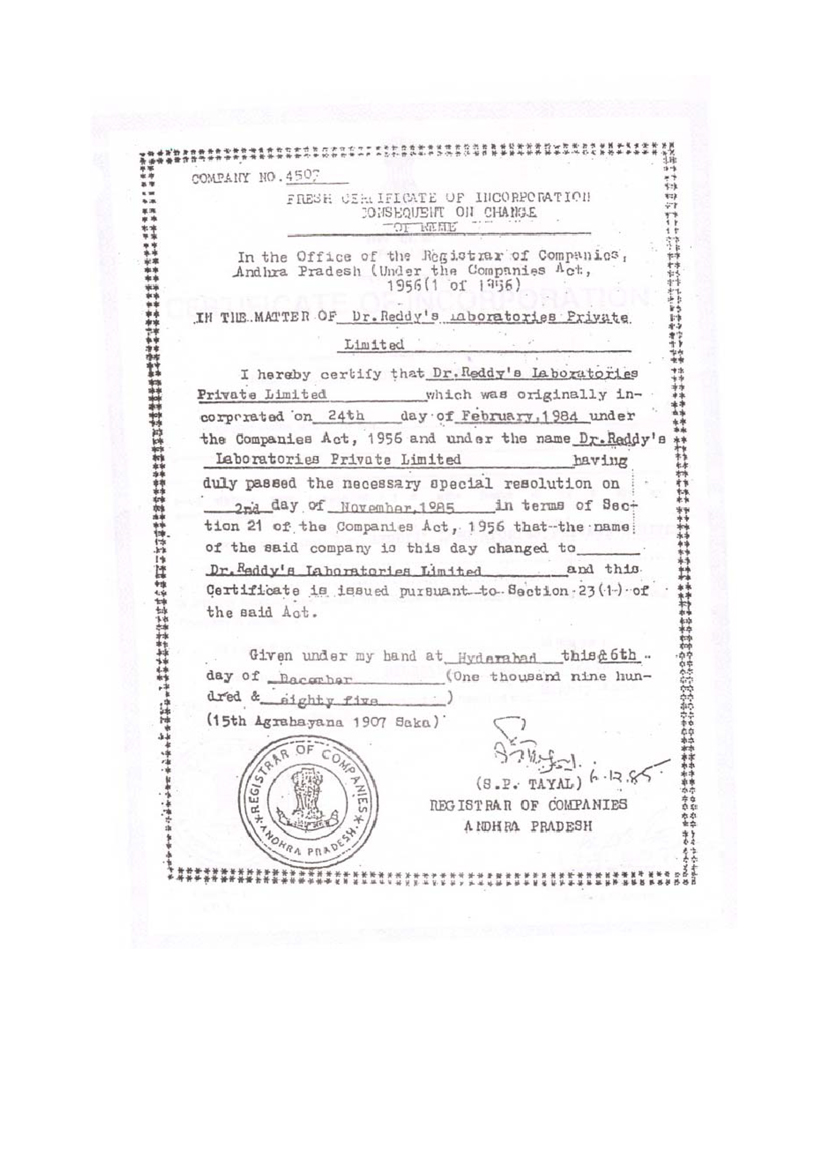
UNDER THE COMPANIES ACT 1956
(1 OF 1956)
COMPANY LIMITED BY SHARES
MEMORANDUM OF ASSOCIATION
OF
Dr. REDDY’S LABORATORIES LIMITED
|
I |
The name of the Company is “Dr. REDDY’S LABORATORIES LIMITED”. |
|
II. |
The Registered Office of the Company will be situated in the State of Andhra Pradesh |
|
III. |
The Objects for which the Company is established are the following. |
|
(A) |
The Main objects to be pursued by the Company on its incorporation are: |
|
1. |
To carry on the business of manufacture, sell, deal, export and import in all types of Chemicals, Drugs, Pharmaceuticals, Pesticides and Dyestuffs and other intermediaries. |
|
2. |
To carry on the research and developmental activities to develop new products and substitute for imported products and to develop and maintain testing house and laboratory for own use and for others. |
|
3. |
To carry on the business of Consulting Engineers in chemical, Pharmaceutical and Dyestuff Industries. |
|
4. |
To carry on the business of Manufacturer, Exporter, Importer, Whole Sale and Retails Sellers, Dealers in and to do Research and Development in Dermocosmetic products and its intermediates. |
|
5. |
To carry on and undertake the business of investing its funds in equity and preference shares, stocks, bonds debentures (convertible and non-convertible) of new projects and securities of all kinds and every description of well established and sound companies, to subscribe to capital issues of joint stock companies, ventures, industries, units, trading concerns whether old or new as the company may think fit and to assist them by granting financial accommodation by way of loans/advances to industrial concerns and to assist Industrial enterprises in creation, expansion and modernisation upon terms whatsoever and to act as finance brokers, merchants and commission agents and to deal in Govt. securities including Govt. bonds, loans, National savings certificates, post office, saving schemes, units of investments, etc., including units of Unit Trust of India. |
|
6. |
To promote industrial finance, deposit or lend money, securities and properties to or with any company body corporate, firm, person or association whether falling under the same management or otherwise, in accordance with and to the extent permissible under the provisions contained in Sections 370 & 372 of the Companies Act, 1956, with or without security and on such terms as may be determined from time to time. However, the Company shall not carry on the business of Banking as defined under the Banking Regulation Act, 1949; and to carry on and undertake the business of finance, investment and trading, hire purchase, leasing and to finance lease operations of all kinds, purchasing, selling, hiring or letting on hire of all kinds of plant and machinery and equipment that the Company may think fit and to assist in financing operations of all and every kind of description of hire purchase or deferred payment or similar transactions and to subsidise finance or assist in subsidising or financing the sale and maintenance of any goods, articles, or commodities of all and every kind of description upon any terms whatsoever and to purchase or otherwise deal in all forms of immovable and movable property including lands and buildings, plant and machinery,. Equipment, ships, aircraft, automobiles computers and all consumer, commercial and industrial items and to lease or otherwise deal with them in any manner whatsoever including release thereof regardless of whether the property purchase and lease be new and/or used. |
|
7. |
To provide a package of investment/merchant banking services by acting as managers to Public Issue Securities, by underwriting Securities, act as Issue House and to carry on the business of Registrars to investment schemes, Money Managers to secure and extend market support by conducting surveys, collecting data, information and reports and to act as general traders and agents, to carry on the agency business and warehousing indenting and dealership of business. |
|
8. |
To carry on the business of manufacturing, buying, selling, importing, exporting of and generally dealing in all types of surgical, medical, dental and scientific equipment, instruments and accessories, and diagnostic kits and Re-agents diagnostic equipments, healthcare aids and accessories, healthcare products and instruments and to carry on research and development of healthcare including diagnostic systems. |
|
9. |
To establish, run and maintain hospitals, diagnostic centers, nursing homes, mobile medical service centers and any medical and healthcare institutions and to promote research and development in these areas. |
|
10. |
To carry on the business as exporters and dealers in all kinds of electronic and electrical equipments, devices, and components including computers, video terminals, computer peripherals, data processing systems, export systems, uninterruptible power supply systems medical equipments and all kinds of electronic assemblies, sub-assemblies and components; telecommunication equipments devices and accessories used in communication; all types of office equipments including photocopiers, airconditioners, water and aircoolers, fire and burglar alarms accounting machines, cash registers and electronic point of sales systems and domestic appliances like radios televisions, refrigerators; heaters, cooking range etc., and to develop systems software and provide consultancy, maintenance and service support and to promote research and development in all the above fields. |
|
(B) |
The Objects incidental or ancillary to the attainment of the above main objects are: |
|
1. |
To amalgamate or enter into partnership or profit sharing arrangement with and to co-operate in a way with or assist or take over or subsides any company, firm or person. |
|
2. |
To enter into agreement and contracts with any individuals, firms, companies, or other organisation for technical, financial or any other assistance for carrying out all or any of the objects of the Company. |
|
3. |
To establish and maintain any agencies in India or any part of the world for the conduct of the business of the Company or for the sale of any materials or things for the time being at the disposal of the Company for sale. |
|
4. |
To advertise and about means of making known or promoting the use of all or any of the manufacturers products or goods of the company or any articles, or goods traded or dealt in by the Company any way as may be expedient including the posting of bills in relation thereto, and the issue of circulars, books, pamphlets and price lists and the conducting of competitions, exhibitions and giving of prizes, rewards and donations. |
|
5. |
To apply for purchase or otherwise acquire and protect, prolong and renew trade marks, trade names, designs, secret processes, patent rights, “BREVETS D INVENTION” licenses, protections and concessions which may appears likely to be advantageous or useful to the Company and to spend money in experimenting and testing and improving or seeking to improve any patents, inventions or rights which the company may acquire or propose to acquire or develop. |
|
6. |
To enter into any arrangement for sharing profits, union of interest co-operations, joint venture, reciprocal concession or otherwise with any person, firm or company carrying on or engaged in, or about to carry on or engage in any business of or transaction which this Company is authorised to carry on or engage in or any business or undertaking or transaction which may seem capable of being carried on or conducted so as directly or indirectly to benefit the company and to lend money, to guarantee the contracts or otherwise, assist, any person, firm or company and to takeover or otherwise acquire and holds shares or securities of any such person, firm or company and to sell, hold, reissue with or without guarantee or otherwise deal with the same. |
|
7. |
To enter into any arrangement with Government or State, Authority, Municipal, Local or otherwise that may seem conducive to the Company’s objects or any of them and to obtain from any such Government or State or Authority, any rights, privileges and concessions which may seem conducive to the Company’s objects or any of them. |
|
8. |
To undertake and carry on any business, transaction or operation commonly undertaken or carried on by promoters of companies, Concessionaires, contractors for public and other works or merchants. |
|
9. |
To purchase or otherwise acquire and undertake the whole or any part of the business, property rights, and liabilities of any person, firm or company, carrying on any business, which this company is authorised to carry on or possessed of property or rights, suitable for any of the purposes of the Company, and to purchase, acquire, apply for, hold, sell shares, stock, debentures or debenture stock of any such person, firm or company, and to conduct, make or carry into effect any arrangement in regard to the winding up of the business of any such person, firm or company. |
|
10. |
To construct, acquire, establish, provide, maintain and administer, factories, estates, buildings, water reservoirs, sheds, pumping installations, generating installations, pipelines, garages, storage and accommodation of descriptions in connection with the business of the Company. |
|
11. |
To apply, for tender purchase or otherwise acquire any contracts and concessions for or in relation to the constructions, erection, carrying out equipment, improvement, management, administration or control of works and conveniences and undertake, execute, carryout, dispose of or otherwise turn to account the same. |
|
12. |
To buy, lessor otherwise acquire lands, buildings, and other immovable property and to sell, lease, mortgage or hypothecate or otherwise dispose of all or any of the property and assets of the company on such terms, and conditions as the company may think fit. |
|
13. |
To amalgamate with any company or companies having objects altogether or in part similar to those of this Company. |
|
14. |
To pay all costs, charges and expenses of and incidental to the promotion and formation, registration and establishment of the Company and issue of its capital including any underwriting or other commission, brokers fee and charges in connection therewith including costs, expenses of negotiations and contracts and arrangements made prior to and in anticipation of the formation and incorporation of the Company. |
|
15. |
To remunerate or make donations to (by cash or other assets, or by the allotment of fully or partly paid shares, or by a call or option on shares, debentures debenture stock or securities of this or any other company, or in any other manner) whether out of the company’s capital, profits or otherwise to any person of firm or company for services rendered or to rendered in introducing any property or business to the Company or placing or assisting to place or guaranteeing the subscription or any shares, debentures, debenture or other securities of the company or for any other reasons which the company may think proper. |
|
16. |
To undertake and execute any trusts, the undertaking whereof may seem desirable either gratuitously or otherwise. |
|
17. |
Subject to the Banking Regulation Act, 1949, to draw, make issue, accept and to endorse, discount and negotiate promissory notes, hundies, bills of exchange, bills of landing, delivery orders, warrants, warehouse keepers, certificates and other negotiable or commercial mercantile instruments connected with the business of the company. |
|
18. |
To open accounts or accounts with individuals firm or company or with any bank or banks and to pay into and to withdraw moneys from such account or accounts. |
|
19. |
Subject to the provisions of the companies Act, 1956, to invest, apply for acquiring or otherwise employ moneys belonging to, entrusted to or at the disposal of the Company upon securities and shares or without security upon such terms as may be thought proper, and from time to time to vary such transactions in such manner as the company may think fit. |
|
20. |
To lend or deposit moneys belonging to or entrusted to or at the disposal of the Company to such person or company and in particular to customers and others having dealings with the Company with or without security, upon terms as may be thought proper and to guarantee the performance of contracts by such person or company, but not to do the business of banking as defined in the Banking Regulation Act, 1949. |
|
21. |
To make advances upon for the purchase of materials, goods, machinery, stores and other articles required for the purpose of the Company. |
|
22. |
Subject to the provisions of Section 58A of the Companies Act, 1956, to borrow or raise money with or without security or to receive money on deposit at interest, or otherwise, in such manner as the company may think fit and in particular by the issue of debentures or debentures stock perpetual or otherwise, including debentures or debenture stock convertible into shares of this or any other company and in security of any such money so borrowed, raised or received to mortgage, pledge or charge the whole or any part of the property, assets or revenue of the company present or future including its uncalled capital and to purchase, redeem or pay off any securities. |
|
23. |
Subject to the provisions of the Companies Act, 1956, to sell, mortgage, assign or lease and in any other manner, deal with or dispose of the undertakings or property of the Company or any part thereof, whether movable or immovable for such consideration as the company may think fit, and in particular for shares, debentures and other securities of any other company having objects altogether or in part similar to those of the Company. |
|
24. |
To improve, manage, work, develop, alter, exchange, lease, mortgage, turn to account, abandon or otherwise deal with all or any part of the property, rights and concessions of the Company. |
|
25. |
To employ workers or employees and to provide for welfare of the employees or ex-employees of the Company and their wives, widows, familier, or the dependents or connections of such person by building of houses, dwelling or by grants of money, pensions, gratuity, bonus, payment towards insurance or other payment, or by creating from time to time, subscribing and contributing towards place instruction or recreation, hospital and dispensaries, medical and other attendance and other assistance as the company shall think fit. |
|
26. |
Subject to the provisions of the companies Act, 1956, and the constitution of India, to subscribe or contribute or otherwise to assist to guarantee money to charitable, benevolent, religious, scientific, national or other institutions or objects or for any exhibition or for any public general useful objects. |
|
27. |
To distribute any of the property of the company amongst the members in species or kind upon the winding up of the company. |
|
28. |
To acquire and run any industrial concern, factory or mills as the Company may deem fit to attain the main objects. |
|
29. |
To do all such other things as are incidental to, or conducive to the attainment, of the above main objective or any of them. |
|
1. |
To carry on the business of Distributors, Dealers, Wholesalers, Retailers, Commission Agents, Manufacturers, Representatives for all types of products. |
|
2. |
To carry on the business of professionals for all types of services. |
|
3. |
To carry on the business of design, engineering and execution and implementation of various types of projects on contract or turnkey basis and to acquire the designing or technical know-how. |
|
4. |
To cultivate, grow, produce or deal in any vegetable products and to carry on the business of farmers, dairy man, milk contractors, dairy farmers, millers, surveyors and vendors of milk cream, cheese, butter and poultry and provision of all kinds, growers of and dealers in corn, lay and straw, seeds men and nursery men and to buy, sell and trade in any goods usually traded and of the above business or other business associated with the farming interest which may be advantageously carried on by the company. |
|
5. |
To carry on the business of manufacturers, fabricators, erectors, dealers of in all types of chemical equipment, pumps, valves, storage tanks etc. required by the chemical and pharmaceutical industry. |
|
6. |
To purchase plant, machinery, tools and implements from time to time and he selling or disposing of the same. |
|
7. |
To transact or carry on all kinds of agency business and in particular, in relation to the investment of money, the sale of property and collection and receipt of money, or otherwise of any assets, funds and business under any agreement. |
|
8. |
To carry on and undertake the business of investing its funds in equity and preference shares, stocks, bonds, debentures (convertible and non-convertible) of new projects and securities of all kinds and every description of well established and sound companies, to subscribe to capital issues of joint stock companies, ventures, industries, units, trading concerns whether old or new as the company my think fit and to assist them by granting financial accommodation by way of loans/advances to industrial concerns and to assist industrial enterprises in creation , expansion and modernization upon terms whatsoever and to act as finance brokers, merchants and commission agents and to deal in Govt. Securities including Govt. bonds, loans, National savings certificates, post office saving schemes, units of investments etc., including units of Unit Trust of India. |
|
9. |
To promote industrial finance, deposit or lend money, securities and properties to or with any company, body corporate, firm person or association whether falling under the same management otherwise, in accordance with and to the extent permissible under the provisions contained in Section 370&372 of the, Companies Act, 1956, with or without security and on such terms as may be determined from time to time. However, the company shall not carry on the business of Banking as defined under the Banking Regulation Act. 1949; and to carry on and undertake the business of finance, investment and trading, hire purchase, leasing and to finance lease operations of all kinds, purchasing, selling, hiring or letting on hire of all kinds of plant and machinery and equipment that the Company may think fit and to assist in financing operations of all and every kind of description of hire purchase or deferred payment or similar transactions and to subsidies finance or assist in subsidising or financing the sale and maintenance of any goods, articles or commodities of all and every kind of description upon any terms whatsoever and to purchase or otherwise deal in all forms of immovable and movable property, including lands and buildings, plant and machinery, equipment, ships, aircraft, automobiles computers and all consumer, commercial and industrial items and to lease or otherwise deal with them in any manner whatsoever including release there of regardless of whether the property purchased and leased be now and /or used. |
|
10. |
To provide a package of investment/merchant banking services by acting as manages to public issue securities, by underwriting securities, act as Issue House and to carry on the business of registrars to investment schemes, Money managers to secure and extend market support by conducting surveys, collecting data, information and reports and to act as general traders and agents, to carry on the agency business and warehousing indenting and dealership of business. |
|
IV. |
The liability of the members of the company is limited. |
|
V. |
a. The Authorised Share Capital of the Company is Rs. 1,450,000,000/- (Rupees One Hundred and Forty-five Crores Only) divided into 1,450,000,000 (One Hundred and Forty-five Crores) equity shares of Re. 1/- (Rupee one only) each.* |
|
b. |
The company has power from time to issue shares, Hybrids, Derivatives, Options, Quasi-equity instruments, with differential rights, or to increase, consolidate, sub-divide, exchange, reduce and also to purchase any of its shares whether or not redeemable and to make payments out of its capital in respect of such purchase or otherwise alter its share capital as equity or non voting equity shares or preference shares and to attach to any classes of such shares preferences, rights, privileges or priorities in payment of dividends or distribution of assets or otherwise, over any other shares and to subject the same to any restriction, limitation or condition and to vary the regulation of the company, as for apportioning the right to participate in profits in any manner subject to the provision of the Act and consent of the appropriate authorities if required, being obtained before doing so. |
* Amended pursuant to the ordinary resolution passed by the shareholders of the Company through postal ballot on September 12, 2024.
We the several persons whose names, addresses and description are subscribed hereto are desirous of being formed into a company in pursuance of the Memorandum of Association and we respectively agree to take the number of shares in the Capital of the Company set opposite to our respective names.
S.No. |
Name, Addresses, Descriptions and
occupations of the subscribers
|
No. of equity
Shares taken by
subscriber
|
Name, address, description
occupation and signature of
witness.
|
1. |
Dr. KALLAM ANJI REDDY |
10 (Ten only) |
|
|
S/o. Venkata Reddy |
|
|
|
6/3/347/6, Dwarakapuri Colony, |
|
|
|
Hyderabad – 500 004. |
|
|
|
Occ: Industrialist |
|
|
|
|
|
|
2. |
KALLAM SAMRAJYAM |
10 (Ten only) |
.S.S. SRINIVAS |
|
W/o. Anji Reddy |
|
Chartered Accountant |
|
6/3/347/6, Dwarakapuri Colony, |
|
S/o. Sri. G. Balakrishna Rao |
|
Hyderabad – 500 004. |
|
5-2-422, Hyderbasti, R.P Road, Secunderabad. |
|
Occ: Housewife |
|
|
Place: Hyderabad
Date : 4th February 1984.
UNDER THE COMPANIES ACT, 2013
COMPANY LIMITED BY SHARES
(Incorporated under the Companies Act, 1956)
ARTICLES OF ASSOCIATION
OF
Dr. REDDY’S LABORATORIES LIMITED
PRELIMINARY
1 |
Table ‘F’ not to apply |
The regulations contained in the Table marked F in Schedule I to the Companies Act, 2013, shall not be applicable to the Company except so far as the said Act or any modification there otherwise expressly provides. The Regulations for management of the Company and for the observance of the members shall be such as are contained in these Articles. |
2 |
Interpretation |
Unless the context otherwise requires, words or expressions contained in these regulations shall bear the same meaning as in the Act or any statutory modification thereof in force at the date at which these regulations become binding on the Company. |
|
|
“The Act” means the Companies Act, 2013 and includes rules made thereunder and reference to any section or provision thereof respectively means and includes the Companies Act, 2013 (Act No. 18 of 2013) and includes where the context so admits any re-enactment or any statutory modification thereof for the time being in force and any previous company law, so far as may be applicable and reference to the section or provision of the said Act or re-enactment or such statutory modification.
Words and expressions used in the Articles shall bear the same meaning as used in the Act or the rules, as the case may.
|
|
|
“The seal” means the common seal of the Company. |
|
|
“The Article” means these Articles of Association as adopted or as may from time to time be altered. |
|
|
“The Company” means Dr. REDDY’S LABORATORIES LIMITED. |
|
|
“A Company” means a company as defined under Section 2(20) of the Act. |
|
|
“Director” means a director appointed to the Board of a company. |
|
|
“The Directors” means the Board of Directors of the Company for the time being. |
|
|
“Board of Directors” or “Board”, in relation to a company, means the collective body of the directors of the Company. |
|
|
“Managing Director” means a director who, by virtue of the articles of a company or an agreement with the Company or a resolution passed in its general meeting, or by its Board of Directors, is entrusted with substantial powers of management of the affairs of the Company and includes a director occupying the position of managing director, by whatever name called. |
|
|
“Month” means calendar month. |
|
|
“Proxy” means an instrument under which any person is authorised to vote for a member at a general meeting on a poll and includes Attorney duly constituted under a Power of Attorney. |
|
|
“The Office” means the Registered Office of the Company for the time being. “The Register” means the Register of Members to be kept pursuant to the Act. |
|
|
“The Registrar” means the Registrar of Companies, Telangana. |
|
|
“Key Managerial Personnel” means the Chief executive officer or the managing director; the Company secretary; whole-time director; chief financial officer; and such other officer as may be notified from time to time in the rules. |
|
|
“The Secretary” is a Key Managerial Personnel appointed by the Directors to perform any of the duties of a Company Secretary. |
|
|
“In Writing” and “Written” shall include printing, lithography and other modes of representing or reproducing words in a visible form. Words importing the singular number only include the plural number and vice-versa. Words importing the masculine gender only include the feminine gender. Words importing persons include corporations. |
SHARE CAPITAL AND VARIATION OF RIGHTS
3 |
Authorised share capital and Allotment of Shares |
i) |
The Authorised share capital of the Company shall be as stated in the memorandum of Association of the Company. |
|
|
ii) |
Subject to the provisions of the Act and these Articles, the shares in the capital of the Company shall be under the control of the Directors who may issue, allot or otherwise dispose of the same or any of them to such persons, in such proportion and on such terms and conditions and either at a premium or at par and at such time as they may from time to time think fit. |
4 |
Increased capital same as original capital |
Except so far as may be otherwise provided by the condition of issue or by these present any capital raised by the creation of new shares shall be considered part of the original capital and shall be subject to the provisions herein contained with reference to the payment of call and instalment transfer and transmission, forfeiture, lien, surrender, voting and otherwise. |
5 |
Conditions regarding issue of new shares |
Subject to the provisions of section 43 of the Act, the new shares shall be issued upon such terms and conditions and with such rights and privileges annexed thereto as the Company in general meeting shall prescribe, and in particular such shares may be issued with a preferential or qualified right to dividends and in the distribution of assets of the Company. |
6 |
Right to issue GDR/ADR |
The company shall have a right to issue any instrument, including Global Depositary Receipt (GDR) or American Depositary Receipt (ADR). |
7 |
New shares to be offered to existing members |
When at any time subsequent to the adoption of these Articles it is proposed to increase the subscribed capital of the Company by the issue of new shares then subject to any directions to the contrary which may be given by the Company in general meeting and subject to those directions such new shares shall be offered to the persons who at the date of the offer are holders of the Equity shares in the Company, in proportion, as nearly as circumstances admit, to the capital paid up on those shares at the date; and such offer shall be made by a notice specifying the member of shares offered and limiting a time as maybe specified in the Act or any rules made thereunder, within which the offer, if not accepted will be deemed to have been declined. After the expiry of the time specified in the notice aforesaid or on receipt of earlier intimation from the person to whom such notice is given that the person declines to accept the shares offered, the Board of Directors may dispose them off in such manner as they think most beneficial to the Company. Option or right to call of shares shall not be given to any person or persons without the sanction of the Company in general meeting. |
|
|
Notwithstanding anything herein contained, the new shares aforesaid may be offered to any person, whether or not those persons include the persons who, at the date of the offer, are holders of the Equity Shares of the Company, in any manner whatsoever; |
|
|
i) |
If special Resolution to that effect is passed by the Company in general meeting; or |
|
|
ii) |
Where no such special resolution is passed, if the votes cast (whether on a show of hands or on a poll or e-voting, as the case may be) in favour of the proposal contained in the resolution moved at the general meeting sanctioning the issue of such shares (including the casting vote, if any, of the Chairperson) by members who being entitled to, vote in person, or where proxies are allowed, by proxy, exceed the votes, if any, cast against the proposal by members so entitled and voting and the Central Government is satisfied, on an application made by the Board of Directors in that behalf that the proposal is most beneficial to the Company. |
8 |
Issue of further Pari-passu Shares not to affect the right of shares already issued |
The rights conferred upon the holders of the shares of any class issued with preferred or other rights shall not, unless otherwise expressly provided by the terms of issue of the shares of that class, be deemed to be varied by the creation or issue of further shares ranking pari-passu therewith. |
9 |
Redeemable preference shares increase of subscribed capital |
The Company may from time to time in general meeting by special resolution increase its subscribed share capital by issue of new shares upon such terms and conditions and with such rights and privileges annexed thereto as by the general meeting issuing the same shall be directed and in particular subject to the provisions of the Articles thereof such shares may be issued with a preferential or qualified right to dividends and in the distribution of the assets of the Company provided always that any preference shares may be issued in the terms that they are liable to be redeemed and on such terms and conditions of redemption as may be prescribed. |
10 |
Power to modify class rights |
i) |
If at any time the share capital is divided into different classes of shares, the rights attached to any class (unless otherwise provided by the terms of issue of the shares of that class) may, subject to the provisions of section 48, and whether or not the Company is being wound up, be varied with the consent in writing of the holders of such proportion of the issued shares of that class as maybe specified in the Act or rules made thereunder, or with the sanction of a special resolution passed at a separate meeting of the holders of the shares of that class. |
|
|
ii) |
To every such separate meeting, the provisions of these regulations relating to general meetings shall mutatis mutandis apply, but so that the necessary quorum as specified in the Act or rules made thereunder, shall be present. |
11 |
Instalment on shares to be duly paid |
If, by the conditions of allotment of any shares, the whole or part of the amount or issue price thereof shall be payable by instalments, every such instalment shall, when due, be paid to the Company by the person who for the time being shall be the member registered in respect of the share or by his/her executor or administrator. |
12 |
Power to issue Redeemable Preference Shares |
Subject to the provisions of section 55, any preference shares may be issued on the terms that they are to be redeemed on such terms and in such manner as the Company before the issue of the shares may determine. |
|
|
i) |
No such shares shall be redeemed except out of profits of the Company which would otherwise be available for dividend or out of the proceeds of a fresh issue of shares made for the purpose of redemption. |
|
|
ii) |
No such shares shall be redeemed unless they are fully paid. |
|
|
iii) |
The premium, if any, payable on redemption shall have been provided for, out of the profits of the Company or company’s share premium account before the shares are redeemed. |
|
|
iv) |
Where any such shares are redeemed otherwise than out of the proceeds of a fresh issue, there shall out of profits which would otherwise have been available for dividend be transferred to a reserve fund, to be called “the Capital Redemption Reserve Fund”, a sum equal to the amount required for redeeming the shares, and the provisions of the Act relating to the reduction of the share capital of the Company shall, except as provided in Section 55 of the Act, apply as if the Capital Redemption Reserve Fund were paid up Share Capital of the Company. |
|
|
v) |
The preference shares shall confer the rights on the holders thereof to be paid out of the profits that may at any time be determined to be distributed among members a fixed cumulative dividend at the rate of 11% per annum, free of company’s tax (but subject to deduction of tax at source at the prescribed rates) on the capital for the time being paid up thereon in priority to the Equity shares. |
|
|
vi) |
The preference shares shall confer the rights on the holders thereof, on winding up, to the repayment of the capital and of any arrears of the fixed cumulative dividend set out above, whether earned, declared or not, up to the commencement of the winding up in priority to the Equity Shares, out of the surplus assets of the Company, but shall not confer any further rights to participate in the profits or assets of the Company. |
|
|
vii) |
In calculating any fixed percentages on the paid up capital of such preference shares, such percentages shall be calculated up to and as on the date of redemption. |
|
|
viii) |
The preference shares shall be redeemable at par on the expiry of 15 years from the date of allotment thereof, but the Company may at its option and at any time after 12 years from the date of allotment of such preference shares, on giving not less than three months' notice to the holders of such shares redeem at par the whole or any part of the said shares together with a sum equal to the arrears, if any, of the fixed cumulative dividend thereon whether earned, declared or not, up to the date of redemption thereof out of the moneys of the Company which may lawfully be applied for that purpose, provided that if the Company shall at any time determine to redeem a part only of such shares for the time being outstanding, the shares to be so redeemed shall be determined by a draw to be made in such manner as may be decided by the Board of Directors, provided that in no event the Company shall create further preference shares or issue any further preference share capital to rank in priority to the existing preference shares. |
|
|
ix) |
The Company shall forthwith give to the holders of the shares liable for redemption notice in writing of its intention to redeem the same and fix a time and place for the redemption and surrender of the certificates of the shares to be so redeemed. |
|
|
x) |
At the time and place so fixed each holder of such shares shall be bound to surrender to the Company the certificate(s) for his/her shares to be redeemed and the Company shall pay to him/her the amount payable in respect of such redemption. |
|
|
xi) |
In the event of the Company creating and / or issuing preference shares in future ranking pari- passu with or in priority to the redeemable preference shares, it should do so only with the consent in writing of the holders of the said shares then outstanding or with the sanction of a special resolution passed at a separate meeting of the holders of such redeemable preference shares. |
13 |
Trusts not recognised |
Except as required by law, no person shall be recognised by the Company as holding any share upon any trust, and the Company shall not be bound by, or be compelled in any way to recognise (even when having notice thereof) any equitable, contingent, future or partial interest in any share, or any interest in any fractional part of a share, or (except only as by these regulations or by law otherwise provided or as ordered by a court of competent jurisdiction) any other rights in respect of any share except an absolute right to the entirety thereof in the registered holder. |
14 |
Commission for placing shares |
i) |
The Company may exercise the powers of paying commissions conferred by sub-section (6) of section 40, provided that the rate per cent or the amount of the commission paid or agreed to be paid shall be disclosed in the manner required by that section and rules made thereunder. |
|
|
ii) |
The rate or amount of the commission shall not exceed the rate or amount prescribed in rules made under sub-section (6) of section 40. |
|
|
iii) |
The commission may be satisfied by the payment of cash or the allotment of fully or partly paid shares or partly in the one way and partly in the other. |
15 |
Joint holders |
Where two or more persons are registered as the holders of any shares, they shall be deemed to hold the same as joint tenants with benefits of the survivorship subject to the following and other provisions contained in the these Articles. |
|
|
i) |
The Company shall be entitled to decline to register more than three persons as the joint holders of any share. |
|
|
ii) |
The joint holders of any shares shall be liable severally as well as jointly for and in respect of all calls and other payments which ought to be made in respect of such shares. |
|
|
iii) |
On the death of any such joint holders the survivor or survivors shall be the only persons or persons recognised by the Company as having any title or interest in the share but the Directors may require such evidence of death as they deem fit and nothing herein contained shall be taken to release the estate, of deceased joint holder from any liability on shares held by him/her jointly with any other person or persons. |
|
|
iv) |
Any of the joint holders may give effectual receipt of any dividends, bonus etc. or other moneys payable in respect of such shares. |
|
|
v) |
Only the person whose name stands first in the Register as one of the joint holders of any shares, shall be entitled to the delivery of the certificate relating to such shares or to receive documents from the Company and any documents served on or sent to such person shall be deemed as good service on all the joint holders. |
|
|
vi) |
Any one of two or more joint holders may vote at any meeting either personally or by proxy in respect of such shares as if he/she were solely entitled thereto and if more than one of such joint holders be present at any meeting personally or by proxy, then one of such persons so present whose names stands first or higher (as the case may be) on the Register in respect of such share shall alone be entitled to vote in respect thereof but other or others of the joint holders shall be entitled to be present at any meeting personally. Several executors or administrators of a deceased member in whose (deceased member’s) sole name any shares stand shall for the purpose of this sub article be deemed joint holders. |
16 |
Member’s right to certificate |
Every person whose name is entered as a member in the register of members shall be entitled to receive within such period after incorporation as maybe specified in the Act or rules made thereunder, in case of subscribers to the memorandum or after allotment or within such period after the application for the registration of transfer or transmission as maybe specified in the Act or rules made thereunder or within such other period as the conditions of issue shall be provided,— |
|
|
i) |
One certificate for all his/her shares without payment of any charges; or |
|
|
ii) |
Several certificates, each for one or more of his/her shares, upon payment of a sum not exceeding such amount as maybe prescribed in the Act or rules made thereunder for each certificate after the first. |
17 |
Certificate of shares |
Every certificate shall be under the seal and shall specify the shares to which it relates and the amount paid-up thereon. The seal shall be affixed in the presence of and signed by (i) two Directors or persons acting on behalf of the Directors under a duly registered power of attorney and (ii) the secretary or some other person appointed by the Board for the purpose; provided that at-least one of the aforesaid two Directors shall be a person other than a Managing or whole-time Director. A Director may sign a share certificate by affixing his/her signature thereon by means of any machine, equipment or other mechanical means such as engraving in metal or lithography. |
18 |
To which joint holder certificates to be issued |
In respect of any share or shares held jointly by several persons, the Company shall not be bound to issue more than one certificate, and delivery of a certificate for a share to the person first named on the register in respect of such joint holding shall be sufficient delivery to all such holders. |
19 |
Fee for issue of new share certificate |
i) |
If any share certificate be defaced, mutilated or torn or if there be no further space on the back for endorsement of transfer, then upon production and surrender thereof to the Company, a new certificate may be issued in lieu thereof, and if any certificate is lost or destroyed then upon proof thereof to the satisfaction of the Company and on execution of such indemnity as the Company deem adequate, a new certificate in lieu thereof shall be given. Every certificate under this Article shall be issued on payment of a sum not exceeding such amount for each certificate as maybe prescribed in the Act or rules made thereunder. |
|
|
ii) |
The provisions of Articles 13,16,17,18 and 19 shall mutatis mutandis apply to debentures of the Company. |
20 |
Dematerialisation of Shares |
The Company shall be entitled to dematerialise all or any of its existing Shares, rematerialize all or any of its Shares held in the Depositories and / or to offer its fresh Shares or buyback it’s Shares in a dematerialized form pursuant to the Depositories Act, 1996 and the Relevant Rules, if any. |
LIEN |
21 |
Company’s lien on shares |
i) |
The Company shall have a first and paramount lien- |
|
|
|
a) |
On every share (not being a fully paid share), for all monies (whether presently payable or not) called, or payable at a fixed time, in respect of that share; and |
|
|
|
b) |
On all shares (not being fully paid shares) standing registered in the name of a single person, for all monies presently payable by him/her or his/her estate to the Company: |
|
|
Provided that the Board of directors may at any time declare any share to be wholly or in part exempt from the provisions of this clause. |
|
|
ii) |
The Company's lien, if any, on a share shall extend to all dividends payable and bonuses declared from time to time in respect of such shares. |
22 |
Enforcing lien by sale |
The Company may sell, in such manner as the Board thinks fit, any shares on which the Company has a lien: |
|
|
Provided that no sale shall be made- |
|
|
i) |
Unless a sum in respect of which the lien exists is presently payable; or |
|
|
ii) |
Until the expiration of such period, as maybe specified in the Act or rules made thereunder, after a notice in writing stating and demanding payment of such part of the amount in respect of which the lien exists as is presently payable, has been given to the registered holder for the time being of the share or the person entitled thereto by reason of his/her death or insolvency. |
23 |
Procedure for enforcing lien by sale |
i) |
To give effect to any such sale, the Board may authorise some person to transfer the shares sold to the purchaser thereof. |
|
|
ii) |
The purchaser shall be registered as the holder of the shares comprised in any such transfer. |
|
|
iii) |
The purchaser shall not be bound to see to the application of the purchase money, nor shall his/her title to the shares be affected by any irregularity or invalidity in the proceedings in reference to the sale. |
|
|
iv) |
Upon any such sale as aforesaid, the existing certificate(s) in respect of the shares sold shall stand cancelled and become null and void and of no effect, and the Directors shall be entitled to issue a new certificate(s) in lieu thereof to the purchaser or purchasers concerned. |
24 |
Application of proceeds of sale |
The proceeds of the sale shall be received by the Company and applied in payment of such part of the amount in respect of which the lien exists as is presently payable.
The residue, if any, shall, subject to a like lien for sums not presently payable as existed upon the shares before the sale, be paid to the person entitled to the shares at the date of the sale.
|
CALLS ON SHARES |
25 |
Calls on Shares |
i) |
The Board may, from time to time, make calls upon the members in respect of any monies unpaid on their shares (whether on account of the nominal value of the shares or by way of premium) and not by the conditions of allotment thereof made payable at fixed times: |
|
|
|
Provided that no call shall exceed one-fourth of the nominal value of the share or be payable at less than one month from the date fixed for the payment of the last preceding call. |
|
|
ii) |
Each member shall, subject to receiving at least such number of days' notice as maybe prescribed in the Act or rules made thereunder, specifying the time or times and place of payment, pay to the Company, at the time or times and place so specified, the amount called on his/her shares. |
|
Revocation or
postponement of call
|
iii) |
A call may be revoked or postponed at the discretion of the Board. |
|
Call deemed to be made when resolution for it is passed |
iv) |
A call shall be deemed to have been made at the time when the resolution of the Board authorising the call was passed and may be required to be paid by instalments. |
|
Liability of joint holders |
v) |
The joint holders of a share shall be jointly and severally liable to pay all calls in respect thereof. |
26 |
When interest on call or instalment payable |
i) |
If a sum called in respect of a share is not paid before or on the day appointed for payment thereof, the person from whom the sum is due shall pay pay interest thereon from the day appointed for payment thereof to the time of actual payment at ten per cent per annum or at such lower rate, if any, as the Board may determine. |
|
|
ii) |
The Board shall be at liberty to waive payment of any such interest wholly or in part. |
27 |
Amount payable at fixed times or by instalments payable as calls |
i) |
Any sum which by the terms of issue of a share becomes payable on allotment or at any fixed date, whether on account of the nominal value of the share or by way of premium, shall, for the purposes of these regulations, be deemed to be a call duly made and payable on the date on which by the terms of issue such sum becomes payable. |
|
|
ii) |
In case of non-payment of such sum, all the relevant provisions of these regulations as to payment of interest and expenses, forfeiture or otherwise shall apply as if such sum had become payable by virtue of a call duly made and notified. |
28 |
Payment of calls in advance |
|
The Board— |
|
|
i) |
May, if it thinks fit, receive from any member willing to advance the same, all or any part of the monies uncalled and unpaid upon any shares held by him/her. |
|
|
ii) |
Upon all or any of the monies so advanced, may (until the same would, but for such advance, become presently payable) pay interest at such rate not exceeding, unless the Company in general meeting shall otherwise direct, twelve per cent per annum, as may be agreed upon between the Board and the member paying the sum in advance. |
|
|
iii) |
Money so paid in excess of the amount of calls shall not rank for dividends, or confer a right to participate in profits or exercise voting rights. The Directors may at any time repay the amount so advanced upon giving to such member not less than three months’ notice in writing. |
29 |
Evidence in action by the Company against shareholders |
Subject to the provision of the Act and these Articles, on the trial or hearing of any action or suit brought by the Company against any Shareholder or his/her representative to recover any debt or money claimed to be done to the Company in respect of his/her shares it will be sufficient to prove that the name of the defendant is or was, when the claim arose, on the register of the Company as a holder, or one of the holders, of the shares in respect of which such claim is made, and that the amount claimed is not entered as paid in the books of the Company and it shall not be necessary to prove the appointment of the Directors who made any call, nor that a quorum of Directors was present at the meeting at which the call was made nor that the meeting at which the call was made duly convened or constituted nor any other matter whatsoever, but the proof of the matters aforesaid shall be conclusive evidence of the debt. |
TRANSFER OF SHARES |
30 |
Instrument of transfer |
i) |
Shares in the Company shall be transferred in accordance with the provisions of the Section 56 of the Act by an instrument in writing in the prescribed form. |
|
|
ii) |
The instrument of transfer of any share in the Company shall be executed by or on behalf of both the transferor and transferee. |
|
|
iii) |
The transferor shall be deemed to remain a holder of the share until the name of the transferee is entered in the register of members in respect thereof. |
31 |
Directors may refuse to register transfer |
Subject to the right of appeal as conferred by Section 58 of the Act, the Directors, may, at their own absolute and uncontrolled discretion and without assigning any reason decline to register or acknowledge any transfer of shares and in particular may so decline in any case in which the Company has lien upon the shares or any of them or whilst any moneys in respect of the shares desired to be transferred or any of them remain unpaid or unless the transferee is approved by the Directors and such refusal shall not be affected by the fact that the proposed transferee is already a member. Provided that registration of a transfer shall not be refused on the grounds of the transferor being either alone or jointly with any person or persons indebted to the Company on any account whatsoever except a lien. The registration of a transfer shall be conclusive evidence of the approval of the Directors of the transferee. |
32 |
Conditions for not declining registration of transfer |
The Board may decline to recognise any instrument of transfer unless- |
|
|
i) |
The duly executed instrument of transfer is in the form as prescribed in rules made under sub- section (1) of section 56; |
|
|
ii) |
The instrument of transfer is accompanied by the certificate of the shares to which it relates, and such other evidence as the Board may reasonably require to show the right of the transferor to make the transfer; and |
|
|
iii) |
The instrument of transfer is in respect of only one class of shares. |
33 |
Closure of transfer books etc., |
On giving not less than seven working days’ previous notice in accordance with section 91 and rules made thereunder, the registration of transfers may be suspended at such times and for such periods as the Board may from time to time determine: |
|
|
Provided that such registration shall not be suspended for more than thirty days at any one time or for more than forty-five days in the aggregate in any year. |
34 |
Notice to transferee and transferor on refusal to transfer shares |
If the Board of Directors refuse to register a transfer of any shares, they shall within one month from the date on which the transfer was lodged with the Company send to the transferee and the transferor notice of the refusal |
35 |
Custody of the instrument of transfer |
The instrument of transfer shall after registration be retained by the Company and shall remain in its custody. All instruments of transfer which the Directors may decline to register, shall be returned to the persons depositing the same. |
36 |
Fee on transfer or transmission |
No fee shall be charged for the following: |
|
|
i) |
For registration of transfers, sub-division and consolidation of Certificates and for letters of allotment and for split, consolidation, renewal and pucca transfer receipts into denominations corresponding to the market units of trading. |
|
|
ii) |
For sub-division of renounceable letter of right |
|
|
iii) |
For registration of any power of attorney, probate, letters of administration, marriage or death certificates or for similar other documents. |
37 |
|
“The Board of Directors or a committee thereof can refuse a request by a member to split his/her shares into shares of smaller lots unless such split is for making his/her holding into market lot”. |
38 |
The Company not liable for disregard of a notice prohibiting registration of a transfer |
The Company shall incur no liability or responsibility whatever in consequence of their registering or giving effect to any transfer of shares made, or purporting to be made, by any apparent legal owner thereof (as shown or appearing or claiming any equitable right, title or interest to or in the same shares) notwithstanding that the Company have had notice of such equitable right, title or interest or notice prohibiting registrations of such transfer, and may have entered such notice or referred thereto in any books of the Company; and the Company shall not be bound or required to regard or attend or give effect to notice which may be given to them of any equitable right, title or interest or be under any liability whatsoever for refusing or neglecting to do so; though it may have been entered or referred to in some books of the Company, but the Company shall nevertheless be at liberty to regard and attend to such notice and give effect thereto if the Directors shall so think fit. |
TRANSMISSION OF SHARES |
39 |
Title of shares of deceased holder |
i) |
On the death of a member, the survivor or survivors where the member was a joint holder, and his/her nominee or nominees where he/she was a sole holder, shall be the only persons recognised by the Company as having any title to his/her interest in the shares. |
|
|
ii) |
Nothing in clause (i) shall release the estate of a deceased joint holder from any liability in respect of any share which had been jointly held by him/her with other persons. |
|
|
iii) |
The legal representatives or administrator of a deceased member or holder of a succession certificate shall be the only persons recognised by the Company as having any title to his/her shares and the Company shall not be bound to recognise such executor or administrator or holder of a succession certificate unless such executor or administrator shall have first obtained probate, letters of administration or other legal representation as the case may be from a duly constituted court in India, or from any authority empowered by any law to grant such other legal representation; provided that in any case where the Board in their absolute discretion think fit, the Board may dispense with the production of Probate or Letters of Administration or other legal representation and under the next Article register the name of any person who claims to be absolutely entitled to the shares standing in the name of a deceased member upon such terms as to indemnity or otherwise as the Directors may deem fit. |
40 |
Registration of persons entitled to share otherwise than by transfer (transmission) |
i) |
Subject to the provision of the Act and these Articles any person becoming entitled to a share in consequence of the death, bankruptcy, or insolvency of any member or by any lawful means other than by a transfer in accordance with these presents may with the consent of the Directors which they shall not be under any obligation to give upon producing such evidence that he/she sustains the character in respect of which he/she proposes to act under this Article, or of his/her title, as the Board may think sufficient and upon giving such indemnity as the Directors may require. |
|
|
ii) |
Any such person shall after sending notice in writing, elect, either— |
|
|
|
a) |
To be registered himself as holder of the share; or |
|
|
|
b) |
To make such transfer of the share as the deceased or insolvent member could have made. |
41 |
Board may require evidence of transmission |
Every transmission of a share shall be verified in such manner as the Directors may require and the Company may refuse to register any such transmission until the same be so verified or unless such indemnity be given to the Company with regard to such registration which the Board at its discretion shall consider sufficient provided nevertheless that there shall not be any obligation on the Company or the board to accept any indemnity. |
42 |
Refusal to Register Transmission of share |
The Board shall, in either case, have the same right to decline or suspend registration as it would have had, if the deceased or insolvent member had transferred the share before his/her death or insolvency. |
FORFEITURE OF SHARES |
43 |
If call or instalment not paid notice may be given |
If any member fails to pay the whole or any part of any call or instalment or any money due in respect of any shares either by way of principal or interest on or before the day appointed for the payment of the same or any extension thereof, the Directors may at any time thereafter during such time as the call or instalment remains unpaid or decree remains unsatisfied serve a notice on such member or on the person (if any) entitled to share by transmission, requiring him/her to pay such call or instalment or such part thereof or other moneys as remain unpaid together with any interest that may have accrued and all expenses (legal or otherwise) that may have been incurred by the Company by reason of such non-payment . |
44 |
Partial payment not to preclude forfeiture |
Neither the receipt by the Company of a portion of any money shall from time to time be due from any member to the Company in respect of his/her shares, either by way of principal or interest nor any indulgence granted by the Company in respect of the payment of any such money, shall preclude the Company from thereafter proceeding to enforce a forfeiture of such shares. |
45 |
Terms of forfeiture |
The notice aforesaid shall name a day (not being less than fourteen days from the date of service of the notice) from the date of service of the notice) and places or place and at which the money is to be paid and the notice shall also state that in the event of the non-payment of such money at the time and place appointed, the shares in respect of which the same is owing will be liable to be forfeited. |
46 |
In default of payment, shares may be forfeited |
If the requisition of any such notice shall not be complied with, every or any share in respect of which the notice is given may at any time thereafter, before payment of all calls or instalments, interest and expenses due in respect thereof, be forfeited by a resolution of the Directors to that effect. |
47 |
Power to annul forfeiture |
The Directors may at any time before any share so forfeited, shall have been sold, or otherwise disposed of, annul the forfeiture thereof upon such conditions as they, may think fit. |
48 |
Members shall be liable to pay money owing, at the time of forfeiture and interest |
i) |
A person whose shares have been forfeited shall cease to be a member in respect of the forfeited shares, but shall, notwithstanding the forfeiture, remain liable to pay to the Company all monies which, at the date of forfeiture, were presently payable by him/her to the Company in respect of the shares together with interest at 10% per annum or such other lower rate as the Board may determine from the time of the forfeiture, until payment, and the Board may enforce the payment thereof if they think fit, but shall not be under any obligation to do so; |
|
|
ii) |
The liability of such person shall cease if and when the Company shall have received payment in full of all such monies in respect of the shares. |
49 |
Certificate of forfeiture |
A duly verified declaration in writing that the declarant is a director, the manager or the secretary, of the Company, and that a share in the Company has been duly forfeited on a date stated in the declaration, shall be conclusive evidence of the facts therein stated as against all persons claiming to be entitled to the share. |
50 |
Title of purchaser of forfeited shares |
i) |
The Company may receive the consideration, if any, given for the share on any sale or disposal thereof and may execute a transfer of the share in favour of the person to whom the share is sold or disposed of. |
|
|
ii) |
The transferee shall thereupon be registered as the holder of the share; and |
|
|
iii) |
The transferee shall not be bound to see to the application of the purchase money, if any, nor shall his/her title to the share be affected by any irregularity or invalidity in the proceedings in reference to the forfeiture, sale or disposal of the share. |
51 |
Forfeiture to apply in case of non-payment of sum payable at fixed time |
The provisions of these regulations as to forfeiture shall apply in the case of non-payment of any sum which, by the terms of issue of a share, becomes payable at a fixed time, whether on account of the nominal value of the share or by way of premium, as if the same had been payable by virtue of a call duly made and notified. |
52 |
Notice of forfeiture to member and register |
When any share is declared to be forfeited, notice of forfeiture shall be given to the member in whose name it stood immediately prior to forfeiture and an entry of the forfeiture with the date thereof, shall forthwith but no later than 7 days, be made in the Register but no forfeiture shall be in any manner invalidated by any omission or neglect to give such notice or to make any entry as aforesaid. |
53 |
Forfeited shares to become property of the Company |
Every share so forfeited as aforesaid shall thereupon be the property of the Company and may be sold, or otherwise dispose of either to the original holder thereof or to any other person upon such terms and in such manner as the Board shall think fit. |
54 |
Effect of forfeiture |
The forfeiture of a share shall involve the extinction of all interest in and also of, all claims and demands against the Company in respect of the share and all other rights incidental to the share, except only such of those rights as by these Articles are expressly saved. |
ALTERATION OF SHARE CAPITAL |
55 |
Increase of authorised share capital |
i) |
The Company may, from time to time, by ordinary resolution increase the share capital by such sum, to be divided into shares of such amount, as may be specified in the resolution. |
56 |
Consolidation division and sub-division |
Subject to the provisions of section 61, the Company may, by ordinary resolution,— |
|
|
i) |
Consolidate and divide all or any of its share capital into shares of larger amount than its existing shares; |
|
|
ii) |
Convert all or any of its fully paid-up shares into stock, and reconvert that stock into fully paid- up shares of any denomination; |
|
|
iii) |
Sub-divide its existing shares or any of them into shares of smaller amount than is fixed by the memorandum; |
|
|
iv) |
Cancel any shares which, at the date of the passing of the resolution, have not been taken or agreed to be taken by any person. |
57 |
Shares converted to stock |
Where shares are converted into stock,— |
|
|
i) |
The holders of stock may transfer the same or any part thereof in the same manner as, and subject to the same regulations under which, the shares from which the stock arose might before the conversion have been transferred, or as near thereto as circumstances admit: |
|
|
ii) |
Provided that the Board may, from time to time, fix the minimum amount of stock transferable, so, however, that such minimum shall not exceed the nominal amount of the shares from which the stock arose. |
|
|
iii) |
The holders of stock shall, according to the amount of stock held by them, have the same rights, privileges and advantages as regards dividends, voting at meetings of the Company, and other matters, as if they held the shares from which the stock arose; but no such privilege or advantage (except participation in the dividends and profits of the Company and in the assets on winding up) shall be conferred by an amount of stock which would not, if existing in shares, have conferred that privilege or advantage. |
|
|
iv) |
Such of the regulations of the Company as are applicable to paid-up shares shall apply to stock and the words “share” and “shareholder” in those regulations shall include “stock” and “stock- holder” respectively. |
58 |
Reduction of capital |
The Company may, by special resolution, reduce in any manner and with, and subject to, any incident authorised and consent required by law,— |
|
|
i) |
Its share capital; |
|
|
ii) |
Any capital redemption reserve account; or |
|
|
iii) |
Any share premium account. |
CAPITALISATION OF PROFIT |
59 |
Capitalisation |
i) |
The Company in general meeting may, upon the recommendation of the Board, resolve— |
|
|
|
a) |
That it is desirable to capitalise any part of the amount for the time being standing to the credit of any of the Company’s reserve accounts, or to the credit of the profit and loss account, or otherwise available for distribution; and |
|
|
|
b) |
That such sum be accordingly set free for distribution in the manner specified in clause (ii) amongst the members who would have been entitled thereto, if distributed by way of dividend and in the same proportions. |
|
|
ii) |
The sum aforesaid shall not be paid in cash but shall be applied, either in or towards— |
|
|
|
a) |
Paying up any amounts for the time being unpaid on any shares held by such members respectively; |
|
|
|
b) |
Paying up in full, unissued shares of the Company to be allotted and distributed, credited as fully paid-up, to and amongst such members in the proportions aforesaid; |
|
|
|
c) |
Partly in the way specified in sub-clause (a) and partly in that specified in sub-clause (b); |
|
|
|
d) |
A securities premium account and a capital redemption reserve account may, for the purposes of this regulation, be applied in the paying up of unissued shares to be issued to members of the Company as fully paid bonus shares; |
|
|
|
e) |
The Board shall give effect to the resolution passed by the Company in pursuance of this regulation. |
|
|
iii) |
Whenever such a resolution as aforesaid shall have been passed, the Board shall— |
|
|
|
a) |
Make all appropriations and applications of the undivided profits resolved to be capitalised thereby, and all allotments and issues of fully paid shares if any; and |
|
|
|
b) |
Generally do all acts and things required to give effect thereto. |
|
|
iv) |
The Board shall have power— |
|
|
|
a) |
To make such provisions, by the issue of fractional certificates or by payment in cash or otherwise as it thinks fit, for the case of shares becoming distributable in fractions; and |
|
|
|
b) |
To authorise any person to enter, on behalf of all the members entitled thereto, into an agreement with the Company providing for the allotment to them respectively, credited as fully paid-up, of any further shares to which they may be entitled upon such capitalisation, or as the case may require, for the payment by the Company on their behalf, by the application thereto of their respective proportions of profits resolved to be capitalised, of the amount or any part of the amounts remaining unpaid on their existing shares. |
|
|
v) |
Any agreement made under such authority shall be effective and binding on such members. |
60 |
Power to sell fractional share certificate |
If and whenever shares become held by any member in fraction the Directors may subject to the provisions of the Act and these Articles, sell these shares which members hold in fractions for the best price reasonably obtainable and shall pay and distribute to and amongst the members entitled to such shares in due proportion to the net proceeds thereof. For the purpose of giving effect to such sale, the Directors may authorise any person to transfer the shares sold to the purchaser thereof comprised in any such transfer and he/she shall not be bound to see to the application of the purchase money nor shall his/her title to the shares be affected by any irregularity or invalidity in the proceeding in reference to the sale. |
61 |
Buyback of shares |
i) |
Notwithstanding anything contained in these articles but subject to the provisions of sections 68 to 70 and any other applicable provision of the Act or any other law for the time being in force, the Company may purchase its own shares or other specified securities. |
|
|
ii) |
The Company may from time to time allocate funds from its Free Reserves or Share Premium account or any other means of finance or issue debt instruments for raising funds for buy-back of its shares and the same is not to be considered as reduction of Capital under Section 66 of the Act. The Company may also exchange voting shares for non-voting shares or for any other securities. |
GENERAL MEETING |
62 |
Extraordinary General Meeting |
All general meetings other than annual general meeting shall be called extraordinary general meeting. The Board may, whenever it thinks fit, call an extraordinary general meeting. |
63 |
Annual General Meeting |
Subject to the provisions of the Act, the Company shall hold from time to time as provided by the Act in addition to any other meetings, a general meeting as its Annual General Meeting. The provisions of Section 96 of the Act shall apply to such Annual General Meeting. |
64 |
Annual General Meeting when to be held |
Every Annual General Meeting shall be called for a time during business hours and on such day (not being a national holiday) as the Directors may from time to time determine and it shall be held either at the Registered Office of the Company or at any place within the city, town or village in which the office of the Company for the time being is situated. |
65 |
Calling of Extraordinary General Meeting on requisition |
The board of directors shall on requisition of members in accordance with section 100 of the Act, forthwith proceed to call an Extraordinary General Meeting and the provisions of Section 100 of the Act, shall apply in respect of such meeting. |
66 |
Notice of Meeting |
Save as permitted under Section 101 of the Act, a General Meeting of the Company may be called by giving not less than such number of days’ notice as specified in the Act or rule made thereunder, in writing or through electronic mode in such manner as may be specified in the Act or rule made thereunder. |
67 |
Special Business |
i) |
In the case of an Annual General Meeting the business to the transacted at the meeting shall be deemed special, with the exception of business relating to: |
|
|
|
a) |
The consideration of financial statements and the report of the Board of Directors and of the auditors; |
|
|
|
b) |
The declaration of any dividend; |
|
|
|
c) |
The appointment of directors in the place of those retiring; and |
|
|
|
d) |
The appointment of and the fixing of the remuneration of the auditors. |
|
|
In the case of any other meeting, all business shall be deemed special: Provided that where any item of special business as aforesaid to be transacted at a meeting of the Company relates to, or affects any other company the extent of shareholding interest in that other company or every promoter, director, manager, if any, and of every other key managerial personnel of the first mentioned company shall if the extent of such shareholding is not less than two per cent of the paid-up share capital of that company also be set out in the explanatory statement. |
|
|
ii) |
Where any items of business to be transacted at the meeting are deemed to be special as aforesaid, there shall be annexed to the notice of the meeting a statement setting out all material facts regarding each such item of business, including in particular, the nature and extent of the interest, financial or otherwise if any, therein of every Director, manager, key managerial personnel and relatives of such persons. Any other information and facts that may enable members to understand the meaning, scope and implications of the items of business and to take decision thereon shall also be included in the notice. |
|
|
iii) |
Where any item of business refers to any document, which is to be considered at the meeting, the time and place where such document can be inspected shall be specified in the statement aforesaid. |
68 |
Contents and service of notice |
Notice of every meeting shall be given to the members and to such other person or persons as required by and in accordance with Section 101 and 102 of the Act and it shall be served in the manner authorised by section 20 of the Act. |
PROCEEDINGS AT GENERAL MEETING |
69 |
Quorum of General Meeting |
i) |
No business shall be transacted at any general meeting unless a quorum of members is present at the time when the meeting proceeds to business. |
|
|
ii) |
Save as otherwise provided herein, the quorum for the general meetings shall be as provided in section 103. |
70 |
Chairperson of the Meeting |
The chairperson, if any, of the Board shall preside as Chairperson at every general meeting of the Company. |
71 |
Chairperson not present or unwilling to act as chairperson |
If there is no such Chairperson, or if he/she is not present within half an hour after the time appointed for holding the meeting, or is unwilling to act as chairperson of the meeting, the directors present shall elect one of their members to be Chairperson of the meeting. |
72 |
Member to act as Chairperson |
If at any meeting no director is willing to act as Chairperson or if no director is present within half an hour after the time appointed for holding the meeting, the members present shall choose one of their members to be Chairperson of the meeting. |
73 |
If quorum not present meeting to be cancelled/ adjourned |
If within half an hour from the time appointed for holding a meeting of the Company, a quorum is not present, the meeting if called upon at the requisition of members, shall stand cancelled. In any other case the meeting shall stand adjourned to the same day in the next week (not being a national holiday) at the same time and place, or to such other day and at such other time and place as the Board may determine. |
74 |
Adjourned meeting to Transact business |
If at any adjourned meeting also, a quorum is not present within half an hour of the time appointed for holding the meeting the members present, whatever their number (not being less than two) shall be the quorum and shall have power to decide upon all the matters which could properly have been disposed of at the meeting for which the adjournment took place. |
75 |
Business confined to election of chairperson whilst chair vacant |
No business shall be discussed at any General Meeting except the election of the Chairperson whilst the Chair is vacant. If a poll is demanded on the election of the Chairperson it shall be taken forthwith in accordance with the provisions of the Act and these Articles. |
76 |
Resolution how decided |
At any General Meeting provisions of Section 107 and 109 of the Act shall apply provided that in case of equality of votes whether on a show of hands or on a poll, the Chairperson of the meeting at which the show of hands takes place or at which the poll is demanded, shall be entitled to a casting vote in addition to his/her own vote or votes to which he/she may be entitled as a member |
77 |
Time of taking poll |
i) |
A poll demanded for adjournment of the meeting or appointment of Chairperson of the meeting shall be taken forthwith. |
|
|
ii) |
A poll demanded on any question other than adjournment of the meeting or appointment of Chairperson shall be taken at such time, not being later than forty-eight hours from the time when the demand was made, as the Chairperson of the meeting may direct. |
|
Other business may proceed notwithstanding demand of poll |
iii) |
The demand of poll shall not prevent the continuance of a meeting for the transaction of any business other than the question on which a poll has been demanded. |
|
Scrutinizers at poll |
iv) |
Where a poll is to be taken the Chairperson of the meeting shall appoint one or more scrutinizer(s) to scrutinize the votes given on the poll and to report thereon to him/her. |
|
|
v) |
The Chairperson shall have power, at any time before the result of the poll is declared, to remove a scrutinizer from office and to fill vacancies in the office of the scrutinizers arising from such removal or from any other cause. |
78 |
Reports, Statements and register to be laid on table |
At every Annual General Meeting of the Company there shall be laid on the table, the Directors report and audited statement of accounts, Auditors repot, the proxy register with the proxies and the Register of Director’s share holdings mentioned under Section 170 of the Act. The Auditors’ Report shall be read before the members in such General Meeting and shall be open to inspection by any member of the Company. |
79 |
Minutes of General and Board Meeting |
The Board shall cause minutes of all proceedings of every general meeting and of all proceedings of every meeting of the Board of Directors or of every committee of the board to be kept in accordance with section 118 of the Act. |
80 |
Inspection of minute book of general meeting |
The books containing the minutes of the proceedings of general meetings of the Company shall be kept at the office of the Company and be open to the inspection of members during the business hours as prescribed by section 119 of the Act. |
81 |
Chairperson with consent may adjourn meeting |
i) |
The Chairperson may, with the consent of any meeting at which a quorum is present, and shall, if so directed by the meeting, adjourn the meeting from time to time and from place to place. |
|
|
ii) |
No business shall be transacted at any adjourned meeting other than the business left unfinished at the meeting from which the adjournment took place. |
82 |
Notice to be given where a meeting adjourned |
i) |
When a meeting is adjourned for thirty days or more, notice of the adjourned meeting shall be given as in the case of an original meeting. |
|
|
ii) |
Save as aforesaid, and as provided in section 103 of the Act, it shall not be necessary to give any notice of an adjournment or of the business to be transacted at an adjourned meeting. |
VOTING RIGHTS |
83 |
Voting rights |
Subject to the provisions of the Act, (and in particular of Sections 47 and 50 thereof) and these Articles; |
|
|
i) |
Upon a show of hands every member holding equity shares and entitled to vote and present in person (including an attorney or a representative of a body corporate) shall have one vote. |
|
|
ii) |
Upon a poll the voting right of every member holding equity shares and entitled to vote and present in person (including a body corporate present as aforesaid) or by proxy shall be in proportion to his/her share in the paid-up equity capital of the Company. |
|
|
iii) |
The voting right of every member holding preference shares if any shall upon a show of hands or upon a poll be subject to the provisions, limitations and restrictions laid down in Section 47 of the Act. |
84 |
Voting by electronic means |
A member may exercise his/her vote at a meeting by electronic means in accordance with section 108 and shall vote only once. |
85 |
Voting in case of joint holders |
i) |
In the case of joint holders, the vote of the senior who tenders a vote, whether in person or by proxy, shall be accepted to the exclusion of the votes of the other joint holders. |
|
|
ii) |
For this purpose, seniority shall be determined by the order in which the names stand in the register of members. |
86 |
How members non- compos mentis or minors may vote |
If any shareholder be lunatic, idiot or non-compos mentis, the votes in respect of his/her share or shares shall be cast by his/her committee or other legal guardian and if any shares are registered in the name of minor through his/her guardian, the vote in respect of such shares shall be cast by that guardian or any one of the guardians if more than one. |
87 |
Restriction on exercise of rights |
No member shall be entitled to vote at any general meeting unless all calls or other sums presently payable by him/her in respect of shares in the Company have been paid. |
88 |
Time for objection to vote |
Subject to the provisions of the Act, and these Articles no objection shall be made to the validity of any vote except at the meeting or poll at which such vote shall be tendered and every vote, whether given personally or by proxy or by any means hereby authorised and not disallowed at such meeting or poll, shall be deemed valid for all purposes of meeting or poll whatsoever. |
89 |
Chairperson of the meeting to be the judge of validity of any vote |
Subject to the provisions of the Act, and these Articles, the Chairperson of any meeting shall be the sole judge of the validity of every vote tendered at such meeting Subject as aforesaid the Chairperson present at the taking of a poll shall be the sole judge of the validity of every vote tendered at such poll. |
90 |
Right of member to use his/her votes differently |
On a poll taken at a meeting of the Company, a member entitled to more than one vote, or his/her proxy, or other person entitled to vote for him/her as the case may be need not if he/she votes, use all votes in the same manner. |
91 |
Votes in respect of deceased, insolvent members |
Any person entitled under the Transmission clause to transfer any shares, may vote at any general meeting in respect thereof as if he/she was the registered holder of such shares, provided that at least forty-eight hours before the time of holding the meeting or adjourned meeting, as the case may be, at which he/she proposes to vote, he/she shall satisfy the Board of his/her right to transfer such shares unless the Board shall have previously admitted his/her right to vote at such meeting in respect thereof. |
PROXY |
92 |
Instrument appointing a proxy to be deposit at the office |
The instrument appointing a proxy and the power-of-attorney or other authority, if any, under which it is signed or a notarised copy of that power or authority, shall be deposited at the registered office of the Company not less than 48 hours before the time for holding the meeting or adjourned meeting at which the person named in the instrument proposes to vote, or, in the case of a poll, not less than 24 hours before the time appointed for the taking of the poll; and in default the instrument of proxy shall not be treated as valid. |
93 |
Form of proxy |
An instrument appointing a proxy shall be in the form as prescribed in the rules made under section 105. |
94 |
Validity of votes given by proxy notwithstanding death etc., of member |
A vote given in accordance with the terms of an instrument of proxy shall be valid, notwithstanding the previous death or insanity of the principal or the revocation of the proxy or of the authority under which the proxy was executed, or the transfer of the shares in respect of which the proxy is given: Provided that no intimation in writing of such death, insanity, revocation or transfer shall have been received by the Company at its office before the commencement of the meeting or adjourned meeting at which the proxy is used. |
95 |
Votes may be given by proxy |
Subject to the provisions of the Act, and these articles, votes may be given either personally or by proxy or in the case of a body corporate by a representative duly authorised under Section 113 of the Act. |
96 |
No voting by proxy on show of hands |
No member not personally present shall be entitled to vote on a show of hands unless such member is a body corporate present by attorney or by representative duly authorised under section 113 of the Act in which case attorney or representative may vote on show of hands as if he/she were an individual member of the Company. |
97 |
Custody of the instrument |
Any instrument of appointment of proxy deposited as aforesaid shall remain permanently or for such time as the directors may determine in the custody of the Company. |
BOARD OF DIRECTORS |
98 |
Number of Directors |
Unless otherwise determined by a General Meeting, the number of the directors shall not be less than three nor more than fifteen and the names of the first directors shall be determined in writing by the subscribers of the memorandum or a majority of them.. |
99 |
Remuneration to Directors |
The remuneration of the directors shall, in so far as it consists of a monthly payment, be deemed to accrue from day-to-day. |
|
|
Subject to the provisions of Sections 188 and 197 of the Act, In addition to the remuneration payable to them in pursuance of the Act, the remuneration and travelling expenses payable to the Directors of the Company may be as hereinafter provided: |
|
|
i) |
Directors shall be entitled to receive out of the funds of the Company for their services in attending meeting of the Board or a committee of the Board, a fee as may be specified under the Act. |
|
|
ii) |
In addition to the remuneration payable as above, the Board of Directors may allow and pay to any Directors who is not a bonafide resident of the place where a meeting is held and who shall come to such place for the purpose of attending the meeting such sum as the Board may consider fair compensation, for travelling hotel and other expenses incurred by him/her, in attending and returning from meeting of the Board of Directors or any committee thereof. |
|
|
iii) |
If any Director be called upon to perform extra services or special exertion or efforts, the Board may arrange with such Director for such special remuneration for such extra services or special exertions or efforts either by a fixed sum or otherwise as may be determined by the Board subject to the provisions of the Act and such remuneration may be in addition to his/her remuneration above provided. |
|
|
iv) |
In addition to the remuneration payable under clause (iii) above, the Directors may allow and pay to any Directors such sum as the Board may consider fair compensation for travelling, hotel and other expenses incurred by him/her in connection with the business of the Company. |
|
|
v) |
Director may be paid full-time remuneration by way of commission at the rate of 1 percent (one percent) or up to 3 percent (three percent) of the net profits of the Company calculated in accordance with the provisions of the Act, and such remuneration shall be divided amongst the Directors in such proportion and manner as the Board may, from time to time, determine and in default of such determination, shall be divided amongst them, equally. |
100 |
Expenses on registering |
The Board may pay all expenses incurred in getting up and registering the Company. |
101 |
Foreign Register of Members and form |
The Company may exercise the powers conferred on it by section 88 with regard to the keeping of a foreign register; and the Board may (subject to the provisions of that section) make and vary such regulations as it may think fit respecting the keeping of any such register. |
102 |
Authorise signing of receipts cheques etc. |
All cheques, promissory notes, drafts, hundis, bills of exchange, receipts, acceptances, endorsements, cheques, dividend warrants, releases, contracts and documents and other negotiable instruments, and all receipts for monies paid to the Company, shall be signed, drawn, accepted, endorsed, or otherwise executed, as the case may be, by such person and in such manner as the Board shall from time to time by resolution determine. |
103 |
Loan to Director etc. |
The company shall observe the restriction imposed on the matter of grant of loans to Directors and other persons as provided in Section 185 of the Act. |
104 |
Director to mark attendance |
Every director present at any meeting of the Board or of a committee thereof shall sign his/her name in a book to be kept for that purpose. |
105 |
Independent Director |
The Company shall appoint such number of Independent Directors as it may deem fit, for a term specified in the resolution appointing him/her in accordance with the provisions of section 149. The provisions relating to retirement of directors by rotation shall not be applicable to appointment of Independent Directors. |
106 |
Additional Director |
i) |
Subject to the provisions of sections 149 and 161, the Board shall have power at any time, and from time to time, to appoint a person as an additional director, provided the number of the directors and additional directors together shall not at any time exceed the maximum strength fixed for the Board by the articles. |
|
|
ii) |
Such person shall hold office only up to the date of the next annual general meeting of the Company but shall be eligible for appointment by the Company as a director at that meeting subject to the provisions of the Act. |
107 |
Appointment of Alternate Director |
The Board of Directors of the Company may appoint an alternate Director to act for a Director (hereinafter called the “original director”) during his/her absence for a period of a not less than three months from India and such appointment shall have effect and such appointee whilst he/she holds office as an Alternate Director shall be entitled to notice of meetings of the Directors and to attend and to vote there at accordingly. An alternate Director appointed under this Article shall not hold office as such for a period longer than permissible to the original Director in whose place he/she has been appointed and shall vacate office if and when the original Director returns to India. If the terms of office of the Original Directors is determined before he/she so returns to India, any provisions in the Act or these Articles for the automatic reappointment of retiring Director in default of another appointment shall apply to the original Director and not to the Alternate Director. |
108 |
Casual Vacancy |
Subject to the provisions of Section 161 and other applicable provisions (if any) of the Act if the office of a Director appointed by the Company in general meeting is vacated before his/her terms of office will expire in the normal course, the resulting casual vacancy may, in default of and subject to any regulation contained in these articles be filled by the Board of Directors. Any person so place he/she is appointed would have held office if it had not been vacated as aforesaid. |
109 |
Appointment of nominee directors |
Any deed for securing loans by the Company from financial corporations may be so arranged to provide for the appointment from time to time by the lending financial corporation of some person or persons to be a director or directors of the Company and may empower such lending financial corporation from time to time to remove and re-appoint any Director so appointed. A Director appointed under this Article is herein referred as “Nominee Director” and the term “Nominee Director” means any director for time being in office under this Article. The deed aforesaid may contain ancillary provisions as may be arranged between the Company and the lending corporation and all such provisions shall have effect notwithstanding any of the other provisions herein contained. |
110 |
Appointment of directors on the Board of Companies promoted by the Company |
A director may become a director of a company promoted by the Company or in which it may be interested as a vendor, shareholder or otherwise, and subject to the provisions of the Act and these Articles, no such director shall be entitled for benefits received as director or shareholder of such company. |
111 |
When office of Director to be vacated |
Subject to Section 164 and 167 of the Act, the office of a Director shall become vacant if: |
|
|
i) |
He/she is found to be of unsound mind by a court of competent jurisdiction; or |
|
|
ii) |
He/she applies to be adjudicated an insolvent; or |
|
|
iii) |
He/she is an undischarged insolvent; or |
|
|
iv) |
He/she fails to pay any call made on him/her in respect of shares of the Company held by him/her, whether alone or jointly with others within six months from the last date fixed for the payment of the call ;or |
|
|
v) |
He/she absents himself from all the meetings of the Board of Directors held during such period of time as specified in the Act or rules made thereunder, with or without seeking leave of absence of the Board; or |
|
|
vi) |
He/she is removed in pursuance of Section 169 of the Act; or |
|
|
vii) |
He/she acts in contravention of Section 184 of the Act and by virtue of such contravention shall vacate office; or |
|
|
viii) |
He/she is convicted by a court of any offence involving moral turpitude and sentenced in respect thereof to imprisonment for not less than six months, and a period of five years has not elapsed from the date of expiry of the sentence; or |
|
|
ix) |
He/she having been appointed a director by virtue of his/her holding office or other employment in the Company, he/she ceases to hold such office or other employment in the Company; or |
|
|
x) |
He/she becomes disqualified by an order of a court or the Tribunal. |
112 |
Resignation of Directors |
Subject to the provisions of the Act a Director may resign his/her office at any time by notice in writing addressed to the Company or to the board of directors but such resignation shall be effective only when the resignation is accepted at a meeting of the board. |
113 |
Rotation of Director |
i) |
Not less than two-thirds of the total number of Directors of the Company shall be persons whose period of office is liable to determination by retirement of Directors by rotation and save as otherwise expressly provided in the said Act; be appointed by the Company in General Meeting. Explanation: - for the purposes of this Article “total number of Directors” shall not include Independent Directors appointed on the Board of the Company. |
|
|
ii) |
At the Annual General Meeting of the Company in every year, one third of the Directors for the time being liable to retire by rotation and if their number is not three or a multiple of three then the number nearest thereto shall retire from the office. The Directors to retire at such Annual General Meeting shall be the Directors who shall have been longest in office since their last election. As between Directors who became Directors on the same day those to retire shall (in default of agreement between them) be determined by lot. For the purpose of this Article, a Director appointed to fill a vacancy under the provisions of the Articles shall be deemed to have been in office since the date on which the Director, in whose place he/she has been appointed was last elected as a Director. |
|
|
iii) |
At the annual general meeting at which a director retires as aforesaid, the Company may fill up the vacancy by appointing the retiring director or some other person thereto. |
114 |
Director retiring by rotation eligible for re-election |
A retiring Director shall be eligible for re-election and shall act as a Director throughout the meeting at which he/she retires. |
POWER OF THE BOARD OF DIRECTORS |
115 |
General Powers |
i) |
Subject to the provisions of the Act the Board shall be entitled to exercise, all such powers and to do all such acts and things, as the Company is authorised to exercise and do in furtherance of its objects, specified in the Memorandum of Association for which the Company is established except such powers as are required by the Act or the Memorandum or Articles of Association of the Company to be exercised or done by the Company in General Meeting. In exercising any such powers or doing any such acts or things the Board shall be subject to the provisions contained in that behalf in this Act, or in the Memorandum or Articles of the Company or in any regulations not inconsistent therewith and duly made thereunder, including regulations made by the Company in General Meeting. |
|
|
ii) |
No regulation made by the Company in General Meeting shall invalidate any prior act of the Board which have been valid if that regulation had not been made. |
116 |
Specific powers of the Board |
Without prejudice to the general powers conferred by the preceding Article and without prejudice to the other powers conferred by these Articles, but subject to the restrictions contained in the last preceding Article, the Directors shall have following powers, that is to say the power: |
|
To acquire property |
i) |
Subject to the provisions of sections 179, 184 and 188 of the Act, to purchase or otherwise acquire for the Company any property rights or privileges which the Company is authorised or acquire, at or for such price or consideration and generally on such terms and conditions as they may think fit, and in any such purchase or other acquisition to accept such title as the Directors may believe or may be advised to be reasonably satisfactory. |
|
To pay for property in debentures, etc., |
ii) |
At their discretion and subject to provisions of the Act to pay for any property, rights or privileges acquired by or services rendered to the Company, either wholly or partially in cash or in shares, bonds, debentures, mortgages, or other as fully paid up and any such bonds, debentures, mortgages or other securities may be either specifically charged upon all or any part of the property of the Company and its uncalled capital or not so charged. |
|
To insure properties |
iii) |
To insure and keep insured against loss or damage by fire or otherwise for such period and to such extent as they may think proper all or any part of the buildings machinery goods stores produce and other movable property of the Company either separately or jointly; also to insure all or any portion of the goods produced machinery and other articles imported or exported by the Company and to sell, assign, surrender or discontinue any polices of assurance effected in pursuance of this power. |
|
To open account |
iv) |
To open accounts with any bank or bankers or with any company firm or individual and to pay money into and draw money from any such account from time to time as the Directors may think fit. |
|
To secure contracts by mortgage |
v) |
To secure the fulfilment of any contracts, agreement or engagements entered into by the Company by mortgage or charge of all or any of the properties of the Company and its uncalled capital for the time being or in such manner as they may think fit. |
|
To appoint trustees |
vi) |
To appoint any person(s) (whether incorporated or not) to accept and hold in trust for the Company any property belonging to the Company or in which it is interested, or for any other purposes and to execute and do all such acts and things as may be required in relation to any such trust, and to provide for the remuneration of such trustee(s). |
|
To bring and defend actions etc., |
vii) |
To institute, conduct, defend, compound, or abandon any legal proceedings by or against the Company or its officers or otherwise concerning the affairs of the Company and also to compound and allow time for payment or satisfaction of any debts due or of any claims or demands by or against the Company, and to refer any claims or demands by or against the Company, or any differences to arbitration and observe and perform any awards made thereon. |
|
To act in matters relating to insolvents |
viii) |
To act on behalf of the Company in all matters relating to bankrupts and, insolvents. |
|
To give receipts |
ix) |
To make and give receipts, releases, and other discharges for money payable to the Company and for the claims and demands of the Company. |
|
To invest moneys |
x) |
Subject to the provisions of section 179,180, 185 of the Act, to invest and deal with any moneys of the Company not immediately required for the purpose thereof, upon such security (not being shares of this company) or without security and in such manner as they may think fit, and from time to time to vary or release such investment. Save as provided in section 187 of the Act, all investments shall be made and held in the Company’s own name. |
|
To give security by way of indemnity |
xi) |
To execute in the name and on behalf of the Company in favour of the person who may incur any personal liability whether as principal or surety for the benefit of the Company such mortgages of the Company’s property (present and future) as they think, fit, and any such mortgage may contain such powers provisions, covenants and agreements as shall be agreed upon. |
|
To authorise signing of receipts cheques etc. |
xii) |
To determine from time to time who shall be entitled to sign, on the Company’s behalf bills, notes, receipts, acceptances, endorsements, cheques, dividend warrants, releases, contracts and documents and to give the necessary authority for such purpose. |
|
To give percentages |
xiii) |
To distribute by way of bonus amongst the staff of the Company a share or shares in the profits of the Company and to give to any officer or other person employed by the Company a commission on the profits of any particular business or transaction and to charge such bonus or commission as part of the working expenses of company. |
|
To give gratitude etc., |
xiv) |
To provide for the welfare of the Directors or Ex-Directors or the Employees or Ex-employees of the Company and the wives, widows and families or the dependents of connections of such persons by building or contributing to the building of houses, dwellings or chawls or by grants of money pensions, gratuities, allowances, bonus or other payments or by creating and from time to time subscribing to provident and other associations, institutions funds to trusts and by providing or subscribing or contributing towards places of instruction and recreation, hospital and dispensaries, medical and other attendance and other assistance as the Board of Directors shall think fit; and to subscribe or contribute or otherwise to assist or to guarantee money to charitable benevolent, religious, scientific educational or other institutions or objects or for any exhibition, or for any public, general or useful object. |
|
To appoint servants |
xv) |
To appoint and, at their discretion, remove or suspend such managers, secretaries, officers, assistants, supervisors, clerks, agents and servants for permanent, temporary or special services as they may from time to time think fit, and to determine their power and duties and fix their salaries emoluments or remuneration and to require security in such instances and to such amount as they may think fit. And also without prejudice as aforesaid from time to time or at any time provide for the management and transaction of the affairs of the Company in any specified locality in India or elsewhere in such manner as they think fit, and the provisions contained in the three next following clauses, shall be without prejudice to the general powers conferred by this cause. |
|
Local laws |
xvi) |
To comply with the requirements of any local law which in their opinion it shall in the interest of the Company be necessary or expedient to comply with. |
|
Local Committee |
xvii) |
From time to time and any time to establish any local committee for managing any of the affairs of the Company in any specified locality in India or elsewhere and to appoint any persons to be members of such Local Committee or any managers or agents and to fix their remuneration. |
|
Delegation of powers of Local Committee etc., |
xviii) |
Subject to the provisions of Section 179 of the Act to delegate to any such local committee or any member or members thereof, or any managers or agents so appointed, any of the powers, authorities and discretions for the time being vested in the Board of Directors and to authorise the members for the time being of any such Local Committee or any of them to fill up any vacancies therein and act notwithstanding vacancies and any such appointment or delegation under clause (xvii) of this Article may be made on such terms and subject to such condition as the Board of Directors may think fit and the Board of Directors may at any time remove any person so appointed and may annul or vary any such delegation. |
|
Powers of attorneys |
xix) |
At any time and from time to time by power of Attorney under the seal of the Company, to appoint any persons to be the Attorney or Attorneys of the Company, for such purpose and discretions and for such periods and subject to such conditions as the board of directors may from time to time think fit. |
|
To enter into Contracts etc. |
xx) |
Subject to the provisions of section 188 of the Act to enter into all such negotiations and contracts and rescind and vary all such contracts, and execute and do all such acts deeds and things in the name and on behalf of the Company as they may consider expedient for or in relations to any of the matters aforesaid or otherwise for the purpose of the Company. |
|
Delegation of powers |
xxi) |
Subject to the provisions of the Act and these Articles to delegate the powers, authorities and rights vested in the Directors to any person, firm company or fluctuating body or persons as aforesaid from time to time to make, vary and repeal by laws for the regulations of the business of the Company its officers and servants. |
117 |
Power to appoint or re- appoint managing or whole time Directors |
Subject to the provisions of the Act, the Directors may from time to time appoint or re-appoint one or more of their Body to be Managing Director (in which expression shall be included a Joint Managing Director) or whole-time Director or whole time Directors of the Company for such term not exceeding five years at a time as they may think fit, and may from time to time remove or dismiss him/her or them from office and appoint another or others in his/her or their places. |
118 |
Applicability of the provisions to Managing Director or a whole-time Director |
Subject to the provisions of the Act and of these articles, a Managing Director or a whole-time Director shall, may while he/she continues, to hold that office be subject to the same provision as to resignation and removal as the other Directors of the Company and he/she shall ipso-facto and immediately cease to be a Managing Director or whole time Director if he/she ceases to hold the office of Director. |
119 |
Remuneration of Managing Director or whole-time Director |
Subject to the provisions of the Act and to the approval of the Company in general meeting, the remuneration of a Managing Director or whole-time Director shall from time to time be fixed by the Board by way of fixed salary, or commission on profits of the Company or by participation in any such profits or by any or all of those modes. |
120 |
Powers and duties of Managing or whole-time directors |
Subject to the superintendence, control and direction of the board of Directors, the day to day management of the Company may be entrusted to the Director or Directors appointed under the Articles with power to the board to distribute such day to day functions among such Directors, if more than one, in any manner as directed by the board. The board may from time to time, entrust to and confer upon a Managing director or whole-time director for the time being, save as prohibited in the Act, such of the powers exercisable under these presents by the Directors as they may think fit and may confer such power for such time and to be exercised for such objects and purposes and upon such terms and conditions with such restrictions as they think expedient and they may from time to time revoke, withdraw, alter or vary all or any of such powers. |
121 |
Management abroad |
The Directors may make such arrangements as may be thought fit for the management of the Company’s affairs abroad, and may for this purpose (without prejudice to the generality of their powers) appoint local boards, attorneys and agents and fix their remunerations and delegate to them such powers as may be deemed requisite or expedient. |
BORROWING POWERS |
122 |
Borrowing powers |
Subject to the provisions of Section 73, 179 and 180 and other provisions of the Act and these Articles and without prejudice to the other powers conferred by these Articles, the Directors shall have the power from time to time at their discretion to accept deposits from members of the Company either in advance on calls or otherwise and generally to raise or borrow or secure the payment of any sum of money for the purpose of the Company provided that the aggregate of the amount borrowed (apart from temporary loans as defined in Section 180 of the Act obtained from the Company’s bankers in the ordinary course of business) and remaining outstanding and undischarged at the time, shall not, without the consent of the Company by a special resolution at a general meeting exceed the aggregate of the paid up capital of the Company and its free reserves, that is to say reserves not set apart for any specific purpose. |
123 |
Condition on which money may be borrowed |
Subject to the provisions of the Act and these Articles, the Board may raise and secure the payment or repayment of such sum or sums in such manner and upon such terms and conditions in all respects at they think fit and in particular by the issue of bonds perpetual or redeemable debentures, debenture stock or any mortgage or charge or other security on the whole or any part of the property of the Company (both present and future) including its uncalled capital for the time being. |
124 |
Bonds, Debenture etc., to be under the control of Directors |
Any bond, stock or other securities issued or to be issued by the Company shall be under the control of the directors who may issue upon such terms and conditions and in such manner and for such consideration as they shall consider for the benefit of the Company. |
125 |
Securities may be assignable free from equities |
Debentures, debenture stock, bonds and other securities may be made assignable free from any equities between the Company and the person to whom the same may be issued. |
126 |
Issue at discount etc., or with special privilege |
Any bonds, debentures or debenture stock may be issued at a discount, premium or otherwise and with any special privilege and conditions as to redemption, surrender, drawing, allotment of shares, attending at General Meeting provided that debentures with the right of conversion into shares shall not be issued except in conformity with the provisions of Section 62(3) of the Act. |
127 |
Indemnity may be given |
Subject to the provisions of the Act and these Articles if the Directors or any other person shall incur or be about to incur any liability or surety for the payment of any sum primarily due from the Company, the board may execute or cause to be executed any mortgage charge or security over or affecting the whole or any part of the assets of the Company by way of indemnity to secure the director or person so becoming liable as aforesaid from and against any loss in respect of such liability. |
128 |
Mortgage of Uncalled capital |
Subject to the provisions of the Act and these Articles, if any uncalled capital of the Company is included in or charged by any mortgage or other security, the Board of Directors shall make calls on the members in respect of the uncalled capital and in trust for the person in whose favour such mortgage or security is executed. |
PROCEEDINGS OF THE BOARD |
129 |
|
The Board of Directors may meet for the conduct of business, adjourn and otherwise regulate its meetings, as it thinks fit. |
130 |
Meeting of Directors |
The Directors shall meet together atleast once in every three months for the dispatch of business and may adjourn and otherwise regulate their meetings and proceedings as they think fit. Provided that at least four such meetings shall be held in a year. Meetings of the Board shall be called by giving not less than seven days’ notice in writing to every director at his/her address registered with the Company and such notice shall be sent by hand delivery or by post or by electronic means: Provided that a meeting of the Board may be called at shorter notice to transact urgent business subject to the condition that at least one independent director, if any, shall be present at the meeting: |
131 |
Meeting through electronic means |
Subject to the applicable provisions of the Companies Act, 2013 or any other applicable provisions as may be stipulated by the regulatory authorities, the Company shall have powers to hold the meeting of board and committees thereof through video conferencing or tele-conferencing. |
132 |
Quorum |
Subject to Section 174 of the Act, the quorum for a meeting of the Board of Directors shall be one third of its total strength excluding Directors, if any, whose places may be vacant at the time and any fraction contained in that one-third being rounded off as one, or two Directors, whichever is higher, provided that where at any time the number of interested Directors exceeds or is equal to two-third of the total strength, the number of the remaining Directors who are not interested present at the meeting being not less than two shall be the quorum. |
133 |
Adjournment of meeting for want of quorum |
If a meeting of the Board cannot be held for want of a quorum then the meeting shall stand adjourned to such day, time and place as the Director or Directors present at that time may fix. Notice of the adjournment of the meeting shall be given to all the Directors in the manner prescribed under the Act or rules made thereunder. |
134 |
Question at Board Meeting Committee how decided |
i) |
Save as otherwise expressly provided in the Act, questions arising at any meeting of the Board shall be decided by a majority of votes. |
|
|
ii) |
In case of an equality of votes, the Chairperson of the meeting (whether the Chairperson appointed by virtue of these Articles or the Director presiding at such meetings) shall have a second or casting vote. |
135 |
Director may act not withstanding vacancy |
The continuing directors may act notwithstanding any vacancy in the Board; but, if and so long as their number is reduced below the quorum fixed by the Act for a meeting of the Board, the |
|
|
continuing directors or director may act for the purpose of increasing the number of directors to that fixed for the quorum, or of summoning a general meeting of the Company, but for no other purpose. |
136 |
Chairperson |
i) |
The Board may elect a Chairperson of its meetings and determine the period for which he/she is to hold office. All meetings of the Board shall be presided over by the Chairperson. |
|
|
ii) |
If no such Chairperson is elected, or if at any meeting the Chairperson is not present within five minutes after the time appointed for holding the meeting, the directors present may choose one of their member to be Chairperson of the meeting. |
137 |
Directors may appoint committees |
Subject to the provisions of Section 179 and other provisions of the Act, the Board may delegate any of their powers to committee consisting of members of their body as they think fit, and they may from time to time, remove and discharge any such committee either wholly or in part, and either as to persons of purpose, but every committee so formed shall, in the exercise of power delegated, conform to any regulations that may from time to time be imposed on it by the Board. All acts done by any such committee in conformity with such regulations and in fulfilment of the purposes of their appointment but not otherwise, shall have the like force and effect as if done by the Board. |
138 |
Meetings of the
committee
|
i) |
The board may nominate or the committee may elect a Chairperson of its meetings. |
|
|
ii) |
If no such Chairperson is elected, or if at any meeting the Chairperson is not present within five minutes after the time appointed for holding the meeting, the members present may choose one of their members to be Chairperson of the meeting. |
139 |
Adjournment of
committee meeting
|
i) |
A committee may meet and adjourn as it thinks fit. |
|
|
ii) |
Questions arising at any meeting of a committee shall be determined by a majority of votes of the members present, and in case of an equality of votes, the Chairperson shall have a second or casting vote. |
140 |
Acts of Board or committee valid notwithstanding defect in appointment |
All acts done in any meeting of the Board or of a committee thereof or by any person acting as a director, shall, notwithstanding that it may be afterwards discovered that there was some defect in the appointment of any one or more of such directors or of any person acting as aforesaid, or that they or any of them were disqualified, be as valid as if every such director or such person had been duly appointed and was qualified to be a director. |
141 |
Meeting of Committee how to be governed |
The meeting and proceeding of any such committee shall be governed by the provisions herein and/or in the Act contained for regulating the meeting and proceeding of Directors so far as the same are applicable thereto, and are not superseded by any regulation made by the Directors under this articles. |
142 |
Resolution by circulation |
i) |
Subject to the provisions of Section 175 and 179 of the Act, resolutions passed by circulation without a meeting of the Board or of a committee of the Board appointed under the Article 138 shall subject to the provisions of sub-clause (ii) hereof and of the Act be as valid and effectual as a resolution duly passed at a meeting of the Directors or of a committee duly called and held. |
|
|
ii) |
A resolution shall be deemed to have been duly passed by the Board or of a committee thereof by circulation if the resolution has been circulated in draft together with the necessary papers if any to all the directors or to all the Members of the committee at their respective addresses, registered with the Company or through electronic mode and has been approved by a majority of the Directors Members of the committee as are entitled to vote, on the resolution.
Provided that, where not less than such proportion (as specified in the Act or rules made thereunder) of the total number of directors of the Company for the time being require that any resolution under circulation must be decided at a meeting, the chairperson shall put the resolution to be decided at a meeting of the Board.
|
CHIEF EXECUTIVE OFFICER, MANAGER, COMPANY SECRETARY OR CHIEF FINANCIAL OFFICER |
143 |
|
Subject to the provisions of the Act,— |
|
|
i) |
A chief executive officer, manager, company secretary or chief financial officer may be appointed by the Board for such term, at such remuneration and upon such conditions as it may think fit; and any chief executive officer, manager, company secretary or chief financial officer so appointed may be removed by means of a resolution of the Board; |
|
|
ii) |
A director may be appointed as chief executive officer, manager, company secretary or chief financial officer. |
144 |
|
A provision of the Act or these regulations requiring or authorising a thing to be done by or to a director and chief executive officer, manager, company secretary or chief financial officer shall not be satisfied by its being done by or to the same person acting both as director and as, or in place of, chief executive officer, manager, company secretary or chief financial officer. |
SEAL |
145 |
The seal, its custody and use |
The Board shall provide a common seal for the purposes of the Company and shall have power from time to time to destroy the same and substitute a new seal in lieu thereof, and the board shall provide for the safe custody of the seal for the time being and the seal shall never be used except by or under the authority of the Board or committee of Directors. |
146 |
Deeds how executed |
Every deed or other instrument to which the seal of the Company is required to be affixed shall unless the same is executed by a duly constituted attorney of the Company, be signed by two Directors or a Director and the secretary if any, or the person authorised by the board for the purpose provided nevertheless, that certificates of debentures may be signed by one Director only or by the secretary of the Company or by an attorney of the Company duly authorised in this behalf and certificate of shares shall be signed as provided in Article 17. |
DIVIDENDS AND RESERVE |
147 |
Company in General Meeting may declare a dividend |
No large dividend shall be declared than is recommended by the directors, but the Company in Annual general meeting may declare a smaller dividend. Subject to the provisions of the Act and in particular section 123 thereof, no dividend shall be payable except out of the profit of the year or any other undistributed profits of the Company and the declaration of the directors as to the amount of the net profits of the Company shall be conclusive. The Company may declare a dividend to be paid to the members according to their rights and interest in the profits and subject to the provisions of the Act, may fix the time for payment when a dividend has been so declared, the warrant in respect thereof shall be posted within thirty days from the date of declaration to the shareholders entitled to the payment of the same or paid through cheque or electronic means. |
148 |
Interim dividend |
Subject to the provisions of section 123, the Board may from time to time pay to the members such interim dividends as appear to it to be justified by the profits of the Company. |
149 |
Establish reserve funds |
Before recommending any dividend, the board may: |
|
|
i) |
Set aside out of the profits of the Company such sums as they may think proper: |
|
|
|
a) |
for depreciation fund, |
|
|
|
b) |
or to an insurance fund, |
|
|
|
c) |
or as a reserve fund, |
|
|
|
d) |
or sinking fund |
|
|
|
e) |
or any special fund to meet contingencies |
|
|
|
f) |
or to repay debenture stock, |
|
|
|
g) |
or for special dividends |
|
|
|
h) |
or for equalizing dividends |
|
|
|
i) |
or for repairing, improving extending and maintaining any of the property of the Company, and for such other purposes) as the Board of Directors may, in their absolute discretion, think conducive to the interest of the Company; |
|
|
ii) |
Invest the several sums so set aside, or so much thereof as required to be invested, upon such investments (other than shares of the Company) as they may think fit, and from time to time deal with and think fit, and from time to time deal with and vary such investment and dispose of and apply and expand all or part thereof for the benefit of the Company, in such manner and for such purpose as the Board of Directors in their absolute discretion think conducive to the interest of the Company; |
|
|
iii) |
Divide the Reserve Fund into such special funds as the Board of Directors may think fit; and |
|
|
iv) |
Employ the assets constituting all or any of the above funds, including the depreciation fund, in the business of the Company or in the purchase or repayment or debentures or debenture stock and that without being bound to keep the same separate from the other assets, and without being bound to pay interest on the same with power however to the Board of Directors at their discretion to pay or allow to the credit of such funds interest at a rate as the Board of Directors may think proper. |
150 |
|
The Board may also carry forward any profits which it may consider necessary not to divide, without setting them aside as a reserve. |
151 |
Dividends in proportion to |
i) |
Subject to the rights of persons, if any, entitled to shares with special rights as to dividends, all dividends shall be declared and paid according to the amounts paid or credited as paid on the shares in respect whereof the dividend is paid, but if and so long as nothing is paid upon any of the shares in the Company, dividends may be declared and paid according to the amounts of the shares. |
|
|
ii) |
No amount paid or credited as paid on a share in advance of calls shall be treated for the purposes of this regulation as paid on the share. |
|
|
iii) |
All dividends shall be apportioned and paid proportionately to the amounts paid or credited as paid on the shares during any portion or portions of the period in respect of which the dividend is paid; but if any share is issued on terms providing that it shall rank for dividend as from a particular date, such share shall rank for dividend accordingly. |
152 |
Amount payable |
The Board may deduct from any dividend payable to any member all sums of money, if any, presently payable by him/her to the Company on account of calls or otherwise in relation to the shares of the Company. |
153 |
Dividends how remitted |
i) |
Any dividend, interest or other monies payable in cash in respect of shares may be paid by electronic mode, cheque or warrant sent through the post directed to the registered address of the holder or, in the case of joint holders, to the registered address of that one of the joint holders who is first named on the register of members, or to such person and to such address as the holder or joint holders may in writing direct. Every such cheque or warrant shall be made payable to the order of the person to whom it is sent. |
|
|
ii) |
The Company shall not be liable for any cheque or warrant lost in transmission or for any dividend lost to the member or person entitled thereof, by the forged endorsement of a cheque or warrant or the fraudulent recovery thereof by any other means. |
154 |
Notice of dividend to be given |
Notice of any dividend that may have been declared shall be given to the persons entitled to share therein in the manner mentioned in the Act. |
155 |
Dividend not to bear interest |
No dividend shall bear interest against the Company. |
156 |
Division of profits |
The profits of the Company subject to special rights if any relating thereto created or authorised to be created by the Memorandum or these articles, and subject to the provisions of these articles, shall be divisible among the members in proportion to the amount of the capital paid upon the shares held by them respectively. Provided always that subject as aforesaid, any capital paid up on a share during the period in respect of which a dividend is declared shall unless the board otherwise determine only entitle the holder of such share to an apportioned amount of such dividend as from the date of payment. |
157 |
Unclaimed dividend |
Where a dividend has been declared by the Company but has not been paid or claimed within thirty days from the date of the declaration, to any shareholder entitled to the payment of the dividends, the Company shall, within seven days from the date of expiry of the said period of thirty days, transfer the total amount of dividend which remains unpaid into the special, account to be opened by the Company in that behalf in any scheduled bank to be called “Unpaid Dividend Account’, and all the other provisions of the Act in respect of such unpaid dividend or any part thereof shall be applicable, observed, performed and complied with and that there shall be no forfeiture of unclaimed dividends. |
158 |
Transfer of share must be registered |
Where any instrument of transfer of shares has been delivered to any company for registration and the transfer of such shares has not been registered by the Company, it shall, notwithstanding anything contained in any other provision of this Act,— |
|
|
i) |
Transfer the dividend in relation to such shares to the Unpaid Dividend Account referred to in the Act unless the Company is authorised by the registered holder of such shares in writing to pay such dividend to the transferee specified in such instrument of transfer; and |
|
|
ii) |
Keep in abeyance in relation to such shares, any offer of rights shares under clause (a) of sub- section (1) of section 62 and any issue of fully paid-up bonus shares in pursuance of first proviso to sub-section (5) of section 123. |
ACCOUNTS AND AUDIT |
159 |
Books of accounts to be kept |
The Company shall keep proper books of accounts as required by the Act in particular under Section 128 thereof. |
160 |
Inspection by members |
The Directors shall, from time to time determine whether and to what extent and at what places and under what conditions or regulation the accounts, books and documents of the Company or any of them, shall be open to the inspection of the members, and no member (not being a director) shall have any right of inspecting any accounts, books or documents of the Company except as conferred by the statute or authorised by the Directors or by a resolution of the Company in General Meeting. |
161 |
Statement of accounts to be furnished to general meeting |
The Board of directors shall lay before each Annual General Meeting a duly authenticated financial statements as per the provisions of the Act along with its report made up in accordance with the provisions of the Article 165. |
162 |
Authentication of Financial statement |
i) |
Save as provided by clause (ii) every financial statement of the Company shall be signed on behalf of the Board of Directors by its Chairperson, if any, and by not less than two Directors of the Company, one of who shall be the Managing Director and the Chief Executive Officer, if he/she is a director in the Company, the Chief Financial Officer and the Company Secretary of the Company, wherever they are appointed; |
|
|
ii) |
The financial statement shall be approved by the Board of Directors before they are signed on behalf of the Board in accordance with the provision of this Article and before they are submitted to Auditors for their report thereon. |
163 |
Auditors reports to be attached to the financial statement |
The Profit and Loss Account shall be annexed to the Balance Sheet and Auditor’s Report (including the Auditor’s separate, special or supplementary report, if any) shall be attached thereto. |
164 |
Board’s report to be attached to Balance Sheet |
Every financial statement laid before the Company in Annual General Meeting shall, have attached to it a Report by the Board of Directors in accordance with the provisions of Section 134 of the Act. |
165 |
Accounts when audited and approved to be conclusive |
Every financial statement of the Company when audited and adopted by an Annual General Meeting shall be conclusive. |
166 |
Accounts to be audited and appointment of auditors |
Every financial statement that is required to be laid before the members of the Company shall be audited by one or more auditors to be appointed as hereinafter mentioned. The appointment, powers, rights, remuneration and duties of the auditors shall be regulated by Sections 139 to 146 and Section 148 of the Act. |
WINDING UP |
167 |
|
Subject to the provisions of the Act and rules made thereunder— |
|
|
i) |
If the Company shall be wound up, the liquidator may, with the sanction of a special resolution of the Company and any other sanction required by the Act, divide amongst the members, in specie or kind, the whole or any part of the assets of the Company, whether they shall consist of property of the same kind or not. |
|
|
ii) |
For the purpose aforesaid, the liquidator may set such value as he/she deems fair upon any property to be divided as aforesaid and may determine how such division shall be carried out as between the members or different classes of members. |
|
|
iii) |
The liquidator may, with the like sanction, vest the whole or any part of such assets in trustees upon such trusts for the benefit of the contributories if he/she considers necessary, but so that no member shall be compelled to accept any shares or other securities whereon there is any liability. |
168 |
Distribution of assets |
If the Company shall be wound up, and the assets available for distribution among the members as such shall be insufficient to repay the whole of the paid up capital such assets be distributed so that as nearly as may be the losses shall be by the members in proportion to the capital paid up, or which ought to have been paid up (other than the amount of calls paid in advance), at the commencement of the winding up, on the shares held by them respectively and if in a winding up the assets available for distribution among the members shall be more than sufficient to repay the whole of the capital paid up at the commencement of the winding up, the excess shall be distributed amongst the members in proportion to the capital at the commencement of the winding up, or which ought to have been paid on the shares held by them respectively. But this article is to be without prejudice to the rights of the holders of shares issued upon special terms and conditions. |
INDEMNITY |
169 |
Director and other officers right or indemnity |
Every officer of the Company shall be indemnified out of the assets of the Company against any liability incurred by him/her in defending any proceedings, whether civil or criminal, in which judgment is given in his/her favour or in which he/she is acquitted or in which relief is granted to him/her by the court or the Tribunal. Subject to the provisions of the Act, every Director, Secretary and other officer or employee of the Company shall be indemnified by the Company against and it shall be the duty of directors to pay out of the Company all costs, losses and expenses (including travelling expenses) which any such director, secretary or officer or employee may incur or become liable to be reason of any contract entered into or act or deed done by him/her as such director, secretary or officer or employee or in any way in the discharge of duties. |
170 |
Directors and Officers not responsible for act of others |
Subject to the provisions of the Act, no Director or other officer of the Company shall be liable for the acts, receipts, neglects, or defaults of any Director or officers or for joining in any receipt or other act of conformity, or for any loss or expenses happening to the Company through insufficiency or deficiency of title of any property acquired by order of the Directors for or on behalf of the Company or for insufficiency or deficiency of any security in or upon which any of the moneys of the Company shall be invested or for any loss or damage arising from the bankruptcy, insolvency or tortuous acts of any person, company, body corporate or corporation with whom any money, securities or effect shall be entrusted or deposited, or for any other loss or damage or misfortune whatsoever which shall happen in the execution of the duties of his/her office or in relation thereto unless the same happens through his/her wilful misconduct or neglect or dishonesty. |
DOCUMENTS AND SERVICE OF DOCUMENTS |
171 |
How documents to be sent to members |
A document (which expression of this purpose shall be deemed to include and shall include any summon, notice, requisition, to or in the winding up of the Company) may be served or sent by the Company on or to any member in the manner prescribed by section 20 of the Act. |
172 |
Persons becoming entitled of shares bounds by documents served to previous person |
Every person, who by operation of law, transfer or by other means whatsoever, shall become entitled to any share, shall be bound by every document in respect of such shares which, previously to his/her name and address being entered on the register shall have been duly served on or sent to the person from whom he/she derives his/her title to share. |
173 |
Notice on Company |
All notices to be given on the part of members shall be left at or sent by registered post or under certificate of posting to the registered office of the Company. |
174 |
Notice to be signed |
Any notice to be given by the Company shall be signed by such director or secretary or officer as the board may appoint. The signature on any notice to be given by the Company may be written or printed or lithographed or be affixed by any other mechanical means. |
175 |
Authentication of documents and proceedings |
Save as otherwise expressly provided in the act or these articles, a document or proceeding requiring authentication by the Company may be signed by a director, or secretary or an authorised officer of the Company and need not be under its seal. |
176 |
Reconstruction |
On any sale of the undertaking of the Company the Directors or Liquidator on a winding up may, if authorised by a special resolution, accept fully paid or partly, paid up shares, debentures or securities of any other Company, whether incorporated in India or not, either then existing or to be formed for the purchase in whole or in part of the property of the Company. The liquidator (in winding up) may distribute such shares or securities, or any other property of the Company amongst the contributories without realisation or vest the same in trustees for them and may if authorised by Special Resolution provide for the distribution or appropriation of the Cash, shares, or other securities benefits or property otherwise than in accordance with the strict legal rights of the contribution of the Company, and for the valuation of any of such securities or property at such price and in such manner as the meeting may approve, and the contributories shall be bound to accept and shall be bound by any valuation or distribution so authorised and waive all rights in relation thereto, save such statutory rights (if any) under the Act as are incapable of being varied or excluded by these presents. |
OTHER |
177 |
Secrecy Clause |
The Members shall not be entitled to visit or inspect the Company's works without the permission of the Board or Manager or Secretary or to require discovery of or any information respecting any detail of the Company's trading or any matter which is or may be in the nature of a trade secret, mystery of trade or secret process' which may relate to the conduct of the business of the Company and which in the opinion of the Board, it will be inexpedient in the interest of the Company to communicate to the public. |
We the several persons whose names, addresses and description are subscribed hereto are desirous of being formed into a company in pursuance of the Articles of Association and we respectively agree to take the number of shares in the Capital of the Company set opposite to our respective names.
S.No. |
Name, Addresses, Descriptions and
occupations of the subscribers
|
Signature of
Subscribers
|
Name, address, description
occupation and signature of
witness.
|
1. |
Dr. KALLAM ANJI REDDY |
|
|
|
S/o. Venkata Reddy |
Sd/- |
|
|
6/3/347/6, Dwarakapuri Colony, |
|
|
|
Hyderabad – 500 004. |
|
|
|
|
|
|
|
Occ: Industrialist |
|
|
|
|
|
|
2. |
KALLAM SAMRAJYAM |
|
G.S.S. SRINIVAS |
|
W/o. Anji Reddy |
Sd/- |
Chartered Accountant |
|
6/3/347/6, Dwarakapuri Colony, |
|
S/o. Sri. G. Balakrishna Rao |
|
Hyderabad – 500 004. |
|
5-2-422, Hyderbasti, R.P Road, |
|
|
|
Secunderabad. |
|
Occ: Housewife |
|
|
Place: Hyderabad
Date: 4th February 1984.
EX-2.2
3
rdy0757_ex2-2.htm
EXHIBIT 2.2
EXHIBIT 2.2
DESCRIPTION OF SECURITIES
REGISTERED UNDER SECTION 12 OF THE EXCHANGE ACT
As of March 31, 2025, Dr. Reddy’s Laboratories Limited (“we,” “us,” and “our”) had the following series of securities registered pursuant to Section 12(b) of the Exchange Act:
Title of each class |
|
Trading symbol |
|
Name of each exchange on
which registered
|
American depositary shares, each representing one equity share |
|
RDY |
|
New York Stock Exchange |
Our equity shares are traded on the BSE Limited (formerly known as the Bombay Stock Exchange Limited) (“BSE”) and National Stock Exchange of India Limited (“NSE”), (collectively, the “Indian Stock Exchanges”) under the ticker symbols “500124” and “DRREDDY”, respectively. Our American Depositary Shares (or “ADSs”), as evidenced by American Depositary Receipts (or “ADRs”), are traded in the United States on the New York Stock Exchange (“NYSE”) under the ticker symbol “RDY” and on NSE IFSC Limited under the ticker symbol “DRREDDY”. Each ADS represents one equity share. Our ADSs, as evidenced by ADRs, began trading on the NYSE and NSE IFSC Limited on April 11, 2001 and December 9, 2020, respectively.
In connection with the registration of our ADSs pursuant to the requirements of the Securities and Exchange Commission (but not for trading), our equity shares are registered under Section 12(b) of the Exchange Act. This exhibit contains a description of the rights of (i) the holders of shares and (ii) ADR holders. Shares underlying the ADSs are held by J.P. Morgan Chase Bank, N.A., the depositary, and holders of ADSs will not be treated as holders of the shares.
The following summary is subject to and qualified in its entirety by our Memorandum and Articles of Association, as amended, and by Indian law, particularly the Indian Companies Act, 2013, as amended (the “Companies Act”).
This is not a summary of all the significant provisions of our Memorandum and Articles of Association, or of Indian law and does not purport to be complete. Capitalized terms used but not defined herein have the meanings given to them in our annual report on Form 20-F for the fiscal year ended March 31, 2025.
ORDINARY SHARES
ITEM 9. General
9.A.3. Pre-emptive rights
A company incorporated in India must offer its holders of shares preemptive rights to subscribe and pay for a proportionate number of shares to maintain their existing ownership percentages prior to the issuance of any shares, unless these rights have been waived by at least 75% of its shareholders present and voting at a shareholders’ general meeting.
U.S. investors in our ADSs may be unable to exercise preemptive rights for the shares underlying our ADSs unless a registration statement under the Securities Act of 1933 is effective with respect to the rights or an exemption from the registration requirements of the Securities Act is available. Our decision to file a registration statement will depend on the costs and potential liabilities associated with a registration statement as well as the perceived benefits of enabling U.S. investors in our ADSs to exercise their preemptive rights and any other factors we consider appropriate at the time. We might choose not to file a registration statement under these circumstances. If we issue any of these securities in the future, such securities may be issued to the depositary, which may sell them in the securities markets in India for the benefit of the investors in our ADSs. There can be no assurances as to the value, if any, the depositary would receive upon the sale of these securities. If the depositary determines that the rights could not be sold, the depositary might allow such rights to lapse. To the extent that U.S. investors in our ADSs are unable to exercise preemptive rights, their proportional interests in us would be reduced.
9.A.5. Type and class of securities
(a) Generally
One ADS represents one equity share of Rs.1 par value per share. As of March 31, 2025, we had 834,455,365 outstanding equity shares. As of March 31, 2025, 11.54% of our issued and outstanding equity shares were held by holders of our ADSs, as evidenced by ADRs. Our equity shares and their holders are registered in a registry of members. All of our shares have equal voting rights and carry equal entitlements to dividends. The Memorandum and Articles of Association were amended to effect an increase in our authorized share capital to 1,450,000,000 equity shares, pursuant to the 1:5 forward stock split implemented effective as of October 28, 2024. Said amendment to the Memorandum and Articles of Association is attached as Exhibit 1.8 to this Annual Report on Form 20-F.
Under certain circumstances, the Reserve Bank of India must approve the sale of equity shares underlying ADSs by a non-resident of India to a resident of India. The Reserve Bank of India has given general permission to effect sales of existing shares or convertible debentures of an Indian company by a resident to a non-resident, subject to certain conditions, including the price at which the shares must be sold.
Additionally, except under certain limited circumstances, if an investor seeks to convert the Indian rupee proceeds from a sale of equity shares in India into foreign currency and then repatriate that foreign currency from India, he or she will have to obtain an additional approval from the Reserve Bank of India for each such transaction. Required approval from the Reserve Bank of India or any other government agency may not be obtained on terms favorable to a non-resident investor or at all.
Investors who exchange our ADSs for our underlying equity shares may be subject to the provisions of the Companies Act and to the disclosure obligations that may be necessary pursuant to the Amended and Restated Deposit Agreement with our depositary. The Companies Act requires that, where the registered owner of shares does not hold the beneficial interest in such shares, both the registered owner and the beneficial owner of such equity shares are required to disclose to the company the nature of their interest, particulars of the registered owner and certain other details.
(b) Restrictions on transfer
Foreign investment in Indian securities, whether in the form of foreign direct investment or in the form of portfolio investment, is governed by the Foreign Exchange Management Act, 1999, as amended (“FEMA”), and the rules, regulations and notifications issued thereunder. Set forth below is a summary of the restrictions on transfers applicable to both foreign direct investments and portfolio investments, including the requirements under Indian law applicable to the issuance and transfer of ADSs.
Foreign Direct Investment
FEMA empowers the Reserve Bank of India (the “RBI”) to frame regulations to prohibit, restrict or regulate the transfer or issuance of any security by a person resident outside India. These regulations were published as the Foreign Exchange Management (Transfer or Issue of Security by a Person Resident Outside India) Regulations, 2017. The Government of India superseded these regulations on October 17, 2019 through its notification of the Foreign Exchange Management (Non-debt Instruments) Rules, 2019.
As per these regulations, foreign direct investments can be made in India, other than in certain prohibited sectors, through the “automatic route” or, if the sectors or activities are not permitted under the automatic route, then under the “government route”. If the automatic route applies, then the non-resident investor or the Indian company does not require any approval from Government of India for the investment. If the government route applies, then prior approval of the Government of India is required. Proposals for foreign investment under the government route, are considered by the respective administrative ministry or department.
These regulations also contain provisions regarding sector specific guidelines for foreign direct investment and the levels of permitted equity participation. The total foreign investment shall not exceed the sectoral or statutory cap limit indicated for each sector. In sectors or activities for which no sectoral or statutory cap limit is indicated or not prohibited under these regulations, foreign investment is permitted up to 100% under the automatic route, subject to applicable laws/regulations, security and other conditions.
In May 1994, the Government of India announced that purchases by foreign investors of ADSs, as evidenced by ADRs, and foreign currency convertible bonds of Indian companies would be treated as foreign direct investment in the equity issued by Indian companies for such offerings. Therefore, offerings that involve the issuance of equity that results in Foreign Direct Investors holding more than the stipulated percentage of direct foreign investments (which depends on the category of industry) would require approval from the Foreign Investment Promotion Board.
For investments in the pharmaceutical sector, the Foreign Direct Investment limit is 100%. However, unlike Foreign Direct Investments in new pharmaceutical projects (sometimes called “greenfield” investments), Foreign Direct Investments in existing Indian pharmaceutical companies (sometimes called “brownfield” investments) are nonetheless subject to approval by the Foreign Investment Promotion Board in excess of 74% (which can incorporate conditions for its approval at the time of grant). Thus, foreign ownership of in excess of 74% of our equity shares would be allowed but would require certain approvals.
The Ministry of Finance abolished the Foreign Investment Promotion Board in May 2017 and the processing of applications for Foreign Direct Investment and approval of the Government thereon under the Policy and FEMA, was transferred to be handled by the concerned Ministries/Departments in consultation with the Department for Promotion of Industry and Internal Trade.
Portfolio Investment Scheme
Under Indian law, persons or entities residing outside of India cannot acquire securities of an Indian company listed on a stock exchange (“Portfolio Investments”) unless such non-residents are (a) persons of Indian nationality or origin residing outside of India (also known as Non-Resident Indians or “NRIs”) or (b) registered Foreign Institutional Investors (“FIIs”) or Foreign Portfolio Investors (“FPIs”).
Portfolio Investments by NRIs
A variety of methods for investing in shares of Indian companies are available to NRIs. These methods allow NRIs to make Portfolio Investments in existing shares and other securities of Indian companies on a basis not generally available to other foreign investors.
Portfolio Investments by FIIs
In September 1992, the Government of India issued guidelines that enable FIIs, including institutions such as pension funds, investment trusts, asset management companies, nominee companies and incorporated/institutional portfolio managers, to invest in all of the securities traded on the primary and secondary markets in India. Under the guidelines, FIIs are required to obtain an initial registration from the Securities and Exchange Board of India (“SEBI”), and a general permission from the RBI to engage in transactions regulated under the Foreign Exchange Management Act. FIIs must also comply with the provisions of the SEBI (Foreign Institutional Investors Regulations) 1995. When it receives the initial registration, the FII also obtains general permission from the RBI to engage in transactions regulated under the Foreign Exchange Management Act. Together, the initial registration and the RBI’s general permission enable the registered FII to: (i) buy (subject to the ownership restrictions discussed below) and sell unrestricted securities issued by Indian companies; (ii) realize capital gains on investments made through the initial amount invested in India; (iii) participate in rights offerings for shares; (iv) appoint a domestic custodian for custody of investments held; and (v) repatriate the capital, capital gains, dividends, interest income and any other compensation received pursuant to rights offerings of shares.
Portfolio Investments by FPIs
The regime permitting Portfolio Investments by FIIs was previously governed by the SEBI (Foreign Portfolio Investors) Regulations, 2014 (the “2014 FPI Regulations”). Further with a view to ease investments by FPIs, the 2014 FPI Regulations were amended through the SEBI (Foreign Portfolio Investors) Regulations, 2019, which was notified on September 23, 2019 (the “2019 FPI Regulations” and, together with the 2014 FPI Regulations, the “FPI Regulations”).
A person which has been registered as a FPI under chapter II of the 2019 FPI Regulations may purchase or sell capital instruments of an Indian company on a recognized stock exchange in India as well as purchase shares and convertible debentures offered to the public under the FPI Regulations.
A FPI is defined as any investment made by a person resident outside India in capital instruments where such investment is (a) less than 10% of the post issue paid-up equity capital on a fully diluted basis of a listed Indian company or (b) less than 10% of the paid up value of each series of capital instruments of a listed Indian company. FPIs are subject to ownership limits in Portfolio Investments, as further described below, and only certain categories of FPIs may invest or deal in exchange traded derivative contracts approved by SEBI from time to time.
FPIs are required to be registered with the designated depositary participant on behalf of SEBI subject to compliance with “Know Your Customer” rules.
The 2019 FPI Regulations have categorized FPIs based on regulatory status and country of residence — that is, whether the entity is from a Financial Action Task Force (“FATF”) member country. The operating guidelines have provided guidance on re-categorization of FPIs. While Category-I FPIs under the 2014 FPI Regulations would remain the same, the former Category-II FPIs have been re-characterized under the 2019 FPI Regulations as Category-I or –II, depending upon their eligibility.
A FPI may purchase or sell capital instruments of an Indian company on a recognized stock exchange in India as well as purchase shares and convertible debentures offered to the public under the FPI Regulations.
Further, a FPI may sell shares or convertible debentures so acquired (i) in an open offer in accordance with the Securities Exchange Board of India (Substantial Acquisition of Shares and Takeovers) Regulations, 2011; or (ii) in an open offer in accordance with the Securities Exchange Board of India (Delisting of Equity Shares) Regulations, 2009; or (iii) through buyback of shares by a listed Indian company in accordance with the Securities Exchange Board of India (Buy-back of Securities) Regulations, 2018. A FPI may also acquire shares or convertible debentures (i) in any bid for, or acquisition of securities in response to an offer for disinvestment of shares made by the central government or any state government of India; or (ii) in any transaction in securities pursuant to an agreement entered into with merchant banker in the process of market making or subscribing to unsubscribed portion of the issue in accordance with SEBI (ICDR) Regulations, 2018.
Ownership restrictions
The SEBI and the RBI regulations restrict portfolio investments in Indian companies by FIIs, NRIs and FPIs, all of which we refer to as “foreign portfolio investors.” Under current Indian law, FPIs may in the aggregate hold not more than 24.0% of the equity shares of an Indian company, and NRIs in the aggregate may hold not more than 10.0% of the shares of a publicly traded Indian company through portfolio investments.
The Foreign Exchange Management (Non-Debt Instruments) Rules, 2019 (the “NDI Rules”) has brought about a substantial change in the Schedule II to the NDI Rules, stating that effective as of April 1, 2020, the aggregate limit would be the sectoral cap applicable to such Indian company. An Indian company may, with the approval by resolution of its board of directors and by special resolution of its members: (i) decrease the aggregate limit before March 31, 2020 to a lower threshold of 24%, 49% or 74%, as it deems fit, or (ii) increase the aggregate limit to 49% or 74%, or the sectoral cap or statutory ceiling, as it deems fit. However, once the aggregate limit is increased, the limit cannot be reduced later.
Our shareholders on September 24, 2001 had passed a resolution enhancing the limits of portfolio investment by FIIs in the aggregate to 49% and NRIs in the aggregate may hold not more than 10.0% of our equity shares through portfolio investments. However pursuant to the applicability of the NDI rules, the sectoral cap applicable to our company is 74%. Holders of ADSs are not subject to the rules governing FPIs unless they convert their ADSs into equity shares.
If a FPI’s investments exceed the prescribed limits, the FPI will have the option to divest its excess holdings within five trading days, failing which the entire investment in the company will be considered a Foreign Direct Investment (“FDI”). If the investment falls under a category where FDI is prohibited, the aggregate FPI limit is capped at 24%.
No single FPI may hold more than 10.0% of the shares of an Indian company and no single NRI may hold more than 5.0% of the shares of an Indian company. If multiple entities have at least 50% overlap in their ownership (direct or ultimate beneficial owners), then such entities shall be treated as part of the same group and the above percentage of FPI investment limit shall apply to the entire group as if they were a single FPI.
As of March 31, 2025, FIIs and FPIs collectively held 25.75% of our equity shares, foreign nationals and companies held 0.02% of our equity shares and NRIs held 0.93% of our equity shares.
In September 2011, the Securities and Exchange Board of India (“SEBI”) enacted the SEBI (Substantial Acquisition of Shares and Takeovers) Regulations, 2011 (the “2011 Takeover Code”), which replaces the SEBI (Substantial Acquisition of Shares and Takeovers) Regulations, 1997. The 2011 Takeover Code was thereafter amended from time to time.
Under the 2011 Takeover Code, upon acquisition of shares or voting rights in a publicly listed Indian company (the “target company”) such that the aggregate shareholding of the acquirer (meaning a person who directly or indirectly, acquires or agrees to acquire shares or voting rights in the target company, or acquires or agrees to acquire control over the target company, either alone or together with any persons acting in concert), is 5% or more of the shares of the target company, the acquirer is required to, within two working days of such acquisition, disclose the aggregate shareholding and voting rights in the target company to the target company and to the stock exchanges in which the shares of the target company are listed.
Furthermore, an acquirer who, together with persons acting in concert with such acquirer, holds shares or voting rights entitling them to 5% or more of the shares or voting rights in a target company must disclose every sale or acquisition of shares representing 2% or more of the shares or voting rights of the target company to the target company and to the stock exchanges in which the shares of the target company are listed within two working days of such acquisition or sale or receipt of intimation of allotment of such shares.
Every acquirer, who together with persons acting in concert with such acquirer, holds shares or voting rights entitling such acquirer to exercise 25% or more of the voting rights in a target company, has to disclose to the target company and to stock exchanges in which the shares of the target company are listed, their aggregate shareholding and voting rights as of the thirty-first day of March, in such target company within seven working days from the end of the fiscal year of that company.
The acquisition of shares or voting rights that entitles the acquirer to exercise 25% or more of the voting rights in or control over the target company triggers a requirement for the acquirer to make an open offer to acquire additional shares representing at least 26% of the total shares of the target company for an offer price determined as per the provisions of the 2011 Takeover Code. The acquirer is required to make a public announcement for an open offer on the date on which it is agreed to acquire such shares or voting rights. Such open offer shall only be for such number of shares as is required to adhere to the maximum permitted non-public shareholding.
Since we are a listed company in India, the provisions of the 2011 Takeover Code will apply to us and to any person acquiring our ADSs, equity shares or voting rights in our company.
Pursuant to the 2011 Takeover Code, we must report to the Indian stock exchanges on which our equity shares are listed, any disclosures made to us under 2011 Takeover Code.
Holders of ADSs may be required to comply with such notification and disclosure obligations pursuant to the provisions of the Deposit Agreement entered into by such holders, our company and the depositary of our ADRs.
Subsequent transfer of shares
A person resident outside India holding the shares or debentures of an Indian company may transfer the equity instruments held by him, in compliance with the conditions specified in the Foreign Exchange Management (Non-Debt Instruments) Rules, 2019 ("NDI Rules"), as follows:
|
(i) |
A person resident outside India who is not a NRI, an overseas citizen of India or a former Overseas Corporate Body (“OCB”), may transfer by way of sale or gift, the equity instruments held by him to any person resident outside India; |
|
(ii) |
A NRI may transfer by way of sale or gift, the equity instruments held by that person to another NRI or to any person resident outside India; or |
|
(iii) |
A person resident outside India holding the equity instruments of an Indian company in accordance with the NDI Rules, (a) may transfer such equity instrument to a person resident in India by way of sale or gift; or (b) may sell such equity instrument on a recognized Stock Exchange in India through a registered broker. |
In enacting the NDI Rules, the Central Government superseded the Foreign Exchange Management (Transfer or Issue of Securities by a person Resident Outside India) Regulations, 2017.
The NDI Rules give the readers a consolidated view of the transfer or issue of securities by a person resident outside India and also clarifies several aspects of FDI. These regulations aim towards further simplification and provide greater clarity on differentiation between FDI and FPI.
ADS guidelines
Shares of Indian companies represented by ADSs may be approved for issuance to foreign investors by the Government of India under the Issue of Foreign Currency Convertible Bonds and Ordinary Shares (Through Depositary Receipt Mechanism) Scheme, 1993 (the “1993 Scheme”), as modified from time to time, promulgated by the Government of India. The 1993 Scheme is in addition but without prejudice to the other policies or facilities, as described below, relating to investments in Indian companies by foreign investors. The issuance of ADSs pursuant to the 1993 Scheme also affords to holders of the ADSs the benefits of Section 115AC of the Income Tax Act, 1961 for purpose of the application of Indian tax laws. In March 2001, the RBI issued a notification permitting, subject to certain conditions, two-way fungibility of ADSs. This notification provides that ADSs converted into Indian shares can be converted back into ADSs, subject to compliance with certain requirements and the limits of sectorial caps.
The Ministry of Finance, Government of India, enacted The Depository Receipts Scheme, 2014 (the “Depository Receipts Scheme”) effective as of December 15, 2014. In order to facilitate the issuance of depository receipts by Indian companies outside India, the Depository Receipts Scheme repeals the former provisions dealing with depository receipts in the Foreign Currency Convertible Bonds and Ordinary Shares (Through Depositary Receipt Mechanism) Scheme, 1993. The Depository Receipts Scheme now governs the issue or transfer of permissible securities to a foreign depository by eligible persons and defines the rights and duties of a foreign depository and obligations of a domestic custodian.
There are certain relaxations provided under the Depository Receipts Scheme subject to prior approval of the Ministry of Finance. For example, a registered broker is permitted to purchase shares of an Indian company on behalf of a person resident outside of India for the purpose of converting those shares into ADSs. However, such conversion is subject to compliance with the provisions of the Depository Receipts Scheme and the periodic guidelines issued by the regulatory authorities. Therefore, depository receipts converted into Indian shares may be converted back into depository receipts, subject to certain limits of sectorial caps.
Under the Depository Receipts Scheme, a foreign depository may take instructions from depository receipts holders to exercise the voting rights with respect to the underlying equity securities. Additionally, a domestic custodian has been defined to include a custodian of securities, an Indian depository, a depository participant or a bank having permission from SEBI to provide services as custodian. Further, the Depository Receipts Scheme provides that the aggregate of permissible securities which may be issued or transferred to foreign depositories for issue of depository receipts, along with permissible securities already held by persons resident outside India, shall not exceed the limit on foreign holding of such permissible securities under the Foreign Exchange Management Act, 1999.
The Securities and Exchange Board of India (“SEBI”) introduced a framework for the issuance of Depository Receipts (“DRs”) by companies listed on stock exchanges in India and for the “permissible securities” underlying any such DR issuance (“DR Framework”), pursuant to its circular dated October 10, 2019. Further, the SEBI issued amendments dated November 28, 2019 and December 18, 2020, on the framework for issuance of DRs and amended the scope and process for permissible holder of DRs, respectively. The requirements for issuance of DRs set out in the DR Framework are in addition to the requirements under the Companies Act, 2013 and rules thereunder, the 2014 Scheme and the foreign exchange regulations. The key aspects provided under the DR framework are:
|
· |
Eligible Issuer –Only a company incorporated in India and listed on a recognized stock exchange in India is allowed to issue the underlying securities for issuance of DRs, which must be permissible securities (as discussed below), and only their holders may transfer such underlying securities. |
|
· |
Permissible Holders – Indian residents and NRIs are not allowed to be permissible holders or beneficial owners of DRs. However, this restriction is not applicable in case the DRs are issued to NRIs pursuant to any share-based employee benefit scheme(s), that are implemented by the listed company in line with the SEBI (Share Based Employee Benefits and Sweat Equity) Regulations, 2021, or any bonus issue or any rights issue of shares. |
|
· |
Obligations of Listed Company – The listed company must comply with applicable laws and regulations and ensure that only permissible securities are issued as the underlying securities for any DR issuance. Further, the listed company must issue such permissible securities only to the permissible holders. The listed company shall be responsible for identification of any holder (like NRI), who are issued DRs in terms of any share-based employee benefit scheme(s). Further, the listed company must provide the information of NRI DR holders to the designated depository in India, for the purpose of monitoring foreign investment limits. |
|
· |
Minimum Public Shareholding – In the case of issuance of new DRs, the listed company shall ensure that the limit on foreign holding of permissible securities as prescribed under applicable FEMA regulations is not exceeded and shall comply with the minimum public shareholding norms in India, after excluding the permissible securities held by the depository. |
|
· |
Minimum Price - The minimum price for the issuance or transfer of permissible securities is the price applicable to the corresponding mode of issue (i.e., public offer, preferential allotment or qualified institutions placement) to domestic investors in India under applicable laws. |
The jurisdictions where DRs may be issued and exchanges where DRs may be listed pursuant to the DR Framework were notified pursuant to a circular dated November 28, 2019. While the DR framework for listed entities has been operationalized, further amendments and requirements may be notified from time to time.
Under the DR framework, ‘permissible securities’ has also been defined to mean “equity shares and debt securities, which are in a dematerialized form and rank pari passu with the securities issued and listed on a Recognized stock exchange “. Previously, under the 2014 Depository Receipts Scheme, companies were only required to comply with eligibility requirements pertaining to prohibition from accessing capital markets or dealing in securities.
The Department of Economic Affairs, Ministry of Finance made amendments to certain provisions of the Securities Contracts (Regulation) Rules, 1957 pursuant to Securities Contracts (Regulation) (Amendment) Rules, 2015, on February 25, 2015. An amended, the “public shareholding” for our equity shares held by the public includes shares underlying depository receipts if the holder of such depository receipts has the right to issue voting instruction and such depository receipts are listed on an international stock exchange in accordance with the Depository Receipts Scheme.
Fungibility of ADSs
A registered broker in India can purchase shares of an Indian company that issued ADSs, on behalf of a person residing outside India, for the purposes of converting the shares into ADSs.
The Depository Receipts Scheme states that the aggregate of permissible securities which may be issued or transferred to foreign depositories for issue of depository receipts, along with permissible securities already held by persons resident outside India, shall not exceed the limit on foreign holding of such permissible securities under the Foreign Exchange Management Act, 1999.
Transfer of ADSs
A person resident outside India may transfer ADSs held in an Indian company to another person resident outside India without any permission. A person resident in India is not permitted to hold ADSs of an Indian company, except in connection with the exercise of stock options.
Shareholders resident outside India who intend to sell or otherwise transfer equity shares within India should seek the advice of Indian counsel to understand the requirements applicable at that time.
9.A.6. Limitations or qualifications
Not applicable.
9.A.7. Other rights
Not applicable.
ITEM 10.B. Memorandum and articles of association
10.B.3. Shareholder rights
Our board of directors recommends the payment of a dividend which is then declared by our shareholders in a general meeting. However, the board is not obliged to recommend a dividend. Similarly, under our Articles of Association and the Companies Act, our shareholders may, at the Annual General Meeting, declare a dividend in an amount less than that recommended by the board of directors, but they cannot increase the amount of the dividend. The dividend declared by the shareholders, if any, is required to be distributed and paid to shareholders in proportion to the paid up value of their shares within 30 days of the declaration by the shareholders at the Annual General Meeting. Pursuant to our Articles of Association, our board of directors has discretion to declare and pay interim dividends without shareholder approval.
Under the Companies Act, 2013 and rules made thereunder, dividends may be paid out of profits of a company in that financial year in which the dividend is declared after providing for depreciation or out of the undistributed profits of previous fiscal years after providing for depreciation. Before declaring any dividend in any financial year, a company may transfer a percentage of its profits which it considers appropriate to its reserves.
The Companies Act, 2013 further provides that in case of an inadequacy or absence of profits in any year, a maximum of 10% of paid-up capital can be declared as dividend, subject to other provisions contained in the Companies (Declaration and Payment of Dividend) Rules, 2014.
The Companies Act, 2013 provides that any dividends that remain unpaid or unclaimed after a period of 30 days from the date of their declaration are to be transferred to a special bank account opened by the company at an approved bank. We transfer any dividends that remain unpaid or unclaimed within 7 days from the date of expiration of such 30 days’ period to such account. If any amount in this account has not been claimed by the eligible shareholders within seven years from the date of the transfer, we transfer the unclaimed dividends to an Investor Education and Protection Fund established by the Government of India under the provisions of the Companies Act, 2013.
All of our equity shares have the same voting rights. For all matters submitted to vote in a shareholders meeting of the Company, every holder of an equity share, as reflected in the records of the Company as on the record date set for the shareholders meeting, shall have one vote in respect of each share held. There are no cumulative voting rights. If you are an ADR holder and the depositary asks you to provide it with voting instructions, you may instruct the depositary how to exercise the voting rights for the shares which underlie your ADSs. After receiving voting materials from us, the depositary will notify the ADR holders of any shareholder meeting or solicitation of consents or proxies. This notice will describe how you may instruct the depositary to exercise the voting rights for the shares which underlie your ADSs. For instructions to be valid, the depositary must receive them on or before the date specified. The depositary will try, as far as is practical, subject to the provisions of and governing the underlying shares or other deposited securities, to vote or to have its agents vote the shares or other deposited securities as you instruct. The depositary will only vote or attempt to vote as you instruct. The depositary will not itself exercise any voting discretion. Neither the depositary nor its agents are responsible for any failure to carry out any voting instructions, for the manner in which any vote is cast or for the effect of any vote.
As per SEBI (Listing Obligations and Disclosure Requirements) Regulations it is mandatory for e-voting facilities to be provided to all shareholders in respect of all shareholders’ resolutions in accordance with the procedure prescribed in the Companies (Management and Administration) Rules, 2014. Our procedures comply with such rules and provide the opportunity for electronic voting by shareholders.
The Companies Act, 2013 and our Articles of Association require that at least two-thirds of our directors be subject to re-election by our shareholders in rotation and that, at every annual general meeting, one-third of the directors who are subject to re-election must retire from the Board. However, if eligible for re-election, they may be re-elected by our shareholders at the annual general meeting.
Due to India’s adoption of the Companies Act, 2013, effective as of April 1, 2014, non-full time independent directors are no longer required to retire from the Board by rotation. As a result, at annual general meetings held after April 1, 2014, our non-full time independent directors are excluded from the calculation of the two-thirds directors who are subject to re-election by our shareholders in rotation.
Our non-full time independent directors hold office for a term of up to 5 consecutive years from the date of initial appointment under the provisions of the Companies Act, 2013. The appointment of non-full time independent director shall require approval of our shareholders through a special resolution within a period of three months from the date of appointment or at next shareholders meeting whichever is earlier Each such non-full time independent director shall be eligible for re-appointment for a second term of up to 5 consecutive years if determined in a special resolution passed by our shareholders.
|
(c) |
Rights to share in our profits. |
See “Dividend Rights” in subsection (a) above.
|
(d) |
Rights to share in any surplus in the event of our liquidation. |
As per the Companies Act, 2013 and the Insolvency and Bankruptcy Code, 2016, certain payments have preference over payments to be made to equity shareholders. These payments having preference include payments to be made by us to our employees, taxes, payments to secured and unsecured lenders and payments to holders of any shares entitled by their terms to preferential repayment over the equity shares.
In the event of our company’s liquidation, all preferential amounts, if any, shall be discharged by us. Our remaining assets shall be distributed to the holders of our equity shares based upon the proportion of the number of shares held to the total equity shares outstanding as on that date.
|
(e) |
Redemption provisions. |
Not applicable.
|
(f) |
Sinking fund provisions. |
Not applicable.
|
(g) |
Liability to further capital calls by us. |
Although our Memorandum and articles of association do provide for certain capital call obligations in respect of any monies unpaid on the shares of a shareholder, all of our issued and outstanding shares have been fully paid in. Accordingly, our shareholders are not obliged to make further contributions with respect to their shares.
|
(h) |
Any provision discriminating against any existing or prospective holder of such securities as a result of such shareholder owning a substantial number of shares. |
No such provisions are applicable under our Memorandum and articles of association. However, for a summary of the restrictions under the Securities and Exchange Board of India (Substantial Acquisition of Shares and Takeovers) Regulations, 2011 (the “2011 Takeover Code”), see item 9.A.5. “Type and class of securities” set forth above.
10.B.4. Changes to shareholder rights
Currently, only one class of equity shares is authorized and outstanding under our Memorandum and articles of association. However, if at any time the share capital is divided into different classes of shares, the rights attached to any class (unless otherwise provided by the terms of issue of the shares of that class) may be varied with the consent in writing of the holders of such proportion of the issued shares of that class as maybe specified in the Companies Act or rules made thereunder, or with the sanction of a special resolution passed at a separate meeting of the holders of the shares of that class. If a capital increase is approved, then our shareholders would generally have certain pre-emptive rights as described above.
10.B.6. Limitations on rights to own securities
No limitations on the rights to own securities are applicable under our memorandum and articles of association. However, for a summary of the restrictions on transfers applicable to both foreign direct investments and portfolio investments, including the requirements under Indian law applicable to the issuance and transfer of ADSs, see item 9.A.5. “Type and class of securities” set forth above.
10.B.7 Change in control
No provisions that would have an effect of delaying, deferring or preventing a change in control of the company are applicable under our Memorandum and articles of association. However, for a summary of the restrictions under the Securities and Exchange Board of India (Substantial Acquisition of Shares and Takeovers) Regulations, 2011, see item 9.A.5. “Type and class of securities” set forth above.
10.B.8 Disclosure of shareholdings
The Companies Act requires that, where the registered owner of shares does not hold the beneficial interest in such shares, both the registered owner and the beneficial owner of such equity shares are required to disclose to the company the nature of their interest, particulars of the registered owner and certain other details.
10.B.9 Differences in the law
See the references to Indian law throughout this “Item 10.B Memorandum and articles of association.”
10.B.10 Changes in capital
The requirements of the memorandum and articles of association regarding changes in capital are not more stringent than the requirements of Indian law.
ITEM 12. Description of Securities Other than Equity Securities
12.A. Debt Securities.
Not applicable.
12.B. Warrants and Rights
Not applicable.
12.C. Other securities
Not applicable.
12.D. American Depositary Shares
J.P. Morgan Chase Bank, N.A. is the depositary for our American depositary shares program pursuant to the Amended and Restated Deposit Agreement (the “Deposit Agreement”). American depositary shares (“ADSs”) represent ownership interests in securities that are on deposit with the depositary. ADSs are normally represented by certificates that are commonly known as American depositary receipts (“ADRs”) or by book-entry statements which reflect ownership of ADSs. Each ADS represents an ownership interest in one share which we have deposited with the custodian, as agent of the depositary, under the Deposit Agreement. In the future, each ADS will also represent any securities, cash or other property deposited with the depositary but not distributed by it directly to you.
Only the depositary is registered as shareholder in our share register. An ADR is not an equity share and an ADR holder is not a shareholder of our company. The ADR is vested with rights defined and enumerated in the Deposit Agreement.
JPMorgan Chase Bank, N.A.’s office is located at 383 Madison Avenue, New York, New York, 10179.
You may hold ADSs either directly or indirectly through your broker or other financial institution. If you hold ADSs directly, by having an ADS registered in your name on the books of the depositary, you are an ADR holder. This description assumes you hold your ADSs directly. If you hold the ADSs through your broker or financial institution nominee, you must rely on the procedures of such broker or financial institution to assert the rights of an ADR holder described in this section. You should consult with your broker or financial institution to find out what those procedures are.
Because the depositary’s nominee will actually be the registered owner of the shares, you must rely on it to exercise the rights of a shareholder on your behalf. The obligations of the depositary and its agents are set out in the Deposit Agreement. The Deposit Agreement and the ADSs are governed by New York law.
The following is a summary of the material terms of the Deposit Agreement. Because it is a summary, it does not contain all the information that may be important to you. For more complete information, you should read the entire Deposit Agreement and the form of ADR which contains the terms of your ADSs. A copy of the Deposit Agreement is filed as an exhibit to our Form F-6 filed with the SEC on October 23, 2024.
Share Dividends and Other Distributions
We may make various types of distributions with respect to our securities. The depositary has agreed to pay to you the cash dividends or other distributions it or the custodian receives on shares or other deposited securities, after deducting it’s and the custodian’s expenses and any fees owing with respect thereto. You will receive these distributions in proportion to the number of underlying shares your ADSs represent.
Except as stated below and to the extent the depositary is legally permitted, it will deliver such distributions to ADR holders in proportion to their interests in the following manner:
Cash
The depositary will distribute any U.S. dollars available to it resulting from a cash dividend or other cash distribution if this is practicable and can be done on a reasonable basis. The depositary will attempt to distribute this cash in a practicable manner, and may deduct any taxes required to be withheld, any expenses of converting foreign currency and transferring funds to the United States and other expenses and adjustments.
Shares
In the case of a distribution in shares, the depositary will issue additional ADRs to evidence the number of ADSs representing such shares. It will only issue whole ADSs. The depositary will sell any shares which would result in fractional ADSs and distribute the net proceeds to the ADR holders entitled to them.
Rights to receive additional shares
In the case of a distribution of rights to subscribe for additional shares or other rights, if we provide satisfactory evidence that the depositary may lawfully distribute such rights, the depositary may arrange for ADR holders to instruct the depositary as to the exercise of those rights. However, if we do not furnish that evidence or if the depositary determines it is not practicable to distribute the rights, the depositary may:
|
· |
sell the rights if practicable and distribute the net proceeds as cash, or |
|
· |
allow the rights to lapse, in which case ADR holders will receive nothing. |
We have no obligation to furnish such evidence, or to file a registration statement under the Securities Act in order to make any rights available to ADR holders.
Other distributions
In the case of a distribution of securities or property other than those described above, the depositary may either:
|
· |
distribute those securities or property in any manner it deems equitable and practicable, |
|
· |
to the extent the depositary deems distribution of such securities or property not to be equitable and practicable, sell those securities and distribute any net proceeds in the same way it distributes cash, or |
|
· |
hold the distributed property, in which case the ADSs will also represent the distributed property. |
Any U.S. dollars will be paid via wire transfer and/or distributed by checks drawn on a bank in the United States for whole dollars and cents (fractional cents will be withheld without liability for interest and dealt with in accordance with the depositary’s then current practices).
The depositary may choose any practical method of distribution for any specific ADR holder, including the distribution of foreign currency, securities or property, or it may retain those items, without paying interest on or investing them, on behalf of the ADR holder as deposited securities.
The depositary is not responsible if it decides that it is unlawful or impractical to make a distribution available to any ADR holders.
We cannot assure you that the depositary will be able to convert any currency at a specified exchange rate or sell any property, rights, shares or other securities at a specified price, or that any of those transactions could be completed within a specified time period.
Deposit, Withdrawal and Cancellation
The depositary will issue ADSs upon the deposit of shares or evidence of rights to receive shares with the custodian. In the case of the currently outstanding ADSs, we previously arranged for the shares to be deposited.
Except for shares that we deposit, no shares may be deposited by persons located in India, residents of India or for, or on the account of, such persons. Under current Indian laws and regulations, except in certain limited circumstances, the depositary cannot accept deposits of outstanding shares and issue ADRs evidencing ADSs representing those shares.
Shares deposited in the future with the custodian must be accompanied by documents, including: instruments showing that such shares have been properly transferred or endorsed to the person on whose behalf the deposit is being made; instruments assigning such shares to the depositary, the custodian or their nominee; and proxies entitling the custodian to vote such deposited shares. Additional shares may be deposited with the depositary or custodian only as agreed by the depositary and ourselves and permitted by applicable law.
The custodian will hold all deposited shares for the account of the depositary. ADR holders thus have no direct ownership interest in the shares and only have the rights set out in the Deposit Agreement. The custodian will also hold any additional securities, property and cash received on or in substitution for the deposited shares. The deposited shares and any such additional items are referred to as “deposited securities.”
Upon each deposit of shares, receipt of related delivery documentation and compliance with the other provisions of the Deposit Agreement, including the payment of the fees and charges of the depositary and any taxes or other fees or charges owing, the depositary will issue an ADR or ADRs in the name of the person entitled to them evidencing the number of ADSs to which that person is entitled. Certificated ADRs will be delivered at the depositary’s principal New York office or any other location that it may designate as its transfer office.
When you turn in your ADRs for withdrawal at the depositary’s office, the depositary will, upon payment of applicable fees, charges and taxes, and upon receipt of proper instructions, deliver the underlying shares at the custodian’s office. At your risk, expense and request, the depositary may deliver deposited securities at other places that you may request.
The depositary may only restrict the withdrawal of deposited securities in connection with:
|
· |
temporary delays caused by closing our transfer books or those of the depositary or the deposit of shares in connection with voting at a shareholders’ meeting, or the payment of dividends, |
|
· |
the payment of fees, taxes and similar charges, or |
|
· |
compliance with any U.S. or foreign laws or governmental regulations relating to the ADRs or to the withdrawal of deposited securities. |
U.S. securities laws provide that this right of withdrawal may not be limited by any other provision of the Deposit Agreement.
Once you have withdrawn shares, except in certain limited circumstances, you may be unable to redeposit them under the Deposit Agreement.
If you withdraw the shares evidenced by your ADSs, under Indian law you will be charged a stamp duty which is a specified percentage of the market value of the shares you will be charged in respect of such withdrawn shares.
Voting Rights
If you are an ADR holder and the depositary asks you to provide it with voting instructions, you may instruct the depositary as to how to exercise the voting rights for the shares which underlie your ADSs. After receiving voting materials from us, the depositary will notify the ADR holders of any shareholder meeting or solicitation of consents or proxies. This notice will describe how you may instruct the depositary to exercise the voting rights for the shares which underlie your ADSs. In lieu of distribution of such voting materials, the depositary may distribute to you a notice how to retrieve such materials (e.g., by reference to a website containing the materials for retrieval or a contact for requesting copies of the materials). For instructions to be valid, the depositary must receive them on or before the date specified.
The depositary will try, as far as is practical, subject to the provisions of the underlying shares or other deposited securities, to vote or to have its agents vote the shares or other deposited securities as you instruct. The depositary will only vote or attempt to vote as you instruct. The depositary will not itself exercise any voting discretion. Neither the depositary nor its agents are responsible for any failure to carry out any voting instructions, for the manner in which any vote is cast or for the effect of any vote.
We cannot guarantee that you will receive voting materials in time to instruct the depositary to vote and it is possible that you will not have the opportunity to vote. If you hold your ADSs through brokers, dealers or other third parties, you will have even less time to instruct the depositary to vote.
Record Dates
The depositary may fix record dates for the determination of the ADR holders who will be entitled (or obligated, as the case may be):
|
· |
to receive a dividend, distribution or rights, |
|
· |
to give instructions for the exercise of voting rights at a meeting of holders of ordinary shares or other deposited securities, |
|
· |
for the determination of the registered holders who shall be responsible for the fee assessed by the depositary for administration of the ADR program and for any expenses as provided for in the ADR, or |
|
· |
to receive any notice or to act in respect of other matters all subject to the provisions of the Deposit Agreement. |
Reports and Other Communications
The depositary will make available for inspection by ADR holders any written communications from us which are both received by the custodian or its nominee as a holder of deposited securities and made generally available to the holders of deposited securities. These communications will be furnished by us in English.
Fees and Expenses
What fees and expenses will I be responsible for paying?
The depositary may collect from (i) each person to whom ADSs are issued, including, without limitation, issuance against deposit of shares, issuance in respect of share distributions, rights and other distributions, issuance pursuant to a stock dividend or stock split, or issuance pursuant to a merger, exchange of securities or any other transaction or event affecting the ADSs or the deposited shares, and (ii) each person surrendering ADSs for withdrawal of deposited securities or whose ADSs are cancelled or reduced for any reason, U.S.$5.00 for each 100 ADSs (or portion thereof) issued, delivered, reduced, cancelled or surrendered (as the case may be).
The following additional charges shall be incurred by the ADR holders, by any party depositing or withdrawing shares or by any party surrendering ADRs or to whom ADRs are issued (including, without limitation, issuance pursuant to a stock dividend or stock split declared by the Company or an exchange of stock regarding the ADRs or the deposited securities or a distribution of ADRs), whichever is applicable:
|
· |
a fee of up to U.S.$.0.05 per ADS issued, delivered, reduced, cancelled or surrendered, or upon which a distribution is made; |
|
· |
a fee of up to U.S.$0.05 per ADS for any Cash distribution made pursuant to the Deposit Agreement; |
|
· |
a fee of U.S.$0.05 per ADS per calendar year (or portion thereof) for services performed, by the depositary in administering our ADR program (which fee may be charged on a periodic basis during each calendar year and shall be assessed against holders of ADRs as of the record date set by the depositary and shall be payable by billing such Holders or by deducting such charge from one or more cash dividends or other cash distributions); |
|
· |
any other charge payable by any of the depositary, any of the depositary’s agents, including, without limitation, the custodian, or the agents of the depositary’s agents in connection with the servicing of our shares or other deposited securities (which charge shall be assessed against registered holders of our ADRs as of the record date or dates set by the depositary and shall be payable at the sole discretion of the depositary by billing such registered holders or by deducting such charge from one or more cash dividends or other cash distributions); |
|
· |
a fee of up to U.S.$0.05 per ADS for the distribution of securities (other than ADSs or rights to purchase additional ADSs), or the sale of securities in connection with a distribution, in each case by or on behalf of us, the depositary and/or any third party; |
|
· |
stock transfer or other taxes and other governmental charges; |
|
· |
SWIFT, facsimile transmission or any other method of communication and any applicable delivery charges incurred at your request; |
|
· |
transfer or registration fees for the registration of transfer of deposited securities on any applicable register in connection with the deposit or withdrawal of deposited securities; |
|
· |
expenses of the depositary in connection with the conversion of foreign currency into U.S. dollars; and |
|
· |
a transaction fee per request for cancellation of ADSs as disclosed on the “Disclosures” page (or successor page) of www.adr.com, as updated by the depositary from time to time, and any applicable delivery expenses; and |
|
· |
such fees and expenses as are incurred by the depositary or its custodian (including without limitation expenses incurred in connection with compliance with foreign exchange control regulations or any law or regulation relating to foreign investment) in connection with the sale or delivery of deposited securities or the servicing of our equity shares, or otherwise in connection with the depositary’s or its custodian’s compliance with applicable law, rule or regulation. |
We will pay all other charges and expenses of the depositary and any agent of the depositary (except the custodian) pursuant to agreements from time to time between us and the depositary. The fees described above may be amended from time to time in accordance with the Deposit Agreement.
Payment of Taxes
ADR holders must pay any tax or other governmental charge payable by the custodian or the depositary on any ADS or ADR, deposited security or distribution. If an ADR holder owes any tax or other governmental charge, the depositary may:
|
· |
deduct the amount thereof from any cash distributions, or |
|
· |
sell deposited securities and deduct the amount owing from the net proceeds of such sale. |
In either case the ADR holder remains liable for any shortfall. Additionally, if any tax or governmental charge is unpaid, the depositary may also refuse to effect any registration, registration of transfer, split-up or combination of deposited securities or withdrawal of deposited securities (except under limited circumstances mandated by securities regulations). If any tax or governmental charge is required to be withheld on any non-cash distribution, the depositary may sell the distributed property or securities to pay those taxes and distribute any remaining net proceeds to the ADR holders entitled to them.
Reclassifications, Recapitalizations and Mergers
If we take actions that affect the deposited securities, including (1) any change in par value, split-up, consolidation, cancellation or other reclassification of deposited securities or (2) any recapitalization, reorganization, merger, consolidation, liquidation, receivership, bankruptcy or sale of all or substantially all of our assets, then the depositary may choose to:
|
· |
distribute additional or amended ADRs, |
|
· |
distribute cash, securities or other property it has received in connection with such actions, |
|
· |
sell any securities or property received and distribute the proceeds as cash, or |
If the depositary does not choose any of the above options, any of the cash, securities or other property it receives will constitute part of the deposited securities and each ADS will then represent a proportionate interest in that property.
Amendment and Termination
We may agree with the depositary to amend the Deposit Agreement and the ADSs without your consent for any reason. ADR holders must be given at least 30 days notice of any amendment that imposes or increases any fees or charges (other than stock transfer or other taxes and other governmental charges, transfer or registration fees, cable, telex or facsimile transmission costs, delivery costs or other such expenses), or affects any substantial existing right of ADR holders. If an ADR holder continues to hold an ADR or ADRs after being notified of these changes, the ADR holder will be considered to have agreed to such amendment. Notwithstanding the foregoing, an amendment can become effective before notice is given if this is necessary to ensure compliance with a new law, rule or regulation.
No amendment will impair your right to surrender your ADSs and receive the underlying securities. If a governmental body adopts new laws or rules which require the Deposit Agreement or the ADS to be amended, we and the depositary may make the necessary amendments, which could take effect before you receive notice of them.
The depositary may terminate the Deposit Agreement by giving the ADR holders at least 30 days prior notice, and it must do so at our request. If the depositary determines that termination is required by law, or to avoid subjecting it to liability under applicable law, then it need not give ADR holders prior notice of termination. After termination, the depositary’s only responsibility will be (i) to deliver deposited securities to ADR holders who surrender their ADRs, and (ii) to hold or sell distributions received on deposited securities. After the termination date, if the deposited securities are listed and publicly traded on a securities exchange, the depositary may, if permissible and practicable, sell the deposited securities which remain (which sale may be effected in a block sale/single lot transaction) and hold the net proceeds of such sales, without liability for interest, in trust for the ADR holders who have not yet surrendered their ADRs. After making those sales, the depositary shall have no obligations except to account for the proceeds of sale and other cash. The depositary will not be required to invest such proceeds or pay interest on them.
After the termination date, if the deposited securities are not listed and publicly traded on a securities exchange, or if for any reason the depositary does not sell the deposited securities, then the depositary shall use its reasonable efforts to cancel all outstanding ADRs and arrange for the deposited securities to be delivered to us or an independent trust company, to be held in trust and transferred to the former ADR holders. However, such deposited securities may be cancelled with no consideration payable to the former ADR holders in certain extenuating circumstances, such as our bankruptcy, insolvency, receivership or liquidation, or if the depositary believes it cannot practicably sell such deposited securities promptly and without undue effort.
Limitations on Obligations and Liability to ADR Holders
The Deposit Agreement expressly limits the obligations and liability of the depositary, ourselves and our respective agents. Neither we nor the depositary nor any such agent will be liable if:
|
· |
a present or future law or regulation governing the deposited securities, a present or future provision of our charter, or an act of God, war or other circumstance beyond our control prevent, delay or subject to any civil or criminal penalty any act which the Deposit Agreement or the ADRs provide shall be done or performed by any one of us, |
|
· |
the applicable person shall exercise or fail to exercise any discretion under the Deposit Agreement or the ADR, |
|
· |
the applicable person shall perform its obligations without gross negligence or willful misconduct, |
|
· |
the applicable person shall take any action or inaction in reliance upon the advice of or information from legal counsel, accountants, any person presenting shares for deposit, any registered holder of ADRs, or any other person believed by it to be competent to give such advice or information, or |
|
· |
the applicable person shall rely upon any written notice, request, direction or other document believed by it to be genuine and to have been signed or presented by the proper party or parties. |
Neither the depositary nor its agents have any obligation to appear in, prosecute or defend any action, suit or other proceeding in respect of any deposited securities or the ADRs. It and its agents are only obligated to appear in, prosecute or defend any action, suit or other proceeding in respect of any deposited securities or the ADRs, which in its opinion may involve it in expense or liability, if indemnity satisfactory to it against all expense (including fees and disbursements of counsel) and liability is furnished as often as it requires.
The depositary will not be responsible for:
|
· |
failing to carry out instructions to vote the deposited securities or for the manner in which the deposited securities are voted or the effect of the vote, |
|
· |
any delay, error or failure in selling any securities or converting any currency or securities, absent its own willful default or gross negligence, |
|
· |
informing ADS holders about any relevant laws, tax matters or legal requirements, |
|
· |
the content of any information submitted to it by us for distribution to ADS holders, |
|
· |
any ADS holder’s tax consequences or failure to obtain any tax benefits, credits or refunds, or |
|
· |
any indirect, special, punitive or consequential damages or lost profits. |
The depositary may own and deal in deposited securities and in ADSs.
Disclosure of Interest in ADSs
We may from time to time request you and other holders and beneficial owners of ADSs to provide information as to:
|
· |
the capacity in which you and other holders and beneficial owners own or owned ADSs, |
|
· |
the identity of any other persons then or previously interested in such ADSs, and the nature of such interest and various other matters. |
You agree to provide any information requested by us or the depositary pursuant to the Deposit Agreement. The depositary has agreed to use reasonable efforts to comply with written instructions received from us requesting that it forward any such requests to you and other holders and beneficial owners and to forward to us any responses to such requests to the extent permitted by applicable law.
We may restrict transfers of the shares where the transfer might result in an ownership of shares in contravention of or exceeding the limits under the governmental approval which we received from the Indian government in connection with this offering, applicable law or our organizational documents. In such cases, we reserve the right to require you to deliver your ADSs for cancellation and withdrawal of the shares underlying such ADSs.
Requirements for Depositary Actions
We, the depositary or the custodian may refuse to:
|
· |
issue, register or transfer an ADR or ADRs; |
|
· |
effect a split-up or combination of ADRs; |
|
· |
deliver distributions on any such ADRs; or |
|
· |
permit the withdrawal of deposited securities (unless the Deposit Agreement provides otherwise), until the following conditions have been met: |
|
o |
the holder has paid all taxes, governmental charges, and fees and expenses as required in the Deposit Agreement; |
|
o |
the holder has provided the depositary with any information it may deem necessary or proper, including, without limitation, proof of identity and the genuineness of any signature; and |
|
o |
the holder has complied with such regulations as the depositary may establish under the Deposit Agreement. |
The depositary may also suspend the issuance of ADSs, the deposit of shares, the registration, transfer, split-up or combination of ADRs, or the withdrawal of deposited securities (unless the Deposit Agreement provides otherwise), if the register for ADRs or any deposited securities is closed or if we or the depositary decides it is advisable to do so.
Books of Depositary
The depositary or its agent will maintain a register for the registration, registration of transfer, combination and split-up of ADRs. You may inspect such records at the depositary’s designated office during regular business hours. In the case of uncertificated ADRs, the register shall be the Direct Registration System established by The Depository Trust Company.
The depositary will also maintain facilities to record and process the issuance, cancellation, combination, split-up and transfer of ADRs. These facilities may be closed from time to time, to the extent not required by law to remain open.
EX-4.2
4
rdy0757_ex4-2.htm
EXHIBIT 4.2
Exhibit 4.2
CERTAIN IDENTIFIED INFORMATION HAS BEEN EXCLUDED FROM THIS EXHIBIT BECAUSE IT IS BOTH NOT MATERIAL AND IS THE TYPE THAT THE REGISTRANT TREATS AS PRIVATE OR CONFIDENTIAL. REDACTED INFORMATION IS INDICATED BY [*****].
Execution version
AGREEMENT FOR THE SALE AND PURCHASE OF ALL OF THE QUOTAS OF
NORTHSTAR SWITZERLAND SARL
dated
26June 2024
by
HALEON UK ENTERPRISES LIMITED
Seller
and
DR. REDDY'S LABORATORIES SA
Purchaser
Table of contents
1. |
Interpretation |
1 |
|
|
|
2. |
Sale and purchase |
25 |
|
|
|
3. |
Consideration |
25 |
|
|
|
4. |
Conditions |
25 |
|
|
|
5. |
Reorganisation |
30 |
|
|
|
6. |
Pre-Completion obligations |
34 |
|
|
|
7. |
Completion |
42 |
|
|
|
8. |
Post-Completion obligations |
43 |
|
|
|
9. |
Restrictive covenants |
45 |
|
|
|
10. |
Apportionment and responsibility for liabilities |
46 |
|
|
|
11. |
Wrong Pockets |
48 |
|
|
|
12. |
Warranties |
49 |
|
|
|
13. |
Limitation of liability |
50 |
|
|
|
14. |
Intellectual Property |
50 |
|
|
|
15. |
Purchaser Licence-Back |
56 |
|
|
|
16. |
Products; Stability and Marketing Authorisations |
56 |
|
|
|
17. |
Transfer of Held-Back Assets |
57 |
|
|
|
18. |
Transfer of OOS Marks |
58 |
|
|
|
19. |
Insurance |
59 |
|
|
|
20. |
Termination |
59 |
|
|
|
21. |
Announcements and Confidentiality |
61 |
|
|
|
22. |
General Provisions |
65 |
|
|
|
23. |
Governing law and submission to jurisdiction |
72 |
Schedule 1
Company and Subsidiaries
Part 1: Details of the Company (as at the date of this Agreement and immediately prior to Completion unless indicated otherwise)
Part 2: Details of the Subsidiaries (as at the date immediately prior to Completion)
Schedule 2
Pre-Completion Obligations
Schedule 3
Completion
Part 1: Seller's Obligations at Completion
Part 2: Purchaser's Obligations at Completion
Part 3: Purchaser's Obligations immediately post-Completion
Schedule 4
Warranties
Schedule 5
Limitations on Liability
Schedule 6
The Business Assets and Excluded Assets
Part 1: Business Assets
Part 2: Excluded Assets
Schedule 7
Employees and Pensions
Part 1: Operative Provisions
Part 2: List of Business Employees
Part 3: HR Governance
Schedule 8
Relevant Brands, Products and Relevant Territories
Part 1: Habitrol
Part 2: Nicabate
Part 3: Nicotinell
Part 4: Thrive
Part 5: Nicabate Excluded Packaging
Schedule 9
Separation Plan
Schedule 10
Press Announcements
Part 1: Seller's announcement
Part 2: Purchaser's announcement
Schedule 11
Marketing Authorisations
Part 1: Marketing Authorisations Transfer Process
Part 2: Marketing Authorisations
Part 3: Marketing Authorisation Applications
Schedule 12
Assigned Trade Marks, Assigned Designs and Assigned Patents
Part 1: Assigned Trade Marks
Part 2: Assigned Patents
Part 3: Assigned Designs
Part 4: OOS Marks
Schedule 13
Transferred Domain Names and Social Media Accounts
Schedule 14
Business Contracts
Part 1: Dedicated CMO Contracts
Part 2: Tenders
Part 3: Shared CMO Contracts
Part 4: Other contracts
Schedule 15
Purchaser's Warranties
Schedule 16
GSK Transitional Marks Sublicence
Schedule 17
Reorganisation Steps Plan
Schedule 18
Purchaser Tax Indemnity
Schedule 19
Earn-Out
Appendix A
Business Plan
Appendix B
Worked Examples
Appendix C
A&P Spending Plan
Appendix D
Current Wave Plan
Appendix E
Earnout Model
Schedule 20
Haleon Corporate Marks Licence
Schedule 21
Pipeline Products
Agreed form documents
1. |
TDSA |
|
|
2. |
MSA |
|
|
3. |
Haleon Corporate Marks Licence |
|
|
4. |
GSK Transitional Marks Sublicence |
Agreement for the sale and purchase of all of the quotas of Northstar Switzerland SARL
This Agreement is dated 26 June 2024
Between
HALEON UK ENTERPRISES LIMITED, a company incorporated under the laws of England and Wales with registered number 11986381, having its registered office at Building 5, First Floor, The Heights, Weybridge, Surrey, England, KT13 0NY (the "Seller"); and
DR. REDDY'S LABORATORIES SA, a company incorporated under the laws of Switzerland with registered number CHE-113.571.287, having its registered office at Elisabethenanlage 11, Basel, Switzerland – 4051 (the "Purchaser").
Recitals
|
A. |
The Seller and members of the Seller's Group are, among other things, engaged in, or hold assets or liabilities relating to the Business. It is intended that the Business be transferred by the Seller's Group to the Target Group prior to or at Completion pursuant to the terms of this Agreement and the Reorganisation Agreements and in accordance with the Reorganisation Steps Plan. |
|
B. |
Immediately prior to Completion, the Seller will be the sole legal and beneficial shareholder of the Company and the Target Group will be engaged in (and will own, save for the Held-Back Assets) the Business pursuant to the terms of this Agreement. |
|
C. |
The Seller shall sell and the Purchaser shall purchase the Shares, in each case, on and subject to the terms set out in this Agreement. |
It is agreed as follows:
In this Agreement, the following words and expressions shall have the following meanings:
"A&P" means advertising and promotional activities in respect of the Business.
"Accounts" means the audited accounts of Haleon plc for the accounting period ended on the Accounts Date.
"Accounts Date" means 31 December 2023.
"Accruals" means all outgoings, contractual or otherwise paid or payable by the Purchaser's Group in respect of A&P (including the relevant parts of any multi-brand spend) after the Completion Time to the extent that any of the foregoing relate to the period prior to the Completion Time (but excluding, for the avoidance of doubt, Liabilities in respect of Tax).
"Action" means any legal, administrative or other proceeding, claim, action, suit, arbitration or litigation by or before any Governmental Entity.
"Additional Information" has the meaning given to it in paragraph 7.4 of Schedule 4.
"[***]" means the "Licensed IP Contract Rights" as defined in the [***] Agreement, solely to the extent that such rights are used in connection with the Manufacture of the [***] in the same manner as such activities are or were being carried out by the Seller's Group as at, or during the twelve (12) month period immediately prior to, the date of this Agreement.
"[***] Agreement" means the sub-licence agreement entered into on or around [***] between [***] (as licensor) on the one hand and [***] Haleon UK Trading Services Limited [***] Haleon UK IP Limited [***] and [***] (each as a licensee) on the other hand, pursuant to which [***] grants Haleon UK Trading Services Limited, Haleon UK IP Limited and [***] a sub-licence to use the Licensed IP Contract Rights (as defined therein) in accordance with the terms therein.
"Applicable Cutover Date" means, in respect of a Relevant Territory, the date upon which the Seller's Group ceases to provide the Distribution Services (as defined in the TDSA) in accordance with the terms of the TDSA.
"Applicable Laws" means all laws, regulations, directives, statutes, subordinate legislation, common law and civil codes of any jurisdiction, all judgments, orders, notices, instructions, decisions and awards of any court or competent authority or tribunal exercising statutory or delegated powers and all codes of practice having force of law, statutory guidance and policy notes, in each case to the extent applicable to the Parties or any member of their Group as the context requires.
"Artwork Files" means:
|
(a) |
in respect of Products which are not being Commercialised as at the date of this Agreement and Pipeline Products, those electronic files of any artwork and labelling which were used (and in respect of Pipeline Products, have been prepared) in the twelve (12) month period immediately prior to the date of this Agreement and are in the possession of a member of the Seller's Group; and |
|
(b) |
in respect of Products being Commercialised as at the date of this Agreement, those electronic files of any artwork and labelling, |
which, in each case, are proprietary to any member of the Seller's Group and relate exclusively to any Product in the Relevant Territory.
"Assigned Designs" means the designs and design applications as set out in Part 3 of Schedule 12.
"Assigned Patents" means the patents and patent applications set out in Part 2 of Schedule 12.
"Assigned Trade Marks" means the trade marks and trade mark applications as set out in Part 1 of Schedule 12, together with any trade mark goodwill attaching to such trade marks and trade mark applications.
"Assumed Liabilities" means those Liabilities, including those arising under any lawsuit, Action, suit, claim or other proceeding at law or in equity or any judgement of any court of any kind or any award of any arbitrator of any kind, solely to the extent arising out of, relating to or in connection with:
|
(a) |
the Development, Manufacturing or Commercialisation of the Products in the period from and after the Completion Time (but excluding any express obligations or Liabilities assumed by any of member of the Seller's Group pursuant to the Transaction Documents); |
|
(b) |
any Product Liabilities arising in respect of the Products Manufactured in the period from and after the Completion Time, excluding liabilities caused by a member of the Seller's Group (or a previous owner of a Marketing Authorisation) failing to take any action required to obtain or maintain a Marketing Authorisation and/or caused by any member of the Seller's Group in connection with the provision of services under the MSA and/or the TDSA; and |
|
(c) |
the Business Assets or the ownership, sale or lease of any of the Business Assets, in each case, in respect of the period from and after the Completion Time, |
but, in each case, excluding any Taxation or liability to Taxation.
"Audit Information" has the meaning given in clause 6.17(e).
"[***]" has the meaning given to it in clause 14.2(q).
"Books & Records" means the following information and records where these are in the possession and ownership of the Seller's Group and to the extent relating primarily to the Business:
|
(a) |
to the extent not provided at Completion, the statutory books (or equivalent) of the Target Group Companies including minute books (if any); |
|
(b) |
in accordance with data privacy laws and regulations and the policies of the Seller's Group, the employee records and contracts of employment of the Transferred Employees; |
|
(c) |
copies of the Business Contracts; |
|
(d) |
all actual gross sales and net sales information in respect of the sales of the Products, advertising and promotional spend (comprising current and historical actual gross and net sales and advertising and promotional spend (for the three (3) year period prior to Completion)) and current list prices for all Relevant Territories across all SKUs; |
|
(e) |
all material correspondence of continuing importance for the Commercialisation of the Business related to the Transferred IP (save for any Privileged advice or correspondence in respect of the Seller's retained Intellectual Property Rights); |
|
(f) |
all information related to current market and development research regarding the Products and Pipeline Products; |
|
(g) |
all business presentations, forecasts, budget presentations and business plans related exclusively to the Business in the three (3) year period prior to Completion (that are in the possession of a member of the Seller's Group); |
|
(h) |
all marketing materials relating exclusively to the Business that are in the possession of a member of the Seller's Group ; and |
|
(i) |
any other information in the possession of the Seller’s Group and related to the Business, the Business Assets, the Products and/or the Pipeline Products reasonably requested by the Purchaser, |
in each case: (i) in the form or medium it is held or recorded by the relevant member of the Seller's Group; (ii) in respect of paragraphs (b) to (i), only where reasonably accessible by the relevant member of the Seller's Group; and (iii) to the extent such documentation contains information relevant to the retained business of the Seller's Group which is confidential or commercially sensitive information, such information shall be redacted as appropriate.
"Brazil Merger Control Condition" has the meaning given in clause 4.1(b)(i) (Conditional Completion).
"Business" means the business carried on in respect of the Development, Manufacturing or Commercialising (and any combination of the same) of the Products and/or Pipeline Products (or any of them) in the Relevant Territories, as carried on by the relevant members of the Seller's Group as at Completion (and for the purpose of the Warranties given at the date of this Agreement, as at the date of this Agreement).
"Business Assets" means all the undertakings, rights and assets owned by the Seller's Group at Completion and relating exclusively to the Business and Part 1 of Schedule 6 includes an indicative list of these, but excluding for all purposes the Excluded Assets.
"Business Contracts" means the contracts and arrangements relating to the Business to which a member of the Seller's Group is a party being:
|
(a) |
the Dedicated CMO Contracts; |
|
(b) |
the Tenders listed at Part 2 of Schedule 14; |
|
(c) |
the Shared CMO Contracts; and |
|
(d) |
the quality assurance agreements listed at Part 4 of Schedule 14. |
"Business Day" means a day (excluding Saturday and Sunday) on which banks generally are open in the City of London (England), Hyderabad (India) and Basel (Switzerland) for the transaction of normal banking business.
"Business Employee" means the individuals listed in Part 2 of Schedule 7.
"Business Goodwill" means the goodwill of the Business, together with the exclusive right for the Target Group Companies and the Purchaser to represent themselves as carrying on the Business in succession to the Seller's Group (excluding in the United States and for these purposes the United States shall include Puerto Rico), but excluding any goodwill attaching to any Excluded Intellectual Property.
"Business Intellectual Property" means the Transferred IP and the Licensed Intellectual Property.
"Business IP Licences" means the Know-How Licence, the Product Files and Artwork Files Licence and the [***] Licence.
"CA 2006" means the Companies Act 2006.
"[***]" has the meaning given in Part 3 of Schedule 14.
"Claimed Party" has the meaning given in paragraph 5.1 of Schedule 5.
"Claiming Party" has the meaning given in paragraph 5.1 of Schedule 5.
"Clearances" means any explicit or deemed consent, approval, authorisation, clearance, confirmation, or licence whether by lapse of time or express confirmation, and a "Clearance" shall mean any one of them.
"CMO" means contract manufacturing organisation.
"CMO Contract" means those contracts (or relevant portions thereof) listed at Part 1 and Part 3 of Schedule 14 of this Agreement.
"Co-Owned IP" means the Assigned Designs that are jointly owned between [***] and Haleon Switzerland.
"Commercialise" means to promote, market, distribute, commercialise and/or sell a product and "Commercialising" and "Commercialisation" shall be construed accordingly.
"Commercialised Marketing Authorisations" means the Marketing Authorisations other than the Uncommercialised Marketing Authorisations.
"Commercially Reasonable Efforts" means, with respect to the efforts to be expended by a Party to achieve any objective, the reasonable, diligent efforts to accomplish such objective as a similarly situated party in the consumer healthcare industry would normally use to accomplish a similar objective in its own interests under similar circumstances.
"Company" means Northstar Switzerland SARL, a limited liability company and incorporated in Switzerland, short particulars of which are set out in Part 1 of Schedule 1.
"Competent Authorities" means the competent Merger Control Authorities in Brazil, Saudi Arabia and the United Arab Emirates and the Swedish FDI Authority, and a "Competent Authority" shall mean any one of them.
"Completion" means completion of the sale and purchase of the Shares in accordance with clause 7.
"Completion Consideration" means four hundred and fifty-eight million pounds sterling (£458,000,000).
"Completion Date" means:
|
(a) |
the date which is the last Business Day of a calendar month, if the date on which all Conditions have been satisfied or waived in accordance with this Agreement is three (3) or more Business Days before the last Business Day of that calendar month; or |
|
(b) |
the date which is the last Business Day of the next following calendar month, if the date on which all Conditions are so satisfied or waived in accordance with this Agreement is less than three (3) Business Days before the last Business Day of the calendar month then current, |
or such other date as the Parties may agree following the satisfaction or waiver of all Conditions in accordance with the terms of this Agreement, provided that if the date upon which all Conditions are satisfied is a date during August 2024, the Parties agree that Completion shall occur on the last Business Day of September 2024.
"Completion Time" means 11:59 p.m. on the Completion Date.
"Conditions" means the conditions precedent set forth in clause 4.1.
"Confidential Information" has the meaning given in clause 21.2.
"Confidentiality Agreement" means the non-disclosure agreement between Haleon UK Services Limited and Dr. Reddy's Laboratories Inc. dated 23 May 2023.
"Consideration" has the meaning given in clause 3.
"Continuing Provisions" means clauses 1 (Interpretation), 5.6 (Costs and Liabilities), 21 (Announcements and Confidentiality), 22.5 (Notices), 22.6 (No Set-Off), 22.7 (Costs and Expenses), 22.8 (Counterparts), 22.9 (Severability), 22.11 (Whole Agreement), 22.12 (Third party rights), 22.13 (Amendments), 22.17 (Payments under this Agreement) and 23 (Governing law and submission to jurisdiction), and paragraph 12 of Schedule 5, all of which shall continue to apply after the termination of this Agreement without limit in time.
"Costs" means costs, charges, expenses (including those suffered or incurred in establishing or enforcing a right to be indemnified under this Agreement) and fees (including filing and administrative fees), for the avoidance of doubt including any Tax.
"Customer Lists" means the documents or lists containing the names and addresses of the customers who have purchased Products from the Seller or any member of the Seller's Group in the twelve (12) month period immediately prior to the date of this Agreement and the Completion Date.
"Data Protection Legislation" has the meaning given in paragraph 21.1 of Schedule 4.
"Data Room" means the documents, information and material included in the electronic data room hosted by [***] under the name "Project [***]" as at [***] p.m. on [***] 2024, with such documents, information and material to be listed in the Disclosure Letter and included within USBs to be provided by the Seller to the Purchaser and its advisers as soon as reasonably practicable following the date of this Agreement.
"Dedicated CMO Contract" means the manufacturing contracts listed at Part 1 of Schedule 14.
"Development" means any development activities, including, research, test method development, statistical analysis, clinical studies and regulatory affairs, and the terms "Develop" and "Developed" shall be construed accordingly.
"Disclosed" means, fairly disclosed in:
|
(a) |
with respect to those Warranties given at the date of this Agreement, the Disclosure Letter or in the Data Room; and |
|
(b) |
with respect to the Warranties to be given at Completion, the Disclosure Letter, the Data Room or the Supplemental Disclosure Letter, |
in each case, with sufficient details to allow a reasonable purchaser to identify the nature and scope of the matter disclosed, and "Disclosure" shall be construed accordingly.
"Disclosed Schemes" has the meaning given in paragraph 19.1 of Schedule 4.
"Disclosing Party" has the meaning given to it in clause 21.2(c).
"Disclosure Letter" means the disclosure letter (including the contents of any schedule or appendix thereto) from the Seller to the Purchaser executed and delivered immediately before the signing of this Agreement.
"Dispute" has the meaning given in clause 23.2(a) (Dispute resolution).
"Divestment" has the meaning given in clause 4.4(b)(i) (Purchaser Conditions).
"Dossier" means a product specific registration file, and any variations, notifications or renewal documentation relating to or incorporated in the same including, where applicable, the formulation of a Product or Pipeline Product, the method of manufacturing a Product or Pipeline Product and the validation of such manufacturing method, the stability data, the release and shelf life specification, the analytical methods, procedures and validation, all pre-clinical and clinical studies conducted, including all regulatory documentation prepared in relation to those clinical studies, all bio-equivalence data/studies conducted, including all regulatory documentation prepared in relation to those clinical studies, the periodic safety update reports, and all other data and or information required or requested by any Governmental Entity for a Product or Pipeline Product and rights in confidential data and all data contained in any of the foregoing, including advertising and promotional and marketing documents, adverse event files, medical event reports, compliant files and the like, in respect of all of the foregoing provisions of this definition, only to the extent this is:
|
(a) |
required or is currently being used to maintain the Marketing Authorisations; |
|
(b) |
required or has been used in connection with a Marketing Authorisation Application; or |
|
(c) |
in the possession of a member of the Seller's Group, exclusive to the Business and is reasonably required in connection with any future application for a marketing authorisation in respect of a Pipeline Product or a Product. |
"Earn-Out Consideration" means the amount payable, if any, by the Purchaser to the Seller by way of additional consideration pursuant to Schedule 19.
"Electronic Transfer" means the clearing houses automated payment system or any other method of electronic transfer for same-day value.
"Employee Tax Liability" has the meaning given in paragraph 7.2 of Schedule 7.
"Encumbrance" means any proprietary claim, option, right to acquire, mortgage, charge (fixed or floating), pledge, lien, right to acquire, right of pre-emption or conversion, right of first refusal, title retention or any other third party right or other form of security interest or encumbrance or equity, or any agreement to create any of the foregoing.
"EU GDPR" has the meaning given in paragraph 21.1 of Schedule 4.
"Exchange Rate" means, in respect of a transaction between any two currencies, the average rate for exchanges between those currencies as quoted in the BFIX (Bloomberg FX Fixings) at 4:00 p.m. on the day for which that rate is so quoted on or before the date of the conversion.
"Excluded Actions" means all Liabilities in respect of any Action, whether or not presently threatened, asserted or pending, to the extent relating to, arising out of, or in connection with, the conduct of the Business or the Development (save in respect of Product Liabilities arising in respect of Products Manufactured in the period from and after the Completion Time which are the responsibility of the Purchaser), Manufacture or Commercialisation of the Products in respect of the period prior to the Completion Time or in respect of other Liabilities relating to the Business that are not an Assumed Liability.
"Excluded Assets" means those properties, rights and assets described at Part 2 of Schedule 6.
"Excluded Intellectual Property" means the Haleon Corporate Marks, the GSK Transitional Marks and any Intellectual Property Rights in the Nicabate Excluded Packaging.
"Excluded Liabilities" means any Liability that is not an Assumed Liability (including those arising under any lawsuit, Action, suit, claim or other proceeding at law or in equity or any judgement of any court of any kind or any award of any arbitrator of any kind), solely to the extent arising out of, relating to or in connection with:
|
(a) |
the Development (save in respect of Product Liabilities arising in respect of Products Manufactured in the period from and after the Completion Time which are the responsibility of the Purchaser), Manufacture and/or Commercialisation of the Products in the period prior to the Completion Time; |
|
(b) |
the Business Assets or the ownership, sale or lease of any of the Business Assets, in each case, in respect of the period prior to the Completion Time; |
|
(c) |
any indebtedness for borrowed money or guarantees thereof with respect to the Business Assets outstanding as of the Completion Time; |
|
(d) |
the Excluded Actions; |
|
(e) |
any Liabilities in respect of anyone employed or engaged by the Seller's Group, including the Business Employees (including any redundancy Liabilities), which are incurred or arise from events prior to the Completion Time; |
|
(f) |
Product Liabilities: (i) in respect of Products Manufactured in the period prior to the Completion Time; and/or (ii) caused by a member of the Seller's Group (or a previous owner of a Marketing Authorisation) failing to take any action required to obtain or maintain a Marketing Authorisation and/or caused by any member of the Seller's Group in connection with the provision of services under the MSA and/or TDSA; and |
|
(g) |
any Liability in respect of the Excluded Assets to the extent such Liability relates to the Business. |
"[***]" means the following agreements between, as of the date of this Agreement, Haleon Switzerland and [***]:
|
(a) |
the supply and licence agreement dated [***], as amended on [***], in respect of [***] products under the [***] Brands (the "[***] Agreement"); and |
|
(b) |
the supply agreement dated [***], as amended on [***], in respect of [***] products under the [***] Brands (the "[***] Agreement"), |
each as may be further amended from time to time.
"Financial Information" has the meaning given to it in paragraph 7.4 of Schedule 4.
"Final Report" has the meaning given to it in clause 6.17(i).
"Final Separation Plan" has the meaning given to it in clause 6.2(b)(ii).
"Full Title Guarantee" means with the benefit of the implied covenants set out in part 1 of the Law of Property (Miscellaneous Provisions) Act 1994 when a disposition is expressed to be made with full title guarantee.
"Fundamental Warranties" means the Warranties set out in paragraphs 1, 2, 3, 4, 9.2, 9.3, 9.4, 15.2, 15.3, 15.6 and 15.12 of Schedule 4 and in relation to paragraph 15.12, only in so far as it relates to the Transferred IP, and in relation to paragraph 15.3, only in so far as it relates to the Registered Transferred IP.
"Global Minimum Taxation Rules" means Council Directive (EU) 2022/2523 of 14 December 2022 on ensuring a global minimum level of taxation for multinational enterprise groups and large-scale domestic groups in the Union ("EU Pillar 2 Directive"), any laws of any European Union member states implementing the EU Pillar 2 Directive and any laws of any jurisdiction outside the European Union implementing the OECD Pillar Two Model Rules.
"Governmental Entity" means any supra-national, national, federal, state, municipal, provincial, regulatory, administrative, or other governmental or quasi-governmental authority, agency or commission, any court, tribunal, arbitral body, administrative body, local authority entity or private body exercising any regulatory function with competent jurisdiction, or any national securities exchange or automated quotation service, including any regulatory authority or agency with competent jurisdiction in connection with the research, Development, Manufacture or Commercialisation of any Product.
"Group" means the Seller's Group and/or the Purchaser's Group (as the context requires).
"GSK IP" means the following Assigned Patents and Transferred Domain Names and Social Media Accounts which GlaxoSmithKline PLC has agreed to assign and/or procure the assignment to the Seller's Group but which, as at the date of this Agreement, are legally owned by certain GlaxoSmithKline entities, pending execution of a deed of assignment by the relevant GlaxoSmithKline entities to assign the legal ownership of such Assigned Patents and Transferred Domain Names and Social Media Accounts to the Seller's Group: [***]
"GSK Transitional Marks" has the meaning given in the GSK Transitional Marks Sublicence.
"GSK Transitional Marks Sublicence" means the sublicence agreement in substantially the form attached at Schedule 16, to be entered into at Completion between Haleon plc and the Company, pursuant to which the Company will be granted a sublicence to use the GSK Transitional Marks.
"Habitrol Brands" means the brands listed in Part 1 of Schedule 8.
"Habitrol Products" means the products listed in Part 1 of Schedule 8.
"Habitrol Territories" means the territories listed in Part 1 of Schedule 8.
"Haleon Corporate Marks" means any names, marks, designs, logos, URLs, domain names, social media profiles and accounts, trade dress or get-up (whether registered or not), in each case, owned or registered by any member of the Seller's Group (including those which include (in whole or part) the words "HALEON" or "SMART CONTROL", the Haleon logo (as represented by EU trade mark application number 01695502) or that incorporate the Nicabate Excluded Packaging), and any name, mark, design or logo which is the same as or confusingly similar to, or dilutive thereof, with any of the foregoing, excluding the Assigned Trade Marks, the Assigned Designs, the Transferred Domain Names and Social Media Accounts and the OOS Marks.
"Haleon Corporate Marks Licence" means the licence agreement in substantially the form attached at Schedule 20, to be entered into at Completion between Haleon UK IP Limited (UK registered company number 09237645) and the Company, pursuant to which the Company will be granted a licence to use certain Haleon Corporate Marks for a transitional period in accordance with the terms therein.
"Haleon Switzerland" means Haleon CH SARL.
"Haleon Trading Services" means Haleon UK Trading Services Limited.
"Head Categories of Cost" has the meaning given to it in clause 6.17(i).
"Held-Back Assets" means the Marketing Authorisations, the Marketing Authorisation Applications, the Product Files, the Dossiers and the Tenders, and a "Held-Back Asset" means any one of them.
"IFRS" means International Financial Reporting Standards, International Accounting Standards and Interpretations of those standards issued by the International Accounting Standards Board and the International Financial Reporting Standards Interpretations Committee and their predecessor bodies adopted for use within the UK by virtue of Chapter 2 or 3 of Part 2 of the International Accounting Standards and European Public Limited Liability Company (Amendment etc.) (EU Exit) Regulations 2019 (SI 2019/685) and the applicable provisions of the Companies Act.
"Independent Accountant" has the meaning given to it in clause 6.17(c)(ii).
"Independent Audit" has the meaning given to it in clause 6.17(b).
"Intellectual Property Rights" means all intellectual property rights existing anywhere in the world including:
|
(a) |
internet domain names; |
|
(c) |
trade marks, service marks, trade names, business names, rights in get-up and trade dress; |
|
(d) |
rights in inventions, whether patentable or not; patents, applications for patents (including all reissues, divisionals, provisionals, continuations and continuations-in-part, re-examinations, renewals, substitutions and extensions thereof), applications for patents, utility models, industrial designs (including registered designs and unregistered design rights); |
|
(e) |
rights in Know-How; and |
|
(f) |
social media profiles and accounts, |
in each case in relation to limbs (a) to (e) above whether registered or unregistered and including all registrations or applications thereof and any renewals or extensions thereof, and "Intellectual Property" shall be construed accordingly.
"Interim Report" has the meaning given to it in clause 6.17(h).
"Inventory Data" has the meaning given in paragraph 1 of Schedule 19.
"IP Review" has the meaning given to it in clause 14.2(p).
"Key Interim Covenant" means:
|
(a) |
each of paragraphs 2(b), 2(c), 2(g), 2(h), and 2(r)(iv) of Schedule 2, provided that for the purpose of this definition paragraphs 2(b), 2(c) and 2(g) shall each become a Key Interim Covenant only where a breach of such undertaking [***]; |
|
(b) |
a breach of paragraph 1(a) of Schedule 2 but only to the extent that: |
|
(i) |
the matter giving rise to the breach comprises [***]; and |
|
(ii) |
the [***] causes [***] in the period from the date of this Agreement until the Completion Date by more than [***], |
and for these purposes any [***] in connection with any [***]shall not be considered to be [***] nor shall any other ordinary course activities which increase [***]; or
|
(c) |
a breach of paragraph 1(a) of Schedule 2 but only to the extent that: |
|
(i) |
the matter giving rise to the breach relates to changes to [***]; |
|
(ii) |
the changes to [***] have not been in plan or in track prior to the date of this Agreement in the ordinary course of business; |
|
(iii) |
the changes to [***] have not been agreed in writing with the Purchaser; and |
|
(iv) |
the changes to [***] have [***]. |
"Key Items" means:
|
(a) |
in respect of the Seller, those matters listed in paragraphs 1, 3(a) to 3(c) and 4(a) to 4(d) of Part 1 of Schedule 3; and |
|
(b) |
in respect of the Purchaser, those matters listed in paragraphs 1 and 3(a) of Part 2 of Schedule 3. |
"Key Revenue Markets" means the following markets: [***], such markets in aggregate constituting approximately [***] per cent. ([***]%) of all revenues for the Business for the financial year ended 31 December 2023, together with [***].
"Know-How" means trade secrets, know-how, technical information, data and confidential information, including proprietary processes, formulae, formulations, models, methodologies, inventions (whether patentable or not), discoveries, specifications, designs, drawings, manuals, instructions, technical or other expertise, including all biological, chemical, pharmacological, biochemical, toxicological, pharmaceutical, physical, safety, quality control, preclinical and clinical data.
"Know-How Licence" has the meaning given in clause 14.2(c) (Licensed Intellectual Property).
"KT Workshop" has the meaning given in clause 6.8.
"LCIA" has the meaning given in clause 23.3(a) (Arbitration).
"Liabilities" means all liabilities, debts or other obligations of any nature, whether accrued, fixed or contingent, mature or inchoate, known or unknown, reflected on a balance sheet or otherwise.
"Licences" has the meaning given to it in paragraph 15.9 of Schedule 4.
"Licensed Intellectual Property" means the Licensed Know-How and the Intellectual Property Rights licensed to the Purchaser under the Product Files and Artwork Files Licence and the [***] Licence.
"Licensed Know-How" means all Know-How that is owned and controlled by a member of the Seller's Group as at the Completion Date and which is necessary for Development, Manufacturing or Commercialisation of any Product in any Relevant Territory in the same manner as such activities are or were being carried out as at, or during the twelve (12) month period immediately prior to, the date of this Agreement, but excluding any Transferred IP.
"Long Stop Date" means 31 December 2024 (or such other date as the Parties may agree in writing).
"Losses" includes, in respect of any matter, event or circumstance, all demands, claims, Actions, proceedings, damages, payments, fines, penalties, losses, Costs (including reasonable legal costs), expenses, disbursements or other liabilities (including, in each case, any Taxation).
[***] has the meaning given in Part 1 of Schedule 14.
[***] has the meaning given to it in clause 6.9.
"Manufacture" means the planning, purchasing of materials for, manufacturing, processing, compounding, storage, filling, packaging, labelling, leafleting, testing, waste disposal, quality assurance and control, dispatch, sample retention and stability testing and release, and "Manufacturing" and "Manufactured" shall be construed accordingly.
"Manufacturing Site" has the meaning given to this term in the MSA.
"Marketing Authorisation" means each of the marketing authorisations relating to the Products issued by a Governmental Entity and which are listed in Part 2 of Schedule 11.
"Marketing Authorisation Application" means each of the pending or in progress applications for a marketing authorisation relating to the Products or Pipeline Products which have been submitted to, and are awaiting approval from, a Governmental Entity as at the date of this Agreement and which are listed in Part 3 of Schedule 11.
"Marketing Authorisation Documentation" has the meaning given in Part 1 of Schedule 11.
"Marketing Authorisation Holder" means the holder of the relevant Marketing Authorisation or New Marketing Authorisation.
"Marketing Authorisation Long Stop Date" means, for a Relevant Territory, the "Market Long Stop Date" as such term is defined in the TDSA and as may be extended pursuant to clauses 4.16 and 16.5 of the TDSA. For the avoidance of doubt, if the TDSA is terminated for any reason prior to the expiry of its term, the term "Market Long Stop Date" as defined in the TDSA shall continue to mean the relevant date specified in the TDSA, notwithstanding the early termination of the TDSA (and the Market Long Stop Date shall not be defined by reference to the termination date of the TDSA).
"Marketing Authorisation Transfer" has the meaning given in Part 1 of Schedule 11.
"Marketing Authorisation Transfer Date" has the meaning given in Part 1 of Schedule 11.
"Marketing Authorisation Transferee" means the Purchaser, any member of the Purchaser's Group (which, for the avoidance of doubt, includes each Target Group Company following Completion) and/or such other third party as is nominated by the Purchaser, in either case to whom the relevant Marketing Authorisation or New Marketing Authorisation is to be transferred.
"Material Adverse Change" means, in respect of the Business, any fact, matter, circumstance (each, a "Relevant Matter") or series thereof that has, or is reasonably likely to have, [***] provided that any Relevant Matter resulting from any of the following, either alone or in combination, shall be excluded in determining whether a Material Adverse Change has occurred except, in respect of paragraphs (a)-(d) and (f), to the extent that the Business is adversely affected disproportionately to other similar business in the over-the-counter consumer healthcare industry:
|
(a) |
any matters that generally affect the industry in which the Business operates; |
|
(b) |
any change in national or international economic, market or political conditions, financial markets or any currency exchange rates or controls, or international wholesale or retail markets or commodity price; |
|
(c) |
any change in general economic, market, regulatory, financial or political conditions; |
|
(d) |
any act of terrorism, war (whether or not declared), natural disaster, extremity of weather or climatic condition or any national or international calamity affecting any relevant market; |
|
(e) |
the public announcement or other publicity related to the subject matter of this Agreement; |
|
(f) |
any changes in generally accepted accounting principles, Tax or Applicable Laws, rules, or regulations; |
|
(h) |
anything Disclosed by the Seller in the Disclosure Letter. |
"Material Customer" means any customer of the Business in any of the Key Revenue Markets generating revenues for the Business in excess of [***] in the financial year ended 31 December 2023.
"Material Supplier" means each of:
|
(a) |
[***], in each case, or any of their affiliates or successors; |
|
(b) |
the following third party repackaging companies: [***] |
|
(c) |
any fourth party logistic providers used by the Business; |
|
(d) |
any third party logistic providers used by the Business in any of the Key Revenue Markets; and |
"Merger Control Authorities" means the competent Governmental Entities in respect of each of the Brazil Merger Control Condition, the Saudi Arabia Merger Control Condition and the UAE Merger Control Condition.
"MSA" means the manufacture and supply agreement, in the agreed form, between Haleon Trading Services and UK Newco to be entered into on Completion.
"Net Sales" has the meaning given to it in the TDSA.
"Net Sales Information" means the document containing the unaudited net sales figures for the Business in those Relevant Territories where the Business has Commercialised the Relevant Brands for the period from [***] as contained at 3.1.1 and 3.2.28 of the Data Room.
"New Marketing Authorisation" has the meaning given in Part 1 of Schedule 11.
"Nicabate Brands" means the brands listed in Part 2 of Schedule 8.
"Nicabate Excluded Packaging" means the trade dress, get-up and design of the packaging of the Nicabate Products (as depicted in Part 5 of Schedule 8) which, for the avoidance of doubt, includes the arrow burst design, the gradation of the blue background colour, the step arrow and banner across the bottom of the packaging, but excludes the [***].
"[***]" means the curved design of the lozenge container (including the dark blue colour scheme of the lozenge container) as depicted in the Nicabate minis product in Part 5 of Schedule 8, excluding any embodiments expressly claimed in the Assigned Designs and Assigned Patents.
"[***] Registered Designs" means the registered community design number [***] and the registered Japanese design number [***] for the earlier design of the [***] and cap.
"[***] Licence" has the meaning given in clause 14.2(f).
"Nicabate Patch Bulk Products" has the meaning given to "Product" in the MSA.
"Nicabate Patch Products" means any Nicabate Products for patches.
"Nicabate Products" means the products listed in Part 2 of Schedule 8.
"Nicabate Territories" means the territories listed in Part 2 of Schedule 8.
"Nicotinell Brands" means the brands listed in Part 3 of Schedule 8.
"Nicotinell Products" means the products listed in Part 3 of Schedule 8.
"Nicotinell Territories" means the territories listed in Part 3 of Schedule 8.
"Non-Transferring Employee" has the meaning given to it in paragraph 5.1 in Part 1 of Schedule 7.
"Notice" has the meaning given to it in clause 22.5(a).
"NRT" means nicotine replacement therapies in which nicotine is the active ingredient and administered through nicotine patches, spray, gum and/or lozenges or otherwise.
"OECD Pillar Two Model Rules" means the model rules published by the Organisation for Economic Co-operation and Development on or about 20 December 2021 in a document entitled "Tax Challenges Arising from Digitisation of the Economy – Global Anti-Base Erosion Model Rules (Pillar Two)" (as updated or amended from time to time) together with any explanatory guidance and/or commentary published by the Organisation for Economic Co-operation and Development from time to time.
"OOS Global Assignment Agreement" has the meaning given in clause 18.1.
"OOS Marks" means the trade marks and domain names listed in Part 4 of Schedule 12.
"Outgoing Directors" means any director or officer of any Target Group Company immediately prior to Completion who is nominated by, or a representative of, Seller or any other member of the Seller's Group.
[***] has the meaning given in Part 3 of Schedule 14.
"Permitted Assignee" has the meaning given in clause 22.2(b).
[***]
"[***] Patent and Know-How Licence" means the patent and know-how licence and sub-licence agreement between, members of the Seller's Group (as a licensor) and [***] (as licensee) dated [***] (as amended) pursuant to which, inter alia, certain of the Seller's Group's registered design patents and Know-How are licensed and the [***] IP is sub-licensed to [***] on an exclusive, perpetual basis for use in the [***] Territories in the field of NRT, and [***] has in turn granted a non-exclusive, perpetual, royalty-free, irrevocable sub-licence back of such design patents, Know-How and [***] IP to the Seller’s Group (with the right to sub-license to a third party manufacturer) solely for the purpose of manufacturing the Seller's Group's products in the [***] Territories for commercialisation, sale, to have sold, offer for sale, and otherwise commercialise outside of the [***] Territories (in the case of the [***] IP, excluding [***].
"[***] Territories" means [***].
"[***] Trade Mark Licence" means the trade mark and trade dress licence agreement between, inter alia, Haleon (UK) IP Limited (as licensor) and [***] (as licensee) dated [***] (as amended) pursuant to which, inter alia, the Nicotinell Brand is licensed on an exclusive perpetual basis to [***] for use in [***] in the field of NRT.
"Personal Data" means any information relating to an identifiable person who can be directly or indirectly identified in particular by reference to an identifier.
"Pharmacovigilance Agreement" means the agreement (a draft of which is set out in folder 12.3 of the Data Room) the final terms of which shall be agreed and entered into by Haleon Trading Services and UK NewCo in accordance with clauses 6.3 and 7.2.
[***] has the meaning given in Part 1 of Schedule 14.
"Pipeline Product" means the list of NRT or smoking cessation products, or method of delivering in respect thereof, that are being Developed by any member of the Seller's Group (outside the United States (and for these purposes the United States shall include Puerto Rico)) and which are set out at Schedule 21.
"Preliminary Separation Plan" has the meaning given to it in clause 6.2(b)(i).
"Prepayments" means all amounts paid (whether by deposit, prepayment or otherwise) by the Seller's Group in respect of A&P (including the appropriate proportion of any multi-brand spend) before the Completion Time to the extent that any of the foregoing relate to the period after the Completion Time (but excluding, for the avoidance of doubt, Liabilities in respect of Tax).
"Press Announcements" means the press announcements to be issued by each of the Seller and the Purchaser in the form appended at Schedule 10.
"Previous Accounts" means the audited accounts of Haleon plc for the accounting period ended on 31 December 2022.
"Pro Forma Carve-out Accounts" means the pro forma balance sheet and profit and loss accounts for the Business as set out on pages 19 – 22 (inclusive) of the VDD Financial Report.
"Proceedings" means any proceedings, suit or Action arising out of or in connection with this Agreement.
"Product Files" means, in each case, the following materials (whether in electronic or hard copy form):
|
(a) |
any material information, processes, technology, Product specification, and data relating to or comprised within any Product registration document, including the Dossiers, which is: |
|
(i) |
required or is currently being used to maintain any Marketing Authorisation; |
|
(ii) |
required or has been used in connection with a Marketing Authorisation Application; or |
|
(iii) |
in the possession of a member of the Seller's Group and required or has been used in connection with any future application for a marketing authorisation in respect of a Pipeline Product or Product; and |
|
(b) |
any other material information, processes, technology, and data in the possession of and solely owned by the Seller or any member of the Seller's Group at Completion or the Marketing Authorisation Transfer Date, in relation to: (i) any Marketing Authorisation; (ii) any Marketing Authorisation Application; or (iii) to the extent exclusive to the Business, any future application for a marketing authorisation in respect of a Product or Pipeline Product. |
"Product Files and Artwork Files Licence" has the meaning given in clause 14.2(a) (Licensed Intellectual Property).
"Product Intellectual Property Rights" means the Intellectual Property Rights (other than the Assigned Patents, Assigned Designs, Assigned Trade Marks, the Transferred Domain Names, Social Media Accounts and any Excluded Intellectual Property) arising, on a Product-by-Product basis, for each of the Products, including in the Artwork Files and the Product Files, that in each case:
|
(a) |
are owned by the Seller or any other member of the Seller's Group; and |
|
(b) |
were used in the twelve (12) month period immediately prior to the date of this Agreement exclusively in relation to the Development, Manufacture or Commercialisation of the relevant Products in the Relevant Territories (and, for the avoidance of doubt, not for any other products in any other territories). |
"Product Liabilities" means in respect of any Products or parts of Products, Liabilities arising out of or otherwise relating to a defect (or alleged defect) in any Product or part of a Product including a defect (or alleged defect) in how the Product was designed (such as a defect (or alleged defect) relating to the formulation of the active pharmaceutical ingredients, excipients and other materials used in such Product).
"Products" means: (a) the Habitrol Products; (b) the Nicabate Products; (c) the Nicotinell Products; (d) the Thrive Products; and (e) any other NRT product currently:
|
(a) |
Commercialised, other than in the United States (and for these purposes the United States shall include Puerto Rico); or |
|
(b) |
Developed or Manufactured, other than for Commercialisation in the United States (and for these purposes the United States shall include Puerto Rico), |
by, or on behalf of, any member of the Seller's Group, and a "Product" shall mean any one of them.
"Prohibited Launch" has the meaning given in clause 8.2(a) (Obligations of the Purchaser).
"Prohibited Relationship" means the entry into any commercial relationship by a member of the Purchaser's Group with a Prohibited Third Party which results in any Products that use or display any [***] Mark or any [***] Mark:
|
(a) |
being Commercialised by or on behalf of such Prohibited Third Party; or |
|
(b) |
such Prohibited Third Party having a significant economic interest (directly or indirectly) in the revenues generated from the sales of such Products. |
"Prohibited Sale" has the meaning given in clause 8.2(a).
"Prohibited Third Party" means any third party which is primarily engaged in or derives more than [***] of its revenue or income from the sale of [***] products [***] other than, for all purposes other than in respect of a Prohibited Sale, a person with whom any member of the Seller's Group does, or has in the twelve (12) month period immediately prior to the date of this Agreement conducted, business in respect of the Business.
"Public Official" means any person holding or acting on behalf of a person holding a legislative, administrative or judicial office, including any person employed by or acting on behalf of a public agency, a state-owned or public enterprise, a public international organisation, any federal or regional government department or agency, any political party, any candidate for political office or a relative or associate of any such person.
"Purchaser's Group" means the group of companies comprising the Purchaser, any holding company from time to time of the Purchaser and any subsidiary of the Purchaser (including, following Completion, any member of the Target Group) or of any such holding company and "member of the Purchaser's Group" shall be construed accordingly.
"Purchaser's Solicitors" means Herbert Smith Freehills LLP of Exchange House, Primrose Street, London, EC2A 2EG, United Kingdom.
"Purchaser Conditions" means the Brazil Merger Control Condition, the Saudi Arabia Merger Control Condition, the UAE Merger Control Condition and the Sweden FDI Condition.
"Purchaser Wrong Pocket Asset" has the meaning given in clause 11.1(a) (Mutual obligations).
"Qualifying Offer" means an offer of employment made by Target Group or any of its Subsidiaries to a Business Employee for employment that is on terms that meet the requirements set forth in Part 1 of Schedule 7.
"Quality Agreement" means the agreement (a draft of which is set out in folder 12.2 of the Data Room) the final terms of which shall be agreed and entered into by Haleon UK Trading Services and UK NewCo in accordance with clauses 6.3 and 7.2.
"Recall" means a recall, market withdrawal, stock recovery, field correction, return due to defect or expiry of a Product or similar events.
"Receiving Party" has the meaning given to it in clause 21.2(f).
"Redacted Agreement" has the meaning given to it in clause 21.2(e).
"Registered Transferred IP" has the meaning given in paragraph 15.1 of Schedule 4.
"Relevant Brands" means:
|
(a) |
with respect to the Habitrol Products, the Habitrol Brands; |
|
(b) |
with respect to the Nicabate Products, the Nicabate Brands; |
|
(c) |
with respect to the Nicotinell Products, the Nicotinell Brands; and |
|
(d) |
with respect to the Thrive Products, the Thrive Brands. |
"Relevant Contract" has the meaning given in clause 5.2(c)(ii).
"Relevant Date" means:
|
(a) |
in the case of a Shared CMO Contract, the Completion Date; and |
|
(b) |
in the case of a Tender, the Applicable Cutover Date applicable to that Tender. |
"Relevant Period" has the meaning given in paragraph 2.1 of Part 1 of Schedule 7.
"Relevant Territories" means:
|
(a) |
with respect to the Habitrol Products, the Habitrol Territories; |
|
(b) |
with respect to the Nicabate Products, the Nicabate Territories; |
|
(c) |
with respect to the Nicotinell Products, the Nicotinell Territories; and |
|
(d) |
with respect to the Thrive Products, the Thrive Territories, |
and "Relevant Territory" means any one of them.
"Relief" means any relief, loss, allowance, credit, set-off, or exemption in respect of Tax, any deduction in computing income, profits or gains for any Tax purpose, any right to repayment of Tax (including any repayment supplement or interest) and:
|
(a) |
any reference to the use or set-off of a Relief shall be construed accordingly and shall include use or set-off in part; and |
|
(b) |
any reference to the loss of a Relief shall include the absence, unavailability, disallowance, withdrawal, clawback, non-existence or cancellation of any such Relief, or to such Relief being available only in a reduced amount. |
"Reorganisation" means the transfer of the Transferred Employees and Business Assets (excluding the Artwork Files, Customer Lists, Books & Records, OOS Marks and the Held-Back Assets) to the Target Group Companies in accordance with the Reorganisation Steps Plan and Applicable Laws.
"Reorganisation Agreements" means the documents in respect of the Reorganisation to be entered into prior to Completion between: (i) members of the Seller's Group and one or more members of the Target Group; and/or (ii) members of the Target Group, in each case, as the same may be amended or modified from time to time, and a "Reorganisation Agreement" means any of them.
"Reorganisation Condition" means the condition listed in clause 4.1(a).
"Reorganisation Steps Plan" means the plan setting out the steps required to implement the Reorganisation as set out in Schedule 17 (as may be amended from time to time in accordance with clause 5).
"Representatives" means, with respect to any person, such person's affiliates and its and their respective directors, officers, employees, members, owners, partners, accountants, consultants, advisers, attorneys, agents and other representatives.
"Restricted Business" means the NRT business and the smoking cessation business.
"Rules" has the meaning given in clause 23.3(a).
"Sanctions" has the meaning given in paragraph 14 of Schedule 4.
"Sanctions Authority" has the meaning given in paragraph 14.1 of Schedule 4.
"Saudi Arabia Merger Control Condition" has the meaning given in clause 4.1(b)(ii).
"Seller's Designated Account" has the meaning given in clause 22.17(a)(i).
"Seller's Group" means the group of companies comprising the Seller, any holding company from time to time of the Seller and any subsidiary of the Seller or any such holding company (including, prior to Completion, each member of the Target Group) and "member of the Seller's Group" shall be construed accordingly.
"Seller LTI Plan" means the Long Term Incentive schemes operated by the Seller by way of the Share Value Plan, along with applicable plan rules and policies.
"Seller's Solicitors" means Baker & McKenzie LLP of 280 Bishopsgate London EC2M 4RB.
"Seller Wrong Pocket Asset" has the meaning given in clause 11.1(b).
"Separation" means the separation of the Business in the Relevant Territories from the Seller's Group and transition of the Products in the Relevant Territories to the Purchaser's Group such that the Purchaser's Group (which shall include the Target Group for these purposes) may carry on the Commercialisation of the Products on an independent and standalone basis in accordance with the Separation Plan or as may otherwise be agreed between the Seller and the Purchaser in writing.
"Separation Plan" means the plan to be prepared by the Purchaser, based on the Target Distribution Transfer Dates (as defined in the TDSA and as detailed in Schedule 3 of the TDSA) and mutually agreed to by the Parties in accordance with clause 6.2(a), documenting the Parties' plan for the separation and transition of the Business from the Seller's Group to the Purchaser's Group (including for these purposes the Target Group), including the activities that will be carried out, plans to achieve the timely transition of each key milestone and related roles and responsibilities.
"Service Document" means a document relating to or in connection with any Proceedings.
"Shared CMO Contracts" means Shared Contracts listed at Part 3 of Schedule 14.
"Shared Contract" means any contract that includes terms and conditions that are related to both (a) the Business and (b) any businesses of the Seller or any other member of the Seller's Group (other than the Business), between (i) the Seller or any other member of the Seller's Group, on the one hand, and (ii) a third party, on the other hand, in each case.
"Shares" means all of the quotas of the Company as shown in Part 1 of Schedule 1.
"Standard Costs Audit" has the meaning given to it in clause 6.17(b).
"Subsidiaries" means, as at Completion, the companies, details of which are given in Part 2 of Schedule 1 and any reference to a "Subsidiary" is a reference to any of them.
"Supplemental Disclosure Letter" means the disclosure letter (including the contents of any schedule or appendix thereto) from the Seller to the Purchaser executed and delivered on the Completion Date in relation to the Warranties (other than the Fundamental Warranties) to be given at Completion, relating only to facts, matters or circumstances occurring between the date of this Agreement and the Completion Date, a substantially final draft of which shall be delivered by the Seller to the Purchaser's Solicitors no later than ten (10) Business Days prior to Completion.
"Sweden FDI Condition" has the meaning given in clause 4.1(c).
"Swedish FDI Authority" means the competent Governmental Entity under the Swedish FDI Regime.
"Swedish FDI Regime" means the Swedish Foreign Direct Investment Review Act (Sw. lag om granskning av utländska direktinvesteringar) or any other applicable Swedish foreign investment laws.
"Swedish Newco" means the private limited company to be incorporated in Sweden prior to Completion, details of which are given in Part 2 of Schedule 1.
"[***] Agreement" has the meaning given in Part 1 of Schedule 14.
"Target Group" means the Company and each of its Subsidiaries and the expressions "Target Group Company" and "member of the Target Group" shall be construed accordingly.
"Tax" or "Taxation" means all forms of direct and indirect taxation, and all withholdings, duties, imposts, charges, levies, costs and rates howsoever imposed, assessed or enforced (including by self-assessment, withholding or otherwise) by any local, municipal, governmental, state, federal or other body or authority wherever imposed, in all cases being in the nature of taxation (including income tax or amounts equivalent to or in respect of income tax required to be deducted or withheld from or accounted for in respect of any payment), corporation tax, advance corporation tax, capital gains tax, inheritance tax, National Insurance, social security or other similar contributions and any related interest, penalty, surcharge or fine (including, for the avoidance of doubt, a failure to make any return, comply with any reporting requirements or supply any information in connection with any of the foregoing or the cost and expense of removing any charge or other encumbrance imposed), and includes a payment which a person is liable to make as a result of having claimed a credit in relation to any Tax in excess of the amount properly claimable, and, in a case where Tax for which a person is liable is (or is to be) discharged by another, the amount corresponding to that Tax for which that person, in respect of that discharge, is liable regardless of whether any amount in respect of any of them is recoverable from any other person or charged joint and severally with any other person.
"Tax Authority" means any government, state or municipality or any local, state, federal or other fiscal, customs or excise authority, body or Public Official anywhere in the world with responsibility for, or competent to impose, administer or collect, any Tax.
"Tax Claim" means any claim in respect of breach of the Tax Warranties or any claim under clause 2.1 (Covenant) of the Tax Deed.
"Tax Deed" means the deed relating to Tax dated on or around the date of this Agreement.
"Tax Warranties" means the Warranties given in paragraph 23 of Schedule 4.
"TDSA" means the transitional distribution services agreement, in the agreed form, between Haleon Trading Services and the Company and UK Newco to be entered into on Completion.
"TDSA Services" has the meaning given to that term in Schedule 18.
"Tenders" means those tender contracts which are listed in Part 2 of Schedule 14.
"Third Party Consent" means any consent, approval, clearance, confirmation, licence or any other action of any third party (including any agreement with any third party and waiver of objection rights of, or lapse of objection periods for, any third party).
"Thrive Brands" means the brands listed in Part 4 of Schedule 8.
"Thrive Co-existence Agreement" means the co-existence agreement between [***] and [***] dated [***] which governs [***] use and registration of "TRIVEST" trade marks and [***] use and registration of "THRIVE" trade marks.
"Thrive Products" means the products listed in Part 4 of Schedule 8.
"Thrive Territories" means the territories listed in Part 4 of Schedule 8.
"Thrive Trade Marks" means the Assigned Trade Marks and OOS Marks which comprise or incorporate the word "THRIVE" and which are subject to the Thrive Co-existence Agreement, including:
(a) "THRIVE" with registration number [***] in Canada;
(b) "THRIVE COMPLET" with registration number [***] in Canada;
(c) "THRIVE COMPLETE" with registration number [***] in Canada;
(d) "THRIVE ANYWHERE" with registration number [***] in Canada;
(e) "THRIVE" with registration number [***] in Costa Rica;
(f) "THRIVE" with registration number [***] in the Dominican Republic; and
(g) "THRIVE" with registration number [***] in Nicaragua.
"Transaction Documents" means:
|
(b) |
the Disclosure Letter; |
|
(e) |
the Reorganisation Agreements; |
|
(g) |
the Quality Agreement; |
|
(h) |
the Pharmacovigilance Agreement; |
|
(i) |
the GSK Transitional Marks Sublicence; |
|
(j) |
the Haleon Corporate Marks Licence; |
|
(k) |
the OOS Global Assignment Agreement; |
|
(l) |
the Supplemental Disclosure Letter; and |
|
(m) |
any document amending or supplementing any of the documents set out in this definition. |
"Transfer Regulations" means any law implementing Council Directive 77/187/EEC as amended by Council Directive 90/50/EC and 2001/23/EC and any similar legislation in any jurisdiction which provides for the automatic transfer of employment in the event of a transfer of a business or services (including for the avoidance of doubt the Transfer of Undertakings (Protection of Employment) Regulations 2006 (as amended and replaced from time to time)).
"Transferred Domain Names and Social Media Accounts" means the domain names and social media accounts listed in Schedule 13.
"Transferred Employee" means each Business Employee who is employed by the Target Group on the Completion Date, whether as a result of accepting an offer of employment or pursuant to the Transfer Regulations.
"Transferred IP" means the Assigned Designs, Assigned Patents, the Assigned Trade Marks, the Product Intellectual Property Rights and the Transferred Domain Names and Social Media Accounts.
"UAE Merger Control Condition" has the meaning given in clause 4.1(b)(iii).
"UK GDPR" means the UK version of the EU General Data Protection Regulation (EU) 2016/679 on the protection of natural persons with regard to the processing of personal data and on the free movement of such data, which is part of UK law by virtue of the European Union (Withdrawal) Act 2018.
"UK Newco" means the private limited company which is to be incorporated in England and Wales between the date of this Agreement and Completion, details of which are given in Part 2 of Schedule 1.
"Uncommercialised Marketing Authorisations" has the meaning given in paragraph 8 of Part 1 of Schedule 11.
"US Manufacturing" means Manufacturing of Products excluding [***] Products in the United States (which for these purposes includes Puerto Rico).
"US Manufacturing IP" means any Intellectual Property Rights (excluding domain names, trade marks, service marks, trade names, business names, rights in get-up and trade dress, social media profiles and accounts and the Excluded Intellectual Property) which as at the Completion Date are [***], and in each case, which are necessary for the Manufacture of any Products excluding [***] Products within the United States (including for these purposes Puerto Rico) in the same manner as such Manufacture was carried out in relation to such Product(s) as at, or during the twelve (12) month period immediately prior to, the date of this Agreement.
[***]
"VAT" means: (a) value added tax and any other sales tax of a similar nature imposed pursuant to any legislation applicable in the UK in force from time to time; (b) value added tax and any other sales tax of a similar nature imposed pursuant to any legislation applicable in Switzerland in force from time to time; (c) value added tax imposed in any member state of the European Union pursuant EU domestic legislation in force from time to time which derives from, implements or is related to the European Council Directive on the common system of value added tax (Directive 2006/112/EC); and (d) value added tax and any other sales tax of a similar nature imposed in any other country.
"VDD Financial Report" means financial report provided in the Data Room at 3.1.1, prepared by PricewaterhouseCoopers LLP and made available to the Purchaser on a non-reliance basis.
"Warranties" means the warranties given pursuant to clause 12 and set out in Schedule 4.
"Written Resignation Letters" means the written resignation letter, in a form to be agreed between the Seller and the Purchaser, to take effect from Completion waiving all claims against all Target Group Companies and in turn the relevant Target Group Company waiving all claims against the Outgoing Director.
"Wrong Pockets Period" has the meaning given in clause 11.1(a).
In this Agreement (including the recitals and the Schedules to it), unless otherwise specified:
|
(a) |
references in this Agreement to the Parties, the recitals, Schedules and Parts, appendices, clauses and subclauses, are references respectively to the parties and their legal personal representatives, successors and permitted assigns, the recitals, schedules, parts of schedules and appendices to, clauses and subclauses of this Agreement. References to paragraphs and sub-paragraphs in each Schedule are references to paragraphs and sub-paragraphs in that particular Schedule unless the context requires otherwise; |
|
(b) |
headings to clauses, Schedules, appendices, paragraphs and table of contents are for convenience only and do not affect the interpretation of this Agreement; |
|
(c) |
references to this Agreement include the recitals, Schedules and appendices which form part of this Agreement for all purposes; |
|
(d) |
all references to statutes, statutory provisions, enactments, directives or regulations include references to any consolidation, re-enactment, modification or replacement of them, any statute, statutory provision, enactment, directive or regulation of which it is a consolidation, re-enactment, modification or replacement and any subordinate legislation in force under any of them from time to time except to the extent that any consolidation, re-enactment, modification or replacement enacted after the date of this Agreement would extend or increase the liability of a Party to another under this Agreement; |
|
(e) |
references to a "Party" or "Parties" shall be construed to include Purchaser and Seller only for all provisions of this Agreement; |
|
(f) |
references to a "company" shall be construed so as to include any company, corporation or other body corporate, wherever and however incorporated or established; |
|
(g) |
references to a "person" shall include any individual, firm, company, unincorporated association, trust, government, state or agency of state, association, joint venture or partnership, in each case whether or not having a separate legal personality; |
|
(h) |
words in one gender include any other gender, words importing individuals import companies and vice versa, words in the singular shall be treated as including the plural and vice versa, and words importing the whole include a reference to any part of them; |
|
(i) |
a "holding company" means a "holding company" as defined in section 1159 of the CA 2006 or shall have the meaning attributed to the term "parent undertaking" in section 1162 of the CA 2006; |
|
(j) |
a "subsidiary" means a subsidiary as defined in section 1159 of the CA 2006 and a company shall be treated, for the purposes only of the membership requirement contained in subsections 1159(1)(b) and (c) of the CA 2006, as a member of another company even if its shares in that other company are registered in the name of (i) another person (or its nominee), whether by way of security or in connection with the taking of security, or (ii) its nominee; |
|
(k) |
a "subsidiary undertaking" means a subsidiary undertaking as defined in section 1162 of the CA 2006 and a company shall be treated, for the purposes only of the membership requirement contained in subsections 1162(2)(b) and (d) of the CA 2006, as a member of another company even if its shares in that other company are registered in the name of (i) another person (or its nominee), whether by way of security or in connection with the taking of security, or (ii) its nominee; |
|
(l) |
the expression "undertaking" shall have the meaning given to it in the CA 2006; |
|
(m) |
references to "writing" or "written" includes any method of reproducing words or text in a legible and non-transitory form and, except where expressly stated otherwise, shall include text transmitted by email; |
|
(n) |
reference to "agreed form" means, in relation to any document, the form of that document which has been confirmed in writing as being in the agreed form by or on behalf of the Seller (or the Seller's Solicitors on the Seller's behalf) and the Purchaser (or the Purchaser's Solicitors of the Purchaser's behalf) with such changes as the Seller and the Purchaser, or the Seller's Solicitors and the Purchaser's Solicitors, may agree in writing before Completion; |
|
(o) |
references to times of the day are references to that time in London, United Kingdom and references to a day (including within the phrase "Business Day") are references to a period of twenty-four (24) hours running from midnight to midnight; |
|
(p) |
any reference to a "month" means a calendar month; |
|
(q) |
references to any English statutory provision or legal term for any Action, remedy, method of judicial proceeding, legal document, legal status, court, Public Official or other legal concept, state of affairs or thing shall in respect of any jurisdiction other than England be deemed to include that which most nearly approximates in that jurisdiction to the English statutory provision or legal term or other legal concept, state of affairs or thing; |
|
(r) |
references to any document (including this Agreement) are references to that document as amended, consolidated, supplemented, assigned, novated or replaced from time to time; |
|
(s) |
references to the word "include" or "including" (or any similar term) are not to be construed as implying any limitation and general words introduced by the word "other" (or any similar term) shall not be given a restrictive meaning by reason of the fact that they are preceded by words indicating a particular class of acts; |
|
(t) |
unless specified to the contrary, references to "indemnify" and "indemnifying" any person against any circumstance include indemnifying and holding that person harmless (in accordance with clause 22.17, on an after-Tax basis) and: |
|
(i) |
references to the Purchaser indemnifying each member of the Seller's Group shall constitute undertakings by the Purchaser to the Seller for itself and on behalf of each other member of the Seller's Group; and |
|
(ii) |
references to the Seller indemnifying each member of the Purchaser's Group shall constitute undertakings by the Seller to the Purchaser for itself and on behalf of each other member of the Purchaser's Group; |
|
(i) |
"Sterling" or "£" or "GBP" are to the lawful currency of the United Kingdom as at the date of this Agreement; |
|
(ii) |
the knowledge, information, belief or awareness of the Seller or any similar expression shall be construed as a reference to the actual knowledge, awareness, information or belief of the following individuals having made reasonable enquiry: [***] |
|
(iii) |
the knowledge, information, belief or awareness of the Purchaser or any similar expression shall be construed as a reference to the actual knowledge, awareness, information or belief of the following individuals having made reasonable enquiry: [***] |
|
(v) |
section 1122 Corporation Tax Act 2010 is to apply to determine whether one person is connected with another for the purposes of this Agreement; |
|
(w) |
in the event of a conflict between any provision of the body of this Agreement and a Schedule or Appendix or attachment, the provisions of the body of this Agreement shall prevail (save in the case of Schedule 18 which shall take priority over the provisions of the body of this Agreement); and |
|
(x) |
in respect of each Warranty that is given at Completion, reference to "the date of this Agreement" (or similar expressions) shall be construed as a reference to "the Completion Date". |
|
2.1 |
Sale and purchase of Shares |
The Seller agrees to sell and transfer (or procure to be transferred), and the Purchaser agrees to purchase, the Shares as at and with effect from the Completion Date on the basis that they are sold with Full Title Guarantee and free from any Encumbrance.
|
2.2 |
Rights attaching to the Shares |
The Shares shall be sold together with all rights now or hereafter attaching to them, including all rights to any dividend or other distribution declared, made or paid after the Completion Time.
|
2.3 |
Waiver of restrictions on transfer |
The Seller hereby irrevocably waives and agrees to procure the waiver of any restrictions on transfer (including rights of pre-emption) which may exist in relation to the Shares, whether under the articles of association of the Company or otherwise.
|
2.4 |
Sale of all the Shares |
No Party shall be obliged to complete the sale and purchase of any of the Shares unless the sale and purchase of all the Shares is completed simultaneously in accordance with this Agreement.
The total price for the Shares, the Held-Back Assets, the OOS Marks, the Customer Lists, the Books & Records and the Artwork Files to be paid by the Purchaser to the Seller (the "Consideration") shall be the sum of:
|
(a) |
the Completion Consideration, payable by the Purchaser to the Seller at Completion in accordance with clause 7.2(a)(ii); plus |
|
(b) |
the Earn-Out Consideration, payable in accordance with Schedule 19, if any. |
The foregoing is without prejudice to the Purchaser's separate obligation to pay for remaining TDSA Stock (as defined in the TDSA) and Replenishment Stock (as defined in the TDSA) in accordance with the terms of the TDSA.
|
4.1 |
Conditional Completion |
Completion is conditional on the following Conditions being satisfied (or waived in accordance with clause 4.2 below) on or before 6 pm on the Long Stop Date:
|
(a) |
the Reorganisation having been completed in all material respects in accordance with the Reorganisation Steps Plan (the "Reorganisation Condition"); |
|
(b) |
merger control filings and notifications in respect of the transactions contemplated in this Agreement have been made to the Competent Authorities and all Clearances to the extent necessary under Applicable Laws for completion of the transactions contemplated in this Agreement having been obtained and/or, with the exception of the UAE Merger Control Condition, applicable waiting periods having expired from the relevant Merger Control Authorities (whether by lapse of time or express confirmation of the relevant Merger Control Authorities) in each of the following jurisdictions: |
|
(i) |
Brazil (the "Brazil Merger Control Condition"); |
|
(ii) |
Saudi Arabia (the "Saudi Arabia Merger Control Condition"); and |
|
(iii) |
the United Arab Emirates (the "UAE Merger Control Condition"); and |
|
(c) |
a notification has been made under the Swedish FDI Regime and the Swedish FDI Authority: |
|
(i) |
having determined that the transactions contemplated in this Agreement do not require any Clearance under the applicable foreign investment laws; |
|
(ii) |
having granted (or being deemed to have granted) their unconditional Clearance under the applicable foreign investment laws for the transactions contemplated in this Agreement; or |
|
(iii) |
having granted their conditional Clearance under the applicable foreign investment laws for the transactions contemplated in this Agreement and any conditions, prescriptions, recommendations and obligations that are necessary to allow Completion to occur pursuant to such Clearance having been satisfied or complied with |
(the "Sweden FDI Condition").
Any of the Conditions may be waived, in whole or in part, only with the written consent of the Seller and the Purchaser.
|
4.3 |
Reorganisation Condition |
|
(a) |
The Seller shall, and shall procure that other relevant members of the Seller's Group shall, satisfy the Reorganisation Condition in accordance with the steps and timings set out in the Reorganisation Steps Plan. |
|
(b) |
Prior to executing (or permitting any member of the Seller's Group or any member of the Target Group to execute) a Reorganisation Agreement, the Seller shall: |
|
(i) |
provide the Purchaser's Solicitors a draft of such Reorganisation Agreement and a reasonable period in which to review and comment on such draft; |
|
(ii) |
consider reasonably and timely comments on such Reorganisation Agreement made by the Purchaser's Solicitors during the period referred to in clause 4.3(b)(i); |
|
(iii) |
to the extent that the Purchaser's Solicitors had comments pursuant to clause 4.3(b)(ii) on a material Reorganisation Agreement which the Seller has not incorporated, obtain the Purchaser's Solicitors' written approval prior to the execution of any such material Reorganisation Agreement (such approval not to be unreasonably withheld, delayed or conditioned); and |
|
(iv) |
after execution of any Reorganisation Agreement, provide a copy thereof to the Purchaser's Solicitors as soon as reasonably practicable and in any event prior to Completion. |
|
(c) |
The Seller shall not, to the extent it would directly or indirectly prejudice the Purchaser's Group (including for these purposes the Target Group), make any changes to the Reorganisation and/or structure and steps currently envisaged by the Reorganisation Steps Plan without the prior written consent of the Purchaser (not to be unreasonably withheld, delayed or conditioned). |
|
(d) |
As soon as reasonably practicable following a request from the Purchaser, the Seller shall inform the Purchaser with reasonable details as to the status of the effectuation of the Reorganisation and steps completed and outstanding to satisfy the Reorganisation Condition. |
The Purchaser undertakes to the Seller to use reasonable endeavours to satisfy or procure the satisfaction of all of the Purchaser Conditions as soon as practicable following the date of this Agreement, and in any event on or before the Long Stop Date. For that purpose:
|
(a) |
the Purchaser shall undertake all of the steps set out in clause 4.5 below; |
|
(b) |
the Purchaser shall be required to: |
|
(i) |
propose, negotiate, offer to commit and effect, by consent, decree, undertaking, hold separate order, or otherwise, the sale, divestiture, licence or disposition of such assets or businesses of the Purchaser or any member of the Purchaser's Group, or of the Business, or of a combination of such assets or businesses of the Purchaser, any member of the Purchaser's Group and/or the Business (each, a "Divestment"), provided that the Purchaser shall not be required to propose, negotiate, offer to commit and effect any Divestment (alone or taken together with other Divestments) of assets and/or businesses with a value exceeding [***]; and/or |
|
(ii) |
in respect of remedies not covered by clause 4.4(b)(i) above, offer to take or offer to commit to take any action (including any action that limits its freedom of action, ownership or control with respect to, or its ability to retain or hold, any of the businesses, assets, product lines, properties or services of the Purchaser, any member of the Purchaser's Group and/or the Business), provided that the Purchaser shall not be required to take or offer to commit to take any action which (alone or taken together with other actions) the Purchaser, acting reasonably, considers to be material in the context of the Purchaser's Group; and |
|
(c) |
the Purchaser shall use all reasonable endeavours to avoid: |
|
(i) |
the commencement of any "Phase II" or analogous investigation into the transactions contemplated in this Agreement; |
|
(ii) |
any suit being brought before any court or tribunal to enjoin the transactions contemplated in this Agreement; and/or |
|
(iii) |
the issuing of any decision to prohibit the acquisition or any other transactions contemplated in this Agreement. |
|
4.5 |
Submission of applications |
Subject to the provisions of clauses 4.4(a) above and 4.6(c) below but notwithstanding any other provision of this Agreement, the Purchaser agrees in connection with each of the Purchaser Conditions that it shall, and shall procure that each relevant member of the Purchaser's Group shall:
|
(a) |
submit to the relevant Competent Authorities: |
|
(i) |
the filing in respect of the Swedish FDI Condition as early as reasonably feasible following the date of this Agreement, but in any case within a period of [***] Business Days from the date of this Agreement; |
|
(ii) |
the filing in respect of the Saudi Arabia Merger Control Condition as early as reasonably feasible following the date of this Agreement, but in any case within a period of [***] Business Days from the date of this Agreement; |
|
(iii) |
the filing in respect of the UAE Merger Control Condition as early as reasonably feasible following the date of this Agreement and in any event within [***] Business Days from the date of this Agreement; and |
|
(iv) |
the merger control filing related to the Brazil Merger Control Condition within [***] Business Days from the date the Purchaser has received a written notice from the Seller confirming the successful completion of steps [***] of the Reorganisation Steps Plan as notified by the Seller to the Purchaser, |
and, in each case, pay any necessary filing fees and other administrative costs that are associated with such filings;
|
(b) |
to the extent not otherwise required by Applicable Laws, be primarily responsible for contacting and corresponding with the relevant Competent Authorities (as well as any other competition or foreign investment authority that contacts the Purchaser or the Seller in relation to the transactions contemplated in this Agreement, as the case may be), including the preparation and submission of all necessary filings, submissions and notifications to be made to the relevant Competent Authorities, but the Purchaser shall consult with the Seller in a reasonable fashion and keep the Seller reasonably updated as to progress towards the satisfaction of each of the Purchaser Conditions, including promptly informing the Seller of any material communication with any of the relevant Competent Authorities; |
|
(c) |
before sending any material communication to any of the relevant Competent Authorities, provide a draft copy of such communication to the Seller and allow reasonable time which in any case should not be less than at least three (3) Business Days, for the Seller to review and comment; |
|
(d) |
obtain the Seller's written consent (such being not unreasonably withheld) for the inclusion of any information which relates either directly or indirectly to the Seller, for which the Seller could be held liable in respect of its accuracy prior to sending any material communications to any Competent Authority which includes the submission of such information; |
|
(e) |
provide the Seller with copies of all applications, submissions or information submitted to any relevant Competent Authority as soon as reasonably practicable after such submission (with any confidential information of the Purchaser redacted as appropriate) and with reasonable details of material non-written communications; and |
|
(f) |
to the extent reasonably practicable, the Purchaser shall give the Seller reasonable notice of, and the opportunity to participate in, all meetings and material telephone calls with the relevant Competent Authorities, unless prohibited by the relevant Competent Authorities or Applicable Laws from doing so. |
|
4.6 |
Seller's cooperation with Purchaser Conditions |
|
(a) |
Subject to the provisions of this clause 4.6, in relation to the satisfaction of the Purchaser Conditions, the Seller shall: |
|
(i) |
consult with the Purchaser at reasonable times; |
|
(ii) |
provide to the Purchaser, such information and reasonable assistance as is reasonably necessary for the purposes of the satisfaction of the Purchaser Conditions including where necessary, submit relevant submissions and documents to the relevant Competent Authorities; |
|
(iii) |
as soon as reasonably practicable, inform the Purchaser of any material communication from or with the relevant Competent Authorities as may be received by the Seller, provide a draft copy of such communication to the Purchaser and allow reasonable time (which in any case should not be less than at least three (3) Business Days) for the Purchaser to review and comment; |
|
(iv) |
provide the Purchaser as soon as reasonably practicable with copies of material written communications received by it from, or all communications and information sent by it to, the Competent Authorities in relation to the transactions contemplated in this Agreement (confidential information of the Seller redacted as appropriate), and reasonable details of material non-written communications; |
|
(v) |
as soon as reasonably practicable after being notified by the Purchaser and in any event within any relevant time limit, provide to the relevant Competent Authorities such information as they may require, including attending any meetings or calls with any Competent Authorities as may be necessary for the satisfaction of the Purchaser Conditions; and |
|
(vi) |
to the extent reasonably practicable, the Seller shall give the Purchaser reasonable notice of, and the opportunity to participate in, all meetings and material telephone calls with the relevant Competent Authorities, unless prohibited by the relevant Competent Authorities or Applicable Laws from doing so. |
|
(b) |
Notwithstanding anything in this Agreement to the contrary, the Purchaser shall not without the Seller's prior consent propose, negotiate, take or commit to the relevant Competent Authorities, and neither the Seller nor any member of the Seller's Group shall be required to agree to, the taking of any action that would: |
|
(i) |
require the Seller or any member of the Seller's Group to retain any part of the Business; |
|
(ii) |
place any limitations on the Seller or any member of the Seller's Group; or |
|
(iii) |
result in an adverse effect on the Seller or any member of the Seller's Group (other than in respect of the Business and then only to the extent such taking of action would not adversely affect the Seller's ability to discharge its obligations under the Transaction Documents). |
|
(c) |
Nothing in clauses 4.5, 4.6(a) and 4.6(b) above shall require the Purchaser or the Seller (as the case may be) to: |
|
(i) |
share information, documents or communications with the other Party if prohibited by a Competent Authority or any Applicable Laws; and |
|
(ii) |
disclose to, or receive from, the other Party any competitively sensitive information or business secrets. In order to comply with their respective obligations set out in clauses 4.5, 4.6(a) and 4.6(b) above, each of the Purchaser and the Seller shall make arrangements for the provision of copies of relevant information, documents and communications to the other Party's external advisers (on an external adviser only basis) together with redacted versions excluding any such competitively sensitive information or business secrets. |
|
4.7 |
Condition notifications |
|
(a) |
The Purchaser and the Seller undertake to each other to notify the other Party in writing of anything which will or may: (i) impact or delay the timing of satisfaction of any of the Conditions; or (ii) prevent any of the Conditions from being satisfied on or before the Long Stop Date, in each case as soon as reasonably practicable after it comes to their attention. |
|
(b) |
The Purchaser and the Seller undertake to each other to notify the other Party as soon as reasonably practicable on becoming aware that any of the Conditions have been satisfied and in any event within two (2) Business Days of such satisfaction. |
|
4.8 |
Failure to fulfil Conditions |
|
(a) |
If each of the Purchaser Conditions is not satisfied or waived on or before the Long Stop Date, this Agreement shall automatically terminate (unless the Parties agree otherwise in writing), and the provisions in clause 20 shall apply. |
|
(b) |
If the Reorganisation Condition is not satisfied or waived on or before the Long Stop Date, the Purchaser may give a notice in writing (which, for this purpose, does not include email) to the Seller that it wishes to terminate this Agreement, and the provisions of clause 20 shall apply. |
|
5.1 |
No claims under Reorganisation Agreements |
Without prejudice to clauses 22.10 and 22.11 and the provisions of the Tax Deed, to the extent that any claim by a Target Group Company against the Seller or a member of the Seller's Group under the Reorganisation Agreements can also be made by the Purchaser pursuant to the Warranties, any indemnity or other provision of this Agreement, such claim shall only be made under this Agreement and not pursuant to the Reorganisation Agreements.
|
5.2 |
Shared CMO Contracts, [***] Agreements and Tenders |
|
(a) |
The Parties agree that (other than clauses 5.2(b) and 5.2(e) which shall apply from the date of this Agreement), the provisions of this clause 5.2 shall apply to: (i) the Shared CMO Contracts from the Completion Date (to the extent not resolved prior to Completion as part of the Reorganisation); and (ii) Tenders from the Applicable Cutover Date for the Relevant Territory under the TDSA and, in the case of Tenders, the benefit of such Tenders shall, until such Applicable Cutover Date, be remitted pursuant to the terms of the TDSA and not this clause 5.2. |
|
(b) |
Subject to clause 5.2(e) below, the Seller shall, and shall procure that the other relevant members of the Seller's Group shall, [***] obtain all Third Party Consents which are required to [***] to such members of the Purchaser's Group as the Purchaser shall nominate and the relevant portion of each Shared CMO Contract to such Target Group Company as the Purchaser shall nominate, in each case, as soon as reasonably practicable following the date of this Agreement, and in any event before the Relevant Date (and in each case excluding any Excluded Liabilities). The Purchaser shall, and shall procure that the other members of the Purchaser's Group (including, after Completion, the Target Group Companies) shall, [***] co-operate with the Seller to obtain any such Third Party Consents including by providing any information reasonably requested for that purpose. |
|
(c) |
Subject to clause 5.2(e) below, if any Third Party Consent referred to in this clause 5.2, has not been obtained prior to the Relevant Date, then until it is obtained: |
|
(i) |
the obligations of the Seller to [***] obtain, or procure that there is obtained, that Third Party Consent shall continue for a period ending twelve (12) months from the Relevant Date; |
|
(ii) |
the transfer of that Shared CMO Contract or Tender (the "Relevant Contract") shall not take effect and the relevant members of the Seller's Group shall remain the contracting Party unless and until the relevant Third Party Consent is obtained (notwithstanding that it may have beneficially and economically transferred); |
|
(iii) |
the Seller and the Purchaser shall, between themselves, treat each other as if that Relevant Contract had been transferred to the relevant Target Group Company at the Relevant Date (other than in respect of the Excluded Liabilities); |
|
(iv) |
from the Relevant Date, the Seller shall procure that the relevant members of the Seller's Group will hold the Relevant Contract in trust and administer the Relevant Contract for the relevant Target Group Company and will forward to the relevant Target Group Company, as soon as reasonably practicable upon receipt, any benefits received by it to the extent that they relate to that Relevant Contract and the Purchaser shall meet any amounts due under such Relevant Contract from and after the Relevant Date; |
|
(v) |
the Purchaser shall procure that a Target Group Company (at such Target Group Company's cost) performs all the obligations under any such Relevant Contract, to be discharged after the Relevant Date (other than in respect of the Excluded Liabilities); and |
|
(vi) |
the Seller shall from Completion give all reasonable assistance to the relevant Target Group Company (at the sole expense of that Target Group Company) to enable the relevant Target Group Company to enforce its rights under any such Relevant Contract. |
|
(i) |
the terms of any particular Relevant Contract do not permit the relevant Target Group Company to perform the Seller's Group's obligations as sub-contractor or as agent, or do not permit the Relevant Contract to be held on trust for the Purchaser or a Target Group Company and be administered by a member of the Seller's Group, or if any of the foregoing is not otherwise legally permissible or the arrangement is not practicable for other reasons; or |
|
(ii) |
following the Relevant Date, any Third Party Consent is not obtained in accordance with clause 5.2(c) above or is refused and the procedure set out in this clause 5.2 does not enable the benefit of any Relevant Contract to be enjoyed in all material respects by the relevant Target Group Company after the Relevant Date, |
then the Seller and the Purchaser shall use all Commercially Reasonable Efforts to achieve an alternative solution by which the relevant Target Group Company shall receive the benefit of that Relevant Contract and assume the associated obligations (other than any Excluded Liability).
|
(e) |
The parties agree that: |
|
(i) |
in respect of the [***] Agreement: |
|
(A) |
from the date of this Agreement until the first anniversary of the Completion Date, the Seller shall [***] to enter into a tripartite agreement with the relevant member of the Seller's Group and a member of the Target Group for the purposes of novating the relevant portion of the [***] Agreement that relates to the Business to such member of the Target Group as the Purchaser shall nominate; and |
|
(B) |
where this has not been achieved by step 7B of the Reorganisation Steps Plan, the Seller shall cause the relevant member of the Seller's Group to: (I) serve notice on such date on [***] with the effect of assigning its rights under the [***] Agreement relevant to the Business to such member of the Target Group as the Purchaser shall nominate; but (II) continue to comply with its obligations under clause 5.2(e)(i)(A) until the first anniversary of the Completion Date; |
|
(ii) |
pre-Completion, the [***] Agreement will transfer pursuant to the Reorganisation by service of a notice by the relevant member of the Seller's Group to the effect that its rights and obligations other than any Excluded Liabilities (as they relate to the Business) are novated to such member of the Target Group as the Purchaser shall nominate; and |
|
(iii) |
in respect of the [***] Agreements, the Seller, if so requested by the Purchaser, shall [***] to enter into an agreement with the Company and UK Newco for the purpose of novating: (A) the [***] Agreement to UK Newco; and (B) the [***] Agreement to the Company, in each case pursuant to the Reorganisation. |
|
5.3 |
Excluded Asset or Excluded Liability |
Nothing in this Agreement shall operate to transfer to the Target Group or the Purchaser's Group, under the Reorganisation, any right in any Excluded Asset or Excluded Liability or the undertaking or any part of the undertaking of, the Seller or the Seller's Group other than the Business Assets and Assumed Liabilities.
|
5.4 |
Intellectual Property |
|
(a) |
The Seller shall transfer the Seller's Group's rights in the Co-Owned IP to the Target Group Company as the Purchaser shall nominate. To the extent that the consent of a co-owner is required for such a transfer to be effective, the Seller shall [***] obtain [***] consent (as may be required) to the transfer. The Purchaser shall, and shall procure that the other members of the Purchaser's Group (including, after Completion, the Target Group Companies) shall [***] co-operate with the Seller to obtain such consent including by providing any information reasonably requested for that purpose. Prior to the Seller obtaining any required consent to transfer the Seller's Group's rights in the Co-Owned IP, the Seller shall not (or shall procure that the relevant member of the Seller's Group does not) [***]. |
|
(b) |
If the consent referred to in clause 5.4(a) above, has not been obtained prior to Completion, then subject to the Purchaser's Group providing such assistance as the Seller reasonably requires: |
|
(i) |
the obligations of the Seller to [***] obtain the consent shall continue for a period ending [***] from the Completion Date; and |
|
(ii) |
until such consent has been obtained, for the duration of the full term of protection of the relevant Co-Owned IP which consent has not been obtained, the Seller shall indemnify the Purchaser and members of the Purchaser's Group against any and all reasonable Losses suffered or incurred by the Purchaser and/or members of the Purchaser's Group (as applicable) in the relevant territory (or territories) arising out of, or in connection with, any action commenced by [***]. |
|
(c) |
The Parties acknowledge and agree that the Thrive Trade Marks shall be assigned to the Target Group subject to the Thrive Co-existence Agreement. The Parties shall [***] to procure that [***] and the relevant Target Group Company enters into a novation agreement with [***] (or its successor in title) as soon as reasonably practicable following Completion to transfer [***] rights and obligations under the Thrive Co-existence Agreement to the Target Group. The provisions of clauses 5.2(c) and 5.2(d) shall apply mutatis mutandis to the Thrive Co-existence Agreement until such novation agreement is in force. Until such novation agreement is entered into, the Seller shall indemnify the Purchaser for any Losses suffered or incurred by the Purchaser and/or members of the Purchaser's Group (as applicable) arising out of, or in connection with, any [***]. |
|
(d) |
As soon as reasonably practicable following the Reorganisation, the Seller shall, and shall procure that other relevant members of the Seller's Group shall, at the Seller's own cost, take all reasonable steps to apply to the appropriate patent, trade mark and domain name registries or offices to record the change of ownership or registrant of the Assigned Designs (subject to clauses 5.4(a) and 5.4(b) above), Assigned Patents, Assigned Trade Marks and Transferred Domain Names and Social Media Accounts (or applications for registration of the same) under the Reorganisation into the name of the relevant Target Group Company, and shall ensure the name of the relevant Target Group Company is registered as the proprietor or registrant thereof as soon as reasonably possible following Completion. The Purchaser shall provide such assistance, at the Purchaser's own cost, as may reasonably be requested by the Seller to assist it, or any relevant member of the Seller's Group, in the fulfilment of its obligations under this clause 5.4. |
|
(e) |
Neither the Seller nor any member of the Seller's Group shall be responsible or liable for any failure or delay in fulfilling its obligations under clauses 5.4(a) to 5.4(d) above if or to the extent such failure or delay is caused by or arises out of: (i) the Purchaser's refusal, inaction or delay to provide its reasonable assistance to the Seller or any relevant member of the Seller's Group as required under clauses 5.4(a) to 5.4(d) above; or (ii) any matters or circumstances outside of the Seller's Group's reasonable control (including any delay as may be caused by the appropriate patent, trade mark and domain name registries or offices), save that this sub-clause (ii) shall not apply to the Seller's obligation to indemnify the Purchaser and the members of the Purchaser's Group pursuant to clause 5.4(b)(ii) and clause 5.4(c). |
|
(f) |
As soon as reasonably practicable following the date of this Agreement and in any event no later than the Completion Date, the Seller shall grant, and shall cause the relevant members of the Seller's Group to grant, UK Newco a non-exclusive, royalty-free, fully paid-up, sub-licensable and freely assignable (sub) sub-licence to use the [***] IP, in each case: (i) subject to the same terms as the [***] Agreement, and all applicable rights, obligations and restrictions on the Seller's Group under the [***] Agreement will apply mutatis mutandis to the Company; and (ii) solely for the purposes of the Manufacture of the [***] Products anywhere in the world (excluding [***]) and the supply of the [***] Products for sale in [***]. |
|
5.5 |
Employees and Pensions |
The provisions of Schedule 7 shall have effect.
|
5.6 |
Costs and Liabilities |
|
(a) |
Notwithstanding the other provisions of this Agreement and the other Transaction Documents, but without prejudice to the terms of the Tax Deed, the Parties agree and acknowledge that all and any Costs (excluding Taxation) in connection with, as a result of, or in respect of the Reorganisation shall be borne by the Seller. |
|
(b) |
Without prejudice to the terms of the Tax Deed, the Seller, on its behalf and on behalf of the relevant members of the Seller’s Group, undertakes to the Purchaser to fully and effectively indemnify and hold harmless the Purchaser and the Target Group from and against all Costs (excluding Taxation) which the Purchaser or any members of the Target Group may suffer or incur in respect of: |
|
(i) |
steps undertaken to implement the Reorganisation; |
|
(ii) |
any failure by the Seller to undertake the steps outlined in the Reorganisation Steps Plan; or |
|
(iii) |
any other steps undertaken in pursuit of the Reorganisation whether or not specified in the Reorganisation Steps Plan. |
|
(c) |
In the event that the Purchaser serves notice on the Seller in respect of a claim under this clause 5.6, the Purchaser shall be deemed to have at the same time served valid notice of a Tax Claim (in compliance with the requirements thereof) to the Seller in respect of any Taxation arising in respect of, by reference to or in consequence of the same facts, matters and circumstances. |
|
(d) |
Paragraph 6 of Schedule 11 shall apply in respect of the costs related to the transfer of Marketing Authorisations. |
|
6. |
Pre-Completion obligations |
|
(a) |
As from the date of this Agreement until Completion: |
|
(i) |
the Seller undertakes to the Purchaser that, within the confines of any Applicable Laws, it shall procure the performance and observance of those matters listed in Schedule 2; and |
|
(ii) |
the Seller undertakes to the Purchaser that, subject to Applicable Laws, it shall procure that, save with the prior written consent of the Purchaser (such consent not to be unreasonably delayed, withheld or conditioned), each relevant member of the Seller's Group (including any Target Group Company) shall procure to take all reasonable steps to preserve and protect the Business and Business Assets (save for the [***] in respect of which clause 18 shall apply), subject to the qualifications included in paragraph 3 of Schedule 2, and notify the Purchaser in writing promptly of any material adverse change in the Business. |
|
(b) |
For the purpose of this clause 6.1 and Schedule 2, in respect of each of the Seller's undertakings that is given in respect of a Held-Back Asset, references to "from the date of this Agreement until Completion" (or similar expressions) shall be construed as references to "from the date of this Agreement until the Applicable Cutover Date" or in the case of the Marketing Authorisations, Dossiers and Product Files, shall be construed as references to "from the date of this Agreement until the Marketing Authorisation Transfer Date", in respect of the following pre-completion obligations only: |
|
(v) |
paragraph 2(r)(vi) provided that this paragraph shall only apply to a disposal of the relevant Held-Back Asset. |
|
(a) |
An initial Separation Plan is set out in Schedule 9, the market cutover dates of which align with the Target Distribution Transfer Dates set out in Schedule 3 to the TDSA by which the Parties plan to effect Marketing Authorisation Transfer in respect of each of the Relevant Territories. |
|
(b) |
The Parties shall jointly and in good faith finalise within twenty (20) Business Days of: |
|
(i) |
the date of this Agreement, a further version of the Separation Plan which shall focus on separation activities prior to Completion (the "Preliminary Separation Plan"); and |
|
(ii) |
Completion, a final version of the Separation Plan which shall focus on separation activities following Completion (and shall include the deadline for submission to the applicable Governmental Entity each Marketing Authorisation) (the "Final Separation Plan"). |
|
(c) |
The Final Separation Plan shall include any additional detail required in connection with the activities to be completed by the relevant Parties between Completion and, in respect of each Relevant Territory, the earlier of: (i) the Marketing Authorisation Transfer Date; and (ii) the Market Authorisation Long Stop Date, without changing the Target Distribution Transfer Dates set out in Schedule 3 to the TDSA, which TDSA contains detailed provisions dealing with potential timing extensions. In any event, the Final Separation Plan shall be finalised with a view to setting out the process by which the Purchaser, or the relevant member(s) of the Purchaser's Group or its or their agent(s) or designee(s) shall become the distributor of the Products in each of the Relevant Territories (including, without limitation to Schedule 11, the process by which the Marketing Authorisations in respect of such Products shall be transferred to the Purchaser, or the relevant member(s) of the Purchaser's Group or its or their agent(s) or designee(s)), in a smooth and orderly manner, and with a view to achieving the Target Distribution Transfer Dates set out in Schedule 3 to the TDSA as extended in accordance with the terms of the TDSA. Each Party shall use its Commercially Reasonable Efforts to comply with the Preliminary Separation Plan and the Final Separation Plan. The Final Separation Plan shall include a plan and timetable for Separation, to conclude no later than the Long Stop Date (as defined in the TDSA). |
|
(d) |
Notwithstanding any other provision of this Agreement and unless otherwise approved by the Seller in writing, the final Separation Plan to be agreed between the Parties in accordance with this clause 6.2 shall include the market cutover dates included in the preliminary Separation Plan set out in Schedule 9, subject to the provisions of the TDSA, which contains detailed provisions dealing with potential timing extensions. |
|
6.3 |
Pharmacovigilance, Quality Readiness |
Following the date of this Agreement, the Parties shall, acting reasonably and in good faith, negotiate and, no later than thirty (30) days prior to the Completion Date, finalise the Pharmacovigilance Agreement and the Quality Agreement in readiness for execution of the same on the Completion Date in accordance with clause 7.2 (Obligations at Completion).
As from the date of this Agreement until Completion, the Parties shall comply with Part 3 of Schedule 7.
|
6.5 |
Swiss Demerger Tax and other VAT Filings |
The Seller shall procure that Haleon Switzerland shall prior to Completion file all necessary Swiss Tax declarations and notifications required in connection with the execution of the Swiss demerger of certain of the Business Assets (as described in steps 8 and 9 of the Reorganisation Steps Plan). Without prejudice to the generality of the foregoing, the Seller shall procure that both:
|
(a) |
form 764 for the notification procedure (Meldeverfahren) of Swiss VAT in accordance with article 38 para. 1 lit. a Swiss VAT Act; and |
|
(b) |
the requisite application to HMRC for the voluntary registration of UK Newco as a taxable person for VAT in the UK pursuant to the Value Added Tax Act 1994, |
are filed prior to (and with effect prior to), in each case, the occurrence of any of the matters described in steps 8 and 9 of the Reorganisation Steps Plan. The Seller will provide a copy of the filed documents to the Purchaser promptly and in any event prior to Completion. For the avoidance of doubt, such declarations, notifications and documents do not include all ordinary course computations and returns relating to Tax (and not related to the Reorganisation) that need to be filed by Haleon Switzerland.
|
6.6 |
Advertising and Promotion Plan |
Without prejudice to the Parties' obligations as regards A&P Spend in Schedule 19, following the date of this Agreement, the Parties shall, acting reasonably and in good faith, discuss, negotiate and, no later than thirty (30) days prior to the Completion Date, agree an advertising and promotion plan on a market by market basis in respect of the Business for each month starting from the Completion Date and, in respect of each Relevant Territory, finishing on the Applicable Cutover Date in readiness for implementation of the same following the Completion Date, provided that, if the parties fail to agree an advertising and promotion plan in accordance with this clause 6.6, the Parties' obligations in connection with Schedule 19 shall continue to apply.
To the extent not obtained as at the date of this Agreement, the Seller shall, or shall procure that the relevant member of its Group shall, obtain consent from [***] (or its relevant affiliates) to enable the grant by the Seller (or such other relevant member of the Seller's Group) to the Purchaser (or relevant members of the Purchaser's Group) of the [***].
|
6.8 |
Pre-Completion information sharing |
Subject to Applicable Laws, following the date of this Agreement and, thereafter, on a periodic basis (to the extent reasonably requested by the Purchaser and subject to the Seller's Group's reasonable capacity constraints) prior to the applicable Marketing Authorisation Transfer Date, the Seller will ensure that each Seller Key Account Lead (as defined in the TDSA) (and, where reasonably requested by the Purchaser, and subject to the Seller's Group's reasonable and ordinary course capacity constraints, each other relevant personnel of the Seller's Group nominated by the Seller) attends one (or more) handover workshops (each, a "KT Workshop") with the applicable Purchaser Key Account Lead (as defined in the TDSA) (or such other nominated personnel of the Purchaser). The scope of each KT Workshop will include key contacts, business plan, engagement and ways of working and other information that the Purchaser reasonably requires regarding the Business as they relate to the Relevant Territory, and any other topics agreed between the Parties, in each case, as they relate to the Relevant Territory. The relevant Purchaser's Group personnel shall share a proposed agenda five (5) Business Days prior to a KT Workshop with the relevant Seller Key Account Lead, such agenda to be approved by the Seller (acting reasonably). The Parties shall in good faith discuss and agree which of the KT Workshops shall occur prior to the Completion Date and which shall occur following the Completion Date.
The Seller agrees, from the date of this Agreement, to [***] obtain a consent from [***]. For the purposes of such consent, the Seller and the Purchaser shall discuss in good faith and agree promptly after the date of this Agreement, a process for obtaining such consent provided that the Seller and the Purchaser agree and acknowledge that:
|
(a) |
the Seller shall (or shall procure that the relevant member of the Seller's Group shall) [***] procure from [***] a consent for the Purchaser to [***]; and |
|
(b) |
to the extent that the Seller has complied with its obligations in clause 6.9(a) above and [***] as set out in clause 6.9(a) above, this shall not be taken as the Seller failing to [***] as required in this clause 6.9. |
The Seller agrees to provide details of the Inventory Data in respect of key customers for all applicable Relevant Territories to be agreed between the Seller and the Purchaser: (i) for each month in the twelve (12) month period immediately preceding the date of this Agreement as soon as reasonably practicable after the date of this Agreement; and (ii) following the date of this Agreement, in accordance with paragraph 8.1(b) of Schedule 19.
The Parties agree to establish a committee comprising of such equal number of representatives of the Purchaser and the Seller as each Party may respectively nominate as soon as reasonably practicable following the date of this Agreement, to supervise and review the period between the date of this Agreement and Completion and the matters to be undertaken by the Parties in that period, including: (i) the status of the Conditions; (ii) the status of the Reorganisation; (iii) the performance and financial position of the Business; (iv) any Material Adverse Change; (v) any actual or potential matter that may trigger a right to terminate this Agreement in accordance with clause 20(a)(vi), 20(a)(vii), 20(a)(viii) or 20(a)(ix) that the Seller is aware of; (vi) the delivery of Books & Records; and (vii) such other matters as the Parties may agree from time to time.
|
6.12 |
GSK IP and Transferred Domain Name "[***]" |
Prior to Completion, the Seller shall assign, and shall procure the assignment of, all legal and beneficial right, title and interest in and to the GSK IP to the Target Group Companies in accordance with the Reorganisation Steps Plan. After Completion, Seller shall provide such reasonable assistance as may be necessary for the Purchaser to register the Transferred Domain Name "[***]" in the name of [***] the Purchaser's Group.
|
6.13 |
[***] cost contribution |
The Seller shall, and shall procure that the relevant member of the Seller's Group shall, pay all amounts due to [***] prior to Completion as per the [***] Agreement, including the equipment cost contribution payable in "Q1 2024", "Q2 2024" and "Q3 2024" (whether or not such payments are delayed).
|
6.14 |
Landed Costs under the TDSA |
Prior to Completion, the Parties will discuss in good faith the inclusion of a breakdown of the Landed Cost component in the monthly and quarterly reporting under the TDSA.
|
6.15 |
TDSA Market in [***] |
Prior to Completion, the Parties shall discuss and agree in good faith a mechanism for the purposes of [***] in respect of the TDSA Market in [***].
|
6.16 |
Supply chain information |
As soon as reasonably practicable following the date of this Agreement and in any event prior to Completion, the Seller shall provide to the Purchaser any documentation and information reasonably requested by the Purchaser in respect of customer service (sOTIF), forecast accuracy and stock outs per SKU, in each case, for the two (2) year period prior to the date of this Agreement.
|
6.17 |
Audit of Standard Costs in MSA |
|
(a) |
As soon as reasonably practicable following the date of this Agreement, the Parties shall meet to discuss the amount of the Standard Costs set out in Schedule 1 of the MSA, and the extent to which such amounts should be adjusted for the purpose of ensuring that they accurately reflect, and have been calculated based on the methodology set out in, the Standard Cost definition in the MSA. |
|
(b) |
Notwithstanding clause 6.17(a), following the date of this Agreement and prior to the Completion Date, the Purchaser may, in its discretion, request for the Standard Costs set out in the MSA to be subject to an independent audit (the "Independent Audit") for the purposes of ascertaining whether the Standard Cost for each Product in Schedule 1 of the MSA, as at the date of this Agreement, is reflective of the Seller's (or the relevant member of the Seller's Group's) actual Standard Cost for Manufacturing such Product, as based on the Standard Cost definition in the MSA (the "Standard Costs Audit"). For the purposes of this Independent Audit and applying the methodology set out in the Standard Cost definition, the Independent Accountant (as defined below) shall apply such methodology as used in the going concern business of the Seller (and not on the basis of any changes made to such methodology as a result of the transaction contemplated by the Transaction Documents, or as a result of any contemplated, pending or actual decision by the Seller (or any member of the Seller's Group) to cease operations at, or close, the Manufacturing Site for the purpose of Manufacturing the Products (as set out in the MSA)). |
|
(c) |
If the Purchaser requests an independent audit, then: |
|
(i) |
as soon as reasonably practicable following the date of such request, and in any event within fifteen (15) Business Days of the date of the Purchaser's request, the Seller shall liaise with the Manufacturing Site, and notify the Purchaser of suitable date(s) or time period(s) during which the Standard Costs Audit can take place, provided that the Seller shall, and shall procure that the Manufacturing Site shall, ensure that any such date(s) or time(s) are scheduled reasonably in advance of the Completion Date for the purposes of ensuring that the Independent Accountant has a reasonable amount of time in which to complete the audit prior to the Completion Date; and |
|
(ii) |
as soon as reasonably practicable following the date of such request, and in any event within fifteen (15) calendar days of the date of the Purchaser's request the Parties shall, acting reasonably and in good faith, agree the selection of a globally recognised accountancy firm (with preference being one of Deloitte, BDO or Grant Thornton, if permitted) to carry out the Standard Costs Audit (the "Independent Accountant"). |
|
(d) |
If the Parties are unable to agree on the selection of an Independent Accountant within fifteen (15) days' of the Purchaser's request in accordance with clause 6.17(b), then such Independent Accountant may be appointed by the President of the International Chamber of Commerce of London or their nominee upon the application of either Party, subject to being a representative of a globally recognised accountancy firm and having expertise relevant to the matter to be determined. |
|
(e) |
Following the selection of an Independent Accountant, the Parties shall agree with the Independent Accountant (acting reasonably and in good faith) the actual date or time period during which the Standard Costs Audit shall take place, based on the timing provided by the Manufacturing Site, and the Seller shall permit, and procure that the Manufacturing Site permits, the Independent Accountant to audit those parts of the Manufacturing Site and related plant and machinery used for, and to inspect documents, records or other information relating to, the Manufacture of Products under the MSA (the "Audit Information"), in each case, only to the extent reasonably necessary to perform the Standard Costs Audit. |
|
(f) |
Each Party shall and, in the case of the Seller, the Seller shall procure that the Manufacturing Site shall, use its Commercially Reasonable Efforts to ensure that the Standard Costs Audit set out in this clause 6.17 is completed within forty-five (45) Business Days of the date of the Purchaser's request for the Standard Costs Audit. |
|
(g) |
The Standard Costs Audit performed under clause 6.17(e) shall take place during normal business hours, with minimal disruption to the operations of the Manufacturing Site, and shall be subject to the Seller's and the Manufacturing Site's reasonably imposed security procedures and limitations and confidentiality requirements. |
|
(h) |
Prior to issuing its final audit report, the Independent Accountant shall provide the Parties with a copy of its interim findings, setting out in reasonable detail its findings in respect of the Seller's (or the relevant member of the Seller's Group's) actual Standard Costs for Manufacturing each of the Products specified in the MSA (or the subject of the Independent Audit) (the "Interim Report") as follows: |
|
(i) |
the Interim Report shall, based on the Independent Accountant's assessment of the relevant components that forms part of the Standard Cost, set out the aggregated value amount as applicable to the following heads of categories of cost that form the Standard Costs for each Product, broken down by the following variable and fixed components (the "Head Categories of Cost"): |
Area |
Variable |
Fixed |
Total |
[***] |
|
|
|
[***] |
|
|
|
[***] |
|
|
|
TOTAL STANDARD COST |
|
|
|
|
(ii) |
the Purchaser shall be entitled to receive details of the value of the [***] portion of the [***] provided that such information is provided by the Seller (or the relevant member of the Seller's Group) on a confidential basis via a clean team folder to be made accessible to specified members of the Purchaser's Group and/or its advisors; and |
|
(iii) |
for clarity and subject to clause 6.17(h)(ii) above, although the Purchaser will not be entitled to see the value breakdown of each of the above Head Categories of Cost that form part of the Standard Cost, the Independent Accountant will be allowed to see this information for the purposes of creating the Interim Report and Final Report, subject always to confidentiality restrictions: |
|
(A) |
include the methodology and process adopted by the Independent Accountant in preparing the Interim Report; and |
|
(B) |
include such other information as the Parties may mutually agree in writing (acting reasonably and in good faith) for the Independent Accountant to include in the Interim Report. |
|
(i) |
Each Party shall be given no less than ten (10) days to provide its reasonable comments to the Independent Accountant on the Interim Report. Following the expiry of this period, the Independent Accountant shall finalise its findings in respect of the Seller's (or the relevant member of the Seller's Group's) actual Standard Cost for Manufacturing each of the Products specified in the MSA, and issue to the Parties a final report setting out the information set out above in clause 6.17(h) (the "Final Report"). |
|
(j) |
The Purchaser acknowledges and agrees that it shall only be entitled to see the output of the Independent Accountant's determination following the Standard Costs Audit, being the Interim Report and Final Report (and the information to be set out therein) and shall not otherwise be entitled to review or request access to the Audit Information. |
|
(k) |
The determination of the Independent Accountant as to the Standard Cost of each Product Manufactured under the MSA following the Standard Costs Audit, and as set out in the Final Report, shall be final and binding on the Parties and, following such determination, the amount of the Standard Cost for each Product set out in Schedule 1 of the MSA shall be adjusted in accordance with the Independent Accountant's determination. Such adjusted amounts shall take effect from the commencement date of the MSA, provided that: |
|
(i) |
it is agreed that, notwithstanding the determination of the Independent Audit, the amount of the Standard Cost for each Product set out in Schedule 1 of the MSA shall in no event exceed the amount of the Standard Cost set out in the agreed form MSA attached to this Agreement; and |
|
(ii) |
if the Independent Accountant does not complete the Standard Costs Audit and/or make its determination on or before the Completion Date, then: |
|
(A) |
pending the determination of the Independent Audit, the amount of the Standard Cost for each Product set out in Schedule 1 of the agreed form MSA shall apply; and |
|
(B) |
upon the date on which the Independent Accountant determines the Standard Cost of each Product Manufactured under the MSA following the Standard Costs Audit, the amount of the Standard Cost for each Product set out in Schedule 1 of the MSA shall be adjusted accordingly and take effect, provided that, where any such Standard Cost amounts are reduced, the Seller shall, or shall procure that the "Provider" (as defined in the MSA) shall, pay to the Purchaser (or the "Recipient" (as defined in the MSA)), an amount being the difference between: |
|
(1) |
the Supply Price (as defined in the MSA) actually paid by the Recipient for Product supplied by the Provider between the commencement date of the MSA and the date on which the relevant Standard Costs are adjusted in accordance with the Independent Accountant's determination under this clause; and |
|
(2) |
the Supply Price that would have been payable by the Recipient for Product supplied by Provider between the commencement date of the MSA and the date on which the relevant Standard Costs are adjusted in accordance with the Independent Accountant's determination under this clause 6.17, had such Standard Costs been adjusted with effect on the commencement of the MSA, within forty-five (45) days of receiving an invoice for the same. |
|
(l) |
Where any matter is referred for determination by an Independent Accountant, they shall act on the following basis: |
|
(i) |
they shall act as an expert and not as an arbitrator and shall act fairly and impartially; |
|
(ii) |
the Independent Accountant shall decide the procedure to be followed in the determination (taking reasonable account of any representations made by either Party regarding such procedure) and shall notify the Parties accordingly; |
|
(iii) |
the Independent Accountant shall be requested to make their determination in writing within thirty (30) Business Days after their appointment or as soon as reasonably practicable thereafter, and the Parties shall assist and provide such documentation as the Independent Accountant requires for the purpose of the determination; |
|
(iv) |
the Independent Accountant's determination shall be final and binding on the Parties; |
|
(v) |
the process shall be conducted in private and shall be confidential; and |
|
(vi) |
the costs of the determination, including the Independent Accountant's fees, shall be borne equally by the Parties. Each Party shall bear its own costs and expenses of its participation in the Independent Accountant determination process. |
|
(m) |
For the avoidance of doubt, and save for the adjustment of the Standard Costs in accordance with this clause, this clause 6.17 shall be without prejudice to the mechanism for adjusting the Standard Costs (and Supply Price) set out in clause 10 of the MSA. |
|
6.18 |
The Seller shall, and shall procure that the relevant member of the Seller's Group shall: |
|
(a) |
use Commercially Reasonable Efforts to: (i) conduct an assessment in respect of the [***], as requested by [***] in its letters of [***]; and (ii) respond to such letters, in each case as soon as reasonably practicable following the date of this Agreement and in any event prior to Completion; |
|
(b) |
keep the Purchaser reasonably updated in respect of the matters referred to in clause 6.18(a); |
|
(c) |
before sending any material communication to [***] in respect of the matters referred to in clause 6.18(a) and subject to the member of the Seller's Group that holds the relevant Marketing Authorisation, acting reasonably in respect of the Purchaser's comments, having final say in respect of the content of any communication to [***]: |
|
(i) |
provide a draft copy of such communication to the Purchaser; |
|
(ii) |
allow the Purchaser reasonable time to review such communication; and |
|
(iii) |
incorporate the Purchaser's reasonable comments; and |
|
(d) |
reasonably consult with the Purchaser on the outcome of the review referred to in clause 6.18(a) and on any appropriate next steps. |
Completion shall take place on the Completion Date virtually or at the offices of the Seller's Solicitors. For accounting purposes only, Completion shall be deemed to be effective as at the Completion Time.
|
7.2 |
Obligations at Completion |
|
(a) |
On the Completion Date: |
|
(i) |
the Seller shall observe and perform the provisions of Part 1 of Schedule 3; and |
|
(ii) |
the Purchaser shall observe and perform the provisions Part 2 of Schedule 3. |
|
(b) |
If, in any respect, a Party has not delivered any Key Item required to be delivered by it in accordance with clause 7.2(a) above and the provisions of Schedule 3 at the time and on the date set for Completion, the other Party may: |
|
(i) |
defer Completion to a date selected by such Party being not more than twenty (20) Business Days after that date (in which case this clause 7 shall apply mutatis mutandis to Completion as so deferred); |
|
(ii) |
proceed to Completion as far as practicable (provided that the Purchaser shall not be required to complete a transfer of some only (and not all) of the Shares) and in any case without prejudice to its rights under this Agreement; or |
|
(iii) |
give notice in writing (which, for this purpose, does not include email) to the other Party that it wishes to terminate this Agreement, and the provisions of clause 20 shall apply. |
|
7.3 |
Proceedings at Completion |
All actions to be taken, all documents to be delivered and all payments to be made at Completion shall be deemed to have been taken, delivered and made simultaneously.
|
7.4 |
Proceedings immediately post-Completion |
Immediately following Completion, the Purchaser shall procure that the relevant Target Group Companies shall observe and perform the provisions of Part 3 of Schedule 3.
|
8. |
Post-Completion obligations |
|
8.1 |
Obligations of the Seller |
|
(a) |
The Seller undertakes to the Purchaser that, following Completion, it shall procure that all notices, correspondence, information, orders or enquiries to the extent relating to the Business (and, where these contain any confidential or commercially sensitive information of the Seller's Group, such confidential or commercially sensitive information being redacted) which are received by any member of the Seller's Group on or after Completion shall, where reasonably practicable, be passed to the Purchaser. |
|
(b) |
Without prejudice to Schedule 18, the Seller hereby acknowledges and agrees that any Taxation in respect of chargeable or capital gains arising on the sale of the Shares by the Seller shall be solely for the account of the Seller. |
|
8.2 |
Obligations of the Purchaser |
|
(a) |
The Purchaser undertakes to the Seller that, following Completion, it shall procure: |
|
(i) |
during the period commencing on the Completion Date and ending on the [***] anniversary of the Completion Date, no member of the Purchaser's Group (including any Target Group Company) shall: |
|
(A) |
directly or indirectly sell (via a disposal, merger, transfer or otherwise) the Business (or any part thereof) or any of the Target Group Companies to a Prohibited Third Party (a "Prohibited Sale"); or |
without the Seller's prior written consent provided that the restriction in this clause 8.2 shall not prohibit or otherwise restrict the Purchaser's Group from: [***]; and
|
(ii) |
the performance and observance of those matters listed in Schedule 18. |
|
(b) |
If during the period commencing on the Completion Date and ending on the [***] anniversary of the Completion Date: (A) a Prohibited Relationship is entered into; (B) a Prohibited Third Party acquires more than fifty per cent. (50%) of the issued share capital of Dr. Reddy's Laboratories Limited; (C) a Prohibited Sale occurs; or (D) a [***] occurs, then the Seller shall be entitled to [***] |
|
(c) |
The Parties acknowledge and agree that the [***] shall be automatically terminated in accordance with the terms therein if a [***] (as defined in the [***]) occurs. |
|
(d) |
During the period commencing on the Completion Date and ending on the [***] anniversary of the Completion Date, except with the consent in writing of the Seller, the Purchaser shall not, either, on its own account or in conjunction with or on behalf of any other person, solicit or entice away or attempt to solicit or entice away from: |
|
(i) |
any member of Seller's Group or offer employment to any person who is at the Completion employed by a member of the Seller's Group and engaged in the Business in the UK or Europe and who remains so employed by the relevant member of the Seller's Group immediately before the relevant breach of this clause 8.2(d), provided that this clause 8.2(d) shall not: (i) apply to any person employed by a member of the Seller's Group who has issued or been issued with a notice of termination of employment (for whatever reason); (ii) prohibit any member of the Purchaser's Group from conducting general solicitations to the public of employment or from employing any person who responds to a good faith general employment advertisement or recruitment effort not specifically aimed at that person or employees of the Seller's Group; or (iii) operate so as to prevent the Purchaser from offering employment to any individual introduced by the Seller in accordance with Schedule 7; and |
|
(ii) |
any member of the Seller's Group, any person who the Purchaser or any member of the Purchaser's Group has had dealings in the context of the transactions contemplated in this Agreement, who is at Completion employed by a member of the Seller's Group and who remains so employed by a member of the Seller's Group immediately before the relevant breach of this clause 8.2(d)(ii). |
|
(a) |
The Parties shall, acting in good faith, discuss and seek to agree shortly following this Agreement which of the items comprising Books & Records can be provided at Completion. |
|
(b) |
The Seller shall for a two (2) year period following Completion and upon the reasonable request of the Purchaser, provide to the Purchaser any other documentation and/or information that forms part of Books & Records. |
|
8.4 |
Balance sheets as at Completion |
The Parties shall as soon as practicable after Completion cooperate in good faith to prepare and agree a balance sheet for each Target Group Company as at the Completion Date.
|
8.5 |
Supply chain information |
As soon as practicable following Completion and in any event within ten (10) Business Days from the date of Completion, the Seller shall provide to the Purchaser:
|
(a) |
a bill of materials per Product for all SKUs, including packing configuration per country; and |
|
(b) |
a list of key suppliers for raw materials and packaging materials (excluding costs), |
in each case, for the three (3) year period prior to Completion, provided that, in respect of Products other than those Manufactured in the Manufacturing Site, these are in the possession of a member of the Seller's Group.
|
9.1 |
Restrictions of the Seller |
Subject to the remainder of this clause 9 and in particular the exceptions included at clause 9.4 below, the Seller covenants with the Purchaser, each Target Group Company and each other member of the Purchaser's Group that, except with the consent in writing of the Purchaser:
|
(a) |
for the period of [***] after Completion, neither the Seller nor any member of the Seller's Group shall carry on, be engaged in or interested in any Restricted Business in: |
|
(i) |
the Relevant Territories; |
|
(ii) |
the territories where the OOS Marks are registered; |
|
(iii) |
the territories where the Seller's Group has plans as of the date of this Agreement to develop the Business; and |
excluding for the purposes of the above and all restrictions in this clause 9, the United States both in terms of Commercialisation in the United States and also Development, Manufacture and other activities outside the United States which relate exclusively to Commercialisation within the United States and for the purposes of this clause 9.1 the United States shall include Puerto Rico; and
|
(b) |
for the period of [***] after Completion, neither the Seller nor any member of the Seller's Group shall, without the consent in writing of the Purchaser, either on its own account or in conjunction with or on behalf of any other person, actively solicit or entice away or attempt to actively solicit or entice away from: |
|
(i) |
any Target Group Company any person who is at Completion employed by a member of the Target Group and who remains so employed by the relevant member of the Target Group immediately before the relevant breach of this clause 9.1(b)(i); or |
|
(ii) |
any member of the Purchaser's Group any person who the Seller or any member of the Seller's Group has had dealings in the context of the transactions contemplated in this Agreement, who is at Completion employed by a member of the Purchaser's Group and who remains so employed by a member of the Purchaser's Group immediately before the relevant breach of this clause 9.1(b)(ii). |
Each of the restrictions contained in clauses 8.2(d), 9.1(a) and 9.1(b) above is separate and severable and if any such restriction is held by a court of competent jurisdiction or arbitral tribunal to be unenforceable in whole or in part for any reason, that unenforceability shall not affect the enforceability of the remaining restrictions or, in the case of restrictions unenforceable in part, the remainder of that restriction.
|
9.3 |
Modification of restrictions |
While the restrictions contained in clause 8 and this clause 9 are considered by the Parties to be reasonable in all the circumstances, the Parties recognise that restrictions of the nature in question may fail for technical reasons and accordingly the Parties agree and declare that, if any of those restrictions are held by a court of competent jurisdiction or arbitral tribunal to be unenforceable as going beyond what is reasonable in all the circumstances for the protection of the interests of the Purchaser but would be enforceable if part of the wording of the restrictions was deleted or the periods of the restrictions were reduced or the range of activities or area dealt with by the restrictions were reduced in scope, the relevant restriction shall apply with any modifications necessary to make it valid and effective.
|
9.4 |
Exceptions from restrictions |
The restrictions contained in this clause 9 shall:
|
(a) |
not preclude the Seller or any member of the Seller's Group from acquiring as part of a larger transaction (including by way of share and/or asset purchase, merger or joint venture) any asset, interest and/or business involving a Restricted Business, provided that the Restricted Business [***]; and |
|
(b) |
not preclude the Seller or any member of the Seller's Group from conducting general solicitations to the public of employment or from employing any person who responds to a good faith general employment advertisement or recruitment effort not specifically aimed at that person or employees of the Target Group, |
and, for the avoidance of doubt, the entirety of this clause 9 shall in no manner place any restrictions on the activities which the Seller's Group carry out or are engaged, concerned or interested in (or which they may carry out in the future) on and from Completion, whether directly or indirectly and whether alone or with others, in the United States or outside the United States where such activities relate exclusively to Commercialisation in the United States (and for the purposes of this clause 9.4 the United States shall include Puerto Rico).
|
10. |
Apportionment and responsibility for liabilities |
|
(a) |
The provisions of this clause 10.1 are subject to the terms of the Tax Deed. |
|
(b) |
The Parties agree that Prepayments and Accruals shall be apportioned between the Seller's Group and the Purchaser's Group such, that: |
|
(i) |
the Purchaser shall be required to pay to the Seller (on behalf of any relevant member of the Seller's Group) an amount in GBP equal to the sum of all Prepayments made by the members of the Seller's Group; and |
|
(ii) |
the Seller shall be required to pay to the Purchaser (on behalf of any relevant member of the Purchaser's Group) an amount in GBP equal to the sum of all Accruals paid or payable by the members of the Purchaser's Group (including the Target Group Companies), |
provided that the final amounts payable under clauses 10.1(b)(i) and 10.1(b)(ii) above shall be set off one against another, such that only the difference shall be payable.
|
(c) |
To the extent that any Prepayment is payable prior to the Completion Time, the Seller shall (or shall procure that the relevant member of the Seller's Group shall) discharge such amount in accordance with its terms. To the extent that any amount included within Accruals is payable on or after the Completion Time, the Purchaser shall (or shall procure that the relevant member of the Purchaser's Group shall) discharge such amount in accordance with its terms. |
|
(d) |
The Parties agree that: |
|
(i) |
as soon as practicable following the date of this Agreement, they shall discuss in good faith whether there are any outgoings, contractual or otherwise paid or payable by the Seller's Group and/or the Purchaser's Group in respect of the Business (other than A&P) that would ordinarily be treated as accruals or prepayments which, subject to clause 10.1(d)(ii) below should be treated as Accruals and/or Prepayments, as the case may be, for the purposes of this Agreement; and |
|
(ii) |
if such amounts are to be paid to and/or reimbursed by the relevant Party through another provision of any Transaction Document, then these shall not be regarded as Accruals and/or Prepayments. |
|
(e) |
Notwithstanding any other provisions of this clause 10 and without prejudice to any claim which may be made by the Purchaser under the Tax Deed or in respect of a breach of any of the Tax Warranties, to the extent that the Accruals constitute amounts of or in respect of VAT, those amounts shall be retained by, or paid to (as appropriate), the Party that is required to account for such VAT to the relevant Tax Authority. |
|
10.2 |
Seller's obligations |
|
(a) |
Without prejudice to the terms of the Tax Deed, the Seller shall be responsible for and shall indemnify the Purchaser on demand (for its own benefit and for the benefit of the other members of the Purchaser's Group (which includes the Target Group following Completion)) against any and all Losses incurred by the Purchaser or any other member of the Purchaser's Group (which includes the Target Group following Completion) arising out of or in connection with: |
|
(i) |
the Excluded Liabilities; |
|
(ii) |
any Target Group Company taking any reasonable action to defend against any Excluded Liability; and |
|
(iii) |
any Liability (excluding in respect of Tax) of a Target Group Company to the extent relating to the implementation of the Reorganisation (whether or not specified in the Reorganisation Steps Plan) or any failure by any members of the Seller's Group to implement the Reorganisation in accordance with the Reorganisation Steps Plan, this Agreement or Applicable Laws. |
|
(b) |
In the event that the Purchaser serves notice on the Seller in respect of a claim under clause 10.2(a)(iii), the Purchaser shall be deemed to have at the same time served valid notice of a Tax Claim (in compliance with the requirements thereof) to the Seller in respect of any Taxation arising in respect of, by reference to or in consequence of the same facts, matters and circumstances. |
|
10.3 |
Purchaser's obligations |
|
(a) |
Subject to the terms of Schedule 18, the Purchaser shall be responsible for and shall indemnify Seller on demand (for its own benefit and for the benefit of the other members of the Seller's Group) against any and all Losses incurred by the Seller or any other member of the Seller's Group arising out of or in connection with: |
|
(i) |
the Assumed Liabilities; and |
|
(ii) |
any member of the Seller's Group taking any reasonable action to defend against any Assumed Liability. |
|
(b) |
With effect from Completion, all complaints received by the Seller or a member of the Seller's Group or the Purchaser's Group (which, for the avoidance of doubt, includes the Target Group following Completion) from customers in relation to goods or services sold or supplied in the context of the Business on or before the Completion Date shall be dealt with as follows: |
|
(i) |
the Seller shall, and shall procure that the members of the Seller's Group shall, refer all complaints to the Purchaser promptly after receipt by the Seller's Group of any complaint; |
|
(ii) |
the Purchaser shall inform in writing the Seller that it has received a complaint promptly after receipt by the Purchaser’s Group of any complaint; |
|
(iii) |
the Purchaser shall have full conduct of such complaints and shall use, at the Seller's cost (including reasonable and documented costs of handling such returns, credits awarded and/or refunds paid to customers and destruction of the relevant Product(s)), Commercially Reasonable Efforts to supply any replacement goods and carry out any remedial services that are reasonably required to resolve such complaints; |
|
(iv) |
the Seller shall provide any information or assistance reasonably requested by the Purchaser in dealing with complaints under this clause 10.3(b); and |
|
(v) |
the Purchaser will not make any admission of liability which is binding on the Seller in relation to any complaint without first informing the Seller in writing and obtaining the Seller's prior written consent (such consent not to be unreasonably withheld, delayed or conditioned). |
|
(a) |
If at any time on or after the period from Completion until the date falling twenty-four (24) months from Completion (the "Wrong Pockets Period"): |
|
(i) |
any Party discovers that any Business Asset (save for the OOS Marks) or Assumed Liability has not been transferred, assigned or novated to, or assumed by, a Target Group Company and is instead held by a member of the Seller's Group; or |
|
(ii) |
any payment or any asset is received by any member of the Seller's Group that is properly due to any member of the Purchaser's Group |
(each, a "Purchaser Wrong Pocket Asset"), the Seller shall, as soon as reasonably practicable, transfer, or procure the transfer, of such Purchaser Wrong Pocket Asset to such member of the Purchaser's Group, as directed by the Purchaser, for no additional consideration.
|
(b) |
If at any time in the Wrong Pockets Period: |
|
(i) |
any Party discovers that any Excluded Asset or Excluded Liability is held by a Target Group Company; or |
|
(ii) |
any payment or any asset is received by any member of the Purchaser's Group that is properly due to any member of the Seller's Group |
(each, a "Seller Wrong Pocket Asset"), the Purchaser shall, as soon as reasonably practicable, transfer, or procure the transfer of, such Seller Wrong Pocket Asset to the Seller or a member of the Seller's Group (as directed by the Seller), for no consideration.
|
(c) |
Each Party shall provide such assistance to the other Party as is reasonably requested for the purposes of this clause 11 and take such Commercially Reasonable Efforts to consider such proposals which seek to procure that any transfer, assumption, holding, receipt or payment (as applicable) under this clause 11 is effected to the extent legally practicable in a manner which minimises Tax payable in respect of the applicable transfer, assumption, holding, receipt or payment but, to the extent legally practicable, without increasing any non-Tax cost or liability (in the case of an Assumed Liability or an Excluded Liability, in excess of such Liabilities), provided that the Parties agree and acknowledge that all corporation Tax payable in connection with any transfer, assumption, holding or receipt of payment under this clause 11 shall be a liability of the Seller. |
|
(d) |
The Parties acknowledge and agree that in respect of any Held-Back Asset, the provisions of clauses 11.1(a) to 11.1(b) above shall apply, mutatis mutandis, save that the Wrong Pockets Period shall commence on: |
|
(i) |
the Applicable Cutover Date that is the date of the transfer of such Held-Back Asset; or |
|
(ii) |
where a Marketing Authorisation or a New Marketing Authorisation transfers after the Applicable Cutover Date, in respect of such Marketing Authorisation and the related Product Files and Dossier, the actual date of the transfer of such Marketing Authorisation or New Marketing Authorisation. |
|
12.1 |
Warranties of the Seller |
|
(a) |
The Seller warrants to the Purchaser that each of the statements set out in: |
|
(i) |
the Fundamental Warranties set out in paragraphs 1 to 3 of Schedule 4; and |
|
(ii) |
except as Disclosed, the Fundamental Warranties (other than those included at clause 12.1(a)(i) above), |
is as at the date of this Agreement, and will at Completion (by reference to the facts and circumstances then existing) be true, accurate and not misleading.
|
(b) |
The Seller warrants to the Purchaser that, except as Disclosed, each of the statements set out in the Warranties (excluding the Fundamental Warranties) is as at the date of this Agreement and will at Completion (by reference to the facts and circumstances then existing) be true, accurate and not misleading and for the purpose of the Warranties provided as at the date of this Agreement, references to "Completion" in the definition of Business shall mean the Business as is carried out at the date of this Agreement. |
|
(c) |
Each of the Warranties shall be construed as a separate and independent undertaking and, except where expressly provided to the contrary, shall not be limited or restricted, or widened or extended, by reference to or inference from the terms of any other such Warranty. |
|
(d) |
The Purchaser acknowledges and agrees that, except as expressly set out in the Transaction Documents, no other statement, promise or forecast made by or on behalf of the Seller or any member of the Seller's Group or the Target Group Companies may form the basis of any claim by the Purchaser or any other member of the Purchaser's Group under or in connection with this Agreement or any other Transaction Document. |
|
(e) |
Each Party agrees and undertakes to the other Party that neither it nor any other member of its Group has any rights against, and shall waive and shall not make any claim against, in the context of the transactions which are the subject of this Agreement: |
|
(i) |
in the case of the Purchaser, any employee, director or officer of any member of the Seller's Group on whom the Purchaser may have relied; and |
|
(ii) |
in the case of the Seller, any employee, director or officer of any member of the Target Group or of any member of the Purchaser's Group on whom the Seller may have relied, |
in each case, in agreeing to any term of this Agreement or any Transaction Document.
|
12.2 |
Warranties of the Purchaser |
|
(a) |
The Purchaser warrants to the Seller that each of the statements set out at Schedule 15 is as at the date of this Agreement and will at Completion (by reference to the facts and circumstances then existing) be true, accurate and not misleading. |
|
(b) |
Each of the warranties given by the Purchaser in Schedule 15 shall be construed as a separate and independent undertaking and, except where expressly provided to the contrary, shall not be limited or restricted, or widened or extended, by reference to or inference from the terms of any other such warranty. |
|
(c) |
The Purchaser warrants to the Seller that at the time of entering into this Agreement it is not aware of any breach of the Warranties. |
|
13. |
Limitation of liability |
The provisions of Schedule 5 shall apply.
|
14. |
Intellectual Property |
|
14.1 |
Use of Haleon Corporate Marks and GSK Transitional Marks |
|
(a) |
Except as expressly permitted under the Haleon Corporate Marks Licence, the GSK Transitional Marks Sublicence and subject to clauses 14.1(b) and 14.2 below (and save as expressly contemplated under the TDSA and/or MSA), the Purchaser shall, and shall procure that each member of the Purchaser's Group shall, as soon as reasonably practicable following Completion: |
|
(A) |
use or display (including, on or in its business stationery, documents, signs, promotional materials, social media or website) any Haleon Corporate Mark or GSK Transitional Mark; or |
|
(B) |
represent in any way that the Seller or any member of the Seller's Group retains any connection with the Products; |
|
(ii) |
have removed or otherwise obliterated, all Haleon Corporate Marks, GSK Transitional Marks and/or any reference to any member of the Seller's Group, from all applicable Business Assets, including all stock, packaging, labelling information, sales or promotional materials, stationery, buildings, signage, vehicles or internet websites in its possession or control; and |
|
(iii) |
have re-designed any packaging and/or labelling information for any Product which includes any Nicabate Excluded Packaging, so that the design and/or labelling information for such Products no longer includes any Nicabate Excluded Packaging (or anything confusingly similar). |
|
(b) |
The Seller acknowledges and agrees that the Purchaser is permitted to: |
|
(i) |
continue making descriptive use of the name "Haleon" (excluding any logos, designs or stylised versions of the Haleon Corporate Marks) on packaging and/or labelling information or elements of Products that is required for compliance with any relevant Marketing Authorisations and/or Applicable Laws; |
|
(ii) |
use the Haleon Corporate Marks and GSK Transitional Marks strictly in accordance with the terms of the Haleon Corporate Marks Licence and GSK Transitional Marks Sublicence (as applicable); and |
|
(iii) |
use the [***] in accordance with the terms of clause 14.2(f). |
|
14.2 |
Licensed Intellectual Property or [***] |
Product Files and Artwork Files Licence
|
(a) |
In the event that any Intellectual Property Rights (excluding the Excluded Intellectual Property) contained or subsisting within the Product Files and the Artwork Files respectively are not Product Intellectual Property Rights, then ownership of such Intellectual Property Rights shall not transfer to the Purchaser's Group upon Completion and instead the Seller, effective upon Completion, hereby grants (and shall procure that each relevant member of the Seller's Group shall grant) the Purchaser a non-exclusive, irrevocable (subject to clauses 14.2(m) to 14.2(o) below), perpetual (subject to clauses 14.2(m) to 14.2(o) below), sub-licensable (solely in accordance with clauses 14.2(h) to 14.2(k) below), transferrable (solely in accordance with clause 14.2(g) below), royalty-free and fully paid-up licence to use such of its Intellectual Property Rights anywhere in the world excluding [***], in each case, in the field of NRT, save that: (i) with respect to Know-How contained or subsisting within the Product Files of the [***] Products which is the subject of the [***] Licence, such licence shall exclude the [***] Territories; and (ii) with respect to trade dress (including the layout, designs, artwork and colouring) contained or subsisting in the Artwork Files of the [***] Products, such licence shall exclude [***] (the "Product Files and Artwork Files Licence"). |
|
(b) |
For clarity, the Purchaser agrees and acknowledges that the Seller's Group retains ownership of and may continue to use such Intellectual Property Rights referred to in this clause 14.2 in the ordinary course of business in the United States (and for these purposes the United States shall include Puerto Rico) for NRT products. Each of the Purchaser and the Seller (on behalf of themselves and each member of the Seller's Group) agrees and acknowledges that it will protect such information using the same degree of care and in accordance with the same internal processes and safeguards that it applies to its own confidential information, but in any event using no less than reasonable care. |
Know-How Licence
|
(c) |
The Seller hereby grants, and shall cause the Seller's Group to grant, the Purchaser a non-exclusive, royalty-free, fully paid-up, sub-licensable (solely in accordance with clauses 14.2(h) to 14.2(k) below), transferrable (solely in accordance with clause 14.2(g) below), irrevocable (subject to clauses 14.2(m) to 14.2(o) below), perpetual (subject to clauses 14.2(m) to 14.2(o) below) licence to use: |
|
(i) |
the Licensed Know-How anywhere in the world excluding the United States and, with respect to Licensed Know-How for [***], further excluding the [***] Territories; and |
|
(ii) |
solely to the extent determined by clauses 14.2(p) to 14.2(r), the [***] for the purposes of US Manufacturing, |
in each case: (A) in the field of NRT; and (B) excluding any activities that are performed for the purpose of the Commercialisation of Products in the United States, such licence to continue from Completion until such time as the Licensed Know-How or US Manufacturing IP, as applicable, no longer constitutes a trade secret or ceases to be valid and enforceable (the "Know-How Licence"). For the purposes of this clause 14.2(c), the term "United States" shall include Puerto Rico.
|
(d) |
Solely for the purposes of Manufacturing the bulk for [***] Products (to be Commercialised in the [***] Territories) at the [***] site in [***], United States, (or any of its affiliates, successors or other replacement manufacturer whether in the United States or not) in substantially the same way as such Manufacture was carried out in the twelve (12) month period immediately prior to Completion, the Seller hereby grants, and shall cause the Seller's Group to grant, the Purchaser a non-exclusive, royalty-free, fully paid-up, sub-licensable (solely in accordance with clauses 14.2(h) to 14.2(k) below), transferrable (solely in accordance with clause 14.2(g) below), irrevocable (subject to clauses 14.2(m) to 14.2(o) below), perpetual (subject to clauses 14.2(m) to 14.2(o) below) licence to use such of its Intellectual Property Rights in the United States that would be infringed by such Manufacture. |
Assignment of sub-licence under the [***] Patent and Know-How Licence
|
(e) |
With respect to: (i) Know-How contained or subsisting within the Product Files of the [***] Products; (ii) the Licensed Know-How for [***] Products; (iii) the [***] IP; and (iv) the [***] Registered Designs, with effect from Completion, Seller hereby assigns and shall procure that the relevant members of the Seller's Group assign, the benefit, subject to the burden, of such of its rights under clause 2.8 of the [***] Patent and Know-How Licence to use such Know-How, the [***] IP and the [***] Registered Designs solely for the purpose of Manufacturing the [***] Products and the [***] in the [***] Territories for Commercialisation outside the [***] Territories excluding the United States (and for these purposes the United States shall include Puerto Rico) (or, in the case of the [***] IP, for Commercialisation outside the [***] Territories excluding [***]) and the Parties shall discuss in good faith whether to enter into a novation agreement with [***] in respect of the same. For the avoidance of doubt, the Seller and the relevant members of the Seller's Group do not assign the benefit of their rights under clause 2.8 of the [***] Patent and Know-How Licence to use such Know-How, the [***] IP and the [***] Registered Designs to Manufacture in the [***] Territories products (including those Commercialised by the Seller's Group in the United States (and for these purposes United States shall include Puerto Rico)) other than the [***] Products or the right to Commercialise any products using such Know-How, the [***] IP or the [***] Registered Designs in the United States (and for these purposes the United States shall include Puerto Rico). The Seller shall indemnify the Purchaser for any Losses suffered or incurred by the Purchaser and/or members of the Purchaser's Group (as applicable) arising out of, or in connection with, any action brought by [***] (or its successor in title) in relation to the Purchaser's Group's use of such Know-How, the [***] IP and the [***] Registered Designs to Manufacture the [***] Products and the [***] in the [***] Territories for Commercialisation outside the [***] Territories excluding the United States (and for these purposes the United States shall include Puerto Rico) (or, in the case of the [***] IP, outside the [***] Territories excluding [***]), in accordance with clause 2.8 of the [***] Patent and Know-How Licence. |
[***]
|
(f) |
The Seller hereby grants, and shall cause the Seller's Group to grant, the Purchaser a non-exclusive, royalty-free, fully paid-up, sub-licensable (solely in accordance with clauses 14.2(h) to 14.2(k)), transferable (solely in accordance with clause 14.2(g)), irrevocable (subject to clauses 14.2(m) to 14.2(o)), perpetual (subject to clauses 14.2(m) to 14.2(o)) licence to use its Intellectual Property Rights in the [***] (excluding the [***] Registered Designs) anywhere in the world excluding the United States (and for these purposes the United States shall include Puerto Rico) (the "[***] Licence"). Seller shall, and shall procure that each other relevant member of the Seller's Group shall, provide such consents and/or authorisations to [***], in each case, as may be reasonably requested by the Purchaser, for the purposes of enabling the Purchaser to enter into its own supply arrangements with [***] for the supply of the [***], provided that should the Purchaser wish to use the Seller's equipment at the [***] plant, it shall enter into a tooling cost-sharing arrangement with the Seller to share pro rata the costs of maintaining and renewing any such equipment. |
Assignment
|
(g) |
Subject to clause 8, the Purchaser may assign its rights under the Business IP Licences to a member of the Purchaser's Group or a third party provided that such assignment is subject to terms and conditions at least as restrictive as those binding on the Purchaser under this clause 14.2. The Purchaser shall, as soon as reasonably practicable following such assignment, provide the Seller notice thereof and a copy (in relevant part) of the applicable assignment agreement. Any attempted assignment other than as permitted under this clause 14.2(g) shall be void and of no effect. |
Sub-licensing
|
(h) |
Subject to clause 8 (Post-Completion obligations), the Business IP Licences shall be freely sub-licensable to a member of the Purchaser's Group or a third party provided that any such sub-licence is consistent with the terms of and does not exceed the scope of the Business IP Licences. |
|
(i) |
The Purchaser shall remain liable for all acts and omissions of its sub-licensees under the Business IP Licences and for any performance under, or breach of such sub-licence by a sub-licensee, as if the act, omission, performance or breach had been that of the Purchaser. Any attempted sub-licensing other than as permitted under this clause 14.2 shall be void and of no effect. |
|
(j) |
If the Seller, any member of the Seller's Group or the Purchaser or any member of the Purchaser's Group determines that any sub-licensee or other Party is using any Licensed Intellectual Property or [***] other than as permitted under this clause 14.2: |
|
(i) |
the relevant person will promptly notify in writing (which, for this purpose, does not include email) the Seller or the Purchaser (as applicable) of the same in writing; and |
|
(ii) |
the Purchaser shall promptly notify the relevant sub-licensee or other Party that it must immediately cease all unpermitted use of the Licensed Intellectual Property or [***]. |
|
(k) |
If the use that is in breach of this clause 14.2 continues unremedied for a period of twenty (20) Business Days after the Purchaser provides notice to such sub-licensee, the Purchaser shall, upon the Seller's request by notice in writing (which, for this purpose, does not include email), terminate the applicable sub-licence and reasonably cooperate with the Seller to enforce its rights against such former sub-licensee or any other relevant unauthorised Party as the Seller reasonably directs. |
Indemnity
|
(l) |
The Purchaser shall indemnify the Seller and the relevant member of the Seller's Group from and against any and all Loss suffered or incurred by the Seller or any member of the Seller's Group following Completion directly arising out of, relating to or otherwise in connection with any breach attributable exclusively to any member of the Purchaser's Group (or any of its sub-licensees) of the terms of this clause 14.2. |
Termination
|
(m) |
The Business IP Licences shall be immediately and automatically terminated upon termination of this Agreement in accordance with clause 20 (Termination). |
|
(n) |
The Seller may immediately in writing (which, for this purpose, does not include email) terminate the Business IP Licences (or any of them) at any time by providing notice of termination (stating in reasonable details the specific matters of the termination event) to the Purchaser if: |
|
(i) |
the Purchaser or any member of the Purchaser's Group (or any of its sub-licensees) commits a material breach of this clause 14.2 with respect to the relevant Business IP Licence and the breach (if remediable) continues unremedied for twenty (20) Business Days or more following the date on which the Seller, or any other member of the Seller's Group, provides notice to the Purchaser describing the nature (stating in reasonable details the specific matters) of the material breach; |
|
(ii) |
the Purchaser or any member of the Purchaser's Group (or any of its sub-licensees) directly or indirectly contests, challenges or otherwise makes any claim or takes any action adverse to the Seller's Group's ownership of or interest in any of the Licensed Intellectual Property or [***] licensed to the Purchaser under the relevant Business IP Licences; or |
|
(iii) |
the Purchaser is unable to pay its debts or becomes insolvent or an order or an application is made or a resolution passed for the administration, winding-up or dissolution of the Purchaser (otherwise than for the purposes of a solvent amalgamation or reconstruction) or an administrative or other receiver, manager, liquidator, administration, trustee or similar officer is appointed over any or all of the assets of the Purchaser or an application or a filing for a moratorium is made in respect of the Purchaser or the Purchaser enters into or proposes any composition or arrangement with its creditors generally or anything analogous to the foregoing occurs in any applicable jurisdiction. |
|
(o) |
Upon termination of any of the Business IP Licences pursuant to this clause 14.2, the Purchaser or any member of the Purchaser's Group shall (and shall procure that each of its sub-licensees shall) immediately, or otherwise as soon as reasonably practicable but in any event no later than thirty (30) Business Days following such termination: (i) cease all use and exploitation of the relevant Licensed Intellectual Property or [***]; and (ii) return, destroy, delete, remove or expunge (at the Purchaser's expense) all copies of any materials embodying the relevant Licensed Intellectual Property or [***] within the control or possession of the Purchaser, any member of the Purchaser's Group and/or any of its sub-licensees to the extent reasonably practicable. |
|
(p) |
Subject to clause 14.2(r), the Seller shall, as soon as reasonably practicable following the date of this Agreement, perform a review of: |
|
(i) |
any agreements entered into by a member of the Seller's Group and [***]; |
|
(ii) |
to the extent within the possession or control of a member of the Seller's Group and reasonably available, any agreements [***]; and |
|
(iii) |
any licences of such US Manufacturing IP that a member of the Seller's Group (including for this purpose, [***]) may have granted to a third party, |
in each case, to determine [***](the "IP Review"). The Seller shall not, as part of the IP Review [***].
|
(q) |
To the extent that the IP Review concludes that: |
|
(i) |
any US Manufacturing IP has been [***]; and/or |
|
(ii) |
any US Manufacturing IP has been [***], |
where, in each case, [***], then the Seller shall [***].
|
(r) |
For the purposes of clauses 14.2(p) and 14.2(q) above: |
|
(i) |
the IP Review is to be performed by the Seller using its Commercially Reasonable Efforts; |
|
(ii) |
the Seller shall, following completion of the IP Review: |
|
(A) |
provide written notice to the Purchaser [***], provided that this shall not require the Seller to [***]; and |
|
(B) |
at the Purchaser's request, make available [***], to discuss the results of the IP Review. On any such call, [***] shall orally provide a reasonable overview of the steps undertaken as part of the IP Review and the basis of the finding of the IP Review, and shall make themselves available for a reasonable number of follow-up calls of no longer than three (3) hours in total, to the extent reasonably required [***]; |
|
(iii) |
the parties agree that the Seller shall not be obligated to provide any of the [***] to the Purchaser; |
|
(iv) |
the Purchaser acknowledges and agrees that the Seller will perform the IP Review in good faith to determine the extent to which [***], and agrees that no member of the Seller's Group is or will [***]; |
|
(v) |
the prohibitions within this Agreement on Commercialisation of the Products within the United States, regardless of where the Products are Manufactured, shall continue to apply for all purposes; and |
|
(vi) |
no member of the Seller's Group (including [***]) shall be required to take any action (including granting and/or procuring the grant of a licence) which would breach any Applicable Laws, breach any provision of an agreement in place with a third party and/or any duty owed to or in respect of [***]. |
|
(s) |
Following Completion, the Seller shall not enforce and shall procure that members of the Seller's Group [***] shall not enforce, any Intellectual Property Rights owned and controlled by it as at the Completion Date against the Purchaser or any member of the Purchaser's Group in relation to the Manufacture of Products (excluding [***] Products), provided always that: [***]. |
|
15. |
Purchaser Licence-Back |
|
15.1 |
With effect from Completion, the Purchaser hereby grants (and shall procure that any other relevant member of the Purchaser's Group shall grant) the Seller a non-exclusive, irrevocable, non-transferable, sub-licensable and royalty-free licence to the Transferred IP for a period of ninety (90) Business Days commencing on the Completion Date for the purposes of removing any of the Transferred IP that is used on any existing business stationery, documents, signs and websites within the Seller's Group's control and/or possession. |
|
15.2 |
The Purchaser shall not enforce (and shall procure that members of the Purchaser's Group, including the Target Group following Completion, and its assigns and successors, shall not enforce) any of the Transferred IP against the Seller or any member of the Seller's Group (in each case, including its successors and assigns) in relation to the Manufacture and/or Development of any products Commercialised by the Seller's Group in the [***] period immediately prior to Completion under the brand [***] and/or [***] in the United States (or any variations thereof), provided always that any such products Manufactured and/or Developed are Commercialised solely by the Seller's Group (or its successors or assigns) in the United States (and for the purposes of this clause 15.2 the United States shall include Puerto Rico). |
|
16. |
Products; Stability and Marketing Authorisations |
Subject to the TDSA and the Pharmacovigilance Agreement, if after the respective Marketing Authorisation Transfer Date with respect to a Product in a Relevant Territory, the Seller or any other member of the Seller's Group receives a Product return, complaint, or any other type of correspondence of a customer with respect to that Product, the Seller shall notify the Purchaser thereof promptly (and in any event no later than five (5) Business Days) after receipt by the Seller's Group of any return, complaint, or any other type of correspondence of a customer with respect to that Product and shall provide to the Purchaser any material related documents and correspondence.
|
16.2 |
Marketing Authorisations |
Each Party shall (and the Purchaser shall procure that the relevant members of the Purchaser's Group and the Seller shall procure that the relevant members of the Seller's Group and the relevant Marketing Authorisation Holders shall, as relevant) comply with their obligations set forth in Schedule 11 as to the Marketing Authorisation Applications and the transfer of the Marketing Authorisations, the New Marketing Authorisations and the Marketing Authorisation Applications (as applicable) post-Completion to such member of the Purchaser's Group as the Purchaser shall nominate.
|
17. |
Transfer of Held-Back Assets |
|
17.1 |
The Parties agree that transfer of legal ownership of the Held-Back Assets to the relevant member of the Purchaser's Group shall occur post-Completion in accordance with: |
|
(a) |
in respect of the Tenders, clause 5.2 (Shared CMO Contracts, [***] and Tenders); and |
|
(b) |
in respect of the Marketing Authorisations, Marketing Authorisation Applications, New Marketing Authorisations, Dossiers and Product Files, the provisions of Schedule 11. |
|
17.2 |
Unless otherwise stated in this Agreement, risk in and economic ownership of the Held-Back Assets shall pass to the Purchaser's Group on Completion. |
|
17.3 |
From the Completion Date and subject to clause 5.2 (Shared CMO Contracts, [***] and Tenders) in respect of Tenders, the Seller shall procure that the relevant members of the Seller's Group shall: |
|
(a) |
hold and administer any Held-Back Asset for the relevant member of the Purchaser's Group (including any Target Group Company); and |
|
(b) |
in respect of the Tenders only, any monies, goods or other benefits received or costs or liabilities incurred thereunder or with respect thereto shall be managed in accordance with the provisions of the TDSA until the Applicable Cutover Date whereafter the provisions of clause 5 (Reorganisation) shall apply. |
|
17.4 |
The Seller or the relevant member of the Seller's Group shall give such reasonable assistance as the relevant member of the Purchaser's Group (including any Target Group Company) may from time to time request to enable the relevant member of the Purchaser's Group (including any Target Group Company) to enforce its rights and/or discharge its obligations with respect to the Held-Back Asset in accordance with the instructions of the relevant member of the Purchaser's Group (including any Target Group Company) from time to time. |
|
17.5 |
Neither the Seller nor any member of the Seller's Group shall take any action in respect of the Held-Back Assets which may have an adverse effect on the relevant Held-Back Asset or the Purchaser's Group, without the prior written consent of the Purchaser's Group (not to be unreasonably withheld, conditioned or delayed). |
|
17.6 |
In the event of inconsistency between (i) this clause 17 and (ii) clause 5 (Reorganisation), clause 10 (Apportionment and responsibility for liabilities), Schedule 11 or the TDSA, then those alternative provisions shall prevail. |
|
18. |
Transfer of OOS Marks |
|
18.1 |
Prior to or at Completion, the Seller shall, and shall procure that other relevant members of the Seller's Group shall, execute a global assignment agreement pursuant to which the Seller and any relevant member of the Seller's Group shall assign all their right, title and interest in and to the OOS Marks to such Target Group Companies and/or members of the Purchaser's Group as the Purchaser shall nominate (the "OOS Global Assignment Agreement"). |
|
18.2 |
The Parties agree that, separate to the Reorganisation: |
|
(a) |
the OOS Marks for the [***] Brand shall be sold subject to the [***] Licence, and the Seller shall procure that the benefit, subject to the burden, of the part of the [***] Licence that concerns the OOS Marks for the [***] Brand is assigned to the Target Group and the Parties shall procure that the relevant member of the Seller's Group and the Target Group enter into a novation agreement with [***] as soon as reasonably possible after Completion to novate the same. The provisions of clauses 5.2(c) ([***]) and 5.2(d) shall apply mutatis mutandis to the [***] Licence until such novation agreement is in force; |
|
(b) |
the OOS Marks which are Thrive Trade Marks shall be sold subject to the Thrive Co-existence Agreement in accordance with clause 5.4(c); |
|
(c) |
following Completion, the Purchaser shall be solely responsible for recording the change of ownership or registrant of the OOS Marks into the name of the relevant Target Group Company with the relevant trade mark and domain name registries or offices, including fulfilling any associated formalities thereof (including any legalisation, notarisation, apostillation, translation or otherwise). The Purchaser shall be responsible for all costs incurred by it under this clause 18.2(c); and |
|
(d) |
the Seller shall provide such assistance, at the Purchaser's cost, as may reasonably be requested by the Purchaser to assist it or any relevant member of the Purchaser's Group (including the Target Group), in connection with: |
|
(i) |
the maintenance of the OOS Marks, for a period of [***] following Completion; and |
|
(ii) |
the recordals of the change of ownership or registrant of the OOS Marks for a period of [***] following Completion. |
|
(e) |
The Seller shall, or shall procure that the relevant member(s) of the Seller's Group shall, maintain the OOS Marks in the period from the date of this Agreement to Completion and shall be responsible for the costs of doing so. |
|
18.3 |
Following Completion, the Seller and members of the Seller's Group shall not be responsible for any renewal and other fees relating to the OOS Marks, the due date of which falls due seven (7) days after Completion. The Seller shall use its Commercially Reasonable Efforts to direct its agents to forward any invoices received by the Seller or the relevant member of the Seller's Group in relation to the same to the Purchaser, or to such nominee or agent as the Purchaser shall direct in writing. |
|
18.4 |
The only Warranties provided in respect of the OOS Marks are those set out at paragraphs 15.1, 15.3, 15.5, 15.6, 15.7, 15.12 and 15.13 of Schedule 4 (insofar as they relate to the OOS Marks). |
As from Completion, neither the Purchaser nor any member of the Purchaser's Group (including the Target Group Companies) shall be permitted to claim under any policy of insurance held by the Seller's Group prior to or at Completion for the benefit of the Business, any Target Group Company or its Representatives.
|
(a) |
Subject to clause 20(b) below, this Agreement shall automatically terminate with immediate effect and each Party's rights and obligations shall cease to have force and effect if prior to Completion: |
|
(i) |
the Purchaser and the Seller agree to terminate this Agreement in writing (which, for this purpose, does not include e-mail); |
|
(ii) |
the Reorganisation Condition is not satisfied or waived by the Seller and the Purchaser on or before the Long Stop Date and the Purchaser gives notice in writing (which, for this purpose, does not include e-mail) to the Seller that the Purchaser wishes to terminate this Agreement; |
|
(iii) |
each of the Purchaser Conditions is not satisfied or waived on or before the Long Stop Date in accordance with the provisions of clause 4.8(a) (Failure to fulfil Conditions); |
|
(iv) |
the Purchaser gives notice in writing (which, for this purpose, does not include e-mail) to the Seller or the Seller gives notice in writing (which, for this purpose, does not include e-mail) to the Purchaser, in accordance with the provisions of clause 7.2(b)(iii) (Obligations at Completion), that the Purchaser wishes to, or the Seller wishes to, as the case may be, terminate this Agreement, but only in respect of a failure to deliver any Key Item by the other; |
|
(v) |
a Material Adverse Change has occurred (and which has not been cured within twenty (20) Business Days of occurrence) and the Purchaser gives notice in writing (which, for this purpose, does not include e-mail) to the Seller that the Purchaser wishes to terminate this Agreement; |
|
(vi) |
the Seller is in breach of the Fundamental Warranties set out under paragraphs 1 to 3 only of Schedule 4 and the Purchaser gives notice in writing (which, for this purpose, does not include e-mail) to the Seller that the Purchaser wishes to terminate this Agreement; |
|
(vii) |
unless Disclosed by the Seller on the date of this Agreement: |
|
(A) |
if: (I) the Seller's Group, is not the sole legal and beneficial owner(s) of the Registered Transferred IP; or (II) the Registered Transferred IP is not free from Encumbrances, save that: (Y) in the case of the Co-Owned IP, this clause shall be deemed to refer to the Seller's Group's entitlement or portion of co-ownership in and to the Co-Owned IP; and (Z) in the case of the GSK IP which constitutes Registered Transferred IP, this clause shall be deemed to refer to the Seller's Group's beneficial ownership of such GSK IP (and following completion of the Reorganisation, this clause shall be deemed to refer to the Seller's Group's legal and beneficial ownership of such GSK IP); |
|
(B) |
if, in the eighteen (18) month period prior to Completion, there has been a written claim or court proceedings issued by any third party challenging the validity of the Registered Transferred IP which has a reasonable likelihood of successfully invalidating the relevant Registered Transferred IP; |
|
(C) |
if, in the eighteen (18) month period prior to Completion, any member of the Seller's Group has received any written claim or court proceedings issued by any third party alleging that the operations of the Business infringe the Intellectual Property Rights of that third party which has a reasonable likelihood of success; or |
|
(D) |
if the Seller, or the relevant member of the Seller's Group: |
|
(1) |
is not the sole legal and beneficial owner of the Marketing Authorisations (or does not possess the right to be registered as the holder of and to maintain the Marketing Authorisations); |
|
(2) |
does not possess the rights in the Dossiers or Product Files necessary to enable the Seller to use such Dossiers or Product Files for the purpose of maintaining the Marketing Authorisations; or |
|
(3) |
has granted any Encumbrances over any of the Marketing Authorisations, Dossiers or Product Files (or other rights to any other person), |
in each case, which fetter or conflict with the Seller's or the relevant member of the Seller's Group's rights and ability pursuant to Applicable Laws to Commercialise the Products in the Relevant Territories using such Registered Transferred IP and/or under such Marketing Authorisations, Dossiers or Product Files, and where a distributor or another third party holds the Marketing Authorisations, Dossiers and/or Product Files, references in this clause 20(a)(vii)(D) to the "Seller, or the relevant member for the Seller's Group" (or similar terms) shall be construed as references to the "relevant distributor or relevant other third party",
provided, where the provisions of sub-clauses (A)-(D) above apply then the Purchaser's termination right shall only be available where, in addition, it is reasonably likely to:
|
(E) |
result in the inability for the Business to: (Y) use the mark: (i) "NICABATE" in any of the Nicabate Territories; (ii) "NICOTINELL" in any of the Nicotinell Territories; (iii) "HABITROL" in any of the Habitrol Territories; or (iv) "THRIVE" in any of the Thrive Territories; or (Z) Manufacture or Commercialise any of the Products in the Relevant Territories; and |
|
(F) |
have the effect of [***], |
and, in each case, the Purchaser gives notice in writing (which, for this purpose, does not include e-mail) to the Seller that the Purchaser wishes to terminate this Agreement; or
|
(viii) |
unless Disclosed by the Seller on the date of this Agreement: |
|
(A) |
at Completion, if any [***] Contract is not legally binding and in effect; |
|
(B) |
prior to Completion, if any [***] Contract has been terminated or expired, in each case, without being renewed on similar or (for the Business) improved terms; |
|
(C) |
prior to Completion, if valid written notice of termination of a [***] Contract has been received by a member of the Seller's Group and provided such notice has not been validly withdrawn and/or superseded by an actual or pending alternative agreement on similar or (for the Business) improved terms; or |
|
(D) |
at any time, if: (A) the counterparty to a [***] Contract has a right to terminate as a result of an unremedied breach committed by the relevant member of the Seller's Group and (provided that such breach or alleged breach (to the extent it is possible to be cured) has not been cured in accordance with the terms of the [***] Contract or otherwise by agreement of the parties); and (B) the Seller is aware that the counterparty to a [***] Contract intends to terminate that [***] Contract as a result of such unremedied breach (and for these purposes "awareness" means the actual knowledge of the named persons at clause 1.2(u) of this Agreement), |
and, in either case, the Purchaser gives notice in writing (which, for this purpose, does not include e-mail) to the Seller that the Purchaser wishes to terminate this Agreement; or
|
(ix) |
the Seller is in material breach of a Key Interim Covenant (which, for the avoidance of doubt, does not fall within one of the provisions of paragraph 2 of Schedule 2) and the Purchaser gives notice in writing (which, for this purpose, does not include e-mail) to the Seller that the Purchaser wishes to terminate this Agreement. |
|
(b) |
If this Agreement terminates in accordance with clause 20(a) above, the termination of this Agreement shall not affect the continued existence and validity of the rights and obligations of the Parties under any provision which is expressly or by implication intended to continue in force after termination (together with those clauses necessary for their interpretation), including the Continuing Provisions. |
|
21. |
Announcements and Confidentiality |
|
(a) |
Subject to clause 21.1(b) below, no announcement (other than the Press Announcements) concerning the sale or purchase of the Shares and/or any ancillary matter shall be made by any Party unless the form and content of such announcement or circular have been submitted to, and agreed by, the other Party. |
|
(b) |
A Party may make an announcement concerning the sale or purchase of the Shares and/or any ancillary matter if required by: |
|
(i) |
the Applicable Laws of any relevant jurisdiction; or |
|
(ii) |
any securities exchange or regulatory or governmental body or any Tax Authority to which any Party is subject or submits, wherever situated (including, the UK Listing Authority, the London Stock Exchange, the Securities and Exchange Board of India, the Bombay Stock Exchange or the U.S. Securities and Exchange Commission), whether or not the requirement has the force of law, |
in which case the Party concerned shall take all such steps as may be reasonable and practicable in the circumstances to agree the contents of such announcement taking into account the reasonable requirements of the other Party and shall be made only after notice to the Seller and the Purchaser.
|
(c) |
The restrictions contained in this clause 21.1 shall continue to apply after the termination of this Agreement without limit in time. |
|
(a) |
For the purposes of this clause 21.2, "Confidential Information" means: |
|
(i) |
information relating to the provisions of, and negotiations leading to, this Agreement and the other Transaction Documents; |
|
(ii) |
(in relation to the obligations of the Purchaser) any information received, held or inferred by the Purchaser (or any of its Representatives) relating to the Seller's Group (and not relating to the Business) or, before Completion, the Business or any of the Target Group Companies; and |
|
(iii) |
(in relation to the obligations of the Seller) any information received, held or inferred by the Seller (or any of its Representatives) relating to the Purchaser's Group or, following Completion, the Business or any of the Target Group Companies, |
in each case, including written information and information transferred or obtained orally, visually, electronically, in writing or by any other means and any information which the Party has determined from information it has received including any forecasts or projections, provided that such information exclusively relating to the Business, the Business Assets or a Target Group Company before Completion shall not be treated as Confidential Information belonging to the Seller following Completion and such information shall be treated as Confidential Information belonging to the Purchaser.
|
(b) |
Each of the Parties undertakes that from the date of this Agreement, the members of its Group and its Representatives shall maintain the Confidential Information in strict confidence and not disclose Confidential Information to any person and use the Confidential Information only for the purposes of exercising or performing its rights and obligations under this Agreement, other than: |
|
(i) |
subject to clause 21.2(d) below, disclosure to members of such Party's Group or its Representatives who, in the reasonable opinion of such Party, need to know the Confidential Information for the purposes of the transactions contemplated by this Agreement; |
|
(ii) |
as permitted by clause 21.2(c) below or this clause 21.2(b); or |
|
(iii) |
either: (A) in the case of disclosure of Confidential Information by the Purchaser (or any of its Representatives), if approved in writing by the Seller; or (B) in the case of disclosure of Confidential Information by the Seller (or any of its Representatives), if approved in writing by the Purchaser. |
|
(c) |
Subject to clause 21.2(d) below, clause 21.2(b) above shall not prevent disclosure by a Party, the members of its Group or any of its Representatives (the "Disclosing Party") to the extent that: |
|
(i) |
disclosure is required by any Applicable Law or by any stock exchange or any Governmental Entity having applicable jurisdiction, including in the case of the Purchaser, the Securities and Exchange Board of India (Listing Obligations and Disclosure Requirements) Regulations, 2015 (as amended from time to time) and the rules of the U.S. Securities and Exchange Commission; |
|
(ii) |
disclosure is made to a Tax Authority in connection with the Tax affairs of the Disclosing Party or an affiliate of the Disclosing Party; |
|
(iii) |
disclosure is of Confidential Information which was lawfully in the possession of that Party or any of its Representatives (in either case as evidenced by written records) without any obligation of secrecy before its being received or held; |
|
(iv) |
disclosure is of Confidential Information which was lawfully received from a third party who does not owe any Party or any Party's Representatives an obligation of confidence in relation to such information; |
|
(v) |
disclosure is of Confidential Information which has previously become publicly available other than through that Party's action, failure to act or breach of this Agreement or any other undertaking of confidentiality howsoever arising (or that of its Representatives); |
|
(vi) |
disclosure is required for the purpose of any arbitral or judicial proceedings arising out of this Agreement (or any other Transaction Document); or |
|
(vii) |
disclosure is required in order to give effect to the Reorganisation. |
|
(d) |
Each of the Parties undertakes that it, the members of its Group and its Representatives shall only disclose Confidential Information as permitted by this clause 21.2 if: |
|
(i) |
it is reasonably required; |
|
(ii) |
such Disclosing Party has, as far as it is practicable and lawful in the circumstances to do so, first consulted with the other Party in order to: |
|
(A) |
give the other Party the opportunity to contest the disclosure; |
|
(B) |
take into account the other Party's reasonable requirements (if any) of the proposed form, timing, nature and context of the disclosure; and |
|
(C) |
take such steps as the other Party may reasonably require in order to enable it to mitigate the effects of, or avoid the requirements for, any such disclosure. |
|
(e) |
The Parties acknowledge that either one or both Parties (or a member of their respective Group) may be obliged to file under Applicable Law a copy of this Agreement or any other Transaction Document with the U.S. Securities and Exchange Commission or another Governmental Entity. Where a Party is required to make such a disclosure, the Disclosing Party shall provide the other Party in advance the form of the redacted copy of this Agreement or any other Transaction Document to be so disclosed (the "Redacted Agreement"). The Disclosing Party may make such a required filing and each Party shall use Commercially Reasonable Efforts to request confidential treatment of the commercial terms and sensitive technical terms of the Redacted Agreement to the extent such confidential treatment is reasonably available to such Party under Applicable Law. In the event of any such filing, the Disclosing Party shall provide the other Party with a copy of the Redacted Agreement marked to show provisions for which such Disclosing Party intends to seek confidential treatment and the Disclosing Party shall reasonably consider and incorporate the other Party's comments thereon to the extent consistent with Applicable Law governing disclosure of material agreements and material information that must be publicly filed and/or otherwise recorded and provided by such other Party within five (5) Business Days after provision of such copy from the Disclosing Party (or such shorter period of time as may be required to comply with Applicable Law). |
|
(f) |
Subject to the provisions of clause 21.2(h) below, if this Agreement terminates, the Party in receipt of the Confidential information by the Disclosing Party (the "Receiving Party") shall as soon as reasonably practicable on request by the Disclosing Party: |
|
(i) |
at the Receiving Party's election return to the Disclosing Party or destroy all written documents and other materials containing Confidential Information which the Disclosing Party (or its Representatives) has provided to the Receiving Party (or any of its Representatives) without keeping any copies thereof; |
|
(ii) |
destroy all information or other documents derived from such Confidential Information; and |
|
(iii) |
so far as it is reasonably practicable to do so, expunge such Confidential Information from any computer, word processor or other device. |
|
(g) |
The Receiving Party shall, at the request of the Disclosing Party, certify in writing to the Disclosing Party that clause 21.2(f) above has been complied with. |
|
(h) |
Each of the Receiving Party and its Representatives may retain any Confidential Information: |
|
(i) |
if it is required to do so by any Applicable Laws or regulation, including the rules of a professional body or under the terms of any of their insurance policies; |
|
(ii) |
so far as it is contained in any computer, word processor or other device, as part of automated back-up or disaster recovery procedures; or |
|
(iii) |
in the form of any reports, notes or other material prepared by them or on their respective behalf which incorporates Confidential Information, in each case provided that such information is kept confidential and continues to be subject to the terms of this clause 21.2, |
and any Confidential Information retained under this clause 21.2(h) shall continue to be held in compliance with this Agreement.
|
(i) |
Each Party shall be responsible for any act or omission by any of its Representatives which is, or if done or omitted to be done by the respective Party would be, a breach of this clause 21.2. |
|
(j) |
For the avoidance of doubt, the Confidentiality Agreement shall continue to apply in accordance with its terms. If there is any conflict between this clause 21.2 and the Confidentiality Agreement in respect of the confidentiality obligations imposed on the parties or their respective Representatives under this Agreement and the Confidentiality Agreement, this Agreement shall prevail in respect of such obligations. |
|
22.1 |
No Partnership or Agency |
Nothing in this Agreement or in any matter or any arrangement contemplated by it shall be deemed to constitute a partnership, association, joint venture, fiduciary relationship or other co-operative entity between the Parties, nor constitute one Party as the agent of the other Party for any purpose.
|
(a) |
Obligations under this Agreement shall not be assigned or novated by a Party without the prior written consent of the other Party. |
|
(b) |
Subject to the provisions of clause 22.2(c) below, the benefits of, and rights and benefits under, this Agreement shall not be assignable except that any Party may, upon giving written notice to the other Party, assign the benefit of, and its rights and benefits under, this Agreement (in whole or in part) to a member of the Seller's Group (in the case of the Seller) or to a member of the Purchaser's Group (in the case of the Purchaser) (a "Permitted Assignee"), provided that such assignment shall be without cost to, and shall not result in any increased liability, or any reduction in the rights, of, the other Party and further, provided that if such Permitted Assignee shall subsequently cease to be a member of the Purchaser's Group or the Seller's Group, as the case may be, the original assigning Party shall procure that prior to the Permitted Assignee ceasing to be a member of the Purchaser's Group or the Seller's Group, as the case may be, the Permitted Assignee shall assign the benefit of, and its rights and benefits under, this Agreement assigned to it to the Party by whom such rights were originally assigned or (upon giving further written notice to the other Parties) to another member of the Purchaser's Group or the Seller's Group, as the case may be. |
|
(c) |
In the case of an assignment pursuant to clause 22.2(b) above, the liability of any Party to such a Permitted Assignee shall not be greater than it would have been had such assignment not taken place, and all the rights, benefits and protections afforded to a Party shall continue to apply to the benefit of that Party as against the Permitted Assignee as they would have applied as against the assigning Party. |
|
(d) |
Any purported assignment in contravention of this clause 22.2 shall be null and void ab initio. |
|
(e) |
This Agreement shall be binding upon and inure to the benefit of the Parties and their successors and Permitted Assignees. |
Unless expressly stated otherwise in this Agreement, each Party undertakes to sign all such deeds and documents and to do all other acts and things as required or reasonably desirable to give full effect to this Agreement and the transactions contemplated by this Agreement (whether on or after Completion), including vesting in the Purchaser the legal and beneficial title to the Shares.
|
22.4 |
Remedies and Waivers |
|
(a) |
The rights of each Party under this Agreement: |
|
(i) |
may be exercised as often as necessary; |
|
(ii) |
except as otherwise expressly provided by this Agreement, are cumulative and not exclusive of rights and remedies provided by law; and |
|
(iii) |
may be waived only in writing and signed by, or on behalf of, the relevant Party (which, for this purpose, does not include e-mail) and waived specifically. |
|
(b) |
Delay in exercise or non-exercise of any right or remedy provided under this Agreement or by law does not: |
|
(i) |
constitute a waiver of that right or remedy; |
|
(ii) |
restrict any further exercise of that right or remedy; or |
|
(iii) |
affect any other rights or remedies. |
|
(c) |
A waiver (whether express or implied) by one of the Parties of any of the provisions of this Agreement or of any breach of or default by the other Party in performing any of those provisions shall not constitute a continuing waiver and that waiver shall not prevent the waiving Party from subsequently enforcing any of the provisions of this Agreement not waived or from acting on any subsequent breach of or default by the other Party under any of the provisions of this Agreement. |
|
(d) |
A single or partial exercise of any right or remedy does not prevent any further or other exercise of that right or remedy or the exercise of any other right or remedy. |
|
(a) |
Save as otherwise provided in this Agreement, any notice, demand, approval, consent or other communication (each, a "Notice") to be given by any Party under, or in connection with, this Agreement shall be in writing in English. |
|
(b) |
Any Notice shall be served by: |
|
(i) |
sending it by e-mail (in a form that identifies the sender and clearly indicates that it is a Notice and the subject matter of the Notice in the subject heading of the e-mail) to the e-mail address set out in clause 22.5(d) below; |
|
(ii) |
by delivering it by hand (which shall include by courier or process server) to the address set out in clause 22.5(d) below and in each case marked for the attention of the relevant Party set out in clause 22.5(d) below (or as otherwise notified from time to time in accordance with the provisions of this clause 22.5); or |
|
(iii) |
by posting it by pre-paid recorded delivery or airmail if posted to or from a place outside the United Kingdom to the address set out in clause 22.5(d) below and in each case marked for the attention of the relevant Party set out in clause 22.5(d) below (or as otherwise notified from time to time in accordance with the provisions of this clause 22.5). |
|
(c) |
Any Notice shall be deemed to have been served as follows: |
|
(i) |
if sent by e-mail, at the time of transmission by the sender (as recorded on the device from which the sender sent the e-mail), unless the sender receives an automated message that the e-mail has not been delivered in which case the relevant Notice will be deemed not to have been served; |
|
(ii) |
if delivered by hand, at the time of delivery; or |
|
(iii) |
if delivered by posted letter, on the third (3rd) day after posting or, if posted to or from a place outside the United Kingdom, the seventh (7th) day after posting, |
provided that in each case where service occurs on a day that is not a Business Day or after 5:30 p.m. on a Business Day, service shall be deemed to occur at 9:30 a.m. on the following Business Day and where service occurs before 9:30 a.m. on a Business Day, service shall be deemed to occur at 9:30 a.m. on that same Business Day.
|
(d) |
The addresses of the Parties for the purpose of clauses 22.5(a) to 22.5(c) above are as follows: |
Address: |
Building 5, First Floor
The Heights
Weybridge, Surrey, England
KT13 0NY |
|
|
E-mail address: |
[***] |
|
|
For the attention of: |
Timothy Gardner, Head of Mergers & Acquisitions |
|
|
With a copy to: |
Katie Salmon, Haleon Corporate Legal
[***]
(delivery of such copy shall not in itself constitute valid notice) |
|
|
With a copy to: |
The Seller's Solicitors
[***]
[***]
(delivery of such copy shall not in itself constitute valid notice) |
Address: |
Elisabethenanlage 11, Basel, Switzerland – 4051 |
|
|
E-mail address: |
[***] |
|
|
For the attention of: |
Patrick Aghanian |
|
|
With a copy to: |
Vivek Mittal, General Counsel
[***]
Bryan Dixon
[***]
Samim Ahmed Ranju
[***]
(delivery of such copy shall not in itself constitute valid notice)
|
|
|
With a copy to: |
The Purchaser's Solicitors
Alan Montgomery
[***]
Siddhartha Shukla
[***]
(delivery of such copy shall not in itself constitute valid notice) |
|
(e) |
A Party may notify the other Party to this Agreement of a change to its name, relevant addressee, address or e-mail address for the purposes of this clause 22.5. Subject to clause 22.5(c) above, that Notice shall be effective on the second (2nd) Business Day after the Notice has been served, or any later date that may be specified in the Notice. |
|
(f) |
In proving service of any Notice in accordance with clauses 22.5(a) to 22.5(c) above, it shall be sufficient to prove that the envelope containing the Notice was properly addressed and delivered by hand to the relevant address or that the e-mail was sent to the correct e-mail address, as the case may be. |
|
(g) |
This clause 22.5 shall not apply in relation to the service of any Service Document, claim form, notice, order, judgment or other document relating to or in connection with any proceedings, suit or Action arising out of or in connection with this Agreement to the extent that the provisions of this clause 22.5 are inconsistent with any procedural rules relating to the service of such documents. |
Unless and to the extent otherwise expressly stated otherwise in this Agreement, no Party shall be entitled to set off against any sum owed by that Party or members of its Group any sum owed by the other Party or members of its Group.
|
(a) |
Subject to clause 22.7(b) below and the other provisions of this Agreement or any other Transaction Document, each of the Parties shall be responsible for its own legal, accountancy and other Costs, charges and expenses incurred in connection with the negotiation and preparation of the Transaction Documents. |
|
(b) |
[***] shall [***] bear [***] the cost of the payment of security transfer tax payable pursuant to the Swiss Federal Stamp Tax Act on the transfer of the Shares from the Seller to the Purchaser in accordance with the provisions of this Agreement, if any (and not, for the avoidance of doubt: (i) any other or indirect transfer Tax payable as a result of or in connection with this Agreement; or (ii) any transfer Tax payable as a result of any loss, withdrawal or clawback of any Relief). |
|
(c) |
In respect of any Electronic Transfer made in connection with this Agreement, any costs or bank or other charges of the sending bank shall be borne by the Party making that payment and any costs or bank or other charges of the recipient bank shall be borne by the Party receiving that payment. |
This Agreement may be executed in any number of counterparts and by the Parties to it on separate counterparts and each such counterpart, when executed, shall constitute an original of this Agreement but all of which together constitute one and the same instrument. Signatures sent by facsimile, email or other electronic means shall be valid and binding to the same extent as original delivered signatures. This Agreement shall not be effective until each Party has executed at least one counterpart.
If any provision of this Agreement is held by a court of competent jurisdiction or arbitral tribunal to be illegal, invalid or unenforceable, the other provisions shall continue in full force and effect to the fullest extent permitted by law. Any provision of this Agreement held illegal, invalid or unenforceable only in part or degree will remain in full force and effect to the extent not held illegal, invalid or unenforceable, and the provision in question shall apply with any modification that may be necessary to make it legal, valid or enforceable.
|
22.10 |
Conflict with other Transaction Documents |
If there is any conflict between the terms of this Agreement and any other Transaction Document (other than the Tax Deed), this Agreement shall prevail (as between the Parties and as between any members of the Seller's Group and any members of the Purchaser's Group) unless:
|
(a) |
this Agreement states that such other Transaction Document should prevail in respect of the relevant matter(s); |
|
(b) |
such other Transaction Document expressly states that it overrides this Agreement in respect of the relevant matter(s); |
|
(c) |
such other document is either the Haleon Corporate Marks Licence, TDSA or the MSA, in which case they shall automatically prevail in respect of the relevant matter(s) without the requirement for an express statement of this within those Transaction Documents; or |
|
(d) |
the Seller and the Purchaser expressly agree in writing that such other agreement shall override this Agreement in that respect. |
|
(a) |
This Agreement and the other Transaction Documents contain the whole agreement between the Parties relating to the transactions contemplated by the Transaction Documents and supersede all previous agreements, whether oral or in writing, between the Parties relating to these transactions except the Confidentiality Agreement which shall continue in accordance with its terms. |
|
(b) |
Except as required by statute, no terms shall be implied (whether by custom, usage or otherwise) into this Agreement. |
|
(i) |
acknowledges that in agreeing to enter into this Agreement and the other Transaction Documents it has not relied on any express or implied representation, warranty, collateral contract or other assurance made by or on behalf of any other Party before the entering into of this Agreement; |
|
(ii) |
waives all rights and remedies which, but for breach of contract per this clause 22.11, might otherwise be available to it in respect of any such express or implied representation, warranty, collateral contract or other assurance; and |
|
(iii) |
acknowledges and agrees that no such express or implied representation, warranty, collateral contract or other assurance may form the basis of, or be pleaded in connection with, any claim made by it under or in connection with this Agreement or any other Transaction Document, |
in each case, save as expressly set out in this Agreement (including the Warranties) or any other Transaction Document.
|
(d) |
Nothing in this clause 22.11 limits or excludes any liability for fraud or fraudulent misrepresentation. |
A person who is not a Party to this Agreement has no right under the Contracts (Rights of Third Parties) Act 1999 to enforce any term of this Agreement save where, a provision of this Agreement that refers to a member of a Party's Group confers a benefit on such members of that Party's Group and, subject to the remainder of this clause 22.12 are intended to be enforceable by members of that Party's Group by virtue of the Contracts (Rights of Third Parties) Act 1999.
|
(a) |
No variation or waiver of any provision or condition of this Agreement shall be effective unless it is in writing (which for this purpose, does not include e-mail) and signed by or on behalf of each of the parties (or, in the case of a waiver, by or on behalf of the Party waiving compliance). The expression "variation" includes any variation, supplement, deletion or replacement however effected. |
|
(b) |
Unless expressly agreed, no variation or waiver of any provision or condition of this Agreement shall constitute a general variation or waiver of any provision or condition of this Agreement, nor shall it affect any rights, obligations or liabilities under this Agreement that have already accrued up to the date of variation or waiver, and the rights and obligations of the Parties under this Agreement shall remain in full force and effect except and only to the extent that they are so varied or waived. |
|
(c) |
Any consent granted under this Agreement shall be effective only if given in writing and signed by the consenting Party and then only in the instance and for the purpose for which it was given. |
|
22.14 |
Time of the essence |
Time shall be of the essence of this Agreement, both as regards to times, dates and periods specified in the Agreement and as to any times, dates or periods that may by agreement between the Parties be substituted for any of them.
Each provision of this Agreement shall continue in full force and effect after Completion, except to the extent that a provision has been fully performed on or before Completion.
|
22.16 |
Currency conversion |
For the purpose of converting amounts specified in one currency into another currency where required, the Exchange Rate shall be used.
|
22.17 |
Payments under this Agreement |
|
(a) |
Any payment to be made under this Agreement shall be paid by Electronic Transfer and: |
|
(A) |
any payment to be made pursuant to clause 3 (Consideration); and |
|
(B) |
any other payment to the Seller, |
to such account as may be notified in writing (which, for this purpose, does not include e-mail) by the Seller to the Purchaser at least ten (10) Business Days before the due date for that payment, (in each case, the "Seller's Designated Account"), and payment of any amount due under or pursuant to this Agreement to the Seller's Designated Account shall be an absolute discharge for the Purchaser who shall not be concerned to see the application of that amount or be answerable for the loss or misapplication of that amount; and
|
(ii) |
in the case of any payment to the Purchaser, to the account that is notified in writing (which, for this purpose, does not include e-mail) by the Purchaser to the Seller in writing at least ten (10) Business Days before the due date for that payment. |
|
(b) |
All sums payable under or pursuant to this Agreement shall be paid free and clear of all deductions, withholdings, set-offs or counterclaims unless the law requires a deduction or withholding to be made. If a deduction or withholding is so required by Applicable Laws, the payor (other than in respect of any payment to the Seller, save for a payment to the Seller under clause 9 or Schedule 15 or Schedule 18) shall pay such additional amount as will ensure that the net amount the recipient receives equals the full amount which it would have received had the deduction or withholding not been required. |
|
(c) |
If any Tax Authority brings, or will bring, any sum paid under or pursuant to this Agreement (other than any payment to the Seller, save for a payment to the Seller under clause 9 or Schedule 15 or Schedule 18) into charge to Tax or if any such sum is otherwise chargeable to Tax (including where such Tax would have arisen but for the utilisation of any Relief in respect of such liability), then the payer shall pay such additional amount as will ensure that the total amount paid, less the Tax chargeable on such amount (or which would be chargeable in the absence of the availability of any Relief), is equal to the amount that would otherwise be payable under this Agreement in the absence of any such deductions for Taxation. |
|
(d) |
To the extent that any deduction, withholding or Tax in respect of which an additional amount has been paid under clauses 22.17(b) or 22.17(c) above results in the payee obtaining and utilising a Relief so as to reduce an actual amount of Tax payable, the payee shall pay to the payer, within ten (10) Business Days of obtaining the benefit of the Relief, an amount which the payee determines (acting reasonably) will leave it in the same after-Tax position as it would have been in had the further sums paid under clauses 22.17(b) or 22.17(c) above not been required to be made by the payor. |
|
(e) |
Clauses 22.17(b) and 22.17(c) above shall not apply to the extent that the deduction, withholding or Tax would not have arisen but for an assignment by the payee of any of its rights under this Agreement (but only to the extent that the deductions, withholdings or Tax liabilities are greater than the deductions, withholdings or Tax liabilities which would have arisen had no such assignment taken place). |
|
(f) |
Any amount payable by the Parties under this Agreement shall, so far as possible, be deemed to be an adjustment to the Consideration. |
|
(g) |
If a Party fails to make a payment when due under the terms of this Agreement, it shall pay interest on that sum from and including the due date for payment up to and including the date of actual payment at an annual rate of [***] per cent. ([***]%) above the lending rate from time to time of the Bank of England, such interest to accrue on a daily basis. |
|
23. |
Governing law and submission to jurisdiction |
The construction, validity and performance of this Agreement and all non-contractual obligations arising from or connected with this Agreement shall be governed by the laws of England.
|
(a) |
The Parties agree that any dispute arising out of or in connection with this Agreement, including any question regarding its existence, termination or validity (a "Dispute"), shall be finally resolved pursuant to the following provisions of this clause 23. |
|
(b) |
Notwithstanding the foregoing, nothing in this clause 23 shall prevent a Party from: (i) seeking from a court of competent jurisdiction an interim order restraining the other Party from doing any act or compelling the other Party to do any act; (ii) taking any action which is necessary to preserve a legal or equitable right or remedy which would otherwise be lost; or (iii) taking any action which is necessary or desirable to secure a preferential position with respect to other creditors. |
|
(a) |
All disputes between the Parties arising under or in connection with this Agreement, including any questions regarding its existence, validity, breach or termination, shall be finally settled under the Rules of Arbitration of the London Court of International Arbitration ("LCIA") in effect at the time of arbitration (the "Rules"). In the event of any conflict between the Rules and this Agreement, the provisions of this Agreement shall prevail. |
|
(b) |
The number of arbitrators shall be three (3). The Parties shall each nominate one member to the Tribunal (as defined in the Rules). If either Party fails to make a nomination, the LCIA Court shall appoint the relevant arbitrator without affecting any nomination or confirmation of an arbitrator by the Party. The two (2) arbitrators nominated by the Parties shall within fifteen (15) days of the confirmation of the second arbitrator jointly nominate a third arbitrator to act as presiding arbitrator. If the Party-nominated arbitrators fail to agree, the LCIA Court shall appoint the presiding arbitrator. If this clause 23.3 operates to exclude a Party's right to choose its own arbitrator, each Party irrevocably and unconditionally waives any right to do so. |
|
(c) |
The seat, or legal place, of arbitration shall be London, UK. The language to be used in the arbitral proceedings shall be English. Service of any request for arbitration made under this clause 23.3 must be made in accordance with the provisions of clause 22.5 (Notices). |
|
(d) |
Each Party agrees: (i) to be joined to any arbitration commenced under this Agreement or any related agreement; (ii) to the consolidation of any two or more arbitrations commenced under this Agreement or any related agreement into a single arbitration; and (iii) that Disputes may be determined in a single arbitration together with disputes arising out of or in connection with any related agreement. |
|
(e) |
The Parties agree that the existence and content of the arbitration, and the terms of any order or award made in the arbitration shall, except as may be required by Applicable Laws, be confidential. |
|
(f) |
Each Party retains the right to seek interim, provisional or conservatory measures from the courts of England (and each Party irrevocably submits to the exclusive jurisdiction of the courts of England for these purposes) and any such request shall not be deemed incompatible with the agreement to arbitrate or a waiver of the right to arbitrate. |
|
(g) |
Subject to clause 23.3(f) (Arbitration) the Parties expressly waive their rights of recourse to the courts of England or any other court of competent jurisdiction, including their rights under sections 45 and 69 of the Arbitration Act 1996, to determine any points of law arising in the course of, or out of an award made in, any proceedings conducted under this Agreement. |
The official text of the Transaction Documents, and to be valid, any certificates, notices, communications and other documents made in connection with the Transaction Documents, shall be in English. In the event of any dispute concerning the construction or interpretation of any Transaction Document, reference shall be made only to the relevant Transaction Document as written in English and not to any translation into any other language. Each of the Parties understands English and is content for all communications relating to this Agreement to be served on it in English.
Each Party hereto represents that it has been represented by legal counsel in connection with this Agreement and acknowledges that it has participated in the drafting hereof or thereof. In interpreting and applying the terms and provisions of this Agreement, the Parties agree that no presumption shall exist or be implied against the Party which drafted such terms and provisions. The Parties have shown their acceptance of the terms of this Agreement by executing it at the end of the Schedules on the date first stated above.
Without prejudice to any relevant law, including any other mode of service allowed under any relevant law, the Purchaser hereby irrevocably appoints Dr. Reddy's Laboratories (UK) Limited (FAO: Anup Baheti of 410 Cambridge Science Park Milton Road, Cambridge, England, CB4 0PE) as its agent for service of process (and solely in such capacity) in relation to any proceedings before the courts of England in connection with any Dispute.
[Signature pages to follow the Schedules]
Execution
Seller
Executed by
HALEON UK ENTERPRISES LIMITED
represented by Timothy Gardner acting as
attorney for and on behalf of Haleon UK
Enterprises Limited, pursuant to a power of
attorney dated 25 June 2024
|
By: |
/s/ Timothy Gardner |
|
Print Name: |
Timothy Gardner |
|
Title: |
Head of Mergers & Acquisitions |
[Project North Star – Signature page to the Sale and Purchase Agreement]
Purchaser
Signed by duly authorised
representatives for and on behalf
of DR. REDDY'S LABORATORIES SA
|
By: |
/s/ Patrick Aghanian |
|
Print Name: |
Patrick Aghanian |
|
Title: |
Head of Europe |
|
By: |
/s/ Sameer Natu |
|
Print Name: |
Sameer Natu |
|
Title: |
Finance Director |
[Project North Star – Signature page to the Sale and Purchase Agreement]
EX-8
5
rdy0757_ex8.htm
EXHIBIT 8
EXHIBIT 8
Dr. Reddy’s Laboratories Limited
Dr. Reddy’s Laboratories Limited is the parent company. Tabulated below is the list of subsidiaries, joint ventures and associates as of March 31, 2025:
Name of the subsidiaries/associates/joint ventures |
|
Country of
Incorporation
|
|
Percentage of
Direct/Indirect
Ownership Interest
|
Aurigene Discovery Technologies (Malaysia) Sdn. Bhd. |
|
Malaysia |
|
100%(1) |
Aurigene Oncology Limited (formerly, Aurigene Discovery Technologies Limited) |
|
India |
|
100% |
Aurigene Pharmaceutical Services Limited |
|
India |
|
100%(1) |
beta Institute gemeinnützige GmbH |
|
Germany |
|
100%(6) |
betapharm Arzneimittel GmbH |
|
Germany |
|
100%(6) |
Cheminor Employees Welfare Trust |
|
India |
|
Refer to below footnote(12) |
Cheminor Investments Limited |
|
India |
|
100% |
Chirotech Technology Limited (dissolved on September 18, 2024). |
|
United Kingdom |
|
100% |
Clean Renewable Energy KK 2A Private Limited (from July 31, 2024) |
|
India |
|
26.99%(10) |
Dr. Reddy’s (Beijing) Pharmaceutical Co. Limited |
|
China |
|
100%(7) |
Dr. Reddy’s and Nestlé Health Science Limited (formerly, Dr. Reddy’s Nutraceuticals Limited) (refer note 36.A for details) |
|
India |
|
51%(15) |
Dr. Reddy’s Bio-Sciences Limited |
|
India |
|
100% |
Dr. Reddy’s Employees ESOS Trust |
|
India |
|
Refer to below footnote(12) |
Dr. Reddy’s Farmaceutica Do Brasil Ltda. |
|
Brazil |
|
100% |
Dr. Reddy’s Finland Oy (from December 20, 2024) |
|
Finland |
|
100%(7) |
Dr. Reddy’s Formulations Limited |
|
India |
|
100% |
Dr. Reddy’s Laboratories (Australia) Pty. Limited |
|
Australia |
|
100%(7) |
Dr. Reddy’s Laboratories (EU) Limited |
|
United Kingdom |
|
100%(7) |
Dr. Reddy’s Laboratories (Proprietary) Limited |
|
South Africa |
|
100%(7) |
Dr. Reddy’s Laboratories (Thailand) Limited |
|
Thailand |
|
100%(7) |
Dr. Reddy’s Laboratories (UK) Limited |
|
United Kingdom |
|
100%(3) |
Dr. Reddy’s Laboratories Canada, Inc. |
|
Canada |
|
100%(7) |
Dr. Reddy’s Laboratories Chile SPA. |
|
Chile |
|
100%(7) |
Dr. Reddy’s Laboratories Inc. |
|
U.S.A. |
|
100%(7) |
Dr. Reddy’s Laboratories Jamaica Limited (from September 25,2023) |
|
Jamaica |
|
100%(7) |
Dr. Reddy’s Laboratories Japan KK |
|
Japan |
|
100%(7) |
Dr. Reddy’s Laboratories Kazakhstan LLP |
|
Kazakhstan |
|
100%(7) |
Dr. Reddy’s Laboratories LLC |
|
Russia |
|
100%(7) |
Dr. Reddy’s Laboratories LLC, Ukraine |
|
Ukraine |
|
100%(7) |
Dr. Reddy’s Laboratories Louisiana LLC (divested on March 21, 2025) |
|
U.S.A. |
|
100%(4) |
Dr. Reddy’s Laboratories Malaysia Sdn. Bhd. |
|
Malaysia |
|
100%(7) |
Dr. Reddy’s Laboratories New York, LLC |
|
U.S.A. |
|
100%(4) |
Dr. Reddy’s Laboratories Philippines Inc. |
|
Philippines |
|
100%(7) |
Dr. Reddy’s Laboratories Romania Srl |
|
Romania |
|
100%(7) |
Dr. Reddy’s Laboratories SA |
|
Switzerland |
|
100% |
Dr. Reddy’s Laboratories SAS |
|
Colombia |
|
100%(7) |
Dr. Reddy’s Laboratories Taiwan Limited |
|
Taiwan |
|
100%(7) |
Dr. Reddy’s New Zealand Limited. |
|
New Zealand |
|
100%(7) |
Dr. Reddy’s Research Foundation |
|
India |
|
Refer to below footnote(12) |
Dr. Reddy’s Srl |
|
Italy |
|
100%(8) |
Dr. Reddy’s Venezuela, C.A. (dissolved on June 5, 2024) |
|
Venezuela |
|
100% |
Dr. Reddy's Denmark ApS (from October 4, 2024) |
|
Denmark |
|
100%(7) |
Dr. Reddy's Netherlands B.V. (formerly Dr.Reddy’s Research and Development B.V.) |
|
Netherlands |
|
100%(9) |
DRES Energy Private Limited |
|
India |
|
26%(10) |
DRL Impex Limited |
|
India |
|
100%(11) |
Idea2Enterprises (India) Pvt. Limited |
|
India |
|
100% |
Imperial Owners and Land Possessions Private Limited (Formerly, Imperial Credit Private Limited) (entity under liquidation) |
|
India |
|
100% |
Industrias Quimicas Falcon de Mexico, S.A. de CV |
|
Mexico |
|
100% |
Kunshan Rotam Reddy Medicine Company Limited |
|
China |
|
51.33%(2)(10)(14) |
Kunshan Rotam Reddy Pharmaceutical Co. Limited |
|
China |
|
51.33%(2)(10) |
Lacock Holdings Limited |
|
Cyprus |
|
100%(7) |
Nimbus Health GmbH |
|
Germany |
|
100%(6) |
North Star OpCo Limited (from September 30, 2024) |
|
United Kingdom |
|
100%(13) |
North Star Sweden AB (from September 30, 2024) |
|
Sweden |
|
100%(13) |
Northstar Switzerland SARL (from September 30, 2024) |
|
Switzerland |
|
100%(7) |
O2 Renewable Energy IX Private Limited |
|
India |
|
26%(10) |
Promius Pharma LLC |
|
U.S.A. |
|
100%(4) |
Reddy Holding GmbH |
|
Germany |
|
100%(7) |
Reddy Netherlands B.V. |
|
Netherlands |
|
100%(7) |
Reddy Pharma Iberia SAU |
|
Spain |
|
100%(7) |
Reddy Pharma Italia S.R.L. |
|
Italy |
|
100%(5) |
Reddy Pharma SAS |
|
France |
|
100%(7) |
Svaas Wellness Limited |
|
India |
|
100% |
|
(1) |
Indirectly owned through Aurigene Oncology Limited (Formerly, Aurigene Discovery Technologies Limited). |
|
(2) |
Kunshan Rotam Reddy Pharmaceutical Co. Limited and Kunshan Rotam Reddy Medicine Company Limited are subsidiaries as per Indian Companies Act, 2013, as the Company holds a 51.33% stake. However, the Company accounts for this investment by the equity method and does not consolidate it in the Company’s financial statements. |
|
(3) |
Indirectly owned through Dr. Reddy’s Laboratories (EU) Limited. |
|
(4) |
Indirectly owned through Dr. Reddy’s Laboratories Inc. |
|
(5) |
Indirectly owned through Lacock Holdings Limited. |
|
(6) |
Indirectly owned through Reddy Holding GmbH. |
|
(7) |
Indirectly owned through Dr. Reddy’s Laboratories SA. |
|
(8) |
Indirectly owned through Reddy Pharma Italia S.R.L. |
|
(9) |
Indirectly owned through Reddy Netherlands B.V. |
|
(10) |
Accounted using equity method as per IAS 28, “Investment in Associates and Joint Ventures”. |
|
(11) |
Indirectly owned through Idea2Enterprises (India) Pvt. Limited. |
|
(12) |
The Company does not have any equity interests in this entity but has significant influence or control over it. |
|
(13) |
Indirectly owned through North Star Switzerland SARL. |
|
(14) |
Indirectly owned through Kunshan Rotam Reddy Pharmaceutical Co. Limited. |
EX-12.1
6
rdy0757_ex12-1.htm
EXHIBIT 12.1
EXHIBIT 12.1
Certification Pursuant to Section 302 of
the Sarbanes-Oxley Act of 2002
I, Erez Israeli, certify that:
|
1. |
I have reviewed this annual report on Form 20-F of Dr. Reddy’s Laboratories Limited (the “Company”). |
|
2. |
Based on my knowledge, this report does not contain any untrue statement of a material fact or omit to state a material fact necessary to make the statements made, in light of the circumstances under which such statements were made, not misleading with respect to the period covered by this report. |
|
3. |
Based on my knowledge, the consolidated financial statements, and other financial information included in this report, fairly present in all material respects the financial condition, results of operations and cash flows of the Company as of, and for, the periods presented in this report. |
|
4. |
The Company’s other certifying officer and I are responsible for establishing and maintaining disclosure controls and procedures (as defined in Exchange Act Rules 13a-15(e) and 15d-15(e)) and internal control over financial reporting (as defined in Exchange Act Rules 13a-15(f) and 15d-15(f)) for the Company and have: |
|
(a) |
Designed such disclosure controls and procedures, or caused such disclosure controls and procedures to be designed under our supervision, to ensure that material information relating to the Company, including its consolidated subsidiaries, is made known to us by others within those entities, particularly during the period in which this report is being prepared; |
|
(b) |
Designed such internal control over financial reporting, or caused such internal controls over financial reporting to be designed under our supervision, to provide reasonable assurance regarding the reliability of financial reporting and the preparation of the consolidated financial statements for external purposes in accordance with generally accepted accounting principles; |
|
(c) |
Evaluated the effectiveness of the Company’s disclosure controls and procedures and presented in this report our conclusions about the effectiveness of the disclosure controls and procedures as of the end of the period covered by this report based on such evaluation; and |
|
(d) |
Disclosed in this report any change in the Company’s internal control over financial reporting that occurred during the period covered by the annual report that has materially affected or is reasonably likely to materially affect the Company’s internal control over financial reporting. |
|
5. |
The Company’s other certifying officer and I have disclosed, based on our most recent evaluation of internal control over financial reporting, to the Company’s auditors and the audit committee of the Company’s board of directors (or persons performing the equivalent functions): |
|
(a) |
All significant deficiencies and material weaknesses in the design or operation of internal control over financial reporting which are reasonably likely to adversely affect the Company’s ability to record, process, summarize and report financial information; and |
|
(b) |
Any fraud, whether or not material, that involves management or other employees who have a significant role in the Company’s internal control over financial reporting. |
|
/s/ Erez Israeli |
|
Erez Israeli |
Date: June 6, 2025 |
Chief Executive Officer |
EX-12.2
7
rdy0757_ex12-2.htm
EXHIBIT 12.2
EXHIBIT 12.2
Certification Pursuant to Section 302 of
the Sarbanes-Oxley Act of 2002
I, M.V. Narasimham, certify that:
|
1. |
I have reviewed this annual report on Form 20-F of Dr. Reddy’s Laboratories Limited (the “Company”). |
|
2. |
Based on my knowledge, this report does not contain any untrue statement of a material fact or omit to state a material fact necessary to make the statements made, in light of the circumstances under which such statements were made, not misleading with respect to the period covered by this report. |
|
3. |
Based on my knowledge, the consolidated financial statements, and other financial information included in this report, fairly present in all material respects the financial condition, results of operations and cash flows of the Company as of, and for, the periods presented in this report. |
|
4. |
The Company’s other certifying officer and I are responsible for establishing and maintaining disclosure controls and procedures (as defined in Exchange Act Rules 13a-15(e) and 15d-15(e)) and internal control over financial reporting (as defined in Exchange Act Rules 13a-15(f) and 15d-15(f)) for the Company and have: |
|
(a) |
Designed such disclosure controls and procedures, or caused such disclosure controls and procedures to be designed under our supervision, to ensure that material information relating to the Company, including its consolidated subsidiaries, is made known to us by others within those entities, particularly during the period in which this report is being prepared; |
|
(b) |
Designed such internal controls over financial reporting, or caused such internal controls over financial reporting to be designed under our supervision, to provide reasonable assurance regarding the reliability of financial reporting and the preparation of the consolidated financial statements for external purposes in accordance with generally accepted accounting principles; |
|
(c) |
Evaluated the effectiveness of the Company’s disclosure controls and procedures and presented in this report our conclusions about the effectiveness of the disclosure controls and procedures, as of the end of the period covered by this report based on such evaluation; and |
|
(d) |
Disclosed in this report any change in the Company’s internal control over financial reporting that occurred during the period covered by the annual report that has materially affected or is reasonably likely to materially affect the Company’s internal control over financial reporting. |
|
5. |
The Company’s other certifying officer and I have disclosed, based on our most recent evaluation of internal control over financial reporting, to the Company’s auditors and the audit committee of the Company’s board of directors (or persons performing the equivalent functions): |
|
(a) |
All significant deficiencies and material weaknesses in the design or operation of internal control over financial reporting which are reasonably likely to adversely affect the Company’s ability to record, process, summarize and report financial information; and |
|
(b) |
Any fraud, whether or not material, that involves management or other employees who have a significant role in the Company’s internal control over financial reporting. |
|
/s/ M.V. Narasimham |
Date: June 6, 2025 |
Chief Financial Officer |
EX-13.1
8
rdy0757_ex13-1.htm
EXHIBIT 13.1
EXHIBIT 13.1
CERTIFICATION PURSUANT TO
18 U.S.C. Section 1350,
AS ADOPTED PURSUANT TO
SECTION 906 OF THE SARBANES-OXLEY ACT OF 2002
In connection with the Annual Report of Dr. Reddy’s Laboratories Limited (the “Company”) on Form 20-F for the year ended March 31, 2025 as filed with the Securities and Exchange Commission on the date hereof (the “Report”), I, Erez Israeli, Chief Executive Officer of the Company, hereby certify, pursuant to 18 U.S.C. Section 1350, as adopted pursuant to Section 906 of the Sarbanes-Oxley Act of 2002, that:
|
1. |
The Report fully complies with the requirements of Section 13(a) or 15(d) of the Securities Exchange Act of 1934; and |
|
2. |
The information contained in the Report fairly presents, in all material respects, the financial condition and results of operations of the Company. |
|
/s/ Erez Israeli |
|
Erez Israeli |
Date: June 6, 2025 |
Chief Executive Officer |
EX-13.2
9
rdy0757_ex13-2.htm
EXHIBIT 13.2
EXHIBIT 13.2
CERTIFICATION PURSUANT TO
18 U.S.C. Section 1350,
AS ADOPTED PURSUANT TO
SECTION 906 OF THE SARBANES-OXLEY ACT OF 2002
In connection with the Annual Report of Dr. Reddy’s Laboratories Limited (the “Company”) on Form 20-F for the year ended March 31, 2025 as filed with the Securities and Exchange Commission on the date hereof (the “Report”), I, M.V. Narasimham, Chief Financial Officer of the Company, hereby certify, pursuant to 18 U.S.C. Section 1350, as adopted pursuant to Section 906 of the Sarbanes-Oxley Act of 2002, that:
|
1. |
The Report fully complies with the requirements of Section 13(a) or 15(d) of the Securities Exchange Act of 1934; and |
|
2. |
The information contained in the Report fairly presents, in all material respects, the financial condition and results of operations of the Company. |
|
/s/ M.V. Narasimham |
|
M.V. Narasimham |
Date: June 6, 2025 |
Chief Financial Officer |
EX-15.1
10
rdy0757_ex15-1.htm
EXHIBIT 15.1
EXHIBIT 15.1
CONSENT OF INDEPENDENT REGISTERED PUBLIC ACCOUNTING FIRM
We consent to the incorporation by reference in the following Registration Statements:
|
1. |
Registration Statement (Form S-8 No. 333-101013) pertaining to Dr. Reddy’s Employees Stock Option Scheme, 2002, of Dr. Reddy’s Laboratories Limited; |
|
2. |
Registration Statement (Form S-8 No. 333-141072) pertaining to Dr. Reddy’s Employees ADR Stock Option Scheme, 2007, of Dr. Reddy’s Laboratories Limited; and |
|
3. |
Registration Statement (Form S-8 No. 333-227193) pertaining to Dr. Reddy’s Employees Stock Option Scheme, 2018, of Dr. Reddy’s Laboratories Limited. |
of our reports dated June 6, 2025, with respect to the consolidated financial statements and the effectiveness of internal control over financial reporting of Dr. Reddy’s Laboratories Limited included in this Annual Report (Form 20-F) of Dr. Reddy’s Laboratories Limited for the year ended March 31, 2025.
/s/ Ernst & Young Associates LLP
June 6, 2025
