エドガーで原本を確認する
UNITED STATES
SECURITIES AND EXCHANGE COMMISSION
Washington, D.C. 20549
FORM 8-K
CURRENT REPORT
Pursuant to Section 13 or 15(d) of the Securities Exchange Act of 1934
Date of Report (Date of earliest event Reported): June 18, 2025
Scholar Rock Holding Corporation
(Exact Name of Registrant as Specified in Charter)
Delaware |
|
001-38501 |
|
82-3750435 |
(State or Other Jurisdiction of |
|
(Commission File Number) |
|
(I.R.S. Employer Identification Number) |
301 Binney Street, 3rd Floor, Cambridge, MA 02142
(Address of Principal Executive Offices) (Zip Code)
(857) 259-3860
(Registrant’s telephone number, including area code)
(Former name or former address, if changed since last report)
Check the appropriate box below if the Form 8-K filing is intended to simultaneously satisfy the filing obligation of the registrant under any of the following provisions:
☐ |
Written communications pursuant to Rule 425 under the Securities Act (17 CFR 230.425) |
|
|
☐ |
Soliciting material pursuant to Rule 14a-12 under the Exchange Act (17 CFR 240.14a-12) |
|
|
☐ |
Pre-commencement communications pursuant to Rule 14d-2(b) under the Exchange Act (17 CFR 240.14d-2(b)) |
|
|
☐ |
Pre-commencement communications pursuant to Rule 13e-4(c) under the Exchange Act (17 CFR 240.13e-4(c)) |
Securities registered pursuant to Section 12(b) of the Act:
Title of each class |
Trading Symbol(s) |
Name of each exchange on which registered |
Common Stock, par value $0.001 per share |
SRRK |
The Nasdaq Global Select Market |
Indicate by check mark whether the registrant is an emerging growth company as defined in Rule 405 of the Securities Act of 1933 (17 CFR §230.405) or Rule 12b-2 of the Securities Exchange Act of 1934 (17 CFR §240.12b-2). Emerging growth company ☐
If an emerging growth company, indicate by check mark if the registrant has elected not to use the extended transition period for complying with any new or revised financial accounting standards provided pursuant to Section 13(a) of the Exchange Act. ☐
Item 7.01. Regulation FD Disclosure.
On June 18, 2025, Scholar Rock Holding Corporation (the “Company”) issued a press release announcing positive Phase 2 EMBRAZE clinical trial data demonstrating statistically significant preservation of lean mass with apitegromab during tirzepatide-induced weight loss. A copy of the press release is being furnished as Exhibit 99.1 to this Report on Form 8-K.
The information in this Item 7.01 of Form 8-K, including the accompanying Exhibit 99.1, shall not be deemed “filed” for purposes of Section 18 of the Securities Exchange Act of 1934, as amended (the “Exchange Act”), or otherwise subject to the liability of such section, nor shall such information be deemed incorporated by reference in any filing under the Securities Act of 1933 or the Exchange Act, regardless of the general incorporation language of such filing, except as shall be expressly set forth by specific reference in such filing.
Item 8.01. Other Events.
The Company has also made available a slide presentation relating to topline data from its Phase 2 EMBRAZE clinical trial in obesity evaluating apitegromab with tirzepatide, a copy of which is attached as Exhibit 99.2 to this Current Report on Form 8-K and is incorporated herein by reference. The Company undertakes no obligation to update, supplement or amend the materials attached hereto as Exhibit 99.2.
Item 9.01. Financial Statements and Exhibits.
(d) Exhibits
|
Exhibit No. |
|
Description |
||
|
|
|
||
99.1 |
|
Press Release issued by the Company on June 18, 2025, furnished hereto. |
||
|
99.2 104 |
|
Presentation Slide Deck for June 18, 2025 Conference Call. Cover Page Interactive Data File (embedded within the Inline XBRL document) |
||
|
|
|||
SIGNATURE
Pursuant to the requirements of the Securities Exchange Act of 1934, the registrant has duly caused this report to be signed on its behalf by the undersigned hereunto duly authorized.
|
Scholar Rock Holding Corporation |
|
|
|
|
Date: June 18, 2025 |
By: |
/s/ Junlin Ho |
|
|
Junlin Ho |
|
|
General Counsel & Corporate Secretary |
|
Exhibit 99.1 Scholar Rock Reports Positive Phase 2 EMBRAZE Trial Results Demonstrating Statistically Significant Preservation of Lean Mass with Apitegromab During Tirzepatide-Induced Weight Loss • Patients receiving apitegromab with tirzepatide over 24 weeks showed a 54.9% preservation of lean mass (+4.2 lbs of lean mass) versus tirzepatide alone (p=0.001) • Patients receiving apitegromab with tirzepatide over 24 weeks lost 18.8 lbs of fat mass while those on tirzepatide alone lost 17.7 lbs of fat mass • Patients receiving apitegromab with tirzepatide over 24 weeks lost 12.3% of body weight while those on tirzepatide alone lost 13.4% of body weight • Higher quality of weight loss observed for patients receiving apitegromab with tirzepatide (85% fat mass/15% lean mass) compared to tirzepatide alone (70% fat mass/30% lean mass) • Apitegromab was generally well tolerated, and the encouraging safety profile was consistent with the safety profile observed in prior clinical studies • Company to host Conference Call today at 8:00 AM EDT CAMBRIDGE, Mass. — June 18, 2025 — Scholar Rock (NASDAQ: SRRK), a late-stage biopharmaceutical company focused on developing and commercializing apitegromab for patients with spinal muscular atrophy (SMA) and additional severe and debilitating neuromuscular diseases, today announced positive results from the Phase 2 EMBRAZE proof-of-concept trial assessing apitegromab in combination with tirzepatide to preserve lean mass during tirzepatide-induced weight loss. The trial demonstrated that 30% of total weight loss with tirzepatide alone was due to lean mass loss. Apitegromab therapy (10 mg/kg) with tirzepatide preserved an additional 4.2 pounds (1.9 kilograms) or 54.9% (p=0.001) of lean mass compared to tirzepatide alone, leading to higher quality weight loss. Apitegromab with tirzepatide was generally well tolerated by participants. “GLP therapies have been an effective and important innovation for individuals living with obesity and cardiometabolic disorders; however, these treatments can result in substantial loss of lean muscle mass for patients, leading to unwanted health risks,” said Akshay Vaishnaw, M.D., Ph.D., President of R&D, Scholar Rock. “We are pleased that the EMBRAZE trial accomplished its objective by achieving its primary endpoint. The results validated our hypothesis that our platform of highly selective myostatin inhibitors has the potential to support healthier weight loss for millions of patients on GLP therapies by safely preserving lean mass.” Dr. Vaishnaw added, “While this is an exciting development for our platform, we remain focused on preparing for the launch of apitegromab, and following its potential approval in |
|
SMA, we look forward to studying it in a range of neuromuscular diseases with high unmet need. Further, there is great potential with SRK-439 to be a subcutaneous, anti-myostatin antibody and we look forward to also exploring its potential in various rare, severe debilitating neuromuscular disorders. We remain on track to file an IND application for SRK-439 in the second half of this year to support the first in human study.” The EMBRAZE trial was designed to assess the ability to preserve lean body mass associated with tirzepatide-induced weight loss in patients with obesity (BMI of ≥30.0 kg/m2 ) or overweight (BMI≥27.0 kg/m2 with one or more weight-related co-morbidities). Treatment was administered over a 24-week period, and patients were randomized into two treatment arms: apitegromab with tirzepatide and placebo with tirzepatide. Topline results successfully demonstrated proof-of-concept for a highly selective, anti-myostatin antibody to preserve lean mass, thus improving quality of weight loss with tirzepatide therapy. The 24-week data demonstrated the following: 24 Weeks apitegromab 10 mg/kg + tirzepatide (n=43) placebo + tirzepatide (n=44) Difference apitegromab vs. placebo Change in Lean Mass (SE) -1.6 (0.57) kg -3.4 (1.25) lbs -3.5 (0.52) kg -7.6 (1.14) lbs 1.9 (0.58) kg 4.2 (1.27) lbs (p=0.001) 54.9% preservation Total Mass Loss due to Lean Mass Loss (SE) in % 14.6 (3.19) % 30.2 (2.89) % -15.6 (3.23) % Change in Fat Mass (SE) -8.5 (0.85) kg -18.8 (1.87) lbs -8.0 (0.77) kg -17.7 (1.70) lbs -0.5 (0.86) kg -1.1 (1.90) lbs Total Mass Loss due to Fat Mass Loss (SE) in % 85.3 (3.22) % 69.5 (2.93) % 15.8 (3.27) % Change in body weight (SE) (% change in body weight) -11.2 (1.21) kg -24.6 (2.65) lbs (-12.3%) -12.5 (1.09) kg -27.5 (2.41) lbs (-13.4%) 1.3 (1.22) kg 2.9 (2.69) lbs SE = standard error Lean mass and fat mass were calculated via dual X-ray absorptiometry (DEXA) and body weight was measured with a scale. Analysis based on participants who completed treatment |
|
and had a Week 24 DEXA scan. Means based on a linear regression model controlling for baseline lean body mass, baseline weight, age, and sex. Consistent with prior apitegromab studies, the EMBRAZE trial demonstrated a well tolerated and encouraging safety profile. The incidence of adverse events was generally similar between apitegromab and placebo, with adverse events observed consistent with the known safety profile of tirzepatide. No subjects experienced serious adverse events (SAEs) or discontinuations considered to be related to apitegromab treatment, and there were no deaths. Participants in both arms completed treatment at 24 weeks and the follow-up period is ongoing. Additional data from the trial will be presented at upcoming medical congresses. Conference Call Information Scholar Rock will hold an investor conference call today, June 18 at 8:00 am ET. To access the live conference call, participants may register here. The live audio webcast of the call will be available under “Events and Presentations” in the Investor Relations section of the Scholar Rock website at http://investors.scholarrock.com. To participate via telephone, please register here. Upon registration, all telephone participants will receive a confirmation email detailing how to join the conference call, including the dial-in number along with a unique passcode and registrant ID that can be used to access the call. An archived replay of the webcast will be available on the Company’s website for approximately 90 days. About Apitegromab Apitegromab is an investigational fully human monoclonal antibody inhibiting myostatin activation by selectively binding the pro- and latent forms of myostatin in the skeletal muscle. It is the first muscle-targeted treatment candidate in spinal muscular atrophy (SMA) to demonstrate clinical success in a pivotal phase 3 clinical trial. Myostatin, a member of the TGFβ superfamily of growth factors, is expressed primarily by skeletal muscle cells, and the absence of its gene is associated with an increase in muscle mass and strength in multiple animal species, including humans. Scholar Rock believes that its highly selective targeting of pro- and latent forms of myostatin with apitegromab may lead to a clinically meaningful improvement in motor function in patients with SMA. The U.S. Food and Drug Administration (FDA) has granted Fast Track, Orphan Drug and Rare Pediatric Disease designations, and the European Medicines Agency (EMA) has granted Priority Medicines (PRIME) and Orphan Medicinal Product designations, to apitegromab for the treatment of SMA. Apitegromab has not been approved for any use by the FDA or any other regulatory agency. About the Phase 2 EMBRAZE Trial in Obesity EMBRAZE was a randomized, double-blind, placebo-controlled, Phase 2 proof-of-concept trial evaluating the efficacy, safety and pharmacokinetics of apitegromab at 10mg/kg in adults with a body mass index (BMI) of ≥27.0 kg/m2 (overweight) with at least one weight-related comorbid condition or a BMI of ≥30.0 kg/m2 (obese) while receiving tirzepatide. The enrollment of EMBRAZE included 100 subjects aged 18-65 who were overweight or living with obesity without diabetes. As part of the study design, the treatment period was 24 weeks, and all subjects received tirzepatide. In addition, all subjects were randomized 1:1 and received either |
|
apitegromab 10mg/kg or placebo by intravenous (IV) infusion every four weeks during the 24- week treatment period. The primary endpoint was change from baseline at Week 24 in lean mass assessed by dual-energy X-ray absorptiometry. Secondary endpoints included additional weight loss measures, safety and tolerability, and pharmacokinetic outcomes. Exploratory endpoints at Weeks 24 and 32 included cardiometabolic parameters (e.g. HbA1c), body composition, and physical function. About SRK-439 SRK-439 is a novel, preclinical, investigational, subcutaneous myostatin inhibitor that has high in vitro affinity for pro- and latent myostatin and maintains myostatin specificity (i.e., no GDF11 or Activin-A binding). Given its optimal profile supported by preclinical data, the Company intends to explore SRK-439’s potential in various neuromuscular disorders. The efficacy and safety of SRK-439 have not been established and SRK-439 has not been approved for any use by the FDA or any other regulatory agency. About Scholar Rock Scholar Rock is a biopharmaceutical company that discovers, develops, and delivers life-changing therapies for people with serious diseases that have high unmet need. As a global leader in the biology of the transforming growth factor beta (TGFβ) superfamily, the company is named for the visual resemblance of a scholar rock to protein structures. Over the past decade, Scholar Rock has created a pipeline with the potential to advance the standard of care for neuromuscular disease, cardiometabolic disorders, cancer, and other conditions where growth factor-targeted drugs can play a transformational role. This commitment to unlocking fundamentally different therapeutic approaches is powered by broad application of a proprietary platform, which has developed novel monoclonal antibodies to modulate protein growth factors with extraordinary selectivity. By harnessing cutting-edge science in disease spaces that are historically under-addressed through traditional therapies, Scholar Rock works every day to create new possibilities for patients. Learn more about our approach at ScholarRock.com and follow @ScholarRock and on LinkedIn. Availability of Other Information About Scholar Rock Investors and others should note that we communicate with our investors and the public using our company website www.scholarrock.com, including, but not limited to, company disclosures, investor presentations and FAQs, Securities and Exchange Commission filings, press releases, public conference call transcripts and webcast transcripts, as well as on X (formerly known as Twitter) and LinkedIn. The information that we post on our website or on X (formerly known as Twitter) or LinkedIn could be deemed to be material information. As a result, we encourage investors, the media and others interested to review the information that we post there on a regular basis. The contents of our website or social media shall not be deemed incorporated by reference in any filing under the Securities Act of 1933, as amended. Scholar Rock® is a registered trademark of Scholar Rock, Inc. |
|
Forward-Looking Statements This press release contains "forward-looking statements" within the meaning of the Private Securities Litigation Reform Act of 1995, including, but not limited to, statements regarding Scholar Rock’s future expectations, plans and prospects, including without limitation, Scholar Rock’s expectations regarding its growth, strategy, progress and timing of its clinical trials for apitegromab and its preclinical programs, including SRK-439, and indication selection and development timing, including the timing of any regulatory submissions or approvals, the therapeutic potential, clinical benefits and safety of any product candidates, expectations regarding timing, success and data announcements of current ongoing preclinical and clinical trials, expectations relating to commercial launch timing in the US and in Europe, expectations regarding the achievement of important milestones, the ability of any product candidate to perform in humans in a manner consistent with earlier nonclinical, preclinical or clinical trial data, and the potential of its product candidates and proprietary platform. The use of words such as “may,” “might,” “could,” “will,” “should,” “expect,” “plan,” “anticipate,” “believe,” “estimate,” “project,” “intend,” “future,” “potential,” or “continue,” and other similar expressions are intended to identify such forward-looking statements. All such forward-looking statements are based on management's current expectations of future events and are subject to a number of risks and uncertainties that could cause actual results to differ materially and adversely from those set forth in or implied by such forward-looking statements. These risks and uncertainties include, without limitation, that preclinical and clinical data, including whether the results from the Phase 3 SAPPHIRE trial will be sufficient to support regulatory approval, that the results from the Phase 2 EMBRAZE trial may not be predictive of, may be inconsistent with, or more favorable than, data generated from future or ongoing clinical trials of the same product candidate; Scholar Rock’s ability to manage expenses or provide the financial support, resources and expertise necessary to identify and develop product candidates on the expected timeline; information provided or decisions made by regulatory authorities; competition from third parties that are developing products for similar uses; Scholar Rock’s ability to obtain, maintain and protect its intellectual property; and Scholar Rock’s dependence on third parties for development and manufacture of product candidates including, without limitation, to supply any clinical trials as well as those risks more fully discussed in the section entitled "Risk Factors" in Scholar Rock’s Quarterly Report on Form 10-Q for the quarter ended March 31, 2025, as well as discussions of potential risks, uncertainties, and other important factors in Scholar Rock’s subsequent filings with the Securities and Exchange Commission. Any forward-looking statements represent Scholar Rock’s views only as of today and should not be relied upon as representing its views as of any subsequent date. All information in this press release is as of the date of the release, and Scholar Rock undertakes no duty to update this information unless required by law. Scholar Rock: Investors Rushmie Nofsinger Scholar Rock rnofsinger@scholarrock.com ir@scholarrock.com 857-259-5573 |
|
Media Molly MacLeod Scholar Rock mmacleod@scholarrock.com media@scholarrock.com 802-579-5995 |
|
Positive Ph2 EMBRAZE Trial © 2025 Scholar Rock, Inc. All rights reserved. June 18, 2025 Demonstrating Preservation of Lean Mass with Highly Selective Anti-Myostatin Inhibitor During Tirzepatide-Induced Weight Loss Exhibit 99.2 |
|
Today’s Speakers © 2025 Scholar Rock, Inc. All rights reserved. 2 David L. Hallal Chief Executive Officer Akshay Vaishnaw, M.D., Ph.D. President, Research & Development |
|
Agenda © 2025 Scholar Rock, Inc. All rights reserved. 3 TO P I C S P E A K E R Scholar Rock's Leading Anti-Myostatin Platform David L. Hallal Chief Executive Officer EMBRAZE Trial Results Akshay Vaishnaw, M.D., Ph.D. President of R&D Q&A Session |
|
Various statements in this presentation concerning the future expectations, plans and prospects of Scholar Rock Holding Corporation and Scholar Rock, Inc. (collectively, “Scholar Rock”), including without limitation, Scholar Rock’s expectations regarding its strategy, its product candidate selection and development timing, including timing for the initiation of and reporting results from its preclinical studies and clinical trials for apitegromab, SRK-439, and other product candidates and indication selection and development timing, the ability of any product candidate to perform in humans in a manner consistent with earlier nonclinical, preclinical or clinical trial data, expectations relating to commercial launch timing in the United States and in Europe, expectations regarding the achievement of important milestones, and the potential of its product candidates and proprietary platform. The use of words such as “may,” “could,” “might,” “will,” “should,” “expect,” “plan,” “anticipate,” “believe,” “estimate,” “project,” “intend,” “future,” “potential,” or “continue,” and other similar expressions are intended to identify such forward-looking statements for the purposes of the safe harbor provisions under The Private Securities Litigation Reform Act of 1995. All such forward-looking statements are based on management's current expectations of future events and are subject to a number of risks and uncertainties that could cause actual results to differ materially and adversely from those set forth in or implied by such forward-looking statements. These risks and uncertainties include, without limitation, that preclinical and clinical data, including whether the results from the Phase 3 SAPPHIRE trial will be sufficient to support regulatory approval, are not predictive of, may be inconsistent with, or more favorable than, data generated from future or ongoing clinical trials of the same product candidate; Scholar Rock’s ability to provide the financial support, resources and expertise necessary to identify and develop product candidates on the expected timeline; the data generated from Scholar Rock’s nonclinical and preclinical studies and clinical trials, including from the EMBRAZE clinical trial; information provided or decisions made by regulatory authorities; competition from third parties that are developing products for similar uses; Scholar Rock’s ability to obtain, maintain and protect its intellectual property; the success of Scholar Rock’s current and potential future collaborations; Scholar Rock’s dependence on third parties for development and manufacture of product candidates including, without limitation, to supply any clinical trials; Scholar Rock’s ability to manage expenses and to obtain additional funding when needed to support its business activities; its ability to establish or maintain strategic business alliances; its ability to receive priority or expedited regulatory review or to obtain regulatory approval of apitegromab; its ability to expand globally and the anticipated commercial launch in the United States of apitegromab in the fourth quarter of 2025; as well as those risks more fully discussed in the section entitled "Risk Factors" in Scholar Rock’s Form 10-K for the year ended December 31, 2024, and Quarterly Report on Form 10-Q for the quarter ended March 31, 2025 as well as discussions of potential risks, uncertainties, and other important factors in Scholar Rock’s subsequent filings with the Securities and Exchange Commission. Any forward-looking statements represent Scholar Rock’s views only as of today and should not be relied upon as representing its views as of any subsequent date. All information in this press release is as of the date of the release, and Scholar Rock undertakes no duty to update this information unless required by law. This presentation may also contain estimates and other statistical data made by independent parties and by us relating to market size and growth and other data about our industry. This data involves a number of assumptions and limitations, and you are cautioned not to give undue weight to such estimates. In addition, projections, assumptions, and estimates of our future performance and the future performance of the markets in which we compete are necessarily subject to a high degree of uncertainty and risk. Apitegromab and SRK-181 are investigational drug candidates under evaluation. Apitegromab, linavonkibart, SRK-256, SRK-373, and SRK-439 have not been approved for any use by the FDA or any other regulatory agency and the safety and efficacy of apitegromab, linavonkibart, SRK-256, SRK-373, and SRK-439 have not been established. © 2025 Scholar Rock, Inc. All rights reserved. 4 Forward-Looking Statements |
|
Scholar Rock is a Global Leader in Selectively Targeting Myostatin Apitegromab’s Unique Upstream Mechanism of Action Sources: Long KK, et al. Hum Mol Genet. 2019;28:1076-1089; Pirruccello-Straub M, et al. Sci Rep. 2018;8:2292. Skeletal Muscle MEMBRANE ActRIIA/IIB Receptor Promyostatin INACTIVE Latent Myostatin INACTIVE Mature Myostatin ACTIVE FORM Apitegromab Skeletal Muscle GROWTH |
|
Spinal Muscular Atrophy (SMA) Motor Neuron Degeneration and Muscle Atrophy © 2025 Scholar Rock, Inc. All rights reserved. 6 Spinal Muscular Atrophy Motor neuron impairment and loss due to SMN genetic deficiency leads to muscle atrophy and weakness ...but do not directly address muscle atrophy SMN therapies slow further degeneration of motor neurons1 Motor neuron degeneration2 Muscle fiber atrophy There is further potential to regain vital muscle function by also addressing the progressive muscle atrophy and associated weakness of SMA SMA=Spinal muscular atrophy; SMN=Survival motor neuron. 1. Hua Y, et al. Nature. 2011;478(7367):123-6. 2. Figure adapted from: SMA Foundation Overview. http://www.smafoundation.org/wp-content/uploads/2012/03/SMA-Overview.pdf.; Accessed April 18, 2021. |
|
Apitegromab-treated patients improved on HFMSE over 12 months compared to placebo patients (p=0.019) © 2025 Scholar Rock, Inc. All rights reserved. 7 • All SAPPHIRE patients randomized to apitegromab or placebo were on background SMN-targeted therapy (nusinersen or risdiplam) • Well tolerated safety profile consistent with underlying disease and the SMN-targeted therapy -2 -1 0 1 2 Day of Study apitegromab combined dose + SOC (N=106) Placebo + SOC (N=50) LS Mean Change (SE) from Baseline in HFMSE 0 8 16 24 32 40 52 Motor function GAIN Motor function LOSS Positive Phase 3 SAPPHIRE Data Apitegromab in SMA 30.4% 12.5% 0% 5% 10% 15% 20% 25% 30% 35% Apitegromab Combined Dose + SOC Placebo + SOC Proportion of Patients likelihood of achieving ≥3-point gain on HFMSE vs not achieving (odds ratio 3.0, p=0.026) 3x n/N 31/102 6/48 placebo + SOC n= 50 50 50 48 50 49 48 apitegromab + SOC n= 106 105 105 101 102 102 102 ≥3-point gain on HFMSE |
|
Significant Loss of Lean Body Mass with Tirzepatide Look, M., et al. Body composition changes during weight reduction with tirzepatide in the SURMOUNT-1 study of adults with obesity or overweight. Diabetes Obes Metab. 2025;1-10. DOI: 10.1111/dom.16275 *Tirzepatide group is pooled tirzepatide 5, 10, and 15 mg. © 2025 Scholar Rock, Inc. All rights reserved. 8 SURMOUNT-1 at Week 72 Placebo vs. Pooled Tirzepatide* n= 36 124 Baseline (kg) 49.4 46.6 Change from Baseline (kg) -3.6 -15.9 -20 -15 -10 -5 0 Fat Mass Estimated treatment difference: -12.3 kg (95% CI: -15.1, -9.6) P<0.001 n= 36 124 Baseline (kg) 53.0 50.6 -1.2 -5.6 -7 -6 -5 -4 -3 -2 -1 0 Lean Mass Change from Baseline (kg) Estimated treatment difference: -4.4 kg (95% CI: -5.6, -3.2) P<0.001 placebo tirzepatide |
|
O B E S I T Y EMBRAZE Demonstrated Improved Overall Body Composition with Apitegromab © 2025 Scholar Rock, Inc. All rights reserved. 9 Trial demonstrated ~30% of tirzepatide-induced weight loss was due to lean mass loss ENCOURAGING SAFETY PROFILE WEIGHT & FAT MASS LOSS CONSISTENT WITH GIP/GLP-1 MONOTHERAPY STATISTICALLY SIGNIFICANT LEAN MASS PRESERVATION COMPARED TO GIP/GLP-1 MONOTHERAPY (p=0.001) 54.9% Study achieved goals |
|
O B E S I T Y Phase 2 EMBRAZE Trial Design: Treatment Over 24 Weeks *Study designed allowed for semaglutide and tirzepatide. Due to expedited enrollment and timing of semaglutide clinical supply, all enrolled patients received tirzepatide. Apitegromab dose regimen will be 10 mg/kg Q4W, based on projected exposure in the obese population comparable to that of 20 mg/kg Q4W in SMA. Tirzepatide and semaglutide dose regimen will follow the United States Prescribing Information. Randomized, double-blind, placebo-controlled (n=102 enrolled) Enrolled patients who are overweight or obese ENDPOINTS Primary Endpoint (Week 24) Change from baseline in lean mass by DEXA scan Secondary Endpoints Additional weight loss measures, safety & tolerability, PK/PD ADDITIONAL Exploratory Endpoints (Week 24 and 32) • Physical function • Cardiometabolic parameters • Safety 1 0 © 2025 Scholar Rock, Inc. All rights reserved. Screening (Up to 4 weeks) • Male or female, age ≥18 and ≤65 years old at the time of informed consent • Stable body weight within 90 days of screening • BMI ≥30.0 kg/m2 to ≤45.0 kg/m2 or ≥27.0 kg/m2 to <30.0 kg/m2 with the presence of 1 or more weight-related comorbid condition(s) Treatment (24 weeks) apitegromab 10 mg/kg Q4W + tirzepatide* QW placebo Q4W + tirzepatide* QW R Follow Up (8 weeks) Primary endpoint (24 weeks) Exploratory endpoints (32 weeks) No treatment No treatment Weight Loss Period N=51 N=51 |
|
O B E S I T Y Participant Demographics and Characteristics Randomized / ITT Population © 2025 Scholar Rock, Inc. All rights reserved. 1 1 Baseline demographics and disease characteristics were well balanced across treatment groups KEY TAKEAWAYS placebo + tirzepatide Q4W N=51 apitegromab 10 mg/kg Q4W + tirzepatide N=51 Female sex, n (%) 41 (80.4) 43 (84.3) Mean age at screening, years (min, max) 42.6 (18, 64) 44.2 (21, 63) Mean BMI, kg/m2 (SD) 36.4 (3.87) 34.4 (4.09) ≥30, n (%) 51 (100) 48 (94.1) Lean body mass, kg (SD) 49.6 (8.05) 48.3 (9.90) Body fat mass, kg (SD) 45.1 (9.19) 41.3 (8.76) Mean weight, kg (SD) 98.8 (14.43) 93.2 (14.92) Prediabetes, n (%) 19 (37.3) 17 (33.3) |
|
O B E S I T Y Combining with Apitegromab Significantly Improved Lean Mass Preservation Compared with Tirzepatide Alone Analysis based on participants who completed treatment and had a Week 24 DEXA scan. Means based on a linear regression model controlling for baseline lean body mass, baseline weight, age, and sex. • 30% of tirzepatide-induced weight loss was due to loss of lean mass • Apitegromab in combination with tirzepatide resulted in 54.9% preservation of lean mass • Weight and fat mass loss consistent with placebo + tirzepatide alone KEY TAKEAWAYS © 2025 Scholar Rock, Inc. All rights reserved. 1 2 * Estimated treatment difference: 4.2 lbs (p=0.001) (80% CI: 2.55, 5.84) -10 -8 -6 -4 -2 0 Lean Body Mass * Change (SE) from Baseline (lb) -25 -20 -15 -10 -5 0 Fat Mass -35 -30 -25 -20 -15 -10 -5 0 Weight Change (SE) from Baseline (lb) Change (SE) from Baseline (lb) placebo + tirzepatide apitegromab 10 mg/kg + tirzepatide |
|
O B E S I T Y Encouraging Safety Profile © 2025 Scholar Rock, Inc. All rights reserved. 1 3 Subjects With at Least 1, n(%) placebo + tirzepatide N=51 apitegromab 10mg/kg + tirzepatide N=51 AE 36 (70.6) 39 (76.5) Study Drug-Related AE 19 (37.3) 22 (43.1) Tirzepatide-Related AE 30 (58.8) 30 (58.8) SAE 1 (2.0) 1 (2.0) Study Drug-Related SAE 0 0 Tirzepatide-Related SAE 0 1 (2.0) AE Grade ≥3 3 (5.9) 2 (3.9) AE Leading to Study Drug Discontinuation 3 (5.9) 2 (3.9) • Incidence of adverse events generally similar between apitegromab and placebo • AEs, SAEs, and AEs leading to discontinuation balanced; none related to apitegromab KEY TAKEAWAYS |
|
S U M M A R Y EMBRAZE Proof-of-Concept Study Achieved Goals © 2025 Scholar Rock, Inc. All rights reserved. 1 4 apitegromab + tirzepatide % of Mass Loss from Fat Mass % of Mass Loss from Lean Mass 70% 30% 85% 15% placebo + tirzepatide 54.9% REDUCTION in lean mass loss versus tirzepatide alone (p=0.001) 4.2 lbs lean mass Apitegromab generally well tolerated and consistent with safety profile observed in other clinical trials Combining apitegromab 10 mg/kg with tirzepatide over 24 weeks Higher quality of weight loss observed |
|
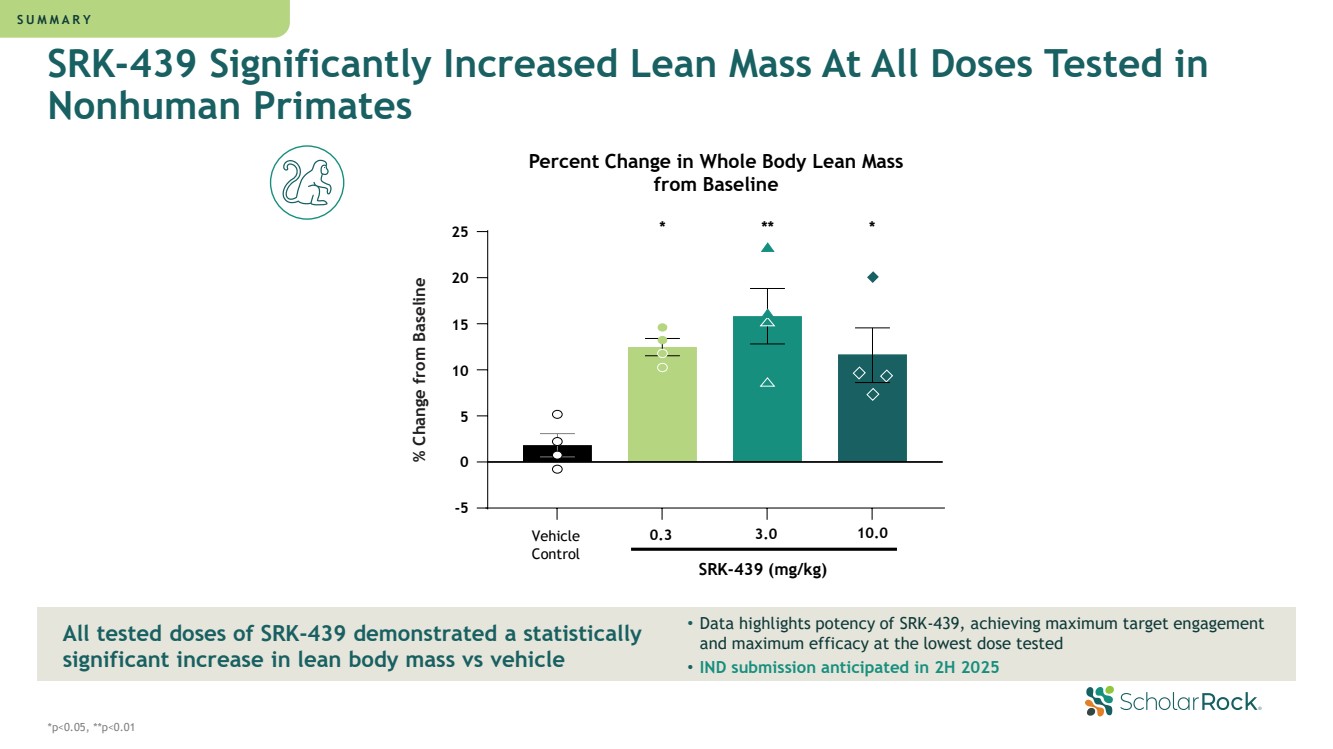
S U M M A R Y SRK-439 Significantly Increased Lean Mass At All Doses Tested in Nonhuman Primates • Data highlights potency of SRK-439, achieving maximum target engagement and maximum efficacy at the lowest dose tested • IND submission anticipated in 2H 2025 All tested doses of SRK-439 demonstrated a statistically significant increase in lean body mass vs vehicle * ** * Vehicle 0.3 3.0 10.0 Control SRK-439 (mg/kg) 25 20 15 10 5 0 -5 % Change from Baseline Percent Change in Whole Body Lean Mass from Baseline *p<0.05, **p<0.01 |
|
Delivering on Our Priorities to Drive Long-Term Growth © 2025 Scholar Rock, Inc. All rights reserved. 16 US: PDUFA Sept 22; Execute Successful Commercial Launch* Efficient Commercial Build 1 2 3 Expand in Additional Rare, Severe & Debilitating Neuromuscular Diseases Apitegromab Regulatory Approvals & Commercialization Disciplined Capital Allocation Apitegromab Development Program: Building a Pipeline in a Product EU: MAA mid-2026; Advance Launch Preparedness ROW: Expand Globally Leverage Highly Innovative Anti-myostatin Platform Phase Investments to Support Potential Future High-value Commercial & Pipeline Initiatives *Pending regulatory approval SRK-439: IND in 2H 2025 |
|
Q&A © 2025 Scholar Rock, Inc. All rights reserved. 1 7 |