 エドガーで原本を確認する
UNITED STATES
SECURITIES AND EXCHANGE COMMISSION
Washington, D.C. 20549
FORM 40-F
☐Registration statement pursuant to section 12 of the Securities Exchange Act of 1934
☒Annual report pursuant to section 13(a) or 15(d) of the securities exchange act of 1934
For the fiscal year ended December 31, 2024
Commission File Number 001-40416
NOUVEAU MONDE GRAPHITE INC.
(Exact name of Registrant as specified in its charter)
Canada |
|
1090 |
|
Not Applicable |
(Province or other jurisdiction |
|
(Primary Standard |
|
(I.R.S. Employer Identification |
of incorporation or |
|
Industrial Classification |
|
No.) |
organization) |
|
Code Number) |
|
|
481 rue Brassard
Saint-Michel-des-Saints,
Québec Canada J0K 3B0
(450) 757-8905
(Address and telephone number of Registrant’s principal executive offices)
CT Corporation
28 Liberty Street
New York, New York 10005
(212) 894-8940
(Name, address (including zip code) and telephone number (including area
code) of agent for service in the United States)
Securities registered or to be registered pursuant to Section 12(b) of the Act:
|
|
|
|
|
Title of each class |
|
Trading |
|
Name of each exchange on which registered |
|
|
Symbol(s) |
|
|
|
|
|
|
|
Common Shares, no par value |
|
NMG |
|
New York Stock Exchange |
Securities registered or to be registered pursuant to Section 12(g) of the Act: None
Securities for which there is a reporting obligation pursuant to Section 15(d) of the Act: None
For annual reports, indicate by check mark the information filed with this form:
☒Annual Information Form |
|
☒Audited Annual Financial Statements |
Number of outstanding shares of each of the issuer’s classes of capital or common stock as of December 31, 2024: 152,261,189 Common Shares, no par value.
Indicate by check mark whether the Registrant (1) has filed all reports required to be filed by Section 13 or 15(d) of the Exchange Act during the preceding 12 months (or for such shorter period that the Registrant was required to file such reports) and (2) has been subject to such filing requirements for the past 90 days.
Yes ☒ |
|
No ☐ |
Indicate by check mark whether the registrant has submitted electronically every Interactive Data File required to be submitted pursuant to Rule 405 of Regulation S-T (§232.405 of this chapter) during the preceding 12 months (or for such shorter period that the registrant was required to submit such files).
|
|
|
Yes ☒ |
|
No ☐ |
Indicate by check mark whether the registrant is an emerging growth company as defined in Rule 12b-2 of the Exchange Act.
Emerging Growth Company ☒
If an emerging growth company that prepares its financial statements in accordance with U.S. GAAP, indicate by check mark if the registrant has elected not to use the extended transition period for complying with any new or revised financial accounting standards† provided pursuant to Section 13(a) of the Exchange Act. ☐
† The term “new or revised financial accounting standard” refers to any update issued by the Financial Accounting Standards Board to its Accounting Standards Codification after April 5, 2012.
Indicate by check mark whether the registrant has filed a report on and attestation to its management’s assessment of the effectiveness of its internal control over financial reporting under Section 404(b) of the Sarbanes-Oxley Act (15 U.S.C. 7262(b)) by the registered public accounting firm that prepared or issued its audit report. ☐
If securities are registered pursuant to Section 12(b) of the Act, indicate by check mark whether the financial statements of the registrant included in the filing reflect the correction of an error to previously issued financial statements. ☐
Indicate by check mark whether any of those error corrections are restatements that required a recovery analysis of incentive-based compensation received by any of the registrant’s executive officers during the relevant recovery period pursuant to §240.10D-(b). ☐
EXPLANATORY NOTE
Nouveau Monde Graphite Inc. (the “Company” or “Registrant”) is a Canadian public company whose common shares are listed on the Toronto Stock Exchange under the symbol “NOU” and the New York Stock Exchange (the “NYSE”) under the symbol “NMG.” The Company is eligible to file its annual report pursuant to Section 13 of the Securities Exchange Act of 1934, as amended (the “Exchange Act”), on Form 40-F pursuant to the multijurisdictional disclosure system of the Exchange Act (“MJDS”). The Company is a “foreign private issuer” as defined in Rule 3b- 4 under the Exchange Act. Equity securities of the Company are accordingly exempt from Sections 14(a), 14(b), 14(c), 14(f) and 16 of the Exchange Act pursuant to Rule 3a12-3.
FORWARD-LOOKING STATEMENTS
This annual report on Form 40-F (the “Annual Report”) contains “forward-looking information” and “forward-looking statements” within the meaning of applicable securities legislation (collectively, “forward-looking statements”), including, but not limited to, statements relating to future financial or operating events or future performance of the Company and reflect management’s expectations and assumptions regarding the Company’s growth, results, performance and business prospects and opportunities. Such forward-looking statements reflect management’s current beliefs and are based on information currently available to it. In some cases, forward-looking statements can be identified by words such as “may”, “would”, “could”, “will”, “should”, “expect”, “intend”, “aim”, “attempt”, “anticipate”, “believe”, “study”, “target”, “estimate”, “forecast”, “predict”, “outlook”, “mission”, “aspire”, “plan”, “schedule”, “potential”, “progress” or the negative of these terms or other similar expressions concerning matters that are not historical facts In particular, statements regarding the Company’s future results, the intended construction and commissioning timeline of the Matawinie Mine Project , the Bécancour Battery Material Plant Project, the Shaping Demonstration Plant and the Coating Demonstration Plant, the intended operation and performance of the Purification Demonstration Plant, the Shaping Demonstration Plant, the Coating Demonstration Plant and the Concentrator Demonstration Plant, the anticipated decommissioning of the Purification Demonstration Plant, the intended development of the Matawinie Mine property, the intended execution strategy of the Company’s projected development of the Matawinie Mine Project and the Bécancour Battery Material Plant Project, the possibility that the powerline may or may not be operational in due time for the Matawinie Mine Project commissioning phase, the intended development of the Uatnan Mining Project, the economic performance and product development efforts, as well as the Company’s expected achievement of milestones, including the ability to obtain sufficient financing for the development of the Matawinie Mine Project and the Bécancour Battery Material Plant Project on favorable terms for the Company, including the completion of the FID, the satisfaction of the terms and conditions, conditions precedent, as well as qualification requirements of the product and the commercial operations as set forth in the offtake agreements, the Company’s development activities and production plans, including the operation of the shaping demonstration plant, the purification demonstration plant, the coating demonstration plant and the concentrator demonstration plant, the ability to achieve the Corporation’s environmental, social and governance (“ESG”) initiatives, the execution and implementation of the agreements with First Nations, communities and key stakeholders on favorable terms for the Company, the Company’s ability to provide advanced materials while promoting sustainability and supply chain traceability, including the Company’s green and sustainable lithium-ion active anode material initiatives, the Company’s ability to establish local, carbon-neutral, and traceable turkey supply of graphite-based advanced materials for Western World, the Company’s electrification strategy and its intended results, market trends, the consumers demand for components in lithium-ion batteries for electric vehicles and energy storage solutions, the Company’s competitive advantages, macroeconomic conditions, the impact of applicable laws and regulations, the results of the 2025 Updated Feasibility Study (as defined herein), the 2022 Technical Report, the Uatnan Mining Property Report and any other feasibility study and preliminary economic assessments and any information as to future plans and outlook for the Company are or involve forward-looking statements.
Forward-looking statements are based on reasonable assumptions that have been made by the Company as at the date of such statements and are subject to known and unknown risks, uncertainties, and other factors that may cause the actual results, level of activity, performance, or achievements of the Company to be materially different from those expressed or implied by such forward-looking statements, including but not limited to, the actual results of current development, engineering and planning activities, access to capital and future prices of graphite, new mining operation inherent risks, the speculative nature of mining development, changes in mineral production performance, the uncertainty of processing the Company’s technology on a commercial basis, development and production timetables; competition and market risks; pricing pressures; other risks of the mining industry, and additional engineering and other analysis is required to fully assess their impact; the fact that certain of the initiatives described in this Annual Report, are still in the early stages and may not materialize; business continuity and crisis management; political instability and international conflicts; and such other assumptions and factors as set out in the exhibits to this Annual Report.
Although the Company has attempted to identify important factors that could cause actual results to differ materially from those contained in forward-looking statements, there may be other factors that may cause results not to be as anticipated, estimated or intended. There can be no assurance that such statements will prove to be accurate, as actual results and future events could differ materially from those anticipated in such statements. Accordingly, readers should not place undue reliance on forward-looking statements and are cautioned that the list of risks, uncertainties, assumptions and other factors are not exhaustive. The Company does not undertake to update or revise any forward-looking statements that are included in this Annual Report, whether as a result of new information, future events or otherwise, except in accordance with applicable securities laws.
Capitalized terms under the heading “Forward-Looking Statements” and not otherwise defined herein have the meanings given to them in the 2024 AIF.
DIFFERENCES IN UNITED STATES AND CANADIAN REPORTING PRACTICES
The Company is permitted, under the MJDS, to prepare this Annual Report in accordance with Canadian disclosure requirements, which are different from those of the United States. The Company prepares its financial statements, which are filed with this Annual Report, in accordance with International Financial Reporting Standards (“IFRS Accounting Standards”) as issued by the International Accounting Standards Board, and the audit is subject to the Public Company Accounting Oversight Board Standards. In addition, the Company is not required to prepare a reconciliation of its financial statements between IFRS Accounting Standards and U.S. generally accepted accounting principles, and has not quantified such differences, which may be significant.
CAUTIONARY NOTE TO U.S. INVESTORS
Disclosure regarding Mineral Reserve and Mineral Resource estimates included in the documents incorporated by reference herein were prepared in accordance with Regulation 43-101 respecting Standards of Disclosure for Mineral Projects (“NI 43-101”) and applicable mining terms are as defined in accordance with the CIM Definition Standards on Mineral Resources and Reserves adopted by the Canadian Institute of Mining, Metallurgy and Petroleum Council (the “CIM Definition Standards”), as required by NI 43-101. Unless otherwise indicated, all reserve and resource estimates included in the documents incorporated by reference herein have been prepared in accordance with the CIM Definition Standards, as required by NI 43-101.
NI 43-101 is a rule developed by the Canadian Securities Administrators that establishes the Canadian standards for all public disclosure an issuer makes of scientific and technical information concerning mineral projects. These standards differ from the requirements of the United Securities and Exchange Commission (the “SEC”) applicable to United States companies. Accordingly, mineral resource and reserve information contained in the documents incorporated by reference herein may not be comparable to similar information made public by United States companies reporting pursuant to SEC reporting and disclosure requirements.
CURRENCY
Unless otherwise indicated, all dollar amounts in this Annual Report are in Canadian dollars. The exchange rate of Canadian dollars into United States dollars, based upon the daily exchange rate as quoted by the Bank of Canada, was US$1.00 = CDN$1.4389 on December 31, 2024.
ANNUAL INFORMATION FORM
The 2024 AIF is filed as Exhibit 99.1 to this Annual Report and is incorporated by reference herein.
AUDITED FINANCIAL STATEMENTS
The audited consolidated financial statements of the Company for the years ended December 31, 2024 and 2023, including the report of the independent auditor (PCAOB ID#271) thereon (the “Financial Statements”), are filed as Exhibit 99.2 to this Annual Report and are incorporated by reference herein.
MANAGEMENT’S DISCUSSION AND ANALYSIS
The Company’s Management’s Discussion and Analysis (the “MD&A”) dated March 31, 2025 for the year ended December 31, 2024, is filed as Exhibit 99.3 to this Annual Report and is incorporated by reference herein.
CERTIFICATIONS AND DISCLOSURE REGARDING CONTROLS AND PROCEDURES
Disclosure Controls and Procedures
As of the end of the period covered by this Annual Report, the Company carried out an evaluation, under the supervision of the Company’s Chief Executive Officer (“CEO”) and Chief Financial Officer (“CFO”), of the effectiveness of the Company’s disclosure controls and procedures (as defined in Rules 13a-15(e) and 15d-15(e) of the Exchange Act). Based upon that evaluation, the Company’s CEO and CFO have concluded that, as of the end of the period covered by this Annual Report, the Company’s disclosure controls and procedures are effective to ensure that information required to be disclosed by the Company in reports that it files or submits under the Exchange Act is (i) recorded, processed, summarized and reported within the time periods specified in SEC rules and forms, and (ii) accumulated and communicated to the Company’s management, including its principal executive officer and principal financial officer, to allow timely decisions regarding required disclosure.
While the Company’s principal executive officer and principal financial officer believe that the Company’s disclosure controls and procedures provide a reasonable level of assurance that they are effective, they do not expect that the Company’s disclosure controls and procedures or internal control over financial reporting will prevent all errors or fraud. A control system, no matter how well conceived or operated, can provide only reasonable, not absolute, assurance that the objectives of the control system are met.
Management’s Annual Report On Internal Control Over Financial Reporting
Management, including the CEO and CFO, is responsible for establishing and maintaining adequate internal control over financial reporting, as defined in Rule 13a-15(f) under the Exchange Act. The Company’s management has employed a framework consistent with Exchange Act Rule 13a-15(c), to evaluate the Company’s internal control over financial reporting described below. A company’s internal control over financial reporting is a process designed to provide reasonable assurance regarding the reliability of financial reporting and the preparation of financial statements for external purposes in accordance with generally accepted accounting principles.
A company’s internal control over financial reporting includes those policies and procedures that (i) pertain to the maintenance of records that, in reasonable detail, accurately and fairly reflect the transactions and dispositions of the assets of the company; (ii) provide reasonable assurance that transactions are recorded as necessary to permit preparation of financial statements in accordance with generally accepted accounting principles, and that receipts and expenditures of the company are being made only in accordance with authorizations of management and directors of the company; and (iii) provide reasonable assurance regarding prevention or timely detection of unauthorized acquisition, use, or disposition of the company’s assets that could have a material effect on the financial statements. It should be noted that a control system, no matter how well conceived or operated, can only provide reasonable assurance, not absolute assurance, that the objectives of the control system are met. Also, projections of any evaluation of effectiveness to future periods are subject to the risk that controls may become inadequate because of changes in conditions, or that the degree of compliance with policies and procedures may deteriorate.
The Company’s management, including the CEO and CFO, is responsible for establishing and maintaining adequate internal control over financial reporting, and used the framework issued by the Committee of Sponsoring Organizations of the Treadway Commission (2013)(COSO) to evaluate the effectiveness of our controls. Based on this evaluation, management concluded that the Company’s internal controls over financial reporting were effective as of December 31, 2024.
Attestation Report of the Registered Public Accounting Firm
As an “emerging growth company” under the Jumpstart our Business Startups Act, the Company is exempt from Section 404(b) of the Sarbanes-Oxley Act of 2002, which requires that a public company’s registered public accounting firm provide an attestation report relating to management’s assessment of internal control over financial reporting.
Changes in Internal Control Over Financial Reporting
During the period covered by this Annual Report, no change occurred in the Company’s internal control over financial reporting that has materially affected, or is reasonably likely to materially affect, the Company’s internal control over financial reporting.
CORPORATE GOVERNANCE
The purpose of the Human Resources Committee is to assist the board of directors (the “Board”) of the Company in discharging its oversight responsibilities relating to the compensation of directors, and the compensation and retention of executive officers having the skills and expertise needed to enable the Company to achieve its goals and strategies at a fair and competitive compensation, including appropriate performance incentives, and to support and monitor the Company’s diversity, equity, and inclusion initiatives. The Company’s Human Resources Committee charter is available on the Company’s website at the following address: https://nmg.com.
The purpose of the Governance Committee is to assist the Board with the development, implementation and assessment of effective corporate governance practices, and compliance with related laws and regulations, and to assist the Board in ensuring that it is comprised of directors with the necessary skills to effectively discharge its oversight responsibilities relating to the Company’s activities. The Company’s Governance Committee charter is available on the Company’s website at the following address: https://nmg.com.
AUDIT COMMITTEE
The Board has a separately designated standing Audit Committee established in accordance with Section 3(a)(58)(A) of the Exchange Act and Section 303A.06 of the NYSE Listed Company Manual. As of the date of this Annual Report, the Company’s Audit Committee is comprised of Daniel Buron (chair), Stephane Leblanc and Nathalie Pilon, each of whom the Company’s Board has determined is financially literate, meaning each such member has the ability to read and understand a set of financial statements that present a breadth and level of complexity of the issues that can reasonably be expected to be raised by the Company’s financial statements. The Board has also determined that Mr. Buron, Mr. Leblanc and Ms. Pilon are “independent” within the meaning of the listing standards of the NYSE.
In addition, the Board has determined that Mr. Buron and Ms. Pilon are “audit committee financial experts” within the meaning of the rules of the SEC.
The SEC has indicated that the designation of a person as an audit committee financial expert does not make such person an “expert” for any purpose, impose any duties, obligations or liability on such person that are greater than those imposed on members of the audit committee and board of directors who do not carry this designation, or affect the duties, obligations or liability of any other member of the audit committee or board of directors.
The Company’s Audit Committee charter is available on the Company’s website at the following address: https://nmg.com.
CODE OF ETHICS
The Company’s Code of Conduct (the “Code”) applies to all directors, officers and employees of the Company, including the CEO and CFO. Since the adoption of the Code, there have not been any waivers, including implied waivers, from any provision of the Code. A copy of the Code can be found on the Company’s internet website at the following address: https://nmg.com.
PRINCIPAL ACCOUNTANT FEES AND SERVICES
The information provided under the headings “Audit Committee – External Auditor Service Fees” and “Audit Committee – Pre-approval Policies and Procedures” contained in the 2024 AIF, filed as Exhibit 99.1 hereto, is incorporated by reference herein. The Registrant’s Audit Committee has not adopted specific policies or procedures for the engagement of non-audit services. However, the Registrant’s Audit Committee may approve, from time to time, expenses made for non-audit-related services contracts. The Registrant’s Independent Registered Public Accounting Firm in 2024 and 2023 was PricewaterhouseCoopers LLP, a partnership of Chartered Professional Accountants, located in Montreal, Quebec, Canada PCAOB ID#271. All audit and non-audit fees paid to PricewaterhouseCoopers LLP for the financial year ended December 31, 2024, were pre-approved by the Audit Committee and none were approved on the basis of the de minimis exemption set forth in Rule 2-01(c)(7)(i)(C) of Regulation S-X.
OFF-BALANCE SHEET ARRANGEMENTS
The information provided under the heading “Off-Balance Sheet Transactions” contained in the MD&A, filed as Exhibit 99.3 hereto, is incorporated by reference herein.
CONTRACTUAL OBLIGATIONS
The discussion and analysis of the Company’s material cash requirements from known contractual and other obligations is provided under the headings “Contractual Obligations and Commitments” and “Liquidity and Funding” contained in the MD&A, filed as Exhibit 99.3 hereto, and the information provided in Note 29 of the Financial Statements, filed as Exhibit 99.2 hereto, is incorporated by reference herein.
NYSE CORPORATE GOVERNANCE
The Company’s common shares are listed on the NYSE. Section 303A.11 of the NYSE Listed Company Manual permits foreign private issuers to follow home country practices in lieu of certain provisions of the NYSE Listed Company Manual. A foreign private issuer that follows home country practices in lieu of certain provisions of the NYSE Listed Company Manual must disclose any significant ways in which its corporate governance practices differ from those followed by domestic companies either on its website or in the annual report that it distributes to shareholders in the United States. A description of the significant ways in which the Company’s governance practices differ from those followed by domestic companies pursuant to NYSE standards is set forth on the Company’s website at https://nmg.com.
In addition, the Company may from time-to-time seek relief from NYSE corporate governance requirements on specific transactions under Section 303A.11 of the NYSE Listed Company Manual, in which case, the Company shall make the disclosure of such transactions available on its website at https://nmg.com. Information contained on the Company’s website is not part of this Annual Report.
NOTICES PURSUANT TO REGULATION BTR
There were no notices required by Rule 104 of Regulation BTR that the Company sent during the year ended December 31, 2024 concerning any equity security subject to a blackout period under Rule 101 of Regulation BTR.
MINE SAFETY DISCLOSURE
Not applicable.
DISCLOSURE REGARDING FOREIGN JURISDICTIONS THAT PREVENT INSPECTIONS
Not applicable.
RECOVERY OF ERRONEOUSLY AWARDED COMPENSATION
Not applicable.
EXHIBIT INDEX
UNDERTAKING
The Registrant undertakes to make available, in person or by telephone, representatives to respond to inquiries made by the SEC staff, and to furnish promptly, when requested to do so by the SEC staff, information relating to the securities in relation to which the obligation to file an annual report on Form 40-F arises or transactions in said securities.
CONSENT TO SERVICE OF PROCESS
The Registrant has previously filed a Form F-X in connection with the class of securities in relation to which the obligation to file this report arises.
Any change to the name or address of the agent for service of the Registrant shall be communicated promptly to the Commission by amendment to Form F-X referencing the file number of the Registrant.
SIGNATURES
Pursuant to the requirements of the Exchange Act, the Registrant certifies that it meets all of the requirements for filing on Form 40-F and has duly caused this annual report to be signed on its behalf by the undersigned, thereto duly authorized.
|
NOUVEAU MONDE GRAPHITE INC. |
|
|
|
|
|
By: |
/s/ Eric Desaulniers |
|
Name: |
Eric Desaulniers |
|
Title: |
President and Chief Executive Officer |
|
|
|
|
Date: |
March 31, 2025 |
Exhibit 99.1

ANNUAL INFORMATION FORM
For the fiscal year ended December 31, 2024
March 31, 2025

TABLE OF CONTENTS
2
3
PRELIMINARY COMMENTS
In this annual information form (“Annual Information Form”), unless otherwise indicated or the context suggests otherwise, the term the “Corporation” refers to Nouveau Monde Graphite Inc. The information in this Annual Information Form is dated as at December 31, 2024, unless otherwise indicated or the context suggests otherwise. Unless otherwise indicated or the context suggests otherwise, numbers and price of the common shares of the Corporation (the “Common Shares”) and any other information on securities convertible into Common Shares are stated on a post-Consolidation (as defined herein) basis after giving effect to the Consolidation (as defined herein).
Unless otherwise indicated or the context suggests otherwise, all references to “$”, “CAD” or “dollars” refer to Canadian dollars and all references to “US$” or “USD” refer to United States (“U.S.”) dollars.
FORWARD-LOOKING STATEMENTS
This Annual Information Form contains “forward-looking information” and “forward-looking statements” within the meaning of applicable securities legislation (collectively, “forward-looking statements”), including, but not limited to, statements relating to future financial or operating events or future performance of the Corporation and reflect management’s expectations and assumptions regarding the Corporation’s growth, results, performance and business prospects and opportunities. Such forward-looking statements reflect management’s current beliefs and are based on information currently available to it. In some cases, forward-looking statements can be identified by words such as “aim”, “anticipate”, “aspire”, “attempt”, “believe”, “budget”, “could”, “estimate”, “expect”, “forecast”, “intend”, “may”, “mission”, “plan”, “potential”, “predict”, “progress”, “outlook”, “schedule”, “should”, “study”, “target”, “will”, “would” or the negative of these terms or other similar expressions concerning matters that are not historical facts. In particular, statements regarding the Corporation’s future results, the intended construction and commissioning timeline of the Matawinie Mine Project (as defined herein) and the Bécancour Battery Material Plant Project (as defined herein), the intended operation and performance of the Purification Demonstration Plant (as defined herein), the Shaping Demonstration Plant (as defined herein), the Coating Demonstration Plant (as defined herein) and the Concentrator Demonstration Plant (as defined herein), the anticipated decommissioning of the purification demonstration plant, the intended development of the Matawinie Mine property, the intended execution strategy of the Corporation’s projected development of the Matawinie Mine Project and the Bécancour Battery Material Plant Project, the possibility that the powerline may or may not be operational in due time for the Matawinie Mine Project commissioning phase, the intended development of the Uatnan Mining Project, the economic performance and product development efforts, as well as the Corporation’s expected achievement of milestones, including the ability to obtain sufficient financing for the development of the Matawinie Mine Project and the Bécancour Battery Material Plant Project on favorable terms for the Corporation, including the completion of the FID (as defined herein), the satisfaction of the terms and conditions, conditions precedent, as well as qualification requirements of the product and the commercial operations as set forth in the Offtakes (as defined herein), the Corporation’s development activities and production plans, including the operation of the shaping demonstration plant, the purification demonstration plant, the coating demonstration plant and the concentrator demonstration plant, the ability to achieve the Corporation’s environmental, social and governance (“ESG”) initiatives, the execution and implementation of agreements with First Nations, communities and key stakeholders on favorable terms for the Corporation, the Corporation’s ability to provide advanced materials while promoting sustainability and supply chain traceability, including the Corporation’s green and sustainable lithium-ion active anode material initiatives, the Corporation’s ability to establish a local, carbon-neutral, and traceable turnkey supply of graphite-based advanced materials for the Western World, the Corporation’s electrification strategy and its intended results, market trends, the consumers demand for components in lithium-ion batteries for electric vehicles and energy storage solutions, the Corporation’s competitive advantages, macroeconomic conditions, the impact of applicable laws and regulations, the results of the 2025 Updated Feasibility Study (as defined herein), the 2022 Technical Report, the 2023 Uatnan Mining Property Report and any other feasibility study and preliminary economic assessments and any information as to future plans and outlook for the Corporation are or involve forward looking-statements.
4
Forward-looking statements are based on reasonable assumptions that have been made by the Corporation as at the date of such statements and are subject to known and unknown risks, uncertainties, and other factors that may cause the actual results, level of activity, performance, or achievements of the Corporation to be materially different from those expressed or implied by such forward-looking statements, including but not limited to, the actual results of current development, engineering and planning activities, access to capital and future prices of graphite, new mining operation inherent risks, mineral exploration and development activities inherent risks, the speculative nature of mining development, changes in mineral production performance, the uncertainty of processing the Corporation’s technology on a commercial basis, development and production timetables; competition and market risks; pricing pressures; other risks of the mining industry, and additional engineering and other analysis is required to fully assess their impact; the fact that certain of the initiatives described in this Annual Information Form, are still in the early stages and may not materialize; business continuity and crisis management; political instability and international conflicts; and such other assumptions and factors as set out herein and in this Annual Information Form, and additionally, such other factors discussed in the section entitled “Risk Factors” herein.
Although the Corporation has attempted to identify important factors that could cause actual results to differ materially from those contained in forward-looking statements, there may be other factors that may cause results not to be as anticipated, estimated or intended. There can be no assurance that such statements will prove to be accurate, as actual results and future events could differ materially from those anticipated in such statements. Accordingly, readers should not place undue reliance on forward-looking statements and are cautioned that the list of risks, uncertainties, assumptions and other factors are not exhaustive. The Corporation does not undertake to update or revise any forward-looking statements that are included in this Annual Information Form, whether as a result of new information, future events or otherwise, except in accordance with applicable securities laws.
MARKET AND INDUSTRY DATA
Market and industry data presented throughout this Annual Information Form was obtained from third-party sources and industry reports, publications, websites and other publicly available information, as well as industry and other data prepared by the Corporation or on the behalf of the Corporation on the basis of the Corporation’s knowledge of the markets in which the Corporation operates, including information provided by suppliers, partners, customers and other industry participants.
The Corporation believes that the market and economic data presented throughout this Annual Information Form is accurate as of the date of publication and, with respect to data prepared by the Corporation or on behalf of the Corporation, that estimates and assumptions are currently appropriate and reasonable, but there can be no assurance as to the accuracy or completeness thereof.
5
The accuracy and completeness of the market and economic data presented throughout this Annual Information Form are not guaranteed and the Corporation does not make any representation as to the accuracy of such data. Actual outcomes may vary materially from those forecast in such reports or publications, and the prospect for material variation can be expected to increase as the length of the forecast period increases. Although the Corporation believes it to be reliable as of the date of publication, the Corporation has not independently verified any of the data from third-party sources referred to in this Annual Information Form, analyzed or verified the underlying studies or surveys relied upon or referred to by such sources, or ascertained the underlying market, economic and other assumptions relied upon by such sources. Market and economic data are subject to variations and cannot be verified due to limits on the availability and reliability of data inputs, the voluntary nature of the data gathering process and other limitations and uncertainties inherent in any statistical survey.
CAUTIONARY NOTICE TO U.S. INVESTORS
Disclosure regarding Mineral Reserve and Mineral Resource estimates included herein were prepared in accordance with Regulation 43-101 respecting Standards of Disclosure for Mineral Projects (“NI 43-101”) and applicable mining terms are as defined in accordance with the CIM Definition Standards on Mineral Resources and Reserves adopted by the Canadian Institute of Mining, Metallurgy and Petroleum Council (the “CIM Definition Standards”), as required by NI 43-101. Unless otherwise indicated, all reserve and resource estimates included in this Annual Information Form have been prepared in accordance with the CIM Definition Standards, as required by NI 43-101.
NI 43-101 is a rule developed by the Canadian Securities Administrators that establishes standards for all public disclosure an issuer makes of scientific and technical information concerning mineral projects. NI 43-101 differs from the disclosure requirements of the United States Securities and Exchange Commission (the “SEC”) applicable to U.S. companies. Accordingly, information contained herein may not be comparable to similar information made public by U.S. companies reporting pursuant to SEC reporting and disclosure requirements.
CORPORATE STRUCTURE
NAME, ADDRESS AND INCORPORATION
The Corporation was formed on December 31, 2012, pursuant to the Canada Business Corporation Act (the “CBCA”) under the name “Nouveau Monde Mining Enterprises Inc. / Entreprises Minières du Nouveau Monde Inc.” as a result of the amalgamation of “Tucson Acquisition Corporation”, a capital pool company, and “New World Mining Enterprises Inc. / Entreprises Minières du Nouveau-Monde Inc.”, a private company located in Gatineau, Québec. On February 6, 2017, the Corporation filed articles of amendment in order to change its name to “Nouveau Monde Graphite Inc.”. On March 24, 2021, the Corporation filed articles of amendment in order to implement a consolidation (reverse stock split) of its outstanding Common Shares (the “Consolidation”) on the basis of one new Common Share for every ten currently outstanding Common Shares (the “Consolidation Ratio”).
The Corporation’s head and registered office is located at 481 Brassard Street, Saint-Michel-des-Saints, Québec J0K 3B0.
6
INTERCORPORATE RELATIONSHIPS
As of the date of this Annual Information Form, the Corporation beneficially owns 100% of the voting shares of Nouveau Monde District Inc., incorporated under the CBCA and 100% of the voting shares of Nouveau Monde Europe Limited, incorporated under the Companies Act 2006 (United Kingdom). Nouveau Monde District Inc. currently holds properties in Saint-Michel-des-Saints. Nouveau Monde Europe Limited has been created on October 12, 2020.
The following diagram illustrates the aforementioned intercorporate relationships between the Corporation and its material subsidiaries as at the date of this Annual Information Form:

GENERAL DEVELOPMENT OF THE BUSINESS
INTRODUCTION AND GENERAL OUTLOOK
The Corporation is an integrated company developing responsible mining and advanced processing operations to supply the global economy with carbon-neutral anode material to power electric vehicles (“EV”) and energy storage systems. The Corporation is developing a fully integrated ore-to-battery-material source of graphite-based active anode material in Québec, Canada. With recognized ESG standards and structuring partnerships, the Corporation is set to become a strategic supplier to the world’s leading lithium-ion battery and EV manufacturers, providing advanced materials.
The Corporation is carrying out a phased-development plan for its Matawinie Mine and Bécancour Battery Material Plant (respectively, with the applicable demonstration plants, the “Matawinie Mine Project” and “Bécancour Battery Material Plant Project”) to derisk its projects and advance towards FID in view of commercial operations. To support growth and customers’ demand beyond its Phase 2, the Corporation is planning the development of the Uatnan Mining Project targeted as the Corporation’s Phase-3 expansion.
7
Projects Overview
Matawinie Mine Project | ||
|
To support the development of the Matawinie Mine Project, the Corporation plans to continue optimizing its processes, product, and operational practices to align with the technical requirements of its customers using its Phase-1 demonstration plant; advance detailed engineering, construction planning, and procurement; and finalize the project financing with the various financial stakeholders engaged in the project to reach a final investment decision (“FID”) and launch construction of the Phase 2 comprising of the Matawinie Mine Project and the Bécancour Battery Material Plant. A positive FID is dependent on the financing structure in light of the 2025 Updated Feasibility Study (as defined herein), updated financial model, the conclusions of the due diligence processes and negotiations with the various financial stakeholders, including the completion of the Offtake conditions precedent and the project-related agreements with the Anchor Customers. | ||
Phase 1 – Matawinie Mine Demonstration Plant | ||
|
Concentrator Demonstration Plant |
In operation to support product sampling and qualification to customers’ specifications. |
Phase 2 – Matawinie Mine |
Mining decree obtained. Some groundworks completed, in preparation for launch of construction upon a positive FID. Completion and issuance of the 2025 Updated Feasibility Study reflecting advancement in engineering, technological development, project optimizations, and the economics model. Detailed engineering, construction planning, and procurement strategy advancing in parallel to project financing. |
|
8
Bécancour Battery Material Plant Project | ||
|
To support the development of the Bécancour Battery Material Plant, the Corporation plans to continue optimizing its processes, products, and operational practices to align with the technical requirements of its Anchor Customers using its Phase-1 demonstration plants; refine environmental performance and operational parameters of the chemical purification technology; advance detailed engineering, construction planning, and procurement activities; and finalize the project financing with the various financial stakeholders engaged in the project to reach FID and launch construction of the Phase 2. A positive FID is dependent on the financing structure in light of the 2025 Updated Feasibility Study, updated financial model, the conclusions of the due diligence processes and negotiations with the various financial stakeholders, including the completion of the Offtake conditions precedent and the project-related agreements with Anchor Customers. | ||
Phase 1 – Battery Material Demonstration Plants | ||
|
Shaping Demonstration Plant |
In operation to support product sampling and qualification. |
|
Purification Demonstration Plant |
Tests completed at facility in light of technology change. |
|
Coating Demonstration Plant |
In operation to support product sampling and qualification. |
Phase 2 – Bécancour Battery Material Plant |
Completion and issuance of the 2025 Updated Feasibility Study reflecting advancement in engineering, technological development, project optimizations, and the financial model. Preliminary works initiated at the site. Engineering, construction planning, and procurement strategy advancing diligently in parallel to project financing. |
|
Uatnan Mining Project | ||
|
To support the advancement of the Uatnan Mining Project, the Corporation plans to continue engaging with the Innu First Nation of Pessamit to establish a collaboration model; in view of advancing a feasibility study along with an environmental and social impact assessment. Additional funding will be required to support this development. The Corporation also aims at formalizing commercial engagement for this contemplated production. The development of the project leading to governmental authorizations is dependent on positive studies results, successful public consultation and First Nation engagement, favorable market demand, and commercial interest. | ||
Phase 3 – Uatnan Mining Project |
The 2023 Uatnan Mining Property Report (as defined herein) was completed; detailed work plan for subsequent studies ready for deployment. Assessment of potential sites for processing plants initiated. |
|
9
MATAWINIE MINE PROJECT
The Corporation mandated engineering firm BBA Inc. (“BBA”), with the support of various technical consultants, to carry out the 2025 Updated Feasibility Study covering the Phase-2 Matawinie Mine and Bécancour Battery Material Plant projects. Parameters of the previous 2022 feasibility study were revised to reflect the advancement in engineering and project design, and updated financial parameters. Results of the 2025 Updated Feasibility Study were published on March 25, 2025. The project is now progressing toward FID.
Project highlights for the Matawinie Mine include:
| » | Life of mine (“LOM”): 25 years |
| » | Stripping ratio (LOM): 1.16:1 |
| » | Nominal annual processing rate: 2.56M metric tonnes |
| » | Average recovery: 93% |
| » | Nominal annual graphite concentrate production: 105,882 metric tonnes |
| » | Finished product purity: 97.5% Ct |
| » | CAPEX: US$415M |
| » | Annual OPEX: US$44M |
A governmental decree authorizes the project and provides the Corporation with the regulatory requirements to build and operate the Phase-2 Matawinie Mine, upon positive FID and project financing. The Corporation works collaboratively with various authorities to plan and advance the permitting process for the various construction and operation activities.
| » | The Corporation has requested an amendment to the government decree to clarify certain operating conditions. The main adjustment concerns the maximum authorized tonnage, which would be increased from 100,000 tonnes per annum (“tpa”) to a maximum of 106,000 tpa based on the peak production years in the 2025 Updated Feasibility Study, as well as the resulting adjustments to operations. The request is in active review with the authorities. |
| » | Numerous permit/authorization applications for the upcoming construction have been submitted in line with the project execution schedule. |
| » | Various mitigation measures, environmental initiatives and sub-project components for the community are being advanced in line with commitments and obligations detailed in the governmental decree and/or permitting requirements. |
The Corporation is advancing under an integrated project team (“IPT”) model where the Corporation’s owner team is assisted by strategic partners in engineering, procurement, construction management and project controls. The IPT strategy offers several advantages, including greater control over the project's direction as well as reduced project management and engineering costs.
| » | Detailed engineering is progressing with AtkinsRealis (concentrator), SRK Consulting (tailings and environmental infrastructure) and BBA (mining infrastructure), supporting the preparation of purchase orders for vendor engineering and long-lead items. |
| » | The 120kV electrical substation contract was awarded to ABB. ABB will lead construction of the substation as the primary connection point between the mining site and Hydro-Québec’s |
10
| hydropower line, enabling full electrification of the Matawinie Mine using renewable energy. Dedicated ABB technical experts will oversee engineering, supply, commissioning, and start-up of the substation. |
| » | Additional procurement activities are being deployed in preparation of the first construction packages now ready for tendering, including direct meetings with local and Indigenous businesses representatives to document the capacity, service offerings, and availability of businesses in the region. |
| » | With Pomerleau’s assistance, construction preparation is outlining the execution plan, detailed construction sequence and schedule, contracting strategy, as well as health and safety, environment, and quality programs. |
Since obtaining the mining decree, the Corporation has carried out early works to prepare the site, namely:
| » | Tree clearing was completed for the industrial platform and key environmental infrastructure. |
| » | An 8-km access road was built to connect the mine to the local highway. |
| » | The construction of environmental infrastructure (water ditches, water collection basin, organic and overburden stockpiles) has prepared the site for the next phase of civil works. |
| » | The site is concrete-ready for the start of construction, upon a positive FID, project financing, and construction authorizations. |
Matawinie Property
The Matawinie Graphite Property includes 176 exclusive exploration rights forming two (2) non-contiguous claim blocks totalling 9,263.68 hectares as of December 31, 2024. This information has not changed as at the date of this Annual Information Form (the “Matawinie Property”). The Tony claims block, which is part of the Matawinie Property and which is also known as the “Mining Property”, consists of 159 contiguous map-designated exclusive exploration rights totalling 8,266.43 hectares as of the date of this Annual Information Form. The main objective of exploration work on the Mining Property entails the identification of graphite mineralization with the goal to economically extract this critical and strategic mineral. The Corporation’s Matawinie Mine Project is at a development stage with ongoing detail engineering and construction planning activities targeting the Mining Property’s West Zone, the subject of the 2025 Updated Feasibility Study. Other exploration stage mineralized zones are also present on the Mining Property. Defined terms and abbreviations used in this section and not otherwise defined in this Annual Information Form have the meanings attributed to them in the 2025 Updated Feasibility Study.
The Mining Property is located approximately 120 km as the crow flies North of Montréal, Québec in the Saint-Michel-des-Saints area. The Mining Property, including the West Zone, is easily accessible using the Corporation’s newly built approximately 8-km access road connected to the local highway and is close to high quality infrastructure, including paved roads, high voltage power lines, and the community, which counts skilled laborers and contractors, which are needed for industrial activities. The Mining Property is located in proximity to Montréal metropolitan area, which also has a considerable pool of nearby labor and suppliers of goods and services.
Matawinie Mine – Phase 2
On March 31, 2025, the Corporation filed the 2025 Updated Feasibility Study, the results of which were announced by the Corporation on March 25, 2025. See “Description of the Mineral Properties – The
11
Matawinie Property” in this Annual Information Form. The 2025 Updated Feasibility Study reflects the Corporation’s integrated business model for comprehensive planning, cost projection, and development framework.
While the base case of the 2025 Updated Feasibility Study presents a diesel operation, the Corporation is advancing its electrification strategy with the objective of having both mining and concentration operations become fully electric when the machinery and equipment reaches viable technical and economic parameters. The Corporation is pursuing this opportunity via a collaboration with Caterpillar Inc. (“Caterpillar”) for the development of an integrated zero-emission solution for the Matawinie Mine encompassing the fleet, charging and energy storage infrastructure, as well as maintenance service. Definitive agreements between the Corporation and Caterpillar provide a framework for the research and development of equipment, preferential supply arrangements once such machines become commercially available, and fleet leasing or acquisition via Caterpillar’s Job Site Solutions (see “Three-Year History – Fiscal Year Ended December 31, 2023 and up to the date of this Annual Information Form – Agreements with Caterpillar”).
| » | A calendar is established to deploy early learners and/or pilot models, to test equipment in actual terrain and weather, and to plan the gradual transition to zero-emission machines. |
| » | Technical teams work in close collaboration to inform technology development and reflect contemplated electric operations into the design of the mining infrastructure, charging network, operational plan, and energy management strategies. |
As per the Corporation’s mandate, Hydro-Québec, the state-owned corporation that produces, transports, and delivers power, is actively planning the construction of the 120-kV dedicated electrical line that will supply the mine site with clean hydroelectricity.
Flake Concentration Demonstration Plant – Phase 1
The Corporation operates a graphite flake concentration demonstration plant (the “Concentrator Demonstration Plant”) since September 2018 for sampling and qualification of the product purposes. The Concentrator Demonstration Plant produces natural graphite concentrate using mineralization from the West Zone deposit, part of its Matawinie Property. In addition to demystifying the future mining operations for the local community, the operation has allowed the Corporation to:
| » | qualify the Corporation’s graphite products and establish; |
| » | test and improve processes for commercial operations; |
| » | test new technologies of tailings management and site restoration; and |
| » | train employees and promote future employment opportunities to local labor. |
Graphite concentrate is produced with ore extracted from the West Zone Deposit of the Matawinie graphite property with grades between 95-98% Cg (as per technical requirements). The production serves as the feedstock for the Corporation’s Phase-1 battery material demonstration plants and as samples for potential customers interested in flake graphite. A formal request to authorize an additional 10,000 tpa of bulk ore sampling has been submitted to the government to extend the production of samples at Phase-1 facilities.
12
BÉCANCOUR BATTERY MATERIAL PLANT PROJECT
The Bécancour Battery Material Plant Project deployment strategy is divided in two phases. Phase 1 is currently in operation for demonstration, products qualification and continuous improvement purposes in its existing facilities in Saint-Michel-des-Saints and in Olin Corporation’s (“Olin”) plant in the industrial park of Bécancour, Québec. The Phase-2 Bécancour Battery Material Plant is planned to be located on a 200,000m2 parcel of land which the Corporation acquired in 2021 in the industrial park of Bécancour, Québec in the heart of Québec’s “battery valley” and within an established industrial park equipped with key industrial infrastructure as well as hydroelectricity, an international port, railway, and expressway.
Battery Material Demonstration Plants – Phase 1
The Bécancour Battery Material Plant Project is set to produce a wide range of graphite-based advanced materials through onsite shaping, purification, and coating transformation units. The Corporation is testing and operating Phase-1 units for these beneficiation processes, thus informing the engineering of the planned Phase 2 facility. Shaping, purification, and coating modules at the Corporation’s Phase-1 facilities and partnering laboratories produce samples of varying specifications to inform engineering of the Phase-2 Bécancour Battery Material Plant Project, support qualification efforts, and optimize technological and operational parameters of advanced refining processes.
| » | Multiple samples produced during the period to support product qualifications with Anchor Customers and other tier-1 battery/EV manufacturers. |
| » | Site visits by customers enabling the harmonization of test protocols at the Corporation’s battery laboratory. |
Shaping Demonstration Plant
The Corporation has been operating a demonstration plant in Saint-Michel-des-Saints since February 2020 (the “Shaping Demonstration Plant”). The Shaping Demonstration Plant allows the Corporation to optimize the process parameters for two essential aspects of the future anode material production, micronization and spheronization, to manufacture dense spherical graphite particles with the highest possible yield and throughputs using as feedstock the high-purity flake concentrate from the Concentrator Demonstration Plant.
Figure 2 – Shaping Demonstration Plant


13
The micronization process typically uses jet or hammer mills to decrease graphite concentrate flakes to the desired size. Spheronization modifies the micronized graphite further by rounding the graphite shape in preparation for use as battery anode material. The Corporation’s Shaping Demonstration Plant uses flake concentrate feedstock from its Concentrator Demonstration Plant and processes it through a micronization system to decrease the average flake size.
Purification Demonstration Plant
Testing protocols and sample production based on the Corporation’s proprietary thermochemical technology were completed in Q1-2025 at the Purification Demonstration Plant. The Corporation is planning the decommissioning of this facility in light of technology changes and as the industrial space lease nears its end; management anticipates the closure of this facility to be completed by H2-2025.
Following testing at the Purification Demonstration Plant plus third-party sites, trade-off analyses and process optimization, the Corporation has selected the prevalent chemical purification technology for its future Phase-2 Bécancour Battery Material Plant. Commercial operations in Asia and the Western World have demonstrated the performance and efficiency of this technology in line with battery manufacturers’ requirements; thus, significantly reducing the technological risks for the project. Optimization of this purification process to refine environmental performance, as well as operational and financial parameters along with sample production are being carried out at partnering facilities to support engineering and commercialization efforts.
Figure 3 –Purification Demonstration Plant

14
Coating Demonstration Plant
The final process step to produce coated anode material consists of the application of an amorphous carbon coating on the surface of the ≥99.90% Cg spheronized purified graphite, from a carbon precursor in order to minimize the surface area and improve the stability of the SEI (solid-electrolyte-interface) and optimize the cycle life and long-term performance in the battery system. The Corporation has advanced the deployment of its coated spherical purified graphite (“CSPG”) production and has produced CSPG as per potential customers’ specifications with its Phase 1 coating line in Saint-Michel-des-Saints (the “Coating Demonstration Plant” and, collectively with the Shaping Demonstration Plant and the Purification Demonstration Plant, the “Battery Material Demonstration Plants.)
Figure 4 – Site of the Corporation’s Phase 1 and Phase 2 Battery Material Demonstration Plants in Bécancour

Bécancour Battery Material Plant – Phase 2
The Corporation owns a 200,000 m2 land in the Bécancour industrial park in Québec, Canada, where the Corporation intends to build its integrated processing plant, the Battery Material Demonstration Plant, for active anode material production. Approximately 150 km northeast of Montréal, close to the Saint Lawrence River, the site provides robust local infrastructure with a direct supply of chemicals from nearby producers, affordable hydroelectricity, and a regional pool of skilled workforce.
The Bécancour Battery Material Plant is designed to receive Matawinie’s graphite concentrate production in preparation for commercial distribution. The 2025 Updated Feasibility Study has refined production and financial parameters to align with the Corporation’s customers’ product specifications, technological development, the change of purification process, and advancement in engineering and project design.
15
The project is now progressing toward FID (see “Three-Year History – Fiscal Year Ended December 31, 2024, and up to the date of this Annual Information Form –Offtakes”).
Project highlights for the Bécancour Battery Material Plant include:
| » | Annual average production: 44,100 tonnes of active anode material and 43,334 tonnes of micronized byproduct |
| » | Finished product purity:≥99.90% |
| » | CAPEX: US$911M |
| » | Annual OPEX: US$124M |
The Corporation’s IPT execution model extends to the Bécancour Battery Material Plant to advance the project development to FID and construction upon a favorable investment decision.
| » | Engineering firm BBA that carried out the 2025 Updated Feasibility Study is set to advance to detailed engineering upon successful contract negotiations with the support of various specialized consultants with direct experience in graphite processing. |
| » | Progress on the procurement strategy for key technical expertise, specialized equipment, and long-lead items. |
| » | With Pomerleau’s assistance, construction preparation is outlining the execution plan, detailed construction sequence and schedule, contracting strategy, as well as health and safety, environment, and quality programs. |
In preparation for the launch of construction, preliminary works – tree clearing, on-site road construction, site grading – were carried out in 2024.
| » | Permit/authorization applications for the upcoming construction are being prepared in line with the Updated Feasibility Study. |
For further details on the risk factors associated with the Bécancour Battery Material Plant Project, see “Risk Factors” in this Annual Information Form.
16
Figure 1 – Computer-Generated Illustration of the Planned Bécancour Battery Material Plant Project based on the 2025 Updated Feasibility Study

Project Timeline
The Corporation has conducted in 2024 and 2025 a new technical report entitled NI 43-101 Updated Technical Feasibility Study Report for the Matawinie Mine and the Bécancour Battery Material Plant Integrated Graphite Projects dated March 25, 2025, and issued to the public as of March 31, 2025 (“2025 Updated Feasibility Study”), covering the Corporation’s full-scale Phase-2 operations at the Matawinie Mine Project and Bécancour Battery Material Plant Project, based in part on the results from the demonstration modules.
With the issuance of the 2025 Updated Feasibility Study for its fully vertically integrated Phase-2 operations, the Corporation is now preparing the FID. Since the launch of project financing efforts, the Corporation has received cumulative expressions of interest from potential lenders, customers and institutional equity investors of approximately $1.6 billion for its Phase-2 project financing.
| » | The Corporation is set to present to said financial partners the results of the 2025 Updated Feasibility Study, on-going due diligence exercises, and information on the project execution strategy and risk management, with a view to formalize their participation in the project financing. |
| » | In the project financing, the Corporation is assisted by Société Générale as the debt advisor and BMO Capital Markets as the strategic equity advisor. |
| » | Although the Corporation believes that FID will occur, no assurance can be given that those expressions of interest will be converted into a positive FID. |
The financing structure is set to include Panasonic Energy, a wholly owned subsidiary of Panasonic Holdings Company (“Panasonic”) and General Motors Holdings LLC (“GM”, collectively with Panasonic the “Anchor Customers”) respective Tranche-2 investments announced in February 2024. Upon a positive FID decision and meeting of established conditions, the Corporation’s Anchor Customers, directly or through an affiliate, or together with potential co-investors, could participate in future funding for a total amount valued at approximately US$275 million.
17
UATNAN MINING PROJECT
On January 21, 2024, the Corporation entered into an asset purchase agreement with Mason Resources Inc., formerly known as Mason Graphite Inc. (“Mason”) for the acquisition of the assets of the mining project for the Lac Guéret graphite deposit (the “Uatnan Property”), targeted for the development of the Uatnan Mining Project (the “Asset Purchase Agreement”). The consideration for the acquisition of the Uatnan Property was payable in 6,208,210 Common Shares and a subsequent payment of $5,000,000 to be made to Mason at the start of commercial production of the contemplated Uatnan Mining Project. The transaction closed on January 31, 2024.
On February 24, 2023, the Corporation and Mason issued the preliminary economic assessment entitled NI 43-101 Technical Report – PEA Report for the Uatnan Mining Project, in accordance with NI 43-101 and effective as of January 10, 2023 (“2023 Uatnan Mining Project Report”), for the new Uatnan Mining Project. The Corporation and its consultants revisited all components of Mason’s original mining project to align the development of the Uatnan Property with today’s market opportunity and potential customers’ requirements. The most recent technical report from Mason (SEDAR+, Feasibility Study Update of the Lac Guéret Graphite Project issued on December 11, 2018) planned for a production of 51,900 tpa of graphite concentrate, with the concentrator and tailings facility located offsite in the City of Baie-Comeau, approximately 285 km to the south by road from the mining operations.
The 2023 Uatnan Mining Project Report optimizes the Mineral Resources and aims to expand the original mining project tenfold by targeting the production of approximately 500,000 tpa of graphite, entirely destined for the anode material manufacturing market. The concentrator has been relocated to be near the deposit with electrical needs to be sourced from the Manic-5 hydroelectric power station, located 70 km away.
The Uatnan Property lies on the southwestern shore of the Manicouagan Reservoir, within the Rivière-aux-Outardes municipality, located in the Côte-Nord Administrative Region, Québec, Canada, approximately 220 km as the crow flies, north north-west of the City of Baie-Comeau. This town is the nearest accessible community of significant size. Considering the significant modifications to Mason’s original project, the Corporation initiated a name change with the collaboration of the Innu First Nation of Pessamit. The deposit is located on the Nitassinan, the Innu of Pessamit’s ancestral territory, in a sector referred to as Ka uatshinakanishkat meaning “where there is Tamarack”. Hence, the name Uatnan meaning Tamarack, a conifer prominent in the area, was chosen to identify the property and project. The graphite deposit identified on the property is still referred to as the Lac Guéret deposit and is centred on 51°07’N and 69°05’W. As of the date of the 2023 Uatnan Mining Project Report, the Uatnan Property consisted of 74 exclusive exploration rights, of which 71 were located on NTS topographic map sheet 22N03 and three on sheet 22K14. At that time, the Uatnan Property covered an area of 3,999.52 ha, all of which were 100% in the interest of the Corporation with the exclusive exploration rights (74 exclusive exploration rights) in good standing. The exclusive exploration rights have not had any legal surveys. All exclusive exploration rights are map-staked claims and are registered in the Québec GESTIM database. The Corporation has since acquired interest in 131 additional exclusive exploration rights in the area totaling 7,083.43 ha which are now part of the Uatnan Property. The Uatnan Property now comprises of 205 exclusive exploration rights covering 11,082.95 ha.
As of the date of the 2023 Uatnan Mining Project Report, a mining lease request for the future mine was being evaluated by the Ministère des Ressources naturelles et des Forêts du Québec (“MRNF”) and the validity of three (3) affected exclusive exploration rights (EER1037522, EER 1040768 and 1040769) was suspended as part of the normal evaluation procedure.
18
The Asset Purchase Agreement supersedes and terminates the investment agreement dated May 15, 2022 (the “Investment Agreement”) and the option and joint venture agreement dated July 20, 2022 (the “OJV Agreement”) to explore the potential development of the Uatnan Property. Following the successful initial closing of the Investment Agreement with Mason, the Corporation and Mason initiated the 2023 Uatnan Mining Project Report on the Uatnan Property with consultants BBA and GoldMinds Geoservices Inc. (“GMG”). On the basis of the positive results of the 2023 Uatnan Mining Project Report, the Corporation intends to launch a feasibility study reflecting the updated operational parameters.
Targeted as the Corporation’s Phase-3, the 2023 Uatnan Mining Project Report aligns with the Corporation’s growth strategy with a view to establishing a large and fully vertically integrated natural graphite production, from ore to battery materials, at the western markets’ doorstep.
R&D ECOSYSTEM AND INDUSTRY LEADERSHIP
The Corporation maintains a portfolio of R&D projects to refine its line of specialty products based on market demands and innovations. The Corporation is exploring R&D avenues in advanced graphite materials through collaborations with experts from McGill University, Institut national de la recherche scientifique (Québec) and the University of Sherbrooke, focusing on new precursors, coating technologies, and eco-friendly processes. These projects aim to enhance graphite performance, reduce environmental impact, lower production costs, and valorize residual and bio-sourced materials.
| » | In June 2024, the Corporation was awarded a $500,000 research grant from the MRNF to develop a versatile next-generation active anode material that meets the highest performance standards without sacrificing production yield. |
| » | The Corporation pursues its intellectual property strategy for its proprietary technologies. |
As a member of the Global Battery Alliance, a World Economic Forum initiative, dedicated to helping establish a sustainable battery value chain, the Corporation participates in the development of the Battery Passport. Battery traceability is becoming increasingly important as governments and consumers seek assurance of responsible production and transparent information on key ESG metrics related to mining, processing, manufacturing, and recycling along the battery value chain. Through its comprehensive European Union battery regulation, the European Union is leading the way with requirements effective as of 2026 for EV and industrial batteries to have a unique battery passport to enhance transparency and sustainability across the entire battery lifecycle.
OBJECTIVES
The Corporation’s main commercial business objectives from the date of this Annual Information Form and up to the next 12 to 18 months, subject to proper financing being secured in a timely manner, are, in no particular order, the following:
| » | Continuation of safe operations and environmental stewardship at the Corporation’s Phase-1 facilities and construction sites, anchored in the Corporation’s caring philosophy. |
19
| » | Securing project financing for the construction and development of the Corporation’s Phase 2: the Bécancour Battery Material Plant Project and the Matawinie Mine Project. |
| » | Advancement of Phase-2 Matawinie Mine Project and Bécancour Battery Material Plant Project, detailed engineering, procurement, and eventually construction once FID is reached. |
| » | Engagement with other top-tier battery and EV manufacturers toward complementary offtake agreement(s) for the balance of the Corporation’s Phase-2 production. |
| » | Continued dialogue and engagement with local stakeholders, including the First Nations communities of Manawan (Atikamekw), Wôlinak (Abénakis) and Pessamit (Innu), to promote a shared perspective, maximize local benefits, and enhance projects’ integration within their communities. |
| » | Production of custom advanced graphite materials samples meeting battery and EV manufacturers’ specifications with a focus on quality, high purity, lot-by-lot consistency, and battery-grade performance. |
| » | Delivering on the Corporation’s sustainability commitment via the climate action plan and pursuing its sustainability action plan to elevate the Corporation’s policies, programs, and partnerships, and improve its global ESG performance. |
| » | Continued implementation of safety, ESG, and quality management systems in preparation for the construction and commercial stages in line with best practices, and specific lenders and customers’ requirements. |
THREE-YEAR HISTORY
The events described below have influenced the general development of the business of the Corporation during the last three fiscal years of the Corporation ended December 31, 2022, 2023 and 2024 and up to the date of this Annual Information Form.
Fiscal Year Ended December 31, 2022
For the period between January 1, 2022 and December 31, 2022, the Corporation’s continued primary focus was to advance and publish the 2025 Updated Feasibility Study, to complete the construction and commissioning of its Shaping Demonstration Plant and its Coating Demonstration Plant, to sign a strategic investment and a memorandum of understanding for an offtake agreement for its Phase 2, to advance negotiations for an impact and benefit agreement with the Atikamekw First Nation of Manawan, to invest into the Uatnan Mining Project with a view to develop it as the Corporation’s Phase-3 and to advance Phase-2 project financing.
Mason
On May 16, 2022, the Corporation announced that it had entered into the Investment Agreement with a view towards the development and operation of Mason’s Uatnan Property. On closing of the transaction, the Corporation and Mason will enter into the OJV Agreement, pursuant to which the parties will collaborate to advance the property, based in Québec, Canada, with a view to form a joint venture.
20
In addition, the Corporation makes an equity investment in Mason of an aggregate amount of up to C$5 million payable in two installments. The conditions for the formation of the joint venture include: (i) a minimum of C$10 million of expenditures from the Corporation on the property, and (ii) the completion of an updated feasibility study on the property based on an estimated production scale of a minimum of 250,000 tpa of graphite concentrate, to be ascertained based on customer demand as well as technical and environmental possibilities. Assuming the exercise of the option and formation of the joint venture, the Corporation’s and Mason’s interest in the joint venture would be 51% and 49%, respectively, and the Corporation would be appointed as operator of the joint venture. The joint venture would also be funded by the Corporation and Mason on a pro rata basis and failure to fund work program commitments in the joint venture would result in a 1% dilution for each unfunded tranche of C$5 million.
On July 20, 2022, the Corporation announced the closing of the transactions contemplated under the Investment Agreement between the Corporation and Mason. Pursuant to the Investment Agreement, the Corporation has entered into the OJV Agreement. Concurrently with the execution of the OJV Agreement, the Corporation and Mason have completed the private placement of 5.0 million common shares of Mason at a price of $0.50 per share for gross proceeds to Mason of $2.5 million. The entering into the OJV Agreement, the granting of the Option and the formation of the Joint Venture, among others, have been approved at Mason’s special meeting of shareholders held on July 14, 2022.
Matawinie Mine Project
On May 13, 2022, the Corporation announced that it is continuing detailed engineering and optimization for the construction of the Phase-2 Matawinie Mine Project, notably on overall site layout, concrete lots, steel and architecture drawings, supported by the finalization of process design parameters, civil infrastructure plans and specifications emissions for construction and equipment selection. In preparation of the mining infrastructure, tree clearing activities and implementation of environmental protection infrastructure resumed in Q1-2022 to prepare the site for the next phase of civil works.
Bécancour Battery Material Plant Project
On June 17, 2022, the Corporation announced the start of the commissioning of its coating line completing its integrated anode material production. The construction of the Corporation’s coating is essentially completed safely and on budget; cold commissioning is underway. The Corporation’s innovative coating technology is projected to generate up to 25% energy reduction compared to the dominant manufacturing operations, with a minimal environmental footprint thanks to the Corporation’s access to clean hydropower and its strong ESG operational parameters.
Feasibility Study
On July 6, 2022, the Corporation issued the results of the feasibility study released in 2022 for the Matawine Mine Project and the Bécancour Battery Material Plant Project (the “2022 Technical Report”), an integrated ore-to-anode-material model projected to be North America’s largest natural graphite operation with attractive economics. The 2022 Technical Report indicates a 21% after-tax IRR and NPV of $1,581 million based on current projections of pricing prepared by a third-party expert for flakes and advanced graphite materials. The study, conducted by engineering firm BBA with the support of various technical consultants, has demonstrated strong economics for the Corporation’s model as the battery and EV manufacturers seek alternatives for sourcing their graphite-based solutions amidst growing demand and projected structural deficit of production in the next decade.
21
For more information regarding the 2022 Technical Report, see “Description of the Mineral Property – The Matawinie Graphite Property” of this Annual Information Form. A copy of the complete 2022 Technical Report is also available on the SEDAR+ Corporation’s profile at www.sedarplus.ca and on the EDGAR Corporation’s profile at www.sec.gov.
On August 11, 2022, the Corporation announced the filing on SEDAR+ and EDGAR of the 2022 Technical Report.
2022 Private Placement
On October 20, 2022, the Corporation, Mitsui & Co., LTD (“Mitsui”) and Panasonic, a wholly owned subsidiary of Panasonic, have entered into a framework agreement establishing the terms of the commercial relationship between the parties to enable the next development steps of the Corporation’s ore-to-battery-market integrated graphite project in Québec, Canada. The Corporation also announced its intention to complete a US$50 million private placement with Mitsui, Pallinghurst Bond Limited (“Pallinghurst Bond”) and Investissement Québec (“IQ”), which was closed on November 8, 2022, the proceeds of which was used to work in the upcoming months on optimizing the 2022 Technical Report on the Corporation’s Phase-2 Commercial integrated operations, based on the memorandum of understanding for the contemplated offtake agreement. The strategic transaction comprises a non-binding memorandum of understanding (the “Panasonic MoU”) on an offtake by Panasonic of a significant portion of the Corporation’s green active anode material out of the Corporation’s integrated Phase-2 Commercial production facilities over a multi-year term. While there can be no assurance that a final offtake agreement with Panasonic will be completed, the Corporation and Panasonic will work together in the upcoming months to establish a definitive offtake agreement. As mentioned above, a framework agreement was signed by the Corporation, Mitsui and Panasonic (the “Framework Agreement”) that defines the role and responsibilities of the parties in the coming months, including optimization of the 2022 Technical Report and other important project-related operational milestones. Pursuant to letter agreements and/or investment agreements, Pallinghurst Bond, Mitsui and IQ have been granted certain rights relating to each party’s investment in the Corporation. These include certain nomination and anti-dilution rights, and, for Pallinghurst Bond and Mitsui, certain marketing rights for future sales of the Corporation’s active anode material. The Corporation plans to use the proceeds from the investment to support the finalization of the design, operation, marketing, and corporate parameters of the Phase-2 Matawinie Mine Project and Bécancour Battery Material Plant Project. The intention is to proceed with project financing and the FID on both the Matawinie Mine Project and Bécancour Battery Material Plant Project once that optimization phase is completed and all operational variables are well understood.
ESG
On January 19, 2022, the Corporation reported, among other things, that Moody’s ESG Solutions had provided a Sustainability Rating of A2 (Robust), the second-highest grade on its rating scale, to the Corporation.
On February 24, 2022, the Corporation, in line with its prior commitments, released its Climate Action Plan (the “Climate Action Plan”) that maps its transition from a carbon-neutral production to a Net-Zero business model and reflects expectations and dialogue with its stakeholders ahead of its full-scale commercial activities. The Corporation’s commitments aim fundamentally at reducing its embedded emissions as quickly as possible and internalizing the costs for each past, present, and future tonne of CO2 emitted into the atmosphere.
22
The Corporation has mapped its climate strategy around transparent reporting, reduction of its climate impact, transition to Net-Zero, R&D for low-carbon materials and activities, as well as industry leadership. The Corporation also reported its greenhouse gas (“GHG”) emissions for 2021 and the purchase of verified carbon credits to offset same.
On May 13, 2022, the Corporation announced that it had commenced strengthening its quality assurance and quality control with the development of an ISO 9001-compliant management system to support the Corporation’s certification objectives, the groundwork which has commenced in Q1-2022.
On May 19, 2022, the Corporation announced the releases of its 2021 ESG report (the “ESG Report”), which provides a transparent and comparative overview of the Corporation’s performance on material topics such as climate action, governance, community participation, energy and water management, among others.
On July 18, 2022, the Corporation announced the results of the life cycle assessment (“LCA”) for its portfolio of graphite-based materials The Corporation’s CSPG is modelled to have an expected Global Warming Potential of 1.23 kilograms (“kg”) CO2 equivalent per kg, an impact up to 11 times smaller than that of benchmarked production. The study examined the impacts on climate change, freshwater acidification, terrestrial acidification, freshwater eutrophication, marine eutrophication, photochemical oxidant formation and ozone layer depletion of five graphite-based productions – graphite concentrate, spherical graphite, spherical purified graphite, CSPG, purified jumbo flakes – and one co-product as per the IMPACT World + methodology.
Board of Directors and Management Appointments
On January 10, 2022, the Corporation announced the appointment of Mr. Bernard Perron to the position of Chief Operating Officer of the Corporation, effective as of January 17, 2022.
On March 14, 2022, the Corporation announced the appointment of Mr. Marc Jasmin to the position of Director of Investor Relations of the Corporation, with a focus on the institutional investors as well as the Canadian market, effective as of March 28, 2022.
On September 28, 2022, the Corporation announced the appointment of Mr. Anoop Singh, P.Eng., as Vice President, Mining Projects of the Corporation and Mrs. Josée Gagnon, LL.B., MBA, as Vice President, Legal Affairs and Corporate Secretary of the Corporation.
On November 11, 2022, the Corporation announced the appointment of Mrs. Stephanie Anderson to the position of Director of the Corporation.
Investor Relations
On March 14, 2022, the Corporation announced the opening of a New York corporate office to further service and interact with the U.S. investment community. The Corporation also announced the setting up of an Investor Relations function in New York, with the appointment of Mr. Mark Mitchell, of Matrix Advisors, LLC.
23
On December 1, 2022, the Corporation announced it had retained Hybrid Financial Ltd. (“Hybrid”) to provide assistance in all aspects of a marketing campaign for the Corporation. The services provided by Hybrid to the Corporation are the access and use of a database of registered financial professionals in North America.
Grants and Subsidies
On March 31, 2022, the Corporation announced that it had secured a $5.75 million grant from Sustainable Development Technology Canada for the deployment of its proprietary coating technology. The funding will support the ongoing construction of a Phase-1 commercial-scale unit to produce CSPG to complete the Corporation’s fully integrated value chain, from mining to beneficiation of anode material.
Project Financing
On June 14, 2022, the Corporation announced that it had appointed Société Générale as the sole mandated lead arranger for the Export Credit Agencies (“ECA”) facilities, and will oversee the due diligence process, support efforts to obtain final credit approval and assist the Corporation in offtake negotiations. The Corporation also indicated that strong interest was shown towards senior debt from Western World ECAs and governmental bodies, which is estimated to cover up to approximately 70% of the Corporation’s total funding required for Phase-2 growth, subject to standard project finance conditions. Indeed, the Corporation indicated that it had received indicative expressions of interests for a senior debt facility from Euler Hermes Aktiengesellschaft, the German Export Credit Agency and Export Development of Canada, Canada’s ECA.
Issuances for Cash Consideration
On January 21, 2022, the Corporation announced that it had filed a prospectus supplement establishing a new at-the-market equity offering (the “ATM Offering”). Canaccord Genuity Group Inc. is acting as lead agent for the ATM Offering and B. Riley and Roth Capital Partners are acting as co-agents. The ATM Offering allows the Corporation to offer for sale and issue up to US$75 million (or the equivalent in Canadian dollars) of Common Shares from time to time, at the Corporation’s discretion. The Corporation also specified that it had filed under the Corporation’s profile on SEDAR+ at www.sedarplus.ca and on EDGAR at www.sec.gov the amendment no. 1 dated January 19, 2022 to the Corporation’s short form prospectus dated May 19, 2021, in order to qualify it for an “at-the-market distribution”.
On November 8, 2022, the Corporation announced it has closed its private placement announced on October 20, 2022 (the “2022 Private Placement”) of unsecured convertible notes (the “Convertible Notes”) for aggregate gross proceeds of US$50 million in accordance with the subscription agreements entered into between the Corporation and each of Mitsui, Pallinghurst Bond and IQ on October 19, 2022. Through the 2022 Private Placement, Mitsui subscribed for US$25 million in Convertible Note, while Pallinghurst Bond and IQ each subscribed for US$12.5 million. The Corporation intends to use the proceeds of the 2022 Private Placement to work in the upcoming months on optimizing the 2022 Technical Report. For more information regarding the securities issued pursuant to the 2022 Private Placement, see “Description of Capital Structure – 2022 Private Placement” of this Annual Information Form.
24
Other
During the fiscal year ended December 31, 2022, 253,500 stock options were exercised by members of its board of directors (the “Board of Directors”), employees and consultants of the Corporation, at a weighted average exercise price of $2.90, in respect of which the Corporation received $736,100 and issued 253,500 Common Shares. During the same period, the Corporation granted 2,219,304 stock options to members of the Board of Directors, employees and consultants of the Corporation to purchase the same number of Common Shares.
During the fiscal year ended December 31, 2022, no warrants were exercised by shareholders of the Corporation.
During the fiscal year ended December 31, 2022, no broker warrants were exercised by agents or intermediates.
Fiscal Year Ended December 31, 2023
For the period between January 1, 2023, and up to the date of this Annual Information Form, the Corporation’s continued primary focus was to sign definitive offtake agreements with Anchor Customers for active anode material, advance the Phase-2 Matawinie Mine Project and the Bécancour Battery Material Plant Project through early works, detailed engineering and procurement, optimize the Phase-2 engineering parameters and latest process enhancements at the Phase-1 facilities, advance negotiations for an impact and benefit agreement with the Atikamekw First Nation of Manawan, advance the Uatnan Mining Project with a view to develop it as the Corporation’s Phase-3 and advance Phase-2 project financing.
Uatnan Mining Project Update
On January 10, 2023, the Corporation announced the positive results of the 2023 Uatnan Mining Project Report for the Uatnan Mining Project, one of the world’s largest graphite projects in development with indicative NPV in excess of C$2 billion. The 2023 Uatnan Mining Project Report demonstrates attractive economics for a targeted production of approximately 500,000 tpa over a 24-year life of mine. The results indicate an after-tax IRR of 25.9% and an 8% discount rate NPV of C$2,173 million based on current pricing projections for flake concentrate.
On February 27, 2023, the Corporation announced the filing on SEDAR+ and EDGAR of the 2023 Uatnan Mining Project Report, which shows that the Uatnan Mining Project is technically feasible as well as economically viable.
Investor Relations
On January 18, 2023, the Corporation announced the engagement of Red Cloud Securities Inc. (“Red Cloud”) in compliance with the policies and guidelines of the TSX Venture Exchange (the “TSXV”) and other applicable legislation, pursuant to an agreement engagement letter entered into between the Corporation and Red Cloud effective January 2, 2023. Red Cloud will trade shares of the Corporation on the TSXV for the purposes of maintaining a reasonable market and improving the liquidity of the Common Shares.
25
Grants and Subsidies
On February 10, 2023, the Corporation announced the closing of grants for an amount of $3.6 million for the deployment of the coating technology at Corporation’s Phase-1 operations and for R&D projects targeting the development of advanced processing of graphite-based materials with a low environmental impact. Included in the amount above is the Québec government’s Technoclimat program grant for the Coating Demonstration Plant totalling $3 million, and which has an effective date for costs incurred starting January 2022. In addition, the Corporation announced two other grants from the Fonds de recherche du Québec - Nature et technologies totalling up to $600,000 for the material production of quality graphite with a low environmental impact for the LiB sector.
Issuances for Cash Consideration
On April 11, 2023, the Corporation announced that it had entered into an agreement with a syndicate of underwriters (the “Underwriters”) led by BMO Capital Markets Corp. (“BMO”) and Cormark Securities Inc., under which the Underwriters had agreed to buy, on a bought deal basis, 4,850,000 Common Shares, at a price of US$4.55 per Common Share, for aggregate gross proceeds of approximately US$22 million (the “2023 Offering”). On April 17, 2023, the Corporation announced the closing of the 2023 Offering.
Agreements with Caterpillar
On April 20, 2023, on the foundation of their 2021 collaboration agreement and of technical work achieved together over the past two years, the Corporation announced the signature with Caterpillar of definitive agreements to develop integrated solution that covers Cat® zero-exhaust emission fleet of heavy mining equipment and site charging. Caterpillar and the Corporation have mapped the development and testing of equipment and infrastructure for the Matawinie Mine Project. Diesel mining equipment in commercial production will be leveraged at first to support operations during the early production years and are set to be progressively replaced with Cat® zero-exhaust emission machines as they become available, if technically and economically viable, the whole with the objective of having realized a complete zero-emission transition by year 5 of Matawinie Mine Project commercial operations.
The Corporation also announced the signature of a non-binding memorandum of understanding to advance commercial discussions targeting the Corporation’s active anode material, whereas the Corporation, in a full circular value chain, would supply carbon-neutral graphite materials to Caterpillar for the development of its secure, resilient, and sustainable battery supply chain that would serve to electrify heavy vehicles, including the Corporation’s Matawinie Mine Project fleet, with low climate change impact, in line with global decarbonization efforts.
On October 6, 2023, the Corporation also announced the establishment, enabled by active technical work between Caterpillar and Corporation’s teams, of a calendar to deploy early learners and/or pilot models for the Phase 2 Matawinie Mine Project, to test equipment in actual terrain and weather, and to map the transition to future zero-exhaust-emission production models.
26
ESG
On May 11, 2023, the Corporation announced the releases of its 2022 ESG Report, which presents the management approach, key programs, advancements, case studies, and metrics covering the Corporation’s activities at its Phase-1 operations, in planning its Phase-2 Matawinie Mine Project and Bécancour Battery Material Plant Project, as well as for corporate development and contemplated Phase-3 Uatnan Mining Project. The 2022 ESG Report also enhances the Corporation’s performance on material topics such as climate action, biodiversity management, Indigenous relations, governance, and stakeholder engagement, among others.
On December 6, 2023, the Corporation announced it has been identified as “Industry Leading” in Benchmark Mineral Intelligence’s latest ESG assessment of critical minerals for battery materials focusing on natural graphite, based on the Sustainability Index developed to inform battery and EV manufacturers on the environmental, ethical, and sound management practices of producers in a push toward responsible and transparent production.
Hydro-Québec
On October 6, 2023, the Corporation announced having obtained confirmation from Hydro-Québec of a 77 MW electricity block for the Phase-2 Bécancour Battery Material Plant Project, as well as having received confirmation of a discounted industrial rate for hydroelectricity at both Phase-2 Matawinie Mine Project and Bécancour Battery Material Plant Project.
Appointment of Pomerleau
On October 25, 2023, the Corporation announced the appointment of Pomerleau Inc. (“Pomerleau”) as the Construction Manager for the pre-construction stage of its Phase-2 commercial facilities, the Matawinie Mine Project and the Bécancour Battery Material Plant Project. As part of its mandate, Pomerleau is tasked to work closely with the Corporation’s project team to prepare a detailed construction sequence and schedule, to develop the contracting strategy, to optimize worksite logistics, to expand the health and safety, environment, and quality programs, and to integrate planning and engineering into Building Information Modeling. As part of the Bécancour Battery Material Plant Project, Pomerleau’s mandate includes construction scheduling, workforce planning, jobsite logistics, revision of the procurement strategy, and the development of health and safety, environment, and quality programs. Pomerleau is also contributing to the budget revision, cost optimization, and project control activities for the Matawinie Mine Project and the Bécancour Battery Material Plant Project.
Convertible Notes
Between January 2, 2023 and January 2, 2024, the Corporation announced that, subject to approval from the TSXV, and as of the date of this Annual Information Form the Toronto Stock Exchange (the “TSX”), and the New York Stock Exchange (the “NYSE”), the accrued interests owed to IQ, Pallinghurst Bond and Mitsui for each quarter from the issuance of the Notes and the final quarter of 2023 under the Convertible Notes will be deemed paid in the following manner: an aggregate of 897,901 Common Shares will be issued to Mitsui, an aggregate of 448,951 Common Shares will be issued to Pallinghurst Bond and an aggregate of 448,951 Common Shares will be issued to IQ, upon the maturity, conversion or redemption of the Convertible Notes.
27
Board of Directors and Management Appointments
On February 27, 2023, the Corporation announced the appointment of Mr. Jean Cayouette, Eng. to the position of Vice President, Metallurgy and Process of the Corporation.
Other
During the fiscal year ended December 31, 2023, 180,000 stock options were exercised by members of the Board of Directors, employees and consultants of the Corporation, at a weighted average exercise price of $3.20, in respect of which the Corporation received $576,000 and issued 180,000 Common Shares. During the same period, the Corporation granted 2,088,548 stock options to members of the Board of Directors, employees and consultants of the Corporation to purchase the same number of Common Shares.
During the fiscal year ended December 31, 2023, no warrants were exercised by shareholders of the Corporation.
During the fiscal year ended December 31, 2023, no broker warrants were exercised by agents or intermediates.
Fiscal Year Ended December 31, 2024 and up to the date of this Annual Information Form
For the period between January 1, 2024, and up to the date of this Annual Information Form, the Corporation’s continued primary focus was to update the feasibility study which resulted in the 2025 Updated Feasibility Study that reflects advancement in engineering and project design, and updating financial parameters in view of progressing toward FID.
Upon signing the Offtakes with the Anchor Customers, the Corporation worked to integrate the technical requirements associated with their product specifications along with updated operational and commercial parameters as inputs to the 2025 Updated Feasibility Study.
The Corporation also focused on the negotiations and signature of an impact and benefit agreement with the Atikamekw First Nation of Manawan, securing consent for the Matawinie Mine Project and ensuring environmental participation, training, employment, business opportunities, cultural recognition, as well as financial benefit sharing.
The Corporation completed equity investments totaling US$100M in 2024 by Panasonic, GM, CGF and IQ, in addition to aggregate US$37,500,000 private placements by strategic partner Mitsui and long-time investor Pallinghurst Bond to surrender and cancel their Convertible Notes.
Lastly, the Corporation was uplisted on the TSX, after having met the necessary listing requirements.
Uatnan Mining Project Update
On January 22, 2024, the Corporation announced having entered into the Asset Purchase Agreement with Mason for the acquisition of the Uatnan Property, which consists among other things of 74 map-designated exclusive exploration rights totaling 3,999.52 hectares, targeted for the development of the Uatnan Mining Project. The transaction strengthens the Corporation’s long-term vision to be a dominant force in the supply of carbon-neutral anode material for the Western market and secures the asset in view of the growing demand for locally produced natural graphite and the Corporation’s planned Phase-3 expansion to supply the Western market.
28
The acquisition of the Uatnan Property was payable in 6,208,210 Common Shares, representing 9.25% of the pro forma issued and outstanding Common Shares and 6.74% of the issued and outstanding Common Shares as at the date of this Annual Information Form. A subsequent payment of $5,000,000 will be made to Mason at the start of commercial production of the contemplated Uatnan Mining Project.
On January 31, 2024, the Corporation announced the closing of the previously announced acquisition of the entire Uatnan Property, targeted for the development of the Uatnan Mining Project.
Matawinie Mining Project Update
On December 12, 2024, the Corporation announced the signature of an impact benefit agreement covering the Matawinie Mine Project, which is located in Nitaskinan. With this agreement, the Atikamekw of Manawan give their consent to the Matawinie Mine Project, which aims to responsibly valorize graphite by the Corporation, in a way that respects the environment and provides direct benefits to the First Nation.
ESG
On May 15, 2024, the Corporation announced the releases of its 2023 ESG Report, which presents the management approach, key programs, advancements, case studies, and metrics covering the Corporation’s activities at its Phase-1 operations, in planning its Phase-2 Matawinie Mine Project and Bécancour Battery Material Plant Project, as well as for corporate development and contemplated Phase-3 Uatnan Mining Project. The 2023 ESG Report also enhances the Corporation’s performance on material topics such as climate action, biodiversity management, Indigenous relations, governance, and stakeholder engagement, among others.
Appointment of ABB
On November 15, 2024, the Corporation announced it awarded the Matawinie Mine Project’s 120kV electrical substation contract to ABB Ltd. (“ABB”). ABB. will lead construction of the substation as the primary connection point between the mining site and Hydro-Québec’s hydropower line, enabling full electrification of the Matawinie Mine using renewable energy. The Corporation will benefit from technical expertise and dedicated resources overseeing engineering, supply, commissioning, and start-up of the substation.
Convertible Notes
Between January 3, 2024 and January 2, 2025, the Corporation announced that, subject to approval from the TSXV and the NYSE, the accrued interests owed to IQ for each quarter of 2024 under the Notes will be deemed paid in the following manner: an aggregate of 712,366 Common Shares will be issued to IQ, upon the maturity, conversion or redemption of the Convertible Notes.
As of February 14, 2024, in connection with Tranche 1 Investment (as defined below), interest under the unsecured convertible notes issued by the Corporation to Mitsui and Pallinghurst, respectively, has ceased to accrue.
29
Private Placement and Offtakes
On February 15, 2024, the Corporation announced investments by the Anchor Customers (together, the “Tranche 1 Investment”) for an aggregate combined investment of US$50 million to advance its development toward commercial operations. The Corporation also announced a private placement of US$37.5M by Mitsui and Pallinghurst Bond to surrender and cancel their Convertible Notes, upon the vote of the Shareholders and regulatory approvals. In addition, the Corporation announced multiyear supply agreements (the “Offtakes”) to cover the supply of a committed combined annual volume of 36,000 tonnes of active anode material by the Corporation to the Anchor Customers.
The offtake agreement with Panasonic (the “Panasonic Offtake”) covers the supply of a committed annual volume of 18,000 tonnes of active anode material by the Corporation to Panasonic for an initial seven-year from the commencement of the Corporation’s Phase-2 production. The sales price will be based on an agreed upon price formula linked to future prevailing market prices as well as a pricing mechanism to satisfy project financing ratios and ensure procurement for Panasonic. The Panasonic Offtake is subject to conditions precedent which are standard for a project of this nature, including among others, the successful start of commercial operation and final product qualification. The Panasonic Offtake contains standard termination rights for an agreement of this nature.
In connection with the Panasonic Offtake, Panasonic has agreed to subscribe for 12,500,000 Common Shares and 12,500,000 Common Share purchase warrants (the “2024 Warrants”) for aggregate proceeds of US$25 million (the “Panasonic Tranche 1 Investment”). Such 2024 Warrants are generally exercisable in connection with a subsequent investment at FID in accordance with their terms. Each 2024 Warrant will entitle the holder thereof to acquire one Common Share (a “Warrant Share”) at a price per Warrant Share equal to US$2.38 per Common Share. The exercise of the 2024 Warrants is subject to certain ownership limitations. The net proceeds from the Panasonic Tranche 1 Investment will be used for the development of the Phase-2 Matawinie Mine and Bécancour Battery Material Plant.
Upon closing of the Panasonic Tranche 1 Investment, the Corporation has also entered into an investor rights agreement (the “Panasonic Investor Rights Agreement”) and a registration rights agreement (the “Panasonic Registration Rights Agreement”) with Panasonic. Pursuant to the Panasonic Investor Rights Agreement, the Panasonic securities are subject to a “lock-up” for a period of 18 months from the date of their investment. It also provides Panasonic with certain rights relating to its investment in the Corporation, including certain board nomination and anti-dilution rights. In addition, Panasonic is subject to a standstill limitation whereby it will not be able to increase its holdings beyond 20% of the issued and outstanding Common Shares for a period of three years.
The supply agreement with GM (the “GM Supply Agreement”) provides for the supply by the Corporation of 18,000 tpa of its expected Phase-2 active anode material output to GM upon reaching full production for an initial term of six years. The sales will be based on an agreed upon price formula linked to future prevailing market prices as well as a pricing mechanism to satisfy project financing ratios and ensure stable procurement for GM. The GM Supply Agreement is subject to conditions precedent which are standard for a project of this nature. The GM Supply Agreement contains standard termination rights for an agreement of this nature. The GM Supply Agreement was entered into upon the closing of the GM Tranche 1 Investment.
30
In connection with the GM Supply Agreement, GM and the Corporation entered into a subscription agreement (the “GM Subscription Agreement”) in which GM commits an aggregate US$150 million equity investment in the Corporation, subject to certain closing conditions. GM has agreed to make an initial US$25 million equity investment in the Corporation (the “GM Tranche 1 Investment”) to support the advancement of the Corporation’s Phase-2 operations. GM also committed to subscribe for a further US$125 million of equity upon the successful completion of conditions precedent and a positive FID (the “Tranche 2 Investment”). In connection with the GM Tranche 1 Investment, GM has agreed to subscribe for 12,500,000 Common Shares and 12,500,000 2024 Warrants for aggregate proceeds of US$25 million. Such 2024 Warrants are generally exercisable in connection with the Tranche 2 Investment at FID in accordance with their terms. Each GM Warrant will entitle the holder thereof to acquire one Warrant Share at a price per Warrant Share equal to US$2.38 per Common Share. The exercise of the 2024 Warrants is subject to certain ownership limitations. The net proceeds from the GM Tranche 1 Investment will be used for the development of the Phase-2 Matawinie Mine and Bécancour Battery Material Plant.
Upon closing of the GM Tranche 1 Investment, the Corporation also entered into an investor rights agreement (the “GM Investor Rights Agreement”) with GM which includes registration rights. Pursuant to the GM Investor Rights Agreement, the GM securities are subject to a “lock-up” for a period of 18 months from the date of the Tranche 1 Investment. It also provides GM with certain rights relating to its investment in the Corporation, including certain board nomination and anti-dilution rights.
In connection with the Tranche 1 Investment and Offtakes, the Corporation and Mitsui entered into a subscription agreement (the “Mitsui Subscription Agreement”) pursuant to which Mitsui will invest US$25 million, subject to regulatory approvals and the requirements of MI 61-101, and such proceeds to be used to surrender and cancel Mitsui’s Convertible Note. Mitsui has agreed to subscribe for 12,500,000 Common Shares and 12,500,000 2024 Warrants on substantially the same pricing and other terms as the Panasonic Investment. Upon closing of the investment, the Corporation and Mitsui will enter into an investor rights agreements (the “Mitsui Investor Rights Agreement”) and a registration rights agreement (the “Mitsui Registration Rights Agreement”). Pursuant to the Mitsui Investor Rights Agreement, Mitsui will be required to “lock-up” its securities for a period of 12 months from the date of its investment. The Mitsui Investor Rights Agreement also provides Mitsui with certain rights relating to its investment in the Corporation, namely certain board nomination and anti-dilution rights. Mitsui will be subject to a standstill limitation whereby it will not be able to increase its holdings beyond 20% of the issued and outstanding Common Shares for a period of three years.
In connection with the Tranche 1 Investment and Offtakes, the Corporation and Pallinghurst Bond entered into a subscription agreement (the “Pallinghurst Subscription Agreement”) pursuant to which Pallinghurst Bond will invest US$12.5 million, subject to regulatory approvals and the requirements of MI 61-101, and such proceeds to be used to surrender and cancel Pallinghurst Bond’s Convertible Note. Pallinghurst Bond has agreed to subscribe for 6,250,000 Common Shares and 6,250,000 2024 Warrants on substantially the same pricing and other terms as the Panasonic Investment. Upon closing of the investment, the Corporation and Pallinghurst Bond will enter into a registration rights agreement (the “Pallinghurst Registration Rights Agreement”).
Upon the approval of the TSXV and the NYSE, the accrued interest owed to Pallinghurst Bond and Mitsui under the Convertible Notes for the period from January 1, 2024, until the date of their respective subscription agreements will be settled by issuing an aggregate of 232,191 Common Shares and delivering share certificates to both parties.
31
Mitsui and Pallinghurst Bond are “interested parties” in respect of the transactions described above, and their investment, as well as the surrender and cancellation of the Convertible Notes each constitutes a “related party transaction” (collectively, the “Related Party Transactions”) within the meaning of Regulation 61-101 respecting Protection of Minority Security Holders in Special Transactions (“MI 61-101”) and the TSXV Policy 5.9 – Protection of Minority Security Holders in Special Transactions.
The independent directors of the Corporation, determined in accordance with MI 61-101, are responsible for (i) evaluating the applicability of MI 61-101 to the Related Party Transactions; (ii) considering whether any exemptions from any formal valuation and/or minority approval requirements of MI 61-101 determined to be applicable would be available to Corporation in connection with the Related Party Transactions or whether to seek regulatory exemptive relief in respect thereof; and (iii) if required or advisable, determining and confirming whether a formal valuation pursuant to MI 61-101 is required in connection with the Related Party Transactions and, if required or advisable, determining the terms of such valuator’s engagement (including the fees to be paid to such valuator) and supervising the preparation of such valuation. The Related Party Transactions are conditional on compliance with the requirements of MI 61-101.
On May 1, 2024, the Corporation held a virtual special meeting of the Shareholders to approve the Related Party Transactions and approve the creation of new control persons. On May 2, 2024, the Corporation announced that, following the approval by the Shareholders of the Related Party Transactions, it has closed the aggregate US$37.5-million private placements from Mitsui and Pallinghurst Bond by the Corporation issuing Common Shares and warrants in exchange for the surrender and cancellation of each of Mitsui’s and Pallinghurst Bond’s Convertible Notes.
On February 28, 2024, the Corporation announced it had closed its previously announced private placement of 25,000,000 Common Shares and 25,000,000 2024 Warrants for aggregate gross proceeds of US$50 million in accordance with the GM Subscription Agreement and the Panasonic Subscription Agreement. The 2024 Warrants are subject to a hold period of 4 months and one day expiring on June 29, 2024. BMO acted as a financial advisor to the Corporation in connection with the Tranche 1 Investment and the Corporation has agreed to pay BMO an aggregate amount totaling US$1,250,000.
On November 15, 2024, the Corporation announced that certain conditions precedent of the Panasonic Offtake and GM Supply Agreement which required the Corporation to have made a positive decision with respect to FID and entered into certain other project-related agreements by certain fixed dates and that those dates were to be exceeded. Pursuant to which, the Anchor Customers may terminate their respective Offtake. The Corporation and the Anchor Customers are working collaboratively toward FID and are still in discussions to update the project timeline, including for the satisfaction of these conditions precedent.
On December 17, 2024, the Corporation announced that each of Canada Growth Fund Inc. (“CGF”) and IQ has agreed to subscribe for Common Shares, subject to certain conditions, for aggregate gross proceeds of US$50 million (the “CGF and IQ Offering”). Pursuant to the CGF and IQ Offering, the Corporation issued 39,682,538 Common Shares at a price of US$1.26 per Common Share (the “CGF and IQ Common Shares”).
For each Common Share so subscribed, the Corporation issued one share purchase warrant (the “CGF and IQ Warrants”) to each of CGF and IQ. Each of the CGF and IQ Warrant entitles the holder thereof to acquire one Common Share, from FID to the date that is five (5) years from the closing of the CGF and IQ Offering, at a price per Common Share of US$2.38 – the same strike price than the warrants previously issued to GM, Panasonic, and Mitsui in February 2024.
32
The exercise of the CGF and IQ Warrants are subject to certain ownership limitations.
In connection with the CGF and IQ Offering, the Corporation also entered into an investor rights agreement (collectively, the “CGF and IQ Investor Rights Agreements”) and a registration rights agreement with each of CGF and IQ at the closing of the CGF and IQ Offering. Pursuant to the CGF and IQ Investor Rights Agreements, each of CGF and IQ are restricted from selling their respective securities until August 28, 2025. The CGF and IQ Investor Rights Agreements also provide each of CGF and IQ with certain rights relating to its investment in the Corporation, including namely certain board nomination and anti-dilution rights.
On December 20, 2024, the Corporation announced the closing of the CGF and IQ Offering at the conditions previously announced.
Uplisting to the Toronto Stock Exchange
On January 16, 2025, the Corporation announced that it received the final approval of the TSX for the uplisting of Common Shares of the capital of the Corporation on the TSX board, having met the necessary listing requirements, including the filing of all required documentation. Effective as of January 20, 2025, the Common Shares began trading on the TSX under the ticker symbol “NOU”. In conjunction with the graduation to the TSX, the Common Shares were voluntarily delisted from the TSXV, and will no longer trade on the TSXV, effective at the market close on January 17, 2025.
Board of Directors and Management Appointments
On September 12, 2024, the Corporation announced the appointment of Mr. Stéphane Leblanc to the position of director of the Corporation.
On November 15, 2024, the Corporation announced the appointment of Ms. Karine Doucet to the position of Vice President, Human Resources of the Corporation and the resignation of Ms. Stephanie Anderson from her position as director of the Corporation effective as of the same day.
On December 16, 2024, the Corporation announced the appointment of Ms. Chantal Sorel to the position of director of the Corporation effective as of the same day, in replacement of Dr. Jürgen Köhler which stepped down from his position as director of the Corporation on the same day.
Results of the 2025 Updated Feasibility Study
The Corporation issued the results of the Updated Technical Feasibility Study Report for the Matawinie Mine and Bécancour Battery Material Plant Integrated Graphite Projects carried out in accordance with the National Instrument 43-101. Conducted by BBA and various specialized consultants, the 2025 Updated Feasibility Study pulled from the Corporation’s 2022 Feasibility Study and updated key parameters in light of technological development, project optimizations, engineering advancement, and updated economic factors.
Results of the 2025 Updated Feasibility Study indicate that the Corporation Phase 2 is technically feasible as well as economically viable. Upon a positive FID, the Matawinie Mine and Bécancour Battery Material Plant could be built and enter commercial production within less than three years.
33
Considering that its project financing, nearly 100% of its revenue, a significant amount of its capital expenditures and interest expenses are expected to be denominated in U.S. dollars, the Corporation has aligned the 2025 Updated Feasibility Study financial metrics with this currency, enabling a better representation of the underlying economic realities of the cash flows associated with this integrated project and the associated capital structure. The Corporation’s integrated production model, covering the full value chain from mining to advanced processing, is designed to cater to the North American electric vehicle (“EV”) and energy storage market with a turnkey, local source of natural graphite active anode material. The Corporation has signed Offtake Agreements with its Anchor Customers covering more than 80% of the Corporation’s planned Phase-2 production of active anode material.
Other
In June 2024, the Corporation was awarded a $500,000 research grant from the MRNF to develop a versatile next-generation active anode material that meets the highest performance standards without sacrificing production yield. This grant directly supports the Corporation’s research and development portfolio to refine its line of specialty products targeting innovation, reduced environmental footprint, and increased competitiveness.
During the fiscal year ended December 31, 2024, 137,500 stock options were exercised by members of the Board of Directors, employees and consultants of the Corporation, at a weighted average exercise price of $2.35, in respect of which the Corporation received $323,125 and issued 137,500 Common Shares. During the same period, the Corporation granted 4,317,500 stock options to members of the Board of Directors, employees and consultants of the Corporation to purchase the same number of Common Shares.
During the fiscal year ended December 31, 2024, no warrants were exercised by shareholders of the Corporation.
DESCRIPTION OF THE BUSINESS
GENERAL
The Corporation
The Corporation is a Québec-based integrated company developing responsible mining and advanced processing projects to supply the global economy with carbon-neutral anode material to power EV and energy storage systems. The Corporation is developing a fully integrated ore-to-battery-material source of graphite-based active anode material in Québec, Canada. With enviable ESG standards and structuring partnerships with customers, the Corporation is set to become a strategic supplier to the world’s leading lithium-ion battery and EV manufacturers, providing advanced materials.
All the projects and assets of the Corporation are located in Québec, Canada. The Corporation has no income other than interest income on funds on deposit and other interest, as the case may be. The Corporation has no mine in commercial operation currently. As of the date of this Annual Information Form, the Corporation had 113 employees.
34
COMMERCIAL STRATEGY
The Corporation is focused on supplying the growing battery and EV market with active anode material. Graphite has unique chemical properties that, once processed into active anode material, makes a key input into LiB production. Graphite can be sourced from two (2) primary production routes, natural flake graphite, which is extracted and processed, and synthetic graphite, which is primarily produced through graphitizing needle coke, a by-product of the petroleum industry, at high temperatures. Metallic properties such as thermal and electrical conductivity, when combined with non-metallic properties such as high thermal resistance, inertness and lubricity, make graphite ideally suited to a variety of other commercial applications, including high-temperature lubricants, refractory products, and in the case of synthetic graphite, electrodes for steel making.
Considering the growth of EVs and energy storage systems, the Corporation is aligning its business plan and associated commercial strategy to cater to battery material supply chains, with a focus on North America. The Corporation has incorporated advanced processing capacities into its production model in order to tailor products to unique customer specifications. By covering the full value chain – from ore to battery materials – and offering product customization, the Corporation is positioning itself as a direct supplier to battery and EV manufacturers.
The integrated material flowsheet developed for the Corporation’s Phase 2 is designed to maximize the production of high-value active anode material destined to the battery market segments. A portion of jumbo and large high-purity flake graphite is set to be directed to specialty markets, with some flexibility in the allocation of volumes. Graphite concentrate out of the Phase-2 Matawinie Mine is planned to be commercialized as follows:
| » | Flake graphite: 14,720 tpa |
| » | Active anode material: 44,100 tpa |
| » | Micronized graphite by-product: 43,334 tpa |
Beyond commercialization of Phase-2 production, the development of the Uatnan Mining Project is oriented toward battery material supply chains for the Western World and/or emerging markets.
As part of the 2025 Updated Feasibility Study, Benchmark Mineral Intelligence, an IOSCO-regulated price reporting agency and market intelligence publisher for the lithium-ion battery to EV supply chain, provided pricing estimates for the North American market. The Corporation is expected to have competitive advantages over Chinese – or African-based producers, namely due to its carbon-neutral footprint, multimodal logistical base, and stable political jurisdiction.
Natural Graphite Market
Demand for natural flake graphite is mainly driven by both growth in anode demand for LiB. Demand for graphite has historically been tied to traditional and specialty industrial applications, including refractories, lubricants, foundry crucibles, pencils and other metallurgy applications. In recent years, demand growth has been driven by increased production of LiB for use in electronics, EVs and grid storage applications.
35
Market conditions remain favorable to the Corporation’s business strategy as clean energy solutions continue to expand and manufacturers seek to secure critical materials close to their Western production facilities to reduce geopolitical risks, ease transportation and inventory management, and build resilience.
While growth varied across geographies in 2024, the global EV market saw a 25% year-over-year increase in sales (Rho Motion, January 2025), with a record 1.3 million units sold in the U.S. (Bloomberg, January 2025). Early 2025 data aligns with this megatrend, tallying a 22% year-over-year growth in the U.S. and Canada, and 18% in Europe thereby outpacing China (Reuters, February 2025).
| » | NMG’s customer GM reported significant progress on its EV strategy with rising sales (50% increase in the U.S., 109% increase in Canada) and doubled market shares (GM, January 2025). |
| » | Some 864 GWh of EV battery capacity were deployed onto roads in 2024, a 25% year-over-year increase (Adamas Intelligence, February 2025). |
| » | While incentives, policies, and governmental targets were scaled back in certain jurisdictions, on the other hand, purchase subsidies in some countries, the introduction of new vehicle models, and consumer demand supported sales with a 25% EV adoption rate in Europe and 11% in the U.S. (IEA, Global EV Outlook 2024). |
In parallel, renewable energy storage experienced sizable growth, supported in part by more than $2 trillion investments in the energy transition (BloombergNEF, January 2025). Some 205 GWh of storage were deployed globally in 2024 – a 111% year-over-year increase – with over 1 TWh planned of new capacity in the production pipeline by 2027 (Rho Motion, January 2025).
Market expansion in EVs and energy storage drives increased demand for battery production, and correspondingly battery materials. Graphite-based anode constitutes the standard across all lithium-ion battery chemistries; making graphite the most important material in batteries.
| » | The EV sector accounts for the majority of active anode material demand (77%) with energy storage systems covering most of the balance (17%) (Benchmark Mineral Intelligence, December 2024). |
| » | Natural active anode material demand grew by 34% in 2024 with demand expected to reach 10,701,000 tpa in 2030 to supply the forecasted battery capacity of 9,584 GWh (Benchmark Mineral Intelligence, February 2025). |
| » | NMG’s customer Panasonic Energy was the fourth largest cell supplier by battery capacity deployed in 2024 (Adamas Intelligence, February 2025). |
Geopolitical measures targeting strategic trade activities are contributing to significant changes in the graphite market dynamics. Indeed, the International Energy Agency identified graphite as the most at-risk battery mineral due to the geographical concentration of mining and refining, the supply/demand balances, and the export risks of major suppliers (IEA, Global Critical Minerals Outlook 2024). Reliability and resilience of supply chains are central to enabling the development of cleantech production in the Western World. The Corporation is positioned to capitalize on governments’ efforts to reshore manufacturing, secure the critical minerals needed, and reduce dependencies on competing economies.
| » | The European Union, the U.S., the U.K., and Canada have identified graphite as a strategic mineral for economic growth and national security. |
| » | China dominates the graphite supply with 78% of mined production (US Geological Survey, January 2025) and 98% of active anode material market shares (Fastmarket, December 2024). |
36
| » | China’s dominance in active anode material production creates a major bottleneck, hindering a secure and diversified graphite anode supply chain outside China according to analysts (Fastmarket, December 2024). |
| » | Expanding on graphite export restrictions initiated in 2023, the Chinese Ministry of Commerce introduced additional controls on graphite including the ban of dual-use item exports for U.S. military and stricter end-use reviews (Fastmarket and Benchmark Mineral Intelligence, December 2024). |
| » | Panasonic reiterated its plans to cut its dependence on Chinese raw materials by building localized supply chains for its North American production (Reuters, January 2025). |
| » | The Trump Administration declared a “National Energy Emergency” and pointed to insufficient critical minerals mining and processing to support key energy and economic sectors (The White House, Declaring A National Energy Emergency Executive Order, January 2025). |
| » | The U.S. International Trade Commission is investigating trade activities following a petition from the American Active Anode Material Producers seeking antidumping and countervailing duties on Chinese imports (Bloomberg, January 2025). |
| » | As part of its protectionism policies, the Trump Administration implemented tariffs on goods imported into the U.S., namely 10% for critical minerals from Canada, and a general 20% additional to the existing 25% for graphite from China (total 45%). |
The prices of essential battery materials such as lithium, cobalt, nickel, and graphite experienced sustained pressure in 2024. The active anode material market faced an oversupply in 2024 due to excess production capacity in China (Fastmarket, February 2025).
| » | Although graphite prices were under pressure the year ended with a 12% year-over-year increase on Benchmark Mineral Intelligence Flake Graphite Index. |
| » | Demand for graphite is expected to grow rapidly in 2025, helping to correct the supply-demand imbalance, with the natural graphite market projected to see demand exceed supply by year-end (Fastmarket, February 2025). |
| » | Despite lower current demand outside China, North America and Europe are forecasted to see substantial growth exceeding 300% over the next decade as battery demand accelerates (Benchmark Mineral Intelligence, February 2024). |
| » | Natural and spherical graphite prices are expected to rise through 2034, driven by EV battery demand, supply diversification away from China, and a shift toward more sustainable production (Fastmarket, December 2024). |
The global landscape has emphasized the need for local and resilient supply chains for Western battery producers, positioning the Corporation as one of the largest fully integrated natural graphite producers in North America.
Energy Materials
Graphite is fundamental to lithium-ion batteries and fuel cell technologies alike, thus enabling a decarbonized future. In lithium-ion batteries, the dominant technology for EVs and portable electronics, graphite makes up +95% of the anode, the negative electrode, across all chemistries. For every tonne of lithium, 1.5 tonne of graphite is required.
37

In hydrogen fuel cells, graphite is leveraged in bipolar plates due to its excellent conductivity.
SPECIALIZED SKILLS AND KNOWLEDGE
All aspects of the Corporation’s business require specialized skills and knowledge. Such skills and knowledge include the areas of geology, drilling, logistical planning and regulatory, finance and accounting. The Corporation relies upon its management, employees and various consultants for such expertise.
ECONOMIC DEPENDENCE
In February 2024, the Corporation entered into Offtakes for its active anode material, covering more than 80% of the Corporation’s planned Phase-2 integrated production, from ore to battery materials, with Customers (see “Three-Year History – Fiscal Year Ended December 31, 2024 and up to the date of this Annual Information Form – Private Placement and Offtakes”). The Corporation's Offtakes with the Anchor Customers contain conditions precedent which require the Corporation to have made a positive decision with respect to FID and entered into certain other project-related agreements by certain fixed dates, failing which the customers may terminate their agreement with the Corporation. While those dates have been exceeded, the Corporation and its Anchor Customers are working collaboratively toward FID and are in discussions to update the project timeline and agreements, including for the satisfaction of these conditions precedent. The Offtakes are also contingent on finalizing the product qualification process and commercial plant validation upon commissioning.
On February 13, 2019, the Corporation entered into the Joint Marketing and Offtake Agreement with Traxys (“Traxys”) for flake graphite concentrate to be produced at the Phase-2 Matawinie Mine Project. The Corporation and Traxys are currently updating the parameters of the agreement in light of the revised production flowchart as modeled in the 2025 Updated Feasibility Study.
The Corporation does not have any restrictions of requirements for the sale of products at the Uatnan Mining Project.
38
SOCIAL AND ENVIRONMENTAL POLICIES
From mining to advanced processing, the Corporation strives to drive greater sustainability along its value chain. The Corporation embedded leading ESG principles in its business model alongside carbon-neutral operations and traceability of its value chain. Sustainability guided the development of the Matawinie Mine Project from day one through extensive stakeholder engagement and pioneering design choices to protect the environment. This philosophy was carried over in the engineering of the Bécancour Battery Material Plant Project and the development of the Uatnan Mining Project.
On a foundation of accountability with a view to contributing to global environmental and sustainability goals, the Corporation publishes an annual ESG Report to disclose its managerial approach to addressing material topics and highlight significant sustainability milestones and indicators. Its 2022 ESG Report was issued on May 10, 2023 (see “Three-Year History – Fiscal Year Ended December 31, 2023 and up to the date of this Annual Information Form – ESG”). The Corporation is committed to engaging in this transparency exercise yearly to provide its stakeholders with a comprehensive set of data on its ESG performance. The 2023 ESG Report was issued on May 15, 2024; the 2024 ESG Report is set to be published in Q2-2025.
The Corporation has already embedded the Global Reporting Initiative (GRI), the Value Reporting Foundation (SASB Standards), and the Task Force on Climate-related Financial Disclosures (TCFD) frameworks into its disclosure mechanisms. These are reflected, in part or in total, in the International Sustainability Standards Board’s (ISSB) new standards IFRS S1 and IFRS S2. The Corporation’s established ESG disclosure practices should facilitate new reporting requirements, if and when applicable, and help provide shareholders, investors, and stakeholders with a transparent and complete portrait of the Corporation’s risks, opportunities, and perspectives.
The Corporation topped Benchmark Mineral Intelligence’s Sustainability Index as the only natural graphite producer in the “Industry Leading” category ahead of all Western, African, and Chinese producers. Steered by Benchmark Mineral Intelligence’s team of expert ESG analysts and Life cycle assessment practitioners, the ESG assessment of the natural graphite industry examines the sustainability credentials of over 73 flake graphite companies against 87 ESG indicators across key topics of concern.
Social
Health and Safety
The safety of the Corporation’s employees, contractors, families, communities, and the environment is paramount. The Corporation seeks to prevent, minimize, and manage occupational health and safety risks at every level of its operations. As such, the Corporation has implemented dedicated measures at each site and facility, which are regularly reviewed and adapted to reflect the changing nature of operations and seasons. Measures include onsite workshops and training for operators, as well as third-party risk assessment with public health authorities.
| » | The Corporation also tracks the contractor’s health and safety performance onsite. |
The Corporation initiated a culture shaping initiative in 2023 that expands as the Corporation prepares to launch construction of its Phase-2 sites, and later starts operational readiness planning. The initiative is underpinned by a strategic plan to strengthen practices and programs, with a special focus on leadership, communication, risk management, and incident analysis.
39
Employment, Diversity & Inclusion
As the Corporation advances its projects, recruitment of key personnel continues both at the operational and corporate levels. The Corporation regards diversity as an important driver of strategy, creative thinking, and business performance. The Corporation promotes local and Indigenous recruitment opportunities to maximize benefits within its communities and strive to ensure representation of its milieu.
The Corporation recognizes that attraction, hiring, and retention of human capital pose challenges in today’s tight labor market. Hence, the Corporation is actively working to position itself as an employer of choice and a purpose-driven Corporation in its communities, industries, and academic circles.
Training
To facilitate employment and bolster communities’ socioeconomic fabric, the Corporation has launched initiatives to train and hire local workers in collaboration with industrial, institutional, and business partners.
| » | Condensed College Diploma in Industrial Processes for Clean Technologies: The Corporation worked with school and industry partners in the Bécancour region to set up this innovative paid work-study program and start training workers for its Phases 1 and 2 Bécancour Battery Material Plants. The first cohort was launched in January 2024. |
| » | Diploma of Vocational Studies in Production Equipment Operation: Eleven cohorts of this on-the-job training program leading graduates to a position as an operator at the Matawinie Phase-1 demonstration plants have now been launched, since the program inception in 2020. |
| » | The Corporation holds two-day, all-staff Employee Summits once or twice a year to dispense training on key themes (e.g. environment, quality, sustainability, health and safety, etc.), provide alignment between leadership and operational themes, carry workshops to improve practices, and offer continuous learning and self-development opportunities. |
Communities
The Corporation strives to develop business activities that are supported by its communities and contribute to the overall development and advancement of the areas where the Corporation operates.
In keeping with its environmental and ethical development goals, the Corporation has launched many initiatives since the Matawinie Graphite Property was discovered in 2015 to align the project with the realities, concerns and values of the local community. Information events, consultations as part of the Environmental and Social Impact Assessment (“ESIA”), a community office with a dedicated Community Relations Manager, a Monitoring Committee, public communication platforms and a social responsibility program ensure local communities are consulted early and often throughout the development process. The collaboration and benefit-sharing agreement between the Corporation and the municipality of Saint-Michel-des-Saints (the “Municipality”) for the Matawinie Mine Project (the “Saint-Michel-des-Saints Collaboration Agreement”) was signed in 2020 to set out a concrete social, economic and environmental development partnership through financial and participatory mechanisms. Pursuant to the Saint-Michel-des-Saints Collaboration Agreement, the Corporation will pay to the Municipality the following amounts:
40
| » | the greater of (i) 0.4% of the estimated net cash flow after taxes for the duration of the operation of the Matawinie Mine representing $400,000 annually or (ii) 2% of the net cash flow after taxes resulting from the operation of the Matawinie Mine during a calendar year; |
| » | between the date of the Saint-Michel-des-Saints Collaboration Agreement and the first calendar year of commercial production, an aggregate annual amount of $400,000. This lump sum is an advance payment and will be deducted from the variable participation payments set out above in (ii) payable during commercial production; and |
| » | as of the second calendar year of commercial production and for each subsequent calendar year of operation of the Matawinie Mine, 1% of the net cash flow after taxes resulting from the operation of the Matawinie Mine during the preceding calendar year shall be injected into a fund to be established by the Corporation to help stimulate development projects for the communities of the Upper Matawinie region. |
Through a liaison committee, which is complementary to the monitoring committee established as per the Mining Act (Québec), the Municipality has the chance to actively participate in shaping, implementing and monitoring the Matawinie Mine Project. The community fund will be administered by a trust organization and will promote things such as economic sustainability and community vitality beyond the mine’s operating period.
Originated from the Corporation’s stakeholder engagement and commitment to harmonious integration within the milieu, a four-season recreational center – espace nature Haute-Matawinie – is being implemented adjacent to the Matawinie mining site. The non-for-profit organization leading the project development secured over $4.1 million in government funding and community investments, including a financial and in-kind contribution from the Corporation, to support the construction and launch of operations.
| » | The center will offer recreational, sporting, educational and cultural activities accessible to the local community and visitors, thus contributing to the region's quality of life and economic development. It was conceived in collaboration with the community and local tourism stakeholders to enhance the region's recreational and tourism offering. |
| » | The center was part of the Corporation’s sustainable development pledge to the community and reflected in the parameters of its mining decree. Securing the financing for the construction of the center helps demonstrate to the community, the government, and key stakeholders, the Corporation’s commitment to a socially responsible operation that generates shared value. |
The Corporation’s open and proactive engagement approach also extends to its Bécancour Battery Material Plant in Bécancour, Québec. The Corporation’s site is located in one of the largest industrial parks in Canada with access to a deep-water international port on the St. Lawrence River. The Corporation initiated outreach activities in early 2022 and intends to continue as it makes progress in terms of project development.
| » | Furthering its efforts to build relationships with the regional business community, the Corporation has met with over 300 companies to promote business opportunities and determine regional capabilities. |
| » | Direct involvement in the community and dedicated communication efforts support active engagement with local stakeholders. |
41
As part of the Uatnan Mining Project development, the Corporation has connected with key stakeholders in the Baie-Comeau/Manicouagan region, including local organizations, groups, citizens, authorities, and elected officials. The Corporation is committed to maintaining active engagement with the milieu as it advances the development of the Uatnan Mining Project.
Indigenous Relations
Respect for the rights, culture, aspirations, and interests of Indigenous peoples guides the development of the Corporation’s sustainable business practices.
The Corporation has consulted and continues to engage with the Atikamekw First Nation in the Manawan community (85 km North of the Saint-Michel-des-Saints) and with the Band Council in the development of the Matawinie Mine.
| » | On the back of the framework agreement (2018) and pre-development agreement (2019), the Corporation signed an impact and benefit agreement with the Atikamekw First Nation of Manawan in December 2024 (the “IBA”). |
| » | With the IBA, the Manawan Atikamekw give their consent to the Matawinie Mine Project. |
| » | The IBA went through an exhaustive negotiation and consultation process to ensure that the interests and concerns of the First Nation were taken into account. It includes provisions for the Manawan Atikamekw to take part in the project’s environmental management and monitoring, the implementation of adapted and preferential training and employability measures, the promotion of business opportunities during the mine’s construction and operations, as well as the recognition of Atikamekw culture and the inclusion of cultural safety measures. The IBA also sets out the sharing of financial benefits from the Corporation’s graphite development operations. |
| » | In parallel, initiatives support training, employment, and business opportunities in line with the impact and benefit agreement were advanced throughout the period. |
The Corporation is engaged in an open dialogue with the Abenakis First Nation (Wôlinak community is 5 km South of Bécancour) as part of the development of the Bécancour Battery Material Plant Project. The Corporation is engaged in an open dialogue with the Abenakis First Nation (Wôlinak community is 5 km South of Bécancour) as part of the development of the Bécancour Battery Material Plant Project.
| » | Territory guardians were being consulted to plan tree clearing activities on Corporation’s 200,000-m2 parcel of land. |
| » | An archeological potential study was carried out by the Grand Conseil de la Nation Waban-Aki in 2022 for Corporation’s 200,000 m2 parcel of land, and no presence of archeological artifacts was confirmed. |
| » | Continued dialogue and collaboration with the Ndakina Office which is responsible for consultation and environmental protection are helping define interests, concerns, and opportunities for cooperation. |
As part of the Uatnan Mining Project, the Corporation is in contact with the Innu First Nation of Pessamit (315 km South of the property) to understand their perspective, concerns, and priorities towards this project. The Corporation is committed to prioritizing the establishment of a long-term relationship with the community and signing a pre-development agreement to guide the advancement of the Uatnan Mining Project.
42
A manager responsible of Indigenous Relations liaises with Indigenous communities, leaders, and organizations. She develops engagement strategies to facilitate the participation of the Indigenous workforce, businesses, and communities in Corporation’s activities, coordinates flagship partnerships that support Indigenous community priorities, and assists diversity, equity, and inclusion efforts within the Corporation.
The Corporation is committed to continuing its tradition of listening and responding to community and First Nations’ concerns and needs, creating well-paying jobs for the local communities to maximize local employment, be a leader in environmental stewardship, and invest in the region and province through tax generation and the purchase of goods and services.
Environment
The Corporation is developing its projects to extract and transform natural graphite while limiting its environmental footprint, preserving ecosystems, maintaining its carbon-neutral status, and maximizing its products’ contribution to global decarbonization efforts.
Dedicated to stringent sustainability standards, the Corporation is committed to adopt a fully electric operating model – both at the mining and advanced processing facilities – leveraging Québec’s renewable hydropower. The base case of the 2025 Updated Feasibility Study is a diesel operation for the Matawinie Mine, with the opportunity to develop a zero-emission fleet aiming for a transition when the equipment reaches viable technical and economic parameters.
Responsible Mining
The Corporation has integrated innovative environmental initiatives to limit the Matawinie Mine Project’s potential impact on the natural and human milieu. On April 15, 2019, the Corporation officially filed its ESIA for the Matawinie Mine Project with the Government of Québec. Following its analysis by 25 provincial agencies and ministries, the Québec Ministère de l’Environnement et de la Lutte contre les changements climatiques gave the Bureau d’audiences publiques sur l’environnement (“BAPE”) the mandate to launch a public consultation. Public hearings held in January and February 2020 informed the Commission’s report, which was tabled in June 2020.
| » | Following a rigorous environmental review complementary to the BAPE’s analysis, the Québec Government issued a ministerial decree on February 10, 2021, authorizing the Matawinie Mine Project. |
To protect the environment and the well-being of the community, the Corporation has developed an environmental surveillance and monitoring program to oversee the construction, operation, and closure activities of the Matawinie Mine Project.
| » | In 2024, the Corporation maintained its track record with no major environmental incidents as per the Global Reporting Initiative’s definition. Through its work protocols, continuous monitoring, and environmental program, it responsibly conducted its operations and worked to diligently address and mitigate any minor incident at its sites. |
43
Mine tailings represent a significant environmental responsibility. The Corporation has put forward innovative design criteria by prioritizing the desulphurization of tailings, the gradual backfilling of the pit, and the co-disposal of waste rock and tailings. Field-scale cells demonstrated in real conditions the performance of this innovative environmental method and calibrate the parameters with respect to the performance of the tailings co-disposal objectives design including preventing sulfide oxidation and mine water contamination.
Proactive environmental management at the Matawinie Mine site enables the advancement of initiatives in support of progressive reclamation, water protection, biodiversity stewardship, air quality, and energy efficiency.
Carbon Neutrality
The Corporation’s commitment to the environment extends to the full lifecycle of its materials and products. Taking responsibility for its environmental footprint, the Corporation has taken concrete steps to avoid, reduce, and fully offset its emissions, confirming its carbon-neutral status and mapping its transition to Net-Zero by 2030. On February 24, 2022, the Corporation released its Climate Action Plan detailing efforts for the Corporation’s embedded emissions around transparent reporting, reduction of its climate impact, transition to Net-Zero, research and development for low-carbon materials and activities, as well as industry leadership. The Corporation’s targets are based on, but not limited to, all Scope 1, Scope 2, and some Scope 3 emissions, including business travel, direct emissions associated with the facilities construction, deforestation related to the Corporation’s direct operations, and the transportation of goods between sites.
For 2024, the Corporation reports GHG emissions of 583 tonnes of CO2 equivalent for carrying out its operations at its Phase-1 demonstration plants and corporate offices. The Corporation has purchased and retired verified carbon credits to offset this balance.
| » | Detailed performance will be reviewed in Corporation’s 2024 ESG Report set to be issued in Q2-2025. |
| » | Historical data is available via Corporation’s website and past ESG Reports. |
The Corporation voluntarily reports under the Climate Disclosure Project (“CDP”) to demonstrate its management of climate risks and opportunities, environmental performance, and GHG reduction efforts, as well as climate action. CDP provides a transparent and recognized disclosure system that enables investors and stakeholders to access and compare organizations’ environmental stewardship.
The Corporation’s confirmed capacity to tap into Québec’s electricity network provides a solid foundation for deploying new equipment and proprietary technologies with a view to produce advanced materials with a low climate change impact, in line with global decarbonization efforts.
| » | Québec’s energy grid is among the greenest in the world. Hydro-Québec generates over 99% of its electricity from renewable energy sources, mainly through hydroelectric generating stations, for an emission factor of 0.6kg CO2 eq/MWh (Hydro-Québec, 2023). |
| » | The Corporation has received confirmation of its discounted industrial rate for hydroelectricity at both Phase-2 Matawinie Mine and Bécancour Battery Material Plant. |
44
Please refer to the Corporation’s management and discussion and analysis for the twelve-month period ended December 31, 2024, which has been filed under the Corporation’s profile on SEDAR+ at www.sedarplus.ca and on EDGAR at www.sec.gov under the heading “Responsibilities” for additional details on the Corporation’s ESG strategy and performance.
RISK FACTORS
The Corporation operates in an industry that contains various risks and uncertainties. The risks and uncertainties listed below are not the only ones to which the Corporation is subject. Additional risks and uncertainties not presently known by the Corporation, or which the Corporation deems to be currently insignificant, may impede the Corporation’s performance. The materialization of one of the following risks could harm the Corporation’s activities and have significant negative impacts on its financial situation and its operating results. In that case, the Corporation’s stock price could be affected.
Risk of New Mining Operations
The Matawinie Mine and the Uatnan Property do not have an operating history. Whether income will result from any of the Corporation’s activities, including, without limitation, the Matawinie Mine Project and the Uatnan Mining Project, will depend on the successful establishment of new mining operations and expansion of current operations, including the construction and operation of the Matawinie Mine Project, the Uatnan Mining Project and the Bécancour Battery Material Plant Project and related infrastructure. As a result, the Corporation is subject to all of the risks associated with establishing or expanding new mining operations and business enterprises, including the timing and cost, which can be considerable, of the construction of mining and processing facilities and related infrastructure; access to the public road from the Corporation’s properties, which public road may also be blocked, the availability and cost of skilled labor and mining equipment; the need to obtain necessary environmental and other governmental approval and permits and the timing of the receipt of those approvals and permits; the availability of funds to finance construction and development activities; potential opposition from non-governmental organizations, environmental groups or local groups which may delay or prevent development activities; and potential increases in construction and operating costs due to changes in the cost of fuel, power, materials and supplies.
Various factors, including the successful construction, commissioning, qualification and ramp-up of the Matawinie Mine Project, the Bécancour Battery Material Plant Project and the Uatnan Mining Project, costs, actual mineralization, consistency and reliability of graphite grades, commodity prices, future cash flow and profitability can affect successful project development, and there can be no assurance that current or future estimates of these factors will reflect actual results and performance. The design and construction of efficient processing facilities, the cost and availability of suitable machinery, supplies, mining equipment and skilled labor, the existence of competent operational management and prudent financial administration, as well as the availability and reliability of appropriately skilled and experienced consultants can also affect successful project development. It is common in new mining operations to experience unexpected problems and delays during construction, development, mine start-up and commissioning activities. Such factors can add to the cost of mine development, production and operation and/or impair production and mining activities, thereby affecting the Corporation’s profitability. Accordingly, there is no assurance that the Matawinie Mine Project and the Uatnan Mining Project will ever be brought into a state of commercial production or that the Corporation’s activities will result in profitable mining operations.
45
Increase in Production Costs
Changes in the Corporation’s production costs could have a major impact on its financial condition and results of operations. Changes in costs of the Corporation’s mining and processing operations could occur as a result of unforeseen events, including international and local economic and political events, a change in commodity prices, increased costs and scarcity of labor, and could result in changes in profitability or mineral reserve estimates. Many of these factors may be beyond the Corporation’s control. The Corporation prepares estimates of future cash costs and capital costs for its operations and projects. There is no assurance that actual costs will not exceed such estimates. Exceeding cost estimates could have an adverse impact on the Corporation’s future results of operations or financial condition.
Infrastructure, Supplies and Inflation
Prices for goods and services will fluctuate in relation to the level of investment in the mining and industrial sectors; it is reasonable to expect that increased demand could impact the Corporation’s future economic projections and competitiveness, as it may entail a meaningful increase in costs for various goods and services. Improvements in the economic conditions for the mining and battery material industry as a whole will typically result in increases to both the costs of planned exploration and development activities, which must also be factored into economic models used in projections for future development and potential operations. Increased demand for, and costs of, goods or services could result in delays if they cannot be obtained in a timely manner due to inadequate availability and may cause scheduling difficulties and delays due to the need to coordinate their availability, any of which could materially increase project exploration, development and/or construction costs. These factors could have a material adverse impact on the Corporation’s operations and profitability.
Global economies have experienced broad significant inflationary pressures over the past two years, and future inflationary pressures remains fluid and uncertain. The Corporation’s business is exposed to inflation risk relating to fluctuations in costs. Fluctuations in inflation rates could nevertheless have a significant impact on its future profitability if the inflation rate assumption used varies from the actual inflation rate, and this is a particularly acute risk in respect of large long-term contracts which may have an impact on the Corporation’s results for several years. The Corporation’s inability to recover, in whole or in part, the increase in costs from inflationary pressures may have a material adverse impact on its business, financial condition and results of operations.
Economic Assessment Disclosure
The results of the 2025 Updated Feasibility Study and of the 2023 Uatnan Mining Project Report were based on certain assumptions that were given as of the date of the 2025 Updated Feasibility Study and the 2023 Uatnan Mining Project Report, respectively. The economic assessments reveal that the Matawinie Mine Project’s and the Bécancour Battery Material Plant Project’s viability will not be significantly vulnerable to variations in capital and operating costs, within the margins of error associated with a feasibility level of estimate. However, the Matawinie Mine Project’s and the Bécancour Battery Material Plant Project’s viability remain more vulnerable to the USD/CAD exchange rate and the larger uncertainty in future market prices. Furthermore, there is no assurance that the assumptions used in the 2025 Updated Feasibility Study and the Uatnan Mining Project Report will prove to be accurate and adverse changes may occur which may affect actual results. Moreover, the level of confidence in the assumptions and estimates regarding the CAPEX (as defined herein) and OPEX (as defined herein) of the Matawinie Mine Project, the Bécancour Battery Material Plant Project and the Uatnan Mining Project, depends upon a number of uncertainties.
46
These uncertainties include, but are not limited to, future changes in product prices and/or production costs, inflation, tariffs, labour shortage, changes in project parameters, disruption in supply chains, and changes in global economic conditions which can result in cost overruns. There is no assurance that the implementation of each of the Matawinie Mine Project, the Bécancour Battery Material Plant Project and the Uatnan Mining Project will be realized or that the current estimates of CAPEX and/or OPEX will prove accurate.
Uncertainty of Processing Technology on a Commercial Basis
The Corporation’s process of preparing active anode material has not been used on a commercial basis by the Corporation and there is no certainty that results achieved during small-scale testing, including those performed at the Concentrator Demonstration Plant, the Shaping Demonstration Plant, the Purification Demonstration Plant and the Coating Demonstration Plant can be replicated in commercial quantities, which would have a material adverse impact on the finance of the Corporation’s project. The Corporation will be required to provide graphite that meets certain specifications and there is no certainty that the Corporation’s current process of preparing active anode material will provide graphite that meets these specifications, which would have a material adverse impact on the costs and timeline of the Corporation’s project. The inability of the Corporation to fully commission, qualify and scale-up its operations to produce active anode material that meet those specifications may have a material adverse effect on the Corporation. Furthermore, the equipment chosen for the commercial plant may differ from those being tested at the demonstration plants, which could have a material adverse impact on the costs and timeline of the Corporation’s project.
The development of the Corporation’s process of preparing active anode material may be complicated by third-party intellectual property rights (otherwise known as freedom to operate issues), because of the types of patents allowed by national patent offices. The Corporation may be forced to adapt its technology in order to ensure it does not conflict with any such third-party intellectual property rights. Further, the Corporation’s ability to successfully challenge third-party patent rights is dependent on the laws of national courts and there can be no assurance that the Corporation would successfully challenge third-party patent rights. In addition, the Corporation may face increasing competition from similar technology in the future. Similar technology can be a threat to the Corporation and it could prevent the Corporation from achieving commercial operations on a basis that is economically viable.
Uncertainty of Mineral Resources and Mineral Reserves
The estimates of mineral resources and mineral reserves for the Matawinie Mine Project and the Uatnan Mining Project, as the case may be, are as defined by CIM Definition Standards on Mineral Resources and Mineral Reserves. Mineral Resources, which are not Mineral Reserves, do not have demonstrated economic viability. There are numerous uncertainties inherent in estimating mineral resources and mineral reserves and no assurance can be given that the anticipated tonnages and grades will be achieved, that the indicated level of recovery will be realized or that any categories of mineral resources or reserves will be upgraded to higher categories. The estimation of mineralization is a subjective process and the accuracy of estimates is a function of quantity and quality of available data, the accuracy of statistical computation and the assumptions and judgments made in interpreting engineering and geological information. Mineral reserves at the Matawinie Property have been determined to be economic ore in the context of a feasibility study in accordance with CIM Definition Standards. However, factors such as market price fluctuations, increased production costs, reduced recovery rates, and changes to other assumptions applied to the estimates, may render the mineral reserves uneconomic.
47
It should be understood that the mineral resources and mineral reserves are estimates of the size and grade of the deposits based on a number of drillings and samplings and on assumptions and parameters available. The level of confidence in the estimates depends upon a number of uncertainties. These uncertainties include, but are not limited to, future changes in product prices and/or production costs, differences in size and grade and recovery rates from those expected, and changes in project parameters. There is no assurance that the Matawinie Mine Project and/or Uatnan Mining Project implementation will be realized or that the current estimates of volume and grade of minerals mined/processed or of cash flows derived from production will be achieved.
Mineral Resources, which are not Mineral Reserves, do not have demonstrated economic viability. The estimate of Mineral Resources may be materially affected by environmental, permitting, legal, title, market or other relevant issues. The quantity and grade of reported Inferred Resources are uncertain in nature and there has not been sufficient work to define these Inferred Resources as Indicated or Measured Resources. There is no certainty that any part of a Mineral Resource will ever be converted into Mineral Reserves.
The Uatnan Mining Project Report is preliminary in nature and includes Inferred Mineral Resources that are considered too speculative geologically to have the economic considerations applied to them that would enable them to be categorized as Mineral Reserves. Mineral Resources that are not Mineral Reserves have not demonstrated economic viability. There is no certainty that the resource development, production, and economic forecasts on which the Uatnan Mining Project Report is based will be realized.
Substantial expenditures and time are required to establish mineral reserves through drilling and to develop the mining and processing facilities and infrastructure at mine site. There is no certainty that future expenditures made in the exploration of the Corporation’s other mineral properties or additional areas at the Matawinie Property and/or the Uatnan Property will result in the identification of commercially recoverable quantities of mineral or that mineral reserves will ever be mined or processed profitably. While the 2025 Updated Feasibility Study demonstrates the economic feasibility of the Matawinie Mine Project and the Uatnan Mining Project Report demonstrates attractive economics of the Uatnan Property, the inability to achieve commercial operations with the Matawinie Mine Project and/or the Uatnan Mining Project on a basis that is economically viable may have a material adverse effect on the Corporation.
Construction and Commissioning of Processing and Demonstration Facilities
The design and construction of efficient processing and demonstration facilities, the cost and availability of suitable machinery, supplies, equipment and skilled labor, the existence of competent operational management and prudent financial administration, as well as the availability and reliability of appropriately skilled and experienced employees can affect successful project development.
The Corporation intends to construct the Bécancour Battery Material Plant Project, which will be equipped to produce graphite-based materials through onsite shaping, purification, and coating transformation units. In addition, the Corporation processes the shaping, purification and coating of graphite at the Shaping Demonstration Plant, Purification Demonstration Plant and Coating Demonstration Plant which rely on new infrastructure.
48
It is common in new processing facilities to experience unexpected problems and delays during construction, development, start-up and commissioning activities. The costs, timing and complexities of developing the Bécancour Battery Material Plant Project, may be significantly higher than anticipated which can add to the cost of development, production and operation and/or impair production and activities, thereby affecting the Corporation’s profitability.
Need for Funding and Time of Development
There is a risk that the development of the Bécancour Battery Material Plant Project and the Matawinie Mine Project into commercial production will not be completed on time or on budget, or at all. The Corporation’s mining projects are still subject to the receipt of various permits. The development and construction schedule of the Bécancour Battery Material Plant Project and the Matawinie Mine Project is based on management’s expectations, and may be delayed by a number of factors, some of which are beyond the Corporation’s control. It is common in new mining and industrial operations to experience unexpected costs, problems and delays during permitting, construction, development and mine start-up. Most, if not all, projects of this kind suffer delays in start-up and commissioning due to late delivery of components, the inadequate availability of skilled labor and mining equipment, adverse weather or equipment failures, the rate at which expenditures are incurred, delays in construction schedules, or delays in obtaining the required permits or consents, or to obtain the required financing. In addition, delays in the early stages of mineral production often occur. During this time, the economic feasibility of production may change.
Capital costs are estimates based on the interpretation of geological data, pre-feasibility and feasibility studies and other conditions, and there can be no assurance that they will prove to be accurate. The costs, timing and complexities of developing the Bécancour Battery Material Plant Project, the Matawinie Mine Project and the Uatnan Mining Project may be significantly higher than anticipated, including because the availability of infrastructure such as surface access, skilled labor, and energy at an economic cost, cannot be assured. In addition, cost estimates may increase significantly as more detailed engineering work and studies are completed.
The Corporation requires financing through equity and/or debt securities to complete the development, construction and commissioning, as the case may be, of the Bécancour Battery Material Plant Project, the Matawinie Mine Project and the Uatnan Mining Project and to fund future working capital, capital expenditures, operating and exploration costs and other general corporate requirements. The success and the pricing of any such capital raising and/or debt financing is dependent upon the prevailing market conditions at that time and upon the Corporation’s ability to attract significant amounts of debt and/or equity. There is no assurance that such financing will be obtained on terms satisfactory to the Corporation and, if raised by offering equity securities, any financing may involve a dilution to its existing shareholders. Failure to obtain any financing necessary for the Corporation’s capital expenditure could result in the delay or indefinite postponement of further construction and development, as the case may be, of the Bécancour Battery Material Plant Project, the Matawinie Mine Project and the Uatnan Mining Project, which in turn would materially and adversely affect the financial and operating results of the Corporation and the market price of the Corporation’s securities and, ultimately, could result in the loss of its properties.
The impacts of global economic crises, global inflation, the threat of tariffs by the U.S. administration or the Canadian government’s response to such tariffs, infectious diseases and global pandemics, such as COVID‐19 or the ongoing war between Russia and Ukraine, and the Israel-Hamas conflict, and government responses thereto may have a material impact on financial results and could constrain the Corporation’s ability to obtain equity or debt financing in the future, which may have a material adverse effect on its business, financial condition and results of operations.
49
The availability of such cash may be adversely impacted by uncertainty in the financial markets, as a result of global economic and/or public health crises. Failure to obtain financing on a timely basis may cause the Corporation to postpone the development and construction, as the case may be, of the Bécancour Battery Material Plant Project, Matawinie Mine Project and the Uatnan Mining Project.
Construction and Start-Up of New Mines and Industrial Plants
The development and construction of the Matawinie Mine Project and Uatnan Mining Project require the construction of significant new industrial facilities including the Bécancour Battery Material Plant Project. The success of construction projects and the start-up of new mines and industrial plants by the Corporation is subject to a number of risks and challenges including the availability and performance of engineering and construction contractors, suppliers and consultants; unforeseen geological formations; the implementation of new mining and industrial processes; the receipt of required governmental approvals and permits in connection with the construction of mining and industrial facilities and the conduct of operations, including environmental and operating permits; price escalation on all components of construction and start-up; engineering and mine design adjustments; the underlying characteristics, quality and unpredictability of the exact nature of mineralogy of a deposit and the consequent accurate understanding of ore or concentrate production; and the successful completion and operation of haulage ramp and conveyors to move ore and other operational elements. Any delay in the performance of any one or more of the contractors, suppliers, consultants or other persons on which the Corporation is dependent in connection with its construction and development activities, a delay in or failure to receive the required governmental approvals and permits in a timely manner or on reasonable terms, or a delay in or failure in connection with the completion and successful operation of the operational elements in connection with the mine and the industrial facilities could delay or prevent the construction and start-up as planned and may result in additional costs being incurred by the Corporation beyond those budgeted. There can be no assurance that current or future construction and start-up plans implemented by the Corporation will be successful.
The Corporation’s Dependence Upon the Matawinie Mine Project and the Bécancour Battery Material Plant Project
The Corporation currently expects future mining operations at the Matawinie Property to account for all of the Corporation’s graphite production for the foreseeable future. In addition, the Corporation currently expects its future operations to be performed at the Bécancour Battery Material Plant Project to account for all of its processing activities to produce value-added product (“VAP”) and anode material for LiBs. Consequently, the Corporation expects to generate all its revenues for the foreseeable future from its production activities at the Matawinie Mine Project, including through the sale of natural graphite to third parties, and from its processing activities at the Bécancour Battery Material Plant Project, including through the sale of VAP and anode material for LiBs to third parties, respectively.
Any adverse condition affecting any of the Matawinie Mine Project or the Bécancour Battery Material Plant Project, or any adverse conditions affecting the revenues from any graphite products sale or the costs for producing graphite products at the Matawinie Mine Project or processing graphite products at the Bécancour Battery Material Plant Project, could be expected to have a material adverse effect on the Corporation’s financial performance and results of operations and could require the Corporation to raise additional financing, which may not be obtainable under such circumstances.
50
Given the pre-feasibility stage of the Uatnan Mining Project, it is possible that the contemplated feasibility study for such project might not have favorable conclusions. The Corporation’s dependence upon the Matawinie Mine Project and the Bécancour Battery Material Plant Project might be accrued in such circumstances.
Life of Mine Plan
Significant changes in the life of mine plan can occur as a result of experience obtained in the course of carrying out the Corporation’s mining activities, changes in mining methods and rates, process changes, investments in new equipment and technology, graphite price assumptions and other factors. There can be no assurance that the estimates in the Corporation’s plan will be consistent with future economic factors or actual results and performance or that the Corporation will not amend its existing life of mine plan for its Matawinie Property or the Uatnan Property in the future. A decline in net cash flow may also require the Corporation to record an impairment charge against the carrying value of its net assets.
Mineral Exploration and Development Activities Inherently Risky
The business of exploration for minerals and mining involves a high degree of risk that even a combination of experience, knowledge and careful evaluation may not be able to overcome. Few properties that are explored are ultimately developed into mineral deposits with significant value. Unusual or unexpected ground or water conditions, geological formation pressures, fires, rock bursts, power outages, labor disruptions, flooding, earthquakes, explosions, cave-ins, landslides, mechanical equipment and facility performance problems, the inability to obtain suitable adequate machinery, equipment or labor and other unfavourable operating conditions are some of the risks involved in the operation of mines and the conduct of exploration and development programs. Unknown rock mechanics and hydrogeological conditions that cannot be predicted ahead of mining, such as faulting, zones of weak rock, or zones of unanticipated water inflow, may only be discovered during mining and may require significant changes to the mining plan. While lab testing may reduce uncertainty in some of the rock properties, it is never possible to identify all of these potential risks in advance. The Corporation’s exploration or development properties and any future mining operations will be subject to all the hazards and risks normally incidental to exploration, development and production, any of which could result in work stoppages and damage to or destruction of exploration or development facilities, mines and other producing facilities, damage to life and property, environmental damage and possible legal liability for any or all damage.
Risks Related to Future Sale of Graphite Products
The Corporation is dependent on future sales of graphite-based products. Although the Corporation has and will continue to strive to enter into sales agreements, including offtake agreements for future sales, no assurance can be given that the Corporation will be able to sell graphite-based products at such terms and conditions as are favourable for, or necessary to sustain the operations of the Corporation.
The Corporation has entered into an offtake and joint marketing agreement (the “Offtake and Joint Marketing Agreement”) with Traxys on February 13, 2019, for the sale of the production of flake graphite concentrate produced by the Corporation at the Concentrator Demonstration Plant as well as the Offtakes. Such agreements contain certain representations, terms and conditions in order to result in firm commitments, and no assurance can be made that such representations, terms and conditions can or will be satisfied.
51
In addition, in February 2024, the Corporation entered into the Offtakes for a signification portion of the Corporations’ active anode material out of the Corporation’s Phase-2 commercial production facilities over multi-year terms which contain representations, terms and conditions, conditions precedent, as well as qualification requirements of the product and the commercial operations, and no assurance can be made that such representations, terms and conditions can or will be satisfied. (see “Three-Year History – Fiscal Year Ended December 31, 2024 and up to the date of this Annual Information Form – 2024 Private Placement and Offtakes”).
Except for the Offtake and Joint Marketing Agreement with Traxys and the Offtakes, the Corporation has not entered into any other binding agreements for the sale of graphite-based products. There can be no guarantee that the Corporation will be able to secure additional sales agreements, including offtake agreements for future sales and, if so, there can be no guarantee as to the amount of purchase orders or commitments, the quantity of graphite represented by such orders and commitments or the timing for receiving same. Factors that may impact such orders and commitments include the ability of the Corporation to reliably and consistently produce graphite meeting client requirements and confidence of clients in such ability, market conditions and demand for products requiring graphite, overall market conditions and the strength of the economy.
If the Corporation, for whatever reason, is not able to produce the products in accordance with the terms and specifications of any sales agreements, such noncompliance or violation, resulting in termination or damages, may have an adverse effect on the Corporation’s operations and financial position. Even if the Corporation is able to meet the requirements set out therein, there is no assurance that the contract counterparties will be willing or able to purchase the production at the prices or quantities they have agreed to in the offtake agreement.
Uncertainty Relating to Future Production Estimates
The Corporation prepares estimates and projections of future production for the Matawinie Mine Project and the Bécancour Battery Material Plant Project, which are based on the 2025 Updated Feasibility Study, as well as the Uatnan Mining Project, which are based on the 2023 Uatnan Mining Project Report. Any such information is forward-looking and no assurance can be given that such estimates will be achieved. The Corporation’s actual production may vary from estimates for a variety of reasons, including: actual graphite mined varying from estimates of grade, tonnage, dilution and metallurgical and other characteristics; revisions to mine plans; risks and hazards associated with mining; natural phenomena, such as inclement weather conditions, water availability, floods, and seismic activity; and unexpected labor shortages, strikes, local community opposition or blockades. Failure to achieve the estimated forecasts could have an adverse impact on the Corporation’s future cash flows, earnings, results of operations and financial condition.
In addition, these estimates are based on existing plans and other assumptions which change from time to time, including: mineral reserve and mineral resource estimates; the availability, accessibility, sufficiency and quality of graphite; the Corporation’s costs of production; the Corporation’s ability to sustain and increase production levels; the sufficiency of the Corporation’s infrastructure; the performance of the Corporation’s workforce and equipment; the Corporation’s ability to maintain and obtain mining interests and permits; and the Corporation’s compliance with existing and future laws and regulations.
52
Lack of Revenue and History of Losses
As the Corporation does not have revenues, it is dependent upon future financings to continue its plan of operation, yet stay in business. The Corporation has not generated any revenues since its incorporation. The Corporation’s business objectives include the construction and operation of the Matawinie Mine Project, the Bécancour Battery Material Plant Project and the Uatnan Mining Project. There is no assurance that they will be commercially viable.
In addition, the Corporation does not have a history of profitable operations and there can be no assurance that the Corporation will ever be profitable. It sustained net losses in the fiscal years ended December 31, 2022, 2023 and 2024. Management of the Corporation does not expect any income for the fiscal year to come and assesses that the Corporation may incur ongoing losses in the near future, and there is no guarantee it will become profitable in the short term or at all.
The Corporation’s future success will depend to a large extent on its ability to ensure the respect of its contractual commitments which are important from an operational and financial point of view. In general, the Corporation’s revenues will also be affected by economic conditions and the capacity of the Corporation to start production and manage its growth.
Negative Operating Cash Flow (in thousands of dollars)
The Corporation has no history of revenues from its operating activities. The Corporation’s cash and cash equivalents amounted to $106,296, $36,332, and $59,924 as at December 31, 2024, as at December 31, 2023, and as at December 31, 2022 respectively. During the fiscal years ended December 31, 2024, December 31, 2023 and December 31, 2022, the Corporation had negative cash flow usage from operating activities of $51,953, $39,515, and $44,881, respectively. For the fiscal year ended December 31, 2024, the Corporation has had an average monthly cash expenditure rate of approximately $5,501, per month, including addition to property, plant and equipment, intangible assets, deposit to suppliers and all operating expenses and development costs. For the fiscal year ended December 31, 2024, the Corporation recorded a net loss and comprehensive loss of $73,285. As of December 31, 2024, the Corporation had working capital $67,030 and current liabilities of $46,976. The Corporation anticipates it will continue to have negative cash flow from operating activities in future periods at least until commercial production is achieved at the Matawinie Mine Project and/or the Bécancour Battery Material Plant Project. To the extent that the Corporation has negative operating cash flows in future periods, the Corporation may need to allocate a portion of its existing working capital to fund such negative cash flow or the Corporation may adjust the expenditure rate to preserve liquidity.
Obligations, Covenants and Restrictions in the Terms of Financing Transactions with Pallinghurst International, Pallinghurst Bond, Mitsui, IQ, Panasonic, GM and CGF
The terms of the Second Amended and Restated Investment Agreement, the Royalty Agreement (as defined below), the Letter Agreement, the IQ Investment Agreement, the Mitsui Investment Rights Agreement, the Panasonic Investor Rights Agreement, the GM Investor Rights Agreement, the CGF Investor Rights Agreement and the IQ Investor Rights Agreement contain financial and operating covenants that limit the discretion of management with respect to certain business matters. These covenants place restrictions on, among other things, the Corporation’s ability to sell, assign, transfer, convoy, lease license, charge, pledge, hypothec, mortgage or otherwise dispose of the Matawinie Property or the Royalty (as defined below), as the case may be, which will limit the Corporation’s operating flexibility and could prevent the Corporation from taking advantage of business opportunities.
53
In addition, under the Second Amended and Restated Investment Agreement, the Letter Agreement, the IQ Investment Agreement, the Mitsui Investment Rights Agreement, the Panasonic Investor Rights Agreement, the GM Investor Rights Agreements, the CGF Investor Rights Agreement and the IQ Investor Rights Agreement, Pallinghurst International, Pallinghurst Bond, Mitsui, IQ, Panasonic, GM and CGF have been granted anti-dilution rights over subsequent equity offerings by the Corporation in order to maintain their ownership in shares of the Corporation on an as-converted basis.
The terms of the Second Amended and Restated Investment Agreement, the Royalty Agreement, the Letter Agreement, the IQ Investment Agreement, the GM Investor Rights Agreement, the Mitsui Investment Rights Agreement, the Panasonic Investor Rights Agreement, the CGF Investor Agreement and the IQ Investor Rights Agreement also contain various provisions requiring the Corporation to take certain positive actions in order to fulfill its commitments, such as providing confirmations and documents as may be required under these agreements. The terms of the Second Amended and Restated Investment Agreement, the Royalty Agreement, the Side Letter, the IQ Investment Agreement, the GM Investor Rights Agreement, the Mitsui Investment Rights Agreement, the Panasonic Investor Rights Agreement, the CGF Investor Rights Agreement and the IQ Investor Rights Agreement also contain customary events of default, such as breach of covenants, conditions or obligations, and the occurrence of an insolvency event with respect to the Corporation. Events may occur in the future, including events beyond the Corporation’s control that could cause the Corporation to fail to satisfy its obligations under these agreements.
In order to secure the Corporation’s obligations under the Royalty Agreement as amended from time to time and pursuant to same, a hypothec was granted to Pallinghurst International against the Matawinie Property. A failure to comply with its obligations and restrictive covenants could result in an event of default which, if not cured or waived, could permit acceleration of the related debt and acceleration of debt under other instruments that contain cross acceleration or cross default provisions. This could lead to enforcement actions or proceedings under the hypothec granted under the Royalty and any other debt entered into by the Corporation. The occurrence of any such events would have a material adverse effect and could, among other things, result in the bankruptcy or liquidation of the Corporation, and could result in the loss of the Corporation’s entire interest in the Matawinie Property.
Graphite Demand
Graphite is considered an industrial mineral, and the sales prices are not public. Graphite is not a traded commodity like base and precious metals. Sales agreements are negotiated on an individual and private basis with each different customer. Therefore, it is possible that the sales prices used in any assumptions made by the Corporation will be different than the actual prices at which the Corporation is able to sell its graphite. In addition, there are a limited number of producers of graphite and it is possible that these existing producers will try to prevent new-comers from entering the chain of supply by increasing their production capacity and lowering sales prices. Factors such as foreign currency fluctuation, supply and demand, industrial disruption and actual graphite market sale prices could have an adverse impact on operating costs and stock market prices and on the Corporation’s ability to fund its activities. In each case, the economics of the Matawinie Property and the Uatnan Property could be materially adversely affected, even to the point of being rendered uneconomic. The Corporation intends to produce graphite to address the increasing demand, which is favoured in the making of LiB. If battery manufacturers use less graphite than expected, or if the demand for batteries, mainly used in electric and hybrid vehicles, is less than forecasted, it could have a material adverse effect on the sales price, profitability and development strategy of the Corporation.
54
Import/Export Controls Risk
Graphite exportation and importation are or may be governed by laws and regulations, and requires or may be required in the future, licences, permits or other approval from federal, provincial, local and foreign governmental authorities. In certain foreign jurisdictions, these regulatory requirements may be more stringent than those in Canada. Certain export control laws or economic sanctions laws may include restrictions or prohibitions on the sale or supply of certain products, equipment and services to embargoed or sanctioned countries, governments, persons and entities. In addition, various countries regulate the import of certain minerals, including import and export permitting and licensing requirements, and have enacted or could enact laws that could limit or widen the Corporation’s ability to distribute its products. Changes or future changes in export and import regulations may prevent or promote any potential international customers from utilizing the Corporation’s products globally or, in some cases, prevent or promote the export or import of the Corporation’s products to certain countries, governments, or persons altogether. Any change in export or import regulations, economic sanctions, or related legislation, or change in the countries, governments, persons, or technologies targeted by such regulations, could result in decreased or an increased of the Corporation’s ability to export or sell its products to potential international customers. Any limitation on the Corporation’s ability to export or sell its products would likely adversely affect the Corporation’s future business, results of operations, and financial results. On the contrary, enforcement of laws that widen the Corporation’s ability to export or sell its products could favourably affect the Corporation’s future business, results of operations, and financial results, but it could also have adverse effects, as there is no certainty that the Corporation would be able to meet increasing demand for its products.
On October 20, 2023, China’s Commerce Ministry announced that China would start imposing controls on certain graphite exports for battery making as of December 1, 2023, requiring export permits for certain graphite products sold outside of China. China’s Commerce Ministry wishes to “[ensure] the security and stability of the global supply chain and industrial chain, and conducive to better safeguarding national security interests.” China is the world’s largest producer of graphite, a key component of batteries for EVs and also widely used in traditional graphite markets. The announcement is expected to positively impact demand for non-Chinese supply, but its actual impact of the Corporation’s future business, results of operations, and financial results cannot be predicted as of the date hereof.
In addition, the U.S. Government adopted the Inflation Reduction Act of 2022 that namely promotes EV adoption through consumer incentives, North American sourcing and production for the lithium-ion battery supply chain, and development of charging infrastructure. In late 2023, the U.S. Government issued its guidance on foreign entities of concern for EV tax credits under the Inflation Reduction Act. Battery material companies’ location, ownership, as well as technology licenses tied to China, North Korea, Iran, and Russia are specifically excluded from the incentives. The Corporation cannot predict the application of this legislation and the requirements for accessing EV tax credits or other regulatory measures on the Corporation.
55
Trade Policy
As a potentially globally operating organization, the Corporation’s business is subject to government policies related to import and trade restrictions and business acquisitions, support for export sales, and world trade policies including specific regional trade practices. As a result, the Corporation is exposed to risks associated with changing priorities by government and supranational agencies.
In addition, protectionist trade policies and changes in the political and regulatory environment in the markets in which the Corporation operates, such as foreign exchange import and trade controls, tariffs and other trade barriers, “buy local” government initiatives, price or exchange controls, retaliations to any such trade protection policies or measures, as well as potential changes to free trade arrangements (including the scheduled 2026 joint review of the United States-Mexico-Canada Agreement (USMCA)) could affect the Corporation’s business in several national markets, disrupt its supply chain, impact its potential sales and profitability and make the repatriation of profits difficult, and may expose the Corporation to penalties, sanctions and reputational damage.
Notably, all decrees signed and/or to be signed by the President of the United States ordering the imposition of new tariffs by the United States on imports from Canada, Mexico and China (and any new tariffs, retaliatory tariffs or other trade protectionist measures implemented in connection therewith), as well as the threatened early termination or significant amendments to the USMCA, could have material negative impacts on sales of the Corporation’s graphite in the United States, and could be highly disruptive and costly to its production and supply chain. The Corporation is closely following developments. However, there can be no guarantee that: (i) existing tariffs will be lifted; (ii) new tariffs or changes to existing trade agreements would not be implemented; and (iii) the Corporation will be able to avoid or mitigate the impact of such tariffs or changes to trade agreements. Such changes, even if temporary, could result in lower profitability from potential reduced sales and/or increased costs. The materialization of any of the foregoing could have a material adverse effect on the Corporation’s business, financial condition, cash flows and results of operations.
Fluctuating Mineral Prices
The mining industry is heavily dependent upon the market price of the metals or minerals being mined. There is no assurance that a profitable market will exist for the sale of the same. There can be no assurance that mineral prices will be such that the Corporation’s properties can be mined at a profit. The price of the common shares and the financial results of the Corporation, like its mining activities, could undergo in the future important negative effects because of the fall of the prices of minerals, resulting in an impact on the capacity of the Corporation to finance its activities. The prices of minerals fluctuate in an important way and are tributary to various factors which are independent of the will of the Corporation, such as the sale or the purchase of minerals by various brokers, central banks and financial institutions, the interest rates, the foreign exchange rates, the rates of inflation, of deflation, the fluctuations in the value of the CAD and the currencies, the regional and world offer and demand, the economic conjuncture and policy which prevails in the countries of the world which are large mineral producers, or countries where large customers and end users are located, and infection diseases and global pandemic. The prices of minerals largely fluctuated these last years and any serious fall could prevent the continuation of the exploration, construction and development activities of the Corporation.
56
Competition
The mining industry is intensely and increasingly competitive, and the Corporation competes with many companies with greater financial resources and technical facilities than those of the Corporation. Competition in the mining industry could adversely affect the Corporation’s ability to put the Matawinie Mine Project and the Uatnan Mining Project into production and to secure sale agreements for its products.
Level of Indebtedness
Subject to the limits contained in the Royalty Agreement and any other debt instruments entered into by the Corporation, the Corporation may be able to incur additional debt. If the Corporation does so, the risks related to the Corporation’s level of indebtedness could increase.
The Corporation’s degree of leverage in the future could have adverse consequences for the Corporation, due to the following factors that may affect the Corporation: (i) increased difficulty in satisfying obligations with respect to indebtedness; (ii) limitations on the ability to obtain additional financing to fund future working capital, capital expenditures, acquisitions or other general corporate requirements; (iii) requirements that a substantial portion of the Corporation’s cash flows be dedicated to debt service, if any, payments instead of other purposes, thereby reducing the amount of cash flows available for working capital, capital expenditures, acquisitions and other general corporate purposes; (iv) increased vulnerability to general adverse economic and industry conditions; (v) decreased flexibility in planning for and reacting to changes in the industry in which it competes; (vi) placing the Corporation at a disadvantage compared to other, less leveraged competitors; and (vii) increased cost of borrowing.
The Corporation’s ability to make scheduled payments on or refinance its debt obligations, depends on the Corporation’s financial condition and operating performance at that time, which are subject to prevailing economic and competitive conditions and to certain financial, business, legislative, regulatory and other factors beyond its control. The Corporation may be unable to generate or maintain a level of sufficient cash flow from operating activities to satisfy its debt obligations or to refinance its indebtedness on commercially reasonable terms or at all, which would have a material adverse effect on the Corporation’s financial condition and results of operations.
The Corporation can provide no assurance that it will achieve sufficient future cash flow and earnings to satisfy its debt obligations. If cash flows and capital resources are insufficient to fund debt service obligations, if any, the Corporation could face substantial liquidity problems and could be forced to reduce or delay investments and capital expenditures, seek additional debt or equity capital or restructure or refinance indebtedness. If the Corporation cannot make scheduled payments on its debt, the Corporation could be in default and holders of any indebtedness could declare all outstanding principal and interest to be due and payable which could lead to cross default and cross acceleration provisions under certain of the Corporation’s other debt agreements. The Corporation’s creditors could foreclose against the collateral securing the Corporation’s obligations and the Corporation could be forced into bankruptcy or liquidation, or to initiate other insolvency proceedings.
57
Going Concern and Insolvency Risk
The Corporation’s consolidated financial statements have been prepared using International Financial Reporting Standards (“IFRS Accounting Standards”) as issued by the International Accounting Standards Board (IASB) applicable to a going concern, which contemplates the realization of assets and settlement of liabilities in the normal course of business as they come due for the foreseeable future.
During the year ended December 31, 2024, the Corporation reported a net loss after tax of $73.3 million and cash outflows from operating activities of $52.0 million and had an accumulated deficit of $293.9 million as December 31, 2024. The Corporation has yet to generate positive cash flows or earnings. Based on all available information about the future, which includes at least, but not limited to, the next twelve months, management believes that without additional funding, the Corporation does not have sufficient liquidity to pursue its planned expenditures.
These circumstances indicate the existence of material uncertainties that cast substantial doubt as to the ability of the Corporation to continue as a going concern and accordingly, the appropriateness of the use of accounting principles applicable to a going concern.
The Corporation’s ability to continue future operations and fund its development and acquisition activities is dependent on management's ability to secure additional financing in the future, which may be completed in a number of ways including, but not limited to, the issuance of debt or equity instruments, expenditure reductions, or a combination of strategic partnerships, joint venture arrangements, project debt finance, offtake financing, royalty financing and other capital markets alternatives. While management has been successful in securing financing in the past, there can be no assurance it will be able to do so in the future or that these sources of funding or initiatives will be available for the Corporation or that they will be available on terms which are acceptable to the Corporation.
The Corporation’s consolidated financial statements do not reflect the adjustments to the carrying values of assets and liabilities, expenses and financial position classifications that would be necessary if the going concern assumption was not appropriate. These adjustments could be significant.
Liquidity Risk
The Corporation has limited financial resources and there is no assurance that sufficient additional funding or financing will be available to the Corporation on acceptable terms, or at all, for further exploration or development of its properties or to fulfill its obligations under any applicable agreements. The Corporation must maintain sufficient liquidity to meet its short-term business requirements, taking into account its anticipated cash flows from operations, its holdings of cash and cash equivalents, and committed loan facilities. The Corporation manages its liquidity risk by continuously monitoring forecasted and actual cash flows. The Corporation has in place a reporting, planning and budgeting process to help determine the funds required to support its normal operating requirements on an ongoing basis and its expansion plans. The Corporation might be required to use a portion of its cash flow to service principal and interest on debt, which will limit the cash flow available for other business opportunities.
58
Governmental and Environmental Regulations, Permits and Licences
The current operations of the Corporation and anticipated future operations, including further exploration, development activities and commencement of production for the Matawinie Mine Project, the Bécancour Battery Material Plant Project, the Uatnan Mining Project and the various demonstration plants are subject to laws and regulations governing prospecting, development, mining, construction, production, exports, taxes, labor standards, occupational health, waste disposal, land use, environmental protection, mine safety and other matters. Companies engaged in exploration activities, and in the construction, development and operation of mines and related facilities, generally experience increased costs and delays in production and other schedules as a result of the need to comply with applicable laws, regulations and permitting requirements.
The Corporation’s operations are also subject to various laws and regulations governing the protection of the environment. Environmental legislation provides for restrictions and prohibitions on spills, releases or emissions of various substances produced in association with certain mining industry operations, such as seepage from tailings disposal areas, which would result in environmental pollution. A breach of such legislation may result in the imposition of fines and penalties. Environmental legislation is evolving in a direction of stricter standards and enforcement, and higher fines and penalties for non-compliance. Even though the Corporation has obtained the Québec Government’s environmental Decree authorizing the Matawinie Mine Project, it may require additional information through the application of article 22 of the Environment Quality Act, or through the application of article 30 of the Environment Quality Act regarding any modifications of the authorization for the construction and operation. The permitting applications for the construction and operation of the Bécancour Battery Material Plant Project and the Uatnan Mining Project will require the additional submission of ESIA and further review and approval by governmental authorities, such as the environmental impact assessment and review procedure which can include public hearing held by the BAPE. Environmental assessments and permits applications concerning proposed projects under article 22 or article 30 of the Environment Quality Act carry a heightened degree of responsibility for companies and directors, officers and employees. The cost of compliance with changes in governmental regulations has the potential to reduce the profitability of operations. The Corporation intends to, and attempts to, fully comply with all applicable environmental regulations.
On April 11, 2019, the Corporation filed the ESIA for the Matawinie Mine Project, which is available on the Québec Government’s Environmental Assessment Register. The submission of the ESIA, which was authored by SNC-Lavalin Inc., was an important milestone in the permitting of the project. Successful public hearings on the project were held by the Québec Government in 2020. On February 10, 2021, the Corporation received a positive environmental assessment decision for the Matawinie Mine Project supported by a decree from the Québec Government. The Matawinie Mine Project has now received all of the government authorizations required to apply for permits needed for site-specific construction and operating activities under the authority of the overall global authorizations, but no assurance can be given that such permits which the Corporation may require in the normal course for its current and anticipated mining operations will be obtainable or maintainable on reasonable terms or on a timely basis or at all. The Bécancour Battery Material Plant Project also required to apply for permits needed for site-specific construction and operating activities under the Regulation respecting the regulatory scheme applying to activities on the basis of their environmental impact, but no assurance can be given that such permits which the Corporation may require in the normal course for its current and anticipated plant operation will be obtainable or maintainable on reasonable terms or on a timely basis or at all. The Corporation will have to file the ESIA for the Uatnan Mine Project.
59
In Canada, the issuance of permits may also trigger the Crown’s duty to consult and potentially accommodate the Indigenous Peoples of Canada. Section 35 of the Constitution Act (1982) protects aboriginal and treaty rights for Indian (also referred to as First Nation), Inuit and Métis people. As a result of this protection, in appropriate circumstances, the Crown has a duty to consult with Indigenous Peoples and, potentially, to seek workable accommodation of their interests before making decisions that may affect their ability to exercise their constitutionally protected rights. In certain circumstances Indigenous people can file legal action on the basis of inadequate consultation, which could have the consequence of delaying the commencement of construction or operation of projects or increasing costs of projects. The Corporation intends to and attempts to support the Crown in conducting procedural aspects of the duty as required.
Failure to comply with applicable laws, regulations, and permitting requirements may result in enforcement actions thereunder, including orders issued by regulatory or judicial authorities causing operations to cease or be curtailed, and may include corrective measures requiring capital expenditures, installation of additional equipment, or remedial actions. Parties engaged in mining or industrial operations may be required to compensate those suffering loss or damage by reason of mining or industrial activities and may have civil or criminal fines or penalties imposed for violations of applicable laws or regulations and, in particular, environmental laws. The Corporation believes it is in substantial compliance with all material laws and regulations which currently apply to its activities. However, there is no assurance that future changes to existing laws and regulations will not impact the Corporation. Amendments to current laws, regulations and permits governing the operations and activities of mining companies, or more stringent implementation thereof, could have a material adverse impact on the Corporation and cause increases in capital expenditures or production costs, reduction in levels of production or require abandonment or delays in the development of current or new mining projects.
The Corporation’s activities and operations require permits from various domestic authorities. There can be no assurance that various permits which the Corporation may require in the normal course for its current and anticipated exploration, development and construction activities as well as mining operations, including without limitation, on the Matawinie Mine Project, the Bécancour Battery Material Plant Project, the Uatnan Mining Project and the Demonstration Plants will be maintainable or obtainable on reasonable terms or on a timely basis or that such laws and regulations would not have an adverse effect on any project which the Corporation might undertake, including, without limitation, the Matawinie Mine Project, the Bécancour Battery Material Plant Project, the Uatnan Mining Project and the Demonstration Plants. Furthermore, any delays in obtaining the anticipated construction permits would have an adverse effect on the Corporation’s timing and costs associated with the start-up. Such delays could also allow other third-party projects to commence production before the Matawinie Mine Project, the Bécancour Battery Material Plant Project and the Uatnan Mining Project, thereby potentially reducing the Corporation’s target market share, which would have an adverse impact on the level of product sales and economics of the Matawinie Mine Project, the Bécancour Battery Material Plant Project and the Uatnan Mining Project.
Title Matters and Territorial Claims
While the Corporation has reviewed and is satisfied with the titles to its mineral properties, and, to the best of its knowledge, such titles are in good standing, there is no guarantee that titles to such properties will not be challenged or impugned. The properties may be subject to prior unregistered agreements of transfer or aboriginal land claims, and titles may be affected by undetected defects. In addition, according to the applicable mining legislation in the Province of Québec, the Corporation will need to incur expenditures on its properties and pay a rent in order to renew exclusive exploration rights upon their expiry.
60
There can be no assurance that the Corporation will be successful in renewing all such exclusive exploration rights.
The framework agreement dated April 12, 2018, between the Corporation, the Conseil des Atikamekw de Manawan and the Conseil de la Nation Atikamekw establishes negotiation topics to be discussed and goals to be met in order to arrive at a successful agreement in the best interests of all parties concerned. It also states subjects and guidelines to consider throughout the discussion process to favour an environment propitiatory to a sound negotiation. Then, on April 23, 2019, the Corporation entered into the PDA with the Conseil des Atikamekw de Manawan and the Conseil de la Nation Atikamekw for the Matawinie Mine Project. The PDA outlines the respective rights and interests of all parties with respect to pre-development activities and provides a guideline for negotiating an impact benefit agreement relating to the Matawinie Mine Project. On November 18, 2020, the Conseil des Atikamekw de Manawan and the Conseil de la Nation Atikamekw issued a press release in which they affirm that following recent consultation with the Crown (Québec Government), there is no social acceptability for the Matawinie Mine Project from the standpoint of the Conseil des Atikamekw de Manawan and the Conseil de la Nation Atikamekw. On February 12, 2021, the Conseil des Atikamekw de Manawan issued a press release to denounce the Decree as there is no social acceptability for the Matawinie Mine Project from the standpoint of the Conseil des Atikamekw de Manawan. The Corporation continues to engage with the Conseil des Atikamekw de Manawan and intends to maintain an open communication channel with the Conseil de la Nation Atikamekw about the Matawinie Mine Project. On December 12, 2024, the Conseil des Atikamekw de Manawan and the Corporation announced that they have signed the IBA. With this IBA, the Manawan Atikamekw give their consent to the Matawinie Mining Project, which aims to responsibly valorize graphite by the Corporation, in a way that respects the environment and provides direct benefits to the First Nation. If, for any reason, the IBA is terminated, such termination could have a material adverse impact on the Corporation and the development of the Matawinie Mining Project and could result in an increase in capital expenditures or production costs, a decrease in production levels or the need to cancel or postpone the development of the Matawinie Mine Project.
As part of the Uatnan Mining Project, the Corporation has initiated a relationship with the Innu First Nation of Pessamit to understand their perspective, concerns, and priorities towards this project. As the Uatnan Mining Project represents a considerably different mining project than that promoted by Mason previously, parties jointly agreed that the Mushalakan agreement signed with Mason was no longer applicable to this mining development. As such, the Band Council of the Innu First Nation of Pessamit and the Corporation have agreed to work towards signing a pre-development agreement to guide the next development stages of the Uatnan Mining Project.
Community Relations
The Corporation’s relationships with the communities in which it is located and other stakeholders are critical to ensure the future success of the construction and development of the Matawinie Mine Project, the Bécancour Battery Material Plant Project and the Uatnan Mining Project. There is an increasing level of public concern relating to the perceived effect of mining and advanced processing activities on the environment and on communities impacted by such activities. The evolving expectations related to human rights, Indigenous rights, and environmental protection may result in opposition to the Corporation’s future operations or further development or new development of the Matawinie Mine Project, the Bécancour Battery Material Plant Project and the Uatnan Mining Project. Such opposition may be directed through legal or administrative proceedings or expressed in manifestations such as protests, roadblocks or other forms of public expression against the Corporation’s activities, and may have a negative impact on the Corporation’s reputation and operations.
61
Opposition by any of the aforementioned groups to the Corporation’s operations may require modification of, or preclude the operation or development of, the Matawinie Mine Project, the Bécancour Battery Material Plant Project and the Uatnan Mining Project or may require the Corporation to enter into agreements with such groups or local governments with respect to the Matawinie Mine Project, the Bécancour Battery Material Plant Project and the Uatnan Mining Project, in some cases causing increased cost and considerable delays to the advancement of the Matawinie Mine Project, the Bécancour Battery Material Plant Project and the Uatnan Mining Project. Further, publicity adverse to the Corporation, its operations or extractive industries generally, could have an adverse effect on the Corporation and may impact relationships with the communities in which the Corporation operates and other stakeholders. While the Corporation is committed to operating in a socially responsible manner, there can be no assurance that its efforts in this respect will mitigate this potential risk.
The Corporation has been and is actively engaged in certain community initiatives to improve both local employment opportunities and local quality of life. Such projects may negatively impact the Corporation’s relationships with such local communities if the projects fail to provide the expected benefits.
Dependence on Key Personnel
The Corporation’s success and viability depends, to some extent, on its ability to attract and maintain qualified key management personnel. Competition for such personnel is intense and may impact the ability to attract and retain such personnel. The loss of any key personnel may have a material adverse effect on the Corporation, its business and its financial position.
Attracting and Retaining Skilled Workforce
The marketplace for key skilled personnel is becoming more competitive, which means the cost of hiring, training and retaining such personnel may increase. Factors outside of the Corporation’s control, including competition for human capital and the high level of technical expertise and experience required to execute the Corporation’s development, will affect the Corporation’s ability to employ the specific personnel required. Furthermore, the hiring and retention of qualified personnel in the mining industry is highly competitive. The Corporation may experience difficulty in competing with more established and better financed companies in retaining its current management or hiring new personnel to meet the Corporation’s business and financial requirements. If the Corporation is unable to hire or retain necessary personnel, it could materially adversely affect the Corporation’s business, results of operations and financial condition.
Labor Relations
While the Corporation has good relations with its employees, there can be no assurance that it will be able to maintain positive relationships with its employees. In addition, relations between the Corporation and its employees may be impacted by regulatory or governmental changes introduced by the relevant authorities in whose jurisdictions the Corporation carries on business. Adverse changes in such legislation or in the relationship between the Corporation and its employees could have a material adverse impact on the Corporation’s business, results of operations and financial condition.
62
Health and Safety Risks
The mineral exploration, development and production business like the advanced process sector carry an inherent risk of liability related to worker health and safety, including the risk of government-imposed orders to remedy unsafe conditions, potential penalties for contravention of health and safety laws, requirements for permits and other regulatory approvals, and potential civil liability. Compliance with health and safety laws, and any changes to such laws, and the requirements of applicable permits and other regulatory requirements remains material to the Corporation’s business. The Corporation may become subject to government orders, investigations, inquiries or other proceedings (including civil claims) relating to health and safety matters. The occurrence of any of these events or any changes, additions to or more rigorous enforcement of health and safety laws, permits or other approvals could have a significant impact on operations and result in additional costs or penalties. In turn, these could have a material adverse effect on the Corporation’s reputation, operations and future prospects.
Global Financial Conditions
The Corporation’s financial results are tied to Canada and world economic conditions. Increased uncertainty regarding regional and global financial stability could cause the Corporation to experience revenue declines and a decrease in the availability of credit and on the Corporation’s ability to raise capital. Global financial conditions continue to be characterized as volatile. In recent years, global markets have been adversely impacted by various credit crises, as a result of infectious diseases and global pandemic crises. More recently, government policy changes (or the risk of the same), such as can occur following elections or in response to domestic or international issues, may have important effects on the Corporation’s operations. Many industries, including the mining industry, have been impacted by these market conditions. Global financial conditions remain subject to sudden and rapid destabilizations in response to future events, as government authorities may have limited resources to respond to future crises. A continued or worsened slowdown in the financial markets or other economic conditions, including but not limited to consumer spending, employment rates, business conditions, inflation, energy costs, consumer debt levels, lack of available credit, the state of the financial markets, interest rates and tax rates, may adversely affect the Corporation’s growth and profitability. Future crises may be precipitated by any number of causes, including natural disasters, geopolitical instability, changes to energy prices or sovereign defaults. If increased levels of volatility continue or in the event of a rapid destabilization of global economic conditions, it may result in a material adverse effect on commodity prices, demand for metals, availability of credit, investor confidence, and general financial market liquidity, all of which may adversely affect the Corporation’s business and the market price of the Corporation’s securities.
Economic Conditions and Unforeseen Events
The Corporation’s business, profitability, and reputation may be impacted by general economic conditions. These economic conditions include inflation, price increases from suppliers, levels of employment, costs of borrowing, household debt, political uncertainty and government regulation, unforeseen events, tariffs, changes in interest rates, tax rates, or exchange rates. These economic conditions could adversely affect the Corporation’s operations, financial performance, and the Corporation’s ability to develop its business.
Certain unforeseen events, including but not limited to, natural or environmental disasters, climate change, unforeseen geopolitical events, wars and any resulting occupation, foreign invasion, military or armed confrontations, civil unrest, terrorism, public health crises like epidemics, pandemics or outbreaks of new infectious diseases or viruses (see “Public Health Crises” below), market manipulations and governmental actions, can materially adversely affect the Corporation’s financial condition, liquidity, or Corporation’s ability to develop its business.
63
The occurrence of unforeseen events, such as those listed above, can have a significant impact on the global economy and commodity, disrupt financial markets and have short-term or long-term effects on the Canadian, U.S. and global economies and financial markets, inflation, and other effects that cannot necessarily be presently foreseen, which, in turn, may have an effect on the Corporation’s ability to develop its business. It can also result in a slowdown in economic activity and extreme volatility in financial markets and commodity prices and has raised the prospect of a global recession. Governmental responses to unforeseen events may lead to significant restrictions on travel, temporary business closures, quarantines, global stock market volatility, high unemployment and reduced consumer activity, globally unforeseen events can also result in operating, supply chain and project development delays that can materially adversely affect the operations of third parties with which the Corporation has partnership or business relations. An unanticipated market volatility and disruptions may cause exchanges to suspend trading, may disrupt the operations and processes of the service providers for the Corporation and, in some cases, could constitute a force majeure event under contracts with service providers or counterparties for certain transactions. The duration of any business disruptions and related financial impact of the unforeseen events is unknown. It is difficult to predict how the Corporation may be affected if impacts of an unforeseen event persist for an extended period of time.
In particular, tensions remain elevated between mainland China and Canada, the U.S. and their allies over a number of issues, including trade, technology and human rights resulting in the imposition of sanctions and trade restrictions on companies and individuals. In addition, the military conflicts in the Middle East and in Ukraine may negatively impact regional and global financial markets and economies. The international community has responded with a variety of sanctions and may impose additional sanctions. While the precise effects of the ongoing military conflicts remain uncertain, they have already resulted in significant volatility in financial markets, as well as in an increase in energy and commodity prices globally. Any further escalation, imposition of sanctions in areas which the Corporation may operate, outbreak of war into other countries or regions or other escalation may have a material adverse effect on the Corporation’s ability to develop its business.
Supply Chain Disruption
The Corporation’s operations depend on an uninterrupted supply of production inputs, and other supplies and resources. Supply may be interrupted due to a shortage or the scarce nature of inputs, such as unforeseen disruptions due to war, fire, severe weather conditions, natural disasters or other catastrophic events, public health events, labor disagreements, or other transportation problems. Supply might also be interrupted due to transportation and logistics associated with the location of some of the Corporation’s operations, and government restrictions or regulations which delay importation of necessary items. Global pandemic crises and wars, such as but not limited to, the ongoing war between Russia and Ukraine, the Israel-Hamas conflict as well as unpredictable U.S. Government decrees and decisions, have had a significant impact on global supply chains, which could impact the Corporation’s ability to source supplies required for the Corporation’s operations and could increase the costs of those supplies. The disruption of the supply chain could interrupt product supply, which in turn could adversely affect the business, operations or financial performance of the Corporation.
Recently, widening geopolitical fractures intensified global supply chain imbalances. Furthermore, conservative and protective behaviors from businesses and governments, such as increasing demand and hoarding, restrictions or limits on exports, as well as increased competition for critical electrical components, products and commodities, and commodity-based products, have also intensified and may hinder our ability to secure such goods and commodities in a timely fashion or at budgeted costs or both.
64
Public Health Crises
Global financial conditions and the global economy in general have, at various times in the past and may in the future, experience extreme volatility in response to economic shocks or other events. Many industries, including the mining industry, are impacted by volatile market conditions in response to the widespread outbreak of epidemics, pandemics or other health crises. Some of the key impacts of these conditions include devaluations and high volatility in global equity, commodities, foreign exchange and mining markets and a lack of market confidence and liquidity. Financial institutions and large Corporation s may be forced into bankruptcy or need to be rescued by government authorities. Access to financing may also be negatively impacted by future liquidity crises throughout the world. These factors may impact the Corporation’s ability to obtain equity or debt financing and, where available, to obtain such financing on terms favourable to the Corporation. Increased levels of volatility and market turmoil could have a material adverse impact on the Corporation’s operations and planned growth and the trading price of the securities of the Corporation may be adversely affected.
Even though the Corporation is implementing business continuity measures and governmental recommendations to mitigate and reduce any potential impacts of potential outbreak of epidemics, pandemics or other health crises on its business, operations, supply chain and financial condition, spread of infectious diseases could have a material adverse impact on the Corporation’s workforce and the development of its Matawinie Mine Project and its Bécancour Battery Material Plant Project, as well as the integration of the Uatnan Mining Project into the Corporation’s Phase-3 operations. The full extent and impact of potential outbreak of epidemics, pandemics or other health crises on the Corporation’s operations cannot currently be ascertained, as it depends upon future developments which cannot be predicted, and includes among other matters: the duration of these outbreaks, the severity of these infectious diseases and the ability to treat them, the ability to collect sufficient data to track these infectious diseases and the collective actions taken to curb the spread of these infectious diseases.
Volatility of Share Price and Market Price of the Common Shares
The price of the shares of resource companies tends to be volatile. Fluctuations in the world price of graphite in response to, among other things, the ongoing war between Russia and Ukraine, the Israel-Hamas conflict, as well as the unpredictable U.S. Government decrees and decisions, and many other elements beyond the control of the Corporation could materially affect the price of the Common Shares.
There can be no assurance that an active market for the Common Shares will be sustained after any offering of securities. Securities of companies with smaller capitalizations have experienced substantial volatility in the past, often based on factors unrelated to the financial performance or prospects of the companies involved. These factors include global economic developments and market perceptions of the attractiveness of certain industries. There can be no assurance that continuing fluctuations in price will not occur. If an active market for the Common Shares does not continue, the liquidity of a purchaser’s investment may be limited. If such a market does not develop, purchasers may lose their entire investment in the Common Shares.
65
As a result of any of these factors, the market price of the Common Shares at any given point in time may not accurately reflect the long-term value of the Corporation. Securities class-action litigation often has been brought against companies following periods of volatility in the market price of their securities. The Corporation may in the future be the target of similar litigation. Securities litigation could result in substantial costs and damages, and also divert management’s attention and resources.
Project Management Risks
The Corporation is concurrently overseeing the advancement of three major graphite projects, namely the Bécancour Battery Material Plant Project, the Matawinie Mine Project and the Uatnan Mining Project. This requires the dedication of considerable time and resources by the Corporation and its management team. The advancement of two major projects concurrently brings with it the associated risk of strains arising on managerial, human and other resources. The Corporation’s ability to successfully manage each of these processes will depend on a number of factors, including its ability to manage competing demands on time and other resources, financial or otherwise, and to successfully retain personnel and recruit new personnel to support its growth and the advancement of its projects.
Public Corporation Obligations
As a publicly listed corporate entity, the Corporation is subject to evolving rules and regulations promulgated by a number of governmental and self-regulated organizations, including the Canadian Securities Administrators (CSA), the TSX, the NYSE, and the International Accounting Standards Board, which govern corporate governance and public disclosure regulations. These rules and regulations continue to evolve in scope and complexity creating many new requirements, which increase compliance costs and the risk of non-compliance. The Corporation’s efforts to comply with these rules and obligations could result in increased general and administration expenses and a diversion of management time and attention from financing, development, operations and, eventually, revenue-generating activities.
Intellectual Property Risks
The Corporation relies on the ability to protect its intellectual property rights and depends on patent, trademark and trade secret legislation to protect its proprietary know-how. There is no assurance that the Corporation has adequately protected or will be able to adequately protect its valuable intellectual property rights, or will at all times have access to all intellectual property rights that are required to conduct its business or pursue its strategies, or that the Corporation will be able to adequately protect itself against any intellectual property infringement claims. There is also a risk that the Corporation’s competitors could independently develop similar technology, processes or know-how; that the Corporation’s trade secrets could be revealed to third parties; that any current or future patents, pending or granted, will be broad enough to protect the Corporation’s intellectual property rights; or, that foreign intellectual property laws will adequately protect such rights. The inability to protect the Corporation’s intellectual property could have a material adverse effect on the Corporation’s business, results of operations and financial condition.
No Current Plans to Pay Cash Dividends
The Corporation has no current plans to pay any cash dividends for the foreseeable future. Any decision to declare and pay dividends in the future will be made at the discretion of the Board of Directors and will depend on, among other things, the Corporation’s financial results, cash requirements, contractual restrictions and other factors that the Board of Directors may deem relevant.
66
In addition, the Corporation’s ability to pay dividends may be limited by covenants of any existing and future outstanding indebtedness that the Corporation or its subsidiaries incur. As a result, investors may not receive any return on an investment in the Corporation’s securities unless they sell the securities for a price greater than that which they paid for them.
Risks of Relying on Consultants
The Corporation has relied on, and may continue to rely on, consultants and others for mineral exploration, processing expertise, including but not limited to construction, engineering and civil works. The Corporation believes that those consultants are competent and that they have carried out their work in accordance with internationally recognized industry standards. However, if the work conducted by those consultants is ultimately found to be incorrect or inadequate in any material respect, the Corporation may experience delays or increased costs in developing its properties and processing facilities.
Currency Fluctuations
Currency fluctuations may have an effect on the Corporation’s costs, revenue and cash flow. The Corporation raised equity in CAD and USD and certain of the Corporation’s estimated capital costs in connection with the Matawinie Mine Project, the Bécancour Battery Material Plant Project, and the Uatnan Mining Project were converted from quotes obtained in foreign currencies and converted into CAD applying a fixed exchange rate. The Corporation has and may further pursue debt financing which may be denominated in USD or other currencies. Accordingly, adverse fluctuations in the relative prices of Euros, USD and other currencies could increase the cost of development and production or increase the cost of borrowing and could materially and adversely affect the Corporation’s earnings and financial condition.
Climate Change
As any company, the Corporation is exposed to climate change and any policy, legal, market and technology risks that could emerge from changes required to transition to low carbon economy, whether those changes are required by law (e.g. carbon taxes, mandatory climate-related disclosures) or organic shifts in supply and demand for low-carbon products.
The Canadian government has established a number of policy measures in response to concerns relating to climate change. The impacts of these measures will most likely be to increase costs for fossil fuels, electricity and transportation; restrict industrial emission levels; impose added costs for emissions in excess of permitted levels; and increase costs for monitoring and reporting. The Corporation’s business model, which is centered around providing carbon-neutral products to power the energy transition, is mostly aligned with opportunities resulting from those measures. Compliance with these initiatives is not likely to have adverse financial impact on the Corporation in the short and medium term. The Corporation will need to closely monitor electricity prices in Québec on the long-term as it is a vital input to the Corporation’s production and profitability.
In addition to transition risks, the physical risks of climate change may also have an adverse effect on the operations of the Corporation and exacerbate certain of the threats facing the Corporation’s business. Climate patterns under high and medium scenarios were assessed in the initial environmental impact study for the Matawinie Mine Project and main identified hazards (i.e. higher frequency of extreme rainfall, longer periods without rain in summer, higher average temperature) were reflected into the design of the infrastructure.
67
Other unpredictable extreme weather events such as violent storms, ice storms, heat waves, and wildfires could disrupt the Corporation’s operations or damage its infrastructure or properties.
Global climate change could also disrupt the Corporation’s supply chain and impact the availability and cost of materials needed for mining operations and could increase insurance and other operating costs.
Catastrophic Events, Natural Disasters, Severe Weather
The Corporation’s business may be negatively impacted to varying degrees by a number of events which are beyond its control, including cyber-attacks, unauthorized access, energy blackouts, pandemics, terrorist attacks, acts of war, earthquakes, hurricanes, tornados, fires, floods, ice storms or other natural or manmade catastrophes. While the Corporation engages in emergency preparedness to mitigate risks, such events can evolve very rapidly and their impacts can be difficult to predict. As such, there can be no assurance that in the event of such a catastrophe that the Corporation’s operations and ability to carry on business will not be disrupted. The occurrence of such events may not release the Corporation from performing its obligations to third parties.
Cyber Security Risks
Threats to information technology systems associated with cyber security risks and cyber incidents or attacks continue to grow, particularly as a result of the increase in remote work. The level of sophistication of such attacks has also increased. It is possible that the business, financial and other systems of the Corporation could be compromised, which could go unnoticed for some time. Risks associated with these threats include, among other things, loss of intellectual property, disruption of business operations and safety procedures, loss or damage to worksite data delivery systems, privacy and confidentiality breaches, and increased costs to prevent, respond to or mitigate cyber security incidents. The occurrence of a cyber security incident could have a material adverse effect on the Corporation’s business and result in a prolonged disruption to it.
Damage to the Corporation’s Facilities and Systems
If the Corporation’s facilities or systems are damaged or destroyed, it may experience delays that could negatively impact its business or have other adverse effects. The Corporation’s facilities may be affected by natural or man-made disasters. In such an event, the Corporation’s insurance may not be sufficient to cover all the potential losses and may not continue to be available to it on acceptable terms, or at all. Furthermore, although its computer and communications systems are protected through physical and software safeguards, they are still vulnerable to fire, storm, flood, power loss, earthquakes, telecommunications failures, physical or software break-ins, software viruses and similar events, and any failure of these systems to perform for any reason and for any period of time could adversely impact the Corporation’s ability to operate.
Insurance Risk
Any industries, including the mining industry, are subject to significant risks that could result in damage to or destruction of property and facilities, personal injury or death, environmental damage and pollution, delays in production, expropriation of assets and loss of title to mining exclusive exploration rights and mining lease.
68
No assurance can be given that insurance to cover the risks to which the Corporation’s activities are subject, including those required for the construction of the Matawinie Mining Project and the Uatnan Mining Project, will be available at all or at commercially reasonable premiums. The Corporation currently maintains insurance within ranges of coverage that it believes to be consistent with industry practice for companies of a similar stage of development. Moreover, the Corporation may have to renew and/or acquire additional insurance coverage. The Corporation may become subject to liability for pollution or other hazards against which it cannot insure or against which it may elect not to insure because of high premium costs or other reasons. The Corporation carries liability insurance with respect to its exploration, development, beneficiation and transformation operations, including certain limited environmental liability insurance coverage. The payment of any such liabilities would reduce the funds available to the Corporation. If the Corporation is unable to fully fund the cost of remedying an environmental problem, it might be required to suspend operations or enter into costly interim compliance measures pending completion of a permanent remedy. The Corporation may also become subject to liabilities which exceed policy limits. In such circumstances, the Corporation may be required to incur significant costs that could have a material adverse effect upon its performance, results of operations and economic viability.
Tax Risks
The Corporation was partly financed by the issuance of flow-through shares. However, there is no guarantee that the funds spent by the Corporation will qualify as Canadian exploration expenses, even if the Corporation has committed to take all the necessary measures for this purpose. Refusals of certain expenses by tax authorities could have negative tax consequences for investors and, in such an event, the Corporation will have to indemnify each flow-through share subscriber for any additional taxes.
Conflicts of Interest
Some of the directors and officers of the Corporation may be engaged in the search for additional business opportunities on behalf of other companies, and situations may arise where these directors and officers will be in direct competition with the Corporation. Conflicts, if any, will be dealt with in accordance with the relevant provisions of the CBCA. Some of the directors and officers of the Corporation may become directors of other companies engaged in same or other business ventures.
Dilution
Additional financing needed to continue funding the development, construction and operation of the Matawinie Mine Project, the Bécancour Battery Material Plant Project and the Uatnan Mining Project may require the issuance of additional securities. The issuance of additional securities and the exercise of common share purchase warrants, stock options and other convertible securities, as applicable, will result in dilution of the equity interests of any persons who are or may become holders of Common Shares.
As of the date of this Annual Information Form, an aggregate of 152,261,189 Common Shares are currently issued and outstanding as fully paid and non-assessable and 7,807,500 stock options and 83,432,538 2024 Warrants are currently issued and outstanding, collectively entitling the holders thereof to purchase an aggregate of up to of 91,240,038 Common Shares. Furthermore, upon conversion of the Convertible Notes, an aggregate of 2,500,000 Common Shares and 2,500,000 warrants may be issued. The Corporation has reserved for issuance the accrued interests on the Convertible Notes, resulting in 2,740,360 Common Shares to be issued at the maturity, conversion or redemption of the Convertible Notes.
69
However, as announced by the Corporation on February 15, 2024 and closed on May 1, 2024, the Corporation entered into the Mitsui Subscription Agreement and the Pallinghurst Subscription Agreement, pursuant to which the Corporation has issued an aggregate and combined 18,750,000 Common Shares and 18,750,000 2024 Warrants, such proceeds used to surrender and cancel Pallinghurst Bond’s and Mitsui’s Convertible Notes. As such, following the approval of the Related Party Transactions, an aggregate of 18,750,000 Common Shares have been issued and are outstanding as fully paid and non-assessable, and 18,750,000 2024 Warrants have been issued and are outstanding, collectively entitling the holders thereof to purchase an aggregate of up to 18,750,000 Common Shares. In addition, the accrued interest owed to Pallinghurst Bond and Mitsui under the Convertible Notes since the issuance of the Convertible Notes until the date of their respective subscription agreements have been settled by issuing 1,579,043 Common Shares as approved by the regulatory authorities. Furthermore, upon conversion of IQ’s Convertible Note, an aggregate of 2,500,000 Common Shares and 2,500,000 warrants may be issued. Moreover, as announced by the Corporation on December 20, 2024, the Corporation entered into the CGF and IQ Offering, pursuant to which the Corporation has issued an aggregate and combined 39,682,538 Common Shares and 39,682,538 CGF and IQ Warrants have been issued and outstanding, collectively entitling the holders thereof to purchase an aggregate of up to 39,682,538 Common Shares
On a fully diluted basis, assuming the exercise in whole of the issued and outstanding stock options and warrants as well as the conversion in whole of the share warrants and the Convertible Notes, 249,662,544 Common Shares would be issued and outstanding as fully paid and non-assessable.
As of the date of this Annual Information Form, Pallinghurst Graphite Limited (“Pallinghurst Graphite”, together with Pallinghurst Bond and Pallinghurst International, “Pallinghurst”) is a wholly-owned subsidiary of Pallinghurst International, an insider of the Corporation and the beneficial owner of an aggregate of 18,317,361 Common Shares representing 12.03% of the issued and outstanding Common Shares and 6,250,000 common share purchase warrants of the Corporation. On a partially diluted basis, assuming exercise of the Pallinghurst Bond’s 2024 Warrants, Pallinghurst would be the beneficial owner of an aggregate of 24,567,361 Common Shares representing 15.50% of the issued and outstanding Common Shares.
As of the date of this Annual Information Form, IQ is the beneficial owner of an aggregate of 25,637,260 Common Shares representing 16.84% of the issued and outstanding Common Shares. Assuming the conversion in whole (including the warrants) of its Convertible Note and its 2024 Warrants, IQ would be the beneficial owner of an aggregate of 51,639,846 Common Shares, representing 28.97% of the issued and outstanding Common Shares, on a partially diluted basis (which include 1,161,317 Common Shares issuable to IQ in connection with accrued interest under IQ’s Convertible Note).
As of the date of this Annual Information Form, Mitsui is the beneficial owner of 13,552,695 Common Share representing 8.90% of the issued and outstanding Common Shares. Assuming the conversion in whole of its 2024 Warrants, Mitsui would be the beneficial owner of an aggregate of 26,052,695 Common Shares, representing 15.81% of the issued and outstanding Common Shares, on a partially diluted basis.
As of the date of this Annual Information Form, GM is the beneficial owner of 12,500,000 Common Shares representing 8.21% of the issued and outstanding Common Shares. Although, assuming the exercise in whole of its 2024 Warrants, GM would be the beneficial owner of an aggregate of 25,000,000 Common Shares, representing 15.17% of the issued and outstanding Common Shares, on a partially diluted basis.
70
As of the date of this Annual Information Form, Panasonic Holdings is the beneficial owner of 12,500,000 Common Share representing 8.21% of the issued and outstanding Common Shares. Although, assuming the exercise in whole of its 2024 Warrants, Panasonic Holdings would be the beneficial owner of an aggregate of 25,000,000 Common Shares, representing 15.17% of the issued and outstanding Common Shares, on a partially diluted basis
As of the date of this Annual Information Form, CGF is the beneficial owner of 19,841,269 Common Share representing 13.03% of the issued and outstanding Common Shares. Although, assuming the exercise in whole of its 2024 Warrants, CGF would be the beneficial owner of an aggregate of 39,682,538 Common Shares, representing 23.06% of the issued and outstanding Common Shares, on a partially diluted basis.
The concentration of an important percentage of the issued and outstanding Common Shares in the hands of a single shareholder or a restricted amount of shareholders may discourage an unsolicited bid for the Common Shares, and this may adversely impact the value and trading price of the Common Shares. In addition, sales of Common Shares by each of Pallinghurst International, IQ, GM, Mitsui or CGF may adversely affect the trading price of the Common Shares.
Structural Subordination of the Common Shares
In the event of a bankruptcy, liquidation or reorganization of the Corporation, holders of certain of its indebtedness and certain trade creditors will generally be entitled to payment of their claims from the assets of the Corporation before any assets are made available for distribution to the shareholders of the Corporation. The Common Shares will be effectively subordinated to most of the other indebtedness and liabilities of the Corporation.
Forward-Looking Statements
By their nature, forward-looking statements involve numerous assumptions, known and unknown risks and uncertainties, of both a general and specific nature, that could cause actual results to differ materially from those suggested by the forward-looking statements or contribute to the possibility that predictions, forecasts or projections will prove to be materially inaccurate.
Litigation and Other Legal Proceedings
Like most companies, the Corporation is subject to the threat of litigation and may be involved in disputes with other parties which may result in litigation or other proceedings. The Corporation’s operations are subject to the risk of legal claims by employees, unions, contractors, debt holders, lenders, suppliers, future joint venture partners, shareholders, governmental agencies or others through private actions, class actions, administrative proceedings, regulatory actions or other litigation.
Shareholder Activism
In recent years, publicly-traded companies have been increasingly subject to demands from activist shareholders advocating for changes to corporate governance practices, such as executive compensation practices, social issues, or for certain corporate actions or reorganizations. There can be no assurances that activist shareholders will not publicly advocate for the Corporation to make certain corporate governance changes or engage in certain corporate actions.
71
Responding to challenges from activist shareholders, such as proxy contests, media campaigns or other activities, could be costly and time consuming and could have an adverse effect on the Corporation’s reputation and divert the attention and resources of the Corporation’s management and Board of Directors, which could have an adverse effect on the Corporation’s business and results of operations. Even if the Corporation does undertake such corporate governance changes or corporate actions, activist shareholders may continue to promote or attempt to effect further changes, and may attempt to acquire control of the Corporation to implement such changes. If shareholder activists seeking to increase short-term shareholder value are elected to the Corporation’s Board of Directors, this could adversely affect the Corporation’s business and future operations. Additionally, shareholder activism could create uncertainty about the Corporation’s future strategic direction, resulting in loss of future business opportunities, which could adversely affect the Corporation’s business, future operations, profitability and ability to attract and retain qualified personnel.
Project Opposition Risks
The Matawinie Mine Project and Uatnan Mining Project, like many mining projects, may have opponents. Opponents of other mining projects have, in some cases, been successful in bringing public and political pressure against mining projects. Substantial opposition to any of the Corporation’s mining projects could result in delays to developments or plans, or prevent the project from proceeding at all, despite the commercial viability of the project.
Failure to establish and maintain effective disclosure and internal controls could result in the loss of investor confidence in the reliability of the Corporation’s financial statements, harm its business and operating results and negatively impact the trading price of the Common Shares, and could also result in the Corporation failing to meet its reporting obligations.
Internal control over financial reporting is a process designed to provide reasonable assurance regarding the reliability of financial reporting and the preparation of financial statements for external purposes in accordance with IFRS Accounting Standards. Disclosure controls and procedures are designed to ensure that the information required to be disclosed by the Corporation in reports filed with securities regulatory agencies is recorded, processed, summarized and reported on a timely basis and is accumulated and communicated to the Corporation’s management, as appropriate, to allow timely decisions regarding required decisions. The Corporation has invested resources to document and analyze its system of disclosure controls and its internal control over financial reporting. A control system, no matter how well designed and operated, can provide only reasonable, not absolute, assurance with respect to the reliability of financial reporting and financial statement preparation. The Corporation’s failure to satisfy the requirements of applicable securities laws on an ongoing, timely basis could result in the loss of investor confidence in the reliability of its financial statements, which in turn could harm its business and negatively impact the trading price of the Common Shares. In addition, any failure to implement required new or improved controls, or difficulties encountered in their implementation, could harm the Corporation’s operating results or cause it to fail to meet its reporting obligations.
The Corporation has incurred and will incur increased costs as a result of being a public company in the U.S., and its management may be required to devote substantial time to U.S. public company compliance efforts.
As a public company in the U.S., the Corporation has incurred and will incur additional legal, accounting, reporting and other expenses that the Corporation did not incur as a public company in Canada.
72
The additional demands associated with being a public company in the U.S. may disrupt regular operations of the Corporation’s business by diverting the attention of some of its senior management team away from operational activities to additional management and administrative oversight, adversely affecting its ability to attract and complete business opportunities and increasing the difficulty in both retaining professionals and managing and growing its business. Any of these effects could harm the Corporation’s business, results of operations and financial condition.
The U.S. Sarbanes-Oxley Act 2002, as amended (the “U.S. Sarbanes-Oxley Act”) requires that the Corporation maintain effective disclosure controls and procedures and internal control over financial reporting. Pursuant to Section 404 of the U.S. Sarbanes-Oxley Act (“Section 404”), the Corporation is required to furnish a report by its management on its internal control over financial reporting (“ICFR”) as defined in Rules 13a-15(f) and 15d-15(f) under the Securities Exchange Act of 1934, as amended (the “Exchange Act”), which, if or when the Corporation is no longer an “emerging growth company” as defined in the Jumpstart Our Business Startups Act of 2012, must be accompanied by an attestation report on ICFR issued by its independent registered public accounting firm.
To achieve compliance with Section 404 within the prescribed period, the Corporation will document and evaluate its ICFR, which is both costly and challenging. In this regard, the Corporation will need to continue to dedicate internal resources, potentially engage outside consultants and adopt a detailed work plan to assess and document the adequacy of its ICFR, continue steps to improve control processes as appropriate, validate through testing that controls are functioning as documented and implement a continuous reporting and improvement process for ICFR. Despite the efforts of the Corporation, there is a risk that neither the Corporation nor its independent registered public accounting firm will be able to conclude within the prescribed timeframe that its ICFR is effective as required by Section 404. This could result in a determination that there are one or more material weaknesses in its ICFR, which could cause an adverse reaction in the financial markets due to a loss of confidence in the reliability of its consolidated financial statements. In addition, in the event that the Corporation is not able to demonstrate compliance with the U.S. Sarbanes-Oxley Act, that its ICFR reporting is perceived as inadequate, or that the Corporation is unable to produce timely or accurate financial statements, investors may lose confidence in its operating results and the price of its Common Shares may decline. In addition, if the Corporation is unable to continue to meet these requirements, the Corporation may not be able to remain listed on the NYSE.
As a foreign private issuer, the Corporation is subject to different U.S. securities laws and rules than a domestic U.S. issuer, which may limit the information publicly available to its shareholders.
The Corporation is a “foreign private issuer” as such term is defined in Rule 405 under the Securities Act of 1933, as amended, and is, therefore, not subject to the same requirements that are imposed upon U.S. domestic issuers by the SEC. Additionally, the Corporation is permitted, under the multijurisdictional disclosure system (“MJDS”) adopted by the SEC and the Canadian Securities Administrators, to prepare certain disclosure documents filed with the SEC on MJDS-specific forms in accordance with Canadian disclosure requirements. Under the Exchange Act, the Corporation is subject to reporting obligations that, in certain respects, are less detailed and less frequent than those of U.S. domestic reporting companies. As a result, the Corporation will not file the same reports that a U.S. domestic issuer would file with the SEC, although the Corporation will be required to file or furnish to the SEC the continuous disclosure documents that the Corporation is required to file in Canada under Canadian securities laws. In addition, the officers, directors, and principal shareholders of the Corporation are exempt from the reporting and “short swing” profit recovery provisions of Section 16 of the Exchange Act. Therefore, the shareholders of the Corporation may not know on a timely basis when its officers, directors and principal shareholders purchase or sell shares, as the reporting deadlines under the corresponding Canadian insider reporting requirements are longer.
73
As a foreign private issuer, the Corporation is exempt from the rules and regulations under the Exchange Act related to the furnishing and content of proxy statements. The Corporation is also exempt from Regulation FD, which prohibits issuers from making selective disclosures of material non-public information. While the Corporation will comply with the corresponding requirements relating to proxy statements and disclosure of material non-public information under Canadian securities laws, these requirements differ from those under the Exchange Act and Regulation FD and shareholders should not expect to receive in every case the same information at the same time as such information is provided by U.S. domestic companies.
In addition, as a foreign private issuer, the Corporation is permitted to follow certain Canadian corporate governance practices, except to the extent that such practices would be contrary to U.S. securities laws, and provided that the Corporation discloses the requirements the Corporation is not following and describes the Canadian practices the Corporation follows instead. As a result, the shareholders of the Corporation may not have the same protections afforded to shareholders of U.S. domestic companies that are subject to all U.S. corporate governance requirements.
The Corporation may in the future lose its foreign private issuer status if a majority of its Common Shares are held in the U.S. and if the Corporation fails to meet the additional requirements necessary to avoid loss of its foreign private issuer status. The regulatory and compliance costs under U.S. federal securities laws as a U.S. domestic issuer may be significantly more than the costs incurred as a Canadian foreign private issuer eligible to use the MJDS. If the Corporation is not a foreign private issuer, it would not be eligible to use the MJDS or other foreign issuer forms and would be required to file periodic and current reports and registration statements on U.S. domestic issuer forms with the SEC, which are more detailed and extensive than the forms available to a foreign private issuer. In addition, the Corporation may lose the ability to rely upon exemptions from U.S. corporate governance requirements that are available to foreign private issuers.
The Corporation is an emerging growth company and intends to take advantage of reduced disclosure requirements applicable to emerging growth companies, which could make the Common Shares less attractive to investors.
The Corporation is an “emerging growth company” as defined in the Jumpstart Our Business Startups Act of 2012. The Corporation will remain an emerging growth company until the earliest to occur of (i) the last day of the fiscal year in which the Corporation has total annual gross revenue of US$1.235 billion or more during such fiscal year; (ii) December 31, 2026 (the last day of the fiscal year following the fifth anniversary of the effective date of the Corporation’s first registration statement filed under the U.S. Securities Act); (iii) the date on which the Corporation has issued more than US$1.0 billion in non-convertible debt securities during the prior three-year period; or (iv) the date the Corporation qualifies as a “large accelerated filer” under the rules of the SEC, which means the market value of the Common Shares held by non-affiliates exceeds US$700 million as of the last business day of its most recently completed second fiscal quarter after the Corporation has been a reporting Corporation in the U.S. for at least 12 months. For so long as the Corporation remains an emerging growth company, the Corporation is permitted to, and intends to, rely upon exemptions from certain disclosure requirements that are applicable to other public companies that are not emerging growth companies.
74
These exemptions include not being required to comply with the auditor attestation requirements of Section 404 of the U.S. Sarbanes-Oxley Act.
The Corporation may take advantage of some, but not all, of the available exemptions available to emerging growth companies. The Corporation cannot predict whether investors will find the Common Shares less attractive if the Corporation relies on these exemptions. If some investors find the Common Shares less attractive as a result, there may be a less active trading market for the Common Shares and the price of the Common Shares may be more volatile.
The Corporation is governed by the corporate and securities laws of Canada which in some cases have a different effect on shareholders than the corporate laws of U.S. and U.S. securities laws.
The Corporation is governed by the CBCA and other relevant laws, which may affect the rights of shareholders differently than those of a company governed by the laws of a U.S. jurisdiction, and may, together with the Corporation’s constating documents, have the effect of delaying, deferring or discouraging another party from acquiring control of the Corporation by means of a tender offer, a proxy contest or otherwise, or may affect the price an acquiring party would be willing to offer in such an instance. For example, the material differences between the CBCA and the Delaware General Corporation Law (the “DGCL”), a statutory regime for many U.S. companies, that may have the greatest such effect include, but are not limited to, the following: (i) for material corporate transactions (such as mergers and amalgamations, other extraordinary corporate transactions or amendments to the Corporation’s articles) the CBCA generally requires a two-thirds majority vote by shareholders, whereas the DGCL generally requires only a majority vote; and (ii) under the CBCA, holders of 5% or more of the Corporation’s shares that carry the right to vote at a meeting of shareholders can requisition a special meeting of shareholders, whereas such right does not exist under the DGCL.
As the Corporation is a Canadian corporation and most of its directors and officers reside in Canada, it may be difficult for U.S. shareholders to effect service on the Corporation to realize on judgments obtained in the U.S. Similarly, it may be difficult for Canadian investors to enforce civil liabilities against its directors and officers residing outside of Canada.
The Corporation is governed by the CBCA with its principal place of business in Canada, most of its directors and officers reside in Canada and all or substantially all of the Corporation’s assets and all or a substantial portion of the assets of these directors and officers may be located outside the U.S. Consequently, it may be difficult for investors who reside in the U.S. to effect service of process in the U.S. upon the Corporation or upon such persons who are not residents of the U.S., or to realize upon judgments of courts of the U.S. predicated upon the civil liability provisions of the U.S. federal securities laws. A judgment of a U.S. court predicated solely upon such civil liabilities may be enforceable in Canada by a Canadian court if the U.S. court in which the judgment was obtained had jurisdiction, as determined by the Canadian court, in the matter. Investors should not assume that Canadian courts: (i) would enforce judgments of U.S. courts obtained in actions against the Corporation or such persons predicated upon the civil liability provisions of the U.S. federal securities laws or the securities or blue sky laws of any state within the U.S., or (ii) would enforce, in original actions, liabilities against the Corporation or such persons predicated upon the U.S. federal securities laws or any such state securities or blue sky laws. Similarly, some of the Corporation’s directors and officers are residents of countries other than Canada and all or a substantial portion of the assets of such persons are located outside Canada. As a result, it may be difficult for Canadian investors to initiate a lawsuit within Canada against these persons. In addition, it may not be possible for Canadian investors to collect from such persons judgments obtained in courts in Canada predicated on the civil liability provisions of securities legislation of certain of the provinces of Canada.
75
It may also be difficult for Canadian investors to succeed in a lawsuit in the U.S. based solely on violations of Canadian securities laws.
The Corporation may be a Passive Foreign Investment Company which may result in adverse U.S. federal income tax consequences for U.S. Holders of Common Shares.
Generally, if for any taxable year, 75% or more of the Corporation’s gross income is passive income, or at least 50% of the average quarterly value of the Corporation’s assets are held for the production of, or produce, passive income, the Corporation would be characterized as a passive foreign investment company (“PFIC”) for U.S. federal income tax purposes. Based on the current profile of the Corporation’s gross income, gross assets, the nature of its business, and its anticipated market capitalization, the Corporation believes that it was likely a PFIC for its most recently completed tax year. While the Corporation has not made a determination of expected PFIC status for the current taxable year, there is a risk that it may be a PFIC in the current taxable year and in the foreseeable future. No opinion of legal counsel or ruling from the IRS concerning the Corporation’s status as a PFIC has been obtained or is currently planned to be requested. Because PFIC status is determined on an annual basis and generally cannot be determined until the end of the taxable year, there can be no assurance that the Corporation will not be a PFIC for the current or future taxable years. If the Corporation is a PFIC for any year during a U.S. taxpayer’s holding period of Common Shares, then such U.S. taxpayer generally will be required to treat any gain realized upon a disposition of the Common Shares or any so-called “excess distribution” received on its Common Shares as ordinary income, and to pay an interest charge on a portion of such gain or distribution. In certain circumstances, the sum of the tax and the interest charge may exceed the total amount of proceeds realized on the disposition, or the amount of excess distribution received, by the U.S. taxpayer. Subject to certain limitations, these tax consequences may be mitigated if a U.S. taxpayer makes a timely and effective “qualified electing fund election” (“QEF Election”) or a “mark-to-market election” (“Mark-to-Market Election”). A U.S. taxpayer who makes a timely and effective QEF Election generally must report on a current basis its share of the Corporation’s net capital gain and ordinary earnings for any year in which the Corporation is a PFIC, whether or not the Corporation distributes any amounts with respect to the Common Shares. However, U.S. taxpayers should be aware that there can be no assurance that the Corporation will satisfy the record keeping requirements that apply to a qualified electing fund, or that the Corporation will supply U.S. taxpayers with information that such U.S. taxpayers require to report under the QEF Election rules, in the event that the Corporation a PFIC and a U.S. taxpayer wishes to make a QEF Election. Thus, U.S. taxpayers may not be able to make a QEF Election with respect to their Common Shares. A U.S. taxpayer who makes the Mark-to-Market Election generally must include as ordinary income each year the excess of the fair market value of the Common Shares over the taxpayer’s basis therein. Each U.S. holder of Common Shares should consult its own tax advisor regarding the tax consequences of the PFIC rules and the acquisition, ownership, and disposition of the Common Shares.
If a U.S. person is treated as owning at least 10% of the Common Shares, such holder may be subject to adverse U.S. federal income tax consequences.
If a U.S. person is treated as owning (directly, indirectly, or by attribution) at least 10% of the value or voting power of the shares of a foreign corporation, such person may be treated as a “U.S. shareholder” with respect to a “controlled foreign corporation” if the foreign corporation otherwise qualifies as a controlled foreign corporation for U.S. federal income tax purposes. A U.S. shareholder of a controlled foreign corporation may be required to report annually and include in its U.S.
76
taxable income its pro rata share of “Subpart F income”, “global intangible low-taxed income” and investments in U.S. property by a controlled foreign corporation, regardless of whether such corporation makes any distributions. An individual that is a U.S. shareholder with respect to a controlled foreign corporation generally would not be allowed certain tax deductions or foreign tax credits that would be allowed to a U.S. shareholder that is a U.S. corporation. Failure to comply with these reporting obligations may subject a U.S. shareholder to significant monetary penalties and may toll the statute of limitations with respect to such shareholder’s U.S. federal income tax return for the year for which reporting was due. A U.S. investor should consult its own advisors regarding the potential application of these rules to an investment in the Common Shares.
There is no assurance the Corporation will continue to meet the listing standards of the NYSE and the TSX.
The Corporation must meet continuing listing standards to maintain the listing of the Common Shares on the NYSE and the TSX. If the Corporation fails to comply with listing standards and the NYSE and/or the TSX delists the Common Shares, the Corporation and its shareholders could face significant material adverse consequences, including:
| » | a limited availability of market quotations for the Common Shares; |
| » | reduced liquidity for the Common Shares; |
| » | a determination that the Common Shares are “penny stock,” which would require brokers trading in the Common Shares to adhere to more stringent rules and possibly result in a reduced level of trading activity in the secondary trading market for the Common Shares; |
| » | a limited amount of news about the Corporation and analyst coverage of it; and |
| » | a decreased ability for the Corporation to issue additional equity securities or obtain additional equity or debt financing in the future. |
The Corporation may need to raise additional financing in the future, including through the issuance of additional equity securities or convertible debt securities, which may dilute the interests of shareholders of the Corporation.
The Corporation may need to raise additional financing in the future, including through the issuance of additional equity securities or convertible debt securities. If the Corporation raises additional funding by issuing additional equity securities or convertible debt securities, such financings may substantially dilute the interests of shareholders of the Corporation and reduce the value of their investment and the value of the Corporation’s securities.
The Corporation’s constating documents permit it to issue additional securities in the future, including Common Shares, without additional shareholder approval.
The Corporation’s articles permit it to issue an unlimited number of Common Shares. The Corporation anticipates that it will, from time to time, issue additional Common Shares in the future, including in connection with potential acquisitions. Subject to the requirements of the TSX and the NYSE, the Corporation will not be required to obtain the approval of shareholders for the issuance of additional Common Shares. Any further issuances of Common Shares will result in immediate dilution to existing shareholders and may have an adverse effect on the value of their shareholdings.
77
If securities or industry analysts do not publish research or reports about the Corporation, or if they downgrade the Common Shares, the price of the Common Shares could decline.
The trading market for the Common Shares depends, in part, on the research and reports that securities or industry analysts publish about the Corporation. The Corporation does not have any control over these analysts. If one or more of the analysts who cover the Corporation downgrade the Common Shares or publish inaccurate or unfavourable research about the Corporation, the price of the Common Shares would likely decline. In addition, if the Corporation’s results of operations fail to meet the forecast of analysts, the price of the Common Shares would likely decline. If one or more of these analysts cease coverage of the Corporation or fail to publish reports on the Corporation regularly, demand for the Common Shares could decrease, which might cause the price and trading volume of the Common Shares to decline.
The market price of the Common Shares is subject to fluctuations and may not reflect the Corporation’s long-term value at any given time, and the Corporation may be subject to securities litigation as a result.
The price of the Common Shares is likely to be significantly affected by a variety of factors and events including short-term changes to the Corporation’s financial condition or results of operations as reflected in the Corporation’s quarterly financial statements. Other factors unrelated to the Corporation’s performance that may have an effect on the price of the Common Shares include the following: (i) the extent of analytical coverage available to investors concerning the Corporation’s business may be limited if investment banks with research capabilities do not follow the Corporation’s securities; (ii) lessening in trading volume and general market interest in the Corporation’s securities may affect an investor’s ability to trade significant numbers of the Common Shares; (iii) the size of the Corporation’s public float may limit the ability of some institutions to invest in the Corporation’s securities; and (iv) a substantial decline in the price of the Common Shares that persists for a significant period of time could cause the Corporation’s securities to be delisted from the NYSE or TSX, further reducing market liquidity.
As a result of any of these factors, the market price of the Common Shares is subject to fluctuations and may not accurately reflect the Corporation’s long-term value at any given point in time. Securities class action litigation has often been brought against companies following periods of volatility in the market price of their securities. The Corporation may be the target of similar litigation in the future. Securities litigation could result in substantial costs and damages and divert management’s attention and resources.
DESCRIPTION OF THE MINERAL PROJECTS
The Matawinie Mine Project
The following description of the Matawinie Property was summarized from the 2025 Updated Feasibility Study dated March 25, 2025, that was prepared by Mr. André Allaire, P.Eng., PhD, Jeffrey Cassoff, P.Eng., Mr. Bernard-Olivier Martel, P. Geo., Mr. Simon Fortier, P.Eng., Mr. Yann Camus, P.Eng., Mr. Christian Fréchette, P. Eng., and Mr. Jean-François St-Laurent, P.Eng., M.Sc. (the “Authors of the 2025 Updated Feasibility Study”), each of whom is a “qualified person” and “independent” of the Corporation, as at the issuance date of the 2025 Updated Feasibility Study, within the meaning of NI 43-101 and is qualified in its entirety with reference to the full text of the 2025 Updated Feasibility Study. The summary is subject to all the assumptions, conditions and qualifications set forth in the 2025 Updated Feasibility Study. The 2025 Updated Feasibility Study was prepared in accordance with NI 43-101 and for additional technical details, please see the complete text of the 2025 Updated Feasibility Study which was filed with the applicable regulatory authorities and was posted under the Corporation’s profile on SEDAR+ at and on EDGAR at www.sec.gov on March 31, 2025.
78
Defined terms and abbreviations used in this section and not otherwise defined in this Annual Information Form have the meanings attributed to them in the 2025 Updated Feasibility Study. In this section, the number identifying each table and figure referred to the number identifying each of these tables and figures in the 2025 Updated Feasibility Study.
In this section, all currency amounts are in U.S. Dollars (“USD” or “$”) unless otherwise stated.
All statements contained in these sections are based on expectations, estimates and projections as of the date of the 2025 Updated Feasibility Study. The estimates and projections of future production for the Matawinie Mine Project and Bécancour Material Plant Projects are necessarily based upon a number of estimates and assumptions that, while considered reasonable by the Corporation as of the time of such statements, are inherently subject to significant business, economic and competitive uncertainties and contingencies. These estimates and assumptions are based on existing plans and other assumptions which change from time to time, including mineral reserve and mineral resource estimates; the availability, accessibility, sufficiency and quality of graphite; the Corporation’s costs of production; the Corporation’s ability to sustain and increase production levels; the sufficiency of the Corporation’s infrastructure; the performance of the Corporation’s workforce and equipment; the Corporation’s ability to maintain and obtain mining interests and permits; and the Corporation’s compliance with existing and future laws and regulations; actual graphite mined varying from estimates of grade, tonnage, dilution and metallurgical and other characteristics; revisions to mine plans; risks and hazards associated with mining; natural phenomena, such as inclement weather conditions, water availability, floods, and seismic activity; and unexpected labor shortages, strikes, local community opposition or blockades. Furthermore, the Corporation is updating production parameters and engineering for the Phase-2 Bécancour Battery Material Plant Project refined with offtake agreement parameters and technical collaboration. Accordingly, these estimates and assumptions may prove to be incorrect as of the date of this Annual Information Form and readers should not place undue reliance on such information. The Corporation disclaims any intention or obligation to update or revise any forward-looking statements or to explain any material difference between subsequent actual events and such forward-looking statements, except to the extent required by applicable law.
Readers are cautioned that the information provided in this section is provided as of the effective date of the 2025 Updated Feasibility Study, being March 25, 2025.
Introduction
The Corporation is working towards developing a fully integrated source of carbon-neutral active anode materials (“AAM”) in Québec, Canada. The project includes the Matawinie Mine, a large graphite deposit in Saint-Michel-des-Saints (“SMDS”) to supply concentrated flake graphite to traditional and speciality markets, and to feed the Bécancour Battery Material Plant for the processing of graphite concentrate into high-purity, active battery anode material (herein after in this section referred to as the “Projects”).
Using a phased approach to help de-risk the Projects, the Corporation has invested in its Phase 1 piloting and demonstration plants for every stage of its value chain, while advancing the engineering of its Phase 2 commercial plants with a focus on process and cost optimization.
79
With its committed approach to ESG principles, the Corporation is designing a modern mining complex, with progressive reclamation, complemented by beneficiation and processing facilities that optimize energy efficiency and resource use to provide battery and EV manufacturers with locally sourced AAM.
This report, following NI 43-101 guidelines, presents the results of an updated Feasibility Study (“FS”) for the integrated Matawinie Mine and Bécancour Battery Material Plant Projects (this “Study” or “Updated FS”).
In this report, all currency amounts are in U.S. Dollars (“USD” or “$”) unless otherwise stated.
Project Description, Location, and Access
The Matawinie Mine and Concentrator
The Mining Property or the “Tony Block” currently consists of 159 contiguous map-designated claims totalling 8,266.42 ha. Exploration work on the Mining Property uncovered significant crystalline flake graphite mineralization. After successfully identifying Mineral Reserves on its Mining Property, the Corporation has advanced the Matawinie Mine at the development stage with ongoing detailed engineering and preparatory construction work targeting the Mining Property’s mineralized West Zone. The Mining Property claims are wholly owned (100%) by the Corporation.
The centre of the Tony Block is located approximately 6 km to the southwest of the community of SMDS in the National Topographic System (“NTS”) map sheets 31J/09 and 31I/12. Most of the Tony Block lies within the Municipality of SMDS (the “Municipality”), Lanaudière Administrative Region, Province of Québec, Canada. The centre of the Tony Block is positioned approximately 120 kilometers (“km”) as the crow flies north of Montréal, at latitude 46.63° and longitude -73.96° using the WGS 1984 geographic coordinate system and Easting: 579570, Northing: 5164630 using the Universal Transverse Mercator (“UTM”), NAD83 Zone 18 projected coordinate system.
The current mine lease proposal, covering an irregular area of 197.81 ha, received a preliminary approval from the MRNF on July 5, 2024. In addition, an industrial land lease (lease # 394-18-914) covering an area of 20.2 hectares (“ha”), needed for the placement of the concentrator and related infrastructure, as well as a mine tailings land lease (lease # 278-17-914) covering 238.5 ha, has been obtained from the MRNF. These three land leases cover a sufficient area for all infrastructure needed for the Projects.
The Mining Property’s main mineralized zones are located on public crown land, on the ancestral territory of the Atikamekw First Nation of Manawan. The Matawinie Mine Project footprint, including related infrastructure, has no accessibility restrictions known to the Corporation.
None of the infrastructure of the proposed Matawinie Mine Project is located on private or leased land other than those belonging to the Corporation or one of its subsidiaries, except for a portion of the main access road for which an agreement was entered into with the landowner in connection with the establishment of a right-of-way in favour of the Corporation.
80
The Matawinie Mine Property, which includes the Mining Property, is currently subject to a 2.0% net smelter return (“NSR”) in favour of Pallinghurst. The royalty agreement contains provision detailing the formula to calculate the 2.0% NSR for the various products, whether derived directly from the minerals mined at the Matawinie Mine or further transformed at the Bécancour Battery Material Plant. In addition, the Corporation has entered into a collaborative agreement with the Municipality, as well as the IBA with the Atikamekw First Nation of Manawan covering the development and operation of the Matawinie Mine. Economic costs related to the agreements mentioned above are integrated in the Project’s cost estimate.
All governmental permits as well as all authorizations from the Municipality pertaining to exploration, geotechnical and hydrogeological exploration and characterization work to date have been obtained.
The ministerial decree authorizing the Matawinie Mine Project (Decree #47-2021) was granted by the Ministère de l’Environnement et de la Lutte contre les changements climatiques (MELCC, currently “MELCCFP”) on January 20, 2021. The Decree covers a commercial production level of 100,000 tonnes per year (“tpy”) of graphite concentrate, which will be used for the Corporation’s commercial strategy, catering to the battery, EV, traditional and other speciality markets. Note that a Decree amendment was filled in order to increase the permitted 100,000 tpy to 106,000 tpy of graphite concentrate production, refer to Section 1.12.1 for additional details. This request is currently being processed by the MELCCFP. There are no liabilities (whether contingent or otherwise) in connection with any environmental activity relating to or affecting NMG, its subsidiaries or their properties, assets or operations, and there are no liabilities (whether contingent or otherwise) relating to the restoration or rehabilitation of land, water or any other part of the environment, in each case, which would have a material adverse effect on the Mining Property.
Bécancour Battery Material Plant
The Bécancour Battery Material Plant site is located on Lot # 3 294 065 of the cadaster of the province of Québec in the Bécancour Industrial Park. The site, located across the river from Trois-Rivières, is about halfway between the two largest urban centers in the province of Québec, namely the Montréal and Québec City metropolitan areas. The Corporation’s 200,000 meters (“m”)² L-shaped property presents soil quality and underground water in line with industrial use standards. The property is bordered to the north by a rail line and the Trans-Canada pipeline. Road access to the property is from the west side via Avenue G.A. Boulet.
There are no royalties, back-in rights, payments, or other agreements and encumbrances to which the property is subjected.
The site is strategically located and offers access to all necessary nearby infrastructure and services including:
| - | Access to a 120-kV electrical line, part of Hydro-Québec’s existing distribution network, running along the northern border to the property; |
| - | Access to a natural gas pipeline along the eastern border of the property; |
| - | Direct potable and industrial water access along multiple sides of the property; |
81
| - | Easy rail, port and road access for both importing raw materials and exporting final products throughout North America and Europe. |
For more details regarding the project description, location, and access, refer to chapters 4 and 5 of the 2025 Updated Feasibility Study.
Geological Setting and Mineralization
The Mining Property lies in the southwestern portion of the Grenville geological province, and more specifically in the Morin Terrane. The area is host to a variety of rock types, mainly composed of deformed metamorphosed sediments, including paragneiss and calc-silicates. Granitic and pegmatitic intrusions are also present and are observed locally on the Mining Property. The graphite mineralization identified in the Tony Block is hosted in quartzo-feldspathic paragneiss horizons and appears as disseminated graphite flakes.
For more details regarding the geological setting, mineralization, and deposit types, refer to chapters 6 to 8 of the 2025 Updated Feasibility Study.
Exploration
Exploration work on the Mining Property was initiated in late 2013, when a detailed airborne geophysical survey was performed in the area. The 2013 survey was executed following positive results from a regional survey by 3457265 Canada Inc., pursuant to the instructions provided by the Corporation's technical staff, covering over 2,100 km2.
The Corporation’s field exploration programs on the Tony Block focused on graphite exploration consisting of:
| - | Airborne Time Domain Electromagnetic (“TDEM”) surveys (2013 and 2015); |
| - | Ground prospecting of conductive targets identified by the airborne surveys (2014-2015); |
| - | Ground geophysical surveying using a portable TDEM system (2014-2019); |
| - | Trenching and channel sampling of the main conductors (2014-2016); |
| - | Drilling of the main mineralized zones (2015- 2021); |
| - | Metallurgical testing of surface and drill core samples (ongoing since 2015). |
From 2014 to 2019, ground PhiSpy TDEM surveys totalling 183 line-km using 100 m line spacing in the targeted areas and 25 m line spacing over the more promising South-East, South-West and West zones, was performed. The PhiSpy survey results provided a detailed outline of the conductive areas and thus possible mineralized zones, which were used as a basis for planning the trenching and drilling programs.
Trenching on the Tony Block from 2014 to 2016 confirmed the extent of the graphite mineralization on the Property. The trenching work targeted wide conductors on each of the main conductive zones outlined by the 2015-2016 ground PhiSpy surveys. A total of 511 channel samples were collected from the Tony Block.
82
The results from trenches TO-14/16-TR-03, TO-16-TR-10 and TO-16-TR-11 (207 samples) were used in the Mineral Resource Estimate for the West Zone deposit (“West Zone”).
For more details regarding the exploration, refer to Chapter 9 of the 2025 Updated Feasibility Study.
Drilling
Exploration drilling on the Mining Property targeted wide conductors on each of the main conductive areas outlined by the 2014 to 2019 ground PhiSpy surveys. A total of 196 sampled exploration and delineation holes were drilled in the Tony Block totalling 33,016.70 m. This includes 149 sampled drill holes totalling 26,203.74 m used for the Mineral Resource Estimate of the West Zone deposit. The exploration drill holes mentioned above do not include two cored holes drilled for the pit slope geotechnical studies and 89 vertical cored holes used for other purposes such as overburden thickness surveys, environmental monitoring, and hydrogeological modelling in the West Zone deposit area. In 2022, a sampling campaign targeting mostly mineralized intervals from previously unsampled drill holes in the West Zone generated 597 samples. Results were received in 2023 but have yet to be included in a Mineral Resource Estimate. A preliminary assessment of the 2023 core sample results does not suggest any significant changes from either the current geological model or the Mineral Resource Estimate. Mineralization was intercepted 476 times by drilling and surface trench channels in the West Zone resulting in the interpretation of a mineralized envelope of about 100 m to 150 m thick from which 23 graphitic horizons, or volumes (17 groups of mineralized intervals), were interpreted. These horizons can be followed, sometimes sporadically, over a strike length of 3 km. An additional feature of the West Zone is that some of the horizons separate and coalesce to form wider mineralized volumes. The longest intersection along drill core returned a graphite content of 4.76% Graphitic Carbon (“C(g)”) over 109.9 m although this intersection is considered as being down-dip. Mineralization is open to the North, to the south and at depths greater than 200 m from surface.
The drilling in the South-East Zone of the South deposit consisted of nine holes for a total of 1,551.99 m drilled. Mineralization was intercepted 13 times by drilling resulting in the interpretation that the South-East Zone is composed of two main mineralized horizons (S1 and S2). The highlight of the South-East Zone is the large width of the mineralized horizons. From section S2600 to section S2900 (300 m length), the mineralized horizon ranges from 117 m to 160 m true width, with grades varying from 3.19% to 3.62% C(g).
The drilling in the South-West Zone of the South deposit consisted of 22 holes for a total of 2,616.6 m drilled. Mineralization was intercepted 57 times by drilling resulting in the interpretation that the South-West Zone is composed of two main mineralized horizons (S1 and S2). The highlight of South-West Zone is a first graphitic horizon (S1) about 30 m thick, followed by a mostly barren interval between 25 m and 63 m thick, and finally, a second graphitic horizon (S2) around 40 m to 50 m thick, with both graphitic horizons varying from 2.79% to 5.29% C(g).
A total of 16 other exploration holes totalling 2,644.37 m was drilled in other mineralized zones on the Mining Property. Although most of these holes intercepted graphite mineralization, the potential for the presence of an economic deposit was lower than that for the West, South-East and South-West zones, due to thinner mineralized intercepts and/or lower graphite grades.
Drill core quality control and quality assurance (“QA/QC”) samples, consisting of blanks, duplicates and graphite standards, were included in the drill core sample stream. Out of the 12,397 drill core samples from the Tony Block sent for C(g) analysis, 1,289 were sent as quality control samples, including 907 QA/QC samples from the 9,181 West Zone core samples used for the Mineral Resource Estimate.
83
Quality control sample results retuned within acceptable limits. No bias was introduced in the sampling procedures
For more details regarding the drilling, refer to chapters 10 and 11 of the 2025 Updated Feasibility Study.
Mineral Processing and Metallurgical Testing
Matawinie Mine and Concentrator
Between 2013 and 2021, multiple metallurgical process development and optimization programs have been carried out on samples from the Matawinie graphite mineralization zones. The initial programs focused on the development of a flowsheet that maximizes concentrate grade and recovery, while minimizing flake degradation. The flowsheet that was developed for the PEA was optimized and validated during the Pre-feasibility Study (“PFS”) and the 2018 Feasibility Study, as well as 2022 Feasibility Study and this 2025 Updated Feasibility Study. All components incorporated in the Matawinie Mine process are mature technologies that have been demonstrated in many concentrators over the past several decades. The proposed flowsheet and conditions proved robust to produce a concentrate grade of 97.5% C(t) at a total carbon recovery of 93%. The graphite tailings are subjected to a desulphurization stage that separates most sulphides from the balance of the flotation tailings to produce two separate tailings products, namely one high-sulphur low-mass and one low-sulphur high-mass.
The Corporation constructed a flotation demonstration plant in 2018 to further de-risk the process and to produce larger quantities of flotation concentrate for customer evaluation and downstream value-add process development. Some of the unit process operations that were optimized in the demonstration plant to de-risk the process included the specific flotation technology for the commercial plant (tank cells and flash flotation), the cleaner circuit grinding equipment (polishing and stirred media mills), and the configuration of the desulphurization circuit.
Multiple programs were completed with equipment vendors and independent labs after completion of this 2025 Updated Feasibility Study to support equipment selection during detailed engineering. These programs included a validation program for the comminution circuit, solid-liquid separation programs for tailings and concentrate streams, drying tests, and wet classification of intermediate concentrates. Further, supplemental tests were carried out to assist in the design of product handling system.
Bécancour Battery Material Plant
Microzination and Spheronization
The micronization and spheronization (“M/S”) sector has two main objectives. First, the concentrated graphite (“CG”), in flake form, undergoes a particle size reduction (micronization), followed by spheronization where the concentrated graphite particles are rounded to increase particle density. This final product is called the spherical graphite (“SG”). The density of the SG is measured in terms of tap density which represents an increased bulk density attained by mechanically tapping a container with the powder sample of the SG.
84
The degree to which the product is processed in spheronization depends on the end-user specifications and has an impact on the yield (SG/CG) obtained from the process.
In 2019, the Corporation acquired a commercial size M/S unit from a first original equipment manufacturer (“OEM”). This equipment was selected based on trials previously performed at the OEM test centre that showed promising results. This unit was installed in the Phase-1 Battery Demonstration Plant and has been used to perform more than 2,900 tests on the Corporation’s graphite concentrate to understand and optimize the process.
In 2022, the Corporation acquired a second larger M/S unit to increase its production capacity and confirm the OEM test results.
With a combination of thorough Design of Experiments (“DOE”) and planned test phases, over 3,600 runs have been completed with the two units. Several variables were studied to build an in-depth understanding of the impact of each on the final product (powder properties such as PSD and tap density) and the performance (yield and throughput). In parallel, the Corporation continued testing numerous other OEMs to evaluate and choose the equipment with the best performance and cost effectiveness. As a result, a third renowned and experienced OEM has been selected for the M/S section of the Bécancour Battery Material Plant. Subsequently, in 2024, commercial-sized M/S equipment from this third OEM was installed and commissioned at the Corporation’s Phase-1 Battery Demonstration Plant.
Purification
An aqueous chemical purification process was adopted by the Corporation to produce battery-grade spherical purified graphite (“SPG”) with ≥ 99.90% carbon content. This method of purification was selected over the previous carbochlorination process presented in previous Technical Reports of the Corporation as chemical purification has been proven internationally and is currently being effectively used to produce purified graphite at industrial scale.
The process consists of a sequence of atmospheric leaching stages using hydrofluoric, hydrochloric and nitric acids and oxygen to purify the SG. Each stage aims at removing different impurities as the conditions required can vary. The SG is filtered and washed after each leaching stage with SPG being also dried ahead of further processing. Similar process flowsheets are used by several battery material producers in North America and in China.
In 2024 and through 2025, test work programs were undertaken at five (5) independent laboratories to demonstrate the efficacy of the process. Laboratory and pilot scale tests were performed on various samples coming from the beneficiation demo plant after M/S. Test variables included reagent types and a combinations of leach temperature and retention time. The current design of the purification sector is based on the test conditions that have achieved the target product quality including carbon grade and impurity limits.
Test work is ongoing to ensure the robustness of the purification process for the various profile of graphite that would be processed over the project life. The tests also aim at optimizing the process conditions, such as temperature, retention time and reagent concentrations.
85
Coating
The coating of SPG aims at enhancing the electrochemical performance of AAM in lithium-ion batteries.
This coating process is carried out in several stages starting with the micronization of solid carbon precursor that is mixed with the SPG in a specific ratio. This uniform mixture is then heated in successive stages inside a furnace under an inert atmosphere. Once heated, the volatilized precursor is deposited on the surface of the graphite and is subsequently calcined to obtain an amorphous carbon coating on the surface of the SPG. Once cooled, the Coated SPG (“CSPG”) undergoes deagglomeration and sieving steps to obtain the particle size required by the various customers.
To establish the proper technology, precursor type and process parameters, the Corporation performed different studies and tests in independent laboratories and at suppliers’ test facilities. Most technologies thereby chosen by the Corporation are being widely used in the industry, further tests were performed to evaluate supplier technology, yield, efficiency etc.
In the first stage, to determine the required process conditions and type of precursor needed for amorphic carbon coating, multiple laboratory tests were performed at the Canadian National Research Council (“CNRC”) based on literature reviews and experience from consulted experts. These trials were then evaluated, with electro-chemical tests in half coin cell, to establish the baseline of the process conditions for the following steps.
The baseline conditions were then tested at a pilot scale performed at suppliers’ facilities. The material was subsequently evaluated to confirm the results obtained in the laboratory.
This became the baseline for the construction of a 2,000-tpy coating line at the Phase 1 Battery Material Plant. A significant amount of graphite was processed to evaluate the fully integrated system, optimize the process conditions and ensure personnel training and development.
For more details regarding the mineral processing and metallurgical testing, refer to Chapter 13 of the 2025 Updated Feasibility Study.
Mineral Resource Estimates
The block model used to generate the current resource of the West Zone for the 2025 Updated Feasibility Study has an effective date of March 25, 2025 and it has not changed since the 2022 feasibility study (Allaire et al., 2022) (“2022 FS”). This resource is based on a total of 173 core drill holes which produced 8,274 samples as well as 207 samples collected from channelling work in three trenches. This does not include the quality control samples, all of which returned within acceptable limits. In all, 23 mineralized volumes (17 groups of mineralized intervals) encased in paragneiss units were interpreted and modelled from this data.
The current resource block model for the West Zone deposit was prepared by Yann Camus, P.Eng., of SGS Geological Services located in Blainville, Québec, Canada, using the Genesis© mining software. Interpolation was performed using inverse square distance (ID2) as well as different search ellipsoids that were adapted to the geology of the deposit. The block model was then processed by GEOVIA’s Whittle software to provide an optimized pit. The optimized pit containing the Current Resource was limited to the Tony Block Property boundary to the South of the West Zone Deposit at the effective date of the Resource Estimate (March 25, 2025).
86
The Mineral Resources of the West Zone, or the Matawinie Mine, are presented in the Table 11 below.
Table 1-1: Pit-constrained Mineral Resource Estimate for the West Zone
Mineral Resource |
Current Resources (March 25, 2025)(5)(6)(7) |
||
|---|---|---|---|
Tonnage (Mt) |
C(g) Grade (%)(3) |
Contained Graphite (Mt) |
|
Measured |
28.5 |
4.28 |
1.22 |
Indicated |
101.8 |
4.26 |
4.33 |
Measured + Indicated |
130.3 |
4.26 |
5.55 |
Inferred(4) |
23.0 |
4.28 |
0.98 |
Notes:
| (1) | The Mineral Resources provided in this table were estimated by Yann Camus P.Eng., Qualified Person of SGS Geological Services, using current Canadian Institute of Mining, Metallurgy and Petroleum (“CIM”) Standards on Mineral Resources and Reserves, Definitions and Guidelines. |
| (2) | Mineral Resources that are not Mineral Reserves have not demonstrated economic viability. Additional trenching and/or drilling will be required to convert Inferred and Indicated Mineral Resources to Measured Mineral Resources. There is no certainty that any part of a Mineral Resource will ever be converted into Reserves. |
| (3) | All analyses used for the Resource Estimates were performed by ALS Minerals Laboratories and delivered as % C(g), internal analytical code C-IR18. |
| (4) | Inferred Mineral Resources represent material that is considered too speculative to be included in economic evaluations. Additional trenching and/or drilling will be required to convert Inferred Mineral Resources to Indicated or Measured Mineral Resources. It cannot be assumed that all or any part of the Inferred Resources will ever be upgraded to a higher Resource category. |
| (5) | Current Resources effective March 25, 2025. |
| (6) | Mineral Resources are stated at a cut-off grade of 1.78% C(g). |
| (7) | Quality control standards used for these Mineral Resources returned within acceptable limits, no significant bias was found. |
For more details regarding the mineral resources, refer to chapter 14 of the 2025 Updated Feasibility Study.
Mineral Reserve Estimate
The Matawinie Mine Project will be mined using conventional open pit mining methods consisting of drilling, blasting, loading, and hauling. Ore will be hauled to the primary crusher and waste rock and tailings will be placed in a co-disposal facility (“CDF”). The CDF will initially be located at the surface and as of Year 7, tailings and waste rock will be placed inside the mined out open pit.
The Mineral Reserves for the Matawinie Mine Project were prepared by Jeffrey Cassoff, P.Eng., Principal Mining Engineer with BBA; a Qualified Person as this term is defined under NI 43-101.
87
The Mineral Reserves have been estimated based on a graphite concentrate selling price of 1,334$/t and a 25-year LOM plan.
Development of the LOM plan included pit optimization, pit design, mine scheduling and the application of modifying factors to the Measured and Indicated Mineral Resources. The reference point for the Mineral Reserves is the feed to the primary crusher. The tonnages and grades reported are inclusive of mining dilution, geological losses, and operational mining losses.
The pit optimization analysis was validated in January 2025 with updated operating costs and selling prices to ensure that the cut-off grade is still valid and that the proposed mine life and economic returns are comparable with the 2022 FS.
Table 12 presents the Mineral Reserves that have been estimated for the Matawinie Mine Project, which include 17. Mt of Proven Mineral Reserves at an average grade of 4.16% C(g) and 44.3 Mt of Probable Mineral Reserves at an average grade of 4.26% C(g) for a total of 61.7 Mt of Proven and Probable Mineral Reserves at an average grade of 4.23% C(g). To access these Mineral Reserves, 15.5 Mt of overburden and 56.2 Mt of waste rock must be mined, resulting in a strip ratio of 1.16:1.
Table 1-2: Matawinie Mine Mineral Reserves
Category |
Tonnes |
C(g) Grade |
Contained Graphite |
|---|---|---|---|
Proven |
17.3 |
4.16 |
0.7 |
Probable |
44.3 |
4.26 |
1.9 |
Proven & Probable |
61.7 |
4.23 |
2.6 |
Notes:
| 1. | The Qualified Person for the Mineral Reserve Estimate is Jeffrey Cassoff, P.Eng., of BBA Inc. |
| 2. | The effective date of the estimate is March 25, 2025. |
| 3. | Mineral Reserves were estimated using a graphite concentrate selling price of 1,334$/t, and consider a 2% royalty, and selling costs of 34.23$/t. An average grade of 97% C(t) was considered for the graphite concentrate. |
| 4. | A metallurgical recovery of 93% was used. |
| 5. | A cut-off grade of 2.20% C(g) was used. |
| 6. | The strip ratio for the open pit is 1.16 to 1. |
| 7. | The Mineral Reserves are inclusive of mining dilution and ore loss. |
| 8. | The reference point for the Mineral Reserves is the primary crusher. |
| 9. | Totals may not add due to rounding. |
For more details regarding the mineral reserve estimates, refer to chapter 15 of the 2025 Updated Feasibility Study Mining will be carried out with drilling and blasting on 10 m high benches and loading will be done in two 5 m flitches.
88
Mining Methods
The loading fleet will consist of two diesel-powered hydraulic excavators equipped with 6.0 m3 buckets and loading will be done with a fleet of 12, 60-tonne rigid frame mining trucks. A frontend wheel loader will support the excavators with loading and ore blending.
Tailings produced at the concentrator will be segregated after the desulphurization circuit into low-sulphur content of non-acid generating (“NAG”) tailings and a sulphide concentrate of potentially-acid generating (“PAG”) tailings. Both NAG and PAG will be filtered to reduce water content, loaded with a front-end wheel loader into a fleet of five, 60-tonne haul trucks, transported to the CDF facility, and co-disposed with waste rock into deposition cells on a lined platform. A fleet of CAT D8 dozers and hydraulic excavators will place and compact the tailings and waste rock on the CDF.
The mine will operate on two 8-hour shifts, 5 days per week, while the mill will operate 24 hours per day, 365 days per year. A storage dome containing crushed ore will ensure availability of ore to the mill when the mine shuts down for evenings and weekends.
The ultimate pit designed for the Project considers 20 m wide haul ramps for double-lane traffic, 13 m wide ramps for single-lane traffic for the lower benches, a maximum ramp grade of 10%, and a minimum mining width of 20 m. SRK Consulting carried out an open pit slope investigation and stability assessment in 2021 to update previous geotechnical work.
The ultimate pit is approximately 3,000 m long and 400 m wide at surface. The total surface area of the pit is roughly 82 ha. The pit contains five independent ramp systems which are required for pit phasing and the in-pit placement of waste rock and tailings. The deepest part of the pit is at the 345 m elevation, at the north end of the pit, where the total depth of the pit from surface reaches 185 m. The pit avoids a wetland on the southwest corner and at its closest point, is 110 m away from the Hydro-Québec power lines.
To maximize the net present value (“NPV”) of the Project, mining phases (pushbacks) have been designed and incorporated into the mining sequence to defer waste rock stripping and to provide a blended feed grade that is acceptable for the concentrator over the life of the Project.
The deposit will be mined from south to north to ensure adequate space is available for in-pit backfilling of waste rock and tailings once the initial CDF at surface is filled to capacity. The south end of the pit can also be accessed at lower strip ratios than at the north end. The mine plan promotes progressive reclamation to minimize affected land and impacts on biodiversity.
A mine production plan has been prepared using the Mine Plan Schedule Optimizer (“MPSO”) tool in the Hexagon MinePlan 3D software. The mine plan has been prepared quarterly for the first 2 years of production, annually for the following 11 years, and in 3-year increments thereafter. The mine plan also includes a six-month period of pre-production to prepare the pit for mining operations.
The mine plan aims to produce up to 105,900 t of concentrate per year and targets the nominal mill throughput capacity of 324 tph, resulting in a maximum mill feed of 2.551 Mtpy considering an overall mill utilization of 90%.
89
During the 25-year life of the mining operations, the total material mined from the open pit peaks at 6.2 Mt in Year 3 and averages 5.6 Mtpy for the first 22 years. The average diluted C(g) grade ranges from 4.00% to 4.40% for the first 22 years, and averages 4.88% in the final 3 years. The mine plan is successful at achieving the targeted concentrate production, with a low of 101,000 t in Year 12 and a peak of 105,900 t in Years 8 and 10. The nominal concentrate production is 105,882 tpy.
The Corporation has signed a Master Fleet Services Agreement (“MFSA”) with Caterpillar, who will supply the equipment using its Job Site Solutions (“JSS”) service model. With this model, the Corporation will pay for machine use on an hourly basis, which includes the machine supply and maintenance (parts and service), and a fleet management system. The Corporation will be responsible for fuel consumption, machine operator, wear parts and supply to the mine garage.
The mine workforce, which includes the tailings operations team, will peak at 78 employees when the mine is in full production.
For more details regarding the mining methods, refer to chapter 16 of the 2025 Updated Feasibility Study.
Recovery Methods
Matawinie Mine and Concentrator
The mineral processing facility has been designed to produce a nominal quantity of 105,882 dry tonnes of graphite concentrate per year. The design was based on the results from the metallurgical testing that has been done at the Corporation’s demonstration plant and at external laboratories. Table 13 summarizes the general process design basis. It is assumed that the total carbon content, referred to as C(t), should be equal to C(g), in graphite concentrate as well as in AAM, since the processing of the ore and graphite concentrate to create AAM usually eliminates sources of carbon other than graphite.
Table 1-3: General process design criteria
Parameter |
Unit |
Value |
|---|---|---|
Nominal Ore Processing Rate |
dry tpy |
2,563,728 |
Total Carbon Ore Grade |
% C(t) |
4.33 |
Graphite Ore Grade |
% C(g) |
4.23 |
Crusher Operating Time |
% |
37.5 |
Concentrator Operating Time |
% |
90 |
Final Graphite Concentrate Grade |
% C(g) |
97.5 |
Final Graphite Concentrate Recovery |
% |
93 |
Total Nominal Graphite Production |
dry tonnes per year |
105,882 |
The concentrator is designed to produce a graphite concentrate containing 97.5% C(t) (total carbon) from an ore containing 4.33% C(t). Tailings will be processed to generate two tailings streams, NAG and PAG. Each stream will be dewatered and filtered. Table 1-4 shows the high-level mass balance.
90
Table 1-4: Concentrator mass balance
Stream |
Solids |
Total Carbon (C(t)) |
||
|---|---|---|---|---|
tpy |
tph |
Grade |
Recovery |
|
Feed |
2,563,728 |
325.2 |
4.33% |
100.0 |
All Concentrates |
105,882 |
13.4 |
97.5% |
93.0 |
+50 mesh concentrate |
12,705 |
1.6 |
- |
- |
-50 to +80 mesh concentrate |
31,765 |
4.0 |
- |
- |
-80 to +150 mesh concentrate |
29,647 |
3.8 |
- |
- |
-150 mesh concentrate |
31,765 |
4.0 |
- |
- |
All Tailings |
2,457,846 |
311.8 |
0.32% |
7.0 |
NAG |
- |
257.6 |
- |
- |
PAG |
- |
54.2 |
- |
- |
Run of mine (“ROM”) is crushed using jaw crushers. The crushed ore is transported by conveyor to the covered stockpile. Crushed ore is withdrawn from the stockpile with apron feeders and is fed to the grinding circuit using a conveyor.
The SAG mill is in closed circuit with a single deck vibrating screen. The screen oversize is returned to the SAG mill and the screen undersize is sent to the ball mill circuit.
The ball mill operates in closed circuit with a set of cyclones. The ball mill discharge, combined with cleaner scavenger tails, is pumped to the ball mill cyclones. The cyclones underflow returns to the ball mill while the overflow proceeds to the rougher/scavenger flotation.
The cyclones overflow is expected to have a particle size distribution of 80% less than (P80) 0.212 and 0.150 mm for nominal and design cases, respectively.
The rougher/scavenger flotation circuit consists of four mechanical tank cells and aims to float the majority of all liberated graphite.
Upgrading of the rougher/scavenger graphite concentrate is done in four cleaning stages that will be conducted in series. The primary cleaning phase consists of polishing mill and mechanical flotation cells; cleaner 1 concentrate goes to the cleaner 2 while its tailings are pumped to the cleaner scavenger cells for the recovery of the more challenging middlings. The cleaner 2 concentrate will be sent to the secondary cleaning stage including the Stirred Media Mill (“SMM”) and flotation tank cells. The SMM discharge will be transferred to cleaner 3; concentrate of this flotation cell goes to the 4th tank cell while its tailings are pumped to the cleaner scavenger. The tailings of cleaner 4 are returned to cleaner 3 and their concentrate will be pumped to the 2nd SMM. The 2nd SMM discharge, combined with cleaner 6 tailings will be pumped to cleaner 5, whose tailings go to the cleaner scavenger and their concentrate is subjected to the next cleaning step in the form of flotation column (cleaner 6). The column concentrate will be sent to the third SMM, whose discharge will be combined with cleaner 8 tailings and sent to cleaner 7, whose tailings are pumped to the cleaner scavenger and their concentrate is treated through the flotation column (cleaner 8).
91
The concentrate of the second column (cleaner 8) is considered as final concentrate and will be pumped to the concentrate thickener.
The final graphite concentrate is thickened, filtered and dried. The dried concentrate will be stored in the two outside silos which are equipped with a truck load-out station to transfer the bulk concentrate to the Bécancour Battery Material Plant.
The concentrator tailings are initially thickened for process water recovery and then pumped to the tailings desulphurization circuit. Desulphurization circuit consists of two main steps, first removal of the magnetic sulphides by the Medium Intensity Magnetic Separator (“MIMS”) and then treating the non-magnetic portion in the sulphide flotation circuit for further sulphide removal. This circuit produces NAG tailings and PAG tailings that are thickened, filtered and stockpiled before being trucked to the co-disposal site.
Reagents used for the graphite concentration process are the collector (fuel oil) and frother (methyl isobutyl carbinol “MIBC”). A collector (Xanthate) and a frother (MIBC) are used in the desulphurization circuit. A flocculant and lime will also be required.
Water recycling will be maximized as most of the process water will be recovered either from the thickeners or the BC-2 pond. Fresh water consumption is minimized and is only used when clean water is required for the reagent preparation or to compensate BC-2 pond shortages during the winter season.
The concentrator and administration personnel amounts to 66 which brings the total to 144 full-time employees working at the Matawinie Mine Project once in full production.
Bécancour Battery Material Plant
The Bécancour Battery Material Plant serves to transform natural graphite concentrate produced at the mine concentrator into AAM. The Bécancour Material Plant consists of three main processes including M/S, purification and coating. The end-products must have a minimum grade of 99.90% C(t) while respecting specific impurity limits and specific physical characteristics set by end users.
In total, the Bécancour Battery Material Plant receives a nominal amount of 105,882 t of CG annually. The M/S process where the CG material undergoes a size reduction and particle shaping results in two products: spherical graphite and a fines by-product. The fines by-product represents 48% of the plant feed. The fines are loaded into cistern trucks and sold for use as carbon risers at an estimated grade of 95% C(t).
The purification process involves atmospheric leaching of impurities from the SG to achieve a minimum SPG grade of 99.90% C(t). The purified graphite is recovered and washed using filter presses. The filtrate and contaminated wash water are sent to a treatment plant to remove any remaining impurities from the water that is neutralized and recycled to the process. The solid residue generated by the water treatment plant (“WTP”) is filtered and the solid cake is trucked for disposal in an authorized disposal site.
The coating area serves to enhance AAM performance through the application of a coating to SPG. Purified spherical graphite is mixed with a micronized carbon-based precursor material. During the heat treatment, the precursor is volatilized in order to be deposited and carbonized on the surface of the SPG. The resulting CSPG is then sieved, bagged and shipped to the end users.
92
At full capacity, the Bécancour Battery Material Plant is projected to operate with 198 full-time employees, including the technical and administrative staff.
For more details regarding the recovery methods, refer to Chapter 17 of the 2025 Updated Feasibility Study.
Project Infrastructure
Matawinie Mine and Concentrator
Project Infrastructure
The project infrastructure includes the 120 kV electrical power line, the main access road and site roads, industrial area buildings including the crusher, concentrator and stockpiling domes, prefabricated electrical rooms and service buildings. It also includes the tailings storage area, water management facilities with collection basins and ditches to collect surface runoff, dewatering for the open pit, pumping stations, piping and a water treatment unit.
Site services include electrical distribution and communication, site fire protection, fresh and process water supply, potable water, and sewage treatment.
Water Management Plan
The mine water management plan addresses the surface runoff and process water to be collected from the industrial areas, including the open pit, the rockfill/overburden/topsoil stockpiles and CDF, and along the mining/access roads of the Matawinie Mine site. The surface water management infrastructure (i.e., ditches, basins and pumping/treatment requirements) are sized based on the required volume of surface runoff to manage, which varies based on the catchment area of the CDF and the open pit. Hence, the water management plan is divided into two distinct phases (A and B-1) as the drainage area increases with the mine development. Water to be used in the mineral processing will be taken directly from BC-2, located in the industrial area. The remaining water will be kept in the basin for recirculation or directed to the WTP. Treated water from the WTP will be discharged into the Ruisseau à l’Eau Morte following monitoring of flow and water quality, in full compliance with applicable laws, regulations, and standards.
Co-disposal Facility
Geochemical testing carried out demonstrated that the tailings to be generated at the Matawinie Mine are PAG. Therefore, most of the tailings will be desulphurized by sulphide flotation and magnetic separation to produce a stream of NAG and a stream of PAG tailings, thereby reducing the amount of PAG tailings. After the thickening process required for process water recovery, NAG and PAG tailings will be filtered using presses prior to being hauled to the CDF. Both the NAG and PAG tailings, along with the waste rock generated by mining activities, will be placed and compacted within the CDF. According to the most recent mine plan, in-pit deposition will be carried out in the 7th year of operation. The total quantity of waste rock and tailings to be managed in the CDF, including the in-pit deposition, is 67.4 Mm3. Progressive reclamation of the CDF will also be carried out starting in Year 4 of mine operation.
93
Bécancour Battery Material Plant
Project Infrastructure
The Bécancour Battery Material Plant is powered by the existing 120 kV Hydro-Québec electrical power line and consists of:
| - | The main process infrastructure includes several buildings housing the M/S, purification, coating, pneumatic material handling, and finishing and bagging processes, complete with related ancillary facilities and utility services; |
| - | Non-process infrastructure includes the main access and site roads, electrical power distribution and communication, gas distribution, workshops and service facilities, site fire protection, water supply, sewage treatment, landfill, retention pond, water and waste management areas, and fuel storage. |
Site Water Management Plan
The water management plan will include the collection and treatment, if required, of all waters that will have been in contact with the Bécancour Battery Material Plant Project activities.
The Bécancour Battery Material Plant involves the construction of an underground storm sewer system to drain the entire developed area of the lot. The facilities will be designed to provide quantitative control of stormwater before their discharging into the main stormwater management system, and before their discharging into existing ditches bordering the limits of the study area. The proposed network is controlled by a 3,000 m3 capacity dry retention basin located at its downstream end. The outlet of the basin is located to the west of the lot in the Gédéon-Carignan stream, which passes through the existing ditch on G.A. Boulet Street. A separated, and parallel stormwater network may be required to drain the purification building.
For water treatment, all process wastewaters will be routed to the water treatment plant that services the Bécancour Battery Material Plant. The WTP is divided into the following three main systems: industrial water treatment, process water treatment and blowdown water treatment. Water coming from the Parc indutriel et portuaire de Bécancour (“PIPB”) distribution network will be routed to an industrial water treatment système to provide filtered water for the cooling water system, fire protection systems and purification process. The process water system will be mainly designed to treat the acid effluents coming from the chemical process of the purification area. Backwash water and brine effluents coming from the other water treatment systems will also be managed and treated by the process water treatment.
All treated process water and treated blowdown water will be reused in the Bécancour Battery Material Plant, mainly in the purification sector. Excess of water will be treated to meet environmental requirement.
Waste Management Plan
With the new purification method, the main waste product generated by the Bécancour Battery Material Plant consists of the water treatment plant sludge, composed of wet cake and dehydrated cake. The sludge generated by the water treatment plant consists of residual graphite loss in the purification process, silica, precipitated metal hydroxides, sulphates, chlorides, fluorides and nitrates. Approximately 55 kt of sludge (wet) produced annually will be trucked to a dedicated site for disposition.
94
Other minor waste streams include dust collector fine, oversize particles from final control sieving and magnetic particles from final magnetic separation.
Plant Power Distribution
The plant power supply will be from the 120-kV Hydro-Québec line 1392, two 120 kV/25 kV transformers, each feeding a 25 kV busbar with a tie to the other. The 25 kV switchgear at the substation will have a total of 18 feeders (three spares) that supply three electrical rooms located in various areas.
The electrical distribution will be based on standard transformer sizes as proposed: two 25 kV/4160V and thirteen 25 kV/600V.
For more details regarding the project infrastructure, refer to chapter 18 of the 2025 Updated Feasibility Study.
Market Studies and Contracts
Market Studies and Final Product Pricing
This section has been written with information provided by Benchmark Mineral Intelligence (“BMI”) and other confidential market research firms. BMI is an independent credible source that compiles international graphite prices and other commercial information for various commercial size fractions and concentrate purities. Market information from contracts with customers, namely Panasonic Energy and GM for AAM, are confidential, however, it was considered when pricing the AAM of this section. This report focuses on the three main products of its product portfolio, AAM for use in lithium-ion batteries, micronized graphite by-products and flake graphite.
Active Anode Materials (AAM) (Lithium-ion Battery)
The AAM is the main value-added product. This is the product that the Corporation will sell directly to car manufacturers or cell/battery manufacturers.
Table 1-5: AAM (LiB) price forecasted in North America
Product |
AAM |
Volume (tpy)(1) |
44,100 |
Price (USD)(2) |
9,346 (Y1 to Y7) |
Notes:
(1) |
Volumes reflect steady-state production, exclude the initial ramp-up period, and are based on normalized operations. |
(2) |
Averaged Price. |
95
Flake Graphite
Flake graphite is a product that is essentially a concentrate from the Matawinie Mine. No further added-value process is required. Many established markets use such product (i.e., refractory industry). Although the LOM representative basket price is set at 1,334$/t based on flake size distribution and purity, NMG will be selectively selling its flake graphite products as presented in Table 16, which represents a total volume of 14,720 tpy at an average selling price of 1,469$/t.
Table 1-6: NMG’s selling price for flake graphite products
Product |
+50 Mesh |
+80 Mesh |
Mine Flake Size Distribution (%) |
12 |
30 |
Mine Flakes Output (tpy)(1) |
12,706 |
31,765 |
Expected Sales Volume (tpy) (2) |
5,506 |
9,214 |
Price (USD) (2) |
1,622 |
1,372 |
Notes:
(1) |
Mine flakes output based on a nominal production rate of 105,882 tpy. |
(2) |
Sales volumes reflect steady-state production, exclude the initial ramp-up period, and are based on normalized operations. |
(3) |
BMI – Natural Graphite Market Study – August 2024. |
Micronized Graphite By-products (<9 micrometers (“µm”))
Micronized graphite is the by-product from the M/S process (fine product). This material can be sold as-is in the metallurgical industry. Many other applications require such fine product.
Table 1-7: Expected average micronized by-product volume and selling price
Product |
<9µm |
Volume (t)(1) |
43,334 |
Price (USD) |
400 |
Note:
(1) |
Volumes reflect steady-state production, exclude the initial ramp-up period, and are based on normalized operations. |
Project Contracts
Matawinie Mine Project
Several important milestones have been reached in the development of the Matawinie Mine Project including securing an energy block for the mine and concentrator from Hydro-Québec with engineering of the electrical line underway, permits to start construction have been granted, and the access road to the Matawinie Mine site has been built. Additionally, the basic and detailed engineering advancement is currently estimated at 70% completion. Long lead items for the electrical substation (transformer and switchgear) have been awarded.
96
The main contracts remaining to be awarded pre-FID to maintain the Matawinie Mine Project’s critical path are the following:
| » | Long lead mineral processing equipment (mills and filter presses); |
| » | Construction management contract; |
| » | Civil construction tenders. |
Bécancour Battery Material Plant Project
While no material contracts have been granted or are under negotiation for site preparation, building and operating the Bécancour Battery Material Plant, a major milestone was reached with Hydro-Québec granting NMG’s energy block for the Bécancour site.
The main contracts to continue the advancement of Bécancour Battery Material Plant Project as per the project schedule and their current status include the following:
| ─ | Ongoing contract negotiations for detailed engineering, construction management, and engineering process experts; |
| ─ | Finalization of bid clarifications for main packages including M/S equipment, pneumatic conveying systems, silos, finishing & bagging equipment, as well as the coating kilns and saggar handling systems; |
| ─ | Preparation of bid packages for the electrical substation and water treatment plant. |
For more details regarding the market studies and contracts, refer to chapter 19 of the 2025 Updated Feasibility Study
Environmental Studies, Permitting, and Social and Community Impact
The Corporation intends to develop ESG-oriented operations at its Phase-2 Matawinie Mine and Bécancour Battery Material Plant through the integration of some of the industry’s latest technological innovations, best practices to reduce GHG emissions, sustainable design of infrastructure to minimize environmental impacts and proactive management of potential social impacts.
Matawinie Mine and Concentrator
Continuous active stakeholder engagement plus an Environmental and Social Impact Assessment (“ESIA”) realized by SNC-Lavalin (2019) for the Matawinie Mine underpin sustainable development of the Matawinie Mine. Complete inventories of fauna and flora were carried out to optimize the development by reducing the Matawinie Mine’s footprint, avoiding sensitive habitats and integrating mitigation measures for vulnerable species. All impacts generated by the Matawinie Mine Project have been controlled and contained within 1 km of the mining site. Following an extensive public hearing process in 2020, the BAPE issued its report and recommendations regarding NMG’s Phase-2 Matawinie Mine Project. The Government’s environmental assessment analysis continued at the MELCC and resulted in the adoption of a ministerial Decree that authorized the Matawinie Mine Project on January 20, 2021, (Décret 47-2021).
97
Following the issuance of the Decree, the Corporation must still comply with the different regulatory requirements regarding the quality of the environment, social and environmental monitoring, reporting, and permitting for different phases of construction, mining operations, and closure.
The concentrator and the CDF of tailings and waste rock will be located less than 500 m from the mine as to minimize truck cycle times and lower the Matawinie Mine’s operating costs. As specified in Condition 3 of the Decree, full-scale field-testing was constructed during the summer of 2020 reproducing the parameters of the tailings’ co-disposal design. The goal was to simulate specific parameters of the deposition plan with instruments at certain strategic locations. The results of the cell provide insight to ensure a safe design including proof design criteria into the deposition plan and the monitoring QA/QC program (Condition 4 of the Decree). Based on collected data and correlations, project pH-dependent water-quality models for full-scale mine site components are validated (Lamont and MDAG, 2020, Lamont, 2020).
Progressive reclamation activities will be carried out during the mining activities. The final reclamation cover will be placed on the co-disposal pile as soon as an area of the pile will have reached its final elevation. Reclamation will include all activities carried out during the mining operations (progressive reclamation) and at the end of mining activities covered by the closure plan.
The Corporation has planned its operation activities to respect the noise limits of the zoning category I of instruction notes 98-01, which are 45 dBA during the day and 40 dBA at night (LAr, 1 h) applicable with a voluntary acquisition program within 1-km radius of the open pit or to the closer receptor (if less than 1 km radius). The Corporation will carry out annual noise measurement campaigns during construction and operation. A permanent station in the residential sector Domaine Lagrange is installed and provides real-time noise measurements, making it possible to monitor variations in noise emissions and provide reference data.
In February 2023, the Corporation submitted a Decree modification. The requested modifications are the result of the Corporation’s exploration work, which had identified a continuity of the deposit to the south of the proposed pit in the area where Hydro-Québec held the surface rights because of the construction of a new high-voltage line. In February 2022, Hydro-Québec transferred its surface rights to the Corporation so that the graphite resources south of the pit could be mined. At the same time, the Corporation carried out geotechnical stability studies for the pit walls, which led to the optimization of the slopes for the mining operation and its securing. As a result, with the expansion of the pit to the south and a modification of the slopes, the reserves, and quantities of mine waste to be extracted were reviewed and increased accordingly, which led to a change in the mining plan. With the new mining plan, the average annual mining rate has, therefore, been slightly increased. In 2022, the Corporation published an integrated feasibility study that combined updated plans for the Matawinie Mine and Bécancour Battery Material Plant (Allaire et al., 2022). At the time of the publication of the 2025 Updated Feasibility Study, the detailed engineering of the mine's infrastructure was already advanced and the construction of certain elements of the mine project had begun, which led to clarifications compared to the 2018 feasibility study (DRA, 2018). The effects of the activities that are part of the application for an amendment to the Decree on the valued components consider all adjustments to the mining project. To do this, atmospheric emissions, or noise environment models, were carried out with information from the up-to-date detailed engineering plans. The application to amend the Decree concerns the capacity of the Matawinie Mine Project with an increase in production or, a change in the process, and covers activities related to the following aspects:
98
| - | Updating hours of operation for the transportation and handling of tailings; |
| - | Updating the mine plan, including the expansion of the pit to the south; |
| - | Graphite production from 100,000 tpy to 106,000 tpy, including industrial site adjustments; |
| - | The authorization to amend Condition 2 of Decree 47-2021 in accordance with the update of the mining plan; |
| - | The addition of a powder magazine. |
As specified in condition 3 of the Decree, full scale field testing was undertaken during the summer of 2020. The goal was to simulate specific parameters of the deposition plan for the CDF with instruments at certain strategic locations. Probes for measuring temperature, capillary pressure, water content and oxygen content have been installed, and data has been collected and analyzed since August 2020. After 3 years, the cell provided all the information required to enable the development of design criteria for the full-scale Matawinie Mine Project.
As per Condition 6 of the Decree, the Corporation must present the progress of work to electrify mobile mining equipment as well as an update of the schedule for carrying out this work.
The Corporation carries out the environmental monitoring activities as described in the Decree and/or as requested by the government authorities in authorizations. The final version of the territorial integration plan was sent to the MRNF and MELCCFP (Condition 13) and has been approved. A Monitoring Committee is in place and acts as a consultative body as well as a platform for environmental and social surveillance of the Corporation’s operations. Led by NMG’s Community Relations Coordinator and with planned representation of local citizens, First Nation members, business representatives, and local organizations, the committee will remain in place until the post-closure monitoring period of the mine.
Bécancour Battery Material Plant
For the future Phase-2 Bécancour Battery Material Plant, the Corporation completed an environmental baseline study of its site on which the AAM battery plant is planned on being built.
The Bécancour industrial and port park covers an area of nearly 7,000 ha. It accommodates more than 30 industrial and service companies. The Phase-2 Bécancour Battery Material Plant Project is part of a new battery industrial hub. Feedback from local stakeholders is important to ensure an inclusive and respectful diversification of the local and regional economy. Through an open and proactive dialogue, the Corporation strives to maintain collaborative relationships with local stakeholders, including the City of Bécancour, the W8banaki First Nation, the regional branch of MELCC and regional industrial, associative and community partners.
The Corporation’s Bécancour Battery Material Plant lot is covered at 88.5% with land. Five wetlands grouped into four types of groupings and 16 terrestrial environments grouped into six types of stands. The general topography of the land is relatively flat, slightly descending towards the St. Lawrence River. No plant species that are threatened, vulnerable or likely to be so designated were listed during the survey.
99
A Phase I environmental site assessment (“ESA”) based on the CSA Z768-01 standard as well as section 1.0 of the Terrain Characterization Guide was produced for the Bécancour Battery Material Plant Lot. The results suggest the absence of soil and water contamination resulting from the identified environmental issue on the site during the Phase II ESA. Additional characterization by FNX-Innov (2024) were conducted. Based on all the characterization following the Terrain Characterization Guide for the Bécancour Battery Material Plant Lot, it has been determined that all materials present on the site comply with the applicable contamination levels for the site's zoning and the planned future activities, which are industrial. However, since three soil samples show results exceeding criterion B of the Intervention Guide (> Appendix I of the RPRT) in areas of anthropogenic origin, the registration of a contamination notice in the Land Register in accordance with section 31.58 of the EQA is required. Considering that groundwater analyses conducted between 2020 and 2023 show no exceedance of criteria, no mitigation measures are required to control contamination outside the site.
The Phase-2 Bécancour Battery Material Plant is designed under the trigger to be subject to ESIA according to Appendix I definition of Règlement relatif à l’évaluation et l’examen des impacts sur l’environnement (“RÉEIE”), RLRQ, Chapter Q-2, r.23.1. The plant Ministerial authorization will be needed for construction and operation under section 22 of the Environment Quality Act (“EQA”) and other authorities concerned. Several requests for authorization following the different stages of the design or the construction activities will be required.
The main waste product generated by the Bécancour Battery Material Plant consist of the water treatment plant sludge, namely wet cake and dehydrated cake. The sludge generated by the water treatment plant consists of residual graphite loss in the purification process, silica, precipitated metal hydroxides, sulphate, chloride, fluoride and nitrates. Approximately 55 kt of sludge (wet) produced annually are trucked to a dedicated site for disposition. Other minor waste streams include dust collector fines, oversize particles and magnetic particles.
For more information regarding the reasonably available information on environmental, permitting, and social or community factors related to the project, refer to Chapter 20 the 2025 Updated Feasibility Study.
Capital and Operating Costs
Matawinie Mine and Concentrator Plant Capital Cost Estimate
The Matawinie Mine Project is a greenfield mining and processing facility with a nominal mill feed capacity of 2,563,728 tpy of ore to produce 105,882 tpy of graphite concentrate. The estimated capital cost for the mine and concentrator plant is including direct and indirect costs. An additional of sustaining capital was allocated for the CDF and water management.
100
Table 1-8: Summary of capital cost estimate for the Matawinie Mine and Concentrator Project
Area |
Description |
Total ($) |
|---|---|---|
0 |
Site Preparation |
55,837,154 |
1 |
Mine |
8,762,809 |
2 |
Ore Crushers & Stockpile |
26,574,418 |
3 |
Processing Plant |
120,669,023 |
4 |
Architectural |
15,226,558 |
5 |
Mechanical |
50,959,931 |
6 |
Reagents |
5,441,638 |
7 |
Tailings and Water Management |
31,078,863 |
Total Direct Costs |
314,550,394 |
|
Owner's Costs |
20,714,142 |
|
EPCM Services |
27,876,557 |
|
GC General Conditions |
16,855,328 |
|
POV & Mechanical Acceptance |
2,630,947 |
|
Commissioning Spare Parts |
0 – included in P packages |
|
Initial Fill |
613,888 |
|
Freight |
6,138,876 |
|
Vendor Representatives |
1,929,361 |
|
Insurance and Duties |
1,403,172 |
|
Contingency |
22,388,503 |
|
Total Indirect Costs |
100,550,772 |
|
Total Direct + Indirect Costs |
415,101,166 |
|
Note: Totals may not add up due to rounding.
Matawinie Mine and Concentrator Operating Cost Estimate
The estimated operating costs of the Matawinie Mine Project covers mining, tailings, processing, general administration, concentrates transportation cost to Bécancour and sales and marketing fees.
The sources of information used to develop the operating costs include in-house databases and outside sources particularly for materials, services and consumables.
101
Table 1-9: Operating costs summary for the Matawinie Mine and Concentrator Project
Description |
Cost per Year |
Cost |
Total Costs |
|---|---|---|---|
Mining |
14,391,474 |
136 |
32% |
Ore Processing |
19,984,518 |
189 |
45% |
Tailings & Water Management |
4,265,192 |
40 |
10% |
General and Administration |
3,161,902 |
30 |
7% |
Transportation Cost to Bécancour (3) |
2,339,573 |
22 |
5% |
Sales and Marketing |
177,607 |
2 |
0% |
Total OPEX |
44,320,267 |
419 |
100% |
Notes:
| (1) | Costs are presented as the annual averages at steady-state after the ramp-up period. |
| (2) | Costs are calculated for the portion of concentrate sent to Bécancour are distributed across total concentrate production. |
| (3) | Total transport costs for the portion of concentrate sent to Bécancour are distributed across total concentrate production. |
Bécancour Battery Material Plant Capital Cost Estimate
The Bécancour Battery Material Plant Project is a greenfield commercial processing plant equipped to produce a wide range of high-performance graphite-based materials. The Corporation's objective is to produce 44,100 tpy of AAM.
The capital cost for the Bécancour Battery Material Plant’s engineering, procurement, construction and commissioning was estimated at $1,276M. This includes major areas presented in Table 110.
Table 1-10: Bécancour Battery Material Plant Capex summary by major area
Area |
Description |
Total ($) |
|---|---|---|
2 |
On-site Infrastructure |
60,978,160 |
3 |
Micronization & Spheronization |
198,341,350 |
4 |
Purification |
215,383,289 |
5 |
Coating |
82,901,321 |
6 |
Finishing, Packaging and Storage |
26,035,382 |
7 |
Process Services |
39,014,366 |
Total Direct Costs |
622,653,869 |
|
102
Area |
Description |
Total ($) |
|---|---|---|
Owner's Costs |
41,102,449 |
|
EPCM Services |
81,012,798 |
|
Temporary Facilities & Utilities |
25,545,991 |
|
Heavy Lift & Construction Cranes |
2,432,143 |
|
POV & Mechanical Acceptance |
3,932,429 |
|
Commissioning Spare Parts |
2,097,286 |
|
Capital Spare Parts |
4,194,571 |
|
Initial Fill |
2,621,643 |
|
Freight |
15,729,786 |
|
Vendor Representatives |
4,565,714 |
|
Contingency |
105,368,571 |
|
Total Indirect Costs |
288,603,380 |
|
Total Direct + Indirect Costs |
911,257,249 |
|
Note: Totals may not add up due to rounding.
Bécancour Battery Material Plant Operating Cost Estimate
The estimated operating costs of the Bécancour Battery Material Plant coves: concentrate processing, sales and marketing fees and general administration.
The sources of information used to develop the operating costs include in-house databases and outside sources particularly for materials, services and consumables. In the 2025 Updated Feasibility Study, all currency amounts are in U.S. Dollars (“USD” or “$”) unless otherwise stated.
103
Table 1-11: Operating costs summary – Phase 2 Battery Material Plant
Description |
Cost per Year |
Cost |
Total Costs |
|---|---|---|---|
Micronization/Spheronization |
20 |
444 |
16% |
Purification |
66 |
1,490 |
53% |
Coating |
16 |
371 |
13% |
Finishing and Bagging |
11 |
245 |
9% |
General and Administration |
9 |
195 |
7% |
Sales & Marketing Costs |
3 |
64 |
2% |
Total Opex |
124 |
2,810 |
100% |
Notes:
(1) |
Costs are presented as the annual averages at steady-state after the ramp-up period. |
(2) |
Steady state production of 44,100 tpy of AAM. |
For more details regarding the capital and operating costs, including the economic analysis, refer to Chapter 21 of the 2025 Updated Feasibility Study.
Economic Analysis
An economic analysis based on the production and cost parameters of the Projects was prepared and the results are shown in Table 1-12.
Table 1-12: Economic highlights of NMG’s integrated Phase 2 - Graphite operations
Description |
Unit |
Value |
|---|---|---|
Total diluted Proven and Probable Reserve |
M tonnes |
61.7 |
Nominal Concentrate Production |
tpy |
105,882 |
Total Revenue |
$M |
11,598 |
Total Operating Costs |
$M |
4,212 |
Initial Capital Costs (excludes Working Capital) |
$M |
1,326 |
Sustaining Capital Costs |
$M |
45 |
Mine Rehabilitation Trust Fund Payments |
$M |
23 |
Total Pre-tax Cash Flow |
$M |
6,102 |
Total After-tax Cash Flow |
$M |
4,585 |
104
The financial analysis is based on the sales prices (weighted average on the life of mine) shown in Table 113. Prices in USD were converted to CAD with the exchange rate of 0.7143 USD per CAD (1.40 CAD per USD) was used to convert the USD market price projections into Canadian currency.
Table 1-13: Sales prices breakdown per product
Flake Size |
Price |
Distribution |
Jumbo (+50 mesh) |
1,625 |
12% |
Coarse (-50+80 mesh) |
1,380 |
30% |
Intermediate (-80+150 mesh) |
1,281 |
28% |
Fine (-150 mesh) |
1,222 |
30% |
Matawinie Basket |
1,334 |
100% |
Purified Products |
Prices |
Distribution |
Active Anode Materials (AAM) |
10,106 |
50% |
By-products Fines |
400 |
50% |
Bécancour Basket |
5,317 |
100% |
The financial indicators associated with the economic analysis are summarized in Table 114.
Table 1-14: Economic highlights of NMG’s integrated Phase 2 - Graphite operations.
Economic Highlights |
Unit |
Matawinie Mine |
Bécancour Battery |
Integrated NMG Model |
Pre-tax NPV (8% discount rate) |
$M |
402.4 |
925.5 |
1,327.9 |
After-tax NPV (8% discount rate) |
$M |
248.1 |
800.7 |
1,052.8 |
Pre-tax IRR |
% |
17.7 |
17.1 |
17.3 |
After-tax IRR |
% |
16.0 |
18.0 |
17.5 |
Pre-tax Payback |
year |
5.5 |
6.0 |
5.8 |
After-tax Payback |
year |
5.2 |
5.0 |
5.0 |
Nominal Annual Production |
tpy |
105,882 t of graphite concentrate |
44,100 t of anode material |
- |
Life of Mine |
year |
25 |
- |
- |
105
Figure 1-1 and Figure 1-2 show the sensitivity of the after-tax NPV and IRR, respectively, to variations in Capex, Opex, Sales Prices and the USD/CAD Exchange Rate. The vertical dashed lines represent the typical margin-of-error interval associated with FS-level cost estimates.
The 2025 Updated Feasibility Study was compiled according to widely accepted industry standards. However, there is no certainty that the conclusions reached in this report will be realized.


Figure 1-1: Sensitivity of the Integrated Projects NPV @ 8% (after tax)
106

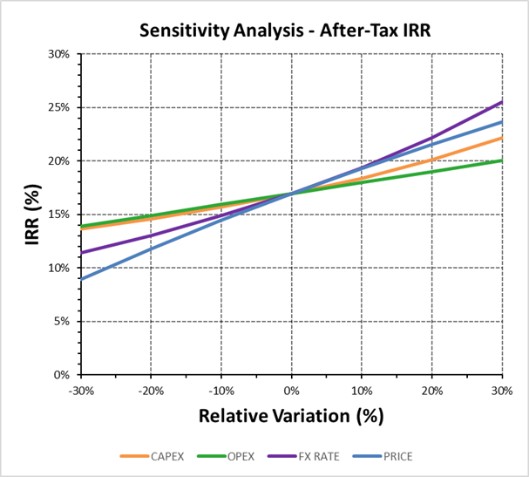
Figure 1-2: Sensitivity of the Integrated Projects IRR (after tax)
For more details regarding the economic analysis, refer to Chapter 22 of the 2025 Updated Feasibility Study.
Interpretation and Conclusions
The 2025 Updated Feasibility Study shows that the Projects are technically feasible as well as economically viable. It supports the Corporation’s Projects financing. From the FID, the Corporation’s Phase 2 Matawinie Mine and Bécancour Battery Material Plant could be built within an approximate 33-month schedule.
107
There is no certainty that the economic forecasts on which this Study is based will be realized. There are number of risks and uncertainties identifiable to any new project and usually cover the mineralization, process, financial, environment and permitting aspects. The Corporation’s Phase-2 is no different and an evaluation of the possible risks was undertaken as part of the 2025 Updated Feasibility Study.
Following an analysis of the major risks to the projects, a P50 management risk reserve of US$122M is recommended. This reserve is not included in the capital cost estimate but is within the range of the financial sensitivity analysis of the capital cost. The top risks are: 1) The optimization of the water treatment process technology; 2) The efficient integration of key Asian suppliers into the project detailed engineering and construction; and 3) The qualification by the customers of the product from the Matawinie Mine and the Bécancour Battery Material Plant.
The QPs of the 2025 Updated Feasibility Study consider that, within their expertise, the integrated Matawinie Mine and the Bécancour Battery Material Plant Projects are sufficiently robust to warrant moving them to the development phase. It should be noted that the water treatment area, pertaining to the Bécancour Battery Material Plant, will require more test work before the development phase. While the other sectors of the integrated Projects can move to development immediately, it is estimated that approximately 3-6 months of test work is required to optimize the design of the commercial water treatment flowsheet, including the environmental characterization of the resulting waste sludge produced.
For more details regarding the interpretation and conclusions, refer to Chapter 25 of the 2025 Updated Feasibility Study.
Recommendations
Table 115 lists the most significant recommended work to further advance and optimize the Corporation’s Matawinie Mine and Bécancour Battery Material Plant Projects.
Table 1-15: Significant recommendations cost breakdown
Recommendations |
Costs ($) |
|---|---|
Additional drilling to convert Probable Mineral Reserves to Proven Mineral Reserves in the Starter pit and Phase 1 pit |
700,000 |
Test work to optimize the Bécancour Battery Material Plant flowsheet (including M/S pilot plant operation, laboratory and pilot scale testing of the chemical purification process and water treatment process, operation of the coating pilot plant) |
1,825,000 |
For more details regarding the recommendations, refer to Chapter 26 of the 2025 Updated Feasibility Study.
108
Uatnan Mining Project
The following description of the Uatnan Property was summarized from the Uatnan Mining Project Report that was prepared by Mr. André Allaire, P.Eng., PhD, Jeffrey Cassoff, P.Eng., Vera Gella, P.Eng., Merouane Rachidi, P.Geo., Ph.D. and Claude Duplessis, P.Eng. (the “Authors of the Uatnan Mining Project Report”), each of whom is a “qualified person” and “independent” of the Corporation, as at the issuance date of the Uatnan Mining Project Report, within the meaning of NI 43-101 and is qualified in its entirety with reference to the full text of the Uatnan Mining Project Report. The summary is subject to all the assumptions, conditions and qualifications set forth in the Uatnan Mining Project Report. The Uatnan Mining Project Report was prepared in accordance with NI 43101 and for additional technical details, please see the complete text of the Uatnan Mining Project Report which was filed with the applicable regulatory authorities and was posted under the Corporation’s profile on SEDAR+ at www.sedarplus.ca and on EDGAR at www.sec.gov on February 24, 2023. Defined terms and abbreviations used in this section and not otherwise defined in this Annual Information Form have the meanings attributed to them in the Uatnan Mining Project Report. In this section, the number identifying each table and figure referred to the number identifying each of these tables and figures in the Uatnan Mining Project Report.
All statements contained in these sections are based on expectations, estimates and projections as of the date of the Uatnan Mining Project Report. The estimates and projections of future production for the Uatnan Mining Project are necessarily based upon a number of estimates and assumptions that, while considered reasonable by the Corporation as of the time of such statements, are inherently subject to significant business, economic and competitive uncertainties and contingencies. These estimates and assumptions are based on existing plans and other assumptions which change from time to time, including mineral resource estimates; the availability, accessibility, sufficiency and quality of graphite; the Corporation’s costs of production; the Corporation’s ability to sustain and increase production levels; the sufficiency of the Corporation’s infrastructure; the performance of the Corporation’s workforce and equipment; the Corporation’s ability to maintain and obtain mining interests and permits; and the Corporation’s compliance with existing and future laws and regulations; actual graphite mined varying from estimates of grade, tonnage, dilution and metallurgical and other characteristics; revisions to mine plans; risks and hazards associated with mining; natural phenomena, such as inclement weather conditions, water availability, floods, and seismic activity; and unexpected labor shortages, strikes, local community opposition or blockades. Accordingly, these estimates and assumptions may prove to be incorrect as of the date of this Annual Information Form and readers should not place undue reliance on such information. The Corporation disclaims any intention or obligation to update or revise any forward-looking statements or to explain any material difference between subsequent actual events and such forward-looking statements, except to the extent required by applicable law.
Readers are cautioned that the information provided in this section is provided as of the effective date of the Uatnan Mining Project Report, being January 10, 2023.
The following individuals, by virtue of their education, experience and professional association, are considered QPs as defined in the NI 43-101 and are members in good standing of appropriate professional institutions.
109
Introduction
This PEA of the Uatnan Mining Project was commissioned by the Corporation to satisfy one of the conditions relating to the OJV Agreement with Mason. For more information regarding the OJV Agreement, see the Corporation’s press releases dated May 16, 2022, and July 20, 2022. The Corporation has not conducted any work on the Uatnan Mining Property which is 100% owned and operated by Mason. The Corporation and Mason are both issuers of the Uatnan Mining Project Report.
Mason is a Montréal based company listed on the TSXV under the symbol “LLG”. The company was formed in 2012 for the acquisition and development of the Lac Guéret graphite deposit.
In this summary, all currency amounts are in Canadian Dollars ("CAD" or "$") unless otherwise stated, with commodity prices typically expressed in U.S. Dollars ("USD"). Units of measurement are generally stated in the Système international d’unités ("SI") metric units, the standard Canadian and international practices, including metric tons ("tonnes", "t") for weight, and kilometres ("km") or metres ("m") for distance.
Project Description, Location, and Access
The Uatnan Mining Project, one of the world’s largest graphite projects in development, aims to develop the Lac Guéret graphite deposit located approximately 285 km north of the city of Baie-Comeau, Québec, Canada. The Uatnan Mining Project Report presents the results of the PEA for the Uatnan Mining Project which includes the mine and beneficiation plant for the production of approximately 500 kilo-tonnes per annum ("ktpa") of graphite concentrate.
The Corporation and its consultants revisited all components of Mason’s original mining project to align the development of the Lac Guéret graphite deposit with today’s market opportunity and potential customers’ requirements.
Considering the significant modifications to Mason’s original project, the Corporation initiated a name change with the collaboration of the Innu First Nation of Pessamit. The deposit is located on the Nitassinan, the Innu of Pessamit’s ancestral territory, in a sector referred to as "Ka uatshinakanishkat" meaning “where there is Tamarack”. Hence, the name Uatnan meaning Tamarack, a conifer prominent in the area, was chosen to identify the Property and Project.
The Uatnan Mining Project is located in the Côte-Nord Administrative Region, in northeastern Québec, Canada. The graphite deposit is centred on 51°07’N and 69°05’W and consists of 74 CDC claims of which 71 are located on NTS topographic map sheet 22N03, and three on sheet 22K14. The Property lies on the southwestern shore of the Manicouagan Reservoir, within the Rivière-aux-Outardes municipality, approximately 220 km as the crow flies, north-northwest of the town of Baie-Comeau. This town is the nearest accessible community of significant size. Figure 4-1 below present the location of the Uatnan Mining Project.
110

Figure 4-1 - Location of the Uatnan Property
Access to the Uatnan Mining Property is via the paved all-weather Highway 389 from Baie-Comeau, Québec to Wabush, Labrador. At Km 202, south of the Manicouagan-5 /Daniel-Johnson hydroelectric dam, a Class 1, main haul gravel logging road turns northwest from the paved road. It continues about 85 km north-northwest from the highway towards the southwest shore of Lac Manicouagan.
111
The Uatnan Mining Property is located in a system of former logging roads that are sporadically maintained by logging companies and were in sound condition as of 2022. Numerous logging roads run cross and around the Property and give good access to the claim block.
The closest town, Baie-Comeau, has a deep-water port which accommodates shipping freighters and cruise ships with up to 9.0 m water draught. Vehicle and rail ferries allow crossing the St- Lawrence River to the city of Matane on the south shore enabling easy access to the rest of the North American Continent.
Baie-Comeau also hosts a regional airport with regular scheduled flights from Montréal and Québec City.
The Uatnan Mining Property covers an area of 3,999.52 hectares, all of which are 100% in the interest of Mason with the claims (74 claims) in good standing until July 17, 2024. The claims have not had any legal surveys. All claims are map-staked claims and are registered in the Québec GESTIM database.
Royalties and Other Agreements
The Corporation entered into the Investment Agreement and the OJV Agreement to explore the potential development of the Lac Guéret deposit. Those agreements align with the Corporation’s growth strategy with a view to establishing a large and fully vertically integrated natural graphite production, from mineralized material to battery materials, at the western markets’ doorstep. Following the successful initial closing of the Investment Agreement, the Corporation and Mason initiated the PEA on the Uatnan Mining Property.
The transaction, as approved by Mason’s shareholders, entails, among others and subject to the terms and conditions of the Investment Agreement and OJV Agreement:
| 1. | $5 million equity investment by the Corporation in Mason, in two instalments; |
| 2. | Project development through a preliminary economic assessment and bankable feasibility study following NI 43-101 rules and guidelines; and |
| 3. | Upon completion of technical studies and a $10-million investment in related works (which includes technical studies work), and at the time of acceptance of such technical studies work by Mason, the Corporation shall be deemed to have acquired 51% participation in the Uatnan Mining Property and will be appointed as operator. The joint venture would be funded by each party per its proportionate share of each of the approved work programs and budget and all other expenditures approved in accordance with the OJV Agreement. |
As of the date of the Uatnan Mining Project Report, a mining lease request from Mason for the future mine was being evaluated by the MRNF and the validity of three affected claims (CDC 1037522, CDC 1040768 and 1040769) was suspended as part of the normal evaluation procedure.
As of the date of the Uatnan Mining Project Report, there were no registered encumbrances or royalties known on the Uatnan Mining Property.
112
Risk Factors, Permits and Environmental Liabilities
In June 2017 Mason and the Pessamit Innu First Nation signed an Impact and Benefits Agreement ("IBA") concerning the Lac Guéret Project.
All permits needed to complete the work to date have been obtained such as tree clearing permits for exploration work. Although a ministerial decree authorizing the Lac Guéret Mine Project (Decree #608-2018) was granted by the MELCC on May 16, 2018, the substantial changes to the Uatnan Mining Project presented in the Uatnan Mining Project Report could necessitate the application for a new authorization or modification of such decree. Additional information on the work needed to obtain this authorization is further discussed in Chapter 20 of the Uatnan Mining Project Report.
The Uatnan Mining Project is part of an industry that contains various risks and uncertainties. The risks and uncertainties listed below are not the only ones to which the Uatnan Mining Project is subject. Additional risks and uncertainties not presently known by the Corporation and Mason, or which the Corporation and Mason deem to be currently insignificant, may impede the schedule and performance of the Uatnan Mining Project. The materialization of risks could harm the activities of the Uatnan Mining Project and have significant negative impacts on the financial situation and the operating results of the Uatnan Mining Project.
The Uatnan Mining Project Report is preliminary in nature and includes Inferred Mineral Resources that are considered too speculative geologically to have the economic considerations applied to them that would enable them to be categorized as Mineral Reserves. Mineral Resources that are not Mineral Reserves have not demonstrated economic viability. Additional trenching and/or drilling will be required to convert Inferred Mineral Resources to Indicated or Measured Mineral Resources. There is no certainty that the resource development, production, and economic forecasts on which the Uatnan Mining Project Report is based will be realized.
A socio-economic risk exists which may affect the access or the right or the ability to perform work on the land in the form of social acceptability of the Uatnan Mining Project by the Pessamit Innu First Nation and local users of the land.
Additionally, the Uatnan Mining Project does not have an operating history. Whether income will result from any of the Uatnan Mining Project’s activities will depend on the successful establishment of new mining operations. As a result, the Corporation and Mason are subject to all of the risks associated with establishing or expanding new mining operations and business enterprises, including the timing and cost, which can be considerable, of the construction of mining and processing facilities and related infrastructure; the availability and cost of skilled labour and mining equipment; the need to obtain necessary environmental and other governmental approval and permits and the timing of the receipt of those approvals and permits; the availability of funds to finance construction and development activities; potential opposition from non-governmental organizations, environmental groups or local groups which may delay or prevent development activities; and potential increases in construction and operating costs due to changes in the cost of fuel, power, materials and supplies.
Various factors, including the successful construction, commissioning and ramp-up of the Uatnan Mining Project, costs, actual mineralization, consistency and reliability of graphite grades, commodity prices, future cash flow and profitability can affect successful project development, and there can be no assurance that current or future estimates of these factors will reflect actual results and performance.
113
The design and construction of efficient processing facilities, the cost and availability of suitable machinery, supplies, mining equipment and skilled labour, the existence of competent operational management and prudent financial administration, as well as the availability and reliability of appropriately skilled and experienced consultants can also affect successful project development. It is common in new mining operations to experience unexpected problems and delays during construction, development, mine start-up and commissioning activities. Such factors can add to the cost of mine development, production and operation and/or impair production and mining activities, thereby affecting the Uatnan Mining Project’s profitability. Accordingly, there is no assurance that the Uatnan Mining Project will ever be brought into a state of commercial production or that the Uatnan Mining Project’s activities will result in profitable mining operations.
The Uatnan Mining Project’s footprint has no accessibility restrictions known to the Corporation and Mason and is solely located on crown land. There are no known significant factors and risks other than as disclosed herein that may affect access, title, or the right or ability to perform work on the Uatnan Mining Property.
For more details regarding the project description, location, and access, refer to chapters 4, 5 and 20 of the Uatnan Mining Project Report.
History
Historical work consists of exploration for iron in the late 1950s by Québec Cartier Mines Ltd. In 2001, Phil Boudrias of Esbec Exploration (Sept-Îles, Québec) acquired the core claims that cover the existing resources based on prospecting road cuts made by Kruger Forest Products. Quinto optioned the Uatnan Mining Property in 2002 and added claims to cover the potential graphite and iron stratigraphy. It conducted exploration programs since 2002 focusing on the zones under review. No resource estimation has been published on either the graphite deposit or on the iron deposits prior to Mason’s resource estimation published in 2012. Quinto focused on the graphite stratigraphy, since the iron deposits appear to be too small to be economic in this region.
Following the exploration results between 2002 and 2004, in 2006, Quinto conducted a drill program on the northeast part of the GC Graphite Zone to define a tonnage and grade of the graphite in order to continue studies towards initiating an open pit mine. Twenty-six NQ drillholes totalling 2,468 m were drilled. The 2006 exploration program included trenching two trenches northeast of TR68, named TR69 and TR70, and a diamond drill program of 24 NQ holes totalling 2,152.1 m.
For more details regarding the history of the Uatnan Mining Property, refer to chapter 6 of the Uatnan Mining Project Report.
Geological Setting, Mineralization, and Deposit Types
Regional Geology
The regional geology includes the most southwesterly of several elongate anticlinoria of Gagnon Group metasediments that include the traditional iron formation stratigraphy of the Wabush-Mont Reed iron district. These units are metamorphosed equivalents of the Labrador Trough (New Québec Orogen) sediments that occur around Schefferville, Québec and north. The southwest Manicouagan Anticlinorium shows a core of Denault Fm dolomitic marble. The typical footwall to the Sokoman Fm, the Wishart Fm quartzite, appears not to be present as a mappable unit.
114
The Sokoman Fm iron formation outcrops mainly in both the centre and edges, where they occur as linear, doubly folded (interference folds) anticlines and synclines on the scale of 0.5 to 2.5 km. Silicate facies of the Wabush were recognized in recently logged areas in the southern part of the anticlinorium but have not been mapped historically. The quartzite mapped near the graphite zones appears to be the upper, non-oxide, facies of the Sokoman Fm, not the Wishart quartzite, since it locally contains small amounts of magnetite, iron carbonates and iron silicates typical of the Sokoman Fm. The top of the Sokoman Fm has a diachronous, transitional contact with the overlying Menihek Fm pelitic sediments. The basal part of the Menihek unit, informally named the “Upper Gneiss” by Clarke (1977), forms the informal member, here named Lac Guéret Member of the Menihek Fm. The Katsao Fm gneiss has significant potassium feldspar (high K2O), whereas the paragneiss and schist of the Menihek Fm are deficient in K2O.
Graphitic metasediments are concentrated in the Lac Guéret Member above the Sokoman Fm iron deposits. Graphite also occurs in minor amounts in the adjoining Sokoman Fm near the contact, but most of the potentially economic graphite lies within the Member. This relationship is common in the district with examples at Lac Knife (QC) and the Mart Lake graphite showing at the Kami iron deposit (Labrador City, NL). Graphite formed as beds within clastic sedimentary basinal deposition under anoxic conditions that preserved the organic carbon and precipitated primary sulphides, mainly pyrrhotite, which is intimately intermixed with the graphite. Sulphides are limited to this depositional regime and do not occur in the host rocks outside of the graphite deposits. Upper amphibolite (kyanite facies) metamorphism affected all the rocks.
The conformation of the formations, including the graphite and iron oxide deposits, was modified by upward of five periods of Grenville-related deformations. The second and third events most strongly control the placement of the deposits into belts aligned northeast and dipping moderately to steeply southeast. Gentle cross-folding created interference fold patterns that affected the foliation dips. The deposits are essentially foliation-parallel. Late extension caused local recrystallization of host rocks, but with no significant remobilization of minerals. At this time, pyrite was formed from some of the original pyrrhotite.
The regional geology is shown in compilation maps (Figure 7-1) and the regional stratigraphy is shown in Table 7-1 (from youngest to oldest).
115

Table 7-1 - Regional stratigraphy
116

Figure 7-1 – Mason Graphite simplified regional geology map
117
Deposit and Mineralization
Crystalline flake graphite mineralization has been the focus of exploration by Mason on the Uatnan Mining Property.
Crystalline flake graphite deposits are usually sedimentary in origin. They occur when carbon-rich organic material, accumulated during sedimentation, is transformed into graphitic carbon crystals, or flakes, during metamorphism. This process is due to the burial of the sediments which are eventually subject to high heat and temperatures in the earth’s crust. Crystalline graphite deposits are commonly stratabound and hosted by porphyroblastic and granoblastic paragneiss, or pelitic gneiss, marbles, and quartzites (Harben and Kuzvart, 1996). Alumina-rich paragneiss and marble units in upper amphibolite or granulite grade metamorphic terranes are the most favourable host rocks. When present, flake graphite usually occurs in thin, centimetres to metre wide bands. In favourable conditions, wider coalescing bands in fold crests can provide sufficient volume needed for an economic deposit.
Graphite of Unit 1 (5-10% Cg) and Unit 2 (10-25% Cg) forms fine to coarse crystal flakes (<0.01 to >4 mm diameter) in quartz and quartzofeldspathic gneiss and schist. The in situ organic material was concentrated during late- or post-Labrador Trough deposition and recrystallized during the Grenville orogeny. It does not appear to have been enriched by tectonics or hydrothermal remobilization.
Unit 3 (+25% Cg) is characterized by a distinct pattern in flake distribution. The tendency is for clasts or non-re-crystallized centres of the original very fine to amorphous pre-metamorphic graphite schist to be enveloped by recrystallized very coarse (2 mm to 8 mm length) and pure graphite flakes as a result of ductile brecciation. This texture is more easily seen in outcrop than on core surfaces. The coarse flake graphite visually forms 7-12% of the total rock. For the purpose of resource estimation, units 1 and 2 were merged together and Unit 3 was kept differentiated at +25% Cg.
The grade limits used in the report are based on the statistical distribution of carbon presented in a study by Denis Marcotte, which suggests that the deposit comprises three distinct populations with threshold values of 5%, 10%, and 24.5% (Marcotte, 2013).
The depth of the mineralization is uncertain, and the deepest mineralized zone of the Uatnan Mining Project is reached by the hole LG 455 (Z = 220 m). It seems that the folded graphite bands are constrained within a broad inclined envelope.
Optical observations under reflected light microscopy show that the Uatnan Mining Property samples contain four types of graphite:
| ◾ | Type 1: Graphite as flakes of varying sizes, automorphic, often elongated and sometimes associated with sulphides; |
| ◾ | Type 2: Graphite as imbricated flakes, intimately associated with sulphides; |
| ◾ | Type 3: Graphite with no regular form, sometimes associated with sulphides; |
| ◾ | Type 4: Graphite of μm form in inclusions within the mineral gangue associated with sulphides (pyrite and pyrrhotite) |
118

Figure 7-6 – Graphite observed under optical reflected light microscopy
For more details regarding the geological setting, mineralization and deposit types of the Uatnan Mining Property, refer to chapters 7 and 8 of the Uatnan Mining Project Report.
Exploration
Québec Cartier conducted their major work in 1962 (Ferreira 1962a, 1962b). Baselines were cut on three grids-cutting with lines turned at 300 ft intervals for a total of 61 miles (98.5 km). Geological mapping and dip-needle magnetometer surveys were carried out at 1:2,400 scale on the grids. Six inclined AX-size diamond drillholes were drilled for a total of 2,301 ft (701.3 m). Most of the footage (1,820 ft or 554.7 m) was drilled in five holes around "Iron" and "Barrage" Lakes. Québec Cartier reported a global average of all samples at 36% Fe. The individual samples range from 12.9% to 40.5% Fe mainly in magnetite and lesser specular hematite iron oxide facies formation. Intervals range from 138 ft (42.1 m) to 420 ft (128.0 m). No further work appears to have been done after 1962.
Following the discovery of graphite at the GR Zone showing on a logging road by Phil Boudrias of Sept-Îles, QC in 2001, Quinto optioned a block of claims that forms the core of the present Uatnan Property from Exploration Esbec (Sept-Îles, QC) in 2002 and added claims on its own account to cover the favourable stratigraphy around the iron formation as well as the iron formation core itself.
119
After the initial Property evaluation in 2002 by Lyons, the majority of the exploration work was focused on the known graphite occurrences. In 2003, the first drilling campaign in that area totalling 1,206.9 m was completed. Exploration drilling was also done on selected targets by Quinto’s JV partner at the time, SOQUEM on distant targets on the Property in order to assess other anomalies and meet assessment work requirements. It was then followed in 2004 and 2005 by an exploration program targeted at airborne geophysical anomalies and other graphite occurrences as well as by extensive clearing and trenching, channel sampling, and detailed mapping of the GC Zone by Lyons in order to better understand the geology of the known deposit.
The 2006 exploration program included trenching two trenches northeast of TR68, named TR69 and TR70, and a diamond drill program of 24 NQ holes totalling 2,152.1 m. Three holes totalling 235.8 m were also drilled in the graphite stratigraphy outside of the GC-GR area for assessment purposes but are not discussed herein. The trenches were channel sampled using a concrete saw, but the original record of results appear not to have been completely transferred to Mason after Quinto was purchased by Cliffs Natural Resources in 2011. These included the number of samples, where they were taken and the analytical results. Lyons authored the NI 43- 101 reports for the 2002, 2003, and 2004 exploration works for Quinto, which included almost all the channel sampling. Lyons observed the trenches in May 2007 and noted that they extended the TR68 geology to the NE some 80 m.
All exploration works from 2012 onwards has only been drilling as described in the following section entitled “Drilling”.
For more details regarding the exploration of the Uatnan Mining Property, refer to chapters 6 and 10 of the Uatnan Mining Project Report.
Drilling
The 2012 drilling campaign conducted by Mason had a total of 163 drillholes, with 146 drillholes over the GC zone totalling 24,346.3 m and 17 drilled over the GR zone totalling 2,201.1 m. Drillholes length varied from 101 m to 303 m. The resulting 16,923 samples were analyzed by AGAT.
120

Figure 10-1 – Hole collars drilled between 2003 and 2012
The 2013-2014 drilling campaign conducted by Mason over the GC Zone consisted of 86 drillholes totalling 13,418 m. A total of 7,567 samples were analyzed by AGAT Laboratories (“AGAT”) and some samples were analyzed by COREM Labs (“COREM”) for external control.
121

Figure 10-2 – Drillhole collars (2003 to 2014) on the GC and GR Zones
A total of 24 holes were drilled in the GR zone totalling 3083.6 m and not included in the Mineral Resource estimate of the Lac Guéret deposit. The average depth of the drillholes was 128.5 m, with a maximum depth of 210 m. A total of 1964 samples were assayed.
122

Figure 10-3 – 2013 Exploration drilling outside the GR Zones
Mason commissioned Groupe Qualitas Inc. ("Qualitas") to conduct a geotechnical investigation campaign to collect geological and geomechanical data for the adequate designing and construction of an open pit mine, and to conduct a preliminary investigation for the projected storage areas, crusher and silo locations detailed in the 2018 Feasibility Study Technical Report.
A total of 11 boreholes were drilled. Nine boreholes along the open pit area were drilled to provide geomechanical information for design and engineering purpose of the open pit. Two boreholes were drilled to provide geotechnical information on the overburden and surface bedrock.
For more details regarding the drilling of the Uatnan Mining Property, refer to chapter 10 of the Uatnan Mining Project Report.
Sampling, Analysis, and Data Verification
Sample preparation and analysis
Samples (including duplicate, reference, and blank samples) were taken for a total of 43,324 m (including 987 m of trenches) and sent to the laboratory for analysis. These numbers include 2003, 2006, 2012 and 2013/2014 drill campaigns.
Drilling collar coordinates of each drillhole are reported as x,y,z values in UTM NAD 83 Z19. Drill samples were initially taken as 2 to 3-m lengths within homogeneous rocks for a few drillholes. Afterwards the sample length was generally of 1.5 m.
123
The sample lengths were also defined by abrupt changes in geology and visual graphite grades.
Sample FROM-TO intervals were defined using wax pencils on drill cores by the geologists. Sample booklets were filled using the measured FROM-TO sample definition. Paper sample tags with three identification parts were used; Part 1 stayed in the booklet, Part 2 was placed in the sample bag for the lab, and Part 3 was stapled in the core box at the beginning of each sample.
Technicians would then cut the drill cores with an electrical diamond saw in half along the drill core axis and perpendicular to the mineral banding. One half was left in the box and the other half was put in a plastic bag with the sample tag inside the bag. The sample number was also marked with a permanent black marker on the plastic bag.
A technician filled a chain of custody ("COC") form given by AGAT to describe the sample batch, including the FROM-TO, sample numbers, the total number of samples to be analyzed and the type of analysis to be performed. A geologist would then verify that this form is correctly filled by comparing with the physical sample number and the number of samples to be sent.
Approximately five samples were grouped in a larger rice bag. Normally, samples for a full drillhole were sent as a group at the lab and would correspond to a laboratory batch. The bags were organized on pallets.
The pallets were placed in a Mason truck. Mason personnel brought the pallets to the Groupe Guilbault warehouse in Baie‐Comeau. The pallets were transported by Manitoulin Trucking Company to AGAT in Sudbury, Ontario.
Before storing the drill core boxes in steel core racks, the core boxes were labelled with metal tags describing drillhole number, box number and length FROM-TO.
The samples were transported by Manitoulin Trucking Company to AGAT in Sudbury, Ontario.
The samples were prepared as follows:
| ■ | Drill core samples weight were recorded as received; |
| ■ | Samples were dried at 60 °C; |
| ■ | Drill core samples were crushed and split to give a 250 g split sample; |
| ■ | Split samples were pulverized to 75% passing through 200 mesh. |
Total Carbon Analysis:
| ◾ | All the operations involved for the total carbon analyses were performed directly at the instrument. The original analyses were performed on a LECO model CHSDR 600. The total carbon re‐assays were performed on a LECO model CS 844 (induction furnace ‐ which was used originally for the graphite analyses); |
124
| ◾ | 0.2 g of pulp samples or less (if necessary, when carbon content is too high, and samples saturate the equipment) were placed in LECO crucibles; |
| ◾ | Crucibles with samples were put in a LECO furnace at 1,350° for 90 to 360 seconds (until all the carbon has been oxidized); |
| ◾ | Ct results were measured and reported in percent (%). |
Graphitic Carbon Analysis:
| ■ | The operations for graphite analyses were performed at three different stations: weighing, digestion, analysis. The re‐assays were performed on a LECO model SC 432. The first analyses were performed on the CS 844; |
| ■ | Around 0.25 g of pulp samples were placed in porcelain crucibles; |
| ■ | 5 ml of 50 % HCl is added to the pulp sample in the porcelain crucible; |
| ■ | Crucibles were put on a hot plate (at approx. 100°C) for approximately 10 minutes; |
| ■ | Samples were filtered using a fibreglass filter (1 micron openings) and rinsed with 50% HCl and then water (initial analyses performed in 2012 did not use filters); |
| ■ | Samples with filters were put in boat crucibles and then on a hot plate for drying; |
| ■ | Boat crucibles with samples were put in a LECO furnace at 1,350° for 90 to 360 seconds (until all the Carbon has been oxidized); |
| ■ | Cg results were measured and reported in percent (%). |
Specific gravity measurements by gas pycnometry were also taken every five samples for a total of some 3,478 analyses performed.
Quality Assurance and Quality Control ("QA/QC") samples were inserted along the sample definition of the drill core. Generally, for each sample number ending with a 10, a duplicate sample was inserted, for each sample number ending with 35 and 85, a standard sample was inserted and for each sample number ending with 60, a blank sample was inserted.
Data verification
Geotic Log software was used to create individual log databases. Geology, sampling, coordinates, and geotechnical data were entered in individual Geotic log database tables by the geologist logging a specific drillhole.
During the 2012 drill campaign, field verifications were being done on a hole-by-hole basis. In accordance with the National Instrument 43-101 guidelines, Claude Duplessis Eng., has visited the Uatnan Mining Property on August 2, 2016, accompanied by Jean L’Heureux, Eng. A second site visit to the Property done on September 29, 2022, by Duplessis Eng., accompanied by Antoine Cloutier P.Geo of NMG.
125
In accordance with the NI 43-101 guidelines, Claude Duplessis Eng., has visited the Uatnan Mining Property on August 2, 2016, accompanied by Jean L’Heureux, Eng. A second site visit to the Uatnan Mining Property done on September 29, 2022, by Duplessis Eng., accompanied by Antoine Cloutier P.Geo of the Corporation.
The purpose of the site visit was to ascertain the geological setting of the Uatnan Mining Project, exploration works, and database verification.
Mason commissioned GMG to prepare an independent sampling program for the Uatnan Mining Property.
For the purpose of this program, three diamond drillholes ("DDH") LG-19, LG-207 and LG-422 were selected to represent the three main diamond drill campaigns which occurred on the GC deposit in 2003, 2012 and 2014. Fourteen core boxes containing the remaining half cores of selected sections from these DDH were prepared and sent directly from Mason’s core shack by their geologist, Yves Caron, P.Geo., and received in Québec City by GMG on October 31, 2014. Forty-seven samples (including blanks and standards) were prepared at the GMG office in Québec and then sent to the Accurassay Laboratories ("Accurassay") for analyses.
After samples reception and registration, the samples were crushed (size between 0 and 2 mm), pulverized and split in two pulps (Pulp 1 and Pulp 2). All the Pulp 1 samples (47 samples) and half of the Pulp 2 samples (19 samples) were analyzed. Eight duplicate samples of the Pulp 1 were also analyzed for the QA/QC program. Samples were analyzed for total sulphur by LECO (ALTS1), total carbon by LECO (ALTC1), major element concentrations by XRF (ALXRF1), and graphitic carbon by LECO (Cg).
Two standards were used for the QA/QC program; STD I correspond to the standard with low graphitic carbon concentration (Cg between 7.96% and 8.05%); STD II corresponds to the standard with high graphitic carbon concentration (Cg between 23.6% and 24.5%).
The graphitic carbon values of Pulp 1 and Pulp 2 are similar with a maximum difference of 1.9% for sample 4132 (Figure 12-4). This correlation may indicate a good sample preparation method (riffle splitting method) of the Accurassay laboratory.
126

Figure 12-4 – Graphitic carbon % values of Pulp 1 versus Pulp 2
A recent field visit was carried out by Claude Duplessis, Eng., and Antoine Cloutier, P.Geo., on September 29, 2022 on the Uatnan Mining Property. Claude Duplessis, Eng., Senior Engineer, a QP as defined by the NI 43-101 took some independent samples (the ¼ core samples) from four drillholes (Figure 12-10). A total of 13 core samples (Figure 12-11) and three surface samples from large blasted mineralized blocks presumed to be from the U1, U2 and U3 bulk sample sites were sent for analysis at ALS in Val-d’Or.
For more details regarding the sampling, analysis and data verification of the Uatnan Mining Property, refer to chapters 11 and 12 of the Uatnan Mining Project Report.
Mineral Processing and Metallurgical Testing
In the preliminary economic assessment issued in 2013 (the “2013 PEA”), a metallurgical testwork program was conducted using samples from four channels taken from rocky outcrops. The testwork concluded that the Lac Guéret deposit ore can be concentrated successfully without complex processing and the addition of polishing/attrition and cleaning stages ensures the final concentrate grade is maximized. Table 13-1 shows the saleable concentrate split into four size fractions +50, +80, +150 and -150 mesh, with an average blended concentrate grade of 93.7%.
127
Table 13-1 - Preliminary testwork results
Concentrate Particle Size |
Weight (%) |
Assay (% Ct) |
Distribution (% Ct) |
+50 mesh |
18.6 |
96.9 |
19.0 |
-50 to +80 mesh |
14.1 |
96.2 |
14.4 |
-80 to +150 mesh |
13.1 |
96.2 |
13.3 |
-150 mesh |
54.2 |
91.7 |
53.3 |
Total Concentrate |
100.0 |
93.7 |
100.0 |
In the years that followed, several testwork programs were undertaken including both comminution and concentration tests on a variety of different samples.
Ore Unit Definition
The Lac Guéret mineralized material samples used for testwork was categorized into three units (U1, U2 and U3) according to the average graphitic carbon grade throughout the mineralized material’s body. The range in grades of each unit is presented in Table 13-2.
Table 13-2 - Mineralized material units definition
Graphitic Unit |
Graphite Grade (Cg) |
U1 |
5% < Cg < 10% |
U2 |
10% < Cg < 25% |
U3 |
Cg > 25% |
In the years that followed, several testwork programs were undertaken including both comminution and concentration tests on a variety of different samples.
The Lac Guéret ore samples used for testwork was categorized into three units (U1, U2 and U3) according to the average graphitic carbon grade throughout the ore body. The range in grades of each unit is presented in Table 13-2.
Table 13-2 - Ore units definition
Ore Unit |
Graphite Grade |
U1 |
5% < Cg < 10% |
U2 |
10% < Cg < 25% |
U3 |
Cg > 25% |
128
Sample Locations
The samples used for comminution and pilot-scale concentration testwork were from two bulk samples resulting from surface blasts in July 2014. Variability samples were also collected from four drillholes for additional comminution testing. Bench-scale concentration tests were performed on two-channel samples from Uatnan Mining Project Report batch materials as well as on three variability samples collected from nine drillholes. A detailed description of sample location, sample preparation and ore unit definition are presented in the 2018 Feasibility Study Technical Report.
Comminution
Comminution tests on the Lac Guéret material included JK Drop Weight tests ("DWT"), SAG Mill Comminution “SMC” tests, SAG design tests, Rod and Ball mill grindability tests, as well as abrasion tests.
The conclusion from the comminution testwork was that the Lac Guéret ore is soft in macro (impact) grinding, and generally soft in micro (attrition) grinding, with the exception of samples in ore unit U3 which were classified medium to very hard. All samples were characterized as mildly abrasive.
Concentration
Concentration testwork was performed on the PEA channel samples to test the repeatability of the PEA flowsheet and variability between mineralized units. Results revealed that previous performances were not exactly reproduced. The variability was attributed to the weathering of the samples over time. Additionally, it was determined that there is no interaction between mineralised units when treated together, meaning the results obtained were a weighted average of the individual sample results.
Several flotation technologies were tested during the FS concentration testwork, and the conclusion reached was that regular flotation (cell and column) yielded the best graphite grade and recovery. High concentrate grades were achieved, ranging from 92 to 98% carbon in individual size fractions with over 92% overall carbon recovery.
Material Aging
The impact of aging or weathering was tested by comparing samples that were exposed to air and sprayed for varying periods of time prior to being processed. After approximately eight weeks of aging, carbon recovery was reduced at the scavenger phase of processing.
Pilot Scale Testwork
Pilot scale testwork results confirmed that the use of three or four stages of polishing and cleaning are sufficient to maximize both graphite grade and recovery when maximizing the final concentrate flake size is required. Prolonged aging or weathering of the ore before processing has been proven to have an impact on the graphite recovery.
129
PEA Mass Balance
While no new testwork was undertaken for the current study, the majority of the process design criteria was based on the available data and any changes to the flowsheet were considered to be a reasonable extrapolation of the previously observed metallurgical response. The metallurgical balance used for the Uatnan Mining Project Report is presented in Table 1-1.
Table 1-1 – Metallurgical balance used for PEA
Stream |
Weight Recovery (%) |
Carbon Recovery (%) |
Carbon Grade (%) |
Feed |
100.0 |
100 |
17.1 |
Combined concentrate |
15.4 |
85 |
94.2 |
Tailings |
84.6 |
15 |
3.1 |
PEA Metallurgical Balance
While no new testwork was undertaken for the current study, the majority of the process design criteria was based on the available data and any changes to the flowsheet were considered to be a reasonable extrapolation of the previously observed metallurgical response. The metallurgical balance used for the Uatnan Mining Project Report is presented in Table 1-1.
Table 1-1 – Metallurgical balance used for PEA
Stream |
Weight Recovery (%) |
Carbon Recovery (%) |
Carbon Grade (%) |
Feed |
100.0 |
100 |
17.1 |
Combined concentrate |
15.4 |
85 |
94.2 |
Tailings |
84.6 |
15 |
3.1 |
For more details regarding the mineral processing and metallurgical testing of the Uatnan Mining Property, refer to chapter 13 of the Uatnan Mining Project Report.
Mineral Resource and Mineral Reserve Estimates
Mineral Resource Estimate
The graphite mineralization at Uatnan Mining Property is extensive in terms of size and grade. There is a significant amount of resources and the graphite mineralization extends to the northeast as well as to the southeast around the iron formation anticlinorium core and at depth.
Mineral Resource Estimates for the Uatnan Mining Project Report are based on the Mason drilling campaigns (2012, 2013/2014) and Quinto exploration data (2003 and 2006 drilling campaigns) using a cut-off grade ("COG") of 5.75% Cg.
130
The pit optimization was designed using the same block model used for the Mineral Resource Update issued on November 9, 2015, and updated with more recent parameters (See Table 1-3).
The interpretation of the mineralized zones is mainly based on the percentage of carbon graphite and follows structural tendencies of the deposit. The current Measured and Indicated Mineral Pit-constrained Resources are 65.6 million tonnes at 17.2% Cg (See Table 1-2 below).
Mineral Reserves and Mineral Resources are as defined by CIM Definition Standards on Mineral Resources and Mineral Reserves. Mineral Resources, which are not Mineral Reserves, do not have demonstrated economic viability.
Table 1-2 - Current Mineral Resources Estimate for Uatnan Project
In pit constrained Mineral Resources |
Density |
Tonnes (Mt) |
Grade (% Cg) |
Cg (Mt) |
Measured 5.75% < Cg < 25% |
2.9 |
15.65 |
15.2 |
2.38 |
Measured Cg > 25% |
2.9 |
3.35 |
30.6 |
1.02 |
Total Measured |
2.9 |
19.02 |
17.9 |
3.40 |
Indicated 5.75% < Cg < 25% |
2.9 |
40.29 |
14.6 |
5.89 |
Indicated Cg > 25% |
2.9 |
6.33 |
31.6 |
2.00 |
Total Indicated |
2.9 |
46.62 |
16.9 |
7.89 |
Indicated + Measured 5.75% < Cg < 25% |
2.9 |
55.94 |
14.8 |
8.27 |
Indicated + Measured Cg > 25% |
2.9 |
9.70 |
31.2 |
3.03 |
Total Measured + Indicated |
2.9 |
65.64 |
17.2 |
11.30 |
Inferred 5.75% < Cg < 25% |
2.9 |
15.35 |
14.9 |
2.28 |
Inferred Cg > 25% |
2.9 |
2.47 |
31.8 |
0.79 |
Total Inferred |
2.9 |
17.82 |
17.2 |
3.07 |
Notes :
131
There has not been additional exploration on the mineralized zone since the last Mineral Resources Estimate. A pit optimization with new parameters (Table 1-3) using the same block model as previously used has been done by GMG.
Table 1-3 - The parameters used for the Mineral Resource pit optimization
Parameters |
Unit |
Value |
Mining Cost Mineralized Material |
$/t mined |
4.00 |
Processing Cost |
$/t milled |
36.00 |
Tailing Management Cost |
$/t milled |
2.00 |
G&A Cost |
$/t milled |
5.00 |
Total Mineralized Material Based Cost |
$/t processed |
43.00 |
Mill Recovery |
% |
85.0% |
Concentrate Grade |
% |
94.0% |
Concentrate Price |
CAD $/t |
1500 |
Revenue Factor |
|
1.00 |
Production Rate |
Mtpy |
3.4 |
Discount Rate |
% |
8% |
Pit slope |
|
50 |
There is a very small difference between the use of a cut-off grade of 5% Cg and 5.75% Cg. The table below shows the difference in terms of the pit constrained mineral resources.
132
Table 1-4 - Comparison of 2014, 2018 and 2022 Mineral Resources Estimates
|
Mineral Resources Estimates Lac Guéret |
Mineral Resources Estimate updated, December 2014 by GMG |
Mineral Resource Estimates November 2018 by GMG |
Mineral Resource Estimates December 2022 by GMG |
|||
% Cg |
Tonnes |
% Cg |
Tonnes |
% Cg |
Tonnes |
|
Indicated |
16.9 |
46,589,000 |
16.9 |
46,519,000 |
16.91 |
46,623,000 |
Measured |
17.9 |
19,105,000 |
17.9 |
19,021,000 |
17.94 |
19,021,000 |
Meas + Indicated |
17.2 |
65,693,000 |
17.2 |
65,540,000 |
17.21 |
65,644,000 |
Inferred |
17.2 |
17,651,000 |
17.3 |
17,613,000 |
17.22 |
17,820,000 |
The graphite mineralization at Uatnan Mining Property is extensive in terms of size and grade. There is a significant amount of resources and the graphite mineralization extends to the northeast as well as to the southeast around the iron formation anticlinorium core and at depth.
Mineral Reserve Estimate
Since the Uatnan Mining Project Report summarizes the results of a “preliminary economic assessment”, no Mineral Reserves have been estimated for the Uatnan Mining Project as per NI 43-101 guidelines.
For more details regarding the mineral resource and mineral reserve estimates of the Uatnan Mining Property, refer to chapters 14 and 15 of the Uatnan Mining Project Report.
Mining Operations
The mining method selected for the Uatnan Mining Project is a conventional open pit, truck and shovel, drill, and blast operation. Vegetation, topsoil, and overburden will be stripped and stockpiled for future reclamation use. The Mineral Resources and waste rock will be mined with 9 m high benches, drilled, blasted, and loaded into rigid frame haul trucks with backhoe excavators. The mine will be operated by an owner fleet, seven days per week, 24 hours per day and be comprised of a four-crew system working on a 2-week in, 2-week out rotation.
Since the Uatnan Mining Project is at a PEA level, a simplified ultimate pit surface was generated following the selected optimized pit shell as a guide and considering an overall pit slope of 50 degrees, which is presented in Figure 16-2. The pit is approximately 1,500 m long and 750 m wide at surface, with a total surface area of the pit is roughly 65 ha. The deepest part of the pit is at the 214 m elevation which is 290 m below surface.
133

Figure 16-2 – Pit design
To minimize the environmental footprint of the Uatnan Mining Project and select a waste rock and tailings management strategy to enhance closure performance, waste rock will be hauled to a mine rock stockpiles ("MRS"). Waste rock will be hauled to the tailings storage facility ("TSF"), located to the northwest of the open pit and will be disposed with the tailings. Also, when possible, waste rock will be backfilled into the mined out open pit.
The subset of Mineral Resource contained with the open pit design considers a cut-off grade of 5.75% Cg and include 62.2 Mt of Measured and Indicated Resources at an average diluted grade of 17.3% Cg, and 14.2 Mt of Inferred Resources at an average diluted grade of 18.0% Cg. A total of 102.6 Mt of overburden and waste rock are included in the pit resulting in a strip ratio of 1.3.
The Uatnan Mining Project has a 24-year mine life plus a six-month period of pre-production development. The purpose of the pre-production period is for the mine to provide waste rock for construction material and to prepare the pit for mining operations. A total of 500 kt of material is planned to be mined during preproduction.
During the mining operation, the total material mined from the open pit peaks at 10.8 Mt during Years 15 to 17 and averages 7.6 Mtpy. The average diluted Cg grade ranges from 14.2% to 24.9%, and averages 22.4% during the first five years. The average concentrate production over the life of mine averages 503,000 tpy.
The fleet of mining equipment includes twelve articulated haul trucks with 60-tonne payloads, two hydraulic excavator, and four production drill.
To manage water that collects in the open pit, sumps will be developed on the pit floor as mining progresses, and a series of pumps will be used to pump the water to settling ponds located at surface. BBA has assumed that in general, a total five pumps should be adequate to serve the needs of the open pit.
134
The mine workforce requirements have been calculated to reach 193 during peak production. The mine operations team will work on a 4-crew system, to provide 24 hours per day year-round coverage. The mine management and technical team will work on a 2-week in, 2-week out rotation.
For more details regarding the mining operations of the Uatnan Mining Property, refer to chapter 16 of the Uatnan Mining Project Report.
Processing and Recovery Operations
Given that the target market for the Uatnan Mining Project concentrate is the battery market, the main focus of the flowsheet has shifted from preserving flake size to overall graphite recovery and grade. No additional testwork was performed since the 2018 NI 43-101 Technical Report Feasibility Study Update. However, the extensive historical metallurgical testwork was used to select the updated process flowsheet. Both mining and processing will take place at the Uatnan Mining Project site. The ROM will be trucked from the mine to the crushing area where it will undergo a first-size reduction using a mineral sizer. The crushed material is stockpiled before being conveyed to the concentrator where the size is further reduced via primary grinding in a SAG mill and secondary grinding in a ball mill. Following comminution, the mineralised material is concentrated through rougher and scavenger flotation. The concentrates generated from rougher and scavenger flotation are polished and cleaned in two stages before reporting to the concentrate thickener. The thickened concentrate is pressure filtered and dried to produce a final graphite concentrate that is stored in a bulk silo and transported offsite. Any sulphur dioxide generated from the drying of the graphite concentrate will be captured in a wet scrubber where it will be neutralized with caustic soda. The flotation tailings are thickened in a tailings thickener before being pressure-filtered and subsequently trucked to the TSF for management with the MRS. Overflow water from the concentrate, tailings and process water thickeners reports to a process water tank.
A summary of the initial capital and sustaining capital costs ("CAPEX") for the Project are presented in Table 25-2 below.
Infrastructure, Permitting, and Compliance Activities
Project Infrastructure
The Uatnan Mining Property is located in a remote location (285 km from Baie-Comeau, the nearest city) and does not have access to public services, requiring it to be autonomous. A mining camp with a capacity for 360 workers will be built next to the Lac Des Torchons, less than 3 km from the mine site.
Access roads to the deposit already exist but will have to be improved for the final 85 km to support industrial use.
The concentrator has been located to be near the deposit to minimize transport between the mine and processing facilities. The electrical needs of the project will be sourced from the Manic-5 hydroelectric power station, located 70 km away.
A two-door garage at the mine site will be used for maintenance on the mining equipment.
135
The main industrial installations will comprise an ore storage area with a crusher, concentrator buildings (wet and dry areas).
An office building will house the administrative offices, the lunchroom and the changing room.
A tailings filtration plant will be built to manage the tailings. They will be thickened then filtered to finally be trucked to a TSF. The bottom of the TSF will be lined to collect seepage water. Contact water will be collected in a collection basin for recycling to the plant or to be treated before being released to the environment.
Status of Permits
The Lac Guéret Project received a ministerial decree in 2018 from the Québec Government. From 2018 to 2020, Mason received some permits and leases which are presented in Table 20-1. Permits expired are not listed in the table.
Table 20-1 - Lists of permits for Baie-Comeau and Lac Guéret
Description |
Authority |
Issued |
Ministerial Decree 608-2018 |
Québec Government |
May 16, 2018 |
Closure Plan advanced exploration : Plan de restauration approuvé pour exploration avancée– Baie-Comeau |
Ressources naturelles et énergie |
November 7, 2018 |
Authorization : Certificat d’autorisation 7610-09-01-0595903- 401754899 Travaux de déboisement au site minier du lac Guéret |
MELCC Art. 22 |
November 14, 2018 |
Authorization : Certificat d’autorisation 7610-09-01-0611201- 401812870 Aménagement d’une carrière au site du lac Guéret |
MELCC Art. 22 |
May 31, 2019 |
Authorization : Autorisation ministérielle 7610-09-01-0596403- 401814744 Travaux préparatoires sur le site du concentrateur – Phase 1 |
MELCC Art. 22 |
June 6, 2019 |
Authorization : Autorisation ministérielle 7610-09-01-9690201- 401816146 Équipements de traitement – Eau potable et eaux usées campement industriel – Lac Galette |
MELCC Art. 22 |
September 13, 2019 |
Authorization : Autorisation ministérielle 7610-09-01-0593405- 401905615 Construction de la réserve d’eau brute et de l’aire d’entreposage du minerai brut |
MELCC Art. 22 |
March 11, 2020 |
Authorization : Autorisation ministérielle 7610-09-01-0593406- 401907986 Traitement des eaux – site du concentrateur, Parc industriel Jean-Noël Tessier, Baie-Comeau |
MELCC Art. 22 |
March 25, 2020 |
136
Environmental Studies
The former Lac Guéret Project was granted a decree in 2018 from the Government of Québec. Although, the Uatnan Mining Project will request a modification of the actual decree or a new one. Baseline studies (Hatch, 2015) will have to be updated based on the new study area to identify any environmental issues like protected areas, species at risk, waterbodies, fish habitats, biophysical environment etc. The results of those studies will have to be considered to identify project alternatives.
After having a decree, licenses and authorizations from various governmental authorities such as the MELCC will be needed to build and operate the mine.
Geochemical testing carried out on the Mason project tailings and mine rocks shows that the tailings and waste rock are potentially acid generating ("PAG"). Geochemical characterization results will be included in the next engineering phase to select appropriate tailings and waste rock management methods that will limit sulphide oxidation during the years of operation and at closure.
Through design and operation choices, the Corporation is planning to adopt high standards for tailings and waste rocks management, optimize mining infrastructures through progressive backfill of the proposed open pit, progressively rehabilitate the site, develop a transition to electrify the mining fleet and maintain the Corporation’s carbon neutrality status.
Social Studies
From the outset of the exploration stage, Mason developed a consultation plan and met with stakeholders on-site. The objectives of the consultation plan were to identify any concerns, expectations, and/or reactions from the affected communities, and reflect those in the Uatnan Mining Project development. Between 2012 and 2015, several meetings and public consultation activities took place with governmental, social, environmental, and local economic development actors and groups, along with the Innu First Nation of Pessamit, as the Uatnan Mining Project is located on Nitassinan Territory (Hatch, 2015).
In 2017, the Innu Council of Pessamit and Mason signed the Mushalakan agreement, an impact and benefit agreement that outlined the mutual desire to work closely together and ensure the Lac Guéret Project would result in benefits for both parties.
Through visits and series of meetings in the Baie-Comeau region and Pessamit community, the Corporation gathered feedback from local organizations and leaders who were initially involved in the Lac Guéret Project, established a dialogue as the new forecasted operator of the Uatnan Mining Project, and informed stakeholders of the next steps in the Uatnan Mining Project development.
For more details regarding the infrastructure, permitting and compliance activities of the Uatnan Mining Property, refer to chapters 18 and 20 of the Uatnan Mining Project Report.
Capital and Operating Costs
The Uatnan Mine Project is a greenfield mining and processing facility with average yearly mill feed throughput capacity of 3,400,000 t and a target production of approximately 500,000 tpy of graphite concentrate.
137
Capital Costs Summary
The Capex covers the development of the mine, processing facilities, and infrastructure required for the Uatnan Mine Project. It is based on the application of standard costing methods of achieving a PEA which provides a level of accuracy ranging between -30% and +50%. The operating costs covers mining, processing, concentrate haulage, tailings and water management, general and administration fees, as well as infrastructure and services.
A summary of the initial Capex for the Uatnan Mining Project is presented in Table 25-2 below.
Table 25-2 - Summary of capital cost estimate
Sector |
Cost ($M) |
Direct Costs |
|
|
■
Mining
|
61 |
|
■
Site infrastructure
|
55 |
|
■
Offsite Infrastructure
|
184 |
|
■
Water treatment and tailings
|
118 |
|
■
Ore crushing and process plant
|
548 |
Indirect Costs (40%) |
319 |
Contingency (25%) |
279 |
TOTAL CAPEX |
1,564 |
Initial CAPEX |
1,417 |
Sustaining CAPEX |
147 |
Sustaining CAPEX is the amount required to periodically invest in the operations phase to maintain the functionality of the mining and processing operations. For this Project, the sustaining capital estimated at $147M is mainly related to the haul truck fleet replacement, the co-disposal system and water management.
Operating Costs Estimate
The operating costs ("OPEX") over the Uatnan Mining Project life are estimated at $3,236M for an average of $268/t of concentrate. Operating costs are made up from the following costs: mining and tailings, Processing, Water Management, General and Administration ("G&A").
A summary of these costs is presented in Table 25-3.
138
Table 25-3 - Operating costs summary
Description |
LOM Opex Cost (M$) |
Cost per tonne ($/t concentrate) (1) |
Fraction of Cost (%) |
Mining and tailing (average over life) |
917 |
76 |
28 |
Ore Processing |
1,620 |
134 |
50 |
Water Management |
134 |
11 |
4 |
General and Administration |
565 |
47 |
18 |
Total OPEX |
3,236 |
268 |
100 |
Note:
| (1) | The costs presented are calculated based on LOM production of 12,072,770 t of concentrate. |
Economic Analysis
The results of the study confirm that the Project is economically viable with an after-tax IRR of 25.9% and an 8% discount rate NPV of $2,173M based on current pricing projections for flake concentrate. The complete results of the economic analysis, before and after tax are presented in Table 25-4 below.
Table 25-4 - Results of the economic analysis of the Uatnan Project
Economic Indicator |
Pre-Tax |
After-Tax |
NPV (8% discount rate) |
$3,613M |
$2,173 |
IRR |
32.6% |
25.9% |
Payback period |
2.8 years |
3.2 years |
The economic evaluation of the Uatnan Mining Project was performed using a discounted cash flow model on both a pre-tax and after-tax basis. The capital and operating cost estimates presented in Chapter 21 of this Report were based on the mining and processing plan developed in this Study to produce roughly 500 kt of a graphite concentrate annually over the LOM. The internal rate of return (“IRR”) on total investment was calculated based on 100% equity financing.
The NPV was calculated for discounting rates of 0%, 6%, 8% and 10%, resulting from the net cash flow generated by the Project. The Project base case NPV was calculated based on a discounting rate of 8%. The payback period based on the undiscounted annual cash flow of the Project is also indicated as a financial measure. A sensitivity analysis was performed for the pre-tax and post-tax results to assess the impact of variation of the Project initial capital costs, operating costs and sensitivity to the selling price of concentrate.
For more details regarding the capital and operating costs of the Uatnan Mining Property, refer to chapters 21 and 22 of the Uatnan Mining Project Report.
139
Conclusions and Recommendations
The results of the Uatnan Mining Project Report demonstrate that the Uatnan Mining Project is economically viable. The authors of the Uatnan Mining Project Report recommend that the Uatnan Mining Project be advanced to the next stage of development, which based on the agreement between the Corporation and Mason, is a FS to be completed within the timeframe of the OJV Agreement.
A summary of the next critical steps and an approximate budget required to advance the Uatnan Mining Project and complete an FS is presented in Table 1-8. The items are detailed further in the sections that follow.
Table 1-8 – Uatnan Project budget for next phase
Activity/Milestone |
Pre-Tax |
Drilling (10,000 m) |
$3.3M |
Environmental studies |
$2.3M |
Pit slopes |
$0.4M |
Metallurgical testwork |
$0.5M |
Feasibility Study |
$3.5M |
TOTAL |
$10.0M |
Geology and Mineral Resources
The interpretation of the zones is mainly based on the percentage of carbon graphite and follows structural tendencies of the deposit. Three envelopes were produced by connecting the defined mineralized prisms using a cut-off grade of 5% Cg.
| ● | Density determinations should be continued for both mineralized and non-mineralized rock types; |
| ● | To carry all necessary work to maintain the claims in good standing during the development process; |
| ● | To map the geology of the deposit during mining operations in order to detect any discrepancy in the deposit geometry thus allowing ongoing adjustment of the mining plan; |
| ● | It is recommended to modify the wireframes to include the mineralized intervals between 3% Cg and 5% Cg. The integration of zones with low-grade may affect the sensitivity of the Mineral Resources estimation; |
| ● | It is recommended additional drilling work to transform all or a part of the Inferred mineral resources to either Indicated or Measured. A total of 10,000 m of core drilling should suffice to increase confidence in the current Inferred Resources; |
| ● | It is also recommended that the potential resources of the GR mineralized zone, located north of the Lac Guéret proposed pit, be included in the current Mineral Resource Estimate of the Uatnan Mining Property. Information from 22 drill holes covering this zone is not included in the current Mineral Resource Estimate. |
140
Mining
The following activities are recommended for the next phase of the Uatnan Mining Project development during the FS:
| ● | Perform feasibility-level geomechanical and hydrogeological studies for the Uatnan Mining Property pit footprint to better define pit slope angles and determine water inflows into the future pit; |
| ● | Engage with local contractors for production labour; |
| ● | Review rotation schedule to promote local employment; |
| ● | Study the possibility of an all-electric carbon-neutral mining fleet; |
| ● | Condemnation drilling for permanent infrastructures placement. |
Process
The following activities are recommended for the next phase of the Uatnan Mining Project development:
| ● | Metallurgical testwork to confirm the proposed process flowsheet including grinding, flotation, thickening and filtration; |
| ● | Confirmation of the concentrate grade and recovery on variability samples; |
| ● | Environmental characterization of the tailings; |
| ● | Testing with vendors for equipment sizing. |
Environment
The following activities are recommended for the next phase of Uatnan Mining Project development:
| ● | Continue the collaborative work with the Innu First Nation of Pessamit and local stakeholders in the Baie-Comeau community and Manicouagan region; |
| ● | Sign a pre-development agreement with the Innu First Nation of Pessamit according to their priorities and the Uatnan Project’s projected impacts and attenuation; |
| ● | Continue holding stakeholder engagement activities in order to properly inform and take into account the local communities’ and stakeholders’ concerns regarding the Project; |
| ● | Validation with MELCCFP if a new decree is required for the Uatnan Mining Project, or a decree modification. For a new decree a project Notice needs to be submitted to the MELCCFP to initiate the process; |
| ● | Perform feasibility-level geotechnical and hydrogeological studies for the Uatnan Mining Property pit footprint to localized infrastructure footprint; |
| ● | From updated data including geochemistry and ongoing tests-cells results and baselines studies, perform technologies trade-off studies to address the Project design refinements for tailings and waste rocks management; |
| ● | A closure plan will have to be filed and approved by the MRNF to get the mining lease. As the development of the project will advance, the closure activities will need to be described. More tests should be performed on the possibility to use the overburden as a neutral material for final reclamation. |
For more details regarding the next steps for the development of the Uatnan Mining Property, refer to chapters 25 and 26 of the 2023 Uatnan Mining Project Report.
141
DIVIDENDS
During the three most recently completed fiscal years and as of the date of this Annual Information Form, the Corporation has not paid any dividends on the Common Shares. Any decision to declare and pay dividends on the Common Shares in the future will be made at the discretion of the Board of Directors and will depend on, among other things, the Corporation’s financial results, cash requirements, contractual restrictions and other factors that the Board of Directors may deem relevant at such time. In addition, the Corporation’s ability to pay dividends may be limited by covenants of any existing and future outstanding indebtedness that the Corporation or its subsidiaries incur.
DESCRIPTION OF CAPITAL STRUCTURE
The following description of the Corporation’s share capital summarizes certain provisions contained in the Corporation’s Articles and by-laws. These summaries do not purport to be complete and are subject to, and are qualified in their entirety by reference to, all of the provisions of the Corporation’s Articles and by-laws, which have been filed under the Corporation’s profile on SEDAR+ at www.sedarplus.ca.
COMMON SHARES
The Corporation’s authorized capital consists of an unlimited number of Common Shares without par value. As of December 31, 2024, 152,261,189 Common Shares were issued and outstanding as fully paid and non-assessable. Effective as of March 24, 2021, the Corporation implemented the Consolidation on the basis of the Consolidation Ratio. The numbers and prices of Common Shares and the information on securities convertible into Common Shares provided in this section are stated on a post-Consolidation basis. The holders of Common Shares are entitled to one vote per Common Share at all shareholder meetings. They are also entitled to dividends, if, as and when declared by the Board of Directors and, upon liquidation or winding-up of the Corporation, to share the residual assets of the Corporation. The Common Shares do not have any pre-emptive, conversion or redemption rights, except as described in the section Description of Capital Structure, and all have equal voting rights. There are no special rights or restrictions of any nature attached to any of the Common Shares, all of which rank equally as to all benefits which might accrue to the holders of the Common Shares.
WARRANTS
During the fiscal year ended December 31, 2024, 83,432,538 warrants were issued, no warrants were exercised, and no warrants expired. As of the date of this Annual Information Form, 83,432,538 warrants issued by the Corporation are outstanding.
On February 28, 2024, the Corporation issued 12,500,000 2024 Warrants to GM and 12,500,000 2024 Warrants to Panasonic. Such 2024 Warrants are generally exercisable in connection with a subsequent investment by the anchor customers at FID in accordance with their terms. Each 2024 Warrant will entitle the holder thereof to acquire one Warrant Share at a price per Warrant Share equal to US$2.38 per Common Share. The exercise of the 2024 Warrants issued to GM and Panasonic are subject to certain ownership limitations, as neither GM nor Panasonic, as applicable, are entitled to exercise 2024 Warrants that would result in GM or Panasonic, as applicable, owning more than 19.9% of the then issued and outstanding Common Shares, unless the Corporation has obtained the required regulatory approvals.
142
On May 2, 2024, the Corporation issued 12,500,000 2024 Warrants to Mitsui and 6,500,000 2024 Warrants to Pallinghurst. Such 2024 Warrants are generally exercisable in connection with a subsequent investment by the anchor customers at FID in accordance with their terms. Each 2024 Warrant will entitle the holder thereof to acquire one Warrant Share at a price per Warrant Share equal to US$2.38 per Common Share. The exercise of the 2024 Warrants issued to Mitsui and Pallinghurst are subject to certain ownership limitations and 12-months lock-up provisions, as neither Mitsui or Pallinghurst, as applicable, are entitled to exercise 2024 Warrants that would result in Mitsui or Pallinghurst, as applicable, owning more than 19.9% of the then issued and outstanding Common Shares, unless the Corporation has obtained the required regulatory approvals.
On December 20, 2024, the Corporation issued to each of CGF and IQ respectively, 19,841,269 CFG and IQ Warrants, for a consideration of approximately US$25,000,000 each. Such CFG and IQ Warrants are generally exercisable in connection with a subsequent investment by the anchor customers at FID in accordance with their terms. Each CGF and IQ Warrant will entitle the holder thereof to acquire one Warrant Share at a price per Warrant Share equal to US$2.38 per Common Share. The exercise of the CFG and IQ Warrants are subject to certain ownership limitations.
COMPENSATION OPTIONS
Stock Options Issued Under the Stock Option Plan
As of December 31, 2024, an aggregate number of 7,994,500 stock options issued by the Corporation were outstanding, collectively entitling the holders thereof to purchase an aggregate of up to 7,994,500 Common Shares:
|
Number of Stock Options |
Number of Vested Stock Options |
Exercise Price |
Expiry Date |
|
530,000 |
530,000 |
1.85 |
September 2, 2025 |
|
15,000 |
15,000 |
2.40 |
October 1, 2025 |
|
192,500 |
192,500 |
7.00 |
November 30, 2025 |
|
420,000 |
420,000 |
16.84 |
May 24, 2026 |
|
15,000 |
15,000 |
8.15 |
September 15, 2026 |
|
15,000 |
15,000 |
8.08 |
November 17, 2026 |
|
225,000 |
225,000 |
8.87 |
January 23, 2027 |
|
40,000 |
40,000 |
8.49 |
March 11, 2027 |
|
763,500 |
763,500 |
8.20 |
March 28, 2027 |
|
26,000 |
26,000 |
6.74 |
May 16, 2027 |
|
164,500 |
164,500 |
6.48 |
November 14, 2027 |
143
|
1,473,500 |
762,250 |
4.77 |
May 12, 2028 |
|
12,000 |
6,000 |
3.90 |
September 13, 2028 |
|
3,907,500 (1) |
- |
3.12 |
April 1, 2029 |
|
55,000 |
- |
1.90 |
September 20, 2029 |
|
100,000 |
- |
2.13 |
October 15, 2029 |
|
15,000 |
- |
1.89 |
November 12, 2029 |
|
25,000 |
- |
2.33 |
December 19, 2029 |
Total |
7,994,500 |
3,174,750 |
- |
- |
Note:
| (1) | Of these stock options, 2,230,000 remains and will vest at FID provided that FID occurs prior to June 30, 2025. |
Furthermore, between January 1, 2024 and the date of this Annual Information Form, no stock options were exercised, no stock option were forfeited and 187,000 stock option expired. As a result, and as of the date of this Annual Information Form, an aggregate of 7,807,500 stock options issued by the Corporation were outstanding, collectively entitling the holders thereof to purchase an aggregate of up to 7,807,500 Common Shares as follows:
|
Number of Stock Options |
Number of Vested Stock Options |
Exercise Price |
Expiry Date |
|
530,000 |
530,000 |
1.85 |
September 2, 2025 |
|
15,000 |
15,000 |
2.40 |
October 1, 2025 |
|
177,500 |
177,500 |
7.00 |
November 30, 2025 |
|
375,000 |
375,000 |
16.84 |
May 24, 2026 |
|
15,000 |
15,000 |
8.15 |
September 15, 2026 |
|
15,000 |
15,000 |
8.08 |
November 17, 2026 |
|
225,000 |
225,000 |
8.87 |
January 23, 2027 |
|
40,000 |
40,000 |
8.49 |
March 11, 2027 |
|
698,500 |
698,500 |
8.20 |
March 28, 2027 |
|
26,000 |
26,000 |
6.74 |
May 16, 2027 |
|
153,500 |
153,500 |
6.48 |
November 14, 2027 |
|
1,422,500 |
711,250 |
4.77 |
May 12, 2028 |
|
12,000 |
6,000 |
3.90 |
September 13, 2028 |
|
3,907,500 (1) |
- |
3.12 |
April 1, 2029 |
|
55,000 |
- |
1.90 |
September 20, 2029 |
|
100,000 |
- |
2.13 |
October 15, 2029 |
144
|
15,000 |
- |
1.89 |
November 12, 2029 |
|
25,000 |
- |
2.33 |
December 19, 2029 |
Total |
7,807,500 |
2,987,750 |
- |
- |
Note:
| (1) | Of these stock options, 2,230,000 remains and will vest at FID provided that FID occurs prior to June 30, 2025. |
As of December 31, 2024, the Board of Directors was entitled to grant stock options in accordance with the Nouveau Monde Graphite Inc. Stock Option Plan, as adopted by the Board of Directors on May 21, 2024, to employees, officers, directors or consultants of the Corporation or any subsidiary thereof, and to persons employed to perform investor relations activities.
For further details about the stock options issued by the Corporation as of December 31, 2024, reference is made to note 18.2 to the Corporation’s audited annual consolidated financial statements for the fiscal year ended December 31, 2024 which are available under the Corporation’s profile on SEDAR+ at www.sedarplus.ca and on EDGAR at www.sec.gov.
TRANCHE 1 INVESTMENT
Investor Rights Agreements
On February 28, 2024, upon closing of the GM Private Placement, GM and the Corporation entered into the GM Investor Rights Agreement. The GM Investor Rights Agreement provides that GM is entitled to nominate (i) one (1) nominee to the Board of Directors if GM and its affiliates own, directly or indirectly, 10% or more of the issued and outstanding Common Shares and (ii) two (2) nominees to the Board of Directors if GM and its affiliates own, directly or indirectly, 20% or more of the issued and outstanding Common Shares, provided that a least one (1) of the nominees shall be independent within the meaning of applicable laws, and provided further that the number of directors of the Corporation shall not exceed ten (10). In addition, for so long as GM is entitled to designate one or more nominees, GM has the right to designate an observer in place of such nominee to attend all meetings of the Board of Directors in a non-voting observer capacity. If GM is no longer entitled to designate a board nominee, so long as (i) GM and its affiliates own, directly or indirectly, 5% or more of the issued and outstanding Common Shares and (ii) is an offtaker of the Corporation, GM shall be entitled to designate one observer to attend all meetings of the Board of Directors in a non-voting capacity. GM was also granted a participation right over subsequent offerings by the Corporation. GM shall have the right (the “Participation Right”) to subscribe for and to be issued as part of a subsequent offering at the subscription price per offered security, payable in cash, and on substantially the same terms and conditions of such offering such number of Common Shares or convertible securities (as applicable) as would result in the Pro Rata Interest immediately following completion of the subsequent offering being equal to the GM’s Pro Rata Interest immediately prior to the subsequent offering. In addition, GM has additional top-up rights in the case of certain dilution events in order to prevent its Pro Rata Interest from falling below the 20%, 10% and 5% thresholds stated in the GM Investor Rights Agreement. GM’s Participation Right and top-up rights will terminate on the date on which GM and its affiliates cease to own, directly or indirectly, 10% or more of the issued and outstanding Common Shares.
On February 28, 2024, upon closing of the Panasonic Private Placement, Panasonic and the Corporation entered into the Panasonic Investor Rights Agreement. The Panasonic Investor Rights Agreement provides that Panasonic is entitled to nominate (i) one (1) nominee to the Board of Directors if Panasonic owns, directly or indirectly, 10% or more of the issued and outstanding Common Shares and (ii) two (2) nominees to the Board of Directors if Panasonic owns, directly or indirectly, 20% or more of the issued and outstanding Common Shares, provided that a least one (1) of the nominees shall be independent within the meaning of applicable laws.
145
In addition, for so long as Panasonic is entitled to designate one (1) or more nominees, Panasonic has the right to designate an observer in place of such nominee to attend all meetings of the Board of Directors in a non-voting observer capacity. If Panasonic is no longer entitled to designate a board nominee, so long as (i) Panasonic owns, directly or indirectly, 5% or more of the issued and outstanding Common Shares and (ii) is (or any of its affiliates are) an offtaker of the Corporation, Panasonic shall be entitled to designate one (1) observer to attend all meetings of the Board of Directors in a non-voting capacity. Panasonic was also granted a participation right over subsequent offerings by the Corporation. Panasonic shall have the Participation Right to subscribe for and to be issued as part of a subsequent offering at the subscription price per offered security, payable in cash, and on substantially the same terms and conditions of such offering such number of Common Shares or convertible securities (as applicable) as would result in the Pro Rata Interest immediately following completion of the subsequent offering being equal to the Panasonic’s Pro Rata Interest immediately prior to the subsequent offering. In addition, Panasonic has additional top-up rights in the case of certain dilution events in order to prevent its Pro Rata Interest from falling below the 20%, 10% and 5% thresholds stated in the Panasonic Investor Rights Agreement. Panasonic’s Participation Right and top-up rights will terminate on the date on which Panasonic ceases to own 10% or more of the issued and outstanding Common Shares.
On May 2, 2024, upon closing of the Related Party Transactions, Mitsui and the Corporation entered into the Mitsui Investor Rights Agreement. The Mitsui Investor Rights Agreement provides that Mistui is entitled to nominate (i) one (1) nominee to the Board of Directors if Mitsui owns, directly or indirectly, 10% or more of the issued and outstanding Common Shares and (ii) two (2) nominees to the Board of Directors if Mitsui owns, directly or indirectly, 20% or more of the issued and outstanding Common Shares, provided that a least one (1) of the nominees shall be independent within the meaning of applicable laws. In addition, for so long as Mitsui is entitled to designate one (1) or more nominees, Mitsui has the right to designate an observer in place of such nominee to attend all meetings of the Board of Directors in a non-voting observer capacity. If Mitsui is no longer entitled to designate a board nominee, so long as Mitsui owns, directly or indirectly, 5% or more of the issued and outstanding Common Shares, Mitsui shall be entitled to designate one (1) observer to attend all meetings of the Board of Directors in a non-voting capacity. Mitsui was also granted a pre-emptive right over subsequent offerings by the Corporation. Mitsui shall have the Prem-Emptive Right to subscribe for and to be issued as part of a subsequent offering at the subscription price per offered security, payable in cash, and on substantially the same terms and conditions of such offering such number of Common Shares or convertible securities (as applicable) as would result in the pro rata interest immediately following completion of the subsequent offering being equal to the Mitsui’ pro rata interest immediately prior to the subsequent offering. In addition, Panasonic has additional top-up rights in the case of certain dilution events in order to prevent its pro rata interest from falling below the 20%, 10% and 5% thresholds stated in the Mitsui Investor Rights Agreement. Mitsui’s pre-emptive right and top-up rights will terminate on the date on which Mitsui ceases to own 10% or more of the issued and outstanding Common Shares.
On May 2, 2024, upon closing of the Related Party Transactions, Pallinghurst Bond and the Corporation entered into the Pallinghurst Bond Investor Rights Agreement. The Pallinghurst Bond Investor Rights Agreement provides that Pallinghurst Bond is entitled to nominate (i) one (1) nominee to the Board of Directors if Pallinghurst Bond owns, directly or indirectly, 10% or more of the issued and outstanding Common Shares and (ii) two (2) nominees to the Board of Directors if Pallinghurst Bond owns, directly or indirectly, 20% or more of the issued and outstanding Common Shares, provided that a least one (1) of the nominees shall be independent within the meaning of applicable laws.
146
In addition, for so long as Pallinghurst Bond is entitled to designate one (1) or more nominees, Pallinghurst Bond has the right to designate an observer in place of such nominee to attend all meetings of the Board of Directors in a non-voting observer capacity. If Pallinghurst Bond is no longer entitled to designate a board nominee, so long as Pallinghurst Bond owns, directly or indirectly, 5% or more of the issued and outstanding Common Shares, Pallinghurst Bond shall be entitled to designate one (1) observer to attend all meetings of the Board of Directors in a non-voting capacity. Pallinghurst Bond was also granted a pre-emptive right over subsequent offerings by the Corporation. Pallinghurst Bond shall have the Prem-Emptive Right to subscribe for and to be issued as part of a subsequent offering at the subscription price per offered security, payable in cash, and on substantially the same terms and conditions of such offering such number of Common Shares or convertible securities (as applicable) as would result in the pro rata interest immediately following completion of the subsequent offering being equal to the Pallinghurst Bond’ pro rata interest immediately prior to the subsequent offering. In addition, Panasonic has additional top-up rights in the case of certain dilution events in order to prevent its pro rata interest from falling below the 20%, 10% and 5% thresholds stated in the Pallinghurst Bond Investor Rights Agreement. Pallinghurst Bond’s pre-emptive right and top-up rights will terminate on the date on which Pallinghurst Bond ceases to own 10% or more of the issued and outstanding Common Shares.
On December 20, 2024, upon closing of the CGF and IQ Offering, an investment agreement was also entered into between the Corporation and IQ (the “IQ Investment Agreement”). The IQ Investment Agreement provides that IQ is entitled to nominate (i) one (1) nominee to the Board of Directors if IQ owns, directly or indirectly, 10% or more of the issued and outstanding Common Shares and (ii) two (2) nominees to the Board of Directors if IQ owns, directly or indirectly, 20% or more of the issued and outstanding Common Shares, provided that a least one (1) of the nominees shall be independent within the meaning of applicable laws. In addition, for so long as IQ is entitled to designate one or more nominees, IQ has the right to designate an observer in place of such nominee to attend all meetings of the Board in a non-voting observer capacity. If IQ is no longer entitled to designate a Board nominee, so long as IQ owns, directly or indirectly, 5% or more of the issued and outstanding Common Shares, IQ shall be entitled to designate one (1) observer to attend all meetings of the Board of Directors in a non-voting capacity. IQ was also granted a Pre-Emptive Right over subsequent offerings by the Corporation. IQ shall have the Pre-Emptive Right to subscribe for and to be issued as part of a subsequent offering at the subscription price per offered security, payable in cash, and on substantially the same terms and conditions of such offering such number of Common Shares or convertible securities (as applicable) as would result in the pro rata interest immediately following completion of the subsequent offering being equal to the IQ’s pro rata interest immediately prior to the subsequent offering. In addition, IQ has additional top-up rights in the case of certain dilution events in order to prevent its pro rata interest from falling below the 20%, 10% and 5% thresholds stated in the IQ Investor Rights Agreement. IQ’s Pre-Emptive Right and top-up rights will terminate on the date on which IQ ceases to own 10% or more of the issued and outstanding Common Shares.
On December 20, 2024, upon closing of the CGF and CGF Offering, an investment agreement was also entered into between the Corporation and CGF (the “CGF Investment Agreement”). The CGF Investment Agreement provides that CGF is entitled to nominate (i) one (1) nominee to the Board of Directors if CGF owns, directly or indirectly, 10% or more of the issued and outstanding Common Shares and (ii) two (2) nominees to the Board of Directors if CGF owns, directly or indirectly, 20% or more of the issued and outstanding Common Shares, provided that a least one (1) of the nominees shall be independent within the meaning of applicable laws.
147
In addition, for so long as CGF is entitled to designate one or more nominees, CGF has the right to designate an observer in place of such nominee to attend all meetings of the Board in a non-voting observer capacity. If CGF is no longer entitled to designate a Board nominee, so long as CGF owns, directly or indirectly, 5% or more of the issued and outstanding Common Shares, CGF shall be entitled to designate one (1) observer to attend all meetings of the Board of Directors in a non-voting capacity. CGF was also granted a Pre-Emptive Right over subsequent offerings by the Corporation. CGF shall have the Pre-Emptive Right to subscribe for and to be issued as part of a subsequent offering at the subscription price per offered security, payable in cash, and on substantially the same terms and conditions of such offering such number of Common Shares or convertible securities (as applicable) as would result in the pro rata interest immediately following completion of the subsequent offering being equal to the CGF’s pro rata interest immediately prior to the subsequent offering. In addition, CGF has additional top-up rights in the case of certain dilution events in order to prevent its pro rata interest from falling below the 20%, 10% and 5% thresholds stated in the CGF Investor Rights Agreement. CGF’s Pre-Emptive Right and top-up rights will terminate on the date on which CGF ceases to own 10% or more of the issued and outstanding Common Shares.
Registration Rights
In connection with GM Private Placement, the Corporation entered into the GM Subscription Agreement. Pursuant to the GM Subscription Agreement, GM was granted demand registration rights for so long as GM and its affiliates own, directly or indirectly, 10% or more of the issued and outstanding Common Shares and except during a lockup period. GM may require the Corporation to register all or a portion of the Common Shares then held by GM and its affiliates by filing a registration statement and a prospectus and taking any other necessary steps to facilitate a distribution of all or a portion of the Common Shares held by GM or its affiliates. The GM Subscription Agreement also grants piggyback and shelf registration rights to GM, for so long as GM and its affiliates own, directly or indirectly, 5% or more of the issued and outstanding Common Shares of the Corporation and except during a lockup period. In the event that the Corporation proposes to distribute Common Shares by way of a prospectus or a registration statement, GM has the right to require the Corporation in certain circumstances to include Common Shares owned by GM in such distribution.
Upon closing of the Panasonic Private Placement, the Corporation and Panasonic entered into the Panasonic Registration Rights Agreement. Pursuant to the Panasonic Registration Rights Agreement, Panasonic was granted demand registration rights for so long as Panasonic owns, directly or indirectly, 10% or more of the issued and outstanding Common Shares and following the lockup period. Panasonic may require the Corporation to register all or a portion of the Common Shares then held by Panasonic and its affiliates by filing a registration statement and a prospectus and taking any other necessary steps to facilitate a distribution of all or a portion of the Common Shares held by Panasonic or its affiliates. The Panasonic Registration Rights Agreement also grants piggyback and shelf registration rights to Panasonic, for so long as Panasonic owns, directly or indirectly, 5% or more of the issued and outstanding Common Shares of the Corporation and following the lockup period. In the event that the Corporation proposes to distribute Common Shares by way of a prospectus or a registration statement, Panasonic has the right to require the Corporation in certain circumstances to include Common Shares owned by Panasonic in such distribution.
Upon closing of the Related Party Transactions, the Corporation and Mitsui entered into the Mitsui Registration Rights Agreement. Pursuant to the Mitsui Registration Rights Agreement, Mitsui was granted demand registration rights for so long as Mitsui owns, directly or indirectly, 10% or more of the issued and outstanding Common Shares and following the lockup period.
148
Mitsui may require the Corporation to register all or a portion of the Common Shares then held by Mitsui and its affiliates by filing a registration statement and a prospectus and taking any other necessary steps to facilitate a distribution of all or a portion of the Common Shares held by Mitsui or its affiliates. The Mitsui Registration Rights Agreement also grants piggyback and shelf registration rights to Mitsui, for so long as Mitsui owns, directly or indirectly, 5% or more of the issued and outstanding Common Shares of the Corporation and following the lockup period. In the event that the Corporation proposes to distribute Common Shares by way of a prospectus or a registration statement, Mitsui has the right to require the Corporation in certain circumstances to include Common Shares owned by Mitsui in such distribution.
Upon closing of the Related Party Transactions, the Corporation and Pallinghurst Bond entered into the Pallinghurst Bond Registration Rights Agreement. Pursuant to the Pallinghurst Bond Registration Rights Agreement, Pallinghurst Bond was granted demand registration rights for so long as Pallinghurst Bond owns, directly or indirectly, 10% or more of the issued and outstanding Common Shares and following the lockup period. Pallinghurst Bond may require the Corporation to register all or a portion of the Common Shares then held by Pallinghurst Bond and its affiliates by filing a registration statement and a prospectus and taking any other necessary steps to facilitate a distribution of all or a portion of the Common Shares held by Pallinghurst Bond or its affiliates. The Pallinghurst Bond Registration Rights Agreement also grants piggyback and shelf registration rights to Pallinghurst Bond, for so long as Pallinghurst Bond owns, directly or indirectly, 5% or more of the issued and outstanding Common Shares of the Corporation and following the lockup period. In the event that the Corporation proposes to distribute Common Shares by way of a prospectus or a registration statement, Pallinghurst Bond has the right to require the Corporation in certain circumstances to include Common Shares owned by Pallinghurst Bond in such distribution.
In connection with the CGF and IQ Offering, the Corporation and each of CGF and IQ have entered into registration rights agreement (collectively, the “CGF and IQ Registration Rights Agreements”). Pursuant to the CGF and IQ Registration Rights Agreements, each of CGF and IQ were granted demand registration rights for so long as they own, individually, directly or indirectly, 10% or more of the issued and outstanding Common Shares and following the lockup period. Each of CGF and IQ may require the Corporation to register all or a portion of the Common Shares then held by each of CGF and IQ and their affiliates by filing a registration statement and a prospectus and taking any other necessary steps to facilitate a distribution of all or a portion of the Common Shares held by each of CGF and IQ or their affiliates. The CGF and IQ Registration Rights Agreements also grants piggyback and shelf registration rights to each of CGF and IQ, for so long as they own, individually, directly or indirectly, 5% or more of the issued and outstanding Common Shares of the Corporation and following the lockup period. In the event that the Corporation proposes to distribute Common Shares by way of a prospectus or a registration statement, each of CGF and IQ have the right to require the Corporation in certain circumstances to include Common Shares owned by them in such distribution.
149
UATNAN PROPERTY ACQUISITION
Registration Rights Agreement
Upon closing of the Mason Transaction, the Corporation and Mason entered into a registration rights Agreement (the “Mason Registration Rights Agreement”) dated January 31, 2024, pursuant to which Mason was granted piggyback registration rights. Whenever the Corporation proposes to register or qualify for distribution of any Common Shares pursuant to a prospectus or registration statement, Mason has the right to require the Corporation in certain circumstances to include Common Shares owned by Mason in such distribution.
PALLINGHURST ROYALTY
On July 14, 2020, the Corporation entered into a royalty purchase agreement with Pallinghurst Graphite (the “Royalty Purchase Agreement”). Upon closing of the transaction, the Corporation and Pallinghurst Graphite entered into a royalty agreement dated August 28, 2020, as amended from time to time, (the “Royalty Agreement”) pursuant to which the Corporation issued and sold a 3% royalty to Pallinghurst Graphite (the “Royalty”) for an aggregate purchase price of approximately $5 million, including accrued interest. Until August 28, 2024, the Royalty is subject to a 1% buy-back right in favour of the Corporation. The consideration to be paid by the Corporation upon exercise of its buy-back right will be equal to approximately $1.3 million, plus an amount equal to interest accrued at a rate of 9% per annum from and after August 28, 2020, and up to the buyback date. The purchase price for the Royalty was satisfied by setting-off all principal and accrued interest amounts owing by the Corporation to Pallinghurst Graphite under the promissory note dated June 27, 2019 in the principal amount of $2 million and the promissory note dated March 16, 2020 in the principal amount of $2 million, each of which was cancelled. The Corporation 's obligations under the Royalty have been secured by a hypothec in favour of Pallinghurst International dated August 29, 2022, over the Matawinie Graphite Property, subject to certain permitted encumbrances and rights. Pursuant to the Assignment and Assumption Agreement, the rights and obligations of Pallinghurst Graphite under the Pallinghurst Transactions had been assigned to Pallinghurst International. The Corporation exercised its buyback right and repurchased the 1% NSR in accordance with the Royalty Purchase Agreement and as set forth in the Matawinie royalty buyback agreement entered into between the Corporation and Pallinghurst Bond and Pallinghurst International on August 15, 2024 (the “Matawinie Royalty Buyback Agreement”). On August 29, 2024, Pallinghurst International and the Corporation entered into an amendment to the Royalty Purchase Agreement to reflect the changes resulting from the Matawinie Royalty Buyback Agreement showing a resulting 2% NSR in favour of Pallinghurst International.
150
MARKET FOR SECURITIES
MARKET
The issued and outstanding Common Shares are listed and posted for trading on the TSX under the symbol “NOU” and on the NYSE under the symbol “NMG”. The Common Shares were listed and posted for trading on the TSXV under the symbol “NOU” until January 17, 2025.
TRADING PRICE AND VOLUME
The Common Shares are listed and posted for trading on the TSX under the symbol “NOU” and the NYSE under the symbol “NMG”. On March 28, 2024, the last trading day before the date of this Annual Information Form, the closing price of the Common Shares on the TSX was $2.15, on the NYSE was US$1.51.
TSXV and TSX
The following table sets forth trading information for the Common Shares on the TSXV and the TSX (as reported by www.money.tmx.com) during the fiscal year ended December 31, 2024 and up to the last trading day before the date of this Annual Information Form.
Month |
High ($)(3) |
Low ($)(4) |
Trading Volume(5) |
July 2024(1) |
2.58 |
2.06 |
721,222 |
February 2025(2) |
3.05 |
1.54 |
704,148 |
March 1 to March 28, 2025(2) |
1.83 |
1.35 |
947,464 |
Notes:
| (1) | The Common Shares were traded on the TSXV for this period. |
| (2) | The Common Shares were traded on the TSX for this period. |
| (3) | Includes intra-day high prices. |
| (4) | Includes intra-day low prices. |
| (5) | Total volume traded in the relevant period. |
151
NYSE
The following table sets forth trading information for the Common Shares on the NYSE (as reported by www.nyse.com) during the fiscal year ended December 31, 2024 and up to the last trading day before the date of this Annual Information Form.
Notes:
| (1) | Includes intra-day high prices. |
| (2) | Includes intra-day low prices. |
| (3) | Total volume traded in the relevant period. |
PRIOR SALES
The following table summarizes details of the following securities that are not listed or quoted on a marketplace issued by the Corporation during the Corporation’s fiscal year ended December 31, 2024 and up to the date of this Annual Information Form.
Issue Date |
Number and Class of Securities |
Issue Price or Exercise Price per Security ($) |
January 31, 2024 |
6,208,210 Common Shares (2) |
3.00 |
February 28, 2024 |
25,000,000 Common Shares (3) |
2.00 USD |
April 1, 2024 |
4,107,500 options |
3.12 |
May 2, 2024 |
20,329,043 Common Shares (4) |
2.00 USD |
May 17, 2024 |
40,000 Common Shares (1) |
2.35 |
May 22, 2024 |
35,000 Common Shares (1) |
2.35 |
152
May 24, 2024 |
37,500 Common Shares (1) |
2.35 |
August 20, 2024 |
25,000 Common Shares (1) |
2.35 |
September 20, 2024 |
70,000 options |
1.90 |
October 15, 2024 |
100,000 options |
2.13 |
November 12, 2024 |
15,000 options |
1.89 |
December 20, 2024 |
25,000 options |
2.33 |
December 20, 2024 |
39,682,538 Common Shares (5) |
2.00 USD |
Notes:
(1) |
Issued upon the exercise of options |
(2) |
Issued pursuant to the Asset Purchase Agreement with Mason |
(3) |
Issued pursuant to a private placement with GM and Panasonic |
(4) |
Issued pursuant to a private placement with Mitsui and Pallinghurst. Of the 20,329,043 Common Shares issued, 1,579,043 were issued in relation to the accrued interest owed to Pallinghurst Bond and Mitsui under their respective Convertible Notes for the period from the issuance of the Convertible Notes to February 14, 2024. |
(5) |
Issued pursuant to a private placement with CGF and IQ. |
DIRECTORS AND EXECUTIVE OFFICERS
Pursuant to the Articles of Amalgamation of the Corporation, the Board of Directors shall consist of a minimum of three (3) and a maximum of fifteen (15) directors. The directors of the Corporation are elected annually by the shareholders of the Corporation at the annual general meeting of shareholders. Each director so elected shall hold office until the next annual general meeting of the shareholders of the Corporation, unless she or he shall resign or his office becomes vacant by death, removal or other cause.
NAME, OCCUPATION AND SECURITIES HOLDING
The following table contains certain information on the Corporation’s directors and executive officers that held positions during the fiscal year ended December 31, 2024.
Name and Residence |
Position Held with the Corporation and Period Served as Director |
Principal Occupation During Past Five Years |
|---|---|---|
|
Daniel Buron (1) Québec, Canada |
Director of the Corporation since September 2019 |
Former Executive Vice-President and Chief Financial Officer of Domtar Corp. |
|
Eric Desaulniers Québec, Canada |
President and Chief Executive Officer Director of the Corporation since January 2013 |
President and Chief Executive Officer of the Corporation |
|
Arne H Frandsen (2) London, United Kingdom |
Director of the Corporation since May 2019 |
Co-Founder and Managing Partner of The Pallinghurst Group |
Jürgen Köhler (3) |
Director of the Corporation since April 2021. Mandate ended December 16, 2024. |
Former Chief Executive Officer, SGL Carbon SE |
153
Name and Residence |
Position Held with the Corporation and Period Served as Director |
Principal Occupation During Past Five Years |
|---|---|---|
|
Nathalie Pilon (4) Québec, Canada |
Director of the Corporation since December 2020 |
Former President of ABB Inc. in Canada |
James Scarlett (5) |
Director of the Corporation since December 2020 |
Former Executive Vice-President and Chief Legal Officer of Hydro One Limited |
Andrew Willis (6) |
Director of the Corporation since May 2021 |
Co-Founder and Managing Partner of The Pallinghurst Group |
Stephanie Anderson (7) |
Director of the Corporation since November 2022. Mandate ended November 11, 2024. |
Former Executive Vice President, Corporate Development of Baffinland Iron Mines |
Stéphane Leblanc (8) |
Director of the Corporation since September 10, 2024 |
Former Managing Director, Rio Tinto Iron & Titanium |
Chantal Sorel (9) |
Director of the Corporation since December 16, 2024 |
Former executive officer in strategic positions at SNC-Lavalin (now, AtkinsRealis), Aéroport de Montréal, and ABB |
Charles-Olivier Tarte |
Chief Financial Officer of the Corporation and former Corporate Secretary of the Corporation |
Chief Financial Officer of the Corporation |
Bernard Perron |
Chief Operating Officer of the Corporation |
Chief Operating Officer of the Corporation Senior Vice President, Project Development & Operations Services of Inter Pipeline Ltd. |
Josée Gagnon |
Vice-President, Legal Affairs and Corporate Secretary |
Vice-President, Legal Affairs and Corporate Secretary of the Corporation Former Chief Legal Officer at Just For Laughs Director – Legal Affairs and Corporate Secretary at Colabor Group Inc. |
Notes:
| (1) | Lead Independent Director, Chair of the Audit Committee and member of the Human Resources Committee and the Governance Committee. |
| (2) | Chair of the Board of Directors and of the Human Resources Committee, and member of the Governance Committee and the ESG Committee. |
| (3) | Chair of the Projects and Development Committee until September 3, 2024, and member of the Audit Committee until December 16, 2024. |
| (4) | Chair of the ESG Committee and member of the Audit Committee and the Projects and Development Committee. Chair of the Projects and Development Committee since October 1, 2024. |
| (5) | Chair of the Governance Committee and member of the ESG Committee and the Human Resources Committee. |
| (6) | Member of the Projects and Development Committee. |
| (7) | Member of the Projects and Development Committee. |
| (8) | Member of the Projects and Development Committee and the Audit Committee. |
| (9) | Member of the Projects and Development Committee. |
154
As of the date of this Annual Information Form, the Corporation’s directors and executive officers as a group beneficially owned or exercised control or direction over, directly or indirectly, an aggregate of 19,336,203 Common Shares, representing approximately 12.70% of the issued and outstanding Common Shares (including Common Shares held by Pallinghurst Graphite, Pallinghurst International and Pallinghurst Bond). On a partially diluted basis, assuming the conversion in whole of the Corporation’s directors and executive officers’ options and warrants, the group would beneficially own or exercise control or direction over, directly or indirectly, an aggregate of 30,301,203 Common Shares, representing approximately 18.56% of the issued and outstanding Common Shares (including Common Shares held by Pallinghurst Graphite, Pallinghurst International and Pallinghurst Bond).
CEASE TRADE ORDERS, BANKRUPTCIES, PENALTIES OR SANCTIONS
To the knowledge of the Board of Directors and based on the information provided by the directors or executive officers of the Corporation, none of these persons:
| » | is, as at the date of this Annual Information Form, or has been, within ten years before this date, director, chief executive officer or a chief financial officer of any corporation, including the Corporation, which has been subject to one of the following orders: |
| ─ | a cease trade order, an order similar to a cease trade order or an order that denied the corporation access to any exemption under securities legislation, that was in effect for a period of more than 30 consecutive days, while the person was acting in the capacity as director, chief executive officer or chief financial officer; or |
| ─ | a cease trade order, an order similar to a cease trade order or an order that denied the corporation access to any exemption under securities legislation, that was in effect for a period of more than 30 consecutive days, after the person ceased to be a director, chief executive officer or chief financial officer and which resulted from an event that occurred while the person exercised these duties. |
To the knowledge of the Board of Directors and based on the information provided by the directors or executive officers of the Corporation or shareholders of the Corporation holding a sufficient number of securities of the Corporation to affect materially the control of the Corporation, none of these persons:
| » | is, as at the date of this Annual Information Form, or has been within ten years before this date, a director or executive officer of any corporation, including the Corporation, that, while the person was acting in that capacity, or within a year of that person ceasing to act in that capacity, became bankrupt, made a proposal under any legislation relating to bankruptcy or insolvency or was subject to or instituted any proceedings, arrangement or compromise with creditors or had a receiver, receiver manager or trustee appointed to hold its assets; or |
| » | has, within the ten years before the date of this Annual Information Form, become bankrupt, made a proposal under any legislation relating to bankruptcy or insolvency, or become subject to or instituted any proceedings, arrangement or compromise with creditors, or had a receiver, receiver manager or trustee appointed to hold its assets; or |
155
| » | has been imposed any penalties or sanctions by a court relating to securities legislation or by a securities regulatory authority or has entered into a settlement agreement with a securities regulatory authority or has been imposed any penalties or sanctions by a court or a regulatory body that would likely be considered important to a reasonable investor in making an investment decision. |
On or about March 20, 2012, the Corporation completed a private placement with 109 investors, including 82 Québec residents. Three of these Québec investors have declared and guaranteed, in a Schedule to the subscription agreement, that they were accredited investors. An investigation conducted by the Autorité des marchés financiers (the “AMF”) revealed that these three Québec investors could not benefit from the accredited investor exemption provided for in Section 2.3 of Regulation 45-106 respecting Prospectus Exemptions, since they had incorrectly stated that they owned, at that time, financial assets with an aggregate value of more than one million dollars. The AMF has therefore established that additional verification measures should have been completed by Mr. Eric Desaulniers with respect to the quality of these three Québec investors, thereby enabling the AMF to impose to Mr. Desaulniers an administrative monetary penalty pursuant to the Securities Act (Québec). Pursuant to a settlement agreement between the AMF and Mr. Desaulniers, and ratified by the Tribunal administratif des marchés financiers on April 4, 2018, Mr. Desaulniers agreed to pay an administrative fine of $10,000.
CONFLICTS OF INTEREST
Certain of the Corporation’s directors and officers serve or may agree to serve as directors or officers of other reporting companies that may compete with the Corporation in some respects or may hold significant shareholdings in the Corporation or other companies that compete with the Corporation and, to the extent that such other companies may have conflicting interests, the directors of the Corporation may have a conflict of interest. From time to time, several companies may participate in the acquisition, exploration and development of natural resource properties thereby allowing for their participation in larger programs, permitting involvement in a greater number of programs and reducing financial exposure in respect of any one program. It may also occur that a particular company will assign all or a portion of its interest in a particular program to another of these companies due to the financial position of the company making the assignment.
In the event that such a conflict of interest arises at a meeting of the Corporation’s directors, a director who has such a conflict will abstain from voting for or against the approval of such participation or such terms and such director will not participate in negotiating and concluding terms of any proposed transaction. Under the CBCA, the directors of the Corporation are required to act honestly, in good faith and in the best interests of the Corporation. In determining whether or not the Corporation will participate in a particular program and the interest therein to be acquired by it, the directors will primarily consider the degree of risk to which the Corporation may be exposed and its financial position at that time. See “Risk Factors” in this Annual Information Form.
156
AUDIT COMMITTEE
THE AUDIT COMMITTEE’S CHARTER
On March 26, 2025, the Board of Directors approved the amended and restated Audit Committee’s charter (the “Charter”), which describes the duties, responsibilities and skills required from its members as well as the terms of their nomination and dismissal and their relationship with the Board of Directors.
The purpose of the Audit Committee is to assist the Board of Directors in its oversight of: (i) the integrity of the financial statements, the financial reporting process and related information; (ii) the independence, qualifications, appointment and performance of the external auditor; (iii) compliance with applicable legal and regulatory requirements; (iv) disclosure, internal controls and internal audit procedures; and (v) risk management processes. In addition, the Audit Committee provides an avenue for communication between the external auditor, management, and other employees of the Corporation, as well as the Board of Directors, concerning accounting and auditing matters. The Charter is attached as Schedule “A” to this Annual Information Form.
COMPOSITION OF THE AUDIT COMMITTEE
As of the date of this Annual Information Form, the Audit Committee is composed of the following members:
Name |
Independent |
Financially Literate |
Daniel Buron (Chair) |
Yes |
Yes |
Nathalie Pilon |
Yes |
Yes |
Stéphane Leblanc |
Yes |
Yes |
RELEVANT EDUCATION AND EXPERIENCE
Mr. Buron served as Executive Vice-President and Chief Financial Officer of Domtar Corporation (NYSE:UFS) and Domtar Inc. from 2004 to 2023. Before joining Domtar in 1999, he held various finance positions with a leading firm in the commercialization and development of IT applications, solutions and tools as well as with one of the big four international accounting firms. Mr. Buron has more than 30 years of experience in finance. He was a member of the Québec Chartered Professional Accounting (CPA) order for more than 30 years. He served on the board of McGill University Health Center Foundation and on the board of SEMAFO, a TSX-listed company.
157
Mrs. Pilon was President of ABB Inc. in Canada and member of the Executive Board of ABB Americas until the end of 2019. Prior to her appointment, she was President of Thomas & Betts Canada, where she had been with the company since 1996 as Vice President, Finance and Information Technologies. Prior to joining Thomas & Betts, Mrs. Pilon served as Senior Manager, Professional Practice for KPMG. She was named one of Canada’s Top 100 Most Powerful Women by the Women’s Executive Network. In 2015 she received the distinguished Leadership Award by the Association of Women in Finance, and in 2018 she was awarded an Honorary Doctorate from Concordia University for her innovation in business. Mrs. Pilon holds a Bachelor’s degree in Business Administration from HEC Montréal and is a fellow of the Québec Order of Chartered Professional Accountants (FCPA). She is a board member of HEC Montréal, the CSA Group, the Montréal Port Authority, Lassonde Inc. and Kinova Group Inc.
Mr. Leblanc was serving as Managing Director of Rio Tinto Iron & Titanium (“RTIT”) with operational, commercial and marketing responsibility for RTIT. He was the Managing Director for Kennecott Utah Copper, as well as Kennecott’s Chief Operating Officer. He also held the role of General Manager at Rio Tinto Alcan’s Sebree smelter in Kentucky. Mr. Leblanc as a Canadian senior executive leveraged extensive global operations and functional leadership experience within diverse mining sectors, with proven capability to align resources, facilitate cohesion and empower teams in delivering aggressive targets. In his various senior executive capacities, Mr. Leblanc had, among others, the responsibility of managing every aspect that impacts the profit and loss statements of the operations, that involved skills such as strategic decision-making, financial acumen, operational oversight, and risk management, and ensuring that processes and internal controls, including financial, were followed, and complied with.
As such, all the members of the Audit Committee have the financial skills necessary to understand the accounting principles used by the Corporation in preparing its financial statements as well as the ability to assess the general application of such accounting principles. The members of the Audit Committee also have relevant experience in analyzing and evaluating financial statements that present a level of complexity of accounting issues that can reasonably be expected to be raised by the Corporation’s financial statements, or experience actively supervising one or more individuals engaged in such activities. The members of the Audit Committee also understand the internal controls and procedures respecting the disclosure of financial information. See section “Directors and Officers – Name, Occupation and Security Holding” in this Annual Information Form.
RELIANCE ON CERTAIN EXEMPTIONS
Since the beginning of the Corporation’s fiscal year ended December 31, 2024, the Corporation has not relied on the provisions of sections 2.4, 3.2, 3.4 and 3.5 of Regulation 52-110 or on an exemption under Part 8 of Regulation 52-110.
AUDIT COMMITTEE OVERSIGHT
Since the beginning of the Corporation’s fiscal year ended December 31, 2024, the Board of Directors has not failed to adopt a recommendation of the Audit Committee to nominate or compensate an external auditor.
158
PRE-APPROVAL POLICIES AND PROCEDURES
The Audit Committee has not adopted specific policies or procedures for the engagement of non-audit services. However, the Audit Committee may approve, from time to time, expenses made for non-audit-related services contracts.
EXTERNAL AUDITOR SERVICE FEES
The following table sets out the service fees invoiced by PricewaterhouseCoopers LLP (“PwC”) for the fiscal years ended December 31, 2023 and December 31, 2024:
|
2023 |
2024 |
Audit Fees(1) |
$387,566 |
$353,190 |
Audit-Related Fees(2) |
$6,691 |
$5,979 |
Tax Fees(3) |
- |
- |
All Other Fees(4) |
$90,785 |
$1,440 |
Total |
$485,042 |
$360,608 |
Notes:
| (1) | Audit fees related to professional services rendered for the audit of the Corporation’s annual consolidated financial statements and reviews of the Corporation’s interim consolidated financial statements. |
| (2) | Fees related to assurance services related to the performance of the audit or review of the Company’s consolidated financial statements, but not reported as audit fees. |
| (3) | Tax fees related to professional services for tax compliance, tax advice and tax planning. |
| (4) | All other fees related to services not meeting the fee classification under notes (1), (2) and (3) above. |
LEGAL PROCEEDINGS AND REGULATORY ACTIONS
Since the beginning of the fiscal year ended December 31, 2024 and up to the date of this Annual Information Form, there were no legal proceedings outstanding or regulatory actions pending involving the Corporation or any of its properties or to which the Corporation is a party or to which its properties are subject, nor to the knowledge of the Corporation are any such legal proceedings contemplated or such regulatory actions threatened, as of the date hereof, which are or could become material to the Corporation.
Since the beginning of the fiscal year ended December 31, 2024 and up to the date of this Annual Information Form: (i) the Corporation has not been the subject of penalties or sanctions imposed by a court relating to securities legislation or by a securities regulatory authority; (ii) the Corporation has not entered into any settlement agreement before a court relating to securities legislation or with a securities regulatory authority; and (iii) no penalties or sanctions has been imposed by a court or regulatory body against the Corporation that would likely be considered important to a reasonable investor in making an investment decision.
159
INTEREST OF MANAGEMENT AND OTHERS IN MATERIAL TRANSACTIONS
To the knowledge of the Corporation, with the exception of what is provided herein, no director, executive officer, or person that beneficially owns, or controls or directs, directly or indirectly, more than 10% of any class or series of outstanding voting securities of the Corporation, or an associate or affiliate of any of the foregoing, have had any material interest, direct or indirect, in any transaction within the three most recently completed financial years or during the current financial year prior to the date of this Annual Information Form that has materially affected or is reasonably expected to materially affect the Corporation or its subsidiaries.
Pallinghurst International and Pallinghurst Bond
As of the date of this Annual Information Form, Pallinghurst International is the beneficial owner of a total 18,317,361 Common Shares representing 12.03% of the issued and outstanding Common Shares, on a non-diluted basis. Moreover, assuming the exercise in whole its 2024 Warrants, Pallinghurst International would be the beneficial owner of an aggregate of 24,567,361 Common Shares, representing 15.50% of the issued and outstanding Common Shares, on a partially diluted basis. On January 20, 2021, Pallinghurst Graphite purchased 2,379,316 Common Shares at a price of $1.45 per Common Share under a bought deal offering. On February 12, 2021, the Corporation closed a private placement, pursuant to which Pallinghurst subscribed for 793,103 Common Shares (pre-consolidation), for a total subscription price of approximately $1,150,000. On February 1, 2021, the Corporation announced it had secured $16.5 million from the exercise of the Pallinghurst Warrants. On June 23, 2021, Pallinghurst Graphite, together with one of its investors, collectively purchased 706,666 Common Shares under an offering for aggregate proceeds to the Corporation of approximately US$5,300,000. On October 15, 2021, Pallinghurst International, the holder of a bond, converted the full outstanding principal amount of the bond into Common Shares in two tranches. 1,875,000 Common Shares were received by Pallinghurst International on exercise of the first tranche and distributed immediately by Pallinghurst International to its investors. On October 18, 2021, Pallinghurst International converted the remaining principal amount and 5,625,000 Common Shares were subsequently issued to Pallinghurst International. A further 220,471 Common Shares were issued in settlement of accrued interest owed to Pallinghurst International. On May 2, 2024, following the closing of the Related Party Transactions, pursuant to which Pallinghurst subscribed for 6,250,000 Common Shares and 6,250,000 2024 Warrants, Pallinghurst International became the beneficial owner of an aggregate of 18,317,361 Common Shares (which include 526,348 Common Shares issuable to Pallinghurst Bond in connection with accrued interest under Pallinghurst Bond’s convertible note) and 6,250,000 2024 Warrants (see “Three-Year History – Fiscal Year Ended December 31, 2024 and up to the date of this Annual Information Form – Private Placement and Offtakes”).
IQ
As of the date of this Annual Information Form, IQ is the beneficial owner of 25,637,260 Common Shares representing 16.84% of the issued and outstanding Common Shares, on a non-diluted basis.
160
Moreover, assuming the conversion in whole (including the warrants) of its Convertible Note, IQ would be the beneficial owner of an aggregate of 51,639,846 Common Shares, representing 28.97% of the issued and outstanding Common Shares, on a partially diluted basis (which include 1,161,317 Common Shares reserved for issuance to IQ in connection with accrued interest under IQ’s Convertible Note). On December 20, 2024, the Corporation closed the CGF and IQ Offering, pursuant to which IQ subscribed for 19,841,269 Common Shares, for a total subscription price of approximately $US25,000,000 (see “Three-Year History – Fiscal Year Ended December 31, 2024 and up to the date of this Annual Information Form – Private Placement and Offtakes”). On February 12, 2021, the Corporation closed private placement, pursuant to which IQ subscribed for 3,172,413 Common Shares (pre-Consolidation), for a total subscription price of approximately $4.6 million. On July 23, 2021, the Corporation announced the closing of another private placement pursuant to which the Corporation issued to IQ a total of 1,978,750 Common Shares for proceeds to the Corporation of approximately $18.3 million. On November 8, 2022, the Corporation closed the 2022 Private Placement with, among others, IQ, pursuant to which IQ subscribed for a Convertible Note of a principal amount of approximately USD$12.5 million. Pursuant to the 2022 Private Placement, the Corporation and IQ entered into between the IQ Investment Agreement. (See “Three-Year History - Fiscal Year Ended December 31, 2022 – Private Placement 2022”.)
Mitsui
As of the date of this Annual Information Form, Mitsui is the beneficial owner of is the beneficial owner of a total 13,552,695 Common Shares representing 8.90% of the issued and outstanding Common Shares, on a non-diluted basis. Moreover, assuming the exercise in whole its 2024 Warrants, Mitsui would be the beneficial owner of an aggregate of 26,052,695 Common Shares, representing 15.81% of the issued and outstanding Common Shares, on a partially diluted basis. On May 2, 2024, following the closing of the Related Party Transactions, pursuant to which Mitsui subscribed for 12,500,000 Common Shares and 12,500,000 2024 Warrants, Mitsui became the beneficial owner of an aggregate of 13,552,695 Common Shares (which include 1,052,695 Common Shares issuable to Mitsui in connection with accrued interest under Mitsui’s convertible note) and 6,250,000 2024 Warrants, entitling the holder thereof to purchase an aggregate of 6,250,000 Common Shares (see “Three-Year History – Fiscal Year Ended December 31, 2024 and up to the date of this Annual Information Form – Private Placement and Offtakes.)
GM
As of the date of this Annual Information Form, GM is the beneficial owner of 12,500,000 Common Shares representing 8.21% of the issued and outstanding Common Shares, on a non-diluted basis. Moreover, assuming the exercise in whole of its 2024 Warrants, GM would be the beneficial owner of an aggregate of 25,000,000 Common Shares, representing 15.17% of the issued and outstanding Common Shares, on a partially diluted basis (assuming exercise of GM’s 2024 Warrants) (see “Three-Year History – Fiscal Year Ended December 31, 2024 and up to the date of this Annual Information Form – Private Placement and Offtakes”).
Panasonic
As of the date of this Annual Information Form, Panasonic is the beneficial owner of 12,500,000 Common Shares representing 8.21% of the issued and outstanding Common Shares, on a non-diluted basis. Moreover, assuming the exercise in whole of its 2024 Warrants, Panasonic would be the beneficial owner of an aggregate of 25,000,000 Common Shares, representing 15.17% of the issued and outstanding Common Shares, on a partially diluted basis (assuming exercise of Panasonic’s 2024 Warrants) (see “Three-Year History – Fiscal Year Ended December 31, 2024 and up to the date of this Annual Information Form – Private Placement and Offtakes”).
161
CGF
As of the date of this Annual Information Form, CGF is the beneficial owner of 19,841,269 Common Shares representing 13.03% of the issued and outstanding Common Shares, on a non-diluted basis. Moreover, assuming the exercise in whole of its CGF Warrants, CGF would be the beneficial owner of an aggregate of 39,682,538 Common Shares, representing 13.03% of the issued and outstanding Common Shares, on a partially diluted basis (assuming exercise of CGF Warrants). On December 20, 2024, the Corporation closed the CGF and IQ Offering, pursuant to which CGF subscribed for those 19,841,269 Common Shares, for a total subscription price of approximately $US25,000,000 (see “Three-Year History – Fiscal Year Ended December 31, 2024 and up to the date of this Annual Information Form – Private Placement and Offtakes”).
TRANSFER AGENT AND REGISTRAR
The Corporation’s transfer agent and registrar in Canada is TSX Trust Company (“TSX Trust”). The register of transfers of the Common Shares in Canada is held at TSX Trust’s offices located in its place of business at 1700 – 1190, avenue des Canadiens-de-Montréal, Montréal (Québec), H3B 0G7.
The Corporation’s co-transfer agent in the U.S. is Equiniti Trust Company, LLC located at 48 Wall Street, Floor 23, New York, NY 10005.
MATERIAL CONTRACTS
The following lists any contract material to the Corporation that was entered into outside the normal course of business during the most recently completed fiscal year or before the last fiscal year that is still in effect:
| » | The IQ Registration Rights Agreement dated December 20, 2024 between IQ and the Corporation (see “Description of Capital Structure – Tranche 1 Investment – Registration Rights”); |
| » | The CGF Registration Rights Agreement dated February 28, 2024 between IQ and the Corporation (see “Description of Capital Structure – Tranche 1 Investment – Registration Rights”); |
| » | The IQ Investor Rights Agreement dated December 20, 2024 between IQ and the Corporation (“Description of Capital Structure – Tranche 1 Investment – Investor Rights Agreements”); |
| » | The CGF Investor Rights Agreement dated December 20, 2024 between CGF and the Corporation (“Description of Capital Structure – Tranche 1 Investment – Investor Rights Agreements”); |
| » | The Subscription Agreement dated December 20, 2024, between IQ and the Corporation for a pincipal amount of US$25 million (see “Three-Year History - Fiscal Year Ended December 31, 2024 and up to the date of this Annual Information Form – Private Placement and Offtakes”); |
162
| » | The Subscription Agreement dated December 20, 2024, between CGF and the Corporation for a pincipal amount of US$25 million (see “Three-Year History - Fiscal Year Ended December 31, 2024 and up to the date of this Annual Information Form – Private Placement and Offtakes”); |
| » | The Matawinie Royalty Buyback Agreement dated August 15, 2024, between the Corporation, Pallinghurst Bond and Pallinghurst International (see “Description of Capital Structure – Pallinghurst Royalty”); |
| » | The Panasonic Registration Rights Agreement dated February 28, 2024 between Panasonic and the Corporation (see “Description of Capital Structure – Tranche 1 Investment – Registration Rights”); |
| » | The Investor Rights Agreement dated February 28, 2024 between GM and the Corporation (see “Description of Capital Structure – Tranche 1 Investment – Investor Rights Agreements”); |
| » | The Investor Rights Agreement dated February 28, 2024 between Panasonic and the Corporation (see “Description of Capital Structure – Tranche 1 Investment – Investor Rights Agreements”); |
| » | The Subscription Agreement dated February 14, 2024, between Mitsui and the Corporation for a principal amount of US$25 million to surrender and cancel Mitsui’s Convertible Note (see “Three-Year History - Fiscal Year Ended December 31, 2023 and up to the date of this Annual Information Form – Private Placement and Offtakes”); |
| » | The Subscription Agreement dated February 14, 2024, betwen Pallinghurst Bond and the Corporation for a principal amount of US$12.5 million to surrender and cancel Pallinghurst Bond’s Convertible Note (see “Three-Year History - Fiscal Year Ended December 31, 2023 and up to the date of this Annual Information Form – Private Placement and Offtakes”); |
| » | The Subscription Agreement dated February 14, 2024, between Panasonic and the Corporation for a pincipal amount of US$25 million (see “Three-Year History - Fiscal Year Ended December 31, 2023 and up to the date of this Annual Information Form – Private Placement and Offtakes”); |
| » | The Subscription Agreement dated February 14, 2024, between GM and the Corporation for an aggregate principal amount of US$150 million (see “Three-Year History - Fiscal Year Ended December 31, 2023 and up to the date of this Annual Information Form – Private Placement and Offtakes”); |
| » | The Mason Registration Rights Agreement dated January 31, 2024 between Mason and the Corporation (see “Description of Capital Structure – Uatnan Property Acquisition”); |
| » | The Asset Purchase Agreement dated January 21, 2024, between Mason and the Corporation for the acquisition of the Lac Guéret Property (see “Three-Year History - Fiscal Year Ended December 31, 2023 and up to the date of this Annual Information Form – Uatnan Mining Project Update”); |
| » | The Underwriting Agreement dated April 12, 2023, between BMO, Cormark Securities Inc. and the Corporation (see “Three-Year History - Fiscal Year Ended December 31, 2023 and up to the date of this Annual Information Form – Issuances for Cash Consideration”); |
163
| » | the IQ Investment Agreement (Convention d’investissement) effective as of November 8, 2022, between the Corporation and IQ for the purposes of granting certain rights to IQ in connection with the 2022 Private Placement (see “Three-Year History - Fiscal Year Ended December 31, 2022 – Private Placement 2022”); |
| » | the Investment Agreement dated April 2, 2019, between the Corporation and Pallinghurst Graphite for the purposes of granting certain rights to Pallinghurst Graphite in connection with a non-brokered private placement, as amended and restated pursuant to the Amended and Restated Investment Agreement, and as further amended and restated pursuant to the Second Amended and Restated Investment Agreement between the Corporation and the Pallinghurst Parties dated as of November 8, 2022, for the purposes of granting certain rights to the Pallinghurst Parties in connection with the 2022 Private Placement (see “Description of Capital Structure – Investment Agreements”); |
| » | the Convention de souscription d’un billet convertible dated October 19, 2022, between IQ and the Corporation for a principal amount of approximately US$12,5 million (see “Three-Year History - Fiscal Year Ended December 31, 2022 – Private Placement 2022”); |
| » | the Letter Agreement dated October 19, 2022, between Mitsui and the Corporation (see “Three-Year History - Fiscal Year Ended December 31, 2022 – Private Placement 2022”); |
| » | the Royalty Purchase Agreement dated July 14, 2020 between the Corporation and Pallinghurst Graphite (see “Description of Capital Structure – Pallinghurst Royalty”); |
| » | the underwriting agreement dated January 15, 2021 between the Corporation and BMO; |
| » | the underwriting agreement dated June 18, 2021 between the Corporation, BMO Nesbitt Burns Inc. and Evercore Group L.L.C.; and |
| » | the equity distribution agreement dated January 21, 2022 between the Corporation, Canaccord Genuity Corp., Canaccord Genuity LLC, B. Riley Securities, Inc. and Roth Capital Partners LLC. (see “Three-Year History - Fiscal Year Ended December 31, 2022 and up to the date of this Annual Information Form – Issuances for Cash Consideration”). |
INTERESTS OF EXPERTS
2025 Updated Feasibility Study
Certain information of a scientific or technical nature in respect of the Matawinie Graphite Property contained in this Annual Information Form is based on the. The Authors of the 2025 Updated Feasibility Study, namely Mr. André Allaire, P.Eng., PhD, Mr. Jeffrey Cassoff, P.Eng., Mr. Bernard-Olivier Martel, P. Geo., Mr. Simon Fortier, P.Eng., Mr. Yann Camus, P.Eng., Mr. Christian Fréchette, P. Eng., and Mr. Jean-François St-Laurent, P. Eng., M. Sc., have reviewed and approved the scientific and technical information summarized from the 2025 Updated Feasibility Study and contained in this Annual Information Form. The Authors of the 2025 Updated Feasibility Study are considered, by virtue of their education, experience and professional association, to be “qualified person” within the meaning of NI 43-101.
164
The 2025 Updated Feasibility Study was prepared by the Authors of the 2025 Updated Feasibility Study, as this term is defined above. As of the date of this Annual Information Form, Mr. André Allaire, P.Eng., PhD, Mr. Jeffrey Cassoff, P.Eng., Mr. Bernard-Olivier Martel, P. Geo., Mr. Simon Fortier, P.Eng., Mr. Yann Camus, P.Eng., Mr. Christian Fréchette, P. Eng., and Mr. Jean-François St-Laurent, P. Eng., M. Sc., each of whom is a “qualified person” within the meaning of NI 43-101, had no beneficial or registered interests, direct or indirect, in the Corporation’s securities or properties.
Uatnan Mining Project Report
Certain information of a scientific or technical nature in respect of the Uatnan Mining Property contained in this Annual Information Form is based on the 2023 Uatnan Mining Project Report. The Authors of the 2023 Uatnan Mining Project Report, namely Mr. André Allaire, P.Eng., M.Eng., PhD, Mr. Jeffrey Cassoff, P.Eng., Mrs. Vera Gella, P.Eng., Mr. Merouane Rachidi, P.Geo., Ph.D. and Mr. Claude Duplessis, P.Eng have reviewed and approved the scientific and technical information summarized from the Uatnan Mining Project Report and contained in this Annual Information Form. The Authors of the Uatnan Mining Project Report are considered, by virtue of their education, experience and professional association, to be “qualified person” within the meaning of NI 43-101.
The PEA was prepared by the Authors of the Uatnan Mining Project Report, as this term is defined above. As of the date of this Annual Information Form, Mr. André Allaire, P.Eng., M.Eng., PhD, Mr. Jeffrey Cassoff, P.Eng., Mrs. Vera Gella, P.Eng., Mr. Merouane Rachidi, P.Geo., Ph.D., Mr. Claude Duplessis, P.Eng., each of whom is a “qualified person” within the meaning of NI 43-101, had no beneficial or registered interests, direct or indirect, in the Corporation’s securities or properties.
Auditors
The auditors of the Corporation are PwC, a partnership of Chartered Professional Accountants, located at 1250 René-Lévesque Boulevard West, Suite 2500, Montréal, Québec, H3B 4Y1. PwC has advised the Corporation that it is independent with respect to the Corporation within the meaning of the Code of ethics of chartered professional accountants (Québec) and in accordance with the applicable rules and regulations of the Public Company Accounting Oversight Board (U.S.).
ADDITIONAL INFORMATION
Additional information regarding the Corporation, including directors’ and officers’ remuneration and indebtedness, principal holders of the Corporation’s securities and securities authorized for issuance under equity compensation plans, is contained in the Corporation’s management proxy circular for the most recent annual general and special meeting of the Corporation, which is available under the Corporation’s profile on SEDAR+ at www.sedarplus.ca.
Additional financial information regarding the Corporation is provided in the audited annual financial statements and the management’s discussion and analysis of the Corporation for the fiscal year ended December 31, 2024, which are available under the Corporation’s profile on SEDAR+ at www.sedarplus.ca and on EDGAR at www.sec.gov.
Additional information regarding the Corporation is also available under the Corporation’s profile on SEDAR+ at www.sedarplus.ca and on EDGAR at www.sec.gov.
165
SCHEDULE “A”
CHARTER OF THE AUDIT COMMITTEE
(see attached)
1

AUDIT COMMITTEE CHARTER

TABLE OF CONTENTS
AUDIT COMMITTEE CHARTER |
i |
Updated March 26, 2025
The Audit Committee is a committee of the board of directors (the “Board”) of Nouveau Monde Graphite Inc. (the “Corporation”). The Audit Committee reports to the Board. The purpose of the Audit Committee is to assist the Board in its oversight of:
| A. | the integrity of the financial statements, the financial reporting process and related information; |
| B. | the independence, qualifications, appointment and performance of the external auditor; |
| C. | compliance with applicable legal and regulatory requirements; |
| D. | disclosure, internal controls and internal audit procedures; and |
| E. | risk management processes. |
In addition, the Audit Committee provides an avenue for communication between the external auditor, management, and other employees of the Corporation, as well as the Board, concerning accounting and auditing matters.
The Audit Committee shall consist of such number of directors, in no event to be less than three, as the Board may from time to time by resolution determine. All members of the Audit Committee shall meet the independence test and other membership requirements within the meaning of National Instrument 52-110 – Audit Committees of the Canadian Securities Administrators, and under other applicable laws, rules and regulations and listing requirements as determined by the Board. Each member of the Audit Committee shall continue to be a member until next annual meeting of the shareholders of the Corporation or a successor is appointed, unless the member resigns, is removed or ceases to be a director of the Corporation. The Board may fill a vacancy that occurs in the Audit Committee at any time.
Each member shall be financially literate or must become financially literate within a reasonable period of time after his or her appointment to the Audit Committee. For these purposes, an individual is financially literate if he or she has the ability to read and understand a set of financial statements that present a breadth and level of complexity of accounting issues that are generally comparable to the breadth and complexity of the issues that can reasonably be expected to be raised by the Corporation’s financial statements. At least one member of the Committee will have accounting or related financial management experience or expertise and such person shall be designated the “audit committee financial expert” for the purposes of applicable laws, rules and regulations and listing requirements.
The Chair of the Audit Committee shall be designated by the Board. The Audit Committee Chair leads the Audit Committee in all aspects of its work and is responsible to effectively manage the affairs of the Audit Committee and ensure that it is properly organized and functions efficiently. The Audit Committee Chair shall:
AUDIT COMMITTEE CHARTER |
1 |
Updated March 26, 2025
| A. | Provide leadership to enable the Audit Committee to act effectively in carrying out its duties and responsibilities as described elsewhere in this Charter and as otherwise may be appropriate; |
| C. | In consultation with the other members of the Audit Committee and the Chief Financial Officer (the “CFO”), determine the frequency, dates and locations of meetings of the Audit Committee; |
| D. | In consultation with the CFO, review the annual work plan and the meeting agendas to ensure all required business is brought before the Audit Committee to enable it to efficiently carry out its duties and responsibilities; |
| E. | Report to the Board on the matters reviewed by, and on any decisions or recommendations of, the Audit Committee at the next meeting of the Board following any meeting of the Audit Committee; |
If the Chair is not present at a meeting of the Audit Committee, the members of the Audit Committee may designate an interim Chair for the meeting by majority vote of the members present.
Unless otherwise determined by resolution of the Board, the Secretary of the Corporation shall be the Secretary of the Audit Committee, provided that if the Secretary is not present, the Chair of the meeting may appoint a secretary for the meeting with the consent of the Audit Committee members who are present.
The Audit Committee will meet at least four times in each fiscal year and at least once in every fiscal quarter. The Audit Committee shall have the authority to convene additional meetings as circumstances require.
Meetings shall be convened whenever requested by the external auditor or any member of the Audit Committee in accordance with applicable law. The Audit Committee shall meet separately and periodically with management and the external auditor and may meet with legal counsel or other advisors if necessary. The Audit Committee shall meet periodically in the absence of management when the Audit Committee deems necessary.
All members of the Audit Committee are expected to attend all meetings and review, in advance, the meeting materials.
Unless otherwise determined from time to time by resolution of the Board, the quorum at any meeting of the Audit Committee is a majority of members in office. At a meeting, any question shall be decided by a majority of the votes cast by members of the Audit Committee, except where only two members are present, in which case any question shall be decided unanimously.
AUDIT COMMITTEE CHARTER |
2 |
Updated March 26, 2025
Agendas for meetings of the Audit Committee shall be developed by the Chair of the Audit Committee in consultation with the CFO and shall be circulated to Audit Committee members as far in advance of each Audit Committee meeting as is reasonable.
The Audit Committee shall keep such records as it may deem necessary of its proceedings and shall report regularly its activities and recommendations to the Board as appropriate.
The Audit Committee shall have the resources and the authority to discharge its responsibilities, including the authority, in its sole discretion, to engage, at the expense of the Corporation, outside consultants, independent legal counsel and other advisors and experts as it determines necessary to carry out its duties, without seeking approval of the Board or management.
The Audit Committee shall have the authority to conduct any investigation necessary and appropriate to fulfilling its responsibilities and has direct access to and the authority to communicate directly with the external auditor, the counsel of the Corporation and other officers and employees of the Corporation.
The members of the Audit Committee shall have the right for the purpose of performing their duties to inspect all the books and records of the Corporation and to discuss such accounts and records and any matters relating to the financial position, risk management and internal controls of the Corporation with the officers and external auditor of the Corporation. Any member of the Audit Committee may require the external auditor or any officers or employees of the Corporation to attend any or every meeting of the Audit Committee.
The Corporation’s management is responsible for preparing the Corporation’s financial statements and the external auditor are responsible for auditing those financial statements. The Audit Committee is responsible for overseeing the conduct of those activities by the Corporation’s management and external auditor.
The Audit Committee shall perform the functions customarily performed by audit committees and any other functions assigned by the Board. The specific responsibilities of the Audit Committee shall include those listed below. The enumerated responsibilities are not meant to restrict the Audit Committee from examining any matters related to its purpose.
The Audit Committee shall:
AUDIT COMMITTEE CHARTER |
3 |
Updated March 26, 2025
| a. | the preparation of the Corporation’s annual audited consolidated financial statements and its interim unaudited consolidated financial statements, and whether the financial statements are presented in accordance with the appropriate accounting policies. |
| b. | the auditor’s report prepared by the external auditor. |
| c. | any corporate governance issues which could significantly affect the financial statements. |
The Audit Committee shall:
AUDIT COMMITTEE CHARTER |
4 |
Updated March 26, 2025
| a. | the independence of the external auditor, including that the external auditor’s performance of permitted non-audit services does not impair the external auditor’s independence, including the external auditor’s formal written statement: (i) delineating all relationships between the external auditor and the Corporation; (ii) assuring that lead audit partner rotation is carried out, as required by law; and (iii) delineating any other relationships that may adversely affect the independence of the external auditor; and |
AUDIT COMMITTEE CHARTER |
5 |
Updated March 26, 2025
| b. | the evaluation of the external auditor, considering the opinions of management. |
The Audit Committee shall:
| a. | the Corporation’s systems of internal controls over financial reporting; |
| b. | compliance with the policies and practices of the Corporation relating to business ethics; |
| c. | compliance by directors, officers and other management personnel with the Disclosure Policy; and |
| d. | the relationship of the Audit Committee with other committees of the Board and with management; |
| 6. | The Chief Legal Officer will report to the Audit Committee, and the Audit Committee will review such reports, on any fraud, whether or not material, that involves management or other employees who have a significant role in the Corporation’s internal controls. Where the CEO or the CFO is named in a complaint, the Board Chair will speak directly with the Audit Committee Chair. |
AUDIT COMMITTEE CHARTER |
6 |
Updated March 26, 2025
The Audit Committee shall:
6. |
LIMITATION ON DUTIES OF THE COMMITTEE |
The Committee shall discharge its responsibilities and shall assess the information provided by the Corporation’s management and any external advisors, including the external auditor, in accordance with its
AUDIT COMMITTEE CHARTER |
7 |
Updated March 26, 2025
business judgment. Committee members are not full-time employees of the Corporation and are not, and do not represent themselves to be, professional accountants or auditors. The authority and responsibilities set forth in this Charter do not create any duty or obligation of the Committee to (i) plan or conduct any audits, (ii) determine or certify that the Corporation’s financial statements are complete, accurate, fairly presented or in accordance with IFRS or GAAP, as applicable, and applicable laws, regulation, rules or listing standards, (iii) guarantee the external auditor’s reports, or (iv) provide any expert or special assurance as to internal controls or management of risk. Committee members are entitled to rely, absent knowledge to the contrary, on the integrity of the persons from whom they receive information, the accuracy and completeness of the information provided and management’s representations as to any audit or non-audit services provided by the external auditor.
Nothing in this Charter is intended or may be construed as to impose on any Committee member or the Board a standard of care or diligence that is in any way more onerous or extensive than the standard to which the directors are subject under applicable law. This Charter is not intended to change or interpret the Corporation’s amended articles of incorporation or by-laws or any law, regulation, rule or listing standard to which the Corporation is subject, and this Charter should be interpreted in a manner consistent with all such applicable laws, regulations, rules and listing standards. The Board may, from time to time, permit departures from the terms hereof, either prospectively or retrospectively, and no provision contained herein is intended to give rise to civil liability to the securityholders of the Corporation or other liability whatsoever.
This Charter is amended and restated by the Board of Directors on March 26, 2025.
AUDIT COMMITTEE CHARTER |
8 |
Updated March 26, 2025
Exhibit 99.2

FINANCIAL STATEMENTS |
Consolidated audited financial statements
For the years ended December 31, 2024 and 2023
(Expressed in thousands of Canadian dollars, except where otherwise indicated)

Report of Independent Registered Public Accounting Firm
To the Board of Directors and Shareholders of Nouveau Monde Graphite Inc.
Opinion on the Financial Statements
We have audited the accompanying consolidated statements of financial position of Nouveau Monde Graphite Inc. and its subsidiaries (the Company) as of December 31, 2024 and 2023, and the related consolidated statements of loss and comprehensive loss, of changes in equity and of cash flows for the years then ended, including the related notes (collectively referred to as the consolidated financial statements). In our opinion, the consolidated financial statements present fairly, in all material respects, the financial position of the Company as of December 31, 2024 and 2023, and its financial performance and its cash flows for the years then ended in conformity with IFRS Accounting Standards as issued by the International Accounting Standards Board.
Substantial Doubt About the Company’s Ability to Continue as a Going Concern
The accompanying consolidated financial statements have been prepared assuming that the Company will continue as a going concern. As discussed in Note 1 to the consolidated financial statements, the Company has suffered recurring losses from operations, has an accumulated deficit and requires additional financing in order to fund its development and acquisition activities and has stated that these conditions raise substantial doubt about its ability to continue as a going concern. Management's plans in regard to these matters are also described in Note 1. The consolidated financial statements do not include any adjustments that might result from the outcome of this uncertainty.
Basis for Opinion
These consolidated financial statements are the responsibility of the Company’s management. Our responsibility is to express an opinion on the Company’s consolidated financial statements based on our audits. We are a public accounting firm registered with the Public Company Accounting Oversight Board (United States) (PCAOB) and are required to be independent with respect to the Company in accordance with the U.S. federal securities laws and the applicable rules and regulations of the Securities and Exchange Commission and the PCAOB.
We conducted our audits of these consolidated financial statements in accordance with the standards of the PCAOB. Those standards require that we plan and perform the audits to obtain reasonable assurance about whether the consolidated financial statements are free of material misstatement, whether due to error or fraud. The Company is not required to have, nor were we engaged to perform, an audit of its internal control over financial reporting. As part of our audits, we are required to obtain an understanding of internal control over financial reporting but not for the purpose of expressing an opinion on the effectiveness of the Company’s internal control over financial reporting. Accordingly, we express no such opinion.
Our audits included performing procedures to assess the risks of material misstatement of the consolidated financial statements, whether due to error or fraud, and performing procedures that respond to those risks. Such procedures included examining, on a test basis, evidence regarding the amounts and disclosures in the consolidated financial statements. Our audits also included evaluating the accounting principles used and significant estimates made by management, as well as evaluating the overall presentation of the consolidated financial statements. We believe that our audits provide a reasonable basis for our opinion.
/s/PricewaterhouseCoopers LLP
Montréal, Canada
March 31, 2025
We have served as the Company’s auditor since 2017.
PricewaterhouseCoopers LLP
1250 René-Lévesque Boulevard West, Suite 2500, Montréal, Quebec, Canada H3B 4Y1
T.: +1 514 205 5000, F.: +1 514 876 1502, Fax to mail: ca_montreal_main_fax@pwc.com Consolidated statements of financial position
“PwC” refers to PricewaterhouseCoopers LLP, an Ontario limited liability partnership.
CONSOLIDATED STATEMENTS OF FINANCIAL POSITION
|
|
Notes |
|
As at December 31, 2024 |
|
As at December 31, 2023 |
ASSETS |
|
|
|
|
|
|
CURRENT |
|
|
|
|
|
|
Cash and cash equivalents |
|
6 |
|
106,296 |
|
36,332 |
Grants receivable and other current assets |
|
12 |
|
1,010 |
|
1,334 |
Restricted cash |
|
|
|
3,000 |
|
— |
Sales taxes receivable |
|
|
|
1,656 |
|
1,061 |
Tax credits receivable |
|
|
|
515 |
|
1,502 |
Prepaid expenses |
|
|
|
1,529 |
|
2,697 |
Total current assets |
|
|
|
114,006 |
|
42,926 |
|
|
|
|
|
|
|
NON-CURRENT |
|
|
|
|
|
|
Tax credits receivable |
|
|
|
10,247 |
|
8,846 |
Investment - Listed shares |
|
7 |
|
325 |
|
1,075 |
Property, plant and equipment |
|
8 |
|
77,666 |
|
69,096 |
Intangible assets |
|
9 |
|
— |
|
59 |
Right-of-use assets |
|
10 |
|
1,505 |
|
1,884 |
Deposits |
|
|
|
351 |
|
53 |
Total non-current assets |
|
|
|
90,094 |
|
81,013 |
Total assets |
|
|
|
204,100 |
|
123,939 |
|
|
|
|
|
|
|
LIABILITIES |
|
|
|
|
|
|
CURRENT |
|
|
|
|
|
|
Accounts payable and other |
|
11 |
|
13,642 |
|
9,798 |
Deferred grants |
|
12 |
|
785 |
|
1,255 |
Convertible notes |
|
4.1-15 |
|
16,240 |
|
53,624 |
Derivative warrant liability |
|
16 |
|
15,589 |
|
— |
Current portion of lease liabilities |
|
13 |
|
470 |
|
451 |
Current portion of borrowings |
|
14 |
|
250 |
|
480 |
Total current liabilities |
|
|
|
46,976 |
|
65,608 |
|
|
|
|
|
|
|
NON-CURRENT |
|
|
|
|
|
|
Asset retirement obligation |
|
17 |
|
1,463 |
|
987 |
Lease liabilities |
|
13 |
|
1,240 |
|
1,636 |
Borrowings |
|
14 |
|
764 |
|
1,278 |
Total non-current liabilities |
|
|
|
3,467 |
|
3,901 |
Total liabilities |
|
|
|
50,443 |
|
69,509 |
|
|
|
|
|
|
|
EQUITY |
|
|
|
|
|
|
Share capital |
|
18 |
|
411,240 |
|
238,823 |
Other reserves |
|
15 |
|
3,680 |
|
7,692 |
Contributed surplus |
|
|
|
32,609 |
|
28,502 |
Deficit |
|
|
|
(293,872) |
|
(220,587) |
Total equity |
|
|
|
153,657 |
|
54,430 |
Total liabilities and equity |
|
|
|
204,100 |
|
123,939 |
Going Concern |
|
1 |
|
|
|
|
Commitments |
|
29 |
|
|
|
|
|
|
|
|
|
|
|
APPROVED BY THE BOARD OF DIRECTORS
/s/ Eric Desaulniers – “Director”
/s/ Daniel Buron – “Director”
The accompanying notes are an integral part of the consolidated financial statements.
1

NOUVEAU MONDE GRAPHITE INC.
Consolidated statements of loss and comprehensive loss
(Amounts expressed in thousands of Canadian dollars, except per share amount)
CONSOLIDATED STATEMENTS OF LOSS AND COMPREHENSIVE LOSS
|
|
|
|
For the years ended |
||
|
|
|
|
December 31, 2024 |
|
December 31, 2023 |
|
|
Notes |
|
$ |
|
$ |
EXPENSES |
|
|
|
|
|
|
Mining projects expenses |
|
19 |
|
25,054 |
|
9,456 |
Battery Material Plant project expenses |
|
20 |
|
37,111 |
|
22,944 |
General and administrative expenses |
|
21 |
|
24,117 |
|
22,704 |
Operating loss |
|
|
|
86,282 |
|
55,104 |
Net financial costs (income) |
|
22 |
|
(13,397) |
|
479 |
Loss before tax |
|
|
|
72,885 |
|
55,583 |
Income tax |
|
23 |
|
400 |
|
400 |
Net loss and comprehensive loss |
|
|
|
73,285 |
|
55,983 |
|
|
|
|
|
|
|
Basic and diluted loss per share |
|
|
|
0.71 |
|
0.93 |
Weighted average number of shares outstanding |
|
|
|
103,131,374 |
|
60,089,151 |
The accompanying notes are an integral part of the consolidated financial statements.
2
NOUVEAU MONDE GRAPHITE INC.
Consolidated statements of changes in equity
(Amounts expressed in thousands of Canadian dollars, except per share amount)
CONSOLIDATED STATEMENTS OF CHANGES IN EQUITY
|
|
|
|
|
|
|
|
Contributed |
|
For the year ended December 31, 2024 |
||||
|
|
|
|
|
|
|
|
surplus and |
|
|
||||
|
|
|
|
|
|
Share capital |
|
warrants |
|
Other reserves |
|
Deficit |
|
Total equity |
|
|
Notes |
|
Number |
|
$ |
|
$ |
|
$ |
|
$ |
|
$ |
Balance as at January 1, 2024 |
|
|
|
60,903,898 |
|
238,823 |
|
28,502 |
|
7,692 |
|
(220,587) |
|
54,430 |
Shares issued - Lac Guéret Property acquisition |
|
19 |
|
6,208,210 |
|
18,625 |
|
— |
|
— |
|
— |
|
18,625 |
Shares issued from Private Placement |
|
16 |
|
83,432,538 |
|
150,281 |
|
— |
|
— |
|
— |
|
150,281 |
Options exercised |
|
18.2 |
|
137,500 |
|
507 |
|
(184) |
|
— |
|
|
|
323 |
Share-based compensation |
|
|
|
— |
|
— |
|
4,291 |
|
— |
|
— |
|
4,291 |
Settlement of interest on Convertible Notes |
|
15 |
|
1,579,043 |
|
6,417 |
|
— |
|
(4,012) |
|
— |
|
2,405 |
Share issue costs |
|
|
|
— |
|
(3,413) |
|
— |
|
— |
|
— |
|
(3,413) |
Net loss and comprehensive loss |
|
|
|
— |
|
— |
|
— |
|
— |
|
(73,285) |
|
(73,285) |
Balance as at December 31, 2024 |
|
|
|
152,261,189 |
|
411,240 |
|
32,609 |
|
3,680 |
|
(293,872) |
|
153,657 |
|
|
|
|
|
|
|
|
Contributed |
|
For the year ended December 31, 2023 |
||||
|
|
|
|
|
|
|
|
surplus and |
|
|
||||
|
|
|
|
|
|
Share capital |
|
warrants |
|
Other reserves |
|
Deficit |
|
Total equity |
|
|
Notes |
|
Number |
|
$ |
|
$ |
|
$ |
|
$ |
|
$ |
Balance as at January 1, 2023 |
|
|
|
55,873,898 |
|
210,786 |
|
25,313 |
|
829 |
|
(164,604) |
|
72,324 |
Shares issued from offering |
|
18.1 |
|
4,850,000 |
|
29,565 |
|
— |
|
— |
|
— |
|
29,565 |
Options exercised |
|
18.2 |
|
180,000 |
|
956 |
|
(380) |
|
— |
|
— |
|
576 |
Share-based compensation |
|
|
|
— |
|
— |
|
3,569 |
|
— |
|
— |
|
3,569 |
Settlement of interest on Convertible Notes |
|
15 |
|
— |
|
— |
|
— |
|
6,863 |
|
— |
|
6,863 |
Share issue costs |
|
|
|
— |
|
(2,484) |
|
— |
|
— |
|
— |
|
(2,484) |
Net loss and comprehensive loss |
|
|
|
— |
|
— |
|
— |
|
— |
|
(55,983) |
|
(55,983) |
Balance as at December 31, 2023 |
|
|
|
60,903,898 |
|
238,823 |
|
28,502 |
|
7,692 |
|
(220,587) |
|
54,430 |
The accompanying notes are an integral part of the consolidated financial statements.
3
NOUVEAU MONDE GRAPHITE INC.
Consolidated statements of cash flows
(Amounts expressed in thousands of Canadian dollars)
CONSOLIDATED STATEMENTS OF CASH FLOWS
|
|
|
|
For the years ended |
||
|
|
|
|
December 31, 2024 |
|
December 31, 2023 |
|
|
Notes |
|
$ |
|
$ |
OPERATING ACTIVITIES |
|
|
|
|
|
|
Net loss |
|
|
|
(73,285) |
|
(55,983) |
Adjustments for non-cash items: |
|
|
|
|
|
|
Depreciation and amortization |
|
8-9-10 |
|
9,093 |
|
8,148 |
Change in fair value - Listed shares |
|
7 |
|
750 |
|
(275) |
Change in fair value - Embedded derivatives |
|
15 |
|
— |
|
(6,596) |
Change in fair value - Derivative warrant liability |
|
16 |
|
(24,900) |
|
— |
Interest - Convertible notes |
|
15 |
|
2,405 |
|
6,863 |
Lac Guéret Property acquisition |
|
19 |
|
18,625 |
|
— |
Loss on convertible notes settlement |
|
15 |
|
7,548 |
|
— |
Unrealized foreign exchange loss (gain) |
|
|
|
2,598 |
|
(1,142) |
Loss on write-off/disposal of property, plant and equipment and intangible assets |
|
8-9 |
|
1,134 |
|
5 |
Share-based compensation |
|
18.2 |
|
3,930 |
|
3,061 |
Accretion included within financial costs |
|
|
|
1,654 |
|
4,326 |
Net change in working capital |
|
24 |
|
(1,505) |
|
2,078 |
Cash flows used in operating activities |
|
|
|
(51,953) |
|
(39,515) |
|
|
|
|
|
|
|
INVESTING ACTIVITIES |
|
|
|
|
|
|
Additions to property, plant, and equipment, net of grants |
|
8-24 |
|
(14,055) |
|
(10,073) |
Cash flows used in investing activities |
|
|
|
(14,055) |
|
(10,073) |
|
|
|
|
|
|
|
FINANCING ACTIVITIES |
|
|
|
|
|
|
Proceeds from private placements |
|
16 |
|
139,065 |
|
— |
Proceeds from offering |
|
18.1 |
|
— |
|
29,565 |
Convertible notes issue costs |
|
15 |
|
— |
|
(659) |
Repayment of borrowings |
|
14 |
|
(744) |
|
(282) |
Repayment of lease liabilities |
|
13 |
|
(457) |
|
(430) |
Proceeds from the exercise of stock options |
|
18.2 |
|
323 |
|
576 |
Share issue costs |
|
|
|
(2,724) |
|
(2,484) |
Cash flows from financing activities |
|
|
|
135,463 |
|
26,286 |
|
|
|
|
|
|
|
Effect of exchange rate changes on cash |
|
|
|
509 |
|
(290) |
|
|
|
|
|
|
|
Net change in cash and cash equivalents |
|
|
|
69,964 |
|
(23,592) |
Cash and cash equivalents at the beginning of the period |
|
|
|
36,332 |
|
59,924 |
Cash and cash equivalents at the end of the period |
|
|
|
106,296 |
|
36,332 |
Non-cash investing and financing activities |
|
24 |
|
|
|
|
The accompanying notes are an integral part of the consolidated financial statements.
4
NOUVEAU MONDE GRAPHITE INC.
Notes to consolidated financial statements
(Amounts expressed in thousands of Canadian dollars, except per share amounts)
NOTES TO CONSOLIDATED FINANCIAL STATEMENTS
1.NATURE OF OPERATIONS AND GOING CONCERN
Nouveau Monde Graphite Inc. (the “Company”, or “parent company”) was established on December 31, 2012, under the Canada Business Corporations Act. The Company specializes in exploration, evaluation and development of mineral properties located in Québec and is developing a natural graphite-based anode material that would qualify as battery-grade material to supply the lithium-ion industry.
The Company’s shares are listed under the symbol NOU on the Toronto Stock Exchange (“TSX”) and NMG on the New York Stock Exchange (“NYSE”). The Company’s registered office is located at 481 Brassard Street, Saint-Michel-des-Saints, Québec, Canada, J0K 3B0.
The Company’s consolidated financial statements have been prepared using International Financial Reporting Standards (“IFRS Accounting Standards”) as issued by the International Accounting Standards Board (“IASB”) applicable to a going concern, which contemplates the realization of assets and settlement of liabilities in the normal course of business as they come due for the foreseeable future.
During the year ended December 31, 2024, the Company reported a net loss after tax of $73.3 million and cash outflows from operating activities of $52.0 million and had an accumulated deficit of $293.9 million as December 31, 2024. The Company has yet to generate positive cash flows or earnings. Based on all available information about the future, which includes at least, but not limited to, the next twelve months, management believes that without additional funding, the Company does not have sufficient liquidity to pursue its planned expenditures.
These circumstances indicate the existence of material uncertainties that cast substantial doubt as to the ability of the Company to continue as a going concern and accordingly, the appropriateness of the use of accounting principles applicable to a going concern.
The Company’s ability to continue future operations and fund its development and acquisition activities is dependent on management's ability to secure additional financing in the future, which may be completed in a number of ways including, but not limited to, the issuance of debt or equity instruments, expenditure reductions, or a combination of strategic partnerships, joint venture arrangements, project debt finance, offtake financing, royalty financing and other capital markets alternatives. While management has been successful in securing financing in the past, there can be no assurance it will be able to do so in the future or that these sources of funding or initiatives will be available for the Company or that they will be available on terms which are acceptable to the Company.
These consolidated financial statements do not reflect the adjustments to the carrying values of assets and liabilities, expenses and financial position classifications that would be necessary if the going concern assumption was not appropriate. These adjustments could be significant.
2.BASIS OF PREPARATION AND STATEMENT OF COMPLIANCE
The Company’s consolidated financial statements have been prepared in accordance with the International Financial Reporting Standards (“IFRS Accounting Standards”), as published by the International Accounting Standards Board (“IASB”).
The accounting policies set out in note 3 were consistently applied to all years presented in these consolidated financial statements unless as otherwise stated.
The consolidated financial statements for the year ended December 31, 2024 were approved and authorized for publication by the Board of Directors on March 26, 2025.
5
NOUVEAU MONDE GRAPHITE INC.
Notes to consolidated financial statements
(Amounts expressed in thousands of Canadian dollars, except per share amounts)
3.MATERIAL ACCOUNTING POLICIES
3.1 |
BASIS OF CONSOLIDATION |
The Company’s consolidated financial statements consolidate those of the parent company and its subsidiaries. The parent company controls a subsidiary if it is exposed, or has rights, to variable returns from its involvement with the subsidiary, and could affect those returns through its power over the subsidiary.
All transactions and balances between group companies are eliminated upon consolidation, accounting policies of subsidiaries are consistent with the policies adopted by the Company.
Subsidiaries
Information on the Company’s subsidiaries as at December 31, 2024, all of which are wholly-owned, is as follows:
NAME OF SUBSIDIARY |
PRINCIPAL ACTIVITY |
COUNTRY OF INCORPORATION |
YEAR OF INCORPORATION |
Quartier Nouveau Monde Inc. |
Real estate company |
Canada |
2017 |
Nouveau Monde Europe LTD |
Trading company |
England and Wales |
2020 |
3.2 |
FUNCTIONAL AND REPORTING CURRENCY |
The group’s consolidated financial statements are presented in Canadian dollars, which is also the functional currency of the parent company and its subsidiaries and the presentation currency.
Transactions in foreign currencies are initially recorded at their functional currency spot rates at the date of the transaction. Monetary assets and liabilities denominated in foreign currencies are translated at the functional currency spot rates of exchange at the reporting date. All differences are taken to the statement of loss and comprehensive loss.
Non-monetary items that are measured at historical cost in a foreign currency are translated using the exchange rates at the dates of the initial transaction.
3.3 |
TAX CREDITS RECEIVABLE |
The Company is entitled to a refundable tax credit on qualified exploration expenditures incurred, duties for losses under the Mining Tax Act (Quebec), and qualified research and development expenditures tax credits. The tax credits are recognized as a reduction of the costs incurred based on estimates made by management. The Company records these tax credits when there is reasonable assurance that the credits will be received and that the Company will continue to comply with the conditions associated with them.
3.4 |
GRANTS RECEIVABLE |
The Company periodically receives grants from different incentive programs. These grants are recognized initially when there is a reasonable assurance that they will be received and when the Company has intentions to comply with the conditions associated with the grant. The financial aid received for expenditures incurred is recognized against these expenditures on a systematic basis and in the same accounting period in which the expenditures are incurred.
6
NOUVEAU MONDE GRAPHITE INC.
Notes to consolidated financial statements
(Amounts expressed in thousands of Canadian dollars, except per share amounts)
3.5 |
PROPERTY PLANT AND EQUIPMENT |
Property, plant and equipment are recognized at cost less accumulated depreciation and accumulated impairment losses. The assets are capitalized and depreciated on a straight-line basis in the consolidated statement of loss and comprehensive loss. Generally, the depreciation rates are as follows:
|
|
Buildings |
10-25 years |
Equipment |
2-15 years |
Furniture and other IT equipment |
3-7 years |
Rolling Stock |
5 years |
The residual value, depreciation method and the useful life of each asset are reviewed at least at each financial year-end. Gains or losses arising on the disposal of property and equipment are determined as the difference between the disposal proceeds and the carrying amount of the assets and are recognized in the statement of loss and comprehensive loss.
Borrowing Costs
Borrowing costs attributable to the acquisition, development or construction of qualifying assets, which are assets that necessarily take a substantial period of time to get ready for their intended use, are capitalized to the cost of those assets, until such time as the assets are substantially ready for their intended use. Interests on long-term debt are capitalized in assets under construction until substantially all the activities necessary to prepare the asset for its intended use are complete. Otherwise, borrowing costs are expensed as incurred in the statement of loss and comprehensive loss. The Company capitalized borrowing costs related to the development and construction of the Matawinie Mine project in the Mine under Construction asset category.
3.6 |
INTANGIBLE ASSETS |
The intangible assets include licenses with a definite useful life. The assets are capitalized and amortized on a straight-line basis in the consolidated statement of loss and comprehensive loss. The intangible assets are assessed for impairment whenever there is an indication that the intangible assets may be impaired.
Generally, the depreciation rates are as follows:
|
|
Licenses |
2-10 years |
3.7 |
EXPLORATION AND EVALUATION EXPENDITURES |
Exploration and evaluation expenditures are costs incurred during the initial search for mineral resources before the technical feasibility and commercial viability of extracting a mineral resource are demonstrable.
All expenditures relating to exploration and evaluation are expensed as incurred in the consolidated statement of loss and comprehensive loss under Mining projects expenses until the property reaches the development stage. Costs related to exploration and evaluation include topographical, geological, geochemical and geophysical studies, mining claims, exploration drilling, trenching, sampling, research and development costs specific to a mining project and other costs related to the evaluation of the technical feasibility and commercial viability of extracting a mineral resource. The various costs are expensed on a property-by-property basis pending determination of the technical feasibility and commercial viability of extracting a mineral resource.
When the technical feasibility and commercial viability of extracting a mineral resource will be demonstrable for the Uatnan Mining projet, exploration and evaluation expenses will be recorded as property and equipment under Mining assets under construction.
3.8 |
INCOME TAXES |
Income tax is recognized in the statements of loss and comprehensive loss except to the extent that it relates to items recognized directly in equity.
7
NOUVEAU MONDE GRAPHITE INC.
Notes to consolidated financial statements
(Amounts expressed in thousands of Canadian dollars, except per share amounts)
̶Current Taxes
The Company currently does not generate income, therefore does not incur tax expenses. The current tax expense relates to a benefit-sharing agreement with Saint-Michel-des-Saints (refer to note 29 - commitments).
3.9 |
EQUITY |
̶Share Capital & Other Reserves
Share capital represents the amount received at the issuance of shares, less issuance costs, net of any underlying tax benefit from these issuance costs. In addition, if shares were issued as consideration for the acquisition of a mineral property or some other form of non-monetary assets, they are measured at their fair value according to the quoted price on the day of the conclusion of the agreement.
Other reserves relate to shares to be issued in relation to the settlement of interest on the Convertible notes (Note 15)
̶Contributed Surplus and Warrants
Contributed surplus includes charges related to share options not exercised and amounts attributable to expired warrants.
3.10 |
BASIC AND DILUTED LOSS PER SHARE |
Basic loss per share is calculated by dividing the loss attributable to common equity holders of the Company by the weighted average number of common shares outstanding during the period. Diluted earnings per share is calculated by adjusting loss attributable to common equity holders of the Company, and the weighted average number of common shares outstanding, for the effects of all dilutive potential common shares which include convertible debt, options, broker’s options, and warrants. Dilutive potential common shares arising from option type instruments shall be deemed to have been exercised at the beginning of the period or, if later, at the date of issue of the potential common shares and the proceeds from their exercise used to repurchase common shares at the average market price. The if-converted method is used for the convertible notes.
3.11 |
PROVISION FOR ASSET RETIREMENT OBLIGATION |
Provision for environmental rehabilitation, restructuring costs and legal claims, where applicable, is recognized when:
| i) | The Company has a present legal or constructive obligation as a result of past events; |
| ii) | It is probable that an outflow of resources will be required to settle the obligation; |
| iii) | The amount can be reliably estimated. |
The provision is measured at management’s best estimate of the expenditure required to settle the obligation at the end of the reporting period and is discounted to present value where the effect is material. The increase in the provision due to passage of time is recognized as finance costs. Changes in assumptions or estimates are reflected in the period in which they occur. Provision for environmental rehabilitation represents the legal and constructive obligations associated with the eventual closure of the Company’s property, plant and equipment. These obligations consist of costs associated with reclamation and monitoring of activities and the removal of tangible assets. The discount rate used is based on a pre-tax rate that reflects current market assessments of the time value of money and the risks specific to the obligation, excluding the risks for which future cash flow estimates have already been adjusted.
3.12 |
SHARE-BASED PAYMENTS |
The Company operates an equity-settled share-based payment plan for its eligible directors, officers, employees and consultants. The Company’s plan does not feature any option for a cash settlement.
All goods and services received in exchange for the grant of any share-based payments are measured at their fair values unless that fair value cannot be estimated reliably. If the Company cannot estimate reliably the fair value of the goods or services received, the Company shall measure their value indirectly by reference to the fair value of the equity instruments granted. For the transactions with employees and others providing similar services, the Company measured the fair value of the services rendered by reference to the fair value of the equity instruments granted.
Equity-settled share-based payments are either recognized as expenses in the statement of loss and comprehensive loss with a corresponding credit to Contributed surplus, in equity or capitalized under assets in construction.
The expense is allocated over the vesting period, based on the best available estimate of the number of share options expected to vest. No adjustment is made to any expense recognized in a prior period if some vested share options are not ultimately exercised.
8
NOUVEAU MONDE GRAPHITE INC.
Notes to consolidated financial statements
(Amounts expressed in thousands of Canadian dollars, except per share amounts)
3.13 |
FINANCIAL INSTRUMENTS |
Financial assets and financial liabilities are recognized when the Company becomes a party to the contractual provisions of the instrument and are measured at fair value on initial recognition. The subsequent measurement of financial assets and financial liabilities depends on the classification of the financial instrument.
Financial assets are derecognized when the contractual rights to receive cash flows from the financial assets have expired or have been transferred and the Company has transferred substantially all risks and rewards of ownership. A financial liability is derecognized when the obligation specified in the contract is discharged or cancelled or expires.
̶ |
Financial Assets |
Financial assets are initially measured at fair value. If the financial asset is not subsequently accounted for at fair value through profit of loss (“FVTPL”), then the initial measurement includes transaction costs that are directly attributable to the asset’s acquisition or origination. On initial recognition, the Company classifies its financial assets in the following measurement categories:
̶ |
measured subsequently at amortized cost; or |
̶ |
measured subsequently at fair value through other comprehensive loss (“FVTOCL”) or FVTPL. |
A financial asset is subsequently measured at amortized cost, using the effective interest method and net of any impairment loss, if:
̶ |
the financial asset is held within a business model whose objective is to hold financial assets in order to collect contractual cash flows; and |
̶ |
the contractual terms of the financial asset give rise on specified dates to cash flows that are solely payments of principal and interest on the principal amount outstanding. |
A financial asset shall be measured at FVTPL unless it is measured at amortized cost or at FVTOCL.
A financial asset shall be measured at FVTOCL if both of the following conditions are met:
̶ |
the financial asset is held within a business model whose objective is achieved by both collecting contractual cash flows and selling financial assets; and |
̶ |
the contractual terms of the financial asset give rise on specified dates to cash flows that are solely payments of principal and interest on the principal amount outstanding. |
For investments in debt instruments, this will thus depend on the business model in which the investment is held. For investments in equity instruments that are not held for trading, this will depend on whether the Company has made an irrevocable election at the time of initial recognition to account for equity investment at FVTOCL, in which case, gains and losses will never be reclassified to net loss, and no impairment may be recognized in net loss. Dividends earned from such investments are recognized in net loss unless the dividend clearly represents a repayment of part of the cost of the investment.
̶ |
Financial Liabilities |
Financial liabilities are subsequently measured at amortized cost using the effective interest method, except for financial liabilities at FVTPL. Such liabilities, including derivatives that are liabilities, shall be subsequently measured at fair value.
Financial Instruments – Fair Value
The fair value of a financial instrument is the amount for which an asset could be exchanged, or a liability settled, between knowledgeable, willing parties in an arm’s-length transaction.
9
NOUVEAU MONDE GRAPHITE INC.
Notes to consolidated financial statements
(Amounts expressed in thousands of Canadian dollars, except per share amounts)
Fair values of financial instruments traded in active markets are determined based on quoted market prices, where available. For financial instruments not traded in an active market, fair values are determined based on appropriate valuation techniques. Such techniques may include discounted cash flow analysis, using recent arm’s-length market transactions, reference to the current fair value of another instrument that is substantially the same, and other valuation models. The Company applies a hierarchy to classify valuation methods used to measure financial instruments carried at fair value. Levels 1 to 3 are defined based on the degree to which fair value inputs are observable and have a significant effect on the recorded fair value, as follows:
̶ |
Level 1: Quoted prices (unadjusted) in active markets for identical assets or liabilities; |
̶ |
Level 2: Valuation techniques use significant observable inputs, directly or indirectly, or valuations are based on quoted prices for similar instruments; and |
̶ |
Level 3: Valuation techniques use significant inputs that are not based on observable market data (unobservable inputs). |
Compound instruments
The common shares and the share purchase warrants issued by the Company are considered a compound financial instrument (refer to note 16). The share purchase warrants are classified as a derivative financial liability as the warrants are issued in a different currency than the Company’s functional currency. The principle known as “fixed for fixed” criterion under IFRS Accounting Standards requires that a fixed amount of cash or another financial asset (in this case, the exercise of the share purchase warrants) be exchanged for a fixed number of equity instruments.
Derivative warrant liabilities are financial liabilities recorded at fair value. As at the issuance date, the liability component (derivative warrant liability) of the compound instrument was established by using the Black-Scholes pricing model, and the residual amount, net of the issuance cost, was allocated to the equity component of the financial instrument. The derivative warrant liability is remeasured at the end of each reporting period with subsequent changes in fair value recorded in the consolidated statement of loss and comprehensive loss. At each reporting period, the fair value of the liability related to warrants is determined using the Black-Scholes pricing model, which uses significant input that is not based on observable market data, hence the classification as Level 3 in the fair value hierarchy.
̶ |
Convertible Notes |
Convertible Notes
The conversion feature (which includes shares and warrants) and the prepayment feature of convertible notes issued to investors (see note 15) are considered embedded derivatives because their economic characteristics and risks are not closely related to the economic characteristics and risks of the host contract (the loan without the conversion feature and the prepayment feature). Therefore, the Company separates the embedded derivatives from the host contract and accounts for each element separately.
The conversion feature is classified as a derivative financial liability as the loan is denominated in a currency other than the Company’s functional currency (and therefore its exercise price is not fixed in the Company's functional currency) and is convertible into both shares and warrants. The conversion feature and the prepayment feature are measured as a single compound embedded derivative since they relate to common risks and depend on each other. The embedded derivative is initially recognized at its fair value at the date of issuance. The host contract is initially recognized as the difference between total consideration received for the convertible loans less the fair value of the embedded derivative.
If, after considering the terms of the transaction, the Company determines that the fair value of a financial instrument at initial recognition differs from the transaction price, the difference is recognized in the statement of loss and comprehensive loss only if fair value is evidenced by quoted prices or based on a valuation technique that uses only data from observable markets. In all other cases, the difference is deferred and recognized systematically to the extent that it arises from a change in a factor (including time) that market participants would consider in setting a price. Any subsequent measurement of the instrument excludes the balance of the deferred amount.
Transaction costs directly attributable to the issuance of convertible loans with embedded derivatives are allocated to the host contract and deducted from its initial recognition amount.
10
NOUVEAU MONDE GRAPHITE INC.
Notes to consolidated financial statements
(Amounts expressed in thousands of Canadian dollars, except per share amounts)
The Company’s financial instruments consist of the following:
FINANCIAL ASSETS |
CLASSIFICATION |
Cash and cash equivalents |
Amortized cost |
Other receivables (excluding grants) |
Amortized cost |
Restricted cash and deposits |
Amortized cost |
Investment in listed shares |
Fair value through profit or loss |
FINANCIAL LIABILITIES |
CLASSIFICATION |
Accounts payable and accrued liabilities |
Amortized cost |
Borrowings |
Amortized cost |
Convertible Notes (debt host) |
Amortized cost |
Convertible Notes (embedded derivatives) |
Fair value through profit or loss |
Derivative warrant liability |
Fair value through profit or loss |
3.14CONTINGENT PAYMENTS
The Company has an additional consideration in connection with the Asset purchase agreement of the Lac Guéret Property which the Company shall pay to Mason Resources Inc. (“Mason”) following the declaration of commercial production of the Uatnan project. The Company has elected not to record payments contingent on future events on day 1 and, therefore, no liability is recognized. The variable payment will be recorded once commercial production of the Uatnan project will occur.
3.15 |
SEGMENT DISCLOSURE |
The Company currently operates in two segments: the Mining projects (which includes the Matawinie Mine project and the Uatnan Mining Project) and the Battery Material Plant project. The business segments presented reflect the management structure of the Company and the way in which the Company’s chief operating decision maker reviews business performance. The Mining projects and Battery Material Plant project were identified as separate segments due to their specific nature. Indeed, the nature of the products and services, the production processes, regulatory environment and the targeted customers are very different for each operating segment.
The measure of profit or loss for each segment corresponds to the amounts reported for Mining projects expenses and Battery Material Plant project expenses, respectively, in the consolidated statement of loss and comprehensive loss. All the Company’s activities are conducted in Quebec, Canada.
4.ACCOUNTING STANDARDS ADOPTED AND ACCOUNTING STANDARDS ISSUED BUT NOT YET EFFECTIVE
4.1NEW ACCOUNTING STANDARDS ADOPTED
The Company adopted the amendments to IAS 1 Presentation of Financial Statements on classification of liabilities, effective for years beginning after January 1, 2024, which clarify when liabilities are classified as either current or non-current. For the purposes of non-current classification, the amendments removed the requirement for a right to defer settlement or roll over of a liability for at least twelve months to be unconditional.
Additionally, the amendments eliminate the exception related to conversion features. Previously, if conversion features were at the holder's discretion, it did not affect the classification of the liability component of a convertible instrument. In light of this amendment, the Company reclassified the convertible notes from a non-current to current liability, including the 2023 comparative figures.
4.2NEW ACCOUNTING STANDARDS ISSUED BUT NOT YET EFFECTIVE
IFRS 18 Presentation and Disclosure in Financial Statements
In April 2024, the IASB issued IFRS 18 Presentation and Disclosure in Financial Statements to improve reporting of financial performance. IFRS 18 replaces IAS 1 Presentation of Financial Statements. It carries forward many requirements from IAS 1 unchanged. IFRS 18 applies for annual reporting periods beginning on or after January 1, 2027. Earlier application is permitted.
The new Accounting Standard introduces significant changes to the structure of a company's income statement and new principles for aggregation and disaggregation of information. The main impacts of the new Accounting Standard include:
11
NOUVEAU MONDE GRAPHITE INC.
Notes to consolidated financial statements
(Amounts expressed in thousands of Canadian dollars, except per share amounts)
| ● | Introducing a newly defined "operating profit" subtotal and a requirement for all income and expenses to be allocated between three distinct categories based on the company's main business activities: Operating, investing and financing; |
| ● | Disclosure about management performance measures; |
| ● | Adding new principles for aggregation and disaggregation of information; |
| ● | Requiring the cash flow statement to start with operating profit; and |
| ● | Remove the accounting policy choice for presentation of dividend and interest. |
The Company is currently evaluating the impact of these amendments on its consolidated financial statements.
Amendments to IFRS 7 Financial instruments: disclosures and IFRS 9 Financial instruments
In May 2024, the IASB published Amendments to the Classification and Measurement of Financial Instruments (Amendments to IFRS 9 and IFRS 7). The amendments to IFRS 9 clarify de-recognition and classification of specific financial assets and liabilities respectively while the amendments to IFRS 7 clarify the disclosure requirements for investments in equity instruments designated at fair value through other comprehensive income and contractual terms that could change the timing or amount of contractual cash flows on the occurrence or non-occurrence of a contingent event. The amendments to IFRS 9 and IFRS 7 are effective for annual reporting beginning on or after January 1, 2026. The Company is currently evaluating the impact of these amendments on its consolidated financial statements.
5.ESTIMATES, JUDGEMENTS AND ASSUMPTIONS
In preparing its consolidated financial statements, management makes several judgements, estimates and assumptions about the recognition and measurement of assets, liabilities, revenues, and expenses.
Information about the significant estimates and assumptions that have the greatest impact on the recognition and measurement of assets, liabilities, revenues, and expenses is presented below. Actual results may differ significantly.
Going Concern
The assessment of the Company’s ability to execute its strategy by funding future working capital requirements involves judgement. Estimates and assumptions are continually evaluated and are based on historical experience and other factors, including expectations of future events that are believed to be reasonable under the circumstances.
Provision for Asset Retirement Obligation
The Company’s exploration activities are subject to several environmental protection laws and regulations. The Company accounts for management’s best estimate of asset retirement obligations in the period in which the obligations arise. Costs actually incurred in future periods could be significantly different from these estimates. In addition, future changes in laws and regulations, timing of estimated cash flows and discount rates may impact the carrying amount of this provision.
Share-Based Payments
The Company uses the Black-Scholes option pricing model in determining share-based payments, which requires a number of assumptions to be made, including the risk-free interest rate, expected life, forfeiture rate and expected share price volatility. The Company has share options with performance conditions that are not market conditions, which require an estimate to determine whether those conditions will be satisfied.
Tax Credits
Tax credits for the current and prior periods are measured at the amount that the Company expects to recover, based on its best estimate and judgment at the reporting date. However, there are uncertainties as to the interpretation of the tax regulations, regarding refundable mining rights credits for loss and refundable tax credits on eligible exploration expenditures as well as regarding amount and timing of recovery of these tax credits.
To determine whether the expenditures it incurs are eligible for exploration tax credits, the Company must use judgment and resort to complex techniques. As a result, there may be a significant difference between the amount recognized in respect of tax credits and the actual amount of tax credits received because of the tax administrations’ review of matters that were subject to interpretation. In the event of such a difference, an adjustment will be made to the tax credits for Exploration and evaluation expenditures in future periods.
12
NOUVEAU MONDE GRAPHITE INC.
Notes to consolidated financial statements
(Amounts expressed in thousands of Canadian dollars, except per share amounts)
It can take a long time for the tax administration to report its decisions on tax issues, thereby extending the tax credit recovery period. Mineral exploration tax credits that the Company expects to recover in more than one year are classified as non-current assets. The amounts recognized in the consolidated financial statements are based on the best estimates of the Company and in its best possible judgment, as noted above.
Fair Value of Embedded Derivatives
The fair value of financial instruments that are not traded in an active market is determined by using valuation techniques. The Company uses its judgment to select a valuation model and makes assumptions that are mainly based on market conditions existing at the end of each reporting period. Details of the valuation model used for determining the fair value of the embedded derivatives of the Convertible Notes and the assumptions used by management are disclosed in note 15.
Management used significant judgement to determine that the fair value of the Convertible Notes on issuance does not equal the transaction price, which was primarily attributed to the warrants present in the conversion option embedded in the Convertible Notes. The resulting difference between the transaction price and the fair value on initial recognition is deferred as the fair value of the Convertible Notes is based on a valuation technique where not all the inputs are observable. The unrecognized deferred amount is recorded in the statement of loss and comprehensive loss to the extent that it arises from a change in factor that market participants would take into account when pricing the Convertible Notes.
Management has attributed the deferred amount to the host instrument and embedded derivatives proportionate to their estimated fair value on the initial recognition date. The deferred amount attributable to the embedded derivative is recorded systematically in the consolidated statements of loss and comprehensive loss over the estimated life of the instruments underlying the conversion option as management believes that time is one of the factors specific to the pricing of the conversion option.
Fair Value of the Derivative warrant liability
The fair value of financial instruments that are not traded in an active market is determined by using valuation techniques. The Company used the Black-Scholes option pricing model in determining the fair value of the derivative warrant liability which requires a number of assumptions to be made, including the volatility, the risk-free interest rate and the expected life. The Company uses its judgment to make assumptions that are mainly based on market conditions existing at the end of each reporting period. Details of the valuation model used for determining the fair value of the warrants and the assumptions used by management are disclosed in note 16.
6.CASH AND CASH EQUIVALENTS
As at December 31, 2024, cash and cash equivalents totalling $106,296 ($36,332 in 2023) consisted of cash in bank and short-term deposits. As at December 31, 2024, the Company’s cash in bank balance is comprised of $63,142 and $7,059 U.S. dollars ($10,158). The balance of short-term deposits is comprised of $32,996.
7.INVESTMENTS – LISTED SHARES
As at December 31, 2024, investments in listed shares are composed of an equity-investment in Mason. On July 20, 2022, the Company subscribed for 5 million common shares of Mason for a total of $2,500. The price paid to acquire the Mason shares was $0.50 per share, equivalent to the Volume-Weighted Average Price (“VWAP”) of Mason shares on the TSXV for a period of twenty trading days prior to May 15, 2022. As at December 31, 2024, Mason's stock value is $0.07 per share, resulting in a decrease in fair value of $2,175 since acquisition. For the year ended December 31, 2024, there was a decrease in fair value resulting in a $750 loss presented under net financial costs in the consolidated statement of loss and comprehensive loss.
13
NOUVEAU MONDE GRAPHITE INC.
Notes to consolidated financial statements
(Amounts expressed in thousands of Canadian dollars, except per share amounts)
8.PROPERTY, PLANT AND EQUIPMENT
|
|
|
|
|
|
|
|
Furniture |
|
|
|
|
|
Battery Material |
|
Bécancour Battery |
|
|
|
|
|
|
|
|
|
|
and other IT |
|
|
|
Mine under |
|
Demonstration Plant |
|
Material Plant |
|
|
|
|
Land |
|
Buildings |
|
Equipment |
|
equipment |
|
Rolling stock |
|
construction [1] |
|
under construction [1] |
|
under construction [1] |
|
Total |
|
|
$ |
|
$ |
|
$ |
|
$ |
|
$ |
|
$ |
|
$ |
|
$ |
|
$ |
COST |
|
|
|
|
|
|
|
|
|
|
|
|
|
|
|
|
|
|
January 1, 2024 [2] |
|
2,455 |
|
3,438 |
|
25,350 |
|
235 |
|
128 |
|
48,477 |
|
710 |
|
- |
|
80,793 |
Additions |
|
- |
|
- |
|
43 |
|
- |
|
- |
|
14,002 |
|
3,059 |
|
1,175 |
|
18,279 |
Transfers |
|
- |
|
- |
|
2,154 |
|
- |
|
- |
|
- |
|
(2,154) |
|
- |
|
- |
Transfer of Right-of-use assets |
|
- |
|
- |
|
- |
|
- |
|
230 |
|
- |
|
- |
|
- |
|
230 |
Write-Off/Disposals |
|
- |
|
(1,410) |
|
- |
|
- |
|
(8) |
|
- |
|
- |
|
- |
|
(1,418) |
December 31, 2024 |
|
2,455 |
|
2,028 |
|
27,547 |
|
235 |
|
350 |
|
62,479 |
|
1,615 |
|
1,175 |
|
97,884 |
ACCUMULATED DEPRECIATION |
|
|
|
|
|
|
|
|
|
|
|
|
|
|
|
|
|
|
January 1, 2024 |
|
- |
|
779 |
|
10,723 |
|
134 |
|
61 |
|
- |
|
- |
|
- |
|
11,697 |
Depreciation |
|
- |
|
177 |
|
8,374 |
|
36 |
|
24 |
|
- |
|
- |
|
- |
|
8,611 |
Transfer of Right-of-use assets |
|
- |
|
- |
|
- |
|
- |
|
230 |
|
- |
|
- |
|
- |
|
230 |
Write-Off/Disposals |
|
- |
|
(312) |
|
- |
|
- |
|
(8) |
|
- |
|
- |
|
- |
|
(320) |
December 31, 2024 |
|
- |
|
644 |
|
19,097 |
|
170 |
|
307 |
|
- |
|
- |
|
- |
|
20,218 |
Net book value as at December 31, 2024 |
|
2,455 |
|
1,384 |
|
8,450 |
|
65 |
|
43 |
|
62,479 |
|
1,615 |
|
1,175 |
|
77,666 |
|
|
|
|
|
|
|
|
Furniture |
|
|
|
|
|
Battery Material |
|
|
|
|
|
|
|
|
|
|
and other IT |
|
|
|
Mine under |
|
Demonstration Plant |
|
|
|
|
Land |
|
Buildings |
|
Equipment |
|
equipment |
|
Rolling stock |
|
construction [1] |
|
under construction [1] |
|
Total |
|
|
$ |
|
$ |
|
$ |
|
$ |
|
$ |
|
$ |
|
$ |
|
$ |
COST |
|
|
|
|
|
|
|
|
|
|
|
|
|
|
|
|
January 1, 2023 [2] |
|
2,455 |
|
3,267 |
|
9,813 |
|
259 |
|
128 |
|
40,573 |
|
14,591 |
|
71,086 |
Additions |
|
- |
|
171 |
|
398 |
|
- |
|
- |
|
7,904 |
|
1,258 |
|
9,731 |
Transfers |
|
- |
|
- |
|
15,139 |
|
- |
|
- |
|
- |
|
(15,139) |
|
- |
Write-Off/Disposals |
|
- |
|
- |
|
- |
|
(24) |
|
- |
|
- |
|
- |
|
(24) |
December 31, 2023 |
|
2,455 |
|
3,438 |
|
25,350 |
|
235 |
|
128 |
|
48,477 |
|
710 |
|
80,793 |
ACCUMULATED DEPRECIATION |
|
|
|
|
|
|
|
|
|
|
|
|
|
|
|
|
January 1, 2023 |
|
- |
|
551 |
|
3,478 |
|
97 |
|
37 |
|
- |
|
- |
|
4,163 |
Depreciation |
|
- |
|
228 |
|
7,245 |
|
56 |
|
24 |
|
- |
|
- |
|
7,553 |
Write-Off/Disposals |
|
- |
|
- |
|
- |
|
(19) |
|
- |
|
- |
|
- |
|
(19) |
December 31, 2023 |
|
- |
|
779 |
|
10,723 |
|
134 |
|
61 |
|
- |
|
- |
|
11,697 |
Net book value as at December 31, 2023 [2] |
|
2,455 |
|
2,659 |
|
14,627 |
|
101 |
|
67 |
|
48,477 |
|
710 |
|
69,096 |
[1] Assets under construction are not being depreciated as they are not in the condition necessary to be capable of being operated in the manner intended by management.
[2] The Company reclassified long-term deposits related to engineering of the electrical powerline under the property, plant, and equipment category Mine under construction category in 2024. Consequently, comparative figures for prior years have been reclassified to conform to the current year presentation. The reclassification had no impact on the net loss.
The amount of borrowing costs included in Mine under construction for the year ended December 31, 2024 is $2,079 ($825 for the year ended December 31, 2023). The rate used to determine the amount of borrowing costs to be capitalized is the weighted average interest rate applicable to the entity’s general borrowings during the year ended December 31, 2024.
In August 2024, the Company exercised its buyback option to repurchase 1% of the 3% net smelter royalty (“NSR”) initially issued to Pallinghurst Graphite International Limited on August 28, 2020, for a total amount of $1,869. The NSR applies to both first transformation proceeds of the Matawinie Mine and second transformation proceeds less allowable deductions of the Battery Material Plant. Based on the anticipated NSR payments over the project lifespan, the Company split its buyback consideration of $1,869 by allocating $963 to the "Mine under construction" asset category and $906 to the "Bécancour Battery Material Plant under construction." asset category.
14
NOUVEAU MONDE GRAPHITE INC.
Notes to consolidated financial statements
(Amounts expressed in thousands of Canadian dollars, except per share amounts)
Additionally, the Matawinie Property was also subject to a 0.2% NSR agreement, initially contracted in 2014, and transferred to Pallinghurst Bond Limited in 2023, which the Company decided to exercise its buyback option for a consideration of $200. The buyback consideration was recorded under the "Mine under construction” asset category as the royalty was only related to the Matawinie Mine proceeds.
The Company granted a hypothec to Pallinghurst Graphite International Limited on the Matawinie Mining Property, including the related mining claims, to secure the Company’s obligations under the remaining 2% NSR agreement.
In August 2024, the Company demolished several cottages within the mine site impact radius (as identified in the Environmental and Social Impact Assessment) that had been purchased in 2018-2019. The demolition resulted in a write-off of $1,098 in the consolidated statements of loss and comprehensive loss.
9.INTANGIBLE ASSETS
In 2019, the Company and Hydro-Quebec (“HQ”) signed a license agreement by which the Company is allowed to use HQ’s patented technologies for micronization, spheronization, purification, and coating to serve the lithium-ion battery market. The Company paid US $2 million ($2,562) for the use of the patents which have different expiry dates between October 24, 2021, to June 7, 2028. The licenses were capitalized as intangible assets and were amortized over the service life of the underlying patents.
|
|
|
|
Licenses |
|
|
|
|
$ |
COST |
|
|
|
|
Balance as at January 1, 2024 |
|
|
|
192 |
Write-off of assets |
|
|
|
(192) |
Balance as at December 31, 2024 |
|
|
|
— |
ACCUMULATED DEPRECIATION |
|
|
|
|
Balance as at January 1, 2024 |
|
|
|
133 |
Amortization |
|
|
|
23 |
Write-off of assets |
|
|
|
(156) |
Balance as at December 31, 2024 |
|
|
|
— |
Net book value as at December 31, 2024 |
|
|
|
— |
|
|
|
|
Licenses |
|
|
|
|
$ |
COST |
|
|
|
|
Balance as at January 1, 2023 |
|
|
|
1,220 |
Write-off of assets |
|
|
|
(1,028) |
Balance as at December 31, 2023 |
|
|
|
192 |
ACCUMULATED DEPRECIATION |
|
|
|
|
Balance as at January 1, 2023 |
|
|
|
1,038 |
Amortization |
|
|
|
123 |
Write-off of assets |
|
|
|
(1,028) |
Balance as at December 31, 2023 |
|
|
|
133 |
Net book value as at December 31, 2023 |
|
|
|
59 |
In 2024, the licenses were derecognized since they are no longer used by the Company. The 2023 remaining net book value of $59 was written off and recorded in the consolidated statements of loss and comprehensive loss.
15
NOUVEAU MONDE GRAPHITE INC.
Notes to consolidated financial statements
(Amounts expressed in thousands of Canadian dollars, except per share amounts)
10.RIGHT-OF-USE ASSETS
The Company has lease contracts for various items of mining equipment and buildings used in its operations. Leases of rolling stocks generally have lease terms between two and five years, while buildings generally have lease terms between five and ten years.
Set below are the carrying amounts of Right-of-use assets and the movement during the years.
|
|
Buildings |
|
Rolling stocks |
|
Total |
|
|
$ |
|
$ |
|
$ |
COST |
|
|
|
|
|
|
As at January 1, 2024 |
|
3,106 |
|
71 |
|
3,177 |
New leases |
|
— |
|
41 |
|
41 |
End of leases |
|
— |
|
(73) |
|
(73) |
Remeasurement of lease |
|
39 |
|
— |
|
39 |
As at December 31, 2024 |
|
3,145 |
|
39 |
|
3,184 |
ACCUMULATED DEPRECIATION |
|
|
|
|
|
|
As at January 1, 2024 |
|
1,241 |
|
52 |
|
1,293 |
Depreciation |
|
434 |
|
25 |
|
459 |
End of leases |
|
— |
|
(73) |
|
(73) |
As at December 31, 2024 |
|
1,675 |
|
4 |
|
1,679 |
Net book value as at December 31, 2024 |
|
1,470 |
|
35 |
|
1,505 |
|
|
Buildings |
|
Rolling stocks |
|
Total |
|
|
$ |
|
$ |
|
$ |
COST |
|
|
|
|
|
|
As at January 1, 2023 |
|
3,406 |
|
71 |
|
3,477 |
Remeasurement of lease |
|
(300) |
|
— |
|
(300) |
As at December 31, 2023 |
|
3,106 |
|
71 |
|
3,177 |
ACCUMULATED DEPRECIATION |
|
|
|
|
|
|
As at January 1, 2023 |
|
799 |
|
22 |
|
821 |
Depreciation |
|
442 |
|
30 |
|
472 |
As at December 31, 2023 |
|
1,241 |
|
52 |
|
1,293 |
Net book value as at December 31, 2023 |
|
1,865 |
|
19 |
|
1,884 |
Included in the depreciation of Right-of-use assets for the year is $208 ($219 in 2023) that have been included under the Mining projects expenses and $162 ($162 in 2023) that have been included under the Battery Material Plant project expenses line in the consolidated statements of loss and comprehensive loss.
11.ACCOUNTS PAYABLE AND OTHERS
|
|
December 31, 2024 |
|
December 31, 2023 |
|
|
$ |
|
$ |
Trade payable and accrued liabilities |
|
10,929 |
|
7,047 |
Wages and benefits liabilities |
|
2,713 |
|
2,751 |
Accounts payable and others |
|
13,642 |
|
9,798 |
16
NOUVEAU MONDE GRAPHITE INC.
Notes to consolidated financial statements
(Amounts expressed in thousands of Canadian dollars, except per share amounts)
12.GRANTS RECEIVABLE AND OTHER CURRENT ASSETS
|
|
December 31, 2024 |
|
December 31, 2023 |
|
|
$ |
|
$ |
Grants receivable |
|
886 |
|
1,182 |
Deferred expenses |
|
- |
|
87 |
Other receivables |
|
124 |
|
65 |
Grants receivable and other current assets |
|
1,010 |
|
1,334 |
Grants
In August 2019, the Company completed the closing of a federally funded grant with Sustainable Development Technology Canada (“SDTC”) for a total of $4,250. The SDTC decided in March 2021 to increase the grant by an additional $223. This grant supported the Company to build and to operate the Purification Demonstration Plant in Bécancour. As at December 31, 2024, the remaining balance of grants receivable related to this program is $425 ($425 in 2023), which was received in January 2025.
The Company completed the closing of another grant agreement in August 2022 with SDTC for a total of $5,750. This grant supported the Company in the construction and ongoing batch testing of the Coating Demonstration Plant in Saint-Michel-des-Saints. As at December 31, 2024, the balance of grants receivable related to this program is nil (nil in 2023), as the company has a deferred grant position of $752 ($1,011 in 2023) for this program.
In April 2020, the Company completed the closing of a grant agreement with Transition énergétique Québec (“TEQ”), a Quebec government funded program, that provided financial support for the construction and operation of the Purification Demonstration Plant in Bécancour. This additional grant of $3,000 was secured via TEQ’s Technoclimat program. As at December 31, 2024, the balance of grants receivable related to this program is $300 ($300 in 2023), which is expected to be received in 2025.
The Company entered into another grant agreement effective January 2022 with TEQ for a total of $3,000. This grant supported the Company in the construction and ongoing batch testing of the Coating Demonstration Plant in Saint-Michel-des-Saints. As at December 31, 2024, the balance of grants receivable related to this program is nil (nil in 2023), as the company has a deferred grant position of $33 ($244 in 2023) for this program.
The remaining $161 grants receivable as at December 31, 2024 is composed of various other grant programs that will be received and the Company has reasonable assurance that it will continue to comply with the conditions associated with these grants.
Deferred Grants
As at December 31, 2024, the Company has $785 ($1,255 in 2023) recorded as deferred grants in current liabilities in connection with the SDTC and TEQ program related to the Coating Demonstration Plant in Saint-Michel-des-Saints. The Company expects to incur sufficient expenditures by the end of the project grants timeframe to meet the conditions outlined in the agreement.
13.LEASE LIABILITIES
|
|
December 31, 2024 |
|
December 31, 2023 |
|
|
$ |
|
$ |
Opening balance |
|
2,087 |
|
2,817 |
New liabilities and modifications of leases |
|
80 |
|
(300) |
Principal repayment |
|
(457) |
|
(430) |
Ending balance |
|
1,710 |
|
2,087 |
Current portion |
|
470 |
|
451 |
Non-current portion |
|
1,240 |
|
1,636 |
The Company elected not to apply the IFRS 16 leases requirement for its leases with terms of 12 months or less and the leases for which the underlying asset is of low value. A total of $590 was expensed in the statement of loss and comprehensive loss for the year ended December 31, 2024 in connection with these exemptions ($393 in 2023).
17
NOUVEAU MONDE GRAPHITE INC.
Notes to consolidated financial statements
(Amounts expressed in thousands of Canadian dollars, except per share amounts)
14.BORROWINGS
|
|
December 31, 2024 |
|
December 31, 2023 |
|
|
$ |
|
$ |
Opening balance |
|
1,758 |
|
1,988 |
Repayments |
|
(744) |
|
(282) |
Interest |
|
- |
|
52 |
Ending balance |
|
1,014 |
|
1,758 |
Current portion |
|
250 |
|
480 |
Non-current portion |
|
764 |
|
1,278 |
On January 29, 2021, the Company financed the purchase of a land located in Bécancour, Québec, through a financing agreement with the vendor, for a total of $1,137. The financed portion bears interest at 8% per annum and shall be repaid by December 2025. The Company exercised its option to repay the remaining principal balance without penalty in April 2024
During March 2021, the Company received $1,350 as part of a repayable contribution agreement with the Canada Economic Development for Quebec Regions. This contribution agreement bears no interest and is repayable in 60 equal monthly installments starting October 2023. The loan was measured at the present value of all future payments discounted using a 5.50% interest rate, thus resulting in a loan valued at $1,025. The difference between the carrying value of the contribution and the discounted loan value was recognized as a grant of $325. Also, during December 2021, the Company received the remaining $150, which was measured at the present value using the same interest rate, thus resulting in a loan valued at $119. The difference between the carrying value of the contribution and the discounted loan value was recognized as a grant of $31.
18
NOUVEAU MONDE GRAPHITE INC.
Notes to consolidated financial statements
(Amounts expressed in thousands of Canadian dollars, except per share amounts)
15.CONVERTIBLE NOTES
|
|
Host (amortized cost) |
|
Derivative (FVTPL) |
|
Deferred amount |
|
Total |
|
|
$ |
|
$ |
|
$ |
|
$ |
Issuance [1] |
|
48,703 |
|
20,453 |
|
(2,773) |
|
66,383 |
Interest accretion |
|
732 |
|
— |
|
— |
|
732 |
Fair value adjustment |
|
— |
|
(11,199) |
|
— |
|
(11,199) |
Amortization |
|
— |
|
— |
|
140 |
|
140 |
Foreign exchange |
|
382 |
|
127 |
|
(21) |
|
488 |
Balance as of December 31, 2022 |
|
49,817 |
|
9,381 |
|
(2,654) |
|
56,544 |
Interest accretion |
|
5,082 |
|
— |
|
— |
|
5,082 |
Fair value adjustment |
|
— |
|
(8,049) |
|
— |
|
(8,049) |
Amortization |
|
— |
|
— |
|
1,453 |
|
1,453 |
Foreign exchange |
|
(1,275) |
|
(163) |
|
32 |
|
(1,406) |
Balance as of December 31, 2023 |
|
53,624 |
|
1,169 |
|
(1,169) |
|
53,624 |
Interest accretion |
|
3,044 |
|
— |
|
— |
|
3,044 |
Fair value adjustment |
|
— |
|
(1,191) |
|
— |
|
(1,191) |
Amortization [2] |
|
— |
|
— |
|
1,191 |
|
1,191 |
Foreign exchange |
|
2,710 |
|
30 |
|
(30) |
|
2,710 |
Settlement |
|
(43,138) |
|
— |
|
— |
|
(43,138) |
Balance as of December 31, 2024 |
|
16,240 |
|
8 |
|
(8) |
|
16,240 |
[1]Transaction costs of $821 (US$608) have been allocated to the host instrument and reduced from the net proceeds allocated to this component.
[2]The amortization for the year ended December 31, 2024 includes an additional amount of $1,071 to prevent the net amount of the Derivative and the Deferred amount components from representing a negative amount.
On November 8, 2022, the Company completed a private placement of unsecured convertible notes (the “Notes”) for aggregate gross proceeds of $67.2 million (US$50 million) with Mitsui & Co., Ltd (“Mitsui”), Pallinghurst Bond Limited (“Pallinghurst”) and Investissement Québec (“IQ”). The Notes are denominated in U.S. Dollars with a term of 36 months and carry a quarterly coupon interest payment of the greater of the 3-month CME Term SOFR plus 4% and 6%.
Subsequently and effective January 1, 2023, the Notes contracts were amended by:
| - | Removing the interest capitalization provisions, such that accrued interest will be deemed paid in full in shares each quarter following the exchange’s approval; and |
| - | Increasing the interest rate to the greater of the 3-month CME Term SOFR plus 5% and 7%. |
The Notes include the following material conversion and settlement options available to the holders and the Company:
- |
General conversion option: The holder of a Note, at any time before maturity, can convert the outstanding principal amount into units for US$5/unit. Each unit comprises one common share of the Company and one share warrant. The share warrant can be used to subscribe one common share of the Company at an exercise price of US$5.70/share for a period of 24 months from the date of conversion of the Note. |
- |
Repurchase option: The Company has, at its sole discretion, an option to repay the Notes at the Repurchase Amount (as defined in the subscription agreement) at the earlier of (i) December 31, 2023; or (ii) the date of a final investment decision (FID) as defined in the subscription agreement. Depending on the circumstances, the repurchase amount is affected by the remaining time to maturity and the cumulative interest paid to date to the Holders. |
- |
Interest repayment option: Quarterly, the Company has an option to pay the interest due in (i) cash; or (ii) in Common Shares subject to the TSX’s approval, by delivering share certificates to the Holders upon maturity, conversion or redemption at a U.S. Dollar equivalent of the Company’s TSX market share price, determined at the quarter end on which such interest became payable. |
- |
The Notes also include redemption mechanisms in favor of the holders in the event of a change of control or an event of default. |
The Notes represent a hybrid financial instrument with multiple embedded derivatives requiring separation. The debt host portion (the “Host”) of the instrument is classified at amortized cost, whereas the aggregate conversion and prepayment options (the “Embedded Derivatives”) are classified at fair value through profit and loss (FVTPL).
The fair value of the Notes at inception were estimated at $77.7 million (US$57.8 million) and determined using the Tsiveriotis and Fernandes valuation model which required the use of significant unobservable inputs. The Company identified a difference between the transaction price and the fair value of $10.5 million (US$7.8 million). The difference has been allocated on a pro-rata basis to the Host and the Embedded Derivatives based on their relative estimated fair values.
19
NOUVEAU MONDE GRAPHITE INC.
Notes to consolidated financial statements
(Amounts expressed in thousands of Canadian dollars, except per share amounts)
The portion allocated to the Host has been integrated in its initial carrying amount. The Company believes that time value is an important factor in the estimation of the Embedded Derivatives’ fair value. Therefore, the unrecognized deferred amount attributed thereto is recognized on a straight-line basis in the statement of loss and comprehensive loss over the estimated life of the combined conversion option and underlying warrants.
On May 2, 2024, the Company closed a private placement with Mitsui and Pallinghurst for the surrender and cancellation of their convertible notes dated November 8, 2022, as amended and restated effective January 1, 2023. The Company issued 12,500,000 Common Shares and 12,500,000 Warrants to Mitsui and 6,250,000 Common Shares and 6,250,000 Warrants to Pallinghurst in exchange for their convertible notes totalling US$37.5 million. Concurrently with the redemption, surrender and cancellation of Mitsui’s and Pallinghurst’s convertible notes, the Company issued 1,579,043 Common Shares that had been reserved for issuance in connection with the interest calculated between November 8, 2022, and February 14, 2024, date on which the subscription agreement was concluded.
For the year ended December 31, 2024, the interest coupon totalled an aggregate amount of $2,405 (US$1,764) ($6,863 (US$5,084) for the year ended December 31, 2023). The Company elected to pay the interest coupon with 944,557 common shares (1,634,827 for the year ended December 31, 2023). In connection with the private placement with Mitsui and Pallinghurst, which closed on May 2, 2024, 232,191 shares were issued, and the remaining 712,366 common shares will be issued at maturity or upon conversion of the Notes. The common shares to be issued are recorded as other reserves in the consolidated statements of changes in equity.
Below is a sensitivity analysis on inputs impacting the fair value revaluation of the derivative.
|
|
|
|
Reasonably |
|
Sensitivity [1] |
|
|
|
Reasonably |
|
Sensitivity [1] |
|
|
December 31, 2023 |
|
possible change |
|
(Derivative liability) |
|
December 31, 2024 |
|
possible change |
|
(Derivative liability) |
Observable inputs |
|
|
|
|
|
|
|
|
|
|
|
|
Share price |
|
US$2.61 |
|
+/- 10% |
|
+0.4M/-0.3M |
|
US$1.59 |
|
+/- 10% |
|
+0M/0M |
Foreign Exchange rate |
|
1.32 |
|
+/-5% |
|
+/-0.1M |
|
1.44 |
|
+/-5% |
|
+/-0M |
Unobservable inputs |
|
|
|
|
|
|
|
|
|
|
|
|
Expected volatility |
|
48.5% |
|
+/- 10% |
|
+0.1/-0.3M |
|
47.3% |
|
+/- 10% |
|
+0/0M |
Credit spread |
|
4.5% |
|
+/-5% |
|
+/-0.03M |
|
3.0% |
|
+/-5% |
|
+/-0M |
[1]Holding all other variables constant.
16.DERIVATIVE WARRANT LIABILITY
|
|
|
|
|
|
|
|
Derivative warrant liability |
|
|
GM & Panasonic |
|
Mitsui & Pallinghurst |
|
IQ & CGF |
|
Total |
|
|
$ |
|
$ |
|
$ |
|
$ |
Issuance |
|
25,742 |
|
- |
|
- |
|
25,742 |
Fair value adjustment |
|
(5,955) |
|
- |
|
- |
|
(5,955) |
Foreign exchange |
|
(49) |
|
- |
|
- |
|
(49) |
Balance as of March 31, 2024 |
|
19,738 |
|
- |
|
- |
|
19,738 |
Issuance |
|
- |
|
11,107 |
|
- |
|
11,107 |
Fair value adjustment |
|
(10,550) |
|
(4,060) |
|
- |
|
(14,610) |
Foreign exchange |
|
196 |
|
(9) |
|
- |
|
187 |
Balance as of June 30, 2024 |
|
9,384 |
|
7,038 |
|
- |
|
16,422 |
Fair value adjustment |
|
(5,859) |
|
(4,395) |
|
- |
|
(10,254) |
Foreign exchange |
|
(130) |
|
(96) |
|
- |
|
(226) |
Balance as of September 30, 2024 |
|
3,395 |
|
2,547 |
|
- |
|
5,942 |
Issuance |
|
- |
|
- |
|
3,302 |
|
3,302 |
Fair value adjustment |
|
1,052 |
|
789 |
|
4,078 |
|
5,919 |
Foreign exchange |
|
225 |
|
167 |
|
34 |
|
426 |
Balance as of December 31, 2024 |
|
4,672 |
|
3,503 |
|
7,414 |
|
15,589 |
20
NOUVEAU MONDE GRAPHITE INC.
Notes to consolidated financial statements
(Amounts expressed in thousands of Canadian dollars, except per share amounts)
The following assumptions were used to estimate the fair value of the derivative warrant liability:
|
|
|
|
|
|
December 31, 2024 |
|
|
GM and Panasonic |
|
Mitsui and Pallinghurst |
|
IQ and CGF |
Number of Warrants |
|
25,000,000 |
|
18,750,000 |
|
39,682,538 |
Risk-Free Interest Rate |
|
4.20% |
|
4.20% |
|
4.20% |
Expected Volatility |
|
59% |
|
59% |
|
59% |
Stock Price at Valuation Date |
|
US$1.59 |
|
US$1.59 |
|
US$1.59 |
Exercise Price |
|
US$2.38 |
|
US$2.38 |
|
US$2.38 |
Average Fair Value per Warrant |
|
US$0.13 |
|
US$0.13 |
|
US$0.13 |
The main non-observable input used in the model is the expected volatility. An increase or decrease in the expected volatility used in the model of 10% would have resulted in the following change in the fair value of the warrants as of December 31, 2024:
|
|
|
|
|
|
December 31, 2024 |
|
|
GM and Panasonic |
|
Mitsui and Pallinghurst |
|
IQ and CGF |
|
|
$ |
|
$ |
|
$ |
10% increase in volatility |
|
1,060 |
|
795 |
|
1,682 |
10% decrease in volatility |
|
(1,011) |
|
(758) |
|
(1,604) |
Private placement with GM and Panasonic:
On February 28, 2024, the Company completed a private placement with General Motors holdings LLC (“GM”) and Panasonic Holdings Corporation (“Panasonic”). Each party subscribed for 12,500,000 Common Shares and 12,500,000 Warrants. The 25,000,000 Common Shares and Warrants were issued for aggregate gross proceeds of $67.9 million (US$50 million).
The Warrants are exercisable in connection with the Tranche 2 Investment at the final investment decision (“FID”) or at the latest on February 28, 2029. Each Warrant will entitle the holder to acquire one Common Share (a “Warrant Share”) at a price equal to US$2.38 per Warrant Share.
The transaction represents a compound financial instrument that is accounted for based on the residual method under IAS 32 Financial Instruments: Presentation. The liability component which represents the warrants was evaluated based on the Black-Scholes option pricing model and totalled $25.8M (US$19M). The residual balance of $42.1M (US$31M) was then allocated to the equity component (common shares issued). The transaction costs of $2.6M were allocated proportionally between the financial liability and the equity component. Transaction costs allocated to the equity component were accounted for as a deduction from equity. Transaction costs allocated to the warrants were recorded directly in the consolidated statement of loss and comprehensive loss.
Private placement with Mitsui and Pallinghurst:
On May 2, 2024, the Company completed a private placement, with Mitsui and Pallinghurst for the surrender and cancellation of their convertible notes dated November 8, 2022. The Company issued 18,750,000 Common Shares and 18,750,000 Warrants to Mitsui and Pallinghurst for a total value of US$37.5 million. For more details on the transaction, refer to Note 15 – Convertible Notes.
The Warrants are exercisable in connection with the final investment decision (“FID”) or at the latest on May 2, 2029. Each Warrant will entitle the holder to acquire one Common Share (a “Warrant Share”) at a price equal to US$2.38 per Warrant Share.
The transaction represents a compound financial instrument that is accounted for based on the residual method under IAS 32 Financial Instruments: Presentation. The liability component which represents the warrants was evaluated based on the Black-Scholes option pricing model and totalled $11.1M (US$8.1M). The residual balance of $40.3M (US$29.4M) was then allocated to the equity component (common shares issued). The transaction costs of $1.5M were allocated proportionally between the financial liability and the equity component. Transaction costs allocated to the equity component were accounted for as a deduction from equity. Transaction costs allocated to the warrants were recorded directly in the consolidated statement of loss and comprehensive loss.
Private placement with IQ and CGF:
On December 20, 2024, the Company completed a private placement, with Canada Growth Fund (“CGF”) and IQ. Each party subscribed for 19,841,269 Common Shares and 19,841,269 Warrants. The 39,682,538 Common Shares and Warrants were issued for aggregate gross proceeds of $71.2 million (US$50 million).
21
NOUVEAU MONDE GRAPHITE INC.
Notes to consolidated financial statements
(Amounts expressed in thousands of Canadian dollars, except per share amounts)
The Warrants are exercisable in connection with the final investment decision (“FID”) or at the latest on December 20, 2029. Each Warrant will entitle the holder to acquire one Common Share (a “Warrant Share”) at a price equal to US$2.38 per Warrant Share.
The transaction represents a compound financial instrument that is accounted for based on the residual method under IAS 32 Financial Instruments: Presentation. The liability component which represents the warrants was evaluated based on the Black-Scholes option pricing model and totalled $3.3M (US$2.3M). The residual balance of $67.9M (US$47.7M) was then allocated to the equity component (common shares issued). The transaction costs of $730 were allocated proportionally between the financial liability and the equity component. Transaction costs allocated to the equity component were accounted for as a deduction from equity. Transaction costs allocated to the warrants were recorded directly in the consolidated statement of loss and comprehensive loss.
17.ASSET RETIREMENT OBLIGATION
|
|
December 31, 2024 |
|
December 31, 2023 |
|
|
$ |
|
$ |
Opening balance |
|
987 |
|
952 |
Increase due to reassessment of the rehabilitation obligation |
|
514 |
|
- |
Effect of change in discount rate |
|
(56) |
|
18 |
Accretion expense |
|
18 |
|
17 |
Ending balance |
|
1,463 |
|
987 |
The accretion of the rehabilitation obligation was evaluated as the amount of the expenditure required to settle the present obligation at the end of the reporting period, discounted by the number of years between the reporting date and the rehabilitation date using a discount rate. The liabilities accrete to their future value until the obligations are due. The Company has two rehabilitation obligations on the Matawinie site: the commercial site, which will need to be rehabilitated at the end of the life of the mine, and the demonstration site, which is expected to be rehabilitated before the start of commercial operations. The discount rate used for the commercial site is 5.43% (4.93% in 2023), and the discount rate used for the demonstration site is 6.81%. The undiscounted amounts related to the rehabilitation obligation are estimated at $1,243 and $1,355, respectively, as of December 31, 2024.
18.EQUITY
18.1 SHARE CAPITAL
Authorized Share Capital
Unlimited number of common shares voting and participating, with no par value. All issued ordinary shares are fully paid.
|
|
December 31, 2024 |
|
December 31, 2023 |
Shares issued at the start of the period |
|
60,903,898 |
|
55,873,898 |
Shares issued from offering |
|
— |
|
4,850,000 |
Shares issued - Lac Guéret Property acquisition (Note 19) |
|
6,208,210 |
|
— |
Shares issued from Private Placements (Note 16) |
|
83,432,538 |
|
— |
Options exercised (Note 18.2) |
|
137,500 |
|
180,000 |
Settlement of interest on Convertible Notes (Note 15) |
|
1,579,043 |
|
— |
Shares issued at the end of period |
|
152,261,189 |
|
60,903,898 |
On April 17, 2023, the Company concluded an underwritten public offering agreement for 4,850,000 common shares, at a price of US$4.55 per share for gross proceeds of $29.6M (US$22M). The offering was conducted on a bought deal basis and the Company incurred underwriter fees equal to 6% of the gross proceeds.
22
NOUVEAU MONDE GRAPHITE INC.
Notes to consolidated financial statements
(Amounts expressed in thousands of Canadian dollars, except per share amounts)
18.2 SHARE-BASED PAYMENTS
The Board of Directors determines the price per common share and the number of common shares which may be allocated to each director, officer, employee and consultant and all other terms and conditions of the option, subject to the rules of the TSX. The plan has a policy that caps the maximum of total options that can be granted to 10% of the total outstanding shares of the Company.
All share-based payments will be settled in equity. The Company has no legal or contractual obligation to repurchase or settle the options in cash.
The Company’s share options are as follows:
|
|
December 31, 2024 |
|
December 31, 2023 |
||||
|
|
|
|
Weighted average |
|
|
|
Weighted average |
|
|
|
|
exercise price |
|
|
|
exercise price |
|
|
Number |
|
$ |
|
Number |
|
$ |
Opening balance |
|
4,908,548 |
|
6.79 |
|
3,911,804 |
|
7.42 |
Granted |
|
4,317,500 |
|
3.07 |
|
2,088,548 |
|
5.51 |
Exercised |
|
(137,500) |
|
2.35 |
|
(180,000) |
|
3.20 |
Expired |
|
(346,000) |
|
6.64 |
|
(337,000) |
|
6.52 |
Forfeited |
|
(295,000) |
|
3.51 |
|
(87,000) |
|
5.39 |
Cancelled |
|
(453,048) |
|
8.20 |
|
(487,804) |
|
8.20 |
Ending balance |
|
7,994,500 |
|
4.90 |
|
4,908,548 |
|
6.79 |
Options that can be exercised |
|
3,174,750 |
|
7.30 |
|
2,824,000 |
|
7.64 |
The weighted average share price at the time of exercise for 2024 was $2.35 ($4.52 in 2023).
The details of the share options granted by the Company are as follows for the years ended December 31, 2024 and 2023:
|
|
December 31, 2024 |
|
December 31, 2023 |
Directors |
|
262,500 |
|
212,500 |
Officers |
|
2,200,000 |
|
600,000 |
Employees |
|
1,705,000 |
|
800,000 |
Consultants |
|
150,000 |
|
476,048 |
Total granted share options |
|
4,317,500 |
|
2,088,548 |
The vesting period for the options granted during the year ended December 31, 2024 occurs in two annual tranches, except for some options granted to key employees that vest upon FID, subject to certain conditions. Each option entitles the holder to subscribe to one common share of the Company, at an average price of $3.07 ($5.51 for 2023) per common share, for a period of 5 years (4.49 years in 2023). Total expenses arising from share-based transactions recognized during the year amount to $4,291 ($3,569 in 2023) out of which $361 ($508 in 2023) have been capitalized in property, plant and equipment.
23
NOUVEAU MONDE GRAPHITE INC.
Notes to consolidated financial statements
(Amounts expressed in thousands of Canadian dollars, except per share amounts)
The weighted average fair value of the share options granted were estimated using the Black-Scholes option pricing model based on the following average assumptions:
|
|
|
2024 |
|
|
2023 |
|
Share price at date of grant |
|
$ |
3.07 |
|
$ |
5.51 |
|
Expected life |
|
|
5 years |
|
|
4.49 years |
|
Risk-free interest rate |
|
|
3.51 |
% |
|
3.11 |
% |
Expected volatility |
|
|
80.79 |
% |
|
74.03 |
% |
Expected dividend |
|
|
nil |
|
|
nil |
|
Fair value per option |
|
$ |
2.04 |
|
$ |
3.22 |
|
The expected annualized volatility was based on historical data for the Company. The fair value of the share options is amortized over the vesting period, considering expected forfeitures. The strike price of share options issued are exercisable at the share’s closing price on the last trading day prior to the grant.
|
|
|
|
|
|
As at December 31, 2024 |
|
|
|
|
|
|
Weighted average |
|
|
|
|
|
|
exercise price |
Expiration date |
|
Total number |
|
Total exercisable |
|
$ |
2025 |
|
737,500 |
|
737,500 |
|
3.21 |
2026 |
|
450,000 |
|
450,000 |
|
16.26 |
2027 |
|
1,219,000 |
|
1,219,000 |
|
8.07 |
2028 |
|
1,485,500 |
|
768,250 |
|
4.76 |
2029 |
|
4,102,500 |
|
— |
|
3.07 |
Ending balance |
|
7,994,500 |
|
3,174,750 |
|
4.90 |
19.MINING PROJECTS EXPENSES
|
|
|
|
For the years ended |
|
|
December 31, 2024 |
|
December 31, 2023 |
|
|
$ |
|
$ |
Wages and benefits |
|
3,934 |
|
3,087 |
Share-based compensation |
|
648 |
|
511 |
Consulting fees |
|
164 |
|
1,636 |
Materials, consumables, and supplies |
|
623 |
|
630 |
Maintenance and subcontracting |
|
587 |
|
782 |
Geology and drilling |
|
— |
|
19 |
Utilities |
|
362 |
|
360 |
Depreciation and amortization |
|
254 |
|
265 |
Other |
|
285 |
|
253 |
Uatnan Mining Project - Exploration and evaluation expenses |
|
18,681 |
|
100 |
Grants |
|
(29) |
|
(119) |
Tax credits |
|
(455) |
|
1,932 |
Mining projects expenses |
|
25,054 |
|
9,456 |
On January 31, 2024, the Company completed the acquisition of the Lac Guéret property with Mason Resources Inc (“Mason”) through an asset acquisition agreement consisting mainly of 74 map-designated claims. The consideration for the asset acquisition was paid with 6,208,210 common shares of the Company, at $3.00 per share, representing a total aggregated amount of $18.6 million. The Company performed the concentration test and concluded that the acquisition represents an asset acquisition and not a business acquisition, since substantially all the fair value of the gross assets acquired is concentrated in a single identifiable asset or group of similar identifiable assets. Mining rights are specifically excluded from the scope of IAS 16, therefore, the Company applied IFRS 6. Since the Company’s accounting policy for Exploration and Evaluation activities under IFRS 6 is to classify expenditures in the consolidated statement of loss and comprehensive loss, $18.6 million was expensed under the category “Uatnan Mining Project”. A subsequent payment of $5,000,000 will be made to Mason at the start of commercial production of the contemplated Uatnan Mining Project, which will be recorded once commercial production of the Uatnan project will occur.
24
NOUVEAU MONDE GRAPHITE INC.
Notes to consolidated financial statements
(Amounts expressed in thousands of Canadian dollars, except per share amounts)
20.BATTERY MATERIAL PLANT PROJECT EXPENSES
|
|
|
|
For the years ended |
|
|
December 31, 2024 |
|
December 31, 2023 |
|
|
$ |
|
$ |
Wages and benefits |
|
5,696 |
|
4,608 |
Share-based compensation |
|
411 |
|
326 |
Engineering |
|
17,998 |
|
7,638 |
Consulting fees |
|
824 |
|
964 |
Materials, consumables, and supplies |
|
2,066 |
|
2,101 |
Maintenance and subcontracting |
|
2,228 |
|
2,410 |
Utilities |
|
455 |
|
515 |
Depreciation and amortization |
|
8,634 |
|
7,635 |
Other |
|
344 |
|
202 |
Grants |
|
(476) |
|
(995) |
Tax credits |
|
(1,069) |
|
(2,460) |
Battery Material Plant project expenses |
|
37,111 |
|
22,944 |
The Battery Material Plant project expenses relate mainly to the shaping, the purification, and the coating demonstration plants and engineering preliminary study costs incurred to support the development of the Phase-2 Bécancour Battery Material Plant.
21.GENERAL AND ADMINISTRATIVE EXPENSES
|
|
|
|
For the years ended |
|
|
December 31, 2024 |
|
December 31, 2023 |
|
|
$ |
|
$ |
Wages and benefits |
|
7,324 |
|
6,993 |
Share-based compensation |
|
2,871 |
|
2,224 |
Professional fees |
|
3,176 |
|
2,814 |
Consulting fees |
|
2,493 |
|
2,175 |
Travelling, representation and convention |
|
1,084 |
|
964 |
Office and administration |
|
5,370 |
|
6,848 |
Stock exchange, authorities, and communication |
|
492 |
|
442 |
Depreciation and amortization |
|
205 |
|
248 |
Loss on write-off/disposal of property, plant and equipment |
|
1,098 |
|
5 |
Other financial fees |
|
50 |
|
21 |
Grants |
|
(46) |
|
(30) |
General and administrative expenses |
|
24,117 |
|
22,704 |
22.NET FINANCIAL COSTS (INCOME)
|
|
|
|
For the years ended |
|
|
December 31, 2024 |
|
December 31, 2023 |
|
|
$ |
|
$ |
Foreign exchange loss (gain) |
|
2,670 |
|
(1,229) |
Interest income |
|
(3,611) |
|
(2,698) |
Interest expense on lease liabilities |
|
14 |
|
18 |
Change in fair value - Listed shares |
|
750 |
|
(275) |
Change in fair value - Embedded derivative and deferred amount amortization |
|
— |
|
(6,596) |
Change in fair value - Derivative warrant liability |
|
(24,900) |
|
— |
Interest and accretion on borrowings and notes |
|
4,132 |
|
11,259 |
Loss on convertible notes settlement |
|
7,548 |
|
— |
Net financial costs (income) |
|
(13,397) |
|
479 |
25
NOUVEAU MONDE GRAPHITE INC.
Notes to consolidated financial statements
(Amounts expressed in thousands of Canadian dollars, except per share amounts)
23.INCOME TAXES
The income tax expense attributable to earnings differs from the amounts computed by applying the combined federal and provincial statutory income tax rate of 26,5% (26.5% in 2023) to loss before income taxes as a result of the following:
|
|
December 31, 2024 |
|
December 31, 2023 |
|
|
|
$ |
|
$ |
|
Loss before income taxes |
|
(72,885) |
|
(55,583) |
|
Tax recovery computed at applicable statutory tax rate |
|
26.50 |
% |
26.50 |
% |
Tax expense at combined statutory rate |
|
(19,315) |
|
(14,729) |
|
Increase (decrease) in income taxes resulting from: |
|
|
|
|
|
Temporary difference not recorded |
|
11,372 |
|
13,988 |
|
Share-based payments |
|
1,041 |
|
811 |
|
Non-deductible expenses |
|
450 |
|
(339) |
|
Loss from revaluation of Derivative warrant liability |
|
6,599 |
|
- |
|
Mining royalties |
|
400 |
|
400 |
|
Non-taxable mining duties |
|
(143) |
|
258 |
|
Other |
|
(4) |
|
12 |
|
Income tax |
|
400 |
|
400 |
|
Composition of deferred income taxes in the income statement: |
|
|
|
|
|
Taxes payable |
|
400 |
|
400 |
|
Income tax |
|
400 |
|
400 |
|
As at December 31, 2024, temporary differences for which the Company has recognized deferred tax assets and liabilities are as follows:
|
|
|
|
Recognized in the |
|
Recognized in other |
|
Recognized in |
|
|
|
|
Opening balance |
|
net earnings |
|
comprehensive income |
|
Equity |
|
Closing balance |
Property, plant and equipment and Intangible assets |
|
(9,711) |
|
3,320 |
|
— |
|
— |
|
(6,391) |
Right-of-use assets |
|
(1,884) |
|
379 |
|
— |
|
— |
|
(1,505) |
Unrealized foreign exchange gain on convertibles notes |
|
(1,075) |
|
1,075 |
|
— |
|
— |
|
— |
Convertible notes |
|
(4,320) |
|
4,320 |
|
— |
|
— |
|
— |
Exploration and evaluation expenses |
|
16,990 |
|
(9,094) |
|
— |
|
— |
|
7,896 |
26
NOUVEAU MONDE GRAPHITE INC.
Notes to consolidated financial statements
(Amounts expressed in thousands of Canadian dollars, except per share amounts)
As at December 31, 2024 and 2023, temporary differences and unused tax losses for which the Company has not recognized deferred tax assets are as follows:
|
|
December 31, 2024 |
|
December 31, 2023 |
|
|
$ |
|
$ |
FEDERAL |
|
|
|
|
Exploration and evaluation expenses |
|
105,607 |
|
61,343 |
Property and equipment |
|
(6,385) |
|
— |
Equity investment |
|
2,821 |
|
2,071 |
Asset retirement obligation |
|
1,462 |
|
987 |
Share issue expenses |
|
6,939 |
|
5,380 |
Research and development expenses |
|
27,930 |
|
23,258 |
Non-capital losses |
|
100,290 |
|
105,528 |
Capital losses |
|
964 |
|
— |
Unrealized foreign exchange loss on convertible notes |
|
1,185 |
|
— |
Convertible notes |
|
2,262 |
|
— |
Right-of-use assets |
|
(1,504) |
|
— |
Lease liabilities |
|
1,710 |
|
2,087 |
Others |
|
23 |
|
6 |
|
|
243,304 |
|
200,660 |
PROVINCIAL |
|
|
|
|
Exploration and evaluation expenses |
|
102,451 |
|
58,187 |
Property and equipment |
|
(6,385) |
|
— |
Equity investment |
|
2,821 |
|
2,071 |
Asset retirement obligation |
|
1,462 |
|
987 |
Share issue expenses |
|
6,939 |
|
5,380 |
Research and development expenses |
|
36,403 |
|
30,077 |
Non-capital losses |
|
96,643 |
|
103,506 |
Capital losses |
|
964 |
|
— |
Unrealized foreign exchange loss on convertible notes |
|
1,185 |
|
— |
Convertible notes |
|
2,262 |
|
— |
Right-of-use assets |
|
(1,504) |
|
— |
Lease liabilities |
|
1,710 |
|
2,087 |
Others |
|
23 |
|
6 |
|
|
244,974 |
|
202,301 |
The ability to realize the tax benefits is dependent upon several factors, including the future profitability of operations. Deferred tax assets are recognized only to the extent that it is probable that sufficient taxable profits will be available to allow the asset to be recovered.
As at December 31, 2024, the Company’s accumulated non-capital losses for tax purposes which can be used to reduce taxable income in future years as follows:
Year incurred |
|
Expiration date |
|
Federal |
|
Provincial |
2024 |
|
2044 |
|
65 |
|
65 |
2023 |
|
2043 |
|
29,182 |
|
27,557 |
2022 |
|
2042 |
|
24,043 |
|
23,392 |
2021 |
|
2041 |
|
19,469 |
|
18,562 |
2020 |
|
2040 |
|
10,836 |
|
10,546 |
2019 |
|
2039 |
|
5,381 |
|
5,457 |
2018 |
|
2038 |
|
4,137 |
|
4,044 |
2017 |
|
2037 |
|
2,526 |
|
2,578 |
2016 |
|
2036 |
|
1,544 |
|
1,399 |
2015 |
|
2035 |
|
873 |
|
844 |
2014 |
|
2034 |
|
662 |
|
644 |
2013 |
|
2033 |
|
747 |
|
738 |
2012 |
|
2032 |
|
765 |
|
757 |
2011 |
|
2031 |
|
61 |
|
59 |
27
NOUVEAU MONDE GRAPHITE INC.
Notes to consolidated financial statements
(Amounts expressed in thousands of Canadian dollars, except per share amounts)
The Company has investment tax credit carryovers of $5,789 ($4,725 in 2023) that expire between 2036 and 2043, which are available to reduce income taxes payables in future years.
The Company accumulated capital losses for tax purposes of $964 (nil in 2023) which can be used to reduce capital gains in future years.
24.ADDITIONAL CASH FLOW INFORMATION
|
|
|
|
For the years ended |
||
|
|
|
|
December 31, 2024 |
|
December 31, 2023 |
|
|
|
|
$ |
|
$ |
Grants receivable and other current assets |
|
12 |
|
220 |
|
(147) |
Deferred grants |
|
12 |
|
(470) |
|
170 |
Mining tax credits |
|
|
|
(414) |
|
(528) |
Sales taxes receivable |
|
|
|
(595) |
|
911 |
Prepaid expenses |
|
|
|
1,168 |
|
365 |
Restricted cash and deposits |
|
|
|
(3,298) |
|
699 |
Accounts payable and other |
|
11 |
|
1,884 |
|
608 |
Total net change in working capital |
|
|
|
(1,505) |
|
2,078 |
|
|
|
|
|
|
|
Income tax received |
|
|
|
1,110 |
|
— |
Interest paid |
|
|
|
73 |
|
70 |
|
|
|
|
|
|
|
Non-cash financing activities |
|
|
|
|
|
|
Share issue costs included in accounts payable and accrued liabilities |
|
|
|
689 |
|
— |
Reconciliation of additions presented in the property, plant and equipment schedule to the net cash used in investing activities
|
|
|
|
For the years ended |
||
|
|
|
|
December 31, 2024 |
|
December 31, 2023 |
|
|
|
|
$ |
|
$ |
Additions of property, plant and equipment as per note 8 |
|
|
|
18,279 |
|
9,731 |
Non-cash decrease (increase) of the asset rehabilitation obligation |
|
|
|
(458) |
|
(18) |
Borrowing costs included in Mine under construction |
|
|
|
(2,079) |
|
(825) |
Share-based compensation capitalized (non-cash) |
|
|
|
(361) |
|
(508) |
Grants recognized |
|
|
|
21 |
|
76 |
Grants received |
|
|
|
(125) |
|
(4,024) |
Accounts payable variation related to property, plant and equipment |
|
|
|
(1,222) |
|
5,641 |
Net cash flow used in investing activities - purchase of property, plant and equipment |
|
|
|
14,055 |
|
10,073 |
25.RELATED PARTY TRANSACTIONS
The Company considers its directors and officers to be key management personnel. Transactions with key management personnel are set out as follows:
|
|
For the years ended |
||
|
|
December 31, 2024 |
|
December 31, 2023 |
|
|
$ |
|
$ |
Key management compensation |
|
|
|
|
Employee benefit expenses |
|
2,189 |
|
2,212 |
Share-based payments |
|
1,839 |
|
1,377 |
Board fees |
|
897 |
|
880 |
28
NOUVEAU MONDE GRAPHITE INC.
Notes to consolidated financial statements
(Amounts expressed in thousands of Canadian dollars, except per share amounts)
In addition to the private placement concluded with Pallinghurst, as disclosed previously in notes 15 and 16, and in accordance with IAS 24 Related Party Disclosures, key management personnel have authority and responsibility for planning, directing, and controlling the activities of the Company directly or indirectly, including any directors (executive and non-executive) of the Company.
During the year ended December 31, 2024, the Company incurred interest fees of $216 (US$160) ($1,716 (US$1,271) for the year ended December 31, 2023) with Pallinghurst, as disclosed above in Note 15 – Convertible Notes.
During the year ended December 31, 2024, the Company repurchased a 1% NSR to Pallinghurst Graphite International Limited, along with a second NSR of 0.2% from Pallinghurst Bond Limited. For more details on this transaction, refer to note 8 – Property, plant and equipment.
Severance
The Company has commitments under certain employment agreements. Minimum commitments under these contracts are approximately $2,785 ($2,428 in 2023). These contracts require additional minimum payments of approximately $5,644 ($4,927 in 2023) to be made upon the occurrence of certain events, such as a change of control. As a triggering event has not taken place, the contingent payments have not been reflected in these consolidated financial statements.
26.INFORMATION DISCLOSURE ABOUT CAPITAL MANAGEMENT
The Company monitors capital based on the carrying amount of equity, borrowings, leases and convertible notes which totals $172,621 as at December 31, 2024 ($111,899 in 2023).
The objective of the Company’s capital management is to preserve its ability to continue its operations and its program of acquisition, exploration, evaluation and development of mineral properties and the Battery Material Plant project. It manages its capital structure and adjusts based on economic conditions and risk characteristics of underlying assets. The Company is not subject to externally imposed capital requirements.
The properties in which the Company currently has an interest are in the development stage; as such, the Company is dependent on external financing to fund its activities. To carry out the planned development and pay for administrative costs, the Company will spend its existing working capital and raise additional financing as needed.
27.FINANCIAL INSTRUMENTS AND RISK MANAGEMENT
CLASSIFICATION AND CARRYING AMOUNT OF FINANCIAL INSTRUMENTS
Financial assets and financial liabilities have been classified into categories that determine their basis of measurement and, for items measured at fair value, whether changes in fair value are recognized in the profit or loss or in other comprehensive income. These categories are financial assets and financial liabilities at FVTPL, financial assets at amortized cost, and financial liabilities at amortized cost. The following tables show the carrying values and the fair value of assets and liabilities for each of these categories.
|
|
|
|
As at December 31, 2024 |
||||
|
|
|
|
At fair value through |
|
|
|
|
|
|
|
|
profit or loss |
|
Amortized cost |
|
Total |
|
|
|
|
$ |
|
$ |
|
$ |
FINANCIAL ASSETS |
|
|
|
|
|
|
|
|
Cash and cash equivalents |
|
6 |
|
— |
|
106,296 |
|
106,296 |
Other receivables (excluding grants) |
|
|
|
— |
|
124 |
|
124 |
Restricted cash and deposits |
|
|
|
— |
|
3,351 |
|
3,351 |
Investments – Listed shares |
|
7 |
|
325 |
|
— |
|
325 |
Total financial assets |
|
|
|
325 |
|
109,771 |
|
110,096 |
|
|
|
|
|
|
|
|
|
FINANCIAL LIABILITIES |
|
|
|
|
|
|
|
|
Accounts payable and accrued liabilities |
|
11 |
|
— |
|
13,642 |
|
13,642 |
Borrowings |
|
14 |
|
— |
|
1,014 |
|
1,014 |
Convertible Notes |
|
15 |
|
— |
|
16,240 |
|
16,240 |
Derivative warrant liability |
|
16 |
|
15,589 |
|
— |
|
15,589 |
Total financial liabilities |
|
|
|
15,589 |
|
30,896 |
|
46,485 |
29
NOUVEAU MONDE GRAPHITE INC.
Notes to consolidated financial statements
(Amounts expressed in thousands of Canadian dollars, except per share amounts)
|
|
|
|
As at December 31, 2023 |
||||
|
|
|
|
At fair value through |
|
|
|
|
|
|
|
|
profit or loss |
|
Amortized cost |
|
Total |
|
|
|
|
$ |
|
$ |
|
$ |
FINANCIAL ASSETS |
|
|
|
|
|
|
|
|
Cash and cash equivalents |
|
6 |
|
— |
|
36,332 |
|
36,332 |
Other receivables (excluding grants) |
|
|
|
— |
|
65 |
|
65 |
Investments – Listed shares |
|
7 |
|
1,075 |
|
— |
|
1,075 |
Total financial assets |
|
|
|
1,075 |
|
36,397 |
|
37,472 |
|
|
|
|
|
|
|
|
|
FINANCIAL LIABILITIES |
|
|
|
|
|
|
|
|
Accounts payable and accrued liabilities |
|
11 |
|
— |
|
9,798 |
|
9,798 |
Borrowings |
|
14 |
|
— |
|
1,758 |
|
1,758 |
Convertible Notes |
|
15 |
|
— |
|
53,624 |
|
53,624 |
Total financial liabilities |
|
|
|
— |
|
65,180 |
|
65,180 |
FINANCIAL RISKS
Fair Value
Current financial assets and financial liabilities are valued at their carrying amounts, which are reasonable estimates of their fair value due to their relatively short-maturities; this includes cash and cash equivalents, other receivables and accounts payable and accrued liabilities. Borrowings and the convertible debt host are accounted for at amortized cost using the effective interest method, and their fair value approximates their carrying value except for the convertible debt host for which fair value is estimated at $17,908 (US$12,446) as at December 31, 2024 ($66,227 and US$50,073 as at December 31, 2023) (level 3).
Fair Value Hierarchy
Subsequent to initial recognition, the Company uses a fair value hierarchy to categorize the inputs used to measure the financial instruments at fair value grouped into the following levels based on the degree to which the fair value is observable.
- |
Level 1: Inputs derived from quoted prices (unadjusted) in active markets for identical assets or liabilities; |
- |
Level 2: Inputs derived from other than quoted prices included within Level 1 that are observable for the asset or liability, either directly (i.e., as prices) or indirectly (i.e., derived from prices); and |
- |
Level 3: Inputs that are not based on observable market data (unobservable inputs). |
|
|
As at December 31, 2024 |
||||||
|
|
Level 1 |
|
Level 2 |
|
Level 3 |
|
Total |
Financial Assets at FVTPL |
|
|
|
|
|
|
|
|
Non-current investments (Equity investment in publicly listed entities) |
|
325 |
|
— |
|
— |
|
325 |
Financial liabilities at FVTPL |
|
|
|
|
|
|
|
|
Convertible notes - Embedded derivatives (note 15) |
|
— |
|
— |
|
— |
|
— |
Warrants (note 16) |
|
— |
|
— |
|
15,589 |
|
15,589 |
|
|
As at December 31, 2023 |
||||||
|
|
Level 1 |
|
Level 2 |
|
Level 3 |
|
Total |
Financial Assets at FVTPL |
|
|
|
|
|
|
|
|
Non-current investments (Equity investment in publicly listed entities) |
|
1,075 |
|
— |
|
— |
|
1,075 |
Financial liabilities at FVTPL |
|
|
|
|
|
|
|
|
Convertible notes - Embedded derivatives (note 15) |
|
— |
|
— |
|
— |
|
— |
There were no transfers between Level 1, Level 2 and Level 3 during the year ended December 31, 2024 (none in 2023).
30
NOUVEAU MONDE GRAPHITE INC.
Notes to consolidated financial statements
(Amounts expressed in thousands of Canadian dollars, except per share amounts)
Financial Instruments Measured at FVTPL
Non-Current investments
Equity instruments publicly listed are classified as a Level 1 in the fair value hierarchy. Their fair values are a recurring measurement and are estimated using the closing share price observed on the relevant stock exchange.
Liquidity Risk
Liquidity risk is the risk that the Company encounters difficulty in meeting its obligations associated with financial liabilities that are settled by delivering cash or another financial asset.
The Company manages its liquidity risk by using budgets that enable it to determine the amounts required to fund its exploration, evaluation, and development expenditure programs. The Company’s liquidity and operating results may be adversely affected if the Company’s access to the capital markets or other alternative forms of financing is hindered, whether because of a downturn in stock market conditions generally or related to matters specific to the Company. The Company has historically generated cash flow primarily from its financing activities.
Management believes that without additional funding, the Company does not have sufficient liquidity to pursue its planned expenditures over the next twelve months. These circumstances indicate the existence of material uncertainties that cast substantial doubt upon the Company’s ability to continue as a going concern and accordingly, the appropriateness of the use of IFRS Accounting Standards applicable to a going concern (see note 1).
As at December 31, 2024, all of the Company’s short-term liabilities totalled $46,976 ($65,608 in 2023). These liabilities have contractual maturities of less than one year and are subject to normal trade terms, except for the Derivative warrants liability, which are recorded in short-term liabilities due to their conversion features. The Company regularly evaluates its cash position to ensure preservation and security of capital as well as maintenance of liquidity.
|
|
As at December 31, 2024 |
||||||||
|
|
Carrying |
|
Contractual |
|
0 to 12 |
|
12 to 24 |
|
More than |
|
|
amount |
|
cash flow |
|
months |
|
months |
|
24 months |
Accounts payable and accrued liabilities |
|
13,642 |
|
13,642 |
|
13,642 |
|
— |
|
— |
Lease liabilities |
|
1,710 |
|
1,955 |
|
548 |
|
370 |
|
1,037 |
Borrowings |
|
1,014 |
|
1,125 |
|
300 |
|
300 |
|
525 |
Convertible Notes – Host[i] |
|
16,240 |
|
17,986 |
|
17,986 |
|
— |
|
— |
[i]The Convertible Notes are translated at the spot rate as of December 31, 2024
The Company has one variable lease agreement that is indexed to the consumer price index, on March 31 of each year.
Credit Risk
Credit risk results from the possibility that a loss may occur from the failure of another party to perform according to the terms of the contract. The Company’s credit risk is primarily related to cash and cash equivalents and receivables. The receivables consist mainly of the refund of the goods and services tax receivable from the governments of Canada and Quebec, as well as tax credits receivable from the Government of Quebec. The Company mitigates credit risk by maintaining cash with Canadian chartered banks and guaranteed deposits in credit unions.
Currency Risk
Foreign currency risk is the risk that the Company’s financial performance could be affected by fluctuations in the exchange rates between currencies. Some of the Company’s expenditures are denominated in U.S dollars and, the Company holds cash balances denominated in U.S dollars. Also, the convertible notes and the Derivative warrant liability are denominated in U.S dollars. As such, the Company is exposed to gains or losses on foreign exchange revaluation.
Currently, the Company has no hedging contracts in place and therefore is exposed to the foreign exchange rate fluctuations. The strengthening of the U.S. dollar would negatively impact the Company’s net income and cash flows while the strengthening of the Canadian dollar would increase its net income and cash flows.
31
NOUVEAU MONDE GRAPHITE INC.
Notes to consolidated financial statements
(Amounts expressed in thousands of Canadian dollars, except per share amounts)
As at December 31, 2024 and 2023, the balances in U.S. dollars held by the Company were as follows:
|
|
As at December 31, 2024 |
|
As at December 31, 2023 |
|
|
$ |
|
$ |
Cash and cash equivalents in U.S. dollars |
|
7,059 |
|
5,003 |
Accounts payable in U.S. dollars |
|
(627) |
|
(765) |
Convertible notes – Host in U.S. dollars |
|
(11,287) |
|
(40,545) |
Net exposure, in U.S. dollars |
|
(4,855) |
|
(36,307) |
Equivalent in Canadian dollars |
|
(6,985) |
|
(48,018) |
|
|
|
|
|
Increase in net loss with a 5% appreciation in the U.S. dollar |
|
(349) |
|
(2,401) |
Decrease in net loss with a 5% depreciation in the U.S. dollar |
|
349 |
|
2,401 |
See note 15 for the Embedded Derivatives and note 16 for the Derivative warrant liability.
Interest Rate Risk
Interest rate risk is the risk that the fair value of future cash flows of a financial instrument will fluctuate as a result of changes in market interest rates.
The Company is exposed to interest rate risk primarily on its convertible notes bearing interest at variable rates and does not take any particular measures to protect itself against fluctuations in interest rates. With the exception of the convertible notes, the Company’s financial assets and financial liabilities are not significantly exposed to interest rate risk because either they are short-term in nature or because they are non-interest bearing.
The convertible notes bear a quarterly coupon interest payment of the greater between the 3-month CME Term SOFR plus 5% and 7%. Based on the balance of the convertible notes as at December 31, 2024, the impact of a 1% shift in interest rate, on net financial expenses over a 12-month horizon would amount to approximately $250 (US$174) ($681 (US$515) in 2023). See note 15 for the interest rate risk on the embedded Derivatives.
28.ADDITIONAL SEGMENT INFORMATION
|
|
December 31, 2024 |
||||||
|
|
Mining projects |
|
Battery Material |
|
Corporate |
|
Total |
|
|
|
|
Plant project |
|
|
|
|
Total property, plant and equipment |
|
62,740 |
|
12,880 |
|
2,046 |
|
77,666 |
Total liabilities |
|
7,222 |
|
6,726 |
|
36,495 |
|
50,443 |
|
|
December 31, 2023 |
||||||
|
|
Mining projects |
|
Battery Material |
|
Corporate |
|
Total |
|
|
|
|
Plant project |
|
|
|
|
Total property, plant and equipment |
|
48,665 |
|
17,173 |
|
3,258 |
|
69,096 |
Total liabilities |
|
4,942 |
|
7,571 |
|
56,996 |
|
69,509 |
29.COMMITMENTS
The Company’s future minimum payments of commitments as at December 31, 2024 are as follows:
|
|
Total |
Capital expenditure obligations |
|
632 |
Commercial projects long-lead item obligations |
|
3,200 |
Balance as at December 31, 2024 |
|
3,832 |
32
NOUVEAU MONDE GRAPHITE INC.
Notes to consolidated financial statements
(Amounts expressed in thousands of Canadian dollars, except per share amounts)
Royalty
On August 28, 2020, the Company issued a 3% NSR to Pallinghurst for an aggregate purchase price of $4,306. The NSR applies to both the first transformation proceeds of the Matawinie Mine and the second transformation proceeds, less allowable deductions, of the Battery Material Plant. The Royalty agreement was subject to a 1% buyback right in favor of the Company, which the Company exercised in August 2024 to repurchase 1% of the 3% NSR. For more details on the transaction, refer to Note 8 – Property, Plant, and Equipment. As of December 31, 2024, the remaining 2% NSR is still in effect.
Collaboration and Sharing of Benefits
On January 23, 2020, the Company signed a benefit-sharing agreement with the municipality of Saint-Michel-des-Saints as part of the Matawinie Property. Through this agreement and throughout the mine’s commercial operating life, the Company will contribute up to 2% of its net future positive cash flow after taxes to the municipality, subject to a minimum payment of $400, annually.
Impact and benefits agreement
In December 2024, the Company entered into an impact and benefits agreement with the Atikamekw Nehirowisiw First Nation of Manawan (the “Atikamekw”). With this agreement, the Atikamekw gave their consent to the Matawinie mining project. The agreement includes provisions for the Atikamekw to take part in the project’s environmental management and monitoring, the implementation of adapted and preferential training and employability measures, the promotion of business opportunities during the mine’s construction and operations, as well as the recognition of Atikamekw culture and the inclusion of cultural safety measures. The agreement also includes a mechanism by which the Atikamekw will benefit financially from the success of the project on a long-term basis, consistent with the mining industry’s best practices for engagement with First Nations communities.
Non-profit Contribution
In August 2024, the Company entered into an agreement with Espace Nature Haute-Matawinie ("Espace Nature"), a non-profit organization. The agreement includes milestone payments up to a total of $1,206, payable in three installments, which can be reduced by any additional private financing obtained by NMG for Espace Nature. This project involves the implementation of a four-season recreational center adjacent to the Matawinie Mine, which, once completed, will offer recreational, sporting, educational, and cultural activities for the local community and visitors, enhancing the region’s quality of life and economic development. Infrastructure will include a graphite interpretation center, 35 kilometers of trails, a 360° observation tower, and a service building. This project is part of NMG’s sustainable development pledge and demonstrates the Company’s commitment to a socially responsible operation that generates shared value.
33
Exhibit 99.3

MANAGEMENT
DISCUSSION & ANALYSIS
For the year ended December 31, 2024


Management Discussion and Analysis |
2 |
This Management Discussion and Analysis (“MD&A”) dated March 31, 2025, has been prepared according to Regulation 51-102 of the continuous disclosure requirements and approved by the Board of Directors of Nouveau Monde Graphite Inc. (the “Company” or “NMG”).
This MD&A should be read in conjunction with the Company’s audited consolidated financial statements for the years ended December 31, 2024, and December 31, 2023, and related notes included therein. The Company’s consolidated financial statements have been prepared in accordance with the International Financial Reporting Standards (“IFRS Accounting Standards”), as published by the International Accounting Standards Board (“IASB”). All monetary amounts included in this MD&A are expressed in thousands of Canadian dollars (“CAD”), the Company’s reporting and functional currency, unless otherwise noted.
This MD&A report is for the year ended December 31, 2024, with additional information up to March 31, 2025.
CAUTIONARY NOTE REGARDING FORWARD-LOOKING STATEMENTS
This MD&A contains “forward-looking information” and “forward-looking statements” within the meaning of applicable securities legislation (collectively, “forward-looking statements”), including, but not limited to, statements relating to future events or future financial or operating performance of the Company and reflect management’s expectations and assumptions regarding the Company’s growth, results, performance and business prospects and opportunities. Such forward-looking statements reflect management’s current beliefs and are based on information currently available to it. In some cases, forward-looking statements can be identified by words such as “aim”, “anticipate”, “aspire”, “attempt”, “believe”, “budget”, “could”, “estimate”, “expect”, “forecast”, “intend”, “may”, “mission”, “plan”, “potential”, “predict”, “progress”, “outlook”, “schedule”, “should”, “study”, “target”, “will”, “would” or the negative of these terms or other similar expressions concerning matters that are not historical facts. In particular, statements regarding the Company’s future results, the intended construction and commissioning timeline of the Matawinie Mine Project (as defined herein), and the Bécancour Battery Material Plant Project (as defined herein), the intended operation and performance of the purification demonstration plant, shaping demonstration plant, coating demonstration plant and the concentrator demonstration plant, the anticipated decommissioning of the purification demonstration plant, the intended execution strategy of the Company’s projected development of the Matawinie Mine Project and the Bécancour Battery Material Plant Project, the possibility that the powerline may or may not be operational in due time for the Matawinie Mine Project commissioning phase, the intended development of the Uatnan Mining Project (as defined herein), the economic performance and product development efforts, as well as the Company’s expected achievement of milestones, including the ability to obtain sufficient financing for the development of the Matawinie Mine Project and the Bécancour Battery Material Plant Project, on favorable terms for the the completion of the FID (as defined herein), the Company’s development activities and production plans, including the operation of the shaping demonstration plant, the purification demonstration plant, the coating demonstration plant and the concentrator demonstration plant, the ability to achieve the Company’s environmental, social and governance (“ESG”) initiatives, the execution of agreements with First Nations, communities and key stakeholders on favorable terms for the Company, the Company’s ability to provide high-performing and reliable advanced materials while promoting sustainability and supply chain traceability, including the Company’s green and sustainable lithium-ion active anode material initiatives, the Company’s ability to establish a local, carbon-neutral, and traceable turnkey supply of graphite-based advanced materials for the Western World,, the Company’s electrification strategy and its intended results, market trends, the consumers demand for components in lithium-ion batteries for electric vehicles and energy storage solutions, the Company’s competitive advantages, macroeconomic conditions, the impact of applicable laws and regulations, the results of the Updated Feasibility Study, preliminary
Management Discussion and Analysis |
3 |
economic assessment for the Uatnan Mining Project and any other feasibility study and preliminary economic assessments and any information as to future plans and outlook for the Company are or involve forward looking-statements.
Forward-looking statements are based on reasonable assumptions that have been made by the Company as at the date of such statements and are subject to known and unknown risks, uncertainties, and other factors that may cause the actual results, level of activity, performance, or achievements of the Company to be materially different from those expressed or implied by such forward-looking statements, including but not limited to, the actual results of current development, engineering and planning activities, access to capital and future prices of graphite, new mining operation inherent risks, mineral exploration and development activities inherent risks, the speculative nature of mining development, changes in mineral production performance, the uncertainty of processing the Company’s technology on a commercial basis, development and production timetables; competition and market risks; pricing pressures; other risks of the mining industry, and additional engineering and other analysis is required to fully assess their impact; the fact that certain of the initiatives described in this MD&A, are still in the early stages and may not materialize; business continuity and crisis management; political instability and international conflicts; and such other assumptions and factors as set out herein and in this MD&A, and additionally, such other factors discussed in the section entitled “Risk Factors” in the Company’s most recent annual information form, which is available under the Company’s profile on SEDAR+ (www.sedarplus.ca).
Although the Company has attempted to identify important factors that could cause actual results to differ materially from those contained in forward-looking statements, there may be other factors that may cause results not to be as anticipated, estimated, or intended. There can be no assurance that such statements will prove to be accurate, as actual results and future events could differ materially from those anticipated in such statements. Accordingly, readers should not place undue reliance on forward-looking statements and are cautioned that the list of risks, uncertainties, assumptions and other factors are not exhaustive. The Company does not undertake to update or revise any forward-looking statements that are included in this MD&A, whether as a result of new information, future events, or otherwise, except in accordance with applicable securities laws. Additional information regarding the Company can be found in the most recent annual information form, which is available under the Company’s profile on SEDAR+ (www.sedarplus.ca), under the Company’s issuer profile.
TECHNICAL INFORMATION AND CAUTIONARY NOTE TO U.S. INVESTORS
Scientific and technical information in this MD&A has been reviewed and approved by Eric Desaulniers, geo, President and CEO of NMG, a Qualified Person as defined by National Instrument 43-101 Standards of Disclosure for Mineral Projects (“NI 43-101”). Further information about the Matawinie Mine Project and the Bécancour Battery Material Plant Project, including a description of key assumptions, parameters, methods, and risks, is available in a technical report following NI 43-101 rules and guidelines, titled “NI 43-101 Updated Technical Feasibility Study Report for the Matawinie Mine and Bécancour Battery Material Plant Integrated Graphite Projects”, effective March 25, 2025, and available on SEDAR+ and EDGAR (the “Updated Feasibility Study”). Further information about the Uatnan Mining Project, including a description of key assumptions, parameters, methods, and risks, is available in a technical report following NI 43-101 rules and guidelines, titled “NI 43-101 Technical Report – PEA Report for the Uatnan Mining Project”, effective January 10, 2023, and available on SEDAR+ and EDGAR (the “2023 PEA”).
Disclosure regarding Mineral Reserve and Mineral Resource estimates included herein were prepared in accordance with NI 43-101 and applicable mining terms are as defined in accordance with the CIM Definition Standards on Mineral Resources and Reserves adopted by the Canadian Institute of Mining, Metallurgy and Petroleum Council (the “CIM Definition Standards”), as required by NI 43-101. Unless otherwise indicated, all reserve and resource estimates included in this MD&A have been prepared in accordance with the CIM Definition Standards, as required by NI 43-101.
NI 43-101 is a rule developed by the Canadian Securities Administrators that establishes standards for all public disclosure an issuer makes of scientific and technical information concerning mineral projects. NI 43-101 differs from the disclosure
Management Discussion and Analysis |
4 |
requirements of the United States Securities and Exchange Commission (the “SEC”) applicable to U.S. companies. Accordingly, information contained herein may not be comparable to similar information made public by U.S. companies reporting pursuant to SEC reporting and disclosure requirements.
Market and industry data presented throughout this MD&A was obtained from third-party sources and industry reports, publications, websites, and other publicly available information, as well as industry and other data prepared by the Company or on behalf of the Company based on its knowledge of the markets in which the Company operates, including information provided by suppliers, partners, customers and other industry participants.
The Company believes that the market and economic data presented throughout this MD&A is accurate as of the date of publication and, with respect to data prepared by the Company or on behalf of the Company, that estimates and assumptions are currently appropriate and reasonable, but there can be no assurance as to the accuracy or completeness thereof. The accuracy and completeness of the market and economic data presented throughout this MD&A are not guaranteed and the Company does not make any representation as to the accuracy of such data. Actual outcomes may vary materially from those forecasted in such reports or publications, and the prospect of material variation can be expected to increase as the length of the forecast period increases. Although the Company believes it to be reliable as of the date of publication, the Company has not independently verified any of the data from third-party sources referred to in this MD&A, analyzed or verified the underlying studies or surveys relied upon or referred to by such sources, or ascertained the underlying market, economic and other assumptions relied upon by such sources. Market and economic data are subject to variations and cannot be verified due to limits on the availability and reliability of data inputs, the voluntary nature of the data-gathering process and other limitations and uncertainties inherent in any statistical survey.
CORPORATE STRUCTURE
The Company was established on December 31, 2012, under the Canada Business Corporations Act. NMG’s registered office is located at 481 Brassard Street, Saint-Michel-des-Saints, Québec, Canada, J0K 3B0.
The Company’s shares are listed under the symbol NOU on the Toronto Stock Exchange (“TSX”) and NMG on the New York Stock Exchange (“NYSE”).
The Company’s consolidated financial statements have been prepared using accounting principles applicable to a going concern, which contemplates the realization of assets and settlement of liabilities in the normal course of business as they come due. In assessing whether the going concern assumption is appropriate, management considers all available information about the future, which is at least, but not limited to, the next twelve months.
Management believes that without additional funding, the Company does not have sufficient liquidity to pursue its planned expenditures. These circumstances indicate the existence of material uncertainties that cast substantial doubt upon the Company’s ability to continue as a going concern and, accordingly, the appropriateness of the use of IFRS Accounting Standards applicable to a going concern.
The Company’s ability to continue future operations and fund its development and acquisition activities is dependent on management’s ability to secure additional financing, which may be completed in a number of ways including, but not limited to, the issuance of debt or equity instruments, expenditure reductions, or a combination of strategic partnerships, joint venture arrangements, project debt finance, offtake financing, royalty financing and other capital markets alternatives. While management has been successful in securing financing in the past, there can be no assurance it will be
Management Discussion and Analysis |
5 |
able to do so in the future or that these sources of funding or initiatives will be available for the Company or that they will be available on terms which are acceptable to the Company.
Although management has taken steps to verify the ownership rights in mining properties in which the Company holds an interest in accordance with industry standards for the current stage of exploration of such properties, these procedures do not guarantee the title property for the Company. The title may be subject to unregistered prior agreements and may not comply with regulatory requirements.
VALUE PROPOSITION
NMG is an integrated company developing responsible mining and advanced processing operations to supply the global economy with carbon-neutral active anode material to power electric vehicles (“EV”) and renewable energy storage systems. The Company is developing a fully integrated ore-to-battery-material source of graphite-based active anode material in Québec, Canada. With recognized ESG standards and structuring partnerships with anchor customers, NMG is set to become a strategic supplier to the world’s leading lithium-ion battery and EV manufacturers, providing advanced materials while promoting sustainability and supply chain traceability.
Vision |
Drive the transition to a decarbonized and just future through sustainable graphite-based solutions. |
Mission |
Provide the greenest advanced graphite materials with a carbon-neutral footprint for a sustainable world. |
Values |
Caring, responsibility, openness, integrity, and entrepreneurial spirit. |
Based in Québec, Canada, the Company’s activities are focused on the planned Matawinie graphite mine and concentrator (the “Matawinie Mine”) and the planned commercial value-added graphite processing plant (the “Bécancour Battery Material Plant”), both of which are progressing concurrently towards commercial operations. NMG is also planning the development of the Uatnan mining project (the “Uatnan Mining Project”) as a subsequent expansion phase. Underpinning these projects are NMG’s Matawinie and Lac Guéret graphite deposits, its technology portfolio, and clean hydroelectricity to power its operations. The Company is developing what is projected to be one of the largest fully integrated natural graphite productions in North America.
| » | Issuance of the Updated Feasibility Study for the Matawinie Mine and the Bécancour Battery Material Plant Projects that reflects advancement in engineering and project design, and updated financial parameters; Phase 2 now progressing toward FID. |
| » | NMG entering its project financing stage in preparation for FID; having received approximately $1.6 billion in expressions of interest from potential lenders, Anchor Customers and institutional equity investors. |
| » | As the Company progresses toward FID, the Company and its Anchor Customers are working collaboratively to reach agreement on outstanding conditions precedent, including an updated project timeline, necessary to secure the purchase obligations under the offtake agreements and the related funding obligations by such Anchor Customers. |
| » | Engineering advancement supports the preparation of purchase orders for vendor engineering and long-lead items. |
| » | Following preparatory works, Phase-2 sites are ready for the start of construction, upon a positive FID, project financing, and construction authorizations. Preparation is well advanced via the execution plan, detailed construction sequence and schedule, contracting strategy, as well as health and safety, environment, and quality programs. |
Management Discussion and Analysis |
6 |
| » | Change to the prevalent purification technology for the Phase-2 Bécancour Battery Material Plant following testing and trade-off analyses, enabling a reduction of technology risks. |
| » | NMG signed an impact and benefit agreement with the Atikamekw First Nation of Manawan, securing consent for the Matawinie Mine Project and ensuring environmental participation, training, employment, business opportunities, cultural recognition, as well as financial benefit sharing. |
| » | Equity investments totalling US$100,000 in 2024 by Panasonic, GM, CGF and IQ, in addition to aggregate US$37,500 private placements by strategic partner Mitsui & Co., Ltd. (“Mitsui”) and long-time investor Pallinghurst Bond Limited (“Pallinghurst”) to surrender and cancel their convertible notes. |
| » | Uplisting to the TSX upon having met the necessary listing requirements. |
| » | Growth in the energy storage sector of 111% year-over-year and 25% in the global EV market (Rho Motion, January 2025), with a record 1.3 million EVs sold in the U.S. (Bloomberg, January 2025). Despite oversupply pressures in 2024, graphite demand is projected to grow rapidly, with North America and Europe expected to see over 300% growth in the next decade as their economies strive to decouple supply chains from China (Benchmark Mineral Intelligence, February 2024). |
| » | Continued focus on the safe and responsible conduct of operational and construction activities; year-end total recordable injury frequency rate (“TRIFR”) rate of 1.78 at the Company’s facilities (severity rate at 2.67) and 0 at worksites, no major environmental incidents, and carbon-neutral year-end balance through reduction efforts and verified offsetting via 583 certified carbon credits. |
| » | Period-end cash position of $106,296. |
Striving to establish a local, carbon-neutral, and traceable turnkey supply of graphite-based advanced materials for the Western World, the Company is advancing an integrated business operation, from responsible mining to advanced processing. NMG is extracting and refining natural flake graphite to produce active anode material in its demonstration plants, an essential component in lithium-ion batteries used in EVs, energy storage solutions, and consumer technology applications.
The Company is carrying out a phased-development plan for its Matawinie Mine and Bécancour Battery Material Plant (respectively, with the applicable demonstration plants, the “Matawinie Mine Project” and “Bécancour Battery Material Plant Project”) to derisk its projects and advance towards FID in view of commercial operations. To support growth and customers’ demand beyond its Phase 2, the Company is planning the development of the Uatnan Mining Project targeted as NMG’s Phase-3 expansion.
Management Discussion and Analysis |
7 |
Matawinie Mine Project | ||
|
To support the development of the Matawinie Mine, NMG plans to continue optimizing its processes, products, and operational practices to align with the technical requirements of its Anchor Customers using its Phase-1 demonstration plant; advance detailed engineering, construction planning, and procurement activities; and finalize the project financing with the various financial stakeholders engaged in the project to reach FID and launch construction of the Phase 2. A positive FID is dependent on the financing structure in light of the Updated Feasibility Study, updated financial model, the conclusions of the due diligence processes and negotiations with the various financial stakeholders, including the completion of the conditions precedent and the project-related agreements with the Anchor Customers. | ||
Phase 1 – Matawinie Mine Demonstration Plant | ||
|
Concentrator Demonstration Plant |
In operation to support product sampling and qualification to customers’ specifications. |
Phase 2 – Matawinie Mine |
Mining decree obtained. Some groundworks completed; concrete-ready in preparation for launch of construction upon a positive FID. Completion and issuance of the Updated Feasibility Study reflecting advancement in engineering, technological development, project optimizations, and the financial model. Detailed engineering, construction planning, and procurement strategy advancing in parallel to project financing. |
|
Management Discussion and Analysis |
8 |
Bécancour Battery Material Plant Project | ||
|
To support the development of the Bécancour Battery Material Plant, NMG plans to continue optimizing its processes, products, and operational practices to align with the technical requirements of its Anchor Customers using its Phase-1 demonstration plants; refine environmental performance and operational parameters of the chemical purification technology; advance detailed engineering, construction planning, and procurement activities; and finalize the project financing with the various financial stakeholders engaged in the project to reach FID and launch construction of the Phase 2. A positive FID is dependent on the financing structure in light of the Updated Feasibility Study, updated financial model, the conclusions of the due diligence processes and negotiations with the various financial stakeholders, including the completion of the conditions precedent and the project-related agreements with the Anchor Customers. | ||
Phase 1 – Battery Material Demonstration Plants | ||
|
Shaping Demonstration Plant |
In operation to support product sampling and qualification. |
|
Purification Demonstration Plant |
Tests completed at facility in light of technology change. |
|
Coating Demonstration Plant |
In operation to support product sampling and qualification. |
Phase 2 – Bécancour Battery Material Plant |
Completion and issuance of the Updated Feasibility Study reflecting advancement in engineering, technological development, project optimizations, and the financial model. Preliminary works initiated at the site. Engineering, construction planning, and procurement strategy advancing diligently in parallel to project financing. |
|
Uatnan Mining Project | ||
|
To support the advancement of the Uatnan Mining Project, NMG plans to continue engaging with the Innu First Nation of Pessamit to establish a collaboration model in view of advancing a feasibility study along with an environmental and social impact assessment. Additional funding will be required to support this development. The Company also aims at formalizing commercial engagement for this contemplated production. The development of the project leading to governmental authorizations is dependent on positive studies results, successful public consultation and First Nation engagement, favorable market demand, and commercial interest. | ||
Phase 3 – Uatnan Mining Project |
Preliminary economic assessment (“2023 PEA”) completed; detailed work plan for subsequent studies ready for deployment. Assessment of potential sites for processing plants initiated. |
|
MATAWINIE MINE PROJECT
The Matawinie graphite property includes 176 exclusive exploration rights covering 9,264 hectares (“ha”) as of the date of this MD&A, in which the Company owns a 100% interest. The Tony Block, or mining property, part of the Matawinie graphite property, is composed of 159 exclusive exploration rights totaling 8,266 hectares. The Tony Claim Block is located approximately 120 km as the crow flies north of Montréal, Québec, Canada, in Saint-Michel-des-Saints. This block is easily accessible via the dedicated access road connecting to the local highway and is close to key infrastructure, including paved roads and high-voltage power lines, and the regional community, which provides a pool of workers and contractors. The project is located in proximity to the Montréal metropolitan area, which also has skilled labor and suppliers of goods and services.
Management Discussion and Analysis |
9 |
Since the deposit discovery, a comprehensive exploration program identified crystalline flake graphite mineralization, ultimately leading to the definition of Mineral Resources and Reserves.
As presented in the Updated Feasibility Study, the Mineral Resource for the West Zone of the mining property is based on a total of 8,274 assay intervals collected from core drilling and three surface trenches providing 207 channel samples. Proper quality control measures, including the insertion of duplicate, blank, and standard samples, were used throughout the exploration programs and returned within acceptable limits.
Current Pit-Constrained Mineral Resource Estimate for the West Zone
Mineral Resource Category1, 2 |
|
Current Resource (March 25, 2025)5, 6, 7 |
||||
|
Tonnage (Mt) |
|
Grade (% Cg)3 |
|
Contained Graphite (Mt) |
|
Measured |
|
28.5 |
|
4.28 |
|
1.22 |
Indicated |
|
101.8 |
|
4.26 |
|
4.33 |
Measured + Indicated |
|
130.3 |
|
4.26 |
|
5.55 |
Inferred4 |
|
23.0 |
|
4.28 |
|
0.98 |
|
1
The Mineral Resources provided in this table were estimated by Yann Camus P.Eng., Qualified Person of SGS Geological Services, using current Canadian Institute of Mining, Metallurgy and Petroleum (“CIM”) Standards on Mineral Resources and Reserves, Definitions and Guidelines.
2
Mineral Resources that are not Mineral Reserves have not demonstrated economic viability. Additional trenching and/or drilling will be required to convert Inferred and Indicated Mineral Resources to Measured Mineral Resources. There is no certainty that any part of a Mineral Resource will ever be converted into Reserves.
3
All analyses used for the Resource Estimates were performed by ALS Minerals Laboratories and delivered as % C(g), internal analytical code C-IR18.
4
Inferred Mineral Resources represent material that is considered too speculative to be included in economic evaluations. Additional trenching and/or drilling will be required to convert Inferred Mineral Resources to Indicated or Measured Mineral Resources. It cannot be assumed that all or any part of the Inferred Resources will ever be upgraded to a higher Resource category.
5
Current Resources effective March 25, 2025.
6
Mineral Resources are stated at a cut-off grade of 1.78% C(g).
7
Quality control standards used for these Mineral Resources returned within acceptable limits, no significant bias was found.
|
A combined Mineral Resource of the South-East and South-West zones is also present on the mining property. While these deposits are part of the mining property, they have not been studied to be integrated in the Mineral Reserves or the mine plan.
Matawinie Mineral Reserve for the West Zone
Category |
|
Tonnage (Mt) |
|
Grade (% Cg) |
|
Contained Graphite (Mt) |
Proven |
|
17.3 |
|
4.16 |
|
0.7 |
Probable |
|
44.3 |
|
4.26 |
|
1.9 |
Proven & Probable |
|
61.7 |
|
4.23 |
|
2.6 |
|
1
The Qualified Person for the Mineral Reserve Estimate is Jeffrey Cassoff, P.Eng., of BBA Inc.
2
The effective date of the estimate is March 25, 2025.
3
Mineral Reserves were estimated using a graphite concentrate selling price of US$1,334/t, and consider a 2% royalty, and selling costs of US$34.23/t. An average grade of 97% C(t) was considered for the graphite concentrate.
4
A metallurgical recovery of 93% was used.
5
A cut-off grade of 2.20% C(g) was used.
6
The strip ratio for the open pit is 1.16 to 1.
7
The Mineral Reserves are inclusive of mining dilution and ore loss.
8
The reference point for the Mineral Reserves is the primary crusher.
9
Totals may not add due to rounding.
|
Matawinie Mine Demonstration Plant (Phase 1)
Since 2018, the Company has been operating a concentrator demonstration plant in Saint-Michel-des-Saints to support its business plan, technological development, and commercialization strategy and notably to:
Management Discussion and Analysis |
10 |
| » | qualify the Company’s graphite products and establish sales agreements; |
| » | test and improve processes for commercial operations; |
| » | test new technologies of tailings management and site restoration; and |
| » | train employees and promote future employment opportunities to local labor. |
Graphite concentrate is produced with ore extracted from the West Zone Deposit of the Matawinie graphite property with grades between 95-98% Cg (as per technical requirements). The production serves as the feedstock for the Company’s Phase-1 battery material demonstration plants and as samples for potential customers interested in flake graphite.
A formal request to authorize an additional 10,000 tpa of bulk ore sampling has been submitted to the government to extend the production of samples at Phase-1 facilities.
The Company mandated engineering firm BBA Inc. (“BBA”), with the support of various technical consultants, to carry out the Updated Feasibility Study covering the Phase-2 Matawinie Mine and Bécancour Battery Material Plant projects. Parameters of the previous 2022 feasibility study were revised to reflect advancement in engineering and project design, and updated financial parameters. Results of the Updated Feasibility Study were published on March 25, 2025. The project is now progressing toward FID (see Financing section for further information).
Project highlights for the Matawinie Mine include:
| » | Life of mine (“LOM”): 25 years |
| » | Stripping ratio (LOM): 1.16:1 |
| » | Nominal annual processing rate: 2.56 million metric tonnes |
| » | Average recovery: 93% |
| » | Nominal annual graphite concentrate production: 105,882 metric tonnes |
| » | Finished product purity: 97.5% Ct |
| » | CAPEX: US$ 415 M |
| » | Annual OPEX: US$ 44 M |
A governmental decree authorizes the project and provides NMG with the regulatory requirements to build and operate the Phase-2 Matawinie Mine, upon a positive FID and project financing. NMG works collaboratively with various authorities to plan and advance the permitting process for the various construction and operation activities.
| » | The Company has requested an amendment to the government decree to clarify certain operating conditions. The main adjustment concerns the maximum authorized tonnage, which would be increased from 100,000 tonnes per annum (“tpa”) to a maximum of 106,000 tpa based on the peak production years in the Updated Feasibility Study, as well as the resulting adjustments to operations. The request is in active review with authorities. |
| » | Numerous permit/authorization applications for the upcoming construction have been submitted in line with the project execution schedule. |
| » | Various mitigation measures, environmental initiatives and sub-project components for the community are being advanced in line with commitments and obligations detailed in the governmental decree and/or permitting requirements. |
The Company is advancing an integrated project team (“IPT”) model where NMG’s owner team is assisted by strategic partners in engineering, procurement, construction management and project controls. The IPT strategy offers several advantages, including greater control over the project's direction as well as reduced project management and engineering costs.
Management Discussion and Analysis |
11 |
| » | Detailed engineering is progressing with AtkinsRealis (concentrator), SRK Consulting (tailings and environmental infrastructure) and BBA (mining infrastructure), supporting the preparation of purchase orders for vendor engineering and long-lead items. |
| » | The 120kV electrical substation contract was awarded to ABB. ABB will lead the construction of the substation as the primary connection point between the mining site and Hydro-Québec’s hydropower line, enabling full electrification of the Matawinie Mine using renewable energy. Dedicated ABB technical experts will oversee engineering, supply, commissioning, and start-up of the substation. |
| » | Additional procurement activities are being deployed in preparation of the first construction packages now ready for tendering, including direct meetings with local and Indigenous businesses representatives to document the capacity, service offerings, and availability of businesses in the region. |
| » | With Pomerleau’s assistance, construction preparation is outlining the execution plan, detailed construction sequence and schedule, contracting strategy, as well as health and safety, environment, and quality programs. |
Since obtaining the mining decree, NMG has carried out early works to prepare the site, namely:
| » | Tree clearing was completed for the industrial platform and key environmental infrastructure. |
| » | An 8-km access road was built to connect the mine to the local highway. |
| » | The construction of environmental infrastructure (water ditches, water collection basin, organic and overburden stockpiles) has prepared the site for the next phase of civil works. |
| » | The site is concrete-ready for the start of construction, upon a positive FID, project financing, and construction authorizations. |
While the base case of the Updated Feasibility Study presents a diesel operation, NMG is advancing its electrification strategy with the objective of having both mining and concentration operations become fully electric when the machinery and equipment reach viable technical and economic parameters. The Company is pursuing this opportunity via a collaboration with Caterpillar Inc. (“Caterpillar”) for the development of an integrated zero-emission solution for the Matawinie Mine encompassing the fleet, charging and energy storage infrastructure, as well as maintenance service.
| » | Definitive agreements between NMG and Caterpillar provide a framework for the research and development of equipment, preferential supply arrangements once such machines become commercially available, and fleet leasing or acquisition via Caterpillar’s Job Site Solutions. |
| » | A calendar is established to deploy Early Learners and/or pilot models, to test equipment in actual terrain and weather, and to plan the gradual transition to zero-emission machines. |
| » | Technical teams work in close collaboration to inform technology development and reflect contemplated electric operations into the design of the mining infrastructure, charging network, operational plan, and energy management strategies. |
As per NMG’s mandate, Hydro-Québec, the state-owned corporation that produces, transports, and delivers power, is actively planning the construction of the 120-kV dedicated electrical line that will supply the mine site with clean hydroelectricity.
BÉCANCOUR BATTERY MATERIAL PLANT PROJECT
The Bécancour Battery Material Plant, approximately 150 km northeast of Montréal on the Saint Lawrence River, is planned to become NMG’s comprehensive advanced processing platform, in the heart of Québec’s “battery valley” and within an established industrial park equipped with key industrial infrastructure as well as hydroelectricity, an international port, railway, and expressway.
Management Discussion and Analysis |
12 |
Battery Material Demonstration Plants (Phase 1)
Shaping, purification, and coating modules at NMG’s Phase-1 facilities and partnering laboratories produce samples of varying specifications to provide inputs for the engineering of the Phase-2 Bécancour Battery Material Plant, support qualification efforts, and optimize technological and operational parameters of advanced refining processes.
| » | Multiple samples produced during the period to support product qualifications with Anchor Customers and other tier-1 battery/EV manufacturers. |
| » | Site visits by customers enabling the harmonization of test protocols at NMG’s battery laboratory. |
Testing protocols and sample production based on NMG’s proprietary thermochemical technology were completed in Q1-2025 at the Purification Demonstration Plant. NMG is planning the decommissioning of this facility in light of the technology change and as the industrial space lease nears its end; management anticipates the closure of this facility to be completed in H2-2025.
Following testing at the Purification Demonstration Plant plus third-party sites, trade-off analyses and process optimization, NMG has selected the prevalent chemical purification technology for its future Phase-2 Bécancour Battery Material Plant. Commercial operations in Asia and the Western World have demonstrated the performance and efficiency of this technology in line with battery manufacturers’ requirements; thus reducing the technological risks for the project. Optimization of this purification process to refine environmental performance, operational, and financial parameters along with sample production are being carried out at partnering facilities to support detailed engineering and commercialization efforts.
Bécancour Battery Material Plant (Phase 2)
NMG owns a 200,000 m2 land in the Bécancour industrial park in Québec, Canada, where the Company intends to build its integrated processing plant, the Phase-2 Bécancour Battery Material Plant for active anode material production. The site provides robust local infrastructure with a direct supply of chemicals from nearby producers, affordable hydroelectricity, and a regional pool of skilled workforce.
The Bécancour Battery Material Plant is designed to receive Matawinie’s graphite concentrate production in preparation for commercial distribution. The Updated Feasibility Study has refined production and financial parameters to align with technological development, the change of purification process, and advancement in engineering and project design. The project is now progressing toward FID (see Financing section for further information).
Project highlights for the Bécancour Battery Material Plant include:
| » | Annual average production: 44,100 tonnes of active anode material and 43,334 tonnes of micronized byproduct |
| » | Finished product purity:≥99.90% |
| » | CAPEX: US$ 911 M |
| » | Annual OPEX: US$ 124 M |
NMG’s IPT execution model extends to the Bécancour Battery Material Plant to advance the project development and construction, upon a favorable investment decision.
| » | Engineering firm BBA that carried out the Updated Feasibility Study is set to advance to detailed engineering upon successful contract negotiations with the support of various specialized consultants with direct experience in graphite processing. |
| » | Progress on the procurement strategy for key technical expertise, specialized equipment, and long-lead items. |
| » | With Pomerleau’s assistance, construction preparation is outlining the execution plan, detailed construction sequence and schedule, contracting strategy, as well as health and safety, environment, and quality programs. |
In preparation for the launch of construction, preliminary works – tree clearing, on-site road construction, site grading – were carried out in 2024.
Management Discussion and Analysis |
13 |
| » | Permit/authorization applications for the upcoming construction are being prepared in line with the Updated Feasibility Study. |
UATNAN MINING PROJECT
The Uatnan Mining Project is located in the Côte-Nord administrative region, Québec, Canada, approximately 220 km as the crow flies, north northwest of the closest community, the city of Baie-Comeau. It is accessible by paved and Class-1 forestry roads.
On January 21, 2024, NMG entered into an asset purchase agreement with Mason Resources Inc. (“Mason”) for the acquisition of 100% of the Lac Guéret Property, targeted for the development of the Uatnan Mining Project. The acquisition was paid by issuing 6,208,210 common shares of NMG and a subsequent payment of $5 million is to be made to Mason at the start of commercial production of the contemplated Uatnan Mining Project. The transaction closed on January 31, 2024.
This acquisition of another major asset in Québec, Canada, reinforces NMG’s fully vertically integrated business model in North America and underpins the Company’s expansion plans to become a leading producer of active anode material for the Western market.
Property and Mineral Resources
The Uatnan property presently consists of 205 map-designated exclusive exploration rights totaling 11,082.95 ha, wholly owned (100%) by NMG.
Exploration work on the Uatnan property targeted graphite mineralization and consists to date of airborne geophysics, prospecting, ground geophysics, trenching/channel sampling, and core drilling. Exploration work uncovered significant crystalline flake graphite mineralization, ultimately leading to the identification of Mineral Resources and Mineral Reserves (see Mason’s press release dated November 9, 2015). Although parameters to determine reasonable prospects for eventual economic extraction were updated, there are no significant changes between the current Mineral Resources and the Mineral Resources last published in 2015.
Uatnan Current Pit-Constrained Mineral Resource Estimate
IN-PIT CONSTRAINED MINERAL RESOURCES |
|
Tonnes (Mt) |
|
Grade (% Cg) |
|
Cg (Mt) |
|||||
Measured 5.75% < Cg < 25% |
|
15.65 |
|
15.2 |
|
2.38 |
|||||
Measured Cg > 25% |
|
3.35 |
|
30.6 |
|
1.02 |
|||||
Total Measured |
|
19.02 |
|
17.9 |
|
3.40 |
|||||
Indicated 5.75% < Cg < 25% |
|
40.29 |
|
14.6 |
|
5.89 |
|||||
Indicated Cg > 25% |
|
6.33 |
|
31.6 |
|
2.00 |
|||||
Total Indicated |
|
46.62 |
|
16.9 |
|
7.89 |
|||||
Indicated + Measured 5.75% < Cg < 25% |
|
55.94 |
|
14.8 |
|
8.27 |
|||||
Indicated + Measured Cg > 25% |
|
9.70 |
|
31.2 |
|
3.03 |
|||||
Total Measured + Indicated |
|
65.64 |
|
17.2 |
|
11.30 |
|||||
Inferred 5.75% < Cg < 25% |
|
15.35 |
|
14.9 |
|
2.28 |
|||||
Inferred Cg > 25% |
|
2.47 |
|
31.8 |
|
0.79 |
|||||
Total Inferred |
|
17.82 |
|
17.2 |
|
3.07 |
|||||
Notes:
| 1. | The Mineral Resources provided in this table were estimated by M. Rachidi P.Geo., and C. Duplessis, Eng., (QPs) of GoldMinds Geoservices Inc., using current CIM Standards on Mineral Resources and Reserves, Definitions and Guidelines. |
| 2. | Mineral Resources that are not Mineral Reserves do not have demonstrated economic viability. The estimate of Mineral Resources may be materially affected by environmental, permitting, legal, title, market, or other relevant issues. The quantity and grade of reported Inferred Mineral Resources are uncertain in nature and there has not been sufficient work to define these Inferred Mineral Resources as indicated or Measured Mineral Resources. There is no certainty that any part of a Mineral Resource will ever be converted into Mineral Reserves. |
| 3. | The Mineral Resources presented here were estimated with a block size of 3mE x 3mN x 3mZ. The blocks were interpolated from equal-length composites (3 m) calculated from the mineralized intervals. |
Management Discussion and Analysis |
14 |
| 4. | The Mineral Resource estimate was completed using the inverse distance to the square methodology utilizing three runs. For run 1, the number of composites was limited to ten with a maximum of two composites from the same drillhole. For runs two and three the number of composites was limited to ten with a maximum of one composite from the same drillhole. |
| 5. | The Measured Mineral Resources classified using a minimum of four drillholes. Indicated resources classified using a minimum of two drillholes. The Inferred Mineral Resources were classified by a minimum of one drillholes. |
| 6. | Tonnage estimates are based on a fixed density of 2.9 t/m3. |
| 7. | A pit shell to constrain the Mineral Resources was developed using the parameters presented in the PEA. The effective date of the current Mineral Resources is January 10, 2023. |
| 8. | Mineral Resources are stated at a cut-off grade of 5.75% C(g). |
Uatnan Mining Project (Phase 3)
In 2023, NMG published the 2023 PEA, conducted by engineering firms BBA and GoldMinds Geoservices Inc. according to NI 43-101, for the Uatnan Mining Project. The Uatnan Mining Project optimizes the Mineral Resources and expands the original mining project to cater to the anode material market.
Project highlights for the Uatnan Mining Project include:
| » | LOM: 24 years |
| » | Stripping ratio (LOM): 1.3:1 |
| » | Nominal annual processing rate: 3.4 million metric tonnes |
| » | Average recovery: 85% |
| » | Contemplated average annual graphite concentrate production: 500,000 metric tonnes |
| » | Finished product purity: 94% Cg |
| » | CAPEX: C$ 1,417 M |
| » | Annual OPEX: C$ 135 M |
The Uatnan Mining Project would be operated as a conventional open pit with a concentrator near the deposit and electricity to be sourced from the Manic-5 hydroelectric power station. In line with NMG’s responsible mining approach, plans include progressive site closure with backfilling of the pit with waste rock as much as possible and assessment of fleet electrification.
NMG has mapped out a detailed workplan to enable the preparation of a feasibility study, including geological, environmental and social components. An initial technical and economic planning study covering camp and logistics requirements was carried out in 2024. The Company maintains a transparent dialogue with the Innu First Nation of Pessamit as it advances the project development to ensure the respect of their rights, the protection of the environment, their culture and way of life, as well as the inclusion of their perspective, and traditional knowledge.
Additionally, the Company has initiated the assessment of industrial sites for the establishment of battery material plants to refine the future Uatnan graphite concentrate production.
Considering the growth of EVs and energy storage systems (see Market Update section), NMG is aligning its business plan and associated commercial strategy to cater to battery material supply chains, with a focus on North America. The Company has incorporated advanced processing capacities into its production model in order to tailor products to unique customer specifications. By covering the full value chain – from ore to battery materials – and offering product customization, NMG is positioning itself as a direct supplier to battery and EV manufacturers.
The integrated material flowsheet developed for the Company’s Phase 2 is designed to maximize the production of high-value active anode material destined to the battery market segments. A portion of jumbo and large high-purity flake graphite is set to be directed to specialty markets, with some flexibility in the allocation of volumes. Graphite concentrate out of the Phase-2 Matawinie Mine is planned to be commercialized as follows:
Management Discussion and Analysis |
15 |
| » | Flake graphite: 14,720 tpa |
| » | Active anode material: 44,100 tpa |
| » | Micronized graphite by-product: 43,334 tpa |
Early commercial engagement for the Uatnan Mining Project is oriented toward battery material supply chains for the Western World and/or emerging markets.
SALES
As part of the Updated Feasibility Study, Benchmark Mineral Intelligence, an IOSCO-regulated price reporting agency and market intelligence publisher for the lithium-ion battery to EV supply chain, provided pricing estimates for the North American market. The Company is expected to have competitive advantages over Chinese or African-based producers, namely due to its carbon-neutral footprint, multimodal logistical base, and stable political jurisdiction.
In February 2024, NMG entered into multiyear offtake agreements for its active anode material, covering more than 80% of the Company’s planned active anode material Phase-2 fully integrated production, at an agreed upon pricing formula linked to future prevailing market prices with Anchor Customers: Panasonic Energy and GM.
NMG and Panasonic Energy signed a binding offtake agreement for the supply of 18,000 tpa of active anode material production for an initial period of seven years from the commencement of the Company’s Phase-2 production. Panasonic Holdings also made an initial US$25,000 equity investment in NMG to support the advancement of the Company’s Phase-2 operations.
| » | Panasonic intends to further finance, together with potential co-investors, an amount valued at about US$150,000 subject to a maximum ownership threshold agreed between the relevant parties, as part of construction funding for NMG’s Phase-2 facilities, following a positive FID. |
NMG and GM signed a supply agreement for 18,000 tpa of active anode material upon reaching full Phase-2 production for an initial term of six years. GM also made an initial US$25,000 equity investment in NMG to support the advancement of the Company’s Phase-2 operations.
| » | GM committed to subscribe for a further US$125,000 of equity upon the successful completion of conditions precedent and a positive FID. |
The Company's agreements with its Anchor Customers contain conditions precedent which require the Company to have made a positive decision with respect to FID and entered into certain other project-related agreements by certain fixed dates, failing which the Anchor Customers may terminate their agreements with the Company. While those dates have been exceeded, the Company and its Anchor Customers are working collaboratively toward FID and are in discussions to update the project timeline, including for the satisfaction of these conditions precedent. The offtakes are also contingent on finalizing the product qualification process and commercial plant validation upon commissioning.
| » | Collaboration efforts include product qualification, technological optimization, and project execution strategy. |
| » | The Updated Feasibility Study was among the key deliverables to ensure that contractual components are aligned prior to launching Phase-2 construction and all conditions to the Anchor Customers’ offtake obligations and additional equity subscription commitments can be met. |
On February 13, 2019, the Company entered into the Joint Marketing and Offtake Agreement with Traxys for flake graphite concentrate to be produced at the NMG’s Phase-2 operations. The Company and Traxys are currently updating the parameters of the agreement in light of the revised production flowchart as modeled in the Updated Feasibility Study.
Management Discussion and Analysis |
16 |
In addition, NMG is engaging with other tier-1 potential customers interested in signing offtake agreement(s) for the balance of its Phase-2 active anode material production accompanied by strategic investments. The Company’s Phase-1 operations support technical marketing and product qualification efforts with said manufacturers.
To validate compliance with specifications and test NMG materials’ performance, samples are submitted to quality, cycling, and electrochemical tests at the Company’s battery laboratory as well as at third parties and/or potential customers’ laboratories. NMG continues to invest in high-technology equipment, recruitment and training of in-house staff, and continuous improvement of its practices to enhance its laboratory capacities and productivity.
| » | As part of sales discussions, samples are produced, tested, and supplied to potential customers to advance the qualification process. Over 4,339 samples were reviewed and prepared by the Company’s battery laboratory in 2024. |
| » | Sustained interest from top-tier potential customers across continents is supported by quality checks, site visits to the Company’s Phase-1 operations, requests for information, and ESG due diligence. |
The systematic achievement of standards demanded by Anchor Customers and potential customers is an essential prerequisite, as well as an important competitive advantage. NMG is actively strengthening quality assurance and quality control to align with key certification standards such as the International Automotive Task Force (“IATF”) and ISO 9001.
PARTNERSHIPS, RESEARCH AND DEVELOPMENT
The Company maintains a portfolio of research and development (“R&D”) projects to refine its line of specialty products based on market demands and innovations. NMG is exploring R&D avenues in advanced graphite materials through collaborations with experts from McGill University, INRS, and the University of Sherbrooke, focusing on new precursors, coating technologies, and eco-friendly processes. These projects aim to enhance graphite performance, reduce environmental impact, lower production costs, and valorize residual and bio-sourced materials.
| » | In June 2024, NMG was awarded a $500 research grant from the Québec Ministry of Natural Resources to develop a versatile next-generation active anode material that meets the highest performance standards without sacrificing production yield. |
| » | NMG pursues its intellectual property strategy for its proprietary technologies. |
As a member of the Global Battery Alliance, a World Economic Forum initiative dedicated to helping establish a sustainable battery value chain, NMG participates in the development of the Battery Passport. Battery traceability is becoming increasingly important as governments and consumers seek assurance of responsible production and transparent information on key ESG metrics related to mining, processing, manufacturing, and recycling along the battery value chain. Through its comprehensive EU Battery Regulation, the European Union is leading the way with requirements effective as of 2026 for EV and industrial batteries to have a unique battery passport to enhance transparency and sustainability across the entire battery lifecycle.
MARKET UPDATE
Market conditions remain favorable to NMG’s business strategy as clean energy solutions continue to expand and manufacturers seek to secure critical materials close to their Western production facilities to reduce geopolitical risks, ease transportation and inventory management, and build resilience.
While growth varied across geographies in 2024, the global EV market saw a 25% year-over-year increase in sales (Rho Motion, January 2025), with a record 1.3 million units sold in the U.S. (Bloomberg, January 2025). Early 2025 data aligns with this megatrend, tallying a 22% year-over-year growth in the U.S. and Canada, and 18% in Europe thereby outpacing China (Reuters, February 2025).
Management Discussion and Analysis |
17 |
| » | NMG’s customer GM reported significant progress on its EV strategy with rising sales (50% increase in the U.S., 109% increase in Canada) and doubled market share (GM, January 2025). |
| » | Some 864 GWh of EV battery capacity were deployed onto roads in 2024, a 25% year-over-year increase (Adamas Intelligence, February 2025). |
| » | While incentives, policies, and governmental targets were scaled back in certain jurisdictions, on the other hand, purchase subsidies in some countries, the introduction of new vehicle models, and consumer demand supported sales with a 25% EV adoption rate in Europe and 11% in the U.S. (IEA, Global EV Outlook 2024). |
In parallel, renewable energy storage experienced sizable growth, supported in part by more than $2 trillion investments in the energy transition (BloombergNEF, January 2025). Some 205 GWh of storage were deployed globally in 2024 – a 111% year-over-year increase – with over 1 TWh planned of new capacity in the production pipeline by 2027 (Rho Motion, January 2025).
Market expansion in EVs and energy storage drives increased demand for battery production, and correspondingly battery materials. Graphite-based anode constitutes the standard across all lithium-ion battery chemistries; making graphite the most important material in batteries.
| » | The EV sector accounts for the majority of active anode material demand (77%) with energy storage systems covering most of the balance (17%) (Benchmark Mineral Intelligence, December 2024). |
| » | Natural active anode material demand grew by 34% in 2024 with demand expected to reach 10,701,000 tpa in 2030 to supply the forecasted battery capacity of 9,584 GWh (Benchmark Mineral Intelligence, February 2025). |
| » | NMG’s customer Panasonic Energy was the fourth largest cell supplier by battery capacity deployed in 2024 (Adamas Intelligence, February 2025). |
Geopolitical measures targeting strategic trade activities are contributing to significant changes in the graphite market dynamics. Indeed, the International Energy Agency identified graphite as the most at-risk battery mineral due to the geographical concentration of mining and refining, the supply/demand balances, and the export risks of major suppliers (IEA, Global Critical Minerals Outlook 2024). Reliability and resilience of supply chains are central to enabling the development of cleantech production in the Western World. NMG is positioned to capitalize on governments’ efforts to reshore manufacturing, secure the critical minerals needed, and reduce dependencies on competing economies.
| » | The European Union, the U.S., the U.K., and Canada have identified graphite as a strategic mineral for economic growth and national security. |
| » | China dominates the graphite supply with 78% of mined production (US Geological Survey, January 2025) and 98% of active anode material market shares (Fastmarkets, December 2024). |
| » | China’s dominance in active anode material production creates a major bottleneck, hindering a secure and diversified graphite anode supply chain outside China according to analysts (Fastmarkets, December 2024). |
| » | Expanding on graphite export restrictions initiated in 2023, the Chinese Ministry of Commerce introduced additional controls on graphite including the ban of dual-use item exports for U.S. military and stricter end-use reviews (Fastmarkets and Benchmark Mineral Intelligence, December 2024). |
| » | NMG’s customer Panasonic Energy reiterated its plans to build localized supply chains for its North American production (Reuters, January 2025). |
| » | The Trump Administration declared a “National Energy Emergency” and pointed to insufficient critical minerals mining and processing to support key energy and economic sectors (The White House, Declaring A National Energy Emergency Executive Order, January 2025). |
| » | The U.S. International Trade Commission is investigating trade activities following a petition from the American Active Anode Material Producers seeking antidumping and countervailing duties on Chinese imports (Bloomberg, January 2025). |
Management Discussion and Analysis |
18 |
| » | As part of its protectionism policies, the Trump Administration announced tariffs on goods imported into the U.S., namely 10% for critical minerals from Canada, and a general 20% additional to the existing 25% for graphite from China (total 45%). |
The prices of essential battery materials such as lithium, cobalt, nickel, and graphite experienced sustained pressure in 2024. The active anode material market faced an oversupply in 2024 due to excess production capacity in China (Fastmarkets, February 2025).
| » | Although graphite prices were under pressure the year ended with a 12% year-over-year increase on Benchmark Mineral Intelligence Flake Graphite Index. |
| » | Demand for graphite is expected to grow rapidly in 2025, helping to correct the supply-demand imbalance, with the natural graphite market projected to see demand exceed supply by year-end (Fastmarkets, February 2025). |
| » | Despite lower current demand outside China, North America and Europe are forecasted to see substantial growth exceeding 300% over the next decade as battery demand accelerates (Benchmark Mineral Intelligence, February 2025). |
| » | Natural and spherical graphite prices are expected to rise through 2034, driven by EV battery demand, supply diversification away from China, and a shift toward more sustainable production (Fastmarkets, December 2024). |
The global landscape has emphasized the need for local and resilient supply chains for Western battery producers, aiming to position NMG as one of the largest fully integrated natural graphite producers in North America.
From mining to advanced processing, NMG strives to drive greater sustainability along its value chain. The Company embedded leading ESG principles in its business model alongside carbon-neutral operations and traceability capacity of its value chain. Sustainability guided the development of the Matawinie Mine Project from day one through extensive stakeholder engagement and pioneering design choices to protect the environment. This philosophy was carried over in the engineering of the Bécancour Battery Material Plant Project and the development of the Uatnan Mining Project.
On a foundation of accountability with a view to contributing to global sustainability goals, NMG publishes an annual ESG Report to disclose its managerial approach to addressing material topics and highlight significant sustainability milestones and indicators. The Company is committed to engaging in this transparency exercise yearly to provide its stakeholders with a comprehensive set of data on its ESG performance. The 2023 ESG Report was issued on May 15, 2024; the 2024 ESG Report is set to be published in Q2-2025.
NMG also voluntarily discloses its environmental impact management via CDP’s annual Climate questionnaire. The Company reports its detailed carbon balance, reduction targets and initiatives, as well as its climate risks, opportunities and resilience. This year, NMG obtained a B score.
NMG tops Benchmark Mineral Intelligence’s Sustainability Index as the only natural graphite company in the “Industry Leading” category ahead of all Western, African, and Chinese producers. Steered by Benchmark Mineral Intelligence’s team of expert ESG analysts and LCA practitioners, the ESG assessment of the natural graphite industry examines the sustainability credentials of over 73 flake graphite companies against 87 ESG indicators across key topics of concern.
Management Discussion and Analysis |
19 |
HUMAN CAPITAL
The Company is committed to providing a safe work environment to its staff and business partners. For the twelve-month rolling period ended December 31, 2024, NMG reported a total recordable injury frequency rate (“TRIFR”) of 1.78 and severity rate of 2.67 at the Company’s facilities.
| » | The Company also tracks the contractors’ health and safety performance on-site; the TRIFR at worksites is 0 for the period. |
NMG initiated a culture-shaping initiative in 2023 that expands as the Company prepares to launch construction of its Phase-2 sites and later starts operational readiness planning. The initiative is underpinned by a strategic plan to strengthen practices and programs, with a special focus on leadership, communication, risk management, and incident analysis.
Employment, Diversity, Equity & Inclusion
As the Company advances its projects, recruitment of key personnel continues both at the operational and corporate levels. NMG regards diversity as an important driver of strategy, creative thinking, and business performance. The Company promotes local and Indigenous recruitment opportunities to maximize benefits within its communities and strives to ensure representation of its milieu.
The Company recognizes that attraction, hiring, and retention of human capital pose challenges in today’s labor market. Hence, NMG is actively working to position itself as an employer of choice and a purpose-driven company in its communities, industries, and academic circles.
To facilitate employment and bolster communities’ socioeconomic fabric, NMG has launched initiatives to train and hire local workers in collaboration with industrial, institutional, and business partners.
| » | Condensed College Diploma in Industrial Processes for Clean Technologies: NMG worked with school and industry partners in the Bécancour region to set up this innovative paid work-study program and start training workers for its Phases 1 and 2 Bécancour Battery Material Plants. The first cohort was launched in January 2024 and is set to graduate in Q2-2025. |
| » | Diploma of Vocational Studies in Production Equipment Operation: Eleven cohorts of this on-the-job training program leading graduates to a position as an operator at the Matawinie Phase-1 demonstration plants have now been launched since the program inception in 2020. |
ENVIRONMENT
The Company is developing its projects to extract and refine natural graphite while limiting its environmental footprint, preserving ecosystems, maintaining its carbon-neutral status, and maximizing its products’ contribution to global decarbonization efforts. To protect the environment and the well-being of the community, NMG has developed an environmental surveillance and monitoring program to oversee the construction, operation, and closure activities of its facilities.
| » | In 2024, NMG maintained its track record with no major environmental incidents as per the Global Reporting Initiative’s definition. Through its work protocols, continuous monitoring, and environmental program, it responsibly conducted its operations and worked to diligently address and mitigate any minor incident at its sites. |
Dedicated to stringent sustainability standards, NMG is committed to adopting a fully electric operating model – both at the mining and advanced processing facilities – leveraging Québec’s renewable hydropower. The base case of the Updated Feasibility Study is a diesel operation for the Matawinie Mine, with the opportunity to develop a zero-emission fleet aiming
Management Discussion and Analysis |
20 |
for a transition when the equipment reaches viable technical and economic parameters (additional details on NMG’s electrification program presented in the Matawinie Mine section).
NMG has integrated innovative environmental initiatives into the design and operational model of the Phase-2 Matawinie Mine to limit potential impact on the natural and human milieu. The Matawinie Mine Project was submitted to the regulatory environmental procedure at the Government of Québec and to public consultations via the Bureau d’audiences publiques sur l’environnement (“BAPE”). Following a rigorous environmental review complementary to the BAPE’s analysis, the Québec Government issued a ministerial decree on February 10, 2021, authorizing NMG’s Matawinie Mine.
NMG has put forward innovative design criteria by prioritizing the desulphurization of tailings, the gradual backfilling of the pit, and the co-disposal of waste rock and tailings. Field-scale cells demonstrated in real conditions the performance of this innovative environmental method and helped calibrate the parameters with respect to the performance of the tailings co-disposal objectives design including preventing sulfide oxidation and mine water contamination.
Proactive environmental management at the Matawinie site enables the advancement of initiatives in support of progressive reclamation, water protection, biodiversity stewardship, air quality, and energy efficiency.
NMG is committed to promoting responsible production across its value chain for responsibly extracted, environmentally transformed, and ethically sourced materials. NMG actively seeks opportunities to enhance the properties of its materials, optimize technological solutions, reduce its footprint, improve its products’ life cycle, and develop recycling processes to drive sustainable production across the various industries it caters to.
The Company has taken concrete steps to avoid, reduce, and fully offset its GHG emissions, confirming its carbon-neutral status and mapping its intended transition to Net Zero by 2030. NMG’s Climate Action Plan details efforts for the Company’s embedded emissions around transparent reporting, reduction of its climate impact, transition to Net Zero, research and development for low-carbon materials and activities, as well as industry leadership. NMG’s targets are based on, but not limited to, Scope 1, Scope 2, and some Scope 3 emissions, including business travel, direct emissions associated with the facilities' construction and the transportation of goods between sites.
| » | For 2024, the Company reports GHG emissions of 583 tonnes of CO2 equivalent for carrying out its operations at its Phase-1 demonstration plants and corporate offices. NMG has purchased verified carbon credits to offset this balance. |
| » | Detailed performance will be reviewed in NMG’s 2024 ESG Report set to be issued in Q2-2025. |
| » | Historical data is available via NMG’s website and past ESG Reports. |
NMG’s confirmed capacity to tap into Québec’s hydroelectricity network provides a solid foundation for deploying new equipment and technologies with a view to produce advanced materials with a low climate change impact, in line with global decarbonization efforts.
SOCIAL
NMG strives to develop business activities that are supported by its communities and by First Nations and contribute to the overall development and advancement of the areas where the Company operates. NMG’s projects are embedded in different and dynamic territories, marked by unique heritages, communities, interests, and priorities. The Company promotes a tailored approach to stakeholder engagement, respectful of First Nations’ rights and context on their ancestral land, and drawing citizens, community and environmental groups, elected officials and governmental branches, business owners, socioeconomic organizations, etc., into proactive consultation and continued communication.
Management Discussion and Analysis |
21 |
The Matawinie Mine is located in the municipality of Saint-Michel-des-Saints,. In keeping with its environmental and ethical development goals, the Company has launched many initiatives since the Matawinie graphite deposit was discovered in 2015 to align the project with the realities, concerns, and values of the local community. Information events, consultations as part of the environmental and social impact assessment, a community office with a dedicated Community Relations Manager, a Monitoring Committee, public communication platforms, and a social responsibility program ensure local communities are consulted early and often throughout the development process.
| » | A collaboration and benefit-sharing agreement with the municipality of Saint-Michel-des-Saints was signed in 2020 to set out a concrete social, economic, and environmental development partnership through financial and participatory mechanisms. |
| » | An impact and benefit agreement with the Atikamekw First Nation of Manawan was signed in December 2024 (see Indigenous Relations section below). |
| » | The Company held at a networking event at the Matawinie site in Q3-2024 to meet local and Indigenous businesses representatives. The event enabled NMG and Pomerleau to document the capacity, service offerings and availability of businesses in the region, while providing contractors with an opportunity to visit the site, meet the project team, inquire into safety and ESG requirements, and understand the construction procurement strategy. |
Originated from NMG’s stakeholder engagement and commitment to harmonious integration within the milieu, a four-season recreational center – espace nature Haute-Matawinie – is being implemented adjacent to the Matawinie mining site. The non-for-profit organization leading the project development secured over $4.1 million in government funding and community investments, including a financial and in-kind contribution from NMG, to support the construction and launch of operations.
| » | The center will offer recreational, sporting, educational and cultural activities accessible to the local community and visitors, thus contributing to the region's quality of life and economic development. It was conceived in collaboration with the community and local tourism stakeholders to enhance the region's recreational and tourism offering. |
| » | The center was part of NMG’s sustainable development pledge to the community and reflected in the parameters of its mining decree. Securing the financing for the construction of the center helps demonstrate to the community, the government, and key stakeholders, NMG’s commitment to a socially responsible operation that generates shared value. |
NMG’s open and proactive engagement approach also extends to its Bécancour Battery Material Plant in Bécancour, Québec. The Company’s site is located in one of the largest industrial parks in Canada with access to a deep-water international port on the St. Lawrence River. The Company initiated outreach activities in early 2022 and intends to continue as it makes progress in terms of project development.
| » | Furthering its efforts to build relationships with the regional business community, NMG has met with over 300 companies to promote business opportunities and determine regional capabilities. |
| » | Direct involvement in the community and dedicated communication efforts support active engagement with local stakeholders. |
As part of the Uatnan Mining Project development, NMG has connected with key stakeholders in the Baie-Comeau/Manicouagan region, including local organizations, groups, citizens, authorities, and elected officials. NMG is committed to maintaining active engagement with the milieu as it advances the development of the Uatnan Mining Project.
Respect for the rights, culture, aspirations, and interests of Indigenous Peoples guides the development of NMG’s sustainable business practices.
Management Discussion and Analysis |
22 |
The Company has consulted and continues to engage with the Atikamekw First Nation in the Manawan community (85 km North of the Saint-Michel-des-Saints) and with the Band Council in the development of the Matawinie Mine.
| » | On the back of the framework agreement (2018) and pre-development agreement (2019), NMG signed an impact and benefit agreement with the Atikamekw First Nation of Manawan in December 2024. |
| » | With this agreement, the Manawan Atikamekw give their consent to the Matawinie Mine project. |
| » | The agreement went through an exhaustive negotiation and consultation process to ensure that the interests and concerns of the First Nation were taken into account. It includes provisions for the Manawan Atikamekw to take part in the project’s environmental management and monitoring, the implementation of adapted and preferential training and employability measures, the promotion of business opportunities during the mine’s construction and operations, as well as the recognition of Atikamekw culture and the inclusion of cultural safety measures. The agreement also sets out the sharing of financial benefits from NMG’s graphite development operations. |
| » | In parallel, initiatives support training, employment, and business opportunities in line with the impact and benefit agreement were advanced throughout the period. |
NMG is engaged in an open dialogue with the W8banakiak First Nation (the Wôlinak community is 5 km South of Bécancour) as part of the development of the Bécancour Battery Material Plant.
| » | Territory guardians were consulted to plan tree clearing activities on NMG’s Bécancour land. |
| » | An archeological potential study was carried out by W8banaki in 2022 for NMG’s industrial land; no presence of archeological artifacts was confirmed. |
| » | Continued dialogue and collaboration with the Ndakina Office which is responsible for consultation and environmental protection are helping define interests, concerns, and opportunities for cooperation. |
As part of the Uatnan Mining Project, the Company is in contact with the Innu First Nation of Pessamit (315 km South of the property) to understand their perspective, concerns, and priorities towards this project. NMG is committed to prioritizing the establishment of a long-term relationship with the community and signing a pre-development agreement to guide the advancement of the Uatnan Mining Project.
A Manager responsible of Indigenous Relations liaises with Indigenous communities, leaders, and organizations. She develops engagement strategies to facilitate the participation of the Indigenous workforce, businesses, and communities in NMG’s activities, coordinates flagship partnerships that support Indigenous community priorities, and assists diversity, equity, and inclusion efforts within the Company.
NMG is committed to continuing its tradition of listening and responding to community and First Nations’ concerns and needs, creating well-paying jobs for the local communities to maximize local employment, being a leader in environmental stewardship, and investing in the region and province through tax generation and the purchase of goods and services.
LEADERSHIP
The Company’s management team and Board of Directors recognize the value of good corporate governance. The Company’s Code of Conduct, Board of Directors charter, and key policies can be found on NMG’s website at www.NMG.com.
The Company’s directors have vast experience in mining development and exploration; risk management; government relations; business leadership; strategy development and implementation; international markets; health, environment, and safety; construction management and execution; legal; corporate finance and mergers and acquisitions; corporate governance; sustainability; Indigenous relations as well as human resources. NMG recognizes that a diverse and inclusive environment that values the diversity of thought, background, skills, and experience facilitates a broader exchange of
Management Discussion and Analysis |
23 |
perspectives and improves oversight, decision-making, and governance in the best interests of the Company. The Governance Committee, which is responsible for recommending director nominees to the Board of Directors, seeks to attract high-quality individuals. In assessing potential candidates, the Committee considers their merit based on a balance of skills, abilities, personal qualities, educational qualifications, and professional experience.
| » | At the Company’s 2024 Annual General and Special Meeting of Shareholders, the mandates of Daniel Buron, Eric Desaulniers, Arne H Frandsen, Nathalie Pilon, James Scarlett, and Andrew Willis were reconfirmed as per shareholders’ vote. |
| » | Stéphane Leblanc and Chantal Sorel were appointed to the Board of Directors in H2-2024. |
The Board of Directors is supported by: the Audit Committee, the Human Resources Committee, the Governance Committee, the ESG Committee, and the Projects and Development Committee. Charters are available on the Company’s website at www.NMG.com.
In Q4-2024, NMG appointed Karine Doucet as Vice President, Human Resources.
RISKS
The Company operates in an industry that contains various risks and uncertainties. For a more comprehensive discussion of these inherent risks, see “Risk Factors”’ in the Company’s most recent annual information form on file with the Canadian provincial securities regulatory authorities and on SEDAR+ and on EDGAR.
FINANCING
In February 2024, Panasonic Holdings and GM each agreed to make an initial US$25,000 equity investment in NMG (the “Tranche 1 Investment”), for a total of US$50,000, in connection with their respective offtake agreements. The Company intends to use the proceeds of the Tranche 1 Investment mainly to support the advancement of NMG’s Phase-2 operations – the Matawinie Mine and the Bécancour Battery Material Plant.
| » | NMG also entered into an investor rights agreement with each of Panasonic and GM and a registration rights agreement with Panasonic. Pursuant to the investor rights agreements, securities are subject to a “lock-up” for a period of 18 months from the date of their investment. The investor rights agreements provide Panasonic and GM with certain rights relating to its investment in NMG, including certain board nomination and anti-dilution rights. The investor rights agreement also provides GM some registration rights. |
In parallel, the Company secured a private placement of 18,750,000 Common Shares and 18,750,000 Warrants with Mitsui and Pallinghurst to surrender and cancel their convertibles notes dated November 8, 2022, for a total value of US$37,500) on the same pricing and other terms as the Tranche 1 Investment.
| » | On May 2, 2024, the Company closed the private placement upon approval by the TSX Venture Exchange under Policy 5.9 – Protection of Minority Security Holders in Special Transactions and NMG shareholders as per requirements of Regulation 61-101 respecting Protection of Minority Security Holders in Special Transactions (“MI 61-101”) during a shareholders meeting held on May 1, 2024. The placement seeks to reduce debt, enhance shareholder value, and signal Pallinghurst’s continued support in the Company’s development. |
| » | NMG entered into an investor rights agreement and registration rights agreement with Mitsui at the closing of their investment. Mitsui is required to “lock-up” its securities for a period of 12 months from the date of their investment. The investor rights agreement provides Mitsui with certain rights relating to its investment in NMG, namely certain board nomination and anti-dilution rights. Mitsui will be subject to a standstill limitation whereby it will not be able to increase its holdings beyond 20% of the issued and outstanding NMG common shares for a period of three years. |
| » | NMG entered into a registration rights agreement with Pallinghurst at the closing of their investment. |
Management Discussion and Analysis |
24 |
In December 2024, the Company closed an equity investment by CGF and IQ, in NMG for an aggregate amount of US$50,000 to continue advancing its development toward commercial operations. The reiterated support of the Government of Québec and the addition of CGF, a C$15-billion independent and arm’s length public fund of the Canadian federal government, to NMG’s shareholders strengthen the Company’s backing of key institutional investors.
| » | NMG entered into an investor rights agreement and a registration rights agreement with each of CGF and IQ at the closing of their investment. Pursuant to the investor rights agreements, each of CGF and IQ will be restricted from selling its respective securities until August 28, 2025. The investor rights agreements also provide each of CGF and IQ with certain rights relating to its investment in NMG, including namely certain board nomination and anti-dilution rights. |
With the issuance of the Updated Feasibility Study for its fully vertically integrated Phase-2 operations, NMG is now preparing the FID. Since the launch of project financing efforts, the Company has received cumulative expressions of interest from potential lenders, Anchor Customers and institutional equity investors of approximately $1.6 billion for its Phase-2 project financing.
| » | NMG is set to present to said financial partners the results of the Updated Feasibility Study, on-going due diligence exercises, and information on the project execution strategy and risk management, with a view to formalizing their participation in the project financing. |
| » | In the project financing, NMG is assisted by Société Générale as the debt advisor and BMO Capital Markets as the strategic equity advisor. |
| » | Although management believes that FID will occur, no assurance can be given that those expressions of interest will be converted into a positive FID. |
The financing structure is set to include Panasonic and GM’s respective Tranche-2 investments announced in February 2024, in conjunction with their respective offtake agreements. Upon a positive FID decision and meeting of established conditions, the Anchor Customers, directly or through an affiliate, or together with potential co-investors, would participate in future funding for a total amount valued at approximately US$275,000.
A third-party assessment of the Company’s Phase-2 CAPEX eligibility to the new Canadian Investment Tax Credit for Clean Technology Manufacturing indicate a potential for securing approximately $350,000 through this refundable tax credit. NMG is designing its capital structure to leverage such fiscal incentives along with strategic debt and equity facilities.
In January 2025, the Company uplisted to the Toronto Stock Exchange upon having met the necessary listing requirements.
Management Discussion and Analysis |
25 |
During the three-month period ended December 31, 2024, the Company recorded a net loss of $21,904 (16,575 in 2023), a basic loss per share of $0.19 (0.27 in 2023) and a diluted loss per share of $0.19 ($0.27 in 2023).
Description |
|
Q4-2024 |
|
Q3-2024 |
|
Q2-2024 |
|
Q1-2024 |
|
|
(note a) |
|
(note b) |
|
(note c) |
|
(note d) |
|
|
$ |
|
$ |
|
$ |
|
$ |
Net loss (income) |
|
21,904 |
|
8,062 |
|
11,082 |
|
32,237 |
Basic loss (earnings) per share |
|
0.19 |
|
0.07 |
|
0.10 |
|
0.43 |
Diluted loss (earnings) per share |
|
0.19 |
|
0.07 |
|
0.10 |
|
0.43 |
Description |
|
Q4-2023 |
|
Q3-2023 |
|
Q2-2023 |
|
Q1-2023 |
|
|
$ |
|
$ |
|
$ |
|
$ |
Net loss (income) |
|
16,575 |
|
15,526 |
|
(1,264) |
|
25,146 |
Basic loss (earnings) per share |
|
0.27 |
|
0.26 |
|
(0.02) |
|
0.45 |
Diluted loss (earnings) per share |
|
0.27 |
|
0.26 |
|
0.02 |
|
0.45 |
| a) | The net loss in Q4 2024 increased by $5,329 compared to Q4 2023 mainly due to a loss of $5,919 related to the fair value revaluation of the derivative warrant liability and increased engineering activities in connection with the Updated Feasibility Study deliverable, which was published on March 31, 2025. |
| b) | The net loss in Q3-2024 decreased by $7,464 compared to Q3-2023 mainly due to a $10,254 gain from the fair value revaluation of the derivative warrant liability and a reduction in interest expenses following the settlement of the convertible notes with Mitsui and Pallinghurst on May 2, 2024. This is partially offset by increased vesting expenses for stock options and higher engineering costs related to the ongoing Updated Feasibility Study for the Phase-2 projects. |
| c) | The net loss in Q2-2024 increased by $12,346 compared to Q2-2023 mainly due to the progress of engineering studies for the Phase-2 Bécancour Battery Material Plant, increased vesting expenses of stock options due to additional options granted to key employees that vest upon FID, a gain of $16,529 in 2023 (nil in 2024) related to the fair value revaluation of the embedded derivatives partially offset with the loss on the convertible notes settlement of $7,548 in 2024 (nil in 2023). |
| d) | The net loss in Q1-2024 increased by $7,091 compared to Q1-2023 mainly due to the $18,625 expense recorded in the consolidated statement of loss and comprehensive loss related to the acquisition of the Lac Guéret Property from Mason, increased engineering and depreciation expenses representing $2,576 for the Bécancour Battery Material Plant Project segment, partially offset by a $5,955 gain related to the fair value revaluation of the derivative warrant liability in Q1-2024. However, this was also offset with the $10,041 loss related to the fair value revaluation of the embedded derivatives of the convertible notes in Q1-2023 (nil in Q1-2024). |
Management Discussion and Analysis |
26 |
FOURTH QUARTER RESULTS
The major variances that occurred in the fourth quarter of 2024 versus 2023 are due to the differences hereunder.
|
|
Q4-2024 |
|
Q4-2023 |
|
VARIATION |
|
|
$ |
|
$ |
|
$ |
Mining projects expenses (a) |
|
1,228 |
|
3,740 |
|
(2,512) |
Battery Material Plant Project expenses (b) |
|
9,913 |
|
6,256 |
|
3,657 |
General and administrative expenses (c) |
|
4,234 |
|
5,130 |
|
(896) |
Net financial costs (d) |
|
6,429 |
|
1,351 |
|
5,078 |
| a) | The Mining projects expenses decreased by $2,512 in the fourth quarter of 2024 compared to 2023 mainly due to management’s revised estimates in 2023 regarding the expected refundable mining tax credits receivables. |
| b) | The Battery Material Plant Project expenses increased by $3,657 in the fourth quarter of 2024 compared to 2023 mainly due to increased engineering activities in connection with the Updated Feasibility Study deliverable. |
| c) | The General and administrative expenses decreased by $896 in the fourth quarter of 2024 compared to 2023 primarily due to lower share-based compensation expenses related to share options with performance conditions that are not expected to be satisfied. |
| d) | The net financial costs increased by $5,078, mainly due to a non-cash loss of $5,919 related to the fair value revaluation of the derivative warrant liability and a foreign exchange loss of $937, compared to a gain in 2023. This increase is partially offset by lower interest and accretion expenses on the convertible notes following the surrender and cancellation of the Mitsui and Pallinghurst notes closed on May 2, 2024 (see Financing section above for more details). |
SELECTED ANNUAL INFORMATION
Annual information as at and for the years ended December 31, 2024, 2023, and 2022.
Description |
|
2024 |
|
2023 |
|
2022 |
Net loss and comprehensive loss |
|
73,285 |
|
55,983 |
|
47,714 |
Basic loss per share |
|
(0.71) |
|
(0.93) |
|
(0.86) |
Diluted loss per share |
|
(0.71) |
|
(0.93) |
|
(0.90) |
Total assets (a) |
|
204,100 |
|
123,939 |
|
150,074 |
Mine under construction included in Property, plant and equipment (b) |
|
62,479 |
|
48,477 |
|
37,785 |
Bécancour Battery Material Plant under construction included in Property, plant and equipment (c) |
|
1,175 |
|
— |
|
— |
Non-current liabilities [1] (d) |
|
3,467 |
|
3,901 |
|
5,101 |
[1] Following the amendment to IAS 1 Presentation of Financial Statements on classification of liabilities, effective for years beginning after January 1, 2024, which eliminates the exception related to conversion features, the Company reclassified the convertible notes from a non-current to current liability, including the 2023 and 2022 comparative figures.
| a) | The increase of $80,161 in total assets between 2024 and 2023 is mainly explained by an increase of $69,964 in cash and cash equivalents due to higher cash inflow from financing activities in 2024 compared to 2023, and a $8,570 increase in property, plant, and equipment due to investments and continued advancements in both the Phase-2 Matawinie Mine and the Phase-2 Bécancour Battery Material Plant. |
Management Discussion and Analysis |
27 |
b) |
The increase of $14,002 in the Mine under construction is related to costs incurred for the Matawinie Mine (Phase 2), which have been capitalized under property, plant, and equipment. These costs are primarily associated with continued progression of detailed engineering for both the concentrator and mining infrastructure ($5,852), long-lead equipment deposits ($1,860), borrowing costs ($2,079), capitalized wages and benefits ($1,461), and a portion of the 1% NSR buyback option ($1,163) that the Company executed in August 2024 (see Related Party Transactions for more details). |
c) |
The increase of $1,175 in the Bécancour Battery Material Plant under construction is associated with preparatory groundworks executed on the commercial land for the Bécancour Battery Material Plant, including site preparation activities such as tree clearing and on-site road construction ahead of the main construction phase ($269), and a portion of the 1% NSR buyback option ($906) that the Company executed in August 2024 (see Related Party Transactions for more details). |
d) |
The decrease of $434 in non-current liabilities between 2024 and 2023 is due to the repayment of borrowings and lease liabilities, partially offset by the increase in the asset retirement obligation related to the Matawinie site. |
MINING PROJECTS EXPENSES
|
|
|
|
|
|
|
Description |
|
December 31, 2024 |
|
December 31, 2023 |
|
Variation |
|
|
$ |
|
$ |
|
$ |
Wages and benefits (a) |
|
3,934 |
|
3,087 |
|
847 |
Share-based compensation |
|
648 |
|
511 |
|
137 |
Consulting fees (b) |
|
164 |
|
1,636 |
|
(1,472) |
Materials, consumables, and supplies |
|
623 |
|
630 |
|
(7) |
Maintenance and subcontracting |
|
587 |
|
782 |
|
(195) |
Geology and drilling |
|
— |
|
19 |
|
(19) |
Utilities |
|
362 |
|
360 |
|
2 |
Depreciation and amortization |
|
254 |
|
265 |
|
(11) |
Other |
|
285 |
|
253 |
|
32 |
Uatnan Mining Project - Exploration and evaluation expenses (c) |
|
18,681 |
|
100 |
|
18,581 |
Grants |
|
(29) |
|
(119) |
|
90 |
Tax credits (d) |
|
(455) |
|
1,932 |
|
(2,387) |
Mining projects expenses |
|
25,054 |
|
9,456 |
|
15,598 |
| b) | The decrease of $1,472 in consulting fees for the year ended December 31, 2024 is mainly due to the definitive agreement signed with Caterpillar in 2023. |
c) |
The increase of $18,581 for the year ended December 31, 2024 is due to the acquisition of the Lac Guéret Property on January 31, 2024. For more details on the accounting treatment of this transaction, refer to Note 19 of the Company’s consolidated financial statements. |
d) |
The increase of $2,387 in tax credits is due to management’s revised estimates in 2023 to lower the expected refundable mining tax credits receivables. There may be a difference between the amount recognized and the actual amount of tax credits received because of the tax administration’s review that are subject to interpretation. |
Management Discussion and Analysis |
28 |
BATTERY MATERIAL PLANT PROJECT EXPENSES
|
|
|
|
|
|
|
Description |
|
December 31, 2024 |
|
December 31, 2023 |
|
Variation |
|
|
$ |
|
$ |
|
$ |
Wages and benefits (a) |
|
5,696 |
|
4,608 |
|
1,088 |
Share-based compensation |
|
411 |
|
326 |
|
85 |
Engineering (b) |
|
17,998 |
|
7,638 |
|
10,360 |
Consulting fees |
|
824 |
|
964 |
|
(140) |
Materials, consumables, and supplies |
|
2,066 |
|
2,101 |
|
(35) |
Maintenance and subcontracting |
|
2,228 |
|
2,410 |
|
(182) |
Utilities |
|
455 |
|
515 |
|
(60) |
Depreciation and amortization (c) |
|
8,634 |
|
7,635 |
|
999 |
Other |
|
344 |
|
202 |
|
142 |
Grants (d) |
|
(476) |
|
(995) |
|
519 |
Tax credits (e) |
|
(1,069) |
|
(2,460) |
|
1,391 |
Battery Material Plant project expenses |
|
37,111 |
|
22,944 |
|
14,167 |
a) |
The increase of $1,088 in wages and benefits for the year ended December 31, 2024 is mainly due to new personnel hired to support operations at the Demonstration Plants and the increased activities of the Phase-2 Bécancour Battery Material Plant project. |
b) |
The increase of $10,360 in engineering expenses for the year ended December 31, 2024 is mainly due to activities in connection with the Updated Feasibility Study deliverable, which was published on March 31, 2025. |
c) |
The increase of $999 for the year ended December 31, 2024, is mainly due to the depreciation expenses related to the Coating Demonstration Plant and a second unit for the Shaping Demonstration Plant both being placed in service during the second quarter of fiscal year 2023. This is partially offset by the end of the useful life for the production equipment at the purification demonstration plant. |
d) |
The decrease of $519 in grants for the year ended December 31, 2024 is mainly due to fewer active grant programs in 2024 compared to 2023. |
e) |
The decrease of $1,391 in tax credits is due to management’s revised estimates in 2023 of expected refundable tax credits receivables of prior years, which were adjusted upward. The tax credits related to the Battery Material Plant projects are composed of the critical and strategic mineral development provincial tax credit and the Scientific Research and Experimental Development (SR&ED) tax credit. Additionally, the decrease observed in 2024 can be attributed to the fact that the Company reached the maximum limit of $31,250 of eligible expenditures for the critical and strategic mineral development provincial tax credit early in the 2024 period. |
Management Discussion and Analysis |
29 |
GENERAL AND ADMINISTRATIVE EXPENSES
|
|
|
|
|
|
|
Description |
|
December 31, 2024 |
|
December 31, 2023 |
|
Variation |
|
|
$ |
|
$ |
|
$ |
Wages and benefits |
|
7,324 |
|
6,993 |
|
331 |
Share-based compensation (a) |
|
2,871 |
|
2,224 |
|
647 |
Professional fees (b) |
|
3,176 |
|
2,814 |
|
362 |
Consulting fees |
|
2,493 |
|
2,175 |
|
318 |
Travelling, representation and convention |
|
1,084 |
|
964 |
|
120 |
Office and administration (c) |
|
5,370 |
|
6,848 |
|
(1,478) |
Stock exchange, authorities, and communication |
|
492 |
|
442 |
|
50 |
Depreciation and amortization |
|
205 |
|
248 |
|
(43) |
Loss on write-off/disposal of property, plant, and equipment (d) |
|
1,098 |
|
5 |
|
1,093 |
Other financial fees |
|
50 |
|
21 |
|
29 |
Grants |
|
(46) |
|
(30) |
|
(16) |
General and administrative expenses |
|
24,117 |
|
22,704 |
|
1,413 |
a) |
The increase in share-based compensation expenses of $647 for the year ended December 31, 2024 is mainly due to the change in vesting conditions starting in 2023 for options granted to officers and directors, which are now split into two annual tranches, compared to immediate vesting in 2022. As a result, there is a portion of the vesting expense of the 2023 options granted to key management personnel in fiscal year 2024. This increase is partially offset by a lower fair value of the options granted in 2024 compared to 2023, due to a lower strike and stock price. |
b) |
The increase in professional fees of $362 for the year ended December 31, 2024 is mostly due to legal fees attributable to the warrants granted in the private placement with GM and Panasonic completed in February 2024, the private placement with Mitsui and Pallinghurst completed in May 2024, and the private placement with IQ and CGF completed in December 2024. Additionally, the company incurred additional legal fees related to the negotiation of the impact and benefit agreement with the Atikamekw First Nation of Manawan, signed in December 2024. |
c) |
The decrease in office and administration fees of $1,478 for the year ended December 31, 2024 is mainly due to lower Director & Officer insurance fees. |
d) |
The increase of $1,093 of the loss on write-off/disposal of property, plant, and equipment for the year ended December 31, 2024, is related to the demolition of several cottages within the mine site impact radius (as identified in the Environmental and Social Impact Assessment) in August 2024. The demolition resulted in a write-off of $1,098 in the consolidated statements of loss and comprehensive loss. The land on which these cottages were built will continue to be utilized for potential future auxiliary installations that will support the mining project. |
NET FINANCIAL COSTS
The decrease of $13,876 in financial costs for the year ended December 31, 2024 is mainly due to a gain of $24,900 related to the fair value revaluation of the derivative warrant liabilities and lower interest and accretion expenses on convertible notes, following the completion of the private placement with Mitsui and Pallinghurst on May 2, 2024. The decrease is partially offset by the loss of $7,548 on the settlement of convertible notes with Mitsui and Pallinghurst, combined with a gain of $6,596 related to the fair value revaluation of the embedded derivatives of the convertible notes in 2023 (nil in 2024).
Management Discussion and Analysis |
30 |
As at December 31, 2024, the difference between the Company’s current assets and current liabilities was $67,030, including $106,296 in cash and cash equivalents.
Liquidity risk is the risk that the Company encounters difficulty in meeting obligations associated with financial liabilities that are settled by delivering cash or another financial asset.
The Company manages its liquidity risk by using budgets that enable it to determine the amounts required to fund its exploration, evaluation, and development expenditure programs. The Company’s liquidity and operating results may be adversely affected if the Company’s access to the capital markets or other alternative forms of financing is hindered, whether because of a downturn in stock market conditions generally or related to matters specific to the Company. The Company has historically generated cash flow primarily from its financing activities.
As at December 31, 2024, all of the Company’s short-term liabilities totalling $46,976 ($65,608 as at December 31, 2023) have contractual maturities of less than one year, except for the Derivative warrants liabilities, which are recorded in short-term liabilities due to their conversion features. The Company regularly evaluates its cash position to ensure preservation and security of capital as well as maintenance of liquidity.
|
|
|
|
|
|
As at December 31, 2024 |
||||
|
|
Carrying |
|
Contractual |
|
Year |
|
Year |
|
2027 and |
|
|
amount |
|
cash flows |
|
2025 |
|
2026 |
|
Onward |
Accounts payable and other |
|
13,642 |
|
13,642 |
|
13,642 |
|
— |
|
— |
Lease liabilities |
|
1,710 |
|
1,955 |
|
548 |
|
370 |
|
1,037 |
Borrowings |
|
1,014 |
|
1,125 |
|
300 |
|
300 |
|
525 |
Convertible Notes – Host[i] |
|
16,240 |
|
17,986 |
|
17,986 |
|
— |
|
— |
[i]The Convertible Notes are translated at the spot rates as of December 31, 2024
For the year ended December 31, 2024, the Company had an average monthly cash expenditure rate of approximately $5,501 including additions to property, plant and equipment, deposits to suppliers and all operating expenses. This expenditure rate can be adjusted to preserve liquidity. The Company anticipates it will continue to have negative cash flows from operating activities in future periods at least until commercial production is achieved. Significant additional financing will be needed to bring the Matawinie Mine and the Bécancour Battery Material Plant to commercial production.
Cash flows provided by (used in) |
December 31, 2024 |
|
December 31, 2023 |
|
$ |
|
$ |
Operating activities before the net change in working capital items |
(50,448) |
|
(41,593) |
Net change in working capital items |
(1,505) |
|
2,078 |
Operating activities |
(51,953) |
|
(39,515) |
Investing activities |
(14,055) |
|
(10,073) |
Financing activities |
135,463 |
|
26,286 |
Effect of exchange rate changes on cash and cash equivalents |
509 |
|
(290) |
Increase (decrease) in cash and cash equivalents |
69,964 |
|
(23,592) |
OPERATING ACTIVITIES
For the year ended December 31, 2024, cash outflows from operating activities totalled $51,953, compared to $39,515 of cash outflows for the same period in 2023. The cash outflows were higher due to a greater net loss, as described in the above sections, when excluding non-cash items.
Management Discussion and Analysis |
31 |
INVESTING ACTIVITIES
For the year ended December 31, 2024, cash used in investing activities totalled $14,055, whereas for the same period in 2023, they totalled $10,073. The variance is mainly due to continued progress and investments in property, plant, and equipment in 2024 for both the Phase-2 Matawinie Mine and the Phase-2 Bécancour Battery Material Plant, combined with higher grants cashed in connection with the coating demonstration plant in 2023.
FINANCING ACTIVITIES
For the year ended December 31, 2024, the Company had net cash receipts related to financings of $135,463 whereas, for the same period in 2023, cash inflows related to financing activities were of $26,286. The variance is mainly due to the closing of the private placement with GM and Panasonic for gross proceeds of $67,870 in February 2024, combined with the closing of the private placement with CGF and IQ for gross proceeds of $71,195 in December 2024.
RELATED PARTY TRANSACTIONS
The Company considers its directors and officers to be key management personnel. Transactions with key management personnel are set out as follows:
|
|
December 31, 2024 |
|
December 31, 2023 |
|
|
$ |
|
$ |
Key management compensation |
|
|
|
|
Employee benefit expenses |
|
2,189 |
|
2,212 |
Share-based payments |
|
1,839 |
|
1,377 |
Board fees |
|
897 |
|
880 |
Pallinghurst has been identified as a related party due to its influence on the Board of Directors, with two representative members on the Board, as well as its 12.03% ownership stake in the Company as at December 31, 2024.
On May 2, 2024, the Company completed a private placement with Pallinghurst for the surrender and cancellation of their convertible notes dated November 8, 2022. The Company issued 6,250,000 Common Shares and 6,250,000 Warrants to Pallinghurst for a total value of US$12,500. For more details on the transaction, refer to the section on financing above.
From January 1 to May 2, 2024, the Company incurred interest fees of $216 (US$160) (compared to $1,716 (US$1,271) for the year ended December 31, 2023) in relation with the convertible notes held by Pallinghurst. The Company decided to pay the interest in Common Shares to minimize cash outflow and prioritize the allocation of funds toward reaching FID.
In August 2024, the Company exercised its buyback option to repurchase 1% of the 3% net smelter royalty (“NSR”) initially issued to Pallinghurst Graphite International Limited on August 28, 2020, for a total amount of $1,869. Additionally, the Matawinie Property was also subject to a 0.2% NSR agreement, initially contracted in 2014, and transferred to Pallinghurst Bond Limited in 2023, which the Company decided to exercise its buyback option for consideration of $200. For more details on this transaction, refer to note 8 of the Company’s audited consolidated financial statements for the year ended December 31, 2024. The Company decided to exercise its buyback options for both NSRs before the buyback end date to save a significant amount in NSR costs over the project’s lifespan.
Management Discussion and Analysis |
32 |
OFF-BALANCE SHEET TRANSACTIONS
There are no off-balance sheet transactions.
CRITICAL ACCOUNTING ESTIMATES, NEW ACCOUNTING POLICIES, JUDGEMENTS AND ASSUMPTIONS
The preparation of annual financial statements in conformity with IFRS Accounting Standards requires management to apply accounting policies and make estimates and assumptions that affect amounts reported in the consolidated financial statements and accompanying notes. There is full disclosure of the Company’s critical accounting policies and accounting estimates in notes 3, 4, and 5 of the audited consolidated financial statements for the year ended December 31, 2024.
CHANGE IN ACCOUNTING POLICY
The Company adopted the amendments to IAS 1 Presentation of Financial Statements on classification of liabilities, effective for years beginning after January 1, 2024, which clarify when liabilities are classified as either current or non-current. For more details, refer to note 4 of the audited consolidated financial statements
FINANCIAL INSTRUMENTS AND RISK MANAGEMENT
Refer to note 27 of the audited consolidated financial statements.
CONTRACTUAL OBLIGATIONS AND COMMITMENTS
Refer to note 29 of the audited consolidated financial statements.
CAPITAL STRUCTURE
|
|
As at March 25, 2025 |
Common shares |
|
152,261,189 |
Options |
|
7,807,500 |
Warrants |
|
83,432,538 |
Warrants - Convertible Notes |
|
2,500,000 |
Convertible Notes |
|
2,500,000 |
Other reserves - settlement of interests on Convertible Notes |
|
1,161,317 |
Fully diluted |
|
249,662,544 |
SUBSEQUENT EVENTS TO DECEMBER 31, 2024
There are no subsequent events.
DISCLOSURE CONTROLS AND PROCEDURES AND INTERNAL CONTROLS OVER FINANCIAL REPORTING
Disclosure Controls and Procedures
The Chief Executive Officer ("CEO") and Chief Financial Officer ("CFO") of the Company have designed, or caused to be designed disclosure controls and procedures ("DC&P") under their supervision, to provide reasonable assurance that material information pertaining to the Company is promptly communicated to Management, particularly during the preparation of the annual filings. These procedures ensure that information required to be disclosed by the Company in
Management Discussion and Analysis |
33 |
its annual filings, interim filings or other reports filed or submitted by the Company under securities legislation is recorded, processed, summarized and reported within the time periods specified in securities legislation.
The CEO and CFO of the Company have evaluated, or caused to be evaluated under their supervision, the design and operating effectiveness of the Company's DC&P as defined in National Instrument 52-109 – Certification of Disclosure in Issuer's Annual and Interim Filings (“52-109”) respecting Certification of Disclosure in Issuer's Annual Filings as at December 31, 2024, and have concluded that such DC&P were designed and operating effectively.
Internal Control over Financial Reporting
Internal controls over financial reporting are designed to provide reasonable assurance regarding the reliability of financial reporting and the preparation of financial statements in accordance with IFRS Accounting Standards. Management is also responsible for the design of the Company's internal control over financial reporting in order to provide reasonable assurance regarding the reliability of financial reporting and the preparation of financial statements for external purposes in accordance with IFRS Accounting Standards.
As at December 31, 2024, there has not been any material change to internal controls over financial reporting for the period which have materially affected or are reasonably likely to materially affect the Company's internal controls over financial reporting. Management, including the CEO and CFO, has evaluated the effectiveness of the design and operation of the Company's internal controls over financial reporting. As of December 31, 2024, the CEO and CFO have each concluded that the Company's internal controls over financial reporting, as defined in Regulation 52-109, are effective to achieve the purpose for which they have been designed. The CEO and CFO have signed form 52‐109F1, Certification of Annual Filings, which can be found on SEDAR+ at www.sedarplus.ca.
Because of their inherent limitations, internal controls over financial reporting can provide only reasonable, and not absolute, assurance with respect to the reliability of the financial reporting and financial statements preparation. Accordingly, management, including the CEO and CFO, does not expect that the internal controls over financial reporting of the Company will prevent or detect all errors and all frauds. Furthermore, projections of any evaluation of effectiveness to future periods are subject to the risk that controls may become inadequate because of changes in conditions, or that the degree of compliance with the policies or procedures may deteriorate. The control framework used to evaluate the effectiveness of the design and operation of the Company's internal controls over financial reporting is the 2013 Internal Control – Integrated Framework published by the Committee of Sponsoring Organizations of the Treadway Commission.
ADDITIONAL INFORMATION AND CONTINUOUS DISCLOSURE
Additional information on the Company is available through regular filings of press releases, financial statements, and the most recent annual information form on SEDAR+ (www.sedarplus.ca) and on EDGAR (www.sec.gov.). These documents and other information about NMG may also be found on our website at www.nmg.com.
March 31, 2025
(signed) Eric Desaulniers |
(signed) Charles-Olivier Tarte |
Eric Desaulniers, MSc, géo. |
Charles-Olivier Tarte, CPA |
President and Chief Executive Officer |
Chief Financial Officer |
Management Discussion and Analysis |
34 |
Exhibit 99.4

Consent of Independent Registered Public Accounting Firm
We hereby consent to the incorporation by reference in this Annual Report on Form 40-F for the year ended December 31, 2024 of Nouveau Monde Graphite Inc. of our report dated March 31, 2025, relating to the consolidated financial statements, which appears in Exhibit 99.2 incorporated by reference in this Annual Report.
We also consent to reference to us under the heading Interests of Experts in the Annual Information Form, filed as Exhibit 99.1 to this Annual Report on Form 40-F.
/s/ PricewaterhouseCoopers LLP
March 31, 2025
Montréal, Canada
PricewaterhouseCoopers LLP
1250 René-Lévesque Boulevard West, Suite 2500, Montréal, Quebec, Canada H3B 4Y1
T: +1 514 205 5000, F: +1 514 876 1502, ca_montreal_main_fax@pwc.com, www.pwc.com/ca I, Eric Desaulniers, certify that:
“PwC” refers to PricewaterhouseCoopers LLP, an Ontario limited liability partnership.
Exhibit 99.5
CERTIFICATION
1.I have reviewed this annual report on Form 40-F of Nouveau Monde Graphite Inc.;
2.Based on my knowledge, this report does not contain any untrue statement of a material fact or omit to state a material fact necessary to make the statements made, in light of the circumstances under which such statements were made, not misleading with respect to the period covered by this report;
3.Based on my knowledge, the financial statements, and other financial information included in this report, fairly present in all material respects the financial condition, results of operations and cash flows of the issuer as of, and for, the periods presented in this report;
4.The issuer’s other certifying officer and I are responsible for establishing and maintaining disclosure controls and procedures (as defined in Exchange Act Rules 13a-15(e) and 15d-15(e)) and internal control over financial reporting (as defined in Exchange Act Rules 13a-15(f) and 15d-15(f)) for the issuer and have:
a)Designed such disclosure controls and procedures, or caused such disclosure controls and procedures to be designed under our supervision, to ensure that material information relating to the issuer, including its consolidated subsidiaries, is made known to us by others within those entities, particularly during the period in which this report is being prepared;
b)Designed such internal control over financial reporting, or caused such internal control over financial reporting to be designed under our supervision, to provide reasonable assurance regarding the reliability of financial reporting and the preparation of financial statements for external purposes in accordance with generally accepted accounting principles;
c)Evaluated the effectiveness of the issuer’s disclosure controls and procedures and presented in this report our conclusions about the effectiveness of the disclosure controls and procedures, as of the end of the period covered by this report based on such evaluation; and
d)Disclosed in this report any change in the issuer’s internal control over financial reporting that occurred during the period covered by the annual report that has materially affected, or is reasonably likely to materially affect, the issuer’s internal control over financial reporting; and
5.The issuer’s other certifying officer and I have disclosed, based on our most recent evaluation of internal control over financial reporting, to the issuer’s auditor and the audit committee of the issuer’s board of directors (or persons performing the equivalent functions):
a)All significant deficiencies and material weaknesses in the design or operation of internal control over financial reporting which are reasonably likely to adversely affect the issuer’s ability to record, process, summarize and report financial information; and
b)Any fraud, whether or not material, that involves management or other employees who have a significant role in the issuer’s internal control over financial reporting.
Date: March 31, 2025 |
By: |
/s/ Eric Desaulniers |
|
|
Eric Desaulniers |
|
|
President and Chief Executive Officer |
|
|
(Principal Executive Officer) |
Exhibit 99.6
CERTIFICATION
I, Charles-Olivier Tarte, certify that:
1.I have reviewed this annual report on Form 40-F of Nouveau Monde Graphite Inc.;
2.Based on my knowledge, this report does not contain any untrue statement of a material fact or omit to state a material fact necessary to make the statements made, in light of the circumstances under which such statements were made, not misleading with respect to the period covered by this report;
3.Based on my knowledge, the financial statements, and other financial information included in this report, fairly present in all material respects the financial condition, results of operations and cash flows of the issuer as of, and for, the periods presented in this report;
4.The issuer’s other certifying officer and I are responsible for establishing and maintaining disclosure controls and procedures (as defined in Exchange Act Rules 13a-15(e) and 15d-15(e)) and internal control over financial reporting (as defined in Exchange Act Rules 13a-15(f) and 15d-15(f)) for the issuer and have:
a)Designed such disclosure controls and procedures, or caused such disclosure controls and procedures to be designed under our supervision, to ensure that material information relating to the issuer, including its consolidated subsidiaries, is made known to us by others within those entities, particularly during the period in which this report is being prepared;
b)Designed such internal control over financial reporting, or caused such internal control over financial reporting to be designed under our supervision, to provide reasonable assurance regarding the reliability of financial reporting and the preparation of financial statements for external purposes in accordance with generally accepted accounting principles;
c)Evaluated the effectiveness of the issuer’s disclosure controls and procedures and presented in this report our conclusions about the effectiveness of the disclosure controls and procedures, as of the end of the period covered by this report based on such evaluation; and
d)Disclosed in this report any change in the issuer’s internal control over financial reporting that occurred during the period covered by the annual report that has materially affected, or is reasonably likely to materially affect, the issuer’s internal control over financial reporting; and
5.The issuer’s other certifying officer and I have disclosed, based on our most recent evaluation of internal control over financial reporting, to the issuer’s auditor and the audit committee of the issuer’s board of directors (or persons performing the equivalent functions):
a)All significant deficiencies and material weaknesses in the design or operation of internal control over financial reporting which are reasonably likely to adversely affect the issuer’s ability to record, process, summarize and report financial information; and
b)Any fraud, whether or not material, that involves management or other employees who have a significant role in the issuer’s internal control over financial reporting.
Date: March 31, 2025 |
By: |
/s/ Charles-Olivier Tarte |
|
|
Charles-Olivier Tarte |
|
|
Chief Financial Officer |
|
|
(Principal Financial and Accounting Officer) |
Exhibit 99.7
CERTIFICATION PURSUANT TO
18 U.S.C. SECTION 1350
AS ENACTED PURSUANT TO
SECTION 906 OF THE SARBANES-OXLEY ACT OF 2002
In connection with the annual report of Nouveau Monde Graphite Inc. (the “Company”) on Form 40-F for the year ended December 31, 2024 (the “Report”) as filed with the U.S. Securities and Exchange Commission,
I, Eric Desaulniers, CEO of Nouveau Monde Graphite Inc., certify, pursuant to 18 U.S.C. Section 1350, as enacted pursuant to Section 906 of the U.S. Sarbanes-Oxley Act of 2002, that to my knowledge:
(i) |
the Report fully complies with the requirements of Section 13(a) or 15(d) of the U.S. Securities Exchange Act of 1934; and |
(ii) |
the information contained in the Report fairly presents, in all material respects, the financial condition and results of operations of the Company. |
|
Date: March 31, 2025 |
|
|
|
/s/ Eric Desaulniers |
|
Eric Desaulniers, CEO |
|
Exhibit 99.8
CERTIFICATION PURSUANT TO
18 U.S.C. SECTION 1350
AS ENACTED PURSUANT TO
SECTION 906 OF THE SARBANES-OXLEY ACT OF 2002
In connection with the annual report of Nouveau Monde Graphite Inc. (the “Company”) on Form 40-F for the year ended December 31, 2024 (the “Report”) as filed with the U.S. Securities and Exchange Commission,
I, Charles-Olivier Tarte, CFO of Nouveau Monde Graphite Inc., certify, pursuant to 18 U.S.C. Section 1350, as enacted pursuant to Section 906 of the U.S. Sarbanes-Oxley Act of 2002, that to my knowledge:
(i) |
the Report fully complies with the requirements of Section 13(a) or 15(d) of the U.S. Securities Exchange Act of 1934; and |
(ii) |
the information contained in the Report fairly presents, in all material respects, the financial condition and results of operations of the Company. |
Date: March 31, 2025 |
|
|
|
/s/ Charles-Olivier Tarte |
|
Charles-Olivier Tarte, CFO |
|
Exhibit 99.9
CONSENT OF BERNARD-OLIVIER MARTEL
March 31, 2025
VIA EDGAR
United States Securities and Exchange Commission
Re: |
Nouveau Monde Graphite Inc. (the “Company”) |
Annual Report on Form 40-F of the Company for the year ended December 31, 2024 (the “Form 40-F)
I, Bernard-Olivier Martel, hereby consent to the use of my name in connection with reference to my involvement in the preparation of the following technical report (the “Technical Report”):
| ● | Technical Report titled “NI 43-101 Updated Technical Feasibility Study Report for the Matawinie Mine and the Bécancour Battery Material Plant Integrated Graphite Projects” dated March 25, 2025, and issued to the public as of March 31, 2025 |
and to references to the Technical Report, or portions thereof, in the Form 40-F and the exhibits filed with the Form 40-F, which is being filed pursuant to the Securities Exchange Act of 1934, as amended, and to the inclusion or incorporation by reference of the information derived from the Technical Report related to me in the Form 40-F. This consent extends to any amendments to the Form 40-F.
/s/ Bernard-Olivier Martel |
|
Bernard-Olivier Martel |
|
Exhibit 99.10
CONSENT OF YANN CAMUS
March 31, 2025
VIA EDGAR
United States Securities and Exchange Commission
Re: |
Nouveau Monde Graphite Inc. (the “Company”) |
Annual Report on Form 40-F of the Company for the year ended December 31, 2024 (the “Form 40-F)
I, Yann Camus, hereby consent to the use of my name in connection with reference to my involvement in the preparation of the following technical report (the “Technical Report”):
| ● | Technical Report titled “NI 43-101 Updated Technical Feasibility Study Report for the Matawinie Mine and the Bécancour Battery Material Plant Integrated Graphite Projects” dated March 25 2025, and issued to the public as of March 31, 2025; and |
| ● | the Mineral Resources for the Current Pit-Constrained Mineral Resource for the West Zone in the Company’s Management’s Discussion and Analysis for the year ended December 31, 2024 and the Pit-constrained Mineral Resources Estimate for the West Zone in the Company’s Annual Information Form for the year ended December 31, 2024 |
and to references to the Technical Information, or portions thereof, in the Form 40-F and the exhibits filed with the Form 40-F, which is being filed pursuant to the Securities Exchange Act of 1934, as amended, and to the inclusion or incorporation by reference of the information derived from the Technical Information related to me in the Form 40-F. This consent extends to any amendments to the Form 40-F.
/s/ Yann Camus |
|
Yann Camus |
|
Exhibit 99.11
CONSENT OF SIMON FORTIER
March 31, 2025
VIA EDGAR
United States Securities and Exchange Commission
Re: |
Nouveau Monde Graphite Inc. (the “Company”) |
Annual Report on Form 40-F of the Company for the year ended December 31, 2024 (the “Form 40-F)
I, Simon Fortier, hereby consent to the use of my name in connection with reference to my involvement in the preparation of the following technical report (the “Technical Report”):
| ● | Technical Report titled “NI 43-101 Updated Technical Feasibility Study Report for the Matawinie Mine and the Bécancour Battery Material Plant Integrated Graphite Projects” dated March 25, 2025, and issued to the public as of March 31, 2025 |
and to references to the Technical Report, or portions thereof, in the Form 40-F and the exhibits filed with the Form 40-F, which is being filed pursuant to the Securities Exchange Act of 1934, as amended, and to the inclusion or incorporation by reference of the information derived from the Technical Report related to me in the Form 40-F. This consent extends to any amendments to the Form 40-F.
/s/ Simon Fortier |
|
Simon Fortier |
|
Exhibit 99.12
CONSENT OF ANDRÉ ALLAIRE
March 31, 2025
VIA EDGAR
United States Securities and Exchange Commission
Re: |
Nouveau Monde Graphite Inc. (the “Company”) |
Annual Report on Form 40-F of the Company for the year ended December 31, 2024 (the “Form 40-F)
I, André Allaire, hereby consent to the use of my name in connection with reference to my involvement in the preparation of the following technical reports (the “Technical Reports”):
| ● | Technical Report titled “NI 43-101 Updated Technical Feasibility Study Report for the Matawinie Mine and the Bécancour Battery Material Plant Integrated Graphite Projects” dated March 25, 2025, and issued to the public as of March 31, 2025; and |
| ● | Technical Report titled “NI 43-101 Technical Report – PEA Report for the Uatnan Mining Project” dated February 24, 2023 with an effective date of January 10, 2023 |
and to references to the Technical Reports, or portions thereof, in the Form 40-F and the exhibits filed with the Form 40-F, which is being filed pursuant to the Securities Exchange Act of 1934, as amended, and to the inclusion or incorporation by reference of the information derived from the Technical Reports related to me in the Form 40-F. This consent extends to any amendments to the Form 40-F.
/s/ André Allaire |
|
André Allaire |
|
Exhibit 99.13
CONSENT OF JEFFREY CASSOFF
March 31, 2025
VIA EDGAR
United States Securities and Exchange Commission
Re: |
Nouveau Monde Graphite Inc. (the “Company”) |
Annual Report on Form 40-F of the Company for the year ended December 31, 2024 (the “Form 40-F)
I, Jeffrey Cassoff, hereby consent to the use of my name in connection with reference to my involvement in the preparation and review of the following scientific and technical information (the “Technical Information”):
| ● | Technical Report titled “NI 43-101 Updated Technical Feasibility Study Report for the Matawinie Mine and the Bécancour Battery Material Plant Integrated Graphite Projects” dated March 25, 2025, and issued to the public as of March 31, 2025; |
| ● | Technical Report titled “NI 43-101 Technical Report – PEA Report for the Uatnan Mining Project” dated February 24, 2023 with an effective date of January 10, 2023; and |
| ● | the Mineral Reserve Estimate for the Matawinie Mineral Reserve for the West Zone in the Company’s Management’s Discussion and Analysis for the year ended December 31, 2024 and the Matawinie Mine Mineral Reserves in the Company’s Annual Information Form for the year ended December 31, 2024 |
and to references to the Technical Information, or portions thereof, in the Form 40-F and the exhibits filed with the Form 40-F, which is being filed pursuant to the Securities Exchange Act of 1934, as amended, and to the inclusion or incorporation by reference of the information derived from the Technical Information related to me in the Form 40-F. This consent extends to any amendments to the Form 40-F.
/s/ Jeffrey Cassoff |
|
Jeffrey Cassoff |
|
Exhibit 99.14
CONSENT OF VERA GELLA
March 31, 2025
VIA EDGAR
United States Securities and Exchange Commission
Re: |
Nouveau Monde Graphite Inc. (the “Company”) |
Annual Report on Form 40-F of the Company for the year ended December 31, 2024 (the “Form 40-F)
I, Vera Gella, hereby consent to the use of my name in connection with reference to my involvement in the preparation of the following technical report (the “Technical Report”):
| ● | Technical Report titled “NI 43-101 Technical Report – PEA Report for the Uatnan Mining Project” dated February 24, 2023 with an effective date of January 10, 2023 |
and to references to the Technical Report, or portions thereof, in the Form 40-F and the exhibits filed with the Form 40-F, which is being filed pursuant to the Securities Exchange Act of 1934, as amended, and to the inclusion or incorporation by reference of the information derived from the Technical Report related to me in the Form 40-F. This consent extends to any amendments to the Form 40-F.
/s/ Vera Gella |
|
Vera Gella |
|
Exhibit 99.15
CONSENT OF MEROUANE RACHIDI
March 31, 2025
VIA EDGAR
United States Securities and Exchange Commission
Re: |
Nouveau Monde Graphite Inc. (the “Company”) |
Annual Report on Form 40-F of the Company for the year ended December 31, 2024 (the “Form 40-F)
I, Merouane Rachidi, hereby consent to the use of my name in connection with reference to my involvement in the preparation and review of the following scientific and technical information (the “Technical Information”):
| ● | Technical Report titled “NI 43-101 Technical Report – PEA Report for the Uatnan Mining Project” dated February 24, 2023 with an effective date of January 10, 2023; and |
| ● | the Mineral Resources for the Uatnan Current Pit-Constrained Mineral Resource Estimate in the Company’s Management’s Discussion and Analysis for the year ended December 31, 2024 and the Current Mineral Resources Estimate for Uatnan Project in the Company’s Annual Information Form for the year ended December 31, 2024 |
and to references to the Technical Information, or portions thereof, in the Form 40-F and the exhibits filed with the Form 40-F, which is being filed pursuant to the Securities Exchange Act of 1934, as amended, and to the inclusion or incorporation by reference of the information derived from the Technical Information related to me in the Form 40-F. This consent extends to any amendments to the Form 40-F.
/s/ Merouane Rachidi |
|
Merouane Rachidi |
|
Exhibit 99.16
CONSENT OF CLAUDE DUPLESSIS
March 31, 2025
VIA EDGAR
United States Securities and Exchange Commission
Re: |
Nouveau Monde Graphite Inc. (the “Company”) |
Annual Report on Form 40-F of the Company for the year ended December 31, 2024 (the “Form 40-F)
I, Claude Duplessis, hereby consent to the use of my name in connection with reference to my involvement in the preparation and review of the following scientific and technical information (the “Technical Information”):
| ● | Technical Report titled “NI 43-101 Technical Report – PEA Report for the Uatnan Mining Project” dated February 24, 2023 with an effective date of January 10, 2023; and |
| ● | the Mineral Resources for the Uatnan Current Pit-Constrained Mineral Resource Estimate in the Company’s Management’s Discussion and Analysis for the year ended December 31, 2024 and the Current Mineral Resources Estimate for Uatnan Project in the Company’s Annual Information Form for the year ended December 31, 2024 |
and to references to the Technical Information, or portions thereof, in the Form 40-F and the exhibits filed with the Form 40-F, which is being filed pursuant to the Securities Exchange Act of 1934, as amended, and to the inclusion or incorporation by reference of the information derived from the Technical Information related to me in the Form 40-F. This consent extends to any amendments to the Form 40-F.
/s/ Claude Duplessis |
|
Claude Duplessis |
|
Exhibit 99.17
CONSENT OF ERIC DESAULNIERS
March 31, 2025
VIA EDGAR
United States Securities and Exchange Commission
Re: |
Nouveau Monde Graphite Inc. (the “Company”) |
Annual Report on Form 40-F of the Company for the year ended December 31, 2024 (the “Form 40-F”)
I, Eric Desaulniers, hereby consent to the use of my name in connection with reference to my involvement in the preparation and review of the scientific or technical information contained in the Management’s Discussion and Analysis for the year ended December 31, 2024 being filed by Company with the United States Securities and Exchange Commission as part of the Company’s Form 40-F, including any amendment thereto.
/s/ Eric Desaulniers |
|
Eric Desaulniers |
|
Exhibit 99.18
CONSENT OF BBA INC.
March 31, 2025
VIA EDGAR
United States Securities and Exchange Commission
Re: |
Nouveau Monde Graphite Inc. (the “Company”) |
|
Annual Report on Form 40-F of the Company for the year ended December 31, 2024 (the “Form 40-F) |
BBA Inc. hereby consents to the use of its name in connection with reference to its involvement in the preparation and review of the following scientific and technical information (the “Technical Information”):
| ● | Technical Report titled “NI 43-101 Updated Technical Feasibility Study Report for the Matawinie Mine and the Bécancour Battery Material Plant Integrated Graphite Projects” dated March 25, 2025, and issued to the public as of March 31, 2025; |
| ● | Technical Report titled “NI 43-101 Technical Report – PEA Report for the Uatnan Mining Project” dated February 24, 2023 with an effective date of January 10, 2023; and |
| ● | the Mineral Reserve Estimate for the Matawinie Mineral Reserve for the West Zone in the Company’s Management’s Discussion and Analysis for the year ended December 31, 2024 and the Matawinie Mine Mineral Reserves in the Company’s Annual Information Form for the year ended December 31, 2024 |
and to references to the Technical Information, or portions thereof, in the Form 40-F and the exhibits filed with the Form 40-F, which is being filed pursuant to the Securities Exchange Act of 1934, as amended, and to the inclusion or incorporation by reference of the information derived from the Technical Information related to the undersigned in the Form 40-F. This consent extends to any amendments to the Form 40-F.
BBA Inc. |
|
/s/ André Allaire |
|
Name: André Allaire |
|
Title: Senior Process Engineer, Director |
|
Exhibit 99.19
CONSENT OF SGS GEOLOGICAL SERVICES INC.
March 31, 2025
VIA EDGAR
United States Securities and Exchange Commission
Re: |
Nouveau Monde Graphite Inc. (the “Company”) |
|
Annual Report on Form 40-F of the Company for the year ended December 31, 2024 (the “Form 40-F) |
SGS Geological Services Inc. hereby consents to the use of its name in connection with reference to its involvement in the preparation and review of the following scientific and technical information (the “Technical Report”):
| ● | Technical Report titled “NI 43-101 Updated Technical Feasibility Study Report for the Matawinie Mine and the Bécancour Battery Material Plant Integrated Graphite Projects” dated March 25, 2025, and issued to the public as of March 31, 2025; and |
| ● | the Mineral Resources for the Current Pit-Constrained Mineral Resource for the West Zone in the Company’s Management’s Discussion and Analysis for the year ended December 31, 2024 and the Pit-constrained Mineral Resources Estimate for the West Zone in the Company’s Annual Information Form for the year ended December 31, 2024 |
and to references to the Technical Information, or portions thereof, in the Form 40-F and the exhibits filed with the Form 40-F, which is being filed pursuant to the Securities Exchange Act of 1934, as amended, and to the inclusion or incorporation by reference of the information derived from the Technical Information related to the undersigned in the Form 40-F. This consent extends to any amendments to the Form 40-F.
SGS Geological Services Inc. |
|
/s/ Yann Camus |
|
Name: Yann Camus, P. Eng. |
|
Title: Mineral Resource Estimation Engineer |
|
Exhibit 99.20
CONSENT OF GOLDMINDS GEOSERVICES INC.
March 31, 2025
VIA EDGAR
United States Securities and Exchange Commission
Re: |
Nouveau Monde Graphite Inc. (the “Company”) |
Annual Report on Form 40-F of the Company for the year ended December 31,
2024 (the “Form 40-F”)
GoldMinds Geoservices Inc. hereby consents to the use of its name in connection with reference to its involvement in the preparation and review of the following scientific and technical information (the “Technical Information”):
| ● | Technical Report titled “NI 43-101 Technical Report – PEA Report for the Uatnan Mining Project” dated February 24, 2023 with an effective date of January 10, 2023; and |
| ● | the Mineral Resources for the Uatnan Current Pit-Constrained Mineral Resource Estimate in the Company’s Management’s Discussion and Analysis for the year ended December 31, 2024 and the Current Mineral Resources Estimate for Uatnan Project in the Company’s Annual Information Form for the year ended December 31, 2024 |
and to references to the Technical Information, or portions thereof, in the Form 40-F and the exhibits filed with the Form 40-F, which is being filed pursuant to the Securities Exchange Act of 1934, as amended, and to the inclusion or incorporation by reference of the information derived from the Technical Information related to the undersigned in the Form 40-F. This consent extends to any amendments to the Form 40-F.
GoldMinds Geoservices Inc.
/s/ Claude Duplessis |
|
|
Name: Claude Duplessis Title: CEO |
|
Exhibit 99.21
CONSENT OF CHRISTIAN FRÉCHETTE
March 31, 2025
VIA EDGAR
United States Securities and Exchange Commission
Re: |
Nouveau Monde Graphite Inc. (the “Company”) |
|
Annual Report on Form 40-F of the Company for the year ended December 31, 2024 (the “Form 40-F) |
I, Christian Fréchette, hereby consent to the use of my name in connection with reference to my involvement in the preparation of the following technical report (the “Technical Report”):
| ● | Technical Report titled “NI 43-101 Updated Technical Feasibility Study Report for the Matawinie Mine and the Bécancour Battery Material Plant Integrated Graphite Projects” dated March 25, 2025, and issued to the public as of March 31, 2025 |
and to references to the Technical Report, or portions thereof, in the Form 40-F and the exhibits filed with the Form 40-F, which is being filed pursuant to the Securities Exchange Act of 1934, as amended, and to the inclusion or incorporation by reference of the information derived from the Technical Report related to me in the Form 40-F. This consent extends to any amendments to the Form 40-F.
/s/ Christian Fréchette |
|
Christian Fréchette |
|
Exhibit 99.22
CONSENT OF JEAN-FRANÇOIS ST-LAURENT
March 31, 2025
VIA EDGAR
United States Securities and Exchange Commission
Re: |
Nouveau Monde Graphite Inc. (the “Company”) |
|
Annual Report on Form 40-F of the Company for the year ended December 31, 2024 (the “Form 40-F) |
I, Jean-François St-Laurent, hereby consent to the use of my name in connection with reference to my involvement in the preparation of the following technical report (the “Technical Report”):
| ● | Technical Report titled “NI 43-101 Updated Technical Feasibility Study Report for the Matawinie Mine and the Bécancour Battery Material Plant Integrated Graphite Projects” dated March 25, 2025, and issued to the public as of March 31, 2025 |
and to references to the Technical Report, or portions thereof, in the Form 40-F and the exhibits filed with the Form 40-F, which is being filed pursuant to the Securities Exchange Act of 1934, as amended, and to the inclusion or incorporation by reference of the information derived from the Technical Report related to me in the Form 40-F. This consent extends to any amendments to the Form 40-F.
/s/ Jean-François St-Laurent |
|
Jean-François St-Laurent |
|
|
Exhibit 99.23
CONSENT OF ANTOINE CLOUTIER
March 31, 2025
VIA EDGAR
United States Securities and Exchange Commission
Re: |
Nouveau Monde Graphite Inc. (the “Company”) |
|
Annual Report on Form 40-F of the Company for the year ended December 31, 2024 (the “Form 40-F”) |
I, Antoine Cloutier, hereby consent to the use of my name in connection with reference to my involvement in the preparation and review of the scientific or technical information contained in the Management’s Discussion and Analysis for the year ended December 31, 2024 being filed by Company with the United States Securities and Exchange Commission as part of the Company’s Form 40-F, including any amendment thereto.
/s/ Antoine Cloutier
Antoine Cloutier
