エドガーで原本を確認する
UNITED STATES
SECURITIES AND EXCHANGE COMMISSION
WASHINGTON, D.C. 20549
FORM 10-K
☒ |
Annual Report Pursuant to Section 13 or 15(d) of the Securities Exchange Act of 1934 |
For the year ended December 31, 2024
☐ |
Transition Report Pursuant to Section 13 or 15(d) of the Securities Exchange Act of 1934 |
For the transition period from to
Commission File Number 1-9810
OWENS & MINOR, INC.
(Exact name of registrant as specified in its charter)
Virginia |
|
|
54-1701843 |
(State or other jurisdiction of |
|
|
(I.R.S. Employer |
incorporation or organization) |
|
|
Identification No.) |
|
|
|
|
|
10900 Nuckols Road, Suite 400 Glen Allen, Virginia |
|
|
23060 |
(Address of principal executive offices) |
|
|
(Zip Code) |
|
|
|
|
Registrant’s telephone number, including area code (804) 723-7000
Securities registered pursuant to Section 12(b) of the Act:
Title of each class |
|
Trading Symbol(s) |
|
Name of each exchange on which registered |
Common Stock, $2 par value |
|
OMI |
|
New York Stock Exchange |
Securities registered pursuant to Section 12(g) of the Act: None
Indicate by check mark if the registrant is a well-known seasoned issuer (as defined in Rule 405 of the Securities Act). Yes ☒ No ☐
Indicate by check mark if the registrant is not required to file reports pursuant to Section 13 or Section 15(d) of the Act. Yes ☐ No ☒
Indicate by check mark whether the registrant (1) has filed all reports required to be filed by Section 13 or 15(d) of the Securities Exchange Act of 1934 during the preceding 12 months (or for such shorter period that the registrant was required to file such reports), and (2) has been subject to such filing requirements for the past 90 days. Yes ☒ No ☐
Indicate by check mark whether the registrant has submitted electronically every Interactive Data File required to be submitted pursuant to Rule 405 of Regulation S-T (§232.405 of this chapter) during the preceding 12 months (or for such shorter period that the registrant was required to submit and post such files). Yes ☒ No ☐
Indicate by check mark whether the registrant is a large accelerated filer, an accelerated filer, a non-accelerated filer, a smaller reporting company or an emerging growth company. See the definitions of “large accelerated filer,” “accelerated filer” “smaller reporting company” and “emerging growth company” in Rule 12b-2 of the Exchange Act.
|
|
|
|
|
Large accelerated filer |
☒ |
|
Accelerated filer |
☐ |
Non-accelerated filer |
☐ |
|
Smaller reporting company |
☐ |
Emerging growth company |
☐ |
|
|
|
If an emerging growth company, indicate by check mark if the registrant has elected not to use the extended transition period for complying with any new or revised financial accounting standards provided pursuant to Section 13(a) of the Exchange Act. ☐
Indicate by check mark whether the registrant has filed a report on and attestation to its management’s assessment of the effectiveness of its internal control over financial reporting under Section 404(b) of the Sarbanes-Oxley Act (15 U.S.C. 7262(b)) by the registered public accounting firm that prepared or issued its audit report. ☒
If securities are registered pursuant to Section 12(b) of the Act, indicate by check mark whether the financial statements of the registrant included in the filing reflect the correction of an error to previously issued financial statements. ☐
Indicate by check mark whether any of those error corrections are restatements that required a recovery analysis of incentive-based compensation received by any of the registrant’s executive officers during the relevant recovery period pursuant to §240.10D-1(b) ☐
Indicate by check mark whether the registrant is a shell company (as defined in Rule 12b-2 of the Exchange Act). Yes ☐ No ☒
The aggregate market value of Common Stock held by non-affiliates (based upon the closing sales price) was $1,017,910,995 as of June 30, 2024.
The number of shares of the Company’s common stock outstanding as of January 31, 2025 was 77,247,282 shares.
Documents Incorporated by Reference
The proxy statement for the annual meeting of shareholders to be held on May 15, 2025, is incorporated by reference for Item 5 of Part II and Part III.
Form 10-K Table of Contents
Item |
|
|
Page |
|
|
|
|
|
|
|
|
1. |
|
3 |
|
|
17 |
||
|
37 |
||
|
38 |
||
. |
38 |
||
. |
39 |
||
. |
39 |
||
|
|
39 |
|
|
|
|
|
|
|
|
|
. |
42 |
||
. |
43 |
||
. |
Management’s Discussion and Analysis of Financial Condition and Results of Operations |
43 |
|
|
54 |
||
. |
55 |
||
. |
Changes in and Disagreements with Accountants on Accounting and Financial Disclosure |
55 |
|
|
55 |
||
|
|
Management’s Report on Internal Control over Financial Reporting |
56 |
|
|
57 |
|
|
57 |
||
|
Disclosure Regarding Foreign Jurisdictions that Prevent Inspections |
57 |
|
|
|
58 |
|
|
|
|
|
|
|
|
|
|
|
|
|
. |
60 |
||
. |
60 |
||
. |
Security Ownership of Certain Beneficial Owners and Management and Related Stockholder Matters |
60 |
|
. |
Certain Relationships and Related Transactions, and Director Independence |
60 |
|
. |
60 |
||
|
|
|
|
|
|
|
|
|
|
|
|
. |
61 |
||
. |
106 |
||
. |
107 |
Part I
Item 1. Business
General
Owens & Minor, Inc., along with its subsidiaries (we, us, our or the Company), a Fortune 500 company headquartered in Richmond, Virginia, is a global healthcare solutions company that incorporates product manufacturing, distribution support and innovative technology services to deliver significant and sustained value across the breadth of the industry – from acute care to patients in their home. We report our business under two segments: Products & Healthcare Services and Patient Direct, which are described in further detail below. Our teammates serve healthcare industry customers in approximately 80 countries, by providing quality products and helping to reduce total costs across the healthcare supply chain by optimizing point-of-care performance, freeing up capital and clinical resources and managing contracts to optimize financial performance. The description of our business should be read in conjunction with the consolidated financial statements and supplementary data included in this Form 10-K.
Founded in 1882, Owens & Minor was incorporated in 1926 and has operated continuously from its Richmond, Virginia headquarters. Through organic growth and acquisitions over many years, we significantly expanded and strengthened our company, achieving international scale in the healthcare market. Today, we have production, distribution, storage, customer service and sales facilities located across the United States (U.S.), Canada, Asia, Australia, Europe and Latin America.
Potential Sale of Products & Healthcare Services Segment
On February 28, 2025, we announced that we are actively engaged in discussions regarding the potential sale of our Products & Healthcare Services segment. There is no set timetable for the potential sale and there can be no assurance that we will complete a transaction.
Expected Acquisition of Rotech
On July 22, 2024, we entered into an Agreement and Plan of Merger to acquire Rotech Healthcare Holdings Inc., (Rotech) for $1.36 billion in cash. Given anticipated tax benefits of approximately $40 million from the transaction, the net purchase price is approximately $1.32 billion. Rotech is a national leader in providing home medical equipment in the U.S. The definitive agreement contains certain termination rights for the Company and Rotech. In the event that we terminate the contract, we will be required to pay Rotech a termination fee of $70 million. The transaction is subject to customary closing conditions, including expiration or termination of the applicable waiting period under the Hart Scott Rodino Act, and is expected to close in the first half of 2025. We have fully committed financing in place and expect to use a combination of cash and incremental borrowings to fund the purchase price. We expect Rotech to be included in our Patient Direct segment subsequent to the acquisition close date.
Acquisition of Apria
On March 29, 2022 (Apria Acquisition Date), we completed the acquisition of 100% of Apria, Inc. (Apria) pursuant to the Agreement and Plan of Merger dated January 7, 2022 (Apria Acquisition), in exchange for approximately $1.7 billion, net of $144 million of cash acquired. See Note 3, “Acquisitions,” in the Notes to Consolidated Financial Statements included in this annual report for further information. This division is reported in the Patient Direct segment.
Products & Healthcare Services
In our Products & Healthcare Services segment, we offer a comprehensive portfolio of products and services to healthcare providers and manufacturers. This segment is vertically-integrated, starting with Americas-based manufacturing, using our proprietary technology, teammates, and leased or owned production facilities. We manufacture and source medical surgical products through our production and kitting operations from raw material all the way to finished goods before transferring product to our distribution center network. We provide medical supplies and solutions for infection prevention across acute, alternate site and consumer channels.
3
Our portfolio of medical and surgical supplies includes branded products purchased from manufacturers and our own proprietary products. We store our products at our distribution centers and provide delivery of these products, along with related services, to healthcare providers around the world.
Our service offerings to healthcare providers include supplier management, analytics, inventory management, and clinical supply management. These value-add services help providers improve their processes for contracting with vendors, purchasing supplies and streamlining inventory. These services include our operating room-focused inventory management program that helps healthcare providers manage suture and endo-mechanical inventory, as well as our customizable surgical supply service that includes the kitting and delivery of surgical supplies in procedure-based totes to coincide with the healthcare providers’ surgical schedule.
In addition to services to healthcare providers, we offer a variety of programs dedicated to providing outsourced logistics and marketing solutions to our suppliers as well. These are designed to help manufacturers drive sales growth, increase market share and achieve operational efficiencies. Manufacturer programs are generally negotiated on an annual basis and provide for enhanced levels of support that are aligned with the manufacturer’s annual objectives and growth goals. We have contractual arrangements with manufacturers participating in these programs that provide performance-based incentives to us, as well as cash discounts for prompt payment. Program incentives can be earned on a monthly, quarterly or annual basis.
We operate a network of distribution centers located throughout the U.S., which are strategically located to efficiently serve our customers. Investments in information technology support our business, including warehouse management systems, customer service and ordering functions, demand forecasting programs, electronic commerce, data warehousing, decision support and supply chain management.
We customize product deliveries, whether the orders are “just-in-time,” “low-unit-of-measure,” pallets, or truckloads. We also customize delivery schedules according to customers’ needs to increase their efficiency in receiving and storing products. We use low-unit-of-measure automated picking modules in our larger distribution centers to maximize efficiency, and our distribution center teammates use voice-pick technology to enhance speed and accuracy in performing certain warehousing processes. We partner with a third party company to deliver most supplies in the U.S. We also use contract carriers and parcel delivery services when they are more cost-effective and timely.
The majority of our distribution arrangements compensate us on a cost-plus percentage basis, under which a negotiated percentage mark-up is added to the contract cost of the product agreed to by the supplier and customer or Group Purchasing Organization (GPO). We price our services for other arrangements under activity-based pricing models. In these cases, pricing depends upon the type, level and/or complexity of services that we provide to customers, and in some cases we do not take title to the product (although we maintain certain custodial risks). As a result, this fee-for-service pricing model aligns the fees we charge with the cost of the services provided, which is a component of distribution, selling and administrative (DS&A) expenses, rather than with the cost of the product, which is a component of cost of goods sold.
Our manufacturing facilities are located in the U.S., Thailand, Honduras, Mexico and Ireland. Our business has recognized brands across its portfolio of product offerings, including sterilization wrap, surgical drapes and gowns, facial protection, protective apparel, medical exam gloves, custom and minor procedure kits and other medical products. We use a wide variety of raw materials and other inputs in our production processes, with polypropylene polymers and nitrile constituting our most significant raw material purchases. We base our purchasing decisions on quality assurance, cost effectiveness and regulatory requirements, and we work closely with our suppliers to assure continuity of supply while maintaining high quality and reliability. We primarily purchase these materials from external suppliers, some of which are single-source suppliers. Global commodity prices can affect pricing of certain raw materials on which we rely. In our Halyard product line, polypropylene polymers, which are oil based, and nitrile represent a significant component of our manufacturing costs. In addition, the prices of other raw materials we use, such as resins and finishing supplies, often fluctuate in response to changes in oil prices.
4
We support customer sales through a dedicated global sales force and direct our primary sales and marketing efforts toward hospitals and other healthcare providers to highlight the unique benefits and competitive differentiation of our products. We work directly with physicians, nurses, professional societies, hospital administrators and GPOs to collaborate and educate on emerging practices and clinical techniques that prevent infection and speed recovery. These marketing programs are delivered directly to healthcare providers. Additionally, we provide marketing programs to our strategic distribution partners throughout the world.
Our proprietary products are typically purchased pursuant to purchase orders or supply agreements in which the purchaser specifies whether such products are to be supplied through a distributor or directly. These products may be sold on an intercompany basis within our Products & Healthcare Services segment when we are the designated distributor, to other third-party distributors or directly to healthcare providers.
Patient Direct
Our Patient Direct segment provides delivery of disposable medical supplies sold directly to patients and home health agencies and is a leading provider of integrated home healthcare equipment and related services in the U.S. The segment offers a comprehensive range of products and services for in-home care and delivery across diabetes treatment, home respiratory therapy (including home oxygen and non-invasive ventilation services), and obstructive sleep apnea treatment (including continuous positive airway pressure (CPAP) and bi-level positive airway pressure devices, and patient support services). Additionally, Patient Direct supplies a wide range of other home medical equipment, patient care product lines including ostomy, wound care (including negative pressure wound therapy), urology, incontinence and other products and services to help improve the quality of life for patients with home care needs. Revenues are generated through fee-for-service and capitation arrangements with large government and commercial payors (Payors) for equipment, supplies, services and other items rented and sold to patients. We provide patients with a variety of clinical and administrative support services and related products and supplies, most of which are prescribed by a physician as part of a care plan. Patient Direct is one of the industry’s highest-quality providers of home healthcare equipment, medical supplies and related services, while maintaining a commitment to being a low-cost operator. We aim to provide a compelling value proposition to patients, providers and Payors by allowing patients to receive necessary care and services in the comfort of their own home, while, at the same time, reducing the costs of treatment.
Patient Direct has a nationwide sales force, focusing on managed care and key referral sources and a national pharmacy, along with centers of excellence strategically located in the U.S. aligned with specific mail order product categories and a nationwide network with over 300 locations to optimize shipping distance and time, to serve patients.
Our Customers
The Products & Healthcare Services segment provides products and services to thousands of healthcare providers, along with certain retailers either directly or indirectly through third-party distributors. Our Patient Direct segment provides delivery of disposable medical supplies and equipment rented and sold directly to patients and home health agencies, for which payments are received from managed care plans, the U.S. federal government under the Medicare program, state governments under their respective Medicaid or similar programs, private insurers, home health agencies, and directly from patients. Medicare contracts within our Patient Direct segment may be subject to a Competitive Bidding Process (CBP) for durable medical equipment, prosthetics, orthotics and supplies (DMEPOS), as further described in the Regulation section.
Our customers include multi-facility networks of healthcare providers offering a broad spectrum of healthcare services to a particular market or markets as well as smaller, independent hospitals. In addition to contracting directly with healthcare providers at the Integrated Delivery Network (IDN) level, we also contract with GPOs as well as other types of healthcare providers including surgery centers, physicians’ practices and smaller networks of hospitals that have joined together to negotiate terms. We have contracts to provide distribution services to the members of a number of national GPOs, including Vizient, Premier, Inc. (Premier) and HealthTrust Purchasing Group (HPG). All contracts remained active as of December 31, 2024.
5
Sales to Vizient, Premier, and HPG represented 33%, 21%, and 10% of consolidated net revenue in 2024.
We have our own independent relationships with most of our hospital customers through separate contractual commitments that may or may not be based upon the terms of our agreement with the GPO. As a result, the termination or expiration of an agreement with a particular GPO would not necessarily mean that we would lose the members of such GPO as our customers.
Our suppliers represent the largest and most influential healthcare manufacturers in the industry. We have long-term relationships with these important companies in the healthcare supply chain and have long provided traditional distribution services to them. No sales of products from any individual suppliers exceeded 10% of our consolidated net revenue for 2024.
Asset Management
In our business, a significant investment in inventory and accounts receivable is required to meet the rapid delivery requirements of customers and provide high-quality service. As a result, efficient asset management is essential to our profitability. We continually work to refine our processes to optimize inventory and collect accounts receivable.
Inventory
We actively monitor inventory for obsolescence and use inventory days and other operational metrics to measure our performance in managing inventory. We write down inventories which are considered excess and obsolete as a result of these assessments. We are focused in our efforts to optimize inventory and continually consolidate products and collaborate with suppliers on inventory productivity initiatives. When we convert large-scale IDN customers to our distribution network, an additional investment in inventory in advance of expected sales is generally required.
Accounts Receivable
In the normal course of business, we provide credit to our customers and use credit management techniques to evaluate customers’ creditworthiness and facilitate collection. In our Products & Healthcare Services segment, these techniques may include performing initial and ongoing credit evaluations of customers based primarily on financial information provided by them and from sources available to the general public. We also use third-party information from sources such as credit reporting agencies, banks and other credit references. For Patient Direct, we have developed internal expertise to manage the unique reimbursement requirements of certain Payors and continue to negotiate simplifications in the claims submission process in an effort to reduce subsequent denials and shorten related collection periods. Our general practice is to collect co-payments from the patient or applicable secondary Payor.
We actively manage our accounts receivable to minimize credit risk, days sales outstanding (DSO) and accounts receivable carrying costs. Our ability to accurately invoice and ship product to customers enhances our collection results and affects our DSO performance. As we diversify our customer portfolio, the change in business mix also affects our DSO. We have arrangements with certain customers under which they make deposits on account, because they do not meet our standards for creditworthiness, to reduce past due balances, or in order to obtain more favorable pricing.
On March 14, 2023, we entered into the Master Receivables Purchase Agreement (RPA), pursuant to which accounts receivable with an aggregate outstanding amount not to exceed $200 million are sold, on a limited-recourse basis, to a third-party financial institution (Purchaser) in exchange for cash. We account for these transactions as sales, with the sold receivables removed from our consolidated balance sheets. Under the RPA, we provide certain servicing and collection actions on behalf of the Purchaser; however, we do not maintain any beneficial interest in the accounts receivable sold. The RPA is separate and distinct from the accounts receivable securitization program (Receivables Financing Agreement). As a result of the amendment described below, we do not expect to utilize the RPA in the future.
6
On October 18, 2024, O&M Funding and Owens & Minor Medical, LLC., each a wholly-owned subsidiary of the Company, entered into a Receivables Purchase Agreement (the Receivables Sale Program) with persons from time to time, as Purchasers, PNC Bank, National Association, as Administrative Agent, and PNC Capital Markets LLC, as Structuring Agent, pursuant to which accounts receivable with an aggregate outstanding amount not to exceed $450 million are sold, on a limited-recourse basis, to the Purchasers in exchange for cash. The Receivables Sale Program amends and restates in its entirety, the Receivables Financing Agreement, dated as of February 19, 2020.
Competition
The industries in which we operate are highly competitive. Products & Healthcare Services competitors include two major nationwide manufacturers who also provide distribution services, Cardinal Health, Inc. and Medline Industries, Inc. We also compete against other product manufacturers, including Hogy Medical, Multigate Medical Products, Mölnlycke Health Care and the HARTMANN Group. In addition, we compete with a number of regional and local distributors, and customer self-distribution models. Major outsourced logistics competitors serving healthcare manufacturers in the U.S. include United Parcel Service and FedEx Corporation.
Within our Global Products division in the U.S., several of our distribution partners and GPOs directly compete with us by sourcing their own brands. We compete against reusable products, or low usage of infection prevention products, due in large part to limited awareness and education on infection prevention practices and products. The highly competitive environment requires us to seek out technological innovations and to market our products effectively. Our products face competition from other brands that may be less expensive than our products and from other companies that may have more resources than we do. Competitive factors include price, alternative clinical practices, innovation, quality and reputation. To successfully compete, we must demonstrate that our products offer higher quality, more innovative features or better value versus other products.
In our Patient Direct segment, we compete with many healthcare companies across a variety of channels to provide medical supplies and related services for in-home care. We compete against national providers and numerous regional and local providers that deliver products and services to patients’ homes, including AdaptHealth Corp., Lincare, Inogen, Viemed Healthcare, Inc. Rotech is also present in the home healthcare industry. In addition, pharmacy benefit managers, such as CVS Health Corporation, compete with us in the home healthcare market.
Research and Development
We continuously engage in research and development to commercialize new products and enhance the effectiveness, reliability and safety of our existing products. We incurred research and development costs of $13 million, $13 million and $12 million for the years ended 2024, 2023 and 2022.
Intellectual Property
Patents, trademarks and other proprietary rights are very important to the growth of our Products & Healthcare Services segment. We also rely upon trade secrets, manufacturing know-how, continuing technological innovations and licensing opportunities to maintain and improve our competitive position.
On a regular basis, we review third-party proprietary rights, including patents and patent applications, as available, in an effort to develop an effective intellectual property strategy, avoid infringement of third-party proprietary rights, identify licensing opportunities, and monitor the intellectual property owned by others.
We have patents and patent applications pending in the U.S. and other countries that relate to the technology used in many of our products including our surgical and infection protection products. These patents generally expire between 2025 and 2044. We do not license any patents from third parties that are material to our business. We also file patent applications for innovative product lines and solutions that result from our technical expertise in order to protect our ongoing research and development investments.
7
We have trademarks and trademark applications pending in the U.S. and other countries that are used to designate or identify our company or products. We manufacture and distribute products bearing the well-known “Halyard” brand. Other well-known registered trademarks we use include: Aero Blue, Apria, Byram Healthcare, QSIGHT, Quick Check, Smart-Fold, Orange, One Step, Purple, Purple Nitrile, Purple Nitrile-Xtra, Lavender, Sterling, and Safeskin.
We consider the patents and trademarks which we own and the trademarks under which we sell certain of our products, as a whole, to be material to our business. However, we do not consider our business to be materially dependent upon any individual patent or trademark.
Regulation
The development, manufacturing, marketing, sale, promotion and distribution of products, as well as the provision of logistics and services in the healthcare industry and provisions of our contracts with certain governmental agencies, are subject to comprehensive regulation by federal, state, local and foreign governments and agencies. Compliance with these laws and regulations is costly and materially affects our business. Among other effects, healthcare regulation substantially increases the time, difficulty and costs incurred in obtaining and maintaining approvals to market newly developed and existing products. We believe we are in material compliance with all statutes and regulations applicable to our operations. Notwithstanding this, violations of these laws and regulations may still occur, which could subject us to civil and criminal enforcement actions; licensure revocation, suspension, or non-renewal; severe fines and penalties; the repayment of amounts previously paid to us; and even the termination of our ability to provide services under certain government programs.
Healthcare is an industry of rapid regulatory change. Changes in the laws and regulations and new interpretations of or guidelines relating to existing laws and regulations may affect permissible activities and compliance requirements, licenses and approvals required to be held, the relative costs associated with doing business, and reimbursement amounts paid by federal, state and other third-party payors. We cannot predict the future of federal, state, local and foreign regulation or legislation, or possible changes in national healthcare policies. Future legislative and regulatory changes could have a material adverse effect on our financial condition, results of operations and cash flows.
General Regulation
Privacy
Numerous federal and state laws and regulations, including the Health Insurance Portability and Accountability Act (HIPAA), as amended by the Health Information Technology for Economic and Clinical Health Act of 2009 (HITECH), govern the collection, dissemination, security, use and confidentiality of Protected Health Information (PHI). HIPAA includes a number of requirements pertaining to the privacy and security of certain PHI, as well as the standard formatting of certain electronic health transactions. As part of the provision of, and billing for, healthcare equipment and services, our Patient Direct segment is required to collect and maintain PHI and as such, are subject to HIPAA as a covered entity. HIPAA also applies to business associates of covered entities, which are individuals and entities that provide services for or on behalf of those covered entities. Failure of our business associates to comply with HIPAA requirements can adversely impact our business. Numerous other federal and state laws that protect the confidentiality, privacy, availability, integrity and security of PHI and healthcare related data also apply to us. In many cases, these laws are more restrictive than, and not preempted by, the HIPAA and HITECH rules and requirements, and may be subject to varying interpretation by courts and government agencies, creating complex compliance issues for us and potentially exposing us to additional expenses, adverse publicity and liability. We are also subject to privacy laws outside the U.S. See “Products & Healthcare Services-Global Privacy Regulation.”
Further, federal and state consumer laws are being applied increasingly by the Federal Trade Commission (FTC) and state enforcement authorities, to regulate the collection, use and disclosure of personal information or PHI, and to ensure that businesses and organizations maintaining personal information about individuals implement appropriate data safeguards. For instance, the California Consumer Privacy Act (CCPA) became effective on January 1, 2020. The CCPA gives California residents expanded rights to direct the use of their personal information. The CCPA provides for civil penalties for violations, as well as a private right of action for data breaches that may result in data breach litigation.
8
Although there are limited exemptions for PHI and HIPAA regulated entities, and the CCPA’s implementation standards and enforcement practices are continuing to develop and remain uncertain for the foreseeable future, the CCPA may increase our compliance costs and potential liability. In November 2020, Californians approved the California Privacy Rights Act (the CPRA), which modified and expanded the CCPA and established a new California Privacy Protection Agency. The CPRA established January 1, 2023 as the new compliance date for most of the other substantive provisions of the CPRA. Colorado, Connecticut, Utah, and Virginia have enacted similar laws to provide for the protection of consumer privacy, and numerous other states have similar laws under consideration. Additionally, in 2023, Washington state passed the My Health My Data Act (“MHMDA”) — a comprehensive data privacy law that imposes significant obligations on entities doing business or targeting consumers in Washington and creates a private right of action that may invite an influx of litigation. Some of the MHMDA’s provisions went into effect in July 2023 and in March 2024. The Florida Legislature passed an update to the Florida Electronic Health Records Exchange Act that prohibits health care providers that use certified health record technologies from storing electronic health records outside the United States, its territories, or Canada. Health care providers covered by the Florida Electronic Health Records Exchange Act must comply with the updated law by July 1, 2023. The ban also applies to patient information stored through a third-party or subcontracted computing facility or cloud computing service.
Additionally, the FTC and many state attorneys general are interpreting existing federal and state consumer protection laws to impose evolving standards for the online collection, use, dissemination and security of PHI and other personal information. Courts may also adopt the standards for fair information practices promulgated by the FTC, which concern consumer notice, choice, security, and access. Consumer protection laws require us to publish statements that describe how we handle personal information and choices individuals may have about the way we handle their personal information. If we publish information that is considered untrue, it may be subject to government claims of unfair or deceptive trade practices, which could lead to significant liabilities and consequences. Furthermore, according to the FTC, violating consumers’ privacy rights or failing to take appropriate steps to keep consumers’ personal information secure may constitute unfair acts or practices in or affecting commerce in violation of Section 5 of the FTC Act.
New health information standards implemented on the federal and state level could have a significant effect on the manner in which we handle personal and healthcare-related data and communicate with Payors, and the cost of complying with these standards could be significant. Failure to comply with existing or new laws and regulations (including the interpretations thereto) related to patient health information could subject us to criminal or civil sanctions.
Licensing
Certain of our businesses are subject to federal, state, local and foreign laws and regulations relating to the licensure of our facilities, healthcare specialists working for or engaged by us, and certain medical products, and requirements vary amongst jurisdictions.
Certain of our teammates in our Patient Direct segment are authorized and/or licensed under various federal, state and local requirements, which cover a variety of topics including standards regarding the provision of medical or care services, clinical records, infection control and care plans. Additionally, certain states may require certain of our teammates to complete training programs, undergo background checks, and maintain state certification. In addition, various federal and state authorities and clinical practice boards regulate the licensure of our clinical specialists, working either directly as employees or on a per diem or contractual basis, and in our facilities. We believe we are currently licensed appropriately as required by the laws of the jurisdictions in which we operate in all material respects, but additional licensing requirements may be imposed upon us in existing or future markets.
In the U.S., the Federal Food, Drug, and Cosmetic Act (FFDCA), Food and Drug Administration (FDA) regulations and other federal and state statutes and regulations govern, among other things, medical device design and development, preclinical and clinical testing, premarket clearance or approval, registration and listing, manufacturing, labeling, storage, advertising and promotion, sales and distribution and post-market surveillance. Even after obtaining the requisite approvals, products may still be the subject of regulatory action if new facts concerning their safety and efficacy come to light. Healthcare regulation is subject to change and can have a considerable impact on the marketing of products and services that we offer.
9
Such regulatory changes could affect our ability to obtain or maintain approval of our products, which could result in us being required to withdraw such products from the market. The FDA regulates advertising and promotional activities for products in the U.S., requiring advertising, promotional materials, and labeling to be truthful and not misleading, and products to be marketed only for their approved indications and in accordance with the provisions of the approved label or marketing clearance. The FDA and DOJ actively investigates allegations of off-label promotion in order to enforce regulations prohibiting these types of activities. The FDA routinely issues informal and more formal communications such as untitled letters or warning letters interpreting its authority over these matters. While such communications may not be considered final agency decisions, many companies may decide not to contest the agency’s interpretations so as to avoid disputes with the FDA, even if they believe the claims they were making to be truthful, not misleading and otherwise lawful. The DOJ has used the federal False Claims Act to address and enforce alleged misconduct involving the content of promotional messaging.
We must also comply with laws and regulations governing operations, storage, transportation, manufacturing, sales, safety and security standards for each of our manufacturing and distribution centers. This includes oversight by the FDA, the Centers for Medicare and Medicaid Services, the Drug Enforcement Agency, the Department of Transportation, the Environmental Protection Agency (EPA), the Department of Homeland Security (DHS), the Occupational Safety and Health Administration, the Department of Labor, the Equal Employment Opportunity Commission, and state boards of pharmacy, or similar state licensing boards and regulatory agencies and other federal and state regulatory authorities. For example, our locations that fill and distribute medical oxygen containers must register with the FDA as a medical gas manufacturer, and these registered locations are subject to extensive regulation. Among other requirements, the FDA’s Current Good Manufacturing Practice (cGMP) regulations impose certain quality control, documentation and recordkeeping requirements on the receipt, processing and distribution of medical gas. Further, in each state in which we operate medical gas facilities, we are subject to regulation under varying state health and safety laws. The FDA and state authorities conduct periodic, unannounced inspections at our facilities to assess compliance with cGMPs and other regulations. Failure to comply with applicable requirements can lead to a variety of administrative or legal sanctions, such as warning letters, product recalls, product seizures, total or partial suspension of production or distribution, injunctions, fines, civil penalties and criminal prosecution. We expend significant resources to achieve compliance with federal and state law requirements at each of our facilities. There can be no assurance, however, that these efforts will be successful and that our facilities will achieve and maintain compliance with applicable federal, state and local law requirements. We are also subject to certain federal and state disclosure requirements regarding financial arrangements within the healthcare industry.
Environmental Laws
We are subject to federal, state, local and foreign laws and regulations relating to hazardous materials, pollution and the protection of the environment. Such regulations include those governing emissions to air, discharges to water, storage, treatment and disposal of wastes, including medical waste, remediation of contaminated sites and protection of worker health and safety. These laws and regulations frequently change and have become increasingly stringent over time. Non-compliance with these laws and regulations may result in significant fines or penalties or limitations on our operations or claims for remediation costs, as well as alleged personal injury or property damages. We believe our current operations are in substantial compliance with all applicable environmental, health and safety requirements and that we maintain all material permits required to operate our business.
Certain environmental laws and regulations impose strict, and under certain circumstances joint and several, liability for investigation and remediation of the release of regulated substances into the environment. Such liability can be imposed on current or former owners or operators of contaminated sites, or on persons who dispose or arrange for disposal of wastes at a contaminated site. Based on available information, we do not believe that any known compliance obligations, releases or investigations under environmental laws or regulations will have a material adverse effect on our business, financial condition, results of operations and cash flows. However, there can be no guarantee that these releases or newly-discovered information, more stringent enforcement of or changes in environmental requirements, or our inability to enforce available indemnification agreements will not result in significant costs.
In addition, governments in the U.S. and abroad are considering new or expanded laws to address climate change. Such laws, including recent California legislation, may include limitations on greenhouse gas emissions, mandates that companies implement processes to monitor and disclose climate-related matters, additional taxes or offset charges on specified energy sources, and other requirements.
10
Compliance with climate-related laws may be further complicated by disparate regulatory approaches in various jurisdictions. New or expanded climate-related laws could impose substantial costs on us. Until the timing and extent of climate-related laws are clarified, we cannot predict their potential effect on our capital expenditures or our results of operations.
Antitrust Laws
The federal government, most states and foreign governments have enacted antitrust or competition laws that prohibit certain types of conduct deemed to be anti-competitive. These laws prohibit price fixing, market allocation, bid-rigging, concerted refusal to deal, market monopolization, price discrimination, tying arrangements, certain acquisitions of competitors and other practices that have, or may have, an adverse effect on competition. Violations of federal or state antitrust laws can result in various sanctions, including criminal and civil penalties. Antitrust enforcement in the healthcare sector is currently a priority of the FTC and the Department of Justice (DOJ). In addition, the DOJ has been pursuing criminal antitrust enforcement actions for conduct of parties that the DOJ is alleging to be fixing wages or limiting worker mobility. We believe we are in compliance with such federal and state laws, but courts or regulatory authorities may reach a determination in the future that could adversely affect our operations.
Fraud and Abuse Laws
There are various federal and state laws that regulate the operation of healthcare providers, including those that prohibit fraudulent and abusive business practices by healthcare providers, suppliers, and parties that contract with such providers and suppliers who participate in, receive payments from or are in a position to make or influence referrals in connection with government-sponsored healthcare programs, including the Medicare and Medicaid programs. Of particular importance, each of which may be amended and updated from time to time, are:
| ● | The federal Anti-Kickback statute and similar state equivalents prohibits providers and others from directly or indirectly soliciting, receiving, offering or paying any remuneration with the intent of generating referrals or orders for services or items covered by a federal healthcare program. Courts have interpreted this statute broadly and held that there is a violation of the Anti-Kickback Statute if just one purpose of the remuneration is to generate referrals. Violations of the federal Anti-Kickback Statute may result in civil and criminal penalties. Similarly, violations can result in exclusion from participation in government healthcare programs, including Medicare and Medicaid; |
| ● | The federal Physician Self-Referral Law, commonly known as the Stark Law, prohibits physicians from referring Medicare and Medicaid patients to healthcare entities in which they or any of their immediate family members have ownership interests or other financial arrangements, if these entities provide certain designated health services (including home healthcare services) reimbursable by Medicare or Medicaid, unless an exception applies. The Stark Law also prohibits entities that provide designated health services reimbursable by Medicare and Medicaid from billing the Medicare and Medicaid programs for any items or services that result from a prohibited referral and requires the entities to refund amounts received for items or services provided pursuant to the prohibited referral on a timely basis. Sanctions for violating the Stark Law include denial of payment, civil monetary penalties and exclusion from the federal healthcare programs. Failure to refund amounts received as a result of a prohibited referral on a timely basis may constitute a false or fraudulent claim and may result in civil penalties and additional penalties under the federal False Claims Act (FCA); |
| ● | The FCA and similar state laws provide, in part, that the federal government may bring a lawsuit against any person whom it believes has knowingly presented, or caused to be presented, a false or fraudulent request for payment from the federal government, or who has made a false statement or used a false record to get a claim approved. Among the many other potential bases for liability is the knowing and improper failure to report and refund amounts owed to the government within 60 days of identifying an overpayment. Submission of claims for services or items generated in violation of the Anti-Kickback Statute constitutes a false or fraudulent claim under the FCA. The federal government has taken the position, and some courts have held, that providers who allegedly have violated other statutes, such as the Stark Law, have thereby submitted false claims under the |
11
| FCA. The FCA may be enforced directly by the federal government or by a whistleblower on the government’s behalf; |
| ● | The federal Eliminating Kickbacks in Recovery Act, which imposes criminal liability on individuals or entities that pay, receive, or solicit any remuneration in return for patient referrals to recovery homes, clinical treatment facilities, or laboratories; |
| ● | The federal Civil Monetary Penalties Law prohibits, among other things, the offering or transfer of remuneration to a Medicare or state healthcare program beneficiary if the person knows or should know it is likely to influence the beneficiary’s selection of a particular provider, practitioner, or supplier of services reimbursable by Medicare or a state healthcare program, unless an exception applies; |
| ● | Similar state law provisions pertaining to Anti-Kickback, self-referral and false claims issues, some of which may apply to items or services reimbursed by any third-party Payor, including commercial insurers or services paid out-of-pocket by patients; and |
| ● | Federal and state laws that prohibit providers from billing and receiving payment from Medicare and Medicaid for services unless the services are medically necessary, adequately and accurately documented, and billed using codes that accurately reflect the type and level of services rendered. |
To enforce compliance with the federal laws, the U.S. Department of Justice (DOJ) and the U.S. Department of Health and Human Services (HHS) Office of Inspector General (OIG) have continued their scrutiny of healthcare providers, which has led to a number of investigations, prosecutions, convictions and settlements in the healthcare industry. An example of the continued prioritization by the DOJ on corporate and healthcare matters is evidenced by the September 2022 release of the Monaco Guidelines, which reflect enhancements to long-standing DOJ guidelines on corporate accountability. Dealing with investigations can be time- and resource-consuming and can divert management’s attention from the business. Any such investigation or settlement could increase costs or otherwise have an adverse effect on operations. In addition, because of the potential for large monetary exposure under the FCA, which provides for treble damages and mandatory minimum penalties, healthcare providers often resolve allegations without admissions of liability for significant and material amounts to avoid the uncertainty of treble damages that may be awarded in litigation proceedings. Such settlements often contain additional compliance and reporting requirements as part of a consent decree, settlement agreement or corporate integrity agreement. Given the significant size of actual and potential settlements, it is expected that the government will continue to devote substantial resources to investigating healthcare providers’ compliance with the healthcare reimbursement rules and fraud and abuse laws.
On December 18, 2020, prior to the completion of the Apria Acquisition on the Apria Acquisition Date, a federal judge approved a civil and administrative settlement between Apria and the U.S. and certain state Medicaid programs, in a complaint filed by three relators under the qui tam provisions of the FCA, 31 U.S.C. § 3729 et seq., as well as comparable state false claims laws, in connection with the rental of non-invasive ventilation products (NIVs). Apria also entered into separate settlements to resolve the relators’ claims brought on behalf of the states of California and Illinois related to NIVs covered by private insurers.
To resolve any potential liability regarding alleged improper use of NIVs, Apria agreed to enter a civil settlement agreement and to pay $40 million to the federal government and the states. Apria also agreed with the California Department of Insurance to pay $500,000 to resolve claims asserted by the relators under the California Insurance Frauds Prevention Act, Cal. Ins. Code § 1871 et seq. Apria separately agreed with the relators to settle all remaining claims from their complaint, including: (1) claims for retaliation in violation of federal and state laws; (2) claims for attorneys’ fees and costs available under federal and state law; and (3) claims under the Illinois Insurance Claims Fraud Prevention Act, 740 Ill. Comp. Stat. 92/1 et seq. Apria did not admit that any of its conduct was illegal or otherwise improper. All amounts were paid prior to the Apria Acquisition Date.
As part of the settlement, Apria also entered into a five-year Corporate Integrity Agreement (CIA) with the HHS OIG. The CIA requires Apria to maintain its ongoing corporate compliance program and implement a set of defined corporate integrity activities for a period of five years from the effective date of the CIA.
12
Among other things, the CIA requires Apria to impose certain oversight obligations on Apria’s board of directors; provide certain management certifications; continue or implement, as applicable, certain compliance training and education; and engage an Independent Review Organization to perform certain reviews. The CIA also includes certain reporting, certification, record retention, and notification requirements. In the event of a breach of the CIA, Apria could become liable for payment of certain stipulated penalties or could be excluded from participation in federal healthcare programs.
Federal and state agencies and health insurance carriers often conduct audits and request customer records and other documents to support claims submitted for payment of services rendered to customers. In response to an audit or inquiry, we are obligated to procure and submit the underlying medical records retained by various clinical providers, medical facilities and prescribers, which may be challenging. If a determination is made that our records or the patients’ medical records are insufficient to meet requirements for the claims, we could be subject to denials or overpayment demands for claims submitted for Medicare reimbursement. In the rare event that such an audit results in major discrepancies of claims records which lacked medical necessity, we may be subject to broader corrective measures, including extrapolation of audit results across a wider population of claims, submission of recoupment demands for claims other than those examined in the audit, or placing us on a full pre-payment review.
Products & Healthcare Services
Global Operations
Our operations are subject to local, country and regional regulations, such as those promulgated by the European Medicines Agency and the Medical Devices Directive. In addition, quality requirements are imposed by customers which audit our operations on a regular basis. Each of our manufacturing locations is licensed or registered with the appropriate local authority. We believe we are in material compliance with all applicable statutes and regulations, as well as prevailing industry best practices, in the conduct of our business operations outside of the U.S.
Since we market our products worldwide, certain products of a local nature and variations of product lines must also meet other local regulatory requirements. Certain additional risks are inherent in conducting business outside the U.S., including price and currency exchange controls, changes in currency exchange rates, limitations on participation in local enterprises, expropriation, nationalization, and other governmental action.
Our operations are impacted by trade regulations in many countries that govern the import of raw materials and finished products, as well as data privacy laws that require safeguards for the protection of healthcare and other personal data. In addition, we are subject to laws and regulations that seek to prevent corruption and bribery in the marketplace as well as laws and regulations pertaining to healthcare fraud and abuse, including state and federal anti-kickback and false claims laws in the U.S.
Global Privacy Regulation
Our international operations are impacted by data privacy laws that require safeguards for the protection of healthcare and other personal data. Data protection laws and regulations are evolving globally and may continue to add additional compliance costs and legal risks to our international operations. In the European Union, the General Data Protection Regulation (EU GDPR) imposes a comprehensive data protection regime with the potential for regulatory fines as well as data breach litigation by impacted data subjects. Under the EU GDPR, regulatory penalties may be passed by data protection authorities. The United Kingdom (U.K.) has implemented similar legislation (U.K. GDPR) that carries similar compliance and operational costs, and potential fines, as the EU GDPR. The costs of compliance with, and other burdens imposed by, the EU GDPR, U.K. GDPR and other international data protection laws may impact our operations outside the U.S. and may limit the ways in which we can provide services or use personal data collected while providing services.
Anti-bribery and Corruption
We are subject to laws and regulations that seek to prevent corruption and bribery in the marketplace, including the U.S. Foreign Corrupt Practices Act (FCPA) and the U.K. Bribery Act. These regimes have been the focus of increasing enforcement activity globally in recent years.
13
A violation of the FCPA or other similar laws by us and/or our agents or representatives could result in, among other things, the imposition of fines and penalties, changes to our business practices, the termination of or other adverse impacts under our contracts or debarment from bidding on contracts, and/or harm to our reputation, any of which could have a material adverse effect on our business, results of operations, financial condition, cash flows and stock price.
Patient Direct
Reimbursement
To participate in and qualify for reimbursement under governmental reimbursement programs such as Medicare and Medicaid, we must comply with extensive conditions of participation imposed by federal and state authorities as well as third-parties administering such governmental reimbursement programs. If we were to violate the applicable regulations or requirements governing participation, we could be excluded from participation in federal and state healthcare programs and be subject to substantial administrative, civil and criminal penalties.
Demand for many of the existing and new medical devices and supplies dispensed to our customers is, and will continue to be, affected by the extent to which government healthcare programs and private health insurers reimburse us and our customers for their members’/beneficiaries’ medical expenses in the jurisdictions where we do business. Statutory and regulatory requirements for Medicare, Medicaid and other government healthcare programs govern provider reimbursement levels. From time to time, legislative changes are made to government healthcare programs that impact our business, and the federal and/or state governments may continue to enact measures in the future aimed at containing or reducing reimbursement levels for medical expenses paid for in whole or in part with government funds. The Patient Protection and Affordable Care Act, as amended by the Health Care and Education Reconciliation Act of 2010 (collectively, ACA), the Medicare Improvements for Patients and Providers Act of 2008 (MIPPA), the Deficit Reduction Act of 2005 (DRA) and the Medicare Prescription Drug, Improvement, and Modernization Act of 2003 (MMA), each contain provisions that have directly impacted reimbursement for the products we provide. Reimbursement from private third-party Payors varies and is dependent on contract negotiations and there is no guarantee that such contracts will be profitable, and failure to comply with these contracts may result in termination or financial liabilities. Efforts by Payors to reduce healthcare costs have intensified in recent years and will likely continue, which may result in reductions or slower growth in reimbursement for certain services provided by healthcare companies. It is possible that healthcare companies will continue to experience a shift in Payor mix away from fee-for-service Payors, resulting in an increase in the percentage of revenues attributable to reimbursement based upon value-based principles and quality-driven managed care programs, and general industry trends that include pressures to control healthcare costs. Pressures to control healthcare costs and a shift away from traditional health insurance reimbursement to payments based upon quality outcomes have increased the uncertainty of payments.
The ACA affects how healthcare services are delivered and reimbursed through the expansion of health insurance coverage, constraining Medicare and Medicaid program spending, and establishing programs that tie reimbursement to quality and integration. Potential changes to the ACA may impact our business including but not limited to court challenges, and administration and legislative modifications. Lower numbers of insured individuals, reduced coverage for insured individuals and reduced government funding for programs could each cause our revenues to decrease to the extent such legislation reduces reimbursement rates.
The MMA established a Competitive Bidding Process (CBP) for certain DMEPOS we provide. The DMEPOS CBP impacts the Medicare reimbursement amounts for suppliers of certain DMEPOS items, and in the past, included some DMEPOS items that we provide to our patients. Cumulatively, in previous competition rounds of the DMEPOS CBP in effect between 2011 and 2018, we were offered contracts for a substantial majority of the product categories for which we submitted bids. Competitive bidding contracts are expected to be re-bid at least every three years. While we cannot predict the outcome of the DMEPOS CBP on our business in the future nor the Medicare payment rates that will be in effect in future years, the program may materially adversely affect our financial condition, results of operations and cash flows.
14
State Medicaid programs implement reimbursement policies for the products and services we provide which can vary from state to state. We cannot predict whether states may consider adopting reimbursement reductions or whether any such changes could have a material adverse effect on our business.
Marketing and Transparency Reporting Laws
Communications with consumers are also subject to laws and regulations governing communications, including the Telephone Consumer Protection Act of 1991 (TCPA), the Federal CAN-SPAM Act, additional fax regulations under the Junk Fax Act and the Telemarketing Sales Rule and Medicare regulations. Under such regulations, companies are restricted in the methods used to contact consumers by email, telephone, and text message, for example, through the use of random or sequential “auto-dialer” devices. Numerous class-action suits under federal and state laws have been filed in recent years against companies that conduct SMS texting programs, with many resulting in multi-million-dollar settlements to the plaintiffs. We believe we are in substantial compliance with the federal regulations we are subject to, as well as state equivalents where applicable. The scope and interpretation of the laws that are or may be applicable to the delivery of consumer phone calls, emails and text messages are continuously evolving and developing. If we do not comply with these laws or regulations or if we become liable under these laws or regulations, we could face direct liability, could be required to change some portions of our business model, could face negative publicity and our business, financial condition, results of operations and cash flows could be adversely affected.
Fair Debt Collection Practices Act
Some of our operations may be subject to compliance with certain provisions of the Fair Debt Collection Practices Act (FDCPA) and comparable statutes in many states. Under the FDCPA, a third-party collection company is restricted in the methods it uses to contact consumer debtors and elicit payments with respect to placed accounts. Requirements under state collection agency statutes vary, with most requiring compliance similar to that required under the FDCPA. We believe we are in substantial compliance with the FDCPA and comparable state statutes where applicable. If our collection practices are viewed as inconsistent with these standards, we may be subject to damages and penalties.
Human Capital Resources
Teammate Overview
Our teammates are at the heart of everything that we do. Through their creativity, talent and hard work, our teammates allow us to offer exceptional products and services, and they provide the force that propels our mission to empower our customers to advance healthcare. Thus, we are committed to maintaining a results-driven culture and providing benefits that will attract and retain top talent. We are also committed to creating an environment that allows our teammates to perform at a high level, emphasizes a culture of safety and is conducive to professional and personal growth.
At the end of 2024, we employed approximately 13,500 full-time and part-time teammates in the U.S. and 9,700 teammates outside of the U.S (OUS). None of our U.S. teammates are represented by a labor union or subject to a collective bargaining agreement (CBA), but certain OUS teammates are represented and covered by labor agreements. Throughout our operations, we continue to have positive relationships with our teammates, as well as the unions and works councils that represent our OUS teammates.
We depend on our key personnel to successfully operate our business, including our executive officers, senior corporate management and management at our operating segments. We seek to attract and retain top talent for these critical roles by offering competitive base and incentive compensation packages (and in certain instances share-based compensation and retention incentives), attractive benefits, and opportunities for advancement and rewarding careers. We periodically review and adjust, if needed, our teammates’ total compensation (including salaries, annual cash incentive compensation, other cash and equity incentives, and benefits) to ensure that our offerings are competitive within the industry and consistent with our performance. We have also implemented enterprise-wide talent development and succession planning programs designed to identify future and/or replacement candidates for key positions. In addition to compensation, we promote numerous charitable, philanthropic, and social awareness programs that not only support the communities we serve, but also provide experiences for teammates to promote a collaborative and rewarding work environment.
15
In 2021, we established the Owens & Minor Foundation, which is dedicated to building healthier communities through impactful contributions to the charitable and civic organizations it serves. The Owens & Minor Foundation focuses on three primary areas, the environment, healthcare, and our culture.
In order to take advantage of available opportunities and successfully implement our long-term strategy, we understand that we must be able to employ, train and retain skilled personnel. To that end, we support and utilize various training and educational initiatives, and we have developed Company-wide and project-specific teammate training and educational programs. Key programs focus on teammate safety, leadership development, health and wellness, work-life balance, talent management, and teammate engagement. We believe that teammate engagement is integral to our Life Takes Care purpose, vision, strategy and business success. We also believe that our teammates are the face of Owens & Minor, and we expect every teammate to model our values and commitment to ethical business practices as set forth in our Code of Honor.
We believe that our efforts to create an environment that is conducive to our values and teammate success have been rewarded. Our values reflect our commitment to our customers and our teammates, as well as the environment and the communities where we live and work. Our values embody “IDEAL” behavior — Integrity, Development, Excellence, Accountability and Listening. All teammates are expected to reflect these values in all they do each and every day. We also hold our teammates to a high standard of performance, and we regularly evaluate teammates’ productivity against current requirements, future demand expectations and historical trends. From time to time, we may add, reduce or adjust resources in certain areas to align with changing circumstances.
Teammate Benefits
We believe teammate benefits are an essential component of a competitive total compensation package. Our benefits programs are designed to attract and retain top talent, and include health insurance, short-term and long-term disability insurance, accidental death and dismemberment insurance, life insurance, and accident insurance, our annual and long-term incentive plans, teammate stock purchase plan and our 401(k) savings and retirement plan.
Our Board of Directors’ Role in Human Capital Resource Management
Our Board of Directors (Board) believes that human capital management, and particularly the ability to attract, retain and develop key talent, is essential to our continued growth and success. Our Board also believes that effective human capital management is vital to maintaining a culture that reflects our core values and our shared commitment to excellence and ethical business practices.
Management regularly reports to the Our People & Culture Committee of the Board on human capital management topics, including corporate culture, teammate development, compensation, and benefits. From time to time, we also conduct teammate engagement surveys to solicit feedback, and report findings from these surveys to the Board. The Our People & Culture Committee has oversight of talent retention and development, including succession planning, and the Board provides input on important decisions in each of these areas.
Available Information
The Company files annual reports, quarterly reports, proxy statements and other documents with the Securities and Exchange Commission (SEC) under the Securities Exchange Act of 1934, as amended (Exchange Act). We make these filings available free of charge through the SEC Filings link in the Investor Relations content section on our website located at www.owens-minor.com as soon as reasonably practicable after they are filed with or furnished to the SEC. Information included on our website is not incorporated by reference into this Annual Report on Form 10-K.
Furthermore, the SEC also maintains a website that contains reports, proxy and information statements, and other information regarding Owens & Minor, Inc. The public can obtain any documents that the Company files with the SEC at www.sec.gov.
16
We announce material financial information to our investors using our Investor Relations website, including SEC filings, press releases, public conference calls and webcasts. We use these channels as well as social media and blogs to communicate with our teammates and the public about our Company, our services and other developments. It is possible that the information we post on social media and blogs could be deemed to be material information. Therefore, we encourage investors, the media, and others interested in our Company to review the information we post on the social media channels and blogs listed on our Investor Relations website.
Additionally, we have adopted a written Code of Honor that applies to all of our directors, officers and teammates, including our principal executive officer and senior financial officers. This Code of Honor (including any amendments to or waivers of a provision thereof) and our Corporate Governance Guidelines are available on our website at www.owens-minor.com.
Item 1A. Risk Factors
Index to Risk Factors
|
|
|
Section |
|
Page |
|
20 |
|
|
25 |
|
|
28 |
|
|
34 |
|
|
36 |
Forward-Looking Statements and Risk Factors Summary
This report contains certain statements that constitute “forward-looking statements” within the meaning of the Private Securities Litigation Reform Act of 1995. Forward-looking statements include all statements that do not relate solely to historical or current facts, and generally can be identified by the use of words such as “may,” “could,” “aim,” “seek,” “believe,” “will,” “expect,” “project,” “estimate,” “intend,” “target,” “anticipate,” “plan,” “continue,” or similar expressions. The forward-looking statements in this Annual Report are based on certain risks and uncertainties, including the risk factors described below and the specific risk factors discussed herein and in connection with forward-looking statements throughout this Annual Report, which could cause actual results to vary materially from the expectations and projections expressed or implied by our forward-looking statements. Risks and uncertainties that may cause such differences include, among other things: increasing competitive and pricing pressures in the marketplace; our ability to retain existing and attract new customers and our dependence on certain customers, vendors, suppliers and third-parties; our ability to successfully identify, manage or integrate acquisitions; risks arising from the legal, regulatory or licensing requirements of the markets in which we operate; and general economic, regulatory and business conditions, including related to our international operations, among others. New risks and uncertainties may arise from time to time and are difficult to predict. Although we believe our expectations with respect to the forward-looking statements are based upon reasonable assumptions within the bounds of our knowledge of our business and operations, all forward-looking statements involve risks and uncertainties and, as a result, actual results could differ materially from those projected, anticipated or implied by these statements. We could also be affected by risks that we currently are not aware of or that we currently do not consider material to our business.
The following is a summary of the risk factors that we currently believe could materially and adversely affect our business, financial condition, results of operations and cash flows and are not all of the risks that we face. We undertake no obligation to update or revise any forward-looking statements, except as required by law.
Operational Risks
| ● | We have concentration in and dependence on certain healthcare provider customers, Group Purchasing Organizations, and Payors. |
| ● | Our failure to establish and maintain relationships with hospital and physician referral sources may cause our revenue to decline. |
17
| ● | Possible changes in customer and product mix could have a material adverse effect on our business, financial condition, results of operations, cash flows, capital resources, and liquidity. |
| ● | Our business is dependent on certain significant suppliers. |
| ● | Our operations depend on the proper financial functioning of information systems, and our business or results of operations could be adversely affected if we experience a cyberattack or other systems breach or failure. |
| ● | An interruption in the ability of our business to manufacture products or the proper functioning of critical facilities and distribution networks may have a material adverse effect on our business and operations. |
| ● | Our capitation arrangements may prove unprofitable if actual utilization rates exceed our assumptions. |
| ● | Our ability to attract and retain talented and qualified teammates is critical to our success and competitiveness. |
| ● | We cannot assure you that the potential sale of the Products & Healthcare Services segment will be completed; and there may be negative impacts on our business, financial results, and operations. |
| ● | We cannot assure you that the proposed acquisition of Rotech (Rotech Acquisition) will be completed. |
| ● | We may fail to realize the anticipated benefits of the Rotech Acquisition or those benefits may take longer to realize than expected. We may also encounter significant difficulties in integrating the Rotech business into our operations. |
| ● | We and the Rotech business will be subject to business uncertainties while the Rotech Acquisition is pending that could adversely affect our business and the Rotech business. |
| ● | The pendency of the Rotech Acquisition could adversely affect our business, financial results, and operations. |
| ● | Our inability to adequately integrate acquisitions could have a material adverse effect on our operations. |
| ● | Our operations involve the storage, transportation and provision of compressed and liquid oxygen, which carries an inherent risk of rupture or other accidents with the potential to cause substantial loss. |
| ● | Our goodwill may become further impaired, which would require us to record a significant charge to earnings in accordance with generally accepted accounting principles. |
Industry and Economic Risks
| ● | We face increasing competition, accelerating pricing pressure and changes in technology. |
| ● | An inability to obtain key components, raw materials or manufactured products from third parties in a timely and cost-effective manner, or a material disruption in our supply chain, may have a material adverse effect on our business. |
| ● | Uncertainty about current and future economic conditions and other adverse changes in general political conditions may adversely affect demand for our products and services and collectability of our accounts receivable. |
| ● | Our Products & Healthcare Services segment is exposed to price fluctuations of key commodities, which may negatively impact our results of operations and cash flows. |
| ● | Changing conditions in the U.S. healthcare industry may impact our results of operations and cash flows. |
| ● | Our profitability and cash flows may vary based on the impacts of rising inflationary pressures. |
Litigation & Regulatory Risks
| ● | We are subject to stringent regulatory and licensing requirements, and we have been, are and could become the subject of federal and state investigations and compliance reviews. |
| ● | We must obtain clearance or approval from appropriate regulatory authorities prior to consummating transactions of certain healthcare related businesses. |
18
| ● | We must obtain clearance or approval from the appropriate regulatory authorities prior to introducing a new product or modification to an existing product. The regulatory clearance process may result in substantial costs, delays and limitations on the types and uses of products we can bring to market, any of which could have a material adverse effect on our business. |
| ● | Our failure to comply with regulatory requirements or receive regulatory clearances or approvals for our medical gas facilities, products or operations could adversely affect our business. |
| ● | Our business may be adversely affected if we are unable to adequately establish, maintain, protect and enforce our intellectual property and proprietary rights or prevent third parties from making unauthorized use of such rights. |
| ● | We may become subject to litigation, investigations, claims and other legal proceedings brought by regulatory agencies, third parties, or individuals. |
| ● | We may incur product liability losses, litigation liability, product recalls, safety alerts or regulatory action associated with the provision of healthcare services, and the products that we source, assemble, manufacture and sell which can be costly and disruptive to our business. |
| ● | We could be subject to adverse changes in the tax laws or challenges to our tax positions. |
| ● | Audits by tax authorities could result in additional tax payments for prior periods, and tax legislation could materially adversely affect our financial results and tax liabilities. |
| ● | Our aspirations, goals and disclosures related to ESG matters expose us to numerous risks, including risks to our reputation and stock price. |
| ● | Our amended and restated bylaws designates the U.S. District Court for the Eastern District of Virginia as the exclusive forum for certain litigation that may be initiated by stockholders, which could limit our stockholders’ ability to obtain a favorable judicial forum for disputes with us. |
Risks Related to Our Debt
| ● | We may not be able to generate sufficient cash to service our debt and other obligations. |
| ● | We may not be able to refinance, extend or repay our substantial indebtedness which would have a material adverse effect on our financial condition. |
| ● | Our credit facilities and our existing notes have restrictive covenants that could limit our financial flexibility. |
| ● | Our variable rate indebtedness subjects us to interest rate risk, which could cause our indebtedness service obligations to increase significantly. |
| ● | Despite current indebtedness levels, we will incur substantially more debt to complete the Rotech Acquisition. |
| ● | Despite current indebtedness levels, we may continue to incur indebtedness in the future, and the amount of that additional indebtedness may be substantial, which could further exacerbate the risks described herein. |
General Risk Factors
| ● | Our continued success is substantially dependent on positive perceptions of our reputation. |
| ● | We are subject to risks related to public health crises, future outbreaks of health crises or other adverse public health developments. |
| ● | The market price for our common stock and debt have been, and may continue to be, highly volatile. |
| ● | Our global operations increase the extent of our exposure to the economic, political, currency, regulatory and other risks of international operations. |
| ● | We may be adversely affected by global climate change or by legal, regulatory or market responses to such change. |
19
Operational Risks
We have concentration in and dependence on certain healthcare provider customers, Group Purchasing Organizations, and Payors.
In 2024, although no single customer accounted for 5% of our consolidated net revenue, our top ten customers in the U.S. represented approximately 23% of our consolidated net revenue. In addition, in 2024, approximately 65% of our consolidated net revenue was from sales to member hospitals under contract with our largest GPOs: Vizient, Premier and HPG. We could lose a significant healthcare provider customer or GPO relationship if an existing contract expires without being replaced or is terminated by the customer or GPO prior to its expiration. Although the termination of our relationship with a given GPO would not necessarily result in the loss of the member hospitals as customers, any such termination of a GPO relationship, or a significant individual healthcare provider customer relationship or Payor, could have a material adverse effect on our results of operations, financial condition and cash flows. In 2024, although no single Payor accounted for 10% of our consolidated net revenue, the largest Payor, with which we have multiple contracts, represented approximately 22% of our Patient Direct net revenue.
The medical products industry is subject to a multi-tiered costing structure, which can vary by manufacturer and/or product. Under this structure, certain institutions can obtain more favorable prices for medical products than we are able to obtain. The multi-tiered costing structure continues to expand as many large integrated healthcare providers and others with significant purchasing power, such as GPOs, demand more favorable pricing terms. Additionally, the formation of new provider networks and GPOs may shift purchasing decisions to entities or persons with whom we do not have a historical relationship. This may threaten our ability to compete effectively, which could in turn negatively impact our financial results. Although we are seeking to obtain similar terms from manufacturers to obtain access to lower prices demanded by GPO contracts or other contracts, and to develop relationships with provider networks and new GPOs, we cannot assure you that such terms will be obtained or contracts will be executed.
Our failure to establish and maintain relationships with hospital and physician referral sources may cause our revenue to decline.
We do not have contracts or exclusive arrangements with most hospitals or physicians for our Patient Direct segment. Instead, we attempt to work closely with hospitals and physicians to accept discharges and referrals of their patients who require our services. Therefore, the success of our Patient Direct segment is significantly dependent on referrals from hospital and physician sources. If we are unable to successfully establish new referral sources and maintain strong relationships with our current referral sources, if there is an actual or perceived decrease in the quality of service and care levels we provide, or if efforts to increase the skill level and effectiveness of our sales force fail, our revenues may decline. In addition, our relationships with referral sources are subject to federal and state healthcare laws such as the U.S. federal Anti-kickback Statute (Anti-kickback Statute) and the U.S. federal Stark Law (Stark Law), and compliance with these laws limits the scope of our relationships with our referral sources.
Possible changes in customer and product mix could have a material adverse effect on our business, financial condition, results of operations, cash flows, capital resources and liquidity.
Our revenues are determined by a number of factors, including mix of customers, the rates of payment among customers and the mix of our products and services provided. A shift towards customers with lower prices, or from higher gross margin products to lower gross margin products, would reduce our gross profits. Changes in the mix of our customers, products and services provided and payment methodologies could have a material adverse effect on our business, financial condition, results of operations, cash flows, capital resources and liquidity.
Our business is dependent on certain significant suppliers.
In our Products & Healthcare Services segment in the U.S., we distribute products from approximately 1,000 suppliers and are dependent on these suppliers for the continuing supply of products. In 2024, sales of products of our ten largest domestic suppliers accounted for approximately 37% of consolidated net revenue. No sales of products of any individual suppliers exceeded 10% of our consolidated net revenue for 2024. We rely on suppliers to provide agreeable purchasing and delivery terms and performance incentives.
20
Our ability to sustain adequate operating income has been, and will continue to be, dependent upon our ability to obtain favorable terms and incentives from suppliers, as well as suppliers continuing use of third-party distributors to sell and deliver their products. A change in terms by a significant supplier, the decision of such a supplier to distribute its products directly to healthcare providers rather than through third-party distributors, or a key supplier’s failure to sell and deliver us products necessary to meet our customers’ demands could have a material adverse effect on our results of operations, financial condition and cash flows.
In addition, for quality assurance or cost effectiveness, we have purchased from sole suppliers certain components and raw materials such as polymers used in our products, and we expect to continue to purchase these components and raw materials from these sole suppliers. Although there are other sources in the marketplace for these items, we may not be able to quickly establish additional or replacement sources for certain components or materials due to regulations and requirements of the U.S. Food and Drug Administration (FDA) and other regulatory authorities regarding the manufacture of our products. The loss of any sole supplier or any sustained supply interruption that affects the ability to manufacture or distribute our products in a timely or cost-effective manner could have a material adverse effect on our business, results of operations, financial condition and cash flows.
In our Patient Direct segment, we currently rely on a relatively small number of suppliers to provide us with the majority of our patient service equipment and supplies for our home healthcare business. From time to time, we also enter into certain exclusive arrangements with suppliers for the provision of patient service equipment and supplies. Further, some of our supply agreements contain pricing scales that depend on meeting certain order volumes. Our inability to procure certain equipment and supplies, including as a result of failure to maintain and renew certain agreements and access arrangements, could have a materially adverse effect on our results of operations and cash flows. We often use suppliers selectively for quality and cost reasons. Significant price increases, or disruptions in the ability to obtain such equipment and supplies from existing suppliers, such as the disruptions that were associated with the Philips Respironics recall as described in Management’s Discussion and Analysis of Financial Condition and Results of Operations, may reduce our income and could force us to use alternative suppliers. Any change in the existing suppliers we use could cause delays in the delivery of products and possible losses in revenue, which could adversely affect our results of operations and cash flows. In addition, alternative suppliers may not be available, or may not provide their products and services at similar or favorable prices. If we cannot obtain the patient service equipment and supplies we currently use, or alternatives at similar or favorable prices, our ability to provide such products may be severely impacted, which could have an adverse effect on our business, financial condition, results of operations, cash flows, capital resources and liquidity.
Our operations depend on the proper functioning of information systems, and our business or results of operations could be adversely affected if we experience a cyberattack or other systems breach or failure.
We and our external service providers use and rely on information systems to perform our business operations including receiving, processing, analyzing, and managing data in distributing thousands of products to customers from numerous distribution centers. These systems are also relied upon for receiving and filling orders for customers, billings to and collections from customers, the purchase of and payment for inventory and related transactions from our suppliers, and the secure electronic transmission, processing, storage, and hosting of sensitive information, including protected health information and other types of personal information, confidential financial information, proprietary information, and other sensitive information relating to our customers, company, and teammates. In addition, the success of our long-term growth strategy is dependent upon the ability to continually monitor and upgrade our information systems to provide better service to customers.
As described in Item 1C, we have an integrated framework to prevent, identify and mitigate risks related to cybersecurity attacks on our systems. Despite physical, technical, and administrative security measures by us and our external service providers and consultants, our technology systems and operations have in the past and may be in the future subject to cyberattacks from sources beyond our control. In recent years, cyberattacks in our industry have increased and become more sophisticated. For instance, we expect threat actors may use more advanced tools and techniques, such as artificial intelligence (AI), that are designed to circumvent security controls. As a result, the risk of a cyberattack on our systems has increased. We do not oversee or actively monitor cybersecurity risks related to our external service providers and we rely on these providers to inform us of risks, breaches or cyberattacks. Cyberattacks include actual or attempted unauthorized access, tampering, malware insertion, ransomware attacks, or other system integrity events.
21
A future cybersecurity incident could involve a material data breach or other material impact to the operations of our technology systems, or the third party service providers on which we rely, which could result in failure of our systems to operate properly for an extended period of time, litigation or regulatory action, loss of customers or revenue, and increased expense, any of which might have a material adverse impact on our business operations, reputation, our growth and strategic initiatives, results of operations, financial condition and cash flows.
An interruption in the ability of our business to manufacture products or the proper functioning of critical facilities and distribution networks may have a material adverse effect on our business and operations.
We manufacture our products in facilities in the U.S., Mexico, Honduras, Thailand and Ireland. If one or more of these facilities experiences damage, or if manufacturing capabilities are otherwise limited or stopped due to quality, regulatory or other reasons, including, but not limited to, pandemics; severe weather, fires or other natural disasters; terrorism or geopolitical events (such as the Russia-Ukraine conflict or a renewed conflict between Israel and Hamas or in the surrounding region); prolonged power or equipment failures; labor disputes or strikes; unsuccessful imports/exports of products resulting from trade restrictions or tariffs, or supply chain transportation disruptions, it may not be possible to timely manufacture the relevant products at required levels or at all. A reduction or interruption in any of these manufacturing processes could have a material adverse effect on our ability to offer services, distribute products and conduct our business. To the extent that we are unable, or it is not financially feasible, to mitigate the likelihood or potential impact of such events, or to manage effectively such events if they occur, there could be a material adverse effect on our business, results of operations, financial condition and cash flows.
Our capitation arrangements may prove unprofitable if actual utilization rates exceed our assumptions.
From time to time, we enter into capitation arrangements with commercial Payors pursuant to which they agree to pay us a set amount (on a per member per month basis for a defined patient population) without regard to the actual services provided. We negotiate the contractual rates in these arrangements with Payors based on assumptions regarding average expected utilization of services. If actual utilization rates exceed our assumptions, the profitability of such arrangements may be diminished. Moreover, we may be obligated to perform under such capitation arrangements even if the contractual reimbursement rates are insufficient to cover our costs based on actual levels of utilization.
Our ability to attract and retain talented and qualified teammates is critical to our success and competitiveness.
The success of our business depends on our ability to attract, engage, develop and retain qualified and experienced teammates, including key executives. We may not be able to successfully compete for, attract, or retain qualified and experienced teammates, especially in North America where labor markets continue to be highly competitive. Competition among potential employers, labor shortages, and inflationary pressures might result in increased salaries, benefits or other teammate-related costs, or in our failure to recruit and retain teammates. We may experience sudden loss of key personnel due to a variety of causes, including illness, and must adequately plan for succession of key executive roles. Teammates might not successfully transition into new roles. If we are unable to recruit or retain a sufficient number of qualified employees, or if the costs of compensation or employee benefits increase substantially, our ability to deliver services effectively could suffer and our profitability would likely be adversely affected. In addition, union organizing activities have occurred in the past and may occur in the future, and the adverse impact of unionization and organizing activities on our costs and operating results could be substantial.
We cannot assure you that the potential sale of the Products & Healthcare Services segment will be completed; and there may be negative impacts on our business, financial results, and operations.
On February 28, 2025, we announced that we are actively engaged in discussions regarding the potential sale of our Products & Healthcare Services segment. This process is ongoing and there are a number of risks and uncertainties including the failure to complete any transaction. This could cause disruptions and create uncertainty surrounding our business and affect our relationships with our customers, suppliers and teammates. Although we intend to take actions to reduce any adverse effects, these uncertainties could cause customers, suppliers and others that deal with us to seek to change existing business relationships. In addition, teammate retention could be negatively impacted. If key teammates depart because of concerns relating to the uncertainty, our business could be harmed.
22
Investor perceptions about the announcement could have a negative impact on the trading prices of our common stock and debt. We do not intend to disclose developments or provide updates on the progress or status of the potential sale until deemed further disclosure is appropriate or required. Accordingly, speculation regarding any developments related to the review of strategic alternatives and perceived uncertainties related to the future of the Company could cause our stock price to fluctuate significantly.
We cannot assure you that the proposed acquisition of Rotech (Rotech Acquisition) will be completed.
There are a number of risks and uncertainties relating to the Rotech Acquisition. For example, the Rotech Acquisition may not be completed, or may not be completed in the timeframe, on the terms or in the manner currently anticipated, as a result of a number of factors, including, among other things, the failure to satisfy one or more of the conditions to closing in the Agreement and Plan of Merger. There can be no assurance that the conditions to closing of the Rotech Acquisition will be satisfied or waived or that other events will not intervene to delay or result in the failure to close the Rotech Acquisition. The Agreement and Plan of Merger may be terminated by the parties thereto under certain circumstances, including, without limitation, if the Rotech Acquisition has not been completed by July 22, 2025. Any delay in closing the Rotech Acquisition or a failure to close the Rotech Acquisition could have a negative impact on our business and the trading prices of our common stock and debt.
We may fail to realize the anticipated benefits of the Rotech Acquisition or those benefits may take longer to realize than expected. We may also encounter significant difficulties in integrating the Rotech business into our operations.
Our ability to realize the anticipated benefits of the Rotech Acquisition will depend, to a large extent, on our ability to integrate the Rotech business into ours. We may devote significant management attention and resources preparing for and integrating the business practices and operations of the Rotech business with ours. This integration process may be disruptive to our and the Rotech businesses, and, if implemented ineffectively or if it takes longer or is more costly than expected, could restrict realization of the expected benefits. Potential difficulties we may encounter in the integration process include:
| ● | Inability to successfully combine operations in a manner that would result in the anticipated benefits of the Rotech Acquisition in the timeframe currently anticipated or at all; |
| ● | Complexities associated with managing the expanded operations; |
| ● | Integrating personnel; |
| ● | Creation of uniform standards, internal controls, procedures, policies and information systems; |
| ● | Unforeseen increased expenses, delays or regulatory issues associated with integrating the operations; and |
| ● | Performance shortfalls as a result of the diversion of management’s attention caused by the integration. |
Even if we are able to integrate the Rotech business successfully, this integration may not result in the realization of the full benefits that we currently expect, nor can we give assurances that these benefits will be achieved when expected or at all. Moreover, the integration of the Rotech business may result in unanticipated problems, expenses, liabilities, regulatory risks and competitive responses that could have material adverse consequences.
We and the Rotech business will be subject to business uncertainties while the Rotech Acquisition is pending that could adversely affect our business and the Rotech business.
Uncertainty about the effect of the Rotech Acquisition on teammates, customers and suppliers may have an adverse effect on us and the Rotech business. Although we and Rotech intend to take actions to reduce any adverse effects, these uncertainties could cause customers, suppliers and others that deal with us and/or the Rotech business to seek to change existing business relationships. In addition, teammate retention could be negatively impacted during the pendency of the Rotech Acquisition. If key teammates depart because of concerns relating to the uncertainty and difficulty of the integration process, our business could be harmed.
23
The pendency of the Rotech Acquisition could adversely affect our business, financial results, and operations.
The announcement and pendency of the Rotech Acquisition could cause disruptions and create uncertainty surrounding our business and affect our relationships with our customers, suppliers and teammates. In addition, we have diverted, and will continue to divert, significant management resources to complete the Rotech Acquisition, which could have a negative impact on our ability to manage existing operations or pursue alternative strategic transactions, which could adversely affect our business, financial condition and results of operations. Investor perceptions about the terms or benefits of the Rotech Acquisition could have a negative impact on the trading prices of our common stock and debt.
Our inability to adequately integrate acquisitions could have a material adverse effect on our operations.
In connection with our growth strategy, we from time to time acquire other businesses, that we believe will expand or complement our existing businesses and operations. The integration of acquisitions involves a number of significant risks, which may include but are not limited to, the following: expenses and difficulties in the transition and integration of operations and systems; complexities associated with managing the expanded operations; retention of current customers and the ability to obtain new customers; the assimilation and retention of personnel; accounting, tax, regulatory and compliance issues; difficulties in implementing uniform controls, procedures, policies and information systems; unanticipated expenses, delays or regulatory issues associated with integrating the operations; general economic conditions in the markets in which the acquired businesses operate; difficulties encountered in conducting business in markets where we have limited experience and expertise; difficulties obtaining or failure to obtain necessary regulatory licenses and Payor-specific approvals; diversion of management’s attention caused by completing the integration of the operations; inadequate indemnification from the seller; and failure of the seller to perform under any transition services agreement.
Even if we are able to integrate an acquired business successfully, this integration may not result in the realization of the full benefits that we expected or may be more costly than we expected. If we are unable to successfully complete and integrate our strategic acquisitions in a timely manner, our business, growth strategies, results of operations and cash flows could be adversely affected.
Our operations involve the storage, transportation and provision of compressed and liquid oxygen, which carries an inherent risk of rupture or other accidents with the potential to cause substantial loss.
Our operations are subject to the many hazards inherent in the storage, transportation and provision of medical gas products and compressed and liquid oxygen, including ruptures, leaks and fires. These risks could result in substantial losses due to personal injury or loss of life, severe damage to and destruction of property and equipment and pollution or other environmental damage and may result in curtailment or suspension of our related operations. If a significant accident or event occurs, it could adversely affect our business, financial position, results of operations, and cash flows. Additionally, corrective action plans, fines or other sanctions may be levied by government regulators who oversee the storage, transportation and provision of hazardous materials such as compressed or liquid oxygen.
Our goodwill may become further impaired, which would require us to record a significant charge to earnings in accordance with generally accepted accounting principles.
U.S. Generally Accepted Accounting Principles (GAAP) require us to test our goodwill for impairment on an annual basis, or more frequently if indicators for potential impairment exist. The testing required by GAAP involves estimates and judgments by management. Although we believe our assumptions and estimates are reasonable and appropriate, any significant adverse changes in one or a combination of key assumptions, including, but not limited to, a further decrease in our market capitalization, an increase in the discount rate, a failure to meet our business plans or expected earnings and cash flows, unanticipated events and circumstances such as the loss of a contract with a significant customer, changes in assumptions about the duration and magnitude of increased supply chain expense, commodities costs or inflationary pressures and our planned efforts to mitigate such impacts, disruptions in the supply chain, estimated demand and selling prices for personal protective equipment (PPE) or other products, a decrease in the terminal growth rate, increases in tax rates (including potential tax reform) or a significant change in industry or economic trends, may affect the accuracy or validity of such estimates and may result in goodwill impairment. As a result of an interim impairment test performed during the three months ended December 31, 2024, we recorded a goodwill impairment charge in our Apria reporting unit of $307 million.
24
No impairment charges to goodwill were recorded in 2023 or 2022. We may be required to record a material charge to earnings in our consolidated financial statements during the period in which any impairment of our goodwill is determined, which charge could adversely affect our results of operations.
Industry and Economic Risks
We face increasing competition, accelerating pricing pressure and changes in technology.
The medical/surgical supply distribution industry in which our Products & Healthcare Services segment operates is highly competitive and characterized by pricing and margin pressure for our business. We compete with other national distributors and a number of regional and local distributors, as well as customer self-distribution models and, to a lesser extent, certain outsourced logistics companies. In the U.S., several of our distribution partners and GPOs directly compete with us by sourcing their own brands. Competitive factors within the medical/surgical supply distribution industry include market pricing, the relative bargaining power of provider networks and GPOs, total delivered product cost, product availability, the ability to fill and invoice orders accurately, delivery time, range of services provided, efficient product sourcing, inventory management, information technology, electronic commerce capabilities, and the ability to meet customer-specific requirements. Our success is dependent on the ability to compete on the above factors, while managing internal costs and expenses.
The home healthcare industry in which our Patient Direct segment operates is also intensely competitive and highly fragmented. There are a large number of providers, including hospital systems, physician specialists and sleep labs, industrial gas manufacturers, home healthcare agencies, health maintenance organizations, and alternative treatment providers. There are also relatively few barriers to entry in local home healthcare markets. Hospitals, health systems, and Payors are routinely looking to provide coverage and better control of post-acute healthcare services, including home healthcare services of the types we provide. From time to time our contracts are amended (sometimes through unilateral action regarding payment policy), renegotiated, subjected to a bidding process with our competitors, or terminated altogether. Payors may enlarge their provider networks, reducing the amount of referrals or revenue we may receive from them, reduce their provider networks in exchange for lower payment rates or change the order of preference among the providers to which they refer business. In addition, pharmacy benefit managers, such as CVS Health Corporation, are competing with us in the home healthcare market. Large technology companies, such as Amazon.com, Inc. and Alphabet Inc., have disrupted other supply businesses and, in the case of Amazon.com, Inc. and its emerging pharmacy offerings, entered the healthcare market. In the event such providers enter the home healthcare market, we may experience a loss of referrals or revenue.
Traditional distribution relationships are also being challenged by online commerce solutions. Such competition will require us to cost-effectively adapt to changing technology, to continue to provide enhanced service offerings and to continue to differentiate our business (including with additional value-added services) to address demands of consumers and customers on a timely basis. The emergence of such competition and our inability to anticipate and effectively respond to changes on a timely basis could have a material adverse effect on our business.
Some of our competitors may now or in the future have greater financial or marketing resources than we do, or have more effective sales and marketing activities, which may increase pricing pressure and limit our ability to maintain or increase our market share. In addition, in certain markets, competitors may have other products and services that are or perceived to be superior to our own.
It is also possible that major changes in available technology, Payor benefit or coverage policies related to those changes, or the preferences of customers, patients and referral sources, may cause our current product offerings to become less competitive or obsolete, and it will be necessary for us to adapt to those changes. Such unanticipated changes could cause us to incur increased capital expenditures and change strategies and could have a material adverse effect on our business, results of operations, financial condition and cash flows.
25
An inability to obtain key components, raw materials or manufactured products from third parties in a timely and cost-effective manner, or a material disruption in our supply chain, may have a material adverse effect on our business.
We depend on the availability of various components, raw materials and manufactured products supplied by others for our operations. If the capabilities of suppliers and third-party manufacturers are limited or stopped, due to quality, regulatory or other reasons, including pandemics; severe weather, fires and natural disasters; terrorism or geopolitical events (such as the Russia-Ukraine conflict or a renewed conflict between Israel and Hamas or in the surrounding region); prolonged power or equipment failures; strikes or labor disputes; unsuccessful imports/exports of products as a result of shipping or trade restrictions or supply chain transportation disruptions, or other reasons, that could negatively impact our ability to manufacture or distribute our products and could lead to exposure to regulatory actions. Any material interruption in our supply chain could materially adversely affect our business operations, results of operations, financial condition and cash flows.
Furthermore, the failure of third parties to timely deliver quality products to us may negatively impact our operations. Disputes with significant suppliers, including disputes regarding pricing or performance, could adversely affect our ability to supply products to our customers and could materially adversely affect our results of operations, financial condition and cash flows. Failure to take adequate steps to mitigate the likelihood or potential impact of such events, or to effectively manage such events if they occur, particularly when a product is sourced from a single location or supplier, could adversely affect our business, results of operations, and cash flows, as well as require additional resources to restore our supply chain.
We have experienced, and may continue to experience, higher supply chain costs, particularly related to international freight and commodities. Due to competitive dynamics and contractual limitations, we may be unable to pass along these cost increases through higher prices. Short-term or sustained increases in demand for our products may exceed our production capacity or otherwise strain our supply chain. These and other supply chain issues can increase our costs, disrupt or reduce our production, delay our product shipments, prevent us from meeting customer demand, damage our customer relationships, and could materially adversely affect our business operations, results of operations, financial condition and cash flows.
Uncertainty about current and future economic conditions and other adverse changes in general political conditions may adversely affect demand for our products and services and collectability of our accounts receivable.
Poor or deteriorating economic and political conditions in the U.S. and the other countries in which we conduct business could adversely affect the demand for healthcare services and consequently, the demand for our products and services. Such change in demand may result in further inventory valuation adjustments. Poor economic conditions also could lead our suppliers to offer less favorable terms of purchase to distributors, which would negatively affect our profitability. Further, the potential decline in federal and state revenues that may result from a deterioration in economic and political conditions may create additional pressures to contain or reduce reimbursements for our services from Medicare, Medicaid and other government sponsored programs. There can be no assurance that a company’s products or services will be considered cost-effective or that adequate third-party reimbursement will be available to enable a company to maintain price levels sufficient to realize profitability. Increases in job losses in the U.S. as a result of adverse economic conditions could result in a smaller percentage of our patients being covered by an employer group health plan and a larger percentage being covered by lower paying Medicare and Medicaid programs. Employers may also select more restrictive commercial plans with lower reimbursement rates. To the extent that Payors are negatively impacted by a decline in the economy, we may experience further pressure on commercial rates, a slowdown in collections and a reduction in the amounts we expect to collect. Furthermore, the collection of accounts receivable requires constant focus and involvement by management and ongoing enhancements to information systems and billing center operating procedures. There can be no assurance that we will be able to improve upon or maintain current levels of collectability and DSO in future periods. Worsening economic conditions have had and may continue to have an adverse impact on the businesses and financial health of many of our customers and hurt their creditworthiness. The bankruptcy, insolvency or other credit failure of one or more customers with substantial balances due to us could have a material adverse effect on our results of operations, financial condition and cash flows. These and other possible consequences of financial and economic decline could have a material adverse effect on our business, results of operations, financial condition and cash flows.
26
The U.S. and certain larger global economies experienced inflation rates above Central Bank targets during 2024. The Federal Reserve and other Central Banks raised interest rates during 2023 and 2024 and could do so again in the future. The present conditions and state of U.S. and global economies make it difficult to predict whether and/or when and to what extent a recession has occurred or will occur in the near future. Uncertainty about the effects of current and future economic and political conditions on us, our customers, suppliers and partners makes it difficult for us to forecast operating results and to make decisions about future investments. Any significant downturn in the health of the general economy, or any recession, depression or other sustained adverse market event, including inflationary pressures, could have an adverse effect on our revenues and financial performance, resulting in impairment of assets.
Our Products & Healthcare Services segment is exposed to price fluctuations of key commodities, which may negatively impact our results of operations and cash flows.
Our Global Products division, which falls within our Products & Healthcare Services segment, relies on product inputs, such as polypropylene and nitrile, as well as other commodities, in the manufacture of its products. Prices of these commodities are volatile and have fluctuated significantly in recent years, which may contribute to fluctuations in our results of operations and cash flows. The ability to hedge commodity prices is limited. Furthermore, due to competitive dynamics, we may be unable to pass along commodity-driven cost increases through higher prices. If we cannot fully offset cost increases through other cost reductions, or recover these costs through price increases or surcharges, we could experience lower margins and profitability which could have a material adverse effect on our business, results of operations and cash flows.
Changing conditions in the U.S. healthcare industry may impact our results of operations and cash flows.
A large percentage of our revenue is derived in the U.S. We, along with our customers and suppliers, are subject to extensive federal and state regulations relating to healthcare as well as the policies and practices of the private healthcare insurance industry. In recent years, there have been a number of government and private initiatives to reduce healthcare costs and government spending. These changes have included an increased reliance on managed care; consolidation of competitors, suppliers and customers; a shift in healthcare provider venues from acute care settings to clinics, physician offices and home care; and the development of larger, more sophisticated purchasing groups. National and regional insurers and managed care organizations are regularly attempting to seek reductions in the prices we charge for our products and services to them and their members, including through direct contracts with healthcare providers, increased oversight and greater enrollment of patients in managed care programs and preferred provider organizations. We have faced, and expect to continue to face, pricing pressures due to reductions in provider reimbursement for our products and services. In addition, in recent years, the healthcare industry in the U.S. has experienced and continues to experience significant consolidation in response to cost containment legislation and general market pressures to reduce costs. This consolidation of our customers, health insurers and suppliers generally gives them greater bargaining power to reduce the pricing available to them. All of these changes place additional financial pressure on healthcare provider customers, who in turn seek to reduce the costs and pricing of products and services provided by us. We expect the healthcare industry to continue to change significantly and these potential changes, which may include a reduction in government support of healthcare services, adverse changes in legislation or regulations, and further reductions in healthcare reimbursement practices, could have a material adverse effect on our business, results of operations, financial condition and cash flows.
Our profitability and cash flows may vary based on the impacts of rising inflationary pressures.
Inflation has and may continue to materially impact the costs to source materials or produce and distribute finished goods to customers. Continued inflationary pressures could result in market pressures on our customers to reduce costs, which could impact our profitability and cash flows. Additionally, there is uncertainty that we will be able to pass elevated costs onto customers in an effort to offset inflationary pressures, or that such increases may outpace the compensating inflation-based increase in Medicare payment rates or any other rate increases we may receive.
27
Litigation & Regulatory Risks
We are subject to stringent regulatory and licensing requirements, and we have been, are and could become the subject of federal and state investigations and compliance reviews.
We are required to comply with extensive and complex laws and regulations at the federal, state and local government levels in the U.S. and other countries where we operate. We, and certain of our employees, also are required to hold permits and licenses and to comply with the operational and security standards of various governmental bodies and agencies. Any failure to comply with these laws and regulations or any failure to maintain the necessary permits, licenses or approvals, or to comply with the required standards, could disrupt our operations and/or adversely affect our results of operations, financial condition and cash flows.
The manufacturing, labeling, and marketing related to our products are subject to an extensive regulatory approval process by the FDA and other regulatory agencies in the U.S. and abroad. The process for obtaining FDA and other required regulatory approvals is lengthy, costly, and uncertain. There can be no guarantee that, even after such time and expenditures we will be able to obtain the necessary regulatory approvals or that the approved labeling will be sufficient for favorable marketing and promotional activities. If we are unable to obtain these approvals in a timely fashion, or if after approval for marketing, a product is later shown to be ineffective or to have unacceptable side effects not discovered during testing, we may experience significant adverse effects, which in turn, could negatively affect our business.
Among the U.S. healthcare related laws that we are subject to include the federal Anti-kickback Statute, the federal Ethics in Patient Referrals Act, the Stark Law, the FCA the federal Civil Monetary Penalties Law, the criminal healthcare fraud provisions of the federal Health Insurance Portability and Accountability Act of 1996, federal laws and regulations that prohibit providers from billing and receiving payment from Medicare and Medicaid for services unless the services are medically necessary, adequately and accurately documents, and billed using codes that accurately reflect the type and level of services rendered, and similar state laws relating to fraud, waste and abuse. The requirements of these laws are complex and subject to varying interpretations, and it is possible that regulatory authorities could challenge our policies and practices. If we fail to comply with these laws, we could be subject to federal or state government investigations or qui tam actions (false claims cases initiated by private parties purporting to act on behalf of federal or state governments), which could result in civil or criminal sanctions, including the loss of licenses or the ability to participate in Medicare, Medicaid and other federal and state healthcare programs. Such sanctions and damages could adversely affect our results of operations, financial condition and cash flows.
Our global operations are also subject to risks of violation of laws, including those that prohibit improper payments to and bribery of government officials and other individuals and organizations. These laws include the U.S. FCPA, the U.K. Bribery Act and other similar laws and regulations in foreign jurisdictions, any violation of which could result in substantial liability and a loss of reputation in the marketplace. Failure to comply with these laws also could subject us to civil and criminal penalties that could adversely affect our business, results of operations, financial condition and cash flows.
Our Patient Direct segment is a Medicare-certified supplier and participates in state Medicaid programs. Failure to comply with applicable standards and regulations could result in civil or criminal sanctions, including the loss of our ability to participate in Medicare, Medicaid and other federal and state healthcare programs.
We collect, handle and maintain patient-identifiable health information and other sensitive personal and financial information, which are subject to federal, state and foreign laws that regulate the use and disclosure of such information. Regulations currently in place continue to evolve, and new laws in this area could further restrict our ability to collect, handle and maintain personal or patient information, or could require us to incur additional compliance costs, either of which could have an adverse impact on our results of operations and cash flows. Violations of federal (such as HIPAA), state or foreign laws (such as the EU GDPR or U.K. GDPR) concerning privacy and data protection could subject us to civil or criminal penalties, breach of contract claims, costs for remediation and harm to our reputation.
AI, particularly generative AI, is an emerging technology subject to a complex and evolving regulatory landscape at both the federal and state level. Regulatory considerations surrounding AI in healthcare are still developing and many regulatory agencies including the FDA are developing and implementing requirements related to the functionality, safety, efficacy, and privacy of AI and machine learning technologies.
28
The increased cost and difficulty with complying with such legal requirements, or a failure to do so, may have an adverse effect our business.
Our operations, including our billing practices and our arrangements with healthcare providers, are also subject to extensive federal and state laws and audits, inquiries and investigations from government agencies. For example, in connection with the settlement agreements resolving the investigation conducted by the U.S. Attorney’s Office for the Southern District of New York regarding civil investigative demands, Apria was required to enter into a five-year CIA with the HHS OIG. The CIA provides that Apria will, among other things, impose certain oversight obligations on Apria’s board of directors, provide certain management certifications, and continue or implement, as applicable certain compliance training and education. The CIA also requires Apria to engage independent third parties to review compliance with the CIA, as well as certain reporting, certification, record retention and notification requirements. Failure to comply with the obligations under the CIA could have material consequences for us including monetary penalties or exclusion from participation in federal healthcare programs.
Applicable laws may be directed at payments for the products and services we provide, conduct of our operations, preventing fraud and abuse, and billing and reimbursement from government programs such as Medicare, Medicaid and from commercial Payors. These laws may have related rules and regulations that are subject to interpretation and may not provide definitive guidance as to their application to our operations, including our arrangements with hospitals, physicians, and other healthcare providers.
Federal and state governments have contracted with private entities to audit and recover revenue resulting from payments made in excess of those permitted by federal and state benefit program rules. These entities include, but are not limited to, Recovery Audit Contractors that are responsible for auditing Medicare claims, Unified Program Integrity Contractors that are responsible for the identification of suspected fraud through medical record review and Medicaid Integrity Contractors, that are responsible for auditing Medicaid claims. We believe audits, inquiries, and investigations from these contractors and others will occur from time to time in the ordinary course of our business. We also may be subject to increased audits from commercial Payors and pursuant to federal, civil, and criminal statutes that relate to our billings to commercial Payors. Our efforts to be responsive to these audits, inquiries, and investigations may result in substantial costs and divert management’s time and attention away from the operation of our business. Moreover, an adverse outcome with respect to any audit, inquiry or investigation may result in damage to our reputation, or in fines, penalties or other sanctions imposed on us. Such pending or future audits, inquiries, or investigations, or the public disclosure of such matters, could have a material adverse effect on our business, financial condition, results of operations, cash flows, capital resources and liquidity.
Federal and state laws are broadly worded and may be interpreted or applied by prosecutorial, regulatory, or judicial authorities in ways that we cannot predict. Additionally, in many instances, there are only limited publicly available guidelines and methodologies for determining errors with certain audits. As a result, there can be a significant lack of clarity regarding required documentation and audit methodology. The clarity and completeness of each patient medical file, some of which is the work product of physicians not employed by us, is essential to successfully challenging any payment denials.
Certain of our operations engage in Ethylene Oxide (EtO) sterilization of medical products either directly or indirectly through third-parties. In the U.S., several regulators, including the EPA, the FDA, and agencies at the state and local level, play a role in regulating the use of EtO sterilization. Recent announcements of the temporary or permanent closure of sterilization facilities operated by others have been associated with state and/or local regulatory or other legal action related to EtO emissions at those facilities. We have been named as a defendant in a lawsuit alleging personal injury as a result of EtO emissions. Additionally, we have incurred, and may incur additional costs associated with defending EtO emissions litigation. We have taken and will continue to take measures to comply with all applicable emissions regulations and to reduce emissions. However, no assurance can be given that current or future legislative or regulatory action, or current or future litigation to which we may become a party, will not significantly increase the costs of conducting sterilization operations or curtail or eliminate the use of EtO in our operations. Further, we could be liable for damages and fines as a result of legislative or regulatory action or litigation, which could have a material adverse effect on our financial condition, results of operations, cash flows, capital resources and liquidity. Accordingly, our arrangements and business practices may be the subject of government scrutiny or be found to violate applicable laws.
29
If federal or state government officials challenge our operations or arrangements with third parties that we have structured based upon our interpretation of these laws, rules, and regulations, such a challenge could potentially disrupt our business operations and we may incur substantial defense costs, even if we successfully defend our interpretation of these laws, rules, and regulations. If the government or third parties successfully challenge our interpretation, such a challenge may have a material adverse effect on our business, financial condition, results of operations, cash flows, capital resources and liquidity.
We must obtain clearance or approval from appropriate regulatory authorities prior to consummating transactions of certain healthcare related businesses.
In the U.S., there has been a trend towards increasing government oversight of investments in the healthcare industry. This trend is occurring at both the federal and state levels, with at least 15 states adopting laws requiring state regulators to be notified of investments in various healthcare entities. Some of these laws increase the authority of the relevant governmental authority to review and approve, deny, or require modifications to such transactions. The governmental authorities can, in some cases, delay or stop the proposed transaction from proceeding. These laws may make certain jurisdictions less suitable for investments into healthcare businesses and may result in creased compliance costs, introduce delays to investment and divestment transactions, alter transaction terms and structures and ultimately impact the returns of such investments. Refer to the ‘We cannot assure you that the Rotech Acquisition will be completed’ risk factor within ‘Operational Risks’ above for additional detail specific to the Rotech Acquisition.
We must obtain clearance or approval from the appropriate regulatory authorities prior to introducing a new product or a modification to an existing product. The regulatory clearance process may result in substantial costs, delays and limitations on the types and uses of products we can bring to market, any of which could have a material adverse effect on our business.
In the U.S., before we can market a new product, or a new use of, or claim for, or significant modification to, an existing product, we generally must first receive clearance or approval from the FDA and certain other regulatory authorities. Most major markets for medical products outside the U.S. also require clearance, approval or compliance with certain standards before a product can be commercially marketed. The process of obtaining regulatory clearances and approvals to market a medical product can be costly and time consuming, involve rigorous pre-clinical and clinical testing, require changes in products or result in limitations on the indicated uses of products. We cannot assure you that these clearances and approvals will be granted on a timely basis, or at all. In addition, once a medical product has been cleared or approved, a new clearance or approval may be required before it may be modified, its labeling changed or marketed for a different use. Medical products are cleared or approved for one or more specific intended uses and promoting a device for an off-label use could result in government enforcement action. Furthermore, a product approval or clearance can be withdrawn or limited due to unforeseen problems with the medical product or issues relating to its application. The regulatory clearance and approval process may result in, among other things, delayed, if at all, realization of product net sales, substantial additional costs and limitations on the types of products we may bring to market or their indicated uses, any one of which could have a material adverse effect on our results of operations, financial condition and cash flows.
Our failure to comply with regulatory requirements or receive regulatory clearances or approvals for our medical gas facilities, products or operations could adversely affect our business.
We have a number of medical gas facilities in several states. These facilities are subject to federal and state regulatory requirements. Our medical gas facilities and operations are subject to extensive regulation by the FDA and other federal and state authorities. The FDA regulates medical gases, including medical oxygen, pursuant to its authority under the FFDCA. Among other requirements, the FDA’s cGMP regulations impose certain quality control, documentation, and recordkeeping requirements on the receipt, processing, and distribution of medical gas. Further, in each state where we operate medical gas facilities, we are subject to regulation under state health and safety laws, which vary from state to state. The FDA and state authorities conduct periodic, unannounced inspections at medical gas facilities to assess compliance with the cGMP and other regulations. We expend significant time, money, and resources in an effort to achieve substantial compliance with the cGMP regulations and other federal and state law requirements at each of our medical gas facilities.
30
There can be no assurance, however, that these efforts will be successful and that our medical gas facilities will achieve and maintain compliance with federal and state laws and regulations. Our failure to achieve and maintain regulatory compliance at our medical gas facilities could result in enforcement action, including warning letters, fines, product recalls or seizures, temporary or permanent injunctions, or suspensions in operations at one or more locations, as well as civil or criminal penalties, all of which could materially harm our business, financial condition, results of operations, cash flows, capital resources, and liquidity.
The medical gas products we manufacture and distribute and certain other products we distribute are subject to extensive regulation by the FDA and other federal and state governing authorities. Compliance with FDA, state, and other requirements regarding production, safety, quality, manufacturing, distribution and marketing is costly and time-consuming, and while we seek to be in full compliance, instances of non-compliance could arise from time to time. We cannot be assured that any of our medical gases will be certified by the FDA. We have applied for, and received, designated gas certifications for our medical gas products. We may not be successful in receiving certification in the future. Other potential product manufacturing-related risks include difficulties or delays in product manufacturing, sales, or marketing, which could affect future results through regulatory actions, shutdowns, approval delays, withdrawals, recalls, penalties, supply disruptions or shortages, reputational harm, product liability, and/or unanticipated costs.
Failure to comply with applicable regulatory requirements could result in administrative enforcement action by the FDA or state agencies, which may include any of the following: adverse publicity; warning or untitled letters; fines; injunctions; consent decrees; civil money penalties; recalls; termination of distribution or seizure of our products; operating restrictions or partial suspension or total shutdown of production; delays in the introduction of products into the market; withdrawals or suspensions of current medical gas certifications or drug approvals, resulting in prohibitions on sales of our products; and criminal prosecution. There is also a risk that we may not adequately implement sustainable processes and procedures to maintain regulatory compliance and to address future regulatory agency findings, should they occur. The FDA may change its policies, adopt additional regulations or revise existing regulations, each of which could prevent or delay certification of our medical gases, or could impact our ability to market a device that was previously certified or cleared by the FDA. Any of these sanctions could result in higher than anticipated costs or lower than anticipated sales and have a material adverse effect on our business, financial condition, results of operations, cash flows, capital resources and liquidity.
Our business may be adversely affected if we are unable to adequately establish, maintain, protect and enforce our intellectual property and proprietary rights or prevent third parties from making unauthorized use of such rights.
Our intellectual property is an important part of our business. Failure to adequately protect our intellectual property rights could result in our competitors offering similar products and services, potentially resulting in the loss of our competitive advantage and a decrease in our revenue, which would adversely affect our business prospects, financial condition, results of operations, and cash flows. Our success depends in part on our ability to protect our proprietary rights and intellectual property. We rely on a combination of intellectual property rights, such as patents, trademarks, copyrights, trade secrets (including know-how) and domain names, in addition to teammate and third-party confidentiality agreements, intellectual property licenses and other contractual rights, to establish, maintain, protect and enforce our rights in our technology, proprietary information and processes. For example, we rely on trademark protection to protect our rights to various marks as well as distinctive logos and other marks associated with our products and services. Furthermore, intellectual property laws and our procedures and restrictions provide only limited protection and any of our intellectual property rights may be challenged, invalidated, circumvented, infringed or misappropriated. If we fail to protect our intellectual property rights adequately, we may lose an important advantage in the markets in which we compete.
Other parties may also independently develop technologies, products and services that are substantially similar or superior to ours. We also may be forced to bring claims against third parties. However, the measures we take to protect our intellectual property from unauthorized use by others may not be effective, and there can be no assurance that our intellectual property rights will be sufficient to protect against others offering technologies, products or services that are substantially similar or superior to ours and that compete with our business. Our management’s attention may be diverted by these attempts, and we may need to use funds in litigation to protect our proprietary rights against any infringement, misappropriation or other violation.
31
We may become subject to litigation, investigations, claims and other legal proceedings brought by regulatory agencies, third parties, or individuals.
Our commercial success depends in part on avoiding infringement, misappropriation or other violations of the intellectual property and proprietary rights of third parties. However, we may become party to disputes from time to time over rights and obligations concerning intellectual property held by third parties. For example, third parties may allege that we have infringed upon or not obtained sufficient rights in the technologies used in our products and services. We cannot assure that we are not infringing or violating, and have not infringed or violated, any third-party intellectual property rights, or that we will not be held to have done so or be accused of doing so in the future. Any claim that we have violated intellectual property or other proprietary rights of third parties, with or without merit, and whether or not it results in litigation, is settled out of court or is determined in our favor, could be time consuming and costly to address and resolve, and could divert the time and attention of management and technical personnel from our business. Our liability insurance may not cover potential claims of this type adequately or at all. Any of these events could have a material adverse effect on our business, results of operations, financial condition and cash flows.
We are subject to risks relating to asserted claims, litigation and other proceedings relating to employment and pay practices. We are facing, or may face, claims or become a party to a variety of legal actions that affect our business, including breach of contract actions, employment and employment discrimination-related suits or employee benefit claims under California and Federal law. We may also be subject to examination of our payroll practices from various federal and state taxation authorities from time to time. While we believe that our employment and pay practices materially comply with relevant laws and regulations, interpretations of these laws may change. There is a risk that we could be subject to payment of additional wages, insurance and employment, and payroll-related taxes and sizeable statutory penalties negatively impacting our financial position, results of operations and cash flows. In addition, our involvement in these matters and any related adverse rulings may result in increased costs and expenses, significant costs in defending such claims, even if groundless, reputational damage, cause us from time to time to significantly increase our legal expenses and/or modify our pay practices, all of which would likely have an adverse impact on our financial performance and profitability.
We may incur product liability losses, litigation liability, product recalls, safety alerts or regulatory action associated with the provision of healthcare services, and the products that we source, assemble, manufacture and sell which can be costly and disruptive to our business.
There is an inherent risk of liability in the provision of the services we provide and the design, assembly, manufacture and marketing of the medical products of the types we sell. As participants in the healthcare industry, we are and expect to be periodically subject to lawsuits, some of which may involve large claims and significant costs to defend, such as mass tort or other class actions. A number of factors could result in an unsafe condition or injury to, or death of, a patient with respect to the products that we source, assemble, manufacture or sell, including physician technique and experience in performing the relevant surgical procedure, component failures, manufacturing flaws, design defects or inadequate disclosure of product-related risks or information. A successful claim in excess of, or not covered by, our insurance policies could have a material adverse effect on our business, financial condition, results of operations, cash flows, capital resources and liquidity. Our insurance policies are also subject to annual renewal and our insurance premiums could be subject to material increases in the future.
In addition to product liability claims and litigation, an unsafe condition or injury to, or death of, a patient associated with our products could lead to a recall of, or issuance of a safety alert relating to, our products, or suspension or delay of regulatory product approvals or clearances, product seizures or detentions, governmental investigations, civil or criminal sanctions or injunctions to halt manufacturing and distribution of our products. Any one of these could result in significant costs and negative publicity resulting in reduced market acceptance and demand for our products and harm our reputation. In addition, a recall or injunction affecting our products could temporarily shut down production lines or place products on a shipping hold. In April 2023 the FDA recommended that consumers, health care providers and facilities not use certain models of O&M Halyard surgical N95 respirators when fluid resistance is required. While there was no injury or damage to any individuals, as a result of the recommendation we voluntarily stopped the sale in the U.S. of the affected respirators for a temporary period, until the FDA concluded testing and updated its recommendations for use. While the FDA recommendation did not materially affect our results of operations for 2023, there is no guarantee that future recommendations or sanctions will be resolved on the same timeline or favorably, if at all.
32
All of the foregoing types of legal proceedings and regulatory actions are inherently unpredictable and, regardless of the outcome, could disrupt our business, result in substantial costs or the diversion of management attention and could have a material adverse effect on our results of operations, financial condition and cash flows.
We could be subject to adverse changes in the tax laws or challenges to our tax positions.
We operate throughout the U.S. and other countries. As a result, we are subject to the tax laws and regulations of the U.S. federal, state and local governments and of various foreign jurisdictions. From time to time, legislative and regulatory initiatives are proposed, including but not limited to proposals to repeal last-in, first-out (LIFO) treatment of inventory in the U.S. or changes in tax accounting methods for inventory, import tariffs and taxes, or other tax items. Changes in tax laws and regulations could adversely affect our tax positions, tax rate or cash payments for taxes. There can be no assurance that our effective tax rate will not be materially adversely affected by legislative developments.
Audits by tax authorities could result in additional tax payments for prior periods, and tax legislation could materially adversely affect our financial results and tax liabilities.
The amount of income taxes we pay is subject to ongoing audits by U.S. federal, state and local tax authorities and by non-U.S. tax authorities. In addition, tax laws and regulations are extremely complex and subject to varying interpretations. Although we believe that our historical tax positions are sound and consistent with applicable laws, regulations and existing precedent, there can be no assurance that our tax positions will not be challenged by relevant tax authorities or that we would be successful in any such challenge. If these audits result in assessments different from our reserves, our future results may include unfavorable adjustments to our tax liabilities.
Our aspirations, goals and disclosures related to ESG matters expose us to numerous risks, including risks to our reputation and stock price.
Companies are facing increasing scrutiny from regulators, investors, consumers and other stakeholders related to ESG matters. We engage with key stakeholders to develop ESG focus areas and to set ESG-related goals, many of which are aspirational. We have set and disclosed these focus areas, goals and related objectives as part of our continued commitment to ESG matters, but our goals and objectives, including our climate commitments, reflect our current plans and aspirations and are not guarantees that we will be able to achieve them. Our efforts to accomplish and accurately report on these goals and objectives present numerous operational, reputational, financial, legal and other risks, certain of which are outside of our control, and could have, under certain circumstances, a material adverse impact on us, including on our reputation and stock price.
Moreover, while we create and publish voluntary disclosures regarding ESG matters from time to time, some of the statements in those voluntary disclosures may be based on hypothetical expectations and assumptions that may or may not be representative of current or actual risks or events or forecasts of expected risks or events, including the costs associated therewith. Such expectations and assumptions are necessarily uncertain and may be prone to error or subject to misinterpretation given the long timelines involved and the lack of an established single approach to identifying, measuring and reporting on many ESG matters. In addition, our interpretation of reporting frameworks or standards may differ from those of others and such frameworks or standards may change over time, any of which could result in significant revisions to our goals or reported progress in achieving such goals. There is also increasing interest from regulators across jurisdictions with respect to ESG matters and any new and emerging ESG-related regulations, disclosure-related and otherwise, to which we are subject may lead to increased costs, compliance burdens and scrutiny of our ESG disclosures. If our ESG practices do not meet evolving and varied regulator, investor or other stakeholder expectations and standards, then our reputation, our ability to attract or retain employees and our attractiveness as an investment, business partner or acquiror could be negatively impacted.
Simultaneously, there are efforts by some stakeholders to reduce companies’ efforts on certain ESG-related matters. Both advocates and opponents to certain ESG initiatives are increasingly resorting to a range of activism forms, including media campaigns and litigation, to advance their perspectives.
33
To the extent we are subject to such activism, it may require us to incur costs or otherwise adversely impact our business.
Our failure or perceived failure to adequately pursue or fulfill our goals and objectives, including our climate commitments, or to satisfy various reporting standards within the timelines we announce, or at all, could also have similar negative impacts and expose us to other risks, which under certain circumstances could be material. In addition, some stakeholders may disagree with our goals and initiatives. Further, organizations that provide information to investors on corporate governance and related matters have developed ratings processes for evaluating companies on ESG matters. Such ratings are used by some investors to inform their investment and voting decisions, and thus unfavorable ESG ratings may have a negative impact on our reputation, stock and debt prices and access to and costs of capital.
Our amended and restated bylaws designates the U.S. District Court for the Eastern District of Virginia as the exclusive forum for certain litigation that may be initiated by our stockholders, which could limit our stockholders’ ability to obtain a favorable judicial forum for disputes with us.
Pursuant to our amended and restated bylaws, unless we consent in writing to the selection of an alternative forum, the U.S. District Court for the Eastern District of Virginia, (or, if U.S. District Court for the Eastern District of Virginia lacks subject matter jurisdiction, another state or federal court located within the Commonwealth of Virginia) will be the sole and exclusive forum for (i) any derivative action or proceeding brought on behalf of the Company, (ii) any action asserting a claim of breach of a duty owed to the Company by any director or officer or other employee of the Company or the Company’s shareholders, (iii) any action asserting a claim against the Company or any director or officer or other employee of the Company arising pursuant to any provision of the Virginia Stock Corporation Act, our articles of incorporation or our amended and restated bylaws (as applicable) or (iv) any action asserting a claim against the Company or any director or officer or other employee of the Company governed by the internal affairs doctrine. In addition, our amended and restated bylaws provide that, unless we consent in writing to the selection of an alternative forum, the U.S federal district courts shall, to the fullest extent permitted by law, be the sole and exclusive forum for the resolution of any complaint asserting a cause of action arising under the Securities Act of 1933, as amended. The forum selection clause in our amended and restated bylaws may have the effect of discouraging lawsuits against us or our directors and officers and may limit our stockholders’ ability to obtain a favorable judicial forum for disputes with us.
Risks Related to Our Debt
We may not be able to generate sufficient cash to service our debt and other obligations.
As of December 31, 2024, on a consolidated basis we had $1.9 billion of aggregate principal amount of indebtedness, excluding deferred financing costs and third party fees, $419 million of undrawn availability under our revolving credit facility, as well as other contractual obligations due beyond the next twelve months. Our ratio of total debt to total shareholders’ equity as of December 31, 2024 was 328%. See Part II, Item 7 “Management’s Discussion and Analysis of Financial Condition and Results of Operations – Contractual Obligations” of this Annual Report on Form 10-K for additional details.
Our ability to make payments on our indebtedness and our other obligations will depend on our financial and operating performance, which is subject to prevailing economic and competitive conditions and to certain financial, business and other factors beyond our control. We may be unable to maintain a level of cash flows from operating activities sufficient to permit us to pay the principal, premium, if any, and interest on our indebtedness.
If our cash flows and capital resources are insufficient to fund our debt service obligations, we may be forced to reduce or delay investments and capital expenditures, or to sell assets, seek additional capital or restructure or refinance our indebtedness. These alternative measures may not be successful and may not permit us to meet our scheduled debt service obligations. We cannot assure you that we would be able to implement any of these alternatives on satisfactory terms or at all. In the absence of such operating results and resources, we could face substantial liquidity problems and may be required to dispose of material assets or operations to meet our debt service and other obligations. We may not be able to consummate those dispositions or to obtain the proceeds that we could realize from them, and these proceeds may not be adequate to meet any debt service obligations then due.
34
If we are unable to service our debt obligations from cash flows, we may need to refinance all or a portion of our debt obligations prior to maturity. Our ability to refinance or restructure our debt will depend upon our financial condition or the condition of the capital markets at such time. Any refinancing of our debt could be at higher interest rates and may require us to comply with more onerous covenants, which could further restrict our business operations. We may not be able to refinance any of our indebtedness on commercially reasonable terms or at all.
We may not be able to refinance, extend or repay our substantial indebtedness which would have a material adverse effect on our financial condition.
Our 2029 Notes and 2030 Notes become due and payable in March 2029 and April 2030. We may need to raise capital in order to repay the 2029 Notes and 2030 Notes. As of December 31, 2024, we owed $479 million and $552 million in principal under our 2029 Notes and 2030 Notes, respectively. If we are unable to raise sufficient capital to repay these obligations at maturity and we are otherwise unable to extend the maturity dates or refinance these obligations, we would be in default. We cannot provide any assurances that we will be able to raise the necessary amount of capital to repay this obligation or that we will be able to extend the maturity dates or otherwise refinance this obligation. Upon a default, our lenders would have the right to exercise its rights and remedies to collect, which would include foreclosing on our assets. Accordingly, a default would have a material adverse effect on our business and financial condition.
Our credit facilities and our existing notes have restrictive covenants that could limit our financial flexibility.
Our Credit Agreement and Revolver, as well as the indentures that govern our existing senior notes, contain financial and other restrictive covenants that limit our ability to engage in activities that may not be in our long-term best interests. Our credit facilities and the indentures governing our existing notes include restrictions that, among other things, limit our ability to: incur indebtedness; grant liens; engage in acquisitions, mergers, consolidations and liquidations; use proceeds from asset dispositions for general corporate purposes, restricted payments, or investments; enter into transactions with affiliates; and amend, modify or prepay certain indebtedness. Under our credit facilities, we are subject to financial covenants that require us to maintain ratios for leverage and interest coverage, including on a pro forma basis in the event of an acquisition or disposition.
These restrictions limit our ability to manage our business in our sole discretion, which could adversely affect our business by, among other things, limiting our ability to take advantage of financings, mergers, acquisitions and other corporate opportunities that we believe would be beneficial to us. The terms of any future indebtedness we may incur could include more restrictive covenants. We cannot assure you that we will be able to maintain compliance with these covenants in the future and, if we fail to do so, that we will be able to obtain waivers from the lenders and/or amend the covenants. Our ability to comply with these various covenants may be affected by events beyond our control, including prevailing economic, financial and industry conditions. Our failure to comply with these restrictions or covenants could result in a default under the agreements governing the relevant indebtedness. If a default under the credit facilities and the indentures governing our existing notes is not cured or waived, such default could result in the acceleration of debt or other payment obligations under our debt or other agreements that contain cross-acceleration, cross-default or similar provisions, which could require us to repurchase or pay debt or other obligations prior to the date it is otherwise due.
Our variable rate indebtedness subjects us to interest rate risk, which could cause our indebtedness service obligations to increase significantly.
Certain borrowings under our Credit Agreement bear interest at variable rates and expose us to interest rate risk. If interest rates were to increase, our debt service obligations on our variable rate indebtedness would increase even though the amount borrowed remained the same, and our earnings and cash flows will correspondingly decrease.
35
Despite current indebtedness levels, we will incur substantially more debt to complete the Rotech Acquisition.
We and our subsidiaries will incur substantial additional indebtedness in the future in order to complete the Rotech Acquisition, which could significantly increase our leverage. If new debt is added to our current debt levels, the related risks that we and our subsidiaries now face to service debt levels and the risks associated with failure to adequately service our debt could intensify.
Despite current indebtedness levels, we may continue to incur indebtedness in the future, and the amount of that additional indebtedness may be substantial, which could further exacerbate the risks described herein.
We may incur substantial additional indebtedness in the future. If new debt is added to our current debt levels, the related risks that we and our subsidiaries now face to service debt levels and the risks associated with failure to adequately service our debt could intensify.
General Risk Factors
Our continued success is substantially dependent on positive perceptions of our reputation.
One of the reasons customers choose to do business with us and teammates choose us as a place of employment is the reputation that we have built over many years. To be successful in the future, we must continue to preserve, grow and leverage the value of our brand. Reputational value is based in large part on perceptions of subjective qualities. Even an isolated incident, or the aggregate effect of individually insignificant incidents, can erode trust and confidence, particularly if they result in adverse publicity, governmental investigations or litigation, and as a result, could tarnish our brand and lead to adverse effects on our business, results of operations, financial condition and cash flows.
We are subject to risks related to public health crises, future outbreaks of health crises or other adverse public health developments.
As a global healthcare solutions company, we could be impacted by public health crises, pandemic or contagious diseases. For example, the COVID-19 pandemic disrupted global capital markets and the global supply chain as well as demand for our products and services. While we experienced growth in sales volumes for certain of our products (such as PPE) during the COVID-19 pandemic, as well as improved productivity and manufacturing output, we may not experience the same result following any other public health crisis.
Further, actions by the U.S. government or other foreign governments in response to any such public health developments could adversely affect our business and operations, such as closure of one or more facilities for an unknown period of time.
We may incur additional costs to ensure we met the needs of our customers and protect our workforce or to implement operational changes in response to any future pandemics. We may experience additional impacts which are not currently known.
The market price for our common stock and debt have been, and may continue to be, highly volatile.
The market price for our common stock and debt have been, and may continue to be, highly volatile. A variety of factors may have a significant impact on the market price of our common stock and debt, including, but not limited to: the publication of earnings estimates or other research reports and speculation in the press or investment community; changes in our financial projections or our failure to meet these projections; changes in our industry and competitors; changes in government or legislation; government debt and/or budget crises; changes in our Board or management; our financial condition, results of operations and cash flows and prospects; activism by any single large shareholder or combination of shareholders; lawsuits threatened or filed against us; any future issuances of our common stock, which may include primary offerings for cash, stock splits, issuances in connection with business acquisitions, issuances of restricted stock/units and the grant or exercise of stock options from time to time; the trading volume of our common stock and debt; general market and economic conditions; any future outbreaks or reemergence of the COVID-19 pandemic, and any future pandemics; the threat or outbreak of war, terrorism or public unrest (including, without limitation, the war in the Ukraine and a wider European conflict, renewed conflict between Israel and Hamas and the surrounding region, or any other global conflict); and the other factors discussed in this Item 1A.
36
“Risk Factors,” any of which could have a material effect on us.
The stock and bond markets have recently experienced extreme price and volume fluctuations. The market prices of securities of companies have experienced fluctuations that often have been unrelated or disproportionate to their operating results. In the past, following periods of volatility in the market price of a company’s securities, securities class action litigation has often been instituted against companies. This type of litigation, if instituted, could result in substantial costs and a diversion of management’s attention and resources, which could have a material adverse effect on our business.
Our global operations increase the extent of our exposure to the economic, political, currency, regulatory and other risks of international operations.
Our global operations involve issues and risks, including but not limited to the following, any of which could have an adverse effect on our business, results of operations and cash flows: lack of familiarity with and expertise in conducting business in foreign markets; foreign currency fluctuations and exchange risk; unexpected changes in foreign regulations or conditions relating to labor, the economic or political environment, and social norms or requirements; adverse tax consequences and difficulties in repatriating cash generated or held abroad; local economic environments, recession, inflation, indebtedness, currency volatility and competition; and changes in trade protection laws and other laws affecting trade and investment, including import/export regulations in both the U.S. and foreign countries.
We may be adversely affected by global climate change or by legal, regulatory or market responses to such change.
The long-term effects of global climate change are difficult to predict and may be widespread. The impacts may include physical risks (such as rising sea levels or frequency and severity of extreme weather conditions), social and human effects (such as population dislocations or harm to health and well-being), compliance costs and transition risks (such as regulatory or technology changes) and other adverse effects. The effects could impair, for example, the availability and cost of certain products, commodities and energy (including utilities), which in turn may impact our ability to procure goods or services required for the operation of our business at the quantities and levels we require. In addition, certain of our operations and facilities are in locations that may be impacted by the physical risks of climate change, and we face the risk of losses incurred as a result of, for example, physical damage to or destruction of our facilities (such as distribution centers), loss or spoilage of inventory, and business interruption. Insurance may not be available or cost effective for the coverage limits needed to address such losses.
In addition, federal, state, and local governments are increasingly focused on climate change and sustainability and new legal or regulatory requirements have and may in the future be enacted to prevent, mitigate, or adapt to the implications of a changing climate and its effects on the environment. For example, in 2024 the state of California enacted a series of laws that will require reporting of greenhouse gas emissions and climate risks. The European Parliament’s Corporate Sustainability Reporting Directive (“CSRD”) recently came into effect and requires impacted companies, including multi-national companies with an EU presence, to make extensive sustainability and climate-related disclosures. These and similar regulatory requirements, which may differ across jurisdictions, are likely to result in increased costs and complexities of compliance in order to collect, measure and report on the relevant climate-related information. Our supply chain will likely be subject to these same transitional risks and may pass along any related cost increases to us. These evolving regulatory requirements These events and impacts could materially adversely affect our business operations and our financial position, results of operations and cash flows.
Item 1B. Unresolved Staff Comments
None.
37
Item 1C. Cybersecurity
Our Cybersecurity program is managed by our Chief Information Security Officer (CISO). The CISO is responsible for developing and managing the overall strategy, leading the response to cybersecurity incidents and reporting to the Board. The Audit Committee of the Board monitors our information security programs, including our cybersecurity risk management program, and receives updates quarterly, or more frequently as determined appropriate, from management on our cybersecurity program and systems protection.
Our CISO has over twenty-five years of experience in cybersecurity and holds active Certified Information Systems Security Professional and Certified Information Security Manager certifications. Our policies require teammates, contractors, service providers and suppliers who become aware of a cybersecurity incident or the individual’s supervisor to immediately report the cybersecurity incident to the appropriate reporting channels, which include the CISO. In the event of a cybersecurity incident, in addition to the standing members, teammates would be selected to serve on the Cybersecurity Incident Response Team (CIRT) based on the facts and circumstances of the particular cybersecurity incident. Additionally, our outside legal counsel is held on retainer to assist with our response to cybersecurity incidents.
We model our cybersecurity program to align with the practices and standards referenced within the National Institute of Standards and Technology cybersecurity framework. Our information security program is integrated within our larger enterprise risk management program and includes, but is not limited to:
| • | Following the methodology of Identify, Protect, Detect, Respond, and Recover; |
| • | Mandatory annual cybersecurity awareness training for all teammates accessing our network; |
| • | Monthly Company-wide phishing prevention and awareness exercises; |
| • | Identification and remediation of information security risks and vulnerabilities in our information technology systems, including regular scanning of both internal and externally facing systems and annual third-party penetration testing; |
| • | Implementation of security technologies intended to identify and assist in containing and remediating malware risks; |
| • | Active monitoring of logs and events for our network perimeter and internal systems; |
| • | Due diligence of information security maintained by third-party vendors that handle our data; |
| • | Partnering with the Cybersecurity and Infrastructure Security Agency (CISA), DHS, and the Federal Bureau of Investigation, to leverage their provided sensitive or confidential threat intel and with CISA for weekly vulnerability scans of our key public-facing servers; |
| • | Maintaining a cyber insurance policy that provides coverage for security breach recovery and response; and |
| • | Engagement of third party consultants to assess the health of our cybersecurity program. |
We maintain a Cybersecurity Incident Response Plan (CIRP) to assist in promptly responding to, resolving, and recovering from cybersecurity incidents. The CIRP includes guidelines for assessing, identifying, managing, reporting, including disclosure of material breaches with the SEC, and remediating cybersecurity incidents. Following a cybersecurity incident, external subject matter experts, including legal counsel are consulted to reduce the risk of further compromise to our information and to ensure proper reporting and documentation. The Audit Committee would be informed promptly of material cybersecurity incidents in the event that they arise. If a material cybersecurity incident were to occur, it could have a material effect on our business strategy, results of operations and financial condition. For more information see Item 1A. “Risk Factors” for the Risk Factor entitled “Our operations depend on the proper functioning of information systems, and our business or results of operations could be adversely affected if we experience a cyberattack or other systems breach or failure.”
Item 2. Properties
As of December 31, 2024, our Products & Healthcare Services segment operated facilities located throughout the world that handle production, assembly, research, quality assurance testing, distribution, packaging, and sales of our products, as well as office and warehouse space. We also leased customer service centers as well as small offices for sales personnel across the U.S. In addition, we lease space on a temporary basis from time to time to meet our inventory storage needs.
38
As of December 31, 2024, our Patient Direct segment had over 300 locations to serve patients that are capable of reaching over 90% of the U.S. population, centers of excellence aligned with specific mail order product categories, as well as regional distribution and repair centers, customer service and billing centers, a national pharmacy and a biomedical center for the repair, maintenance and distribution of patient service equipment.
We regularly assess our business needs and make changes to the capacity and the location of our facilities. We believe that our facilities are adequate to carry on our business as currently conducted. A number of leases are scheduled to expire within the next several years. We believe that, if necessary, we could find facilities to replace these leased premises without suffering a material adverse effect on our business. For information on material lease commitments see Note 6, “Leases”, in the Notes to Consolidated Financial Statements.
Item 3. Legal Proceedings
Certain legal proceedings in which we are involved are discussed in Note 15, “Commitments, Contingent Liabilities, and Legal Proceedings”, in Notes to Consolidated Financial Statements in this Annual Report.
We are party to various legal claims that are ordinary and incidental to our business, including ones related to commercial disputes, employment, workers’ compensation, regulatory, cybersecurity, environmental tort, product liability, and other matters. We maintain insurance coverage for cybersecurity, employment, product liability, workers’ compensation and other personal injury litigation matters, subject to policy limits, applicable deductibles and insurer solvency. From time to time, we establish estimated liabilities based upon periodic assessment of the potential outcomes of pending matters. Based on current knowledge and the advice of counsel, we believe that the liability recorded on the consolidated balance sheet as of December 31, 2024 for currently pending matters considered probable of loss, is sufficient. In addition, we believe that other currently pending matters are not reasonably possible to result in a material loss, as payment of the amounts claimed is remote, the claims are immaterial, individually and in the aggregate, or the claims are expected to be adequately covered by insurance, subject to policy limits, applicable deductibles, exclusions, and insurer solvency.
Item 4. Mine Safety Disclosures
Not applicable.
Information about our Executive Officers
Edward A. Pesicka (57)
President, Chief Executive Officer & Director
President and Chief Executive Officer since joining Owens & Minor in March 2019. Mr. Pesicka was also appointed to the Board of Directors at the time he joined the Company. Previously Mr. Pesicka served as an independent consultant and advisor in the healthcare, life sciences and distribution industries since January 2016. From January 2000 through April 2015, Mr. Pesicka served in various roles of increasing responsibility at Thermo Fisher Scientific Inc., including Chief Commercial Officer and Senior Vice President from January 2014 to April 2015. Prior to that, he was President, Customer Channels at Thermo Fisher from July 2008 to January 2014 and President, Research Market from November 2006 to July 2008. Earlier in his career, Mr. Pesicka held various Vice President-level roles in Thermo Fischer Scientific’s finance department, serving as Chief Financial Officer of numerous divisions. Prior to Thermo Fisher Scientific, Mr. Pesicka spent eight years with TRW, Inc. in its finance department and three years with PricewaterhouseCoopers as an auditor.
Jonathan A. Leon (58)
Executive Vice President, Chief Financial Officer
Executive Vice President and Chief Financial Officer of Owens & Minor since September 2024 and served as interim Chief Financial Officer since June 2024. Previously Mr. Leon served as Senior Vice President, Corporate Treasurer of the Company since May 2018. Prior to that, Mr. Leon served as Vice President, Treasurer, after joining Owens & Minor in January 2017.
39
Before joining Owens & Minor, Mr. Leon worked for Universal Corporation and The Brinks Company for 18 years where he served as Vice President and Treasurer.
Andrew G. Long (59)
Executive Vice President & Chief Executive Officer of Products & Healthcare Services Segment
Executive Vice President & Chief Executive Officer of Products & Healthcare Services Segment since October 2022. Previously Mr. Long served as Chief Financial Officer of Owens & Minor since joining the Company in November 2019. Prior to that, Mr. Long served as the Chief Executive Officer and as a board member of Insys Therapeutics, Inc. (Insys), from April 2019 to November 8, 2019. Insys filed for Chapter 11 bankruptcy protection in June 2019. Prior to that, Mr. Long served as the Chief Financial Officer of Insys from August 2017. Prior to joining Insys, Mr. Long served as Senior Vice President of Global Finance at Patheon, a pharmaceutical company, from 2015 to 2017. Prior to working at Patheon, Mr. Long served as Vice President of Finance for multiple divisions at Thermo Fisher Scientific from 2006 until 2015.
Perry Bernocchi (66)
Executive Vice President & Chief Executive Officer of Patient Direct Segment
Executive Vice President & Chief Executive Officer of Patient Direct Segment since March 2023. Prior to that, Mr. Bernocchi served as President & Chief Executive Officer of the Company’s Byram Healthcare division, a position he held since 2009. Mr. Bernocchi joined Byram Healthcare in 2006 as its Chief Operating Officer. Prior to that, Mr. Bernocchi served as Chief Operating Officer of Hemophilia Resources of America from 2000 to 2005 prior to its sale to Accredo Health. Prior to that, Mr. Bernocchi worked for Caremark/Coram from 1982 to 2000 in various roles of increasing responsibility in operations and general management within Coram Resource Network and as Senior Vice President of Operations.
Heath Galloway (48)
Executive Vice President, General Counsel & Corporate Secretary
Executive Vice President, General Counsel & Corporate Secretary since May 2023. Prior to that, from April 2016 to May 2023, Mr. Galloway served as Associate General Counsel. Prior to that, Mr. Galloway served as Assistant General Counsel after joining Owens & Minor in February 2013. Prior to joining Owens & Minor, Mr. Galloway worked at Williams Mullen for nine years.
Jennifer Stone (54)
Executive Vice President & Chief Human Resources Officer
Executive Vice President & Chief Human Resources Officer of Owens & Minor since June 2024. Prior to that, Ms. Stone served as Vice President, Human Resources, Medical Surgical Portfolio at Medtronic, a global medical device company. Prior to Medtronic, Ms. Stone also spent more than 20 years at Target Corporation, a retail company, in various roles of increasing responsibility, including most recently as Head of Talent Management.
Snehashiah Sarkar (50)
Executive Vice President & Chief Information Officer
Executive Vice President & Chief Information Officer of Owens & Minor since May 2024. Mr. Sarkar joined the Company in 2022 as Senior Vice President & Chief Information Officer. Before joining Owens & Minor, Mr. Sarkar worked for Varian, a Siemens Healthineers Company, as Senior Vice President, Head of Business Transformation Office, and Chief Information Officer. Before that, Mr. Sarkar spent 13 years with Varian Medical Systems in various leadership roles.
40
Michael W. Lowry (63)
Senior Vice President, Corporate Controller & Chief Accounting Officer
Senior Vice President, Corporate Controller & Chief Accounting Officer since June 2018. Prior to that, from May 2016 to June 2018, Mr. Lowry was Senior Vice President, Corporate Controller and Vice President, Corporate Controller beginning in 2013. Prior to that, from 2009 to 2013 Mr. Lowry was the Vice President, Treasurer. Mr. Lowry joined Owens & Minor in 1988.
41
Part II
Item 5. Market for Registrant’s Common Equity, Related Stockholder Matters, and Issuer Purchases of Equity Securities
Owens & Minor, Inc.’s common stock trades on the New York Stock Exchange under the symbol OMI. As of January 31, 2025, there were 2,082 common shareholders of record. Because many of our shares of common stock are held by brokers and other institutions on behalf of stockholders, the common shareholders of record do not reflect the total number of stockholders.
5-Year Total Shareholder Return
The following performance graph compares the performance of our common stock to the Standard & Poor’s Composite-500 Index (S&P 500 Index), the Russell 3000 Medical Equipment and Services Sector Index, an index that includes more than 100 companies in the medical equipment and services industry. This graph assumes that the value of the investment in the common stock and each index was $100 on December 31, 2019, and that all dividends were reinvested.
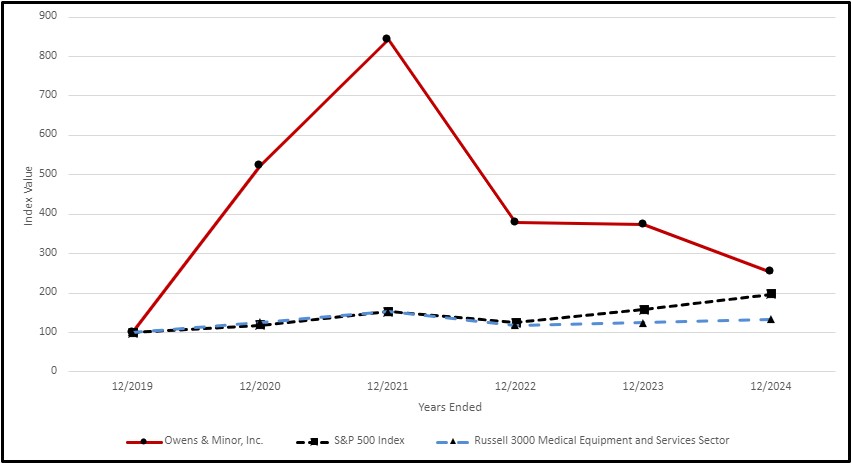
|
|
Base Period |
|
Years Ended |
||||||||||||||
Company Name / Index |
|
12/2019 |
|
12/2020 |
|
12/2021 |
|
12/2022 |
|
12/2023 |
|
12/2024 |
||||||
Owens & Minor, Inc. |
|
$ |
100.00 |
|
$ |
523.82 |
|
$ |
842.59 |
|
$ |
378.29 |
|
$ |
373.29 |
|
$ |
253.16 |
S&P 500 Index |
|
|
100.00 |
|
|
118.39 |
|
|
152.34 |
|
|
124.73 |
|
|
157.48 |
|
|
196.85 |
Russell 3000 Medical Equipment and Services Sector |
|
|
100.00 |
|
|
125.94 |
|
|
152.09 |
|
|
118.27 |
|
|
124.16 |
|
|
132.03 |
On February 26, 2025, the Owens & Minor Board of Directors authorized a share repurchase program of up to $100 million over the next 24 months. Under the program, Owens & Minor may repurchase shares of common stock on a discretionary basis from time to time through open market repurchases, privately negotiated transactions and 10b5-1 trading plans.
42
Item 6. [Reserved]
Item 7. Management’s Discussion and Analysis of Financial Condition and Results of Operations
Management’s discussion and analysis of financial condition and results of operations is intended to assist the reader in the understanding and assessment of significant changes and trends related to our results of operations. The discussion and analysis presented below refers to, and should be read in conjunction with, the consolidated financial statements and accompanying notes included in Item 8 of Part II of this Annual Report on Form 10-K.
Overview
Owens & Minor, Inc., along with its subsidiaries, is a global healthcare solutions company. We report our business under two segments: Products & Healthcare Services and Patient Direct. The Products & Healthcare Services segment includes our U.S. distribution division (Medical Distribution), including outsourced logistics and value-added services, and our Global Products division which manufactures and sources medical surgical products through our production and kitting operations. The Patient Direct segment includes our home healthcare divisions (Byram and Apria).
Net (loss) per share was $(4.73) for the year ended December 31, 2024 as compared to net (loss) per share of $(0.54) for the year ended December 31, 2023. Our financial results for the year ended December 31, 2024 as compared to the prior year were impacted by the following: (1) a goodwill impairment charge of $307 million related to our Apria reporting unit, or a $3.97 negative impact per share (see Notes 1 and 5 in the Notes to Consolidated Financial Statements); (2) the remeasurement of an uncertain tax position, including interest which resulted in a $19 million, or a $0.24 negative income tax charge per share (see Note 12 in the Notes to Consolidated Financial Statements); (3) legal settlements of $17 million related primarily to compensation and wage and hour disputes and (4) incremental exit and realignment charges of $11 million primarily related to our 2023-2024 Operating Model Realignment Program and information technology (IT) strategic initiatives and (5) the decline in Products & Healthcare Services segment operating income, as described below. These were partially offset by lower acquisition-related charges and intangible amortization of $14 million, lower interest expense of $14 million, and an increase in Patient Direct segment operating income as described below for the year ended December 31, 2024 as compared to the prior year.
Net (loss) per share was not impacted as compared to the prior year by foreign currency translation for the year ended December 31, 2024.
Products & Healthcare Services segment operating income was $53 million for the year ended December 31, 2024, compared to $58 million for the year ended December 31, 2023. The decline for the year ended December 31, 2024 as compared to the prior year was primarily due to (1) increased teammate benefit costs of $15 million and (2) competitive pricing pressures, including glove pricing, partially offset by revenue growth of 3.1% and savings derived by our sourcing initiatives of $15 million. Patient Direct segment operating income was $260 million for the year ended December 31, 2024, compared to $247 million for the year ended December 31, 2023. The increase for the year ended December 31, 2024 as compared to the prior year was primarily due to (1) 5.0% net revenue growth, (2) cost savings from IT strategic initiatives of $16 million, and (3) a benefit of $5.4 million from an agreement with Philips Respironics (Philips) for previously recalled equipment, partially offset by increased teammate benefit costs of $26 million and unfavorable changes in revenue mix. Segment operating incomes exclude adjustments noted in Note 16, “Segments”, in the Notes to Consolidated Financial Statements.
Refer to “Results of Operations” for further detail of quantitative and qualitative drivers of our results.
43
Potential Sale of Products & Healthcare Services Segment
On February 28, 2025, we announced that we are actively engaged in discussions regarding the potential sale of our Products & Healthcare Services segment. There is no set timetable for the potential sale and there can be no assurance that we will complete a transaction.
Expected Acquisition of Rotech
On July 22, 2024, we entered into an Agreement and Plan of Merger to acquire Rotech for $1.36 billion in cash. Given anticipated tax benefits of approximately $40 million from the transaction, the net purchase price is approximately $1.32 billion. Rotech is a national leader in providing home medical equipment in the US. The definitive agreement contains certain termination rights for the Company and Rotech. In the event that we terminate the contract, we will be required to pay Rotech a termination fee of $70 million. The transaction is subject to customary closing conditions, including expiration or termination of the applicable waiting period under the Hart Scott Rodino Act, and is expected to close in the first half of 2025. We have fully committed financing in place and expect to use a combination of cash and incremental borrowings to fund the purchase price.
Philips Respironics Recall
In June 2021, one of Apria’s suppliers, Philips, announced a voluntary recall of its continuous and non-continuous ventilators (certain continuous positive airway pressure (CPAP), bilevel positive airway pressure and ventilator devices) related to polyurethane foam used in those devices, which the U.S. Food and Drug Administration (FDA) identified as a Class I recall, the most serious category of recall (the June 2021 Recall). In December 2022, Philips issued a subsequent voluntary recall related to deficiencies in repairs made to certain of the ventilators that had originally been recalled in June 2021 (together with the June 2021 recall, the Recall). In April 2024, Philips entered into a consent decree enjoining Philips from making and distributing non-medically necessary CPAP, bilevel positive airway pressure and ventilator devices at any of its Sleep and Respiratory Care Business facilities until the FDA determines that Philips has complied with the remediation and compliance activities set forth in the consent decree.
We have incurred significant costs coordinating the Recall. During the second quarter of 2024, we reached an agreement with Philips requiring Philips to pay us for recalled equipment returned to Philips. During the year ended December 31, 2024, we received $18 million from Philips which was recorded in the ‘Other, net’ line item within investing activities of the consolidated statements of cash flows. The corresponding benefit of $5.4 million on the returned equipment for the year ended December 31, 2024 is reflected in the ‘gain on sales and dispositions of property and equipment’ line item within operating activities of the consolidated statements of cash flows. While we believe the Recall matter with Philips has now been materially resolved and that we have access to a sufficient supply of CPAP, bilevel positive airway pressure and ventilator devices from other suppliers to service our home healthcare patients’ needs, other supply chain disruptions (including any future impact of the Recall and subsequent consent decree on our business) may have a material adverse effect on our financial condition or results of operations, cash flows and liquidity.
44
Supplemental Financial Information
(in thousands, except ratios and per share data)
|
|
At or for the Years Ended December 31, |
|
|||||||
|
|
2024 |
|
2023 |
|
2022 |
|
|||
Summary of Operations: |
|
|
|
|
|
|
|
|
|
|
Net revenue |
|
$ |
10,700,883 |
|
$ |
10,333,967 |
|
$ |
9,955,475 |
|
Net (loss) income |
|
$ |
(362,686) |
|
$ |
(41,301) |
|
$ |
22,389 |
|
|
|
|
|
|
|
|
|
|
|
|
Per Common Share: |
|
|
|
|
|
|
|
|
|
|
Net (loss) income per share—basic |
|
$ |
(4.73) |
|
$ |
(0.54) |
|
$ |
0.30 |
|
Net (loss) income per share—diluted |
|
$ |
(4.73) |
|
$ |
(0.54) |
|
$ |
0.29 |
|
Stock price at year end |
|
$ |
13.07 |
|
$ |
19.27 |
|
$ |
19.53 |
|
|
|
|
|
|
|
|
|
|
|
|
Summary of Financial Position: |
|
|
|
|
|
|
|
|
|
|
Total assets |
|
$ |
4,656,156 |
|
$ |
5,093,322 |
|
$ |
5,386,283 |
|
Cash and cash equivalents |
|
$ |
49,382 |
|
$ |
243,037 |
|
$ |
69,467 |
|
Total debt |
|
$ |
1,853,596 |
|
$ |
2,097,502 |
|
$ |
2,500,874 |
|
Total equity |
|
$ |
565,226 |
|
$ |
924,166 |
|
$ |
945,604 |
|
|
|
|
|
|
|
|
|
|
|
|
Selected Ratios: |
|
|
|
|
|
|
|
|
|
|
Gross profit as a percent of revenue |
|
|
20.74 |
% |
|
20.56 |
% |
|
18.35 |
% |
Distribution, selling and administrative expenses as a percent of revenue |
|
|
17.85 |
% |
|
17.55 |
% |
|
15.62 |
% |
Operating (loss) income as a percent of revenue |
|
|
(1.94) |
% |
|
1.01 |
% |
|
1.44 |
% |
DSO (1) |
|
|
23.3 |
|
|
20.5 |
|
|
27.0 |
|
Inventory days (2) |
|
|
49.2 |
|
|
49.0 |
|
|
57.2 |
|
45
Results of Operations
Our Management’s Discussion and Analysis of Financial Condition and Results of Operations within this Annual Report on Form 10-K generally discusses 2024 and 2023 items and year-to-year comparisons between 2024 and 2023. Discussions of year-to-year comparisons between 2023 and 2022 can be found in Part II, Item 7 “Management’s Discussion and Analysis of Financial Condition and Results of Operations” of our Annual Report on Form 10-K for the year ended December 31, 2023, which is incorporated by reference herein.
2024 compared to 2023
Net revenue.
|
For the Years Ended |
|
|
|
|
|
|
||||
|
December 31, |
|
Change |
|
|||||||
(Dollars in thousands) |
2024 |
|
2023 |
|
$ |
|
% |
|
|||
Products & Healthcare Services |
$ |
8,020,771 |
|
$ |
7,781,395 |
|
$ |
239,376 |
|
3.1 |
% |
Patient Direct |
|
2,680,112 |
|
|
2,552,572 |
|
|
127,540 |
|
5.0 |
% |
Net revenue |
$ |
10,700,883 |
|
$ |
10,333,967 |
|
$ |
366,916 |
|
3.6 |
% |
The increase in our Products & Healthcare Services segment net revenue for the year ended December 31, 2024 was driven by net revenue growth in the Medical Distribution division of 4.0%, driven by growth with existing customers, which was partially offset by a slight decline in our Global Products division, primarily driven by competitive pricing pressures, including glove pricing. The increase in our Patient Direct segment net revenue for the year ended December 31, 2024 was driven primarily by growth across a number of product categories, including diabetes and sleep supplies.
Foreign currency translation had an unfavorable impact on net revenue of $3.5 million for the year ended December 31, 2024 as compared to the prior year.
Cost of goods sold.
|
For the Years Ended |
|
|
|
|
|
|
||||
|
December 31, |
|
Change |
|
|||||||
(Dollars in thousands) |
2024 |
|
2023 |
|
|
$ |
|
% |
|
||
Cost of goods sold |
$ |
8,481,728 |
|
$ |
8,208,806 |
|
$ |
272,922 |
|
3.3 |
% |
The increase in cost of goods sold reflects the increased cost associated with net revenue growth of 3.6%, as compared to prior year, partially offset by cost reductions in our Global Products division, including $15 million of savings associated with sourcing initiatives.
We value a portion of Products & Healthcare Services inventory held in the U.S. under the LIFO method. Had inventory been valued under the first-in, first-out (FIFO) method, cost of goods sold as a percentage of net revenue would have been 1 basis point higher in 2024 and 2 basis points lower in 2023.
Foreign currency translation had a favorable impact on cost of goods sold of $2.5 million for the year ended December 31, 2024 as compared to the prior year.
Gross profit.
|
|
For the Years Ended |
|
|
|
|
|
|
||||
|
|
December 31, |
|
Change |
|
|||||||
(Dollars in thousands) |
|
2024 |
|
2023 |
|
|
$ |
|
% |
|
||
Gross profit |
|
$ |
2,219,155 |
|
$ |
2,125,161 |
|
$ |
93,994 |
|
4.4 |
% |
As a % of net revenue |
|
|
20.74 |
% |
|
20.56 |
% |
|
|
|
|
|
46
The increase in gross profit for the year ended December 31, 2024 was driven by the same factors impacting net revenue and cost of goods sold as compared to the prior year.
Foreign currency translation had an unfavorable impact on gross profit of $1.0 million for the year ended December 31, 2024 as compared to the prior year.
Operating expenses.
|
For the Years Ended |
|
|
|
|
|
|
||||
|
December 31, |
|
Change |
|
|||||||
(Dollars in thousands) |
2024 |
|
2023 |
|
$ |
|
% |
|
|||
Distribution, selling and administrative expenses |
$ |
1,909,791 |
|
$ |
1,813,559 |
|
$ |
96,232 |
|
5.3 |
% |
As a % of net revenue |
|
17.85 |
% |
|
17.55 |
% |
|
|
|
|
|
Goodwill impairment charges |
$ |
307,112 |
|
$ |
— |
|
$ |
307,112 |
|
NM |
|
Acquisition-related charges and intangible amortization |
$ |
86,543 |
|
$ |
101,037 |
|
$ |
(14,494) |
|
(14.3) |
% |
Exit and realignment charges, net |
$ |
110,162 |
|
$ |
99,127 |
|
$ |
11,035 |
|
11.1 |
% |
Other operating expense (income), net |
$ |
13,316 |
|
$ |
6,930 |
|
$ |
6,386 |
|
92.2 |
% |
NM – Not meaningful
The increase in DS&A expenses was driven primarily by incremental costs to support the $367 million, or 3.6% net revenue growth, along with future revenue growth and an increase of $41 million in teammate benefit costs, partially offset by $18 million in expense savings from our IT strategic initiatives, $7.4 million of personnel cost savings related to 2023 organizational changes, and other productivity gains derived from operating efficiencies.
DS&A expenses also included a favorable impact from foreign currency translation of $0.9 million for the year ended December 31, 2024 as compared to the prior year.
Goodwill impairment charges relates to impairment recognized in the Apria reporting unit during the quarter ended December 31, 2024 relating to a combination of factors occurring in the fourth quarter of 2024. The majority of these factors are related to financial market changes inclusive of a decline in Owens & Minor’s stock price and rising interest rates. Additionally, anticipated changes in pricing of a capitated contract also contributed to this charge.
Acquisition-related charges were $22 million for the year ended December 31, 2024 as compared to $18 million for the year ended December, 31, 2023. Acquisition-related charges in 2024 consisted of costs related to the expected acquisition of Rotech, which related primarily to legal and professional fees. Acquisition charges in 2023 consisted primarily of costs related to the Apria Acquisition. Intangible amortization was $65 million and $84 million for the years ended December 31, 2024 and 2023 and related primarily to intangible assets acquired in the Apria, Halyard, and Byram acquisitions. The decline is related to certain intangible assets being fully amortized. See Note 5 in the Notes to Consolidated Financial Statements.
Exit and realignment charges, net were $110 million and $99 million for the years ended December 31, 2024 and 2023. Amounts in 2024 were primarily related to our (1) 2023-2024 Operating Model Realignment Program of $95 million, including professional fees, severance, and other costs to streamline functions and processes, (2) IT strategic initiatives such as converting certain divisions to a common IT system of $15 million, (3) other costs associated with strategic initiatives of $7.5 million, including lease exit costs and (4) $7.4 million gain on the sale of our corporate headquarters for the year ended December 31, 2024. Amounts in 2023 were primarily related to our (1) 2023-2024 Operating Model Realignment Program of $82.9 million, including professional fees, severance, and other costs to streamline functions and processes, (2) IT strategic initiatives such as converting certain divisions to a common IT system of $9.2 million and, (3) other costs associated with strategic initiatives of $7.0 million, including lease exit costs.
The change in other operating expense (income), net for the year ended December 31, 2024 as compared to the prior year reflects $2.8 million higher losses on sales of accounts receivable under the RPA and Receivables Sale Program. Other operating expense (income), net for the year ended December 31, 2024 reflected legal settlements of $17 million related primarily to compensation and hour wage disputes and a $5.4 million benefit for equipment returned to Philips, as described in the ‘Philips Respironics Recall’ section above.
47
During the year ended December 31, 2024, we incurred a favorable change of $6.0 million in foreign currency transaction gains and losses, net of derivative adjustments, as compared to the prior year.
Interest expense, net.
|
For the Years Ended |
|
|
|
|
|
|
||||
|
December 31, |
|
Change |
|
|||||||
(Dollars in thousands) |
2024 |
|
2023 |
|
$ |
|
% |
|
|||
Interest expense, net |
$ |
143,804 |
|
$ |
157,915 |
|
$ |
(14,111) |
|
(8.9) |
% |
Effective interest rate |
|
7.09 |
% |
|
6.96 |
% |
|
|
|
|
|
The decrease in interest expense was primarily due to lower average outstanding borrowings of $227 million, partially offset by an increase in the effective interest rate of 13 basis points.
Loss (gain) on extinguishment of debt.
|
|
For the Years Ended |
|
|
|
|
|
|
||||
|
|
December 31, |
|
Change |
|
|||||||
(Dollars in thousands) |
|
2024 |
|
2023 |
|
$ |
|
% |
|
|||
Loss (gain) on extinguishment of debt |
|
$ |
1,101 |
|
$ |
(3,518) |
|
$ |
4,619 |
|
131.3 |
% |
Loss on extinguishment of debt for the year ended December 31, 2024 represents the loss associated with early retirement of indebtedness of $45 million for our Term Loan A. Gain on extinguishment of debt for the year ended December 31, 2023 represented the gain associated with early retirement of indebtedness of $314 million. Refer to Note 8 in the Notes to Consolidated Financial Statements for additional content related to the early retirement of indebtedness.
Other expense, net.
|
For the Years Ended |
|
|
|
|
|
|
||||
|
December 31, |
|
Change |
|
|||||||
(Dollars in thousands) |
2024 |
|
2023 |
|
$ |
|
% |
|
|||
Other expense, net |
$ |
4,683 |
|
$ |
4,837 |
|
$ |
(154) |
|
(3.2) |
% |
Other expense, net in 2024 and 2023 primarily represented interest cost and net actuarial losses related to our retirement plans.
Income taxes.
|
For the Years Ended |
|
|
|
|
|
|
||||
|
December 31, |
|
Change |
|
|||||||
(Dollars in thousands) |
2024 |
|
2023 |
|
$ |
|
% |
|
|||
Income tax provision (benefit) |
$ |
5,329 |
|
$ |
(13,425) |
|
$ |
18,754 |
|
139.7 |
% |
Effective tax rate |
|
(1.5) |
% |
|
24.5 |
% |
|
|
|
|
|
48
The change in the effective tax rate for the year ended December 31, 2024 compared to 2023 resulted primarily from the pre-tax goodwill impairment charge of $307 million ($305 million net of tax), related to the Apria reporting unit and a one-time income tax charge of $19 million, or a $0.24 negative impact per share, related to a recent decision associated with Notices of Proposed Adjustments (NOPA) that we received in 2020 and 2021. The decision was communicated to us in late June 2024 and is related to past transfer pricing methodology, which is no longer employed. See Notes 5 and 12 in the Notes to Consolidated Financial Statements.
Financial Condition, Liquidity and Capital Resources
Financial condition. We monitor operating working capital through DSO and merchandise inventory days. We estimate a hypothetical increase (decrease) in DSO of one day would result in a decrease (increase) in our cash balances, an increase (decrease) in borrowings against our Revolving Credit Agreement, or a combination thereof of approximately $29 million.
The majority of our cash and cash equivalents are held in cash depository accounts with major banks in North America, Europe, and Asia. Changes in our working capital can vary in the normal course of business based upon the timing of inventory purchases, collections of accounts receivable, and payments to suppliers.
|
December 31, |
|
Change |
|
|||||||
(Dollars in thousands) |
2024 |
|
2023 |
|
$ |
|
% |
|
|||
Cash and cash equivalents |
$ |
49,382 |
|
$ |
243,037 |
|
$ |
(193,655) |
|
(79.7) |
% |
Accounts receivable, net |
$ |
690,241 |
|
$ |
598,257 |
|
$ |
91,984 |
|
15.4 |
% |
DSO (1) |
|
23.3 |
|
|
20.5 |
|
|
|
|
|
|
Merchandise inventories |
$ |
1,131,879 |
|
$ |
1,110,606 |
|
$ |
21,273 |
|
1.9 |
% |
Inventory days (2) |
|
49.2 |
|
|
49.0 |
|
|
|
|
|
|
Accounts payable |
$ |
1,251,964 |
|
$ |
1,171,882 |
|
$ |
80,082 |
|
6.8 |
% |
(1)Based on year end accounts receivable and net revenue for the fourth quarter ended December 31, 2024 and 2023. DSO in 2024 reflected the impact of the reduction in accounts receivable, net due to sales of accounts receivable under the Receivables Sale Program. Excluding the impact of the Receivables Sale Program, DSO would have been 25.7 as of December 31, 2024. DSO in 2023 reflected the impact of the reduction in accounts receivable, net due to sales of accounts receivable under the RPA. Excluding the impact of the RPA, DSO would have been 24.8 as of December 31, 2023.
(2) Based on year end merchandise inventories and cost of goods sold for the fourth quarter ended December 31, 2024 and 2023.
Liquidity and capital expenditures. The following table summarizes our consolidated statements of cash flows for the year ended December 31, 2024 and 2023:
|
For the Years Ended |
||||
|
December 31, |
||||
(Dollars in thousands) |
2024 |
|
2023 |
||
Net cash provided by (used for): |
|
|
|
|
|
Operating activities |
$ |
161,495 |
|
$ |
740,710 |
Investing activities |
|
(116,533) |
|
|
(137,254) |
Financing activities |
|
(267,603) |
|
|
(417,330) |
Effect of exchange rate changes |
|
(901) |
|
|
613 |
Net (decrease) increase in cash, cash equivalents and restricted cash |
$ |
(223,542) |
|
$ |
186,739 |
Cash provided by operating activities for the year ended December 31, 2024 reflected positive cash generated by a net loss after the effects of reconciling non-cash adjustments. Cash provided by operating activities was negatively impacted by unfavorable changes in working capital for the year ended December 31, 2024 and was positively impacted by changes in working capital for the year ended December 31, 2023. For the year ended December 31, 2024, unfavorable changes in working capital were driven by an increase in accounts receivable, including a $54 million reduction in accounts receivable that had been sold and removed from our consolidated balance sheets under the Receivables Sale Program and the RPA, partially offset by an increase in accounts payable.
49
For the year ended December 31, 2023, favorable changes in working capital were driven by the reduction in accounts receivable, net from the initial accounts receivable sold through the RPA and the significant reduction in inventory levels during the year ended December 31, 2023.
Cash used for investing activities in 2024 included capital expenditures of $228 million for patient service equipment and our strategic and operational efficiency initiatives, partially offset by $103 million in proceeds related to the sale and disposal of property and equipment, which included sales of patient service equipment and $34 million in gross proceeds related to the sale of our corporate headquarters, and $18 million included in the ‘Other, net’ line item for a settlement with Philips for returned equipment as described in the ‘Philips Respironics Recall’ section above. Cash used for investing activities in 2023 included capital expenditures of $208 million for patient service equipment and our strategic and operational efficiency initiatives, partially offset by $72 million in proceeds primarily related to the sale of patient service equipment.
Cash used for financing activities in 2024 included repayments of debt of $244 million, including the $171 million paid to redeem the outstanding principal of the 4.375% senior notes due in 2024 (the 2024 Notes), unscheduled principal payments of $45 million on the Term Loan A facility (Term Loan A) and scheduled principal payments of $28 million on our Term Loan A and Term Loan B facility (Term Loan B). We had no borrowings under our revolving credit facility on a net basis for 2024 and the activity under our amended Receivables Financing Agreement netted to no impact to our outstanding borrowings. Cash used for financing activities in 2023 included repayments of debt of $321 million including $170 million of unscheduled and $15 million of scheduled principal payments on our Term Loan A and Term Loan B, $135 million of cash to repurchase $144 million aggregate principal of the 2024 Notes, the 4.500% senior unsecured notes due in 2029 (2029 Unsecured Notes) and the 6.625% senior notes due in 2030 (the 2030 Unsecured Notes). We had no borrowings under our revolving credit facility on a net basis for 2023 and made net repayments of $96 million under our amended Receivables Financing Agreement. Payments for taxes related to the vesting of restricted stock awards were $8.1 million and $10 million during 2024 and 2023, which are included in Other, net.
Capital resources. Our primary sources of liquidity include cash and cash equivalents, our Receivables Sale Program, our Revolving Credit Agreement and our Receivables Purchase Agreement (RPA).
On October 18, 2024, O&M Funding and Owens & Minor Medical, LLC., each a wholly-owned subsidiary of the Company, entered into a Receivables Purchase Agreement (the Receivables Sale Program) with persons from time to time, as Purchasers, PNC Bank, National Association, as Administrative Agent, and PNC Capital Markets LLC, as Structuring Agent, pursuant to which accounts receivable with an aggregate outstanding amount not to exceed $450 million are sold, on a limited-recourse basis, to the Purchasers in exchange for cash. The Receivables Sale Program amends and restates in its entirety, the Receivables Financing Agreement. Transactions under this agreement are accounted for as sales in accordance with ASC 860, Transfers and Servicing, with the sold receivables removed from our consolidated balance sheets. Total accounts receivable sold under the Receivables Sale Program and net cash proceeds were $168 million during the year ended December 31, 2024. We collected $98 million of the sold accounts receivable for the year ended December 31, 2024. The losses on sales of accounts receivable are recorded in other operating expense (income), net in the consolidated statements of operations and were $1.9 million for the year ended December 31, 2024.
On March 14, 2023, we entered into the RPA, pursuant to which accounts receivable with an aggregate outstanding amount not to exceed $200 million are sold, on a limited-recourse basis, to the Purchaser in exchange for cash. Cash received from the sales of accounts receivable, net of payments made to the Purchaser, is reflected in the change in accounts receivable within cash provided by operating activities in the consolidated statements of cash flows. Total accounts receivable sold under the RPA and net cash proceeds were $1.7 billion during the year ended December 31, 2024. We collected $1.9 billion of the sold accounts receivable for the year ended December 31, 2024. The losses on sales of accounts receivable are recorded in other operating expense (income), net in the consolidated statements of operations and were $11 million for the year ended December 31, 2024. As a result of an amendment to the Receivables Financing Agreement during the fourth quarter of 2024, we do not expect to utilize the RPA in the future.
50
The Revolving Credit Agreement provides a revolving borrowing capacity of $450 million. We have $837 million in outstanding term loans under a term loan credit agreement (the Credit Agreement). The interest rate on our Revolving Credit Agreement is based on a spread over a benchmark rate (as described in the Revolving Credit Agreement). The Revolving Credit Agreement matures in March 2027. The interest rate on the Term Loan A is based on either the Term SOFR or the Base Rate plus an Applicable Rate which varies depending on the current Debt Ratings or Total Leverage Ratio, determined as to whichever shall result in more favorable pricing to the Borrowers (each as defined in the Credit Agreement). The interest rate on the Term Loan B is based on either the Term SOFR or the Base Rate plus an Applicable Rate. The Term Loan A matures in March 2027 and the Term Loan B matures in March 2029.
At December 31, 2024, and December 31, 2023, our Revolving Credit Agreement was undrawn, and we had letters of credit, which reduce revolver availability, of $31 million and $27 million, leaving $419 million and $423 million available for borrowing. We also had letters of credit and bank guarantees, which support certain leased facilities as well as other normal business activities in the U.S. and Europe that were issued outside of the Revolving Credit Agreement for $2.9 million and $3.0 million as of December 31, 2024 and 2023.
The Revolving Credit Agreement, the Credit Agreement, the Receivables Sale Program, the 2029 Unsecured Notes, and the 2030 Unsecured Notes contain cross-default provisions which could result in the acceleration of payments due in the event of default of any of the related agreements. The terms of the applicable credit agreements also require us to maintain ratios for leverage and interest coverage, including on a pro forma basis in the event of an acquisition or divestiture. We were in compliance with our debt covenants at December 31, 2024.
We regularly evaluate market conditions, our liquidity profile and various financing alternatives to enhance our capital structure. We have from time to time, entered into, and in the future, we may enter into transactions to repay, repurchase or redeem our outstanding indebtedness (including by means of open market purchases, privately negotiated repurchases, tender or exchange offers and/or repayments or redemptions pursuant to the debt’s terms). Our ability to consummate any such transaction will depend on prevailing market conditions, our liquidity requirements, contractual restrictions and other factors. We cannot provide any assurance as to if or when we will consummate any such transactions or the terms of any such transaction.
On February 26, 2025, the Owens & Minor Board of Directors authorized a share repurchase program of up to $100 million over the next 24 months. Under the program, Owens & Minor may repurchase shares of common stock on a discretionary basis from time to time through open market repurchases, privately negotiated transactions and 10b5-1 trading plans.
We believe cash generated by operating activities, including available cash proceeds from the Receivables Sale Program, available financing sources, and borrowings under the Revolving Credit Agreement, as well as cash on hand, will be sufficient to fund our working capital needs, capital expenditures, long-term strategic growth, payments under long-term debt and lease arrangements, debt repurchases, share repurchases and other cash requirements. While we believe that we will have the ability to meet our financing needs in the foreseeable future, changes in economic conditions may impact (i) the ability of financial institutions to meet their contractual commitments to us, (ii) the ability of our customers and suppliers to meet their obligations to us or (iii) our cost of borrowing.
We earn a portion of our operating income in foreign jurisdictions outside the U.S. Our cash and cash equivalents held by our foreign subsidiaries subject to repatriation totaled $22 million at December 31, 2024 and 2023. As of December 31, 2024, we are permanently reinvested in our foreign subsidiaries.
Pillar 2 Global Minimum Tax
In December 2021, the Organization for Economic Cooperation and Development (OECD) released Pillar Two Model Rules defining the global minimum tax, which calls for the taxation of large corporations at a minimum rate of 15%. The OECD continues to release additional guidance on how the Pillar Two rules should be interpreted and applied. Law enactment by the OECD and various countries is currently being implemented and is expected to continue to take effect during 2025. We are continuing to evaluate the impact of these proposed and enacted legislative changes as new guidance becomes available and do not expect Pillar Two to have a material impact on our financial position, results of operations and cash flows.
51
Seasonality
Our business is affected by seasonality, which historically has resulted in higher sales volume during our third and fourth quarters, ending September 30 and December 31.
Contractual Obligations
On July 22, 2024, we entered into an Agreement and Plan of Merger to acquire Rotech for $1.36 billion in cash. Given anticipated tax benefits of approximately $40 million from the transaction, the net purchase price is approximately $1.32 billion. Rotech is a national leader in providing home medical equipment in the U.S. The definitive agreement contains certain termination rights for the Company and Rotech. In the event that we terminate the contract, we will be required to pay Rotech a termination fee of $70 million. The transaction is subject to customary closing conditions, including expiration or termination of the applicable waiting period under the Hart Scott Rodino Act, and is expected to close in the first half of 2025. We have fully committed financing in place and expect to use a combination of cash and incremental borrowings to fund the purchase price.
As of December 31, 2024, other material cash requirements, including known contractual and other obligations, in the next twelve months were primarily comprised of $40 million in principal debt payments, $123 million in operating leases, $58 million in fixed interest payments on our outstanding senior notes, and $43 million associated with the NOPA matter, which includes $12 million of interest accrued on the matter through December 31, 2024. Additionally, as of December 31, 2024, material cash requirements, including known contractual and other obligations, due beyond the next twelve months were primarily comprised of $1.8 billion in principal debt payments excluding finance leases, $225 million in fixed interest payments on our outstanding senior notes, $347 million in operating leases and $28 million in U.S. retirement plan benefits, based on the same assumptions used to measure our year-end benefit obligation. Due to the uncertainty of forecasting variable interest rate payments, interest payment amounts on our variable rate debt are excluded from the contractual obligations disclosed in this section. See Note 6, “Leases”, Note 8, “Debt”, Note 10, “Retirement Plans”, Note 12, “Income Taxes”, and Note 15, “Commitments, Contingent Liabilities, and Legal Proceedings” in the Notes to Consolidated Financial Statements.
Off-Balance Sheet Arrangements
We do not have off-balance sheet financing arrangements or guarantees, including variable interest entities, which we believe could have a material impact on financial condition or liquidity.
Critical Accounting Estimates
Our consolidated financial statements and accompanying notes have been prepared in accordance with U.S. GAAP. The preparation of the financial statements requires us to make estimates and assumptions that affect the reported amounts and related disclosures. We continually evaluate the accounting policies and estimates used to prepare the consolidated financial statements.
Critical accounting estimates are defined as those estimates that require us to make assumptions about matters that are highly uncertain at the time the estimate is made and could have a material impact on our results due to changes in the estimate or the use of different assumptions that could reasonably have been used. Our estimates are generally based on historical experience and various other assumptions that are judged to be reasonable in light of the relevant facts and circumstances. Because of the uncertainty inherent in such estimates, actual results may differ. We believe our critical accounting estimates include accounting for goodwill valuation, revenue recognition, and inventory valuation.
Goodwill. Goodwill is evaluated for impairment annually, as of October 1, and if an event occurs or circumstances change that would more likely than not reduce the fair value of a reporting unit below its carrying amount. Qualitative factors are first assessed to determine if it is more likely than not that the fair value of a reporting unit is less than its carrying amount.
52
If it is determined that it is more likely than not that the fair value does not exceed the carrying amount, or if elected to bypass the qualitative test, then a quantitative test is performed. The quantitative goodwill impairment test involves a comparison of the estimated fair value of the reporting unit to the respective carrying amount.
Goodwill impairment testing is conducted at the reporting unit level, which is generally defined as an operating segment or a component, one level below our operating segments, for which discrete financial information is available and where segment management regularly reviews the operating results of that reporting unit. Our reporting units are: Global Products, Medical Distribution (including Services and Outsourced Logistics), Apria, and Byram. The Medical Distribution reporting unit does not have any goodwill as of December 31, 2024.
As of October 1, 2024, we performed our annual impairment test and there were no impairments of goodwill. During the three months ended December 31, 2024, we experienced financial market changes inclusive of a decline in Owens & Minor’s stock price and an increase in the risk free interest rate resulting in an increase in the discount rate used for impairment analysis. Additionally, anticipated changes in pricing of a capitated contract contributed to a reduction in projected future cash flows within our Apria reporting unit. As a result of these factors during the three months ended December 31, 2024, we performed an interim quantitative goodwill impairment test.
The quantitative impairment review of goodwill requires the extensive use of accounting estimates and assumptions. We determine the estimated fair value of our reporting units by using an equally weighted combination of the income-based approach and the market-based approach. The income-based approach is dependent upon several significant assumptions and estimates regarding future period cash flows, including assumptions with respect to future sales growth and a terminal growth rate. In addition, a weighted average cost of capital (WACC) is used to discount future estimated cash flows to their present values. The WACC is based on externally observable data considering market participants’ cost of equity and debt, optimal capital structure and interest rates, as well as the risk and uncertainty with respect to the reporting unit and internally developed financial projections. Under the market-based approach, significant estimates and assumptions also include the selection of appropriate guideline public companies whose stock is actively traded in public markets and the determination of appropriate valuation multiples to apply to the reporting unit. In addition, we compared the aggregate of the reporting units’ estimated fair values to our market capitalization, as further corroboration of the reasonableness of our concluded fair values.
Although we believe our assumptions and estimates are reasonable and appropriate, any significant adverse changes in one or a combination of key assumptions, including, but not limited to, a further decrease in our market capitalization, an increase in the discount rate, inflationary pressures and our planned efforts to mitigate such impacts, disruptions in the supply chain, a decrease in the terminal growth rate, increases in tax rates (including potential tax reform), a significant change in industry or economic trends, or the reporting unit specific factors described in the paragraphs below may materially affect the estimated fair-value of each reporting unit and potentially result in goodwill impairment. We may be required to record a material charge to earnings in our consolidated financial statements during the period in which any impairment of our goodwill is determined, which could adversely affect our results of operations.
Our 2024 interim quantitative goodwill impairment test concluded that the fair value for our Apria reporting unit within our Patient Direct segment was below its carrying amount. The amount by which the carrying value of the impaired reporting unit’s goodwill exceeded its fair value was $305 million ($307 million pre-tax), which was recognized as an impairment loss during the three months ended December 31, 2024. Inclusive of the impairment recorded, the goodwill balance of this reporting unit was $944 million at December 31, 2024, or approximately 71% of the consolidated goodwill balance. Adverse changes in one or a combination of significant assumptions, such as the factors described above, as well as, failure of the Apria reporting unit to meet expected earnings and cash flows, or unanticipated events and circumstances such as a loss of a contract with a large payor may materially affect the estimated fair value of the Apria reporting unit and potentially result in further goodwill impairment. A decline in the terminal growth rate or an increase in the discount rate of approximately 100 basis points would have increased the impairment charge by approximately $25 million and approximately $45 million.
The estimated fair value of our Global Products reporting unit was substantially in excess of the carrying value.
53
For Global Products, adverse changes in one or a combination of significant assumptions, such as the factors described above, as well as, failure of the Global Products reporting unit to meet expected earnings and cash flows, changes in assumptions about the duration and magnitude of increased supply chain expense, increases in commodities costs, or unanticipated events and circumstances such as pricing pressures and lower demand for certain product categories, including PPE, may materially affect the estimated fair value of the Global Products reporting unit and potentially result in goodwill impairment.
The estimated fair value of our Byram reporting unit was substantially in excess of the carrying value. The impairment testing performed for 2023 and 2022 did not indicate any impairment of goodwill.
Revenue Recognition. Due to the nature of our industry and the reimbursement environment in which we operate, revenue recognition requires significant estimates and judgements. We determine the transaction price based on contractually agreed-upon amounts or rates, adjusted for estimates of variable consideration including but not limited to rebates, discounts, performance guarantees, and implicit price concessions. The Company utilizes the expected value method to estimate the amount of variable consideration that should be included to arrive at the transaction price, using contractual agreements, historical experience, and other operating trends. The Company applies constraint to the transaction price, such that net revenue is recorded only to the extent that it is probable that a significant reversal in the amount of the cumulative revenue recognized will not occur in the future. The complexity of many third-party billing arrangements, contractual terms and the uncertainty of reimbursement amounts may result in adjustments to amounts originally recorded. Such adjustments are typically identified and recorded at the point of cash application, claim denial or account review. If actual amounts of consideration ultimately received differ from the Company’s estimates, the Company adjusts these estimates, which would affect net revenue in the period such adjustments become known.
Inventory. Merchandise inventories are valued at the lower of cost or market, with the approximate cost determined by the last-in, first-out (LIFO) method for distribution inventories in the U.S. within our Products & Healthcare Services segment. Cost of remaining inventories are determined using the FIFO or weighted-average cost method at the lower of cost or net realizable value.
We periodically evaluate whether inventory valuation allowance adjustments are required, which includes consideration of recent sales trends. In our evaluation, we review for expired or obsolete inventory and slow-moving inventory. We write down inventories which are considered excess and obsolete as a result of these assessments. Shifts in market trends and conditions, as well as changes in customer preferences and behavior could affect the value of our inventories. Non-cash LIFO charges to merchandise inventories valued at the lower of cost or market, with the approximate cost determined by the LIFO method for distribution inventories in the U.S. within our Products & Healthcare Services segment, were $0.9 million, $2.4 million, and $5.4 million for the years ended December 31, 2024, 2023 and 2022. Excess and obsolete inventory adjustments included in our Products & Healthcare Services segment were $12 million, $7.3 million and $17 million for the years ended December 31 2024, 2023, and 2022. For the year ended December 31, 2022, we recorded a $92 million inventory valuation adjustment, primarily associated with PPE inventory built up and a subsequent decline in demand as a result of the COVID-19 pandemic that was not allocated to the Products & Healthcare Services segment due to its one time nature and size.
Recent Accounting Pronouncements
For a discussion of recent accounting pronouncements, see Note 1 in the Notes to Consolidated Financial Statements.
Item 7A. Quantitative and Qualitative Disclosures About Market Risk
We are subject to price risk for our raw materials, the most significant of which relates to the cost of polypropylene and nitrile used in the manufacturing processes of our Products & Healthcare Services segment. Prices of the commodities underlying these raw materials are volatile and have fluctuated significantly in recent years and in the future may contribute to fluctuations in our results of operations. The ability to hedge these commodity prices is limited.
In the normal course of business, we are exposed to foreign currency translation and transaction risks. Our business transactions outside of the U.S. are denominated in the euro, Malaysian ringgit, Mexican peso, thai baht and other currencies.
54
We may use foreign currency forwards, swaps and options, where possible, to manage our risk related to certain foreign currency fluctuations. As of December 31, 2024 and 2023, we held contracts with notional amounts of $43 million and $78 million to exchange the U.S. dollar, euro, thai baht and other currencies. See Note 11 in the Notes to Consolidated Financial Statements.
We are exposed to market risk from changes in interest rates related to our borrowing under our Revolving Credit Agreement, and related to our participation in the Receivables Sale Program, and RPA. Excluding deferred financing costs and third party fees, we had $326 million in borrowings under our Term Loan A, $511 million in borrowings under our Term Loan B, no outstanding borrowings under our Revolving Credit Agreement, $70 million of uncollected accounts receivable under our Receivables Sale Program, and no uncollected accounts receivable under our RPA at December 31, 2024. After considering the effects of our interest rate swap agreement (See Note 11 in the Notes to Consolidated Financial Statements), we estimate an increase in interest rates of 100 basis points would result in a potential reduction in future pre-tax earnings of approximately $6.1 million per year based on our borrowings and uncollected accounts receivable sold under our Receivables Sale Program at December 31, 2024.
Item 8. Financial Statements and Supplementary Data
See Item 15. Exhibits and Financial Statement Schedules.
Item 9. Changes in and Disagreements with Accountants on Accounting and Financial Disclosure
None.
Item 9A. Controls and Procedures
Conclusion Regarding the Effectiveness of Disclosure Controls and Procedures
We carried out an evaluation, with the participation of management, including our principal executive officer and principal financial officer, of the effectiveness of our disclosure controls and procedures (pursuant to Rule 13a-15(e) and 15d-15(e) under the Securities Exchange Act of 1934, as amended) as of the end of the period covered by this report. Based upon that evaluation, our principal executive officer and principal financial officer concluded that our disclosure controls and procedures were effective as of December 31, 2024.
55
Management’s Report on Internal Control over Financial Reporting
Management is responsible for establishing and maintaining adequate internal control over financial reporting as defined in Rules 13a-15(f) and 15d-15(f) under the Securities Exchange Act of 1934, as amended. Our internal control system is designed to provide reasonable assurance regarding the reliability of financial reporting and the preparation of financial statements for external purposes in accordance with generally accepted accounting principles. Because of its inherent limitations, internal control over financial reporting may not prevent or detect misstatements. Also, controls deemed effective now may become inadequate in the future because of changes in conditions, or because compliance with policies or procedures has deteriorated or been circumvented.
Management assessed the effectiveness of our internal control over financial reporting as of December 31, 2024. In making this assessment, management used the criteria established in the Internal Control-Integrated Framework (2013) issued by the Committee of Sponsoring Organizations of the Treadway Commission (the COSO criteria). Based on management’s assessment and the COSO criteria, management believes that our internal control over financial reporting was effective as of December 31, 2024 to provide reasonable assurance regarding the reliability of financial reporting and the preparation of financial statements in accordance with GAAP.
The effectiveness of our internal control over financial reporting as of December 31, 2024, has been audited by KPMG LLP, an independent registered public accounting firm, as stated in their unqualified report which is included in this annual report.
/s/ Edward A. Pesicka |
|
Edward A. Pesicka, President, Chief Executive Officer & Director |
|
/s/ Jonathan A. Leon |
|
Jonathan A. Leon, Executive Vice President & Chief Financial Officer |
|
56
Changes in Internal Control over Financial Reporting
There were no changes in our internal control over financial reporting that occurred during the fourth quarter that have materially affected, or are reasonably likely to materially affect, our internal control over financial reporting.
Item 9B. Other Information
During the three months ended December 31, 2024, none of our directors or officers informed us of the adoption or termination of a trading plan intended to satisfy Rule 10b5-1(c).
Amended and Restated Severance Arrangements
On February 27, 2025, our Board approved the amendment and restatement of the Owens & Minor, Inc. Officer Severance Policy (the “Officer Severance Policy”), in which each of our named executive officers participates, and the Company’s existing Executive Change of Control Severance Agreements with each of our named executive officers (the “CIC Agreements”). Among other things, (i) the Officer Severance Policy was updated to increase the applicable severance multiplier and severance period from 1.50x and 18 months, respectively, to 2.0x and 24 months, and (ii) the Board approved the amendment of the CIC Agreements to increase (a) the applicable severance multiplier from 2.0x to 3.0x, and (b) the applicable period for the employer portion of COBRA premiums from two years to three years.
The material terms of the Officer Severance Policy and CIC Agreements, as previously described in the Company’s 2024 Proxy Statement filed with the Securities and Exchange Commission on March 27, 2024, otherwise remain unchanged. The foregoing descriptions are qualified in their entirety by reference to the amended Officer Severance Policy, a copy of which is filed herewith as Exhibit 10.13, and the Form of Amended and Restated Executive Change of Control Severance Agreement, a copy of which is filed herewith as Exhibit 10.61, each of which are incorporated by reference herein.
Item 9C. Disclosure Regarding Foreign Jurisdictions that Prevent Inspections
None.
57
Report of Independent Registered Public Accounting Firm
To the Shareholders and Board of Directors
Owens & Minor, Inc.:
Opinion on Internal Control Over Financial Reporting
We have audited Owens & Minor, Inc. and subsidiaries’ (the Company) internal control over financial reporting as of December 31, 2024, based on criteria established in Internal Control – Integrated Framework (2013) issued by the Committee of Sponsoring Organizations of the Treadway Commission. In our opinion, the Company maintained, in all material respects, effective internal control over financial reporting as of December 31, 2024, based on criteria established in Internal Control – Integrated Framework (2013) issued by the Committee of Sponsoring Organizations of the Treadway Commission.
We also have audited, in accordance with the standards of the Public Company Accounting Oversight Board (United States) (PCAOB), the consolidated balance sheets of the Company as of December 31, 2024 and 2023, the related consolidated statements of operations, comprehensive (loss) income, changes in shareholders’ equity, and cash flows for each of the years in the three-year period ended December 31, 2024, and the related notes (collectively, the consolidated financial statements), and our report dated February 28, 2025 expressed an unqualified opinion on those consolidated financial statements.
Basis for Opinion
The Company’s management is responsible for maintaining effective internal control over financial reporting and for its assessment of the effectiveness of internal control over financial reporting, included in the accompanying Management’s Report on Internal Control over Financial Reporting. Our responsibility is to express an opinion on the Company’s internal control over financial reporting based on our audit. We are a public accounting firm registered with the PCAOB and are required to be independent with respect to the Company in accordance with the U.S. federal securities laws and the applicable rules and regulations of the Securities and Exchange Commission and the PCAOB.
We conducted our audit in accordance with the standards of the PCAOB. Those standards require that we plan and perform the audit to obtain reasonable assurance about whether effective internal control over financial reporting was maintained in all material respects. Our audit of internal control over financial reporting included obtaining an understanding of internal control over financial reporting, assessing the risk that a material weakness exists, and testing and evaluating the design and operating effectiveness of internal control based on the assessed risk. Our audit also included performing such other procedures as we considered necessary in the circumstances. We believe that our audit provides a reasonable basis for our opinion.
Definition and Limitations of Internal Control Over Financial Reporting
A company’s internal control over financial reporting is a process designed to provide reasonable assurance regarding the reliability of financial reporting and the preparation of financial statements for external purposes in accordance with generally accepted accounting principles. A company’s internal control over financial reporting includes those policies and procedures that (1) pertain to the maintenance of records that, in reasonable detail, accurately and fairly reflect the transactions and dispositions of the assets of the company; (2) provide reasonable assurance that transactions are recorded as necessary to permit preparation of financial statements in accordance with generally accepted accounting principles, and that receipts and expenditures of the company are being made only in accordance with authorizations of management and directors of the company; and (3) provide reasonable assurance regarding prevention or timely detection of unauthorized acquisition, use, or disposition of the company’s assets that could have a material effect on the financial statements.
Because of its inherent limitations, internal control over financial reporting may not prevent or detect misstatements. Also, projections of any evaluation of effectiveness to future periods are subject to the risk that controls may become inadequate because of changes in conditions, or that the degree of compliance with the policies or procedures may deteriorate.
58
Part III
Items 10-14.
Information required by Items 10-14 can be found under Information about our Executive Officers under Part I of this Form 10-K and the registrant’s 2025 Proxy Statement pursuant to instructions G(3) of the General Instructions to Form 10-K.
We have adopted an insider trading policy which governs transactions in our securities by the Company and its directors, officers, and employees that is designed to promote compliance with insider trading laws, rules and regulations applicable to the Company. A copy of our insider trading policy is filed as an exhibit to this Annual Report on Form 10-K.
Because our common stock is listed on the New York Stock Exchange (NYSE), our Chief Executive Officer is required to make, and he has made, an annual certification to the NYSE stating that he was not aware of any violation of the corporate governance listing standards of the NYSE. Our Chief Executive Officer made his annual certification to that effect to the NYSE as of May 28, 2024. In addition, we have filed, as exhibits to this Annual Report on Form 10-K, the certifications of our principal executive officer and principal financial officer required under Sections 906 and 302 of the Sarbanes-Oxley Act of 2002 to be filed with the Securities and Exchange Commission regarding the quality of our public disclosure.
60
Part IV
Item 15. Exhibits and Financial Statement Schedules
|
The following documents are filed as part of this report: |
Page |
Consolidated Statements of Operations for the Years Ended December 31, 2024, 2023 and 2022 |
62 |
63 |
|
Consolidated Balance Sheets as of December 31, 2024 and 2023 |
64 |
Consolidated Statements of Cash Flows for the Years Ended December 31, 2024, 2023 and 2022 |
65 |
66 |
|
67 |
|
Report of Independent Registered Public Accounting Firm (KPMG, LLP, Richmond, VA, Auditor Firm ID: 185) |
96 |
| a) | Exhibits: |
See Index to Exhibits on page 99.
61
OWENS & MINOR, INC. AND SUBSIDIARIES
CONSOLIDATED STATEMENTS OF OPERATIONS
(in thousands, except per share data)
|
|
|
|
|
|
|
|
|
|
|
|
|
|
|
|
|
|
|
|
Years Ended December 31, |
|
2024 |
|
2023 |
|
2022 |
|||
Net revenue |
|
$ |
10,700,883 |
|
$ |
10,333,967 |
|
$ |
9,955,475 |
Cost of goods sold |
|
|
8,481,728 |
|
|
8,208,806 |
|
|
8,129,124 |
Gross profit |
|
|
2,219,155 |
|
|
2,125,161 |
|
|
1,826,351 |
Distribution, selling and administrative expenses |
|
|
1,909,791 |
|
|
1,813,559 |
|
|
1,554,821 |
Goodwill impairment charge |
|
|
307,112 |
|
|
— |
|
|
— |
Acquisition-related charges and intangible amortization |
|
|
86,543 |
|
|
101,037 |
|
|
126,972 |
Exit and realignment charges, net |
|
|
110,162 |
|
|
99,127 |
|
|
6,897 |
Other operating expense (income), net |
|
|
13,316 |
|
|
6,930 |
|
|
(5,252) |
Operating (loss) income |
|
|
(207,769) |
|
|
104,508 |
|
|
142,913 |
Interest expense, net |
|
|
143,804 |
|
|
157,915 |
|
|
128,891 |
Loss (gain) on extinguishment of debt |
|
|
1,101 |
|
|
(3,518) |
|
|
— |
Other expense, net |
|
|
4,683 |
|
|
4,837 |
|
|
3,131 |
(Loss) income before income taxes |
|
|
(357,357) |
|
|
(54,726) |
|
|
10,891 |
Income tax provision (benefit) |
|
|
5,329 |
|
|
(13,425) |
|
|
(11,498) |
Net (loss) income |
|
$ |
(362,686) |
|
$ |
(41,301) |
|
$ |
22,389 |
|
|
|
|
|
|
|
|
|
|
Net (loss) income per common share |
|
|
|
|
|
|
|
|
|
Basic |
|
$ |
(4.73) |
|
$ |
(0.54) |
|
$ |
0.30 |
Diluted |
|
$ |
(4.73) |
|
$ |
(0.54) |
|
$ |
0.29 |
See accompanying notes to consolidated financial statements.
62
OWENS & MINOR, INC. AND SUBSIDIARIES
CONSOLIDATED STATEMENTS OF COMPREHENSIVE (LOSS) INCOME
(in thousands)
|
|
|
|
|
|
|
|
|
|
|
|
|
|
|
|
|
|
Years Ended December 31, |
2024 |
|
2023 |
|
2022 |
|||
Net (loss) income |
$ |
(362,686) |
|
$ |
(41,301) |
|
$ |
22,389 |
Other comprehensive (loss) income, net of tax: |
|
|
|
|
|
|
|
|
Currency translation adjustments |
|
(15,145) |
|
|
7,141 |
|
|
(14,101) |
Change in unrecognized net periodic pension costs |
|
(655) |
|
|
2,086 |
|
|
7,396 |
Change in gains and losses on derivative instruments |
|
(1,726) |
|
|
(5,190) |
|
|
11,441 |
Total other comprehensive (loss) income, net of tax |
|
(17,526) |
|
|
4,037 |
|
|
4,736 |
Comprehensive (loss) income |
$ |
(380,212) |
|
$ |
(37,264) |
|
$ |
27,125 |
See accompanying notes to consolidated financial statements.
63
OWENS & MINOR, INC. AND SUBSIDIARIES
CONSOLIDATED BALANCE SHEETS
(in thousands, except per share data)
|
|
|
|
|
|
|
December 31, |
|
2024 |
|
2023 |
||
Assets |
|
|
|
|
|
|
Current assets |
|
|
|
|
|
|
Cash and cash equivalents |
|
$ |
49,382 |
|
$ |
243,037 |
Accounts receivable, net |
|
|
690,241 |
|
|
598,257 |
Merchandise inventories |
|
|
1,131,879 |
|
|
1,110,606 |
Other current assets |
|
|
149,515 |
|
|
150,890 |
Total current assets |
|
|
2,021,017 |
|
|
2,102,790 |
Property and equipment, net |
|
|
509,347 |
|
|
543,972 |
Operating lease assets |
|
|
355,627 |
|
|
296,533 |
Goodwill |
|
|
1,331,281 |
|
|
1,638,846 |
Intangible assets, net |
|
|
298,726 |
|
|
361,835 |
Other assets, net |
|
|
140,158 |
|
|
149,346 |
Total assets |
|
$ |
4,656,156 |
|
$ |
5,093,322 |
Liabilities and equity |
|
|
|
|
|
|
Current liabilities |
|
|
|
|
|
|
Accounts payable |
|
$ |
1,251,964 |
|
$ |
1,171,882 |
Accrued payroll and related liabilities |
|
|
151,039 |
|
|
116,398 |
Current portion of long-term debt |
|
|
45,549 |
|
|
206,904 |
Other current liabilities |
|
|
425,187 |
|
|
396,701 |
Total current liabilities |
|
|
1,873,739 |
|
|
1,891,885 |
Long-term debt, excluding current portion |
|
|
1,808,047 |
|
|
1,890,598 |
Operating lease liabilities, excluding current portion |
|
|
286,212 |
|
|
222,429 |
Deferred income taxes, net |
|
|
22,456 |
|
|
41,652 |
Other liabilities |
|
|
100,476 |
|
|
122,592 |
Total liabilities |
|
|
4,090,930 |
|
|
4,169,156 |
Commitments and contingencies |
|
|
|
|
|
|
Equity |
|
|
|
|
|
|
Common stock, par value $2 per share; authorized - 200,000 shares; issued and outstanding - 77,199 shares and 76,546 shares as of December 31, 2024 and December 31, 2023 |
|
|
154,398 |
|
|
153,092 |
Paid-in capital |
|
|
454,151 |
|
|
434,185 |
Retained earnings |
|
|
6,021 |
|
|
368,707 |
Accumulated other comprehensive loss |
|
|
(49,344) |
|
|
(31,818) |
Total equity |
|
|
565,226 |
|
|
924,166 |
Total liabilities and equity |
|
$ |
4,656,156 |
|
$ |
5,093,322 |
See accompanying notes to consolidated financial statements.
64
OWENS & MINOR, INC. AND SUBSIDIARIES
CONSOLIDATED STATEMENTS OF CASH FLOWS
(in thousands) |
|
|
|
|
|
|
|
|
Years Ended December 31, |
2024 |
|
2023 |
|
2022 |
|||
Operating activities: |
|
|
|
|
|
|
|
|
Net (loss) income |
$ |
(362,686) |
|
$ |
(41,301) |
|
$ |
22,389 |
Adjustments to reconcile net (loss) income to cash provided by operating activities: |
|
|
|
|
|
|
|
|
Depreciation and amortization |
|
264,775 |
|
|
287,377 |
|
|
228,667 |
Goodwill impairment charge |
|
307,112 |
|
|
— |
|
|
— |
Share-based compensation expense |
|
26,836 |
|
|
23,218 |
|
|
20,993 |
Loss (gain) on extinguishment of debt |
|
1,101 |
|
|
(3,518) |
|
|
— |
Deferred income tax benefit |
|
(26,115) |
|
|
(23,648) |
|
|
(26,361) |
Changes in operating lease right-of-use assets and lease liabilities |
|
10,244 |
|
|
(47) |
|
|
353 |
Gain from sales and dispositions of property and equipment |
|
(44,705) |
|
|
(34,882) |
|
|
(26,260) |
Changes in operating assets and liabilities: |
|
|
|
|
|
|
|
|
Accounts receivable |
|
(94,550) |
|
|
165,167 |
|
|
4,416 |
Merchandise inventories |
|
(26,228) |
|
|
224,338 |
|
|
166,559 |
Accounts payable |
|
65,187 |
|
|
30,997 |
|
|
13,652 |
Net change in other assets and liabilities |
|
30,153 |
|
|
100,370 |
|
|
(91,544) |
Other, net |
|
10,371 |
|
|
12,639 |
|
|
12,142 |
Cash provided by operating activities |
|
161,495 |
|
|
740,710 |
|
|
325,006 |
Investing activities: |
|
|
|
|
|
|
|
|
Acquisition, net of cash acquired |
|
— |
|
|
— |
|
|
(1,684,607) |
Additions to property and equipment |
|
(210,865) |
|
|
(190,870) |
|
|
(158,090) |
Additions to computer software |
|
(17,297) |
|
|
(17,022) |
|
|
(8,492) |
Proceeds from sales of property and equipment |
|
103,426 |
|
|
71,574 |
|
|
48,383 |
Other, net |
|
8,203 |
|
|
(936) |
|
|
(1,670) |
Cash used for investing activities |
|
(116,533) |
|
|
(137,254) |
|
|
(1,804,476) |
Financing activities: |
|
|
|
|
|
|
|
|
Borrowings under amended Receivables Financing Agreement |
|
1,465,800 |
|
|
476,000 |
|
|
1,022,300 |
Repayments under amended Receivables Financing Agreement |
|
(1,465,800) |
|
|
(572,000) |
|
|
(1,156,300) |
Borrowings under Revolving Credit Facility |
|
635,800 |
|
|
— |
|
|
— |
Repayments under Revolving Credit Facility |
|
(635,800) |
|
|
— |
|
|
— |
Repayments of debt |
|
(244,197) |
|
|
(320,693) |
|
|
(4,500) |
Proceeds from issuance of debt |
|
— |
|
|
— |
|
|
1,691,000 |
Borrowings under Receivables Financing Agreement |
|
— |
|
|
— |
|
|
30,000 |
Financing costs paid |
|
— |
|
|
— |
|
|
(42,602) |
Other, net |
|
(23,406) |
|
|
(637) |
|
|
(42,793) |
Cash (used for) provided by financing activities |
|
(267,603) |
|
|
(417,330) |
|
|
1,497,105 |
Effect of exchange rate changes on cash, cash equivalents and restricted cash |
|
(901) |
|
|
613 |
|
|
(3,485) |
Net (decrease) increase in cash, cash equivalents and restricted cash |
|
(223,542) |
|
|
186,739 |
|
|
14,150 |
Cash, cash equivalents and restricted cash at beginning of period |
|
272,924 |
|
|
86,185 |
|
|
72,035 |
Cash, cash equivalents and restricted cash at end of period |
$ |
49,382 |
|
$ |
272,924 |
|
$ |
86,185 |
Supplemental disclosure of cash flow information: |
|
|
|
|
|
|
|
|
Income taxes paid (received), net |
$ |
5,553 |
|
$ |
(6,283) |
|
$ |
33,973 |
Interest paid |
$ |
141,547 |
|
$ |
153,247 |
|
$ |
107,022 |
Noncash investing activity: |
|
|
|
|
|
|
|
|
Unpaid purchases of property and equipment and computer software at end of period |
$ |
84,562 |
|
$ |
77,279 |
|
$ |
67,852 |
See accompanying notes to consolidated financial statements.
65
OWENS & MINOR, INC. AND SUBSIDIARIES
CONSOLIDATED STATEMENTS OF CHANGES IN SHAREHOLDERS’ EQUITY
(in thousands, except per share data)
|
|
|
|
|
|
|
|
|
|
|
|
|
Accumulated |
|
|
|
|
|
|
|
|
|
|
|
|
|
|
|
|
|
Other |
|
|
|
|
|
|
Common Shares |
|
Common Stock |
|
Paid-In |
|
Retained |
|
Comprehensive |
|
|
|
||||
|
|
Outstanding |
|
($2 par value) |
|
Capital |
|
Earnings |
|
Loss |
|
Total Equity |
|||||
Balance, December 31, 2021 |
|
75,433 |
|
$ |
150,865 |
|
$ |
440,608 |
|
$ |
387,619 |
|
$ |
(40,591) |
|
$ |
938,501 |
Net income |
|
— |
|
|
— |
|
|
— |
|
|
22,389 |
|
|
— |
|
|
22,389 |
Other comprehensive income |
|
— |
|
|
— |
|
|
— |
|
|
— |
|
|
4,736 |
|
|
4,736 |
Share-based compensation expense, exercises and other |
|
846 |
|
|
1,692 |
|
|
(21,714) |
|
|
— |
|
|
— |
|
|
(20,022) |
Balance, December 31, 2022 |
|
76,279 |
|
|
152,557 |
|
|
418,894 |
|
|
410,008 |
|
|
(35,855) |
|
|
945,604 |
Net loss |
|
— |
|
|
— |
|
|
— |
|
|
(41,301) |
|
|
— |
|
|
(41,301) |
Other comprehensive income |
|
— |
|
|
— |
|
|
— |
|
|
— |
|
|
4,037 |
|
|
4,037 |
Share-based compensation expense, exercises and other |
|
267 |
|
|
535 |
|
|
15,291 |
|
|
— |
|
|
— |
|
|
15,826 |
Balance, December 31, 2023 |
|
76,546 |
|
|
153,092 |
|
|
434,185 |
|
|
368,707 |
|
|
(31,818) |
|
|
924,166 |
Net loss |
|
— |
|
|
— |
|
|
— |
|
|
(362,686) |
|
|
— |
|
|
(362,686) |
Other comprehensive loss |
|
— |
|
|
— |
|
|
— |
|
|
— |
|
|
(17,526) |
|
|
(17,526) |
Share-based compensation expense, exercises and other |
|
653 |
|
|
1,306 |
|
|
19,966 |
|
|
— |
|
|
— |
|
|
21,272 |
Balance, December 31, 2024 |
|
77,199 |
|
$ |
154,398 |
|
$ |
454,151 |
|
$ |
6,021 |
|
$ |
(49,344) |
|
$ |
565,226 |
See accompanying notes to consolidated financial statements.
66
OWENS & MINOR, INC. AND SUBSIDIARIES
Notes to Consolidated Financial Statements
(in thousands, except per share data, unless otherwise indicated)
Note 1—Summary of Significant Accounting Policies
Owens & Minor, Inc. and subsidiaries (we, us, our or the Company), a Fortune 500 company headquartered in Richmond, Virginia, is a global healthcare solutions company that incorporates product manufacturing, distribution support and innovative technology services to deliver significant and sustained value across the breadth of the industry – from acute care to patients in their home. Our teammates serve healthcare industry customers in approximately 80 countries by producing quality products and helping to reduce total costs across the healthcare supply chain by optimizing point-of care performance, freeing up capital and clinical resources and managing contracts to optimize financial performance.
Basis of Presentation and Consolidation. The consolidated financial statements include the accounts of Owens & Minor, Inc. and the subsidiaries it controls and contain all adjustments necessary to conform with U.S. generally accepted accounting principles (GAAP). All significant intercompany accounts and transactions have been eliminated. The results of operations of businesses acquired by the Company are included as of the respective acquisition date.
We report our business under two distinct segments: Products & Healthcare Services and Patient Direct. The Products & Healthcare Services segment includes our United States (U.S.) distribution division (Medical Distribution), including outsourced logistics and value-added services, and Global Products division which manufactures and sources medical surgical products through our production and kitting operations. The Patient Direct segment includes our home healthcare divisions (Byram and Apria).
Reclassifications. Certain prior year amounts have been reclassified to conform to the current year presentation.
Use of Estimates. The preparation of consolidated financial statements in conformity with GAAP requires us to make assumptions and estimates that affect reported amounts and related disclosures. Significant estimates are used for, but are not limited to, the allowances for losses on accounts receivable, inventory valuation allowances, variable consideration, depreciation and amortization, goodwill valuation, valuation of intangible assets and other long-lived assets, estimated fair values of the net assets acquired in business combinations, self-insurance liabilities, tax liabilities, defined benefit obligations, share-based compensation and other contingencies. Actual results may differ from these estimates.
Cash, Cash Equivalents and Restricted Cash. Cash, cash equivalents and restricted cash includes cash and marketable securities with an original maturity or maturity at acquisition of three months or less. Cash, cash equivalents and restricted cash are stated at cost. Nearly all of our cash, cash equivalents and restricted cash are held in cash depository accounts in major banks in North America, Europe, and Asia. Cash that is held by a major bank and has restrictions on its availability to us is classified as restricted cash. Restricted cash as of December 31, 2023 includes cash held in an escrow account as required by the Centers for Medicare & Medicaid Services in conjunction with the Bundled Payments for Care Improvement initiatives related to wind-down costs of Fusion5 and $14 million of cash deposits received subject to limitations on use until remitted to a third-party financial institution (the Purchaser), pursuant to the Master Receivables Purchase Agreement (RPA).
67
The following table provides a reconciliation of cash, cash equivalents and restricted cash reported within the accompanying consolidated balance sheets that sum to the total of those same amounts presented in the accompanying consolidated statements of cash flows.
|
|
December 31, 2024 |
|
December 31, 2023 |
||
Cash and cash equivalents |
|
$ |
49,382 |
|
$ |
243,037 |
Restricted cash included in Other current assets |
|
|
— |
|
|
29,887 |
Total cash, cash equivalents, and restricted cash |
|
$ |
49,382 |
|
$ |
272,924 |
Book overdrafts represent the amount of outstanding checks issued in excess of related bank balances and are included in accounts payable in our consolidated balance sheets, as they are similar to trade payables and are not subject to finance charges or interest. Changes in book overdrafts are classified as operating activities in our consolidated statements of cash flows.
Accounts Receivable, Net. Accounts receivable, net are recorded at net realizable value. In the Products & Healthcare Services segment, accounts receivable from customers are recorded at net realizable value of the invoiced amount and are reduced by any rebates due to the customer, which are estimated based on contractual terms or historical experience. We assess finance charges on overdue accounts receivable that are recognized as other operating income based on their estimated ultimate collectability. We have arrangements with certain customers under which they make deposits on account. Customer deposits in excess of outstanding receivable balances are classified as other current liabilities.
Due to the nature of our industry and the reimbursement environment in which we operate in the Patient Direct segment, certain estimates are required to record total net revenues and accounts receivable at their net realizable values, including estimating variable consideration. Inherent in these estimates is the risk that they will have to be revised or updated as additional information becomes available. Specifically, the complexity of many third-party billing arrangements, contractual terms, and the uncertainty of reimbursement amounts for certain services may result in adjustments to amounts originally recorded. Such adjustments are typically identified and recorded at the point of cash application, claim denial or account review.
We maintain valuation allowances based upon the expected collectability of accounts receivable. Our allowances include specific amounts for accounts that are likely to be uncollectible, such as customer bankruptcies and disputed amounts and general allowances for accounts that may become uncollectible. Allowances are estimated based on a number of factors, including industry trends, current economic conditions, creditworthiness of customers, age of the receivables, changes in customer payment patterns, and historical experience. Account balances are charged off against the allowance after all means of collection have been exhausted and the potential for recovery is considered remote. Allowances for losses on accounts receivable of $6.2 million and $7.9 million have been applied as reductions of accounts receivable at December 31, 2024 and 2023.
Receivables Financing Agreement. On March 29, 2022, we entered into an amendment to our accounts receivable securitization program (Receivables Financing Agreement) which has a maximum borrowing capacity of $450 million. Under the Receivables Financing Agreement, certain of our accounts receivable balances are sold to our wholly owned special purpose entity, O&M Funding LLC. The sold accounts receivable balances are collateral and outstandings are recorded as debt. This agreement was not in effect as of December 31, 2024, as it was amended and restated in its entirety on October 18, 2024, as described below.
Receivables Purchase Agreement. On March 14, 2023, we entered into the RPA, pursuant to which accounts receivable with an aggregate outstanding amount not to exceed $200 million are sold, on a limited-recourse basis, to the Purchaser (as defined therein) in exchange for cash. We account for these transactions as sales with the sold receivables removed from our consolidated balance sheets. Under the RPA, we provide certain servicing and collection actions on behalf of the Purchaser; however, we do not maintain any beneficial interest in the accounts receivable sold. The RPA is separate and distinct from the Receivables Financing Agreement and the amendment as described below. As a result of the amendment described below, we do not expect to utilize the RPA in the future.
68
Proceeds from the sales of accounts receivable are recorded as an increase to cash and cash equivalents and a reduction to accounts receivable, net of allowances in the consolidated balance sheets. Cash received from the sales of accounts receivable, net of payments made to the Purchaser, is reflected in the change in accounts receivable within cash provided by operating activities in the consolidated statements of cash flows. Total accounts receivable sold under the RPA and net cash proceeds were $1.7 billion and $1.4 billion during the years ended December 31, 2024 and 2023. We collected $1.9 billion and $1.3 billion of the sold accounts receivable for the years ended December 31, 2024 and 2023. The losses on sales of accounts receivable are recorded in other operating expense (income), net in the consolidated statements of operations and were $11 million for the years ended December 31, 2024 and 2023.
Receivables Sale Program. On October 18, 2024, O&M Funding and Owens & Minor Medical, LLC., each a wholly-owned subsidiary of the Company, entered into a Receivables Purchase Agreement (the Receivables Sale Program) with persons from time to time, as Purchasers, PNC Bank, National Association, as Administrative Agent, and PNC Capital Markets LLC, as Structuring Agent, pursuant to which accounts receivable with an aggregate outstanding amount not to exceed $450 million are sold, on a limited-recourse basis, to the Purchasers in exchange for cash. The Receivables Sale Program amends and restates in its entirety, the Receivables Financing Agreement. Transactions under this agreement are accounted for as sales in accordance with ASC 860, Transfers and Servicing, with the sold receivables removed from our consolidated balance sheets. Under the Receivables Sale Program, we provide certain servicing and collection actions on behalf of the Purchasers; however, we do not maintain any beneficial interest in the accounts receivable sold.
Proceeds from the sales of accounts receivable are recorded as an increase to cash and cash equivalents and a reduction to accounts receivable, net of allowances in the consolidated balance sheets. Cash received from the sales of accounts receivable, is reflected in the change in accounts receivable within cash provided by operating activities in the consolidated statements of cash flows. Total accounts receivable sold and net cash proceeds under the Receivables Sale program were $168 million during the year ended December 31, 2024. We collected $98 million of the sold accounts receivable for the year ended December 31, 2024. The losses on sales of accounts receivable, inclusive of professional fees incurred to establish the agreement, recorded in other operating expense (income), net in the consolidated statements of operations were $1.9 million for the year ended December 31, 2024.
As of December 31, 2024, there was a total of $70 million of uncollected accounts receivable sold and removed from our consolidated balance sheet under the Receivables Sale Program. As of December 31, 2023 there was a total of $124 million of uncollected accounts receivable sold and removed from our consolidated balance sheet under the RPA. As of December 31, 2024 the Receivables Sale Program was utilized and we do not anticipate utilizing the RPA in the future.
Merchandise Inventories. Merchandise inventories are valued at the lower of cost or market, with the approximate cost determined by the last-in, first-out (LIFO) method for distribution inventories in the U.S. within our Products & Healthcare Services segment. Cost of remaining inventories are determined using the first-in, first out (FIFO) or weighted-average cost method at the lower of cost or net realizable value.
We periodically evaluate whether inventory valuation allowance adjustments are required, which includes consideration of recent sales trends. In our evaluation, we review for expired or obsolete inventory and slow-moving inventory. We write down inventories which are considered excess and obsolete as a result of these assessments. Shifts in market trends and conditions, as well as changes in customer preferences and behavior could affect the value of our inventories.
At December 31, 2024 and 2023 we had net inventory of $1.1 billion and $1.1 billion, of which $658 million and $718 million were valued under LIFO, all of which relates to inventory in our Products & Healthcare Services segment. If LIFO inventories had been valued on a current cost or FIFO basis, they would have been $234 million and $233 million greater as of December 31, 2024 and 2023. Inventory, net, consists of the following:
69
|
|
December 31, 2024 |
|
December 31, 2023 |
||
Finished goods |
|
$ |
1,059,798 |
|
$ |
1,051,553 |
Raw materials |
|
|
77,922 |
|
|
75,711 |
Work in process |
|
|
59,115 |
|
|
61,527 |
Inventory, gross |
|
|
1,196,835 |
|
|
1,188,791 |
Inventory valuation allowances |
|
|
(64,956) |
|
|
(78,185) |
Inventory, net |
|
$ |
1,131,879 |
|
$ |
1,110,606 |
For the year ended December 31, 2022, primarily due to demand declines and builds in excess personal protective equipment (PPE), we increased our estimate of inventory valuation allowances. This change in estimate contributed to a $92 million (approximately $70 million, net of tax) valuation adjustment, or an approximate $0.93 and $0.91 impact per basic and diluted common share.
Property and Equipment, net. Property and equipment are stated at cost less accumulated depreciation and amortization. Depreciation expense for financial reporting purposes is computed on a straight-line method over the estimated useful lives of the assets or, for capital leases and leasehold improvements, over the term of the lease, if shorter. In general, the estimated useful lives for computing depreciation are three to 15 years for machinery and equipment, five to 40 years for buildings, one to 10 years for patient service equipment, and up to 15 years for leasehold and land improvements. Straight-line and accelerated methods of depreciation are used for income tax purposes. Normal maintenance and repairs are expensed as incurred, and renovations and betterments are capitalized. We suspend depreciation and amortization on assets that are held for sale. In addition, we record capital-related government grants earned as reductions to the cost of property and equipment; and associated unpaid liabilities and grant proceeds receivable are considered non-cash changes in such balances for purposes of preparation of our consolidated statements of cash flows. Patient service equipment consists of medical equipment rented to patients, primarily on a month-to-month basis. Patient service equipment depreciation is classified in our consolidated statements of operations within cost of goods sold as the equipment is rented to patients as part of our primary operations within the Patient Direct segment.
Leases. We enter into non-cancelable agreements to lease most of our office and warehouse facilities with remaining terms generally ranging from one to 11 years. Certain leases include renewal options, generally for one to five-year increments. The exercise of lease renewal options is at our sole discretion. We include options to renew (or terminate) in our lease term, and as part of our right-of-use assets and lease liabilities, when it is reasonably certain that we will exercise that option. We also lease some of our transportation and material handling equipment for terms generally ranging from three to 10 years. Leases with a term of 12 months or less are not recorded on the consolidated balance sheets; we recognize lease expense for these leases on a straight-line basis over the lease term. The depreciable life of right-of-use assets and leasehold improvements are limited by the expected lease term, unless there is a transfer of title or purchase option reasonably certain of exercise. Our lease agreements do not contain any material residual value guarantees or material restrictive covenants.
Right-of-use assets represent our right to use an underlying asset for the lease term and lease liabilities represent our obligation to make lease payments arising from the lease. We elected the practical expedient to not separate lease and non-lease components for our leases. Operating lease assets and liabilities are recognized at commencement date based on the present value of unpaid lease payments over the lease term. As most of our leases do not provide an implicit rate, we use our incremental borrowing rate based on the information available at commencement date in determining the present value of lease payments. Our incremental borrowing rate is estimated to approximate the interest rate on a collateralized basis with similar terms and payments. We use the implicit rate when readily determinable. The right-of-use assets also include adjustments for any lease payments made and lease incentives received.
Goodwill. We account for acquired businesses using the acquisition method of accounting, which requires that the assets acquired and liabilities assumed be recorded at the date of acquisition at their respective fair values. Any excess of the purchase price over the estimated fair values of the net assets acquired is recorded as goodwill.
We evaluate goodwill for impairment annually, as of October 1, and if an event occurs or circumstances change that would more likely than not reduce the fair value of a reporting unit below its carrying amount. Qualitative factors are first assessed to determine if it is more likely than not that the fair value of a reporting unit is less than its carrying amount. If it is determined that it is more likely than not that the fair value does not exceed the carrying amount, then a quantitative test is performed.
70
The quantitative goodwill impairment test involves a comparison of the estimated fair value of the reporting unit to the respective carrying amount.
We determine the estimated fair value of our reporting units by using an equally weighted combination of the income-based approach and the market-based approach. The income-based approach is dependent upon several significant assumptions and estimates regarding future period cash flows, including assumptions with respect to future sales growth and a terminal growth rate. In addition, a weighted average cost of capital (WACC) is used to discount future estimated cash flows to their present values. The WACC is based on externally observable data considering market participants’ cost of equity and debt, optimal capital structure and interest rates, as well as the risk and uncertainty with respect to the reporting unit and internally developed financial projections. Under the market-based approach, significant estimates and assumptions also include the selection of appropriate guideline public companies whose stock is actively traded in public markets and the determination of appropriate valuation multiples to apply to the reporting unit. Although we believe our assumptions and estimates are reasonable and appropriate, any significant adverse changes in one or a combination of key assumptions, including, but not limited to, a failure to meet our business plans or expected earnings and cash flows, unanticipated events and circumstances such as the loss of a contract with a large payor, changes in assumptions about the duration and magnitude of increased supply chain expense, commodities costs or inflationary pressures and our planned efforts to mitigate such impacts, disruptions in the supply chain, estimated demand and selling prices for PPE or other products, a decline in our market capitalization, an increase in the discount rate, a decrease in the terminal growth rate, increases in tax rates (including potential tax reform) or a significant change in industry or economic trends, may affect the accuracy or validity of such estimates and may result in goodwill impairment. We may be required to record a material charge to earnings in our consolidated financial statements during the period in which any impairment of our goodwill is determined, which could adversely affect our results of operations. During the year ended December 31, 2024 we recognized a pre-tax impairment charge of $307 million ($305 million net of tax), or a $3.97 negative impact per share, related to the Apria reporting unit. See Note 5. No impairment of goodwill was recorded for the years ended December 31, 2023 and 2022.
Intangible Assets, net. Intangible assets acquired through purchases or business combinations are stated at fair value at the acquisition date and net of accumulated amortization in the consolidated balance sheets. Intangible assets, consisting primarily of customer relationships, customer contracts, trademarks, and tradenames are amortized over their estimated useful lives. In determining the useful life of an intangible asset, we consider our historical experience in renewing or extending similar arrangements. Intangible assets are generally amortized over one to 15 years based on their pattern of economic benefit or on a straight-line basis. We suspend amortization on assets that are held for sale.
Computer Software. We develop and purchase software for internal use. Software development costs incurred during the application development stage are capitalized. Once the software has been installed and tested, and is ready for use, additional costs incurred in connection with the software are expensed as incurred. We also develop software for external use. Capitalized computer software costs are amortized over the estimated useful life of the software, usually between three and 10 years. Capitalized computer software costs are included in other assets, net, in the consolidated balance sheets. Unamortized software at December 31, 2024 and 2023 was $41 million and $47 million. Depreciation and amortization expense includes $17 million, $16 million and $14 million of software amortization for the years ended December 31, 2024, 2023, and 2022.
Long-Lived Assets. Long-lived assets, which include property and equipment, finite-lived intangible assets, right-of-use assets, and unamortized software costs, are evaluated for impairment whenever events or changes in circumstances indicate that the carrying amount of long-lived assets may not be recoverable. We assess long-lived assets for potential impairment by comparing the carrying value of an asset, or group of related assets, to their estimated undiscounted future cash flows. No material impairments of long-lived assets were recorded for the years ended December 31, 2024, 2023, and 2022. We suspend depreciation and amortization on assets that are held for sale.
Self-Insurance Liabilities. We are self-insured for certain teammate healthcare, workers’ compensation and automobile liability costs; however, we maintain insurance for individual losses exceeding certain limits. Liabilities are estimated for healthcare costs using current and historical claims data. Liabilities for workers’ compensation and automobile liability claims are estimated using historical claims data and loss development factors. If the underlying facts and circumstances of existing claims change or historical trends are not indicative of future trends, then we may be required to adjust the liability and related expense accordingly. Self-insurance liabilities are included in other current liabilities and other liabilities in the consolidated balance sheets and were $27 million and $26 million in total at December 31, 2024 and 2023.
71
Revenue Recognition. Our revenue is primarily generated from sales contracts with customers. Revenue for sales of products, including equipment and supplies, is recorded when control of the promised goods is transferred. Revenue for activity-based fees and other services is recognized over time as activities are performed. Depending on the specific contractual provisions and nature of the performance obligation, revenue from services may be recognized on a straight-line basis over the term of the service, on a proportional performance model, based on level of effort, or when final deliverables have been provided.
In our Products & Healthcare Services segment, under most of our distribution and product sales arrangements, our performance obligations are limited to delivery of products to a customer upon receipt of a purchase order. For these arrangements, we recognize revenue at the point in time when shipment is completed, as control passes to the customer upon product receipt.
Our contracts sometime allow for forms of variable consideration including rebates, discounts, performance guarantees, and implicit price concessions. We estimate the amount of consideration to which we will be entitled in exchange for transferring the product or service to the customer under the expected value method as part of determining the sales transaction price using contractual terms, historical experience, and other operating trends. The amounts accrued for rebates due to customers, which are recorded in accounts receivable, net, were $80 million and $81 million at December 31, 2024 and 2023.
In most cases, we record revenue gross, as we are the primary obligor. When we act as an agent in a sales arrangement and do not bear a significant portion of inventory risks, primarily for our outsourced logistics business, we record revenue net of product cost. Sales taxes collected from customers and remitted to governmental authorities are excluded from revenues.
Within our Patient Direct segment, revenues are recognized under fee-for-service arrangements for equipment we rent to patients and sales of equipment, supplies and other items we sell to patients. Revenue that is generated from equipment that we rent to patients is primarily recognized over the noncancelable rental period, typically one month, and commences on delivery of the equipment to the patients. Revenues are recorded at amounts estimated to be received under reimbursement arrangements with third-party payors, including private insurers, prepaid health plans, Medicare, Medicaid and patients. Revenue is recognized under a portfolio approach, as we expect that this approach would not differ materially from considering each contract or performance obligation separately. Rental revenue, less estimated adjustments, is recognized as earned on a straight-line basis over the noncancellable lease term. We recorded $591 million, $617 million and $447 million in revenue related to equipment we rent to patients for the years ended December 31, 2024, 2023, and 2022.
See Note 16 for disaggregation of revenue by segment and geography as we believe that best depicts how the nature, amount, timing and uncertainty of our revenue and cash flows are affected by economic factors.
Cost of Goods Sold. Cost of goods sold includes the cost of the product (net of supplier incentives and cash discounts) and all costs incurred for shipments of products from manufacturers to our distribution centers for all customer arrangements where we are the primary obligor, bear the risk of general and physical inventory loss and carry all credit risk associated with sales. Cost of goods sold also includes direct and certain indirect labor, material and overhead costs, including depreciation expense, associated with our Global Products division. We have contractual arrangements with certain suppliers that provide incentives, including cash discounts for prompt payment, operational efficiency and performance-based incentives. These incentives are recognized as a reduction in cost of goods sold as targets become probable of achievement.
In situations where we act as an agent in a sales arrangement and do not bear a significant portion of these risks, primarily for our outsourced logistics business, there is no cost of goods sold and all costs to provide the service to the customer are recorded in distribution, selling and administrative expenses.
72
Within our Patient Direct segment, patient service equipment depreciation and the net book value of dispositions are classified in the Company’s consolidated statements of operations within cost of goods sold as the equipment is rented to patients as part of the Company’s primary operations. Depreciation expense for patient service equipment was $127 million, $138 million and $89 million for the years ended December 31, 2024, 2023 and 2022. The net book value of patient service equipment sales and dispositions within the Patient Direct segment, net of the gain for returned equipment to Philips Respironics for previously recalled equipment, were $34 million, $36 million and $22 million for the years ended December 31, 2024, 2023 and 2022.
As a result of different practices of categorizing costs and different business models throughout our industry, our gross profits may not necessarily be comparable to other companies in our industry.
Inventory valuation allowance adjustments, including for excess and obsolete inventory, are recorded as a charge to cost of goods sold.
Distribution, Selling and Administrative (DS&A) Expenses. DS&A expenses include shipping and handling costs, labor, certain depreciation and amortization, certain research and development costs and other costs for selling and administrative functions. We incurred research and development costs, primarily included in DS&A expenses on the consolidated statement of operations, of $13 million, $13 million, and $12 million for the years ended 2024, 2023 and 2022.
Shipping and Handling. Shipping and handling costs are primarily included in DS&A expenses in the consolidated statements of operations and include costs to store, to move, and to prepare products for shipment, as well as costs to deliver products to customers. Shipping and handling costs totaled $665 million, $641 million, and $581 million for the years ended December 31, 2024, 2023, and 2022.
Share-Based Compensation. We account for share-based payments to teammates at fair value and recognize the related expense primarily in DS&A expenses over the service period for awards expected to vest. The fair value of nonvested performance shares is dependent upon our assessment of the probability of achievement of financial targets for the performance period.
Derivative Financial Instruments. We are directly and indirectly affected by changes in foreign currency, which may adversely impact our financial performance and are referred to as “market risks.” When deemed appropriate, we use derivatives as a risk management tool to mitigate the potential impact of certain market risks. We use forward contracts, which are agreements to buy or sell a quantity at a predetermined future date and at a predetermined rate or price. We do not enter into derivative financial instruments for trading purposes.
All derivatives are carried at fair value in our consolidated balance sheets. The designation of a derivative instrument as a hedge and its ability to meet the hedge accounting criteria determine how we record the change in fair value of the derivative instrument in our consolidated financial statements. A derivative qualifies for hedge accounting if, at inception, we expect the derivative will be highly effective in offsetting the underlying hedged cash flows and we fulfill the hedge documentation standards at the time we enter into the derivative contract. We designate a hedge as a cash flow hedge, fair value hedge, or a net investment hedge based on the exposure we are hedging. For the effective portion of qualifying cash flow hedges, we record changes in fair value in other comprehensive income (OCI). We release the derivative’s gain or loss from OCI to match the timing of the underlying hedged items’ effect on earnings. We review the effectiveness of our hedging instruments quarterly, recognize current period hedge ineffectiveness immediately in earnings, and discontinue hedge accounting for any hedge that we no longer consider to be highly effective. We recognize changes in fair value for derivatives not designated as hedges or those not qualifying for hedge accounting in current period earnings. The cash flow impacts of the derivative instruments are included in our consolidated statements of cash flows as a component of operating or financing activities.
Income Taxes. We account for income taxes under the asset and liability method. Deferred tax assets and liabilities are recognized for the future tax consequences attributable to differences between the financial statement carrying amounts of existing assets and liabilities and their respective tax bases and operating loss and tax credit carryforwards. Deferred tax assets and liabilities are measured using enacted tax rates expected to apply to taxable income in the years in which those temporary differences are expected to be recovered or settled.
73
The effect on deferred tax assets and liabilities of a change in tax rates is recognized in income in the period that includes the enactment date. Valuation allowances are provided if it is more likely than not that a deferred tax asset will not be realized. When we have claimed tax benefits that may be challenged by a tax authority, an estimate of the effect of these uncertain tax positions is recorded. It is our policy to provide for uncertain tax positions and the related interest and penalties based upon an assessment of whether a tax benefit is more likely than not to be sustained upon examination by tax authorities. To the extent that the tax outcome of these uncertain tax positions changes, based on our assessment, such changes in estimate may impact the income tax provision in the period in which such determination is made.
We earn a portion of our operating income in foreign jurisdictions outside the U.S. We are permanently reinvested in our foreign subsidiaries. Our policy election for global intangible low-taxed income is that we will record such taxes as a current period expense once incurred and will follow the tax law ordering approach.
Fair Value Measurements. Fair value is determined based on assumptions that a market participant would use in pricing an asset or liability. The assumptions used are in accordance with a three-tier hierarchy, defined by GAAP, that draws a distinction between market participant assumptions based on (i) observable inputs such as quoted prices in active markets (Level 1), (ii) inputs other than quoted prices in active markets that are observable either directly or indirectly (Level 2) and (iii) unobservable inputs that require the use of present value and other valuation techniques in the determination of fair value (Level 3).
The carrying amounts of cash and cash equivalents, restricted cash, accounts receivable, accounts payable, and accrued payroll and related liabilities reported in the consolidated balance sheets approximate fair value due to the short-term nature of these instruments. The estimated fair value of our reporting units determined during a quantitative review of goodwill utilizes unobservable inputs (Level 3). The fair value of debt is estimated based on quoted market prices or dealer quotes for the identical liability when traded as an asset in an active market (Level 1) or, if quoted market prices or dealer quotes are not available, on the borrowing rates currently available for loans with similar terms, credit ratings, and average remaining maturities (Level 2). See Note 8 for the fair value of debt. The fair value of our derivative contracts are determined based on the present value of expected future cash flows considering the risks involved, including non-performance risk, and using discount rates appropriate for the respective maturities. Observable Level 2 inputs are used to determine the present value of expected future cash flows. See Note 11 for the fair value of derivatives.
Our acquisitions may include contingent consideration as part of the purchase price. The fair value of contingent consideration is estimated as of the acquisition date and at the end of each subsequent reporting period based on the present value of the contingent payments to be made using a weighted probability of possible payments (Level 3). Subsequent changes in fair value are recorded as adjustments to acquisition-related charges and intangible amortization within the consolidated statements of operations.
Acquisition-Related Charges and Intangible Amortization. Acquisition-related charges consist primarily of one-time costs related to the expected acquisition of Rotech Healthcare Holdings Inc., (Rotech) and the Agreement and Plan of Merger dated January 7, 2022 to acquire Apria, Inc. (Apria Acquisition), including transaction costs necessary to consummate the acquisition, which consisted of investment banking advisory fees and legal fees, director and officer tail insurance expense, severance and retention bonuses, and professional fees. Acquisition-related charges and intangible amortization also includes transition expenses and costs to integrate personnel, systems and processes along with amortization of intangible assets established during acquisition method of accounting for business combinations. These amounts are highly dependent on the size and frequency of acquisitions and are excluded from our segment results to allow for a more consistent comparison with forecasted, current and historical results.
Exit and Realignment Charges, net. Exit and realignment charges, net consist of costs associated with optimizing our operations which includes the consolidation of certain production facilities, distribution centers, warehouses, administrative offices and IT strategic initiatives, divestiture related costs and other strategic actions. These charges also include costs associated with our 2023-2024 Operating Model Realignment Program, which includes professional fees, severance and other costs to streamline functions and processes. Costs associated with exit and realignment activities are recorded at their fair value when incurred. Liabilities are established at the cease-use date for
74
remaining contractual obligations discounted using a credit-adjusted risk-free rate of interest. We evaluate these assumptions quarterly and adjust the liability accordingly. Severance benefits are generally recorded when payment is considered probable and reasonably estimable. These costs are not normal recurring, cash operating expenses necessary for the Company to operate its business on an ongoing basis.
Net (Loss) Income Per Share. Basic and diluted net (loss) income per share are calculated pursuant to the two-class method, under which unvested share-based payment awards containing non-forfeitable rights to dividends are participating securities. Diluted income per share reflects the potential dilution that could occur if restricted awards were exercised or converted into common stock.
Foreign Currency Translation. Our foreign subsidiaries generally consider their local currency to be their functional currency. Assets and liabilities of these foreign subsidiaries are translated into U.S. dollars at period-end exchange rates and revenues, cost of goods sold and expenses are translated at average exchange rates during the period. Cumulative currency translation adjustments are included in accumulated other comprehensive loss in shareholders’ equity. Gains and losses on intercompany foreign currency transactions that are long-term in nature and which we do not intend to settle in the foreseeable future are also recognized in other comprehensive income (loss) in shareholders’ equity. Realized gains and losses from foreign currency transactions are recorded in other operating expense (income), net in the consolidated statements of operations and were not material to our consolidated results of operations in 2024, 2023, and 2022.
Business Combinations. We account for acquired businesses using the acquisition method of accounting, which requires that the assets acquired and liabilities assumed be recorded at the date of acquisition at their respective fair values. Any excess of the purchase price over the estimated fair values of the net assets acquired is recorded as goodwill. The results of operations of the businesses acquired by the Company are included as of the respective acquisition date.
Recently Adopted Accounting Pronouncements. In November 2023, the Financial Accounting Standards Board (FASB) issued Accounting Standards Update (ASU) 2023-07, Segment Reporting (Topic 280): Improvements to Reportable Segment Disclosures, which requires disclosure of additional detailed information about a reportable segment’s expenses, including significant segment expenses regularly provided to the Chief Operating Decision Maker (CODM), the title and position of the CODM, and how the CODM uses the reported measure(s) of a segment’s profit or loss. This ASU is effective for us in annual periods beginning after December 15, 2023 and interim periods within annual years beginning after December 15, 2024. The amendments in this ASU must be applied on a retrospective basis to all prior periods presented in the financial statements and early adoption is permitted. We adopted this ASU effective with the annual year ending December 31, 2024. Its adoption impacted our disclosures with no impacts to our results of operations, financial condition and cash flows.
Recently Issued Accounting Pronouncements Not Yet Adopted. In December 2023, the FASB Issued ASU 2023-09, Income Taxes (Topic 740): Improvements to Income Tax Disclosures, which will require additional annual income tax disclosures, including disclosure of reconciling items by jurisdiction and nature to the extent those items exceed a specified threshold. In addition, this ASU will require disclosure of income taxes paid, net of refunds received disaggregated by federal, state, and foreign and by jurisdiction if the amount is more than 5% of total income tax payments, net of refunds received. The amendments in this ASU are effective for us in annual periods beginning after December 15, 2024. The amendments in this ASU are required to be applied on a prospective basis and retrospective adoption is permitted. We expect this ASU to only impact our disclosures with no impacts to our results of operations, financial condition and cash flows.
In November 2024, the FASB issued ASU No. 2024-03, Income Statement – Reporting Comprehensive Income – Expense disaggregation Disclosures (Subtopic 220-40): Disaggregation of Income Statement Expenses which will require additional disclosures about a public business entity’s expenses and address requests from investors for more detailed information about the types of expenses in commonly presented expense captions. The amendments in this ASU are effective for us in annual periods beginning after December 15, 2026. The amendments in this ASU are required to be applied on a prospective basis and retrospective adoption is permitted. We expect this ASU to only impact our disclosures with no impacts to our results of operations, financial condition and cash flows.
75
Note 2—Significant Concentration Risk
Many of our hospital customers in the U.S. are represented by group purchasing organizations (GPOs) that contract with us for services on behalf of the GPO members. GPOs representing a significant portion of our business are Vizient, Premier, Inc. and Health Trust Purchasing Group. Members of these GPOs have incentives to purchase from their primary selected distributor; however, they operate independently and are free to negotiate directly with distributors and manufacturers. For 2024, net revenue from hospitals under contract with these GPOs represented approximately 65% of our consolidated net revenue.
In 2024, 2023 and 2022, no sales of products of any individual suppliers exceeded 10% of our consolidated net revenue.
Note 3—Acquisitions
Acquisition of Apria. On March 29, 2022 (the Apria Acquisition Date), we completed the acquisition of 100% of Apria, Inc. (Apria) pursuant to the Agreement and Plan of Merger dated January 7, 2022, in exchange for approximately $1.7 billion, net of $144 million of cash acquired. The purchase was funded with a combination of debt and cash on hand. Apria is a leading provider of integrated home healthcare equipment and related services in the U.S. This division is reported as part of the Patient Direct segment.
The following table provides pro forma results of net revenue and net loss for the year ended December 31, 2022 as if Apria was acquired on January 1, 2021, based on the final purchase price allocation. The pro forma results below are not necessarily indicative of the results that would have been if the acquisition had occurred on the dates indicated, nor are the pro forma results indicative of results which may occur in the future.
|
|
|
|
|
|
Year Ended December 31, 2022 |
|
Net revenue |
|
$ |
10,232,588 |
Net loss |
|
$ |
(97,687) |
Pro forma net loss of $98 million for the year ended December 31, 2022 includes pro forma adjustments for interest expense of $21 million and amortization of intangible assets of $11 million. The pro forma net loss for the year ended December 31, 2022 also includes $39 million in seller transaction expenses and stock compensation expense associated with $108 million owed to the holders of Apria stock awards in connection with the Apria Acquisition. Revenue and net loss of Apria since the Apria Acquisition Date included in the consolidated statement of operations for the year ended December 31, 2022 were $937 million and $3.3 million, respectively.
Acquisition-related charges within acquisition-related charges and intangible amortization presented in our consolidated statements of operations for the year ended December 31, 2024 were $22 million, related to the expected acquisition of Rotech, which consisted primarily of legal and professional fees. Acquisition-related charges for the years ended December 31, 2023 and 2022 were $18 million, and $48 million, consisting of costs primarily related to the acquisition of Apria. These amounts are excluded from our segments’ operating income.
Note 4—Property and Equipment, Net
Property and equipment, net, consists of the following:
76
December 31, |
|
2024 |
|
2023 |
||
Land and land improvements |
|
$ |
9,376 |
|
$ |
22,959 |
Buildings and leasehold improvements |
|
|
171,870 |
|
|
201,939 |
Machinery and equipment |
|
|
472,590 |
|
|
492,551 |
Patient service equipment |
|
|
388,445 |
|
|
362,192 |
Construction in progress |
|
|
32,185 |
|
|
10,728 |
Property and equipment, gross |
|
|
1,074,466 |
|
|
1,090,369 |
Accumulated depreciation and amortization |
|
|
(565,119) |
|
|
(546,397) |
Property and equipment, net |
|
$ |
509,347 |
|
$ |
543,972 |
Depreciation and amortization expense for property and equipment and assets under finance leases was $183 million, $188 million, and $136 million for the years ended December 31, 2024, 2023, and 2022.
Note 5—Goodwill and Intangible Assets, Net
The following table summarizes the changes in the carrying amount of goodwill through December 31, 2024:
|
|
|
|
|
Products & |
|
|
|
|
|
|
|
|
|
Healthcare |
|
|
|
|
|
|
Patient Direct |
|
Services |
|
Consolidated |
|||
Carrying amount of goodwill, December 31, 2022 |
|
$ |
1,533,670 |
|
$ |
103,035 |
|
$ |
1,636,705 |
Currency translation adjustments |
|
|
1,582 |
|
|
— |
|
|
1,582 |
Acquisition adjustment |
|
|
— |
|
|
559 |
|
|
559 |
Carrying amount of goodwill, December 31, 2023 |
|
$ |
1,535,252 |
|
$ |
103,594 |
|
$ |
1,638,846 |
Goodwill impairment charge |
|
|
(307,112) |
|
|
— |
|
|
(307,112) |
Currency translation adjustments |
|
|
— |
|
|
(453) |
|
|
(453) |
Carrying amount of goodwill, December 31, 2024 |
|
$ |
1,228,140 |
|
$ |
103,141 |
|
$ |
1,331,281 |
As of October 1, 2024, we performed our annual impairment test and there were no impairments of goodwill. During the three months ended December 31, 2024, we experienced financial market changes inclusive of a decline in Owens & Minor’s stock price and an increase in the risk free interest rate resulting in an increase in the discount rate used for impairment analysis. Additionally, anticipated changes in pricing of a capitated contract contributed to a reduction in projected future cash flows within our Apria reporting unit. As a result of these factors during the three months ended December 31, 2024, we performed an interim quantitative goodwill impairment test and concluded that the fair value for our Apria reporting unit within our Patient Direct segment was below its carrying amount. The amount by which the carrying value of the impaired reporting unit exceeded its fair value was $305 million and we recognized a pre-tax impairment charge of $307 million ($305 million after-tax) for the quarter ended December 31, 2024.
We recorded these amounts in ‘Goodwill impairment charge’ in our consolidated statements of operations. No impairment of goodwill was recorded for the years ended December 31, 2023 and 2022.
Intangible assets subject to amortization, which excludes indefinite-lived intangible assets at December 31, 2024 and 2023 were as follows:
|
2024 |
|
2023 |
||||||||||||||
|
Customer |
|
|
|
|
Other |
|
Customer |
|
|
|
|
Other |
||||
|
Relationships |
|
Tradenames |
|
Intangibles |
|
Relationships |
|
Tradenames |
|
Intangibles |
||||||
Intangible assets, gross |
$ |
330,412 |
|
$ |
202,000 |
|
$ |
73,055 |
|
$ |
433,750 |
|
$ |
202,000 |
|
$ |
73,958 |
Accumulated amortization |
|
(167,824) |
|
|
(89,214) |
|
|
(51,703) |
|
|
(236,791) |
|
|
(69,655) |
|
|
(41,427) |
Intangible assets, net |
$ |
162,588 |
|
$ |
112,786 |
|
$ |
21,352 |
|
$ |
196,959 |
|
$ |
132,345 |
|
$ |
32,531 |
Weighted average useful life |
|
14 years |
|
|
10 years |
|
|
6 years |
|
|
13 years |
|
|
10 years |
|
|
6 years |
77
At December 31, 2024 and 2023, $210 million and $250 million in net intangible assets were held in the Patient Direct segment and $89 million and $112 million were held in the Products & Healthcare Services segment. Amortization expense for intangible assets was $65 million for 2024, $84 million for 2023 and $79 million for 2022.
As of December 31, 2024, based on the carrying value of intangible assets subject to amortization, estimated future amortization expense was as follows:
Year |
|
|
|
2025 |
|
$ |
54,453 |
2026 |
|
|
50,100 |
2027 |
|
|
41,751 |
2028 |
|
|
32,029 |
2029 |
|
|
25,881 |
Thereafter |
|
|
92,512 |
Total future amortization |
|
$ |
296,726 |
Note 6—Leases
The components of lease expense were as follows:
|
|
|
|
Years Ended December 31, |
|||||||
|
|
Classification |
|
2024 |
|
2023 |
|
2022 |
|||
Operating lease cost |
|
DS&A Expenses |
|
$ |
125,423 |
|
$ |
109,942 |
|
$ |
81,520 |
Finance lease cost: |
|
|
|
|
|
|
|
|
|
|
|
Amortization of lease assets |
|
DS&A Expenses |
|
|
2,194 |
|
|
2,151 |
|
|
2,755 |
Interest on lease liabilities |
|
Interest expense, net |
|
|
1,071 |
|
|
1,232 |
|
|
1,516 |
Total finance lease cost |
|
|
|
|
3,265 |
|
|
3,383 |
|
|
4,271 |
Short-term lease cost |
|
DS&A Expenses, Cost of goods sold |
|
|
11,596 |
|
|
8,271 |
|
|
4,129 |
Variable lease cost |
|
DS&A Expenses, Cost of goods sold |
|
|
45,850 |
|
|
45,158 |
|
|
35,431 |
Total lease cost |
|
|
|
$ |
186,134 |
|
$ |
166,754 |
|
$ |
125,351 |
Variable lease cost consists primarily of taxes, insurance, and common area or other maintenance costs for our leased facilities and patient service equipment which are paid as incurred.
Supplemental balance sheet information was as follows:
|
|
|
|
As of December 31, |
||||
|
|
Classification |
|
2024 |
|
2023 |
||
Assets: |
|
|
|
|
|
|
|
|
Operating lease assets |
|
Operating lease assets |
|
$ |
355,627 |
|
$ |
296,533 |
Finance lease assets |
|
Property and equipment, net |
|
|
6,376 |
|
|
8,477 |
Total lease assets |
|
|
|
$ |
362,003 |
|
$ |
305,010 |
Liabilities: |
|
|
|
|
|
|
|
|
Current |
|
|
|
|
|
|
|
|
Operating |
|
Other current liabilities |
|
$ |
91,221 |
|
$ |
85,665 |
Finance |
|
Current portion of long-term debt |
|
|
2,683 |
|
|
2,822 |
Noncurrent |
|
|
|
|
|
|
|
|
Operating |
|
Operating lease liabilities, excluding current portion |
|
|
286,212 |
|
|
222,429 |
Finance |
|
Long-term debt, excluding current portion |
|
|
7,096 |
|
|
9,557 |
Total lease liabilities |
|
|
|
$ |
387,212 |
|
$ |
320,473 |
The gross values recorded under finance leases were $22 million and $22 million with associated accumulated depreciation of $16 million and $14 million as of December 31, 2024 and 2023.
78
Other information related to leases was as follows:
|
|
Years Ended December 31, |
|
|||||||
|
|
2024 |
|
2023 |
|
2022 |
|
|||
Supplemental cash flow information |
|
|
|
|
|
|
|
|
|
|
Cash paid for amounts included in the measurement of lease liabilities: |
|
|
|
|
|
|
|
|
|
|
Operating cash flows from operating and finance leases |
|
$ |
119,157 |
|
$ |
109,726 |
|
$ |
81,821 |
|
Financing cash flows from finance leases |
|
$ |
2,761 |
|
$ |
2,523 |
|
$ |
2,850 |
|
|
|
|
|
|
|
|
|
|
|
|
Right-of-use assets obtained in exchange for new operating and finance lease liabilities |
|
$ |
156,230 |
|
$ |
116,230 |
|
$ |
75,188 |
|
|
|
|
|
|
|
|
|
|
|
|
Weighted average remaining lease term (years) |
|
|
|
|
|
|
|
|
|
|
Operating leases |
|
|
4.9 |
|
|
3.9 |
|
|
4.3 |
|
Finance leases |
|
|
3.5 |
|
|
4.3 |
|
|
5.2 |
|
|
|
|
|
|
|
|
|
|
|
|
Weighted average discount rate |
|
|
|
|
|
|
|
|
|
|
Operating leases |
|
|
7.9 |
% |
|
7.3 |
% |
|
6.9 |
% |
Finance leases |
|
|
10.6 |
% |
|
10.3 |
% |
|
9.9 |
% |
Maturities of lease liabilities as of December 31, 2024 were as follows:
|
|
Operating Leases |
|
Finance Leases |
|
Total |
|||
2025 |
|
$ |
122,637 |
|
$ |
3,760 |
|
$ |
126,397 |
2026 |
|
|
103,965 |
|
|
2,833 |
|
|
106,798 |
2027 |
|
|
78,580 |
|
|
2,363 |
|
|
80,943 |
2028 |
|
|
56,381 |
|
|
2,060 |
|
|
58,441 |
2029 |
|
|
37,617 |
|
|
511 |
|
|
38,128 |
Thereafter |
|
|
70,846 |
|
|
— |
|
|
70,846 |
Total lease payments |
|
|
470,026 |
|
|
11,527 |
|
|
481,553 |
Less: Interest |
|
|
(92,593) |
|
|
(1,748) |
|
|
(94,341) |
Present value of lease liabilities |
|
$ |
377,433 |
|
$ |
9,779 |
|
$ |
387,212 |
Note 7—Exit and Realignment Costs, Net
We periodically incur exit and realignment and other charges associated with optimizing our operations which includes the consolidation of certain facilities, IT strategic initiatives, and other strategic actions. These charges also include costs associated with our 2023-2024 Operating Model Realignment Program, which includes professional fees, severance and other costs to streamline functions and processes.
Exit and realignment charges, net were $110 million, $99 million and $6.9 million for the years ended December 31, 2024, 2023 and 2022. These amounts are excluded from our segments’ operating income.
We have incurred $110 million and $92 million in charges under our 2023-2024 Operating Model Realignment Program and IT strategic initiatives for the years ended December 31, 2024, and 2023, which are included in the total exit and realignment charges above. Exit and realignment charges, net for the year ended December 31, 2024 also included a gain of $7.4 million associated with the sale of our corporate headquarters.
79
We may incur material future costs relating to certain exit and realignment actions, which remain underway and we are not able to reasonably estimate.
The following table summarizes the activity related to exit and realignment cost accruals through December 31, 2024:
|
|
Total |
|
Accrued exit and realignment charges, December 31, 2021 |
|
$ |
8,306 |
Provision for exit and realignment activities: |
|
|
|
Severance |
|
|
2,018 |
Other |
|
|
4,147 |
Cash payments |
|
|
(13,502) |
Accrued exit and realignment charges, December 31, 2022 |
|
|
969 |
Provision for exit and realignment activities: |
|
|
|
Severance |
|
|
11,556 |
Professional Fees |
|
|
63,699 |
Vendor contract and lease termination costs |
|
|
6,198 |
IT strategic initiatives |
|
|
8,649 |
Other |
|
|
5,619 |
Cash payments |
|
|
(76,643) |
Accrued exit and realignment charges, December 31, 2023 |
|
|
20,047 |
Provision for exit and realignment activities: |
|
|
|
Severance |
|
|
2,286 |
Professional fees |
|
|
70,067 |
Vendor contract and lease termination costs |
|
|
3,416 |
IT strategic initiatives |
|
|
11,083 |
Other |
|
|
15,638 |
Cash payments |
|
|
(108,438) |
Accrued exit and realignment charges, December 31, 2024 |
|
$ |
14,099 |
In addition to the exit and realignment accruals in the preceding table and the $7.4 million gain associated with the sale of our corporate headquarters, we also incurred $15 million of costs that were expensed as incurred for the year ended December 31, 2024, which primarily related to accelerated depreciation of certain assets held in our Products & Healthcare Services segment. We also incurred $3.4 million and $0.7 million of costs that were expensed as incurred for the years ended December 31, 2023 and 2022, which primarily related to charges associated with a lease termination and wind-down costs related to a subsidiary, Fusion5.
80
Note 8—Debt
Debt consists of the following:
|
2024 |
|
2023 |
||||||||
|
Carrying |
|
Estimated |
|
Carrying |
|
Estimated |
||||
|
Amount |
|
Fair Value |
|
Amount |
|
Fair Value |
||||
4.375% Senior Notes, due December 2024 |
$ |
— |
|
$ |
— |
|
$ |
171,232 |
|
$ |
168,754 |
Term Loan A |
|
322,957 |
|
|
327,066 |
|
|
387,591 |
|
|
390,668 |
4.500% Senior Notes, due March 2029 |
|
473,976 |
|
|
427,117 |
|
|
472,869 |
|
|
422,647 |
Term Loan B |
|
499,871 |
|
|
518,665 |
|
|
503,212 |
|
|
518,293 |
6.625% Senior Notes, due April 2030 |
|
542,311 |
|
|
518,671 |
|
|
540,445 |
|
|
529,472 |
Finance leases and other |
|
14,481 |
|
|
14,481 |
|
|
22,153 |
|
|
22,153 |
Total debt |
|
1,853,596 |
|
|
1,806,000 |
|
|
2,097,502 |
|
|
2,051,987 |
Less current maturities |
|
(45,549) |
|
|
(45,549) |
|
|
(206,904) |
|
|
(206,904) |
Long-term debt |
$ |
1,808,047 |
|
$ |
1,760,451 |
|
$ |
1,890,598 |
|
$ |
1,845,083 |
On September 16, 2024 (the Redemption Date), we redeemed all of our outstanding 4.375% senior notes due in December 2024 (the 2024 Notes), which had an outstanding aggregate principal balance amount of $171 million, pursuant to the terms of the indenture governing the 2024 Notes, at a redemption price equal to 100% of the principal amount of the 2024 Notes, plus accrued and unpaid interest to, but excluding, the Redemption Date. As of the Redemption Date, the 2024 Notes were no longer deemed outstanding and interest on the 2024 Notes ceased to accrue.
On March 29, 2022, we entered into a Security Agreement supplement pursuant to which the Security and Pledge Agreement (the Security Agreement), dated March 10, 2021 was supplemented to grant collateral on behalf of the holders of the 2024 Notes, and the parties secured under the credit agreements (the Secured Parties) including first priority liens and security interests in (a) all present and future shares of capital stock owned by the Grantors (as defined in the Security Agreement) in the Grantors’ present and future subsidiaries, subject to certain customary exceptions, and (b) all present and future personal property and assets of the Grantors, subject to certain exceptions. This agreement was terminated on the Redemption Date.
On March 29, 2022, we entered into an amendment to our Receivables Financing Agreement. The amended Receivables Financing Agreement has a maximum borrowing capacity of $450 million. The interest rate under the Receivables Financing Agreement is based on a spread over a benchmark SOFR rate (as described in the Fourth Amendment to the Receivables Financing Agreement, as further amended by the Fifth Amendment to the Receivables Financing Agreement). Under the Receivables Financing Agreement, certain of our accounts receivable balances are sold to our wholly owned special purpose entity, O&M Funding LLC. On October 18, 2024, we entered into the Receivables Sale Program, which amends and restates in its entirety, the Receivables Financing Agreement. Refer to Note 1 for additional content related to the Receivables Sale Program.
We had no borrowings at December 31, 2023 under our Receivables Financing Agreement. At December 31, 2023, we had maximum revolving borrowing capacity of $450 million available under our Receivables Financing Agreement.
On March 29, 2022, we entered into a term loan credit agreement with an administrative agent and collateral agent and a syndicate of financial institutions, as lenders (the Credit Agreement) that provides for two new credit facilities (i) a $500 million Term Loan A facility (the Term Loan A), and (ii) a $600 million Term Loan B facility (the Term Loan B). The interest rate on the Term Loan A is based on the sum of either Term SOFR or the Base Rate and an Applicable Rate which varies depending on the current Debt Ratings or Total Leverage Ratio, determined as to whichever shall result in more favorable pricing to the Borrowers (each as defined in the Credit Agreement). The interest rate on the Term Loan B is based on either the Term SOFR or the Base Rate plus an Applicable Rate. The Term Loan A will mature in March 2027 and the Term Loan B will mature in March 2029. In addition to our scheduled principal payments of $22 million on the Term Loan A and $6.0 million on the Term Loan B, we made unscheduled principal payments of $45 million on Term Loan A during 2024.
81
On March 10, 2021, we issued $500 million of 4.500% senior unsecured notes due in March 2029 (the 2029 Unsecured Notes), with interest payable semi-annually (the Notes Offering). The 2029 Unsecured Notes were sold at 100% of the principal amount with an effective yield of 4.500%. We may redeem all or part of the 2029 Unsecured Notes prior to March 31, 2024, at a price equal to 100% of the principal amount of the 2029 Unsecured Notes redeemed, plus accrued and unpaid interest, if any, to, but not including, the redemption date, plus a “make-whole” premium, as described in the Indenture dated March 10, 2021 (the Indenture). On or after March 31, 2024, we may redeem all or part of the 2029 Unsecured Notes at the applicable redemption prices described in the Indenture, plus accrued and unpaid interest, if any, to, but not including, the redemption date. We may also redeem up to 40% of the aggregate principal amount of the 2029 Unsecured Notes at any time prior to March 31, 2024, at a redemption price equal to 104.5% with an amount equal to or less than the net cash proceeds from certain equity offerings, plus accrued and unpaid interest, if any, to, but excluding, the redemption date.
On March 29, 2022, we issued $600 million of 6.625% senior unsecured notes due in April 2030 (the 2030 Unsecured Notes), with interest payable semi-annually. The 2030 Unsecured Notes were sold at 100% of the principal amount with an effective yield of 6.625%. We may redeem all or part of the 2030 Unsecured Notes, prior to April 1, 2025, at a price equal to 100% of the principal amount of the 2030 Unsecured Notes to be redeemed, plus accrued and unpaid interest, if any, to, but excluding, the redemption date, plus a “make-whole” premium, as described in the Indenture dated March 29, 2022 (the New Indenture). From and after April 1, 2025, we may redeem all or part of the 2030 Unsecured Notes at the applicable redemption prices described in the New Indenture, plus accrued and unpaid interest, if any, to, but excluding, the redemption date. We may also redeem up to 40% of the aggregate principal amount of the 2030 Unsecured Notes at any time prior to April 1, 2025, at a redemption price equal to 106.625% with an amount equal to or less than the net cash proceeds from certain equity offerings, plus accrued and unpaid interest, if any, to, but excluding, the redemption date.
The 2029 Unsecured Notes and the 2030 Unsecured Notes are subordinated to any of our secured indebtedness, including indebtedness under our credit agreements.
On March 29, 2022, we entered into an amendment to our revolving credit agreement, dated as of March 10, 2021 with an administrative agent and collateral agent and a syndicate of financial institutions, as lenders (Revolving Credit Agreement). The amendment (i) increased the aggregate revolving credit commitments under the Revolving Credit Agreement by $150 million, to an aggregate amount of $450 million and (ii) replaced the Eurocurrency Rate with the Adjusted Term SOFR Rate (each as defined in the Revolving Credit Agreement). The Revolving Credit Agreement matures in March 2027.
At December 31, 2024 and 2023, our Revolving Credit Agreement was undrawn, and we had letters of credit, which reduce revolver availability, totaling $31 million and $27 million, leaving $419 million and $423 million available for borrowing. We also had letters of credit and bank guarantees, which support certain leased facilities as well as other normal business activities in the U.S. and Europe that were issued outside of the Revolving Credit Agreement for $2.9 million and $3.0 million as of December 31, 2024 and 2023.
The Revolving Credit Agreement, the Credit Agreement, the 2029 Unsecured Notes, and the 2030 Unsecured Notes contain cross-default provisions which could result in the acceleration of payments due in the event of default of any of the related agreements. The terms of the applicable credit agreements also require us to maintain ratios for leverage and interest coverage, including on a pro forma basis in the event of an acquisition or divestiture. We were in compliance with our debt covenants at December 31, 2024.
82
As of December 31, 2024, scheduled future principal payments of debt, excluding finance leases and other, were as follows:
Year |
|
|
|
2025 |
|
$ |
40,375 |
2026 |
|
|
43,500 |
2027 |
|
|
260,375 |
2028 |
|
|
6,000 |
2029 |
|
|
965,654 |
2030 |
|
|
552,189 |
Current maturities at December 31, 2024 include $34 million in principal payments on our Term Loan A, $6.0 million in principal payments on our Term Loan B, and $5.2 million in current portion of finance leases and other.
Note 9—Share-Based Compensation
We maintain a share-based compensation plan (the Plan) that is administered by the Our People & Culture Committee of the Board of Directors. The Plan allows us to award or grant to officers, directors and teammates incentive, non-qualified and deferred compensation stock options, stock appreciation rights (SARs), performance stock units and performance shares (collectively Performance Stock Awards (PSAs)), restricted stock units and restricted stock (collectively Restricted Stock Awards (RSAs)) and unrestricted stock. We use authorized and unissued common shares for grants of RSAs, SARs, PSAs or for stock option exercises. At December 31, 2024, approximately 5.1 million common shares were available for issuance under the Plan.
RSAs under the Plan generally vest over one, three or five years. PSAs under the Plan are issuable as restricted stock or common shares upon meeting performance goals and generally have a total performance and vesting period of three years.
We recognize the fair value of stock-based compensation awards, which is based upon the market price of the underlying common stock at the grant date, on a straight-line basis over the estimated requisite service period. RSAs are earned based on service conditions and PSAs are earned based on service conditions, performance conditions, market conditions, or any combination of these. The fair value of PSAs as of the date of grant is estimated assuming that performance goals will be achieved at target levels. If such goals are not probable of being met, or are probable of being met at different levels, recognized compensation cost is adjusted to reflect the change in estimated fair value.
Total share-based compensation expense for December 31, 2024, 2023 and 2022 was $27 million, $23 million and $21 million with recognized tax benefits of $7.0 million, $6.0 million and $5.5 million. Unrecognized compensation cost related to nonvested RSAs, net of estimated forfeitures, was $27 million at December 31, 2024. This amount is expected to be recognized over a weighted-average period of 2.0 years, based on the maximum remaining vesting period required under the awards. Unrecognized compensation cost related to nonvested PSAs as of December 31, 2024 was $4.3 million and will be recognized primarily in 2025 and 2026 if the related performance targets are met at the current level expected.
83
The following table summarizes the activity and value of nonvested RSAs and PSAs for the years ended December 31, 2024, 2023 and 2022:
|
|
2024 |
|
2023 |
|
2022 |
|||||||||
|
|
|
|
Weighted |
|
|
|
Weighted |
|
|
|
Weighted |
|||
|
|
|
|
Average |
|
|
|
Average |
|
|
|
Average |
|||
|
|
|
|
Grant-date Fair |
|
|
|
Grant-date Fair |
|
|
|
Grant-date Fair |
|||
|
|
Number of |
|
Value |
|
Number of |
|
Value |
|
Number of |
|
Value |
|||
|
|
Shares |
|
Per Share |
|
Shares |
|
Per Share |
|
Shares |
|
Per Share |
|||
Nonvested awards at beginning of year |
|
3,201 |
|
$ |
21.70 |
|
2,777 |
|
$ |
22.52 |
|
4,325 |
|
$ |
11.57 |
Granted |
|
1,654 |
|
|
23.37 |
|
3,137 |
|
|
18.34 |
|
2,745 |
|
|
19.10 |
Vested |
|
(1,104) |
|
|
25.16 |
|
(1,736) |
|
|
14.04 |
|
(2,667) |
|
|
8.11 |
Forfeited |
|
(573) |
|
|
21.25 |
|
(977) |
|
|
26.82 |
|
(1,626) |
|
|
11.25 |
Nonvested awards at end of year |
|
3,178 |
|
|
21.45 |
|
3,201 |
|
|
21.70 |
|
2,777 |
|
|
22.52 |
The total fair value of RSAs and PSAs vested during the years ended December 31, 2024, 2023 and 2022 was $28 million, $24 million and $22 million.
Note 10—Retirement Plans
Savings and Retirement Plans. We maintain a voluntary 401(k) savings and retirement plans covering substantially all full-time and certain part-time teammates in the U.S. who have met eligibility requirements. We match a certain percentage of each teammates’ contribution. These plans also provide for discretionary contributions by us for all eligible teammates, subject to certain limits, and discretionary profit-sharing contributions. We may increase or decrease our contributions at our discretion, on a prospective basis. We incurred $35 million, $15 million and $14 million of expense related to these plans in 2024, 2023 and 2022. We also maintain defined contribution plans in some countries outside of the U.S. in which we operate. Expenses related to these plans were not material in 2024, 2023 and 2022.
U.S. Retirement Plans. We have a frozen noncontributory, unfunded retirement plan for certain retirees in the U.S. (U.S. Retirement Plan).
84
The following table sets forth the U.S. Retirement Plan’s financial status and the amounts recognized in our consolidated balance sheets:
December 31, |
|
2024 |
|
2023 |
|
||
Change in benefit obligation |
|
|
|
|
|
|
|
Benefit obligation, beginning of year |
|
$ |
34,059 |
|
$ |
39,341 |
|
Interest cost |
|
|
1,524 |
|
|
1,827 |
|
Actuarial gain |
|
|
(1,295) |
|
|
(3,787) |
|
Benefits paid |
|
|
(3,079) |
|
|
(3,322) |
|
Benefit obligation, end of year |
|
$ |
31,209 |
|
$ |
34,059 |
|
Change in plan assets |
|
|
|
|
|
|
|
Fair value of plan assets, beginning of year |
|
$ |
— |
|
$ |
— |
|
Employer contribution |
|
|
3,079 |
|
|
3,322 |
|
Benefits paid |
|
|
(3,079) |
|
|
(3,322) |
|
Fair value of plan assets, end of year |
|
$ |
— |
|
$ |
— |
|
Funded status, end of year |
|
$ |
(31,209) |
|
$ |
(34,059) |
|
Amounts recognized in the consolidated balance sheets |
|
|
|
|
|
|
|
Other current liabilities |
|
$ |
(2,936) |
|
$ |
(2,975) |
|
Other liabilities |
|
|
(28,273) |
|
|
(31,084) |
|
Accumulated other comprehensive loss |
|
|
4,838 |
|
|
6,331 |
|
Net amount recognized |
|
$ |
(26,371) |
|
$ |
(27,728) |
|
Accumulated benefit obligation |
|
$ |
31,209 |
|
$ |
34,059 |
|
Weighted average assumptions used to determine benefit obligation |
|
|
|
|
|
|
|
Discount rate |
|
|
5.31 |
% |
|
4.68 |
% |
Rate of increase in compensation levels |
|
|
N/A |
|
|
N/A |
|
Plan benefit obligations of the U.S. Retirement Plan were measured as of December 31, 2024 and 2023. Plan benefit obligations are determined using assumptions developed at the measurement date. The weighted average discount rate, which is used to calculate the present value of plan liabilities, is an estimate of the interest rate at which the plan liabilities could be effectively settled at the measurement date. When estimating the discount rate, we review yields available on high-quality, fixed-income debt instruments and use a yield curve model from which the discount rate is derived by applying the projected benefit payments under the plan to points on a published yield curve.
The components of net periodic benefit cost for the U.S. Retirement Plan were as follows:
|
|
|
|
|
|
|
|
|
|
|
|
|
|
|
|
|
|
|
|
|
|
|
|
|
|
|
|
|
|
Years Ended December 31, |
2024 |
|
2023 |
|
2022 |
|
|||
Interest cost |
$ |
1,524 |
|
$ |
1,827 |
|
$ |
1,176 |
|
Recognized net actuarial loss |
|
198 |
|
|
431 |
|
|
923 |
|
Net periodic benefit cost |
$ |
1,722 |
|
$ |
2,258 |
|
$ |
2,099 |
|
Weighted average assumptions used to determine net periodic benefit cost |
|
|
|
|
|
|
|
|
|
Discount rate |
|
4.68 |
% |
|
4.87 |
% |
|
2.43 |
% |
Rate of increase in future compensation levels |
|
N/A |
|
|
N/A |
|
|
N/A |
|
Amounts recognized for the U.S. Retirement Plan as a component of accumulated other comprehensive loss as of the end of the year that have not been recognized as a component of the net periodic benefit cost are presented in the following table.
85
We expect to recognize approximately $0.1 million of the net actuarial loss reported in the following table as of December 31, 2024, as a component of net periodic benefit cost during 2025.
Years Ended December 31, |
|
2024 |
|
2023 |
||
Net actuarial loss |
|
$ |
(4,838) |
|
$ |
(6,331) |
Deferred tax benefit |
|
|
3,479 |
|
|
3,867 |
Amounts included in accumulated other comprehensive loss, net of tax |
|
$ |
(1,359) |
|
$ |
(2,464) |
As of December 31, 2024, the expected benefit payments required, based on the same assumptions used to measure our year-end benefit obligation, for each of the next five years and the five-year period thereafter for the U.S. Retirement Plan were as follows:
Year |
|
|
|
2025 |
|
$ |
2,899 |
2026 |
|
|
2,722 |
2027 |
|
|
2,555 |
2028 |
|
|
2,390 |
2029 |
|
|
2,246 |
2030-2034 |
|
|
8,471 |
International Retirement Plans. Certain of our foreign subsidiaries have defined benefit pension plans covering substantially all of their respective teammates. As of December 31, 2024 and 2023, the accumulated benefit obligation under these plans was $14 million and $16 million. We recorded $3.3 million, $4.3 million and $3.6 million in net periodic benefit cost for the years ended December 31, 2024, 2023 and 2022.
Note 11—Derivatives
We are directly and indirectly affected by changes in foreign currency, which may adversely impact our financial performance and are referred to as “market risks.” When deemed appropriate, we use derivatives as a risk management tool to mitigate the potential impact of certain market risks. We do not enter into derivative financial instruments for trading purposes.
We enter into foreign currency contracts to manage our foreign exchange exposure related to certain balance sheet items that do not meet the requirements for hedge accounting. These derivative instruments are adjusted to fair value at the end of each period through earnings. The gain or loss recorded on these instruments is substantially offset by the remeasurement adjustment on the foreign currency denominated asset or liability.
We pay interest on our Credit Agreement which fluctuates based on changes in our benchmark interest rates. In order to mitigate the risk of increases in benchmark rates on our term loans, we entered into an interest rate swap agreement whereby we agree to exchange with the counterparty, at specified intervals, the difference between fixed and variable amounts calculated by reference to the notional amount. The interest rate swap was designated as a cash flow hedge. Cash flows related to the interest rate swap agreement are included in interest expense, net.
We determine the fair value of our foreign currency derivatives and interest rate swaps based on observable market-based inputs or unobservable inputs that are corroborated by market data. We do not view the fair value of our derivatives in isolation, but rather in relation to the fair values or cash flows of the underlying exposure. All derivatives are carried at fair value in our consolidated balance sheets. We consider the risk of counterparty default to be minimal. We report cash flows from our hedging instruments in the same cash flow statement category as the hedged items.
The following table summarizes the terms and fair value of our outstanding derivative financial instruments as of December 31, 2024:
|
|
|
|
|
|
|
|
|
|
|
|
|
|
|
|
86
|
|
Notional |
|
|
|
Derivative Assets |
|
Derivative Liabilities |
|||||||
|
|
Amount |
|
Maturity Date |
|
Classification |
|
Fair Value |
|
Classification |
|
Fair Value |
|||
Cash flow hedges |
|
|
|
|
|
|
|
|
|
|
|
|
|
|
|
Interest rate swaps |
|
$ |
300,000 |
|
March 2027 |
|
Other assets, net |
|
$ |
6,113 |
|
Other liabilities |
|
$ |
— |
|
|
|
|
|
|
|
|
|
|
|
|
|
|
|
|
Economic (non-designated) hedges |
|
|
|
|
|
|
|
|
|
|
|
|
|
|
|
Foreign currency contracts |
|
$ |
43,238 |
|
January 2025 |
|
Other current assets |
|
$ |
8 |
|
Other current liabilities |
|
$ |
255 |
The following table summarizes the terms and fair value of our outstanding derivative financial instruments as of December 31, 2023:
|
|
|
|
|
|
|
|
|
|
|
|
|
|
|
|
|
|
Notional |
|
|
|
Derivative Assets |
|
Derivative Liabilities |
|||||||
|
|
Amount |
|
Maturity Date |
|
Classification |
|
Fair Value |
|
Classification |
|
Fair Value |
|||
Cash flow hedges |
|
|
|
|
|
|
|
|
|
|
|
|
|
|
|
Interest rate swaps |
|
$ |
350,000 |
|
March 2027 |
|
Other assets, net |
|
$ |
8,447 |
|
Other liabilities |
|
$ |
— |
|
|
|
|
|
|
|
|
|
|
|
|
|
|
|
|
Economic (non-designated) hedges |
|
|
|
|
|
|
|
|
|
|
|
|
|
|
|
Foreign currency contracts |
|
$ |
78,436 |
|
January 2024 |
|
Other current assets |
|
$ |
1,043 |
|
Other current liabilities |
|
$ |
— |
The notional amount of the interest rate swap represents the amount in effect at the end of the period. Based on contractual terms, the notional amount will decrease in increments of $50 million on the last business day of March of each year until the maturity date.
The following table summarizes the effect of cash flow hedge accounting on our consolidated statements of operations for the year ended December 31, 2024:
|
Amount of Gain |
|
Location of Gain |
|
Total Amount of Expense |
|
Amount of Gain/ |
|||
|
Recognized in |
|
Reclassified from |
|
Line Items Presented in the |
|
(Loss) Reclassified |
|||
|
Other |
|
Accumulated Other |
|
Consolidated Statement of |
|
from Accumulated |
|||
|
Comprehensive |
|
Comprehensive Loss |
|
Operations in Which the |
|
Other Comprehensive |
|||
|
(Loss) Income |
|
into Income |
|
Effects are Recorded |
|
Loss into Income |
|||
|
|
|
|
|
|
|
|
|
|
|
|
|
|
|
|
|
|
|
|
|
|
Interest rate swaps |
$ |
5,492 |
|
Interest expense, net |
|
$ |
143,804 |
|
$ |
7,826 |
The amount of ineffectiveness associated with these contracts was immaterial for the periods presented.
The following table summarizes the effect of cash flow hedge accounting on our consolidated statements of operations for the year ended December 31, 2023:
|
|
|
|
|
|
|
|
|
Amount of |
|
|
Amount of Gain |
|
Location of Gain |
|
Total Amount of Expense |
|
Gain/(Loss) |
|||
|
Recognized in |
|
Reclassified from |
|
Line Items Presented in the |
|
Reclassified from |
|||
|
Other |
|
Accumulated Other |
|
Consolidated Statement of |
|
Accumulated Other |
|||
|
Comprehensive |
|
Comprehensive Loss |
|
Operations in Which the |
|
Comprehensive Loss |
|||
|
(Loss) Income |
|
into Income |
|
Effects are Recorded |
|
into Income |
|||
|
|
|
|
|
|
|
|
|
|
|
|
|
|
|
|
|
|
|
|
|
|
Interest rate swaps |
$ |
2,707 |
|
Interest expense, net |
|
$ |
157,915 |
|
$ |
9,720 |
The amount of ineffectiveness associated with these contracts was immaterial for the periods presented.
87
The following table summarizes the effect of cash flow hedge accounting on our consolidated statements of operations for the year ended December 31, 2022:
|
|
|
|
|
|
|
|
|
|
Amount of |
|
|
|
Amount of Gain |
|
Location of Gain |
|
Total Amount of Expense |
|
Gain/(Loss) |
|||
|
|
Recognized in |
|
Reclassified from |
|
Line Items Presented in the |
|
Reclassified from |
|||
|
|
Other |
|
Accumulated Other |
|
Consolidated Statement of |
|
Accumulated Other |
|||
|
|
Comprehensive |
|
Comprehensive Loss |
|
Operations in Which the |
|
Comprehensive Loss |
|||
|
|
Income |
|
into Income |
|
Effects are Recorded |
|
into Income |
|||
|
|
|
|
|
|
|
|
|
|
|
|
|
|
|
|
|
|
|
|
|
|
|
|
Interest rate swaps |
|
$ |
14,814 |
|
Interest expense, net |
|
$ |
128,891 |
|
$ |
(647) |
The amount of ineffectiveness associated with these contracts was immaterial for the periods presented.
For the years ended December 31, 2024, 2023 and 2022 we recognized losses of $3.5 million, $0.3 million and $0.9 million, associated with our economic (non-designated) foreign currency contracts.
We recorded the change in fair value of derivative instruments and the remeasurement adjustment of the foreign currency denominated asset or liability in other operating expense (income), net for our foreign exchange contracts.
Note 12—Income Taxes
The components of net (loss) income before income taxes consist of the following:
Years Ended December 31, |
|
2024 |
|
2023 |
|
2022 |
|||
Net (loss) income before income taxes: |
|
|
|
|
|
|
|
|
|
U.S. |
|
$ |
(383,475) |
|
$ |
(65,432) |
|
$ |
(17,650) |
Foreign |
|
|
26,118 |
|
|
10,706 |
|
|
28,541 |
Net (loss) income before income taxes |
|
$ |
(357,357) |
|
$ |
(54,726) |
|
$ |
10,891 |
The income tax provision (benefit) consists of the following:
Years Ended December 31, |
|
2024 |
|
2023 |
|
2022 |
|||
Current tax provision: |
|
|
|
|
|
|
|
|
|
Federal |
|
$ |
22,034 |
|
$ |
3,887 |
|
$ |
1,090 |
State |
|
|
4,187 |
|
|
1,535 |
|
|
5,125 |
Foreign |
|
|
5,223 |
|
|
4,886 |
|
|
8,648 |
Total current tax provision |
|
|
31,444 |
|
|
10,308 |
|
|
14,863 |
Deferred tax benefit: |
|
|
|
|
|
|
|
|
|
Federal |
|
|
(19,262) |
|
|
(18,081) |
|
|
(8,671) |
State |
|
|
(6,460) |
|
|
(4,823) |
|
|
(5,395) |
Foreign |
|
|
(393) |
|
|
(829) |
|
|
(12,295) |
Total deferred tax benefit |
|
|
(26,115) |
|
|
(23,733) |
|
|
(26,361) |
Total income tax provision (benefit) |
|
$ |
5,329 |
|
$ |
(13,425) |
|
$ |
(11,498) |
88
A reconciliation of the federal statutory rate to our effective income tax rate is shown below:
Years Ended December 31, |
|
2024 |
|
2023 |
|
2022 |
|
Federal statutory rate |
|
21.0 |
% |
21.0 |
% |
21.0 |
% |
Increases (decreases) in the rate resulting from: |
|
|
|
|
|
|
|
Unrecognized tax benefits |
|
(5.0) |
% |
(2.6) |
% |
10.2 |
% |
State income taxes, net of federal income tax impact |
|
0.8 |
% |
6.4 |
% |
(7.1) |
% |
Research and development (R&D) credit |
|
0.9 |
% |
4.4 |
% |
(29.9) |
% |
Foreign income taxes |
|
(0.1) |
% |
(0.9) |
% |
0.5 |
% |
Valuation allowance |
|
0.5 |
% |
(0.5) |
% |
— |
% |
Restricted stock vestings |
|
(0.1) |
% |
(1.0) |
% |
(57.3) |
% |
Nondeductible Interest |
|
(0.2) |
% |
(1.5) |
% |
6.6 |
% |
Nondeductible compensation |
|
(0.9) |
% |
(3.6) |
% |
28.9 |
% |
Foreign repatriation change (Thailand) |
|
— |
% |
— |
% |
(96.3) |
% |
Non-deductible transaction costs |
|
— |
% |
— |
% |
19.5 |
% |
Foreign derived intangible income (FDII) |
|
— |
% |
4.0 |
% |
— |
% |
Global intangible low-taxed income |
|
(0.2) |
% |
0.7 |
% |
5.0 |
% |
Goodwill impairment |
|
(17.6) |
% |
— |
% |
— |
% |
Other |
|
(0.6) |
% |
(1.9) |
% |
(6.7) |
% |
Effective income tax rate |
|
(1.5) |
% |
24.5 |
% |
(105.6) |
% |
The tax effects of temporary differences that give rise to significant portions of the deferred tax assets and deferred tax liabilities are presented below:
December 31, |
|
2024 |
|
2023 |
||
Deferred tax assets: |
|
|
|
|
|
|
Employee benefit plans |
|
$ |
29,456 |
|
$ |
28,763 |
Accrued liabilities not currently deductible |
|
|
20,046 |
|
|
15,997 |
Finance charges |
|
|
1,970 |
|
|
2,173 |
Lease liabilities |
|
|
101,240 |
|
|
83,895 |
Allowance for losses on accounts receivable |
|
|
7,967 |
|
|
7,335 |
Net operating loss carryforwards |
|
|
22,780 |
|
|
41,165 |
Capital loss carryover |
|
|
28,435 |
|
|
30,034 |
Interest limitation |
|
|
20,373 |
|
|
13,082 |
Insurance |
|
|
1,789 |
|
|
1,323 |
R&D capitalized costs |
|
|
26,283 |
|
|
21,974 |
Other |
|
|
9,559 |
|
|
8,462 |
Total deferred tax assets |
|
|
269,898 |
|
|
254,203 |
Less: valuation allowances |
|
|
(33,830) |
|
|
(35,520) |
Net deferred tax assets |
|
|
236,068 |
|
|
218,683 |
Deferred tax liabilities: |
|
|
|
|
|
|
Merchandise inventories |
|
|
25,699 |
|
|
25,866 |
Goodwill |
|
|
5,017 |
|
|
5,426 |
Property, equipment and computer software |
|
|
60,960 |
|
|
69,411 |
Right-of-use assets |
|
|
94,121 |
|
|
79,303 |
Derivatives |
|
|
1,590 |
|
|
2,196 |
Intangible assets |
|
|
49,113 |
|
|
62,301 |
Other |
|
|
884 |
|
|
859 |
Total deferred tax liabilities |
|
|
237,384 |
|
|
245,362 |
Net deferred tax liability |
|
$ |
(1,316) |
|
$ |
(26,679) |
The valuation allowances relate to deferred tax assets for U.S. federal and state capital loss carryforwards and net operating loss carryforwards and credit carryforwards in various state jurisdictions. The U.S. capital loss carryforward, which has a full valuation allowance, has an expiration date of five years. As of December 31, 2024, federal net operating losses of approximately $32 million are available to offset future federal taxable income.
89
The entire $32 million of net operating losses have an unlimited carryforward period and will not expire. The capital loss and net operating loss carryforwards in various state jurisdictions have various expiration dates ranging from five years to an unlimited carryforward period. As of December 31, 2024, there are $3.8 million of credit carryforwards available, with various expiration dates ranging from five to twenty years. Based on management’s judgment using available evidence about historical and expected future taxable earnings, management believes it is more likely than not that we will realize the benefit of the existing deferred tax assets, net of valuation allowances, at December 31, 2024.
Cash payments for income taxes, including interest, for 2024, 2023 and 2022 were $11 million, $13 million and $38 million. Cash tax refunds received for 2024, 2023 and 2022 were $5.8 million, $20 million and $4.2 million.
A summary of the changes in the liability for unrecognized tax benefits from the beginning to the end of the reporting period is as follows:
|
|
2024 |
|
2023 |
||
Unrecognized tax benefits at January 1, |
|
$ |
22,741 |
|
$ |
22,499 |
Increases for positions taken during current period |
|
|
430 |
|
|
410 |
Increases for positions taken during prior periods |
|
|
15,098 |
|
|
13 |
Lapse of statute of limitations |
|
|
(3,468) |
|
|
(181) |
Unrecognized tax benefits at December 31, |
|
$ |
34,801 |
|
$ |
22,741 |
Included in the liability for unrecognized tax benefits at December 31, 2024 and 2023, there were no and $2.7 million of tax positions for which the ultimate deductibility is highly certain but for which there is uncertainty about the timing of such deductibility. These tax positions are temporary differences which do not impact the annual effective tax rate under deferred tax accounting. Any change in the deductibility period of these tax positions would impact the timing of cash payments to taxing jurisdictions. Unrecognized tax benefits of $35 million and $20 million at December 31, 2024 and 2023 would impact our effective tax rate if recognized and the remaining would not impact our effective tax rate.
We recognize accrued interest and penalties related to unrecognized tax benefits. Accrued interest at December 31, 2024 and 2023 was $13 million and $5.7 million. The amounts recognized in interest expense for the years ended December 31, 2024, 2023 and 2022 were $7.6 million, $1.7 million and $1.0 million. There were no penalties accrued at December 31, 2024, 2023 and 2022 or recognized in 2024, 2023 and 2022.
On August 26, 2020, we received a Notice of Proposed Adjustment (NOPA) from the Internal Revenue Service (IRS) regarding our 2015 and 2016 consolidated income tax returns. On June 30, 2021, we received a NOPA from the IRS regarding our 2017 and 2018 consolidated income tax returns. Within the NOPAs, the IRS has asserted that our taxable income for the aforementioned years should be higher based on their assessment of the appropriate amount of taxable income that we should report in the U.S. in connection with our sourcing of products by our foreign subsidiaries for sale in the U.S. by our domestic subsidiaries. The transfer pricing methodology was consistently applied for all years subject to the NOPAs and 2019 into 2022, but is no longer employed.
In late June 2024, the IRS and the relevant foreign taxing authority mutually agreed to proposed adjustments to our 2015 through 2018 consolidated tax returns. As a result, we remeasured the uncertain tax position for the 2015 through 2018 tax years, as well as the affected 2019 through 2022 tax years, to the amount expected to be paid upon a final agreement with the IRS. This matter does not impact our 2023, 2024 or future tax years. The total change in estimate, net of an income tax benefit from the foreign taxing authority, was $19 million, or a $0.24 negative impact per basic and diluted common share, including $5.3 million of interest, for the twelve months ended December 31, 2024 and is reflected within the income tax provision on our consolidated statements of operations. The total change in estimate reflects an increase in the liability for unrecognized tax benefits of $20 million recorded within other current liabilities, partially offset by a $1.9 million increase in the receivable from the foreign taxing authority recorded within other current assets, on our consolidated balance sheet at December 31, 2024. As of December 31, 2024, we owed $43 million associated with the NOPA matter, which includes $12 million of interest accrued on the matter through December 31, 2024.
90
The balance sheet classification and amount owed may be subject to change depending on the timing of a final agreement with the IRS.
We file income tax returns in the U.S. federal and various state and foreign jurisdictions. Our U.S. federal income tax returns for the years 2019 through 2023 are subject to examination. Our income tax returns for U.S. state and local jurisdictions are generally open for the years 2019 through 2023; however, certain returns may be subject to examination for differing periods. The former owners are contractually obligated to indemnify us for all income tax liabilities incurred by the Halyard foreign entities located in Thailand prior to its acquisition on April 30, 2018.
Note 13—Net (Loss) Income per Common Share
The following summarizes the calculation of net (loss) income per common share attributable to common shareholders for the years ended December 31, 2024, 2023 and 2022:
(in thousands, except per share data) |
|
|
|
|
|
|
|
|
Year Ended December 31, |
2024 |
|
2023 |
|
2022 |
|||
Net (loss) income |
$ |
(362,686) |
|
$ |
(41,301) |
|
$ |
22,389 |
|
|
|
|
|
|
|
|
|
Weighted average shares outstanding - basic |
|
76,741 |
|
|
75,785 |
|
|
74,496 |
Dilutive shares |
|
— |
|
|
— |
|
|
1,721 |
Weighted average shares outstanding - diluted |
|
76,741 |
|
|
75,785 |
|
|
76,217 |
|
|
|
|
|
|
|
|
|
Net (loss) income per common share |
|
|
|
|
|
|
|
|
Basic |
$ |
(4.73) |
|
$ |
(0.54) |
|
$ |
0.30 |
Diluted |
$ |
(4.73) |
|
$ |
(0.54) |
|
$ |
0.29 |
Share-based awards for the years ended December 31, 2024 and 2023, of approximately 1.5 million and 1.6 million shares were excluded from the calculation of net loss per diluted common share as the effect would be anti-dilutive.
Note 14—Accumulated Other Comprehensive (Loss) Income
The following tables show the changes in accumulated other comprehensive (loss) income by component for the years ended December 31, 2024, 2023 and 2022:
|
|
|
|
|
Currency |
|
|
|
|
|
|
|
|
|
Retirement |
|
Translation |
|
|
|
|
|
|
||
|
|
Plans |
|
Adjustments |
|
Derivatives |
|
Total |
||||
Accumulated other comprehensive (loss) income, December 31, 2023 |
|
$ |
(5,115) |
|
$ |
(32,954) |
|
$ |
6,251 |
|
$ |
(31,818) |
Other comprehensive (loss) income before reclassifications |
|
|
(1,082) |
|
|
(15,145) |
|
|
5,492 |
|
|
(10,735) |
Income tax |
|
|
280 |
|
|
— |
|
|
(1,428) |
|
|
(1,148) |
Other comprehensive (loss) income before reclassifications, net of tax |
|
|
(802) |
|
|
(15,145) |
|
|
4,064 |
|
|
(11,883) |
Amounts reclassified from accumulated other comprehensive income (loss) |
|
|
198 |
|
|
— |
|
|
(7,826) |
|
|
(7,628) |
Income tax |
|
|
(51) |
|
|
— |
|
|
2,036 |
|
|
1,985 |
Amounts reclassified from accumulated other comprehensive income (loss), net of tax |
|
|
147 |
|
|
— |
|
|
(5,790) |
|
|
(5,643) |
Other comprehensive loss |
|
|
(655) |
|
|
(15,145) |
|
|
(1,726) |
|
|
(17,526) |
Accumulated other comprehensive (loss) income, December 31, 2024 |
|
$ |
(5,770) |
|
$ |
(48,099) |
|
$ |
4,525 |
|
$ |
(49,344) |
91
|
|
|
|
|
Currency |
|
|
|
|
|
|
|
|
|
Retirement |
|
Translation |
|
|
|
|
|
|
||
|
|
Plans |
|
Adjustments |
|
Derivatives |
|
Total |
||||
Accumulated other comprehensive (loss) income, December 31, 2022 |
|
$ |
(7,201) |
|
$ |
(40,095) |
|
$ |
11,441 |
|
$ |
(35,855) |
Other comprehensive income before reclassifications |
|
|
2,405 |
|
|
7,141 |
|
|
2,707 |
|
|
12,253 |
Income tax |
|
|
(639) |
|
|
— |
|
|
(704) |
|
|
(1,343) |
Other comprehensive income before reclassifications, net of tax |
|
|
1,766 |
|
|
7,141 |
|
|
2,003 |
|
|
10,910 |
Amounts reclassified from accumulated other comprehensive income (loss) |
|
|
431 |
|
|
— |
|
|
(9,720) |
|
|
(9,289) |
Income tax |
|
|
(111) |
|
|
— |
|
|
2,527 |
|
|
2,416 |
Amounts reclassified from accumulated other comprehensive income (loss), net of tax |
|
|
320 |
|
|
— |
|
|
(7,193) |
|
|
(6,873) |
Other comprehensive income (loss) |
|
|
2,086 |
|
|
7,141 |
|
|
(5,190) |
|
|
4,037 |
Accumulated other comprehensive (loss) income, December 31, 2023 |
|
$ |
(5,115) |
|
$ |
(32,954) |
|
$ |
6,251 |
|
$ |
(31,818) |
|
|
|
|
|
Currency |
|
|
|
|
|
|
|
|
|
Retirement |
|
Translation |
|
|
|
|
|
|
||
|
|
Plans |
|
Adjustments |
|
Derivatives |
|
Total |
||||
Accumulated other comprehensive loss, December 31, 2021 |
|
$ |
(14,597) |
|
$ |
(25,994) |
|
$ |
— |
|
$ |
(40,591) |
Other comprehensive income (loss) before reclassifications |
|
|
8,359 |
|
|
(14,101) |
|
|
14,814 |
|
|
9,072 |
Income tax |
|
|
(1,646) |
|
|
— |
|
|
(3,851) |
|
|
(5,497) |
Other comprehensive income (loss) before reclassifications, net of tax |
|
|
6,713 |
|
|
(14,101) |
|
|
10,963 |
|
|
3,575 |
Amounts reclassified from accumulated other comprehensive loss |
|
|
923 |
|
|
— |
|
|
647 |
|
|
1,570 |
Income tax |
|
|
(240) |
|
|
— |
|
|
(169) |
|
|
(409) |
Amounts reclassified from accumulated other comprehensive loss, net of tax |
|
|
683 |
|
|
— |
|
|
478 |
|
|
1,161 |
Other comprehensive income (loss) |
|
|
7,396 |
|
|
(14,101) |
|
|
11,441 |
|
|
4,736 |
Accumulated other comprehensive income (loss), December 31, 2022 |
|
$ |
(7,201) |
|
$ |
(40,095) |
|
$ |
11,441 |
|
$ |
(35,855) |
We include amounts reclassified out of accumulated other comprehensive (loss) income related to defined benefit pension plans as a component of net periodic benefit cost recorded in Other expense, net.
Note 15— Commitments, Contingent Liabilities, and Legal Proceedings
Commitments include $48 million of legally binding lease payments for the Morgantown, West Virginia center of excellence for medical supplies and logistics lease signed, but not yet commenced, as well as $23 million of legally binding lease payments for the Sioux Falls, South Dakota integrated service center lease signed, but not yet commenced.
On July 22, 2024, we entered into an Agreement and Plan of Merger to acquire Rotech for $1.36 billion in cash. Given anticipated tax benefits of approximately $40 million from the transaction, the net purchase price is approximately $1.32 billion. Rotech is a national leader in providing home medical equipment in the U.S. The definitive agreement contains certain termination rights for the Company and Rotech. In the event that we terminate the contract, we will be required to pay Rotech a termination fee of $70 million. The transaction is subject to customary closing conditions, including expiration or termination of the applicable waiting period under the Hart Scott Rodino Act, and is expected to close in the first half of 2025. We have fully committed financing in place and expect to use a combination of cash and incremental borrowings to fund the purchase price.
We are party to various legal claims that are ordinary and incidental to our business, including ones related to commercial disputes, employment, workers’ compensation, product liability, regulatory, cybersecurity, environmental tort and other matters. We maintain insurance coverage for cybersecurity, employment, product liability, workers’ compensation and other personal injury litigation matters, subject to policy limits, applicable deductibles and insurer solvency. From time to time, we establish estimated liabilities based upon periodic assessment of the potential outcomes of pending matters.
92
Based on current knowledge and the advice of counsel, we believe that the liability recorded on the consolidated balance sheet as of December 31, 2024 for currently pending matters considered probable of loss, is sufficient. In addition, we believe that other currently pending matters are not reasonably possible to result in a material loss, as payment of the amounts claimed is remote, the claims are immaterial, individually and in the aggregate, or the claims are expected to be adequately covered by insurance, subject to policy limits, applicable deductibles, exclusions, and insurer solvency.
Note 16—Segment Information
We periodically evaluate our application of accounting guidance for reportable segments and disclose information about reportable segments based on the way management organizes the enterprise for making operating decisions and assessing performance. We report our business under two segments: Products & Healthcare Services and Patient Direct. The Products & Healthcare Services segment includes our U.S. distribution division (Medical Distribution), including outsourced logistics and value-added services business, and our Global Products division which manufactures and sources medical surgical products through our production and kitting operations. The Patient Direct segment includes our home healthcare divisions (Byram and Apria).
The CODM for both of our segments is the President, Chief Executive Officer & Director. The CODM uses segment income to evaluate the performance of our segments, determine incentive compensation, and engage in financial and operational planning, including the allocation of labor, financial and capital resources. Segment income excludes acquisition-related charges and intangible amortization, exit and realignment charges, net, and goodwill impairment charges, along with other adjustments, that, either as a result of their nature or size, would not be expected to occur as part of our normal business operations on a regular basis. Segment assets exclude inter-segment account balances as we believe their inclusion would be misleading and not meaningful. The following tables present financial information by segment:
|
|
|
|
|
|
|
|
Year Ended December 31, 2024 |
|||||
|
|
Products & Healthcare Services |
|
Patient Direct |
|
Consolidated |
Net revenue |
$ |
8,020,771 |
$ |
2,680,112 |
$ |
10,700,883 |
Cost of goods sold |
|
7,081,997 |
|
1,399,732 |
|
|
Distribution, selling and administrative expenses |
|
879,671 |
|
1,030,120 |
|
|
Other operating expense (income), net |
|
6,091 |
|
(9,895) |
|
|
Segment income |
$ |
53,012 |
$ |
260,155 |
|
313,167 |
Acquisition-related charges and intangible amortization |
|
|
|
|
|
(86,543) |
Exit and realignment charges, net |
|
|
|
|
|
(110,162) |
Goodwill impairment charge |
|
|
|
|
|
(307,112) |
Litigation and related charges (1) |
|
|
|
|
|
(17,119) |
Operating loss |
|
|
|
|
$ |
(207,769) |
Capital expenditures |
$ |
50,050 |
$ |
178,112 |
$ |
228,162 |
|
Year Ended December 31, 2023 |
|||||
|
|
Products & Healthcare Services |
|
Patient Direct |
|
Consolidated |
Net revenue |
$ |
7,781,395 |
$ |
2,552,572 |
$ |
10,333,967 |
Cost of goods sold |
|
6,873,254 |
|
1,335,553 |
|
|
Distribution, selling and administrative expenses |
|
843,967 |
|
969,592 |
|
|
Other operating expense, net |
|
6,365 |
|
564 |
|
|
Segment income |
$ |
57,809 |
$ |
246,863 |
|
304,672 |
Acquisition-related charges and intangible amortization |
|
|
|
|
|
(101,037) |
Exit and realignment charges, net |
|
|
|
|
|
(99,127) |
Operating income |
|
|
|
|
$ |
104,508 |
Capital expenditures |
$ |
29,361 |
$ |
178,531 |
$ |
207,892 |
|
|
|
|
|
|
|
93
|
Year Ended December 31, 2022 |
|||||
|
|
Products & Healthcare Services |
|
Patient Direct |
|
Consolidated |
Net revenue |
$ |
7,898,397 |
$ |
2,057,078 |
$ |
9,955,475 |
Cost of goods sold |
|
6,925,929 |
|
1,110,920 |
|
|
Distribution, selling and administrative expenses |
|
802,669 |
|
752,152 |
|
|
Other operating (income) expense, net |
|
(5,510) |
|
258 |
|
|
Segment income |
$ |
175,309 |
$ |
193,748 |
|
369,057 |
Acquisition-related charges and intangible amortization |
|
|
|
|
|
(126,972) |
Exit and realignment charges, net |
|
|
|
|
|
(6,897) |
Inventory valuation adjustment (2) |
|
|
|
|
|
(92,275) |
Operating income |
|
|
|
|
$ |
142,913 |
Capital expenditures |
$ |
49,824 |
$ |
116,758 |
$ |
166,582 |
|
|
|
|
|
|
|
|
|
|
|
|
|
|
|
|
Years Ended December 31, |
||||
|
|
2024 |
|
2023 |
|
2022 |
Share-based compensation: |
|
|
|
|
|
|
Products & Healthcare Services |
$ |
19,417 |
$ |
15,078 |
$ |
19,681 |
Patient Direct |
|
5,714 |
|
5,864 |
|
820 |
Other (3) |
|
1,705 |
|
2,276 |
|
492 |
Consolidated share-based compensation: |
$ |
26,836 |
$ |
23,218 |
$ |
20,993 |
|
|
|
|
|
|
|
Depreciation and amortization: |
|
|
|
|
|
|
Products & Healthcare Services |
$ |
45,835 |
$ |
47,756 |
$ |
51,784 |
Patient Direct |
|
141,032 |
|
152,583 |
|
98,036 |
Intangible amortization |
|
64,943 |
|
83,522 |
|
78,847 |
Other (4) |
|
12,965 |
|
3,516 |
|
- |
Consolidated depreciation and amortization: |
$ |
264,775 |
$ |
287,377 |
$ |
228,667 |
| (1) | Litigation and related charges includes settlement costs and related fees of legal matters within our Apria division, which do not occur in the ordinary course of our business, are non-recurring/infrequent and are inherently unpredictable in timing and amount. These charges are reported within Other operating (income) expense, net in our Statements of Operations for the year ended December 31, 2024. |
| (2) | Relates to an inventory valuation adjustment in our Products & Healthcare Services segment, primarily associated with PPE inventory built up and a subsequent decline in demand as a result of the COVID-19 pandemic. |
| (3) | Other share-based compensation expense is captured within exit and realignment charges, net or acquisition-related charges and intangible amortization for the years ended December 31, 2024, 2023 and 2022. |
| (4) | Other depreciation and amortization expense is captured within exit and realignment charges, net for the years ended December 31, 2024 and 2023. |
|
|
December 31, 2024 |
|
December 31, 2023 |
||
Total assets: |
|
|
|
|
|
|
Products & Healthcare Services |
|
$ |
2,429,513 |
|
$ |
2,359,825 |
Patient Direct |
|
|
2,177,261 |
|
|
2,490,460 |
Segment assets |
|
|
4,606,774 |
|
|
4,850,285 |
Cash and cash equivalents |
|
|
49,382 |
|
|
243,037 |
Consolidated total assets |
|
$ |
4,656,156 |
|
$ |
5,093,322 |
Non-cash LIFO charges to merchandise inventories valued at the lower of cost or market, with the approximate cost determined by the LIFO method for distribution inventories in the U.S. within our Products & Healthcare Services segment, were $0.9 million, $2.4 million, and $5.4 million for the years ended December 31, 2024, 2023 and 2022.
94
The net book value of patient service equipment sales and dispositions within the Patient Direct segment, net of the gain for returned equipment to Philips Respironics for previously recalled equipment, were $34 million, $36 million, and $22 million for the years ended December 31, 2024, 2023, and 2022.
Excess and obsolete inventory adjustments included in our Products & Healthcare Services segment were $12 million, $7.3 million and $17 million for the years ended December 31 2024, 2023, and 2022. For the year ended December 31, 2022, we recorded a $92 million inventory valuation adjustment, primarily associated with PPE inventory built up and a subsequent decline in demand as a result of the COVID-19 pandemic that was not allocated to the Products & Healthcare Services segment due to its one time nature and size. Excess and obsolete inventory adjustments are not material to the Patient Direct segment for the years ended December 31, 2024, 2023, and 2022.
The following tables present information by geographic area. Net revenues were attributed to geographic areas based on the locations from which we ship products or provide services.
|
|
|
|
|
|
|
|
|
Years Ended December 31, |
2024 |
|
2023 |
|
2022 |
|||
Net revenue: |
|
|
|
|
|
|
|
|
United States |
$ |
10,457,942 |
|
$ |
10,058,675 |
|
$ |
9,526,037 |
International |
|
242,941 |
|
|
275,292 |
|
|
429,438 |
Consolidated net revenue |
$ |
10,700,883 |
|
$ |
10,333,967 |
|
$ |
9,955,475 |
December 31, |
|
2024 |
|
2023 |
||
Long-lived assets: |
|
|
|
|
|
|
United States |
|
$ |
1,100,396 |
|
$ |
1,140,303 |
International |
|
|
104,489 |
|
|
109,504 |
Consolidated long-lived assets |
|
$ |
1,204,885 |
|
$ |
1,249,807 |
Note 17—Subsequent Events
On February 28, 2025, we announced that we are actively engaged in discussions regarding the potential sale of our Products & Healthcare Services segment. There is no set timetable for the potential sale and there can be no assurance that we will complete a transaction.
On February 26, 2025, the Owens & Minor Board of Directors authorized a share repurchase program of up to $100 million over the next 24 months. Under the program, Owens & Minor may repurchase shares of common stock on a discretionary basis from time to time through open market repurchases, privately negotiated transactions and 10b5-1 trading plans.
95
Report of Independent Registered Public Accounting Firm
To the Shareholders and Board of Directors
Owens & Minor, Inc.:
Opinion on the Consolidated Financial Statements
We have audited the accompanying consolidated balance sheets of Owens & Minor, Inc. and subsidiaries (the Company) as of December 31, 2024 and 2023, the related consolidated statements of operations, comprehensive (loss) income, changes in shareholders’ equity, and cash flows for each of the years in the three-year period ended December 31, 2024, and the related notes (collectively, the consolidated financial statements). In our opinion, the consolidated financial statements present fairly, in all material respects, the financial position of the Company as of December 31, 2024 and 2023, and the results of its operations and its cash flows for each of the years in the three-year period ended December 31, 2024, in conformity with U.S. generally accepted accounting principles.
We also have audited, in accordance with the standards of the Public Company Accounting Oversight Board (United States) (PCAOB), the Company’s internal control over financial reporting as of December 31, 2024, based on criteria established in Internal Control – Integrated Framework (2013) issued by the Committee of Sponsoring Organizations of the Treadway Commission, and our report dated February 28, 2025 expressed an unqualified opinion on the effectiveness of the Company’s internal control over financial reporting.
Basis for Opinion
These consolidated financial statements are the responsibility of the Company’s management. Our responsibility is to express an opinion on these consolidated financial statements based on our audits. We are a public accounting firm registered with the PCAOB and are required to be independent with respect to the Company in accordance with the U.S. federal securities laws and the applicable rules and regulations of the Securities and Exchange Commission and the PCAOB.
We conducted our audits in accordance with the standards of the PCAOB. Those standards require that we plan and perform the audit to obtain reasonable assurance about whether the consolidated financial statements are free of material misstatement, whether due to error or fraud. Our audits included performing procedures to assess the risks of material misstatement of the consolidated financial statements, whether due to error or fraud, and performing procedures that respond to those risks. Such procedures included examining, on a test basis, evidence regarding the amounts and disclosures in the consolidated financial statements. Our audits also included evaluating the accounting principles used and significant estimates made by management, as well as evaluating the overall presentation of the consolidated financial statements. We believe that our audits provide a reasonable basis for our opinion.
Critical Audit Matters
The critical audit matters communicated below are matters arising from the current period audit of the consolidated financial statements that were communicated or required to be communicated to the audit committee and that: (1) relate to accounts or disclosures that are material to the consolidated financial statements and (2) involved our especially challenging, subjective, or complex judgments. The communication of critical audit matters does not alter in any way our opinion on the consolidated financial statements, taken as a whole, and we are not, by communicating the critical audit matters below, providing separate opinions on the critical audit matters or on the accounts or disclosures to which they relate.
Evaluation of the goodwill impairment analyses for the Apria and Global Products reporting units
As discussed in Note 1 and 5 to the consolidated financial statements, the goodwill balance as of December 31, 2024 was $1,331 million. Of this total, $1,228 million was related to the Patient Direct reportable segment, of which $944 million was related to the Apria reporting unit. Additionally, $103 million was related to the Products & Healthcare Services reportable segment, all of which was related to the Global Products reporting unit.
96
The Company performs goodwill impairment testing on an annual basis as of October 1, and if an event occurs or circumstances change that would more likely than not reduce the fair value of a reporting unit below its carrying amount. The Company performed an interim quantitative goodwill impairment test during the three months ended December 31, 2024. This involved estimating the fair value of the reporting units using an equally weighted combination of the income-based approach and the market-based approach. The Company concluded that the fair value of the Apria reporting unit was below its carrying amount and recorded a pre-tax impairment charge of $307 million ($305 million after-tax). The Company determined that the fair value of the Global Products reporting unit was in excess of its carrying amount and, therefore, did not record any goodwill impairment for this reporting unit.
We identified the evaluation of the goodwill impairment analyses for the Apria and Global Products reporting units as a critical audit matter. Subjective auditor judgment was required in evaluating certain projected revenues used in the income-based approach to estimate the fair value of the reporting units as changes to those assumptions could have had a significant effect on each reporting unit’s estimated fair value.
The following are the primary procedures we performed to address this critical audit matter. We evaluated the design and tested the operating effectiveness of internal controls related to the Company’s goodwill impairment assessment process for the reporting units. This included controls related to the development of certain projected revenues. We evaluated the Company’s forecasted revenue growth rates for the reporting units by comparing the growth assumptions to forecasted growth rates in the Company’s budget plans and comparing the Company’s historical revenue forecasts to actual results to assess the Company’s ability to accurately forecast. In addition, we involved valuation professionals with specialized skills and knowledge, who assisted in evaluating projected revenues by comparing them to the projected revenues of a set of comparable companies and other market data.
Estimates of variable consideration on equipment and supplies sales and estimated adjustments on equipment rental revenues
As discussed in Note 1 to the consolidated financial statements, within the Company’s Patient Direct segment, revenues are recognized under fee-for-service arrangements for equipment rented to patients and sales of equipment, supplies and other items sold to patients. The Company’s Patient Direct segment net revenue was $2,680 million for the year ended December 31, 2024. Revenues are recorded at amounts estimated to be received under reimbursement arrangements with third-party payors, including private insurers, prepaid health plans, Medicare, Medicaid and patients. The Company determines the transaction price based on contractually agreed-upon amounts or rates, adjusted for estimates of variable consideration on equipment and supplies sales and estimated adjustments to record revenue at an amount probable of being collected for equipment rental revenues. The Company uses contractual agreements, historical experience, and other operating trends to determine the estimates of variable consideration on equipment and supplies sales and estimated adjustments on equipment rental revenues.
We identified the evaluation of the estimates of variable consideration on equipment and supplies sales and estimated adjustments on equipment rental revenues as a critical audit matter. A higher degree of auditor judgment was required to evaluate the relevance and reliability of the historical experience and other operating trends.
The following are the primary procedures we performed to address this critical audit matter. We evaluated the design and tested the operating effectiveness of internal controls over the Company’s estimate of variable consideration on equipment and supplies sales and estimated adjustments to record revenue at an amount probable of being collected for equipment rental revenues. We assessed management’s ability to estimate by comparing previous estimates to actual results and current estimates. We also compared current operating trends to the current year estimates.
97
/s/ KPMG LLP |
|
|
|
We have served as the Company’s auditor since 1987. |
|
|
|
Richmond, Virginia |
|
|
February 28, 2025 |
|
98
Index to Exhibits
2.1 |
||
| ||
2.2 |
||
|
|
|
2.3 |
||
|
|
|
2.4 |
||
|
|
|
2.5 |
||
|
|
|
3.1 |
||
| ||
3.2 |
||
|
|
|
4.1 |
||
| ||
4.2 |
||
| ||
4.3 |
||
|
|
|
4.4 |
||
|
|
|
4.5 |
||
|
|
|
4.6 |
||
|
|
|
99
4.7 |
||
|
|
|
4.8 |
||
|
|
|
4.9 |
||
|
|
|
4.10 |
||
|
|
|
4.11 |
||
|
|
|
4.12 |
||
|
|
|
4.13 |
||
|
|
|
4.14 |
||
|
|
|
10.1 |
||
|
|
|
10.2 |
||
|
|
|
10.3 |
||
|
|
|
10.4 |
||
|
|
|
10.5 |
||
| ||
10.6 |
||
| ||
10.7 |
||
| ||
100
10.8 |
||
| ||
10.9 |
||
| ||
10.10 |
||
| ||
10.11 |
||
|
|
|
10.12 |
||
|
|
|
10.13 |
Owens & Minor, Inc. Officer Severance Policy dated February 27, 2025* - filed herewith |
|
|
|
|
10.14 |
||
|
|
|
10.15 |
||
|
|
|
10.16 |
||
|
|
|
10.17 |
||
|
|
|
10.18 |
||
|
|
|
10.19 |
||
|
|
|
101
10.20 |
||
|
|
|
10.21 |
||
|
|
|
10.22 |
||
|
|
|
10.23 |
||
|
|
|
10.24 |
||
|
|
|
10.25 |
||
|
|
|
10.26 |
||
|
|
|
10.27 |
||
|
|
|
102
10.28 |
||
|
|
|
10.29 |
||
|
|
|
10.30 |
||
|
|
|
10.31 |
||
|
|
|
10.32 |
||
|
|
|
10.33 |
||
|
|
|
10.34 |
||
|
|
|
10.35 |
||
|
|
|
10.36 |
||
|
|
|
10.37 |
||
|
|
|
10.38 |
||
|
|
|
103
10.39 |
||
|
|
|
10.40 |
||
|
|
|
10.41 |
||
|
|
|
10.42 |
||
|
|
|
10.43 |
||
|
|
|
10.44 |
||
|
|
|
10.45 |
||
|
|
|
10.46 |
||
|
|
|
10.47 |
||
|
|
|
10.48 |
||
|
|
|
10.49 |
||
|
|
|
10.50 |
||
|
|
|
10.51 |
|
|
104
10.52 |
|
|
10.53 |
|
|
10.54 |
||
|
|
|
10.55 |
||
|
|
|
10.56 |
||
|
|
|
10.57 |
||
|
|
|
10.58 |
||
|
|
|
10.59 |
||
|
|
|
10.60 |
||
|
|
|
10.61 |
Form of Amended and Restated Executive Change of Control Severance Agreement* - filed herewith |
|
|
|
|
19.1 |
||
|
|
|
21.1 |
||
|
|
|
23.1 |
Consent of KPMG LLP, independent registered public accounting firm |
|
|
|
|
31.1 |
||
|
|
|
31.2 |
||
|
|
|
32.1 |
||
|
|
|
105
32.2 |
|
|
97 |
||
|
101.INS |
Inline XBRL Instance Document |
|
|
|
|
101.SCH |
Inline XBRL Taxonomy Extension Schema Document |
|
|
|
|
101.CAL |
Inline XBRL Taxonomy Extension Calculation Linkbase Document |
|
|
|
|
101.DEF |
Inline XBRL Taxonomy Definition Linkbase Document |
|
|
|
|
101.LAB |
Inline XBRL Taxonomy Extension Label Linkbase Document |
|
|
|
|
101.PRE |
Inline XBRL Taxonomy Extension Presentation Linkbase Document |
|
|
|
|
104 |
Cover Page Interactive Data File (formatted as Inline XBRL and contained in Exhibit 101) |
|
* |
Management contract or compensatory plan or arrangement. |
** |
Certain exhibits and schedules to these agreements have been omitted pursuant to Item 601(b)(2) of Regulation S-K. We hereby undertake to furnish copies of such omitted materials supplementally upon request by the SEC. |
Item 16. Form 10-K Summary
None.
106
SIGNATURES
Pursuant to the requirements of Section 13 or 15(d) of the Securities Exchange Act of 1934, the registrant has duly caused this report to be signed on its behalf by the undersigned, thereunto duly authorized, on the 28th day of February, 2025.
|
OWENS & MINOR, INC. |
|
|
|
/s/ Edward A. Pesicka |
|
Edward A. Pesicka |
|
President, Chief Executive Officer & Director |
Pursuant to the requirements of the Securities Exchange Act of 1934, this report has been signed below by the following persons on behalf of the registrant and in the capacities indicated on the 28th day of February, 2025:
|
|
|
/s/ Edward A. Pesicka |
|
/s/ Robert J. Henkel |
Edward A. Pesicka |
|
Robert J. Henkel |
President, Chief Executive Officer & Director |
|
Director |
|
|
|
/s/ Jonathan A. Leon |
|
/s/ Rita F. Johnson-Mills |
Jonathan A. Leon |
|
Rita F. Johnson-Mills |
Executive Vice President & Chief Financial Officer |
|
Director |
|
|
|
/s/ Michael W. Lowry |
|
/s/ Stephen W. Klemash |
Michael W. Lowry |
|
Stephen W. Klemash |
Senior Vice President, Corporate Controller & Chief |
|
Director |
Accounting Officer |
|
|
|
|
|
/s/ Mark A. Beck |
|
/s/ Teresa L. Kline |
Mark A. Beck |
|
Teresa L. Kline |
Chair of the Board of Directors |
|
Director |
|
|
|
/s/ Gwendolyn M. Bingham |
|
/s/ Carissa L. Rollins |
Gwendolyn M. Bingham |
|
Carissa L. Rollins |
Director |
|
Director |
|
|
|
/s/ Kenneth Gardner-Smith |
|
|
Kenneth Gardner-Smith |
|
|
Director |
|
|
107
Exhibit 4.14
DESCRIPTION OF THE COMPANY’S SECURITIES REGISTERED
PURSUANT TO SECTION 12 OF THE SECURITIES EXCHANGE ACT OF 1934
The following is a brief description of the common stock, $2.00 par value per share (the “Common Stock”), of Owens & Minor, Inc. (the “Company,” “we,” “us,” and “our”), which is the only security of the Company registered pursuant to Section 12 of the Securities Exchange Act of 1934 (the “Exchange Act”). The following description is qualified in its entirety by reference to our amended and restated articles of incorporation (“Articles of Incorporation”) and our amended and restated bylaws (“Bylaws”). Because this is a summary description, it does not contain all of the information that may be important to you. For a more detailed description of our common stock, you should refer to the provisions of our Articles of Incorporation and our Bylaws, each of which is filed as an exhibit to the Form 10-K to which this description is an exhibit, as well as the applicable provisions of the Virginia Stock Corporation Act (the “VSCA”).
Authorized Capital Stock
Our authorized capital stock consists of 200,000,000 shares of common stock, par value $2.00 per share, and 10,000,000 shares of cumulative preferred stock, par value $100.00 per share.
Common Stock
Dividends
Subject to the rights of any series of preferred stock that we may issue, the holders of common stock may receive dividends when, as and if declared by our board of directors, out of our assets legally available therefor.
Fully Paid
All outstanding shares of common stock are fully paid and non-assessable.
Voting Rights
Holders of shares of our common stock are entitled to one vote for each share held of record on all matters on which shareholders are entitled to vote generally. The holders of our common stock do not have cumulative voting rights in the election of directors. The affirmative vote of more than two-thirds of the outstanding shares of common stock is required for certain amendments to our Articles of Incorporation and the approval of mergers, statutory share exchanges, certain sales or other dispositions of assets outside the usual and regular course of business, conversions, domestications and dissolutions. All other matters to be voted on by shareholders must be approved by a majority of the votes cast on the matter.
Liquidation Rights
Upon our dissolution, liquidation or winding up and after payment in full of all amounts required to be paid to creditors and to the holders of shares of our preferred stock having liquidation preferences, if any, the holders of shares of our common stock will be entitled to receive pro rata our remaining assets available for distribution.
Other Rights
We will notify shareholders of any shareholders’ meetings according to applicable law. Holders of shares of our common stock do not have preemptive, subscription, redemption or conversion rights. Shares of our common stock will not be subject to further calls or assessment by us. There will be no redemption or sinking fund provisions applicable to shares of our common stock. The rights, powers, preferences and privileges of holders of shares of our common stock will be subject to those of the holders of any shares of our preferred stock that we may authorize and issue in the future.
Transfer Agent
The transfer agent and registrar for shares of our common stock is Computershare, Inc.
Listing
Our common stock is listed on the New York Stock Exchange (the “NYSE”) under the symbol “OMI.”
Preferred Stock
Our Articles of Incorporation authorize our board of directors to establish one or more series of shares of preferred stock (including shares of convertible preferred stock). Unless required by law or by the NYSE, the authorized shares of preferred stock will be available for issuance without further action by our shareholders. Our board of directors is able to determine, with respect to any series of shares of preferred stock, the powers (including voting powers), preferences and relative, participating, optional or other special rights, and the qualifications, limitations or restrictions thereof, including:
· |
the rate of dividend, the time of payment and the dates from which any dividends shall be cumulative and the extent of participation rights, if any; |
· |
any right to vote with holders of shares of any other series or class and any right to vote as a class either generally or as a condition to specified corporate action, subject to certain limitations; |
· |
the price at which and the terms and conditions upon which shares may be redeemed; |
· |
the amount payable upon shares in the event of involuntary or voluntary liquidation; |
· |
sinking fund provisions of the redemption or purchase of shares, if any; and |
· |
the terms and conditions upon which shares may be converted, if the shares of any series are issued with the privilege of conversion. |
Virginia Stock Corporation Act and our Articles of Incorporation and Bylaws
General
We are a Virginia corporation subject to the VSCA. Provisions of the VSCA, in addition to provisions in our Articles of Incorporation and our Bylaws, address corporate governance issues, including the rights of shareholders. Certain of these provisions may make it more difficult or discourage a takeover of our business or removal of our incumbent directors or officers. This anti-takeover effect may, in some circumstances, reduce the control premium that might otherwise be reflected in the value of our common stock.
Certain key provisions of the VSCA, our Articles of Incorporation and our Bylaws are summarized below. This summary is necessarily general and is not intended to be a complete description of all features and consequences of those provisions, and is qualified in its entirety by reference to our Articles of Incorporation, our Bylaws and the VSCA.
Certain Provisions of Our Articles of Incorporation and Bylaws
Election and Removal of Directors; Vacancies. Each of our directors is elected by the vote of a majority of the votes cast at any meeting of shareholders for the election of directors at which a quorum is present, provided that if the number of director nominees at such meeting exceeds the number of directors to be elected, the directors are elected by a plurality of the votes cast. Under our Bylaws, a majority of the votes cast means that the number of shares voted “for” a director must exceed the number of shares voted “against” that director.
Our directors are elected for one-year terms and can be removed, with or without cause, if the number of votes cast for removal at a shareholder meeting called for that purpose at which a quorum is present constitutes a majority of the votes entitled to be cast at an election of directors. Our Bylaws provide that the number of directors will from time to time be fixed by resolution adopted by the affirmative vote of a majority of our directors then in office.
Vacancies in the board may be filled by the board. Subject to the rights of any preferred stock, any vacancy on our board of directors resulting from any death, resignation, retirement, disqualification, removal from office or newly created directorship resulting from an increase in the authorized number of directors or otherwise may be filled by majority vote of the remaining directors then in office, even if less than a quorum.
Special Meetings of Shareholders. Special meetings of shareholders may be called at any time and from time to time only by the chair of our board of directors, our chief executive officer or by a majority of the board of directors.
Advance Notice Requirements for Shareholder Director Nominations and Shareholder Business. Our Bylaws require that advance notice of shareholder director nominations and shareholder business for annual meetings of shareholders be made in writing and given
to our corporate secretary, together with certain specified information, not earlier than the close of business on the 150th day nor later than the close of business on the 120th day before the anniversary of the immediately preceding annual meeting of shareholders, subject to other timing requirements as specified in our Bylaws, including in the case of a change in the date of the annual meeting of shareholders.
Director nominations and shareholder business that are given late or that do not include all required information may be rejected. This could prevent shareholders from bringing certain matters before an annual or special meeting, including making nominations for directors.
Proxy Access. Our Bylaws permit a shareholder, or a group of up to 20 shareholders, owning 3% or more of our outstanding common stock continuously for at least three years, to nominate and include in our annual meeting proxy materials director candidates to occupy up to two or 20% of the number of directors in office (whichever is greater), provided that such shareholder or group of shareholders satisfies the requirements set forth in our Bylaws.
Authorized but Unissued Capital Stock. Our Articles of Incorporation currently authorize more capital stock than we have issued. The listing requirements of the NYSE, which will apply so long as our common stock remains listed on the NYSE, require shareholder approval of certain issuances equal to or exceeding 20% of then-outstanding voting power or then-outstanding number of shares of common stock. These additional shares may be used for a variety of corporate purposes, including future public offerings, to raise additional capital or to facilitate acquisitions.
One of the effects of the existence of unissued and unreserved common stock or preferred stock may be to enable our board of directors to issue shares to persons friendly to current management, which issuance could render more difficult or discourage an attempt to obtain control of our company by means of a merger, tender offer, proxy contest or otherwise, and thereby protect the continuity of our management and possibly deprive shareholders of opportunities to sell their shares of common stock at prices higher than prevailing market prices.
Certain Provisions of Virginia Law
Directors’ Duties. Under Section 13.1-690 of the VSCA, directors of Virginia corporations must discharge their duties in accordance with their good faith business judgment of the best interests of the corporation. In discharging their duties, directors may rely on the advice or acts of others, including officers, employees, attorneys, accountants and board committees if they have a good faith belief in their competence. Directors’ actions are not subject to a reasonableness or prudent person standard. Virginia’s federal and state courts have focused on the process involved with directors’ decision-making and are generally supportive of directors if they have based their decision on an informed process. These elements of Virginia law could make it more difficult to take over a Virginia corporation than corporations in other states.
Control Share Acquisitions Statute. Virginia law contains provisions relating to “control share acquisitions,” which are transactions causing the voting power of any person acquiring beneficial ownership of shares of a Virginia public corporation to meet or exceed certain threshold percentages (20%, 33 1/3% or 50%) of the total votes entitled to be cast for the election of directors. Under Virginia law, shares acquired in a control share acquisition have no voting rights unless granted by a majority vote of all outstanding shares entitled to vote in the election of directors other than those held by the acquiring person or held by any officer or employee director of the corporation, unless at the time of any control share acquisition, the articles of incorporation or bylaws of the corporation provide that this statute does not apply to acquisitions of its shares. An acquiring person that owns 5% or more of the corporation’s voting stock may require that a special meeting of the shareholders be held, within 50 days of the acquiring person’s request, to consider the grant of voting rights to the shares acquired or to be acquired in the control share acquisition. If voting rights are not granted and the corporation’s articles of incorporation or bylaws permit, the acquiring person’s shares may be redeemed by the corporation, at the corporation’s option, at a price per share equal to the acquiring person’s cost. Unless otherwise provided in the corporation’s articles of incorporation or bylaws, Virginia law grants appraisal rights to any shareholder who objects to a control share acquisition that is approved by a vote of disinterested shareholders and that gives the acquiring person control of a majority of the corporation’s voting shares. As permitted by Virginia law, we have opted out of the Virginia anti-takeover law regulating control share acquisitions.
Affiliated Transactions Statute. Virginia law also contains provisions governing “affiliated transactions.” An affiliated transaction is generally defined as a merger, a share exchange, a material disposition of corporate assets not in the ordinary course of business, any dissolution of the corporation proposed by or on behalf of a holder of more than 10% of any class of the corporation’s outstanding voting shares (a “10% holder”) or any reclassification, including reverse stock splits, recapitalization or merger of the corporation with its subsidiaries, that increases the percentage of voting shares owned beneficially by a 10% holder by more than 5%. In general, these provisions prohibit a Virginia corporation from engaging in affiliated transactions with any 10% holder for a period of three years following the date that such person became a 10% holder unless (1) a majority of disinterested directors of the corporation and the holders of two-thirds of the voting shares, other than the shares beneficially owned by the 10% holder, approve the affiliated transaction or (2) before the date the person became a 10% holder, the board of directors approved the transaction that resulted in the shareholder becoming a 10% holder. A disinterested director is a director who was a director on the date on which a 10% holder became a 10% holder or was recommended for election or elected by a majority of the disinterested directors then on the board.
After three years, an affiliated transaction must be (i) approved by either the holders of two-thirds of the voting shares, other than the shares beneficially owned by the 10% holder, or a majority of disinterested directors or (ii) satisfy certain fair price requirements in the statute. Virginia law permits corporations to opt out of the affiliated transactions provisions. We have not opted out of the Virginia anti-takeover law regulating affiliated transactions.
Shareholder Action by Unanimous Consent. Virginia law provides that, unless provided otherwise in a Virginia corporation’s articles of incorporation, any action that could be taken by shareholders at a meeting may be taken, instead, without a meeting and without notice if a consent in writing is signed by all the shareholders entitled to vote on the action. Our Articles of Incorporation do not include a provision that permits shareholders to take action without a meeting other than by unanimous written consent.
Limitations on Liability and Indemnification of Officers and Directors
Virginia law permits, and our Articles of Incorporation provide for, the indemnification of our directors and officers with respect to certain liabilities and expenses imposed upon them in connection with any civil, criminal or other proceeding by reason of having been a director or officer of the Company. This indemnification does not apply in the case of willful misconduct or a knowing violation of the criminal law. Insofar as indemnification for liabilities arising under the Securities Act of 1933 (the “Securities Act”) may be permitted to directors, officers or persons controlling us pursuant to the foregoing provisions, we have been informed that, in the opinion of the U.S. Securities and Exchange Commission, indemnification for liabilities under the Securities Act is against public policy and is unenforceable.
Owens & Minor, Inc.
Officer Severance Policy
Organizational or Functional Area(s): |
Corporate Officers |
Policy For: |
Officer Severance |
Sponsor: |
The Our People & Culture Committee of the Board of Directors |
| 1.0 | Approval, Review and Revision History |
Version |
Description of Revision |
Stakeholder/ Reviewer |
Date |
Title |
|
Original Policy Adopted |
|
2005 |
|
|
Board of Directors Approved |
|
2015 |
|
|
Board of Directors Approved |
|
2018 |
|
|
Board of Directors Approved |
|
2025 |
|
|
|
|
|
|
|
|
|
|
|
|
|
|
|
|
|
|
|
|
|
|
|
|
|
|
|
|
|
|
|
|
|
|
|
|
|
|
|
|
|
|
|
|
|
|
2
| 2.0 | Purpose |
The purpose of the policy is to have a formal executive severance policy in lieu of the Company’s general severance policy for Corporate Officers that provides more appropriate and competitive levels of severance where the officer’s employment is involuntarily terminated without Cause or the officer resigns at the request of the Company.
| 3.0 | Applicability and Scope |
This policy applies to Corporate Officers whose employment is involuntarily terminated by the Company without Cause or who resign at the request of the Company. Furthermore, this policy is intended to cover cash severance based on salary and bonus of the Corporate Officer. The vesting or forfeiture of outstanding equity grants of the Corporate Officer is determined based on the applicable equity grant agreement between the Company and the Corporate Officer. In addition, severance benefits to Corporate Officers following a “change in control” of the Company are covered by separate severance agreements entered into between the Company and the Corporate Officers and are not intended to be covered or determined by this policy.
| 4.0 | Definitions |
Affiliate
Affiliate means, with respect to the applicable person or entity, any person or entity that directly or indirectly through one or more intermediaries, controls, is controlled by or is under common control with the applicable entity or person.
Base Salary
Base salary means the annual base salary of the Corporate Officer as of the date of involuntary termination without Cause or resignation at the request of the Company.
Bonus
Bonus means the amount of cash incentive paid to the Corporate Officer under the Company’s annual incentive program for the applicable year.
Cause
Cause means one or more of the following by a Corporate Officer: (i) misappropriation, theft or embezzlement of funds or property from the Company or an Affiliate or securing or attempting to secure personally any profit in connection with any transaction entered into on behalf of the Company or an Affiliate, (ii) conviction of, or entry of a plea of “nolo contendere” with respect to, a felony, or a misdemeanor which, in the reasonable opinion of the Company, is likely to cause material harm to the Company’s or an Affiliate’s business, customer or supplier relations, financial condition or prospects, (iii) violation of the Company’s Code of Honor or any successor code of conduct or refusal to sign an acknowledgement to abide by the same; (iv) violation of any material law or regulation to the detriment of the Company or any Affiliate; (v) engagement in conduct that results in or would be reasonably likely to result in material injury to the reputation of the Company or any Affiliate if the Corporate Officer were to continue to be employed by the Company; or (vi) failure to substantially perform (other than by reason of illness or temporary disability, regardless of whether such temporary disability is or becomes a total and permanent disability (as defined in Section 22(e)(3) of the Internal Revenue Code of 1986, as amended), or by reason of approved leave of absence) the duties of the officer’s job.
3
Company
The Company means Owens & Minor, Inc. and its subsidiaries.
Corporate Officers
The Corporate Officers include the following officer positions in the Company that have been elected by vote or resolution of the Board as an officer of Owens & Minor, Inc.:
Chief Executive Officer
President
Chief Financial Officer
Chief Operating Officer
Executive Vice President
Senior Vice President
Severance Event
Severance Event means the involuntary termination without Cause of the Corporate Officer by the Company or the Corporate Officer’s resignation from the Company at the request of the Company.
Severance Period
Severance Period means the applicable period of time set forth in the table in Section 5.0 below for the Corporate Officer.
Target Bonus
Target Bonus means the target cash incentive compensation for the Corporate Officer under the Company’s annual incentive program for the applicable year.
| 5.0 | Policy Statements |
Upon the occurrence of a Severance Event for a Corporate Officer, subject to the other terms and conditions set forth herein, the Company shall make a severance payment to such Corporate Officer as shown in the following table:
Officer Position |
Severance Amount |
Severance Period |
|
CEO President Chief Operating Officer Executive Vice President Senior Vice President |
2.0 x the sum of: ●
Base Salary
●
The lower of average Bonus paid or Target Bonus for the three calendar years prior to date of employment termination
|
24 months |
4
Other Benefits. In addition to the severance payment and subject to the other terms and conditions set forth herein, a Corporate Officer will receive the following upon the occurrence of a Severance Event:
| ● | A lump sum cash payment amount equal to the number of months in the Severance Period times the difference between (1) the monthly premium for continued group health plan coverage under Section 4980B of the Internal Revenue Code of 1986, as amended (the “Code”), i.e., “COBRA,” for the health plan coverage in effect for the Corporate Officer and his or her dependents immediately prior to the Severance Event minus (2) the monthly premium for such coverage paid by active employees of the Company. Such payment is referred to herein as the “Welfare Benefit Payment.” |
| ● | Outplacement services provided by the Company for up to six months following date of termination. |
| ● | Tax preparation and financial counseling services consistent with allowance during employment provided for all or a portion of the Severance Period or until alternate employment begins. |
This policy does not provide for any additional age, pay or service credit benefits under any retirement plans or programs of the Company.
Conditions to Receipt of Severance Benefits. As a condition to receiving any of the severance benefits described in this policy, the Corporate Officer must enter into the following agreements with the Company (in form reasonably acceptable to the Company) and such agreements must have become irrevocable:
| ● | a non-compete, non-solicitation (employees and customers), non-disparagement and non-interference agreement for the benefit of the Company and its Affiliates that will apply during all or a portion of the Severance Period |
| ● | a confidentiality agreement with respect to the Company’s and its Affiliates’ information will apply for an indefinite period |
| ● | a general release of claims against the Company and its Affiliates arising out of employment |
Violation of any one of the above-referenced agreements will cause cessation of further severance benefits and require reimbursement of severance amounts paid or benefits provided by the Company.
| 6.0 | Standards and Procedures |
The General Counsel and Chief Human Resources Officer (“CHRO”) shall make all determinations as to the eligibility of a Corporate Officer for severance benefits under this policy and shall be responsible for preparing and approving all documentation relative to the conditions underlying the receipt of severance benefits (including but not limited to agreements of the Corporate Officer on non-competition, non-solicitation, non-disparagement, non-interference, confidentiality and release of claims against the Company and its Affiliates). In the event either the General Counsel or CHRO is the officer whose eligibility for severance benefits under this policy is being evaluated, the one whose eligibility is not being evaluated together with the Chief Executive Officer of the Company shall make the determination of eligibility and satisfaction of conditions.
5
In the event of any question on interpretation of this policy that cannot be resolved by the General Counsel and CHRO, the Chair of the Our People & Culture Committee (the “Committee”) shall have final discretionary authority to interpret and construe the provisions of this policy.
The severance payments described in the table in Section 5.0 and the Welfare Benefit Payment will be made in a cash lump sum within 60 days after the termination date of the Corporate Officer’s employment with the Company, provided all conditions to receipt of the severance benefits described in this policy have been met; provided that payment will be delayed for six months if the payment is deemed deferred compensation subject to Internal Revenue Code Section 409A and the officer is then a “specified employee” as defined in Section 409A. It is the intent of the Company that any payment under this policy shall, to the extent subject to Section 409A of the Internal Revenue Code, be paid in compliance with Section 409A and the treasury regulations thereunder, or an exemption therefrom, such that there will be no adverse tax consequences, interest or penalties as a result of the payments. However, in the event that the amounts payable or paid under this policy are subject to any taxes, penalties or interest under Section 409A, the Corporate Officer shall be solely liable for the payment of any such taxes, penalties or interest.
| 7.0 | Accountability |
The General Counsel and the CHRO shall be responsible for the execution and enforcement of this severance policy.
| 8.0 | Monitoring Activities |
Subject to the provisions of Section 6.0 above, the General Counsel and CHRO shall review and approve the payment of severance under this policy to any Corporate Officer to ensure that the policy is being applied correctly and consistently and that all conditions to receipt of the benefits under this policy have been met and continue to be met. The General Counsel and CHRO shall prepare and approve the documentation relative to the Corporate Officer’s agreement with the Company on non-competition, non-solicitation, non-interference, confidentiality and release of claims.
| 9.0 | Review Cycle |
This policy may be reviewed and revised at any time by the Committee in consultation with the General Counsel and the CHRO and shall be reviewed for potential revision approximately every three years.
| 10.0 | Effective Date |
This policy is effective August 1, 2015, and amended and restated effective for separations from employment on and after March 1, 2025.
6
11.0Miscellaneous
Tax Withholding
The Company shall have authority to withhold or cause to have withheld applicable income and payroll taxes from any payments made under the policy to the extent required by law.
No Contract of Employment
This policy shall not be deemed to constitute a contract of employment or impose on the Company any obligation to retain any Corporate Officer as an employee, to continue any Corporate Officer’s current employment status or to change any employment policies of the Company, nor shall any provision hereof restrict the right of the Company to discharge any of its employees or restrict the right of any such employee to terminate his or her employment with the Company.
ERISA
This policy, to the extent covered by ERISA, is intended to be an unfunded employee welfare benefit plan as defined in Section 3(1) of ERISA. Benefits provided for under the policy shall be paid from the general assets of the Company if and when such benefits are owed. No Corporate Officer, employee of the Company, or any other person shall have any rights to or interest in any specific assets or accounts of the Company or any of its affiliates by reason of this policy.
Code Section 409A
It is intended that the payments and benefits under the policy are, to the greatest extent possible, exempt from the application of Code section 409A, and the policy shall be construed and interpreted accordingly. To the extent payments and benefits are not so exempt, the policy shall be construed and interpreted to comply with Code section 409A. Therefore:
| ● | If the Company (or, if applicable, the successor entity thereto) determines that all or a portion of the payments and benefits provided under the policy constitute “deferred compensation” under Code section 409A and that the Corporate Officer is a “specified employee” of the Company or any successor entity thereto, as such term is defined in Code section 409A(a)(2)(B)(i), then, solely to the extent necessary to avoid the incurrence of the adverse personal tax consequences under Code section 409A, the timing of the applicable payments shall be delayed until the six-month anniversary of the Corporate Officer’s “separation from service” (as defined under Code section 409A) (or, if earlier, until the date of death of the Corporate Officer) and the Company (or the successor entity thereto, as applicable) shall (i) pay to the Corporate Officer a lump-sum amount equal to the sum of the payments that the Corporate Officer would otherwise have received during such six-month period had no such delay been imposed, and (ii) commence paying the balance of the payments in accordance with the applicable payment schedule set forth in the policy. |
| ● | If the Company (or, if applicable, the successor entity thereto) determines that (i) all or a portion of the payments and benefits provided under the policy constitute “deferred compensation” under Code section 409A, (ii) such payments and benefits are subject execution of a Release or Restrictive Agreements, and (iii) the designated period for making such payment spans two calendar years, then such payments and benefits shall be made in the second calendar year. |
| ● | For purposes of Code section 409A, each installment payment and any other payment provided under the policy shall be treated as a separate payment. |
7
| ● | To the extent required by Code section 409A, any payments to be made to a Corporate Officer upon his or her termination of employment shall only be made upon such Corporate Officer’s separation from service. |
| ● | The amount of expenses eligible for reimbursement, or in-kind benefits provided, during a Corporate Officer’s taxable year may not affect the expenses eligible for reimbursement, or in-kind benefits to be provided, in any other taxable year. The reimbursement of an eligible expense shall be made on or before the last day of the Corporate Officer’s taxable year following the taxable year in which the expense was incurred. The right to reimbursement or in-kind benefits is not subject to liquidation or exchange for another benefit. |
The Company makes no representations that the payments and benefits provided under the policy comply with Code section 409A, and in no event shall the Company or any Affiliate be liable for all or any portion of any taxes, penalties, interest or other expenses that may be incurred by the Corporate Officer on account of noncompliance with Code section 409A.
Invalidity, Reformation
Should any provisions of the policy be deemed or held to be unlawful or invalid for any reason, such fact shall not adversely affect the other provisions of the policy unless such determination shall render impossible or impracticable the functioning of the policy, and in such case, an appropriate provision or provisions shall be adopted so that the policy may continue to function properly.
Benefits not Assignable
The rights of a Corporate Officer under the policy are personal. No interest of a Corporate Officer under the policy may be assigned, transferred, seized by legal process or subjected to the claims of creditors in any way. A Corporate Officer’s rights under the policy are not subject in any manner to anticipation, alienation, sale, transfer, assignment, pledge or encumbrance.
Applicable Law
The policy shall be construed according to the laws of the Commonwealth of Virginia, except as preempted by ERISA or other applicable federal law.
8
[AMENDED AND RESTATED] EXECUTIVE CHANGE OF
CONTROL SEVERANCE AGREEMENT
[Exec Name]
[Exec title]
[Address]
Dear [______]:
Owens & Minor, Inc. (the “Company”) considers it essential to the best interests of its stockholders to foster the continuous employment of key management personnel. In this connection, the Board of Directors of the Company (the “Board”) recognizes that, as is the case with many publicly held corporations, the possibility of a change in control of the Company may exist and that such possibility, and the uncertainty and questions that it may raise among management, may result in the departure or distraction of management personnel to the detriment of the Company and its stockholders.
The Board has determined that appropriate steps should be taken to reinforce and encourage the continued attention and dedication of members of the Company’s senior management, including yourself, to their assigned duties without distraction in the face of potentially disturbing circumstances arising from the possibility of a change in control of the Company.
[You previously entered into that certain Executive Change of Control Severance Agreement, dated as of [_______] (the “Prior Agreement”) and the parties hereto desire to amend and restate the terms of the Prior Agreement.] Accordingly, in order to induce you to remain in the employ of the Company, the Company agrees that you shall receive the severance benefits set forth in this [Amended and Restated] Executive Change of Control Severance Agreement (the “Agreement”) in the event your employment with the Company is terminated under the circumstances described below.
2
3
4
Your right to terminate your employment for Good Reason shall not be affected by your incapacity due to physical or mental illness or physical injury. A termination will not be for Good Reason unless you give the Company written Notice of Termination specifying the grounds that you assert constitute Good Reason within 90 days after the initial existence of those grounds and the Company fails to cure or remedy those grounds within 30 days of your notice.
[You hereby acknowledge and agree that you will not assert “Good Reason” (or a term of similar import) under any plan, program, agreement, or arrangement between the Company (and/or its subsidiaries) and you (including, without limitation, this Agreement, the Owens & Minor, Inc. 2023 Omnibus Incentive Plan, the Owens & Minor, Inc. 2018 Stock Incentive Plan and all award agreements thereunder), solely on account of the consummation of the sale of the Company’s Products & Healthcare Services segment (the “P&HS Sale”) or any reduction or modification in your authority, duties, responsibilities or reporting relationship that occurs solely as a result of the P&HS Sale. For clarity, nothing in this paragraph affects your rights to assert Good Reason on account of future conditions or circumstances that may arise after (or in addition to) the consummation of the P&HS Sale, or in connection with a Change in Control that is not comprised exclusively of the P&HS Sale.]
5
If a Change in Control occurs during the Term of this Agreement, you shall be entitled to the following benefits upon termination of your employment, provided that such termination occurs during the Term:
6
The “Severance Multiplier” shall equal three (3). The amount payable under this Paragraph 4(b) shall be in lieu of any severance benefits payable to you by the Company under any other severance plan, policy, arrangement or agreement.
The amount payable under this Paragraph 4(b) shall be paid in a single cash payment, less applicable income and employment taxes, on the first payroll date that occurs 45 days after the Date of Termination.
7
8
Nothing in this Agreement shall prohibit or impede you from communicating, cooperating or filing a complaint with any U.S. federal, state or local governmental or law enforcement branch, agency or entity (collectively, a “Governmental Entity”) with respect to possible violations of any U.S. federal, state or local law or regulation, or otherwise making disclosures to any Governmental Entity, in each case, that are protected under the whistleblower provisions of any such law or regulation, provided that in each case such communications and disclosures are consistent with applicable law. You understand and acknowledge that an individual shall not be held criminally or civilly liable under any federal or state trade secret law for the disclosure of a trade secret that is made (a) in confidence to a federal, state, or local government official or to an attorney solely for the purpose of reporting or investigating a suspected violation of law, or (b) in a complaint or other document filed in a lawsuit or other proceeding, if such filing is made under seal.
9
You also understand and acknowledge that an individual who files a lawsuit for retaliation by an employer for reporting a suspected violation of law may disclose the trade secret to the attorney of the individual and use the trade secret information in the court proceeding, if the individual files any document containing the trade secret under seal; and does not disclose the trade secret, except pursuant to court order. Notwithstanding the foregoing, under no circumstance will you be authorized to disclose any information covered by attorney-client privilege or attorney work product of Company or any of its affiliates or subsidiaries without prior written consent of Company’s General Counsel or other officer designated by the Company.
10
11
For the purpose of this Agreement, notices and all other communications provided for in this Agreement shall be in writing and shall be deemed to have been duly given when delivered or mailed by United States certified or registered mail, return receipt requested, postage prepaid, addressed to the respective addresses set forth on the first page of this Agreement, provided that all notice to the Company shall be directed to the attention of the Board with a copy to the Secretary of the Company, or to such other address as either party may have furnished to the other in writing in accordance herewith, except that notice of change of address shall be effective only upon receipt.
This Agreement and the benefits provided under this Agreement are intended to comply with, or otherwise be exempt from, Section 409A of the Code (“Section 409A”), after giving effect to the exemptions in Treasury Regulation section 1.409A-1(b)(3) through (b)(12). This Agreement shall be administered, interpreted and construed in a manner consistent with Section 409A.
12
If any provision of this Agreement is found not to comply with, or otherwise not be exempt from, the provisions of Section 409A, it shall be modified and given effect, in the sole discretion of the Board and without requiring your consent, in such manner as the Board determines to be necessary or appropriate to comply with, or to effectuate an exemption from, Section 409A; provided, however, that in exercising its discretion under this Section 10, the Board shall modify this Agreement in the least restrictive manner necessary. Each payment under this Agreement shall be treated as a separate identified payment for purposes of Section 409A.
With respect to any reimbursement of expenses of, or any provision of in-kind benefits to you, as specified under this Agreement, such reimbursement of expenses or provision of in-kind benefits shall be subject to the following limitations: (i) the expenses eligible for reimbursement or the amount of in-kind benefits provided in one taxable year shall not affect the expenses eligible for reimbursement or the amount of in-kind benefits provided in any other taxable year, except for any medical reimbursement arrangement providing for the reimbursement of expenses referred to in Section 105(b) of the Code; (ii) the reimbursement of an eligible expense shall be made as specified in this Agreement and in no event later than the end of the year after the year in which such expense was incurred and (iii) the right to reimbursement or in-kind benefit shall not be subject to liquidation or exchange for another benefit.
If a payment obligation under this Agreement arises on account of your termination of employment and such payment obligation constitutes “deferred compensation” (as defined under Treasury Regulation section 1.409A-1(b)(1), after giving effect to the exemptions in Treasury Regulation section 1.409A-1(b)(3) through (b)(12)), it shall be payable only after your “separation from service” (as determined under Treasury Regulation section 1.409A-1(b)); provided, however, that if you are a “specified employee” (as determined under Treasury Regulation section 1.409A-1(i)), any payment that is scheduled to be paid within six months after such separation from service shall accrue without interest and shall be paid on the first day of the seventh month beginning after the date of your separation from service or, if earlier, within 15 days after the appointment of the personal representative or executor of your estate following your death.
No provision of this Agreement may be modified, waived or discharged unless such waiver, modification or discharge is agreed to in writing and signed by you and such officer as may be specifically designated by the Board. No waiver by either party hereto at any time of any breach by the other party hereto of, or compliance with, any condition or provision of this Agreement to be performed by such other party shall be deemed a waiver of similar or dissimilar provisions or conditions at the same or at any prior or subsequent time. No agreements or representations, oral or otherwise, express or implied, with respect to the subject matter hereof have been made by either party which are not expressly set forth in this Agreement. The validity, interpretation, construction and performance of this Agreement shall be governed by the laws of the Commonwealth of Virginia without regard to its conflicts of law principles. All references to sections of the Exchange Act or the Code shall be deemed also to refer to any successor provisions to such sections. Any payments provided for hereunder shall be paid net of any applicable withholding required under federal, state or local law.
13
The obligations of the Company under Section 4 shall survive the expiration of the initial or any extension term of this Agreement if benefits have become payable under such section before such expiration.
The invalidity or unenforceability of any provision of this Agreement shall not affect the validity or enforceability of any other provision of this Agreement, which shall remain in full force and effect.
This Agreement may be executed in two or more counterparts, each of which shall be deemed to be an original but all of which together will constitute one and the same instrument.
Any dispute or controversy arising under or in connection with this Agreement shall be settled exclusively by arbitration, conducted before a panel of three arbitrators in the Commonwealth of Virginia, in accordance with the rules of the American Arbitration Association then in effect. Judgment may be entered on the arbitrator’s award in any court having jurisdiction; provided, however, that you shall be entitled to seek specific performance of your right to be paid the benefits described in Paragraph 4(b) during the pendency of any dispute or controversy arising under or in connection with this Agreement.
In the event of a dispute between the parties hereto with respect to this Agreement, the prevailing party shall be entitled to recover such prevailing party’s reasonable attorneys’ fees and costs.
This Agreement sets forth the entire agreement of the parties hereto in respect of the subject matter contained herein and during the term of the Agreement supersedes the provisions of all prior agreements, promises, covenants, arrangements, communications, representations or warranties, whether oral or written, by any officer, employee or representative of any party hereto with respect to the subject matter hereof.
14
This Agreement shall become effective as of the Commencement Date. If this letter sets forth our agreement on the subject matter thereof, kindly sign and return to the Company the enclosed copy of this letter, which will then constitute our agreement on this subject.
Sincerely,
OWENS & MINOR, INC.
By: ________________________________
Edward A. Pesicka
President and Chief Executive Officer
Agreed as of the ____ day EXHIBIT A RELEASE OF CLAIMS1
of [month], 20[XX]
________________________________________
[Exec Name]
15
As used in this Release of Claims (this “Release”), the term “claims” will include all claims, covenants, warranties, promises, undertakings, actions, suits, causes of action, obligations, debts, accounts, attorneys’ fees, judgments, losses, and liabilities, of whatsoever kind or nature, in law, in equity, or otherwise. Capitalized terms used, but not defined herein, shall have the meanings ascribed to such terms in my [Amended and Restated] Executive Change of Control Severance Agreement with Owens & Minor, Inc. (the “Company” and, together with all of its subsidiaries and affiliates the “Company Group”) dated [____ XX, 20XX] (the “Agreement”).
For and in consideration of the Severance Benefits (as defined in my Agreement), and other good and valuable consideration, I, [Exec name] for and on behalf of myself and my heirs, administrators, executors, and assigns, effective the date on which this release becomes effective pursuant to its terms, do fully and forever release, remise, and discharge each of the Company and each of its direct and indirect subsidiaries and affiliates, together with their respective officers, directors, partners, shareholders, employees, and agents (collectively, the “Group”) from any and all claims whatsoever up to the date hereof that I had, may have had, or now have against the Group, for or by reason of any matter, cause, or thing whatsoever, including any claim arising out of or attributable to my employment or the termination of my employment with any member of the Company Group, whether for tort, breach of express or implied employment contract, intentional infliction of emotional distress, wrongful termination, unjust dismissal, defamation, libel, or slander, or under any federal, state, or local law dealing with discrimination based on age, race, sex, national origin, handicap, religion, disability, or sexual orientation. This release of claims includes, but is not limited to, all claims arising under the Age Discrimination in Employment Act (“ADEA”), Title VII of the Civil Rights Act, the Americans with Disabilities Act, the Civil Rights Act of 1991, the Family Medical Leave Act, and the Equal Pay Act, each as may be amended from time to time, and all other federal, state, and local laws, the common law, and any other purported restriction on an employer’s right to terminate the employment of employees. The release contained herein is intended to be a general release of any and all claims to the fullest extent permissible by law.
By executing this Release, I specifically release all claims relating to my employment and its termination under the ADEA, a United States federal statute that, among other things, prohibits discrimination on the basis of age in employment and employee benefit plans.
Notwithstanding any provision of this Release to the contrary, by executing this Release, I am not releasing (i) any claims relating to my rights under Section 4 of the Agreement, (ii) any claims that cannot be waived by law, (iii) my right of indemnification as provided by, and in accordance with the terms of, the Company’s by-laws or a Company insurance policy providing such coverage, as any of such may be amended from time to time, (iv) my right to
1Note to Draft: Subject to update based on applicable law.
communicate, cooperate or file a complaint with any U.S. federal, state or local governmental or law enforcement branch, agency or entity (collectively, a “Governmental Entity”) with respect to possible violations of any U.S. federal, state or local law or regulation, or otherwise make disclosures to any Governmental Entity, in each case, that are protected under the whistleblower provisions of any such law or regulation, provided that in each case such communications and disclosures are consistent with applicable law, or (v) my right to receive an award from a Governmental Entity for information provided under any whistleblower program.
I expressly acknowledge and agree that I –
2 |
To be selected based on whether applicable termination was “in connection with an exit incentive or other employment termination program” (as such phrase is defined in the Age Discrimination in Employment Act of 1967), i.e., a group termination. If this is a group termination, use 45 days and additional information about the “decisional unit” must be provided in an exhibit. |
17
I represent and warrant that I have not previously filed, and to the maximum extent permitted by law agree that I will not file, a complaint, charge, or lawsuit against any member of the Group regarding any of the claims released herein. If, notwithstanding this representation and warranty, I have filed or file such a complaint, charge, or lawsuit, I agree that I shall cause such complaint, charge, or lawsuit to be dismissed with prejudice and shall pay any and all costs required in obtaining dismissal of such complaint, charge, or lawsuit, including without limitation the attorneys’ fees of any member of the Group against whom I have filed such a complaint, charge, or lawsuit. This paragraph shall not apply, however, to (i) a claim of age discrimination under ADEA, (ii) to any non-waivable right to file a charge with the United States Equal Employment Opportunity Commission (the “EEOC”) or other governmental agency, or (iii) to complaints or disclosures to any Governmental Entity relating to possible violations of any U.S. federal, state or local law or regulation, in each case, that are protected under the whistleblower provisions of any such law or regulation, provided that in each case such communications and disclosures are consistent with applicable law; provided, however, I agree that I shall not be entitled to recover any monetary damages or any other remedies or benefits from the Company as a result and that this Release and the Severance Benefits will control as the exclusive remedy and full settlement of all such claims by me.
I hereby agree to waive any and all claims to re-employment with the Company or any other member of the Company Group and affirmatively agree not to seek further employment with the Company or any other member of the Company Group.
Notwithstanding anything contained herein to the contrary, this Release will not become effective or enforceable prior to the expiration of the period of seven calendar days following the date of its execution by me (the “Revocation Period”), during which time I may revoke my acceptance of this Release by notifying the Company and the Board of Directors of the Company, in writing, delivered to the Company at its principal executive office, marked for the attention of its General Counsel. To be effective, such revocation must be received by the Company no later than 11:59:59 p.m. on the seventh calendar day following the execution of this Release. Provided that the Release is executed and I do not revoke it during the Revocation Period, the eighth day following the date on which this Release is executed shall be its effective date. I acknowledge and agree that if I revoke this Release during the Revocation Period, this Release will be null and void and of no effect, and neither the Company nor any other member of the Company Group will have any obligations to pay me the Severance Benefits.
The provisions of this Release shall be binding upon my heirs, executors, administrators, legal personal representatives, and assigns. If any provision of this Release shall be held by any court of competent jurisdiction to be illegal, void, or unenforceable, such provision shall be of no force or effect. The illegality or unenforceability of such provision, however, shall have no effect upon and shall not impair the enforceability of any other provision of this Release.
THIS RELEASE SHALL BE GOVERNED BY AND CONSTRUED IN ACCORDANCE WITH FEDERAL LAW AND THE LAWS OF THE COMMONWEALTH OF VIRGINIA APPLICABLE TO AGREEMENTS MADE AND TO BE PERFORMED IN THAT COMMONWEALTH WITHOUT GIVING EFFECT TO THE PRINCIPLES OF CONFLICTS OF LAWS. I HEREBY WAIVE ANY RIGHT TO TRIAL BY JURY IN CONNECTION WITH ANY SUIT, ACTION, OR PROCEEDING UNDER OR IN CONNECTION WITH THIS RELEASE.
18
____________________________
[Exec name]
Date: _______________________
19
|
OWENS & MINOR, INC. Section 16 and Insider Trading Compliance Policy Amended and Restated Effective February 27, 2023 |
|
TABLE OF CONTENTS Page -i-I. INTRODUCTION.................................................................................................................. 1 II. SECTION 16 COMPLIANCE.................................................................................................. 2 A. Reporting Obligations............................................................................................ 2 (i) Form 3 Initial Report.................................................................................. 2 (ii) Form 4 Report............................................................................................ 3 (iii) Form 5 Report............................................................................................ 3 (iv) Form 144.................................................................................................... 3 B. Filing Requirements............................................................................................... 4 C. Reporting Following Cessation of Insider Status................................................... 4 D. Consequences of Delinquent Filings...................................................................... 4 E. Section 16(b) “Short-Swing” Profit Liability and Disgorgement............................ 5 III. INSIDER TRADING COMPLIANCE........................................................................................ 5 A. Prohibition on Insider Trading ............................................................................... 5 B. 10b5-1 Plans........................................................................................................... 8 C. Prohibition on Certain Transactions.................................................................... 10 IV. COMPLIANCE PROCESSES AND PROCEDURES ................................................................. 11 A. Restrictions on Transactions in Company Securities By Insiders and Restricted Persons ............................................................................................... 11 B. Mandatory Pre-Clearance Procedure for Insiders and Restricted Persons......... 11 C. Restrictions on Transactions by Departing Insiders and Restricted Persons ...... 12 D. Filing Coordinator ................................................................................................ 13 E. Ultimate Responsibility for Compliance .............................................................. 13 Appendix A - Certification............................................................................................................ 15 Appendix B - Transaction Reporting Checklist............................................................................. 16 Appendix C - Power of Attorney .................................................................................................. 18 |
|
I. INTRODUCTION The Section 16 and Insider Trading Compliance Policy (the “Compliance Policy”) summarizes the obligations and restrictions imposed upon the directors and officers of Owens & Minor, Inc. (the “Company”) by Section 16 of the Securities Exchange Act of 1934, as amended (the “Exchange Act”).1 In addition, this Compliance Policy summarizes other insider trading provisions of the Exchange Act that apply to all Company teammates as well as the trading window and pre-clearance restrictions imposed on all directors and officers and other Restricted Persons (as defined in Section IV(A) herein). The description of the obligations and restrictions imposed by Section 16, the prohibition on insider trading and the outline of the Compliance Policy set forth below is a summary. Directors, officers and other Restricted Persons are encouraged to consult with the Company’s General Counsel as may be necessary to comply with Section 16 and any provision of the Exchange Act concerning insider trading. Each of the Company’s directors and officers and Restricted Persons must confirm that he or she has received, read and agrees to comply with the Compliance Policy by executing the certification attached hereto as Appendix A. Section 16 of the Exchange Act and the rules promulgated by the Securities and Exchange Commission (the “SEC”) impose the following obligations on the Company’s directors and officers, as well as persons beneficially owning more than 10% of the Company’s equity securities registered under the Exchange Act (individually, an “Insider,” and collectively, “Insiders”): • to notify the SEC of ownership of Company equity securities upon attaining the status of a Section 16 Insider (SEC Form 3); • to report changes in beneficial ownership of Company equity securities by Insiders (SEC Forms 4 and 5); and • to pay to the Company any “short-swing” profit made on purchases and sales of Company equity securities within a six-month period. One of the purposes of the Compliance Policy is to assist the Company’s directors and officers in avoiding violations of the reporting, “short-swing” and other insider trading rules of the Exchange Act. 1 The term “director” means “any director of a corporation or any person performing similar functions with respect to any organizations, whether incorporated or unincorporated.” The term “officers” means the following persons: the president; the principal financial officer; the principal accounting officer (or, if there is no such accounting officer, the controller); any vice president in charge of a principal business unit, division or function; any other officer who performs a significant policy-making function; and any other person who performs similar policy making functions of the issuer. The person’s duties, rather than title, determine whether a person constitutes a Section 16 “officer.” Persons identified as “executive officers” in the Company’s proxy statement, Form 10-K or in any other filing with the SEC are presumed to be subject to Section 16 and must file reports. |
|
-2- All Company teammates are also subject to the restrictions on insider trading included in the Company’s Code of Honor. II. SECTION 16 COMPLIANCE A. Reporting Obligations All equity securities of the Company2 beneficially owned by Insiders are subject to the reporting obligations set forth in Section 16(a) of the Exchange Act. A person is deemed to beneficially own equity securities if such person, directly or indirectly, through any contract, arrangement, understanding, relationship or otherwise, has or shares a direct or indirect pecuniary interest in the Company’s equity securities. “Pecuniary interest” means the opportunity, directly or indirectly, to profit or share in any profit from a transaction in the Company’s securities. Thus, the concepts of “beneficial ownership” and “pecuniary interest” not only include securities held directly of record or in the name of an Insider, but also securities held indirectly through other persons or entities, such as securities held by the members of an Insider’s immediate family sharing an Insider’s household or certain trust and partnership holdings attributable to an Insider. Insiders remain free, however, to disclaim beneficial ownership of securities under certain circumstances if a reasonable basis for disclaimer exists.3 The Section 16(a) reporting obligations also apply to acquisitions and dispositions of derivative securities, such as options, warrants, convertible securities, stock appreciation rights, phantom stock and similar instruments whose value is derived from the Company’s equity securities. The SEC has adopted three reporting forms under Section 16(a) that require Insiders to disclose their transactions in and holdings of the Company’s equity securities: (i) Form 3 Initial Report Form 3 is the initial ownership report filed by new Insiders. The SEC must receive Form 3 within 10 days following the date on which the person becomes subject to the Section 16(a) reporting obligations, disclosing all equity securities of the Company beneficially 2 Currently, the Company’s common stock (including derivative securities convertible into or exchangeable for the Company’s common stock, such as options) constitutes its only class of equity securities outstanding. 3 While all equity securities directly or indirectly held must be reported, the issue of beneficial ownership need not be conceded. A disclaimer of beneficial ownership may be made whenever there is question as to whether beneficial ownership is deemed to exist. When the reporting director or officer disclaims beneficial ownership of securities held indirectly through another, it is appropriate to make such disclaimer in Form 3 and also in any Form 4 or 5 required to be filed. An appropriate form of disclaimer is as follows: “The undersigned disclaims beneficial ownership of the securities indicated, and the reporting herein of such securities shall not be construed as an admission that the undersigned is the beneficial owner of any such securities for the purpose of Section 16 of the Securities Exchange Act of 1934.” |
|
-3- owned on the date of becoming an Insider. Even if no securities are owned on such date, new Insiders must file a Form 3. (ii) Form 4 Report Form 4 must be filed within two business days following the day on which there has been a transaction which results in any change in beneficial ownership of Company equity securities that is not exempt from reporting or subject to deferred reporting on Form 5 as described below.4 (iii) Form 5 Report Form 5 is a year-end report to be used by any person who was an Insider during the Company’s most recent fiscal year. Form 5 must be filed within 45 days after the end of the Company’s fiscal year to report any transactions that should have been reported during the fiscal year on Forms 3 or 4, but either because of deferred reporting or an Insider’s failure to file a required report, were not. Form 5 is not required from Insiders who had no reportable transactions during the preceding year or if all reportable transactions and holdings were previously reported.5 (iv) Form 144 In addition to the foregoing reporting obligations on Forms 3, 4 and 5, if the amount of Company securities which a director or officer sells on the open market during any three-month period exceeds 5,000 shares or has an aggregate sale price in excess of $50,000, then a notice of proposed sale on Form 144 must be filed electronically with the SEC via EDGAR. 6 The filing of Form 144 must occur concurrently with the placement of an order to sell with a broker or the execution of a sale with a market maker. Form 144 must be submitted by the person (or by the broker on the person’s behalf) for whose account the securities are to be sold. To ensure compliance with Rule 144, any Insider contemplating the sale of Company securities should first contact the Company’s General Counsel and instruct his or her broker to do the same. 4 Almost every transaction that results in an increase or decrease in direct or indirect beneficial ownership is a reportable event, except acquisitions under dividend or interest reinvestment plans and transactions under tax-qualified plans, such as 401(k) plans. Other reportable transactions include: the receipt or donation of bona fide gifts of securities, exercises and conversions of derivative securities; grants, awards or other distributions from the Company and all dispositions to the Company. See Appendix B for the proper treatment of certain transactions under the Company’s stock plans and programs. 5 Generally, the Form 5 will include disclosure of transactions exempted by the Section 16 rules, such as small acquisitions. 6 Form 144 must be filed by “affiliates” of the Company. The term “affiliate” refers to persons controlling, controlled by or under common control with the Company and presumably includes directors, executive officers, 10% shareholders, any relative or spouse of such person, or any relative of such spouse who shares the same home. |
|
-4- B. Filing Requirements It is important to note that the filing of Forms 3, 4, 5 and 144 remain the legal obligation of the reporting person, not the Company. Nevertheless, the Company will assist directors and officers with the preparation and filing of Forms 3, 4, 5 and 144. All Section 16(a) reports must be filed with the SEC electronically through EDGAR and become immediately available to the public. The electronic filing with the SEC also satisfies the requirement to file any Forms 3, 4 or 5 with the New York Stock Exchange. No provisions for the extension of filing deadlines generally exist, but if the due date of a filing falls on a Saturday, Sunday or holiday, then the due date is automatically deferred until the next business day. There are no filing fees associated with Forms 3, 4, 5 and 144. Finally, the Company must also post the Forms 4 and 5 for its Insiders on its website by the end of the next business day following the filing of such forms with the SEC. Appendix B sets forth the applicable treatment under Section 16(a) of certain transactions under the Company’s stock plans and programs. C. Reporting Following Cessation of Insider Status A reporting officer or director who ceases to be subject to Section 16 (by virtue of retirement or termination of employment, for instance) must continue to file Form 4 reports after his or her change of status only if he or she executes a non-exempt purchase or sale within six months of a non-exempt sale or purchase that occurred during his or her tenure. In other words, former directors or officers may have to report transactions on Form 4 for six months after the last change in beneficial ownership that occurred while he or she was still an Insider. Former directors and officers may also be required to file Form 5. Transactions in the Company’s equity securities by the Company’s directors and officers before they became directors or officers must be reported under certain limited circumstances. D. Consequences of Delinquent Filings Penalties for failure to comply with the reporting scheme under Section 16(a) can be embarrassing and substantial. The Company is required to disclose in its proxy statement for the annual meeting the name of any director or officer who, during the last fiscal year and without regard to fault, failed to file or who filed late any Form 3, 4 or 5. The Company must also report such delinquencies in the Company’s Form 10-K. In addition, civil penalties of $5,000 to $100,000 per violation may be assessed against persons for failing to comply with the reporting rules. The SEC may also impose other civil penalties, such as cease and desist orders or injunctions, on persons who are chronically delinquent in the filings of any Form 3, 4 or 5. For truly egregious violators, the SEC may also impose criminal penalties or imprisonment. |
|
-5- E. Section 16(b) “Short-Swing” Profit Liability and Disgorgement Section 16(b) of the Exchange Act discourages speculative trading by requiring Insiders to pay over to the Company any “short-swing” profits. Under Section 16(b), profits realized by an Insider on a “short-swing” transaction (any non-exempt purchase and sale, or sale and purchase, of the Company’s equity securities within a period of six months) must be disgorged to the Company upon demand by the Company or a shareholder acting on behalf of the Company.7 For the purposes of determining profits, the highest price received in any sale will be matched against the lowest price paid in any purchase. Section 16(b) applies to all transactions by Insiders. Transactions occurring after a person ceases to be an Insider remain subject to Section 16(b) and the Company may match certain transactions made during the six months following termination of Insider status with transactions made while an Insider to find “short-swing” profits owed to the Company. Transactions made by persons before becoming an Insider are generally exempt from “short-swing” liability. Liability under Section 16(b) for “short-swing” transactions is imposed in a mechanical fashion without regard to intent. Therefore, an Insider’s good faith, lack of intent or the absence of material non-public information is irrelevant. An active group of professional plaintiff’s attorneys monitors Section 16(a) reports for “short-swing” transactions and often receives attorney’s fees from the recovery. III. INSIDER TRADING COMPLIANCE A. Prohibition on Insider Trading All Company teammates are subject to the prohibition on insider trading. “Insider trading” is a broad term that covers a number of factual situations, but generally refers to the purchase or sale of a company’s securities (including debt securities) by persons who are aware of material information about that company that is not generally known or available to the public. Federal and state securities laws, as well as the Company’s policies and Code of Honor, prohibit insider trading. These laws also prohibit persons who are aware of such material nonpublic information from disclosing it to others, including spouses and family members, who may trade (a practice known as “tipping”). Tipping can also violate the securities laws and result in the same civil and criminal penalties that apply to insider trading, even though you did not trade and did not gain any benefit from another's trading. Both the person who provides the information, recommendation or opinion and the person who trades based on it may be liable. It is important to note that insider trading prohibitions are not limited to trading in the Company’s securities but also include trading in the securities of other companies, such as 7 The matching rules for determining whether a “purchase and sale” or “sale and purchase” have occurred within a six-month period are broadly construed to accomplish the purposes of Section 16(b). The general rule is that a change in beneficial ownership that is “volitional” on the part of the beneficial owner will constitute a “purchase” or “sale,” unless exempt. While every change in beneficial ownership required to be reported may not constitute a “purchase” or “sale,” directors and officers should consult the Company’s General Counsel before effecting a transaction if any other change in beneficial ownership has occurred within the preceding six months, including transactions resulting from participation in employee benefit plans, gifts and dividend reinvestment plans. |
|
-6- customers, suppliers and other companies with which the Company may be doing business or negotiating a transaction involving material non-public information. What constitutes “material information” is often difficult to determine. Generally, information is material if there is a substantial likelihood that a reasonable investor would consider it important in deciding whether to buy, hold or sell a security. Any information that could reasonably be expected to affect the price of the security is material. Both positive and negative information can be material. Financial information such as non-public financial results or earnings projections is frequently material, even if it covers only part of a fiscal period or less than all of the Company’s operations, since either of these might convey enough information about the Company’s consolidated results to be considered material information. There is no bright-line standard for assessing materiality; rather, materiality is based on an assessment of all of the facts and circumstances, and is often evaluated by enforcement authorities with the benefit of hindsight. While it is not possible to define all categories of material information, some examples of information that ordinarily would be regarded as material are: • Projections of future earnings or losses, or other earnings guidance; • Changes to previously announced earnings guidance, or the decision to suspend earnings guidance; • A pending or proposed merger, acquisition or tender offer; • A pending or proposed acquisition or disposition of a significant asset; • A pending or proposed joint venture; • A Company restructuring; • Significant related party transactions; • A change in dividend policy, the declaration of a stock split, or an offering of additional securities; • Bank borrowings or other financing transactions out of the ordinary course; • The establishment of a repurchase program for Company Securities; • A change in the Company’s pricing or coststructure; • Major marketing changes; |
|
-7- • A change in management; • A change in auditors or notification that the auditor’s reports may no longer be relied upon; • Development of a significant new product, process, or service; • Pending or threatened significant litigation, or the resolution of such litigation; • Impending bankruptcy or the existence of severe liquidity problems; • The gain or loss of a significant customer or supplier; • Significant cybersecurity incidents; and • The imposition of a ban on trading in Company Securities or the securities of another company. If Company teammates are unsure whether information is material, they should either consult the General Counsel before making any decision to disclose such information (other than to persons who need to know it) or to trade in or recommend securities to which that information relates or assume that the information is material. Material information is “non-public” if it has not been widely disseminated to the public through filings with the SEC, press releases, newswire or otherwise disclosed to the marketplace. The circulation of rumors, even if accurate, and even if reported in the media, does not constitute public disclosure. Further, information may still be non-public even though it is widely known within the Company. For purposes of this Compliance Policy, information will generally be considered public (i.e. no longer non-public) beginning on the third full trading day following the Company’s widespread public release of the information. For example, if the Company issues an earnings release after the close of business on a Monday, the information in the release would be considered public upon the opening of the market on Thursday. Material non-public information about the Company or its business partners is the property of Company, and unauthorized disclosure or use of that information is prohibited. That information should be maintained in strict confidence and should be discussed, even within the Company, only with persons who have a “need to know.” You should exercise the utmost care and circumspection in dealing with information that may be material non-public information. Conversations in public places, such as hallways, elevators, restaurants and airplanes, involving information of a sensitive or confidential nature should be avoided. Written information should be appropriately safeguarded and should not be left where it may be seen by persons not entitled to the information. The unauthorized disclosure of information could result in serious |
|
-8- consequences to the Company, whether or not the disclosure is made for the purpose of facilitating improper trading in securities. Any written or verbal statement that would be prohibited under the law or under this Compliance Policy is equally prohibited if made on electronic bulletin boards, chat rooms, blogs, websites or any other form of social media, including the disclosure of material non-public information about the Company or material non-public information with respect to other companies that you come into possession of as a teammate of the Company. The trading restrictions of this Compliance Policy apply to Company teammates’ family members who reside with them (including a spouse, a child, a child away at college, stepchildren, grandchildren, parents, stepparents, grandparents, siblings and in-laws), anyone else who lives in their household, and any family members who do not live in their household but whose transactions in Company securities are directed by the Company teammates or are subject to their influence or control, such as parents or children who consult with them before they trade in Company securities (collectively referred to as “Family Members”). Company teammates are responsible for the transactions of these other persons and therefore should make them aware of the need to confer with them before they trade in Company securities, and they should treat all such transactions for the purposes of this Compliance Policy and applicable securities laws as if the transactions were for their own account. The trading restrictions of this Compliance Policy do not, however, apply to personal securities transactions of Family Members where the purchase or sale decision is made by a third party not controlled by, influenced by or related to the Company teammates or their Family Members. The trading restrictions of this Compliance Policy also apply to any entities that Company teammates influence or control, including any corporations, partnerships or trusts (collectively referred to as “Controlled Entities”), and transactions by these Controlled Entities should be treated for the purposes of this Policy and applicable securities laws as if they were for their own account. Insider trading is a serious offense and a violation of the anti-fraud provisions of the Exchange Act, vigorously enforced by the SEC, and may result in disgorgement of profits, criminal fines of up to $5 million and imprisonment of up to 20 years. In addition, liability may extend beyond the insider to the Company under the doctrine of controlling-person liability. Additionally, a teammate’s failure to comply with this Compliance Policy may subject him or her to sanctions and/or discipline imposed by the Company including termination of employment. B. 10b5-1 Plans A Rule 10b5-1 plan is a written plan for trading securities designed in accordance with Rule 10b5-1(c) under the Exchange Act that provides an affirmative defense to insider trading allegations for persons trading pursuant to the plan. Properly structured and implemented 10b5-1 plans can effectively permit Insiders to engage in trading transactions pre- |
|
-9- established in the plan without regard to “window periods” and whether the Insider may be aware of material non-public information about the Company at the time of the actual trading transactions. It is the Company’s policy that directors and officers subject to Section 16 shall only trade in Company securities pursuant to a 10b5-1 plan adopted in accordance with the Compliance Policy unless otherwise pre-approved by the General Counsel of the Company (or the General Counsel’s designee). This requirement shall not apply to transactions that are customarily not made under 10b5-1 plans, such as any transaction with the Company, gifts, contributions to a trust or transfers to a Family Member or affiliated entity. Any and all 10b5-1 plans adopted by a director or officer must be reviewed and pre-approved by the General Counsel of the Company. The Company requires that a 10b5-1 plan must meet the following requirements8 : (1) the 10b5-1 plan must be in writing and signed by the person adopting the plan; (2) the 10b5-1 plan must be entered into within a “safe harbor” window period and the plan may only be modified or terminated when there is no quarterly, special or other blackout in effect with respect to the person modifying the plan; (3) the 10b5-1 plan must be adopted at a time when the person adopting the trading plan is not aware of any material nonpublic information; (4) the 10b5-1 plan must include a “cooling-off period” between adoption or modification of the plan and execution of the first trade. Directors and officers are subject to a cooling-off period of the later of: (a) ninety (90) days following the adoption or any modification of such 10b5-1 plan or (b) two business days following the disclosure in Form 10-Q or Form 10-K of the Company’s financial results for the fiscal quarter in which such plan was adopted or modified (but not to exceed 120 days following plan adoption or modification); (5) the 10b5-1 plan must be adopted, modified, or terminated in good faith and not as part of a plan or scheme to evade or circumvent the prohibitions of Rule 10b-5. The person who adopts the trading plan must act in good faith with respect to the trading plan throughout the 10b5-1 plan’s duration; 8 Any teammate who enters into a 10b5-1 plan shall be subject to all of the provisions of this Section III B except that the reference to “ninety (90)” days in Section III B(4)(a) shall be modified to read “thirty (30) days” and Sections III B(4)(b) and III B(8) shall not be applicable. |
|
-10- (6) the 10b5-1 plan must provide that such plan cannot be suspended, modified or terminated without the pre-approval of the General Counsel of the Company (and again subject to the applicable “waiting period”); (7) the 10b5-1 plan must only be modified or terminated when the person modifying the trading plan is not aware of material nonpublic information; (8) directors and officers must certify in writing, at the time of the adoption of a new or modified 10b5-1 plan, that they are (a) not aware of any material nonpublic information about the Company or its securities and (b) adopting the 10b5-1 plan in good faith and not as part of a plan or scheme to evade the prohibitions of Rule 10b5-1; and (9) the 10b5-1 plan must either specify the amount, pricing and timing of transactions in advance or delegate discretion on these matters to an independent third party. The Company reserves the right to disapprove any submitted plan, and to suspend or instruct a director, officer and/or teammate to terminate any 10b5-1 plan that it has previously approved. C. Prohibition on Certain Transactions Because certain trading transactions signal a lack of confidence in the Company’s prospects, are inappropriate for officers and directors to engage in and may lead to inadvertent insider trading violations, the Company prohibits the following transactions in the Company’s securities: Short-Term Trading: Any director, officer or other employee of the Company who purchases Company securities in the open market may not, unless approved in advance by the Company, sell any Company securities of the same class during the six months following the purchase (or vice versa). Short Sales. Sales of securities not then owned, including sales with delayed delivery (a “sale against the box”). Publicly Traded Options. Transactions such as puts, calls and other derivative securities, which evidence a bet about the short-term movement of the Company’s securities. Hedging Transactions. Hedging or monetization transactions such as zero-cost collars and forward sales contracts. |
|
-11- Margin Accounts and Pledges. Holding Company securities in a margin account or pledging Company securities as collateral for a loan. IV. COMPLIANCE PROCESSES AND PROCEDURES A. Restrictions on Transactions in Company Securities By Insiders and Restricted Persons Transactions effected in Company securities by directors or officers of the Company are restricted to a “safe harbor” window. The “safe harbor” window begins on the third full trading day after the public release of the Company’s earnings information and ends on the last trading day of the second month of the fiscal quarter in which such release occurs; provided that for the first quarter of any fiscal year, the trading window may extend into the third month of the fiscal quarter to ensure that the window is approximately 10 business days in duration. As an example, if the first quarter results of the Company are announced in the evening of May 2, trading would be permissible from the morning of May 5 until the close of trading on May 31. In addition to officers and directors, the Company has identified certain other teammates (“Restricted Persons”) who, by virtue of their positions and the material non-public information to which they have access, must restrict their trading to the designated “safe harbor” windows. Teammates who are Restricted Persons are so notified by the Company. Occasionally, the Company may determine not to open the “safe harbor” window, adjust its opening and closing dates or impose a special “off-cycle” blackout period based on specific pending events, transactions or circumstances that may constitute material non-public information. The General Counsel, in consultation with the Chief Executive Officer, the Chief Financial Officer and Treasurer, will determine whether an off-cycle blackout period should be imposed. The existence of an off-cycle blackout period will not be generally announced. If a director, officer or teammate is covered by the off-cycle blackout period, he/she will be notified by the General Counsel. Any person made aware of an off-cycle blackout period should not disclose the existence of the black-out period to anyone else. Additionally, please note that any Insider or Restricted Person who possesses material non-public information is not protected by the “safe harbor” provision during a window period and remains prohibited from trading while in possession of material non-public information. B. Mandatory Pre-Clearance Procedure for Insiders and Restricted Persons In addition to restricting trading during window periods, the Company also maintains a mandatory pre-clearance procedure under which Insiders and Restricted Persons must obtain pre-clearance from the Company’s General Counsel prior to engaging in any transaction involving the Company’s securities. |
|
-12- The Company’s Insiders and Restricted Persons, together with their family members, may not engage in any transaction involving the Company’s securities (including a stock plan transaction such as an option exercise, gifts, loans, pledges, contributions to a trust, or any other transfer) without first obtaining pre-clearance of the transaction from the General Counsel. The pre-clearance requirement is in effect even during a “safe harbor” window described above. A request for pre-clearance should be submitted to the General Counsel at least two business days in advance of the proposed transaction and may be made verbally or in writing. A copy of the written request or a memo memorializing the verbal request shall be maintained in the teammate’s file. The General Counsel will then determine whether the transaction may proceed and, if so, assist in complying with applicable Section 16 reporting requirements and insider trading provisions under the Exchange Act. Unless revoked, a grant of permission will normally remain valid until the earlier of (i) five business days following the day on which it was granted and (ii) the end of the “safe harbor” window period. Although the above trading restrictions and pre-clearance procedures generally apply to all transactions in the Company’s securities, there are certain exceptions relating to Company stock plans as follows: (i) Teammate Stock Purchase Plan. The trading restrictions do not apply to purchases of Company stock in the Teammate Stock Purchase Plan resulting from periodic payroll contributions to the plan under an election made at the time of enrollment. The trading restrictions would apply to a new election to participate in the plan, changes in participation levels and to sales of Company stock purchased under the plan. (ii) Dividend Reinvestment Plan. The trading restrictions do not apply to purchases of Company stock under the Company’s dividend reinvestment plan resulting from the reinvestment of dividends paid on Company securities. The trading restrictions would apply to a new election to participate in the plan, voluntary purchases of Company stock resulting from additional elective contributions and changes in level of participation in the plan, as well as any sale of Company stock purchased pursuant to the plan. (iii) 10b5-1 Plans. As described in Section III(B) above, the trading restrictions do not apply to transactions under a validly adopted 10b5-1 plan. (iv) Automatic Sale for Tax Withholding. The trading restrictions do not apply to the automatic sale of Company stock on behalf of a Restricted Person to cover tax withholding obligations as a result of the vesting of restricted stock or restricted stock units. C. Restrictions on Transactions by Departing Insiders and Restricted Persons Insiders and Restricted Persons who are leaving the Company have a continuing obligation not to trade in Company securities while they possess material non-public information |
|
-13- about the Company. Accordingly, it is the Company’s policy that any departing Insider or Restricted Person who has material non-public information at the time he or she leaves the Company (such as information about the Company’s financial results or projections) may not trade in Company securities until that information has become public or is no longer material. The pre-clearance procedures specified under the heading “Mandatory Pre-Clearance Procedure for Insiders and Restricted Persons” above, however, will cease to apply to transactions in Company securities upon the expiration of any blackout period or other Company-imposed trading restrictions applicable at the time of the termination of service. D. Filing Coordinator Rosemarie France, Assistant Corporate Secretary, is the Company’s designated Compliance Policy filing coordinator (the “Filing Coordinator”). The Filing Coordinator will monitor and keep records of all transactions in the Company’s securities by Insiders, including a list of brokers used by Insiders. The Filing Coordinator will also assist the directors and officers in the preparation of Form 3 filings upon an individual’s assumption of director or officer status and in preparing Form 4 filings whenever an acquisition or disposition of Company securities requires a filing. In addition, the Filing Coordinator will assist in the preparation of any requisite Form 5 filings at fiscal year-end. To further assist the Company’s directors and officers in complying with the Section 16 reporting obligations, the Filing Coordinator will also forward annual ownership reports to all directors and officers. The Filing Coordinator will be available to answer questions and to provide information at any time. Directors and officers should review the reports carefully upon receipt and verify the accuracy of the reports by signing and returning them to the Filing Coordinator. For the Company to assist directors and officers in meeting their filing obligations, each director or officer must authorize, designate and appoint the General Counsel and the Filing Coordinator as his or her attorney-in-fact to prepare, execute and file, on the director or officer’s behalf, all Forms 3, 4 and 5 by executing the Power of Attorney attached hereto as Appendix C. E. Ultimate Responsibility for Compliance While the Company will assist directors and officers in complying with Section 16 and other Exchange Act provisions concerning insider trading, the directors and officers themselves remain legally obligated to ensure that filings are timely and correct and to comply with the Company’s mandatory pre-clearance procedures. The Company disclaims any legal responsibility or liability arising from unlawful “short-swing” transactions by Insiders as well as any liability arising from unlawful transactions by Insiders based upon material non-public information. The Company cannot and expressly does not assume any legal responsibility in this regard. |
|
-14- [this page intentionally left blank] |
|
-15- APPENDIX A CERTIFICATION I hereby certify that I have received, read and agree to comply with the Owens & Minor, Inc. Section 16 and Insider Trading Compliance Policy, including the appendices thereto. Executed this ____ day of ______, 20__. ______________________________ Signature ______________________________ Print Name ______________________________ Title |
|
-16- APPENDIX B TRANSACTION REPORTING CHECKLIST The following is a summary of the appropriate forms for use under Section 16 for certain transactions under the Company’s stock plans and programs: TRANSACTION FORM REQUIRED General Transactions Open Market Purchase of Stock 4 Open Market Sale of Stock 4 Gift (by or to insider) 4 Inheritance 5 Stock Option Transactions Grant of Stock Option 4 Exercise of Stock Option 4 Sale of Stock to Pay Exercise Price 4 Surrender of Stock in Payment of Exercise Price or Taxes 4 Restricted Stock Transactions Grant of Restricted Stock 4 Vesting of Restricted Stock -- Sale of Stock to Satisfy Tax Obligation 4 Forfeiture of Restricted Stock 4 Surrender of Stock in Payment of Taxes 4 |
|
-17- Teammate Stock Purchase Plan Acquisition of Stock 5 Withdrawal of Stock 5 Sale of Stock 4 Cessation of Contributions -- Reinvestment of Dividends 5 Dividend Reinvestment & Stock Purchase Plan Stock Purchased upon Reinvestment of Dividends 5 Optional Cash Purchases 4 Withdrawal of Stock -- Sale of Stock 4 Directors Compensation Plan Receipt of Stock in Lieu of Directors Fees 4 Deferral of Directors Fees to Stock Fund 4 Stock Award 4 Grant of Stock Option 4 |
|
-18- APPENDIX C POWER OF ATTORNEY This Statement confirms that the undersigned, _____________, has authorized, designated and appointed each of Heath H. Galloway and Rosemarie W. France his or her lawful attorney-in-fact and agent, with full power of attorney and agency to execute and file on the undersigned’s behalf all Forms 3, 4 and 5 (including any amendments thereto) that the undersigned may be required to file with the U.S. Securities and Exchange Commission as a result of the undersigned’s ownership of or transactions in securities of Owens & Minor, Inc. The authority of each of Heath H. Galloway and Rosemarie W. France under this power of attorney shall continue until the undersigned is no longer required to file Forms 3, 4 and 5 with regard to the undersigned’s ownership of or transactions in Owens & Minor, Inc., unless earlier revoked in writing. The undersigned expressly acknowledges that neither Heath H. Galloway nor Rosemarie W. France is assuming any of the undersigned’s responsibilities to comply with Section 16 of the Securities Exchange Act of 1934. ________________ _____________________________ Date [Name] |
Exhibit 21.1
Subsidiaries of Registrant
|
|
State of |
|
|
|
|
|---|---|---|---|---|---|---|
|
|
Incorporation/ |
|
|
|
|
Subsidiary |
|
Organization |
|
Country |
|
Assumed Name |
American Contract Systems, Inc. |
|
Minnesota |
|
USA |
|
|
AVID Medical, Inc. |
|
Delaware |
|
USA |
|
|
Barista Acquisition I, LLC |
|
Virginia |
|
USA |
|
|
Barista Acquisition II, LLC |
|
Virginia |
|
USA |
|
|
Byram Healthcare Centers, Inc. |
|
New Jersey |
|
USA |
|
|
Byram Holdings I, Inc. |
|
New Jersey |
|
USA |
|
|
Clinical Care Services, L.L.C. |
|
Utah |
|
USA |
|
|
Diabetes Specialty Center, L.L.C. |
|
Utah |
|
USA |
|
|
Fusion 5 Inc. |
|
Delaware |
|
USA |
|
|
Halyard North Carolina, LLC |
|
North Carolina |
|
USA |
|
|
Medical Action Industries Inc. |
|
Delaware |
|
USA |
|
|
O&M Byram Holdings, GP |
|
Delaware |
|
USA |
|
|
O&M Funding LLC |
|
Delaware |
|
USA |
|
|
O&M Halyard, Inc. |
|
Virginia |
|
USA |
|
|
O&M IT Holdings, Inc. |
|
Virginia |
|
USA |
|
|
O&M IT Holdings II, Inc. |
|
Virginia |
|
USA |
|
|
O&M Worldwide, LLC |
|
Virginia |
|
USA |
|
|
Owens & Minor Distribution, Inc. |
|
Virginia |
|
USA |
|
OM Healthcare Logistics |
Owens & Minor Global Resources, LLC |
|
Virginia |
|
USA |
|
|
Owens & Minor International Logistics, Inc. |
|
Virginia |
|
USA |
|
|
Owens & Minor Medical, Inc. |
|
Virginia |
|
USA |
|
|
Owens & Minor, Inc. |
|
Virginia |
|
USA |
|
|
Owens & Minor, Inc. Executive Deferred Compensation Trust |
|
Virginia |
|
USA |
|
|
Arabian Medical Products Manufacturing Company (19%) |
|
N/A |
|
Saudi Arabia |
|
|
ArcRoyal Holdings Unlimited Company |
|
N/A |
|
Ireland |
|
|
ArcRoyal Unlimited Company |
|
N/A |
|
Ireland |
|
|
Halyard Malaysia SND BHD |
|
N/A |
|
Malaysia |
|
|
La Ada de Acuna, S. de R.L. de C.V. |
|
N/A |
|
Mexico |
|
|
Mira MEDsource (Shanghai) Co., LTD |
|
N/A |
|
Shanghai |
|
|
Mira MEDsource Holding Company Limited |
|
N/A |
|
Hong Kong |
|
|
O and M Halyard South Africa Pty Ltd |
|
N/A |
|
South Africa |
|
|
O&M Brasil Consultoria Ltda |
|
N/A |
|
Brazil |
|
|
O&M Halyard Australia PTY LTD |
|
N/A |
|
Australia |
|
|
O&M Halyard Belgium |
|
N/A |
|
Belgium |
|
|
O&M Halyard Canada Inc. |
|
N/A |
|
Canada |
|
|
O&M Halyard France |
|
N/A |
|
France |
|
|
O&M Halyard Germany GmbH |
|
N/A |
|
Germany |
|
|
O&M Halyard Health India Private Limited |
|
N/A |
|
India |
|
|
O&M Halyard Honduras S.A. de C.V. |
|
N/A |
|
Honduras |
|
|
O&M Halyard Ireland Limited |
|
N/A |
|
Ireland |
|
|
|
|
|
|
|
|
|
|---|---|---|---|---|---|---|
O&M Halyard Japan GK |
|
N/A |
|
Japan |
|
|
O&M Halyard Korea |
|
N/A |
|
Republic of Korea |
|
|
O&M Halyard Mexico, S. de R.L. de C.V. |
|
N/A |
|
Mexico |
|
|
O&M Halyard Netherlands B.V. |
|
N/A |
|
Netherlands |
|
|
O&M Halyard Singapore PTE Ltd |
|
N/A |
|
Singapore |
|
|
O&M Halyard UK Limited |
|
N/A |
|
United Kingdom |
|
|
O&M Healthcare Italia S.R.L. |
|
N/A |
|
Italy |
|
|
O&M International Healthcare C.V. |
|
N/A |
|
Netherlands |
|
|
O&M-Bermuda Insurance Co. Ltd. |
|
N/A |
|
Bermuda |
|
|
Owens & Minor Global Services Unlimited Company |
|
N/A |
|
Ireland |
|
|
Owens & Minor Ireland Unlimited Company |
|
N/A |
|
Ireland |
|
|
Safeskin Medical & Scientific (Thailand) Ltd. |
|
N/A |
|
Thailand |
|
|
Apria, Inc. |
|
Delaware |
|
USA |
|
|
Apria Healthcare Group LLC |
|
Delaware |
|
USA |
|
|
Apria Healthcare LLC |
|
Delaware |
|
USA |
|
|
Apria Holdco LLC |
|
Delaware |
|
USA |
|
|
CPAP Sleep Stores, LLC |
|
Delaware |
|
USA |
|
|
DMEHUB LLC |
|
Delaware |
|
USA |
|
|
Healthy Living Home Medical LLC |
|
Delaware |
|
USA |
|
|
Lofta, Inc. |
|
California |
|
USA |
|
|
Owens & Minor India Private Limited |
|
N/A |
|
India |
|
|
Owens & Minor Ventures, LLC |
|
Virginia |
|
USA |
|
|
Tally Surgical Investment Holdings, LLC |
|
Virginia |
|
USA |
|
|
Central Repository Contracting, LLC |
|
Virginia |
|
USA |
|
|
Honduras Kitting, S.A. |
|
N/A |
|
Honduras |
|
|
|
|
|
|
|
|
|
Exhibit 23.1
Consent of Independent Registered Public Accounting Firm
We consent to the incorporation by reference in the registration statements (Nos. 033-32497, 333-203826, 333- 217783, 333-224787, 333-231386, 333-238059, 333-251376, 333-264671, 333-271859 and 333-279297) on Form S-8 and registration statement (No. 333-238068) on Form S-3 of our reports dated February 28, 2025, with respect to the consolidated financial statements of Owens & Minor, Inc. and the effectiveness of internal control over financial reporting.
/s/ KPMG LLP
Richmond, Virginia
February 28, 2025
Exhibit 31.1
CERTIFICATION PURSUANT TO
RULE 13a-14(a) UNDER THE SECURITIES EXCHANGE ACT OF 1934,
AS ADOPTED PURSUANT TO
SECTION 302 OF THE SARBANES-OXLEY ACT OF 2002
I, Edward A. Pesicka, certify that:
1. |
I have reviewed this Annual Report on Form 10-K for the year ended December 31, 2024, of Owens & Minor, Inc.; |
2. |
Based on my knowledge, this report does not contain any untrue statement of a material fact or omit to state a material fact necessary to make the statements made, in light of the circumstances under which such statements were made, not misleading with respect to the period covered by this report; |
3. |
Based on my knowledge, the financial statements, and other financial information included in this report, fairly present in all material respects the financial condition, results of operations and cash flows of the registrant as of, and for, the periods presented in this report; |
4. |
The registrant’s other certifying officer and I are responsible for establishing and maintaining disclosure controls and procedures (as defined in Exchange Act Rules 13a-15(e) and 15d-15(e)) and internal control over financial reporting (as defined in Exchange Act Rules 13a-15(f) and 15d-15(f)) for the registrant and have: |
a. |
Designed such disclosure controls and procedures, or caused such disclosure controls and procedures to be designed under our supervision, to ensure that material information relating to the registrant, including its consolidated subsidiaries, is made known to us by others within those entities, particularly during the period in which this report is being prepared; |
b. |
Designed such internal control over financial reporting, or caused such internal control over financial reporting to be designed under our supervision, to provide reasonable assurance regarding the reliability of financial reporting and the preparation of financial statements for external purposes in accordance with generally accepted accounting principles; |
c. |
Evaluated the effectiveness of the registrant’s disclosure controls and procedures and presented in this report our conclusions about the effectiveness of the disclosure controls and procedures, as of the end of the period covered by this report based on such evaluation; and |
d. |
Disclosed in this report any change in the registrant’s internal control over financial reporting that occurred during the registrant’s most recent fiscal quarter (the registrant’s fourth fiscal quarter in the case of an annual report) that has materially affected, or is reasonably likely to materially affect, the registrant’s internal control over financial reporting; and |
5. |
The registrant’s other certifying officer and I have disclosed, based on our most recent evaluation of internal control over financial reporting, to the registrant’s auditors and the audit committee of the registrant’s board of directors (or persons performing the equivalent functions): |
a. |
All significant deficiencies and material weaknesses in the design or operation of internal control over financial reporting which are reasonably likely to adversely affect the registrant’s ability to record, process, summarize and report financial information; and |
b. |
Any fraud, whether or not material, that involves management or other employees who have a significant role in the registrant’s internal control over financial reporting. |
Date: February 28, 2025 |
|
|
|
/s/ Edward A. Pesicka |
|
Edward A. Pesicka |
|
President, Chief Executive Officer & Director |
|
Exhibit 31.2
CERTIFICATION PURSUANT TO
RULE 13a-14(a) UNDER THE SECURITIES EXCHANGE ACT OF 1934,
AS ADOPTED PURSUANT TO
SECTION 302 OF THE SARBANES-OXLEY ACT OF 2002
I, Jonathan A. Leon, certify that:
1. |
I have reviewed this Annual Report on Form 10-K for the year ended December 31, 2024, of Owens & Minor, Inc.; |
2. |
Based on my knowledge, this report does not contain any untrue statement of a material fact or omit to state a material fact necessary to make the statements made, in light of the circumstances under which such statements were made, not misleading with respect to the period covered by this report; |
3. |
Based on my knowledge, the financial statements, and other financial information included in this report, fairly present in all material respects the financial condition, results of operations and cash flows of the registrant as of, and for, the periods presented in this report; |
4. |
The registrant’s other certifying officer and I are responsible for establishing and maintaining disclosure controls and procedures (as defined in Exchange Act Rules 13a-15(e) and 15d-15(e)) and internal control over financial reporting (as defined in Exchange Act Rules 13a-15(f) and 15d-15(f)) for the registrant and have: |
a. |
Designed such disclosure controls and procedures, or caused such disclosure controls and procedures to be designed under our supervision, to ensure that material information relating to the registrant, including its consolidated subsidiaries, is made known to us by others within those entities, particularly during the period in which this report is being prepared; |
b. |
Designed such internal control over financial reporting, or caused such internal control over financial reporting to be designed under our supervision, to provide reasonable assurance regarding the reliability of financial reporting and the preparation of financial statements for external purposes in accordance with generally accepted accounting principles; |
c. |
Evaluated the effectiveness of the registrant’s disclosure controls and procedures and presented in this report our conclusions about the effectiveness of the disclosure controls and procedures, as of the end of the period covered by this report based on such evaluation; and |
d. |
Disclosed in this report any change in the registrant’s internal control over financial reporting that occurred during the registrant’s most recent fiscal quarter (the registrant’s fourth fiscal quarter in the case of an annual report) that has materially affected, or is reasonably likely to materially affect, the registrant’s internal control over financial reporting; and |
5. |
The registrant’s other certifying officer and I have disclosed, based on our most recent evaluation of internal control over financial reporting, to the registrant’s auditors and the audit committee of the registrant’s board of directors (or persons performing the equivalent functions): |
a. |
All significant deficiencies and material weaknesses in the design or operation of internal control over financial reporting which are reasonably likely to adversely affect the registrant’s ability to record, process, summarize and report financial information; and |
b. |
Any fraud, whether or not material, that involves management or other employees who have a significant role in the registrant’s internal control over financial reporting. |
Date: February 28, 2025 |
|
|
|
/s/ Jonathan A. Leon |
|
Jonathan A. Leon |
|
Executive Vice President & Chief Financial Officer |
|
Exhibit 32.1
CERTIFICATION PURSUANT TO
18 U.S.C. SECTION 1350,
AS ADOPTED PURSUANT TO
SECTION 906 OF THE SARBANES-OXLEY ACT OF 2002
In connection with the Annual Report of Owens & Minor, Inc. (the “Company”) on Form 10-K for the year ended December 31, 2024, as filed with the Securities and Exchange Commission on the date hereof (the “Report”), I, Edward A. Pesicka, President, Chief Executive Officer & Director of the Company, certify, pursuant to 18 U.S.C. Section 1350, as adopted pursuant to Section 906 of the Sarbanes-Oxley Act of 2002, that to the best of my knowledge:
(1) |
The Report fully complies with the requirements of Section 13(a) or 15(d) of the Securities Exchange Act of 1934, as amended; and |
(2) |
The information contained in the Report fairly presents, in all material respects, the financial condition and results of operations of the Company. |
/s/ Edward A. Pesicka |
|
Edward A. Pesicka |
|
President, Chief Executive Officer & Director |
|
Owens & Minor, Inc. |
|
February 28, 2025 |
|
Exhibit 32.2
CERTIFICATION PURSUANT TO
18 U.S.C. SECTION 1350,
AS ADOPTED PURSUANT TO
SECTION 906 OF THE SARBANES-OXLEY ACT OF 2002
In connection with the Annual Report of Owens & Minor, Inc. (the “Company”) on Form 10-K for the year ended December 31, 2024, as filed with the Securities and Exchange Commission on the date hereof (the “Report”), I, Jonathan A. Leon, Executive Vice President & Chief Financial Officer of the Company, certify, pursuant to 18 U.S.C. Section 1350, as adopted pursuant to Section 906 of the Sarbanes-Oxley Act of 2002, that to the best of my knowledge:
(1) |
The Report fully complies with the requirements of Section 13(a) or 15(d) of the Securities Exchange Act of 1934, as amended; and |
(2) |
The information contained in the Report fairly presents, in all material respects, the financial condition and results of operations of the Company. |
/s/ Jonathan A. Leon |
|
Jonathan A. Leon |
|
Executive Vice President & Chief Financial Officer |
|
Owens & Minor, Inc. |
|
February 28, 2025 |
|