株探米国株
日本語 英語
エドガーで原本を確認する
0001517375false00015173752025-05-082025-05-08

UNITED STATES
SECURITIES AND EXCHANGE COMMISSION
Washington, D.C. 20549
FORM 8-K
CURRENT REPORT
PURSUANT TO SECTION 13 OR 15(d) OF THE
SECURITIES EXCHANGE ACT OF 1934
Date of report (Date of earliest event reported): May 8, 2025
Sprout Social, Inc.
(Exact Name of Registrant as Specified in its Charter)
Delaware 001-39156 27-2404165
(State or Other Jurisdiction
of Incorporation)
(Commission
File Number)
(IRS Employer
Identification No.)
131 South Dearborn St., Suite 700 60603
Chicago , Illinois
(Address of Principal Executive Offices) (Zip Code)

(866) 878-3231
(Registrant’s telephone number, including area code)
Not applicable
(Former Name or Former Address, if Changed Since Last Report)
Check the appropriate box below if the Form 8-K filing is intended to simultaneously satisfy the filing obligation of the registrant under any of the following provisions:
Written communications pursuant to Rule 425 under the Securities Act (17 CFR 230.425)
Soliciting material pursuant to Rule 14a-12 under the Exchange Act (17 CFR 240.14a-12)
Pre-commencement communications pursuant to Rule 14d-2(b) under the Exchange Act (17 CFR 240.14d-2(b))
Pre-commencement communications pursuant to Rule 13e-4(c) under the Exchange Act (17 CFR 240.13e-4(c))

Securities registered pursuant to Section 12(b) of the Act:
Title of each class Trading Symbol(s) Name of each exchange on which registered
Class A Common Stock, $0.0001 par value per share SPT The Nasdaq Stock Market LLC

Indicate by check mark whether the registrant is an emerging growth company as defined in Rule 405 of the Securities Act of 1933 (§230.405 of this chapter) or Rule 12b-2 of the Securities Exchange Act of 1934 (§240.12b-2 of this chapter).
Emerging growth company  ☐
If an emerging growth company, indicate by check mark if the registrant has elected not to use the extended transition period for complying with any new or revised financial accounting standards provided pursuant to Section 13(a) of the Exchange Act. ☐ 


Item 2.02. Results of Operations and Financial Condition.
    On May 8, 2025, Sprout Social, Inc. (the “Company”) issued a press release announcing its results for the quarter ended March 31, 2025, and providing its business outlook. A copy of the press release is attached as Exhibit 99.1 to this Current Report on Form 8-K and is incorporated herein by reference.

Item 7.01 Regulation FD Disclosure.

    On May 8, 2025, the Company posted an investor presentation to its website at https://investors.sproutsocial.com (the “Investor Presentation”). A copy of the Investor Presentation is attached as Exhibit 99.2 to this Current Report on Form 8-K and is incorporated herein by reference. The Company expects to use the Investor Presentation, in whole or in part, and possibly with modifications, in connection with presentations to investors, analysts and others.

    The information contained in the Investor Presentation is summary information that is intended to be considered in the context of the Company’s Securities and Exchange Commission (“SEC”) filings and other public announcements that the Company may make, by press release or otherwise, from time to time. The Investor Presentation speaks only as of the date of this Current Report on Form 8-K. The Company undertakes no duty or obligation to publicly update or revise the information contained in the Investor Presentation, although it may do so from time to time. Any such updating may be made through the filing of other reports or documents with the SEC, through press releases or through other public disclosure. In addition, the exhibit furnished herewith contains statements intended as “forward-looking statements” that are subject to the cautionary statements about forward-looking statements set forth in such exhibit. By furnishing the information contained in the Investor Presentation, the Company makes no admission as to the materiality of any information in the Investor Presentation that is required to be disclosed solely by reason of Regulation FD.

    This Current Report on Form 8-K and its contents (including Exhibits 99.1 and 99.2) are furnished and shall not be deemed “filed” for purposes of Section 18 of the Securities Exchange Act of 1934, as amended (the “Exchange Act”), or otherwise subject to the liabilities of that section or Sections 11 and 12(a)(2) of the Securities Act of 1933, as amended (the “Securities Act”), nor shall it be deemed incorporated by reference in any filing under the Securities Act or the Exchange Act, regardless of any general incorporation language in such filing, except as shall be expressly set forth by specific reference in such filing.
Note Regarding Forward-Looking Statements
Certain statements in this Current Report on Form 8-K constitute “forward-looking statements” within the meaning of the federal securities laws. These statements are based on management’s current opinions, expectations, beliefs, plans, objectives, assumptions or projections regarding future events or future results. These forward-looking statements are only predictions, not historical fact, and involve certain risks and uncertainties, as well as assumptions. Actual results, levels of activity, performance, achievements and events could differ materially from those stated, anticipated or implied by such forward-looking statements. While the Company believes that its assumptions are reasonable, it is very difficult to predict the impact of known factors, and, of course, it is impossible to anticipate all factors that could affect actual results. There are many risks and uncertainties that could cause actual results to differ materially from forward-looking statements made herein including the risks discussed under the heading “Risk Factors” in the Company’s Annual Report on Form 10-K for the year ended December 31, 2024 filed with the SEC on February 25, 2025, as supplemented by the Company’s Quarterly Report on Form 10-Q for the quarter ended March 31, 2025 to be filed with the SEC, as well as other factors described from time to time in the Company's other filings with the SEC. Such forward-looking statements are made only as of the date of this Current Report on Form 8-K. The Company undertakes no obligation to publicly update or revise any forward-looking statement because of new information, future events or otherwise, except as otherwise required by law. If it does update one or more forward-looking statements, no inference should be made that the Company will make additional updates with respect to those or other forward-looking statements.
Item 9.01. Financial Statements and Exhibits.

(d)Exhibits.


Exhibit No.   Description
99.1
99.2
104 Cover page interactive data file (embedded within the inline XBRL document).

SIGNATURE
Pursuant to the requirements of the Securities Exchange Act of 1934, the registrant has duly caused this report to be signed on its behalf by the undersigned hereunto duly authorized.
SPROUT SOCIAL, INC.
   
   
By: /s/ Heidi Jonas
Name: Heidi Jonas
Title: General Counsel and Secretary
Date: May 8, 2025


EX-99.1 2 a1q25earningsreleasefina.htm EX-99.1 a1q25earningsreleasefina
Sprout Social Announces First Quarter 2025 Financial Results CHICAGO, May 8, 2025 – Sprout Social, Inc. (“Sprout Social”, the “Company”) (Nasdaq: SPT), an industry-leading provider of cloud-based social media management software, today announced financial results for its first quarter ended March 31, 2025. “Our team delivered strong results in the first quarter, highlighted by 13% revenue growth, a 21% increase in cRPO, and profitability expansion,” said Ryan Barretto, CEO of Sprout Social. “We remain focused on winning in the enterprise, deepening customer adoption, scaling through partnerships, and driving expansion within accounts. With the rapid shift toward social as a primary channel for discovery and engagement, we believe our investments in customer care, AI, and influencer marketing uniquely position us to lead brands through this transformation.” First Quarter 2025 Financial Highlights Revenue ● Revenue was $109.3 million, up 13% compared to the first quarter of 2024. ● Total remaining performance obligations (RPO) of $360.2 million as of March 31, 2025, up 24% year-over-year. ● Current remaining performance obligations (cRPO) of $255.8 million as of March 31, 2025, up 21% year-over-year. Operating Income (Loss) ● GAAP operating loss was ($11.2) million, compared to ($13.3) million in the first quarter of 2024. ● Non-GAAP operating income was $12.5 million, compared to $6.0 million in the first quarter of 2024. Net Loss ● GAAP net loss was ($11.2) million, compared to ($13.6) million in the first quarter of 2024. ● Non-GAAP net income was $12.5 million, compared to $5.7 million in the first quarter of 2024. ● GAAP net loss per share was ($0.19) based on 57.9 million weighted-average shares of common stock outstanding, compared to ($0.24) based on 56.3 million weighted-average shares of common stock outstanding in the first quarter of 2024. ● Non-GAAP net income per share was $0.22 based on 57.9 million weighted-average shares of common stock outstanding, compared to $0.10 based on 56.3 million weighted-average shares of common stock outstanding in the first quarter of 2024. Cash ● Cash and equivalents and marketable securities totaled $101.9 million as of March 31, 2025, compared to $90.2 million as of December 31, 2024. ● Net cash provided by operating activities was $18.1 million, compared to $11.2 million in the first quarter of 2024. ● Non-GAAP free cash flow was $19.5 million, compared to $11.3 million in the first quarter of 2024. See “Use of Non-GAAP Financial Measures” below for definitions of Non-GAAP operating income (loss), Non-GAAP net income (loss), Non-GAAP net income (loss) per share and Non-GAAP free cash flow and the financial tables that accompany this release for reconciliations of our non-GAAP measures to their closest comparable GAAP measures. See “Key Business Metrics” below for how Sprout Social defines RPO, cRPO, the number of customers contributing over $10,000 in ARR and the number of customers contributing over $50,000 in ARR. Customer Metrics


● Grew number of customers contributing over $10,000 in ARR to 9,381 customers as of March 31, 2025, up 6% compared to March 31, 2024. ● Grew number of customers contributing over $50,000 in ARR to 1,766 customers as of March 31, 2025, up 22% compared to March 31, 2024. Recent Customer Highlights ● During the first quarter, we had the opportunity to grow with new and existing customers like: Palo Alto, NASCAR, Interscope Records, Avis Budget Car Rental, and Axos Bank. Recent Business Highlights Sprout Social recently: ● Announced a refreshed, intuitive design along with powerful AI-driven natural language discovery and data analysis capabilities for the Sprout Social Influencer Marketing platform (link) ● Celebrated 15 years of Sprout empowering brands to drive business-wide impact with social (link) Second Quarter and 2025 Financial Outlook For the second quarter of 2025, the Company currently expects: ● Total revenue between $110.4 million and $111.2 million. ● Non-GAAP operating income between $8.4 million and $9.4 million. ● Non-GAAP net income per share between $0.14 and $0.16 based on approximately 58.8 million weighted-average shares of common stock outstanding. For the full year 2025, the Company currently expects: ● Total revenue between $448.9 million and $453.9 million. ● Non-GAAP operating income between $40.7 million and $45.7 million. ● Non-GAAP net income per share between $0.69 and $0.77 based on approximately 59.1 million weighted-average shares of common stock outstanding. The Company’s second quarter and 2025 financial outlook is based on a number of assumptions that are subject to change and many of which are outside the Company’s control. If actual results vary from these assumptions, the Company’s expectations may change. There can be no assurance that the Company will achieve these results. The Company does not provide guidance for operating loss, the most directly comparable GAAP measure to non-GAAP operating income, or net loss per share, the most directly comparable GAAP measure to non-GAAP net income per share, and similarly cannot provide a reconciliation between its forecasted non-GAAP operating income and non-GAAP net income per share and these comparable GAAP measures without unreasonable effort due to the unavailability of reliable estimates for certain items. These items are not within the Company’s control and may vary greatly between periods and could significantly impact future financial results. Conference Call Information The financial results and business highlights will be discussed on a conference call and webcast scheduled at 4:00 p.m. Central Time (5:00 p.m. Eastern Time) today, May 8, 2025. Online registration for this event conference call can be found at https://registrations.events/direct/Q4I191310. The live webcast of the conference call can be accessed from Sprout Social’s investor relations website at http://investors.sproutsocial.com. Following completion of the events, a webcast replay will also be available at http://investors.sproutsocial.com for 12 months. About Sprout Social Sprout Social is a global leader in social media management and analytics software. Sprout’s unified platform puts powerful social data into the hands of approximately 30,000 brands so they can make strategic decisions that drive business growth and innovation. With a full suite of social media management solutions, Sprout offers comprehensive publishing and engagement functionality, customer care, connected workflows and AI-powered business intelligence. Sprout’s award-winning software operates across all major social media networks and digital platforms. For more information about Sprout Social (NASDAQ: SPT), visit sproutsocial.com.

 
Forward-Looking Statements This press release contains “forward-looking statements” within the meaning of Section 27A of the Securities Act of 1933, as amended, and Section 21E of the Securities Exchange Act of 1934, as amended. In some cases, you can identify forward-looking statements by terms such as “anticipate,” “believe,” “can,” “continue,” “could,” “estimate,” “expect,” “explore,” ”future,” “intend,” “long-term model,” “may,” “medium to longer term goals,” “might,” “outlook,” “plan,” “potential,” “predict,” “project,” “should,” “strategy,” “target,” “will,” “would,” or the negative of these terms, and similar expressions intended to identify forward-looking statements. However, not all forward-looking statements contain these identifying words. These statements may relate to our market size and growth strategy, our estimated and projected costs, margins, revenue, expenditures and customer and financial growth rates, our Q2 2025 and full year 2025 financial outlook, our plans and objectives for future operations, growth, initiatives or strategies. By their nature, these statements are subject to numerous uncertainties and risks, including factors beyond our control, that could cause actual results, performance or achievement to differ materially and adversely from those anticipated or implied in the forward-looking statements. These assumptions, uncertainties and risks include that, among others: we may not be able to sustain our revenue and customer growth rate in the future, including due to risks associated with our strategic focus on enterprise customers; price increases have and may continue to negatively impact demand for our products, customer acquisition and retention and reduce the total number of customers or customer additions; our business would be harmed by any significant interruptions, delays or outages in services from our platform, our API providers, or certain social media platforms; if we are unable to attract potential customers through unpaid channels, convert this traffic to free trials or convert free trials to paid subscriptions, our business and results of operations may be adversely affected; we may be unable to successfully enter new markets, manage our international expansion and comply with any applicable international laws and regulations; we may be unable to integrate acquired businesses or technologies successfully or achieve the expected benefits of such acquisitions and investments; unstable market, economic, and political conditions, such as recession risks, effects of inflation, trade tensions, changes in government spending, labor shortages, supply chain issues, high interest rates, and the impacts of current and potential future bank failures and ongoing overseas conflicts, have and could continue to adversely impact our business and that of our existing and prospective customers, which may result in reduced demand for our products; we may not be able to generate sufficient cash to service our indebtedness; covenants in our credit agreement may restrict our operations, and if we do not effectively manage our business to comply with these covenants, our financial condition could be adversely impacted; any cybersecurity-related attack, significant data breach or disruption of the information technology systems or networks on which we rely could negatively affect our business; changing regulations relating to privacy, information security and data protection could increase our costs, affect or limit how we collect and use personal information and harm our brand; and risks related to ongoing legal proceedings. Additional risks and uncertainties that could cause actual outcomes and results to differ materially from those contemplated by the forward-looking statements are included under the caption “Risk Factors” and elsewhere in our filings with the Securities and Exchange Commission (the “SEC”), including our Annual Report on Form 10-K for the year ended December 31, 2024 filed with the SEC on February 26, 2025 and our Quarterly Report on Form 10-Q for the quarter ended March 31, 2025, to be filed with the SEC as well as any future reports that we file with the SEC. Moreover, you should interpret many of the risks identified in those reports as being heightened as a result of the current and ongoing instability in market, economic, and political conditions. Forward-looking statements speak only as of the date the statements are made and are based on information available to Sprout Social at the time those statements are made and/or management's good faith belief as of that time with respect to future events. Sprout Social assumes no obligation to update forward-looking statements to reflect events or circumstances after the date they were made, except as required by law. Use of Non-GAAP Financial Measures We have provided in this press release certain financial information that has not been prepared in accordance with generally accepted accounting principles in the United States (“GAAP”). Our management uses these non-GAAP financial measures internally in analyzing our financial results and believes that use of these non-GAAP financial measures is useful to investors as an additional tool to evaluate ongoing operating results and trends and in comparing our financial results with other companies in our industry, many of which present similar non-GAAP financial measures. Non-GAAP financial measures are not meant to be considered in isolation or as a substitute for comparable financial measures prepared in accordance with GAAP and should be read only in conjunction with our consolidated financial statements prepared in accordance with GAAP. A reconciliation of our historical non-GAAP financial measures to the most directly comparable GAAP measures has been provided in the financial statement tables included in this press release, and investors are encouraged to review these reconciliations. Non-GAAP gross profit. We define non-GAAP gross profit as GAAP gross profit, excluding stock-based compensation expense, amortization expense associated with the acquired developed technology from our acquisition of Tagger Media, Inc. (the “Tagger acquisition”) and restructuring charges. We believe non-GAAP gross


profit provides our management and investors consistency and comparability with our past financial performance and facilitates period-to-period comparisons of operations, as it eliminates the effect of stock-based compensation, amortization expense and restructuring charges, which are often unrelated to overall operating performance. Non-GAAP gross margin. We define non-GAAP gross margin as non-GAAP gross profit as a percentage of revenue. Non-GAAP operating income. We define non-GAAP operating income as GAAP loss from operations, excluding stock-based compensation expense, amortization expense associated with the acquired intangible assets from the Tagger acquisition and restructuring charges. We believe non-GAAP operating income provides our management and investors consistency and comparability with our past financial performance and facilitates period-to-period comparisons of operations, as it eliminates the effect of stock-based compensation, amortization expense and restructuring charges, which are often unrelated to overall operating performance. Non-GAAP operating margin. We define non-GAAP operating margin as non-GAAP operating income (loss) as a percentage of revenue. Non-GAAP net income. We define non-GAAP net income as GAAP net loss, excluding stock-based compensation expense, amortization expense associated with the acquired intangible assets from the Tagger acquisition and restructuring charges. We believe non-GAAP net income provides our management and investors consistency and comparability with our past financial performance and facilitates period-to-period comparisons of operations, as this non-GAAP financial measure eliminates the effect of stock-based compensation, amortization expense and restructuring charges, which are often unrelated to overall operating performance. Non-GAAP net income per share. We define non-GAAP net income per share as GAAP net loss per share attributable to common shareholders, basic and diluted, excluding stock-based compensation expense, amortization expense associated with the acquired intangible assets from the Tagger acquisition and restructuring charges. We believe non-GAAP net income per share provides our management and investors consistency and comparability with our past financial performance and facilitates period-to-period comparisons of operations, as this non-GAAP financial measure eliminates the effect of stock-based compensation, amortization expense and restructuring charges, which are often unrelated to overall operating performance. Non-GAAP free cash flow. We define non-GAAP free cash flow as net cash provided by operating activities less expenditures for property and equipment, interest payments on our revolving credit facility and payments related to restructuring charges. Non-GAAP free cash flow does not reflect our future contractual obligations or represent the total increase or decrease in our cash balance for a given period. We believe non-GAAP free cash flow is a useful indicator of liquidity that provides information to management and investors about the amount of cash provided by our core operations that, after expenditures for property and equipment, interest payments on our revolving credit facility and payments related to restructuring charges, is available for strategic initiatives. Non-GAAP free cash flow margin. We define non-GAAP free cash flow margin as non-GAAP free cash flow as a percentage of revenue. Non-GAAP sales and marketing expenses, non-GAAP research and development expenses and non-GAAP general and administrative expenses. Non-GAAP sales and marketing expenses, non-GAAP research and development expenses and non-GAAP general and administrative expenses are defined as sales and marketing expenses, research and development expenses and general and administrative expenses, respectively, less stock-based compensation expense, amortization expense associated with the acquired intangible assets from the Tagger acquisition and restructuring charges. We believe these non-GAAP measures provide our management and investors with insight into day-to-day operating expenses given that these measures eliminate the effect of stock-based compensation, amortization expense associated with the acquired intangible assets from the Tagger acquisition and restructuring charges. Key Business Metrics Remaining performance obligations (“RPO”). RPO, or remaining performance obligations, represents contracted revenue that has not yet been recognized, and includes deferred revenue and amounts that will be invoiced and recognized in future periods.

 
Current remaining performance obligations (“cRPO”). cRPO, or current RPO, represents contracted revenue that has not yet been recognized, and includes deferred revenue and amounts that will be invoiced and recognized in the next 12 months. Number of customers contributing more than $10,000 in ARR. We define number of customers contributing more than $10,000 in ARR as those on a paid subscription plan that had more than $10,000 in ARR as of a period end. We view the number of customers that contribute more than $10,000 in ARR as a measure of our ability to scale with our customers and attract larger organizations. We believe this represents potential for future growth, including expanding within our current customer base. Number of customers contributing more than $50,000 in ARR. We define number of customers contributing more than $50,000 in ARR as those on a paid subscription plan that had more than $50,000 in ARR as of a period end. We view the number of customers that contribute more than $50,000 in ARR as a measure of our ability to scale with large customers and attract sophisticated organizations. We believe this represents potential for future growth, including expanding within our current customer base. While we no longer believe that ARR and number of customers are key performance indicators of Sprout Social’s business, these metrics are necessary for an understanding of how we define number of customers contributing over $10,000 in ARR and number of customers contributing over $50,000 in ARR. For this purpose, we define ARR as the annualized revenue run-rate of subscription agreements from all customers as of the last date of the specified period and we define a customer as a unique account, multiple accounts containing a common non-personal email domain, or multiple accounts governed by a single agreement or entity. Availability of Information on Sprout Social’s Website and Social Media Profiles Investors and others should note that Sprout Social routinely announces material information to investors and the marketplace using SEC filings, press releases, public conference calls, webcasts and the Sprout Social Investors website. We also intend to use the social media profiles listed below as a means of disclosing information about us to our customers, investors and the public. While not all of the information that the Company posts to the Sprout Social Investors website or to social media profiles is of a material nature, some information could be deemed to be material. Accordingly, the Company encourages investors, the media, and others interested in Sprout Social to review the information that it shares at the Investors link located at the bottom of the page on www.sproutsocial.com and to regularly follow our social media profiles. Users may automatically receive email alerts and other information about Sprout Social when enrolling an email address by visiting "Email Alerts" in the "Shareholder Services" section of Sprout Social's Investor website at https://investors.sproutsocial.com/. Social Media Profiles: www.twitter.com/SproutSocial www.twitter.com/SproutSocialIR www.facebook.com/SproutSocialInc www.linkedin.com/company/sprout-social-inc-/ www.instagram.com/sproutsocial Contact Media: Layla Revis Email: pr@sproutsocial.com Phone: (866) 878-3231 Investors: Alex Kurtz Twitter: @SproutSocialIR Email: investors@sproutsocial.com Phone: (312) 528-9166 Sprout Social, Inc. Consolidated Statements of Operations (Unaudited)


(in thousands, except share and per share data) Three Months Ended March 31, 2025 2024 Revenue Subscription $ 108,680 $ 95,789 Professional services and other 609 995 Total revenue 109,289 96,784 Cost of revenue(1) Subscription 24,473 22,205 Professional services and other 365 223 Total cost of revenue 24,838 22,428 Gross profit 84,451 74,356 Operating expenses Research and development(1) 23,229 23,769 Sales and marketing(1) 47,452 44,540 General and administrative(1) 24,972 19,334 Total operating expenses 95,653 87,643 Loss from operations (11,202) (13,287) Interest expense (514) (1,046) Interest income 895 1,035 Other expense, net (168) (406) Loss before income taxes (10,989) (13,704) Income tax expense (benefit) 231 (129) Net loss $ (11,220) $ (13,575) Net loss per share attributable to common shareholders, basic and diluted $ (0.19) $ (0.24) Weighted-average shares outstanding used to compute net loss per share, basic and diluted 57,890,898 56,344,242 (1) Includes stock-based compensation expense as follows: Three Months Ended March 31, 2025 2024 Cost of revenue $ 746 $ 925 Research and development 6,206 5,450 Sales and marketing 5,936 7,376 General and administrative 6,907 4,315
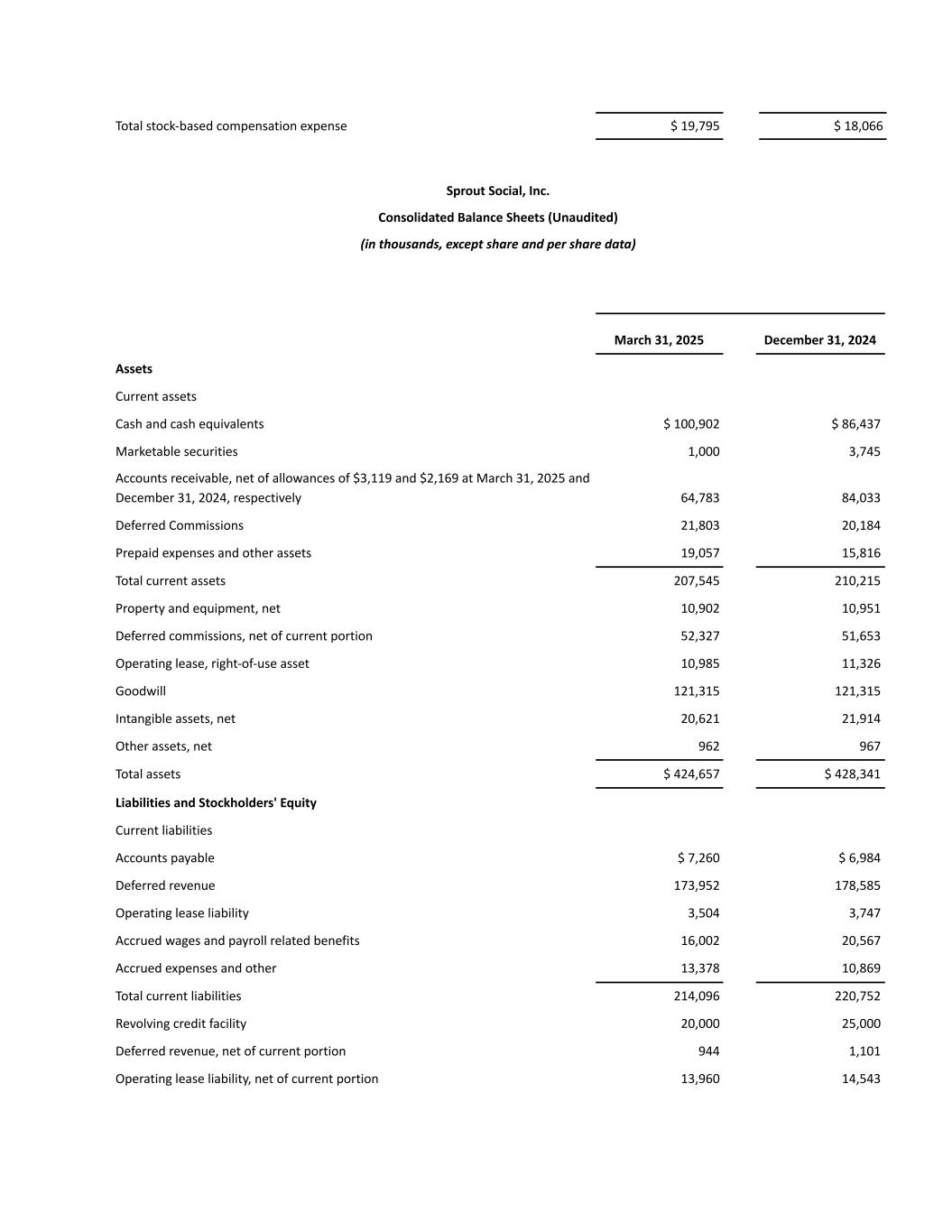

 
Total stock-based compensation expense $ 19,795 $ 18,066 Sprout Social, Inc. Consolidated Balance Sheets (Unaudited) (in thousands, except share and per share data) March 31, 2025 December 31, 2024 Assets Current assets Cash and cash equivalents $ 100,902 $ 86,437 Marketable securities 1,000 3,745 Accounts receivable, net of allowances of $3,119 and $2,169 at March 31, 2025 and December 31, 2024, respectively 64,783 84,033 Deferred Commissions 21,803 20,184 Prepaid expenses and other assets 19,057 15,816 Total current assets 207,545 210,215 Property and equipment, net 10,902 10,951 Deferred commissions, net of current portion 52,327 51,653 Operating lease, right-of-use asset 10,985 11,326 Goodwill 121,315 121,315 Intangible assets, net 20,621 21,914 Other assets, net 962 967 Total assets $ 424,657 $ 428,341 Liabilities and Stockholders' Equity Current liabilities Accounts payable $ 7,260 $ 6,984 Deferred revenue 173,952 178,585 Operating lease liability 3,504 3,747 Accrued wages and payroll related benefits 16,002 20,567 Accrued expenses and other 13,378 10,869 Total current liabilities 214,096 220,752 Revolving credit facility 20,000 25,000 Deferred revenue, net of current portion 944 1,101 Operating lease liability, net of current portion 13,960 14,543
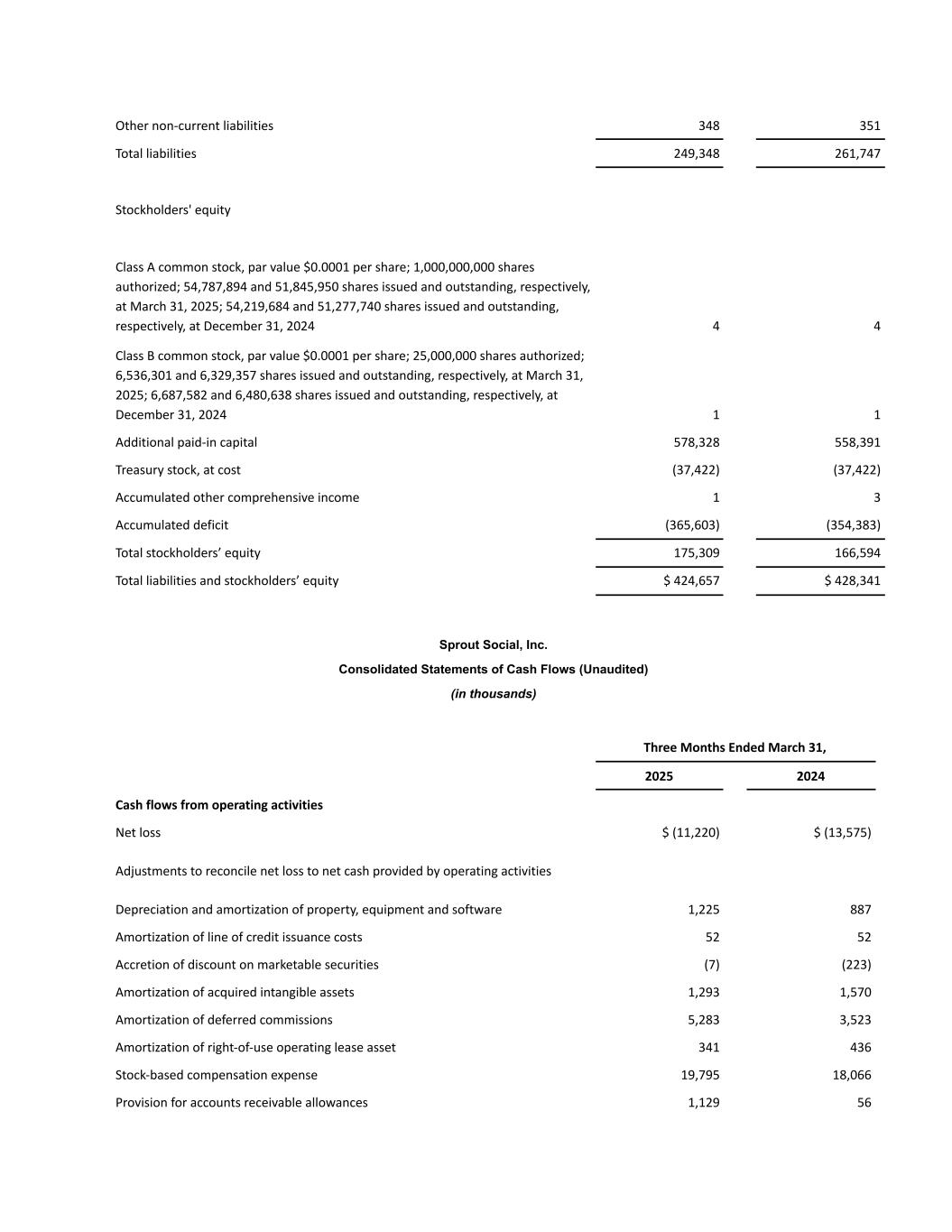

 
Other non-current liabilities 348 351 Total liabilities 249,348 261,747 Stockholders' equity Class A common stock, par value $0.0001 per share; 1,000,000,000 shares authorized; 54,787,894 and 51,845,950 shares issued and outstanding, respectively, at March 31, 2025; 54,219,684 and 51,277,740 shares issued and outstanding, respectively, at December 31, 2024 4 4 Class B common stock, par value $0.0001 per share; 25,000,000 shares authorized; 6,536,301 and 6,329,357 shares issued and outstanding, respectively, at March 31, 2025; 6,687,582 and 6,480,638 shares issued and outstanding, respectively, at December 31, 2024 1 1 Additional paid-in capital 578,328 558,391 Treasury stock, at cost (37,422) (37,422) Accumulated other comprehensive income 1 3 Accumulated deficit (365,603) (354,383) Total stockholders’ equity 175,309 166,594 Total liabilities and stockholders’ equity $ 424,657 $ 428,341 Sprout Social, Inc. Consolidated Statements of Cash Flows (Unaudited) (in thousands) Three Months Ended March 31, 2025 2024 Cash flows from operating activities Net loss $ (11,220) $ (13,575) Adjustments to reconcile net loss to net cash provided by operating activities Depreciation and amortization of property, equipment and software 1,225 887 Amortization of line of credit issuance costs 52 52 Accretion of discount on marketable securities (7) (223) Amortization of acquired intangible assets 1,293 1,570 Amortization of deferred commissions 5,283 3,523 Amortization of right-of-use operating lease asset 341 436 Stock-based compensation expense 19,795 18,066 Provision for accounts receivable allowances 1,129 56


Changes in operating assets and liabilities, excluding impact from business acquisition Accounts receivable 18,122 13,017 Prepaid expenses and other current assets (3,229) (7,670) Deferred commissions (7,577) (6,783) Accounts payable and accrued expenses (1,487) (2,865) Deferred revenue (4,790) 5,648 Lease liabilities (826) (975) Net cash provided by operating activities 18,104 11,164 Cash flows from investing activities Expenditures for property and equipment (1,357) (1,092) Payments for business acquisition, net of cash acquired - (1,409) Proceeds from maturity of marketable securities 2,750 22,555 Net cash provided by investing activities 1,393 20,054 Cash flows from financing activities Repayments of line of credit (5,000) (10,000) Employee taxes paid related to the net share settlement of stock-based awards - (1,476) Net cash used in financing activities (5,000) (11,476) Net increase in cash, cash equivalents, and restricted cash 14,497 19,742 Cash, cash equivalents, and restricted cash Beginning of period 90,418 53,695 End of period $ 104,915 $ 73,437 The following schedule reflects our non-GAAP financial measures and reconciles our non-GAAP financial measures to the related GAAP financial measures (in thousands, except per share data): Reconciliation of Non-GAAP Financial Measures Three Months Ended March 31, 2025 2024 Reconciliation of Non-GAAP gross profit Gross profit $ 84,451 $ 74,356 Stock-based compensation expense 746 925 Amortization of acquired developed technology 705 705 Restructuring charges 416 - Non-GAAP gross profit $ 86,318 $ 75,986
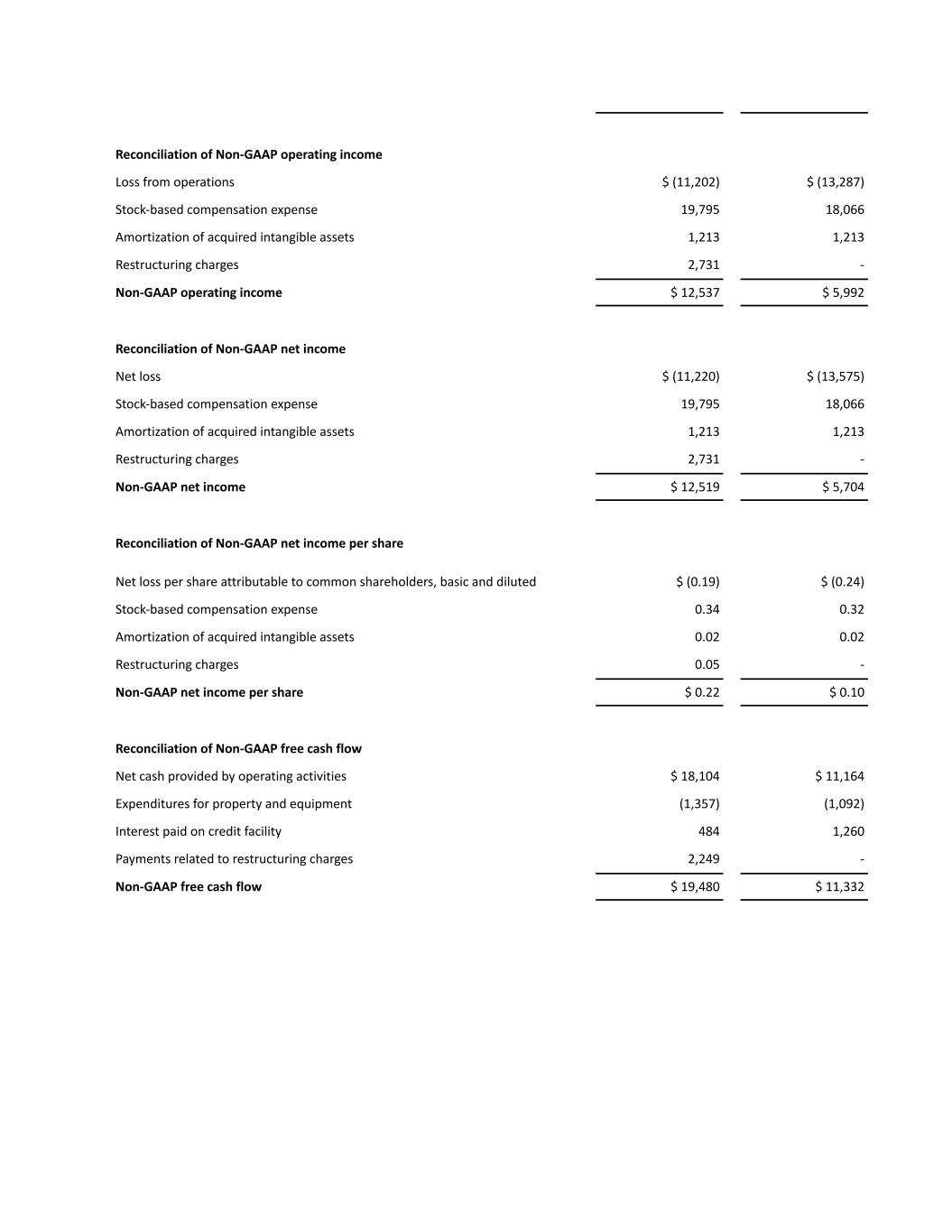

 
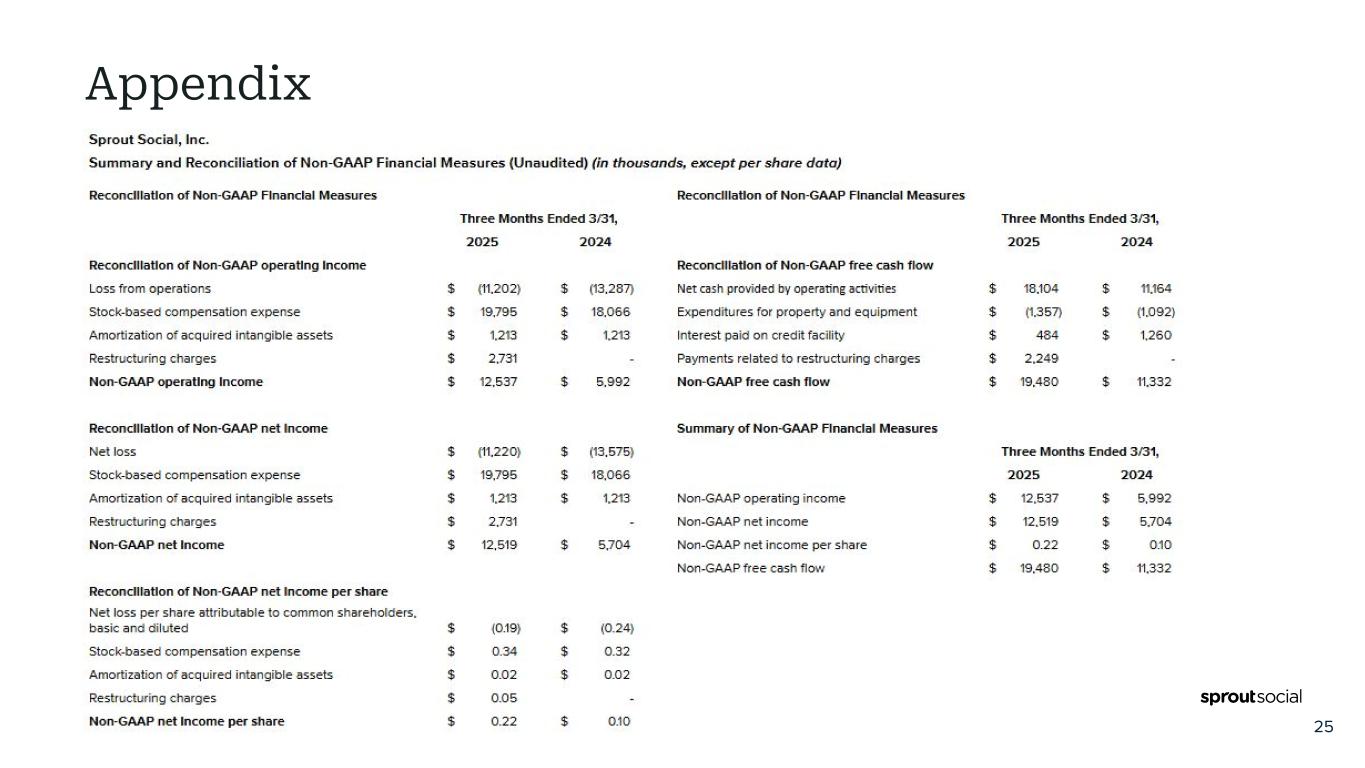
Reconciliation of Non-GAAP operating income Loss from operations $ (11,202) $ (13,287) Stock-based compensation expense 19,795 18,066 Amortization of acquired intangible assets 1,213 1,213 Restructuring charges 2,731 - Non-GAAP operating income $ 12,537 $ 5,992 Reconciliation of Non-GAAP net income Net loss $ (11,220) $ (13,575) Stock-based compensation expense 19,795 18,066 Amortization of acquired intangible assets 1,213 1,213 Restructuring charges 2,731 - Non-GAAP net income $ 12,519 $ 5,704 Reconciliation of Non-GAAP net income per share Net loss per share attributable to common shareholders, basic and diluted $ (0.19) $ (0.24) Stock-based compensation expense 0.34 0.32 Amortization of acquired intangible assets 0.02 0.02 Restructuring charges 0.05 - Non-GAAP net income per share $ 0.22 $ 0.10 Reconciliation of Non-GAAP free cash flow Net cash provided by operating activities $ 18,104 $ 11,164 Expenditures for property and equipment (1,357) (1,092) Interest paid on credit facility 484 1,260 Payments related to restructuring charges 2,249 - Non-GAAP free cash flow $ 19,480 $ 11,332


 
EX-99.2 3 a1q25investorpresentatio.htm EX-99.2 a1q25investorpresentatio
Investor Presentation 1Q FY25


Disclaimers Forward-Looking Statements This presentation contains “forward-looking statements” within the meaning of Section 27A of the Securities Act of 1933, as amended, and Section 21E of the Securities Exchange Act of 1934, as amended. In some cases, you can identify forward-looking statements by terms such as “anticipate,” “believe,” “can,” “continue,” “could,” “estimate,” “expect,” “explore,” “future,” “intend,” “long-term operating model,” “medium to long-term goals,” “may,” “might,” “outlook,” “plan,” “potential,” “predict,” “project,” “should,” “strategy,” “target,” “will,” “would,” or the negative of these terms, and similar expressions intended to identify forward-looking statements. However, not all forward-looking statements contain these identifying words. These statements may relate to our market size and growth strategy, our estimated and projected costs, margins, revenue, expenditures and customer and financial growth rates, our Q2 2025, 2025, medium term, and long-term financial outlook and performance against our multi-year financial framework, our medium to longer term goals, our plans and objectives for future operations, growth, initiatives or strategies, including our investments in research and development. By their nature, these statements are subject to numerous uncertainties and risks, including factors beyond our control, that could cause actual results, performance or achievement to differ materially and adversely from those anticipated or implied in the forward-looking statements. These assumptions, uncertainties and risks include that, among others; we may not be able to sustain our revenue and customer growth rate in the future, including due to risks associated with our strategic focus on enterprise customers; price increases have and may continue to negatively impact demand for our products, customer acquisition and retention and reduce the total number of customers or customer additions; our business would be harmed by any significant interruptions, delays or outages in services from our platform, our API providers, or certain social media platforms; if we are unable to attract potential customers through unpaid channels, convert this traffic to free trials or convert free trials to paid subscriptions, our business and results of operations may be adversely affected; we may be unable to successfully enter new markets, manage our international expansion and comply with any applicable international laws and regulations; we may be unable to integrate acquired businesses or technologies successfully or achieve the expected benefits of such acquisitions and investments; unstable market, economic, and political conditions, such as recession risks, effects of inflation, trade tensions, changes in government spending, labor shortages, supply chain issues, high interest rates, and the impacts of current and potential future bank failures and ongoing overseas conflicts, have and could continue to adversely impact our business and that of our existing and prospective customers, which may result in reduced demand for our products; we may not be able to generate sufficient cash to service our indebtedness; covenants in our credit agreement may restrict our operations, and if we do not effectively manage our business to comply with these covenants, our financial condition could be adversely impacted; any cybersecurity-related attack, significant data breach or disruption of the information technology systems or networks on which we rely could negatively affect our business; changing regulations relating to privacy, information security and data protection could increase our costs, affect or limit how we collect and use personal information and harm our brand; and risks related to ongoing legal proceedings. Additional risks and uncertainties that could cause actual outcomes and results to differ materially from those contemplated by the forward-looking statements are included under the caption “Risk Factors” and elsewhere in our filings with the Securities and Exchange Commission (the “SEC”), including our Annual Report on Form 10-K for the year ended December 31, 2024 filed with the SEC on February 26, 2025, and our Quarterly Report on Form 10-Q for the quarter ended March 31, 2025 to be filed with the SEC, as well as any future reports that we file with the SEC. Moreover, you should interpret many of the risks identified in those reports as being heightened as a result of the current and ongoing instability in market and economic conditions. Forward-looking statements speak only as of the date the statements are made and are based on information available to Sprout Social at the time those statements are made and/or management's good faith belief as of that time with respect to future events. Sprout Social assumes no obligation to update forward-looking statements to reflect events or circumstances after the date they were made, except as required by law. Use of Non-GAAP Financial Measures We have provided in this presentation certain financial information that has not been prepared in accordance with generally accepted accounting principles in the United States (“GAAP”). Our management uses these non-GAAP financial measures internally in analyzing our financial results and believes that use of these non-GAAP financial measures is useful to investors as an additional tool to evaluate ongoing operating results and trends and in comparing our financial results with other companies in our industry, many of which present similar non-GAAP financial measures. Non-GAAP financial measures are not meant to be considered in isolation or as a substitute for comparable financial measures prepared in accordance with GAAP and should be read only in conjunction with our consolidated financial statements prepared in accordance with GAAP. A reconciliation of our historical non-GAAP financial measures to the most directly comparable GAAP measures has been provided in the financial statement tables included at the end of this presentation, and investors are encouraged to review these reconciliations. The Company cannot provide reconciliations between its forecasted non-GAAP measures and the most comparable GAAP measures without unreasonable effort due to the unavailability of reliable estimates for certain items. These items are not within the Company’s control and may vary greatly between periods and could significantly impact future financial results. Customer Metrics and Market Data This presentation includes useful customer metrics and other data, which are defined at the back of this presentation. Unless otherwise noted, information in this presentation concerning our industry, including industry statistics and forecasts, competitive position and the markets in which we operate is based on information from independent industry and research organizations, other third-party sources and management estimates. Management estimates are derived from publicly available information released by independent industry analysts and other third party sources, as well as data from our internal research, and are based on assumptions made by us upon reviewing such data, and our experience in, and knowledge of, such industry and markets, which we believe to be reasonable. Projections, forecasts, assumptions and estimates of the future performance of the industry in which we operate and our future performance are necessarily subject to uncertainty and risk due to a variety of factors. We have not independently verified the accuracy or completeness of the information provided by independent industry and research organizations, other third parties or other publicly available information. Accordingly, we make no representations as to the accuracy or completeness of that information nor do we undertake to update such information after the date of this presentation. 2023 Investor Presentation 2


1Q FY2025 Results 3


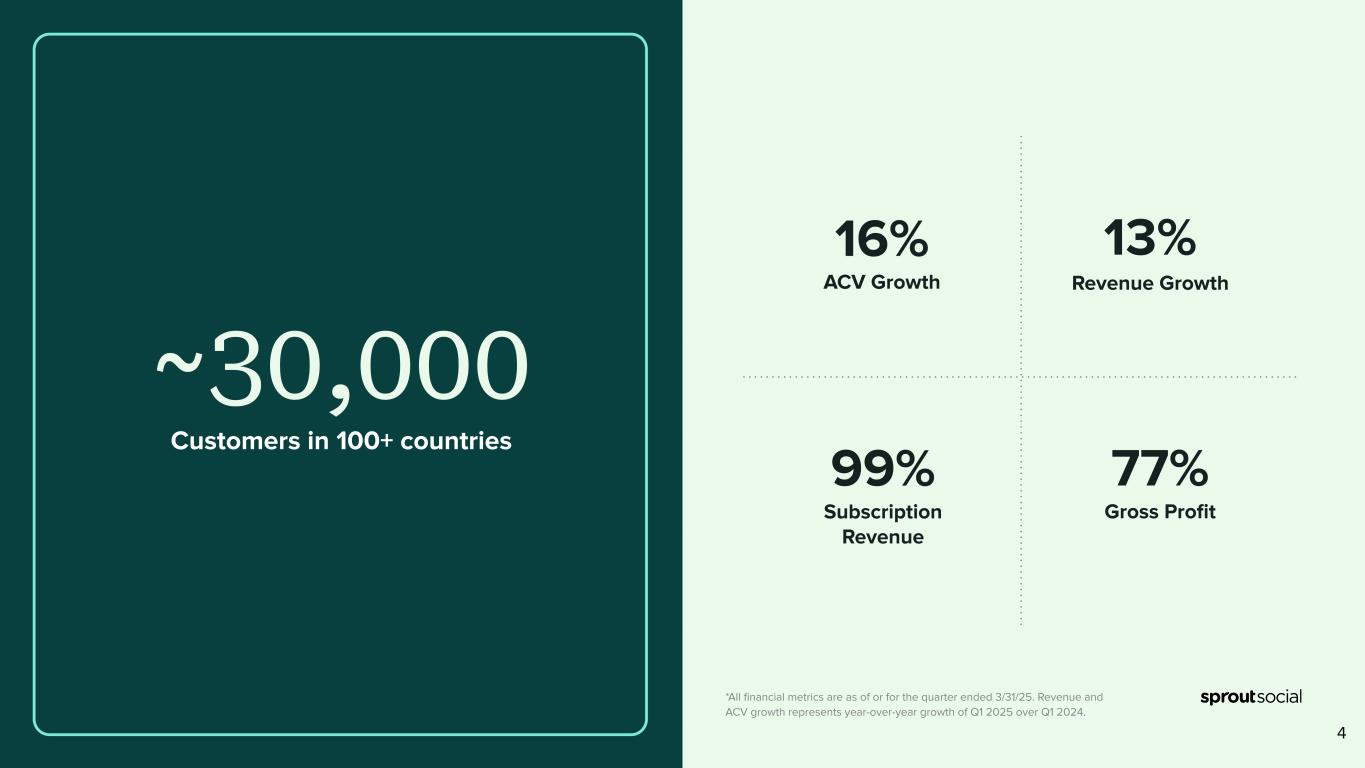
*All financial metrics are as of or for the quarter ended 3/31/25. Revenue and ACV growth represents year-over-year growth of Q1 2025 over Q1 2024. ~30,000 Customers in 100+ countries 77% Gross Profit 13% Revenue Growth 99% Subscription Revenue 16% ACV Growth Fin Reporting Signoff: NAME: Brian Flynn DATE: 4/23/2025 4


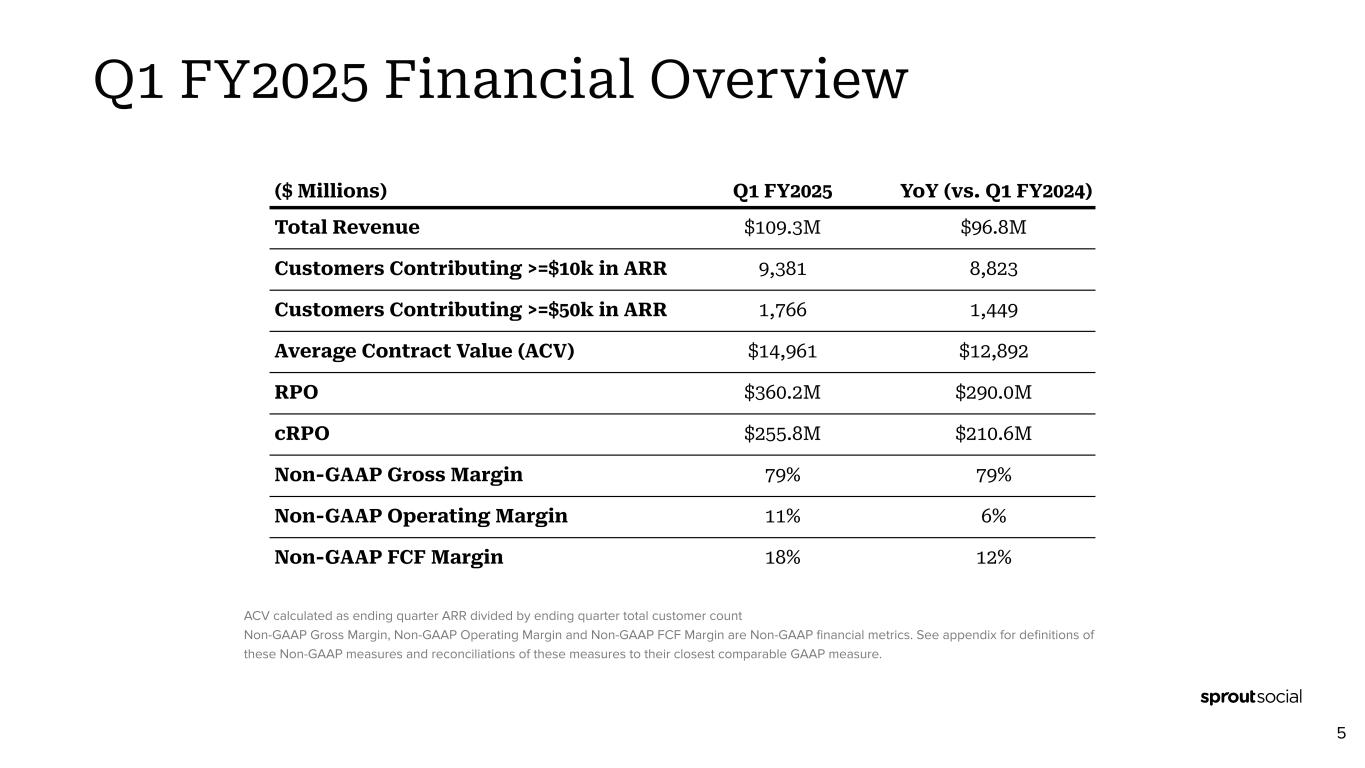
Q1 FY2025 Financial Overview ACV calculated as ending quarter ARR divided by ending quarter total customer count Non-GAAP Gross Margin, Non-GAAP Operating Margin and Non-GAAP FCF Margin are Non-GAAP financial metrics. See appendix for definitions of these Non-GAAP measures and reconciliations of these measures to their closest comparable GAAP measure. Fin Reporting Signoff: NAME: Brian Flynn DATE: 4/28/2025 5 ($ Millions) Q1 FY2025 YoY (vs. Q1 FY2024) Total Revenue $109.3M $96.8M Customers Contributing >=$10k in ARR 9,381 8,823 Customers Contributing >=$50k in ARR 1,766 1,449 Average Contract Value (ACV) $14,961 $12,892 RPO $360.2M $290.0M cRPO $255.8M $210.6M Non-GAAP Gross Margin 79% 79% Non-GAAP Operating Margin 11% 6% Non-GAAP FCF Margin 18% 12%


Revenue Fin Reporting Signoff: NAME: Brian Flynn DATE: 4/23/2025 ($ Millions) 6


Non-GAAP Operating Income (Loss) Fin Reporting Signoff: NAME: Brian Flynn DATE: 4/23/2025 Non-GAAP Operating Income and Non-GAAP Operating Margin are Non-GAAP financial metrics. See appendix for reconciliations of these measures to their closest comparable GAAP measures and definitions of these Non-GAAP measures. ($ Millions) 7


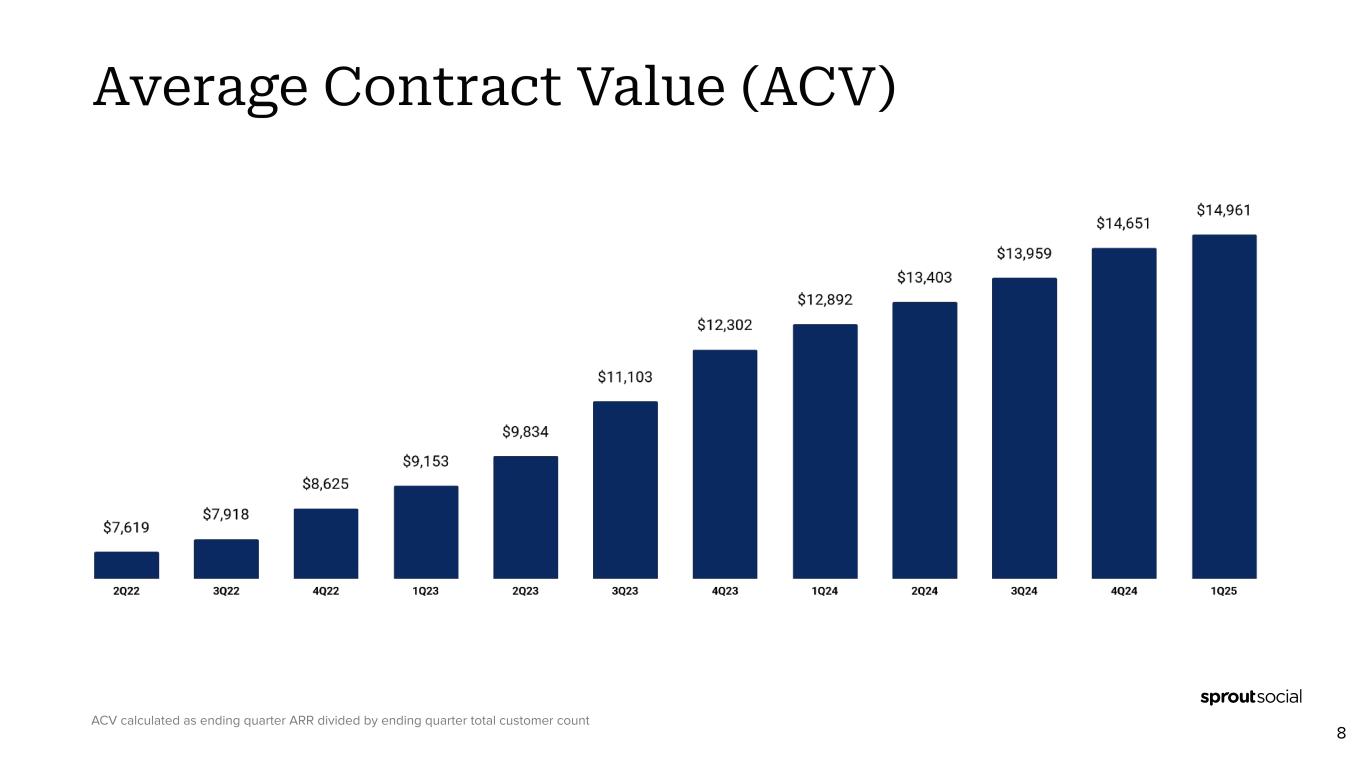
Average Contract Value (ACV) ACV calculated as ending quarter ARR divided by ending quarter total customer count Fin Reporting Signoff: NAME: Brian Flynn DATE: 4/23/2025 8


Recent Customer Highlights Fin Reporting Signoff: NAME: Brian Flynn DATE: 4/23/2025 Broadening Customer Adoption 9


Sprout enables this company to: ● Reduce risk by centralizing and simplifying governance of 100+ team members in 150+ regions ● Increase efficiency across the organization with intuitive, AI-powered workflows that maximize user adoption ● Drive predictable business outcomes through cross-functional collaboration and scalable program growth ● Accelerate business-critical decision-making by increasing executive visibility into timely and trusted customer insights Customer: Fortune 500 Medical Device Manufacturer LAND Customer Story Use cases Marketing Why Sprout? Products ● Marketing Cloud ● Listening ● Premium Analytics ● Influencer Marketing ● Premier Success Benefits ● Streamlined operations and increased productivity with AI and automation ● Strategic Premier Success partnership customized to their needs ● Tech stack consolidation


Sprout enables this company to: ● Centralize all marketing and consumer support into one intuitive, scalable platform. ● Optimize campaign performance in real-time using feedback and insights from social intelligence. ● Identify product-aligned trends and rapidly deliver promotional strategies across all networks. ● Transform customer loyalty into repeat purchases through proactive consumer engagement and timely connections. Customer: Fortune 500 Food and Beverage Manufacturer LAND Customer Story Use cases Marketing, Care, Experience Why Sprout? Products ● Listening ● Premium Analytics ● Employee Advocacy ● Premier Success Benefits ● Real-time performance measurement and insights ● Improved efficiency with streamlined workflows for all marketing and support users


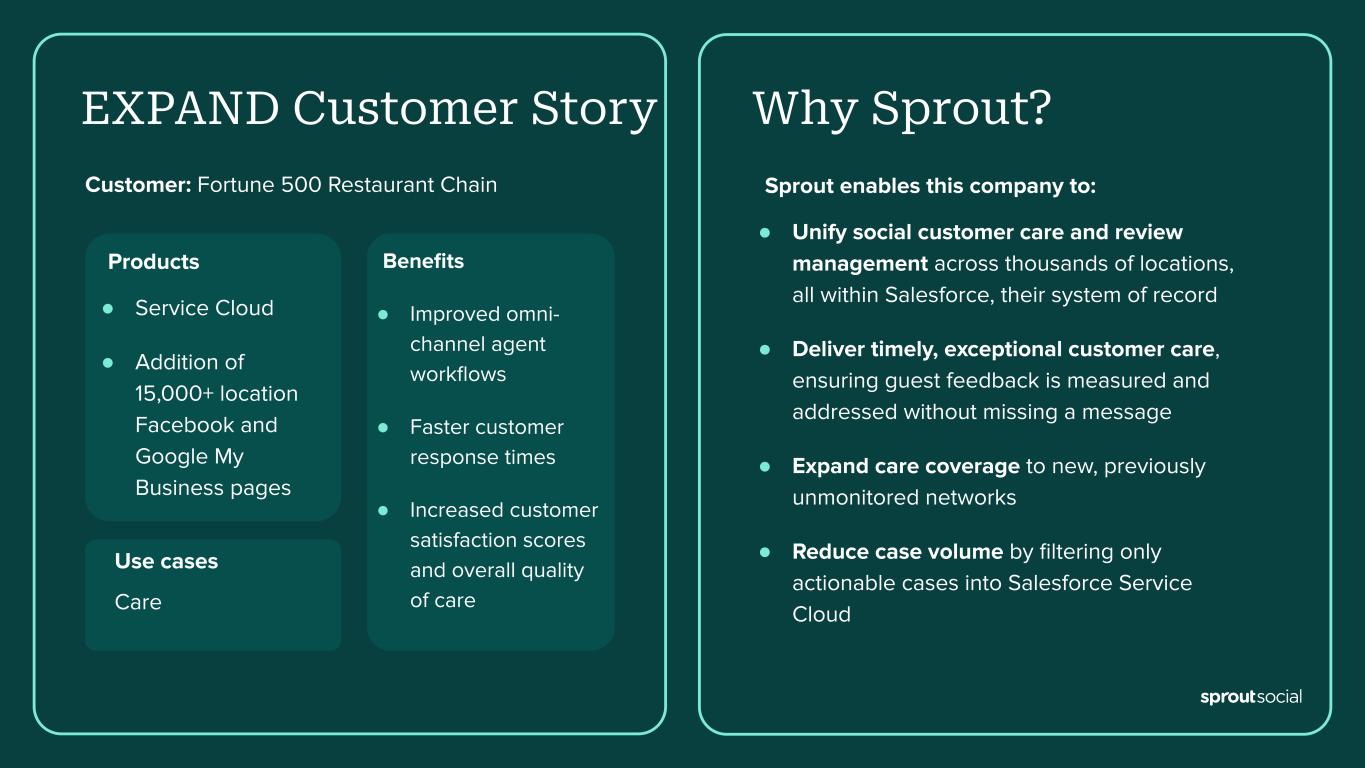
Sprout enables this company to: ● Unify social customer care and review management across thousands of locations, all within Salesforce, their system of record ● Deliver timely, exceptional customer care, ensuring guest feedback is measured and addressed without missing a message ● Expand care coverage to new, previously unmonitored networks ● Reduce case volume by filtering only actionable cases into Salesforce Service Cloud Customer: Fortune 500 Restaurant Chain EXPAND Customer Story Use cases Care Why Sprout? Products ● Service Cloud ● Addition of 15,000+ location Facebook and Google My Business pages Benefits ● Improved omni- channel agent workflows ● Faster customer response times ● Increased customer satisfaction scores and overall quality of care


Guidance ($ Millions, except EPS) Q2 FY2025 FY2025 Total Revenue $110.4 - $111.2 $448.9 - $453.9 Non-GAAP Operating Income $8.4 - $9.4 $40.7 - $45.7 Non-GAAP Net Income Per Share $0.14 - $0.16 $0.69 - $0.77 Weighted average shares of common stock outstanding 58.8 59.1 13


Growth Strategy Win The Enterprise Driving increased pipeline creation and strategic logo wins in accounts over >$50K in ARR. Customer Health & Adoption Increasing our focus on customer health and driving improved onboarding and adoption behaviors. Partnerships & Ecosystem Continued partnering with companies like AWS and Salesforce who are able to bring Sprout into larger, strategic accounts. Improved Account Penetration Accessing additional budgets within existing accounts with premium modules and professional services. 14


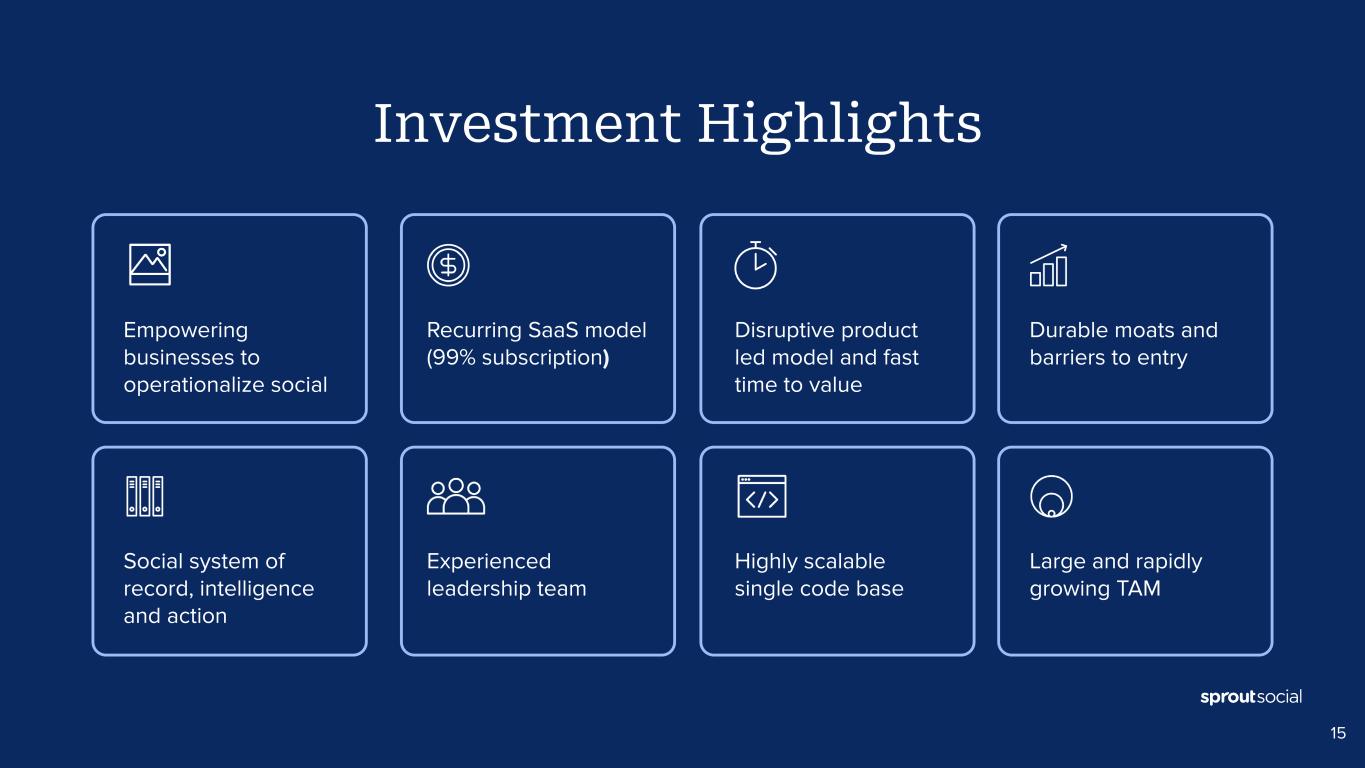
Empowering businesses to operationalize social Disruptive product led model and fast time to value Recurring SaaS model (99% subscription) Durable moats and barriers to entry Investment Highlights Social system of record, intelligence and action Highly scalable single code base Experienced leadership team Large and rapidly growing TAM 15


Driven by a world-class executive leadership team Joe Del Preto CFO Mike Wolff CRO Ryan Barretto CEO Rachael Pfenning Chief of Staff Heidi Jonas General Counsel Alan Boyce CTO Team background: Scott Morris CMO Crystal Boysen Chief People Officer 16 Colleen Geiselhart SVP, Customer Experience


Long Term Operating Model Chart displays year over year growth. Non-GAAP Gross Margin, Non-GAAP Operating Margin and Non-GAAP FCF Margin are Non-GAAP financial metrics. See appendix for definitions of these Non-GAAP measures and reconciliations of these measures to their closest comparable GAAP measure. 2022 2023 2024 1Q25 Medium to Longer Term Goals* Revenue Growth 35% 31% 22% 13% >$1B Non-GAAP Gross Margin 77% 78% 79% 79% >80% Non-GAAP Operating Margin -2% 1% 7% 11% >20% Non-GAAP FCF Margin 3% 3% 7% 18% 20-22% Fin Reporting Signoff: NAME: Brian Flynn DATE: 4/29/2025 17


Corporate Overview 18


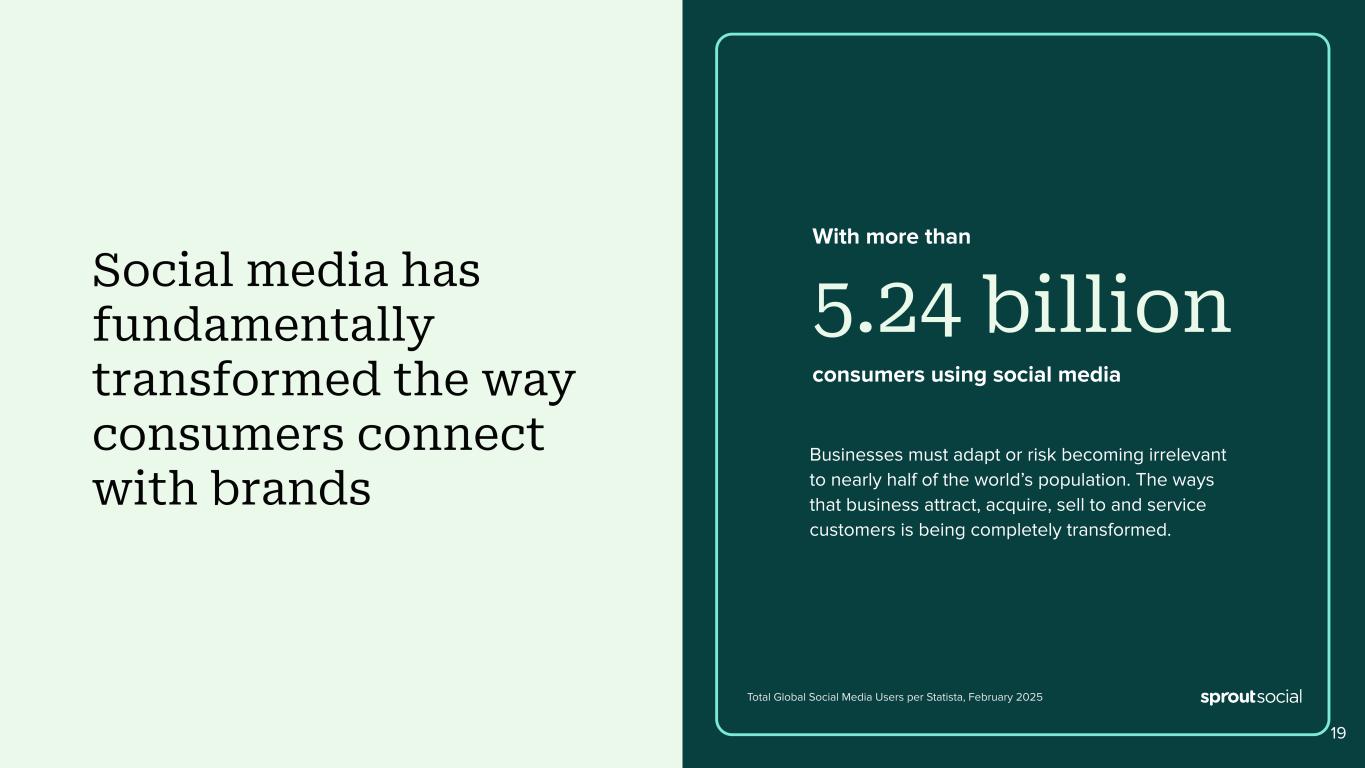
Social media has fundamentally transformed the way consumers connect with brands Total Global Social Media Users per Statista, February 2025 With more than consumers using social media 5.24 billion Businesses must adapt or risk becoming irrelevant to nearly half of the world’s population. The ways that business attract, acquire, sell to and service customers is being completely transformed. 19


Attract Establish trust Advocate Protect loyalty Convert Prove credibility Target Audience Social impacts every stage of the customer lifecycle 20


An intuitive solution for smarter, faster business impact Boost revenue and market position Expand and nurture your customer base Create exceptional customer experiences Drive efficiency with embedded AI Deep partnerships with all major social networks Robust insights and workflows that amplify ROI Enterprise-grade security and permissions Listening Employee Advocacy Analytics Engagement Publishing Influencer Marketing 21


And changed the entire customer experience, across the enterprise Social is a horizontal technology that has tangible benefits to nearly every department within a modern business; businesses must adapt and re-tool to harness the power of social and maximize the value of social data. Social is strategic to every business Social media marketer Social team ProductInfluenceMarketing Sales Success Support Strategy 22


Marketing Sales Support Success Product Strategy Commerce Advocacy Requiring an entirely new system of record Social media is massive, scattered, multi-purpose and does not conform to our existing business systems. A centralized platform is critical to creating strategic business value. Influencer 23


24 Marketing Sales Support Success Product Strategy Commerce Advocacy Sprout is the platform solution Sprout consolidates the complexity of social channels into a powerful, elegant and seamlessly integrated platform that can be leveraged across an organization. Influencer Influencer category expansion via August 2023 acquisition of Tagger. This product has not been fully integrated yet into Sprout.


Appendix Fin Reporting Signoff: NAME: Brian Flynn DATE: 4/23/2025 25


Appendix Fin Reporting Signoff: NAME: Brian Flynn DATE: 4/28/2025 26


Appendix Fin Reporting Signoff: NAME: Brian Flynn DATE: 4/28/2025 27


Non-GAAP gross profit. We define non-GAAP gross profit as GAAP gross profit, excluding stock-based compensation expense, amortization expense associated with the acquired developed technology from the Tagger Media, Inc. acquisition and restructuring charges. We believe non-GAAP gross profit provides our management and investors consistency and comparability with our past financial performance and facilitates period-to-period comparisons of operations, as it eliminates the effect of stock-based compensation, amortization expense and restructuring charges, which are often unrelated to overall operating performance. Non-GAAP gross margin. We define non-GAAP gross margin as non-GAAP gross profit as a percentage of revenue. Non-GAAP operating income (loss). We define non-GAAP operating income (loss) as GAAP loss from operations, excluding stock-based compensation expense, acquisition-related expenses and amortization expense associated with the acquired intangible assets from the Tagger acquisition, restructuring charges and non-cash gains from lease modifications. We believe non-GAAP operating income (loss) provides our management and investors consistency and comparability with our past financial performance and facilitates period-to-period comparisons of operations, as this non-GAAP financial measure eliminates the effect of stock-based compensation, acquisition-related expenses, amortization expense, restructuring charges and non-cash gains from lease modifications, which are often unrelated to overall operating performance. Non-GAAP operating margin. We define non-GAAP operating margin as non-GAAP operating income (loss) as a percentage of revenue. Non-GAAP net income (loss). We define non-GAAP net income (loss) as GAAP net loss, excluding stock-based compensation expense, acquisition-related expenses, amortization expense associated with the acquired intangible assets from the Tagger acquisition, restructuring charges and non-cash gains from lease modifications. We believe non-GAAP net income (loss) provides our management and investors consistency and comparability with our past financial performance and facilitates period-to-period comparisons of operations, as this non-GAAP financial measure eliminates the effect of stock-based compensation, acquisition-related expenses, amortization expense and tax expense due to changes in valuation allowances from business acquisitions, restructuring charges and non-cash gains from lease modifications, which are often unrelated to overall operating performance. Non-GAAP net income (loss) per share. We define non-GAAP net income (loss) per share as GAAP net loss per share attributable to common shareholders, basic and diluted, excluding stock-based compensation expense, acquisition-related expenses, amortization expense associated with the acquired intangible assets from the Tagger acquisition, restructuring charges and non-cash gains from lease modifications. We believe non-GAAP net income (loss) per share provides our management and investors consistency and comparability with our past financial performance and facilitates period-to-period comparisons of operations, as this non-GAAP financial measure eliminates the effect of stock-based compensation, acquisition-related expenses, amortization expense, restructuring charges and non-cash gains from lease modifications, which are often unrelated to overall operating performance. Non-GAAP free cash flow. We define non-GAAP free cash flow as net cash provided by (used in) operating activities less expenditures for property and equipment, acquisition-related costs, interest payments on our revolving credit facility and payments related to restructuring charges. Non-GAAP free cash flow does not reflect our future contractual obligations or represent the total increase or decrease in our cash balance for a given period. We believe non-GAAP free cash flow is a useful indicator of liquidity that provides information to management and investors about the amount of cash provided by our core operations that, after expenditures for property and equipment, acquisition-related costs, interest and payments related to restructuring charges, is available for strategic initiatives. Non-GAAP free cash flow margin (Non-GAAP FCF Margin). We define non-GAAP free cash flow margin as non-GAAP free cash flow as a percentage of revenue. Average Contract Value (ACV). We define ACV as the ending period total ARR divided by the ending period total customer count. Number of customers contributing more than $10,000 in ARR. We define number of customers contributing more than $10,000 in ARR as those on a paid subscription plan that had more than $10,000 in ARR as of a period end. We view the number of customers that contribute more than $10,000 in ARR as a measure of our ability to scale with our customers. We believe this represents potential for future growth, including expanding within our current customer base. Number of customers contributing more than $50,000 in ARR. We define number of customers contributing more than $50,000 in ARR as those on a paid subscription plan that had more than $50,000 in ARR as of a period end. We view the number of customers that contribute more than $50,000 in ARR as a measure of our ability to scale with large customers and attract sophisticated organizations. We believe this represents potential for future growth, including expanding within our current customer base. We calculated our current >$55B Served Addressable Market estimate as follows: (i) utilized data from The US SBA, The US Census Bureau, The OECD and Statista to estimate the total number of businesses in the United States and globally in each of our served market segments (Enterprise, Mid-Market, SMB); (ii) utilized internal data and third party estimates to estimate of the number of such businesses that require a social media management platform (the “Target Businesses”); (iii) calculated the average of our ACV and our estimate of our direct competitors’ ACVs in each segment; and (iv) multiplied the estimated average segment ACVs by the estimated number of Target Businesses in each applicable segment.   We calculated our >$120B Total Addressable Market estimate using the methodology above. We then used internal estimates informed by research from the Harris Poll to determine the projected business presence on social media in 2025 that will require a social media management platform, multiplied by our internal projected average segment ACVs in 2025 for Sprout Social and its direct competitors in the applicable segment. Current Penetration of our Served Addressable Market. We estimate the current total revenue of SPT and each of our primary competitors and divide by our current SAM to determine current market penetration. Remaining performance obligations (“RPO”). RPO, or remaining performance obligations, represents contracted revenue that has not yet been recognized, and includes deferred revenue and amounts that will be invoiced and recognized in future periods. Current remaining performance obligations (“cRPO”). cRPO, or current RPO, represents contracted revenue that has not yet been recognized, and includes deferred revenue and amounts that will be invoiced and recognized in the next 12 months. While we no longer believe that ARR and number of customers are key performance indicators of Sprout Social’s business, these metrics are necessary for an understanding of how we define number of customers contributing over $10,000 in ARR and number of customers contributing over $50,000 in ARR. For this purpose, we define ARR as the annualized revenue run-rate of subscription agreements from all customers as of the last date of the specified period and we define a customer as a unique account, multiple accounts containing a common non-personal email domain, or multiple accounts governed by a single agreement or entity. Appendix 28