エドガーで原本を確認する
UNITED STATES
SECURITIES AND EXCHANGE COMMISSION
WASHINGTON, D.C. 20549
FORM
(Mark One)
OR
For
the fiscal year ended
OR
OR
Date of event requiring this shell company report _________________________
For the transition period from __________________ to_____________________________
Commission
file number
| (Exact name of Registrant as specified in its charter) |
| N/A |
| (Translation of Registrant’s name into English) |
| (Jurisdiction of incorporation or organization) |
|
|
| (Address of principal executive offices) |
|
|
| (Name, Telephone, E-mail and/or Facsimile number and Address of Company Contact Person) |
Securities registered or to be registered pursuant to Section 12(b) of the Act:
| Title of each class | Trading Symbol | Name of each exchange on which registered | ||
| |
Securities registered or to be registered pursuant to Section 12(g) of the Act:
| None |
| (Title of Class) |
Securities for which there is a reporting obligation pursuant to Section 15(d) of the Act:
| None |
| (Title of Class) |
Indicate the number of outstanding shares of each of the issuer’s classes of capital or common stock as of the close of the period covered by the annual report: Ordinary Shares, consisting of 10,616,741 Class A Ordinary Shares and 20,366,380 Class B Ordinary Shares as of March 31, 2026.
Indicate by check mark if the registrant is a well-known seasoned issuer, as defined in Rule 405 of the Securities Act.
☐
Yes ☒
If this report is an annual or transition report, indicate by check mark if the registrant is not required to file reports pursuant to Section 13 or 15(d) of the Securities Exchange Act of 1934.
☐
Yes ☒
Note – Checking the box above will not relieve any registrant required to file reports pursuant to Section 13 or 15(d) of the Securities Exchange Act of 1934 from their obligations under those Sections.
Indicate by check mark whether the registrant (1) has filed all reports required to be filed by Section 13 or 15(d) of the Securities Exchange Act of 1934 during the preceding 12 months (or for such shorter period that the registrant was required to file such reports), and (2) has been subject to such filing requirements for the past 90 days.
☒
Indicate by check mark whether the registrant has submitted electronically every Interactive Data File required to be submitted pursuant to Rule 405 of Regulation S-T (§232.405 of this chapter) during the preceding 12 months (or for such shorter period that the registrant was required to submit such files).
☒
Indicate by check mark whether the registrant is a large accelerated filer, an accelerated filer, a non-accelerated filer, or an emerging growth company. See definition of “large accelerated filer, “accelerated filer,” and “emerging growth company” in Rule 12b-2 of the Exchange Act.
| Large accelerated filer ☐ | |
| Accelerated filer ☐ | Emerging
growth company |
If
an emerging growth company that prepares its financial statements in accordance with U.S. GAAP, indicate by check mark if the registrant
has elected not to use the extended transition period for complying with any new or revised financial accounting standards†
provided pursuant to Section 13(a) of the Exchange Act.
† The term “new or revised financial accounting standard” refers to any update issued by the Financial Accounting Standards Board to its Accounting Standards Codification after April 5, 2012.
Indicate
by check mark whether the registrant has filed a report on and attestation to its management’s assessment of the effectiveness
of its internal control over financial reporting under Section 404(b) of the Sarbanes-Oxley Act (15 U.S.C. 7262(b) by the registered
public accounting firm that prepared or issued its audit report.
If
securities are registered pursuant to Section 12(b) of the Act, indicate by check mark whether the financial statements of the registrant
included in the filing reflect the correction of an error to previously issued financial statements.
Indicate by check mark whether any of those error corrections are restatements that required a recovery analysis of incentive- based compensation received by any of the registrant’s executive officers during the relevant recovery period pursuant to §240.10D-1(b). ☐
Indicate by check mark which basis of accounting the registrant has used to prepare the financial statements included in this filing:
| International Financial Reporting Standards as issued by the International Accounting Standards Board ☐ | Other ☐ |
If “Other” has been checked in response to the previous question, indicate by check mark which financial statement item the registrant has elected to follow.
Item 17 ☐ Item 18 ☐
If this is an annual report, indicate by check mark whether the registrant is a shell company (as defined in Rule 12b-2 of the Exchange Act).
☐
Yes
(APPLICABLE ONLY TO ISSUERS INVOLVED IN BANKRUPTCY PROCEEDINGS DURING THE PAST FIVE YEARS)
Indicate by check mark whether the registrant has filed all documents and reports required to be filed by Sections 12, 13 or 15(d) of the Securities Exchange Act of 1934 subsequent to the distribution of securities under a plan confirmed by a court.
☐ Yes ☐ No
TABLE OF CONTENTS
| i |
PART I
Item 1. Identity of Directors, Senior Management and Advisers
Not applicable.
Item 2. Offer Statistics and Expected Timetable
Not applicable.
Item 3. Key Information
3.A. [Reserved]
3.B. Capitalization and Indebtedness
Not applicable.
3.C. Reasons for the Offer and Use of Proceeds
Not applicable.
3.D. Risk Factors
Risks Related to Our Business and Industry
We may continue to incur losses in the future.
Our future profitability will depend on our ability to generate sufficient revenue to offset our operating expenses. We expect our operating expenses, including the ongoing costs associated with operating as a publicly listed company following our initial public offering in June 2025 (the “IPO”), as well as expenses associated with integrating and expanding our recently acquired businesses, to remain elevated as we continue to grow our operations, enhance our service offerings, invest in technology and pursue strategic growth initiatives. These efforts may prove more costly than we currently anticipate, and we may not be able to increase our revenue sufficiently to offset these increased costs.
Accordingly, we may continue to incur net losses or experience fluctuations in our operating results and may be unable to achieve or maintain profitability on a quarterly or annual basis. If we fail to increase our revenues, realize the anticipated benefits of our acquisitions, effectively integrate the acquired businesses or successfully manage our operating costs, our business, financial condition, results of operations and prospects could be materially and adversely affected.
There is no assurance that our future expansion and other growth plans will be successful.
As part of our growth strategy, we have expanded our global presence through acquisitions and continue to pursue opportunities through joint ventures, acquisitions, strategic alliances, investments and the establishment or expansion of subsidiaries and operations in various jurisdictions. We currently maintain operations and subsidiaries in Singapore, the United Arab Emirates (the “UAE”), Hong Kong and Shanghai in the People’s Republic of China (the “PRC”), with our presence in Singapore, Hong Kong and Shanghai expanded through acquisitions completed during fiscal year 2026.
As such, we may be subject to risks related to the expansion of our Group such as, among others:
| ● | the availability of sufficient funds; | |
| ● | difficulties arising from operating a significantly larger and more complex organization; | |
| ● | difficulties in entering new businesses lines with which we have limited or no prior experience; | |
| ● | difficulties in integrating the assets and the business operations of acquired or newly established subsidiaries cohesively; | |
| ● | failure to realize expected profitability or growth; | |
| ● | failure to realize expected synergies and cost savings; and | |
| ● | unforeseen legal, regulatory, contractual, labor or other issues, whether in Singapore, UAE, Hong Kong, the PRC or elsewhere |
| 1 |
We may also enter new geographic markets such as Houston and Geneva depending on the demand for our services as well as opportunities for growth. Overseas expansion involves numerous risks, including but not limited to legal and regulatory risks and financial costs. We cannot assure you that our operations in new geographic markets will be profitable. In addition to the above, geographic expansion will require substantial management dedication and efforts which may require significant additional expenditures. The successful implementation of our growth strategies depends on a variety of factors including our ability to hire and retain key management personnel, negotiate attractive terms for such acquisitions or expansions that may command high valuations, and obtain sufficient financing for our capital expenditures. There is no assurance that we will be able to obtain the required financing or that we will continue to have sufficient cash flow to fund our Group’s expansion. Even if management takes all precautions there is no certainty that all due diligence will create effective synergies that would be anticipated with growth. The above-mentioned challenges associated with our growth plans may place increased demands on our management and on our operational systems and other resources and could also increase our exposure to unanticipated risks and liabilities.
As such, there is no assurance that our Group will be successful in implementing our future plans or that we will be able to realize the profits, growth, or synergies expected from our Group’s expansion. In the event that we are unable to effectively or successfully execute our expansion strategies, our business, financial condition, results of operations and prospects may be materially and adversely affected.
We may not realize the anticipated benefits from our recent acquisitions, and integration may disrupt our business.
The acquisitions of PJ Marine Singapore Pte. Ltd., PJ Marine Shanghai Co., Ltd., and Peijun Marine Consultant Co., Limited are intended to expand our petrochemicals, sale and purchase, and regional shipbroking capabilities and to create a tri-hub model across Asia. Realizing the expected strategic, operational and financial benefits from these transactions depends on successfully integrating the acquired businesses into our operations, aligning commercial strategies, retaining key personnel and clients, consolidating systems and processes, and achieving projected synergies. Integration efforts may divert management attention and resources from our existing operations, and we may encounter unforeseen difficulties, including cultural differences, inconsistent operating practices, incompatible information systems, and unanticipated liabilities. If integration is slower, more costly, or less effective than expected, the acquisitions may not produce the anticipated revenue growth, cost savings or margin improvements, which could materially and adversely affect our business, results of operations and financial condition.
The historical financial performance of the acquired companies may not be indicative of future results.
Based on the historical fiscal 2024 financial results of the acquired companies, we estimated that the acquisitions could contribute approximately US$3.5 million in annual revenue with an overall net profit margin of approximately 22.3%. However, the historical financial performance of the acquired businesses may not be indicative of their future operating results under our ownership. Future performance may differ due to changes in market conditions, customer relationships, competitive dynamics, cost structures, integration activities and other operational factors.
In addition, the historical financial statements of the acquired businesses may have been prepared under accounting policies or reporting practices that differ from those applied by the Company. Post-acquisition purchase accounting adjustments, integration costs or previously unidentified liabilities may also reduce the expected financial benefits of the acquisitions. If the acquired businesses do not perform as anticipated, our consolidated financial condition, results of operations and cash flows could be materially and adversely affected.
Our goodwill and identifiable intangible assets may become impaired.
As a result of the acquisitions completed during fiscal year 2026, we recorded goodwill and identifiable intangible assets on our consolidated balance sheet. The recoverability of these assets depends on the future operating performance of the acquired businesses and management’s assumptions regarding future cash flows.
If the acquired businesses fail to perform as expected, anticipated synergies are not realized, market conditions deteriorate or other events indicate that the carrying value of these assets may not be recoverable, we may be required to recognize impairment charges. Any such impairment could materially and adversely affect our financial condition, results of operations and shareholders’ equity.
| 2 |
Cross-border regulatory, political and operational risks associated with our expanded presence in China and Hong Kong could adversely affect our business.
The acquisitions completed during fiscal year 2026 have expanded our operations and increased our exposure to the PRC and Hong Kong, each of which is subject to its own legal, regulatory, tax, employment and compliance requirements. We may become subject to additional licensing, registration, reporting or other regulatory obligations, and changes in applicable laws, regulations, governmental policies, trade restrictions, sanctions, tariffs or enforcement practices may increase our compliance costs, restrict our operations or adversely affect our ability to conduct business in these jurisdictions.
In addition, geopolitical tensions, changes in cross-border trade policies, restrictions on capital movements, foreign exchange controls, local economic conditions, currency fluctuations or changes in maritime trade flows may adversely affect demand for our shipbroking services or increase the cost and complexity of operating in these markets. Failure to comply with applicable laws and regulations, or adverse regulatory developments, could result in investigations, fines, penalties, restrictions on our operations, reputational damage or other adverse consequences that could materially and adversely affect our business, financial condition and results of operations.
Our ability to retain key personnel and successfully integrate the acquired businesses is critical to our future success.
The acquired companies have historically operated with their own management teams, brokers, operating procedures and client relationships. Our ability to preserve client relationships, maintain revenue and realize the anticipated benefits of the acquisitions depends on our ability to retain key brokers, managers and other personnel who possess specialized industry knowledge and long-standing customer relationships.
The integration process may also require the consolidation of systems, processes and operational functions across multiple jurisdictions. We may experience employee turnover, customer attrition, cultural integration challenges, operational disruptions or delays in implementing common systems and procedures. Any failure to retain key personnel or successfully integrate the acquired businesses could adversely affect our customer relationships, operating performance, financial condition and results of operations.
We operate in a competitive environment and face competition from existing and new industry players.
We operate in a competitive environment and our success depends largely on our ability to compete effectively based on our reputation, industry expertise, customer relationships, quality of service and ability to attract and retain experienced brokers.
We cannot assure you that we will be able to compete effectively against our existing and future competitors and adapt quickly to changing market conditions and trends. Failure to keep abreast of technological advancements and industry developments may result in failure to provide services in a cost-effective and efficient manner compared to our competitors, which may lead to loss of customers. Our business and results of operations may be adversely affected if competition intensifies. Any failure by us to remain competitive will adversely affect our business, financial condition and results of operations.
In addition, the shipbroking market is a highly fragmented market due to the low barriers to entry and low product differentiation, and therefore new competitors may enter the industry, resulting in increased competition, which in turn may result in us losing our existing customers and not being able to secure new customers. There is no assurance that we will be able to compete successfully in the future against our existing or potential competitors or that our business, financial condition and results of operations will not be adversely affected by increased competition.
We are exposed to the credit risks of our customers and may experience delays or defaults in collecting our receivables, which may affect our liquidity and working capital and required us to obtain external financing.
We face uncertainties regarding the timing of our customers’ payments and their ability to satisfy their payment obligations. Our customers’ ability to pay may be adversely affected by events or circumstances that are difficult to foresee or anticipate, including a decline in their business, financial distress or broader economic downturns. Accordingly, there can be no assurance that we will be able to collect our trade receivables in full or within a reasonable period of time. If a customer becomes insolvent or experience financial difficulties before paying the commissions due to us, we could incur substantial losses.
As a result, our financial condition and results of operations depend, to a certain extent, on the creditworthiness of our customers. If our customers delay payment, fail to pay, or otherwise become unable or unwilling to satisfy their payment obligations, we may experience reduced operating cash flows and increased bad debt expense. Such events may adversely affect our liquidity and working capital and may require us to obtain external financing, including bank borrowings, to support our ongoing operations. Any significant deterioration in the credit quality of our customers could materially and adversely affect our business, financial condition, results of operations and cash flows.
| 3 |
Our reliance on certain key vendors may expose us to operational disruptions if those vendors are unable to provide services.
We rely on certain key vendors to support our business operations. For the year ended March 31, 2026, our two largest vendors accounted for approximately 20% and 9%, respectively, of our total commission expenses. While we are not dependent on any single vendor, disruptions in the services provided by these vendors, deterioration in their performance, or the termination of our relationships with them could adversely affect our operations.
To support operational efficiency and scalability, we regularly evaluate our vendor relationships based on business requirements, service quality and market conditions. However, transitioning to alternative vendors may require additional time and resources and could result in temporary operational disruptions, increased costs or reduced service levels. If we are unable to identify and engage suitable replacement vendors on commercially reasonable terms in a timely manner, our ability to provide services to our customers efficiently could be adversely affected, which may in turn have a material adverse effect on our business, financial condition and results of operations.
We are dependent on our key management and skilled personnel for our continued success and growth.
We attribute our success and growth to-date largely to the contributions and expertise of our directors and executive officers, all of whom have extensive experience in our business or relevant industries. Our directors and executive officers have contributed significantly to business growth since our inception. They possess extensive industry knowledge and comprehensive global and local industry networks, and are familiar with all aspects of our business operations. They are instrumental to our continued success, formulating business strategies and spearheading the growth of our business.
However, there is no assurance that we will be able to continue to retain the services of our key personnel. Although we maintain key person insurance covering certain members of senior management, such insurance may not fully compensate us for the loss of their services or adequately cover the financial or operational impact resulting from their death, disability or other unforeseen circumstances. There can be no assurance that we will be able to continue to retain the services of our directors, executive officers and other key personnel, or attract and retain suitably qualified replacements on a timely basis. The loss of any of these individuals, particularly during the integration of our recently acquired businesses and the continued expansion of our operations, could disrupt our business, delay the execution of our growth strategy and materially and adversely affect our business, financial condition, results of operations and prospects.
Our continued success and growth are also dependent upon our ability to recruit and retain qualified personnel. Qualified personnel with the appropriate experience in the industries we operate in are limited and competition for the employment of such personnel is intense. Even though we intend to continue to devote significant resources to recruit, train and retain such personnel, there is no assurance that we will be able to attract the necessary qualified personnel to work for us or that we will be able to retain the qualified personnel or that suitable and timely replacements can be found for skilled personnel who leave us. Further, competition for skilled qualified employees may result in us having to pay higher wages to attract and retain our employees, which may result in higher labor costs, which in turn may materially and adversely affect our results of operations. If we are unable to continue to attract and retain qualified employees, this will adversely affect our business and prospects.
Adverse conditions in the global financial markets and the general economy may adversely affect our business, financial condition, results of operations and prospects.
While we currently operate in Singapore, UAE, Hong Kong and PRC, our business, financial condition, results of operations and prospects may be adversely affected by political, economic, social and legal developments in these jurisdictions, as well as globally, that are beyond our control. Such political and economic uncertainties include, but are not limited to, the risks of war, terrorism, changes in interest rates, rates of economic growth, fiscal and monetary policies of the government, inflation, deflation, methods of taxation and tax policy, unemployment trends, and other matters that influence consumer confidence, spending and tourism.
Further, negative developments in geo-political events such as the US-China trade war, Russia-Ukraine War, Iran War, and instability in key global trade routes such as the Strait of Hormuz, may bring uncertainty to the global economy. Any of such issues may lead to retaliatory and/or threat of retaliatory measures being imposed on the relevant countries. This may lead to volatility in the financial markets. The nature and extent of such changes are difficult to predict, and may bring uncertainty to the global economy and/or political environment. There is no assurance that we will be able to grow our business, or that we will be able to react promptly to any change in economic conditions. If we fail to react promptly to the changing economic conditions, our performance and profitability could be adversely affected. Our business, financial condition, results of operations and prospects may be materially and adversely affected if these conditions deteriorate in the future.
| 4 |
Our insurance coverage may not cover all our damages and losses.
We maintain various insurance policies for our business, covering damages or loss to our keys assets, facilities and liabilities. While we believe that the insurance coverage we maintain is reasonably adequate to cover the normal risks associated with the operation of our business, we cannot be certain that our coverage will be sufficient to cover all future claims against us and any other business-related risks. Such incidences may lead to unforeseen costs and we may have to compensate for any losses or damages suffered by third parties as a result of such incidents and which are not covered by our insurance policies. In the event of personal injuries, fires or other accidents suffered by our employees or other people, we could face claims alleging that we were negligent, provided inadequate supervision or be otherwise liable for the injuries.
In addition, we cannot assure you that any claim under the insurance policies maintained by us will be honored fully, in part or on time, or that we have sufficient insurance to cover all our losses. In addition, our insurance coverage may expire from time to time. We apply for the renewal of our insurance coverage in the normal course of our business, but we cannot assure you that such renewals will be granted in a timely manner, at acceptable cost or at all. To the extent that we suffer loss or damage for which we did not obtain or maintain insurance, and which is not covered by insurance, exceeds our insurance coverage or where our insurance claims are rejected, the loss would have to be borne by us and our business, financial condition, results of operations, cash flows and prospects could be adversely affected.
We may be affected by any adverse impact on our reputation and goodwill.
We have built a reputation as one of the reliable providers of shipbroking services. A solitary incident might cause a situation that negatively affects other parts of our business. Any negative publicity about us, our directors, our executive officers or our substantial shareholders, whether founded or unfounded, may tarnish our reputation and goodwill with our customers and suppliers. Such negative publicity may include, among other things, unsuccessful attempts in joint ventures, acquisitions or take-overs, or involvement in litigation, insolvency proceedings or investigations by government authorities.
We could incur substantial costs as a result of cybersecurity incidents, data protection concerns, or information technology system disruptions.
Our business relies extensively on information technology systems and cloud-based platforms to support our shipbroking operations and internal business processes. Although we have not experienced any cybersecurity incidents or information technology system failures that have had a material adverse effect on our business, we cannot assure you that we will not experience such incidents in the future.
Cybersecurity threats continue to evolve in sophistication and frequency and include, among other things, ransomware attacks, phishing, malware, unauthorized access to systems or data, denial-of-service attacks, and other security breaches. Such incidents may result in operational disruptions, business interruptions, loss or corruption of data, unauthorized disclosure of confidential information, reputational harm, regulatory investigations, litigation, increased compliance costs and financial losses.
We also rely on OpsWiz, our cloud-based software platform for tanker operations management, including voyage management, fixture documentation and operational workflow oversight. Any disruption, outage, cyberattack or failure affecting OpsWiz or the third-party infrastructure supporting the platform could interrupt our operations, delay the provision of services to customers and adversely affect our revenues, financial condition and results of operations.
We may be unable to adequately protect or successfully commercialize the intellectual property associated with OpsWiz.
We have restructured our information technology business and, effective July 1, 2026, transferred the assets, personnel and proprietary software associated with OpsWiz, including the cloud-based OpsWiz platform, to Hado Pte. Ltd., our wholly owned Singapore subsidiary. The success of this restructuring and the future commercialization of OpsWiz depend on our ability to protect and enforce our intellectual property rights, retain and motivate key technical personnel, continue product development, successfully commercialize the platform and generate sustainable customer demand.
Although we own the intellectual property associated with OpsWiz, certain intellectual property rights may not be registered in all relevant jurisdictions. As a result, our ability to prevent unauthorized use, copying or development of similar technologies by third parties may be more limited than if comprehensive statutory intellectual property protection were available. We may also incur significant costs to establish, maintain and enforce our intellectual property rights.
There can be no assurance that we will successfully commercialize OpsWiz, obtain meaningful licensing or other revenue from the platform, retain key technical personnel, adequately protect our intellectual property or realize the anticipated strategic and financial benefits of the restructuring. Any failure to do so could materially and adversely affect our business, financial condition, results of operations and prospects.
| 5 |
We could incur substantial costs as a result of data protection concerns, privacy or cybersecurity incidents
In the ordinary course of our business, we collect, process, store and transmit personal data and other confidential information relating to our employees, customers, counterparties, vendors and other third parties. As our operations have expanded across Singapore, the United Arab Emirates, Hong Kong and the People’s Republic of China (“PRC”), we are subject to an increasingly complex framework of data protection, privacy and cybersecurity laws and regulations in the jurisdictions in which we operate.
Although we have implemented policies, procedures and security measures designed to safeguard confidential information and comply with applicable data protection and privacy laws, our information technology systems, cloud-based platforms and those of our third-party service providers remain vulnerable to cybersecurity attacks, unauthorized access, data breaches, ransomware, phishing, system failures, human error and other security incidents. We cannot assure you that our security measures will be effective in preventing such incidents.
Any actual or perceived failure to protect confidential information or comply with applicable data protection and privacy laws could result in regulatory investigations, fines, penalties, litigation, contractual claims, reputational damage, loss of customer confidence, business interruptions, operational delays, remediation costs and other liabilities. Any of these events could materially and adversely affect our business, financial condition, results of operations and prospects.
We may become involved in litigation, regulatory proceedings or other disputes that could have a material adverse effect on our business.
From time to time, we may become involved in litigation, arbitration, regulatory investigations or other legal proceedings arising in the ordinary course of our business. Such matters may include, among other things, commercial or contractual disputes, employment matters, acquisition-related claims, intellectual property disputes, data privacy matters, tax matters, regulatory investigations and other claims involving our customers, counterparties, vendors, employees or government authorities.
The outcome of any such proceedings is inherently uncertain, and we may incur significant legal fees, settlement costs, damages, fines or other liabilities regardless of the merits of the claims. In addition, defending these matters may divert the attention of management and consume significant financial and operational resources.
Although we maintain insurance coverage for certain risks, our insurance may not be available, sufficient or applicable to all claims, and insurers may dispute coverage or become unable to satisfy their obligations. Any significant litigation, regulatory proceeding or uninsured loss could materially and adversely affect our business, financial condition, results of operations and prospects.
Technological advancements, digital platforms and evolving market practices may reduce demand for traditional shipbroking services.
The global shipping industry continues to undergo technological transformation through the increasing adoption of digital platforms, electronic marketplaces, artificial intelligence, automation and other technologies designed to improve efficiency and facilitate direct interaction between shipowners, charterers and other market participants. These developments may reduce the role of traditional shipbrokers in certain transactions, increase pricing pressure or intensify competition within the industry.
Although we continue to invest in technology, digital solutions and operational efficiency, including the development of proprietary software platforms, there can be no assurance that our investments will enable us to maintain our competitive position or fully offset the impact of technological change. If technological developments reduce demand for traditional brokerage services or alter customer preferences more rapidly than we anticipate, our business, financial condition, results of operations and prospects could be materially and adversely affected.
Our revenue is transaction-based and may fluctuate from period to period.
A substantial portion of our revenue is generated from brokerage commissions earned on individual shipping transactions, including freight, time charter (hire), demurrage, deviation and other brokerage activities. Our financial performance depends on the volume, size and timing of transactions completed by our customers, which are influenced by factors beyond our control, including global trade activity, freight market conditions, vessel availability, customer demand, geopolitical developments, regulatory changes and general economic conditions.
Although many of our customers engage us repeatedly across multiple transactions and some continue to utilize our services over extended periods, they are generally not obligated to continue using our services, and future engagements are typically negotiated on a transaction-by-transaction basis rather than under long-term contractual commitments. Accordingly, there can be no assurance that customers who have previously engaged our services will continue to do so or that we will be able to secure new transactions on favorable terms.
Our revenue mix may also fluctuate depending on the type of brokerage services performed during any particular period. For example, freight commissions have historically represented the largest portion of our revenue, while commissions from time charter, demurrage, sale and purchase, and other brokerage services vary based on market activity and customer demand. As a result, changes in market conditions, customer preferences or transaction volumes may significantly affect our revenue composition and overall financial performance.
Accordingly, our operating results may fluctuate substantially from period to period, and historical financial performance should not be regarded as indicative of future results. If transaction volumes decline, customers reduce their use of our services, or market conditions deteriorate, our revenue, profitability, financial condition, cash flows and prospects could be materially and adversely affected.
| 6 |
The global energy transition may reduce demand for the transportation of fossil fuels and adversely affect our business.
A significant portion of our shipbroking activities relates to the transportation of crude oil, refined petroleum products, petrochemicals and other energy-related commodities. Global efforts to reduce greenhouse gas emissions, achieve carbon neutrality and accelerate the transition to lower-carbon and renewable energy sources may reduce long-term demand for fossil fuels and the seaborne transportation of such commodities.
In addition, governments, regulators and industry participants may introduce new environmental regulations, emissions standards, carbon pricing mechanisms or other climate-related policies that could alter global trade flows, reduce shipping activity or accelerate the transition to alternative energy sources. If demand for the transportation of fossil fuels declines more rapidly than anticipated, or if we are unable to diversify our business into other sectors at a sufficient pace, our business, financial condition, results of operations and prospects could be materially and adversely affected.
Volatility in commodity prices and global shipping markets may adversely affect our business.
Our financial performance is influenced by global commodity markets, freight rates and shipping activity. Significant declines in commodity prices, including crude oil, refined petroleum products and petrochemicals, or prolonged weakness in freight markets may reduce trading activity, vessel demand and the number or value of transactions requiring shipbroking services.
Commodity prices and shipping markets are affected by numerous factors beyond our control, including global economic conditions, supply and demand dynamics, production decisions by major oil-producing countries, inflation, interest rates, geopolitical developments and changes in government policies. Sustained weakness or heightened volatility in these markets could reduce demand for our services and materially and adversely affect our revenue, financial condition, results of operations and prospects.
Developments in the social, political, regulatory and economic environment in the jurisdictions in which we operate may adversely affect our business.
We conduct business in Singapore, the United Arab Emirates (“UAE”), Hong Kong and the People’s Republic of China (“PRC”). Our business, financial condition, results of operations and prospects may be adversely affected by changes in the political, economic, legal and regulatory environment in these jurisdictions, as well as by broader global developments.
Such developments may include changes in laws and regulations, taxation, foreign investment policies, trade restrictions, sanctions, tariffs, capital controls, employment and immigration policies, exchange controls, government policies, geopolitical tensions, armed conflicts, terrorism, public health events, inflation, interest rates and other macroeconomic conditions. Regulatory changes affecting international trade, shipping or cross-border business activities could increase our compliance costs, restrict our operations or reduce customer demand.
As our operations continue to expand internationally, we may become increasingly exposed to differing legal and regulatory requirements across multiple jurisdictions. Any adverse developments in the jurisdictions in which we operate, or our failure to comply with applicable laws and regulations, could materially and adversely affect our business, financial condition, results of operations and prospects.
Changes in environmental regulations and the shipping industry’s transition toward lower-carbon operations may adversely affect our business.
The global shipping industry is subject to increasing environmental regulation and decarbonization initiatives. Governments, regulators and international organizations, including the International Maritime Organization (“IMO”), the European Union and other authorities, continue to introduce regulations and standards aimed at reducing greenhouse gas emissions, improving energy efficiency and promoting the use of alternative fuels.
Compliance with these evolving environmental requirements may increase operating costs for shipowners and charterers, alter vessel deployment, change trade flows and reduce demand for certain categories of vessels or cargoes. In addition, the global transition toward lower-carbon energy sources may reduce the long-term transportation demand for certain fossil fuel-related cargoes.
As a shipbroking company, our business depends on the level of global shipping activity and the availability of vessels that comply with applicable environmental standards. If environmental regulations become more stringent, compliance costs increase significantly or customers alter their shipping activities in response to changing environmental requirements, demand for our services could decline, which could materially and adversely affect our business, financial condition, results of operations and prospects.
| 7 |
We may be exposed to liabilities under applicable anti-corruption, anti-bribery, sanctions and other compliance laws.
We are subject to various anti-corruption, anti-bribery and other compliance laws in the jurisdictions in which we operate, including, among others, the U.S. Foreign Corrupt Practices Act (the “FCPA”), the Prevention of Corruption Act 1960 of Singapore (“POCA”), and other applicable anti-bribery, anti-money laundering, sanctions and trade compliance laws and regulations.
Our business involves dealings with customers, counterparties, agents, intermediaries and service providers across multiple jurisdictions, some of which may present higher perceived corruption or compliance risks. Although we maintain policies, internal controls and compliance procedures designed to promote compliance with applicable laws and regulations, we cannot assure you that our employees, agents or other third parties acting on our behalf will not engage in conduct for which we may ultimately be held responsible.
Any actual or alleged violation of applicable anti-corruption, anti-bribery, sanctions or other compliance laws could result in investigations, fines, penalties, civil or criminal liability, reputational damage, loss of business opportunities and other adverse consequences, any of which could materially and adversely affect our business, financial condition, results of operations and prospects.
We are exposed to foreign exchange risks.
We conduct business internationally and are exposed to foreign exchange risks arising from transactions denominated in currencies other than our reporting currency. While a substantial portion of our revenue is denominated in U.S. dollars (“USD”), we also incur operating expenses and conduct transactions in multiple currencies, including Singapore dollars (“SGD”), Hong Kong dollars (“HKD”), United Arab Emirates Dirham (“AED”) and Renminbi (“RMB”).
Most of our subsidiaries use USD as their functional currency. However, our Dubai operations use AED as their functional currency and our Shanghai operations use RMB as their functional currency. The financial statements of these subsidiaries are translated into our reporting currency for consolidation purposes. Accordingly, fluctuations in exchange rates between USD, SGD, HKD, AED and RMB may affect our reported revenue, operating expenses, assets, liabilities and shareholders’ equity.
To the extent that our revenues and expenses are denominated in different currencies, or where there are timing differences between receipts and payments, we are exposed to transaction foreign exchange risk. We are also exposed to translation risk arising from the consolidation of our foreign subsidiaries. We may not be able to effectively manage or hedge these risks, and significant fluctuations in foreign exchange rates could materially and adversely affect our business, financial condition, results of operations and prospects.
Risks Related to Our Operations in China
Our recent acquisitions and expanded operations in mainland China and Hong Kong materially increase our exposure to jurisdiction-specific risks that could adversely affect our business, financial condition and results of operations. By expanding commercial, operational and data activities in Greater China, we now face a range of legal, regulatory, tax, foreign-exchange, data-privacy, intellectual-property, enforcement and personnel risks that are distinct from those in our previous markets. These risks include rapidly changing PRC and Hong Kong regulatory requirements and licensing regimes, restrictions on cross-border transfers of funds and currency conversion, heightened scrutiny of transfer pricing and indirect tax matters, limitations on the enforceability of foreign judgments and service of process, obligations and constraints related to cross-border data transfers and cybersecurity reviews, and the potential loss of key brokers or managers whose relationships are critical to revenue. Any of these developments could increase our compliance costs, delay or restrict our ability to repatriate cash or complete planned transactions, impair our ability to commercialize technology or integrate acquired businesses, expose us to fines or other sanctions, or otherwise materially and adversely affect our operations and prospects in the region.
The PRC government exerts significant oversight and discretion over companies with operations in mainland China, and may intervene in or influence the operations of our PRC subsidiaries at any time, which could materially and adversely affect our business, results of operations and the value of our securities.
The PRC government has significant authority to regulate or exert influence over the manner in which companies with operations in mainland China conduct their business activities, including through changes in laws, regulations, policies or enforcement practices, and has recently indicated an increased focus on supervision of China-based issuers accessing overseas capital markets. If the PRC government were to intervene in or influence the operations of our PRC subsidiary or Hong Kong subsidiary, or impose new or enhanced requirements on our industry, corporate structure, cross-border capital flows or offshore offerings, we may be required to obtain additional approvals, change our ownership structure, adjust our business model, limit or cease certain operations, or take other remedial actions, any of which could materially increase our compliance costs and adversely affect our revenues and profitability. PRC regulatory actions could also significantly limit or completely hinder our ability to continue to offer securities to investors in the United States or maintain the listing of our securities on a U.S. stock exchange, which could cause the value of our securities to significantly decline or become worthless. Uncertainty about the scope, timing and implementation of any such regulatory actions may in itself have a material adverse effect on investor confidence and the market price of our securities.
Changes in the PRC legal system and uncertainties in the interpretation and enforcement of PRC laws and regulations could materially and adversely affect our PRC operations and the value of our securities.
The PRC legal system is based on written statutes, and court decisions may have limited precedential value, with laws and regulations changing rapidly and sometimes with retroactive effect. As a result, our PRC subsidiary may be subject to laws and regulations that are subject to broad, sometimes inconsistent, and continually evolving interpretations by PRC regulatory authorities, including those governing foreign investment, foreign exchange, labor, tax, anti-monopoly, data security and cybersecurity. The PRC government has discretion to promulgate new laws and regulations and to impose additional requirements, licenses or approvals, or to change existing policies without advance notice, and it may not always provide clear or sufficient guidance on how such laws will be implemented in practice. Any failure to obtain, maintain or renew licenses, permits or approvals required under PRC law, or any non-compliance or perceived non-compliance with PRC laws and regulations as interpreted by the relevant authorities, could result in investigations, fines, suspension of operations, restrictions on our PRC subsidiary’s business activities, or other administrative or criminal penalties, each of which could materially and adversely affect our business and results of operations.
| 8 |
The PRC government may exert increasing oversight over offerings and listings conducted overseas by companies with operations in China, and any future regulatory approval, filing or other requirements in connection with our offshore offerings or financing activities could materially and adversely affect our ability to raise capital.
PRC regulatory authorities have in recent years issued rules and proposals aimed at strengthening supervision of offshore offerings and listings by companies with operations in China, including requirements relating to cybersecurity reviews, data security, and regulatory filings for overseas listings. While our Company is incorporated outside the PRC, and we currently conduct a substantial portion of our operations outside mainland China, our PRC subsidiary could cause us to fall within the scope of any existing or future PRC rules that regulate offshore offerings or listings of China-related businesses, particularly if regulators adopt a broad view of jurisdictional reach. If PRC authorities were to require us to undergo a cybersecurity or other regulatory review, make a filing, or obtain approval for our historical or future offerings or our continued listing on a U.S. exchange, we may incur significant time and costs to complete such procedures and there can be no assurance that we would receive any required clearance on a timely basis, or at all. Failure to complete any required review, filing or approval process, or adverse regulatory determinations resulting from such processes, could subject us to fines, restrictions on our capital-raising activities, or other penalties, including limitations on our ability to remit proceeds from future securities offerings into China, any of which could materially and adversely affect our liquidity and our ability to execute our business strategy.
Our securities may be prohibited from trading in the United States or delisted from the NYSE American if the Public Company Accounting Oversight Board is unable to inspect or fully investigate our auditor, which could materially and adversely affect the value of our securities.
The Holding Foreign Companies Accountable Act, as amended (the “HFCAA”), provides that if the Public Company Accounting Oversight Board (the “PCAOB”) is unable to inspect or investigate completely registered public accounting firms located in a foreign jurisdiction for a specified number of consecutive years, the SEC must prohibit the securities of issuers that retain such firms from being traded on any U.S. national securities exchange and in the over-the-counter market. Historically, the PCAOB has faced significant challenges in conducting inspections and investigations of accounting firms in mainland China and Hong Kong because of positions taken by local authorities, although a 2022 Statement of Protocol between the PCAOB and PRC authorities has led to improved, but not guaranteed, access. To the extent our auditor, or any of its PRC or Hong Kong-based affiliate or component firms, is located in a jurisdiction where the PCAOB is unable to conduct inspections or investigations completely, we could in the future be identified by the SEC as a “commission-identified issuer” under the HFCAA and face the risk of trading prohibitions or delisting after the relevant non-inspection period. The delisting of our securities, or the threat of their delisting, may cause the value of our securities to significantly decline or become worthless, substantially reduce or eliminate the trading liquidity of our securities, and materially and adversely affect our ability to raise capital in the U.S. markets.
Investors may face difficulties in effecting service of process, enforcing foreign judgments and pursuing claims under U.S. securities laws against us, our directors and officers, or our PRC and Hong Kong subsidiaries.
A substantial portion of our operations, assets and personnel are located outside the United States, including in mainland China and Hong Kong, and certain of our directors and officers may reside outside the United States, with substantially all of their assets located outside the United States. As a result, it may be difficult or impossible for investors to effect service of process upon us or such persons in the United States, or to enforce against us or them judgments obtained in U.S. courts predicated upon civil liability provisions of the U.S. federal securities laws. In particular, Article 177 of the PRC Securities Law prohibits overseas securities regulators from conducting investigations or collecting evidence directly within the PRC and restricts PRC entities and individuals from providing documents or information to foreign regulators without prior approval, which may limit the SEC’s and other foreign regulators’ ability to obtain information from PRC entities and individuals in connection with investigations or enforcement actions. In addition, PRC and Hong Kong courts have limited experience in applying U.S. securities laws, and there is uncertainty as to whether and on what basis such courts would recognize or enforce judgments of U.S. courts based on U.S. securities laws, or entertain original actions brought in PRC or Hong Kong courts based on alleged violations of U.S. securities laws, which could materially limit the remedies available to investors.
We are subject to evolving and increasingly stringent data protection, cybersecurity and information security laws and regulations in the PRC and Hong Kong, and any failure or perceived failure to comply with such requirements could result in penalties, litigation, business disruptions and damage to our reputation.
Our operations, including those of our PRC and Hong Kong subsidiaries, involve the processing of personal data of customers, counterparties and employees, as well as operational and transactional data relating to vessel fixtures and brokerage activities, which may be subject to PRC and Hong Kong data protection, cybersecurity and information security laws and regulations. In mainland China, the Cybersecurity Law, the Data Security Law and the Personal Information Protection Law (“PIPL”) impose comprehensive requirements on network operators and data processors, including obligations relating to data classification, security measures, local storage of certain data, cross-border data transfer assessments, and consent and transparency obligations for the processing of personal information. In Hong Kong, the Personal Data (Privacy) Ordinance and related guidance issued by the Office of the Privacy Commissioner for Personal Data impose obligations on data users regarding the collection, accuracy, retention, use, security and cross-border transfer of personal data, and empower the regulator to investigate suspected contraventions and impose administrative and, in some cases, criminal sanctions. Compliance with these regimes requires us to implement and maintain robust data governance, cybersecurity and incident response programs, and any actual or alleged non-compliance, data breach or security incident could result in regulatory investigations, fines, orders to suspend or modify data processing activities, private litigation, reputational damage, and disruption to our operations, any of which could materially and adversely affect our business and financial condition.
| 9 |
We face risks associated with doing business in Hong Kong, including evolving political, legal and regulatory developments such as the implementation of the Hong Kong National Security Law, which could adversely affect our operations and the value of our securities.
Our Hong Kong subsidiary, Peijun Marine Consultant Co., Limited, operates in a jurisdiction that has undergone significant political and legal changes following the enactment of the Law of the People’s Republic of China on Safeguarding National Security in the Hong Kong Special Administrative Region (the “Hong Kong National Security Law”). While the Hong Kong National Security Law is aimed at certain national security-related offenses, its scope and application remain subject to interpretation, and it grants broad investigative and enforcement powers to the authorities, raising concerns among some market participants regarding the potential impact on civil liberties, rule of law perceptions and the overall business environment in Hong Kong. In response to developments in Hong Kong, the United States has suspended certain preferential treatments previously afforded to Hong Kong and has authorized sanctions in connection with specified activities, and other jurisdictions have taken or may take similar measures, which could affect capital flows, trade and the operations of businesses with links to Hong Kong. Any material deterioration in Hong Kong’s business environment, legal system or international relations, or any perception of such deterioration, could adversely affect our ability to recruit and retain staff, maintain relationships with customers and counterparties, or access financial and professional services, and could in turn have a material adverse effect on our business, financial condition and results of operations.
Restrictions on currency exchange, cross-border payments and dividend distributions in the PRC may limit our ability to use cash generated by our PRC subsidiary and could adversely affect our liquidity and our ability to pay dividends to shareholders.
The PRC government imposes controls on the convertibility of the Renminbi into foreign currencies and, in certain cases, the remittance of currency out of mainland China, which may limit our ability to freely transfer funds into or out of the PRC. Although current PRC regulations permit dividends and other distributions from a PRC subsidiary to its offshore parent, such payments are subject to the satisfaction of statutory reserve requirements, tax withholding and registration or filing procedures with relevant banks and regulatory authorities, and there is no assurance that these regulations will not change, become more stringent, or be applied in a manner that adversely affects our ability to receive funds from our PRC subsidiary. In addition, PRC authorities may in the future impose new restrictions on cross-border capital flows, tighten existing foreign exchange controls, or otherwise limit the ability of our PRC subsidiary to remit earnings, repay intercompany loans or make other payments to us, which could reduce the amount of funds available to meet our cash needs at the holding company level, including for debt service, capital expenditures, acquisitions, share repurchases and dividend payments to our shareholders.
Risks Related to Our Class A Ordinary Shares
An active trading market for our Shares may not develop and could affect the trading price of our Shares.
Prior to the IPO, there has been no public market for our Class A Ordinary Shares (“Shares”). Although our Class A Ordinary Shares are currently listed on NYSE American, there can be no assurance that there will be an active, liquid public market for our Shares after the IPO. The lack of an active market may impair your ability to sell your Shares at the time you wish to sell them or at a price that you consider reasonable. The lack of an active market may also reduce the fair market value of your shares. An inactive market may also impair our ability to raise capital to continue to fund operations by selling shares and may impair our ability to acquire other companies or technologies by using our Shares as consideration. The IPO price was determined by negotiations between us and the underwriter and may not be indicative of the future prices of our Class A Ordinary Shares.
Our Class A Ordinary Share price may fluctuate significantly in the future and you may lose all or part of your investment, and litigation may be brought against us.
The prices at which our Class A Ordinary Shares trade may fluctuate significantly and rapidly as a result of, among others, the following factors, some of which are beyond our control:
| ● | variation in our results of operations; | |
| ● | perceived prospects and future plans for our business and the general outlook of our industry; | |
| ● | changes in securities analysts’ estimates of our results of operations and recommendations; | |
| ● | announcements by us of significant contracts, acquisitions, strategic alliances or joint ventures or capital commitments; | |
| ● | the valuation of publicly-traded companies that are engaged in business activities similar to ours; | |
| ● | additions or departures of key personnel; |
| 10 |
| ● | fluctuations in stock market prices and volume; | |
| ● | involvement in litigation; | |
| ● | general economic and stock market conditions; and | |
| ● | discrepancies between our actual operating results and those expected by investors and securities analysts. |
There is no guarantee that our Class A Ordinary Shares will maintain the price at which you purchased the Class A Ordinary Shares. You may not realize a return on your investment in our Shares and you may even lose your entire investment in our Class A Ordinary Shares.
In addition, the stock markets have from time to time experienced significant price and volume fluctuations that have affected the market prices of securities. These fluctuations often have been unrelated or disproportionate to the operating performance of publicly-traded companies. In the past, following periods of volatility in the market price of a particular company’s securities, an investor may lose all or part of his or her investment, and litigation has sometimes been brought against that company. If similar litigation is instituted against us, it could result in substantial costs and divert our senior management’s attention and resources from our core business.
We face risks related to our share repurchase program, including the potential for reduced cash reserves and regulatory constraints.
Our Board approved a share repurchase program authorizing repurchases of up to US$1 million of Class A ordinary shares through December 31, 2026, and we have completed the program in full. While the repurchases may have enhanced shareholder value under certain conditions, they reduced our cash and cash equivalents that could otherwise have been used for working capital, acquisitions, debt reduction or other corporate purposes, which could impair our financial flexibility, particularly if our business or liquidity weakens. In addition, the repurchases were subject to applicable securities laws, NYSE American rules and our insider trading policy, and we could be exposed to legal or regulatory scrutiny if the repurchases are found not to have been properly implemented. Furthermore, our Board may authorize additional share repurchase programs in the future, which would be subject to similar risks, including reduced liquidity, increased repurchase costs due to market volatility, and compliance requirements that may limit the timing, manner or amount of any such repurchases.
Our Class A ordinary shares have traded below $1 per share and our market capitalization has been below $50 million, and proposed NYSE American continued listing standards, if approved, could increase the risk that our Class A ordinary shares will be suspended and delisted.
As of the date of hereof, our Class A ordinary shares have been trading at less than $1.00 per share and our market capitalization has been below $50 million. NYSE American has proposed two separate amendments to its continued listing standards that, if approved by the Securities and Exchange Commission, or the SEC, would establish additional circumstances in which trading in an issuer’s securities would be immediately suspended and delisting proceedings would be commenced. Under one proposal, if an issuer’s average market capitalization over a period of 30 consecutive trading days were less than $5 million, NYSE American would immediately suspend trading in the issuer’s common stock and commence delisting proceedings. An issuer that failed to satisfy this proposed standard would not be entitled to the procedures under Section 1009 of the NYSE American Company Guide that may otherwise provide an opportunity to submit a plan or regain compliance, although the issuer would retain the right to appeal the delisting determination. The SEC instituted proceedings on June 2, 2026 to determine whether to approve or disapprove this proposal, and the proposal has not yet been approved. If approved, this proposed standard would become effective immediately upon SEC approval. Under a separate proposal, if the closing price of an issuer’s common stock were less than $0.25 per share on any trading day, NYSE American would immediately suspend trading and commence delisting proceedings, without providing the issuer with a compliance period under Section 1009 of the NYSE American Company Guide. Although the proposed rule text provides for an October 1, 2026 effective date, the proposal remains subject to SEC approval and may be approved, modified, delayed or disapproved.
If our Class A ordinary shares are suspended or delisted from the NYSE American, our securities may no longer be eligible for trading on a national securities exchange and could be relegated to the over-the-counter market, where liquidity is significantly lower and bid–ask spreads are wider. Delisting could materially and adversely affect the market price of our Class A ordinary shares, reduce or eliminate the ability of investors to sell or purchase our shares in the public market, increase the cost of capital for our Company, and impair our ability to raise additional equity capital or to use our shares as a currency for acquisitions. Delisting could also restrict our ability to maintain compliance with other covenants, financing arrangements or contractual provisions that are conditioned on our continued listing on a U.S. national securities exchange, and could trigger default rights, acceleration of indebtedness, or other adverse consequences.
We may not have sufficient time or financial resources to effectively implement a reverse stock split or other capital-structure measures that could increase our per-share price or market capitalization above the new thresholds, and even if we pursue such measures, there can be no assurance that they will be successful in maintaining our listing or restoring investor confidence. A reverse stock split may also be perceived negatively by the market and could further reduce liquidity or trading interest in our shares. In addition, our ability to undertake a reverse stock split or other remedial actions may be constrained by shareholder approval requirements, regulatory approvals, or other contractual or legal limitations.
Investors should carefully consider the significant risk that our Class A ordinary shares may be suspended or delisted from the NYSE American potentially as a result of the newly proposed hard trigger rules, and that such suspension or delisting could have a material adverse effect on the value, liquidity and marketability of our securities.
| 11 |
Certain recent initial public offerings of companies with public floats comparable to our anticipated public float have experienced extreme volatility that was seemingly unrelated to the underlying performance of the respective company. We may experience similar volatility, which may make it difficult for prospective investors to assess the value of our Class A Ordinary Shares.
In addition to the risks addressed above in “— Our Class A Ordinary Share price may fluctuate significantly in the future and you may lose all or part of your investment, and litigation may be brought against us,” our Class A Ordinary Shares may be subject to extreme volatility that is seemingly unrelated to the underlying performance of our business. Recently, companies with comparable public floats and initial public offering sizes have experienced instances of extreme stock price run-ups followed by rapid price declines, and such stock price volatility was seemingly unrelated to the respective company’s underlying performance. Although the specific cause of such volatility is unclear, our anticipated public float may amplify the impact the actions taken by a few shareholders have on the price of our Class A Ordinary Shares, which may cause our share price to deviate, potentially significantly, from a price that better reflects the underlying performance of our business. Should our Class A Ordinary Shares experience run-ups and declines that are seemingly unrelated to our actual or expected operating performance and financial condition or prospects, prospective investors may have difficulty assessing the rapidly changing value of our Class A Ordinary Shares. In addition, investors of our Class A Ordinary Shares may experience losses, which may be material, if the price of our Class A Ordinary Shares declines or if such investors purchase our Class A Ordinary Shares prior to any price decline.
Holders of our Class A Ordinary Shares may also not be able to readily liquidate their investment or may be forced to sell at depressed prices due to low volume trading. Broad market fluctuations and general economic and political conditions may also adversely affect the market price of our Class A Ordinary Shares. As a result of this volatility, investors may experience losses on their investment in our Class A Ordinary Shares. Furthermore, the potential extreme volatility may confuse the public investors of the value of our stock, distort the market perception of our stock price and our Company’s financial performance and public image and negatively affect the long-term liquidity of our Class A Ordinary Shares, regardless of our actual or expected operating performance. If we encounter such volatility, including any rapid stock price increases and declines seemingly unrelated to our actual or expected operating performance and financial condition or prospects, it will likely make it difficult and confusing for prospective investors to assess the rapidly changing value of our Class A Ordinary Shares and understand the value thereof.
There may be circumstances in which the interests of our Major Shareholder(s) could be in conflict with your interests as a Shareholder.
Our Major Shareholders, namely Ho Ying Keat Lowell, Andresian D’Rozario, Francis Junior James, Randy Yong Choon Hong, and Quah Choong Hua, together own 66.40% of our outstanding shares and 95.19% voting power. As a result of this ownership, our five Major Shareholders have significant control and influence over our affairs and their voting power constitutes a quorum of our Shareholders voting on any matter requiring the approval of our Shareholders and, to the extent that they act in concert, will continue to have significant influence over our affairs for the foreseeable future, including with respect to the nomination and election of Directors, the issuance of additional Shares or payment of dividends, the consummation of significant corporate transactions, such as the adoption of amendments to our memorandum and articles of association and approval of mergers or sales of substantially all of our assets.
In certain circumstances, the interests of a Major Shareholder may conflict with the interests of our other Shareholders. Accordingly, this concentration of ownership may harm the market price of our Shares by, among other things:
| ● | delaying, defending, or preventing a change of control, even at a per share price that is in excess of the then current price of our Shares; | |
| ● | impeding a merger, consolidation, takeover, or other business combination involving us, even at a per share price that is in excess of the then current price of our Shares; or | |
| ● | discouraging a potential acquirer from making a tender offer or otherwise attempting to obtain control of us, even at a per share price that is in excess of the then current price of our Shares. |
Future issuance of Shares by us and sale of Shares by our existing Shareholders may adversely affect the price of our Shares.
In the event we issue, or our Shareholders sell, substantial amounts of our Shares in the public market, the price of our Shares may be adversely affected. Any resulting downward pressure on the price of our Shares may also make it difficult for us to issue new Shares and raise the necessary funds in the future at a time and price we deem appropriate. In addition, the price of our Shares may be adversely affected if our Shareholders subject to the lock-up sell their Shares upon the expiry of the relevant lock-up periods.
| 12 |
The trading price of our Shares may be subject to rapid and substantial price volatility that may be unrelated to our actual or expected operating performance and financial condition or prospects, making it difficult for prospective investors to assess the rapidly changing value of our Shares.
The trading price of our Class A Ordinary Shares may be subject to rapid and substantial price volatility that may be unrelated to our actual or expected operating performance and financial condition or prospects, making it difficult for prospective investors to assess the rapidly changing value of our Class A Ordinary Shares. There have been recent instances of extreme share price run-ups followed by rapid price declines following initial public offerings, with share price volatility seemingly unrelated to company performance, particularly among companies with relatively smaller public floats, and we expect that such instances may continue and/or increase in the future. Contributing to this risk of volatility are a number of factors. We anticipate our Class A Ordinary Shares will initially be held by a relatively limited number of shareholders and thus, are likely to be more sporadically and thinly traded than those of larger, more established companies. As a consequence of this lack of liquidity, the trading of relatively small quantities of Class A Ordinary Shares by our shareholders may disproportionately influence the price of those Class A Ordinary Shares in either direction. The price of our Class A Ordinary Shares could, for example, decline precipitously in the event that a large number of our Class A Ordinary Shares are sold on the market without commensurate demand as compared to a seasoned issuer that could better absorb those sales without adverse impact on its share price. As a consequence of this enhanced risk, more risk-adverse investors may, under the fear of losing all or most of their investment in the event of negative news or lack of progress, be more inclined to sell their Class A Ordinary Shares on the market more quickly and at greater discounts than would be the case with the shares of a larger, more established company that has a relatively large public float.
Many of these factors are beyond our control and may decrease the market price of our Class A Ordinary Shares. Such volatility, including any stock run-ups, may be unrelated or disproportionate to our actual or expected operating performance and financial condition or prospects, making it difficult for prospective investors to assess the rapidly changing value of our Class A Ordinary Shares. Accordingly, you could lose all or part of your investment.
We may require additional funding in the form of equity or debt for our future growth which will cause dilution in Shareholders’ equity interest.
We may pursue opportunities to grow our business through joint ventures, strategic alliance, acquisitions or investment opportunities. However, there can be no assurance that we will be able to obtain additional funding on terms that are acceptable to us or at all. If we are unable to do so, our future plans and growth may be adversely affected.
An issue of Class A Ordinary Shares or other securities to raise funds will dilute Shareholders’ equity interests and may, in the case of a rights issue, require additional investments by Shareholders. Further, an issue of Class A Ordinary Shares below the then prevailing market price will also affect the value of Class A Ordinary Shares then held by investors.
Dilution in Shareholders’ equity interests may occur even if the issue of shares is at a premium to the market price. In addition, any additional debt funding may restrict our freedom to operate our business as it may have conditions that:
| ● | limit our ability to pay dividends or require us to seek consents for the payment of dividends; | |
| ● | increase our vulnerability to general adverse economic and industry conditions; | |
| ● | require us to dedicate a portion of our cash flow from operations to repayments of our debt, thereby reducing the availability of our cash flow for capital expenditures, working capital and other general corporate purposes; and | |
| ● | limit our flexibility in planning for, or reacting to, changes in our business and our industry. |
The current disruptions, volatility or uncertainty of the credit markets could limit our ability to borrow funds or cause our borrowings to be more expensive in the future. As such, we may be forced to pay unattractive interest rates, thereby increasing our interest expense, decreasing our profitability and reducing our financial flexibility if we take on additional debt financing.
Investors may not be able to participate in future issues or certain other equity issues of our Class A Ordinary Shares.
In the event that we issue new Class A Ordinary Shares, we will be under no obligation to offer those Class A Ordinary Shares to our existing Shareholders at the time of issue, except where we elect to conduct a rights issue. However, in electing to conduct a rights issue or certain other equity issues, we will have the discretion and may also be subject to certain regulations as to the procedures to be followed in making such rights available to Shareholders or in disposing of such rights for the benefit of such Shareholders and making the net proceeds available to them. In addition, we may not offer such rights to our existing Shareholders having an address in jurisdictions outside of Singapore.
Accordingly, certain Shareholders may be unable to participate in future equity offerings by us and may experience dilution in their shareholdings as a result.
| 13 |
We may not be able to pay dividends in the future.
Subject to the Companies Act (Cayman) and our Constitution, our Board of Directors has complete discretion as to whether to declare and distribute dividends. Our ability to declare dividends to our Shareholders in the future will be contingent on multiple factors, including our future financial performance, distributable reserves of our Company, current and anticipated cash needs, capital requirements, our ability to implement our future plans, contractual, legal and tax restrictions, regulatory, competitive, technical and other factors such as general economic conditions, demand for and selling prices of our products and services, the ability of our subsidiaries to distribute funds to us, and other factors exclusive to the facilities services industry. Our existing and future loan arrangements with any financial institutions may also limit when and how much dividends we can declare and pay out. Any of these factors could have a material adverse effect on our business, financial position and results of operations, and hence there is no assurance that we will be able to pay dividends to our Shareholders.
We have limited experience operating as a standalone public company.
We have limited experience conducting our operations as a standalone public company. We may encounter operational, administrative, and strategic difficulties as we adjust to operating as a standalone public company. This may cause us to react more slowly than our competitors to industry changes and may divert our management’s attention from running our business or otherwise harm our operations.
In addition, since we are becoming a public company, our management team will need to develop the expertise necessary to comply with the numerous regulatory and other requirements applicable to public companies, including requirements relating to corporate governance, listing standards and securities and investor relationships issues. As a standalone public company, our management will have to evaluate our internal controls system with new thresholds of materiality, and to implement necessary changes to our internal controls system. We cannot guarantee that we will be able to do so in a timely and effective manner.
If we fail to meet applicable listing requirements, NYSE American may delist our Class A Ordinary Shares from trading, in which case the liquidity and market price of our Shares could decline.
Our Class A Ordinary Shares are listed on NYSE American, but we cannot assure you that we will be able to meet the continued listing standards of NYSE American in the future. If we fail to comply with the applicable listing standards and NYSE American delists our Class A Ordinary Shares, we and our Shareholders could face significant material adverse consequences, including:
| ● | a limited availability of market quotations for our Class A Ordinary Shares; | |
| ● | reduced liquidity for our Class A Ordinary Shares; | |
| ● | a determination that our Class A Ordinary Shares are “penny stock”, which would require brokers trading in our Class A Ordinary Shares to adhere to more stringent rules and possibly result in a reduced level of trading activity in the secondary trading market for our Class A Ordinary Shares; | |
| ● | a limited amount of news about us and analyst coverage of us; and | |
| ● | a decreased ability for us to issue additional equity securities or obtain additional equity or debt financing in the future. |
The National Securities Markets Improvement Act of 1996, which is a federal statute, prevents or pre-empts the states from regulating the sale of certain securities, which are referred to as “covered securities.” Because our Class A Ordinary Shares are listed on NYSE American, such securities will be covered securities. Although the states are pre-empted from regulating the sale of our securities, the federal statute does allow the states to investigate companies if there is a suspicion of fraud, and, if there is a finding of fraudulent activity, then the states can regulate or bar the sale of covered securities in a particular case. Further, if we were no longer listed on NYSE American, our securities would not be covered securities and we would be subject to regulations in each state in which we offer our securities.
| 14 |
We will incur significant expenses and devote other significant resources and management time as a result of being a public company, which may negatively impact our financial performance and could cause our results of operations and financial condition to suffer.
We will incur significant legal, accounting, and other expenses as a public company that we did not incur as a private company. The Sarbanes-Oxley Act, as well as rules subsequently implemented by the SEC and NYSE, impose various requirements on the corporate governance practices of public companies.
Compliance with these rules and regulations increases our legal and financial compliance costs and makes some corporate activities more time-consuming and costlier. In addition, we incur additional costs associated with our public company reporting requirements. It may also be more difficult for us to find qualified persons to serve on our Board or as executive officers.
We are an “emerging growth company,” as defined in the JOBS Act and will remain an emerging growth company until the earlier of (a) the last day of the fiscal year in which the fifth anniversary of the completion of the IPO occurs; (b) the last day of the fiscal year in which we have total annual gross revenue of at least $1.235 billion; (c) the date on which we are deemed to be a “large accelerated filer” under the Exchange Act, which means the market value of our Class A Ordinary Shares that are held by non-affiliates is $700.00 million or more as of the last business day of our most recently completed second fiscal quarter; and (d) the date on which we have issued more than $1.0 billion in non-convertible debt during the prior three-year period. We may choose to take advantage of some, but not all, of the available exemptions. An emerging growth company may take advantage of specified reduced reporting and other requirements that are otherwise applicable generally to public companies. These provisions include exemption from the auditor attestation requirement under Section 404 in the assessment of the emerging growth company’s internal control over financial reporting and permission to delay adopting new or revised accounting standards until such time as those standards apply to private companies.
After we are no longer an “emerging growth company”, or until five years following the completion of our initial public offering, whichever is earlier, we expect to incur significant additional expenses and devote substantial management effort toward ensuring compliance with the requirements of Section 404 and the other rules and regulations of the SEC. For example, as a public company, we have been required to increase the number of independent directors and adopt policies regarding internal controls and disclosure controls and procedures.
We are currently evaluating and monitoring developments with respect to these rules and regulations, and we cannot predict or estimate with any degree of certainty the amount of additional costs we may incur or the timing of such costs.
If we fail to maintain an effective system of disclosure controls and internal controls over financial reporting, our ability to timely produce accurate financial statements or comply with applicable regulations could be impaired.
Our failure to implement and maintain effective internal controls over financial reporting could result in errors in our financial statements that could result in a restatement of our financial statements, cause us to fail to meet our reporting obligations and cause investors to lose confidence in our reported financial information, which may result in volatility in and a decline in the market price of our Shares.
| 15 |
We are a public company in the United States subject to the Sarbanes-Oxley Act of 2002. Section 404 of the Sarbanes-Oxley Act of 2002, or Section 404, will require that we include a report of management on our internal control over financial reporting in our annual report on Form 20-F. In addition, if we cease to be an “emerging growth company” as such term is defined in the JOBS Act, our independent registered public accounting firm must attest to and report on the effectiveness of our internal control over financial reporting on an annual basis. Our management may conclude that our internal control over financial reporting is not effective. Moreover, even if our management concludes that our internal control over financial reporting is effective, our independent registered public accounting firm, after conducting its own independent testing, may issue a report that is qualified if it is not satisfied with our internal controls or the level at which our controls are documented, designed, operated or reviewed, or if it interprets the relevant requirements differently from us. In addition, after we become a public company, our reporting obligations may place a burden on our management, operational and financial resources and systems for the foreseeable future. We may be unable to timely complete our evaluation testing and any required remediation.
During the course of documenting and testing our internal control procedures, in order to satisfy the requirements of Section 404, we may identify material weaknesses and deficiencies in our internal control over financial reporting. The Public Company Accounting Oversight Board, or PCAOB, has defined a material weakness as “a deficiency, or a combination of deficiencies in internal control over financial reporting, such that there is a reasonable possibility that a material misstatement of the annual or interim statements will not be prevented or detected on a timely basis”.
In addition, if we fail to maintain the adequacy of our internal control over financial reporting, as these standards are modified, supplemented or amended from time to time, we may not be able to conclude on an ongoing basis that we have effective internal control over financial reporting in accordance with Section 404. Generally speaking, if we fail to achieve and maintain an effective internal control environment, we could suffer material misstatements in our financial statements and fail to meet our reporting obligations, which would likely cause investors to lose confidence in our reported financial information. This could in turn limit our access to capital markets, harm our results of operations and lead to a decline in the trading price of our Class A Ordinary Shares. Additionally, ineffective internal control over financial reporting could expose us to increased risk of fraud, misuse of corporate assets and legal actions under the United States securities laws and subject us to potential delisting from NYSE American, to regulatory investigations and to civil or criminal sanctions.
We are an emerging growth company within the meaning of the Securities Act and may take advantage of certain reduced reporting requirements.
We are an “emerging growth company,” as defined in the JOBS Act, and we may take advantage of certain exemptions from requirements applicable to other public companies that are not emerging growth companies, including, most significantly, not being required to comply with the auditor attestation requirements of Section 404 of the Sarbanes-Oxley Act for so long as we remain an emerging growth company. As a result, if we elect not to comply with such auditor attestation requirements, our investors may not have access to certain information they may deem important.
The JOBS Act also provides that an emerging growth company does not need to comply with any new or revised financial accounting standards until such date that a private company is otherwise required to comply with such new or revised accounting standards. We have elected to take advantage of the extended transition period for complying with new or revised accounting standards and acknowledge such election is irrevocable pursuant to Section 107 of the JOBS Act. As a result of this election, our financial statements may not be comparable to those of companies that comply with public company effective dates.
We qualify as a foreign private issuer and, as a result, we will not be subject to U.S. proxy rules and will be subject to Exchange Act reporting obligations that permit less detailed and less frequent reporting than that of a U.S. domestic public company.
We report under the Exchange Act as a non-U.S. company with foreign private issuer status. Because we qualify as a foreign private issuer under the Exchange Act, we are exempt from certain provisions of the Exchange Act that are applicable to U.S. domestic public companies, including (i) the sections of the Exchange Act regulating the solicitation of proxies, consents or authorizations in respect of a security registered under the Exchange Act; (ii) the sections of the Exchange Act requiring insiders to file public reports of their stock ownership and trading activities and liability for insiders who profit from trades made in a short period of time; and (iii) the rules under the Exchange Act requiring the filing with the SEC of quarterly reports on Form 10-Q containing unaudited financial and other specified information, or current reports on Form 8-K upon the occurrence of specified significant events. In addition, our officers, Directors and principal Shareholders are exempt from the reporting and “short-swing” profit recovery provisions of Section 16 of the Exchange Act and the rules thereunder. Therefore, our Shareholders may not know on a timely basis when our officers, directors and principal Shareholders purchase or sell our Shares. In addition, foreign private issuers are not required to file their annual report on Form 20-F until one hundred twenty (120) days after the end of each fiscal year, while U.S. domestic issuers that are accelerated filers are required to file their annual report on Form 10-K within seventy-five (75) days after the end of each fiscal year. Foreign private issuers also are exempt from Regulation Fair Disclosure, aimed at preventing issuers from making selective disclosures of material information. As a result of the above, you may not have the same protections afforded to shareholders of companies that are not foreign private issuers.
| 16 |
If we lose our status as a foreign private issuer, we would be required to comply with the Exchange Act reporting and other requirements applicable to U.S. domestic issuers, which are more detailed and extensive than the requirements for foreign private issuers. We may also be required to make changes in our corporate governance practices in accordance with various SEC and NYSE American rules. The regulatory and compliance costs to us under U.S. securities laws if we are required to comply with the reporting requirements applicable to a U.S. domestic issuer may be significantly higher than the cost we would incur as a foreign private issuer. As a result, we expect that a loss of foreign private issuer status would increase our legal and financial compliance costs and would make some activities highly time consuming and costly. We also expect that if we were required to comply with the rules and regulations applicable to U.S. domestic issuers, it would make it more difficult and expensive for us to obtain and maintain directors and officers liability insurance, and we may be required to accept reduced coverage or incur substantially higher costs to obtain coverage. These rules and regulations could also make it more difficult for us to attract and retain qualified members of our Board of Directors.
We may lose our foreign private issuer status in the future, which could result in significant additional costs and expenses.
As discussed above, we are a foreign private issuer, and therefore, we are not required to comply with all of the periodic disclosure and current reporting requirements of the Exchange Act. The determination of foreign private issuer status is made annually on the last business day of an issuer’s most recently completed second fiscal quarter. We would lose our foreign private issuer status if, for example, more than 50% of our Shares are directly or indirectly held by residents of the United States and we fail to meet additional requirements necessary to maintain our foreign private issuer status. If we lose our foreign private issuer status on this date, we will be required to file with the SEC periodic reports and registration statements on U.S. domestic issuer forms, which are more detailed and extensive than the forms available to a foreign private issuer. We will also have to mandatorily comply with U.S. federal proxy requirements, and our officers, Directors and Major Shareholders will become subject to the short-swing profit disclosure and recovery provisions of Section 16 of the Exchange Act. In addition, we will lose our ability to rely upon exemptions from certain corporate governance requirements under the NYSE American rules. As a U.S. listed public company that is not a foreign private issuer, we will incur significant additional legal, accounting and other expenses that we will not incur as a foreign private issuer, and accounting, reporting and other expenses in order to maintain a listing on a U.S. securities exchange.
We are a “controlled company” within the meaning of the NYSE American Company Guide and, as a result, may rely on exemptions from certain corporate governance requirements that provide protection to shareholders of other companies.
We are a “controlled company” as defined under the NYSE American Company Guide because our Major Shareholders (namely Ho Ying Keat Lowell, Andresian D’Rozario, Francis Junior James, Randy Yong Choon Hong, and Quah Choong Hua) collectively own approximately 66.40% of our outstanding shares and 95.19% of our total voting power. The Major Shareholders have entered into an acting-in-concert deed pursuant to which they all agreed to vote consistently with each other in the exercise of all of their rights as shareholders of the Company. As a result, we are a “controlled company” within the meaning of section 801 of the NYSE American LLC Company Guide. Pursuant to our post-offering memorandum and articles of association, an ordinary resolution to be passed at a shareholders’ meeting requires the affirmative vote of a simple majority of the votes attaching to the ordinary shares cast at a meeting, while a special resolution requires the affirmative vote of no less than two-thirds of the votes cast attaching to the outstanding and issued ordinary shares cast at a meeting. A special resolution will be required for important matters such as making changes to our post-offering memorandum and articles of association. As a result, our Major Shareholders will have the ability to control or significantly influence the outcome of matters requiring approval by shareholders. In addition, for so long as we remain a controlled company under that definition, we are permitted to elect to rely on, and may rely on, certain exemptions from corporate governance rules, including an exemption from the rule that a majority of our board of directors must be independent directors. We do not currently plan to utilize the exemptions available for controlled companies, but instead, we plan to rely on the exemption available for foreign private issuers to follow our home country governance practices. If we cease to be a foreign private issuer or if we cannot rely on the home country governance practice exemptions for any reason, we may decide to invoke the exemptions available for a controlled company as long as we remain a controlled company. As a result, you will not have the same protection afforded to shareholders of companies that are subject to these corporate governance requirements.
| 17 |
We do not expect to be subject to certain NYSE American corporate governance rules applicable to U.S. listed companies.
NYSE American listing rules require listed companies to have, among other things, a majority of its board members be independent. As a foreign private issuer, however, we are permitted to, and we may follow home country practice in lieu of the above requirements, or we may choose to comply with the above requirement within one year of listing. The corporate governance practice in our home country, the Cayman Islands, does not require a majority of our Board to consist of independent directors. Thus, although a director must act in the best interests of the Company, it is possible that fewer Board members will be exercising independent judgment and the level of Board oversight on the management of our company may decrease as a result. In addition, NYSE American listing rules also require U.S. domestic issuers to have a compensation committee, a nominating/corporate governance committee composed entirely of independent directors, and an audit committee with a minimum of three members. We, as a foreign private issuer, are not subject to these requirements. NYSE American listing rules may require shareholder approval for certain corporate matters, such as requiring that shareholders be given the opportunity to vote on all equity compensation plans and material revisions to those plans, certain ordinary share issuances. We intend to comply with the requirements of NYSE American listing rules in determining whether shareholder approval is required on such matters and to appoint a nominating and corporate governance committee. We may, however, consider following home country practice in lieu of the requirements under NYSE American listing rules with respect to certain corporate governance standards which may afford less protection to investors.
There can be no assurance that we will not be a passive foreign investment company, or PFIC, for U.S. federal income tax purposes for any taxable year, which could result in adverse U.S. federal income tax consequences to U.S. holders of our Shares.
In general, we will be treated as a passive foreign investment company (“PFIC”) for any taxable year in which either (1) at least 75% of our gross income (looking through certain 25% or more-owned subsidiaries) is passive income or (2) at least 50% of the average value of our assets (looking through certain 25% or more-owned subsidiaries) is attributable to assets that produce, or are held for the production of, passive income. Passive income generally includes, without limitation, dividends, interest, rents, royalties, and gains from the disposition of passive assets. If we are determined to be a PFIC for any taxable year (or portion thereof) that is included in the holding period of a U.S. Holder of our securities, the U.S. Holder may be subject to increased U.S. federal income tax liability and may be subject to additional reporting requirements. The determination of whether we are a PFIC is a fact-intensive determination made on an annual basis applying principles and methodologies that in some circumstances are unclear and subject to varying interpretation. Our actual PFIC status for any taxable year will not be determinable until after the end of such taxable year. Accordingly, there can be no assurance with respect to our status as a PFIC for our current taxable year or any subsequent taxable year. We urge U.S. Holders to consult their own tax advisors regarding the possible application of the PFIC rules in light of their individual circumstances.
We will have broad discretion in the use of proceeds of the IPO.
We intend to use the net proceeds from the IPO for expanding our range of services and our operations both locally and regionally, for upgrading and digital transformation of our business, for marketing and promotional activities, and for working capital and other general corporate purposes. Our management will have broad discretion over the use and investment of the net proceeds of the IPO within and also potentially among those categories. Accordingly, investors in the IPO have only limited information concerning management’s specific intentions and will need to rely upon the judgment of our management with respect to the use of proceeds.
We have not determined a specific use for a portion of the net proceeds of the IPO now earmarked for working capital and other general corporate purposes, and our management will have considerable discretion in deciding how to apply these proceeds, including for any of the purposes described in the section entitled “Use of Proceeds”. Because of the number and variability of factors that will determine our full use of our net proceeds from the IPO, their ultimate use may vary substantially from their currently intended use. This creates uncertainty for our Shareholders and could adversely affect our Company’s business, prospects, financial condition and results of operations. You will not have the opportunity to assess whether the proceeds are being used appropriately before you make your investment decision. You must rely on the judgment of our management regarding the application of the net proceeds of the IPO. We cannot assure you that the net proceeds will be used in a manner that would improve our results of operations or increase the share price, nor that these net proceeds will be placed only in investments that generate income or appreciate in value.
| 18 |
We may regularly encounter potential conflicts of interest, and our failure to identify and address such conflicts of interest could adversely affect our business.
We have entered into transactions with related parties. See “Major Shareholders and Related Party Transactions.” Such transactions present potential for conflicts of interest, as the interests of these entities and their shareholders may not align with the interests of the Company and our unaffiliated shareholders with respect to the negotiation of, and certain other matters related to, our purchases from and other transactions with such entities. Conflicts of interest may also arise in connection with the exercise of contractual remedies under these transactions, such as for events of default.
Our Board intends to authorize the audit committee upon its formation to review and approve all material related party transactions. We rely on the laws of the Cayman Islands, which provide that the directors owe fiduciary duties to our company, including a duty of care and a duty of loyalty. Under Cayman Islands law, our directors have a duty of loyalty, a duty to act honestly, and a duty to act in what they consider in good faith to be in our best interests. Our directors also have a duty to exercise the care, diligence, and skills that a reasonably prudent person would exercise in comparable circumstances. These transactions, individually or in the aggregate, may have an adverse effect on our business or may result in litigation or enforcement actions by the SEC or other agencies.
Securities analysts may not publish favorable research or reports about our business or may publish no information at all, which could cause our stock price or trading volume to decline.
If a trading market for our securities develops, the trading market will be influenced to some extent by the research and reports that industry or financial analysts publish about us and our business. We do not control these analysts. As a newly public company, we may be slow to attract research coverage and the analysts who publish information about our securities will have had relatively little experience with us or our industry, which could affect their ability to accurately forecast our results and could make it more likely that we fail to meet their estimates. In the event we obtain securities or industry analyst coverage, if any of the analysts who cover us provide inaccurate or unfavorable research or issue an adverse opinion regarding our stock price, our stock price could decline. If one or more of these analysts cease coverage of us or fail to publish reports covering us regularly, we could lose visibility in the market, which in turn could cause our stock price or trading volume to decline and result in the loss of all or a part of your investment in us.
The dual-class structure of our Ordinary Shares has the effect of concentrating voting control with those shareholders who held our Class B Ordinary Shares. This ownership will limit or preclude your ability to influence corporate matters, including the election of directors, amendments of our organizational documents, and any merger, consolidation, sale of all or substantially all of our assets, or other major corporate transactions requiring shareholder approval, and that may adversely affect the trading price of our Class A Ordinary Shares.
Each Class B Ordinary Share has ten votes per share, and our Class A Ordinary Shares have one vote per share. Our Major Shareholders own shares representing approximately 95.19% of the voting power of our outstanding Ordinary Shares. In addition, because of the ten-to-one voting ratio between our Class B and Class A Ordinary Shares, the holders of our Class B Ordinary Shares could continue to control a majority of the combined voting power of our Ordinary Shares and therefore control all matters submitted to our shareholders for approval until converted by the holders of our Class B Ordinary Shares. This concentrated control may limit or preclude your ability to influence corporate matters for the foreseeable future, including the election of directors, amendments of our organizational documents and any merger, consolidation, sale of all or substantially all of our assets or other major corporate transactions requiring shareholder approval. In addition, this concentrated control may prevent or discourage unsolicited acquisition proposals or offers for our capital stock that you may feel are in your best interest as one of our shareholders. As a result, such concentrated control may adversely affect the market price of our Class A Ordinary Shares.
| 19 |
Future transfers by holders of Class B Ordinary Shares will generally result in those shares converting to Class A Ordinary Shares, subject to limited exceptions as specified in our amended and restated memorandum and articles of association, such as transfers to family members and certain transfers effected for estate planning purposes. The conversion of Class B Ordinary Shares to Class A Ordinary Shares will have the effect, over time, of increasing the relative voting power of those holders of Class B Ordinary Shares who retain their shares in the long term. As a result, it is possible that one or more of the persons or entities holding our Class B Ordinary Shares could gain significant voting control as other holders of Class B Ordinary Shares sell or otherwise convert their shares into Class A Ordinary Shares.
We cannot predict the effect that our dual-class structure may have on the market price of our Class A Ordinary Shares.
We cannot predict whether our dual-class structure will result in a lower or more volatile market price of our Class A Ordinary Shares, adverse publicity or other adverse consequences. For example, certain index providers have announced and implemented restrictions on including companies with multiple-class share structures in certain of their indices. In July 2017, FTSE Russell announced that it would require new constituents of its indices to have greater than 5% of the company’s voting rights in the hands of public stockholders, and S&P Dow Jones announced that it would no longer admit companies with multiple-class share structures to certain of its indices. Affected indices include the Russell 2000 and the S&P 500, S&P MidCap 400 and S&P SmallCap 600, which together make up the S&P Composite 1500. Also in 2017, MSCI, a leading stock index provider, opened public consultations on its treatment of no-vote and multi-class structures and temporarily barred new multi-class listings from certain of its indices; however, in October 2018, MSCI announced its decision to include equity securities “with unequal voting structures” in its indices and to launch a new index that specifically includes voting rights in its eligibility criteria. Under such announced and implemented policies, the dual-class structure of our Ordinary Shares would make us ineligible for inclusion in certain indices and, as a result, mutual funds, exchange-traded funds and other investment vehicles that attempt to passively track those indices would not invest in our Class A Ordinary Shares. These policies are relatively new and it is unclear what effect, if any, they will have on the valuations of publicly-traded companies excluded from such indices, but it is possible that they may adversely affect valuations, as compared to similar companies that are included. Due to the dual-class structure of our Ordinary Shares, we will likely be excluded from certain indices and we cannot assure you that other stock indices will not take similar actions. Given the sustained flow of investment funds into passive strategies that seek to track certain indices, exclusion from certain stock indices would likely preclude investment by many of these funds and could make our Class A Ordinary Shares less attractive to other investors. As a result, the market price of our Class A Ordinary Shares could be adversely affected.
Our dual-class voting structure may render our Class A Ordinary Shares ineligible for inclusion in certain stock market indices, and thus adversely affect the trading price and liquidity of our Class A Ordinary Shares.
Certain shareholder advisory firms have announced changes to their eligibility criteria for inclusion of shares of public companies on certain indices, including the S&P 500, to exclude companies with multiple classes of shares and companies whose public shareholders hold no more than 5% of total voting power from being added to such indices. In addition, several shareholder advisory firms have announced their opposition to the use of multiple class structures. As a result, the dual class structure of our ordinary shares may prevent the inclusion of our Class A Ordinary Shares in such indices and may cause shareholder advisory firms to publish negative commentary about our corporate governance practices or otherwise seek to cause us to change our capital structure. Any such exclusion from indices could result in a less active trading market for our Class A Ordinary Shares. Any actions or publications by shareholder advisory firms critical of our corporate governance practices or capital structure could also adversely affect the value of our Class A Ordinary Shares.
Our dual-class voting structure will limit your ability to influence corporate matters and could discourage others from pursuing any change of control transactions that holders of our Class A Ordinary Shares may view as beneficial.
We have a dual class ordinary share structure. Our ordinary shares are divided into Class A Ordinary Shares and Class B Ordinary Shares. Holders of Class A Ordinary Shares and Class B Ordinary Shares have the same rights, including dividend rights, except that holders of Class A Ordinary Shares are entitled to one vote per share, while holders of Class B Ordinary Shares are entitled to ten votes per share, and Class B Ordinary Shares may be converted into the same number of Class A Ordinary Shares by the holders thereof at any time, while Class A Ordinary Shares cannot be converted into Class B Ordinary Shares under any circumstances. Upon the transfer of any Class B Ordinary Share by a holder thereof to any person other than certain permitted transferees or a change in beneficiary owner of such Class B Ordinary Shares, such Class B Ordinary Share will be automatically and immediately converted into one Class A Ordinary Share.
| 20 |
Our major shareholders (namely Ho Ying Keat Lowell, Andresian D’Rozario, Francis Junior James, Randy Yong Choon Hong, and Quah Choong Hua (the “Major Shareholders”)) beneficially own 100% of our Class B Ordinary Shares. These Class B Ordinary Shares constitute approximately 64.15% of our total issued share capital and 66.40% of outstanding share capital and 95.19% of the aggregate voting power of our total issued and outstanding share capital due to the disparate voting powers associated with our dual-class share structure. As a result of the dual-class share structure and the concentration of ownership, holders of Class B Ordinary Shares have considerable influence over matters such as decisions regarding mergers and consolidations, election of directors and other significant corporate actions. Such holders may take actions that are not in the best interest of us or our other shareholders. This concentration of ownership may discourage, delay or prevent a change in control of our company, which could have the effect of depriving our other shareholders of the opportunity to receive a premium for their shares as part of a sale of our company and may reduce the price of our Class A Ordinary Shares.
You may be unable to present proposals before annual general meetings or extraordinary general meetings not called by shareholders.
Cayman Islands law provides shareholders with only limited rights to requisition a general meeting, and does not provide shareholders with any right to put any proposal before a general meeting. These rights, however, may be provided in a company’s articles of association. Our amended and restated memorandum and articles of association allow our shareholders holding shares which carry in aggregate not less than one-third of all votes attaching to the issued and outstanding shares of the Company entitled to vote at general meetings to requisition an extraordinary general meeting of our shareholders, in which case our Board is obliged to convene an extraordinary general meeting and to put the resolutions so requisitioned to a vote at such meeting. Advance notice of not less than seven days is required for the convening of our annual general shareholders’ meeting (if any) and any other general meeting of our shareholders. A quorum required for a general meeting of shareholders consists of, at the time when the meeting proceeds to business, at least one shareholder present or by proxy, representing not less than one-third of all votes attaching to the issued and outstanding shares in the Company entitled to vote at such general meeting of the Company. Other than this right to requisition a shareholders’ meeting, our amended and restated articles of association do not provide our Shareholders with any other right to put proposal before annual general meetings or extraordinary general meetings. As an exempted Cayman Islands company, we may but are not obliged by law to call shareholders’ annual general meetings.
You may face difficulties in protecting your interests as a shareholder, as Cayman Islands law provides substantially less protection when compared to the laws of the United States and it may be difficult for a shareholder of ours to effect service of process or to enforce judgements obtained in the U.S. courts.
We are an exempted company incorporated under the laws of the Cayman Islands. Our corporate affairs are governed by the amended and restated memorandum and articles of association, the Companies Act(Cayman), and the common law of the Cayman Islands. The rights of shareholders to take legal action against our directors, officers and us, actions by minority shareholders and the fiduciary duties of our directors to us under Cayman Islands law are to a large extent governed by the common law of the Cayman Islands. The common law of the Cayman Islands is derived in part from comparatively limited judicial precedent in the Cayman Islands as well as from English common law. Decisions of the English courts are generally of persuasive authority but are not binding on the courts of the Cayman Islands. The rights of our shareholders and the fiduciary duties of our directors under Cayman Islands law are not as clearly established as they would be under statutes or judicial precedents in the United States. In particular, the Cayman Islands has a different body of securities laws as compared to the United States, and certain states, such as Delaware, may have more fully developed and judicially interpreted bodies of corporate law. In addition, Cayman Islands companies may not have standing to initiate a shareholders derivative action in a Federal court of the United States. In addition, Cayman Islands companies may not have standing to initiate a shareholder derivative action before the U.S. federal courts.
The laws of the Cayman Islands relating to the protection of the interests of minority shareholders differ in certain respects from those established under statutes or judicial precedent in existence in the United States and other jurisdictions. For instance, while under Delaware law, controlling shareholders owe fiduciary duties to the companies they control and their minority shareholders, under Cayman Islands law, our controlling shareholders do not owe any such fiduciary duties to our company or to our minority shareholders. Accordingly, our controlling shareholders may exercise their powers as shareholders, including the exercise of voting rights in respect of their shares, in such manner as they think fit. Such differences may mean that the remedies available to our minority shareholders may be different from those they would have under the laws of other jurisdictions, including the United States. Potential investors should be aware that there is a risk that provisions of the Companies Act (Cayman) may not offer the same protection as the relevant laws and regulations in the United States may offer, and should consider obtaining independent legal advice on the implications of investing in foreign-incorporated companies.
| 21 |
Harney Westwood & Riegels Singapore LLP, our counsel with respect to the laws of the Cayman Islands, has advised us that there is uncertainty as to whether the courts of the Cayman Islands would recognize or enforce against us judgments of courts of the United States based on certain civil liability provisions of U.S. securities laws, and entertain original actions brought in each respective jurisdiction against us or our Directors or officers predicated upon the securities laws of the United States or any state in the United States. In addition, there is uncertainty regarding Cayman Islands laws related to whether a judgment obtained from the U.S. courts under civil liability provisions of U.S. securities laws will be determined by the courts of the Cayman Islands as penal or punitive in nature. If such a determination is made, the courts of the Cayman Islands will not recognize or enforce the judgment against a Cayman Islands company, such as our Company. As the courts of the Cayman Islands have yet to rule of making such a determination in relation judgments obtained from the U.S. courts under civil liability provisions of U.S. securities laws, it is uncertain whether such judgments would be enforceable in the Cayman Islands.
There is no statutory enforcement in the Cayman Islands of judgments obtained in the United States, although the courts of the Cayman Islands will in certain circumstances recognize and enforce a judgment, without any re-examination or re-litigation of matters adjudicated upon, provided such judgment:
| (a) | is given by a foreign court of competent jurisdiction; | |
| (b) | imposes on the judgment debtor a liability to pay a liquidated sum for which the judgment has been given; | |
| (c) | is final; | |
| (d) | is not in respect of taxes, a fine or a penalty; | |
| (e) | was not obtained by fraud; and | |
| (f) | is not of a kind the enforcement of which is contrary to natural justice or the public policy of the Cayman Islands. |
Subject to the above limitations, in appropriate circumstances, a Cayman Islands court may give effect in the Cayman Islands to other kinds of final foreign judgments such as declaratory orders, orders for performance of contracts and injunctions.
Shareholders of Cayman Islands exempted companies like us have no general rights under Cayman Islands law to inspect corporate records (other than the memorandum and articles of association, the register of mortgages and charges and any special resolutions passed by our shareholders) or to obtain copies of lists of shareholders of these companies. Our directors are not required under our amended and restated memorandum and articles of association to determine whether or not, and under what conditions, our corporate may be inspected by our shareholders, but are not obligated to make them available to our shareholders. This may make it more difficult for you to obtain the information needed to establish any facts necessary for a shareholder resolution or to solicit proxies from other shareholders in connection with a proxy contest.
Certain corporate governance practices in the Cayman Islands, which is our home country, differ significantly from requirements for companies incorporated in other jurisdictions such as the United States. To the extent we choose to follow home country practice with respect to corporate governance matters, our shareholders may be afforded less protection than they otherwise would under rules and regulations applicable to U.S. domestic issuers.
| 22 |
Moreover, since all of our Directors and Executive Officers are residents outside the United States, it may be difficult for U.S. investors to effect service of process within the United States on our directors and officers or to enforce against them in the United States judgments of courts of the United States predicated upon the civil liability provisions of the United States federal securities laws.
As a result of all of the above, our public shareholders may have more difficulty in protecting their interests in the face of actions taken by management, members of the board of directors or controlling shareholders than they would as public shareholders of a company incorporated in the United States. For a discussion of significant differences between the provisions of the Companies Act (Cayman) and the laws applicable to companies incorporated in a U.S. state and their shareholders.
SPECIAL NOTE REGARDING FORWARD-LOOKING STATEMENTS
This annual report contains forward-looking statements that involve substantial risks and uncertainties. In some cases, you can identify forward-looking statements by the words “may,” “might,” “will,” “could,” “would,” “should,” “expect,” “intend,” “plan,” “goal,” “objective,” “anticipate,” “believe,” “estimate,” “predict,” “potential,” “continue” and “ongoing,” or the negative of these terms, or other comparable terminology intended to identify statements about the future. These statements involve known and unknown risks, uncertainties and other important factors that may cause our actual results, levels of activity, performance or achievements to be materially different from the information expressed or implied by these forward-looking statements. The forward-looking statements and opinions contained in this annual report are based upon information available to us as of the date of this annual report and, while we believe such information forms a reasonable basis for such statements, such information may be limited or incomplete, and our statements should not be read to indicate that we have conducted an exhaustive inquiry into, or review of, all potentially available relevant information. Forward-looking statements include statements about:
| ● | timing of the development of future business; | |
| ● | capabilities of our business operations; | |
| ● | expected future economic performance; | |
| ● | competition in our market; | |
| ● | continued market acceptance of our services and products; | |
| ● | protection of our intellectual property rights; | |
| ● | changes in the laws that affect our operations; | |
| ● | inflation and fluctuations in foreign currency exchange rates; | |
| ● | our ability to obtain and maintain all necessary government certifications, approvals, and/or licenses to conduct our business; | |
| ● | continued development of a public trading market for our securities; | |
| ● | the cost of complying with current and future governmental regulations and the impact of any changes in the regulations on our operations; | |
| ● | managing our growth effectively; | |
| ● | projections of revenue, earnings, capital structure and other financial items; |
| 23 |
| ● | fluctuations in operating results; | |
| ● | dependence on our senior management and key employees; and | |
| ● | other factors set forth under “Risk Factors.” |
You should refer to the section titled “Risk Factors” for a discussion of important factors that may cause our actual results to differ materially from those expressed or implied by our forward-looking statements. As a result of these factors, we cannot assure you that the forward-looking statements in this annual report will prove to be accurate. Furthermore, if our forward-looking statements prove to be inaccurate, the inaccuracy may be material. In light of the significant uncertainties in these forward-looking statements, you should not regard these statements as a representation or warranty by us or any other person that we will achieve our objectives and plans in any specified time frame, or at all. We undertake no obligation to publicly update any forward-looking statements, whether as a result of new information, future events or otherwise, except as required by law.
You should read this annual report and the documents that we reference in this annual report completely and with the understanding that our actual future results may be materially different from what we expect. We qualify all of our forward-looking statements by these cautionary statements.
Item 4. Information on the Company
4.A. History and Development of the Company
Corporate History

Vantage Shipbrokers Pte. Ltd. was founded in 2012, a collective vision of five seasoned shipbrokers to provide exceptional shipbroking services. Fueled by a shared commitment to excellence we sought to establish a company dedicated to redefining the standards of shipbroking services, prioritizing professionalism, integrity, and client-centricity. The Founders articulated a clear vision and mission which guided all operations and shaped our identity within the maritime domain. This includes robust operational coverage for our clients, staying abreast of evolving shipping logistics to advise on growth opportunities, and investing in cutting-edge IT-based technologies to enhance efficiency, data control and analytics and management. Our commitment to collective experience, extensive knowledge and robust relationships remain central to our ethos from day one.
The Company commenced operations with a team of over 20 specialists proficient in their various roles in the tanker markets, spanning Clean Petroleum Products (CPP) and petrochemicals. Acting as intermediaries between oil companies, traders, shipowners and commercial managers, the Company facilitated chartering transactions, negotiated commercial terms and supported post-fixture operations, including voyage execution, demurrage and claims management.
Over time, the Company expanded its service offerings to include dirty petroleum products (“DPP”), biofuels, vegetable oils, sale and purchase brokerage, research and strategy services, and in-house technology development. This expansion enabled the Company to broaden its customer base while strengthening its position across multiple shipping segments.
In 2020, the Company reached a significant milestone in its digital transformation initiatives when it received a grant of S$182,399 from Enterprise Singapore to develop OpsWiz, a cloud-based tanker operations management platform designed to enhance operational efficiency, workflow management and data analytics for the maritime industry. The development of OpsWiz reflects the Company’s continued investment in technology and digital innovation to improve operational effectiveness and client service.
In February 2026, our IT division was restructured into a newly-incorporated company Hadō. This allows our IT business greater autonomy to pursue strategic partnerships and projects, raise capital independently and establish a clearer profit and loss structure to enhance financial transparency for shareholders. This also preserves the option to pursue a future formal spin-off or sale of the IT business.
During fiscal year 2026, Vantage Corp significantly expanded its operations through the acquisition of 100% of the equity interests in PJ Marine Singapore Pte. Ltd. (“PJ SIN”), 60% of the equity interests in Peijun Marine Consultant Co., Limited (“PJ HK”), and 60% of the equity interests in PJ Marine Shanghai Co., Ltd. (“PJ SH”). These acquisitions strengthened the Company’s petrochemicals and sale and purchase brokerage capabilities, expanded its presence in the domestic China market, and established a tri-hub operating platform across Singapore, Hong Kong and Shanghai. The acquisitions of PJ SIN and PJ HK were completed in January 2026, followed by the acquisition of PJ SH in March 2026. Following these acquisitions, the Group employed 77 professionals across Singapore, the United Arab Emirates (“UAE”), Hong Kong and the People’s Republic of China (“PRC”) as of June 2026.
| 24 |
The Company intends to continue expanding its global shipbroking platform by leveraging its experienced management team, established customer relationships, investment in technology and strategic acquisitions, while maintaining its focus on operational excellence, innovation and long-term value creation for its stakeholders.
As of the date hereof, the corporate structure of our Group is as follows:

| Entity | Jurisdiction | Incorporation Date | Ownership | Principal Activity | ||||
| Vantage Corp (“Vantage Cayman”) | Cayman Islands | April 2, 2024 | Parent company | Holding Business | ||||
| Vantage (BVI) Corporation (“Vantage BVI”) | British Virgin Islands | April 2, 2024 | 100% owned by Vantage Cayman | Holding Business | ||||
| Vantage Shipbrokers Pte. Ltd. (“Vantage Singapore”) | Singapore | May 12, 2011 | 100% owned by Vantage BVI | Ship Broking Services | ||||
| Vantage Nexus Commercial Brokers Co. L.L.C. (“Vantage Dubai”) | UAE | June 20, 2023 | 100% owned by Vantage BVI | Commercial Brokers | ||||
| Hado Pte. Ltd. (“Hadō”) | Singapore | February 2, 2026 | 100% owned by Vantage BVI | IT Services | ||||
| PJ Marine Singapore Pte. Ltd. (“PJ SIN”) | Singapore | Acquired January 2, 2026 | 100% owned by Vantage BVI | Ship Broking Services | ||||
| Peijun Marine Consultant Co., Ltd. (“PJ HK”) | Hong Kong | Acquired January 27, 2026 | 60% owned by Vantage BVI | Ship Broking Services | ||||
| PJ Marine Shanghai Co., Ltd. (“PJ SH”) | PRC | Acquired March 23, 2026 | 60% owned by Vantage BVI | Ship Broking Services |
Completion of the Initial Public Offering
On June 11, 2025, the Company entered into an underwriting agreement (the “Underwriting Agreement”) with Network 1 Financial Securities, Inc., as the representative of the several underwriters to the Underwriting Agreement (the “Representative”), relating to the Company’s initial public offering (the “IPO”) of 3,250,000 Class A ordinary shares, par value $0.001 per share (the “Class A Ordinary Shares”), for a price of $4.00 per share, less certain underwriting discounts. The Company also granted the underwriters a 45-day option to purchase up to 487,500 additional Class A Ordinary Shares on the same terms and conditions for the purpose of covering any over-allotments in connection with the IPO.
On June 13, 2025, the Company completed the IPO pursuant to its registration statement on Form F-1 (File No. 333-282566) (the “Registration Statement”), which was initially filed with the U.S. Securities and Exchange Commission (the “SEC”) on October 9, 2024, as amended, and declared effective by the SEC on June 11, 2025. 3,250,000 Class A Ordinary Shares were sold at an offering price of $4.00 per share, generating gross proceeds of $13,000,000. The IPO was conducted on a firm commitment basis. The Class A Ordinary Shares were approved for listing on the NYSE American and commenced trading under the ticker symbol “VNTG” on June 12, 2025. On June 13, 2025, the Company also issued warrants to the Representative and its affiliates, which are exercisable during the period commencing from the date of issuance and expiring five years from the commencement of sales of the Class A Ordinary Shares in the IPO, entitling the holders of the warrants to purchase an aggregate of up to 162,500 Class A Ordinary Shares at a per share price of $5.00.
On June 16, 2025, the Representative exercised the OA Option in full to purchase 487,500 additional Class A Ordinary Shares from the Company at the public offering price of $4 per share, generating gross proceeds of $1,950,000. The OA Option exercise closed on June 18, 2025.
On June 18, 2025, the Company also issued warrants to the Representative and its affiliates, which are exercisable during the period commencing from the date of issuance and expiring five years from the commencement of sales of the Class A Ordinary Shares in the IPO, entitling the holders of the warrants to purchase an aggregate of up to 24,375 Class A Ordinary Shares at a per share price of $5.00.
| 25 |
4.B. Business Overview
We were founded in 2012 by five seasoned shipbrokers with the mission of providing exceptional shipbroking services. We commenced operations with a team of over 20 specialists proficient in their respective roles in the tanker markets, covering clean petroleum products (“CPP”) and petrochemicals. Over the years, we underwent significant growth and evolution, expanding our shipbroking services to include dirty petroleum products (“DPP”), biofuels and vegetable oils. We have also added a sales & projects team, a research/strategy team and an IT team.
We specialize in providing comprehensive shipbroking services, including operational support and consultancy services, tailored to the tanker markets. Rooted in our expansive network and decades of collective experience within the marine sector, we have emerged as a trusted intermediary, facilitating transactions between shipowners and charterers across diverse segments of the tanker market and ensuring smooth logistical flow for cargo deliveries to timely demurrage and claims settlements.
Our suite of shipbroking services is designed to optimize outcomes for our clients, offering a holistic approach to addressing their needs and objectives. As a pivotal link between oil companies, traders, shipowners, and commercial managers, we deliver a range of services including: identifying market opportunities and information for our clients, recommending interested parties (shipowners and cargo owners) to each other, advising interested clients on strategies on vessel deployment or fleet mix, specifications and capabilities, facilitating contract negotiations, ensuring smooth logistical flow, as well as resolving issues that arise during the execution of chartering agreements
Our revenue is primarily derived from commissions earned on freight, time charter, demurrage and sale and purchase transactions. Commission income is generally calculated as a fixed fee or as a percentage of the underlying transaction value, depending on the nature of the brokerage arrangement.
As of June 2026, we employed 77 professionals operating from offices in Singapore, the United Arab Emirates (“UAE”), Hong Kong and the People’s Republic of China (“PRC”). Our operations are supported by experienced brokers, operational personnel, research professionals and technology specialists, enabling us to serve customers across major shipping markets..
To improve operational efficiency and support future growth, we have developed proprietary technology solutions, including OpsWiz, our cloud-based operations management platform, which supports voyage management, fixture documentation and operational workflow management across our brokerage operations.
Our Corporate Vision and Mission
Our vision is to redefine excellence in the tanker shipbroking industry by providing unparalleled professional services and intelligence to our clients. We envision a future where integrity, commitment, and expertise form the cornerstone of every interaction, fostering enduring partnerships and driving mutual success. Our commitment to excellence extends not only to our clients but also to our team members, as we strive to create a collaborative environment built on trust, respect, and shared goals.
Our mission is to (1) ensure robust operational coverage for clients, (2) remain attuned to evolving shipping logistics and advising clients on growth opportunities, and (3) invest in IT-based technology to enhance efficiency, data control and management.
Our Products and Services
Our goal goes beyond simply bridging our clients to broker a successful deal. Our suite of shipbroking services is designed to optimize outcomes for our clients, offering a holistic approach to addressing their needs and objectives. As a pivotal link between oil companies, traders, shipowners, and commercial managers, we deliver a range of services including: identifying market opportunities and information for our clients, recommending interested parties (shipowners and cargo owners) to each other, advising interested clients on strategies on vessel deployment or fleet mix, specifications and capabilities, facilitating contract negotiations, as well as resolving issues that arise during the execution of chartering agreements.
In addition to standard brokering services, our comprehensive shipbroking services also encompass two main areas, namely operational support and consultancy services. Our operational support ensures seamless contract execution. After a contract is finalized, our skilled team oversees the settlement process. We manage physical shipments, coordinate smooth execution, and handle communication related to claims. Unlike paper contracts, physical contracts involve intricate layers of logistics and coordination. By leveraging our extensive network and operational expertise, we strive to deliver seamless transaction experiences. Our consultancy service leverages our expertise in shipping for oil and gas. Clients seek our insights into long-term industry trends. We analyze the future of the tanker market, identify growth areas in oil and gas demand, and predict emerging refiners. With access to wide sectoral data, coupled with a specialized team who have extensive experience in various roles of the oil and gas industry, we provide clear and concise analytics, resulting in actionable insights for our clients. We are able to connect to our clients at the working level but also deliver management consultancy level presentations to senior management.
With the incorporation of Hadō, our services have expanded to provision of maritime focused software as a service (SaaS).
| 26 |
Our Target Market
We provide shipbroking services tailored to the oil tanker markets. Our clientele includes a diverse range of companies, each with unique needs and preferences. To effectively manage these relationships, we have divided the services provided to our tanker market into five divisions, each catering to distinct cargo types and operational requirements:
| 1. | Dirty petroleum products / crude: Encompassing the transportation of crude oil and heavy oils. | |
| 2. | Clean petroleum products: Covering the transportation of refined fuels such as gasoline, jet fuel, diesel, and naphtha. | |
| 3. | Petrochemicals: Serving the specialized transportation needs of chemicals for the chemical tanker fleet. | |
| 4. | Biofuels and vegetable oils: This division works closely with the CPP and the petrochemicals divisions as the tanker fleet serving the carriage of these oils is inter-linked. | |
| 5. | Projects: Engaging in long-term charter agreements, including time-charters spanning 2 to 3 years. |

Each of the five divisions is overseen by a dedicated division head. These division heads are responsible for managing the brokers within their division and ensuring that clients receive personalized attention and service.
Incorporated in June 2023, Vantage Dubai currently offers services in two divisions: DPP and CPP. However, plans are in place to expand coverage to biofuels and vegetable oils, as well as petrochemicals in 2026.
Following the Group’s recent acquisitions, including PJ SIN, PJ HK and PJ SH, the Group has further strengthened its regional coverage and execution capabilities across key tanker markets.
| 27 |
Our Services
Brokerage, Communications and Negotiations: Our team of brokers and our time charter broking desk provide shipbroking services tailored to our clients’ needs which can be in the form of either a voyage charter or time charter. Voyage charter is an arrangement for transportation of cargo from ports of loading to ports of discharge, and freight is normally per tonne of cargo. Time charter is an arrangement whereby a shipowner places a crewed ship at a charterer’s disposal for a certain period, with freight payments made periodically in advance. Serving as a central conduit for communication, we facilitate transparent and effective dialogue between shipowners and charterers, ensuring clarity and alignment throughout the negotiation process. Our skilled negotiators leverage their expertise to secure favorable terms and agreements that maximize value for all parties involved.
Contract Management and Resolution: We oversee the entire contract lifecycle, from initial negotiation to execution, ensuring compliance with terms and conditions while mitigating risks and resolving issues that may arise during the chartering process. Our proactive approach to contract management minimizes disruptions and enhances operational efficiency, fostering seamless execution and delivery. We also provide expertise on demurrage and claims negotiations and resolutions.
Consultancy and Market Analysis: Leveraging our deep understanding of market dynamics, our dedicated research team, in collaboration with our brokers, identify lucrative opportunities for shipowners, providing strategic guidance on market trends, demand forecasts, and competitive positioning. In addition, the team delivers actionable market intelligence to both shipowners and charterers, empowering informed decision-making and strategic planning. Our analysis incorporates insights from our team based on real-life experiences and knowledge in addition to the suite of data available The shipping industry is dynamic and constantly evolving, with new challenges and opportunities emerging regularly. As trusted advisors, we are committed to staying abreast of these changes, monitoring market trends, regulatory developments, and technological advancements. Through proactive analysis and strategic foresight, we aim to advise our clients on growth opportunities, optimize their operations, and navigate complex logistical challenges with confidence. Through comprehensive analysis and data-driven insights, we enable our clients to stay ahead of the curve in a rapidly evolving industry landscape.
Commissions
Ship broking revenue consists of commission based on the value of the charter or other transaction contract and is predominantly recognized at a point in time, dependent on the type of charter or deal. We earn a broking commission based on either a fixed fee per contract or the following: (1) freight transported – commission calculated as a percentage of the freight payable to the shipowner by the charterer, (2) sale and purchase of vessels transactions – commission calculated as a percentage of the purchase price for the sale and purchase of tanker ; (3) demurrage – commission calculated as a percentage of the total demurrage payable by the charterer to the shipowner.
Broking revenue contracts vary, with certain voyage charter contracts having a single performance obligation and others containing multiple performance obligations. In the case of single performance obligation contracts, the transaction price is allocated wholly against that performance obligation. In the case of multiple performance obligation contracts, the transaction price is allocated with reference to the agreed stages of completion in the underlying contract. The price for such stages is agreed between the underlying counterparties and the Company’s commission is derived as a percentage of this. Time charter commission revenue is recognized over time in line with the period of time for which the vessel is being chartered. The transaction price is apportioned evenly over the life of the charter per the contract. Commissions on sales and purchases of vessels are recognized when the services have been performed. In the case of a single voyage charter party, a set amount of time is allocated to complete loading and discharging operations, which is defined as laytime. In the event the vessel exceeds this allotted time, the shipowner is compensated for the excess time in the form of demurrage. Our commission will apply to demurrage earnings as well.
| 28 |
Business Flow

For chartering transactions, our business model is finely tuned to cater to the unique needs and dynamics of the tanker industry. Set forth below is a detailed breakdown of our business flow:
1. Client Acquisition and Engagement: We target clients within the tanker industry, including shipowners with tanker vessels and charterers requiring tanker transportation services. Our dedicated team engages with clients through targeted outreach, industry events, and strategic partnerships to establish relationships and understand their specific requirements. In our client engagement strategy, we assign a primary and secondary broker to each customer, providing continuity and ensuring that clients always have a direct point of contact. We prioritize building trust and fostering long-term relationships with our clients. Our brokers maintain regular communication with clients, providing daily market updates and responding promptly to inquiries or changes in client personnel. We have served industry leaders such as major multinational oil companies, international trading houses as well as national oil companies. We also maintain strong relationships with major tanker shipowners globally, ensuring comprehensive coverage across the industry.
2. Needs Assessment and Consultation: We conduct comprehensive consultations with our clients to assess their tanker chartering needs as well as ship fleet deployment goals. This involves understanding cargo types, vessel specifications (such as size, capacity, and technical requirements), voyage routes, scheduling constraints, and budget considerations.
3. Market Analysis and Research: Leveraging our deep understanding of the tanker market, we conduct thorough market analysis and research to identify trends, assess supply and demand dynamics, and evaluate competitive positioning. This analysis guides our recommendations and helps us identify optimal charter opportunities for our clients.
4. Listing and Matching: We collect information from shipowners seeking employment for their tanker vessels and import details of their vessels onto our internal platform system. Using this information, we actively promote vessels to potential charterers. Specifically, for charterers seeking tanker vessels, we conduct targeted searches to identify available vessels that meet their specific requirements. Our goal is efficient and optimal matching of tanker supply with transportation demand. Our centralized system stores fixture data, enabling brokers from various divisions and regions to access relevant information and collaborate more effectively. This approach allows us to leverage the collective expertise and resources of our entire organization for the benefit of our clients.
5. Negotiation and Contracting: Our experienced brokers facilitate negotiations between shipowners and charterers to secure mutually beneficial charter terms, rates, and conditions. This involves skillful negotiation tactics aimed at maximizing value for our clients while ensuring fair and equitable agreements. Once terms are finalized, we assist in drafting the charter contracts and we advise our clients through contract execution. Our business model encompasses a variety of contract structures tailored to meet the diverse needs of our clients. These contracts are not limited to single voyage agreements but can span longer durations, such as year-long time charter coverage for specific cargo volumes negotiated directly with shipowners. Additionally, we facilitate agreements where shipowners provide vessels for set periods, typically ranging from six months to a year, at fixed daily rates. These flexible approaches serve as tools in our brokerage arsenal, enabling us to structure tanker shipping services efficiently and effectively.
| 29 |
6. Transaction Execution and Documentation: We oversee the smooth execution of tanker charter transactions, ensuring all necessary documentation is accurately prepared, reviewed, and signed by the relevant parties. This includes charter party agreements, bills of lading, certificates of compliance, and any other required documentation to facilitate the safe and legal transportation of cargo. Our experienced operations team also pre-empts potential issues and advise our clients on mitigation plans, in addition to facilitating resolution of issues that arise during contract execution.
7. Post-Transaction Support and Relationship Management: Our commitment to client satisfaction extends beyond transaction completion. We provide ongoing support to our clients, addressing any post-transaction inquiries, resolving issues, and offering additional services as needed. Building strong, enduring relationships with our clients is a cornerstone of our business, and we continuously strive to exceed their expectations.
8. Research and Advisory Services: The overarching layer which provides value added services and solidifies our relationship with our clients is the research and advisory services we provide. Our dedicated Research Team is constantly consulted for high level industry views and analysis, and also engaged to provide adhoc analysis for clients as required.
By meticulously managing each step of the tanker shipbroking process, we deliver exceptional value to our clients and position ourselves as trusted partners in the dynamic and competitive tanker market.
Client Profile
The profile of the charterers that make up our portfolio is balanced across four major client groups, namely producers (major end buyers or sellers that purchase for their own needs), multi-national corporations, national Oil companies, and trading houses (commodity traders), with no significant revenue risk stemming from one segment.
Our Competitive Strengths
Team-Based Structures and Employee Retention. We have established a cohesive team-based structure to leverage our strengths. We have established five divisions, each catering to distinct cargo types and operational requirements. Our teams collaborate synergistically, leveraging diverse skill sets and expertise to pursue long-term growth opportunities in the oil tanker industry. This approach fosters a sense of camaraderie and collective accountability, resulting in sustained business development and lower turnover rates among our brokers. Our employee retention payment scheme ensures consistency in client service and relationship management. Clients often develop trust and rapport with specific brokers over time, based on their individual preferences, communication style, and understanding of the client’s business needs. By retaining experienced brokers who have built strong relationships with clients, we ensure continuity in service delivery and minimize disruptions in client interactions. The stability and continuity within our workforce contribute to our sustained revenue growth and competitive advantage in the market.
Specialized Expertise in the Marine Industry. While the oil and gas industry is vast, our team members possess diverse strengths and specialized expertise across different segments of the tanker market. Whether it is clean petroleum products, dirty petroleum products, chemicals, vegetable oils, or period charter contracts, we have the knowledge and experience to cater to the unique needs of each market segment. Many of our employees have over a decade of experience in the tanker shipbroking industry, enabling them to navigate complex regulatory requirements and transportation logistics in the chartering process. This depth of expertise allows us to provide tailored solutions and strategic advice to our clients, positioning us as trusted advisors in the industry.
Forward Looking Strategies and Growth Plans. We are cognizant of changes in the oil and gas industry and continually develop strategies and plans to remain relevant in the new economy. For example, we identified that technology and big data will be a disruptor in our industry as early as 2016 and started to lay the foundation for a full-fledged research and IT team that we have in place today. We expanded our research team to cover all divisions and piloted our first IT project as part of the journey, which eventually culminated in the development of OpsWiz, an operations efficiency software tailored for the tanker market, for which we have received a government grant. While the core concept and design of OpsWiz originated from our internal research team, the technical implementation and deployment on a cloud-based infrastructure involved expertise and support from an external cloud-based platform developer. Today, we have formulated growth plans which will allow us to adapt to, and thrive, with the changes in our oil and gas industry as we start reducing our fossil fuel dependencies. We intend to utilize a part of the net proceeds of our Offering to further develop OpsWiz.
| 30 |
Innovative Technology Integration. We believe technology is a key differentiator in our business and supports our ability to deliver efficient, high-quality shipbroking and operational services. We have invested in proprietary technology solutions to enhance operational efficiency, improve data visibility, strengthen internal controls and support informed decision-making across our organization.
Our proprietary cloud-based operations platform, OpsWiz, was developed to streamline tanker operations by centralizing voyage, fixture and operational data within a single platform. OpsWiz supports contract administration, voyage management, operational workflow, documentation, claims and settlement processes, enabling our commercial, operations and finance teams to collaborate efficiently while reducing manual processes and duplicate data entry.
By consolidating operational information into a centralized system, OpsWiz enhances the accessibility of critical business information, improves workflow efficiency and provides management with greater visibility into operational activities. We believe these capabilities improve service quality, increase operational scalability and strengthen our ability to support future business growth.
Following the restructuring of our technology business during fiscal year 2026, the software-related intellectual property associated with OpsWiz, including its trade secrets, copyrights and patents, was transferred to Hadō with effect from July 1, 2026. We intend to continue enhancing the platform through the development of additional analytics, reporting and automation capabilities and, over time, pursue commercialization opportunities through licensing arrangements with third-party users within the maritime industry.
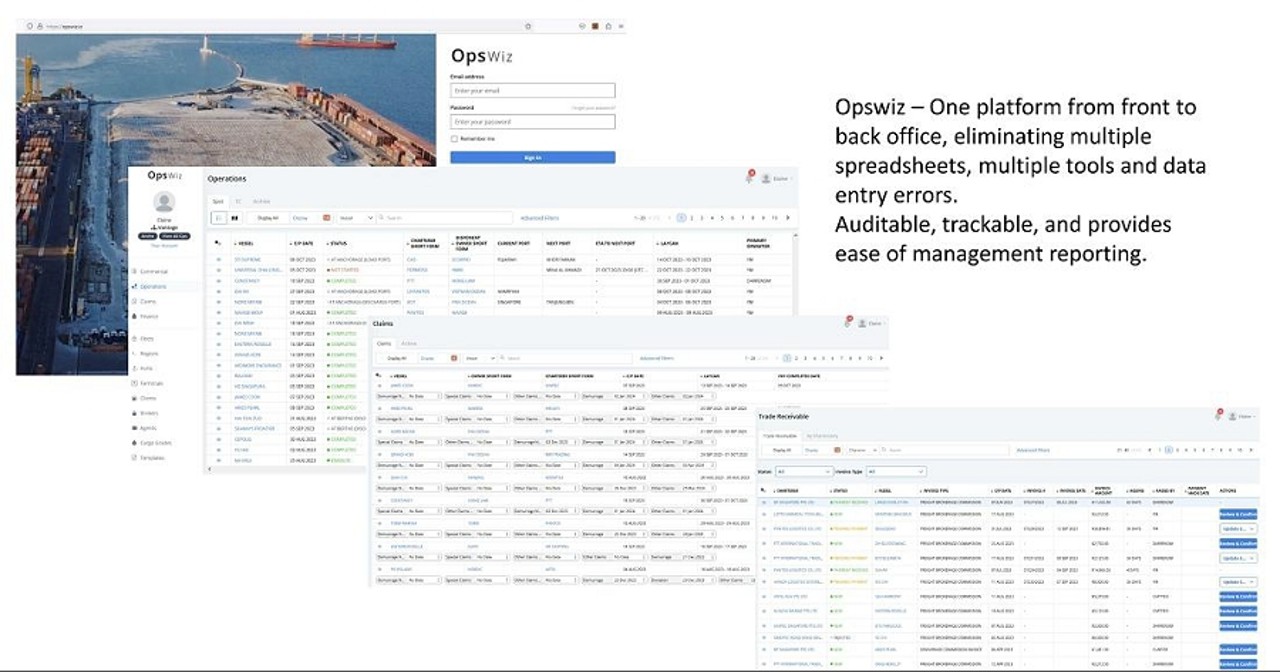
| 31 |
Strategic Networking and Partnerships. Building on our extensive industry network and strategic partnerships, we have cultivated a robust ecosystem of collaborators, including major shipowners, charterers, and suppliers. This network provides us with valuable market insights, access to a wide range of charter opportunities, and opportunities for collaboration and growth. It also strengthens our reputation and credibility within the maritime community. These relationships only grow when we extend our geographical reach, for example with the opening of Vantage Dubai, as our clients recommend us by word of mouth. By nurturing these relationships, we enhance our market visibility, expand our business reach, and remain at the forefront of industry developments. For example, we are a member of the Baltic Exchange, a renowned membership organization for the maritime industry and freight market information provider for the trading and settlement of physical and derivative contracts. As part of our membership, we actively contribute market freight assessments as a member of a panel of brokers for Baltic Exchange Asian tanker routes and contribute to industry benchmarks and standards. By participating in this panel, we gain access to valuable information and data provided by the Baltic Exchange, which enhances our market intelligence and decision-making capabilities.
Our Challenges
Navigating the complexities of building a strong, recognizable brand in the highly competitive global tanker broking market. The tanker broking market is highly competitive, with numerous players offering similar services. Standing out and defining our unique value proposition is crucial. Building trust with clients in the broking industry demands credibility and reliability. Balancing global reach with local market knowledge is essential for creating a distinctive competitive edge.
Ensuring seamless communication and information transfer across diverse global offices. Overcoming barriers due to cultural differences and language barriers may be a significant challenge. Specifically, managing time zone variances and the cross-office allocation of resources requires careful coordination to ensure efficient communication and information transfer.
Regulatory Compliance. Our business operates in an industry that is subject to various regulations, and we are encountering difficulties in complying with all these, including:
| ● | Diverse Regulations: Different countries have their own financial and employment regulations, which can be complex and stringent. As a brokerage, we must comply with each country’s laws and regulations, including licensing, reporting requirements, and trading rules, and stay updated on regulatory changes. | |
| ● | Regulatory Bodies: Engaging with multiple regulatory bodies, such as the SEC in the US, the Financial Conduct Authority in the UK, can be resource-intensive and requires extensive legal expertise. Each regulatory body has its own requirements, demanding a comprehensive understanding of diverse regulatory environments. | |
| ● | Anti-Money Laundering (AML) and Know Your Customer (KYC): Implementing robust AML and KYC procedures that comply with local regulations is crucial but challenging due to varying standards and requirements. Ensuring transparent and legitimate client transactions involves thorough background checks and continuous monitoring, which is time-consuming and resource-intensive. |
|
| ● | Sanctions: Operating across international markets exposes us to a complex and evolving sanctions landscape administered by multiple authorities, including the Office of Foreign Assets Control (OFAC) in the US, the European Union, and the United Nations. As a shipbroker facilitating the movement of commodities such as crude oil and petroleum products, we face heightened scrutiny in ensuring that no counterparty is subject to applicable sanctions designations. Maintaining real-time screening of all parties against current sanctions lists, managing exposure to high-risk jurisdictions, and navigating the overlap between unilateral and multilateral sanctions regimes demands significant compliance infrastructure and legal oversight. Failure to identify and avoid sanctioned parties could result in severe civil or criminal penalties, reputational damage, and the loss of banking relationships critical to our operations. |
Operational Complexity. Operating a global brokerage involves significant operational complexity. Key challenges include:
| ● | Infrastructure: Setting up offices and integrated systems in different countries involves significant investment and logistical coordination. | |
| ● | Local Partnerships: Establishing relationships with local partners, including brokerage shops, ship owners, oil companies, banks, and service providers, requires a deep understanding of local markets and cultures, which can be difficult due to differing business practices and expectations. | |
| ● | Human Resources: Recruiting, training, and retaining skilled staff who are familiar with local markets and regulations is critical. This involves not only finding qualified individuals but also providing ongoing training and support to ensure they remain up-to-date with industry developments and regulatory changes. |
| 32 |
Market Entry and Competition. Entering new markets and competing effectively requires a strategic approach and a deep understanding of local dynamics. A key challenge is acquiring in-depth market knowledge, including understanding local key players, market conditions, and customer needs. Another challenge is building brand recognition in markets where the brokerage is initially unknown, which may require us to invest extra effort in creating targeted marketing campaigns, leveraging local media and online platforms, and participating in industry events to increase visibility and credibility. Additionally, competing with established local and international brokers who already have a strong foothold in the market presents significant challenge as well. This involves providing exceptional customer service, understanding and addressing client needs, and fostering trust and loyalty through consistent and reliable performance.
Our Business Strategies and Future Plans
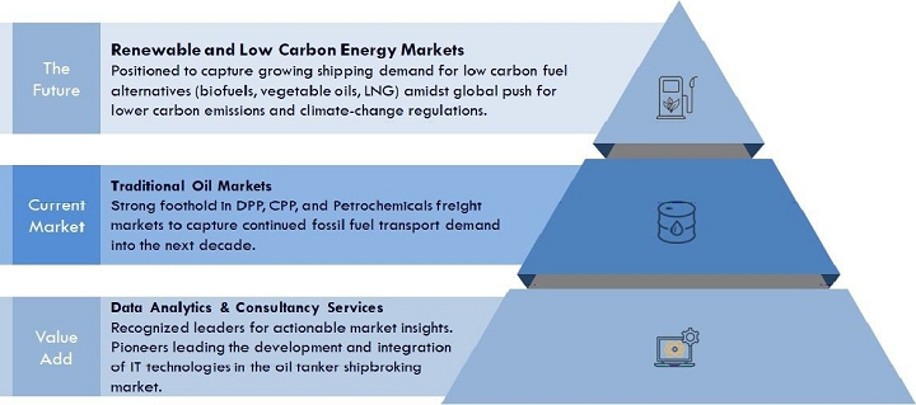
Our business strategies center around three major aspects: (1) continued growth by leveraging existing strengths while expanding and improving existing services through value adding and increasing geographical footprint (2) formulating and executing growth plans to increase product and service scope and (3) enhancing cost management through collaborations with industry partners and upskilling workforce.
Expansion of existing services
Geographical expansion: Our current operational footprint is predominantly in Asia. We aim to leverage our global client network by expanding into locations that offer more optimal coverage for servicing clients in the Western Hemisphere, thereby broadening our portfolio and enhancing service delivery. We plan to expand our brokerage capabilities through the establishment of satellite offices in key markets such as Houston, Texas, and Geneva, Switzerland. However, due to ongoing geopolitical volatility, we have decided to defer our U.S. expansion plans, including a Houston or other U.S.-based presence, to 2027. In the interim, we are strengthening our presence in the Eastern Hemisphere by launching additional offices and joint ventures. These initiatives are expected to contribute meaningfully to revenue growth and reinforce our market position, enabling a stronger foundation for eventual Western expansion when the geopolitical climate becomes more favorable. Our Western expansion remains a strategic priority. We are currently evaluating whether Geneva or other European locations offer a more effective entry point, and we anticipate converting these assessments into concrete action by the second half of 2026. To protect shareholder interests, we remain committed to entering new markets only in partnership with experienced and strategically aligned local counterparts. By establishing a presence across the U.S., Europe, and Asia, we aim to build a geographically balanced platform that capitalizes on time zone coverage and unlocks new opportunities across the global energy shipping sectors. These satellite offices or joint ventures will serve as regional hubs, enabling us to better understand local market dynamics, adapt to cultural nuances, and foster stronger client and partner relationships.
| 33 |
Intensifying strategic cooperation among our subsidiaries. With the incorporation of Vantage Dubai in June 2023 and the acquisition of PJ Marine Singapore, Peijun Marine Consultants and PJ Marine Shanghai, our immediate focus is on realizing synergies between the teams in Singapore, UAE, Hong Kong and PRC. This will enable growth due to increase in region coverage, creation of new divisions in Vantage Dubai, Peijun Marine Consultants and PJ Marine Shanghai, client acquisitions, knowledge transfer and growth of junior staff strength. As of the date of this report, Vantage Dubai consists of only two of the five departments within our Group, namely CPP and DPP. We intend to expand Vantage Dubai’s coverage to include biofuels and vegetable oils, as well as petrochemicals by end 2026. We aim to bolster our presence in the Middle East Gulf region and possibly Europe with a plan to expand Vantage Dubai’s team to a total of 10 to 15 professionals. This expansion will establish a vital bridge for business integration across our subsidiaries, enhancing operational synergy and facilitating streamlined decision-making processes.
Future growth plans to increase product and service scope
Creation of new divisions. We plan to leverage new capabilities acquired through global brokerage expansion for the creation of new divisions. As the shift away from fossil fuel dependency intensifies, new divisions to service these new sectors will be required. We have identified two initial divisions, namely renewable energy and liquefied petroleum gas (LPG), and we are keeping abreast of new developments and opportunities as they develop. By broadening our service offerings, we not only cater to evolving market demands but also enhance our competitive advantage in the region. This expansion aligns with our commitment to providing comprehensive solutions tailored to the unique needs of our diverse clientele. Furthermore, by leveraging our expertise and network, we anticipate potential increased revenue streams as well as strengthened relationships with both existing and prospective clients.
Invest in IT-based technology to enhance efficiency, data control, and management. Recognizing the pivotal role of technology in driving efficiency and innovation in the new economy, we will continue to invest in IT-based solutions that enhance our operational capabilities, streamline processes, and elevate service quality. The use of in-house technology will enable us to improve on advanced data analytics to improve our suite of Research/Strategy offerings, improve workflow efficiency while ensuring data accuracy and security, streamline communication platforms and transaction management systems, and empower our team members to deliver exceptional results. The eventual aim would be to monetize our technology through collaborations with other industry partners or through new service offerings to clients who share the same goal. Through Hadō, we currently expect we will be able to monetize on OpsWiz by the end of 2026 through a licensing system, offering it to companies in need of an efficient operations management solution. We also continue to explore opportunities for both backward and forward integration in our technology roadmap to further extend the value of our platforms and reinforce our competitive positioning in 2026 and beyond.
Cost Management
Leverage access to data and integration of IT systems. Even as the development of technology and big data science propels the industry towards data transparency, the cost of data is also growing exponentially. We see the value of the extensive data that flows through our organization and we will seek to collaborate with industry partners in the data intelligence space through amalgamation and anonymizing of our data to bring down unit costs while improving data access in the wider oil and gas industry. This strategic approach not only could enable the Company to better manage its costs associated with data acquisition and analysis, but also facilitates collaboration with industry partners to collectively enhance data insights and intelligence. To drive operational efficiency and enhance data analysis and management, we will integrate IT systems across our offices, including the satellite offices in Houston and Geneva that we intend to open. Our proprietary program OpsWiz will play a crucial role in consolidating and streamlining our operations and data. By consolidating all our regional offices under one unified operational system, we aim to enhance collaboration, data sharing, and decision-making. This consolidation will not only foster seamless communication but also empower our teams to work cohesively across borders. By centralizing processes, automating workflows, and optimizing resource allocation, we anticipate significant gains in productivity. Our teams will have access to real-time data, enabling informed decision-making and agile responses to market dynamics, supporting our growth trajectory.
| 34 |
Economies of scale in service provision and expertise consolidation. Expanding our geographical footprint could enable us to capitalize on economies of scale in service provision and expertise consolidation, ultimately leading to effective cost management. By broadening our reach, we can gain access to larger markets and client bases, which allows us to spread fixed costs over a larger volume of business. We aim to reduce and optimize the unit costs of value-added service provision through shared resources across regions, such as centralized administrative functions or shared infrastructure. Furthermore, as we expand, we have the opportunity to consolidate expertise within our organization. By bringing together a diverse team of experts with varied skill sets and experiences, we create synergies that enable us to deliver comprehensive solutions to our clients more efficiently. As new hires join our team, they benefit from accelerated learning curves facilitated by knowledge transfers and mentorship from our existing pool of experts. This not only enhances the capabilities of our workforce but also minimizes the time and resources required for onboarding and training.
Strategic talent acquisition. We also aim to recruit experienced and talented professionals in each geographical location of our business operations. We recognize the importance of good managerial control and synergy alignment, requiring meticulous research and strategic hiring practices. As a shipbroker, we operate on a percentage-based model where our brokers’ performance directly impacts our profitability. For instance, hiring a broker at $300,000 annually who generates only $200,000 in returns represents a poor investment. Conversely, recruiting a broker already yielding $1 million justifies the $300,000 salary, or potentially more, as each additional skilled broker directly enhances our financial performance. Thus, we emphasize securing brokers with proven track records to bolster our bottom line effectively. To attract top talent, we are prepared to invest in talent acquisitions or offer competitive sign-on incentives to experienced individuals, ensuring our team comprises industry-leading experts dedicated to driving our success.
Our Major Customers
The major customers of the Company are producers (i.e. entities that directly involve in oil extraction or engage in refining and processing crude oil), multinational oil companies, national oil companies and trading houses. As of March 31, 2026, we had a customer base of approximately 310 entities. For the years ended March 31, 2025 and March 31, 2024, our ten largest customers represented approximately 35% and 43%, respectively, of our total revenue and no single customer accounted for more than 10% of our total revenue for both fiscal years. For the year ended March 31, 2026, our ten largest customers represented approximately 32% of our total revenue and no single customer accounted for more than 10% of our total revenue.
We manage our customer concentration risk by balancing our portfolio across these different segments as trading activity fluctuates according to different segments’ business cycles. For example, trading houses, besides active third party to third party trading, also tend to fill a gap during producer or national oil company production plant turnaround cycles. The trading risk profile of different segments also differ greatly leading to different trade routes generated for each segment. For example, the routes for a multinational oil company do not change greatly as they focus on supply and delivery from and to their own facilities whereas a trading house would be opportunistic, following trading margins.
Competition
In the oil tanker shipbroking industry, we consider other shipbrokers and shipping companies with shipbroking departments as our competitors. Notable competitors in Singapore include Clarksons Plc, Simpson Spence Young, Bramear ACM, Eastport Maritime Pte Ltd, Sentosa Shipbrokers Pte Ltd, Affinity Shipbrokers Pte Ltd, Oil Brokerage Pte Ltd, and Howe Robinson Partners Pte Ltd. Despite the intense competition, we have demonstrated resilience and growth in the Singapore market with 55 employees in Singapore.
However, we recognize the complexities and challenges associated with staffing requirements within global shipbroking companies, some of which employ well over 100 to even 1,000 employees. As we expand globally, we anticipate encountering varying levels of competition for talent across different geographical locations, necessitating strategic efforts to enhance brand recognition and competitiveness on a global scale.
We believe in the global shipbroking industry, the methods of competition among shipbrokers include talent acquisition, enhancement of service quality, technological innovation and industry network.
| 35 |
Seasonality and Cyclicality
Our revenue is primarily derived from commissions on freight rates and demurrage. These revenue streams are directly influenced by the interplay between supply and demand dynamics within the shipping industry.
Demand Fluctuations. The demand for ship tonnage is inherently volatile and subject to various factors, including economic conditions, geopolitical tensions, technological advancements, climate change policies, and foreign currency exchange fluctuations. During periods of economic growth, increased trade activity typically leads to higher demand for shipping services, resulting in higher freight rates and increased revenue for shipbrokers. Similarly, geopolitical instability can contribute to spikes in demand as risk premiums on product prices and freight rates rise.
Supply Dynamics. In contrast to the relatively short-term fluctuations in demand, the supply of ships operates on a longer time horizon. It typically takes shipyards approximately 18-36 months to build and deliver a new vessel. Additionally, shipowners’ capital expenditure plans play a significant role, as the decision to invest in new ships involves substantial financial commitments. As a result, most ship orders are placed during periods of high freight rates, which tend to occur in cyclical patterns. When freight rates are high and profitability is favorable, shipowners are more inclined to invest in expanding their fleet, leading to increased supply in subsequent years.
As a result of these factors, we experience minimal seasonality in our revenue streams, as the fluctuations in demand and supply are dynamic and subject to various external influences. Nonetheless, we remain proactive in adapting our strategies to capitalize on opportunities and mitigate risks in the ever-evolving shipping industry landscape.
Insurance
We maintain different insurance policies for our business, covering damages or loss to our keys assets, facilities and liabilities. We believe that our insurance coverage is consistent with industry standards and is adequate to cover our business operations, properties and assets. Please see “Risk Factors – Our insurance coverage may not cover all our damages and losses.”
We are a senior member of the International Transport Intermediaries Club (ITIC) which provides insurance coverage for us in respect of negligence, employee frauds, loss of documents, liability to authorities, etc. in the course of our shipbroking business, with a general liability limit of USD2,000,000.
We maintain key person insurance for three of our directors.
In addition to the above, we also maintain the following insurance policies:
| Policy | Liability limit | |
| Business insurance (location specific) | SGD1,000,000 & AED10,000,000 | |
| Cyber liability insurance | SGD500,000 | |
| Directors and officers liability | USD2,000,000 & SGD2,000,000 | |
| Employment practices liability | USD500,000 & SGD150,000 | |
| Comprehensive commercial legal expense | SGD500,000 |
Intellectual Property
Currently, our business and profitability are not materially dependent on any intellectual property such as patents, patent rights, licenses and processes or other intellectual property rights. Except as disclosed below, we have not paid or received royalties for any license or use of intellectual property, nor do we use or own any other registered patents, trademarks or intellectual property which are material to our business.
Proprietary Software – OpsWiz
We developed OpsWiz, our proprietary operations efficiency software tailored specifically for tanker shipping operations, entirely in-house from scratch. OpsWiz was conceived, designed, and built by our internal team and we own all intellectual property rights in and to OpsWiz, including the underlying source code, software architecture, user interface designs, and related documentation. We have not formally registered any patents in respect of OpsWiz. While we believe our ownership of OpsWiz is not dependent on formal registration, the absence of patent protection means that third parties are not legally prevented from independently developing software with similar features or functionality. We do not rely on any third-party licensed technology that is material to the operation of OpsWiz.
| 36 |
Trademark
We own the following registered trademarks which we use in the course of our business.
| Mark | Owner | Jurisdiction | Status | |||
|
Vantage Shipbrokers Pte Ltd |
Algeria Australia Benelux Brazil Brunei Darussalam Chile Egypt European Union Indonesia Israel Japan Malaysia Mexico Montenegro Mozambique New Zealand Norway Philippines Qatar Republic of Korea Republic of San Marino Russian Singapore Sint Maarten (Dutch part) Switzerland Türkiye UAE United Kingdom United States of America |
Registered | |||

|
Vantage Shipbrokers Pte Ltd | Singapore | Registered |
We consider our registered trademarks to be important to our brand identity and the marketing of our services and products. We intend to maintain and renew our trademark registrations as appropriate and to take such steps as we consider necessary to protect our trademarks against infringement.
Except as set out above, we do not own or use any other registered trademarks, patents, or intellectual property rights which are material to our business.
Internet Domain Name
As of the date of this report, we have registered the domain names https://www.vantageshipbrokers.com, and https://www.vntg-corp.com and https://hado.codes. The information contained on these websites is not a part of this report.
Due to our limited exposure to intellectual property risk in our business, we have not implemented any measures to protect our intellectual property. Since our inception, there have not, to our knowledge, been any infringements of intellectual property rights owned by the Company, including but not limited to any claims and threatened claims or proceedings initiated by us; and we have not been subject to any third party claims relating to intellectual property made against us.
As of the date of this report, we have not entered into any licensing agreements relating to our intellectual property with any third parties; and we do not license intellectual property from any third party.
Properties
Legal Proceedings
We may from time to time be subject to various legal or administrative claims and proceedings arising in the ordinary course of our business. The Company is not and has not been a party to any litigation, arbitration or administrative proceedings that we believe would, individually or taken as a whole, have a material adverse effect on our business, financial condition or results of operations, and, insofar as we are aware, no such litigation, arbitration or administrative proceedings are pending, threatened, or contemplated.
| 37 |
4.C. Organizational structure
The following diagram illustrates the organizational structure of the Group:
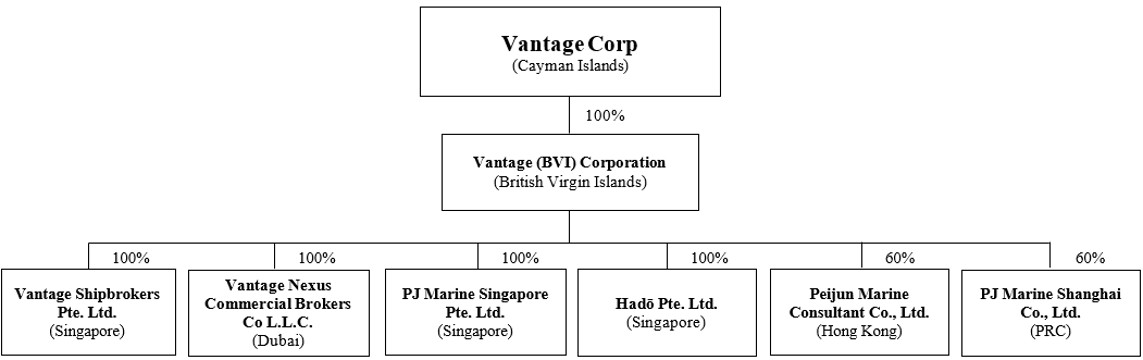
4.D. Property, plants and equipment
Our principal place of business is located at #07-07/10, Level 7, 51 Cuppage Road, Singapore 229469, where we lease approximately 6,695 square feet of office space. Our Singapore office is leased under a lease which will expire on May 31, 2028. We maintain an office in UAE with approximately 790 square feet of office space leased. The lease will expire on April 10, 2027. We believe that our facilities are adequate to meet our needs for the immediate future, and that, should it be needed, suitable additional space will be available on commercially reasonable terms to accommodate any expansion of our operations.
Item 4A. Unresolved Staff Comments
None.
Item 5. Operating and Financial Review and Prospects
The following discussion and analysis of our financial condition and results of operations should be read in conjunction with our consolidated financial statements and related notes included elsewhere in this annual report. This discussion and analysis and other parts of this annual report contain forward-looking statements based upon current beliefs, plans and expectations that involve risks, uncertainties and assumptions. Our actual results and the timing of selected events could differ materially from those anticipated in these forward-looking statements as a result of several factors, including those set forth under “Risk Factors” and elsewhere in this annual report. You should carefully read the “Risk Factors” section of this annual report to gain an understanding of the important factors that could cause actual results to differ materially from our forward-looking statements.
5.A. Operating Results
The following discussion and analysis of our financial condition and results of operations should be read in conjunction with our financial statements and the related notes included elsewhere in this Report. This discussion contains forward-looking statements reflecting our current expectations that involve risks and uncertainties. See “Forward-Looking Statements” for a discussion of the uncertainties, risks and assumptions associated with these statements. Actual results and the timing of events could differ materially from those discussed in our forward-looking statements as a result of many factors, including those set forth under “Risk Factors” and elsewhere in this Report.
| 38 |
Overview
We are a provider of shipbroking, operations and consultancy services specializing in the tanker market. We operate through offices in Singapore, the United Arab Emirates, Hong Kong and the People’s Republic of China, providing shipbroking services to oil companies, commodity traders, shipowners and commercial managers across international shipping markets.
Fiscal year 2026 was a transformational year for our Company. During the year, we completed the acquisitions of PJ Marine Singapore Pte. Ltd., Peijun Marine Consultant Co., Limited and PJ Marine Shanghai Co., Ltd., which expanded our geographical presence and service capabilities. In addition, we successfully completed our initial public offering and NYSE American listing in June 12, 2025, strengthening our capital base and providing additional financial flexibility to support our future growth strategy.
Although revenue decreased by 4.4% to US$17.8 million during fiscal year 2026 as a result of softer global shipping market conditions and lower transaction volumes, our financial position strengthened significantly following our initial public offering. Total assets increased to US$22.8 million as of March 31, 2026 from US$11.2 million as of March 31, 2025, primarily reflecting the acquisitions completed during the year and the receipt of net proceeds from our initial public offering.
Our results for fiscal year 2026 were also affected by factors associated with becoming a publicly listed company, including increased professional fees, regulatory compliance costs, investor relations expenses and corporate governance costs. These expenses, together with acquisition-related transaction costs and higher depreciation and amortization arising from acquired assets, contributed to the increase in operating expenses during the year.
We continue to focus on expanding our service offerings, strengthening our market position through strategic acquisitions, growing our recurring customer relationships and maintaining a disciplined approach to cost management while leveraging the enhanced financial flexibility resulting from our public listing
Key Factors that Affect Operating Results
Our revenue is mainly derived from commissions paid to us by shipowners, which are based on either a fixed fee per contract or the following:
| (1) | Freight commission calculated as a percentage of the freight payable to the shipowner by the charterer. |
| (2) | Sale and purchase transactions – commission calculated as a percentage of the purchase price or as a lump sum for the sale and purchase of tanker. |
| (3) | Demurrage commission calculated as a percentage of the total demurrage payable by the charterer to the shipowner. |
Therefore, we believe that our operating results would be affected by the following key factors:
Market conditions and freight rates
As our commission may be calculated as a percentage of freight, changes in freight rates significantly impact our revenue. Freight rates are typically influenced by supply and demand dynamics, economic conditions, and commodity prices. Economic growth and increased trade activity typically lead to higher demand for shipping services and higher freight rates. Conversely, economic downturns or reduced trade volumes can result in lower freight rates. Fluctuations in fuel costs, regulatory changes, and weather disruptions also impact freight rates by affecting operating expenses and shipping efficiency for companies.
Operating as a public company
Following our NYSE American listing in June 12, 2025, we have incurred additional costs associated with operating as a publicly listed company, including legal and professional fees, regulatory compliance, investor relations, corporate governance and internal control compliance costs. These expenses are expected to continue as part of our ongoing operations.
Geopolitical risks and regional conflicts
Regional conflicts and geopolitical tensions, such as the Iran-Israel war, Hamas-Israel conflict or the Russia-Ukraine war, pose significant risks to maritime operations and can impact the Company’s revenue. Heightened geopolitical tensions may lead to increased maritime risks, including piracy, vessel detentions, and disruptions to trade routes. In response to these risks, charterers may demand higher freight rates or opt for longer voyages to avoid conflict zones. Moreover, higher fuel prices significantly increase operating expenses for shipping companies, prompting adjustments in freight rates to offset these expenses. Therefore, while geopolitical tension may lead to staggering shipping activities, resulting in disruptions and decreased demand for shipping services, the effect of a spike in fuel prices and operating expenses often outweighs this drop in shipping activities. Consequently, ship companies may demand higher freight rates, leading to increased brokerage income for the Company.
| 39 |
Also, geopolitical tension can lead to higher brokerage income for us due to increased demurrage charges resulting from delays in cargo shipments caused by maritime risks or disruptions to trade routes. When geopolitical tensions escalate, there is often heightened uncertainty and risks associated with navigating certain regions or transiting through strategic waterways. For example, conflicts or geopolitical instability in key shipping lanes, such as the Strait of Hormuz or the South China Sea, can lead to delays in cargo shipments as vessels may need to alter their routes, discharge ports, or wait for safe passage. As a result of these delays, charterers may exceed the agreed-upon laytime or free time for loading and unloading cargo at ports, leading to demurrage charges. Demurrage refers to the fee paid by charterers to shipowners for the detention of a vessel beyond the agreed-upon time allowed for loading or unloading cargo. The longer the delays, the higher the demurrage charges incurred by charterers, which can significantly increase brokerage income for us.
Crude oil price fluctuations
Crude oil price fluctuations have a direct impact on the shipping industry, particularly in the tanker segment. Higher crude oil prices typically result in increased demand for oil transportation, leading to higher freight rates and hence commissions for the Company. Moreover, crude oil prices influence the operating costs of shipping companies, as fuel costs represent a substantial portion of their expenses. In response to higher fuel costs, shipping companies may adjust their freight rates to offset these expenses and maintain profitability. Higher freight rates result in increased contract values between ship owners and charterers, which in turn lead to higher commission earnings for the Company. Changes in crude oil prices also affect market sentiment and investment decisions, which can indirectly influence shipping demand and revenue generation.
Global oil inventories and demand
Global oil inventories and demand levels play a crucial role in shaping the demand for tanker transportation services. High oil inventories typically indicate lower demand for tanker transportation, as there is ample supply available locally. In contrast, low oil inventories often signal higher demand for tanker services, as oil needs to be transported from distant locations to meet demand. Changes in global oil demand, driven by factors such as economic growth, industrial activity, and geopolitical events, directly impact our revenue by affecting shipping volumes and charter rates.
Global oil tanker fleet production and scrapping
The pace of global oil tanker fleet production and scrapping activities also influences the Company’s revenue. Slower production of new vessels can lead to tighter vessel supply, thereby increasing charter rates and commissions earned by the Company. Conversely, higher production levels or increased vessel scrapping may result in excess vessel supply, leading to downward pressure on charter rates and reduced revenue for the company. Additionally, changes in vessel technology, regulations, and environmental standards can impact vessel utilization rates and operating costs, further affecting the Company’s revenue.
Changing Consumer Behaviours
As policy makers and consumers shift towards a greater awareness of the impact of the energy industry on the climate, behaviours and policies to adopt cleaner energy usage emerge. There may occur a faster than expected phase out of fossil fuels. While the growth in demand for fossil fuels is forecasted to decline this decade, global initiatives to limit global warming to 1.5 degrees Celsius per year may result in a faster than expected decline in fossil fuel demand. This would shorten the runway we have planned to transition to other new sectors and affect revenue projections. With the rise and a transition towards electric vehicles there might be a threat of sudden reduction of consumption of gasoline and diesel which could reduce then demand for sea-borne transport.
Regulations: The International Maritime Organisation (IMO) regulates standards by which vessels need to comply with. For example in 2024, regulatory changes included cleaner bunker fuel standards, with increasing maritime areas subject to higher standards of emissions controls, for example the Mediterranean Sea area and Arctic waters. Ships will also need to report and subsequently improve their Green House Gas (GHG) emissions. These may potentially affect the availability of ships for the carriage of oil and gas in the short term, until newly ordered ships which can meet these higher standards are delivered for commercial service. This may lead to a reduction in revenues if the Company is unable to establish close ties with ship owners who have kept pace with changes and own the requisite compliant fleet.
| 40 |
Environmental standards: As per the United Nations Climate Change (UNFCCC) conventions, its member Parties have laid out forward plans to reduce the usage of fossil fuels, as per the Kyoto and Paris Agreements. In the short term, from 2035 to 2040, this will lead to a reduction in fossil fuel usage as fuels derived from biological matter start to replace a portion of fossil fuel to reduce carbon emissions. This could lead to a reduction in the Company’s earnings if the Company is not able to grow its Vegetables and Bio-fuels division as well as Chemicals division to compensate for the eventual decline in conventional fossil fuel carriage on the Clean and Dirty Petrochemicals Desk. The Company will also need to bring to fruition current plans to expand into other sectors like gas ship broking and potentially carbon trading to maintain the Company’s revenue growth plans.
Revenue by Commission Type
The following table sets forth our revenue by commission type for the years ended March 31, 2024, 2025 and 2026.
| FY2024 (US$) | % of Revenue | FY2025 (US$) | % of Revenue | FY2026 (US$) | % of Revenue | |||||||||||||||||||
| Freight commission | 16,489,917 | 82.5 | 13,740,506 | 73.6 | 13,491,801 | 75.6 | ||||||||||||||||||
| Time charter (hire) commission | 1,471,781 | 7.4 | 2,717,963 | 14.6 | 2,965,316 | 16.6 | ||||||||||||||||||
| Demurrage commission | 1,628,297 | 8.1 | 1,430,714 | 7.7 | 1,226,694 | 6.9 | ||||||||||||||||||
| Deviation and other commission | 409,299 | 2.0 | 319,958 | 1.7 | 153,800 | 0.9 | ||||||||||||||||||
| Sale of vessel commission | - | - | 450,000 | 2.4 | - | - | ||||||||||||||||||
| Total | 19,999,294 | 100 | 18,659,141 | 100 | 17,837,611 | 100 | ||||||||||||||||||
Freight commission remained our largest source of revenue throughout the periods presented, accounting for 82.5%, 73.6% and 75.6% of total revenue for the years ended March 31, 2024, 2025 and 2026, respectively. Freight commission decreased from US$16.5 million in fiscal year 2024 to US$13.7 million in fiscal year 2025, primarily reflecting lower freight brokerage activity, and remained relatively stable at US$13.5 million in fiscal year 2026.
Time charter (hire) commission increased steadily from US$1.5 million in fiscal year 2024 to US$2.7 million in fiscal year 2025 and US$3.0 million in fiscal year 2026, increasing from 7.4% to 14.6% and 16.6% of total revenue, respectively. This reflects our continued focus on period charter transactions, which generally provide a more stable and recurring source of commission income.
Demurrage commission declined from US$1.6 million in fiscal year 2024 to US$1.4 million in fiscal year 2025 and US$1.2 million in fiscal year 2026, primarily due to lower demurrage claims settled during the respective periods.
Deviation and other commission also decreased over the three-year period, reflecting lower transaction activity. Sale of vessel commission was recognized only in fiscal year 2025, when the Company earned US$0.45 million from vessel sale transactions, with no such commission recognized in fiscal years 2024 or 2026.
Results of Operations
The following table sets forth a summary of our consolidated results of operations by amounts and percentages of our revenues for the years indicated. This information should be read together with our consolidated financial statements and related notes included elsewhere in this annual report. The results of operations in any period are not necessarily indicative of the results that may be expected for any future period.
| Years Ended March 31, | ||||||||||||||||||||
| 2024 | 2025 | 2026 | 2025 to 2024 | 2026 to 2025 | ||||||||||||||||
| US$ | US$ | US$ | % Change | % Change | ||||||||||||||||
| Revenue | $ | 19,999,294 | $ | 18,659,141 | $ | 17,837,611 | (6.7 | ) | (4.4 | ) | ||||||||||
| Cost of revenue | (10,560,766 | ) | (10,044,402 | ) | (10,427,222 | ) | (4.9 | ) | 3.8 | |||||||||||
| Gross Profit | 9,438,528 | 8,614,739 | 7,410,389 | (8.7 | ) | (14 | ) | |||||||||||||
| Operating expenses: | ||||||||||||||||||||
| Selling and marketing expenses | (1,063,533 | ) | (1,130,799 | ) | (1,489,005 | ) | 6.3 | 31.7 | ||||||||||||
| Depreciation and amortization | (175,488 | ) | (272,734 | ) | (598,516 | ) | 55.4 | 119.5 | ||||||||||||
| General and administrative expenses | (2,361,763 | ) | (2,798,028 | ) | (6,156,987 | ) | 18.5 | 120.1 | ||||||||||||
| Total operating expenses | (3,600,784 | ) | (4,201,561 | ) | (8,244,508 | ) | 16.7 | 96.2 | ||||||||||||
| Other income (expense): | ||||||||||||||||||||
| Government grants | 20,865 | 16,063 | 19,923 | (23 | ) | 24 | ||||||||||||||
| Other income | 150,653 | 251,895 | 9,105 | 67.2 | (96.4 | ) | ||||||||||||||
| Interest expense | (9,267 | ) | (12,325 | ) | (355,871 | ) | 33 | 2,787.4 | ||||||||||||
| Total other income (expense) | 162,251 | 255,633 | (326,843 | ) | 57.6 | (227.9 | ) | |||||||||||||
| Income (loss) before tax expense | 5,999,995 | 4,668,811 | (1,160,962 | ) | (22.2 | ) | (124.9 | ) | ||||||||||||
| Income tax expense | (1,045,511 | ) | (825,926 | ) | (155,708 | ) | (21 | ) | (81.1 | ) | ||||||||||
| Net income (loss) | 4,954,484 | 3,842,885 | (1,316,670 | ) | (22.4 | ) | (134.3 | ) | ||||||||||||
| 41 |
Comparison of Results of Operations for the Years Ended March 31, 2026 and 2025
Revenue
We generate revenue from ship broking services. Revenue decreased by US$821,530, or 4.4%, from US$18,659,141 for the year ended March 31, 2025 to US$17,837,611 for the year ended March 31, 2026. The decrease was primarily attributable to softer global market conditions, reduced transaction volumes, and ongoing uncertainty in international trade and shipping demand. The decrease was partially offset by continued contributions from time charter commission income.
Cost of revenue
Our cost of revenue mainly consists of front-end payroll, employee benefits and commission fee. Our total cost of revenue increased by US$382,820, or 3.8%, from US$10,044,402 for the year ended March 31, 2025, to US$10,427,222 for the year ended March 31, 2026. The increase was primarily attributable to higher employee compensation and commission expenses resulting from increased headcount, including employees from the acquired businesses, and related revenue-generating activities.
Gross profit and gross profit margin
Gross profit decreased by US$1,204,350, or 14.0%, from US$8,614,739 for the year ended March 31, 2025 to US$7,410,389 for the year ended March 31, 2026, primarily due to the decrease in revenue and the increase in cost of revenue. Gross profit margin decreased from 46.2% for the year ended March 31, 2025 to 41.5% for the year ended March 31, 2026.
Selling and marketing expenses
Selling and marketing expenses increased by US$358,206, or 31.7%, from US$1,130,799 for the year ended March 31, 2025, to US$1,489,005 for the year ended March 31, 2026. The increase was primarily attributable to higher entertainment expenses and travelling expenses, reflecting increased business development activities, client engagement efforts and the expansion of our commercial team.
Depreciation and amortization expenses
Depreciation and amortization expenses increased by US$325,782, or 119.5%, from US$272,734 for the year ended March 31, 2025 to US$598,516 for the year ended March 31, 2026. The increase was primarily attributable to additional depreciation of leasehold improvements and plant and equipment together with higher amortization of right-of-use assets resulting from lease renewals.
General and administrative expenses
General and administrative expenses increased by US$3,358,959, or 120.1%, from US$2,798,028 for the year ended March 31, 2025 to US$6,156,987 for the year ended March 31, 2026. The increase was primarily attributable to higher professional and consultancy fees incurred in connection with the acquisitions, increased regulatory and compliance-related expenditures, investor relations expenses, higher employee compensation resulting from the expansion of our operations, including the acquired businesses, and the ongoing costs of operating as a publicly listed company.
Other income
It decreased by US$242,790 or 96.4% for the year ended March 31, 2025 of US$251,895 to US$9,105 for the year ended March 31, 2026. This was primarily attributable to a decrease in forfeited customer advances compared to the prior year.
Interest expenses
Interest expense increased by US$343,546, from US$12,325 for the year ended March 31, 2025 to US$355,871 for the year ended March 31, 2026. The increase was primarily attributable to finance costs associated with lease liabilities and deferred consideration arising from the acquisitions completed during fiscal year 2026.
Income tax expense
Income tax expense decreased by US$670,218, or 81.1%, from US$825,926 for the year ended March 31, 2025 to US$155,708 for the year ended March 31, 2026, primarily due to lower chargeable income.
Net income
As a result of the foregoing factors, we recorded a net loss of US$1,316,670 for the year ended March 31, 2026, compared to net income of US$3,842,885 for the year ended March 31, 2025.
| 42 |
Comparison of Results of Operations for the Years Ended March 31, 2025 and 2024
Revenue
We generate revenue from ship broking services. Our total revenue for the year ended March 31, 2025 decreased by US$1,340,153 or by 6.7%, from US$19,999,294 in the year ended March 31, 2024, to US$18,659,141 in the year ended March 31, 2025. While the overall decline reflects ongoing geopolitical tensions, weaker economic conditions, broader market uncertainty and an increase in ship tonnage supply, it was buffered by Vantage Corp’s strategy to increase period charter activity during a higher freight environment. Revenue from time charter commissions increased by US$1,246,182. These longer-term agreements typically provide a more stable and predictable revenue stream, supporting our broader objective to reduce revenue volatility in an increasingly uncertain operating environment.
Cost of revenue
Our cost of revenue mainly consists of front-end payroll, employee benefits and commission fee. Our total cost of revenue decreased by US$516,364, or 4.9%, from US$10,560,766 for the year ended March 31, 2024, to US$10,044,402 for the year ended March 31, 2025. This improvement reflects continued operational efficiency and cost optimization efforts aligned with a 6.7% decline in sales. We focused on streamlining resources and aligning our cost structure with business needs, while continuing to invest in core talent and long-term capabilities.
Gross profit and gross profit margin
Gross profit decreased by US$823,789, or 8.7%, from US$9,438,528 for the year ended March 31, 2024 to US$8,614,739 for the year ended March 31, 2025, primarily due to the decrease in revenue. Gross profit margin decreased from 47.2% for the year ended March 31, 2024 to 46.2% for the year ended March 31, 2025.
Selling and marketing expenses
Selling and marketing expenses increased by US$67,266, or 6.3%, from US$1,063,533 for the year ended March 31, 2024 to US$1,130,799 for the year ended March 31, 2025. The increase was primarily attributable to higher entertainment expenses as we focused on developing relationships with new ship owners in an increasingly fragmented market.
Depreciation and amortization expenses
Depreciation and amortization expenses increased by US$97,246, or 55.4%, from US$175,488 for the year ended March 31, 2024 to US$272,734 for the year ended March 31, 2025. The increase was primarily attributable to depreciation of leasehold improvements resulting from capitalized renovation costs and higher amortization of right-of-use assets following the renewal of operating leases.
General and administrative expenses
General and administrative expenses increased by US$436,265, or 18.5%, from US$2,361,763 for the year ended March 31, 2024 to US$2,798,028 for the year ended March 31, 2025. The increase was primarily attributable to higher operating costs associated with our UAE office following the commencement of its operations, together with increased professional and consultancy fees related to the preliminary preparation for our initial public offering.
Other income
Other income increased by US$101,242, or 67.2%, from US$150,653 for the year ended March 31, 2024 to US$251,895 for the year ended March 31, 2025. The increase was primarily attributable to higher forfeited customer advances, partially offset by lower fixed deposit interest income.
Interest expense
Interest expense increased by US$3,058, or 33.0%, from US$9,267 for the year ended March 31, 2024 to US$12,325 for the year ended March 31, 2025, primarily due to higher finance costs associated with lease liabilities.
Income tax expense
Income tax expense decreased by US$219,585, or 21.0%, from US$1,045,511 for the year ended March 31, 2024 to US$825,926 for the year ended March 31, 2025, primarily due to lower chargeable income.
Net income
As a result of the foregoing factors, net income decreased from US$4,954,484 for the year ended March 31, 2024 to US$3,842,885 for the year ended March 31, 2025.
| 43 |
CONSOLIDATED BALANCE SHEETS
| As of March 31, | ||||||||
| 2025 | 2026 | |||||||
| US$ | US$ | |||||||
| ASSETS | ||||||||
| Current Assets | ||||||||
| Cash and Cash Equivalents | 5,948,806 | 8,861,768 | ||||||
| Accounts Receivable, Net | 3,766,357 | 5,556,227 | ||||||
| Prepaid Expenses and Other Current Assets, Net | 1,193,972 | 1,249,597 | ||||||
| Total Current Assets | 10,909,135 | 15,667,592 | ||||||
| Non-Current Assets | ||||||||
| Plant and Equipment, Net | 108,746 | 201,146 | ||||||
| Right-of-Use Assets | 142,525 | 972,200 | ||||||
| Goodwill | - | 2,900,729 | ||||||
| Intangible Assets, Net | - | 1,253,127 | ||||||
| Prepaid Expenses and Other Non-Current Assets, Net | - | 1,811,250 | ||||||
| Total Non-Current Assets | 251,271 | 7,138,452 | ||||||
| TOTAL ASSETS | 11,160,406 | 22,806,044 | ||||||
| LIABILITIES | ||||||||
| Current Liabilities | ||||||||
| Lease Payable – Current | 144,747 | 462,490 | ||||||
| Accounts Payable | 46,177 | 210,970 | ||||||
| Accruals and Other Current Liabilities | 3,873,327 | 6,142,769 | ||||||
| Dividend Payable | 5,101,002 | 3,549,983 | ||||||
| Income Tax Payable | 853,048 | 243,136 | ||||||
| Total Current Liabilities | 10,018,301 | 10,609,348 | ||||||
| Non-Current Liabilities | ||||||||
| Lease Payable – Non-Current | 981 | 527,751 | ||||||
| Deferred Tax Liabilities | 1,325 | 225,810 | ||||||
| Dividend Payable | 1,500,000 | 1,500,000 | ||||||
| Total Non-Current Liabilities | 1,502,306 | 2,253,561 | ||||||
| TOTAL LIABILITIES | 11,520,607 | 12,862,909 | ||||||
| SHAREHOLDERS’ EQUITY | ||||||||
| Ordinary shares, Class A, US$0.001 par value, 25,000,000 shares authorized, 7,633,620 shares issued and outstanding as of March 31, 2025 and 11,371,120 shares issued and 10,616,741 shares outstanding as of March 31, 2026 | 7,634 | 11,371 | ||||||
| Ordinary shares, Class B, US$0.001 par value, 25,000,000 shares authorized, 20,366,380 shares issued and outstanding as of March 31, 2025 and March 31, 2026 | 20,366 | 20,366 | ||||||
| Treasury shares, at cost; nil shares as of 31 March 2025 and 754,379 Class A ordinary shares as of March 31, 2026 | - | (749,424 | ) | |||||
| Additional paid-in capital | - | 11,317,120 | ||||||
| Accumulated Deficit | (865,997 | ) | (2,253,741 | ) | ||||
| Merger Reserve | 504,549 | 504,549 | ||||||
| Accumulated Other Comprehensive Loss | (26,753 | ) | (26,361 | ) | ||||
| Total Equity Attributable to Vantage Corp Shareholders | (360,201 | ) | 8,823,880 | |||||
| Non-Controlling Interest | - | 1,119,255 | ||||||
| Total Shareholders’ Equity | (360,201 | ) | 9,943,135 | |||||
| TOTAL LIABILITIES AND SHAREHOLDERS’ EQUITY | 11,160,406 | 22,806,044 | ||||||
| 44 |
Current assets
Current assets increased by US$4,758,457, from US$10,909,135 as of March 31, 2025 to US$15,667,592 as of March 31, 2026, primarily due to increases in cash and cash equivalents and accounts receivable. The increase in cash and cash equivalents was primarily driven by the net proceeds from our initial public offering, while the increase in accounts receivable primarily reflected the inclusion of accounts receivable from the businesses acquired during fiscal year 2026.
Non-current assets
Non-current assets, comprising plant and equipment, right-of-use assets, goodwill, intangible assets, and prepaid expenses and other non-current assets, increased by US$6,887,181, from US$251,271 as of March 31, 2025 to US$7,138,452 as of March 31, 2026. The increase was primarily attributable to the acquisitions of PJ Marine Singapore Pte. Ltd., Peijun Marine Consultant Co., Limited, and PJ Marine Shanghai Co., Ltd. during fiscal year 2026, which resulted in the recognition of goodwill and identifiable intangible assets, as well as an increase in prepaid expenses and other non-current assets, primarily consisting of prepayments for professional services related to the corporate development, and business consultancy services.
Current liabilities
Current liabilities increased by US$591,047, from US$10,018,301 as of March 31, 2025 to US$10,609,348 as of March 31, 2026, primarily due to an increase in accruals and other current liabilities, mainly related to deferred consideration payable arising from the acquisitions, partially offset by a decrease in dividend payable.
Non-current liabilities
Non-current liabilities increased by US$751,255, from US$1,502,306 as of March 31, 2025 to US$2,253,561 as of March 31, 2026, primarily due to an increase in deferred tax liabilities arising from the acquisitions and an increase in lease liabilities associated with additional right-of-use assets recognized during the period.
Non-GAAP Financial Measure
We present Adjusted EBITDA, a non-GAAP financial measure, as a supplemental measure of our operating performance. Adjusted EBITDA should not be considered in isolation or as a substitute for net income (loss) or any other financial measure prepared in accordance with U.S. GAAP.
We define Adjusted EBITDA as net income (loss) before interest income, interest expense, income tax expense, depreciation and amortization, as further adjusted to exclude acquisition-related transaction costs that management believes are not reflective of our core operating performance.
We believe Adjusted EBITDA provides investors with useful supplemental information because it facilitates period-to-period comparisons of our operating performance by excluding the effects of financing activities, income taxes, non-cash depreciation and amortization, and acquisition-related transaction costs that are not considered part of our ongoing operating activities. Management uses Adjusted EBITDA, together with our U.S. GAAP financial measures, to evaluate our operating performance, assess operating trends, allocate resources and make operating and strategic decisions.
Adjusted EBITDA has limitations as an analytical measure. It should not be considered in isolation or as a substitute for net income (loss), operating income, cash flows from operating activities or any other measure determined in accordance with U.S. GAAP. In addition, our calculation of Adjusted EBITDA may not be comparable to similarly titled measures presented by other companies.
| 45 |
The following table reconciles Adjusted EBITDA to the most directly comparable financial measure prepared in accordance with U.S. GAAP.
| Years Ended March 31, | ||||||||||||
| 2024 | 2025 | 2026 | ||||||||||
| US$ | US$ | US$ | ||||||||||
| Net Income (Loss) | 4,954,484 | 3,842,885 | (1,316,670) | |||||||||
| Adjustments: | ||||||||||||
| Income tax expenses | 1,045,511 | 825,926 | 155,708 | |||||||||
| Interest expense | 9,267 | 12,325 | 355,871 | |||||||||
| Interest income | (150,653 | ) | (25,830 | ) | (5,447 | ) | ||||||
| Depreciation and amortization | 175,488 | 272,734 | 598,516 | |||||||||
| EBITDA | 6,034,097 | 4,928,040 | (212,022 | ) | ||||||||
| Acquisition-related transaction costs | - | - | 82,870 | |||||||||
| Adjusted EBITDA | 6,034,097 | 4,928,040 | (129,152 | ) | ||||||||
5.B. Liquidity and Capital Resources
The consolidated financial statements included in this annual report have been prepared on a going concern basis, which assumes that the Company will continue in operation for the foreseeable future and will be able to realize its assets and discharge its liabilities and commitments in the normal course of business.
Our principal sources of liquidity have historically been cash generated from operating activities. During fiscal year 2026, our liquidity was further strengthened by the net proceeds from our initial public offering consummated in 12 June 2025.
We believe that our existing cash and cash equivalents, anticipated cash flows from operations, and the net proceeds from our initial public offering completed on June 13, 2025 and the exercise of the over-allotment option completed on June 18, 2025 will be sufficient to meet our anticipated working capital requirements, capital expenditure needs and other liquidity requirements for at least the next 12 months from the date of this annual report. However, our actual cash requirements may vary depending on our operating performance, working capital needs, capital expenditures, acquisitions and other strategic initiatives.
We may require additional financing in the future to fund operations, working capital, capital expenditures, or acquisitions. Such financing may be obtained through equity or debt offerings, including bank borrowings or other credit facilities. If additional funding is required, we may not be able to obtain it on terms acceptable to us, or at all. Any issuance of equity securities may result in dilution to shareholders, while debt financing may result in increased interest obligations and restrictive covenants.
Our ability to manage working capital, including receivables, other assets, and liabilities, may materially affect our financial condition and results of operations.
The following table presents a summary of our consolidated cash flow activity for the periods set forth below:
| Years Ended March 31, | ||||||||||||
| 2024 | 2025 | 2026 | ||||||||||
| US$ | US$ | US$ | ||||||||||
| Statements of Cash Flows Data: | ||||||||||||
| Net cash (used in) provided by operating activities | (173,264 | ) | 1,895,161 | (4,446,503 | ) | |||||||
| Net cash used in investing activity | (36,855 | ) | (126,455 | ) | (997,186 | ) | ||||||
| Net cash (used in) provided by financing activities | (2,212,728 | ) | (12,427,693 | ) | 8,356,259 | |||||||
| Net change in cash and cash equivalents | (2,422,847 | ) | (10,658,987 | ) | 2,912,570 | |||||||
| Cash and cash equivalents as of beginning of the year | 19,030,668 | 16,607,536 | 5,948,806 | |||||||||
| Effects on currency translation on Cash and Cash Equivalents | (285 | ) | 257 | 392 | ||||||||
| Cash and cash equivalents as of the end of the year | 16,607,536 | 5,948,806 | 8,861,768 | |||||||||
Cash Flows for the Years Ended March 31, 2024, 2025 and 2026
Net Cash (Used in) Provided by Operating Activities
Net cash used in operating activities was US$4,446,503 for the year ended March 31, 2026, compared with net cash provided by operating activities of US$1,895,161 for the year ended March 31, 2025. The cash outflow during fiscal year 2026 was primarily attributable to our net loss of US$1,316,670, adjusted for non-cash items of US$1,171,221, together with a net cash outflow of US$4,301,054 arising from changes in operating assets and liabilities.
Net cash provided by operating activities was US$1,895,161 for the year ended March 31, 2025, compared with net cash used in operating activities of US$173,264 for the year ended March 31, 2024. The increase was primarily attributable to net income of US$3,842,885, adjusted for non-cash items of US$239,800, partially offset by a net cash outflow of US$2,187,524 arising from changes in operating assets and liabilities.
Net cash used in operating activities was US$173,264 for the year ended March 31, 2024. This was primarily attributable to net income of US$4,954,484, adjusted for non-cash items of US$258,447, which was more than offset by a net cash outflow of US$5,386,195 arising from changes in operating assets and liabilities.
| 46 |
Net Cash Used in Investing Activity
Net cash used in investing activities amounted to US$997,186 for the year ended March 31, 2026, compared with US$126,455 for the year ended March 31, 2025 and US$36,855 for the year ended March 31, 2024. The net cash outflow in fiscal year 2026 primarily consisted of US$783,741 paid for business acquisitions, net of cash acquired, and US$213,445 used for purchases of property and equipment. Cash used in investing activities during fiscal years 2025 and 2024 consisted primarily of purchases of property and equipment.
Net Cash (Used in) Provided by Financing Activities
Net cash provided by financing activities was US$8,356,259 for the year ended March 31, 2026, primarily reflecting net proceeds of US$11,320,857 from the issuance of ordinary shares in connection with our initial public offering, partially offset by dividend payments of US$2,215,174 and US$749,424 used for the repurchase of treasury shares.
Net cash used in financing activities was US$12,427,693 for the year ended March 31, 2025, primarily reflecting dividend payments of US$11,424,665 and repayments to a director of US$513,224.
Net cash used in financing activities was US$2,212,728 for the year ended March 31, 2024, primarily reflecting dividend payments of US$2,100,309 and repayments to a director of US$34,664, partially offset by proceeds from the issuance of share capital in Vantage Dubai of US$136,105
Capital Resources
As of March 31, 2026, we had cash and cash equivalents of US$8.9 million, compared with US$5.9 million as of March 31, 2025. The increase was primarily attributable to the net proceeds from our initial public offering, partially offset by cash used in operating activities, business acquisitions and dividend payments. We believe that our existing cash and cash equivalents, together with anticipated cash flows from operations, will be sufficient to satisfy our working capital requirements, capital expenditure needs and other liquidity requirements for at least the next 12 months from the date of this annual report.
Working Capital
We believe that we have sufficient working capital to meet our present requirements and anticipated cash needs for at least the next 12 months from the date of this annual report, taking into account our cash and cash equivalents, anticipated cash flows from operations and the net proceeds from our initial public offering completed on June 12, 2025 and the exercise of the over-allotment option completed on June 18, 2025.
| As of March 31, | ||||||||||||
| 2024 | 2025 | 2026 | ||||||||||
| US$ | US$ | US$ | ||||||||||
| Cash and cash equivalents | 16,607,536 | 5,948,806 | 8,861,768 | |||||||||
| Accounts receivable, net | 4,747,576 | 3,766,357 | 5,556,227 | |||||||||
| Prepaid expenses and other current assets, net | 463,628 | 1,193,972 | 1,249,597 | |||||||||
| Total current assets | 21,818,740 | 10,909,135 | 15,667,592 | |||||||||
| Accounts payable | 200,453 | 46,177 | 210,970 | |||||||||
| Current operating lease obligations | 170,052 | 144,747 | 462,490 | |||||||||
| Other current liabilities | 14,018,341 | 9,827,377 | 9,935,888 | |||||||||
| Total current liabilities | 14,388,846 | 10,018,301 | 10,609,348 | |||||||||
| Working capital | 7,429,894 | 890,834 | 5,058,244 | |||||||||
| Current ratio | 1.52 | 1.09 | 1.48 | |||||||||
Our working capital increased from US$890,834 as of March 31, 2025 to US$5,058,244 as of March 31, 2026, while our current ratio improved from 1.09 to 1.48 over the same period. The increase was primarily attributable to the net proceeds from our initial public offering, partially offset by cash used for business acquisitions, operating activities and dividend payments.
Capital Expenditures
We incurred capital expenditures of US$36,855, US$126,455 and US$213,445 for the years ended March 31, 2024, 2025 and 2026, respectively, primarily for the purchase of plant and equipment.
We expect to fund our future capital expenditures through our existing cash and cash equivalents, anticipated cash flows from operations and, where appropriate, the remaining net proceeds from our initial public offering. We will continue to make capital expenditures as necessary to support the continued growth of our business.
Commitments and Contingencies
In the normal course of business, we are subject to contingencies, including legal proceedings and claims arising out of the business that relate to a wide range of matters, such as government investigations and tax matters. We recognize a liability for such contingency if it determines it is probable that a loss will occur and a reasonable estimate of the loss can be made. We may consider many factors in making these assessments including historical and the specific facts and circumstances of each matter.
| 47 |
Capital Commitments
As of March 31, 2025 and 2026, we did not have any capital commitments.
Off-Balance Sheet Arrangements
During the periods presented, we did not have, nor do we currently have, significant off-balance sheet arrangements that have or are reasonably likely to have a current or future effect on our financial condition, changes in our financial condition, revenues or expenses, results of operations, liquidity, capital expenditures or capital resources that are material to our shareholders.
5.C. Research and Development, Patent and Licenses, etc.
We did not conduct any research and development activities for the year ended for the year ended March 31, 2026.
Currently, our business and profitability are not materially dependent on any intellectual property such as patents, patent rights, licenses and processes or other intellectual property rights. We developed OpsWiz, our proprietary operations efficiency software tailored for tanker operations, entirely in-house from scratch. Therefore, we own all intellectual property rights to OpsWiz, even though we have not formally registered them. Except as disclosed below, we have not paid or received royalties for any license or use of intellectual property, nor do we use or own any other registered patents, trademarks or intellectual property which are material to our business.
Trademark
As of the date of this report, we own the following registered trademarks which we use in the course of our business.
| Mark | Owner | Jurisdiction | Status | |||
|
|
Vantage Shipbrokers Pte Ltd |
Algeria Australia Benelux Brazil Brunei Darussalam Chile Egypt European Union Indonesia Israel Japan Malaysia Mexico Montenegro Mozambique New Zealand Norway Philippines Qatar Republic of Korea Republic of San Marino Russian Singapore Sint Maarten (Dutch part) Switzerland Türkiye UAE United Kingdom United States of America |
Registered | |||
|
|
Vantage Shipbrokers Pte Ltd | Singapore | Registered |
Internet Domain Name
As of the date of this report, we have registered the domain names https:// www.vantageshipbrokers.com and https://www.vntg-corp.com and https://hado.codes. The information contained on this website is not a part of this report.
Due to our limited exposure to intellectual property risk in our business, we have not implemented any measures to protect our intellectual property. Since our inception, there have not, to our knowledge, been any infringements of intellectual property rights owned by the Company, including but not limited to any claims and threatened claims or proceedings initiated by us; and we have not been subject to any third party claims relating to intellectual property made against us.
As of the date of this report, we have not entered into any licensing agreements relating to our intellectual property with any third parties; and we do not license intellectual property from any third party
| 48 |
5.D. Trend Information
Other than as disclosed elsewhere in this annual report, we are not aware of any trends, uncertainties, demands, commitments or events for the year ended March 31, 2026 that are reasonably likely to have a material effect on our total net revenues, income, profitability, liquidity or capital reserves, or that caused the disclosed financial information to be not necessarily indicative of future operating results or financial conditions.
5.E. Critical Accounting Estimates
Our consolidated financial statements are prepared in accordance with US GAAP. The preparation of these consolidated financial statements requires us to make estimates and assumptions that affect the reported amounts of assets, liabilities, revenue, expenses and related disclosures. See Note [2] to our consolidated financial statements included elsewhere in this report for additional information on our significant accounting estimates and policies.
We base our estimates on historical experience and on various other assumptions that we believe to be reasonable under the circumstances. Actual results could differ significantly from the estimates and judgements made by our management. As at March 31, 2026, the Company did not make any critical judgement in the process of applying the Company’s accounting policies that have a critical effect on the amount recognized in the financial statements. The Company also did not make any key assumptions concerning the future, and other key sources of estimation uncertainty at the reporting date, that have a critical risk of causing a material adjustment to the carrying amounts of assets and liabilities within the next financial year.
Item 6. Directors, Senior Management and Employees
6.A. Directors and Senior Management
The following table sets forth information regarding our Directors and Executive Officers as at the date of this report:
| Name | Age | Position | ||
| Andresian D’Rozario | 46 | Chief Executive Officer, Director and Chairman of the Board | ||
| Lim Li Lian | 44 | Chief Financial Officer | ||
| Ho Ying Keat Lowell | 52 | Director | ||
| Francis Junior James | 52 | Managing Partner | ||
| Randy Yong Choon Hong | 51 | Managing Partner | ||
| Quah Choong Hua | 53 | Managing Partner | ||
| Choo Chih Chien Benjamin | 50 | Independent Director | ||
| Jensen Per Juul | 68 | Independent Director | ||
| Tan Kim Han Raymond | 47 | Independent Director |
The business and work experience and areas of responsibility of our Directors and Executive Officers are set out below:
Andresian D’Rozario is our co-Founder and Chief Executive Officer since our inception. He is also our director since October 4, 2024. With over 20 years of experience in the shipbroking industry, Mr. Andresian D’Rozario is a seasoned professional who has built a reputation for his deep knowledge of the maritime market, exceptional negotiation skills, and ability to foster long-term business relationships. He helps spearhead research, long-term growth, IT system development.
Lim Li Lian has served as our Chief Financial Officer since our inception. She has more than 20 years of experience in developing and implementing financial systems, strategies, processes and internal controls. Since June 2012, Ms. Lim has served as the Financial Controller of our subsidiary, Vantage Singapore, where she is responsible for its overall financial management and internal control functions. Since June 2023, she has also overseen the finance, tax and corporate secretarial functions of our subsidiary, Vantage Dubai. Following the acquisitions of PJ Marine Singapore Pte. Ltd., Peijun Marine Consultant Co., Limited, and PJ Marine Shanghai Co., Ltd. during fiscal year 2026, Ms. Lim has also assumed responsibility for overseeing the financial management, financial reporting, and post-acquisition integration of the acquired businesses. Ms. Lim is a Chartered Accountant of Singapore. She holds a professional qualification from The Association of Chartered Certified Accountants since December 2003.
Ho Ying Keat Lowell is our co-Founder and has served as our director since our inception. His focus has been to develop and manage the Chemicals and Specialized tanker segment. Mr. Lowell spent six years as corporate banker from 2000 to 2006 and M&A consultant and seventeen years as a shipbroker since 2007. Mr. Lowell received his Bachelor’s degree with Honors in Business Administration from National University of Singapore in 1999.
| 49 |
Francis Junior James is our co-Founder and has served as our Managing Partner since our inception. Mr. Francis has been a spot shipbroker for over 25 years. Besides broking, he also holds a managerial role, back office and recruitment for over a decade on the Clean Petroleum Products desk.
Randy Yong Choon Hong is our co-Founder and has served as our Managing Partner since our inception., where he oversees our general operations. Mr. Yong started his career in shipping and has been in a managerial role in a shipbroking firm for more than 20 years.
Quah Choong Hua is our co-Founder and has served as our Managing Partner since inception, where overseas general operations and hiring. Mr. Quah has been in a managerial role in a shipbroking firm for more than 20 years.
Choo Chih Chien Benjamin is our independent director. Since March 2018, Mr. Choo has served as a director at Genesis Law Corporation, a legal services provider in Singapore. From 2012 to 2018, Mr. Choo served as a director at Edmond Pereira Law Corporation. From 2005 to 2012, Mr. Choo was a director at TSMP Law Corporation. Mr. Choo has been an independent non-executive director at MeGroup Ltd. (SGX:SJY). Mr. Choo obtained a Bachelor of Law from National University of Singapore in 2001.
Jensen Per Juul is our independent director. With over 40 years of experience in the shipping industry, Mr. Juul has held leadership roles in major international shipping companies. He has specialized in chartering vessels, managing large teams, and developing business strategies in a highly competitive and dynamic global market. From 2018 to 2024, Mr. Jensen worked at Hafnia Pools Pte Ltd, a tanker company, where he last served as the Singapore Head of Chartering (East of Suez). In this capacity, he oversaw chartering operations in the East of Suez region, cultivated key client relationships, negotiated chartering agreements, and drove revenue growth.
Tan Kim Han Raymond is our independent director. Since April 2016, Mr. Tan has been serving as a council member of Singapore Road Safety Council, a non-profit organization formed under Ministry of Home Affairs of Singapore. Since February 2021, Mr. Tan has been serving as a director of Soleil Investment Pte. Ltd, an investment holding company in Singapore. Since May 2018, Mr. Tan has been serving as a director of Life Bridge Partners Pte. Ltd., a private investment company in Singapore. Since 2018, Mr. Tan has been serving as a director of UES Waste Management Pte Ltd. Since 2016, Mr. Tan has been serving as a director of UES Envirotech Philippines, Inc., UE Newater (Vietnam) Limited, BEWGI-UE Newater Pte Ltd, BEWGI-H2O Pte Ltd, and UESH-BEWGI Eng Pte Ltd. From May 2015 to December 2022, Mr. Tan served as the chief financial officer, chief risk officer and subsequently, chief executive officer, director and board secretary of CMIG International Holding Pte. Ltd, a group which provides investment services. From August 2019 to March 2020, Mr. Tan served as a director and chairman of finance committee of Sirius International Insurance Group (Nasdaq: SG) (currently known as Siriuspoint Ltd (NYSE: SPNT)), an insurance group. Mr. Tan recently joined Mobile-health Network Solutions (NASDAQ: MNDR) as their Independent Director on August 22, 2024. Mr. Tan has been a Singapore Chartered Accountant and a Certified Internal Auditor from the Institute of Internal Auditors. Mr. Tan obtained a Bachelor of Accountancy from Nanyang Technological University in 2003.
Family Relationship
There are no family relationships among our directors and executive officers.
6.B. Compensation
For the years ended March 31, 2026, 2025 and 2024, we paid an aggregate of approximately $3,824,059, $1,928,815 and $1,595,623, respectively in cash and benefits in-kind granted to or accrued on behalf of all of our Directors and members of senior management for their services, in all capacities, and we did not pay any additional compensation to our Directors and members of senior management. We have not set aside or accrued any amount to provide pension, retirement or other similar benefits to our Executive Officers and Directors.
| 50 |
6.C. Board Practices
Corporate Governance Practices
Foreign Private Issuer
We report under the Exchange Act as a non-U.S. company with foreign private issuer status. Even after we no longer qualify as an emerging growth company, as long as we qualify as a foreign private issuer under the Exchange Act, we will be exempt from certain provisions of the Exchange Act that are applicable to U.S. domestic public companies, including:
● the rules under the Exchange Act requiring domestic filers to issue financial statements prepared under U.S. GAAP;
● the sections of the Exchange Act regulating the solicitation of proxies, consents or authorizations in respect of a security registered under the Exchange Act;
● the sections of the Exchange Act requiring insiders to file public reports of their stock ownership and trading activities and liability for insiders who profit from trades made in a short period of time; and
● the rules under the Exchange Act requiring the filing with the Securities and Exchange Commission (the “SEC”) of quarterly reports on Form 10-Q containing unaudited financial and other specific information, or current reports on Form 8-K, upon the occurrence of specified significant events.
Notwithstanding these exemptions, we will file with the SEC, within four months after the end of each fiscal year, or such applicable time as required by the SEC, an annual report on Form 20-F containing financial statements audited by an independent registered public accounting firm.
We may take advantage of these exemptions until such time as we are no longer a foreign private issuer. We would cease to be a foreign private issuer at such time as more than 50% of our outstanding voting securities are held by U.S. residents and any of the following three circumstances applies: (i) the majority of our Executive Officers or members of our Supervisory Board are U.S. citizens or residents, (ii) more than 50% of our assets are located in the United States, or (iii) our business is administered principally in the United States.
Both foreign private issuers and emerging growth companies are also exempt from certain more extensive executive compensation disclosure rules. Thus, even if we no longer qualify as an emerging growth company, but remain a foreign private issuer, we will continue to be exempt from the more extensive compensation disclosures required of companies that are neither an emerging growth company nor a foreign private issuer and will continue to be permitted to follow our home country practice on such matters.
Board of Directors
Our Board of Directors consists of five Directors. A Director is not required to hold any shares in our Company to qualify to serve as a director. The Corporate Governance Rules of the NYSE American generally require that a majority of an issuer’s board of directors must consist of independent directors. Our Board of Directors has determined that each of Choo Chih Chien Benjamin, Jensen Per Juul, and Tan Kim Han Raymond is an “independent director” as defined under the NYSE American rules. Our Board of Directors is composed of a majority of independent Directors.
Committees of the Board of Directors
We established an audit committee, a compensation committee and a nominating and corporate governance committee under our Board of Directors. We adopted a charter for each of the three committees. Each committee’s members and functions are described below.
Audit Committee.
Our Audit Committee consists of our three independent Directors, and is chaired by Tan Kim Han Raymond. We have determined that each member of our Audit Committee satisfy the requirements of the rules of NYSE American and meet the independence standards under Rule 10A-3 under the Securities Exchange Act of 1934, as amended. We have determined that Tan Kim Han Raymond qualifies as an “audit committee financial expert.” The Audit Committee oversees our accounting and financial reporting processes and the audits of the financial statements of our Company. The Audit Committee is responsible for, among other things:
● reviewing and recommending to our board for approval, the appointment, re-appointment or removal of the independent auditor, after considering its annual performance evaluation of the independent auditor;
● approving the remuneration and terms of engagement of the independent auditor and pre-approving all auditing and non-auditing services permitted to be performed by our independent auditors at least annually;
● reviewing with the Independent Registered Public Accounting Firm any audit problems or difficulties and management’s response;
| 51 |
● discussing with our independent auditor, among other things, the audits of the financial statements, including whether any material information should be disclosed, issues regarding accounting and auditing principles and practices;
● reviewing and approving all proposed related party transactions, as defined in Item 404 of Regulation S-K under the Securities Act;
● discussing the annual audited financial statements with management and the Independent Registered Public Accounting Firm;
● reviewing the adequacy and effectiveness of our accounting and internal control policies and procedures and any special steps taken to monitor and control major financial risk exposures;
● approving annual audit plans, and undertaking an annual performance evaluation of the internal audit function;
● establishing and overseeing procedures for the handling of complaints and whistleblowing; and
● meeting separately and periodically with management and the Independent Registered Public Accounting Firm.
Compensation Committee.
Our Compensation Committee consists of our three independent Directors, and is chaired by Tan Kim Han Raymond. We have determined that each member of our Compensation Committee satisfy the “independence” requirements of the rules of NYSE American. Our Compensation Committee assists the board in reviewing and approving the compensation structure, including all forms of compensation, relating to our Directors and Executive Officers. Our Chief Executive Officer may not be present at any committee meeting during which their compensation is deliberated upon. Our Compensation Committee is responsible for, among other things:
● overseeing the development and implementation of compensation programs in consultation with our management;
● at least annually, reviewing and approving, or recommending to the board for its approval, the compensation for our Executive Officers;
● at least annually, reviewing and recommending to the board for determination with respect to the compensation of our non-executive Directors;
● at least annually, reviewing periodically and approving any incentive compensation or equity plans, programs or other similar arrangements;
● reviewing Executive Officer and director indemnification and insurance matters; and
● overseeing our regulatory compliance with respect to compensation matters, including our policies on restrictions on compensation plans and loans to Directors and Executive Officers.
Nominating and Corporate Governance Committee.
Our Nominating and Corporate Governance Committee consists of our three independent Directors, and is chaired by Choo Chih Chien Benjamin. We have determined that each member of our Nominating and Corporate Governance Committee satisfy the “independence” requirements of the rules of NYSE American. The nominating and corporate governance committee assists the board in selecting individuals qualified to become our Directors and in determining the composition of the Board and its committees. The Nominating and Corporate Governance Committee is responsible for, among other things:
● recommending nominees to the Board for election or re-election to the Board, or for appointment to fill any vacancy on the Board;
| 52 |
● reviewing annually with the Board the current composition of the Board with regards to characteristics such as independence, knowledge, skills, experience, expertise, diversity and availability of service to us;
● developing and recommending to our Board such policies and procedures with respect to nomination or appointment of members of our Board and chairs and members of its committees or other corporate governance matters as may be required pursuant to any SEC or NYSE American rules, or otherwise considered desirable and appropriate;
● selecting and recommending to the Board the names of Directors to serve as members of the Audit Committee and the Compensation Committee, as well as of the Nominating and Corporate Governance Committee itself; and
● evaluating the performance and effectiveness of the Board as a whole.
Duties of Directors
Under Singapore law, all of our directors owe fiduciary duties to our Company, a duty to act honestly and to use reasonable diligence in the discharge of their duties. Our directors must also exercise their powers only for a proper purpose. Our directors also have a duty to exercise the skill they actually possess and such care and diligence that a reasonably prudent person would exercise in comparable circumstances. In fulfilling their duty of care to us, our directors must ensure compliance with our Constitution, as amended from time to time. Our Company has the right to seek damages if a duty owed by any of our directors is breached.
Under Cayman Islands law, our directors owe fiduciary duties to the Company. These include, among others (i) duty to act in good faith in what the director believes to be in the best interests of the company as a whole; (ii) duty to exercise powers for the purposes for which those powers were conferred and not for a collateral purpose; (iii) directors should not improperly fetter the exercise of future discretion; (iv) duty not to put themselves in a position in which there is a conflict between their duty to the company and their personal interests; and (v) duty to exercise independent judgment. In addition to the above, our directors also owe a duty to act with skill, care and diligence. This duty has been defined as a requirement to act as a reasonably diligent person having both the general knowledge, skill and experience that may reasonably be expected of a person carrying out the same functions as are carried out by that director in relation to the company and the general knowledge skill and experience which that director has. However, English and Commonwealth courts have moved towards an objective standard with regard to the required skill and care and these authorities are likely to be followed in the Cayman Islands. In fulfilling their duty of care to us, our directors must ensure compliance with our amended and restated memorandum and articles of association, as further amended from time to time. Our Company has the right to seek damages if a duty owed by any of our directors is breached. In limited exceptional circumstances, a shareholder may have the right to seek damages in our name if a duty owed by our directors is breached.
As set out above, our directors have a duty not to put themselves in a position of conflict and this includes a duty not to engage in self-dealing, or to otherwise benefit as a result of their position. However, in some instances what would otherwise be a breach of this duty can be forgiven and/or authorized in advance by the shareholders provided that there is full disclosure by the directors. This can be done by way of permission granted in the amended and restated memorandum and articles of association or alternatively by shareholder approval at general meetings.
Our board of directors has all the powers necessary for managing, and for directing and supervising, our business affairs. The functions and powers of our board of directors include, among others:
● convening shareholders’ annual and extraordinary general meetings and reporting its work to shareholders at such meetings;
● declaring dividends and distributions;
● appointing officers and determining the term of office of the officers;
● exercising the borrowing powers of our company and mortgaging the property of our company; and
● approving the transfer of shares (including Class A Ordinary Shares) in our company, including the registration of such shares in our share register.
| 53 |
Code of Business Conduct and Ethics
We have adopted a code of business conduct and ethics, which is applicable to all of our directors, executive officers and employees and is publicly available.
Terms of Directors and Officers
Our officers are elected by and serve at the discretion of the Board of Directors. Our Directors are not subject to a term of office and hold office until their resignation, death, or incapacity, or until their respective successors have been elected and qualified or until his or her office is otherwise vacated in accordance with our Amended and Restated Memorandum and Articles.
A director will also be removed from office automatically if, among other things, the director (i) becomes bankrupt or makes any arrangement or composition with his creditors, (ii) dies or is found to be or becomes of unsound mind, (iii) resigns his office by notice in writing, (iv) without special leave of absence from our board, is absent from meetings of our board for a continuous period of six months, or (v) is removed from office pursuant to any other provisions of our Amended and Restated Memorandum and Articles .
Employment Agreements, Director Agreements, and Indemnification Agreements
We have entered into employment agreements with each of our executive officers, pursuant to which such individuals agree to serve as our executive officers from the closing date of the Company’s initial public offering and shall continue until the such individual’s successor is duly elected or appointed and qualified or until his/her earlier death, disqualification, resignation or removal from office, the Company’s then current memorandum and articles of association, as may be amended from time to time, or any applicable laws, rules, or regulations. We may terminate the employment for cause at any time for certain acts, such as conviction or plea of guilty to a felony or any crime involving moral turpitude, negligent or dishonest acts to our detriment, or misconduct or a failure to perform agreed duties. We may also terminate the employment without cause at any time upon 3 months’ advance written notice. Each executive officer may resign at any time upon 3 months’ advance written notice.
Each executive officer has agreed to hold, both during and after the termination or expiry of his employment agreement, in strict confidence and not to use, except as required in the performance of his duties in connection with the employment or pursuant to applicable law, any of our confidential or proprietary information or the confidential or proprietary information of any third party received by us and for which we have confidential obligations. Each executive officer has also agreed to disclose in confidence to us all inventions, designs and trade secrets which he conceives, develops, or reduces to practice during his employment with us and to assign all right, title, and interest in them to us, and assist us in obtaining and enforcing patents, copyrights and other legal rights for these inventions, designs and trade secrets.
In addition, each executive officer has agreed to be bound by non-competition and non-solicitation restrictions during the term of the employment and for one year following the last date of employment. Specifically, each executive officer has agreed not to: (i) engage or assist others in engaging in any business or enterprise that is competitive with our business, (ii) solicit, divert or take away the business of our clients, customers or business partners, or (iii) solicit, induce or attempt to induce any employee or independent contractor to terminate his or her employment or engagement with us. The employment agreements also contain other customary terms and provisions.
We have entered into director agreements with each of our directors which agreements set forth the terms and provisions of their engagement.
We have entered into indemnification agreements with each of our directors and executive officers. Under these agreements, we will agree to indemnify our directors and executive officers against certain liabilities and expenses incurred by such persons in connection with claims made by reason of their being a director or officer of our company.
| 54 |
Involvement in Certain Legal Proceedings
To the best of our knowledge, none of our directors or executive officers has, during the past 10 years, been involved in any legal proceedings described in subparagraph (f) of Item 401 of Regulation S-K.
Board diversity
We seek to achieve board diversity through the consideration of a number of factors when selecting the candidates to our Board, including but not limited to gender, skills, age, professional experience, knowledge, cultural, education background, ethnicity and length of service. The ultimate decision of the appointment will be based on merit and the contribution which the selected candidates will bring to our board.
Our directors have a balanced mix of knowledge and skills. We have three independent directors with different industry backgrounds, representing a majority of the members of our board. Our board is well balanced and diversified in alignment with the business development and strategy of the Company.
6.D. Employees
We have 77 full-time employees as of March 31, 2026. The following table sets forth the numbers of our full-time employees categorized by function as of March 31, 2026:
| As of March 31, 2026 | ||||||||
| Functions | Number | % of Total Employees | ||||||
| Management | 5 | 7 | % | |||||
| Front-end commercial team (Brokers) | 35 | 46 | % | |||||
| Operations and claims | 21 | 27 | % | |||||
| Back office (Finance, human resources and administrative) | 7 | 9 | % | |||||
| Corporate governance | 1 | 1 | % | |||||
| Research and strategy | 4 | 5 | % | |||||
| Technology | 4 | 5 | % | |||||
| Total | 77 | 100 | % | |||||
We enter into standard employment agreements and confidentiality agreements with our employees. Employee compensation consists of base salaries, statutory social security contributions, and performance-based bonuses. For our employees in Singapore, we make contributions to the Central Provident Fund (“CPF”), Singapore’s mandatory social security savings scheme. For our employees in Hong Kong, our employees are exempt from participation in the Mandatory Provident Fund (“MPF”) scheme in accordance with applicable laws. For our employees in the People’s Republic of China (“PRC”), we make contributions to the statutory social insurance and housing provident fund schemes in accordance with applicable PRC laws and regulations. Our brokers are eligible for performance-based bonuses linked to revenue generation, while employees in operations and back-office functions are eligible for bonuses based on individual and company performance.
Employee growth and development are prioritized through structured training programs and mentorship initiatives. Junior brokers and operations executives receive guidance from senior employees to accelerate their learning curve. Additionally, research executives are mentored by department heads to ensure high-quality output. Rigorous quality control measures, including vetting of work and emails prior to client interaction, uphold our commitment to excellence and client satisfaction. By investing in employee development, we nurture our talent pool and strengthen our position as a leader in the tanker shipbroking industry.
| 55 |
6.E. Share Ownership
The following table sets forth information regarding the beneficial ownership of our Shares as of the date of this report by our officers, directors, and 5% or greater beneficial owners of Shares. There is no other person or group of affiliated persons known by us to beneficially own more than 5% of our Shares. Holders of our Class A Ordinary Shares are entitled to one (1) vote per share and holders of our Class B Ordinary Shares are entitled to ten votes per share. Our Class B Ordinary Shares are convertible at any time by the holder into Class A Ordinary Shares on a one-for-one basis, while Class A Ordinary Shares are not convertible into Class B Ordinary Shares under any circumstances. Upon a transfer of any Class B Ordinary Shares by a holder thereof to any person other than certain permitted transferees or a change in the beneficial owner of such Class B Ordinary Shares, such Class B Ordinary Shares will be automatically and immediately converted into such number of Class A Ordinary Shares. Holders of our Shares are entitled to vote on all matters submitted to a vote of our Shareholders, except as may otherwise be required by law.
We have determined beneficial ownership in accordance with the rules of the SEC. These rules generally attribute beneficial ownership of securities to persons who possess sole or shared voting power or investment power with respect to those securities. The person is also deemed to be a beneficial owner of any security of which that person has a right to acquire beneficial ownership within 60 days. Unless otherwise indicated, the person identified in this table has sole voting and investment power with respect to all shares shown as beneficially owned by him, subject to applicable community property laws.
| Name of Beneficial Owners(1) | Class A Ordinary Shares Beneficially Owned(2) | Class B Ordinary Shares Beneficially Owned (2) | Total Shareholding(2) | Total Voting Power | ||||||||||||||||||||
| Number | % | Number | % | % | % | |||||||||||||||||||
| Directors and Executive Officers: | ||||||||||||||||||||||||
| Andresian D’Rozario | — | — | 4,073,276 | 20.0 | % | 13.28 | % | 19.04 | % | |||||||||||||||
| Ho Ying Keat Lowell | — | — | 4,073,276 | 20.0 | % | 13.28 | % | 19.04 | % | |||||||||||||||
| Francis Junior James | — | — | 4,073,276 | 20.0 | % | 13.28 | % | 19.04 | % | |||||||||||||||
| Randy Yong Choon Hong | — | — | 4,073,276 | 20.0 | % | 13.28 | % | 19.04 | % | |||||||||||||||
| Quah Choong Hua | — | — | 4,073,276 | 20.0 | % | 13.28 | % | 19.04 | % | |||||||||||||||
| All directors and executive officers as a group | — | — | 20,366,380 | 100 | % | 66.40 | % | 95.19 | % | |||||||||||||||
| 5% shareholders: | ||||||||||||||||||||||||
| — | — | — | — | — | ||||||||||||||||||||
| (1) | Unless otherwise noted, the business address of each of the following entities or individuals is c/o #07-07, Level 7, 51 Cuppage Road, Singapore 229469. |
| (2) | Applicable percentage of ownership is based on 10,294,510 Class A Ordinary Shares and 20,366,380 Class B Ordinary Shares outstanding as of the date of this report. |
Item 7. Major Shareholders and Related Party Transactions
7.A. Major Shareholders
Please refer to “Item 6. Directors, Senior Management and Employees—6.E. Share Ownership.”
7.B. Related Party Transactions
The following is a summary of transactions since April 1, 2023 to which we have been a party and in which any members of our Board of Directors, any Executive Officers, or Major Shareholders had, has or will have a direct or indirect material interest, other than compensation arrangements which are described under Item 6.B. Compensation:
Loan Arrangement with a Related Party
During the years ended March 31, 2024, 2025 and 2026 and up to the date of this report, certain related parties are as follows:
| Name of party | Relationship | |
| Mr. Ho Ying Keat Lowell | Director of the Company |
| 56 |
During the years ended March 31, 2024, 2025 and 2026, certain related party transactions with related party was as follows:
| Name | As of March 31, | As of the date of the report | ||||||||||||||
| 2024 | 2025 | 2026 | ||||||||||||||
| Mr. Ho Ying Keat Lowell | USD | 513,224 | - | - | - | |||||||||||
As of March 31, 2024, the balance due to a director amounted to USD513,224 and was fully repaid during the fiscal year ended March 31, 2025.
Policies and Procedures for Related Party Transactions
Our board of directors has created an audit committee which is tasked with review and approval of all related party transactions.
7.C. Interests of Experts and Counsel
Not applicable.
Item 8. Financial Information
8.A. Consolidated Statements and Other Financial Information
The financial statements as required under Item17. “Financial Statements” are attached hereto and found immediately following the text of this report.
Legal Proceedings and Compliance
We may from time to time be subject to various legal or administrative claims and proceedings arising in the ordinary course of our business. The Company is not and has not been a party to any litigation, arbitration or administrative proceedings that we believe would, individually or taken as a whole, have a material adverse effect on our business, financial condition or results of operations, and, insofar as we are aware, no such litigation, arbitration or administrative proceedings are pending, threatened, or contemplated.
Dividend Policy
We have no formal dividend policy. We currently intend to retain all available funds and any future earnings to fund the development and growth of our business and to repay indebtedness and, therefore, we do not anticipate paying any cash dividends in the foreseeable future. Additionally, our ability to pay dividends on our Class A Ordinary Shares is limited by various factors such as our future financial performance and bank covenants. Any future determination to pay dividends will be at the discretion of our Board of Directors, subject to compliance with covenants in current and future agreements governing our and our subsidiaries’ indebtedness, and will depend on our results of operations, financial condition, capital requirements and other factors that our Board of Directors may deem relevant.
8.A. Significant Changes
We have not experienced any significant changes since the date of our audited consolidated financial statements included in this report.
| 57 |
Item 9. The Offer and Listing
A. Offering and Listing Details
Our Class A Ordinary Shares are currently listed on the NYSE American under the symbol “VNTG.”
B. Plan of Distribution
Not applicable.
C. Markets
Please refer to Item 9.A. “Offer and Listing Details” above.
D. Selling Shareholders
Not applicable.
E. Dilution
Since our initial public offering, we have not issued any additional Ordinary Shares nor granted any options, convertible instruments, or other equity-linked securities. Accordingly, no dilution occurred during the fiscal year ended March 31, 2026, and there are no material dilution events to report as of the date of this annual report..
F. Expenses of the Issue
Not applicable.
Item 10. Additional Information
10.A. Share Capital
The share capital of the Company consists of ordinary shares. Our authorized share capital is US$50,000 divided into 50,000,000 ordinary shares of par value US$0.001 each, comprising of (i) 25,000,000 Class A Ordinary Shares of nominal or par value of US$0.001 each, and (ii) 25,000,000 Class B Ordinary Shares of nominal or par value US$0.001 each. As of the date of this report, the Company had 31,737,500 ordinary shares issued, comprising 11,371,120 Class A Ordinary Shares and 20,366,380 Class B Ordinary Shares. Of these, 30,660,890 ordinary shares were outstanding, comprising 10,294,510 Class A Ordinary Shares and 20,366,380 Class B Ordinary Shares..
Treasury Shares
As of the date of this report, the Company held 1,076,610 Class A Ordinary Shares as treasury shares.
10.B. Memorandum and Articles of Association
We are an exempted company with limited liability incorporated under the laws of the Cayman Islands and our affairs are governed by our amended and restated memorandum and articles of association, as amended from time to time, the Companies Act (Cayman) and the common law of the Cayman Islands.
Objects of our Company. Under our amended and restated memorandum and articles of association, the objects of our Company are unrestricted and we have the full power and authority to carry out any object not prohibited by the laws of the Cayman Islands.
Ordinary Shares. Our authorized share capital is US$50,000 divided into 50,000,000 ordinary shares of par value US$0.001 each, comprising of (i) 25,000,000 Class A Ordinary Shares of nominal or par value of US$0.001 each, and (ii) 25,000,000 Class B Ordinary Shares of nominal or par value US$0.001 each. All of our outstanding ordinary shares are fully paid and non-assessable. Certificates representing the ordinary shares are issued in registered form.
Conversion. Class B Ordinary Shares may be converted into the same number of Class A Ordinary Shares at the option of the holders thereof at any time, while Class A Ordinary Shares cannot be converted into Class B Ordinary Shares under any circumstances.
| 58 |
Dividends. The holders of our ordinary shares are entitled to such dividends as may be declared by our board of directors. In addition, our Shareholders may declare dividends by ordinary resolution, but such dividends shall not exceed the amount recommended by our directors. Our amended and restated memorandum and articles of association provide that our board of directors may, before recommending or declaring any dividend, set aside out of the funds legally available for distribution such sums as they think proper as a reserve or reserves which shall, in the absolute discretion of the directors, be applicable for meeting contingencies, or for equalising dividends or for any other purpose to which those funds may be properly applied and pending such application may in the absolute discretion of the directors, either be employed in the business of the Company or be invested in such investments (other than Shares of the Company) as the directors may from time to time think fit. Under the laws of the Cayman Islands, our Company may pay a dividend out of either profit or the credit standing in our Company’s share premium account, provided that in no circumstances may a dividend be paid if this would result in our Company being unable to pay its debts as they fall due in the ordinary course of business immediately following the date on which the distribution or dividend is paid.
Voting Rights. Holders of Class A Ordinary Shares and Class B Ordinary Shares shall, at all times, vote together as one class on all matters submitted to a vote by the members at any general meeting of the Company.
Holders of our ordinary shares may vote on all matters submitted to a vote of our shareholders, except as may otherwise be required by law. Subject to any rights or restrictions as to voting attached to any shares, (i) on a show of hands every shareholder present in person or by proxy (or, if a corporation or other non-natural person, by its duly authorized representative or proxy) shall, at a general meeting of our Company, each have one vote for each Class A Ordinary Share and ten votes for each Class B Ordinary Share in each case of which he is the holder; and (ii) on a poll every shareholder present in person or by proxy (or, if a corporation or other non-natural person, by its duly authorized representative or proxy) shall have one vote for each Class A Ordinary Share and ten votes for each Class B Ordinary Share of which he or the person represented by proxy is the holder.
Voting at any meeting of shareholders is by show of hands unless a poll (before or on the declaration of the result of the show of hands) is demanded. A poll may be demanded by the chairperson of such meeting or any one or more shareholders who together hold not less than 10% of the votes attaching to the total shares that are present in person or by proxy.
At any general meeting a resolution put to the vote of the meeting shall be decided on a show of hands unless voting by poll is demanded by the chairman of the meeting or any one or more shareholders who together hold not less than 10 percent of the votes attaching to the total shares that are present in person or by proxy.
Any ordinary resolution is a resolution passed by a simple majority of the shareholders as, being entitled to do so, vote in person or by proxy at a general meeting of our Company and includes a unanimous written resolution.
A special resolution will be required for important matters such as amending our memorandum and articles of association or changing the name of the Company.
There are no limitations on non-residents or foreign shareholders to hold or exercise voting rights on the Ordinary Shares imposed by foreign law or by the amended and restated memorandum and articles of association or other constituent document of our company. However, no person will be entitled to vote at any general meeting or at any separate meeting of the holders of the Ordinary Shares unless the person is registered as of the record date for such meeting and unless all calls or other sums presently payable by the person in respect of Ordinary Shares in the Company have been paid.
General Meetings of Shareholders. As a Cayman Islands exempted company, we are not obliged by the Companies Act (Cayman) to call shareholders’ annual general meetings. Our amended and restated memorandum and articles of association provide that we may (but are not obliged to) in each financial year hold a general meeting as its annual general meeting in which case we shall specify the meeting as such in the notices calling it, and the annual general meeting shall be held at such time and place as may be determined by our directors. Each general meeting, other than an annual general meeting, shall be an extraordinary general meeting.
| 59 |
Advance notice of at least seven days is required for the convening of our annual general shareholders’ meeting (if any) and any other general meeting of our Shareholders. A quorum required for a meeting of shareholders consists of at least one or more holder(s) of Shares holding not less than an aggregate of one-third of all votes attaching to all Shares in issue and entitled to vote in person or by proxy or, if a corporation or other non-natural person, by its duly authorized representative.
A majority of our directors may call general meetings and they shall on a shareholders’ requisition forthwith proceed to convene an extraordinary general meeting of our Company. A shareholders’ requisition is a request of one or more shareholders holding as at the date of deposit of the request in aggregate not less than one-third of the voting rights (on a one vote per share basis) in the share capital of the Company. The requisition must state the objects of the meeting and must be signed by or on behalf of each requisitioner and delivered in accordance with the notice provisions of our amended and restated articles of association. If our directors do not within 21 calendar days from the receipt of the requisition duly proceed to convene a general meeting, the requisitioners, or any of them may themselves convene a general meeting, but any meeting so convened must be called no later than three calendar months after the expiration of the said 21 calendar day period.
Winding Up; Liquidation. Subject to applicable law and any special rights, privileges or restrictions as to the distribution of available surplus assets on liquidation applicable to any class or classes of shares (1) if we are wound up and the assets available for distribution among our shareholders are more than sufficient to repay the whole of the capital paid up at the commencement of the winding up, the excess shall be distributed pari passu among our shareholders in proportion to the par value of the Shares held by them at the commencement of the winding up subject to a deduction from those Shares in respect of which there are monies due, of all monies payable to the Company for unpaid calls or otherwise, and (2) if we are wound up and the assets available for distribution among our shareholders as such are insufficient to repay the whole of the paid-up capital, those assets shall be distributed so that, as nearly as may be, the losses shall be borne by our shareholders in proportion to the par value of the Shares held by them.
Calls on Ordinary Shares and Forfeiture of Ordinary Shares. Subject to the terms of the allotment, our directors may from time to time make calls upon our shareholders in respect of any moneys unpaid on their shares in a notice served to such shareholders at least 14 calendar days prior to the specified time and place for payment. Any ordinary shares that have been called upon and remain unpaid are subject to forfeiture.
Redemption, Repurchase and Surrender of Ordinary Shares. Subject to the terms of the Companies Act (Cayman) and our amended and restated memorandum and articles of association we may purchase our own shares. In accordance with our amended and restated articles of association, provided the necessary shareholders or board approval have been obtained and requirements under the Companies Act (Cayman) have been satisfied, we may issue shares on terms that such shares are subject to redemption at our option or at the option of the holders of these shares, on such terms and in such manner as may be determined by our Board of Directors or by the Shareholders by special resolution. Under the Companies Act (Cayman), the redemption or repurchase of any share may be paid out of our Company’s profits or out of the proceeds of a new issue of shares made for the purpose of such redemption or repurchase, or out of capital (including share premium account and capital redemption reserve) if our Company can, immediately following such payment, pay its debts as they fall due in the ordinary course of business. In addition, under the Companies Act (Cayman) no such share may be redeemed or repurchased (a) unless it is fully paid up, (b) if such redemption or repurchase would result in there being no shares issued and outstanding or (c) if the Company has commenced liquidation. In addition, our Company may accept the surrender of any fully paid share for no consideration.
Transfer of Ordinary Shares. Subject to the restrictions set out below, any of our Shareholders may transfer all or any of his or her shares by an instrument of transfer in the usual or common form or any other form approved by our board of directors.
| 60 |
Our board of directors may, in its absolute discretion, decline to register any transfer of any share that is not fully paid up or on which we have a lien. Our board of directors may also decline to register any transfer of any share unless:
● the instrument of transfer is lodged with us, accompanied by the certificate for the shares to which it relates and such other evidence as our board of directors may reasonably require to show the right of the transferor to make the transfer;
● the instrument of transfer is in respect of only one class of shares;
● the instrument of transfer is properly stamped, if required;
● in the case of a transfer to joint holders, the number of joint holders to whom the share is to be transferred does not exceed four; and
● a fee of such maximum sum as the NYSE American may determine to be payable or such lesser sum as our directors may from time to time require is paid to us in respect thereof.
If our directors refuse to register a transfer they shall, within three months after the date on which the instrument of transfer was lodged, send to each of the transferor and the transferee notice of such refusal.
The registration of transfers may, after compliance with any notice required of the NYSE American, be suspended and the register closed at such times and for such periods as our board of directors may from time to time determine; provided, however, that the registration of transfers shall not be suspended nor the register closed for more than 30 calendar days in any year.
Variations of Rights of Shares. If at any time our share capital is divided into different classes of shares, the rights attached to any such class may be materially adversely varied with the consent in writing of the holders of two-thirds of the issued shares of that class or with the sanction of a resolution passed at a separate meeting of the holders of the shares of that class. The rights conferred upon the holders of the shares of any class issued shall not, unless otherwise expressly provided by the terms of issue of the shares of that class, be deemed to be materially adversely varied by the creation, allotment or issue of further shares ranking pari passu with or subsequent to them or the redemption or purchase of any shares of any class by the Company. The rights of the holders of shares shall not be deemed to be materially adversely varied by the creation or issue of shares with preferred or other rights including, without limitation, the creation of shares with enhanced or weighted voting rights.
Inspection of Books and Records. Holders of our Ordinary Shares have no general right under our post-offering amended and restated articles of association to inspect or obtain copies of our list of shareholders or our corporate records. However, we will provide our shareholders with annual audited financial statements. See “Where You Can Find Additional Information.”
Issuance of Additional Shares. Our amended and restated memorandum and articles of association authorize our Board of Directors to issue additional Ordinary Shares from time to time as our Board of Directors shall determine, to the extent of available authorized but unissued shares. Issuance of these shares may dilute the voting power of holders of Ordinary Shares.
Our amended and restated memorandum and articles of association also authorize our board of directors to establish from time to time one or more series of preference shares and to determine, with respect to any series of preference shares, the terms and rights of that series, including:
● the designation of the series;
● the number of shares of the series;
● the dividend rights, dividend rates, conversion rights, voting rights; and
● the rights and terms of redemption and liquidation preferences.
| 61 |
Our board of directors may issue preference shares without action by our Shareholders to the extent authorized but unissued.
Anti-Takeover Provisions. Some provisions of our amended and restated memorandum and articles of association may discourage, delay or prevent a change of control of our company or management that shareholders may consider favorable. Our authorized, but unissued Ordinary Shares are available for future issuance without shareholders’ approval and could be utilized for a variety of corporate purposes, including future offerings to raise addition capital, acquisitions and employee benefit plans. The existence of authorized but unissued and unreserved Ordinary Shares could render more difficult or discourage an attempt to obtain control of us by means of a proxy contest, tender offer, merger or otherwise.
Exempted Company. We are an exempted company with limited liability under the Companies Act (Cayman). The Companies Act (Cayman) distinguishes between ordinary resident companies and exempted companies. Any company that is registered in the Cayman Islands but conducts business mainly outside of the Cayman Islands may apply to be registered as an exempted company. The requirements for an exempted company are essentially the same as for an ordinary company except that an exempted company:
● does not have to file an annual return of its shareholders with the Registrar of Companies;
● is not required to open its register of members for inspection y;
● does not have to hold an annual general meeting;
● may not issue negotiable or bearer shares, but may issue shares with no par value;
● may obtain an undertaking against the imposition of any future taxation (such undertakings are usually given for 20 years in the first instance);
● may register by way of continuation in another jurisdiction and be deregistered in the Cayman Islands;
● may register as a limited duration company; and
● may register as a segregated portfolio company.
Nomination and Removal of Directors and Filling Vacancies on Board. At any time or from time to time, the Board shall have the power to appoint any person as a Director either to fill a casual vacancy on the Board or as an additional Director to the existing Board subject to any maximum number of Directors, if any, as may be determined by the members in general meeting. Any Director so appointed to fill a casual vacancy shall hold office only until the first general meeting of the company after his appointment and be subject to re-election at such meeting. Any Director so appointed as an addition to the existing Board shall hold office only until the first annual general meeting of the company after his appointment and be eligible for re-election at such meeting. Any Director so appointed by the Board shall not be taken into account in determining the Directors or the number of Directors who are to retire by rotation at an annual general meeting.
At each annual general meeting, one-third of the Directors for the time being shall retire from office by rotation. However, if the number of Directors is not a multiple of three, then the number nearest to but not less than one-third shall be the number of retiring Directors. The Directors to retire in each year shall be those who have been in office longest since their last re-election or appointment but, as between persons who became or were last re-elected Directors on the same day, those to retire shall (unless they otherwise agree among themselves) be determined by lot.
No person, other than a retiring Director, shall, unless recommended by the Board for election, be eligible for election to the office of Director at any general meeting, unless notice in writing of the intention to propose that person for election as a Director and notice in writing by that person of his willingness to be elected has been lodged at the head office or at the registration office of the company. The period for lodgment of such notices shall commence no earlier than the day after despatch of the notice of the relevant meeting and end no later than seven days before the date of such meeting and the minimum length of the period during which such notices may be lodged must be at least seven days.
| 62 |
A Director is not required to hold any shares in the company by way of qualification nor is there any specified upper or lower age limit for Directors either for accession to or retirement from the Board.
A Director may be removed by an ordinary resolution of the company before the expiration of his term of office (but without prejudice to any claim which such Director may have for damages for any breach of any contract between him and the company) and the company may by ordinary resolution appoint another in his place. Any Director so appointed shall be subject to the retirement by rotation provisions.
The office of a Director shall be vacated if he:
(i) resigns;
(ii) dies;
(iii) is declared to be of unsound mind and the Board resolves that his office be vacated;
(iv) becomes bankrupt or has a receiving order made against him or suspends payment or compounds with his creditors generally;
(v) he is prohibited from being or ceases to be a director by operation of law;
(vi) without special leave, is absent from meetings of the Board for six consecutive months, and the Board resolves that his office is vacated;
(vii) has been required by the Designated Stock Exchange (as defined in the amended and restated memorandum and articles of association) to cease to be a Director; or
(viii) is removed from office by the requisite majority of the Directors or otherwise pursuant to the amended and restated memorandum and articles of association.
From time to time the Board may appoint one or more of its body to be managing director, joint managing director or deputy managing director or to hold any other employment or executive office with the company for such period and upon such terms as the Board may determine, and the Board may revoke or terminate any of such appointments. The Board may also delegate any of its powers to committees consisting of such Director(s) or other person(s) as the Board thinks fit, and from time to time it may also revoke such delegation or revoke the appointment of and discharge any such committees either wholly or in part, and either as to persons or purposes, but every committee so formed shall, in the exercise of the powers so delegated, conform to any regulations that may from time to time be imposed upon it by the Board.
10.C. Material Contracts
We have not entered into any material contracts other than (a) in the ordinary course of business, (b) those described in “Item 4. Information on the Company”, “Item 7. Major Shareholders and Related Party Transactions—7.B. Related Party Transactions,” or elsewhere in this annual report on Form 20-F, and (c) those filed as exhibits in the Registration Statement.
10.D. Exchange Controls
The Cayman Islands and Singapore currently have no exchange control restrictions.
| 63 |
10.E. Taxation
The following are material tax considerations relevant to an investment in our Class A Ordinary Shares. This discussion does not address all of the tax consequences that may be relevant in light of the investor’s particular circumstances. Potential investors should consult their tax advisers regarding Cayman Islands, Singapore, UAE, Hong Kong, PRC, U.S. federal, state and local, and non-U.S. tax consequences of owning and disposing of our Ordinary Shares in their particular circumstances.
Cayman Islands Taxation
The Cayman Islands currently levies no taxes on individuals or corporations based upon profits, income, gains, or appreciation and there is no taxation in the nature of inheritance tax or estate duty. There are no other taxes likely to be material to us levied by the Government of the Cayman Islands except for stamp duties which may be applicable on instruments executed in, or, after execution, brought within the jurisdiction of the Cayman Islands. No stamp duty is payable in the Cayman Islands on the issue of shares by, or any transfers of shares of, Cayman Islands companies (except those which hold interests in land in the Cayman Islands). There are no exchange control regulations or currency restrictions in the Cayman Islands.
Payments of dividends and capital in respect of our Class A Ordinary Shares will not be subject to taxation in the Cayman Islands and no withholding will be required on the payment of a dividend or capital to any holder of our Class A Ordinary Shares, nor will gains derived from the disposal of our Class A Ordinary Shares be subject to Cayman Islands income or corporation tax.
No stamp duty is payable in the Cayman Islands in respect of the issue of our Class A Ordinary Shares or on an instrument of transfer in respect of our Class A Ordinary Shares so long as the instrument of transfer is not executed in, brought to, or produced before a court of the Cayman Islands.
Singapore Taxation Considerations
The statements made herein regarding taxation are general in nature and based on certain aspects of current tax laws of Singapore and administrative guidelines issued by the relevant authorities in force as of the date of this report and are subject to any changes in such laws or administrative guidelines, or in the interpretation of these laws or guidelines, occurring after such date, which could be made on a retrospective basis. These laws and guidelines are also subject to various interpretations and the relevant tax authorities or the courts could later disagree with the explanations or conclusions set out below. The statements below are not to be regarded as advice on the tax position of any holder of our Shares or of any person acquiring, selling or otherwise dealing with our Shares or on any tax implications arising from the acquisition, sale or other dealings in respect of our Shares. The statements made herein do not purport to be a comprehensive or exhaustive description of all of the tax considerations that may be relevant to a decision to purchase, own or dispose of our Shares and do not purport to deal with the tax consequences applicable to all categories of investors, some of which (such as dealers in securities) may be subject to special rules. Prospective holders of our Shares are advised to consult their own tax advisers as to the Singapore or other tax consequences of the acquisition, ownership of or disposal of our Shares. The statements below regarding the Singapore tax treatment of dividends received in respect of our Shares are based on the assumption that the Company is tax resident in Singapore for Singapore income tax purposes. It is emphasized that neither the Company nor any other persons involved in this report accepts responsibility for any tax consequences or liabilities resulting from the subscription for, purchase, holding or disposal of our Shares.
Corporate Income Tax
A company established outside Singapore but whose governing body, being the board of directors, usually exercises de facto control and management of its business in Singapore could be considered tax resident in Singapore. However, such control and management of the business should not be deemed to be in Singapore if physical board meetings are conducted outside of Singapore. Where board resolutions are passed in the form of written consent signed by the directors each acting in their own jurisdictions, it is possible that the place of de facto control and management will be considered to be where the majority of the board are located when they sign such consent.
| 64 |
A Singapore tax resident company is subject to Singapore income tax on income accruing in or derived from Singapore and on foreign-sourced income received or deemed to be received in Singapore, unless certain exemptions apply.
Foreign-sourced income in the form of dividends, branch profits and service income received or deemed to be received in Singapore by a Singapore tax resident company is exempt from Singapore income tax if the following conditions are met:
| (i) | such income is subject to tax of a similar character to income tax (by whatever name called) under the law of the territory from which such income is received; | |
| (ii) | at the time the income is received in Singapore, the highest rate of tax of a similar character to income tax (by whatever name called) levied under the law of the territory from which the income is received on any gains or profits from any trade or business carried on by any company in that territory at that time is not less than 15%; and | |
| (iii) | the Comptroller is satisfied that the tax exemption would be beneficial to the Singapore tax resident company. |
The corporate tax rate in Singapore is currently 17%. From YA 2020 onwards, three-quarters of a company’s first S$10,000 of normal chargeable income, and half of its next S$190,000 of normal chargeable income are exempt from corporate tax.
Newly incorporated companies will also, subject to certain conditions and exceptions, be eligible for tax exemption on three-quarters of the company’s first S$100,000 of normal chargeable income, and half of its next $100,000 of normal chargeable income, for each of the company’s first three YAs falling in or after YA 2020.
In addition to our operations in Singapore, we conduct business through subsidiaries in Hong Kong, the United Arab Emirates (“UAE”) and the People’s Republic of China (“PRC”). Our subsidiaries are subject to the applicable tax laws and regulations in the jurisdictions in which they operate. During the periods presented, our Hong Kong subsidiary did not incur Hong Kong profits tax because no assessable Hong Kong-sourced profits were identified. Our PRC subsidiary is subject to the applicable PRC tax laws and regulations. Accordingly, our consolidated effective tax rate may be affected by the relative levels of income earned in, and changes in, the tax laws and regulations of these jurisdictions.
Dividend Distributions
Under Singapore’s one-tier corporate tax system, dividends paid by a Singapore tax resident company are exempt from Singapore income tax in the hands of its shareholders, regardless of whether the shareholder is a company or an individual and whether or not the shareholder is a Singapore tax resident.
Gains on Disposal of our Shares
Singapore does not impose tax on capital gains. There are no specific laws or regulations which deal with the characterization of whether a gain is income or capital in nature. Gains arising from the disposal of our Shares may be construed to be of an income nature and subject to Singapore income tax, especially if they arise from activities which the Inland Revenue Authority of Singapore regards as the carrying on of a trade or business in Singapore.
Holders of our Shares should consult their accounting and tax advisers regarding the Singapore income tax consequences of their acquisition, holding and disposal of our Shares.
Stamp Duty
There is no stamp duty payable on the subscription for our Shares.
Estate Duty
Singapore estate duty was abolished with respect to all deaths occurring on or after February 15, 2008.
| 65 |
United Arab Emirates Taxation Considerations
The following comments are general in character and are based on the current and proposed tax regimes applicable in the UAE, administrative guidelines issued by the relevant authorities in force and the current practice of the UAE authorities as at the date of this report. The statements made herein are subject to any changes in such laws or administrative guidelines, or in the interpretation of these laws or guidelines, occurring after such date, which could be made on a retrospective basis. These laws and guidelines are also subject to various interpretations and the relevant tax authorities could later disagree with the explanations or conclusions set out below, as well as the interpretation of these laws or guidelines. This is particularly the case because the corporate income tax regime in the UAE is new, so there are uncertainties about how it will be administered and enforced. The comments below do not purport to be a comprehensive analysis of all the tax consequences applicable to all types of shareholders and do not relate to any taxation regime outside the UAE. Each shareholder is responsible for its own tax position and, if you are in any doubt as to your own tax position, you should seek independent professional advice without delay.
Federal Corporate Taxation in the UAE
Federal Decree-Law No. 47 of 2022 on the Taxation of Corporations and Businesses (“Law No. 47”) and related Cabinet decisions accompanying or subsequent to this law (collectively, the “Corporate Tax Law”) introduced corporate tax on juridical persons with a permanent establishment or nexus in the UAE or deriving UAE sourced income (including corporations, partnerships, foundations, non-resident entities and natural persons engaged in a business or business activity from 25 October 2022); with the law being effective for businesses for tax periods commencing on or after 1 June 2023. This Corporate Tax Law is yet untested, and guidance published by the Ministry of Finance (the “MoF”) and the Federal Tax Authority (the “FTA”) have not resolved all points of uncertainty. Consequently, how the Corporate Tax Law will be applied to the Company is not entirely clear.
Corporate Income Tax Rates
The UAE’s general corporate income tax rate is 0% for taxable income up to AED 375,000 and 9% for taxable income above AED 375,000.
Taxable Income
Corporate tax in the UAE is payable on Taxable Income, defined in the Corporate Tax Law as net profit reported in the financial statements of the business, net of certain adjustments, including (a) unrealized gains or losses, (b) Exempt Income (as that term is defined in Chapter 7 of Law No. 47), (c) certain reliefs, (d) deductions included in Chapter 9 of, (e) transactions with Related Parties and Connected Persons as specified in Chapter 10, (f) Tax Loss as defined in Chapter 11, (g) incentives or special reliefs for a Qualifying Business Activity as specified in a Cabinet decision, (h) any income or expenditures that have not otherwise been considered and as specified in a Cabinet decision, and (i) other adjustments which may be specified by relevant tax authorities from time to time.
“Exempt Income” and expenditure incurred in deriving Exempt Income is defined as: (a) dividends and other profit distributions received form a juridical person that is a Resident Person (essentially a juridical person that is incorporated or otherwise established or recognized in the UAE or, if not the UAE, is effectively managed and controlled in the UAE, including a natural person conducting a business), (b) dividends and other profit distributions received from a participating interest in a foreign juridical person, (c) any other income from a participating interest (as defined in Article 23 of Law No. 47), (d) income from a foreign permanent establishment that satisfies conditions set forth under Article 24, and (e) income derived by a Non-Resident Person (that has a permanent establishment in the UAE or derives UAE state sourced income) from the operation of aircraft or ships in international transportation and which satisfies certain conditions in Article 25.
Exempt Persons
Alongside exemptions for certain income, Law No. 47 exempts several types of entities from corporate income tax liability altogether, so long as these entities satisfy certain conditions: (a) government entities, (b) government controlled entities, (c) persons engaged in an extractive business, (d) persons engaged in a non-extractive natural resource business, (e) qualifying public benefit entities, (f) qualifying investment funds, (g) public pension or social security funds that are subject to regulatory oversight of UAE authorities and which meet other conditions, (h) a juridical person incorporated in the UAE that is wholly owned and controlled by an Exempt Person (as defined in Article 4 clause 1 of Law No. 47) and either undertakes part or all of the Exempt Person’s activity, is engaged exclusively in holding assets or investing funds for the benefit of the Exempt Person, or only carries out activities that are ancillary to those carried out by the Exempt Person.
| 66 |
Withholding Tax
The UAE applies withholding tax at a rate of 0% to certain domestic and cross-border payments made by UAE businesses. Consequently, UAE businesses are not required to make deductions from payments made to resident or non-resident recipients, nor are businesses obligated to file withholding tax returns.
The Corporate Tax Law includes provisions which specifically allow the Cabinet of the UAE to change the withholding tax rate. The Corporate Tax Law also specifies that a Cabinet decision will be issued which will detail the categories of income which will be subject to withholding taxes.
Transfer Pricing
Under the Corporate Tax Law, transactions carried out between related parties and connected parties should be priced in line with the “arm’s length principle”. The arm’s length principle describes a transaction or agreement, the outcome of which would be similar if unrelated parties engaged in a similar transaction or agreement under similar circumstances. In the context of the Corporate Tax Law, the arm’s length principle should be supported by a functional assets and risk analysis, which is intended to be aligned with the OECD Transfer Pricing Guidelines as clarified by guidance issued by the MoF.
Value Added Tax
VAT was introduced in the UAE on 1 January 2018, pursuant to Federal Decree Law No. (8) of 2017 on VAT and its Executive Regulations. The standard VAT rate is 5% and applies to most goods and services, with some goods and services subject to a 0% rate or an exemption from VAT (subject to specific conditions being met).
The 0% VAT rate applies to goods and services exported outside the UAE, international transportation, the supply of crude oil and natural gas, the first supply of residential real estate, and some specific areas, such as healthcare and education.
A VAT exemption applies to certain financial services, as well as to the subsequent supply of residential real estate. In addition, transactions related to unimproved land, residential buildings (other than the first supply) and domestic passenger transport are also exempt from VAT. Further, certain transactions in goods between companies established in UAE Designated Free Zones (as notified specifically for VAT purposes) (“DZs”) may not be subject to VAT. The supply of goods and services within DZs is, however, subject to VAT in accordance with the general application of the UAE VAT legislation. The purchase of shares and other equity interests is considered an exempt supply for the purposes of VAT pursuant to Article 42 of the UAE VAT Executive Regulations. Under the UAE VAT legislation, no VAT should be payable in respect to the acquisition or sale of shares. However, fees relating to the transfer of ownership of shares would be subject to VAT at the standard rate of 5%.
Certain fees may be exempted from VAT where the buyer is a non-resident and where the sale meets the conditions for zero-rated export of services. Dividend income received by merely holding shares in a company does not constitute consideration for a supply. Therefore, passively earned dividend income would not amount to a consideration for a taxable supply and should be outside the scope of UAE VAT.
A sale of assets would be subject to VAT at the standard rate of 5%, unless it qualifies as a transfer of a business as a going concern (in which case a transaction should be outside the scope of UAE VAT). Capital gains realised from the sale of assets would not constitute a consideration for a taxable supply and should be outside the scope of UAE VAT.
Businesses are entitled to claim a credit for VAT paid on their purchases (subject to maintaining the relevant supporting documents especially a tax invoice) if they relate to a supply that is standard rated or zero-rated (taxable supplies), provided, however, that any VAT incurred in connection with a supply that is exempt from VAT cannot be reclaimed. Where VAT incurred cannot be attributed specifically to a taxable or an exempt supply, it is possible to recover a portion of this (for example, overhead costs for the business). This recovery can be made in line with an apportionment calculation and subsequent annual washup exercise.
| 67 |
Excess input VAT can, in principle, be claimed back from the FTA, subject to a specific procedure. Alternatively, VAT credits may be carried forward and offset against the net VAT payable in the next taxable period(s). The FTA may offset unclaimed VAT credits against taxpayer liabilities, including outstanding penalty amounts.
Businesses that do not comply with their VAT obligations can be subject to fines and penalties. There are both fixed and percentage-based penalties. The FTA may offset unclaimed VAT credits against taxpayer liabilities, including outstanding penalty amounts.
UAE Taxation Considerations for Prospective Investors
As of the date of this report, there is no general income tax imposed on natural persons in the UAE, unless income is derived from a natural person’s business activities that generate revenues in excess of AED 1 million in a given calendar year. Rules governing tax treatment of income generated by natural persons are found in Article 11(6) of Law No. 47 and Cabinet Decision 49 of 2023 (“Cabinet Decision 49”). Under Cabinet Decision 49, natural persons are not liable for income tax under the Corporate Tax Law, even if their revenue exceeds AED 1 million, if their income derives from (a) wages, (b) personal investment income, or (c) real estate investment income.
Taxation on the Purchase of Shares
There are no transfer taxes in the UAE on the purchase of shares. Accordingly, purchasing shares should not result in tax liability under UAE law for investors who are individuals or corporations that are tax residents of the UAE.
Taxation of Dividends and Gains upon Disposal of Shares
Under the Corporate Tax Law, the purchase of shares and any related dividend income, or gains deriving from the sale of shares, should not result in tax liability under UAE law for UAE tax residents or non-resident natural persons, so long as the purchase of shares or gains deriving from the disposal of shares qualifies as a “personal investment”. Under Cabinet Decision No. 49, “personal investment” is defined as investment activity that a natural person conducts for his or her personal account that neither requires a license from a licensing authority in the UAE nor is considered to be a commercial business.
Non-UAE tax residents (or those with more than one tax residence) may be subject to taxation in jurisdictions outside the UAE with respect to the ownership of, or income derived from the ownership of shares based on tax regulations currently in force in their respective jurisdictions.
United States Federal Income Tax Considerations
The following discussion is a summary of U.S. federal income tax considerations generally applicable to U.S. Holders (as defined below) of the ownership and disposition of our Shares. This summary applies only to U.S. Holders that hold our Shares as capital assets (generally, property held for investment) and that have the U.S. dollar as their functional currency. This summary is based on U.S. tax laws in effect as of the date of this reprot, on U.S. Treasury regulations in effect or, in some cases, proposed as of the date of this report, and judicial and administrative interpretations thereof available on or before such date. All of the foregoing authorities are subject to change, which could apply retroactively and could affect the tax consequences described below. No ruling has been sought from the Internal Revenue Service (“IRS”) with respect to any U.S. federal income tax considerations described below, and there can be no assurance that the IRS or a court will not take a contrary position. Moreover, this summary does not address the U.S. federal estate, gift, backup withholding, and alternative minimum tax considerations, or any state, local, and non-U.S. tax considerations, relating to the ownership and disposition of our Shares. The following summary does not address all aspects of U.S. federal income taxation that may be important to particular investors in light of their individual circumstances or to persons in special tax situations such as:
| ● | financial institutions or financial services entities; |
| 68 |
| ● | underwriters; | |
| ● | insurance companies; | |
| ● | pension plans; | |
| ● | cooperatives; | |
| ● | regulated investment companies; | |
| ● | real estate investment trusts; | |
| ● | grantor trusts; | |
| ● | broker-dealers; | |
| ● | traders that elect to use a mark-to-market method of accounting; | |
| ● | governments or agencies or instrumentalities thereof; | |
| ● | certain former U.S. citizens or long-term residents; | |
| ● | tax-exempt entities (including private foundations); | |
| ● | persons liable for alternative minimum tax; | |
| ● | persons holding stock as part of a straddle, hedging, conversion or other integrated transaction; | |
| ● | persons whose functional currency is not the U.S. dollar; | |
| ● | passive foreign investment companies; | |
| ● | controlled foreign corporations; | |
| ● | the Company’s officers or directors; | |
| ● | holders who are not U.S. Holders; | |
| ● | persons that actually or constructively own 5% or more of the total combined voting power of all classes of our voting stock; or | |
| ● | partnerships or other entities taxable as partnerships for U.S. federal income tax purposes, or persons holding Shares through such entities. |
For purposes of this discussion, a “U.S. Holder” is a beneficial owner of our Shares that is, for U.S. federal income tax purposes:
| ● | an individual who is a citizen or resident of the United States; | |
| ● | a corporation (or other entity taxable as a corporation for U.S. federal income tax purposes) created or organized in the United States or under the laws of the United States, any state thereof or the District of Columbia; | |
| ● | an estate, the income of which is subject to U.S. federal income taxation regardless of its source; or | |
| ● | a trust that (1) is subject to the primary supervision of a court within the United States and the control of one or more U.S. persons for all substantial decisions, or (2) has a valid election in effect under applicable U.S. Treasury regulations to be treated as a U.S. person. |
| 69 |
If a partnership (or other entity treated as a partnership for U.S. federal income tax purposes) is a beneficial owner of our Shares, the tax treatment of a partner in the partnership will generally depend upon the status of the partner and the activities of the partnership. Partnerships holding our Shares and their partners are urged to consult their tax advisors regarding an investment in our Shares.
Persons considering an investment in our Shares should consult their own tax advisors as to the particular tax consequences applicable to them relating to the purchase, ownership and disposition of our Shares including the applicability of U.S. federal, state and local tax laws and non-U.S. tax laws.
Taxation of Dividends and Other Distributions on Our Shares
As discussed under “Dividend Policy” above, we do not anticipate that any dividends will be paid in the foreseeable future. Subject to the PFIC rules discussed below, a U.S. Holder generally will be required to include in gross income, in accordance with such U.S. Holder’s method of accounting for United States federal income tax purposes, as dividends the amount of any distribution paid on the Shares to the extent the distribution is paid out of our current or accumulated earnings and profits (as determined under United States federal income tax principles). Such dividends paid by us will be taxable to a corporate U.S. Holder as dividend income and will not be eligible for the dividends-received deduction generally allowed to domestic corporations in respect of dividends received from other domestic corporations. Dividends received by certain non-corporate U.S. Holders (including individuals) may be “qualified dividend income,” which is taxed at the lower capital gains rate, provided that our Shares are readily tradable on an established securities market in the United States and the U.S. Holder satisfies certain holding periods and other requirements. In this regard, shares generally are considered to be readily tradable on an established securities market in the United States if they are listed on NYSE American.
Distributions in excess of such earnings and profits generally will be applied against and reduce the U.S. Holder’s basis in its Shares (but not below zero) and, to the extent in excess of such basis, will be treated as gain from the sale or exchange of such Shares. In the event that we do not maintain calculations of our earnings and profits under United States federal income tax principles, a U.S. Holder should expect that all cash distributions will be reported as dividends for United States federal income tax purposes. U.S. Holders should consult their own tax advisors regarding the availability of the lower rate for any cash dividends paid with respect to our Shares.
Dividends will generally be treated as income from foreign sources for U.S. foreign tax credit purposes and will generally constitute passive category income. Depending on the U.S. Holder’s individual facts and circumstances, a U.S. Holder may be eligible, subject to a number of complex limitations, to claim a foreign tax credit not in excess of any applicable treaty rate in respect of any foreign withholding taxes imposed on dividends received on our Shares. A U.S. Holder who does not elect to claim a foreign tax credit for foreign tax withheld may instead claim a deduction, for U.S. federal income tax purposes, in respect of such withholding, but only for a year in which such U.S. Holder elects to do so for all creditable foreign income taxes. The rules governing the foreign tax credit are complex and their outcome depends in large part on the U.S. Holder’s individual facts and circumstances. Accordingly, U.S. Holders are urged to consult their tax advisors regarding the availability of the foreign tax credit under their particular circumstances.
Taxation of Sale or Other Disposition of Shares
Subject to the discussion below under “Passive Foreign Investment Company Rules,” a U.S. Holder will generally recognize capital gain or loss upon the sale or other disposition of Shares in an amount equal to the difference between the amount realized upon the disposition and the U.S. Holder’s adjusted tax basis in such Shares. Any capital gain or loss will be long term if the Shares have been held for more than one year and will generally be U.S.-source gain or loss for U.S. foreign tax credit purposes. Long-term capital gains of non-corporate taxpayers are currently eligible for reduced rates of taxation. The deductibility of a capital loss may be subject to limitations. U.S. Holders are urged to consult their tax advisors regarding the tax consequences if a foreign tax is imposed on a disposition of our Shares, including the availability of the foreign tax credit under their particular circumstances.
| 70 |
Passive Foreign Investment Company Rules
A non-U.S. corporation, such as our company, will be classified as a PFIC, for U.S. federal income tax purposes for any taxable year, if either (i) 75% or more of its gross income for such year consists of certain types of “passive” income or (ii) 50% or more of the value of its assets (determined on the basis of a quarterly average) during such year is attributable to assets that produce or are held for the production of passive income. For this purpose, cash and cash equivalents are categorized as passive assets and the company’s goodwill and other unbooked intangibles are taken into account as non-passive assets. Passive income generally includes, among other things, dividends, interest, rents, royalties, and gains from the disposition of passive assets. We will be treated as owning a proportionate share of the assets and earning a proportionate share of the income of any other corporation in which we own, directly or indirectly, more than 25% (by value) of the stock.
No assurance can be given as to whether we may be or may become a PFIC, as this is a factual determination made annually that will depend, in part, upon the composition of our income and assets. Furthermore, the composition of our income and assets may also be affected by how, and how quickly, we use our liquid assets and the cash raised in our Offering. Under circumstances where our revenue from activities that produce passive income significantly increase relative to our revenue from activities that produce non-passive income, or where we determine not to deploy significant amounts of cash for active purposes, our risk of becoming classified as a PFIC may substantially increase. In addition, because there are uncertainties in the application of the relevant rules, it is possible that the Internal Revenue Service may challenge our classification of certain income and assets as non-passive or our valuation of our tangible and intangible assets, each of which may result in our becoming a PFIC for the current or subsequent taxable years. If we were classified as a PFIC for any year during which a U.S. Holder held our Shares, we generally would continue to be treated as a PFIC for all succeeding years during which such U.S. Holder held our Shares even if we cease to be a PFIC in subsequent years, unless certain elections are made. Our U.S. counsel expresses no opinion with respect to our PFIC status for any taxable year.
If we are classified as a PFIC for any taxable year during which a U.S. Holder holds our Shares, and unless the U.S. Holder makes a mark-to-market election (as described below), the U.S. Holder will generally be subject to special tax rules that have a penalizing effect, regardless of whether we remain a PFIC, on (i) any excess distribution that we make to the U.S. Holder (which generally means any distribution paid during a taxable year to a U.S. Holder that is greater than 125 percent of the average annual distributions paid in the three preceding taxable years or, if shorter, the U.S. Holder’s holding period for the Shares), and (ii) any gain realized on the sale or other disposition of Shares. Under these rules,
| ● | the U.S. Holder’s gain or excess distribution will be allocated ratably over the U.S. Holder’s holding period for the Shares; | |
| ● | the amount allocated to the current taxable year and any taxable years in the U.S. Holder’s holding period prior to the first taxable year in which we are classified as a PFIC (each, a “pre-PFIC year”), will be taxable as ordinary income; | |
| ● | the amount allocated to each prior taxable year, other than a pre-PFIC year, will be subject to tax at the highest tax rate in effect for individuals or corporations, as appropriate, for that year; and | |
| ● | an additional tax equal to the interest charge generally applicable to underpayments of tax will be imposed in respect of the tax attributable to each prior taxable year, other than a pre-PFIC year, of the U.S. Holder. |
If we are treated as a PFIC for any taxable year during which a U.S. Holder holds our Shares, or if any of our subsidiaries is also a PFIC, such U.S. Holder would be treated as owning a proportionate amount (by value) of the shares of any lower-tier PFICs for purposes of the application of these rules. U.S. Holders are urged to consult their tax advisors regarding the application of the PFIC rules to any of our subsidiaries.
| 71 |
As an alternative to the foregoing rules, a U.S. Holder of “marketable stock” in a PFIC may make a mark-to-market election with respect to such stock, provided that such stock is “regularly traded” within the meaning of applicable U.S. Treasury regulations. If our Shares qualify as being regularly traded, and an election is made, the U.S. Holder will generally (i) include as ordinary income for each taxable year that we are a PFIC the excess, if any, of the fair market value of Shares held at the end of the taxable year over the adjusted tax basis of such Shares and (ii) deduct as an ordinary loss the excess, if any, of the adjusted tax basis of the Shares over the fair market value of such Shares held at the end of the taxable year, but such deduction will only be allowed to the extent of the amount previously included in income as a result of the mark-to-market election. The U.S. Holder’s adjusted tax basis in the Shares would be adjusted to reflect any income or loss resulting from the mark-to-market election. If a U.S. Holder makes a mark-to-market election in respect of a corporation classified as a PFIC and such corporation ceases to be classified as a PFIC, the U.S. Holder will not be required to take into account the gain or loss described above during any period that such corporation is not classified as a PFIC. If a U.S. Holder makes a mark-to-market election, any gain such U.S. Holder recognizes upon the sale or other disposition of our Shares in a year when we are a PFIC will be treated as ordinary income and any loss will be treated as ordinary loss, but such loss will only be treated as ordinary loss to the extent of the net amount previously included in income as a result of the mark-to-market election.
Because a mark-to-market election cannot be made for any lower-tier PFICs that we may own, a U.S. Holder may continue to be subject to the PFIC rules with respect to such U.S. Holder’s indirect interest in any investments held by us that are treated as an equity interest in a PFIC for U.S. federal income tax purposes.
Furthermore, as an alternative to the foregoing rules, a U.S. Holder that owns stock of a PFIC generally may make a “qualified electing fund” election regarding such corporation to elect out of the PFIC rules described above regarding excess distributions and recognized gains. However, we do not intend to provide information necessary for U.S. Holders to make qualified electing fund elections which, if available, would result in tax treatment different from the general tax treatment for PFICs described above.
If a U.S. Holder owns our Shares during any taxable year that we are a PFIC, the U.S. Holder must generally file an annual Internal Revenue Service Form 8621 and provide such other information as may be required by the U.S. Treasury Department, whether or not a mark-to-market election is or has been made. If we are or become a PFIC, you should consult your tax advisor regarding any reporting requirements that may apply to you.
You should consult your tax advisors regarding how the PFIC rules apply to your investment in our Shares.
Information Reporting and Backup Withholding
Certain U.S. Holders are required to report information to the Internal Revenue Service relating to an interest in “specified foreign financial assets,” including shares issued by a non-United States corporation, for any year in which the aggregate value of all specified foreign financial assets exceeds $50,000 (or a higher dollar amount prescribed by the Internal Revenue Service), subject to certain exceptions (including an exception for shares held in custodial accounts maintained with a U.S. financial institution). These rules also impose penalties if a U.S. Holder is required to submit such information to the Internal Revenue Service and fails to do so.
In addition, dividend payments with respect to our Shares and proceeds from the sale, exchange or redemption of our Shares may be subject to additional information reporting to the IRS and possible U.S. backup withholding. Backup withholding will not apply, however, to a U.S. Holder who furnishes a correct taxpayer identification number and makes any other required certification on IRS Form W-9 or who is otherwise exempt from backup withholding. U.S. Holders who are required to establish their exempt status generally must provide such certification on IRS Form W-9. U.S. Holders are urged to consult their tax advisors regarding the application of the U.S. information reporting and backup withholding rules.
Backup withholding is not an additional tax. Amounts withheld as backup withholding may be credited against your U.S. federal income tax liability, and you may obtain a refund of any excess amounts withheld under the backup withholding rules by filing the appropriate claim for refund with the IRS and furnishing any required information. We do not intend to withhold taxes for individual Shareholders. However, transactions effected through certain brokers or other intermediaries may be subject to withholding taxes (including backup withholding), and such brokers or intermediaries may be required by law to withhold such taxes..
EACH PROSPECTIVE INVESTOR SHOULD CONSULT ITS OWN TAX ADVISOR REGARDING THE PARTICULAR U.S. FEDERAL, STATE, LOCAL AND NON-U.S. TAX CONSEQUENCES OF PURCHASING, HOLDING AND DISPOSING OF OUR SHARES, INCLUDING THE CONSEQUENCES OF ANY PROPOSED CHANGE IN APPLICABLE LAWS.
| 72 |
10.F. Dividends and Paying Agents
Not applicable.
10.G. Statements by Experts
Not applicable.
10.H. Documents on Display
We are subject to the periodic reporting and other informational requirements of the Exchange Act. Under the Exchange Act, we are required to file reports and other information with the SEC. Specifically, we are required to file annually a Form 20-F no later than four months after the close of each fiscal year. The SEC maintains a web site at www.sec.gov that contains reports, proxy and information statements, and other information regarding registrants that make electronic filings with the SEC using its EDGAR system. As a foreign private issuer, we are exempt from the rules under the Exchange Act prescribing the furnishing and content of quarterly reports and proxy statements, and officers, directors and principal shareholders are exempt from the reporting and short-swing profit recovery provisions contained in Section 16 of the Exchange Act.
10.I. Subsidiary Information
Please see Item 4.C. “Information on the Company – Organizational structure” above.
10.J. Annual Report to Security Holders
Not applicable.
Item 11. Quantitative and Qualitative Disclosures About Market Risk
Inflation Risk
Inflationary factors, such as increases in personnel and overhead costs, could impair our operating results. Although we do not believe that inflation has had a material impact on our financial position or results of operations to date, a high rate of inflation in the future may have an adverse effect on our ability to maintain current levels of gross margin and operating expenses as a percentage of sales revenue if the revenues do not increase with such increased costs.
Interest Rate Risk
We have no loans and significant interest-bearing assets. Therefore, our exposure to cash flow interest rate risk is limited. It is the Group’s policy to keep its borrowings, if any, at variable rates at a minimum so as to minimize the fair value interest rate risk. We have exposure on cash flow interest rate risk which is mainly arising from our deposits with banks.
Credit Risk
Credit risk is controlled by the application of credit approvals, limits and monitoring procedures. We manage credit risk through regularly evaluating the collectability of financial assets, based on a combination of factors such as credit worthiness, past transaction history, current economic industry trends and changes in payment patterns. We identify credit risk collectively based on industry and customer type. In measuring the credit risk of our sales to our customers, we mainly reflect the “probability of default” by the customer on its contractual obligations and consider the current financial position of the customer and the current and likely future exposures to the customer.
| 73 |
Liquidity Risk
We are also exposed to liquidity risk, which is risk that we will be unable to provide sufficient capital resources and liquidity to meet our commitments and business needs. Liquidity risk is controlled by the application of financial position analysis and monitoring procedures. To manage liquidity risk, the Group monitors and maintains a level of cash and cash equivalents deemed adequate by the management to finance the Group’s operations and mitigate the effects of fluctuations in cash flows. The Group may also utilise bank borrowings, where available, as part of its overall liquidity management strategy. For the three years ended March 31, 2024, March 31, 2025 and March 31, 2026, and as of the date of this report, we did not have any bank borrowings.
Foreign Exchange Risk
Our foreign exchange risk exposure is minimal, as our functional currency and the majority of our revenue is generated in USD. We have not entered into any hedging transactions in an effort to reduce our exposure to foreign exchange risk.
Item 12. Description of Securities Other than Equity Securities
12.A. Debt Securities
Not applicable.
12.B. Warrants and Rights
Not applicable.
12.C. Other Securities
Not applicable.
12.D. American Depositary Shares
Not applicable.
PART II
Item 13. Defaults, Dividend Arrearages and Delinquencies
None.
Item 14. Material Modifications to the Rights of Security Holders and Use of Proceeds
See “Item 10. Additional Information” for a description of the rights of shareholders, which remain unchanged.
14.E. Use of Proceeds
The following information relates to the registration statement on Form F-1, (File Number 333-282566) for our initial public offering, which was declared effective by the SEC on June 11, 2025. On June 13, 2025, we completed our initial public offering in which we issued and sold an aggregate of 3,250,000 Class A Ordinary Shares, at a price of US$4.00 per share for a total net proceeds, after deducting discounts, expenses allowance and expenses, of approximately US$11.48 million. On June 18, 2025, we closed the over-allotment option of our IPO of 487,500 Class A Ordinary Shares at a price of US$4.00 per share, pursuant to the full exercise of the over-allotment option by the underwriter, resulting in additional gross proceeds of approximately US$1.95 million. As a result, we raised aggregate net proceeds of US$13.26 million in the IPO, including the exercise of the over-allotment option, after deducting discounts, expenses allowance and expenses. Network 1 Financial Securities, Inc was the representative of the underwriters of our initial public offering.
| 74 |
We incurred approximately US$2.56 million in expenses in connection with our initial public offering, which included approximately US$1.12 million in underwriting discounts, approximately US$0.19 million in expenses paid to or for underwriters, and approximately US$1.25 million in other professional expenses. None of the transaction expenses included payments to directors or officers of our Company or their associates, persons owning more than 10% or more of our equity securities, or our affiliates. None of the net proceeds we received from the initial public offering were paid, directly or indirectly, to any of our directors or officers or their associates, persons owning 10% or more of our equity securities, or our affiliates.
There has been no material change in the intended use of proceeds as described in the Registration Statement.
As of the date of this annual report, we have partially utilized the net proceeds from our initial public offering to fund the acquisitions of PJ Marine Singapore Pte. Ltd., PJ Marine Shanghai Co., Ltd. and Peijun Marine Consultant Co., Ltd., support working capital requirements, invest in information technology infrastructure and digitalization initiatives, repurchase Class A Ordinary Shares pursuant to our share repurchase program, and for other general corporate purposes, consistent with the intended use of proceeds described in the Registration Statement. We intend to use the remaining net proceeds to support global expansion, talent acquisition, further enhancement of our information technology systems and digital products, working capital, and other general corporate purposes.
Item 15. Controls and Procedures
Disclosure Controls and Procedures
Our management, with the participation of our Chief Executive Officer and Chief Financial Officer, has performed an evaluation of the effectiveness of our disclosure controls and procedures (as defined in Rule 13a-15(e) under the Exchange Act) as of the end of the period covered by this annual report, as required by Rule 13a-15(b) under the Exchange Act. Based upon that evaluation, our management has concluded that, as of March 31, 2025 and March 31, 2026, our disclosure controls and procedures were effective in ensuring that the information required to be disclosed by us in the reports that we file or submit under the Exchange Act is recorded, processed, summarized and reported, within the time periods specified in the SEC’s rules and forms, and that the information required to be disclosed by us in the reports that we file or submit under the Exchange Act is accumulated and communicated to our management, including our Chief Executive Officer and Chief Financial Officer, as appropriate, to allow timely decisions regarding required disclosure.
Internal Control over Financial Reporting
The process of designing and implementing an effective financial reporting system is a continuous effort that requires us to anticipate and react to changes in our business and the economic and regulatory environments and to expend significant resources to maintain a financial reporting system that is adequate to satisfy our reporting obligation. See “Item 3. Key Information—3.D. Risk Factors—If we fail to maintain an effective system of disclosure controls and internal controls over financial reporting, our ability to timely produce accurate financial statements or comply with applicable regulations could be impaired.”
Management’s Annual Report on Internal Control over Financial Reporting
This annual report on Form 20-F does not include a report of management’s assessment regarding internal control over financial reporting due to a transition period established by rules of the SEC for newly public companies.
Attestation Report of the Registered Public Accounting Firm
Since we are an “emerging growth company” as defined under the JOBS Act, we are exempt from the requirement to comply with the auditor attestation requirements that our independent registered public accounting firm attest to and report on the effectiveness of our internal control structure and procedures for financial reporting.
| 75 |
Changes in Internal Control over Financial Reporting
There were no changes in our internal controls over financial reporting that occurred during the period covered by this annual report that have materially affected, or are reasonably likely to materially affect, our internal control over financial reporting.
Item 16. [Reserved]
Item 16A. Audit committee financial expert
Our board of directors has determined that Tan Kim Han Raymond, an independent director and a member of our audit committee, qualifies as an “audit committee financial expert” within the meaning of the SEC rules and possesses financial sophistication within the meaning of the NYSE American rules. Each member of our audit committee satisfies the requirements of Section 303A of the Corporate Governance Rules of the NYSE American and meet the independence standards under Rule 10A-3 under the Securities Exchange Act of 1934, as amended.
Item 16B. Code of Ethics
We have adopted a code of business conduct and ethics, which is applicable to all of our directors, executive officers and employees and is publicly available.
Item 16C. Principal Accountant Fees and Services
Auditor Fees
The following table sets forth the aggregate fees by categories specified below in connection with certain professional services rendered Audit Alliance LLP, our independent registered public accounting firm, for the years indicated.
| Year Ended March 31, | ||||||||
| 2025 | 2026 | |||||||
| USD | USD | |||||||
| Services | ||||||||
| Audit Fees(1) | 120,000 | 163,000 | ||||||
| Audit-Related Fees(2) | - | - | ||||||
| Tax Fees(3) | - | - | ||||||
| Other Fees(4) | - | - | ||||||
| Total | 120,000 | 163,000 | ||||||
| (1) | Audit Fees. Audit fees mean the aggregate fees billed or to be billed in each of the fiscal years listed for professional services rendered by our auditor for the audit of our annual consolidated financial statements, review of the interim financial information and review of documents filed with the SEC. |
| (2) | Audit-related Fees. Audit-related fees mean the aggregate fees billed or to be billed in each of the fiscal years listed for the assurance and related services rendered by our auditor, which were not included under Audit Fees above. |
| (3) | Tax Fees. Tax fees mean the aggregate fees billed in each of the last two fiscal years for professional services rendered by our auditor for tax compliance, tax advice, and tax planning. |
| (4) | Other Fees. Other fees mean the aggregate fees incurred from professional services rendered by our auditor other than services included under Audit Fees, Audit-related Fees. |
| 76 |
The policy of our audit committee is to pre-approve all audit and non-audit services provided by our independent registered public accounting firm, including audit services, audit-related services, tax services and other services, as described above.
Item 16D. Exemptions from the Listing Standards for Audit Committees
None.
Item 16E. Purchases of Equity Securities by the Issuer and Affiliated Purchasers
Share Repurchase Program
On November 5, 2025, we issued a press release announcing that its Board of Directors approved a Share Repurchase Program under which the Company may repurchase up to US$1 million of its Class A ordinary shares, subject to the relevant rules under the Exchange Act, and the Company’s insider trading policy. The program became effective immediately and is scheduled to remain in effect until December 31, 2026, unless earlier terminated, suspended or modified by the Company’s Board of Directors.
Under the Share Repurchase Program, the Company may repurchase shares from time to time through open market purchases at prevailing market prices, privately negotiated transactions, or by other means, in accordance with applicable securities laws, including Rule 10b-18 under the Exchange Act (to the extent applicable) and the Company’s insider trading policy. The actual timing, price and number of shares repurchased will be determined at the discretion of the Company’s management, based on several factors, including market conditions, the market price and trading volume of the Company’s Class A ordinary shares, other investment opportunities, legal and regulatory requirements, the Company’s business outlook, and capital allocation priorities. The Share Repurchase Program does not obligate the Company to repurchase any specific number of shares and may be suspended or discontinued at any time, without prior notice.
The Company expects to utilize its existing cash and cash equivalents to fund any repurchases under the Share Repurchase Program. To date, the Company has not funded any repurchases through debt or other external financing.
Updates to the Share Repurchase Program
The Company completed its share repurchase program on June 30, 2026, having repurchased an aggregate of 1,076,610 Class A Ordinary Shares for an aggregate net cost of approximately US$997,898, including brokerage commissions and other transaction costs.
| 77 |
Period of Purchases
During the period from November 6, 2025 through June 30, 2026, the Company repurchased Class A Ordinary Shares pursuant to the Share Repurchase Program, as summarized in the table below:
| Period |
Total Number of Class A Ordinary Shares Purchased(1) |
Average Price Paid per Share (US$) |
Total Number of Shares Purchased as Part of Publicly Announced Program(1) |
Approximate Dollar Value of Shares That May Yet Be Purchased Under the Program (US$)(2) |
||||||||||||
| April 1, 2025 to October 31, 2025 | - | - | - | 1,000,000 | ||||||||||||
| November 1, 2025 to November 30, 2025 | 557,441 | 1.0163 | 557,441 | 433,490 | ||||||||||||
| December 1, 2025 to December 31, 2025 | 196,938 | 0.9288 | 196,938 | 250,576 | ||||||||||||
| January 1, 2026 to January 31, 2026 | - | - | - | 250,576 | ||||||||||||
| February 1, 2026 to February 28, 2026 | - | - | - | 250,576 | ||||||||||||
| March 1, 2026 to March 31, 2026 | - | - | - | 250,576 | ||||||||||||
| April 1, 2026 to April 30, 2026 | 20,116 | 0.8402 | 20,116 | 233,674 | ||||||||||||
| May 1 to May 31, 2026 | 81,521 | 0.7691 | 81,521 | 170,974 | ||||||||||||
| Jun 1 to Jun 30, 2026 | 220,594 | 0.7655 | 220,594 | 0 | ||||||||||||
| (1) | On November 5, 2025, the Board approved a Share Repurchase Program authorizing repurchases of up to US$1 million of Class A ordinary shares, effective through December 31, 2026. Repurchases may be made through open market purchases, privately negotiated transactions, or other means in accordance with applicable securities laws and the Company’s insider trading policy. The program does not obligate the Company to repurchase any specific number of shares and may be suspended or discontinued at any time. All repurchases were made in open market transactions in accordance with the announced program. No shares were purchased outside the program or by any affiliated purchaser. |
| (2) | The remaining authorization is calculated as the original US$1 million authorization less the aggregate dollar value of shares repurchased under the program, based on average price paid per share including commissions and transaction costs. |
Item 16F. Change in Registrant’s Certifying Accountant
None.
| 78 |
Item 16G. Corporate Governance
As an exempted company incorporated in the Cayman Islands and listed on NYSE American, we are subject to corporate governance listing standards of NYSE American. However, NYSE American rules permit a foreign private issuer like us to follow the corporate governance practices of its home country. Certain corporate governance practices in the Cayman Islands, which is our home country, may differ significantly from the NYSE American corporate governance listing standards. We believe that our established practices in the area of corporate governance provide adequate protection to our shareholders. In this respect, we have voluntarily adopted a number of NYSE American practices applicable to U.S. companies, such as having a majority of independent directors, establishing a compensation committee and a nominating and corporate governance committee each composed of independent directors, and adopting corporate governance guidelines. The following is, among others, the significant ways in which our corporate governance practices differ from those followed by U.S. domestic companies listed on NYSE American, and which difference is permitted by NYSE American rules for “foreign private issuers” such as us: we are exempt from certain provisions of the Exchange Act that are applicable to U.S. domestic public companies, including (i) the sections of the Exchange Act regulating the solicitation of proxies, consents or authorizations in respect of a security registered under the Exchange Act; (ii) the sections of the Exchange Act requiring insiders to file public reports of their stock ownership and trading activities and liability for insiders who profit from trades made in a short period of time; and (iii) the rules under the Exchange Act requiring the filing with the SEC of quarterly reports on Form 10-Q containing unaudited financial and other specified information, or current reports on Form 6-K upon the occurrence of specified significant events. See “Item 3. Key Information—3.D. Risk Factors——We qualify as a foreign private issuer and, as a result, we are not subject to U.S. proxy rules and are subject to Exchange Act reporting obligations that permit less detailed and less frequent reporting than that of a U.S. domestic public company. “
Item 16H. Mine Safety Disclosure
Not applicable.
Item 16I. Disclosure Regarding Foreign Jurisdictions that Prevent Inspections
Not applicable.
Item 16J. Insider trading policies
We
have
Item 16K. Cybersecurity
Vantage Corp manages its cybersecurity risks via an Information Security Management System framework based on ISO. For instance, based on the ISO 27001 Risk Assessment Template, Vantage Corp identifies cybersecurity risks, determines their degree of significance, and sets priorities to enable an effective response. For a further discussion of Vantage Corp’s company-wide risk management, see “Item 3. Key Information—D. Risk Factors—Risks Relating to Our Business and Industry — We could incur substantial costs as a result of data protection concerns or IT systems disruption or failure.” in this annual report.
As
part of Vantage Corp’s cybersecurity
| 79 |
Similarly, in the area of product security for Hadō its software development group, the team promotes software security initiatives throughout the entire development and usage lifecycle of its products, including product development with security-by-design and multi-layered protection in mind, coupled with the collection and monitoring of threat and vulnerability information. Hadō is currently in the midst of certifying under the Cyber Trust mark in Singapore.
As of the date of this report, the Company has not encountered any cybersecurity incidents deemed material to the Company as a whole.
PART III
Item 17. Financial Statements
We have elected to provide financial statements pursuant to Item 18.
Item 18. Financial Statements
The consolidated financial statements are included at the end of the annual report.
Item 19. Exhibits
| 80 |
| * | Filed with this annual report on Form 20-F |
| 81 |
SIGNATURES
The registrant hereby certifies that it meets all of the requirements for filing on Form 20-F and that it has duly caused and authorized the undersigned to sign this Annual Report on Form 20-F on its behalf.
| Vantage Corp (Singapore) | |
| /s/ Andresian D’Rozario | |
| Andresian D’Rozario | |
| Chief Executive Officer and Director |
Date: July 27, 2026
| 82 |
VANTAGE CORP
INDEX TO CONSOLIDATED FINANCIAL STATEMENTS
| F-1 |
REPORT OF INDEPENDENT REGISTERED PUBLIC ACCOUNTING FIRM
To the Board of Directors and Shareholders of Vantage Corp
Opinion on the Financial Statements
Basis for Opinion
These consolidated financial statements are the responsibility of the Company’s management. Our responsibility is to express an opinion on the Company’s consolidated financial statements based on our audits. We are a public accounting firm registered with the Public Company Accounting Oversight Board (United States) (the “PCAOB”) and are required to be independent with respect to the Company in accordance with the U.S. federal securities laws and the applicable rules and regulations of the U.S. Securities and Exchange Commission and the PCAOB.
We conducted our audits in accordance with the standards of the PCAOB. Those standards require that we plan and perform the audit to obtain reasonable assurance about whether the consolidated financial statements are free of material misstatement, whether due to error or fraud. The Company is not required to have, nor were we engaged to perform, an audit of its internal control over financial reporting. As part of our audits, we are required to obtain an understanding of internal control over financial reporting, but not for the purpose of expressing an opinion on the effectiveness of the Company’s internal control over financial reporting. Accordingly, we express no such opinion.
Our audits included performing procedures to assess the risks of material misstatement of the consolidated financial statements, whether due to error or fraud, and performing procedures that respond to those risks. Such procedures included examining, on a test basis, evidence regarding the amounts and disclosures in the consolidated financial statements. Our audits also included evaluating the accounting principles used and significant estimates made by management, as well as evaluating the overall presentation of the consolidated financial statements. We believe that our audits provide a reasonable basis for our opinion.
| /s/
|
|
| We have served as the Company’s auditor since September 2023. | |
|
July 27, 2026 PCAOB ID: 3487 |
|
| F-2 |
VANTAGE CORP
CONSOLIDATED BALANCE SHEETS
| As of March 31, | ||||||||
| 2025 | 2026 | |||||||
| US$ | US$ | |||||||
| ASSETS | ||||||||
| Current Assets | ||||||||
| Cash and Cash Equivalents | ||||||||
| Accounts Receivable, Net | ||||||||
| Prepaid Expenses and Other Current Assets, Net | ||||||||
| Total Current Assets | ||||||||
| Non-Current Assets | ||||||||
| Plant and Equipment, Net | ||||||||
| Right-of-Use Assets | ||||||||
| Goodwill | ||||||||
| Intangible Assets, Net | ||||||||
| Prepaid Expenses and Other Non-Current Assets, Net | ||||||||
| Total Non-Current Assets | ||||||||
| TOTAL ASSETS | ||||||||
| LIABILITIES | ||||||||
| Current Liabilities | ||||||||
| Lease Payable – Current | ||||||||
| Accounts Payable | ||||||||
| Accruals and Other Current Liabilities | ||||||||
| Dividend Payable | ||||||||
| Income Tax Payable | ||||||||
| Total Current Liabilities | ||||||||
| Non-Current Liabilities | ||||||||
| Lease Payable – Non-Current | ||||||||
| Deferred Tax Liabilities | ||||||||
| Dividend Payable | ||||||||
| Total Non-Current Liabilities | ||||||||
| TOTAL LIABILITIES | ||||||||
| SHAREHOLDERS’ EQUITY | ||||||||
| Ordinary shares, Class A, US$ par value, shares authorized, shares issued and outstanding as of March 31, 2025 and shares issued and shares outstanding as of March 31, 2026 | ||||||||
| Ordinary shares, Class B, US$ par value, shares authorized, shares issued and outstanding as of March 31, 2025 and March 31, 2026 | ||||||||
| Treasury shares, at cost, shares as of March 31, 2025 and Class A ordinary shares as of March 31, 2026 | ( |
) | ||||||
| Additional paid-in capital | ||||||||
| Accumulated Deficit | ( |
) | ( |
) | ||||
| Merger Reserve | ||||||||
| Accumulated Other Comprehensive Loss | ( |
) | ( |
) | ||||
| Total Equity Attributable to Vantage Corp Shareholders | ( |
) | ||||||
| Non-Controlling Interest | ||||||||
| Total Shareholders’ Equity | ( |
) | ||||||
| TOTAL LIABILITIES AND SHAREHOLDERS’ EQUITY | ||||||||
The accompanying notes are an integral part of these consolidated financial statements.
| F-3 |
VANTAGE CORP
CONSOLIDATED STATEMENTS OF OPERATIONS AND COMPREHENSIVE INCOME (LOSS)
| For the Years Ended March 31, | ||||||||||||
| 2024 | 2025 | 2026 | ||||||||||
| US$ | US$ | US$ | ||||||||||
| Revenue | ||||||||||||
| Cost of Revenue | ( |
) | ( |
) | ( |
) | ||||||
| Gross Profit | ||||||||||||
| Operating Expenses: | ||||||||||||
| Selling and Marketing Expenses | ||||||||||||
| Depreciation and Amortization | ||||||||||||
| General and Administrative Expenses | ||||||||||||
| Total Operating Expenses | ||||||||||||
| Income (Loss) from Operations | ( |
) | ||||||||||
| Other Income (Expense): | ||||||||||||
| Government Grants | ||||||||||||
| Other Income | ||||||||||||
| Interest Expense | ( |
) | ( |
) | ( |
) | ||||||
| Total Other Income (Expense) | ( |
) | ||||||||||
| Income (Loss) before Tax Expense | ( |
) | ||||||||||
| Income Tax Expense | ( |
) | ( |
) | ( |
) | ||||||
| Net Income (Loss) for the Year | ( |
) | ||||||||||
| Other Comprehensive Income (Loss): | ||||||||||||
| Foreign currency translation adjustment, net of tax | ( |
) | ( |
) | ||||||||
| Comprehensive Income (Loss) | ( |
) | ||||||||||
| Less: Comprehensive income attributable to non-controlling interests | ||||||||||||
| Total Comprehensive Income (Loss) attributable to Vantage Corp Shareholders | ( |
) | ||||||||||
| Net Income (Loss) Per Share Attributable to Vantage Corp Shareholders | ||||||||||||
| Basic and Diluted | ) | |||||||||||
| Weighted Average Number of Outstanding Ordinary Shares | ||||||||||||
| Basic and Diluted | * | |||||||||||
| * |
The accompanying notes are an integral part of these consolidated financial statements.
| F-4 |
VANTAGE CORP
CONSOLIDATED STATEMENTS OF CHANGES IN SHAREHOLDERS’ EQUITY
| Ordinary
Shares, Class A |
Ordinary
Shares, Class B |
Treasury
Shares, At Cost |
Additional paid-in |
Retained Earnings (Accumulated | Merger |
Accumulated Other Comprehensive |
Total Equity Attributable to |
Non-Controlling | Total | |||||||||||||||||||||||||||||||||||||||||||
| Shares | Par
Value |
Shares |
Par
Value |
Shares | US$ |
Capital |
Deficit) |
Reserve |
Loss |
Shareholders US$ |
Interest
|
Equity US$ |
||||||||||||||||||||||||||||||||||||||||
| Balance as of April 1, 2023 | |
|
||||||||||||||||||||||||||||||||||||||||||||||||||
| Issuance of ordinary shares | - | |||||||||||||||||||||||||||||||||||||||||||||||||||
| Net income, representing Comprehensive Income | - | - | - | ( |
) | |||||||||||||||||||||||||||||||||||||||||||||||
| Dividend Declared | - | - | - | ( |
) | ( |
) | ( |
) | |||||||||||||||||||||||||||||||||||||||||||
| Balance as of March 31, 2024 | ( |
) | ||||||||||||||||||||||||||||||||||||||||||||||||||
| Issuance of ordinary shares arising from business reorganization | - | ( |
) | |||||||||||||||||||||||||||||||||||||||||||||||||
| Net income, representing Comprehensive Income | - | - | - | ( |
) | |||||||||||||||||||||||||||||||||||||||||||||||
| Dividend Declared | - | - | - | ( |
) | ( |
) | ( |
) | |||||||||||||||||||||||||||||||||||||||||||
| Balance as of March 31, 2025 | ( |
) | ( |
) | ( |
) | ( |
) | ||||||||||||||||||||||||||||||||||||||||||||
| Issuance of Class A ordinary shares in the initial public offering, net of issuance costs | - | - | ||||||||||||||||||||||||||||||||||||||||||||||||||
| Net loss, representing Comprehensive Loss | - | - | - | ( |
) | ( |
) | ( |
) | |||||||||||||||||||||||||||||||||||||||||||
| Repurchase of treasury shares | - | - | ( |
) | ( |
) | ( |
) | ||||||||||||||||||||||||||||||||||||||||||||
| Recognition of non-controlling interests on business acquisitions | - | - | - | |||||||||||||||||||||||||||||||||||||||||||||||||
| Balance as of March 31, 2026 | ( |
) | ( |
) | ( |
) | ||||||||||||||||||||||||||||||||||||||||||||||
The accompanying notes are an integral part of these consolidated financial statements.
| F-5 |
VANTAGE CORP
CONSOLIDATED STATEMENTS OF CASH FLOWS
| For the Years Ended March 31, | ||||||||||||
| 2024 | 2025 | 2026 | ||||||||||
| US$ | US$ | US$ | ||||||||||
| Cash Flows From Operating Activities | ||||||||||||
| Net Income (Loss) | ( |
) | ||||||||||
| Adjustments: | ||||||||||||
| Depreciation and Amortization | ||||||||||||
| Reversal of Allowance for Credit Loss on Accounts Receivable | ( |
) | ( |
) | ( |
) | ||||||
| Property and Equipment Written Off | ||||||||||||
| Gain on Derecognition of Operating Lease Right-of-Use Asset | ( |
) | ||||||||||
| Interest Expense – Deferred Consideration | ||||||||||||
| Allowance for Expected Credit Loss on Accounts Receivable | ||||||||||||
| Unrealised Foreign Exchange (Gain) / Loss | ( |
) | ( |
) | ||||||||
| Changes in Operating Assets and Liabilities: | ||||||||||||
| Accounts Receivable | ( |
) | ( |
) | ||||||||
| Prepaid Expenses and Other Current Assets | ( |
) | ( |
) | ( |
) | ||||||
| Accounts Payable | ( |
) | ||||||||||
| Accruals and Other Current Liabilities | ( |
) | ( |
) | ( |
) | ||||||
| Operating Lease Right-of-Use Assets and Lease Liabilities, net | ( |
) | ( |
) | ( |
) | ||||||
| Income Tax Payable | ( |
) | ( |
) | ( |
) | ||||||
| Net Cash (Used in) Provided by Operating Activities | ( |
) | ( |
) | ||||||||
| Cash Flows From Investing Activities | ||||||||||||
| Purchases of Plant and Equipment | ( |
) | ( |
) | ( |
) | ||||||
| Cash paid for Business Acquisitions, Net of Cash Acquired | ( |
) | ||||||||||
| Net Cash Used in Investing Activities | ( |
) | ( |
) | ( |
) | ||||||
| Cash Flows From Financing Activities | ||||||||||||
| Dividend Paid | ( |
) | ( |
) | ( |
) | ||||||
| Repayment to a Director | ( |
) | ( |
) | ||||||||
| Deferred IPO costs | ( |
) | ( |
) | ||||||||
| Repurchase of Treasury Shares | ( |
) | ||||||||||
| Proceeds from Issuance of Ordinary Shares | ||||||||||||
| Net Cash (Used in) Provided by Financing Activities | ( |
) | ( |
) | ||||||||
| Net Change in Cash and Cash Equivalents | ( |
) | ( |
) | ||||||||
| Cash and Cash Equivalents as of Beginning of the Year | ||||||||||||
| Effects on Currency Translation on Cash and Cash Equivalents | ( |
) | ||||||||||
| Cash and Cash Equivalents as of the End of the Year | ||||||||||||
| Supplementary Cash Flows Information | ||||||||||||
| Cash Paid for Taxes | ( |
) | ( |
) | ( |
) | ||||||
The accompanying notes are an integral part of these consolidated financial statements.
| F-6 |
VANTAGE CORP
NOTES TO CONSOLIDATED FINANCIAL STATEMENTS
| 1. | ORGANIZATION AND PRINCIPAL ACTIVITIES |
Vantage Corp (the “Company”) is an exempted company incorporated on April 2, 2024, under the laws of the Cayman Islands. Through its subsidiaries, the Company earns broking commissions based on the value of freight, freight hire, or assets. For broking services, commissions are earned either as a percentage of the underlying contract value or as a fixed fee per contract.
The Company’s brokers act as intermediaries between shipping principals, facilitating transactions across global maritime markets. The Company connects charterers with cargo interests and vessel owners with available capacity, enabling the negotiation of voyage charter, time charter, and contract of affreightment terms, including freight and hire rates. The Company operates across major global shipping markets and maritime hubs.
Reorganization
The Group’s shipbroking business commenced operations in April 2012 through Vantage Shipbrokers Pte. Ltd. (“Vantage Singapore”), which was incorporated in Singapore on May 12, 2011. In June 2023, the Group expanded its operations into the Middle East through the incorporation of Vantage Nexus Commercial Brokers Co. L.L.C. (“Vantage Dubai”) in the United Arab Emirates on June 20, 2023.
On February 2, 2026, the Company incorporated Hado Pte. Ltd. (“Hadō”) in Singapore as a wholly owned subsidiary to support the Group’s information technology development and digitalization initiatives.
As part of the corporate reorganization undertaken in preparation for the Company’s initial public offering, Vantage (BVI) Corporation (“Vantage BVI”) was incorporated in the British Virgin Islands on April 2, 2024. The Group’s corporate structure as of March 31, 2026 comprised the following entities:
| Name |
Date of incorporation |
Percentage of direct or indirect interests |
Place of incorporation |
Principal activities |
||||||
| Vantage Corp | % | |||||||||
| Vantage (BVI) Corporation | % | |||||||||
| Vantage Shipbrokers Pte. Ltd. | % | |||||||||
| Vantage Nexus Commercial Brokers Co. L.L.C | % | |||||||||
| Hado Pte. Ltd. | % | |||||||||
| PJ Marine Singapore Pte. Ltd. | % | |||||||||
| Peijun Marine Consultant Co., Ltd | % | |||||||||
| PJ Marine Shanghai Co., Ltd | % | |||||||||
| F-7 |
NOTES TO CONSOLIDATED FINANCIAL STATEMENTS
| 1. | ORGANIZATION AND PRINCIPAL ACTIVITIES – CONTINUED |
Reorganization..cont’d
The Reorganization was completed on November 28, 2024. Upon completion of the Reorganization, Vantage Corp became the ultimate holding company of the entities listed above, resulting in a change in the reporting entity from Vantage Shipbrokers Pte. Ltd. and Vantage Nexus Commercial Brokers Co. L.L.C. to Vantage Corp.
The Reorganization was accounted for as a recapitalization of entities under common control because Vantage Shipbrokers Pte. Ltd. and Vantage Nexus Commercial Brokers Co. L.L.C. were under the common control of the same controlling shareholders before and after the Reorganization.
Accordingly, the Reorganization has been accounted for in accordance with ASC 805-50, Business Combinations—Related Issues. The consolidated financial statements have been prepared on a retrospective basis as if Vantage Corp had been the holding company of the reorganized entities for all periods presented, similar to a pooling-of-interests.
The accompanying consolidated financial statements include the assets, liabilities, results of operations, and cash flows of the reorganized entities for all periods presented, after eliminating all intercompany balances and transactions.
Completion of the Initial Public Offering
On
June 13, 2025, the Company completed the Initial Public Offering (“IPO”) of Class A Ordinary Shares on NYSE American,
at a public offering price of US$ per share, for total gross proceeds of US$
On
June 13, 2025, the Company also issued warrants to the Representative and its affiliates, which are exercisable during the period commencing
from the date of issuance and expiring
On
June 18, 2025, the Company closed the sale of an additional Class A Ordinary Shares of the Company, pursuant to the full exercise
of the underwriter’s over-allotment option granted in connection with the Company’s IPO, at the IPO price of US$ per
share and also issued warrants to the Representative and its affiliates, which are exercisable during the period commencing from the
date of issuance and expiring
Acquisitions
On
January 2, 2026, the Company acquired
On
January 27, 2026, the Company acquired
On
March 23, 2026, the Company acquired
These transactions are described in further detail in Note 3 (Business Combinations), including the allocation of purchase consideration and fair value measurement of identifiable assets and liabilities acquired.
| F-8 |
NOTES TO CONSOLIDATED FINANCIAL STATEMENTS
| 2. | SUMMARY OF SIGNIFICANT ACCOUNTING POLICIES |
2. Significant Accounting Policies
(a) Basis of Presentation
The accompanying consolidated financial statements have been prepared in accordance with accounting principles generally accepted in the United States of America (“U.S. GAAP”) and the applicable rules and regulations of the U.S. Securities and Exchange Commission (“SEC”).
The accompanying consolidated financial statements include the consolidated balance sheets as of March 31, 2025 and 2026, and the consolidated statements of operations and comprehensive income (loss), changes in shareholders’ equity and cash flows for each of the three years in the period ended March 31, 2026.
(b) Consolidation
The accompanying consolidated financial statements include the accounts of the Company and its subsidiaries in which the Company has a controlling financial interest. All significant intercompany balances, transactions and unrealized gains and losses have been eliminated upon consolidation.
Non-controlling interests represent the equity interests in subsidiaries that are not attributable, directly or indirectly, to the Company. Non-controlling interests are presented as a separate component of shareholders’ equity in the consolidated balance sheets. Net income (loss) and comprehensive income (loss) are attributed to the shareholders of the Company and the non-controlling interests based on their respective ownership interests.
(c) Business combinations
The Company accounts for business combinations in accordance with ASC 805, Business Combinations. Business combinations are accounted for using the acquisition method, whereby the identifiable assets acquired, liabilities assumed and any non-controlling interests are recognized at their acquisition-date fair values.
The excess of (i) the consideration transferred, together with the fair value of any non-controlling interests, where applicable, over (ii) the fair value of the identifiable net assets acquired is recognized as goodwill. If the fair value of the identifiable net assets acquired exceeds the consideration transferred, the resulting bargain purchase gain is recognized in earnings on the acquisition date. Acquisition-related costs are expensed as incurred.
During the year ended March 31, 2026, the Company completed the acquisitions of PJ Marine Singapore Pte. Ltd., Peijun Marine Consultant Co., Ltd. and PJ Marine Shanghai Co., Ltd., which are further described in Note 3.
(d) Use of Estimates and Assumptions
The preparation of consolidated financial statements in conformity with U.S. GAAP requires management to make estimates and assumptions that affect the reported amounts of assets, liabilities, revenues and expenses, and the related disclosures of contingent assets and liabilities in the consolidated financial statements.
Significant accounting estimates include, but are not limited to:
| ● | allowance for credit loss on accounts receivable; | |
| ● | impairment assessments of goodwill and long-lived assets; | |
| ● | valuation of assets acquired and liabilities assumed in business combinations, including customer relationship intangible assets; | |
| ● | determination of the useful lives of finite-lived intangible assets; | |
| ● | fair value of deferred consideration; | |
| ● | lease assumptions used in measuring right-of-use assets and lease liabilities; and | |
| ● | deferred tax assets and valuation allowances. |
| F-9 |
NOTES TO CONSOLIDATED FINANCIAL STATEMENTS
| 2. | SUMMARY OF SIGNIFICANT ACCOUNTING POLICIES – CONTINUED |
(d) Use of Estimates and Assumptions - Continued
Management bases these estimates and assumptions on historical experience and various other factors that are believed to be reasonable under the circumstances. Actual results could differ materially from those estimates.
(e) Risks and uncertainties
The Company operates in Singapore, the United Arab Emirates (“UAE”), Hong Kong and the People’s Republic of China (“PRC”). Accordingly, the Company’s business, financial condition and results of operations are subject to risks arising from changes in economic, political, legal, regulatory and tax environments in these jurisdictions, as well as global economic conditions.
The Company’s operations in the PRC are subject to evolving laws, regulations and government policies that could affect its business operations, financial condition and results of operations.
(f) Foreign currency translation and transaction
The consolidated financial statements are presented in United States dollars (“U.S. dollar” or “US$”), which is the Company’s reporting currency.
The functional currency of Vantage Corp, Vantage (BVI) Corporation, Vantage Shipbrokers Pte. Ltd., Hado Pte. Ltd., PJ Marine Singapore Pte. Ltd. and Peijun Marine Consultant Co., Ltd. is the U.S. dollar, as these entities primarily conduct their operations in U.S. dollar-denominated transactions.
The functional currency of Vantage Nexus Commercial Brokers Co. L.L.C. is the United Arab Emirates Dirham (“AED”).
The functional currency of PJ Marine Shanghai Co., Ltd. is the Chinese Renminbi (“RMB”), as it operates primarily in the PRC economic environment.
Assets and liabilities of subsidiaries whose functional currencies are not the U.S. dollar are translated into U.S. dollars using exchange rates in effect at the balance sheet date. Revenue and expenses are translated using the average exchange rates prevailing during the reporting period, which approximate the exchange rates at the dates of the underlying transactions. Translation adjustments resulting from the translation of foreign subsidiaries’ financial statements are recognized as a separate component of accumulated other comprehensive income (loss) within shareholders’ equity.
Foreign currency transaction gains and losses arising from transactions denominated in currencies other than an entity’s functional currency are recognized in the consolidated statements of operations and comprehensive income (loss) within other income (expense).
(g) Fair value measurement
Accounting guidance defines fair value as the price that would be received to sell an asset or paid to transfer a liability in an orderly transaction between market participants at the measurement date.
When measuring fair value, the Company considers the principal or most advantageous market in which it would transact and the assumptions that market participants would use in pricing the asset or liability.
ASC 820, Fair Value Measurement, establishes a fair value hierarchy that prioritizes the use of observable inputs and minimizes the use of unobservable inputs in measuring fair value. The fair value hierarchy gives the highest priority to quoted prices in active markets for identical assets or liabilities and the lowest priority to unobservable inputs.
| F-10 |
NOTES TO CONSOLIDATED FINANCIAL STATEMENTS
| 2. | SUMMARY OF SIGNIFICANT ACCOUNTING POLICIES – CONTINUED |
(g) Fair value measurement – Continued
The three levels of the fair value hierarchy are as follows:
| ● | Level 1: Quoted prices (unadjusted) in active markets for identical assets or liabilities. | |
| ● | Level 2: Observable inputs other than quoted prices included within Level 1, such as quoted prices for similar assets or liabilities in active markets, quoted prices for identical or similar assets in inactive markets, or other inputs that are observable or can be corroborated by observable market data. | |
| ● | Level 3: Unobservable inputs that are supported by little or no market activity and are significant to the fair value measurement. |
During the year ended March 31, 2026, the Company applied Level 3 fair value measurements in connection with the business acquisitions described in Note 3, including the valuation of customer relationship intangible assets, deferred consideration liabilities and non-controlling interests. These fair value measurements were based on valuation techniques that incorporated significant unobservable inputs, including projected future cash flows, customer attrition rates and discount rates.
The carrying amounts of cash and cash equivalents, accounts receivable and other current assets, accounts payable, accruals and other current liabilities approximate their fair values due to the short-term maturities of these instruments.
Lease liabilities are measured at amortized cost after initial recognition and are not subsequently measured at fair value on a recurring basis.
(h) Related parties
Parties are considered to be related if one party has the ability, directly or indirectly, to control the other party or exercise significant influence over the other party in making financial and operating decisions. Parties are also considered to be related if they are subject to common control or significant influence of the same party.
The Company applies ASC 850, Related Party Disclosures, in identifying related parties and disclosing related party transactions. Related party transactions are recorded based on the contractual terms agreed between the parties. The Company discloses all material related party transactions and balances in the notes to the consolidated financial statements.
(i) Cash and cash equivalents
Cash and cash equivalents consist of cash on hand and deposits with financial institutions that have original maturities of three months or less when purchased. Cash and cash equivalents are unrestricted as to withdrawal and use.
The Company maintains cash balances with reputable financial institutions in the jurisdictions in which it operates. Cash balances may at times exceed federally or locally insured limits. The Company has not experienced any losses on such accounts and believes it is not exposed to significant credit risk with respect to these cash balances.
| F-11 |
NOTES TO CONSOLIDATED FINANCIAL STATEMENTS
| 2. | SUMMARY OF SIGNIFICANT ACCOUNTING POLICIES – CONTINUED |
(j) Accounts receivable, net
Accounts receivable are stated at amortized cost, net of an allowance for expected credit loss.
The Company estimates the allowance for expected credit loss in accordance with ASC 326, Financial Instruments—Credit Loss, based on historical collection experience, the aging of outstanding receivables, current economic conditions, reasonable and supportable forecasts, and customer-specific factors affecting collectability.
The allowance is adjusted when information becomes available indicating that specific receivables may not be collectible. Accounts receivable are written off when all reasonable collection efforts have been exhausted and recovery is no longer considered probable. The Company does not generally require collateral or other credit enhancements from its customers.
(k) Plant and equipment, net
Plant and equipment are stated at cost less accumulated depreciation and any accumulated impairment losses. Cost includes the purchase price of the asset and expenditures that are directly attributable to bringing the asset to the location and condition necessary for its intended use.
Depreciation is computed using the straight-line method over the estimated useful lives of the respective assets as follows:
Asset Category |
Estimated useful life | |
| Computers | ||
| Furniture and fittings | ||
| Office equipment | ||
| Renovation |
Repairs and maintenance that do not materially extend the useful lives or improve the expected future economic benefits of the related assets are charged to expense as incurred. Major renewals, replacements and improvements that substantially extend the useful lives of the assets or enhance their future economic benefits are capitalized.
Plant and equipment are reviewed for impairment whenever events or changes in circumstances indicate that the carrying amount of an asset may not be recoverable. If the carrying amount of an asset is determined not to be recoverable, an impairment loss is recognized for the amount by which the carrying amount exceeds its fair value.
Upon retirement or disposal, the cost and accumulated depreciation of the asset are removed from the consolidated balance sheets, and any resulting gain or loss is recognized in the consolidated statements of operations and comprehensive income (loss).
(l) Goodwill
Goodwill represents the excess of the consideration transferred, together with the fair value of any non-controlling interests, where applicable, over the fair value of the identifiable net assets acquired in a business combination. Goodwill is not amortized but is tested for impairment at least annually, or more frequently if events or changes in circumstances indicate that it may be impaired.
The Company first performs a qualitative assessment to determine whether it is more likely than not that the fair value of a reporting unit is less than its carrying amount. If the Company concludes that it is more likely than not that the fair value of a reporting unit is less than its carrying amount, a quantitative impairment test is performed.
| F-12 |
NOTES TO CONSOLIDATED FINANCIAL STATEMENTS
| 2. | SUMMARY OF SIGNIFICANT ACCOUNTING POLICIES – CONTINUED |
(l) Goodwill - Continued
The quantitative impairment test compares the fair value of a reporting unit with its carrying amount, including goodwill. If the carrying amount of the reporting unit exceeds its fair value, an impairment loss is recognized for the amount by which the carrying amount exceeds the fair value, limited to the carrying amount of goodwill allocated to that reporting unit.
The determination of the fair value of a reporting unit requires significant management judgment and estimates, including assumptions relating to future cash flows, discount rates, market conditions and other relevant factors.
The Company performs its annual goodwill impairment test as of March 31 of each year.
(m) Intangible assets, net
Intangible assets acquired in a business combination are recognized separately from goodwill when they meet the contractual-legal or separability criteria under ASC 805, Business Combinations, and are initially measured at their acquisition-date fair values.
Customer relationship intangible assets represent the value associated with established customer relationships and the expected future economic benefits arising from those relationships.
Customer
relationship intangible assets have finite useful lives and are amortized on a straight-line basis over their estimated useful life of
Subsequent to initial recognition, customer relationship intangible assets are carried at cost less accumulated amortization and any accumulated impairment losses.
The Company evaluates finite-lived intangible assets for impairment whenever events or changes in circumstances indicate that their carrying amount may not be recoverable. If the carrying amount of an intangible asset is not recoverable, an impairment loss is recognized for the amount by which the carrying amount exceeds its fair value.
Customer relationship intangible assets are derecognized upon disposal or when no future economic benefits are expected from their use or disposal. Any resulting gain or loss is recognized in the consolidated statements of operations and comprehensive income (loss) in the period in which the asset is derecognized.
(n) Impairment of long-lived assets
The Company reviews long-lived assets, including property and equipment, right-of-use assets and finite-lived intangible assets, for impairment whenever events or changes in circumstances indicate that the carrying amount of an asset or asset group may not be recoverable.
Recoverability is assessed by comparing the carrying amount of the asset or asset group with the estimated undiscounted future cash flows expected to result from its use and eventual disposition. If the carrying amount exceeds the estimated undiscounted future cash flows, an impairment loss is recognized for the amount by which the carrying amount exceeds its fair value.
Fair value is determined using appropriate valuation techniques, including discounted cash flow analyses or other market-based approaches, as appropriate.
| F-13 |
NOTES TO CONSOLIDATED FINANCIAL STATEMENTS
| 2. | SUMMARY OF SIGNIFICANT ACCOUNTING POLICIES – CONTINUED |
(o) Dividends
Dividends are recognized as a liability when they are declared by the Company’s Board of Directors. Dividends declared after the balance sheet date are not recognized as a liability until they are approved and declared.
(p) Commitments and contingencies
In the ordinary course of business, the Company is subject to various commitments and contingencies, including operating lease commitments, legal proceedings, regulatory matters, government investigations, and tax-related matters.
The Company accounts for contingencies in accordance with ASC 450, Contingencies. A liability is recognized when it is probable that a loss has been incurred and the amount of the loss can be reasonably estimated. If a loss is reasonably possible but not probable, or if the amount of the loss cannot be reasonably estimated, the Company discloses the nature of the contingency when required.
(q) Merger reserve
Business combinations involving entities under common control are accounted for using the carrying value method. Any difference between the consideration transferred and the historical carrying amounts of the net assets acquired is recognized as an adjustment to shareholders’ equity and presented as merger reserve.
(r) Deferred IPO costs
The Company accounts for deferred offering costs in accordance with ASC 340-10-S99-1 (SEC Staff Accounting Bulletin Topic 5A, Expenses of Offering). Deferred offering costs consist principally of underwriting fees, legal fees, accounting fees and other direct incremental costs that are directly attributable to a proposed public offering.
Deferred offering costs are capitalized until the completion of the offering. Upon the successful completion of the offering, such costs are recorded as a reduction of the gross proceeds received and charged against additional paid-in capital.
(s) Revenue Recognition
The Company accounts for revenue in accordance with ASC Topic 606, Revenue from Contracts with Customers (“ASC 606”).
ASC 606 establishes a five-step model for recognizing revenue from contracts with customers:
(1) Identify the contract with a customer;
(2) Identify the performance obligations in the contract;
(3) Determine the transaction price;
(4) Allocate the transaction price to the performance obligations in the contract; and
(5) Recognize revenue when (or as) the Company satisfies a performance obligation by transferring control of the promised services to the customer.
Revenue is measured based on the consideration specified in the contract with the customer and excludes amounts collected on behalf of third parties.
The Company primarily generates revenue from providing shipbroking services, including freight commissions, time charter (hire) commissions, demurrage commissions, deviation and other commissions, and sale and purchase of vessel commissions.
| F-14 |
NOTES TO CONSOLIDATED FINANCIAL STATEMENTS
| 2. | SUMMARY OF SIGNIFICANT ACCOUNTING POLICIES – CONTINUED |
(s) Revenue Recognition - Continued
Freight commissions, demurrage commissions and deviation and other commissions
Revenue from freight commissions, demurrage commissions and deviation and other commissions is generally recognized at a point in time when the underlying transaction has been completed and the Company’s performance obligation has been satisfied. Revenue is generally recognized at a point in time when the underlying transaction has been completed, the Company’s performance obligation has been satisfied, and the Company has an enforceable right to receive the commission.
Time charter (hire) commissions
Revenue from time charter (hire) commissions is recognized over time throughout the charter period as the Company satisfies its performance obligation by providing continuous brokerage services under the charter arrangement. Progress toward completion is measured using the passage of time over the charter period, which management believes faithfully depicts the transfer of services to the customer. Commission income is recognized as the Company becomes entitled to consideration under the terms of the underlying charter agreement.
Sale and purchase of vessel commissions
Revenue from sale and purchase of vessel commissions is recognized at a point in time upon completion of the sale and purchase transaction, when the Company’s performance obligation has been fully satisfied and the Company has an enforceable right to receive the commission.
(t) Cost of revenue
Cost of revenue primarily consists of employee compensation and benefits for personnel directly involved in providing shipbroking services, commissions expenses and other direct costs incurred in delivering the Company’s services.
(u) Selling and marketing expenses
Selling and marketing expenses primarily consist of entertainment expenses, transportation costs, travel expenses and other costs incurred in promoting the Company’s services and maintaining customer relationships.
(v) General and administrative expenses
General and administrative expenses primarily consist of employee compensation and benefits for administrative and management personnel, office expenses, legal and professional fees, information technology expenses, insurance, and other general corporate administrative expenses.
(w) Government Grant
Government grants are recognized when there is reasonable assurance that the Company will comply with the conditions attached to the grants and that the grants will be received.
Government grants related to income are recognized in the consolidated statements of operations on a systematic basis over the periods in which the Company recognizes the related expenses that the grants are intended to compensate.
Government grants received before the related recognition criteria have been satisfied are recorded as deferred liabilities within accrued and other liabilities until the applicable conditions have been fulfilled.
| F-15 |
NOTES TO CONSOLIDATED FINANCIAL STATEMENTS
| 2. | SUMMARY OF SIGNIFICANT ACCOUNTING POLICIES – CONTINUED |
(x) Retirement Plan Costs
Contributions to retirement plans, which are defined contribution plans, are recognized in cost of revenue or general and administrative expenses, depending on the function of the related employees.
The Company participates in a government-mandated, multi-employer defined contribution pension scheme for its eligible full-time employees in Singapore. The Company is required to contribute a specified percentage of employees’ relevant income based on their age and wage levels.
For employees in the PRC, the Company is required to contribute to statutory social insurance schemes, which include pension insurance, medical insurance, unemployment insurance, work-related injury insurance, and maternity insurance, in accordance with applicable PRC regulations.
(y) Operating leases
The Company accounts for leases in accordance with ASC 842, Leases. At the commencement date of a lease, the Company recognizes a right-of-use (“ROU”) asset and a corresponding lease liability for leases with terms greater than twelve months.
Lease liabilities are measured at the present value of future lease payments over the lease term. Right-of-use assets are initially measured based on the corresponding lease liability, adjusted for any lease payments made at or before commencement, lease incentives received, and initial direct costs.
The Company determines whether an arrangement contains a lease at contract inception.
The Company primarily leases office facilities under operating lease arrangements. Operating lease expense is recognized on a straight-line basis over the lease term.
When the implicit rate in the lease is not readily determinable, the Company uses its incremental borrowing rate to determine the present value of future lease payments.
Lease terms include renewal options when the Company is reasonably certain to exercise such options.
The Company has elected the short-term lease recognition exemption permitted under ASC 842. Accordingly, right-of-use assets and lease liabilities are not recognized for qualifying short-term leases. Lease payments for qualifying short-term leases are recognized as lease expense as incurred.
(z) Income taxes
The Company accounts for income taxes in accordance with ASC 740, Income Taxes. Current income taxes are provided based on taxable income for the year in accordance with the tax laws of the jurisdictions in which the Company operates.
Deferred tax assets and liabilities are recognized for the future tax consequences attributable to temporary differences between the financial statement carrying amounts of existing assets and liabilities and their respective tax bases.
Deferred tax assets and liabilities are measured using enacted tax rates expected to apply in the periods in which the temporary differences are expected to reverse. The effect of changes in tax laws or tax rates is recognized in the consolidated statements of operations in the period that includes the enactment date.
| F-16 |
NOTES TO CONSOLIDATED FINANCIAL STATEMENTS
| 2. | SUMMARY OF SIGNIFICANT ACCOUNTING POLICIES – CONTINUED |
(z) Income taxes – continued
Deferred tax assets are reduced by a valuation allowance when, based on the weight of available evidence, it is more likely than not that some or all of the deferred tax assets will not be realized.
The Company recognizes the financial statement effects of uncertain tax positions only when it is more likely than not that the tax position will be sustained upon examination by the relevant taxing authority based on its technical merits. Interest and penalties related to uncertain tax positions, if any, are recognized as a component of income tax expense.
(aa) Segment reporting
The Company determines its operating segments in accordance with ASC 280, Segment Reporting. Operating segments are identified based on the manner in which the Company’s Chief Operating Decision Maker (“CODM”) regularly reviews financial information for purposes of allocating resources and assessing performance. The CODM reviews the Company’s financial information on a consolidated basis to evaluate operating performance and allocate resources. Accordingly, the Company has determined that it operates as a single operating segment and a single reportable segment.
Additional information regarding the Company’s segment reporting is included in Note 18 – Segment Reporting.
Basic earnings (loss) per share is computed by dividing net income (loss) attributable to Vantage Corp shareholders by the weighted average number of ordinary shares outstanding during the period.
Diluted earnings (loss) per share reflects the potential dilution that could occur if securities or other contracts to issue ordinary shares were exercised or converted into ordinary shares. For periods in which the Company reports a net loss, diluted loss per share is the same as basic loss per share because the inclusion of potential ordinary shares would be anti-dilutive.
(ac) Recent accounting pronouncements
The Company is an “emerging growth company” (“EGC”) as defined in the Jumpstart Our Business Startups Act of 2012 (the “JOBS Act”). Under the JOBS Act, EGC can delay adopting new or revised accounting standards issued subsequent to the enactment of the JOBS Act until such time as those standards apply to private companies.
In November 2024, the FASB issued ASU 2024-03 Income Statement-Reporting Comprehensive Income-Expense Disaggregation Disclosures. This ASU requires disclosure in the notes to the financial statements of specified information about certain costs and expenses. ASU 2024-03 is effective for fiscal years beginning after December 15, 2026 and for interim periods within fiscal years beginning after December 15, 2027. ASU 2024-03 should be applied either prospectively to financial statements issued for reporting periods after the effective date of this ASU or retrospectively to any or all prior periods presented in the financial statements. The Company is in the process of assessing the impact of this ASU on its consolidated financial statements.
In December 2025, the FASB issued ASU No. 2025-10, Government Grants (Topic 832). ASU No. 2025-10 establishes guidance on the recognition, measurement, and presentation of government grants received by business entities. The guidance is effective for annual reporting periods beginning after December 15, 2028, and interim reporting periods within those annual reporting periods. Early adoption is permitted.
Except as discussed above, the Company does not believe that any other recently issued accounting standards, if currently adopted, would have a material effect on its consolidated financial statements.
| F-17 |
NOTES TO CONSOLIDATED FINANCIAL STATEMENTS
| 3. | BUSINESS COMBINATIONS |
Overview of Acquisitions
During the year ended March 31, 2026, the Company completed the acquisition of the following entities:
● PJ Marine Singapore Pte. Ltd. on January 2, 2026
● Peijun Marine Consultant Co., Ltd. on January 27, 2026
● PJ Marine Shanghai Co., Ltd. on March 23, 2026
These acquisitions were accounted for as business combinations in accordance with ASC 805, Business Combinations. The Company concluded that each acquired entity met the definition of a business, as the acquired set included inputs and substantive processes capable of generating outputs.
The results of operations of PJ Marine Singapore Pte. Ltd., Peijun Marine Consultant Co., Ltd. and PJ Marine Shanghai Co., Ltd. have been included in the Company’s consolidated financial statements from their respective acquisition dates.
For
the year ended March 31, 2026, the acquired businesses collectively contributed revenue of approximately US$
Pro forma revenue data and pro forma earnings data were not disclosed because the impact was immaterial.
Acquisition of PJ Marine Singapore Pte. Ltd.
On
January 2, 2026, the Company acquired
The
total consideration comprised (i) cash consideration of US$
The deferred consideration is non-interest bearing (Note 10). The acquisition date fair value was determined by discounting the expected future payment using an appropriate discount rate reflecting market participant assumptions. The difference between the nominal amount and fair value is recognized as a deferred consideration payable at the acquisition date. The deferred consideration payable is subsequently measured at amortized cost using the effective interest method and accreted to its contractual settlement amount, with the unwinding of the discount recognized as interest expense over the one-year settlement period.
Fair value of consideration transferred |
US$ | |||
| Cash consideration paid at closing | ||||
| Fair value of deferred consideration | ||||
| Total consideration transferred | ||||
Net tangible assets acquired |
US$ | |||
| Assets | ||||
| Cash and cash equivalents | ||||
| Accounts receivable, net | ||||
| Prepaid expenses and other current assets, net | ||||
| Total assets acquired | ||||
| Liabilities | ||||
| Accounts payable | ||||
| Accruals and other current liabilities | ||||
| Dividend payable | ||||
| Income tax payable | ||||
| Total liabilities assumed | ||||
| Net tangible assets acquired | ||||
| F-18 |
NOTES TO CONSOLIDATED FINANCIAL STATEMENTS
| 3. | BUSINESS COMBINATIONS – CONTINUED |
Acquisition of PJ Marine Singapore Pte. Ltd. - Continued
| Allocation of purchase consideration | US$ | |||
| Net tangible assets acquired | ||||
| Customer relationship intangible assets (Note 9) | ||||
| Deferred tax liabilities (Note 11) | ( |
) | ||
| Total identifiable net assets acquired | ||||
| Goodwill (Note 8) | ||||
| Total consideration transferred | ||||
The
Company used the multi-period excess earnings method (“MEEM”) to estimate the fair value of acquired customer relationships
using a discount rate of
Goodwill represents the excess of consideration transferred over the fair value of identifiable net assets acquired and is primarily attributable to expected synergies from the assembled workforce and anticipated post-acquisition integration benefits. Goodwill is not expected to be deductible for income tax purposes.
Direct acquisition-related costs were immaterial and expensed as incurred.
Acquisition of Peijun Marine Consultant Co., Ltd.
On
January 27, 2026, the Company acquired a
The
acquiree’s identifiable assets and liabilities have been recognized at 100% of their fair values, and a non-controlling interest
(“NCI”) has been recognized for the
The
total consideration comprised (i) cash consideration of US$
The deferred consideration is non-interest bearing (Note 10). The acquisition date fair value was determined by discounting the expected future payment using an appropriate discount rate reflecting market participant assumptions. The difference between the nominal amount and fair value is recognized as a deferred consideration payable at the acquisition date. The deferred consideration payable is subsequently measured at amortized cost using the effective interest method and accreted to its contractual settlement amount, with the unwinding of the discount recognized as interest expense over the one-year settlement period.
| Fair value of consideration transferred | US$ | |||
| Cash consideration paid at closing | ||||
| Fair value of deferred consideration | ||||
| Total consideration transferred | ||||
| F-19 |
NOTES TO CONSOLIDATED FINANCIAL STATEMENTS
| 3. | BUSINESS COMBINATIONS – CONTINUED |
Acquisition of Peijun Marine Consultant Co., Ltd. – Continued
Net tangible assets acquired |
US$ | |||
| Assets | ||||
| Cash and cash equivalents | ||||
| Accounts receivable, net | ||||
| Total assets acquired | ||||
| Liabilities | ||||
| Accounts payables | ||||
| Accruals and other current liabilities | ||||
| Dividend payable | ||||
| Total liabilities assumed | ||||
| Net tangible assets acquired | ||||
| Allocation of purchase consideration |
US$ |
|||
| Net tangible assets acquired | ||||
| Customer relationship intangible assets (Note 9) | ||||
| Deferred tax liabilities (Note 11) | ( |
) | ||
| Total identifiable net assets acquired | ||||
| Reconciliation of goodwill: | ||||
| Total consideration transferred | ||||
| Add: Fair value of non-controlling interest | ||||
| Less: Identifiable net assets acquired | ( |
) | ||
| Goodwill (Note 8) | ||||
The non-controlling interest was measured at fair value at the acquisition date based on the implied equity value of Peijun Marine Consultant Co., Ltd. derived from the consideration paid for the controlling interest.
The
Company used the multi-period excess earnings method (“MEEM”) to estimate the fair value of acquired customer relationships
using a discount rate of
Goodwill represents the excess of the consideration transferred together with the fair value of the non-controlling interest over the fair value of the identifiable net assets acquired and is primarily attributable to expected synergies, the assembled workforce and anticipated post-acquisition integration benefits. Goodwill is not expected to be deductible for income tax purposes.
Direct acquisition-related costs were immaterial and expensed as incurred.
Acquisition of PJ Marine Shanghai Co., Ltd
On
March 23, 2026, the Company acquired a
The
acquiree’s identifiable assets and liabilities have been recognized at 100% of their fair values, and a non-controlling interest
(“NCI”) has been recognized for the
| F-20 |
NOTES TO CONSOLIDATED FINANCIAL STATEMENTS
| 3. | BUSINESS COMBINATIONS – CONTINUED |
Acquisition of PJ Marine Shanghai Co., Ltd – Continued
The
total consideration comprised (i) cash consideration of US$
The deferred consideration is non-interest bearing (Note 10). The acquisition date fair value was determined by discounting the expected future payment using an appropriate discount rate reflecting market participant assumptions. The difference between the nominal amount and fair value is recognized as a deferred consideration payable at the acquisition date. The deferred consideration payable is subsequently measured at amortized cost using the effective interest method and accreted to its contractual settlement amount, with the unwinding of the discount recognized as interest expense over the one-year settlement period.
| Fair value of consideration transferred | US$ | |||
| Cash consideration paid at closing | ||||
| Fair value of deferred consideration | ||||
| Total consideration transferred | ||||
| Net tangible assets acquired | US$ | |||
| Assets | ||||
| Cash and cash equivalents | ||||
| Accounts receivable, net | ||||
| Prepaid expenses and other current assets, net | ||||
| Total assets acquired | ||||
| Liabilities | ||||
| Accounts payables | ||||
| Dividend payable | ||||
| Total liabilities assumed | ||||
| Net tangible assets acquired | ||||
| Allocation of purchase consideration | US$ | |||
| Net tangible assets acquired | ||||
| Customer relationship intangible assets (Note 9) | ||||
| Deferred tax liabilities (Note 11) | ( |
) | ||
| Total identifiable net assets acquired | ||||
| Reconciliation of goodwill: | ||||
| Total consideration transferred | ||||
| Add: Fair value of non-controlling interest | ||||
| Less: Identifiable net assets acquired | ( |
) | ||
| Goodwill (Note 8) | ||||
The non-controlling interest was measured at fair value at the acquisition date based on the implied equity value of PJ Marine Shanghai Co., Ltd. derived from the consideration paid for the controlling interest.
The
Company used the multi-period excess earnings method (“MEEM”) to estimate the fair value of acquired customer relationships
using a discount rate of
| F-21 |
NOTES TO CONSOLIDATED FINANCIAL STATEMENTS
Acquisition of PJ Marine Shanghai Co., Ltd – Continued
Goodwill represents the excess of the consideration transferred together with the fair value of the non-controlling interest over the fair value of the identifiable net assets acquired and is primarily attributable to expected synergies, the assembled workforce and anticipated post-acquisition integration benefits. Goodwill is not expected to be deductible for income tax purposes.
Direct acquisition-related costs were immaterial and expensed as incurred.
The carrying amount of deferred consideration payable as of March 31, 2026 is presented within Accruals and Other Current Liabilities in the consolidated balance sheets (Note 10)
4. ACCOUNTS RECEIVABLE, NET
Accounts receivable, net, consists of the following:
| As of March 31, | ||||||||
| 2025 | 2026 | |||||||
| US$ | US$ | |||||||
| Accounts receivable | ||||||||
| Less : Allowance for credit loss | ( |
) | ( |
) | ||||
| Accounts receivable, net | ||||||||
The changes in the allowance for credit loss were as follows:
| As of March 31, | ||||||||
| 2025 | 2026 | |||||||
| US$ | US$ | |||||||
| Balance at beginning of year | ||||||||
| Allowance acquired through business acquisitions | ||||||||
| Allowance for expected credit loss | ||||||||
| Write-back of allowance for credit loss | ( |
) | ( |
) | ||||
| Balance at end of year | ||||||||
5. PREPAID EXPENSES AND OTHER CURRENT ASSETS, NET
| As of March 31, | ||||||||
| 2025 | 2026 | |||||||
| US$ | US$ | |||||||
| Current | ||||||||
| Deposits | ||||||||
| GST receivables | ||||||||
| Prepaid expenses | ||||||||
| Deferred initial public offering (“IPO’’) costs | ||||||||
| Non- Current | ||||||||
| Prepaid expenses, non-current | ||||||||
Prepaid expenses primarily comprise advance payments for professional services, business consultancy services, insurance premiums and subscription fees. Amounts expected to be recognized as expense beyond one year are classified as non-current prepaid expenses.
| F-22 |
NOTES TO CONSOLIDATED FINANCIAL STATEMENTS
| 6. | PLANT AND EQUIPMENT, NET |
| As of March 31, | ||||||||
| 2025 | 2026 | |||||||
| US$ | US$ | |||||||
| Computers | ||||||||
| Renovation | ||||||||
| Office equipment | ||||||||
| Furniture and fittings | ||||||||
| Subtotal | ||||||||
| Less: Accumulated depreciation | ( |
) | ( |
) | ||||
| Plant and equipment, net | ||||||||
Depreciation
expenses were US$
| 7. | RIGHT-OF-USE (“ROU”) ASSETS AND LEASE PAYABLE |
The Company’s operating lease right-of-use (“ROU”) assets relate primarily to office premises. The Company recognized operating lease ROU assets and lease liabilities as follows:
| As of March 31, | ||||||||
| 2025 | 2026 | |||||||
| US$ | US$ | |||||||
| Operating lease right-of-use assets | ||||||||
| Less : Accumulated amortization | ( |
) | ( |
) | ||||
| Right-of-use asset, net | ||||||||
| Amortization
of operating lease right-of-use assets was US$ |
| As of March 31, | ||||||||
| 2025 | 2026 | |||||||
| US$ | US$ | |||||||
| Lease liabilities | ||||||||
| Current portion | ||||||||
| Non-current portion | ||||||||
| Total | ||||||||
The following summarizes other supplemental information about the Company’s operating lease as of March 31, 2026:
| Weighted-average discount rate | % | |||
| Weight-average remaining lease term (years) |
| F-23 |
NOTES TO CONSOLIDATED FINANCIAL STATEMENTS
| 7. | RIGHT-OF-USE (“ROU”) ASSETS AND LEASE PAYABLE - CONTINUED |
A summary of lease cost recognized in the Group’s consolidated statements of operations and comprehensive income and supplemental cash flow information related to operating leases is as follows:
| For the Years Ended March 31, | ||||||||||||
| 2024 | 2025 | 2026 | ||||||||||
| US$ | US$ | US$ | ||||||||||
| Short term lease expenses | ||||||||||||
| Cash paid for operating leases | ||||||||||||
Future lease payments under lease liabilities as of Mar 31, 2026 were as follows:
| Year Ending March 31, | US$ | |||
| 2027 | ||||
| 2028 | ||||
| 2029 | ||||
| Total operating lease payments | ||||
| Less: Imputed interest | ( |
) | ||
| Present value of operating lease liabilities | ||||
| 8. | GOODWILL |
| As of March 31, | ||||||||||
| 2025 | 2026 | |||||||||
| US$ | US$ | |||||||||
| Beginning balance | ||||||||||
| Goodwill recognized from business acquisitions | ||||||||||
| Ending balance | ||||||||||
The goodwill recognized during the year ended March 31, 2026 arose from the business acquisitions described in Note 3. The goodwill primarily represents expected synergies, the assembled workforce and anticipated post-acquisition integration benefits.
Goodwill is not amortized but is tested for impairment at least annually, or more frequently if events or changes in circumstances indicate that the carrying amount may be impaired. Management performed its annual impairment assessment as of March 31, 2026 and concluded that no impairment loss was recognized.
| 9. | INTANGIBLE ASSETS, NET |
| As of March 31, | ||||||||
| 2025 | 2026 | |||||||
| US$ | US$ | |||||||
| Customer relationship intangible assets | ||||||||
| Less: Accumulated amortization | ( |
) | ||||||
| Total | ||||||||
| F-24 |
NOTES TO CONSOLIDATED FINANCIAL STATEMENTS
| 9. | INTANGIBLE ASSETS, NET – continued |
Amortization
expense was US$
During
the year ended March 31, 2026, the Company recognized customer relationship intangible assets of US$
The estimated future amortization expense for finite-lived intangible assets as of March 31, 2026 is as follows:
| Year Ending March 31, | US$ | |||
| 2027 | ||||
| 2028 | ||||
| 2029 | ||||
| 2030 | ||||
| 2031 and thereafter | ||||
| Total | ||||
Management evaluates finite-lived intangible assets for impairment whenever events or changes in circumstances indicate that the carrying amount may not be recoverable. No impairment loss was recognized during the year ended March 31, 2026.
| 10. | ACCRUALS AND OTHER CURRENT LIABILITIES |
| As of March 31, | ||||||||
| 2025 | 2026 | |||||||
| US$ | US$ | |||||||
| Accrued bonus and salaries | ||||||||
| Other accruals | ||||||||
| Advance from customer | ||||||||
| Deferred consideration payable – business acquisitions | ||||||||
Deferred consideration payable represents the contractual deferred cash consideration arising from the business acquisitions described in Note 3. The liability was initially recognized at its acquisition-date fair value and is subsequently measured at amortized cost using the effective interest method. Accordingly, the carrying amount is accreted over time to its contractual settlement amount, with the unwinding of the discount recognized as interest expense in the consolidated statements of operations.
| F-25 |
NOTES TO CONSOLIDATED FINANCIAL STATEMENTS
| 11. | DEFERRED TAX LIABILITIES |
| As of March 31, | ||||||||
| 2025 | 2026 | |||||||
| US$ | US$ | |||||||
| Deferred tax liabilities | ||||||||
Following are the movements in the Company’s deferred tax liabilities:
| US$ | ||||
| As of April 1, 2024 | ||||
| Recognized in the consolidated statements of income | ( |
) | ||
| As of March 31, 2025 | ||||
| Recognized in the consolidated statements of income | ||||
| Deferred tax liabilities recognized on customer relationship intangible assets acquired in business acquisitions (Note 3) | ||||
| Reversal arising from amortization of acquired customer relationship intangible assets | ( |
) | ||
| As of March 31, 2026 | ||||
| 12. | SHAREHOLDERS’ EQUITY |
Ordinary Shares
Vantage
Corp was established under the laws of Cayman Islands on April 2, 2024. The original authorized share capital of the Company was US$
As of March 31, 2025, the Company had Class A ordinary shares issued and outstanding. During the year ended March 31, 2026, the Company issued an additional Class A ordinary shares in connection with its initial public offering, including the exercise of the underwriters’ over-allotment option. As of March 31, 2026, the Company had Class A ordinary shares issued, of which were outstanding.
As of March 31, 2025 and 2026, the Company had Class B ordinary shares issued and outstanding.
Share Repurchase Program
On
November 5, 2025, the Company’s Board of Directors authorized a share repurchase program of up to US$
Treasury Shares
During
the year ended March 31, 2026, the Company repurchased Class A ordinary shares under the share repurchase program for an aggregate
purchase price of US$
| F-26 |
NOTES TO CONSOLIDATED FINANCIAL STATEMENTS
| 13. | REVENUE BY SERVICE |
Revenue from ship broking services consisted of the following:
| For the Years Ended March 31, | ||||||||||||
| 2024 | 2025 | 2026 | ||||||||||
| US$ | US$ | US$ | ||||||||||
| Revenue from ship broking services | ||||||||||||
Revenue is disaggregated by the timing of revenue recognition as follows:
| For the Years Ended March 31, | ||||||||||||
| 2024 | 2025 | 2026 | ||||||||||
| US$ | US$ | US$ | ||||||||||
| Point in time | ||||||||||||
| Over time | ||||||||||||
| Revenue from ship broking services | ||||||||||||
Revenue is further disaggregated by commission type as follows:
| For the Years Ended March 31, | ||||||||||||
| 2024 | 2025 | 2026 | ||||||||||
| US$ | US$ | US$ | ||||||||||
| Freight commission | ||||||||||||
| Time charter (hire) commission | ||||||||||||
| Demurrage commission | ||||||||||||
| Deviation and other commission | ||||||||||||
| Sale of vessel commission | ||||||||||||
| Total | ||||||||||||
| 14. | INCOME TAX |
The Company is subject to income taxes in the jurisdictions in which it operates, as follows:
Cayman Islands
Vantage Corp is incorporated in the Cayman Islands. Under the current laws of the Cayman Islands, the Company is not subject to income, corporate, capital gains or withholding taxes. Accordingly, no provision for Cayman Islands income taxes has been made in the accompanying consolidated financial statements.
British Virgin Islands (“BVI”)
Vantage (BVI) Corporation is incorporated in the British Virgin Islands. Under the current laws of the British Virgin Islands, the entity is not subject to income, corporate, capital gains or withholding taxes. Accordingly, no provision for British Virgin Islands income taxes has been made in the accompanying consolidated financial statements.
Singapore
The
Company’s Singapore subsidiaries are subject to Singapore corporate income tax at the prevailing statutory rate of
| F-27 |
NOTES TO CONSOLIDATED FINANCIAL STATEMENTS
| 14. | INCOME TAX - CONTINUED |
United Arab Emirates (“UAE”)
Effective
June 1, 2023, the UAE introduced a federal corporate income tax at a statutory rate of
Hong Kong
The Company’s Hong Kong subsidiary is subject to Hong Kong Profits Tax under the Inland Revenue Ordinance. No Hong Kong Profits Tax provision was recognized for the year ended March 31, 2026 as the subsidiary’s profits were derived from sources outside Hong Kong and, accordingly, were not subject to Hong Kong Profits Tax.
People’s Republic of China (“PRC”)
The
Company’s PRC subsidiary is subject to Enterprise Income Tax (“EIT”) in accordance with the Enterprise Income Tax Law
of the People’s Republic of China. The statutory EIT rate applicable to the Company’s PRC subsidiary is
Deferred income tax assets and liabilities are recognized for the future tax consequences attributable to temporary differences between the financial statement carrying amounts of existing assets and liabilities and their respective tax bases. Deferred income tax assets and liabilities are measured using enacted tax rates expected to apply to taxable income in the periods in which the temporary differences are expected to reverse. The effect of changes in tax laws or tax rates is recognized in the consolidated statements of income in the period that includes the enactment date.
The Company recognizes liabilities for uncertain tax positions when it is more likely than not that a tax position will not be sustained upon examination by the relevant tax authorities based on the technical merits of the position. Interest and penalties, if any, related to uncertain tax positions are recognized as a component of income tax expense.
The components of income tax expense were as follows:
| For the Years Ended March 31, | ||||||||||||
| 2024 | 2025 | 2026 | ||||||||||
| US$ | US$ | US$ | ||||||||||
| Current income tax | ||||||||||||
| Over provision of current taxation in respect of prior year | ( |
) | ( |
) | ( |
) | ||||||
| Deferred income tax | ( |
) | ( |
) | ( |
) | ||||||
| F-28 |
NOTES TO CONSOLIDATED FINANCIAL STATEMENTS
| 14. | INCOME TAX - CONTINUED |
The reconciliation of total income tax rate to the effective income tax rate based on income before income taxes for the years ended Mar 31, 2024, 2025 and 2026 are as follows:
| For the Years Ended March 31, | ||||||||||||
| 2024 | 2025 | 2026 | ||||||||||
| US$ | US$ | US$ | ||||||||||
| Income before tax expenses: | ( |
) | ||||||||||
|
Tax at Singapore statutory rate of |
( |
) | ||||||||||
| Tax effect of expenses that are not deductible in determining taxable profit | ||||||||||||
| Non-taxable income | ( |
) | ( |
) | ( |
) | ||||||
| Current year loss for which deferred tax asset is not recognized | ||||||||||||
| Tax exemption | ( |
) | ( |
) | ( |
) | ||||||
| Overprovision current taxation in respect of prior year | ( |
) | ( |
) | ( |
) | ||||||
| Overprovision of deferred tax assets for prior year | ( |
) | ||||||||||
| Effect of Different Tax Rates in Other Jurisdiction | ||||||||||||
| Others | ||||||||||||
| Reversal arising from amortization of acquired customer relationship intangible assets | ( |
) | ||||||||||
| * |
As
of March 31, 2026, the Company had
| 15. | OTHER INCOME |
| For the Years Ended March 31, | ||||||||||||
| 2024 | 2025 | 2026 | ||||||||||
| US$ | US$ | US$ | ||||||||||
| Interest income | ||||||||||||
| Other income | ||||||||||||
| Insurance claim | ||||||||||||
| Fixed deposit interest | ||||||||||||
| Gain on derecognition of operating lease right-of-use asset | ||||||||||||
| Forfeited customer advances | ||||||||||||
| F-29 |
NOTES TO CONSOLIDATED FINANCIAL STATEMENTS
| 16. | RELATED PARTY TRANSACTIONS |
Related parties include entities under common control and key management personnel, including directors. Parties are considered to be related if one party has the ability to control or exercise significant influence over the financial and operating decisions of the other party.
The Company entered into the following transactions with related parties during the years presented. Unless otherwise stated, outstanding balances are unsecured, interest-free and repayable on demand.
The following transactions took place between the Company and its related parties during the year:
| For the Years Ended March 31, | ||||||||||||
| 2024 | 2025 | 2026 | ||||||||||
| US$ | US$ | US$ | ||||||||||
| Repayment of amount due to director | ||||||||||||
| Directors’ fee | ||||||||||||
| Directors’ CPF contribution | ||||||||||||
| Directors’ Remuneration | ||||||||||||
Other than the transactions disclosed above, the Company had no other material related party transactions during the years presented.
| 17. | DIVIDENDS |
During
the year ended March 31, 2025, prior to the corporate reorganization and the Company’s initial public offering, Vantage Shipbrokers
Pte. Ltd. declared interim tax-exempt (one-tier) dividends totaling US$
Accordingly,
the dividend payable balance of US$
No dividends were declared by the Company during the year ended March 31, 2026.
| For the Year Ended March 31, | ||||||||
| 2025 | 2026 | |||||||
| US$ | US$ | |||||||
| Dividends declared: | ||||||||
| -Interim tax-exempt (one-tier) dividend for 2025 and 2026 | ||||||||
| F-30 |
NOTES TO CONSOLIDATED FINANCIAL STATEMENTS
18. SEGMENT REPORTING
The
Company determines its operating segments based on how its Chief Operating Decision Maker (“CODM”) manages the business,
allocates resources and evaluates operating performance. The Company’s CODM is its Chief Executive Officer, who reviews the Company’s
financial results on a consolidated basis. The Company operates as
The CODM uses net income (loss), as presented in the consolidated statements of operations and comprehensive income (loss), as the primary measure of segment performance for evaluating operating results, allocating resources and making strategic business decisions.
The CODM regularly reviews consolidated revenue and the following significant expense categories in assessing the Company’s operating performance and allocating resources:
| For the Years Ended March 31, | ||||||||||||
| 2024 | 2025 | 2026 | ||||||||||
| US$ | US$ | US$ | ||||||||||
| Revenue | ||||||||||||
| Cost of revenue | ( |
) | ( |
) | ( |
) | ||||||
| Selling and marketing expenses | ( |
) | ( |
) | ( |
) | ||||||
| Depreciation and amortization | ( |
) | ( |
) | ( |
) | ||||||
| General and administrative Expenses | ( |
) | ( |
) | ( |
) | ||||||
| Other segment items* | ( |
) | ||||||||||
| Income tax expense | ( |
) | ( |
) | ( |
) | ||||||
| Net Income (Loss) | ( |
) | ||||||||||
The accounting policies of the reportable segment are the same as those described in Note 2 – Summary of Significant Accounting Policies. There are no intersegment revenues or transactions.
| * |
| 19. | CONCENTRATION OF RISKS |
Concentration of credit risk
Financial instruments that potentially subject the Company to concentrations of credit risk consist primarily of cash and cash equivalents and accounts receivable. The Company maintains its cash and cash equivalents with reputable financial institutions that management believes are of high credit quality.
Accounts receivable primarily comprise trade receivables due from customers. The Company performs ongoing credit evaluations of its customers and generally does not require collateral or other security. The Company maintains an allowance for expected credit loss based on historical collection experience, the aging of receivables, current economic conditions, and specific customer credit risk.
| F-31 |
NOTES TO CONSOLIDATED FINANCIAL STATEMENTS
| 19. | CONCENTRATION OF RISKS – CONTINUED |
Concentration of customers
No
individual customer accounted for more than
Two
customers individually accounted for more than
No
individual customer accounted for more than
No
individual customer accounted for more than
Concentration of vendors
As
of March 31, 2026, two vendors accounted for approximately
For
the year ended March 31, 2026, total commission expense was US$
As
of March 31, 2025, four vendors accounted for approximately
For
the year ended March 31, 2025, total commission expense was US$
As
of March 31, 2024, two vendors accounted for approximately
For
the year ended March 31, 2024, total commission expense was US$
Commission expense is included in Cost of revenue in the consolidated statements of operations.
Credit Risk
Credit risk is the potential financial loss to the Company resulting from the failure of a customer or a counterparty to settle its financial and contractual obligations to the Company, as and when they fall due. As the Company does not hold any collateral, the maximum exposure to credit risk is the carrying amounts of trade and other receivables (exclude prepayments) and cash and bank deposits presented on the balance sheets. The Company has no other financial assets which carry significant exposure to credit risk.
| F-32 |
NOTES TO CONSOLIDATED FINANCIAL STATEMENTS
| 19. | CONCENTRATION OF RISKS – CONTINUED |
Liquidity Risk
Liquidity risk is the risk that the Company will encounter difficulty in meeting its financial obligations as they become due. The Company’s objective is to maintain sufficient liquidity to meet its liabilities when due under both normal and stressed conditions, without incurring unacceptable losses or risking damage to its reputation.
The Company manages its liquidity by maintaining adequate cash and cash equivalents and monitoring forecast and actual cash flows. Management believes the Company maintains sufficient liquidity to fund its operations and meet its contractual obligations as they become due.
Interest rate risk
Interest rate risk is the risk that changes in market interest rates will affect the fair value or future cash flows of the Company’s financial instruments. The Company’s exposure to interest rate risk is primarily related to cash and cash equivalents held with financial institutions.
Management believes that a reasonably possible change in market interest rates would not have a material effect on the Company’s consolidated financial statements.
Exchange rate risk
The Company operates in Singapore, the United Arab Emirates, Hong Kong and the People’s Republic of China and is therefore exposed to foreign currency risk arising from fluctuations in exchange rates. Although the Company’s reporting currency is the U.S. dollar, certain transactions and balances are denominated in Singapore dollars, Renminbi, Hong Kong dollars and United Arab Emirates Dirham.
Fluctuations in exchange rates may affect the Company’s reported revenues, expenses, assets and liabilities upon translation into U.S. dollars. Management monitors foreign currency exposures on an ongoing basis but does not currently enter into derivative financial instruments to hedge foreign currency risk.
Geopolitical Uncertainty
The Company is subject to risks arising from global geopolitical developments, including ongoing conflicts in parts of the Middle East and Europe. These events may contribute to volatility in global markets, energy prices, freight markets, foreign exchange rates and supply chains, which could adversely affect customer demand, operating costs and the Company’s financial performance.
The Company operates in several jurisdictions, including the United Arab Emirates. While the Company’s operations are not located in areas directly affected by the ongoing conflicts, regional instability or broader macroeconomic disruptions could indirectly affect its business through changes in market conditions, customer demand, trade flows and shipping activities. Management continues to monitor these developments and evaluate their potential impact on the Company’s operations and financial position. As of the date of issuance of these consolidated financial statements, the Company has not experienced a material adverse impact from these events.
| F-33 |
NOTES TO CONSOLIDATED FINANCIAL STATEMENTS
| 20. | COMMITMENTS AND CONTINGENCIES |
Contingencies
In the ordinary course of business, the Company may be involved in legal proceedings, claims and other matters arising from contractual, employment and other business relationships. The Company records a liability for such matters when it is probable that a loss has been incurred and the amount of the loss can be reasonably estimated.
As of March 31, 2025 and 2026, and through the date the consolidated financial statements were issued, management is not aware of any pending or threatened legal proceedings or claims that are expected to have a material adverse effect on the Company’s financial position, results of operations or cash flows.
As of March 31, 2025 and 2026, the Company had material commitments or contingencies requiring disclosure other than those disclosed elsewhere in these consolidated financial statements.
| 21. | SUBSEQUENT EVENTS |
The Company has evaluated subsequent events through the date the consolidated financial statements were issued and determined that, other than the event described below, there were no material subsequent events requiring adjustment to or disclosure in these consolidated financial statements.
As
of June 30, 2026, the Company had repurchased Class A ordinary shares for an aggregate purchase price of US$
| F-34 |
Exhibit 2.4
Description of Securities
We are an exempted company with limited liability incorporated under the laws of the Cayman Islands and our affairs are governed by our amended and restated memorandum and articles of association, as amended from time to time, the Companies Act (Cayman) and the common law of the Cayman Islands.
The share capital of the Company consists of ordinary shares. As of the date of this report, our authorized share capital is US$50,000 divided into 50,000,000 Ordinary Shares of par value US$0.001 each, comprising of (i) 25,000,000 Class A Ordinary Shares of nominal or par value of US$0.001 each, and (ii) 25,000,000 Class B Ordinary Shares of nominal or par value US$0.001 each. As of the date of this report, the Company had 10,294,510 Class A Ordinary Shares and 20,366,380 Class B Ordinary Shares issued and outstanding. In addition, as of the date of this report, the Company held 1,076,610 Class A Ordinary Shares as treasury shares acquired pursuant to its share repurchase program.
The following are summaries of material provisions of our amended and restated memorandum and articles of association and the Companies Act (Cayman) insofar as they relate to the material terms of our ordinary shares.
Our amended and restated memorandum and articles of association
Objects of our Company. Under our amended and restated memorandum and articles of association, the objects of our Company are unrestricted and we have the full power and authority to carry out any object not prohibited by the laws of the Cayman Islands.
Ordinary Shares. As of March 31, 2026, our authorized share capital is US$50,000 divided into 50,000,000 ordinary shares of par value US$0.001 each, comprising of (i) 25,000,000 Class A Ordinary Shares of nominal or par value of US$0.001 each, and (ii) 25,000,000 Class B Ordinary Shares of nominal or par value US$0.001 each. All issued and outstanding ordinary shares were fully paid and non-assessable. Certificates representing the ordinary shares are issued in registered form.
Conversion. Class B Ordinary Shares may be converted into the same number of Class A Ordinary Shares at the option of the holders thereof at any time, while Class A Ordinary Shares cannot be converted into Class B Ordinary Shares under any circumstances.
Dividends. The holders of our ordinary shares are entitled to such dividends as may be declared by our board of directors. In addition, our Shareholders may declare dividends by ordinary resolution, but such dividends shall not exceed the amount recommended by our directors. Our amended and restated memorandum and articles of association provide that our board of directors may, before recommending or declaring any dividend, set aside out of the funds legally available for distribution such sums as they think proper as a reserve or reserves which shall, in the absolute discretion of the directors, be applicable for meeting contingencies, or for equalizing dividends or for any other purpose to which those funds may be properly applied and pending such application may in the absolute discretion of the directors, either be employed in the business of the Company or be invested in such investments (other than Shares of the Company) as the directors may from time to time think fit. Under the laws of the Cayman Islands, our Company may pay a dividend out of either profit or the credit standing in our Company’s share premium account, provided that in no circumstances may a dividend be paid if this would result in our Company being unable to pay its debts as they fall due in the ordinary course of business immediately following the date on which the distribution or dividend is paid.
Voting Rights. Holders of Class A Ordinary Shares and Class B Ordinary Shares shall, at all times, vote together as one class on all matters submitted to a vote by the members at any general meeting of the Company.
Holders of our ordinary shares may vote on all matters submitted to a vote of our shareholders, except as may otherwise be required by law. Subject to any rights or restrictions as to voting attached to any shares, (i) on a show of hands every shareholder present in person or by proxy (or, if a corporation or other non-natural person, by its duly authorized representative or proxy) shall, at a general meeting of our Company, each have one vote for each Class A Ordinary Share and ten votes for each Class B Ordinary Share in each case of which he is the holder; and (ii) on a poll every shareholder present in person or by proxy (or, if a corporation or other non-natural person, by its duly authorized representative or proxy) shall have one vote for each Class A Ordinary Share and ten votes for each Class B Ordinary Share of which he or the person represented by proxy is the holder.
Voting at any meeting of shareholders is by show of hands unless a poll (before or on the declaration of the result of the show of hands) is demanded. A poll may be demanded by the chairperson of such meeting or any one or more shareholders who together hold not less than 10% of the votes attaching to the total shares that are present in person or by proxy.
At any general meeting a resolution put to the vote of the meeting shall be decided on a show of hands unless voting by poll is demanded by the chairman of the meeting or any one or more shareholders who together hold not less than 10 percent of the votes attaching to the total shares that are present in person or by proxy.
Any ordinary resolution is a resolution passed by a simple majority of the shareholders as, being entitled to do so, vote in person or by proxy at a general meeting of our Company and includes a unanimous written resolution.
A special resolution will be required for important matters such as amending our memorandum and articles of association or changing the name of the Company.
There are no limitations on non-residents or foreign shareholders to hold or exercise voting rights on the Ordinary Shares imposed by foreign law or by the amended and restated memorandum and articles of association or other constituent document of our company. However, no person will be entitled to vote at any general meeting or at any separate meeting of the holders of the Ordinary Shares unless the person is registered as of the record date for such meeting and unless all calls or other sums presently payable by the person in respect of Ordinary Shares in the Company have been paid.
General Meetings of Shareholders. As a Cayman Islands exempted company, we are not obliged by the Companies Act (Cayman) to call shareholders’ annual general meetings. Our amended and restated memorandum and articles of association provide that we may (but are not obliged to) in each financial year hold a general meeting as its annual general meeting in which case we shall specify the meeting as such in the notices calling it, and the annual general meeting shall be held at such time and place as may be determined by our directors. Each general meeting, other than an annual general meeting, shall be an extraordinary general meeting.
Advance notice of at least seven days is required for the convening of our annual general shareholders’ meeting (if any) and any other general meeting of our Shareholders. A quorum required for a meeting of shareholders consists of at least one or more holder(s) of Shares holding not less than an aggregate of one-third of all votes attaching to all Shares in issue and entitled to vote in person or by proxy or, if a corporation or other non-natural person, by its duly authorized representative.
A majority of our directors may call general meetings and they shall on a shareholders’ requisition forthwith proceed to convene an extraordinary general meeting of our Company. A shareholders’ requisition is a request of one or more shareholders holding as at the date of deposit of the request in aggregate not less than one-third of the voting rights (on a one vote per share basis) in the share capital of the Company. The requisition must state the objects of the meeting and must be signed by or on behalf of each requisitioner and delivered in accordance with the notice provisions of our amended and restated articles of association. If our directors do not within 21 calendar days from the receipt of the requisition duly proceed to convene a general meeting, the requisitioners, or any of them may themselves convene a general meeting, but any meeting so convened must be called no later than three calendar months after the expiration of the said 21 calendar day period.
Winding Up; Liquidation. Subject to applicable law and any special rights, privileges or restrictions as to the distribution of available surplus assets on liquidation applicable to any class or classes of shares (1) if we are wound up and the assets available for distribution among our shareholders are more than sufficient to repay the whole of the capital paid up at the commencement of the winding up, the excess shall be distributed pari passu among our shareholders in proportion to the par value of the Shares held by them at the commencement of the winding up subject to a deduction from those Shares in respect of which there are monies due, of all monies payable to the Company for unpaid calls or otherwise, and (2) if we are wound up and the assets available for distribution among our shareholders as such are insufficient to repay the whole of the paid-up capital, those assets shall be distributed so that, as nearly as may be, the losses shall be borne by our shareholders in proportion to the par value of the Shares held by them.
Calls on Ordinary Shares and Forfeiture of Ordinary Shares. Subject to the terms of the allotment, our directors may from time to time make calls upon our shareholders in respect of any moneys unpaid on their shares in a notice served to such shareholders at least 14 calendar days prior to the specified time and place for payment. Any ordinary shares that have been called upon and remain unpaid are subject to forfeiture.
Redemption, Repurchase and Surrender of Ordinary Shares. Subject to the terms of the Companies Act (Cayman) and our amended and restated memorandum and articles of association we may purchase our own shares. In accordance with our amended and restated articles of association, provided the necessary shareholders or board approval have been obtained and requirements under the Companies Act (Cayman) have been satisfied, we may issue shares on terms that such shares are subject to redemption at our option or at the option of the holders of these shares, on such terms and in such manner as may be determined by our Board of Directors or by the Shareholders by special resolution. Under the Companies Act (Cayman), the redemption or repurchase of any share may be paid out of our Company’s profits or out of the proceeds of a new issue of shares made for the purpose of such redemption or repurchase, or out of capital (including share premium account and capital redemption reserve) if our Company can, immediately following such payment, pay its debts as they fall due in the ordinary course of business. In addition, under the Companies Act (Cayman) no such share may be redeemed or repurchased (a) unless it is fully paid up, (b) if such redemption or repurchase would result in there being no shares issued and outstanding or (c) if the Company has commenced liquidation. In addition, our Company may accept the surrender of any fully paid share for no consideration.
Transfer of Ordinary Shares. Subject to the restrictions set out below, any of our Shareholders may transfer all or any of his or her shares by an instrument of transfer in the usual or common form or any other form approved by our board of directors.
Our board of directors may, in its absolute discretion, decline to register any transfer of any share that is not fully paid up or on which we have a lien. Our board of directors may also decline to register any transfer of any share unless:
● the instrument of transfer is lodged with us, accompanied by the certificate for the shares to which it relates and such other evidence as our board of directors may reasonably require to show the right of the transferor to make the transfer;
● the instrument of transfer is in respect of only one class of shares;
● the instrument of transfer is properly stamped, if required;
● in the case of a transfer to joint holders, the number of joint holders to whom the share is to be transferred does not exceed four; and
● a fee of such maximum sum as the NYSE American may determine to be payable or such lesser sum as our directors may from time to time require is paid to us in respect thereof.
If our directors refuse to register a transfer they shall, within three months after the date on which the instrument of transfer was lodged, send to each of the transferor and the transferee notice of such refusal.
The registration of transfers may, after compliance with any notice required of the NYSE American, be suspended and the register closed at such times and for such periods as our board of directors may from time to time determine; provided, however, that the registration of transfers shall not be suspended nor the register closed for more than 30 calendar days in any year.
Variations of Rights of Shares. If at any time our share capital is divided into different classes of shares, the rights attached to any such class may be materially adversely varied with the consent in writing of the holders of two-thirds of the issued shares of that class or with the sanction of a resolution passed at a separate meeting of the holders of the shares of that class. The rights conferred upon the holders of the shares of any class issued shall not, unless otherwise expressly provided by the terms of issue of the shares of that class, be deemed to be materially adversely varied by the creation, allotment or issue of further shares ranking pari passu with or subsequent to them or the redemption or purchase of any shares of any class by the Company. The rights of the holders of shares shall not be deemed to be materially adversely varied by the creation or issue of shares with preferred or other rights including, without limitation, the creation of shares with enhanced or weighted voting rights.
Inspection of Books and Records. Holders of our Ordinary Shares have no general right under our current amended and restated articles of association to inspect or obtain copies of our list of shareholders or our corporate records. However, we will provide our shareholders with annual audited financial statements. See “Where You Can Find Additional Information.”
Issuance of Additional Shares. Our amended and restated memorandum and articles of association authorize our Board of Directors to issue additional Ordinary Shares from time to time as our Board of Directors shall determine, to the extent of available authorized but unissued shares. Issuance of these shares may dilute the voting power of holders of Ordinary Shares.
Our amended and restated memorandum and articles of association also authorize our board of directors to establish from time to time one or more series of preference shares and to determine, with respect to any series of preference shares, the terms and rights of that series, including:
● the designation of the series;
● the number of shares of the series;
● the dividend rights, dividend rates, conversion rights, voting rights; and
● the rights and terms of redemption and liquidation preferences.
Our board of directors may issue preference shares without action by our Shareholders to the extent authorized but unissued.
Anti-Takeover Provisions. Some provisions of our amended and restated memorandum and articles of association may discourage, delay or prevent a change of control of our company or management that shareholders may consider favorable. Our authorized, but unissued Ordinary Shares are available for future issuance without shareholders’ approval and could be utilized for a variety of corporate purposes, including future offerings to raise addition capital, acquisitions and employee benefit plans. The existence of authorized but unissued and unreserved Ordinary Shares could render more difficult or discourage an attempt to obtain control of us by means of a proxy contest, tender offer, merger or otherwise.
Exempted Company. We are an exempted company with limited liability under the Companies Act (Cayman). The Companies Act (Cayman) distinguishes between ordinary resident companies and exempted companies. Any company that is registered in the Cayman Islands but conducts business mainly outside of the Cayman Islands may apply to be registered as an exempted company. The requirements for an exempted company are essentially the same as for an ordinary company except that an exempted company:
● does not have to file an annual return of its shareholders with the Registrar of Companies;
● is not required to open its register of members for inspection y;
● does not have to hold an annual general meeting;
● may not issue negotiable or bearer shares, but may issue shares with no par value;
● may obtain an undertaking against the imposition of any future taxation (such undertakings are usually given for 20 years in the first instance);
● may register by way of continuation in another jurisdiction and be deregistered in the Cayman Islands;
● may register as a limited duration company; and
● may register as a segregated portfolio company.
Nomination and Removal of Directors and Filling Vacancies on Board. At any time or from time to time, the Board shall have the power to appoint any person as a Director either to fill a casual vacancy on the Board or as an additional Director to the existing Board subject to any maximum number of Directors, if any, as may be determined by the members in general meeting. Any Director so appointed to fill a casual vacancy shall hold office only until the first general meeting of the company after his appointment and be subject to re-election at such meeting. Any Director so appointed as an addition to the existing Board shall hold office only until the first annual general meeting of the company after his appointment and be eligible for re-election at such meeting. Any Director so appointed by the Board shall not be taken into account in determining the Directors or the number of Directors who are to retire by rotation at an annual general meeting.
At each annual general meeting, one-third of the Directors for the time being shall retire from office by rotation. However, if the number of Directors is not a multiple of three, then the number nearest to but not less than one-third shall be the number of retiring Directors. The Directors to retire in each year shall be those who have been in office longest since their last re-election or appointment but, as between persons who became or were last re-elected Directors on the same day, those to retire shall (unless they otherwise agree among themselves) be determined by lot.
No person, other than a retiring Director, shall, unless recommended by the Board for election, be eligible for election to the office of Director at any general meeting, unless notice in writing of the intention to propose that person for election as a Director and notice in writing by that person of his willingness to be elected has been lodged at the head office or at the registration office of the company. The period for lodgment of such notices shall commence no earlier than the day after despatch of the notice of the relevant meeting and end no later than seven days before the date of such meeting and the minimum length of the period during which such notices may be lodged must be at least seven days.
A Director is not required to hold any shares in the company by way of qualification nor is there any specified upper or lower age limit for Directors either for accession to or retirement from the Board.
A Director may be removed by an ordinary resolution of the company before the expiration of his term of office (but without prejudice to any claim which such Director may have for damages for any breach of any contract between him and the company) and the company may by ordinary resolution appoint another in his place. Any Director so appointed shall be subject to the retirement by rotation provisions.
The office of a Director shall be vacated if he:
(i) resigns;
(ii) dies;
(iii) is declared to be of unsound mind and the Board resolves that his office be vacated;
(iv) becomes bankrupt or has a receiving order made against him or suspends payment or compounds with his creditors generally;
(v) he is prohibited from being or ceases to be a director by operation of law;
(vi) without special leave, is absent from meetings of the Board for six consecutive months, and the Board resolves that his office is vacated;
(vii) has been required by the Designated Stock Exchange (as defined in the amended and restated memorandum and articles of association) to cease to be a Director; or
(viii) is removed from office by the requisite majority of the Directors or otherwise pursuant to the amended and restated memorandum and articles of association.
From time to time the Board may appoint one or more of its body to be managing director, joint managing director or deputy managing director or to hold any other employment or executive office with the company for such period and upon such terms as the Board may determine, and the Board may revoke or terminate any of such appointments. The Board may also delegate any of its powers to committees consisting of such Director(s) or other person(s) as the Board thinks fit, and from time to time it may also revoke such delegation or revoke the appointment of and discharge any such committees either wholly or in part, and either as to persons or purposes, but every committee so formed shall, in the exercise of the powers so delegated, conform to any regulations that may from time to time be imposed upon it by the Board.
Anti-Money Laundering — Cayman Islands
If any person resident in the Cayman Islands knows or suspects or has reasonable grounds for knowing or suspecting that another person is engaged in criminal conduct or is involved with terrorism or terrorist property and the information for that knowledge or suspicion came to their attention in the course of their business in the regulated sector, or other trade, profession, business or employment, the person will be required to report such knowledge or suspicion to (i) a nominated officer (appointed in accordance with the Proceeds of Crime Act (Revised) of the Cayman Islands) or the Financial Reporting Authority of the Cayman Islands, pursuant to the Proceeds of Crime Act (Revised), if the disclosure relates to criminal conduct or money laundering or (ii) to the Financial Reporting Authority or a police constable or a nominated officer (pursuant to the Terrorism Act (Revised) of the Cayman Islands) or the Financial Reporting Authority, pursuant to the Terrorism Act (Revised), if the disclosure relates to involvement with terrorism or terrorist financing and terrorist property. Such a report shall not be treated as a breach of confidence or of any restriction upon the disclosure of information imposed by any enactment or otherwise.
By subscribing for shares, the subscriber consents to the disclosure of any information about them to regulators and others upon request in connection with money laundering and similar matters both in the Cayman Islands and in other jurisdictions.
In order to comply with legislation or regulations aimed at the prevention of money laundering, we are required to adopt and maintain anti-money laundering procedures, and may require subscribers to provide evidence to verify their identity and source of funds. Where permitted, and subject to certain conditions, we may also delegate the maintenance of our anti-money laundering procedures (including the acquisition of due diligence information) to a suitable person.
We reserve the right to request such information as is necessary to verify the identity of a subscriber. In some cases the directors may be satisfied that no further information is required since an exemption applies under the Anti-Money Laundering Regulations (Revised) of the Cayman Islands, as amended and revised from time to time (the “Regulations”) or any other applicable law. Depending on the circumstances of each application, a detailed verification of identity might not be required where:
(a) the subscriber makes the payment for their investment from an account held in the subscriber’s name at a recognized financial institution; or
(b) the subscriber is regulated by a recognized regulatory authority and is based or incorporated in, or formed under the law of, a recognized jurisdiction; or
(c) the application is made through an intermediary which is regulated by a recognized regulatory authority and is based in or incorporated in, or formed under the law of a recognized jurisdiction and an assurance is provided in relation to the procedures undertaken on the underlying investors.
For the purposes of these exceptions, recognition of a financial institution, regulatory authority or jurisdiction will be determined in accordance with the Regulations by reference to those jurisdictions recognized by the Cayman Islands Monetary Authority as having equivalent anti-money laundering regulations.
In the event of delay or failure on the part of the subscriber in producing any information required for verification purposes, we may refuse to accept the application, in which case any funds received will be returned without interest to the account from which they were originally debited.
We also reserve the right to refuse to make any payment to a shareholder if our Directors or officers suspect or are advised that the payment to such shareholder might result in a breach of applicable anti-money laundering or other laws or regulations by any person in any relevant jurisdiction, or if such refusal is considered necessary or appropriate to ensure our compliance with any such laws or regulations in any applicable jurisdiction.
If any person in the Cayman Islands knows or suspects or has reasonable grounds for knowing or suspecting that another person is engaged in criminal conduct or money laundering or is involved with terrorism or terrorist financing and property and the information for that knowledge or suspicion came to their attention in the course of business in the regulated sector, or other trade, profession, business or employment, the person will be required to report such knowledge or suspicion to (i) the Financial Reporting Authority (“FRA”) of the Cayman Islands, pursuant to the Proceeds of Crime Act (Revised) of the Cayman Islands if the disclosure relates to criminal conduct or money laundering, or (ii) a police officer of the rank of constable or higher, or the FRA, pursuant to the Terrorism Act (Revised) of the Cayman Islands, if the disclosure relates to involvement with terrorism or terrorist financing and property. Such a report shall not be treated as a breach of confidence or of any restriction upon the disclosure of information imposed by any enactment or otherwise.
Data Protection in the Cayman Islands – Privacy Notice
This privacy notice explains the manner in which the Company collects, processes and maintains personal data about investors of the Company pursuant to the Data Protection Act (Revised) of the Cayman Islands, as amended from time to time and any regulations, codes of practice or orders promulgated pursuant thereto (“DPA”).
The Company is committed to processing personal data in accordance with the DPA. In its use of personal data, the Company will be characterized under the DPA as a “data controller”, while certain of the Company’s service providers, affiliates and delegates may act as “data processors” under the DPA. These service providers may process personal information for their own lawful purposes in connection with services provided to the Company.
This privacy notice puts our shareholders on notice that, by virtue of making an investment in the company, the Company and certain of the Company’s service providers may collect, record, store, transfer and otherwise process personal data by which individuals may be directly or indirectly identified.
Your personal data will be processed fairly and for lawful purposes, including (a) where the processing is necessary for the Company to perform a contract to which you are a party or for taking pre-contractual steps at your request (b) where the processing is necessary for compliance with any legal, tax or regulatory obligation to which the Company is subject or (c) where the processing is for the purposes of legitimate interests pursued by the Company or by a service provider to whom the data are disclosed. As a data controller, we will only use your personal data for the purposes for which we collected it. If we need to use your personal data for an unrelated purpose, we will contact you.
We anticipate that we will share your personal data with the Company’s service providers for the purposes set out in this privacy notice. We may also share relevant personal data where it is lawful to do so and necessary to comply with our contractual obligations or your instructions or where it is necessary or desirable to do so in connection with any regulatory reporting obligations. In exceptional circumstances, we will share your personal data with regulatory, prosecuting and other governmental agencies or departments, and parties to litigation (whether pending or threatened), in any country or territory including to any other person where we have a public or legal duty to do so (e.g. to assist with detecting and preventing fraud, tax evasion and financial crime or compliance with a court order).
Your personal data shall not be held by the Company for longer than necessary with regard to the purposes of the data processing.
We will not sell your personal data. Any transfer of personal data outside of the Cayman Islands shall be in accordance with the requirements of the DPA. Where necessary, we will ensure that separate and appropriate legal agreements are put in place with the recipient of that data.
The Company will only transfer personal data in accordance with the requirements of the DPA, and will apply appropriate technical and organizational information security measures designed to protect against unauthorized or unlawful processing of the personal data and against the accidental loss, destruction or damage to the personal data.
If you are a natural person, this will affect you directly. If you are a corporate investor (including, for these purposes, legal arrangements such as trusts or exempted limited partnerships) that provides us with personal data on individuals connected to you for any reason in relation to your investment into the company, this will be relevant for those individuals and you should inform such individuals of the content.
You have certain rights under the DPA, including (a) the right to be informed as to how we collect and use your personal data (and this privacy notice fulfills the Company’s obligation in this respect); (b) the right to obtain a copy of your personal data; (c) the right to require us to stop direct marketing; (d) the right to have inaccurate or incomplete personal data corrected; (e) the right to withdraw your consent and require us to stop processing or restrict the processing, or not begin the processing of your personal data; (f) the right to be notified of a data breach (unless the breach is unlikely to be prejudicial); (g) the right to obtain information as to any countries or territories outside the Cayman Islands to which we, whether directly or indirectly, transfer, intend to transfer or wish to transfer your personal data, general measures we take to ensure the security of personal data and any information available to us as to the source of your personal data; (h) the right to complain to the Office of the Ombudsman of the Cayman Islands; and (i) the right to require us to delete your personal data in some limited circumstances.
If you consider that your personal data has not been handled correctly, or you are not satisfied with the Company’s responses to any requests you have made regarding the use of your personal data, you have the right to complain to the Cayman Islands’ Ombudsman. The Ombudsman can be contacted by accessing their website here: ombudsman.ky.
Differences in Corporate Law
The Companies Act (Cayman) is modeled, to a large extent, after the older Companies Acts of England but does not follow recent English statutory enactments and, accordingly, there are significant differences between the Companies Act (Cayman) and the current Companies Act of England. In addition, the Companies Act (Cayman) differs from laws applicable to United States corporations and their shareholders. Set forth below is a summary of some of the significant differences between the provisions of the Companies Act (Cayman) applicable to us and the laws applicable to companies incorporated in the State of Delaware.
Mergers and Similar Arrangements. The Companies Act (Cayman) permits merger and consolidations between Cayman Islands companies and between Cayman Islands companies and non-Cayman Islands companies. For these purposes, a “merger” means the merging of two or more constituent companies and the vesting of their undertaking, property and liabilities in one of such companies as the surviving company, and a “consolidation” means the combination of two or more constituent companies into a consolidated company and the vesting of the undertaking, property and liabilities of such companies to the consolidated company.
In order to effect a merger or consolidation, the directors of each constituent company must approve a written plan of merger or consolidation, which must then be authorized by a special resolution of the shareholders of each constituent company, and such other authorization, if any, as may be specified in such constituent company’s articles of association. A merger between a Cayman Islands parent company and its Cayman Islands subsidiary or subsidiaries does not require authorization by a resolution of shareholders of that Cayman Islands subsidiary if a copy of the plan of merger is given to every member of that Cayman Islands subsidiary to be merged unless that member agrees otherwise. For this purpose, a subsidiary is a company of which at least ninety percent (90%) of the issued shares entitled to vote are owned by the parent company.
The plan of merger or consolidation must be filed with the Registrar of Companies of the Cayman Islands together with a declaration as to the solvency of the consolidated or surviving company, a list of the assets and liabilities of each constituent company and an undertaking that a copy of the certificate of merger or consolidation will be given to the members and creditors of each constituent company and that notification of the merger and consolidation will be published in the Cayman Islands Gazette. Dissenting shareholders have the right to be paid the fair value of their shares if they follow the required procedures under the Companies Act (Cayman) subject to certain exceptions. The fair value of the shares will be determined by the Cayman Islands court if it cannot be agreed among the parties. Court approval is not required for a merger or consolidation effected in compliance with these statutory procedures. The consent of each holder of a fixed or floating security interest over a constituent company is required unless this requirement is waived by a court in the Cayman Islands.
Save in certain limited circumstances, a shareholder of a Cayman Islands constituent company who dissents from the merger or consolidation is entitled to payment of the fair value of his or her shares (which, if not agreed between the parties, will be determined by the Cayman Islands court) upon dissenting to the merger or consolidation, provided the dissenting shareholder complies strictly with the procedures set out in the Companies Act (Cayman). The exercise of dissenter rights will preclude the exercise by the dissenting shareholder of any other rights to which he or she might otherwise be entitled by virtue of holding shares, save for the right to seek relief on the grounds that the merger or consolidation is void or unlawful.
In addition, there are statutory provisions that facilitate the reconstruction and amalgamation of companies, provided that the arrangement is approved by either (i) a majority in number of each class of creditors with whom the arrangement is to be made, and who must in addition represent three-fourths in value of each such class of creditors, or (ii) three-fourths in value of each class of shareholders with whom the arrangement is to be made, as the case may be, that are present and voting either in person or by proxy at a meeting, or meetings, convened for that purpose. The convening of the meetings and subsequently the arrangement must be sanctioned by the Grand Court of the Cayman Islands. While a dissenting shareholder has the right to express to the court the view that the transaction ought not to be approved, the court can be expected to approve the arrangement if it determines that:
● the statutory provisions as to the required majority vote have been met;
● the shareholders have been fairly represented at the meeting in question and the statutory majority are acting bona fide without coercion of the minority to promote interests adverse to those of the class;
● the arrangement is such that may be reasonably approved by an intelligent and honest person of that class acting in respect of his or her interest; and
● the arrangement is not one that would more properly be sanctioned under some other provision of the Companies Act (Cayman) or that would amount to a “fraud on the minority”.
The Companies Act (Cayman) also contains a statutory power of compulsory acquisition that may facilitate the “squeeze out” of dissentient minority shareholders upon a tender offer. When a takeover offer is made and accepted by holders of not less than 90.0% of the shares within four months after the making of the offer, the offeror may, within a two-month period commencing on the expiration of such four month period, give notice to require the holders of the remaining shares to transfer such shares on the terms of the offer. An objection can be made to the Grand Court of the Cayman Islands by a dissenting shareholder within one month from the date on which the notice was given, but this is unlikely to succeed in the case of an offer that has been so approved unless there is evidence of fraud, bad faith or collusion.
If an arrangement and reconstruction is thus approved, the dissenting shareholder would have no rights comparable to appraisal rights, which would otherwise ordinarily be available to dissenting shareholders of Delaware corporations, providing rights to receive payment in cash for the judicially determined value of the shares.
Shareholders’ Suits. In principle, we will normally be the proper plaintiff to sue for a wrong done to us as a company, and as a general rule, a derivative action may not be brought by a minority shareholder. However, based on English authorities, which would in all likelihood be of persuasive authority in the Cayman Islands, the Cayman Islands court can be expected to follow and apply the common law principles (namely the rule in Foss v. Harbottle and the exceptions thereto) so that a non-controlling shareholder may be permitted to commence a class action against or derivative actions in the name of the company to challenge actions where:
● a company acts or proposes to act illegally or ultra vires and is therefore incapable of ratification by the shareholders;
● the act complained of, although not ultra vires, could only be effected duly if authorized by more than a simple majority vote that has not been obtained;
● an act purports to abridge or abolish the individual rights of a shareholder; and
● those who control the company are perpetrating a “fraud on the minority.”
In the case of a company (not being a bank) having its share capital divided into shares, the Grand Court of the Cayman Islands may, on the application of members holding not less than one fifth of the shares of the company in issue, appoint an inspector to examine the affairs of the company and to report thereon in such manner as the Grand Court of the Cayman Islands shall direct.
Indemnification of Directors and Executive Officers and Limitation of Liability. Cayman Islands law does not limit the extent to which a company’s memorandum and articles of association may provide for indemnification of directors and officers, except to the extent any such provision may be held by the Cayman Islands courts to be contrary to public policy, such as to provide indemnification against the consequences of committing a crime, or against the indemnified person’s own fraud or dishonesty.
Our amended and restated memorandum and articles of association provide that we shall indemnify our officers and directors against all actions, proceedings, costs, charges, expenses, losses, damages, or liabilities incurred or sustained by such directors or officers, other than by reason of such person’s dishonesty, willful default, or fraud, in or about the conduct of our Company’s business or affairs (including as a result of any mistake of judgment) or in the execution or discharge of his or her duties, powers, authorities or discretions, including without prejudice to the generality of the foregoing, any costs, expenses, losses, or liabilities incurred by such director or officer in defending (whether successfully or otherwise) any civil proceedings concerning our Company or its affairs in any court whether in the Cayman Islands or elsewhere. This standard of conduct is generally the same as permitted under the Delaware General Corporation Law for a Delaware corporation.
Directors’ Fiduciary Duties. Under Delaware General Corporation Law, a director of a Delaware corporation has a fiduciary duty to the corporation and its shareholders. This duty has two components: the duty of care and the duty of loyalty. The duty of care requires that a director act in good faith, with the care that an ordinarily prudent person would exercise under similar circumstances. Under this duty, a director must inform himself of, and disclose to shareholders, all material information reasonably available regarding a significant transaction. The duty of loyalty requires that a director acts in a manner he reasonably believes to be in the best interests of the corporation. He must not use his corporate position for personal gain or advantage. This duty prohibits self-dealing by a director and mandates that the best interest of the corporation and its shareholders take precedence over any interest possessed by a director, officer or controlling shareholder and not shared by the shareholders generally. In general, actions of a director are presumed to have been made on an informed basis, in good faith and in the honest belief that the action taken was in the best interests of the corporation. However, this presumption may be rebutted by evidence of a breach of one of the fiduciary duties. Should such evidence be presented concerning a transaction by a director, the director must prove the procedural fairness of the transaction, and that the transaction was of fair value to the corporation.
Under the Delaware General Corporation Law, a corporation may eliminate the right of shareholders to act by written consent by amendment to its certificate of incorporation. Cayman Islands law and our amended and restated articles of association provide that our Shareholders may approve corporate matters by way of a unanimous written resolution signed by or on behalf of each shareholder who would have been entitled to vote on such matter at a general meeting without a meeting being held.
Under Cayman Islands law, the fiduciary duties owed by a director and officer include (a) a duty to act in good faith in what the director or officer believes to be in the best interests of the company as a whole, (b) a duty to exercise their powers for the purposes for which they were conferred and not for a collateral purpose, (c) a duty to avoid improperly fettering the exercise of future discretion, (d) a duty to avoid any conflict of interest between the director’s duty to the company and the director’s personal interests, and (e) a duty to exercise independent judgment. In addition to the above, directors also owe a duty of care which is not fiduciary in nature. It was previously considered that a director need not exhibit in the performance of his duties a greater degree of skill than may reasonably be expected from a person of his knowledge and experience. However, English and Commonwealth courts have moved towards an objective standard with regard to the required skill and care and these authorities are likely to be followed in the Cayman Islands.
Shareholder Action by Written Consent. Under the Delaware General Corporation Law, a corporation may eliminate the right of shareholders to act by written consent by amendment to its certificate of incorporation. The Companies Act (Cayman) and our amended and restated articles of association provide that shareholders may approve corporate matters by way of a unanimous written resolution signed by or on behalf of each shareholder who would have been entitled to vote on such matter at a general meeting without a meeting being held.
Shareholder Proposals. Under the Delaware General Corporation Law, a shareholder has the right to put any proposal before the annual meeting of shareholders, provided it complies with the notice provisions in the governing documents. A special meeting may be called by the board of directors or any other person authorized to do so in the governing documents, but shareholders may be precluded from calling special meetings.
The Companies Act (Cayman) provides shareholders with only limited rights to requisition a general meeting, and it does not provide shareholders with any right to put any proposal before a general meeting. However, these rights may be provided in a company’s articles of association. Our amended and restated articles of association allow our Shareholders holding in aggregate not less than one-third of all votes attaching to the issued and outstanding shares of our Company entitled to vote at general meetings to requisition an extraordinary general meeting of our Shareholders, in which case our board is obliged to convene an extraordinary general meeting and to put the resolutions so requisitioned to a vote at such meeting. Other than this right to requisition a shareholders’ meeting, our amended and restated articles of association do not provide our Shareholders with any other right to put proposals before annual general meetings or extraordinary general meetings. As an exempted Cayman Islands company, we may but are not obliged by law to call shareholders’ annual general meetings.
Cumulative Voting. Under the Delaware General Corporation Law, cumulative voting for elections of directors is not permitted unless the corporation’s certificate of incorporation specifically provides for it. Cumulative voting potentially facilitates the representation of minority shareholders on a board of directors since it permits the minority shareholder to cast all the votes to which the shareholder is entitled on a single director, which increases the shareholder’s voting power with respect to electing such director. There are no prohibitions in relation to cumulative voting under the Companies Act (Cayman) but our amended and restated articles of association do not provide for cumulative voting.
Removal of Directors. Under the Delaware General Corporation Law, a director of a corporation with a classified board may be removed only for cause with the approval of a majority of the outstanding shares entitled to vote, unless the certificate of incorporation provides otherwise. Under our amended and restated articles of association, directors may be removed with or without cause, by an ordinary resolution of our Shareholders. In addition, a director’s office shall be vacated if the director (i) becomes bankrupt or makes any arrangement or composition with his creditors; (ii) is found to be or becomes of unsound mind or dies; (iii) resigns his or her office by notice in writing to the company; (iv) without special leave of absence from our board, is absent from meetings of our board for three consecutive meetings and our board resolves that his office be vacated; or (v) is removed from office pursuant to any other provisions of our amended and restated memorandum and articles of association.
Transactions with Interested Shareholders. The Delaware General Corporation Law contains a business combination statute applicable to Delaware corporations whereby, unless the corporation has specifically elected not to be governed by such statute by amendment to its certificate of incorporation, it is prohibited from engaging in certain business combinations with an “interested shareholder” for three years following the date that such person becomes an interested shareholder. An interested shareholder generally is a person or a group who or which owns or owned 15% or more of the target’s outstanding voting share within the past three years. This has the effect of limiting the ability of a potential acquirer to make a two-tiered bid for the target in which all shareholders would not be treated equally. The statute does not apply if, among other things, prior to the date on which such shareholder becomes an interested shareholder, the board of directors approves either the business combination or the transaction which resulted in the person becoming an interested shareholder. This encourages any potential acquirer of a Delaware corporation to negotiate the terms of any acquisition transaction with the target’s board of directors.
The Cayman Islands has no comparable statute. As a result, we cannot avail ourselves of the types of protections afforded by the Delaware business combination statute. However, although Cayman Islands law does not regulate transactions between a company and its significant shareholders, it does provide that such transactions must be entered into bona fide in the best interests of the company and for a proper corporate purpose and not with the effect of constituting a fraud on the minority shareholders.
Dissolution; Winding up. Under the Delaware General Corporation Law, unless the board of directors approves the proposal to dissolve, dissolution must be approved by shareholders holding 100% of the total voting power of the corporation. Only if the dissolution is initiated by the board of directors may it be approved by a simple majority of the corporation’s outstanding shares. Delaware law allows a Delaware corporation to include in its certificate of incorporation a supermajority voting requirement in connection with dissolutions initiated by the board. Under the Companies Act (Cayman), a company may be wound up by either an order of the courts of the Cayman Islands or by a special resolution of its members or, if the company is unable to pay its debts as they fall due, by an ordinary resolution of its members. The court has authority to order winding up in a number of specified circumstances including where it is, in the opinion of the court, just and equitable to do so. Under the Companies Act (Cayman) and our amended and restated articles of association, our company may be dissolved, liquidated or wound up by a special resolution of our shareholders.
Variation of Rights of Shares. Under the Delaware General Corporation Law, a corporation may vary the rights of a class of shares with the approval of a majority of the outstanding shares of such class, unless the certificate of incorporation provides otherwise. Under the Companies Act (Cayman) and our amended and restated articles of association, if our share capital is divided into more than one class of shares, we may vary the rights attached to any class with the written consent of not less than two-thirds of the issued shares of that class or with the sanction of a special resolution passed at a separate general meeting of the holders of the shares of that class. The rights conferred upon the holders of the shares of any class issued with preferred or other rights shall not, subject to any rights or restrictions for the time being attached to the shares of that class, be deemed to be materially adversely varied by the creation, allotment or issue of further shares ranking pari passu with or subsequent to them or the redemption or purchase of any shares of any class by our Company. The rights of the holders of shares shall not be deemed to be materially adversely varied by the creation or issue of shares with preferred or other rights including, without limitation, the creation of shares with enhanced or weighted voting rights.
Amendment of Governing Documents. Under the Delaware General Corporation Law, a corporation’s governing documents may be amended with the approval of a majority of the outstanding shares entitled to vote, unless the certificate of incorporation provides otherwise. As permitted by the Companies Act (Cayman), our amended and restated memorandum and articles of association may only be amended by a special resolution of our shareholders.
Rights of Non-resident or Foreign Shareholders. There are no limitations imposed by our amended and restated memorandum and articles of association on the rights of non-resident or foreign shareholders to hold or exercise voting rights on our shares. In addition, there are no provisions in our amended and restated memorandum and articles of association governing the ownership threshold above which shareholder ownership must be disclosed.
Exhibit 8.1
List of Subsidiaries
| Subsidiary | Place of Incorporation | |
| Vantage (BVI) Corporation | British Virgin Islands | |
| Vantage Shipbrokers Pte. Ltd. | Singapore | |
| Vantage Nexus Commercial Brokers Co. L.L.C | Dubai | |
| Hado Pte. Ltd. | Singapore | |
| PJ Marine Singapore Pte. Ltd. | Singapore | |
| Peijun Marine Consultant Co., Ltd. | Hong Kong | |
| PJ Marine Shanghai Co., Ltd. | People’s Republic of China |
Exhibit 12.1
Certification of the Principal Executive Officer
Pursuant to Section 302 of the Sarbanes-Oxley Act of 2002
I, Andresian D’Rozario, certify that:
| 1. | I have reviewed this annual report on Form 20-F of Vantage Corp (the “Company”); | |
| 2. | Based on my knowledge, this report does not contain any untrue statement of a material fact or omit to state a material fact necessary to make the statements made, in light of the circumstances under which such statements were made, not misleading with respect to the period covered by this report; | |
| 3. | Based on my knowledge, the financial statements, and other financial information included in this report, fairly present in all material respects the financial condition, results of operations and cash flows of the company as of, and for, the periods presented in this report; | |
| 4. | The Company’s other certifying officer(s) and I are responsible for establishing and maintaining disclosure controls and procedures (as defined in Exchange Act Rules 13a-15(e) and 15d-15(e)) and internal control over financial reporting (as defined in Exchange Act Rules 13a-15(f) and 15d-15(O)) for the Company and have: |
| (a) | Designed such disclosure controls and procedures, or caused such disclosure controls and procedures to be designed under our supervision, to ensure that material information relating to the Company, including its consolidated subsidiaries, is made known to us by others within those entities, particularly during the period in which this report is being prepared; | |
| (b) | Designed such internal controls over financial reporting, or caused such internal control over financial reporting to be designed under our supervision, to provide reasonable assurance regarding the reliability of financial reporting and the preparation of financial statements for external purposes in accordance with generally accepted accounting principles; | |
| (c) | Evaluated the effectiveness of the Company’s disclosure controls and procedures and presented in this report our conclusions about the effectiveness of the disclosure controls and procedures, as of the end of the period covered by this report based on such evaluation; and | |
| (d) | Disclosed in this report any change in the Company’s internal control over financial reporting that occurred during the period covered by the annual report that has materially affected, or is reasonably likely to materially affect, the company’s internal control over financial reporting; and |
| 5. | The Company’s other certifying officer(s) and I have disclosed, based on our most recent evaluation of internal control over financial reporting, to the Company’s auditors and the audit committee of the Company’s board of directors (or persons performing the equivalent functions): |
| (a) | All significant deficiencies and material weaknesses in the design or operation of internal control over financial reporting which are reasonably likely to adversely affect the Company’s ability to record, process, summarize and report financial information; and | |
| (b) | Any fraud, whether or not material, that involves management or other employees who have a significant role in the Company’s internal control over financial reporting. |
| Date: July 27, 2026 | /s/ Andresian D’Rozario | |
| Name: | Andresian D’Rozario | |
| Title: | Chief Executive Officer (Principal Executive Officer) | |
Exhibit 12.2
Certification of the Principal Financial Officer
Pursuant to Section 302 of the Sarbanes-Oxley Act of 2002
I, Lim Li Lian, certify that:
| 1. | I have reviewed this annual report on Form 20-F of Vantage Corp (the “Company”); | |
| 2. | Based on my knowledge, this report does not contain any untrue statement of a material fact or omit to state a material fact necessary to make the statements made, in light of the circumstances under which such statements were made, not misleading with respect to the period covered by this report; | |
| 3. | Based on my knowledge, the financial statements, and other financial information included in this report, fairly present in all material respects the financial condition, results of operations and cash flows of the company as of, and for, the periods presented in this report; | |
| 4. | The Company’s other certifying officer(s) and I are responsible for establishing and maintaining disclosure controls and procedures (as defined in Exchange Act Rules 13a-15(e) and 15d-15(e)) and internal control over financial reporting (as defined in Exchange Act Rules 13a-15(f) and 15d-15(O)) for the Company and have: |
| (a) | Designed such disclosure controls and procedures, or caused such disclosure controls and procedures to be designed under our supervision, to ensure that material information relating to the Company, including its consolidated subsidiaries, is made known to us by others within those entities, particularly during the period in which this report is being prepared; | |
| (b) | Designed such internal controls over financial reporting, or caused such internal control over financial reporting to be designed under our supervision, to provide reasonable assurance regarding the reliability of financial reporting and the preparation of financial statements for external purposes in accordance with generally accepted accounting principles; | |
| (c) | Evaluated the effectiveness of the Company’s disclosure controls and procedures and presented in this report our conclusions about the effectiveness of the disclosure controls and procedures, as of the end of the period covered by this report based on such evaluation; and | |
| (d) | Disclosed in this report any change in the Company’s internal control over financial reporting that occurred during the period covered by the annual report that has materially affected, or is reasonably likely to materially affect, the company’s internal control over financial reporting; and |
| 5. | The Company’s other certifying officer(s) and I have disclosed, based on our most recent evaluation of internal control over financial reporting, to the Company’s auditors and the audit committee of the Company’s board of directors (or persons performing the equivalent functions): |
| (a) | All significant deficiencies and material weaknesses in the design or operation of internal control over financial reporting which are reasonably likely to adversely affect the Company’s ability to record, process, summarize and report financial information; and | |
| (b) | Any fraud, whether or not material, that involves management or other employees who have a significant role in the Company’s internal control over financial reporting. |
| Date: July 27, 2026 | /s/ Lim Li Lian | |
| Name: | Lim Li Lian | |
| Title: | Chief Financial Officer (Principal Financial Officer) | |
Exhibit 13.1
Certification by the Principal Executive Officer
Pursuant to Section 906 of the Sarbanes-Oxley Act of 2002
In connection with the Annual Report on Form 20-F of Vantage Corp (the “Company”) for the year ended March 31, 2026, as filed with the United States Securities and Exchange Commission on the date hereof (the “Report”), the undersigned, Andresian D’Rozario, as Chief Executive Officer of the Company, hereby certifies, pursuant to 18 U.S.C. Section 1350, as adopted pursuant to Section 906 of the Sarbanes-Oxley Act of 2002, that to the best of his knowledge:
| 1. | The Report fully complies with the requirements of Section 13(a) or 15(d) of the Securities Exchange Act of 1934; and |
| 2. | The information contained in the Report fairly presents, in all material respects, the financial condition and results of operations of the Company. |
Date: July 27, 2026
| /s/ Andresian D’Rozario | ||
| Name: | Andresian D’Rozario | |
| Title: | Chief Executive Officer | |
| (Principal Executive Officer) | ||
Exhibit 13.2
Certification by the Principal Financial Officer
Pursuant to Section 906 of the Sarbanes-Oxley Act of 2002
In connection with the Annual Report on Form 20-F of Vantage Corp (the “Company”) for the year ended March 31, 2026, as filed with the United States Securities and Exchange Commission on the date hereof (the “Report”), the undersigned, Lim Li Lian, as Chief Financial Officer of the Company, hereby certifies, pursuant to 18 U.S.C. Section 1350, as adopted pursuant to Section 906 of the Sarbanes-Oxley Act of 2002, that to the best of her knowledge:
| 1. | The Report fully complies with the requirements of Section 13(a) or 15(d) of the Securities Exchange Act of 1934; and |
| 2. | The information contained in the Report fairly presents, in all material respects, the financial condition and results of operations of the Company. |
Date: July 27, 2026
| /s/ Lim Li Lian | ||
| Name: | Lim Li Lian | |
| Title: | Chief Financial Officer | |
| (Principal Financial Officer) | ||