 エドガーで原本を確認する
UNITED STATES
SECURITIES AND EXCHANGE COMMISSION
WASHINGTON, D.C. 20549
FORM 20-F
(Mark One)
| ☐ | REGISTRATION STATEMENT PURSUANT TO SECTION 12(b) OR 12(g) OF THE SECURITIES EXCHANGE ACT OF 1934 |
OR
| ☒ | ANNUAL REPORT PURSUANT TO SECTION 13 OR 15(d) OF THE SECURITIES EXCHANGE ACT OF 1934 |
For the fiscal year ended December 31, 2025
OR
| ☐ | TRANSITION REPORT PURSUANT TO SECTION 13 OR 15(d) OF THE SECURITIES EXCHANGE ACT OF 1934 |
OR
| ☐ | SHELL COMPANY REPORT PURSUANT TO SECTION 13 OR 15(d) OF THE SECURITIES EXCHANGE ACT OF 1934 |
Date of event requiring this shell company report _________
For the transition period from _________to _________
Commission file number 001-41657
CBL INTERNATIONAL LIMITED
(Exact name of Registrant as specified in its charter)
Cayman Islands
(Jurisdiction of incorporation or organization)
Level 23-2 Permata Sapura
Kuala Lumpur City Centre
50088 Kuala Lumpur
Malaysia
(Address of principal executive offices)
Teck Lim CHIA, Chief Executive Officer
Telephone: +60 3 2706 8280
Email: wchia@cbl-grp.com
At the address of the Company set forth above
(Name, Telephone, E-mail and/or Facsimile number and Address of Company Contact Person)
Securities registered or to be registered pursuant to Section 12(b) of the Act:
| Title of each class | Trading Symbol(s) | Name of each exchange on which registered | ||
| Class B Ordinary Shares, par value $0.0001 per share | BANL | The Nasdaq Stock Market LLC |
Securities registered or to be registered pursuant to Section 12(g): None
(Title of Class)
Securities for which there is a reporting obligation pursuant to Section 15(d) of the Act: None
None
(Title of Class)
Indicate the number of outstanding shares of each of the issuer’s classes of capital or common stock as of the close of the period covered by the annual report.
13,175,000 Class A Ordinary Shares and 14,325,327 Class B Ordinary Shares were outstanding as of December 31, 2025
Indicate by check mark if the registrant is a well-known seasoned issuer, as defined in Rule 405 of the Securities Act. ☐ Yes ☒ No
If this report is an annual or transition report, indicate by check mark if the registrant is not required to file reports pursuant to Section 13 or 15(d) of the Securities Exchange Act of 1934. ☐ Yes ☒ No
Indicate by check mark whether the registrant: (1) has filed all reports required to be filed by Section 13 or 15(d) of the Securities Exchange Act of 1934 during the preceding 12 months (or for such shorter period that the registrant was required to file such reports), and (2) has been subject to such filing requirements for the past 90 days. ☒ Yes ☐ No
Indicate by check mark whether the registrant has submitted every Interactive Data File required to be submitted pursuant to Rule 405 of Regulation S-T (§232.405 of this chapter) during the preceding 12 months (or for such shorter period that the registrant was required to submit such files). ☒ Yes ☐ No
Indicate by check mark whether the registrant is a large accelerated filer, an accelerated filer, a non-accelerated filer, or an emerging growth company. See the definitions of “large accelerated filer,” “accelerated filer,” and “emerging growth company” in Rule 12b-2 of the Exchange Act.
| Large accelerated filer | ☐ | Accelerated filer | ☐ | |||
| Non-accelerated filer | ☒ | Emerging growth company | ☒ |
If an emerging growth company that prepares its financial statements in accordance with U.S. GAAP, indicate by check mark if the registrant has elected not to use the extended transition period for complying with any new or revised financial accounting standards† provided pursuant to Section 13(a) of the Exchange Act. ☐
† The term “new or revised financial accounting standard” refers to any update issued by the Financial Accounting Standards Board to its Accounting Standards Codification after April 5, 2012.
Indicate by check mark whether the registrant has filed a report on and attestation to its management’s assessment of the effectiveness of its internal control over financial reporting under Section 404(b) of the Sarbanes-Oxley Act (15 U.S.C. 7262(b)) by the registered public accounting firm that prepared or issued its audit report. ☐
If securities are registered pursuant to Section 12(b) of the Act, indicate by check mark whether the financial statements of the registrant included in the filing reflect the correction of an error to previously issued financial statements. ☐
Indicate by check mark whether any of those error corrections are restatements that required a recovery analysis of incentive- based compensation received by any of the registrant’s executive officers during the relevant recovery period pursuant to §240.10D-1(b). ☐
Indicate by check mark which basis of accounting the registration has used to prepare the financial statements included in this filing:
| U.S. GAAP ☒ | International
Financial Reporting Standards as issued by the International Accounting Standards Board ☐ |
Other ☐ |
If “Other” has been checked in response to the previous question, indicate by check mark which consolidated financial statement item the registrant has elected to follow. ☐ Item 17 ☐ Item 18
If this is an annual report, indicate by check mark whether the registrant is a shell company (as defined in Rule 12b-2 of the Securities Exchange Act of 1934). ☐ Yes ☒ No
(APPLICABLE ONLY TO ISSUERS INVOLVED IN BANKRUPTCY PROCEEDINGS DURING THE PAST FIVE YEARS)
Indicate by check mark whether the registrant has filed all documents and reports required to be filed by Sections 12, 13 or 15(d) of the Securities Exchange Act of 1934 subsequent to the distribution of securities under a plan confirmed by a court. ☐ Yes ☐ No
Table of Contents
|
|
CONVENTIONS THAT APPLY TO THIS ANNUAL REPORT ON FORM 20-F
Unless we indicate otherwise, references in this report to:
| ● | “Banle BVI” are to Banle International Group Limited, a company incorporated in the BVI with limited liability on July 2, 2020, and our direct wholly-owned subsidiary; | |
| ● | “Banle China” are to Banle International (China) Limited, a company incorporated in Hong Kong with limited liability on March 31, 2021, and our indirect wholly-owned subsidiary; | |
| ● | “Banle Energy HK” are to Banle Energy International Limited, a company incorporated in Hong Kong with limited liability on August 18, 2015, and our indirect wholly-owned subsidiary; | |
| ● | “Banle Europe” are to Banle International (Europe) Limited, a company incorporated in Dublin of Ireland with limited liability on September 13, 2023, and our indirect wholly-owned subsidiary; | |
| ● | “Banle Malaysia” are to Banle International (Malaysia) Sdn Bhd, a private company limited by shares duly incorporated in Malaysia on July 16, 2020, and our indirect wholly-owned subsidiary; | |
| ● | “Banle Marketing” are to Banle International Marketing Limited, a Labuan company limited by shares incorporated in the Federal Territory of Labuan, Malaysia on August 18, 2020, and our indirect wholly-owned subsidiary; | |
| ● | “Banle Singapore” are to Banle International (Singapore) Pte Ltd (formerly known as Majestic Energy (Singapore) Pte Ltd), a company incorporated in Singapore with limited liability on January 11, 2022, which changed its name to Banle International (Singapore) Pte Ltd effective May 8, 2025, and our indirect wholly-owned subsidiary; | |
| ● | “CAGR” are to compound annual growth rate; | |
| ● | “CBL International” are to CBL International Limited, an exempted company incorporated with limited liability in the Cayman Islands on February 8, 2022; | |
| ● | “China” and the “PRC” are to the People’s Republic of China, excluding, for the purposes of this report only, the Hong Kong Special Administrative Region and the Macao Special Administrative Region; | |
| ● | “Class A Ordinary shares” are to our Class A ordinary shares, $0.0001 par value per share; | |
| ● | “Class B Ordinary shares” are to our Class B ordinary shares, $0.0001 par value per share; | |
| ● | “Companies Act” are to Companies Act, Cap.22 (As Revised) of the Cayman Islands; | |
| ● | “FY2023” are to the financial year ended December 31, 2023; | |
| ● | “FY2024” are to the financial year ended December 31, 2024; | |
| ● | “FY2025” are to the financial year ended December 31, 2025; | |
| ● | “HK$” are to Hong Kong Dollars, the legal currency of Hong Kong; | |
| ● | “Hong Kong” are to the Hong Kong Special Administrative Region; | |
| ● | “IPO” are to the Company’s initial public offering which was consummated on March 27, 2023; | |
| ● | “MOPS” are to Mean of Platts Singapore, the average set of Singapore-based oil product price assessments published by Platts and the benchmark price in Asia for most refined products; | |
| ● | “ordinary shares” are to our Class A and Class B Ordinary Shares, par value US$0.0001 per share; | |
| ● | “Operating Subsidiaries” are to Banle Marketing, Banle Energy HK, Banle Singapore and Banle Malaysia; | |
| ● | “Reliance HK” are to Reliance (China) Limited, a company incorporated in Hong Kong with limited liability on April 1, 2012, and our indirect wholly-owned subsidiary; | |
| ● | “RM” is to Malaysian ringgit, the legal currency of Malaysia; | |
| ● | “$,” “U.S. dollars,” or “dollars” are to the legal currency of the United States; and | |
| ● | “we,” “us,” “our Company,” “our Group” and “our” are to, prior to the reorganization, Banle BVI and, after the reorganization, CBL International, in each case together with its consolidated subsidiaries as a consolidated entity, as the context requires. |
|
|
SPECIAL NOTE REGARDING FORWARD-LOOKING STATEMENTS
This annual report on Form 20-F contains forward-looking statements that involve risks and uncertainties, including statements based on our current expectations, assumptions, estimates and projections about us and our industry. These forward-looking statements are made under the “safe harbor” provision under Section 21E of the Securities Exchange Act of 1934, as amended, or the Exchange Act, and as defined in the Private Securities Litigation Reform Act of 1995. These statements involve known and unknown risks, uncertainties and other factors that may cause our actual results, performance or achievements to be materially different from those expressed or implied by the forward-looking statements. In some cases, these forward-looking statements can be identified by words or phrases such as “may,” “will,” “expect,” “anticipate,” “aim,” “estimate,” “intend,” “plan,” “believe,” “potential,” “continue,” “is/are likely to” or other similar expressions. The forward-looking statements included in this annual report relate to, among others:
| ● | our goal and strategies; | |
| ● | our expansion plans; | |
| ● | our future business development, financial condition and results of operations; | |
| ● | expected changes in our revenues, costs or expenditures; | |
| ● | the trends in, and size of, the bunkering market in the Asia Pacific, Europe, Australia, Africa and Central America; | |
| ● | our expectations regarding demand for, and market acceptance of, our products and services; | |
| ● | our expectations regarding our relationships with customers, suppliers, third-party service providers, strategic partners and other stakeholders; | |
| ● | competition in our industry; | |
| ● | laws, regulations, and policies relating to the bunkering industry in Asia Pacific, Europe, Australia, Africa and Central America, as well as those related to anti-corruption, economic sanction programs and environmental matters; | |
| ● | general economic and business conditions; | |
| ● | fluctuations in fuel prices, commodity markets, exchange rates, and interest rates; | |
| ● | geopolitical risks, including but not limited to Red Sea crisis, broader Middle East tensions such as the recent escalation of the U.S.-Iran conflict and the closure of the Strait of Hormuz, Gaza-Israel conflict, Russia-Ukraine conflict, U.S.-China trade relations, and potential escalations in global protectionism; | |
| ● | trade policies and tariffs, and the potential expansion of trade restrictions could affect trade volumes and bunkering demand; | |
| ● | supply chain disruptions, operational volatility due to weather patterns, and shifts in global shipping routes caused by geopolitical or environmental factors; | |
| ● | political developments, including elections and policy changes in the U.S. and other major economies, may lead to changes in trade agreements, energy policies, and regulatory frameworks, which could materially impact global shipping activity and fuel demand; and | |
| ● | greenhouse gas reduction programs and other environmental and climate change legislation adopted by governments around the world, including cap and trade regimes, carbon taxes, increased efficiency standards, mandates for renewable energy, and evolving IMO regulations, each of which could increase our operating and compliance costs as well as adversely impact our sales of fuel products. |
You should read these statements in conjunction with the risks disclosed in “Item 3. Key Information—D. Risk Factors” of this annual report and other risks outlined in our other filings with the Securities and Exchange Commission, or the SEC. Moreover, we operate in an evolving environment. New risks may emerge from time to time, and it is not possible for our management to predict all risks, nor can we assess the impact of such risks on our business or the extent to which any risk, or combination of risks, may cause actual results to differ materially from those contained in any forward-looking statements. The forward-looking statements made in this annual report relate only to events or information as of the date on which the statements are made in this annual report. Except as required by law, we undertake no obligation to update any forward-looking statements to reflect events or circumstances after the date on which the statements are made or to reflect the occurrence of unanticipated events. You should read this annual report and the documents that we have referred to in this annual report, completely and with the understanding that our actual future results may be materially different from what we expect.
|
|
PART I.
| ITEM 1. | IDENTITY OF DIRECTORS, SENIOR MANAGEMENT AND ADVISERS |
Not Applicable.
| ITEM 2. | OFFER STATISTICS AND EXPECTED TIMETABLE |
Not Applicable.
| ITEM 3. | KEY INFORMATION |
3.A. Reserved
3.B. Capitalization and Indebtedness
Not Applicable.
3.C. Reasons for the Offer and Use of Proceeds
Not Applicable.
3.D. Risk Factors
You should carefully consider each of the following risks and all the other information contained in this 2025 20-F Report in evaluating us and our ordinary shares. Although the risks are organized by headings, and each risk is discussed separately, many are interrelated. Our business, financial condition, results of operations and cash flows could be materially and adversely affected by these risks, and, as a result, the trading price of our ordinary shares could decline. We have in the past been adversely affected by certain of, and may in the future be affected by, these risks. You should not interpret the disclosure of any risk factor to imply that the risk has not already materialized.
Risks Relating to Our Business and Industry
We are a marine fuel logistics company and rely on our suppliers’ permits, licenses, and compliance with applicable laws for the physical handling and delivery of marine fuel, including biofuels, to our customers. Under our business model, we are not directly involved in the physical handling of marine fuel, biofuels, or other chemicals. However, we may be indirectly affected by risks relating to environmental protection, hazard control, and regulatory compliance, particularly as they pertain to our suppliers and the jurisdictions in which they operate. Supplier non-compliance could result in supply disruptions, increased costs, or reputational harm to our business.
Our operations may be indirectly affected by geopolitical tensions and regional conflicts, including but not limited to the Russia-Ukraine conflict, hostilities in Gaza/Israel, Red Sea disruptions, broader Middle East tensions, heightened US-Iran tensions (including the closure of the Strait of Hormuz) and U.S.-China trade relations. Such conflicts could disrupt global shipping routes (e.g., Suez Canal alternatives increasing voyage lengths), increase fuel price volatility, trigger regional port closures, or lead to the imposition of new sanctions regimes, potentially impacting bunkering demand or logistics. While we do not operate directly in these regions, prolonged instability may affect broader maritime trade patterns, supplier availability, or our compliance costs.
Our business increasingly includes biofuels, which business is subject to regulatory, compliance and governmental risks, and changes in applicable regulatory and governmental policies could adversely affect our business.
As part of our operations, we are increasingly engaging in the supply and logistics of biofuels, which are subject to unique risks. These risks include, but are not limited to, regulatory and compliance risks, as biofuels are subject to evolving environmental regulations and sustainability standards in various jurisdictions. Changes in these regulations, or our suppliers’ failure to comply with them, could disrupt our supply chain or increase costs. Additionally, the demand for biofuels is influenced by government policies, incentives, and market preferences for renewable energy sources, and a reduction in government support or a shift in market demand could adversely affect our biofuels-related operations. Furthermore, biofuels often require specialized handling, storage, and transportation infrastructure, and any failure by our suppliers to maintain adequate infrastructure or comply with safety standards could result in operational disruptions or liabilities.
|
|
Operating in certain jurisdictions may increase our compliance costs, restrict our ability to conduct business, or expose us to political instability and economic volatility.
Our operations and suppliers are subject to the laws, regulations, and political environments of the jurisdictions in which they operate. These jurisdictions may present risks such as regulatory changes, including environmental, tax, or trade regulations, which could increase compliance costs or restrict our ability to conduct business. Additionally, operating in certain jurisdictions exposes us to risks associated with political instability, economic volatility, and currency fluctuations, which could impact our suppliers’ ability to deliver products or our customers’ ability to make payments. Furthermore, our operations could be affected by international sanctions, trade restrictions, or other geopolitical developments that limit our ability to source or deliver marine fuel and biofuels in certain regions.
Our business scale largely depends on the trade credit provided by our suppliers. Any reduction or termination of trade credit from our suppliers would adversely affect our business.
As an established marine fuel logistics company providing a one-stop solution for vessel refueling, which is referred to as a bunkering facilitator in the bunkering industry, we are generally required by our suppliers to settle the full payment of our orders with payment terms up to 30 days.
We constantly receive inquiries from customers for quotations and orders. However, due to our limited financial resources including but not limited to trade credit offered by suppliers, we can only accept orders which are commercially viable to us. In seeking trade credit from new suppliers or existing suppliers to maximize our capability for accepting orders, our suppliers will generally impose stringent internal control policies to select approved customers, including assessing background information, financial information, quantity of marine fuel to be purchased and taking references from credit reports. Therefore, we have to apply to suppliers to be their approved customers prior to the commencement of any business relationships. There is no assurance that our applications will be approved.
In general, the trade credit would be reviewed and assessed by suppliers from time to time. There is no assurance that our suppliers will maintain the trade credit and/or credit terms offered to us. In the event that our suppliers decide to reduce or terminate the trade credit and/or credit terms offered to us, our working capital would be insufficient thus our day-to-day operations would be adversely affected.
New risks emerge from time to time and it is not possible for management to predict all such risk factors or to assess the impact of such risks on our business. Accordingly, we undertake no obligation to publicly update or revise any forward-looking statements, whether as a result of new information, changes in expectations, future events, or otherwise, except as required by law.
We are dependent on the orders from our top five customers during FY2023, FY2024 and FY2025, and loss of any of them would adversely affect our business, results of operations and profitability.
For FY2023, FY2024 and FY2025, the revenue from our five largest customers accounted for approximately 70.3%, 67.2% and 60.0%, respectively, of our total revenue. Although we remain dependent on our top five customers, the decrease in the concentration percentage over the past three years indicates a progressive reduction in our reliance on a limited group of customers and our ongoing efforts to diversify our customer base.
There is no assurance that our top five customers will continue to use our services or that the Group can successfully maintain the relationship with them in the future. In the event that the Group is unable to retain these customers or to successfully seek a replacement or the major customer substantially reduces its demand for our services, our business, results of operations and profitability would be adversely affected.
|
|
We are susceptible to fluctuations in marine fuel prices. Any significant increase in marine fuel price may adversely affect our working capital requirements and financial condition.
Marine fuel prices may fluctuate out of our control due to, global economic conditions, changes in global crude oil prices, expected and actual supply of and demand for marine fuel, political conditions, changes in laws and regulations related to environmental matters, changes in pricing or production controls by the Organization of the Petroleum Exporting Countries (OPEC), technological advances affecting energy consumption and supply, energy conservation efforts, price and availability of alternative fuels, and weather.
The fluctuations in marine fuel prices may affect our working capital requirements. Since our operation scale is limited by our working capital, for a given period of time, if the marine fuel prices increase, we could purchase less marine fuel from suppliers with the same level of financial resources available to us. We are therefore vulnerable to such changes. In the event that there is a significant increase in the price of marine fuel, we might require additional working capital in order to fulfil the same level of customers’ needs and our profitability may be adversely affected.
We are exposed to the risk that our competitors may undercut marine fuel prices, which would adversely affect our Group’s business and financial results.
If our competitors undercut marine fuel prices to increase their market share and we fail to effectively compete with them, customers may choose to procure vessel refueling services from such competitors, causing a shortfall in our revenue that would adversely affect our business and financial results due to such intensified competitive environment.
The Group does not enter into long-term agreements with our customers and we cannot assume that our customers will continue to use our vessel refueling services, nor can we accurately forecast future orders from our customers.
The Group does not normally enter into agreements with customers under a term of over six months. They are not obliged to continue to use our services at a level similar to that in the past or at all. The volume of their orders might vary significantly, and it is difficult for us to forecast future orders accurately. Our customers’ level of demand may fluctuate due to factors out of our control, such as changes in their business strategies, purchasing preferences and product trends. If any of our major customers terminates its business relationship with us, and we fail to secure new customers or new orders from other existing customers in a timely manner, our business operations, financial performance and profitability would be adversely affected.
We may be exposed to the credit risks of our customers while we remain subject to satisfying payment obligations to our suppliers, which would adversely affect our financial condition.
Our financial position and profitability are dependent to a large extent on the creditworthiness of our customers and their ability to settle the outstanding amount owed to our Group in accordance with the credit periods we have granted to them. During FY2023, FY2024 and FY2025, the payment terms of our customers, who are mainly international container liner operators, range from 15 days to 45 days. Meanwhile, the payment terms to our suppliers range from 15 days to 30 days.
Should we experience any delays or difficulties in collecting payments from our customers, while remaining obligated to satisfy our ongoing payment obligations to our suppliers, we may be required to consider alternative sources of financing and/or defer on our own payment obligations. This may have a negative impact on the Group’s cash flow and we may have insufficient working capital to run our day-to-day operations.
The failure to deliver marine fuel timely to our customers would adversely affect our Group’s reputation, business, financial condition, and results of operations.
We arrange third parties to handle the physical distribution of marine fuel to vessels. The failure of third parties to physically deliver the marine fuel in accordance with the contractual terms would arise from various causes, including but not limited to, interruption of their business, such as, bunker barge engine failure with no alternative bunker barges available. We might need to arrange another supplier to handle the physical delivery of marine fuel, which may cause a delay in meeting our customers’ requirements. In the event that no other supplier is available to handle the physical delivery, our relationship with our customers may be adversely affected and we may be subject to claims and other liabilities, which, in turn, would have an adverse effect on our business, financial condition and results of operations. Delivery delays may also result from factors beyond our or our suppliers’ control, including climate change-related events such as extreme weather conditions that disrupt barge operations or cause port congestion. Any failure to meet customer expectations, whether due to operational, supplier or environmental factors, could damage our reputation and materially and adversely affect our business.
|
|
We believe that the reputation we have built over the years serves a significant role in attracting customers and securing our customers’ orders. Whether or not we can maintain or promote our reputation depends largely on our ability to provide vessel refueling services to our customers in a timely manner. If we fail to meet their needs or are unable to deliver marine fuel requested by them at the designated port in a timely manner, our customers may no longer perceive our services to be of a high quality and our reputation would be adversely affected. This will, in turn, adversely affect our business, financial condition and results of operations.
Escalating conflicts in the Middle East, particularly involving Iran, could materially disrupt global shipping lanes, increase bunker fuel prices, drive broader transportation cost inflation, and adversely affect our business, financial condition and results of operations.
In late February and March 2026, the Middle East region experienced a significant escalation in conflict following US-Israeli led military actions against Iran and subsequent retaliatory threats, including Iran’s closure of the Strait of Hormuz to commercial shipping. The Strait of Hormuz is a critical chokepoint and its closure or sustained disruption has immediate and severe consequences for global energy and shipping markets.
The impacts of this conflict that could materially affect our operations include bunker fuel price volatility and increased working capital needs. In the immediate aftermath of the escalation, bunker fuel prices surged. Higher fuel prices directly increase our working capital requirements, as we must fund larger purchases of marine fuel from suppliers under existing credit terms before being reimbursed by customers. This strains our liquidity and could limit the volume of business we can transact.
Disruption of shipping routes and services is another significant impact. Major container lines have suspended bookings, paused Middle East services and rerouted vessels away from the region. These diversions extend voyage times, reduce effective vessel capacity and increase fuel consumption and operational costs. Such disruptions also contribute to broader transportation cost inflation, as higher fuel price and longer voyages drive up freight rates across the industry.
Expanded sanctions enforcement may also pose a risk. The U.S. has intensified its sanctions campaign against Iran’s oil revenue, designating numerous “shadow fleet” vessels and related entities. These actions increase our compliance burden and heighten the risk of inadvertently dealing with sanctioned counterparties.
Any of these factors could materially increase our costs, disrupt our supply chain, reduce customer demand, require additional working capital, or otherwise adversely affect our business. The ultimate impact will depend on the conflict’s duration, intensity and the response of global shipping markets, all of which are highly uncertain and beyond our control.
A significant change in container liner schedules would have an adverse effect on our business.
Asia Pacific and Europe are our primary regions for marine fuel consumption, driven by their substantial roles in global trade and high levels of commercial activity. According to the World Shipping Council’s most recent available data for 2024, all of the world’s 15 busiest container ports by throughput are located in either Asia or Europe.
Most of our revenue is from international container liner operators whose vessels sail on regular routes and schedules. In the event that the regular routes, such as the Intra-Asia route, Euro-Asia route and Trans-Pacific route are shortened or suspended permanently or temporarily or liner service schedules are less frequent which are beyond our control, the demand for marine fuel may significantly decrease and our business may be adversely affected. In the event that the regular routes are replaced by other ports which fall outside our supply network of 70+ ports in Asia Pacific, Europe, Australia, Africa and Central America, which currently cover Australia, Belgium, China, Hong Kong, India, Japan, Korea, Malaysia, Mauritius, Netherlands, Panama, the Philippines, Singapore, Taiwan, Thailand, Turkey, and Vietnam, the demand for marine fuel for refueling may significantly decrease and our business would be adversely affected.
|
|
Any failure to maintain the license to carry on our international commodity trading business in the Federal Territory of Labuan, Malaysia may adversely affect our business, operations and profitability.
Since December 28, 2020, we have been holding a license issued by Labuan Financial Services Authority to carry on our international commodity trading business under the Global Incentives for Trading Program for the supply of marine fuel. It is renewed once a year. However, if we fail to comply with the requirements or meet certain criteria as stated in the conditional approval letter, Labuan Financial Services and Securities Act 2010, Labuan Business Activity Tax Act 1990 and any of the relevant rules and regulations, where applicable, such license may be suspended or revoked or cannot be renewed.
We may not be able to implement our business development strategies or expansion plans successfully.
The successful implementation of our Group’s business strategies including but not limited to the expansion into the bunkering market in Europe is subject to various uncertainties and contingencies, such as the growth of the market, availability of funds, competition and government policies. Factors such as the relationships with our customers and suppliers, the global economic conditions, the availability of sufficient working capital and cash flows, the threat of competitors and substitutes, new market entrants, an economic downturn or changes in market conditions or performance, may delay or impede the implementation of our Group’s business strategies. Any delay or failure to successfully implement our Group’s business strategies may result in the loss in sales and failure to meet profit projections, any of which may adversely affect our Group’s business, operating results and financial condition.
We may be involved in disputes and/or legal proceedings arising from our operations from time to time and may face significant legal liabilities as a result.
We may be involved in disputes with and subject to claims from, among others, our employees, customers, suppliers and other parties from time to time in respect of various matters, including delay in delivery, complaints about the quality of marine fuel and personal injury which may lead to claims for damages against us.
There is no assurance that we may be able to resolve every instance of a dispute by way of negotiation and/or mediation with the relevant parties. If we fail to do so, it may lead to legal and other proceedings against us, and consequently we may have to incur significant expenses to defend ourselves or initiate proceedings against other parties to protect our interest. Furthermore, if we fail to obtain favorable outcomes in such proceedings, we may be liable to pay significant amounts of damages which may adversely affect our operations and financial results.
Failure to adapt to market trends in the bunkering industry would adversely affect our business.
Alternative fuels, such as biofuel, liquefied natural gas (the “LNG”), methanol, ammonia, and hydrogen, are becoming more common in the shipping industry.
In addition, governments could enact legislation or regulations that attempt to control or limit greenhouse gas emissions such as carbon dioxide. Such laws or regulations could impose costs tied to carbon emissions, operational requirements or restrictions, or additional charges to fund energy efficiency activities. They could also provide a cost advantage to alternative fuels, impose costs or restrictions on end users of marine fuel, or result in other costs or requirements, such as costs associated with the adoption of new infrastructure and technology to respond to new mandates. The options to comply with tightened environmental protection laws may include switching to alternative fuels. If alternative fuels become the major marine fuel in the future, there is no assurance that we would be able to adapt to such trend and our business and financial results would be adversely affected.
Change in regulation resulting in our suppliers and customers being required to obtain various permits and/or licenses would adversely affect our business.
We provide marine fuel logistic services through various ports in Asia Pacific, Europe, Australia, Africa and Central America, and we would be adversely affected by changes in regulations in the countries and regions where our suppliers and customers are registered. If the relevant governmental departments or organizations release new laws and regulations for the industries in their countries or regions where our suppliers and customers operate, various permits and/or licenses need to be granted and maintained upon their compliance with, amongst others, the applicable criteria set by the relevant governmental departments or organizations. Such criteria may include continued compliance with certain financial, technical and management requirements and the standards of compliance required thereto may change from time to time and we may be required to suspend our operations and may not be able to deliver vessel refueling services due to the inability of our suppliers and customers to obtain and maintain the relevant permits and/or licenses. There are circumstances which are out of our control and may affect our suppliers and customers’ ability to obtain and/or maintain such permits and/or licenses or lead to a suspension or demotion of such permits, licenses and/or qualifications.
|
|
Furthermore, the validity of these permits and/or licenses may last for a limited period of time and may be subject to periodic reviews and renewal by the relevant governmental departments or organizations. The failure for our suppliers and customers to obtain and maintain the relevant permits and/or licenses will, in turn, indirectly adversely affect our business.
Information technology failures and data security breaches would have an adverse effect on our business, financial condition, and results of operations.
We rely upon our information technology and communications systems to support key business functions and the efficient operation of these systems is critical to our business. Our information technology systems, including our back-up systems and external cloud services, could be damaged or interrupted by power outages, computer or telecommunications failures, viruses, security breaches, natural disasters, and/or errors by our employees, service providers or vendors.
A significant disruption in the functioning of these systems could damage our reputation, impair our ability to conduct our business, impact our credit and risk exposure decisions, cause us to lose customers, subject us to litigation and/or require us to incur significant expense to address and remediate or otherwise resolve these issues, which would have an adverse effect on our business, financial condition and results of operations.
We operate in a highly competitive industry, and failure to compete efficiently would adversely affect our operations and financial results.
The bunkering industry is highly competitive and fragmented. Other bunkering facilitators and bunkering arms of oil majors or traders may also engage in provision of vessel refueling services in various ports where we provide our marine fuel logistic services. We consider our main competitors to be other bunkering facilitators, but we also face competition from local physical distributors that supply marine fuel directly to ship operators. The keen competition might result in a loss of market share which would have an adverse effect on our business, financial condition and results of operations.
Global economic development and the level of international trade are critical factors affecting the demand for marine fuel, and a decline in international trade would adversely affect our business, financial condition, and results of operations.
Global demand for marine fuel is primarily driven by the level of activity in the marine transportation industry, in particular the number of vessels active at sea and the size of order books for new vessels. Economic downturns in one or more countries or regions, particularly in Asia, the European Union, the United States and other countries and regions with consumer-oriented economies, have in the past, and could in the future, reduce international trade volumes, which directly affects the demand for shipping services, and, in turn, the demand for marine fuel. Any reduction in demand for marine fuel would adversely affect our business, financial condition and results of operations.
Our networks and those of our third-party service providers may be vulnerable to cybersecurity risks.
Our network and those of our third-party service providers and our customers may be vulnerable to unauthorized access, computer attacks, viruses and other security problems. Persons who circumvent security measures could wrongfully access and obtain or use information on our network or cause service interruptions, delays or malfunctions in our devices, services or operations, any of which could harm our reputation, cause demand for our products and services to fall, and compromise our ability to pursue our business plans. Recently, there have been reported several significant, widespread security attacks and breaches that have compromised network integrity for many companies and governmental agencies, in some cases reportedly originating from outside the United States. In addition, there are reportedly private products available on the market today that may attempt to unlawfully intercept communications made using our network. We may be required to expend significant resources to respond to, contain, remediate, and protect against these attacks and threats, including compliance with applicable data breach and security laws and regulations, and to alleviate problems, including reputational harm and litigation, caused by these security incidents. Although we have implemented and intend to continue to implement security measures, these measures may prove to be inadequate. These security incidents could have a significant effect on our systems, devices and services, including system failures and delays that could limit network availability, which could harm our business and our reputation and result in substantial liability.
|
|
Increasing scrutiny and evolving expectations from investors, lenders, and other market participants regarding our Environmental, Social, and Governance (ESG) policies may result in increased costs and expose us to elevated risks.
Companies across all industries, including marine fuel logistics, are facing increasing pressure to adopt sustainable practices, reduce carbon footprint, and promote overall sustainability. To retain and attract current and future investors and lenders, we may need to implement stricter ESG procedures, which would require the allocation of additional resources and could lead to increased capital expenditure.
Furthermore, some investors and lenders may exclude marine transport companies from their portfolios due to ESG concerns, limiting our access to both debt and equity capital markets and potentially hindering our growth plans. If such resources become unavailable or if we cannot secure alternative financing on acceptable terms, our ability to execute our business strategy, improve our financial condition and service our debt may be materially and adversely affected. Additionally, ongoing costs related to monitoring and compliance with various ESG requirements are expected to increase.
Regulations on climate change and energy transition may adversely affect our operations and markets.
The evolving regulatory landscape aimed at reducing greenhouse gas emissions presents significant risks. Countries are implementing frameworks that may impact the oil and gas sector, including cap-and-trade systems and carbon taxes. Our ambition to support the IMO’s Net-Zero Framework relies on technological advancements from business partners and supportive government policies, both of which may not develop as anticipated.
Furthermore, heightened public concern about environmental impacts may also influence demand for our services. For instance, increased regulations on greenhouse gas emissions could reduce future demand for oil and gas or further incentivize a transition to alternative energy sources. Any long-term, material adverse effects on the oil and gas production sector could significantly impact our business both financially and operationally, and such effects are difficult to predict with certainty at this time.
Risks Relating to Doing Business in the Jurisdictions We Operate
Economic, political, and other risks associated with operations in the countries in which we operate may adversely affect our business, financial condition and operations.
Since we provide a one-stop solution for vessel refueling in Asia Pacific, Europe, Australia, Africa and Central America, our business is subject to risks associated with conducting business in the countries in which we operate. Our business, financial condition and results of operations would be adversely affected by a variety of factors, including:
| ● | trade protection measures which would increase our costs or prevent us from continuing certain of our operations; | |
| ● | the costs of hiring and retaining management for our operations; | |
| ● | difficulty in managing widespread operations, which would affect our operations; | |
| ● | unexpected changes in regulatory requirements, which would be costly and require significant time to implement; | |
| ● | laws restricting us from repatriating profits earned from our activities within foreign countries, including the payment of distributions; | |
| ● | governmental actions that may result in the deprivation of our contractual rights or the inability to obtain or retain authorizations required to conduct our business; | |
| ● | political risks specific to foreign jurisdictions; and | |
| ● | terrorism, war, civil unrest and natural disasters. |
Changes in the economic and political policies of the PRC government might adversely affect our business.
During FY2025, a significant portion of our revenue was generated from arranging the delivery of marine fuel in ports located in the PRC, primarily attributable to the fact that seven of the world’s top ten ports are in China. Accordingly, our business, results of operations, financial condition and prospects are subject to economic, political and legal conditions in the PRC. The economy of the PRC is affected by, among others, government regulation, the level of development, growth rate and the allocation of resources. Any changes in the political, economic and social conditions of the PRC may affect our business.
Introduction of new laws or changes to existing laws by the PRC government in relation to our customers and suppliers may affect our business in the PRC. There is no assurance that the PRC authorities will not issue further directives, regulations, clarifications or implementation rules requiring our suppliers to obtain further approvals to carry out physical delivery of marine fuel in the PRC or requiring our customers to obtain approvals to purchase marine fuel in the PRC. Such changes in laws or policies in the PRC may adversely affect the business of our customers and suppliers and, in turn, adversely affect our business, financial condition and results of operations.
|
|
Our Group may be subject to tax audits and investigations in Malaysia.
The Malaysia tax regime utilizes a self-assessment system. Companies in Malaysia have legal obligations to make self-assessment on the tax payable and file necessary tax returns annually with their remittance of tax. The Malaysian Inland Revenue Board is empowered by the Malaysian Income Tax Act 1967 to carry out audit and investigation on persons chargeable to determine, inter alia, whether their tax returns are accurate and complete. The Malaysian Income Tax Act 1967 also empowers the Malaysian Inland Revenue Board to impose additional tax and/or penalties on persons chargeable if the Malaysian Inland Revenue Board determines that the persons chargeable are in fact subject to more tax payables than are reported in the self-assessed tax returns.
Our Group calculates the amount of taxes and makes payment thereof in accordance with the applicable tax laws. Our Group may be subject to additional taxes or penalties if the Malaysian Inland Revenue Board has a different view from us with respect to our self-assessed tax in our filed tax returns. In the event that the Malaysian Inland Revenue Board imposes additional tax or penalties on our Group, our profit may decrease and consequently our financial results may be adversely affected.
Risks Relating to Doing Business in China
Our operations are based in Malaysia, Hong Kong, Singapore, and Ireland. All of our transactions for vessel refueling services were concluded in Hong Kong, Malaysia and Singapore and our revenue was booked under our subsidiaries established in these jurisdictions. Demand for bunkering services is influenced by the operational routes of the customers, primarily international container liner operators and carriers, who predominantly select ports based on voyage efficiency and throughput capacity. Although we deliver our services through our suppliers mainly in China and Hong Kong, nearly all our customers are international container liner operators from outside of China and Hong Kong.
We do not maintain any office in China and none of our directors and officers are based in China. However, a major part of our operations is based in Hong Kong, a Special Administrative Region of China. Although Hong Kong has its own governmental and legal system that is independent from China, it is uncertain whether in the future the Hong Kong government will implement regulations and policies of the Chinese government or adopt regulations and policies of its own that are substantially the same as those of the Chinese government. Moreover, given that changes in policies, regulations, rules, and the enforcement of laws of the Chinese government may be quick with little advance notice, it is also uncertain in the future whether our operations in Hong Kong will be subject to the oversight of the Chinese authorities.
We may be subject to the following risks that are specific to doing business in China.
The Chinese government may exercise significant oversight and discretion over our business, and the complex and rapidly evolving regulatory environment in the PRC could adversely affect our operations and the value of our securities.
Depending on the needs of our target customers whose sailing routes cover different ports worldwide, we need to provide marine fuel logistic services through ports in the PRC. Our business is therefore subject to the laws and regulations of the PRC, which can be complex and evolve rapidly. The PRC government has the power to exercise significant oversight and discretion over the conduct of our business and may intervene in or influence our operations at any time, which could result in a material change in our operations and/or the value of our securities. The regulations to which we are subject may change rapidly and with little notice to our shareholders or us. As a result, the application, interpretation, and enforcement of new and existing laws and regulations in the PRC are often uncertain. In addition, these laws and regulations may be interpreted and applied inconsistently by different agencies or authorities, and inconsistently with our current policies and practices. New laws, regulations, and other government directives in the PRC may also be costly to comply with, and such compliance or any associated inquiries or investigations or any other government actions may:
| ● | Delay or impede our development, | |
| ● | Result in negative publicity or increase our operating costs, | |
| ● | Require significant management time and attention, and | |
| ● | Subject us to remedies, administrative penalties and even criminal liabilities that may harm our business, including fines assessed for our current or historical operations, or demands or orders that we modify or even cease our business practices. |
|
|
The promulgation of new laws or regulations, or the new interpretation of existing laws and regulations, in each case that restricts or otherwise unfavorably impacts the ability or manner in which we conduct our business, could require us to change certain aspects of our business to ensure compliance. Such changes could decrease demand for our services, reduce revenues, increase costs, require us to obtain more licenses, permits, approvals or certificates, or subject us to additional liabilities. To the extent any new or more stringent measures are required to be implemented, our business, financial condition and results of operations could be adversely affected, which could in turn materially decrease the value of our ordinary shares.
China’s economic, political and social conditions, as well as changes in government policies, laws and regulations, could have an adverse effect on our business.
Depending on the needs of our target customers whose sailing routes cover different ports worldwide, we may need to provide marine fuel logistic services through ports in the PRC. Accordingly, our business, financial condition, results of operations, prospects and certain transactions we may undertake may be subject to economic, political and legal developments in China.
China’s economic structure and policies differ from those of most developed economies, with varying degrees of government involvement in resource allocation, market regulation, and foreign exchange control. While market-oriented reforms have progressed over the past few decades, the PRC government continues to influence industry development through regulatory policies and economic measures. Any adjustments in these policies, laws, or regulations could affect China’s economic landscape, which in turn may have implications for our business operations.
The PRC government has historically introduced measures aimed at promoting economic growth, attracting foreign investment, and supporting industry development. However, there is no certainty that such policies will remain unchanged or that future regulatory adjustments will not present new challenges to businesses operating in or transacting with Chinese ports. Additionally, broader social or political shifts in China could create conditions that may affect certain aspects of our operations. Any such developments could have a material adverse effect on our business, financial condition, results of operations and prospects.
In the event that we rely on dividends and other distributions on equity paid by our Hong Kong subsidiaries to fund any cash and financing requirements we may have, any limitation on the ability of our Hong Kong subsidiaries to make payments to us could have a material and adverse effect on our ability to conduct our business.
Under Hong Kong law, dividends could only be paid out of distributable profits (that is, accumulated realized profits less accumulated realized losses) or other distributable reserves. Dividends cannot be paid out of share capital. Under the current practice of the Inland Revenue Department of Hong Kong, no tax is payable in Hong Kong in respect of dividends paid by us.
Any limitation on the ability of our PRC or Hong Kong subsidiaries to pay dividends or make other distributions to us could materially and adversely limit our ability to grow, make investments or acquisitions that could be beneficial to our business, pay dividends, or otherwise fund and conduct our business.
Certain PRC regulations may make it more difficult for us to pursue growth through acquisitions.
The Regulations on Mergers and Acquisitions of Domestic Enterprises by Foreign Investors and certain other regulations and rules concerning mergers and acquisitions established additional procedures and requirements that could make merger and acquisition activities by foreign investors more time-consuming and complex. The Anti-Monopoly Law, promulgated by the Standing Committee of the National People’s Congress on August 30, 2007 and last amended on June 24, 2022 and effective August 1, 2022, and its implementing regulations, including the Rules of the State Council on Declaration Threshold for Concentration of Undertakings, last amended January 22, 2024, require that transactions deemed to constitute concentrations involving parties with specified turnover thresholds be cleared by the anti-monopoly enforcement agency of the State Council prior to completion.
|
|
In December 2020, the NDRC and the Ministry of Commerce promulgated the Measures for the Security Review of Foreign Investment, effective January 18, 2021, which require foreign investments in certain key areas with national security concerns that result in the acquisition of de facto control of the invested companies to be filed with the relevant working mechanism office prior to implementation. In addition, acquisitions by foreign investors of PRC companies engaged in military-related or certain other industries that are crucial to national security are subject to security review before consummation. We may pursue potential strategic acquisitions that are complementary to our business and operations.
Complying with the requirements of these regulations could be time-consuming, and any required approval or clearance from the Ministry of Commerce may delay or inhibit our ability to complete such transactions, which could adversely affect our ability to expand our business or maintain our market share.
Economic substance legislation of the Cayman Islands may impact on us and our operations.
The Cayman Islands introduced the International Tax Co-operation (Economic Substance) Act (the “Substance Act”) effective from January 1, 2019, which established certain economic substance requirements for in-scope Cayman Islands entities which are engaged in certain “relevant activities,” which in the case of exempted companies incorporated before January 1, 2019, will apply in respect of financial years commencing July 1, 2019, onwards. As we are a Cayman Islands company, compliance obligations include filing annual notifications for the Company, which need to state whether we are carrying out any relevant activities and if so, whether we have satisfied economic substance tests to the extent required under the Substance Act. As it is a new regime, it is anticipated that the Substance Act will evolve and be subject to further clarification and amendments. We may need to allocate additional resources to keep updated with these developments, and may have to make changes to our operations in order to comply with all requirements under the Substance Act. Failure to satisfy these requirements may subject us to penalties under the Substance Act.
Risks Relating to Our Ordinary Shares
We could fail to maintain the listing of our Class B Ordinary Shares on Nasdaq, which could seriously harm the liquidity of our shares and our ability to raise capital.
Our Class B Ordinary Shares are currently listed on Nasdaq. In order to maintain that listing, we must satisfy minimum financial and other continued listing requirements and standards, including those regarding minimum stockholders’ equity, minimum market value, minimum share price, and certain corporate governance requirements. We cannot assure you that our Class B Ordinary Shares will continue to be listed on Nasdaq in the future.
On August 13, 2025, we received a deficiency letter from the Listing Qualifications Department of the Nasdaq (the “Staff”), notifying us that the Company is not in compliance with Nasdaq Listing Rule 5550(a)(2) (the “Minimum Bid Price Requirement”) for continued listing on the Nasdaq Capital Market, as the bid price of the Company’s ordinary shares on the Nasdaq Capital Market was below $1.00 for 30 consecutive business days.
In accordance with Nasdaq Listing Rules, we were initially provided 180 calendar days, or until February 9, 2026, to regain compliance with the Minimum Bid Price Requirement. Although we did not regain compliance with the Minimum Bid Price Requirement within the initial compliance period, we submitted a request for an extension to Nasdaq. Nasdaq approved such request and granted us an extended period of 180 calendar days, or until August 10, 2026, to regain compliance with the Nasdaq’s Minimum Bid Price Requirement. This extension was granted based on our satisfaction with all other applicable listing standards and our written notice of intent to cure the deficiency during the second compliance period, including by effecting a reverse stock split, if necessary.
We may regain compliance at any time during this extended period if the closing bid price of our ordinary shares is at least $1.00 per share for a minimum of 10 consecutive business days. Nasdaq may, however, in its discretion, require our shares to maintain a bid price of at least $1.00 for a longer period, generally not exceeding 20 consecutive business days, before determining that we have demonstrated the ability to maintain long-term compliance. There can be no assurance that we will be able to regain compliance with the Minimum Bid Price Requirement during the extension period or that we will continue to satisfy Nasdaq’s other continued listing requirements. If we fail to regain compliance by August 10, 2026, Nasdaq will provide notice that our ordinary shares are subject to delisting. We would then be entitled to appeal that determination to a Nasdaq hearings panel, although there can be no assurance that any such appeal would be successful.
|
|
If Nasdaq delists our Class B Ordinary Shares from trading on its exchange and we are not able to list our securities on another national securities exchange, we expect our securities could be quoted on an over-the-counter (“OTC”) market. If this were to occur, we could face significant material adverse consequences, including:
| ● | a limited availability of market quotations for our securities; | |
| ● | reduced liquidity for our securities; | |
| ● | a determination that our ordinary shares is a “penny stock” which shall require brokers trading in our ordinary shares to adhere to more stringent rules and possibly result in a reduced level of trading activity in the secondary trading market for our securities; | |
| ● | a limited amount of news and analyst coverage; and | |
| ● | a decreased ability to issue additional securities or obtain additional financing in the future. |
The National Securities Markets Improvement Act of 1996, which is a federal statute, prevents or preempts the states from regulating the sale of certain securities, which are referred to as “covered securities.” To the extent the Class B Ordinary Shares are listed on Nasdaq, they are covered securities. Although the states are preempted from regulating the sale of our securities, the federal statute does allow the states to investigate companies if there is a suspicion of fraud, and, if there is a finding of fraudulent activity, then the states can regulate or bar the sale of covered securities in a particular case. Further, if we were no longer listed on Nasdaq, our securities would not be covered securities and we would be subject to regulation in each state in which we offer our securities.
Upon delisting from Nasdaq, our Class B Ordinary Shares may be traded, if at all in the over-the-counter inter-dealer quotation system, more commonly known as the OTC. OTC transactions involve risks in addition to those associated with transactions in securities traded on securities exchanges such as Nasdaq. Many OTC stocks trade less frequently and in smaller volumes than exchange-listed Stocks. Accordingly, our stock would be less liquid than it would be otherwise. Also, the values of OTC stocks are often more volatile than exchange-listed stocks. Additionally, institutional investors are often prohibited from investing in OTC stocks, and it might be more challenging to raise capital when needed.
In addition, if our Class B Ordinary Shares are delisted, your ability to transfer or sell your Class B Ordinary Shares may be limited and the value of those securities will be materially adversely affected.
Our existing shareholders will continue to have substantial control over us, which could severely limit the ability of our other shareholders to influence matters requiring shareholder approval and, as a result, we may take actions that our other shareholders do not view as beneficial.
CBL (Asia) Limited, a company controlled by Dr. Teck Lim Chia, our director and Chief Executive Officer, and Straits Energy Resources Berhad, are the two largest shareholders of our company. Following the share class reclassification as approved in November 2025, we now have two classes of ordinary shares, Class A Ordinary Shares and Class B Ordinary Shares. Each Class A Ordinary Share is entitled to ten votes, and each Class B Ordinary Share is entitled to one vote. As of the date of this report, CBL (Asia) Limited beneficially owns all outstanding Class A Ordinary Shares. Straits Energy Resources Berhad beneficially own approximately 53.4% of our total outstanding Class B Ordinary Shares. On a combined voting power basis, taking into account the super-voting rights of Class A Ordinary Shares, CBL (Asia) Limited controls approximately 90.2% of the total voting power of the Company.
As a result, CBL (Asia) has the ability to exert significant influence or actual control over our management and affairs and over matters requiring shareholder approval, including the appointment of directors, mergers, consolidations or sales of all or substantially all of our assets and other significant business or corporate transactions. This concentrated control will limit the ability of other shareholders to influence corporate matters and could have the effect of delaying or preventing a change in control or discouraging a potential acquirer from attempting to obtain control of us, which in turn could cause the market price of our Class B Ordinary Shares to decline or prevent our shareholders from realizing a premium over the market price for their shares. Accordingly, the Class B Ordinary Shares held by you may be worth less than they would be if CBL (Asia) did not maintain voting control over us.
|
|
We are a “controlled company” within the meaning of the Nasdaq Stock Market Listing Rules and, as a result, may rely on exemptions from certain corporate governance requirements that provide protection to shareholders of other companies.
We are a “controlled company” as defined under the Nasdaq Stock Market Listing Rules because Dr. Teck Lim Chia, our director and Chief Executive Officer, holds approximately 90.2% of our aggregate voting power, which is more than 50% of our total aggregate voting power of our ordinary shares for the election of directors through CBL (Asia) Limited’s ownership of 100% of our issued and outstanding Class A Ordinary Shares. For so long as we remain a “controlled company” under that definition, we are permitted to elect to rely, and may rely, on certain exemptions from corporate governance rules, including an exemption from the rule that a majority of our board of directors must be independent directors or that we have to establish a nominating committee and a compensation committee composed entirely of independent directors. In the event that we elect to rely on one or more of these exemptions, you will not have the same protection afforded to shareholders of companies that are subject to these corporate governance requirements.
The trading price of our Class B Ordinary Shares may be volatile, which could result in substantial losses to investors.
The trading price of our Class B Ordinary Shares is likely to be volatile and could fluctuate widely due to factors beyond our control. For instance, securities markets may from time-to-time experience significant price and volume fluctuations that are not related to our operating performance, which may have a material adverse effect on the market price of our Class B Ordinary Shares. In addition, the price and trading volume of our Class B Ordinary Shares may be highly volatile due to multiple factors, including the following:
| ● | regulatory developments affecting us or our industry; | |
| ● | announcements of studies and reports relating to the quality of our service offerings or those of our competitors; | |
| ● | changes in the economic performance or market valuations of other service providers in the bunkering industry; | |
| ● | actual or anticipated fluctuations in our results of operations and changes or revisions of our expected results; | |
| ● | changes in financial estimates by securities research analysts; | |
| ● | conditions in the bunkering industry; | |
| ● | announcements by us or our competitors of new product and service offerings, acquisitions, strategic relationships, joint ventures, capital raisings or capital commitments; | |
| ● | additions to or departures of our senior management; and | |
| ● | sales or perceived potential sales of additional Class B Ordinary Shares. |
We may experience extreme stock price volatility unrelated to our actual or expected operating performance, financial condition or prospects, making it difficult for prospective investors to assess the rapidly changing value of our Class B Ordinary Shares.
Our Class B Ordinary Shares may be subject to extreme volatility that is seemingly unrelated to the underlying performance of our business. The U.S. stock market has witnessed occasional instances of extreme stock price run-ups followed by rapid price declines and strong stock price volatility with initial public offerings, especially among those with relatively smaller public floats, and such stock price volatility was seemingly unrelated to the respective company’s underlying performance. As a relatively small-capitalization company with relatively small public float, we may experience greater stock price volatility, extreme price run-ups, lower trading volume and less liquidity than large-capitalization companies. Although the specific cause of such volatility may be unclear, our anticipated public float may amplify the impact of the actions taken by a few stockholders have on the price of our stock, which may cause our stock price to deviate, potentially significantly, from a price that better reflects the underlying performance of our business. The potential extreme volatility may confuse public investors regarding the value of our shares, distort the market perception of our share price and our company’s financial performance and public image, and negatively affect the long-term liquidity of our Class B Ordinary Shares, regardless of our actual or expected operating performance. Should our Class B Ordinary Shares experience run-ups and declines that are seemingly unrelated to our actual or expected operating performance and financial condition or prospects, prospective investors may have difficulty assessing the rapidly changing value of our Class B Ordinary Shares. In addition, investors of our Class B Ordinary Shares may experience losses, which may be material if such investors purchase our Class B Ordinary Shares prior to any price decline.
|
|
We may fail to meet our publicly announced guidance or other expectations about our business, which could cause our stock price to decline.
We may provide from time-to-time guidance regarding our expected financial and business performance. Correctly identifying key factors affecting business conditions and predicting future events is inherently an uncertain process, and our guidance may not ultimately be accurate in all respects. Our guidance is based on certain assumptions, such as those relating to anticipated sales volumes, average sales prices, supplier and commodity costs, and planned cost reductions. If our guidance varies from actual results, the market value of our Class B Ordinary Shares could decline significantly.
If securities or industry analysts do not publish research or publish inaccurate or unfavorable research about our business, the market price for our Class B Ordinary Shares and trading volume could decline.
The trading market for our Class B Ordinary Shares will depend in part on the research and reports that securities or industry analysts publish about us or our business. If research analysts do not establish and maintain adequate research coverage or if one or more of the analysts who cover us downgrade our Class B Ordinary Shares or publish inaccurate or unfavorable research about our business, the market price for our Class B Ordinary Shares would likely decline. If one or more of these analysts cease coverage of our Company or fail to publish reports on us regularly, we could lose visibility in the financial markets, which, in turn, could cause the market price or trading volume of our Class B Ordinary Shares to decline.
We are a foreign private issuer and, as a result, will not be subject to U.S. proxy rules and will be subject to more lenient and less frequent Exchange Act reporting obligations than a U.S. issuer.
We report under the Securities Exchange Act as a foreign private issuer. Because we qualify as a foreign private issuer under the Exchange Act, we are exempt from certain provisions of the Exchange Act that are applicable to U.S. public companies, including:
| ● | the sections of the Exchange Act that regulate the solicitation of proxies, consents or authorizations in respect of a security registered under the Exchange Act; | |
| ● | the sections of the Exchange Act that require insiders to file public reports of their stock ownership and trading activities and impose liability on insiders who profit from trades made in a short period of time; and | |
| ● | the rules under the Exchange Act that require the filing of quarterly reports on Form 10-Q containing unaudited financial and other specified information and current reports on Form 8-K upon the occurrence of specified significant events. |
In addition, foreign private issuers are not required to file their annual report on Form 20-F until 120 days after the end of each fiscal year, while U.S. domestic issuers that are not large accelerated filers or accelerated filers are required to file their annual report on Form 10-K within 90 days after the end of each fiscal year. Foreign private issuers are also exempt from Regulation FD, aimed at preventing issuers from making selective disclosures of material information. As a result, you may not have the same protections afforded to shareholders of companies that are not foreign private issuers.
We cannot guarantee that any share repurchase program will be fully consummated or that any share repurchase program will enhance long-term shareholder value, and share repurchases could increase the volatility of the trading price of the Class B Ordinary Shares and could diminish our cash reserves.
On June 3, 2025, we announced the launch of a share repurchase program. The share repurchase program was approved by the Company’s board of directors and authorizes the Company to repurchase up to the lesser of $5.0 million in the Company’s Class B Ordinary Shares, par value $0.0001 per share, or $5.0 million Class B Ordinary Shares. The share repurchase program will expire on April 15, 2028. Repurchases under the share repurchase program may be made in the open market, with the amount and timing of repurchases depending on market conditions and corporate needs. This share repurchase program does not obligate the Company to acquire any particular amount of Class B Ordinary Shares, and the share repurchase program may be extended, modified, suspended or discontinued at any time at the Company’s discretion.
|
|
As of December 31, 2025, we repurchased 52,175 shares of Class B Ordinary Shares under this share repurchase program at an average price of $0.9364 per share, for a total consideration of approximately $48,857. Although our board of directors has authorized this program, we are not obligated to purchase any specific dollar amount or to acquire any specific number of shares. The timing and amount of repurchases, if any, will depend upon several factors, including market, business conditions, the trading price of the Class B Ordinary Shares and the nature of other investment opportunities. Our share repurchase program could affect the price of the Class B Ordinary Shares and increase volatility and may be suspended or terminated at any time, which may result in a decrease in the trading price of the Class B Ordinary Shares. For example, the existence of a share repurchase program could cause the price of the Class B Ordinary Shares to be higher than it would be in the absence of such a program and could potentially reduce the market liquidity for the Class B Ordinary Shares. Additionally, our share repurchase program could diminish our cash reserves, which may impact our ability to finance future growth and to pursue possible future strategic opportunities. There can be no assurance that any share repurchases will enhance shareholder value because the market price of the Class B Ordinary Shares may decline below the levels at which we determine to repurchase the Class B Ordinary Shares. Although our share repurchase program is intended to enhance long-term shareholder value, there is no assurance that it will do so and short-term share price fluctuations could reduce the program’s effectiveness.
Our dual-class voting structure will limit your ability to influence corporate matters and could discourage others from pursuing any change of control transactions that holders of our Class B Ordinary Shares may view as beneficial.
Our Company is controlled through a dual class voting structure. Our ordinary shares are divided into Class A Ordinary Shares and Class B Ordinary Shares. Holders of Class A Ordinary Shares are entitled to ten votes per share and holders of Class B Ordinary Shares are entitled to one vote per share. Each Class A Ordinary Share is convertible into one Class B Ordinary Share at any time by the holder thereof, while Class B Ordinary Shares are not convertible into Class A Ordinary Shares under any circumstances. Upon any direct or indirect transfer of Class A Ordinary Shares or associated voting power by a holder thereof to any person or entity which is not an affiliate of such holder, such Class A Ordinary Shares will be automatically and immediately converted into the equal number of Class B Ordinary Shares. Due to the disparate voting powers associated with our two classes of ordinary shares, as of the date of this report, Dr. Teck Lim Chia, our Chairman, Chief Executive Officer and Acting Chief Financial Officer, beneficially owned 90.2% of the aggregate voting power of our Company. See “Item 6.E. Directors, Senior Management and Employees—Share Ownership.” As a result, Dr. Teck Lim Chia has considerable influence over matters such as approving material mergers, acquisitions or other business combination transactions. This concentrated control will limit your ability to influence corporate matters and could also discourage others from pursuing any potential merger, takeover or other change of control transactions, which could have the effect of depriving the holders of our Class B Ordinary Shares of the opportunity to sell their shares at a premium over the prevailing market price.
We incur increased costs as a result of being a public company, and will continue to incur increased costs particularly after we cease to qualify as an “emerging growth company.”
We became a public company in March 2023 and incurred significant legal, accounting and other expenses that we did not incur as a private company. The Sarbanes-Oxley Act of 2002, as well as rules subsequently implemented by the SEC and Nasdaq, impose various requirements on the corporate governance practices of public companies. As a Company with less than $1.07 billion in revenues for our last fiscal year, we qualify as an “emerging growth company” pursuant to the JOBS Act. An emerging growth company may take advantage of specified reduced reporting and other requirements that are otherwise applicable generally to public companies. These provisions include exemption from the auditor attestation requirement under Section 404 of the Sarbanes-Oxley Act of 2002 in the assessment of the emerging growth company’s internal control over financial reporting and permission to delay adopting new or revised accounting standards until such time as those standards apply to private companies.
We expect these rules and regulations to increase our legal and financial compliance costs and to make some corporate activities more time-consuming and costly. After we are no longer an “emerging growth company”, we expect to incur significant expenses and devote substantial management effort toward ensuring compliance with the requirements of Section 404 of the Sarbanes-Oxley Act of 2002 and the other rules and regulations of the SEC. For example, as a result of becoming a public company, we need to increase the number of independent directors and adopt policies regarding internal controls and disclosure controls and procedures. Operating as a public company also make it more difficult and more expensive for us to obtain director and officer liability insurance, and we may be required to accept reduced policy limits and coverage or incur substantially higher costs to obtain the same or similar coverage. In addition, we incur additional costs associated with our public company reporting requirements. It may also be more difficult for us to find qualified persons to serve on our board of directors or as executive officers. We are currently evaluating and monitoring developments with respect to these rules and regulations, and we cannot predict or estimate with any degree of certainty the amount of additional costs we may incur or the timing of such costs.
|
|
In the past, shareholders of a public company often brought securities class action suits against the company following periods of instability in the market price of that company’s securities. If we were involved in a class action suit, it could divert a significant amount of our management’s attention and other resources from our business and operations, which could harm our results of operations and require us to incur significant expenses to defend the suit. Any such class action suit, whether or not successful, could harm our reputation and restrict our ability to raise capital in the future. In addition, if a claim is successfully made against us, we may be required to pay significant damages, which could have a material adverse effect on our financial condition and results of operations.
We may lose our foreign private issuer status in the future, which could result in significant additional costs and expenses.
As discussed above, we are a foreign private issuer, and therefore, we are not required to comply with all of the periodic disclosure and current reporting requirements of the Exchange Act. The determination of foreign private issuer status is made annually on the last business day of an issuer’s most recently completed second fiscal quarter, and, accordingly, the next determination will be made with respect to us on June 30, 2026. In the future, we would lose our foreign private issuer status if (1) more than 50% of our outstanding voting securities are owned by U.S. residents and (2) a majority of our directors or executive officers are U.S. citizens or residents. If we lose our foreign private issuer status, we will be required to file with the SEC periodic reports and registration statements on U.S. domestic issuer forms, which are more detailed and extensive than the forms available to a foreign private issuer. We will also have to mandatorily comply with U.S. federal proxy requirements, and our officers, directors and principal shareholders will become subject to the short-swing profit disclosure and recovery provisions of Section 16 of the Exchange Act. In addition, we will lose our ability to rely upon exemptions from certain corporate governance requirements under the Nasdaq rules. As a U.S. listed public company that is not a foreign private issuer, we will incur significant additional legal, accounting and other expenses that we will not incur as a foreign private issuer.
As an “emerging growth company” under the Jumpstart Our Business Startups Act, or JOBS Act, we are permitted to, and intend to, rely on exemptions from certain disclosure requirements.
As an “emerging growth company” under the JOBS Act, we are permitted to, and intend to, rely on exemptions from certain disclosure requirements. We are an emerging growth company until the earliest of:
| ● | the last day of the fiscal year during which we have total annual gross revenues of $1.07 billion or more; | |
| ● | the last day of the fiscal year following the fifth anniversary of the IPO; | |
| ● | the date on which we have, during the previous three-year period, issued more than $1 billion in non-convertible debt; or | |
| ● | the date on which we are deemed a “large accelerated issuer” as defined under the federal securities laws. |
For so long as we remain an emerging growth company, we may take advantage of certain exemptions from various reporting requirements that are applicable to public companies that are not “emerging growth companies” including, but not limited to, not being required to comply with the auditor attestation requirements of section 404 of the Sarbanes-Oxley Act for up to five fiscal years after the date of the IPO. We cannot predict if investors will find our Class B Ordinary Shares less attractive because we may rely on these exemptions. If some investors find our Class B Ordinary Shares less attractive as a result, there may be a less active trading market for our Class B Ordinary Shares and the trading price of our Class B Ordinary Shares may be more volatile. In addition, our costs of operating as a public company may increase when we cease to be an emerging growth company.
|
|
You may face difficulties in protecting your interests, and your ability to protect your rights through U.S. courts may be limited because we are incorporated under Cayman Islands law.
We are an exempted company limited by shares incorporated under the laws of the Cayman Islands. Our corporate affairs are governed by our memorandum and articles of association, the Companies Act and the common law of the Cayman Islands. The rights of shareholders to take action against our directors, actions by our minority shareholders and the fiduciary duties of our directors to us under the Cayman Islands law are to a large extent governed by the common law of the Cayman Islands. The common law of the Cayman Islands is derived in part from comparatively limited judicial precedent in the Cayman Islands as well as from the common law of England, the decisions of whose courts are of persuasive authority, but are not binding, on a court in the Cayman Islands. The rights of our shareholders and the fiduciary duties of our directors under Cayman Islands law are not as clearly established as they would be under statutes or judicial precedent in some jurisdictions in the United States. In particular, the Cayman Islands have a less developed body of securities laws than the United States. Some U.S. states, such as Delaware, have more fully developed and judicially interpreted bodies of corporate law than the Cayman Islands. In addition, Cayman Islands companies may not have standing to initiate a shareholder derivative action in a federal court of the United States.
There is uncertainty as to whether the courts of the Cayman Islands would:
| ● | recognize or enforce judgments of U.S. courts obtained against us or our directors or officers predicated upon the civil liability provisions of the U.S. federal securities laws or securities laws of any U.S. state; and | |
| ● | entertain original actions brought in the Cayman Islands against us or our directors or officers predicated upon the securities laws of the United States or any state in the United States. |
Although there is no statutory enforcement in the Cayman Islands of judgments obtained in the federal or state courts of the United States, the courts of the Cayman Islands would recognize as a valid judgment, a final and conclusive judgment in personam obtained in the federal or state courts of the United States against the Company under which a sum of money is payable (other than a sum of money payable in respect of multiple damages, taxes or other charges of a like nature or in respect of a fine or other penalty) or, in certain circumstances, an in personam judgment for non-monetary relief, and would give a judgment based thereon, provided that (a) such courts had proper jurisdiction over the parties subject to such judgment; (b) such courts did not contravene the rules of natural justice of the Cayman Islands; (c) such judgment was not obtained by fraud; (d) the enforcement of the judgment would not be contrary to the public policy of the Cayman Islands; (e) no new admissible evidence relevant to the action is submitted prior to the rendering of the judgment by the courts of the Cayman Islands; and (f) there is due compliance with the correct procedures under the laws of the Cayman Islands. However, the Cayman Islands courts are unlikely to enforce a judgment obtained from United States courts under civil liability provisions of the U.S. federal securities law if such judgment is determined by the courts of the Cayman Islands to give rise to obligations to make payments that are penal or punitive in nature. Because such a determination has not yet been made by a court of the Cayman Islands, it is uncertain whether such civil liability judgments from U.S. courts would be enforceable in the Cayman Islands. A Cayman Islands court may stay enforcement proceedings if concurrent proceedings are being brought elsewhere.
Moreover, while under Delaware law, controlling shareholders owe fiduciary duties to the companies they control and their minority shareholders, under Cayman Islands law, our controlling shareholders do not owe any such fiduciary duties to our company or to our minority shareholders. Accordingly, our controlling shareholders may exercise their powers as shareholders, including the exercise of voting rights in respect of their shares, in such manner as they think fit.
Shareholders of Cayman Islands exempted companies like us have no general rights under Cayman Islands law to inspect corporate records or to obtain copies of lists of shareholders of these companies. We have discretion under our articles of association to determine whether or not, and under what conditions, our corporate records may be inspected by our shareholders, but are not obligated to make them available to our shareholders. This may make it more difficult for you to obtain the information needed to establish any facts necessary for a shareholder motion or to solicit proxies from other shareholders in connection with a proxy contest.
Certain corporate governance practices in the Cayman Islands, which is our home country, differ significantly from requirements for companies incorporated in other jurisdictions such as the United States. Currently, we do not plan to rely on home country practices with respect to any corporate governance matter. To the extent we choose to follow home country practices with respect to corporate governance matters, our shareholders may be afforded fewer protections than they otherwise would under rules and regulations applicable to U.S. domestic issuers.
As a result of all of the above, our public shareholders may have more difficulty in protecting their interests in the face of actions taken by management, members of the board of directors or controlling shareholders than they would as public shareholders of a company incorporated in the United States.
|
|
Certain judgments obtained against us by our shareholders may not be enforceable.
We are an exempted company with limited liability incorporated under the laws of the Cayman Islands and substantially all of our assets are located outside of the United States. Substantially all of our current operations are conducted in Malaysia and Hong Kong. In addition, all of our current directors and officers are nationals and residents of countries other than the United States: a majority of our directors and officers (including our Chairman, Chief Executive Officer and acting Chief Financial Officer, Dr. Teck Lim Chia, our vice president and director, Mr. Logeswaran Ramasamy, and our three independent directors Ms. Karen Yee Lynn Cheah, Mr. Koon Liang Ong and Mr. Khai Fei Wong) are permanent residents of Malaysia; and Mr. Yuan He, our director and senior vice president, and Mr. Chi Kwan Fung, our vice president and assistant Chief Financial Officer, are permanent residents of Hong Kong.
Substantially all of the assets of these persons are located outside the United States. As a result, it may be difficult or impossible for you to bring an action against us or against these individuals in the United States in the event that you believe that your rights have been infringed under the U.S. federal securities laws or otherwise. It may be difficult for you to effect service of process within the United States upon us or these persons, or to enforce judgments obtained in U.S. courts against us or them, including judgments predicated upon the civil liability provisions of the securities laws of the United States or any state in the United States. A judgment of a United States court for civil liabilities predicated upon the federal securities laws of the United States may not be enforceable in or recognized by the courts of the jurisdictions where our directors and officers reside, and the judicial recognition process may be time-consuming. It may be difficult for you to enforce judgments obtained in U.S. courts based on the civil liability provisions of the U.S. federal securities laws against us and our officers and directors. Even if you are successful in bringing an action of this kind, the laws of the Cayman Islands and of Malaysia or Hong Kong may render you unable to enforce a judgment against our assets or the assets of our directors and officers.
| ITEM 4. | INFORMATION ON THE COMPANY |
4.A. History and Development of the Company
We were incorporated on February 8, 2022 in the Cayman Islands under Cayman Islands law under the name “CBL International Limited”. Pursuant to a reorganization of our corporate structure in August 2022, CBL International Limited became the holding company of Banle BVI and its subsidiaries.
The history of our Group can be traced back to 2015 when Banle Energy HK was incorporated in Hong Kong. Dr. Teck Lim Chia, our founder, has over 20 years of experience in the oil and gas related industries and business management. Before founding our Group in 2015, he was employed by BrightOil Group, a company based in Shenzhen, PRC which was principally engaged in fuel oil business from April 2006 to June 2008, with his last position as the general director. From June 2008 to September 2011, he served as an executive director of BrightOil Group’s listing company on The Stock Exchange of Hong Kong Limited (the “Hong Kong Stock Exchange”) and undertook the role of developing the company’s international business and network. From October 2011 to January 2017, Dr. Chia served as a director of an oil trading company. Dr. Chia has significant experience in overall operations, management and strategic planning in relation to the provision of vessel refueling services.
With the insight of our founder and the joint efforts of our management team, despite our relatively short history, our Group managed to expand our vessel refueling services in a rapid manner. Prior to the Group’s listing on Nasdaq on March 23, 2023, geographically, we focused mainly on the Asia Pacific where we were able to provide vessel refueling services in approximately 36 ports in the region. Subsequent to the listing on Nasdaq, because of the availability of additional financial resources, the Group continued to obtain more new customers, proceeded on the expansion of our services to Europe by taking pro-active measures including, amongst the others, the establishment of presence in Dublin of Ireland. As of April 2026, our supply network had been expanded to include approximately 70+ ports in the Asia Pacific, Europe, Australia, Africa and Central America, covering Australia, Belgium, China, Hong Kong, India, Japan, Korea, Malaysia, Mauritius, Netherlands, Panama, the Philippines, Singapore, Taiwan, Thailand, Turkey, and Vietnam.
As at the end of FY2025, our Group comprises our Company, Banle BVI, Banle China, Banle Energy HK, Banle Europe, Banle Malaysia, Banle Marketing, Banle Singapore and Reliance HK.
|
|
4.B. Business Overview
Brief Introduction
We are an established marine fuel logistics company providing one-stop solution for vessel refueling, which is referred to as bunkering facilitator in the bunkering industry. We facilitate vessel refueling between ship operators and local physical distributors/traders by purchasing marine fuel, including both fossil fuel and alternative fuel such as biofuel and LNG, from our suppliers and arranging for the marine fuel to be delivered by the suppliers to our customers.
Previously focused more on container liners, the Company has broadened its customer base to include bulk carriers and tankers, contributing to revenue diversification. CBL operates in fossil fuel and sustainable fuel markets, with a presence across Asia Pacific, Europe, Australia, Africa, and Central America.
Customer Focus
All along, world-renowned container liner operators have been identified as our major customers. Container liner operators have a property of providing liner services on a schedule with fixed port rotation and fixed frequency, which, like bus operation, goes on fixed routes and calls at fixed stops. So long as we can provide vessel refueling services in as many ports as possible, we are able to provide more and more options to the liner operators to fulfill their day-to-day vessel refueling needs. Based on this belief, the continual expansion of our supply network naturally becomes our business development strategy. In recent years, other than the container liner operators, we have started to expand our customer base by exploring more opportunities with the bulk carriers and oil/gas tankers, which, unlike container liners, usually run on port-to-port basis. Depending on market demand, bulk carriers and oil/gas tankers are contracted to sail from any one port to another. In this regard, their operation is similar to that of chartered vehicles, in which their routes and schedules vary according to customers’ orders. We strongly trust that our expanded service network that covers 70+ ports in Asia Pacific, Europe, Australia, Africa and Central America would play a pro-active role in promoting our vessel refueling services to both the liner operators and the bulk carriers and oil/gas tankers operators notwithstanding the differences between their nature of business. We shall continue to strengthen ourselves persistently by expanding our service network to cover more ports and providing more value-added services to cater for our customers’ vessel refueling demands.
Since our commencement of business in 2015, the services that we provide to customers involve (i) making vessel refueling options available at ports designated by our customers; (ii) arranging vessel refueling activities at competitive prices ; (iii) coordinating vessel refueling to meet customers’ schedule; (iv) providing trade credit to our customers; (v) arranging local physical delivery of marine fuel; (vi) handling unforeseeable circumstances and providing contingency solutions in a timely manner; (vii) fulfilling special requests from customers in relation to vessel refueling; and (viii) handling disputes, mainly in relation to quality and quantity issues on marine fuel, if any.
Market Focus
In respect of market focus, we have been concentrating on the Asia Pacific region for years. But soon after our listing of the group on Nasdaq in March 2023, we started to go for expansion of our supply network to cover also major ports in Europe. Our existing customers who are mainly running on Euro-Asia route and Intra-Asia route would definitely need vessel refueling in the major ports in the Asia Pacific region that they call at for loading and unloading of containers/cargoes. For the same reason, when our supply network is expanded to cover European ports, our existing customers’ needs of vessel refueling can also be fulfilled when they arrive at Europe and get ready to return to Asia. Among our extensive supply network of 70+ ports, nine are within the top ten container ports in 2024 in terms of throughput volume globally. We strongly believe that such an extensive network would not only help to expand our services to existing customers, but also promote our services to new customers who may have the need of vessel refueling in the regions where we operate.
Product Focus
Marine fuel has all along been the product we sell to our customers while handling vessel refueling. Marine fuel’s specifications would be required to change from time to time in accordance with the stipulation of certain authorities/organizations mainly in response to environmental protection needs.
|
|
Citing an example, regarding the 2020 Global Sulphur Limit issue, different from many other players in the market, we strongly believed International Maritime Organization (IMO) would implement the regulation on schedule. We changed our trading products at the end of 2018, focused on handling the new product, Very Low Sulphur Fuel Oil (“VLSFO”) throughout 2019, and finally, at the beginning of 2020, smoothly integrated with the newly regulated market.
For the purpose of reducing GHG emissions from ships, IMO adopted an initial strategy in 2018, which was then revised in 2023 with strengthened ambitions. As such, while fuel oil remained our primary product in 2023, we put a lot of effort in the exploration of alternative fuels such as liquefied natural gas, biofuel, methanol, hydrogen and ammonia which can be used alone or either in combination with conventional fuel oil to achieve decarbonization of shipping transportation and the enhancement of environmental protection. We have to pay special attention to any prospective change in our product’s quality in order to maintain our competitiveness in the market. We also need to carefully monitor any prospective change in fuel quality standards, such as compliance with FuelEU Maritime’s 2% GHG intensity reduction target (effective 2025, escalating to 6% by 2030), to maintain our competitiveness in the market.
Price Fixing Criteria
Endeavoring to ensure a positive gross profit, we basically price our services on a “cost plus” basis, i.e., we are able to obtain a premium, being the difference between the selling price per metric ton of marine fuel sold to our customers and the purchase cost from our suppliers. Therefore, a profit margin would be ensured, and our management focus should then be put mainly on the increase of sales volume. However, our operation is limited by the working capital available to us for a given period of time. If the marine fuel prices increase substantially, we could purchase less marine fuel from our suppliers with the same level of financial resources and same trade credit offered by our suppliers. Since revenue is the denominator in calculating the gross profit margin, when marine fuel price increases, our gross profit margin inherently decreases notwithstanding our “cost plus” pricing policy which only ensures a monetary amount (i.e., the premium). Given the nature of our business, our gross profit margin will be inevitably affected by the fluctuation of marine fuel price, and hence gross profit margin is generally not a key indicator for evaluation of our profitability. To mitigate this, we may from time to time employ hedging strategies or engage in supplier negotiations to manage our exposure to price volatility, although such measures may not fully offset the impact of significant price fluctuations.
Market Interruption
During 2024 and 2025, the most significant factors affecting the global economy, shipping industry, oil price and bunkering industry were the conflicts in Gaza and the broader Middle East, the Russia-Ukraine conflict and various tariffs imposed by the U.S. administration. For more information about the impact of these two incidents, please refer to 5.A – Operating Results – Macroeconomic Environment. As a matter of fact, these two incidents have not brought any material impact to our business activities.
The following table breaks down revenue by geographic location of the Company’s revenue. The geographical location is based on the location at which the marine fuel is delivered to the customer.
| For the years ended December 31, | ||||||||||||
| 2025 | 2024 | 2023 | ||||||||||
| China | $ | 378,740,000 | $ | 333,723,000 | $ | 242,703,000 | ||||||
| Hong Kong | 139,370,000 | 179,505,000 | 137,207,000 | |||||||||
| Malaysia | 8,691,000 | 58,154,000 | 46,726,000 | |||||||||
| Singapore | 7,297,000 | 14,645,000 | 7,239,000 | |||||||||
| South Korea | 684,000 | 3,943,000 | 1,374,000 | |||||||||
| Others | 3,712,000 | 2,551,000 | 653,000 | |||||||||
| Total: | $ | 538,490,000 | $ | 592,518,000 | $ | 435,898,000 | ||||||
For the year ended December 31, 2024, “Others” include Europe, Japan, Vietnam and Thailand. For the year ended December 31, 2025, “Others” include Europe, Vietnam and Thailand.
|
|
Competition in the Bunkering Industry
The marine fuel supply and bunkering industry is highly competitive and fragmented. Other bunkering facilitators and bunkering arms of oil majors or traders may also engage in provision of vessel refueling services. We consider our main competitors to be other bunkering facilitators, but we also face competition from local physical distributors that supply marine fuel directly to ship operators. If our competitors, for the purpose of increasing their market share, undercut marine fuel prices, customers may choose to procure vessel refueling services with them in this regard. The following are the key factors relevant to the competition in the bunkering industry:
| ● | established relationships with stakeholders: in light of the voyage characteristics of vessels traveling across multiple ports, bunkering facilitators are required to establish their regional presence by engaging actively with multiple suppliers to cater to the dynamic ordering requirements from vessels; | |
| ● | professionalism and technical know-how: bunkering facilitators with capability to offer value-added solutions in relation to vessel refueling including but not limited to the foresightedness on marine fuel development trends, the ability to ensure timely delivery of marine fuel and the strong commitment to meet with international and local bunkering standards are highly preferred by customers; | |
| ● | capital requirement: substantial working capital is often required for bunkering facilitators to source marine fuel from suppliers; and | |
| ● | adoption of sustainable fuels: competitors that offer sustainable marine fuels at scale (e.g., in bulk/cargo segments) may gain a competitive advantage amid increasing regulatory pressure to reduce emissions. |
Our Competitive Strengths
We believe the following factors contribute to our competitive position in the market:
Flexible and integrated services through our supply network
We are able to provide tailor made integrated solutions for (i) structuring fixed term contracts in a reliable manner for our customers over a fixed period for the ease of convenience of container liners operating under regular schedule; (ii) fulfilling detailed requirements of marine fuel including fossil fuels and alternative fuels, with quality assurance pursuant to the technical requirement of the requested vessels; (iii) providing customers with trade credit in relation to vessel refueling; and (iv) handling the emergencies and contingencies.
We provide our services, including the arrangement with our suppliers to perform actual delivery of marine fuel through our extensive supply network, which have been the top 20 container ports over the years in terms of throughput volume globally. Since international container liner operators whose vessels are sailing on regular routes and schedules, we can better serve them by arranging different ports for refueling along their voyages. That means our customers have the options to optimize their refueling costs by arranging different ports for refueling without altering their schedules and routes. As for the bulk carriers and oil/gas tankers which operate on a port-to-port basis and sail on chartered routes, we are also able to satisfy their refueling needs in any ports within our extensive network. We are playing a role of bridging marine fuel buyers with suppliers by coordinating and consolidating bunkering services at designated ports and formulating cost-effective packages for our customers. We have been able to provide timely bunkering delivery arrangements to our customers and meet compliance with relevant international standards, such as ISO 8217. We intend to continue to capture additional business opportunities by expanding and strengthening our supply network.
In respect of our expansion into Europe, as our existing customers are mainly the world’s top liners operators, we have the competitive advantage to promote our services extended from Asia Pacific to Europe for their vessels running mainly on the Euro-Asia route. At the same time, leveraging on our extensive supply network in Asia Pacific, we are also striving to develop business opportunities with new European customers.
Economies of scale
We take the role as a demand aggregator of our customers’ requirements. This enables us to obtain favorable terms to purchase marine fuel under a bulk purchase arrangement with suppliers at favorable terms instead of our customers transacting with a large number of suppliers on an individual transaction basis.
|
|
Strong presence in major ports in the Asia Pacific and emerging presence in Europe
As of April 2026, we had already established an extensive supply network that covers 70+ ports in the Asia Pacific, Europe, Australia, as well as Africa and Central America. Out of these 70+ ports, nine ports are within the top ten container ports (in terms of throughput volume globally) where the world’s top liners operators frequently visit to have loading and unloading of containers as well as vessel refueling. Although the bunkering industry is fragmented, our Group is considered one of the few leading bunkering facilitators in some of the Asia Pacific regions, such as Hong Kong and the PRC. We also started to establish a presence in the European market in 2023.
Effective treasury management system
An effective treasury management system is important to us for planning, organizing and controlling our working capital in order to optimize our use of funds as well as maintaining our liquidity. We have implemented an effective treasury management system to monitor our cash position on a continuous basis with an aim of allocating our resources efficiently in order to maximize our profitability. Our treasury management system is designed to ensure that our cash balance is maintained at the appropriate levels such that we are in the position to capture potential business opportunities while ensuring the efficient operation of our business.
Sustainable growth with minimal fixed asset investment
We focus on investing in the expansion of our supply network instead of in fixed assets, such as bunker barges in each of the ports where we provide vessel refueling services. According to relevant government policies and regulations, most of our suppliers can only provide vessel refueling at their respective ports. We operate using a model which enables us to react swiftly to changing demand patterns among the ports in various regions. If the demand for vessel refueling at any particular port changes, we can quickly adjust our services by providing our services at ports nearby within our supply network. For example, when Red Sea disruptions in 2025 caused shifts in shipping routes, our network allowed us to seamlessly reallocate services without experiencing revenue loss.
Our business model minimizes our need to invest in fixed assets as we rely upon our extensive industry knowledge and established third-party relationships to arrange for the physical delivery of marine fuel to our customers.
Furthermore, port disturbances, which include, among other things, adverse weather condition, port congestion, change in government regulations and temporary closures due to unforeseeable event (such as COVID-19 outbreak), do not have material adverse impact on our Group’s business given our ability to re-arrange refueling of the vessel to the next feasible port under our Group’s extensive supply network. Our established supply network allows us to grow our business without substantial capital investments, which, in turn, reduces our overall operating risk, provides more flexibilities, enhances our profitability and has a shorter investment return period when developing new locations.
Climate Change and Sustainability
Climate Change
Climate change continues to be a pressing global concern, marked by a growing divergence among major powers in their approaches to addressing this critical issue. According to the European Commission, the European Union (EU) had achieved a 37% reduction in greenhouse gas (GHG) emissions by the end of 2023 compared to 1990 levels, and expects to be nearly on track to meet its 2030 climate goal. In light of this progress, the European Commission plans to introduce more stringent legislative measures to further support this initiative by the third quarter of 2026. This follows the inclusion of maritime transport emissions in the European Union Emissions Trading System (EU ETS) starting in 2024, aimed at enhancing accountability and driving emission reductions across various sectors. However, some EU member states have expressed concerns regarding the potential impact of these policies on global competitiveness and the economic implications of the proposed updates to the climate law.
In contrast, the United States has experienced a significant shift in climate policy under the administration of President Trump. In February 2025, the administration initiated action to reverse the US Environmental Protection Agency’s 2009 endangerment finding, which serves as the foundation of all GHG regulations under the Clean Air Act. This decision is expected to reshape the regulatory landscape surrounding climate issues for the foreseeable future. Additionally, the administration undertook several actions, including withdrawing the United States from the Paris Climate Agreement (for the second time), pausing funding for international climate finance and multilateral adaptation programs, and revoking various federal rules that supported electric vehicles, EV infrastructure, and renewable energy. Efforts were also made to dismantle the previous administration’s environmental justice framework. By reducing regulatory barriers, the administration aimed to enhance fossil fuel production, raising questions about the long-term implications for global climate initiatives and the United States’ commitment to addressing climate change.
|
|
As of 2026, the U.S. Securities and Exchange Commission (SEC) is in a complex position regarding climate disclosure rules. Following a voluntary stay in 2024, the SEC officially ended its legal defense of these regulations in March 2025. Although they remain on the books, these rules are effectively dormant at the federal level due to shifts in regulatory priorities. Nevertheless, the SEC continues to monitor material climate risks based on existing 2010 guidance, and updates to the EDGAR Next filing system in 2025 have streamlined the submission of any voluntary climate data. This evolving regulatory landscape underscores the challenges and uncertainties that climate policy in the United States currently faces. It remains unchanged that exemptions apply to certain issuers, such as emerging growth companies (EGCs).
A significant milestone in the global decarbonization efforts for maritime shipping has also been postponed. During its meeting in October 2025, the International Maritime Organization (IMO) voted to delay by one year the decision on the highly anticipated Net-Zero Framework, which aims to establish binding GHG standards and a global carbon pricing mechanism for the shipping industry.
While these regulatory changes have not yet significantly affected our operations, they have the potential to adversely affect our business. Additionally, fluctuations in demand for our services – driven by changes in costs, consumer preferences, and weather patterns – along with the economic health of the regions in which we operate, could materially affect our business, financial condition, results of operations, and cash flows.
Although the specific impacts of these or other future measures, as well as the divergence between U.S. and international ESG priorities, are difficult to predict with precision, any additional legislation or regulations could impose significant costs on us, our suppliers, vendors or customers, or adversely affect demand for our services. The potential increase in our operating costs may include additional expenses related to the operation and maintenance of our business or taxes associated with GHG emissions. Furthermore, changes in regulatory policies, along with heightened awareness and adverse publicity regarding the potential impacts of our operations on climate change, could lead to reduced demand for fuel oil products perceived to contribute to GHG emissions, negatively affecting our reputation and sales of fuel products. See Item 3D. – “Risk Factors – Regulations on climate change and energy transition may adversely affect our operations and markets.”
Environment
Safety and security remain our top priorities as we supply bunker fuels through local physical suppliers. We implement stringent controls over our suppliers to minimize environmental impacts, ensuring compliance with a broad spectrum of local and international laws and regulations related to the sale, blending storage, transportation, delivery, and disposal of fuels in the regions where we operate.
As a company without operations in the United States, we are not subject to U.S. environmental regulations. However, ongoing changes in environmental laws and regulations in our operating regions may necessitate capital expenditure from our customers, potentially increasing their operating costs. Such changes could affect the demand, pricing, or availability of our services. Historically, environmental regulations have evolved to become more stringent and costly, which may continue to affect the broader maritime industry.
Internally, we have established an environmental policy adopted by the Board of Directors to minimize Banle’s environmental footprint while supporting sustainable development through proactive management and continuous improvement. Furthermore, we have set environmental targets to enhance our decarbonization efforts within the industry.
Enhancement of our ESG Efforts
Following the adoption of our ESG governance structure by the Board of Directors in March 2025, we have implemented a series of enhancement initiatives. These include a comprehensive review of our ESG policies, an exercise in stakeholder engagement, improved transparency in ESG disclosures, the establishment of ESG targets, and achieving the EcoVadis Silver Medal on our first attempt. This accomplishment positions us in the top 15% of companies worldwide, demonstrating our commitment to advancing our sustainability journey by strengthening our ESG strategy and integrating sustainability into our business practices and operations.
|
|
Additionally, in November 2025, we were honored with the “CGMA Excellent Sustainability Award” at the CGMA Annual Awards 2025 held in Shanghai. Our holistic approach to ESG was recognized by the judges, highlighting our efforts in setting measurable carbon reduction targets, implementing robust ethical sourcing policies, investing in community development programs, and maintaining transparent ESG disclosures.
Through these initiatives, we continue to uphold our commitment to sustainability and responsible corporate governance.
Community Engagement
As a responsible organization, we actively support the United Nations Sustainable Development Goals (SDGs) and have identified six key goals that align with our business focus and services. These include SDG 3 (Good Health and Well-Being), SDG 8 (Decent Work and Economic Growth), SDG 11 (Sustainable Cities and Communities), SDG 13 (Climate Action), SDG 14 (Life below Water) and SDG 17 (Partnerships for the Goals). Our community engagement initiatives are designed to align with these sustainability goals, further enhancing our commitment to making a positive impact on the communities we serve.
To exemplify our dedication, we partnered with a registered non-governmental organization (NGO) in Hong Kong and launched a series of volunteering initiatives. These efforts include a lunchtime mindfulness workshop aimed at promoting mental well-being, an international coastal cleanup to address marine pollution, and a special series of activities to celebrate our 10th anniversary. This anniversary celebration involved collaboration with the NGO and a local secondary school for various activities, including another coastal cleanup, visits to local senior citizens, and a sharing session, titled “Empowering the Next Generation through Exploration and Environmental Stewardship”. This session featured insights from Dr. Wilson Cheung Wai-yin, a polar explorer, and Ah Chung, founder of the social enterprise “Here in Nature”.
Furthermore, to reinforce our commitment to community engagement and corporate social responsibility, we received recognition through the Caring Company Scheme launched by the Hong Kong Council of Social Service, which acknowledges organizations for their efforts in building a cohesive society. This recognition reflects our ongoing dedication to making a meaningful contribution to the communities we serve.
Through these initiatives and recognitions, we aim to foster a spirit of community engagement, environmental awareness, and social responsibility among our employees and the wider community. By actively involving ourselves in these initiatives, we not only contribute to societal well-being but also inspire future generations to take conscious steps toward sustainability and stewardship of our planet.
Compliance and Risk Management
It is to our best knowledge that our counterparties are essential in risk management for the compliance with global regulatory requirements. We ensure that our chartered barges and the vessels to be refueled do not fall into any sanction list by accessing the transactional and analytical data with the Lloyds’ list, which consists of regulations imposed by the international committee.
Money laundering is one of the major financial crimes and we exercise utmost care to ensure no money laundering activity has taken place during our business. Furthermore, with the increasing enforcement risk in anti-corruption, we pay careful attention to the evolutions and response to the changes proactively.
Internal Control
To ensure the integrity of our information, we have extensive internal control policies and procedures in place to safeguard information assets, such as the management of confidential information. To maintain our operations in any case of unforeseen circumstances, we have our business continuity plan in place to reduce impacts and minimize service disruption. Furthermore, we comply with all aspects concerning quality management, supplier management, legal compliance, occupational safety and so forth. We are evaluated by an independent internal auditor on the sufficiency and implementation of the company’s policy and procedures while monitoring the policies implementation and making suggestions on improvements.
|
|
Credit Risk
Our credit underwriting and monitoring are comprehensive, and we have our formal credit committee to assess, approve, review and renew open credits for sales to all customers. This allows us to have sound mechanisms in place in order to prevent problems in the future. We provide open credits subject to the acceptability of the creditability of our customers. We may also require credit insurance to cover the risks of customers if our credit committee deems necessary.
Regulations
We are not aware of any significant rules and regulations that would affect our business activities in Malaysia, Hong Kong and in particular PRC, where our port-related operations are subject to local laws and regulations even in the absence of a local subsidiary. Nonetheless, we would like to highlight for reference the following rules and regulations which may be related to our business activities.
| 1. | THE LAWS AND REGULATIONS OF MALAYSIA |
| Please refer to Exhibit 99 for more detail of the following laws and regulations: | |
| Occupational Safety and Health Act 1994 | |
| Industrial Relations Act 1967 | |
| Employment Act 1955 | |
| Employment (Restriction) Act 1968 | |
| Employees Provident Fund Act 1991 | |
| Employees’ Social Security Act 1969 | |
| Employment Insurance System Act 2017 | |
| Minimum Wages Order 2024 | |
| Income Tax Act 1967 | |
| Labuan Business Activity Tax Act 1990 | |
| Service Tax Act 2018 |
| 2. | THE LAWS AND REGULATIONS OF HONG KONG |
| Please refer to Exhibit 99 for more detail of the following laws and regulations | |
| Mandatory Provident Fund Schemes Ordinance (Chapter 485 of the Laws of Hong Kong) | |
| Employment Ordinance (Chapter 57 of the Laws of Hong Kong) | |
| Employees’ Compensation Ordinance (Chapter 282 of the Laws of Hong Kong) | |
| Minimum Wage Ordinance (Chapter 608 of the Laws of Hong Kong) | |
| Occupational Safety and Health Ordinance (Chapter 509 of the Laws of Hong Kong) |
|
|
4.C. Organizational Structure
The following diagram illustrates our corporate structure as at April 16, 2026.
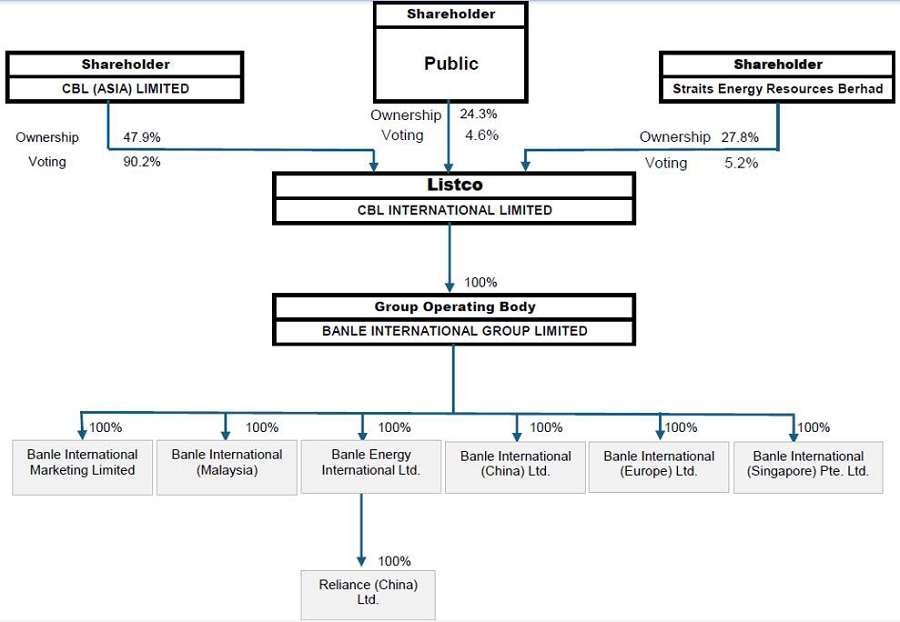
| (1) | CBL (Asia) Limited is a limited liability company incorporated in Hong Kong which is owned as to 51% by Dr. Teck Lim Chia, our Chairman and Chief Executive Officer, 44% by Dr. Xiaoling Lu and 5% by Mr. Yuan He, our Director. |
| (2) | Straits Energy Resources Berhad, or Straits, is a Malaysian company whose shares are listed on the ACE Market of Bursa Malaysia Securities Berhad (stock code: 0080). |
4.D. Property, plants and equipment
We do not own any real property, and we rent the following leased properties from independent third parties for our operations:
| Property Address | Use of the property | Term | ||
| Rm 3602-03A, 36/F, Skyline Tower, 39 Wang Kwong Road, Kowloon Bay, Hong Kong | Office | October 7, 2025 to October 6, 2027 | ||
| Level 23-2, Menara Permata Sapura, Kuala Lumpur City Centre, 50088 Kuala Lumpur, Malaysia | Office | August 1, 2023 to July 31, 2026 (3 years renewal term) | ||
| Room No. 4, No. 1–23A, First Floor, Paragon, Jalan Mustapha, 87000, Labuan, Malaysia | Office | January 1, 2026 to June 30, 2026 with automatic renewal until we give notice to end the lease term. | ||
| 3rd Floor, Ulysses House, Foley Street, Dublin 1 | Office | January 1, 2026 to December 31, 2026 | ||
| 7 Temasek Boulevard, #08-07 Suntec Tower One, Singapore 038987 | Office | February 15, 2026 to February 14, 2027 |
|
|
| ITEM 4E. | UNRESOLVED STAFF COMMENTS |
None.
| ITEM 5. | OPERATING AND FINANCIAL REVIEW AND PROSPECTS |
You should read the following discussion and analysis of the Group’s financial condition and results of operations in conjunction with the Group’s consolidated financial statements and the related notes included elsewhere in this annual report. This discussion may contain forward-looking statements based upon current expectations that involve risks and uncertainties. The Group’s actual results may differ materially from those anticipated in these forward-looking statements as a result of various factors, including those set forth under “Item 3. Key Information — 3.D. Risk Factors” or in other parts of this annual report.
5.A. Operating Results
Business Overview
We are a marine fuel logistics provider specializing in bunkering services across strategic global ports. Previously focused on container liners, we have broadened our customer base to include bulk carriers and tankers, thereby diversifying revenue. We operate in fossil fuel and sustainable fuel markets with a presence across Asia Pacific, Europe, Australia, Africa, and Central America.
Core Competitive Advantages
Our primary competitive strengths stem from our extensive global network and ability to deliver comprehensive, one-stop refuelling solutions. As a single point of contact, we manage all facets of the bunkering process, including supplier negotiations, delivery coordination, and quality assurance, to provide customers with operational efficiency and reliability.
As of April 2026, our geographic reach has expanded to over 70 key maritime ports across five continents, covering major global trade routes, including Trans-Pacific and Euro-Asia corridors. Long-standing supplier relationships secure competitive fuel pricing, favorable credit terms, and consistent supply reliability. We also maintain a rigorous compliance framework, with thorough supplier due diligence to ensure adherence to evolving environmental regulations and industry standards.
Growth Strategy
Our growth strategy focuses on expanding our port network, driving higher sales volumes, and integrating sustainable fuel offerings. We prioritize further penetration in high-growth regions, particularly the Asia Pacific, while pursuing opportunities in Europe and other strategic bunkering markets.
Amid increasingly stringent environmental regulations from bodies such as the IMO and EU, we actively diversify our product portfolio to sustainable fuels including biofuels, LNG, green methanol, ammonia and hydrogen, positioning ourselves to meet customer demand for lower-emission alternatives. By leveraging economies of scale, optimizing procurement processes, and adapting to industry shifts, we seek to strengthen financial performance and ensure long-term resilience.
Service Network Expansion
In the fiscal year 2025, we significantly expanded our service network. We doubled our port coverage from 36 locations at the time of our IPO to over 70 ports as of April 2026. This expansion strengthened our ability to meet customer preferences across key global trade routes. Demand for bunkering services continued to be heavily influenced by the operational routes of our core customers, the leading international container liner operators, who predominantly selected ports based on voyage efficiency and throughput capacity.
|
|
A substantial portion of services delivered in fiscal year 2025 was in Chinese ports, driven primarily by customer demand. China hosts seven of the world’s top ten container ports by throughput as ranked in 2024, making these locations frequent choices for international liners seeking optimal scheduling and cost efficiency. Our long-standing relationships with local suppliers in these high-volume hubs enabled reliable and competitive service execution, aligning closely with customer requirements.
Global trade patterns also shaped performance. U.S. tariffs contributed to a decline in the value of China’s exports to the U.S., while exports from China to the EU rose by approximately 8% in 2025 compared to 2024. This redirection increased bunkering demand in European ports, where our established presence allowed us to capture additional volume from existing international liner customers, supporting strong regional revenue growth.
Our operations are based in Malaysia, Hong Kong, Singapore and Ireland. All of our transactions for vessel refueling services were concluded, and revenue was booked, under our subsidiaries established in Malaysia, Hong Kong and Singapore. Our five largest customers from whom we generated 70.3% of our total revenue for the year ended December 31, 2023, consisted of two Taiwanese companies, one Irish company, one Singaporean company and one Malaysian company; for the year ended December 31, 2024, the five largest customers who contributed 67.2% in the aggregate of our total revenue consisted of two Taiwanese companies, one Malaysian company, one Hong Kong company and one Irish company; for the year ended December 31, 2025, the five largest customers who contributed 60.0% in the aggregate of our total revenue consisted of two Taiwanese companies, one Malaysian company, one French company and one Irish company.
Our European expansion focused on strengthening cross-regional service offerings for Euro–Asia trade routes. Growth was supported by a stronger presence in the Amsterdam-Rotterdam-Antwerp. Further expansion into Australia in late 2025, Mauritius and Panama in 2024 marked our entry into Australia, Africa and Central America, while the July 2024 inaugural bunkering service at Mundra Port, Gujarat, India positioned us within an emerging bunkering hub.
We continued our customer diversification efforts, reducing sole dependence on container liners. The sales concentration among our top five customers declined in fiscal year 2025. At the same time, revenue from the top 12 global container liner customers grew year over year, driven by the addition of new clients and higher sales to existing clients in this ranking. These developments demonstrate our ability to mitigate risks and strengthen our competitive position in the global shipping industry.
Increase in Sales Volume
Despite an 8.0% year-on-year increase in sales volume, our revenue declined 9.1% year-on-year, primarily due to lower global oil prices. According to the U.S. Energy Information Administration, the annual average crude oil price decreased 16.9% year-on-year, while the Brent crude spot price fell 14.1% year-on-year. Prices for bunker fuels across various categories followed a similar downward trend. This volume growth was driven by strategic network expansion, successful acquisition of new customers, and deeper penetration of services with existing customers.
As of December 31, 2025, we served nine of the world’s top 12 container shipping lines, which together account for nearly 60% of global container fleet capacity. Our growing customer base and broadened service portfolio have further solidified our competitive position in the marine fuel logistics market.
Sustainable Fuels Supply & Sustainability Efforts
We continued expanding our biofuel operations, securing ISCC EU and ISCC Plus certifications in early 2023. Biofuel sales volume increased by 7.1% year-on-year, reflecting growing market demand.
We maintained our B24 biofuel bunkering services available in key ports, including Hong Kong, Port Klang in Malaysia, Nansha, Singapore, Shekou and Yantian. The B24 blend, comprising 76% conventional fuel and 24% UCOME (used cooking oil methyl ester), provides approximately 20% reduction in greenhouse gas emissions compared to traditional marine fuels.
|
|
In December 2025, we facilitated Xiaomo Port’s inaugural LNG bunkering operation, supporting a vessel operated by a major electric vehicle manufacturer in collaboration with a Chinese national energy supplier. This marked our initial entry into LNG supply services, complementing our existing biofuel portfolio and aligning with broader industry efforts to adopt cleaner marine energy sources.
On the sustainability front, we were awarded the EcoVadis Silver Medal in December 2025, placing us among the top 15% of assessed organizations globally for performance across environment, labor and human rights, ethics, and sustainable procurement.
We continue to monitor developments in alternative fuels such as LNG, methanol, and other low-emission options to support compliance with evolving regulatory requirements, including FuelEU Maritime and IMO targets.
Information Technology and Automation
We have upgraded our back-end systems, implementing real-time order tracking, data analytics, and workflow automation to streamline operations. While our current IT strategy focuses on internal process improvements, we have deployed resources to explore AI applications for future automation and decision-making enhancements.
Credit Risk Management
We have strengthened our credit risk assessment framework, integrating data-driven analytics to monitor supplier and customer payment histories, market fluctuations, and transactional behaviors. These measures enhance proactive risk mitigation and financial stability.
Working Capital Management
We optimized our cash cycle, accounts receivable days, and accounts payable days, improving liquidity and operational efficiency. As of December 31, 2025, our factoring facilities increased compared to the previous fiscal year, alongside a higher cash balance, reflecting strengthened liquidity and financial flexibility. Additionally, we expanded our funding sources by accessing capital markets, such as private placement and at-the-market offering, increasing financial flexibility to support growth initiatives.
Private Placement
In August 2024, we raised $1.375 million through a private placement of its ordinary shares to fund network expansion and sustainable fuel projects, in alignment with its sustainability strategy.
Shelf Registration Statement
We filed a shelf registration statement on January 10, 2025, which became effective on January 24, 2025. The aggregate initial offering price of the securities that we may offer and sell will not exceed $50,000,000.
At-the-Market Offering
We filed an at-the-market (ATM) offering on February 28, 2025, with an aggregate offering price of up to $2,604,166. We intend to use the net proceeds we receive from the sale of our ordinary shares for general corporate purposes, which may include acquisitions and other business opportunities and the repayment of indebtedness. Our management will have broad discretion to allocate the net proceeds of the offerings.
Share Repurchase Program
On June 3, 2025, our board of directors authorized a share repurchase program under which the Company may repurchase up to $5 million of its outstanding ordinary shares in the open market or through privately negotiated transactions within a three-year period, in compliance with applicable laws and regulations. This program reflects our board’s confidence in the Company’s long-term growth prospects and commitment to enhancing shareholder value.
|
|
During the year ended December 31, 2025, we repurchased 52,175 Class B Ordinary Shares under this share repurchase program at an average price of $0.9364 per share, for a total consideration of approximately $48,857. The repurchased shares are held as treasury shares and are available for general corporate purposes.
Macroeconomic Environment
Geopolitical Tensions & Market Impacts
During the fiscal year ended December 31, 2025, the global maritime industry faced ongoing volatility driven by persistent geopolitical tensions and supply chain disruptions. The Red Sea crisis, originating in late 2023, continued throughout much of 2025, with Houthi attacks on commercial vessels prompting widespread rerouting around the Cape of Good Hope. This added 10 to14 days to Asia-Europe voyages, significantly increasing fuel consumption, voyage distances, and operational costs for container liners and bulk carriers. Although attacks diminished toward year-end amid diplomatic efforts and a fragile regional ceasefire, shipping traffic through the Suez Canal and Bab al-Mandab Strait remained below pre-crisis levels, with many operators maintaining cautious rerouting policies into early 2026.
Broader Middle East instability, including escalated US-Iran conflicts and other regional conflicts, contributed to elevated insurance premiums, heightened security risks, and intermittent threats of renewed disruptions. These factors particularly affected Euro-Asia routes, a core trade lane for many of our international container liner customers, leading to surged freight rates and shifted bunkering demand toward alternative ports in Asia-Pacific (e.g., Singapore, Port Klang) and diversion hubs like Mauritius and Cape Town.
Additional pressures emerged from US-China trade tensions and new tariff regimes, which reshaped Trans-Pacific and Inter-Asia flows, while South China Sea territorial disputes added navigational uncertainty for regional routes. The Russia-Ukraine conflict persisted, influencing energy markets and European fuel sourcing diversification.
According to UN Trade and Development forecast, these dynamics contributed to fragile global maritime trade, with seaborne volumes growing only 0.5% in 2025 following 2.2% expansion in 2024. According to Clarkson’s Research, seaborne volumes grew by 1.1%, which is approximately half of 2024 but still better than experts expected.
Oil prices declined notably amid oversupply and softer demand. The annual average Brent crude price fell 14.1% year-on-year to around $69 per barrel, while global crude benchmarks declined by about 16.8%. Bunker fuel prices followed this downward trend, providing some cost relief but introducing pricing volatility that pressured margins. In this environment, we faced competitive pricing pressures but mitigated risk through strategic network optimization, including enhanced services at high-demand Asia-Pacific ports and support for customers on affected routes.
The containerized trade sector showed resilience in segments, with estimates of 3% to 4% growth despite overall maritime slowdowns, supported by supply chain diversification and intra-Asia trade. With reference to China’s export data, the value of Chinese exports to ASEAN increased by 13.4% year-on-year in 2025. Serving nine of the world’s top 12 container shipping lines, which collectively represents nearly 60% of global fleet capacity, we adapted by maintaining reliable bunkering in key Asia-Pacific hubs and select European ports, ensuring continuity amid evolving trade patterns.
Biofuel and Sustainable Fuel Markets
The maritime industry’s transition toward sustainable fuels continued to progress in 2025, supported by increasingly stringent environmental regulations. Key drivers included the IMO’s 2023 GHG Strategy (targeting at least a 40% reduction in carbon intensity by 2030), the full implementation of the EU Emissions Trading System (EU ETS) for maritime transport from January 2025, and the FuelEU Maritime regulation, which introduced penalties and incentives to encourage the use of lower-emission fuels.
These frameworks accelerated interest in low-carbon alternatives, including increased orders for dual-fuel vessels capable of running on LNG, methanol, ammonia, and other options. However, adoption rates fluctuated throughout the year due to economic factors.
|
|
We experienced strong biofuel demand in the first half of 2025, with sales volume surging 154.7% year-on-year, reflecting initial enthusiasm following regulatory changes and robust market interest. In the second half of 2025, particularly the final quarter, biofuel demand moderated considerably. This trend was evident industry-wide, as illustrated by data from Singapore—the world’s largest bunkering port—where biofuel sales recorded year-on-year declines of approximately 58%, 50.4%, and 14.5% in the last three months of the year.
MEPC 83 approved the IMO Net-Zero Framework only in principle, creating regulatory limbo because formal adoption and key details on compliance rules, values and mechanisms were postponed by 12 months to October 2026. This uncertainty triggered widespread wait-and-see behaviour among ship operators, charterers, and bunker suppliers, directly causing a sharp drop in biofuel bunker demand in later part of 2025.
The inaugural LNG bunkering operation we completed at the end of 2025 marked an initial step into LNG services, diversifying our sustainable fuel portfolio beyond biofuels and aligning with growing interest in LNG as a transitional lower-emission option.
We remain committed to monitoring developments in alternative fuels, including LNG, methanol, and others, to support customer needs and compliance with evolving regulations such as CII, EU ETS, and IMO targets. While short-term demand for certain sustainable fuels may vary with market conditions, the long-term trajectory toward decarbonization provides opportunities for continued expansion in this segment.
Results of Operations
The following table provides a summary of our consolidated results of operations for the periods indicated:
| For the Years Ended December 31, | ||||||||||||
| 2025 | 2024 | 2023 | ||||||||||
| Revenue | $ | 538,490,000 | $ | 592,518,000 | $ | 435,898,000 | ||||||
| Cost of revenue | 534,018,000 | 587,143,000 | 428,687,000 | |||||||||
| Gross profit | 4,472,000 | 5,375,000 | 7,211,000 | |||||||||
| Operating expenses: | ||||||||||||
| Selling and distribution | 1,596,000 | 2,706,000 | 1,242,000 | |||||||||
| General and administrative | 5,309,000 | 5,997,000 | 4,307,000 | |||||||||
| Total operating costs and expenses | 6,905,000 | 8,702,000 | 5,549,000 | |||||||||
| (Loss)/Income from operations | (2,433,000 | ) | (3,328,000 | ) | 1,662,000 | |||||||
| Other (income) expense: | ||||||||||||
| Interest expense, net | 744,000 | 571,000 | 232,000 | |||||||||
| Currency exchange loss | 33,000 | 4,000 | (1,700 | ) | ||||||||
| Write off of property, plant and equipment | 1,000 | - | 600 | |||||||||
| Other income, net | (222,000 | ) | (1,500 | ) | - | |||||||
| Total other expenses | 557,000 | 573,000 | 231,000 | |||||||||
| (Loss)/Income before provision for income taxes | (2,990,000 | ) | (3,901,000 | ) | 1,431,000 | |||||||
| Write-back for income taxes | (400 | ) | (29,000 | ) | 299,000 | |||||||
| Net (Loss)/Income | $ | (2,989,000 | ) | $ | (3,871,000 | ) | $ | 1,133,000 | ||||
| Basic and diluted earnings per ordinary share | $ | (0.108 | ) | $ | (0.136 | ) | $ | 0.045 | ||||
Revenue. Our consolidated revenue decreased by 9.1%, or US$54,028,000, to US$538,490,000 for the year ended December 31, 2025, from US$592,518,000 for the year ended December 31, 2024. Although sales volume increased by 8.0% year-on-year, the revenue decline was primarily attributable to lower global bunker fuel prices. Volume growth was supported by increased demand from existing customers, the addition of new customers, expansion of our supply network, and diversification of our customer base to include bulk carriers and oil and gas tankers in addition to container liner operators. This growth was further facilitated by sufficient financial resources, enabling larger fuel purchases to meet rising demand.
|
|
Gross profit. Consolidated gross profit decreased by US$903,000, or 16.8%, to US$4,472,000 for the year ended December 31, 2025. The decline was primarily driven by lower gross profit per metric ton, resulting from reduced premiums charged to customers amid a competitive and volatile market. Heightened price sensitivity, which is exacerbated by Red Sea disruptions and associated shifts in shipping patterns, prompted us to adopt more competitive pricing to sustain volume growth and strengthen market position. These effects were partially offset by the higher sales volume.
We expanded our supply network to over 70 ports as of April 2026 and broadened our customer base. While the focus on volume impacted short-term margins, our strategy is designed to deliver long-term benefits through economies of scale. By increasing order volumes and enhancing procurement leverage in key ports, we anticipate improved unit costs and gross margins over time, particularly as market conditions stabilize.
Operating Expenses. Consolidated operating expenses decreased by US$1,797,000, or 20.7%, to US$6,905,000 for the year ended December 31, 2025, from approximately US$8,702,000 for the year ended December 31, 2024.
Selling and distribution expenses declined by 41.0% to approximately US$1.6 million from US$2.7 million, reflecting streamlined operations and lower variable costs. General and administrative expenses decreased by 11.5% to US$5,309,000 from US$5,997,000.
These substantial reductions were achieved through rigorous group-wide cost-control measures implemented in 2025, underscoring management’s commitment to operational efficiency and the recovery of profitability. We intend to maintain these disciplined practices into 2026 and beyond.
Other Expenses, net. For the year ended December 31, 2025, we incurred net non-operating expenses of approximately $557,000, compared to net non-operating expense of approximately $573,000 for the year ended December 31, 2024. The marginal decrease of approximately US$16,000 was mainly attributable to approximately 30% increase in net interest expenses, which was in line with the increase in sales revenue given that more account receivables had been sold to the bank under the account receivable purchase facilities offset by an increase of other income by approximately US$221,000 in current year.
Income Taxes. For the year ended December 31, 2025, we recorded a write-back of income taxes of approximately $400, as compared to that of $29,000 for the year ended December 31, 2024, primarily due to the pre-tax loss incurred during the period.
We reported a net loss of US$2,989,000 for the year ended December 31, 2025, compared to a net loss of US$3,871,000 for the year ended December 31, 2024, which represented an improvement of US$882,000, or 22.8%.
The reduced loss was primarily attributable to a substantial decrease in operating expenses, achieved through rigorous group-wide cost-control measures implemented throughout 2025. These initiatives underscore our management’s commitment to improving operational efficiency and position us for a return to profitability in the near term.
Against a backdrop of ongoing geopolitical tensions that intensified industry competition, we adopted competitive pricing strategies, including reduced premiums, to sustain sales volume growth and preserve market share. While these measures contributed to lower gross margins in 2025, we view this pressure as transitory. As market conditions normalize, our expanded customer relationships, diversified portfolio, and increased scale are expected to support a recovery in gross margins, complemented by higher sales volume.
In parallel, we continued to prioritize loss reduction through disciplined cost management, with particular focus on selling and administrative expenses, including reductions in travel and third-party service fees. Certain strategic expenditures were maintained to support network expansion, exploration of sustainable fuels, and ESG initiatives, reflecting our ongoing commitment to the maritime energy transition. Higher interest expenses, resulting from increased utilization of bank facilities, also impacted the bottom line.
|
|
Overall, these financial results illustrate the dynamic challenges of the bunkering sector while demonstrating our proactive steps to strengthen its long-term competitive positioning as industry conditions stabilize.
Future Uses of Liquidity
Cash is primarily used to fund working capital to support our operations. As of December 31, 2025, our contractual obligations were as follows (in thousands):
| Current | Non-current | Total | ||||||||||
| Operating lease obligations | $ | 125 | $ | 71 | $ | 196 | ||||||
| Derivatives obligations | - | - | - | |||||||||
| Total | $ | 125 | $ | 71 | $ | 196 | ||||||
Apart from trade payables and borrowings from bank, the Company did not enter into any other debt arrangement during 2025. The current portion of the above obligations were those due within twelve months. The non-current portion were those due beyond twelve months. As of December 31, 2025, the Company did not have any obligations with due dates beyond 24 months.
We enter into lease arrangements for the use of offices for our operations. See Note 12. Finance and Operating Leases for additional information.
We are structured in such a way that in all material aspects, we are not directly exposed to commodity price risk or market price volatility. This is primarily due to the nature that the majority of our contractual agreements incorporate a pass-through mechanism for price fluctuations. Specifically, our contracts include an add-on pricing structure, whereby any increase in market prices is passed on to the customer, and any decrease in market prices results in a corresponding reduction in the price charged to the customer. As a result, we do not bear the risk associated with volatile bunker prices, as these fluctuations are directly reflected in the pricing terms agreed upon with our customers. However, in certain circumstances when there are mismatches in our buy and sell terms and arrangements, under which we will be exposed to market price risks, we will then utilize derivatives as instruments to effectively neutralize the exposure in market price risk.
As part of our risk management program, we enter derivative instruments intended to mitigate risks associated with changes in commodity prices. Our obligations associated with these derivative instruments fluctuate based on changes in the fair value of the derivatives. See Note 4. Derivative Instruments and Note 2G. Fair Value Measurements for additional information. There was no contractual obligation incurred during the year of 2025 and no outstanding obligations as of December 31, 2025 other than those disclosed above.
From time to time, we fix purchase commitments associated with our risk management program, as well as a purchase contract with our suppliers, under which we agreed to purchase a certain quantity of marine fuel at future market prices. As of December 31, 2025, we entered into such purchase agreements with suppliers. See Note 8. Commitments and Contingencies for additional information.
Capital Expenditures. During the year ended December 31, 2025, we incurred minor capital expenditures in the ordinary course of business of approximately $2,600, the majority of which comprises office equipment and computer software.
Cash Flows
The following table reflects the major categories of cash flows. For additional details, please see the Consolidated Statements of Cash Flows.
| For the Years Ended December 31, | ||||||||||||
| 2025 | 2024 | 2023 | ||||||||||
| Net cash provided by/(used in) operating activities | $ | 3,996,000 | $ | (1,943,000 | ) | $ | (10,033,000 | ) | ||||
| Net cash used in investing activities | (3,000 | ) | (144,000 | ) | (774,000 | ) | ||||||
| Net cash provided by financing activities | 483,000 | 2,706,000 | 13,177,000 | |||||||||
|
|
Operating Activities. Net cash provided by operating activities was $3,996,000 for the year ended December 31, 2025, compared to net cash used in operating activities of $1,943,000 for the year ended December 31, 2024, representing an increase of $5,939,000 in net cash inflow used in operating activities. The increase in net cash used in operating activities was primarily due to the following:
| a) | The change in accounts receivable was approximately $2,338,000 net cash outflow for the year ended December 31, 2025 as compared to approximately $11,554,000 net cash outflow for the year ended December 31, 2024, resulting in an increase in net cash provided by operating activities approximately $9,216,000. The decrease in net cash inflow related to accounts receivable was mainly attributable to lower credit sales in FY2025 and a longer average collection period compared to FY2024. |
| b) | The change in prepayments and other current assets was approximately $264,000 net cash outflow for the year ended December 31, 2025. For the year ended December 31, 2024, change in prepayments and other current assets was approximately $3,768,000 net cash outflow, resulting in a decrease in net cash used in operating activities in the amount of approximately $3,504,000. The decrease was primarily due to reduced prepayments made to suppliers in FY2025 compared to FY2024. |
| c) | The change in accounts payable was approximately $10,683,000 net cash inflow for the year ended December 31, 2025. For the year ended December 31, 2024, the change in accounts payable was approximately $14,554,000 net cash inflow, resulting in a decrease in net cash inflow provided by operating activities in the amount of approximately $3,871,000 as compared on a year-on-year basis. The decrease was mainly attributable to the opening of new supplier accounts with credit lines in 2025, which increased our purchasing capacity and reduced the relative cash flow from accounts payable compared to the prior year. |
| d) | The change in accrued expenses and other liabilities was $1,816,000 net cash outflow for the year ended December 31, 2025. For the year ended December 31, 2024, it was $2,619,000 net cash inflow, resulting in an increase in net cash outflow of approximately $4,435,000 as compared on a year-on-year basis. The increase was mainly attributable to the payments received from accounts receivable already sold to the bank which were supposed to be utilized by the bank to settle the advances drawn but had not yet been utilized has been reclassified from accrued expenses to set off against accounts receivable in year 2025. |
Investing Activities. Net cash used in investing activities of $3,000 for the year ended December 31, 2025, compared to net cash used in investing activities of US$144,000 for the year ended December 31, 2024.
Financing Activities. The change in financing activities was approximately $483,000 net cash inflow for the year ended December 31, 2025 as compared to preceding year of approximately $2,706,000 net cash inflow, resulting in a decrease in net cash provided by financing activities in the amount of approximately $2,223,000 as compared on a year-on-year basis, which is mainly due to our issuance of 2,500,000 Ordinary Shares of par value $0.0001 per share through a private placement to an investor at a price of $0.55 per share in 2024. In return, we received gross proceeds of approximately $1,375,000 in placement and higher advances drawn down from the banks approximately $828,000 in 2024. In 2025, our net cash provided by financing activities comprised mainly of advance drawn down from banks and share repurchased during the period.
5.B. Liquidity and Capital Resources
Liquidity to fund working capital is a significant priority for the Group’s bunker business. Our views concerning liquidity are based on currently available information and if circumstances change significantly, the future availability of trade credit or other sources of financing may be reduced, and our liquidity would be adversely affected accordingly. The major working capital items as of December 31, 2025 and 2024 are as follows:
| 2025 | 2024 | |||||||
| Current assets: | ||||||||
| Accounts receivable | $ | 39,017,000 | $ | 36,680,000 | ||||
| Prepayments and other current assets | 23,350,000 | 23,086,000 | ||||||
| 62,367,000 | 59,765,000 | |||||||
| Current liabilities: | ||||||||
| Accounts payable | 52,690,000 | 42,007,000 | ||||||
| Accrued expenses and other liabilities | 986,000 | 2,963,000 | ||||||
| Bank borrowing | 1,893,000 | 1,361,000 | ||||||
| 55,569,000 | 46,331,000 | |||||||
|
|
| a) | The accounts receivable increased by $2,338,000 during the year ended December 31, 2025, mainly attributable to higher average collection period in current year as compared to preceding year. |
| b) | The prepayments and other current assets increased by $264,000 in the year ended December 31, 2025 mainly due to $1.4 million increase in advances paid to suppliers under factoring arrangements, partially set off by $1.2 million repayment of deposits paid to suppliers as collateral in return for credit terms. |
| c) | The accounts payable increased by $10,683,000 in the year ended December 31, 2025, mainly attributable to higher purchases from trade creditors in FY2025 compared to FY2024. |
| d) | The accrued expenses and other liabilities decreased by $1,977,000 during the year ended December 31, 2025. The decrease was mainly attributable to the payments received from accounts receivable already sold to the bank which were supposed to be utilized by the bank to settle the advances drawn but yet have been utilized. Such amount was recorded under other liabilities in FY2024. |
| e) | The increase in bank borrowings of $533,000 for the year ended December 31, 2025 was attributable to the Company’s utilization of expanded credit facilities provided by financial institutions. |
Sources of Liquidity and Factors Impacting Our Liquidity
Our primary sources of liquidity are internally generated cash from operations combined with trade credit terms provided by suppliers, banking facilities and the capital market. Liquidity fluctuates based on several factors, including the timing of customer receipts and supplier payments, changes in fuel prices, our overall financial performance, and conditions of the capital markets.
Our working capital requirements are highly dependent on the availability of cash, bank facilities, and supplier trade credit to meet working capital needs. In the event of any adverse conditions in credit or capital markets, including volatility or weakness in global energy markets, our ability to obtain funds on favourable terms could be limited. Additionally, any actual or perceived deterioration in our liquidity or financial condition could lead suppliers to reduce available trade credit or impose less favourable payment terms, which would materially adversely affect our liquidity.
High fuel prices can strain liquidity in several ways. Customers may reach their credit limits with us sooner, reducing their purchases and increasing the risk of delayed or uncollectible payments. Simultaneously, our own working capital requirements increase, and suppliers may impose tighter credit limits or require prepayments, potentially restricting our ability to purchase sufficient fuel to meet customer demand.
Conversely, extended periods of low fuel prices, particularly with low volatility, generally have a positive effect on liquidity by reducing working capital needs for the same volume of business.
Receivables Purchase Agreements. We maintain non-recourse receivables purchase agreements with two banks and a financial institution. These agreements allow us to sell eligible accounts receivable for immediate cash, subject to predetermined limits agreed with each bank and institution. Each counterparty retains discretion to accept or reject individual customers based on its risk assessment of our customers’ credit rating.
General loan facility. We have a recourse general banking facility with a commercial bank that provides short-term financing for working capital. The facility supports pre-shipment loans (to fund supplier payments before goods are shipped), post-shipment loans, and a limited overdraft facility, subject to the bank’s approval and the overall facility limit. All borrowings under this facility are on a recourse basis.
We manage our capital structure to ensure our ability to continue as a going concern while maximizing the return to stakeholders through the optimization of the balance between debt and equity.
We review our capital structure on an ongoing basis. As part of this review, our directors consider the cost of capital, and the risks associated with each class of capital. We balance our overall capital structure through various means, such as issuance of new shares, payment of dividends, and the issue of new debt or the repayment of existing debt.
|
|
Our management and board of directors regularly review the capital structure, considering the cost of capital and risks associated with each component. We may adjust our capital structure through the issuance of new equity, payment of dividends, issuance of new debt, or repayment of existing debt, as appropriate.
In 2025, we issued 327 Class B Ordinary Shares with a par value of $0.0001 per share through our at-the-market offering program at an average price of $0.94 per share, generating gross proceeds of $307. During the same period, we repurchased 52,175 shares in the open market at an average price of $0.94 per share, for a total cost of $48,857. These repurchases were funded from existing cash reserves and reduced our cash balance by a corresponding amount.
In 2024, we issued 2,500,000 Ordinary Shares with a par value of $0.0001 per share in a private placement at $0.55 per share, generating gross proceeds of $1,375,000.
We believe that our cash and cash equivalents as of December 31, 2025 and available funds from our credit facilities, together with cash flow generated by operations, are sufficient to fund our working capital and capital expenditure requirements for at least the next twelve months. We may raise further funds from the capital market as needed from time to time.
5.C. Research and Development, Patent and Licenses, etc.
Not applicable. The Company has not undertaken any Research and Development activities in the past three years.
5.D. Trend Information
Other than as disclosed elsewhere in this annual report, we are not aware of any trends, uncertainties, demands, commitments or events for the year ended December 31, 2025 that are reasonably likely to have a material effect on our total net revenues, income, profitability, liquidity or capital reserves, or that caused the disclosed financial information to be not necessarily indicative of future operating results or financial conditions.
5.E. Critical Accounting Estimates
Our consolidated financial statements are prepared in accordance with accounting principles generally accepted in the United States of America (“U.S. GAAP”). The preparation of consolidated financial statements in conformity with U.S. GAAP requires the Company to make certain estimates and assumptions that affect the amounts reported and disclosed in the consolidated financial statements and related notes. The most significant estimates and judgments include the allowance for doubtful accounts, useful life of property, plant and equipment, income taxes and uncertain tax positions. Actual amounts could differ from those estimates.
Our significant accounting policies are set forth in note 2 to our audited consolidated financial statements included in this annual report.
| ITEM 6. | DIRECTORS, SENIOR MANAGEMENT AND EMPLOYEES |
6.A. Directors and Senior Management
The following table sets forth certain information regarding our directors and senior management as of the date of this annual report.
| Directors
and Senior Management |
Age | Position | Director
Since |
Term
Expires in the Annual Meeting held in the Year |
Director Class |
|||||
| Dr. Teck Lim Chia | 58 | Chairman, Chief Executive Officer & Acting Chief Financial Officer | 22 Mar 2023 | 2027 | II | |||||
| Mr. Logeswaran Ramasamy | 53 | Vice President, Director | 22 Mar 2023 | 2028 | III | |||||
| Mr. Yuan He | 44 | Senior Vice President, Director | 1 Dec 2025 | 2026 | I | |||||
| Ms. Karen Yee Lynn Cheah | 57 | Independent Director | 22 Mar 2023 | 2028 | III | |||||
| Mr. Koon Liang Ong | 47 | Independent Director | 22 Mar 2023 | 2027 | II | |||||
| Mr. Khai Fei Wong | 44 | Independent Director | 22 Mar 2023 | 2027 | II | |||||
| Mr. Chi Kwan Fung | 66 | Vice President, Assistant Chief Financial Officer | - | - | - |
|
|
Dr. Teck Lim Chia, aged 58, is the chairman of our board of directors, chief executive officer since inception of our Group, and is primarily responsible for overseeing the strategy and decision making of our Group. He has over 20 years of experience in the oil and gas related industries and business management. Before founding our Group, Dr. Chia was employed by BrightOil Group, a company based in Shenzhen, PRC which was principally engaged in the fuel oil business from April 2006 to June 2008, with his last position held as general director. From June 2008 to September 2011, he served as an executive director of BrightOil Group’s listing company on the Hong Kong Stock Exchange and undertook the role of developing the company’s international business network. From October 2011 to January 2017, Dr. Chia served as a director of an oil trading company. Dr. Chia received a bachelor’s degree in business administration management from Oklahoma State University in December 1988 and a master’s degree in public administration from the University of Management & Technology in June 2012. Dr. Chia further pursued his academic enhancement by completing a Doctorate in Business Administration from the University of Management and Technology in 2025.
As the former Chief Financial Officer stepped down from the position on December 31, 2024 and retired on February 14, 2025, Dr. Chia is the Acting Chief Financial Officer of the Group until the Group identifies a suitable candidate for the position.
We believe that Dr. Chia qualifies as a director because he is the founder of our Group and has extensive experience in the industry.
Mr. Logeswaran Ramasamy, aged 53, has been appointed as our director on March 22, 2023, and is primarily responsible for the overall operations and management of Banle Marketing, and market development in the Southeast Asia region. Mr. Ramasamy joined our Group in October 2020. Mr. Ramasamy graduated from the Northern University of Malaysia (University Utara Malaysia) with a bachelor’s degree in business administration in July 1997. From September 1997 to March 1998, he worked as a management trainee at Aurora Tankers Sdn. Bhd. From April 1998 to April 2002, he served at KL Maritime (M) Sdn. Bhd., with his last position held as head of shipbroking operation. From March 2003 to May 2004, he was a shipbroker at EverGreen Milestone Sdn. Bhd. From June 2004 to February 2006, he was a shipbroker at Nautica Chartering Sdn. Bhd. From March 2006 to March 2015, he was the chief operating officer at KIC Oil & Gas Sdn. Bhd. Since June 2015, he served as a director of KL Bunkering (M) Sdn. Bhd.
We believe that Mr. Ramasamy qualifies as a director because of his extensive experience in the industry.
Mr. Yuan He, aged 44, has been appointed as our director on December 1, 2025, and is the senior vice president of our Group since the inception of our Group in 2015. He is primarily responsible for bunkering the business division and the Group’s management and strategic development. Mr. He has over 20 years of experience in the oil and gas-related industries and business management. He obtained a bachelor’s degree in engineering in July 2003 and a master’s degree in science from the University of Wollongong in Australia in July 2005.
We believe that Mr. He qualifies as a director because of his extensive experience in the industry.
Ms. Karen Yee Lynn Cheah, aged 57, has been appointed as our independent director, the chairperson of the nominating and corporate governance committee, and a member of the audit committee and compensation committee on March 22, 2023. Ms. Cheah is an advocate and solicitor in Malaysia and has over 30 years of practice experience in the legal field. She was admitted to the Malaysian Bar in 1995 and commenced full practice since then. Ms. Cheah’s current primary focus is on information technology and data privacy, mergers & acquisition, regulatory compliance, foreign direct investments, corporate and commercial contracts, real estate transactions, banking and finance, private wealth management, and non-contentious tax areas. Ms. Cheah was the Honorary Secretary and Treasurer of the Malaysian Bar from 2013 to 2017. Ms. Cheah had served 2 terms as the President of the Malaysian Bar and chairman of the Malaysian Bar Council for terms of 2022/2023 and 2023/2024. She is the Immediate Past President of the Malaysian Bar and a member of the Bar Council for the term 2024/2025. She obtained a bachelor’s degree in laws from the University of London in 1993 and the Malaysian Certificate in Legal Practice in 1994.
We believe that Ms. Cheah qualifies as a director because of her extensive experience in regulatory compliance.
|
|
Mr. Koon Liang Ong, aged 47, has been appointed as our independent director and the chairman of the audit committee and a member of the compensation committee on March 22, 2023, and a member of the nominating and corporate governance committee on March 5, 2026. Mr. Ong has over 24 years of experience in providing auditing, taxation, liquidation and other assurance services to companies in Malaysia. He joined Ong & Wong Chartered Accountants in September 2000 as a junior associate and is currently an audit partner of the firm. Mr. Ong has served as a director of O & W Tax Consultants Sdn. Bhd. since April 2013 up to the present. Mr. Ong has been a member of the Association of Chartered Certified Accountant in Malaysia since July 2004, a member of the Malaysian Institute of Accountants since August 2005, an approved auditor of the Ministry of Finance Malaysia since February 2013 and a member of the Chartered Tax Institute of Malaysia since March 2014. Mr. Ong graduated from the University of Manchester in June 2000 with a bachelor of arts in economic and social studies (major in accounting).
We believe that Mr. Ong qualifies as a director because of his extensive experience in financial compliance.
Mr. Khai Fei Wong, aged 44, has been appointed as our independent director, and a member of the audit committee and nominating and corporate governance committee on March 22, 2023, and the chairman of the compensation committee on March 5, 2026. Mr. Wong has over 16 years of experience in auditing, taxation and corporate secretarial matters. He began his professional career in June 2008 with Indah Secretarial (KL) Sdn Bhd (formerly known as Cheng & Co Secretarial Sdn Bhd) as a secretarial assistant. In July 2013, Mr. Wong set up a corporate secretarial firm which principally provides corporate secretarial, dissolution and tax advisory services. Mr. Wong has been a manager of a Malaysian Taxation Service Firm since 2020. Mr. Wong has been a licensed company secretary of the Companies Commission of Malaysia since July 2014, an associate member of the Chartered Tax Institute of Malaysia since October 2020 and a licensed tax agent of the Inland Revenue Board of Malaysia since December 2021. Mr. Wong graduated from The University of Sheffield in July 2003 with a bachelor’s degree in arts.
We believe that Mr. Wong qualifies as a director because of his extensive experience in financial compliance.
Mr. Chi Kwan Fung, aged 66, has been appointed the assistant chief financial officer of our Group on January 1, 2025. Mr. Fung is primarily responsible for overseeing the financial operations and management of our Group. He has more than 19 years of experience in finance and accounting. Mr. Fung joined our group as Financial Controller in 2022 and before joining our Group, he was the executive director, chief financial officer, and company secretary of Hans Energy Company Limited from June 2005 to February 2017, a company listed on the Hong Kong Stock Exchange (stock code: 554). Mr. Fung obtained a bachelor’s degree in commerce from the University of Toronto in Canada in November 1983. He was admitted as a fellow of the HKICPA in December 1997 and an associate of the Institute of Chartered Accountants in England and Wales in April 2005 and is currently a member of the HKICPA.
Board Diversity
Our Company was listed on the Nasdaq on March 23, 2023. The table below provides certain information regarding the diversity of our board of directors as of December 31, 2025 and the date of this annual report.
| Board Diversity Matrix | |
| Country of Principal Executive Office | Malaysia |
| Foreign Private Issuer | Yes |
| Disclosure Prohibited Under Home Country Law | No |
| Total Number of Directors | 6 |
| Part I: Gender Identity | Female | Male | Non-Binary | Did Not Disclose Gender |
| 1 | 5 | 0 | 0 |
As at the date of this report, the number of Directors who are male and female are five and one, respectively.
|
|
Family Relationships
There are no family relationships among any of our directors or executive officers.
6.B. Compensation
During the year ended December 31, 2025, we paid $1,545,095, in the aggregate, to our executive officers, directors and senior management. During the year ended December 31, 2024, we paid $1,681,871, in the aggregate, to our executive officers, directors and senior management. During the year ended December 31, 2023, we paid $1,500,634, in the aggregate, to our executive officers, directors and senior management. In addition to annual retainers and meeting fees, directors are entitled to certain perquisites, including reimbursement for two private club memberships. Private club memberships are primarily used for business development. The total value of these benefits provided to directors during the fiscal year of 2025 was $7,518. We have not set aside or accrued any amount to provide pension, retirement, or other similar benefits to our directors and executive officers.
6.C. Board Practices
Term of Office
Pursuant to our amended memorandum and articles of association, our board of directors is divided into three classes, with the directors in each class serving staggered three-year terms. The term of the Class I directors expires at the annual general meeting of shareholders to be held in 2026, the term of the Class II directors expires at the annual general meeting to be held in 2027, and the term of the Class III directors expires at the annual general meeting to be held in 2028.
Directors are elected at annual general meetings as their respective terms expire. All directors were re-elected at the 2023 annual general meeting, three directors were re-elected at the 2024 annual general meeting, and two directors were re-elected at the 2025 annual general meeting. The Company currently has three classes of directors with the following members:
| ● | Class I: Mr. He | |
| ● | Class II: Dr. Chia, Mr. Ong, and Mr. Wong | |
| ● | Class III: Ms. Cheah and Mr. Ramasamy |
Mr. He was appointed as a director on December 1, 2025, to fill the vacancy created by Dato’ Sri Kam Choy Ho’s resignation in September 2025. Pursuant to our amended articles of association, any director appointed by the board retires at the next annual general meeting following his or her appointment but is eligible to stand for election by shareholders at that meeting. Accordingly, Mr. He will retire at, and stand for election at, the 2026 annual general meeting.
Our executive officers and senior management are appointed by, and serve at the discretion of, the board of directors.
Pursuant to their respective director agreements, our directors serve until their successors are duly elected or appointed and qualified, or until their earlier death, resignation, disqualification, or removal, in each case in accordance with the terms of the applicable director agreement, our memorandum and articles of association (as amended from time to time), and any applicable laws, rules, or regulations.
Executive Officer Employment Agreements with our Chief Executive Officer and Assistant Chief Financial Officer
The Chief Executive Officer, Dr. Chia and the Assistant Chief Financial Officer, Mr. Fung are employed by the Company pursuant to standard forms of Executive Officer Employment Agreements. Dr. Chia’s and Mr. Fung’s Executive Officer Employment Agreements are dated March 22, 2023 and January 1, 2025, respectively. Under the Executive Officer Employment Agreements, Dr. Chia and Mr. Fung receive a monthly base salary. The Executive Officer Employment Agreements may be terminated upon the Director’s earlier death, disqualification, resignation or removal from office, pursuant to the Company’s then-current memorandum and articles of association, as may be amended from time to time, or any applicable laws, rules, or regulations.
None of the Executive Officer Employment Agreements provides for benefits upon termination of employment of our executive officers.
|
|
Senior Management Agreements
The Chief Executive Officer, Dr. Chia, and the Vice President, Mr. Fung, are employed by Banle International Group Limited. The Senior Vice President, Mr. He, is employed by Banle Energy International Limited, while the Vice President, Mr. Ramasamy, is employed by Banle International Marketing Limited. All senior management are engaged under standardized Employment Agreements. Under these agreements, senior management receives a monthly base salary and an incentive bonus tied to both individual performance and the Company’s overall performance, with bonus payments subject to the Company’s sole discretion. The Employment Agreements are open-ended and either party may terminate the agreement by providing two months’ written notice.
None of the Employment Agreements provides for benefits upon termination of employment of our senior management.
Directors Agreements
On March 22, 2023, we entered into Director Agreements (the “Director Agreements”) with each of our directors using our standard form of agreement. The term of each such appointment is stated in the abovementioned “Term of Office”.
Each of our directors received a monthly remuneration of $2,500 commencing March 22, 2023 till December 31, 2023. As approved by the Compensation Committee, such monthly remuneration was increased to $2,600 in 2024 and was increased to $2,700 with effect from January 1, 2025. None of the Director Agreements provides for benefits upon termination of the appointment of our directors. The Directors Agreements do not provide additional compensation to committee members or chairs.
Board Meetings
There were altogether 6 board meetings held in 2025.
The following table shows the attendance of directors at meetings of the Board during the year ended December 31, 2025.
| Name of Director | Number of Meetings attended | |
| Directors: | ||
| Dr. Teck Lim Chia | 6/6 | |
| Mr. Logeswaran Ramasamy | 6/6 | |
| Dato’ Sri Kam Choy Ho* | 5/6 | |
| Yuan He** | 0/6 | |
| Independent Directors: | ||
| Mr. Ulf Lothar Naujeck*** | 5/6 | |
| Ms. Karen Yee Lynn Cheah | 5/6 | |
| Mr. Koon Liang Ong | 6/6 | |
| Mr. Khai Fei Wong | 6/6 |
Notes:
* Mr. Ho did not attend the sixth board meeting as such meeting was held after his resignation had taken effect.
** Mr. He did not attend any board meetings during 2025 as he was appointed on December 1, 2025, and no board meeting was held after his appointment.
*** Mr. Naujeck resigned from the Board effective February 2026.
Committees of the Board
We have established and will maintain three committees under the board of directors: an audit committee, a compensation committee, and a nominating and corporate governance committee. We have adopted the charter for each of the three committees. Each committee’s members and functions are described below.
|
|
Audit Committee
Our audit committee consists of Mr. Ong, Ms. Cheah and Mr. Wong and is chaired by Mr. Ong. We have determined that each of these 3 directors satisfies the “independence” requirements of the Nasdaq Listing Rules and meet the independence standards under Rule 10A-3 under the Securities Exchange Act of 1934, as amended. We have determined that Mr. Ong qualifies as an “audit committee financial expert.” The audit committee oversees our accounting and financial reporting processes and the audits of our financial statements. The audit committee is responsible for, among other things:
| ● | appointing or replacing the independent registered public accounting firm; determining the compensation and oversight of the work of the independent registered public accounting firm for the purpose of preparing or issuing an audit report or related work with the independent registered public accounting firm reporting directly to the audit committee; |
| ● | pre-approving all auditing and non-auditing services permitted to be performed by the independent registered public accounting firm; |
| ● | meeting with the independent registered public accounting firm prior to the audit to review the scope, planning and staffing of the audit; |
| ● | reviewing and discussing with management and the independent registered public accounting firm the annual audit report, the financial statements and related notes and Management’s Discussion and Analysis of Financial Condition and Results of Operations, and recommending to the board whether they should be included in the Annual Report on Form 20-F; |
| ● | reviewing and approving all proposed related party transactions, as defined in Item 404 of Regulation S-K under the Securities Act; |
| ● | discussing significant financial reporting issues and judgments with management and the independent registered public accounting firm; |
| ● | reviewing the adequacy and effectiveness of our accounting and internal control policies and procedures and any special steps taken to monitor and control major financial risk exposures; |
| ● | discussing with the independent registered public accounting firm matters required by applicable Public Company Accounting Oversight Board standards, including any audit difficulties, restrictions, or disagreements with management; |
| ● | reviewing disclosures made to the audit committee by the Company’s Chief Executive Officer and Chief Financial Officer during their certification process for the Form 20-F about any significant deficiencies and material weaknesses in the design or operation of internal control over financial reporting and any fraud involving management or other employees who have a significant role in the Company’s internal control over financial reporting; |
| ● | obtaining and reviewing at least on annual basis, a report from the independent registered public accounting firm, consistent with the rules of the Public Company Accounting Oversight Board; |
| ● | annually reviewing and reassessing the adequacy of our audit committee charter; |
| ● | inquiring and discussing with management the Company’s compliance with applicable laws and regulations and with the Company’s Code of Ethics in effect at such time, if any, and, where applicable, recommend policies and procedures for future compliance; |
| ● | discussing with management and the independent registered public accounting firm any correspondence with regulators or governmental agencies and any published reports that raise material issues regarding the Company’s financial statements or accounting policies; |
| ● | meeting separately and periodically with management and the independent registered public accounting firm; |
| ● | monitoring compliance with our code of business conduct and ethics, including reviewing the adequacy and effectiveness of our procedures to ensure proper compliance; and |
| ● | reporting regularly to the board. |
|
|
There were altogether 2 Audit Committee meetings held in 2025.
The following table shows the attendance of directors at meetings of the Audit Committee during the year ended December 31, 2025.
| Name of Director | Number of Meetings attended | |
| Independent Directors: | ||
| Mr. Koon Liang Ong | 2/2 | |
| Ms. Karen Yee Lynn Cheah | 2/2 | |
| Mr. Khai Fei Wong | 2/2 |
Compensation Committee
Our compensation committee consists of Mr. Wong, Mr. Ong and Ms. Cheah and is chaired by Mr. Khai Fei Wong. We have determined that each of these directors satisfies the “independence” requirements of the Nasdaq Listing Rules. The compensation committee assists the board in reviewing and approving the compensation structure, including all forms of compensation, relating to our directors and executive officers. Our executive officers may not be present at any committee meeting during which their compensation is deliberated upon. The compensation committee is responsible for, among other things:
| ● | establishing, reviewing and approving the overall executive compensation philosophy and policies of the Company, including the establishment that supports and reinforces the Company’s long-term strategic goals, organizational objectives, and shareholder interests; | |
| ● | reviewing and approving the Company’s goals and objectives relevant to the compensation of the chief executive officer and other executive officers, or recommending to the board for its approval, the compensation for our chief executive officer and other executive officers; | |
| ● | reviewing and recommending to the board for determination with respect to the compensation of our non-employee directors; | |
| ● | overseeing shareholder communications relating to executive compensation and reviewing and making recommendations with respect to shareholder proposals related to compensation matters; | |
| ● | reviewing periodically and approving any incentive compensation or equity plans, programs or other similar arrangements; | |
| ● | selecting compensation consultant, legal counsel or other adviser of the Compensation Committee only after taking into consideration all factors relevant to that person’s independence from management; and | |
| ● | undertaking such other responsibilities or tasks as the board may delegate or assign to the Committee from time to time. |
There were altogether 2 Compensation Committee meetings held in 2025.
|
|
The following table shows the attendance of directors at the meetings of the Compensation Committee during the year ended December 31, 2025.
| Name of Director | Number of Meetings attended | |
| Independent Directors: | ||
| Mr. Ulf Lothar Naujeck* | 2/2 | |
| Ms. Karen Yee Lynn Cheah | 2/2 | |
| Mr. Koon Liang Ong | 2/2 | |
| Mr. Khai Fei Wong** | 0/2 |
Notes:
* Mr. Naujeck resigned from the Board effective February 2026, which resulted in his ceasing to serve as the chairman of the Compensation Committee of the Board. Mr. Naujeck attended the two Compensation Committee meetings before his resignation.
** Mr. Wong did not attend any Compensation Committee meetings during 2025 as he was appointed in March 2026.
Nominating and Corporate Governance Committee
Our nominating and corporate governance committee consists of Ms. Cheah, Mr. Ong and Mr. Wong and is chaired by Ms. Cheah. We have determined that each of these directors satisfies the “independence” requirements of the Nasdaq Listing Rules. The nominating and corporate governance committee assists the board in selecting individuals qualified to become our directors and in determining the composition of the board and its committees. The nominating and corporate governance committee is responsible for, among other things:
| ● | developing the criteria and qualifications for membership on the Board; | |
| ● | recommending nominees to the board for election or re-election to the board, or for appointment to fill any vacancy on the board; | |
| ● | reviewing annually with the board the current composition of the board with regards to characteristics such as independence, knowledge, skills, experience, expertise, diversity and availability of service to us; | |
| ● | selecting and recommending to the board the names of directors to serve as members of the audit committee and the compensation committee, as well as of the nominating and corporate governance committee itself; | |
| ● | developing and reviewing the corporate governance principles adopted by the board and advising the board with respect to significant developments in the law and practice of corporate governance and our compliance with such laws and practices; | |
| ● | evaluating the performance and effectiveness of the board as a whole; | |
| ● | performing any other activities consistent with this charter, the Company’s Bylaws and governing laws, as the Committee or the Board deems appropriate; | |
| ● | reporting to the Board each year concerning its compliance with this charter for inclusion in the Company’s proxy statement; | |
| ● | overseeing our ESG strategy, ensuring alignment with business objectives and stakeholder expectations while promoting integration of ESG practices and initiatives; | |
| ● | reviewing ESG performance, implements the working groups’ Terms of Reference, and reports significant ESG issues to the Board annually, making recommendations as needed; and | |
| ● | periodically reviewing and assessing the adequacy of this charter and recommending any proposed changes to the Board for approval. |
There were altogether 3 Nominating and Corporate Governance Committee meetings held in 2025.
|
|
The following table shows the attendance of directors at the meetings of the Nominating and Corporate Governance Committee during the year ended December 31, 2025.
| Name of Director | Number of Meetings attended | |
| Independent Directors: | ||
| Ms. Karen Yee Lynn Cheah | 3/3 | |
| Mr. Ulf Lothar Naujeck* | 3/3 | |
| Mr. Khai Fei Wong | 3/3 | |
| Mr. Koon Liang Ong** | 0/3 |
Notes:
* Mr. Naujeck resigned from the Board effective February 2026, which resulted in his ceasing to serve as the member of the Nominating and Corporate Governance Committee of the Board. Mr. Naujeck attended the three Nominating and Corporate Governance Committee meetings before his resignation.
** Mr. Ong did not attend any Nominating and Corporate Governance Committee meetings during 2025 as he was appointed in March 2026.
Foreign Private Issuer Exemption
We are a “foreign private issuer,” as defined by the SEC. In accordance with the rules and regulations of Nasdaq, we may choose to comply with home country governance requirements and certain exemptions thereunder rather than complying with Nasdaq corporate governance standards. We may choose to take advantage of the following exemptions afforded to foreign private issuers:
| ● | Exemption from filing quarterly reports on Form 10-Q, from filing proxy solicitation materials on Schedule 14A or 14C in connection with annual or special meetings of shareholders, or from providing current reports on Form 8-K disclosing significant events within four (4) days of their occurrence, and from the disclosure requirements of Regulation FD. | |
| ● | Exemption from Section 16 rules regarding sales of Ordinary Shares by insiders, which will provide less data in this regard than shareholders of U.S. companies that are subject to the Exchange Act. | |
| ● | Exemption from the Nasdaq rules applicable to domestic issuers requiring disclosure within four (4) business days of any determination to grant a waiver of the code of business conduct and ethics to directors and officers. Although we will require board approval of any such waiver, we may choose not to disclose the waiver in the manner set forth in the Nasdaq rules, as permitted by the foreign private issuer exemption. |
Furthermore, Nasdaq Rule 5615(a)(3) provides that a foreign private issuer, such as us, may rely on our home country corporate governance practices in lieu of certain of the rules in the Nasdaq Rule 5600 Series and Rule 5250(d), provided that we nevertheless comply with Nasdaq’s Notification of Non-compliance requirement (Rule 5625), the Voting Rights requirement (Rule 5640) and that we have an audit committee that satisfies Rule 5605(c)(3), consisting of committee members that meet the independence requirements of Rule 5605(c)(2)(A)(ii). If we rely on our home country corporate governance practices in lieu of certain of the rules of Nasdaq, our shareholders may not have the same protections afforded to shareholders of companies that are subject to all of the corporate governance requirements of Nasdaq. If we choose to do so, we may utilize these exemptions for as long as we continue to qualify as a foreign private issuer.
Although we are permitted to follow certain corporate governance rules that conform to Cayman Islands requirements in lieu of many of the Nasdaq corporate governance rules, we intend to comply with the Nasdaq corporate governance rules applicable to foreign private issuers, including the requirement to hold annual meetings of shareholders.
|
|
Duties of Directors
Under Cayman Islands law, our board of directors has the powers necessary for managing, and for directing and supervising, our business affairs. The functions and powers of our board of directors include, among others:
| ● | convening shareholders’ annual and extraordinary general meetings and reporting its work to shareholders at such meetings; | |
| ● | declaring dividends and distributions; |
| ● | appointing officers and determining the term of office of the officers; | |
| ● | exercising the borrowing powers of our Company and mortgaging the property of our Company; and | |
| ● | approving the transfer of shares in our Company, including the registration of such shares in our share register. |
Under Cayman Islands law, our directors owe fiduciary duties to our company, including (i) duty to act in good faith in what the director or officer believes to be in the best interests of the company as a whole; (ii) duty to exercise powers for the purposes for which those powers were conferred and not for a collateral purpose; (iii) directors should not improperly fetter the exercise of future discretion; (iv) duty to exercise powers fairly as between different sections of shareholders; (v) duty to exercise independent judgment; and (vi) duty not to put themselves in a position in which there is a conflict between their duty to the company and their personal interests. Our directors also owe to our company a duty to act with skill and care. It was previously considered that a director need not exhibit in the performance of his duties a greater degree of skill than may reasonably be expected from a person of his knowledge and experience. However, English and Commonwealth courts have moved towards an objective standard with regard to the required skill and care and these authorities are likely to be followed in the Cayman Islands. In fulfilling their duty of care to us, our directors must ensure compliance with our memorandum and articles of association, as amended and restated from time to time.
Equity Compensation Plan Information
We have not adopted any equity compensation plans.
Outstanding Equity Awards at Fiscal Year-End
As of December 31, 2025, we had no outstanding equity awards.
6.D. Employees
As of December 31, 2025, we maintained 37 employees primarily stationed in Hong Kong, Malaysia, Singapore, South Korea and China as follows:
| Hong Kong | Malaysia | Singapore | South Korea | China | |||||||
| Management | 3 | 2 | - | - | - | ||||||
| Finance | 5 | 3 | - | - | - | ||||||
| Bunkering | 3 | 4 | 2 | 1 | 1 | ||||||
| IR & PR | 2 | - | - | - | - | ||||||
| Corporate | 4 | - | - | - | - | ||||||
| Administration | 5 | 2 | - | - | |||||||
| Total | 22 | 11 | 2 | 1 | 1 |
|
|
6.E. Share Ownership
The following table sets forth, as of the date of this report, the beneficial ownership of our Class A Ordinary Shares and Class B Ordinary Shares by each executive officer and director, by each person known by us to beneficially own more than 5% of our ordinary shares and by the executive officers and directors as a group. Except as otherwise indicated, all shares are owned directly and the percentage shown is based on 13,175,000 Class A Ordinary Shares and 14,325,327 Class B Ordinary Shares issued and outstanding. Beneficial ownership is determined in accordance with the rules of the SEC and includes voting or investment power with respect to, or the power to receive the economic benefit of ownership of, the securities. In computing the number of shares beneficially owned by a person and the percentage ownership of that person, we have included shares that the person has the right to acquire within 60 days, including through the exercise of any option or other right or the conversion of any other security. However, these shares are not included in the computation of the percentage ownership of any other person.
| Ordinary Shares Beneficially Owned | Percentage of Total Voting |
|||||||||||||||||||
| Class A | Class B | Power* | ||||||||||||||||||
|
Number of Shares |
% |
Number of Shares |
% | % |
||||||||||||||||
| Directors and Executive Officers | ||||||||||||||||||||
| Teck Lim Chia(1) | 13,175,000 | 100.0 | – | – | 90.2 | |||||||||||||||
| Logeswaran Ramasamy | – | – | – | – | – | |||||||||||||||
| Karen Yee Lynn Cheah | – | – | – | – | – | |||||||||||||||
| Koon Liang Ong | – | – | – | – | – | |||||||||||||||
| Khai Fei Wong | – | – | – | – | – | |||||||||||||||
| Chi Kwan Fung | – | – | – | – | – | |||||||||||||||
| Yuan He(1) | – | – | – | – | – | |||||||||||||||
| All directors and executive officers as a group | 13,175,000 | 100.0 | – | – | 90.2 | |||||||||||||||
| 5% and Greater Principal Shareholders(3): | ||||||||||||||||||||
| CBL (Asia) Limited(1) | 13,175,000 | 100.0 | – | – | 90.2 | |||||||||||||||
| Straits Energy Resources Berhad(2) | – | – | 7,644,588 | 52.5 | 5.2 | |||||||||||||||
| Xiaoling Lu(1) | 13,175,000 | 100.0 | – | – | 90.2 | |||||||||||||||
| Asian Strategy Limited(4) | – | – | 1,534,984 | 10.5 | 1.1 | |||||||||||||||
Notes:
| * | Represents the voting power with respect to all of our Class A Ordinary Shares and Class B Ordinary Shares, voting as a single class. Each holder of Class A Ordinary Shares is entitled to ten votes per one Class A Ordinary Share and each holder of Class B Ordinary Shares is entitled to one vote per one Class B Ordinary Share. |
| (1) | CBL (Asia) Limited, or CBL (Asia), a limited liability company incorporated in Hong Kong, is the record holder of the shares reported herein. CBL (Asia) is owned as to 51% by Dr. Teck Lim Chia, our Chairman, Chief Executive Officer and Acting Chief Financial Officer, 44% by Dr. Xiaoling Lu and 5% by Mr. Yuan He. By virtue of Dr. Chia and Dr. Lu’s control over CBL (Asia), each of them may be deemed to beneficially own shares held by CBL (Asia). The registered office of CBL (Asia) is located at Room 1213, 12/F., Tower A, Hunghom Commercial Centre, 39 Ma Tau Wai Road, Hunghom, Kowloon, Hong Kong. |
| (2) | Straits Energy Resources Berhad, or Straits, a Malaysian company whose shares are listed on the ACE Market of Bursa Malaysia Securities Berhad (stock code: 0080), is the record holder and beneficial owner of the shares reported herein. The registered office of Straits is located at No. 149A, 149B, 151B, Persiaran Raja Muda Musa, 42000 Port Klang, Selangor Darul Ehsan. Straits’ board of directors has voting and/or dispositive control over the shares held by Straits. Each of the directors and the board of directors of Straits disclaims beneficial ownership of the shares of the Company held by Straits. |
| (3) | 5% and greater shareholders have the same voting rights with respect to the stock they own as the rest of the company’s shareholders. |
| (4) | Asian Strategy Limited, a Hong Kong company, is the record holder and beneficial owner of the shares reported herein. Qu Zhiqiang, who is the sole director and Managing Director of Asian Strategy, has sole voting and/or dispositive control over the shares held by Asian Strategy by virtue of his status as the sole director and Managing Director of Asian Strategy. Mr. Qu disclaims beneficial ownership of the ordinary shares of CBL held by Asian Strategy. Their business address is 24/F, Prosperous Commercial Building, 54-58 Jardine’s Bazaar, Causeway Bay, Hong Kong. |
As of the date of this report, CBL (Asia) controls a significant ownership interest of the Company and will be able to exercise approximately 90.2% of the total voting power of the Company’s issued and outstanding share capital. The Company is not directly or indirectly owned or controlled by any foreign government. We are not aware of any arrangement that may, at a subsequent date, result in a change of control of our Company.
|
|
6.F. Disclosure of a Registrant’s Action to Recover Erroneously Awarded Compensation
The board of directors believes that it is in the best interests of the Company and its shareholders to create and maintain a culture that emphasizes integrity and accountability and that reinforces the Company’s pay-for-performance compensation philosophy. Accordingly, the Clawback Policy was adopted by the board of directors of the Company in the board meeting dated November 6, 2023, providing for the recoupment of certain executive compensation in the event of an accounting restatement resulting from material noncompliance with financial reporting requirements under the federal securities laws.
According to the Clawback Policy,
| ● | The Policy shall be administered by the Board. |
| ● | The Covered Executives include the Company’s current and former executive officers, such other senior executives/employees of the Company as well as those of the Company’s key subsidiaries. |
| ● | The Board will require reimbursement or forfeiture of any excess Incentive Compensation received by any Covered Executive when the Company is required to prepare an accounting restatement. |
| ● | The amount to be received will be the excess of the Incentive Compensation paid to the Covered Executive based on the erroneous data over the Incentive Compensation that would have been paid to the Covered Executive had it been based on the restated results, as determined by the Board. |
| ● | The Board will determine the method for recouping Incentive Compensation including but not limited to reimbursement of cash. |
| ● | The Company shall not indemnify any Covered Executives against the loss of any incorrectly awarded Incentive Compensation. |
| ITEM 7. | MAJOR SHAREHOLDERS AND RELATED PARTY TRANSACTIONS |
7.A. Major Shareholders
See “Item 6. Directors, Senior Management and Employees—E. Share Ownership.”
7.B. Related Party Transactions
During our preceding three financial years up to the date of this report, there have been no transactions or loans between the company and (a) enterprises that directly or indirectly through one or more intermediaries, control or are controlled by, or are under common control with, the company; (b) associates; (c) individuals owning, directly or indirectly, an interest in the voting power of the company that gives them significant influence over the company, and close members of any such individual’s family; (d) key management personnel, that is, those persons having authority and responsibility for planning, directing and controlling the activities of the company, including directors and senior management of companies and close members of such individuals’ families; and (e) enterprises in which a substantial interest in the voting power is owned, directly or indirectly, by any person described in (c) or (d) or over which such a person is able to exercise significant influence.
7.C. Interests of Experts and Counsels
Not applicable.
| ITEM 8. | FINANCIAL INFORMATION |
8.A. Consolidated Statements and Other Financial Information
We have appended consolidated financial statements filed as part of this annual report.
8.B. Significant Changes
No significant change has occurred since the date of our consolidated financial statements filed as part of this annual report.
|
|
| ITEM 9. | THE OFFER AND LISTING |
9.A. Offer and Listing Details
Our ordinary shares are listed on the Nasdaq Capital Market under the symbol “BANL,” and began trading on March 23, 2023.
9.B. Plan of Distribution
Not applicable.
9.C. Markets
See our disclosures above under “9.A. Offer and Listing Details.”
9.D. Selling Shareholders
Not applicable.
9.E. Dilution
Not applicable.
9.F. Expenses of the Issue
Not applicable.
| ITEM 10. | ADDITIONAL INFORMATION |
10.A. Share Capital
As of the date of this annual report, our company’s authorized share capital is $50,000 divided into (a) 30,000,000 Class A Ordinary Shares, par value US$0.0001 per share and (b) 470,000,000 Class B Ordinary Shares, par value US$0.0001 per share. As of the date of this report, 27,500,327 ordinary shares are issued and outstanding, including 13,175,000 Class A Ordinary Shares and 14,325,327 Class B Ordinary Shares. All of our issued and outstanding ordinary shares are fully paid.
10.B. Memorandum and Articles of Association
We are a Cayman Islands exempted company and our affairs are governed by our memorandum and articles of association, as amended from time to time, and the Companies Act (As Revised) of the Cayman Islands, which we refer to as the Companies Act below, and the common law of the Cayman Islands.
We incorporate by reference into this annual report our Second Amended and Restated Articles of Association, the form of which was included as Exhibit 1.2 to the Form 6-K (File No. 001-41657) we furnished to the Securities and Exchange Commission on November 26, 2025. Our shareholders adopted our Second Amended and Restated Articles of Association by special resolution on November 26, 2025.
|
|
10.C. Material Contracts
For the two years immediately preceding the date of this report, we have not entered into any material contracts other than in the ordinary course of business and other than those described below and in Item 6 “Directors, Senior Management and Employees,” Item 7 “Major Shareholders and Related Party Transactions,” or filed (or incorporated by reference) as exhibits to this annual report or otherwise described or referenced in this annual report.
10.D. Exchange Controls
Cayman Islands Exchange Controls
There are no exchange control restrictions in the Cayman Islands. Our Company is free to acquire, hold and sell foreign currency and securities without restriction.
Malaysia Exchange Controls
We operate in Malaysia under a Labuan company, Labuan International Business and Financial Centre (Labuan IBFC) operates under a liberal exchange control regime distinct from mainland Malaysia, which allows Labuan companies to transact freely in foreign currencies.
10.E. Taxation
Cayman Islands Taxation
The Cayman Islands currently levies no taxes on individuals or corporations based upon profits, income, gains or appreciation and there is no taxation in the nature of inheritance tax or estate duty. There are no other taxes likely to be material to the Company or its shareholders levied by the government of the Cayman Islands except for stamp duties which may be applicable on instruments executed in, or brought within Cayman Islands. The Cayman Islands is a party to a double tax treaty entered into with the United Kingdom in 2010 but otherwise is not party to any double tax treaties.
There are no exchange control regulations or currency restrictions in the Cayman Islands.
Hong Kong Taxation
The taxation of income and capital gains of holders of ordinary shares is subject to the laws and practices of Hong Kong and of jurisdictions in which holders of ordinary shares are resident or otherwise subject to tax. The following summary of certain relevant taxation provisions under Hong Kong law is based on current law and practice, is subject to changes therein and does not constitute legal or tax advice. The discussion does not deal with all possible tax consequences relating to an investment in the ordinary shares. Accordingly, each prospective investor (particularly those subject to special tax rules, such as banks, dealers, insurance companies and tax-exempt entities) should consult its own tax advisor regarding the tax consequences of an investment in the ordinary shares. The discussion is based upon laws and relevant interpretations thereof in effect as of the date of this report, all of which are subject to change. There is no reciprocal tax treaty in effect between Hong Kong and the United States.
Tax on Dividends
Under the current practices of the Hong Kong Inland Revenue Department, no tax is payable in Hong Kong in respect of dividends paid by us as a company incorporated in Cayman Islands.
Profits Tax
No tax is imposed in Hong Kong in respect of capital gains from the sale of shares. Trading gains from the sale of shares by persons carrying on a trade, profession or business in Hong Kong where such gains are derived from or arise in Hong Kong from such trade, profession or business will be chargeable to Hong Kong profits tax, which is currently imposed at the rate of 16.5% and 15% on corporations and unincorporated businesses, respectively, and at a maximum rate of 15% on individuals. Liability for Hong Kong profits tax may thus arise in respect of trading gains from sales of shares realized by persons carrying on a business or trading or dealing in securities in Hong Kong.
|
|
Malaysia Taxation
Income Tax Act 1967
Pursuant to Section 3 of the Income Tax Act 1967 (“ITA 1967”), income tax shall be charged for each year of assessment upon the income of any person accruing in or derived from Malaysia or received in Malaysia from outside Malaysia. Section 7 of ITA 1967 defines tax resident, amongst others, as an individual who has been residing in Malaysia for 182 days or more of the tax year.
Section 8 of the ITA 1967 provides that a company will be regarded as a tax resident in Malaysia for a basis year, if at any time during the basis year, the management and control of business are exercised in Malaysia.
According to Schedule 1 of the ITA 1967, resident companies with a paid-up capital of RM2,500,000 or more and non-resident companies are subject to a tax rate of 24% with effect from the year of assessment 2020. In cases of resident companies with a paid-up capital of less than RM2,500,000 and gross business income of not more than RM50,000,000, they are taxed at the rate of 15% for the first RM150,000, 17% on the next RM450,000 and 24% for any sum in excess of RM600,000.
Withholding Tax
Malaysia imposes a withholding tax on certain payments to non-residents under sections 109 and 109B of the ITA 1967, including, without limitation, royalties, technical fees, installation fees and rental of movable property. The rate of withholding tax is generally between 10% and 15% unless there is a double-taxation agreement between Malaysia and the country of the non-resident, in which case, the withholding tax rate may be reduced.
Taxes on Dividends
Presently, there is no further income tax on dividends received from a Malaysian company. Tax imposed on the Company’s profits will be the final tax and dividends distributed to the shareholders will not be subject to further tax. However, Part XXII of Schedule 1 of the ITA 1967 provides that a 2% income tax will be imposed on individuals for dividend income exceeding RM100,000, effective from the year of assessment 2025.
U.S. Federal Income Taxation
General
The following is a summary of the material U.S. federal income tax consequences of owning and disposing of our ordinary shares. The discussion below of the U.S. federal income tax consequences to “U.S. Holders” will apply to a beneficial owner of our shares that is for U.S. federal income tax purposes:
| 1. | an individual citizen or resident of the U.S.; | |
| 2. | a corporation (or other entity treated as a corporation) that is created or organized (or treated as created or organized) in or under the laws of the U.S., any state thereof or the District of Columbia; | |
| 3. | an estate whose income is includible in gross income for U.S. federal income tax purposes regardless of its source; or | |
| 4. | a trust if: | |
| a) | a U.S. court can exercise primary supervision over the trust’s administration and one or more U.S. persons are authorized to control all substantial decisions of the trust; or | |
| b) | it has a valid election in effect under applicable U.S. Treasury regulations to be treated as a U.S. person. | |
|
|
If a beneficial owner of our shares is not described as a U.S. Holder and is not an entity treated as a partnership or other pass-through entity for U.S. federal income tax purposes, such owner will be considered a “Non-U.S. Holder.” The U.S. federal income tax consequences applicable specifically to non-U.S. Holders is described below under the heading “Tax Consequences to Non-U.S. Holders of Ordinary Shares.”
This summary is based on the Internal Revenue Code of 1986, as amended, or the Code, its legislative history, existing and proposed Treasury regulations promulgated thereunder, published rulings and court decisions, all as currently in effect. These authorities are subject to change or different interpretations, possibly on a retroactive basis.
This discussion does not address all aspects of U.S. federal income taxation that may be relevant to us or to any particular Holder of our shares based on such Holder’s individual circumstances. In particular, this discussion considers only Holders that own our shares as capital assets within the meaning of Section 1221 of the Code. This discussion also does not address the potential application of the alternative minimum tax or the U.S. federal income tax consequences to Holders that are subject to special rules, including:
| 1. | financial institutions or financial services entities; | |
| 2. | broker-dealers; | |
| 3. | taxpayers who have elected mark-to-market accounting; | |
| 4. | tax-exempt entities; | |
| 5. | governments or agencies or instrumentalities thereof; | |
| 6. | insurance companies; | |
| 7. | regulated investment companies; | |
| 8. | real estate investment trusts; | |
| 9. | certain expatriates or former long-term residents of the U.S.; | |
| 10. | persons that actually or constructively own 5% or more of our voting shares; | |
| 11. | persons that acquired our shares pursuant to the exercise of employee stock options, in connection with employee stock incentive plans or otherwise as compensation; | |
| 12. | persons that hold our shares as part of a straddle, constructive sale, hedging, conversion or other integrated transaction; or | |
| 13. | persons whose functional currency is not the U.S. Dollars. |
This discussion does not address any aspect of U.S. federal non-income tax laws, such as gift or estate tax laws, or state, local or non-U.S. tax laws. Additionally, this discussion does not consider the tax treatment of partnerships or other pass-through entities or persons who hold our securities through such entities. If a partnership (or other entity classified as a partnership for U.S. federal income tax purposes) is the beneficial owner of our shares, the U.S. federal income tax treatment of a partner in the partnership will generally depend on the status of the partner and the activities of the partnership. This discussion also assumes that any distribution made (or deemed made) regarding our shares and any consideration received (or deemed received) by a Holder connected with selling or other disposition of such shares will be in U.S. Dollars.
We have not sought, and will not seek, a ruling from the Internal Revenue Service (the “IRS”), or an opinion of counsel as to any U.S. federal income tax consequence described herein. The IRS may disagree with one or more aspects of the discussion herein, and its determination may be upheld by a court. Moreover, there can be no assurance that future legislation, regulations, administrative rulings or court decisions will not adversely affect the accuracy of the statements in this discussion.
|
|
BECAUSE OF THE COMPLEXITY OF THE TAX LAWS AND BECAUSE THE TAX CONSEQUENCES TO THE COMPANY OR TO ANY PARTICULAR HOLDER OF OUR SECURITIES MAY BE AFFECTED BY MATTERS NOT DISCUSSED HEREIN, EACH HOLDER OF OUR SECURITIES IS URGED TO CONSULT WITH ITS TAX ADVISOR REGARDING THE SPECIFIC TAX CONSEQUENCES OF THE OWNERSHIP AND DISPOSITION OF OUR SECURITIES, INCLUDING THE APPLICABILITY AND EFFECT OF STATE, LOCAL AND NON-U.S. TAX LAWS, AS WELL AS U.S. FEDERAL TAX LAWS AND APPLICABLE TAX TREATIES.
Tax Consequences to U.S. Holders of Ordinary Shares
Taxation of Distributions Paid on Ordinary Shares
Subject to the passive foreign investment company, or PFIC, rules discussed below, a U.S. Holder generally will be required to include in gross income as ordinary income the amount of any cash dividend paid on our ordinary shares. A cash distribution on such shares will be treated as a dividend for U.S. federal income tax purposes to the extent the distribution is paid out of our current or accumulated earnings and profits (as determined for U.S. federal income tax purposes). Such dividend will not be eligible for the dividends-received deduction generally allowed to domestic corporations regarding dividends received from other domestic corporations. Any distributions in excess of such earnings and profits generally will be applied against and reduce the U.S. Holder’s basis in its ordinary shares and, to the extent in excess of such basis, will be treated as gain from the sale or exchange of such ordinary shares.
Non-corporate U.S. Holders of our Ordinary Shares should expect that dividends may be taxed at the lower applicable long-term capital gains rate (see “— Taxation on the Disposition of Ordinary Shares” below) provided that:
| 1. | We are not a PFIC, as discussed below, for either the taxable year in which the dividend was paid or the preceding taxable year; and |
| 2. | certain holding period requirements are met. Under the Code, long-term capital gains recognized by non-corporate U.S. Holders are generally subject to U.S. federal income tax at a reduced rate of tax. Capital gain or loss will constitute long-term capital gain or loss if the U.S. Holder’s holding period for the Ordinary Shares exceeds one year. |
Subject to certain exceptions, a qualified foreign corporation is any foreign corporation that is either (i) incorporated in a possession of the U.S., or (ii) eligible for benefits of a comprehensive income tax treaty with the U.S. that includes an exchange of information program.
If we are not able to maintain listing on Nasdaq, it is anticipated that our ordinary shares will be quoted and traded only on the OTC Bulletin Board.
U.S. Holders should consult their own tax advisors regarding the availability of the lower rate for any dividends paid regarding our ordinary shares.
Taxation on the Disposition of Ordinary Shares
Upon a sale or other taxable disposition of our ordinary shares, and subject to the PFIC rules discussed below, a U.S. Holder should recognize capital gain or loss in an amount equal to the difference between (i) the sum of the amount of cash and the fair market value of any property received in such disposition and (ii) the U.S. Holder’s adjusted tax basis in the ordinary shares.
Capital gains recognized by U.S. Holders generally are subject to U.S. federal income tax at the same rate as ordinary income, except that long-term capital gains recognized by non-corporate U.S. Holders are generally subject to U.S. federal income tax at a maximum rate of 20% for taxable years beginning on and after January 1, 2013. Capital gain or loss will constitute long-term capital gain or loss if the U.S. Holder’s holding period for the ordinary shares exceeds one year. The deductibility of capital losses is subject to various limitations.
U.S. Holders that are individuals, estates or trusts and whose income exceeds certain thresholds generally will be subject to a 3.8% Medicare contribution tax on unearned income, including, among other things, cash dividends on, and capital gains from the sale or other taxable disposition of, our ordinary shares, subject to certain limitations and exceptions. U.S. Holders should consult their own tax advisors regarding the effect, if any, of such tax on their ownership and disposition of our ordinary shares.
|
|
Passive Foreign Investment Company Rules
A foreign (i.e., non-U.S.) corporation will be a PFIC if at least 75% of its gross income in a taxable year of the foreign corporation, including its pro rata share of the gross income of any corporation in which it is considered to own at least 25% of the shares by value, is passive income. Alternatively, a foreign corporation will be a PFIC if at least 50% of its assets in a taxable year of the foreign corporation, ordinarily determined based on fair market value and averaged quarterly over the year, including its pro rata share of the assets of any corporation in which it is considered to own at least 25% of the shares by value, are held for the production of, or produce, passive income. Passive income generally includes dividends, interest, rents and royalties (other than certain rents or royalties derived from the active conduct of a trade or business) and gains from the disposition of passive assets.
Although PFIC status is determined on an annual basis and generally cannot be determined until the end of a taxable year, based on the nature of our current and expected income and the current and expected value and composition of our assets, we do not presently expect to be a PFIC for our current taxable year or the foreseeable future. However, there can be no assurance given in this regard because the determination of whether we are or will become a PFIC is a fact-intensive inquiry made on an annual basis that depends, in part, upon the composition of our income and assets. In addition, there can be no assurance that the IRS will agree with our conclusion or that the IRS would not successfully challenge our position.
If we are determined to be a PFIC and a U.S. Holder did not make either a timely qualified electing fund, or QEF, election for our first taxable year as a PFIC in which the U.S. Holder held (or was deemed to hold) ordinary shares, or a mark-to-market election, as described below, such Holder generally will be subject to special rules regarding:
| 1. | any gain recognized by the U.S. Holder on the sale or other disposition of its ordinary shares; and | |
| 2. | any “excess distribution” made to the U.S. Holder (generally, any distributions to such U.S. Holder during a taxable year of the U.S. Holder that are greater than 125% of the average annual distributions received by such U.S. Holder regarding the ordinary shares during the three preceding taxable years of such U.S. Holder or, if shorter, such U.S. Holder’s holding period for the ordinary shares). |
Under these rules:
| 1. | the U.S. Holder’s gain or excess distribution will be allocated ratably over the U.S. Holder’s holding period for the ordinary shares; | |
| 2. | the amount allocated to the U.S. Holder’s taxable year in which the U.S. Holder recognized the gain or received the excess distribution, or to the period in the U.S. Holder’s holding period before the first day of our first taxable year in which we are a PFIC, will be taxed as ordinary income; | |
| 3. | the amount allocated to other taxable years (or portions thereof) of the U.S. Holder and included in its holding period will be taxed at the highest tax rate in effect for that year and applicable to the U.S. Holder; and | |
| 4. | the interest charge generally applicable to underpayments of tax will be imposed regarding the tax attributable to each such year of the U.S. Holder. |
In general, a U.S. Holder may avoid the PFIC tax consequences described above in respect to our ordinary shares by making a timely QEF election to include in income its pro rata share of our net capital gains (as long-term capital gain) and other earnings and profits (as ordinary income), on a current basis, in each case whether or not distributed, in the taxable year of the U.S. Holder in which or with which our taxable year ends. There can be no assurance, however, that we will pay current dividends or make other distributions sufficient for a U.S. Holder who makes a QEF election to satisfy the tax liability attributable to income inclusions under the QEF rules, and the U.S. Holder may have to pay the resulting tax from its other assets. A U.S. Holder may make a separate election to defer the payment of taxes on undistributed income inclusions under the QEF rules, but if deferred, any such taxes will be subject to an interest charge.
|
|
The QEF election is made on a shareholder-by-shareholder basis and, once made, can be revoked only with the consent of the IRS. A U.S. Holder generally makes a QEF election by attaching a completed IRS Form 8621 (Return by a Shareholder of a Passive Foreign Investment Company or Qualified Electing Fund), including the information provided in a PFIC annual information statement, to a timely filed U.S. federal income tax return for the tax year to which the election relates.
Retroactive QEF elections generally may be made only by filing a protective statement with such return and if certain other conditions are met or with the consent of the IRS. To comply with the requirements of a QEF election, a U.S. Holder must receive certain information from us. Upon request from a U.S. Holder, we will endeavor to provide to the U.S. Holder no later than 90 days after the request such information as the IRS may require, including a PFIC annual information statement, in order to enable the U.S. Holder to make and maintain a QEF election. However, there is no assurance that we will have timely knowledge of our status as a PFIC in the future or of the required information to be provided.
If a U.S. Holder has made a QEF election regarding our ordinary shares, and the special tax and interest charge rules do not apply to such shares (because of a timely QEF election for our first taxable year as a PFIC in which the U.S. Holder holds (or is deemed to hold) such shares), any gain recognized on the appreciation of our ordinary shares generally will be taxable as capital gain and no interest charge will be imposed. As discussed above, U.S. Holders of a QEF are currently taxed on their pro rata shares of its earnings and profits, whether or not distributed. In such case, a subsequent distribution of such earnings and profits that were previously included in income generally should not be taxable as a dividend to those U.S. Holders who made a QEF election. The tax basis of a U.S. Holder’s shares in a QEF will be increased by amounts that are included in income, and decreased by amounts distributed but not taxed as dividends, under the above rules. Similar basis adjustments apply to property if by reason of holding such property the U.S. Holder is treated under the applicable attribution rules as owning shares in a QEF.
A determination as to our PFIC status will be made annually. But, an initial determination that our Company is a PFIC will generally apply for subsequent years to a U.S. Holder who held ordinary shares while we were a PFIC, whether or not we meet the test for PFIC status in those years. A U.S. Holder who makes the QEF election discussed above for our first taxable year as a PFIC in which the U.S. Holder holds (or is deemed to hold) our ordinary shares, however, will not be subject to the PFIC tax and interest charge rules discussed above in respect to such shares. In addition, such U.S. Holder will not be subject to the QEF inclusion regime regarding such shares for any taxable year of ours that ends within or with a taxable year of the U.S. Holder and in which we are not a PFIC. But, if the QEF election is not effective for each of our taxable years in which we are a PFIC and the U.S. Holder holds (or is deemed to hold) our ordinary shares, the PFIC rules discussed above will continue to apply to such shares unless the Holder makes a purging election, and pays the tax and interest charge regarding the gain inherent in such shares attributable to the pre-QEF election period.
Alternatively, if a U.S. Holder, at the close of its taxable year, owns shares in a PFIC that are treated as marketable stock, the U.S. Holder may make a mark-to-market election regarding such shares for such taxable year. If the U.S. Holder makes a valid mark-to-market election for the first taxable year of the U.S. Holder in which the U.S. Holder holds (or is deemed to hold) shares in us and for which we are determined to be a PFIC, such Holder generally will not be subject to the PFIC rules described above in respect to its ordinary shares. Instead, in general, the U.S. Holder will include as ordinary income each year the excess, if any, of the fair market value of its ordinary shares at the end of its taxable year over the adjusted basis in its ordinary shares. The U.S. Holder also will be allowed to take an ordinary loss regarding the excess, if any, of the adjusted basis of its ordinary shares over the fair market value of its ordinary shares at the end of its taxable year (but only to the extent of the net amount of previously included income as a result of the mark-to-market election). The U.S. Holder’s basis in its ordinary shares will be adjusted to reflect any such income or loss amounts, and any further gain recognized on a sale or other taxable disposition of the ordinary shares will be treated as ordinary income.
The mark-to-market election is available only for stock that is regularly traded on a national securities exchange that is registered with the SEC, or on a foreign exchange or market that the IRS determines has rules sufficient to establish that the market price represents a legitimate and sound fair market value. We became listed on the NASDAQ Stock Market in March 2023, but if we are not able to maintain such a listing, our ordinary shares may be quoted and traded only on the OTC Bulletin Board. If our ordinary shares were to be quoted and traded only on the OTC Bulletin Board, such shares may not currently qualify as marketable stock for purposes of the election. U.S. Holders should consult their own tax advisors regarding the availability and tax consequences of a mark-to-market election in respect to our ordinary shares under their particular circumstances.
|
|
If we are a PFIC and, at any time, have a foreign subsidiary that is classified as a PFIC, U.S. Holders generally would be deemed to own a portion of the shares of such lower-tier PFIC, and generally could incur liability for the deferred tax and interest charge described above if we receive a distribution from, or dispose of all or part of our interest in, the lower-tier PFIC. Upon request, we will endeavor to cause any lower-tier PFIC to provide to a U.S. Holder no later than 90 days after the request the information that may be required to make or maintain a QEF election regarding the lower-tier PFIC. However, there is no assurance that we will have timely knowledge of the status of any such lower-tier PFIC or will be able to cause the lower-tier PFIC to provide the required information. U.S. Holders are urged to consult their own tax advisors regarding the tax issues raised by lower-tier PFICs.
If a U.S. Holder owns (or is deemed to own) shares during any year in a PFIC, such Holder may have to file an IRS Form 8621 (whether or not a QEF election or mark-to-market election is made).
The rules dealing with PFICs and with the QEF and mark-to-market elections are very complex and are affected by various factors in addition to those described above. Accordingly, U.S. Holders of our ordinary shares should consult their own tax advisors concerning the application of the PFIC rules to our ordinary shares under their particular circumstances.
Tax Consequences to Non-U.S. Holders of Ordinary Shares
Dividends paid to a non-U.S. Holder in respect to its ordinary shares generally will not be subject to U.S. federal income tax, unless the dividends are effectively in connection with the non-U.S. Holder’s conduct of a trade or business within the U.S. (and, if required by an applicable income tax treaty, are attributable to a permanent establishment or fixed base that such Holder maintains in the U.S.).
In addition, a non-U.S. Holder generally will not be subject to U.S. federal income tax on any gain attributable to a sale or other disposition of our ordinary shares, unless such gain is effectively in connection with its conduct of a trade or business in the U.S. (and, if required by an applicable income tax treaty, is attributable to a permanent establishment or fixed base that such Holder maintains in the U.S.) or the non-U.S. Holder is an individual who is present in the U.S. for 183 days or more in the taxable year of sale or other disposition and certain other conditions are met (in which case, such gain from U.S. sources generally is subject to tax at a 30% rate or a lower applicable tax treaty rate).
Dividends and gains that are effectively in connection with the non-U.S. Holder’s conduct of a trade or business in the U.S. (and, if required by an applicable income tax treaty, are attributable to a permanent establishment or fixed base in the U.S.) generally will be subject to tax in the same manner as for a U.S. Holder and, in the case of a non-U.S. Holder that is a corporation for U.S. federal income tax purposes, may also be subject to an additional branch profits tax at a 30% rate or a lower applicable tax treaty rate.
Backup Withholding and Information Reporting
In general, information reporting for U.S. federal income tax purposes should apply to distributions made on our ordinary shares within the U.S. to a non-corporate U.S. Holder and to the proceeds from sales and other dispositions of our ordinary shares by a non-corporate U.S. Holder to or through a U.S. office of a broker. Payments made (and sales and other dispositions effected at an office) outside the U.S. will be subject to information reporting in limited circumstances. In addition, backup withholding of United States federal income tax, currently at a rate of 28%, generally will apply to dividends paid on our ordinary shares to a non-corporate U.S. Holder and the proceeds from sales and other dispositions of shares by a non-corporate U.S. Holder, in each case who:
| 1. | fails to provide an accurate taxpayer identification number; | |
| 2. | is notified by the IRS that backup withholding is required; or | |
| 3. | in certain circumstances, fails to comply with applicable certification requirements. |
A non-U.S. Holder generally may eliminate the requirement for information reporting and backup withholding by providing certification of its foreign status, under penalties of perjury, on a duly executed applicable IRS Form W-8 or by otherwise establishing an exemption.
Backup withholding is not an additional tax. Rather, the amount of any backup withholding will be allowed as a credit against a U.S. Holder’s or a non-U.S. Holder’s U.S. federal income tax liability and may entitle such Holder to a refund, provided that certain required information is timely furnished to the IRS. Holders are urged to consult their own tax advisors regarding the application of backup withholding and the availability of and procedure for obtaining an exemption from backup withholding in their particular circumstances.
|
|
For taxable years beginning after March 18, 2010, individual U.S. Holders may be required to report ownership of our ordinary shares and certain related information on their individual federal income tax returns in certain circumstances. Generally, this reporting requirement will apply if: (1) the ordinary shares are held in an account of the individual U.S. Holder maintained with a “foreign financial institution”; or (2) the ordinary shares are not held in an account maintained with a “financial institution,” as such terms are defined in the Code. The reporting obligation will not apply to an individual, however, unless the total aggregate value of the individual’s foreign financial assets exceeds $50,000 during a taxable year.
For clarification, this reporting requirement should not apply to ordinary shares held in an account with a U.S. brokerage firm. Not complying with this reporting requirement, if it applies, will result in substantial penalties. In certain circumstances, additional tax and other reporting requirements may apply. U.S. Holders of our ordinary shares are advised to consult with their own tax advisors concerning all such reporting requirements.
10.F. Dividends and Paying Agents
Not applicable.
10.G. Statement by Experts
Not applicable.
10.H. Documents on Display
We have filed this annual report on Form 20-F with the SEC under the Exchange Act. Statements made in this report as to the contents of any document referred to are not necessarily complete. With respect to each such document filed as an exhibit to this report, reference is made to the exhibit for a more complete description of the matter involved, and each such statement shall be deemed qualified in its entirety by such reference.
We are subject to the informational requirements of the Exchange Act as a foreign private issuer and file reports and other information with the SEC. Reports and other information filed by us with the SEC including this report, may be inspected and copied at the public reference room of the SEC at 100 F Street, N.E., Washington D.C. 20549. You can also obtain copies of this report by mail from the Public Reference Section of the SEC, 100 F. Street, N.E., Washington D.C. 20549, at prescribed rates. Additionally, copies of this material may be obtained from the SEC’s Internet site at http://www.sec.gov. The SEC’s telephone number is 1-800-SEC-0330. In accordance with NASDAQ Stock Market Rule 5250(d), we will also post this annual report on Form 20-F on our website at https://www.banle-intl.com.
As a foreign private issuer, we are exempt from the rules under the Exchange Act prescribing the furnishing and content of quarterly reports and proxy statements, and officers, directors and principal shareholders are exempt from the reporting and short-swing profit recovery provisions contained in Section 16 of the Exchange Act.
10.I. Subsidiary Information
Please see Item 4.A “Information on the Company – History and Development of the Company” above.
10.J. Annual Report to Security Holders
Not applicable.
| ITEM 11. | QUANTITATIVE AND QUALITATIVE DISCLOSURES ABOUT MARKET RISK |
Foreign Exchange Risk
Our functional currency is the U.S. dollars, and our financial statements are also presented in U.S. dollars. Our Group’s business activities and our assets and liabilities were denominated in our functional currency. We consider our Group is not exposed to significant foreign currency risk as majority of our operations and transactions are denominated in our functional currency. We currently do not have a foreign currency hedging policy. However, we monitor foreign exchange exposure and will consider hedging significant foreign currency exposure should the need arise.
|
|
Interest Rate Risk
We are exposed to interest rate risk on the basis that we have a receivable purchase facility from a bank. Interest costs are charged by the commercial banks on the advances we draw from the bank before due dates, which are calculated on a basis in such a way that interest rate is fixed upon the drawdown throughout the tenor of advances, and the advances are short termed with tenor of less than 45 days. Apart from the receivable purchase program, we were offered a receivable-back loan facility from a bank. The loans advanced under this arrangement are interest-bearing and are short-term in nature. The interest rate is fixed upon the date of drawing and charges are calculated on the rate so fixed from the date of drawing to repayment of loans.
Market Price Risk
We are structured in such a way that in all material effects, we are not directly exposed to commodity price risk or market price volatility. This is primarily due to the nature that the majority of our contractual agreements incorporate a pass-through mechanism for price fluctuations. Specifically, our contracts include an add-on pricing structure, whereby any increase in market prices is passed on to the customer, and any decrease in market prices results in a corresponding reduction in the price charged to the customer. As a result, we do not bear the risk associated with volatile bunker prices, as these fluctuations are directly reflected in the pricing terms agreed upon with our customers. However, in certain circumstances when there are mismatches in our buy and sell arrangements, we will utilize derivatives to neutralize the exposure in market price risk.
Inflation
Inflation does not materially affect our business or the results of our operations.
Seasonality
Seasonality does not materially affect our business or the results of our operations.
| ITEM 12. | DESCRIPTION OF SECURITIES OTHER THAN EQUITY SECURITIES |
12.A. Debt Securities
Not applicable.
12.B. Warrants and Rights
Not applicable.
12.C. Other Securities
Not applicable.
12.D. American Depositary Shares
Not applicable.
|
|
PART II.
| ITEM 13. | DEFAULTS, DIVIDEND ARREARAGES AND DELINQUENCIES |
None.
| ITEM 14. | MATERIAL MODIFICATIONS TO THE RIGHTS OF SECURITY HOLDERS AND USE OF PROCEEDS |
None.
| ITEM 15. | CONTROLS AND PROCEDURES |
(a) Disclosure Controls and Procedures
Under the supervision and with the participation of our management, including our chief executive officer and chief financial officer, we conducted an evaluation of our disclosure controls and procedures, as such term is defined under Rule 13a-15(e) and 15d-15(e) promulgated under the Exchange Act. Controls and other procedures that are designed to provide reasonable assurance that the information that we are required to disclose in the reports that we file or submit under the Exchange Act is recorded, processed, summarized and reported within the time periods specified in the SEC’s rules and forms, and that such information is accumulated and communicated to our management, including our chief executive officer and chief financial officer, as appropriate to allow timely decisions regarding required disclosure.
Based on this evaluation, our chief executive officer and chief financial officer concluded that our disclosure controls and procedures were effective as of December 31, 2025.
(b) Management’s Annual Report on Internal Control over Financial Reporting
The management of the Company is responsible for establishing, maintaining, and assessing the effectiveness of internal control over financial reporting, as defined in Exchange Act Rules 13a-15(f) and 15d-15(f). Our management, under the supervision of our chief executive officer and chief financial officer, is responsible for establishing and maintaining adequate internal control over financial reporting. Internal control over financial reporting is a process designed to provide reasonable assurance regarding the reliability of financial reporting and the preparation of financial statements for external purposes in accordance with US GAAP. Internal control over financial reporting includes policies and procedures that:
| ● | pertain to the maintenance of records that, in reasonable detail, accurately and fairly reflect the transactions and dispositions of the assets of the Company; | |
| ● | provide reasonable assurance that transactions are recorded as necessary to permit preparation of financial statements in accordance with US GAAP, and that receipts and expenditures of the Company are being made only in accordance with authorizations of management and directors of the Company; and | |
| ● | provide reasonable assurance regarding prevention or timely detection of unauthorized acquisition, use, or disposition of the Company’s assets that could have a material effect on the financial statements. |
Because of its inherent limitations, internal control over financial reporting may not prevent or detect misstatements. Also, projections of any evaluation of effectiveness to future periods are subject to the risk that controls may become inadequate because of changes in conditions, or that the degree of compliance with existing policies or procedures may deteriorate.
Under the supervision of our chief executive officer and chief financial officer, our management conducted an assessment of our internal control over financial reporting as of December 31, 2025, based on the framework and criteria established in Internal Control — Integrated Framework (2013), issued by the Committee of Sponsoring Organizations of the Treadway Commission (“COSO”).
A material weakness is a deficiency, or a combination of deficiencies, in internal control over financial reporting, such that there is a reasonable possibility that a material misstatement of our annual or interim financial statements will not be prevented or detected on a timely basis. In connection with management’s assessment of our internal control over financial reporting described above, management has not identified any material weakness in our internal control over financial reporting as of December 31, 2025. We concluded that our internal control over financial reporting was effective as of December 31, 2025.
Management believes that our consolidated financial statements included in this annual report on Form 20-F have been prepared in accordance with generally accepted accounting principles. Our chief executive officer and chief financial officer have certified that, based on such officer’s knowledge, the financial statements and other financial information included in this annual report on Form 20-F fairly present in all material respects the financial position, results of operations and cash flows of the Company as of, and for, the periods presented in this report.
|
|
(c) Attestation Report of the Registered Public Accounting Firm
This annual report does not include an attestation report of the Company’s registered public accounting firm on internal control over financial reporting because the Company is a non-accelerated filer exempted from Section 404(b) of the Sarbanes-Oxley Act.
(d) Changes in Internal Controls over Financial Reporting
There were no changes in our internal control over financial reporting (as defined in Rule 13a-15(f) of the Exchange Act) that occurred during the year ended December 31, 2025 that have materially affected, or are reasonably likely to materially affect, our internal controls over financial reporting.
| ITEM 16A. | AUDIT COMMITTEE FINANCIAL EXPERT |
Our board of directors has determined that Mr. Koon Liang Ong, an independent director (under the standards set forth in set forth in Nasdaq Stock Market Rule 5605(a)(2) and Rule 10A-3 under the Exchange Act) and the chairman of our audit committee, is our audit committee financial expert.
| ITEM 16B. | CODE OF ETHICS |
We have adopted a code of business conduct and ethics that applies to all of our employees, officers and directors, including those officers responsible for financial reporting. The most recent version is available on the Investor Relations section of our website at https://www.banle-intl.com. The information contained on our website is not incorporated by reference into this annual report. If we make any substantive amendments to the code or grant any waiver from a provision of the code to any executive officer or director, we will promptly disclose the nature of the amendment or waiver on our website, as well as via any other means required by applicable law.
| ITEM 16C. | PRINCIPAL ACCOUNTANT FEES AND SERVICES |
The following table sets forth the aggregate fees by categories specified below in connection with certain professional services rendered by MRI Moores Rowland (“MRI”) and for the years ended December 31, 2025, 2024 and 2023, respectively:
| Year Ended December 31, | ||||||||||||
| 2025 | 2024 | 2023 | ||||||||||
| Audit Fees | $ | 221,000 | $ | 221,000 | $ | 290,000 | ||||||
| Audit-Related Fees | - | - | - | |||||||||
| Tax Fees | - | - | - | |||||||||
| All Other Fees | 6,600 | 5,000 | - | |||||||||
| TOTAL | $ | 227,600 | $ | 226,000 | $ | 290,000 | ||||||
“Audit Fees” consisted of the aggregate fees billed for professional services paid for the audit of our annual financial statements and the reviews of our quarterly financial statements and for any other services that were normally provided in connection with our statutory and regulatory filings or engagements.
“Audit Related Fees” consisted of the aggregate fees billed for professional services rendered for assurance and related services that were reasonably related to the performance of the audit or review of our financial statements and were not otherwise included in Audit Fees.
“Tax Fees” consisted of the aggregate fees billed for professional services rendered for tax compliance, tax advice and tax planning. Included in such Tax Fees were fees for preparation of our tax returns and consultancy and advice on other tax planning matters.
“All Other Fees” consisted of the aggregate fees billed for products and services provided and not otherwise included in Audit Fees, Audit Related Fees or Tax Fees.
|
|
| ITEM 16D. | EXEMPTIONS FROM THE LISTING STANDARDS FOR AUDIT COMMITTEES |
Not applicable.
| ITEM 16E. | PURCHASES OF EQUITY SECURITIES BY THE ISSUER AND AFFILIATED PURCHASERS |
On June 3, 2025, our board of directors approved a share repurchase program whereby we are authorized to repurchase up to the lesser of $5.0 million in the Company’s Class B Ordinary Shares, par value $0.0001 per share, or 5.0 million Class B Ordinary Shares. The share repurchase program will expire on April 15, 2028. Repurchases under the share repurchase program may be made in the open market, with the amount and timing of repurchases depending on market conditions and corporate needs. This share repurchase program does not obligate the Company to acquire any particular amount of Class B Ordinary Shares, and the share repurchase program may be extended, modified, suspended or discontinued at any time at the Company’s discretion.
The table below is a summary of the shares repurchased by us in 2025. All shares were repurchased in the open market pursuant to the share repurchase program announced on June 3, 2025.
| Period | Total Number of Shares Purchased | Average Price Paid Per Share (US$) | Total Number of Shares Purchased as Part of the Publicly Announced Program | Approximate Dollar Value of Shares that May Yet Be Purchased Under the Program (US$ in Million) | ||||||||||||
| June 1, 2025 – June 30, 2025 | 52,175 | $ | 0.9364 | 52,175 | $ | 4.95 | ||||||||||
| Total | 52,175 | $ | 0.9364 | 52,175 | $ | 4.95 | ||||||||||
| ITEM 16F. | CHANGE IN REGISTRANT’S CERTIFYING ACCOUNTANT |
None.
| ITEM 16G. | CORPORATE GOVERNANCE |
As a Cayman Islands company listed on the Nasdaq Capital Market, we are subject to Nasdaq Stock Market corporate governance listing standards. However, the Nasdaq Stock Market rules permit a foreign private issuer like us to follow the corporate governance practices of its home country. Certain corporate governance practices in the Cayman Islands, which is our home country, may differ significantly from Nasdaq Stock Market corporate governance listing standards. Shareholders of Cayman Islands exempted companies like us have no general rights under Cayman Islands law to inspect corporate records or to obtain copies of register of members of these companies (other than the memorandum and articles of association, special resolutions, and the register of mortgages and charges). Our directors have discretion under our articles of association to determine whether or not, and under what conditions, our corporate records may be inspected by our shareholders, but are not obliged to make them available to our shareholders. This may make it more difficult for you to obtain the information needed to establish any facts necessary for a shareholder motion or to solicit proxies from other shareholders in connection with a proxy contest.
Certain corporate governance practices in the Cayman Islands, which is our home country, differ significantly from requirements for companies incorporated in other jurisdictions such as the United States. To the extent we choose to follow home country practice with respect to corporate governance matters, our shareholders may be afforded less protection than they otherwise would under rules and regulations applicable to U.S. domestic issuers.
| ITEM 16H. | MINE SAFETY DISCLOSURE |
Not applicable.
|
|
| ITEM 16I. | DISCLOSURE REGARDING FOREIGN JURISDICTIONS THAT PREVENT INSPECTIONS |
Not applicable.
| ITEM 16J. | INSIDER TRADING POLICIES |
The Board adopted the Insider Trading Policy on March 21, 2023, and a copy of the Insider Trading Policy is filed as an exhibit to this annual report.
| ITEM 16K. | CYBERSECURITY |
Cybersecurity Overview
Cybersecurity is a critical priority for our Company. Our board of directors and executive leadership team are committed to safeguarding digital assets and ensuring the integrity, confidentiality, and availability of sensitive information to protect our operations, customers, and stakeholders. Our cybersecurity program, guided by our internal Data Protection Policy, is managed by the IT Department and overseen by the executive leadership team and board of directors. This program includes robust risk management, governance, education and training initiatives, and a comprehensive incident response protocol.
Risk Management
We employ a proactive risk management strategy to identify, assess, monitor, and mitigate cybersecurity risks. This includes: 1) Continuous monitoring of our IT infrastructure; 2) Conducting regular internal and external vulnerability assessments; 3) Evaluating and managing third-party relationships. Risks are prioritized based on their potential impact, and targeted controls are implemented to address identified threats effectively.
Governance and Oversight
Cybersecurity oversight is a critical component of our risk management program. The board of directors and executive leadership team approves strategies, initiatives, and investments to ensure alignment with business objectives and risk tolerance. The IT Department, with comprehensive technology and security experience, is responsible for implementing cybersecurity strategies, managing initiatives, and periodically reviewing policies, standards, and risks.
Incident Response
In the event of a cybersecurity incident, we follow a detailed incident response protocol that includes: 1) Incident tracking and escalation; 2) Containment and eradication; 3) Recovery and post-incident analysis. We adhere to SEC reporting requirements, ensuring timely and transparent disclosures of cybersecurity incidents, as necessary.
Evolving Threat Landscape
While cybersecurity threats continue to evolve, to date, no incidents have materially impacted our operations or financial results. Nevertheless, these threats pose risks to our strategy, operations, and financial condition. Our ongoing focus on governance, risk management, compliance, and incident response are designed to mitigate potential harm from cyber threats and challenges.
|
|
PART III
| ITEM 17. | FINANCIAL STATEMENTS |
We have elected to provide financial statements pursuant to Item 18.
| ITEM 18. | FINANCIAL STATEMENTS |
Our consolidated financial statements are included at the end of this annual report.
| ITEM 19. | EXHIBITS |
| * | Filed with this annual report on Form 20-F |
|
|
SIGNATURES
The registrant hereby certifies that it meets all of the requirements for filing on Form 20-F and that it has duly caused and authorized the undersigned to sign this annual report on its behalf.
| CBL International Limited | ||
| By: | /s/ Teck Lim CHIA | |
| Name: | Teck Lim CHIA | |
| Date: April 17, 2026 | Title: | Chief Executive Officer |
|
|
INDEX TO THE CONSOLIDATED FINANCIAL STATEMENTS
CBL INTERNATIONAL LIMITED
CONSOLIDATED FINANCIAL STATEMENTS
AS OF AND FOR THE YEARS ENDED
DECEMBER 31, 2025, 2024 AND 2023
TABLE OF CONTENTS
| F- |
REPORT OF INDEPENDENT REGISTERED PUBLIC ACCOUNTING FIRM
TO THE SHAREHOLDERS AND BOARD OF DIRECTORS OF CBL INTERNATIONAL LIMITED AND SUBSIDIARIES
Opinion on the consolidated Financial Statements
We have audited the accompanying consolidated balance sheets of CBL International Limited and Subsidiaries (the “Company”) as of December 31, 2025 and 2024, the related consolidated statements of operations and comprehensive loss, changes in shareholders’ equity, and cash flows for each of the three years in the period ended December 31, 2025, and the related notes (collectively referred to as the “consolidated financial statements”). In our opinion, the consolidated financial statements present fairly, in all material respects, the financial position of the Company as of December 31, 2025 and 2024, and the consolidated results of its operations and its cash flows for each of the three years in the period ended December 31, 2025, in conformity with accounting principles generally accepted in the United States of America.
Basis for Opinion
These consolidated financial statements are the responsibility of the Company’s management. Our responsibility is to express an opinion on the Company’s consolidated financial statements based on our audit. We are a public accounting firm registered with the Public Company Accounting Oversight Board (United States) (“PCAOB”) and are required to be independent with respect to the Company in accordance with the U.S. federal securities laws and the applicable rules and regulations of the Securities and Exchange Commission and the PCAOB.
We conducted our audits in accordance with the standards of the PCAOB. Those standards require that we plan and perform the audit to obtain reasonable assurance about whether the consolidated financial statements are free of material misstatement, whether due to error or fraud. The Company is not required to have, nor were we engaged to perform, an audit of its internal control over financial reporting. As part of our audit, we are required to obtain an understanding of internal control over financial reporting, but not for the purpose of expressing an opinion on the effectiveness of the Company’s internal control over financial reporting. Accordingly, we express no such opinion.
Our audits included performing procedures to assess the risks of material misstatement of the consolidated financial statements, whether due to error or fraud, and performing procedures that respond to those risks. Such procedures included examining, on a test basis, evidence regarding the amounts and disclosures in the consolidated financial statements. Our audits also included evaluating the accounting principles used and significant estimates made by management, as well as evaluating the overall presentation of the consolidated financial statements. We believe that our audits provide a reasonable basis for our opinion.
/s/ MRI Moores Rowland LLP
We have served as the Company’s auditor since 2024.
PCAOB ID No.: 6955
Singapore
April 17, 2026
| F- |
CBL INTERNATIONAL LIMITED AND SUBSIDIARIES
CONSOLIDATED BALANCE SHEETS
(Expressed in U.S. dollars, except for the number of shares)
| December 31, | December 31, | |||||||
| 2025 | 2024 | |||||||
| Assets: | ||||||||
| Current Assets | ||||||||
| Cash | $ | 12,497,359 | $ | 8,020,871 | ||||
| Accounts receivable | 39,017,369 | 36,679,605 | ||||||
| Derivative assets | - | 294,965 | ||||||
| Prepayments and other current assets | 23,350,063 | 23,085,599 | ||||||
| Tax recoverable | 262,057 | 258,872 | ||||||
| Total current assets | 75,126,848 | 68,339,912 | ||||||
| Non-current assets | ||||||||
| Property, plant and equipment, net | 400,508 | 783,476 | ||||||
| Right-of-use assets, net | 187,078 | 168,421 | ||||||
| Total non-current assets | 587,586 | 951,897 | ||||||
| Total assets | $ | 75,714,434 | $ | 69,291,809 | ||||
| Liabilities and Shareholders’ Equity: | ||||||||
| Liabilities | ||||||||
| Current liabilities | ||||||||
| Accounts payable | $ | 52,690,082 | $ | 42,007,000 | ||||
| Accrued expenses and other current liabilities | 985,947 | 2,963,079 | ||||||
| Short-term lease liabilities | 125,243 | 158,994 | ||||||
| Bank borrowing | 1,893,094 | 1,360,643 | ||||||
| Derivative Liabilities | 60,705 | - | ||||||
| Total current liabilities | 55,755,071 | 46,489,716 | ||||||
| Long-term lease liabilities | 70,538 | 35,360 | ||||||
| Total liabilities | 55,825,609 | 46,525,076 | ||||||
| Commitment and contingencies | - | - | ||||||
| Shareholders’ equity: | ||||||||
| Ordinary shares, $0.0001 par value, 500,000,000 shares authorized, 27,500,327 and 27,500,000 shares issued and outstanding as of December 31, 2025, and December 31, 2024 respectively | 2,750 | 2,750 | ||||||
| Additional paid-in capital | 13,831,423 | 13,880,837 | ||||||
| Treasury stock | (5 | ) | - | |||||
| Retained earnings | 6,054,657 | 9,025,081 | ||||||
| Total stockholders’ equity | 19,888,825 | 22,908,668 | ||||||
| Non-controlling interests in subsidiaries | - | (141,935 | ) | |||||
| Total liabilities and equity | $ | 75,714,434 | $ | 69,291,809 | ||||
The accompanying notes are an integral part of these consolidated financial statements.
| F- |
CBL INTERNATIONAL LIMITED AND SUBSIDIARIES
CONSOLIDATED STATEMENTS OF OPERATIONS AND COMPREHENSIVE (LOSS)/INCOME
(Expressed in U.S. dollars, except for the number of shares)
| For the Years Ended December 31, | ||||||||||||
| 2025 | 2024 | 2023 | ||||||||||
| Revenue | $ | 538,489,831 | $ | 592,517,545 | $ | 435,897,718 | ||||||
| Cost of revenue | 534,018,060 | 587,142,893 | 428,686,593 | |||||||||
| Gross profit | 4,471,771 | 5,374,652 | 7,211,125 | |||||||||
| Operating expenses: | ||||||||||||
| Selling and distribution | 1,595,789 | 2,705,604 | 1,242,157 | |||||||||
| General and administrative | 5,309,214 | 5,996,638 | 4,307,141 | |||||||||
| Total operating costs and expenses | 6,905,003 | 8,702,242 | 5,549,298 | |||||||||
| (Loss)/Income from operations | (2,433,232 | ) | (3,327,590 | ) | 1,661,827 | |||||||
| Other (income) expense: | ||||||||||||
| Interest expense, net | 744,436 | 570,691 | 231,633 | |||||||||
| Currency exchange loss/(gain) | 33,332 | 4,092 | (1,674 | ) | ||||||||
| Write off of property, plant and equipment | 1,105 | - | 613 | |||||||||
| Other income, net | (222,240 | ) | (1,476 | ) | - | |||||||
| Total other expenses | 556,633 | 573,307 | 230,572 | |||||||||
| (Loss)/Income before provision for income taxes | (2,989,865 | ) | (3,900,897 | ) | 1,431,255 | |||||||
| Write-back for income taxes | (394 | ) | (29,484 | ) | 298,605 | |||||||
| Net (Loss)/ Income | $ | (2,989,471 | ) | $ | (3,871,413 | ) | $ | 1,132,650 | ||||
| Comprehensive loss | $ | (2,989,471 | ) | $ | (3,871,413 | ) | $ | 1,132,650 | ||||
| Attributable to: | ||||||||||||
| Equity holders of the Company | $ | (2,970,424 | ) | $ | (3,736,007 | ) | $ | 1,139,226 | ||||
| Non-controlling interests | (19,047 | ) | (135,406 | ) | (6,576 | ) | ||||||
| Net (loss) /income attributable to parent | $ | (2,989,471 | ) | $ | (3,871,413 | ) | $ | 1,132,650 | ||||
| Basic and diluted earnings per ordinary share* | $ | (0.108 | ) | $ | (0.136 | ) | $ | 0.045 | ||||
| Weighted average number of ordinary shares outstanding - basic and diluted | 27,500,327 | 27,500,000 | 25,000,000 | |||||||||
The accompanying notes are an integral part of these consolidated financial statements.
| F- |
CBL INTERNATIONAL LIMITED AND SUBSIDIARIES
CONSOLIDATED STATEMENTS OF CHANGES IN SHAREHOLDERS’ EQUITY
(Expressed in U.S. dollars, except for the number of shares)
| Ordinary | Additional | Non- | ||||||||||||||||||||||||||
| Ordinary | shares | Treasury | paid-in | Retained | Controlling | Total | ||||||||||||||||||||||
| shares | amount | Stock | capital | earnings | interests | equity | ||||||||||||||||||||||
| January 1, 2023 | 21,250,000 | $ | 2,125 | $ | - | $ | 488,198 | $ | 11,621,862 | $ | - | $ | 12,112,185 | |||||||||||||||
| Issuance of shares net of share offering costs | 3,750,000 | 375 | 12,047,889 | 12,048,264 | ||||||||||||||||||||||||
| Non-controlling interest arising on incorporation of new subsidiary | - | - | - | - | - | 47 | 47 | |||||||||||||||||||||
| Net income | - | - | - | - | 1,139,226 | (6,576 | ) | 1,132,650 | ||||||||||||||||||||
| December 31, 2023 | 25,000,000 | $ | 2,500 | $ | - | $ | 12,536,087 | $ | 12,761,088 | $ | (6,529 | ) | $ | 25,293,146 | ||||||||||||||
| Issuance of shares net of share offering costs | 2,500,000 | 250 | - | 1,344,750 | - | - | 1,345,000 | |||||||||||||||||||||
| Non-controlling interest arising on incorporation of new subsidiary | - | - | - | - | - | - | - | |||||||||||||||||||||
| Net loss | - | - | - | - | (3,736,007 | ) | (135,406 | ) | (3,871,413 | ) | ||||||||||||||||||
| December 31, 2024 | 27,500,000 | $ | 2,750 | $ | - | $ | 13,880,837 | $ | 9,025,081 | $ | (141,935 | ) | $ | 22,766,733 | ||||||||||||||
| Issuance of shares net of share offering costs | 327 | - | - | (324 | ) | - | - | (324 | ) | |||||||||||||||||||
| Shares repurchase | - | - | (5 | ) | (49,372 | ) | - | - | (49,377 | ) | ||||||||||||||||||
| Additional Shares Capital | - | - | - | 282 | - | - | 282 | |||||||||||||||||||||
| Disposal of a subsidiary,net | - | - | - | - | - | 160,982 | 160,982 | |||||||||||||||||||||
| Net loss | - | - | - | - | (2,970,424 | ) | (19,047 | ) | (2,989,471 | ) | ||||||||||||||||||
| December 31,2025 | 27,500,327 | $ | 2,750 | $ | (5 | ) | $ | 13,831,423 | $ | 6,054,657 | $ | - | $ | 19,888,825 | ||||||||||||||
The accompanying notes are an integral part of these consolidated financial statements.
| F- |
CBL INTERNATIONAL LIMITED AND SUBSIDIARIES
CONSOLIDATED STATEMENTS OF CASH FLOWS
(Expressed in U.S. dollars)
| 2025 | 2024 | 2023 | ||||||||||
| Cash Flows from operating activities: | ||||||||||||
| Net(Loss)/Income | $ | (2,989,471 | ) | $ | (3,871,413 | ) | 1,132,650 | |||||
| Adjustment to reconcile net income to net cash used in operating activities: | ||||||||||||
| Depreciation and amortization | 384,505 | 357,482 | 170,826 | |||||||||
| Depreciation of right-of-use assets | 162,423 | 170,060 | 142,888 | |||||||||
| Write off of property, plant and equipment | 1,105 | - | 613 | |||||||||
| Change in fair value of derivative | 355,670 | (266,189 | ) | (138,122 | ) | |||||||
| Changes in operating assets and liabilities | ||||||||||||
| Accounts receivable | (2,337,764 | ) | (11,553,754 | ) | (6,679,674 | ) | ||||||
| Prepayments and other current assets | (264,464 | ) | (3,768,410 | ) | (19,042,364 | ) | ||||||
| Accounts payable | 10,683,082 | 14,554,185 | 14,779,300 | |||||||||
| Accrued expenses and other liabilities | (1,816,150 | ) | 2,619,266 | 218,115 | ||||||||
| Lease liabilities | (179,653 | ) | (177,780 | ) | (120,781 | ) | ||||||
| Taxes payable | (3,186 | ) | (6,663 | ) | (496,305 | ) | ||||||
| Net cash provided by (used in) operating activities | 3,996,097 | (1,943,216 | ) | (10,032,854 | ) | |||||||
| Cash flows from investing activity: | ||||||||||||
| Purchase of property, plant and equipment | (2,641 | ) | (144,446 | ) | (773,863 | ) | ||||||
| Net cash used in investing activity | (2,641 | ) | (144,446 | ) | (773,863 | ) | ||||||
| Cash flows from financing activities: | ||||||||||||
| Proceed from issuance of shares net of share offering costs | (42 | ) | 1,345,000 | 13,176,717 | ||||||||
| Share repurchased | (49,377 | ) | - | - | ||||||||
| Advance drawn down from bank | 532,451 | 1,360,643 | - | |||||||||
| Net cash provided by financing activities | 483,032 | 2,705,643 | 13,176,717 | |||||||||
| Net increase in cash and restricted cash | 4,476,488 | 617,981 | 2,370,000 | |||||||||
| Cash at the beginning of the year | 8,020,871 | 7,402,890 | 5,032,890 | |||||||||
| Cash and restricted cash at the end of the year | $ | 12,497,359 | $ | 8,020,871 | 7,402,890 | |||||||
The accompanying notes are an integral part of these consolidated financial statements.
| F- |
CBL INTERNATIONAL LIMITED AND SUBSIDIARIES
CONSOLIDATED STATEMENTS OF CASH FLOWS (continued)
(Expressed in U.S. dollars)
| 2025 | 2024 | 2023 | ||||||||||
| Reconciliation of cash and restricted cash: | ||||||||||||
| Cash and cash equivalent | $ | 9,325,274 | $ | 8,020,871 | 7,402,890 | |||||||
| Restricted cash | 3,172,085 | - | - | |||||||||
| Reconciliation of cash and restricted cash | $ | 12,497,359 | $ | 8,020,871 | 7,402,890 | |||||||
| SUPPLEMENTAL DISCLOSURE OF CASH FLOWS INFORMATION: | ||||||||||||
| Cash paid during the year for: | ||||||||||||
| Interest | $ | 787,377 | $ | 591,858 | 302,486 | |||||||
| Income taxes | $ | 5,219 | $ | 28,057 | 794,910 | |||||||
| NON-CASH TRANSACTION OF INVESTING AND FINANCING ACTIVITIES | ||||||||||||
| Operating lease right-of-use asset and lease liabilities | $ | 375,434 | $ | 372,134 | 496,230 | |||||||
The accompanying notes are an integral part of these consolidated financial statements.
| F- |
NOTES TO THE CONSOLIDATED FINANCIAL STATEMENTS
(Expressed in U.S. dollars, unless stated otherwise)
1. Organization and Principal Business
CBL International is a holding company without any operations and owns 100% of Banle International Group Limited (“Banle BVI”) which was incorporated in the British Virgin Islands (collectively, the “Company”).
The Company is a marine fuel logistics company providing one-stop solutions for vessel refueling, which is referred to as facilitator in the bunkering industry. The Company facilitates vessel refueling between ship operators and local physical distributors/traders by purchasing marine fuel from suppliers and arranging the delivery of which to customers.
Business Reorganization and Listing of shares in Nasdaq
On March 23, 2023, the Company consummated the initial public offering of 3,325,000 ordinary shares, par value of $0.0001 per share at a price of $4.00 per share (the “Offering”). The Company’s underwriters exercised their over- allotment option in part for an additional 425,000 ordinary shares on March 27, 2023 (“Over-allotment Option”). The Over-allotment Option was closed with the Offering. Upon completion of the Offering 3,750,000 new shares were issued, and the ordinary share capital of the Company became $2,500, representing 25,000,000 shares of $0.0001 par value.
The total number of ordinary shares issued and outstanding as of December 31, 2023 was 25,000,000 shares. The Company’s ordinary shares began trading on the Nasdaq Capital Market on March 23, 2023 under the ticker symbol “BANL”. Upon completion of the issuance of the shares under the Offering, CBL International is effectively owned 52.7% by CBL (Asia), 32.3% by Straits and 15.0% by public shareholders.
On July 22, 2024, the Company entered into a Securities Purchase Agreement (the “Securities Purchase Agreement”) for a private placement (the “Private Placement”) with an investor (the “Investor”) pursuant to which, the Investor purchased 2,500,000 Ordinary Shares of the Company of par value $0.0001 per share (the “Shares”) at a purchase price of $0.55 per share (the “Securities”). Upon the closing of the Private Placement on August 22, 2024, the Shares were issued to the Investor. As of December 31, 2024, the number of ordinary shares issued and outstanding was 27,500,000.
In 2025, the Company issued 327 new ordinary shares, par value $0.0001 per share, under an agreement with an agent at an average price of $0.9399 per share. The proceeds of $307 from the issuance, net of all expenses in the amount of ($42), were credited (charged) to the Additional paid-in capital account.
| F- |
The companies of the Group are listed as follows:
Schedule of Subsidiaries
| Entity Name | Place of Incorporation | Group’s Ownership | Principal Activities | |||
| CBL International Limited | Cayman Islands | Parent | Ultimate holding Company |
|||
| Banle International Group Limited | British Virgin Islands | 100% | Investment holding | |||
| Banle International Marketing Limited | Labuan, Malaysia | 100% | Marketing service | |||
| Banle International (Malaysia) Sdn. Bhd. | Kuala Lumpur, Malaysia | 100% | Sales and distribution of marine fuel |
|||
| Banle Energy International Limited | Hong Kong | 100% | Sales and distribution of marine fuel |
|||
| Reliance (China) Limited | Hong Kong | 100% | Business management | |||
| Banle International (China) Limited | Hong Kong | 100% | Investment holding | |||
| Banle International (Singapore) Pte Limited | Singapore |
100% | Sales and distribution of marine fuel |
|||
| Banle Energy (Europe) Limited | Ireland | 100% | Business management |
2. Summary of Significant Accounting Policies
A. Basis of Presentation and Consolidation
The accompanying consolidated financial statements are prepared in accordance with accounting principles generally accepted in the United States of America (“GAAP”) and include the accounts of CBL International Limited and Subsidiaries. Non-controlling interest is recorded in the consolidated financial statements to recognize the minority ownership interest in the consolidated subsidiaries. Non-controlling interest in the profits and losses represent the share of net income or loss allocated to the minority interest holders of the consolidated subsidiaries. All intercompany transactions and balances have been eliminated in these consolidated financial statements.
B. Use of Estimates
The preparation of consolidated financial statements in conformity with U.S. GAAP requires the Company to make certain estimates and assumptions that affect the amounts reported and disclosed in the consolidated financial statements and related notes. The most significant estimates and judgments include income taxes, uncertain tax positions and estimate for incremental borrowing rate for leases. Actual amounts could differ from those estimates.
| F- |
C. Functional Currency and Foreign Currency Translation
The functional currency of the Company and its subsidiaries is the U.S. dollar (“US$”). Foreign currency transaction gains and losses are recognized upon settlement of foreign currency transactions. In addition, for unsettled foreign currency transactions, foreign currency transaction gains and losses are recognized for changes between the transaction exchange rates and month-end exchange rates. Foreign currency transaction gains and losses are included in other income (expense), net, in the accompanying consolidated statements of income and comprehensive income in the period incurred.
D. Certain Risks and Concentration
The Company’s financial instruments that potentially subject the Company to significant concentrations of credit risk consist primarily of cash and cash equivalents. A depositor has up to RMB 500,000 (approximately $72,000) insured by the People’s Bank of China Financial Stability Bureau (“FSD”). As of December 31, 2025, the Company’s cash was below RMB 500,000 and so it that fully insured. The Hong Kong Deposit Protection Board insures up to a limit of HK$800,000 (approximately $102,000) if the bank with which an individual/a company hold its eligible deposit fails. As of December 31, 2025, approximately $7,727,000 was not insured by the Hong Kong Deposit Protection Board. While management believes that these financial institutions and platform fund holders are of high credit quality, it continually monitors their credit worthiness.
Major Customers and Suppliers
During the years ended December 31, 2025, 2024 and 2023, the following customers accounted for more than 10% of revenue:
Schedules of Concentration of Risk Percentage
| 2025 | 2024 |
2023 |
||||||||||
| Revenue: | ||||||||||||
| Customer A | 19.2 | % | 24.7 | % | 38.6 |
% | ||||||
| Customer B | 13.5 | % | 14.1 | % | 11.0 |
% | ||||||
| Customer J | 6.9 | % | 11 | % | 7 |
% | ||||||
| Customer L | 12.0 | % | 3.0 | % | - | |||||||
As of December 31, 2025 and 2024, the following customers accounted for more than 10% of the Company’s accounts receivable:
| 2025 | 2024 | |||||||
| Accounts receivable: | ||||||||
| Customer B | 11.9 | % | 6.7 | % | ||||
| Customer H | 8.4 | % | 12.0 | % | ||||
| Customer I | - | - | ||||||
| Customer J | 15.4 | % | 18.4 | % | ||||
| Customer K | 6.0 | % | 11.0 | % | ||||
| Customer L | 22.6 | % | 30.4 | % | ||||
| F- |
The suppliers that individually represented greater than 10% of the total cost of revenue of the Company for the years ended December 31, 2025, 2024 and 2023 were as follows:
| 2025 | 2024 |
2023 |
||||||||||
| Cost of revenue: | ||||||||||||
| Supplier A | 0.0 | % | 22.2 | % | 15.7 |
% | ||||||
| Supplier C | 8.3 | % | 4.0 | % | 13.4 |
% | ||||||
| Supplier F | 14.1 | % | 10.8 | % | 7.9 |
% | ||||||
| Supplier L | 21.5 | % | 9.9 | % | - |
|||||||
As at December 31, 2025 and 2024, the following suppliers accounted for more than 10% of the Company’s accounts payable:
| 2025 | 2024 | |||||||
| Accounts payable: | ||||||||
| Supplier C | 8.1 | % | - | |||||
| Supplier E | 3.8 | % | - | |||||
| Supplier N | - | 11.6 | % | |||||
| Supplier F | 22.6 | % | 24.7 | % | ||||
| Supplier L | 36.3 | % | 9.2 | % | ||||
E. Cash
Cash consists of petty cash on hand, and cash held in banks which are highly liquid and are unrestricted as to withdrawal or use except for restricted cash deposited with financial institutions as collateral for trade facilities as disclosed under reconciliation of cash and restricted cash under the Consolidated Statement of Cash Flow.
F. Accounts Receivable and Allowance for Credit Losses
Accounts receivable represents trade receivables from customers. The health of our accounts receivable is continuously monitored using a risk-based model, taking into consideration both the timeliness and predictability of collections from our customers. We maintain a provision for estimated credit losses based upon our historical experience with our customers, along with any specific customer collection issues that we have identified from current financial information and business prospects, as well as any political or economic conditions or other market factors, including certain assumptions based on reasonable forward-looking information from market sources. Principally based on these credit risk factors.
Individual receivables written off when there is information indicating that the counterparty is in severe financial difficulty and the amounts are deemed uncollectible. An accounts receivable written off may still be subject to enforcement activities under our recovery procedures, taking into account legal advice where appropriate. Any subsequent recoveries made are recognized as income in the Consolidated Statements of Income and Comprehensive Income.
| F- |
G. Fair Value Measurements
ASC 820, Fair Value Measurements, provides guidance on the development and disclosure of fair value measurements. Under this accounting guidance, fair value is defined as an exit price, representing the amount that would be received to sell an asset or paid to transfer a liability in an orderly transaction between market participants at the measurement date. As such, fair value is a market-based measurement that should be determined based on assumptions that market participants would use in pricing an asset or a liability.
Depending on the type of assets, the Company calculates the fair value using the income approach (e.g., based on the present value of estimated future cash flows), the market approach or a combination of both. The unique characteristics of an asset or liability and the availability of observable prices affect the number of valuation approaches and/or techniques used in a fair value analysis. The Company measures fair value using observable and unobservable inputs. The Company gives the highest priority to quoted prices (unadjusted) in active markets for identical assets or liabilities (Level 1 inputs) and the lowest priority to unobservable inputs (Level 3 inputs).
The Company applies the following fair value hierarchy:
| Level 1 - | Quoted prices (unadjusted) in active markets for identical assets and liabilities. |
| Level 2 - | Quoted prices in non-active markets or in active markets for similar assets or liabilities, observable inputs other than quoted prices; and inputs that are not directly observable but are corroborated by observable market data. |
| Level 3 - | Inputs that are unobservable. |
The Company’s financial instruments include cash, accounts receivable, derivative assets/liabilities, prepayments and other current assets, due from related parties, accounts payable, taxes payable and accrued expenses and other current liabilities. The carrying amounts approximate their fair values due to their short maturities as of December 31, 2025 2024 and 2023.
The Company had no transfers between levels during any of the periods presented. The Company did not have any instruments that were measured at fair value on a recurring or non-recurring basis as of December 31, 2025, 2024 and 2023.
H. Derivatives
The Company uses derivative financial instruments to manage its exposure to market price fluctuations in future contracts which are classified as non-designated derivatives. The Company has not applied hedge accounting to these instruments as the hedging relationship is not highly effective and the change in fair value of these derivatives is recorded within cost of revenue. The Company presents its derivative assets and derivative liabilities as a separate item on the consolidated balance sheets. The Company does not enter into derivative contracts for speculative or trading purposes.
I. Property, Plant and Equipment
Property and equipment are carried at cost less accumulated depreciation and amortization. Depreciation and amortization are calculated by using the straight-line method over the estimated useful lives of the assets. Costs of major additions and improvements are capitalized while expenditure on maintenance and repairs, which do not extend the life of the asset, are expensed. Upon sale or disposition of property and equipment, the cost and related accumulated depreciation and amortization are eliminated from the accounts, and any resulting gain or loss is credited or charged on the income statement. Long-lived assets held and used by us (including property and equipment) are assessed for impairment whenever events or changes in circumstances indicate that the carrying amount of an asset may not be recoverable.
| F- |
Schedule of Fixed Assets Category
| Fixed Asset Category | Useful lives | |
| Computer Software | 3 years | |
| Furniture, Fixtures and Equipment | 5 years | |
| Leasehold Improvements | Lesser of lease term or life of assets |
J. Impairment of Long-Lived Assets
The Company accounts for impairment of long-lived assets in accordance with the Financial Accounting Standards Board (“FASB”) Accounting Standards Codification (“ASC”) Topic 360, Property, Plant and Equipment (“ASC 360”). Long-lived assets consist primarily of property, plant and equipment. In accordance with ASC 360, the Company evaluates the carrying value of long-lived assets when it determines a triggering event has occurred, or whenever events or changes in circumstances indicate that the carrying amount of an asset may not be recoverable. When indicators exist, recoverability of assets is measured by a comparison of the carrying value of the asset group to the estimated undiscounted future net cash flows expected to be generated by the asset group. Examples of such triggering events include a significant disposal of a portion of such assets and adverse changes in the market involving the business employing the related assets. If such assets are determined not to be recoverable, the Company performs an analysis of the fair value of the asset group and will recognize an impairment loss when the fair value is less than the carrying amounts of such assets. The fair value, based on reasonable and supportable assumptions and projections, requires subjective judgments. Depending on the assumptions and estimates used, the appraised fair value projected in the evaluation of long-lived assets can vary within a range of outcomes. The Company considers the likelihood of possible outcomes in determining the best estimate for the fair value of the assets. The Company did not record any impairment charges for the years ended December 31, 2025 and 2024 .
K. Related Parties
Parties are considered to be related to the Company if the parties, directly or indirectly, through one or more intermediaries, control, are controlled by, or are under common control with the Company. Related parties also include principal owners of the Company, its management, members of the immediate families of principal owners of the Company and its management and other parties with which the Company may deal with if one party controls or can significantly influence the management or operating policies of the other to an extent that one of the transacting parties might be prevented from fully pursuing its own separate interests. The Company discloses all significant related party transactions.
L. Revenue and Cost of Revenue
The Company recognizes revenue in accordance with FASB ASC Topic 606. Based on the requirements of ASC Topic 606, revenue is recognized when control of the promised goods or services is transferred to the customer in an amount that reflects the consideration the Company expects to be entitled to receive in exchange for those goods or services. The Company is primarily engaged in sales and distribution of marine fuel. Revenue is recognized when the following 5-step revenue recognition criteria are met:
| 1) | Identify the contract with a customer | |
| 2) | Identify the performance obligations in the contract | |
| 3) | Determine the transaction price | |
| 4) | Allocate the transaction price to each performance obligation | |
| 5) | Recognize revenue when or as the entity satisfies a performance obligation |
| F- |
The Company generally recognizes sales and distribution of marine fuel revenue on a gross basis as the Company has control of the products or services before they are delivered to the Company’s customers. In drawing this conclusion, the Company considered various factors, including inventory risk management, latitude in establishing the sales price, discretion in the supplier selection and that the Company is normally the primary obligor in the Company’s sales arrangements.
Revenue from the sales and distribution of marine fuel is recognized at a point in time when the Company’s customers obtain control of the marine fuel, which is typically upon delivery of each promised gallon or barrel to an agreed-upon delivery point. Shipping and handling activities are considered to be fulfillment activities rather than promised services and are not, therefore, considered to be separate performance obligations. The Company’s sales terms provide no right of return outside of a standard quality policy and returns are generally and have not been significant. Payment terms are generally set at 30 to 90 days after the delivery of the fuel.
See Note 10 for Revenue Disaggregation
Cost of revenue consists primarily of cost of marine fuel and delivery services necessary in the course of sales and distribution of marine fuel. The change in fair value of the derivative instruments not designated as hedging instruments is also recorded in cost of revenue.
Earnings per ordinary share is calculated in accordance with ASC 260, Earnings per Share. Basic earnings per ordinary share is computed by dividing the net income (loss) attributable to shareholders of the Company by the weighted average number of ordinary shares outstanding during the period. Diluted earnings per ordinary share is computed in accordance with the treasury stock method and based on the weighted average number of ordinary shares plus dilutive ordinary share equivalents. Dilutive ordinary share equivalents are excluded from the computation of diluted earnings per ordinary share if their effects would be anti-dilutive. The Company has no dilutive ordinary share equivalents.
N. Income Taxes
Income taxes are accounted for in accordance with FASB ASC Topic 740 which utilizes the asset and liability method. Under this method, deferred tax assets and liabilities are recognized for the future tax consequences attributable to differences between the financial statement carrying amounts of existing assets and liabilities and their respective tax bases, and operating loss and income tax credit carry forwards. Deferred tax assets and liabilities are measured using enacted income tax rates expected to apply to taxable income in the years in which those temporary differences are expected to be recovered or settled. The effect on deferred tax assets and liabilities of a change in income tax rates is recorded as a component of the provision for income taxes in the period that includes the date of the enactment.
Regular assessments are made on the likelihood that the Company’s deferred tax assets will be recovered from the Company’s future taxable income. The Company’s evaluation is based on estimates, assumptions, and includes an analysis of available positive and negative evidence. Sources of positive evidence include estimates of future taxable income, future reversal of existing taxable temporary differences, taxable income in carry back years, and available tax planning strategies. Sources of negative evidence include current and cumulative losses in recent years, losses expected in early future years, any history of operating losses or tax credit carry forwards expiring unused, and unsettled circumstances that, if unfavorably resolved, would adversely affect future profit levels.
| F- |
The remaining carrying value of the Company’s net deferred tax asset, after recording the valuation allowance, is based on the Company’s present belief that it is more likely than not that the Company will be able to generate sufficient future taxable income in certain tax jurisdictions to utilize such net deferred tax assets. The amount of the remaining net deferred tax assets considered recoverable could be adjusted if the Company’s estimates of future taxable income during the carry forward period change favorably or unfavorably. To the extent the Company believes that it is more likely than not that some or all of the remaining net deferred tax assets will not be realized, the Company must establish a valuation allowance against the net deferred tax asset, resulting in additional income tax expense in the period such determination is made. To the extent a valuation allowance currently exists, the Company will continue to monitor all positive and negative evidence until the Company believes it is more likely than not that it is no longer necessary, resulting in an income tax benefit in the period such determination is made.
Significant judgment is required in evaluating the Company’s tax positions, and in determining the Company’s provision for income taxes, the Company’s deferred tax assets and liabilities and any valuation allowance recorded against the Company’s net deferred tax asset.
O. Segment Reporting
Management, including the chief operating decision makers, review the Company’s internal reporting in order to assess performance and allocate resources. The Company is principally engaged in sales and distribution of marine fuel. Information reported to the chief operating decision maker, for purposes of resources allocation and performance assessment, focuses on the operating results of the Company as a whole, and hence, the Company has only one reportable segment. The Company operates and manages its business as a single segment.
P. Leases
The Company determines if an arrangement is a lease at inception. Determining whether a contract contains a lease includes judgment regarding whether the contract conveys the right to control the use of identified property or equipment for a period of time in exchange for consideration.
The Company accounts leases in accordance with FASB ASC Topic 842, Leases, for the Company’s lease-related assets and liabilities based on their classification as operating leases or finance leases. For all arrangements as a lessee, the Company has elected an accounting policy to combine non-lease components with the related-lease components and treat the combined items as a lease for accounting purposes. The Company measures lease related assets and liabilities based on the present value of lease payments, including in-substance fixed payments, variable payments that depend on an index or rate measured at the commencement date, and the amount the Company believes is probable the Company will pay the lessor under residual value guarantees when applicable. The Company discounts lease payments based on the Company’s estimated incremental borrowing rate at lease commencement (or modification), which is primarily based on the Company’s estimated credit rating, the lease term at commencement, and the contract currency of the lease arrangement. The Company has elected to exclude short term leases (leases with an original lease term less than one year) from the measurement of lease-related assets and liabilities.
The Company tests right-of-use assets in an operating or finance lease at the asset group level (because these assets are long-lived non-financial assets and should be accounted for the same way as other long-lived non-financial assets) whenever events or changes in circumstances indicate that the carrying amount of an asset may not be recoverable.
Q. Recently Adopted Accounting Standards
During the year ended December 31, 2025, 2024 and 2023, there have been no accounting standards that, upon adoption, had a material impact on the Company’s consolidated financial statements.
| F- |
R. Recently Issued Accounting Standards
In FY2024, the Financial Accounting Standards Board (FASB) issued Accounting Standards Update No. 2024-03, which addresses the disaggregation of income statement expenses under Subtopic 220-40. The update aims to provide more detailed information about a public business entity’s expense, helping investors understand better the entity’s performance, assess the entity’s prospects for future cash flows, and compare the entity’s performance over time and with other entities. Entities are required to disclose, in the notes to financial statements, specific information about certain costs and expenses. This includes purchases of inventory, employee compensation, depreciation, intangible asset amortization. The amendments are effective for annual reporting periods beginning after December 15, 2026, and interim reporting periods within annual reporting periods beginning after December 15, 2027. Early adoption is permitted. The Company does not expect the adoption of this ASU to have a significant impact on its consolidated financial statements and will not elect early adoption.
In FY 2025, The following new accounting standards and interpretations are effective for accounting periods beginning on or after 1 January 2025.
ASU 2023-09 Income Tax Disclosures to enhanced disclosures about a reporting entity’s effective tax rate and its income taxes paid (refunded)
ASU 2024-01 Liabilities (405): Amendments to SEC Paragraphs Pursuant to SEC Staff Accounting Bulletin No. 122 to align the FASB Accounting Standards Codification with guidance previously issued by the SEC.
Other than as disclosed above, there are no other recently issued accounting standards not yet adopted by the Company that, upon adoption, are expected to have a material impact on the Company’s consolidated financial statements.
3. Accounts Receivable
The Company extends credit on an unsecured basis to most of its customers. The Company’s exposure to expected credit losses depends on the financial condition of its customers and other macroeconomic factors beyond the Company’s control, such as deteriorating conditions in the world economy or in the industries the Company serves, changes in oil prices and political instability. While the Company actively manages its credit exposure and works to respond to both changes in the customers’ financial conditions or macroeconomic events, there can be no guarantee the Company will be able to mitigate all of these risks successfully.
The Company performs ongoing credit evaluations of its customers and adjusts credit limits based upon payment history and the customer’s current creditworthiness based on expected exposure. The payment terms with customers are based on each customer’s creditworthiness and are generally 30 to 90 days, although certain markets and other customer-specific factors may warrant longer payment terms. Accounts receivable balances that are not paid within the terms of the sales agreement may be subject to finance fees based on the outstanding balance. Although the Company analyses customers’ payment history and expected creditworthiness, since the Company extends credit on an unsecured basis to most of its customers, there is a possibility that any accounts receivable not collected may ultimately need to be written off.
The Company had accounts receivable of $ 39,017,369 and $36,679,605 as of December 31, 2025 and 2024, respectively, of which accounts receivable from the top five customers accounted for $ 25,709,937 and $28,781,534 as at December 31, 2025 and 2024, represented approximately 65.9% (the largest of which accounted for 23%) and 78.5% (the largest of which accounted for 30.4%) of total accounts receivable, respectively.
The Company has no allowance for doubtful accounts as of December 31, 2025 and 2024 and no bad debt expense for the years then ended.
Those invoices under factoring facilities with few commercial banks (see Note 7) were factored under non-recourse basis and were not recorded as accounts receivable in the Company’s consolidated financial statements.
| F- |
4. Derivative Instruments
The Company values its derivative instruments using alternative pricing sources and market observable inputs, and accordingly the Company classifies the valuation techniques that use these inputs as Level 2.
The following table presents the gross fair value of the Company’s derivative instruments not designated as hedging instruments and their locations on the consolidated balance sheets:
Schedule of Derivative Instruments
| Derivative (liabilities)/asset | As of December 31, 2025 | |||||||||||||||
| Level 1 input | Level 2 input | Level 3 input | Total fair value | |||||||||||||
| Commodity contracts | $ | - | $ | (60,705 | ) | $ | - | $ | (60,705 | ) | ||||||
| As of December 31, 2024 | ||||||||||||||||
| Level 1 input | Level 2 input | Level 3 input | Total fair value | |||||||||||||
| Commodity contracts | $ | - | $ | 294,965 | $ | - | $ | 294,965 | ||||||||
The following table summarizes the gross notional values of the Company’s commodity contracts used for risk management purposes that were outstanding as of December 31, 2025 and 2024 :
Schedule of Gross Notional Value
| Derivative Instruments | Units | 2025 | Units | 2024 | ||||||||
| Commodity contracts | ||||||||||||
| Long | Metric ton | 5,350 | Metric ton | 22,550 | ||||||||
The following table presents the effect and financial statement location of the Company’s derivative instruments not designated as hedging instruments on the Company’s consolidated statements of income and comprehensive income:
The following are the amounts of realized and unrealized gains during the years ended December 31 2025, 2024 and 2023:
Schedule of Realized and Unrealized Gain
| Location | 2025 | 2024 |
2023 |
|||||||||||
| Gain from commodity contracts | Cost of revenue | $ | 197,706 | $ | 1,125,273 | $ | 407,098 | |||||||
| F- |
5. Prepayment and other current assets
Prepayment and other current assets consist of the following:
Schedule of Prepayment and Other current Assets
| As of December 31, | ||||||||
| 2025 | 2024 | |||||||
| Prepayments and other receivable | $ | 3,214,462 | $ | 1,785,635 | ||||
| Deposits | 20,135,601 | 21,299,964 | ||||||
| Total | $ | 23,350,063 | $ | 23,085,599 | ||||
Prepayment and other receivable mainly consist of customers’ invoices factored to a financial institution and this amount has been subsequently fully received after end of the financial year 2025 and 2024 .
Deposits were related to monetary collateral placed with various suppliers to secure credit lines for the purchase of marine fuels.
6. Property, Plant and Equipment
The amount of property and equipment are as follows:
Schedule of Property Plant and Equipment
| As of December 31, | ||||||||
| 2025 | 2024 | |||||||
| Office equipment, furniture and fixtures | $ | 599,959 | $ | 600,762 | ||||
| Less: accumulated depreciation and amortization | 480,754 | 317,994 | ||||||
| Office equipment, furniture and fixtures, net | $ | 119,205 | $ | 282,768 | ||||
During the financial years ended December 31, 2025 and 2024, the Company recorded depreciation expense of approximately $164,000 and $170,000 respectively.
The amount of motor vehicle was as follows:
Schedule of Property Plant and Equipment
| As of December 31, | ||||||||
| 2025 | 2024 | |||||||
| Motor vehicle | $ | 190,787 | $ | 190,787 | ||||
| Less: accumulated depreciation | 149,317 | 130,886 | ||||||
| Motor vehicle, net | $ | 41,470 | $ | 59,901 | ||||
During the year ended December 31, 2025 and 2024, the Company recorded depreciation expense of approximately $18,000 in both financial year 2025 and 2024 .
| F- |
The amount of computer software costs was as follows:
Schedule of Property Plant and Equipment
| As of December 31, | ||||||||
| 2025 | 2024 | |||||||
| Computer software | $ | 667,979 | $ | 666,171 | ||||
| Less: accumulated amortization | 428,146 | 225,364 | ||||||
| Computer software costs, net | $ | 239,833 | $ | 440,807 | ||||
During the years ended December 31, 2025 and 2024, the Company recorded amortization expenses related to computer software of approximately $203,000 and $169,000 respectively.
7. Interest Income and Interest Expense
As of December 31, 2025 and 2024, the trade facilities offered by the commercial banks and a financial institution (“trade facilities providers”) were $74.5 million and $22 million respectively. Under the terms of these facilities amounting to $70.5 million and $22 million respectively for financial year 2025 and 2024, the Company may factor those pre-approved accounts receivable selected by these factoring financing facilities providers on a non-recourse basis. Under the arrangement, those invoices were not recorded as accounts receivable in the Company’s consolidated financial statements. The Company may elect, before the invoice due dates, payment from the bank certain portion of the invoices so factored. Interest expenses will be charged by the bank on the portion in this respect.
As of December 31, 2025, the advances drawn under this arrangement were $1,893,094 compared to $1,360,643 in the preceding financial year.
The interest rates under the factoring agreement range from 5.0% to 7.4% (2024: 5.6% to 6.8%) per annum. The following table provides additional information about the Company’s interest income, interest expense and other financing costs, net:
Schedule of Interest Income and Interest Expense
| For the year ended December 31. | ||||||||||||
| 2025 | 2024 | 2023 | ||||||||||
| Interest income | $ | 42,941 | $ | 21,167 | $ | 70,853 | ||||||
| Interest expense on lease liabilities | (5,630 | ) | (11,719 | ) | (12,379 | ) | ||||||
| Interest expense on factoring arrangement | (781,747 | ) | (580,139 | ) | (290,107 | ) | ||||||
| Total: | $ | (744,436 | ) | $ | (570,691 | ) | $ | (231,633 | ) | |||
8. Commitments and Contingencies
As of December 31, 2025 and 2024, the Company has committed to sell marine fuels to certain customers to a maximum of 122,800 MT (2024: 129,500 MT) with delivery to be made in 2026 and 2025 respectively. The Company has contracted with various suppliers to purchase to a maximum of 96,000 MT for FY 2025 and 101,000 MT for FY 2024 marine fuels respectively in the same period to hedge the fuel price fluctuation.
As of December 31, 2025 and 2024, the Company was not a party to any material legal or administrative proceedings and did not have any significant contingencies.
| F- |
9. Income Taxes
British Virgin Islands
Under the current laws of the British Virgin Islands, the Company is not subject to any income tax.
Hong Kong
Under the two-tiered profit tax rate regime of Hong Kong Profits Tax, the first HK$2,000,000 (approximately $257,000), of profits of the qualifying group entity will be taxed at 8.25%, and profits above HK$2,000,000 will be taxed at 16.5%. For the years ended December 31, 2025, 2024 and 2023, the Company had $nil for 2025 and 2024 and $2,072,386 for 2023 financial year respectively on income subject to the Hong Kong Profits Tax.
Malaysia
Malaysia Income Tax is calculated at 24% of the estimated assessable profits for the relevant year. For the years ended December 31, 2025, 2024 and 2023, the Company had $nil income for 2025 and 2024 and $28,031 for 2023 were subject to the Malaysia Income Tax.
Singapore
Singapore Income Tax is calculated at 17% of the estimated assessable profits for the relevant year. For the years ended December 31, 2025, 2024 and 2023, the Company had $nil for the following financial years respectively, of income subject to the Singapore Income Tax.
The income tax provision consists of the following:
Schedule of Income Before Income Taxes
| 2025 | 2024 | 2023 | ||||||||||
| Current: | ||||||||||||
| Hong Kong | $ | (394 | ) | $ | (29,689 | ) | $ | 291,326 | ||||
| Malaysia | - | 205 | 7,279 | |||||||||
| Total | $ | (394 | ) | $ | (29,484 | ) | $ | 298,605 | ||||
| Deferred | - | - | - | |||||||||
| Total | $ | (394 | ) | $ | (29,484 | ) | $ | 298,605 | ||||
| F- |
The following is a reconciliation of the Company’s total income tax expense to the income before income taxes for the years ended December 31, 2025, 2024 and 2023, respectively.
Schedule of Components of Income Tax Expense Reconciliation
| 2025 | 2024 | 2023 | ||||||||||
| (Loss) \ Income before provision for income taxes | $ | (2,989,865 | ) | $ | (3,900,897 | ) | $ | 1,431,255 | ||||
| Tax at the domestic income tax rate of 16.5% | (493,328 | ) | (643,648 | ) | 236,157 | |||||||
| Tax effect of Hong Kong at graduated rates | - | 21,290 | (21,290 | ) | ||||||||
| Foreign tax rate differentials | - | (6,782 | ) | 2,102 | ||||||||
| Non-deductible expenses for tax purpose | 448,260 | 370,804 | 110,412 | |||||||||
| Unrecognize tax benefit | 46,549 | 216,736 | - | |||||||||
| Non-taxable income | (1,875 | ) | 43,921 | (22,790 | ) | |||||||
| Prior year accrual | - | (31,805 | ) | (5,986 | ) | |||||||
| Income tax expense | $ | (394 | ) | $ | (29,484 | ) | $ | 298,605 | ||||
10. Revenue Disaggregation Geographic Information
The following table breaks down revenue by geographic location of the Company’s revenue. The geographical location is based on the location at which the marine fuel is delivered to the customer.
Schedule of Revenue by Geographic Location
| For the year ended December 31, | ||||||||||||
| 2025 | 2024 | 2023 | ||||||||||
| China | $ | 378,739,072 | $ | 333,722,969 | $ | 242,702,176 | ||||||
| Hong Kong | 139,369,191 | 179,504,143 | 137,206,005 | |||||||||
| Malaysia | 8,690,076 | 58,153,026 | 46,725,038 | |||||||||
| Singapore | 7,296,292 | 14,644,074 | 7,238,512 | |||||||||
| South Korea | 683,460 | 3,942,800 | 1,373,340 | |||||||||
| Other | 3,711,740 | 2,550,533 | 652,647 | |||||||||
| Total: | $ | 538,489,831 | $ | 592,517,545 | $ | 435,897,718 | ||||||
| F- |
11. Related Party Transactions and Balances
During the financial year 2025, 2024 and 2023, no transactions with related parties were identified and there was no balance with any related parties.
12. Finance and Operating Leases
The Company leases offices and motor vehicles. The leases are for periods of two 2 to five years. The Company recognized the following total lease cost related to the Company’s lease arrangements:
Schedule of Lease Cost
| For the year ended December 31, | ||||||||||||
| 2025 | 2024 | 2023 | ||||||||||
| Finance lease and operating lease costs | 168,051 | 181,780 | 155,267 | |||||||||
| Expenses relating to short-term leases | 82,563 | 66,717 | 11,217 | |||||||||
| Total lease cost | $ | 250,614 | $ | 248,497 | $ | 166,484 | ||||||
As of December 31, 2025, 2024 and 2023, the Company’s remaining lease payments were as follows:
Schedule of Remaining Lease Payments
| 2025 | ||||
| Leases | ||||
| 2025 | - | |||
| 2026 | 128,778 | |||
| 2027 | 71,194 | |||
| Total remaining lease payments (undiscounted) | 199,972 | |||
| Less: imputed interest | 4,190 | |||
| Present value of lease liabilities | $ | 195,781 | ||
| F- |
Supplemental balance sheet information related to leases:
Schedule of Supplemental Balance Sheet Information
| As of December 31, | ||||||||||
| Classification | 2025 | 2024 | ||||||||
| Assets: | ||||||||||
| Operating lease assets | Right-of-use lease assets | $ | 187,078 | $ | 168,421 | |||||
| Operating leases | ||||||||||
| Lease Liability - current | Current liabilities – lease liabilities | $ | 125,243 | $ | 158,994 | |||||
| Lease liability – non-current | Non-current liabilities – lease liabilities | $ | 70,538 | $ | 35,360 | |||||
Other information related to leases for the years ended December 31, 2025, 2024 and 2023:
Schedule of Other Information Related to Leases
| 2025 | 2024 | 2023 | ||||||||||
| Weighted-average remaining lease term (years) - operating leases | 1.6 | 1.2 | 2.0 | |||||||||
| Weighted-average discount rate - operating leases | 3.2 | % | 4.3 | % | 3.9 | % | ||||||
| Cash paid for amounts included in the measurement of lease liabilities: | ||||||||||||
| Operating cash flows from finance leases | $ | - | $ | - | $ | - | ||||||
| Operating cash flows from operating leases | $ | 179,653 | $ | 177,780 | $ | 120,781 | ||||||
13. Issuance of New Shares
During the financial year 2025, the Company issued 327 new ordinary shares, par value $0.0001 per share, under an agreement with an agent at an average price of $0.9399 per share. The proceeds of $307 from the issuance, net of all expenses in the amount of ($41), were credited (charged) to the Additional paid-up capital account.
During the financial year of 2024, 2,500,000 Ordinary Shares of the Company of par value $0.0001 per share (the “Shares”) were issued.
On August 22, 2024, the 2,500,000 Ordinary Shares of the Company of par value $0.0001 per share were issued through a private placement to an investor at a price of $0.55 per share, and the Company received gross proceeds of approximately $1.375 million before deducting any offering expenses payable by the Company. The placement enlarged the number of ordinary shares issued and outstanding as of August 22, 2024 from 25,000,000 to 27,500,000, and the ordinary share capital increased from $2,500 to $2,750. Accordingly, the excess of proceeds raised net of expenses and outgoings, mainly legal and professional in nature and incurred directly for the placement, were credited to the additional paid-in capital. In this connection, the additional paid-in capital increased from $12,536,087 to $13,880,837.
On June 3, 2025, the Company launched a share repurchase program which allowed the Company to repurchase up to the lesser of $5.0 million in the Company’s ordinary shares, par value $0.0001 per share, or 5.0 million ordinary shares. During the year of 2025, the Company repurchased 52,175 ordinary shares at average price of $0.9364 per share totaling $48,857. The shares repurchased are kept in Treasury stock in the amount of $5. Accordingly, the additional paid in capital was reduced by the amount of $48,852 in this regard.
Subsequent to December 31,2025, the Company repurchased 162,047 ordinary shares at an average price of $0.7227 per share totaling $ 117,114. The shares repurchased are kept in Treasury Stocks.
| F- |
Exhibit 2.2
Description of Securities Registered Pursuant to Section 12 of the Securities Exchange Act of 1934 (the “Exchange Act”)
As of December 31, 2025, CBL International Limited (the “Company,” “we,” “us,” and “our”) had the following series of securities registered pursuant to Section 12(b) of the Exchange Act:
| Title of each class to be so registered | Name of each exchange on which each class is to be registered | |
| Class B Ordinary Shares, par value $0.0001 per share | The Nasdaq Stock Market LLC |
Our authorized share capital is $50,000 divided into (a) 30,000,000 Class A Ordinary Shares, par value US$0.0001 per share and (b) 470,000,000 Class B Ordinary Shares, par value US$0.0001 per share. Each Class B Ordinary Share shall be entitled to one (1) vote on all matters subject to the vote at general meetings of the Company, and each Class A Ordinary Share shall be entitled to ten (10) votes on all matters subject to the vote at general meetings of the Company.
The following are summaries of material provisions of our memorandum and articles of association and the Companies Act insofar as they relate to the material terms of our Class A Ordinary Shares and Class B Ordinary Shares. The summaries do not purport to be complete and are qualified in their entirety by reference to our memorandum and articles of association.
Description of Ordinary Shares (Items 9.A.3, 9.A.5, 9.A.6, 9.A.7, 10.B.3, 10.B.4, 10.B.6, 10.B.7, 10.B.8, 10.B.9 and 10.B.10 of Form 20-F)
Ordinary Shares
General
Our share capital is divided into two classes of shares, Class A Ordinary Shares and Class B Ordinary Shares. All of our issued and outstanding Class A Ordinary Shares and Class B Ordinary Shares are fully paid and non-assessable. Our ordinary shares are issued in registered form, and are issued when registered in our register of members. Our shareholders who are non-residents of the Cayman Islands may freely hold and vote their ordinary share. We may not issue shares to bearer.
Upon incorporation, we had an authorized share capital of $500 divided into 50,000 shares of par value $0.01 each. In March 2022, we effected a share subdivision to subdivide each issued and unissued share in our share capital into 100 shares of par value $0.0001 each and increased our authorized share capital to $50,000 divided into 500,000,000 shares of par value $0.0001 each. In November 2025, we re-designated and reclassified our authorized share capital to US$50,000 divided into (a) 30,000,000 Class A Ordinary Shares, par value $0.0001 per share and (b) 470,000,000 Class B Ordinary Shares, par value $0.0001 per share, in each case having the respective rights and privileges and being subject to our memorandum and articles of association.
Subject to the provisions of the Companies Act and our articles of association regarding redemption and purchase of the shares, our directors have general and unconditional authority to allot (with or without confirming rights of renunciation), grant options over or otherwise deal with any unissued shares to such persons, at such times and on such terms and conditions as they may decide. No share may be issued at a discount except in accordance with the provisions of the Companies Act. Our directors may refuse to accept any application for shares, and may accept any application in whole or in part, for any reason or for no reason.
As of the date of this annual report, there are 13,175,000 Class A Ordinary Shares and 14,325,327 Class B Ordinary Shares issued and outstanding.
Rights of Shares
Our Class A Ordinary Shares and Class B Ordinary Shares shall carry equal rights and rank pari passu with one another other than as set out below:
| (a) | As regards Conversion: A holder of Class A Ordinary Shares shall have the Conversion Right (as defined in our articles of association) in respect of each Class A Ordinary Share. For the avoidance of doubt, a holder of Class B Ordinary Shares shall have no right to convert Class B Ordinary Shares into Class A Ordinary Shares under any circumstances. Each Class A Ordinary Share shall be converted at the option of the holder, at any time after issue and without the payment of any additional sum, into one fully paid Class B Ordinary Share calculated at the Conversion Rate (as defined in our articles of association). Such conversion shall take effect on the Conversion Date (as defined in our articles of association). |
| (b) | As regards Voting Rights: Holders of Class A Ordinary Shares and Class B Ordinary Shares have the right to receive notice of, attend, speak and vote at general meetings of the Company. Holders of Class A Ordinary Shares and Class B Ordinary Shares shall, at all times (other than in respect of separate general meetings of the holders of a class or series of shares held in accordance with our articles of association), vote together as one class on all matters submitted to a vote for shareholders’ consent. Each Class B Ordinary Share shall be entitled to one (1) vote on all matters subject to the vote at general meetings of the Company, and each Class A Ordinary Share shall be entitled to ten (10) votes on all matters subject to the vote at general meetings of the Company. |
| (c) | As regards Transfer: Upon any sale, transfer, assignment or disposition of Class A Ordinary Shares by a holder thereof to any person or entity, such Class A Ordinary Shares validly transferred to the new holder shall be automatically and immediately converted into an equal number of Class B Ordinary Shares unless the holder of the Class A Ordinary Shares and our board of directors consent in writing to the retention of Class A Ordinary Shares status by the transferee. |
Class A Ordinary Shares and Class B Ordinary Shares rank equally in all other respects, including rights to dividends, liquidation proceeds, and other financial or economic entitlements unless explicitly stated otherwise in our memorandum and articles of association.
Any amendments to the rights of either class of shares shall be subject to the provisions of our memorandum and articles of association, including the requirement for approval by special resolution.
Dividends
Subject to the provisions of the Companies Act, the Company may declare dividends in accordance with the respective rights of the shareholders but no dividend shall exceed the amount recommended by the directors. The Directors may declare and pay interim dividends or recommend final dividends in accordance with the respective rights of the shareholders if it appears to them that they are justified by the financial position of the Company and that such dividends may lawfully be paid.
Under the laws of the Cayman Islands, our Company may pay a dividend out of either profit or share premium account, provided that in no circumstances may a dividend be paid if this would result in our Company being unable to pay its debts as they fall due in the ordinary course of business. The directors when paying dividends to shareholders may make such payment either in cash or in specie.
Unless provided by the rights attached to a share, no dividend shall bear interest.
Voting Rights
Voting at any meeting of shareholders is by show of hands unless a poll is demanded. A poll may be demanded by:
| ● | the chairman of such meeting; | |
| ● | by at least three shareholders present in person or by proxy having the right to vote at the meeting; or | |
| ● | by shareholder(s) present who individually or collectively hold at least fifteen per cent of the voting rights of all shareholders having the right to vote at the meeting. |
Variation of Rights of Shares
Whenever the capital of our company is divided into different classes the rights attached to any such class may, unless the terms on which a class of shares was issued state otherwise, only be varied with the sanction of a special resolution passed at a separate meeting of the holders of the shares of that class or with the consent in writing of the holders of not less than three-fourths of the issued shares of that class. Unless the terms on which a class of shares were issued state otherwise, the rights conferred on the shareholder holding shares of any class shall not be deemed to be varied by the creation or issue of further shares ranking pari passu with the existing shares of that class.
Alteration of Share Capital
Subject to the Companies Act, the Company may, by ordinary resolution of its shareholders:
| (a) | increase our share capital by creation of new shares; | |
| (b) | consolidate and divide all or any of our share capital into shares of larger amount than our existing shares; | |
| (c) | convert all or any of our paid-up shares into stock, and reconvert that stock into paid-up shares of any denomination; | |
| (d) | sub-divide our shares or any of them into shares of an amount smaller than that fixed, by the Memorandum | |
| (e) | cancel shares which, at the date of the passing of that ordinary resolution, have not been taken and diminish the amount of our share capital by the amount of the shares so cancelled. |
Subject to the Companies Act and to any rights for the time being conferred on the shareholders holding a particular class of shares, our shareholders may, by special resolution, reduce their share capital in any way.
Calls on Shares
Subject to the terms of allotment, the directors may make calls upon the shareholders in respect of any monies (whether in respect of nominal value or premium) unpaid on the shares allotted to or held by such shareholders and if a call remains unpaid after it has become due and payable the person from whom it is due and payable shall pay interest on the amount unpaid from the day it became due and payable until it is paid. The directors may waive payment of the interest wholly or in part. We may accept from any shareholder the whole or a part of the amount remaining unpaid on any shares held by him, although no part of that amount has been called up. The joint holders of a share shall be jointly and severally liable to pay all calls in respect thereof.
Forfeiture or Surrender of Shares
If a call remains unpaid after it has become due and payable, the directors may give to the person from whom it is due not less than 14 clear days’ notice which shall state, among other things, that if the notice is not complied with, the shares in respect of which the call is made will be liable to be forfeited.
If such notice is not complied with, the directors may, before the payment required by the notice has been received, resolve that any share the subject of that notice be forfeited. A forfeited or surrendered hare may be sold, re-allotted or otherwise disposed of on such terms and in such manner as the directors may determine. A person whose shares have been forfeited shall cease to be a shareholder in respect of the forfeited shares, but shall, notwithstanding such forfeit, remain liable to pay to us all monies which at the date of forfeiture were payable by him to us in respect of the shares, together with all expenses and interest from the date of forfeiture or surrender until payment, but his liability shall cease if and when we receive payment in full of the unpaid amount.
The Board may accept the surrender of any shares which it is in a position to forfeit on such terms and conditions as may be agreed. Subject to those terms and conditions, a surrendered share shall be treated as if it had been forfeited.
Share Premium Account
The directors shall establish a share premium account and shall carry the credit of such account from time to time to a sum equal to the amount or value of the premium paid on the issue of any share or capital contributed or such other amounts required by the Companies Act.
Redemption and Purchase of Own Shares
Subject to the Companies Act and to any rights for the time being conferred on the shareholders holding a particular class of shares, the Company may:
| (a) | issue shares that are to be redeemed or are liable to be redeemed, at our option or a shareholder on the terms and in the manner as the directors may determine; and | |
| (b) | purchase any share in the Company including any redeemable shares by agreement with the holder on the terms and in the manner as the directors may determine. |
Under the Companies Act, the redemption or repurchase of any share may be paid out of our Company’s profits, share premium or out of the proceeds of a new issue of shares made for the purpose of such redemption or repurchase, or out of capital if our Company can, immediately following such payment, pay its debts as they fall due in the ordinary course of business. In addition, under the Companies Act no such share may be redeemed or repurchased (a) unless it is fully paid up, (b) if such redemption or repurchase would result in there being no shares outstanding or (c) if the company has commenced liquidation.
Transfer of Shares
Subject to the restrictions set out below and under the heading “Rights of Shares – (c) As regards Transfer” above), any of our shareholders may transfer all or any of his or her shares by an instrument of transfer in writing and in the usual or common form or in a form designated by the relevant stock exchange or any other form approved by our board of directors.
Our board of directors may, in its absolute discretion, decline to register any transfer of any ordinary share which is not fully paid up or on which we have a lien. Our board of directors may also decline to register any transfer of any ordinary share unless:
| ● | the instrument of transfer is lodged with us, accompanied by the certificate for the shares to which it relates and such other evidence as our board of directors may reasonably require to show the right of the transferor to make the transfer; | |
| ● | the instrument of transfer is in respect of only one class of shares; | |
| ● | the instrument of transfer is properly stamped, if required; | |
| ● |
in the case of a transfer to joint holders, the number of joint holders to whom the ordinary share is to be transferred does not exceed four; shares transferred are fully paid up and free of any lien in favor of the Company; and |
|
| ● | a fee of such maximum sum as the relevant stock exchange may determine to be payable or such lesser sum as our directors may from time to time require is paid to us in respect thereof. |
If our directors refuse to register a transfer, they shall within three months after the date on which the instrument of transfer was lodged, to send to each of the transferor and the transferee notice of such refusal.
The registration of transfers may, on 14 days’ notice being given by advertisement in such one or more newspapers or by electronic means, be suspended and the register closed at such times and for such periods as our board of directors may from time to time determine; provided, however, that the registration of transfers shall not be suspended nor the register closed for more than 30 days in any year.
Inspection of Books and Records
Holders of our ordinary shares will have no general right under the Companies Act to inspect or obtain copies of our register of members or our corporate records.
General Meetings
As a Cayman Islands exempted company, we are not obligated by the Companies Act to call shareholders’ annual general meetings; Our articles of association provide that we may, but shall not (unless required by the rules of the relevant stock exchange) be obligated to, in each year hold a general meeting as an annual general meeting, which, if held, shall be convened at such time and place (where applicable) and/or in such form as may be determined by the board of directors. All general meetings other than annual general meetings shall be called extraordinary general meetings. Notwithstanding any provisions in our articles of association, any general meeting or any class meeting may be held by means of such telephone, electronic or other communication facilities as to permit all persons participating in the meeting to communicate with each other, and participation in such a meeting shall constitute presence at such meeting. Unless otherwise determined by the directors, the manner of convening and the proceedings at a general meeting set out in our articles of association shall, mutatis mutandis, apply to a general meeting held wholly by or in-combination with electronic means.
The directors may call a general meeting at any time. At least seven days’ notice of a general meeting (including an annual general meeting and an extraordinary general meeting) shall be given to shareholders entitled to attend and vote at such meeting. A quorum required for any general meeting of shareholders consists of two or more shareholders holding shares that represent not less than fifty percent of the voting rights attached to the issued voting shares of the Company carrying the right to vote at such general meeting.
The Companies Act does not provide shareholders with any right to requisition a general meeting or to put any proposal before a general meeting. However, these rights may be provided in a company’s articles of association. Our articles of association provide that upon the requisition of any one or more of our shareholders who together hold at least one-tenth of such fully paid up capital of the Company as at the date of the deposit carries the right to vote at such general meetings, our board will convene an extraordinary general meeting and put the resolutions so requisitioned to a vote at such meeting. However, our articles of association do not provide our shareholders with any right to put any proposals before annual general meetings or extraordinary general meetings not called by such shareholders.
Directors
At each annual general meeting, one third of the directors for the time being (or if their number is not a multiple of three, then the number nearest to but not less than one third) shall retire from office by rotation provided that every director shall be subject to retirement at an annual general meeting at least once every three years. The directors to retire by rotation shall include any director who wishes to retire and not offer himself for re-election. Any further directors so to retire shall be those who have been longest in office since their last re-election or appointment but as between persons who became or were last re-elected directors on the same day those to retire will (unless they otherwise agree among themselves) be determined by lot.
The directors have the power to appoint any person as a director either to fill a casual vacancy on the board or as an addition to the existing board. Any Director so appointed shall retire at the next annual general meeting of the Company after his appointment and shall then be eligible for re-election.
The Company may from time to time by ordinary resolution remove any director from office, whether or not appointing another in his stead. Unless otherwise determined by the Company in general meeting, the number of directors shall not be less than one. There is no maximum number of directors unless otherwise determined by ordinary resolution.
Subject to the provisions of our articles of association, the office of a director may be terminated forthwith if:
| (a) | he is prohibited by the law of the Cayman Islands from acting as a director; or | |
| (b) | he is made bankrupt or makes an arrangement or composition with his creditors generally; or | |
| (c) | he resigns his office by notice to us; or | |
| (d) | he only held office as a director for a fixed term and such term expires; or |
| (e) | in the opinion of a registered medical practitioner by whom he is being treated he becomes physically or mentally incapable of acting as a director; or | |
| (f) | he is given notice by the majority of the other directors (not being less than two in number) to vacate office (without prejudice to any claim for damages for breach of any agreement relating to the provision of the services of such director); or | |
| (g) | he is made subject to any law relating to mental health or incompetence, whether by court order or otherwise; or | |
| (h) | without the consent of the other directors, he is absent from meetings of directors for a continuous period of six months. |
The board may delegate any of their powers to any committee consisting of one or more persons who need not be shareholders. Any such committee shall be made up of such number of independent directors as required from time to time by the rules of the relevant stock exchange or otherwise required by applicable law. The board shall establish an audit committee, a compensation committee and a nominating and corporate governance committee. Each of these committees shall be empowered to do all things necessary to exercise the rights of such committee set forth in our articles of association.
Liquidation Rights
If we are wound up the liquidator may, with the sanction of a special resolution of the shareholders of the Company, divide amongst the shareholders in specie or in kind the whole or any part of the assets of the Company and may, for such purpose, to value any assets and to determine how such division shall be carried out as between the shareholders or different classes of shareholders. The liquidator may, with the like sanction, vest the whole or any part of such assets in the trustees for the benefit of the shareholders and those liable to contribute to the winding up.
Exhibit 8.1
List of Subsidiaries
| Name of subsidiary | Place of incorporation | |
| Banle Energy International Limited | Hong Kong | |
| Banle International Marketing Limited | Malaysia | |
| Banle International (China) Limited | Hong Kong | |
| Banle International (Europe) Limited | Ireland | |
| Banle International (Malaysia) Sdn Bhd | Malaysia | |
| Banle International (Singapore) Pte Ltd | Singapore | |
Reliance (China) Limited |
Hong Kong |
Exhibit 11.1
CBL International Limited
Code of Business Conduct and Ethics
Version 1 (4 Sep 2025)
|
|
| 1. | Introduction |
CBL International Limited (“CBL”, the “Company”), together with its subsidiaries and controlled affiliates (collectively “Banle”, the “Group”, “We”) believes that integrity is the foundation of its success. The Group is committed to conducting its business with the highest ethical standards, respecting its employees, business partners, and the communities in which it operates. This commitment to ethical conduct is reflected in everything the Group does and is the cornerstone of this Code of Business Conduct and Ethics (this “Code”).
The Board of Directors (the “Board”) of the Group has adopted this Code, which is applicable to all directors, officers, employees and third-party representatives of the Group. This Code may be amended only by resolution of the Board and aims to:
| ● | Promote Honest and Ethical Conduct. We encourage open communication, honesty, and transparency in all business dealings. This includes the ethical handling of actual or apparent conflicts of interest between personal and professional relationships. | |
| ● | Ensure Accurate and Transparent Disclosure. We are committed to full, fair, accurate, timely, and understandable disclosure in reports and documents filed with the Securities and Exchange Commission (the “SEC”) and in all other public communications. | |
| ● | Uphold the Law. We comply with all applicable governmental laws, rules, and regulations in the countries where we operate. | |
| ● | Prevent Wrongdoing. This Code provides guidance and resources to help prevent unethical and illegal activities. | |
| ● | Enable Reporting and Accountability. We encourage prompt internal reporting of any breaches of this Code and hold ourselves accountable for adherence to its principles. |
Advice and regulations on other aspects of employee conduct may be found in the Employee Handbook.
| 2. | Business Principles |
| 2.1 | Environmental Sustainability |
Banle recognizes the importance of environmental responsibility. We are committed to minimizing our environmental impact and promoting sustainable business practices. We expect all employees to support these efforts by:
| ● | Environmental Compliance. Complying with all international environmental laws and regulations. | |
| ● | Greenhouse Gas (GHG) Emissions and Climate Change. Taking proactive actions to reduce energy consumption and GHG emissions across our operations. Identify, assess and address climate-related risks and opportunities, and integrating climate considerations into our business strategy and decision-making processes. | |
| ● | Air Emissions. Managing and monitoring air pollutants emissions, ensuring air pollutant discharges from our operating activities comply with the international and local laws and regulations, and implementing measures to reduce air pollution. | |
| ● | Energy Efficiency. Optimize energy usage in all operations and monitor the energy consumption patterns to prioritize energy efficiency opportunities. |
|
|
| ● | Water Usage. Reduce water consumption in our operations and promote water conservation by improving water use efficiency. | |
| ● | Materials, Chemicals, and Waste. Use materials responsibly by promoting sustainable sourcing and adopting the 4R principles (Reduce, Reuse, Recycle and Recover), provide training for employees emphasizing proper handling procedures and emergency response protocols. | |
| ● | Dangerous Goods Management. Adhere to strict international and local guidelines and protocols for the safe storing, handling, transport, and disposal of dangerous goods to prevent harm to the environment, employees, and communities, conducting regular risk assessments and implementing appropriate control measures. | |
| ● | Biodiversity. Safeguard natural habitats and biodiversity through sustainable practices in marine and land management, prioritizing conservation in all operations. |
The Group is committed to promoting Sustainability in all that we can, supporting initiatives that enhance environmental sustainability within the Group and in our communities. Please refer to the “Environmental Policy” for more details.
| 2.2 | Quality Management |
Banle is committed to upholding the highest standards of quality management and ensuring consistent delivery of high-quality products and services that meet or exceed customer expectations. We expect all employees to support these efforts by:
| ● | Quality Management Systems (QMS). Supporting the establishment and maintenance of robust QMS to facilitate the consistent delivery of high-quality products and services. | |
| ● | Traceability of Products and Services. Maintaining documentation and traceability of products and services, including keeping records of Order Confirmations, Vessel Reports, Purchase Orders, Nomination Forms, and Bunker Delivery Notes (“BDN”). |
| 2.3 | Value of People |
Banle recognizes that its employees are its most valuable asset and the driving force behind its success. The Group is committed to nurturing a work environment that values respect, inclusion, and personal growth, ensuring that all employees are treated with dignity and fairness. We support a culture of open communication, collaboration, and continuous learning, providing opportunities for professional development and career advancement. The well-being and safety of our workforce are paramount, and we strive to maintain a healthy, supportive, and secure workplace. By valuing the contributions of every individual, we create a strong, unified team that is empowered to achieve both personal and company goals.
| 3. | Business Integrity and Compliance |
| 3.1 | Honest, Ethical, and Fair Conduct |
Each person owes a duty to the Group to act with integrity. Integrity requires, among other things, being honest, fair, and candid. Deceit, dishonesty, and subordination of the Group’s interests to personal interests are inconsistent with integrity. Service to the Group should never be subordinated to personal gain or advantage.
|
|
Each person must:
| ● | Act with Integrity. Be honest and candid while maintaining the confidentiality of the Group’s information where required or in the Group’s interests. Avoid situations where personal interests conflict, or appear to conflict, with the interests of the Group. | |
| ● | Obey the Law. Observe all applicable governmental laws, rules, and regulations. | |
| ● | Maintain Accurate Records. Comply with applicable accounting and auditing standards and Group policies to ensure the accuracy and completeness of the Group’s financial records and business-related information. | |
| ● | Uphold Ethical Business Practices. Adhere to a high standard of business ethics and never seek competitive advantage through unlawful or unethical business practices. | |
| ● | Treat Everyone Fairly. Deal fairly with the Group’s customers, suppliers, competitors, and employees. | |
| ● | Avoid Unfair Dealing. Refrain from taking advantage of anyone through manipulation, concealment, abuse of privileged information, misrepresentation of material facts, or any other unfair-dealing practice. | |
| ● | Protect Group Assets. Safeguard the assets of the Group and ensure their proper use. |
| 3.2 | Sanctions |
Sanctions are imposed by various countries and organizations against specific countries, entities, and individuals. Some sanctions apply more broadly than just to the country on which they are imposed and can change frequently.
The Group does not do business with any country, entity, or individual if it breaches international sanctions laws. The Group is committed to full compliance with all applicable international sanctions laws and refrains from conducting business with any entity, individual, or country in violation of these laws. The Group has strict policies and procedures in place to ensure compliance. All employees are expected to act in full compliance with the Group’s sanctions-related policies.
| 3.3 | Vetting and Due Diligence |
The Group operates a rigorous vetting and due diligence (“DD”) program across its program across its global business to ensure Business Partners meet its ethical and compliance standards.
Employees are prohibited from entering a contractual relationship or signing any binding agreement until the DD has been completed and the counterparty has been duly onboard according to the Group’s DD procedures.
All employees are expected to assist with and adhere to the DD standards set by the Group both at inception of a new relationship and on an ongoing basis.
| 3.4 | Anti-Fraud |
The Group is committed to preventing, detecting and reporting any, or suspected, fraud, irregularity, misconduct, or malpractice in order to maintain good corporate governance. Responsibilities lie with the Employees to protect the Group’s asset and to act with the highest levels of honesty and integrity in safeguarding the Group’s resources. Please refer to the “Anti-Fraud, Anti-Bribery and Integrity Policy” for more information.
|
|
| 3.5 | Anti-Bribery & Corruption |
The Group complies with the anti-corruption laws of the countries in which it does business, including the U.S. Foreign Corrupt Practices Act. To the extent prohibited by applicable law, directors, officers and employees will not directly or indirectly give anything of value to government officials, including employees of state-owned enterprises or foreign political candidates. These requirements apply to both the Group employees and agents, such as third-party sales representatives, regardless of where they are conducting business. If you are authorized to engage agents, you are responsible for ensuring they are reputable and for obtaining a written agreement to uphold the Group’s standards in this area. Please refer to the “Anti-Fraud, Anti-Bribery and Integrity Policy” for more information.
| 3.6 | Anti-Money Laundering & Terrorist Financing |
Money laundering refers to hiding the origins of illicit funds. Terrorist financing involves providing funds or financial support to individuals, groups, or organizations to facilitate or carry out terrorist activities.
The Group requires all employees to comply with national and international laws and regulations covering money laundering and terrorist financing applicable to their activities. Employees must be alert for any signs of money laundering and report any suspicion they may have. Please refer to the “Anti-Fraud, Anti-Bribery and Integrity Policy” for more information.
| 3.7 | Gifts & Hospitality |
Employees are prohibited from promising, offering, giving, requesting, approving or receiving “anything of value”, including gifts, meals, entertainment and/or travel (“Hospitality”), for the purpose of improperly influencing an individual’s actions in the discharge of their duties, rewarding an individual for breaking a law or improperly performing a duty in the past, obtaining or retaining business, securing an improper advantage, or inducing illegal or unethical actions from the recipient or anyone else. Employees must check the internal regulations and obtain written approval from their direct managers (via email). Please refer to the “Anti-Fraud, Anti-Bribery and Integrity Policy” for more information.
| 3.8 | Anti-Competition |
The Group is committed to competing vigorously in the marketplace while fully respecting all applicable anti-competition laws, trade practice laws, and regulations related to monopolies, restraints of trade, and unfair competition (collectively referred to as “anti-competition laws”). Employees must comply with all applicable anti-competition laws and must not take, or attempt to take, unfair advantage of any third party through manipulation, concealment, abuse of restricted information, unfair dealing, or any other actions that may negatively impact competition, such as price fixing or market allocations. Please refer to the “Anti-Fraud, Anti-Bribery and Integrity Policy” for more information.
|
|
| 3.9 | Insider Trading and Dissemination of Inside Information |
Each person shall comply with the Group’s Policy Regarding Insider Trading and Dissemination of Inside Information. Please refer to the “Insider Trading Policy” for more information.
| 3.10 | Data Privacy and Security |
We are committed to protecting the privacy and security of all confidential information entrusted to us, including employee data, customer information, and the Group’s proprietary information.
All employees are responsible for:
| ● | Complying with Data Privacy and Protection Policy. Adhering to the Policy of the Group and applicable laws regarding the collection, use, storage, and disclosure of personal and confidential information. Please refer to the “Data Privacy and Protection Policy” for more information. | |
| ● | Protecting Sensitive Information. Taking appropriate measures to safeguard confidential information from unauthorized access, use, disclosure, alteration, or destruction. | |
| ● | Reporting Data Breaches. Promptly reporting any suspected or actual data breaches to their direct manager or the appropriate Group contact. | |
| ● | Protecting Intellectual Property Rights. Respecting the intellectual property rights of the Group and others, ensuring compliance with all applicable intellectual property laws. |
| 3.11 | Disclosure |
The Group strives to ensure that the contents of the disclosures in the reports and documents filed with the SEC and other public communications are full, fair, accurate, timely, and understandable in accordance with applicable disclosure standards, including standards of materiality, where appropriate. Each individual must:
| ● | Provide Accurate Information. Not knowingly misrepresent, or cause others to misrepresent, facts about the Group, whether within or outside the Group, including to the Group’s independent auditors, governmental regulators, self-regulating organizations, and other governmental officials, as appropriate. | |
| ● | Review Disclosures Critically. In relation to their area of responsibility, properly review and critically analyze proposed disclosures for accuracy and completeness. |
In addition to the foregoing, the Group’s management team, including Chief Executive Officer and Chief Financial Officer (or individual performing similar functions), and each person involved in financial reporting must be familiar with the applicable disclosure requirements as well as the business and financial operations of the Group.
| 3.12 | Compliance |
It is the Group’s obligation and policy to comply with all applicable governmental laws, rules, and regulations. Each individual has the personal responsibility to adhere to the standards and restrictions imposed by these laws, rules, and regulations, including those related to accounting and auditing matters.
|
|
| 3.13 | Personal Use of Social Media |
Employees should note that, while they are free to express their personal views or post materials on social media platforms, they are personally responsible for the content they publish in their private capacity on these platforms. Employees should also be mindful that notwithstanding their intention to act in their personal capacity, they may still be identified as the Group employees and the content they publish will have potential implications on the Group. They should therefore bear in mind the integrity requirements, in particular paragraphs 3.1 and 3.9, of this Code in the use of social media.
| 3.14 | Reporting and Accountability |
The Board or Audit Committee is responsible for applying this Code to specific situations in which questions arise and has the authority to interpret this Code in any particular situation. Any person who becomes aware of any existing or potential breach of this Code is required to notify the Chairman of the Board or Audit Committee promptly. Failure to do so is itself a breach of this Code.
Specifically, each person must:
| ● | Report Potential Violations. Notify the Chairman promptly of any existing or potential violation of this Code. Alternatively, employees may report breaches in accordance with the Company’s Grievance Mechanism. Please refer to the Employee Handbook for more information. | |
| ● | No Retaliation. The Group prohibits retaliation against any person for reports of potential violations that are made in good faith. |
The reporting and investigation procedures are as follows:
| ● | Receive and Investigate Reports. The Board or Audit Committee will take all appropriate action to investigate any breaches (including suspected breaches) reported to it. | |
| ● | Determine if a Breach Occurred. If the Audit Committee determines by a majority decision that a breach has occurred, it will inform the Board. | |
| ● | Take Disciplinary Action. Upon being notified that a breach has occurred, the Board, by majority decision, will take or authorize disciplinary or preventative action as it deems appropriate, after consultation with the Audit Committee and/or the Group’s counsel. This may include, but is not limited to, reprimands, warnings, suspension, termination of employment, and, in the event of criminal or other serious violations of law, notification of the SEC or other appropriate law enforcement authorities. | |
| ● | Whistleblower Protection. No person who reports a potential violation in good faith shall be subject to discharge, demotion, suspension, threat, harassment, or any manner of discrimination in the terms and conditions of employment. |
|
|
| 3.15 | Other Policies and Procedures |
Any other policy or procedure set out by the Group in writing or made generally known to employees, officers, or directors of the Group prior to the date hereof or hereafter are separate requirements and remain in full force and effect.
| 4. | Responsibility and Ethics |
| 4.1 | Human Rights |
We are committed to respecting the human rights and dignity of individuals in our operations, supply chain, and the communities where we work. We uphold the core principles outlined in the United Nations Universal Declaration of Human Rights and comply with country-specific human rights laws.
We strictly prohibit forced labor, child labor, and human trafficking, and we strive to foster a workplace free from discrimination and harassment, ensuring equal opportunities for all. We also comply with all applicable local laws and mandatory industry standards regarding working hours, including overtime, rest breaks and paid vacation. We are dedicated to providing fair remuneration that reflects market standards and the cost of living in our respective regions.
We prohibit any form of discrimination, harassment, or violence against employees in the workplace and in any work-related circumstances. We respect the rights of all employees to organize into unions and participate in collective bargaining in accordance with local laws and regulations.
| 4.2 | Safety and Health |
We are committed to maintaining a safe and healthy work environment. We expect all employees to support these efforts by:
| ● | Laws and Regulations. Complying with all applicable laws and regulations related to occupational safety and health. | |
| ● | Risk Management. Identifying, assessing, and mitigating health and safety risks associated with their work activities. | |
| ● | Accident Prevention. Taking effective measures to prevent accidents, injuries, or illnesses that may arise from work-related activities. | |
| ● | Health and Safety Training. Participating in health and safety training and drills. |
| 4.3 | Corporate Social Responsibility (“CSR”) |
Banle is dedicated to responsible corporate citizenship and sustainable growth across its operations, and commits to sustainable business practices that impact social, economic, and environmental factors positively. Key areas include:
| ● | Employee Well-being. Banle values employees as essential assets, offering regular training on diversity, cybersecurity, and anti-corruption, along with engagement surveys and career development opportunities to maintain a productive work environment. |
|
|
| ● | Community Engagement. Banle invests in local and international community development, supporting charitable causes, and social inclusion, encouraging employees to participate actively. |
| 5. | Our People |
| 5.1 | Diversity, Equity, and Inclusion |
The Group is committed to fostering a diverse, equitable, and inclusive workplace where everyone feels welcome, respected, and valued. We believe that diversity strengthens our Group and contributes to our success.
We strictly prohibit discrimination and harassment of any kind based on race, religion, color, national origin, gender, sexual orientation, gender identity, age, disability, veteran status, or any other characteristic protected by law.
| 5.2 | Harassment and Bullying |
Banle is committed to providing a working environment free from harassment and bullying and ensuring that all employees are treated with dignity and respect. We recognize that harassment or bullying can occur both inside and outside the workplace, such as during business trips or at work-related events or social functions.
Harassment, bullying or victimization of any employee, or anyone they encounter during their work, can be unlawful, and will not be tolerated by Banle. All individuals are judged based on merit, irrespective of race, color, nationality, ethnic origin, age, religion, gender, sexual orientation, marital status, or disability.
All employees must adhere to Banle’s Workplace Harassment and Violence Prevention practices (refer to Employee Handbook). The Group takes active steps to help prevent the harassment, bullying and victimization of all employees.
| 6. | Inquiries |
All inquiries on this Code should be addressed to the ESG Working Group.
| 7. | Review, Revision and Approval |
The ESG Working Group will review this Policy annually or as needed, making recommendations to the Nominating and Corporate Governance Committee and ensuring its relevance and effectiveness. The Nominating and Corporate Governance Committee is accountable for approving this Policy.
|
|
Exhibit 12.1
Certification of the Principal Executive Officer
Pursuant to Section 302 of the Sarbanes-Oxley Act of 2002
I, Teck Lim Chia, certify that:
| 1. | I have reviewed this annual report on Form 20-F of CBL International Limited; |
| 2. | Based on my knowledge, this report does not contain any untrue statement of a material fact or omit to state a material fact necessary to make the statements made, in light of the circumstances under which such statements were made, not misleading with respect to the period covered by this report; |
| 3. | Based on my knowledge, the financial statements, and other financial information included in this report, fairly present in all material respects the financial condition, results of operations and cash flows of the company as of, and for, the periods presented in this report; |
| 4. | The company’s other certifying officer(s) and I are responsible for establishing and maintaining disclosure controls and procedures (as defined in Exchange Act Rules 13a-15(e) and 15d-15(e)) and internal control over financial reporting (as defined in Exchange Act Rules 13a-15(f) and 15d-15(f)) for the company and have: |
| a. | Designed such disclosure controls and procedures, or caused such disclosure controls and procedures to be designed under our supervision, to ensure that material information relating to the company, including its consolidated subsidiaries, is made known to us by others within those entities, particularly during the period in which this report is being prepared; |
| b. | Designed such internal control over financial reporting, or caused such internal control over financial reporting to be designed under our supervision, to provide reasonable assurance regarding the reliability of financial reporting and the preparation of financial statements for external purposes in accordance with generally accepted accounting principles; |
| c. | Evaluated the effectiveness of the company’s disclosure controls and procedures and presented in this report our conclusions about the effectiveness of the disclosure controls and procedures, as of the end of the period covered by this report based on such evaluation; and |
| d. | Disclosed in this report any change in the company’s internal control over financial reporting that occurred during the period covered by the annual report that has materially affected, or is reasonably likely to materially affect, the company’s internal control over financial reporting; and |
| 5. | The company’s other certifying officer(s) and I have disclosed, based on our most recent evaluation of internal control over financial reporting, to the company’s auditors and the audit committee of the company’s board of directors (or persons performing the equivalent functions): |
| a. | All significant deficiencies and material weaknesses in the design or operation of internal control over financial reporting which are reasonably likely to adversely affect the company’s ability to record, process, summarize and report financial information; and |
| b. | Any fraud, whether or not material, that involves management or other employees who have a significant role in the company’s internal control over financial reporting. |
Date: April 17, 2026
| By: | /s/ Teck Lim Chia | |
| Name: | Teck Lim Chia | |
| Title: | Chief Executive Officer | |
| (Principal Executive Officer) |
Exhibit 12.2
Certification of the Principal Financial Officer
Pursuant to Section 302 of the Sarbanes-Oxley Act of 2002
I, Teck Lim Chia, certify that:
| 1. | I have reviewed this annual report on Form 20-F of CBL International Limited; |
| 2. | Based on my knowledge, this report does not contain any untrue statement of a material fact or omit to state a material fact necessary to make the statements made, in light of the circumstances under which such statements were made, not misleading with respect to the period covered by this report; |
| 3. | Based on my knowledge, the financial statements, and other financial information included in this report, fairly present in all material respects the financial condition, results of operations and cash flows of the company as of, and for, the periods presented in this report; |
| 4. | The company’s other certifying officer(s) and I are responsible for establishing and maintaining disclosure controls and procedures (as defined in Exchange Act Rules 13a-15(e) and 15d-15(e)) and internal control over financial reporting (as defined in Exchange Act Rules 13a-15(f) and 15d-15(f)) for the company and have: |
| a. | Designed such disclosure controls and procedures, or caused such disclosure controls and procedures to be designed under our supervision, to ensure that material information relating to the company, including its consolidated subsidiaries, is made known to us by others within those entities, particularly during the period in which this report is being prepared; |
| b. | Designed such internal control over financial reporting, or caused such internal control over financial reporting to be designed under our supervision, to provide reasonable assurance regarding the reliability of financial reporting and the preparation of financial statements for external purposes in accordance with generally accepted accounting principles; |
| c. | Evaluated the effectiveness of the company’s disclosure controls and procedures and presented in this report our conclusions about the effectiveness of the disclosure controls and procedures, as of the end of the period covered by this report based on such evaluation; and |
| d. | Disclosed in this report any change in the company’s internal control over financial reporting that occurred during the period covered by the annual report that has materially affected, or is reasonably likely to materially affect, the company’s internal control over financial reporting; and |
| 5. | The company’s other certifying officer(s) and I have disclosed, based on our most recent evaluation of internal control over financial reporting, to the company’s auditors and the audit committee of the company’s board of directors (or persons performing the equivalent functions): |
| a. | All significant deficiencies and material weaknesses in the design or operation of internal control over financial reporting which are reasonably likely to adversely affect the company’s ability to record, process, summarize and report financial information; and |
| b. | Any fraud, whether or not material, that involves management or other employees who have a significant role in the company’s internal control over financial reporting. |
Date: April 17, 2026
| By: | /s/ Teck Lim Chia | |
| Name: | Teck Lim Chia | |
| Title: | Acting Chief Financial Officer | |
| (Principal Financial Officer) |
Exhibit 13.1
Certification by the Principal Executive Officer
Pursuant to Section 906 of the Sarbanes-Oxley Act of 2002
In connection with the annual report of CBL International Limited (the “Company”) on Form 20-F for the fiscal year ended December 31, 2025, as filed with the Securities and Exchange Commission on the date hereof (the “Report”), I, Teck Lim Chia, Chief Executive Officer of the Company, certify, pursuant to 18 U.S.C. Section 1350, as adopted pursuant to Section 906 of the Sarbanes-Oxley Act of 2002, that to my knowledge:
(1) The Report fully complies with the requirements of Section 13(a) or 15(d) of the Securities Exchange Act of 1934, as amended; and
(2) The information contained in the Report fairly presents, in all material respects, the financial condition and results of operations of the Company.
| Date: April 17, 2026 | ||
| By: | /s/ Teck Lim Chia | |
| Name: | Teck Lim Chia | |
| Title: | Chief Executive Officer (Principal Executive Officer) | |
Exhibit 13.2
Certification by the Principal Financial Officer
Pursuant to Section 906 of the Sarbanes-Oxley Act of 2002
In connection with the annual report of CBL International Limited (the “Company”) on Form 20-F for the fiscal year ended December 31, 2025, as filed with the Securities and Exchange Commission on the date hereof (the “Report”), I, Teck Lim Chia, Acting Chief Financial Officer of the Company, certify, pursuant to 18 U.S.C. Section 1350, as adopted pursuant to Section 906 of the Sarbanes-Oxley Act of 2002, that to my knowledge:
(1) The Report fully complies with the requirements of Section 13(a) or 15(d) of the Securities Exchange Act of 1934, as amended; and
(2) The information contained in the Report fairly presents, in all material respects, the financial condition and results of operations of the Company.
| Date: April 17, 2026 | ||
| By: | /s/ Teck Lim Chia | |
| Name: | Teck Lim Chia | |
| Title: |
Acting Chief Financial Officer (Principal Financial Officer) |
|
Exhibit 15.1

CONSENT OF INDEPENDENT REGISTERED PUBLIC ACCOUNTING FIRM
We consent to the incorporation by reference in this Registration Statement on Form F-3 of CBL International Limited and Subsidiaries of our report dated April 17, 2026, relating to the consolidated financial statements for the years ended December 31, 2025 and 2024, which appears in CBL International Limited Annual Report on Form 20-F for the year ended December 31, 2025. We also consent to the reference to us under the heading “Experts” in such Registration Statement.
/S/ MRI Moores Rowland LLP
Singapore
April 17, 2026

Exhibit 99
Regulations which may affect our business activities
THE LAWS AND REGULATIONS OF MALAYSIA
The following section summarizes the principal laws and regulations of Malaysia which are relevant to our business. As this is a summary, it does not purport to be an exhaustive description of all relevant laws and regulations of which our business is subject to and are only intended to provide general information as to relevant laws and regulations which our business may be subjected to.
Employment, Labor, Health And Safety
As we have employees who are based in Malaysia, we are subject to Malaysian laws and regulations on employment, labor, health and safety. As at the date of this annual report, we have complied in all material aspects with the relevant laws and regulations and there was no non-compliance incident relating to.
Occupational Safety and Health Act 1994
The Occupational Safety and Health Act 1994 (“OSHA 1994”) is the governing law regulating the standards for safety, health and welfare of persons at work. The OSHA 1994 is enforced by the Department of Occupational Safety and Health, Malaysia (“DOSH”), which is under the purview of the Ministry of Human Resources, Malaysia and applies to all places of work throughout Malaysia including in the public services and statutory authorities save for domestic employment in relation to a person who employs another, or is employed, as a domestic servant within the meaning of the Employment Act 1955, armed forces and work on board ships governed by the Merchant Shipping Ordinance 1952, the Sabah Merchant Shipping Ordinance 1960 or the Sarawak Merchant Shipping Ordinance 1960.
Section 15 of the OSHA 1994 states that it shall be the duty of every employer to ensure, so far as is practicable, the safety, health and welfare for work of all his employees, in particular, this duty extends to the following:
(a) the provision and maintenance of plant and systems of work that are, so far as is practicable, safe and without risks to health;
(b) the making of arrangements for ensuring, so far as is practicable, safety and absence of risks to health in connection with the use or operation, handling, storage and transport of plant and substances;
(c) the provision of such information, instruction, training and supervision as is necessary to ensure, so far as is practicable, the safety and health at work of his employees;
(d) so far as is practicable, as regards any place of work under the control of the employer, the maintenance of it in a condition that is safe and without risks to health and the provision and maintenance of the means of access to and egress from it that are safe and without such risks;
(e) the provision and maintenance of a working environment for his employees that is, so far as is practicable, safe, without risks to health, and adequate as regards facilities for their welfare at work;
(f) the development and implementation of procedures for dealing with emergencies that may arise while his employees are at work.
For the purposes of the above, “plant” includes any machinery, equipment, appliance, implement or tool, any component thereof and anything fitted, connected or appurtenant thereto. Non-compliance of section 15 of the OSHA 1994 will result in an offence and on conviction, the employer is liable to a fine not exceeding RM500,000 or to imprisonment for a term not exceeding two years or to both pursuant to section 19 of the OSHA 1994.
Section 48 of the OSHA 1994 further provides that if an officer from DOSH is of the opinion that a place of work, plant, substance or process is likely to be a danger or is likely to cause bodily injury or is a serious risk to the health of any person, or is likely to cause damage to any property, an improvement notice for any non-compliance of the OSHA 1994 or a prohibition notice to an employer may be issued. Section 49 of the OSHA 1994 provides that, non-compliance with such notice without reasonable excuse will result in an offence and on conviction, the employer is liable to a fine not exceeding RM500,000 or to imprisonment for a term not exceeding two years or to both, and to a further fine of RM2,000 for each day during which the offence continues.
Section 18B provides that it is the duty on every employer, self-employed person or principal to conduct a risk assessment with regard to the health and safety risk affecting any person at their place of work. If the risk assessment indicates that risk control is required to reduce the safety and health risk, the employer, self-employed person or principal shall implement such control. For context, risk assessment shall mean the process of evaluating the risks to safety and health arising from hazards at work and determining the appropriate measures for risk control. The employer, self-employed person or principal who fails to conduct the risk assessment shall also, in accordance with Section 19 on conviction, be liable to a fine not exceeding RM50,000 or to imprisonment for a term not exceeding two years or to both.
A principal means any person who in the course of or for the purposes of his trade, business, profession or undertaking contracts with a contractor for the execution by or under the contractor of the whole or any part of any work undertaken by the principal. Section 18A provides that a principal has the duty to take, so far as is practical, measures as are necessary to ensure the safety and health of (i) any contractor engaged by the principal, and (ii) any subcontractor or indirect contractor and any employee employed by such contractor or subcontractor who is working under the direction of the principal as to the manner in which the work is carried out when at work.
Section 29A of the OSHA 1994 requires an employer to appoint one of his employees to act as an occupational safety and health coordinator if he employs five or more employees at the workplace and the place of work is not included in any class or description of place of work as published in the Gazette requiring a safety and health officer. The occupational safety and health coordinator’s role is to coordinate occupational safety and health issues at place of work as opposed to the role of a safety and health officer who ensures the observance of the provisions of the OSHA 1994 and any regulations made thereunder at the place of work. An employer who fails to appoint an occupational safety and health coordinator or a safety and health officer shall on conviction, be liable to a fine not exceeding RM50,000 or to imprisonment for a term not exceeding six months or to both. Notwithstanding the above, an employer is deemed to have complied with Section 29A herein if a safety and health officer has been appointed at the place of work.
Section 30 of the OSHA 1994 states that every employer shall establish a safety and health committee at the place of work if there are 40 or more persons employed at the place of work or if the Director General directs the establishment of such a committee at the place of work. Every employer shall consult the safety and health committee with a view to the making and maintenance of arrangements which will enable the employer and the employer’s employees to co-operate effectively in promoting and developing measures to ensure the safety and health at the place of work of the employees, and in monitoring the effectiveness of such measures. Non-compliance with such establishment of the safety and health committee at the place of work will result in an offence and on conviction, the employer is liable to a fine not exceeding RM100,000 or to imprisonment for a term not exceeding one year or to both.
Where a body corporate contravenes any provisions of the OSHA 1994 or any subsidiary regulations made thereunder, every person, who at the time of the commission of the offence is a director, manager, secretary or other like officer of the body corporate shall be deemed to have contravened the provision and may be charged jointly in the same proceedings with the body corporate or severally, and every such director, manager, secretary or other like officer of the body corporate shall be deemed to be guilty of the offence unless he proves that the offence was committed without his knowledge and without his consent or connivance and that he had taken all reasonable precautions and exercised due diligence to prevent the commission of the offence, as set out in section 52 of the OSHA 1994. Separately, section 52A further provides that a person would be liable for the acts or omissions of his employees in the course of his employment, his agent when acting on behalf of that person, the employee of that person’s agent when acting in the course of his employment by the person’s agent or otherwise on behalf of the person’s agent acting on behalf of that person, and will be subject to the same punishment or penalty as the person’s employees, agent or employee of the agent as aforesaid.
Industrial Relations Act 1967
Section 20 of the Industrial Relations Act 1967 (“IRA 1967”) provides that an workman who considers that he has been dismissed without just cause or excuse by his employer may lodge a representation in writing to the Director General for Industrial Relations within 60 days of his dismissal to be reinstated to his former employment. Section 2 of the IRA 1967 provides that a workman means any person, including an apprentice, employed by an employer under a contract of employment to work for hire or reward and for the purposes of any proceedings in relation to a trade dispute includes any such person who has been dismissed, discharged or retrenched in connection with or as a consequence of that dispute or whose dismissal, discharge or retrenchment has led to that dispute.
The IRA 1967 provides an avenue to seek redress via the Malaysian Industrial Court, which specializes in handling industrial relation matters only.
Employment Act 1955
The Employment Act 1955 (“EA 1955”) is the principal legislation that governs the employment practice and employer-employee relationship in Peninsular Malaysia, and has now also been extended to the Federal Territory of Labuan. EA 1955 regulates all employment relations including amongst others, contracts of service, payment of wages, contractors for wages, , maternity protection, rest days, hours of work, holidays, termination, lay-off and retirement benefits, employment of foreign employees, flexible working arrangement, and sexual harassment
EA 1955 applies to any person who has entered into a contract of service or employment contract, irrespective of wages or occupation. However, certain provisions would only apply to a select group of employees earning RM4,000 per month and below, such as payment for work done on rest days and public holidays, overtime payments and termination, layoff benefits, and more.
Further, Section 7 of the EA 1955 outlines certain minimum benefits for employees. All terms and conditions of the contract of service or of an agreement which is less favorable to an employee than the terms prescribed in EA 1955 shall be void and of no effect where the more favorable terms under the EA 1955 or any other relevant regulations shall be substituted therefor.
Section 99A is the general penalty under the EA1977, which provides that any employer who commits any offence under, or contravenes any provision of EA 1955, or any regulations, order or other subsidiary legislation whatsoever made thereunder, in respect of which no penalty is provided, shall be liable, on conviction, to a fine not exceeding RM50,000.
Employment (Restriction) Act 1968
Section 5 of the Employment (Restriction) Act 1968 (“ERA 1968”) provides that no person shall employ in Malaysia any non-citizen unless there has been a valid employment permit issued. Failure to comply will result the employer being liable to pay a fine not exceeding RM5,000 or to imprisonment for a term not exceeding one year or to both wherein the word of employer is defined under section 2 of the ERA 1968 as any person who has entered into a contract of service to employ any other person as an employee which includes the agent, manager or factor of such first-mentioned person.
Employees Provident Fund Act 1991
The Employees Provident Fund (“EPF”) is a social security institution formed in accordance with Section 24 of the Employees Provident Fund Act 1991 (“EPFA 1991”) providing for the retirement benefits for employees through the management of their savings in an efficient and reliable manner.
Pursuant to section 43(1) of the EPFA 1991, both the employer and employee are required to make monthly contributions into the employee’s individual account in the EPF. The monthly contributions amount is calculated based on the monthly wages of the employee at the prescribed rate set out in Third Schedule of the EPFA 1991.
If the employer fails to make the required contribution to the EPF within the prescribed period, section 46 of the EPFA 1991 provides that the company and the directors will be jointly and severally liable to pay in respect of or on behalf of any employee, the said contributions which is inclusive of any dividend and interest due on any contribution and shall, on conviction, be liable to imprisonment for a term not exceeding three years or to a fine not exceeding RM10,000 or to both.
Employees’ Social Security Act 1969
The Social Security Organization (“SOCSO”) administers and enforces the Employees’ Social Security Act 1969 (“ESSA 1969”) and Employees’ Social Security (General) Regulations 1971 (“ESSGR 1971”). Through the ESSA 1969 and ESSGR 1971, SOCSO is able to provide payments to employees in certain contingencies such as when the employees suffer from occupational disease or injury as provided under section 15 of the ESSA 1969.
The contribution to employees under ESSA 1969 shall comprise the contribution by the employer and employee respectively subject to the relevant category applicable to the employees. Section 94 of the ESSA 1969 provides that if the employer fails to pay contribution under ESSA 1969, the employer shall be punishable with imprisonment for a term which may extend to two years, or with fine not exceeding RM10,000 or with both. Further, where any sum of money by way of contributions together with any interest due thereon remains unpaid by a company, the directors of such company, including any person who was a director, member or office bearer during this period in which the contributions were payable, shall together with the company be jointly and severally liable for the contributions together with interest due and payable thereon to the organization. The Court may also order the employer to pay SOCSO the amount of any contributions, together with any interest credited on it, due and payable to SOCSO.
Employment Insurance System Act 2017
The Employment Insurance System Act 2017 (“EISA 2017”) is an Act to provide for the employment insurance system administered by SOCSO which aims to provide certain benefit and re-employment placement program for insured persons in the event of loss of employment which will promote active labor market policies, and for matter connected therewith.
With effect from January 1, 2018, under the EISA 2017, an employer that has registered his industry with SOCSO in accordance to the ESSA 1969 shall be deemed to have registered his industry under the EISA 2017 and shall make contribution at the rate as specified in the Second Schedule of the EISA 2017 based on the amount of the monthly wages of the employees insured under the EISA 2017. Such contribution shall cease when the employee attains the minimum retirement age.
Section 16 of the EISA 2017 further provides that all employees in the industries the Act applies shall be registered and insured by the employers (i) in the case of employees who are employed on or before the date the industries are registered, on the date the industries of the employers are so registered; and (ii) in the case of employees who are employed after the date the industries are registered, within 30 days from the date the employees enter into employment.
Section 14(2) of the EISA 2017 provides that any employer who fails to register his industry shall on conviction, be liable to a fine not exceeding RM10,000 or to imprisonment for a term not exceeding two years or to both. Section 59 of the EISA 2017 provides that any question, dispute, claim, or appeal by an insured person, employer, training provider or any person in relation to any matter under EISA 2017 shall be filed to the Social Security Appellate Board constituted under section 83 of the ESSA 1969 for decisions.
Minimum Wages Order 2024
Effective February 1, 2025, the Minimum Wages Order 2024(“MWO 2024”) revised the minimum wages rates payable to an employee to RM1,700 per month or RM8.72 per hour. This is applicable to an employee employed by (a) an employer who employs 5 or more employees; and (b) regardless of the number of employees employed, an employer who carries out a professional activity classified under the Malaysia Standard Classification of Occupations (MASCO) as published officially by the Ministry of Human Resources.
Similarly, effective 1 August 2025, through the MWO 2024, the minimum wages rates payable to an employee is RM 1,700 per month or RM 8.72 per hour. This applies to employees employed by an employer who employs less than 5 employees other than an employer referred to in subparagraph 3(3)(b) (i.e. an employer carrying out a MASCO-classified professional activity).
Under the National Wages Consultative Council Act 2011, any employer who fails to pay his employees the basic wages as specified in the MWO 2024 commits an offence and shall, on conviction, be fined up to RM10,000 for each employee.
Taxation
As we maintain offices in Malaysia and have employees who are based in Malaysia, we are subject to Malaysian laws and regulations on taxation. As at the date of this annual report, we have complied in all material aspects with the relevant laws and regulations and there was no non-compliance incident relating to.
Income Tax Act 1967
Pursuant to Section 3 of the Income Tax Act 1967 (“ITA 1967”), income tax shall be charged for each year of assessment upon the income of any person accruing in or derived from Malaysia or received in Malaysia from outside Malaysia. Section 7 of ITA 1967 defines tax resident, amongst others, as an individual who has been residing in Malaysia for 182 days or more of the tax year.
Section 8 of the ITA 1967 provides that a company will be regarded as a tax resident in Malaysia for a basis year, if at any time during that basis year, the management and control of business are exercised in Malaysia.
Schedule 1 of the ITA 1967 provides that resident companies with a paid-up capital of more than RM2,500,000 and non-resident companies are subject to a tax rate of 24%. In cases of resident companies with a paid-up capital of RM2,500,000 or less at the beginning of the basis period and gross income from source or sources consisting of business not exceeding RM50,000,000, they are taxed at the rate of 15% for the first RM150,000, 17% for the next RM450,000 and 24% for any sum in excess of RM600,000.
Please note that the above is not applicable to a company which more than 20% of the paid-up capital in respect of the ordinary shares of the company is directly or indirectly owned by one or more companies incorporated outside Malaysia or by one or more individuals who are not citizens of Malaysia. In cases of the company other than the resident company mentioned above is subject to the tax rate of 24% on the chargeable income.
With effect from January 1, 2024, capital gains tax (“CGT”) is imposed under section 4(aa) of the ITA 1967 on gains or profits arising from the disposal of capital assets. This includes, among others, gains or profits from the disposal of unlisted shares of Malaysian companies, the disposal of shares of a controlled company incorporated outside Malaysia that owns real property in Malaysia or shares of another controlled company or both under section 15C of ITA 1967, and disposal of all types of capital assets situated outside Malaysia (not confined to shares) , where such gains are received in Malaysia.
The gain and profit that is subject to CGT would be treated as a separate non-business source of income of the company and the CGT rates on the chargeable income of the company from the disposal of capital assets are as follows:-
| Disposal of capital assets situated in Malaysia | Disposal of all types of capital assets situated outside Malaysia | ||||
| Capital Asset Acquisition Date | CGT Rate | ||||
| Before January 1, 2024 | (i) | 10% of chargeable income; or | At the prevailing income tax rate on the chargeable income received in Malaysia from outside Malaysia. The prevailing tax rate for company is currently 24%. | ||
| (ii) | 2% of gross disposal income at the option of the disposer | ||||
| From January 1, 2024 | 10% of chargeable income | ||||
The Inland Revenue Board of Malaysia (“LHDN”) has announced that the electronic invoicing initiative (e-invoice) will be implemented in phases beginning August 2024. Section 82C of the ITA 1967 provides that a person including a company is required to issue an electronic invoice for each transaction in respect of any goods sold or serviced performed by the person. According to section 120 (1)(d) of the ITA 1967, the company who contravenes without reasonable excuse shall on conviction, be liable to a fine of not less than RM200 and not exceeding RM20,000 or to imprisonment for a term not exceeding six months or to both. The e-invoice implementation timelines according to the LHDN website (updated on 7 December 2025) areas follows:
| Targeted Taxpayers | Implementation Date | |
| Taxpayers with an annual turnover or revenue of more than RM100 million | August 1, 2024 | |
| Taxpayers with an annual turnover or revenue of more than RM25 million and up to RM100 million | January 1,2025 | |
| Taxpayers with an annual turnover or revenue of more than RM5,000,000 and up to RM25 million | July 1, 2025 | |
| Taxpayers with an annual turnover or revenue of up to RM5,000,000 | January 1,2026 |
It was also noted in the LHDN website that Taxpayers with an annual turnover or revenue of less than RM 1,000,000 are exempted from e-invoice implementation.
Labuan Business Activity Tax Act 1990
Pursuant to Section 4 of the Labuan Business Activity Tax Act 1990 (“LBATA 1990”), a Labuan entity carrying on a Labuan business activity shall be charged tax at the rate of 3% for a year of assessment upon the chargeable profits in respect of that Labuan business activity which is a Labuan trading activity for the basis period for that year of assessment.
Section 2B(1)(1A) of the LBATA 1990 provides that , a Labuan entity carrying on a Labuan business activity which fails to comply with regulations made under the LBATA 1990 for a basis period for a year of assessment shall be charged to tax at the rate of 24% upon its chargeable profits for that year of assessment.
With effect from January 1, 2024, section 22DA of the LBATA 1990 provides that a company is required to issue an electronic invoice for each transaction in respect of any goods sold or services performed by the company. According to section 22EA of the LBATA 1990, the company who contravenes without reasonable excuse shall on conviction, be liable to a fine of not less than RM200 and not exceeding RM20,000 or to imprisonment for a term not exceeding six months or to both.
Service Tax Act 2018
With effect from March 1, 2024 and July 1 2025 , the service tax rate is increased from 6% to 8% on all taxable services except for food and beverage services, telecommunication services, vehicle parking space services and logistic services which continue to be subject to service tax at the rate of6% as provided in the Service Tax (Rate of Tax) (Amendment) Order 2024.
THE LAWS AND REGULATIONS OF HONG KONG
The following section summarizes the principal laws and regulations of Hong Kong which may be relevant to our business. As this is a summary, it does not contain detailed analysis of the Hong Kong laws which are relevant to our business.
Employment, Labor, Health and Safety
As we have employees who are based in Hong Kong, we are subject to Hong Kong laws and regulations on employment, labor, health and safety. As at the date of this report, we have complied in all material aspects with the relevant laws and regulations and there was no non-compliance incident relating to.
Mandatory Provident Fund Schemes Ordinance (Chapter 485 of the Laws of Hong Kong) (“MPFSO”)
The mandatory provident fund scheme (“MPF Scheme”) is defined contribution retirement scheme managed by approved independent trustees. The MPFSO provides that an employer shall participate in an MPF Scheme and make contributions for its employees aged between 18 and 65. Under the MPF Scheme, an employer and its employee are both required to contribute 5% of the employee’s monthly relevant income as mandatory contribution for and in respect of the employee, subject to the minimum and maximum relevant income levels for contribution purposes. The maximum level of relevant income for contribution purposes is currently HK$30,000 per month.
Employment Ordinance (Chapter 57 of the Laws of Hong Kong) (“EO”)
The EO provides for, amongst other things, the protection of the wages of employees, to regulate general conditions of employment, and for matters connected therewith. Under section 25 of the EO, where a contract of employment is terminated, any sum due to the employee shall be paid to him as soon as it is practicable and in any case not later than seven days after the day of termination. Any employer who willfully and without reasonable excuse contravenes section 25 of the EO commits an offence and is liable to a maximum fine of HK$350,000 and to imprisonment for a maximum of three years. Further, under section 25A of the EO, if any wages or any sum referred to in section 25(2)(a) are not paid within seven days from the day on which they become due, the employer shall pay interest at a specified rate on the outstanding amount of wages or sum from the date on which such wages or sum become due up to the date of actual payment. Any employer who willfully and without reasonable excuse contravenes section 25A of the EO commits an offence and is liable on conviction to a maximum fine of HK$10,000.
Employees’ Compensation Ordinance (Chapter 282 of the Laws of Hong Kong) (“ECO”)
The ECO establishes a no-fault and non-contributory employee compensation system for work injuries and lays down the rights and obligations of employers and employees in respect of injuries or death caused by accidents arising out of and in the course of employment, or by prescribed occupational diseases. Under the ECO, if an employee sustains an injury or dies as a result of an accident arising out of and in the course of his employment, his employer is in general liable to pay compensation even if the employee might have committed acts of faults or negligence when the accident occurred. Similarly, an employee who suffers incapacity or dies arising from an occupational disease is entitled to receive the same compensation as that payable to employees injured in occupational accidents.
Minimum Wage Ordinance (Chapter 608 of the Laws of Hong Kong) (“MWO”)
The MWO provides for a prescribed minimum hourly wage rate at HK$40 per hour for every employee employed under the EO. Any provision of the employment contract which purports to extinguish or reduce the right, benefit or protection conferred on the employee by the MWO is void.
Occupational Safety and Health Ordinance (Chapter 509 of the Laws of Hong Kong) (“OSHO”)
The OSHO provides for the safety and health of persons when they are at work, to provide for related matters. Employers must as far as reasonably practicable ensure the safety and health in their workplaces by:
(a) providing and maintaining plant and work systems that are safe and without risks to health;
(b) making arrangement for ensuring safety and absence of risks to health in connection with the use, handling, storage or transport of plant or substances;
(c) providing all necessary information, instruction, training, and supervision for ensuring safety and health;
(d) providing and maintaining safe access to and egress from the workplaces; and
(e) providing and maintaining a working environment that is safe and without risks to health.
Failure to comply with the above provisions constitutes an offence and the employer is liable on conviction to a fine of HK$3,000,000 or HK$10,000,000. An employer who fails to do so intentionally knowingly or recklessly commits an offence and is liable on conviction to a fine of HK$3,000,000 and to imprisonment of 6 month, or HK$10,000,000 and to imprisonment for two years.
The Commissioner for Labour may also issue improvement notices against noncompliance of the OSHO or the Factories and Industrial Undertakings Ordinance (Chapter 59 of the Laws of Hong Kong), or suspension notices against activity of workplace which may create imminent risk of death or serious bodily harm to the employees. Failure to comply with such notices constitutes an offence punishable by a fine of HK$400,000 and HK$1,000,000 respectively and imprisonment of up to one year.