 エドガーで原本を確認する
UNITED STATES
SECURITIES AND EXCHANGE COMMISSION
Washington, D.C. 20549
FORM 20-F
(Mark One)
| ☐ | REGISTRATION STATEMENT PURSUANT TO SECTION 12(b) OR 12(g) OF THE SECURITIES EXCHANGE ACT OF 1934 |
or
| ☒ | ANNUAL REPORT PURSUANT TO SECTION 13 OR 15(d) OF THE SECURITIES EXCHANGE ACT OF 1934 |
For the fiscal year ended December 31, 2025
or
| ☐ | TRANSITION REPORT PURSUANT TO SECTION 13 OR 15(d) OF THE SECURITIES EXCHANGE ACT OF 1934 |
For the transition period from ___________________________ to ___________________________
or
| ☐ | SHELL COMPANY REPORT PURSUANT TO SECTION 13 OR 15(d) OF THE SECURITIES EXCHANGE ACT OF 1934 |
Date of event requiring this shell company report
Commission file number: 001-39803
Meiwu Technology Company Limited
(Exact name of Registrant as specified in its charter)
N/A
(Translation of Registrant’s name into English)
British Virgin Islands
(Jurisdiction of incorporation or organization)
Unit 304-3, No. 19, Wanghai Road, Siming District
Xiamen, Fujian, People’s Republic of China, 361000
(Address of principal executive offices)
Mr. Zhichao Yang, Chief Executive Officer
Unit 304-3, No. 19, Wanghai Road, Siming District
Xiamen, Fujian, People’s Republic of China, 361000
Telephone: +86-755-85250400
(Name, Telephone, E-mail and/or Facsimile number and Address of Company Contact Person)
Securities registered or to be registered pursuant to Section 12(b) of the Act.
| Title of each class | Trading Symbol (s) | Name of each exchange on which registered | ||
| Ordinary Shares | WNW | The NASDAQ Stock Market LLC |
Securities registered or to be registered pursuant to Section 12(g) of the Act.
(Title of Class)
Securities for which there is a reporting obligation pursuant to Section 15(d) of the Act.
(Title of Class)
Indicate the number of outstanding shares of each of the issuer’s classes of capital or common stock as of the close of the period covered by the annual report.
The number of outstanding ordinary shares, no par value, was 15,643,353 as of December 31, 2025, on a pre-2026 Reverse Split (as defined herein) basis.
Indicate by check mark if the registrant is a well-known seasoned issuer, as defined in Rule 405 of the Securities Act.
☐ Yes ☒ No
If this report is an annual or transition report, indicate by check mark if the registrant is not required to file reports pursuant to Section 13 or 15(d) of the Securities Exchange Act of 1934.
☐ Yes ☒ No
Note - Checking the box above will not relieve any registrant required to file reports pursuant to Section 13 or 15(d) of the Securities Exchange Act of 1934 from their obligations under those Sections.
Indicate by check mark whether the registrant (1) has filed all reports required to be filed by Section 13 or 15(d) of the Securities Exchange Act of 1934 during the preceding 12 months (or for such shorter period that the registrant was required to file such reports), and (2) has been subject to such filing requirements for the past 90 days.
☒ Yes ☐ No
Indicate by check mark whether the registrant has submitted electronically and posted on its corporate Web site, if any, every Interactive Data File required to be submitted and posted pursuant to Rule 405 of Regulation S-T (§232.405 of this chapter) during the preceding 12 months (or for such shorter period that the registrant was required to submit and post such files).
☒ Yes ☐ No
Indicate by check mark whether the registrant is a large accelerated filer, an accelerated filer, a non-accelerated filer, or an emerging growth company. See definition of “large accelerated filer, “accelerated filer,” and “emerging growth company” in Rule 12b-2 of the Exchange Act.
| Large accelerated filer ☐ | Accelerated filer ☐ | Non-accelerated filer ☒ |
| Emerging growth company ☐ |
If an emerging growth company that prepares its financial statements in accordance with U.S. GAAP, indicate by check mark if the registrant has elected not to use the extended transition period for complying with any new or revised financial accounting standards† provided pursuant to Section 13(a) of the Exchange Act. ☐
† The term “new or revised financial accounting standard” refers to any update issued by the Financial Accounting Standards Board to its Accounting Standards Codification after April 5, 2012.
Indicate by check mark whether the registrant has filed a report on and attestation to its management’s assessment of the effectiveness of its internal control over financial reporting under Section 404(b) of the Sarbanes-Oxley Act (15 U.S.C. 7262(b) by the registered public accounting firm that prepared or issued its audit report. ☐
Indicate by check mark which basis of accounting the registrant has used to prepare the financial statements included in this filing:
| U.S. GAAP ☒ |
International Financial Reporting Standards as issued by the International Accounting Standards Board ☐ |
Other ☐ |
If “Other” has been checked in response to the previous question, indicate by check mark which financial statement item the registrant has elected to follow.
☐ Item 17 ☐ Item 18
If securities are registered pursuant to Section 12(b) of the Act, indicate by check mark whether the financial statements of the registrant included in the filing reflect the correction of an error to previously issued financial statements. ☐
Indicate by check mark whether any of those error corrections are restatements that required a recovery analysis of incentive-based compensation received by any of the registrant’s executive officers during the relevant recovery period pursuant to §240.10D-1(b). ☐
If this is an annual report, indicate by check mark whether the registrant is a shell company (as defined in Rule 12b-2 of the Exchange Act).
☐ Yes ☒ No
(APPLICABLE ONLY TO ISSUERS INVOLVED IN BANKRUPTCY PROCEEDINGS DURING THE PAST FIVE YEARS)
Indicate by check mark whether the registrant has filed all documents and reports required to be filed by Sections 12, 13 or 15(d) of the Securities Exchange Act of 1934 subsequent to the distribution of securities under a plan confirmed by a court.
☐ Yes ☐ No
INTRODUCTION
In this annual report, except where the context otherwise requires and for purposes of this annual report only:
| ● | “Antai” refers to Antai Medical Limited, a limited company organized under the laws of Hong Kong and a wholly owned subsidiary of Yuanxing BVI; |
| ● | “BVI” refers to the British Virgin Islands; |
| ● | “Baode” refers to Baode Supply Chain (Shenzhen) Co., Ltd, a limited liability company organized under the laws of China and a majority-owned subsidiary of Meiwu Shenzhen before December 28, 2021; |
| ● | “China” or the “PRC” are to the People’s Republic of China, excluding Taiwan for the purposes of this annual report only; |
| ● | “Code Beating” refers to Code Beating (Xiamen) Technology Company Limited, a company organized under the laws of the PRC and a wholly owned subsidiary of Delimond; |
| ● | “Commission” refers to the U.S. Securities and Exchange Commission; |
| ● | “Delimond” refers to Delimond Limited, a limited liability company organized under the laws of Hong Kong and a wholly owned subsidiary of Mahao BVI; |
| ● | “Heme Shenzhen” refers to Heme Brand Chain Management (Shenzhen) Co., Ltd., a limited liability company organized under the laws of PRC and a 51% owned subsidiary of Meiwu Shenzhen; |
| ● | “Mahao BVI” refers to Mahaotiaodong Information Technology Company Limited, a British Virgin Islands business company and a wholly owned subsidiary of Meiwu; |
| ● | “Meiwu Catering” is to Meiwu Catering Chain Management (Shenzhen) Co., Ltd, a limited liability company organized under the laws of China and a wholly owned subsidiary of Meiwu Shenzhen; |
| ● | “PRC Subsidiaries” refer to Code Beating, Guo Gang Tong, Xiamen Chunshang, and Guangzhou Chunran; |
| ● | “Vande” refers to Shenzhen Vande Technology Co., Limited, a limited company organized under the laws of Hong Kong and a wholly owned subsidiary of Meiwu; |
| ● | “variable interest entity” or “VIE” is to our former variable interest entity, Wunong Technology (Shenzhen) Co., Ltd. |
| ● | “we,” “us,” “our company,” “our,” “the Company” and “Meiwu” is to Meiwu Technology Company Limited, a British Virgin Islands business company; |
| ● | “WFOE” or “Guo Gang Tong” refers to Guo Gangtong Trade (Shenzhen) Co., Ltd, a limited liability company organized under the laws of China, which is wholly-owned by Shenzhen Vande Technology Co., Limited; |
| ● | “Wude Shanghai” is to Wude Agricultural Technology (Shanghai) Co., Ltd, a limited liability company organized under the laws of China and a majority-owned subsidiary of Meiwu Shenzhen and |
| ● | “Meiwu Shenzhen” refers to Meiwu Zhishi Technology (Shenzhen) Co,. Ltd, formerly known as Wunong Technology (Shenzhen) Co., Ltd, a limited liability company organized under the laws of China and a former variable interest entity (“VIE”) contractually controlled by WFOE; |
| ● | “Yuanxing” refers to Hunan Yuanxing Chanrong Technology Co., Ltd., a company organized under the laws of the PRC and a wholly owned subsidiary of Antai; |
| ● | “Yuanxing BVI” refers to Xinfuxin International Holdings Limited, a British Virgin Islands business company and a former wholly owned subsidiary of Meiwu; |
| ● | “Yundian” refers to Dalian Yundian Zhiteng Technology Company Limited, a limited liability company organized under the laws of China and a wholly owned subsidiary of Yun Tent; |
| ● | “Yundian BVI” refers to Magnum International Holdings Limited, a British Virgin Islands business company and a former wholly owned subsidiary of Meiwu; and |
| ● | “Yun Tent” refers to Yun Tent Technology Company Limited, a limited company organized under the laws of Hong Kong and a wholly owned subsidiary of Yundian BVI; |
All references to “RMB” or “Chinese Yuan” is to the legal currency of China;
All references to “U.S. dollars,” “dollars,” “USD” or “$” are to the legal currency of the United States;
Our business is conducted by our subsidiaries in PRC, using RMB, the currency of China. Our consolidated financial statements are presented in United States dollars. In this annual report, we refer to assets, obligations, commitments and liabilities in our consolidated financial statements in United States dollars. These dollar references are based on the exchange rate of RMB to United States dollars, determined as of a specific date or for a specific period. Changes in the exchange rate will affect the amount of our obligations and the value of our assets in terms of United States dollars which may result in an increase or decrease in the amount of our obligations (expressed in dollars) and the value of our assets, including accounts receivable (expressed in dollars).
On April 1, 2025, we effectuated a reverse split (“2025 Reverse Split”) of our ordinary shares on a one-for-twenty basis. Our ordinary shares began trading on a 2025 Reverse Split-adjusted basis when the market opened on April 1, 2025. Our authorized share capital and par value remained unchanged following the 2025 Reverse Split, as unlimited ordinary shares with no par value.
On March 17, 2026, we effectuated a reverse split (“2026 Reverse Split”) of our ordinary shares on a one-for-one hundred basis. Our ordinary shares began trading on a 2026 Reverse Split-adjusted basis when the market opened on April 6, 2026. Our authorized share capital and par value remained unchanged following the 2026 Reverse Split, as unlimited ordinary shares with no par value.
Unless otherwise indicated herein, all share and per share data presented in this annual report have been retroactively adjusted to reflect the aforementioned reverse share splits for all periods presented, including comparative prior-period amounts.
|
|
FORWARD-LOOKING INFORMATION
This annual report on Form 20-F contains statements of a forward-looking nature. These statements are made under the “safe harbor” provisions of the U.S. Private Securities Litigation Reform Act of 1995. You can identify these forward-looking statements by words or phrases such as “may,” “will,” “expect,” “anticipate,” “aim,” “estimate,” “intend,” “plan,” “believe,” “is/are likely to,” “future” or other similar expressions. We have based these forward-looking statements largely on our current expectations and projections about future events and financial trends that we believe may affect our financial condition, results of operations, business strategy and financial needs. These forward-looking statements include, but are not limited to:
| ● | our intent to profitably grow our business through our strategic initiatives; |
| ● | our intent to seek additional acquisition opportunities in food products and our expectation regarding competition for acquisitions; |
| ● | our beliefs regarding our competitive strengths and ability to successfully compete in the markets in which we participate; |
| ● | our expectations concerning consumer demand for our products, our future growth opportunities, market share and sales channels; |
| ● | our future operating and financial performance; |
| ● | the accuracy of our estimates and key judgments regarding certain tax matters and accounting valuations; and |
| ● | our belief regarding our ability to comply with environmental, health and other applicable regulatory matters. |
The forward-looking statements contained in this annual report on Form 20-F are based on assumptions that we have made in light of our management’s experience in the industry as well as our perceptions of historical trends, current conditions, expected future developments and other factors that we believe are appropriate under the circumstances. As you read and consider this annual report, you should understand that these statements are not guarantees of performance or results. They involve known and unknown risks, uncertainties and assumptions. Although we believe that these forward-looking statements are based on reasonable assumptions, you should be aware that many factors could affect our actual financial results or results of operations and could cause actual results to differ materially from those in these forward-looking statements. These factors include but are not limited to:
| ● | the loss of any of our executive officers or members of our senior management team or other key employees; |
|
|
| ● | the loss of any of our major customers or a decrease in demand for our products; |
| ● | our ability to effectively compete in our markets; |
| ● | changes in consumer preferences and our failure to anticipate and respond to such changes or to successfully develop and renovate products; |
| ● | our ability to protect our brand names; |
| ● | economic conditions that may affect our future performance including exchange rate fluctuations; |
| ● | fluctuations in the availability of food ingredients and packaging materials that we use in our products; |
| ● | disruptions in our information technology systems, supply network, manufacturing and distribution facilities or our workforce or the workforce of our suppliers; |
| ● | increases in operating costs, including labor costs, and our ability to manage our cost structure; |
| ● | the incurrence of liabilities not covered by our insurance; |
| ● | the loss of our foreign private issuer status; |
| ● | the effects of reputational damage from unsafe or poor quality food products, particularly if such issues involve products we distributed; |
| ● | our failure to comply with, and liabilities related to, environmental, health and safety laws and regulations; and |
| ● | changes in applicable laws or regulations. |
We would like to caution you not to place undue reliance on forward-looking statements and you should read these statements in conjunction with the risk factors disclosed in “Item 3. Key Information - D. Risk Factors.” Those risks are not exhaustive. We operate in a rapidly evolving environment. New risk factors emerge from time to time and it is impossible for our management to predict all risk factors, nor can we assess the impact of all factors on our business or the extent to which any factor, or combination of factors, may cause actual results to differ from those contained in any forward-looking statement. We do not undertake any obligation to update or revise the forward-looking statements except as required under applicable law.
|
|
PART I
Item 1. Identity of Directors, Senior Management and Advisers
Not applicable.
Item 2. Offer Statistics and Expected Timetable
Not applicable.
Item 3. Key Information
Our Corporate Structure
We are an offshore holding company incorporated in the British Virgin Islands and not a Chinese operating company. As a holding company with no material operations, we currently conduct our business through our subsidiaries in China. Investors of our Ordinary Shares are not acquiring equity interest in any operating company but instead are acquiring interest in a British Virgin Islands holding company. This holding company structure involves unique risks to investors. As a holding company, we may rely on dividends from our subsidiaries for cash requirements, including any payment of dividends to its shareholders. The ability of our subsidiaries to pay dividends or make distributions to us may be restricted by laws and regulations applicable to them or the debt they incur on their own behalf or the instruments governing their debt. In addition, PRC regulatory authorities could disallow this holding company structure and limit or hinder our ability to conduct our business through, receive dividends or distributions from, or transfer funds to, the operating companies or list on a U.S. or other foreign exchange, which could cause the value of our securities to significantly decline or become worthless.
Prior to December 24, 2024, we conducted our business in China by (i) the former VIE, Meiwu Shenzhen, and (ii) the former VIE’s subsidiaries, Jiayuan Liquor, Wunong Shaanxi, Heme Shenzhen, Wude Shanghai and Meiwu Catering. Neither we nor our subsidiaries owned any equity interests in the VIE. WFOE, the VIE and the shareholders of the VIE entered into a series of contractual arrangements, also known as the “VIE Agreements”, pursuant to which we are able to consolidate the financial results of the VIE in our consolidated financial statements because we are deemed as the primary beneficial of the VIE under generally accepted accounting principles in the U.S. (“U.S. GAAP”).
On December 10, 2024, we effected a restructuring and terminated the VIE corporate structure. The termination was due to the continued loss incurred by the business and operations of the VIE and its subsidiaries, and in connection with our business transition to focus on the functional skincare business. Following the restructuring in December 2024, the contractual arrangement of the VIE structure was terminated and currently we do not have any VIE in China.
Currently, we conducted our business in China through our wholly owned subsidiary Xiamen Chunshang.
|
|
The following diagram illustrates our corporate structure as of the date of this annual report:

Risks Related to Doing Business in China
We face various legal and operational risks and uncertainties relating to doing business in China. Our business operations are primarily conducted in China, and we are subject to complex and evolving PRC laws and regulations. For example, the PRC government has issued statements and regulatory actions relating to areas such as regulatory approvals on overseas offerings and listings by, and foreign investment in, China-based issuers, anti-monopoly regulatory actions, and oversight on cybersecurity and data privacy. It remains uncertain how PRC government authorities will regulate overseas listings and offerings in general and whether we can fully comply with applicable regulatory requirements, including completing filings with the China Securities Regulatory Commission, or the CSRC, and whether we are required to complete other filings or obtain any specific regulatory approvals from the CSRC, the Cyberspace Administration of China, or the CAC, or any other PRC government authorities for our overseas offerings and listings, as applicable. In addition, if future regulatory developments mandate clearance of cybersecurity review or other specific actions to be completed by China-based companies listed on foreign stock exchanges, such as us, we face uncertainties as to whether such clearance can be timely obtained, or at all. These risks may impact our ability to conduct certain businesses, accept foreign investments, or list and conduct offerings on a stock exchange in the United States or any other foreign country. These risks could result in a material adverse change in our operations and the value of our Ordinary Shares, significantly limit or completely hinder our ability to continue to offer securities to investors, or cause the value of such securities to significantly decline or become worthless. For a detailed description of risks relating to doing business in China, see “Item 3. Key Information- D. Risk Factors - Risks Related to Doing Business in China.”
The PRC government’s significant authority in regulating our operations and its oversight and control over offerings conducted overseas by, and foreign investment in, China-based issuers could significantly limit or completely hinder our ability to offer or continue to offer securities to investors. Implementation of industry-wide regulations in this nature, such as data security or anti-monopoly related regulations, may cause the value of such securities to significantly decline. For more details, see “Item 3. Key Information-D. Risk Factors-Risks Related to Doing Business in China - Any actions by Chinese government, including any decision to intervene or influence our operations or to exert control over any offering of securities conducted overseas and/or foreign investment in China-based issuers, may cause us to make material changes to our operation, may limit or completely hinder our ability to continue to offer securities to investors, and may cause the value of such securities to significantly decline or be worthless.”
|
|
Risks and uncertainties regarding the interpretation and enforcement of laws and quickly evolving rules and regulations in China, could result in a material adverse change in our operations and the value of our Ordinary Shares. For more details, see “Item 3. Key Information-D. Risk Factors-Risks Related to Doing Business in China - Uncertainties in the interpretation and enforcement of Chinese laws and regulations could limit the legal protections available to us.”
The Holding Foreign Companies Accountable Act
Pursuant to the Holding Foreign Companies Accountable Act, or the HFCAA, as amended by the Consolidated Appropriations Act, 2023, if the SEC determines that we have filed audit reports issued by a registered public accounting firm that has not been subject to inspections by the PCAOB for two consecutive years, the SEC will prohibit our securities from being traded on a national securities exchange or in the over-the-counter trading market in the United States. On December 16, 2021, the PCAOB issued a report to notify the SEC of its determination that the PCAOB was unable to inspect or investigate completely registered public accounting firms headquartered in mainland China and Hong Kong, including our auditor. On December 15, 2022, the PCAOB issued a report that vacated its December 16, 2021 determination and removed mainland China and Hong Kong from the list of jurisdictions where it is unable to inspect or investigate completely registered public accounting firms. As of the date of this annual report, the PCAOB has not issued any new determination that it is unable to inspect or investigate completely registered public accounting firms headquartered in any jurisdiction. For this reason, we do not expect to be identified as a Commission-Identified Issuer under the HFCAA after we file our annual report on Form 20-F for the fiscal year ended December 31, 2024. Each year, the PCAOB will determine whether it can inspect and investigate completely registered public accounting firms in mainland China and Hong Kong, among other jurisdictions. Our auditor, Enrome LLP, is headquartered in Singapore (“Enrome”) and subject to inspect by the PCAOB. Enrome is not subject to the determinations announced by the PCAOB on December 16, 2021. If PCAOB determines in the future that it no longer has full access to inspect and investigate completely registered public accounting firms in mainland China and Hong Kong and we use a registered public accounting firm headquartered in one of these jurisdictions to issue an audit report on our financial statements filed with the SEC, we would be identified as a Commission-Identified Issuer following the filing of the annual report on Form 20-F for the relevant fiscal year. There can be no assurance that we would not be identified as a Commission-Identified Issuer for any future fiscal year, and if we were so identified for two consecutive years, we would become subject to the prohibition on trading under the HFCAA. See “Item 3. Key Information-D. Risk Factors - Risks Related to Doing Business in China - Our securities may be prohibited from trading in the United States under the HFCAA in the future if the PCAOB is unable to inspect or investigate completely auditors located in mainland China and Hong Kong. The delisting of our securities, or the threat of their being delisted, may materially and adversely affect the value of your investment.”
Permission Required from the PRC Authorities for Our Operations
We conduct our operations in China through our PRC subsidiaries. Each of our mainland China subsidiaries is required to obtain, and has obtained, a business license issued by PRC authorities such as the State Administration for Market Regulation and its local counterparts. Our mainland China subsidiaries are also required to obtain, and have obtained, additional operating licenses and permits in connection with their operations, including but not limited to the compulsory product certifications for certain of our products. None of our mainland China subsidiaries has been subject to any penalties or other disciplinary actions from any authority in mainland China for the failure to obtain or insufficiency of any approvals or permits in connection with the conduct of its business operations as of the date of this annual report.
|
|
The PRC government has sought to exert more control and impose more restrictions on China-based issuers raising capital overseas and such efforts may continue or intensify in the future. On July 6, 2021, the Opinions on Severely Cracking Down on Illegal Securities Activities According to Law, which emphasized the need to strengthen the supervision over overseas listings by mainland China-based companies, was enacted. Effective measures, such as promoting the establishment of regulatory frameworks, are to be taken to deal with the risks and incidents of mainland China-based overseas-listed companies, cybersecurity and data privacy protection requirements, and similar matters. The revised Cybersecurity Review Measures issued by the CAC, and several other administrations on December 28, 2021 (which took effect on February 15, 2022) require that, both critical information infrastructure operators purchasing network products or services that affect or may affect national security and “online platform operators” carrying out data processing activities that affect or may affect national security should be subject to the cybersecurity review. As of the date of this annual report, (i) we have not been informed that we are a critical information infrastructure operator or a data processor conducting data processing activities that affect or may affect national security by any government authority, although it is uncertain whether we would in fact be categorized as such under the PRC law; and (ii) we have not been involved in any investigations or cybersecurity review by the CAC and we have not received any official inquiry, notice, warning, or sanctions in this respect.
On February 17, 2023, the CSRC released several regulations regarding the filing requirements for overseas offerings and listings by mainland China-based issuers, including the Trial Administrative Measures of Overseas Securities Offering and Listing by Domestic Companies and five supporting guidelines, or collectively the Overseas Listing Filing Rules, which took effect on March 31, 2023. According to the Overseas Listing Filing Rules, for an issuer which is already listed, it should make filing in accordance with the Overseas Listing Filing Rules if: (i) it issues additional convertible bonds, exchangeable bonds or preferred shares, (ii) it issues additional securities in the same overseas market, excluding securities issued for the purpose of implementing equity incentive, distribution of stock dividends, share split, etc., (iii) it issues additional securities in several offerings within its authorized scope; or (iv) it conducts a secondary listing or primary listing in any other overseas market. Failure to comply with the filing requirements may result in fines, suspension of their businesses, revocation of their business licenses and operation permits and fines on the controlling shareholder and other responsible persons. On February 17, 2023, the CSRC issued the Notice on Administrative Arrangements for the Filing of Domestic Enterprise’s Overseas Offering and Listing, which stipulates that mainland China-based issuers like us that have completed overseas listings prior to March 31, 2023 are not required to file with CSRC immediately, but must carry out filing procedures as required if we conduct refinancing or if other circumstances arise, which will require us to make a filing with the CSRC.
Based on the opinion of Beijing Dacheng Law Offices, LLP (Fuzhou) (“Dacheng”), our legal counsel as to the law of mainland China, according to its interpretation of the laws and regulations of mainland China currently in effect, we believe that, as of the date of this annual report, our past offerings do not require any cybersecurity review or any other permission or approval from any government authorities in mainland China including the CSRC. For more detailed information, see “Item 3. Key Information-D. Risk Factors - Risks Related to Doing Business in China - Uncertainties in the interpretation and enforcement of Chinese laws and regulations could limit the legal protections available to us.” in this annual report. Any failure to obtain or delay in obtaining the required approvals or completing the required procedures could subject us to restrictions and penalties imposed by the CSRC, the CAC, or other PRC regulatory authorities, which could include fines and penalties on our operations in China, delays of or restrictions on the repatriation of the proceeds from our overseas offerings into China, or other actions that could materially and adversely affect our business, financial condition, results of operations, and prospects.
If (i) we do not receive or maintain any permits or approvals required of us, (ii) we inadvertently concluded that certain permits or approvals have been acquired or are not required, or (iii) applicable laws, regulations, or interpretations thereof change and we become subject to the requirement of additional permits or approvals in the future, we may have to expend significant time and costs to procure them. If we are unable to do so, on commercially reasonable terms, in a timely manner or otherwise, we may become subject to sanctions imposed by the PRC regulatory authorities, which could include fines and penalties, proceedings against us, and other forms of sanctions, and our ability to conduct our business, invest into China as foreign investments or accept foreign investments, or list on a U.S. or other overseas exchange may be restricted, and our business, reputation, financial condition, and results of operations may be materially and adversely affected. For more detailed information, see “Item 3. Key Information - D. Risk Factors - Risks Related to Doing Business in China - Uncertainties in the interpretation and enforcement of Chinese laws and regulations could limit the legal protections available to us.”
|
|
Cash Transfers and Dividend Distribution
As of the date of this the annual report, none of our subsidiaries have made any dividends or distributions to our Company and our Company has not made any dividends or distributions to our shareholders. We intend to keep any future earnings to re-invest in and finance the expansion of our business, and we do not anticipate that any cash dividends will be paid or any assets will be transferred in the foreseeable future. Cash can be transferred from Meiwu to our subsidiaries through capital contributions, loans, and inter-company advances. In addition, cash may be transferred among our subsidiaries, through capital contributions, loans and settlement of transactions. Our management is directly supervising cash management. Our finance department is responsible for establishing the cash management policies and procedures among our departments and the operating entities. Each department or operating entity initiates a cash request by putting forward a cash demand plan, which explains the specific amount and timing of cash requested, and submitting it to designated management members of our Company, based on the amount and the use of cash requested. The designated management member examines and approves the allocation of cash based on the sources of cash and the priorities of the needs, and submit it to the cashier specialists of our finance department for a second review. Other than the above, we currently do not have other cash management policies or procedures that dictate how funds are transferred nor a written policy that addresses how we will handle any limitations on cash transfers due to PRC law.
Pursuant to the BVI Business Companies Act, 2004 as amended from time to time (the “BVI Act”), and our third amended and restated memorandum and articles of association, our board of directors may authorize and declare a dividend to shareholders at such time and of such an amount as they think appropriate, if they are satisfied on reasonable grounds that, immediately following the dividend payment, the value of our assets will exceed our liabilities and we will be able to pay our debts as they become due. There is no further British Virgin Islands statutory restriction on the amount of funds which may be distributed by us by dividends. If we determine to pay dividends on any of our Ordinary Shares in the future, as a holding company, we will be dependent on receipt of funds from our subsidiaries.
Current PRC regulations permit the PRC subsidiaries to pay dividends to the Company only out of their accumulated profits, if any, determined in accordance with Chinese accounting standards and regulations. In addition, the PRC subsidiaries are required to set aside at least 10% of its after-tax profits each year, if any, to fund a statutory surplus reserve until such reserve reaches 50% of its registered capital. Although the statutory surplus reserve can be used, among other ways, to increase the registered capital and eliminate future losses in excess of retained earnings of the respective companies, the reserve funds are not distributable as cash dividends except in the event of liquidation.
The PRC government also imposes controls on the conversion of RMB into foreign currencies and the remittance of currencies out of the PRC. Therefore, we may experience difficulties in completing the administrative procedures necessary to obtain and remit foreign currency for the payment of dividends from our profits, if any. Furthermore, if our subsidiaries in the PRC incur debt on their own in the future, the instruments governing the debt may restrict their ability to pay dividends or make other payments. If we or our subsidiaries are unable to receive all of the revenues from our operating subsidiaries in China, we may be unable to pay dividends on our Ordinary Shares.
Financial Information Relating to the Former VIEs
Selected Condensed Consolidated Financial Schedule of Meiwu Technology Company Limited, its subsidiaries, and the Former VIE
The following tables present selected condensed consolidated financial data of Meiwu Technology Company Limited, its subsidiaries, and VIE for the fiscal years ended December 31, 2025, 2024, and 2023, and balance sheet data as of December 31, 2025 and 2024, which have been derived from our audited consolidated financial statements for those years.
In December 2024, Meiwu terminated the VIE arrangements with immediate effect.
|
|
SELECTED CONDENSED CONSOLIDATED STATEMENTS OF OPERATIONS AND OTHER COMPREHENSIVE LOSS
| For the year ended December 31, 2023 | ||||||||||||||||||||||||
| USD |
Meiwu Company |
WOFE | Subsidiaries | VIE and its Subsidiaries |
Eliminations | Consolidated Total |
||||||||||||||||||
| Revenue | - | - | 8,520,183 | 2,457,246 | - | 10,977,429 | ||||||||||||||||||
| Cost of revenue | - | - | 7,647,158 | 747,206 | - | 8,394,364 | ||||||||||||||||||
| Net (loss) income | (423,651 | ) | 50,419 | (6,768,231 | ) | (1,435,993 | ) | (7,735,249 | ) | (16,312,705 | ) | |||||||||||||
| Comprehensive (loss) income | (423,651 | ) | 50,419 | (7,083,642 | ) | (1,281,837 | ) | (8,245,896 | ) | (16,984,607 | ) | |||||||||||||
| For the year ended December 31, 2024 | ||||||||||||||||||||||||
| USD |
Meiwu Technology Company Limited |
WOFE | Subsidiaries | VIE and its Subsidiaries |
Eliminations | Consolidated Total |
||||||||||||||||||
| Revenue | 71,839 | 86,646 | - | 158,485 | ||||||||||||||||||||
| Cost of revenue | 49,118 | 42,236 | - | 91,354 | ||||||||||||||||||||
| Net (loss) income | (1,376,718 | ) | 11,591 | (1,269,705 | ) | (613,417 | ) | 8,362,933 | 5,114,684 | |||||||||||||||
| Comprehensive (loss) income | (1,376,718 | ) | 11,591 | (1,176,941 | ) | (4,050,920 | ) | 8,362,933 | 1,769,945 | |||||||||||||||
| For the year ended December 31, 2025 | ||||||||||||||||||||||||
| USD |
Meiwu Technology Company Limited |
WOFE | Subsidiaries | VIE and its Subsidiaries |
Eliminations | Consolidated Total |
||||||||||||||||||
| Revenue | - | - | 7,081,133 | - | - | 7,081,133 | ||||||||||||||||||
| Cost of revenue | - | - | 6,366,842 | - | - | 6,366,842 | ||||||||||||||||||
| Net loss | (1,906,841 | ) | (3,018 | ) | (17,277,939 | ) | - | 995,495 | (18,192,303 | ) | ||||||||||||||
| Comprehensive loss | (1,906,841 | ) | (3,018 | ) | (17,196,228 | ) | - | 995,495 | (18,110,592 | ) | ||||||||||||||
SELECTED CONDENSED CONSOLIDATED BALANCE SHEETS
The following tables present our condensed consolidating schedule depicting the consolidated balance sheet as of December 31, 2025 and 2024.
| As of December 31, 2024 | ||||||||||||||||||||||||
| USD | Meiwu Technology Company Limited | WOFE | Subsidiaries | VIE and its Subsidiaries | Eliminations | Consolidated Total | ||||||||||||||||||
| Cash and cash equivalents | 470,228 | 2,972 | 42,923,777 | - | - | 43,396,977 | ||||||||||||||||||
| Intercompany receivables | 46,291,567 | - | - | - | (46,291,567 | ) | - | |||||||||||||||||
| Total current assets | 70,215,400 | 125,485 | 44,884,652 | - | (54,280,402 | ) | 60,945,135 | |||||||||||||||||
| Investment in subsidiaries | - | - | - | - | - | - | ||||||||||||||||||
| Total assets | 70,215,400 | 125,485 | 44,884,652 | - | (54,280,402 | ) | 60,945,135 | |||||||||||||||||
| Total liabilities | 1,965,816 | 2,060 | 44,902,622 | - | (44,902,726 | ) | 1,967,772 | |||||||||||||||||
| Total shareholders’ equity (deficit) | 68,249,583 | 123,425 | (17,970 | ) | - | (9,377,675 | ) | 58,977,363 | ||||||||||||||||
| Total liabilities and shareholders’ equity | 70,215,400 | 125,485 | 44,884,652 | - | (54,280,402 | ) | 60,945,135 | |||||||||||||||||
| As of December 31, 2025 | ||||||||||||||||||||||||
| USD | Meiwu Technology Company Limited | WOFE | Subsidiaries | VIE and its Subsidiaries | Eliminations | Consolidated Total | ||||||||||||||||||
| Cash and cash equivalents | 36,695 | - | 17,847,989 | - | - | 17,884,684 | ||||||||||||||||||
| Intercompany receivables | 50,890,790 | 16,296,458 | 1,376,164 | - | (68,563,411 | ) | - | |||||||||||||||||
| Total current assets | 78,165,831 | 127,877 | 22,270,128 | - | (79,760,290 | ) | 20,803,546 | |||||||||||||||||
| Investment in subsidiaries | - | - | 16,802 | - | (16,802 | ) | - | |||||||||||||||||
| Total assets | 78,165,831 | 127,877 | 52,200,527 | - | (79,760,290 | ) | 50,733,945 | |||||||||||||||||
| Total liabilities | 50,255 | 2,150 | 69,960,838 | - | (68,674,175 | ) | 1,339,068 | |||||||||||||||||
| Total shareholders’ equity (deficit) | 78,115,576 | 125,727 | (17,760,311 | ) | - | (11,086,115 | ) | 49,394,877 | ||||||||||||||||
| Total liabilities and shareholders’ equity | 78,165,831 | 127,877 | 52,200,527 | - | (79,760,290 | ) | 50,733,945 | |||||||||||||||||
|
|
SELECTED CONDENSED CONSOLIDATED STATEMENTS OF CASH FLOWS
The following tables present our condensed consolidating schedule depicting the consolidated cash flows for the fiscal year ended December 31, 2025, 2024 and 2023 of Meiwu, the WFOE, other subsidiaries, and corresponding eliminating adjustments separately.
| For the year ended December 31, 2023 | ||||||||||||||||||||||||
| USD |
Meiwu Company |
WOFE | Subsidiaries | VIE and its Subsidiaries |
Eliminations | Consolidated Total |
||||||||||||||||||
| Net cash used in operating activities | (189,397 | ) | (6,869,587 | ) | 6,915,333 | (199,661 | ) | (159,518 | ) | (502,830 | ) | |||||||||||||
| Net cash used in investing activities | - | - | (6,923,803 | ) | (1,745 | ) | - | (6,925,548 | ) | |||||||||||||||
| Net cash provided by financing activities | 161,487 | - | - | 111,051 | 4,256 | 276,794 | ||||||||||||||||||
| For the year ended December 31, 2024 | ||||||||||||||||||||||||
| USD |
Meiwu Technology Company Limited |
WOFE | Subsidiaries | VIE and its Subsidiaries |
Eliminations | Consolidated Total |
||||||||||||||||||
| Net cash provided by (used in) operating activities | (45,050,079 | ) | (15,825,973 | ) | 44,207,155 | 69,950 | 2,977,222 | (13,621,726 | ) | |||||||||||||||
| Net cash (used in) investing activities | - | - | (943,376 | ) | - | - | (943,376 | ) | ||||||||||||||||
| Net cash provided by financing activities | 45,525,266 | - | - | - | - | 45,525,266 | ||||||||||||||||||
| For the year ended December 31, 2025 | ||||||||||||||||||||||||
| USD |
Meiwu Technology Company Limited |
WOFE | Subsidiaries | VIE and its Subsidiaries |
Eliminations | Consolidated Total |
||||||||||||||||||
| Net cash provided by (used in) operating activities | (441,838 | ) | (5,853 | ) | 6,286,868 | - | 3,199,454 | 9,038,631 | ||||||||||||||||
| Net cash used in investing activities | - | - | (41,042,250 | ) | - | - | (41,042,250 | ) | ||||||||||||||||
| Net cash provided by financing activities | 6,409,615 | - | - | - | - | 6,409,615 | ||||||||||||||||||
|
|
A. [Reserved]
B. Capitalization and indebtedness
Not applicable.
C. Reasons for the offer and use of proceeds
Not applicable.
D. Risk Factors
Investment in our ordinary shares involves a high degree of risk. You should carefully consider, among other matters, the following risk factors in addition to the other information in this annual report on Form 20-F when evaluating our business because these risk factors may have a significant impact on our business, financial condition, operating results or cash flow. If any of the material risks described below or in subsequent reports we file with the Commission actually occur, they may materially harm our business, financial condition, operating results or cash flow. Additional risks and uncertainties that we have not yet identified or that we presently consider to be immaterial may also materially harm our business, financial condition, operating results or cash flow.
Summary of Risk Factors
Below please find a summary of the principal risks we face, organized under relevant headings. For more information, please see the section titled “Risk factors” beginning on page 11 of this annual report.
Risks Related to the Functional Skincare Business
| ● | We operate in a dynamic industry and have a limited operating history. See more detailed discussion of this risk factor on page 14 of this annual report. |
| ● | We rely on the formulas provided by third-parties. See more detailed discussion of this risk factor on page 15 of this annual report. |
| ● | The beauty industry is highly competitive. If we are unable to compete effectively, we may lose our market share and our business, results of operations and financial condition may be materially and adversely affected. See more detailed discussion of this risk factor on page 15 of this annual report. |
| ● | Our success is dependent on the popularity of our products and our ability to anticipate and respond to changes in industry trends and consumer preferences and behavior in a timely manner. See more detailed discussion of this risk factor on page 16 of this annual report. |
| ● | Our new product introductions may not be as successful as we anticipate, which could have a material adverse effect on our business, prospects, financial condition and results of operations. See more detailed discussion of this risk factor on page 17 of this annual report. |
|
|
| ● | Our business depends, in part, on the quality, effectiveness and safety of our products. See more detailed discussion of this risk factor on page 17 of this annual report. |
| ● | We may not be able to successfully implement our growth strategy. See more detailed discussion of this risk factor on page 18 of this annual report. |
| ● | Higher labor costs could adversely affect our business and financial results. See more detailed discussion of this risk factor on page 26 of this annual report. |
Risks Related to Our Bitcoin Treasury Strategy
| ● | Our bitcoin treasury strategy exposes us to various risks associated with bitcoin. See more detailed discussion of this risk factor on page 26 of this annual report. |
| ● | Bitcoin is a highly volatile asset, and fluctuations in the price of bitcoin are likely to influence our financial results and the market price of our Ordinary Shares. See more detailed discussion of this risk factor on page 28 of this annual report. |
| ● | We face risks relating to the custody of our bitcoin, including the loss or destruction of private keys required to access our bitcoin and cyberattacks or other data loss relating to our bitcoin. See more detailed discussion of this risk factor on page 29 of this annual report. |
| ● |
Bitcoin and other digital assets are novel assets, and are subject to significant legal, commercial, regulatory and technical uncertainty. See more detailed discussion of this risk factor on page 30 of this annual report. |
| ● | The availability of spot bitcoin ETPs may adversely affect the market price of our Ordinary Shares. See more detailed discussion of this risk factor on page 31 of this annual report. |
| ● |
Our bitcoin treasury strategy subjects us to enhanced regulatory oversight. See more detailed discussion of this risk factor on page 32 of this annual report. |
| ● | Due to the currently unregulated nature and lack of transparency surrounding the operations of many bitcoin trading venues, bitcoin trading venues may experience greater fraud, security failures or regulatory or operational problems than trading venues for more established asset classes, which may result in a loss of confidence in bitcoin trading venues and adversely affect the value of our bitcoin. See more detailed discussion of this risk factor on page 33 of this annual report. |
| ● |
The emergence or growth of other digital assets, including those with significant private or public sector backing, could have a negative impact on the price of bitcoin and adversely affect our financial condition and results of operations. See more detailed discussion of this risk factor on page 33 of this annual report. |
| ● | Bitcoin holdings are less liquid than cash and cash equivalents and may not be able to serve as a source of liquidity for us in the future to the same extent as cash and cash equivalents. See more detailed discussion of this risk factor on page 34 of this annual report. |
| ● |
If we or our third-party service providers experience a security breach or cyberattack and unauthorized parties obtain access to our bitcoin, or if our private keys are lost or destroyed, or other similar circumstances or events occur, we may lose some or all of our bitcoin and our financial condition and results of operations could be materially adversely affected. See more detailed discussion of this risk factor on page 34 of this annual report. |
|
|
| ● | Regulatory change reclassifying bitcoin as a security could lead to our classification as an “investment company” under the 1940 Act and could adversely affect the market price of bitcoin and our financial conditions and results of operation. See more detailed discussion of this risk factor on page 35 of this annual report. |
| ● | We may be subject to regulatory developments related to crypto assets and crypto asset markets, which could adversely affect our business, financial condition, and results of operations. See more detailed discussion of this risk factor on page 36 of this annual report. |
| ● | Our bitcoin treasury strategy exposes us to risk of non-performance by counterparties. See more detailed discussion of this risk factor on page 36 of this annual report. |
| ● | If we hold our bitcoins in the future, there is a risk that custodially-held bitcoin may become part of the custodian’s insolvency estate if one or more of our custodians enters bankruptcy, receivership or similar insolvency proceedings. See more detailed discussion of this risk factor on page 37 of this annual report. |
| ● | A temporary or permanent blockchain “fork” to bitcoin or other crypto assets could adversely affect our business. See more detailed discussion of this risk factor on page 37 of this annual report. |
| ● |
Regulatory actions in one or more countries could severely affect the right to acquire, own, hold, sell or use Bitcoin or to exchange them for fiat currency. See more detailed discussion of this risk factor on page 38 of this annual report. |
| ● | The regulatory environment regarding digital assets and digital asset mining is in flux, and we may become subject to changes to and/or additional laws and regulations that may limit our ability to operate. See more detailed discussion of this risk factor on page 38 of this annual report. |
Risks Related to Doing Business in China
| ● | There are uncertainties regarding the interpretation and enforcement of PRC laws, rules and regulations. See more detailed discussion of this risk factor on page 40 of this annual report. |
| ● | Additional compliance procedures may be required in connection with our subsequent securities offerings, due to the promulgation of the new filing-based administrative rules for overseas offering and listing by domestic companies in China, which could significantly limit or completely hinder our ability to offer or continue to offer our Ordinary Shares to investors and could cause the value of our Ordinary Shares to significantly decline or become worthless. See more detailed discussion of this risk factor on page 42 of this annual report. |
| ● | Our securities may be prohibited from trading in the United States under the HFCAA in the future if the PCAOB is unable to inspect or investigate completely our auditor located in a foreign jurisdiction because of a position taken by one or more authorities in that jurisdiction. The delisting of our securities, or the threat of their being delisted, may materially and adversely affect the value of your investment. See more detailed discussion of this risk factor on page 43 of this annual report. |
|
|
| ● | Any actions by Chinese government, including any decision to intervene or influence our operations or to exert control over any offering of securities conducted overseas and/or foreign investment in China-based issuers, may cause us to make material changes to our operation, may limit or completely hinder our ability to continue to offer securities to investors, and may cause the value of such securities to significantly decline or be worthless. See more detailed discussion of this risk factor on page 45 of this annual report. |
| ● | Recent greater oversight by the Cyberspace Administration of China (“CAC”) over data security, particularly for companies seeking to list on a foreign exchange, could adversely impact our business. See more detailed discussion of this risk factor on page 46 of this annual report. |
| ● | Uncertainties in the interpretation and enforcement of Chinese laws and regulations could limit the legal protections available to us. See more detailed discussion of this risk factor on page 47 of this annual report. |
| ● | We rely on dividends and other distributions on equity paid by our PRC subsidiaries to fund any cash and financing requirements we may have, and any limitation on the ability of our PRC subsidiaries to make payments to us could have a material adverse effect on our ability to conduct our business. See more detailed discussion of this risk factor on page 47 of this annual report. |
| ● | Fluctuations in exchange rates could have a material adverse effect on our results of operations and the price of our shares. See more detailed discussion of this risk factor on page 49 of this annual report. |
| ● | The M&A Rules and certain other PRC regulations establish complex procedures for some acquisitions of Chinese companies by foreign investors, which could make it more difficult for us to pursue growth through acquisitions in China. See more detailed discussion of this risk factor on page 50 of this annual report. |
Risks Related to Our Ordinary Shares
| ● | We will incur additional costs as a result of becoming a public company, which could negatively impact our net income and liquidity. See more detailed discussion of this risk factor on page 53 of this annual report. |
| ● | The obligation to disclose information publicly may put us at a disadvantage to competitors that are private companies. See more detailed discussion of this risk factor on page 53 of this annual report. |
| ● | We are a “foreign private issuer,” and our disclosure obligations differ from those of U.S. domestic reporting companies. As a result, we may not provide you the same information as U.S. domestic reporting companies or we may provide information at different times, which may make it more difficult for you to evaluate our performance and prospects. See more detailed discussion of this risk factor on page 54 of this annual report. |
Risks Related to Our Business and Industry
Risks Related to the Functional Skincare Business
We operate in a dynamic industry and have a limited operating history.
As a company with a relatively limited operating history, our historical results may not be indicative of our future performance. We may not be successful in executing our growth strategy, and even if we achieve our strategic plan, we may not be able to sustain profitability. In future periods, our revenue could decline or grow more slowly than we expect. We may also incur significant losses in the future for a number of reasons, including as a result of the materialization of the following risks and the other risks described in this annual report, and we may encounter unforeseen difficulties, complications, delays and other unknown factors:
| ● | we may be unsuccessful in predicting and capturing industry trends and consumer preferences; |
|
|
| ● | we may be unable to introduce new products that appeal to consumers; |
| ● | we may be unsuccessful in protecting or enhancing the recognition and reputation of our brand; |
| ● | we may be unsuccessful in competing for market share with our existing or new competitors; |
| ● | the ability of our third-party suppliers, manufacturers and logistics providers to produce and deliver our products in a timely way and subject to ever changing customer expectations could be disrupted; |
| ● | we may fail to adjust our sales and marketing strategies fast enough to stay current with consumers’ behavioral changes in using internet and mobile devices; |
| ● | we may not be able to maintain and improve our customer experience; |
| ● | we may experience service interruptions, data corruption, cyber-based attacks or network security breaches which may result in the disruption of our operating systems; |
| ● | we may be unable to retain key members of our senior management team or attract and retain other qualified personnel; |
| ● | we may fail to successfully implement new business initiatives, especially expansion into new offerings or new business lines in which we have limited or no prior experience, including sustaining continued expansion of our Operating Subsidiaries; |
| ● | we may fail to successfully expand our physical stores providing light beauty experience; and |
| ● | we may be affected by international trade tension and any adverse economic conditions in China or internationally. |
We cannot be sure that we will be successful in addressing these and other risks and challenges we may face in the future. Any of these occurrences could have a material and adverse impact on our business, results of operations and financial condition. Our customer base may not continue to grow or may decline as a result of such risks. Any of these risks could cause our net sales growth to decline and may adversely affect our margins and profitability.
We rely on the formulas provided by third-parties.
We rely on third-parties to provide the formulas for our products. The standard form of cooperation agreements provide that, the third party engaged by us shall be responsible for the comprehensive work on product research and development includes, but is not limited to, formula development, trial production, testing, and market preparation. We will provide the funds for the research and development of the formula throughout the whole process. Given our reliance on the third-parties to provide us with the formulas for our products and that we do not own the formulas, if we fail to enforce such agreements and if our competitors engage the same company and introduce the same or similar products at a significantly lower price in the same markets that we operate in, our results of operations may be adversely affected.
The beauty industry is highly competitive. If we are unable to compete effectively, we may lose our market share and our business, results of operations and financial condition may be materially and adversely affected.
We face vigorous competition from both domestic and international players in China in the beauty industry, including large multinational consumer products companies that own or operate multiple beauty brands. Competition in the beauty industry is intense and based on multiple factors, including the ability to launch new products, pricing of products, quality of products and packaging, brand awareness, perceived value and quality, innovation, offline sales capabilities, customers’ functional and emotional satisfaction, promotional activities, advertising, editorials, e-commerce and mobile-commerce initiatives and other activities. We must compete with a high volume of new product introductions and a large number of existing products sold by diverse companies across several different distribution channels.
|
|
Many domestic and multinational consumer goods companies have greater financial, technical or marketing resources, longer operating histories, greater brand recognition or larger customer bases than we do and may be able to respond more effectively to changing business and economic conditions than we can. Despite our differentiated business model, existing and new players in the industry may also transform their business models and directly compete with us. Competitors may also roll out products targeting younger generations at a competitive price or adopt a price-cutting strategy for their current products to directly compete with us. Given the established sales network these large consumer goods companies maintain and the greater brand power they have, we cannot ensure that our existing customers will not allocate more market share to our competitor’s products or cease to purchase products from us completely. Further, our competitors may attempt to gain market share by offering products at prices at or below the prices at which our products are typically offered. Competitive pricing may require us to reduce our prices, which would decrease our profitability or result in lost sales. Because many of our competitors have greater resources than we do, they may be able to better withstand these price reductions and loss of sales under a competitive pricing strategy.
It is difficult for us to predict the timing and scale of our competitors’ activities in these areas or whether new competitors will emerge in the beauty industry. In addition, further technological breakthroughs, including new and enhanced technologies which increase competition in the online retail market, new product offerings by competitors and the strength and success of our competitors’ marketing programs may impede our growth and the implementation of our business strategy.
Our ability to compete also depends on the continued strength of our brand and products, our ability to predict and capture industry trends and consumer preferences, the success of our marketing, innovation and execution strategies, the continued diversification of our product offerings, the successful management of new product introductions and innovations, strong operational execution, including in order fulfillment and supply chain management, and our success in entering new markets and expanding our business in existing geographies. If we are unable to compete effectively, we may lose our market share and our business, results of operations and financial condition may be materially and adversely affected.
Our success is dependent on the popularity of our products and our ability to anticipate and respond to changes in industry trends and consumer preferences and behavior in a timely manner.
The success of our business and operations depends on our ability to offer quality products that are attractive to consumers. The beauty industry is driven in part by fashion and beauty trends and consumer preferences and behavior, which may shift quickly and have been heavily affected by the rapidly increasing use and proliferation of social and digital media by consumers, and the speed with which information and opinions are shared. As industry trends and consumers’ preferences and behavior continue to change, we must also continually work to develop, produce and market new products, maintain and enhance the recognition of our brand, achieve a favorable mix of products and refine our approach as to how and where we market and sell our products.
Our success depends on our products appeal to a broad range of consumers whose preferences and behavior cannot be predicted with certainty and may change rapidly, and on our ability to anticipate and respond in a timely and cost-effective manner to industry trends and consumer preferences and behavior through product innovations, product line extensions and marketing and promotional activities, among other things. We collect, store, process and use a variety of customer data and information for analysis of the changing consumer preferences and fashion trends to guide our product development and to improve our products and customer experience, and to predict and react to industry trends and consumers’ preferences and behavior effectively and efficiently. However, we cannot assure you that we will be able to successfully anticipate and respond to consumers’ preferences and behavior at all times, especially as we continue to broaden our customer base and diversify our product offerings aimed at customers with differing characteristics. If we are unable to anticipate and respond to the changes in industry trends and consumer preferences and behavior, we may fail to continuously develop products with wide market acceptance, capture emerging growth opportunities, adopt competitive sales strategies for our existing products, or properly predict and manage our inventory. Such failure could also negatively impact our brand image and result in diminished customer experience and brand loyalty. Any of these occurrences could materially and adversely affect our business, prospects and results of operations.
|
|
Our new product introductions may not be as successful as we anticipate, which could have a material adverse effect on our business, prospects, financial condition and results of operations.
Fast-evolving trends, and consumer preferences have shortened the life cycles of skincare products and required us to continually work to develop, produce and market new products, maintain and enhance the recognition of our brand and shorten our product development and supply chain cycles. Our continued success depends on our ability to develop and launch products in a timely and cost-effective manner in response to beauty industry trends, consumer preferences for skincare products and consumer attitudes toward our industry and brand. If we do not successfully and consistently develop new products that appeal to our customers our total revenue and margins could suffer.
We established a process for the development, evaluation and validation of our new product concepts. Nonetheless, each new product launch involves risks, as well as the possibility of unexpected consequences. For example, the acceptance of new product launches and sales to our customers may not be as high as we anticipate, due to a lack of acceptance of the products themselves or their price, or the limited effectiveness of our marketing strategies. The introduction of new products targeted at expanding our product reach beyond our current customer base may not be as successful as we anticipate due to insufficient data insights on and understanding about the preferences, trends and behaviors of such new customer group. Our ability to launch new products may be limited by delays or difficulties affecting the ability of our suppliers or manufacturers to timely manufacture new products. In addition, we may experience a decrease in sales of certain existing products as a result of newly launched products. Also, product innovation may place a strain on our employees and our financial resources, including incurring expenses in connection with product innovation and development, marketing and advertising that are not subsequently supported by a sufficient level of sales. Further, sales of new products may be affected by the efficacy of our inventory management and quality of delivery and order fulfillment services provided by our logistics providers, and we may experience product shortages and delayed or defective or improper product delivery. Any of these occurrences could delay or impede our ability to achieve our sales objectives, which could have a material adverse effect on our business, financial condition and results of operations.
As part of our ongoing business strategy, we expect to continue introducing new functional skincare products while expanding our product launches into adjacent categories that target eye and lip care, in which we may have little or no prior operating experience. The success of product launches in adjacent product categories could be hampered by our relative inexperience operating in such categories, the strength of our competitors or any of the other risks referred to above. Furthermore, any expansion into new product categories may subject us to additional operational and financial constraints which could inhibit our ability to accomplish such expansion. If we fail to roll out commercially successful products in our traditional categories or in adjacent categories, our business, financial condition and results of operations may be materially and adversely affected.
Our business depends, in part, on the quality, effectiveness and safety of our products.
Any loss of confidence on the part of consumers in the ingredients used in our products, whether related to product contamination or product safety or quality failures, actual or perceived, or inclusion of prohibited or restricted ingredients or an improper mixture of ingredients, could tarnish the image of our brand and could cause consumers to choose other products. Allegations of contamination or other adverse effects on product safety or suitability for use by a particular consumer, even if untrue, may require us to expend significant time and resources responding to such allegations and could, from time to time, result in the suspension of sales or a recall of a product from any or all of the markets in which the affected product was distributed. Any such issues or recalls could negatively affect our profitability and brand image.
If our products are found to be, or perceived to be, defective or unsafe, or if they otherwise fail to meet our consumers’ expectations, our relationships with consumers could suffer, the appeal of our brand could be diminished, we may need to recall some of our products and/or become subject to regulatory action, and we could lose sales or market share or become subject to boycotts or liability claims. In addition, safety or other defects in our competitors’ products could reduce consumer demand for our products if consumers view them to be similar. Any of these outcomes could result in a material adverse effect on our business, financial condition and results of operations.
|
|
We may not be able to successfully implement our growth strategy.
Our future growth, profitability and cash flows depend upon our ability to successfully implement our business strategy, which, in turn, is dependent upon a number of factors, including our ability to:
| ● | build a strong and well-recognized brand; |
| ● | further penetrate our targeted markets by attracting new consumers and retaining and further engaging our existing customers; |
| ● | capture the industry trends and develop and launch new products and expand into relevant adjacencies in answer to such trends; |
| ● | continue to use innovation to drive sales, improve technological and operational efficiencies-and improve profit margin; |
| ● | enhance Removed our market study and ability to predict and follow customers’ preferences, trends and behaviors; |
| ● | effectively manage the quality and efficiency of the third-party manufacturing partners and packaging supply partners and logistics and other third-party service providers’ performance; |
| ● | continue to broaden and diversify our distribution channels; |
| ● | pursue strategic investments and collaborations to complement our existing capabilities and geographic reach; and |
| ● | leverage our high-performance team culture to drive margins. |
There can be no assurance that we can successfully achieve any or all of the above initiatives in the manner or time period that we expect. Further, achieving these objectives will require investments which may result in short-term costs without generating any current net sales and therefore may be dilutive to our earnings. We cannot provide any assurance that we will realize, in full or in part, the anticipated benefits we expect our strategy will achieve. The failure to realize those benefits could have a material adverse effect on our business, financial condition and results of operations.
If we are unable to provide superior customer experiences, our business and reputation may be materially and adversely affected.
The success of our business hinges on our ability to provide superior customer experience, which in turn depends on a variety of factors. These factors include our ability to bring innovative products to the market at competitive prices that respond to consumer demands and preferences, our ability to fit in the lifestyle of our customers and deeply engage with our customers. These factors also include our ability to maintain the quality of our products and services, provide timely and reliable delivery and responsive and superior before- and after-sales service. In addition, we will make efforts to maintain a superior customer experience that is driven by our relentless efforts to maintain product quality and curate our products offerings so they are responsive to industry trends and customers’ preferences. Similarly, we will substantially focus on to providing quality and responsive customer service.
Although we will provide skincare product and sales training at certain fees for our distributors and the retailers, there is no assurance that they will provide consistently satisfactory customer service to the end users. In addition, as our network of distributors and retailers continues to rapidly expand along with our growth, it may be harder for us to manage our distributors and ensure the quality of services they provide to the users of our products. Any negative customer service experience with our distributors either offline in the physical stores or online through our customer communities or one-on-one chats may discourage customers from purchasing our products and adversely affect our reputation and brand image.
|
|
If our customer service representatives fail to provide satisfactory service, or if waiting times are too long due to the high volume of calls from customers at peak times, our brand and customer loyalty may be adversely affected. There is no assurance that we will be able to maintain a stable network of distributors and retailers and provide sufficient training to them to meet our standards of customer service or that an influx of less experienced personnel will not dilute the quality of our customer service. In addition, any negative publicity or poor feedback regarding our customer service may harm our brand and reputation and in turn cause us to lose customers and market share.
Our reliance on distributors, retailers and other third-parties could affect our ability to efficiently and profitably distribute and market our products, maintain sales in our existing markets and expand our business into other geographic markets.
Our ability to maintain and expand our markets for our products, and to establish markets in new geographic distribution areas, is dependent on our ability to establish and maintain successful relationships with reliable distributors, retailers and other third-parties strategically positioned to serve those areas. We believe most of our distributors, retailers and other third-parties will sell and distribute competing products, and our products may represent a small portion of their businesses. The success of our distribution network will depend on the performance of the distributors, retailers, and other third-parties in our network. There is a risk they may not adequately perform their functions within the network by, without limitation, failing to distribute to sufficient retailers or positioning our products in localities that may not be receptive to our product. Our ability to incentivize and motivate distributors to manage and sell our products is affected by competition from other companies who have greater resources than we do. To the extent that our distributors, retailers and other third-parties are distracted from selling our products or do not employ sufficient efforts in managing and selling our products, including re-stocking the retail shelves with our products, our sales and results of operations could be adversely affected. Furthermore, such third parties’ financial position or market share may deteriorate, which could adversely affect our distribution, marketing and sales activities.
Our ability to maintain and expand our distribution network and attract additional distributors, retailers and other third-parties will depend on a number of factors, some of which are outside our control. Some of these factors include:
| ● | the level of demand for our brands and products in a particular distribution area; |
| ● | our ability to price our products at levels competitive with those of competing products; and |
| ● | our ability to deliver products in the quantity and at the time ordered by distributors, retailers and other third-parties. |
We may not be able to successfully manage all or any of these factors in any of our prospective geographic are as of distribution. Our inability to achieve success with regards to any of these factors in a geographic distribution area will have a material adverse effect on our relationships in that particular geographic area, thus limiting our ability to maintain or expand our market, which will likely adversely affect our revenues and financial results.
Our business is subject to complex and evolving product safety laws, regulations and standards. If we fail to comply with these laws, regulations and safety standards or if our products otherwise have defects, we may be required to recall products and may face penalties and product liability claims, either of which could result in unexpected costs and damage our reputation.
The manufacturing, distribution and packaging of skincare products and their components, ingredients and raw materials are subject to complex product safety-related laws, regulations and national and industrial standards. To maintain compliance and promote product safety, we will establish a team dedicated to product quality inspection, product sampling and quality issues resolution and cooperate with qualified testing centers to continually oversee the quality and safety of our products. In addition, we will closely work with our counsel to monitor the development of laws, regulations and standards applicable to our business. However, certain of these laws, regulations and standards are relatively new and because their interpretation and implementation are evolving, we cannot assure you that the competent authorities will always hold the same view as our counsel does in terms of the compliance of our business operations.
|
|
Any failure or perceived failure to comply with laws, regulations or standards with respect to product safety, or any sale suspension or product recall may lead to government investigations of us, penalties and lawsuits against us which may result in adverse publicity. Furthermore, we may experience significant costs in connection with the suspension of sales or recall, litigation, investigations or penalties which could have a material and adverse effect on our business, financial condition and results of operations.
Our operating results could be materially harmed if we are unable to accurately forecast consumer demand for our products or adequately manage our inventory.
Our business requires us to manage a large volume of inventory effectively. Due to the particularity of the cosmetics industry, the storage and distribution of cosmetics production enterprises must meet timeliness requirements and monitor the uncertainty of terminal demand. Because we must maintain a certain inventory of the products, we will depend on our forecasts of product demand for, and popularity of-various products to make purchasing decisions to manage our inventory. If we subsequently fail to effectively manage our inventory, there may be a risk of inventory loss.
The demand for our inventory of products can change significantly between the time that components, ingredients or raw materials are ordered and the date of sale. Demand may be affected by seasonality, new product launches, rapid changes in product cycles and pricing, product defects, promotions, changes in consumer spending patterns, changes in consumer tastes with respect to our products and other factors, and our consumers may not purchase products in the quantities that we expect. It may be difficult to accurately forecast demand and determine appropriate levels of product or componentry.
We must maintain a certain inventory of their products to ensure products do not expire or reach the end of the period of validity. The period of validity of cosmetics is more strictly controlled than that of general merchandise and cosmetics close to the period of validity will be destroyed after relevant procedures are performed. Generally, we do not have the right to return unsold products to the third-party manufacturing partners and third-party packaging supply partners. If we fail to manage our inventory effectively or negotiate favorable credit terms with third-party manufacturers and suppliers, we may be subject to a heightened risk of inventory obsolescence, a decline in inventory values, and significant inventory write-downs or write-offs in the case of overestimation of consumer demand, or increased costs to secure necessary production and delivery delays in the case of underestimation of consumer demand. An inability to meet consumer demand and delays in the delivery of our products to our customers could result in reputational harm and damaged customer relationships. In addition, if we are required to lower sale prices in order to incentivize sales to reduce our inventory levels, our profit margins might be negatively affected. Any of the above may materially and adversely affect our business, financial condition and results of operations.
We rely on third-party service providers for logistics services. If these service providers fail to provide reliable services, our business and reputation may be adversely affected.
We rely on third-party couriers and logistics providers for order fulfillment and delivery services, including, among others, collection of products, warehousing services, shipping products to customers, stores and designated warehouse and handling product returns. While these arrangements allow us to focus on our central business, they reduce our direct control over the logistics services provided to our customers. Logistics in our primary locations or transit to final destinations may be disrupted for a variety of reasons, including events that are beyond our control or the control of these service providers, such as inclement weather, natural and man-made disasters, health epidemics, information technology system failures, transportation disruptions, labor unrest, commercial disputes, military actions or economic, business, labor, environmental, public health, or political issues. In addition, if our third-party logistics service providers fail to comply with applicable rules and regulations in China, our delivery services may be materially and adversely affected. If any of our service providers’ operations or services are disrupted or terminated, we may not be able to find alternative service providers with quality and on commercial terms to our satisfaction in a timely and reliable manner, or at all. Furthermore, delivery personnel of contracted third-party logistics service providers act on our behalf and interact with our customers personally. We will need to effectively manage these third-party logistics service providers to ensure the quality of customer services.
If our products are not delivered in the proper condition or in a timely manner or there is any other failure to provide high-quality delivery services to our customers, our products may be compromised, customer experience may be impaired and, as a result, our business and reputation could suffer. Further, if our logistics providers raise their fee rate, we may incur additional costs and may not be able to pass such costs to our customers.
|
|
Our delivery, return and exchange policies may adversely affect our results of operations.
We adopted shipping policies that do not necessarily pass the full cost of shipping onto our customers. We also adopted customer-friendly return and exchange policies that make it convenient and easy for customers to change their minds within seven days after completing direct online purchases from us. We may also be legally required to adopt new or amend existing return and exchange policies from time to time. These policies improve customers’ shopping experience and promote customer loyalty, which in turn helps us acquire and retain customers. However, these policies also subject us to additional costs and expenses which we may not recoup through increased revenues. If our delivery, return and exchange policies are misused by a significant number of customers or if the return or exchange rates increase beyond historical records or otherwise substantially then our costs may increase significantly, and our results of operations may be materially and adversely affected.
If we revise our shipping policies to reduce our costs and expenses, our customers may be dissatisfied. Our customers dissatisfaction may result in the loss of their business or our failure to acquire new customers at a desirable pace, which may materially and adversely affect our results of operations.
Failure to successfully lease suitable warehouse facilities or any interruption in the operation of the warehouse for an extended period may negatively affect the business and results of operations.
We believe that our warehouse is essential to our supply chain management. We cannot assure you that we will be able to add suitable warehouse facilities on commercially acceptable terms or at all. In addition, our ability to process and fulfill orders accurately will depend on the smooth operation of the warehouse facilities. The warehouse may be vulnerable to damage caused by fire, flood, power outage, telecommunications failure, break-ins, earthquake, health epidemics, human error and other events. If the warehouse were rendered incapable of operations, then we may be unable to fulfill our orders on a timely basis, which could result in canceled sales and a loss of customer loyalty and have a material adverse impact on our business, financial condition and results of operations. We will not carry business interruption insurance, and the occurrence of any of the foregoing risks could have a material adverse effect on our business, prospects, financial condition and results of operations.
We may be subject to infringement claims of intellectual property rights or other rights of third parties, which may be expensive to defend and may disrupt our business and operations.
Our commercial success depends in part on our ability to operate without infringing, misappropriating or otherwise violating the trademarks, patents, copyrights, trade secrets and other proprietary rights of others. We have adopted and implemented internal procedures and licensing practices to prevent unauthorized use of such intellectual properties or the infringement by us of other rights of third parties. However, we cannot be certain that these measures can be effective in completely preventing all possible infringement, misappropriation and other violations of third-party’s intellectual property rights or other rights during the course of our business. As we will face increasing competition and as litigation becomes a more common way to resolve disputes in China, we will face a higher risk of being the subject of intellectual property infringement claims.
We cannot be certain that our operations or any aspects of our business do not or will not infringe upon or otherwise violate patents, copyrights or other intellectual property rights held by third parties. This is especially true because our sales and marketing activities may use photos or video clips that contain portraits of individuals and shows performed by others such as recorded product promotion live-streaming held by our cooperating KOLs. possibility that some of these use cases are not properly authorized by the relevant performers and/or proprietary right holders, which may expose us to potential liabilities for infringement of portrait rights or rights to network dissemination of information under Chinese laws. There could also be existing intellectual property of which we are not aware that our operations and business may inadvertently infringe upon. Further, our internal procedures and licensing practices may not be effective in completely preventing the unauthorized use of copyrighted materials or the infringement of other rights of third parties by us and/or our employees. We may receive claims by third parties that we and/or our employees have infringed or otherwise violated their software copyright. We will license and use software and other technologies from third parties in our ordinary course of business. The third-party software or technology licenses may not continue to be available to us on acceptable terms or at all and may expose us to potential infringement liability. Any such liability, or our inability to use any of these third-party software or technologies on acceptable terms or at all, could harm our reputation, result in increased operating costs, and/or disruptions to our business that may materially and adversely affect our operating and financial results.
|
|
We may from time to time in the future be subject to legal proceedings and claims relating to the intellectual property rights of others. Also, although we have not been subject to claims or lawsuits outside China, we cannot assure you that we will not become subject to intellectual property laws in other jurisdictions, such as the United States. If an infringement claim brought against us in China, the United States or another jurisdiction is successful, we may be required to pay substantial penalties or other damages and fines, enter into license agreements that may not be available on commercially reasonable terms or at all or be subject to injunctions or court orders. Even if allegations or claims lack merit, defending against them could be both costly and time consuming and could significantly divert the efforts and resources of our management and other personnel. Competitors and other third parties may claim as well that our officers or employees or the third-party manufacturing partners third-party manufacturing partners and packaging supply partners have infringed, misappropriated or otherwise violated their product formulas, confidential information, trade secrets or other proprietary information or technology in the course of their employment with us or in their designing and manufacturing products for us, as the case may be. Although we will take steps to prevent the unauthorized use or disclosure of such third-party information, intellectual property or technology by our officers, employees or the third-party manufacturing partners and packaging supply partners, we cannot guarantee that our internal intellectual property policy, any other policies or contractual provisions that we have implemented or may implement will be effective. If a claim of infringement, misappropriation or violation is brought against us or one of our officers or employees, we may suffer reputational harm and may be required to pay substantial damages, subject to an injunction or court orders or be required to suspend sales of our products or to remit to the plaintiff the revenues we derive from the sales, any of which could adversely affect our business, financial condition and results of operations.
If we are unable to protect our intellectual property, the value of our brands and other intangible assets may be diminished, and our business may be adversely affected.
We rely on a combination of trademark, copyright, trade secret, patent and other laws protecting proprietary rights, nondisclosure and confidentiality agreements and other practices, to protect our brand and proprietary information, know-how, technologies and processes. Our principal intellectual property assets will include the registered trademarks for our brand, the design patents and copyrights for our product packaging and logos. Our copyrights, trademarks and design patents will be the valuable assets that support our brand and consumers’ perception of our products. Although we planning to apply for trademarks in China, there can be no assurance that all of them will be issued or registered. Trademark applications on key categories can be rejected, which may result in difficulties in our ability to protect our use of our brand name or logo on products of such categories, and may subject us to possible intellectual property disputes with third parties over such uses. Third parties may also oppose our trademark or patent applications domestically or abroad, or otherwise challenge our use of the trademarks or patents. In the event that our trademarks or patents are successfully challenged, we could be forced to rebrand our products or to refrain from using certain designs, which could result in the loss of brand recognition, impair the attractiveness of our products and could require us to devote resources to advertising and marketing new brands and product designs.
Despite our efforts to protect our intellectual property rights and proprietary information, unauthorized parties may attempt to copy or otherwise obtain and use our intellectual properties or know-how. Monitoring for infringement or other unauthorized use of our intellectual property rights and know-how is difficult and costly, and such monitoring may not be effective. From time to time, we may have to resort to courts or administrative proceedings to enforce our intellectual property rights, which may result in substantial costs and the diversion of resources.
Our employees or business partners or other parties with whom we maintain business relationships may engage in misconduct or other improper activities, which may disrupt our business, hurt our reputation and results of operations.
Our employees or business partners, including third-party manufacturers and logistics service providers, may be subject to regulatory penalties or punishments or other legal proceedings because of their wrongdoings or regulatory compliance failures, which may disrupt our business. For example, we currently rely on third-party manufacturers to produce our products. Although we will require our third-party manufacturers to provide compliance representations and covenants, we cannot assure that they will not engage in any incompliant practices such as environmental or product safety requirement violations. If they engage in any noncompliance or face regulatory sanctions or operation suspensions, our business may as a result be disrupted and our reputation may be harmed.
|
|
We will be exposed to the risk of fraud or other misconduct by our employees or third-parties partners with whom we have business arrangements. Misconduct by employees or third-party partners could include inadvertent or intentional failures to comply with the laws and regulations to which we are subject or with our policies, provide accurate information to regulatory authorities, comply with ethical, social, product, labor and environmental standards, comply with fraud and abuse laws and regulations, report financial information or data accurately, or disclose unauthorized activities to us. We have no control over the off-work time and behaviors of our employees and the operations of our third-party partners. Any legal liabilities of, or regulatory actions against, our employees, especially key employees, or business partners may affect our business activities and reputation and, in turn, our results of operations.
If we fail to obtain and maintain the requisite licenses, permits, registrations and filings applicable to the business, or fail to obtain additional licenses, permits, registrations or filings that become necessary as a result of new enactment or promulgation of government policies, laws or regulations or the expansion of our business, the business and results of operations may be materially and adversely affected.
In general, the beauty industry and certain business practices such as the operation of franchise businesses in China are highly regulated, and may require multiple licenses, permits, filings and approvals to conduct and develop business.
As a fast-growing company with a limited operating history that is continuously exploring other approaches to conduct sales and marketing cost-effectively and capture points of growth, we may not be able to obtain in time all the additional licenses, registrations and filings that are advisable to obtain for certain aspects of our operations. Failure to obtain such additional licenses, permits, registrations or filings that could later become necessary to obtain as a result of new enactment or promulgation of government policies, laws or regulations, which may subject us to warnings, orders of correction, pecuniary penalties or other administrative proceedings from relevant governmental authorities, could materially and adversely affect our business and results of operations. As of the date of this annual report, we have not received any notice of warning nor have we been subject to any administrative penalties or other disciplinary actions from the relevant governmental authorities for lack of licenses, permits, registrations or filings. However, we cannot assure you that we will not be subject to any administrative action that may materially and adversely affect our business, financial condition and results of operations.
In addition, certain licenses, permits or registrations are subject to periodic renewal. If we fail to maintain or renew one or more of our licenses and certificates when their term expires, or obtain such renewals on a timely manner, our operations could be disrupted. In addition, under relevant PRC laws and regulations are required to update certain licenses if any change to their respective name, registered capital or legal representative during the validity period of such license. If we fail to properly renew and maintain all such requisite licenses on time, we may face penalties and in extreme circumstances, order to suspend or terminate our website and online business.
Further, due to uncertainties of interpretation and implementation of existing laws and the adoption of additional laws and regulations, the licenses, permits, registrations or filings we held may be deemed insufficient by PRC governments, which may restrain our ability to expand our business scope and may subject us to fines or other regulatory actions. Furthermore, as we develop and expand our business scope, we may need to obtain additional permits and licenses and we cannot assure that we will be able to obtain such permits on time or at all.
If we are unable to offer branded products at attractive prices to meet customer needs and preferences on our e-commerce platform, or if our reputation for selling authentic, high-quality products suffers, we may lose customers and our business, financial condition and results of operations may be materially and adversely affected.
Our future growth partially depends on our ability to continue to attract new customers as well as to increase the spending and repeat purchase rate of existing customers. Constantly changing consumer preferences have historically affected, and will continue to affect, the beauty industry. Consequently, we must stay abreast of emerging lifestyle and consumer preferences and anticipate product trends that will appeal to existing and potential customers.
|
|
Our future results and competitive position are dependent on the successful development of new product offerings and improvement of existing products, which is subject to a number of difficulties and uncertainties.
Our future results and ability to maintain or improve our competitive position depend on our capacity to anticipate changes in our key markets and to identify, develop, manufacture, market and sell new or improved products in these changing markets successfully. We have to introduce new products and re-launch and extend existing product lines on a timely basis in order to counteract obsolescence and decreases in sales of existing products as well as to increase overall sales of our products. The launch and success of new or modified products are inherently uncertain, especially as to the products’ appeal to consumers, and there can be no assurance as to our continuing ability to develop and launch successful new products or variations of existing products. The failure to launch a product successfully can affect consumer perception of our other products. Market factors and the need to develop and provide modified or alternative products may also increase costs. In addition, launching new or modified products can result in cannibalization of sales of our existing products if consumers purchase the new product in place of our existing products. If we are unsuccessful in developing new products in response to changing consumer demands or preferences in an efficient and economical manner, or if our competitors respond more effectively than we do, demand for our products may decrease, which could materially and adversely affect our business, financial condition and results of operations.
To maximize our potential for future growth and achieve our expected revenues, we need to manage growth in our current operations.
In order to maximize potential growth in our current and potential markets, we believe that we must expand our sourcing and marketing operations. This expansion will place a significant strain on our management and on our operational, accounting, and information systems. We expect that as we continue to grow, we will need to improve our financial controls, operating procedures, and management information systems to handle increased operations. We will also need to effectively train, motivate, and manage our employees. Failure to manage our growth could disrupt our operations and ultimately prevent us from generating the revenues we expect.
We cannot assure you that our acquisition growth strategy will be successful.
In addition to our organic growth strategy, we also expect to grow through strategic acquisitions. We cannot assure you that our acquisitions will be successful or that we will have the funds to pursue any acquisitions. Further, even if we are able to complete strategic acquisitions, as expected, we will face challenges such as integration of systems, personnel and corporate culture that may impact our ability to successfully integrate acquired businesses into our overall corporate structure, which would negatively impact our business, operations and financial performance.
If we are not able to implement our strategies to achieve our business objectives, our business operations and financial performance will be adversely affected.
Our business plan and growth strategy is based on currently prevailing circumstances and the assumption that certain circumstances will or will not occur, as well as the inherent risks and uncertainties involved in various stages of development. However, there is no assurance that we will be successful in implementing our strategies or that our strategies, even if implemented, will lead to the successful achievement of our objectives. If we are not able to successfully implement our strategies, our business operations and financial performance will be adversely affected.
Any failure of our products to comply with safety requirements set by government may adversely affect our results from operations.
We currently obtain our products from third parties. We may fail to ensure the supplied goods to be in compliance with safety regulation and rules set by government, which may, in turn, results in losing our customers, which would adversely affect our revenues and shareholder value.
|
|
We are subject to payment processing risk.
Our customers pay for their services using a variety of different payment methods. We rely on third parties to process such payments. Acceptance and processing of these payment methods are subject to certain rules and regulations and require payment of interchange and other fees. To the extent there are increases in payment processing fees, material changes in the payment ecosystem, such as delays in receiving payments from payment processors and/or changes to rules or regulations concerning payment processing, our revenues, operating expenses and results of operations could be adversely impacted.
Security breaches and attacks against our internal systems and network, and any potential resulting breach or failure to otherwise protect confidential and proprietary information, could damage our reputation and negatively impact our business, as well as materially and adversely affect our financial condition and results of operations.
Although we have employed resources to develop security measures against unauthorized access to our systems and networks, our cybersecurity measures may not successfully detect or prevent all unauthorized attempts to access the data on our network or compromise and disable our systems. Unauthorized access to our network and systems may result in the misappropriation of information or data, deletion or modification of user information, or a denial-of-service or other interruption to our business operations. As techniques used to obtain unauthorized access to or sabotage systems change frequently and may not be known until launched against us or our third-party service providers, we may be unable to anticipate, or implement adequate measures to protect against these attacks. If we are unable to avert these attacks and security breaches, we could be subject to significant legal and financial liability, our reputation would be harmed and we could sustain substantial revenue loss from user dissatisfaction. We may not have the resources or technical sophistication to anticipate or prevent rapidly evolving types of cyber-attacks. Actual or anticipated attacks and risks may cause us to incur significantly higher costs, including costs to deploy additional personnel and network protection technologies, train employees, and engage third-party experts and consultants. Cybersecurity breaches would not only harm our reputation and business, but also could materially decrease our revenue and net income.
Security breaches and attacks against our technology systems, and any potentially resulting breach or failure to otherwise protect confidential and proprietary information, could damage our reputation and negatively impact our business, as well as materially and adversely affect our financial condition and results of operations.
Although we have employed significant resources to develop our security measures against breaches, our cybersecurity measures may not detect or prevent all attempts to compromise our systems, including distributed denial-of-service attacks, viruses, malicious software, break-ins, phishing attacks, social engineering, security breaches or other attacks and similar disruptions that may jeopardize the security of information stored in and transmitted by our systems or that we otherwise maintain. Breaches of our cybersecurity measures could result in unauthorized access to our systems, misappropriation of information or data, deletion or modification of customer information, or a denial of service or other interruption to our business operations. As techniques used to obtain unauthorized access to or sabotage systems change frequently and may not be known until launched against us or our third-party service providers, we may be unable to anticipate, or implement adequate measures to protect against, these attacks.
|
|
Further, if we are unable to avert these attacks and security breaches, we could be subject to significant legal and financial liability, our reputation would be harmed and we could sustain substantial lost sales and customer dissatisfaction. We may not have the resources or technical sophistication to anticipate or prevent rapidly evolving types of cyber-attacks. Actual or anticipated attacks and risks may cause us to incur significantly higher costs, including costs to deploy additional personnel and network protection technologies, train employees and engage third-party experts and consultants.
Our revenue and net income may be materially and adversely affected by any economic slowdown in China and indirectly by trade disputes between the United States and China that may contribute to uncertainties in economic outlook.
The success of our business may be affected by consumer confidence and uncertainties in the outlook for economic growth within China. We derive substantially all of our revenue from China. As a result, our revenue and net income are impacted to a significant extent by economic conditions in China and globally, as well as economic conditions specific to online and mobile commerce. The PRC government has in recent years implemented a number of measures to control the rate of economic growth, including by raising and lowering interest rates and adjusting deposit reserve ratios for commercial banks as well as by implementing other measures designed to tighten or loosen credit and liquidity. In the past, these measures have contributed to a slowdown of the PRC economy and although recently the PRC has taken steps to reduce interest rates and adjust deposit reserve ratios to increase the availability of credit in response to a weakening economy caused, in part, by the continuing trade dispute with the United States, no assurances can be given that the PRC’s efforts will result in more certainty in domestic economic outlook or an increase in consumer confidence. Any continuing or worsening slowdown could significantly reduce domestic commerce in China, including through the Internet generally and within our ecosystem. An economic downturn, whether actual or perceived, a further decrease in economic growth rates or an otherwise uncertain economic outlook in China or any other market in which we may operate could have a material adverse effect on our business, financial condition and results of operations.
Our supply network and our suppliers’ manufacturing and distribution facilities could be disrupted by factors beyond our control such as extreme weather, fire and other natural disasters.
Severe weather conditions and natural disasters, such as storms, floods, droughts, frosts, earthquakes or pestilence and a pandemic, may affect the supply of the raw materials that our suppliers use for the manufacturing of our products. For example, changing climate may cause flooding and drought in crop growing areas. Competing food producers can be affected differently by weather conditions and natural disasters depending on the location of their supply sources. If supplies of raw materials are reduced, our suppliers may not be able to find adequate supplemental supply sources, if at all, on favorable terms, which could have a material adverse effect on our business, financial condition and results of operation. In addition, our suppliers’ manufacturing facilities may be subject to damage
Higher labor costs could adversely affect our business and financial results.
We compete with our competitors for good and dependable employees. The supply of such employees is limited and competition to hire and retain them may result in higher labor costs. High labor costs could adversely affect our profitability if we are not able to pass them on to our customers.
Risks Related to Our Bitcoin Treasury Strategy
Our bitcoin treasury strategy exposes us to various risks associated with bitcoin.
Bitcoin is a highly volatile asset. From time to time, we may enter into certain hedging transactions to mitigate our exposure to specific economic conditions that are particularly volatile, including the market price of bitcoin. Engaging in hedging transactions may expose us to risks associated with such transactions. Hedging against a decline in the values of portfolio investments caused by interest rate risk or volatile bitcoin market prices does not eliminate the possibility of fluctuations in the values of such positions or prevent losses if the values of such positions decline for other reasons. Such hedging transactions may also limit the opportunity for gain if the values of the portfolio investments should increase. Moreover, it may not be possible to hedge against a particular fluctuation that is so generally anticipated by the markets that a hedging transaction at an acceptable price is unavailable. In light of these and other factors, we may not be successful in mitigating our exposure to volatile economic conditions through any hedging transactions we undertake.
|
|
Bitcoin does not pay interest or dividends. Bitcoin does not pay interest or other returns and we can only generate cash from our bitcoin holdings if we sell our bitcoin or implement strategies to create income streams or otherwise generate cash by using our bitcoin holdings. Even if we pursue any such strategies, we may be unable to create income streams or otherwise generate cash from our bitcoin holdings, and any such strategies may subject us to additional risks.
Our bitcoin holdings may significantly impact our financial results and the market price of our Ordinary Shares. Our bitcoin holdings may significantly affect our financial results and if we increase our overall holdings of bitcoin in the future, they will have a greater impact on our financial results and the market price of our Ordinary Shares.
Our bitcoin treasury strategy has not been tested over an extended period of time or under different market conditions. We need to continually examine the risks and rewards of our new bitcoin treasury strategy. This new strategy has not been tested over an extended period of time or under different market conditions. For example, although we believe bitcoin, due to its limited supply, has the potential to serve as a hedge against inflation in the long term, the short-term price of bitcoin declined in recent periods during which the inflation rate increased. Some investors and other market participants may disagree with our bitcoin treasury strategy or actions we undertake to implement it. If bitcoin prices were to decrease or our bitcoin treasury strategy otherwise proves unsuccessful, our financial condition, results of operations, and the market price of our Ordinary Shares could be materially adversely affected.
We are subject to counterparty risks, including in particular risks relating to custodians. Although we can implemented various measures that are designed to mitigate our counterparty risks, including by storing substantially all of the bitcoin we own in custody accounts at U.S.-based, institutional-grade custodians and negotiating contractual arrangements intended to establish that our property interest in custodially-held bitcoin is not subject to claims of our custodians’ creditors, applicable insolvency law is not fully developed with respect to the holding of digital assets in custodial accounts. If our custodially-held bitcoin were nevertheless considered to be the property of our custodians’ estates in the event that any such custodians were to enter bankruptcy, receivership or similar insolvency proceedings, we could be treated as a general unsecured creditor of such custodians, inhibiting our ability to exercise ownership rights with respect to such bitcoin and this may ultimately result in the loss of the value related to some or all of such bitcoin. Even if we are able to prevent our bitcoin from being considered the property of a custodian’s bankruptcy estate as part of an insolvency proceeding, it is possible that we would still be delayed or may otherwise experience difficulty in accessing our bitcoin held by the affected custodian during the pendency of the insolvency proceedings. Any such outcome could have a material adverse effect on our financial condition and the market price of our Ordinary Shares.
The broader digital assets industry is subject to counterparty risks, which could adversely impact the adoption rate, price, and use of bitcoin. A series of recent high-profile bankruptcies, closures, liquidations, regulatory enforcement actions and other events relating to companies operating in the digital asset industry, including the filings for bankruptcy protection by Three Arrows Capital, Celsius Network, Voyager Digital, FTX Trading and Genesis Global Capital, the closure or liquidation of certain financial institutions that provided lending and other services to the digital assets industry, including Signature Bank and Silvergate Bank, SEC enforcement actions against Coinbase, Inc. and Binance Holdings Ltd., the placement of Prime Trust, LLC into receivership following a cease-and-desist order issued by Nevada’s Department of Business and Industry, and the filing and subsequent settlement of a civil fraud lawsuit by the New York Attorney General against Genesis Global Capital, its parent company Digital Currency Group, Inc., and former partner Gemini Trust Company, have highlighted the counterparty risks applicable to owning and transacting in digital assets. Although these bankruptcies, closures, liquidations and other events have not resulted in any loss or misappropriation of our bitcoin, nor have such events adversely impacted our access to our bitcoin, they have, in the short-term, likely negatively impacted the adoption rate and use of bitcoin. Additional bankruptcies, closures, liquidations, regulatory enforcement actions or other events involving participants in the digital assets industry in the future may further negatively impact the adoption rate, price, and use of bitcoin, limit the availability to us of financing collateralized by bitcoin, or create or expose additional counterparty risks.
|
|
Changes in our ownership of bitcoin could have accounting, regulatory and other impacts. While we plan to own bitcoin directly, we may investigate other potential approaches to owning bitcoin, including indirect ownership (for example, through ownership interests in a fund that owns bitcoin). If we were to own all or a portion of our bitcoin in a different manner, the accounting treatment for our bitcoin, our ability to use our bitcoin as collateral for additional borrowings, and the regulatory requirements to which we are subject, may correspondingly change. For example, the volatile nature of bitcoin may force us to liquidate our holdings to use it as collateral, which could be negatively affected by any disruptions in the crypto market, and if liquidated, the value of the collateral would not reflect potential gains in market value of bitcoin, all of which could negatively affect our business and implementation of our bitcoin strategy.
Bitcoin is a highly volatile asset, and fluctuations in the price of bitcoin are likely to influence our financial results and the market price of our Ordinary Shares.
Bitcoin is a highly volatile asset, and fluctuations in the price of bitcoin are likely to influence our financial results and the market price of our Ordinary Shares. Our financial results and the market price of our Ordinary Shares would be adversely affected, and our business and financial condition would be negatively impacted, if the price of bitcoin decreased substantially (as it has in the past, such as during 2022), including as a result of:
| ● | decreased user and investor confidence in bitcoin, including due to the various factors described herein; |
| ● | investment and trading activities such as (i) trading activities of highly active retail and institutional users, speculators, miners and investors, or of the U.S. or state governments, (ii) actual or expected significant dispositions of bitcoin by large holders, and (iii) actual or perceived manipulation of the spot or derivative markets for bitcoin or spot bitcoin ETPs; |
| ● | negative publicity, media or social media coverage, or sentiment due to events in or relating to, or perception of, bitcoin or the broader digital assets industry, for example, (i) public perception that bitcoin can be used as a vehicle to circumvent sanctions, including sanctions imposed on Russia or certain regions related to the ongoing conflict between Russia and Ukraine, or to fund criminal or terrorist activities, such as the purported use of digital assets by Hamas to fund its terrorist attack against Israel in October 2023; (ii) expected or pending civil, criminal, regulatory enforcement or other high profile actions against major participants in the bitcoin ecosystem, including the SEC’s enforcement actions against Coinbase, Inc. and Binance Holdings Ltd.; (iii) additional filings for bankruptcy protection or bankruptcy proceedings of major digital asset industry participants, such as the bankruptcy proceeding of FTX Trading and its affiliates; and (iv) the actual or perceived environmental impact of bitcoin and related activities, including environmental concerns raised by private individuals, governmental and non-governmental organizations, and other actors related to the energy resources consumed in the bitcoin mining process; |
| ● | changes in consumer preferences and the perceived value or prospects of bitcoin; |
| ● | competition from other digital assets that exhibit better speed, security, scalability, or energy efficiency, that feature other more favored characteristics, that are backed or held in large amounts by governments, including the U.S. government, or reserves of fiat currencies, or that represent ownership or security interests in physical assets; |
| ● | a decrease in the price of other digital assets, including stablecoins, or the crash or unavailability of stablecoins that are used as a medium of exchange for bitcoin purchase and sale transactions, such as the crash of the stablecoin Terra USD in 2022, to the extent the decrease in the price of such other digital assets or the unavailability of such stablecoins may cause a decrease in the price of bitcoin or adversely affect investor confidence in digital assets generally; |
|
|
| ● | the identification of Satoshi Nakamoto, the pseudonymous person or persons who developed bitcoin, or the transfer of substantial amounts of bitcoin from bitcoin wallets attributed to Mr. Nakamoto or other “whales” that hold significant amounts of bitcoin; |
| ● | disruptions, failures, unavailability, or interruptions in service of trading venues for bitcoin, such as, for example, the announcement by the digital asset exchange FTX Trading that it would freeze withdrawals and transfers from its accounts and subsequent filing for bankruptcy protection and the recent SEC enforcement action brought against Binance Holdings Ltd., which initially sought to freeze all of its assets during the pendency of the enforcement action; |
| ● | the filing for bankruptcy protection by, liquidation of, or market concerns about the financial viability of digital asset custodians, trading venues, lending platforms, investment funds, or other digital asset industry participants, such as the filing for bankruptcy protection by digital asset trading venues FTX Trading and BlockFi and digital asset lending platforms Celsius Network and Voyager Digital Holdings in 2022, the ordered liquidation of the digital asset investment fund Three Arrows Capital in 2022, the announced liquidation of Silvergate Bank in 2023, the government-mandated closure and sale of Signature Bank in 2023, the placement of Prime Trust, LLC into receivership following a cease-and-desist order issued by the Nevada Department of Business and Industry in 2023, and the exit of Binance Holdings Ltd. from the U.S. market as part of its settlement with the Department of Justice and other federal regulatory agencies; |
| ● | regulatory, legislative, enforcement and judicial actions that adversely affect the price, ownership, transferability, trading volumes, legality or public perception of bitcoin, or that adversely affect the operations of or otherwise prevent digital asset custodians, trading venues, lending platforms or other digital assets industry participants from operating in a manner that allows them to continue to deliver services to the digital assets industry; |
| ● | further reductions in mining rewards of bitcoin, including block reward halving events, which are events that occur after a specific period of time that reduce the block reward earned by “miners” who validate bitcoin transactions, or increases in the costs associated with bitcoin mining, including increases in electricity costs and hardware and software used in mining, that may cause a decline in support for the Bitcoin network; |
| ● | transaction congestion and fees associated with processing transactions on the bitcoin network; |
| ● | macroeconomic changes, such as changes in the level of interest rates and inflation, fiscal and monetary policies of governments, trade restrictions, and fiat currency devaluations; |
| ● | developments in mathematics or technology, including in digital computing, algebraic geometry and quantum computing, that could result in the cryptography used by the bitcoin blockchain becoming insecure or ineffective; and |
| ● | changes in national and international economic and political conditions, including, without limitation, the adverse impact attributable to the economic and political instability caused by the current conflict between Russia and Ukraine and the economic sanctions adopted in response to the conflict, and the potential broadening of the Israel-Hamas conflict to other countries in the Middle East, as well as expectations regarding changes to the regulatory environment, including for the U.S. digital asset industry. |
We may face risks relating to the custody of our bitcoin, including the loss or destruction of private keys required to access our bitcoin and cyberattacks or other data loss relating to our bitcoin.
We plan to hold our bitcoin with regulated custodians that have duties to safeguard our private keys. Our bitcoin holdings may be concentrated with a single custodian from time to time. We will seek to achieve a greater degree of diversification in the custody of our bitcoin as the extent of potential risk of loss is dependent, in part, on the degree of diversification. If there is a decrease in the availability of digital asset custodians that we believe can safely custody our bitcoin, for example, due to regulatory developments or enforcement actions that cause custodians to discontinue or limit their services in the United States, we may need to enter into agreements that are less favorable than our current agreements or take other measures to custody our bitcoin, and our ability to seek a greater degree of diversification in the use of custodial services would be materially adversely affected.
|
|
Our use of custodians will expose us to the risk that the bitcoin our custodians hold on our behalf could be subject to insolvency proceedings and we could be treated as a general unsecured creditor of the custodian, inhibiting our ability to exercise ownership rights with respect to such bitcoin. Any loss associated with such insolvency proceedings is unlikely to be covered by any insurance coverage we maintain related to our bitcoin.
Bitcoin is controllable only by the possessor of both the unique public key and private key(s) relating to the local or online digital wallet in which the bitcoin is held. While the bitcoin blockchain ledger requires a public key relating to a digital wallet to be published when used in a transaction, private keys must be safeguarded and kept private in order to prevent a third party from accessing the bitcoin held in such wallet. To the extent the private key(s) for a digital wallet are lost, destroyed, or otherwise compromised and no backup of the private key(s) is accessible, neither we nor our custodians will be able to access the bitcoin held in the related digital wallet. Furthermore, we cannot provide assurance that our digital wallets, nor the digital wallets of our custodians held on our behalf, will not be compromised as a result of a cyberattack. The bitcoin and blockchain ledger, as well as other digital assets and blockchain technologies, have been, and may in the future be, subject to security breaches, cyberattacks, or other malicious activities.
Bitcoin and other digital assets are novel assets, and are subject to significant legal, commercial, regulatory and technical uncertainty.
Bitcoin and other digital assets are relatively novel and are subject to significant uncertainty, which could adversely impact their price. The application of state and federal securities laws and other laws and regulations to digital assets is unclear in certain respects, and it is possible that regulators in the United States or foreign countries may interpret or apply existing laws and regulations in a manner that adversely affects the price of bitcoin.
The U.S. federal government, states, regulatory agencies, and foreign countries may also enact new laws and regulations, or pursue regulatory, legislative, enforcement or judicial actions, that could materially impact the price of bitcoin or the ability of individuals or institutions such as us to own or transfer bitcoin. For example, the U.S. executive branch and SEC, among others in the United States and abroad, have been active in recent years, and laws including the European Union’s Markets in Crypto Assets Regulation and the U.K.’s Financial Services and Markets Act 2023 became law. It is not possible to predict whether, or when, any of these developments will lead to Congress granting additional authorities to the SEC or other regulators, or whether, or when, any other federal, state or foreign legislative bodies will take any similar actions. It is also not possible to predict the nature of any such additional authorities, how additional legislation or regulatory oversight might impact the ability of digital asset markets to function or the willingness of financial and other institutions to continue to provide services to the digital assets industry, nor how any new regulations or changes to existing regulations might impact the value of digital assets generally and bitcoin specifically. The consequences of increased or different regulation of digital assets and digital asset activities could adversely affect the market price of bitcoin and in turn adversely affect the market price of our Ordinary Shares.
Beyond the regulatory uncertainties in the U.S. and other jurisdictions, the regulatory framework of the PRC is characterized by a comprehensive ban and stringent restrictions. The PRC’s stance on crypto assets, trading, and mining is defined by several key normative documents, including the Notice on Further Preventing and Addressing Risks Associated with Virtual Currency Trading and Speculation, the Notice on Regulating Virtual Currency ‘Mining’ Activities, and the Interpretation of the Supreme People’s Court and the Supreme People’s Procuratorate on Several Issues Concerning the Application of Law in the Handling of Money Laundering Criminal Cases, among others. These regulations stipulate that crypto assets do not possess legal tender status, and any form of crypto asset trading and related services within China are considered illegal financial activities. Civil acts involving participation in such transactions within China are deemed invalid. Mining activities have been classified as an eliminated industry, with a strict prohibition on new projects and a requirement for the phase-out of existing operations. Additionally, virtual asset transactions have been incorporated into the scope of money laundering offenses.
|
|
Consequently, under the PRC’s current regulatory policies, the proceeds generated from our proposed bitcoin treasury strategy may be recognized as illegal gains and cannot be repatriated into the PRC. Should our bitcoin treasury strategy involve enterprises or individuals in the PRC, the associated fund flows may trigger anti-money laundering investigations by PRC government authorities. Furthermore, such involvement could lead to regulatory investigations into the operational compliance of the PRC entities, potentially resulting in the disruption of their normal operations. To mitigate PRC-related regulatory risks associated with cryptocurrency trading, we intend to conduct all such activities through our BVI holding company. Our onshore PRC subsidiaries will not participate in any aspect of the proposed bitcoin treasury strategy, and all fund flows relating to such activities will be maintained strictly outside of the PRC, with no interaction with our onshore operating entities. In addition, we plan to closely monitor PRC regulatory developments relating to cryptocurrency. Should there be any material changes in the regulatory environment, we will adjust our strategies accordingly to avoid potential non-compliance.
Moreover, the risks of engaging in a bitcoin treasury strategy are relatively novel and have created, and could continue to create, complications due to the lack of experience that third parties have with companies engaging in such a strategy, such as increased costs of director and officer liability insurance or the potential inability to obtain such coverage on acceptable terms in the future.
The growth of the digital assets industry in general, and the use and acceptance of bitcoin in particular, may also impact the price of bitcoin and is subject to a high degree of uncertainty. The pace of worldwide growth in the adoption and use of bitcoin may depend, for instance, on public familiarity with digital assets, ease of buying, accessing or gaining exposure to bitcoin, institutional demand for bitcoin as an investment asset, the participation of traditional financial institutions in the digital assets industry, consumer demand for bitcoin as a means of payment, and the availability and popularity of alternatives to bitcoin. Even if growth in bitcoin adoption occurs in the near or medium-term, there is no assurance that bitcoin usage will continue to grow over the long-term.
Because bitcoin has no physical existence beyond the record of transactions on the bitcoin blockchain, a variety of technical factors related to the bitcoin blockchain could also impact the price of bitcoin. For example, malicious attacks by miners, inadequate mining fees to incentivize validating of bitcoin transactions, hard “forks” of the bitcoin blockchain into multiple blockchains, and advances in digital computing, algebraic geometry, and quantum computing could undercut the integrity of the bitcoin blockchain and negatively affect the price of bitcoin. The liquidity of bitcoin may also be reduced and damage to the public perception of bitcoin may occur, if financial institutions were to deny or limit banking services to businesses that hold bitcoin, provide bitcoin-related services or accept bitcoin as payment, which could also decrease the price of bitcoin. Similarly, the open-source nature of the bitcoin blockchain means the contributors and developers of the bitcoin blockchain are generally not directly compensated for their contributions in maintaining and developing the blockchain, and any failure to properly monitor and upgrade the bitcoin blockchain could adversely affect the bitcoin blockchain and negatively affect the price of bitcoin.
Recent actions by U.S. banking regulators have reduced the ability of bitcoin-related services providers to gain access to banking services and liquidity of bitcoin may also be impacted to the extent that changes in applicable laws and regulatory requirements negatively impact the ability of exchanges and trading venues to provide services for bitcoin and other digital assets.
In addition, while the current administration has expressed support regarding the development and use of digital assets as the industry has anticipated, the specific regulatory frameworks are still to be developed. Expectations around U.S. digital asset policy, including potential sentiments that the U.S. government is not moving quickly enough or not meeting policy expectations, may adversely affect the price of bitcoin.
The availability of spot bitcoin ETPs may adversely affect the market price of our Ordinary Shares.
Although bitcoin and other digital assets have experienced a surge of investor attention since bitcoin was invented in 2008, until recently investors in the United States had limited means to gain direct exposure to bitcoin through traditional investment channels, and instead generally were only able to hold bitcoin through “hosted” wallets provided by digital asset service providers or through “unhosted” wallets that expose the investor to risks associated with loss or hacking of their private keys. Given the relative novelty of digital assets, general lack of familiarity with the processes needed to hold bitcoin directly, as well as the potential reluctance of financial planners and advisers to recommend direct bitcoin holdings to their retail customers because of the manner in which such holdings are custodied, some investors have sought exposure to bitcoin through investment vehicles that hold bitcoin and issue shares representing fractional undivided interests in their underlying bitcoin holdings. These vehicles, which were previously offered only to “accredited investors” on a private placement basis, have in the past traded at substantial premiums to net asset value, or NAV, possibly due to the relative scarcity of traditional investment vehicles providing investment exposure to bitcoin.
|
|
On January 10, 2024, the SEC approved the listing and trading of spot bitcoin ETPs, the shares of which can be sold in public offerings and are traded on U.S. national securities exchanges. The approved ETPs commenced trading directly to the public on January 11, 2024, with a trading volume of approximately $4.6 billion on the first trading day. To the extent investors view our Ordinary Shares as providing exposure to bitcoin, it is possible that the value of our Ordinary Shares may also have included a premium over the value of our bitcoin due to the prior scarcity of traditional investment vehicles providing investment exposure to bitcoin, and that the value declined due to investors now having a greater range of options to gain exposure to bitcoin and investors choosing to gain such exposure through ETPs rather than our Ordinary Shares.
Although we are an operating company engaged in the sales of functional skincare products, and we believe we offer a different value proposition than a passive bitcoin investment vehicle such as a spot bitcoin ETP, investors may nevertheless view our Ordinary Shares as an alternative to an investment in an ETP, and choose to purchase shares of a spot bitcoin ETP instead of our Ordinary Shares. They may do so for a variety of reasons, including if they believe that ETPs offer a “pure play” exposure to bitcoin that is generally not subject to federal income tax at the entity level as we are, or the other risk factors applicable to an operating business, such as ours. Additionally, unlike spot bitcoin ETPs, we (i) do not seek for our Ordinary Shares to track the value of the underlying bitcoin we hold before payment of expenses and liabilities, (ii) do not benefit from various exemptions and relief under the Securities Exchange Act of 1934, as amended, or the Exchange Act, including Regulation M, and other securities laws, which enable spot bitcoin ETPs to continuously align the value of their shares to the price of the underlying bitcoin they hold through share creation and redemption, (iii) are a BVI business company with limited liability rather than a statutory trust, and do not operate pursuant to a trust agreement that would require us to pursue one or more stated investment objectives, and (iv) are not required to provide daily transparency as to our bitcoin holdings or our daily NAV. Furthermore, recommendations by broker-dealers to buy, hold, or sell complex products and non-traditional ETPs, or an investment strategy involving such products, may be subject to additional or heightened scrutiny that would not be applicable to broker-dealers making recommendations with respect to our Ordinary Shares. Based on how we are viewed in the market relative to ETPs, and other vehicles that offer economic exposure to bitcoin, such as bitcoin futures ETFs and leveraged bitcoin futures ETFs, any premium or discount in our Ordinary Shares relative to the value of our bitcoin holdings may increase or decrease in different market conditions.
As a result of the foregoing factors, availability of spot bitcoin ETPs on U.S. national securities exchanges could have a material adverse effect on the market price of our Ordinary Shares.
Our bitcoin treasury strategy subjects us to enhanced regulatory oversight.
As noted elsewhere in these Risk Factors, several spot bitcoin ETPs have received approval from the SEC to list their shares on a U.S. national securities exchange with continuous share creation and redemption at NAV. Even though we are not, and do not function in the manner of, a spot bitcoin ETP, it is possible that we nevertheless could face regulatory scrutiny from the SEC or other federal or state agencies due to our bitcoin holdings.
In addition, there has been increasing focus on the extent to which digital assets can be used to launder the proceeds of illegal activities, fund criminal or terrorist activities, or circumvent sanctions regimes, including those sanctions imposed in response to the ongoing conflict between Russia and Ukraine. While we have implemented and maintain policies and procedures reasonably designed to promote compliance with applicable anti-money laundering and sanctions laws and regulations and take care to only acquire our bitcoin through entities subject to anti-money laundering regulation and related compliance rules in the United States, if we are found to have purchased any of our bitcoin from bad actors that have used bitcoin to launder money or persons subject to sanctions, we may be subject to regulatory proceedings and any further transactions or dealings in bitcoin by us may be restricted or prohibited.
We may consider issuing debt or other financial instruments that may be collateralized by our bitcoin holdings. We may also consider pursuing strategies to create income streams or otherwise generate funds using our bitcoin holdings. These types of bitcoin-related transactions are the subject of enhanced regulatory oversight. These and any other bitcoin-related transactions we may enter into, beyond simply acquiring and holding bitcoin, may subject us to additional regulatory compliance requirements and scrutiny, including under federal and state money services regulations, money transmitter licensing requirements and various commodity and securities laws and regulations.
|
|
Additional laws, guidance and policies may be issued by domestic and foreign regulators following the filing for Chapter 11 bankruptcy protection by FTX Trading, one of the world’s largest cryptocurrency exchanges, in November 2022. U.S. and foreign regulators have also increased enforcement activity thereafter, and regulatory requirements continue to evolve in response to FTX Trading’s collapse as well as changes in government policies regarding cryptocurrencies. Changes in the regulatory environment, including changing interpretations and the implementation of new or varying regulatory requirements by the government or any new legislation affecting bitcoin, as well as enforcement actions involving or impacting our trading venues, counterparties and custodians, may impose significant costs or significantly limit our ability to hold and transact in bitcoin.
In addition, private actors that are wary of bitcoin or the regulatory concerns associated with bitcoin may in the future take further actions that may have an adverse effect on our business or the market price of our Ordinary Shares.
Due to the currently unregulated nature and lack of transparency surrounding the operations of many bitcoin trading venues, bitcoin trading venues may experience greater fraud, security failures or regulatory or operational problems than trading venues for more established asset classes, which may result in a loss of confidence in bitcoin trading venues and adversely affect the value of our bitcoin.
Bitcoin trading venues are relatively new and, in many cases, currently unregulated. Even if regulated, such venues may not be complying with such regulations. Furthermore, there are many bitcoin trading venues that do not provide the public with significant information regarding their ownership structure, management teams, corporate practices and regulatory compliance. As a result, the marketplace may lose confidence in bitcoin trading venues, including prominent exchanges that handle a significant volume of bitcoin trading and/or are subject to regulatory oversight, in the event one or more bitcoin trading venues cease or pause for a prolonged period the trading of bitcoin or other digital assets, or experience fraud, significant volumes of withdrawal, security failures or operational problems.
In 2019 there were reports claiming that 80-95% of bitcoin trading volume on trading venues was false or non-economic in nature, with specific focus on currently unregulated exchanges located outside of the United States. The SEC also alleged as part of its June 2023, complaint that Binance Holdings Ltd. committed strategic and targeted “wash trading” through its affiliates to artificially inflate the volume of certain digital assets traded on its exchange. Such reports and allegations may indicate that the bitcoin market is significantly smaller than expected and that the United States makes up a significantly larger percentage of the bitcoin market than is commonly understood. Any actual or perceived false trading in the bitcoin market, and any other fraudulent or manipulative acts and practices, could adversely affect the value of our bitcoin. Negative perception, a lack of stability in the broader bitcoin markets and the closure, temporary shutdown or operational disruption of bitcoin trading venues, lending institutions, institutional investors, institutional miners, custodians, or other major participants in the bitcoin ecosystem, due to fraud, business failure, cybersecurity events, government-mandated regulation, bankruptcy, or for any other reason, may result in a decline in confidence in bitcoin and the broader bitcoin ecosystem and greater volatility in the price of bitcoin. For example, in 2022, each of Celsius Network, Voyager Digital, Three Arrows Capital, FTX Trading, and BlockFi filed for bankruptcy, following which the market prices of bitcoin and other digital assets significantly declined. In addition, in June 2023, the SEC announced enforcement actions against Coinbase, Inc., and Binance Holdings Ltd., two providers of large trading venues for digital assets, which similarly was followed by a decrease in the market price of bitcoin and other digital assets. These were followed in November 2023, by an SEC enforcement action against Kraken, another large trading venue for digital assets. The failure of a major participant in the bitcoin ecosystem could have a material adverse effect on our financial conditions and results of operations.
The emergence or growth of other digital assets, including those with significant private or public sector backing, could have a negative impact on the price of bitcoin and adversely affect our financial condition and results of operations.
The emergence or growth of digital assets other than bitcoin may have a material adverse effect on our financial condition. While bitcoin is generally considered the largest digital asset by market capitalization, there are numerous alternative digital assets and many entities, including the U.S. government, consortiums and financial institutions, are researching and investing resources into private or permissioned blockchain platforms or digital assets that do not use proof-of-work mining like the bitcoin network. For example, in late 2022, the Ethereum network transitioned to a “proof-of-stake” mechanism for validating transactions that requires significantly less computing power than proof-of-work mining. The Ethereum network has completed another major upgrade since then and may undertake additional upgrades in the future. If the mechanisms for validating transactions in Ethereum and other alternative digital assets are perceived as superior to proof-of-work mining, those digital assets could gain market share relative to bitcoin.
|
|
Other alternative digital assets that compete with bitcoin in certain ways include “stablecoins,” which are designed to maintain a constant price because of, for instance, their issuers’ promise to hold high-quality liquid assets (such as U.S. dollar deposits and short-term U.S. treasury securities) equal to the total value of stablecoins in circulation. Stablecoins have grown rapidly as an alternative to bitcoin and other digital assets as a medium of exchange and store of value, particularly on digital asset trading platforms.
Additionally, central banks in some countries have started to introduce digital forms of legal tender. For example, China’s CBDC project was made available to consumers in January 2022, and governments including the European Union and Israel have been discussing the potential creation of new CBDCs. Whether or not they incorporate blockchain or similar technology, CBDCs, as legal tender in the issuing jurisdiction, could also compete with, or replace, bitcoin and other digital assets as a medium of exchange or store of value. As a result, the emergence or growth of these or other digital assets could cause the market price of bitcoin to decrease, which could have a material adverse effect on our financial condition, and operating results.
Bitcoin holdings are less liquid than cash and cash equivalents and may not be able to serve as a source of liquidity for us in the future to the same extent as cash and cash equivalents.
Historically, the bitcoin markets have been characterized by significant volatility in price, limited liquidity and trading volumes compared to sovereign currencies markets, relative anonymity, a developing regulatory landscape, potential susceptibility to market abuse and manipulation, compliance and internal control failures at exchanges, and various other risks inherent in its entirely electronic, virtual form and decentralized network. During times of market instability, we may not be able to sell our bitcoin at favorable prices or at all. For example, a number of bitcoin trading venues temporarily halted deposits and withdrawals in 2022. As a result, bitcoin holdings may not be able to serve as a source of liquidity for us in the future to the same extent as cash and cash equivalents. Further, bitcoin we hold with our custodians and transact with our trade execution partners does not enjoy the same protections as are available to cash or securities deposited with or transacted by institutions subject to regulation by the Federal Deposit Insurance Corporation or the Securities Investor Protection Corporation. Additionally, we may be unable to enter into term loans or other capital raising transactions collateralized by our unencumbered bitcoin or otherwise generate funds using our bitcoin holdings, including in particular during times of market instability or when the price of bitcoin has declined significantly. If we are unable to sell our bitcoin, enter into additional capital raising transactions using bitcoin as collateral, or otherwise generate funds using our bitcoin holdings, or if we are forced to sell our bitcoin at a significant loss, in order to meet our working capital requirements, our business and financial condition could be negatively impacted.
If we or our third-party service providers experience a security breach or cyberattack and unauthorized parties obtain access to our bitcoin, or if our private keys are lost or destroyed, or other similar circumstances or events occur, we may lose some or all of our bitcoin and our financial condition and results of operations could be materially adversely affected.
Security breaches and cyberattacks are of particular concern with respect to bitcoin holdings. Bitcoin and other blockchain-based cryptocurrencies and the entities that provide services to participants in the bitcoin ecosystem have been, and may in the future be, subject to security breaches, cyberattacks, or other malicious activities. For example, in October 2021 it was reported that hackers exploited a flaw in the account recovery process and stole from the accounts of at least 6,000 customers of the Coinbase exchange, although the flaw was subsequently fixed and Coinbase reimbursed affected customers. Similarly, in November 2022, hackers exploited weaknesses in the security architecture of the FTX Trading digital asset exchange and reportedly stole over $400 million in digital assets from customers. A successful security breach or cyberattack could result in:
| ● | a partial or total loss of our bitcoin in a manner that may not be covered by insurance or the liability provisions of the custody agreements with the custodians who hold our bitcoin; |
|
|
| ● | harm to our reputation and brand; |
| ● | improper disclosure of data and violations of applicable data privacy and other laws; or |
| ● | significant regulatory scrutiny, investigations, fines, penalties, and other legal, regulatory, contractual and financial exposure. |
Further, any actual or perceived data security breach or cybersecurity attack directed at other companies with digital assets or companies that operate digital asset networks, regardless of whether we are directly impacted, could lead to a general loss of confidence in the broader bitcoin blockchain ecosystem or in the use of the bitcoin network to conduct financial transactions, which could negatively impact us.
Attacks upon systems across a variety of industries, including industries related to bitcoin, are increasing in frequency, persistence, and sophistication, and, in many cases, are being conducted by sophisticated, well-funded and organized groups and individuals, including state actors. The techniques used to obtain unauthorized, improper or illegal access to systems and information (including personal data and digital assets), disable or degrade services, or sabotage systems are constantly evolving, may be difficult to detect quickly, and often are not recognized or detected until after they have been launched against a target. These attacks may occur on our systems or those of our third-party service providers or partners. We may experience breaches of our security measures due to human error, malfeasance, insider threats, system errors or vulnerabilities or other irregularities. In particular, we expect that unauthorized parties will attempt to gain access to our systems and facilities, as well as those of our partners and third-party service providers, through various means, such as hacking, social engineering, phishing and fraud. Threats can come from a variety of sources, including criminal hackers, hacktivists, state-sponsored intrusions, industrial espionage, and insiders. In addition, certain types of attacks could harm us even if our systems are left undisturbed. For example, certain threats are designed to remain dormant or undetectable, sometimes for extended periods of time, or until launched against a target and we may not be able to implement adequate preventative measures. Further, there has been an increase in such activities due to the increase in work-from-home arrangements. The risk of cyberattacks could also be increased by cyberwarfare in connection with the ongoing Russia-Ukraine and Israel-Hamas conflicts, or other future conflicts, including potential proliferation of malware into systems unrelated to such conflicts. Any future breach of our operations or those of others in the bitcoin industry, including third-party services on which we rely, could materially and adversely affect our financial condition and results of operations.
Regulatory change reclassifying bitcoin as a security could lead to our classification as an “investment company” under the 1940 Act and could adversely affect the market price of bitcoin and our financial conditions and results of operation.
Under Sections 3(a)(1)(A) and (C) of the 1940 Act, a company generally will be deemed to be an “investment company” for purposes of the 1940 Act if (1) it is, or holds itself out as being, engaged primarily, or proposes to engage primarily, in the business of investing, reinvesting or trading in securities or (2) it engages, or proposes to engage, in the business of investing, reinvesting, owning, holding or trading in securities and it owns or proposes to acquire investment securities having a value exceeding 40% of the value of its total assets (exclusive of U.S. government securities and cash items) on an unconsolidated basis. We do not believe that we are an “investment company,” as such term is defined in the 1940 Act, and are not registered as an “investment company” under the 1940 Act as of the date of this annual report.
While senior SEC officials have stated their view that bitcoin is not a “security” for purposes of the federal securities laws, a contrary determination by the SEC could lead to our classification as an “investment company” under the 1940 Act, if the portion of our assets consists of investments in bitcoins exceeds 40% safe harbor limits prescribed in the 1940 Act, which would subject us to significant additional regulatory controls that could have a material adverse effect on our business and operations and may also require us to change the manner in which we conduct our business.
|
|
We monitor our assets and income for compliance under the 1940 Act and seek to conduct our business activities in a manner such that we do not fall within its definitions of “investment company” or that we qualify under one of the exemptions or exclusions provided by the 1940 Act and corresponding SEC regulations. If bitcoin is determined to constitute a security for purposes of the federal securities laws, we would take steps to reduce the percentage of bitcoins that constitute investment assets under the 1940 Act. These steps may include, among others, selling bitcoins that we might otherwise hold for the long term and deploying our cash in non-investment assets, and we may be forced to sell our bitcoins at unattractive prices. We may also seek to acquire additional non-investment assets to maintain compliance with the 1940 Act, and we may need to incur debt, issue additional equity or enter into other financing arrangements that are not otherwise attractive to our business. Any of these actions could have a material adverse effect on our results of operations and financial condition. Moreover, we can make no assurance that we would successfully be able to take the necessary steps to avoid being deemed to be an investment company in accordance with the safe harbor. If we were unsuccessful, and if bitcoin is determined to constitute a security for purposes of the federal securities laws, then we would have to register as an investment company, and the additional regulatory restrictions imposed by 1940 Act could adversely affect the market price of bitcoin and in turn adversely affect the market price of our Ordinary Shares.
We may be subject to regulatory developments related to crypto assets and crypto asset markets, which could adversely affect our business, financial condition, and results of operations.
As bitcoin and other digital assets are relatively novel and the application of state and federal securities laws and other laws and regulations to digital assets is unclear in certain respects, it is possible that regulators in the United States or foreign countries may interpret or apply existing laws and regulations in a manner that adversely affects the price of bitcoin. The U.S. federal government, states, regulatory agencies, and foreign countries may also enact new laws and regulations, or pursue regulatory, legislative, enforcement or judicial actions, that could materially impact the price of bitcoin or the ability of individuals or institutions such as us to own or transfer bitcoin. For examples, see “Bitcoin and other digital assets are novel assets, and are subject to significant legal, commercial, regulatory and technical uncertainty” elsewhere in these Risk Factors.
If bitcoin is determined to constitute a security for purposes of the federal securities laws, the additional regulatory restrictions imposed by such a determination could adversely affect the market price of bitcoin and in turn adversely affect the market price of our Ordinary Shares. See “Regulatory change reclassifying bitcoin as a security could lead to our classification as an “investment company” under the 1940 Act, and could adversely affect the market price of bitcoin and our financial conditions and results of operation” elsewhere in these Risk Factors. Moreover, the risks of us engaging in a bitcoin treasury strategy have created, and could continue to create, complications due to the lack of experience that third parties have with companies engaging in such a strategy, such as increased costs of director and officer liability insurance or the potential inability to obtain such coverage on acceptable terms in the future.
Our bitcoin treasury strategy exposes us to risk of non-performance by counterparties.
Our bitcoin treasury strategy exposes us to the risk of non-performance by counterparties, whether contractual or otherwise. Risk of non-performance includes inability or refusal of a counterparty to perform because of a deterioration in the counterparty’s financial condition and liquidity or for any other reason. For example, our execution partners, custodians, if any, or other counterparties might fail to perform in accordance with the terms of our agreements with them, which could result in a loss of bitcoin, a loss of the opportunity to generate funds, or other losses.
Our primary counterparty risk with respect to our bitcoin is custodian performance obligations under the various custody arrangements we have entered into. A series of recent high-profile bankruptcies, closures, liquidations, regulatory enforcement actions and other events relating to companies operating in the digital asset industry, the closure or liquidation of certain financial institutions that provided lending and other services to the digital assets industry, SEC enforcement actions against other providers, or placement into receivership or civil fraud lawsuit against digital asset industry participants have highlighted the perceived and actual counterparty risk applicable to digital asset ownership and trading. Although these bankruptcies, closures and liquidations have not adversely impacted our bitcoin (which was only recently acquired), legal precedent created in these bankruptcy and other proceedings may increase the risk of future rulings adverse to our interests in the event one or more of our custodians becomes a debtor in a bankruptcy case or is the subject of other liquidation, insolvency or similar proceedings.
|
|
When we hold our bitcoins, no assurance can be provided that our custodially-held bitcoin will not become part of the custodian’s insolvency estate if one or more of our custodians enters bankruptcy, receivership or similar insolvency proceedings. Additionally, if we pursue any strategies to create income streams or otherwise generate funds using our bitcoin holdings, we would become subject to additional counterparty risks. Although no such strategies are contemplated at this time, we will need to carefully evaluate market conditions, including price volatility as well as service provider terms and market reputations and performance, among others, prior to implementing any such strategy, all of which could affect our ability to successfully implement and execute on any such future strategy. These risks, along with any significant non-performance by counterparties, including in particular the custodians with which we custody substantially all of our bitcoin, could have a material adverse effect on our business, prospects, financial condition, and operating results.
There is a risk that custodially-held bitcoin may become part of the custodian’s insolvency estate if one or more of our custodians enters bankruptcy, receivership or similar insolvency proceedings.
If our custodially-held bitcoin are considered to be the property of our custodians’ estates in the event that any such custodians were to enter bankruptcy, receivership or similar insolvency proceedings, we could be treated as a general unsecured creditor of such custodians, inhibiting our ability to exercise ownership rights with respect to such bitcoin and this may ultimately result in the loss of the value related to some or all of such bitcoin. A series of recent high-profile bankruptcies, closures, liquidations, regulatory enforcement actions and other events relating to companies operating in the digital asset industry, including the filings for bankruptcy protection by Three Arrows Capital, Celsius Network, Voyager Digital, FTX Trading and Genesis Global Capital, the closure or liquidation of certain financial institutions that provided lending and other services to the digital assets industry, including Signature Bank and Silvergate Bank, SEC enforcement actions against Coinbase, Inc. and Binance Holdings Ltd., the placement of Prime Trust, LLC into receivership following a cease-and-desist order issued by Nevada’s Department of Business and Industry, and the filing and subsequent settlement of a civil fraud lawsuit by the New York Attorney General against Genesis Global Capital, its parent company Digital Currency Group, Inc., and former partner Gemini Trust Company, have highlighted the counterparty risks applicable to owning and transacting in digital assets. Although these bankruptcies, closures, liquidations and other events have not resulted in any loss or misappropriation of our bitcoin, nor have such events adversely impacted our access to our bitcoin, they have, in the short-term, likely negatively impacted the adoption rate and use of bitcoin. Additional bankruptcies, closures, liquidations, regulatory enforcement actions or other events involving participants in the digital assets industry in the future may further negatively impact the adoption rate, price, and use of bitcoin, limit the availability to us of financing collateralized by bitcoin, or create or expose additional counterparty risks. Any loss associated with such insolvency proceedings is unlikely to be covered by any insurance coverage we maintain related to our bitcoin. Even if we are able to prevent our bitcoin from being considered the property of a custodian’s bankruptcy estate as part of an insolvency proceeding, it is possible that we would still be delayed or may otherwise experience difficulty in accessing our bitcoin held by the affected custodian during the pendency of the insolvency proceedings. Any such outcome could have a material adverse effect on our financial condition and the market price of our Ordinary Shares.
A temporary or permanent blockchain “fork” to bitcoin or other crypto assets could adversely affect our business.
Blockchain protocols, including bitcoin, are open source. Any user can download the software, modify it, and then propose that bitcoin or other blockchain protocols users and miners adopt the modification. When a modification is introduced and a substantial majority of users and miners consent to the modification, the change is implemented and the bitcoin or other blockchain protocol networks, as applicable, remain uninterrupted. However, if less than a substantial majority of users and miners consent to the proposed modification, and the modification is not compatible with the software prior to its modification, the consequence would be what is known as a “fork”, i.e., “split” of the impacted blockchain protocol network and respective blockchain, with one prong running the pre-modified software and the other running the modified software. The effect of such a fork would be the existence of two parallel versions of the bitcoin or other blockchain protocol network, as applicable, running simultaneously, but with each split network’s crypto asset lacking interchangeability. A “hard fork” - where there is disagreement among the users about the rules of the network - can have a significant negative impact on value of the crypto asset.
The bitcoin has been subject to “forks” that resulted in the creation of new networks, including bitcoin cash ABC, bitcoin cash SV, bitcoin diamond, bitcoin gold and others. Some of these forks have caused fragmentation among platforms as to the correct naming convention for forked crypto assets. Due to the lack of a central registry or rulemaking body, no single entity has the ability to dictate the nomenclature of forked crypto assets, causing disagreements and a lack of uniformity among platforms on the nomenclature of forked crypto assets, and which results in further confusion to customers as to the nature of assets they hold on platforms, and which can negatively impact the value of the crypto assets. In addition, several of these forks were contentious and as a result, participants in certain communities may harbor ill will towards other communities. As a result, certain community members may take actions that adversely impact the use, adoption, and price of bitcoin, or any of their forked alternatives.
|
|
Furthermore, hard forks can lead to new security concerns. For instance, when the Ethereum and Ethereum Classic networks split in July 2016, replay attacks, in which transactions from one network were rebroadcast on the other network to achieve “double-spending,” plagued platforms that traded Ethereum through at least October 2016, resulting in significant losses to some crypto asset platforms. Similar replay attacks occurred in connection with the bitcoin cash and bitcoin cash SV network split in November 2018. Another possible result of a hard fork is an inherent decrease in the level of security due to the splitting of some mining power across networks, making it easier for a malicious actor to exceed 50% of the mining power of that network, thereby making crypto assets that rely on proof-of-work more susceptible to attack, as has occurred with Ethereum Classic.
We may not immediately or ever have the ability to withdraw a forked or airdropped bitcoin by virtue of bitcoins that we may hold with our custodians in the future. Future forks may occur at any time. A fork can lead to a disruption of networks and our information technology systems, cybersecurity attacks, replay attacks, or security weaknesses, any of which can further lead to temporary or even permanent loss of our and our assets.
Regulatory actions in one or more countries could severely affect the right to acquire, own, hold, sell or use Bitcoin or to exchange them for fiat currency.
One or more countries, such as India or Russia, may take regulatory actions in the future that could severely restrict the right to acquire, own, hold, sell or use Bitcoin or to exchange them for fiat currency. In some nations, including China, it is illegal to accept payment in Bitcoin for consumer transactions and banking institutions are barred from accepting deposits of digital assets. Such restrictions may adversely affect us as the large-scale use of Bitcoin as a means of exchange is presently confined to certain regions.
The regulatory environment regarding digital assets and digital asset mining is in flux, and we may become subject to changes to and/or additional laws and regulations that may limit our ability to operate.
As digital assets have grown in both popularity and market size, the U.S. Congress and a number of U.S. federal and state agencies (including FinCEN, OFAC, SEC, CFTC, FINRA, the Consumer Financial Protection Bureau (“CFPB”), the Department of Justice, the Department of Homeland Security, the Federal Bureau of Investigation, the IRS, the Office of the Comptroller of the Currency, the Federal Deposit Insurance Corporation, the Federal Reserve and state financial institution and securities regulators) have been examining the operations of digital asset networks, digital asset users and the Digital Asset Markets, with particular focus on the extent to which digital assets can be used to launder the proceeds of illegal activities, evade sanctions, or fund criminal or terrorist enterprises and the safety and soundness of trading platforms and other service providers that hold or custody digital assets for users. Many of these state and federal agencies have issued consumer advisories regarding the risks posed by digital assets to investors. Ongoing and future regulatory actions with respect to digital assets generally or Bitcoin in particular may have an adverse impact on our business, prospects and operations. Moreover, the failure of FTX in November 2022 and the resulting market turmoil substantially increased regulatory scrutiny in the United States and globally and led to criminal investigations, SEC enforcement actions and other regulatory activity across the digital asset ecosystem.
There have also been several bills introduced in Congress that propose to establish additional regulation and oversight of the digital asset markets. For example, the CLARITY Act was passed by the House of Representatives in July 2025, which would, if enacted, regulate digital asset markets and digital asset trading platforms in the United States. In addition, also in July 2025, the Guiding and Establishing National Innovation for U.S. Stablecoins Act of 2025 (the “GENIUS Act”) became the first federal law specifically regulating the issuance, custody and other stablecoin-related matters in the United States.
It is difficult to predict whether, or when, the CLARITY Act or another Bill that would regulate digital asset markets and digital asset trading platforms may become law or whether any new law will lead to Congress granting additional authorities to the SEC or other regulators, what the nature of such additional authorities might be, how additional legislation and/or regulatory oversight might impact the ability of digital asset markets to function or how any new regulations or changes to existing regulations might impact the value of digital assets generally and Bitcoin specifically. The consequences of increased federal regulation of digital assets and digital asset activities could have a material adverse effect on our business and operations.
|
|
Furthermore, changes in U.S. political leadership and economic policies may create uncertainty that materially affects the price of digital assets. For example, on March 6, 2025, President Trump signed an Executive Order to establish a Strategic Bitcoin Reserve and a United States Digital Asset Stockpile. Pursuant to this Executive Order, the Strategic Bitcoin Reserve will be capitalized with Bitcoin owned by the Department of Treasury that was forfeited as part of criminal or civil asset forfeiture proceedings, and the Secretaries of Treasury and Commerce are authorized to develop budget-neutral strategies for acquiring additional Bitcoin, provided that those strategies impose no incremental costs on American taxpayers. Conversely, the Digital Asset Stockpile will consist of all digital assets other than Bitcoin owned by the Department of Treasury that were forfeited in criminal or civil asset forfeiture proceedings, but the U.S. Government will not acquire additional assets for the U.S. Digital Asset Stockpile beyond those obtained through such proceedings. The anticipation of a U.S. government-funded strategic cryptocurrency reserve had motivated large-scale purchases of various digital assets in the expectation of the U.S. government acquiring those digital assets to fund such reserve, and the market price of some digital assets decreased significantly as a result of the ultimate content of the Executive Order. Any similar action or omission by the U.S. federal administration or other government authorities may negatively and significantly impact the price of digital assets.
Law enforcement agencies have often relied on the transparency of blockchains to facilitate investigations. However, certain privacy-enhancing features have been, or are expected to be, introduced to a number of digital asset networks. If the Bitcoin network were to adopt any of these features, these features may provide law enforcement agencies with less visibility into transaction-level data. Europol, the EU’s law enforcement agency, released a report in October 2017 noting the increased use of privacy-enhancing digital assets like Zcash and Monero in criminal activity on the internet. In August 2022, OFAC banned all U.S. citizens from using Tornado Cash, a digital asset protocol designed to obfuscate blockchain transactions, by adding certain Ethereum wallet addresses associated with the protocol to its Specially Designated Nationals list and Blocked Persons List, though it has since removed the Tornado Cash smart contracts from this list. In October 2023, FinCEN issued a notice of proposed rulemaking that identified convertible virtual currency (“CVC”) mixing as a class of transactions of primary money laundering concern and proposed requiring covered financial institutions to implement certain recordkeeping and reporting requirements on transactions that covered financial institutions know, suspect or have reason to suspect involve CVC mixing within or involving jurisdictions outside the United States. In April 2024, the DOJ arrested and charged the developers of the Samourai Wallet mixing service with conspiracy to commit money laundering and conspiracy to operate an unlicensed money transmitting business. In May 2024, a cofounder of Tornado Cash was sentenced to more than five years imprisonment in the Netherlands for developing Tornado Cash on the basis that he had helped launder more than $2 billion worth of digital assets through Tornado Cash. Additional regulatory action with respect to privacy-enhancing digital assets and protocols is possible in the future.
As digital assets have grown in both popularity and market size, governments around the world have reacted differently. Certain governments have deemed digital assets illegal or have severely curtailed the use of digital assets by prohibiting the acceptance of payment in Bitcoin and other digital assets for consumer transactions, barring banking institutions from accepting deposits of digital assets, or introducing punitive taxes on digital asset transactions. Other nations, however, allow digital assets to be used and traded without restriction. In some jurisdictions, such as in the United States, digital assets and products and services in the digital asset markets are subject to extensive, and in some cases overlapping, unclear and evolving regulatory requirements. There is a risk that relevant authorities in any jurisdiction may impose more onerous regulation on Bitcoin, for example banning its use, regulating its operation, or otherwise changing its regulatory treatment. Such changes may introduce a cost of compliance, or have a material impact on our business model, and therefore our financial performance and shareholder returns. If the use of Bitcoin is made illegal in jurisdictions where Bitcoin is currently traded in heavy volumes, the available market for Bitcoin may contract. For example, on September 24, 2021, the People’s Bank of China announced that all activities involving digital assets in mainland China are illegal, which corresponded with a decrease in the price of Bitcoin. If another government with considerable economic power were to ban digital assets or related activities, this could have further impact on the price of Bitcoin.
|
|
Digital asset trading platforms and mining pools may also be subject to increased regulation and there is a risk that increased compliance costs are passed through to users, including us, as we exchange Bitcoin earned through our mining activities. There is a risk that a lack of stability in digital asset trading platforms and the closure or temporary shutdown of digital asset trading platforms and/or mining pools which we utilize due to fraud, business failure, hackers or malware, or government-mandated restrictions may reduce confidence in the Bitcoin network and result in greater volatility in or suppression of Bitcoin’s value and consequently have an adverse impact on our operations and financial performance. Digital asset trading platforms and mining pools typically offer a number of services, in addition to their core services. There is a risk that regulation or enforcement actions targeting digital asset trading platforms’ or mining pools’ non-Bitcoin activity could disrupt their Bitcoin-related services that we rely on.
We cannot be certain as to how future regulatory developments will impact the treatment of Bitcoin under the law, and ongoing and future regulation and regulatory actions could significantly restrict or eliminate the market for or uses of Bitcoin and materially and adversely impact our business. If we fail to comply with such additional regulatory and registration requirements, we may seek to cease certain of our operations or be subjected to fines, penalties and other governmental action. Such circumstances could have a material adverse effect on our ability to continue as a going concern or to pursue our business strategies at all, which could have a material adverse effect on our business, prospects or operations and potentially the value of any digital assets we plan to hold or expect to acquire for our own account.
Risks Related to Doing Business in China
There are uncertainties regarding the interpretation and enforcement of PRC laws, rules and regulations.
All of the operations of our subsidiaries are conducted in the PRC, and are governed by PRC laws, rules and regulations. The PRC subsidiaries are subject to laws, rules and regulations applicable to foreign investment in China. The PRC legal system is a civil law system based on written statutes. Unlike the common law system, prior court decisions may be cited for reference but have limited precedential value.
In 1979, the PRC government began to promulgate a comprehensive system of laws, rules and regulations governing economic matters in general. The overall effect of legislation over the past four decades has significantly enhanced the protections afforded to various forms of foreign investment in China. However, China has not developed a fully integrated legal system, and recently enacted laws, rules and regulations may not sufficiently cover all aspects of economic activities in China or may be subject to significant degrees of interpretation by PRC regulatory agencies. In particular, because these laws, rules and regulations are relatively new, and because of the limited number of published decisions and the nonbinding nature of such decisions, and because the laws, rules and regulations often give the relevant regulator significant discretion in how to enforce them, the interpretation and enforcement of these laws, rules and regulations involve uncertainties and can be inconsistent and unpredictable. In addition, the PRC legal system is based in part on government policies and internal rules, some of which are not published on a timely basis or at all, and which may have a retroactive effect. As a result, we or the PRC subsidiaries may not be aware of the violation of these policies and rules until after the occurrence of the violation.
Any administrative and court proceedings in China may be protracted, resulting in substantial costs and diversion of resources and management attention. Since PRC administrative and court authorities have significant discretion in interpreting and implementing statutory and contractual terms, it may be more difficult to evaluate the outcome of administrative and court proceedings and the level of legal protection we or the PRC subsidiaries enjoy than in more developed legal systems. These uncertainties may impede the PRC subsidiaries’ ability to enforce the contracts they have entered into and could materially and adversely affect the PRC subsidiaries’ and our business, financial condition and results of operations.
On July 6, 2021, the General Office of the Central Committee of the Communist Party of China and the General Office of the State Council jointly issued the “Opinions on Severely Cracking Down on Illegal Securities Activities According to Law,” or the Opinions, and made the Opinions available to the public. The Opinions emphasized the need to strengthen the administration over illegal securities activities, and the need to strengthen the supervision over overseas listings by Chinese companies. Effective measures, such as promoting the construction of relevant regulatory systems will be taken to deal with the risks and incidents of China-concept overseas listed companies, and cybersecurity and data privacy protection requirements and similar matters. The Opinions remain unclear on how the law will be interpreted, amended and implemented by the relevant PRC governmental authorities, but the Opinions and any related implementing rules to be enacted may subject us and the PRC subsidiaries to compliance requirements in the future.
|
|
On July 10, 2021, the Cyberspace Administration of China issued a revised draft of the Cybersecurity Review Measures for public comments, which required that, among others, in addition to “operator of critical information infrastructure,” any “data processor” controlling personal information of no less than one million users which seeks to list in a foreign stock exchange should also be subject to cybersecurity review, and further elaborated the factors to be considered when assessing the national security risks of the relevant activities. On December 28, 2021, the Cybersecurity Review Measures were promulgated and took effect on February 15, 2022, which provide that any “online platform operators” controlling personal information of more than one million users which seeks to list in a foreign stock exchange should be subject to cybersecurity review.
On November 14, 2021, the Cyberspace Administration of China released the Regulations on Network Data Security (draft for public comments) and will accept public comments until December 13, 2021. On September 24, 2024, the Regulation on Network Data Security Management were promulgated and took effect on January 1, 2025. Where a network data processor carries out network data processing activities that affect or may affect national security, it shall conduct a national security review in accordance with relevant state regulations. We do not believe, as advised by our PRC counsel, Beijing Dacheng Law Offices, LLP (Fuzhou), that we or any of the PRC subsidiaries may be considered to be an “operator of critical information infrastructure”, or “online platform operators,” as mentioned above; however, there can be no assurance that the Cybersecurity Review Measures and the Regulation on Network Data Security Management will not be amended, modified, or replaced in the future, and it remains unclear how the Opinions will be interpreted, amended and implemented by the relevant PRC governmental authorities.
On February 17, 2023, the CSRC issued the Trial Administrative Measures for the Overseas Issuance and Listing of Securities by Domestic Enterprises, or the Trial Measures Trial Measures, which came into force on March 31, 2023. These Rules propose to establish a new filing-based regime to regulate overseas offerings and listings by Chinese domestic companies. According to the Trial Measures, among other things, Chinese domestic companies conducting overseas securities offering and listing activities, either in direct or indirect form, shall complete filing procedures with the CSRC pursuant to the requirements of the Trial Administrative Measures within three working days following their submission of initial public offering (“IPO”), listing applications, or completion of subsequent securities offerings. For subsequent securities offerings, the filing must be completed within three working days following the completion of the offering. The Trial Measures apply to both IPO and subsequent securities offerings of the company in the same overseas market where it has previously offered and listed securities. Under these rules, companies like ours must file with the CSRC within three working days after completing a post-IPO securities offering. See “Item 3. Key Information-D. Risk Factors-Risks Related to doing business in China-Additional compliance procedures may be required in connection with our subsequent securities offerings, due to the promulgation of the new filing-based administrative rules for overseas offering and listing by domestic companies in China, which could significantly limit or completely hinder our ability to offer or continue to offer our Ordinary Shares to investors and could cause the value of our Ordinary Shares to significantly decline or become worthless”.
Furthermore, if the CSRC or other regulatory agencies later promulgate new rules or explanations requiring that we obtain their approvals for any follow-on offering, we may be unable to obtain such approvals which could significantly limit or completely hinder our ability to offer or continue to offer securities to our investors.
Furthermore, the PRC government authorities may strengthen oversight and control over offerings that are conducted overseas and/or foreign investment in China-based issuers like us. Such actions taken by the PRC government authorities may intervene or influence the PRC subsidiaries’ operations at any time, which are beyond our control. Therefore, any such action may adversely affect the PRC subsidiaries’ operations and significantly limit or hinder our ability to offer or continue to offer securities to you and reduce the value of such securities.
Uncertainties regarding the enforcement of laws and the fact that rules and regulations in China can change quickly with little advance notice, along with the risk that the Chinese government may intervene or influence the PRC subsidiaries’ operations at any time, or may exert more control over offerings conducted overseas and/or foreign investment in China-based issuers could result in a material change in the PRC subsidiaries’ and our operations, financial performance and/or the value of our Ordinary Shares or impair our ability to raise money.
|
|
Additional compliance procedures may be required in connection with our subsequent securities offerings, due to the promulgation of the new filing-based administrative rules for overseas offering and listing by domestic companies in China, which could significantly limit or completely hinder our ability to offer or continue to offer our Ordinary Shares to investors and could cause the value of our Ordinary Shares to significantly decline or become worthless.
On February 17, 2023, the CSRC issued the Trial Measures, which became effective on March 31, 2023. These rules propose to establish a new filing-based regime to regulate overseas offerings and listings by Chinese domestic companies. According to the Trial Measures, among other things, Chinese domestic companies conducting overseas securities offering and listing activities, either in direct or indirect form, shall complete filing procedures with the CSRC pursuant to the requirements of Trial Measures within three working days following their submission of IPOs, listing applications, or completion of subsequent securities offerings. The Trial Measures apply to both IPOs and subsequent securities offerings of the company in the same overseas market where it has previously offered and listed securities. Under these rules, companies like ours must file with the CSRC within three working days after completing a post-IPO securities offering. In the event that filings with the CSRC are required, we cannot assure you that we can complete the filing procedures, obtain the approvals, or complete other compliance procedures in a timely manner, or at all, or that any completion of filing or approval or other compliance procedures would not be rescinded. Any such failure to do so would subject us to sanctions by the CSRC or other PRC regulatory authorities. These regulatory authorities may impose restrictions and penalties on our operations in China, significantly limit or completely hinder our ability to launch any new offering of our securities, limit our ability to pay dividends outside China, delay or restrict the repatriation of the proceeds from future capital raising activities into China, or take other actions that could materially and adversely affect our business, results of operations, financial condition and prospects, as well as the trading price of our Ordinary Shares. Furthermore, the PRC government authorities may further strengthen oversight and control over listings and offerings that are conducted overseas. Any such action may adversely affect our operations and significantly limit or completely hinder our ability to offer or continue to offer securities to you and cause the value of such securities to significantly decline or be worthless. Furthermore, on February 24, 2023, the CSRC promulgated the Provisions on Strengthening Confidentiality and Archives Administration of Overseas Securities Offering and Listing by Domestic Companies, or the Confidentiality and Archives Administration Provisions, which also became effective on March 31, 2023. According to the Confidentiality and Archives Administration Provisions, domestic companies that seek overseas offering and listing (either in direct or indirect means) and the securities companies and securities service (either incorporated domestically or overseas) providers that undertake relevant businesses shall institute a sound confidentiality and archives administration system, and take necessary measures to fulfill confidentiality and archives administration obligations. They shall not leak any state secret or working secret of government agencies, or harm national security and public interests. Therefore, a domestic company that plans to, either directly or through its overseas listed entity, publicly disclose or provide to relevant individuals or entities including securities companies, securities service providers and overseas regulators, any documents and materials that contain state secrets or working secrets of government agencies, shall first obtain approval from competent authorities according to law, and file with the secrecy administrative department at the same level. The above-mentioned documents and materials that, if leaked, will be detrimental to national security or public interest, therefore, the domestic company shall strictly fulfill relevant procedures stipulated by applicable regulations. Furthermore, a domestic company that provides accounting archives or copies of accounting archives to any entities, including securities companies, securities service providers and overseas regulators and individuals, shall fulfill due procedures in compliance with applicable regulations. Working papers produced in mainland China by securities companies and securities service providers in the process of undertaking businesses related to overseas offering and listing by domestic companies shall be retained in mainland China. Where such documents need to be transferred or transmitted to areas outside of mainland China, relevant approval procedures stipulated by regulations shall be followed. We may be required to perform additional procedures in connection with the provision of accounting archives. The specific requirements of the relevant procedures are currently unclear, and we cannot be certain whether we will be able to perform the relevant procedures.
|
|
Our securities may be prohibited from trading in the United States under the HFCAA in the future if the PCAOB is unable to inspect or investigate completely our auditor located in a foreign jurisdiction because of a position taken by one or more authorities in that jurisdiction. The delisting of our securities, or the threat of their being delisted, may materially and adversely affect the value of your investment.
As an auditor of companies that are registered with the SEC and publicly traded in the U.S. and a firm registered with the PCAOB, our auditor is required under the laws of the U.S. to undergo regular inspections by the PCAOB to assess their compliance with the laws of the U.S. and professional standards.
Our auditor, the independent registered public accounting firm that issues the audit report included elsewhere in this annual report, as an auditor of companies that are traded publicly in the U.S. and a firm registered with the PCAOB, is subject to laws in the U.S. pursuant to which the PCAOB conducts regular inspections to assess its compliance with the applicable professional standards. Our auditor is currently subject to PCAOB inspections and PCAOB is able to inspect our auditor. However, we cannot assure you whether Nasdaq or regulatory authorities would apply additional and more stringent criteria to us after considering the effectiveness of our auditor’s audit procedures and quality control procedures, adequacy of personnel and training, or sufficiency of resources, geographic reach or experience as it relates to the audit of our financial statements.
On May 20, 2020, the U.S. Senate passed the HFCAA, which includes requirements for the SEC to identify issuers whose audit work is performed by auditors that the PCAOB is unable to inspect or investigate completely because of a restriction imposed by a non-U.S. authority in the auditor’s local jurisdiction. The U.S. House of Representatives passed the HFCAA on December 2, 2020, and the HFCAA was signed into law on December 18, 2020.
On March 24, 2021, the SEC adopted interim final rules relating to the implementation of certain disclosure and documentation requirements of the HFCAA. We would be required to comply with these rules if the SEC identifies us as having a “non-inspection” year (as defined in the interim final rules) under a process to be subsequently established by the SEC. The SEC was assessing how to implement other requirements of the HFCAA, including the listing and trading prohibition requirements described above.
On September 22, 2021, the PCAOB adopted a final rule implementing the HFCAA, which provides a framework for the PCAOB to use when determining, as contemplated under the HFCAA, whether the Board is unable to inspect or investigate completely registered public accounting firms located in a foreign jurisdiction because of a position taken by one or more authorities in that jurisdiction.
On December 2, 2021, the SEC issued amendments to finalize rules implementing the submission and disclosure requirements in the HFCAA. The rules apply to registrants that the SEC identifies as having filed an annual report with an audit report issued by a registered public accounting firm located in a foreign jurisdiction and that PCAOB is unable to inspect or investigate completely because of a position taken by an authority in foreign jurisdictions.
On December 16, 2021, SEC announced that the PCAOB designated China and Hong Kong as the jurisdictions where the PCAOB is not allowed to conduct full and complete audit inspections as mandated under the HFCAA.
On August 26, 2022, the CSRC, the MOF, and the PCAOB signed the Protocol, governing inspections and investigations of audit firms based in mainland China and Hong Kong, taking the first step toward opening access for the PCAOB to inspect and investigate registered public accounting firms headquartered in mainland China and Hong Kong. Pursuant to the fact sheet with respect to the Protocol disclosed by the SEC the PCAOB shall have independent discretion to select any issuer audits for inspection or investigation and has the unfettered ability to transfer information to the SEC.
On December 15, 2022, the PCAOB Board determined the PCAOB was able to secure complete access to inspect and investigate registered public accounting firms headquartered in mainland China and Hong Kong and voted to vacate its previous determinations to the contrary.
On December 29, 2022, the Consolidated Appropriations Act was signed into law by President Biden, which amended the HFCAA by requiring the SEC to prohibit an issuer’s securities from trading on any U.S. stock exchanges if its auditor is not subject to PCAOB inspections for two consecutive years instead of three, thus reducing the time period for triggering the prohibition on trading.
However, should PRC authorities obstruct or otherwise fail to facilitate the PCAOB’s access in the future, the PCAOB Board will consider the need to issue a new determination. Delisting of our Ordinary Shares would force holders of our Ordinary Shares to sell their Ordinary Shares. The market price of our Ordinary Shares could be adversely affected as a result of anticipated negative impacts of these executive or legislative actions upon, as well as negative investor sentiment towards, companies with significant operations in China that are listed in the U.S., regardless of whether these executive or legislative actions are implemented and regardless of our actual operating performance.
|
|
The recent joint statement by the SEC, proposed rule changes submitted by Nasdaq, and an act passed by the U.S. Senate and the U.S. House of Representatives, all call for additional and more stringent criteria to be applied to emerging market companies. These developments could add uncertainties to our offering, business operations, share price and reputation.
U.S. public companies that have substantially all of their operations in China have been the subject of intense scrutiny, criticism and negative publicity by investors, financial commentators and regulatory agencies, such as the SEC. Much of the scrutiny, criticism and negative publicity has centered on financial and accounting irregularities and mistakes, a lack of effective internal controls over financial accounting, inadequate corporate governance policies or a lack of adherence thereto and, in many cases, allegations of fraud.
On December 7, 2018, the SEC and the PCAOB issued a joint statement highlighting continued challenges faced by the U.S. regulators in their oversight of financial statement audits of U.S.-listed companies with significant operations in China. On April 21, 2020, SEC Chairman Jay Clayton and PCAOB Chairman William D. Duhnke III, along with other senior SEC staff, released a joint statement highlighting the risks associated with investing in companies based in or have substantial operations in emerging markets including China, reiterating past SEC and PCAOB statements on matters including the difficulty associated with inspecting accounting firms and audit work papers in China and higher risks of fraud in emerging markets and the difficulty of bringing and enforcing SEC, Department of Justice and other U.S. regulatory actions, including in instances of fraud, in emerging markets generally.
On May 20, 2020, the U.S. Senate passed the HFCAA requiring a foreign company to certify it is not owned or controlled by a foreign government if the PCAOB is unable to audit specified reports because the company uses a foreign auditor not subject to PCAOB inspection. If the PCAOB is unable to inspect the company’s auditors for three consecutive years, the issuer’s securities are prohibited to trade on a national exchange. On December 2, 2020, the U.S. House of Representatives approved the HFCAA
On May 21, 2021, Nasdaq filed three proposals with the SEC to (i) apply minimum offering size requirement for companies primarily operating in a “Restrictive Market”, (ii) prohibit Restrictive Market companies from directly listing on Nasdaq Capital Market, and only permit them to list on Nasdaq Global Select or Nasdaq Global Market in connection with a direct listing and (iii) apply additional and more stringent criteria to an applicant or listed company based on the qualifications of the company’s auditors.
As discussed in the previous risk factor, our Ordinary Shares are subject to the risk of being delisted under the HFCAA and the Consolidated Appropriations Act, in the event that PCAOB determines that it is unable to inspect or investigate completely our auditor because of a position taken by an authority in a foreign jurisdiction for two consecutive years. The PCAOB Board determined, on December 15, 2022, that it was able to secure complete access to inspect and investigate registered public accounting firms headquartered in mainland China and Hong Kong and voted to vacate its previous determinations to the contrary. However, should PRC authorities obstruct or otherwise fail to facilitate the PCAOB’s access in the future, the PCAOB Board will consider the need to issue a new determination.
As a result of these scrutiny, criticism and negative publicity, the publicly traded stock of many U.S. listed Chinese companies sharply decreased in value and, in some cases, has become virtually worthless. Many of these companies are now subject to shareholder lawsuits and SEC enforcement actions and are conducting internal and external investigations into the allegations. It is not clear what effect this sector-wide scrutiny, criticism and negative publicity will have on us, our offering, business and our share price. If we become the subject of any unfavorable allegations, whether such allegations are proven to be true or untrue, we will have to expend significant resources to investigate such allegations and/or defend our company. This situation will be costly and time consuming and distract our management from developing our growth. If such allegations are not proven to be groundless, we and our business operations will be severely affected and you could sustain a significant decline in the value of our share.
|
|
Changes in political, social and economic policies in any of China, the U.S. or Europe may materially and adversely affect our business, financial condition, results of operations and prospects.
Our business operations are primarily conducted in China. Accordingly, we are affected by the economic, political and legal environment in China.
In particular, China’s economy differs from the economies of most developed countries in many respects, including the fact that it:
| ● | has a high level of government involvement; |
| ● | is in the early stages of development of a market-oriented economy; |
| ● | has experienced rapid growth; and |
| ● | has a tightly controlled foreign exchange policy. |
China’s economy has been transitioning from a planned economy towards a more market-oriented economy. However, a substantial portion of productive assets in China remain state-owned and the PRC government exercises a high degree of control over these assets. In addition, the PRC government continues to play a significant role in regulating industrial development by imposing industrial policies. For the past three decades, the PRC government has implemented economic reform measures to emphasize the utilization of market forces in economic development.
China’s economy has grown significantly in recent years; however, there can be no assurance that such growth will continue. The PRC government exercises control over China’s economic growth through the allocation of resources, managing cross-border capital flows and overseeing the settlement of foreign currency-denominated obligations, setting monetary policy and providing preferential treatment to particular industries or companies. Some of these measures benefit the overall economy of China, but may also have a negative effect on our business. For example, our financial condition and results of operations may be adversely affected by government control over capital investments or changes in tax regulations that are applicable to us. As such, our future success is, to some extent, dependent on the economic conditions in China, and any significant downturn in market conditions may materially and adversely affect our business prospects, financial condition, results of operations and prospects.
Any actions by Chinese government, including any decision to intervene or influence our operations or to exert control over any offering of securities conducted overseas and/or foreign investment in China-based issuers, may cause us to make material changes to our operation, may limit or completely hinder our ability to continue to offer securities to investors, and may cause the value of such securities to significantly decline or be worthless.
The Chinese government has exercised and continues to exercise substantial control over virtually every sector of the Chinese economy through regulation and state ownership. Substantially all of our operations are located in China. Our ability to operate in China may be harmed by changes in its laws and regulations, including those relating to taxation, environmental regulations, land use rights, property and other matters. The central or local governments of these jurisdictions may impose new, stricter regulations or interpretations of existing regulations that would require additional expenditures and efforts on our part to ensure our compliance with such regulations or interpretations. Accordingly, government actions in the future, including any decision not to continue to support recent economic reforms and to return to a more centrally planned economy or regional or local variations in the implementation of economic policies, could have a significant effect on economic conditions in China or particular regions thereof, and could require us to divest ourselves of any interest we then hold in Chinese properties.
As such, our business segments may be subject to various government and regulatory interference in the provinces in which they operate. We could be subject to regulation by various political and regulatory entities, including various local and municipal agencies and government sub-divisions. We may incur increased costs necessary to comply with existing and newly adopted laws and regulations or penalties for any failure to comply.
|
|
Furthermore, given recent statements by the Chinese government indicating an intent to exert more oversight and control over offerings that are conducted overseas, although we are currently not required to obtain permission from any of the PRC national or local government and has not received any denial to list on the U.S. exchange, it is uncertain whether or when we might be required to obtain permission from the PRC government to list on U.S. exchanges in the future, and even if such permission is obtained, whether it will be later denied or rescinded, which could significantly limit or completely hinder our ability to offer or continue to offer our securities to investors and cause the value of our shares to significantly decline or be worthless.
The risk that the Chinese government may intervene or influence our operations at any time, which could result in a material change in our operations and/or the value of our securities.
Recent greater oversight by the Cyberspace Administration of China (“CAC”) over data security, particularly for companies seeking to list on a foreign exchange, could adversely impact our business.
In the opinion of our PRC counsel, Dacheng, on December 28, 2021, the CAC and other relevant PRC governmental authorities jointly promulgated the Cybersecurity Review Measures (“the “CAC Revised Measures”) to replace the original Cybersecurity Review Measures. The CAC Revised Measures took effect on February 15, 2022. The CAC Revised Measures provide that, in addition to critical information infrastructure operators (“CIIOs”) that intend to purchase Internet products and services, network platform operators engaging in data processing activities that affect or may affect national security must be subject to cybersecurity review by the Review Office of the PRC. According to the CAC Revised Measures, a cybersecurity review assesses potential national security risks that may be brought about by any procurement, data processing, or overseas listing. The CAC Revised Measures require that a network platform operator which possesses the personal information of at least one million users must apply for a cybersecurity review by the CAC if it intends to be listed in foreign countries.
As of the date of this annual report, we have not received any notice from any authorities identifying the PRC subsidiaries as CIIOs or requiring us to go through cybersecurity review or network data security review by the CAC. According to the CAC Revised Measures and based on the opinion of our PRC counsel, Dacheng, we believe that the operations of the PRC subsidiaries and our listing will not be affected and that we will not be subject to cybersecurity review by the CAC, given that the PRC Subsidiaries possess personal data of fewer than one million individual clients and do not collect data that affects or may affect national security in their business operations as of the date of this annual report and do not anticipate that they will be collecting over one million users’ personal information or data that affects or may affect national security in the near future. There remains uncertainty, however, as to how the CAC Revised Measures and the Network Data Security Management will be interpreted or implemented and whether the PRC regulatory agencies, including the CAC, may adopt new laws, regulations, rules, or detailed implementation and interpretation related to the CAC Revised Measures and the Network Data Security Management. If any such new laws, regulations, rules, or implementation and interpretation come into effect, we will take all reasonable measures and actions to comply and to minimize the adverse effect of such laws on us. We cannot guarantee, however, that we will not be subject to cybersecurity review and network data security review in the future. During such reviews, we may be required to suspend our operation or experience other disruptions to our operations. Cybersecurity review and network data security review could also result in negative publicity with respect to our Company and diversion of our managerial and financial resources, which could materially and adversely affect our business, financial conditions, and results of operations.
|
|
China’s legal system is evolving and has inherent uncertainties that could limit the legal protection available to you.
We have all of our operations in China. The legal system of China is a civil law system based on written statutes. Unlike common law systems, it is a system in which prior court decisions have limited value as precedents. Since 1979, the PRC government has promulgated laws and regulations governing economic matters in general, such as foreign investment, corporate organization and governance, commerce, taxation and trade. However, China has not developed a fully integrated legal system. Recently-enacted laws and regulations may not sufficiently cover all aspects of economic activities in China. In particular, because these laws and regulations are relatively new, and because of the limited volume of published cases and their non-binding nature, interpretation and enforcement of these newer laws and regulations involve greater uncertainties than those in jurisdictions available to you. In addition, China’s legal system is based in part on government policies and administrative rules and many have retroactive effects. We cannot predict the effect of future developments in China’s legal system, including the promulgation of new laws, changes to existing laws, or the interpretation or enforcement thereof, or the pre-emption of local regulations by national laws.
Uncertainties in the interpretation and enforcement of Chinese laws and regulations could limit the legal protections available to us.
The PRC legal system is based on written statutes and prior court decisions have limited value as precedents. Since these laws and regulations are relatively new and the PRC legal system continues to rapidly evolve, the interpretations of many laws, regulations and rules are not always uniform and enforcement of these laws, regulations and rules involves uncertainties.
From time to time, we may have to resort to administrative and court proceedings to enforce our legal rights. However, since PRC administrative and court authorities have significant discretion in interpreting and implementing statutory and contractual terms, it may be more difficult to evaluate the outcome of administrative and court proceedings and the level of legal protection we enjoy than in more developed legal systems. Furthermore, the PRC legal system is based in part on government policies and internal rules (some of which are not published in a timely manner or at all) that may have retroactive effect. As a result, we may not be aware of our violation of these policies and rules until sometime after the violation. Such uncertainties, including uncertainty over the scope and effect of our contractual, property (including intellectual property) and procedural rights, could materially and adversely affect our business and impede our ability to continue our operations.
We rely on dividends and other distributions on equity paid by our PRC subsidiaries to fund any cash and financing requirements we may have, and any limitation on the ability of our PRC subsidiaries to make payments to us could have a material adverse effect on our ability to conduct our business.
We are a holding company incorporated in the British Virgin Islands, and we rely on dividends and other distributions on equity paid by our PRC subsidiaries for our cash and financing requirements, including the funds necessary to pay dividends and other cash distributions to our shareholders and service any debt we may incur. If our PRC subsidiaries incur debt on their own behalf in the future, the instruments governing the debt may restrict their ability to pay dividends or make other distributions to us. In addition, the PRC tax authorities may require WFOE to adjust its taxable income under the contractual arrangements they currently have in place with our consolidated variable interest entity in a manner that would materially and adversely affect their ability to pay dividends and other distributions to us.
Under PRC laws and regulations, our PRC subsidiaries, as wholly foreign-owned enterprises in China, may pay dividends only out of their respective accumulated after-tax profits as determined in accordance with PRC accounting standards and regulations. In addition, a wholly foreign-owned enterprise is required to set aside at least 10% of its annual after-tax profits to the statutory surplus reserve until the aggregate amount of such reserves reaches 50% of its registered capital. The statutory surplus reserve is not distributable as cash dividends. Legacy balances of the staff welfare and bonus fund, if any, must continue to be used for their originally designated purposes and are also not distributable as dividends.
Any limitation on the ability of our PRC subsidiaries to pay dividends or make other distributions to us could materially and adversely limit our ability to grow, make investments or acquisitions that could be beneficial to our business, pay dividends, or otherwise fund and conduct our business. See also “If we are classified as a PRC resident enterprise for PRC income tax purposes, such classification could result in unfavorable tax consequences to us and our non-PRC shareholders.”
|
|
PRC regulation of loans to and direct investment in PRC entities by offshore holding companies and governmental control of currency conversion may delay or prevent us from using the proceeds of our initial public offering to make loans to or make additional capital contributions to our PRC subsidiaries, which could materially and adversely affect our liquidity and our ability to fund and expand our business.
Under PRC laws and regulations, we are permitted to utilize the proceeds from our offerings to fund our PRC subsidiaries by making loans to or additional capital contributions to our PRC subsidiaries, subject to applicable government registration and approval requirements.
Any loans to our PRC subsidiaries are subject to PRC regulations and foreign exchange loan registrations. For example, loans by us to our PRC subsidiaries to finance their activities cannot exceed statutory limits and must be registered with the local counterpart of the State Administration of Foreign Exchange, or SAFE. According to the Interim Measures on the Management of Foreign Debts promulgated by SAFE, the Ministry of Finance and the National Development and Reform Commission on January 8, 2003 and became effective on September 1, 2022, the statutory limit for the total amount of foreign debts of a foreign-invested company is the difference between the amount of total investment as approved by the Ministry of Commerce (the “MOFCOM”) or its local counterpart and the amount of registered capital of such foreign-invested company. According to the Circular of the People’s Bank of China on Matters relating to the Comprehensive Macro-prudential Management of Cross-border Financing issued by the People’s Bank of China in January 2017, or Circular 9, the maximum amount of foreign debt that each of our PRC subsidiaries or our consolidated variable interest entity is allowed to borrow is two times of their respective net assets as indicated in their respective latest audited financial reports. Pursuant to Circular 9 and other PRC laws and regulations regarding foreign debt, within a one-year grace period starting from January 11, 2017, the statutory limit for the total amount of foreign debt of a foreign-invested company, which is subject to its own election, is either the difference between the amount of total investment and the amount of registered capital as approved by the MOFCOM or its local counterpart, or two times of their respective net assets. With respect to our consolidated variable interest entity, the limit for the total amount of foreign debt is two times of its respective net assets pursuant to Circular 9.
We may also decide to finance our PRC subsidiaries by means of capital contributions. These capital contributions are subject to registration with the local market regulatory authority and filing with the Ministry of Commerce under the Foreign Investment Law. On March 30, 2015, SAFE promulgated the Circular of the State Administration of Foreign Exchange on Reforming the Management Approach regarding the Settlement of Foreign Exchange Capital of Foreign-invested Enterprises, or Circular 19, which expands a pilot reform of the administration of the settlement of the foreign exchange capitals of foreign-invested enterprises nationwide. Circular 19 came into force and replaced both previous Circular 19 and Circular 36 on June 1, 2015. On June 9, 2016, SAFE promulgated Circular of the State Administration of Foreign Exchange on Reforming and Regulating Policies on the Control over Foreign Exchange Settlement of Capital Accounts, or Circular 16, to further expand and strengthen such reform. Under Circular 19 and Circular 16, foreign-invested enterprises in the PRC are allowed to use their foreign exchange funds under capital accounts and RMB funds from exchange settlement for expenditure under current accounts within its business scope or expenditure under capital accounts permitted by laws and regulations, except that such funds shall not be used for (i) expenditure beyond the enterprise’s business scope or expenditure prohibited by laws and regulations; (ii) investments in securities or other investments than principal-secured products issued by banks; and (iii) granting loans to non-affiliated enterprises, except where it is expressly permitted in the business license. In addition, SAFE strengthened its oversight of the flow and use of the RMB capital converted from foreign currency registered capital of a foreign-invested company. The use of such RMB capital may not be altered without SAFE’s approval, and such RMB capital may not in any case be used to repay RMB loans if the proceeds of such loans have not been used. Violations of these circulars could result in severe monetary or other penalties. These circulars may significantly limit our ability to use RMB converted from the cash provided by our offshore financing activities to fund the establishment of new entities in China by our PRC subsidiaries, to invest in or acquire any other PRC companies through our PRC subsidiaries, or to establish new variable interest entities in the PRC.
|
|
In light of the various requirements imposed by PRC regulations on loans to and direct investment in PRC entities by offshore holding companies, we cannot assure you that we will be able to complete the necessary government registrations or obtain the necessary government approvals on a timely basis, if at all, with respect to future loans to our PRC subsidiaries or future capital contributions by us to our PRC subsidiaries. If we fail to complete such registrations or obtain such approvals, our ability to use the proceeds we expect to receive from our initial public offering and our private placement and to capitalize or otherwise fund our PRC operations may be negatively affected, which could materially and adversely affect our liquidity and our ability to fund and expand our business.
Fluctuations in exchange rates could have a material adverse effect on our results of operations and the price of our shares.
Substantially all of our revenues and expenditures are denominated in RMB. Our reporting currency is the U.S. dollar while the functional currency for our PRC subsidiaries and consolidated variable interest entity is RMB. Gains and losses from the remeasurement of assets and liabilities that are receivable or payable in RMB are included in our consolidated statements of operations. The remeasurement has caused the U.S. dollar value of our results of operations to vary with exchange rate fluctuations, and the U.S. dollar value of our results of operations will continue to vary with exchange rate fluctuations. A fluctuation in the value of RMB relative to the U.S. dollar could reduce our profits from operations and the translated value of our net assets when reported in U.S. dollars in our financial statements. This could have a negative impact on our business, financial condition or results of operations as reported in U.S. dollars. If we decide to convert our RMB into U.S. dollars for the purpose of making payments for dividends on our shares or for other business purposes, appreciation of the U.S. dollar against the RMB would have a negative effect on the U.S. dollar amount available to us. In addition, fluctuations in currencies relative to the periods in which the earnings are generated may make it more difficult to perform period-to-period comparisons of our reported results of operations.
The value of the RMB against the U.S. dollar and other currencies is affected by, among other things, changes in China’s political and economic conditions and China’s foreign exchange policies. It is difficult to predict how market forces or PRC or U.S. government policy may impact the exchange rate between the RMB and the U.S. dollar in the future.
There remains significant international pressure on the PRC government to adopt a flexible currency policy. Any significant appreciation or depreciation of the RMB may materially and adversely affect our revenues, earnings and financial position, and the value of, and any dividends payable on, our shares in U.S. dollars. For example, to the extent that we need to convert U.S. dollars we receive from our initial public offering into RMB to pay our operating expenses, appreciation of the RMB against the U.S. dollar would have an adverse effect on the RMB amount we would receive from the conversion. Conversely, a significant depreciation of the RMB against the U.S. dollar may significantly reduce the U.S. dollar equivalent of our earnings, which in turn could adversely affect the price of our shares.
Very limited hedging options are available in China to reduce our exposure to exchange rate fluctuations. To date, we have not entered into any hedging transactions in an effort to reduce our exposure to foreign currency exchange risk. While we may decide to enter into hedging transactions in the future, the availability and effectiveness of these hedges may be limited and we may not be able to adequately hedge our exposure or at all. In addition, our currency exchange losses may be magnified by PRC exchange control regulations that restrict our ability to convert RMB into foreign currency. As a result, fluctuations in exchange rates may have a material adverse effect on the price of our shares.
Governmental control of currency conversion may limit our ability to utilize our net revenues effectively and affect the value of your investment.
The PRC government imposes controls on the convertibility of the RMB into foreign currencies and, in certain cases, the remittance of currency out of China. We receive substantially all of our net revenues in RMB. Under our current corporate structure, our BVI company relies on dividend payments from our PRC subsidiaries to fund any cash and financing requirements we may have. Under existing PRC foreign exchange regulations, payments of current account items, such as profit distributions and trade and service-related foreign exchange transactions, can be made in foreign currencies without prior approval from SAFE by complying with certain procedural requirements. Therefore, our PRC subsidiaries are able to pay dividends in foreign currencies to us without prior approval from SAFE, subject to the condition that the remittance of such dividends outside of the PRC complies with certain procedures under PRC foreign exchange regulation, such as the overseas investment registrations by the beneficial owners of our Company who are PRC residents. But approval from or registration with appropriate government authorities is required where RMB is to be converted into foreign currency and remitted out of China to pay capital expenses such as the repayment of loans denominated in foreign currencies.
|
|
Restrictive foreign exchange policies and stepped up scrutiny of major outbound capital movement. More restrictions and substantial vetting process are put in place by SAFE to regulate cross-border transactions falling under the capital account. The PRC government may also at its discretion restrict access in the future to foreign currencies for current account transactions. If the foreign exchange control system prevents us from obtaining sufficient foreign currencies to satisfy our foreign currency demands, we may not be able to pay dividends in foreign currencies to our shareholders.
Failure to make adequate contributions to various employee benefit plans as required by PRC regulations may subject us to penalties.
We are required under PRC laws and regulations to participate in various government sponsored employee benefit plans, including certain social insurance, housing funds and other welfare-oriented payment obligations, and contribute to the plans in amounts equal to certain percentages of salaries, including bonuses and allowances, of our employees up to a maximum amount specified by the local government from time to time at locations where we operate our businesses. The requirement of employee benefit plans has not been implemented consistently by the local governments in China given the different levels of economic development in different locations.
Currently, we are making contributions to the plans based on the minimum standards although the PRC laws required such contributions to be based on the actual employee salaries up to a maximum amount specified by the local government. Therefore, in our consolidated financial statements, we have made an estimate and accrued a provision in relation to the potential make-up of our contributions for these plans as well as to pay late contribution fees and fines. If we are subject to late contribution fees or fines in relation to the underpaid employee benefits, our financial condition and results of operations may be adversely affected.
The M&A Rules and certain other PRC regulations establish complex procedures for some acquisitions of Chinese companies by foreign investors, which could make it more difficult for us to pursue growth through acquisitions in China.
The Regulations on Mergers and Acquisitions of Domestic Companies by Foreign Investors, or the M&A Rules, adopted by six PRC regulatory agencies in August 2006 and amended in 2009, and some other regulations and rules concerning mergers and acquisitions established additional procedures and requirements that could make merger and acquisition activities by foreign investors more time consuming and complex, including requirements in some instances that the MOFCOM be notified in advance of any change-of-control transaction in which a foreign investor takes control of a PRC domestic enterprise. Moreover, the Anti-Monopoly Law requires that the State Administration for Market Regulation shall be notified in advance of any concentration of undertaking if certain thresholds are triggered. In addition, the security review rules issued by the MOFCOM that became effective in September 2011 specify that mergers and acquisitions by foreign investors that raise “national defense and security” concerns and mergers and acquisitions through which foreign investors may acquire de facto control over domestic enterprises that raise “national security” concerns are subject to strict review by the MOFCOM, and the rules prohibit any activities attempting to bypass a security review, including by structuring the transaction through a proxy or contractual control arrangement. In the future, we may grow our business by acquiring complementary businesses. Complying with the requirements of the above-mentioned regulations and other relevant rules to complete such transactions could be time consuming, and any required approval processes, including obtaining approval from the MOFCOM or its local counterparts may delay or inhibit our ability to complete such transactions, which could affect our ability to expand our business or maintain our market share.
|
|
PRC regulations relating to offshore investment activities by PRC residents may limit our PRC subsidiaries’ ability to increase their registered capital or distribute profits to us or otherwise expose us or our PRC resident beneficial owners to liability and penalties under PRC law.
SAFE promulgated the Circular on Relevant Issues Relating to Domestic Resident’s Investment and Financing and Roundtrip Investment through Special Purpose Vehicles, or SAFE Circular 37, in July 2014 that requires PRC residents or entities to register with SAFE or its local branch in connection with their establishment or control of an offshore entity established for the purpose of overseas investment or financing. In addition, such PRC residents or entities must update their SAFE registrations when the offshore special purpose vehicle undergoes material events relating to any change of basic information (including change of such PRC citizens or residents, name and operation term), increases or decreases in investment amount, transfers or exchanges of shares, or mergers or divisions. SAFE Circular 37 is issued to replace the Notice on Relevant Issues Concerning Foreign Exchange Administration for PRC Residents Engaging in Financing and Roundtrip Investments via Overseas Special Purpose Vehicles, or SAFE Circular 75. SAFE promulgated the Notice on Further Simplifying and Improving the Administration of the Foreign Exchange Concerning Direct Investment in February 2015, which took effect on June 1, 2015. This notice has amended SAFE Circular 37 requiring PRC residents or entities to register with qualified banks rather than SAFE or its local branch in connection with their establishment or control of an offshore entity established for the purpose of overseas investment or financing. Based on our knowledge after due inquiry, our shareholders who are PRC residents or entities have not completed their SAFE registration.
If our shareholders who are PRC residents or entities do not complete their registration as required, our PRC subsidiaries may be prohibited from distributing their profits and proceeds from any reduction in capital, share transfer or liquidation to us, and we may be restricted in our ability to contribute additional capital to our PRC subsidiaries. Moreover, failure to comply with the SAFE registration described above could result in liability under PRC laws for evasion of applicable foreign exchange restrictions and these shareholders may be subject to administrative punishment pursuant to the related law.
Additionally, we may not be informed of the identities of all the PRC residents or entities holding direct or indirect interest in our Company, nor can we compel our beneficial owners to comply with SAFE registration requirements. As a result, we cannot assure you that all of our shareholders or beneficial owners who are PRC residents or entities have complied with, and will in the future make or obtain any applicable registrations or approvals required by, SAFE regulations. Failure by such shareholders or beneficial owners to comply with SAFE regulations, or failure by us to amend the foreign exchange registrations of our PRC subsidiaries, could subject us to fines or legal sanctions, restrict our overseas or cross-border investment activities, limit our PRC subsidiaries’ ability to make distributions or pay dividends to us or affect our ownership structure, which could adversely affect our business and prospects.
If we are classified as a PRC resident enterprise for PRC income tax purposes, such classification could result in unfavorable tax consequences to us and our non-PRC shareholders.
Under the PRC Enterprise Income Tax Law and its implementation rules, an enterprise established outside of the PRC with a “de facto management body” within the PRC is considered a resident enterprise and will be subject to the enterprise income tax on its global income at the rate of 25%. The implementation rules define the term “de facto management body” as the body that exercises full and substantial control over and overall management of the business, productions, personnel, accounts and properties of an enterprise. In April 2009, the State Administration of Taxation issued a circular, known as Circular 82, which provides certain specific criteria for determining whether the “de facto management body” of a PRC-controlled enterprise that is incorporated offshore is located in China. Although this circular only applies to offshore enterprises controlled by PRC enterprises or PRC enterprise groups, not those controlled by PRC individuals or foreigners like us, the criteria set forth in the circular may reflect the State Administration of Taxation’s general position on how the “de facto management body” test should be applied in determining the tax resident status of all offshore enterprises. According to Circular 82, an offshore incorporated enterprise controlled by a PRC enterprise or a PRC enterprise group will be regarded as a PRC tax resident by virtue of having its “de facto management body” in China and will be subject to PRC enterprise income tax on its global income only if all of the following conditions are met: (i) the primary location of the day-to-day operational management is in the PRC; (ii) decisions relating to the enterprise’s financial and human resource matters are made or are subject to approval by organizations or personnel in the PRC; (iii) the enterprise’s primary assets, accounting books and records, company seals, and board and shareholder resolutions, are located or maintained in the PRC; and (iv) at least 50% of voting board members or senior executives habitually reside in the PRC.
|
|
We believe none of our entities outside of China is a PRC resident enterprise for PRC tax purposes. However, the tax resident status of an enterprise is subject to determination by the PRC tax authorities and uncertainties remain with respect to the interpretation of the term “de facto management body.” As substantially all of our management members are based in China, it remains unclear how the tax residency rule will apply to our case. If the PRC tax authorities determine that we or any of our subsidiaries outside of China is a PRC resident enterprise for PRC enterprise income tax purposes, then we or such subsidiary could be subject to PRC tax at a rate of 25% on its world-wide income, which could materially reduce our net income. In addition, we will also be subject to PRC enterprise income tax reporting obligations. Furthermore, if the PRC tax authorities determine that we are a PRC resident enterprise for enterprise income tax purposes, gains realized on the sale or other disposition of our shares may be subject to PRC tax, at a rate of 10% in the case of non-PRC enterprises or 20% in the case of non-PRC individuals (in each case, subject to the provisions of any applicable tax treaty), if such gains are deemed to be from PRC sources. It is unclear whether non-PRC shareholders of our Company would be able to claim the benefits of any tax treaties between their country of tax residence and the PRC in the event that we are treated as a PRC resident enterprise. Any such tax may reduce the returns on the investment in our shares.
We may not be able to obtain certain benefits under relevant tax treaty on dividends paid by our PRC subsidiaries to us through our Hong Kong subsidiary.
We are a British Virgin Islands incorporated company and as such rely on dividends and other distributions on equity from our PRC subsidiaries to satisfy part of our liquidity requirements. Pursuant to the PRC Enterprise Income Tax Law, a withholding tax rate of 10% currently applies to dividends paid by a PRC “resident enterprise” to a foreign enterprise investor, unless any such foreign investor’s jurisdiction of incorporation has a tax treaty with China that provides for preferential tax treatment. Pursuant to the Arrangement between the mainland China and the Hong Kong Special Administrative Region for the Avoidance of Double Taxation and Tax Evasion on Income, or the Double Tax Avoidance Arrangement, such withholding tax rate may be lowered to 5% if a Hong Kong resident enterprise owns no less than 25% of a PRC enterprise. Furthermore, the Administrative Measures for Non-Resident Enterprises to Enjoy Treatments under Tax Treaties, which became effective in November 2015, require non-resident enterprises to determine whether they are qualified to enjoy the preferential tax treatment under the tax treaties and file relevant report and materials with the tax authorities. There are also other conditions for enjoying the reduced withholding tax rate according to other relevant tax rules and regulations. As of December 31, 2025, 2024, and 2023, we did not record any withholding tax on the retained earnings of our subsidiaries in the PRC as we recorded net losses for the years ended December 31, 2025, 2024, and 2023 and did not distribute any dividend for the year ended December 31, 2025, 2024, and 2023. Should our tax policy change to allow for offshore distribution of our earnings, we would be subject to a significant withholding tax. We cannot assure you that our determination regarding our qualification to enjoy the preferential tax treatment will not be challenged by the relevant tax authority or we will be able to complete the necessary filings with the relevant tax authority and enjoy the preferential withholding tax rate of 5% under the Double Taxation Arrangement with respect to dividends to be paid to Vande, our Hong Kong subsidiary.
Enhanced scrutiny over acquisition transactions by the PRC tax authorities may have a negative impact on potential acquisitions we may pursue in the future.
The PRC tax authorities have enhanced their scrutiny over the direct or indirect transfer of certain taxable assets, including, in particular, equity interests in a PRC resident enterprise, by a non-resident enterprise by promulgating and implementing the Notice of the Ministry of Finance and the State Administration of Taxation on Several Issues Concerning the Enterprise Income Tax Treatment of Enterprise Reorganization (the “Circular 59”) and the Notice of the State Administration of Taxation on Strengthening the Administration of Enterprise Income Tax on Gain Derived from Equity Transfer Made by Non-Resident Enterprise (the “Circular 698”), which became effective in January 2008, and the Announcement of the State Administration of Taxation on Several Issues Concerning the Enterprise Income Tax on Indirect Transfer of Properties by Non-Resident Enterprises (the “Circular 7”) in replacement of some of the existing rules in Circular 698, which became effective in February 2015.
Under Circular 698, where a non-resident enterprise conducts an “indirect transfer” by transferring the equity interests of a PRC “resident enterprise” indirectly by disposing of the equity interests of an overseas holding company, the non-resident enterprise, being the transferor, may be subject to PRC enterprise income tax, if the indirect transfer is considered to be an abusive use of company structure without reasonable commercial purposes. As a result, gains derived from such indirect transfer may be subject to PRC tax at a rate of up to 10%. Circular 698 also provides that, where a non-PRC resident enterprise transfers its equity interests in a PRC resident enterprise to its related parties at a price lower than the fair market value, the relevant tax authority has the power to make a reasonable adjustment to the taxable income of the transaction.
|
|
In February 2015, the SAT issued Circular 7 to replace the rules relating to indirect transfers in Circular 698. Circular 7 has introduced a new tax regime that is significantly different from that under Circular 698. Circular 7 extends its tax jurisdiction to not only indirect transfers set forth under Circular 698 but also transactions involving transfer of other taxable assets, through the offshore transfer of a foreign intermediate holding company. In addition, Circular 7 provides clearer criteria than Circular 698 on how to assess reasonable commercial purposes and has introduced safe harbors for internal group restructurings and the purchase and sale of equity through a public securities market. Circular 7 also brings challenges to both the foreign transferor and transferee (or other person who is obligated to pay for the transfer) of the taxable assets. Where a non-resident enterprise conducts an “indirect transfer” by transferring the taxable assets indirectly by disposing of the equity interests of an overseas holding company, the non-resident enterprise being the transferor, or the transferee, or the PRC entity which directly owned the taxable assets may report to the relevant tax authority such indirect transfer. Using a “substance over form” principle, the PRC tax authority may disregard the existence of the overseas holding company if it lacks a reasonable commercial purpose and was established for the purpose of reducing, avoiding or deferring PRC tax. As a result, gains derived from such indirect transfer may be subject to PRC enterprise income tax, and the transferee or other person who is obligated to pay for the transfer is obligated to withhold the applicable taxes, currently at a rate of 10% for the transfer of equity interests in a PRC resident enterprise.
We face uncertainties about the reporting and consequences on future private equity financing transactions, share exchange or other transactions involving the transfer of shares in our Company by investors that are non-PRC resident enterprises. The PRC tax authorities may pursue such non-resident enterprises with respect to a filing or the transferees with respect to withholding obligation, and request our PRC subsidiaries to assist in the filing. As a result, we and non-resident enterprises in such transactions may become at risk of being subject to filing obligations or being taxed, under Circular 59 or Circular 698 and Circular 7, and may be required to expend valuable resources to comply with Circular 59, Circular 698 and Circular 7 or to establish that we and our non-resident enterprises should not be taxed under these circulars, which may have a material adverse effect on our financial condition and results of operations.
The PRC tax authorities have the discretion under SAT Circular 59, Circular 698 and Circular 7 to make adjustments to the taxable capital gains based on the difference between the fair value of the taxable assets transferred and the cost of investment. Although we currently have no plans to pursue any acquisitions in China or elsewhere in the world, we may pursue acquisitions in the future that may involve complex corporate structures. If we are considered a non-resident enterprise under the PRC Enterprise Income Tax Law and if the PRC tax authorities make adjustments to the taxable income of the transactions under SAT Circular 59 or Circular 698 and Circular 7, our income tax costs associated with such potential acquisitions will be increased, which may have an adverse effect on our financial condition and results of operations.
Risks Related to Our Ordinary Shares
We will incur additional costs as a result of becoming a public company, which could negatively impact our net income and liquidity.
As a public company, we incur significant legal, accounting and other expenses that we did not incur as a private company. In addition, Sarbanes-Oxley and rules and regulations implemented by the SEC and the Nasdaq require significantly heightened corporate governance practices for public companies. These rules and regulations may increase our legal, accounting and financial compliance costs and make many corporate activities more time-consuming and costly.
We do not expect to incur materially greater costs as a result of becoming a public company than those incurred by similarly sized U.S. public companies. If we fail to comply with these rules and regulations, we could become the subject of a governmental enforcement action, investors may lose confidence in us and the market price of our Ordinary Shares could decline.
The obligation to disclose information publicly may put us at a disadvantage to competitors that are private companies.
As a publicly listed company, we will be required to file periodic reports with the Securities and Exchange Commission upon the occurrence of matters that are material to our Company and shareholders. In some cases, we will need to disclose material agreements or results of financial operations that we would not be required to disclose if we were a private company. Our competitors may have access to this information, which would otherwise be confidential. This may give them advantages in competing with our company. Similarly, as a U.S.-listed public company, we will be governed by U.S. laws that our competitors, which are mostly private Chinese companies, are not required to follow. To the extent compliance with U.S. laws increases our expenses or decreases our competitiveness against such companies, our public listing could affect our results of operations.
|
|
We are a “foreign private issuer,” and our disclosure obligations differ from those of U.S. domestic reporting companies. As a result, we may not provide you the same information as U.S. domestic reporting companies or we may provide information at different times, which may make it more difficult for you to evaluate our performance and prospects.
We are a foreign private issuer and, as a result, we are not subject to the same requirements as U.S. domestic issuers. Under the Exchange Act, we will be subject to reporting obligations that, to some extent, are more lenient and less frequent than those of U.S. domestic reporting companies. For example, we will not be required to issue quarterly reports or proxy statements. We will not be required to disclose detailed individual executive compensation information. Furthermore, our directors and executive officers will not be required to report equity holdings under Section 16 of the Exchange Act and will not be subject to the insider short-swing profit disclosure and recovery regime.
As a foreign private issuer, we will also be exempt from the requirements of Regulation FD (Fair Disclosure) which, generally, are meant to ensure that select groups of investors are not privy to specific information about an issuer before other investors. However, we will still be subject to the anti-fraud and anti-manipulation rules of the SEC, such as Rule 10b-5 under the Exchange Act. Since many of the disclosure obligations imposed on us as a foreign private issuer differ from those imposed on U.S. domestic reporting companies, you should not expect to receive the same information about us and at the same time as the information provided by U.S. domestic reporting companies.
We may incur increased costs as a result of being a public company, particularly after we cease to qualify as an “emerging growth company.”
As a public company, we incur significant legal, accounting and other expenses that we did not incur as a private company. The Sarbanes-Oxley Act of 2002, as well as rules subsequently implemented by the SEC and the Nasdaq, impose various requirements on the corporate governance practices of public companies. Given that it has been over five years of our IPO, we are no longer an “emerging growth company” pursuant to the JOBS Act. As a result, we are no longer able to take advantage of specified reduced reporting and other requirements that are otherwise applicable generally to public companies. These provisions include exemption from the auditor attestation requirement under Section 404 of the Sarbanes-Oxley Act of 2002 in the assessment of the emerging growth company’s internal control over financial reporting and permission to delay adopting new or revised accounting standards until such time as those standards apply to private companies.
These rules and regulations increase our legal and financial compliance costs and to make some corporate activities more time-consuming and costly. Being no longer an “emerging growth company,” we may incur significant expenses and devote substantial management effort toward ensuring compliance with the requirements of Section 404 of the Sarbanes-Oxley Act of 2002 and the other rules and regulations of the SEC. Operating as a public company makes it more difficult and more expensive for us to obtain director and officer liability insurance, and we may be required to accept reduced policy limits and coverage or incur substantially higher costs to obtain the same or similar coverage. In addition, we may incur additional costs associated with our public company reporting requirements. It may also be more difficult for us to find qualified persons to serve on our board of directors or as executive officers. We are currently evaluating and monitoring developments with respect to these rules and regulations, and we cannot predict or estimate with any degree of certainty the amount of additional costs we may incur or the timing of such costs.
In the past, shareholders of a public company often brought securities class action suits against the company following periods of instability in the market price of that company’s securities. If we were involved in a class action suit, it could divert a significant amount of our management’s attention and other resources from our business and operations, which could harm our results of operations and require us to incur significant expenses to defend the suit. Any such class action suit, whether or not successful, could harm our reputation and restrict our ability to raise capital in the future. In addition, if a claim is successfully made against us, we may be required to pay significant damages, which could have a material adverse effect on our financial condition and results of operations.
|
|
The requirements of being a public company may strain our resources and divert management’s attention.
As a public company, we are subject to the reporting requirements of the Securities Exchange Act of 1934, as amended, or the Exchange Act, the Sarbanes-Oxley Act, the Dodd-Frank Act, the listing requirements of the securities exchange on which we list, and other applicable securities rules and regulations. Despite recent reforms made possible by the JOBS Act, compliance with these rules and regulations will nonetheless increase our legal and financial compliance costs, make some activities more difficult, time-consuming or costly and increase demand on our systems and resources, particularly after we are no longer an “emerging growth company.” The Exchange Act requires, among other things, that we file annual and current reports with respect to our business and operating results.
As a result of disclosure of information in this annual report and in filings required of a public company, our business and financial condition will become more visible, which we believe may result in threatened or actual litigation, including by competitors and other third parties. If such claims are successful, our business and operating results could be harmed, and even if the claims do not result in litigation or are resolved in our favor, these claims, and the time and resources necessary to resolve them, could divert the resources of our management and adversely affect our business, brand and reputation and results of operations.
Being a public company, these new rules and regulations make it more expensive for us to obtain director and officer liability insurance, and we may be required to accept reduced coverage or incur substantially higher costs to obtain coverage. These factors could also make it more difficult for us to attract and retain qualified members of our board of directors, particularly to serve on our audit committee and compensation committee, and qualified executive officers.
Future issuances or sales, or perceived issuances or sales, of substantial amounts of shares in the public market could materially and adversely affect the prevailing market price of the Shares and our ability to raise capital in the future.
The market price of our shares could decline as a result of future sales of substantial amounts of shares or other securities relating to the shares in the public market, including by the Company’s substantial shareholders, or the issuance of new shares by the Company, or the perception that such sales or issuances may occur. Future sales, or perceived sales, of substantial amounts of the shares could also materially and adversely affect our ability to raise capital in the future at a time and at a price favorable to us, and our shareholders will experience dilution in their holdings upon our issuance or sale of additional securities in the future.
Future financing may cause a dilution in your shareholding or place restrictions on our operations.
We may need to raise additional funds in the future to finance further expansion of our capacity and business relating to our existing operations, acquisitions or strategic partnerships. If additional funds are raised through the issuance of new equity or equity-linked securities of the Company other than on a pro rata basis to existing shareholders, the percentage ownership of such shareholders in the Company may be reduced, and such new securities may confer rights and privileges that take priority over those conferred by the shares. Alternatively, if we meet such funding requirements by way of additional debt financing, we may have restrictions placed on us through such debt financing arrangements which may:
| ● | further limit our ability to pay dividends or require us to seek consents for the payment of dividends; |
| ● | increase our vulnerability to general adverse economic and industry conditions; |
| ● | require us to dedicate a substantial portion of our cash flows from operations to service our debt, thereby reducing the availability of our cash flow to fund capital expenditure, working capital requirements and other general corporate needs; and |
| ● | limit our flexibility in planning for, or reacting to, changes in our business and our industry. |
We do not intend to pay dividends for the foreseeable future.
We currently intend to retain any future earnings to finance the operation and expansion of our business, and we do not expect to declare or pay any dividends in the foreseeable future. As a result, you may only receive a return on your investment in our shares if the market price of our shares increases.
|
|
Shares eligible for future sale may adversely affect the market price of our shares, as the future sale of a substantial amount of outstanding shares in the public marketplace could reduce the price of our shares.
The market price of our shares could decline as a result of sales of substantial amounts of our shares in the public market, or the perception that these sales could occur. In addition, these factors could make it more difficult for us to raise funds through future offerings of our shares. A significant portion of our shares is held by a few shareholders and these are “restricted securities” as defined in Rule 144. These shares may be sold in the future without registration under the Securities Act to the extent permitted by Rule 144 or other exemptions under the Securities Act.
Our internal controls over financial reporting may not be effective and our independent registered public accounting firm may not be able to certify as to their effectiveness, which could have a significant and adverse effect on our business and reputation.
We are in a continuing process of developing, establishing, and maintaining internal controls and procedures that will allow our management to report on, and our independent registered public accounting firm to attest to, our internal controls over financial reporting if and when required to do so under Section 404 of the Sarbanes-Oxley Act of 2002. Although our independent registered public accounting firm is not required to attest to the effectiveness of our internal control over financial reporting pursuant to Section 404(b) of the Sarbanes-Oxley Act until the date we are no longer a smaller reporting company, our management will be required to report on our internal controls over financial reporting under Section 404.
As of December 31, 2025, our management assessed the effectiveness of our internal control over financial reporting. The material weaknesses identified by management is that we do not have in-house accounting personnel with sufficient knowledge of US GAAP and SEC reporting experiences. Management concluded that our internal control over financial reporting was ineffective as of December 31, 2025.
In order to address and resolve the foregoing material weakness, we have begun to implement measures designed to improve our internal control over financial reporting to remediate this material weakness, including hiring outside financial personnel with requisite training and experience in the preparation of financial statements in compliance with applicable SEC requirements.
Certain judgments obtained against us by our shareholders may not be enforceable.
Although we are a BVI-incorporated company, we conduct substantially all of our operations in China and substantially all of our assets are located in China. In addition, two of our directors, Mr. Handy Wijaya and Mr. Yan Siook Yi, reside in Hong Kong, while the other directors and all executive officers reside in mainland China; a substantial portion of the assets of these persons are located in mainland China or Hong Kong. As a result, it may be difficult, impractical or impossible for you to effect service of process within the United States upon us or these individuals, or to bring an action against us or against these individuals in the United States in the event that you believe your rights have been infringed under the U.S. federal securities laws or otherwise. Even if you are successful in bringing an action of this kind, the laws of the British Virgin Islands and of the PRC may render you unable to enforce a judgment against our assets or the assets of our directors and officers.
The recognition and enforcement of foreign judgments are provided for under the PRC Civil Procedures Law. PRC courts may recognize and enforce foreign judgments in accordance with the requirements of the PRC Civil Procedures Law based either on treaties between China and the country where the judgment is made or on principles of reciprocity between jurisdictions. China does not have any treaties or other forms of reciprocity with the United States that provide for the reciprocal recognition and enforcement of foreign judgments. In addition, according to the PRC Civil Procedures Law, the PRC courts will not enforce a foreign judgment against us or our director and officers if they decide that the judgment violates the basic principles of PRC laws or national sovereignty, security or public interest. As a result, it is uncertain whether and on what basis a PRC court would enforce a judgment rendered by a court in the United States.
|
|
You may face difficulties in protecting your interests, and your ability to protect your rights through U.S. courts may be limited, because we are incorporated under British Virgin Islands law.
We are incorporated in the British Virgin Islands and conduct substantially all of our operations in China through our wholly-foreign owned enterprise and the variable interest entity. All our directors and executive officers reside outside the United States and all their assets are located outside of the United States. Two of our directors, Mr. Handy Wijaya and Mr. Yan Siook Yi, reside in Hong Kong, while the other directors and all executive officers reside in mainland China; their assets are located in mainland China or Hong Kong. As a result, it may be difficult or impossible for our shareholders to bring an action against us or against these individuals in the British Virgin Islands or in China in the event that they believe that their rights have been infringed under the securities laws of the United States or otherwise. Even if shareholders are successful in bringing an action of this kind, the laws of the British Virgin Islands and China may render them unable to enforce a judgment against our assets or the assets of our directors and officers. There is no statutory recognition in the British Virgin Islands of judgments obtained in the United States, although the courts of the British Virgin Islands will generally recognize and enforce a non-penal judgment of a foreign court of competent jurisdiction without retrial on the merits.
Our corporate affairs will be governed by our memorandum and articles of association, the BVI Act and the common law of the British Virgin Islands. The rights of shareholders to take legal action against our directors, actions by minority shareholders and the fiduciary responsibilities of our directors under British Virgin Islands law are, to a large extent, governed by the common law of the British Virgin Islands and the BVI Act. The common law of the British Virgin Islands is derived in part from comparatively limited judicial precedent in the British Virgin Islands as well as from English common law, which has persuasive, but not binding, authority on a court in the British Virgin Islands. The rights of our shareholders and the fiduciary responsibilities of our directors under British Virgin Islands law are not as clearly established as they would be under statutes or judicial precedents in some jurisdictions in the United States. In particular, the British Virgin Islands has a less developed body of securities laws as compared to the United States, and some states (such as Delaware) have more fully developed and judicially interpreted bodies of corporate law. As a result of the foregoing, holders of our Ordinary Shares may have more difficulty in protecting their interests through actions against our management, directors or major shareholders than they would as shareholders of a U.S. company and whose management, directors and/or major shareholders were also incorporated, resident, or otherwise established in a United States jurisdiction.
As a result of the foregoing, our public shareholders may have more difficulty in protecting their interests through actions against us, our management, our directors or our major shareholders than would shareholders of a corporation incorporated in a jurisdiction in the United States.
Enforceability of Civil Liabilities
British Virgin Islands
Our corporate affairs will be governed by our memorandum and articles of association, the BVI Act and the common law of the British Virgin Islands. The rights of shareholders to take legal action against our directors, actions by minority shareholders and the fiduciary responsibilities of our directors under British Virgin Islands law are to a large extent governed by the common law of the British Virgin Islands and by the BVI Act. The common law of the British Virgin Islands is derived in part from comparatively limited judicial precedent in the British Virgin Islands as well as from English common law, which has persuasive, but not binding, authority on a court in the British Virgin Islands. The rights of our shareholders and the fiduciary responsibilities of our directors under British Virgin Islands law are not as clearly established as they would be under statutes or judicial precedents in some jurisdictions in the United States. In particular, the British Virgin Islands has a less developed body of securities laws as compared to the United States, and some states (such as Delaware) have more fully developed and judicially interpreted bodies of corporate law. As a result of the foregoing, holders of our Ordinary Shares may have more difficulty in protecting their interests through actions against our management, directors or major shareholders than they would as shareholders of a U.S. company and whose management, directors and/or major shareholders were also incorporated, resident, or otherwise established in a United States jurisdiction.
As a result of the foregoing, our public shareholders may have more difficulty in protecting their interests through actions against us, our management, our directors or our major shareholders than would shareholders of a corporation incorporated in a jurisdiction in the United States.
|
|
China
The recognition and enforcement of foreign judgments are provided for under the PRC Civil Procedure Law. PRC courts may recognize and enforce foreign judgments in accordance with the requirements of the PRC Civil Procedure Law based either on treaties between China and the country where the judgment is made or on reciprocity between jurisdictions. There are no treaties or other forms of reciprocity between the PRC and the U.S. for the mutual recognition and enforcement of court judgments. Under PRC law, PRC courts will not enforce a foreign judgment against us or our officers and directors if the court decides that such judgment violates the basic principles of PRC law or national sovereignty, security or public interest, thus making the recognition and enforcement of a U.S. court judgment in the PRC difficult.
There can be no assurance that we will not be passive foreign investment company, or PFIC, for United States federal income tax purposes for any taxable year, which could subject United States investors in our shares to significant adverse United States income tax consequences.
We will be a “passive foreign investment company,” or “PFIC,” if, in any particular taxable year, either (a) 75% or more of our gross income for such year consists of certain types of “passive” income or (b) 50% or more of the average quarterly value of our assets (as determined on the basis of fair market value) during such year produce or are held for the production of passive income (the “asset test”). Based upon our income and assets, and the value of our Ordinary Shares, we do not believe that we were a PFIC for the taxable year ended December 31, 2025 or that we will be a PFIC for the taxable year ending December 31, 2026 and we do not anticipate becoming a PFIC in the foreseeable future. See the discussion of the PFIC rules under “E. Taxation - United States Federal Income Taxation” below.
While we do not expect to become a PFIC, because the value of our assets for purposes of the asset test may be determined by reference to the market price of our Ordinary Shares, fluctuations in the market price of our Ordinary Shares may cause us to become a PFIC for the current or subsequent taxable years. The determination of whether we will be or become a PFIC will also depend, in part, on the composition of our income and assets, which may be affected by how, and how quickly, we use our liquid assets. Because there are uncertainties in the application of the relevant rules and PFIC status is a factual determination made annually after the close of each taxable year, there can be no assurance that we will not be a PFIC for the current taxable year or any future taxable year.
If we are a PFIC in any taxable year, a U.S. holder may incur significantly increased United States income tax on gain recognized on the sale or other disposition of the shares and on the receipt of distributions on the shares to the extent such gain or distribution is treated as an “excess distribution” under the United States federal income tax rules and such holder may be subject to burdensome reporting requirements. See the discussion of the PFIC rules under “E. Taxation - United States Federal Income Taxation” below. Further, if we are a PFIC for any year during which a U.S. holder holds our Ordinary Shares, we generally will continue to be treated as a PFIC for all succeeding years during which such U.S. holder holds our Ordinary Shares.
The trading price of our Ordinary Shares is likely to be volatile, which could result in substantial losses to investors.
The trading price of our Ordinary Shares is likely to be volatile and could fluctuate widely due to factors beyond our control. This may happen because of broad market and industry factors, akin to the performance and fluctuation of the market prices of other companies with business operations located mainly in Hong Kong or the People’s Republic of China that have listed their securities in the United States. A number of Chinese companies have listed or are in the process of listing their securities on U.S. stock markets. The securities of some of these companies have experienced significant volatility, including price declines in connection with their initial public offerings. The trading performances of these Chinese companies’ securities after their offerings may affect the perception and attitudes of investors toward Chinese companies listed in the United States in general and consequently may impact the trading performance of our shares, regardless of our actual operating performance.
|
|
In addition to market and industry factors, the price and trading volume for our shares may be highly volatile due to a number of factors, including the following:
| ● | regulatory developments affecting us or our industry and customers; |
| ● | actual or anticipated fluctuations in our quarterly results of operations and changes or revisions of our expected results; |
| ● | changes in the market condition, market potential and competition in the skincare sector; |
| ● | announcements by us or our competitors of new products, services, expansions, investments, acquisitions, strategic partnerships or joint ventures; |
| ● | fluctuations in global and Chinese economies; |
| ● | changes in financial estimates by securities analysts; |
| ● | adverse publicity about us; |
| ● | additions or departures of our key personnel and senior management; |
| ● | release of lock-up or other transfer restrictions on our outstanding equity securities or sales of additional equity securities; and |
| ● | potential litigation or regulatory investigations |
We are required to comply with economic substance requirements in the British Virgin Islands.
The British Virgin Islands, together with several other non-European Union jurisdictions, have introduced legislation aimed at addressing concerns raised by the Council of the European Union as to offshore structures engaged in certain activities which attract profits without real economic activity. With effect from January 1, 2019, the Economic Substance (Companies and Limited Partnerships) Act, 2018 (as amended, the “ESA”) came into force in the British Virgin Islands introducing certain economic substance requirements for British Virgin Islands tax resident companies which are engaged in certain “relevant activities,” which in our case applies for financial years from 2019 onwards.
At present, the activities which are conducted by us would constitute holding business. As of the date of this annual report, we expect that the ESA will have little material impact on us or our operations, however, because the legislation is still a relatively new regime and remains subject to further clarification and interpretation, it may not be possible to ascertain the precise impact of any legislative changes or changes in official guidance on us. We are required to make an annual filing with the British Virgin Islands International Tax Authority confirming if we carried out any “relevant activities” during the preceding financial period and, if so, providing certain prescribed information.
If our activities change or if the scope of the “relevant activities” is changed by subsequent legislation, we may be required to increase our substance in the British Virgin Islands to satisfy such requirements, which could result in additional costs that could adversely affect our financial condition or results of operations. If we were required to satisfy economic substance requirements in the British Virgin Islands but failed to do so, we could face financial penalties, restriction or regulation of our business activities and/or may be struck off as a registered entity in the British Virgin Islands or liquidated.
Any of these factors may result in large and sudden changes in the volume and price at which our shares will trade.
Item 4. Information on the Company
A. History and development of the Company.
Unless otherwise indicated, the share numbers set forth below in this Item 4.A. are presented on a pre-reverse split basis as they existed at the relevant time and do not reflect the 2025 Reverse Split (as defined below) or the 2026 Reverse Split (as defined below).
We were incorporated under the laws of British Virgin Islands on December 4, 2018 with the name of “Advancement International Limited” (“Advancement International”) by three shareholders, namely Kindness Global Company Limited, Four Dimensions Global Investment Limited and Wisdom Global Company Limited. Union International Company Limited was included as a fourth shareholder on February 14, 2019 when Kindness Global Company Limited transferred 17,000 Ordinary Shares to Union International Company Limited.
Kindness Global Company Limited, a BVI company incorporated in October 1, 2018, that is 100% owned by Mr. Peijiang Chen, a Chinese citizen, our Chairman and director and shareholder and director of Meiwu Shenzhen; Four Dimensions Global Investment Limited, a BVI company that is 100% owned by Mr. Changbin Xia, a Chinese citizen and a shareholder and director of Meiwu Shenzhen; Wisdom Global Company Limited, a BVI company that is 100% owned by Mr. Hanwu Yang, a Chinese citizen and a shareholder and director of Meiwu Shenzhen; Union International Company Limited, a BVI company that is 100% owned by Mishan City Shenmi Dazhong Management Consulting Partnership (Limited Partnership), a PRC limited partnership comprising 14 partners, all of whom are PRC citizens and natural persons. We do not foresee a conflict of interest with any of Kindness Global Company Limited, Four Dimensions Global Investment Limited, Wisdom Global Company Limited, Union International Company Limited and Mishan City Shenmi Dazhong Management Consulting Partnership (Limited Partnership) as the latter are all holding companies with no business operations.
On February 15, 2019, we acquired all shares of Vande pursuant to an Instrument of Transfer, Sold Note and Bought Note recorded with Registrar of Companies in Hong Kong Special Administration Region (SAR).
Vande, incorporated on April 6, 2017 in Hong Kong, SAR, incorporated Guo Gang Tong (“WFOE”) in the People’s Republic of China with a registered capital of RMB 5,000,000 (approximately, $707,500) on December 28, 2018.
WFOE, in turn, entered into a series of contractual agreements on March 2, 2019 with Meiwu Shenzhen, a company incorporated in the People’s Republic of China on June 16, 2015 with a registered capital of RMB5,000,000 (approximately, $707,500). Meiwu Shenzhen wholly owns a subsidiary, Meiwu Catering Chain Management (Shenzhen) Co., Ltd, formerly known as Wunong Catering Chain Management (Shenzhen) Co., Ltd, which it incorporated in the PRC with a registered capital of RMB 5,000,000 on November 27, 2018.
On August 19, 2019, we changed our name from “Advancement International Limited” to Wunong Net Technology Company Limited.
|
|
On November 15, 2019, Kindness Global Company Limited transferred 2,500 Ordinary Shares to Fragrance International Group Company Limited. Also on November 15, 2019, we issued 6,667 Ordinary Shares to Soaring International Company Limited and 3,333 Ordinary Shares to each of Morning Choice International Company Limited, August International Group Company Limited and Eternal Horizon International Company Limited.
On December 2, 2019, we filed amended memorandum and articles of association with the BVI Registry of Corporate Affairs to change the par value of our Ordinary Shares from $1 to no par value and to forward split our issued and outstanding Ordinary Shares from 66,666 to 20,000,000.
On September 29, 2020, our variable interest entity, Meiwu Shenzhen, together with two individuals, Guoming Huang (“Huang”) and Yafang Liu (“Liu”), established a new Shanghai subsidiary, Wude Agricultural Technology (Shanghai) Co., Ltd (“Wude Shanghai”). Wude Shanghai’s registered capital is RMB 20 million (approximately, $3.106 million) and its equity interests are divided among Meiwu Shenzhen (51%), Liu (25%) and Huang (24%). Wude’s domiciled address is Room 2382, Building 2,181 Songyu Road, Tinglin Town, Jinshan District, Shanghai. Meiwu Shenzhen transferred the 51% ownership interest to Huang and Liu on December 15, 2020 and repurchased the 51% ownership interest on January 28, 2021.
On October 20, 2020, Meiwu Shenzhen entered into an Equity Transfer Agreement to acquire 51% equity interests in a newly-incorporated company, Baode Supply Chain (Shenzhen) Co., Ltd (“Baode”). Baode’s registered capital is RMB 5 million (approximately $781,466) and its equity interest is divided among Meiwu Shenzhen (51%), Shiliang Ma (30%) and Yongqiang He (19%). Meiwu Shenzhen transferred the 100% ownership interest to Yafang Liu on December 15, 2020 and repurchased the ownership interest on January 19, 2021. Baode’s registered capital was increased to RMB 30 million (approximately $4.6 million) on April 29, 2021.
On December 10, 2020, our variable interest entity, Meiwu Shenzhen incorporated a wholly-owned subsidiary, Wunong Technology (Shaanxi) Co., Ltd (“Wunong Shaanxi”). Wunong Shaanxi’s registered capital is RMB 8.8 million (approximately $ 1,375,670) and is located at 18/F, B, Yu Shang Building, Tongda Road, High-tech Industrial Park, Yulin City, Shaanxi Province. Meiwu Shenzhen transferred the 100% ownership interest to Haiyan Qin on December 14, 2020 and repurchased the ownership interest on January 26, 2021.
On December 15, 2020, we priced the initial public offering of 5,000,000 Ordinary Shares at a price of $5.00 per share to the public for a total of US$25,000,000 of gross proceeds. In addition, the underwriters purchased 999,910 ordinary shares from a selling shareholder for $4,999,550 for a total of US$29,999,550 in total gross proceeds from the offering. Our Ordinary Shares began trading on the Nasdaq Capital Market on December 15, 2020 under the symbol “WNW” and the initial public offering closed on December 17, 2020.
On January 8, 2021, our variable interest entity, Meiwu Shenzhen entered into an Equity Transfer Agreement to acquire all the equity interests in a newly-incorporated company, Wunong Technology (Liaoning) Co., Ltd (“Wunong Liaoning”). Wunong Liaoning was incorporated on November 4, 2020 with a registered capital of RMB 8.88 million (approximately US$1.372 million) and is domiciled at 1183 Anhai Road, Qianshan District, Anshan City, Liaoning Province. Wunong Liaoning was stopped business on December 26, 2022.
On October 6, 2021, we changed our name from “Wunong Net Technology Company Limited” to Meiwu Technology Company Limited.
On November 23, 2021, we entered into a Share Purchase Agreement (“SPA”) with Boxinrui International Holdings Limited, a British Virgin Islands business company (the “Anxin BVI”), and all the shareholders of Anxin BVI, who collectively hold 100% issued and outstanding shares of Anxin BVI (the “Sellers”). Anxin BVI indirectly owns 100% of Beijing Anxin Jieda Logistics Co., Ltd. (“Anxin”), a company organized under the laws of the PRC, via Anxin BVI’s wholly-owned subsidiary in Hong Kong, Hong Kong Anxin Jieda Co., Limited. Anxin is a company engaging in the business of transportation and logistics based in Beijing, China. Pursuant to the SPA, at the closing, we shall deliver to the Sellers a total of 7,968,755 ordinary shares, no par value (“Ordinary Shares”), however, if the audit of the Anxin’s financial statements for the years ended December 31, 2020 and 2019 is not completed by the sixty-fifth (65th) day following the date of the SPA, the 50% of the Share Consideration paid to each Seller shall be forfeited and returned to the Company for cancellation. As of March 11, 2022, Anxin BVI failed to deliver the audited financial statements of Anxin for the year ended December 31, 2020 and 2019. Therefore, we entered into a termination agreement, (the “Termination Agreement”) pursuant to which, the parties agreed to terminate the transaction as contemplated by the SPA and the Sellers agreed to return 7,968,755 Ordinary Shares to the Company immediately and such Ordinary Shares were forfeited and reserved as the treasury shares of the Company.
|
|
On December 28, 2021, Meiwu Shenzhen sold the 51% equity interests of Baode Supply Chain (Shenzhen) Co., Ltd to Mr. Shiliang Ma, who held 30% ownership of Baode with the amount of RMB 200,000 (approximately $31,405). Upon the consummation of the sale of 51% equity shares in Baode, Meiwu Shenzhen ceased to hold shares in Baode and Baode was no longer a majority controlled subsidiary of Meiwu Shenzhen.
On March 31, 2022, we entered into a Share Purchase Agreement (“SPA”) with Magnum International Holdings Limited, a British Virgin Islands business company (the “Yundian BVI”), and all the shareholders of Yundian BVI, who collectively hold 100% issued and outstanding shares of Yundian BVI (the “Sellers”). Yundian BVI indirectly owns 100% of Dalian Yundian Zhiteng Technology Company Limited (“Yundian”), a company organized under the laws of the PRC, via Yundian BVI’s wholly-owned subsidiary in Hong Kong, Yun Tent Technology Company Limited. Yundian is a company engaging in the information technology and communication engineering based in Dalian, China. Pursuant to the SPA, we agreed to acquire 100% of the issued and outstanding shares of Yundian BVI. Upon the closing, we shall deliver to the Sellers total consideration of US$8.1 million to be paid in ordinary shares, no par value (“Ordinary Shares”), of the Company, at a price of US$0.9 per share, for a total of 9,000,000 Ordinary Shares (“Share Consideration”) provided, however, if the audit of the Yundian’s financial statements for the years ended December 31, 2021 and 2020 is not completed by the sixty-fifth (65th) day following the closing date of the transaction contemplated in the SPA, all the Share Consideration paid to each Seller shall be forfeited and returned to the Company for cancellation.
On May 12, 2022, Meiwu Shenzhen, together with Shenzhen Heme Enterprise Consulting Partnership (limited partnership) (“Heme Consulting”), established a new Shenzhen subsidiary, Heme Brand Chain Management (Shenzhen) Co., Ltd. (“Heme Shenzhen”). Heme Shenzhen’s registered capital is RMB 10 million (approximately, $1.5 million) and its equity interests are divided among Meiwu Shenzhen (51%) and Heme Consulting (49%).
On June 23, 2022, we entered into a Share Purchase Agreement (“SPA”) with Mahaotiaodong Information Technology Company Limited, a British Virgin Islands business company (the “Mahao BVI”), and all the shareholders of Mahao BVI, who collectively hold 100% issued and outstanding shares of Mahao BVI (the “Sellers”). Mahao BVI indirectly owns 100% of Code Beating (Xiamen) Technology Company Limited, a company organized under the laws of the PRC (“Code Beating”), via Mahao BVI’s wholly-owned subsidiary in Hong Kong, DELIMOND Limited. Code Beating is a company engaging in providing Internet access and related services based in Xiamen, China. Pursuant to the SPA, we acquired 100% of the issued and outstanding shares of Mahao BVI. Upon the closing, the Company delivered to the Sellers total consideration of US$6 million to be paid in Ordinary Shares of the Company, at a price of US$0.6 per share, for a total of 10,000,000 Ordinary Shares.
On July 22, 2022, Heme Shenzhen established a new Shenzhen subsidiary, Heme Catering Management (Shenzhen) Co., Ltd (“Heme Catering”). Heme Catering’s registered capital is RMB 10 million (approximately, $1.5 million) and its equity interests are wholly-owned by Heme Shenzhen.
On October 31, 2022, we changed the name from “Wunong Technology (Shenzhen) Co,. Ltd” to Meiwu Zhishi Technology (Shenzhen) Co,. Ltd.
On December 12, 2022, we entered into a Share Purchase Agreement (“SPA”) with Xinfuxin International Holdings Limited, a British Virgin Islands business company (“Yuanxing BVI”), and all the shareholders of Yuanxing BVI. Yuanxing BVI indirectly owns 100% of Hunan Yuanxing Chanrong Technology Co., Ltd., a company organized under the laws of the PRC, via a wholly-owned subsidiary of Yuanxing BVI in Hong Kong, Antai Medical Limited. Pursuant to the SPA, the Company is going to acquire 100% of the issued and outstanding shares of Yuanxing BVI. Upon the closing, the Company shall deliver to the Sellers total consideration of US$9.6 million to be paid in Ordinary Shares of the Company, at a price of US$0.8 per share, for a total of 12,000,000 Ordinary Shares.
On May 4, 2023, the VIE, Meiwu Shenzhen, together with an individual, Kun Xu (“Kun”) and an entity, Xi ‘an Senli Huinong Agricultural Technology Co. LTD (“Senli Huinong”), established a new subsidiary in Shenzhen, China, Shenzhen Jiayuan Liquor Sales Co., Ltd (“Jiayuan Liquor”). Jiayuan Liquor’s registered capital is RMB 1.8 million (approximately, $252,180) and its equity interests are divided among Meiwu Shenzhen (70%), Kun (21%) and Senli Huinon (9%). Jiayuan Liquor’s domiciled address is 1603, Building C, Shenye Century Industrial Center, No. 743, Zhoushi Road, Hezhou Community, Hangcheng Street, Baoan District, Shenzhen.
|
|
On December 10, 2024, Guogangtong Trading (Shenzhen) Co., Ltd. (“WFOE”), the wholly owned subsidiary of Vande entered into an agreement (the “Termination Agreement”) with Meiwu Zhishi Technology (Shenzhen) Co., Ltd. (“Meiwu Zhishi” or “VIE”), VIE’s shareholders to terminate of a series of contractual arrangements (“VIE Agreements”) by and among the VIE, the WFOE, and shareholders of the VIE.
On December 24, 2024, the Company, Magnum International Holdings Limited, a British Virgin Islands company with limited liabilities and a wholly owned subsidiary of the Company (“Magnum”) and an individual that is not affiliated with the Company or any of its directors or officers (the “Purchaser”) entered into a certain share transfer agreement (“Magnum Disposition Agreement”). Pursuant to the Magnum Disposition Agreement, the Purchaser agreed to purchase all the equity interests of Magnum for $10. On December 31, 2024, the transaction contemplated therein (the “Magnum Disposition”) was closed, and the Purchaser became the sole shareholder of Magnum and as a result, assume all assets and liabilities of Magnum and subsidiaries owned or controlled by Magnum.
On December 24, 2024, the Company, Xinfuxin International Holdings Limited, a British Virgin Islands company with limited liabilities and a wholly owned subsidiary of the Company (“Xinfuxin”) and the same Purchaser entered into a certain share transfer agreement (“Xinfuxin Disposition Agreement”, collectively with the Termination Agreement and Magnum Disposition Agreement, the “Agreements”). Pursuant to the Xinfuxin Disposition Agreement, the Purchaser agreed to purchase all the equity interests of Xinfuxin for $10. On December 31, 2024, the transaction contemplated therein (the “Xinfuxin Disposition”) was closed, and the Purchaser became the sole shareholder of Xinfuxin and as a result, assume all assets and liabilities of Xinfuxin and subsidiaries owned or controlled by Xinfuxin.
On March 6, 2025, Xiamen Chunshang incorporated a limited liability company under the laws of People’s Republic of China, Guangzhou Tianhe District Chunran Health Consulting Co., Ltd. (“Guangzhou Chunran”).
On April 1, 2025, the Company effectuated the 2025 Reverse Split of its Ordinary Shares on an one-for-twenty basis. In connection with the 2025 Reverse Split, the Company’s shareholders received one new Ordinary Share of the Company for every twenty Ordinary Shares they held. The Company’s Ordinary Shares began trading on a 2025 Reverse Split-adjusted basis when the market opened on April 1, 2025. The Company’s authorized share capital and par value remained unchanged following the 2025 Reverse Split, as unlimited Ordinary Shares with no par value.
On March 17, 2026, the Company effectuated the 2026 Reverse Split of its Ordinary Shares on an one-for-one hundred basis. In connection with the 2026 Reverse Split, the Company’s shareholders received one new Ordinary Share of the Company for every one hundred Ordinary Shares they hold. The Company’s Ordinary Shares began trading on a 2026 Reverse Split-adjusted basis when the market opened on April 6, 2026. The Company’s authorized share capital and par value remained unchanged following the 2026 Reverse Split, as unlimited Ordinary Shares with no par value.
|
|
The following diagram illustrates our current corporate structure as of the date of this annual report:
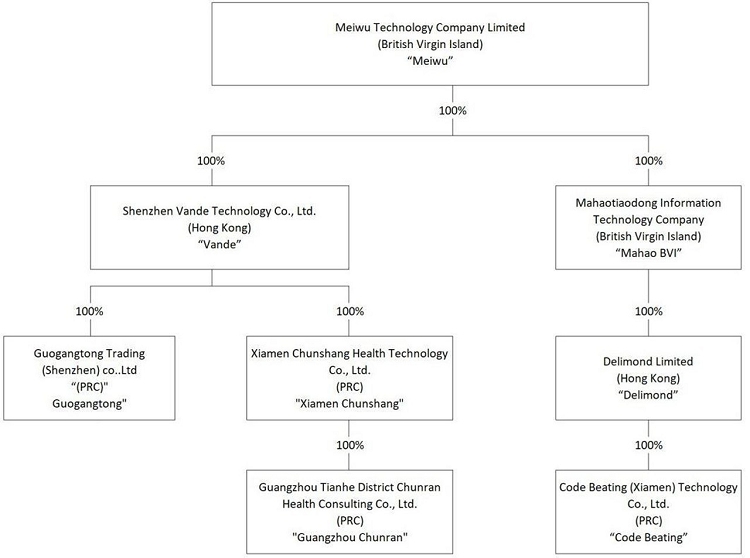
Pursuant to PRC laws, each entity formed under PRC law shall have certain business scope approved by the Administration of Industry and Commerce or its local counterpart. Meiwu is a holding company with no business operation other than holding the shares in its subsidiaries.
Our principal executive offices are located at Unit 304-3, No. 19, Wanghai Road, Siming District, Xiamen, Fujian, People’s Republic of China, and our phone number is +86-755-85250400. We maintain a corporate website at www.wnw108.com. The information contained in, or accessible from, our website or any other website does not constitute a part of this annual report.
Recent Financing Transactions
Notes Offering in 2024
On May 17, 2024, the Company entered into a securities purchase agreement with three unaffiliated investors (each, an “Investor”, collectively, the “Investors”), pursuant to which, the Company agreed to issue a convertible note (each, a “Note”, collectively, the “Notes”) with 10% original issuance discount (the “OID”) to each Investor (the “2024 Notes Offering”). The Company received gross proceeds of $1,000,000, before any expenses, as the aggregate purchase price of the three Notes.
Each of the Notes bears interest at a rate of 10% per annum compounding daily. All outstanding principal and accrued interest on the Notes will become due and payable eighteen (18) months after the issuance date. Each of the Note includes an original issue discount that equals 10% of the purchase price. The Company may prepay all or a portion of the Notes at any time by paying 120% of the outstanding balance elected for pre-payment. Each of the Investor can convert his or her Note at any time after the six-month anniversary of the issuance date at a per share conversion price that is equal to the lower of (i) $0.50 or (ii) 80% of the lowest daily volume-weighted average price of the Company’s Ordinary Shares, in the 20 trading days prior to the date on which the conversion price is measured (the “Market Price”).
|
|
The Company issued the Notes and closed this 2024 Notes Offering on May 17, 2024. The issuance of the Notes and the Ordinary Shares underlying the Notes were exempt from the registration requirements of the Securities Act, pursuant to Section 4(a)(2) of the Securities Act and/or Regulation D. The proceeds of this 2024 Notes Offering were used for working capital and general corporate purposes.
Primary Public Offering in 2024
On December 2, 2024, the Company closed a best-efforts offering (the “Primary Offering”) of 30,000,000 Ordinary Shares (the “Primary Offering Shares”) of the Company, to certain investors pursuant to that certain securities purchase agreement (the “Primary Offering SPA”), dated as of November 27, 2024, at an offering price of $0.80 per share.
The Primary Offering Shares were sold pursuant to a registration statement on Form F-1, as amended (the “Registration Statement”, File No. 333-282379), which was declared effective by the Commission on November 27, 2024. A final prospectus dated November 27, 2024 relating to this Offering was filed with the Commission pursuant to Rule 424(b) under the Securities Act of 1933, as amended.
The Company received net proceeds of $23,895,000 from the Primary Offering. The Company used the net proceeds for the development of its functional skincare business and for general corporate purpose, as disclosed in the Registration Statement.
In addition, as previously disclosed, the Company sold 30,000,000 Ordinary Shares (the “Resale Shares”) to Mr. Changbin Xia, the chairman of the board of directors of the Company, at an offering price of $0.80 per share, pursuant to a certain securities purchase agreement dated October 22, 2024 (the “Private SPA”). The Resale Shares were also registered in the Registration Statement. The Company did not receive any proceeds from the sale of such Resale Shares.
Concurrently with the Company’s execution of the Primary Offering SPA, Mr. Xia entered into a certain lock-up agreement (the “Lock-Up Agreement”) pursuant to which, Mr. Xia agreed not to directly or indirectly sell, offer, contract or grant any option to sell, pledge, transfer (excluding intra-family transfers, transfers to a trust for estate planning purposes or to beneficiaries of officers, directors and shareholders upon their death), or otherwise dispose of or enter into any transaction which may result in the disposition of any Ordinary Shares or securities convertible into, exchangeable or exercisable for any Ordinary Shares, without the prior written consent of the Company, for a period of one hundred and eighty (180) days following the date of the Lock-Up Agreement.
Private Placement in 2025
On September 5, 2025, Mr. Xia purchased 12,000,000 restricted Ordinary Shares (on a pre-2026 Reverse Split basis) at a per share price of $0.80, pursuant to a certain securities purchase agreement (the “2025 SPA”), entered into between the Company and Mr. Changbin Xia.
The transaction was closed on September 10, 2025.
Primary Public Offering in 2026
On January 26, 2026, the Company entered into a certain securities purchase agreement (the “2026 Primary Offering SPA”), with certain investors for a best-efforts offering (the “2026 Primary Offering”) of 38,000,000 Ordinary Shares (on a pre-2026 Reverse Split basis) (the “2026 Primary Offering Shares”) of the Company, at an offering price of $0.80 per share.
The 2026 Primary Offering was closed on January 29, 2026, upon satisfaction of all closing conditions as set forth in the 2026 Primary Offering SPA. The 2026 Primary Offering Shares were sold pursuant to a registration statement on Form F-1, as amended (File No. 333-291618, the “2026 Registration Statement”), initially filed with the Commission on November 18, 2025, which was declared effective by the Commission on January 22, 2026. A final prospectus dated January 27, 2026 relating to this 2026 Primary Offering was filed with the Commission pursuant to Rule 424(b) under the Securities Act of 1933, as amended.
|
|
The Company received net proceeds of $30,224,051 from the 2026 Primary Offering. The Company intends to use the net proceeds from the 2026 Primary Offering for the further development of its functional skincare business, specifically, the expansion of its marketing, branding and distribution network, and the purchase of bitcoins as part of our treasury asset allocation, as disclosed in the 2026 Registration Statement. As of the date of this annual report, the Company has used approximately $9.705 million in the marketing and promotional activities for its functional skincare business, including hosting business development events and expanding our new media department and operations. The Company also intends to allocate a portion of the proceeds to pursue strategic acquisitions, including a potential acquisition of a downstream channel distributor to expand our business and market presence. As of the date of this annual report, we have not identified any target /entered into any definitive agreement with respect to such proposed acquisition.
In addition, as previously disclosed, the Company sold 12,000,000 Ordinary Shares (on a pre-2026 Reverse Split basis) (the “2026 Resale Shares”) to Mr. Changbin Xia, at an offering price of $0.80 per share, pursuant to 2025 SPA. The resale and the offering of the 2026 Resale Shares were also registered in the 2026 Registration Statement. The Company does not receive any proceeds from the sale of such 2026 Resale Shares by Mr. Changbin Xia.
Concurrently with the Company’s execution of the 2026 Primary Offering SPA, Mr. Xia entered into a certain lock-up agreement (the “2026 Lock-Up Agreement”) pursuant to which, Mr. Xia agreed not to directly or indirectly sell, offer, contract or grant any option to sell, pledge, transfer (excluding intra-family transfers, transfers to a trust for estate planning purposes or to beneficiaries of officers, directors and shareholders upon their death), or otherwise dispose of or enter into any transaction which may result in the disposition of any Ordinary Shares or securities convertible into, exchangeable or exercisable for any Ordinary Shares, without the prior written consent of the Company, for a period of one hundred and eighty (180) days following the date of the 2026 Lock-Up Agreement (the “Lock-Up Period”).
Registered Direct Offering in March 2026
On March 18, 2026, the Company entered into a certain securities purchase agreement with certain investors for the purchase and sale of an aggregate of 6,999,996 of the Company’s Ordinary Shares (on a pre-2026 Reverse Split basis) and warrants (the “Warrants”) to purchase up to 6,999,996 Ordinary Shares (on a pre-2026 Reverse Split basis) at an exercise price of $2.00 per share. The net proceeds from this offering were $12,651,733.
The Warrants are immediately exercisable and will expire in one year following the initial issuance date. A holder of Warrants may, at any time and in its sole discretion, exercise its Warrants in whole or in part by means of a “zero price exercise” option in which the holder is entitled to receive a number of Ordinary Shares equal to the product of (a) the number of Ordinary Shares that would be issuable upon exercise of the Warrant in accordance with the terms of such Warrant if such exercise were by means of a cash exercise rather than a cashless exercise and (b) the quotient obtained by dividing (i) the exercise price minus the lowest VWAP (as defined in the form of Warrant) of the Ordinary Shares during the ten (10) trading days immediately prior to the applicable exercise date (such VWAP, the “Low Price”) by (ii) 50% of the Low Price. This “zero price exercise” option is only available at a time when the applicable Low Price is lower than the then applicable exercise price. At no time can the Low Price be lower than $0.40 (the “Floor Price”). Accordingly, if the holder elects the zero price exercise option, the number of shares of Ordinary Shares issuable upon exercise of the Warrants could increase to up to an aggregate of 83,999,952 (on a pre-2026 Reverse Split basis), assuming the Low Price equals the Floor Price at the time of such election.
The securities in the Offering are being offered pursuant to a securities purchase agreement with certain investors (the “Securities Purchase Agreement”) and the Company’s registration statement on Form F-3 (File No. 333-292111), as amended, which was initially filed with the U.S. Securities and Exchange Commission (the “SEC”) on December 12, 2025 and was declared effective by the SEC on February 24, 2025.
Pursuant to the Securities Purchase Agreement, the Company has agreed not to (i) issue or enter into an agreement to issue any Ordinary Shares or Ordinary Share Equivalents (as defined in the Securities Purchase Agreement), or (ii) file any registration statement or amendment or supplement thereto, subject to certain exceptions, for a period of 45 days beginning on the date of the Securities Purchase Agreement and ending on 45 days following the closing date. The Company has also agreed not to enter into or effect any Variable Rate Transaction (as defined in the Securities Purchase Agreement) beginning on the date of the Securities Purchase Agreement and ending on 45 days following the closing date.
In connection with the offering, the Company entered into a placement agency agreement (the “Placement Agency Agreement”) with Univest Securities, LLC (the “Placement Agent”), pursuant to which the Placement Agent acted as sole placement agent for this offering and receive at the closing of the offering a cash fee equal to 7% of the gross proceeds, a non-accountable expenses allowance of 0.5% of the gross proceeds of the offering and reimbursement for legal fees and other out-of-pocket fees, costs and expenses in the amount of up to $100,000.
|
|
In addition, on March 17, 2026, each of the directors and officers of the Company, as well as shareholders who beneficially own more than 5% of the issued and outstanding Ordinary Shares, entered into a certain lock-up agreements (the “Lock-Up Agreements”), pursuant to which each of them has agreed, among other things, not to sell or dispose of any Ordinary Shares which are or will be beneficially owned by them for ninety (90) days following the closing of the offering.
The offering closed on March 18, 2026. The Company intends to use the net proceeds from the offering for working capital and general corporate purposes, including expenditures related to the proposed acquisition of distributors. However, the management of the Company will have discretion in allocating the net proceeds in accordance with the above priorities and purposes, depending on general operating costs and expenditures and the changing needs of the Company’s business.
B. Business overview
We are a British Virgin Islands company incorporated on December 4, 2018. We do not have material operation and we conduct our business in China through our subsidiaries.
Functional Skincare Business
In the last quarter of 2024, the management has decided to implement a strategic transition in the Company’s business to expand into the sales of functional skincare products and launched this functional skincare business. For the year ended December 31, 2025, the functional skincare business accounted for 100% of our total revenue.
Products and Services
We aim to build a comprehensive online ecosystem with stable supply chain for our functional skincare products. This initiative was originally scheduled to launch in the fourth quarter of 2025 but has been rescheduled to the third quarter of 2026 to integrate our proposed AI-driven functional skincare system. This will include upstream product research and development of the skincare products, midstream distributor support and training, and downstream franchisee partnerships for functional skincare stores. We will connect three key groups in this business: stores, professionals in functional skincare, and consumers.
Xiamen Chunshang’s current product offerings include essence, serum, collagen and prebiotics solid beverage. Through its wholly owned subsidiary, Xiamen Chunshang, the Company has acquired of trademarks, entered into cooperation agreement with a research company, entry into letters of intent with four distributors, and hired of two skincare product engineers. As of the date of this annual report, we entered into certain trademark transfer agreements to acquire trademarks of “MQIANS”, “Chunran”, “秘莳”, and “纯然时代” from Guangzhou Meixing Health Information Group Co., Ltd. (“Guangzhou Meixin”); trademarks of “艾姝俪Aishuli”, “后小白HOUXIAOBAI” and “施华舒SHIHUASHU” from Guangzhou Shiji Shengxin Biotechnology Co., Ltd, (“Guangzhou Shengxin”), acquire trademarks of “奢幻”, “GF ZHIYE”, “功肤之夜”, and “嫃眉时代” from Guangzhou Meixing Health Technology Co, Ltd., acquire “悦春晓” from Nanchang Boyintu Business and Commerce Co, Ltd,and acquire “肌小花”,”轻纯季节”, “浸朵”,”梵少女 “ and “奥米星” from certain individuals.
Training Services
We launched our training services in October 2024 in connection with our functional skincare product sales. Our training services are designed to assist our customers, including store owners and distributors, but are also open to other individuals or entities not associated with us, in training and onboarding sales personnel, executing marketing campaigns and generating customer leads. We offer training in skincare marketing, as well as skincare service techniques and affiliate store operational management. For marketing training, we provide instruction on promotional material design and production, short-form video production, sales scripts, and the planning and execution of quarterly and annual promotional campaigns. To enhance the marketing effectiveness of our affiliate stores, our training programs also include incentive scheme design, product selection and presentation, and customized group training services delivered through WeChat chat groups. For new personnel associated with our affiliate stores, we offer a structured 30-day online marketing training program. The fee arrangements for our training services can be categorized into the following scenarios: (i) store owners or distributors who purchase products in large quantities may access training courses free of charge; (ii) store owners or distributors who purchase products in smaller quantities may obtain training courses at preferential rates, typically bundled with their product sales agreements; (iii) certain store owners or distributors may elect to participate in training prior to purchasing products, in which case a separate training agreement is entered into; and (iv) individuals or entities not associated with us will enter into separate training agreements.
|
|
Research and Development
Our company is dedicated to advancing the skincare industry through strategic research and development. We aims to our R&D capabilities with the two following approaches:
Firstly, we plan to enter into cooperation agreements with third parties to develop functional skincare formulations. The standard form of cooperation agreements will provide that, the third party engaged by us shall be responsible for the comprehensive work on product research and development includes, but is not limited to, formula development, trial production, testing, and market preparation. We will provide the funds for the research and development of the formula throughout the whole process. Secondly, we are considering possible acquisition of certain research institutions to have our in-house product development department. This will allow us to bring a dedicated team of experts and researchers in-house, providing greater control over the development process and facilitating the creation of cutting-edge skincare products.
These strategies are aimed at ensuring our product offerings remain at the forefront of the industry, leveraging both external partnerships and internal resources to drive innovation and address the evolving needs of our customers.
In September 2024, Xiamen Chunshang entered into an agreement with Meixing Biology Research Institute (Xiamen) Co., Ltd. to jointly develop light therapy anti-aging skincare product for skin cell rejuvenation through the sharing of resources, technology, and expertise. We agreed to provide RMB 15 million (US$2,100,000) for the expenses of the research and development and providing market information; and Meixing Biology is responsible for product development, including but not limited to formula development, trial production, testing, and market preparation. Xiamen Chunshang and Meixing Biology entered into a supplemental agreement on September 18, 2024, pursuant to which, Meixing Biology agreed not to commercialize any intellectual property generated thereof within three years after the product is launched and enters mass production. Xiamen Chunshang agreed that, if the cumulative revenue generated from the product reaches RMB 30 million within three years of its launch and mass production, Xiamen Chunshang will allocate 10% of its profits to Meixing Biology, and in return, Xiamen Chunshang agreed that all intellectual property rights arising from the project shall be owned by Xiamen Chunshang.
In June 25, 2025, Xiamen Chunshang entered into a functional skincare products research and development service agreement with Guangdong Daao Biotechnology Research Institute Co., Ltd. on June 25, 2025 to develop skincare product formulations with properties targeting anti-aging, skin brightening, and sensitivity reduction, with a total consideration of approximately US$3.5 million.
Xiamen Chunshang entered into two patents transfer agreements with Meixing Biotechnology Research Institute Co., Ltd. on May 20, 2025 and June 30, 2025, respectively, to acquire a total of six skincare formulations or products with a consideration of approximately US$1.46 billion. The target patents were transferred in November 2025.
Sales and Distribution
Through Xiamen Chunshang, we sell our products to the distributors at a wholesale price with a discount for repurchase. Our revenues of the functional skincare business mainly consists of (i) wholesale purchase price and (ii) training fees, which we charge for the training workshops where experienced distributors and professionals in the skincare industry teach about the customer development skills, sales strategies and instructions for using our functional skincare products.
Xiamen Chunshang entered into letters of intent with four distributors, pursuant to which Xiamen Chunshang authorizes each distributor as the exclusive distributor in four different provinces in China. The letters of intent are valid for one year starting on January 1, 2025 and include minimum sales targets. If these targets are not met within the year, Xiamen Chunshang reserves the right to terminate the letter. If the annual order amount reaches RMB 8 million, Xiamen Chunshang will grant that distributor an additional 3% commission on the total amount paid by the distributor for orders. If the annual order amount reaches 12 million RMB or more, Xiamen Chunshang will grant that distributor an additional 2% commission on the total amount paid by the distributor for orders. In addition, Xiamen Chunshang enters into quality guaranty and price control agreements with its distributors, pursuant to which, Xiamen Chunshang guarantees that the products and packages are in compliance with the regulatory requirements and Xiamen Chunshang provides suggested and the minimum retail prices for each product. Distributors agree not to sell the products at a price lower than the agreed minimum retail price.
|
|
Marketing
Our sales and marketing strategy focuses on in person launch events to facilitate business development and attract new distributors and partners. These events primarily target second- and third-tier cities within China. Our marketing efforts are tailored to address the specific needs and opportunities in these targeted cities, ensuring that our approach resonates with local market dynamics and maximizes our outreach. These in person launch events serve as a key component of our business development promotion strategy. By organizing these events in various cities, we aim to build brand awareness, engage directly with potential distributors and skincare professionals, and showcase our product offerings in an impactful and personalized manner.
We believe that social media will be the engine that fuels our next stage of growth. The increase in sales of our functional skincare products is directly related to the increase in new customers and consequently, product consumption. We believe that new customers are often swayed by social media messages of the benefits of consuming our functional skincare products. As such we have made a concerted effort to utilize social media to increase awareness of our Company and its offerings.
We use information technology to track operations-related data indicators, including but not limited to daily, weekly and monthly sales, new registered users, new user orders and amounts, number of active users and their orders, single product sales amounts and sales performance rankings, etc. Such information is, however, discrete and localized and not used to assess our performance as a whole.
We conduct our marketing campaigns through a combination of online marketing and offline brand alliance store expansion. We have established a new media operations department to manage promotional accounts on major social media platforms in China, including TikTok, Rednote, WeChat video accounts and official accounts. Through these platforms, we conduct live-streaming sessions and disseminate promotional content relating to its products.
In addition, we expect to establish a brand alliance network of approximately 1,500 affiliate stores for the distribution of our functional skincare products. These stores consist of our existing business partners, as well as new partners recruited through franchise recruitment events. In connection with this, we have recruited 10 marketing staff and provide them with internal training on marketing plans and skills. In addition, we regularly hold monthly business promotion salons and events across various cities in China to recruit and develop affiliate stores. We subsidize our partners and affiliate stores for the replacement of store signage with standardized Company-branded signage, coupled with a one-year sales commitment, to ensure a rapid increase in our offline brand’s exposure. We believe these measures will significantly enhance brand visibility and recognition, strengthen brand influence, and promote product sales.
Furthermore, the Company provides training to partner stores with respect to technical knowledge of functional skincare products and the implementation of unified promotional programs developed by the Company.
Manufacture
We rely on third-party manufacturers to produce our products. The engagement will specify that the third-party manufacturers engaged by us shall be responsible for the comprehensive manufacturing of the products includes, but is not limited to, the sourcing of product ingredients, the development of product formulation, and the procurement of raw materials, and should also be responsible for coordinating and organizing the production and assembly other parties, and delivering complete sets of boxed products. The manufactures should conduct internal inspections to ensure that each batch of products meets national standards.
Quality Control
We are consumer-focused and committed to the highest standards of product safety and quality. Xiamen Chunshang has implemented a comprehensive quality control framework that spans supply chain onboarding, warehousing, channel oversight, and after-sales support.
|
|
A quality control team-reporting directly to Xiamen Chunshang’s head of quality and safety department-oversees this framework. The team operates separately from commercial functions and is responsible for executing the following core functions:
Supplier and Product Compliance
| ● | Onboarding Oversight: Xiamen Chunshang conducts rigorous qualification reviews of new suppliers and brand partners, ensuring all manufacturers hold valid cosmetics production licenses and that all products are duly registered or filed with regulatory authorities. |
| ● | Initial Product Testing: For any new product procured (i.e., “first-time purchase products”), third-party labs are engaged to conduct random batch testing, targeting contaminants such as heavy metals and microbial agents. Current testing coverage is approximately 90%. |
| ● | Annual Surprise Inspections: Xiamen Chunshang commissions independent blind testing of 100% of listed SKUs each year, with results archived for at least three years. |
| ● | Dynamic Risk Rating: Suppliers are continuously evaluated based on testing pass rates and customer complaint frequency, enabling tiered risk management. |
Warehousing and Logistics Compliance
| ● | Environmental Controls: Warehousing facilities are climate-controlled (maintained at 24°C ± 2°C), with temperature and humidity logs recorded three times daily. Cold-chain products are stored using industry-standard refrigeration equipment. |
| ● | Shelf-Life Monitoring: Products approaching expiry (within 90 days) are automatically flagged by the Company’s logistics system and removed from distribution. |
| ● | Full Traceability: Xiamen Chunshang utilizes item-level digital tracking (e.g., RFID or QR codes) to maintain complete traceability from supplier to end consumer. |
Channel Governance and Risk Mitigation
| ● | Marketing Compliance: All product marketing content is subject to diligent legal review. Claims that imply therapeutic or medical effects are strictly prohibited under PRC advertising laws and internal policy. |
| ● | Price and Distributor Oversight: Xiamen Chunshang enforces price and sales channel compliance through quality assurance agreements. Any distributor found engaging in unauthorized pricing tactics or bundling practices is subject to immediate contract termination. |
| ● | Digital Audit Trails: Online product page edits are recorded and archived for three years, enabling regulatory traceability and internal audit readiness. |
After-Sales Quality Management
| ● | Rapid Recall Protocol: If a quality issue is identified, Xiamen Chunshang notify all of its distributors within 72 hours across all retail channels. |
| ● | Consumer-Centric Compensation: Xiamen Chunshang provides timely compensation to consumers before pursuing claims against responsible parties. |
| ● | Data-Driven Quality Feedback: Customer complaint data is analyzed monthly to identify trends and root causes, driving product or packaging improvements in partnership with suppliers. |
|
|
Competitive Advantages
We believe we will be able to possess robust capabilities throughout the supply chain of our functional skincare business. First, we plan to cooperate with company with expertise in formula development and recruit experienced professionals for our product research and development. We will also work with credible third party manufactures to deliver high-quality offerings. Second, we aim to establish a network of distributor for our functional skincare products, focusing in the second and third tier cities in China. Third, we also plan to provide support and training for our distributors, as well as staff in beauty and skincare stores to enhance their ability to effectively market and showcase our products.
We believe the above mentioned advantages will strengthen our position in the market and supports our goal of delivering high-quality products to the customers.
Growth Strategies
We plan to expand our partnership with research institutions to develop new functional skincare formulas and products. We also seek to develop a network of distributors in the second and third tier cities in China, then organically develop new channels of distribution and new sales relationships across the country.
Competition
We will face competition from both established multinational and domestic brands, as well as from smaller niche players in the PRC market and the global beauty sector. Notable competitors such as Winona, Pechoin, and Chando, each with franchisees nationwide, will continue to present significant challenges. These competitors are expected to maintain their advantages due to their longer operating histories, higher market shares, and established brand recognition, which may affect our ability to gain visibility and credibility among consumers.
Furthermore, larger and more established companies will likely benefit from economies of scale, enabling them to produce goods at lower costs per unit. This cost advantage will pose pricing challenges for us, making it difficult to compete on price while ensuring profitability.
We plan to differentiate ourselves through perceived value by focusing on factors such as pricing and innovation, product efficacy, customer service, promotional activities, advertising, special events, new product introductions, e-commerce initiatives, and direct sales. However, predicting the timing, scale, and effectiveness of our competitors’ future strategies, as well as the impact of new market entrants, will remain a challenge.
Seasonality
We do not expect that our functional skincare business will be subject to seasonal variations.
Prior to December 2024 when we terminated the VIE arrangements, we had two business lines, one was the SMS business, operated by Code Beating; another was the online and mobile commerce for food products, operated by Meiwu Shenzhen and its subsidiaries. The SMS business was operated by Code Beating. For the year ended December 31, 2024, SMS business did not generate any revenue, and the online and mobile commerce business generated 54.6% of our total revenue. For the years ended December 31, 2023, SMS business generated 77.1% of our total revenue, and the online and mobile commerce business generated 22.9% of our total revenue.
|
|
Bitcoin Treasury Strategy
As part of our overall business development and long-term value creation objectives, we intend to allocate a portion of the net proceeds from our 2026 Primary Offering toward establishing a bitcoin treasury position. We currently plan to use approximately 50% of the net proceeds to acquire bitcoin over time. Our existing operations do not currently involve the sale, custody, mining, development or facilitation of any digital assets. We believe that, given bitcoin’s unique characteristics as a scarce digital asset with a decentralized network and a global trading market, maintaining a bitcoin position may serve as a potential long-term store of value and a means to diversify our corporate cash holdings beyond traditional financial instruments. That said, in light of bitcoin market dynamics and our business development needs, we may use all or a portion of the funds originally intended for bitcoin purchases to invest in our skincare business.
The percentage of our treasury that we intend to hold in bitcoin will not exceed 30% of our current treasury asset of cash and cash equivalents, subject to market conditions, liquidity needs, and our risk management policies. We do not currently expect our bitcoin holdings to exceed 30% of our total treasury assets without additional approval from our board of directors.
We expect to acquire bitcoin in multiple tranches based on prevailing market conditions and liquidity considerations. While there can be no assurance as to the specific price at which purchases will occur, we anticipate making purchases if the market price of bitcoin is within a range that aligns with our investment objectives. Purchases will be executed based on a variety of factors, including market conditions, liquidity, and other considerations deemed relevant by management. We aim to maintain an average cost basis for bitcoin that reflects our long-term investment strategy, though this objective may change based on market developments.
We do not currently expect to liquidate our bitcoin holdings and instead intend to hold such assets for at least two years as a long-term investment, with the objective of potentially realizing long-term value. While we view bitcoin as a long-term treasury reserve asset, we retain the flexibility to liquidate holdings when necessary to meet operational, legal, or strategic needs. We may monetize bitcoin in certain circumstances, including:
| ● | to meet unexpected working capital needs or operating expenses; |
|
|
| ● | to fund significant capital expenditures, acquisitions or other strategic investments; |
| ● | to satisfy tax obligations or other material liabilities; |
| ● | to rebalance our treasury allocation based on market conditions, regulatory developments or the availability and cost of hedging instruments; or |
| ● | if the Board determines that monetizing bitcoin is in the best interests of the Company. |
Monetization may occur through spot sales for fiat currency or other transactions permitted under our treasury policy, and any monetization decision will be subject to internal authorization requirements and approval thresholds.
We intend to store all of the bitcoin we acquire in custody accounts with a third-party custodian located in the United States. We currently expect to enter into a written custody agreement with Coinbase (or an affiliate), a New York State-chartered limited purpose trust company subject to ongoing regulatory supervision by the New York State Department of Financial Services, prior to acquiring material amounts of bitcoin. However, the timing of entering into such agreement will depend on our implementation timeline and the completion of onboarding, documentation, and other customary conditions. We do not intend to self-custody our bitcoin except in limited circumstances, such as de minimis test transactions or temporary holding pending transfer to Coinbase. As we further execute on our strategy, we may include additional custodians.
In selecting Coinbase as our expected custodian, and in evaluating the custody services to be provided under the custody agreement, we have considered and expect to continue to consider factors that include:
| ● | Cold storage practices. The percentage of private keys maintained in cold storage and the custodian’s controls for safeguarding keys offline. We currently expect that at least 98% of the private keys associated with our bitcoin holdings will be maintained in cold storage, subject to operational requirements and the custodian’s capabilities. |
| ● | Segregation of assets. Whether our bitcoin will be held in segregated accounts (as opposed to commingled accounts), and the contractual framework governing beneficial ownership and the treatment of customer assets in the event of the custodian’s insolvency. |
| ● | Transfer procedures and controls. Procedures for initiating and approving transfers of bitcoin, including multi-signature or multi-approval authorization, address whitelisting, withdrawal limits, time delays (if applicable), and audit trails. |
| ● | Security and operational resilience. Cybersecurity controls, incident response procedures, and independent reviews (such as system and organization controls reports), as applicable. |
| ● | Regulatory and compliance posture. The custodian’s regulatory status and compliance program, including anti-money laundering and sanctions compliance controls. |
| ● | Insurance and financial strength. The existence and scope of insurance coverage relating to theft or loss, including material limitations and exclusions, and the custodian’s financial condition. |
| ● | Reporting and operational capabilities. The custodian’s ability to support settlement, reconciliation, and reporting needs, and integration with our treasury operations. |
| ● | Industry reputation and institutional adoption. The custodian’s market reputation, experience, and institutional adoption in providing digital asset custody services. |
We may enter into hedging transactions to mitigate exposure to bitcoin price volatility. We expect to hedge approximately 50% of our bitcoin holdings from time to time using bitcoin futures contracts, subject to market conditions, liquidity, and the availability of hedging instruments. We expect to allocate approximately $18 million to the acquisition of bitcoin in the spot market and about $2 million to margin (the “Margin Pool”) used for bitcoin futures positions. These positions will primarily serve to manage our exposure to bitcoin price volatility, with the intention to reduce downside risk rather than to speculate on price movements.
|
|
Hedging transactions may require us to post cash or other collateral and may result in realized or unrealized gains or losses. Hedging may limit our ability to benefit from increases in the price of bitcoin, and adverse price movements may result in margin calls or other liquidity demands. We may elect not to hedge at times depending on market conditions and the availability and cost of hedging instruments.
Our hedging strategy is intended to be adjusted dynamically based on changes in the aggregate cost basis of our Bitcoin holdings. Futures positions may be increased or reduced if the cost basis moves outside targeted thresholds. During periods of price volatility, profits generated from hedging activities may be used to offset the costs of acquiring additional bitcoin, reducing the effective average purchase price. If the price of bitcoin declines, we may continue to purchase additional bitcoin and adjust our hedging positions as needed to align with our target acquisition cost and investment objectives. We also expect to establish risk management protocols, including volatility thresholds under which hedging activity may be reduced or suspended, as well as ongoing margin monitoring with required replenishment if margin levels decline below established limits.
The foregoing strategies would be subject to periodic review and oversight by an investment strategy oversight committee (the “Investment Committee”) as designated by the Board. The Company intends to disclose its bitcoin holdings and related cost basis in accordance with applicable SEC disclosure requirements.
The Investment Committee will be responsible for closely monitoring the Company’s bitcoin investment strategy, including purchases, hedging, and risk management practices. The Investment Committee will consist of five members, including the chairman of the Board, our financial manager and three members with expertise in risk management, treasury management, and digital asset investments. We also plan to appoint a Head of the Investment Committee who will be responsible for the approval and execution of daily investment decisions. The Head will oversee the day-to-day operations related to the acquisition of bitcoin, adjustments to the hedging strategy, and any operational matters concerning the Margin Pool. The Head will report regularly to the Investment Committee and the Board. Investment decisions will be made by the Head or the Investment Committee, based on factors such as bitcoin market volatility and the percentage of futures positions relative to the overall bitcoin investment. For example, decisions involving a significant shift in the hedging strategy or substantial changes in futures position sizes would fall into the intermediate or high significance categories, depending on their potential impact on the Company’s risk exposure. We believe that this will help ensure a balanced consensus among committee members for key decisions, while maintaining the efficiency needed for timely execution.
Our Board will be involved for decisions of high significance, such as major changes to the bitcoin investment strategy, significant acquisitions, or shifts in our risk management framework. The Board will review and approve all high-level strategies and provide final oversight to ensure alignment with shareholder interests and the Company’s strategic goals.
|
|
SMS Business
Code Beating operated an SMS platform to send customized content to terminal customers. Code Beating is a mobile information service provider. Code Beating relied on a systematic service process and independently developed business platform to provide customers with secure, effective, and timely mobile information services through the integration of communication resources of telecom operators. Enterprise SMS is currently the main business form of Code Beating. Code Beating utilized its accumulated system development technology and business understanding based on customers’ industry to provide professional enterprise SMS services to customers.
We mainly provided SMS services for small and medium-sized Internet enterprises. As of December 31, 2025, 2024, and 2023, we had an active customer base of 0, 0, and 15 enterprises, respectively. Our various sales and marketing efforts have played a critical role in customer acquisition and retention. Our sales and marketing team is generally responsible for contacting prospective customers, renewing existing subscriptions, and maintaining customer relationships. Leveraging their sales expertise, thorough knowledge of our business and dedication to customer support, our sales and marketing team focuses primarily on small and medium-sized Internet enterprises with communications requirements.
In December 2023, our SMS service was suspended because the reach and engagement of SMS services are less competitive than the social media, which drives the rate of Maohao’s SMS business down and narrows its profit margin.
E-Commerce for Food Products
We sold a myriad of food products sourced from selected third parties on our website.
For fiscal year ended December 31, 2025, our total revenue was $7,081,133, $6,919,620 from offline sales of functional skincare products and $161,513 from training services. For fiscal year ended December 31, 2024, our total revenue was $158,485, all from offline sales of food products. For fiscal year ended December 31, 2023, our total revenue was $10,977,429, comprising $2,513,483 from online sales of food products on our former e-commerce website, and $8,463,946 from SMS.
Intellectual Property
Our business is dependent on a combination of protections provided by trademarks. As of the date of this annual report, Xiamen Chunshang has 38 trademarks in the PRC.
| Trademark | Registration Number | Valid Until | |||
| 1 |  |
39163254 | March 20, 2030 | ||
| 2 | 37807263 | January 13, 2030 | |||
| 3 | 37828842 | January 20, 2030 | |||
| 4 | 37807235 | January 13, 2030 | |||
| 5 | 37811597 | January 13, 2030 | |||
| 6 | 37828423 | January 13, 2030 | |||
| 7 | 22364629 | January 27, 2028 | |||
| 8 |  |
38571358 | February 6, 2030 | ||
| 9 |  |
33206726 | June 13, 2029 | ||
| 10 |  |
75039745 | June 27, 2034 | ||
| 11 | 71264053 | October 6, 2033 | |||
| 12 | 71265559 | October 6, 2033 | |||
| 13 | 71244598 | October 6, 2033 | |||
| 14 |  |
66806757 | August 13, 2033 | ||
| 15 |  |
67327192 | March 13, 2033 | ||
| 16 |  |
66763734 | February 13, 2033 | ||
| 17 |  |
75934470 | June 13, 2034 | ||
| 18 | 74482278 | March 27, 2034 | |||
| 19 |
71110886 |
October 20, 2033 |
|||
| 20 |  |
75037274 | April 13, 2034 | ||
| 21 |
66772252 |
February 20, 2033 |
|||
| 22 |  |
70993131 | October 6, 2033 | ||
| 23 | 70983676 | October 6, 2033 | |||
| 24 |
70980158 |
October 6, 2033 |
|||
| 25 |  |
75946022 |
September 6, 2034 |
||
| 26 |  |
66763730 | February 13, 2033 | ||
| 27 |  |
75934473 | June 13, 2034 | ||
| 28 |  |
66781874 | February 13, 2033 |
|
|
| 29 |  |
79929004 | April 27, 2035 | ||
| 30 |  |
75489891 | August 20, 2034 | ||
| 31 |  |
75475442 | June 6, 2034 | ||
| 32 |  |
29390557 | January 6, 2029 | ||
| 33 |  |
79685362 | January 13, 2035 | ||
| 34 |  |
67463973 | March 20, 2033 | ||
| 35 |  |
80102322 | January 27, 2035 | ||
| 36 |  |
62540584 | July 27, 2032 | ||
| 37 |  |
70854424 | October 6, 2033 | ||
| 38 |  |
73331480 | February 6, 2034 |
Cybersecurity
The Cybersecurity Law, as adopted by the National People’s Congress on November 7, 2016, has come into force on June 1, 2017 and the last amendment became effective on January 1, 2026. Regarded as the fundamental law in the area of cybersecurity in China, the Cybersecurity Law regulates network operators and others from the following perspectives: the principle of Cyberspace sovereignty, security obligations of network operators and providers of network products and services, protection of personal information, protection of critical information infrastructure, data use and cross-border transfer, network interoperability and standardization. Network operators shall, according to the requirements of the rules for graded protection of cybersecurity, fulfill security protection obligations, so as to ensure that the network is free from interference, damage or unauthorized access, and prevent network data from being divulged, stolen or falsified. In addition, any network operator to collect personal information shall follow the principles of legitimacy, rationality and necessity and shall not collect or use any personal information without due authorization of the person whose personal information is collected. Each individual is entitled to require a network operator to delete his or her personal information if he or she finds that collection and use of such information by such operator violate the laws, administrative regulations or the agreement by and between such network operator and such individual; and is entitled to require any network operator to make corrections if he or she finds errors in such information collected and stored by such network operator. Such network operator shall take measures to delete the information or correct the error.
|
|
On December 28, 2021, the CAC and other 12 regulatory authorities jointly revised and promulgated the Cybersecurity Review Measures, which became effective on February 15, 2022 and replaced the Cybersecurity Review Measures promulgated in 2020. The Cybersecurity Review Measures stipulates that (1) critical information infrastructure operators purchasing network products and services and network platform operators carrying out data processing activities, which affect or may affect national security, are subject to the cybersecurity review by the Cybersecurity Review Office, and (2) network platform operators holding personal information of more than one million users seeking for listing in a foreign country must apply for the cybersecurity review. In addition, the relevant PRC governmental authorities may conduct a cybersecurity review against the operators if the authorities believe that network products, services or data processing activities of such operators affect or may affect national security.
The Standing Committee of the National People’s Congress (the “SCNPC”) promulgated the PRC Data Security Law on June 10, 2021, which came into effect on September 1, 2021. According to the PRC Data Security Law, data collection shall be conducted in a legitimate and proper manner, while theft or illegal collection of data shall be prohibited. In addition, enterprises conducting data processing activities shall establish and improve their data security management systems, organize data security trainings and adopt corresponding technical measures and other necessary measures to guard data security. The State shall establish a data security system to administer data protection at different levels and by different categories, and impose specific compliance obligations on processors of important data, including specifying the person and institution of data security protection responsibilities, conducting regular risk assessment, fulfilling the regulatory requirements for transmitting important data overseas. Any organization or individual carrying out data processing activities that violates the PRC Data Security Law shall bear the corresponding civil, administrative or criminal liability depending on specific circumstances. Where the national core data management system is violated, which endangers national sovereignty, security, and development interests, the relevant competent authority shall impose a fine ranging from RMB2 million to RMB10 million, and order suspension of the related business, suspension of business for rectification, revocation of the related business permit or business license according to the circumstance.
On September 24, 2024, the State Council issued the Regulation on Network Data Security Management, which provides that where a network data processor carries out network data processing activities that affect or may affect national security, it shall conduct a national security review in accordance with the relevant state regulations.
Privacy groups and government bodies have increasingly scrutinized the ways in which companies link personal identities and data associated with particular users with data collected through the internet, and we expect such scrutiny to continue to increase. We have adopted policies, procedures and guidelines to comply with these laws and regulations and protect the personal privacy of our customers and the security of their data. Our board of directors has general oversight power over cybersecurity issues and delegates the daily supervision responsibility to our chief executive officer, Mr. Zhichao Yang. The head of our IT department directly reports cybersecurity status to Mr. Yang, and in case of a cybersecurity incident, Mr. Yang will report the incident to our board of directors to take appropriate and timely measures in response to the incident. See “Item 3. Key Information - D. Risk Factors-Risks Relating to Our Business and Industry-Our business generates and processes a large amount of data, which subjects us to governmental regulations and other legal obligations related to privacy, information security and data protection. Any improper use or disclosure of such data by us, our employees or our business partners could subject us to significant reputational, financial, legal and operational consequences.”
Market Outlook
Functional Skincare Business Industry in China
The functional skincare industry is dedicated to the research, development, production, and distribution of skincare products with targeted efficacy (e.g., brightening, anti-aging, acne treatment, and sensitive skin repair). Its core value proposition lies in addressing specific dermatological concerns through the incorporation of highly active ingredients, supported by rigorous clinical validation to ensure safety and efficacy.
|
|
The industry is projected to achieve a compound annual growth rate (CAGR) of approximately 5% over the next five years. China has emerged as a pivotal growth market, with its market size exceeding RMB 48 billion (approximately USD 6.6 billion) in 2024, reflecting a remarkable five-year CAGR of 25.25%.
Evolving consumer preferences, particularly the heightened focus on ingredient transparency and product efficacy, are driving R&D innovation. Notably, 58.8% of Chinese consumers prioritize ingredient composition when making purchasing decisions, underscoring the market’s demand for scientifically validated formulations.
Beauty Training Service Industry in China
The beauty training service industry in China covers vocational education in sub-sectors such as makeup techniques, styling design, skin management, and medical aesthetic technology, aiming to provide professional skilled talents for the beauty industry. Its service targets include individual consumers, professional practitioners, and vertical fields such as film and television and wedding planning. The industry has a strong educational attribute and career development orientation. The course forms have diversified from offline practical operation to online live teaching, and AR/VR technology is gradually integrated to enhance the training experience.
The market size of light medical aesthetics in China may reach the level of hundreds of billions by 2025, which will give rise to the demand for compound talents and require the support of beauty training services. The government encourages the development of vocational education and strengthens industry norms to promote the improvement of the vocational qualification certification system. Meanwhile, the market has introduced intelligent devices and digital tools (such as simulation cabin practical operation and AI makeup teaching) to enhance the efficiency and safety of training.
The Bitcoin Industry and Market
Bitcoin is a digital asset that is issued by and transmitted through an open-source protocol, known as the bitcoin protocol, collectively maintained by a peer-to-peer network of decentralized user nodes. This network hosts a public transaction ledger, known as the bitcoin blockchain, on which bitcoin holdings and all validated transactions that have ever taken place on the bitcoin network are recorded. Balances of bitcoin are stored in individual “wallet” functions, which associate network public addresses with one or more “private keys” that control the transfer of bitcoin. The bitcoin blockchain can be updated without any single entity owning or operating the network.
Creation of New Bitcoin and Limits on Supply
The bitcoin protocol limits the total number of bitcoins that can be generated over time to 21 million. As of early 2026, approximately 19.9 million bitcoins have been generated. New bitcoins are created and allocated by the Bitcoin protocol through a “mining” process that rewards users that validate transactions in the bitcoin blockchain. Validated transactions are added in “blocks” approximately every 10 minutes. The mining process serves to validate transactions and secure the bitcoin network. Mining is a competitive and costly operation that requires a large amount of computational power to solve complex mathematical algorithms. This expenditure of computing power is known as “proof of work.”
To incentivize miners to incur the costs of mining bitcoin, the bitcoin protocol rewards miners that successfully validate a block of transactions with newly generated bitcoin. The current reward for miners that successfully validate a block of transactions is 3.125 bitcoin per mined block. The mining reward is reduced by half, which is referred to as a bitcoin halving, after every 210,000 blocks are mined. This has historically occurred approximately every four years. The most recent bitcoin halving occurred in April 2024, and the next bitcoin halving is expected to occur sometime in 2028.
|
|
Modifications to the Bitcoin Protocol
Bitcoin is an open-source network that has no central authority, so no one person can unilaterally make changes to the software that runs the network. However, there is a core group of developers that maintains the code for the bitcoin protocol, and they can propose changes to the source code and release periodic updates and other changes. Unlike most software that has a central entity that can push updates to users, bitcoin is a peer-to-peer network in which individual network participants, called nodes, decide whether to upgrade the software and accept the new changes. As a practical matter, a modification becomes part of the bitcoin protocol only if the proposed changes are accepted by participants collectively having more than 50% of the processing power, known as hash rate, on the network. If a certain percentage of the nodes reject the changes, then a “fork” takes place, and participants can choose the version of the software they want to run.
Forms of Attack Against the Bitcoin Network and Wallets
Blockchain technology has many built-in security features that make it difficult for hackers and other malicious actors to corrupt the protocol or blockchain. However, as with any computer network, the bitcoin network may be subject to certain attacks. Some forms of attack include unauthorized access to wallets that hold bitcoin and direct attacks, like “51% attacks” or “denial-of-service attacks” on the bitcoin network.
Bitcoin is controllable only by the possessor of both the unique public key and private key(s) relating to the local or online digital wallet in which the bitcoin is held. Private keys used to access bitcoin balances are not widely distributed and are typically held on hardware (which can be physically controlled by the holder or by a third party such as a custodian) or via software programs on third-party servers. One form of obtaining unauthorized access to a wallet occurs following a phishing attack where the attacker deceives the victim and manipulates them into sharing their private keys for their digital wallet or other sensitive information. Other similar attacks may also result in the loss of private keys and the inability to access, and effective loss of, the corresponding bitcoin. See “Risk Factors - Risks Related to Our Planned Bitcoin Treasury Strategy - We may face risks relating to the custody of our bitcoin, including the loss or destruction of private keys required to access our bitcoin and cyberattacks or other data loss relating to our bitcoin.”
A “51% attack” may occur when a group of miners attain more than 50% of the bitcoin network’s mining power, thereby enabling them to control the bitcoin network and protocol and manipulate the blockchain. A “denial-of-service attack” occurs when legitimate users are unable to access information systems, devices, or other network resources due to the actions of a malicious actor flooding the network with traffic until the network is unable to respond or crashes. The bitcoin network has been, and can be in the future, subject to denial-of-service attacks, which can result in temporary delays in block creation and in the transfer of bitcoin. See “Risk Factors - Risks Related to Our Planned Bitcoin Treasury Strategy - Bitcoin and other digital assets are novel assets, and are subject to significant legal, commercial, regulatory and technical uncertainty.”
Bitcoin Industry Participants
The primary bitcoin industry participants are miners, investors and traders, digital asset exchanges and service providers, including custodians, brokers, payment processors, wallet providers and financial institutions.
Miners.Miners range from bitcoin enthusiasts to professional mining operations that design and build dedicated mining machines and data centers, including mining pools, which are groups of miners that act cohesively and combine their processing power to mine bitcoin blocks. See “- Creation of New Bitcoin and Limits on Supply” above.
Investors and Traders. Bitcoin investors and traders include individuals and institutional investors who, directly or indirectly, purchase, hold, and sell bitcoin or bitcoin-based derivatives. On January 10, 2024, the SEC issued an order approving several applications for the listing and trading of shares of spot bitcoin exchange-traded products (“ETPs”) on U.S. national securities exchanges. While the SEC had previously approved exchange-traded funds where the underlying assets were bitcoin futures contracts, this order represented the first time the SEC approved the listing and trading of ETPs that acquire, hold and sell bitcoin directly. ETPs can be bought and sold on a stock exchange like traditional stocks, and provide investors with another means of gaining economic exposure to bitcoin through traditional brokerage accounts.
|
|
Digital Asset Exchanges. Digital asset exchanges provide trading venues for purchases and sales of bitcoin in exchange for fiat or other digital assets. Bitcoin can be exchanged for fiat currencies, such as the U.S. dollar, at rates of exchange determined by market forces on bitcoin trading platforms, which are not regulated in the same manner as traditional securities exchanges. In addition to these platforms, over-the-counter markets and derivatives markets for bitcoin also exist. The value of bitcoin within the market is determined, in part, by the supply of and demand for bitcoin in the global bitcoin market, market expectations for the adoption of bitcoin as a store of value, the number of merchants that accept bitcoin as a form of payment, and the volume of peer-to-peer transactions, among other factors. For a discussion of risks associated with digital asset exchanges, see “Risk Factors - Risks Related to Our Planned Bitcoin Treasury Strategy - Due to the unregulated nature and lack of transparency surrounding the operations of many bitcoin trading venues, bitcoin trading venues may experience greater fraud, security failures or regulatory or operational problems than trading venues for more established asset classes, which may result in a loss of confidence in bitcoin trading venues and adversely affect the value of our bitcoin.”
Service providers. Service providers offer a multitude of services to other participants in the bitcoin industry, including custodial and trade execution services, commercial and retail payment processing, loans secured by bitcoin collateral, and financial advisory services. If adoption of the bitcoin network continues to materially increase, we anticipate that service providers may expand the currently available range of services and that additional parties will enter the service sector for the bitcoin network.
Other Digital Assets
As of the date of this annual report, bitcoin was the largest digital asset by market capitalization. However, numerous alternative digital assets exist, and many entities, including consortia and financial institutions, are actively researching and investing resources in blockchain platforms and digital assets that utilize consensus mechanisms other than proof-of-work mining, which is employed by the Bitcoin network. For example, in late 2022, the Ethereum network transitioned to a “proof-of-stake” mechanism for validating transactions that requires significantly less computing power than proof-of-work mining. Other alternative digital assets include “stablecoins,” which are designed to maintain a constant price because of their issuers’ promise to hold high-quality liquid assets (such as U.S. dollar deposits and short-term U.S. treasury securities) equal to the total value of stablecoins in circulation.
Additionally, central banks in some countries have started to introduce digital forms of legal tender. For example, China’s central bank digital currency (“CBDC”) project was made available to consumers in January 2022, and governments including the United States and the European Union have discussed the potential creation of new CBDCs. For a discussion of risks relating to the emergence of other digital assets, see “Risk Factors - Risks Related to Our Planned Bitcoin Treasury Strategy - The emergence or growth of other digital assets, including those with significant private or public sector backing, could have a negative impact on the price of bitcoin and adversely affect our business.”
REGULATIONS
Overview
We operate our business in China under a legal regime consisting of the National People’s Congress, which is the country’s highest legislative body, the State Council, which is the highest authority of the executive branch of the PRC central government, and several ministries and agencies under its authority, including the Ministry of Industry and Information Technology, State Administration for Industry and Commerce (“SAIC”), the State Administration for Market Regulation and their respective local offices.
This section sets forth a summary of the most significant rules and regulations that affect our business activities in China.
|
|
Regulations Relating to Foreign Investment
The Draft PRC Foreign Investment Law
In January 2015, the MOFCOM published a discussion draft of the proposed Foreign Investment Law for public review and comments. The draft law purports to change the existing “case-by-case” approval regime to a “filing or approval” procedure for foreign investments in China. The State Council will determine a list of industry categories that are subject to special administrative measures, which is referred to as a “negative list,” consisting of a list of industry categories where foreign investments are strictly prohibited, or the “prohibited list” and a list of industry categories where foreign investments are subject to certain restrictions, or the “restricted list.” Foreign investments in business sectors outside of the “negative list” will only be subject to a filing procedure, in contrast to the existing prior approval requirements, whereas foreign investments in any industry categories that are on the “restricted list” must apply for approval from the foreign investment administration authority.
The draft for the first time defines a foreign investor not only based on where it is incorporated or organized, but also by using the standard of “actual control.” The draft specifically provides that entities established in China, but “controlled” by foreign investors will be treated as FIEs (“Foreign Invested Enterprises”). Once an entity is considered to be an FIE, it may be subject to the foreign investment restrictions in the “restricted list” or prohibitions set forth in the “prohibited list.” If an FIE proposes to conduct business in an industry subject to foreign investment restrictions in the “restricted list,” the FIE must go through a market entry clearance by the MOFCOM before being established. If an FIE proposes to conduct business in an industry subject to foreign investment prohibitions in the “prohibited list,” it must not engage in the business. However, an FIE that conducts business in an industry that is in the “restricted list,” upon market entry clearance, may apply in writing for being treated as a PRC domestic investment if it is ultimately “controlled” by PRC government authorities and its affiliates and/or PRC citizens. In this connection, “control” is broadly defined in the draft law to cover the following summarized categories: (i) holding 50% or more of the voting rights of the subject entity; (ii) holding less than 50% of the voting rights of the subject entity but having the power to secure at least 50% of the seats on the board or other equivalent decision making bodies, or having the voting power to exert material influence on the board, the shareholders’ meeting or other equivalent decision making bodies; or (iii) having the power to exert decisive influence, via contractual or trust arrangements, over the subject entity’s operations, financial matters or other key aspects of business operations. According to the draft, variable interest entities would also be deemed as FIEs, if they are ultimately “controlled” by foreign investors, and be subject to restrictions on foreign investments. However, the draft law has not taken a position on what actions will be taken with respect to the existing companies with the “variable interest entity” structure, whether or not these companies are controlled by Chinese parties.
The draft emphasizes on the security review requirements, whereby all foreign investments that jeopardize or may jeopardize national security must be reviewed and approved in accordance with the security review procedure. In addition, the draft imposes stringent ad hoc and periodic information reporting requirements on foreign investors and the applicable FIEs. Aside from investment implementation report and investment amendment report that are required at each investment and alteration of investment specifics, an annual report is mandatory, and large foreign investors meeting certain criteria are required to report on a quarterly basis. Any company found to be non-compliant with these information reporting obligations may potentially be subject to fines and/or administrative or criminal liabilities, and the persons directly responsible may be subject to criminal liabilities.
In September 2016, the SCNPC published The Decision on Amending Four Laws including the Law of the People’s Republic of China on Wholly Foreign-owned Enterprises (the “Decision”). According to the Decision, one provision is added to the Foreign Invested Enterprise Law, Sino-Foreign Joint Venture Law, Sino-Foreign Cooperative Enterprise Law and the Law on Protection of Investment by Taiwanese Compatriots. Under this new provision, foreign investments in business sectors outside of the “negative list” will only be subject to a filing procedure, in contrast to the existing prior approval requirements, whereas foreign investments in any industry categories that are on the “restricted list” must apply for approval from the foreign investment administration authority. This Decision means that the existing “case-by-case” approval regime has been changed to a “filing or approval” procedure for non-”negative list” foreign investments in China.
On October 8, 2016, The Provisional Measures for Filing Administration for the Establishment and Changes of Foreign-invested Enterprises was promulgated by MOFCOM and become effective on the same date. It was subsequently amended on June 30, 2018.
|
|
On March 15, 2019, the final Foreign Investment Law was promulgated and implemented on January 1, 2020. As such, the trio of existing laws regulating foreign investment in China, namely, the Sino-foreign Equity Joint Venture Enterprise Law, the Sino-foreign Cooperative Joint Venture Enterprise Law and the Wholly Foreign-invested Enterprise Law, together with their implementation rules and ancillary regulations, will be abolished.
Industry Catalog Relating to Foreign Investment
Investment activities in China by foreign investors are principally governed by the Catalogue for the Guidance of Foreign Investment Industries, which was promulgated by MOFCOM and the National Development and Reform Commission, as amended from time to time. Industries listed in the catalogue are divided into three categories: encouraged, restricted and prohibited. Industries not listed in the catalogue are generally open to foreign investment unless specifically restricted by other PRC regulations. Establishment of wholly foreign-owned enterprises is generally allowed in encouraged industries. For some restricted industries, foreign investors can only conduct investment activities through equity or contractual joint ventures, while in some cases PRC partners are required to hold the majority interests in such joint ventures. In addition, projects in the restricted category are subject to higher-level governmental approvals. Foreign investors are not allowed to invest in industries in the prohibited category.
The National Development and Reform Commission and the MOFCOM jointly issued two “negative lists” and one “encouraged catalogue”. The two Negative Lists refer to the Special Administrative Measures on Access to Foreign Investment (2024 edition) (“2024 FI National Negative List”) effective on November 1, 2024, and the Free Trade Zone Special Administrative Measures on Access to Foreign Investment (2021 edition) (“2021 FI FTZ Negative list”), which will replace their respective 2020 versions. These two negative lists enumerate the industries where foreign investment will either be prohibited or restricted. The respective lists will be applicable in different areas - the FTZ list is for pilot free trade zones and the national list is for the rest of the country. Besides the lists, the new Encouraged Catalogue, or the Catalogue of Encouraged Industries for Foreign Investment (2025 edition) (“2025 FI Encouraged Catalogue”) lists industries where foreign knowhow and investment is welcome.
For industries not included in the negative list, foreign and domestic investors shall enjoy equal access under the law, save for record-filing requirements. No region or department may impose separate restrictions on foreign investment in areas that are not on the negative list.
Pursuant to the Notice of the Ministry of Industry and Information Technology on Removing the Restrictions on Foreign Equity Ratios in Online Data Processing and Transaction Processing Business (Operating E-commerce) promulgated on June 19, 2015 by the Ministry of Industry and Information Technology, there is no restrictions on foreign investment into online data processing and transaction processing business (operating e-commerce). However, industries such as value-added telecommunication services (except e-commerce), including internet information services, are still restricted from foreign investment.
Laws and Regulations Relating to the Functional Skincare Industry in General
Laws and Regulations Relating to Product Quality
The Product Quality Law of the PRC
Pursuant to the Product Quality Law of the PRC, which was promulgated on February 22, 1993, became effective on September 1, 1993, and was last amended on December 29, 2018, producers are liable for the quality of the products they produce. Where anyone produces or sells products that do not comply with the relevant national or industrial standards safeguarding the health and safety of the persons and property, the relevant authority will order such person to suspend the production or sales, confiscate the products, impose a fine of an amount higher than the value of the products and less than three times of the value of the products, confiscate illegal gains (if any) as well as revoke the business license in severe cases. Where the activities constitute a crime, the offender will be prosecuted.
|
|
Product Liabilities
Manufacturers and distributors of defective products in the PRC may incur liability for losses and injuries caused by such products. Under the Civil Code of the People’s Republic of China, which took effect on January 1, 2021, and the Law on the Protection of Consumer Rights and Interests of the PRC, which was promulgated on October 31, 1993, became effective on January 1, 1994 and was amended on October 25, 2013, the manufacturers and distributors will be held liable for losses and damages suffered by consumers caused by the defective products manufactured or distributed by them.
Under the above-mentioned laws and regulations, we are required to ensure that products which we produce and sell meet the requirements for safeguarding human health and ensuring human and property safety. Failing to do so will lead to a series of penalties, including the suspension of production and sale, confiscation of the products and earnings, imposition of fines, revocation of business licenses, and/or even criminal liabilities. In addition, if the products cause personal injuries or other form of torts, the manufacturers and distributors of the products may be subject to tort liability.
Anti-money Laundering Regulations
On October 31, 2006, the Standing Committee of the National People’s Congress issued the PRC Anti-Money Laundering Law, which was amended on November 8, 2024 and took effect from January 1, 2025. Pursuant to the PRC Anti-Money Laundering Law, specific non-financial institutions that are required by relevant regulations to perform the obligation of anti-money laundering shall, in accordance with law, among others adopt preventive and monitoring measures, establish and improve internal control systems for anti-money laundering, and fulfill anti-money laundering obligations such as customer due diligence, preservation of customer identity data and transaction records, reporting of large and suspicious transactions, and special preventive measures for anti-money laundering. The client ID data and transaction information, and investigation information of anti-money laundering acquired through performing the functions and duties of anti-money laundering according to law shall be kept confidential, and shall not be provided to any unit or individual unless otherwise prescribed by law. Any unit or individual that finds money laundering activities is entitled to report the same to the competent administrative authority of anti-money laundering or judicial organ, and the organs that accept the report shall keep confidential the reporter and the content reported.
Enterprises and other market entities shall submit information on beneficial owners through the relevant information system of the market supervision and regulation department.
On April 12, 2016, General Office of the State Council issued a Circular of the General Office of the State Council on Issuing the Implementing Proposals for the Special Rectification of Internet Financial Risks, pursuant to which online peer-to-peer lending platforms or equity-based crowdfunding platforms shall not engage in asset management, claims or equity transfer, capital allocation in the high-risk securities market, or other financial business without approval. Internet enterprises that have not obtained the financial business qualifications may not carry out the corresponding business by relying on the internet, and the nature of the business they carry out shall comply with the business qualifications obtained. Without approval of the relevant departments, no financial products of different categories that are privately placed may be offered to the public by packaging, splitting, or otherwise.
Furthermore, the People’s Bank of China, China Banking and Insurance Regulatory Commission and China Securities Regulatory Commission jointly published the Administrative Measures for Anti-money Laundering and Counter-terrorism Financing by Internet Finance Service Agencies (for Trial Implementation), which became effective on January 1, 2019. Under these measures the specific scope of work on anti-money laundering and counter-terrorism financing in the internet finance industry shall be determined, adjusted and released by the People’s Bank of China in concert with financial regulators of the State Council in accordance with laws, regulations and regulatory rules, including the online payment, peer-to-peer lending, peer-to-peer lending information intermediary services, equity crowdfunding financing, internet fund sale, internet insurance, internet trust and internet consumption finance. The People’s Bank of China will develop an online monitoring platform for anti-money laundering and counter-terrorism financing in the internet finance industry (hereinafter referred to as the “online monitoring platform”), and this online monitoring platform will be used to improve the online regulatory mechanism for anti-money laundering and strengthen information sharing. Service agencies other than financial institutions and non-banking payment institutions shall register the fulfillment of duties in anti-money laundering and counter-terrorism financing on the online monitoring platform. Where a single cash receipt or payment, or the aggregate cash receipts and payments, of a client on a single day, amount(s) to RMB50,000 or more or the equivalent value of US$10,000 or more, a service agency that is neither a financial institution nor a non-banking payment institution shall report the large-amount transaction within five working days of the occurrence of the transaction.
|
|
Regulation on Intellectual Property Rights
Patent. Patents in the PRC are principally protected under the Patent Law of the PRC. The duration of a patent right is 10 years to 20 years from the date of application, depending on the type of patent right.
Copyright. Copyright in the PRC, including copyrighted software, is principally protected under the Copyright Law of the PRC and related rules and regulations. Under the Copyright Law, the term of protection for copyrighted software is 50 years.
Trademark. Registered trademarks are protected under the Trademark Law of the PRC and related rules and regulations. Trademarks are registered with the Trademark Office of the China National Intellectual Property Administration. Where registration is sought for a trademark that is identical or similar to another trademark which has already been registered or given preliminary examination and approval for use in the same or similar category of commodities or services, the application for registration of such trademark may be rejected. Trademark registrations are effective for a renewable ten-year period, unless otherwise revoked.
Domain names. Domain name registrations are handled through domain name service agencies established under the relevant regulations, and applicants become domain name holders upon successful registration.
Regulations Relating to Cosmetic Products
Pursuant to the Regulations Concerning the Hygiene Supervision over Cosmetics Products (the “Hygiene Regulations”), which was promulgated by the former MOH on November 13, 1989 and most recently amended on March 2, 2019, cosmetic products are divided into special purpose cosmetic products and non-special purpose cosmetic products. Cosmetics Supervision and Administration Regulation (“Supervision Regulations”) was promulgated by the State Council on June 16, 2020, and became effective on January 1, 2021, which replaced the Hygiene Regulations. Compared with the Hygiene Regulations, the Supervision Regulations and its implementation rules (including Measures for the Administration of the Registration and Record Filing of Cosmetics, which was promulgated by the SAMR on January 7, 2021 and became effective on May 1, 2021) clarify or amend certain provisions including without limitation the follows:
| (i) | Responsibilities of the different parties in the operation of cosmetics. The Supervision Regulations for the first time introduce the concepts of registrant and record-filing applicant of cosmetics. The applicant for registration or record-filing of cosmetics shall undertake the main responsibilities for the quality, safety and effectiveness claims of cosmetics. Specifically, an applicant for registration or record-filing of cosmetics shall be responsible for the registration or record-filing before sale of such cosmetics, the monitoring of adverse reactions, the evaluation and reporting, product risk control and recall, and safety re-evaluation of the products and raw materials after sale of such cosmetics to ensure quality and safety of the registered/filed products. In addition, the claims for the effectiveness of all types of cosmetics shall be supported by sufficient scientific basis and an extract of the papers, research data or product evaluation material on which such effectiveness is claimed to be based shall be made public on websites designated by the regulatory authority. An applicant registering or record-filing the record for cosmetics shall be subject to the supervision of the National Medical Products Administration (the “NMPA”). |
|
|
| (ii) | Categories of cosmetics. Cosmetics are divided into special cosmetics and ordinary cosmetics, instead of special purpose cosmetic products and non-special purpose cosmetic products. Special cosmetics refer to products for hair coloring, hair perming, freckle removal and skin whitening, sunscreen, and hair loss prevention as well as those purporting to have new functions and effects, such as antioxidant, blue light protection, anti-pollution, pH balance, antiperspirant, and sweat control. Ordinary cosmetics refer to cosmetics other than special cosmetics. The NMPA implements registration management for special cosmetics and record-filing management for ordinary cosmetics. Special cosmetics may not be produced and imported unless they have been registered with the NMPA. Domestic ordinary cosmetics shall be filed with the provincial drug regulatory authority where the record-filing applicant is located before going on sales. |
| (iii) | Production of cosmetics. In case of entrusting a third party to manufacture, a registrant or record-filing applicant of cosmetics shall entrust an entity that has obtained corresponding cosmetics manufacturing license and supervise the manufacture. |
Violations of the Supervision Regulations will result in different penalties ranging from fines (fixed range or, in cases of severe violations, based on the values of the illegally manufactured goods), confiscation of raw materials, products illegally manufactured or sold and illegally obtained gains, revoking licenses, and suspension of business. Furthermore, pursuant to the Supervision Regulations, the responsible individual shall be subject to an industry operation banning period for five or ten years or even criminal liability.
Pursuant to the Provisions for Supervision and Administration of Manufacturing and Marketing of Cosmetics, which was promulgated by the State Administration for Market Regulation on August 2, 2021, and became effective on January 1, 2022, and other applicable laws, to engage in manufacturing of cosmetics, the Cosmetics Manufacturing License shall be obtained in accordance with the law. If the registrant or the record-filing entity of cosmetics entrusts manufacturing of cosmetics, it shall entrust one that has obtained the manufacturing license for the relevant cosmetics. The contract manufacturer shall have the corresponding manufacturing conditions.
According to the Good Manufacturing Practice for Cosmetics, which was issued on January 6, 2022 and became effective on July 1, 2022, applicants and appointed manufacturers shall establish a production quality management system in accordance with the requirements to ensure the continuous and stable production of cosmetics that meet the relevant quality and safety requirements.
The Provisions on the Supervision and Administration of Enterprises’ Implementation of Primary Responsibilities for Cosmetics Quality and Safety (the “Supervision Provisions”) was promulgated by the NMPA on December 29, 2022 and became effective from March 1, 2023. The Supervision Provisions emphasize that, a registrant or record-filing applicant, commissioned manufacturing enterprises of cosmetics shall be responsible for the quality, safety and effectiveness claims of cosmetics and shall manage the quality, safety of cosmetics registered or filed by them in the whole process from the research, development, production, and operation of cosmetics. Furthermore, the legal representative of the registrant, record-filing applicant and commissioned manufacturing enterprises of cosmetics shall be fully responsible for the quality and safety work of cosmetics.
According to the Measures for the Administration of Cosmetic Labels, which was issued on May 31, 2021 and became effective on May 1, 2022, the smallest sales unit of cosmetics shall be labeled. The labels shall comply with the requirements of the relevant laws, administrative regulations, departmental rules, compulsory national standards and technical specifications. The contents of the labels shall be lawful, authentic, complete, accurate and consistent with the relevant contents registered or filed.
Regulations Relating to Franchising Operations
The Administrative Regulations on Commercial Franchise Operations, or the Franchising Regulations, was promulgated by the State Counsel on February 6, 2007, effective from May 1, 2007, under which a franchisor shall have a well-established operation model, be able to provide the franchisee with long-term management guidance, technical support, business training and other services, and have at least two directly operated stores and have undertaken the business for more than a year.
|
|
Pursuant to the Franchising Regulations, a franchising contract shall include but not be limited to the following terms: the basic information of the franchisor and franchisees, the term of the contract, the type, amount and payment(s) of the franchising fees, the specific content of operation guidance, technical supports and business training as well as the method for providing the same, the quality requirements and quality control measures, the marketing and advertisements arrangements, the consumer protection and indemnification, the change, cancellation or termination of the contract, the breach of the contract, and the dispute resolution, which shall all be put in writing. Moreover, according to the Franchising Regulations, the franchisee shall be allowed to unilaterally cancel the franchising contract within a certain period of time; the franchising term, unless the franchisee otherwise agrees, shall be no less than three years (renewals are excluded); the purpose and refund conditions and means of the fees paid by the franchisee to the franchisor in advance of the establishment of the franchising contract shall be clarified in writing; the usage of publicity and promotion fees paid by the franchisee to the franchisor shall be disclosed to the franchisee in a timely manner; the franchisee may not transfer the franchise rights to a third party without the consent of the franchisor; and the franchisor shall report the information about the conclusion of franchise contracts in the previous year to the competent commerce authority in the first quarter of each year. In addition to the Franchising Regulations, the MOFCOM has also promulgated two implementing regulations: the Administrative Measures for Archival Filing of Commercial Franchises, effective on May 1, 2007, amended on December 12, 2011, December 29, 2023 and came into effect on the same date; and the Administrative Measures on Information Disclosure Requirements for Commercial Franchises, which was promulgated on April 30, 2007 and was then amended on February 23, 2012 and came into effect on April 1, 2012. The above two implementing regulations, together with the Franchising Regulations form the basic legal framework for the regulation of the PRC franchise operations.
Regulations relating to Bitcoin Holdings
The laws and regulations applicable to bitcoin and digital assets are evolving and subject to interpretation and change.
Governments around the world have reacted differently to digital assets; certain governments have deemed them illegal, and others have allowed their use and trade without restriction, while in some jurisdictions, such as the United States, digital assets are subject to overlapping, uncertain and evolving regulatory requirements.
As digital assets have grown in both popularity and market size, the U.S. Executive Branch, Congress and a number of U.S. federal and state agencies, including the Financial Crimes Enforcement Network, the Commodity Futures Trading Commission (the “CFTC”), the SEC, the Financial Industry Regulatory Authority, the Consumer Financial Protection Bureau, the Department of Justice, the Department of Homeland Security, the Federal Bureau of Investigation, the IRS and state financial regulators, have been examining the operations of digital asset networks, digital asset users and digital asset exchanges, with particular focus on the extent to which digital assets can be used to violate state or federal laws, including to facilitate the laundering of proceeds of illegal activities or the funding of criminal or terrorist enterprises, and the safety and soundness and consumer-protective safeguards of exchanges or other service-providers that hold, transfer, trade or exchange digital assets for users. Many of these state and federal agencies have issued consumer advisories regarding the risks posed by digital assets to investors. In addition, federal and state agencies, and other countries have issued rules or guidance regarding the treatment of digital asset transactions and requirements for businesses engaged in activities related to digital assets.
Depending on the regulatory characterization of bitcoin, the markets for bitcoin in general, and our activities in particular, our bitcoin treasury strategy may be subject to regulation by one or more regulators in the United States and globally. Ongoing and future regulatory actions may alter, to a materially adverse extent, the nature of digital assets markets, the participation of industry participants, including service providers and financial institutions in these markets, and our ability to pursue our bitcoin strategy. Additionally, U.S. state and federal and foreign regulators and legislatures have taken action against industry participants, including digital assets businesses, and enacted restrictive regimes in response to adverse publicity arising from hacks, consumer harm, or criminal activity stemming from digital assets activity. U.S. federal and state energy regulatory authorities are also monitoring the total electricity consumption of cryptocurrency mining, and the potential impacts of cryptocurrency mining to the supply and dispatch functionality of the wholesale grid and retail distribution systems. Many state legislative bodies have passed, or are actively considering, legislation to address the impact of cryptocurrency mining in their respective states.
|
|
The CFTC takes the position that some digital assets, including bitcoin, fall within the definition of a “commodity” under the Commodities Exchange Act of 1936, as amended, or CEA. Under the CEA, the CFTC has broad enforcement authority to police market manipulation and fraud in spot digital assets markets in which we may transact. Beyond instances of fraud or manipulation, the CFTC generally does not oversee cash or spot market exchanges or transactions involving digital asset commodities that do not utilize margin, leverage, or financing. In addition, CFTC regulations and CFTC oversight and enforcement authority apply with respect to futures, swaps, other derivative products and certain retail leveraged commodity transactions involving digital asset commodities, including the markets on which these products trade.
The SEC and its staff have taken the position that certain other digital assets fall within the definition of a “security” under the U.S. federal securities laws. Public statements made by senior officials and senior members of the staff at the SEC indicate that the SEC does not consider bitcoin to be a security under the federal securities laws, and the approval of the spot bitcoin ETPs support this view. However, such statements are not official policy statements by the SEC and reflect only the speakers’ views, which are not binding on the SEC or any other agency or court and cannot be generalized to any other digital assets. In addition, in January 2025, the SEC acting Chairman announced a new Crypto Task Force dedicated to developing a comprehensive and clear regulatory framework for digital assets.
In addition, because transactions in bitcoin provide a degree of anonymity, they are susceptible to misuse for criminal activities, such as money laundering. This misuse, or the perception of such misuse, could lead to greater regulatory oversight of bitcoin and bitcoin platforms, and there is the possibility that law enforcement agencies could close bitcoin platforms or other bitcoin-related infrastructure with little or no notice and prevent users from accessing or retrieving bitcoin held via such platforms or infrastructure. For example, a January 2021 nomination hearing before the Senate Finance Committee, it was noted that cryptocurrencies have the potential to improve the efficiency of the financial system but that they can be used to finance terrorism, facilitate money laundering, and support activities that threaten U.S. national security interests and the integrity of the U.S. and international financial systems. The OFAC has issued updated advisories regarding the use of virtual currencies, added a number of digital asset exchanges and service providers to the Specially Designated Nationals and Blocked Persons list and engaged in several enforcement actions, including a series of enforcement actions that have either shut down or significantly curtailed the operations of several smaller digital asset exchanges associated with Russian and/or North Korean nationals.
Activities involving bitcoin and other digital assets may fall within the jurisdiction of more than one financial regulator and various courts and such laws and regulations are rapidly evolving and increasing in scope. On March 9, 2022, an executive order relating to cryptocurrencies was signed. While the executive order did not mandate the adoption of any specific regulations, it instructed various federal agencies to consider potential regulatory measures, including the evaluation of the creation of a U.S. central bank digital currency. On September 16, 2022, the White House released a framework for digital asset development, based on reports from various government agencies, including the U.S. Department of Treasury, the Department of Justice, and the Department of Commerce. Among other things, the framework encourages regulators to pursue enforcement actions, issue guidance and rules to address current and emergent risks, support the development and use of innovative technologies by payment providers to increase access to instant payments, consider creating a federal framework to regulate nonbank payment providers, and evaluate whether to call upon Congress to amend the Bank Secrecy Act and laws against unlicensed money transmission to apply explicitly to digital asset service providers. There have also been several bills introduced in Congress that propose to establish additional regulation and oversight of the digital asset markets. With the recent change in the U.S. administration, there is uncertainty about future regulatory oversight and enforcement and what rules and regulations may ultimately govern. For example, in January 2025, an executive order was issued that revoked the prior administration’s executive order and Treasury Department’s framework, and established the Presidential Working Group on Digital Asset Markets that will be tasked with developing a federal regulatory framework governing digital assets.
On March 6, 2025, President Trump issued an executive order to establish a Strategic Bitcoin Reserve and a U.S. Digital Asset Stockpile, positioning the United States as a leader among nations in government digital asset strategy. On May 9, 2025, the President Trump issued an executive order aimed at curbing the overuse of criminal penalties in federal regulatory laws (such as those promulgated by the SEC and FDA, amongst others). On August 7, 2025, President Trump issued an executive order ordering the Secretary of the Department of Labor to take certain actions that may lead to greater regulatory certainty and protection from liability to sponsors of 401(k) and other participant-directed defined-contribution plans that are governed by the Employee Retirement Income Security Act of 1974, as amended, that offer access to alternative investments, including funds investing in digital assets.
|
|
Since the beginning of the current Trump Administration, the SEC has taken certain actions that may reflect a more selective enforcement and regulatory strategy with respect to cryptocurrency financings. On January 21, 2025, the SEC launched a Crypto Task Force dedicated to developing a comprehensive and clear regulatory framework for assets. On February 20, 2025, the SEC announced the creation of the Cyber and Emerging Technologies Unit, which replaces the Crypto Assets and Cyber Unit (formerly known as the Cyber Unit). In a statement, Acting SEC Chairman Mark T. Uyeda stated, “[T]his new unit will complement the work of the Crypto Task Force led by Commissioner Hester Peirce. Importantly, the new unit will also allow the SEC to deploy enforcement resources judiciously.” In May 2025, the SEC executed a settlement agreement relating to a civil enforcement action that it filed against Ripple Labs Inc. and two of its executives in December 2020, which alleged that Ripple’s digital token was a “security” and that the company had conducted an unregistered public offering, and had resulted in a permanent injunction and $125,035,150 penalty. The settlement provided for a dissolution of the injunction and reduction of the civil penalty to $50 million. However, a federal district court denied the parties’ request to dissolve the injunction and lower the penalty. In addition, on June 12, 2025 the SEC formally withdrew fourteen outstanding rule proposals issued by the prior administration including proposed rules to further define the statutory term “exchange” and proposed safeguarding rules.
In addition, the SEC staff has published a number of statements purportedly to clarify the SEC’s regulatory approach to crypto assets. On January 23, 2025, the SEC rescinded Staff Accounting Bulletin 121 (“SAB 121”) by issuing new Staff Accounting Bulletin 122 (“SAB 122”), which reflects the interpretations and practices followed by the Division of Corporation Finance (the “Division”) and the Office of the Chief Accountant. Released in March 2022, SAB 121 provided interpretative guidance for a reporting entity that operates a platform that allows its users to transact in digital assets and that engages in activities in which it has an obligation to safeguard customers’ digital assets. SAB 121 required an entity to recognize a liability and corresponding asset for its obligation to safeguard crypto assets. SAB 122 rescinds SAB 121 and provides that an entity that has an obligation to safeguard crypto-assets for others should determine whether to recognize a liability related to the risk of loss under such an obligation, and if so, the measurement of such a liability, by applying the recognition and measurement requirements for liabilities arising from contingencies in Financial Accounting Standards Board Accounting Standards Codification Subtopic 450-20, Loss Contingencies, or International Accounting Standard 37, Provisions, Contingent Liabilities and Contingent Assets, under U.S. generally accepted accounting principles and IFRS Accounting Standards, respectively. SAB 122 also provides certain disclosure guidance for such entities.
SEC leadership has similarly issued or coissued statements and testimony generally in support of clearer crypto asset regulation that is designed, in part, to increase the U.S. public’s access to cryptocurrencies. On May 20, 2025, SEC Chairman Paul Atkins testified before the House Appropriations Subcommittee on Financial Services and General Government that “A key priority of my Chairmanship will be to develop a rational regulatory framework for crypto asset markets that establishes clear rules of the road for the issuance, custody, and trading of crypto assets while continuing to discourage bad actors from violating the law,” and “Policymaking will be done through notice and comment rulemaking not through regulation-by-enforcement.” On July 31, 2025, SEC Chairman Atkins delivered a speech in which he outlined the SEC’s “Project Crypto,” an initiative directing the SEC’s policy divisions to work with the existing Crypto Task Force to “swiftly” develop proposals to implement the Working Group recommendations. On July 30, 2025, pursuant to the executive order issued on January 23, 2025, the “President’s Working Group on Digital Asset Markets,” which includes Paul Atkins, the Chairman of the SEC, released a report that was intended to provide a framework for regulatory oversight and allow more people to access digital asset markets. On August 1, 2025, the SEC announced that its Crypto Task Force will host a series of roundtables across the country to provide opportunities for additional stakeholders to meet with Commissioner Hester Peirce, who leads the Crypto Task Force.
|
|
Several bills to address the digital asset regulatory landscape have been introduced in the first few months of the 119th Congress (2025-2027), including:
| ● | a stablecoin bill (Guiding and Establishing National Innovation for US Stablecoins Act (“GENIUS Act”) S.1582), which has passed the Senate and House of Representatives with bipartisan support and was signed into law on July 18, 2025; |
| ● | one strategic bitcoin reserve bill (Boosting Innovation, Technology, and Competitiveness through Optimized Investment Nationwide (“BITCOIN Act”) S.954), which is currently undergoing review in the Senate; and |
| ● | a crypto-asset market structure bill (Digital Asset Market Clarity Act of 2025 (“CLARITY Act”) H.R.3633), which was passed by the House of Representatives on July 17, 2025, with bipartisan support and will be delivered to the Senate; |
The GENIUS Act introduces the first comprehensive federal framework for stablecoins, requiring full 1:1 backing, reserve, and anti-money-laundering compliance. Although the Act focuses on stablecoins, our regulatory framework and enforcement mechanisms could influence broader digital asset oversight, indirectly affecting Bitcoin custody, trading infrastructure, and compliance costs. In addition, several legislative efforts to address the regulation of cryptocurrency, including Bitcoin, have been introduced and are currently pending congressional consideration. Emerging laws and proposals in the U.S. federal government may materially affect our operations, Bitcoin holdings, and investment outcomes.
The CLARITY Act, specifically would clarify which digital assets are commodities versus securities. Additionally, the CLARITY Act would subject certain spot-market digital commodities to a comprehensive regulatory regime for the first time in the United States. While this legislation could have a positive impact on the price of Bitcoin if market participants believe that regulatory clarity and market structure is an advantage, it could also have a negative impact on the industry and the value of Bitcoin if legal and regulatory requirements arising from such legislation are deemed to be too onerous, or for several other reasons.
Separately, it is not currently possible to know what changes will be made to the CLARITY Act as it proceeds through the legislative phases, in the event that it is signed into law. Currently, the legislation only requires registration of entities acting as brokers, dealers, exchanges and custodians, rather than entities like ours. However, such entities may bear costs associated with registration that may be passed on to us and other entities transacting in Bitcoin. Additionally, the current legislation would amend the definition of “commodity interests” to include certain digital commodities, which would likely include Bitcoin. Such an amendment could cause certain collective investment vehicles that invest in Bitcoin or advise others as to investing in Bitcoin to be required to register with the CFTC as commodity pool operators (“CPOs”) or commodity trading advisors (“CTAs”). While we do not currently anticipate that we would be required to register as a CPO or CTA even under the current version of the CLARITY Act, if it were required to do so, we could face increased compliance costs and regulatory scrutiny, which could have a material and adverse impact on our business and performance.
Regulations Relating to Dividend Withholding Tax
Pursuant to the Enterprise Income Tax Law and its implementation rules, if a non-resident enterprise has not set up an organization or establishment in the PRC, or has set up an organization or establishment but the income derived has no actual connection with such organization or establishment, it will be subject to a withholding tax on its PRC-sourced income at a rate of 10%. Pursuant to the Arrangement between Mainland China and the Hong Kong Special Administrative Region for the Avoidance of Double Taxation and Tax Evasion on Income, the withholding tax rate in respect to the payment of dividends by a PRC enterprise to a Hong Kong enterprise is reduced to 5% from a standard rate of 10% if the Hong Kong enterprise directly holds at least 25% of the PRC enterprise. Pursuant to the Notice of the State Administration of Taxation on the Issues concerning the Application of the Dividend Clauses of Tax Agreements, or Circular 81, a Hong Kong resident enterprise must meet the following conditions, among others, in order to enjoy the reduced withholding tax: (i) it must directly own the required percentage of equity interests and voting rights in the PRC resident enterprise; and (ii) it must have directly owned such percentage in the PRC resident enterprise throughout the 12 months prior to receiving the dividends. There are also other conditions for enjoying the reduced withholding tax rate according to other relevant tax rules and regulations. In October 2019, the State Administration of Taxation promulgated the Administrative Measures on Non-resident Taxpayers Enjoying Treaty Benefits, or Circular 35, which became effective on January 1, 2020. Circular 35 provides that non-resident enterprises are not required to obtain pre-approval from the relevant tax authority in order to enjoy the reduced withholding tax rate. Instead, non-resident enterprises and their withholding agents may, by self-assessment and on confirmation that the prescribed criteria to enjoy the tax treaty benefits are met, directly apply the reduced withholding tax rate, and file necessary forms and supporting documents when performing tax filings, which will be subject to post-tax filing examinations by the relevant tax authorities. Accordingly, Vande, our Hong Kong subsidiary, may be able to enjoy the 5% withholding tax rate for the dividends they receive from our PRC subsidiaries, if it satisfies the conditions prescribed under Circular 81 and other relevant tax rules and regulations. However, according to Circular 81 and Circular 35, if the relevant tax authorities consider the transactions or arrangements we have are for the primary purpose of enjoying a favorable tax treatment, the relevant tax authorities may adjust the favorable withholding tax in the future.
|
|
Regulations Relating to Foreign Exchange
Regulation on Foreign Currency Exchange
The principal regulations governing foreign currency exchange in China are the Foreign Exchange Administration Regulations, most recently amended in August 2008. Under the PRC foreign exchange regulations, payments of current account items, such as profit distributions, interest payments and trade and service-related foreign exchange transactions, can be made in foreign currencies without prior approval from SAFE by complying with certain procedural requirements. By contrast, approval from or registration with appropriate government authorities is required where RMB is to be converted into foreign currency and remitted out of China to pay capital account items, such as direct investments, repayment of foreign currency-denominated loans, repatriation of investments and investments in securities outside of China. On February 28, 2015, the SAFE promulgated the Notice on Further Simplifying and Improving the Administration of the Foreign Exchange Concerning Direct Investment, or SAFE Notice 13. After SAFE Notice 13 became effective on June 1, 2015 and was last amended on December 30, 2019, instead of applying for approvals regarding foreign exchange registrations of foreign direct investment and overseas direct investment from SAFE, entities and individuals will be required to apply for such foreign exchange registrations from qualified banks. The qualified banks, under the supervision of the SAFE, will directly examine the applications and conduct the registration.
In November 2012, SAFE promulgated the Circular of Further Improving and Adjusting Foreign Exchange Administration Policies on Foreign Direct Investment and further amended on December 30, 2019, which substantially amends and simplifies the current foreign exchange procedure. Pursuant to this circular, the opening of various special purpose foreign exchange accounts, such as pre-establishment expenses accounts, foreign exchange capital accounts and guarantee accounts, the reinvestment of RMB proceeds derived by foreign investors in the PRC, and remittance of foreign exchange profits and dividends by a foreign-invested enterprise to its foreign shareholders no longer require the approval or verification of SAFE, and multiple capital accounts for the same entity may be opened in different provinces, which was not possible previously. In addition, SAFE promulgated another circular in May 2013 and further amended on December 30, 2019, which specifies that the administration by SAFE or its local branches over direct investment by foreign investors in the PRC must be conducted by way of registration and banks must process foreign exchange business relating to the direct investment in the PRC based on the registration information provided by SAFE and its branches.
In July 2014, SAFE issued the Circular of SAFE on Relevant Issues Concerning Implementation of the Pilot Reform on an Administrative Approach for the Settlement of Foreign Exchange Capital Funds of Foreign-invested Enterprises in Certain Areas (the “SAFE Circular 36”), which purports to reform the administration of settlement of the foreign exchange capitals of foreign-invested enterprises in certain designated areas on a trial basis. Under the pilot program, some of the restrictions under the Circular on the Relevant Operating Issues Concerning the Improvement of the Administration of the Payment and Settlement of Foreign Currency Capital of Foreign-Invested Enterprises (the “SAFE Circular 142”) will not apply to the settlement of the foreign exchange capitals of the foreign-invested enterprises established within the designated areas and the enterprises are allowed to use its RMB capital converted from foreign exchange capitals to make equity investment. On March 30, 2015, the SAFE promulgated the Notice by the State Administration of Foreign Exchange on Reforming the Mode of Management of Settlement of Foreign Exchange Capital of Foreign-Funded Enterprises (the “Circular 19”), to expand the reform nationwide. Circular 19 came into force and replaced both Circular 142 and Circular 36 on June 1, 2015. Circular 19 allows foreign-invested enterprises to make equity investments by using RMB fund converted from foreign exchange capital. However, Circular 19 continues to, prohibit foreign-invested enterprises from, among other things, using RMB fund converted from its foreign exchange capitals for expenditure beyond its business scope, providing entrusted loans or repaying loans between non-financial enterprises.
Regulations on Dividend Distribution
Under our current corporate structure, our BVI holding company may rely on dividend payments from Guo Gang Tong, which is a wholly foreign-owned enterprise incorporated in China, to fund any cash and financing requirements we may have. The principal regulations governing distribution of dividends of foreign-invested enterprises include the Foreign-Invested Enterprise Law, as amended from time to time, and its implementation rules. Under these laws and regulations, wholly foreign-owned enterprises in China may pay dividends only out of their accumulated after-tax profits, if any, determined in accordance with PRC accounting standards and regulations. In addition, wholly foreign-owned enterprises in China are required to allocate at least 10% of their respective accumulated profits each year, if any, to fund statutory surplus reserve until these reserves have reached 50% of the registered capital of the enterprises. The statutory surplus reserve is not distributable as cash dividends. Legacy balances of the staff welfare and bonus fund, if any, must continue to be used for their originally designated purposes and are also not distributable as dividends.
Regulations on Overseas Listings
Six PRC regulatory agencies, including the CSRC, jointly adopted the Regulations on Mergers and Acquisitions of Domestic Enterprises by Foreign Investors, or the M&A Rules, which became effective in September 2006 and were revised on June 22, 2009. The M&A Rules, among other things, require offshore special purpose vehicles, or SPVs, formed for overseas listing purposes through acquisitions of PRC domestic companies and controlled by PRC companies or individuals, to obtain the approval of the CSRC prior to publicly listing their securities on an overseas stock exchange.
|
|
While the application of the M&A Rules remains unclear, we believe, based on the opinion of our PRC counsel, Dacheng, that our contractual arrangements are in compliance with the M&A Rules. However, as there has been no official interpretation or clarification of the M&A Rules, there is uncertainty as to how this regulation will be interpreted or implemented.
On February 17, 2023, the CSRC released the Trial Administrative Measures of Overseas Securities Offering and Listing by Domestic Companies, and five supporting guidelines, which has become effective on March 31, 2023. On the same date of the issuance of the Trial measures, the CSRC circulated the Notice on Administration Arrangements for the Filing of Overseas Listings by Domestic Enterprises. Under the Trial measures and the Notice, domestic companies conducting overseas securities offering and listing activities, either in direct or indirect form, shall complete filing procedures with the CSRC pursuant to the requirements of the Trial Measures within three working days following its submission of initial public offerings or listing application. The companies that have already been listed on overseas stock exchanges or have obtained the approval from overseas supervision administrations or stock exchanges for its offering and listing before March 31, 2023 and will complete their overseas offering and listing prior to September 30, 2023 are not required to make immediate filings for its listing yet need to make filings for subsequent offerings in accordance with the Trial measures. The companies that have already submitted an application for an initial public offering to overseas supervision administrations prior to the effective date of the Trial measures but have not yet obtained the approval from overseas supervision administrations or stock exchanges for the offering and listing may arrange for the filing within a reasonable time period and should complete the filing procedure before such companies’ overseas issuance and listing.
As of the date of this annual report, we have not received any formal inquiry, notice, warning, sanction, or any regulatory objection from the CSRC with respect to our initial listing or subsequent offerings. As the Trial measures were newly published and there exists uncertainty with respect to the filing requirements and its implementation, if we are required to submit to the CSRC and complete the filing procedure of our subsequent overseas public offerings, we cannot be sure that we will be able to complete such filings in a timely manner. Any failure or perceived failure by us to comply with such filing requirements under the Trial measures may result in forced corrections, warnings and fines against us and could materially hinder our ability to offer or continue to offer our securities.
Regulations Relating to Employment
The PRC Labor Law and the Labor Contract Law require that employers must execute written employment contracts with full-time employees. If an employer fails to enter into a written employment contract with an employee within one year from the date on which the employment relationship is established, the employer must rectify the situation by entering into a written employment contract with the employee and pay the employee twice the employee’s salary for the period from the day following the lapse of one month from the date of establishment of the employment relationship to the day prior to the execution of the written employment contract. All employers must compensate their employees with wages equal to at least the local minimum wage standards. Violations of the PRC Labor Law and the Labor Contract Law may result in the imposition of fines and other administrative sanctions, and serious violations may result in criminal liabilities.
Pursuant to the Judicial Interpretation (II) on Labor Disputes effective September 1, 2025, the employer is exempted from paying double wages if it can prove that the failure to enter into a written contract was caused by (i) force majeure, (ii) the employee’s deliberate act or gross negligence, or (iii) other circumstances prescribed by laws or administrative regulations.
Enterprises in China are required by PRC laws and regulations to participate in certain employee benefit plans, including social insurance funds, namely a pension plan, a medical insurance plan, an unemployment insurance plan, a work-related injury insurance plan and a maternity insurance plan, and a housing provident fund, and contribute to the plans or funds in amounts equal to certain percentages of salaries, including bonuses and allowances, of the employees as specified by the local government from time to time at locations where they operate their businesses or where they are located. Failure to make adequate contributions to various employee benefit plans may be subject to fines and other administrative sanctions.
Although we have made significant contributions to employee benefits plans, we do not believe those are adequate contributions as required by applicable PRC laws and regulations. See “Item 3. Key Information - D. Risk Factors- Risks Related to Doing Business in the People’s Republic of China-Failure to make adequate contributions to various employee benefit plans as required by PRC regulations may subject us to penalties.”
|
|
Regulations Relating to Cybersecurity
Regulation on Information Security
The Standing Committee of the National People’s Congress promulgated the Cyber Security Law of the PRC, or the Cyber Security Law, which became effective on June 1, 2017 and the last amendment became effective on January 1, 2026, to protect cyberspace security and order. Pursuant to the PRC Cybersecurity Law, personal information and important data collected and generated by a critical information infrastructure operator in the course of its operations in China must be stored in China, and if a critical information infrastructure operator purchases internet products and services that affects or may affect national security, it should be subject to cybersecurity review by the CAC. Due to the lack of further interpretations, the exact scope of “critical information infrastructure operator” remains unclear. On December 28, 2021, the CAC and several other administrations published the CAC Revised Measures which further restates and expands the applicable scope of the cybersecurity review. The CAC Revised Measures took effect on February 15, 2022. Pursuant to the CAC Revised Measures, if a network platform operator holding personal information of over one million users seeks for “foreign” listing, it must apply for the cybersecurity review. In addition, operators of critical information infrastructure purchasing network products and services are also obligated to apply for the cybersecurity review for such purchasing activities.
In addition, the PRC Data Security Law, which was promulgated by the Standing Committee of the National People’s Congress on June 10, 2021 and took effect on September 1, 2021, requires data collection to be conducted in a legitimate and proper manner, and stipulates that, for the purpose of data protection, data processing activities must be conducted based on data classification and hierarchical protection system for data security. Furthermore, the Opinions on Strictly Cracking Down Illegal Securities Activities in Accordance with the Law require (i) speeding up the revision of the provisions on strengthening the confidentiality and archives management relating to overseas issuance and listing of securities and (ii) improving the laws and regulations relating to data security, cross-border data flow, and management of confidential information.
On August 20, 2021, the Standing Committee of the National People’s Congress of China promulgated the Personal Information Protection Law of the PRC, or the PIPL, which took effect in November 2021. As the first systematic and comprehensive law specifically for the protection of personal information in the PRC, the PIPL provides, among others, that (i) an individual’s consent shall be obtained to use sensitive personal information, such as biometric characteristics and individual location tracking, (ii) personal information operators using sensitive personal information shall notify individuals of the necessity of such use and impact on the individual’s rights, and (iii) where personal information operators reject an individual’s request to exercise his or her rights, the individual may file a lawsuit with a People’s Court.
To comply with these laws and regulations, we have adopted security policies and measures to protect our cyber system and customer information.
Regulation on Internet Privacy
Pursuant to the Administrative Provisions on Mobile Internet Applications Information Services, effective on August 1, 2016 and was last amended on June 14, 2022, owners or operators of mobile applications that provide information services are required to be responsible for information security management; establish and improve the protective mechanism for user information; observe the principles of legality, rightfulness and necessity; and expressly state the purpose, method and scope of, and obtain user consent to, the collection and use of users’ personal information. In addition, the Cyber Security Law also requires network operators to strictly keep confidential users’ personal information that they have collected and to establish and improve user information protective mechanism. On May 8, 2017, the Supreme People’s Court and the Supreme People’s Procuratorate released the Interpretations of the Supreme People’s Court and the Supreme People’s Procuratorate on Several Issues Concerning the Application of Law in the Handling of Criminal Cases of Infringement of Citizens’ Personal Information, which clarifies several concepts regarding the crime of “infringement of citizens’ personal information” stipulated by Article 253A of the Criminal Law of the People’s Republic of China, including “citizen’s personal information,” “provision” and “unlawful acquisition of citizens’ personal information.” Also, it specifies the standards for determining “serious circumstances” and “particularly serious circumstances” of this crime.
|
|
To comply with these laws and regulations, we have required our customers to consent to our collecting and using their personal information, and established information security systems to protect customers’ privacy.
C. Organizational Structure
We were incorporated under the laws of British Virgin Islands on December 4, 2018 with the name of “Advancement International Limited” by three shareholders, namely Kindness Global Company Limited, Four Dimensions Global Investment Limited and Wisdom Global Company Limited. Union International Company Limited was included as a fourth shareholder on February 14, 2019 when Kindness Global Company Limited transferred 17,000 Ordinary Shares to Union International Company Limited.
Kindness Global Company Limited, a BVI company incorporated in October 1, 2018, that is 100% owned by Mr. Peijiang Chen, a Chinese citizen, our Chairman and director and shareholder and director of Meiwu Shenzhen; Four Dimensions Global Investment Limited, a BVI company that is 100% owned by Mr. Changbin Xia, a Chinese citizen and a shareholder and director of Meiwu Shenzhen; Wisdom Global Company Limited, a BVI company that is 100% owned by Mr. Hanwu Yang, a Chinese citizen and a shareholder and director of Meiwu Shenzhen; Union International Company Limited, a BVI company that is 100% owned by Mishan City Shenmi Dazhong Management Consulting Partnership (Limited Partnership), a PRC limited partnership comprising 14 partners, all of whom are PRC citizens and natural persons. We do not foresee a conflict of interest with any of Kindness Global Company Limited, Four Dimensions Global Investment Limited, Wisdom Global Company Limited, Union International Company Limited and Mishan City Shenmi Dazhong Management Consulting Partnership (Limited Partnership) as the latter are all holding companies with no business operations.
On February 15, 2019, we acquired all shares of Vande pursuant to an Instrument of Transfer, Sold Note and Bought Note recorded with Registrar of Companies in Hong Kong Special Administration Region (SAR).
Vande, incorporated on April 6, 2017 in Hong Kong, SAR, incorporated Guo Gang Tong (“WFOE”) in the People’s Republic of China with a registered capital of RMB5,000,000 (approximately, $707,500) on December 28, 2018.
WFOE, in turn, entered into a series of contractual agreements on March 2, 2019 with Meiwu Shenzhen, a company incorporated in the People’s Republic of China on June 16, 2015 with a registered capital of RMB5,000,000 (approximately, $707,500) Wunong Technology (Shenzhen) Co., Ltd wholly owns a subsidiary, Meiwu Catering Chain Management (Shenzhen) Co., Ltd, which it incorporated in the PRC with a registered capital of RMB 5,000,000 on November 27, 2018.
On August 19, 2019, we changed our name from “Advancement International Limited” to Wunong Net Technology Company Limited.
On September 29, 2020, our variable interest entity, Meiwu Shenzhen, together with two individuals, Guoming Huang (“Huang”) and Yafang Liu (“Liu”), established a new Shanghai subsidiary, Wude Agricultural Technology (Shanghai) Co., Ltd (“Wude Shanghai”). Wude Shangai’s registered capital is RMB 20 million (approximately, $3.106 million) and its equity interests are divided among Meiwu Shenzhen (51%), Liu (25%) and Huang (24%). Wude’s domiciled address is Room 2382, Building 2,181 Songyu Road, Tinglin Town, Jinshan District, Shanghai. Meiwu Shenzhen transferred the 51% ownership interest to Huang and Liu on December 15, 2020 and repurchased the 51% ownership interest on January 28, 2021.
On October 20, 2020, our variable interest entity, Meiwu Shenzhen, together with two individuals, Shiliang Ma (“Ma”) and Yongqiang (“He”) established a new Shenzhen subsidiary, Baode Supply Chain (Shenzhen) Co., Ltd (“Baode”). Baode’s registered capital is RMB 5 million (approximately $781,466) and its equity interested are divided among Meiwu Shenzhen (51%), Ma (30%) and He (19%). Meiwu Shenzhen transferred the 100% ownership interest to Yafang Liu on December 15, 2020 and repurchased the ownership interest on January 19, 2021. Baode’s registered capital was increased to RMB 30 million (approximately $4.6 million) on April 29, 2021.
|
|
On November 15, 2019, Kindness Global Company Limited transferred 2,500 Ordinary Shares to Fragrance International Group Company Limited. Also on November 15, 2019, we issued 6,667 Ordinary Shares to Soaring International Company Limited and 3,333 Ordinary Shares to each of Morning Choice International Company Limited, August International Group Company Limited and Eternal Horizon International Company Limited.
On December 2, 2019, we filed amended memorandum and articles of association with the BVI Registry of Corporate Affairs to change the par value of our Ordinary Shares from $1 to no par value and to forward split our issued and outstanding Ordinary Shares from 66,666 to 20,000,000.
On December 10, 2020, our variable interest entity, Meiwu Shenzhen incorporated a wholly-owned subsidiary, Wunong Technology (Shaanxi) Co., Ltd (“Wunong Shaanxi”). Wunong Shaanxi’s registered capital is RMB 8.8 million (approximately $ 1,375,670) and is located at 18/F, B, Yu Shang Building, Tongda Road, High-tech Industrial Park, Yulin City, Shaanxi Province. Meiwu Shenzhen transferred the 100% ownership interest to Haiyan Qin on December 14, 2020 and repurchased the ownership interest on January 26, 2021.
On December 15, 2020, we priced the initial public offering of 5,000,000 Ordinary Shares at a price of $5.00 per share to the public for a total of US$25,000,000 of gross proceeds. In addition, the underwriters purchased 999,910 ordinary shares from a selling shareholder for $4,999,550 for a total of US$29,999,550 in total gross proceeds from the offering. Our Ordinary Shares began trading on the Nasdaq Capital Market on December 15, 2020 under the symbol “WNW” and the initial public offering closed on December 17, 2020.
On January 8, 2021, the variable interest entity, Meiwu Shenzhen entered into an Equity Transfer Agreement to acquire all the equity interests in a newly-incorporated company, Wunong Technology (Liaoning) Co., Ltd (“Wunong Liaoning”). Wunong Liaoning was incorporated on November 4, 2020 with a registered capital of RMB 8.88 million (approximately US$1.372 million) and is domiciled at 1183 Anhai Road, Qianshan District, Anshan City, Liaoning Province.
On October 6, 2021, we changed our name from “Wunong Net Technology Company Limited” to Meiwu Technology Company Limited.
On December 28, 2021, Meiwu Shenzhen sold the 51% equity interests of Baode Supply Chain (Shenzhen) Co., Ltd to Mr. Shiliang Ma, who held 30% ownership of Baode with the amount of RMB 200,000 (approximately $31,405). Upon the consummation of the sale of 51% equity shares in Baode, Meiwu Shenzhen ceased to hold shares in Baode and Baode was no longer a majority controlled subsidiary of Meiwu Shenzhen.
On March 31, 2022, we entered into a Share Purchase Agreement (“SPA”) with Magnum International Holdings Limited, a British Virgin Islands business company (the “Yundian BVI”), and all the shareholders of Yundian BVI, who collectively hold 100% issued and outstanding shares of Yundian BVI (the “Sellers”). Yundian BVI indirectly owns 100% of Dalian Yundian Zhiteng Technology Company Limited (“Yundian”), a company organized under the laws of the PRC, via Yundian BVI’s wholly-owned subsidiary in Hong Kong, Yun Tent Technology Company Limited. Yundian is a company engaging in the information technology and communication engineering based in Dalian, China. Pursuant to the SPA, we agreed to acquire 100% of the issued and outstanding shares of Yundian BVI. Upon the closing, we shall deliver to the Sellers total consideration of US$8.1 million to be paid in ordinary shares, no par value (“Ordinary Shares”), of the Company, at a price of US$0.9 per share, for a total of 9,000,000 Ordinary Shares (“Share Consideration”) provided, however, if the audit of the Yundian’s financial statements for the years ended December 31, 2021 and 2020 is not completed by the sixty-fifth (65th) day following the closing date of the transaction contemplated in the SPA, all the Share Consideration paid to each Seller shall be forfeited and returned to the Company for cancellation.
On June 23, 2022, we entered into a Share Purchase Agreement (“SPA”) with Mahaotiaodong Information Technology Company Limited, a British Virgin Islands business company (the “Mahao BVI”), and all the shareholders of Mahao BVI, who collectively hold 100% issued and outstanding shares of Mahao BVI (the “Sellers”). Mahao BVI indirectly owns 100% of Code Beating (Xiamen) Technology Company Limited, a company organized under the laws of the PRC (“Code Beating”), via Mahao BVI’s wholly-owned subsidiary in Hong Kong, DELIMOND Limited. Code Beating is a company engaging in providing Internet access and related services based in Xiamen, China. Pursuant to the SPA, we are going to acquire 100% of the issued and outstanding shares of Mahao BVI. Upon the closing, the Company delivered to the Sellers total consideration of US$6 million to be paid in Ordinary Shares of the Company, at a price of US$0.6 per share, for a total of 10,000,000 Ordinary Shares.
|
|
On December 12, 2022, we entered into a Share Purchase Agreement (“SPA”) with Xinfuxin International Holdings Limited, a British Virgin Islands business company (the “Yuanxing BVI”), and all the shareholders of Yuanxing BVI. Yuanxing BVI indirectly owns 100% of Hunan Yuanxing Chanrong Technology Co., Ltd., a company organized under the laws of the PRC, via a wholly-owned subsidiary of Yuanxing BVI in Hong Kong, Antai Medical Limited. Pursuant to the SPA, the Company is going to acquire 100% of the issued and outstanding shares of Yuanxing BVI. Upon the closing, the Company shall deliver to the Sellers total consideration of US$9.6 million to be paid in Ordinary Shares of the Company, at a price of US$0.8 per share, for a total of 12,000,000 Ordinary Shares.
On May 4, 2023, the VIE, Meiwu Shenzhen, together with an individual, Kun Xu (“Kun”) and an entity, Xi ‘an Senli Huinong Agricultural Technology Co. LTD (“Senli Huinong”), established a new subsidiary in Shenzhen, China, Shenzhen Jiayuan Liquor Sales Co., Ltd (“Jiayuan Liquor”). Jiayuan Liquor’s registered capital is RMB 1.8 million (approximately, $252,180) and its equity interests are divided among Meiwu Shenzhen (70%), Kun (21%) and Senli Huinon (9%). Jiayuan Liquor’s domiciled address is 1603, Building C, Shenye Century Industrial Center, No. 743, Zhoushi Road, Hezhou Community, Hangcheng Street, Baoan District, Shenzhen.
On December 10, 2024, Guogangtong Trading (Shenzhen) Co., Ltd. (“WFOE”), the wholly owned subsidiary of Vande entered into an agreement (the “Termination Agreement”) with Meiwu Zhishi Technology (Shenzhen) Co., Ltd. (“Meiwu Zhishi” or “VIE”), VIE’s shareholders to terminate of a series of contractual arrangements (“VIE Agreements”) by and among the VIE, the WFOE, and shareholders of the VIE.
On December 24, 2024, the Company, Magnum International Holdings Limited, a British Virgin Islands company with limited liabilities and a wholly owned subsidiary of the Company (“Magnum”) and an individual that is not affiliated with the Company or any of its directors or officers (the “Purchaser”) entered into a certain share transfer agreement (“Magnum Disposition Agreement”). Pursuant to the Magnum Disposition Agreement, the Purchaser agreed to purchase all the equity interests of Magnum for $10. On 2024, the transaction contemplated therein (the “Magnum Disposition”) was closed, and the Purchaser became the sole shareholder of Magnum and as a result, assume all assets and liabilities of Magnum and subsidiaries owned or controlled by Magnum.
On December 24, 2024, the Company, Xinfuxin International Holdings Limited, a British Virgin Islands company with limited liabilities and a wholly owned subsidiary of the Company (“Xinfuxin”) and the same Purchaser entered into a certain share transfer agreement (“Xinfuxin Disposition Agreement”, collectively with the Termination Agreement and Magnum Disposition Agreement, the “Agreements”). Pursuant to the Xinfuxin Disposition Agreement, the Purchaser agreed to purchase all the equity interests of Xinfuxin for $10. On December 31, 2024, the transaction contemplated therein (the “Xinfuxin Disposition”) was closed, and the Purchaser became the sole shareholder of Xinfuxin and as a result, assume all assets and liabilities of Xinfuxin and subsidiaries owned or controlled by Xinfuxin.
|
|
The following diagram illustrates our current corporate structure as of the date of this annual report:

Pursuant to PRC laws, each entity formed under PRC law shall have certain business scope approved by the Administration of Industry and Commerce or its local counterpart.
Meiwu Technology Company Limited is a holding company with no business operation other than holding the shares in Vande and Mahao BVI.
D. Properties, Plants and Equipment
Leases
Our headquarters and executive offices are located in Unit 304-3, No. 19, Wanghai Road, Siming District, Xiamen City, Fujian Province, China.
Xiamen Chunshang signed a lease agreement with Xiamen Xinbaihui Digital Technology Company Limited for the executive offices for a monthly rent of RMB 5,000 (US$696), effective from January 1, 2025 to December 31, 2027.
Xiamen Chunshang signed a lease agreement with Xiamen Zhongda Information Technology Co., Ltd. for the warehouse for a monthly rent of RMB 6,000 (US$835), effective from July 1, 2025 to June 30, 2028.
| Facility | Address | Space (m2) | ||
| Headquarters/Executive Offices | Unit 304-3, No. 19, Wanghai Road, Siming District, Xiamen City, Fujian Province, China | 145 | ||
| Warehouse | No. 2302-2, Jimei North Avenue, Jimei District, Xiamen City, Fujian Province, China | 150 |
|
|
Item 4A. Unresolved Staff Comments
Not applicable.
Item 5. Operating and Financial Review and Prospects
The following discussion and analysis of our results of operations and financial condition should be read together with our unaudited condensed consolidated financial statements and the notes thereto and other financial information, which are included elsewhere in this annual report. Our financial statements have been prepared in accordance with U.S. generally accepted accounting principles (“U.S. GAAP”). In addition, our financial statements and the financial information included in this annual report reflect our organizational transactions and have been prepared as if our current corporate structure had been in place throughout the relevant periods.
This section contains forward-looking statements. These forward-looking statements are subject to various factors, risks and uncertainties that could cause actual results to differ materially from those reflected in these forward-looking statements. Further, as a result of these factors, risks and uncertainties, the forward-looking events may not occur. Relevant factors, risks and uncertainties include, but are not limited to, those discussed in the section entitled “Business,” “Risk Factors” and elsewhere in this annual report. Readers are cautioned not to place undue reliance on forward-looking statements, which reflect management’s beliefs and opinions as of the date of this annual report, as amended. We are not obligated to publicly update or revise any forward looking statements, whether as a result of new information, future events or otherwise. See “Cautionary Note Regarding Forward-Looking Statements.”
We are a British Virgin Islands company incorporated on December 4, 2018. We do not have material operation and we and conduct our business in China through our subsidiaries. We currently have two business lines, one is the functional skincare, operated by Xiamen Chunshang and its subsidiary; another is the Training services, operated by Xiamen Chunshang and its subsidiary. For the year ended December 31, 2025, we currently had one business line, which is the functional skincare, operated by Chunshang Xiamen. We stopped operating the SMS business which operated by Code Beating for the years ended December 31, 2024. For the years ended December 31, 2025, functional skincare business generated 100% of our total revenue. For the years ended December 31, 2024, functional skincare business generated 45.4% of our total revenue, and the online and mobile commerce business generated 54.6% of our total revenue. For the years ended December 31, 2023, SMS business generated 77.1% of our total revenue, and the online and mobile commerce business generated 22.9% of our total revenue.
How to Assess the Company’s Performance
In assessing performance, we consider a variety of performance and financial measures, including principal growth in net revenue, gross profit, distribution, general and administrative expenses, net income from operations. The key measures that we use to evaluate the performance of our business are set forth below:
| (i) | Net Revenue |
Net revenue is equal to gross sales minus sales returns and sales incentives that the Company offers to its customers, such as discounts that are offset to gross sales. Our net sales are driven by changes in the number of customers, product varieties, selling price, and mix of products sold.
| (ii) | Gross Profit |
Gross profit is equal to net sales minus cost of goods sold. Cost of goods sold primarily includes inventory costs (net of supplier consideration), inbound freight and other miscellaneous expenses. Cost of goods sold generally changes as we incur higher or lower costs from suppliers and as the customer and product mix changes.
|
|
| (iii) | Selling, Marketing, General and Administrative Expenses |
Selling, marketing, general and administrative expenses primarily consist of salaries and benefits for employees, shipping expense, utilities, maintenance and repairs expenses, insurance expense, depreciation and amortization expenses, selling and marketing expenses, professional fees, and other operating expenses.
Key Factors Affecting Our Results of Operation
Our business and results of operations are affected by a number of general factors that impact our industry including, among others, economic, political and social conditions in the PRC, and the competitive environment. Unfavorable changes in any of these general factors could adversely affect demand for our products and materially and adversely affect our results of operations.
While our business is influenced by these general factors, our results of operations are more directly affected by the following company-specific factors.
Our ability to grow our brand
Our brand is integral to the growth of our business and essential to our ability to engage and stay connected with our consumer base. We believe our brand and the reputation it carries distinguish us from our competitors. Therefore, our ability to maintain and enhance our brand reputation is essential to our financial performance. Our brand value also affords us the ability to attract new consumers, and to promote our company value and commitment to quality products.
Our ability to manage our operating expenses and control costs
Our results of operations depend in part on our ability to manage our operating expenses, including fulfillment expenses, sales and marketing expenses, general and administrative expenses and research and development expenses. We expect our operating expenses to increase in absolute amounts in the foreseeable future as we keep growing our business and hire more personnel. We will continue our initiatives to optimize our operating expenses. As our business scale grows, we believe we will have more operating leverage on our operating expenses.
A. Operating Results
Years Ended December 31, 2025, and 2024
The following table summarizes the results of our operations for the years ended December 31, 2025 and 2024, respectively, and provides information regarding the dollar and percentage increase or (decrease) during such periods.
| Year ended | Year ended | |||||||||||||||||||||||
| December 31, | December 31, | Variance | ||||||||||||||||||||||
| 2025 | % of revenue | 2024 | % of revenue | Amount | % | |||||||||||||||||||
| NET REVENUES | ||||||||||||||||||||||||
| Net Product Revenue | $ | 6,919,620 | 98 | % | $ | 152,665 | 96 | % | $ | 6,766,955 | 4433 | % | ||||||||||||
| Net Service Revenue | 161,513 | 2 | % | 5,820 | 4 | % | 155,693 | 2675 | % | |||||||||||||||
| Total Net Revenues | 7,081,133 | 100 | % | 158,485 | 100 | % | 6,922,648 | 4368 | % | |||||||||||||||
| COST OF REVENUES | 6,366,842 | 90 | % | 91,354 | 58 | % | 6,275,488 | 6869 | % | |||||||||||||||
| GROSS PROFIT | 714,291 | 10 | % | 67,131 | 42 | % | 647,160 | 964 | % | |||||||||||||||
| OPERATING EXPENSES | ||||||||||||||||||||||||
| Sales and Marketing Expenses | 3,012,594 | 43 | % | 94,408 | 60 | % | 2,918,186 | 3091 | % | |||||||||||||||
| General and Administrative Expenses | 3,805,091 | 54 | % | 2,019,051 | 1274 | % | 1,786,040 | 88 | % | |||||||||||||||
| Research and Development Expenses | 2,685,201 | 38 | % | 689 | 0 | % | 2,684,512 | 389624 | % | |||||||||||||||
| Total Operating Expenses | 9,502,886 | 134 | % | 2,114,148 | 1334 | % | 7,388,738 | 349 | % | |||||||||||||||
| LOSS FROM OPERATIONS | (8,788,595 | ) | (124 | )% | (2,047,017 | ) | (1292 | )% | (6,741,578 | ) | 329 | % | ||||||||||||
| Assets impairment loss | (9,834,584 | ) | (139 | )% | (1,449,371 | ) | (915 | )% | (8,385,213 | ) | 579 | % | ||||||||||||
| Gain (Loss) on disposal of subsidiary | - | - | % | 8,220,215 | 5187 | % | (8,220,215 | ) | (100 | )% | ||||||||||||||
| Other income (expense), net | 430,876 | 6 | % | 18,293 | 12 | % | 412,583 | 2255 | % | |||||||||||||||
| INCOME (LOSS) BEFORE INCOME TAX | (18,192,303 | ) | (257 | )% | 4,742,120 | 2992 | % | (22,934,423 | ) | (484 | )% | |||||||||||||
| Income Tax Expense | - | - | % | (372,564 | ) | (235 | )% | 372,564 | (100 | )% | ||||||||||||||
| NET INCOME (LOSS) | (18,192,303 | ) | (257 | )% | 5,114,684 | 3227 | % | (23,306,987 | ) | (456 | )% | |||||||||||||
| Less: net loss attributable to non-controlling interest | 398,446 | 6 | % | - | - | % | 398,446 | 100 | % | |||||||||||||||
| NET INCOME (LOSS) ATTRIBUTABLE TO THE OWNERS’ COMPANY | (18,590,749 | ) | (263 | )% | 5,114,684 | 3227 | % | (23,705,433 | ) | (463 | )% | |||||||||||||
| OTHER COMPREHENSIVE LOSS | ||||||||||||||||||||||||
| Foreign Currency Translation Adjustment | 81,711 | 1 | % | (3,344,739 | ) | (2110 | )% | 3,426,451 | (102 | )% | ||||||||||||||
| COMPREHENSIVE INCOME (LOSS) | $ | (18,110,592 | ) | (256 | )% | $ | 1,769,945 | 1117 | % | $ | (19,880,537 | ) | (1123 | )% | ||||||||||
|
|
Net Revenue
Net revenue increased by US$6.9 million from US$0.2 million in the fiscal year ended December 31, 2024 to US$7.1 million in the fiscal year ended December 31, 2025, which was mainly due to the increased sales of functional skincare product by Chunshang Xiamen.
The following table sets forth the breakdown of our net revenue for the years ended December 31, 2025 and 2024:
For the year ended December 31, 2025
| Net | % of Total | Sales | Average | |||||||||||||
| Product category | revenue | revenue | quantities | selling price | ||||||||||||
| Functional skincare products | $ | 6,919,620 | 97.7 | % | 6,332,066 | $ | 1.09 | |||||||||
| Training services | $ | 161,513 | 2.3 | % | n/a | $ | n/a | |||||||||
| Total | $ | 7,081,133 | 100 | % | 6,332,066 | |||||||||||
For the year ended December 31, 2024
| Net | % of Total | Sales | Average | |||||||||||||
| Product category | revenue | revenue | quantities | selling price | ||||||||||||
| Functional skincare products | $ | 60,227 | 38.0 | % | 93,520 | $ | 0.64 | |||||||||
| Grains, oil, and spices | $ | 35,574 | 22.4 | % | 1,314 | $ | 27.07 | |||||||||
| Beverages, alcohol and tea | $ | 28,534 | 18.0 | % | 177 | $ | 161.21 | |||||||||
| Other food | $ | 10,001 | 6.3 | % | 688 | $ | 14.54 | |||||||||
| Training services | $ | 5,820 | 3.7 | % | n/a | n/a | ||||||||||
| Health Products | $ | 5,792 | 3.7 | % | 500 | $ | 11.58 | |||||||||
| Meat, poultry and eggs | $ | 5,546 | 3.5 | % | 565 | $ | 9.82 | |||||||||
| Fresh fruits and vegetables | $ | 6,337 | 4.0 | % | 1,126 | $ | 5.63 | |||||||||
| Groceries | $ | 439 | 0.3 | % | 50 | $ | 8.78 | |||||||||
| Dried seafood | $ | 215 | 0.1 | % | 38 | $ | 5.66 | |||||||||
| SMS service | $ | - | - | % | n/a | n/a | ||||||||||
| Total | $ | 158,485 | 100 | % | 97,978 | |||||||||||
We had seven major product categories in online sales: (1) grains, oil, and spices (2) fresh fruits and vegetables (3) meat, poultry and eggs, (4) dried seafood, (5) beverages, alcohol and tea, (6) other food, (7) groceries in the year ended December 31, 2024, and one major product category functional skincare products in the year ended December 31, 2025. In connection with the Company’s business strategy the transition focuses on the functional skincare business. For the year ended December 31, 2025, the main sales products are functional skincare products, accounting for 97.7% of the total revenue.
Cost of Revenue and Gross Profit
Cost of revenue and gross profit increased in the year ended December 31, 2025. Cost of revenue, was $6.4 million for the year ended December 31, 2025, an increase of $6.3 million, or 6,869% from $0.1 million for the year ended December 31, 2024. Gross profit was $0.70 million for the year ended December 31, 2025, an increase of $0.6 million, or 964%, from $0.1 million for the year ended December 31, 2024. The increase was mainly due to that in the year ended December 31, 2025, the Company’s new business of functional skincare experienced material growth, and in the year ended December 31, 2024, the legacy businesses of the Company had already come to a standstill. This led to a significant increase in the Company’s performance in the year ended December 31, 2025 compared to the year ended December 31, 2024.
The following tables set forth the calculation of gross profit and gross margin for sales of major product categories for the years ended December 31, 2025 and 2024.
For the year ended December 31, 2025
| Net | Cost of | Gross | Gross | |||||||||||||
| Product category | revenue | revenue | profit | margin | ||||||||||||
| Functional skincare products | $ | 6,919,620 | 6,363,920 | 555,700 | 8.0 | % | ||||||||||
| Training services | $ | 161,513 | 2,922 | 158,591 | 98.2 | % | ||||||||||
| Total | $ | 7,081,133 | 6,366,842 | 714,291 | 10.1 | % | ||||||||||
Training services had the higher gross margin of 98.2% among the two product categories whereas functional skincare products had the lower gross margin of 8.0% among products sold for the year ended December 31, 2025.
|
|
For the year ended December 31, 2024
| Net | Cost of | Gross | Gross | |||||||||||||
| Product category | revenue | revenue | profit | margin | ||||||||||||
| Functional skincare products | $ | 60,227 | 44,984 | 15,243 | 24.9 | % | ||||||||||
| Grains, oil, and spices | $ | 35,574 | 19,336 | 16,238 | 45.6 | % | ||||||||||
| Beverages, alcohol and tea | $ | 28,534 | 9,529 | 19,005 | 66.6 | % | ||||||||||
| Other food | $ | 10,001 | 4,195 | 5,806 | 58.1 | % | ||||||||||
| Training services | $ | 5,820 | 243 | 5,577 | 95.8 | % | ||||||||||
| Health Products | $ | 5,792 | 3,926 | 1,866 | 32.2 | % | ||||||||||
| Meat, poultry and eggs | $ | 5,546 | 4,010 | 1,536 | 27.7 | % | ||||||||||
| Fresh fruits and vegetables | $ | 6,337 | 4,591 | 1,746 | 27.6 | % | ||||||||||
| Groceries | $ | 439 | 383 | 56 | 12.8 | % | ||||||||||
| Dried seafood | $ | 215 | 157 | 58 | 27.0 | % | ||||||||||
| Total | $ | 158,485 | 91,354 | 67,131 | 42.4 | % | ||||||||||
Training services had the highest gross margin of 95.8% among the eleven product categories whereas groceries had the lowest gross margin of 12.8% among products sold for the year ended December 31, 2024. The gross margin of functional skincare products was 24.9% for the year ended December 31, 2024.
The 32.6% overall decrease in gross margin from 42.4% for the year ended December 31, 2024 to 9.8% for the year ended December 31, 2025 was mainly because that the Company was undergoing a transition in its business model. In the early stages, the Company needed to use lower prices to enter the market, resulting in a relatively low gross profit margin.
Sales and Marketing Expenses
Sales and marketing expenses were $3.0 million for the year ended December 31, 2025, representing an increase of $2.9 million, or 3091%, from $0.1 million for the year ended December 31, 2024. The main reason for the increase was the Company’s transition into the business of the sales of functional skincare products in the year ended December 31, 2025, resulting in increased promotion and sales personnel expenses.
General and Administrative Expenses
General and administrative expenses were $3.8 million for the year ended December 31, 2025, an increase of $1.8 million from $2.0 million for the year ended December 31, 2024. The two main reasons for the increase are i) the Company has reorganized its product and operations departments and recruited new employees, 2) the amortization of newly acquired intangible assets by the company has increased about $2.9 million.
Research and Development Expenses
Research and development expenses increased by $2.7 million for the year ended December 31, 2025 from $689 for the year ended December 31, 2024. The increase in research and development expenses mainly resulted from the Company begun a new business in functional skincare products and conducting vigorous research and development of new products.
Assets impairment loss
Assets impairment loss increased by $8.4 million for the year ended December 31, 2025 from $1.4 million for the year ended December 31, 2024. The increase in assets impairment loss mainly due to impairment provisions made for other receivables and advances to suppliers related to the “Code Beating” and the impairment of intangible assets.
Gain (Loss) on disposal of subsidiaries
Gain (Loss) on disposal of subsidiaries decreased by a gain of $8.2 million for the year ended December 31, 2025 from $8.2 million for the year ended December 31, 2024. The decrease in gain (loss) on disposal of subsidiaries is due to the disposal of Meiwu Zhishi, Magnum and Xinfuxin in the year ended December 31,2024.
|
|
Other Income, net
Other income, net consists primarily of non-operating income and interest income or expenses. Other income was $430,876 for the year ended December 31, 2025, an increase of $412,583 from $18,293 for the year ended December 31, 2024. The increase in other income was due to the decrease in interest expense of convertible notes.
Income tax benefits (expenses)
Our income tax benefits was nil and $372,564 for the years ended December 31, 2025 and 2024, respectively. The decrease is primarily due to the company’s tax refund amount has been reduced.
Other comprehensive income
Foreign currency translation adjustments amounted to $81,711 and $3,344,739 for the years ended December 31, 2025 and 2024, respectively. The balance sheet amounts, with the exception of equity, on December 31, 2025 were translated at 1.00 RMB to $0.1430 as compared to 1.00 RMB to $0.1370 on December 31, 2024. The equity accounts were stated at their historical rate. The average translation rates applied to the income statements accounts for the year ended December 31, 2025 and 2024 were 1.00 RMB to $0.1391 and 1.00 RMB to $0.1390, respectively. The change in the value of the RMB relative to the U.S. dollar may affect our financial results reported in U.S dollar terms without giving effect to any underlying change in our business or results of operation.
Years Ended December 31, 2024, and 2023
The following table summarizes the results of our operations for the years ended December 31, 2024 and 2023, respectively, and provides information regarding the dollar and percentage increase or (decrease) during such periods.
| Year ended | Year ended | |||||||||||||||||||||||
| December 31, | December 31, | Variance | ||||||||||||||||||||||
| 2024 | % of revenue | 2023 | % of revenue | Amount | % | |||||||||||||||||||
| NET REVENUES | ||||||||||||||||||||||||
| Net Product Revenue | $ | 152,665 | 96 | % | $ | 2,513,483 | 23 | % | $ | (2,360,818 | ) | 94 | % | |||||||||||
| Net Service Revenue | 5,820 | 4 | % | 8,463,946 | 77 | % | (8,458,126 | ) | (100 | )% | ||||||||||||||
| Total Net Revenues | 158,485 | 100 | % | 10,977,429 | 100 | % | (10,818,944 | ) | (99 | )% | ||||||||||||||
| COST OF REVENUES | 91,354 | 58 | % | 8,394,364 | 76 | % | (8,303,010 | ) | (99 | )% | ||||||||||||||
| GROSS PROFIT | 67,131 | 42 | % | 2,583,065 | 24 | % | (2,515,934 | ) | (97 | )% | ||||||||||||||
| OPERATING EXPENSES | ||||||||||||||||||||||||
| Sales and Marketing Expenses | 94,408 | 60 | % | 1,459,792 | 13 | % | (1,365,390 | ) | (94 | )% | ||||||||||||||
| General and Administrative Expenses | 2,019,051 | 1274 | % | 2,532,860 | 23 | % | (513,809 | ) | (20 | )% | ||||||||||||||
| Research and Development Expenses | 689 | - | 107,199 | 1 | % | (106,510 | ) | (99 | )% | |||||||||||||||
| Total Operating Expenses | 2,114,148 | 1334 | % | 4,099,851 | 37 | % | (1,985,703 | ) | (48 | )% | ||||||||||||||
| LOSS FROM OPERATIONS | (2,047,017 | ) | (1292 | )% | (1,516,786 | ) | (14 | )% | (87,528 | ) | (6 | )% | ||||||||||||
| Assets impairment loss | (1,449,371 | ) | (915 | )% | (14,698,853 | ) | (134 | )% | 13,249,482 | (90 | )% | |||||||||||||
| (Loss) Gain on disposal of subsidiary | 8,220,215 | 5187 | % | (28,648 | ) | - | 8,248,863 | (28794 | )% | |||||||||||||||
| Other income (expense), net | 18,293 | 12 | % | 138,822 | 1 | % | (120,529 | ) | (87 | )% | ||||||||||||||
| INCOME (LOSS) BEFORE INCOME TAX | 4,742,120 | 2992 | % | (16,105,465 | ) | (147 | )% | 22,521,546 | (140 | )% | ||||||||||||||
| Income Tax Expense | (372,564 | ) | (235 | )% | 207,240 | 2 | % | (579,301 | ) | (280 | )% | |||||||||||||
| NET INCOME (LOSS) | 5,114,684 | 3227 | % | (16,312,705 | ) | (149 | )% | 23,100,847 | (142 | )% | ||||||||||||||
| Less: net loss attributable to non-controlling interest | - | - | (246,321 | ) | (2 | )% | 246,321 | (100 | )% | |||||||||||||||
| NET INCOME (LOSS) ATTRIBUTABLE TO THE OWNERS’ COMPANY | 5,114,684 | 3227 | % | (16,066,384 | ) | (146 | )% | 22,854,526 | (142 | )% | ||||||||||||||
| OTHER COMPREHENSIVE LOSS | ||||||||||||||||||||||||
| Foreign Currency Translation Adjustment | (3,344,739 | ) | (2110 | )% | (671,902 | ) | (6 | )% | (2,690,119 | ) | (400 | )% | ||||||||||||
| COMPREHENSIVE INCOME (LOSS) | $ | 1,769,945 | 1117 | % | $ | (16,984,607 | ) | (155 | )% | $ | 20,410,728 | (120 | )% | |||||||||||
|
|
Net Revenue
Net revenue is equal to gross sales minus sales returns and sales incentives that we offer to our customers, such as discounts that are offsets to gross sales and certain other adjustments. Our net revenue consists of product revenue and service revenue. Product revenue was derived mainly from sales of our products to customers in China via our former e-commerce website and offline sales.
Net revenue decreased by US$10.9 million from US$11.0 million in 2023 to US$158,485 in 2024, which was due to when we stopped operating the SMS business which operated by Code Beating for the years ended December 31, 2024.
The following table sets forth the breakdown of our net revenue for the years ended December 31, 2024 and 2023:
For the year ended December 31, 2024
| Net | % of Total | Sales | Average | |||||||||||||
| Product category | revenue | revenue | quantities | selling price | ||||||||||||
| Functional skincare products | $ | 60,227 | 38.0 | % | 93,520 | $ | 0.64 | |||||||||
| Grains, oil, and spices | $ | 35,574 | 22.4 | % | 1,314 | $ | 27.07 | |||||||||
| Beverages, alcohol and tea | $ | 28,534 | 18.0 | % | 177 | $ | 161.21 | |||||||||
| Other food | $ | 10,001 | 6.3 | % | 688 | $ | 14.54 | |||||||||
| Training services | $ | 5,820 | 3.7 | % | n/a | n/a | ||||||||||
| Health Products | $ | 5,792 | 3.7 | % | 500 | $ | 11.58 | |||||||||
| Meat, poultry and eggs | $ | 5,546 | 3.5 | % | 565 | $ | 9.82 | |||||||||
| Fresh fruits and vegetables | $ | 6,337 | 4.0 | % | 1,126 | $ | 5.63 | |||||||||
| Groceries | $ | 439 | 0.3 | % | 50 | $ | 8.78 | |||||||||
| Dried seafood | $ | 215 | 0.1 | % | 38 | $ | 5.66 | |||||||||
| SMS service | $ | - | - | % | n/a | n/a | ||||||||||
| Total | $ | 158,485 | 100 | % | 97,978 | |||||||||||
Our revenue is divided into offline and online sales. Offline sales is new business 2024 which mainly involve selling functional skincare products and a small portion of health products and course services revenue. We have seven major product categories in online sales: (1) grains, oil, and spices (2) fresh fruits and vegetables (3) meat, poultry and eggs, (4) dried seafood, (5) beverages, alcohol and tea, (6) other food, (7) groceries. And we did not generate any SMS service revenue in 2024. Functional skincare products had average selling prices of $0.64 for the years ended December 31, 2024, and accounted for 38.0% of the total revenue for the years ended December 31, 2024. Grains, oil, and spices had average selling prices of $27.07 and $7.89 for the years ended December 31, 2024 and 2023, and accounted for 22.4% and 0.9% of the total revenue for the years ended December 31, 2024 and 2023, respectively. Beverages, alcohol and tea had average selling prices of $161.21 and $323.30 for the years ended December 31, 2024 and 2023, and accounted for 18.0% and 13.9% of the total revenue for the years ended December 31, 2024 and 2023, respectively.
|
|
For the year ended December 31, 2023
| Net | % of Total | Sales | Average | |||||||||||||
| Product category | revenue | revenue | quantities | selling price | ||||||||||||
| Grains, oil, and spices | $ | 98,336 | 0.9 | % | 12,470 | $ | 7.89 | |||||||||
| Beverages, alcohol and tea | $ | 1,527,256 | 13.9 | % | 4,724 | $ | 323.30 | |||||||||
| Meat, poultry and eggs | $ | 42,616 | 0.4 | % | 2,724 | $ | 15.64 | |||||||||
| Other food | $ | 643,524 | 5.9 | % | 11,308 | $ | 56.91 | |||||||||
| Fresh fruits and vegetables | $ | 74,009 | 0.7 | % | 2,370 | $ | 31.23 | |||||||||
| Groceries | $ | 126,459 | 1.2 | % | 2,540 | $ | 49.79 | |||||||||
| Dried seafood | $ | 1,283 | 0.0 | % | 278 | $ | 4.61 | |||||||||
| SMS service | $ | 8,463,946 | 77.0 | % | n/a | n/a | ||||||||||
| Total | $ | 10,977,429 | 100 | % | 36,414 | |||||||||||
We have seven major product categories in online sales: (1) grains, oil, and spices (2) fresh fruits and vegetables (3) meat, poultry and eggs, (4) dried seafood, (5) beverages, alcohol and tea, (6) other food, (7) groceries. Our revenue is primarily generated from SMS service, which account for 77.0% and 80.5% of the total revenue for the years ended December 31, 2023 and 2022, respectively. Grains, oil, and spices had average selling prices of $7.89 and $11.16 for the years ended December 31, 2023 and 2022, respectively. Beverages, alcohol and tea had average selling prices of $323.30 and $26.72 for the years ended December 31, 2023 and 2022, and accounted for 13.9% and 2.6% of the total revenue for the years ended December 31, 2023 and 2022, respectively.
Cost of Revenue and Gross Profit
Cost of revenue and gross profit decreased in 2024. Cost of revenue, was $91,354 for the year ended December 31, 2024, a decrease of $8.3 million, or 99% from $8.4 million for the year ended December 31, 2023. Gross profit was $67,131 for the year ended December 31, 2024, a decrease of $2.5 million from $2.6 million for the year ended December 31, 2023.
The following tables set forth the calculation of gross profit and gross margin for sales of major product categories for the years ended December 31, 2024 and 2023.
For the year ended December 31, 2024
| Net | Cost of | Gross | Gross | |||||||||||||
| Product category | revenue | revenue | profit | margin | ||||||||||||
| Functional skincare products | $ | 60,227 | 44,984 | 15,243 | 24.9 | % | ||||||||||
| Grains, oil, and spices | $ | 35,574 | 19,336 | 16,238 | 45.6 | % | ||||||||||
| Beverages, alcohol and tea | $ | 28,534 | 9,529 | 19,005 | 66.6 | % | ||||||||||
| Other food | $ | 10,001 | 4,195 | 5,806 | 58.1 | % | ||||||||||
| Training services | $ | 5,820 | 243 | 5,577 | 95.8 | % | ||||||||||
| Health Products | $ | 5,792 | 3,926 | 1,866 | 32.2 | % | ||||||||||
| Meat, poultry and eggs | $ | 5,546 | 4,010 | 1,536 | 27.7 | % | ||||||||||
| Fresh fruits and vegetables | $ | 6,337 | 4,591 | 1,746 | 27.6 | % | ||||||||||
| Groceries | $ | 439 | 383 | 56 | 12.8 | % | ||||||||||
| Dried seafood | $ | 215 | 157 | 58 | 27.0 | % | ||||||||||
| Total | $ | 158,485 | 91,354 | 67,131 | 42.4 | % | ||||||||||
Training services had the highest gross margin of 95.8% among the eleven product categories whereas groceries had the lowest gross margin of 12.8% among products sold for the year ended December 31, 2024. The gross margin of functional skincare products was 24.9% for the year ended December 31, 2024.
|
|
For the year ended December 31, 2023
| Net | Cost of | Gross | Gross | |||||||||||||
| Product category | revenue | revenue | profit | margin | ||||||||||||
| Grains, oil, and spices | $ | 98,336 | 72,720 | 25,616 | 26.0 | % | ||||||||||
| Beverages, alcohol and tea | $ | 1,527,256 | 416,261 | 1,110,995 | 72.7 | % | ||||||||||
| Meat, poultry and eggs | $ | 42,616 | 34,775 | 7,841 | 18.4 | % | ||||||||||
| Other food | $ | 643,524 | 161,011 | 482,513 | 75.0 | % | ||||||||||
| Fresh fruits and vegetables | $ | 74,009 | 14,069 | 59,940 | 81.0 | % | ||||||||||
| Groceries | $ | 126,459 | 37,004 | 89,455 | 70.7 | % | ||||||||||
| Dried seafood | $ | 1,283 | 1,318 | (35 | ) | (2.7 | )% | |||||||||
| SMS service | $ | 8,463,946 | 7,657,206 | 806,740 | 9.5 | % | ||||||||||
| Total | $ | 10,977,429 | 8,394,364 | 2,583,065 | 23.5 | % | ||||||||||
Fresh fruits and vegetables had the highest gross margin of 81.0% among the eight product categories whereas dried seafood had the lowest gross margin of negative 2.7% among products sold for the year ended December 31, 2023. The gross margin of SMS service was 9.5% for the year ended December 31, 2023.
The 18.9% overall increase in gross margin from 23.5% for the year ended December 31, 2023 to 42.4% for the year ended December 31, 2024 was mainly due to the low gross margin of SMS service, and we did not generate any SMS service revenue in 2024.
Sales and Marketing Expenses
Sales and marketing expenses were $94,408 for the year ended December 31, 2024, a decrease of $1.4 million, from $1.5 million for the year ended December 31, 2023. The decrease was attributable mainly to decreased advertising expenses and sales commissions to support the products promotion of Heme Brand.
General and Administrative Expenses
General and administrative expenses were 2.0 million for the year ended December 31, 2024, a decrease of $0.5 million from $2.5 million for the year ended December 31, 2023. Due to the decrease in business of the company this year, related management expenses have also decreased. And the decrease was mainly attributable to decreased salary and employee benefit expenses.
Research and Development Expenses
Research and development expenses decreased by $0.1 million for the year ended December 31, 2024 from $0.1 million for the year ended December 31, 2023. The decrease in research and development expenses was due to Meiwu Zhishi no longer conducting the software development in 2024.
Assets impairment loss
Assets impairment loss decreased by $13.2 million for the year ended December 31, 2024 from $14.7 million for the year ended December 31, 2023. The decrease in assets impairment loss is due to the software development of Yundian and goodwill of Yuanxing impairment in 2023.
(Loss) Gain on disposal of subsidiaries
(Loss) Gain on disposal of subsidiaries increased by a gain of $8.2 million for the year ended December 31, 2024 from a loss of $28,648 for the year ended December 31, 2023. The increase in gain on disposal of subsidiaries is due to disposal of Meiwu Zhishi, Magnum and Xinfuxin.
|
|
Other Income (Expense), net
Other income (expense), net consists primarily of non-operating income and interest income or expenses. Other income was $18,293 for the year ended December 31, 2024, a decrease of $120,529 from $138,822 for the year ended December 31, 2023. The decrease in other income due to the decrease in tax incentives and government subsidies.
Income Tax Expense
Our income tax expenses was negative $372,564 and positive $207,240 for the years ended December 31, 2024 and 2023, respectively. The gain on income taxes was due to the prior year adjustment items generated by Mahao BVI.
Other comprehensive income
Foreign currency translation adjustments amounted to $3,344,739 and $671,902 for the years ended December 31, 2024 and 2023, respectively. The balance sheet amounts, with the exception of equity, on December 31, 2024 were translated at 1.00 RMB to $0.1370 as compared to 1.00 RMB to $0.1408 on December 31, 2023. The equity accounts were stated at their historical rate. The average translation rates applied to the income statements accounts for the year ended December 31, 2024 and 2023 were 1.00 RMB to $0.1390 and 1.00 RMB to $0.1412, respectively. The change in the value of the RMB relative to the U.S. dollar may affect our financial results reported in U.S dollar terms without giving effect to any underlying change in our business or results of operation.
B. Liquidity and Capital Resources
We had cash of $17,884,684 and $43,396,977 as of December 31, 2025 and 2024, respectively. Net loss was $18.2 million for years ended December 31, 2025 and net income was $5.1 million for years ended December 31, 2024. We had working capital of $19.5 million and $60.3 million as of December 31, 2025 and 2024, respectively. The Company has funded working capital and other capital requirements primarily by equity contributions from shareholders. Cash is required to pay purchase costs for inventory, salaries, selling expenses, rental expenses, income taxes, and other operating expenses.
In assessing liquidity, management monitors and analyses cash on hand, ability to generate sufficient revenue sources in the future, and operating and capital expenditure commitments. In 2025, the major shareholder has contributed approximately $7,701,223 to us.
Cash flows for the years ended December 31, 2025, 2024 and 2023
The following table sets forth cash flow data for the year ended December 31, 2025, 2024 and 2023:
| Years Ended | ||||||||||||
| December 31, | ||||||||||||
| 2025 | 2024 | 2023 | ||||||||||
| Net cash provided by (used in) operating activities | $ | 9,038,631 | $ | (13,621,726 | ) | $ | (502,830 | ) | ||||
| Net cash used in investing activities | (41,042,250 | ) | (943,376 | ) | (6,925,548 | ) | ||||||
| Net cash provided by financing activities | 6,409,615 | 45,525,266 | 276,794 | |||||||||
| Effect of changes of foreign exchange rate on cash | 81,711 | (3,625,234 | ) | (503,137 | ) | |||||||
| Net increase (decrease) in cash, cash equivalents and restricted cash | $ | (25,512,293 | ) | $ | 27,334,930 | $ | (7,654,722 | ) | ||||
|
|
Operating Activities
Net cash provided by operating activities was approximately $9.0 million for the year ended December 31, 2025. Net cash provided by operating activities in fiscal year 2025 mainly consisted of net loss of $18.2 million, an increase of $1.0 million in accounts receivable due to the overall increase in sales, a decrease of $14.3 million in advances to suppliers due to the pre-paid transactions for trademarks and patents have been completed.
Net cash used in operating activities was approximately $13.6 million for the year ended December 31, 2024. Net cash used in operating activities in fiscal year 2024 mainly consisted of net income of $5.1 million, gain on disposal of subsidiaries of $8.2 million duo to the disposal of Meiwu Shenzhen, Yundian BVI and Yuanxing BVI, a decrease of $1.1 million in accounts receivable due to full bad debts have been accrued, an increase of $16.8 million in advances to suppliers due to the prepayment of trademark payment and an increase of $12.0 million in accrued expenses and other current liabilities.
Net cash used in operating activities was approximately $0.5 million for the year ended December 31, 2023. Net cash used in operating activities in fiscal year 2023 mainly consisted of net loss of $16.3 million, the loss mainly due to the assets impairment loss about $14.7 million, adjustments of $8.1 million non-cash items, a decrease of $1.2 million in accounts receivable due to the collection of accounts receivable, a decrease of $2.3 million in account payable and an increase of $1.1 million in accrued expenses and other current liabilities.
Investing Activities
Net cash used in investing activities was $41,042,250 for the year ended December 31, 2025, which was the capital expenditures for purchase of intangible assets.
Net cash used in investing activities was $943,376 for the year ended December 31, 2024, which was the cash paid out for loan receivables from third parties.
Net cash used in investing activities was $6,925,547 for the year ended December 31, 2023, which was capital expenditures for purchasing property and equipment of $5,539 and purchasing intangible assets of 6,920,009.
Financing Activities
Net cash provided by financing activities was $6,409,615 for the year ended December 31, 2025, which consisted of issuance of shares of common stock of $7.7 million and repayments from related parties loans of $1.3 million.
Net cash provided by financing activities was $45,525,266 for the year ended December 31, 2024, which consisted of issuance of shares of common stock of $47.7 million and repayments from related parties loans of $2.4 million.
Net cash provided by financing activities was $276,794 for the year ended December 31, 2023, which consisted of repayment of Bank loans of $0.1 million and proceed from capital contribution of $0.2 million.
|
|
C. Research and Development, Patent and Licenses, etc.
Please refer to Item 4 Subparagraph B, “Information on the Company—Business Overview—Research and Development” and “—Intellectual Property Rights.”
D. Trend Information.
Other than as disclosed elsewhere in this annual report, we are not aware of any trends, uncertainties, demands, commitments or events that are reasonably likely to have a material effect on our net revenues, income from continuing operations, profitability, liquidity or capital resources, or that would cause reported financial information not necessarily to be indicative of future operating results or financial condition.
E. Critical Accounting Estimates.
We prepare our financial statements in conformity with accounting principles generally accepted by the United States of America (“U.S. GAAP”), which requires us to make judgments, estimates and assumptions that affect our reported amount of assets, liabilities, revenue, costs and expenses, and any related disclosures. Although there were no material changes made to the accounting estimates and assumptions in the past two years, we continually evaluate these estimates and assumptions based on the most recently available information, our own historical experience and various other assumptions that we believe to be reasonable under the circumstances. Since the use of estimates is an integral component of the financial reporting process, actual results could differ from our expectations as a result of changes in our estimates.
We believe that the following accounting policies involve a higher degree of judgment and complexity in their application and require us to make significant accounting estimates. Accordingly, these are the policies we believe are the most critical to understanding and evaluating our consolidated financial condition and results of operations.
Consolidation of former variable interest entity
A VIE is an entity that either has a total equity investment that is insufficient to finance its activities without additional subordinated financial support, or whose equity investments lack the characteristics of a controlling financial interest, such as through voting rights, and the right to receive the expected residual returns of the entity. The variable interest holder, if any, that has a controlling financial interest in a VIE is deemed to be the primary beneficiary of, and must consolidate, the VIE.
Guo Gang Tong is deemed to have a controlling financial interest in and be the primary beneficiary of Meiwu Shenzhen because it has both of the following characteristics:
| (1) | The power to direct activities at Meiwu Shenzhen that most significantly impact such entity’s economic performance, and | |
| (2) | The right to receive benefits from Meiwu Shenzhen that could potentially be significant to such entity. |
Pursuant to the contractual arrangements with Meiwu Shenzhen, Meiwu Shenzhen pays service fees equal to all of its net profit after tax payments to Guo Gang Tong. Such contractual arrangements are designed so that Meiwu Shenzhen operates for the benefit of Guo Gang Tong and ultimately, the Company.
Accordingly, the accounts of the Meiwu Shenzhen are consolidated in our financial statements pursuant to ASC 810-10, Consolidation. In addition, their financial positions and results of operations are included in our financial statements.
On December 10, 2024, Guogangtong Trading (Shenzhen) Co., Ltd. (“WFOE”), the wholly owned subsidiary of Vande entered into an agreement (the “Termination Agreement”) with Meiwu Zhishi Technology (Shenzhen) Co., Ltd. (“Meiwu Zhishi” or “former VIE”), former VIE’s shareholders to terminate of a series of contractual arrangements (“former VIE Agreements”) by and among the former VIE, the WFOE, and shareholders of the former VIE.
|
|
Use of estimates
The preparation of financial statements in conformity with U.S. GAAP requires management to make estimates and assumptions that affect the reported amounts of assets and liabilities, disclosures of contingent assets and liabilities on the date of the financial statements, and the reported amounts of revenue and expenses during the reporting period. Actual results could differ from those estimates. On an ongoing basis, management reviews these estimates and assumptions using the currently available information. Changes in facts and circumstances may cause the Company to revise its estimates. In accordance with ASC 250, the changes in estimates will be recognized in the same period of changes in facts and circumstances. The Company bases its estimates on past experiences and on various other assumptions that are believed to be reasonable, the results of which form the basis for making judgments about the carrying values of assets and liabilities. Estimates are used to account for principles of consolidation, revenue recognition, contingencies, allowance for credit loss of account receivable, impairment of long-lived assets, realization of deferred tax assets and valuation and recognition of share-based compensation expenses.
Revenue recognition
ASC 606 establishes principles for reporting information about the nature, amount, timing and uncertainty of revenue and cash flows arising from the entity’s contracts to provide goods or services to customers. The core principle requires an entity to recognize revenue to depict the transfer of goods or services to customers in an amount that reflects the consideration that it expects to be entitled to receive in exchange for those goods or services recognized as performance obligations are satisfied. This new guidance provides a five-step analysis in determining when and how revenue is recognized. Under the new guidance, revenue is recognized when a customer obtains control of promised goods or services and is recognized in an amount that reflects the consideration which the entity expects to receive in exchange for those goods or services. In addition, the new guidance requires disclosure of the nature, amount, timing and uncertainty of revenue and cash flows arising from contracts with customers.
The Company currently generates its revenue from the following main sources:
Sales on website
Before December 10, 2024, the Company operated an online platform to sell quality food products to retail customers and recognized revenue on a gross basis. The Company was a principal because it controlled the promised goods or service before transferring it to a customer. Once purchase orders were received from customers, the Company purchases desired products from suppliers, takes control of purchased products in its warehouses, and then organizes the shipping and delivery of products to customers.
The Company accounted for revenue from sales of quality food products on a gross basis. It was responsible for fulfilling the promise to provide the desired quality food products to customers, was subject to inventory risk prior to transfer control, and has discretion in establishing prices.
The Company’s revenue is recognized in accordance with Accounting Standards Codification Topic 606, Revenue from Contract with Customers (“ASC 606”). ASC 606 requires the use of a five-step model, which requires that the Company (i) identify the contract with the customer, (ii) identify the performance obligations in the contract, (iii) determine the transaction price, (iv) allocate the transaction price to the respective performance obligations in the contract, and (v) recognize revenue when the Company satisfies the performance obligation.
The Company accounted for revenue from sales of quality food products on a gross basis. The Company evaluates whether the promised goods are distinct. Quality food products sold by the Company represents a distinct good: the customer can benefit from the goods on their own or together with other readily available resources, and the promise to transfer the goods is separately identifiable within the contract. The goods are not highly interdependent or interrelated with other promised goods or services, nor are they integrated, modified, or customized as part of a combined output. The Company identifies performance obligations in its customer contracts. The Company’s contracts are fixed-price arrangements that contain a single performance obligation, specifically the promise to transfer the specified quality food products to the customer. No other distinct goods, services, or separate performance obligations are present in the contracts. Accordingly, the entire transaction price is allocated to this single performance obligation. The revenue is recognized at a point in time when control of the goods is transferred to the customer, which occurs upon customer acceptance of the goods at delivery, as evidenced by signed proof of delivery. At this point, the customer has the ability to direct the use of and obtain substantially all remaining benefits from the goods.
|
|
Revenues were recorded net of return allowances, sales incentives, value-added taxes and related surcharges. For sales on website, the Company offered an unconditional right of return for a period of seven days upon receipt of products. The Company based its estimates of sales return on historical results. For the year ended December 31, 2025, the amount of sales return was insignificant. The Company may provide sales incentives in the form of discounts to customers, which can be determined before the customer placed the order. Revenue, recognized on a net basis after such sales incentives, are allocated based on the relative standalone selling prices for respective products.
Payment for online retail customers was due at the point of sale.
Sales offline
In the second half of 2024 and the year ended December 31, 2025, the Company started offline sales which mainly focused on the non-retail customers. For the offline sales, the customers’ order goods from the Company according to their own needs, then the company will order the corresponding products from the suppliers. The Company’s offline sales have the following categories: functional skincare products and health products. The Company was a principal because it controlled the promised good or service before transferring it to a customer. Once purchase orders are received from customers, the Company purchases desired products from suppliers, takes control of purchased products in its warehouses, and then organizes the shipping and delivery of products to customers. New customers are typically required to make certain prepayment to the Company before the Company purchases products from suppliers.
The Company accounts for revenue from sales of functional skincare products and health products on a gross basis. It is responsible for fulfilling the promise to provide the desired electronic component products to customers, is subject to inventory risk prior to transfer control, and has the discretion in establishing prices.
The Company’s revenue is recognized in accordance with Accounting Standards Codification Topic 606, Revenue from Contract with Customers (“ASC 606”). ASC 606 requires the use of a five-step model, which requires that the Company (i) identify the contract with the customer, (ii) identify the performance obligations in the contract, (iii) determine the transaction price, (iv) allocate the transaction price to the respective performance obligations in the contract, and (v) recognize revenue when the Company satisfies the performance obligation
The Company’s contracts with customers are fixed price contracts and have one single performance obligation, which is the promise to transfer the specified goods. The entire transaction price is allocated to this obligation. Revenue is recognized at a point in time when control of the goods is transferred to the customer, which is determined to occur upon the customer’s acceptance of the goods at delivery, as evidenced by signed proof of delivery.
Revenues are recorded net of return allowances, sales incentives. For sales through offline channels, the Company’s sales terms do not provide a right of return beyond a standard quality policy. The Company bases its estimates of sales return on historical results. For the year ended December 31, 2025, the amount of sales return was insignificant. The Company may provide sales incentives in the form of discounts to customers, which can be determined before the customer placed the order. Revenue, recognized on a net basis after such sales incentives, is allocated based on the relative standalone selling prices for respective products.
Payment terms for distributing customers are generally set 30 days after the consideration becomes due and payable.
Advance payments from customers are recorded as contract liabilities and are recognized as revenue when the products are delivered and the performance obligation is satisfied. The Company does not routinely allow product returns, and historically, returns have been immaterial. There are no separate rebates, discounts, or volume incentives offered.
Service revenue
|
|
The Company generate substantially all of the Company’s services revenue from the following services:
(1) Communication Platform-as-a-Service (“CPaaS”) which allows customers to send text messages using the Company’s cloud-based platform through the new acquired subsidiary Code Beating; The Company account for revenue from customers’ usage of text message on the Company’s CPaaS platform as a separate performance obligation. The Company’s service fees are determined by applying the contractual unit price to the monthly usage volume of text messages sent and a contractual monthly fixed charge per subscriber multiplied by the number of subscribers recorded by the Company’s CPaaS platform where relevant. The cloud-based services to send text messages are sold separately to customers with observable standalone selling prices. In accordance with ASC 606, the Company recognize revenue upon the transfer of control of promised services provided to the Company’s customers, in the amount of consideration the Company expect to receive for those services (excluding sales taxes collected on behalf of government authorities). The Company’s revenue contracts generally do not include a right of return in relation to the delivered products or services.
(2) Providing technical solutions to customers: The Company generates revenue from providing technical and maintenance services under separate contracts to customers as a principal. The terms of pricing stipulated in the contracts are fixed. One performance obligation is identified in the contracts with customers. Revenue is recognized upon the transfer of control of promised services provided to the Company’s customers, in the amount of consideration the Company expect to receive for those services (excluding sales taxes collected on behalf of government authorities). The Company’s revenue contracts generally do not include a right of return in relation to the delivered products or services.
(3) Providing training services to customers: The Company generates revenue from providing short-term training services to customers. For training services, revenue is recognized at a point in time when services are successfully provided (e.g., upon successful complete of a training) which is indicated by the customer’s acknowledgement of completion of such service, as the customer does not simultaneously receive and consume the benefits provided by the Company’s performance throughout the service period and the Company’s performance does not create an asset with an alternative use to the customer. The Company’s contracts with customers are fixed-price contracts and contain a single performance obligation, the promise to provide specified training services. The entire transaction price is allocated to this obligation. The Company is the primary obligor in providing the training services, bears the delivery risk, and has discretion in establishing the price for the services. Therefore, the Company is identified as a principal and recognizes revenue on a gross basis. Training services are generally short term, which usually take one month.
Inventory, net
Inventories consist of raw materials and finished goods and are stated at the lower of cost or net realizable value. The cost of inventories is calculated using the weighted average basis. The Company reviews its inventories periodically to determine if any reserves are necessary for potential obsolescence or if the carrying value exceeds net realizable value. Net realizable value is the estimated selling price in the normal course of business less any costs to complete and sell products.
Income taxes
The Company is subject to the income tax laws of the PRC. No taxable income was generated outside the PRC for the years ended December 31, 2025 and 2024. The Company accounts for income taxes in accordance with ASC 740, “Income Taxes”. ASC 740 requires an asset and liability approach for financial accounting and reporting for income taxes and allows recognition and measurement of deferred tax assets based upon the likelihood of realization of tax benefits in future years. Under the asset and liability approach, deferred taxes are provided for the net tax effects of temporary differences between the carrying amounts of assets and liabilities for financial reporting purposes and the amounts used for income tax purposes. A valuation allowance is provided for deferred tax assets if it is more likely than not these items will either expire before the Company is able to realize their benefits, or future deductibility is uncertain.
|
|
ASC 740-10-25 “Accounting for Uncertainty in Income Taxes,” prescribes a more-likely-than-not threshold for financial statement recognition and measurement of a tax position taken (or expected to be taken) in a tax return. It also provides guidance on the recognition of income tax assets and liabilities, classification accounting for interest and penalties associated with tax positions, years open for tax examination, accounting for income taxes in interim periods and income tax disclosures. There were no material uncertain tax positions as of December 31, 2025 and 2024. All tax returns since the Company’s inception are subject to examination by tax authorities.
Item 6. Directors, Senior Management and Employees
A. Directors and Senior Management.
Set forth below is information concerning our directors and executive officers as of the date of this annual report:
| Name | Age | Position(s) | ||
| Zhichao Yang | 42 | Chief Executive Officer and Director | ||
| Handy Wijaya | 39 | Co- Chief Executive Officer | ||
| Yan Siook Yi | 50 | Independent Director | ||
| Zihao Liu | 33 | Chief Financial Officer | ||
| Changbin Xia | 53 | Chairman and Director | ||
| Aiwei Luo | 46 | Independent Director | ||
| Hanwu Yang | 51 | Independent Director |
The business address of each of the officers and directors is Unit 304-3, No. 19, Wanghai Road, Siming District, Xiamen City, Fujian, People’s Republic of China.
The following is a brief biography of each of our executive officers and directors:
Zhichao Yang - Chief Executive Officer and Director Mr. Zhichao Yang, aged 42, possesses extensive experience in operations and business management within the healthcare and functional skincare industries. From August 2017 to November 2020, Mr. Yang has served as the Chief Executive Officer of Guangzhou Meirenguo Skill Training Co., Ltd., which operates a platform that provides minimally invasive aesthetic services and business management consulting services. In this capacity, he is responsible for overseeing the company’s operations, sales management, channel development, customer development planning and execution, and overall financial management. Since December 2020, Mr. Yang held the position of Chief Executive Officer at Fujian Chencai Health Industry Group Co., Ltd., a comprehensive health industry service platform providing services including comprehensive health services, medical aesthetic services, lifestyle beauty services, and business management consulting services. In this role, he was responsible for the development of the company’s organizational structure, business model planning, financial control, and the strategic planning for its subsidiaries, as well as overall operational oversight.
Yan Siook Yi – Independent Director
Mr. Yan Siook Yi, aged 50, has extensive experience in accounting, audit, and financial planning and analysis. From July 2022 to October 2025, Mr. Yan served as Financial Planning & Analysis Manager of Siti Haliza & Associates, a Malaysia-based firm providing financial planning, analysis, and advisory services, where he was responsible for leading financial planning initiatives, conducting business performance analysis, and providing data support for management decision-making. From March 2018 to June 2022, Mr. Yan served as Audit Manager of Megat Faizal Musa & Co., a Malaysia-based audit and accounting firm, where he was responsible for managing audit engagements for corporate clients and supervising audit teams. Mr. Yan received a bachelor’s degree in accounting from the University of Malaya in 1997.
Handy Wijaya – Co-Chief Chief Executive Officer
Mr. Handy Wijaya, aged 39, has extensive experience in marketing, brand promotion, and business management, with a focus on media communications and consumer engagement in Southeast Asia. Since January 2021, Mr. Wijaya has served as Marketing & Communications Director of PT. Virus Kreatif Indonesia, an Indonesia-based company engaged in marketing communications, where he oversees the development and execution of marketing campaigns across social media platforms and key opinion leader (KOL) networks. From January 2019 to December 2021, Mr. Wijaya served as Brand Promotion Manager of Nanyang Bridge Media (Indonesia), a media communications company, where he was responsible for formulating and implementing brand promotion initiatives in target markets. Mr. Wijaya received a bachelor’s degree in marketing from the University of Jakarta in 2007.
|
|
Zihao Liu - Chief Financial Officer
Mr. Zihao Liu, age 31, has experience in financial management and capital management. Mr. Liu is familiar with the IPO process in the United States, mainland China and Hong Kong markets, as well as the financial reporting obligations of the public companies. From October 2019 to December 2022, Mr. Liu served as the Chief Financial Officer of Zhongcai International Fund Management (Shenzhen) Co., Ltd. From September 2017 to September 2019, Mr. Liu served as the Treasurer of Zhongcai International Fund Management (Shenzhen) Co., Ltd. Mr. Liu obtained his Bachelor’s degree of finance management from Beijing Institute of Technology in 2017.
Changbin Xia – Chairman and Director
Mr. Changbin Xia, age 52, has extensive experience in company management, marketing and financing. From October 1989 through November 1992, he was a Guard Team Sergeant with the Sichuan PAP (Chinese People’s Armed Police Force) Corps. From 1993 to 2010, he worked as sales and manager at several industrial supply and trading companies. From 2011 to 2016, Mr. Xia joined Guangxi Nanning Zhu Hu Real Estate Co., Ltd as its General Manager. From 2017 till present, Mr. Xia has been the General Manager of Hunan Shangnong Network Technology Co., Ltd. Mr. Xia joined Meiwu Shenzhen in 2017, and served as its Chief Executive Officer from March 2017 until April 2019. Mr. Xia serves as a chairman of board of the directors on December 14, 2021.
Aiwei Luo - Independent Director
Mr. Aiwei Luo, aged 46, is experienced in financial management. From March 2019 to March 2021, he was the financial manager of Guangzhou Qingmi Cultural and Technological Services Co., Ltd., which focuses on providing educational services for children. He is responsible for overall financial management. Simultaneously, he was the financial manager of Guangzhou Bingquan Cosmetics Technology Co., Ltd., which engages in the business of wholesale and retail of cosmetics, wholesale and retail of daily necessities, and information consulting services. Mr. Luo was responsible for overall cost management. Since November 2022, he has been the financial director of Guangzhou Meixing Health Information Group Co., Ltd., which provides medical aesthetic services, lifestyle beauty services, and business management consulting services. Mr. Luo is responsible for the overall financial management. He obtained his bachelor’s degree in financial accounting education from Guangdong Polytechnic Normal University in July 2003.
Hanwu Yang - Independent Director
Mr. Hanwu Yang, aged 51, is experienced in marketing. Since December 2019, he was the marketing director of Meiwu Zhishi Technology (Shenzhen) Co,. Ltd., which is a variable interest entity controlled by The Company, which is an electronic online platform designed to provide primarily clean food to customers. Mr. Yang is responsible for enhancing company performance by driving revenue growth. He obtained his bachelor’s degree in Chinese Language and Literature from Shaanxi Normal University in July 2002.
Election of Officers
Our executive officers are appointed by, and serve at the discretion of, our board of directors.
Family Relationships
None of the directors or executive officers has a family relationship as defined in Item 401 of Regulation S-K.
|
|
Involvement in Certain Legal Proceedings
To the best of our knowledge, none of our directors or executive officers has, during the past ten years, been involved in any legal proceedings described in subparagraph (f) of Item 401 of Regulation S-K Our directors and officers have not been involved in any transactions with us or any of our affiliates or associates which are required to be disclosed pursuant to the rules and regulations of the SEC.
B. Compensation.
Executive Compensation
Our compensation committee approves our salaries and benefit policies. They determine the compensation to be paid to our executive officers based on our financial and operating performance and prospects, and contributions made by the officers’ to our success. Each of the named officers will be measured by a series of performance criteria by the board of directors, or the compensation committee on a yearly basis. Such criteria will be set forth based on certain objective parameters such as job characteristics, required professionalism, management skills, interpersonal skills, related experience, personal performance and overall corporate performance.
Our board of directors has not adopted or established a formal policy or procedure for determining the amount of compensation paid to our executive officers. The board of directors will make an independent evaluation of appropriate compensation to key employees, with input from management. The board of directors has oversight of executive compensation plans, policies and programs.
Summary Compensation Table
The following table sets forth certain information with respect to compensation for the year ended December 31, 2025 earned by or paid to our chief executive officer and chief financial officer (the “named executive officers” identified in Item 6.A. above).
| Name and Position | Year | Salary ($) |
Bonus ($) |
Stock
/ Share Awards ($) |
Option Awards ($) |
Non-Equity
Incentive Plan Compensation |
Deferred
Compensation Earnings |
Other | Total ($) |
||||||||||||||||||||||||||
| Zhichao Yang(1) | 2025 | 300,000 | 300,000 | ||||||||||||||||||||||||||||||||
| Chief Executive Officer | |||||||||||||||||||||||||||||||||||
| Qiulan Li (2) | 2025 | 2,000 | 2,000 | ||||||||||||||||||||||||||||||||
| Former Co-Chief Executive Officer | |||||||||||||||||||||||||||||||||||
| Zihao Liu (3) | 2025 | 300,000 | 300,000 | ||||||||||||||||||||||||||||||||
| Chief Financial Officer | |||||||||||||||||||||||||||||||||||
(1) On January 6, 2025, Meiwu entered into an employment agreement with our Chief Executive Officer, Mr. Zhichao Yang, pursuant to which he receives an annual base salary of $300,000 plus other remuneration, including, but not limited to, post allowance, performance-related pay, subsidies for work meals, transportation, housing, and confidentiality obligations. Mr. Yang’s employment is for an initial term of two years and may be renewed by the parties within thirty (30) days prior to the expiration of the employment agreement.
(2) On May 7, 2024, Meiwu entered into an employment agreement with our Co-Chief Executive Officer, Ms. Qiulan Li, pursuant to which she receives an annual base salary of $2,000 plus other remuneration, including, but not limited to, post allowance, performance-related pay, subsidies for work meals, transportation, housing, and confidentiality obligations. Ms. Li’s employment is for an initial term of two years and may be renewed by the parties within thirty (30) days prior to the expiration of the employment agreement. On January 27, 2026, Ms. Li resigned from her position due to personal reasons, effective immediately.
|
|
(3) On March 9, 2023, Meiwu entered into an employment agreement with our Chief Financial Officer, Mr. Zihao Liu. On January 1, 2025, Meiwu entered into a new employment agreement with Mr. Liu, pursuant to which he receives an annual base salary of $300,000 plus other remuneration, including, but not limited to, post allowance, performance-related pay, subsidies for work meals, transportation, housing, and confidentiality obligations. His salary is paid in periodic installments in accordance with the Company’s regular payroll practices, and such compensation is subject to annual review and adjustment by the Board.
2022 Equity Incentive Plan
In March 2022, the Company adopted a share incentive plan, which is referred to as the 2022 Equity Incentive Plan (“the 2022 Plan”). The purpose of the 2022 Plan is to attract and retain the best available personnel for positions of substantial responsibility, provide additional incentive to employees, directors and consultants and promote the success of the Company’s business. As of the date of this annual report, the Company has issued approximately 7,065 Ordinary Shares to its employees, which were all the Ordinary Shares available under the 2022 Plan.
2024 Equity Incentive Plan
In February 2024, the Company adopted a share incentive plan, which is referred to as the 2024 Equity Incentive Plan (“the 2024 Plan”). The purpose of the 2024 Plan is to attract and retain the best available personnel for positions of substantial responsibility, provide additional incentive to employees, directors and consultants and promote the success of the Company’s business. As of the date of this annual report, the Company has issued 21,925 Ordinary Shares to its employees, which were all the Ordinary Shares available under the 2024 Plan.
2025 Equity Incentive Plan
In August 2025, the Company adopted a share incentive plan, which is referred to as the 2025 Equity Incentive Plan (“the 2025 Plan”). The purpose of the 2025 Plan is to attract and retain the best available personnel for positions of substantial responsibility, provide additional incentive to employees, directors and consultants and promote the success of the Company’s business. As of the date of this annual report, the Company has issued 475,220 Ordinary Shares to its employees, which were all the Ordinary Shares available under the 2025 Plan.
C. Board Practices.
Board of Directors
Our board of directors consists of five directors.
The directors will be re-elected at our annual general meeting of shareholders on an annual basis.
A director may vote in respect of any contract or transaction in which he is interested, provided, however that the nature of the interest of any director in any such contract or transaction shall be disclosed by him at or prior to its consideration and any vote on that matter. A general notice or disclosure to the directors or otherwise contained in the minutes of a meeting or a written resolution of the directors or any committee thereof of the nature of a director’s interest shall be sufficient disclosure and after such general notice it shall not be necessary to give special notice relating to any particular transaction. A director may be counted for a quorum upon a motion in respect of any contract or arrangement which he shall make with our company, or in which he is so interested and may vote on such motion.
Board Committees
We established three committees under the board of directors: an audit committee, a compensation committee and a nominating and corporate governance committee. We have adopted a charter for each of the three committees. Copy of our committee charters are posted on our corporate investor relations website at https://www.wnw108.com/home/index/control.
|
|
Audit Committee. The audit committee comprises Aiwei Luo, Yan Siook Yi and Hanwu Yang with Yan Siook Yi serving as chairman. Our board of directors has determined that Yan Siook Yi qualifies as the audit committee financial expert and has the accounting or financial management expertise as defined under Item 407(d)(5) of Regulation S-K and required under Nasdaq Rule 5605(c)(2)(A). We have also determined that Aiwei Luo, Yan Siook Yi and Hanwu Yang satisfy the “independence” requirements for purposes of serving on an audit committee under Rule 10A-3 of the Exchange Act and of Nasdaq Rule 5605(a)(2).
Our board of directors has also adopted a written charter for the audit committee which the audit committee reviews and reassesses for adequacy on an annual basis. A copy of the audit committee’s current charter is available at our corporate website.
Compensation Committee. The Compensation Committee comprises Aiwei Luo, Yan Siook Yi and Hanwu Yang with Aiwei Luo serving as chairman. We have also determined that Aiwei Luo, Yan Siook Yi and Hanwu Yang satisfy the “independence” requirements of Nasdaq Rule 5605(a)(2). The compensation committee oversees the compensation of our chief executive officer and our other executive officers and reviews our overall compensation policies for employees generally. If so authorized by the board of directors, the committee may also serve as the granting and administrative committee under any option or other equity-based compensation plans which we may adopt. The compensation committee does not delegate its authority to fix compensation; however, as to officers who report to the chief executive officer, the compensation committee consults with the chief executive officer, who may make recommendations to the compensation committee. Any recommendations by the chief executive officer are accompanied by an analysis of the basis for the recommendations. The committee will also discuss compensation policies for employees who are not officers with the chief executive officer and other responsible officers. A copy of the compensation committee’s current charter is available at our corporate website.
Nominating and Corporate Governance Committee. The Nominating and Corporate Governance Committee comprises Aiwei Luo, Yan Siook Yi and Hanwu Yang with Hanwu Yang serving as chairman. We have also determined that Aiwei Luo, Yan Siook Yi and Hanwu Yang satisfy the “independence” requirements of Nasdaq Rule 5605(a)(2). The governance and nominating committee is involved in evaluating the desirability of and recommending to the board any changes in the size and composition of the board, evaluation of and successor planning for the chief executive officer and other executive officers. The qualifications of any candidate for director will be subject to the same extensive general and specific criteria applicable to director candidates generally. A copy of the nominating committee’s current charter is available at our corporate website.
Code of Business Conduct and Ethics
We have adopted a Code of Business Conduct and Ethics that applies to our principal executive officer, principal financial officer, principal accounting officer and controller, or persons performing similar functions. The Code of Business Conduct and Ethics is currently available at our corporate website https://www.wnw108.com/home/index/newsDetail/id/30.
Board Diversity
The table below provides certain information regarding the diversity of our board of directors as of the date of this annual report.
| Board Diversity Matrix | ||||
| Country of Principal Executive Offices: | China | |||
| Foreign Private Issuer | Yes | |||
| Disclosure Prohibited under Home Country Law | No | |||
| Total Number of Directors | 5 | |||
| Female | Male |
Non- Binary |
Did
Not Disclose Gender |
|||||||||||||
| Part I: Gender Identity | ||||||||||||||||
| Directors | 1 | 4 | 0 | 0 | ||||||||||||
| Part II: Demographic Background | ||||||||||||||||
| Underrepresented Individual in Home Country Jurisdiction | 0 | |||||||||||||||
| LGBTQ+ | 0 | |||||||||||||||
| Did Not Disclose Demographic Background | 0 | |||||||||||||||
|
|
Duties of Directors
Under British Virgin Islands law, our directors owe fiduciary duties to our Company, including a duty of loyalty, a duty to act honestly and a duty to act in what they consider in good faith to be in our best interests. Our directors also have a duty to exercise the skill they actually possess and such care and diligence that a reasonably prudent person would exercise in comparable circumstances. In fulfilling their duty of care to us, our directors must ensure compliance with our memorandum and articles of association, as amended and restated from time to time, and the class rights vested thereunder in the holders of the shares. Our company has the right to seek damages if a duty owed by our directors is breached. A shareholder may in certain limited exceptional circumstances have the right to seek damages in our name if a duty owed by the directors is breached.
Our board of directors has all the powers necessary for managing, and for directing and supervising, our business affairs. The functions and powers of our board of directors include, among others:
| ● | convening shareholders’ meetings; |
| ● | declaring dividends and distributions; |
| ● | appointing officers and determining the term of office of the officers; |
| ● | exercising the borrowing powers of our company and mortgaging the property of our company; and |
| ● | approving the transfer of shares in our company, including the registration of such shares in our share register. |
Qualification
There are no membership qualifications for directors. Further, there are no share ownership qualifications for directors unless so fixed by us in a general meeting. There are no other arrangements or understandings pursuant to which our directors are selected or nominated.
Terms of Directors and Officers
Our directors may be elected by a resolution of our board of directors, or by a resolution of our shareholders. Each of our directors will hold office until the expiration of his or her term as provided in the written agreement with our company, if any, and until his or her successor has been elected or appointed. A director will cease to be a director if, among other things, the director (i) becomes bankrupt or makes any arrangement or composition with his creditors; (ii) dies or is found by our company to be or becomes of unsound mind, (iii) resigns his office by notice in writing to the company, or (iv) without special leave of absence from our board, is absent from three consecutive board meetings and our directors resolve that his office be vacated. Our officers are elected by and serve at the discretion of the board of directors.
Interested Transactions
A director may vote, attend a board meeting or sign a document on our behalf with respect to any contract or transaction in which he or she is interested. A director shall forthwith disclose the interest to all other directors after becoming aware of the fact that he or she is interested in a transaction we have entered into or are to enter into. A general notice or disclosure to all other directors that a director is a member, director, or officer of another named entity or has a fiduciary relationship with respect to the entity or a named individual and is to be regarded as interested in any transaction which may, after the date of the entry or disclosure, be entered into with that entity or individual, is a sufficient disclosure in relation to that transaction.
|
|
Remuneration and Borrowing
The directors may receive such remuneration as our board of directors may determine from time to time. Each director is entitled to be repaid or prepaid all traveling, hotel and incidental expenses reasonably incurred or expected to be incurred in attending meetings of our board of directors or committees of our board of directors or shareholder meetings or otherwise in connection with the discharge of his or her duties as a director. The compensation committee will assist the directors in reviewing and approving the compensation structure for the directors. Our board of directors may exercise all the powers of the Company to borrow money and to mortgage or charge our undertakings and property or any part thereof, to issue debentures, debenture stock and other securities whenever money is borrowed or as security for any debt, liability or obligation of the company or of any third party.
Employment Agreements with Named Executive Officers and Directors
We have entered into employment agreements with each of the named executive officers. Under these agreements, each of the named executive officers is employed for a specified time period and is entitled to receive annual salary plus other remuneration, pension insurance, medical insurance, maternity insurance, unemployment insurance, work-related injury insurance, housing provident funds and other benefits pursuant to PRC law. We and the named executive officers may terminate the employment upon mutual agreement. The named executive officers may terminate the employment by giving thirty days advance written notice. We may terminate the employment for cause, at any time, without notice or remuneration, for certain acts of the executive officer, such as serious violation of the Company’s rules and regulations, gross neglect of duty and misconduct resulting in large economic losses to the Company, damaging the Company’s image through defamation or disseminating rumors about the Company or its employees outside the Company, We may also terminate the employment for cause, with thirty days advance written notice and one month’s salary, for certain acts of the executive officer, such as illness, non-work related injury resulting in inability to work in the previous position or a newly assigned position after recovery, and inability to perform the assigned work and failure to perform the assigned tasks even after training or adjustment of position. The employment agreements will be terminated upon (1) expiry of the employment, (2) the entitlement of the named executive officers to the pension insurance, (3) the death of the named executive officers, (4) the bankruptcy of the Company pursuant to law, and (5) revocation of the Company’s business license, shutdown of the business pursuant to the order issued by the relevant authority, or earlier dissolution of the Company.
Each named executive officer has agreed not to be involved in a second occupation during the period of employment. Without our prior written consent or related mutual agreement, he shall not, directly or indirectly, hold any position in any other enterprises providing same or similar products or services.
Each named executive officer has agreed to be bound by non-competition restrictions during the term of his employment and for two years following termination of the employment. The executive officers are not allowed to contact our customers for business after termination of the employment and we have the right to bring legal action against them in the event of any losses so caused by their breach of said restrictions.
In addition, each named executive officer has agreed that the title to the intellectual property, including but not limited to patents and copyrights, created by him during the course of his employment, is vested in the Company. In exchange, the Company will compensate him based on the economic returns so derived.
We have entered into confidentiality agreements with each of the named executive officers. Each named executive officer has agreed (1) not to inquire about the trade secrets which are unrelated to the performance of his work; (2) not to disclose the trade secrets of the Company to any third party; (3) not to allow any third party to use or acquire the trade secrets of the Company, except as required in the performance of his or her duties in connection with the employment or pursuant to the instruction of the Company; (4) not to use the trade secrets of the Company for its own benefits; (5) to hold the trade secrets in strict confidence and report to the Company if the trade secrets are disclosed; and (6) to keep other confidential obligations.
|
|
Each executive officer has agreed to hold, both during and after the termination or expiry of his employment agreement, in strict confidence, except as required in the performance of his or her duties in connection with the employment or pursuant to applicable law or the Company’s instruction, any of our trade secrets, the trade secrets of our business partners and customers received by us and for which we have confidential obligations.
We have entered into director agreements with each of our independent director appointees. Their appointments will be effective on the date of close of our Offering and the listing of our Ordinary Shares on the Nasdaq Capital Market. These agreements set forth the services to be provided and compensation to be received by our independent directors, as well as the independent directors’ obligations in terms of confidentiality, non-competition and non-solicitation. Pursuant to these agreements, the directorship of our independent director appointees will last until the earlier of (i) the date on which the director ceases to be a member of our board of directors for any reason or (ii) the next annual meeting of shareholders if the director is not re-elected.
Compensation of Directors
Director Compensation - Non-Employee Directors
We have agreed to pay our independent directors an annual cash retainer of $0, subject to terms of the definitive agreements. We will also reimburse all directors for any out-of-pocket expenses incurred by them in connection with their services provided in such capacity. In addition, we may provide incentive grants of stock, options or other securities convertible into or exchangeable for, our securities. For the year ended December 31, 2025, we did not pay our non-employee directors, Aiwei Luo, Peiqun Lin, and Hanwu Yang any compensation.
Employee directors will not receive any additional remuneration for serving as directors other than their remuneration as employees of us. Further pursuant to our employment agreements, we do not provide benefits to these directors upon termination of employment.
D. Employees
As of the date of this annual report, we employed a total of 92 employees, include 72 full-time employees and 22 part-time employees, located in Xiamen, Guangzhou and Shenzhen, China. The following table sets forth breakdown of our employees by function:
| Function | Number of Employees | % of Total | ||||||
| General Manager’s Office | 5 | 5.4 | % | |||||
| Financial center | 4 | 4.3 | % | |||||
| Human resources and administrative personnel | 4 | 4.3 | % | |||||
| Products department | 5 | 5.4 | % | |||||
| Operating department | 9 | 9.8 | % | |||||
| New media department | 37 | 40.2 | ||||||
| Marketing department | 24 | 26.1 | % | |||||
| Customer service department | 4 | 4.3 | % | |||||
As required by regulations in China, we participate in various employee social security plans that are organized by local governments, including pension, unemployment insurance, childbirth insurance, work-related injury insurance, medical insurance and housing insurance. We are required under Chinese law to make contributions to employee benefit plans at specified percentages of the salaries, bonuses and certain allowances of our employees, up to a maximum amount specified by the local government from time to time.
Our employees are not represented by a labor organization or covered by a collective bargaining agreement. We believe that we maintain a good working relationship with our employees and to date, we have not experienced any significant labor disputes.
|
|
E. Share ownership.
The following table sets forth information with respect to beneficial ownership of our Ordinary Shares as of the date of this annual report by:
| ● | Each person who is known by us to beneficially own more than 5% of our outstanding Ordinary Shares; |
| ● | Each of our director, director nominees and named executive officers; |
| ● | All directors and named executive officers as a group and |
In addition, the following table assumes that the over-subscription option has not been exercised.
Our Company is authorized to issue an unlimited number of Ordinary Shares with no par value. The number and percentage of Ordinary Shares beneficially owned are based on 1,330,471 Ordinary Shares issued and outstanding as of the date of this annual report. Information with respect to beneficial ownership has been furnished by each director, officer or beneficial owner of more than 5% of our Ordinary Shares. Beneficial ownership is determined in accordance with the rules of the SEC and generally requires that such person have voting or investment power with respect to securities. In computing the number of Ordinary Shares beneficially owned by a person listed below and the percentage ownership of such person, Ordinary Shares underlying options, warrants or convertible securities held by each such person that are exercisable or convertible within 60 days of the date of this annual report are deemed outstanding, but are not deemed outstanding for computing the percentage ownership of any other person. None of our shareholders as of the date of this annual report is a record holder in the United States. Except as otherwise indicated in the footnotes to this table, or as required by applicable community property laws, all persons listed have sole voting and investment power for all Ordinary Shares shown as beneficially owned by them. Unless otherwise indicated in the footnotes, the address for each principal shareholder is in the care of our Company at Unit 304-3, No. 19, Wanghai Road, Siming District, Xiamen, Fujian, People’s Republic of China.
| Ordinary Shares | ||||||||
| Beneficially Owned | ||||||||
| Number | Percent | |||||||
| Directors and Executive Officers | ||||||||
| Zhichao Yang | - | - | ||||||
| Handy Wijaya | - | - | ||||||
| Yan Siook Yi | ||||||||
| Zihao Liu | ||||||||
| Aiwei Luo | - | - | ||||||
| Hanwu Yang | - | - | ||||||
| Changbin Xia | 135,073 | * | 10.15 | % | ||||
| Directors and Executive Officers as a Group (7 Persons) | 135,073 | 10.15 | % | |||||
| 5% Beneficial Owners | ||||||||
| Changbin Xia | 135,073 | * | 10.15 | % | ||||
* Mr. Changbin Xia held 73 Ordinary Shares via Union International Company Limited, a BVI company controlled by Mr. Xia, with its address at 30 de Castro Street, Wickhams Cay 1, PO Box 4519, Tortola, British Virgin Island.
F. Disclosure of A Registrant’s Action to Recover Erroneously Awarded Compensation
None.
Item 7. Major Shareholders and Related Party Transaction
A. Major Shareholders.
Please refer to “Item 6.E. Directors, Senior Management and Employees-Share Ownership.”
|
|
B. Related party transactions.
In addition to the executive officer and director compensation arrangements discussed in “Executive Compensation,” below are certain transactions for the year ended December 31, 2024, to which we have been a participant and in which the amount involved in the transaction is material to us and the other party/parties is/are : (a) an enterprise/enterprises that directly or indirectly through one or more intermediaries, control or are controlled by, or are under common control with us; (b) associates; (c) individuals owning, directly or indirectly, an interest in the voting power of our Company that gives them significant influence over us, and close members of any such individuals’ family; (d) key management personnel, that is, persons having authority and responsibility for planning, directing and controlling the activities of our Company, including directors and senior management and close members of such individuals’ families; and (e)enterprises in which a substantial interest in the voting power is owned, directly or indirectly, by any person described in (c) or (d) or over which such a person is able to exercise significant influence.
Related parties with transactions and related party relationships
| Name of Related Party | Relationship to the Company | |
| Zhichao Yang | Chief Executive Officer of the company | |
| Changbin Xia | Shareholder of the Company | |
| Hanwu Yang | Director of the Company | |
| Eternal Horizon International Company Limited | As a shareholder of the Company before December 15, 2020 | |
| Sen Jin | Legal representative of Vande |
Due to related parties
As of December 31,2025, the amount of due to related parties was 0. As of December 31, 2024, we borrowed loans as working capital from our chairman of board Changbin Xia. The balance due to Changbin Xia was $1,291,608 as of December 31, 2024. The loans were interest-free and due on demand. The Company repaid such loan on June 30, 2025.
During the years ended December 31, 2025, 2024 and 2023, the Company purchased nil, nil and $18,310 food products from related parties. As of December 31, 2025, 2024, and 2023, the account payable to these related parties was nil, nil, and $15,627, respectively. For the years ended December 31, 2025, 2024 and 2023, sales to related parties was nil, nil and $21,215, respectively.
C. Interests of experts and counsel.
No disclosure is required in response to this Item.
Item 8. Financial Information
A. Consolidated Statements and Other Financial Information
See “Item 18. Financial Statements.”
Legal Proceedings
We are currently not a party to any legal or administrative proceedings that will likely have material impact on our business operations, financial condition or results of operations. We may from time to time be subject to various legal or administrative claims and proceedings arising in the ordinary course of business. Litigation or any other legal or administrative proceeding, regardless of the outcome, may result in additional costs and diversion of our resources, including our management’s time and attention.
Dividend Policy
The holders of our Ordinary Shares are entitled to dividends out of funds legally available when and as declared by our board of directors. Our board of directors has never declared a dividend and does not anticipate declaring a dividend in the foreseeable future. Should we decide in the future to pay dividends, as a holding company, our ability to do so and meet other obligations depends upon the receipt of dividends or other payments from our operating subsidiaries and other holdings and investments. In addition, our operating subsidiaries may, from time to time, be subject to restrictions on their ability to make distributions to us, including as a result of restrictive covenants in loan agreements, restrictions on the conversion of local currency into U.S. dollars or other hard currency and other regulatory restrictions. In the event of our liquidation, dissolution or winding up, holders of our Ordinary Shares are entitled to receive, ratably, the net assets available to shareholders after payment of all creditors.
|
|
Subject to the BVI Act and our memorandum and articles, our directors may, by resolution, declare dividends at a time and amount as they think fit if they are satisfied, based on reasonable grounds, that, immediately after distribution of the dividend, the value of our assets will exceed our liabilities and we will be able to pay our debts as they fall due. There is no further BVI law restriction on the amount of funds which may be distributed by us by dividend, including all amounts paid by way of the subscription price for Ordinary Shares regardless of whether such amounts may be wholly or partially treated as share capital or share premium under certain accounting principles. Shareholder approval is not (except as otherwise provided in our memorandum or articles) required to pay dividends under BVI law. In accordance with, and subject to, our memorandum and articles, no dividend shall bear interest as against the Company (except as otherwise provided in our memorandum or articles).
If we determine to pay dividends on any of our Ordinary Shares in the future, as a holding company, we will be dependent on receipt of funds from our Hong Kong subsidiary, Vande.
Current PRC regulations permit our indirect PRC subsidiaries to pay dividends to Vande only out of its accumulated profits, if any, determined in accordance with Chinese accounting standards and regulations. In addition, our subsidiary in China is required to set aside at least 10% of its after-tax profits each year, if any, to fund a statutory surplus reserve until the accumulative amount of such funds reaches 50% of its registered capital. Although the statutory surplus reserve can be used, among other ways, to increase the registered capital and eliminate future losses in excess of retained earnings of the respective companies, the reserve funds are not distributable as cash dividends except in the event of liquidation.
The PRC government also imposes controls on the conversion of RMB into foreign currencies and the remittance of currencies out of the PRC. Therefore, we may experience difficulties in completing the administrative procedures necessary to obtain and remit foreign currency for the payment of dividends from our profits, if any. Furthermore, if our subsidiary and affiliates in the PRC incur debt on their own in the future, the instruments governing the debt may restrict their ability to pay dividends or make other payments. If we or our subsidiaries are unable to receive all of the revenues from our operations, we may be unable to pay dividends on our Ordinary Shares.
Cash dividends, if any, on our Ordinary Shares will be paid in U.S. dollars. Vande may be considered a non-resident enterprise for tax purposes, so that any dividends PRC subsidiaries pay to Vande may be regarded as China-sourced income and as a result may be subject to PRC withholding tax at a rate of up to 10.0%.
Pursuant to the Arrangement between mainland China and the Hong Kong Special Administrative Region for the Avoidance of Double Taxation and Tax Evasion on Income, or the Double Tax Avoidance Arrangement, the 10% withholding tax rate may be lowered to 5% if a Hong Kong resident enterprise owns no less than 25% of the PRC enterprise. However, pursuant to the Notice of the State Administration of Taxation on the Issues concerning the Application of the Dividend Clauses of Tax Agreements, or SAT Circular 81, the 5% withholding tax rate does not automatically apply and certain requirements must be satisfied, including without limitation that (a) the Hong Kong enterprise must directly own the required percentage of equity interests and voting rights in the PRC resident enterprise; and (b) the Hong Kong enterprise must have directly owned no less than 25% equity interests in the PRC resident enterprise during the 12 consecutive months preceding its receipt of the dividends. In current practice, a Hong Kong enterprise must obtain a tax resident certificate from the Hong Kong tax authority to apply for the 5% lower PRC withholding tax rate. As the Hong Kong tax authority will issue such a tax resident certificate on a case-by-case basis, we cannot assure you that we will be able to obtain the tax resident certificate from the relevant Hong Kong tax authority and enjoy the preferential withholding tax rate of 5% under the Double Taxation Arrangement with respect to dividends to be paid by our PRC subsidiary to its immediate holding company, Vande. As of the date of this annual report, we have not applied for the tax resident certificate from the relevant Hong Kong tax authority. Vande intends to apply for the tax resident certificate when PRC subsidiaries plan to declare and pay dividends to Vande.
|
|
B. Significant Changes
We have not experienced any significant changes since the date of our audited consolidated financial statements included in this annual report.
Item 9. The Offer and Listing.
A. Offer and listing details.
Our Ordinary Shares began trading on the NASDAQ Capital Market on December 15, 2020 under the symbol “WNW.” Prior to that there was no market for our Ordinary Shares.
B. Plan of distribution.
No disclosure is required in response to this Item.
C. Markets.
Our Ordinary Shares began trading on the NASDAQ Capital Market on December 15, 2020 under the symbol “WNW.” Prior to that there was no market for our Ordinary Shares.
D. Selling Shareholders.
No disclosure is required in response to this Item.
E. Dilution.
No disclosure is required in response to this Item.
F. Expenses of the Issue.
No disclosure is required in response to this Item.
Item 10. Additional Information.
A. Share Capital.
Not applicable.
B. Memorandum and articles of association.
We incorporate by reference into this annual report the description of our amended and restated memorandum and articles of association, description of securities, and the description of differences in corporate laws as set forth in Exhibit 2.1, filed herewith.
C. Material Contracts
We have not entered into any material contracts other than in the ordinary course of business and other than those described in “Item 4. Information on the Company” or elsewhere in this annual report.
D. Exchange Controls
See “Item 4. Information on the Company-B. Business Overview-Regulations-Regulations on Foreign Exchange.”
|
|
E. Taxation
Material Tax Consequences Applicable to U.S. Holders of Our Ordinary Shares
The following sets forth the material U.S. federal income tax consequences related to an investment in our Ordinary Shares. It is directed to U.S. Holders (as defined below) of our Ordinary Shares and is based upon laws and relevant interpretations thereof in effect as of the date of this annual report, all of which are subject to change. This description does not deal with all possible tax consequences relating to an investment in our Ordinary Shares or U.S. tax laws, other than the U.S. federal income tax laws, such as the tax consequences under non U.S. tax laws, state, local and other tax laws. Unless otherwise noted in the following discussion, this section is the opinion of Sichenzia Ross Ference LLP, our U.S. Tax counsel, insofar as it relates to legal conclusions with respect to matters of U.S. federal income tax law, and of Beijing Dacheng Law Offices, LLP (Fuzhou), our PRC counsel, insofar as it relates to legal conclusions with respect to matters of PRC Enterprise Taxation below.
The following brief description applies only to U.S. Holders (defined below) that hold Ordinary Shares as capital assets and that have the U.S. dollar as their functional currency. This brief description is based on the federal income tax laws of the United States in effect as of the date of this annual report and on U.S. Treasury regulations in effect or, in some cases, proposed, as of the date of this annual report, as well as judicial and administrative interpretations thereof available on or before such date. All of the foregoing authorities are subject to change, which change could apply retroactively and could affect the tax consequences described below.
The brief description below of the U.S. federal income tax consequences to “U.S. Holders” will apply to you if you are a beneficial owner of Ordinary Share and you are, for U.S. federal income tax purposes,
| ● | an individual who is a citizen or resident of the United States; |
| ● | a corporation (or other entity taxable as a corporation for U.S. federal income tax purposes) organized under the laws of the United States, any state thereof or the District of Columbia; |
| ● | an estate whose income is subject to U.S. federal income taxation regardless of its source; or |
| ● | a trust that (1) is subject to the primary supervision of a court within the United States and the control of one or more U.S. persons for all substantial decisions or (2) has a valid election in effect under applicable U.S. Treasury regulations to be treated as a U.S. person. |
People’s Republic of China Enterprise Taxation
The following brief description of Chinese enterprise laws is designed to highlight the enterprise-level taxation on our earnings, which will affect the amount of dividends, if any, we are ultimately able to pay to our shareholders. See “Dividend Policy.”
We are a holding company incorporated in the British Virgin Islands and we gain substantial income by way of dividends paid to us from our PRC subsidiaries. The PRC Enterprise Income Tax Law (“EIT Law”) and its implementation rules provide that China-sourced income of foreign enterprises, such as dividends paid by a PRC subsidiary to its equity holders that are non-resident enterprises, will normally be subject to PRC withholding tax at a rate of 10%, unless any such foreign investor’s jurisdiction of incorporation has a tax treaty with China that provides for a preferential tax rate or a tax exemption.
Under the EIT Law, an enterprise established outside of China with a “de facto management body” within China is considered a “resident enterprise,” which means that it is treated in a manner similar to a Chinese enterprise for enterprise income tax purposes. Although the implementation rules of the EIT Law define “de facto management body” as a managing body that actually, comprehensively manage and control the production and operation, staff, accounting, property and other aspects of an enterprise, the only official guidance for this definition currently available is set forth in the Notice of the State Administration of Taxation on Issues about the Determination of Chinese-Controlled Enterprises Registered Abroad as Resident Enterprises on the Basis of Their Body of Actual Management (the “SAT Notice 82”), which provides guidance on the determination of the tax residence status of a Chinese-controlled offshore incorporated enterprise, defined as an enterprise that is incorporated under the laws of a foreign country or territory and that has a PRC enterprise or enterprise group as its primary controlling shareholder. Although Wunong Technology Company Limited does not have a PRC enterprise or enterprise group as our primary controlling shareholder and is therefore not a Chinese-controlled offshore incorporated enterprise within the meaning of SAT Notice 82, in the absence of guidance specifically applicable to us, we have applied the guidance set forth in SAT Notice 82 to evaluate the tax residence status of the Company and its subsidiaries organized outside the PRC.
|
|
According to SAT Notice 82, a Chinese-controlled offshore incorporated enterprise will be regarded as a PRC tax resident by virtue of having a “de facto management body” in China and will be subject to PRC enterprise income tax on its worldwide income only if all of the following criteria are met: (i) the places where senior management and senior management departments that are responsible for daily production, operation and management of the enterprise perform their duties are mainly located within the territory of China; (ii) financial decisions (such as money borrowing, lending, financing and financial risk management) and personnel decisions (such as appointment, dismissal and salary and wages) are decided or need to be decided by organizations or persons located within the territory of China; (iii) main property, accounting books, corporate seal, the board of directors and files of the minutes of shareholders’ meetings of the enterprise are located or preserved within the territory of China; and (iv) one half (or more) of the directors or senior management staff having the right to vote habitually reside within the territory of China.
We believe that we do not meet some of the conditions outlined in the immediately preceding paragraph. For example, as a holding company, the key assets and records of Wunong, including the resolutions and meeting minutes of our board of directors and the resolutions and meeting minutes of our shareholders, are located and maintained outside the PRC. In addition, we are not aware of any offshore holding companies with a corporate structure similar to ours that has been deemed a PRC “resident enterprise” by the PRC tax authorities. Accordingly, we believe that Wunong and its offshore subsidiaries should not be treated as a “resident enterprise” for PRC tax purposes if the criteria for “de facto management body” as set forth in SAT Notice 82 were deemed applicable to us. However, as the tax residency status of an enterprise is subject to determination by the PRC tax authorities and uncertainties remain with respect to the interpretation of the term “de facto management body” as applicable to our offshore entities, we will continue to monitor our tax status.
The implementation rules of the EIT Law provide that, (i) if the enterprise that distributes dividends is domiciled in the PRC or (ii) if gains are realized from transferring equity interests of enterprises domiciled in the PRC, then such dividends or gains are treated as China-sourced income. It is not clear how “domicile” may be interpreted under the EIT Law, and it may be interpreted as the jurisdiction where the enterprise is a tax resident. Therefore, if we are considered as a PRC tax resident enterprise for PRC tax purposes, any dividends we pay to our overseas shareholders which are non-resident enterprises as well as gains realized by such shareholders from the transfer of our shares may be regarded as China-sourced income and as a result become subject to PRC withholding tax at a rate of up to 10%. We are unable to provide a “will” opinion because Beijing Dacheng Law Offices, LLP (Fuzhou), our PRC counsel, believes that it is more likely than not that the Company and its offshore subsidiaries would be treated as a non-resident enterprise for PRC tax purposes because they do not meet some of the conditions out lined in SAT Notice. In addition, we are not aware of any offshore holding companies with a corporate structure similar to ours that has been deemed a PRC “resident enterprise” by the PRC tax authorities as of the date of the annual report. Therefore, we believe that it is possible but highly unlikely that the income received by our overseas shareholders will be regarded as China-sourced income.
See “Item 3. Key Information - D. Risk Factors - Risks Related to Doing Business in the People’s Republic of China - If we are classified as a PRC resident enterprise for PRC income tax purposes, such classification could result in unfavorable tax consequences to us and our non-PRC shareholders.”
Our Company pays an EIT rate of 25% for PRC subsidiaries. The EIT is calculated based on the entity’s global income as determined under PRC tax laws and accounting standards. If the PRC tax authorities determine that Vande is a PRC resident enterprise for enterprise income tax purposes, we may be required to withhold a 10% withholding tax from dividends we pay to our shareholders that are non-resident enterprises. In addition, non-resident enterprise shareholders may be subject to a 10% PRC withholding tax on gains realized on the sale or other disposition of our Ordinary Shares, if such income is treated as sourced from within the PRC. It is unclear whether our non-PRC individual shareholders would be subject to any PRC tax on dividends or gains obtained by such non-PRC individual shareholders in the event we are determined to be a PRC resident enterprise. If any PRC tax were to apply to dividends or gains realized by non-PRC individuals, it would generally apply at a rate of 20% unless a reduced rate is available under an applicable tax treaty. However, it is also unclear whether non-PRC shareholders of the Company would be able to claim the benefits of any tax treaties between their country of tax residence and the PRC in the event that the Company is treated as a PRC resident enterprise. There is no guidance from the PRC government to indicate whether or not any tax treaties between the PRC and other countries would apply in circumstances where a non-PRC company was deemed to be a PRC tax resident, and thus there is no basis for expecting how tax treaty between the PRC and other countries may impact non-resident enterprises.
|
|
British Virgin Islands Taxation
Under British Virgin Islands law as currently in effect, there is no tax applicable to a holder of Ordinary Shares who is not a resident of the British Virgin Islands on dividends paid with respect to the Ordinary Shares and none of the holders of Ordinary Shares are liable to the British Virgin Islands for income tax on gains realized during that year on sale or disposal of such shares. The British Virgin Islands does not impose a withholding tax on dividends paid by a company incorporated or re-registered under the BVI Act.
There are no capital gains, gift or inheritance taxes levied by the British Virgin Islands on companies incorporated or re-registered under the BVI Act or persons not resident in the British Virgin Islands. In addition, shares of companies incorporated or re-registered under the BVI Act are not subject to transfer taxes, stamp duties or similar charges where the Company and other companies within its group are not BVI land owning companies for the purposes of the BVI Act.
There is no income tax treaty currently in effect between the United States and the British Virgin Islands or between China and the British Virgin Islands.
United States Federal Income Taxation
WE URGE POTENTIAL PURCHASERS OF OUR ORDINARY SHARES TO CONSULT THEIR OWN TAX ADVISORS CONCERNING THE U.S. FEDERAL, STATE, LOCAL AND NON-U.S. TAX CONSEQUENCES OF PURCHASING, OWNING AND DISPOSING OF OUR ORDINARY SHARES.
The following does not address the tax consequences to any particular investor or to persons in special tax situations such as:
| ● | banks; |
| ● | financial institutions; |
| ● | insurance companies; |
| ● | regulated investment companies; |
| ● | real estate investment trusts; |
| ● | broker-dealers; |
| ● | traders that elect to mark-to-market; |
| ● | U.S. expatriates; |
| ● | tax-exempt entities; |
|
|
| ● | persons liable for alternative minimum tax; |
| ● | persons holding our Ordinary Shares as part of a straddle, hedging, conversion or integrated transaction; |
| ● | persons that actually or constructively own 10% or more of our voting shares (including by reason of owning our Ordinary Shares); |
| ● | persons who acquired our Ordinary Shares pursuant to the exercise of any employee share option or otherwise as compensation; or |
| ● | persons holding our Ordinary Shares through partnerships or other pass-through entities. |
The discussion set forth below is addressed only to U.S. Holders that purchased our Ordinary Shares. Prospective purchasers are urged to consult their own tax advisors about the application of the U.S. federal income tax rules to their particular circumstances as well as the state, local, foreign and other tax consequences to them of the purchase, ownership and disposition of our Ordinary Shares.
Taxation of Dividends and Other Distributions on our Ordinary Shares
Subject to the passive foreign investment company rules discussed below, the gross amount of distributions made by us to you with respect to the Ordinary Shares (including the amount of any taxes withheld therefrom) will generally be includable in your gross income as dividend income on the date of receipt by you, but only to the extent that the distribution is paid out of our current or accumulated earnings and profits (as determined under U.S. federal income tax principles). With respect to corporate U.S. Holders, the dividends will not be eligible for the dividends-received deduction allowed to corporations in respect of dividends received from other U.S. corporations.
With respect to non-corporate U.S. Holders, including individual U.S. Holders, dividends will be taxed at the lower capital gains rate applicable to qualified dividend income, provided that (1) the Ordinary Shares are readily tradable on an established securities market in the United States, or we are eligible for the benefits of an approved qualifying income tax treaty with the United States that includes an exchange of information program, (2) we are not a passive foreign investment company (as discussed below) for either our taxable year in which the dividend is paid or the preceding taxable year, and (3) certain holding period requirements are met. Because there is no income tax treaty between the United States and the British Virgin Islands, clause (1) above can be satisfied only if the Ordinary Shares are readily tradable on an established securities market in the United States. Under U.S. Internal Revenue Service authority, Ordinary Shares are considered for purpose of clause (1) above to be readily tradable on an established securities market in the United States if they are listed on the Nasdaq. You are urged to consult your tax advisors regarding the availability of the lower rate for dividends paid with respect to our Ordinary Shares, including the effects of any change in law after the date of this annual report. Non-corporate U.S. Holders will also be subject to the 3.8% Net Investment Income Tax if their income exceeds the threshold amounts for such tax.
Dividends will constitute foreign source income for foreign tax credit limitation purposes. If the dividends are taxed as qualified dividend income (as discussed above), the amount of the dividend taken into account for purposes of calculating the foreign tax credit limitation will be limited to the gross amount of the dividend, multiplied by the reduced rate divided by the highest rate of tax normally applicable to dividends. The limitation on foreign taxes eligible for credit is calculated separately with respect to specific classes of income. For this purpose, dividends distributed by us with respect to our Ordinary Shares will constitute “passive category income” but could, in the case of certain U.S. Holders, constitute “general category income.”
To the extent that the amount of the distribution exceeds our current and accumulated earnings and profits (as determined under U.S. federal income tax principles), it will be treated first as a tax-free return of your tax basis in your Ordinary Shares, and to the extent the amount of the distribution exceeds your tax basis, the excess will be taxed as capital gain. We do not intend to calculate our earnings and profits under U.S. federal income tax principles. Therefore, a U.S. Holder should expect that a distribution will be treated as a dividend even if that distribution would otherwise be treated as a non-taxable return of capital or as capital gain under the rules described above. The Net Investment Income Tax also applies to capital gains.
|
|
Taxation of Dispositions of Ordinary Shares
Subject to the passive foreign investment company rules discussed below, you will recognize taxable gain or loss on any sale, exchange or other taxable disposition of a share equal to the difference between the amount realized (in U.S. dollars) for the share and your tax basis (in U.S. dollars) in the Ordinary Shares. The gain or loss will be capital gain or loss. If you are a non-corporate U.S. Holder, including an individual U.S. Holder, who has held the Ordinary Shares for more than one year, you will be eligible for (a) reduced tax rates of 0% (for individuals in the 10% or 15% tax brackets), (b) higher tax rates of 20% (for individuals in the 39.6% tax bracket) or (c) 15% for all other individuals. The deductibility of capital losses is subject to limitations. Any such gain or loss that you recognize will generally be treated as United States source income or loss for foreign tax credit limitation purposes.
Passive Foreign Investment Company
A non-U.S. corporation is considered a PFIC for any taxable year if either:
| ● | at least 75% of its gross income is passive income; or |
| ● | at least 50% of the value of its assets (based on an average of the quarterly values of the assets during a taxable year) is attributable to assets that produce or are held for the production of passive income (the “asset test”). |
Passive income generally includes dividends, interest, rents and royalties (other than rents or royalties derived from the active conduct of a trade or business) and gains from the disposition of passive assets. We will be treated as owning our proportionate share of the assets and earning our proportionate share of the income of any other corporation in which we own, directly or indirectly, at least 25% (by value) of the stock. In determining the value and composition of our assets for purposes of the PFIC asset test, the value of our assets must be determined based on the market value of our Ordinary Shares from time to time, which could cause the value of our non-passive assets to be less than 50% of the value of all of our assets on any particular quarterly testing date for purposes of the asset test.
We must make a separate determination each year as to whether we are a PFIC. Based on our current and anticipated operations and the composition of our assets, we do not expect to be treated as a passive foreign investment company, or PFIC, for U.S. federal income tax purposes for our current taxable year. We will make this determination following the end of any particular tax year.
Based upon our income and assets, and the value of our Ordinary Shares, we do not believe that we were a PFIC for the taxable year ended December 31, 2025 or that we will be a PFIC for the taxable year ending December 31, 2026 and we do not anticipate becoming a PFIC in the foreseeable future.
The U.S. Internal Revenue Code provides that the income and assets of an affiliated company are taken into account (on a proportionate basis) in determining the PFIC status of a foreign corporation if the affiliate is more than 25% “owned” by the foreign corporation.
Because the value of our assets for purposes of the asset test will generally be determined based on the market price of our Ordinary Shares and because cash is generally considered to be an asset held for the production of passive income, our PFIC status will also depend in large part on the market price of our Ordinary Shares. Accordingly, fluctuations in the market price of the Ordinary Shares may cause us to become a PFIC. In addition, the application of the PFIC rules is subject to uncertainty in several respects. We are under no obligation to take steps to reduce the risk of our being classified as a PFIC, and as stated above, the determination of the value of our assets will depend upon material facts (including the market price of our Ordinary Shares from time to time) that may not be within our control. If we are a PFIC for any year during which you hold Ordinary Shares, we will continue to be treated as a PFIC for all succeeding years during which you hold Ordinary Shares. However, if we cease to be a PFIC and you did not previously make a timely “mark-to-market” election as described below, you may avoid some of the adverse effects of the PFIC regime by making a “purging election” (as described below) with respect to the Ordinary Shares.
|
|
If we are a PFIC for any taxable year during which you hold Ordinary Shares, you will be subject to special tax rules with respect to any “excess distribution” that you receive and any gain you realize from a sale or other disposition (including a pledge) of the Ordinary Shares, unless you make a “mark-to-market” election as discussed below. Distributions you receive in a taxable year that are greater than 125% of the average annual distributions you received during the shorter of the three preceding taxable years or your holding period for the Ordinary Shares will be treated as an excess distribution. Under these special tax rules:
| ● | the excess distribution or gain will be allocated ratably over your holding period for the Ordinary Shares; |
| ● | the amount allocated to the current taxable year, and any taxable year prior to the first taxable year in which we were a PFIC, will be treated as ordinary income, and |
| ● | the amount allocated to each other year will be subject to the highest tax rate in effect for that year and the interest charge generally applicable to underpayments of tax will be imposed on the resulting tax attributable to each such year. |
The tax liability for amounts allocated to years prior to the year of disposition or “excess distribution” cannot be offset by any net operating losses for such years, and gains (but not losses) realized on the sale of the Ordinary Shares cannot be treated as capital, even if you hold the Ordinary Shares as capital assets.
A U.S. Holder of “marketable stock” (as defined below) in a PFIC may make a mark-to-market election for such stock to elect out of the tax treatment discussed above. If you make a mark-to-market election for the first taxable year which you hold (or are deemed to hold) Ordinary Shares and for which we are determined to be a PFIC, you will include in your income each year an amount equal to the excess, if any, of the fair market value of the Ordinary Shares as of the close of your taxable year over your adjusted basis in such Ordinary Shares, which excess will be treated as ordinary income and not capital gain. You are allowed an ordinary loss for the excess, if any, of the adjusted basis of the Ordinary Shares over their fair market value as of the close of the taxable year. However, such ordinary loss is allowable only to the extent of any net mark-to-market gains on the Ordinary Shares included in your income for prior taxable years. Amounts included in your income under a mark-to-market election, as well as gain on the actual sale or other disposition of the Ordinary Shares, are treated as ordinary income. Ordinary loss treatment also applies to any loss realized on the actual sale or disposition of the Ordinary Shares, to the extent that the amount of such loss does not exceed the net mark-to-market gains previously included for such Ordinary Shares. Your basis in the Ordinary Shares will be adjusted to reflect any such income or loss amounts. If you make a valid mark-to-market election, the tax rules that apply to distributions by corporations which are not PFICs would apply to distributions by us, except that the lower applicable capital gains rate for qualified dividend income discussed above under “Taxation of Dividends and Other Distributions on our Ordinary Shares” generally would not apply.
The mark-to-market election is available only for “marketable stock”, which is stock that is traded in other than de minimis quantities on at least 15 days during each calendar quarter (“regularly traded”) on a qualified exchange or other market (as defined in applicable U.S. Treasury regulations), including the Nasdaq. If the Ordinary Shares are regularly traded on the Nasdaq and if you are a holder of Ordinary Shares, the mark-to-market election would be available to you were we to be or become a PFIC.
Alternatively, a U.S. Holder of stock in a PFIC may make a “qualified electing fund” election with respect to such PFIC to elect out of the tax treatment discussed above. A U.S. Holder who makes a valid qualified electing fund election with respect to a PFIC will generally include in gross income for a taxable year such holder’s pro rata share of the corporation’s earnings and profits for the taxable year. However, the qualified electing fund election is available only if such PFIC provides such U.S. Holder with certain information regarding its earnings and profits as required under applicable U.S. Treasury regulations. We do not currently intend to prepare or provide the information that would enable you to make a qualified electing fund election. If you hold Ordinary Shares in any year in which we are a PFIC, you will be required to file U.S. Internal Revenue Service Form 8621 in each such year and provide certain annual information regarding such Ordinary Shares, including regarding distributions received on the Ordinary Shares and any gain realized on the disposition of the Ordinary Shares.
If you do not make a timely “mark-to-market” election (as described above), and if we were a PFIC at any time during the period you hold our Ordinary Shares, then such Ordinary Shares will continue to be treated as stock of a PFIC with respect to you even if we cease to be a PFIC in a future year, unless you make a “purging election” for the year we cease to be a PFIC. A “purging election” creates a deemed sale of such Ordinary Shares at their fair market value on the last day of the last year in which we are treated as a PFIC. The gain recognized by the purging election will be subject to the special tax and interest charge rules treating the gain as an excess distribution, as described above. As a result of the purging election, you will have a new basis (equal to the fair market value of the Ordinary Shares on the last day of the last year in which we are treated as a PFIC) and holding period (which new holding period will begin the day after such last day) in your Ordinary Shares for tax purposes.
|
|
You are urged to consult your tax advisors regarding the application of the PFIC rules to your investment in our Ordinary Shares and the elections discussed above.
Information Reporting and Backup Withholding
Dividend payments with respect to our Ordinary Shares and proceeds from the sale, exchange or redemption of our Ordinary Shares may be subject to information reporting to the U.S. Internal Revenue Service and possible U.S. backup withholding at a current rate of 24%. Backup withholding will not apply, however, to a U.S. Holder who furnishes a correct taxpayer identification number and makes any other required certification on U.S. Internal Revenue Service Form W-9 or who is otherwise exempt from backup withholding. U.S. Holders who are required to establish their exempt status generally must provide such certification on U.S. Internal Revenue Service Form W-9. U.S. Holders are urged to consult their tax advisors regarding the application of the U.S. information reporting and backup withholding rules.
Backup withholding is not an additional tax. Amounts withheld as backup withholding may be credited against your U.S. federal income tax liability, and you may obtain a refund of any excess amounts withheld under the backup withholding rules by filing the appropriate claim for refund with the U.S. Internal Revenue Service and furnishing any required information. We do not intend to withhold taxes for individual shareholders. However, transactions effected through certain brokers or other intermediaries may be subject to withholding taxes (including backup withholding), and such brokers or intermediaries may be required by law to withhold such taxes.
Under the Hiring Incentives to Restore Employment Act of 2010, certain U.S. Holders are required to report information relating to our Ordinary Shares, subject to certain exceptions (including an exception for Ordinary Shares held in accounts maintained by certain financial institutions), by attaching a complete Internal Revenue Service Form 8938, Statement of Specified Foreign Financial Assets, with their tax return for each year in which they hold Ordinary Shares.
| F. | Dividends and Paying Agents |
Not applicable
| G. | Statements by Experts |
Not applicable
| H. | Documents on Display |
We are subject to the informational requirements of the Exchange Act and file reports and other information with the SEC. The SEC maintains a Website that contains reports, proxy and information statements and other information regarding registrants that file electronically with the SEC at http://www.sec.gov.
We “incorporate by reference” information that we file with the SEC, which means that we can disclose important information to you by referring you to those documents. The information incorporated by reference is an important part of this Form 20-F and more recent information automatically updates and supersedes more dated information contained or incorporated by reference in this Form 20-F.
As a foreign private issuer, we are exempt from the rules under the Exchange Act prescribing the furnishing and content of proxy statements to shareholders.
We will provide without charge to each person, including any beneficial owner, to whom a copy of this annual report has been delivered, on the written or oral request of such person, a copy of any or all documents referred to above which have been or may be incorporated by reference in this annual report (not including exhibits to such incorporated information that are not specifically incorporated by reference into such information). Requests for such copies should be directed to us at the following address: Mr. Zhichao Yang, Chief Executive Officer, at Unit 304-3, No. 19, Wanghai Road, Siming District, Xiamen, Fujian, People’s Republic of China, Telephone: +86-755-85250400
|
|
| I. | Subsidiary Information. |
Please refer to “Item 4. Information on the Company - C. Organization Structure.”
Item 11. Quantitative and Qualitative Disclosures About Market Risk.
Interest Rate Risk
Interest rate fluctuations, primarily due to the uncertain future behavior of markets, may have a material impact on the financial results of the Company. Given the fact that the Company has no outstanding bank borrowings or loans, we believe we have not been exposed to material risks due to changes in market interest rates. However, we cannot provide assurance that we will not be exposed to material risks due to changes in market interest rate in the future.
Item 12. Description of Securities Other than Equity Securities.
A. Debt Securities.
Not applicable.
B. Warrants and Rights
Not applicable.
C. Other Securities
Not applicable.
D. American Depositary Shares.
Not applicable.
PART II
Item 13. Defaults, Dividend Arrearages and Delinquencies.
There are no defaults, dividend arrearages and delinquencies or other information required to be disclosed in response to this Item.
Item 14. Material Modifications to the Rights of Security Holders and Use of Proceeds.
There have been no modifications to the rights of security holders and there is no other information to disclose in response to this Item.
Item 15. Controls and Procedures.
Evaluation of Disclosure Controls and Procedures
The Company maintains “disclosure controls and procedures,” as such term is defined in Rule 13a-15(e) under the Securities Exchange Act of 1934 (the “Exchange Act”). As of December 31, 2025, the Company carried out an evaluation, under the supervision and with the participation of the Company’s management, including the Company’s Chief Executive Officer and Chief Financial Officer, of the effectiveness of the design and operation of the Company’s disclosure controls and procedures.
|
|
In designing and evaluating its disclosure controls and procedures, management recognized that disclosure controls and procedures, no matter how well conceived and operated, can provide only reasonable, not absolute, assurance that the objectives of the disclosure controls and procedures are met. Additionally, in designing disclosure controls and procedures, management necessarily was required to apply its judgment in evaluating the cost-benefit relationship of possible disclosure controls and procedures. The design of any disclosure controls and procedures also is based in part upon certain assumptions about the likelihood of future events, and there can be no assurance that any design will succeed in achieving its stated goals under all potential future conditions.
Based upon that evaluation and subsequent evaluations conducted in connection with the audit of the Company’s consolidated financial statements for the year ended December 31, 2025, the Chief Executive Officer and Chief Financial Officer have concluded that the Company’s disclosure controls and procedures were ineffective to ensure that information required to be disclosed in our periodic reports filed under the Exchange Act is recorded, processed, summarized and reported, within the time periods specified by the Securities and Exchange Commission’s rules and regulations.
Management’s Report on Internal Control over Financial Reporting
The management of the Company is responsible for establishing and maintaining adequate internal control over financial reporting as defined in Rules 13a-15(f) and 15d-15(f) under the Exchange Act. The Exchange Act defines internal control over financial reporting as a process designed by, or under the supervision of, the Company’s principal executive and principal financial officers and effected by the Company’s Board of Directors, management and other personnel, to provide reasonable assurance regarding the reliability of financial reporting and the preparation of financial statements for external purposes in accordance with US GAAP and includes those policies and procedures that:
| ● | Pertain to the maintenance of records that in reasonable detail accurately and fairly reflect the transactions and dispositions of the assets of the Company; |
| ● | Provide reasonable assurance that transactions are recorded as necessary to permit preparation of financial statements in accordance with US GAAP, and that receipts and expenditures of the Company are being made only in accordance with authorizations of management and directors of the Company; and |
| ● | Provide reasonable assurance regarding prevention or timely detection of unauthorized acquisition, use or disposition of the Company’s assets that could have a material effect on the financial statements. |
All internal control systems, no matter how well designed, have inherent limitations. Therefore, even those systems determined to be effective can provide only reasonable assurance with respect to financial statement preparation and presentation. Also, projections of any evaluation of effectiveness to future periods are subject to the risk that controls may become inadequate because of changes in conditions, or that the degree of compliance with the policies or procedures may deteriorate.
Management assessed the effectiveness of the Company’s internal control over financial reporting as of December 31, 2025. In making this assessment, we used the criteria established in Internal Control - Integrated Framework issued by the Committee of Sponsoring Organization of the Treadway Commission (“COSO”) (2013 framework) (the “COSO criteria”). Based on our evaluation and the COSO criteria, we determined that, as of December 31, 2025, the Company’s internal control over financial reporting was not effective to provide reasonable assurance regarding the reliability of financial reporting and the preparation of financial statements in accordance with US GAAP.
Since the Company is not an accelerated filer, the auditor’s attestation report pursuant to SOX Section 404(b) is not required in this annual report.
|
|
The material weaknesses that have been identified as of December 31, 2025 relate to our lack of in-house accounting personnel with sufficient knowledge of US GAAP and SEC reporting experiences . The material weaknesses, if not timely remedied, may lead to significant misstatements in our consolidated financial statements in the future.
In order to address and resolve the foregoing material weakness, we have begun to implement measures designed to improve our internal control over financial reporting to remediate this material weakness, including hiring outside financial personnel with requisite training and experience in the preparation of financial statements in compliance with applicable SEC requirements.
Changes in Internal Control over Financial Reporting
There has been no change in the Company’s internal control over financial reporting that occurred during the fiscal year 2025 and that has materially affected, or is reasonably likely to affect, the Company’s internal control over financial reporting.
Item 16. [Reserved]
Item 16A. Audit committee financial expert.
In general, an “audit committee financial expert” within the meaning of Item 407(d)(5) of Regulation S-K, is an individual member of the Audit Committee who:
| ● | understands generally accepted accounting principles and financial statements, |
| ● | is able to assess the general application of such principles in connection with accounting for estimates, accruals and reserves, |
| ● | has experience preparing, auditing, analyzing or evaluating financial statements comparable to the breadth and complexity to our financial statements, |
| ● | understands internal controls over financial reporting, and |
| ● | understands audit committee functions. |
An “audit committee financial expert” may acquire the foregoing attributes through:
| ● | education and experience as a principal financial officer, principal accounting officer, controller, public accountant, auditor or person serving similar functions; |
| ● | experience actively supervising a principal financial officer, principal accounting officer, controller, public accountant, auditor or person serving similar functions; experience overseeing or assessing the performance of companies or public accounts with respect to the preparation, auditing or evaluation of financial statements; or |
| ● | other relevant experience. |
Our board of directors has determined that both Mr. Yan Siook Yi qualifies as audit committee financial experts and have the accounting or financial management expertise as defined under Item 407(d)(5) of Regulation S-K and required under Nasdaq Rule 5605(c)(2)(A).
|
|
Item 16B. Code of Ethics.
A Code of Ethics is a written standard designed to deter wrongdoing and to promote:
| ● | honest and ethical conduct, |
| ● | full, fair, accurate, timely and understandable disclosure in regulatory filings and public statements, |
| ● | compliance with applicable laws, rules and regulations, |
| ● | the prompt reporting violation of the code, and |
| ● | accountability for adherence to the Code of Business Conduct and Ethics. |
We have adopted a Code of Business Conduct and Ethics that applies to our principal executive officer, principal financial officer, principal accounting officer and controller, or persons performing similar functions. The Code of Business Conduct and Ethics is currently available at our corporate website https://www.wnw108.com/home/index/newsDetail/id/30.
Item 16C. Principal Accountant Fees and Services.
The following table shows the fees that we paid and accrued for audit and other services provided by Enrome LLP, our independent registered public accounting firm, for fiscal years 2024 and 2025, respectively.
| Fiscal 2024 | Fiscal 2025 | |||||||
| Audit Fees | $ | 200,000 | $ | 200,000 | ||||
| Audit-Related Fees | 50,000 | 50,000 | ||||||
| Tax Fees | - | - | ||||||
| All Other Fees | - | - | ||||||
| Total | $ | 250,000 | $ | 250,000 | ||||
Audit Fees -This category includes the audit of our annual financial statements and services that are normally provided by the independent auditors in connection with engagements for those fiscal years.
Audit-Related Fees - This category consists of assurance and related services by the independent auditors that are reasonably related to the performance of the audit or review of our financial statements and are not reported above under “Audit Fees”.
Tax Fees - This category consists of professional services rendered by the Company’s independent registered public accounting firm for tax compliance and tax advice. The services for the fees disclosed under this category include tax return preparation and technical tax advice.
All Other Fees - This category consists of fees for other miscellaneous items.
Our Audit Committee has adopted a procedure for pre-approval of all fees charged by the Company’s independent registered public accounting firm. Under the procedure, the Audit Committee approves the engagement letter with respect to audit, tax and review services. Other fees are also subject to pre-approval by the Audit Committee or, in the period between meetings, by the Chief Executive Officer, which is disclosed to the Audit Committee or the entire board of directors at the next meeting.
Item 16D. Exemptions from the Listing Standards for Audit Committees.
There have been no exemptions from listing standards required to be disclosed in response to this Item.
Item 16E Purchases of Equity Securities by the Issuer and Affiliated Purchasers.
There have been no purchases of equity securities required to be disclosed in response to this Item.
|
|
Item 16F. Change in Registrant’s Certifying Accountant.
Not applicable.
Item 16G. Corporate Governance.
As a British Virgin Islands exempted company listed on the Nasdaq Capital Market, we are subject to the Nasdaq corporate governance listing standards. However, the Nasdaq rules permit a foreign private issuer like us to follow the corporate governance practices of its home country. Certain corporate governance practices in the British Virgin Islands, which is our home country, may differ significantly from the Nasdaq corporate governance listing standards. Conyers Dill & Pearman, our British Virgin Islands counsel, has provided a letter to the Nasdaq Stock Market certifying that under British Virgin Islands law, we are not required to comply with the following corporate governance practice:
| 1. | Holding annual shareholders meetings every year. We held an annual meeting of shareholders in 2021. However, we intend to follow the home country practice and expect to hold annual shareholders meetings in the future only if there are matters that require shareholders’ approval. In addition, we may elect in the future not to comply with the Nasdaq requirement that we obtain shareholder approval for material amendments of equity compensation plans (including amendments relating to a material change to permit a repricing of outstanding stock options); |
| 2. | We do not intend to follow Nasdaq’s requirements regarding shareholder approval for certain issuances of securities under Nasdaq Rule 5635. Under the British Virgin Islands laws, our board of directors are authorized to issue securities including in connection with certain events such as the acquisition of shares or assets of another company, the establishment of or amendments to equity-based compensation plans for employees, a change of control of us, rights issues at or below market price, certain private placements and issuance of convertible notes. We intend to take all actions necessary for us to maintain compliance as a foreign private issuer under the applicable corporate governance requirements of the Sarbanes-Oxley Act of 2002, the rules adopted by the SEC and Nasdaq’s listing standards. |
| 3. | We do not intend to follow Nasdaq’s requirements regarding shareholder approval for all equity compensation plans. Generally, Nasdaq Rule 5635(c) requires each issuer to obtain shareholder approval of all equity compensation plans (including warrant incentive plans) and material amendments to such plans. However, pursuant to Nasdaq Rule 5615(a)(3), we have elected to follow our home country’s practices (in this case, being British Virgin Islands practices) in lieu of the requirements of Nasdaq Rule 5635(c). Our home country practices do not require us to obtain a shareholders’ approval for amendments to our existing incentive program. |
If we choose to follow other home country practice in the future, our shareholders may be afforded less protection than they otherwise would under the Nasdaq corporate governance listing standards applicable to U.S. domestic issuers.
Item 16H. Mine Safety Disclosure.
Not applicable.
Item 16I. Disclosure Regarding Foreign Jurisdiction that Prevent Inspections.
Not applicable.
Item 16J. INSIDER TRADING POLICIES
Our board of directors has adopted insider trading policies and procedures governing the purchase, sale, and other dispositions of our securities by directors, senior management, and employees that are reasonably designed to promote compliance with applicable insider trading laws, rules, and regulations, and any listing standards applicable to us. A copy of the insider trading policy is filed to the Company’s Form 20-F for fiscal year 2023 (“FY2023 Annual Report”) as Exhibit 99.2.
Our board of directors has also adopted a compensation recovery policy required by the Nasdaq Listing Rule 5608, a copy of which is filed as Exhibit 99.3 to the Company’s FY2023 Annual Report.
Item 16K. CYBERSECURITY
Risk Management and Strategy
We recognize the importance of safeguarding the security of our computer systems, software, networks, and other technology assets. In the year ended December 31, 2025, we did not detect any cybersecurity incidents that have materially affected or are reasonably likely to materially affect us, including our business strategy, results of operations, or financial condition.
Although risks from cybersecurity threats have not to date materially affected, and we do not believe they are reasonably likely to materially affect, us, our business strategy, results of operations or financial condition, we may, from time to time, experience threats to and security incidents related to our data and systems.
Governance
Our board of directors has general oversight power over cybersecurity issues and delegates the daily supervision responsibility to our chief executive officer, Mr. Zhichao Yang. The head of our IT department directly reports cybersecurity status to Mr. Yang, and in case of a cybersecurity incident, Mr. Yang will report the incident to our board of directors to take appropriate and timely measures in response to the incident.
|
|
PART III
Item 17. Financial Statements.
We have elected to provide financial statements pursuant to Item 18.
Item 18. Financial Statements.
The following financial statements are filed as a part of this Form 20-F in Appendix A hereto:
Item 19. Exhibits.
The following Exhibits are filed as part of this Form 20-F:
*Filed herewith
**Furnished herewith
† Incorporated by reference to our Amendment No.1 to Registration Statement on Form F-1 filed on October 16, 2020.
†† Incorporated by reference to our Current Report on Form 6-K filed on February 5, 2021.
(1) Incorporated by reference to our Annual Report on Form 20-F filed on May 12, 2022.
(2) Incorporated by reference to our Annual Report on Form 20-F filed on May 12, 2023.
(3) Incorporated by reference to our Current Report on Form 6-K filed on December 17, 2021
(4) Incorporated by reference to our Current Report on Form 6-K filed on March 10, 2023.
(5) Incorporated by reference to our Current Report on Form 6-K filed on April 6, 2022.
(6) Incorporated by reference to our registration statement on Form S-8 filed on March 2, 2022.
(7) Incorporated by reference to our Current Report on Form 6-K filed on May 20, 2024.
(8) Incorporated by reference to our registration statement on Form S-8 filed on February 9, 2024.
(9) Incorporated by reference to our registration statement on Form S-8 filed on August 11, 2025.
(10) Incorporated by reference to our Current Report on Form 6-K filed on February 2, 2026.
(11) Incorporated by reference to our Annual Report on Form 20-F filed on July 5, 2024.
|
|
SIGNATURES
The registrant hereby certifies that it meets all of the requirements for filing its annual report on Form 20-F and that it has duly caused and authorized the undersigned to sign this annual report on its behalf.
| Meiwu Technology Company Limited | ||
| By: | /s/ Zhichao Yang | |
| Name: | Zhichao Yang | |
| Title: | Chief Executive Officer | |
| Date: April 17, 2026 | ||
|
|
MEIWU TECHNOLOGY COMPANY LIMITED AND SUBSIDIARIES
INDEX TO CONSOLIDATED FINANCIAL STATEMENTS
| F- |
REPORT OF INDEPENDENT REGISTERED PUBLIC ACCOUNTING FIRM
To the Shareholders and Board of Directors of
Meiwu Technology Company Limited
Opinion on the Consolidated Financial Statements
We have audited the accompanying consolidated balance sheets of Meiwu Technology Company Limited and its subsidiaries (the “Company”) as of December 31, 2025 and 2024, and the related consolidated statements of operations and comprehensive income (loss) shareholders’ equity, and cash flows for each of the years ended December 31, 2025, 2024 and 2023 , and the related notes and schedules (collectively referred to as the consolidated financial statements). In our opinion, the consolidated financial statements present fairly, in all material respects, the financial position of the Company as of December 31, 2025 and 2024, and the results of its operations and its cash flows for each of the years ended December 31, 2025, 2024 and 2023, in conformity with accounting principles generally accepted in the United States of America (“U.S. GAAP”).
Basis for Opinion
These consolidated financial statements are the responsibility of the Company’s management. Our responsibility is to express an opinion on the Company’s consolidated financial statements based on our audits. We are a public accounting firm registered with the Public Company Accounting Oversight Board (United States) (“PCAOB”) and are required to be independent with respect to the Company in accordance with the U.S. federal securities laws and the applicable rules and regulations of the Securities and Exchange Commission and the PCAOB.
We conducted our audits in accordance with the standards of the PCAOB. Those standards require that we plan and perform the audits to obtain reasonable assurance about whether the consolidated financial statements are free of material misstatement, whether due to error or fraud. The Company is not required to have, nor were we engaged to perform, an audit of its internal control over financial reporting. As part of our audits, we are required to obtain an understanding of internal control over financial reporting, but not for the purpose of expressing an opinion on the effectiveness of the Company’s internal control over financial reporting. Accordingly, we express no such opinion.
Our audits included performing procedures to assess the risks of material misstatement of the consolidated financial statements, whether due to error or fraud, and performing procedures that respond to those risks. Such procedures included examining, on a test basis, evidence regarding the amounts and disclosures in the consolidated financial statements. Our audits also included evaluating the accounting principles used and significant estimates made by management, as well as evaluating the overall presentation of the consolidated financial statements. We believe that our audit provides a reasonable basis for our opinion.
/s/ Enrome LLP
We have served as the Company’s auditor since 2022.
Singapore
April 17, 2026
| F- |
MEIWU TECHNOLOGY COMPANY LIMITED
CONSOLIDATED BALANCE SHEETS
(In U.S. dollars, except for share and per share data, or otherwise note)
| As of December 31, 2025 | As of December 31, 2024 | |||||||
| ASSETS | ||||||||
| Current Assets: | ||||||||
| Cash and cash equivalents | $ | 17,884,684 | $ | 43,396,977 | ||||
| Restricted cash | - | - | ||||||
| Accounts receivable, net | 990,913 | - | ||||||
| Due from related party | - | - | ||||||
| Advances to suppliers, net | 1,290,551 | 16,546,521 | ||||||
| Inventories, net | 82,820 | - | ||||||
| Other current assets | 554,578 | 1,001,637 | ||||||
| Total Current Assets | 20,803,546 | 60,945,135 | ||||||
| Non-Current Assets: | ||||||||
| Intangible Assets, net | 29,889,164 | - | ||||||
| Right-of-use assets | 41,235 | - | ||||||
| Total Non-Current Assets | 29,930,399 |
- | ||||||
| TOTAL ASSETS | 50,733,945 | 60,945,135 | ||||||
| LIABILITIES AND SHAREHOLDERS’ EQUITY | ||||||||
| Current Liabilities: | ||||||||
| Short-term loan | - | - | ||||||
| Accounts payable | 866,929 | 17,532 | ||||||
| Contract liabilities | 5,689 | 425,833 | ||||||
| Lease liabilities | 17,758 | - | ||||||
| Tax Payable | - | 795 | ||||||
| Accrued expenses and other current liabilities | 425,215 | 232,004 | ||||||
| Total Current Liabilities | 1,315,591 | 676,164 | ||||||
| Non-Current Liabilities: | ||||||||
| Due to related parties | - | 1,291,608 | ||||||
| Lease liabilities | 23,477 | - | ||||||
| Total Non-Current Liabilities | 23,477 | 1,291,608 | ||||||
| TOTAL LIABILITIES | 1,339,068 | 1,967,772 | ||||||
| Commitment and Contingencies | - | - | ||||||
| SHAREHOLDERS’ EQUITY | ||||||||
| Ordinary Shares, no par value, unlimited shares authorized; 156,434 and 31,682 shares issued and outstanding as of December 31, 2025 and December 31, 2024 respectively* | - | - | ||||||
| Additional paid-in capital | 101,235,450 | 92,707,344 | ||||||
| Accumulated deficit | (46,623,779 | ) | (28,033,030 | ) | ||||
| Accumulated other comprehensive loss | (5,216,794 | ) | (5,298,505 | ) | ||||
| EQUITY ATTRIBUTABLE TO OWNERS OF MEIWU TECHNOLOGY COMPANY LIMITED | 49,394,877 | 59,375,809 | ||||||
| Non-controlling interests | - | (398,446 | ) | |||||
| TOTAL SHAREHOLDERS’ EQUITY | 49,394,877 | 58,977,363 | ||||||
| TOTAL LIABILITIES AND SHAREHOLDERS’ EQUITY | $ | 50,733,945 | $ | 60,945,135 | ||||
| * | The shares and per share information are presented on a retroactive basis to reflect the share consolidation of at a ratio of 1-for-20 effective on April 1, 2025 (Note 11) and 1-for-100 effective on April 6, 2026 (Note 16). |
See accompanying notes to consolidated financial statements.
| F- |
MEIWU TECHNOLOGY COMPANY LIMITED
CONSOLIDATED STATEMENTS OF OPERATIONS AND COMPREHENSIVE INCOME/(LOSS)
(In U.S. dollars, except for share and per share data, or otherwise noted)
| For the years ended December 31, | ||||||||||||
| 2025 | 2024 | 2023 | ||||||||||
| REVENUE | ||||||||||||
| Product revenue | $ | 6,919,620 | $ | 152,665 | $ | 2,513,483 | ||||||
| Service revenue | 161,513 | 5,820 | 8,463,946 | |||||||||
| Total revenue | 7,081,133 | 158,485 | 10,977,429 | |||||||||
| COST OF REVENUE | ||||||||||||
| Product revenue | 6,363,920 | 91,354 | 737,158 | |||||||||
| Service revenue | 2,922 | - | 7,657,206 | |||||||||
| Total cost of revenue | 6,366,842 | 91,354 | 8,394,364 | |||||||||
| GROSS PROFIT | 714,291 |
67,131 | 2,583,065 | |||||||||
| OPERATING EXPENSES | ||||||||||||
| Sales and Marketing Expenses | 3,012,594 | 94,408 | 1,459,792 | |||||||||
| General and Administrative Expenses | 3,805,091 | 2,019,051 | 2,532,860 | |||||||||
| Research and Development Expenses | 2,685,201 | 689 | 107,199 | |||||||||
| Total operating expenses | 9,502,886 | 2,114,148 | 4,099,851 | |||||||||
| LOSS FROM OPERATIONS | (8,788,595 | ) | (2,047,017 | ) | (1,516,786 | ) | ||||||
| Assets impairment loss | (9,834,584 | ) | (1,449,371 | ) | (14,698,853 | ) | ||||||
| Gain (loss) on disposal of subsidiaries | - | 8,220,215 | (28,648 | ) | ||||||||
| Other income, net | 430,876 | 18,293 | 138,822 | |||||||||
| INCOME (LOSS) BEFORE INCOME TAX | (18,192,303 | ) | 4,742,120 | (16,105,465 | ) | |||||||
| Income tax (expense) benefit | - | (372,564 | ) | 207,240 | ||||||||
| NET INCOME (LOSS) | (18,192,303 | ) | 5,114,684 | (16,312,705 | ) | |||||||
| Less: net loss attributable to non-controlling interest | 398,446 | - | (246,321 | ) | ||||||||
| NET INCOME (LOSS) ATTRIBUTABLE TO THE OWNERS’ COMPANY | (18,590,749 | ) | 5,114,684 | (16,066,384 | ) | |||||||
| OTHER COMPREHENSIVE (LOSS) INCOME | ||||||||||||
| Foreign Currency Translation Adjustment | 81,711 | (3,344,739 | ) | (671,902 | ) | |||||||
| TOTAL COMPREHENSIVE INCOME (LOSS) | $ | (18,110,592 | ) | $ | 1,769,945 | $ | (16,984,607 | ) | ||||
| LOSS PER SHARE – BASIC AND DILUTED* | $ | (0.82 | ) | $ | 0.45 | $ | (6.28 | ) | ||||
| WEIGHTED AVERAGE SHARES OUTSTANDING – BASIC AND DILUTED* | 22,104,246 | 11,290,377 | 2,596,687 | |||||||||
| * | The shares and per share information are presented on a retroactive basis to reflect the share consolidation of at a ratio of 1-for-20 effective on April 1, 2025 (Note 11) and 1-for-100 effective on April 6, 2026 (Note 16). |
See accompanying notes to consolidated financial statements.
| F- |
MEIWU TECHNOLOGY COMPANY LIMITED
CONSOLIDATED STATEMENTS OF CHANGES IN SHAREHOLDERS’ EQUITY
(In U.S. dollars, except for share and per share data, or otherwise noted)
| Accumulated | ||||||||||||||||||||||||||||
| Ordinary Shares | Additional | Other | Non- | |||||||||||||||||||||||||
|
Number of Shares* |
Amount |
Paid-in Capital |
Accumulated Deficit |
Comprehensive Income/(Loss) |
controlling interests |
Total | ||||||||||||||||||||||
| Balance as of December 31, 2022 | 871 | - | 38,571,534 | (17,081,330 | ) | (1,281,864 | ) | (152,125 | ) | 20,056,215 | ||||||||||||||||||
| Issuance of ordinary shares on conversion of convertible notes | 568 | - | - | - | - | - | - | |||||||||||||||||||||
| Ordinary Shares issued for the acquisitions | 24 | - | 5,772,425 | - | - | - | 5,772,425 | |||||||||||||||||||||
| Capital Contributions | - | - | 171,874 | - | - | - | 171,874 | |||||||||||||||||||||
| Net Loss | - | - | - | (16,066,384 | ) | - | (246,321 | ) | (16,312,705 | ) | ||||||||||||||||||
| Foreign Currency Translation Adjustment | - | - | - | - | (671,902 | ) | - | (671,902 | ) | |||||||||||||||||||
| Balance as of December 31, 2023 | 1,463 | - | 44,515,833 | (33,147,714 | ) | (1,953,766 | ) | (398,446 | ) | 9,015,907 | ||||||||||||||||||
| Capital Contributions | 30,000 | - | 47,748,628 | - | - | - | 47,748,628 | |||||||||||||||||||||
| Net Income | - | - | - | 5,114,684 | - | - | 5,114,684 | |||||||||||||||||||||
| Foreign Currency Translation Adjustment | - | - | - | - | (3,344,739 | ) | - | (3,344,739 | ) | |||||||||||||||||||
| Shares based compensation granted to employees | 219 | - | 442,883 | - | - | - | 442,883 | |||||||||||||||||||||
| Balance as of December 31, 2024 | 31,682 | - | 92,707,344 | (28,033,030 | ) | (5,298,505 | ) | (398,446 | ) | 58,977,363 | ||||||||||||||||||
| Net loss | - | - | - | (18,590,749 | ) | - | 398,446 | (18,192,303 | ) | |||||||||||||||||||
| Issuance of shares of common stock | 120,000 | - | 7,701,223 | - | - | - | 7,701,223 | |||||||||||||||||||||
| Shares based compensation granted to employees | 4,752 | - | 826,883 | - | - | - | 826,883 | |||||||||||||||||||||
| Foreign Currency Translation Adjustment | 81,711 | 81,711 | ||||||||||||||||||||||||||
| Balance as of December 31, 2025 | 156,434 | - | 101,235,450 | (46,623,779 | ) | (5,216,794 | ) | - | 49,394,877 | |||||||||||||||||||
| * | The shares and per share information are presented on a retroactive basis to reflect the share consolidation of at a ratio of 1-for-20 effective on April 1, 2025 (Note 11) and 1-for-100 effective on April 6, 2026 (Note 16). |
See accompanying notes to consolidated financial statements.
| F- |
MEIWU TECHNOLOGY COMPANY LIMITED
CONSOLIDATED STATEMENTS OF CASH FLOWS
(In U.S. dollars, except for share and per share data, or otherwise noted)
| For the years ended December 31, | ||||||||||||
| 2025 | 2024 | 2023 | ||||||||||
| Cash flows from operating activities: | ||||||||||||
| Net Income (Loss) | $ | (18,192,303 | ) | $ | 5,114,684 | $ | (16,312,705 | ) | ||||
| Adjustments to reconcile net income (loss) to net cash from operating activities: | ||||||||||||
| Amortization of intangible assets | 2,880,410 | 127,051 | 183,097 | |||||||||
Impairment of intangible assets |
8,272,676 | - | 6,920,009 | |||||||||
| Amortization of right-of-use assets | 12,221 | - | - | |||||||||
| Share-based compensation | 826,883 | 442,883 | - | |||||||||
| Interest expense for convertible notes | - | - | 221,788 | |||||||||
| Bad debt expense | 1,561,908 | 1,428,805 | 349,419 | |||||||||
| (Gain) loss on disposal of subsidiaries | - | (8,220,215 | ) | 28,648 | ||||||||
| Impairment of goodwill | - | - | 7,362,187 | |||||||||
| Change in operating assets and liabilities: | ||||||||||||
| Account receivable, net | (990,913 | ) | 1,110,936 | 1,026,666 | ||||||||
| Prepaid expenses | - | - | 2,104 | |||||||||
| Inventories, net | (82,820 | ) | - | 240,497 | ||||||||
| Other current assets | (172,223 | ) | (7,766,680 | ) | (198,684 | ) | ||||||
| Advances to suppliers, net | 14,313,344 | (16,828,847 | ) | 366,038 | ||||||||
| Rent deposit | - | - | - | |||||||||
| Accounts payable | 849,397 | (754,262 | ) | (2,306,527 | ) | |||||||
| Contract liabilities | (420,144 | ) | 127,046 | 279,817 | ||||||||
| Tax payable | (795 | ) | (380,951 | ) | 231,703 | |||||||
| Lease liabilities | (12,221 | ) | - | (104,678 | ) | |||||||
| Accrued expenses and other current liabilities | 193,211 | 11,977,824 | 1,207,791 | |||||||||
| Net cash provided by (used in) operating activities | 9,038,631 | (13,621,726 | ) | (502,830 | ) | |||||||
| Cash flows from investing activities: | ||||||||||||
| Purchase of intangible assets | (41,042,250 | ) | - | (6,920,009 | ) | |||||||
| Cash paid out for loan receivables from third parties | - | (943,376 | ) | - | ||||||||
| Purchase of property and equipment | - | - | (5,539 | ) | ||||||||
| Net cash used in investing activities | (41,042,250 | ) | (943,376 | ) | (6,925,548 | ) | ||||||
| Cash flows from financing activities: | ||||||||||||
| (Payment to) Proceeds from related parties loans | (1,291,608 | ) | (2,223,362 | ) | 222,218 | |||||||
| Repayment of Bank loans | - | - | (117,298 | ) | ||||||||
| Capital contributions | - | - | 171,874 | |||||||||
| Issuance of shares of common stock | 7,701,223 | 47,748,628 | - | |||||||||
| Net cash provided by financing activities | 6,409,615 | 45,525,266 | 276,794 | |||||||||
| Effect of changes of foreign exchange rate on cash | 81,711 | (3,625,234 | ) | (503,137 | ) | |||||||
| Net increase (decrease) in Cash and cash equivalents | (25,512,293 | ) | 27,334,930 | (7,654,722 | ) | |||||||
| Cash, cash equivalents and restricted cash at the Beginning of financial year | 43,396,977 | 16,062,047 | 23,716,768 | |||||||||
| Cash, cash equivalents and restricted cash at the end of the year | $ | 17,884,684 | $ | 43,396,977 | $ | 16,062,047 | ||||||
| Cash, cash equivalents and restricted cash | ||||||||||||
| Cash and cash equivalents | 17,884,684 | 43,396,977 | 16,060,686 | |||||||||
| Restricted cash | - | - | 1,361 | |||||||||
| Cash, cash equivalents and restricted cash at the end of the year | 17,884,684 | 43,396,977 | 16,062,047 | |||||||||
| SUPPLEMENTARY NON-CASH FLOW INFORMATION: | ||||||||||||
| Right of use assets obtained in exchange for operating lease liabilities | $ | 53,796 | $ | - | $ | - | ||||||
See accompanying notes to consolidated financial statements.
| F- |
MEIWU TECHNOLOGY COMPANY LIMITED
NOTES TO CONSOLIDATED FINANCIAL STATEMENTS
1. ORGANIZATION AND BUSINESS BACKGROUND
Meiwu Technology Company Limited (“Meiwu” or the “Company”), formerly known as Wunong Net Technology Co., Ltd is a holding company incorporated under the laws of British Virgin Islands on December 4, 2018. The Company, its subsidiaries and the former consolidated variable interest entity (the “former VIE”) are principally engaged in the provision of skin care products selling, skin care training services and operates an electronic online platform designed to provide primarily quality food products to customers in the People’s Republic of China (the “PRC”).
On February 15, 2019, the Company acquired all shares of Shenzhen Vande Technology Co., Limited (“Vande”) pursuant to the Instrument of Transfer, Sold Note and Bought Note recorded with Registrar of Companies in Hong Kong Special Administration Region (SAR).
Vande, incorporated on April 6, 2017 in Hong Kong, incorporated Guo Gang Tong (“WFOE”) in the People’s Republic of China with a registered capital of RMB 5,000,000 on December 28, 2018.
On March 2, 2019, WFOE entered into a series of contractual agreements with Meiwu Shenzhen, a company incorporated in the People’s Republic of China on June 16, 2015 with a registered capital of RMB 5,000,000. These agreements include an Exclusive Technology Consulting Services Agreement, an Equity Interest Pledge Agreement, an Exclusive Purchase Rights Agreement, and a Proxy Agreement, and allow us to:
| ● | exercise effective control over Meiwu Shenzhen; | |
| ● | receive substantially all of the economic benefits of Meiwu Shenzhen; and | |
| ● | have an exclusive option to purchase all or part of the equity interests in Meiwu Shenzhen when and to the extent permitted by PRC law. |
As a result of these contractual arrangements, we have become the primary beneficiary of Meiwu Shenzhen, and we treat Meiwu Shenzhen as a Variable Interest Entity (“VIE”) in accordance with the Statement of Financial Accounting Standards Board (“FASB”) Accounting Standards Codification (“ASC”) 810 “Consolidation”, because the equity investments in Meiwu Shenzhen no longer have the characteristics of a controlling financial interest, and the Company, through WFOE, is the primary beneficiary of Meiwu Shenzhen. Accordingly, Meiwu Shenzhen has been consolidated.
Since Meiwu Technology Company Limited and its subsidiaries are effectively controlled by the same controlling shareholders before and after the Reorganization, they are considered to be under common control. The above-mentioned transactions were accounted for as a recapitalization. The consolidation of the Company and its subsidiaries has been accounted for at historical cost and prepared on the basis as if the aforementioned transactions had become effective as of the beginning of the first period presented in the accompanying consolidated financial statements.
| F- |
MEIWU TECHNOLOGY COMPANY LIMITED
NOTES TO CONSOLIDATED FINANCIAL STATEMENTS
1. ORGANIZATION AND BUSINESS BACKGROUND (CONTINUED)
On September 29, 2020, Meiwu Shenzhen, together with two individuals, Guoming Huang (“Huang”) and Yafang Liu (“Liu”), established a new Shanghai subsidiary, Wude Agricultural Technology (Shanghai) Co., Ltd (“Wude Shanghai”). Wude’s registered capital is RMB 20 million (approximately, $3.1 million) and its equity interests are divided among Meiwu Shenzhen (51%), Liu (25%) and Huang (24%). Meiwu Shenzhen transferred the 51% ownership interest to Huang and Liu on December 15, 2020 and repurchased the 51% ownership interest on January 28, 2021.
On October 20, 2020, Meiwu Shenzhen entered into an Equity Transfer Agreement to acquire 51% equity interests in a newly-incorporated company, Baode Supply Chain (Shenzhen) Co., Ltd (“Baode”). Baode’s registered capital is RMB 5 million (approximately $781,466) and its equity interest is divided among Meiwu Shenzhen (51%), Shiliang Ma (30%) and Yongqiang He (19%). Meiwu Shenzhen transferred the 100% ownership interest to Yafang Liu on December 15, 2020 and repurchased the ownership interest on January 19, 2021. Baode’s registered capital was increased to RMB 30 million (approximately $4.6 million) on April 29, 2021.
On November 4, 2020, Meiwu Shenzhen incorporated a wholly-owned subsidiary, Wunong Technology (Liaoning) Co., Ltd (“Wunong Liaoning”). Wunong Liaoning’s registered capital is RMB 8.88 million (approximately US$1.4 million). Meiwu Shenzhen transferred the 100% ownership interest to Ze Yu on December 11, 2020 and repurchased the ownership interest on January 27, 2021. Wunong Liaoning was stopped business on December 26, 2022.
On December 10, 2020, Meiwu Shenzhen incorporated a wholly-owned subsidiary, Wunong Technology (Shaanxi) Co., Ltd (“Wunong Shaanxi”). Wunong Shaanxi’s registered capital is RMB 8.8 million (approximately $1.3 million). Meiwu Shenzhen transferred the 100% ownership interest to Haiyan Qin on December 14, 2020 and repurchased the ownership interest on January 26, 2021.
On December 17, 2020, the Company completed the initial public offering (“IPO”) of 5,000,000 Ordinary Shares at a price of $5.00 per share to the public for a total of US$25,000,000 of gross proceeds. In addition, the underwriters purchased 999,910 ordinary shares from a selling shareholder for $4,999,550 for a total of US$29,999,550 in total gross proceeds from the offering. The Company’s ordinary shares began trading on the Nasdaq Capital Market on December 15, 2020 under the symbol “WNW”.
On November 23, 2021, the Company entered into a Stock Purchase Agreement (“SPA”) with Boxinrui International Holdings Limited (the “Anxin BVI”) to acquire Beijing Anxin Jieda Logistics Co., Ltd. (“Anxin”). As of March 11, 2022, Anxin BVI failed to deliver the audited financial statements of Anxin for the year ended December 31, 2020 and 2019. The parties entered into a termination agreement, (the “Termination Agreement”) pursuant to terminate the transaction.
| F- |
MEIWU TECHNOLOGY COMPANY LIMITED
NOTES TO CONSOLIDATED FINANCIAL STATEMENTS
1. ORGANIZATION AND BUSINESS BACKGROUND (CONTINUED)
On December 28, 2021, Meiwu Shenzhen sold the 51% equity interests of Baode Supply Chain (Shenzhen) Co., Ltd to Mr. Shiliang Ma, who held 30% ownership of Baode with the amount of RMB 200,000 (approximately $31,405). Upon the consummation of the sale of 51% equity shares in Baode, Meiwu Shenzhen ceased to hold shares in Baode and Baode was no longer a majority controlled subsidiary of Meiwu Shenzhen.
On March 31, 2022, the Company entered into a Stock Purchase Agreement (“SPA”) with Magnum International Holdings Limited (the “Yundian BVI”) to acquire Dalian Yundian Zhiteng Technology Company Limited (“Yundian”). Upon the closing, the Company shall deliver to the Yundian BVI total consideration of US$8.1 million to be paid in ordinary shares, no par value (“Ordinary Shares”), of the Company, at a price of US$0.9 per share, for a total of 9,000,000 Ordinary Shares (“Share Consideration”) provided. The closing of the Yundian SPA occurred on April 19, 2022.
On May 12, 2022, Meiwu Shenzhen, together with Shenzhen Heme Enterprise Consulting Partnership (limited partnership) (“Heme Consulting”), established a new Shenzhen subsidiary, Heme Brand Chain Management (Shenzhen) Co., Ltd. (“Heme Shenzhen”). Heme Shenzhen’s registered capital is RMB 10 million (approximately, $1.5 million) and its equity interests are divided among Meiwu Shenzhen (51%) and Heme Consulting (49%).
On June 23, 2022, the Company entered into a Stock Purchase Agreement (“SPA”) with Mahaotiaodong Information Technology Company Limited (the “Mahao BVI”) to acquire Code Beating (Xiamen) Technology Company Limited (“Code Beating”). Upon the closing, the Company shall deliver to the Mahao BVI total consideration of US$6 million to be paid in ordinary shares, no par value (“Ordinary Shares”), of the Company, at a price of US$0.6 per share, for a total of 10,000,000 Ordinary Shares (“Share Consideration”) provided. The closing of the Mahao SPA occurred on June 23, 2022.
On July 22, 2022, Heme Shenzhen established a new Shenzhen subsidiary, Heme Catering Management (Shenzhen) Co., Ltd (“Heme Catering”). Heme Catering’s registered capital is RMB 10 million (approximately, $1.5 million) and its equity interests are wholly-owned by Heme Shenzhen.
On October 31, 2022, the Company changed the name from “Wunong Technology (Shenzhen) Co,. Ltd” to Meiwu Zhishi Technology (Shenzhen) Co,. Ltd.
On December 12, 2022, the Company entered into a Stock Purchase Agreement (“SPA”) with Xinfuxin International Holdings Limited (the “Yuanxing BVI”) to acquire Hunan Yuanxing Chanrong Technology Co., Ltd (“Yuanxing”). Upon the closing, the Company shall deliver to the Yuanxing BVI total consideration of US$9.6 million to be paid in ordinary shares, no par value (“Ordinary Shares”), of the Company, at a price of US$0.8 per share, for a total of 12,000,000 Ordinary Shares (“Share Consideration”). The closing of the Yuanxing SPA occurred on December 23, 2022.
On May 4, 2023, the VIE, Meiwu Shenzhen, together with an individual, Kun Xu (“Kun”) and an entity, Xi ‘an Senli Huinong Agricultural Technology Co. LTD (“Senli Huinong”), established a new subsidiary in Shenzhen, China, Shenzhen Jiayuan Liquor Sales Co., Ltd (“Jiayuan Liquor”). Jiayuan Liquor’s registered capital is RMB 1.8 million (approximately, $252,180) and its equity interests are divided among Meiwu Shenzhen (70%), Kun (21%) and Senli Huinon (9%). Jiayuan Liquor’s domiciled address is 1603, Building C, Shenye Century Industrial Center, No. 743, Zhoushi Road, Hezhou Community, Hangcheng Street, Baoan District, Shenzhen.
On September 3, 2024, Shenzhen Vande Technology Co., Limited (“Vande”) a limited company organized under the laws of Hong Kong and a wholly owned subsidiary of Meiwu Technology Company Limited, a British Virgin Islands company (the “Company”), incorporated a limited liability company under the laws of People’s Republic of China with the name of Xiamen Chunshang Health Technology Co., Ltd. (the “Chunshang Xiamen”). As previously disclosed, the Company was planning to implement a strategic transition in its business to expand into the sales of functional skincare products.
On December 10, 2024, Guogangtong Trading (Shenzhen) Co., Ltd. (“WFOE”), the wholly owned subsidiary of Vande entered into an agreement (the “Termination Agreement”) with Meiwu Zhishi Technology (Shenzhen) Co., Ltd. (“Meiwu Zhishi” or “former VIE”), former VIE’s shareholders to terminate of a series of contractual arrangements (“former VIE Agreements”) by and among the former VIE, the WFOE, and shareholders of the former VIE.
On December 24, 2024, the Company, Magnum International Holdings Limited, a British Virgin Islands company with limited liabilities and a wholly owned subsidiary of the Company (“Magnum”) and an individual that is not affiliated with the Company or any of its directors or officers (the “Purchaser”) entered into a certain share transfer agreement (“Magnum Disposition Agreement”). Pursuant to the Magnum Disposition Agreement, the Purchaser agreed to purchase all the equity interests of Magnum for $10. On 2024, the transaction contemplated therein (the “Magnum Disposition”) was closed, and the Purchaser became the sole shareholder of Magnum and as a result, assume all assets and liabilities of Magnum and subsidiaries owned or controlled by Magnum.
On December 24, 2024, the Company, Xinfuxin International Holdings Limited, a British Virgin Islands company with limited liabilities and a wholly owned subsidiary of the Company (“Xinfuxin”) and the same Purchaser entered into a certain share transfer agreement (“Xinfuxin Disposition Agreement”, collectively with the Termination Agreement and Magnum Disposition Agreement, the “Agreements”). Pursuant to the Xinfuxin Disposition Agreement, the Purchaser agreed to purchase all the equity interests of Xinfuxin for $10. On December 31, 2024, the transaction contemplated therein (the “Xinfuxin Disposition”) was closed, and the Purchaser became the sole shareholder of Xinfuxin and as a result, assume all assets and liabilities of Xinfuxin and subsidiaries owned or controlled by Xinfuxin.
On March 6, 2025, Xiamen Chunshang Health Technology Co., Ltd. (the “Chunshang Xiamen”) a limited company organized under the laws of People’s Republic of China and a wholly owned subsidiary of Shenzhen Vande Technology Co., Limited (“Vande”) a limited company organized under the laws of Hong Kong, incorporated a limited liability company under the laws of People’s Republic of China with the name of Guangzhou Tianhe District Chunran Health Consulting Co., Ltd. (the “Chunran Guangzhou”).
| F- |
MEIWU TECHNOLOGY COMPANY LIMITED
NOTES TO CONSOLIDATED FINANCIAL STATEMENTS
1. ORGANIZATION AND BUSINESS BACKGROUND (CONTINUED)
As of December 31, 2025, details of the subsidiaries of the Company are set out below:
SCHEDULE OF SUBSIDIARIES AND ASSOCIATES
| Name of Entity | Date of Incorporation | Place of Incorporation | % of Ownership | Principal Activities | ||||
| Meiwu Technology Company Limited (“Meiwu” or the “Company”, formerly known as Wunong Net Technology Company Limited) | December 4, 2018 | British Virgin Islands | Parent | Holding Company | ||||
| Shenzhen Vande Technology Co., Limited (“Vande”) | April 6, 2017 | Hong Kong | 100 | Holding Company | ||||
| Mahaotiaodong Information Technology Company Limited (“Mahao BVI”) | December 29, 2021 | British Virgin Islands | 100 | Holding Company | ||||
| Xiamen Chunshang Health Technology Co., Ltd (“Xiamen Chunshang”) | September 3, 2024 | Xiamen, China | 100% owned by Vande | Skin care products selling and skin care training services | ||||
| Guangzhou Tianhe District Chunran Health Consulting Co., Ltd (“Chunran Guangzhou”) | March 6,2025 | Guangzhou,China | 100% owned by Xiamen Chunshang | Skin care products selling and skin care training services | ||||
| Guo Gang Tong Trade (Shenzhen) Co., Ltd (“WFOE”) | December 28, 2018 | Shenzhen, China | 100% owned by Vande | Holding Company | ||||
| DELIMOND Limited (“DELIMOND”) | January 3, 2019 | Hong Kong | 100% owned by Mahao BVI | Holding Company | ||||
| Code Beating (Xiamen) Technology Company Limited (“Code Beating”) | May 21, 2020 | Xiamen, China | 100% owned by DELIMOND | Short messages service |
| F- |
MEIWU TECHNOLOGY COMPANY LIMITED
NOTES TO CONSOLIDATED FINANCIAL STATEMENTS
2. SUMMARY OF SIGNIFICANT ACCOUNTING POLICIES
Basis of Presentation and Principles of Consolidation
The accompanying consolidated financial statements are prepared in accordance with accounting principles generally accepted in the United States of America (“U.S. GAAP”). Significant accounting policies followed by the Company in the preparation of the accompanying consolidated financial statements are summarized below.
The consolidated financial statements include the financial statements of the Company its subsidiaries and the former VIE. All intercompany transactions and balances among the Company and its subsidiaries have been eliminated upon consolidation. A subsidiary is an entity in which (i) the Company directly or indirectly controls more than 50% of the voting power; or (ii) the Company has the power to appoint or remove the majority of the members of the board of directors or to cast a majority of votes at the meetings of the board of directors or to govern the financial and operating activities. The consolidation of all entities have been accounted for in accordance with ASC 810.
Consolidation of former Variable Interest Entity
A VIE is an entity that either has a total equity investment that is insufficient to finance its activities without additional subordinated financial support, or whose equity investments lack the characteristics of a controlling financial interest, such as through voting rights, and the right to receive the expected residual returns of the entity. The variable interest holder, if any, that has a controlling financial interest in a VIE is deemed to be the primary beneficiary of, and must consolidate, the VIE.
Guo Gang Tong Trade (Shenzhen) Co., Ltd is deemed to have a controlling financial interest in and be the primary beneficiary of Meiwu Shenzhen because it has both of the following characteristics:
| (1) | The power to direct activities at Meiwu Shenzhen that most significantly impact such entity’s economic performance, and | |
| (2) | The right to receive benefits from Meiwu Shenzhen that could potentially be significant to such entity. |
Pursuant to the contractual arrangements with Meiwu Shenzhen, Meiwu Shenzhen pays service fees equal to all of its net profit after tax payments to WFOE. Such contractual arrangements are designed so that Meiwu Shenzhen operates for the benefit of Guo Gang Tong Trade (Shenzhen) Co. Ltd and ultimately, the Company.
| F- |
MEIWU TECHNOLOGY COMPANY LIMITED
NOTES TO CONSOLIDATED FINANCIAL STATEMENTS
2. SUMMARY OF SIGNIFICANT ACCOUNTING POLICIES (CONTINUED)
Consolidation of former Variable Interest Entity (continued)
Accordingly, the accounts of the Meiwu Shenzhen and its subsidiaries are consolidated in our financial statements pursuant to ASC 810-10, Consolidation. In addition, their financial positions and results of operations are included in our financial statements.
There was no asset and liability of this former VIE throughout as of December 31, 2025 and 2024.
The carrying amount of this former VIE’s statements of operations loss and cash flows are as follows:
| For the years ended December 31, | ||||||||||||
| 2025 | 2024 | 2023 | ||||||||||
| Revenue | $ | - | $ | 86,646 | $ | 2,457,246 | ||||||
| Cost of revenue | - | 42,201 | 747,206 | |||||||||
| Operating expenses | - | 658,505 | 2,988,017 | |||||||||
| Net loss | - | (395,303 | ) | (1,435,993 | ) | |||||||
| For the years ended December 31, | ||||||||||||
| 2025 | 2024 | 2023 | ||||||||||
| Net cash provided by (used in) operating activities | $ | - | $ | (52,074 | ) | $ | (199,661 | ) | ||||
| Net cash used in investing activities | - | - | (1,745 | ) | ||||||||
| Net cash provided by (used in) financing activities | - | 194,748 | 111,051 | |||||||||
| Effect of changes of foreign exchange rate on cash | - | (146,410 | ) | (2,711 | ) | |||||||
| Net decrease in cash and cash equivalents | - | (3,736 | ) | (93,066 | ) | |||||||
| F- |
MEIWU TECHNOLOGY COMPANY LIMITED
NOTES TO CONSOLIDATED FINANCIAL STATEMENTS
2. SUMMARY OF SIGNIFICANT ACCOUNTING POLICIES (CONTINUED)
Use of estimates
The preparation of financial statements in conformity with U.S. GAAP requires management to make estimates and assumptions that affect the reported amounts of assets and liabilities, disclosures of contingent assets and liabilities on the date of the financial statements, and the reported amounts of revenue and expenses during the reporting period. Actual results could differ from those estimates. On an ongoing basis, management reviews these estimates and assumptions using the currently available information. Changes in facts and circumstances may cause the Company to revise its estimates. In accordance with ASC 250, the changes in estimates will be recognized in the same period of changes in facts and circumstances. The Company bases its estimates on past experiences and on various other assumptions that are believed to be reasonable, the results of which form the basis for making judgments about the carrying values of assets and liabilities. Estimates are used to account for principles of consolidation, contingencies, allowance for credit loss of account receivable, impairment of long-lived assets and valuation and recognition of share-based compensation expenses.
Business combinations
The Company accounted for its business combination using the acquisition method of accounting in accordance with ASC 805 “Business Combinations”. The cost of an acquisition is measured as the aggregate of the acquisition date fair values of the assets transferred and liabilities incurred by the Company to the sellers and equity instruments issued. Transaction costs directly attributable to the acquisition are expensed as incurred. Identifiable assets and liabilities acquired or assumed are measured separately at their fair values as of the acquisition date, irrespective of the extent of any non-controlling interests. The excess of (i) the total costs of acquisition, fair value of the non-controlling interests and acquisition date fair value of any previously held equity interest in the acquiree over (ii) the fair value of the identifiable net assets of the acquiree is recorded as goodwill. If the cost of acquisition is less than the acquisition date amounts of the net assets of the subsidiary acquired, the difference is recognized directly in the consolidated income statements. During the measurement period, which can be up to one year from the acquisition date, the Company may record adjustments to the assets acquired and liabilities assumed with the corresponding offset to goodwill. Subsequent to the conclusion of the measurement period or final determination of the values of assets acquired or liabilities assumed, whichever comes first, any further adjustments are recorded in the consolidated statements of operating and comprehensive income/(loss).
In a business combination achieved in stages, the Company re-measures the previously held equity interest in the acquiree immediately before obtaining control at its acquisition date fair value and the re-measurement gain or loss, if any, is recognized in the consolidated income statements.
When there is a change in ownership interests or a change in contractual arrangements that results in a loss of control of a subsidiary, the Company deconsolidates the subsidiary from the date control is lost. Any retained non-controlling investment in the former subsidiary is measured at fair value and is included in the calculation of the gain or loss upon deconsolidation of the subsidiary.
Cash and cash equivalents
Cash and cash equivalents consist of cash on hand, cash in bank with no restrictions, as well as highly liquid investments which are unrestricted as to withdrawal or use, and which have remaining maturities of three months or less when initially purchased.
Accounts receivable, net
Accounts receivable, net mainly represent amounts due from clients and are recorded net of allowance for doubtful accounts.
Since January 1, 2024, the Company adopted Accounting Standards Update (“ASU”) No. 2016-13, Financial Instruments-Credit Losses (Topic 326): Measurement of Credit Losses on Financial Instruments (“ASU 2016-13”), using the modified retrospective transition method. ASU 2016-13 replaces the existing incurred loss impairment model with an expected loss methodology, which will result in more timely recognition of credit losses. Upon adoption, the Company changed the impairment model to utilize a forward-looking current expected credit losses (CECL) model in place of the incurred loss methodology for financial instruments measured at amortized cost and receivables resulting from the application of ASC 606, including contract assets.
The Company maintains an allowance for credit losses and records the allowance for credit losses as an offset to accounts receivable and the estimated credit losses charged to the allowance is classified as “General and administrative expenses” in the unaudited condensed consolidated statements of comprehensive income. The Company assesses collectability by reviewing accounts receivable on aging schedules because the accounts receivable was primarily consisted of receivables arising from provision of Sales of functional skincare products and health products or Training services. In determining the amount of the allowance for credit losses, the Company considers historical collectability based on past due status, the age of the balances, current economic conditions, reasonable and supportable forecasts of future economic conditions, and other factors that may affect the Company’s ability to collect from customers. Delinquent account balances are written off against the allowance for expected credit loss.
For the years ended December 31, 2025, 2024 and 2023, the Company provided expected credit losses against accounts receivable of nil $1,428,805 and $29,287, respectively.
Inventories, net
The Company values its inventories at the lower of cost or net realizable value. The cost of inventories is calculated using the first in first out basis.
Where there is evidence that the utility of inventories, in their disposal in the ordinary course of business, will be less than cost, whether due to physical deterioration, obsolescence, changes in price levels, or other causes, the inventories are written down to net realizable value. Net realizable value is the estimated selling price in the normal course of business less any costs to complete and sell products. Any idle facility costs or excessive spoilage are recorded as current period charges. There was no inventory impairment for the years ended December 31, 2025, 2024 and 2023.
| F- |
MEIWU TECHNOLOGY COMPANY LIMITED
NOTES TO CONSOLIDATED FINANCIAL STATEMENTS
2. SUMMARY OF SIGNIFICANT ACCOUNTING POLICIES (CONTINUED)
Advances to suppliers
Advances to suppliers represent prepayments made to the parties who transfer trademarks and patents, the certain suppliers of quality food products and the suppliers of SMS service. The Company reviews its advances to suppliers on a periodic basis and makes general and specific allowances when there is doubt as to the ability of a supplier to provide supplies to the Company or refund the advance. As of December 31, 2025, 2024 and 2023, the allowances charged to consolidated statements of operations and comprehensive income/(loss) was $942,626 and nil and $269,740 respectively.
Intangible assets, net
Finite-lived intangible assets are carried at cost less accumulated amortization and impairment, if any. Finite-lived intangible assets are amortized using the straight-line method over the estimated useful lives as below:
SCHEDULE OF FINITE LIVED INTANGIBLE ASSETS AMORTIZED
| Estimated Useful Life | ||
| Trademarks | 2 to 10 years | |
| Patents | 3 to 20 years | |
| Online platform | 10 years |
The Company estimates the useful life of the trademarks and patents based on the contract terms, expected technical obsolescence and innovations and industry experience of such intangible assets. The impairment of intangible assets was $8,272,676, nil and nil for the years ended December 31, 2025, 2024 and 2023 respectively.
| F- |
MEIWU TECHNOLOGY COMPANY LIMITED
NOTES TO CONSOLIDATED FINANCIAL STATEMENTS
2. SUMMARY OF SIGNIFICANT ACCOUNTING POLICIES (CONTINUED)
Leases
From January 1, 2022, the Group adopted Accounting Standards Update (“ASU”) 2016-02, Lease (FASB ASC Topic 842). The adoption of Topic 842 resulted in the presentation of operating lease right-of-use (“ROU”) assets and operating lease liabilities on the consolidated balance sheet. The Group has elected the package of practical expedients, which allows the Group not to reassess (1) whether any expired or existing contracts as of the adoption date are or contain a lease, (2) lease classification for any expired or existing leases as of the adoption date and (3) initial direct costs for any expired or existing leases as of the adoption date. Lastly, the Group elected the short-term lease exemption for all contracts with lease terms of 12 months or less.
At inception of a contract, the Company assesses whether a contract is, or contains, a lease. A contract is or contains a lease if it conveys the right to control the use of an identified asset for a period of time in exchange of a consideration. To assess whether a contract is or contains a lease, the Company assess whether the contract involves the use of an identified asset, whether it has the right to obtain substantially all the economic benefits from the use of the asset and whether it has the right to control the use of the asset.
The right-of-use assets and related lease liabilities are recognized at the lease commencement date. The Company recognizes operating lease expenses on a straight-line basis over the lease term.
Right-of-use of assets
The Company recognizes right-of-use assets at the commencement date of the lease (i.e. the date the underlying asset is available for use). Right-of-use assets are measured at cost, less any accumulated depreciation and impairment losses and adjusted for any remeasurement of lease liabilities. The cost of right-of-use assets includes the amount of lease liabilities recognized, initial direct costs incurred, and lease payments made at or before the commencement date less any lease incentives received. Right-of-use assets are depreciated on a straight-line basis over the shorter of the lease term and the estimated useful lives of the assets. All right-of-use assets are reviewed for impairment annually. There was no impairment for right-of-use lease assets for the years ended December 31, 2025, 2024 and 2023.
Lease liabilities
Lease liability is initially measured at the present value of the outstanding lease payments at the commencement date, discounted using the Company’s incremental borrowing rate. Lease payments included in the measurement of the lease liability comprise fixed lease payments, variable lease payments that depend on an index or a rate, amounts expected to be payable under a residual value guarantee and any exercise price under a purchase option that the Company is reasonably certain to exercise. Lease liability is measured at amortized cost using the effective interest rate method. It is re-measured when there is a change in future lease payments, if there is a change in the estimate of the amount expected to be payable under a residual value guarantee, or if there is any change in the Company assessment of option purchases, contract extensions or termination options.
Impairment of long-lived assets
The Company reviews long-lived assets for impairment whenever events or changes in circumstances indicate that the carrying amount of an asset may not be recoverable. If the estimated cash flows from the use of the asset and its eventual disposition below are the asset’s carrying value, then the asset is deemed to be impaired and written down to its fair value. There were no indicators of impairments of these assets as of December 31, 2025 and 2024.
| F- |
MEIWU TECHNOLOGY COMPANY LIMITED
NOTES TO CONSOLIDATED FINANCIAL STATEMENTS
2. SUMMARY OF SIGNIFICANT ACCOUNTING POLICIES (CONTINUED)
Revenue recognition
ASC 606 establishes principles for reporting information about the nature, amount, timing and uncertainty of revenue and cash flows arising from the entity’s contracts to provide goods or services to customers. The core principle requires an entity to recognize revenue to depict the transfer of goods or services to customers in an amount that reflects the consideration that it expects to be entitled to receive in exchange for those goods or services recognized as performance obligations are satisfied. This new guidance provides a five-step analysis in determining when and how revenue is recognized. Under the new guidance, revenue is recognized when a customer obtains control of promised goods or services and is recognized in an amount that reflects the consideration which the entity expects to receive in exchange for those goods or services. In addition, the new guidance requires disclosure of the nature, amount, timing and uncertainty of revenue and cash flows arising from contracts with customers.
The Company currently generates its revenue from the following main sources:
Sales on website
Before December 10, 2024, the Company operated an online platform to sell quality food products to retail customers and recognized revenue on a gross basis. The Company was a principal because it controlled the promised goods or service before transferring it to a customer. Once purchase orders were received from customers, the Company purchases desired products from suppliers, takes control of purchased products in its warehouses, and then organizes the shipping and delivery of products to customers.
The Company accounted for revenue from sales of quality food products on a gross basis. It was responsible for fulfilling the promise to provide the desired quality food products to customers, was subject to inventory risk prior to transfer control, and has discretion in establishing prices.
The Company’s revenue is recognized in accordance with Accounting Standards Codification Topic 606, Revenue from Contract with Customers (“ASC 606”). ASC 606 requires the use of a five-step model, which requires that the Company (i) identify the contract with the customer, (ii) identify the performance obligations in the contract, (iii) determine the transaction price, (iv) allocate the transaction price to the respective performance obligations in the contract, and (v) recognize revenue when the Company satisfies the performance obligation.
The Company accounts for revenue from sales of quality food products on a gross basis. The Company evaluates whether the promised goods are distinct. Quality food products sold by the Company represents a distinct good: the customer can benefit from the goods on their own or together with other readily available resources, and the promise to transfer the goods is separately identifiable within the contract. The goods are not highly interdependent or interrelated with other promised goods or services, nor are they integrated, modified, or customized as part of a combined output. The Company identifies performance obligations in its customer contracts. The Company’s contracts are fixed-price arrangements that contain a single performance obligation, specifically the promise to transfer the specified quality food products to the customer. No other distinct goods, services, or separate performance obligations are present in the contracts. Accordingly, the entire transaction price is allocated to this single performance obligation. The revenue is recognized at a point in time when control of the goods is transferred to the customer, which occurs upon customer acceptance of the goods at delivery, as evidenced by signed proof of delivery. At this point, the customer has the ability to direct the use of and obtain substantially all remaining benefits from the goods.
Revenues were recorded net of return allowances, sales incentives. For sales on website, the Company offered an unconditional right of return for a period of seven days upon receipt of products. The Company based its estimates of sales return on historical results. For the year ended December 31, 2025, the amount of sales return was insignificant. The Company may provide sales incentives in the form of discounts to customers, which can be determined before the customer placed the order. Revenue, recognized on a net basis after such sales incentives, are allocated based on the relative standalone selling prices for respective products.
Payment for online retail customers was due at the point of sale.
Sales offline
In the second half of 2024 and the year ended December 31,2025, the Company started offline sales which mainly focused on the non-retail customers. For the offline sales, the customers’ order goods from the Company according to their own needs, then the company will order the corresponding products from the suppliers. The Company’s offline sales have the following categories: functional skincare products and health products. The Company was a principal because it controlled the promised good or service before transferring it to a customer. Once purchase orders are received from customers, the Company purchases desired products from suppliers, takes control of purchased products in its warehouses, and then organizes the shipping and delivery of products to customers. New customers are typically required to make certain prepayment to the Company before the Company purchases products from suppliers.
The Company accounts for revenue from sales of functional skincare products and health products on a gross basis. It is responsible for fulfilling the promise to provide the desired electronic component products to customers, is subject to inventory risk prior to transfer control, and has the discretion in establishing prices.
The Company’s revenue is recognized in accordance with Accounting Standards Codification Topic 606, Revenue from Contract with Customers (“ASC 606”). ASC 606 requires the use of a five-step model, which requires that the Company (i) identify the contract with the customer, (ii) identify the performance obligations in the contract, (iii) determine the transaction price, (iv) allocate the transaction price to the respective performance obligations in the contract, and (v) recognize revenue when the Company satisfies the performance obligation
The Company’s contracts with customers are fixed price contracts and have one single performance obligation, which is the promise to transfer the specified goods. The entire transaction price is allocated to this obligation. Revenue is recognized at a point in time when control of the goods is transferred to the customer, which is determined to occur upon the customer’s acceptance of the goods at delivery, as evidenced by signed proof of delivery.
| F- |
MEIWU TECHNOLOGY COMPANY LIMITED
NOTES TO CONSOLIDATED FINANCIAL STATEMENTS
2. SUMMARY OF SIGNIFICANT ACCOUNTING POLICIES (CONTINUED)
Revenues are recorded net of return allowances, sales incentives. For sales through offline channels, the Company’s sales terms do not provide a right of return beyond a standard quality policy. The Company bases its estimates of sales return on historical results. For the year ended December 31, 2025, the amount of sales return was insignificant. The Company may provide sales incentives in the form of discounts to customers, which can be determined before the customer placed the order. Revenue, recognized on a net basis after such sales incentives, are allocated based on the relative standalone selling prices for respective products.
Payment terms for distributing customers are generally set 30 days after the consideration becomes due and payable.
Advance payments from customers are recorded as contract liabilities and are recognized as revenue when the products are delivered and the performance obligation is satisfied. The Company does not routinely allow product returns, and historically, returns have been immaterial. There are no separate rebates, discounts, or volume incentives offered.
Service revenue
The Company generate substantially all of the Company’s services revenue from the following services:
(1) Communication Platform-as-a-Service (“CPaaS”) which allows customers to send text messages using the Company’s cloud-based platform through the new acquired subsidiary Code Beating; The Company account for revenue from customers’ usage of text message on the Company’s CPaaS platform as a separate performance obligation. The Company’s service fees are determined by applying the contractual unit price to the monthly usage volume of text messages sent and a contractual monthly fixed charge per subscriber multiplied by the number of subscribers recorded by the Company’s CPaaS platform where relevant. The cloud-based services to send text messages are sold separately to customers with observable standalone selling prices. In accordance with ASC 606, the Company recognize revenue upon the transfer of control of promised services provided to the Company’s customers, in the amount of consideration the Company expect to receive for those services (excluding sales taxes collected on behalf of government authorities). The Company’s revenue contracts generally do not include a right of return in relation to the delivered products or services.
(2) Providing technical solutions to customers: The Company generates revenue from providing technical and maintenance services under separate contracts to customers as a principal. The terms of pricing stipulated in the contracts are fixed. One performance obligation is identified in the contracts with customers. Revenue is recognized upon the transfer of control of promised services provided to the Company’s customers, in the amount of consideration the Company expect to receive for those services (excluding sales taxes collected on behalf of government authorities). The Company’s revenue contracts generally do not include a right of return in relation to the delivered products or services.
(3) Providing training services to customers: The Company generates revenue from providing short-term training services to customers. For training services, revenue is recognized at a point in time when services are successfully provided (e.g., upon successful complete of a training) which is indicated by the customer’s acknowledgement of completion of such service, as the customer does not simultaneously receive and consume the benefits provided by the Company’s performance throughout the service period and the Company’s performance does not create an asset with an alternative use to the customer. The Company’s contracts with customers are fixed-price contracts and contain a single performance obligation, the promise to provide specified training services. The entire transaction price is allocated to this obligation. The Company is the primary obligor in providing the training services, bears the delivery risk, and has discretion in establishing the price for the services. Therefore, the Company is identified as a principal and recognizes revenue on a gross basis. Training services are generally short term, which usually take one month.
| F- |
MEIWU TECHNOLOGY COMPANY LIMITED
NOTES TO CONSOLIDATED FINANCIAL STATEMENTS
2. SUMMARY OF SIGNIFICANT ACCOUNTING POLICIES (CONTINUED)
Cost of revenues
The shipping and handling costs as well as the cost of purchased Functional skincare products and quality food products products listed for sale on the Company’s platform are included as part of cost of goods sold. The Company expenses shipping and handling costs in conjunction with sale of its products as incurred.
Sales and marketing expense
Advertising, sales and marketing costs consist primarily of costs for the promotion of business brand and product marketing. The Company expensed all marketing and advertising costs as incurred.
General and administrative expenses
General and administrative expenses consist primarily of salaries, and other expenses not specifically dedicated to selling activities, amortization of intangible assets, amortization of operating leasing assets, legal and professional services fees, rental and other general corporate related expenses.
Research and development expense
Research and development expenditures include salaries, wages and other costs of personnel engaged in research and development. Costs of services performed by others for research and development on the Company’s behalf are expensed when incurred. The Company’s research and development expense primarily includes software development and the development of new products.
The Company applies ASC 718 (“ASC 718”), Compensation - Stock Compensation, to account for its employee share-based payments. In accordance with ASC 718 -10, the share-based payment transactions with employees and non-employees, such as share options, be measured based on the grant-date fair value of the equity instrument issued and recognized as compensation expense over the requisite service period, with a corresponding addition to equity. Under this method, compensation cost related to employee share options or similar equity instruments is measured at the grant date based on the fair value of the award and is recognized over the period during which an employee is required to provide service in exchange for the award, which generally is the vesting period. Unrestricted stock awards are fully vested upon issuance, and compensation expense is recognized equal to the fair value of the award on the grant date. The fair value of unrestricted stock is determined based on the closing market price of the Company’s common stock on the grant date.
| F- |
MEIWU TECHNOLOGY COMPANY LIMITED
NOTES TO CONSOLIDATED FINANCIAL STATEMENTS
2. SUMMARY OF SIGNIFICANT ACCOUNTING POLICIES (CONTINUED)
Income taxes
The Company is subject to the income tax laws of the PRC. The Company accounts for income taxes in accordance with ASC740, “Income Taxes”. The provision for income taxes is determined using the asset and liability approach of accounting for income taxes. Under this approach, the provision for income taxes represents income taxes paid or payable (or received or receivable) for the current year plus the change in deferred taxes during the year. Deferred taxes represent the future tax consequences expected to occur when the reported amounts of assets and liabilities are recovered or paid, and result from differences between the financial and tax bases of the Company’s assets and liabilities and are adjusted for changes in tax rates and tax laws when enacted.
Valuation allowances are recorded to reduce deferred tax assets when it is more likely than not that a tax benefit will not be realized. In evaluating the need for a valuation allowance, management considers all potential sources of taxable income, including income available in carryback periods, future reversals of taxable temporary differences, projections of taxable income, and income from tax planning strategies, as well as all available positive and negative evidence. Positive evidence includes factors such as a history of profitable operations, projections of future profitability within the carryforward period, including from tax planning strategies, and the Company’s experience with similar operations. Existing favorable contracts and the ability to sell products into established markets are additional positive evidence. Negative evidence includes items such as cumulative losses, projections of future losses, or carryforward periods that are not long enough to allow for the utilization of a deferred tax asset based on existing projections of income. Deferred tax assets for which no valuation allowance is recorded may not be realized upon changes in facts and circumstances, resulting in a future charge to establish a valuation allowance.
Tax benefits related to uncertain tax positions taken or expected to be taken on a tax return are recorded when such benefits meet a more likely than not threshold. Otherwise, these tax benefits are recorded when a tax position has been effectively settled, which means that the statute of limitation has expired or the appropriate taxing authority has completed their examination even though the statute of limitations remains open. Interest and penalties related to uncertain tax positions are recognized as part of the provision for income taxes and are accrued beginning in the period that such interest and penalties would be applicable under relevant tax law until such time that the related tax benefits are recognized. There were no material uncertain tax positions as of December 31, 2025 and 2024. All tax returns since the Company’s inception are subject to examination by tax authorities.
Value added taxes (“VAT”)
Sales represents the invoiced value of goods, net of VAT. The VAT is based on gross sales price and VAT rates, depending on the type of products sold. The VAT may be offset by VAT paid by the Company on inventory acquired. The Company recorded a VAT payable net of payments in the accompanying financial statements. All of the VAT returns of the Company have been and remain subject to examination by the tax authorities for five years from the date of filing.
As of December 31, 2025, “Chunshang Xiamen” ‘s product sales and services revenues were subject to VAT at a reduced rate of 13% and subject to surcharges at a reduced surcharge rate of 12% of the VAT payable.
As of December 31, 2025, “Chunran Guangzhou” ‘s product sales and services revenues were subject to VAT at a reduced rate of 1% and subject to surcharges at a reduced surcharge rate of 6% of the VAT payable.
| F- |
MEIWU TECHNOLOGY COMPANY LIMITED
NOTES TO CONSOLIDATED FINANCIAL STATEMENTS
2. SUMMARY OF SIGNIFICANT ACCOUNTING POLICIES (CONTINUED)
Foreign currency transactions and translations
An entity’s functional currency is the currency of the primary economic environment in which it operates, normally that is the currency of the environment in which the entity primarily generates and expends cash. Management’s judgment is essential to determine the functional currency by assessing various indicators, such as cash flows, sales price and market, expenses, financing and inter-company transactions and arrangements. The functional currency of the Company is the Renminbi (“RMB’), and PRC is the primary economic environment in which the Company operates. The reporting currency of these combined financial statements is the United States dollar (“US Dollars” or “$”).
For financial reporting purposes, the financial statements of the Company, which are prepared using the RMB, are translated into the Company’s reporting currency, the United States Dollar. Assets and liabilities are translated using the exchange rate at each balance sheet date. Revenue and expenses are translated using average rates prevailing during each reporting period, and shareholders’ equity is translated at historical exchange rates when capital transaction occurred. Adjustments resulting from the translation are recorded as a separate component of accumulated other comprehensive income (loss) in shareholders’ equity. Cash flows from the Company’s operations are calculated based upon the local currencies using the average translation rate. As a result, amounts related to assets and liabilities reported on the statements of cash flows will not necessarily agree with changes in the corresponding balances on the balance sheets.
Transactions denominated in currencies other than the functional currency are translated into the functional currency at the exchange rates prevailing at the dates of the transactions. The resulting exchange differences are included in the determination of net loss of the consolidated financial statements for the respective periods.
The exchange rates used for foreign currency translation were as follows (US Dollars $1 = RMB):
SCHEDULE OF FOREIGN CURRENCY TRANSLATION EXCHANGE RATES
| Year End | Average | |||||||
| 12/31/2025 | 6.9931 | 7.1875 | ||||||
| 12/31/2024 | 7.2993 | 7.1957 | ||||||
| 12/31/2023 | 7.0999 | 7.0809 | ||||||
No representation is made that the RMB amounts could have been, or could be, converted into U.S. dollars at the rates used in translation.
Comprehensive loss
Comprehensive loss is defined as the change in equity of the Company during a period from transactions and other events and circumstances excluding those resulting from investments by and distributions to shareholders. Accumulated other comprehensive loss, as presented on the accompanying consolidated balance sheets, only consists of cumulative foreign currency translation adjustment.
| F- |
MEIWU TECHNOLOGY COMPANY LIMITED
NOTES TO CONSOLIDATED FINANCIAL STATEMENTS
2. SUMMARY OF SIGNIFICANT ACCOUNTING POLICIES (CONTINUED)
Fair value of financial instruments
The Company also follows the guidance of the ASC Topic 820-10, “Fair Value Measurements and Disclosures” (“ASC 820-10”), with respect to financial assets and liabilities that are measured at fair value. ASC 820-10 establishes a three-tier fair value hierarchy that prioritizes the inputs used in measuring fair value as follows:
| Level 1: Inputs are based upon unadjusted quoted prices for identical instruments traded in active markets; | ||
| Level 2: Inputs are based upon quoted prices for similar instruments in active markets, quoted prices for identical or similar instruments in markets that are not active, and model-based valuation techniques (e.g., Black-Scholes Option-Pricing model) for which all significant inputs are observable in the market or can be corroborated by observable market data for substantially the full term of the assets or liabilities. | ||
| Level 3: Inputs are generally unobservable and typically reflect management’s estimates of assumptions that market participants would use in pricing the asset or liability. |
Unless otherwise disclosed, the fair value of the Company’s financial instruments, including cash and cash equivalents , restricted cash, accounts receivable, inventories, and other current assets, accounts payable, due to related parties, accrued expenses, and other current liabilities approximate the fair value of the respective assets and liabilities as of December 31, 2025 and December 31, 2024 based upon the short-term nature of the assets and liabilities. For the years ended December 31, 2025, 2024 and 2023, there were no transfers between different levels of inputs used to measure fair value.
Concentration risk
A majority of the Company’s transactions are denominated in RMB and a significant portion of the Company and its subsidiaries’ assets and liabilities are denominated in RMB. RMB is not freely convertible into foreign currencies. In the PRC, certain foreign exchange transactions are required by law to be transacted only by authorized financial institutions at exchange rates set by the People’s Bank of China (“PBOC”). Remittances in currencies other than RMB by the Company in China must be processed through the PBOC or other China foreign exchange regulatory bodies which require certain supporting documentation in order to affect the remittance. Under PRC regulations, each bank account is insured by People’s bank of China with the maximum amount of RMB 500,000 (approximately US$71,499). The cash balance held in the PRC bank accounts and other third party payment platform was $17,884,684 and $43,396,977 as of December 31, 2025 and 2024, respectively.
For the years ended December 31, 2025, 2024 and 2023, most of the Company’s assets were located in the PRC and all of the Company’s revenues were derived from the PRC.
For the year ended December 31, 2025, four major suppliers accounted for approximately 34.2%, 31.5%, 24.1% and 10.1% of total purchase. For the year ended December 31, 2024, four major suppliers accounted for approximately 27.0%, 22.5%, 6.8% and 6.4% of total purchase. For the year ended December 31, 2023, three major suppliers accounted for approximately 33.3%, 28.9% and 13.0% of total purchase. As of December 31, 2025, three major suppliers accounted for approximately 33.5%, 33.2% and 33.2% of the advance to suppliers balance. As of December 31, 2024, three major suppliers accounted for approximately 64.6%, 17.8% and 12.0% of the advance to suppliers balance. As of December 31, 2023, one major supplier accounted for approximately 38.2% of the advance to suppliers balance.
| F- |
MEIWU TECHNOLOGY COMPANY LIMITED
NOTES TO CONSOLIDATED FINANCIAL STATEMENTS
2. SUMMARY OF SIGNIFICANT ACCOUNTING POLICIES (CONTINUED)
Recent accounting pronouncements
The Company considers the applicability and impact of all accounting standards updates (“ASUs”). Management periodically reviews new accounting standards that are issued and has evaluated all other pronouncements.
In November 2023, the FASB issued ASU 2023-07, Segment Reporting (Topic 280): Improvements to Reportable Segment Disclosures. This ASU improves reportable segment disclosure requirements, primarily through enhanced disclosures about significant segment expenses and do not change how a public entity identifies its operating segments, aggregates those operating segments, or applies the quantitative thresholds to determine its reportable segments. The amendments in this Update are effective for fiscal years beginning after December 15, 2023, and interim periods within fiscal years beginning after December 15, 2024. Early adoption is permitted. The Company does not expect that the adoption of this guidance will have a material impact on the financial position, results of operations and cash flows.
In September 2023, the FASB issued ASU 2023-09, Income Taxes (Topic 740): Improvements to Income Tax Disclosures. The Board is issuing the amendments in this Update to enhance the transparency and decision usefulness of income tax disclosures. Investors currently rely on the rate reconciliation table and other disclosures, including total income taxes paid, to evaluate income tax risks and opportunities. While investors find these disclosures helpful, they suggested possible enhancements to better (1) understand an entity’s exposure to potential changes in jurisdictional tax legislation and the ensuing risks and opportunities, (2) assess income tax information that affects cash flow forecasts and capital allocation decisions, and (3) identify potential opportunities to increase future cash flows. The Board decided that the amendments should be effective for public business entities for annual periods beginning after December 15, 2024.
In November 2024, the FASB released ASU 2024-03, Income Statement—Reporting Comprehensive Income—Expense Disaggregation Disclosures. The purpose of this update is to improve the disclosures about a public business entity’s expenses and address requests from investors for more detailed information about the types of expenses (including purchases of inventory, employee compensation, depreciation, amortization, and depletion) in commonly presented expense captions (such as cost of sales, selling expenses, general and administrative expenses, and research and development expenses). ASU 2024-04 is effective for all public business entities, for annual reporting periods beginning after December 15, 2026, and interim reporting periods within annual reporting periods beginning after December 15, 2027. Any entity qualified as public business entity shall apply ASU 2024-04 prospectively to financial statements issued for current period and all comparative periods. Early adoption is permitted. The Company is currently evaluating the impact of this ASU on its financial statements.
In January 2025, the FASB issued ASU No. 2025-01, Income Statement—Reporting Comprehensive Income—Expense Disaggregation Disclosures (Subtopic 220-40): Clarifying the Effective Date. This ASU amends the effective date of ASU 2024-03 to clarify that all public business entities are required to adopt the guidance in annual reporting periods beginning after December 15, 2026, and interim periods within annual reporting periods beginning after December 15, 2027. Early adoption of Update 2024-03 is permitted. The Company is currently evaluating the impact of this ASU on its financial statements.
In July 2025, the FASB issued ASU 2025-05 - Financial Instruments—Credit Losses (Topic 326). The amendments in this Update provide (1) all entities with a practical expedient and (2) entities other than public business entities with an accounting policy election when estimating expected credit losses for current accounts receivable and current contract assets arising from transactions accounted for under Topic 606. An entity that elects the practical expedient and the accounting policy election, if applicable, should apply the amendments in this Update prospectively. The amendments will be effective for annual reporting periods beginning after December 15, 2025, and interim reporting periods within those annual reporting periods. Early adoption is permitted in both interim and annual reporting periods in which financial statements have not yet been issued or made available for issuance. The Company is evaluating the impact of the adoption of this guidance. The Company believes the future adoption of this ASU is not expected to have a material impact on its financial statements.
In September 2025, the FASB issued ASU 2025-07, Derivatives and Hedging (“Topic 815”) and Revenue from Contracts with Customers (“Topic 606”): Derivatives Scope Refinements and Scope Clarification for Share-Based Noncash Consideration from a Customer in a Revenue Contract (“ASU 2025-07”). ASU 2025-07, expands an existing scope exception under Topic 815 to exclude non-exchange-traded contracts where the underlying is based on the operations or activities specific to one of the contract parties. The Company is currently evaluating the impact of this ASU on its financial statements.
In November 2025, the FASB issued ASU 2025-08, Financial Instruments — Credit Losses (“Topic 326”): Purchased Loans (“ASU 2025-08”). The amendments expand the population of acquired loans subject to the gross-up approach, treating non-credit-deteriorated loans (excluding credit cards) as “seasoned” if purchased at least 90 days after origination or acquired in a business combination. ASU 2025-08 is effective for annual reporting periods beginning after December 15, 2026 and interim reporting periods within those annual reporting periods. Early adoption is permitted. The Company is currently evaluating the impact that adoption of this ASU will have on its interim financial statement disclosures.
In December 2025, the FASB issued ASU 2025-11, which clarifies the scope and disclosure requirements for interim financial reporting under ASC 270. The amendments introduce a principle requiring disclosure of events and transactions occurring after the end of the most recent annual reporting period that have a material impact on the entity and consolidate certain interim disclosure requirements. The amendments are effective for interim reporting periods within annual reporting periods beginning after December 15, 2027. Early adoption is permitted. The Company is currently evaluating the impact that adoption of this ASU will have on its interim financial statement disclosures.
In December 2025, the FASB issued ASU 2025-12, which is to correct, clarify, and otherwise improve U.S. GAAP. ASU 2025-12 includes 33 improvements that span a wide range of topics, including Clarifying diluted earnings per share (EPS) calculation when a loss from continuing operations exists, Clarifying disclosure requirements for lease receivables from sales-type or direct financing leases, Revising the calculation of the reference amount for beneficial interests to prevent double counting credit losses, Clarifying the permissible methods to account for treasury stock retirements, and Clarifying the guidance for transfers of receivables from contracts with customers. The amendments in this Update are effective for all entities for annual reporting periods beginning after December 15, 2026, and interim reporting periods within those annual reporting periods. Early adoption is permitted in both interim and annual reporting periods in which financial statements have not yet been issued or made available for issuance. If an entity adopts the amendments in this Update in an interim period, it must adopt them as of the beginning of the annual reporting period that includes that interim reporting period. An entity may elect to early adopt the amendments on an issue-by-issue basis. For example, an entity may decide to early adopt certain amendments and adopt the remaining amendments at the effective date. An entity should apply the amendments in this Update (except for the amendments to Topic 260, Earnings Per Share, related to Issue 4) using one of the following transition methods: (i) Prospectively to all transactions recognized on or after the date that the entity first applies the amendments, or (ii) Retrospectively to the beginning of the earliest comparative period presented. An entity should adjust the opening balance of retained earnings (or other appropriate components of equity or net assets in the statement of financial position) as of the beginning of the earliest comparative period presented. The Company is currently evaluating these new disclosure requirements and does not expect the adoption to have a material impact.
Other accounting standards that have been issued by FASB that do not require adoption until a future date are not expected to have a material impact on the consolidated financial statements upon adoption. The Company does not discuss in these notes to its financial statements recent standards that are not anticipated to have an impact on, or are unrelated to, its consolidated financial condition, results of operations, or cash flows or disclosures.
| F- |
MEIWU TECHNOLOGY COMPANY LIMITED
NOTES TO CONSOLIDATED FINANCIAL STATEMENTS
3. ACQUISITIONS AND DISPOSALS
The acquisition of Yundian
On March 31, 2022, the Company entered into a Share Purchase Agreement (“SPA”) with Magnum International Holdings Limited, a British Virgin Islands business company (the “Yundian BVI”), and all the shareholders of Yundian BVI, who collectively hold 100% issued and outstanding shares of Yundian BVI (the “Sellers”). Yundian BVI indirectly owns 100% of Dalian Yundian Zhiteng Technology Company Limited (“Yundian”), a company organized under the laws of the PRC, via Yundian BVI’s wholly-owned subsidiary in Hong Kong, Yun Tent Technology Company Limited. Yundian is a company engaging in the information technology and communication engineering based in Dalian, China. Pursuant to the SPA, the Company agreed to acquire 100% of the issued and outstanding shares of Yundian BVI. Upon the closing, the aggregate purchase price for Yundian was $6,372,000 and 9,000,000 Ordinary Shares was provided. The closing of the Yundian SPA occurred on April 19, 2022.
These transactions were accounted for under the acquisition method of accounting in accordance with ASC 805, Business Combinations. The results of the Yundian’s operations have been included in the Company’s consolidated financial statements since April 19, 2022. The revenue and net loss of the Yundian from the acquisition date to December 31, 2022 was $21,595 and $952,590 respectively.
The following summarizes the identified assets acquired and liabilities assumed pursuant to the acquisition of Yundian as of April 19, 2022:
SCHEDULE OF IDENTIFIED ASSETS ACQUIRED AND LIABILITIES
| Items | Amount | |||
| Assets | ||||
| Cash and cash equivalents | $ | 4,402 | ||
| Other current assets | 36,575 | |||
| Goodwill | 6,596,636 | |||
| Liabilities | ||||
| Accounts payable | (141 | ) | ||
| Accrued expenses and other current liabilities | (265,472 | ) | ||
| Total net assets | $ | 6,372,000 | ||
The fair value of all assets acquired and liabilities assumed is the estimated book value of the Yundian. Goodwill represents the excess of the fair value of purchase price over the amounts assigned to the fair value of the assets acquired and the liabilities assumed of Yundian at the acquisition date.
The following unaudited pro forma consolidated financial information for the year ended December 31, 2022 is presented as if the acquisitions had been consummated on January 1, 2022 and after giving effect to acquisition accounting adjustments. These pro forma results have been prepared for illustrative purpose only and do not purport to be indicative of what operating results would have been had the acquisition actually taken place on the date indicated and may not be indicative of future operating results.
Unaudited pro forma consolidated statements of operations and other comprehensive loss for the year ended December 31, 2022:
SCHEDULE OF UNAUDITED PROFORMA CONSOLIDATED STATEMENTS OF OPERATIONS AND OTHER COMPREHENSIVE LOSS
| Items |
Year ended December 31, 2022 |
|||
| Revenue | $ | 10,978,767 | ||
| Net loss | $ | (11,219,853 | ) | |
| F- |
MEIWU TECHNOLOGY COMPANY LIMITED
NOTES TO CONSOLIDATED FINANCIAL STATEMENTS
3. ACQUISITIONS AND DISPOSALS (CONTINUED)
The acquisition of Code Beating
On June 23, 2022, the Company entered into a Stock Purchase Agreement (“SPA”) with Mahaotiaodong Information Technology Company Limited (the “Mahao BVI”) to acquire Code Beating (Xiamen) Technology Company Limited (“Code Beating”). Upon the closing, the aggregate purchase price for Code Beating was $6,120,000 and 10,000,000 Ordinary Shares was provided. The closing of the Code Beating SPA occurred on June 23, 2022.
These transactions were accounted for under the acquisition method of accounting in accordance with ASC 805, Business Combinations. The results of the Code Beating’s operations have been included in the Company’s consolidated financial statements since June 23, 2022. The revenue and net income of the Code Beating from the acquisition date to December 31, 2022 was $8,680,972 and $596,412 respectively.
The following summarizes the identified assets acquired and liabilities assumed pursuant to the acquisition of Yundian as of June 23, 2022:
SCHEDULE OF IDENTIFIED ASSETS ACQUIRED AND LIABILITIES
| Items | Amount | |||
| Assets | ||||
| Cash and cash equivalents | $ | 21 | ||
| Accounts receivable | 613,198 | |||
| Advances to suppliers, net | 4,343,744 | |||
| Other current assets | 78,073 | |||
| Goodwill | 5,956,203 | |||
| Liabilities | ||||
| Accounts payable | (440,392 | ) | ||
| Advance from customer | (4,410,090 | ) | ||
| Accrued expenses and other current liabilities | (20,757 | ) | ||
| Total net assets | $ | 6,120,000 | ||
The fair value of all assets acquired and liabilities assumed is the estimated book value of the Code Beating. Goodwill represents the excess of the fair value of purchase price over the amounts assigned to the fair value of the assets acquired and the liabilities assumed of Code Beating at the acquisition date.
The following unaudited pro forma consolidated financial information for the year ended December 31, 2022 is presented as if the acquisitions had been consummated on January 1, 2022 and after giving effect to acquisition accounting adjustments. These pro forma results have been prepared for illustrative purpose only and do not purport to be indicative of what operating results would have been had the acquisition actually taken place on the date indicated and may not be indicative of future operating results.
Unaudited pro forma consolidated statements of operations and other comprehensive loss for the year ended December 31, 2022:
SCHEDULE OF UNAUDITED PROFORMA CONSOLIDATED STATEMENTS OF OPERATIONS AND OTHER COMPREHENSIVE LOSS
| Items |
Year ended December 31, 2022 |
|||
| Revenue | $ | 11,977,268 | ||
| Net loss | $ | (11,218,447 | ) | |
The acquisition of Yuanxing
On December 12, 2022, the Company entered into a Share Purchase Agreement (“SPA”) with Xinfuxin International Holdings Limited, a British Virgin Islands business company (the “Yuanxing BVI”), and all the shareholders of Yuanxing BVI, who collectively hold 100% issued and outstanding shares of Yuanxing BVI (the “Sellers”). Yuanxing BVI indirectly owns 100% of Hunan Yuanxing Chanrong Technology Co., Ltd (“Yuanxing”), a company organized under the laws of the PRC, via Yuanxing BVI’s wholly-owned subsidiary in Hong Kong, Antai Medical Limited. Pursuant to the SPA, the Company agreed to acquire 100% of the issued and outstanding shares of Yuanxing BVI. Upon the closing, the aggregate purchase price for Yuanxing was $2,640,000 and 12,000,000 Ordinary Shares was provided. The closing of the Yuanxing SPA occurred on December 23, 2022.
| F- |
MEIWU TECHNOLOGY COMPANY LIMITED
NOTES TO CONSOLIDATED FINANCIAL STATEMENTS
3. ACQUISITIONS AND DISPOSALS (CONTINUED)
These transactions were accounted for under the acquisition method of accounting in accordance with ASC 805, Business Combinations. The results of the Yuanxing’s operations have been included in the Company’s consolidated financial statements since December 23, 2022. The revenue and net loss of the Yuanxing from the acquisition date to December 31, 2022 was $537,252 and $169,034 respectively.
The following summarizes the identified assets acquired and liabilities assumed pursuant to the acquisition of Yuanxing as of December 23, 2022:
SCHEDULE OF IDENTIFIED ASSETS ACQUIRED AND LIABILITIES
| Items | Amount | |||
| Assets | ||||
| Cash and cash equivalents | $ | 12,484 | ||
| Accounts receivable | 767,120 | |||
| Advances to suppliers, net | 216,927 | |||
| Other current assets | 231,687 | |||
| Property and equipment, net | 3,329 | |||
| Other non-current assets | 17,631 | |||
| Goodwill | 1,744,366 | |||
| Liabilities | ||||
| Accounts payable | (203,901 | ) | ||
| Advance from customer | (21,487 | ) | ||
| Accrued expenses and other current liabilities | (128,156 | ) | ||
| Total net assets | $ | 2,640,000 | ||
The fair value of all assets acquired and liabilities assumed is the estimated book value of the Yuanxing. Goodwill represents the excess of the fair value of purchase price over the amounts assigned to the fair value of the assets acquired and the liabilities assumed of Yuanxing at the acquisition date.
The following unaudited pro forma consolidated financial information for the year ended December 31, 2022 is presented as if the acquisitions had been consummated on January 1, 2022 and after giving effect to acquisition accounting adjustments. These pro forma results have been prepared for illustrative purpose only and do not purport to be indicative of what operating results would have been had the acquisition actually taken place on the date indicated and may not be indicative of future operating results.
Unaudited pro forma consolidated statements of operations and other comprehensive loss for the year ended December 31, 2022:
SCHEDULE OF UNAUDITED PROFORMA CONSOLIDATED STATEMENTS OF OPERATIONS AND OTHER COMPREHENSIVE LOSS
| Items |
Year ended December 31, 2022 |
|||
| Revenue | $ | 12,540,220 | ||
| Net loss | $ | (10,811,082 | ) | |
The disposal of Yundian
On December 24, 2024, the Company, Magnum International Holdings Limited, a British Virgin Islands company (the “Yundian BVI”) with limited liabilities and a wholly owned subsidiary of the Yundian BVI and an individual that is not affiliated with the Company or any of its directors or officers (the “Purchaser”) entered into a certain share transfer agreement (“Yundian BVI Disposition Agreement”). Pursuant to the Yundian BVI Disposition Agreement, the Purchaser agreed to purchase all the equity interests of Yundian BVI for $10. On 2024, the transaction contemplated therein (the “Yundian BVI Disposition”) was closed, and the Purchaser became the sole shareholder of Yundian BVI and as a result, assume all assets and liabilities of Yundian BVI and subsidiaries owned or controlled by Yundian BVI.
The disposal of Yuanxing
On December 24, 2024, the Company, Xinfuxin International Holdings Limited, a British Virgin Islands company (the “Yuanxing BVI”) with limited liabilities and a wholly owned subsidiary of the Yuanxing BVI and the same Purchaser entered into a certain share transfer agreement (“Yuanxing BVI Disposition Agreement”, collectively with the Termination Agreement and Yundian BVI Disposition Agreement, the “Agreements”). Pursuant to the Yuanxing BVI Disposition Agreement, the Purchaser agreed to purchase all the equity interests of Yuanxing BVI for $10. On December 31, 2024, the transaction contemplated therein (the “Yuanxing BVI Disposition”) was closed, and the Purchaser became the sole shareholder of Yuanxing BVI and as a result, assume all assets and liabilities of Yuanxing BVI and subsidiaries owned or controlled by Yuanxing BVI.
| F- |
MEIWU TECHNOLOGY COMPANY LIMITED
NOTES TO CONSOLIDATED FINANCIAL STATEMENTS
4. ACCOUNTS RECEIVABLE, NET
SCHEDULE OF ACCOUNTS RECEIVABLE
| As
of December 31, 2025 |
As
of December 31, 2024 |
|||||||
| Accounts receivable | $ | 2,482,280 | 1,428,805 | |||||
| Less: allowance for credit losses | (1,491,367 | ) | (1,428,805 | ) | ||||
| Accounts receivable, net | $ | 990,913 | - | |||||
The movement of the allowance for credit losses was as follows:
SCHEDULE OF ALLOWANCE FOR ACCOUNTS RECEIVABLE
| For the year ended December 31, 2025 | For the year ended December 31, 2024 | |||||||
| Balance as of the beginning of year | $ | 1,428,805 | 407,480 | |||||
| Additions charged to credit losses | - | 1,428,805 | ||||||
| Effect of disposal subsidiaries | - | (407,480 | ) | |||||
| Translation adjustments | 62,562 | - | ||||||
| Balance as of the end of year | $ | 1,491,367 | 1,428,805 | |||||
As of December 31, 2025 and 2024, the Company has accounts receivable, net of $990,913 and nil, as of the report date the amount of accounts receivable, net were all received. The allowance for credit losses were $1,491,367 and $1,428,805 as of December 31, 2025 and 2024.
5. ADVANCE TO SUPPLIERS, NET
SCHEDULE OF ADVANCE TO SUPPLIERS
| As
of December 31, 2025 |
As
of December 31,2024 |
|||||||
| Advances to Suppliers | $ | 2,259,387 | 16,546,521 | |||||
| Less: allowance for credit losses | (968,836 | ) | - | |||||
| Advances to Suppliers, net | $ | 1,290,551 | 16,546,521 | |||||
The movement of the allowance for credit losses was as follows:
SCHEDULE OF ALLOWANCE FOR CREDIT LOSSES
| For the year ended December 31, 2025 | For the year ended December 31, 2024 | |||||||
| Balance as of the beginning of year | $ | - | 269,740 | |||||
| Additions charged to credit losses | 942,626 | - | ||||||
| Effect of disposal subsidiaries | - | (269,740 | ) | |||||
| Translation adjustments | 26,210 | - | ||||||
| Balance as of the end of year | $ | 968,836 | - | |||||
As of December 31, 2025 and 2024, the Company has advances to suppliers, net of $1,290,551 and $16,546,521. The aging of advances to suppliers were all less than 30 days. The allowance for credit losses was $968,836 and nil as of December 31, 2025 and 2024.
6. INVENTORIES
Inventories consist of the following:
SCHEDULE OF INVENTORIES
| As of December 31, 2025 |
As
of December 31, 2024 |
|||||||
| Finished goods | 82,820 | - | ||||||
| Inventories | $ | 82,820 | $ | - | ||||
The Company recorded inventory write-downs of nil and nil for the years ended December 31, 2025 and 2024, respectively.
| F- |
MEIWU TECHNOLOGY COMPANY LIMITED
NOTES TO CONSOLIDATED FINANCIAL STATEMENTS
7. OTHER CURRENT ASSETS
The other current assets as of December 31, 2025 and 2024 consist of the following:
SCHEDULE OF OTHER CURRENT ASSETS
| As
of December 31, 2025 |
As
of December 31, 2024 |
|||||||
| Staff advance | $ | 3,332 | 55,512 | |||||
| Deposit | 3,847 | - | ||||||
| VAT recoverable | 540,016 | - | ||||||
| Loan to the third party | 633,587 | 943,376 | ||||||
| Others | 10,297 | 2,749 | ||||||
| Subtotal | 1,191,079 | 1,001,637 | ||||||
| Less: allowance for credit losses | (636,501 | ) | - | |||||
| Total of other current assets | $ | 554,578 | 1,001,637 | |||||
| For the year ended December 31, 2025 | For the year ended December 31, 2024 | |||||||
| Balance as of the beginning of year | $ | - | 126,875 | |||||
| Additions charged to bad debt expense | 619,282 | - | ||||||
| Effect of disposal subsidiaries | - | (126,875 | ) | |||||
| Translation adjustments | 17,219 | - | ||||||
| Balance as of the end of year | $ | 636,501 | - | |||||
8. INTANGIBLE ASSETS, NET
Intangible Assets consist of the following:
SCHEDULE OF INTANGIBLE ASSETS
| As of December 31, 2025 |
As of December 31, 2024 |
|||||||
| Trademarks | $ | 24,701,414 | $ | - | ||||
| Patents | 14,577,476 | - | ||||||
| Online platform | 2,073,472 | - | ||||||
Less: accumulated amortization |
2,960,500 | |||||||
| Less: accumulated impairment | 8,502,698 | - | ||||||
| Intangible Assets, net | $ | 29,889,164 | $ | - | ||||
Amortization expense for the years ended December 31, 2025, 2024 and 2023 was $2,880,410, nil and nil, respectively. For the year ended December 31, 2025, 2024 and 2023, the Company provided impairment of $8,272,676, nil and nil, respectively.
| F- |
MEIWU TECHNOLOGY COMPANY LIMITED
NOTES TO CONSOLIDATED FINANCIAL STATEMENTS
9. RIGHT-OF-USE ASSETS
The Company leases offices and warehouse premises under non-cancelable operating lease agreements, with an option to renew the leases. Per the new lease standard ASC 842-10-55, these leases are treated as operating leases. Management determined the loan interest rate of 3.50% is the weighted average discount rate for the lease that began in 2018. The rental expense for the years ended December 31, 2025, 2024 and 2023 was $58,237, $109,627 and $107,399, respectively. All leases are on a fixed payment basis. None of the leases include contingent rentals.
Rights-of-use assets, net consisted of the following:
SCHEDULE OF RIGHTS-TO-USE LEASE ASSETS
| As
of December 31, 2025 |
As
of December 31, 2024 |
|||||||
| Leased properties under operating lease, cost | $ | 53,796 | - | |||||
| Less: accumulated amortization | (12,561 | ) | - | |||||
| Right-of-use assets, net | $ | 41,235 | - | |||||
The Company does not have any variable lease costs. Cash payment made under the lease agreements is $13,728, $120,066 and $113,981 for the years ended December 31, 2025, 2024 and 2023, respectively. The weighted-average remaining lease term is 2.25 and 0 years as of December 31, 2025 and 2024. Interest expense was $1,135, $3,951 and $9,303 for the years ended December 31,2025, 2024 and 2023 respectively.
The following table presents maturity of lease liabilities as of December 31, 2025:
SCHEDULE OF MATURITY OF LEASE LIABILITIES
| 2026 | $ | 18,876 | ||
| 2027 | 18,876 | |||
| 2028 | 5,147 | |||
| Total Lease Payments | $ | 42,899 | ||
| Less: imputed interest | $ | (1,664 | ) | |
| Present value of lease liabilities | $ | 41,235 | ||
| Lease liabilities - Current | $ | 17,758 | ||
| Lease liabilities – Non current | 23,477 |
Amortization expense was recognized as lease expense in general and administrative expense. Non-cash portion of amortization expenses was $12,221 and $100,690 for the years ended December 31, 2025 and 2024, respectively.
On January 1, 2025, Xiamen Xinbaihui Digital Technology Co., Ltd (“Xiamen Xinbaihui”) entered a lease with Chunshang Xiamen to lease the executive office to the Company for a lease term from January 1, 2025 to December 31, 2027, at a monthly net rent of RMB5,000.00 (approximately, $696).
On July 1, 2025, Xiamen Zhongda Information Technology Co., Ltd. (“Xiamen Zhongda”) entered a lease with Chunshang Xiamen to lease the warehouse to the Company for a lease term from July 1, 2025 to February 29, 2028, at a monthly net rent of RMB6,000 (approximately, $835) from July 1, 2025 to June 30, 2028.
10. ACCOUNTS PAYABLE
The accounts payable as of December 31, 2025 and 2024 consist of the following:
SCHEDULE OF ACCOUNTS PAYABLE
| As
of December 31, 2025 |
As
of December 31, 2024 |
|||||||
| Accounts payable to suppliers | $ | 866,929 | 2,462 | |||||
| Accounts payable for SMS service | - | 15,070 | ||||||
| Total of Accounts payable | $ | 866,929 | 17,532 | |||||
| F- |
MEIWU TECHNOLOGY COMPANY LIMITED
NOTES TO CONSOLIDATED FINANCIAL STATEMENTS
11. EQUITY
Ordinary shares
Meiwu Technology Company Limited is established under the laws of British Virgin Islands on December 4, 2018 with 50,000 authorized and issued ordinary shares of par value USD$1.00 each in class. Subsequently on November 15, 2019, the Company issued 16,666 new shares for $16,666, with a par value of USD$1.00, and issued ordinary shares became 66,666 in total. On November 27, 2019, the board of directors of the Company approved written resolutions that the authorized and issued shares in the Company change from a par value of USD$1.00 each of a single class to no par value each of a single class, and that the 66,666 shares of no par value each of a single class in issue be divided pro-rata into 20,000,000 shares of no par value each of a single class. As a part of the company’s recapitalization prior to completion of its initial public offering, the Company has retroactively restated all shares and per share data.
The Company completed IPO of 5,000,000 shares of ordinary shares and 999,910 ordinary shares offered by the selling shareholder, Eternal Horizon International Company Limited at a price of US$5.00 per share to the public for a total of $29,999,550 of gross proceeds. Net proceeds were $26.5 million after deducting $3.5 million in underwriter’s fee and expenses.
On November 23, 2021, the Company entered into a Share Purchase Agreement (“SPA”) with Boxinrui International Holdings Limited, a British Virgin Islands business company (the “Anxin BVI”), and all the shareholders of Anxin BVI, who collectively hold 100% issued and outstanding shares of Anxin BVI (the “Sellers”). Anxin BVI indirectly owns 100% of Beijing Anxin Jieda Logistics Co., Ltd. (“Anxin”), a company organized under the laws of the PRC, via Anxin BVI’s wholly-owned subsidiary in Hong Kong, Hong Kong Anxin Jieda Co., Limited. Anxin is a company engaging in the business of transportation and logistics based in Beijing, China. Pursuant to the SPA, at the closing, we shall deliver to the Sellers a total of 7,968,755 ordinary shares, no par value (“Ordinary Shares”), however, if the audit of the Anxin’s financial statements for the years ended December 31, 2020 and 2019 is not completed by the sixty-fifth (65th) day following the date of the SPA, the 50% of the Share Consideration paid to each Seller shall be forfeited and returned to the Company for cancellation. As of March 11, 2022, Anxin BVI failed to deliver the audited financial statements of Anxin for the year ended December 31, 2020 and 2019. Therefore, we entered into a termination agreement, (the “Termination Agreement”) pursuant to which, the parties agreed to terminate the transaction as contemplated by the SPA and the Sellers agreed to return 7,968,755 Ordinary Shares to the Company immediately and such Ordinary Shares were forfeited and reserved as the treasury shares of the Company on June 14, 2022.
In March 2022, the Company adopted a share incentive plan, which is referred to as the 2022 Equity Incentive Plan (“the 2022 Plan”). The purpose of the plan is to attract and retain the best available personnel for positions of substantial responsibility, provide additional incentive to employees, directors and consultants and promote the success of the Company’s business. Under the 2022 Plan, the maximum aggregate number of Shares that may be issued under the Plan is 4,945,313 Shares.
On March 31, 2022, the Company entered into a Share Purchase Agreement (“SPA”) with Magnum International Holdings Limited, a British Virgin Islands business company (the “Yundian BVI”), and all the shareholders of Yundian BVI, who collectively hold 100% issued and outstanding shares of Yundian BVI (the “Sellers”). Yundian BVI indirectly owns 100% of Dalian Yundian Zhiteng Technology Company Limited (“Yundian”), a company organized under the laws of the PRC, via Yundian BVI’s wholly-owned subsidiary in Hong Kong, Yun Tent Technology Company Limited. Yundian is a company engaging in the information technology and communication engineering based in Dalian, China. Pursuant to the SPA, the Company agreed to acquire 100% of the issued and outstanding shares of Yundian BVI. Upon the closing, the Company shall deliver to the Sellers total consideration of US$8.1 million to be paid in ordinary shares, no par value (“Ordinary Shares”), of the Company, at a price of US$0.9 per share, for a total of 9,000,000 Ordinary Shares (“Share Consideration”) provided, however, if the audit of the Yundian’s financial statements for the years ended December 31, 2021 and 2020 is not completed by the sixty-fifth (65th) day following the closing date of the transaction contemplated in the SPA, all the Share Consideration paid to each Seller shall be forfeited and returned to the Company for cancellation. The closing of the Yundian SPA occurred on April 19, 2022.
| F- |
MEIWU TECHNOLOGY COMPANY LIMITED
NOTES TO CONSOLIDATED FINANCIAL STATEMENTS
11. EQUITY (CONTINUED)
On June 23, 2022, the Company entered into a Share Purchase Agreement (“SPA”) with Mahaotiaodong Information Technology Company Limited, a British Virgin Islands business company (the “Mahao BVI”), and all the shareholders of Mahao BVI, who collectively hold 100% issued and outstanding shares of Mahao BVI (the “Sellers”). Mahao BVI indirectly owns 100% of Code Beating (Xiamen) Technology Company Limited (“Code Beating”), a company organized under the laws of the PRC, via Mahao BVI’s wholly-owned subsidiary in Hong Kong, DELIMOND Limited. Code Beating is a company engaging in providing Internet access and related services based in Xiamen, China. Pursuant to the SPA, the Company agreed to acquire 100% of the issued and outstanding shares of Mahao BVI. Upon the closing, the Company shall deliver to the Sellers total consideration of US$6 million to be paid in ordinary shares, no par value (“Ordinary Shares”), of the Company, at a price of US$0.6 per share, for a total of 10,000,000 Ordinary Shares (“Share Consideration”) provided, however, if the audit of the Code Beating’s financial statements for the years ended December 31, 2021 and 2020 is not completed by the sixty-fifth (65th) day following the closing date of the transaction contemplated in the SPA, all the Share Consideration paid to each Seller shall be forfeited and returned to the Company for cancellation. The closing of the Code Beating SPA occurred on June 23, 2022.
On December 12, 2022, the Company entered into a Share Purchase Agreement (“SPA”) with Xinfuxin International Holdings Limited, a British Virgin Islands business company (the “Yuanxing BVI”), and all the shareholders of Yuanxing BVI, who collectively hold 100% issued and outstanding shares of Yuanxing BVI (the “Sellers”). Yuanxing BVI indirectly owns 100% of Hunan Yuanxing Chanrong Technology Co., Ltd (“Yuanxing”), a company organized under the laws of the PRC, via Yuanxing BVI’s wholly-owned subsidiary in Hong Kong, Antai Medical Limited. Pursuant to the SPA, the Company agreed to acquire 100% of the issued and outstanding shares of Yuanxing BVI. Upon the closing, the Company shall deliver to the Sellers total consideration of US$9.6 million to be paid in ordinary shares, no par value (“Ordinary Shares”), of the Company, at a price of US$0.8 per share, for a total of 12,000,000 Ordinary Shares (“Share Consideration”). The closing of the Yuanxing SPA occurred on December 23, 2022.
On February 21, 2024 under the incentive plan registered of the Company issuance of 438,498 Ordinary Shares with a cost basis of $1.01 per share.
On October 23, 2024, the Company sold 30,000,000 Ordinary Shares (the “Resale Shares”) to Mr. Changbin Xia, the chairman of the board of directors of the Company, at an offering price of $0.80 per share, pursuant to a certain securities purchase agreement dated October 22, 2024 (“Private SPA”). The Resale Shares were also registered in the Registration Statement.
On December 2, 2024, the Company closed a best-efforts offering (the “Primary Offering”) of 30,000,000 Ordinary Shares (the “Primary Offering Shares”) of the Company, to certain investors pursuant to that certain securities purchase agreement (the “Primary Offering SPA”), dated as of November 27, 2024, at an offering price of $0.80 per share.
On August 11, 2025 under the incentive plan registered of the Company issuance of 475,220 Ordinary Shares with a cost basis of $1.72 per share.
| F- |
MEIWU TECHNOLOGY COMPANY LIMITED
NOTES TO CONSOLIDATED FINANCIAL STATEMENTS
11. EQUITY (CONTINUED)
On September 5, 2025, the Company sold 12,000,000 Ordinary Shares (the “Resale Shares”) to Mr. Changbin Xia, the chairman of the board of directors of the Company, at an offering price of $0.80 per share, pursuant to a certain securities purchase agreement (“Private SPA”). The Resale Shares were also registered in the Registration Statement.
As of December 31, 2025 and 2024, 156,434 and 31,682 ordinary shares were issued and outstanding with no par value, respectively.
Share Consolidation
On November 27, 2023, the shareholders of the Company held an extraordinary general meeting (the “Meeting”) and approved by an ordinary resolution of a share consolidation (the “Share Consolidation”) that every thirty-five (35) issued and unissued ordinary shares of the Company be consolidated into one (1) ordinary shares issued. As a consequence of the Share Consolidation, the par value of each issued and authorized but unissued ordinary share of the Company will remain as no par value. The Company believes it is appropriate to reflect the Share Consolidation of its Ordinary Shares on a retroactive basis pursuant to ASC 260. All shares and per share data for all the periods presented have been retroactively restated.
On March 5, 2025, the shareholders of the Company held an extraordinary general meeting (the “Meeting”) and approved by an ordinary resolution of a share consolidation (the “Share Consolidation”) that every twenty (20) issued and unissued ordinary shares of the Company be consolidated into one (1) ordinary shares issued. As a consequence of the Share Consolidation, the par value of each issued and authorized but unissued ordinary share of the Company will remain as no par value. The Company believes it is appropriate to reflect the Share Consolidation of its Ordinary Shares on a retroactive basis pursuant to ASC 260. All shares and per share data for all the periods presented have been retroactively restated.
Additional Paid-in Capital
The additional paid-in capital at December 31, 2025 and 2024 was $101,235,450 and $92,707,344, respectively. During the years ended December 31, 2025, 2024 and 2023, $7,701,223, $47,748,628 and $5,944,299 were contributed to the Company. And during the years ended December 31, 2025, 2024 and 2023 the shares-based compensation granted to employees were $826,883, 442,883 and nil.
12. RELATED PARTY BALANCES AND TRANSACTIONS
SCHEDULE OF RELATED PARTY TRANSACTIONS
Related parties with transactions and related party relationships
| Name of Related Party | Relationship to the Company | |
| Zhichao Yang | Chief Executive Officer of the company | |
| Changbin Xia | Shareholder of the Company | |
| Hanwu Yang | Director of the Company | |
| Eternal Horizon International Company Limited | As a shareholder of the Company before December 15, 2020 | |
| Sen Jin | Legal representative of Vande |
| F- |
MEIWU TECHNOLOGY COMPANY LIMITED
NOTES TO CONSOLIDATED FINANCIAL STATEMENTS
12. RELATED PARTY BALANCES AND TRANSACTIONS (CONTINUED)
Due to related parties
SCHEDULE OF DUE TO RELATED PARTIES
As
of December |
As of December 31, 2024 |
|||||||
| Changbin Xia(1) | $ | - | $ | 1,287,629 | ||||
| Other | - | 3,979 | ||||||
| Total | $ | - | $ | 1,291,608 | ||||
| (1) | The Company borrowed loans as working capital from one shareholder Changbin Xia as well as the legal representative of Vande. The balance due to related parties is interest-free and due on demand. |
13. TAXATION
Income Tax
Meiwu Technology Company Limited was incorporated in the British Virgin Islands (“BVI”) as an offshore holding company. Under the current law of the BVI, Meiwu Technology Company Limited is not subject to tax on income or capital gains. Additionally, upon payments of dividends by Meiwu Technology Company Limited to its shareholders, no BVI withholding tax will be imposed.
Meiwu Technology Company Limited’s subsidiary Shenzhen Vande Technology Co., Limited was incorporated in Hong Kong and does not conduct any substantial operations on its own. No provision for Hong Kong profits tax has been made in the financial statements as Shenzhen Vande Technology Co., Limited has no assessable profits. Additionally, upon payments of dividends by Shenzhen Vande Technology Co., Limited to its shareholders, no Hong Kong withholding tax will be imposed.
Meiwu Zhishi Technology (Shenzhen) Co., Ltd, formerly known as Wunong Technology (Shenzhen) Co., Ltd, the Company’s PRC operating subsidiaries and former VIE, being incorporated in the PRC, are governed by the income tax law of the PRC and is subject to PRC enterprise income tax (“EIT”). The EIT rate of PRC is 25%, which applies to both domestic and foreign invested enterprises.
Xiamen Chunshang Health Technology Co., Ltd, the Company’s PRC operating subsidiaries, being incorporated in the PRC, are governed by the income tax law of the PRC and is subject to PRC enterprise income tax (“EIT”). The EIT rate of PRC is 25%, which applies to both domestic and foreign invested enterprises.
Guangzhou Tianhe District Chunran Health Consulting Co., Ltd., the Company’s PRC operating subsidiaries, being incorporated in the PRC, are governed by the income tax law of the PRC and is subject to PRC enterprise income tax (“EIT”). The EIT rate of PRC is 25%, which applies to both domestic and foreign invested enterprises.
In accordance with PRC Tax Administration Law on the Levying and Collection of Taxes, the PRC tax authorities generally have up to five years to assess underpaid tax plus penalties and interest for PRC entities’ tax filings. In the case of tax evasion, which is not clearly defined in the law, there is no limitation on the tax years open for investigation. Accordingly, the PRC entities remain subject to examination by the tax authorities based on the above.
For the years ended December 31, 2025 and 2024, the Company was subject to a 25% statutory income tax rate.
| F- |
MEIWU TECHNOLOGY COMPANY LIMITED
NOTES TO CONSOLIDATED FINANCIAL STATEMENTS
13. TAXATION (CONTINUED)
Reconciliation between the statutory rate and the effective tax rate is as follows for the years ended December 31, 2025, 2024 and 2023.
SCHEDULE OF RECONCILIATION OF EFFECTIVE TAX RATE
| 2025 | 2024 | 2023 | ||||||||||
| PRC statutory tax rate | 25 | % | 25 | % | 25 | % | ||||||
| Net impact of exemption and favorable tax rate rendered by local tax authorities | ||||||||||||
| Foreign loss not recognized in PRC | (10 | )% | 7 | % | 1 | % | ||||||
| Effect of accelerated deductions on research and development expenses | 3 | % | 0 | % | 0 | % | ||||||
| Permanent difference and others | (72 | )% | (9 | )% | (2 | )% | ||||||
| Change in valuation allowance | 54 | % | (31 | )% | (25 | )% | ||||||
| Effective tax rate | 0 | % | (8 | )% | (1 | )% | ||||||
Deferred Tax
Realization of the net deferred tax assets is dependent on factors including future reversals of existing taxable temporary differences and adequate future taxable income, exclusive of reversing deductible temporary differences and tax loss or credit carry forwards. The Company evaluates the potential realization of deferred tax assets on an entity-by-entity basis. As of December 31, 2025 and 2024, valuation allowance was provided against deferred tax assets in entities where it was determined it was more likely than not that the benefits of the deferred tax assets will not be realized. The Company had deferred tax assets as of December 31, 2025 and 2024, which can be carried forward to offset future taxable income. The management determines it is more likely than not that deferred tax assets could not be recognized, so full allowances were provided as of December 31, 2025 and 2024. The operating loss generated from tax year ending December 31, 2019 carry forward incurred by the Company and subsidiary will expire in year 2025. The Company maintains a full valuation allowance against its deferred tax assets, since due to uncertainties surrounding future utilization, the Company estimates there will not be sufficient future earnings to utilize its deferred tax assets.
The Company’s deferred tax assets were as follows:
SCHEDULE OF DEFERRED TAX ASSETS
As of December |
As of December |
|||||||
| Tax effect of net operating losses carried forward | 1,861,594 | 45,327 | ||||||
| Valuation allowance | (1,861,594 | ) | (45,327 | ) | ||||
| Deferred tax assets, net | $ | - | $ | - | ||||
There were no uncertain tax positions as of December 31, 2025 and 2024 and the Company does not believe that this will change over the next twelve months.
14. SEGMENT REPORTING
ASC 280, “Segment Reporting”, establishes standards for reporting information about operating segments on a basis consistent with the Company’s internal organizational structure as well as information about geographical areas, business segments and major customers in financial statements for details on the Company’s business segments. The Company uses the “management approach” in determining reportable operating segments. The management approach considers the internal organization and reporting used by the Company’s chief operating decision maker for making operating decisions and assessing performance as the source for determining the Company’s reportable segments. Management, including the chief operating decision maker, reviews operation results by the revenue of different products or services. Based on management’s assessment, the Company has determined that it has three operating segments as defined by ASC 280, including quality food products platform, skincare products & service and Technical Service.
| F- |
MEIWU TECHNOLOGY COMPANY LIMITED
NOTES TO CONSOLIDATED FINANCIAL STATEMENTS
14. SEGMENT REPORTING (CONTINUED)
Adjustments and eliminations of inter-company transactions were not included in determining segment (loss) profit, as they are not used by the chief operating decision maker. The following table presents summary information by segment for the years ended December 2025, 2024 and 2023 respectively:
SCHEDULE OF SEGMENT REPORTING
| For the year ended December 31, 2025 | ||||||||||||||||
|
Skincare Products & Service |
Quality Food Products Platform |
Technical Service |
Total | |||||||||||||
| Revenues | $ | 7,081,133 | $ | - | $ | - | $ | 7,081,133 | ||||||||
| Cost of goods sold | 6,366,842 | - | - | 6,366,842 | ||||||||||||
| Gross profit | 714,291 | - | - | 714,291 | ||||||||||||
| Depreciation and amortization | 2,892,632 | - | - | 2,892,632 | ||||||||||||
| Capital expenditures | 41,042,250 |
- | - | 41,042,250 |
||||||||||||
| Loss from operations | (8,788,595 | ) | - | - | (8,788,595 | ) | ||||||||||
| Income tax expenses | - | - | - | - | ||||||||||||
| Segment loss | (16,633,230 | ) | - | (1,559,073 |
) | (18,192,303 | ) | |||||||||
| Segment assets | $ | 50,733,926 | - | $ | 19 | 50,733,945 | ||||||||||
| For the year ended December 31, 2024 | ||||||||||||||||
|
Skincare Products & Service |
Quality Food Products Platform |
Technical Service |
Total | |||||||||||||
| Revenues | $ | 86,390 | $ | 72,095 | $ | - | $ | 158,485 | ||||||||
| Cost of goods sold | 42,236 | 49,118 | - | 91,354 | ||||||||||||
| Gross profit | 44,154 | 22,977 | - | 67,131 | ||||||||||||
| Depreciation and amortization | - | 127,051 | - | 127,051 | ||||||||||||
| Capital expenditures | - | - | 943,376 | 943,376 | ||||||||||||
| Loss from operations | (1,374,952 | ) | (652,701 | ) | (19,364 | ) | (2,047,017 | ) | ||||||||
| Income tax expenses | - | - | (372,564 | ) | (372,564 | ) | ||||||||||
| Segment gain(loss) | 6,606,260 | (395,303 | ) | (1,096,273 | ) | 5,114,684 | ||||||||||
| Segment assets | $ | 58,988,664 | - | 1,956,471 | 60,945,135 | |||||||||||
| For the year ended December 31, 2023 | ||||||||||||
|
Quality Food Products Platform |
Technical Service |
Total | ||||||||||
| Revenues | $ | 2,513,483 | $ | 8,463,946 | $ | 10,977,429 | ||||||
| Cost of goods sold | 750,383 | 7,643,981 | 8,394,364 | |||||||||
| Gross profit | 1,763,100 | 819,965 | 2,583,065 | |||||||||
| Depreciation and amortization | 183,097 | - | 183,097 | |||||||||
| Capital expenditures | 5,539 | - | 5,539 | |||||||||
| (Loss) income from operations | (2,106,150 | ) | 589,364 | (1,516,786 | ) | |||||||
| Income tax expenses | 927 | 206,313 | 207,240 | |||||||||
| Segment loss | (9,775,749 | ) | (6,536,956 | ) | (16,312,705 | ) | ||||||
| Segment assets | $ | 17,657,856 | $ | 2,926,423 | $ | 20,584,279 | ||||||
15. COMMITMENTS AND CONTINGENCIES
As of December 31, 2025, there was no pending legal proceeding to which the Company is a party that will have a material effect on the Group’s business, results of operations or cash flows.
16. SUBSEQUENT EVENTS
On January 26, 2026, the Company entered into a certain securities purchase agreement (the “2026 Primary Offering SPA”), with certain investors for a best-efforts offering (the “2026 Primary Offering”) of 38,000,000 Ordinary Shares (on a pre-2026 Reverse Split basis) (the “2026 Primary Offering Shares”) of the Company, at an offering price of $0.80 per share.
On March 18, 2026, the Company entered into a certain securities purchase agreement with certain investors for the purchase and sale of an aggregate of 6,999,996 of the Company’s Ordinary Shares (on a pre-2026 Reverse Split basis) and warrants (the “Warrants”) to purchase up to 6,999,996 Ordinary Shares (on a pre-2026 Reverse Split basis) at an exercise price of $2.00 per share. The net proceeds from this offering were $12,651,733.
Share Consolidation
On March 17, 2026, the Company effectuated the 2026 Reverse Split of its Ordinary Shares on an one-for-one hundred basis. In connection with the 2026 Reverse Split, the Company’s shareholders received one new Ordinary Share of the Company for every one hundred Ordinary Shares they hold. The Company’s Ordinary Shares began trading on a 2026 Reverse Split-adjusted basis when the market opened on April 6, 2026. The Company’s authorized share capital and par value remained unchanged following the 2026 Reverse Split, as unlimited Ordinary Shares with no par value.
| F- |
EXHIBIT 8.1
SUBSIDIARIES OF AND CONSOLIDATED ENTITIES OF
MEIWU TECHNOLOGY COMPANY LIMITED
As of the date of the annual report*
| Name of Subsidiary | Jurisdiction
of Incorporation or Organization |
|
| Code Beating (Xiamen) Technology Company Limited | P.R. China | |
| Delimond Limited | Hong Kong | |
| Guo Gangtong Trading (Shenzhen) Co., Ltd | P.R. China | |
| Guangzhou Tianhe District Chunran Health Consulting Co., Ltd. | P.R. China | |
| Mahaotiaodong Information Technology Company | British Virgin Islands | |
| Shenzhen Vande Technology Co., Limited | Hong Kong | |
| Xiamen Chunshang Health Technology Co., Ltd. | P.R. China |
Exhibit 11.1
Insider Trading Compliance Manual
MEIWU TECHNOLOGY COMPANY LIMITED
Adopted July 1, 2024, Amended on April 15, 2026
In order to take on an active role in the prevention of insider trading violations by its officers, directors, employees, consultants, advisors, and other related individuals, the Board of Directors (the “Board”) of Meiwu Technology Company Limited, an exempted company with limited liability under the laws of the British Virgin Islands (the “Company”), has adopted the policies and procedures described in this Insider Trading Compliance Manual.
I. Adoption of Insider Trading Policy.
Effective as of the date written above, the Company has adopted the Insider Trading Policy (the “Policy”), attached hereto as Exhibit A, which prohibits trading based on material, non-public information regarding the Company and its subsidiaries (“Inside Information”). The Policy covers all officers and directors of the Company and its subsidiaries, all other employees of the Company and its subsidiaries, all secretaries and assistants supporting such officers, directors, or employees and consultants or advisors to the Company or its subsidiaries who have or may have access to Inside Information and members of the immediate family or household of any such person. The Policy (and/or a summary thereof) is to be delivered to all new officers, directors, employees, consultants, advisors and related individuals who are within the categories of covered persons upon the commencement of their relationships with the Company, and is to be circulated to all covered personnel at least annually.
II. Designation of Certain Persons.
A. Insiders All directors and executive officers of the Company, and any direct or indirect beneficial owner of 10% or more of any of the Company’s registered equity security of any class are deemed to be “Insiders” of the Company. Among such Insiders, the directors and executive officers of the Company are required to comply with the Section 16(a) reporting requirements of the Securities Exchange Act of 1934, as amended (the “Exchange Act”) beginning March 18, 2026. Attached hereto as Exhibit B is a separate memorandum which discusses the relevant terms of Section 16 of the Exchange Act.
Under Sections 13(d) and 13(g) of the Exchange Act, and the U.S. Securities and Exchange Commission (“SEC”) related rules, subject to certain exemptions, any person who after acquiring, directly or indirectly the beneficial ownership of the Company’s registered securities of any class becomes, either directly or indirectly, the beneficial owner of more than 5% of such class (the “Section 13(d) Individuals”) must deliver a statement to the issuer of the security and to each exchange where the security is traded. Delivery to each exchange can be satisfied by making a filing on EDGAR (as defined below). In addition, Section 13(d) Individuals must file with the SEC a statement containing certain information, as well as any additional information that the SEC may deem necessary or appropriate in the public interest or for the protection of investors. Attached hereto as Exhibit C is a separate memorandum which discusses the relevant terms of Section 13 of the Exchange Act.
B. Other Persons Subject to Policy. In addition, certain employees, consultants, and advisors of the Company as described in Section I above have, or are likely to have, from time to time access to Inside Information and together with the Insiders, are subject to the Policy.
III. Appointment of Chief Compliance Officer.
The Company has appointed Changbin Xia as the Company’s Chief Compliance Officer (the “Compliance Officer”).
IV. Duties of the Compliance Officer.
The Compliance Officer has been designated by the Board to handle any and all matters relating to the Company’s Insider Trading Compliance Program. Certain duties may be delegated to outside counsel with special expertise in securities issues and relevant law. The duties of the Compliance Officer shall include the following:
A. Pre-clearing all transactions involving the Company’s securities by the Insiders and those individuals having regular access to Inside Information, defined for these purposes to include all officers, directors, and employees of the Company and its subsidiaries and members of the immediate family or household of any such person, in order to determine compliance with the Policy, insider trading laws, Section 13 and Section 16 of the Exchange Act and Rule 144 promulgated under the Securities Act of 1933, as amended. Attached hereto as Exhibit D is a Pre-Clearance Checklist to assist the Compliance Officer in the performance of his or her duties hereunder.
B. Assisting in the preparation and filing of Section 13(d) reports for all Section 13(d) Individuals although the filings are their individual obligations.
C. Serving as the designated recipient at the Company of copies of reports filed with the SEC by Section 13(d) Individuals under Section 13(d) of the Exchange Act.
D. Ensuring that all directors and officers of the Company have obtained the necessary EDGAR filing credentials (CIK, CCC, and password codes) to file Section 16(a) reports with the SEC.
E. Assisting in the preparation and filing of Section 16(a) reports for all directors and officers of the Company. The Compliance Officer shall maintain a system to track all transactions by directors and officers and assist with Form 4 filings.
F. Performing periodic reviews of available materials, which may include Schedule 13D, Schedule 13G, Form 3/4/5, Form 144, director and officer questionnaires, as applicable, and reports received from the Company’s stock administrator and transfer agent, to determine trading activity by officers, directors and others who have, or may have, access to Inside Information.
G. Circulating the Policy (and/or a summary thereof) to all covered employees, including the Insiders, on an annual basis, and providing the Policy and other appropriate materials to new officers, directors and others who have, or may have, access to Inside Information.
H. Assisting the Board in implementing the Policy and Sections I and II of this memorandum.
I. Coordinating with Company counsel regarding all securities compliance matters.
J. Retaining copies of all appropriate securities reports, and maintaining records of his or her activities as Compliance Officer.
|
|
Exhibit A
MEIWU TECHNOLOGY COMPANY LIMITED
INSIDER TRADING POLICY
and Guidelines with Respect to Certain Transactions in the Company’s Securities
SECTION I
APPLICABILITY OF POLICY
This Policy applies to all transactions in the Company’s securities, including ordinary shares, options and warrants to purchase ordinary shares, and any other securities the Company may issue from time to time, such as preferred shares, and convertible debentures, as well as derivative securities relating to the Company’s shares, whether issued by the Company, such as exchange-traded options. It applies to all officers and directors of the Company, all other employees of the Company and its subsidiaries, all secretaries and assistants supporting such directors, officers, and employees, and consultants or advisors to the Company or its subsidiaries who have or may have access to Material Non-public Information (as defined below) regarding the Company and members of the immediate family or household of any such person. This group of people is sometimes referred to in this Policy as “Insiders.” This Policy also applies to any person who receives Material Non-public Information from any Insider.
Any person who possesses Material Non-public Information regarding the Company is an Insider for so long as such information is not publicly known.
SECTION II
DEFINITION OF MATERIAL NON-PUBLIC INFORMATION
It is not possible to define all categories of material information. However, information should be regarded as “material” if there is a reasonable likelihood that it would be considered important to an investor in making an investment decision regarding the purchase or sale of the Company’s securities. Material information may be positive or negative. “Non-public Information” is information that has not been previously disclosed to the general public and is otherwise not available to the general public.
While it may be difficult to determine whether any particular information is material, there are various categories of information that are particularly sensitive and, as a general rule, should always be considered material. Examples of such information may include:
| ● | Financial results; | |
| ● | Entry into a material agreement or discussions regarding entry into a material agreement; | |
| ● | Projections of future earnings or losses; | |
| ● | Major contract awards, cancellations or write-offs; | |
| ● | Joint ventures or commercial ventures with third parties; |
| ● | News of a pending or proposed merger or acquisition; | |
| ● | News of the disposition of material assets; | |
| ● | Impending bankruptcy or financial liquidity problems; | |
| ● | Gain or loss of a significant line of credit; | |
| ● | Significant breach of a material agreement; | |
| ● | New business or services announcements of a significant nature; | |
| ● | Share splits; | |
| ● | New equity or debt offerings; | |
| ● | Significant litigation exposure due to actual or threatened litigation; | |
| ● | Changes in senior management or the Board; | |
| ● | Capital investment plans; and | |
| ● | Changes in dividend policy. |
All of the foregoing categories of information and any similar information should be considered “Material Non-public Information” for purposes of this Policy. If there are any questions regarding whether a particular item of information is Material Non-public Information, please consult the Compliance Officer or the Company’s legal counsel before taking any action with respect to such information.
SECTION III
CERTAIN EXCEPTIONS
For purposes of this Policy, the Company considers that the exercise of stock options under the Company’s stock option plan (but not the sale of any such shares) is exempt from this Policy, since the other party to the transaction involving only the Company itself and the price does not vary with the market but is fixed by the terms of the option agreement or the plan.
SECTION IV
STATEMENT OF POLICY
General Policy
It is the policy of the Company to prohibit the unauthorized disclosure of any non-public information acquired in the workplace and the misuse of Material Non-public Information in securities trading.
Specific Policies
1. Trading on Material Non-public Information. With certain exceptions, no officer or director of the Company, no employee of the Company or its subsidiaries and no consultant or advisor to the Company or any of its subsidiaries and no members of the immediate family or household of any such person, shall engage in any transaction involving a purchase or sale of the Company’s securities, including any offer to purchase or offer to sell, during any period commencing with the date that he or she possesses Material Non-public Information concerning the Company, and ending at the close of business on the second Trading Day (as defined below) following the date of public disclosure of that information, or at such time as such non-public information is no longer material. However, see “Permitted Trading Period” below for a full discussion of trading pursuant to a pre-established plan or by delegation.
| A- |
As used herein, the term “Trading Day” shall mean a day on which national stock exchanges are open for trading.
2. Tipping. No Insider shall disclose (“tip”) Material Non-public Information to any other person (including family members) where such information may be used by such person to his or her profit by trading in the securities of companies to which such information relates, nor shall such Insider or related person make recommendations or express opinions on the basis of Material Non-public Information as to trading in the Company’s securities.
Regulation FD (Fair Disclosure) (“Disclosure Regulation”) is an issuer disclosure rule implemented by the SEC that addresses selective disclosure. The Disclosure Regulation provides that when the Company, or person acting on its behalf, discloses Material Non-public Information to certain enumerated persons (in general, securities market professionals and holders of the Company’s securities who may well trade on the basis of the information), it must make public disclosure of that information. The timing of the required public disclosure depends on whether the selective disclosure was intentional or unintentional; for an intentional selective disclosure, the Company must make public disclosures simultaneously; for a non-intentional disclosure, the Company must make public disclosure promptly. Under the Disclosure Regulation, the required public disclosure may be made by filing or furnishing a Form 6-K, or by another method or combination of methods that is reasonably designed to effect broad, non-exclusionary distribution of the information to the public.
It is the Company’s policy that all communications with the press be handled through our Chief Executive Officer (CEO) or investor/public relations firm. Please refer all press, analyst or similar requests for information to the Company’s CEO and do not respond to any inquiries without prior authorization from the Company’s CEO. If the Company’s CEO is unavailable, the Company’s Chief Financial Officer will fill this role.
3. Confidentiality of Non-public Information. Non-public information relating to the Company is the property of the Company and the unauthorized disclosure of such information (including, without limitation, via email or by posting on Internet message boards or blogs, anonymously or otherwise) is strictly forbidden.
4. Duty to Report Inappropriate and Irregular Conduct. All employees, and particularly executives, managers and/or supervisors, have a responsibility for maintaining financial integrity within the Company, and being consistent with generally accepted accounting principles and both federal and state securities laws. Any employee who becomes aware of any incidents involving financial or accounting manipulation or irregularities, whether by witnessing the incident or being told of it, must report it to their immediate supervisor and to the chairman of the Company’s Audit Committee of the Board (or to the Chairman of the Board, if an Audit Committee has not been established). For a more complete understanding of this issue, employees should consult their employee manual and or seek the advice of the Company’s general counsel or outside counsel.
| A- |
SECTION V
POTENTIAL CRIMINAL AND CIVIL LIABILITY
AND/OR DISCIPLINARY ACTION
1. Liability for Insider Trading. Insiders may be subject to penalties of up to $5,000,000 and up to twenty (20) years in jail for engaging in transactions in the Company’s securities at a time when they possess Material Non-public Information regarding the Company, regardless of whether such transactions were profitable. In addition, the SEC has the authority to seek a civil monetary penalty of up to three times the amount of profit gained or loss avoided by illegal insider trading. “Profit gained” or “loss avoided” generally means the difference between the purchase or sale price of the Company’s shares and its value as measured by the trading price of the shares a reasonable period after public dissemination of the non-public information.
2. Liability for Tipping. Insiders may also be liable for improper transactions by any person (commonly referred to as a “tippee”) to whom they have disclosed Material Non-public Information regarding the Company or to whom they have made recommendations or expressed opinions on the basis of such information as to trading in the Company’s securities. The SEC has imposed large penalties even when the disclosing person did not profit from the trading. The SEC, the stock exchanges and the Financial Industry Regulatory Authority, Inc. use sophisticated electronic surveillance techniques to monitor all trades and uncover insider trading.
3. Possible Disciplinary Actions. Individuals subject to the Policy who violate this Policy shall also be subject to disciplinary action by the Company, which may include suspension, forfeiture of perquisites and ineligibility for future participation in the Company’s equity incentive plans and/or termination of employment.
SECTION VI
PERMITTED TRADING PERIOD
1. Black-Out Period and Trading Window.
To ensure compliance with this Policy and applicable federal and state securities laws, the Company requires that all officers, directors, employees, and all members of the immediate family or household of any such person refrain from conducting any transactions involving the purchase or sale of the Company’s securities, other than during the period in any half year commencing at the close of business on the second Trading Day following the date of public disclosure of the financial results for the prior interim period or fiscal year and ending on the twenty-fifth day of the sixth month of the half year (the “Trading Window”). Notwithstanding the foregoing, persons subject to this Policy may submit a request to the Company to purchase or sell the Company’s securities outside the Trading Window on the basis that they do not possess any Material Non-public Information. The Compliance Officer shall review all such requests and may grant such requests on a case-by-case basis if he or she determines that the person making such request does not possess any Material Non-public Information at that time.
| A- |
If such public disclosure occurs on a Trading Day before the markets close, then such date of disclosure shall be considered the first Trading Day following such public disclosure. For example, if such public disclosure occurs at 1:00 p.m. EST on June 10, then June 10 shall be considered the first Trading Day following such disclosure.
Please be advised that these guidelines are merely estimates. The actual trading window may be different because the Company’s interim report or annual report may be filed earlier or later. The filing date of an interim report or annual report may fall on a weekend or the Company may delay filing an annual report due to an extension. Please check with the Compliance Officer to confirm whether the trading window is open.
The safest period for trading in the Company’s securities, assuming the absence of Material Non-public Information, is generally the first ten Trading Days of the Trading Window. It is the Company’s policy that the period when the Trading Window is “closed” is a particularly sensitive period of time for transactions in the Company’s securities from the perspective of compliance with applicable securities laws. This is because the officers, directors and certain other employees are, as any half-year period progresses, increasingly likely to possess Material Non-public Information about the expected financial results for the period. The purpose of the Trading Window is to avoid any unlawful or improper transactions or even the appearance of any such transactions.
It should be noted that even during the Trading Window any person possessing Material Non-public Information concerning the Company shall not engage in any transactions involving the Company’s securities until such information has been known publicly for at least two Trading Days. The Company has adopted the policy of delaying trading for “at least two Trading Days” because the securities laws require that the public be informed effectively of previously undisclosed material information before Insiders trade in the Company’s shares. Public disclosure may occur through a widely disseminated press release or through filings, such as Form 6-K, with the SEC. Furthermore, in order for the public to be effectively informed, the public must be given time to evaluate the information disclosed by the Company. Although the amount of time necessary for the public to evaluate the information may vary depending on the complexity of the information, generally two Trading Days is sufficient.
From time to time, the Company may also require that directors, officers, selected employees, and others suspend trading because of developments known to the Company and not yet disclosed to the public. In such event, such persons may not engage in any transaction involving the purchase or sale of the Company’s securities during such period and may not disclose to others the fact of such suspension of trading.
Although the Company may from time to time require during a Trading Window that directors, officers, selected employees, and others suspend trading because of developments known to the Company and not yet disclosed to the public, each person is individually responsible at all times for compliance with the prohibitions against insider trading. Trading in the Company’s securities during the Trading Window should not be considered a “safe harbor,” and all directors, officers and other persons should use good judgment at all times.
| A- |
Notwithstanding these general rules, Insiders may trade outside of the Trading Window provided that such trades are made pursuant to a pre-established plan or by delegation. These alternatives are discussed in the next section.
2. Trading According to a Pre-established Plan or by Delegation.
Trading which is not “on the basis of” Material Non-public Information may not give rise to insider trading liability. The SEC has adopted Rule 10b5-1 under which insider trading liability can be avoided if Insiders follow very specific procedures. In general, such procedures involve trading according to pre-established instructions (a “Pre-established Trade”).
Pre-established Trades must:
(a) Be documented by a contract, written plan, or formal instruction which provides that the trade take place in the future. For example, an Insider can contract to sell his or her shares on a specific date, or simply delegate such decisions to an investment manager, 401(k) plan administrator or a similar third party. This documentation must be provided to the Compliance Officer;
(b) Include in its documentation the specific amount, price and timing of the trade, or the formula for determining the amount, price and timing. For example, the Insider can buy or sell shares in a specific amount and on a specific date each month, or according to a pre-established percentage (of the Insider’s salary, for example) each time that the share price falls or rises to pre-established levels. In the case where trading decisions have been delegated, the specific amount, price and timing need not be provided;
(c) Include additional representation in its documentation for Directors and Officers. If the person who entered into the pre-established contract, written plan, or formal instruction (discussed in Section VI.2(a) above) is a director or officer of the Company, such director or officer shall include a representation certifying that, on the date of adoption of the pre-established contract, plan, or instruction, (i) he or she is not aware of any material nonpublic information about the Company or its securities, and (ii) he or she is adopting the pre-established contract, plan, or instruction in good faith and not as part of a plan or scheme to evade prohibitions on inside trading;
| A- |
(c) Be implemented at a time when the Insider does not possess Material Non-public Information and Upon the Expiration of a Cooling-Off Period. As a practical matter, this means that the Insider may set up Pre-established Trades, or delegate trading discretion, only during a “Trading Window” (discussed in Section VI.1 above); provided that (i) any director or officer of the Company may not conduct a Pre-established Trade until the expiration of a cooling-off period, consisting of the later of (A) 90 days after the adoption or modification of the pre-established contract, plan, or instruction, and (B) two business days following the disclosure of the Company’s financial results in a Form 20-F or Form 6-K (but, in any event, this required cooling period is subject to a maximum of 120 days after adoption of the pre-established contract, plan, or instruction), and (ii) any other persons, who are covered by the Policy (as discussed in Section I above) and are not directors or officers, may not conduct a Pre-established Trade until the expiration of a cooling-off period that is 30 days after the adoption of the pre-established contract, plan, or instruction; and,
(d) Remain beyond the scope of the Insider’s influence after implementation. In general, the Insider must allow the Pre-established Trade to be executed without changes to the accompanying instructions, and the Insider cannot later execute a hedge transaction that modifies the effect of the Pre-established Trade. An Insider wishing to change the amount, price or timing of a Pre-established Trade, or terminate a Pre-established Trade, can do so only during a “Trading Window” (discussed in Section 1, above). If the Insider has delegated decision-making authority to a third party, the Insider cannot subsequently influence the third party in any way and such third party must not possess material non-public information at the time of any of the trades.
Prior to implementing a pre-established plan for trading, all officers and directors must receive the approval for such plan from the Compliance Officer. In addition, Insiders are generally prohibited from having more than one pre-established contract, plan, or instruction covering the same time period for open market purchase of sales of the Company’s securities, unless one of the exceptions under 17 C.F.R 240.10b5-1(c)(1)(ii)(D) is met. Furthermore, Issuers are prohibited from entering into more than one pre-established contract, plan, or instruction, which is designed to effect open-market purchase or sale of the Company’s securities as a single transaction, for any given 12-month period.
3. Pre-Clearance of Trades.
Even during a Trading Window, all officers, directors, employees, as well as members of the immediate family or household of such individuals, must comply with the Company’s “pre-clearance” process prior to trading in the Company’s securities, implementing a pre-established plan for trading, or delegating decision-making authority over the Insider’s trades. To do so, each officer and director must contact the Compliance Officer prior to initiating any of these actions. Trades executed pursuant to a properly implemented Pre-Established Trade approved by the Compliance Officer do not need to be pre-cleared. The Company may also find it necessary, from time to time, to require compliance with the pre-clearance process from certain individuals other than those mentioned above.
| A- |
4. Individual Responsibility.
As Insiders, every person subject to this Policy has the individual responsibility to comply with this Policy against insider trading, regardless of whether the Company has established a Trading Window applicable to that Insider or any other Insiders of the Company. Each individual, and not necessarily the Company, is responsible for his or her own actions and will be individually responsible for the consequences of their actions. Therefore, appropriate judgment, diligence and caution should be exercised in connection with any trade in the Company’s securities. An Insider may, from time to time, have to forego a proposed transaction in the Company’s securities even if he or she planned to make the transaction before learning of the Material Non-public Information and even though the Insider believes he or she may suffer an economic loss or forego anticipated profit by waiting.
5. Exceptions to the Policy.
Any exceptions to this Policy may only be made by advance written approval of each of: (i) the CEO, (ii) the Compliance Officer and (iii) the Chairman of the Audit Committee of the Board (or the Chairman of the Board if an Audit Committee has not been established). Any such exceptions shall be immediately reported to the remaining members of the Board.
SECTION VII
APPLICABILITY OF POLICY TO INSIDE INFORMATION
REGARDING OTHER COMPANIES
This Policy and the guidelines described herein also apply to Material Non-public Information relating to other companies, including the Company’s customers, vendors or suppliers or potential acquisition targets (“business partners”), when that information is obtained in the course of employment or performance of other services on behalf of the Company. Civil and criminal penalties, as well as the termination of employment, may result from trading on inside information regarding the Company’s business partners. All employees should treat Material Non-public Information about the Company’s business partners with the same care as is required with respect to the information relating directly to the Company.
| A- |
SECTION VIII
PROHIBITION AGAINST BUYING AND SELLING
COMPANY ORDINARY SHARES WITHIN A SIX-MONTH PERIOD
Insiders
Generally, purchases and sales (or sales and purchases) of Company ordinary shares occurring within any six-month period in which a mathematical profit is realized result in illegal “short-swing profits”. The prohibition against short-swing profits is found in Section 16 of the Exchange Act. Section 16 was drafted as a prohibition against profitable “insider trading” in a company’s securities within any six-month period regardless of the presence or absence of Material Non-public Information that may affect the market price of those securities. Each executive officer, director and 10% or greater shareholder of the Company is subject to the prohibition against short-swing profits under Section 16. The measure of damages is the profit computed from any purchase and sale or any sale and purchase within the short-swing (i.e., six-month) period, without regard to any setoffs for losses, any first-in or first-out rules, or the identity of the ordinary shares. This approach sometimes has been called the “lowest price in, highest price out” rule and can result in a realization of “profits” for Section 16 purposes even when the Insider has suffered a net loss on his or her trades. Historically, Rule 3a12-3 under the Exchange Act exempted securities registered by an foreign private issuer (“FPI”) from Section 16 of the Exchange Act. However, effective March 18, 2026, pursuant to the Holding Foreign Insiders Accountable Act (HFIAA), directors and officers of FPIs are required to comply with the reporting requirements of Section 16(a) of the Exchange Act. Notwithstanding the foregoing, directors and officers of FPIs remain exempt from Section 16(b) (short-swing profit liability) and Section 16(c) (short sale prohibitions), and therefore are not subject to the prohibition against short-swing profits described above. Additionally, beneficial owners of 10% or more of the Company’s equity securities who are not also directors or officers remain entirely exempt from Section 16.
SECTION IX
INQUIRIES
Please direct your questions as to any of the matters discussed in this Policy to the Compliance Officer.
| A- |
Exhibit B
MEMORANDUM REGARDING SECTION 16 REPORTING REQUIREMENTS FOR DIRECTORS AND OFFICERS OF FOREIGN PRIVATE ISSUERS
SECTION I
INTRODUCTION
This memorandum summarizes the Section 16(a) reporting requirements of the Exchange Act, as they apply to directors and officers of the Company, following the enactment of the Holding Foreign Insiders Accountable Act (HFIAA).
SECTION II
BACKGROUND
Historically, Rule 3a12-3 under the Exchange Act exempted securities registered by an FPI from Section 16 of the Exchange Act in its entirety. However, pursuant to the HFIAA, effective March 18, 2026, directors and officers of FPIs are subject to the reporting requirements of Section 16(a) of the Exchange Act. Notably, directors and officers of FPIs remain exempt from Section 16(b) (short-swing profit liability) and Section 16(c) (short sale prohibitions). Additionally, beneficial owners of 10% or more of the Company’s equity securities who are not also directors or officers remain entirely exempt from Section 16.
SECTION III
PERSONS SUBJECT TO SECTION 16(A) REPORTING
Beginning March 18, 2026, directors and officers are required to comply with Section 16(a) reporting requirements. For purposes of Section 16, “officer” means the Company’s president, principal financial officer, principal accounting officer (or, if there is no such accounting officer, the controller), any vice-president in charge of a principal business unit, division or function (such as sales, administration or finance), any other officer who performs a policy-making function, or any other person who performs similar policy-making functions for the Company.
SECTION IV
REPORTING OBLIGATIONS
Form 3 – Initial Statement of Beneficial Ownership. Each director and officer must file a Form 3 with the SEC via EDGAR within ten (10) days of becoming a director or officer of the Company. For individuals who are directors or officers as of March 18, 2026, Form 3 must be filed by 10:00 p.m. Eastern Time on March 18, 2026.
Form 4 – Statement of Changes in Beneficial Ownership. Each director and officer must file a Form 4 with the SEC via EDGAR within two (2) business days following any change in beneficial ownership of the Company’s equity securities. Reportable transactions include, but are not limited to: (i) open market purchases and sales; (ii) acquisitions or dispositions pursuant to employee benefit plans; (iii) gifts; (iv) exercises of stock options; and (v) acquisitions of securities pursuant to equity compensation awards.
Form 5 – Annual Statement of Changes in Beneficial Ownership. Each director and officer must file a Form 5 with the SEC via EDGAR within forty-five (45) days after the end of the Company’s fiscal year to report all transactions that occurred during the previous fiscal year that are specifically permitted to be reported on a Form 5 or should have been reported on a Form 3 or Form 4 but were not.
SECTION V
BENEFICIAL OWNERSHIP
For purposes of Section 16(a) reporting, a person is deemed to be the beneficial owner of securities if that person has or shares a direct or indirect pecuniary interest in the securities. Pecuniary interest means the opportunity, directly or indirectly, to profit or share in any profit derived from a transaction in the securities. Beneficial ownership includes securities held by: (i) immediate family members sharing the same household; (ii) partnerships in which the reporting person is a general partner; (iii) corporations in which the reporting person is a controlling shareholder; and (iv) trusts of which the reporting person is a trustee or beneficiary.
SECTION VI
EDGAR FILING REQUIREMENTS
All Section 16(a) reports must be filed electronically with the SEC via EDGAR. Each director and officer must obtain EDGAR filing credentials, including a Central Index Key (“CIK”), EDGAR access codes, and a password, prior to filing. The Company’s Compliance Officer will assist directors and officers in obtaining the necessary EDGAR credentials.
SECTION VII
PENALTIES FOR NON-COMPLIANCE
The SEC may bring enforcement actions against individuals who fail to comply with Section 16(a) reporting requirements, which may result in civil monetary penalties.
SECTION VIII
COMPANY ASSISTANCE
The Company’s Compliance Officer will assist directors and officers in complying with Section 16(a) reporting requirements, including: (i) providing reminders of filing deadlines; (ii) assisting in the preparation of Forms 3, 4, and 5; (iii) coordinating with the Company’s stock administrator or transfer agent to track transactions; and (iv) facilitating the EDGAR filing process. Notwithstanding such assistance, each director and officer remains individually responsible for ensuring timely and accurate compliance with Section 16(a) reporting requirements.
SECTION IX
QUESTIONS
Any questions regarding Section 16(a) reporting requirements should be directed to the Company’s Compliance Officer.
| B- |
Exhibit C
Section 13 Memorandum
| To: | Beneficial owners of more than 5% of the Company’s registered equity securities |
| Re: | Overview of Section 13 under the Exchange Act of 1934, as amended |
A. Introduction.
This Memorandum provides an overview of Section 13 of the Exchange Act of 1934, as amended (the “Exchange Act”), and the related rules promulgated by the SEC.
Each beneficial owner of more than 5% of the Company’s voting securities (including any Executive Officer or Director who reaches this threshold) (“Section 13 Reporting Persons”) of Meiwu Technology Company Limited (the “Company”) is personally responsible for complying with the provisions of Section 13, and failure by a Section 13 Reporting Person to comply strictly with his or her reporting requirements will result in an obligation by the Company to publicly disclose such failure. Moreover, Congress has granted the SEC authority to seek monetary court-imposed fines on Section 13 Reporting Person who fail to timely comply with their reporting obligations.
Under Section 13 of the Exchange Act, reports made to the SEC are filed on Schedule 13D, Schedule 13G, Form 13F, and Form 13H. A securities firm (and, in some cases, its parent company or other control persons) generally will have a Section 13 reporting obligation if the firm directly or indirectly:
| ● | beneficially owns, in the aggregate, more than 5% of a class of the voting, equity securities (the “Section 13(d) Securities”): | |
| ● | registered under Section 12 of the Exchange Act, | |
| ● | issued by any closed-end investment company registered under the Investment Company Act of 1940, as amended (the “Investment Company Act”), or | |
| ● | issued by any insurance company that would have been required to register its securities under Section 12 of the Exchange Act but for the exemption under Section 12(g)(2)(G) thereof (see Schedules 13D and 13G: Reporting Significant Acquisition and Ownership Positions below); | |
| ● | manages discretionary accounts that, in the aggregate, hold equity securities trading on a national securities exchange with an aggregate fair market value of $100 million or more; or | |
| ● | manages discretionary accounts that, in the aggregate, purchase or sell any NMS securities (generally exchange-listed equity securities and standardized options) in an aggregate amount equal to or greater than (i) 2 million shares or shares with a fair market value of over $20 million during a day, or (ii) 20 million shares or shares with a fair market value of over $200 million during a calendar month. |
B. Reporting Requirements Under Section 13(d) and 13(g).
1. General. Sections 13(d) and 13(g) of the Exchange Act require any person or group of persons1 who directly or indirectly acquires or has beneficial ownership2 of more than 5% of a class of an issuer’s Section 13(d) Securities (the “5% threshold”) to report such beneficial ownership on Schedule 13D or Schedule 13G, as appropriate. Both Schedule 13D and Schedule 13G require background information about the reporting persons and the Section 13(d) Securities listed on the schedule, including the name, address, and citizenship or place of organization of each reporting person, the amount of the securities beneficially owned and aggregate beneficial ownership percentage, and whether voting and investment power is held solely by the reporting persons or shared with others. Reporting persons that must report on Schedule 13D are also required to disclose a significant amount of additional information, including certain disciplinary events, the source and amount of funds or other consideration used to purchase the Section 13(d) Securities, the purpose of the acquisition, any plans to change or influence the control of the issuer, and a list of any transactions in the securities effected in the last 60 days. A reporting person may use the less burdensome Schedule 13G if it meets certain criteria described below.
In general, Schedule 13G is available to any reporting person that falls within one of the following three categories:
| ● | Exempt Investors. A reporting person is an “Exempt Investor” if the reporting person beneficially owns more than 5% of a class of an issuer’s Section 13(d) Securities at the end of a calendar quarter, but its acquisition of the securities is exempt under Section 13(d)(6) of the Exchange Act. For example, a person that acquired all of its Section 13(d) Securities prior to the issuer’s registration of such securities (or class of securities) under the Exchange Act, or acquired no more than 2% of the Section 13(d) Securities within a 12-month period, is considered to be an Exempt Investor and would be eligible to file reports on Schedule 13G. |
1 A “group” is defined in Rule 13d-5 as “two or more persons [that] agree to act together for the purpose of acquiring, holding, voting or disposing of equity securities of an issuer.” See, for example, the persons described above in Reporting Obligations of “Control Persons”. An agreement to act together does not need to be in writing and may be inferred by the SEC or a court from the concerted actions or common objective of the group members.
2 Under Rule 13d-3, “beneficial ownership” of a security exists if a person, directly or indirectly, through any contract, arrangement, understanding, or relationship or otherwise, has or shares voting power and/or investment power over a security. “Voting power” means the power to vote or direct the voting of a security. “Investment power” means the power to dispose of or direct the disposition of a security. Under current SEC rules, a person holding securities-based swaps or other derivative contracts may be deemed to beneficially own the underlying securities if the swap or derivative contract provides the holder with voting or investment power over the underlying securities. Please contact us if you would like guidance regarding the application of Section 13 to securities-based swaps or other derivative contracts.
| C- |
| ● | Qualified Institutions. Along with certain other institutions listed under the Exchange Act3, a reporting person that is a registered investment adviser or broker-dealer may file a Schedule 13G as a “Qualified Institution” if it (a) acquired its position in a class of an issuer’s Section 13(d) Securities in the ordinary course of its business, (b) did not acquire such securities with the purpose or effect of changing or influencing control of the issuer, nor in connection with any transaction with such purpose or effect (such purpose or effect, an “activist intent”), and (c) promptly notifies any discretionary account owner on whose behalf the firm holds more than 5% of the Section 13(d) Securities of such account owner’s potential reporting obligation. |
| ● | Passive Investors. A reporting person is a “Passive Investor” if it beneficially owns more than 5% but less than 20% of a class of an issuer’s Section 13(d) Securities and (a) the securities were not acquired or held with an activist intent, and (b) the securities were not acquired in connection with any transaction having an activist intent. There is no requirement that a Passive Investor limit its acquisition of Section 13(d) Securities to purchases made in the ordinary course of its business. In addition, a Passive Investor does not have an obligation to notify discretionary account owners on whose behalf the firm holds more than 5% of such Section 13(d) Securities of such account owner’s potential reporting obligation. |
2. Method of Filing.
(a) An Section 13 Reporting Person must file Section 13 schedules in electronic format via the Commission’s Electronic Data Gathering Analysis and Retrieval System (“EDGAR”) in accordance with EDGAR rules set forth in Regulation S-T.
(b) Filing Date. Schedules are deemed filed with the SEC or the applicable exchange on the date recognized by EDGAR. For Section 13 purposes, filings may be made up to 10 p.m. EST. In the event that a due date falls on a weekend or SEC holiday, the filing will be deemed timely filed if it is filed on EDGAR by the next business day after such weekend or holiday. A Section 13 Reporting Person must first obtain several different identification codes from the SEC before the filings can be submitted. In order to receive such filing codes, the Section 13 Reporting Person first submits a Form ID to the SEC. The Form ID must be signed, notarized, and submitted electronically through the SEC’s Filer Management website, which can be accessed at https://www.filermanagement.edgarfiling.sec.gov. The Section 13 Reporting Person is required to retain a manually signed hard copy of all EDGAR filings (and related documents like powers of attorney) in its records available for SEC inspection for a period of five years after the date of filing.
3 Under Rule 13d-1, a reporting person also qualifies as a Qualified Institution if it is a bank as defined in Section 3(a)(6) of the Exchange Act, an insurance company as defined in Section 3(a)(19) of the Exchange Act, an investment company registered under the Investment Company Act, or an employee benefit plan, savings association, or church plan. The term “Qualified Institution” also includes a non-U.S. institution that is the functional equivalent of any of the foregoing entities and the control persons and parent holding companies of an entity that qualifies as a Qualified Institution.
| C- |
(c) Company. In addition, the rules under Section 13 require that a copy of the applicable filing be sent to the issuer of the security at its principal executive office by registered or certified mail. A copy of Schedules filed pursuant to §§ 240.13d-1(a) and 240.13d-2(a) shall also be sent to each national securities exchange where the security is traded.
(d) Securities to be Reported. A person who is subject to Section 13 must only report as beneficially owned those securities in which he or she has a pecuniary interest. See the discussion of “beneficial ownership” below at Section D.
3. Initial Report of Ownership – Schedule 13D or 13G. Under Section 13, Section 13 Reporting Persons are required to make an initial report on Schedule 13D or Schedule 13G to the SEC of their holdings of all equity securities of the corporation (whether or not such equity securities are registered under the Exchange Act). This would include all traditional types of securities, such as ordinary shares, preferred shares and junior shares, as well as all types of derivative securities, such as warrants to purchase shares, options to purchase shares, puts and calls. Even Section 13 Reporting Persons who do not beneficially own any equity securities of the Company must file a report to that effect.
(a) Initial Filing Deadline. A Section 13 Reporting Person who is not eligible to use Schedule 13G must file a Schedule 13D within five business days of such reporting person’s direct or indirect acquisition of beneficial ownership of more than 5% of a class of an issuer’s Section 13(d) Securities.
| ● | A reporting person that is an Exempt Investor is required to file its initial Schedule 13G within 45 days after the calendar quarter end in which the person exceeds the 5% threshold. |
| ● | A reporting person that is a Qualified Institution also is required to file its initial Schedule 13G within 45 days after the calendar quarter end in which the person exceeds the 5% threshold. However, a Qualified Institution that acquires direct or indirect beneficial ownership of more than 10% of a class of an issuer’s Section 13(d) Securities must file an initial Schedule 13G within five business days after the first month in which the person exceeds the 10% threshold. |
| ● | A reporting person that is a Passive Investor must file its initial Schedule 13G within five business days of the date on which it exceeds the 5% threshold. |
(b) Switching from Schedule 13G to Schedule 13D. If a Section 13 Reporting Person that previously filed a Schedule 13G no longer satisfies the conditions to be an Exempt Investor, Qualified Institution, or Passive Investor, the person must switch to reporting its beneficial ownership of a class of an issuer’s Section 13(d) Securities on a Schedule 13D (assuming that the person continues to exceed the 5% threshold). This could occur in the case of (1) a Section 13 Reporting Person that changes from acquiring or holding Section 13(d) Securities for passive investment to acquiring or holding such securities with an activist intent, (2) a Section 13 Reporting Person that is a Qualified Institution that deregisters as an investment adviser pursuant to an exemption under the Investment Advisers Act of 1940, as amended, or applicable state law, or (3) a Section 13 Reporting Person that is a Passive Investor that acquires 20% or more of a class of an issuer’s Section 13(d) Securities. In each case, the Section 13 Reporting Person must file a Schedule 13D within five business days of the event that caused it to no longer satisfy the necessary conditions.
| C- |
A Section 13 Reporting Person who is required to switch to reporting on a Schedule 13D will be subject to a “cooling off” period from the date of the event giving rise to a Schedule 13D obligation (such as the change to an activist intent or acquiring 20% of a class of an issuer’s Section 13(d) Securities) until 10 calendar days after the filing of Schedule 13D. During the “cooling off” period, the reporting person may not vote or direct the voting of the Section 13(d) Securities or acquire additional beneficial ownership of such securities. Consequently, a person should file a Schedule 13D as soon as possible once he is obligated to switch from a Schedule 13G to reduce the duration of the “cooling off” period.
The Section 13 Reporting Person will thereafter be subject to the Schedule 13D reporting requirements with respect to the Section 13(d) Securities until such time as the former Schedule 13G reporting person once again qualifies as a Qualified Institution or Passive Investor with respect to the Section 13(d) Securities or has reduced its beneficial ownership interest below the 5% threshold. However, only a reporting person that was originally eligible to file a Schedule 13G and was later required to file a Schedule 13D may switch to reporting on Schedule 13G.4
4. Changes in Ownership – Amendments to Schedule 13D or 13G.
Amendments to Schedule 13D. If there has been any material change to the information in a Schedule 13D previously filed by a Section 13 Reporting Person5, the person must promptly file an amendment to such Schedule 13D within two business days. A material change includes, without limitation, a reporting person’s acquisition or disposition of 1% or more of a class of the issuer’s Section 13(d) Securities, including as a result of an issuer’s repurchase of its securities. An acquisition or disposition of less than 1% may be considered a material change depending on the circumstances. A disposition that reduces a reporting person’s beneficial ownership interest below the 5% threshold, but is less than a 1% reduction, is not necessarily a material change that triggers an amendment to Schedule 13D. However, an amendment in such a circumstance is recommended to eliminate the reporting person’s filing obligations if the reporting person does not in the near term again expect to increase its ownership above 5%.
4 See Question 103.07 (September 14, 2009), Regulation 13D-G C&DIs.
5 This includes a change in the previously reported ownership percentage of a reporting person even if such change results solely from an increase or decrease in the aggregate number of outstanding securities of the issuer.
| C- |
Amendments to Schedule 13G.
| ● | Quarterly. If a reporting person previously filed a Schedule 13G and there has been any material change to the information reported in such Schedule 13G as of the end of a calendar quarter, then an amendment to such Schedule 13G must be filed within 45 days of the calendar quarter end. A reporting person is not required to make a quarterly amendment to Schedule 13G if there has been no change since the previously filed Schedule 13G or if the only change results from a change in the person’s ownership percentage as a result of a change in the aggregate number of Section 13(d) Securities outstanding (e.g., due to an issuer’s repurchase of its securities). | |
| ● | Other than Quarterly (Qualified Institutions). A reporting person that previously filed a Schedule 13G as a Qualified Institution reporting beneficial ownership of less than 10% of a class of an issuer’s Section 13(d) Securities, must file an amendment to its Schedule 13G within five business days of the end of the first month such Qualified Institution is the direct or indirect beneficial owner of more than 10% of a class of the issuer’s Section 13(d) Securities. Thereafter, within five business days after the end of any month in which the person’s direct or indirect beneficial ownership of such securities increases or decreases by more than 5% of the class of securities (computed as of the end of the month), the person must file an amendment to Schedule 13G. | |
| ● | Other than Quarterly (Passive Investors). A reporting person that previously filed a Schedule 13G as a Passive Investor must file an amendment within two business days after it directly or indirectly acquires more than 10% of a class of an issuer’s Section 13(d) Securities. Thereafter, the reporting person must file an amendment to Schedule 13G within two business days after its direct or indirect beneficial ownership of such securities increases or decreases by more than 5%. |
5. Reporting Identifying Information for Large Traders - Form 13H. Rule 13h-1 of the Exchange Act requires a Form 13H to be filed with the SEC by any individual or entity (each, a “Large Trader”) that, directly or indirectly, exercises investment discretion over one or more accounts and effects transactions in NMS Securities (as defined below) for those accounts through one or more registered broker-dealers that, in the aggregate, equal or exceed (a) 2 million shares or $20 million in fair market value during any calendar day, or (b) 20 million shares or $200 million in fair market value during any calendar month (each, an “identifying activity level”). Under Regulation NMS, an “NMS Security” is defined to include any U.S. exchange-listed equity securities and any standardized options, but does not include any exchange-listed debt securities, securities futures, or shares of open-end mutual funds that are not currently reported pursuant to an effective transaction reporting plan under the Exchange Act. A Large Trader must file an initial Form 13H promptly after effecting aggregate transactions equal to or greater than one of the identifying activity levels. The SEC has indicated that filing within 10 days will be deemed a prompt filing. Amendments to Form 13H must be filed within 45 days after the end of each full calendar year and then promptly following the end of a calendar quarter if any of the information on Form 13H becomes inaccurate.
| C- |
Form 13H requires that a Large Trader, reporting for itself and for any affiliate that exercises investment discretion over NMS securities, list the broker-dealers at which the Large Trader and its affiliates have accounts and designate each broker-dealer as a “prime broker,” an “executing broker,” and/or a “clearing broker.” Form 13H filings with the SEC are confidential and exempt from disclosure under the United States Freedom of Information Act. The information is, however, subject to disclosure to Congress and other federal agencies and when ordered by a court. If a securities firm has multiple affiliates in its organization that qualify as Large Traders, Rule 13h-1 permits the Large Traders to delegate their reporting obligation to a control person that would file a consolidated Form 13H for all of the Large Traders it controls. Otherwise, each Large Trader in the organization will be required to file a separate Form 13H.
6. Reporting Obligations of Control Persons and Clients.
The Firm’s Obligations. As discussed above, a securities firm is deemed to be the beneficial owner of Section 13(d) Securities in all accounts over which it exercises voting and/or investment power. Therefore, a firm will be a reporting person if it directly or indirectly acquires or has beneficial ownership of more than 5% of a class of an issuer’s Section 13(d) Securities. Unless a securities firm has an activist intent with respect to the issuer of the Section 13(d) Securities, the firm generally will be able to report on Schedule 13G as either a Qualified Institution or as a Passive Investor.
Obligations of a Firm’s Control Persons. Any control person (as defined below) of a securities firm, by virtue of its ability to direct the voting and/or investment power exercised by the firm, may be considered an indirect beneficial owner of the Section 13(d) Securities. Consequently, the direct or indirect control persons of a securities firm may also be reporting persons with respect to a class of an issuer’s Section 13(d) Securities. The following persons are likely to be considered “control persons” of a firm:
| ● | any general partner, managing member, trustee, or controlling shareholder of the firm; and | |
| ● | the direct or indirect parent company of the firm and any other person that indirectly controls the firm (e.g., a general partner, managing member, trustee, or controlling shareholder of the direct or indirect parent company). |
If a securities firm (or parent company) is directly or indirectly owned by two partners, members, trustees, or shareholders, generally each such partner, member, trustee, or shareholder is deemed to be a control person. For example, if a private fund that beneficially owns more than 5% of a class of an issuer’s Section 13(d) Securities is managed by a securities firm that is a limited partnership, the general partner of which is a limited liability company that in turn is owned in roughly equal proportions by two managing members, then each of the private fund, the securities firm, the firm’s general partner, and the two managing members of the general partner likely will have an independent Section 13 reporting obligation.
| C- |
Availability of Filing on Schedule 13G by Control Persons. Any direct and indirect control person of a securities firm may file a Schedule 13G as an Exempt Investor, a Qualified Institution or as a Passive Investor to the same extent as any other reporting person as described above. In order for a control person to file a Schedule 13G as a Qualified Institution, however, no more than 1% of a class of an issuer’s Section 13(d) Securities may be held (i) directly by the control person or (ii) directly or indirectly by any of its subsidiaries or affiliates that are not Qualified Institutions. For example, a direct or indirect control person of a securities firm will not qualify as a Qualified Institution if more than 1% of a class of an issuer’s Section 13(d) Securities is held by a private fund managed by the firm or other affiliate because a private fund is not among the institutions listed as a Qualified Institution under the Exchange Act.
A securities firm that has one of its control persons serving on an issuer’s board of directors may not be eligible to qualify as a Passive Investor with respect to such issuer. Even though the securities firm may not otherwise have an activist intent, the staff of the SEC has stated “the fact that officers and directors have the ability to directly or indirectly influence the management and policies of an issuer will generally render officers and directors unable to certify to the requirements” necessary to file as a Passive Investor.6
Obligations of a Firm’s Clients. If a client of a securities firm (including a private or registered fund or a separate account client) by itself beneficially owns more than 5% of a class of an issuer’s Section 13(d) Securities, the client has its own independent Section 13 reporting obligation.
Availability of Joint Filings by Reporting Persons. As discussed above, each reporting person has an independent reporting obligation under Section 13 of the Exchange Act. The direct and indirect beneficial owners of the same Section 13(d) Securities may satisfy their reporting obligations by making a joint Schedule 13D or Schedule 13G filing, provided that:
| ● | each reporting person is eligible to file on the Schedule used to make the Section 13 report (e.g., each person filing on a Schedule 13G is a Qualified Institution, Exempt Investor, or Passive Investor); | |
| ● | each reporting person is responsible for the timely filing of the Schedule 13D or Schedule 13G and for the completeness and accuracy of its information in such filing7; and | |
| ● | the Schedule 13D or Schedule 13G filed with the SEC (i) contains all of the required information with respect to each reporting person; (ii) is signed by each reporting person in his, her, or its individual capacity (including through a power of attorney); and (iii) has a joint filing agreement attached. |
6 See Question 103.04 (September 14, 2009), Exchange Act Sections 13(d) and 13(g) and Regulation 13D-G Beneficial Ownership Reporting Compliance and Disclosure Interpretations of the Division of Corporation Finance of the SEC (the “Regulation 13D-G C&DIs”).
7 If the reporting persons are eligible to file jointly on Schedule 13G under separate categories (e.g., a private fund as a Passive Investor and its control persons as Qualified Institutions), then the reporting persons must comply with the earliest filing deadlines applicable to the group in filing any joint Schedule 13G.
| C- |
C. Determining Beneficial Ownership.
In determining whether a securities firm has crossed the 5% threshold with respect to a class of an issuer’s Section 13(d) Securities8, it must include the positions held in any proprietary accounts and the positions held in all discretionary client accounts that it manages (including any private or registered funds, accounts managed by or for principals and employees, and accounts managed for no compensation), and positions held in any accounts managed by the firm’s control persons (which may include certain officers and directors) for themselves, their spouses, and dependent children (including IRA and most trust accounts).
1. Determining Who is a Five Percent Holder. Beneficial ownership in the Section 13 context is determined by reference to Rule 13d-3, which provides that a person is the beneficial owner of securities if that person has or shares voting or disposition power with respect to such securities, or can acquire such power within 60 days through the exercise or conversion of derivative securities.
2. Determining Beneficial Ownership for Reporting and Short-Swing Profit Liability. For all Section 13 purposes other than determining who is a five percent holder, beneficial ownership means a direct or indirect pecuniary interest in the subject securities through any contract, arrangement, understanding, relationship or otherwise. “Pecuniary interest” means the opportunity, directly or indirectly, to profit or share in any profit derived from a transaction in the subject securities. Discussed below are several of the situations that may give rise to an indirect pecuniary interest.
(a) Family Holdings. A Section 13 Reporting Person is deemed to have an indirect pecuniary interest in securities held by members of the Section 13 Reporting Person’s immediate family sharing the same household. Immediate family includes grandparents, parents (and step-parents), spouses, siblings, children (and step-children) and grandchildren, as well as parents-in-laws, siblings-in-laws, children-in-law and all adoptive relationships. A Section 13 Reporting Person may disclaim beneficial ownership of shares held by members of his or her immediate family, but the burden of proof will be on the Section 13 Reporting Person to uphold the lack of a pecuniary interest.
(b) Partnership Holdings. Beneficial ownership of a partnership’s securities is attributed to the general partner of a limited partnership in proportion of such person’s partnership interest. Such interest is measured by the greater of the general partner’s share of partnership profits or of the general partner’s capital account (including any limited partnership interest held by the general partner).
8 In calculating the 5% test, a person is permitted to rely upon the issuer’s most recent interim or annual report for purposes of determining the amount of outstanding voting securities of the issuer, unless the person knows or has reason to believe that such information is inaccurate.
| C- |
(c) Corporate Holdings. Beneficial ownership of securities held by a corporation will not be attributed to its shareholders who are not controlling shareholders and who do not have or share investment control over the corporation’s portfolio securities.
(d) Derivative Securities. Ownership of derivative securities (warrants, share appreciation rights, convertible securities, options and the like) is treated as indirect ownership of the underlying equity securities. Acquisition of derivative securities must be reported. If the derivative securities are acquired pursuant to an employee plan, the timing of such reporting depends upon the Rule 16b-3 status of the employee plan under which the grant was made.
D. Delinquent Filings.
1. Correcting Late Filings. In the case of a Section 13 Reporting Person that has failed to make required amendments to its Schedule 13D or Schedule 13G in a timely manner (i.e., any material changes), the Section 13 Reporting Person must immediately amend its schedule to disclose the required information. The SEC Staff has explained that, “[r]egardless of the approach taken, the security holder must ensure that the filings contain the information that it should have disclosed in each required amendment, including the dates and details of each event that necessitated a required amendment.” However, the SEC Staff has also affirmed that, irrespective of whether a security holder takes any of these actions, a security holder may still face liability under the federal securities laws for failing to promptly file a required amendment to a Schedule 13D or Schedule 13G.
2. Potential Liability. The SEC may bring an enforcement action, in the context of a Schedule 13D or Schedule 13G filing, for violations of Section 13(d), Section 13(g), Rule 10b-5 and Section 10(b), provided that the SEC specifically shows: (1) a material misrepresentation or omission made by the defendant; (2) scienter on the part of the defendant; and (3) a connection between a misrepresentation or omission and purchase or sale of a security regarding the Rule 10b-5 claim it brings. The SEC may seek civil remedies in the form of injunctive relief, a cease-and-desist order, monetary penalties, and other forms of equitable relief (e.g., disgorgement of profits). Under Section 32 of the Exchange Act, criminal sanctions may also extend to the willful violation of Section 13(d) and Section 13(g). The U.S. Department of Justice, which prosecutes criminal offenses under the Exchange Act, may seek numerous penalties against any person that violates the Exchange Act and any rules thereunder, including a monetary fine of up to $5,000,000, imprisonment for up to 20 years and/or disgorgement.
| C- |
Exhibit D
Meiwu Technology Company Limited
Insider Trading Compliance Program - Pre-Clearance Checklist
Individual Proposing to Trade:_________________________
Number of Shares covered by Proposed Trade:_________________________
Date:_________________________
| ☐ | Trading Window. Confirm that the trade will be made during the Company’s “trading window.” | |
| ☐ | Section 13 and Section 16 Compliance. Confirm, if the individual is subject to Section 13, that the proposed trade will not give rise to any potential liability under Section 13 as a result of matched past (or intended future) transactions. Also, ensure that an amendment to Schedule 13D or 13G has been or will be completed and will be timely filed. If the individual is a director or officer, confirm that a Form 4 will be filed within two (2) business days of the transaction. | |
| ☐ | Prohibited Trades. Confirm, if the individual is subject to Section 13, that the proposed transaction is not a “short sale,” put, call or other prohibited or strongly discouraged transaction. | |
| ☐ | Rule 144 Compliance. Confirm that: | |
| ☐ | Current public information requirement has been met; | |
| ☐ | Shares are not restricted or, if restricted, the six-month holding period has been met; | |
| ☐ | Volume limitations are not exceeded (confirm that the individual is not part of an aggregated group); | |
| ☐ | The manner of sale requirements has been met; and | |
| ☐ | The Notice of Form 144 Sale has been completed and filed. | |
| ☐ | Rule 10b-5 Concerns. Confirm that (i) the individual has been reminded that trading is prohibited when in possession of any material information regarding the Company that has not been adequately disclosed to the public, and (ii) the Compliance Officer has discussed with the individual any information known to the individual or the Compliance Officer which might be considered material, so that the individual has made an informed judgment as to the presence of inside information. | |
| Signature of Compliance Officer |
Transactions Report
Officer or Director:_________________________________________________________________________________
I. TRANSACTIONS:
| ☐ | No transactions. | ☐ | The transactions described below. |
|
Owner of Record |
|
Transaction Date (1) |
|
Transaction Code (2) |
|
Security (Common, Preferred) |
|
Number of Securities Acquired |
|
Number of Securities |
|
Purchase/ Sale Unit Price |
| (1) | (a) | Brokerage transactions - trade date | (d) | Acquisitions under stock bonus plan - date of grant | |
| (b) | Other purchases and sales - date firm commitment is made | (e) | Conversion - date of surrender of convertible security | ||
| (c) | Option and SAR exercises - date of exercise | (f) | Gifts - date on which gift is made | ||
| (2) | Transaction Codes: | ||||
|
(P) (N) (G) (M) |
Pre-established Purchase or Sale Purchase or Sale (not “Pre-established”) Gift Option exercise (in-the-money option) |
(Q) (U) (W) (J) |
Transfer pursuant to marital settlement Tender of shares Acquisition or disposition of will Other acquisition or disposition (specify) |
||
II. SECURITIES OWNERSHIP FOLLOWING TRANSACTION
A. Company Securities Directly or Indirectly Owned (other than stock options noted below):
| Title of Security (e.g., Preferred, Common, etc.) |
|
Number of Shares/Units |
|
Record Holder (if not Reporting Person) |
|
Relationship to Reporting Person |
|
B. Stock Option Ownership:
|
Date of Grant |
|
Number of Shares |
|
Exercise Price |
|
Vesting Dates |
|
Expiration Date |
|
Exercises to Date (Date, No. of Shares) |
|
Exhibit E
Meiwu Technology Company Limited
Transaction Reminder
| TO: | [Name of Officer or Director] |
| FROM: | |
| DATED: | |
| RE: | Amendment to Schedule 13D filing / Section 16(a) Reporting Reminder |
This is to remind you that if there is a change in your beneficial ownership of ordinary shares or other securities of Meiwu Technology Company Limited (the “Company”), you must file an amendment to Schedule 13D with the Securities and Exchange Commission (the “SEC”) within 2 business days following the transaction. In addition, effective March 18, 2026, if you are a director or officer of the Company, you must also file a Form 4 with the SEC within two (2) business days of any change in beneficial ownership of the Company’s equity securities pursuant to Section 16(a) of the Exchange Act.
Our records indicate that on __________ (specify date) you had the transactions in the Company’s securities indicated on the attached exhibit.
| 1. | Please advise us whether the information on the attached exhibit is correct: |
| ☐ | The information is complete and correct. |
| ☐ | This information is not complete and correct. I have marked the correct information on the attached exhibit. |
| 2. | Please advise us if we should assist you by preparing the amendment to Schedule 13D and Form 4 for your signature and filing them for you with the SEC based upon the information you provided to us, or if you will prepare and file the amendment to Schedule 13D and Form 4 yourself. (Please note that we have prepared and attached for your convenience an amendment to Schedule 13D and Form 4 reflecting the information we have, which (if it is complete and correct), you may sign and return in the envelope enclosed.) |
| ☐ | The Company should prepare and file the amendment to Schedule 13D and Form 4 on my behalf after receiving my signature on the form. |
| ☐ | I shall prepare and file the amendment to Schedule 13D and Form 4 myself. |
__________________________________________
Signed
Dated
If you have any questions, contact Changbin Xia, the Company’s Compliance Officer.
I understand that my amendment to Schedule 13D must be filed as follows: (i) on EDGAR (the SEC Electronic Data-Gathering, Analysis and Retrieval system) and (ii) one copy with the Company’s Compliance Officer.
I also understand that, as a director or officer of the Company, effective March 18, 2026, I am required to file Form 4 with the SEC via EDGAR within two (2) business days of any change in my beneficial ownership of the Company’s equity securities pursuant to Section 16(a) of the Exchange Act.
Exhibit 12.1
Certification by the Principal Executive Officer
Pursuant to Section 302 of the Sarbanes-Oxley Act of 2002
I, Zhichao Yang, Chief Executive Officer of Meiwu Technology Company Limited (the “Company”), certify that:
1. I have reviewed this annual report on Form 20-F of the Company;
2. Based on my knowledge, this report does not contain any untrue statement of a material fact or omit to state a material fact necessary to make the statements made, in light of the circumstances under which such statements were made, not misleading with respect to the period covered by this report;
3. Based on my knowledge, the financial statements, and other financial information included in this report, fairly present in all material respects the financial condition, results of operations and cash flows of the Company as of, and for, the periods presented in this report;
4. The Company’s other certifying officer and I are responsible for establishing and maintaining disclosure controls and procedures (as defined in Exchange Act Rules 13a-15(e) and 15d-15(e)) and internal control over financial reporting (as defined in Exchange Act Rule 13a-15(f) and 15d-15(f)) for the Company and have:
a. designed such disclosure controls and procedures, or caused such disclosure controls and procedures to be designed under our supervision, to ensure that material information relating to the Company, including its consolidated subsidiaries, is made known to us by others within those entities, particularly during the period in which this report is being prepared;
b. designed such internal control over financial reporting, or caused such internal control over financial reporting to be designed under our supervision, to provide reasonable assurance regarding the reliability of financial reporting and the preparation of financial statements for external purposes in accordance with generally accepted accounting principles;
c. evaluated the effectiveness of the Company’s disclosure controls and procedures and presented in this report our conclusions about the effectiveness of the disclosure controls and procedures, as of the end of the period covered by this report based on such evaluation; and
d. disclosed in this report any change in the Company’s internal control over financial reporting that occurred during the period covered by the annual report that has materially affected, or is reasonably likely to materially affect, the Company’s internal control over financial reporting; and
5. The Company’s other certifying officer and I have disclosed, based on our most recent evaluation of internal control over financial reporting, to the Company’s auditors and the audit committee of the Company’s board of directors (or persons performing the equivalent functions):
a. all significant deficiencies and material weaknesses in the design or operation of internal control over financial reporting which are reasonably likely to adversely affect the Company’s ability to record, process, summarize and report financial information; and
b. any fraud, whether or not material, that involves management or other employees who have a significant role in the Company’s internal control over financial reporting.
Dated: April 17, 2026
| By: | /s/ Zhichao Yang | |
| Name: | Zhichao Yang | |
| Title: | Chief Executive Officer |
Exhibit 12.2
Certification by the Principal Financial Officer
Pursuant to Section 302 of the Sarbanes-Oxley Act of 2002
I, Zihao Liu, Chief Financial Officer of Meiwu Technology Company Limited (the “Company”), certify that:
1. I have reviewed this annual report on Form 20-F of the Company;
2. Based on my knowledge, this report does not contain any untrue statement of a material fact or omit to state a material fact necessary to make the statements made, in light of the circumstances under which such statements were made, not misleading with respect to the period covered by this report;
3. Based on my knowledge, the financial statements, and other financial information included in this report, fairly present in all material respects the financial condition, results of operations and cash flows of the Company as of, and for, the periods presented in this report;
4. The Company’s other certifying officer and I are responsible for establishing and maintaining disclosure controls and procedures (as defined in Exchange Act Rules 13a-15(e) and 15d-15(e)) and internal control over financial reporting (as defined in Exchange Act Rule 13a-15(f) and 15d-15(f)) for the Company and have:
a. designed such disclosure controls and procedures, or caused such disclosure controls and procedures to be designed under our supervision, to ensure that material information relating to the Company, including its consolidated subsidiaries, is made known to us by others within those entities, particularly during the period in which this report is being prepared;
b. designed such internal control over financial reporting, or caused such internal control over financial reporting to be designed under our supervision, to provide reasonable assurance regarding the reliability of financial reporting and the preparation of financial statements for external purposes in accordance with generally accepted accounting principles;
c. evaluated the effectiveness of the Company’s disclosure controls and procedures and presented in this report our conclusions about the effectiveness of the disclosure controls and procedures, as of the end of the period covered by this report based on such evaluation; and
d. disclosed in this report any change in the Company’s internal control over financial reporting that occurred during the period covered by the annual report that has materially affected, or is reasonably likely to materially affect, the Company’s internal control over financial reporting; and
5. The Company’s other certifying officer and I have disclosed, based on our most recent evaluation of internal control over financial reporting, to the Company’s auditors and the audit committee of the Company’s board of directors (or persons performing the equivalent functions):
a. all significant deficiencies and material weaknesses in the design or operation of internal control over financial reporting which are reasonably likely to adversely affect the Company’s ability to record, process, summarize and report financial information; and
b. any fraud, whether or not material, that involves management or other employees who have a significant role in the Company’s internal control over financial reporting.
Dated April 17, 2026
| By: | /s/ Zihao Liu | |
| Name: | Zihao Liu | |
| Title: | Chief Financial Officer |
Exhibit 13.1
Certification by the Principal Executive Officer
Pursuant to Section 906 of the Sarbanes-Oxley Act of 2002
I, Zhichao Yang, Chief Executive Officer of Meiwu Technology Company Limited (the “Company”), hereby certify, pursuant to 18 U.S.C. Section 1350, as adopted pursuant to Section 906 of the Sarbanes-Oxley Act of 2002, that to the best of my knowledge:
a. the Company’s annual report on Form 20-F for the fiscal year ended December 31, 2025 (the “Report”) fully complies with the requirements of Section 13(a) or 15(d) of the Securities Exchange Act of 1934; and
b. the information contained in the Report fairly presents, in all material respects, the financial condition and results of operations of the Company for the periods presented therein.
Dated April 17, 2026
| By: | /s/ Zhichao Yang | |
| Name: | Zhichao Yang | |
| Title: | Chief Executive Officer |
Exhibit 13.2
Certification by the Principal Financial Officer
Pursuant to Section 906 of the Sarbanes-Oxley Act of 2002
I, Zihao Liu, Chief Financial Officer of Meiwu Technology Company Limited (the “Company”), hereby certify, pursuant to 18 U.S.C. Section 1350, as adopted pursuant to Section 906 of the Sarbanes-Oxley Act of 2002, that to the best of my knowledge:
a. the Company’s annual report on Form 20-F for the fiscal year ended December 31, 2025 (the “Report”) fully complies with the requirements of Section 13(a) or 15(d) of the Securities Exchange Act of 1934; and
b. the information contained in the Report fairly presents, in all material respects, the financial condition and results of operations of the Company for the periods presented therein.
Dated April 17, 2026
| By: | /s/ Zihao Liu | |
| Name: | Zihao Liu | |
| Title: | Chief Financial Officer |
Exhibit 15.1

April 17, 2026
Meiwu Technology Company Limited
1602, Building C, Shenye Century Industrial Center
No. 743 Zhoushi Road, Hangcheng Street
Bao’an District, Shenzhen
People’s Republic of China
Consent Letter on Meiwu Technology Company Limited–FORM 20-F
Dear Sirs or Madams,
We are qualified lawyers of the People’s Republic of China (the “PRC”, for the purpose of this consent only, the PRC shall not include the Hong Kong Special Administrative Region, the Macau Special Administrative Region and Taiwan).
We act as the PRC counsel to Meiwu Technology Company Limited (the “Company”), a company incorporated under the laws of the Cayman Islands, in connection with the filing of Annual Report on Form 20-F for the year ended December 31, 2025.
We hereby consent to the reference to our name and the inclusion of our opinion in such annual report.
This consent is rendered solely to you for the filing on Form 20-F and may not be used for any other purpose.
Yours faithfully,
Beijing Dacheng Law Offices, LLP (Fuzhou)
| /s/ Qiushi Li | |
| Qiushi Li | |
| Attorney at Law |
Exhibit 15.2

CONSENT OF INDEPENDENT REGISTERED PUBLIC ACCOUNTING FIRM
We consent to the incorporation by reference in the Registration Statement on Form F-3, as amended (No. 333-292111) of our report dated April 17, 2026, with respect to the consolidated financial statements of Meiwu Technology Company Limited and the subsidiaries as of December 31, 2025, 2024 and 2023 and for the fiscal years ended December 31, 2025, 2024 and 2023 which appears in the annual report on Form 20-F of Meiwu Technology Company Limited for the fiscal year ended December 31, 2025. We also consent to the reference to us under the heading “Experts” in such Registration Statement.
/s/ Enrome LLP
Singapore
April 17, 2026
| Enrome LLP | 143 Cecil Street #19-03/04 | admin@enrome-group.com |
| GB Building, Singapore 069542 | www.enrome-group.com |