 エドガーで原本を確認する
UNITED STATES
SECURITIES AND EXCHANGE COMMISSION
WASHINGTON, D.C. 20549
FORM 10-K
(Mark One)
| ☒ | ANNUAL REPORT PURSUANT TO SECTION 13 OR 15(d) OF THE SECURITIES EXCHANGE ACT OF 1934 |
For the fiscal year ended December 31, 2025
or
| ☐ | TRANSITION REPORT PURSUANT TO SECTION 13 OR 15(d) OF THE SECURITIES EXCHANGE ACT OF 1934 |
For the transition period from to
Commission File Number: 001-41495
INTELLINETICS, INC.
(Exact name of registrant as specified in its charter)
| Nevada | 87-0613716 | |
|
(State or other jurisdiction of incorporation or organization) |
(I.R.S. Employer Identification No.) |
2190 Dividend Drive
Columbus, Ohio 43228
(Address of principal executive offices)
(614) 921-8170
(Registrant’s telephone number, including area code)
Securities registered pursuant to Section 12(b) of the Act:
| Title of each class | Trading symbol | Name of each exchange on which registered | ||
| Common Stock, par value $0.001 per share | INLX | NYSE American |
Securities registered pursuant to Section 12(g) of the Act: Common Stock, $0.001 par value
Indicate by check mark if the registrant is a well-known seasoned issuer, as defined in Rule 405 of the Securities Act. Yes ☐ No ☒
Indicate by check mark if the registrant is not required to file reports pursuant to Section 13 or Section 15(d) of the Act. Yes ☐ No ☒
Indicate by check mark whether the registrant (1) has filed all reports required to be filed by Section 13 or 15(d) of the Securities Exchange Act of 1934 during the preceding 12 months (or for such shorter period that the registrant was required to file such reports), and (2) has been subject to such filing requirements for the past 90 days. Yes ☒ No ☐
Indicate by check mark whether the registrant has submitted electronically every Interactive Data File required to be submitted pursuant to Rule 405 of Regulation S-T (§ 232.405 of this chapter) during the preceding 12 months (or for such shorter period that the registrant was required to submit such files). Yes ☒ No ☐
Indicate by check mark whether the registrant is a large accelerated filer, an accelerated filer, a non-accelerated filer, a smaller reporting company, or an emerging growth company. See the definitions of “large accelerated filer,” “accelerated filer,” “smaller reporting company,” and “emerging growth company” in Rule 12b-2 of the Exchange Act.
| Large accelerated filer | ☐ | Accelerated filer | ☐ | |
| Non-accelerated filer | ☐ | Smaller reporting company | ☒ | |
| Emerging growth company | ☐ |
If an emerging growth company, indicate by check mark if the registrant has elected not to use the extended transition period for complying with any new or revised financial accounting standards provided pursuant to Section 13(a) of the Exchange Act. ☐
Indicate by check mark whether the registrant has filed a report on and attestation to its management’s assessment of the effectiveness of its internal control over financial reporting under Section 404(b) of the Sarbanes-Oxley Act (15 U.S.C. 7262(b) by the registered public accounting firm that prepared or issued its audit report. ☐
If securities are registered pursuant to Section 12(b) of the Act, indicate by check mark whether the financial statements of the registrant included in the filing reflect the correction of an error to previously issued financial statements. ☐
Indicate by check mark whether any of those error corrections are restatements that required a recovery analysis of incentive-based compensation received by any of the registrant’s executive officers during the relevant recovery period pursuant to §240.10D-1(b). ☐
Indicate by check mark whether the registrant is a shell company (as defined in Rule 12b-2 of the Act). Yes ☐ No ☒
State the aggregate market value of the voting and non-voting common equity held by non-affiliates computed by reference to the price at which the common equity was last sold, or the average bid and asked price of such common equity, as of the last business day of the registrant’s most recently completed second fiscal quarter. $35,543,138.
Indicate the number of shares outstanding of each of the registrant’s classes of common stock, as of the latest practicable date. 4,474,272 shares of common stock, par value $0.001 per share, were outstanding as of March 26, 2026.
DOCUMENTS INCORPORATED BY REFERENCE
Portions of the registrant’s definitive Proxy Statement for the 2025 Annual Meeting of Stockholders, which will be filed with the Securities and Exchange Commission no later than 120 days after the close of the registrant’s fiscal year ended December 31, 2025, are incorporated by reference in Part III hereof.
TABLE OF CONTENTS
|
|
CAUTIONARY NOTE REGARDING FORWARD-LOOKING STATEMENTS
This Annual Report on Form 10-K and the documents incorporated into this report by reference contain, and we may from time to time make, forward-looking statements. From time to time in the future, we may make additional forward-looking statements in presentations, at conferences, in press releases, in other reports and filings and otherwise. Forward-looking statements are all statements other than statements of historical facts, including statements that refer to plans, intentions, objectives, goals, targets, strategies, hopes, beliefs, projections, prospects, expectations or other characterizations of future events or performance, and assumptions underlying the foregoing. The words “may,” “could,” “should,” “would,” “will,” “project,” “intend,” “continue,” “believe,” “anticipate,” “estimate,” “forecast,” “expect,” “plan,” “potential,” “opportunity,” “scheduled,” “goal,” “target,” and “future,” variations of such words, and other comparable terminology and similar expressions and references to future periods are often, but not always, used to identify forward-looking statements. Examples of forward-looking statements include, among other things, statements about the following:
| ● | the effects on our business, financial condition and results of operations of current and future economic, business, market and regulatory conditions, including the current global inflation, economic instability, and other economic and market conditions, and their effects on our customers and their capital spending and ability to finance purchases of our products, services, technologies and systems; | |
| ● | our prospects, including our future business, revenues, recurring revenues, expenses, net income, earnings per share, margins, profitability, cash flow, cash position, liquidity, financial condition and results of operations, backlog of orders and revenue, our targeted growth rate, our goals for future revenues and earnings, and our expectations about realizing the revenues in our backlog and in our sales pipeline; | |
| ● | our expectation that the shift from an offline to online world will continue to benefit our business; | |
| ● | our ability to integrate our historical acquisitions and any future acquisitions, grow their businesses and obtain the expected financial and operational benefits from those businesses; | |
| ● | the effects of fluctuations in sales on our business, revenues, expenses, net income, earnings per share, margins, profitability, cash flow, capital expenditures, liquidity, financial condition and results of operations; | |
| ● | our products, services, technologies and systems, including their quality and performance in absolute terms and as compared to competitive alternatives, their benefits to our customers and their ability to meet our customers’ requirements, and our ability to successfully develop and market new products, services, technologies and systems; | |
| ● | our markets, including our market position and our market share; | |
| ● | our ability to successfully develop, operate, grow and diversify our operations and businesses; | |
| ● | our business plans, strategies, goals and objectives, and our ability to successfully achieve them; | |
| ● | the sufficiency of our capital resources, including our cash and cash equivalents, funds generated from operations, availability credit and financing arrangements and other capital resources, to meet our future working capital, capital expenditure, lease and debt service and business growth needs; | |
| ● | the value of our assets and businesses, including the revenues, profits and cash flow they are capable of delivering in the future; | |
| ● | the amount and timing of revenue recognition from customer contracts with commitments for performance obligations, including our estimate of the remaining amount of commitments and when we expect to recognize revenues; | |
| ● | industry trends and customer preferences and the demand for our products, services, technologies and systems; and | |
| ● | the nature and intensity of our competition, and our ability to successfully compete in our markets. |
|
|
Any forward-looking statements we make are based on our current plans, intentions, objectives, strategies, projections and expectations, as well as assumptions made by and information currently available to management. Forward-looking statements are not guarantees of future performance or events, but are subject to and qualified by substantial risks, uncertainties and other factors, which are difficult to predict and are often beyond our control. Forward-looking statements will be affected by assumptions and expectations we might make that do not materialize or that prove to be incorrect and by known and unknown risks, uncertainties and other factors that could cause actual results to differ materially from those expressed, anticipated or implied by such forward-looking statements. These risks, uncertainties and other factors include, but are not limited to, those described in “Risk Factors” as well as other risks, uncertainties and factors discussed elsewhere in this report, in documents that we include as exhibits to or incorporate by reference in this report, and in other reports and documents we from time to time file with or furnish to the Securities and Exchange Commission (the “SEC”). In light of these risks and uncertainties, you are cautioned not to place undue reliance on any forward-looking statements that we make.
Any forward-looking statements contained in this report speak only as of the date of this report, and any other forward-looking statements we make from time to time in the future speak only as of the date they are made. We undertake no duty or obligation to update or revise any forward-looking statement or to publicly disclose any update or revision for any reason, whether as a result of changes in our expectations or the underlying assumptions, the receipt of new information, the occurrence of future or unanticipated events, circumstances or conditions or otherwise.
As used in this Annual Report, unless the context indicates otherwise:
| ● | the terms “Intellinetics,” “Company,” “the company,” “us,” “we,” “our,” and similar terms refer to Intellinetics, Inc., a Nevada corporation, and its subsidiaries; | |
| ● | “Intellinetics Ohio” refers to Intellinetics, Inc., an Ohio corporation and a wholly-owned subsidiary of Intellinetics; | |
| ● | “Graphic Sciences” refers to Graphic Sciences, Inc., a Michigan corporation and a wholly-owned subsidiary of Intellinetics; |
|
|
PART I
ITEM 1. BUSINESS
Company Overview
Intellinetics is a Nevada holding company incorporated in 1997, with two wholly-owned subsidiaries: (i) Intellinetics Ohio and (ii) Graphic Sciences. Intellinetics Ohio was incorporated in 1996, and on February 10, 2012, Intellinetics Ohio became the sole operating subsidiary of Intellinetics as a result of a reverse merger and recapitalization. On March 2, 2020, Intellinetics purchased Graphic Sciences, Inc.
We are a document services and software solutions company serving both the small-to-medium business and governmental sectors with their digital transformation and process automation initiatives. Our digital transformation products and services are provided through two reporting segments: Software and Document Services. Our Software segment, previously referred to as Document Management, consists primarily of solutions involving our software platform, allowing customers to capture and manage their documents across operations such as scanned hard-copy documents and digital documents including those from Microsoft Office 365, digital images, audio, video and emails. Our Document Services segment, previously referred to as Document Conversion, provides assistance to customers as a part of their overall document strategy to convert documents from one medium to another, predominantly paper to digital, including migration to our software solutions, as well as micrographics conversions and long-term storage and retrieval services. Our solutions create value for customers by making it easy to connect business-critical documents to the people who need them by making those documents easy to find and access, while also being secure and compliant with the customers’ audit requirements. Solutions are sold both directly to end-users and through channel partners.
Our customers use our software by one of two methods: purchasing our software and installing it onto their own equipment, which we refer to as an “on-premise” model, or licensing and accessing our platform via the Internet, which we refer to as a “software as a service” or “SaaS” model and also as a “cloud-based” model. Licensing of our software through our SaaS model has become increasingly popular among our customers, especially in light of the increased deployment of remote workforce policies, and is a key ingredient in our revenue growth strategy. Our SaaS products are hosted with leading third-party cloud infrastructure providers, including Amazon Web Services and other U.S.-based data center providers, delivering reliable hosting services consistent with industry best practices in data security and performance.
We operate a U.S.-based business with concentrated sales to the State of Michigan for our Document Services segment, complemented by our diverse set of document management software solutions and services. We hold or compete for leading positions regionally in select markets and attribute this leadership to several factors including the strength of our brand name and reputation, our comprehensive offering of innovative solutions, and the quality of our service support. Net growth in sales of software as a service in recent years reflects market demand for these solutions over traditional sales of on-premise software. We expect to continue to benefit from our select niche leadership market positions, innovative product offerings, growing customer base, and the impact of our increased spending in sales and marketing programs. Examples of these programs include identifying and investing in growth and expanded market penetration opportunities, more effective products and services pricing strategies, demonstrating superior value to customers, increasing our sales force effectiveness through improved guidance and measurement, and continuing to optimize our lead generation and lead nurturing processes.
Software and Services
Software
Our flagship software platforms include a) IntelliCloud™ Payables Automation Solutions, b) IntelliCloud™ content management, and c) YellowFolder™, a specialized content management software solution for the K-12 education market. These platforms reflect our focus, and the market’s focus, on growth via cloud-based content management and process automation. Our Software business also generates software-related professional services that include installation, integration, training, and consulting services, as well as ongoing software maintenance and customer support.
|
|
The IntelliCloud™ suite of software is comprised of stand-alone and integrated modules that include:
| ● | Image Processing: includes image processing modules used for capturing, transforming and managing images of paper documents, including support of distributed and high-volume capture, optical character recognition; | |
| ● | Accounts Payable lifecycle automation, including advanced capture for invoice processing. | |
| ● | Records Management: addresses needs relating to retention of content through automation and policies, ensuring legal, regulatory and industry compliance for our clients; | |
| ● | Workflow: supports business processes, routing content electronically for assigning work tasks and approvals, and creating related audit trails, notifications, and escalations; and | |
| ● | Extended Components: includes document composition and e-forms (via third party OEM integration partnership), search, content and web analytics (via third party data visualization and advanced OCR engine partnerships), email and information archiving, and packaged application integration. |
Document Services
We convert images from paper to digital, paper to microfilm, microfiche to microfilm, and micrographics to digital for businesses and state, county, and municipal governments. Our Document Services business also provides its clients with long-term paper and microfilm storage and retrieval options.
The primary Document Services offerings are:
| ● | Digital Scanning Services. These services include paper scanning, as well as special scanning such as newspaper, aperture card, drawing, and book scanning, including large format. Most government files must be retained for long terms or permanently, making such clients a prime candidate for digital conversion. There are four production categories for these services, consisting of document prep, scanning, indexing, and delivery. | |
| ● | Business Process Outsourcing (BPO). BPO contracts provide ongoing outsourcing of customer processes such as mail room activities, where we pick up customer mail from the post office, open it, sort it, scan it, and upload it to the appropriate customer system. | |
| ● | Micrographics. We provide microfilm/microfiche conversion to digital, converting scanned images to microfilm or microfiche, and microfilm/microfiche preservation and duplication. | |
| ● | Box Storage Services. We provide physical document storage and retrieval services for our clients. |
Marketing and Sales
We have a multi-channel sales model that directs our sales efforts through direct sales and through channel partners, including independent software vendors (ISVs), resellers, and referral partners. Our Software and Document Services segments each use direct and indirect channels for sales. We have developed partner-specific marketing programs with channel partners. Our channel partner strategy improvements have increased the competitive strength of our platform of products. In addition, we have established a set of business solutions templates for specific vertical markets that provide base software configurations which we believe will facilitate our delivery and installation of software to our customers in both our direct and indirect channels. We believe that these advancements, in the aggregate, will allow us to license and sell our products to a targeted customer base, shortening our sales cycle, making margins more consistent, and allowing us to expand our sales through existing and new indirect partnerships and direct customers. We continue to devote significant efforts, in both development and marketing, in enhancing all routes to market.
|
|
Competition and Market Position
The market for our products is competitive, and we expect that competition will continue to intensify as the document solutions markets evolve, consolidate, and incorporate and leverage artificial intelligence. We believe that the trend toward electronic document management, and particularly cloud solutions, which was accelerated by the COVID-19 pandemic and subsequent increased prevalence of remote or hybrid workforces, has not diminished with several industries implementing ‘return to work’ programs.
We believe the primary competitors of our Software segment, including payables automation, are Stampli, Nexus, DocuWare, M-files, On-Base, FileBound, Frontline, Laserfiche, Square 9, and Harvest Technology Group, who also serve small-to-medium business (SMB), K-12 education, and governmental sectors. The principal competitive factors affecting the market for our solutions and services include: (i) vendor and product reputation; (ii) product quality, performance and price; (iii) the availability of software products on multiple platforms; (iv) product scalability; (v) product integration with other enterprise applications; (vi) software functionality and features; (vii) software ease of use; (viii) the quality of professional services, customer support services and training; and (ix) the ability to address specific customer business problems. We believe that the relative importance of each of these factors depends upon the concerns and needs of each specific customer.
We believe the competitors of our Document Services segment vary from local niche entities to larger entities, including Iron Mountain. The principal competitive factors affecting the market for our software products and services include: (i) vendor and services reputation and (ii) services quality, performance and price. We believe that the relative importance of each of these factors depends upon the concerns and needs of each specific customer, and that, for our current and prospective customers, maintaining secure control over the customers’ information is highly valued.
We believe that the consolidated Company has advantages over our competitors in the small-to-medium business market, and particularly organizations in highly regulated, risk and compliance-intensive markets, such as state and local government, non-clinical health care, and K-12 education. In our view, we will remain competitive by remaining a focused niche provider with product offerings aligned with buyer-specific requirements. We anticipate that we will benefit from four specific advantages already in place:
| ● | Advanced cloud and premise digital transformation software and services; | |
| ● | Expanded integration capabilities that enable independent software vendors (ISVs) and ERP partners to embed IntelliCloud solutions within their platforms and sell into their customer base; | |
| ● | Modular solution and services that enable rapid customer activation model; | |
| ● | Integrated on-demand solutions library as standard platform feature; and |
We believe, with these competitive strengths, that we are well positioned as a cloud-based managed document services provider for the small-to-medium business and governmental sectors.
Customers
Software
Our Software segment has relatively low customer concentration. For 2025 and 2024, the two largest customers of our Software segment accounted for approximately 8% and 3%, respectively, of the segment’s revenues for that period.
For the years ended December 31, 2025 and 2024, government contracts, including K-12 education, represented approximately 74% and 78%, respectively, of the Software segment’s net revenues, including a significant portion of the segment’s sales to partners which represent ultimate sales to government agencies. Due to their dependence on state, local and federal budgets, government contracts carry short terms, typically 12 months. Since our inception, our contracts with government customers have generally renewed on the original terms and conditions upon expiration.
|
|
Document Services
Our Document Services segment has significant customer concentration with the State of Michigan. Graphic Sciences’ initial form of the current contract with the State of Michigan was won in 2007 and expires May 30, 2030, unless earlier terminated in accordance with its terms, with optional renewals up to an additional five years. The contract is issued to Graphic Sciences through the Michigan Department of Management and Budget, Enterprise Procurement and managed through the Department of Management and Budget, Records Management Services Division (RMS).
The contract provides local and state government agencies access to digital and micrographic conversion services. These agencies have the option to perform these conversion services internally or go out to bid if they so choose.
All Michigan agencies and departments are able to use the services and prices provided under this contract. The contract provides centralized access to document conversion services for state and local agencies, with billing administered through a centralized state process. We do not invoice the end user directly when entities utilize this contract facility, and we have a single point of contact for managing billing and receipt. The state in effect acts as a reseller of our services to the other agencies and makes a mark-up of what is charged. For 2025, the State of Michigan represented approximately 76% of our Document Services segment’s net revenues, and 39% of our total consolidated revenues. Our second largest customer in 2025 was Rocket Mortgage, representing 7% of our Document Services segment’s net revenues and 4% of our total consolidated revenues. For 2024, the State of Michigan represented approximately 69% of our Document Services segment’s net revenues, and 40% of the total consolidated revenues. Our second largest customer in 2024 was our reseller Applied Innovation, representing 7% of our Document Services segment’s net revenues and 4% of the total consolidated revenues.
Intellectual Property
Our software and most of the underlying technologies are built on a Microsoft .NET framework. We rely on a combination of copyright, trademark laws, non-disclosure agreements and other contractual provisions to establish and maintain our proprietary intellectual property rights.
Customers license the right to use our software products on a non-exclusive basis. We grant to third parties rights in our intellectual property that allow them to market certain of our products on a non-exclusive or limited-scope exclusive basis for a particular application of the product or to a particular geographic area.
While we believe that our intellectual property as a whole is valuable and our ability to maintain and protect our intellectual property rights is important to our success, we also believe that our business as a whole is not materially dependent on any particular trademark, license, or other intellectual property right.
Software Development
We design, develop, test, market, license, and support new software products and enhancements of current products. We continuously monitor our software products and enhancements to remain compatible with standard platforms and file formats. We discuss our accounting for such costs, and when we expense or capitalize, in more detail below in “Critical Accounting Policies and Estimates.”
Government Regulation
Other than government procurement rules affecting sales to governmental customers and data privacy laws applicable to all businesses, we do not believe that we are subject to any special governmental regulations or approval requirements affecting our products or services. Complying with the regulations and requirements applicable to our business does not currently represent a material cost or operational burden. We believe that we are in compliance in all material respects with all applicable governmental regulations.
|
|
Human Capital
As of March 27, 2026, we employed a total of 147 individuals; all but 11 are full-time employees. Of those, Graphic Sciences employs 98 individuals, comprised of 87 full-time and 11 part-time employees, primarily located in Michigan. Graphic Sciences also utilizes temporary employees, through various agencies, to provide labor for variable project work. Intellinetics Ohio employs 49 individuals, comprised of 49 full-time employees, primarily located in Ohio and Texas. As a combined company, 24 of our employees work in administration and management, 41 of our employees work in software sales, maintenance and support, and software development, and 82 of our employees work in document services and storage operations.
We consider the integrity, experience, dedication, creativity, and team-oriented nature of our employees to be an essential driver of our business and a key to our future prospects. Personal relationships with our existing customers are an important part of our business, and our customers have come to rely on the personal service and knowledge of our workforce across all functional areas. To attract and retain qualified applicants to our company and retain our employees, we offer total benefits packages consisting of base salary or hourly wage (depending on position), a comprehensive benefits package, and equity compensation for certain employees. Annual cash bonuses are based on our profitability, achievement of targets, and level of responsibility. When selecting talent, we consider education, experience, diversity, and the likelihood that a candidate will espouse our values of integrity, collaboration, dedication, creativity, and superior customer service.
We are committed to fostering a diverse and inclusive workforce that attracts and retains exceptional talent. In addition, we pride ourselves on an open culture that respects co-workers, values employees’ health and well-being and fosters professional development. We support employee growth and development in a variety of ways including with training opportunities and an overall strategy of promotion from within. Our management conducts periodic employee engagement surveys and, for supervisors and above, annual individual employee assessments with an emphasis on individual development for each employee.
We believe that relations with our employees are good. None of our employees are represented by a labor union, and we do not have collective bargaining arrangements with any of our employees.
Executive Officers and Board of Directors
Our executive officers and directors include the following (both at December 31, 2025 and currently):
| Name | Age | Title | ||
| James F. DeSocio | 70 | President, Chief Executive Officer, and Director (retired as of February 27, 2026) | ||
| Alison G. Forsythe | 64 | President and Chief Executive Officer (appointed as of February 17, 2026) | ||
| Matthew L. Chretien | 58 | Chief Strategy Officer, Chief Technology Officer, and Secretary | ||
| Joseph D. Spain | 58 | Chief Financial Officer, Treasurer | ||
| Russell Bernier | 60 | Director | ||
| John Guttilla | 69 | Director | ||
| Stanley Jaworski | 73 | Director | ||
| Paul Seid | 77 | Director | ||
| Michael Taglich | 60 | Director, Chairman of the Board |
|
|
James F. DeSocio, President, Chief Executive Officer, and Director. On February 27, 2026, Mr. DeSocio retired and resigned from his executive offices and the board. There were no disagreements with the board. Mr. DeSocio joined Intellinetics on September 25, 2017. Prior to joining Intellinetics, Mr. DeSocio served as Chief Revenue Officer at Relayware, LLC, a global provider of Partner Relationship Management solutions, from January 2015 to September 2017. From January 2013 to November 2014, Mr. DeSocio served as Executive Vice President of Operations for XRS Corporation, a fleet management software solutions provider. From October 2007 to September 2012, Mr. DeSocio served as Executive Vice President of Sales and Business Development for Antenna Software, Inc., a business mobility solutions provider. Mr. DeSocio has extensive experience in sales, marketing, international operations, mergers and acquisitions.
Alison G. Forsythe, President and Chief Executive Officer. Ms. Forsythe joined the Company on February 17, 2026. Prior to joining the Company, Ms. Forsythe has served as Chief Executive Officer of Humanyze, an AI-powered workforce analytics SaaS company, since January 2024. In this role, Ms. Forsythe has led company strategy, go-to-market execution, and operational performance, including initiatives to improve adoption and customer outcomes. From 2020 to 2023, Ms. Forsythe served as President, Security & Alarm Division at EverCommerce, Inc. (NASDAQ: EVCM), a leading service commerce platform. During her tenure, she led P&L operations, growth strategy, and cross-functional execution across multiple acquired brands, including brand consolidation and integration efforts. Ms. Forsythe holds a Bachelor of Arts degree in Mathematics and Business Administration from Queens College (now Queens University of Charlotte).
Matthew L. Chretien, Chief Strategy Officer, Chief Technology Officer, Director. Mr. Chretien is a co-founder of Intellinetics and has served as Secretary since December 19, 2017, Chief Strategy Officer since September 25, 2017, and Chief Technology Officer since September 2011. Mr. Chretien previously served as Intellinetics’ President and Chief Executive Officer from July 2013 to September 2017, and from January 1999 to September 2011; Executive Vice President from September 2011 to July 2013; Chief Financial Officer from September 2011 to September 2012; Treasurer from September 2011 to December 2016; and Vice President from 1996 until 1999. Prior to joining Intellinetics, Mr. Chretien served as the field sales engineer for Unison Industries, a manufacturer of aircraft ignition systems.
Joseph D. Spain, Chief Financial Officer and Treasurer. Mr. Spain joined Intellinetics on October 31, 2016 and was appointed as its Chief Financial Officer on December 1, 2016. Prior to joining Intellinetics, Mr. Spain worked from September 2014 to October 2016 for nChannel, Inc., a software solutions provider for the small-to-medium business retail sector, ultimately serving as Chief Financial Officer of the company. From July 1995 to June 2014, Mr. Spain worked for Mettler-Toledo International, Inc., a global provider of measurement and precision instruments, ultimately serving as Vice President of Finance & Controller for one of the company’s operating units.
Russell Bernier, Director. Mr. Bernier was appointed as a member of our board of directors on June 20, 2025. For the past 20 years, Mr. Bernier has served as Vice President of Institutional Sales at Taglich Brothers, Inc. Previously, he worked as a Financial Advisor at JP Morgan Chase’s Small Business Unit, offering expert advice on investments and asset allocation to a diverse range of clients.
John Guttilla, Director. Mr. Guttilla was appointed as a member of our board of directors on November 10, 2022. Mr. Guttilla is a Managing Director and shareholder of CBIZ CPA’s LLC. He serves as Financial Services Partner in CBIZ’s Saddle Brook, NJ office. CBIZ acquired Mr. Guttilla’s previous accounting firm, Marcum LLP, in November of 2024, in which Mr. Guttilla was a partner. Mr. Guttilla has more than 40 years of experience in both tax consulting and auditing for both public and private companies and his industry experience includes brokerage, private equity, foreign exchange trading, manufacturing, printing, hospitality, consumer products, real estate and professional services. He has also served as a Director and Audit Committee Chairman for two public companies, DecisionPoint Systems, Inc. (NYSE DPSI), and Orchids Paper Products (NYSE TIS).
|
|
Stanley P. Jaworski, Jr., Director. Mr. Jaworski was appointed as a member of our board of directors on June 22, 2023. In 2016, Mr. Jaworski founded Opus2 Ventures, LLC, a management advisory firm dedicated to assisting company boards, management and functional leadership in developing successful go-to-market strategies. He currently serves as President and Principal Advisor there. In 2014, Mr. Jaworski served as Vice President Global Marketing for the Comodo Group, a cyber security company. Prior to Comodo, Mr. Jaworski served as Vice President, Americas Marketing for Motorola Solutions, Inc. (NYSE:MSI) from 2009 until May 2014. From 2007 to 2009, Mr. Jaworski was Chief Marketing Officer of VBrick Systems, Inc., which provides enterprise video streaming solutions. From 2005 to 2007, he was Vice President, Worldwide Channel Marketing, at NetApp, Inc., a data storage and management company. Prior to NetApp, Mr. Jaworski was at Symbol Technologies, Inc. (now Zebra Technologies) from 1986 to 2005 where he served in various areas of senior executive responsibility including Vice President and General Manager, Worldwide Channels and Alliances and Vice President, Worldwide Marketing.
Paul Seid. Mr. Seid was appointed as a member of our board of directors on June 22, 2023. Starting in 2013, Mr. Seid has served as Chief Executive Officer of RST Automation, a maker of hospital robotic devices which was established 2004. For the past eighteen years he has been President of Strategic Data Marketing, a research and data collection company. He has also founded, bought and/or sold over twenty companies in Asia, Europe, North, and South America. Mr. Seid graduated from Queen’s College, a division of the City University of New York, in 1968 with a Bachelor’s degree in Political Science. Since 2010, Mr. Seid has served on the board of directors of BioVentrix, a privately held medical device company, and since 2014, he has served on the board of directors of BGSF Inc. (NYSE:BGSF), a workforce solutions company. Mr. Seid has held numerous other board of directors and consulting positions.
Michael Taglich, Director. Mr. Taglich was appointed as a member of our board of directors on November 2, 2023. Mr. Taglich has been President of Taglich Brothers, Inc., since its founding in 1992. Taglich Brothers is a New York-based full-service securities brokerage firm specializing in the micro-cap segment of the public securities markets. He is currently the Chairman of the Board of Air Industries Group Inc., a publicly traded aerospace and defense company (NYSE AIRI). He also serves on the board of BioVentrix, Inc., a privately held medical device company whose products are directed at heart failure treatment. He also serves as a director on a number of other public and private companies, including privately held Icagen Inc., a drug screening company. Mr. Taglich received a Bachelor’s Degree in Business Administration from New York University.
Available Information
Our Annual Reports on Form 10-K, quarterly reports on Form 10-Q, current reports on Form 8-K and all exhibits and amendments to these reports filed or furnished pursuant to Section 13(a) or 15(d) of the Securities Exchange Act of 1934, as amended (“Exchange Act”), are available free of charge via our website (www.intellinetics.com) as soon as reasonably practicable after they are filed with, or furnished, to the SEC. The foregoing reports are also publicly available at the SEC’s website: www.sec.gov/edgar.
|
|
ITEM 1A. RISK FACTORS
Our business and future operating results may be affected by many risks, uncertainties and other factors, including those set forth below and those contained elsewhere in this report. If any of the following risks were to occur, our business, affairs, assets, financial condition, results of operations, cash flows and prospects could be materially and adversely affected. When we say that something could have a material adverse effect on us or on our business, we mean that it could have one or more of these effects.
In addition to the other information contained in this report, the following risk factors should be considered carefully in evaluating our company. Our business, financial condition, liquidity or results of operations could be materially adversely affected by any of these risks.
Risks Relating to Our Business
We have high customer concentration with government clients. Any loss or volume reduction of our largest customer or any other major customer or the failure to collect a large account receivable could negatively affect our results of operations and financial condition.
We have high customer concentration with our largest customer, which is a state government, and with governmental customers generally. Revenues from a limited number of customers have accounted for a substantial percentage of our total revenues. Our two largest clients account for approximately 39% and 4%, and 40% and 4%, of our revenues for the years ended December 31, 2025 and 2024, respectively. For the years ended December 31, 2025 and 2024, government contracts, including K-12 education, represented approximately 78% and 80%, respectively, of our net revenues in each period. Further, most governmental customer contracts may be cancelled or materially reduced at any time by the government counterparty. The loss or volume reduction of one of our clients or the loss of a meaningful percentage of government contracts could materially affect our business and operating results.
Uncertainty in the education industry or reduced governmental spending on education may have a chilling effect on our prospective K-12 Education clients, making it more difficult to close sales with new customers.
A significant portion of our revenues comes from contracts with local school districts. Current uncertainties relating to the activities and funding of the Department of Education may have an indirect chilling effect on the activities of local school districts, leading our prospective new customers to delay spending decisions. This may reduce the growth of our SaaS revenue and could materially affect our business and operating results.
General inflation and increases in the minimum wage and general labor costs have affected and may continue to adversely affect our business, financial condition and results of operations.
Labor is a significant portion of our cost structure and is subject to many external factors, including minimum wage laws, prevailing wage rates, unemployment levels, health insurance costs and other insurance costs and changes in employment and labor legislation or other workplace regulation. Many companies experienced an increase in labor costs in 2025 and expect additional increases in 2026. As the cost of labor and statutory minimum wage rates increase or related laws and regulations change, we will need to continue to increase not only the wage rates of our minimum wage employees, but also the wages paid to our other hourly or salaried employees. Increases in the cost of our labor could have an adverse effect on our business, financial condition and results of operations, or if we fail to pay such higher wages we could suffer increased employee turnover. Increases in labor costs generally could force us to increase prices for other customers, which could adversely impact our sales. For some customers with multi-year fixed pricing contracts, increases in the minimum wage could decrease our profit margins or result in losses and could have a material adverse effect on our business, financial condition and results of operations.
Current and future competitors could have a significant impact on our ability to generate future revenues and profits.
The markets for our products are intensely competitive, and are subject to rapid technological change and other pressures created by changes in our industry. The convergence of many technologies has resulted in unforeseen competitors arising from companies that were traditionally not viewed as threats to our marketplace, particularly with respect to artificial intelligence (AI). We expect competition to increase and intensify in the future as the pace of technological change and adaptation quickens, and as additional companies enter our markets, including those competitors who offer similar products and services to ours, but offer them through a different form of delivery. Numerous releases of competitive products have occurred in recent history and are expected to continue in the future. We may not be able to compete effectively with current competitors and potential entrants into our marketplace. We could lose market share if our current or prospective competitors: (i) introduce new competitive products, (ii) add new functionality to existing products, (iii) acquire competitive products, (iv) reduce prices, or (v) form strategic alliances with other companies. If other businesses were to engage in aggressive pricing policies with respect to competing products, or if the dynamics in our marketplace resulted in increased bargaining power by the consumers of our products and services, we would need to lower the prices we charge for the products and services we offer. This could result in lower revenues or reduced margins, either of which could materially and adversely affect our business and operating results. Additionally, if prospective consumers choose other methods of document solutions delivery, different from those that we offer, our business and operating results could also be materially and adversely affected.
If we are unable to continue to attract new customers and increase market awareness of our company and solutions, our revenue growth could be slower than we expect or could decline.
We believe that our future growth depends in part upon increasing our customer base. Our ability to achieve significant growth in revenue in the future will depend, in part, upon continually attracting new customers and obtaining subscription renewals to our solutions from those customers. Market awareness of our capabilities and solutions is essential to our ability to generate new leads for expanding our business and our continued growth. If we fail to sufficiently invest in our marketing programs or they are unsuccessful in attracting new customers by creating market awareness of our company and solutions, our business may be harmed.
Any significant reduction in the sales efforts or cooperative efforts from our partners could materially impact our revenues.
We rely on close cooperation with our distribution partners for sales and product development as well as for the optimization of opportunities that arise in our competitive environment. In particular, the success of our ERP partner programs are entirely dependent upon our relationships with our ERP partners. Our success will depend, in part, upon our ability to maintain access to existing channels of distribution and to gain access to new channels if and when they develop. We may not be able to retain a sufficient number of our existing partners or develop a sufficient number of future partners. We are unable to predict the extent to which our partners will be successful in marketing and licensing our products. A reduction in partner cooperation or sales efforts, or a decline in the number of channels, could materially reduce revenues.
|
|
Reduced IT or enterprise software spending may adversely impact our business.
Our business depends on the overall demand for IT and enterprise software spend and on the economic health of our current and prospective customers. Any meaningful reduction in IT or enterprise software spending or weakness in the economic health of our current and prospective customers could harm our business in a number of ways, including longer sales cycles and lower prices for our solutions.
Consolidation in the industry, particularly by large, well-capitalized companies, could place pressure on our operating margins which could, in turn, have a material adverse effect on our business.
Acquisitions by large, well-capitalized technology companies have changed the marketplace for our goods and services by replacing competitors that are comparable in size to our company with companies that have more resources at their disposal to compete with us in the marketplace. In addition, other large corporations with considerable financial resources either have products that compete with the products we offer, or have the ability to encroach on our competitive position within our marketplace. These companies have considerable financial resources, channel influence, and broad geographic reach; thus, they can engage in competition with our products and services on the basis of sales price, marketing, services, or support. They also have the ability to introduce items that compete with our maturing products and services. The threat posed by larger competitors and their ability to use their better economies of scale to sell competing products and services at a lower cost may materially reduce the profit margins we earn on the goods and services we provide to the marketplace. Any material reduction in our profit margin may have a material adverse effect on the operations or finances of our business, which could hinder our ability to raise capital in the public markets at opportune times for strategic acquisitions or general operational purposes, which may prevent effective strategic growth or improved economies of scale or put us at a disadvantage to our better-capitalized competitors.
We must manage our internal resources during periods of company growth, or our operating results could be adversely affected.
The document solutions market has continued to evolve at a rapid pace. If we are successful with our growth plans, any growth will place significant strains on our administrative and operational resources, and increase demands on our internal systems, procedures and controls. Our administrative infrastructure, systems, procedures and controls may not adequately support our operations. In addition, our management may not be able to achieve a rapid, effective execution of the product and business initiatives necessary to successfully implement our operational and competitive strategy. If we are unable to manage growth effectively, our operating results will likely suffer which may, in turn, adversely affect our business.
|
|
We may be unable to acquire other businesses, technologies or companies or engage in other strategic transactions, and we may not be able to successfully realize the benefits of and may be exposed to a variety of risks from any such strategic transactions.
The acquisitions of Yellow Folder, LLC (“Yellow Folder”), in 2022 and Graphic Sciences and CEO Imaging Systems, Inc. (“CEO Image”), both in 2020, were our first strategic business acquisitions. As part of our growth strategy, we also expect to continue to evaluate and consider potential strategic transactions, including business combinations, acquisitions and strategic alliances, to enhance our existing businesses and to develop new products and services. At any given time, we may be engaged in discussions or negotiations with respect to one or more of these types of transactions, and any of these transactions could be material to our financial condition and results of operations. However, we do not know if we will be able to identify any future opportunities that we believe will be beneficial for us. Even if we are able to identify an appropriate business opportunity, we may not be able to successfully consummate the transaction, and even if we do consummate such a transaction we may be unable to obtain the benefits or avoid the difficulties and risks of such transaction.
We cannot assure you that we will make any additional acquisitions, or that any future acquisitions will be successful, will assist us in the accomplishment of our business strategy, or will generate sufficient revenues to offset the associated costs and other adverse effects or will otherwise result in us receiving the intended benefits of the acquisition. In addition, we cannot assure you that any future acquisition of new businesses or technology will lead to the successful development of new or enhanced customer relationships, products, and services, or that any new or enhanced products and services, if developed, will achieve market acceptance or prove to be profitable.
Risks Related to Product Development
We need to continue to develop new technologically-advanced products that satisfy our customers and successfully integrate with the software products and enhancements used by our customers.
Our success depends upon our ability to design, develop, test, market, license, and support new software products and enhancements of current products on a timely basis in response to both competitive threats and marketplace demands. Our industry is subject to rapid technological change, and a significant example of this is the rapid advancement of artificial intelligence (AI) tools. If we are unable to develop and sell new products and services that satisfy our customers, our revenue and operating results could be adversely affected. Also, if new industry standards emerge that we do not anticipate or adapt to, including more advanced AI-driven solutions, our software products could be rendered obsolete and, as a result, our business and operating results, as well as our ability to compete in the marketplace, would be materially harmed. In addition, software products and enhancements must remain compatible with standard platforms and file formats. Often, we must integrate software licensed or acquired from third parties with our proprietary software to create or improve our products. If we are unable to achieve a successful integration with third-party software, we may not be successful in developing and marketing our new software products and enhancements. If we are unable to successfully integrate third-party software to develop new software products and enhancements to existing products, or to complete products currently under development which we license or acquire from third parties, our operating results will materially suffer.
If our products and services do not gain market acceptance, our operating results may be negatively affected.
We intend to pursue our strategy of growing the capabilities of our document solutions software offerings through our proprietary research and the development of new product offerings. In response to customer demand, it is important to our success that we continue: (i) to enhance our products, and (ii) to seek to set the standard for document solutions capabilities in the small-to-medium market. The primary market for our software and services is rapidly evolving, due to the nature of the rapidly changing software industry, which means that the level of acceptance of products and services that have been released recently or that are planned for future release by the marketplace is not certain. If the markets for our products and services fail to develop, develop more slowly than expected or become subject to increased competition, our business may suffer. As a result, we may be unable to: (i) successfully market our current products and services, (ii) develop new software products, services and enhancements to current products and services, (iii) complete customer installations on a timely basis, or (iv) complete products and services currently under development. In addition, increased competition could put significant pricing pressures on our products, which could negatively impact our margins and profitability. If our products and services are not accepted by our customers or by other businesses in the marketplace, our business and operating results will be materially affected.
Our investment in our current research and development efforts may not provide a sufficient, timely return.
The development of document solutions software products is a costly, complex, and time-consuming process, and the investment in document solutions software product development often involves a long wait until a return is achieved on such an investment. When cash is available, we make and will continue to make significant investments in software research and development and related product opportunities. Investments in new technology and processes are inherently speculative. Commercial success depends on many factors including the degree of innovation of the products developed through our research and development efforts, sufficient support from our strategic partners, and effective distribution and marketing. We may determine that certain product candidates do not have sufficient potential to warrant the continued allocation of resources. These expenditures may adversely affect our operating results if they are not offset by increased revenues. We believe that we must continue to dedicate a significant amount of resources to our research and development efforts in order to maintain our competitive position. However, significant revenues from new product and service investments may not be achieved for a number of years, if at all. Moreover, new products and services may not be profitable, and even if they are profitable, operating margins for new products and businesses may not be as high as the margins we have experienced for our current or historical products and services.
|
|
Our products may contain defects that could harm our reputation, be costly to correct, delay revenues, and expose us to litigation.
Our products are highly complex and sophisticated and, from time to time, may contain design defects or software errors that are difficult to detect and correct. Errors may be found in new software products or improvements to existing products after delivery to our customers. If these defects are discovered, we may not be able to successfully correct such defects in a timely manner. In addition, despite the tests we conduct on all of our products, we may not be able to fully simulate the environment in which our products will operate and, as a result, we may be unable to adequately detect the design defects or software errors which may become apparent only after the products are installed in an end-user’s network. The occurrence of errors and failures in our products could result in the delay or the denial of market acceptance of our products, and alleviating such errors and failures may require us to make significant expenditure of our resources. The harm to our reputation resulting from product errors and failures may be materially damaging. Because we regularly provide a warranty with our products, the financial impact of fulfilling warranty obligations may be significant in the future. Our agreements with our strategic partners and end-users typically contain provisions designed to limit our exposure to claims. These agreements regularly contain terms such as the exclusion of all implied warranties and the limitation of the availability of consequential or incidental damages. However, such provisions may not effectively protect us against claims and the attendant liabilities and costs associated with such claims. Accordingly, any such claim could negatively affect our business, operating results or financial condition.
The use of open-source software in our products may expose us to the risk of having to disclose the source code to our product, rendering our software no longer proprietary and reducing or eliminating its value.
Certain open-source software is licensed pursuant to license agreements that require a user who distributes the open-source software as a component of the user’s software to disclose publicly part or all of the source code to the user’s software. This effectively renders what was previously proprietary software open-source software. As competition in our markets increases, we must strive to be cost-effective in our product development activities. Many features we may wish to add to our products in the future may be available as open-source software, and our development team may wish to make use of this software to reduce development costs and speed up the development process. While we carefully monitor the use of all open-source software and try to ensure that no open-source software is used in such a way as to require us to disclose the source code to the related product, such use could inadvertently occur. Additionally, if a third party has incorporated certain types of open-source software into its software but has failed to disclose the presence of such open-source software, and we embed that third-party software into one or more of our products, we could, under certain circumstances, be required to disclose the source code to our product. This could have a material adverse effect on our business.
|
|
The loss of licenses to use third-party software or the lack of support or enhancement of such software could adversely affect our business.
We currently depend upon a limited number of third-party software products. If such software products were not available, we might experience delays or increased costs in the development of our products. In certain instances, we rely on software products that we license from third parties, including software that is integrated with internally-developed software, and which is used in our products to perform key functions. These third-party software licenses may not continue to be available to us on commercially reasonable terms, and the related software may not continue to be appropriately supported, maintained, or enhanced by the licensors. The loss by us of the license to use, or the inability by licensors to support, maintain, and enhance any of such software, could result in increased costs or in delays or reductions in product shipments until equivalent software is developed or licensed and integrated with internally-developed software. Such increased costs or delays or reductions in product shipments could adversely affect our business.
Financial Risks
We need to continue to maintain an effective system of internal controls, in order to be able to report our financial results accurately and timely and prevent fraud.
Effective internal control is necessary for us to provide reliable financial reports and prevent fraud. We maintain a small accounting and reporting staff, concentrated in a few individuals. Any future weaknesses in our internal controls and procedures over financial reporting could result in material misstatements in our consolidated financial statements not being prevented or detected. We may experience difficulties or delays in completing remediation or may not be able to successfully remediate material weaknesses at all. Any material weakness or unsuccessful remediation could affect our ability to file periodic reports on a timely basis and investor confidence in the accuracy and completeness of our consolidated financial statements, which in turn could harm our business and have an adverse effect on our stock price and our ability to raise additional funds.
We may not be able to generate sufficient cash to service any indebtedness that we may incur from time to time, which could force us to sell assets, cease operations, or take other detrimental actions for our business.
We have an accumulated deficit of $23.5 million as of December 31, 2025. Our ability to meet our capital needs in the future will depend on many factors, including maintaining and enhancing our operating cash flow and successfully retaining and growing our client base in the midst of general economic uncertainty including an inflationary environment. We cannot ensure that we will maintain a level of cash flows from operating activities sufficient to permit us to pay the principal, premium, if any, and interest on any indebtedness.
We currently have no outstanding debt and an available line of credit of $1.0 million, which is a one-year term line of credit, renewable at the option of ourselves and the bank. If our cash flows and capital resources are at any time insufficient to fund our obligations, we may be forced to draw on our line of credit, or reduce or delay investments and capital expenditures, or to sell assets, seek additional capital, restructure or refinance our indebtedness, or reduce or cease operations. There can be no assurance that additional capital or debt financing will be available to us at any time. Even if additional capital is available, we may not be able to obtain debt or equity financing on terms favorable to us. In the absence of such operating results and resources, we could face substantial liquidity problems and might be required to reduce or curtail our operations.
|
|
The terms of our line of credit will restrict our financing flexibility.
The terms of our current line of credit contain standard negative covenants customary for transactions of this type. These negative covenants may preclude or restrict our ability to obtain future debt and convertible debt financings without repaying any draw on the line of credit in full. The events of default are also customary for transactions of this type, including default in timely payment of principal or interest, failure to observe or perform any covenant or agreement contained in the convertible note and other transaction documents, the commencement of bankruptcy or insolvency proceedings, and failure to timely file Exchange Act filings.
If our estimates or judgments relating to our critical accounting policies are based on assumptions that change or prove to be incorrect, our operating results could fall below expectations of securities analysts and investors,
resulting in a decline in our stock price.
The preparation of consolidated financial statements in conformity with generally accepted accounting principles requires management to make estimates and assumptions that affect the amounts reported in the consolidated financial statements and accompanying notes. We base our estimates on historical experience and on various other assumptions that we believe to be reasonable under the circumstances, as provided in “Management’s Discussion and Analysis of Financial Condition and Results of Operations-Critical Accounting Policies and Estimates” in this Annual Report on Form 10-K, the results of which form the basis for making judgments about the carrying values of assets and liabilities that are not readily apparent from other sources. Our operating results may be adversely affected if our assumptions change or if actual circumstances differ from those in our assumptions, which could cause our operating results to fall below the expectations of securities analysts and investors, resulting in a decline in our stock price. Significant assumptions and estimates used in preparing our consolidated financial statements include those related to revenue recognition, stock compensation, and deferred contract costs and commission expense.
A significant downturn in our business may not be immediately reflected in our operating results because of the way we recognize revenue.
We recognize revenue from subscription agreements ratably over the terms of these agreements, which are typically one year. As a result, a significant portion of the revenue we report in each quarter is generated from customer agreements entered into during previous periods, which is reflected as deferred revenue on our balance sheet. Consequently, a decline in new or renewed subscriptions, or a downgrade of renewed subscriptions to less-expensive editions, in any one quarter may not be fully reflected in our revenue in that quarter, and may negatively affect our revenue in future quarters. If contracts having significant value expire and are not renewed or replaced at the beginning of a quarter or are downgraded, our revenue may decline significantly in that quarter and subsequent quarters.
Legal and Regulatory Risks
Our contracts with government clients subject us to risks including early termination, audits, investigations, sanctions, and penalties.
A significant portion of our revenues comes from contracts with state and local governments, school districts, and their respective agencies, which may terminate most of these contracts at any time, without cause. As discussed above, government contracts constitute a significant portion of our total revenues. Contracts at the state and local levels are subject to government funding authorizations. Additionally, government contracts are generally subject to audits and investigations that could result in various civil and criminal penalties and administrative sanctions, including termination of contracts, refund of a portion of fees received, forfeiture of profits, suspension of payments, fines and suspensions, or debarment from future government business.
|
|
We are subject to the reporting requirements of federal securities laws, causing us to make significant compliance-related expenditures that may divert resources from other projects, thus impairing our ability to grow.
We are subject to the information and reporting requirements of the Exchange Act, and other federal securities laws, including the Sarbanes-Oxley Act. The costs of preparing and filing annual and quarterly reports, proxy statements and other information with the Commission and furnishing audited reports to stockholders causes our expenses to be higher than most other similarly-sized companies that are privately held. As a public company, we expect these rules and regulations to continue to keep our compliance costs high in 2026 and beyond, and to make certain activities more time-consuming and costly. As a public company, we also expect that these rules and regulations may make it more difficult and expensive for us to obtain director and officer liability insurance in the future, and we may be required to accept reduced policy limits and coverage or incur substantially higher costs to obtain the same or similar coverage. As a result, it may be more difficult for us to attract and retain qualified persons to serve on our board of directors or as executive officers.
The elimination of monetary liability against our directors, officers, agents and employees under Nevada law, and the existence of indemnification rights to such persons, may result in substantial expenditures by us and may discourage lawsuits against our directors, officers, agents and employees.
Our articles of incorporation and bylaws contain provisions permitting us to eliminate the personal liability of our directors, officers, agents and employees to the Company and our stockholders for damages for breach of fiduciary duty to the extent provided by Nevada law. We may also have contractual indemnification obligations under our employment agreements with our officers. The foregoing indemnification obligations could result in our incurring substantial expenditures to cover the cost of settlement or damage awards against directors, officers, agents and employees, which we may be unable to recoup. These provisions and resultant costs may also discourage our Company from bringing a lawsuit against certain individuals for breaches of their fiduciary duties, and may similarly discourage the filing of derivative litigation by our stockholders against our directors, officers, agents and employees even though such actions, if successful, might otherwise benefit us and our stockholders.
Security breaches may harm our business.
Any security breaches, unauthorized access, unauthorized usage, virus or similar breach or disruption could result in loss of confidential information, damage to our reputation, early termination of our contracts, litigation, regulatory investigations or other liabilities. Our clients may use our products and services to handle personally identifiable information, sensitive personal information, protected health information, or information that is otherwise confidential. If our security measures or those of our third-party data centers are breached as a result of third-party action, employee error, malfeasance or otherwise and, as a result, someone obtains unauthorized access to customer data, our reputation could be damaged, our business may suffer and we could incur significant liability.
We have certain measures to protect our information systems against unauthorized access and disclosure of our confidential information and confidential information belonging to our customers. We have policies and procedures in place dealing with data security and records retention. However, there is no assurance that the security measures we have put in place will be effective in every case.
There has also been an increase in the incidence of data breaches and ransomware events in public companies operating in the US, resulting in unfavorable publicity and high amounts of damages against the breached companies, including penalties, fines, litigation, remediation costs, increased insurance costs, and other potential liabilities, in each case depending upon the nature of the information disclosed. Breaches, or perceived breaches, in security could result in a negative impact for us and for our customers, potentially affecting our business, assets, revenues, brand, and reputation. Concerns about our practices with regard to the collection, use, disclosure, or security of personal information or other privacy-related matters, even if unfounded and even if we are in compliance with applicable laws, could damage our reputation and harm our business.
|
|
We may become involved in litigation that may materially adversely affect us.
From time to time in the ordinary course of our business, we may become involved in various legal proceedings, including commercial, infringement, cybersecurity, employment, class action, workers’ compensation, and other litigation and claims, as well as governmental and other regulatory investigations and proceedings. We provide business management solutions that we believe are critical to the operations of our customers’ businesses and provide benefits that may be difficult to quantify. Any failure of a customer’s system installed by us or of the services offered by us could result in a claim for substantial damages against us, regardless of our responsibility for the failure. Although we attempt to limit our contractual liability for damages resulting from negligent acts, errors, mistakes, or omissions in rendering our services, we cannot assure you that the limitations on liability we include in our agreements will be enforceable in all cases, or that those limitations on liability will otherwise protect us from liability for damages. There can be no assurance that any insurance coverage we may have in place will be adequate or that current coverages will remain available at acceptable costs. Such matters can be time-consuming, divert management’s attention and resources, and cause us to incur significant expenses. Furthermore, because litigation is inherently unpredictable, the results of any such actions may have a material adverse effect on our business, operating results, or financial condition.
Any claim that we infringe on a third party’s intellectual property could materially increase costs and materially harm our ability to generate future revenues and profits.
Claims of infringement are common in the software industry and as related legal protections are applied to software products. Although we are not aware of any infringement on the rights of third parties, third parties may assert infringement claims against us in the future. Although most of our technology is proprietary in nature, we do include certain third-party software in our products. In these cases, this software is licensed from the entity holding the intellectual property rights. Although we believe that we have secured proper licenses for all third-party software that is integrated into our products, third parties may assert infringement claims against us in the future. The third parties making these assertions and claims may include non-practicing entities (known as “patent trolls”) whose business model is to obtain IP-licensing revenues from operating companies, such as ours. Any such assertion, regardless of merit, may result in litigation or may require us to obtain a license for the intellectual property rights of third parties. Such licenses may not be available, or they may not be available on reasonable terms. In addition, such litigation could be time-consuming, disruptive to our ability to generate revenues or enter into new market opportunities, and may result in significantly increased costs as a result of our defense against those claims or our attempt to license the intellectual property rights or rework our products to avoid infringement of third-party rights to ensure they comply with judicial decisions. Our agreements with our partners and end-users typically contain provisions that require us to indemnify them, with certain limitations on the total amount of such indemnification, for damages sustained by them as a result of any infringement claims involving our products. Any of the foregoing results of an infringement claim could have a significant adverse impact on our business and operating results, as well as our ability to generate future revenues and profits.
Risks Relating to Our Common Stock
We may issue additional securities at prices which may result in substantial dilution to our stockholders.
To the extent that we raise additional funds through the sale of equity (including our ATM Program) or convertible debt, our current stockholders’ percentage ownership will be reduced. In addition, these transactions may dilute the value of ordinary shares outstanding. We may have to issue securities that may have rights, preferences, and privileges senior to our common stock. We cannot provide assurance that we will be able to raise additional funds on terms acceptable to us, if at all. If future financing is not available or is not available on acceptable terms, we may not be able to fund our future needs, which would have a material adverse effect on our business plans, prospects, results of operations, and financial condition.
|
|
Shares of our common stock that have not been registered under the Securities Act, regardless of whether such shares are restricted or unrestricted, are subject to resale restrictions imposed by Rule 144.
Pursuant to Rule 144 of the Securities Act of 1933, as amended (the “Securities Act”), a “shell company” is defined as a company that has no or nominal operations, and either no or nominal assets, assets consisting solely of cash and cash equivalents, or assets consisting of any amount of cash and cash equivalents and nominal other assets. As such, we were a shell company pursuant to Rule 144 prior to 2012. Even though we are no longer a shell company, investors may be reluctant to invest in our securities because securities of a former shell company may not be as freely tradable as securities of companies that are not former “shell companies.” In addition, since we are a former shell company, shareholders with restricted securities cannot rely upon Rule 144 for sales of restricted securities in the event that we are not current in our filing obligations under the Exchange Act.
An active, liquid and orderly market for our common shares may not be sustained, and you may not be able to sell your common shares.
Our common shares trade on the NYSE American exchange. We cannot assure you that an active trading market for our common shares will be sustained. The lack of an active market may impair your ability to sell the common shares at the time you wish to sell them or at a price that you consider reasonable. An inactive market may also impair our ability to raise capital by selling common shares and may impair our ability to acquire other businesses, applications or technologies using our common shares as consideration, which, in turn, could materially adversely affect our business.
We are subject to the continued listing requirements of the NYSE American. If we are unable to comply with such requirements, our common shares would be delisted from the NYSE American, which would limit investors’ ability to effect transactions in our common shares and subject us to additional trading restrictions.
Our common shares are currently listed on the NYSE American. In order to maintain our listing, we must maintain certain share prices, financial and share distribution targets, including maintaining a minimum amount of shareholders’ equity and a minimum number of public shareholders. In addition to these objective standards, the NYSE American may delist the securities of any issuer if, in its opinion, the issuer’s financial condition and/or operating results appear unsatisfactory; if an issuer fails to comply with the NYSE American’s listing requirements; or if any other event occurs or any condition exists which makes continued listing on the NYSE American, in its opinion, inadvisable. If the NYSE American delists our common shares from trading on its exchange and we are not able to list our securities on another national securities exchange, we expect our common shares would qualify to be quoted on an over-the-counter market. If this were to occur, we could face significant material adverse consequences, including: a limited availability of market quotations for our securities; reduced liquidity for our securities; a determination that our common shares are a “penny stock” which will require brokers trading in our common shares to adhere to more stringent rules and possibly result in a reduced level of trading activity in the secondary trading market for our securities; a limited amount of news and analyst coverage; and a decreased ability to issue additional securities or obtain additional financing in the future.
The market price of our common stock may limit the appeal of certain alternative compensation structures that we might offer to the high-quality employees we seek to attract and retain.
If the market price of our common stock performs poorly, such performance may adversely affect our ability to retain or attract critical personnel. For example, if we were to offer options to purchase shares of our common stock as part of an employee’s compensation package, the attractiveness of such a compensation package would be highly dependent upon the performance of our common stock.
In addition, any changes made to any of our compensation practices which are made necessary by governmental regulations or competitive pressures could adversely affect our ability to retain and motivate existing personnel and recruit new personnel. For example, any limit to total compensation which may be prescribed by the government, or any significant increases in personal income tax levels in the United States, may hurt our ability to attract or retain our executive officers or other employees whose efforts are vital to our success.
Shares eligible for future sale may adversely affect the market price of our common stock.
From time to time, certain of our stockholders may be eligible to sell all or some of their shares of common stock by means of ordinary brokerage transactions in the open market pursuant to Rule 144 of the Securities Act, subject to certain limitations. Any substantial sale of our common stock pursuant to Rule 144 may have an adverse effect on the market price of our common stock.
|
|
The price of our common stock may fluctuate significantly and lead to losses by stockholders.
The common stock of public companies can experience extreme price and volume fluctuations. These fluctuations often have been unrelated or out of proportion to the operating performance of such companies. We expect our stock price to be similarly volatile. These broad market fluctuations may continue and could harm our stock price. Any negative change in the public’s perception of the prospects of our business or companies in our industry could also depress our stock price, regardless of our actual results. Factors affecting the trading price of our common stock may include:
| ● | Variations in operating results; | |
| ● | Announcements of technological innovations, new products or product enhancements, strategic alliances, or significant agreements by us or by competitors; | |
| ● | Recruitment or departure of key personnel; | |
| ● | Litigation, legislation, regulation, or technological developments that adversely affect our business; and | |
| ● | Market conditions in our industry, the industries of our customers, and the economy as a whole. |
Further, the stock market in general, and securities of smaller companies in particular, can experience extreme price and volume fluctuations. Continued market fluctuations could result in extreme volatility in the price of our common stock, which could cause a decline in the value of our common stock. You should also be aware that price volatility might be worse if the trading volume of our common stock is low. Occasionally, periods of volatility in the market price of a company’s securities may lead to the institution of securities class action litigation against a company. Due to the volatility of our stock price, we may be the target of such securities litigation in the future. Such legal action could result in substantial costs to defend our interests and a diversion of management’s attention and resources, each of which would have a material adverse effect on our business and operating results.
FINRA sales practice requirements may limit a shareholder’s ability to buy and sell our stock.
The Financial Industry Regulatory Authority has adopted rules that require that in recommending an investment to a customer, a broker-dealer must have reasonable grounds for believing that the investment is suitable for that customer. Prior to recommending speculative, low-priced securities to their non-institutional customers, broker-dealers must make reasonable efforts to obtain information about the customer’s financial status, tax status, investment objectives, and other information. Under interpretations of these rules, FINRA believes that there is a high probability that low-priced securities will not be suitable for at least some customers. The FINRA requirements make it more difficult for broker-dealers to recommend that their customers buy our common stock, which may limit your ability to buy and sell our stock and have an adverse effect on the market for our shares.
|
|
We do not expect to pay any dividends on our common stock for the foreseeable future.
We do not anticipate that we will pay any cash dividends to holders of our common stock in the foreseeable future. Instead, we plan to retain any earnings to maintain and expand our existing operations. The declaration, payment, and amount of any future dividends, if any, will be made at the discretion of our board of directors, and will depend upon, among other things, the results of our operations, cash flows and financial condition, operating and capital requirements, and other factors that the board of directors considers relevant. We currently are subject to loan covenants that would require consent from our lenders in order to pay any dividends prior to repayment of certain outstanding loans. In addition, any future credit facilities we enter into may contain terms prohibiting or limiting the amount of dividends that may be declared or paid on our common stock.
General Risks
Global economic uncertainty is likely to affect our operating results or financing in ways that are hard to predict or to defend against.
Our overall performance depends on economic conditions. Uncertainty posed by the imposition and refunding of tariffs, the fluctuating valuations of AI companies, ongoing conflicts in the Middle East and Ukraine, global sanctions on Russia, and trade tensions between the US and several of its trading partners, may continue to adversely impact the business community and financial markets for some time. Moreover, instability in the global economy affects countries, including the United States, with varying levels of severity, which makes the impact on our business complex and unpredictable. As an example, our IntelliCloud Payables Automation Solution is currently targeted to industries such as home-building and construction, which continues to be impacted by high interest rates, low demand, and fluctuating raw materials costs due to tariffs and other factors. During adverse economic conditions, many customers delay or reduce technology purchases. Contract negotiations are likely to become more protracted, or conditions could result in reductions in sales of our products, longer sales cycles, pressure on our margins, difficulties in collection of accounts receivable or delayed payments, increased default risks associated with our accounts receivable, slower adoption of new technologies, and increased price competition. In addition, the current rise in interest rates in the United States and global credit markets could adversely impact our ability to complete sales of our products and services, including subscription renewals. Any of these prolonged events are likely to cause a curtailment in government or corporate spending and delay or decrease customer purchases, and adversely affect our business, financial condition, and results of operations.
Businesses and industries throughout the world are very tightly connected to each other. Thus, financial developments seemingly unrelated to us or to our industry may adversely affect us over the course of time. For example, credit contraction in financial markets may hurt our ability to access credit in the event that we require significant access to credit for other reasons. Similarly, volatility in our stock price could hurt our ability to raise capital for the financing of acquisitions or other reasons. Any of these events, or any other events caused by volatility in domestic or international financial markets, may have a material adverse effect on our business, operating results, and financial condition.
Any disruption of service at data centers that house our data could harm our business.
Our users expect to be able to access our solutions 24-hours a day, seven-days a week, without interruption. We have computing and communications hardware operations located in data centers owned and operated by third parties. We do not control the operation of these data centers and we are therefore vulnerable to any security breaches, power outages or other issues the data centers experience. These data centers are vulnerable to damage or interruption from human error, malicious acts, earthquakes, hurricanes, tornados, floods, fires, war, terrorist attacks, power losses, hardware failures, systems failures, telecommunications failures and similar events. The occurrence of a natural disaster or an act of terrorism, vandalism or other misconduct, or a decision to close the data centers without adequate notice or other unanticipated problems could result in lengthy interruptions in availability of our solutions.
|
|
Any changes in third-party service levels at our data centers or any errors, defects, disruptions or other performance problems with our solutions could harm our reputation and may damage our customers’ businesses. Interruptions in availability of our solutions might reduce our revenue, cause us to issue credits to customers, subject us to potential liability, and cause customers to terminate their subscriptions or decide not to renew their subscriptions with us.
If we are not able to attract and retain top employees, our ability to compete may be harmed.
Our performance is substantially dependent on the performance of our executive officers and key employees. The loss of the services of any of our executive officers or other key employees could significantly harm our business. Our success is also highly dependent upon our continuing ability to identify, hire, train, retain, and motivate highly-qualified management, technical, sales, and marketing personnel. In particular, the recruitment of top software developers and experienced salespeople remains critical to our success. Competition for such people is intense, substantial, and continuous, especially in the current environment of labor shortage, and we may not be able to attract, integrate, or retain highly-qualified technical, sales, or managerial personnel in the future. In addition, in our effort to attract and retain critical personnel, we may experience increased compensation costs that are not offset by either improved productivity or higher prices for our products or services.
Failure to protect our intellectual property could harm our ability to compete effectively.
We are highly dependent on our ability to protect our proprietary technology. We rely on a combination of intellectual property laws, trademark laws, as well as non-disclosure agreements and other contractual provisions to establish and maintain our proprietary rights. We intend to protect our rights vigorously; however, there can be no assurance that these measures will be successful. Enforcement of our intellectual property rights may be difficult or cost prohibitive. While U.S. copyright laws may provide meaningful protection against unauthorized duplication of software, software piracy has been, and is expected to be, a persistent problem for the software industry, and piracy of our products represents a loss of revenue to us. Certain of our license arrangements may require us to make a limited confidential disclosure of portions of the source code for our products, or to place such source code into escrow for the protection of another party. Although we will take considerable precautions, unauthorized third parties, including our competitors, may be able to: (i) copy certain portions of our products, or (ii) reverse engineer or obtain and use information that we regard as proprietary. Also, our competitors could independently develop technologies that are perceived to be substantially equivalent or superior to our technologies. Our competitive position may be adversely affected by our possible inability to effectively protect our intellectual property.
|
|
ITEM 1B. UNRESOLVED STAFF COMMENTS
Not applicable.
ITEM 1C. CYBERSECURITY
We have implemented various processes designed to identify, assess and manage material risks from cybersecurity threats to our information networks, third-party hosted services, communications systems, hardware and software (collectively, our “Systems”), and our data and our clients’ data (together, “Data”).
Our cybersecurity risk management efforts leverage the National Institute of Standards and Technology (NIST) cybersecurity framework, that also aligns with the SP800-53 r5 Information Security controls framework. Our cybersecurity personnel identify and assess risks using various methods and security tools designed to help prevent, identify, protect, detect, escalate, respond, and recover from identified vulnerabilities and security incidents in a timely manner.
We maintain various technical, physical, and organizational measures, in the form of policies, standards, processes, and technical capabilities, designed to manage and mitigate material risks from cybersecurity threats to our Systems and Data, including, among other things, risk and threat assessment, internal reporting, annual and ongoing cybersecurity awareness training for employees, mechanisms to detect and monitor unusual network activity, as well as threat detection, containment, incident response and backup recovery tools.
We conduct tests of our cybersecurity program on a regular basis that are designed to identify our cybersecurity risks. We use third-party security service providers and cybersecurity consultants to assist us from time to time to identify, assess, and manage material risks from cybersecurity threats and review our cybersecurity program. The results of such reviews are reported to certain members of our senior management, who evaluate material risks from cybersecurity threats against our overall business objectives and report to our board of directors, which evaluates our overall enterprise risk. Within our senior management, our Chief Financial Officer and Chief Technology Officer (CTO) review our cybersecurity program at least annually. Our CTO is one of our founders and has been in technology since 1996. One of our board members has been employed with a cyber security company.
We use third-party service providers to perform a variety of functions throughout our business, such as Amazon Web Services, Expedient (Columbus, OH), and Corespace (Dallas, TX). Depending on the nature of the services provided, certain providers are subject to cybersecurity risk assessments at the time of onboarding. We also use various inputs to assess the risk of our third-party service providers, including information supplied by them.
While we have not, as of the date of this Annual Report on Form 10-K, experienced a cybersecurity incident that resulted in a material adverse impact to our business or operations, there can be no guarantee that we will not experience such an incident in the future. For a description of the risks from cybersecurity threats that may materially affect the Company and how they may do so, please see “Risk Factors” included in Part I, Item 1A of this Annual Report on Form 10-K, including “Legal and Regulatory Risks” and “General Risks.”
ITEM 2. PROPERTIES
On January 1, 2010, we entered into an agreement to lease 6,000 rentable square feet of office space in Columbus, Ohio, used for our corporate headquarters, Document Services operations, and a small portion of our Software operations. The lease commenced on January 1, 2010 and, pursuant to a lease extension dated September 18, 2021, the lease expires on December 31, 2028. The monthly rental payment is $5,400, with gradually higher annual increases each January up to $5,850 for the final year.
We lease 36,000 square feet of space in Madison Heights, Michigan as the main facility for our Document Services operations. 20,000 square feet is used for records storage services, with the remainder of the space used for production, sales, and administration. The monthly rental payment is $45,828 with a lease term continuing until August 31, 2026.
We also lease a separate 37,000 square foot building in Sterling Heights, Michigan for our Document Services operations, with most of the space used for document storage, except approximately 5,000 square feet, which is used for production. The monthly rental payment is $22,932, with gradually higher annual increases each May up to $24,171 for the final year, and with a lease term continuing to April 30, 2028.
|
|
We lease office space in Traverse City, Michigan for Document Services production, for which we signed a five-year extension in 2025, resulting in increased right of use assets and operating lease liabilities. The monthly rental payment is $5,400, with gradually higher annual increases each February up to $5,750 for the final year, and with a lease term continuing until January 31, 2031.
We also lease and use vehicles and scanners for logistics pertaining to our Document Services segment, primarily pickup and delivery of client materials, including storage and retrieval operations. The monthly rental payments for these vehicles total $10,153, with lease terms continuing until September 30, 2028.
We also lease and use an additional temporary office space in Madison Heights for our Document Services operations, with a monthly rental payment of $1,605 and a lease term on a month-to-month basis. We have made an accounting policy election to not record a right-of-use asset and lease liability for short-term leases, which are defined as leases with a lease term of 12 months or less. Instead, the lease payments are recognized as rent expense in the general and administrative expenses on the statements of income.
For each of the above listed leases, management has determined it will utilize the base rental period and have not considered any renewal periods.
We own and operate, for our Document Services segment, an extensive collection of the specialized equipment necessary for scanning images, converting microfilm to digital images or microfiche or vice-versa. We also have the ability to provide on-site capture operations for clients needing such services.
ITEM 3. LEGAL PROCEEDINGS
From time to time, we are subject to ordinary routine litigation and claims incidental to our business. We are not currently involved in any legal proceedings that we believe to be material.
ITEM 4. MINE SAFETY DISCLOSURE
Not applicable.
Part II
ITEM 5. MARKET FOR REGISTRANT’S COMMON EQUITY, RELATED STOCKHOLDER MATTERS AND ISSUER PURCHASES OF EQUITY SECURITIES
Market Information
Our common stock trades on the NYSE American under the symbol “INLX.”
Holders
As of March 26, 2026 we had 81 stockholders of record. Such number of record stockholders does not include additional stockholders or other beneficial owners whose shares are held in street or nominee name by banks, brokerage firms, and other institutions on their behalf.
Dividends
Dividends may be declared and paid out of legally available funds at the discretion of our board of directors. No dividends on our common stock were paid in either of the two most recent fiscal years, and we do not anticipate paying dividends on our common stock in the foreseeable future. The timing, amount and form of dividends, if any, will depend on, among other things, our results of operations, financial condition, cash requirements and other factors deemed relevant by our board of directors. We currently intend to utilize all available funds to develop our business.
|
|
Unregistered Securities Issuances in Fiscal Year 2025
There have been no unregistered securities issuances in Fiscal Year 2025 that have not previously been disclosed in Current Reports on 8-K or Forms 10-Q.
Issuer Purchase of Securities
None.
ITEM 6. [RESERVED]
ITEM 7. MANAGEMENT’S DISCUSSION AND ANALYSIS OF FINANCIAL CONDITION AND RESULTS OF OPERATIONS
The following management’s discussion and analysis of financial conditions and results of operations for the fiscal years ended December 31, 2025 and 2024, should be read in conjunction with our consolidated financial statements and the notes to those consolidated financial statements that are included elsewhere in this Annual Report on Form 10-K. In this Annual Report, we sometimes refer to the twelve-month period ended December 31, 2025 as 2025, and to the twelve-month period ended December 31, 2024 as 2024.
We caution you that any forward-looking statements included in this section are not guarantees of future performance or events and are subject to a number of uncertainties, risks and other influences, many of which are beyond our control, which may influence the accuracy of the statements and the projections upon which the statements are based. Factors that may affect our results include, but are not limited to, the risk factors that are included in Part I, Item 1A of this report.
|
|
How We Evaluate our Business Performance and Opportunities
The major qualitative and quantitative factors we consider in the evaluation of our operating results include the following:
| ● | With respect to our Software segment, our current strategy is to focus on cloud-based delivery of our software products. Our observation of industry trends leads us to anticipate that cloud-based delivery will continue to be our principal software business and a primary source of revenues for us, and we are seeing our customers migrate to cloud-based services. When we evaluate our results, we assess whether our cloud-based software revenues are increasing, relative to prior periods and relative to other sources of revenue. | |
| ● | With respect to our Document Services segment, our strategy is to maintain and grow our core document conversion business, while simultaneously leveraging our software products and services to provide more attractive total digital transformation solutions for the customers of our Document Services segment. Accordingly, when we evaluate our results for Document Services, we will assess whether our revenues increase with respect to the segment’s services, relative to prior periods, but we will also be assessing whether Document Services customers begin to make purchases of other products or services. | |
| ● | We are focused upon sales of our document services and software solutions through resellers and directly to our customers, with a further focus on select vertical markets. We assess whether our sales resulting from relationships with resellers are increasing, relative to prior periods and relative to direct sales to customers, and whether reseller or direct efforts offer the best opportunities for growth in our targeted vertical markets. | |
| ● | Our software sales cycle averages 1-3 months; however, large projects can be longer, lasting 4-6 months. When a software project begins, we generally perform pre-installation assessment, project scoping, and implementation consulting. Our document services have an even wider variance in sales cycles, from near-immediate to multi-year. We seek to manage the flow of work by maintaining a backlog of work orders not yet processed. Therefore, when we plan our business and evaluate our results, we consider the revenue we expect to recognize from projects in our late-stage software pipeline and in our document services backlog queue. | |
| ● | We monitor our costs and capital needs to ensure efficiency as well as an adequate level of support for our business plan. | |
| ● | While we are constantly focused on organic growth, we also continually monitor potential acquisitions of complementary solutions and expertise that are consistent with our core business. We look for acquisitions that can add value for our customers and are expected to be accretive to our financial performance. |
|
|
Executive Overview of Results
2025 results reflected challenges on multiple, unrelated fronts. Our Document Services segment faced a temporary reduction in volume aligned with the renewal of our contract with our largest customer, which occurred June 1, 2025. We have since taken orders to refill our project backlog and have resumed operating at more historical levels. Additionally, our Software segment faced market headwinds in the two major vertical markets we are pursuing, construction/homebuilding and K-12 Education. The homebuilding industry had a poor year which in turn resulted in curtailed spending across the board, including our solutions. K-12 Education faced uncertainty in federal funding levels and budget challenges, resulting in a similar spending hiatus for our solutions. Our margins remained stable by revenue source and we generated positive operating cash flow in 2025.
Operating expenses for 2025 increased 10.2%, primarily driven by intentional investments in sales and marketing to accelerate revenue growth, plus investments in general and administrative to further improve security and compliance and to better scale, as well as expanding our development team to bring product enhancements to market more swiftly.
Below are our key financial results for 2025 (consolidated unless otherwise noted):
| ● | Revenues were $16,583,446, representing revenue contraction of 8.0% year over year. |
| ● | Cost of revenues was $5,630,862, a decrease of 15.3% year over year. |
| ● | Operating expenses (excluding cost of revenues) were $12,741,153, an increase of 10.4% year over year. |
| ● | Loss from operations was $1,788,569, compared to loss from operations of $173,505 for 2024. |
| ● | Net loss was $1,872,895 with basic and diluted net loss per share of $0.44, compared to net loss of $546,215 with basic and diluted net loss per share of $0.13 for 2024. |
| ● | Net cash provided by operating activities was $933,871, compared to $3,858,160 for 2024. |
| ● | Investing activities include both capitalization of internal use software of $469,602, compared to $388,570 for 2024 and purchases of property and equipment of $354,378, compared to $439,203 for 2024. |
| ● | Financing activities included $1,339,500 in full repayment of our notes payables, primarily utilizing $1,621,325 in net proceeds from the issuance of common stock via our at-the-market offering of common stock. |
| ● | As of December 31, 2025, we had 167 employees, including 19 part-time employees, compared to 154 employees, including 16 part-time employees, as of December 31, 2024. |
Financial Impact of Current Economic Conditions
Our overall performance depends on economic conditions, and our continuing growth will be due in part to continued growth in the US economy and stability of state and local governmental spending in the US. We do not have direct risk exposure to federal spending levels, but we could face exposure indirectly if federal spending reductions have a corresponding effect on state and local budgets, particularly in the K-12 Education sector. Our performance will also continue to be affected by any increased wage inflation, as well as modest GDP growth rates.
Volatility from trade protectionism is likely to have a minimal direct impact on us because we consume relatively little in raw materials. However, we have customers in industries that are likely to be affected, such as homebuilding and construction. Any industry-specific or macroeconomic downturn could affect our customers’ and potential customers’ budgets for technology procurement and stall our growth plans. However, absent economic disruptions, and based on the current trend of our business operations and our continued focus on strategic initiatives to grow our customer base, we believe in the strength of our brand and our focus on our strategic priorities.
Reportable Segments
We have two reportable segments: Software and Document Services. These reportable segments are discussed above under “Item 1. Business.” We have recently renamed our reportable segments, but we have not changed the revenue streams constituting each segment. Our Software segment was previously referred to as Document Management, and our Document Services segment was previously referred to as Document Conversion.
Results of Operations
Revenues
The following table sets forth our revenues by reportable segment for the periods indicated:
| For
the years ended December 31, |
||||||||
| 2025 | 2024 | |||||||
| Revenues by segment | ||||||||
| Software | $ | 8,013,147 | $ | 7,523,874 | ||||
| Document Services | 8,570,299 | 10,494,499 | ||||||
| Total revenues | $ | 16,583,446 | $ | 18,018,373 | ||||
The following table sets forth our revenues by revenue source for the periods indicated:
| For
the years ended December 31, |
||||||||
| 2025 | 2024 | |||||||
| Revenues: | ||||||||
| Software as a service | $ | 6,331,167 | $ | 5,688,936 | ||||
| Software maintenance services | 1,283,332 | 1,410,387 | ||||||
| Professional services | 8,141,155 | 10,017,974 | ||||||
| Storage and retrieval services | 827,792 | 901,076 | ||||||
| Total revenues | $ | 16,583,446 | $ | 18,018,373 | ||||
|
|
The following tables sets forth our revenues by revenue source and segment for the periods indicated:
| For
the years ended December 31, |
||||||||
| 2025 | 2024 | |||||||
| Software segment revenues: | ||||||||
| Software as a service | $ | 6,331,167 | $ | 5,688,936 | ||||
| Software maintenance services | 1,283,332 | 1,410,387 | ||||||
| Professional services | 398,648 | 424,551 | ||||||
| Total Software segment revenues | $ | 8,013,147 | $ | 7,523,874 | ||||
| For
the years ended December 31, |
||||||||
| 2025 | 2024 | |||||||
| Document Services segment revenues: | ||||||||
| Professional services | $ | 7,742,507 | $ | 9,593,423 | ||||
| Storage and retrieval services | 827,792 | 901,076 | ||||||
| Total Document Services segment revenues | $ | 8,570,299 | $ | 10,494,499 | ||||
Our total revenues in 2025 decreased by $1,434,927, or 8.0%, from 2024 revenues, primarily driven by our Document Services professional services, due to a reduction in volume from our largest customer, more than offsetting growth of 11.3% in software as a service.
Software as a Service Revenues
We provide access to our software solutions as a service, accessible through the internet. Our customers typically enter into our software as a service agreement for periods of one year or more. Under these agreements, we generally provide access to the applicable software, data storage and related customer assistance and support. Revenues from the sale of software as a service, which are reported as part of our Software segment increased by $642,231, or 11.3% in 2025 compared to 2024. This increase was primarily the result of new cloud-based solution sales, primarily our IntelliCloud Payables Automation Solutions. The payables automation growth was partially offset by weakness in our traditional content management solutions, including YellowFolder in K-12, which was relatively flat year over year.
Software Maintenance Services Revenues
Software maintenance services revenues consist of fees for post-contract customer support services provided to license (premise-based) holders through support and maintenance agreements. These agreements allow our customers to receive technical support, enhancements and upgrades to new versions of our software products when and if available. A substantial portion of these revenues were generated from renewals of maintenance agreements, which typically run on a year-to-year basis. Revenues from the sale of software maintenance services, which are reported as part of our Software segment, decreased by $127,055, or 9.0%, in 2025 compared to 2024. The decrease was driven by slightly increased attrition and some migrations to our SAAS solutions more than offsetting price increases.
Professional Services Revenues
Professional services revenues primarily consist of revenues from document scanning and conversion services, plus consulting, discovery, training, and advisory services to assist customers with document management needs. These revenues include arrangements that do not involve the sale of software. Of our total 2025 professional services revenues of $8,141,155, $7,742,507 was derived from our Document Services operations and $398,648 was derived from our Software operations. Our overall professional services revenues decreased by $1,876,819, or 18.7%, in 2025 compared to 2024. This decrease is the result of reduced scanning projects in our Document Services segment, due to timing of projects, which experienced an unusually low ebb in backlog that corresponded with the expiry of our prior contract with our largest customer, prior to the renewal on June 1, 2025. We have since taken orders to refill the backlog and have experienced the ramp up in production in Q4 2025, which was just 1.8% below Q4 2024.
|
|
Storage and Retrieval Services Revenues
We provide document storage and retrieval services to customers, primarily in Michigan. Revenues from storage and retrieval services, which are reported as part of our Document Services segment, decreased by $73,284, or 8.1%, during 2025 compared to 2024. This decrease was the result of a reduction in volume of work from our largest storage and retrieval customer, Rocket Mortgage, due to reduced document destruction as well as the continued impact of the slowdown in the home mortgage and refinancing industry.
Costs of Revenues and Gross Profits
The following table sets forth our cost of revenues by reportable segment for the periods indicated:
| For
the years ended December 31, |
||||||||
| 2025 | 2024 | |||||||
| Cost of revenues by segment | ||||||||
| Software | $ | 1,087,207 | $ | 978,262 | ||||
| Document Services | 4,543,655 | 5,671,727 | ||||||
| Total cost of revenues | $ | 5,630,862 | $ | 6,649,989 | ||||
The following table sets forth our cost of revenues, by revenue source, for the periods indicated:
| For
the years ended December 31, |
||||||||
| 2025 | 2024 | |||||||
| Cost of revenues: | ||||||||
| Software as a service | $ | 942,885 | $ | 856,774 | ||||
| Software maintenance services | 54,838 | 57,667 | ||||||
| Professional services | 4,356,066 | 5,387,545 | ||||||
| Storage and retrieval services | 277,073 | 348,003 | ||||||
| Total cost of revenues | $ | 5,630,862 | $ | 6,649,989 | ||||
The following tables sets forth our cost of revenues by revenue source and segment for the periods indicated:
| For
the years ended December 31, |
||||||||
| 2025 | 2024 | |||||||
| Software segment cost of revenues: | ||||||||
| Software as a service | $ | 942,885 | $ | 856,774 | ||||
| Software maintenance services | 54,838 | 57,667 | ||||||
| Professional services | 89,484 | 63,821 | ||||||
| Total Software segment cost of revenues | $ | 1,087,207 | $ | 978,262 | ||||
| For
the years ended December 31, |
||||||||
| 2025 | 2024 | |||||||
| Document Services segment cost of revenues: | ||||||||
| Professional services | $ | 4,266,582 | $ | 5,323,724 | ||||
| Storage and retrieval services | 277,073 | 348,003 | ||||||
| Total Document Services segment cost of revenues | $ | 4,543,655 | $ | 5,671,727 | ||||
|
|
Our total cost of revenues during 2025 decreased by $1,019,127 or 15.3%, from 2024. Our cost of revenues for our Software segment increased by $108,945, or 11.1%, impacted by the increased volume in sales of software and professional services in that segment. Our cost of revenues for our Document Services segment decreased by $1,128,072, or 19.9%, in 2025 compared to 2024, corresponding with the reduction in revenues.
| For
the years ended December 31, |
||||||||
| 2025 | 2024 | |||||||
| Gross profit by segment | ||||||||
| Software | $ | 6,925,940 | $ | 6,545,612 | ||||
| Document Services | 4,026,644 | 4,822,772 | ||||||
| Total gross profit | $ | 10,952,584 | $ | 11,368,384 | ||||
| For
the years ended December 31, |
||||||||
| 2025 | 2024 | |||||||
| Gross profit: | ||||||||
| Software as a service | $ | 5,388,282 | $ | 4,832,162 | ||||
| Software maintenance services | 1,228,494 | 1,352,720 | ||||||
| Professional services | 3,785,089 | 4,630,429 | ||||||
| Storage and retrieval services | 550,719 | 553,073 | ||||||
| Total gross profit | $ | 10,952,584 | $ | 11,368,384 | ||||
| Gross profit percentage: | ||||||||
| Software as a service | 85.1 | % | 84.9 | % | ||||
| Software maintenance services | 95.7 | % | 95.9 | % | ||||
| Professional services | 46.5 | % | 46.2 | % | ||||
| Storage and retrieval services | 66.5 | % | 61.4 | % | ||||
| Total gross profit percentage | 66.0 | % | 63.1 | % | ||||
Our overall gross profit increased to 66.0% in 2025 from 63.1% in 2024. The revenue mix between segments shifted favorably, with more relative revenue from SaaS and less from professional services in 2025 compared to 2024, driving the increase in total margin percent. Gross profit margins within each revenue line were stable, except for the increase in storage and retrieval from reduced destruction costs.
Cost of Software as a Service
Cost of software as a service, or SaaS, consists primarily of technical support personnel, hosting services, and related costs. Cost of software as a service increased by $86,111, or 10.1%, from 2024. Cost of software as a service is impacted by increasing our implementations team and support desk, as well as periodic improvements to infrastructure, which occurred in 2024 and 2025 but was more than offset by a reduction in support calls. As a result, in 2025, our gross margin increased slightly to 85.1% from 84.9% in 2024.
Cost of Software Maintenance Services
Cost of software maintenance services consists primarily of technical support personnel and related costs. Cost of software maintenance services decreased by $2,829, or 4.9%, in 2025 from 2024, which is in line with the reduced sales volume for this revenue line. As a result, our gross margin for software maintenance services decreased slightly to 95.7% in 2025 compared to 95.9% in 2024.
|
|
Cost of Professional Services
Cost of professional services consists primarily of compensation for employees performing the document conversion services, compensation of our software engineers and implementation consultants and related third-party costs. Cost of professional services decreased in 2025 by $1,031,479, or 19.1%, from 2024, slightly exceeding the decrease in revenues of 18.7% for the year. Consolidated, our gross margin for professional services increased to 46.5% during 2025 compared to 46.2% in 2024. In our Document Services segment, as inbound document conversion project volume dipped, we adjusted our workforce accordingly, reducing temporary workers first, wherever possible. Due to the manual nature of the prepping and scanning work required to convert documents from paper to digital, we have maintained staff to the levels of the work available. As a result of our ability to match costs with revenues, our gross profit margin percent for professional services remained stable despite the reduction in volume, at 44.9% compared to 44.5% in 2024. In our much smaller Software segment, our professional services cost of professional services increased more significantly than the sales revenue, due to the nature of the projects completed, resulting in gross profit margin percentages for professional services in our Software segment decreasing to 77.6% in 2025 compared to 85.0% during 2024. 2024 was a strong margin year, as 2023 was 71.0%. Gross margins may vary in professional services, depending on the type of project, such as paper scanning, micrographics, or consulting services, as well as depending upon the nature of each project and the amount of labor required to complete that project.
Cost of Storage and Retrieval Services
Cost of storage and retrieval services consists primarily of compensation for employees performing the document storage and retrieval services, including logistics, provided primarily by our Michigan operations and to a much lesser extent, our K-12 customers in Texas. Cost of storage and retrieval services decreased by $70,930, or 20.4%, during 2025 compared to 2024. The decrease was greater than the revenue decrease of 8.1% due to a significant decrease in document destruction, which carries a higher cost than other components of storage and retrieval. Document destruction was unusually high in 2024. Gross margins for our storage and retrieval services, which exclude the cost of facilities rental, maintenance, and related overheads, increased to 66.5% during 2025 compared to 61.4% in 2024.
Operating Expenses
The following table sets forth our operating expenses for the periods indicated:
|
For the years ended December 31, |
||||||||
| 2025 | 2024 | |||||||
| Operating expenses: | ||||||||
| General and administrative | $ | 8,690,615 | $ | 8,010,025 | ||||
| Sales and marketing | 2,804,898 | 2,403,251 | ||||||
| Depreciation and amortization | 1,245,640 | 1,128,613 | ||||||
| Total operating expenses | $ | 12,741,153 | $ | 11,541,889 | ||||
General and Administrative Expenses
General and administrative expenses increased in 2025 by $680,590, or 8.5%, over 2024. Share-based compensation expense continues to be a significant portion of general and administrative expense, amounting to $1,287,242 in 2025 compared to $1,496,774 in 2024. The share-based compensation expense components for 2025 and 2024 are described in the following table:
| For the years ended | ||||||||
| December 31, | ||||||||
| 2025 | 2024 | |||||||
| Share based compensation expense components: | ||||||||
| Stock options granted 2020 and 2022 | $ | 391,809 | $ | 690,819 | ||||
| Restricted stock awards granted | 895,433 | 805,955 | ||||||
| Total share-based compensation expense | 1,287,242 | 1,496,774 | ||||||
| Less amount related to cashless exercise | (283,399 | ) | (69,525 | ) | ||||
| Share based compensation equity impact | $ | 1,003,843 | $ | 1,427,249 | ||||
Excluding the share-based compensation expense, total general and administrative expenses increased by $890,122, or 13.7% in 2025 over 2024, related to investments made in order to scale, including expanding our development and service delivery teams, enhancing our IT systems monitoring, and our SOC2 accreditation process, as well as wage increases.
Sales and Marketing Expenses
Sales and marketing expenses increased by $401,647, or 16.7%, in 2025 over 2024. The increases were primarily driven by the expansion of our sales and marketing teams as part of our investments intended to accelerate our sales. Additionally, we increased our spending on lead generation, primarily through an outsourced service, on consolidating our customer relationship management tools, and on select campaigns and increased travel and trade show materials and attendance.
Depreciation and Amortization
Depreciation and amortization increased by $117,027, or 10.4%, in 2025 over 2024, driven by both increased amortization on capitalizable software, which has increased in recent quarters as we bring new functionality to our payables automation solution, and by purchases of server hardware in 2025 and 2024 to update our infrastructure.
|
|
Other Items of Income and Expense
Interest Expense
Interest expense, net was $84,326 during 2025 as compared with $372,710 during 2024, representing a decrease of $288,384 or 77.4%. The decrease resulted from reduced interest expense from principal repayments in March, June, and August 2024 and culminating in June 2025 with full repayment of notes payable.
Liquidity and Capital Resources
We have financed our operations primarily through a combination of cash on hand, cash generated from operations, borrowings from third parties and related parties, and proceeds from private sales of equity. Since 2012, we have raised a net total of approximately $23.1 million in cash through issuances of equity securities and a further $5.0 million in cash through issuances of debt securities, of which all have been repaid as of June 18, 2025.
In recent years we engaged in several actions that significantly improved our liquidity and cash flows, including (i) effective June 1, 2025 through May 31, 2030, securing a renewal contract with our largest customer, (ii) on May 28, 2025, commencing an at-the-market offering, discussed below, (iii) repaying all of our debt securities as of June 18, 2025, and (iv) effective February 16, 2026, securing a line of credit through JPMorgan Chase Bank, N.A. (“JPMorgan Chase”) in the amount of $1 million, as discussed in more detail below.
At December 31, 2025, we had $2.5 million in cash and cash equivalents, net working capital of $0.2 million, which includes $3.4 million in deferred revenues. Based on our current plans and assumptions, we believe our capital resources, including our cash and cash equivalents, along with funds expected to be generated from our operations and potential financing options, will be sufficient to meet our anticipated cash flow needs for at least the next 12 months, including to satisfy our expected working capital needs and our capital and debt service commitments over that period.
Our future cash resources and capital requirements may vary materially from those now planned. For example, from time to time we evaluate opportunities to expand our current offerings or to develop new products and services and technology or to acquire or invest in complementary businesses, which could increase our capital needs. Our ability to meet our capital needs in the short term will depend on many factors, including maintaining and enhancing our operating cash flow and successfully retaining and growing our client base in the midst of continuing uncertainty regarding inflation and economic growth, the impact of AI disruption in our markets, the timing of sales, the success of our new business partners expanding our product and service lines, the mix of products and services, unanticipated events over which we have no control increasing our operating costs or reducing our revenues beyond our current expectations, and other factors discussed in this Annual Report.
We believe we could seek additional debt or equity financing on acceptable terms. However, our ability to obtain additional capital, or to modify our existing debt arrangements, when needed or desired, will depend on many factors, including general economic and market conditions, our operating performance and investor and lender sentiment, and thus cannot be assured.
At-the-Market Offering
We maintain an effective registration statement covering up to $12.9 million of common stock, warrants, and units. The registration statement includes a prospectus covering the offer, issuance and sale of up to $10.0 million in our common stock from time to time in “at-the-market offerings” pursuant to an At the Market Agreement (the “ATM Program”) with Lucid Capital Markets, LLC as our sales agent. We have sold 145,938 shares of our common stock pursuant to the ATM Program during 2025, and received aggregate net proceeds totaling $1,621,325. As of the filing date of this Annual Report, approximately $8.2 million remained available under the ATM Program
Indebtedness
As of December 31, 2025, we have no outstanding indebtedness. On June 18, 2025, we repaid the remaining outstanding principal and interest on our 2022 Notes. See Note 6 and Note 7 to our consolidated financial statements included in Part II, Item 8 of this Annual Report for further information on the 2022 Notes.
On February 16, 2026, we entered into a $1 million secured term loan line of credit pursuant to a Credit Agreement (the “Credit Agreement”) and other related agreements with JPMorgan Chase. The line of credit will expire on December 31, 2026 unless renewed by mutual agreement of the Company and JPMorgan Chase. The Company expects the proceeds of any borrowings under the line of credit to be used for, among other things, working capital, capital expenditures, and general corporate purposes.
|
|
Capital Expenditures
We anticipate capital expenditures in the range of $750,000 to $1 million for 2026, although there were no material commitments for capital expenditures at December 31, 2025. This is higher than recent years as we continue to refresh aging servers and evaluate a project to expand our storage and retrieval offering.
Cash Provided by Operating Activities.
From our inception, we have generated revenues from the sales, implementation, subscriptions, and maintenance of our internally generated software applications, as well as significantly increased revenues from document conversion services beginning in 2020. Our uses of cash from operating activities include compensation and related costs, hardware costs, rent for our corporate offices and warehouses, hosting fees for our cloud-based software services, other general corporate expenditures, and travel costs to client sites.
The majority of our software as a service revenues and our maintenance support services revenues are annual contracts which are generally invoiced and collected at the beginning of each renewal period. Of these annual renewals, we experience seasonality favoring the third quarter each year, due to governmental entity preferences for a July to June annual period. Accordingly, our cash collections are largest in the third quarter, and our deferred revenues are generally correspondingly at their highest during that period as well.
Net cash provided by operating activities during 2025 was $933,871, primarily attributable to the net loss adjusted for non-cash expenses of $2,758,386, a decrease in operating assets of 203,257 and a decrease in operating liabilities of $154,877. Net cash provided by operating activities during 2024 was $3,858,160, primarily attributable to the net loss adjusted for non-cash expenses of $2,840,747, a decrease in operating assets of $812,924 and an increase in operating liabilities of $750,704.
Cash Used in Investing Activities.
Net cash used in investing activities in 2025 was $823,980, including purchases of property and equipment of $354,378, which included server and laptop upgrades, and $469,602 in capitalized internal use software. Net cash used in investing activities in 2024 was $827,773, including purchases of property and equipment of $439,203, which included server upgrades, and $388,570 in capitalized internal use software.
Cash Used in Financing Activities.
Net cash used by financing activities during 2025 amounted to $70,846, including $1,797,106 in gross proceeds from the issuance of common stock, offset by $175,781 in costs paid for issuance of common stock, $69,260 in the principal portion of payments on the finance lease liabilities, $1,339,500 in repayment of notes payable, and $283,411 related to share-based compensation and warrants, primarily withholdings on vesting of restricted stock awards. Net cash used in financing activities during 2024 amounted to $1,625,000 in repayment of notes payable and $61,874 in payments for the principal portion of finance lease liabilities, as well as $69,525 in payments to taxing authorities in connection with shares directly withheld from employees.
Critical Accounting Policies and Estimates
These critical accounting policies and estimates made by management should be read in conjunction with Note 3 Summary of Significant Accounting Policies to the Consolidated Financial Statements.
|
|
The preparation of our consolidated financial statements in accordance with GAAP requires us to make estimates and assumptions that affect the reported amounts of assets and liabilities at the date of the financial statements and the reported amounts of revenue and expenses in the reporting period. We monitor and analyze these items for changes in facts and circumstances, and material changes in these estimates could occur in the future. We base our estimates and assumptions on current facts, historical experience and various other factors that we believe to be reasonable under the circumstances, the results of which form the basis for making judgments about the carrying values of assets and liabilities and the accrual of costs and expenses that are not readily apparent from other sources. Changes in estimates are reflected in reported results for the period in which they become known. The actual results experienced by us may differ materially from our estimates. To the extent there are material differences between our estimates and the actual results, our future results of operations will be affected.
We consider the following accounting policies and estimates to be both those most important to the portrayal of our financial condition and those that require the most subjective judgment:
| ● | Revenue Recognition | |
| ● | Business Acquisition, Goodwill and Intangibles | |
| ● | Accounts Receivable, Unbilled | |
| ● | Deferred Revenues | |
| ● | Accounting for Costs of Computer Software to be Sold, Leased or Marketed and Accounting for Internal Use Software | |
| ● | Accounting Stock-Based Compensation |
Revenue Recognition
In accordance with ASC 606, “Revenue From Contracts With Customers,” we follow a five-step model to assess each contract of a sale or service to a customer: identify the legally binding contract, identify the performance obligations, determine the transaction price, allocate the transaction price, and determine whether revenue will be recognized at a point in time or over time. Revenue is recognized when a performance obligation is satisfied and the customer obtains control of promised goods and services. The amount of revenue recognized reflects the consideration to which we expect to be entitled to receive in exchange for these goods and services. In addition, ASC 606 requires disclosures of the nature, amount, timing, and uncertainty of revenue and cash flows arising from contracts with customers.
Our contracts with customers often contain multiple performance obligations. For these contracts, we account for individual performance obligations separately if they are distinct. The transaction price is allocated to the separate performance obligations on a relative standalone selling price (“SSP”) basis. We determine the SSP based on an observable standalone selling price when it is available, as well as other factors, including, the price charged to customers, our discounting practices, and our overall pricing objectives, while maximizing observable inputs. In situations where pricing is highly variable or uncertain, we estimate the SSP using a residual approach.
Revenue from on-premises licenses is recognized upfront upon transfer of control of the software, which occurs at delivery, or when the license term commences, if later. We recognize revenue from maintenance contracts ratably over the service period. Cloud services revenue is recognized ratably over the cloud service term. Training, professional services, and storage and retrieval services are provided either on a time and material basis, in which revenues are recognized as services are delivered, or over a contractual term, in which revenues are recognized ratably. With respect to contracts that include customer acceptance provisions, we recognize revenue upon customer acceptance. Our policy is to record revenues net of any applicable sales, use or excise taxes.
Payment terms and conditions vary by contract type, although our terms generally include a requirement of payment within 30 to 60 days. We assess whether payment terms are customary or extended in accordance with normal practice relative to the market in which the sale is occurring. In instances where the timing of revenue recognition differs from the timing of payment, we have determined our contracts do not include a significant financing component. The primary purpose of our invoicing terms is to provide customers with simplified and predictable ways of purchasing our products and services, not to receive financing from our customers or to provide customers with financing.
We generally do not offer rights of return or any other incentives such as concessions, product rotation, or price protection and, therefore, do not provide for or make estimates of rights of return and similar incentives.
|
|
We establish allowances for doubtful accounts when available information causes us to believe that credit loss is probable.
Business Acquisition, Goodwill and Intangibles Assets
The Company’s impairment analyses for goodwill and indefinite-lived intangible assets involve significant judgments and estimates that can materially affect the amount and timing of impairment charges, if any, recognized in the consolidated financial statements. Goodwill is tested for impairment at the reporting unit level at least annually as of December 31, 2025, or more frequently when events or changes in circumstances indicate that it is more likely than not that the fair value of a reporting unit is below its carrying amount.
When the Company performs a quantitative goodwill impairment test, the estimated fair value of each reporting unit is determined using valuation techniques that may include a discounted cash flow (“DCF”) analysis, market multiples of comparable publicly traded companies, and/or recent transaction multiples. These valuation models require the Company to make assumptions about future revenues and margins, long-term growth rates, discount rates, working capital needs, and capital expenditure requirements. The discount rates used in the DCF analyses are intended to reflect the risk and uncertainty inherent in the projected cash flows of the reporting unit. Changes in any of these assumptions, individually or in combination, could materially affect the estimated fair value of the reporting units and the determination of whether goodwill is impaired.
Finite-lived intangible assets are evaluated for recoverability whenever events or changes in circumstances indicate that their carrying amount may not be recoverable, such as adverse changes in projected cash flows, loss of key customers, or significant negative industry or economic trends. Recoverability is assessed by comparing the carrying amount of the asset or asset group to the sum of the undiscounted cash flows expected to be generated by the asset or asset group. If the carrying amount is not recoverable on this basis, the impairment loss is measured as the excess of carrying amount over fair value, which is estimated using an income or market approach as appropriate.
Because these estimates and assumptions are inherently subjective and forward-looking, they are subject to a high degree of uncertainty. Actual results may differ from the Company’s estimates, and such differences could result in the recognition of material impairment charges in future periods if the fair values of reporting units or intangible assets decline below their carrying amounts
Accounts Receivable, Unbilled
We recognize professional services revenue over time as the services are delivered using an input or output method (e.g., labor hours incurred as a percentage of total labor hours budgeted, images scanned, or similar milestones), as appropriate for the contract, provided all other revenue recognition criteria are met. When our revenue recognition policies recognize revenue that has not yet been billed, we record those contract asset amounts in accounts receivable, unbilled.
Deferred Revenues
Amounts that have been invoiced are recognized in accounts receivable, deferred revenue or revenue, depending on whether the revenue recognition criteria have been met. Deferred revenue represents amounts billed for which revenue has not yet been recognized. Deferred revenues typically relate to maintenance and software-as-a-service agreements which have been paid for by customers prior to the performance of those services, and payments received for professional services and license arrangements and software-as-a-service performance obligations that have been deferred until fulfilled under our revenue recognition policy.
Accounting for Costs of Computer Software to be Sold, Leased or Marketed and Accounting for Internal Use Software
We design, develop, test, market, license, and support new software products and enhancements of current products. We continuously monitor our software products and enhancements to remain compatible with standard platforms and file formats. In accordance with ASC 985-20 “Costs of Software to be Sold, Leased or Otherwise Marketed,” we expense software development costs, including costs to develop software products or the software component of products to be sold, leased, or marketed to external users, before technological feasibility is reached. Once technological feasibility has been established, certain software development costs incurred during the application development stage are eligible for capitalization. Based on our software development process, technical feasibility is established upon completion of a working model. Technological feasibility is typically reached shortly before the release of such products. No such costs were capitalized during the periods presented in this report.
In accordance with ASC 350-40, “Internal-Use Software,” we capitalize purchase and implementation costs of internal use software. Once an application has reached development stage, internal and external costs, if direct and incremental, are capitalized until the software is substantially complete and ready for its intended use. Capitalization ceases upon completion of all substantial testing. We also capitalize costs related to specific upgrades and enhancements when it is probable that the expenditure will result in additional functionality. Such costs in the amount of $469,602 were capitalized during 2025. Such costs in the amount $388,570 were capitalized during 2024.
Capitalized costs are stated at cost less accumulated amortization. Amortization is computed over the estimated useful lives of the related assets on a straight-line basis, which is three years.
Stock-Based Compensation
We maintain three stock-based compensation plans. We account for stock-based payments to employees and directors in accordance with ASC 718, “Compensation - Stock Compensation.” Stock-based payments to employees include grants of stock that are recognized in the consolidated statements of income based on their fair values at the date of grant. We account for stock-based payments to non-employees in accordance with ASC 718, “Compensation - Stock Compensation,” which requires that such equity instruments are recorded at their fair value on the grant date. The Company issues common stock under its share-based payment plans from authorized and unissued shares.
The grant date fair value of stock option awards is recognized in earnings as stock-based compensation cost over the requisite service period of the award using the straight-line attribution method. We estimate the fair value of the stock option awards using the Black-Scholes-Merton option pricing model. The exercise price of options is specified in the stock option agreements. The expected volatility is based on the historical volatility of our stock for the previous period equal to the expected term of the options. The expected term of options granted is based on the midpoint between the vesting date and the end of the contractual term. The risk-free interest rate is based upon a U.S. Treasury instrument with a life that is similar to the expected term of the options. The expected dividend yield is based upon the yield expected on date of grant to occur over the term of the option.
The Company has elected to account for forfeitures of share-based awards as they occur. As a result, the Company does not estimate expected forfeitures when determining the amount of share-based compensation expense to recognize. Instead, previously recognized compensation cost is reversed in the period in which an award is forfeited, and no additional expense is recognized for awards that do not vest.
ITEM 7A. QUANTITATIVE AND QUALITATIVE DISCLOSURES ABOUT MARKET RISK.
Not applicable to smaller reporting companies.
|
|
ITEM 8. FINANCIAL STATEMENTS AND SUPPLEMENTARY DATA.
(1) Consolidated Financial Statements.
(2) Consolidated Financial Statement Schedules.
Consolidated Financial Statement Schedules have been omitted because they are either not required or not applicable, or because the information required to be presented is included in the consolidated financial statements or the notes thereto included in this report.
|
|
REPORT OF INDEPENDENT REGISTERED PUBLIC ACCOUNTING FIRM
To the Stockholders and Board of Directors
Intellinetics, Inc. and Subsidiaries
Columbus, Ohio
Opinion on the Consolidated Financial Statements
We have audited the accompanying consolidated balance sheets of Intellinetics, Inc. and Subsidiaries (the “Company”) as of December 31, 2025 and 2024, the related consolidated statements of operations, stockholders’ equity, and cash flows for the years then ended, and related notes (collectively referred to as the “consolidated financial statements”). In our opinion, the consolidated financial statements present fairly, in all material respects, the financial position of the Company at December 31, 2025 and 2024, and the results of its operations and its cash flows for the years then ended, in conformity with accounting principles generally accepted in the United States of America.
Basis for Opinion
These consolidated financial statements are the responsibility of the Company’s management. Our responsibility is to express an opinion on the Company’s consolidated financial statements based on our audits. We are a public accounting firm registered with the Public Company Accounting Oversight Board (United States) (“PCAOB”) and are required to be independent with respect to the Company in accordance with the U.S. federal securities laws and the applicable rules and regulations of the Securities and Exchange Commission and the PCAOB.
We conducted our audits in accordance with the standards of the PCAOB. Those standards require that we plan and perform the audit to obtain reasonable assurance about whether the consolidated financial statements are free of material misstatement, whether due to error or fraud. The Company is not required to have, nor were we engaged to perform, an audit of its internal control over financial reporting. As part of our audits we are required to obtain an understanding of internal control over financial reporting but not for the purpose of expressing an opinion on the effectiveness of the Company’s internal control over financial reporting. Accordingly, we express no such opinion.
Our audits included performing procedures to assess the risks of material misstatement of the consolidated financial statements, whether due to error or fraud, and performing procedures that respond to those risks. Such procedures included examining, on a test basis, evidence regarding the amounts and disclosures in the consolidated financial statements. Our audits also included evaluating the accounting principles used and significant estimates made by management, as well as evaluating the overall presentation of the consolidated financial statements. We believe that our audits provide a reasonable basis for our opinion.
Critical Audit Matters
Critical audit matters are matters arising from the current period audit of the financial statements that were communicated or required to be communicated to the audit committee and that: (1) relate to accounts or disclosures that are material to the financial statements and (2) involved our especially challenging, subjective, or complex judgments. We determined that there are no critical audit matters.
| /s/ GBQ Partners LLC | |
| We have served as the Company’s auditor since 2012. | |
| Columbus, Ohio | |
| March 30, 2026 |
| F- |
INTELLINETICS, INC. and SUBSIDIARIES
Consolidated Balance Sheets
| December 31, | December 31, | |||||||
| 2025 | 2024 | |||||||
| ASSETS | ||||||||
| Current assets: | ||||||||
| Cash | $ | 2,528,281 | $ | 2,489,236 | ||||
| Accounts receivable, net | 1,239,802 | 1,111,504 | ||||||
| Accounts receivable, unbilled | 909,574 | 1,296,524 | ||||||
| Parts and supplies, net | 173,295 | 100,561 | ||||||
| Prepaid expenses and other current assets | 378,305 | 476,731 | ||||||
| Total current assets | 5,229,257 | 5,474,556 | ||||||
| Property and equipment, net | 1,092,694 | 1,093,867 | ||||||
| Right of use assets, operating | 1,394,806 | 1,894,866 | ||||||
| Right of use assets, finance | 164,998 | 237,741 | ||||||
| Intangible assets, net | 2,906,188 | 3,399,029 | ||||||
| Goodwill | 5,789,821 | 5,789,821 | ||||||
| Other assets | 727,808 | 685,076 | ||||||
| Total assets | $ | 17,305,572 | $ | 18,574,956 | ||||
| LIABILITIES AND STOCKHOLDERS’ EQUITY | ||||||||
| Current liabilities: | ||||||||
| Accounts payable | $ | 284,680 | $ | 310,623 | ||||
| Accrued compensation | 410,368 | 493,700 | ||||||
| Accrued expenses | 199,995 | 172,421 | ||||||
| Lease liabilities, operating - current | 721,879 | 842,468 | ||||||
| Lease liabilities, finance - current | 67,935 | 69,261 | ||||||
| Deferred revenues | 3,371,263 | 3,411,852 | ||||||
| Notes payable - current | - | 781,936 | ||||||
| Notes payable - related party - current | - | 515,512 | ||||||
| Total current liabilities | 5,056,120 | 6,597,773 | ||||||
| Long-term liabilities: | ||||||||
| Lease liabilities, operating - net of current portion | 749,346 | 1,161,404 | ||||||
| Lease liabilities, finance - net of current portion | 116,090 | 184,024 | ||||||
| Total long-term liabilities | 865,436 | 1,345,428 | ||||||
| Total liabilities | 5,921,556 | 7,943,201 | ||||||
| Stockholders’ equity: | ||||||||
| Common stock, $0.001 par value, 25,000,000 shares authorized; 4,479,123 and 4,249,735 shares issued and outstanding at December 31, 2025 and 2024, respectively | 4,479 | 4,250 | ||||||
| Additional paid-in capital | 34,893,670 | 32,268,743 | ||||||
| Accumulated deficit | (23,514,133 | ) | (21,641,238 | ) | ||||
| Total stockholders’ equity | 11,384,016 | 10,631,755 | ||||||
| Total liabilities and stockholders’ equity | $ | 17,305,572 | $ | 18,574,956 | ||||
See Notes to these Consolidated financial statements
| F- |
INTELLINETICS, INC. and SUBSIDIARIES
Consolidated Statements of Operations
| For the Twelve Months Ended December 31, | ||||||||
| 2025 | 2024 | |||||||
| Revenues: | ||||||||
| Software as a service | $ | 6,331,167 | 5,688,936 | |||||
| Software maintenance services | 1,283,332 | 1,410,387 | ||||||
| Professional services | 8,141,155 | 10,017,974 | ||||||
| Storage and retrieval services | 827,792 | 901,076 | ||||||
| Total revenues | 16,583,446 | 18,018,373 | ||||||
| Cost of revenues: | ||||||||
| Software as a service | 942,885 | 856,774 | ||||||
| Software maintenance services | 54,838 | 57,667 | ||||||
| Professional services | 4,356,066 | 5,387,545 | ||||||
| Storage and retrieval services | 277,073 | 348,003 | ||||||
| Total cost of revenues | 5,630,862 | 6,649,989 | ||||||
| Gross profit | 10,952,584 | 11,368,384 | ||||||
| Operating expenses: | ||||||||
| General and administrative | 8,690,615 | 8,010,025 | ||||||
| Sales and marketing | 2,804,898 | 2,403,251 | ||||||
| Depreciation and amortization | 1,245,640 | 1,128,613 | ||||||
| Total operating expenses | 12,741,153 | 11,541,889 | ||||||
| Loss from operations | (1,788,569 | ) | (173,505 | ) | ||||
| Interest income (expense), net | (84,326 | ) | (372,710 | ) | ||||
| Net loss | $ | (1,872,895 | ) | $ | (546,215 | ) | ||
| Basic net loss per share: | $ | (0.44 | ) | $ | (0.13 | ) | ||
| Diluted net loss per share: | $ | (0.44 | ) | $ | (0.13 | ) | ||
| Weighted average number of common shares outstanding - basic | 4,301,131 | 4,201,401 | ||||||
| Weighted average number of common shares outstanding - diluted | 4,301,131 | 4,201,401 | ||||||
See Notes to these Consolidated financial statements
| F- |
INTELLINETICS, INC. and SUBSIDIARIES
Consolidated Statement of Stockholders’ Equity
For the Twelve Months Ended December 31, 2025 and 2024
| Common Stock |
Additional Paid-in |
Accumulated | ||||||||||||||||||
| Shares | Amount | Capital | Deficit | Total | ||||||||||||||||
| Balance, December 31, 2023 | 4,113,621 | $ | 4,114 | $ | 30,841,630 | $ | (21,095,023 | ) | $ | 9,750,721 | ||||||||||
| Stock compensation - stock options | - | - | 690,819 | - | 690,819 | |||||||||||||||
| Stock option exercise | 18,929 | 19 | (19 | ) | - | |||||||||||||||
| Stock compensation - restricted shares | 117,185 | 117 | 736,313 | - | 736,430 | |||||||||||||||
| Net loss | - | - | - | (546,215 | ) | (546,215 | ) | |||||||||||||
| Balance, December 31, 2024 | 4,249,735 | $ | 4,250 | $ | 32,268,743 | $ | (21,641,238 | ) | $ | 10,631,755 | ||||||||||
| Balance, December 31, 2024 | 4,249,735 | $ | 4,250 | $ | 32,268,743 | $ | (21,641,238 | ) | $ | 10,631,755 | ||||||||||
| Stock compensation - stock options | - | - | 391,809 | - | 391,809 | |||||||||||||||
| Stock option exercise | 20,380 | 20 | (20,205 | ) | - | (20,185 | ) | |||||||||||||
| Stock compensation - restricted shares | 53,529 | 54 | 632,165 | - | 632,219 | |||||||||||||||
| Warrant exercise | 9,541 | 9 | (21 | ) | - | (12 | ) | |||||||||||||
| Equity issue, net of issuance costs of $175,781 | 145,938 | 146 | 1,621,179 | - | 1,621,325 | |||||||||||||||
| Net loss | - | - | - | (1,872,895 | ) | (1,872,895 | ) | |||||||||||||
| Balance, December 31, 2025 | 4,479,123 | $ | 4,479 | $ | 34,893,670 | $ | (23,514,133 | ) | $ | 11,384,016 | ||||||||||
See Notes to these Consolidated financial statements
| F- |
INTELLINETICS, INC. and SUBSIDIARIES
Consolidated Statements of Cash Flows
| For the Twelve Months Ended December 31, | ||||||||
| 2025 | 2024 | |||||||
| Cash flows from operating activities: | ||||||||
| Net loss | $ | (1,872,895 | ) | $ | (546,215 | ) | ||
| Adjustments to reconcile net loss to net cash provided by operating activities: | ||||||||
| Depreciation and amortization | 1,245,640 | 1,128,613 | ||||||
| Bad debt expense (recovery) | 81,087 | (9,117 | ) | |||||
| Loss on disposal of fixed assets | 29,622 | 547 | ||||||
| Amortization of deferred financing costs | 42,052 | 152,604 | ||||||
| Amortization of right of use assets, financing | 72,743 | 71,326 | ||||||
| Share-based compensation | 1,287,242 | 1,496,774 | ||||||
| Changes in operating assets and liabilities: | ||||||||
| Accounts receivable | (209,385 | ) | 747,988 | |||||
| Accounts receivable, unbilled | 386,950 | 24,313 | ||||||
| Parts and supplies | (72,734 | ) | 9,711 | |||||
| Prepaid expenses and other current assets | 98,426 | 30,912 | ||||||
| Accounts payable and accrued expenses | (81,701 | ) | 280,303 | |||||
| Operating lease assets and liabilities, net | (32,587 | ) | (13,643 | ) | ||||
| Deferred revenues | (40,589 | ) | 484,044 | |||||
| Total adjustments | 2,806,766 | 4,404,375 | ||||||
| Net cash provided by operating activities | 933,871 | 3,858,160 | ||||||
| Cash flows from investing activities: | ||||||||
| Capitalization of internal use software | (469,602 | ) | (388,570 | ) | ||||
| Purchases of property and equipment | (354,378 | ) | (439,203 | ) | ||||
| Net cash used in investing activities | (823,980 | ) | (827,773 | ) | ||||
| Cash flows from financing activities: | ||||||||
| Proceeds from issuance of common stock | 1,797,106 | - | ||||||
| Offering costs paid on issuance of common stock | (175,781 | ) | - | |||||
| Principal payments on financing lease liability | (69,260 | ) | (61,874 | ) | ||||
| Payments to taxing authorities in connection with shares directly withheld from employees | (283,399 | ) | (69,525 | ) | ||||
| Exercise of stock warrants | (12 | ) | - | |||||
| Repayment of notes payable | (807,331 | ) | (1,307,169 | ) | ||||
| Repayment of notes payable - related parties | (532,169 | ) | (317,831 | ) | ||||
| Net cash (used in) financing activities | (70,846 | ) | (1,756,399 | ) | ||||
| Net increase in cash | 39,045 | 1,273,988 | ||||||
| Cash - beginning of period | 2,489,236 | 1,215,248 | ||||||
| Cash - end of period | $ | 2,528,281 | $ | 2,489,236 | ||||
| Supplemental disclosure of cash flow information: | ||||||||
| Cash paid during the period for interest | $ | 74,425 | $ | 258,646 | ||||
| Cash paid during the period for income taxes | $ | 28,027 | $ | 20,259 | ||||
| Supplemental disclosure of non-cash financing activities: | ||||||||
| Right-of-use asset obtained in exchange for operating lease liability | $ | 311,368 | $ | - | ||||
| Right-of-use asset obtained in exchange for finance lease liability | $ | - | $ | 89,289 | ||||
See Notes to these Consolidated financial statements
| F- |
INTELLINETICS, INC. AND SUBSIDIARIES
Notes to Consolidated Financial Statements
1. Business Organization and Nature of Operations
Intellinetics, Inc., formerly known as GlobalWise Investments, Inc., is a Nevada corporation incorporated in 1997, with two wholly-owned subsidiaries: Intellinetics Ohio and Graphic Sciences. Intellinetics Ohio was incorporated in 1996, and on February 10, 2012, Intellinetics Ohio became our sole operating subsidiary as a result of a reverse merger and recapitalization. On March 2, 2020, we purchased all the outstanding capital stock of Graphic Sciences.
Our digital transformation products and services are provided through two reporting segments: Software and Document Services. Our Software segment, which includes the Yellow Folder assets acquired in April 2022 and the CEO Image asset acquired in April 2020, consists primarily of solutions involving our software platform, allowing customers to capture and manage their documents across operations such as scanned hard-copy documents and digital documents including those from Microsoft Office 365, digital images, audio, video and emails. Our Document Services segment, which includes and primarily consists of the Graphic Sciences acquisition, provides assistance to customers as a part of their overall document strategy to convert documents from one medium to another, predominantly paper to digital, including migration to our software solutions, as well as long-term storage and retrieval services. Our solutions create value for customers by making it easy to connect business-critical documents to the people who need them by making those documents easy to find and access, while also being secure and compliant with the customers’ audit requirements. Solutions are sold both directly to end-users and through resellers.
2. Basis of Presentation
The accompanying audited consolidated financial statements have been prepared in accordance with United States generally accepted accounting principles (“GAAP”). We have evaluated subsequent events through the issuance of this Form 10-K.
3. Summary of Significant Accounting Policies
Principles of Consolidation
The consolidated financial statements accompanying these notes include the accounts of Intellinetics and the accounts of all its subsidiaries in which it holds a controlling interest. Under GAAP, consolidation is generally required for investments of more than 50% of the outstanding voting stock of an investee, except when control is not held by the majority owner. We have two subsidiaries: Intellinetics Ohio and Graphic Sciences. We consider the criteria established under Financial Accounting Standards Board (“FASB”) Accounting Standard Codification (“ASC”) 810, “Consolidations” in the consolidation process. All significant intercompany balances and transactions have been eliminated in consolidation.
Use of Estimates
The preparation of consolidated financial statements in conformity with GAAP requires management to make estimates and assumptions. Such estimates and assumptions affect the reported amounts of assets and liabilities and disclosure of contingent assets and liabilities at the date of the consolidated financial statements and the reported amounts of revenues and expenses. By their nature, these estimates and assumptions are subject to an inherent degree of uncertainty. The impact of inflation, the increased prominence of artificial intelligence, and domestic and global geo-political events including tariffs and military conflicts have significantly increased economic and demand uncertainty. Because future events and their effects cannot be determined with precision, actual results could differ significantly from estimated amounts.
Significant estimates and assumptions include credit loss allowances related to receivables, accounts receivable -unbilled, the recoverability of long-term assets, depreciable lives of property and equipment, fair value for goodwill and intangibles, right-of-use assets and lease liabilities, estimates of fair value deferred taxes and related valuation allowances. Our management monitors these risks and assesses our business and financial risks on a quarterly basis.
Revenue Recognition
In accordance with ASC 606, “Revenue From Contracts With Customers,” we follow a five-step model to assess each contract of a sale or service to a customer: identify the legally binding contract, identify the performance obligations, determine the transaction price, allocate the transaction price, and determine whether revenue will be recognized at a point in time or over time. Revenue is recognized when a performance obligation is satisfied and the customer obtains control of promised goods and services. The amount of revenue recognized reflects the consideration to which we expect to be entitled to receive in exchange for these goods and services. In addition, ASC 606 requires disclosures of the nature, amount, timing, and uncertainty of revenue and cash flows arising from contracts with customers.
We categorize revenue as software, software as a service, software maintenance services, professional services, and storage and retrieval services. We earn the majority of our revenue from the sale of professional services, followed by the sale of software maintenance services and software as a service. We apply our revenue recognition policies as required in accordance with ASC 606 based on the facts and circumstances of each category of revenue.
| F- |
a) Sale of software as a service
Sale of software as a service (“SaaS”) consists of revenues from arrangements that provide customers the use of our software applications, as a service, typically billed on a monthly or annual basis. Advance billings of these services are not recorded to the extent that the term of the arrangement has not commenced and payment has not been received. Revenue on these services is recognized over the contract period.
b) Sale of software maintenance services
Software maintenance services revenues consist of revenues derived from arrangements that provide post-contract support (“PCS”), including software support and bug fixes, to our software license holders. Advance billings of PCS are not recorded to the extent that the term of the PCS has not commenced and payment has not been received. PCS are considered distinct services. However, these distinct services are considered a single performance obligation consisting of a series of services that are substantially the same and have the same pattern of transfer to the customer. These revenues are recognized over the term of the maintenance contract.
c) Sale of professional services
Professional services revenues consist of revenues from document scanning and conversion services, consulting, discovery, training, and advisory services to assist customers with document management needs, as well as repair and maintenance services for customer equipment. We recognize professional services revenue over time as the services are delivered using an input or output method (e.g., labor hours incurred as a percentage of total labor hours budgeted, images scanned, or similar milestones), as appropriate for the contract, provided all other revenue recognition criteria are met.
d) Sale of storage and retrieval services
Sale of document storage and retrieval services consist principally of secured warehouse storage of customer documents, which are typically retained for many years, as well as retrieval per agreement terms and certified destruction if desired. We recognize revenue from document storage and retrieval services over the term of the contract for storage and for the retrieval and destructions components, as the services are delivered. Customers are generally billed monthly based upon contractually agreed-upon terms.
e) Arrangements with multiple performance obligations
In addition to selling software as a service, software maintenance services, professional services, and storage and retrieval services on a stand-alone basis, a portion of our contracts include multiple performance obligations. For contracts with multiple performance obligations, we allocate the transaction price of the contract to each distinct performance obligation, on a relative basis using its standalone selling price. We determine the standalone selling price based on the price charged for the deliverable when sold separately.
| F- |
f) Contract balances
When the timing of our delivery of goods or services is different from the timing of payments made by customers, we recognize either a contract asset (performance precedes contractual due date) or a contract liability (customer payment precedes performance). Customers that prepay are represented by deferred revenue until the performance obligation is satisfied. Contract assets represent arrangements in which the good or service has been delivered but payment is not yet due. Our contract assets consisted of accounts receivable, unbilled, which are disclosed on the consolidated balance sheets, as well as contract assets which are comprised of employee sales commissions paid in advance of contract periods ending, which are included in prepaid expenses and other current assets on the consolidated balance sheets. Our contract liabilities consisted of deferred (unearned) revenue, which is generally related to software as a service or software maintenance contracts. We classify deferred revenue as current based on the timing of when we expect to recognize revenue, which are disclosed on the consolidated balance sheets.
The following tables present changes in our accounts receivable and contract assets during the years ended December 31, 2025 and 2024:
Schedule of Changes in Contract Assets and Liabilities
| Balance at Beginning of Period |
Billings | Payments Received | Balance at End of Period |
|||||||||||||
| Year ended December 31, 2025 | ||||||||||||||||
| Accounts receivable | $ | 1,111,504 | $ | 16,991,029 | $ | (16,862,731 | ) | $ | 1,239,802 | |||||||
| Year ended December 31, 2024 | ||||||||||||||||
| Accounts receivable | $ | 1,850,375 | $ | 18,712,905 | $ | (19,451,776 | ) | $ | 1,111,504 | |||||||
| Balance at Beginning of Period | Revenue Recognized in Advance of Billings | Billings | Balance at End of Period | |||||||||||||
| Year ended December 31, 2025 | ||||||||||||||||
| Accounts receivable, unbilled | $ | 1,296,524 | $ | 4,909,988 | $ | (5,296,938 | ) | $ | 909,574 | |||||||
| Year ended December 31, 2024 | ||||||||||||||||
| Accounts receivable, unbilled | $ | 1,320,837 | $ | 5,812,863 | $ | (5,837,176 | ) | $ | 1,296,524 | |||||||
g) Deferred revenue
Amounts that have been invoiced are recognized in accounts receivable, deferred revenue or revenue, depending on whether the revenue recognition criteria have been met. Deferred revenue represents amounts billed for which revenue has not yet been recognized. Deferred revenues typically relate to maintenance and software as a service agreements which have been paid for by customers prior to the performance of those services, and payments received for professional services and license arrangements and software as a service performance obligations that have been deferred until fulfilled under our revenue recognition policy.
Remaining performance obligations represent the transaction price from contracts for which work has not been performed or goods and services have not been delivered. We expect to recognize revenue on approximately 99% of the remaining performance obligations over the next 12 months, with the remainder recognized thereafter. As of December 31, 2025, the aggregate amount of the transaction price allocated to remaining performance obligations for software as a service and software maintenance contracts with a duration greater than one year was $47,403. As of December 31, 2024, the aggregate amount of the transaction price allocated to remaining performance obligations for software as a service and software maintenance contracts with a duration greater than one year was $44,971. This does not include revenue related to performance obligations that are part of a contract whose original expected duration is one year or less.
The following table presents changes in our contract liabilities during the years ended December 31, 2025 and 2024:
| Balance at Beginning of Period |
Billings | Recognized Revenue |
Balance at End of Period |
|||||||||||||
| Year ended December 31, 2025 | ||||||||||||||||
| Contract liabilities: Deferred revenue | $ | 3,411,852 | $ | 7,618,798 | $ | (7,659,387 | ) | $ | 3,371,263 | |||||||
| Year ended December 31, 2024 | ||||||||||||||||
| Contract liabilities: Deferred revenue | $ | 2,927,808 | $ | 8,071,221 | $ | (7,587,177 | ) | $ | 3,411,852 | |||||||
h) Rights of return and customer acceptance
We do not generally offer variable consideration, financing components, rights of return or any other incentives such as concessions, product rotation, or price protection and, therefore, does not provide for or make estimates of rights of return and similar incentives. Our contracts with customers generally do not include customer acceptance clauses.
i) Reseller agreements
We execute certain sales contracts through resellers. We recognize revenues relating to sales through resellers when all the recognition criteria have been met including passing of control. In addition, we assess the credit-worthiness of each reseller, and if the reseller is undercapitalized or in financial difficulty, any revenues expected to emanate from such resellers are deferred and recognized only when cash is received and all other revenue recognition criteria are met.
| F- |
j) Contract costs
We capitalize the incremental costs of obtaining a contract with a customer. We have determined that certain sales commissions meet the requirement to be capitalized, and we amortize these costs on a consistent basis with the pattern of transfer of the goods and services in the contract. Total capitalized costs to obtain contracts are included in contract assets, which are included in prepaid expenses and other current assets on our consolidated balance sheets.
k) Sales taxes
Sales taxes charged to and collected from customers as part of our sales transactions are excluded from revenues, as well as the determination of transaction price for contracts with multiple performance obligations, and recorded as a liability to the applicable governmental taxing authority.
l) Disaggregation of revenue
We provide disaggregation of revenue based on product groupings in our consolidated statements of income as we believe this best depicts how the nature, amount, timing, and uncertainty of revenue and cash flows are affected by economic factors. Revenues from contracts are primarily within the United States. International revenues were not material to the consolidated financial statements for the years ended December 31, 2025 and 2024.
m) Significant financing component
Our customers typically do not pay in advance for goods or services to be transferred in excess of one year. As such, it is not necessary to determine if we benefit from the time value of money and should record a component of interest income related to the upfront payment due to the practical expedient of ASC 606-10-32-18.
Concentrations of Credit Risk
We maintain our cash with high credit quality financial institutions. At times, our cash and cash equivalents may be uninsured or in deposit accounts that exceed the Federal Deposit Insurance Corporation insurance limit.
We do not generally require collateral or other security to support customer receivables; however, we may require customers to provide retainers, up-front deposits or irrevocable letters-of-credit when considered necessary to mitigate credit risks. We estimate a current estimated credit losses (“CECL”) for accounts receivable and accounts receivable-unbilled. The CECL for receivables are estimated based on the receivable aging category, credit risk of specific customers, past collection history, and management’s evaluation of collectability. Provisions for CECL are classified within selling, general and administrative costs.
Upon the adoption of FASB ASU No. 2016-13 (CECL model) effective January 1, 2023, Intellinetics, Inc. has revised its methodology for estimating expected credit losses on financial instruments, specifically trade receivables. This model requires the recognition of lifetime expected credit losses at each reporting date, considering past events, current conditions, and reasonable forecasts. In assessing the credit quality of our portfolio, management utilizes a provision matrix that classifies trade receivables by customer type and age of receivable. Government and education sector receivables carry a low risk, while a higher risk is attributed to the remaining receivables as their aging progresses. For receivables with questionable collectability, a specific reserve is assigned. The estimated credit losses are a reflection of these factors, with the matrix applying percentages to the receivables based on their risk profile, adjusted for current and expected future conditions.
During the reporting period, the estimate of credit losses may change due to several factors including payment patterns of customers, changes in customer creditworthiness, and broader economic conditions. Such changes are captured in the financial statements to ensure they accurately reflect the company’s assessment of credit risk and expected losses at the end of each reporting period. Credit losses have been within management’s expectations. At December 31, 2025 and 2024, our allowance for credit losses was $39,514 and $55,907, respectively.
Changes in the allowance for credit losses for the periods ended December 31, 2025 and 2024 were as follows:
Schedule of Allowance for Credit Losses
| Trade Receivables | ||||
| As of December 31, 2024 | $ | (55,907 | ) | |
| (Provisions) reductions charged to operating results | $ | (81,087 | ) | |
| Account write-offs | $ | 97,480 | ||
| As of December 31, 2025 | $ | (39,514 | ) | |
| Trade Receivables | ||||
| As of December 31, 2023 | $ | (124,103 | ) | |
| Reductions (provisions) charged to operating results | $ | 9,117 | ||
| Account write-offs | $ | 59,079 | ||
| As of December 31, 2024 | $ | (55,907 | ) | |
Parts and Supplies
Parts and supplies are valued at the lower of cost or net realizable value. Costs are determined using the first-in, first-out method. Parts and supplies are used for scanning and document conversion services. A provision for potentially obsolete or slow-moving parts and supplies inventory is made based on parts and supplies levels, future sales forecasted and management’s judgment of potentially obsolete parts and supplies. We recorded an allowance of $0 and $61,500 at December 31, 2025 and 2024, respectively.
| F- |
Property and Equipment
Property, equipment and leasehold improvements are stated at cost less accumulated depreciation. Depreciation is computed over the estimated useful lives of the related assets on a straight-line basis. Furniture and fixtures, computer hardware and purchased software are depreciated over3 three to seven years. Leasehold improvements are amortized over the life of the lease or the asset, whichever is shorter, generally7 seven to ten years. Upon retirement or other disposition of these assets, the cost and related accumulated depreciation and amortization of these assets are removed from the accounts and the resulting gains and losses are reflected in the results of operations.
Intangible Assets
All intangible assets have finite lives and are stated at cost, net of amortization. Amortization is computed over the useful life of the related assets on a straight-line method.
Goodwill
The carrying value of goodwill is not amortized, but is tested for impairment annually as of December 31, as well as on an interim basis whenever events or changes in circumstances indicate that the carrying amount of a reporting unit may not be recoverable. An impairment charge is recognized for the amount by which the carrying amount exceeds the recorded fair value.
Impairment of Long-Lived Assets
We account for the impairment and disposition of long-lived assets in accordance with ASC 360, “Property, Plant, and Equipment.” We test long-lived assets or asset groups, such as property and equipment, for recoverability when events or changes in circumstances indicate that their carrying amount may not be recoverable.
Circumstances which could trigger a review include, but are not limited to: significant adverse changes in the business climate or legal factors; current period cash flow or operating losses combined with a history of losses or a forecast of continuing losses associated with the use of the asset; and a current expectation that the asset will more likely than not be sold or disposed of before the end of its estimated useful life.
Recoverability is assessed based on comparing the carrying amount of the asset to the aggregate pre-tax undiscounted cash flows expected to result from the use and eventual disposal of the asset or asset group. Impairment is recognized when the carrying amount is not recoverable and exceeds the fair value of the asset or asset group. The impairment loss, if any, is measured as the amount by which the carrying amount exceeds fair value, which for this purpose is based upon the discounted projected future cash flows of the asset or asset group. There was no impairment of long lived assets in the twelve month periods ended 2025 or 2024.
| F- |
Leases
We determine if an arrangement is a lease at inception. Operating leases in which we are the lessee are included in operating lease right-of-use (“ROU”) assets and operating lease liabilities in the consolidated balance sheets. Finance leases in which we are the lessee are included in finance lease right-of-use (“ROU”) assets and finance lease liabilities in the consolidated balance sheets. We do not have any leases for which we are the lessor.
ROU assets represent the right to use an underlying asset for the lease term and lease liabilities represent our obligation to make lease payments arising from the lease. Operating lease ROU assets and liabilities are recognized at commencement date based on the present value of lease payments over the reasonably certain lease term. As our leases do not provide an implicit rate, we use our incremental borrowing rate based on the information available at commencement date in determining the present value of lease payments. We use the implicit rate when readily determinable. The operating lease ROU asset also includes any lease payments made and reduced by lease incentives, such as tenant improvement allowances. Our lease terms include options to extend or terminate the lease only when it is reasonably certain that we will exercise that option. Lease expense for lease payments is recognized on a straight-line basis over the lease term.
We account for stock-based payments in accordance with ASC 718, “Compensation - Stock Compensation,” which requires that such equity instruments be measured at their fair values on the grant date. Stock-based payments to employees include grants of stock that are recognized in the consolidated statements of income based on their fair values at the date of grant.
The grant date fair value of stock option awards is recognized in earnings as stock-based compensation cost over the requisite service period of the award using the straight-line attribution method. We estimate the fair value of the stock option awards using the Black-Scholes-Merton option pricing model. The exercise price of options is specified in the stock option agreements. The expected volatility is based on the historical volatility of our stock for the previous period equal to the expected term of the options. The expected term of options granted is based on the midpoint between the vesting date and the end of the contractual term. The risk-free interest rate is based upon a U.S. Treasury instrument with a life that is similar to the expected term of the options. The expected dividend yield is based upon the yield expected on date of grant to occur over the term of the option.
Software Development Costs
We design, develop, test, market, license, and support new software products and enhancements of current products. We continuously monitor our software products and enhancements to remain compatible with standard platforms and file formats. In accordance with ASC 985-20 “Costs of Software to be Sold, Leased or Otherwise Marketed,” we expense software development costs, including costs to develop software products or the software component of products to be sold, leased, or marketed to external users, before technological feasibility is reached. Once technological feasibility has been established, certain software development costs incurred during the application development stage are eligible for capitalization. Based on our software development process, technical feasibility is established upon completion of a working model. Technological feasibility is typically reached shortly before the release of such products. No such costs were capitalized during the periods presented in this report.
In accordance with ASC 350-40, “Internal-Use Software,” we capitalize purchase and implementation costs of internal use software. Once an application has reached development stage, internal and external costs, if direct and incremental, are capitalized until the software is substantially complete and ready for its intended use. Capitalization ceases upon completion of all substantial testing. We also capitalize costs related to specific upgrades and enhancements when it is probable that the expenditure will result in additional functionality. Such costs in the amount of $469,602 were capitalized during 2025. Such costs in the amount of $388,570 were capitalized during 2024.
Capitalized costs are stated at cost less accumulated amortization. Amortization is computed over the estimated useful lives of the related assets on a straight-line basis, which is three years. At December 31, 2025 and 2024, our consolidated balance sheets included $713,024 and $670,292, respectively, in other long-term assets.
For the years ended December 31, 2025 and 2024, our expensed software development costs were $767,398 and $690,926, respectively.
| F- |
Recently Adopted Accounting Pronouncements
In December 2023, the FASB issued ASU 2023-09, Improvements to Income Tax Disclosures, which amends the guidance in ASC 740, Income Taxes. The ASU is intended to improve the transparency of income tax disclosures by requiring (1) consistent categories and greater disaggregation of information in the rate reconciliation and (2) income taxes paid disaggregated by jurisdiction. It also includes certain other amendments to improve the effectiveness of income tax disclosures. ASU 2023-09 became effective for us for the fiscal year ending December 31, 2025 and we applied the amendments retrospectively to all prior periods presented in our consolidated financial statements. See the Income Taxes section of this Note 3 to our consolidated financial statements for more information regarding our income tax disclosures.
Recently Issued Accounting Pronouncements Not Yet Effective
In September 2025, the FASB issued ASU 2025-06, Intangibles – Goodwill and Other – Internal Use Software (Subtopic 350-40), which updates its internal-use software guidance. The ASU is intended to introduce targeted improvements to enhance clarity, reduce compliance burdens, and align financial reporting with modern software development practices. The guidance does not apply to software developed for sale, lease, or external marketing. ASU 2025-06 is effective for us for the period ending March 31, 2028. We are currently evaluating the impact of this ASU but do not expect a material impact upon adoption.
There are no other accounting standards that have been issued but not yet adopted that we believe could have a material impact on our consolidated financial statements.
Advertising
We expense the cost of advertising as incurred. Advertising expense for the years ended December 31, 2025 and 2024 amounted to $95,079 and 70,242, respectively.
Basic income or loss per share is computed by dividing net income or loss by the weighted average number of shares of common stock outstanding during the period. Diluted income or loss per share is computed by dividing net income or loss by the diluted weighted average number of shares of common stock outstanding during the period. The diluted weighted average number of shares gives effect to all dilutive potential common shares outstanding during the period using the treasury stock method. Diluted earnings per share exclude all diluted potential shares if their effect is anti-dilutive, including warrants or options which are out-of-the-money and for those periods with a net loss.
We have outstanding warrants and stock options which have not been included in the calculation of diluted net loss per share for the twelve months ended December 31, 2025 and 2024 because to do so would be anti-dilutive. As such, the numerator and the denominator used in computing both basic and diluted net loss per share for those periods are the same.
Income Taxes
We file a consolidated federal income tax return with our subsidiaries. The provision for income taxes is computed by applying statutory rates to income before taxes.
We account for uncertainty in income taxes in our financial statements as required under ASC 740, “Income Taxes.” The standard prescribes a recognition threshold and measurement attribute for the financial statement recognition and measurement of a tax position taken or expected to be taken in a tax return. The standard also provides guidance on de-recognition, classification, interest and penalties, accounting in interim periods, disclosure and transition accounting. Management determined there were no material uncertain positions taken by us in our tax returns.
Deferred income taxes are recognized for the tax consequences in future years of temporary differences between the financial reporting and tax bases of assets and liabilities as of each period-end based on enacted tax laws and statutory rates. Valuation allowances are established when necessary to reduce deferred tax assets to the amount expected to be realized. A 100% valuation allowance has been established on deferred tax assets at December 31, 2025 and 2024, due to the uncertainty of our ability to realize future taxable income.
The tax effects of temporary differences that give rise to significant portions of the deferred tax assets and liabilities are presented below:
Schedule of Deferred Tax Assets and Liabilities
| December 31, 2025 | December 31, 2024 | |||||||
| Deferred tax assets | ||||||||
| Reserves and accruals not currently deductible for tax purposes | $ | 342,134 | $ | 133,774 | ||||
| Amortizable assets | 53,977 | 292,663 | ||||||
| Net operating loss carryforwards | 3,896,775 | 4,508,013 | ||||||
| Deferred tax assets, gross | 4,292,886 | 4,934,450 | ||||||
| Deferred tax liabilities | ||||||||
| Amortizable assets | (380,095 | ) | (192,663 | ) | ||||
| Property and equipment | (242,709 | ) | (222,140 | ) | ||||
| Net deferred tax assets | 3,670,082 | 4,519,647 | ||||||
| Valuation allowance | (3,670,082 | ) | (4,519,647 | ) | ||||
| Deferred tax assets, net | $ | - | $ | - | ||||
| F- |
As of December 31, 2025 and 2024, we had federal net operating loss carry forwards, which can be utilized to offset future federal income tax of approximately $18.0 million and $15.8 million, respectively. Section 382 of the Internal Revenue Code limits the utilization of net operating losses during certain ownership changes. We have performed an analysis of our ownership changes and have determined that approximately $7.8 million of our net operating losses are subject to an annual limitation. We do not expect that Section 382 will limit the utilization of the net operating loss carry forwards in 2025. A portion of the federal and state net operating loss carry forwards expire at various dates through 2038, and a portion of the net operating loss carry forwards have an indefinite carry forward period. We recorded a valuation allowance against all of our deferred tax assets as of both December 31, 2025 and 2024. We intend to continue maintaining a full valuation allowance on our deferred tax assets until there is sufficient evidence to support the reversal of all or some portion of these allowances. Release of the valuation allowance would result in the recognition of certain deferred tax assets and a decrease to income tax expense for the period the release is recorded. However, the exact timing and amount of the valuation allowance release are subject to change on the basis of the level of profitability that we are able to actually achieve.
Additional disclosures required under ASU 2023-09 to enhance income tax transparency, which we have adopted on a prospective basis, are as follows for the year ended December 31, 2025:
Schedule of Income Tax Federal and State Statutory
| Federal Tax Effected | Tax Rate | |||||||
| Income tax benefit at federal statutory rate | $ | (393,308 | ) | 21.00 | % | |||
| Permanent items | ||||||||
| Share-based compensation expense | 9,130 | -0.49 | ||||||
| Meals and entertainment | 5,565 | -0.30 | ||||||
| Deferred items | ||||||||
| Valuation allowance | 388,043 | -20.72 | ||||||
| Depreciation | (9,429 | ) | 0.51 | |||||
Tax rate reconciling items greater than 5% include:
| ● | Share-based compensation expense. The company issues various forms of share-based compensation. The two forms associated with temporary timing difference are Restricted Stock Awards and Non Qualified Stock Options. | |||
| ○ | Restricted stock awards: Expensed for U.S. GAAP over the requisite service period, awards vest over a three year period. Tax will get the deduction as they vest. | |||
| ○ | Non Qualified Stock Options: Expensed for U.S. GAAP over the requisite service period, tax will get the deduction on exercise. | |||
| ● | Valuation allowance. A valuation allowance assessment was performed and a full valuation allowance is recorded against our net deferred tax asset position. | |||
State income taxes paid during the period ended December 31, 2025 include:
Schedule of State Income Taxes
| State | Taxes Paid | |||||
| TX | $ | 10,000 | ||||
| NJ | 4,000 | |||||
| MI | 2,500 | |||||
| CA | 1,700 | |||||
| IL | 1,000 | |||||
| NC | 200 | |||||
| F- |
Segment Information
Operating segments are defined in the criteria established under ASC 280, “Segment Reporting,” as components of public entities that engage in business activities from which they may earn revenues and incur expenses for which separate financial information is available and which is evaluated regularly by our chief operating decision maker (“CODM”) in deciding how to assess performance and allocate resources. Our CODM, the President and Chief Executive Officer, assesses performance and allocates resources based on two operating segments: Software and Document Services.
The Software segment provides cloud-based and premise-based content services software, including document management and payables automation. Its modular suite of solutions complements existing operating and accounting systems to serve a mission-critical role for organizations to make content secure, compliant, and process-ready. This segment conducts its primary operations in the United States. Markets served include highly regulated, risk and compliance-intensive markets in K-12 education, public safety, other public sector, healthcare, risk management, financial services, and others. Solutions are sold both directly to end-users and through resellers.
The Document Services segment provides services for scanning and indexing, converting images from paper to digital, paper to microfilm, and microfiche to microfilm, as well as long-term physical document storage and retrieval. This segment conducts its primary operations in the United States. Markets served include businesses and state, county, and municipal governments. Solutions are sold both directly to end-users and through resellers.
These segments contain individual business components that have been combined on the basis of common management, customers, solutions offered, service processes and other economic characteristics, as well as how our CODM reviews our operating results in assessing performance and allocating resources. We currently have immaterial intersegment sales. Our CODM evaluates the performance of our segments based on revenues and gross profits, and primarily considers our selling, general and administrative expenses in consolidation. Accordingly, our CODM has focused on growing the business while preserving or growing our gross margins, with revenues and gross profits evaluated by segment against targets set by management and the board of directors.
Information by operating segment is as follows:
Schedule of Segment Information
| Year ended December 31, 2025 |
Year ended December 31, 2024 |
|||||||
| Revenues | ||||||||
| Software | $ | 8,013,147 | $ | 7,523,874 | ||||
| Document Services | 8,570,299 | 10,494,499 | ||||||
| Total revenues | $ | 16,583,446 | $ | 18,018,373 | ||||
| Cost of revenues | ||||||||
| Software | $ | 1,087,207 | $ | 978,262 | ||||
| Document Services | 4,543,655 | 5,671,727 | ||||||
| Total cost of revenues | $ | 5,630,862 | $ | 6,649,989 | ||||
| Gross profit | ||||||||
| Software | $ | 6,925,940 | $ | 6,545,612 | ||||
| Document Services | 4,026,644 | 4,822,772 | ||||||
| Total gross profit | $ | 10,952,584 | $ | 11,368,384 | ||||
| Capital additions, net | ||||||||
| Software | $ | 501,538 | $ | 593,471 | ||||
| Document Services | 322,442 | 234,302 | ||||||
| Total capital additions, net | $ | 823,980 | $ | 827,773 | ||||
| December 31, 2025 | December 31, 2024 | |||||||
| Goodwill | ||||||||
| Software | $ | 3,989,645 | $ | 3,989,645 | ||||
| Document Services | 1,800,176 | 1,800,176 | ||||||
| Total goodwill | $ | 5,789,821 | $ | 5,789,821 | ||||
| December 31, 2025 | December 31, 2024 | |||||||
| Total assets | ||||||||
| Software | $ | 9,606,662 | $ | 9,641,347 | ||||
| Document Services | 7,698,910 | 8,933,609 | ||||||
| Total assets | $ | 17,305,572 | $ | 18,574,956 | ||||
| F- |
Statement of Cash Flows
For purposes of reporting cash flows, cash includes cash on hand and demand deposits held by banks.
Reclassifications
Certain amounts reported in prior filings of the consolidated financial statements have been reclassified to conform to current presentation.
4. Intangible Assets, Net
At December 31, 2025, intangible assets consisted of the following:
Schedule of Intangible Assets
| Estimated | Accumulated | |||||||||||||
| Useful Life | Costs | Amortization | Net | |||||||||||
| Trade names | 10 years | $ | 297,000 | $ | (136,166 | ) | $ | 160,834 | ||||||
| Proprietary technology | 10 years | 861,000 | (322,875 | ) | 538,125 | |||||||||
| Customer relationships | 5-15 years | 4,091,000 | (1,883,771 | ) | 2,207,229 | |||||||||
| $ | 5,249,000 | $ | (2,342,812 | ) | $ | 2,906,188 | ||||||||
At December 31, 2024, intangible assets consisted of the following:
| Estimated | Accumulated | |||||||||||||
| Useful Life | Costs | Amortization | Net | |||||||||||
| Trade names | 10 years | $ | 297,000 | $ | (106,467 | ) | $ | 190,533 | ||||||
| Proprietary technology | 10 years | 861,000 | (236,775 | ) | 624,225 | |||||||||
| Customer relationships | 5-15 years | 4,091,000 | (1,506,729 | ) | 2,584,271 | |||||||||
| $ | 5,249,000 | $ | (1,849,971 | ) | $ | 3,399,029 | ||||||||
Amortization expense for the years ended December 31, 2025 and 2024, amounted to $492,841 and $510,309, respectively. The following table represents future amortization expense for intangible assets subject to amortization.
Schedule of Amortization Expense for Intangible Assets
| For the Years Ending December 31 | Amount | |||
| 2026 | $ | 352,441 | ||
| 2027 | 326,108 | |||
| 2028 | 309,129 | |||
| 2029 | 305,733 | |||
| 2030 | 295,816 | |||
| Thereafter | 1,316,961 | |||
| Intangible assets | $ | 2,906,188 | ||
5. Property and Equipment
Property and equipment are comprised of the following:
Schedule of Property and Equipment
| December 31, 2025 | December 31, 2024 | |||||||
| Computer hardware and purchased software | $ | 2,178,789 | $ | 1,854,033 | ||||
| Leasehold improvements | 395,919 | 395,919 | ||||||
| Furniture and fixtures | 337,287 | 337,287 | ||||||
| Property and equipment, gross | 2,911,995 | 2,587,239 | ||||||
| Less: accumulated depreciation | (1,819,301 | ) | (1,493,372 | ) | ||||
| Property and equipment, net | $ | 1,092,694 | $ | 1,093,867 | ||||
Total depreciation expense on our property and equipment for the years ended December 31, 2025 and 2024 amounted to $325,929 and $269,046, respectively.
| F- |
Summary of Notes Payable to Unrelated Parties
The entire outstanding balance of the Notes Payable to Unrelated Parties was prepaid in full on June 18, 2025. The tables below summarizes all notes payable at December 31, 2025 and 2024, respectively, other than the related party notes disclosed in Note 7 “Notes Payable - Related Parties.”
| December 31, 2025 | December 31, 2024 | |||||||
| Notes payable – “2022 Unrelated Notes” | $ | - | $ | 807,331 | ||||
| Less unamortized debt issuance costs | - | (25,395 | ) | |||||
| Less current portion | - | (781,936 | ) | |||||
| Long-term portion of notes payable | $ | - | $ | - | ||||
As of December 31, 2025 and 2024, accrued interest for these notes payable with the exception of the related party notes in Note 7, “Notes Payable - Related Parties,” was $0. As of December 31, 2024, unamortized deferred financing costs were reflected within short term liabilities on the consolidated balance sheets, netted with the corresponding notes payable balance.
With respect to all notes outstanding (other than the notes to related parties), interest expense, including the amortization of debt issuance costs for the years ended December 31, 2025 and 2024 was $70,252 and $315,133, respectively.
2022 Unrelated Notes
On April 1, 2022, we sold $2,364,500 in 12% Subordinated Notes (“2022 Unrelated Notes”) to unrelated accredited investors, with interest payable quarterly in cash. Principal and interest was prepaid in full on June 18, 2025, in advance of the December 31, 2025 due date. We used a portion of the net proceeds from the private placement offering to finance the acquisition of Yellow Folder and the remaining net proceeds for working capital and general corporate purposes. In July 2024, a principal amount of $250,000 of the 2022 Unrelated Notes were sold by the unrelated noteholder to related parties at face value. See Note 7.
Line of Credit
On February 16, 2026, we entered into a $1 million secured term loan line of credit pursuant to a Credit Agreement and other related agreements with JPMorgan Chase. The line of credit will expire on December 31, 2026 unless renewed by mutual agreement of the Company and JPMorgan Chase. The Company expects the proceeds of any borrowings under the line of credit to be used for, among other things, working capital, capital expenditures, and general corporate purposes.
| F- |
7. Notes Payable - Related Parties
Summary of Notes Payable to Related Parties
The entire outstanding balance of the Notes Payable to Related Parties was prepaid in full on June 18, 2025. The table below summarizes all notes payable to related parties at December 31, 2025 and 2024:
Schedule of Notes Payable Related Parties
| December 31, 2025 | December 31, 2024 | |||||||
| Notes payable – “2022 Related Notes” | $ | - | $ | 532,169 | ||||
| Less unamortized debt issuance costs | - | (16,657 | ) | |||||
| Less current portion | - | (515,512 | ) | |||||
| Long-term portion of notes payable | $ | - | $ | - | ||||
As of December 31, 2025 and 2024, accrued interest for these notes payable – related parties was $0. As of December 31, 2024, unamortized deferred financing costs were reflected within short term liabilities on the consolidated balance sheets, netted with the corresponding notes payable balance.
With respect to all notes payable – related parties outstanding, interest expense, including the amortization of debt issuance costs, for the years ended December 31, 2025 and 2024 was $46,225 and $96,116, respectively.
2022 Related Note
On April 1, 2022, we issued a 12% Subordinated Note with a principal amount of $600,000 (the “2022 Related Note”) to Robert Taglich (holding more than 5% beneficial interest in the Company’s Shares), with interest payable quarterly in cash. Principal and interest was prepaid in full on June 18, 2025, in advance of due the December 31, 2025 due date. In July 2024, a principal amount of $250,000 of the 2022 Unrelated Notes were sold by the unrelated noteholder to related parties at face value, comprised of $75,000 sold to Michael N. Taglich, a director of the company, $75,000 sold to Robert F. Taglich (each a more than 5% beneficial owner of the Company’s shares), and $100,000 sold to Nicholas Taglich and Juliana Taglich. We used a portion of the net proceeds from the private placement offering to finance the acquisition of Yellow Folder and the remaining net proceeds for working capital and general corporate purposes.
| F- |
8. Commitments and Contingencies
From time to time we are involved in legal proceedings, claims and litigation related to employee claims, contractual disputes and taxes in the ordinary course of business. Although we cannot predict the outcome of such matters, currently we have no reason to believe the disposition of any current matter could reasonably be expected to have a material adverse impact on our financial position, results of operations or the ability to carry on any of our business activities.
Employment Agreements
We have entered into employment agreements with three of our key executives, including one of our founders. Under their respective employment agreements, the executives are bound by typical confidentiality, non-solicitation and non-competition provisions. Two of the executives have severance arrangements. See also Note 12, “Subsequent Events.”
Leases
For each of the below listed leases, management has determined it will utilize the base rental period and have not considered any renewal periods.
Schedule of Operating Lease
| Location | Square Feet | Monthly Rent | Lease Expiry | |||||||
| Columbus, OH | 6,000 | $ | 5,400 | December 31, 2028 | ||||||
| Madison Heights, MI | 36,000 | $ | 45,828 | August 31, 2026 | ||||||
| Sterling Heights, MI | 37,000 | $ | 22,932 | April 30, 2028 | ||||||
| Traverse City, MI | 5,200 | $ | 5,400 | January 31, 2031 | ||||||
| Temporary space | ||||||||||
| Madison Heights, MI | 3,200 | $ | 1,605 | month to month | ||||||
| Vehicles and equipment | ||||||||||
| various | n/a | $ | 10,153 | April 30, 2029 | ||||||
We signed a five-year extension in 2025 for our Traverse City, MI location, resulting in increased right of use assets and operating lease liabilities, reflected in the consolidated balance sheets and the supplemental disclosure of non-cash financing activities in the consolidated statements of cash flows.
The following table sets forth the future minimum lease payments under our leases:
Schedule of Future Rental Payment for Operating Lease
| For the Years Ending December 31 | Finance Lease | Operating Leases | ||||||
| 2026 | $ | 81,849 | $ | 797,561 | ||||
| 2027 | 69,624 | 437,269 | ||||||
| 2028 | 49,508 | 233,059 | ||||||
| 2029 | 7,532 | 68,650 | ||||||
| 2030 | - | 69,000 | ||||||
| Thereafter | - | 5,750 | ||||||
| Less imputed interest | (24,488 | ) | (140,064 | ) | ||||
| $ | 184,025 | $ | 1,471,225 | |||||
| F- |
The following table summarizes the components of lease expense:
Summary of Components of Lease Expense
| For the Year Ending December 31, | 2025 | 2024 | ||||||
| Finance lease expense: | ||||||||
| Amortization of ROU assets | $ | 72,743 | $ | 71,326 | ||||
| Interest on lease liabilities | 20,694 | 26,198 | ||||||
| Operating lease expense | 939,405 | 945,001 | ||||||
| Short-term lease expense | 19,254 | 19,254 | ||||||
The following tables set forth additional information pertaining to our leases:
Schedule of Additional Information Pertaining to Leases
| For the Year Ending December 31, | 2025 | 2024 | ||||||
| Cash paid for amounts included in the measurement of lease liabilities: | ||||||||
| Financing cash flows from finance leases (interest) | $ | 20,694 | $ | 26,198 | ||||
| Financing cash flows from finance leases (principal) | 69,260 | 61,874 | ||||||
| Operating cash flows from operating leases | 863,268 | 787,537 | ||||||
| Weighted average remaining lease term – finance leases | 2.7 years | 3.6 years | ||||||
| Weighted average remaining lease term – operating leases | 2.6 years | 2.6 years | ||||||
| Weighted average discount rate – finance leases | 9.70 | % | 9.72 | % | ||||
| Weighted average discount rate – operating leases | 6.58 | % | 6.89 | % | ||||
9. Stockholders’ Equity
Description of Authorized Capital
We are authorized to issue up to 25,000,000 shares of common stock with $0.001 par value. The holders of our common stock are entitled to one vote per share. The holders of common stock are entitled to receive ratably such dividends, if any, as may be declared by the Board of Directors out of legally available funds. However, the current policy of the Board of Directors is to retain earnings, if any, for the operation and expansion of the business. Upon liquidation, dissolution or winding-up of Intellinetics, the holders of common stock are entitled to share ratably in all assets legally available for distribution.
Common Stock
As of December 31, 2025, 4,479,123 shares of common stock were issued and outstanding, 241,260 shares of common stock were reserved for issuance upon the exercise of outstanding warrants, 478,488 shares of common stock were reserved for issuance under our 2015 Equity Incentive Plan, as amended (the “2015 Plan”), and our 2024 Equity Incentive Plan (the “2024 Plan”), and 104,136 shares were reserved for issuance under our 2023 Non-Employee Director Compensation Plan.
We maintain an effective registration statement covering up to $12,900,000 of common stock, warrants, and units. The registration statement includes a prospectus covering the offer, issuance and sale of up to $10.0 million in our common stock from time to time in “at-the-market offerings” pursuant to an ATM Program with Lucid Capital Markets, LLC as our sales agent. As of December 31, 2025, we have sold 145,938 shares of our common stock pursuant to the ATM Program and received aggregate net proceeds totaling $1,621,325. As of March 30, 2026, approximately $8,200,000 remained available under the ATM Program.
| F- |
Private Placement 2022
On April 1, 2022, we entered into a Securities Purchase Agreement with certain accredited investors, pursuant to which we issued and sold (i) 1,242,588 shares of the Company’s Common Stock, at a price of $4.62 per share, for aggregate gross proceeds of $5,740,756 and (ii) $2,964,500 in 12% Subordinated Notes, for aggregate gross proceeds of $8,705,256 for the combined private placement.We used a portion of the net proceeds of the offering to finance the acquisition of Yellow Folder, and used the remaining net proceeds for working capital and general corporate purposes, including debt reduction.
The following table describes the shares and warrants issued as part of our 2022 private placement:
Schedule of Shares and Warrants Issued
| Issuance of Common Stock | Issue Date | Shares Issued |
Price per share |
Warrants Issued |
Warrant Exercise Price |
Warrant Fair Value |
||||||||||||||||
| Private Placement 2022 | April 1, 2022 | 1,242,588 | $ | 4.62 | 124,258 | $ | 4.62 | $ | 3.91 | |||||||||||||
Amortization of the debt issuance costs for the Private Placement 2022 offering was recorded at $42,042 and $152,604, for the years ended December 31, 2025 and 2024.
Warrants
The following sets forth the warrants to purchase our common stock that were outstanding as of December 31, 2025:
Schedule of Warrants to Purchase Common Stock
|
Warrants Outstanding |
Warrant Exercise Price |
Warrant Expiry | ||||||
| 124,258 | $ | 4.62 | March 30, 2027 (1) | |||||
| 95,500 | $ | 4.00 | March 30, 2027 (1) | |||||
| 16,000 | $ | 9.00 | March 30, 2027 (1) | |||||
| 17,200 | $ | 12.50 | March 30, 2027 (1) | |||||
| 3,000 | $ | 15.00 | March 30, 2027 (2) | |||||
| (1) | Issued to the placement agent in connection with private placements of our convertible promissory notes. |
| (2) | Issued to certain 5% stockholders. |
From time to time, we issue stock options and restricted stock as compensation for services rendered by our directors and employees.
Restricted Stock
On March 28, 2025, we granted 73,000 shares of restricted common stock to certain employees. The grants of restricted common stock were made in accordance with the 2015 Plan and 2024 Plan and were subject to vesting, as follows: 24,327 shares vested on March 28, 2025; 24,327 shares vest on March 28, 2026, and 24,346 shares vest on March 28, 2027. As of March 28, 2025, 6,872 shares, representing an amount of $83,299, were surrendered to the Company by grant recipients in satisfaction of tax withholding obligations, and subsequently cancelled.
On March 19, 2024, we granted 127,500 shares of restricted common stock to certain employees. The grants of restricted common stock were made in accordance with the 2015 Plan and were subject to vesting, as follows: 42,495 shares vested on March 19, 2024; 42,495 shares vest on April 2, 2025, and 42,510 shares vest on April 2, 2026. As of April 2, 2025, 12,599 shares, representing an amount of $179,925, were surrendered to the Company by grant recipients in satisfaction of tax withholding obligations, and subsequently cancelled. As of April 2, 2024, 10,315 shares, representing an amount of $69,526 were surrendered to the Company by grant recipients in satisfaction of tax withholding obligations, and subsequently cancelled.
Stock compensation is being recognized over the vesting period. For the year ended December 31, 2025 and 2024, $895,433 and $805,955, respectively, was recorded on the issuance of the common stock.
| F- |
Stock Options
On June 21, 2025, we granted non-employee directors stock options to purchase 27,000 shares at an exercise price of $12.88 per share under the 2023 Non-Employee Director Compensation Plan. The options fully vested upon grant. The total fair value of $246,282 for these stock options was recognized as expense upon grant.
The weighted-average grant date fair value of options granted during the twelve months ended December 31, 2025 was $9.12. The assumptions that were used in calculating such values, were based on estimates at the grant date in the table as follows:
| Grant Date June 21, 2025 |
||||
| Risk-free interest rate | 3.96 | % | ||
| Expected term | 5 years | |||
| Expected volatility | 88.39 | % | ||
| Expected dividend yield | 0.00 | % | ||
On August 16, 2024, we granted non-employee directors stock options to purchase 36,000 shares at an exercise price of $8.78 per share, the fair market value of the shares on the grant date, under the 2023 Non-Employee Director Compensation Plan, with 100% vesting upon grant. The total fair value of $241,735 for these stock options was recognized upon grant. On September 4, 2024, we granted employees stock options to purchase 14,500 shares at an exercise price of $10.12 per share, the fair market value of the shares on the grant date, under the 2015 Plan, with annual vesting through 2027 based on service time. The total fair value of $118,347 for these stock options is being recognized over the vesting period.
The weighted-average grant date fair value of options granted during the twelve months ended December 31, 2024 was $7.13. The assumptions that were used in calculating such values, were based on estimates at the grant date in the table as follows:
| Grant Date August 16, 2024 |
Grant Date September 4, 2024 |
|||||||
| Risk-free interest rate | 3.77 | % | 3.61 | % | ||||
| Weighted average expected term | 5 years | 6 years | ||||||
| Expected volatility | 100.97 | % | 101.00 | % | ||||
| Expected dividend yield | 0.00 | % | 0.00 | % | ||||
Schedule of Stock Options Activity
| Weighted- | |||||||||||||
| Weighted- | Average | ||||||||||||
| Average | Remaining | ||||||||||||
| Shares | Exercise | Contractual | |||||||||||
| Under Option | Price | Life | |||||||||||
| Outstanding at January 1, 2025 | 374,411 | $ | 6.22 | 7 years | |||||||||
| Granted | 27,000 | 12.88 | |||||||||||
| Exercised | (37,488 | ) | 5.13 | ||||||||||
| Forfeited | (1,700 | ) | 10.12 | ||||||||||
| Outstanding at December 31, 2025 | 362,233 | $ | 6.81 | 6 years | |||||||||
| Exercisable at December 31, 2025 | 353,647 | $ | 6.73 | 6 years | |||||||||
| Weighted- | |||||||||||||
| Weighted- | Average | ||||||||||||
| Average | Remaining | ||||||||||||
| Shares | Exercise | Contractual | |||||||||||
| Under Option | Price | Life | |||||||||||
| Outstanding at January 1, 2024 | 357,887 | $ | 5.69 | 8 years | |||||||||
| Granted | 50,500 | 9.16 | |||||||||||
| Exercised | (29,976 | ) | 5.07 | ||||||||||
| Forfeited | (4,000 | ) | 4.63 | ||||||||||
| Outstanding at December 31, 2024 | 374,411 | $ | 6.22 | 7 years | |||||||||
| Exercisable at December 31, 2024 | 284,912 | $ | 6.06 | 7 years | |||||||||
| F- |
During the years ended December 31, 2025 and 2024, stock-based compensation for options was $391,809 and $690,819, respectively.
As of December 31, 2025 and 2024, there was $71,717 and $213,247, respectively, of total unrecognized compensation costs related to stock options granted under our stock option agreements. The unrecognized compensation cost is expected to be recognized over a weighted-average period of one year. The total fair value of stock options that vested during the years ended December 31, 2025 and 2024 was $671,524 and $696,620, respectively.
Issues of Stock Option Compensation
Schedule of Stock Options Grant
| Grant date | Shares granted (canceled) |
Exercise price | Date fully vested | Fair value | ||||||||||||
| February 10, 2016 | 4,200 | $ | 48.00 | February 10, 2020 | $ | 174,748 | ||||||||||
| December 6, 2016 | 2,000 | 38.00 | December 6, 2020 | 63,937 | ||||||||||||
| September 25, 2017 | 15,000 | 15.00 | September 25, 2019 | 194,149 | ||||||||||||
| September 25, 2017 | 10,000 | 19.00 | September 25, 2019 | 126,862 | ||||||||||||
| January 30, 2019 | 250 | 45.00 | January 30, 2019 | 885 | ||||||||||||
| March 11, 2019 | (33,200 | ) | - | - | - | |||||||||||
| March 11, 2019 | 33,200 | 6.50 | December 6, 2020 | 24,898 | (1) | |||||||||||
| March 11, 2019 | 10,100 | 6.50 | March 11, 2023 | 44,591 | ||||||||||||
| September 2, 2020 | 99,000 | 4.00 | September 2, 2024 | 327,181 | ||||||||||||
| April 14, 2022 | 220,587 | 6.08 | April 14, 2025 | 1,152,470 | ||||||||||||
| August 16, 2024 | 36,000 | 8.78 | August 16, 2024 | 241,735 | ||||||||||||
| September 4, 2024 | 14,500 | 10.12 | September 4, 2027 | 118,347 | ||||||||||||
| June 21, 2025 | 27,000 | 12.88 | June 21, 2025 | 246,282 | ||||||||||||
| (1) | Represents incremental fair value of replacement shares compared to canceled shares. |
| F- |
11. Concentrations
Revenues from a limited number of customers have accounted for a substantial percentage of our total revenues. During the years ended December 31, 2025 and 2024, our largest customer, the State of Michigan, accounted for 39% and 40%, respectively, of our total revenues for each period.
For the years ended December 31, 2025 and 2024, government contracts, including K-12 education, represented approximately 78% and 80%, respectively, of our net revenues for each period. A significant portion of our sales to resellers represent ultimate sales to government agencies.
As of December 31, 2025 and 2024, accounts receivable concentrations from our largest customer was 56% and 58%, respectively, of gross accounts receivable for each period. Accounts receivable balances from our two largest customers at December 31, 2025 have been partially collected.
12. Subsequent Events
Executive Officer Retirement
On January 21, 2026, James DeSocio notified the Company that he will retire and resign his offices of President, Chief Executive Officer, and Director of the Company, effective February 27, 2026. Mr. DeSocio and the Company entered into a Separation Agreement on February 3, 2026.
Executive Officer Appointment
On February 10, 2026, the Board appointed Alison Forsythe to serve as the Company’s President and Chief Executive Officer, effective February 17, 2026. In connection with her appointment, the Company and Ms. Forsythe entered into an Executive Employment Agreement with an effective date of February 17, 2026.
| F- |
ITEM 9. CHANGES IN AND DISAGREEMENTS WITH ACCOUNTANTS ON ACCOUNTING AND FINANCIAL DISCLOSURE
None.
ITEM 9A. CONTROLS AND PROCEDURES
Evaluation of Disclosure Controls and Procedures
We maintain “disclosure controls and procedures” as defined in Rules 13a-15(e) and 15d-15(e) under the Exchange Act that are designed to ensure that information required to be disclosed by us in reports we file or submit under the Exchange Act is recorded, processed, summarized and reported within the time periods specified in the SEC’s rules and forms, and that such information is accumulated and communicated to our management, including our principal executive officer and principal financial office, and Board of Directors, as appropriate, to allow timely decisions regarding required disclosure. In designing and evaluating our disclosure controls and procedures, management recognizes that disclosure controls and procedures, no matter how well conceived and operated, can provide only reasonable assurance of achieving the desired objectives, and we necessarily are required to apply our judgment in evaluating the cost-benefit relationship of possible disclosure controls and procedures.
Our management, including our principal executive officer and principal financial officer, evaluated the effectiveness of the design and operation of our disclosure controls and procedures as of December 31, 2025 and concluded that our disclosure controls and procedures were effective as of December 31, 2025.
Management’s Annual Report on Internal Control Over Financial Reporting
Our management is responsible for establishing and maintaining adequate internal control over financial reporting, as defined in Rules 13a-15(f) and 15d-15(f) of the Exchange Act. Internal control over financial reporting is designed to provide reasonable assurance regarding the reliability of financial reporting and the preparation and fair presentation of consolidated financial statements for external purposes, in accordance with generally accepted accounting principles. The effectiveness of any system of internal control over financial reporting is subject to inherent limitations and therefore, may not prevent or detect misstatements. Also, projections of any evaluation of effectiveness of future periods are subject to the risk that the controls may become inadequate due to change in conditions, or that the degree of compliance with the policies or procedures may deteriorate.
Our management, including our principal executive officer and principal financial officer, conducted an evaluation of the effectiveness of our internal control over financial reporting using the criteria set forth by the committee of Sponsoring Organization of the Treadway Commission (COSO) in Internal Control-Integrated Framework (2013).
A material weakness is a deficiency, or a combination of deficiencies, in internal control over financial reporting, such that there is a reasonable possibility that a material misstatement of our annual or interim consolidated financial statements will not be prevented or detected on a timely basis.
|
|
Based on our evaluation, our principal executive officer and principal financial officer concluded that, as of December 31, 2025, our disclosure controls and procedures were effective as required under Rules 13a-15(e) and 15d-15(e) under the Exchange Act and we did maintain effective internal control over financial reporting, based on criteria issued by COSO.
This report does not include an attestation report of our registered public accounting firm regarding internal control over financial reporting. Management’s report was not subject to attestation by our registered public accounting firm pursuant to rules of the SEC that permit us to provide only management’s report in this report.
Changes in Internal Control Over Financial Reporting
There were no changes in our internal control over financial reporting (as defined in Rules 13a-13(f) and 15d-15(f) under the Exchange Act) that occurred during our fourth fiscal quarter of the fiscal year ended December 31, 2025, that has materially affected, or is reasonably likely to materially affect, our internal control over financial reporting.
ITEM 9B. OTHER INFORMATION
(a) Not applicable.
(b) Rule 10b5-1 Trading Plans. There were no events requiring disclosure under this item.
ITEM 9C. DISCLOSURE REGARDING FOREIGN JURISDICTIONS THAT PREVENT INSPECTION.
Not applicable.
Part III
ITEM 10. DIRECTORS, EXECUTIVE OFFICERS AND CORPORATE GOVERNANCE
Incorporated by reference to our definitive Proxy Statement for the 2026 Annual Meeting of Stockholders, which will be filed with the SEC no later than 120 days after December 31, 2025.
ITEM 11. EXECUTIVE COMPENSATION
Incorporated by reference to our definitive Proxy Statement for the 2026 Annual Meeting of Stockholders, which will be filed with the SEC no later than 120 days after December 31, 2025.
ITEM 12. SECURITY OWNERSHIP OF CERTAIN BENEFICIAL OWNERS AND MANAGEMENT AND RELATED STOCKHOLDER MATTERS
Incorporated by reference to our definitive Proxy Statement for the 2026 Annual Meeting of Stockholders, which will be filed with the SEC no later than 120 days after December 31, 2025.
ITEM 13. CERTAIN RELATIONSHIPS AND RELATED TRANSACTIONS, AND DIRECTOR INDEPENDENCE
Incorporated by reference to our definitive Proxy Statement for the 2026 Annual Meeting of Stockholders, which will be filed with the SEC no later than 120 days after December 31, 2025.
ITEM 14. PRINCIPAL ACCOUNTING FEES AND SERVICES
Incorporated by reference to our definitive Proxy Statement for the 2026 Annual Meeting of Stockholders, which will be filed with the SEC no later than 120 days after December 31, 2025.
Part IV
ITEM 15. EXHIBITS, FINANCIAL STATEMENT SCHEDULES
Reference is made to the Index to Financial Statements beginning on Page F-1 hereof.
Financial Statement Schedules.
(a) Documents Filed as Part of Report
(1) Financial Statements.
(3) Exhibits.
The exhibits listed on the accompanying Exhibit Index are filed or incorporated by reference as part of this report and such Exhibit Index is incorporated by reference.
|
|
Signatures
Pursuant to the requirements of Section 13 or 15(d) of the Securities Exchange Act of 1934, the registrant has duly caused this report to be signed on its behalf by the undersigned, thereunto duly authorized, on March 30, 2026.
| Intellinetics, Inc. | ||
| By: | /s/ Alison G. Forsythe | |
| Alison G. Forsythe | ||
| President, Chief Executive Officer and Director | ||
Pursuant to the requirements of the Securities Exchange Act of 1934, this report has been signed below by the following persons on behalf of the Registrant and in the capacities indicated on March 30, 2026.
| Name | Title | |
| /s/ Alison G. Forsythe | President and Chief Executive Officer | |
| Alison G. Forsythe | (Principal Executive Officer) | |
| /s/ Joseph D. Spain | Chief Financial Officer and Treasurer | |
| Joseph D. Spain | (Principal Financial and Accounting Officer) | |
| /s/ Stanley P. Jaworski, Jr. | Director | |
| Stanley P. Jaworski, Jr. | ||
| /s/ Paul Seid | Director | |
| Paul Seid | ||
| /s/ Michael N. Taglich | Director | |
| Michael N. Taglich | ||
| /s/ John Guttilla | Director | |
| John Guttilla | ||
| /s/ Russell Bernier | Director | |
| Russell Bernier |
|
|
EXHIBIT INDEX
|
Exhibit No. |
Description | Incorporation by Reference | ||||||
| Form | Exhibit | Filing Date | ||||||
| 3.1.1 | Articles of Incorporation of Intellinetics, Inc. | 10-SB | 3.1 | 10-02-2000 | ||||
| 3.1.2 | Certificate of Correction, effective May 22, 2007 | 8-K | 3.1 | 06-15-2007 | ||||
| 3.1.3 | Certificate of Amendment to Articles of Incorporation of Intellinetics, Inc. | 8-K | 99.1 | 09-03-2014 | ||||
| 3.1.4 | Certificate of Amendment to Articles of Incorporation of Intellinetics, Inc., dated March 2, 2020 | 8-K | 3.1 | 03-04-2020 | ||||
| 3.1.5 | Certificate of Amendment to Articles of Incorporation of Intellinetics, Inc., dated March 3, 2020 | 8-K | 3.2 | 03-04-2020 | ||||
| 3.2.1 | Bylaws of Intellinetics, Inc. | 10-SB | 3.3 | 10-02-2000 | ||||
| 3.2.2 | Amendment No. 1 to the Bylaws of Intellinetics, Inc. | 8-K | 3.4 | 03-01-2012 | ||||
| 3.2.2 | Amendment No. 2 to the Bylaws of Intellinetics, Inc. | 8-K | 3.3 | 03-04-2020 | ||||
|
|
|
|
| + | Filed herewith: |
| * | Management contract or compensatory arrangement. |
|
|
Exhibit 10.19
Restricted Stock Award Agreement
This Restricted Stock Award Agreement (this “Agreement”) is made and entered into as of [DATE] (the “Grant Date”) by and between Intellinetics, Inc., a Nevada corporation (the “Company”) and [EMPLOYEE NAME] (the “Grantee”).
WHEREAS, the Company has adopted the 2015 Intellinetics, Inc. Equity Incentive Plan (the “Plan”) pursuant to which awards of Restricted Stock may be granted; and
WHEREAS, the Committee has determined that it is in the best interests of the Company and its shareholders to grant the award of Restricted Stock provided for herein.
NOW, THEREFORE, the parties hereto, intending to be legally bound, agree as follows:
1. Grant of Restricted Stock. Pursuant to Section 7 of the Plan, the Company hereby issues to the Grantee on the Grant Date a Restricted Stock Award consisting of, in the aggregate, [NUMBER] shares of Common Stock of the Company (the “Restricted Stock”), on the terms and conditions and subject to the restrictions set forth in this Agreement and the Plan. Capitalized terms that are used but not defined herein have the meanings ascribed to them in the Plan.
2. Consideration. The grant of the Restricted Stock is made in consideration of the services to be rendered by the Grantee to the Company.
3. Restricted Period; Vesting.
3.1 Except as otherwise provided herein, provided that the Grantee remains in Continuous Service through the applicable vesting date, the Restricted Stock will vest in accordance with the following schedule:
| Vesting Date | Shares of Common Stock | |
| [VESTING DATE] | [NUMBER OR PERCENTAGE OF SHARES THAT VEST ON THE VESTING DATE] | |
| [VESTING DATE] | [NUMBER OR PERCENTAGE OF SHARES THAT VEST ON THE VESTING DATE] |
The period over which the Restricted Stock vests is referred to as the “Restricted Period”.
3.2 The foregoing vesting schedule notwithstanding, upon the occurrence of a Change in Control, 100% of the unvested Restricted Stock shall vest as of the date of the Change in Control.
3.3 The foregoing vesting schedule notwithstanding, outside of a Change in Control, if the Grantee’s Continuous Service is terminated by the Company or an Affiliate without Cause or by the Grantee for Good Reason, the unvested Restricted Stock due to vest within six (6) months of the termination date shall vest according to original vesting schedule.
4. Restrictions. Subject to any exceptions set forth in this Agreement or the Plan, during the Restricted Period, the Restricted Stock or the rights relating thereto may not be assigned, alienated, pledged, attached, sold or otherwise transferred or encumbered by the Grantee. Any attempt to assign, alienate, pledge, attach, sell or otherwise transfer or encumber the Restricted Stock or the rights relating thereto during the Restricted Period shall be wholly ineffective and, if any such attempt is made, the Restricted Stock will be forfeited by the Grantee and all of the Grantee’s rights to such shares shall immediately terminate without any payment or consideration by the Company.
5. Rights as Shareholder; Dividends.
5.1 The Grantee shall be the record owner of the Restricted Stock until the shares of Common Stock are sold or otherwise disposed of, and shall be entitled to all of the rights of a shareholder of the Company including, without limitation, the right to vote such shares and receive all dividends or other distributions paid with respect to such shares. Notwithstanding the foregoing, any dividends or other distributions shall be subject to the same restrictions on transferability as the shares of Restricted Stock with respect to which they were paid.
5.2 The Company may issue stock certificates or evidence the Grantee’s interest by using a restricted book entry account with the Company’s transfer agent. Physical possession or custody of any stock certificates that are issued shall be retained by the Company until such time as the Restricted Stock vests.
5.3 If the Grantee forfeits any rights the Grantee has under this Agreement in accordance with Section 3, the Grantee shall, on the date of such forfeiture, no longer have any rights as a shareholder with respect to the Restricted Stock and shall no longer be entitled to vote or receive dividends on such shares.
6. No Right to Continued Service. Neither the Plan nor this Agreement shall confer upon the Grantee any right to be retained in any position, as an Employee, Consultant or Director of the Company. Further, nothing in the Plan or this Agreement shall be construed to limit the discretion of the Company to terminate the Grantee’s Continuous Service at any time, with or without Cause.
7. Adjustments. If any change is made to the outstanding Common Stock or the capital structure of the Company, if required, the shares of Common Stock shall be adjusted or terminated in any manner as contemplated by Section 11 of the Plan.
8. Tax Liability and Withholding.
8.1 The Grantee shall be required to pay to the Company, and the Company shall have the right to deduct from any compensation paid to the Grantee pursuant to the Plan, the amount of any required withholding taxes in respect of the Restricted Stock and to take all such other action as the Committee deems necessary to satisfy all obligations for the payment of such withholding taxes. The Committee may permit the Grantee to satisfy any federal, state or local tax withholding obligation by any of the following means, or by a combination of such means:
(a) tendering a cash payment.
(b) authorizing the Company to withhold shares of Common Stock from the shares of Common Stock otherwise issuable or deliverable to the Grantee as a result of the vesting of the Restricted Stock; provided, however, that no shares of Common Stock shall be withheld with a value exceeding the [minimum/maximum] amount of tax required to be withheld by law.
(c) delivering to the Company previously owned and unencumbered shares of Common Stock.
|
|
8.2 Notwithstanding any action the Company takes with respect to any or all income tax, social insurance, payroll tax, or other tax-related withholding (“Tax-Related Items”), the ultimate liability for all Tax-Related Items is and remains the Grantee’s responsibility and the Company (a) makes no representation or undertakings regarding the treatment of any Tax-Related Items in connection with the grant or vesting of the Restricted Stock or the subsequent sale of any shares; and (b) does not commit to structure the Restricted Stock to reduce or eliminate the Grantee’s liability for Tax-Related Items.
9. Section 83(b) Election. The Grantee may make an election under Code Section 83(b) (a “Section 83(b) Election”) with respect to the Restricted Stock. Any such election must be made within thirty (30) days after the Grant Date. If the Grantee elects to make a Section 83(b) Election, the Grantee shall provide the Company with a copy of an executed version and satisfactory evidence of the filing of the executed Section 83(b) Election with the US Internal Revenue Service. The Grantee agrees to assume full responsibility for ensuring that the Section 83(b) Election is actually and timely filed with the US Internal Revenue Service and for all tax consequences resulting from the Section 83(b) Election.
10. Compliance with Law. The issuance and transfer of shares of Common Stock shall be subject to compliance by the Company and the Grantee with all applicable requirements of federal and state securities laws and with all applicable requirements of any stock exchange on which the Company’s shares of Common Stock may be listed. No shares of Common Stock shall be issued or transferred unless and until any then applicable requirements of state and federal laws and regulatory agencies have been fully complied with to the satisfaction of the Company and its counsel. The Grantee understands that the Company is under no obligation to register the shares of Common Stock with the Securities and Exchange Commission, any state securities commission or any stock exchange to effect such compliance.
11. Legends. A legend may be placed on any certificate(s) or other document(s) delivered to the Grantee indicating restrictions on transferability of the shares of Restricted Stock pursuant to this Agreement or any other restrictions that the Committee may deem advisable under the rules, regulations and other requirements of the Securities and Exchange Commission, any applicable federal or state securities laws or any stock exchange on which the shares of Common Stock are then listed or quoted.
12. Notices. Any notice required to be delivered to the Company under this Agreement shall be in writing and addressed to the CFO/Treasurer of the Company at the Company’s principal corporate offices. Any notice required to be delivered to the Grantee under this Agreement shall be in writing and addressed to the Grantee at the Grantee’s address as shown in the records of the Company. Either party may designate another address in writing (or by such other method approved by the Company) from time to time.
|
|
13. Governing Law. This Agreement will be construed and interpreted in accordance with the laws of the State of Ohio without regard to conflict of law principles.
14. Interpretation. Any dispute regarding the interpretation of this Agreement shall be submitted by the Grantee or the Company to the Committee for review. The resolution of such dispute by the Committee shall be final and binding on the Grantee and the Company.
15. Restricted Stock Subject to Plan. This Agreement is subject to the Plan as approved by the Company’s shareholders. The terms and provisions of the Plan as it may be amended from time to time are hereby incorporated herein by reference. In the event of a conflict between any term or provision contained herein and a term or provision of the Plan, the applicable terms and provisions of the Plan will govern and prevail.
16. Successors and Assigns. The Company may assign any of its rights under this Agreement. This Agreement will be binding upon and inure to the benefit of the successors and assigns of the Company. Subject to the restrictions on transfer set forth herein, this Agreement will be binding upon the Grantee and the Grantee’s beneficiaries, executors, administrators and the person(s) to whom the Restricted Stock may be transferred by will or the laws of descent or distribution.
17. Severability. The invalidity or unenforceability of any provision of the Plan or this Agreement shall not affect the validity or enforceability of any other provision of the Plan or this Agreement, and each provision of the Plan and this Agreement shall be severable and enforceable to the extent permitted by law.
18. Discretionary Nature of Plan. The Plan is discretionary and may be amended, cancelled or terminated by the Company at any time, in its discretion. The grant of the Restricted Stock in this Agreement does not create any contractual right or other right to receive any Restricted Stock or other Awards in the future. Future Awards, if any, will be at the sole discretion of the Company. Any amendment, modification, or termination of the Plan shall not constitute a change or impairment of the terms and conditions of the Grantee’s employment with the Company.
19. Amendment. The Committee has the right to amend, alter, suspend, discontinue or cancel the Restricted Stock, prospectively or retroactively; provided, that, no such amendment shall adversely affect the Grantee’s material rights under this Agreement without the Grantee’s consent.
20. No Impact on Other Benefits. The value of the Grantee’s Restricted Stock is not part of their normal or expected compensation for purposes of calculating any severance, retirement, welfare, insurance or similar employee benefit.
21. Counterparts. This Agreement may be executed in counterparts, each of which shall be deemed an original but all of which together will constitute one and the same instrument. Counterpart signature pages to this Agreement transmitted by facsimile transmission, by electronic mail in portable document format (.pdf), or by any other electronic means intended to preserve the original graphic and pictorial appearance of a document, will have the same effect as physical delivery of the paper document bearing an original signature.
22. Acceptance. The Grantee hereby acknowledges receipt of a copy of the Plan and this Agreement. The Grantee has read and understands the terms and provisions thereof, and accepts the Restricted Stock subject to all of the terms and conditions of the Plan and this Agreement. The Grantee acknowledges that there may be adverse tax consequences upon the grant or vesting of the Restricted Stock or disposition of the underlying shares and that the Grantee has been advised to consult a tax advisor prior to such grant, vesting or disposition.
[SIGNATURE PAGE FOLLOWS]
|
|
IN WITNESS WHEREOF, the parties hereto have executed this Agreement as of the date first above written.
| Intellinetics, Inc. | ||
| By: | ||
| Name: | ||
| Title: | ||
| [EMPLOYEE NAME] | ||
| By: | ||
| Name: | ||
|
|
Exhibit 10.23
SEPARATION AND RELEASE OF CLAIMS AGREEMENT
This Separation and Release of Claims Agreement (“Agreement”) is entered into by and between Intellinetics, Inc., on behalf of itself, its subsidiaries, and other corporate affiliates and each of their respective employees, officers, directors, owners, shareholders, and agents (collectively referred to herein as the “Company”), and James DeSocio (the “Executive”) (the Company and the Executive are collectively referred to herein as the “Parties”) as of the date signed by all Parties below (the “Effective Date”).
I. SEPARATION DATE.
Executive and Company acknowledge and agree that Executive’s last day of employment with the Company is February 27, 2026 (the “Separation Date”). The Separation Date will be the employment termination date for the Executive for all purposes, meaning the Executive will no longer be entitled to any further compensation, benefits, or otherwise from Company as an employee after this date.
II. SEPARATION BENEFITS.
In consideration for Executive’s agreement to each of the terms and conditions of this Agreement, the Parties agree as follows:
(a) The Company will pay Executive a severance bonus payment equivalent to six (6) months’ salary, the total amount of $177,500, less all relevant taxes and other withholdings, to be paid in installments equal to Executive’s weekly pay/salary amount as of the Separation Date. Payment will be made on a bi-weekly basis in accordance with Company’s regular payroll practices, with the first payment occurring on the first Company payroll date following the expiration of the review and rescission period set forth in Section XXII below.
(b) All unvested restricted stock awards (or portion thereof) shall be accelerated and fully vested as of the Separation Date. Executive may elect to surrender restricted stock in satisfaction of payroll tax obligations that arise upon vesting.
(c) The Company will amend Executive’s outstanding stock options to extend the date before which exercise must occur until December 31, 2026. Executive may elect to surrender stock in satisfaction of tax obligations that arise upon exercise.
(d) If the Executive is covered under the Company’s medical, dental, and/or vision healthcare benefits (the “Plan”) when the Executive’s employment with the Company ends, and the Executive timely and properly elects COBRA continuation coverage under the Plan, the Executive may be permitted to continue participation in the Plan under COBRA by continuing to pay premiums to the Company (or the COBRA Administrator, as appropriate) at the contribution level in effect for active employees until the earlier of: (i) the expiration of 6 months months following the Separation Date; or (ii) the date the Executive becomes covered under another group health plan. At the end of this period, to the extent the Executive remains eligible for COBRA coverage under the Plan and the maximum COBRA continuation coverage period has not expired, the Executive is fully responsible to pay any and all premiums for COBRA coverage through the expiration or termination of the COBRA continuation coverage period. Notwithstanding the foregoing, if the Company’s providing benefit continuation under this paragraph would violate the nondiscrimination rules applicable to non-grandfathered plans, or would result in the imposition of penalties under any applicable law, the Company shall reform this paragraph in a manner as is necessary to comply with such applicable law.
(e) The Company will classify Executive’s termination as a retirement and resignation. For purposes of any public announcement or prospective employment, Executive and Company will notify third parties that Executive retired and resigned.
(f) The Executive shall receive a continuation of his current fringe benefits for six (6) months, consisting of the Executive’s current cell phone allowance amount.
The Executive understands, acknowledges, and agrees that the benefits described in this Section II exceed what Executive is otherwise entitled to receive upon separation from employment, and that these benefits are in exchange for executing this Agreement. The Executive further acknowledges no entitlement to any additional payment or consideration not specifically referenced herein.
III. OTHER BENEFITS, PLANS AND AGREEMENTS.
Except as set forth in any restricted stock award, incentive stock option, or non-qualified stock option (each, an “Equity Agreement”), which remain in effect and shall be governed by the terms of those awards and or agreements, and Section II of this Agreement, all benefits and remuneration of any kind, including bonus plans, expense reimbursements, incentive plans, life insurance, long term disability insurance, and vehicle and gas allowances, shall terminate effective on the Separation Date.
IV. RETURN OF COMPANY PROPERTY.
Executive agrees that he will deliver to the Company no later than the Separation Date all records, data, documents, memoranda, software, media, manuals, notes, credit cards. computer equipment, keys and key fobs, and other material of any nature, including any copies thereof, which are or were in his/her possession or control and which reflect or relate to the Company.
V. POST-EMPLOYMENT OBLIGATIONS.
After the Separation Date, the Executive will not represent him/herself as being an employee, officer, attorney, agent, or representative of Company for any purpose. The Executive is also aware and acknowledges any obligations, including confidentiality, non-competition, and non-solicitation provisions, contained in his Offer Letter Agreement, dated September 25, 2017, as amended (the “Offer Letter”). Without limiting the foregoing, the Executive specifically agrees to update any and all social media accounts the Executive accesses, uses, or maintains to reflect the fact that the Executive is no longer employed by Company within three days of the Separation Date.
|
|
VI. EXECUTIVE REPRESENTATIONS.
The Executive specifically represents, warrants and confirms that, as of the Effective Date: (a) he has no claims, complaints or actions of any kind filed against the Company with any court of law, or local, state or federal government or agency; (b) he has been properly paid for all hours worked for Company, and that all commissions, bonuses and other compensation due to Executive has been paid, with the exception of salary through the Separation Date, which will paid in accordance with Company payroll policies, and payment for accrued and unused paid time off, less all relevant taxes and other withholdings; and (c) he has not engaged in, and is not aware of, any unlawful conduct in relation to the business of Company. If any of these statements are not true, the Executive cannot sign this Agreement and must notify Company immediately, in writing, of the statements that are not true. Such notice will not automatically disqualify the Executive from receiving the separation benefits, but will require Company’s review and consideration.
VII. RELEASE OF CLAIMS.
(a) General Release.
In exchange for the benefits offered by the Company, Executive completely releases all claims Executive may have at this time against the Company, its parents, or subsidiaries and their respective divisions, boards, affiliates, insurers, administrators, benefit plans, and their successors and assigns, and their respective officers, directors, employees, trustees, or agents, in both their official and personal capacities (collectively referred to hereafter as “Releasees”). This Release is intended to be a broad release and shall apply to any relief or benefit, no matter how denominated, including, but not limited to, claims for physical or mental injury, pain and suffering, prejudgment interest, insurance coverage, attorney fees or costs, future employment, wages, back pay, front pay, compensatory damages, or punitive damages, and all other claims, of whatever nature or kind, at law or in equity and whether known or unknown, direct or indirect, which Executive or any of Executive’s heirs, representatives, or assigns has, claims to have, or has ever had from the beginning of the world until the date Executive signs this agreement. In addition, Executive agrees to waive the right to receive any recovery under any charge or lawsuit filed by any other party.
(b) Extent of Release.
Some of the types of claims that Executive is releasing, although there may be others not listed here, are all claims existing (or which may exist) before the date of this Agreement and which are related to (1) any internal policies or procedures and/or benefit plans of the Company; (2) any alleged tortious act, including without limitation any intentional tort, invasion of privacy, or disclosure of personal information (3) any alleged breach of contract, (4) any alleged promissory estoppel, (5) any alleged fraud, misrepresentation or omission, (6) any alleged wrongful discharge, including without limitation, any alleged wrongful discharge in violation of public policy, (7) any alleged breach of fiduciary duty, (8) any alleged wrongful or retaliatory discharge, (9) any alleged entitlement to any pension, profit-sharing, or retirement benefits that are not already vested, (10) any claim to interest of any nature, including but not limited to any such claim under the common law or under Revised Code Section 1343.03(a), (11) any rights to any recovery or receipt of compensation or damages awarded as a result of any lawsuit or claims brought or asserted against the Company by any third party or any governmental agency, (12) any alleged violation of any statutory or regulatory obligations, including any of the following laws: (a) the Equal Pay Act, 29 U.S.C. §201, et seq.; (b) the National Labor Relations Act and the Labor Management Relations Act, 29 U.S.C. §141 et seq.; (c) the Age Discrimination in Employment Act, as amended by the Older Workers’ Benefit Protection Act and New Jersey Law Against Discrimination (NJLAD); (d) Title VII of the Civil Rights Act of 1964 including the Pregnancy Disability Act (42 U.S.C. §2000e, et seq.); (e) ERISA (the Employee Retirement Income Security Act of 1974, 29 U.S.C. §1001, et seq.); (f) COBRA; (the Consolidated Omnibus Budget Reconciliation Act of 1986, 29 U.S.C. §21161, et seq.); (g) the federal WARN Act; (h) The Americans with Disabilities Act (42 U.S.C. §12101, et seq.); (i) HIPAA, (j) the United States Constitution; (k) the Civil Rights Act of 1991; (l) the Civil Rights Acts of 1866 or 1871 (42 U.S.C. §§1981, 1983, 1985, et seq.); (m) the Family Medical Leave Act (FMLA) (n) retaliation under any federal, state, or local law; (o) any claims for costs or attorney fees; (p) the New Jersey laws against discrimination, and any other provision of the New Jersey statutes (including but not limited to wage payment and employment discrimination), and (q) any other Federal, State, City, County or other local law, ordinance, regulation, or common law.
|
|
(c) Exceptions to Release.
No part of the foregoing Release of Claims shall be interpreted to mean (a) that Executive is prohibited from filing a charge of discrimination (although Executive has released the right to any monetary recovery), or from providing information or participating as a witness in an investigation undertaken by or a proceeding before the EEOC or other state FEP agency, or (b) that Executive is required to pay the Company’s attorney fees if Executive files a charge of discrimination or participates in an investigation or proceeding with the EEOC or other state FEP agency. The only other claims that this release does not include are claims related to:
| i. | Claims for the payment to which Executive is entitled under this special severance offer; | |
| ii. | Any vested rights under the Company’s regular employee benefit plans; | |
| iii. | Legally protected rights to file charges with the SEC, NLRB, OSHA, EEOC, or other state FEP agencies; | |
| iv. | Any claims that the law states may not be waived; and | |
| v. | Claims for unemployment compensation arising from the termination of my employment with the Company. |
(d) Assignment and Consequences of a Breach.
If Executive breaches the promises in this Section VII of this Agreement and files a claim or lawsuit based on what Executive released in this Agreement, Executive agrees to pay for all liabilities and costs incurred by Releasees, including reasonable attorneys’ fees, in defending against Executive’s lawsuit.
Executive represents and warrants that he has not assigned or otherwise transferred (by way of subrogation, operation of law, or otherwise), any right to any other person to assert any claims of any kind or character against any of the Releasees. Executive agrees to indemnify and hold the Releasees harmless from and against any claims asserted by any other party against any of them, arising out of or in any way relating to any claims Executive may have had against the Releasees.
|
|
VIII. CONFIDENTIALITY OF THIS AGREEMENT AND NON-DISPARAGEMENT.
Executive agrees that he will keep the amount of money and consideration promised and transferred under this Agreement strictly confidential except as required by securities laws. Executive will not disclose such information to any third party, other than to his/her legal counsel, financial advisor, and/or immediate family, except upon written agreement by the Company or as may be required by law or a court order. If asked, Executive will say “My departure has been amicably resolved; I can’t talk about it further,” or words to that effect.
Executive also agrees not to directly or indirectly take any action or make any statements that are maliciously untrue, such that they are made with knowledge of their falsity or with reckless disregard for their truth or falsity, with respect to Executive, the Company or any of its employees, officers, services, reputation, or business dealings, or that damage the Company in any of its community relationships (except as such may be lawfully permitted, required, or privileged).
Nothing contained in this Agreement or this Section VIII is intended to in any way limit or infringe upon Executive’s exercise of his/her rights under the NLRA, including his Section 7 rights such as the right to discuss wages and other working conditions with co-workers or a union, the right to raise work-related complaints directly with the employer or with a government agency, etc.
IX. KNOWING AND VOLUNTARY ACKNOWLEDGEMENT.
The Executive specifically agrees and acknowledges that: (a) Executive has read this Agreement in its entirety and understands all of its terms; (b) Executive has been advised, and has availed him/herself of the right to consult with an attorney prior to executing this Agreement; (c) Executive knowingly, freely and voluntarily assents to all of the terms and conditions of this Agreement, including, without limitation, the waiver, release and covenants contained herein; (d) Executive is executing this Agreement, including the waiver and release, in exchange for good and valuable consideration in addition to anything of value which he/she is otherwise entitled; (e) Executive is not waiving or releasing rights or claims that may arise after the execution of this Agreement; and that (f) Executive understands that the waiver and release in this Agreement is being requested in connection with the cessation of his/her employment with Company.
X. COOPERATION.
Executive agrees that he will not encourage or cooperate or otherwise participate or confer with any current or former employee of the Company or any of the Company’s Releasees, individually or collectively, or any potential plaintiff, to commence any legal action or make any claim against the Company or any of the Company Releasees with respect to such person’s employment with the Company or its affiliates; provided, however, that nothing in this Agreement shall prohibit Executive from assisting or cooperating with the Equal Employment Opportunity Commission, NLRB, OSHA, SEC, or a comparable state or local agency.
|
|
XI. REMEDIES.
In the event of a breach or threatened breach by the Executive of any of the provisions of this Agreement, the Executive hereby consents and agrees that the Company shall be entitled to seek, in addition to other available remedies, a temporary or permanent injunction or other equitable relief against such breach or threatened breach from any court of competent jurisdiction, it being acknowledged and agreed that such breach will cause irreparable injury to the Company and that money damages will not provide an adequate remedy to the Company, and without the necessity of posting any bond or other security. The aforementioned equitable relief shall be in addition to, not in lieu of, legal remedies, monetary damages or other available forms of relief. Moreover, the Executive understands and agrees that if he/she breaches any provisions of this Agreement, including but not limited to commencing, joining in, or in any other manner attempting to assert any claim released herein, in addition to any other legal or equitable remedy the Company may have, the Company shall have no further obligations to the Executive under Section II hereof and may recover any payments made to the Executive under Section II hereof. Any such action permitted to the Company by this paragraph, however, shall not affect or impair any of the Executive’s obligations under this Agreement, including without limitation, the release of claims in Section VII hereof.
XII. SUCCESSORS AND ASSIGNS.
(a) Assignment by the Company
To the extent permitted by state law, Company may assign this Agreement to any subsidiary or corporate affiliate in the Company or otherwise, or to any successor or assign (whether direct or indirect, by purchase, merger, consolidation or otherwise) to all or substantially all of the business or assets of Company. This Agreement shall inure to the benefit of the Company and permitted successors and assigns.
(b) No Assignment by the Executive
The Executive may not assign this Agreement or any part hereof. Any purported assignment by the Executive shall be null and void from the initial date of purported assignment.
XIII. GOVERNING LAW: JURISDICTION AND VENUE.
This Agreement, for all purposes, shall be construed in accordance with the laws of Ohio without regard to conflicts-of-law principles. Any action or proceeding by either of the Parties to enforce this Agreement shall be brought only in any state or federal court located in the state of Ohio. The Parties hereby irrevocably submit to the exclusive jurisdiction of such courts and waive the defense of inconvenient forum to the maintenance of any such action or proceeding in such venue.
|
|
XIV. ENTIRE AGREEMENT.
Unless specifically provided herein, this Agreement along with the Equity Agreements, and all terms of the Offer Letter that by their nature are intended to be performed after the Separation Date and any other provisions that are reasonably apparent on their face to survive the Separation Date, which are incorporated as if fully rewritten herein, contain all the understandings and representations between the Executive and the Company pertaining to the subject matter hereof and supersede all prior and contemporaneous understandings, agreements, representations and warranties, both written and oral, with respect to such subject matter. The Executive represents that in executing this Agreement, he has not relied upon any representation or statement not set forth herein. The Parties mutually agree that the Agreement can be specifically enforced in court and can be cited as evidence in legal proceedings alleging breach of the Agreement.
XV. MODIFICATION AND WAIVER.
No provision of this Agreement may be amended or modified unless such amendment or modification is agreed to in writing and signed by the Executive and by the CEO of Company. No waiver by either of the Parties of any breach by the other party hereto of any condition or provision of this Agreement to be performed by the other party hereto shall be deemed a waiver of any similar or dissimilar provision or condition at the same or any prior or subsequent time, nor shall the failure of or delay by either of the Parties in exercising any right, power or privilege hereunder operate as a waiver thereof to preclude any other or further exercise thereof or the exercise of any other such right, power or privilege.
XVI. SEVERABILITY.
Should any provision of this Agreement be held by a court of competent jurisdiction to be enforceable only if modified, or if any portion of this Agreement shall be held as unenforceable and thus stricken, such holding shall not affect the validity of the remainder of this Agreement, the balance of which shall continue to be binding upon the Parties with any such modification to become a part hereof and treated as though originally set forth in this Agreement.
The Parties further agree that any such court is expressly authorized to modify any such unenforceable provision of this Agreement in lieu of severing such unenforceable provision from this Agreement in its entirety, whether by rewriting the offending provision, deleting any or all of the offending provision, adding additional language to this Agreement or by making such other modifications as it deems warranted to carry out the intent and agreement of the Parties as embodied herein to the maximum extent permitted by law.
The Parties expressly agree that this Agreement as so modified by the court shall be binding and enforceable against each of them. In any event, should one or more of the provisions of this Agreement be held to be invalid, illegal or unenforceable in any respect, such invalidity, illegality or unenforceability shall not affect any other provisions hereof, and if such provision or provisions are not modified as provided above, this Agreement shall be construed as if such invalid, illegal or unenforceable provisions had not been set forth herein.
|
|
XVII. CAPTIONS.
Captions and headings of the sections and paragraphs of this Agreement are intended solely for convenience and no provision of this Agreement is to be construed by reference to the caption or heading of any section or paragraph.
XVIII. COUNTERPARTS.
This Agreement may be executed in counterparts, each of which shall be deemed an original, but all of which taken together shall constitute one and the same instrument. Photographic, PDF and fax copies of such signed counterparts may be used in lieu of the originals of this Agreement for any purpose.
XIX. ATTORNEY’S FEES.
Should the Executive breach any of the terms of the restrictive covenants and/or obligations articulated herein, the Executive will be responsible for payment of all reasonable attorneys’ fees and costs that the Company incurred in the course of enforcing the terms of the Agreement, including demonstrating the existence of a breach or any other contract enforcement efforts.
XX. NO ADMISSION.
Nothing herein shall be deemed to constitute an admission of wrongdoing by the Company. Neither this Agreement nor any of its terms shall be used as an admission or introduced as evidence as to any issue of law or fact in any proceeding, suit or action, other than an action to enforce this Agreement.
XXI. CODE SECTION 409A.
This Agreement shall be interpreted and construed to reflect the intent of the Company that this Agreement be classified as a short-term deferral arrangement exempt from the provisions of Code Section 409A. Nothing in this Agreement shall provide a basis for any person to take action against the Company based on matters covered by Code Section 409A, including the tax treatment of this Agreement, and the Company shall not under any circumstances have any liability to the Executive, or other person for any taxes, penalties or interest due on amounts paid or payable under this Agreement, including taxes, penalties or interest imposed under Code Section 409A. Each payment of any compensation or benefit provided for in this Agreement, including benefit payable in installments, shall be treated as a separate payment for purpose of Code Section 409A, to the extent, if any, it may be applicable.
XXII. REVIEW, CONSIDERATION, AND REVOCATION.
Executive has been given a period of twenty-one (21) days to review and consider this Agreement before signing it. Executive further understands that he may use as much or as little of this 21-day period as he wishes prior to signing. Executive also understands that he may revoke this Agreement within seven (7) calendar days after signing it. To be effective, such revocation must be in writing and delivered to Erin Herbst, 65 East State Street, Suite 1800, Columbus, Ohio 43215 or eherbst@keglerbrown.com. If sent by mail, the revocation must be (a) post-marked within the 7-day period, (b) properly addressed, and (c) sent by certified mail, return receipt.
XXIII. EXECUTIVE ACKNOWLEDGMENT.
EXECUTIVE ACKNOWLEDGES THAT: (A) EXECUTIVE’S WAIVER OF RIGHTS UNDER THIS AGREEMENT IS KNOWING AND VOLUNTARY; (B) THIS AGREEMENT COMPLIES IN FULL WITH THE REQUIREMENTS OF THE AGE DISCRIMINATION IN EMPLOYMENT ACT AND THE OLDER WORKERS’ BENEFITS PROTECTION ACT; (C) EXECUTIVE UNDERSTANDS THE TERMS OF THIS AGREEMENT; (D) THE PAYMENTS AND BENEFITS BEING PROVIDED TO EXECUTIVE EXCEED WHAT WOULD NORMALLY BE RECEIVED BY AN EXECUTIVE WHO RESIGNS FROM EMPLOYMENT OR WHO IS TERMINATED BY COMPANY AND THE ADDITIONAL CONSIDERATION IS IN EXCHANGE FOR THE COVENANTS THAT EXECUTIVE HAS MADE IN THIS AGREEMENT; (E) EXECUTIVE IS ADVISED IN WRITING TO CONSULT WITH AN ATTORNEY PRIOR TO EXECUTING THIS AGREEMENT; (F) EXECUTIVE HAS TWENTY-ONE (21) DAYS TO CONSIDER THIS AGREEMENT; (G) THE 21-DAY PERIOD STARTED WHEN EXECUTIVE RECEIVED THIS AGREEMENT AND ANY CHANGES THEREAFTER MADE TO THE AGREEMENT, MATERIAL OR IMMATERIAL, HAVE NOT RESTARTED THE RUNNING OF THE 21-DAY PERIOD; AND (H) FOLLOWING EXECUTIVE’S EXECUTION OF THIS AGREEMENT, EXECUTIVE WILL HAVE SEVEN (7) DAYS TO REVOKE EXECUTIVE’S ACCEPTANCE OF THIS AGREEMENT, IN WRITING AND DELIVERED TO ERIN HERBST AS SET FORTH ABOVE, AND IF EXECUTIVE CHOOSES NOT TO REVOKE, THIS AGREEMENT SHALL THEN BECOME EFFECTIVE AND ENFORCEABLE AFTER THE EXPIRATION OF THE THREE DAY REVOCATION PERIOD.
[Signature page follows]
|
|
IN WITNESS WHEREOF, Executive and Company have duly executed this Agreement as follows:
| JAMES DESOCIO | INTELLINETICS, INC. | |||
| Signature: | /s/James DeSocio | Signature: | /s/Joseph Spain | |
| Print Name: | James DeSocio | By: | Joseph Spain | |
| Date: | 2/2/2026 | Title: | CFO | |
| Date: | 2/3/2026 | |||
|
|
Exhibit 10.24
Employment Agreement
This Employment Agreement (the “Agreement”) is made and entered into as of February 10, 2026, by and between Alison Forsythe (the “Executive”) and Intellinetics, Inc., a Nevada corporation (the “Company”).
WHEREAS, the Company desires to employ the Executive on the terms and conditions set forth herein; and
WHEREAS, the Executive desires to be employed by the Company on such terms and conditions.
NOW, THEREFORE, in consideration of the mutual covenants, promises, and obligations set forth herein, the parties agree as follows:
1. Term. The Executive’s employment hereunder shall be effective as of February 17, 2026 (the “Effective Date”) and shall continue indefinitely unless either party provides written notice of termination pursuant to Section 5 herein. The period during which the Executive is employed by the Company hereunder is hereinafter referred to as the “Employment Term.”
2. Position and Duties.
2.1 Position. During the Employment Term, the Executive shall serve as the President and Chief Executive Officer of the Company, reporting to the board of directors of the Company (the “Board”). In such position, the Executive shall have such duties, authority, and responsibilities as shall be determined from time to time by the Board, which duties, authority, and responsibilities are consistent with the Executive’s position.
2.2 Duties. During the Employment Term, the Executive shall devote substantially all of the Executive’s business time and attention to the performance of the Executive’s duties hereunder and will not engage in any other business, profession, or occupation for compensation or otherwise which would conflict or interfere with the performance of such services either directly or indirectly without the prior written consent of the Board.
2.3 Permitted Activities. Notwithstanding the foregoing, the Executive will be permitted to (a) with the prior written consent of the Board (which consent will be requested with reasonable advance notice and will not be unreasonably withheld or delayed) act or serve as a director, trustee, committee member, speaker, or principal of any type of business, civic, educational, investment, or charitable organization, and (b) purchase or own less than five percent (5%) of the publicly traded securities of any corporation; provided that, such ownership represents a passive investment and that the Executive is not a controlling person of, or a member of a group that controls, such corporation; provided further that, the activities described in clauses (a) and (b) above (i) do not materially interfere with the performance of the Executive’s duties and responsibilities to the Company as provided hereunder, including, but not limited to, the obligations set forth in Section 2 hereof, (ii) do not create a conflict of interest with the Company or involve a business that competes with the Company, (iii) comply with the Company’s Code of Ethics, Insider Trading Policy, and other applicable policies, and (iv) do not involve the use of Company time, Confidential Information, or Company resources. As of the Effective Date, the Board consents to the activities set forth on Schedule 2.3 attached hereto and incorporated herein. Executive represents that the activities set forth on Schedule 2.3 are non-competitive with the Company and will not materially interfere with the Executive’s duties set forth in this Section 2.
3. Place of Performance. The principal place of Executive’s employment shall be remotely from Executive’s place of residence of Palm City, Florida; provided that, the Executive is expected to travel to Company and customer locations as business needs dictate during the Employment Term.
4. Compensation.
4.1 Base Salary. The Company shall pay the Executive an annual base salary of $400,000 in periodic installments in accordance with the Company’s customary payroll practices and applicable wage payment laws, but no less frequently than monthly. The Executive’s base salary shall be reviewed at least annually by the Board and the Board may, but shall not be required to, increase the base salary during the Employment Term. However, the Executive’s base salary may not be decreased during the Employment Term without the Executive’s consent other than as part of an across-the-board salary reduction that applies in the same manner to all senior executives. The Executive’s annual base salary, as in effect from time to time, is hereinafter referred to as “Base Salary.”
4.2 Annual Bonus.
(a) For each fiscal year of the Employment Term, the Executive shall be eligible to earn an annual bonus (the “Annual Bonus”) of up to 55% of Base Salary, based upon the achievement of annual performance goals mutually agreed upon by the Compensation Committee of the Board (the “Compensation Committee”) and the Executive. The performance goals will consist of metrics measuring revenues, EBITDA, and other business metrics as appropriate, with an opportunity for over-achievement of targets.
(b) The Annual Bonus, if any, will be paid following the end of the year in which it is earned, and as soon as practicable following final closing of the books. Payments are subject to the Company’s overall performance and the approval of the Compensation Committee.
(c) For 2026, there will be an incremental Management by Objectives (“MBO”) based on the execution of a Board-approved Organizational/Transformation Plan for the Company. The MBO success factors and compensation will be determined mutually by the Compensation Committee and the Executive.
(d) For 2026, two advances on the Annual Bonus of $55,000 each will be paid on March 31, 2026, and June 30, 2026. If the actual Annual Bonus is less than the advances paid, the shortfall will first be offset against any remaining 2026 bonus payable; any remaining shortfall may be recovered through payroll deductions in 2027, provided such deductions do not reduce Executive’s stated annual base salary for 2027.
(e) Except as otherwise provided in Section 5, (i) the Annual Bonus will be subject to the terms of the Company annual bonus plan under which it is granted and (ii) in order to be eligible to receive an Annual Bonus, the Executive must be employed by the Company on the day that Annual Bonuses are paid.
4.3 Equity Awards.
(a) In consideration of the Executive entering into this Agreement and as an inducement to join the Company, as soon as permitted by Company policy following the Effective Date, the Company will grant the following equity awards to the Executive pursuant to the Intellinetics, Inc. 2024 Equity Incentive Plan (the “Plan”): 145,600 Restricted Stock Units (“RSUs”), of which 48,534 RSUs shall be vested as of the day of grant, 48,533 will vest one year from the initial grant date, and 48,533 will vest two years from the initial grant date. All other terms and conditions of such awards shall be governed by the terms and conditions of the Plan and the applicable award agreements; and
(b) After 36 months following the Effective Date, the Executive may receive other awards issued pursuant to the Plan or any successor plan, subject to the terms of the Plan or successor plan, as determined by the Board or the Compensation Committee, in its discretion.
(c) Clawback Provisions. Notwithstanding any other provisions in this Agreement to the contrary, any incentive-based or other compensation paid to the Executive under this Agreement or any other agreement or arrangement with the Company which is subject to recovery under any law, government regulation, or stock exchange listing requirement will be subject to such deductions and clawback as may be required to be made pursuant to such law, government regulation, or stock exchange listing requirement (or any policy adopted by the Company pursuant to any such law, government regulation or stock exchange listing requirement).
4.4 Employee Benefits. During the Employment Term, the Executive shall be entitled to participate in all employee benefit plans, practices, and programs maintained by the Company, as in effect from time to time (collectively, “Employee Benefit Plans”), on a basis which is no less favorable than is provided to other similarly situated executives of the Company, to the extent consistent with applicable law and the terms of the applicable Employee Benefit Plans. The Company reserves the right to amend or terminate any Employee Benefit Plans at any time in its sole discretion, subject to the terms of such Employee Benefit Plan and applicable law.
4.5 Vacation; Paid Time Off. During the Employment Term, the Executive will be entitled to paid vacation on a basis that is at least as favorable as that provided to other executives of the Company.
4.6 Business Expenses. The Executive shall be entitled to reimbursement for all reasonable and necessary out-of-pocket business, entertainment, and travel expenses incurred by the Executive in connection with the performance of the Executive’s duties hereunder in accordance with the Company’s expense reimbursement policies and procedures.
4.7 D&O Insurance. During the Employment Term and for a period of six (6) years thereafter, the Company or any successor to the Company shall purchase and maintain, at its own expense, directors’ and officers’ liability insurance providing coverage to the Executive on terms that are no less favorable than the coverage provided to other directors and similarly situated executives of the Company or any successor. In addition, the Company will provide Executive the benefit of the Company’s indemnification protections, including making available any standard form indemnification agreement used for directors and senior executives (on terms no less favorable than those provided to similarly situated executives of the Company).
5. Termination of Employment. The Employment Term and the Executive’s employment hereunder may be terminated by either the Company or the Executive at any time and for any reason; provided that, unless otherwise provided herein, either party shall be required to give the other party at least 30 days advance written notice of any termination of the Executive’s employment. On termination of the Executive’s employment during the Employment Term, the Executive shall be entitled to the compensation and benefits described in this Section 5 and shall have no further rights to any compensation or any other benefits from the Company or any of its affiliates.
5.1 For Cause or Without Good Reason.
(a) The Executive’s employment hereunder may be terminated by the Company for Cause or by the Executive without Good Reason. If the Executive’s employment is terminated by the Company for Cause or by the Executive without Good Reason, the Executive shall be entitled to receive:
(i) any accrued but unpaid Base Salary which shall be paid on the pay date immediately following the Termination Date (as defined below) in accordance with the Company’s customary payroll procedures;
(ii) reimbursement for unreimbursed business expenses properly incurred by the Executive, which shall be subject to and paid in accordance with the Company’s expense reimbursement policy; and
(iii) such employee benefits (including equity compensation), if any, to which the Executive may be entitled under the Company’s employee benefit plans as of the Termination Date; provided that, in no event shall the Executive be entitled to any payments in the nature of severance or termination payments except as specifically provided herein.
Items 5.1(a)(i) through 5.1(a)(iii) are referred to herein collectively as the “Accrued Amounts”.
(b) For purposes of this Agreement, “Cause” shall mean:
(i) the Executive’s failure to perform Executive’s duties (other than any such failure resulting from incapacity due to physical illness);
(ii) the Executive’s failure to comply with any valid and legal directive of the Board;
(iii) the Executive’s engagement in dishonesty, illegal conduct, or misconduct, which is, in each case, injurious to the Company or its affiliates;
(iv) the Executive’s embezzlement, misappropriation, or fraud, whether or not related to the Executive’s employment with the Company;
(v) the Executive’s conviction of or plea of guilty or nolo contendere to a crime that constitutes a felony (or state law equivalent) or a crime that constitutes a misdemeanor involving moral turpitude;
(vi) the Executive’s material violation of the Company’s written policies or codes of conduct, including written policies related to discrimination, harassment, performance of illegal or unethical activities, and ethical misconduct:
(vii) the Executive’s willful unauthorized disclosure of Confidential Information (as defined below);
(viii) the Executive’s material breach of any material obligation under this Agreement or any other written agreement between the Executive and the Company; or
(ix) the Executive’s engagement in conduct that brings or is reasonably likely to bring the Company negative publicity or into public disgrace, embarrassment, or disrepute.
Except for a failure, breach, or refusal which, by its nature, cannot reasonably be expected to be cured, the Executive shall have ten (10) business days from the delivery of written notice by the Board within which to cure any acts constituting Cause; provided however, that, if the Board reasonably expects irreparable injury from a delay of ten (10) business days, the Company may give the Executive notice of such shorter period within which to cure as is reasonable under the circumstances, which may include the termination of the Executive’s employment without notice and with immediate effect. The Company may place the Executive on paid leave for up to 30 days while it is determining whether there is a basis to terminate the Executive’s employment for Cause. Any such action by the Company will not constitute Good Reason.
(c) For purposes of this Agreement, “Good Reason” shall mean the occurrence of any of the following, in each case during the Employment Term without the Executive’s written consent:
(i) a material reduction in the Executive’s Base Salary other than a general reduction in Base Salary that affects all similarly situated executives in substantially the same proportions;
(ii) a material reduction in the Executive’s Target Bonus opportunity;
(iii) a relocation of the Executive’s principal place of employment;
(iv) any material breach by the Company of any material provision of this Agreement or any material provision of any other agreement between the Executive and the Company;
(v) the Company’s failure to obtain an agreement from any successor to the Company to assume and agree to perform this Agreement in the same manner and to the same extent that the Company would be required to perform if no succession had taken place, except where such assumption occurs by operation of law;
(vi) a material, adverse change in the Executive’s title, authority, duties, or responsibilities (other than temporarily while the Executive is physically or mentally incapacitated or as required by applicable law) taking into account the Company’s size, status as a public company, and capitalization as of the date of this Agreement; or
(vii) a material adverse change in the reporting structure applicable to the Executive.
The Executive cannot terminate employment for Good Reason unless the Executive has provided written notice to the Company of the existence of the circumstances providing grounds for termination for Good Reason within 30 days of the initial existence of such grounds and the Company has had at least 30 days from the date on which such notice is provided to cure such circumstances. If the Executive does not terminate employment for Good Reason within 60 days after the first occurrence of the applicable grounds, then the Executive will be deemed to have waived the right to terminate for Good Reason with respect to such grounds.
5.2 Without Cause or for Good Reason. The Employment Term and the Executive’s employment hereunder may be terminated by the Executive for Good Reason or by the Company without Cause. In the event of such termination, the Executive shall be entitled to receive the Accrued Amounts and subject to the Executive’s compliance with Section 6, Section 7, Section 8, and Section 9 of this Agreement and the Executive’s execution of a release of claims in favor of the Company, its affiliates and their respective officers and directors in a form provided by the Company (the “Release”) and such Release becoming effective after the appropriate release period (such period, the “Release Execution Period”), the Executive shall be entitled to receive the following:
(a) continued Base Salary for three months following the Termination Date payable in equal installments in accordance with the Company’s normal payroll practices; provided that, if the Release Execution Period begins in one taxable year and ends in another taxable year, payments shall not begin until the beginning of the second taxable year; provided further that, the first installment payment shall include all amounts of Base Salary that would otherwise have been paid to the Executive during the period beginning on the Termination Date and ending on the first payment date if no delay had been imposed;
(b) If the Executive timely and properly elects health continuation coverage under the Consolidated Omnibus Budget Reconciliation Act of 1985 (“COBRA”), the Company shall reimburse the Executive for the difference between the monthly COBRA premium paid by the Executive for the Executive and the Executive’s dependents and the monthly premium amount paid by similarly situated active executives. Such reimbursement shall be paid to the Executive in the month immediately following the month in which the Executive timely remits the premium payment. The Executive shall be eligible to receive such reimbursement until the earliest of: (i) the three-month anniversary of the Termination Date; (ii) the date the Executive is no longer eligible to receive COBRA continuation coverage; and (iii) the date on which the Executive becomes eligible to receive substantially similar coverage from another employer or other source. Notwithstanding the foregoing, if the Company’s making payments under this Section 5.2(c) would violate the nondiscrimination rules applicable to non-grandfathered plans under the Affordable Care Act (the “ACA”), or result in the imposition of penalties under the ACA and the related regulations and guidance promulgated thereunder), the parties agree to reform this Section 5.2(c) in a manner as is necessary to comply with the ACA.
(c) The treatment of any outstanding equity awards shall be determined in accordance with the terms of the Intellinetics, Inc. 2024 Equity Incentive Plan or any successor plan (the “Plan”) and the applicable award agreements.
(d) Notwithstanding the terms of the Plan or any applicable award agreements, all outstanding equity-based compensation awards that vest based on the attainment of performance goals shall remain outstanding and shall vest or be forfeited, depending on the level of achievement of the applicable performance goals, in accordance with the terms of the applicable award agreements.
5.3 Death or Disability.
(a) The Executive’s employment hereunder shall terminate automatically on the Executive’s death during the Employment Term, and the Company may terminate the Executive’s employment on account of the Executive’s Disability.
(b) If the Executive’s employment is terminated during the Employment Term on account of the Executive’s death or Disability, the Executive (or the Executive’s estate and/or beneficiaries, as the case may be) shall be entitled to receive the following:
(i) the Accrued Amounts; and
(ii) continued Base Salary for six months following the Termination Date payable in equal installments in accordance with the Company’s normal payroll practices; provided that, if the Release Execution Period begins in one taxable year and ends in another taxable year, payments shall not begin until the beginning of the second taxable year; provided further that, the first installment payment shall include all amounts of Base Salary that would otherwise have been paid to the Executive during the period beginning on the Termination Date and ending on the first payment date if no delay had been imposed;
(iii) a lump sum payment equal to the Annual Bonus, if any, pro-rated based on the number of days in such year prior to the Termination Date, that the Executive would have earned for the fiscal year in which the Termination Date occurs based on the achievement of applicable performance goals for such year, which shall be payable on the date that annual bonuses are paid to the Company’s similarly situated executives.
Notwithstanding any other provision contained herein, all payments made in connection with the Executive’s Disability shall be provided in a manner which is consistent with federal and state law.
(c) For purposes of this Agreement, “Disability” shall mean the Executive’s inability, due to physical or mental incapacity, to perform the essential functions of the Executive’s job, with or without reasonable accommodation, for one hundred eighty (180) days out of any three hundred sixty-five (365) day period or one hundred twenty (120) consecutive days; provided, however, in the event that the Company temporarily replaces the Executive, or transfers the Executive’s duties or responsibilities to another individual on account of the Executive’s inability to perform such duties due to a mental or physical incapacity which is, or is reasonably expected to become, a Disability, then the Executive’s employment shall not be deemed terminated by the Company and the Executive shall not be able to resign with Good Reason as a result thereof. Any question as to the existence of the Executive’s Disability as to which the Executive and the Company cannot agree shall be determined in writing by a qualified independent physician mutually acceptable to the Executive and the Company. If the Executive and the Company cannot agree as to a qualified independent physician, each shall appoint such a physician and those two physicians shall select a third who shall make such determination in writing. The determination of Disability made in writing to the Company and the Executive shall be final and conclusive for all purposes of this Agreement.
5.4 Change in Control Termination.
(a) Notwithstanding any other provision contained herein, if the Executive’s employment hereunder is terminated by the Executive for Good Reason or by the Company without Cause (other than on account of the Executive’s death or Disability), in each case within ninety (90) days before or one (1) year following a Change in Control, the Executive shall be entitled to receive the Accrued Amounts and subject to the Executive’s compliance with Section 6, Section 7, Section 8 and Section 9 of this Agreement and the Executive’s execution of a Release which becomes effective within after the Release Execution Period, the Executive shall be entitled to receive continued Base Salary for six (6) months following the Termination Date payable in equal installments in accordance with the Company’s normal payroll practices; provided that, if the Release Execution Period begins in one taxable year and ends in another taxable year, payments shall not begin until the beginning of the second taxable year; provided further that, the first installment payment shall include all amounts of Base Salary that would otherwise have been paid to the Executive during the period beginning on the Termination Date and ending on the first payment date if no delay had been imposed;
(b) If the Executive timely and properly elects health continuation coverage under the Consolidated Omnibus Budget Reconciliation Act of 1985 (“COBRA”), the Company shall reimburse the Executive for the difference between the monthly COBRA premium paid by the Executive for the Executive and the Executive’s dependents and the monthly premium amount paid by similarly situated active executives. Such reimbursement shall be paid to the Executive in the month immediately following the month in which the Executive timely remits the premium payment. The Executive shall be eligible to receive such reimbursement until the earliest of: (i) the six-month anniversary of the Termination Date; (ii) the date the Executive is no longer eligible to receive COBRA continuation coverage; and (iii) the date on which the Executive becomes eligible to receive substantially similar coverage from another employer or other source. Notwithstanding the foregoing, if the Company’s making payments under this Section 5.4(c) would violate the nondiscrimination rules applicable to non-grandfathered plans under the Affordable Care Act (the “ACA”), or result in the imposition of penalties under the ACA and the related regulations and guidance promulgated thereunder), the parties agree to reform this Section 5.2(c) in a manner as is necessary to comply with the ACA.
(c) Notwithstanding the terms of any equity incentive plan or award agreements, as applicable:
(i) all outstanding unvested equity-based compensation awards, that do not vest based on the attainment of performance goals, granted to the Executive during the Employment Term shall become fully vested and exercisable; and
(ii) all outstanding equity-based compensation awards that vest based on the attainment of performance goals shall remain outstanding and shall vest or be forfeited, depending on the level of achievement of the applicable performance goals, in accordance with the terms of the applicable award agreements.
(d) For purposes of this Agreement, “Change in Control” shall mean the occurrence of any of the following after the Effective Date:
(i) one person (or more than one person acting as a group) acquires ownership of stock of the Company that, together with the stock held by such person or group, constitutes more than 50% of the total fair market value or total voting power of the stock of such corporation; provided that, a Change in Control shall not occur if any person (or more than one person acting as a group) owns more than 50% of the total fair market value or total voting power of the Company’s stock and acquires additional stock;
(ii) a majority of the members of the Board are replaced during any twelve-month period by directors whose appointment or election is not endorsed by a majority of the Board before the date of appointment or election; or
(iii) the sale of all or substantially all of the Company’s assets.
Notwithstanding the foregoing, a Change in Control shall not occur unless such transaction constitutes a change in the ownership of the Company, a change in effective control of the Company, or a change in the ownership of a substantial portion of the Company’s assets under Section 409A.
5.5 Notice of Termination. Any termination of the Executive’s employment hereunder by the Company or by the Executive during the Employment Term (other than termination pursuant to Section 5.3(a) on account of the Executive’s death) shall be communicated by written notice of termination (“Notice of Termination”) to the other party hereto in accordance with Section 26. The Notice of Termination shall specify:
(a) The termination provision of this Agreement relied upon;
(b) To the extent applicable, the facts and circumstances claimed to provide a basis for termination of the Executive’s employment under the provision so indicated; and
(c) The applicable Termination Date.
5.6 Termination Date. The Executive’s “Termination Date” shall be:
(a) If the Executive’s employment hereunder terminates on account of the Executive’s death, the date of the Executive’s death; (b) If the Executive’s employment hereunder is terminated on account of the Executive’s Disability, the date that it is determined that the Executive has a Disability;
(c) If the Company terminates the Executive’s employment hereunder for Cause, the date the Notice of Termination is delivered to the Executive;
(d) If the Company terminates the Executive’s employment hereunder without Cause, the date specified in the Notice of Termination, which shall be no less than 30 days following the date on which the Notice of Termination is delivered; provided that, the Company shall have the option to provide the Executive with a lump sum payment equal to 30-days’ Base Salary in lieu of such notice, which shall be paid in a lump sum on the Executive’s Termination Date and for all purposes of this Agreement, the Executive’s Termination Date shall be the date on which such Notice of Termination is delivered; and
(e) If the Executive terminates the Executive’s employment hereunder with or without Good Reason, the date specified in the Executive’s Notice of Termination, which shall be no less than 30 days following the date on which the Notice of Termination is delivered; provided that, the Company may waive all or any part of the 30-day notice period for no consideration by giving written notice to the Executive and for all purposes of this Agreement, the Executive’s Termination Date shall be the date determined by the Company.
Notwithstanding anything contained herein, the Termination Date shall not occur until the date on which the Executive incurs a “separation from service” within the meaning of Section 409A.
5.7 Resignation of All Other Positions. On termination of the Executive’s employment hereunder for any reason, the Executive shall be deemed to have resigned from all positions that the Executive holds as an officer or member of the Board (or a committee thereof) of the Company or any of its affiliates.
5.8 Section 280G.
(a) If any of the payments or benefits received or to be received by the Executive (including, without limitation, any payment or benefits received in connection with a Change in Control or the Executive’s termination of employment, whether pursuant to the terms of this Agreement or any other plan, arrangement or agreement, or otherwise) (all such payments collectively referred to herein as the “280G Payments”) constitute “parachute payments” within the meaning of Section 280G of the Code and would, but for this Section 5.9, be subject to the excise tax imposed under Section 4999 of the Code (the “Excise Tax”), then prior to making the 280G Payments, a calculation shall be made comparing (i) the Net Benefit (as defined below) to the Executive of the 280G Payments after payment of the Excise Tax to (ii) the Net Benefit to the Executive if the 280G Payments are limited to the extent necessary to avoid being subject to the Excise Tax. Only if the amount calculated under (i) above is less than the amount under (ii) above will the 280G Payments be reduced to the minimum extent necessary to ensure that no portion of the 280G Payments is subject to the Excise Tax. “Net Benefit” shall mean the present value of the 280G Payments net of all federal, state, local, foreign income, employment, and excise taxes. Any reduction made pursuant to this Section 5.9 shall be made in a manner determined by the Company that is consistent with the requirements of Section 409A.
(b) All calculations and determinations under this Section 5.9 shall be made by an independent accounting firm or independent tax counsel appointed by the Company (the “Tax Counsel”) whose determinations shall be conclusive and binding on the Company and the Executive for all purposes. For purposes of making the calculations and determinations required by this Section 5.9, the Tax Counsel may rely on reasonable, good faith assumptions and approximations concerning the application of Section 280G and Section 4999 of the Code. The Company and the Executive shall furnish the Tax Counsel with such information and documents as the Tax Counsel may reasonably request in order to make its determinations under this Section 5.9. The Company shall bear all costs the Tax Counsel may reasonably incur in connection with its services.
6. Cooperation. The parties agree that certain matters in which the Executive will be involved during the Employment Term may necessitate the Executive’s cooperation in the future. Accordingly, following the termination of the Executive’s employment for any reason, to the extent reasonably requested by the Board, the Executive shall cooperate with the Company in connection with matters arising out of the Executive’s service to the Company; provided that, the Company shall make reasonable efforts to minimize disruption of the Executive’s other activities. The Company shall reimburse the Executive for reasonable expenses incurred in connection with such cooperation and, to the extent that the Executive is required to spend substantial time on such matters, the Company shall compensate the Executive at an hourly rate based on the Executive’s Base Salary on the Termination Date.
7. Confidential Information. The Executive understands and acknowledges that during the Employment Term, the Executive will have access to and learn about Confidential Information, as defined below.
7.1 Confidential Information Defined.
(a) Definition.
For purposes of this Agreement, “Confidential Information” includes, but is not limited to, all information not generally known to the public, in spoken, printed, electronic or any other form or medium, relating directly or indirectly to: business processes, practices, methods, policies, plans, publications, documents, research, operations, services, strategies, techniques, agreements, contracts, terms of agreements, transactions, potential transactions, negotiations, pending negotiations, know-how, trade secrets, computer programs, computer software, applications, operating systems, software design, web design, work-in-process, databases, device configurations, embedded data, compilations, metadata, technologies, manuals, records, systems, vendor information, financial information, results, accounting information, accounting records, legal information, marketing information, pricing information, credit information, payroll information, staffing information, personnel information, employee lists, vendor lists, developments, reports, internal controls, security procedures, graphics, market studies, sales information, revenue, costs, notes, communications, algorithms, product plans, ideas, audiovisual programs, inventions, unpublished patent applications, original works of authorship, discoveries, specifications, customer information, customer lists, and distributor lists, of the Company or its businesses or any existing or prospective customer, supplier, investor or other associated third party, or of any other person or entity that has entrusted information to the Company in confidence.
The Executive understands that the above list is not exhaustive, and that Confidential Information also includes other information that is marked or otherwise identified as confidential or proprietary, or that would otherwise appear to a reasonable person to be confidential or proprietary in the context and circumstances in which the information is known or used.
The Executive understands and agrees that Confidential Information includes information developed by Executive in the course of employment by the Company as if the Company furnished the same Confidential Information to the Executive in the first instance. Confidential Information shall not include information that is generally available to and known by the public at the time of disclosure to the Executive; provided that, such disclosure is through no direct or indirect fault of the Executive or person(s) acting on the Executive’s behalf.
(b) Company Creation and Use of Confidential Information.
The Executive understands and acknowledges that the Company has invested, and continues to invest, substantial time, money, and specialized knowledge into developing its resources, creating a customer base, generating customer and potential customer lists, training its employees, and improving its offerings in the field of document management and document services. The Executive understands and acknowledges that as a result of these efforts, the Company has created, and continues to use and create Confidential Information. This Confidential Information provides the Company with a competitive advantage over others in the marketplace.
(c) Disclosure and Use Restrictions.
The Executive agrees and covenants: (i) to treat all Confidential Information as strictly confidential; (ii) not to directly or indirectly disclose, publish, communicate, or make available Confidential Information, or allow it to be disclosed, published, communicated, or made available, in whole or part, to any entity or person whatsoever (including other employees of the Company) not having a need to know and authority to know and use the Confidential Information in connection with the business of the Company and, in any event, not to anyone outside of the direct employ of the Company except as required in the performance of the Executive’s authorized employment duties to the Company or with the prior consent of the Board in each instance (and then, such disclosure shall be made only within the limits and to the extent of such duties or consent); and (iii) not to access or use any Confidential Information, and not to copy any documents, records, files, media, or other resources containing any Confidential Information, or remove any such documents, records, files, media, or other resources from the premises or control of the Company, except as required in the performance of the Executive’s authorized employment duties to the Company.
(d) Permitted Disclosures. Nothing herein shall be construed to prevent disclosure of Confidential Information as may be required by applicable law or regulation, or pursuant to the valid order of a court of competent jurisdiction or an authorized government agency, provided that the disclosure does not exceed the extent of disclosure required by such law, regulation, or order.
(e) Permitted Communications. Nothing herein prohibits or restricts the Executive (or the Executive’s attorney) from initiating communications directly with, responding to an inquiry from, or providing testimony before the Securities and Exchange Commission (SEC), the Financial Industry Regulatory Authority (FINRA), any other self-regulatory organization, or any other federal or state regulatory authority.
(f) Notice of Immunity Under the Economic Espionage Act of 1996, as amended by the Defend Trade Secrets Act of 2016 (“DTSA”). Notwithstanding any other provision of this Agreement:
(i) The Executive will not be held criminally or civilly liable under any federal or state trade secret law for any disclosure of a trade secret that:
(A) is made (1) in confidence to a federal, state, or local government official, either directly or indirectly, or to an attorney; and (2) solely for the purpose of reporting or investigating a suspected violation of law; or
(B) is made in a complaint or other document filed under seal in a lawsuit or other proceeding.
(ii) If the Executive files a lawsuit for retaliation by the Company for reporting a suspected violation of law, the Executive may disclose the Company’s trade secrets to the Executive’s attorney and use the trade secret information in the court proceeding if the Executive:
(A) files any document containing trade secrets under seal; and
(B) does not disclose trade secrets, except pursuant to court order.
The Executive understands and acknowledges that the Executive’s obligations under this Agreement with regard to any particular Confidential Information shall commence immediately upon the Executive first having access to such Confidential Information (whether before or after the Executive begins employment by the Company) and shall continue during and after the Executive’s employment by the Company until such time as such Confidential Information has become public knowledge other than as a result of the Executive’s breach of this Agreement or breach by those acting in concert with the Executive or on the Executive’s behalf.
8. Restrictive Covenants.
8.1 Acknowledgement. The Executive understands that the nature of the Executive’s position gives the Executive access to and knowledge of Confidential Information and places the Executive in a position of trust and confidence with the Company. The Executive understands and acknowledges that the intellectual services the Executive provides to the Company are unique, special, or extraordinary.
The Executive further understands and acknowledges that the Company’s ability to reserve these for the exclusive knowledge and use of the Company is of great competitive importance and commercial value to the Company, and that improper use or disclosure by the Executive is likely to result in unfair or unlawful competitive activity.
8.2 Non-Competition. Because of the Company’s legitimate business interest as described herein and the good and valuable consideration offered to the Executive, during the Employment Term and for the following six (6) month period, to run consecutively, beginning on the last day of the Executive’s employment with the Company, regardless of the reason for the termination and whether employment is terminated at the option of the Executive or the Company, the Executive agrees and covenants not to engage in Prohibited Activity within the United States.
For purposes of this Section 8, “Prohibited Activity” is activity in which the Executive contributes the Executive’s knowledge, directly or indirectly, in whole or in part, as an employee, employer, owner, operator, manager, advisor, consultant, agent, employee, partner, director, stockholder, officer, volunteer, intern, or any other similar capacity to an entity engaged in the same or similar business as the Company, including those engaged in the business of software-as-a-service, document management, document services, and business processing outsourcing. Prohibited Activity also includes activity that may require or inevitably requires disclosure of trade secrets, proprietary information, or Confidential Information.
Nothing herein shall prohibit the Executive from purchasing or owning less than five percent (5%) of the publicly traded securities of any corporation, provided that such ownership represents a passive investment and that the Executive is not a controlling person of, or a member of a group that controls, such corporation.
This Section 8 does not, in any way, restrict or impede the Executive from exercising protected rights to the extent that such rights cannot be waived by agreement or from complying with any applicable law or regulation or a valid order of a court of competent jurisdiction or an authorized government agency, provided that such compliance does not exceed that required by the law, regulation, or order. The Executive shall promptly provide written notice of any such order to the Board.
8.3 Non-Solicitation of Employees. The Executive agrees and covenants not to directly or indirectly solicit, hire, recruit, attempt to hire or recruit, or induce the termination of employment of any employee of the Company, or attempt to do so, during the two (2) year period, to run consecutively, beginning on the last day of the Executive’s employment with the Company.
8.4 Non-Solicitation of Customers. The Executive understands and acknowledges that because of the Executive’s experience with and relationship to the Company, the Executive will have access to and learn about much or all of the Company’s customer information. “Customer Information” includes, but is not limited to, names, phone numbers, addresses, email addresses, order history, order preferences, chain of command, decisionmakers, pricing information, and other information identifying facts and circumstances specific to the customer and relevant to sales and/or services.
The Executive understands and acknowledges that loss of this customer relationship and/or goodwill will cause significant and irreparable harm.
The Executive agrees and covenants, during the two (2) year period, to run consecutively, beginning on the last day of the Executive’s employment with the Company, not to directly or indirectly solicit, contact (including but not limited to email, regular mail, express mail, telephone, fax, instant message, or social media), attempt to contact, or meet with the Company’s current, former or prospective customers for purposes of offering or accepting goods or services similar to or competitive with those offered by the Company.
9. Non-Disparagement. The Executive agrees and covenants that the Executive will not at any time make, publish, or communicate to any person or entity or in any public forum any defamatory or disparaging remarks, comments, or statements concerning the Company or its businesses, or any of its employees, officers, and existing and prospective customers, suppliers, investors and other associated third parties.
This Section 9 does not, in any way, restrict or impede the Executive from exercising protected rights to the extent that such rights cannot be waived by agreement or from complying with any applicable law or regulation or a valid order of a court of competent jurisdiction or an authorized government agency, provided that such compliance does not exceed that required by the law, regulation, or order. The Executive shall promptly provide written notice of any such order to the Board.
10. Acknowledgement. The Executive acknowledges and agrees that the services to be rendered by the Executive to the Company are of a special and unique character; that the Executive will obtain knowledge and skill relevant to the Company’s industry, methods of doing business and marketing strategies by virtue of the Executive’s employment; and that the restrictive covenants and other terms and conditions of this Agreement are reasonable and reasonably necessary to protect the legitimate business interest of the Company.
The Executive further acknowledges that the benefits provided to the Executive under this Agreement, including the amount of the Executive’s compensation, reflects, in part, the Executive’s obligations and the Company’s rights under Section 7, Section 8, and Section 9 of this Agreement; that the Executive has no expectation of any additional compensation, royalties, or other payment of any kind not otherwise referenced herein in connection herewith; and that the Executive will not suffer undue hardship by reason of full compliance with the terms and conditions of Section 7, Section 8, and Section 9 of this Agreement or the Company’s enforcement thereof.
11. Remedies. In the event of a breach or threatened breach by the Executive of Section 7, Section 8, or Section 9 of this Agreement, the Executive hereby consents and agrees that the Company shall be entitled to seek, in addition to other available remedies, a temporary or permanent injunction or other equitable relief against such breach or threatened breach from any court of competent jurisdiction, and that money damages would not afford an adequate remedy, without the necessity of showing any actual damages, and without the necessity of posting any bond or other security. The aforementioned equitable relief shall be in addition to, not in lieu of, legal remedies, monetary damages, or other available forms of relief.
12. Arbitration. Any dispute, controversy, or claim arising out of or related to this Agreement or any breach of this Agreement or the Executive’s employment, whether the claim arises in contract, tort, or statute, shall be submitted to and decided by binding arbitration. Arbitration shall be administered exclusively by the American Arbitration Association and shall be conducted consistent with the rules, regulations, and requirements thereof as well as any requirements imposed by state law. Any arbitral award determination shall be final and binding upon the parties.
13. Proprietary Rights.
13.1 Work Product. The Executive acknowledges and agrees that all right, title, and interest in and to all writings, works of authorship, technology, inventions, discoveries, processes, techniques, methods, ideas, concepts, research, proposals, materials, and all other work product of any nature whatsoever, that are created, prepared, produced, authored, edited, amended, conceived, or reduced to practice by the Executive individually or jointly with others during the Employment Term and relate in any way to the business or contemplated business, products, activities, research, or development of the Company or result from any work performed by the Executive for the Company (in each case, regardless of when or where prepared or whose equipment or other resources is used in preparing the same), all rights and claims related to the foregoing, and all printed, physical and electronic copies, and other tangible embodiments thereof (collectively, “Work Product”), as well as any and all rights in and to US and foreign (a) patents, patent disclosures and inventions (whether patentable or not), (b) trademarks, service marks, trade dress, trade names, logos, corporate names, and domain names, and other similar designations of source or origin, together with the goodwill symbolized by any of the foregoing, (c) copyrights and copyrightable works (including computer programs), and rights in data and databases, (d) trade secrets, know-how, and other confidential information, and (e) all other intellectual property rights, in each case whether registered or unregistered and including all registrations and applications for, and renewals and extensions of, such rights, all improvements thereto and all similar or equivalent rights or forms of protection in any part of the world (collectively, “Intellectual Property Rights”), shall be the sole and exclusive property of the Company.
For purposes of this Agreement, Work Product includes, but is not limited to, Company information, including plans, publications, research, strategies, techniques, agreements, documents, contracts, terms of agreements, negotiations, know-how, computer programs, computer applications, software design, web design, work in process, databases, manuals, results, developments, reports, graphics, market studies, notes, communications, algorithms, product plans, product designs, audiovisual programs, inventions, unpublished patent applications, original works of authorship, discoveries, specifications, customer information, customer lists, marketing information, and sales information.
13.2 Work Made for Hire; Assignment. The Executive acknowledges that, by reason of being employed by the Company at the relevant times, to the extent permitted by law, all of the Work Product consisting of copyrightable subject matter is “work made for hire” as defined in 17 U.S.C. § 101 and such copyrights are therefore owned by the Company. To the extent that the foregoing does not apply, the Executive hereby irrevocably assigns to the Company, for no additional consideration, the Executive’s entire right, title, and interest in and to all Work Product and Intellectual Property Rights therein, including the right to sue, counterclaim, and recover for all past, present, and future infringement, misappropriation, or dilution thereof, and all rights corresponding thereto throughout the world. Nothing contained in this Agreement shall be construed to reduce or limit the Company’s rights, title, or interest in any Work Product or Intellectual Property Rights so as to be less in any respect than that the Company would have had in the absence of this Agreement.
13.3 Further Assurances; Power of Attorney. During and after the Employment Term, the Executive agrees to reasonably cooperate with the Company to (a) apply for, obtain, perfect, and transfer to the Company the Work Product as well as any and all Intellectual Property Rights in the Work Product in any jurisdiction in the world; and (b) maintain, protect and enforce the same, including, without limitation, giving testimony and executing and delivering to the Company any and all applications, oaths, declarations, affidavits, waivers, assignments, and other documents and instruments as shall be requested by the Company. The Executive hereby irrevocably grants the Company power of attorney to execute and deliver any such documents on the Executive’s behalf in the Executive’s name and to do all other lawfully permitted acts to transfer the Work Product to the Company and further the transfer, prosecution, issuance, and maintenance of all Intellectual Property Rights therein, to the full extent permitted by law, if the Executive does not promptly cooperate with the Company’s request (without limiting the rights the Company shall have in such circumstances by operation of law). The power of attorney is coupled with an interest and shall not be affected by the Executive’s subsequent incapacity.
13.4 No License. The Executive understands that this Agreement does not, and shall not be construed to, grant the Executive any license or right of any nature with respect to any Work Product or Intellectual Property Rights or any Confidential Information, materials, software, or other tools made available to the Executive by the Company.
14. Security.
14.1 Security and Access. The Executive agrees and covenants (a) to comply with all Company security policies and procedures as in force from time to time including without limitation those regarding computer equipment, telephone systems, voicemail systems, facilities access, monitoring, key cards, access codes, Company intranet, internet, social media and instant messaging systems, computer systems, email systems, computer networks, document storage systems, software, data security, encryption, firewalls, passwords, and any and all other Company facilities, IT resources, and communication technologies (“Facilities and Information Technology Resources”); (b) not to access or use any Facilities and Information Technology Resources except as authorized by the Company; and (iii) not to access or use any Facilities and Information Technology Resources in any manner after the termination of the Executive’s employment by the Company, whether termination is voluntary or involuntary. The Executive agrees to notify the Company promptly in the event the Executive learns of any violation of the foregoing by others, or of any other misappropriation or unauthorized access, use, reproduction, or reverse engineering of, or tampering with any Facilities and Information Technology Resources or other Company property or materials by others.
14.2 Exit Obligations. Upon (a) voluntary or involuntary termination of the Executive’s employment or (b) the Company’s request at any time during the Executive’s employment, the Executive shall (i) provide or return to the Company any and all Company property, documents, and materials belonging to the Company and stored in any fashion, including but not limited to those that constitute or contain any Confidential Information or Work Product, that are in the possession or control of the Executive, whether they were provided to the Executive by the Company or any of its business associates or created by the Executive in connection with the Executive’s employment by the Company; and (ii) delete or destroy all copies of any such documents and materials not returned to the Company that remain in the Executive’s possession or control, including those stored on any non-Company devices, networks, storage locations, and media in the Executive’s possession or control.
15. Publicity. The Executive hereby irrevocably consents to any and all uses and displays, by the Company and its agents, representatives and licensees, of the Executive’s name, voice, likeness, image, appearance, and biographical information in, on or in connection with any pictures, photographs, audio and video recordings, digital images, websites, television programs and advertising, other advertising and publicity, sales and marketing brochures, books, magazines, other publications, CDs, DVDs, tapes, and all other printed and electronic forms and media throughout the world, at any time during or after the Employment Term, for all legitimate commercial and business purposes of the Company (“Permitted Uses”) without further consent from or royalty, payment, or other compensation to the Executive. The Executive hereby forever waives and releases the Company and its directors, officers, employees, and agents from any and all claims, actions, damages, losses, costs, expenses, and liability of any kind, arising under any legal or equitable theory whatsoever at any time during or after the Employment Term, arising directly or indirectly from the Company’s and its agents’, representatives’, and licensees’ exercise of their rights in connection with any Permitted Uses.
16. Governing Law: Jurisdiction and Venue. This Agreement, for all purposes, shall be construed in accordance with the laws of Ohio without regard to conflicts of law principles. Any action or proceeding by either of the parties to enforce this Agreement shall be brought only in a state or federal court located in the state of Ohio, county of Franklin. The parties hereby irrevocably submit to the exclusive jurisdiction of such courts and waive the defense of inconvenient forum to the maintenance of any such action or proceeding in such venue.
17. Entire Agreement. Unless specifically provided herein, this Agreement contains all of the understandings and representations between the Executive and the Company pertaining to the subject matter hereof and supersedes all prior and contemporaneous understandings, agreements, representations, and warranties, both written and oral, with respect to such subject matter. The parties mutually agree that the Agreement can be specifically enforced in court and can be cited as evidence in legal proceedings alleging breach of the Agreement.
18. Modification and Waiver. No provision of this Agreement may be amended or modified unless such amendment or modification is agreed to in writing and signed by the Executive and by an officer duly authorized to sign such amendment or modification by the Board of the Company. No waiver by either of the parties of any breach by the other party hereto of any condition or provision of this Agreement to be performed by the other party hereto shall be deemed a waiver of any similar or dissimilar provision or condition at the same or any prior or subsequent time, nor shall the failure of or delay by either of the parties in exercising any right, power, or privilege hereunder operate as a waiver thereof to preclude any other or further exercise thereof or the exercise of any other such right, power, or privilege.
19. Severability. Should any provision of this Agreement be held by a court of competent jurisdiction to be enforceable only if modified, or if any portion of this Agreement shall be held as unenforceable and thus stricken, such holding shall not affect the validity of the remainder of this Agreement, the balance of which shall continue to be binding upon the parties with any such modification to become a part hereof and treated as though originally set forth in this Agreement.
The parties further agree that any such court is expressly authorized to modify any such unenforceable provision of this Agreement in lieu of severing such unenforceable provision from this Agreement in its entirety, whether by rewriting the offending provision, deleting any or all of the offending provision, adding additional language to this Agreement, or by making such other modifications as it deems warranted to carry out the intent and agreement of the parties as embodied herein to the maximum extent permitted by law.
The parties expressly agree that this Agreement as so modified by the court shall be binding upon and enforceable against each of them. In any event, should one or more of the provisions of this Agreement be held to be invalid, illegal, or unenforceable in any respect, such invalidity, illegality, or unenforceability shall not affect any other provisions hereof, and if such provision or provisions are not modified as provided above, this Agreement shall be construed as if such invalid, illegal, or unenforceable provisions had not been set forth herein.
20. Captions. Captions and headings of the sections and paragraphs of this Agreement are intended solely for convenience and no provision of this Agreement is to be construed by reference to the caption or heading of any section or paragraph.
21. Counterparts. This Agreement may be executed in separate counterparts, each of which shall be deemed an original, but all of which taken together shall constitute one and the same instrument.
22. Tolling. Should the Executive violate any of the terms of the restrictive covenant obligations articulated herein, the obligation at issue will run from the first date on which the Executive ceases to be in violation of such obligation.
23. Section 409A.
23.1 General Compliance. This Agreement is intended to comply with Section 409A or an exemption thereunder and shall be construed and administered in accordance with Section 409A. Notwithstanding any other provision of this Agreement, payments provided under this Agreement may only be made upon an event and in a manner that complies with Section 409A or an applicable exemption. Any payments under this Agreement that may be excluded from Section 409A either as separation pay due to an involuntary separation from service or as a short-term deferral shall be excluded from Section 409A to the maximum extent possible. For purposes of Section 409A, each installment payment provided under this Agreement shall be treated as a separate payment. Any payments to be made under this Agreement upon a termination of employment shall only be made upon a “separation from service” under Section 409A. Notwithstanding the foregoing, the Company makes no representations that the payments and benefits provided under this Agreement comply with Section 409A, and in no event shall the Company be liable for all or any portion of any taxes, penalties, interest, or other expenses that may be incurred by the Executive on account of non-compliance with Section 409A.
23.2 Specified Employees. Notwithstanding any other provision of this Agreement, if any payment or benefit provided to the Executive in connection with the Executive’s termination of employment is determined to constitute “nonqualified deferred compensation” within the meaning of Section 409A and the Executive is determined to be a “specified employee” as defined in Section 409A(a)(2)(b)(i), then such payment or benefit shall not be paid until the first payroll date following the six-month anniversary of the Termination Date or, if earlier, on the Executive’s death (the “Specified Employee Payment Date”). The aggregate of any payments that would otherwise have been paid before the Specified Employee Payment Date shall be paid to the Executive in a lump sum on the Specified Employee Payment Date and thereafter, any remaining payments shall be paid without delay in accordance with their original schedule.
23.3 Reimbursements. To the extent required by Section 409A, each reimbursement or in-kind benefit provided under this Agreement shall be provided in accordance with the following:
(a) the amount of expenses eligible for reimbursement, or in-kind benefits provided, during each calendar year cannot affect the expenses eligible for reimbursement, or in-kind benefits to be provided, in any other calendar year;
(b) any reimbursement of an eligible expense shall be paid to the Executive on or before the last day of the calendar year following the calendar year in which the expense was incurred; and
(c) any right to reimbursements or in-kind benefits under this Agreement shall not be subject to liquidation or exchange for another benefit.
23.4 Tax Gross-ups. Any tax gross-up payments provided under this Agreement shall be paid to the Executive on or before December 31 of the calendar year immediately following the calendar year in which the Executive remits the related taxes.
24. Notification to Subsequent Employer. When the Executive’s employment with the Company terminates, the Executive agrees to notify any subsequent employer of the restrictive covenants sections contained in this Agreement. The Executive will also deliver a copy of such notice to the Company before the Executive commences employment with any subsequent employer. In addition, the Executive authorizes the Company to provide a copy of the restrictive covenants sections of this Agreement to third parties, including but not limited to, the Executive’s subsequent, anticipated, or possible future employer.
25. Successors and Assigns. This Agreement is personal to the Executive and shall not be assigned by the Executive. Any purported assignment by the Executive shall be null and void from the initial date of the purported assignment. The Company may assign this Agreement to any successor or assign (whether direct or indirect, by purchase, merger, consolidation, or otherwise) to all or substantially all of the business or assets of the Company. This Agreement shall inure to the benefit of the Company and permitted successors and assigns.
26. Notice. Notices and all other communications provided for in this Agreement shall be in writing and shall be delivered personally or sent by registered or certified mail, return receipt requested, or by overnight carrier to the parties at the addresses set forth below (or such other addresses as specified by the parties by like notice):
If to the Company:
Intellinetics, Inc.
2190 Dividend Dr.
Columbus, OH 43228
Attention: Chief Financial Officer
If to the Executive:
| Alison Forsythe | |
27. Representations of the Executive. The Executive represents and warrants to the Company that:
(a) The Executive’s acceptance of employment with the Company and the performance of duties hereunder will not conflict with or result in a violation of, a breach of, or a default under any contract, agreement, or understanding to which the Executive is a party or is otherwise bound.
(b) The Executive’s acceptance of employment with the Company and the performance of duties hereunder will not violate any non-solicitation, non-competition, or other similar covenant or agreement of a prior employer.
28. Withholding. The Company shall have the right to withhold from any amount payable hereunder any Federal, state, and local taxes in order for the Company to satisfy any withholding tax obligation it may have under any applicable law or regulation.
29. Survival. Upon the expiration or other termination of this Agreement, the respective rights and obligations of the parties hereto shall survive such expiration or other termination to the extent necessary to carry out the intentions of the parties under this Agreement.
30. Acknowledgement of Full Understanding. THE EXECUTIVE ACKNOWLEDGES AND AGREES THAT THE EXECUTIVE HAS FULLY READ, UNDERSTANDS AND VOLUNTARILY ENTERS INTO THIS AGREEMENT. THE EXECUTIVE ACKNOWLEDGES AND AGREES THAT THE EXECUTIVE HAS HAD AN OPPORTUNITY TO ASK QUESTIONS AND CONSULT WITH AN ATTORNEY OF THE EXECUTIVE’S CHOICE BEFORE SIGNING THIS AGREEMENT.
[SIGNATURE PAGE FOLLOWS]
IN WITNESS WHEREOF, the parties hereto have executed this Agreement as of the date first above written.
| Intellinetics, Inc. | ||||
| By | /s/ Joseph D. Spain | |||
| Name: | Joseph D. Spain | |||
| Title: | Chief Operating Officer & Chief Financial Officer | |||
| EXECUTIVE | ||||
| Signature: | /s/ Alison Forsythe | |||
| Print Name: | Alison Forsythe | |||
Exhibit 10.25


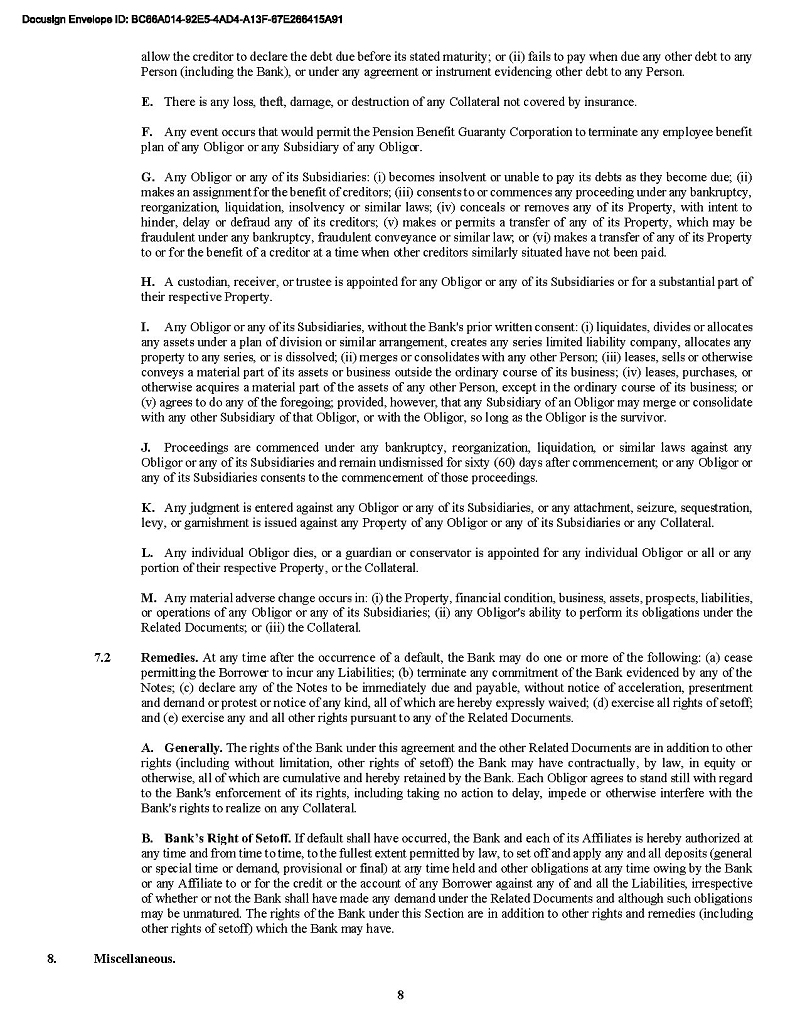






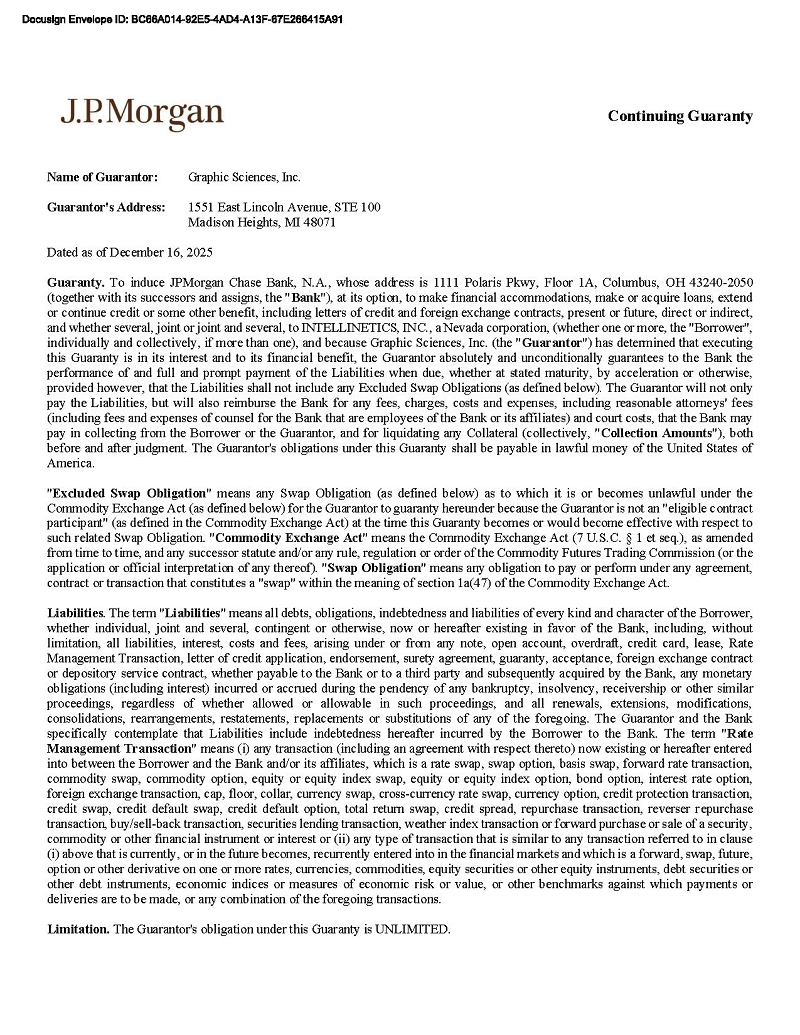


Exhibit 21.1
Subsidiaries of the Registrant
Listed below are the subsidiaries of Intellinetics, Inc. as of December 31, 2025.
| Subsidiary Name | State/Jurisdiction of Incorporation | |
| 1. Intellinetics, Inc. | Ohio | |
| 2. Graphic Sciences, Inc. | Michigan |
Exhibit 23.1
Consent of Independent Registered Public Accounting Firm
Intellinetics, Inc. and Subsidiaries
Columbus, Ohio
We hereby consent to the incorporation by reference in the Registration Statements on Form S-1 (No. 333-237721, 333-222765, 333-210484, and 333-264981), on Form S-3 (No. 333-286586), and on Form S-8 (No. 333-286002) of Intellinetics, Inc. of our report dated March 30, 2026 on the consolidated financial statements of Intellinetics, Inc. and Subsidiaries, which appear in this Annual Report on Form 10-K of Intellinetics, Inc.
/s/ GBQ Partners LLC
Columbus, Ohio
March 30, 2026
Exhibit 31.1
Certification Pursuant to Section 302 of the Sarbanes-Oxley Act of 2002
I, Alison G. Forsythe, certify that:
1. I have reviewed this Annual Report on Form 10-K of Intellinetics, Inc.;
2. Based on my knowledge, this report does not contain any untrue statement of a material fact or omit to state a material fact necessary to make the statements made, in light of the circumstances under which such statements were made, not misleading with respect to the period covered by this report;
3. Based on my knowledge, the financial statements, and other financial information included in this report, fairly present in all material respects the financial condition, results of operations and cash flows of the registrant as of, and for, the periods presented in this report;
4. The registrant’s other certifying officer and I are responsible for establishing and maintaining disclosure controls and procedures (as defined in Exchange Act Rules 13a-15(e) and 15d-15(e)) and internal control over financial reporting (as defined in Exchange Act Rules 13a-15(f) and 15d-15(f)) for the registrant and have:
a) Designed such disclosure controls and procedures, or caused such disclosure controls and procedures to be designed under our supervision, to ensure that material information relating to the registrant, including its consolidated subsidiaries, is made known to us by others within those entities, particularly during the period in which this report is being prepared;
b) Designed such internal control over financial reporting, or caused such internal control over financial reporting to be designed under our supervision, to provide reasonable assurance regarding the reliability of financial reporting and the preparation of financial statements for external purposes in accordance with generally accepted accounting principles;
c) Evaluated the effectiveness of the registrant’s disclosure controls and procedures and presented in this report our conclusions about the effectiveness of the disclosure controls and procedures, as of the end of the period covered by this report based on such evaluation; and
d) Disclosed in this report any change in the registrant’s internal control over financial reporting that occurred during the registrant’s most recent fiscal quarter (the registrant’s fourth fiscal quarter in the case of an annual report) that has materially affected, or is reasonably likely to materially affect, the registrant’s internal control over financial reporting; and
5. The registrant’s other certifying officer and I have disclosed, based on our most recent evaluation of internal control over financial reporting, to the registrant’s auditors and the audit committee of registrant’s board of directors (or persons performing the equivalent functions):
a) All significant deficiencies and material weaknesses in the design or operation of internal control over financial reporting which are reasonably likely to adversely affect the registrant’s ability to record, process, summarize and report financial information; and
b) Any fraud, whether or not material, that involves management or other employees who have a significant role in the registrant’s internal control over financial reporting.
| Date: March 30, 2026 | ||
| By: | /s/ Alison G. Forsythe | |
| President and Chief Executive Officer | ||
Exhibit 31.2
Certification Pursuant to Section 302 of the Sarbanes-Oxley Act of 2002
I, Joseph D. Spain, certify that:
1. I have reviewed this Annual Report on Form 10-K of Intellinetics, Inc.;
2. Based on my knowledge, this report does not contain any untrue statement of a material fact or omit to state a material fact necessary to make the statements made, in light of the circumstances under which such statements were made, not misleading with respect to the period covered by this report;
3. Based on my knowledge, the financial statements, and other financial information included in this report, fairly present in all material respects the financial condition, results of operations and cash flows of the registrant as of, and for, the periods presented in this report;
4. The registrant’s other certifying officer and I are responsible for establishing and maintaining disclosure controls and procedures (as defined in Exchange Act Rules 13a-15(e) and 15d-15(e)) and internal control over financial reporting (as defined in Exchange Act Rules 13a-15(f) and 15d-15(f)) for the registrant and have:
a) Designed such disclosure controls and procedures, or caused such disclosure controls and procedures to be designed under our supervision, to ensure that material information relating to the registrant, including its consolidated subsidiaries, is made known to us by others within those entities, particularly during the period in which this report is being prepared;
b) Designed such internal control over financial reporting, or caused such internal control over financial reporting to be designed under our supervision, to provide reasonable assurance regarding the reliability of financial reporting and the preparation of financial statements for external purposes in accordance with generally accepted accounting principles;
c) Evaluated the effectiveness of the registrant’s disclosure controls and procedures and presented in this report our conclusions about the effectiveness of the disclosure controls and procedures, as of the end of the period covered by this report based on such evaluation; and
d) Disclosed in this report any change in the registrant’s internal control over financial reporting that occurred during the registrant’s most recent fiscal quarter (the registrant’s fourth fiscal quarter in the case of an annual report) that has materially affected, or is reasonably likely to materially affect, the registrant’s internal control over financial reporting; and
5. The registrant’s other certifying officer and I have disclosed, based on our most recent evaluation of internal control over financial reporting, to the registrant’s auditors and the audit committee of registrant’s board of directors (or persons performing the equivalent functions):
a) All significant deficiencies and material weaknesses in the design or operation of internal control over financial reporting which are reasonably likely to adversely affect the registrant’s ability to record, process, summarize and report financial information; and
b) Any fraud, whether or not material, that involves management or other employees who have a significant role in the registrant’s internal control over financial reporting.
| Date: March 30, 2026 | ||
| By: | /s/ Joseph D. Spain | |
| Chief Financial Officer | ||
Exhibit 32.1
CERTIFICATION PURSUANT TO
18 U.S.C. SECTION 1350,
AS ADOPTED PURSUANT TO
SECTION 906 OF THE SARBANES-OXLEY ACT OF 2002
In connection with the Annual Report of Intellinetics, Inc. (the “Company”) on Form 10-K for the year ended December 31, 2025, as filed with the Securities and Exchange Commission (the “Report”), I, Alison G. Forsythe, President and Chief Executive Officer of the Company, certify, pursuant to 18 U.S.C. §1350, as adopted pursuant to §906 of the Sarbanes-Oxley Act of 2002, that:
(1) The Report fully complies with the requirements of Section 13(a) or 15(d) of the Securities Exchange Act of 1934; and
(2) The information contained in the Report fairly presents, in all material respects, the financial condition and results of operations of the Company.
| Dated: March 30, 2026 | ||
| By: | /s/ Alison G. Forsythe | |
| President and Chief Executive Officer | ||
Exhibit 32.2
CERTIFICATION PURSUANT TO
18 U.S.C. SECTION 1350,
AS ADOPTED PURSUANT TO
SECTION 906 OF THE SARBANES-OXLEY ACT OF 2002
In connection with the Annual Report of Intellinetics, Inc. (the “Company”) on Form 10-K for the year ended December 31, 2025, as filed with the Securities and Exchange Commission (the “Report”), I, Joseph D. Spain, Chief Financial Officer of the Company, certify, pursuant to 18 U.S.C. §1350, as adopted pursuant to §906 of the Sarbanes-Oxley Act of 2002, that:
(1) The Report fully complies with the requirements of Section 13(a) or 15(d) of the Securities Exchange Act of 1934; and
(2) The information contained in the Report fairly presents, in all material respects, the financial condition and results of operations of the Company.
| Dated: March 30, 2026 | ||
| By: | /s/ Joseph D. Spain | |
| Chief Financial Officer | ||