 エドガーで原本を確認する
UNITED STATES
SECURITIES AND EXCHANGE COMMISSION
Washington, D.C. 20549
FORM 40-F
☐ Registration statement pursuant to Section 12 of the Securities Exchange Act of 1934
or
☒ Annual report pursuant to Section 13(a) or 15(d) of the Securities Exchange Act of 1934
| For the fiscal year ended December 31, 2025 | Commission File Number 001-40442 |
The Real Brokerage Inc.
(Exact name of Registrant as specified in its charter)
N/A
(Translation of Registrant’s name into English (if applicable))
| British Columbia, Canada | 7370 | N/A | ||
| (Province or other jurisdiction of | (Primary Standard Industrial | (I.R.S. Employer | ||
| incorporation or organization) | Classification Code Number) | Identification Number) |
701 Brickell Avenue, 17th Floor
Miami, Florida, 33131 USA
(305) 306-9553
(Address and telephone number of Registrant’s principal executive offices)
Cogency Global Inc.
122 East 42nd Street, 18th Floor
New York, NY 10168
1-800-221-0102
(Name, address (including zip code) and telephone number (including area code) of agent for service in the United States)
Securities registered or to be registered pursuant to Section 12(b) of the Act:
| Title of each class | Trading Symbol | Name of each exchange on which registered | ||
| Common Shares, no par value | REAX | The Nasdaq Stock Market LLC |
Securities registered pursuant to Section 12(g) of the Act: None
Securities for which there is a reporting obligation pursuant to Section 15(d) of the Act: None
For annual reports, indicate by check mark the information filed with this Form:
| ☒ Annual information form | ☒ Audited annual financial statements |
Indicate the number of outstanding shares of each of the registrant’s classes of capital or common stock as of the close of the period covered by the annual report: 210,478,399 outstanding as of December 31, 2025.
Indicate by check mark whether the registrant: (1) has filed all reports required to be filed by Section 13 or 15(d) of the Exchange Act during the preceding 12 months (or for such shorter period that the registrant was required to file such reports); and (2) has been subject to such filing requirements for the past 90 days. ☒ Yes ☐ No
Indicate by check mark whether the registrant has submitted electronically and posted on its corporate Web site, if any, every Interactive Data File required to be submitted and posted pursuant to Rule 405 of Regulation S-T (§232.405 of this chapter) during the preceding 12 months (or for such shorter period that the registrant was required to submit and post such files). ☒Yes ☐ No
Indicate by check mark whether the registrant is an emerging growth company as defined in Rule 12b-2 of the Exchange Act.
☐ Emerging growth company
If an emerging growth company that prepares its financial statements in accordance with U.S. GAAP, indicate by check mark if the registrant has elected not to use the extended transition period for complying with any new or revised financial accounting standards† provided pursuant to Section 13(a) of the Exchange Act. ☐
| † | The term “new or revised financial accounting standard” refers to any update issued by the Financial Accounting Standards Board to its Accounting Standards Codification after April 5, 2012. |
Indicate by check mark whether the registrant has filed a report on and attestation to its management’s assessment of the effectiveness of its internal control over financial reporting under Section 404(b) of the Sarbanes-Oxley Act (15 U.S.C. 7262(b)) by the registered public accounting firm that prepared or issued its audit report. ☒
If securities are registered pursuant to Section 12(b) of the Act, indicate by check mark whether the financial statements of the registrant included in the filing reflect the correction of an error to previously issued financial statements. ☐
Indicate by check mark whether any of those error corrections are restatements that required a recovery analysis of incentive-based compensation received by any of the registrant’s executive officers during the relevant recovery period pursuant to §240.10D-1(b). ☐
EXPLANATORY NOTE
The Real Brokerage Inc. is a “foreign private issuer” as defined in Rule 3b-4 under Securities Exchange Act of 1934, as amended (the “Exchange Act”), and is a Canadian issuer eligible to file its annual report (“Annual Report”) pursuant to Section 13 of the Exchange Act on Form 40-F pursuant to the multi-jurisdictional disclosure system (the “MJDS”) adopted by the United States Securities and Exchange Commission (the “SEC”). The Company’s common shares are listed in the United States on the Nasdaq Capital Market (“NASDAQ”) under the trading symbol “REAX.”
In this Annual Report, references to “we,” “our,” “us,” the “Registrant,” the “Company,” or “Real Brokerage,” mean The Real Brokerage Inc. unless the context suggests otherwise.
FORWARD LOOKING STATEMENTS
The exhibits incorporated by reference into this Annual Report of the Registrant contain forward-looking statements. These statements may constitute “forward-looking information” and “forward-looking statements” under applicable Canadian and United States securities laws (collectively, “forward-looking statements”). These forward-looking statements typically include the words “anticipate,” “believe,” “consider,” “estimate,” “expect,” “forecast,” “intend,” “objective,” “plan,” “predict,” “projection,” “seek,” “strategy,” “target,” “outlook,” “will,” “should,” “could” or similar expressions, including statements expressed in future tense. Forward-looking statements contained herein or incorporated by reference may include opinions or beliefs regarding market conditions and similar matters. In many instances, those opinions and beliefs are based upon general observations by members of our management, anecdotal evidence and our experience in the conduct of our businesses, without specific investigations or analyses. Therefore, while they reflect our view of the industries and markets in which we are involved, they should not be viewed as reflecting verifiable views or views that are necessarily shared by all who are involved in those industries or markets. These statements concern expectations, beliefs, projections, plans and strategies, anticipated events or trends and similar expressions concerning matters that are not historical facts. Without limitation, the exhibits incorporated by reference into this Annual Report of the Registrant may contain forward-looking statements pertaining to the following:
| ● | the Company’s capital and organizational structure; | |
| ● | the Company’s expected working capital; | |
| ● | the Company’s business plans and strategies including targets for future growth; | |
| ● | the development of the Company’s business, including expectations regarding the growth of its ancillary services, One Real Title, One Real Mortgage and Real Wallet; | |
| ● | expectations regarding the real estate industry; | |
| ● | expectations regarding the development, launch and adoption of new technologies, including Real Wallet, HeyLeo, and Leo CoPilot, and their expected features; | |
| ● | expectations with respect to future opportunities; | |
| ● | capital expenditure programs and future capital requirements; | |
| ● | supply and demand fundamentals for services of the Company; | |
| ● | the Company’s plans and funding for planned development activities and the expected results of such activities; | |
| ● | the Company’s treatment under governmental and international regulatory regimes; | |
| ● | the Company’s access to capital and overall strategy and development plans for all of the Company’s assets; and | |
| ● | litigation and antitrust matters that may impact the Company. |
The forward-looking statements reflect our current views about future events and are subject to risks, uncertainties and assumptions. We wish to caution readers that certain important factors may have affected and could in the future affect our actual results and could cause actual results to differ significantly from what is anticipated by our forward-looking statements. The most important factors that could cause actual results to differ materially from those anticipated by our forward-looking statements include, but are not limited to:
| ● | the impact of macroeconomic conditions on the strength of the residential real estate market; | |
| ● | an extended slowdown in some or all of the real estate markets in which we operate; | |
| ● | the future operational and financial activities of the Company generally; | |
| ● | fluctuations in foreign currency exchange rates, interest rates, business prospects and opportunities; | |
| ● | the impact of inflation or a higher interest rate environment; | |
| ● | reduced availability or increased cost of mortgage financing for homebuyers; | |
| ● | increased interest rates or increased competition in the mortgage industry; | |
| ● | our inability to successfully execute our strategies, including our strategy to grow our ancillary mortgage broker, title services, and wallet operations; | |
| ● | our inability to offer technology that we develop, including HeyLeo, with all expected features; | |
| ● | the possibility that we will incur nonrecurring costs that affect earnings in one or more reporting periods; | |
| ● | the impact of the industry antitrust litigation on the industry generally and specifically to us with respect to any lawsuit in which we were named, as well as potential future lawsuits in which we are named; | |
| ● | a reduction in customary commission rates and reduction in the Company’s gross commission income collection; | |
| ● | new laws or regulatory changes, or unfavorable interpretations of existing laws by regulators, that adversely affect the profitability of our businesses; | |
| ● | risks related to information technology failures or data security breaches; | |
| ● | the effect of cybersecurity incidents and threats; | |
| ● | our ability to attract and retain highly qualified employees; | |
| ● | our inability to retain agents, or maintain our agent growth rate; |
| ● | the regulatory framework governing intellectual property in the jurisdictions in which the Company conducts its business and any other jurisdictions in which the Company may conduct its business in the future; | |
| ● | the Company’s potential inability to comply with the regulatory bodies governing its activities; | |
| ● | the impact of competition on the Company; | |
| ● | our ability to obtain or maintain adequate insurance coverage on commercially reasonable terms; | |
| ● | the effects of weather conditions and natural disasters on our business and financial results; | |
| ● | our ability to maintain our company culture; | |
| ● | the effects of public health issues such as a major epidemic or pandemic that could have a negative impact on the economy and on our businesses; | |
| ● | the effects of negative publicity; | |
| ● | our ability to maintain cash balances and generate cash sufficient to satisfy our operating requirements; | |
| ● | our ability to successfully estimate the impact of certain accounting and tax matters, including related to transfer pricing; changes in law that have a negative impact on our business; and | |
| ● | the impact of regulatory and litigation matters. |
The foregoing list of risks and assumptions is not exhaustive. Actual results could differ materially from those anticipated in forward-looking statements as a result of various events and circumstances, including, among other things, the risk factors identified under the heading “5.2 – Risk Factors” in the Annual Information Form for the year ended December 31, 2025, attached as Exhibit 99.1 to this Annual Report and incorporated herein by reference.
Should one or more of these risks or uncertainties materialize, or should assumptions underlying the forward-looking information prove incorrect, actual results, performance or achievement may vary materially from those expressed or implied by the forward-looking information contained in this Annual Report and in the exhibits incorporated by reference into this Annual Report. Applicable risks and uncertainties include, but are not limited to, those identified under the heading “Risk Factors” on page 17 of the Annual Information Form for the year ended December 31, 2025, attached as Exhibit 99.1 to this Annual Report and incorporated herein by reference, and under the heading “Risks and Uncertainties” on page 4 of the Registrant’s Management’s Discussion & Analysis for the year ended December 31, 2025, attached as Exhibit 99.3 to this Annual Report and incorporated herein by reference, and in other filings that the Registrant has made and may make with applicable securities authorities in the future.
These factors should be carefully considered and readers are cautioned not to place undue reliance on forward-looking information, which speaks only as of the date of this Annual Report and the date of the exhibits incorporated by reference into this Annual Report. Such forward-looking statements are based on the beliefs, expectations, and opinions of management on the date the statements are made. In preparing this Annual Report, the Registrant has not updated such forward-looking statements to reflect any change in circumstances or in management’s beliefs, expectations or opinions that may have occurred prior to the date hereof. All subsequent forward-looking information of the Company herein is expressly qualified in its entirety by the cautionary statements contained in or referred to herein. The Company does not undertake any obligation to release publicly any revisions to this forward-looking information to reflect events or circumstances that occur after the date of this Annual Report or to reflect the occurrence of unanticipated events, except as may be required under applicable Canadian and United States securities laws. For the reasons set forth above, investors should not place undue reliance on forward-looking statements.
NOTICE TO UNITED STATES READERS - DIFFERENCES IN UNITED STATES AND CANADIAN REPORTING PRACTICES
The Registrant is permitted, under a multijurisdictional disclosure system adopted by the U.S. Securities and Exchange Commission (the “SEC”), to prepare this Annual Report in accordance with Canadian disclosure requirements, which are different from those of the United States.
Unless otherwise indicated, all dollar amounts in this Annual Report on Form 40-F are in United States dollars.
PRINCIPAL DOCUMENTS
The following documents have been filed as part of this Annual Report on Form 40-F:
A. Annual Information Form
The Registrant’s Annual Information Form for the fiscal year ended December 31, 2025 is attached as Exhibit 99.1 to this Annual Report on Form 40-F, and is incorporated by reference herein.
B. Audited Annual Financial Statements
The Registrant’s consolidated audited annual financial statements, including the reports of the independent registered public accounting firm with respect thereto, are attached as Exhibit 99.2 to this Annual Report on Form 40-F and is incorporated by reference herein.
C. Management’s Discussion and Analysis
The Registrant’s management’s discussion and analysis of financial condition and results of operations for the twelve-month period ended December 31, 2025 is attached as Exhibit 99.3 to this Annual Report on Form 40-F and is incorporated by reference herein.
TAX MATTERS
Purchasing, holding or disposing of securities of the Registrant may have tax consequences under the laws of the United States and Canada that are not described in this Annual Report on Form 40-F.
DISCLOSURE CONTROLS AND PROCEDURES
The information provided in the section entitled Disclosure Controls and Procedures and Internal Control Over Financial Reporting in the Management’s Discussion and Analysis filed as Exhibit 99.3 to this Annual Report on Form 40-F is incorporated by reference herein.
MANAGEMENT’S REPORT ON INTERNAL CONTROL OVER FINANCIAL REPORTING
The information provided in the section entitled Disclosure Controls and Procedures and Management’s Report on Internal Control Over Financial Reporting in the Management’s Discussion and Analysis filed as Exhibit 99.3 to this Annual Report on Form 40-F is incorporated by reference herein.
ATTESTATION REPORT OF THE REGISTERED PUBLIC ACCOUNTING FIRM
The information provided in the section entitled “Report of the Independent Registered Public Accounting Firm” contained in the Audited Annual Consolidated Financial Statements for the years ended December 31, 2025 and 2024, filed as Exhibit 99.2 to this Annual Report on Form 40-F is incorporated by reference herein.
CHANGES IN INTERNAL CONTROL OVER FINANCIAL REPORTING
There have been no changes in the Registrant’s internal control over financial reporting during the fiscal year ended December 31, 2025, that have materially affected, or are reasonably likely to materially affect, the Registrant’s internal control over financial reporting.
NOTICES PURSUANT TO REGULATION BTR
None.
CODE OF ETHICS
The Registrant has adopted a written “code of ethics” (as defined by the rules and regulations of the SEC), entitled “Code of Business Conduct and Ethics” (the “Code”) that applies to all directors, officers and employees of the Company and its subsidiaries and operates in all countries in which the Registrant and its subsidiaries conduct business. Adherence to this code is a condition of employment with or providing services to the Company. The Code may be obtained upon request from The Real Brokerage Inc.’s head office at 701 Brickell Avenue, 17th Floor, Miami, Florida, 33131, United States of America, or by viewing the Registrant’s web site at https://investors.onereal.com/corporate-governance.
All amendments to the Code, and all waivers of the Code with respect to any director, executive officer or principal financial and accounting officers, will be posted on the Registrant’s web site within five business days following the date of the amendment or waiver and any amendment will be provided in print to any shareholder upon request.
AUDIT COMMITTEE
Our Board of Directors has established the Audit Committee in accordance with section 3(a)(58)(A) of the Exchange Act and Rule 5605(c) of the NASDAQ Marketplace Rules for the purpose of overseeing our accounting and financial reporting processes and the audits of our annual financial statements.
The Audit Committee is comprised of Larry Klane (Chair), Atul Malhotra, Jr., Vikki Bartholomae, and Susanne Sandler. Our Board of Directors has determined that the Audit Committee meets the composition requirements set forth by Section 5605(c)(2) of the NASDAQ Marketplace Rules and all the members of the Audit Committee are independent as determined under Rule 10A-3 of the Exchange Act and Rule 5605(a)(2) of the NASDAQ Marketplace Rules.
All four members of the Audit Committee are financially literate, meaning they are able to read and understand the Registrant’s financial statements and to understand the breadth and level of complexity of the issues that can reasonably be expected to be raised by the Registrant’s financial statements.
Our Board of Directors has determined that Larry Klane qualifies as an “audit committee financial expert” (as defined in paragraph (8)(b) of General Instruction B to Form 40-F).
The SEC has indicated that the designation or identification of a person as an audit committee financial expert does not make such person an “expert” for any purpose, impose any duties, obligations or liability on such person that are greater than those imposed on members of the audit committee and the board of directors who do not carry this designation or identification, or affect the duties, obligations or liability of any other member of the audit committee or board of directors.
PRINCIPAL ACCOUNTANT FEES AND SERVICES
The required disclosure is included under the heading “Audit Committee Information - External Auditor Service Fees” in the Company’s Annual Information Form for the fiscal year ended December 31, 2025, filed as Exhibit 99.1 to this Annual Report on Form 40-F.
PRE-APPROVAL OF AUDIT AND NON-AUDIT SERVICES PROVIDED BY
INDEPENDENT REGISTERED PUBLIC ACCOUNTING FIRM
The Registrant’s Audit Committee Charter sets out responsibilities regarding the provision of non-audit services by the Registrant’s external auditors and requires the Audit Committee to pre-approve all permitted non-audit services to be provided by the Registrant’s external auditors, in accordance with applicable law.
OFF-BALANCE SHEET ARRANGEMENTS
The Registrant currently has no off-balance sheet arrangements.
TABULAR DISCLOSURE OF CONTRACTUAL OBLIGATIONS
The following table lists, as of December 31, 2025, information with respect to the Registrant’s known contractual obligations (in thousands):
| Payments due by period | ||||||||||||||||||||
| Less than | More than | |||||||||||||||||||
| Contractual Obligations | Total | 1 year | 1-3 years | 3-5 years | 5 years | |||||||||||||||
| Long-Term Debt Obligations | $ | 0 | $ | 0 | $ | 0 | $ | 0 | $ | 0 | ||||||||||
| Capital (Finance) Lease Obligations | $ | 0 | $ | 0 | $ | 0 | $ | 0 | $ | 0 | ||||||||||
| Operating Lease Obligations | $ | 0 | $ | 0 | $ | 0 | $ | 0 | $ | 0 | ||||||||||
| Purchase Obligations | $ | 0 | $ | 0 | $ | 0 | $ | 0 | $ | 0 | ||||||||||
| Other Long-Term Liabilities Reflected on Balance Sheet | $ | 0 | $ | 0 | $ | 0 | $ | 0 | $ | 0 | ||||||||||
| Total | $ | 0 | $ | 0 | $ | 0 | $ | 0 | $ | 0 | ||||||||||
NASDAQ CORPORATE GOVERNANCE
The Registrant is a foreign private issuer and its common shares are listed on the NASDAQ.
NASDAQ Rule 5615(a)(3) permits a foreign private issuer to follow its home country practice in lieu of the requirements of the Rule 5600 Series, the requirement to distribute annual and interim reports set forth in Rule 5250(d), and the Direct Registration Program requirement set forth in Rules 5210(c) and 5255; provided, however, that such a company shall comply with the Notification of Material Noncompliance requirement (Rule 5625), the Voting Rights requirement (Rule 5640), have an audit committee that satisfies Rule 5605(c)(3), and ensure that such audit committee’s members meet the independence requirement in Rule 5605(c)(2)(A)(ii).
The Registrant has reviewed the NASDAQ corporate governance requirements and confirms that except as described below, the Registrant is in compliance with the NASDAQ corporate governance standards in all significant respects:
The Registrant does not follow Rule 5620(c), under which the Nasdaq minimum quorum requirement for a shareholder meeting is 33-1/3% of the outstanding shares of common stock. In addition, a registrant listed on Nasdaq is required to state its quorum requirement in its by-laws. The Registrant’s quorum requirement is set forth in its articles. A quorum for the transaction of business at a meeting of shareholders of the Registrant is two persons who are, or who represent by proxy, shareholders who, in the aggregate, hold at least 5% of the issued common shares of the Company entitled to vote at the meeting. In lieu of following Rule 5620(c) (shareholder quorum), the Registrant follows the rules set forth in its articles.
The Registrant doesn’t follow Nasdaq Rule 5620(b), under which a listed company that is not a limited partnership must solicit proxies and provide proxy statements for all meetings of shareholders, and also provide copies of such proxy solicitation materials to Nasdaq. The Company is a “foreign private issuer” as defined in Rule 3b-4 under the Exchange Act, and the equity securities of the Company are accordingly exempt from the proxy rules set forth in Sections 14(a), 14(b), 14(c) and 14(f) of the Exchange Act. In lieu of following Nasdaq Rule 5620(b), the Registrant solicits proxies in accordance with applicable rules and regulations in Canada.
The foregoing is consistent with the laws, customs, and practices in the province of British Columbia and Canada.
Further information about the Registrant’s governance practices is included on the Registrant’s website.
MINE SAFETY DISCLOSURE
Not applicable.
DISCLOSURE REGARDING FOREIGN JURISDICTIONS THAT PREVENT INSPECTIONS
None.
RECOVERY OF ERRONEOUSLY AWARDED COMPENSATION
None.
UNDERTAKING
The Registrant undertakes to make available, in person or by telephone, representatives to respond to inquiries made by the SEC staff, and to furnish promptly, when requested to do so by the SEC staff, information relating to: the securities registered pursuant to Form 40-F; the securities in relation to which the obligation to file an annual report on Form 40-F arises; or transactions in said securities.
CONSENT TO SERVICE OF PROCESS
The Registrant has previously filed with the SEC a written consent to service of process on Form F-X. Any change to the name or address of the Registrant’s agent for service shall be communicated promptly to the SEC by amendment to the Form F-X referencing the file number of the Registrant.
ADDITIONAL INFORMATION
Additional information relating to the Registrant may be found on the System for Electronic Document Analysis and Retrieval (SEDAR) at www.sedar.com and on the SEC’s Electronic Data Gathering, Analysis and Retrieval (EDGAR) system at www.sec.gov.
INCORPORATION BY REFERENCE
The Registrant’s Annual Report is incorporated by reference into the Registrant’s Registration Statement on Form F-3 (Reg. No. 333-282687) and Registration Statements on Form S-8 (Reg. Nos. 333-262142, 333-269982 and 333-287690), including the prospectuses contained therein.
SIGNATURES
Pursuant to the requirements of the Exchange Act, the Registrant certifies that it meets all of the requirements for filing on Form 40-F and has duly caused this Annual Report to be signed on its behalf by the undersigned, thereunto duly authorized.
| THE REAL BROKERAGE INC. | ||
| By: | /s/ Tamir Poleg | |
| Name: | Tamir Poleg | |
| Title: | Chief Executive Officer | |
Date: March 4, 2026
EXHIBIT INDEX
Exhibit 97
THE REAL BROKERAGE INC.
POLICY REGARDING RECOVERY OF ERRONEOUSLY AWARDED COMPENSATION
The following is the policy of The Real Brokerage Inc. (the “Company”) regarding the recovery of incentive compensation erroneously awarded (the “Policy”) to Covered Persons as a result of erroneous financial measures that are restated. This policy is intended to comply with Rule 5608 of the Nasdaq Marketplace Rules (“Rule 5608”) and Securities and Exchange Commission (“SEC”) Rule 10D-1.
1. The Policy
It is the policy of the Company that if the Company is required to prepare an accounting restatement due to the material noncompliance of the Company with any financial reporting requirement under the securities laws, including any required accounting restatement to correct an error in previously issued financial statements that is material to the previously issued financial statements, or that would result in a material misstatement if the error were corrected in the current period or left uncorrected in the current period, the Company will recover reasonably promptly from each Covered Person all Erroneously Awarded Compensation the Covered Person received during the Applicable Recovery Period due to the error in calculating Financial Reporting Measures that resulted in the restatement.
This Policy will apply to all Incentive-based compensation received by a person (a) after the person begins service as an Executive Officer or otherwise is designated by the Committee as a Covered Person (b) who served as an Executive Officer, or otherwise was a Covered Person, during the performance period for that Incentive-Based Compensation, (c) while the Company has a class of securities listed on the Nasdaq Stock Market LLC (“Nasdaq”) or any other national securities exchange or a national securities association, and (d) during the Applicable Recovery Period.
2. Defined Terms
When used in, or with regard to, this Policy, the following terms will have the meanings given to them in Rule 5608 (with all references to the issuer being to the Company):
| Executive Officer | Incentive-Based Compensation |
| Financial Reporting Measures | Received |
In addition, when used in, or with regard to, this Policy, the following terms will have the following meanings:
“Applicable Recovery Period” means, with respect to a Material Restatement, the three completed fiscal years immediately preceding the Restatement Date of that Material Restatement (including as a fiscal year any transition period between the last day of the Company’s previous fiscal year end and the first day of its new fiscal year that comprises a period of between nine and twelve months due to the Company’s changing its fiscal year within or immediately following the aforementioned three completed fiscal years). The Company’s obligation to recover Erroneously Awarded Compensation will not be dependent on if or when the restated financial statements are filed.
“Committee” means the Compensation Committee of the Company’s Board of Directors.
“Covered Person” means an executive officer of the Company and any other person designated by the Committee to be a Covered Person during a specified period.
“Erroneously Awarded Compensation” means, with respect to a Material Restatement, the amount of Incentive-Based Compensation Received by a Covered Person during the Applicable Recovery Period in excess of the amount that would have been received by that Covered Person if the Incentive-Based Compensation had been determined based on the restated amounts determined following the Material Restatement, computed without respect to any taxes paid (i.e. without consideration of any withholding or other taxes paid when the Incentive-Based Compensation was awarded or issued). If the Incentive- Based Compensation is based on stock price or total shareholder return and the Erroneously Awarded Compensation is not subject to mathematical recalculation directly from the information in an accounting restatement, it will be based on a reasonable estimate of the effect of the Material Restatement on the stock price or total shareholder return on which the Incentive-Based Compensation was received.
“Material Restatement” means an accounting restatement of previously issued financial statements of the Company due to the Company’s material noncompliance with a financial requirement under the securities laws.
“Restatement Date” means, with respect to a Material Restatement, the earlier of (i) the date the Company’s Board, a Committee of the Company’s Board, or the officer or officers of the Company authorized to take such action if Board action is not required, concludes, or reasonably should have concluded, that the Company is required to prepare the Material Restatement, or (ii) the date a court, regulator or other legally authorized body, directs the Company to prepare the Material Restatement.
3. Exception to Policy
The Company may elect not to seek to recover Erroneously Awarded Compensation from a Covered Person if the Committee determines that recovery would be impractical and one or more of the following conditions is met: (i) the direct expense paid to a third party for assistance in enforcing this Policy would exceed the amount to be recovered, and the Company has made a reasonable attempt to recover the Erroneously Awarded Compensation, documented such reasonable attempt to recover, and provided that documentation to Nasdaq (ii) recovery would cause the Company to violate a law of Canada or a province of Canada that was adopted prior to November 28, 2022, and the Company obtains, and provides to Nasdaq, an opinion of Canadian counsel acceptable to Nasdaq that recovery would result in a violation of a law of Canada or a province of Canada, or (iii) recovery would likely cause an otherwise tax-qualified retirement plan, under which benefits are broadly available to employees of the Company, to fail to meet the requirements of 26 U.S.C. 401(a)(13) or 26 U.S.C. 411(a) and regulations thereunder.
4. No Indemnification
The Company is prohibited from indemnifying any Covered Person or former Covered Person against the loss of Erroneously Awarded Compensation. No Covered Person will be entitled to indemnification from the Company or any of its subsidiaries for any costs of defending against a claim by the Company for Erroneously Received Compensation.
5. Enforcement of Policy
The Committee will determine the steps the Company should take to recover Erroneously Awarded Compensation, provided that the Committee will not determine not to proceed against a Covered Person who received Erroneously Paid Compensation, unless it has received written advice from counsel to the effect that it is more likely than not that if the Company attempts to recover Erroneously Awarded Compensation, the effort will not result in a material net recovery by the Company (whether because of doubts regarding the Company’s right to recover the Erroneously Awarded Compensation or because of doubts about the Covered Person’s financial ability to return the Erroneously Awarded Compensation).
No Covered Person will be entitled to indemnification from the Company or any of its subsidiaries for any costs of defending against a claim by the Company for Erroneously Received Compensation.
6. Rights against Covered Persons
Every employee of the Company or any of its subsidiaries who is, or becomes, a Covered Person, will be deemed by accepting Incentive-Based Compensation to agree that that Incentive-Based Compensation is received, and will be held by the Covered Person, subject to this Policy, and that this Policy may be enforced to recover Erroneously Awarded Compensation from the Covered Person.
7. Administration and Interpretation
The Committee will be responsible for all decisions regarding the application and interpretation of this Policy. However, in interpreting this Policy, the Committee will do so in a manner that is, to the fullest extent practicable, consistent with SEC Rule 10D-1 and Rule 5608 of the Nasdaq Marketplace Rules.
8. Maintaining Records
The Company will be responsible for maintaining documentation of the determination of the reasonable estimate as detailed under the definition of “Erroneously Awarded Compensation” and provide such documentation to Nasdaq.
The Company will also be responsible for filing all disclosures with respect to such recovery policy in accordance with the requirements of the Federal securities laws, including the disclosure required by the applicable SEC filings.
9. Review
The Committee shall be responsible for administering this Policy. The Committee shall review this Policy periodically and recommend appropriate changes to the Board of Directors of the Company.
Approved by the Board of Directors on August 8, 2023
Exhibit 99.1

Item 1. ABOUT THIS ANNUAL INFORMATION FORM
In this annual information form (“AIF” or “Annual Information Form”), unless the context otherwise requires, the “Company”, “Real”, “we”, “us” and “our” refers to The Real Brokerage Inc. and its wholly-owned and majority-owned subsidiaries, as defined and set out below under Item 3.2 – Intercorporate Relationships.
All financial information in this Annual Information Form is presented in Canadian dollars, unless otherwise indicated, and has been in accordance with U.S generally accepted accounting principles (“U.S. GAAP”).
In this AIF, all references to “C$” refer to Canadian dollars, all references to “US$” refer to U.S. dollars. The daily exchange rate as reported by the Bank of Canada was US$1.00 = C$1.3706 on December 31, 2025.
This AIF applies to the business activities and operations of the Company for the fiscal year ended December 31, 2025, with certain information updated to reflect changes occurring subsequent to December 31, 2025, up to the date of hereof. Unless otherwise indicated, the information in this AIF is provided as of March 4, 2026.
This AIF contains company names, product names, trade names, trademarks and service marks of the Company and other organizations, all of which are the property of their respective owners.
The information contained in this AIF, including news releases and other disclosure items of the Company, is available under the Company’s profile on SEDAR+ at www.sedarplus.ca and on EDGAR at www.sec.gov. The Common Shares are traded on the NASDAQ under the symbol “REAX”.
CAUTIONARY NOTE REGARDING FORWARD-LOOKING STATEMENTS
This AIF contains “forward-looking information” and “forward-looking statements” under applicable Canadian and United States securities laws (collectively, “forward-looking statements”). These forward-looking statements typically include the words “anticipate,” “believe,” “consider,” “estimate,” “expect,” “forecast,” “intend,” “objective,” “plan,” “predict,” “projection,” “seek,” “strategy,” “target,” “outlook,” “will,” “should,” “could” or similar expressions, including statements expressed in future tense. Forward-looking statements contained herein may include opinions or beliefs regarding market conditions and similar matters. In many instances, those opinions and beliefs are based upon general observations by members of our management, anecdotal evidence and our experience in the conduct of our businesses, without specific investigations or analyses. Therefore, while they reflect our view of the industries and markets in which we are involved, they should not be viewed as reflecting verifiable views or views that are necessarily shared by all who are involved in those industries or markets. These statements concern expectations, beliefs, projections, plans and strategies, anticipated events or trends and similar expressions concerning matters that are not historical facts.
Forward looking statements in this AIF may include, this AIF may contain forward-looking statements pertaining to the following:
| ● | the Company’s capital and organizational structure; |
| ● | the Company’s expected working capital; |
| ● | the Company’s business plans and strategies including targets for future growth; |
| ● | the development of the Company’s business, including expectations regarding the growth of its ancillary services, One Real Title, One Real Mortgage and Real Wallet; |
| ● | expectations regarding the real estate industry; |
| ● | expectations regarding the development, launch and adoption of new technologies, including Real Wallet, HeyLeo, and Leo CoPilot, and their expected features; |
| ● | expectations with respect to future opportunities; |
| ● | capital expenditure programs and future capital requirements; |
| ● | supply and demand fundamentals for services of the Company; |
| ● | the Company’s plans and funding for planned development activities and the expected results of such activities; |
| ● | the Company’s treatment under governmental and international regulatory regimes; |
| ● | the Company’s access to capital and overall strategy and development plans for all of the Company’s assets; and |
| ● | litigation and antitrust matters that may impact the Company. |
| The Real Brokerage Inc. | AIF | Year Ended December 31, 2025 |
|
The forward-looking statements reflect our current views about future events and are subject to risks, uncertainties and assumptions. We wish to caution readers that certain important factors may have affected and could in the future affect our actual results and could cause actual results to differ significantly from what is anticipated by our forward-looking statements. The most important factors that could cause actual results to differ materially from those anticipated by our forward-looking statements include, but are not limited to:
| ● | the impact of macroeconomic conditions on the strength of the residential real estate market; |
| ● | an extended slowdown in some or all of the real estate markets in which we operate; |
| ● | the future operational and financial activities of the Company generally; |
| ● | fluctuations in foreign currency exchange rates, interest rates, business prospects and opportunities; |
| ● | the impact of inflation or a higher interest rate environment; |
| ● | reduced availability or increased cost of mortgage financing for homebuyers; |
| ● | increased interest rates or increased competition in the mortgage industry; |
| ● | our inability to successfully execute our strategies, including our strategy to grow our ancillary mortgage broker, title services, and wallet operations; |
| ● | our inability to launch HeyLeo with all expected features; |
| ● | the possibility that we will incur nonrecurring costs that affect earnings in one or more reporting periods; |
| ● | the impact of the industry antitrust litigation on the industry generally and specifically to us with respect to any lawsuit in which we were named, as well as potential future lawsuits in which we are named; |
| ● | a reduction in customary commission rates and reduction in the Company’s gross commission income collection; |
| ● | new laws or regulatory changes, or unfavorable interpretations of existing laws by regulators, that adversely affect the profitability of our businesses; |
| ● | risks related to information technology failures or data security breaches; |
| ● | the effect of cybersecurity incidents and threats; |
| ● | our ability to attract and retain highly qualified employees; |
| ● | our inability to retain agents, or maintain our agent growth rate; |
| ● | the regulatory framework governing intellectual property in the jurisdictions in which the Company conducts its business and any other jurisdictions in which the Company may conduct its business in the future; |
| ● | the Company’s potential inability to comply with the regulatory bodies governing its activities; |
| ● | the impact of competition on the Company; |
| ● | our ability to obtain or maintain adequate insurance coverage on commercially reasonable terms; |
| ● | the effects of weather conditions and natural disasters on our business and financial results; |
| ● | our ability to maintain our company culture; |
| ● | the effects of public health issues such as a major epidemic or pandemic that could have a negative impact on the economy and on our businesses; |
| ● | the effects of negative publicity; |
| ● | our ability to maintain cash balances and generate cash sufficient to satisfy our operating requirements; |
| ● | our ability to successfully estimate the impact of certain accounting and tax matters, including related to transfer pricing; changes in law that have a negative impact on our business; and |
| ● | the impact of regulatory and litigation matters. |
The foregoing list of assumptions is not exhaustive. Actual results could differ materially from those anticipated in forward-looking statements as a result of various events and circumstances, including, among other things, the risk factors identified under the heading “5.2 – Risk Factors”.
Should one or more of these risks or uncertainties materialize, or should assumptions underlying the forward-looking information prove incorrect, actual results, performance or achievement may vary materially from those expressed or implied by the forward-looking information contained in this AIF. These factors should be carefully considered and readers are cautioned not to place undue reliance on forward-looking information, which speaks only as of the date of this AIF. All subsequent forward-looking information of the Company herein is expressly qualified in its entirety by the cautionary statements contained in or referred to herein. The Company does not undertake any obligation to release publicly any revisions to this forward-looking information to reflect events or circumstances that occur after the date of this AIF or to reflect the occurrence of unanticipated events, except as may be required under applicable Canadian and United States securities laws.
MARKET AND INDUSTRY DATA
This AIF may contain market and industry data and forecasts obtained from third-party sources, industry publications and publicly available information. The Company believes that the industry data is accurate and that its estimates and assumptions are reasonable, but there is no assurance as to the accuracy or completeness of this data. Third-party sources generally state that the information contained therein has been obtained from sources believed to be reliable, but there can be no assurance as to the accuracy or completeness of included information. Although management believes it to be reliable, the Company has not independently verified any of the data from third-party sources referred to in this AIF, or analyzed or verified the underlying information relied upon or referred to by such sources, or ascertained the underlying economic assumptions relied upon by such sources.
| The Real Brokerage Inc. | AIF | Year Ended December 31, 2025 |
|
GLOSSARY OF TERMS
The following is a glossary of certain terms used in this Annual Information Form. Words below importing the singular, where the context requires, include the plural and vice versa, and words importing any gender include all genders.
“AI” means artificial intelligence.
“AIF” or “Annual Information Form” has the meaning ascribed to it in Item 1 - About This Annual Information Form.
“2025 Plan” means The Real Brokerage Inc. 2025 Stock Incentive Plan which was approved by the Shareholders at the Company’s annual general meeting of Shareholders held on May 30, 2025.
“Affiliate” means a corporation that is affiliated with another corporation as follows: (A) a corporation is an “Affiliate” of another corporation if: (i) one of them is the subsidiary of the other; or (ii) each of them is controlled by the same Person; (B) a corporation is “controlled” by a Person if: (i) voting securities of the corporation are held, other than by way of security only, by or for the benefit of that Person; and (ii) the voting securities, if voted, entitle the Person to elect a majority of the directors of the corporation; or (C) a Person beneficially owns securities that are beneficially owned by: (i) a corporation controlled by that Person; or (ii) an Affiliate of that Person or an Affiliate of any corporation controlled by that Person.
“Amended and Restated Omnibus Incentive Plan” means the securities-based incentive compensation plan of the Company adopted by the Board on July 15, 2022, and approved by the Shareholders at a meeting on June 9, 2023, providing for the grant of Options and RSUs to eligible directors, officers, employees and consultants.
“AML” has the meaning ascribed to it in Item 5.1 - General.
“Audit Committee” means the audit committee of the Board.
“Auditor” has the meaning ascribed to it in Item 15.1 – Interests of Experts.
“Award” means an Option or RSU granted pursuant to a Securities Based Compensation Arrangement.
“Bank Partner” has the meaning ascribed to it in Item 5.1 - General.
“BCBCA” means the Business Corporations Act (British Columbia), including the regulations promulgated thereunder, as amended from time to time.
“Board” means the board of directors of the Company.
“BSA” has the meaning ascribed to it in Item 5.1 - General.
“Capital” has the meaning ascribed to it in Item 5.1 - General.
“Common Shares” means common shares in the authorized share structure of the Company.
“Cwynar Class Action” has the meaning ascribed to it in Item 12 - Legal Proceedings and Regulatory Actions.
“Compensation Committee” means the compensation committee of the Board.
“Dodd-Frank Act” means The Dodd-Frank Wall Street Reform and Consumer Protection Act.
“DOJ” has the meaning ascribed to it in Item 12 - Legal Proceedings and Regulatory Actions.
“EDGAR” means Electronic Data Gathering, Analysis, and Retrieval system under the U.S. Securities Act and available for public view at www.sec.gov.
“FDIC” has the meaning ascribed to it in Item 5.1 - General.
“iBuyers” has the meaning ascribed to it in Item 5.1-General.
| The Real Brokerage Inc. | AIF | Year Ended December 31, 2025 |
|
“Insight Investment” has the meaning ascribed to it in Item 4.1 – Three Year History - Insight Partners Investment.
“Insight Partners” means certain funds affiliated with Insight Holdings Group, LLC, in particular Insight Partners XI, L.P.; Insight Partners (Cayman) XI, L.P.; Insight Partners XI (Co-Investors), L.P.; Insight Partners XI (Co-Investors) (B), L.P.; Insight Partners (Delaware) XI, L.P.; and Insight Partners (EU) XI, S.C.Sp.
“Investor Rights Agreement” has the meaning ascribed to it in Item 4.1 – Three Year History - Insight Partners Investment.
“MLS” means Multiple Listing Services.
“Mortgage Act” has the meaning ascribed to it in Item 5.2 – Risk Factors.
“NAR” has the meaning ascribed to it in Item 12 - Legal Proceedings and Regulatory Actions.
“NASDAQ” means the NASDAQ Capital Market.
“NASDAQ Listing” has the meaning ascribed to it in Item 4.1 – Three Year History - NASDAQ Listing.
“NCIB” has the meaning ascribed to it in Item 4.1 – Three Year History - Normal Course Issuer Bid.
“NI 52-110” means National Instrument 52-110 – Audit Committees.
“Nominating and Corporate Governance Committee” means the nominating and corporate governance committee of the Board.
“Omnibus Incentive Plan” means the securities-based incentive compensation plan of the Company as approved by the Shareholders at the Company’s annual general meeting of Shareholders held on June 13, 2022.
“Options” means the options exercisable into Common Shares pursuant to a Securities Based Compensation Arrangement.
“Order” has the meaning ascribed to it in Item 10.2 - Cease Trade Orders, Bankruptcies, Penalties or Sanctions.
“Person” includes an individual, partnership, association, body corporate, trustee, executor, administrator or legal representative.
“Promoter” means (A) a Person or company that, acting alone or in conjunction with one or more other persons, companies or a combination of them, directly or indirectly, takes the initiative in founding, organizing or substantially reorganizing the business of an issuer; or (B) a Person or company that, in connection with the founding, organizing or substantial reorganizing of the business of an issuer, directly or indirectly, receives in consideration of services or property or both services and property, 10% or more of the issued securities of a class of securities of the issuer or 10% or more of the proceeds from the sale of a class of securities of a particular issue, but a Person or company who receives the securities or proceeds either solely as underwriting commissions or solely in consideration of property shall not be considered a Promoter within the meaning of this definition where that Person or company does not otherwise take part in founding, organizing or substantially reorganizing the business.
“Real” or the “Company” means The Real Brokerage Inc., a company incorporated under the laws of British Columbia.
“RESPA” has the meaning ascribed to it in Item 5.2 - Risk Factors.
“RSU Plan” means the Restricted Share Unit plan of the Company as approved by the Shareholders at the Company’s annual general meeting of Shareholders held on August 20, 2020.
“Restricted Share Unit” or “RSU” means a restricted share unit granted pursuant to a Securities Based Compensation Arrangement.
“Securities Based Compensation Arrangements” means the 2025 Plan, Amended and Restated Omnibus Incentive Plan, the Omnibus Incentive Plan, the Stock Option Plan and RSU Plan.
| The Real Brokerage Inc. | AIF | Year Ended December 31, 2025 |
|
“SEDAR+” means the system for the transmission of documents known as the System for Electronic Data Analysis and Retrieval+.
“Shareholders” means the holders of the Common Shares.
“SOX” has the meaning ascribed to it in Item 5.2 - Risk Factors.
“Stock Exchange” means NASDAQ or if the Common Shares are not listed or posted for trading on any of such stock exchanges at a particular date, any other stock exchange on which the majority of the trading volume and value of the Common Shares are listed or posted for trading.
“Stock Option Plan” means the stock option plan of the Company as approved by the Shareholders at the Company’s annual general meeting of Shareholders held on August 20, 2020.
“Taylor Class Action” has the meaning ascribed to it in Item 12 - Legal Proceedings and Regulatory Actions.
“TCPA” has the meaning ascribed to it in Item 5.2 - Risk Factors.
“Trustee” has the meaning ascribed to it in Item 4.1 – Three Year History - Normal Course Issuer Bid.
“TSX” means the Toronto Stock Exchange.
“TSXV” means the TSX Venture Exchange.
“United States” or “U.S.” means the United States of America, its territories and possessions, any state of the United States and the District of Columbia.
“U.S. GAAP” means accounting principles generally accepted in the United States of America.
“Umpa Class Action” has the meaning ascribed to it in Item 12- Legal Proceedings and Regulatory Actions.
| The Real Brokerage Inc. | AIF | Year Ended December 31, 2025 |
|
Item 2. TABLE OF CONTENTS
| Page | |||
| ITEM 1. | ABOUT THIS ANNUAL INFORMATION FORM | 1 | |
| CAUTIONARY NOTE REGARDING FORWARD-LOOKING STATEMENTS | 1 | ||
| MARKET AND INDUSTRY DATA | 2 | ||
| GLOSSARY OF TERMS | 3 | ||
| ITEM 2. | TABLE OF CONTENTS | 6 | |
| ITEM 3. | CORPORATE STRUCTURE | 7 | |
| 3.1 | Name, Address and Incorporation | 7 | |
| 3.2 | Intercorporate Relationships | 7 | |
| ITEM 4. | GENERAL DEVELOPMENT OF THE BUSINESS | 8 | |
| 4.1 | Three Year History | 8 | |
| 4.2 | Acquisitions | 9 | |
| ITEM 5. | DESCRIPTION OF THE BUSINESS | 10 | |
| 5.1 | General | 10 | |
| 5.2 | Risk Factors | 17 | |
| ITEM 6. | DIVIDENDS | 32 | |
| 6.1 | Dividends or Distributions | 32 | |
| ITEM 7. | DESCRIPTION OF CAPITAL STRUCTURE | 32 | |
| 7.1 | Share Capital | 32 | |
| 7.2 | Options to Purchase Securities | 32 | |
| ITEM 8. | MARKET FOR SECURITIES | 33 | |
| 8.1 | Trading Price and Volume | 33 | |
| 8.2 | Prior Sales | 34 | |
| ITEM 9. | ESCROWED SECURITIES AND SECURITIES SUBJECT TO CONTRACTUAL RESTRICTIONS ON TRANSFER | 35 | |
| 9.1 | Escrowed Securities and Securities Subject to Contractual Restriction on Transfer | 35 | |
| ITEM 10. | DIRECTORS AND OFFICERS | 35 | |
| 10.1 | Name, Occupation and Security Holding | 35 | |
| 10.2 | Cease Trade Orders, Bankruptcies, Penalties or Sanctions | 36 | |
| 10.3 | Conflicts of Interest | 37 | |
| ITEM 11. | PROMOTERS | 37 | |
| 11.1 | Promoters | 37 | |
| ITEM 12. | LEGAL PROCEEDINGS AND REGULATORY ACTIONS | 37 | |
| 12.1 | Legal Proceedings | 37 | |
| 12.2 | Regulatory Actions | 38 | |
| ITEM 13. | INTEREST OF MANAGEMENT AND OTHERS IN MATERIAL TRANSACTIONS | 39 | |
| 13.1 | Interest of Management and Others in Material Transactions | 39 | |
| ITEM 14. | TRANSFER AGENTS AND REGISTRARS | 39 | |
| 14.1 | Transfer Agents and Registrars | 39 | |
| 14.2 | Material Contracts | 39 | |
| ITEM 15. | INTERESTS OF EXPERTS | 39 | |
| 15.1 | Interests of Experts | 39 | |
| ITEM 16. | ADDITIONAL INFORMATION | 40 | |
| 16.1 | Audit Committee Information | 40 | |
| Appendix A | Audit Committee Charter | A-1 | |
| The Real Brokerage Inc. | AIF | Year Ended December 31, 2025 |
|
Item 3. CORPORATE STRUCTURE
| 3.1 | Name, Address and Incorporation |
The full corporate name of the Company is The Real Brokerage Inc. The Company was incorporated under the laws of the BCBCA on February 27, 2018. The Company’s principal executive office is located at 701 Brickell Avenue, 17th Floor, Miami, Florida, 33131 and its registered office is located at 550 Burrard Street, Suite 2300, Bentall 5, Vancouver, British Columbia, V6C 2B5, Canada.
The majority of our business operations are in the United States. For the year ended December 31, 2025, approximately 89% of our revenue was generated from operations in the United States, while approximately 11% of our revenue was generated from our operations in Canada. In the United States, as a real estate brokerage, we primarily generate revenue from commissions from real estate transactions, and from our ancillary mortgage broker, title services and Real Wallet operations. In Canada, also as a real estate brokerage, we primarily generate revenue from commissions from real estate transactions.
| 3.2 | Intercorporate Relationships |
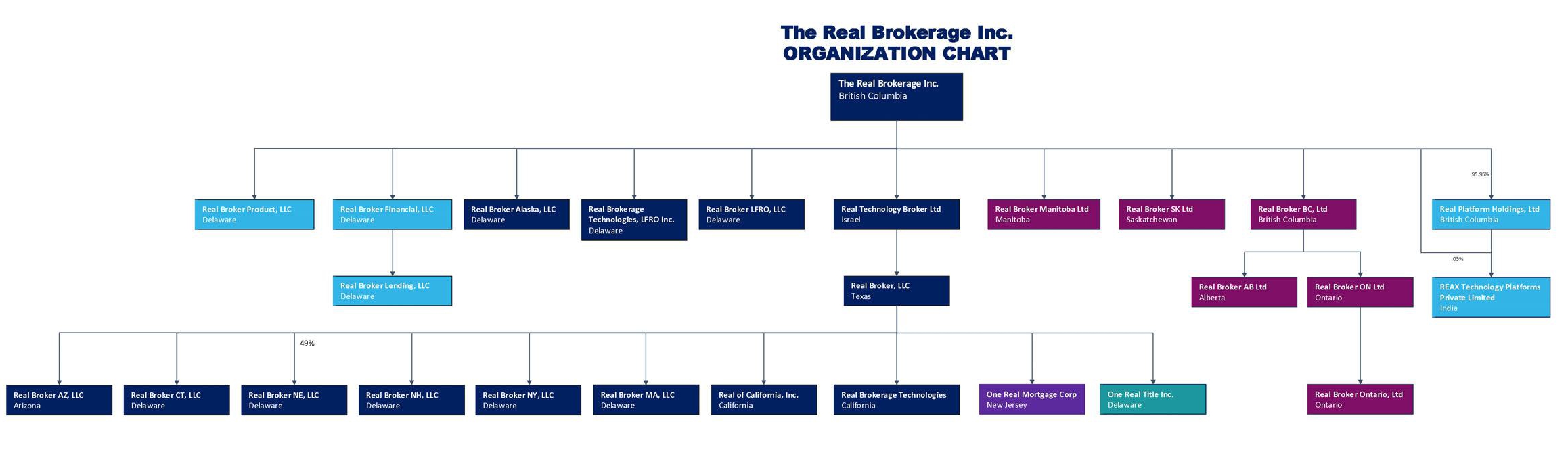
The following diagram illustrates the current corporate structure of the Company and its material subsidiaries, each of which is 100% owned, and their jurisdictions of incorporation and the percentage of voting securities beneficially owned, directly or indirectly, by the Company as of the date of this AIF. Certain subsidiaries with assets that comprise less than 10% individually, and 20% in the aggregate, are excluded from the corporate structure illustrated below.
| The Real Brokerage Inc. | AIF | Year Ended December 31, 2025 |
|
Item 4. GENERAL DEVELOPMENT OF THE BUSINESS
| 4.1 | Three Year History |
The Company
Real is a fast-growing real estate technology company that operates as a software-based brokerage across all 50 U.S. states, the District of Columbia, and five Canadian provinces. The Company generates the majority of its revenue from commissions earned on residential real estate transactions completed by agents affiliated with the Company. Real pays a portion of these commissions to its affiliated agents, in accordance with the Company’s agent compensation structure. Our platform leverages AI and automation to enhance agent productivity while maintaining a lean operating model. Unlike traditional brokerages, who rely on costly physical offices with high overhead expense, Real operates as a digital brokerage, offering agents a more flexible, efficient, and financially compelling model. Within our platform, AI plays a critical role in agent support, enhancing agent productivity, and operational automation, and we believe our integration of AI is differentiated by its focus on real estate-specific applications, including intelligent transaction management, proactive agent assistance, and automated compliance oversight. Our vision is to transform the home buying and selling experience by integrating technology, AI, and ancillary products and services into a seamless real estate ecosystem - while ensuring agents remain at the center of the transaction.
Real began operations in Texas in 2014 and we have since grown our presence to all 50 states and the District of Columbia. In 2021, we launched operations in Alberta, Canada, and currently have operations in five Canadian provinces. As of December 31, 2025, 31,739 real estate agents were affiliated with Real or its subsidiaries.
| (a) | Stock Exchange Listing |
The Real Brokerage Inc. (formerly ADL Ventures Inc.) was incorporated under the laws of the BCBCA on February 27, 2018 and was a capital pool company with shares listed for trading on the TSXV. On June 5, 2020, ADL Ventures Inc. acquired all of the issued and outstanding common shares of Real Technology Broker Ltd., a private corporation incorporated under the laws of Israel, and changed its name to The Real Brokerage Inc. On April 22, 2021, the Company announced that it applied to list the Common Shares on the NASDAQ (the “NASDAQ Listing”). On June 15, 2021, the Common Shares commenced trading on the NASDAQ under the trading symbol “REAX”.
On July 26, 2022, the Company graduated to the TSX and its Common Shares were concurrently delisted from the TSXV. On July 28, 2023, the Company announced that its application for a voluntary delisting of its Common Shares from the TSX had been approved by the Company’s Board and the TSX. The Common Shares were delisted from the TSX effective as of close of markets on August 11, 2023. The Common Shares continue to be listed and traded on the NASDAQ. The Company is a reporting issuer in all the provinces and territories of Canada.
| (b) | Insight Partners Investment |
In December 2020, in connection with a US$20 million equity investment in the Company by Insight Partners, the Company issued preferred units and warrants (to Insight Partners), which, in August 2021, were exchanged (by Insight Partners) for Common Shares representing approximately 19.5% of the issued and outstanding Common Shares of the Company.
In connection with the 2020 equity investment by Insight Partners, the Company also entered into an investor rights agreement with Insight Partners providing for, among other things, participation rights, certain standstill and transfer restrictions and a director nomination right (the “Investor Rights Agreement”). The Company also entered into a registration rights agreement with Insight Partners providing for, among other things, customary registration rights. In connection with the Insight Investment and in accordance with the Investor Rights Agreement, the Company appointed AJ Malhotra, a Managing Director of Insight Partners, to the Board.
As of the date of this AIF, Insight Partners has ownership and control of (i) 6,969,000 Common Shares (ii) 100,000 Options exercisable for 100,000 Common Shares and 34,965 RSUs, representing approximately 2.8% of the outstanding Common Shares on a partially-diluted basis assuming the exercise of all of the Options and conversion of all RSUs owned or controlled by Insight Partners.
| The Real Brokerage Inc. | AIF | Year Ended December 31, 2025 |
|
| (c) | Normal Course Issuer Bid |
On May 17, 2021, the TSXV accepted the Company’s Notice of Intention to implement a normal course issuer bid (“NCIB”). On May 19, 2022, the Company announced that it renewed its NCIB to be transacted through the NASDAQ and other Stock Exchanges and/or alternative trading systems in the United States and/or Canada. Pursuant to the NCIB, Real was able to purchase up to 8.9 million Common Shares, representing approximately 5% of the total 178.3 million Common Shares issued and outstanding as of May 19, 2022. On May 24, 2023, the Company announced that it renewed its NCIB pursuant to which Real may purchase up to 9.0 million Common Shares, representing approximately 5% of the total 180 million Common Shares issued and outstanding as of May 18, 2023. On May 14, 2024, the Company announced that it renewed its NCIB again pursuant to which Real may purchase up to approximately 9.47 million Common Shares, representing approximately 5% of the total 189 million Common Shares issued and outstanding as of May 1, 2024. The NCIB terminated on May 28, 2025.
The NCIB was conducted to acquire Common Shares for the purposes of Restricted Share Unit obligations. The Company appointed CWB Trust Services (the “Trustee”) as the trustee for the purposes of arranging the acquisition of Common Shares and to hold the Common Shares in trust for the purposes of satisfying RSU obligations as well as deal with other administrative matters. Through the Trustee, RBC Capital Markets was engaged to undertake purchases under the NCIB.
| (d) | Share Repurchase Authorization |
On May 30, 2025, the Company announced a new share repurchase authorization, pursuant to which it may repurchase up to the lesser of 35 million Common Shares, or US$150 million in value of Common Shares. Purchases are made at prevailing market prices and the program has no termination date provided it continues to comply with exemptions from the issuer bid requirements of applicable Canadian securities laws at the applicable time. The program may be suspended or discontinued at any time and does not obligate the Company to acquire any amount of Common Shares. As of December 31, 2025, the Company has repurchased 7.1 million shares under the repurchase authorization.
| 4.2 | Acquisitions |
In July 2025, the Company acquired the AI-powered consumer home search portal and related technology assets of Flyhomes, Inc. (“Flyhomes”) for a total purchase price of US$2.75 million. Concurrently, Real made a US$2.25 million equity investment in Flyhomes to support Flyhomes’ evolution into a wholesale mortgage lender focused on modern home financing solutions.
| The Real Brokerage Inc. | AIF | Year Ended December 31, 2025 |
|
Item 5. DESCRIPTION OF THE BUSINESS
| 5.1 | General |
| (a) | Summary |
| i. | Real Estate Brokerage |
Overview
Real is a real estate technology company that operates as a licensed residential real estate brokerage across all 50 U.S. states, the District of Columbia, and five Canadian provinces. The Company generates the majority of its revenue from commissions earned on residential real estate transactions completed by agents affiliated with the Company. Real pays a portion of these commissions to its affiliated agents, in accordance with the Company’s agent compensation structure.
In addition to its core brokerage operations, Real offers ancillary services, including mortgage brokerage, title and escrow services, and financial technology products, which are intended to complement the Company’s brokerage platform and provide additional revenue opportunities.
Operating Model
Real operates a fully digital brokerage model and generally does not rely on a traditional network of physical branch offices, except where required by applicable local laws. Brokerage operations are supported by proprietary technology designed to centralize core brokerage functions and support geographically distributed agents while maintaining a scalable and comparatively low fixed-cost structure.
The Company’s brokerage platform incorporates the following core elements:
| ● | a commission-based compensation model that includes revenue share arrangements and equity-based incentive programs intended to support agent recruitment and retention; | |
| ● | proprietary technology tools, including the reZEN platform and AI-enabled agent support tools such as Leo CoPilot, designed to support transaction management, compliance oversight, and agent productivity; | |
| ● | an operating model that provides agents with flexibility to operate independently or as part of teams without reliance on a traditional physical office network; and | |
| ● | platform features and community tools intended to facilitate collaboration, information sharing, and interaction among agents operating across multiple jurisdictions. |
Software-Based Brokerage and Growth Model
Real’s brokerage model is focused on developing and delivering technology to enhance real estate agent performance while operating a scalable, efficient brokerage operation that is not dependent on a cost-heavy brick and mortar footprint.
The Company’s platform is designed to support individual agents, real estate teams, and independent brokerages. Real has developed programs intended to accommodate varying operational and branding needs, including:
| ● | Private Label. Allows independent brokerages to retain their branding while utilizing Real’s transaction management and back-office support. | |
| ● | ProTeams. Provides team leaders with flexibility to customize team members’ commission caps, splits, and fee structures, making it easier for large teams to join Real. |
By operating a nationwide platform for team growth, the Company is able to support agents and teams across multiple jurisdictions without geographic limitations.
| The Real Brokerage Inc. | AIF | Year Ended December 31, 2025 |
|
Technology Platform - reZEN
Technology is foundational to Real’s brokerage operations. At the core of the Company’s technology platform is reZEN, its proprietary transaction management and brokerage operations software. reZEN supports key brokerage functions enabling efficiency, automation, and flexibility, by incorporating:
| ● | End-to-End Transaction Management. Agents can process deals, manage commissions, and direct payments. | |
| ● | Automated Assistance with Compliance & Brokerage Oversight. Reduces manual workload and ensures regulatory compliance in real time. | |
| ● | Integrated Payment & Financial Services. Provides commission disbursement and access to financial tools. | |
| ● | Leo CoPilot: AI-Powered Agent Support. reZEN powers Leo CoPilot, our AI-driven agent assistant, enhancing productivity and streamlining workflows. | |
| ● | Open API for Customization. Agents have the flexibility to integrate certain third-party tools. |
By automating and centralizing core brokerage functions, reZEN is designed to support operational efficiency and scalability across the Company’s brokerage platform. It also serves as the foundation for new product innovations, including consumer-facing tools and ancillary services expansion.
Artificial Intelligence Tools - Leo CoPilot and HeyLeo
The Company has developed AI enabled tools that are integrated within reZEN, including Leo CoPilot, an AI-powered assistant that is integrated with reZEN, available to agents and brokers. Leo CoPilot provides access to transaction data, operational information and workflow support to assist agents and brokerage personnel in managing transactions and day-to-day activities.
Real has also developed consumer-facing technology products intended to support the residential real estate transaction process under the guidance of affiliated agents. The Company’s consumer-facing platform, HeyLeo, is designed as an extension of its agent-facing technology.
HeyLeo enables consumers to ask questions using their voice or natural text and uses contextual intelligence to aggregate information a buyer shares to curate recommendations. HeyLeo’s intelligence is powered by enriched listing data, drawn from direct MLS feeds across key U.S. markets, and is intended to facilitate consumer engagement by enabling access to property information, communication tools, and brokerage and ancillary services. The platform incorporates internally developed technology as well as consumer-facing technology assets acquired through the acquisition of Flyhomes’ consumer search portal in July 2025.
HeyLeo beta launched in the fourth quarter of 2025 in 20 states.
Agent Compensation and Incentives
Real’s agent compensation model is commission-based and is structured to provide agents with a high proportion of commissions earned on completed residential real estate transactions, subject to contractual commission splits, annual commission caps, and transaction-based fees.
Under the Company’s standard commission structure:
| ● | Agents receive 85% of the gross commission earned on a completed transaction, with the remaining 15% retained by the Company, until the agent reaches a contractual annual commission cap; | |
| ● | The annual commission cap is generally US$12,000 for agents operating in the United States and C$15,000 for agents operating in Canada, or such other amount as may be agreed with the agent; | |
| ● | Once an agent reaches the applicable annual commission cap, the agent retains 100% of gross commissions on subsequent transactions for the remainder of the annual cycle, subject to transaction-based fees; and | |
| ● | following the achievement of the annual commission cap, agents generally must pay per-transaction fees, which include a transaction processing fee and a compliance and broker review fee. |
In addition to commission-based compensation, Real offers incentive programs intended to support agent growth and retention, including:
| ● | Revenue Share payments, under which eligible agents and brokers may earn a portion of the Company’s retained commissions generated by other agents they have referred to the platform, subject to program terms and conditions; and | |
| ● | Equity-based incentive programs, which may include RSUs and participation in an agent stock purchase plan, subject to eligibility requirements and vesting conditions. |
| The Real Brokerage Inc. | AIF | Year Ended December 31, 2025 |
|
The specific terms of agent compensation arrangements, including commission splits, caps, fees, revenue share eligibility, and equity incentives, may vary by jurisdiction and by individual agreement.
| ii. | Ancillary Services – Mortgage Broker, Title and Wallet |
In addition to its core real estate brokerage operations, Real operates ancillary service businesses intended to complement its brokerage platform and provide additional revenue opportunities related to residential real estate transactions completed by agents affiliated with the Company. These ancillary services include title and escrow services, mortgage brokerage services, and financial technology products offered under the Real Wallet brand.
Title and Escrow Services
The Company provides title and escrow services through One Real Title, which operates through wholly owned subsidiaries of Real and through joint ventures in which Real is the managing member and majority owner. One Real Title offers title and escrow services in 17 states including: Arizona, California, Florida, Georgia, Illinois, Maryland, Michigan, Minnesota, Nevada, New Jersey, North Carolina, Pennsylvania, South Carolina, Tennessee, Texas, Virginia and Wisconsin.
One Real Title’s operations are subject to applicable state licensing, regulatory, and compliance requirements governing title insurance and escrow services in the jurisdictions in which it operates.
Mortgage Brokerage Services
The Company provides mortgage brokerage services through One Real Mortgage, which operates as a licensed mortgage broker in Washington D.C. and 25 states including: Alabama, Arizona, California, Colorado, Connecticut, Delaware, Florida, Georgia, Illinois, Louisiana, Maryland, Michigan, Minnesota, Mississippi, New Jersey, North Carolina, Ohio, Oregon, Pennsylvania, South Carolina, Tennessee, Texas, Virginia, Washington, and Wisconsin.
One Real Mortgage offers mortgage brokerage services in connection with residential real estate transactions and is subject to applicable federal, state, and local licensing, regulatory, and compliance requirements governing mortgage brokerage activities.
Financial Technology Products - Real Wallet
The Company has developed financial technology products under the Real Wallet, which provide affiliated agents with access to Company-branded financial tools and services. Real Wallet is intended to centralize access to certain financial products used by agents in connection with their real estate businesses.
Real Wallet offerings include, among other products:
| ● | Business checking accounts for eligible U.S. agents provided through Thread Bank, Member FDIC, including Company-branded debit cards; |
| ● | Credit products for eligible agents, including credit lines offered to agents based on their earnings history with Real and pending transaction pipeline; and |
| ● | Rewards programs, including Real Wallet Rewards, under which agents may earn points based on account balances and transaction activity that may be applied to reduce brokerage fees, subject to program terms and conditions. |
In October 2025, the Company launched Real Wallet Capital (“Capital”), an embedded lending solution designed to provide U.S. agents with access to working capital. Real Wallet Capital is integrated into the Company’s proprietary technology platform and uses underwriting criteria that may include a blend of historical earnings data, pending transactions and projected future income. Loans are made from the Company’s balance sheet. At launch, Capital was available in 28 states and Washington D.C.
Regulatory Considerations
Real is a real estate technology company and is not a bank. Banking services are provided by Thread Bank, Member FDIC (“Bank Partner”). FDIC deposit insurance covers the failure of an insured bank. Certain conditions must be satisfied for pass-through deposit insurance coverage to apply. The Real Wallet Visa debit card is issued by our Bank Partner pursuant to a license from Visa U.S.A. Inc and may be used anywhere Visa cards are accepted. All accounts are subject to approval.
| The Real Brokerage Inc. | AIF | Year Ended December 31, 2025 |
|
Expansion of Ancillary Services
The Company continues to evaluate opportunities to expand its ancillary service offerings and financial technology products in a manner consistent with applicable regulatory requirements and the operational needs of agents operating on its brokerage platform.
Real’s websites can be accessed at www.onereal.com and www.joinreal.com
| (b) | Production and Services |
Real has developed, integrated and adopted various mobile and desktop focused technologies to create a comprehensive offering for agents and to support its brokerage operations. The implementation and utilization of technology enables Real to operate multi-jurisdiction operations, quickly expand to additional markets and serve agents more efficiently. These factors seek to disrupt the market and minimize the need for traditional brick-and-mortar locations. Real’s technology product offering is focused on the following segments and includes the following features:
| ● | Productivity - transaction management platform, transaction support, paperless file sharing, virtual signature tools, business dashboard, broker support, technical support (including Leo), interactive training, education platform (www.real.academy), and weekly educational webinars and conference calls. | |
| ● | Marketing - Each agent joining Real receives a personally branded mobile app, personal branded website, access to Real’s printing portal enabling ordering of business cards, yard signs, and marketing materials, designer assistance, and access to marketing webinars focused on lead generation and personal marketing. | |
| ● | Community - Real’s agents have access to Real’s app and desktop-based community, which we believe enhances the sense of agent belonging, creates synergy and collaboration in local markets and propels information sharing. Real’s community has topic groups and feeds, and contains posts from agents across the U.S. and in Canada, and Real’s employees. Real’s agents use the community to socialize, celebrate success, ask questions, cooperate, market properties, exchange leads, transact business with colleagues, share information and learn about Company announcements. | |
| ● | Brokerage Operations - We believe a key component in building a sustainable brokerage is the ability to operate extremely efficiently to ensure a competitive advantage. Over the years, Real has invested substantial resources in building proprietary software and implementing automation and technology to assist in serving agents, processing transactions, overseeing agent activity, measuring performance, facilitating contract reviews, helping to ensure timely payments to agents, streamlining communications and eliminating redundant staffing costs. |
| (c) | Specialized Skill and Knowledge |
The Company believes that its success is largely dependent on the performance of its management and key employees, many of whom have specialized experience relating to our industry, services, regulatory environment, customers and business. The assembled management team and the Board have experience in the management and growth of successful emerging enterprises.
See also “Item 5.2 – Risk Factors”.
| (d) | Competitive Conditions |
As a licensed real estate brokerage, Real competes with other local, regional and nationwide brokerages over agents, teams of agents, brokers and consumers. We compete primarily on the basis of our service, culture, collaboration, economic model, technologies that reduce costs, professional development opportunities and the ability to participate in the growth of our company. Residential real estate brokerage companies typically realize revenues in the form of a commission based on a percentage of the price of each home purchased or sold, which can vary based on industry standards, geographical location and specific customer-agent negotiations, among other factors. We are positioned to earn commissions on either — or both — of the buy side or sell side of residential real estate transactions, as well as the ability to receive other fees for services provided by our ancillary mortgage broker, title and wallet businesses.
| The Real Brokerage Inc. | AIF | Year Ended December 31, 2025 |
|
Industry Overview
The real estate brokerage industry is closely aligned with the health of the residential real estate market, which fluctuates with factors such as economic growth, interest rates, unemployment, inventory levels, and mortgage rate volatility. Our business could be negatively impacted by higher mortgage rates or further increases in mortgage rates. As mortgage rates rise, the number of home sale transactions tends to decrease as potential home sellers choose to stay with their lower mortgage rate rather than sell their home and pay a higher mortgage rate with the purchase of another home. Similarly, in higher interest rate environments, potential home buyers may choose to rent rather than purchase a home. Changes in the interest rate environment and mortgage market are beyond our control and are difficult to predict and, as such, could have a material adverse effect on our business and profitability.
In 2025, macroeconomic conditions in North America continued to impact the residential real estate market, as well as our business and financial results. The year was characterized by persistent challenges in home buyer affordability and inventory shortages, a continuation of a trend that began during 2022, following robust market activity in 2021.
Key 2025 Trends:
| ● | Shifts in Monetary Policy and Interest Rates. In 2025, while inflation pressures in the U.S. remained elevated, the Federal Reserve implemented several rate cuts to manage growing unemployment rates. The Federal Funds Rate which had been held at 4.25%-4.50% since December 2024, was lowered to 4.00%-4.25% in September, 3.75%-4.00% in October, and 3.50%-3.75% in December. However, mortgage rates in the United States remained elevated, ending the year at an average of 6.2%, down slightly from 6.9% at the end of 2024. This ended an upward trend from 6.6% at the end of 2023 and 6.4% at the end of 2022, according to Freddie Mac data, and continues to dampen buyer demand. The persistence of high mortgage rates, despite declining benchmark rates, was largely driven by a rise in long-term Treasury yields, a key determinant of mortgage pricing. | |
| ● | Flat transaction volume. While mortgage rates and affordability constraints continued to weigh on transaction volumes, increases were seen near the end of the year as mortgage rates began to decrease. Total existing home sales in the U.S. in 2025 were 4.1 million, virtually unchanged from 2024 and 2023, according to data reported by the National Association of Realtors. Current year volume is still down from 5.0 million in 2022, and remains well below the historical long-term average of 5.2 million existing home sales. Despite the improvement in the current year, transaction volumes remain well below typical market levels, constrained by affordability challenges and persistent inventory shortages. | |
| ● | Elevated, but stabilizing home prices. The median sale price on a U.S. existing home was US$405,400 as of December 2025, relatively unchanged from December 2024 and up 6% from December 2023. Average home prices remain well above levels experienced prior to the COVID-19 pandemic, as limited inventory has supported elevated pricing levels, a trend driven by the “lock-in effect” of existing homeowners holding onto lower-rate mortgages and reduced new construction activity. |
New business models, intense competition, technology and evolving consumer expectations are reshaping the industry landscape. Real believes the most agile and agent-centric real estate brokerages will emerge as the long-term winners.
One trend involves national brick-and-mortar brokerages using significant financial resources to attract agents, including offering lucrative signing packages to gain market share. Meanwhile, some lead-generation focused players hire in-house agents as staff rather than as commissioned contractors, aiming for higher per agent transaction volumes. Real believes neither of these models serve the long-term interests. Instead of purchasing market share or squeezing agent revenue, Real seeks to compete by providing agents a higher value offering at a lower cost.
Another notable dynamic is the emergence of “instant buyers” (“iBuyers”). iBuyers use industry data to make instant offers on listings in some markets and then seek to resell or “flip” the homes they buy for a profit. While iBuyers provide sellers speed and certainty, their offers are often below market rates. iBuyers use agents to close the original transaction and the resale transaction, and therefore Real does not anticipate the iBuyer trend to substantially affect the demand for real estate brokerage services.
Real’s Opportunity
Consumer demand for better service, transparency, increased competition for agents, and the high overhead costs of traditional models, create opportunities for innovative brokerage offerings like Real’s. Real believes the following trends impacting the real estate brokerage industry position the Company well to continue growing its business:
| ● | Democratization of Information - Traditionally, real estate brokerages relied heavily on brick-and-mortar locations to attract clients with listing information that was otherwise difficult to obtain. The internet and database technology have now made listing information publicly available through well-known listing search sites, thereby eliminating a consumer’s need to visit street-front brokerages to discover homes for sale. Real expects this trend to continue, and that consumers will choose agents based on their local knowledge, professional experience, and service quality, rather than their access to listing information. |
| The Real Brokerage Inc. | AIF | Year Ended December 31, 2025 |
|
| ● | Mobile Technology - Traditional brick-and-mortar real estate brokerages also provided dedicated physical offices where agents and clients met and signed purchase agreements, closing documents and related paperwork. Mobile technology has since enabled consumers and agents to communicate directly and sign documents from anywhere, making physical offices for signing agreements and paperwork obsolete. Real’s mobile-first technology platform was designed to facilitate seamless remote interactions, providing agents and clients with the flexibility to conduct transactions from anywhere, a unique differentiator that many traditional brokerages cannot match. | |
| ● | Desire for Freedom and Flexibility - Although agents are mainly independent contractors, agents at traditional brokerages are often required to perform unpaid “floor time” at the office and attend in-office meetings. So-called “desk fees” are also common. As the need for physical space diminishes, agents increasingly seek the flexibility to work their own hours and from locations that suit them best. Real caters to this trend with its flexible, remote-first model, while many traditional brokerages lack the culture and the technological infrastructure required to fully support remote work. | |
| ● | Consumer pressure on real estate commissions - Service commissions are dropping across industries and sellers increasingly expect to pay less for real estate agent services. To support lower costs for consumers while keeping agents net pay sustainable, brokerage firms may be forced to reduce their portion of a commission split without dropping service levels. Real believes its competitive agent commission splits and lean cost structure position the Company well to withstand any potential commission compression in the industry, a challenge that traditional brokerages with higher overheads may struggle to meet. | |
| ● | Younger generations of agents - According to the Pew Research Center, millennials have now surpassed baby boomers as the largest living generational group in the United States. In our view, millennials already comprise the largest segment of home buyers in the United States. Millennials entering the real estate market expect their brokerage to provide and use effective mobile technology and to allow the agents the freedom to express their personal brand in social media. Real believes its differentiated technology platform and collaborative culture will appeal to new and younger generations of agents when compared to traditional brokerage models. |
| (e) | Intangible Properties |
Real’s material owned intellectual property consists of unpatented proprietary technology, processes, trade secrets and know-how. The Company also has inherent copyright of authorship in the source code developed by Real and unregistered trademarks. Real does not have any material licensed intellectual property. While Real’s commercial success generally depends on its ability to maintain the confidentiality of its proprietary technology, processes, trade secrets, and know-how, the Company is not substantially dependent on any specific and identifiable intellectual property.
To protect its intellectual property, Real relies on a combination of trade secret, copyright, trademark, passing-off laws and other statutory and common law protections in Israel, the United States and international markets. Real also protects its intellectual property through the use of non-disclosure agreements and other contracts, disclosure and invention assignment agreements, confidentiality procedures and technical measures.
The Company does not have any registrations in respect of its material owned intellectual property. The Company owns the rights to several domain names used in conjunction with its business.
For additional information on intellectual property risks, see “Item 5.2 – Risk Factors”.
| (f) | Seasonality |
Seasons and weather traditionally impact the real estate industry in the jurisdictions where Real operates. Poor weather or natural disasters also negatively impact listings and sales. Spring and summer seasons historically reflect greater sales periods in comparison to fall and winter seasons. Real has historically experienced lower revenues during the fall and winter seasons, as well as during periods of unseasonable weather, which reduces Real’s operating income, net income, operating margins and cash flow.
| The Real Brokerage Inc. | AIF | Year Ended December 31, 2025 |
|
Real estate listings precede sales and a period of poor listings activity will negatively impact revenue. Past performance in similar seasons or during similar weather events can provide no assurance of future or current performance and macroeconomic shifts in the markets Real serves can conceal the impact of poor weather or seasonality.
| (g) | Regulatory Environment |
Our principal business is residential real estate brokerage in the United States. We also offer, through a wholly-owned subsidiary and joint ventures in which our wholly-owned subsidiaries are the managing member and majority owner, title insurance, and closing services for residential and/or commercial transactions. In addition, through our wholly-owned subsidiary One Real Mortgage, we are a residential mortgage broker for borrowers (or consumers), and we are considering entering the correspondent residential mortgage space, as well. Further, we can offer certain Company-branded financial products and other offerings through Real Wallet. Our residential real estate brokerage, title services, mortgage broker services and Real Wallet offerings are subject to a number of U.S. federal, state and local laws and regulations.
Residential Real Estate Brokerage
Federal
Real estate brokers are subject to the Federal Fair Housing Act, which makes it unlawful to discriminate against protected classes of individuals in housing or in brokerage services. Our brokerage activities are also affected by the Telephone Consumer Protection Act and other federal and state laws pertaining to privacy, which affect our ability to solicit new clients.
State and Local
In every jurisdiction, there are state or local laws affecting real estate brokerages. While these laws vary across jurisdictions, they virtually all require that anyone who receives compensation for arranging real estate transactions be licensed as a broker or a salesperson. Licensed activities include (but are not limited to) advertising or helping to arrange the sale or purchase of real estate or managing or leasing residential properties for a fee or commission. An agent, sales associate or salesperson generally must be associated with a licensed broker. We are a licensed broker in 50 states, the District of Columbia and five Canadian provinces.
Real estate licensees, whether they are brokers, agents, sales associates or salespersons, must follow the local real estate licensing laws and regulations. These laws and regulations generally specify minimum duties and obligations of licensees to their clients and the public, as well as standards for the conduct of business, including requirements for contract disclosures, record keeping, local offices, escrow trust fund management, agency representation, advertising and fair housing.
In each of the jurisdictions where Real has operations, Real assigns appropriately licensed personnel to manage and comply with applicable laws and regulations.
Industry Organizations
Beyond federal, state and local governmental regulations, the real estate brokerage industry is subject to rules established by private real estate groups or trade organizations, including, but not limited to, state and local Associations of REALTORS®2, the National Association of Realtors® and local Multiple Listing Services. Generally, licensed brokers, salespersons, individuals, agents and brokerage entities join these groups and organizations, which causes them to be subject to the organizations’ rules. The Company assigns appropriate personnel to manage compliance with organizations’ rules.
Mortgage Broker, Title, and Wallet
Our mortgage and title subsidiaries must comply with applicable real estate, lending and insurance laws and regulations. These laws and regulations include provisions regarding operating procedures and privacy disclosures. The subsidiaries are licensed in the states in which they do business and must comply with laws and regulations in those states.
| The Real Brokerage Inc. | AIF | Year Ended December 31, 2025 |
|
Our One Real Mortgage subsidiary must comply with any and all U.S. federal laws affecting residential mortgage brokers and with state laws in jurisdictions where it is licensed as a mortgage broker. It is currently licensed as a mortgage broker in Washington D.C. and nineteen states. If, as we expect, One Real Mortgage begins to fund residential mortgage loans in the states licensed, it will have to comply with a variety of U.S. federal and state laws that apply to residential mortgage lenders.
Our Real Wallet business is subject to U.S. federal and state regulation of the banking industry, and tax and accounting laws, regulations, rules, and standards. Real Wallet products and services may include features that are subject to additional state or federal laws or regulations. Real Wallet business checking accounts are offered through our banking partner, Thread Bank, a member of the Federal Deposit Insurance Corporation (“FDIC”), and operates within a robust regulatory environment designed to safeguard customer deposits and ensure compliance with applicable laws. Regulation D, issued by the Federal Reserve Board, governs reserve requirements and certain withdrawal and transfer rules applicable to these accounts. Real Wallet business checking accounts are also subject to the Bank Secrecy Act (“BSA”) and anti-money laundering (“AML”) regulations. These laws require the implementation of comprehensive transaction monitoring, customer identification programs, and reporting of suspicious activities to regulatory authorities. Oversight of these accounts is conducted by several regulatory bodies. The FDIC ensures deposit insurance and compliance with related requirements, while the Federal Reserve Board oversees reserve practices and payment systems. Regulatory oversight is also provided by the Office of the Comptroller of the Currency. FinCEN enforces BSA and AML compliance, and the Consumer Financial Protection Bureau indirectly impacts business deposit accounts through its broader financial regulatory role.
Our Real Wallet business in Canada is subject to provincial and federal laws, rules, regulations and prescribed practices, including in respect of loan disclosure, interest rates and privacy requirements.
| (h) | Employees |
As of February 25, 2026, Real and its subsidiaries had 474 full-time employees, 90 independent contractors supporting its corporate operations, 89 brokers who are independent contractors, and 33,189 real estate agents.
| (i) | Foreign Operations |
As of the date of this AIF, Real has brokerage operations in the United States and Canada.
See “Item 5.2 – Risk Factors”.
| (j) | Bankruptcy and Similar Procedures |
There have been no bankruptcy or receivership proceedings against the Company or any of its subsidiaries within the three most recently completed financial years or the current financial year.
| (k) | Reorganizations |
See “Item 4.2– General Development of the Business – Three Year History – Significant Acquisitions”.
| 5.2 | Risk Factors |
The following are certain risk factors relating to the Company’s business which prospective investors should carefully consider before deciding whether to purchase Common Shares. The following information is a summary only of certain risk factors and is qualified in its entirety by reference to, and must be read in conjunction with, the detailed information appearing elsewhere in this AIF. These risks and uncertainties are not the only ones the Company is facing. Additional risks and uncertainties not presently known to the Company, or that the Company currently deems immaterial, may also impair operations. If any such risks actually occur, the business, financial condition, liquidity and results of the Company’s operations could be materially adversely affected.
Risks Related to the Company
The Company is dependent on the health of the residential real estate market and general economic conditions.
The Company’s financial performance is closely connected to the strength of the residential real estate market, which is subject to a number of general business and macroeconomic conditions beyond the Company’s control.
| The Real Brokerage Inc. | AIF | Year Ended December 31, 2025 |
|
Macroeconomic conditions that could adversely impact the growth of the real estate market and have a material adverse effect on the Company’s business include, but are not limited to, economic slowdown or recession, increased unemployment, increased energy costs, reductions in the availability of credit or higher interest rates, increased costs of obtaining mortgages, an increase in foreclosure activity, inflation, disruptions in capital markets, declines in the stock market, adverse tax policies or changes in other regulations, lower consumer confidence, lower wage and salary levels, war or terrorist attacks, a health pandemic, natural disasters or adverse weather events, or the public perception that any of these events may occur. Unfavorable general economic conditions, such as a recession or economic slowdown, in the United States, Canada or other markets the Company enters and operates within could negatively affect the affordability of, and consumer demand for, its services which could have a material adverse effect on its business and profitability. In addition, federal and state governments, agencies and government-sponsored entities could take actions that result in unforeseen consequences to the real estate market or that otherwise could negatively impact the Company’s business.
The real estate market is substantially reliant on the monetary policies of the federal government and its agencies and is particularly affected by the policies of the United States’ Federal Reserve Board, which regulates the supply of money and credit in the U.S., which in turn impacts interest rates. Changes in the interest rate environment and mortgage market are beyond the Company’s control, are difficult to predict and could have a material adverse effect on its business and profitability.
The Company’s business is impacted by interest rates, and changes in prevailing interest rates may have an adverse effect on the Company’s financial results.
The financial performance of our brokerage business may be adversely affected by changes in prevailing interest rates, which may be impacted by a number of factors. The Company’s business can be, and has been, negatively impacted by any rising interest rate environment. As mortgage rates rise, the number of home sale transactions may decrease as potential home sellers choose to stay with their lower mortgage rate rather than sell their home and pay a higher mortgage rate with the purchase of another home. Similarly, in higher interest rate environments, potential home buyers may choose to rent rather than pay higher mortgage rates. The financial performance of our mortgage broker business may also be adversely affected by changes in prevailing interest rates. As interest rates fall, refinancing generally becomes a larger portion of the mortgage market. Likewise, as interest rates rise, refinancing generally becomes a smaller portion of the mortgage loan market and demand may also decrease for purchase mortgages as home ownership becomes more expensive. Changes in the interest rate environment and mortgage market are beyond the Company’s control, are difficult to predict and could have a material adverse effect on its business and profitability.
The Company may be unable to maintain its agent growth rate, which could adversely affect its revenue growth and results of operations.
The Company has experienced rapid growth in our real estate agent base. Because the Company derives revenue from real estate transactions in which its agents receive commissions, increases in the Company’s agent base correlate to increases in revenues and the rate of growth of its revenue correlates to the rate of growth of the Company’s agent and broker base. The rate of growth of the Company’s agent and broker base cannot be predicted and is subject to many factors outside of the Company’s control, including actions taken by the Company’s competitors and macroeconomic factors affecting the real estate industry generally. There is no assurance that the Company will be able to maintain its recent agent growth rate or that the Company’s agent and broker base will continue to expand in future periods. A slowdown in the Company’s agent growth rate would have a material adverse effect on revenue growth and could adversely affect the Company’s business, financial condition or results of operations.
The Company may be unable to effectively manage rapid growth in its business.
The Company may not be able to scale its business quickly enough to meet the growing needs of its affiliated real estate professionals and if the Company is not able to grow efficiently, its operating results could be harmed. As the Company adds new real estate professionals, the Company will need to devote additional financial and human resources to improving its internal systems, integrating with third-party systems, and maintaining infrastructure performance. In addition, the Company will need to appropriately scale its internal business systems and its services organization, including support of its affiliated real estate professionals as its demographics expand over time. Any failure of or delay in these efforts could cause impaired system performance and reduced real estate professional satisfaction. These issues could reduce the attractiveness of the Company to existing real estate professionals who might leave the Company, as well as result in decreased attraction of new real estate professionals. Even if the Company is able to upgrade its systems and expand its staff, such expansion may be expensive, complex, and place increasing demands on its management. The Company could also face inefficiencies or operational failures as a result of its efforts to scale its infrastructure and the Company may not be successful in maintaining adequate financial and operating systems and controls as it expands. Moreover, there are inherent risks associated with upgrading, improving and expanding its information technology systems. The Company cannot be sure that the expansion and improvements to its infrastructure and systems will be fully or effectively implemented on a timely basis, if at all. These efforts may reduce the Company’s revenue and margins and adversely impact its financial results.
| The Real Brokerage Inc. | AIF | Year Ended December 31, 2025 |
|
The Company faces significant risk to its brand and revenue if it fails to maintain compliance with laws and regulations of federal, state, county and foreign governmental authorities, or private associations and governing boards.
The Company operates in the real estate industry which is a heavily regulated industry subject to complex, federal, state, provincial and local laws and regulations and third-party organizations’ regulations, policies and bylaws. In the United States generally, the laws, rules and regulations that apply to the Company’s business practices include, without limitation, the Real Estate Settlement Procedures Act (“RESPA”), the federal Fair Housing Act, the Dodd-Frank Act, and federal advertising laws, as well as comparable state statutes; rules of trade organizations such as the National Association of Realtors, local MLS), and state and local Association of Realtors; licensing requirements and related obligations that could arise from its business practices relating to the provision of services other than real estate brokerage services; privacy regulations relating to its use of personal information collected from the users of its websites; laws relating to the use and publication of information through the internet; and state real estate brokerage licensing requirements, as well as statutory due diligence, disclosure, record keeping and standard-of-care obligations relating to these licenses. RESPA, along with other laws, governs the payments and referrals associated with residential sales and settlement services, such as mortgages and title services. Violations can result in significant penalties, including fines and legal fees, particularly where RESPA and similar statutes have been invoked by plaintiffs in private litigation for various purposes.
Additionally, the Dodd-Frank Act contains the Mortgage Reform and Anti-Predatory Lending Act (“Mortgage Act”), which imposes a number of additional requirements on lenders and servicers of residential mortgage loans, by amending certain existing provisions and adding new sections to the Real Estate Settlement Procedures Act and other federal laws. It also broadly prohibits unfair, deceptive or abusive acts or practices, and knowingly or recklessly providing substantial assistance to a covered person in violation of that prohibition. The penalties for noncompliance with these laws are also significantly increased by the Mortgage Act, which could lead to an increase in lawsuits against mortgage lenders and servicers.
In Canada, generally, the laws, rules and regulations that apply to Real’s business practices include, without limitation, the Trust in Real Estate Services Act (Ontario), the Real Estate Act (Alberta), the Real Estate Services Act (British Columbia), the Real Estate Services Act (Manitoba), the Real Estate Act (Saskatchewan), the British Columbia Financial Services Authority and advertising and other laws, as well as comparable and associated statutes and regulations; rules of regulatory bodies, trade organizations and associations such as the Canadian Real Estate Association, and the real estate associations for each province, including licensing and compliance requirements and related obligations that could arise from our business practices relating to the provision of services other than real estate brokerage services; privacy regulations relating to our use of personal information collected from the registered users of our websites; laws relating to the use and publication of information through the internet; and provincial real estate brokerage licensing requirements, as well as statutory and common law due diligence, disclosure, record keeping and standard-of-care obligations relating to these licenses and the provision of real estate brokerage services.
Maintaining legal compliance is challenging and increases business costs due to resources required to continually monitor business practices for compliance with applicable laws, rules and regulations, and to monitor changes in the applicable laws themselves.
The Company may not become aware of all the laws, rules and regulations that govern its business, or be able to comply with all of them, given the rate of regulatory changes, ambiguities in regulations, contradictions in regulations between jurisdictions, and the difficulties in achieving both company-wide and region-specific knowledge and compliance.
If the Company fails, or is alleged to have failed, to comply with any existing or future applicable laws, rules and regulations, the Company could be subject to lawsuits and administrative complaints and proceedings, as well as criminal proceedings. Non-compliance could result in significant defense costs, settlement costs, damages and penalties.
The Company’s business licenses could be suspended or revoked, business practices enjoined, or it could be required to modify its business practices, which could materially impair, or even prevent, the Company’s ability to conduct all or any portion of its business. Any such events could also damage the Company’s reputation and impair the Company’s ability to attract and service home buyers, home sellers and agents, as well its ability to attract brokerages, brokers, teams of agents and agents to the Company, without increasing its costs.
Further, if the Company loses its ability to obtain and maintain all of the regulatory approvals and licenses necessary to conduct business as we currently operate, the Company’s ability to conduct its business may be harmed. Lastly, any lobbying or related activities the Company undertakes in response to mitigate liability of current or new regulations could substantially increase the Company’s operating expenses.
| The Real Brokerage Inc. | AIF | Year Ended December 31, 2025 |
|
The Company could be subject to changes in tax laws and regulations, and challenges to its transfer pricing arrangements that may have a material adverse effect on its business.
The Company operates and is subject to taxes in the United States, and other jurisdictions throughout the world. Changes to federal, state, local or international tax laws on income, sale, use, indirect, or other tax laws, statutes, rules or regulations may adversely affect its effective tax rate, operating results or cash flows.
As an international corporation, the Company is subject to transfer pricing and other tax regulations designed to ensure that its intercompany transactions are consummated at prices that reflect the economic reality of the relationship between entities and have not been manipulated to produce a desired tax result, that appropriate levels of income are reported as earned by the local entities, and that the Company is taxed appropriately on such transactions. The Company has had transfer pricing arrangements between Canada and the United States, the two countries where our operations are located, the United States and India, where a number of the Company’s employees are located, and the United States and Israel. If taxing authorities challenge the Company’s transfer pricing arrangements, the Company could be subject to additional taxes in one or more jurisdictions, and the Company’s operations may be harmed.
The Company may suffer financial harm and loss of reputation if it does not or cannot comply with applicable laws, rules and regulations concerning the classification and compensation practices for its state broker and real estate agents.
Real estate professionals in the Company’s brokerage operations, which include real estate agents and state brokers, have been retained as independent contractors, either directly or indirectly through third-party entities formed by these independent contractors for their business purposes. With respect to these independent contractors, like most brokerage firms, the Company is subject to the Internal Revenue Service regulations and applicable state law guidelines regarding independent contractor classification. These regulations and guidelines are subject to judicial and agency interpretation and it might be determined that the independent contractor classification is inapplicable to any of the Company’s affiliated real estate professionals. Further, if federal and/or state legal standards for classification of real estate professionals as independent contractors change or appear to be changing, it may be necessary to modify the Company’s compensation and benefits structure for its affiliated real estate professionals in some or all of its markets, including by paying additional compensation or reimbursing expenses.
In the future, the Company could incur substantial costs, penalties and damages, including back pay, unpaid benefits, taxes, expense reimbursement and legal fees, in defending future challenges by its affiliated real estate professionals to our employment classification or compensation practices.
Actions by the Company’s real estate agents or employees could adversely affect its reputation and subject it to liability.
The Company’s success depends on the performance of our agents and employees. Although its agents are independent contractors, if they were to provide lower quality services to clients, the Company’s image and reputation could be adversely affected. In addition, if the Company’s agents make fraudulent claims about properties they show, their transactions lead to allegations of errors or omissions, they violate certain regulations, including the Telephone Consumer Protection Act (“TCPA”) or similar laws, or employment laws applicable to the management of their own employees, or they engage in self-dealing or do not disclose conflicts of interest to the Company agents and clients, the Company could be subject to litigation and regulatory claims which, if adversely determined, could adversely affect the Company’s business, financial condition and results of operations. The TCPA limits specific telemarketing actions and has established rules for telemarketing compliance that account for consumer registration on a national or state Do-Not-Call registry. In addition, Canadian agents would be subject to compliance requirements under the Unsolicited Telecommunications Rules. We have been, and could in the future be, subject to claims suggesting we are responsible for contacts made by our real estate professionals. Similarly, the Company is subject to risks of loss or reputational harm in the event that any of its employees violate applicable laws. Further, the Company may improperly be named in claims or litigation but may still incur costs in responding to and being removed from such claims or litigation.
| The Real Brokerage Inc. | AIF | Year Ended December 31, 2025 |
|
Some of the Company’s losses may not be covered by insurance or the Company may not be able to obtain or maintain adequate insurance coverage.
The Company maintains insurance to cover costs and losses from certain risk exposures in the ordinary course of the Company’s operations, but its insurance does not cover all of the costs and losses from all events. The Company is responsible for certain retentions and deductibles that vary by policy, and the Company may suffer losses that exceed its insurance coverage limits by a material amount. The Company may also incur costs or suffer losses arising from events against which it does not have insurance coverage. In addition, large-scale market trends or the occurrence of adverse events in the Company’s business may raise its cost of procuring insurance or limit the amount or type of insurance it is able to secure. The litigation trends in the industry in which we operate may impact the way potential insurers assess risk exposures as the Company renews and purchases insurance. The Company may not be able to maintain its current coverage, or obtain new coverage in the future, on commercially reasonable terms or at all. Incurring uninsured or underinsured costs or losses could harm the Company’s business.
Unanticipated delays or problems associated with the Company’s products and improvements may cause customer dissatisfaction.
The Company’s future success is dependent on its ability to continue to develop and expand its products and technologies and to address the needs of its customers. There may be delays in releasing the Company’s new products or technologies in the future, and any material delays may cause customers to forego purchases of the Company’s products to purchase competitors’ offerings instead. Further, if the Company’s systems and technologies lack capacity or quality sufficient to service agents and clients, then the number of agents who wish to use its products could decrease, the level of client service and transaction volume afforded by the Company’s systems could suffer, and its costs could increase.
Part of the Company’s business strategy is to develop new products and services and rapid technological change could render its systems obsolete.
The Company’s business strategy is dependent on its ability to develop platforms and features to attract new businesses and users, while retaining existing ones. The introduction of new products and new technologies, the emergence of new industry standards, or improvements to existing technologies could render the Company’s platform obsolete or relatively less competitive. There is no guarantee that agents will use these features and the Company may fail to generate revenue from these products. Additionally, any of the following events may cause decreased use of our platform: (a) emergence of competing platforms and applications with novel technologies; (b) inability to convince potential agents to join our platform; (c) technical issues or delays in releasing, updating or integrating certain platforms or in the cross-compatibility of multiple platforms; (d) security breaches with respect to our data; (e) a rise in safety or privacy concerns; and (f) an increase in the level of spam or undesired content on the network.
The Company’s commercial and financial success depends on market acceptance of its products and services, and if not achieved may result in the Company not being able to generate sufficient revenue to support its operations.
The commercial success of the Company depends, among other things, on market acceptance of its products and services. The success of the Company’s products and any new products and services that it may launch is dependent upon its ability to attract and retain a critical mass of users in potentially diverse geographic locations. Competitive pricing and market acceptance also depends on the future pricing and availability of competing products and the perceived comparative efficacy of its products. If the Company cannot monetize these products, or cannot offer competitive pricing packages, its operating results and revenues may be adversely affected.
A decrease in the Company’s gross commission income collection could adversely affect the Company’s business.
The Company’s business model depends upon its agents’ success in generating gross commission income, which the Company collects and from which the Company pays net commissions. Real estate commission rates vary somewhat by market, and although historical rates have been relatively consistent over time across markets, there can be no assurance that prevailing market practice will not change in a given market or across the industry. Customary commission rates could change due to market forces locally or industry-wide and due to regulatory or legal changes in such markets, including as a result of litigation or enforcement actions. The Company cannot predict the outcome of any new investigations or enforcement actions, but any such actions may result in industry-wide regulations, which can cause commission rates to decrease. Any decrease in commission rates may adversely impact the Company’s business, financial condition, and results of operations may be adversely impacted.
| The Real Brokerage Inc. | AIF | Year Ended December 31, 2025 |
|
If the Company fails to grow in the various local markets that it serves or is unsuccessful in identifying and pursuing new business opportunities, the Company’s long-term prospects and profitability may be harmed.
To capture and retain market share in the various local markets that the Company serves, it must compete successfully against other brokerages for agents and brokers and for the consumer relationships that it brings. The Company’s competitors could lower the fees that they charge to agents and brokers or could raise the compensation structure for those agents. The Company’s competitors may have access to greater financial resources than it, allowing them to undertake expensive local advertising or marketing efforts. In addition, the Company’s competitors may be able to leverage local relationships, referral sources and strong local brand and name recognition that it has not established. The Company’s competitors could, as a result, have greater leverage in attracting new and established agents in the market and in generating business among local consumers. The Company’s ability to grow in the local markets that it serves will depend on its ability to compete with these local brokerages.
The Company may implement changes to its business model and operations to improve revenues that cause a disproportionate increase in its expenses or reduce profit margins. For example, the Company has allocated, and plans to continue to allocate significant resources to its Real Wallet program. Expanding its service offerings could involve significant up-front costs that may only be recovered after lengthy periods of time. In addition, expansion into new markets, including internationally, could expose the Company to additional compliance obligations and regulatory risks. If the Company fails to continue to grow in the local markets it serves or if it fails to successfully identify and pursue new business opportunities, its long-term prospects, financial condition, and results of operations may be harmed, and its stock price may decline.
If the Company fails to grow its ancillary services, the Company’s long-term prospects and profitability may be harmed.
The Company’s efforts to expand its operations, including through ancillary services such as its mortgage broker and title operations, may not be successful. Currently, the Company’s mortgage broker and title services are available only in certain markets. If the Company is unsuccessful in expanding these services into other markets or growing the businesses in the markets in which they currently operate, then it may not realize the expected benefits (including anticipated revenue), which could negatively impact its business, financial condition and results of operations. Similarly, if homebuyers do not use the Company’s ancillary services, then the Company’s revenues from ancillary services will not grow as quickly as we expect. Further, the Company’s title joint ventures, in which certain of the Company’s affiliated real estate agents are members, are subject to a number of regulations and ongoing compliance, and it is possible that ongoing compliance costs, including any potential audits, inquiries, investigations or reviews, could have a material adverse impact on the financial condition of the business. While the Company plans to continue to expand the Company’s real estate brokerage and ancillary services businesses to other offerings, there is no guarantee that the Company will do so or be successful, and even if the Company does, the expansions might be at a slower pace than anticipated.
If agents and brokers do not understand the Company’s value proposition the Company may not be able to attract, retain and incentivize agents.
Participation in the 2025 Plan and predecessor Securities Based Compensation Arrangements represents a key component of the Company’s agent and broker value proposition. Agents and brokers may not understand or appreciate the benefits of these incentive programs. In addition, agents may not appreciate other components of the Company’s value proposition including the technology platform, the mobility it affords, the systems and tools that it provides to agents and brokers, among other benefits. If agents and brokers do not understand the elements of the Company’s service offering, or do not perceive it to be more valuable than the models used by most competitors, the Company may not be able to attract, retain and incentivize new and existing agents and brokers to grow its revenues.
The Company’s operating results are subject to seasonality and vary significantly among quarters during each calendar year, making meaningful comparisons of successive quarters difficult.
The real estate market is highly cyclical and subject to fluctuations based on economic conditions, interest rates, and consumer confidence, among other factors. These contribute to variations in transaction volumes and pricing, affecting our overall performance. Our business exhibits significant seasonality in revenue, closely tracking with the seasonality in broader home sales trends in North America. Historically, the first quarter, followed closely by the fourth quarter, are the slowest due to reduced transaction volumes, while the second and third quarters are the strongest.
A considerable portion of our expenses, most notably the commissions and revenue share expenses we pay to our agents, are variable, while others including salaries and benefits and research and development expenses exhibit do not follow the same seasonal pattern. This creates cyclicality in our financial performance and cash flows, resulting in lower profits and cash flow in the first and fourth quarters, compared to the second and third quarters.
| The Real Brokerage Inc. | AIF | Year Ended December 31, 2025 |
|
Home sales in successive quarters can fluctuate widely due to a wide variety of factors, including holidays, national or international emergencies, the school year calendar’s impact on timing of family relocations, interest rate changes, speculation of pending interest rate changes and the overall macroeconomic market. The Company’s revenue and operating margins each quarter will remain subject to seasonal fluctuations, poor weather and natural disasters and macroeconomic market changes that may make it difficult to compare or analyze the Company’s financial performance effectively across successive quarters.
The Company may require additional capital to support its operations or the growth of its business, and it cannot be certain that this capital will be available on reasonable terms when required, or at all.
From time to time, the Company may need additional financing to operate or grow its business. The ability to continue as a going concern may be dependent upon raising additional capital from time-to-time to fund operations. The Company’s ability to obtain additional financing, if and when required, will depend on investor and lender willingness, its operating performance, the condition of the capital markets and other facts, and the Company cannot assure anyone that additional financing will be available to it on favorable terms when required, or at all. If the Company raises additional funds through the issuance of equity, equity-linked or debt securities, those securities may have rights, preferences or privileges senior to the rights of its current stock, and its existing Shareholders may experience dilution. If the Company is unable to obtain adequate financing or financing on terms satisfactory to it when it requires it, its ability to continue to support the operation or growth of its business could be significantly impaired and its operating results may be harmed.
The Company has experienced losses in recent years and, because it has a limited operating history, its ability to fully and successfully develop its business is unknown.
The Company has a history of operating at losses since its inception. The Company’s ability to realize consistent, meaningful revenues and profit over a sustained period has not been established over the long term and cannot be assured in future periods.
The Company could be subject to unexpected tax liabilities.
The Company has provisions and reserves for taxes that we believe are sufficient to reflect our future tax obligations. However, it is possible that a taxing authority will successfully assert that we owe taxes that we do not believe that we owe and for which we do not have a provision or reserves. If the additional taxes are material, it could have a material adverse impact on our operating results and financial condition.
The Company’s growth strategy may not achieve the anticipated results.
The Company’s future success will depend on its ability to grow its business, including through commercialization of its products. Growth and innovation strategies require significant commitments of management resources and investments and the Company may not grow its revenues at the rate it expects or at all. As a result, the Company may not be able to recover the costs incurred in developing new projects and initiatives or to realize their intended or projected benefits, which could materially adversely affect its business, financial condition or results of operations.
The Company faces substantial technological competition and others may provide technology offerings that either create, or are perceived to create, more value for agents than the Company’s offerings. The activities of competing companies, or others, may limit the Company’s revenues.
Our success depends on our ability to continuously innovate and improve our technology offerings, including our proprietary technology platform, reZEN, to provide value to agents. Market share can shift as a result of technological innovation and other business factors. The appeal of the Company’s products may be reduced if the Company’s competitors develop or market products or novel technologies that are more effective, are more convenient, are more accepted by real estate agents than those products offered by the Company. If those products gain market acceptance, the Company’s revenue and financial results could be adversely affected. If the Company fails to develop new products or enhance existing products, the Company’s brokerage business may not continue to attract or retain real estate agents, and the Company’s business, financial condition and results of operations may be adversely affected.
The Company depends on highly skilled personnel to grow and operate its business. If the Company is not able to hire, retain, and motivate its key personnel, its business may be adversely affected.
The Company is highly dependent on its senior management team, including its Chief Executive Officer Tamir Poleg. Competition for talented senior management is intense and the Company’s ability to successfully develop and maintain a competitive market position will depend in part on its ability to attract and retain highly qualified and experienced management. The loss of the services of key personnel could have a materially adverse effect on the Company’s business. The Company does not carry “key-man” life insurance on the lives of our executive officers, employees, or advisors. Many key employees consider the value of the Options and RSUs received in connection with their employment. If the trading price of the Common Shares declines or experiences volatility, the Company’s ability to attract and retain key employees may be adversely affected. If the Company fails to attract new personnel or fails to retain and motivate current personnel, its growth prospects could be severely harmed.
| The Real Brokerage Inc. | AIF | Year Ended December 31, 2025 |
|
If we fail to maintain an effective system of internal controls, our ability to produce timely and accurate financial statements or comply with applicable regulations could be impaired.
As a public company and foreign private issuer, we are subject to many of the reporting requirements of the Exchange Act, the Sarbanes-Oxley Act of 2002 (“SOX”), and the rules and regulations of the listing standards of NASDAQ. We expect that the requirements of these rules and regulations will continue to increase our legal, accounting, and financial compliance costs, make some activities more difficult, time-consuming, and costly, and place significant strain on our personnel, systems, and resources. In particular, in connection with the Company’s loss of “emerging growth company” status, which occurred at the end of 2024, we have incurred, and expect to continue, to incur significant expenses and devote substantial management effort toward ensuring compliance with the requirements of Section 404 of SOX, which involve annual assessments of a company’s internal controls over financial reporting, as well as annual independent registered public accounting firm attestation report on our internal controls over financial reporting. SOX requires, among other things, that we maintain effective disclosure controls and procedures and internal controls over financial reporting. We are continuing to develop and refine our disclosure controls and other procedures that are designed to ensure that information required to be disclosed by us in the reports that we will file with the U.S. Securities and Exchange Commission is recorded, processed, summarized, and reported within the time periods specified in U.S. Securities and Exchange Commission rules and forms, and that information required to be disclosed in reports under the Exchange Act is accumulated and communicated to our principal executive and financial officers. Our current controls and any new controls that we develop may become inadequate because of changes in conditions and rapid growth of our business.
Any failure to develop or maintain effective controls or any difficulties encountered in their implementation or improvement could harm our results of operations or cause us to fail to meet our reporting obligations and may result in a restatement of our financial statements for prior periods. Any failure to implement and maintain effective internal controls over financial reporting also could adversely affect the results of periodic management evaluations and annual independent registered public accounting firm attestation reports. Ineffective disclosure controls and procedures and internal controls over financial reporting could also cause investors to lose confidence in our reported financial and other information, which could have a negative effect on the trading price of our Common Shares. In addition, if we are unable to continue to meet these requirements, we may not be able to remain listed on NASDAQ.
We may lose our foreign private issuer status in the future, which could result in significant additional costs and expenses to us.
We are a foreign private issuer, and therefore, we are not required to comply with all of the periodic disclosure and current reporting requirements of the Exchange Act. In the future, we would lose our foreign private issuer status if, as of the last business day of our then most recently completed second fiscal quarter, (i) more than 50% of our outstanding voting securities are owned by U.S. residents and (ii) a majority of our directors or executive officers are U.S. citizens or residents, or we fail to meet additional requirements necessary to avoid the loss of foreign private issuer status. If we lose our foreign private issuer status, we will be required to file with the U.S. Securities and Exchange Commission periodic reports and registration statements on U.S. domestic issuer forms, which are more detailed and extensive than the forms available to a foreign private issuer. We would also have to comply with U.S. federal proxy requirements, and our executive officers, directors and 10% shareholders would become subject to the short-swing profit disclosure and recovery provisions of Section 16 of the Exchange Act and our 10% shareholders would also become subject to the disclosure provisions of Section 16 of the Exchange Act. As a U.S. listed public company that is not a foreign private issuer, we would incur significant additional legal, accounting and other expenses that we do not incur as a foreign private issuer.
Adverse litigation judgments or settlements resulting from legal proceedings could reduce the Company’s profits or limit its ability to operate.
The Company is subject to allegations, claims and legal actions arising in the ordinary course of its business, which may include claims by third parties, including employees or regulators. The outcome of many of these proceedings cannot be predicted. If any of these proceedings were to be determined adversely against the Company, a judgment, a fine or a settlement involving a payment of a material sum of money were to occur, or injunctive relief were issued against the Company, its business, financial condition and results of operations could be materially adversely affected.
| The Real Brokerage Inc. | AIF | Year Ended December 31, 2025 |
|
The Company may be subject to claims, lawsuits, arbitration proceedings, government investigations, and other legal and regulatory proceedings in the ordinary course of business, including those involving labor and employment, anti-discrimination, commercial disputes, competition, professional liability, consumer complaints, personal injury, intellectual property disputes, compliance with regulatory requirements, antitrust and anti-competition claims (including claims related to NAR or MLS rules regarding buyer-broker commissions), securities laws, and other matters, and we may become subject to additional types of claims, lawsuits, government investigations and legal or regulatory proceedings if the regulatory landscape changes or as our business grows and as the Company deploys new offerings, including proceedings related to its acquisitions, securities issuances or business practices. The Company may also be subject to disputes with its employees and agents.
The results of any such claims, lawsuits, arbitration proceedings, government investigations or other legal or regulatory proceedings cannot be predicted with certainty. Any claims against the Company or investigations involving the Company, whether meritorious or not, could be time-consuming, result in significant defense and compliance costs, be harmful to the Company’s reputation, require significant management attention and divert significant resources. Determining reserves for any pending litigation is a complex and fact-intensive process that requires significant subjective judgment and speculation. It is possible that a resolution of one or more such proceedings could result in substantial damages, settlement costs, fines and penalties that could adversely affect the Company’s business, financial condition, and results of operations, or could cause harm to our reputation and brand, sanctions, consent decrees, injunctions or other Orders requiring a change in our business practices. Any of these consequences could adversely affect our business, financial condition and results of operations. Furthermore, under certain circumstances, the Company may have contractual and other legal obligations to indemnify and to incur legal expenses on behalf of its business and commercial partners and current and former directors, officers and employees.
Further, adverse outcomes in legal and regulatory actions against other companies, brokers, and agents in the residential and commercial real estate industry may adversely impact the public perception of the Company and may lead to actions that impact the financial condition of the Company and our real estate brokers and agents when those matters relate to business practices shared by the Company, our real estate brokers and agents, or our industry as a whole. Additionally, if plaintiffs are successful in claims against other companies, this may increase the likelihood of the Company being named in similar claims in the future and this may have negative impacts if we are unable to distinguish or defend our business practices.
Refer to the “Legal Proceedings” section of this AIF for a description of material legal proceedings.
If the Company fails to develop widespread brand awareness cost-effectively, its business may suffer.
The Company believes that developing and maintaining widespread awareness of its brand in a cost-effective manner is critical to achieving widespread acceptance of its products. The Company’s marketing efforts are directed at growing brand awareness. Brand promotion activities, although they have been successful in the past, may not generate customer awareness or increase revenues, and even if they do, any increase in revenues may not offset the expenses incurred in brand building. If the Company fails to successfully promote and maintain its brand, or if the Company incurs substantial expenses in doing so, the Company may fail to attract or retain customers necessary to realize a sufficient return on its brand building efforts, or to achieve the widespread brand awareness that is critical for broad adoption of its products.
Possible failure to realize anticipated benefits of future acquisitions could impact the Company’s business.
In the future, the Company may complete acquisitions to strengthen its position in the real estate industry and to create the opportunity to realize certain benefits including, among other things, potential cost savings. Achieving the benefits of any future acquisitions depends, in part, on successfully consolidating functions and integrating operations, procedures and personnel in a timely and efficient manner, as well as the Company’s ability to realize the anticipated growth opportunities and synergies from combining the acquired businesses and operations with its own. The integration of acquired businesses requires the dedication of substantial management effort, time and resources which may divert management’s focus and resources from other strategic opportunities and from operational matters during this process. The integration process may result in the loss of key employees and the disruption of ongoing business, customer and employee relationships that may adversely affect the Company’s ability to achieve the anticipated benefits of these and future acquisitions.
| The Real Brokerage Inc. | AIF | Year Ended December 31, 2025 |
|
Acquisitions and joint ventures are inherently risky, and any that the Company completes may not be successful. Any acquisitions and joint ventures that the Company pursues would involve numerous risks, including the following: (i) difficulties in integrating and managing the operations and technologies of the companies the Company acquires, including higher than expected integration costs and longer integration periods; (ii) diversion of the Company’s management’s attention from normal daily operations of its business; (iii) the Company’s inability to maintain the customers, key employees, key business relationships and reputations of the businesses it acquires; (iv) the Company’s inability to generate sufficient revenue or business efficiencies from acquisitions or joint ventures to offset its increased expenses associated with acquisitions or joint ventures; (v) the Company’s responsibility for the liabilities of the businesses it acquires or gains ownership in through joint ventures, including, without limitation, liabilities arising out of its failure to maintain effective data security, data integrity, disaster recovery and privacy controls prior to the acquisition, or its infringement or alleged infringement of third party intellectual property, contract or data access rights prior to the acquisition; (vi) difficulties in complying with new markets or regulatory standards to which the Company was not previously subject; (vii) delays in the Company’s ability to implement internal standards, controls, procedures and policies in the businesses it acquires or gains ownership in through joint ventures and increased risk that its internal controls will be ineffective; (viii) operations in a nascent state depend directly on utilization by the Company’s agents and brokers; (ix) adverse effects of acquisition and joint venture activity on the key performance indicators the Company uses to monitor its performance as a business; (x) disagreements with partners in the joint ventures which could lead to litigation, and (xi) inability to fully realize intangible assets recognized through acquisitions or joint ventures and related non-cash impairment charges that may result if the Company is required to revalue such intangible assets.
The Company’s failure to address these risks or any other challenges it encounters with its future acquisitions, joint ventures, and investments could cause it to not realize all or any of the anticipated benefits of such acquisitions or investments, incur unanticipated liabilities, and harm the Company’s business, which could negatively impact its operating results, financial condition, and cash flows.
Our new business lines have a limited performance history and any failure to accurately capture credit risk or to execute our funding strategy could have a negative impact on our business, operating results, and financial condition.
In October 2024, the Company announced that it partnered with our Bank Partner to launch a business checking account and Real branded debit card program for U.S. agents. In addition, the Company announced that it is offering Canadian agents access to a line of credit based on their earnings history with Real. Further, the Company expects to offer additional financial products in the future.
We do not have prior experience offering a Real branded debit card or other financial products. The performance of these products will significantly depend on the ability of the credit and fraud decisioning and scoring models we and our Bank Partner use in the bank’s or our origination of the product, which includes a variety of factors, to effectively prevent fraud and to evaluate an applicant’s credit profile and likelihood of default. There is no assurance that the credit criteria used can accurately predict repayment and loss profiles. If the criteria do not accurately prevent fraud or reflect credit risk on any financial products offered by Real, greater than expected losses may result and our business, operating results, financial condition and prospects could be materially and adversely affected. In addition, revenue growth for the Real financial products will be dependent on increasing the volume of members who open an account and on growing balances on those accounts. There can be no assurance that any investments we make in financial products, including providing differentiated features, will be effective. Developing our service offerings and forming any partnerships related to the financial products could have higher costs than anticipated, and could adversely impact our results or dilute our brand. Our reliance on financial institutions and other third parties to offer these products could adversely impact the performance of these products, and our ability to offer them as we intend, particularly if the financial institution does not perform as expected, or if any of these third-party relationships terminates for any reason. Furthermore, the success of the financial products depend on their adoption rate and our ability to execute on our funding strategy for the resulting receivables, where applicable. In the event we are unable to finance receivables, it could have a negative impact on our business, operating results and financial condition.
The highly regulated environment in which we and our Bank Partner for the business checking account and debit card program operates could have an adverse effect on our business, results of operations, financial condition, and future prospects.
In October 2024, we announced that we partnered with a bank to launch a business checking account and Real branded debit card program for U.S. agents. We are the program manager providing services to our Bank Partner in support of the business checking account and debit card. We and our Bank Partner will be subject to increasingly demanding regulatory requirements. Federal and state regulation of the banking industry, along with tax and accounting laws, regulations, rules, and standards, may limit operations significantly and control the methods by which business is conducted. In addition, compliance with laws and regulations can be difficult and costly, and changes to laws and regulations can impose additional compliance requirements. Furthermore, the regulatory agencies have extremely broad discretion in their interpretation of the regulations and laws and their interpretation of the regulatory requirements applicable to the business checking account and Real branded debit card program that we offer. If any regulatory agency’s assessment of the quality and nature of our practices and services, or our Bank Partner’s operations or other aspects of their business changes, it may impact our ability to provide all features as intended, and our Bank Partner’s ability to support the program, which could have a negative impact on our results of operations.
| The Real Brokerage Inc. | AIF | Year Ended December 31, 2025 |
|
We may be exposed to lending, liquidity, concentration, and regulatory risks in our Real Wallet Capital business.
We launched our Real Wallet Capital business in certain U.S. states in October 2025, and earlier in 2025 in certain Canadian provinces. Through Real Wallet Capital, the Company makes business loans to real estate agents that are affiliated with the Company or its affiliates. The loans are made from the Company’s balance sheet. Real Wallet Capital is a new business for the Company, and the Company may not receive expected returns from the loans. Borrowers may default on amounts owed or file for bankruptcy and the Company may have limited recourse or recovery. Because Real Wallet Capital loans are funded from the Company’s balance sheet, this activity may reduce liquidity available for other corporate uses. In addition, loan concentrations among agents affiliated with the Company and exposure to the real estate industry may increase the risk of correlated defaults during market downturns.
The Company is operating in a complex legal and regulatory environment with Real Wallet Capital. There is no assurance that we will be able to comply with all applicable lending, licensing or disclosure requirements across jurisdictions, in an industry in which we have no prior experience, or that regulators will not later interpret these requirements in a manner adverse to the Company. An examination or enforcement action could result in penalties, increased compliance costs or restrictions on our ability to operate. Further, changes in interest rates, credit market conditions, or the valuation of our loan portfolio could negatively affect yields, borrower performance, and the carrying value of our loans. Because this business involves lending to affiliated agents, any defaults or disputes could also negatively affect agent relationships and the Company’s reputation.
We are developing new products and services that may be subject to additional state or federal laws or regulations or the authority of the Consumer Financial Protection Bureau and other state and federal regulators.
We are constantly developing new products and services to make it easier for real estate agents affiliated with us to operate their businesses. These new products and services, including those in the Real Wallet program, may include features that are subject to additional state or federal laws or regulations or the authority of the Consumer Financial Protection Bureau. As a result of our partnership with a U.S. bank, we may also be indirectly subject to the authority of the bank’s regulators, such as the FDIC. There is also a risk that a state regulator may disagree with Real’s regulatory interpretations, and determine that we are required to obtain additional financial licenses and comply with additional state laws in order to offer these services to agents in their state. There is no assurance, particularly since we may have no experience in the relevant industry, that we will be able to comply with all the rules and regulations related to the product. In particular, there is no assurance that we will be able to comply with the rules and regulations related to the Real Wallet program or that we will be successful in operating this program, in an industry which we have no prior experience. An examination by a regulatory agency could result in regulatory or enforcement actions that adversely affect the operation of our business by increasing our costs, imposing penalties for non-compliance or otherwise limiting our ability to provide such products and services.
There is intense competition in the Software as a Service and real estate brokerage industries.
Both the Software as a Service (“SaaS”) and real estate brokerage industries are highly competitive and rapidly changing, and the Company expects that competition will intensify in the future. The Company may be significantly affected by new product introductions and geographic expansion by existing competition. Specific factors upon which the Company competes include, but are not limited to, the functionality of its applications, ease of use, timing for implementation, quality of support and services, and price. The Company’s potential competitors include other real estate brokerage firms, as well as technology companies developing SaaS services and novel technologies designed for the real estate sector. Many of these potential competitors have significantly greater financial, technical, marketing and other resources than the Company has. Many of them also have longer operating histories, greater name recognition and stronger relationships with agents and/or consumers who use or might use a software-based real estate platform. The Company may not be able to successfully compete with these competitors.
The Company has a limited operating history which makes it difficult to evaluate its future prospects for success.
The Company has a limited operating history which makes it difficult for Shareholders and potential investors to evaluate our business or prospective operations. The Company is subject to all the risks inherent in a developing organization, financing, expenditures, complications and delays inherent in a new business. Shareholders and investors should evaluate an investment in the Company in light of the uncertainties encountered by developing companies in a competitive and evolving environment. The Company’s business is dependent upon the implementation of our business plan and execution of our strategies. The Company may not be successful in implementing its business plan or executing its strategies, and cannot guarantee that, if implemented, the Company will ultimately be able to attain sufficient profitability.
| The Real Brokerage Inc. | AIF | Year Ended December 31, 2025 |
|
There is inherent technology and development risk in the Company’s business and industry.
The Company’s approach utilizes technology principally architected and developed by the Company. There can be no assurances that the Company will meet its targeted development or integration timelines such that it will be able to offer solutions at competitive pricing, or that the Company can continue to enhance and improve the responsiveness, functionality and features of its technology and enable the solutions to scale at a reasonable cost. In addition, there is a risk that third parties may have applied for or been granted patents for certain processes or technology which the Company has already deployed or intends to deploy, in which case the Company may incur additional costs or be prohibited from using or implementing certain product features or processes in one or more countries. The Company’s solutions incorporate complex technology and software. Accordingly, they may contain errors, or “bugs”, that could be detected at any point. Such errors could materially and adversely affect the Company’s reputation, resulting in claims and/or significant costs to the Company, and/or cause consumers, merchants, licensees and other parties to abandon the Company’s solutions and impair the Company’s ability to market and sell solutions and services in the future. The costs incurred in correcting any errors and satisfying any such claims may be substantial and could adversely affect the Company’s operating margins. While the Company plans to continually test its solutions for errors and work with customers and merchants through its maintenance support services to identify and correct bugs, errors may be found in the future.
The Company relies on cloud storage and third-party hosting services for its products and services, which could be the target of a security breach.
The Company’s business faces certain security risks. The Company’s products and services involve storage using cloud-based hosting services and also physical storage. Although data is stored in specialized security groups and are externally encrypted, storage hardware and networking infrastructure is provided by a third party, and security breaches and cyberattacks expose this information to a risk of loss, litigation and potential liability. If an actual or perceived breach of security and/or cyberattack occurs, the market perception of the effectiveness of the Company’s security measures could be harmed, and the Company could lose users and may incur significant legal and financial exposure, including legal claims and regulatory fines and penalties. Computer viruses, break-ins, cyberattacks or other security problems could lead to misappropriation of proprietary information and interruptions, delays, or cessation in service to clients. Real’s primary risks that could result directly from the occurrence of a cyber incident include operational interruption, loss of agent and client information, damage to the Company’s public image and reputation, and/or potentially impact the relationships with its agents and clients, and could cause the Company’s financial results to be negatively impacted.
There could be interruptions or delays from cloud servers that could affect the Company’s products or services.
The Company’s products and services involve storage using a third-party cloud-based hosting service. Any damage to, or failure of, the hosting service’s systems generally could result in interruptions in the use of the Company’s products or services. Such interruptions may reduce the Company’s revenue, cause customers to terminate their subscriptions and adversely affect the Company’s ability to attract new customers. The Company’s business will also be harmed if its customers and potential customers believe its products or services are unreliable.
We use artificial intelligence in our business, and challenges with properly managing its development or use could result in reputational harm, competitive harm, and legal liability, and adversely affect our business, financial condition or results of operations.
We incorporate AI solutions into our platform, offerings, services and features, and these applications may become important in our operations over time. In 2023, we launched Leo, an AI-powered assistant that serves as a concierge to our agents and brokers, and in the fourth quarter of 2025, we launched HeyLeo, an AI concierge that guides buyers through their home search journey in partnership with their Real agent. There are significant risks involved in developing, maintaining, and deploying AI applications and there can be no assurance that the usage of, or our investments in, Leo and HeyLeo will always be beneficial to our products or services, or business, including our efficiency or profitability. The continuous development, maintenance, and operation of Leo and HeyLeo is complex, and may involve unforeseen difficulties including material performance problems, undetected defects, or errors. We may not be successful in our ongoing development and maintenance of these applications in the face of novel and evolving technical, reputational, and market factors. Our competitors or other third parties may incorporate AI into their products more quickly or more successfully than we can, which could impair our ability to compete effectively and adversely affect our results of operations. Additionally, if the content, analyses, or recommendations that AI applications assist in producing are or are alleged to be deficient, inaccurate, or biased, our business, financial condition, and results of operations may be adversely affected. In addition, our employees may use AI applications of third parties over which we have no control. The use of AI applications may result in violations of cybersecurity and privacy that implicate personal data. Any such incidents related to our use of AI applications could adversely affect our reputation and our business, financial condition or results of operations. AI also presents emerging ethical issues and if our use of AI becomes controversial, we may experience brand or reputational harm, competitive harm, or legal liability. The rapid evolution of AI, including evolving government regulation of AI, will require significant resources to develop, test and maintain our platform, offerings, services, and features to help us implement AI ethically in order to minimize unintended, harmful impact.
| The Real Brokerage Inc. | AIF | Year Ended December 31, 2025 |
|
Information technology failures and data security breaches could harm our business.
Cybersecurity threats and incidents directed at us could range from uncoordinated individual attempts to gain unauthorized access to information technology systems to sophisticated and targeted measures aimed at disrupting business or gathering personal data of customers. In the ordinary course of our business, we and our agents and brokers collect and store sensitive data, including proprietary business information and personal information about our clients and customers. Our business and particularly our cloud-based platform, reZEN, is reliant on the uninterrupted functioning of our information technology systems. The secure processing, maintenance and transmission of information are critical to our operations, especially the processing and closing of real estate transactions. Cybersecurity incidents, depending on their nature and scope, could potentially result in the misappropriation, destruction, corruption, or unavailability of critical data and confidential or proprietary information (our own or that of third parties, including potentially sensitive personal information of our clients and customers) and the disruption of business operations. Our use of remote work environments and virtual platforms may increase our risk of cyber-attack or data security breaches. If we were to be subject to a material successful cyber-intrusion, it could result in remediation or service restoration costs, increased cyber protection costs, lost revenues, our agents and brokers may no longer want to work with us, litigation or regulatory actions by governmental authorities, increased insurance premiums, reputational damage and damage to our competitiveness, our stock price and our long-term Shareholder value.
Risks Related to Worldwide Economic Conditions
Currency exchange rates fluctuations could adversely affect the Company’s operating results.
The Company is exposed to the effects of fluctuations in currency exchange rates. Since the Company conducts some of its business in currencies other than U.S. dollars but reports its operating results in U.S. dollars, it faces exposure to fluctuations in currency exchange rates. Consequently, exchange rate fluctuations between the U.S. dollar and other currencies could have a material impact on the Company’s operating results.
Downturns in general economic and market conditions may reduce demand for the Company’s products and could negatively affect the Company’s revenue, operating results and cash flow.
Financial markets have demonstrated that businesses and industries throughout the world are very tightly connected to each other. Thus, financial developments seemingly unrelated to the Company or to the real estate industry could materially adversely affect the Company over the course of time. Volatility in the market could hurt the Company’s ability to raise capital. Potential price inflation caused by an excess of liquidity in countries where the Company conducts business may increase the costs incurred to sell the Company’s products and may reduce the Company’s profit margins. As a result of downturns in general economic and market conditions, potential customers may not be interested in purchasing the Company’s products. Any of these events, or other events caused by turmoil in world financial markets may have a material adverse effect on the Company’s business, operating results and financial conditions.
Our results of operations and financial condition may be adversely affected by public health issues.
Infectious disease outbreaks (including COVID-19, Middle East Respiratory Syndrome, Severe Acute Respiratory Syndrome, H1N1 influenza virus, BSE, avian influenza, or other material outbreaks of disease) could result in restrictions adversely affecting the Company’s business operations. These restrictions could include prohibitions on home showings and open houses, limiting face-to-face meetings, and general transportation or isolation orders from government authorities. Such outbreaks may negatively impact the general economy and job markets. The economy and job markets directly affect demand for housing and therefore the Company could suffer harm to its business, including, but not limited to, significant revenue decreases, should there be a sustained negative impact on economic conditions as a result of disease outbreak.
Current and threatened conflicts could negatively affect the housing market and could lead to lower revenue for us.
There currently are ongoing conflicts in Ukraine, Israel and Iran. While none of these conflicts has had a material direct impact on our consolidated financial performance, the conflicts are still ongoing, and there are many risks and uncertainties in relation to those conflicts that are outside of our control. For example, these conflicts have already led and could lead to further market disruptions, including significant volatility in credit and capital markets. In addition, our Chief Executive Officer lives in Israel, and the conflicts in Israel could disrupt his ability to continue to serve the Company. If either or both conflicts escalate further or if additional countries join either conflict, it could lead to uncertainty in the markets and low consumer confidence, which may lead potential homebuyers to decide not to invest in new homes at this time, or sellers to decide to stay in their current homes, and could have a material impact on our business operations and financial performance.
| The Real Brokerage Inc. | AIF | Year Ended December 31, 2025 |
|
Risks Related to Intellectual Property
The Company’s intellectual property rights are valuable, and any failure or inability to protect them could adversely affect its business.
The Company’s success depends substantially upon the intellectual property that forms the basis of its products, primarily consisting of unpatented proprietary technology, processes, trade secrets, and know-how, as well as inherent copyright of authorship in the source code developed by the Company, and unregistered trademarks. To protect its intellectual property rights, the Company relies upon trade secret, copyright, trademark, passing-off laws and other statutory and common law protections in the United States, and international markets. The Company also protects its intellectual property through the use of non-disclosure agreements and other contracts, disclosure and invention assignment agreements, confidentiality procedures, and technical measures. There can be no assurance that these measures will be successful in any given case, particularly in those countries where the laws do not afford the Company protection for its intellectual property rights as robust as those available under Canadian and United States laws. The Company may be unable to prevent the misappropriation, infringement or violation of its intellectual property rights, breaching any contractual obligations, or independently developing intellectual property that is similar to its own, any of which could reduce or eliminate the Company’s competitive advantages, adversely affect the Company’s revenues, or otherwise harm its business.
Assertions by third parties of infringement or other violations of the Company’s intellectual property rights could result in significant costs and substantially harm the Company’s business and operating results.
Third parties may in the future assert claims of infringement, misappropriation or other violations of intellectual property rights against the Company. Any such claim against the Company, even those without merit could cause the Company to incur substantial costs defending against the claim and could distract its management. An adverse outcome of a dispute may require the Company to pay substantial damages, cease making, licensing or using solutions that are alleged to infringe or misappropriate the intellectual property of others, expend additional development resources to attempt to redesign its services or otherwise develop non-infringing technology, which may not be successful, or enter into potentially unfavorable royalty or license agreements in order to obtain the right to use technologies or intellectual property rights.
Intellectual property claims are expensive and time consuming to defend and if resolved adversely, could have a significant impact on the Company’s business, financial condition, and operating results.
The Company is actively engaged in enforcement and other activities to protect its intellectual property rights. If it became necessary to resort to litigation to protect these rights, any proceedings could be burdensome, costly and divert the attention of management and the Company may not prevail. Any repeal or weakening of intellectual property laws or diminishment of procedures available for the enforcement of intellectual property rights in Canada, the United States, or internationally could make it more difficult for the Company to adequately protect its intellectual property rights, negatively impacting their value and increasing the cost of enforcing its rights.
If the Company is unable to protect the confidentiality of its proprietary information and know-how, the value of its technology and products could be adversely affected.
The Company relies upon unpatented proprietary technology, processes, trade secrets and know-how. Any disclosure to or misappropriation by third-parties of its confidential or proprietary information could enable the Company’s competitors to duplicate or surpass the Company’s technological achievements, potentially eroding its competitive position in the market and negatively impacting the Company’s business and operating results.
The Company protects its confidential and proprietary information in part through non-disclosure agreements and other contracts, disclosure and invention assignment agreements, with all employees, consultants, advisors and any third-parties, who have access to its confidential and proprietary information, and employs confidentiality procedures and technical measures, there can be no certainty that these measures or procedures will be sufficient to prevent improper disclosure of such confidential and proprietary information, or to prevent it from falling into the hands of the Company’s competitors and other third parties. There can be no certainty that parties to contracts used by the Company to protect its confidential and proprietary information will not be terminated or breached, and the Company may not have adequate remedies for any such termination or breach. Legal remedies may be insufficient or ineffective to meaningfully protect the Company’s confidential and proprietary information or compensate the Company for losses that may occur in the event of unauthorized use or disclosure.
| The Real Brokerage Inc. | AIF | Year Ended December 31, 2025 |
|
If the Company fails to protect the privacy and personal information of its customers, agents or employees, the Company may be subject to legal claims, government action and damage to its reputation.
Consumers, independent contractors and employees have shared personal information with the Company during the normal course of its business processing real estate transactions. This includes, but is not limited to, social security numbers, annual income amounts and sources, consumer names, addresses, telephone and cell phone numbers and email addresses. For the Company to run its business, it is essential to store and transmit this sensitive information in its systems and networks. At the same time, the Company is subject to numerous laws, regulations, and other requirements that require businesses like theirs to protect the security of personal information, notify customers and other individuals about our privacy practices, and limit the use, disclosure, or transfer of personal data across country borders. Regulators in the U.S. and abroad continue to enact comprehensive new laws or legislative reforms imposing significant privacy and cybersecurity restrictions. The result is that the Company is subject to increased regulatory scrutiny, additional contractual requirements from corporate customers, and heightened compliance costs. These ongoing changes to privacy and cybersecurity laws also may make it more difficult for the Company to operate our business and may have a material adverse effect on our operations. For example, in the U.S., California enacted the California Consumer Privacy Act, which went into full effect in 2020, imposing new and comprehensive requirements on organizations that collect and disclose personal information about California residents.
Any significant violations of privacy and cybersecurity could result in the loss of new or existing business, litigation, regulatory investigations, the payment of fines, damages, and penalties and damage to the Company’s reputation, which could have a material adverse effect on its business, financial condition, and results of operations. The Company could also be adversely affected if legislation or regulations are expanded to require changes in its business practices or if governing jurisdictions interpret or implement their legislation or regulations in ways that negatively affect its business, results of operations or financial condition. In addition, while the Company discloses its information collection and dissemination practices in a published privacy statement on its websites, which the Company may modify from time to time, the Company may be subject to legal claims, government action and damage to its reputation if it acts or is perceived to be acting inconsistently with the terms of its privacy statement, customer expectations or state, national and international regulations. The Company’s policy and safeguards could be deemed insufficient if third parties with whom we have shared personal information fail to protect the privacy of that information.
The occurrence of a significant claim in excess of the Company’s insurance coverage or which is not covered by its insurance in any given period could have a material adverse effect on its financial condition and results of operations during the period. In the event the Company or the vendors with which it contracts to provide services on behalf of the Company’s customers were to suffer a breach of personal information, the Company’s real estate agents and clients could terminate their business with the Company. Further, the Company may be subject to claims to the extent individual employees or independent contractors breach or fail to adhere to Company policies and practices and such actions jeopardize any personal information. The Company’s legal liability could include significant defense costs, settlement costs, damages and penalties, plus, damage its reputation with consumers, which could significantly damage its ability to attract customers. Any or all of these consequences would result in meaningful unfavorable impact on the Company’s brand, business model, revenue, expenses, income and margins.
Risks Related to Common Shares
The Company may issue additional Common Shares and Shareholders may experience dilution.
The Company is authorized to issue an unlimited number of Common Shares. In addition, the Company maintains equity incentive programs under which employees, agents, brokers, and certain service providers of the Company and its Affiliates may receive equity awards. The Company issues Restricted Share Units to agents on a monthly basis pursuant to these incentive programs and periodically issues Common Shares to other eligible participants, including employees. As a result, shareholders may experience dilution of their ownership interests in the Company in the future.
It may be difficult to enforce civil liabilities under Canadian securities laws.
Most of the directors and officers of the Company are based in Israel and the United States and most of the Company’s assets, and assets of the directors and officers are located outside of Canada. Therefore, a judgment obtained against the Company, or any of these persons, including a judgment based on the civil liability provisions of the Canadian securities laws, may not be collectible in Canada and may not be enforced by an Israeli or U.S. court. It also may be difficult to effect service of process on these persons in Canada or to assert Canadian securities law claims in original actions instituted in Israel or the United States. Israeli or U.S. courts may refuse to hear a claim based on an alleged violation of Canadian securities laws reasoning that Israel is not the most appropriate forum in which to bring such a claim. In addition, even if an Israeli or U.S. court agrees to hear a claim, it may determine that Israeli law or United States law and not Canadian law is applicable to the claim. If the Canadian law is found to be applicable, the content of applicable Canadian law must be proven as a fact by expert witnesses, which can be a time consuming and costly process. Certain matters of procedure will also be governed by Israeli law or United States law. There is little binding case law in Israel and the United States that addresses the matters described above. As a result of the difficulty associated with enforcing a judgment against the Company or its directors and officers in Israel or the United States, it may be difficult to collect any damages awarded by either a Canadian or a foreign court.
The Company does not have any control over the research and reports that securities or industry analysts publish about the Company or its business.
The trading market for the Common Shares will, to some extent, depend on the research and reports that securities or industry analysts publish about the Company or its business. The Company does not have any control over these analysts. If one or more of the analysts who covers the Company should downgrade the Common Shares or change their opinion of the Company’s business prospects, the Common Shares trading price would likely decline. If one or more of these analysts ceases coverage of the Company or fails to regularly publish reports on the Company, it could lose visibility in the financial markets, which could cause the Company’s share price or trading volume to decline.
| The Real Brokerage Inc. | AIF | Year Ended December 31, 2025 |
|
Item 6. DIVIDENDS
| 6.1 | Dividends or Distributions |
There are no restrictions in the Company’s articles or elsewhere which could prevent the Company from paying dividends. The Company has not paid dividends in any of the three most recently completed financial years and the payment of dividends on Common Shares is not anticipated in the immediate future. The Board will determine if, and when, to declare and pay dividends in the future from funds properly applicable to the payment of dividends based on the Company’s financial position at the relevant time. All of the Common Shares will be entitled to an equal share in any dividends declared and paid on a per share basis.
Item 7. DESCRIPTION OF CAPITAL STRUCTURE
| 7.1 | Share Capital |
Common Shares
The authorized share structure of the Company consists of an unlimited number of Common Shares without par value. As of February 25, 2026, there were 212,326,086 Common Shares issued and outstanding on a non-diluted basis.
The holders of Common Shares are entitled to receive notice of and attend any meeting of the Shareholders and are entitled to cast one vote for each Common Share held. The holders of Common Shares will be entitled to receive dividends if, as and when declared by the Board and to receive a proportionate share, on a per share basis, of the assets of the Company available for distribution in the event of a liquidation, dissolution or winding-up of the Company.
| 7.2 | Options to Purchase Securities |
The Real Brokerage Inc. 2025 Stock Incentive Plan
The 2025 Plan allows the Company to grant share-based awards to current and prospective employees, Board members, consultants and other key service providers, including real estate agents who are affiliated with the Company. Under the 2025 Plan, the Company is authorized to issue up to 50,000,000 Common Shares. The 2025 Plan is administered by the Compensation Committee of the Board. The Compensation Committee may grant Options, RSUs, and other stock-based awards. Awards will vest according to the terms of the applicable award agreement, subject to the 2025 Plan’s minimum vesting provisions. The 2025 Plan was approved by the Board on April 14, 2025 and by Shareholders on May 30, 2025.
As of February 25, 2026, 35,865,623 Common Shares remained available for issuance pursuant to the grant of share-based awards under the 2025 Plan. For additional information on the 2025 Plan, refer to the Company’s Management Information Circular dated April 7, 2025 filed with the SEC.
Amended and Restated Omnibus Incentive Plan
As of February 25, 2026, there were 5,758,334 Options and 14,314,275 RSUs issued and outstanding pursuant to the Amended and Restated Omnibus Incentive Plan. Each Option entitles the holder to the exercise the Option for one (1) Common Share in accordance with the terms of the Amended and Restated Omnibus Incentive Plan. Each RSU entitles the holder to a cash payment or one (1) Common Share at the discretion of the Company in accordance with the terms of the plan. As of the adoption of the 2025 Plan, the Company no longer grants any Options or RSUs pursuant to the Amended and Restated Omnibus Incentive Plan, which exists solely for the purposes of governing the existing Options and RSUs granted thereunder.
Omnibus Incentive Plan
As of February 25, 2026, there were 269,168 Options and 1,375 RSUs issued and outstanding pursuant to the Omnibus Incentive Plan. Each Option entitles the holder to the exercise the Option for one (1) Common Share in accordance with the terms of the Omnibus Incentive Plan. Each RSU entitles the holder to a cash payment or one (1) Common Share at the discretion of the Company in accordance with the terms of the Omnibus Incentive Plan. The Company no longer grants any Options or RSUs pursuant to the Omnibus Incentive Plan, which exists solely for the purposes of governing the existing Options and RSUs granted thereunder.
Stock Option Plan
As of February 25, 2026, there were 4,282,840 Options issued and outstanding, pursuant to the Stock Option Plan. Each Option entitles the holder to the exercise the Option for one (1) Common Share in accordance with the terms of the Stock Option Plan. The Company will no longer grant any Options pursuant to the Stock Option Plan, which exists solely for the purposes of governing the existing Options granted thereunder.
Restricted Share Unit Plan
As of February 25, 2026, there were 1,000 RSUs issued and outstanding pursuant to the RSU Plan. Each RSU entitles the holder to a cash payment or one (1) Common Share at the discretion of the Company in accordance with the terms of the RSU Plan. The Company will no longer grant any RSUs pursuant to the RSU Plan, which exists solely for the purposes of governing the existing RSUs granted thereunder.
| The Real Brokerage Inc. | AIF | Year Ended December 31, 2025 |
|
Item 8. MARKET FOR SECURITIES
| 8.1 | Trading Price and Volume |
On June 15, 2021, the Company’s Common Shares commenced trading on the NASDAQ under the symbol “REAX”. On July 26, 2022, the Company’s Common Shares commenced trading on the TSX under the symbol “REAX”. On July 28, 2023, the Company announced that its application for a voluntary delisting of its Common Shares from the TSX had been approved by the Board and the TSX. The Common Shares were delisted from the TSX effective as of close of markets on August 11, 2023. The Common Shares continue to be listed and traded on the NASDAQ. The Company is a reporting issuer in each of the provinces and territories in Canada.
The following tables sets forth, for the periods indicated, the marketplace, reported high and low trading prices (in the currencies in which such securities were listed and posted for trading) and the volume traded on the NASDAQ.
| Month | Stock Symbol | Market | High Trading Price (US$) | Low Trading Price (US$) | Share Volume | ||||||||||||
| January 2025 | REAX | NASDAQ | 5.27 | 3.98 | 17,251,600 | ||||||||||||
| February 2025 | REAX | NASDAQ | 5.65 | 4.81 | 16,825,100 | ||||||||||||
| March 2025 | REAX | NASDAQ | 5.26 | 3.97 | 19,747,500 | ||||||||||||
| April 2025 | REAX | NASDAQ | 4.99 | 3.90 | 17,582,100 | ||||||||||||
| May 2025 | REAX | NASDAQ | 4.68 | 4.05 | 21,404,700 | ||||||||||||
| June 2025 | REAX | NASDAQ | 4.62 | 3.80 | 24,712,100 | ||||||||||||
| July 2025 | REAX | NASDAQ | 4.54 | 3.81 | 18,473,000 | ||||||||||||
| August 2025 | REAX | NASDAQ | 5.39 | 3.87 | 47,093,700 | ||||||||||||
| September 2025 | REAX | NASDAQ | 5.41 | 4.15 | 48,016,700 | ||||||||||||
| October 2025 | REAX | NASDAQ | 4.31 | 3.42 | 39,811,400 | ||||||||||||
| November 2025 | REAX | NASDAQ | 4.16 | 3.43 | 28,950,700 | ||||||||||||
| December 2025 | REAX | NASDAQ | 4.50 | 3.39 | 35,745,100 | ||||||||||||
| The Real Brokerage Inc. | AIF | Year Ended December 31, 2025 |
|
| 8.2 | Prior Sales |
The following table sets forth securities issued by the Company that are not listed or quoted on a marketplace during the year ended December 31, 2025 and to the date of this AIF.
| Date | Type of Security Issued | Number/Principal Amount of Securities Issued | Issuance/Exercise Price per Security (US$) | |||||||
| January 07, 2025 | Restricted Stock Unit | 1,034,642 | N/A | |||||||
| February 04, 2025 | Restricted Stock Unit | 724,634 | N/A | |||||||
| March 08, 2025 | Restricted Stock Unit | 809,037 | N/A | |||||||
| March 10, 2025 | Restricted Stock Unit | 2,179,874 | N/A | |||||||
| March 10, 2025 | Options | 15,000 | $ | 5.10 | ||||||
| April 08, 2025 | Restricted Stock Unit | 1,256,628 | N/A | |||||||
| May 07, 2025 | Restricted Stock Unit | 1,324,362 | N/A | |||||||
| May 14, 2025 | Restricted Stock Unit | 1,184,830 | N/A | |||||||
| May 30, 2025 | Restricted Stock Unit | 354,312 | N/A | |||||||
| June 10, 2025 | Restricted Stock Unit | 1,545,707 | N/A | |||||||
| July 07, 2025 | Restricted Stock Unit | 1,543,141 | N/A | |||||||
| August 08, 2025 | Restricted Stock Unit | 1,848,766 | N/A | |||||||
| August 13, 2025 | Restricted Stock Unit | 149,903 | N/A | |||||||
| August 13, 2025 | Options | 25,000 | $ | 4.50 | ||||||
| September 09, 2025 | Restricted Stock Unit | 1,329,601 | N/A | |||||||
| October 08, 2025 | Restricted Stock Unit | 1,523,927 | N/A | |||||||
| November 02, 2025 | Restricted Stock Unit | 75,536 | N/A | |||||||
| November 10, 2025 | Restricted Stock Unit | 1,739,959 | N/A | |||||||
| December 11, 2025 | Restricted Stock Unit | 1,397,319 | N/A | |||||||
| January 12, 2026 | Restricted Stock Unit | 1,744,374 | N/A | |||||||
| The Real Brokerage Inc. | AIF | Year Ended December 31, 2025 |
|
Item 9. ESCROWED SECURITIES AND SECURITIES SUBJECT TO CONTRACTUAL
RESTRICTIONS ON TRANSFER
| 9.1 | Escrowed Securities and Securities Subject to Contractual Restriction on Transfer |
As of the date of this AIF, the Company does not have any Common Shares subject to escrow or contractual restrictions on transfer.
Item 10. DIRECTORS AND OFFICERS
| 10.1 | Name, Occupation and Security Holding |
The following table sets out the name, province or state and country of residence, positions and offices held with the Company, period served as a director and/or officer and the principal occupations during the last five (5) years, for each Person who serves as a director and/or officer of the Company as of the date of this AIF. Each director shall hold office until the next annual general meeting of the Company, or until his or her successor is duly elected or appointed, unless his or her office is earlier vacated in accordance with the Company’s Articles.
| Name, Residence and Positions Held(1) |
Director or Officer Since |
Principal Occupation for Previous Five Years(1) | ||
|
Tamir Poleg(2) Tel Aviv, Israel Chairmen, Chief Executive Officer and Director |
June 5, 2020 | Chief Executive Officer of The Real Brokerage Inc., or a subsidiary. | ||
|
Ravi Jani New York, New York Chief Financial Officer |
April 25, 2025 | Chief Financial Officer at Real; Previously Vice President, Investor Relations and Financial Planning & Analysis at Real, Vice President, Investor Relations at Blade, Investment Analyst at Citadel. | ||
|
Pritesh Damani St. Petersburg, Florida Chief Technology Officer |
November 30, 2021 | Chief Technology Officer at Real; Chief Executive Officer at RealtyCrunch, Chief Technology Officer at Plexus Entertainment – GoWatchIt. | ||
|
Jenna Rozenblat Atlanta, Georgia Chief Operating Officer |
August 10, 2023 | Chief Operating Officer at Real; Previously Head of Operations, Orchard, Chief Executive Officer of Village Realty. | ||
|
Andrea “Dre” Madden Corte Madera, California Chief Marketing Officer |
September 15, 2022 | Chief Marketing Officer at Real; Previously Chief Marketing Officer at Underground Cellar; Interim Chief Marketing Officer at Aero; Interim Chief Marketing Officer at Community Wellness; Senior Director of Marketing at Rodan + Fields | ||
|
Alexandra Lumpkin Miami, Florida Vice President, Chief Legal Officer and Secretary |
February 27, 2023 | Vice President, Chief Legal Officer and Secretary at Real; Previously Deputy General Counsel at Lennar Corporation. | ||
|
Sharran Srivatsaa Marina Del Ray, California Director |
June 1, 2025 | President at Acquisition.com; Previously President at Real; Chairman at ARC Multifamily Group; Chief Executive Officer at Highland Prime. | ||
|
Vikki Bartholomae(2)(4) Winter Garden, Florida Director |
April 20, 2021 | Former Chief Customer Success Officer at Side; President at eXp Realty. | ||
|
Guy Gamzu(3)(4) Tel Aviv, Israel Director |
June 5, 2020 | Board member at Clear Cut Space LTD; Investor & Director at Moon Active LTD, Spikenow LTD, Vi Labs LTD, Vyzer LTD, Eyeclick LTD, Atlas Invest Big Data LTD; Founder of Cubit Investments Ltd. | ||
|
Susanne Greenfield Sandler(2) Jersey City, New Jersey Director |
June 14, 2023 | SVP and GM of Fintech at Mews, and Board member at HomeToGo. Previously General Manager, Apalon; Vice President of Global Strategy, Booking Holdings. | ||
|
Larry Klane(2)(3) New York, New York Director |
June 5, 2020 | Board member at Goldman Sachs Bank USA, Board member at Navient; Partner of Pivot Investment Partners. | ||
|
Atul Malhotra, Jr.(2) West Hollywood, California Director |
December 2, 2020 | Investment Team, Insight Partners (various roles). | ||
|
Laurence Rose(3)(4) Toronto, Ontario Director |
June 5, 2020 | Chairman, President and Chief Executive Officer, Tradelogiq Markets, Inc. | ||
|
Ken Pozek Orlando, Florida Director |
February 11, 2026 | Founder, The Pozek Group. |
Notes:
| (1) | The information as to place of residence and principal occupation has been furnished by the respective directors and officers of the Company individually. |
| (2) | Member of the Audit Committee. Larry Klane is the Audit Committee Chair. |
| (3) | Member of the Compensation Committee. Guy Gamzu is the Compensation Committee Chair. |
| (4) | Member of the Nominating and Corporate Governance Committee. Laurence Rose is the Nominating and Corporate Governance Committee Chair. |
| The Real Brokerage Inc. | AIF | Year Ended December 31, 2025 |
|
As of February 25, 2026, the directors and executive officers of the Company, as a group, beneficially owned or controlled or directed, directly or indirectly, 36,543,123 Common Shares, representing approximately 17.2% of the 212,326,086 outstanding Common Shares on a non-diluted basis or approximately 19.4% of the issued and outstanding Common Shares on a partially-diluted basis, based on 251,087,455 Common Shares issued and outstanding. The information as to the Common Shares beneficially owned or controlled or directed, directly or indirectly, by the directors and executive officers, not being within the knowledge of the Company, has been furnished by such directors and executive officers.
| 10.2 | Cease Trade Orders, Bankruptcies, Penalties or Sanctions |
Cease Trade Orders and Bankruptcies
To the knowledge of the Company, no director or executive officer of the Company, or personal holding company of any of them is, as of the date of this AIF, or was within ten (10) years before the date of this AIF, a director, chief executive officer or chief financial officer of any company (including this Company) that:
| i. | was subject to a cease trade or similar order, or an order that denied the relevant company access to any exemption under securities legislation, that was in effect for a period of more than thirty (30) consecutive days (an “Order”) that was issued while the director or executive officer was acting in the capacity as director, chief executive officer or chief financial officer; or | |
| ii. | was subject to an Order that was issued after the director or executive officer ceased to be a director, chief executive officer or chief financial officer and which resulted from an event that occurred while that Person was acting in the capacity as director, chief executive officer or chief financial officer. |
To the knowledge of the Company, no director or executive officer of the Company, or Shareholder holding a sufficient number of securities of the Company to materially affect the control of the Company, or personal holding company of any of them is, as at the date of this AIF, or has been within the ten (10) years before the date of this AIF, a director or executive officer of any company (including this Company) that, while that Person was acting in that capacity, or within a year of that Person ceasing to act in that capacity, became bankrupt, made a proposal under any legislation relating to bankruptcy or insolvency or was subject to or instituted any proceedings, arrangement or compromise with creditors or had a receiver, receiver manager or trustee appointed to hold its assets.
Personal Bankruptcies
To the knowledge of the Company, no director or executive officer of the Company, or Shareholder holding a sufficient number of securities of the Company to affect materially the control of the Company, or personal holding company of any of them has, within the ten (10) years before the date of this AIF, become bankrupt, made a proposal under any legislation relating to bankruptcy or insolvency, or become subject to or instituted any proceedings, arrangement or compromise with creditors, or had a receiver, receiver manager or trustee appointed to hold the assets of that Person.
Penalties and Sanctions
Except as described herein, no director or executive officer of the Company, or Shareholder holding a sufficient number of securities of the Company to materially affect the control of the Company, or personal holding company of any of them, has been subject to:
| i. | any penalties or sanctions imposed by a court relating to securities legislation or by a securities regulatory authority or has entered into a settlement agreement with a securities regulatory authority; or | |
| ii. | any other penalties or sanctions imposed by a court or regulatory body that would likely be considered important to a reasonable investor in making an investment decision. |
| The Real Brokerage Inc. | AIF | Year Ended December 31, 2025 |
|
| 10.3 | Conflicts of Interest |
Certain of the directors and/or officers of the Company serve as directors and/or officers of other companies or have shareholdings in other companies. Such associations may give rise to conflicts of interest from time to time. To the knowledge of the Company, there are no known existing or potential material conflicts of interest between the Company and any director or officer of the Company.
Any conflicts of interest will be subject to and governed by the law applicable to directors’ and officers’ conflicts of interest and fiduciary duties, including the procedures prescribed by the BCBCA respecting disclosable interests. The BCBCA requires, among other things, that directors and officers of the Company, who are also directors or officers of, or who have a material interest in, a party which enters into a material contract or transaction with the Company, or otherwise have a material interest in a material contract or transaction entered into by the Company, must disclose their interest and, in certain instances, refrain from voting on any resolution of the Board to approve the contract or transaction.
Item 11. PROMOTERS
| 11.1 | Promoters |
Tamir Poleg may be considered a Promoter of the Company based on his role as founder of Real Technology Broker Ltd. Other than as described in this AIF, no Promoter of the Company has received or will receive anything of value, including money, property, contracts, options, or rights of any kind from the Company for acting as a Promoter of the Company. Mr. Poleg beneficially owns, directly or indirectly, or exercises control or direction over 7,268,387 Common Shares representing 3.4% of the issued and outstanding Common Shares. Mr. Poleg also has 5,270,578 Options that are currently exercisable for Common Shares at a ratio of one Common Share for each Stock Option.
Item 12. LEGAL PROCEEDINGS AND REGULATORY ACTIONS
| 12.1 | Legal Proceedings |
From time to time, the Company may be involved in disputes or regulatory inquiries that arise in the ordinary course of business. Claims or regulatory actions against the Company, whether meritorious or not, could have an adverse impact on the Company due to legal costs, diversion of management resources and other elements. Except as identified with respect to the matters below, the Company does not believe that the outcome of any individual existing legal or regulatory proceeding to which it is a party will have a material adverse effect on its results of operations, financial condition or overall business in each case, taken as a whole.
The Company may have various other contractual obligations in the normal course of operations. The Company is not materially contingently liable with respect to litigation, claims and environmental matters. Any settlement of claims in excess of amounts recorded will be charged to profit or loss as and when such determination is made.
Umpa v. The National Association of Realtors, et al.
In October 2023, a jury found that the National Association of Realtors (“NAR”) and several brokerage agencies had violated the antitrust laws by artificially inflating commissions through, among other things, the practice of having sellers pay both the sellers’ agents’ and the buyers’ agents’ commissions. The Company was not a party to that litigation. In March 2024, NAR announced a settlement agreement that would resolve litigation of claims brought on behalf of home sellers related to broker commissions. Pursuant to the settlement, which is subject to court approval, NAR agreed to put in place a new MLS rule prohibiting offers of broker compensation on any MLS. In Nosalek, a prior similar case that has since been resolved, the U.S. Department of Justice Antitrust Division (the “DOJ”) submitted a Statement of Interest objecting that the proposed settlement did not do enough to address alleged anticompetitive practices and that the settlement should prohibit sellers from making commission offers to buyer’s brokers at all. While the DOJ withdrew its objection to the settlement in Nosalek, if the DOJ were to take action in the future to prohibit sellers from making commission offers to buyer’s brokers, it could reduce commissions to real estate agents in transactions, and could have an adverse effect on our results of operations. A similar complaint has been filed in Canada. In addition, a few complaints have been filed in U.S. courts alleging that buyers paid increased home prices as a result of the practice of sellers paying both the sellers’ agents’ and the buyers’ agents’ commissions.
| The Real Brokerage Inc. | AIF | Year Ended December 31, 2025 |
|
In December 2023, the Company was named as a defendant in a putative class action lawsuit, captioned Umpa v. The National Association of Realtors, et al., which was filed in the United States District Court for the Western District of Missouri (the “Umpa Class Action”). The Umpa Class Action alleges that certain real estate brokerages, including the Company, participated in practices that resulted in inflated buyer broker commissions, in violation of federal antitrust laws. On April 7, 2024, the Company entered into a settlement agreement to resolve the Umpa Class Action on a nationwide basis. This settlement conclusively addresses all claims asserted against the Company in the Umpa Class Action, releasing the Company, its subsidiaries, and affiliated agents from these claims. The settlement does not constitute an admission of liability by the Company, nor does it concede or validate any of the claims asserted in the litigation. Pursuant to the terms of the settlement agreement, in Q1 2024, the Company paid US$9.25 million into a qualified settlement fund following the court’s preliminary approval of the settlement agreement.
Additionally, the Company agreed to implement specific changes to its business practices. These changes include clarifications about the negotiability of commissions, prohibitions on claims that buyer agent services are free, and the inclusion of listing broker compensation offers in communications with clients. The Company also agreed to develop training materials to support these practice changes. The settlement agreement received final court approval on October 31, 2024, and will take effect following the appeals process if the appellants are unsuccessful. Certain objectors filed notice of appeal, and the appeal is pending. There were no changes to the settlement agreement between preliminary and final approval. The Company does not foresee the settlement terms having a material impact on its future operations.
Ressler v. The Real Brokerage Inc.
On April 23, 2025, the employment of Ms. Ressler, the Company’s former Chief Financial Officer, was terminated based on the Company’s opinion that she engaged in actions that violated Company policies related to personal expenses. On June 10, 2025, the Company was named as a defendant in the matter captioned Ressler v. The Real Brokerage Inc., et al., which was filed in the United States District Court for the Southern District Of New York. Ms. Ressler alleged gender and pregnancy discrimination, retaliation and defamation. Effective January 9, 2026, the Company and Ms. Ressler entered into a settlement agreement. In connection with the resolution of the parties’ dispute, the Company made no payment to Ms. Ressler. Also in connection with the resolution, Ms. Ressler reimbursed the Company for personal charges made on the Company’s corporate credit card.
Cwynar v. The Real Brokerage Inc.
On June 28, 2025, the Company was named as a defendant along with other brokerages in a putative class action lawsuit, captioned Cwynar v. The Real Brokerage Inc., et al., which was filed in the United States District Court Northern District of Illinois Eastern Division (the “Cwynar Class Action”). The Cwynar Class Action alleges that the defendants entered into a continuing contract, combination, or conspiracy to unreasonably restrain interstate trade and commerce in violation of Section 1 of the Sherman Act and the Illinois Antitrust Act and made misrepresentations as to the payment of brokerage commissions in violation of the Illinois Consumer Fraud and Deceptive Business Practices Act, which increased prices of homes sold due to elevated broker commissions resulting in harm to homebuyers. On December 31, 2025, the Company entered into a settlement agreement to resolve the Cwynar Class Action on a nationwide basis. Pursuant to the terms of the settlement agreement, the Company will pay US$750,000 into a qualified settlement fund following the court’s preliminary approval of the settlement agreement. This settlement conclusively addresses all claims asserted against the Company in the Cwynar Class Action, releasing the Company, its subsidiaries, and affiliated agents from these claims. The settlement does not constitute an admission of liability by the Company, nor does it concede or validate any of the claims asserted in the litigation. The settlement agreement is pending preliminary approval by the court.
Zillow v. Taylor, et al.
On December 29, 2025, the Company was named as a defendant along with Zillow Inc. and other brokerages in a putative class action lawsuit, captioned Zillow v. Taylor, et al., which was filed in the United States District Court Western District of Washington at Seattle (the “Taylor Class Action”). The Taylor Class Action alleges that the defendants entered into a continuing contract, combination, or conspiracy to fraudulently induce prospective home buyers into using agents referred by Zillow through their Zillow Flex program, and illegally steering buyers into using Zillow Home Loans, in violation of the Racketeer Influenced and Corrupt Organizations Act. The Taylor Class Action further alleges violations of the Real Estate Settlement Procedures Act, violations of the Washington Consumer Protection Act, and breach of, and aiding and abetting breach of, fiduciary duty. The Company is unable to predict the outcome of the Taylor Class Action or to reasonably estimate the possible loss or range of loss, if any, arising from the claim asserted therein. The ultimate resolution of the Taylor Class Action could have a material adverse effect on the Company’s financial position, results of operations, and cash flow.
Other than as described herein, Real is neither a party to, nor is any of its property the subject matter of, any material legal proceedings, nor are any such proceedings known to Real to be contemplated by any party during the financial year ended December 31, 2025 or during the period commencing January 1, 2026 to the date of this AIF.
| 12.2 | Regulatory Actions |
There have been no penalties or sanctions imposed against the Company by a court during the financial year ended December 31, 2025, or during the period commencing January 1, 2026 to the date of this AIF. There have been no other penalties or sanctions imposed by a court or regulatory body against the Company that would likely be considered important to a reasonable investor in making an investment decision. The Company has not entered into any settlement agreement before a court relating to securities legislation or with a securities regulatory authority during the financial year ended December 31, 2025, or during the period commencing January 1, 2026 to the date of this AIF.
| The Real Brokerage Inc. | AIF | Year Ended December 31, 2025 |
|
Item 13. INTEREST OF MANAGEMENT AND OTHERS IN MATERIAL TRANSACTIONS
| 13.1 | Interest of Management and Others in Material Transactions |
No director or executive officer of the Company or a Person or company that is the direct or indirect beneficial owner of, or who exercises control or direction over, more than 10% of any class or series of the Company’s outstanding voting securities, nor any of their respective associates or Affiliates have any material interest, direct or indirect, in any transaction within the last three (3) years before the date of this AIF, or in any proposed transaction, that has materially affected or will materially affect the Company or a subsidiary of the Company.
Item 14. TRANSFER AGENTS AND REGISTRARS
| 14.1 | Transfer Agents and Registrars |
The transfer agent and registrar of the Company is Computershare Investor Services Inc., located at 100 University Avenue, 8th Floor, Toronto, ON M5J 2Y1 and Computershare Trust Company, N.A. located at 150 Royall Street, Canton, MA 02021.
| 14.2 | Material Contracts |
Except for contracts entered into in the ordinary course of business, the only material contract entered into by the Company within the most recently completed financial year and through to the date of this AIF, or prior thereto and that is still in effect as of the date hereof, is the Investor Rights Agreement.
Additional details with respect to the terms of the Investor Rights Agreement is included elsewhere in this AIF. Copies of any material contracts are available on the Company’s SEDAR+ profile at www.sedarplus.ca and on EDGAR at www.sec.gov.
Item 15. INTERESTS OF EXPERTS
| 15.1 | Interests of Experts |
Brightman Almagor Zohar & Co., a firm in the Deloitte Global Network (the “Auditor”), whose principal office is located at Azrieli Center, Derech Menachem Begin 132, Tel Aviv, Israel, 6701101, are the auditors of the Company and have confirmed that they are independent with respect to the Company within the meaning of the relevant rules and related interpretations prescribed by the relevant professional bodies in Canada, Israel and any applicable legislation or regulations.
The Auditor has confirmed that neither they nor any of their directors, officers, employees or partners have any registered or beneficial interests, direct or indirect, in any securities or other property of the Company or the Company’s associates or affiliates.
| The Real Brokerage Inc. | AIF | Year Ended December 31, 2025 |
|
Item 16. ADDITIONAL INFORMATION
| 16.1 | Audit Committee Information |
The purposes of the Audit Committee are to assist the Board in its oversight of the integrity of the Company’s financial statements, the Company’s compliance with legal and regulatory requirements, the qualifications and independence of the Company’s independent auditors, and the performance of the independent auditors and the Company’s internal audit function.
The overall purpose of the Audit Committee is to provide oversight of the Company’s financial management and the design and implementation of an effective system of internal financial controls, to review and report to the Board on the integrity of the financial statements of the Company, and to oversee, report on and make recommendations to the Board in respect of financial and non-financial risks faced by the Company. The Audit Committee has specific responsibilities relating to the Company’s financial reports, external auditors, internal controls, regulatory reports and returns, and legal and compliance matters that have a material impact on the Company. In fulfilling its responsibilities, the Audit Committee meets regularly with the external auditors and members of management.
Audit Committee Charter
The Board has adopted a written charter for the Audit Committee, which is disclosed in Appendix A to this AIF.
Composition of the Audit Committee
The Audit Committee is comprised of four directors: Larry Klane (Chair), Vikki Bartholomae, Atul Malhotra, Jr. and Susanne Sandler. Each member of the Audit Committee is financially literate and independent, as such terms are defined in NI 52-110.
Each of the Audit Committee members has an understanding of the accounting principles used to prepare the Company’s financial statements, experience preparing, auditing, analyzing or evaluating comparable financial statements and experience as to the general application of relevant accounting principles, as well as an understanding of the internal controls and procedures necessary for financial reporting.
The Audit Committee has the primary function of fulfilling its responsibilities in relation to reviewing the integrity of the Company’s financial statements, financial disclosures and internal controls over financial reporting; monitoring the system of internal control; monitoring the Company’s compliance with legal and regulatory requirements, selecting the external auditor for Shareholder approval; reviewing the qualifications, independence and performance of the external auditor; and reviewing the qualifications, independence and performance of the Company’s internal auditors. The Audit Committee has specific responsibilities relating to the Company’s financial reports; the external auditor; the internal audit function; internal controls; regulatory reports and returns; legal or compliance matters that have a material impact on the Company; and the Company’s whistleblowing procedures. In fulfilling its responsibilities, the Audit Committee meets regularly with the internal and external auditor and key management members. The full text of the Audit Committee’s charter is disclosed in Appendix A to this AIF.
Relevant Education and Experience
Each member of the Audit Committee is financially literate and, collectively, the Audit Committee has the education and experience to fulfill the responsibilities outlined in the Audit Committee Charter. The following is a description of the education and experience of each member of the Audit Committee that is, in addition to such member’s general business experience, relevant to the performance of his or her responsibilities as a member of the Audit Committee.
Larry Klane – Chair of the Audit Committee
Larry Klane is an independent director, co-founder of an investment firm, and prior CEO and business leader of an array of wholesale and retail financial services businesses globally. In addition to his executive experience, Mr. Klane has served on eleven corporate boards - six public boards and five private boards. In addition to Real, Mr. Klane currently serves on the boards of Goldman Sachs Bank USA and Navient Corporation (NASDAQ: NAVI). Previously, Mr. Klane served on the Board of Bottomline Technology (USA) and earlier in his career as Chairman of the Board and CEO of Korea Exchange Bank and as a director of Aozora Bank, publicly traded banks in Korea and Japan, respectively. Prior to leading Korea Exchange Bank, Mr. Klane served as President of the Global Financial Services division of Capital One Financial Corporation. Mr. Klane joined Capital One in 2000 to help lead the company’s transformation to a diversified financial services business. His responsibilities during his tenure included a broad range of consumer and business finance activities in the United States, Europe and Canada. He oversaw all merger and acquisition activities. Prior to Capital One, Mr. Klane was a Managing Director at Deutsche Bank and ran the Corporate Trust and Agency Services business acquired from Bankers Trust. Earlier in his career, Mr. Klane spent a decade in a variety of U.S. and overseas consulting and strategy roles. Mr. Klane qualifies as an audit committee financial expert under SEC rules. In January 2014, Mr. Klane co-founded Pivot Investment Partners, a private investment firm focused on investing in a select set of high potential financial technology companies. Mr. Klane received his MBA from the Stanford Graduate School of Business and earned his undergraduate degree from Harvard College. In 2007, Mr. Klane was nominated by the President of the United States to sit on the Federal Reserve Board of Governors.
| The Real Brokerage Inc. | AIF | Year Ended December 31, 2025 |
|
Vikki Bartholomae – Member of the Audit Committee
Vikki Bartholomae joined Real’s board of advisors in January 2021 to continue her service to real estate agents. A recognized industry leader, Ms. Bartholomae previously served as Chief of Agent Success at Side and President at eXp Realty, where she helped eXp Realty grow from 500 agents to 15,000 agents in three years. Ms. Bartholomae also worked as team leader and agent throughout her career with Tarbell Realtors, Disney Vacation Development and Keller Williams. Ms. Bartholomae has extensive experience coaching real estate agents and in brokerage operations. Ms. Bartholomae is a writer and speaker, and holds a masters degree from Regent University.
Atul Malhotra Jr. – Member of the Audit Committee
Atul Malhotra Jr. joined Real’s board of directors in December 2020. He is currently a Managing Director on the investment team at Insight Partners, a global technology investor based in New York City. He serves as a board member for multiple Insight Partners portfolio companies. Mr. Malhotra received a BBA from the University of Michigan’s Stephen M. Ross School of Business, graduating with high distinction.
Susanne Greenfield Sandler – Member of the Audit Committee
Susanne Greenfield Sandler joined the Board in June 2023. Since January 2024, Ms. Sandler has served as SVP and General Manager of Fintech at Mews, a fast-growing unicorn technology company that provides software and financial services to the hospitality industry. From 2020 to 2022, Ms. Sandler served as General Manager of Apalon, a subscription mobile app business owned by IAC Inc. (NASDAQ: IAC). Prior to Apalon, from 2014 to 2020, she held various senior roles at Booking Holdings (NASDAQ: BKNG), including Vice President of Global Strategy. Since 2021, Ms. Sandler has been a member of the Supervisory Board and Audit Committee of HomeToGo, a vacation rental marketplace and software provider. Ms. Sandler graduated magna cum laude from the NYU Stern School of Business with a double major in finance and accounting.
Audit Committee Oversight
Since the commencement of the financial year ended December 31, 2025, and to the date of this AIF, there has not been a recommendation of the Audit Committee to nominate or compensate an external auditor which was not adopted by the Board.
Reliance on Certain Exemptions
Since the commencement of the financial year ended December 31, 2025 and to the date of this AIF, the Company has not relied on:
| i. | the exemption in section 2.4 of NI 52-110 (De Minimis Non-audit Services), | |
| ii. | the exemption in subsection 6.1.1(5) of NI 52-110 (Events Outside Control of Member), | |
| iii. | the exemption in subsection 6.1.1(6) of NI 52-110 (Death, Incapacity or Resignation), or | |
| iv. | an exemption from the requirements of NI 52-110, in whole or in part, granted under Part 8 of NI 52-110 (Exemptions). |
Prior to the Company’s listing on the NASDAQ, it had relied on the exemption provided for in section 6.1 of NI 52-110, Part 5 (Reporting Obligations).
Pre-Approval Policies and Procedures
The Audit Committee will pre-approve all non-audit services to be provided to the Company by the external auditors, as required by the Audit Committee Charter. The Audit Committee may delegate to one or more independent members the authority to pre-approve non-audit services, so long as the pre-approval is presented to the full Audit Committee at its first scheduled meeting following such pre-approval.
| The Real Brokerage Inc. | AIF | Year Ended December 31, 2025 |
|
External Auditor Service Fees
|
Fiscal Year Ended December 31, 2025 (US$) |
Fiscal Year Ended December 31, 2024 (US$) |
|||||||
| Audit Fees (1) | 680,000 | 600,000 | ||||||
| Audit-Related Fees (2) | nil | nil | ||||||
| Tax Fees (3) | 81,000 | 95,000 | ||||||
| All Other Fees (4) | nil | nil | ||||||
| Total | 761,000 | 695,000 | ||||||
Notes:
| (1) | “Audit Fees” include fees necessary to perform the annual audit of the Company’s consolidated financial statements and for review of tax provisions and for accounting consultations on matters reflected in the financial statements. Audit Fees also include audit or other attest services required by legislation or regulation, such as comfort letters, consents, reviews of securities filings and statutory audits. |
| (2) | “Audit-Related Fees” include services that are traditionally performed by the auditor. These audit-related services include employee benefit audits, due diligence assistance, accounting consultations on proposed transactions, internal control reviews and audit or attest services not required by legislation or regulation. |
| (3) | “Tax Fees” include fees for all tax services other than those included in “Audit Fees” and “Audit-Related Fees”. This category includes fees for tax compliance, review of the Company’s transfer pricing arrangements, tax planning and tax advice. Tax planning and tax advice includes assistance with tax audits and appeals, tax advice related to mergers and acquisitions and requests for rulings or technical advice from tax authorities. |
| (4) | “All Other Fees” include all other non-audit services. |
Additional information relating to the Company may be found on the Company’s SEDAR+ profile at www.sedarplus.ca and on EDGAR at www.sec.gov.
Additional information, including directors’ and officers’ remuneration and indebtedness, principal holders of the Company’s securities and securities authorized for issuance under the 2025 Plan, the Amended and Restated Omnibus Incentive Plan, the Omnibus Incentive Plan, the Stock Option Plan and the RSU Plan is contained in the Company’s management information circular for its annual meeting of Shareholders held on June 9, 2023. Additional information is also provided in the Company’s financial statements and management’s discussion and analysis for its most recently completed financial year.
| The Real Brokerage Inc. | AIF | Year Ended December 31, 2025 |
|
Appendix A
Audit Committee Charter
The Real Brokerage Inc.
Purpose of the Committee
The Audit Committee (the “Committee”) is a committee of the board of directors (the “Board”) of The Real Brokerage Inc. (the “Company”) to which the Board has delegated its responsibility for the oversight of the following:
| ● | oversee the Company’s accounting and financial reporting processes, systems of internal control, financial statement audits and the integrity of the Company’s financial statements; | |
| ● | manage the selection, retention, engagement terms, fees, qualifications, independence, and performance of the registered public accounting firms engaged as the Company’s independent outside auditors for the purpose of preparing or issuing an audit report or performing audit services (the “Independent Auditors”), with the Independent Auditors reporting directly to the Committee; | |
| ● | the Company’s risk management policies and procedures. |
and has charged the Committee with the responsibility of recommending, for approval of the Board, the audited financial statements, interim financial statements and other mandatory disclosure releases containing financial information.
The primary objectives of the Committee, with respect to the Company and its subsidiaries, are as follows:
| ● | to oversee the accounting and financial reporting processes and the audits of the financial statements of the Company and to assist the directors of the Company (the “Directors”) in meeting their responsibilities in respect of the preparation and disclosure of the financial statements of the Company and related matters; | |
| ● | to provide an open avenue of communication among the Company’s Independent Auditors, financial and senior management and the Board and internal audit; | |
| ● | to ensure the Independent Auditors’ independence and review and appraise their performance; | |
| ● | to increase the credibility and objectivity of financial reports; and | |
| ● | to facilitate in-depth discussions between Directors on the Committee, management and Independent Auditors. |
Management is responsible for preparing the Company’s financial statements, and the Independent Auditors are responsible for auditing those financial statements. The Committee in carrying out its responsibilities believes its policies and procedures should remain flexible, in order to best react to changing conditions and circumstances, to the extent permitted by applicable law and stock exchange listing requirements. The Committee should take the appropriate actions to set the overall corporate tone for high-quality financial reporting, sound business risk practices, and ethical behavior.
Composition
The members of the Committee, including the Chair, will be members of the Board appointed by, and will serve at the discretion of, the Board. Vacancies occurring on the Committee will be filled by the Board in compliance with Nasdaq Listing Rule 5605(c)(4). Resignation or removal of a Committee member from the Board for any reason will automatically constitute resignation or removal from the Committee.
| The Real Brokerage Inc. | AIF | Year Ended December 31, 2025 | A- |
The Committee will be comprised of at least three Directors or such greater number as the Board may determine from time to time and all members of the Committee shall be “independent” (as such term is used in National Instrument 52-110 – Audit Committees (“NI 52-110”) and in Nasdaq Listing Rule 5605(a)(2)) and meet the criteria for independence set forth in Rule 10A-3(b)(1) under the Securities Exchange Act of 1934, as amended (subject to the exemptions provided for therein).
All of the members of the Committee must be able to read and understand fundamental financial statements, including a Company’s balance sheet, income statement, and cash flow statement, as required by Nasdaq Listing Rule 5605(c)(2)(A) and be “financially literate” (as defined in NI 52- 110) unless the Board determines that an exemption under NI 52-110 from such requirement in respect of any particular member is available and determines to rely thereon in accordance with the provisions of NI 52-110. No member of the Committee will have participated in the preparation of the financial statements of the Company or any current subsidiary of the Company at any time during the past three years. At least one member of the Committee will satisfy the applicable financial-sophistication requirements and must have past employment experience in finance or accounting, requisite professional certification in accounting, or any other comparable experience or background which results in the individual’s financial sophistication as described in Nasdaq Listing Rule 5605(c)(2)(A), including being or having been a chief executive officer, chief financial officer or other senior officer with financial oversight responsibilities. The Board shall from time to time, designate one of the members of the Committee to be the chairperson of the Committee (the “Chair”).
Authority
The Committee will have access to all Company books, records, facilities and personnel as deemed necessary or appropriate by any member of the Committee. If the Committee concludes that it must retain legal, accounting or other outside advisors, it may do so and determine compensation for those advisors at the Company’s expense. The Committee may also pay any ordinary administrative expenses it deems appropriate in carrying out its duties at the expense of the Company. The Committee will have the authority to require that any of the Company’s personnel or outside advisors attend any meeting of the Committee or meet with any member of the Committee or any of its advisors.
The Chair shall have the delegated authority to act on behalf of the Committee in connection with
(1) approval of the retention of outside service providers and advisors (including negotiation and execution of their engagement letters), (2) preapproval of audit or non-audit services, (3) reviewing with management the Company’s proposed earnings press releases and other financial information and guidance regarding the Company’s results of operations provided publicly, (4) approval of payment of expenses incurred by the Committee described in the previous paragraph, and (5) as may otherwise be determined by the Committee. The preapproval of non-audit services by the Chair pursuant to the authority granted herein must be presented to the Committee at its first scheduled meeting following such pre-approval.
Meetings and Administrative Matters
Unless otherwise determined by the Committee, each regularly scheduled meeting will conclude with an in camera session that excludes members of management. As part of its responsibility to foster open communication, the Committee will meet periodically with management, internal audit and the Independent Auditors in separate in camera sessions.
| ● | The Committee shall meet at least four times per year and/or as deemed appropriate by the Committee Chair. As part of its job to foster open communication, the Committee will meet at least annually with management and the Independent Auditors in separate sessions, and at such other times as the Independent Auditor and/or the Committee consider appropriate. The Chief Financial Officer of the Company shall attend meetings of the Committee, unless otherwise excused from all or part of any such meeting by the Chair. |
| ● | Meeting materials shall be circulated to Committee members and relevant management personnel along with background information on a timely basis prior to the Committee meetings. | |
| ● | A quorum for meetings of the Committee will be a majority of its members, and the rules for calling, holding, conducting and adjourning meetings of the Committee will be the same as those governing the Board unless otherwise determined by the Committee or the Board. | |
| ● | The Chair will preside at all meetings of the Committee, unless the Chair is not present, in which case the members of the Committee that are present will designate from among such members the Chair for purposes of the meeting. | |
| ● | At all meetings of the Committee, every resolution shall be decided by a majority of the votes cast. In case of an equality of votes, the Chair of the meeting shall be entitled to a second or casting vote. | |
| ● | The minutes of the Committee meetings shall accurately record the decisions reached and the minutes (which may be in draft form) shall be distributed to the Committee members with copies to the Board, the Chief Financial Officer or such other officer acting in that capacity, and the Independent Auditor. |
| The Real Brokerage Inc. | AIF | Year Ended December 31, 2025 | A- |
| ● | The Committee may invite such officers, directors and employees of the Company and its subsidiaries, if any, as it sees fit from time to time to attend meetings of the Committee and assist in the discussion and consideration of the matters being considered by the Committee. | |
| ● | Any issues arising from these meetings that bear on the relationship between the Board and management should be communicated to the Lead Director of the Board by the Committee Chair. |
Mandate and Responsibilities
The Committee’s responsibilities are for oversight, as described under “Purpose” above. The members of the Committee are not employees of the Company, and they do not perform management’s or any Independent Auditors’ functions. The Committee relies on the expertise and knowledge of management, the internal audit, and any Independent Auditors in carrying out its oversight responsibilities. Management is responsible for preparing accurate and complete financial statements in accordance with generally accepted accounting principles (“GAAP”) or International Financial Reporting Standards (“IFRS”), as applicable, preparing periodic reports, and establishing and maintaining appropriate accounting principles and financial reporting policies and satisfactory internal control over financial reporting. The Independent Auditors will audit the Company’s annual consolidated financial statements and, when required, the effectiveness of the Company’s internal control over financial reporting and review the Company’s quarterly financial statements.
The Committee shall have the following responsibilities and is intended to be a guide and to remain flexible to account for changing circumstances and needs. Accordingly, the Committee may depart from or supplement such responsibilities, and establish policies and procedures, to the extent permitted by applicable law and stock exchange listing requirements.
Independent Auditor Oversight
| 1. | Hiring and Selecting Independent Auditors |
| ● | be directly responsible for the appointment, compensation, retention and oversight of the work of any registered public accounting firm engaged for the purpose of preparing or issuing an audit report or performing other audit, review or attest services of the Company, and each such registered public accounting firm must report directly to the Committee. The appointment of auditors will also require approval of the Board and Shareholders; | |
| ● | require the Independent Auditors to report directly to the Committee; | |
| ● | review annually the performance of the Independent Auditors who shall be ultimately accountable to the Board and the Committee as representatives of the shareholders of the Company; | |
| ● | be directly responsible for overseeing the work of the Independent Auditors engaged for the purpose of issuing an auditors’ report or performing other audit, review or attestation services for the Company, including the resolution of disagreements between management and the Independent Auditor regarding financial reporting; |
| The Real Brokerage Inc. | AIF | Year Ended December 31, 2025 | A- |
| ● | review management’s recommendation for the appointment of Independent Auditors and recommend to the Board appointment of Independent Auditors and the compensation of the Independent Auditors; | |
| ● | review the terms of engagement of the Independent Auditors, including the appropriateness and reasonableness of the auditors’ fees; | |
| ● | when there is to be a change in auditors, review the issues related to the change and the information to be included in the required notice to securities regulators of such change; and | |
| ● | review the Company’s hiring policies as required by applicable law and stock exchange listing requirements with respect to employees or former employees of the Company’s Independent Auditors ; | |
| ● | review annually with the Independent Auditors their plan for their audit and, upon completion of the audit, their reports upon the financial reports of the Company and its subsidiaries. |
| 2. | Approving Audit and Non-Audit Engagements |
| ● | propose appropriate funding to compensate the Company’s registered public accounting firm and advisors employed by the audit committee, to pay for ordinary administrative expenses of the audit committee and to fund or pay any other applicable items so as to satisfy Nasdaq Listing Rule 5605 and Rule 10A-3(b)(5); | |
| ● | review and pre-approve all audit and audit-related services and the fees and other compensation related thereto, and any non-audit services, provided by the Company’s Independent Auditors and consider the impact on the independence of the auditors; the pre-approval requirement is waived with respect to the provision of non-audit services if: | |
| ● | the aggregate amount of all such non-audit services provided to the Company constitutes not more than five percent (5%) of the total amount of fees paid by the Company to its Independent Auditors during the fiscal year in which the non-audit services are provided; | |
| ● | such services were not recognized by the Company at the time of the engagement to be non-audit services; | |
| ● | such services are promptly brought to the attention of the Committee by the Company and approved prior to the completion of the audit by the Committee or by one or more members of the Committee who are members of the Board to whom authority to grant such approvals has been delegated by the Committee; and | |
| ● | provided the pre-approval of the non-audit services is presented to the Committee’s first scheduled meeting following such approval, such authority may be delegated by the Committee to one or more independent members of the Committee; |
| The Real Brokerage Inc. | AIF | Year Ended December 31, 2025 | A- |
| 3. | Auditor Independence |
| ● | obtain annually, a formal written statement of Independent Auditors setting forth all relationships between the Independent Auditors and the Company and confirming their independence from the Company; | |
| ● | review and discuss with the Independent Auditors any disclosed relationships or services that may impact the objectivity and independence of the Independent Auditors; and | |
| ● | take, or recommend that the full Board take, appropriate action to oversee the independence of the Independent Auditors; |
| 4. | Discussions with Independent Auditors |
| ● | discuss with the Independent Auditors the matters required to be discussed by all relevant Statements on Auditing Standards, including, not limited to, Statement on Auditing Standards 114 related to the conduct of the audit and PCAOB No. 16 Written Communications. |
Financial Review and Disclosure
| ● | review the Company’s financial statements and reports and any related management’s discussion and analysis (“MD&A”), any annual and interim earnings press releases before the Company publicly discloses this information and any reports or other financial information (including quarterly financial reports), which are submitted to any governmental body, or to the public, including any certification, report, opinion, or review rendered by the Independent Auditors; the process should include but not be limited to: |
|
| ● | reviewing changes in accounting principles and policies, or in their application, which may have a material impact on the current or future years’ financial statements; | |
| ● | reviewing significant accruals, reserves or other estimates; | |
| ● | reviewing accounting treatment of unusual or non-recurring transactions; | |
| ● | ascertaining compliance with covenants under loan agreements; | |
| ● | reviewing financial reporting relating to asset retirement obligations; | |
| ● | reviewing disclosure requirements for commitments and contingencies; | |
| ● | reviewing adjustments raised by the Independent Auditors, whether or not included in the financial statements; | |
| ● | reviewing unresolved differences between management and the Independent Auditors; | |
| ● | obtain explanations of significant variances with comparative reporting periods; | |
| ● | understand Independent Auditors’ views about qualitative aspects of the Company’s significant accounting practices and the reasonableness of significant judgements and estimates (including material changes in estimates); |
| The Real Brokerage Inc. | AIF | Year Ended December 31, 2025 | A- |
| ● | all known and likely misstatements identified during the audit (other than those the Independent Auditors believe to be insignificant); | |
| ● | any other matters that the Independent Auditors must communicate to the Committee under applicable accounting or auditing standards. | |
| ● | review the financial reports and related information included in prospectuses, MD&A, information circular-proxy statements and annual information forms and all public disclosure containing audited or unaudited financial information (including, without limitation, annual and interim earnings press releases and any other press releases disclosing earnings or financial results) before release and prior to Board approval. The Committee must be satisfied that adequate procedures are in place for the review of the Company’s disclosure of all other financial information and will periodically assess the adequacy of those procedures; | |
| ● | with respect to the financial reporting process: | |
| ● | in consultation with the Independent Auditors, review with management the integrity of the Company’s financial reporting process, both internal and external; | |
| ● | consider the Independent Auditors’ judgments about the quality and appropriateness of the Company’s accounting principles as applied in its financial reporting; | |
| ● | consider and approve, if appropriate, changes to the Company’s auditing and accounting principles, practices and financial statement presentation, as suggested by the Independent Auditors and management including: | |
| ● | critical accounting policies and practices; | |
| ● | alternative accounting policies available under GAAP or IFRS, as applicable; | |
| ● | any other significant reporting issues and judgments, significant regulatory, legal, and accounting initiatives, or developments that may have a material impact on the Company’s financial statements, compliance programs, and policies. | |
| ● | review significant judgments made by management in the preparation of the financial reports and the view of the Independent Auditors as to appropriateness of such judgments. | |
| ● | following completion of the annual audit, review separately with management and the Independent Auditors any significant difficulties encountered during the course of the audit, including any restrictions on the scope of work or access to required information; | |
| ● | review any significant disagreement among management and the Independent Auditors regarding financial reporting; | |
| ● | review with the Independent Auditors and management the extent to which changes and improvements in financial or accounting practices have been implemented | |
| ● | review financial reporting relating to risk exposure and risk management policies and procedures of the Company (i.e., hedging, litigation and insurance); |
| The Real Brokerage Inc. | AIF | Year Ended December 31, 2025 | A- |
| ● | review and discuss with management and the Independent Auditors the adoption and impact of new or revised accounting pronouncements on the Company’s financial statements; and | |
| ● | review and discuss with the Independent Auditors all communications required under PCAOB standards, including critical accounting policies and practices, critical audit matters, and any material control deficiencies identified during the audit, significant audit adjustments, auditor independence matters, and any other significant findings or issues arising from the audit. |
Earnings Announcements
The Committee will review and discuss with management and the Independent Auditors any proposed earnings press release and other financial information regarding the Company’s results of operations provided publicly.
Internal Controls Review and Procedures
| 1 | Confer with management and the Independent Auditors concerning the scope, design, adequacy and effectiveness of internal control over financial reporting and the Company’s disclosure controls and procedures. The Committee will review reports on significant findings and recommendations with respect to internal controls over financial reporting, together with management responses and any special audit steps adopted in light of any material control deficiencies. | |
| 2 | Monitor the effectiveness of the Company’s information system controls and security, including a periodic review of the Company’s cybersecurity and other information technology risks, controls, initiatives and action plans. | |
| 3 | Review and discuss the Company’s internal controls assessment with appropriate members of the Company’s management, internal auditors and Independent Auditors. Review management’s assessment of the effectiveness of internal controls as of the end of the fiscal year and the Independent Auditors’ report on management’s assessment. Review with management and the internal auditor’s management process for assessing the effectiveness of internal control over financial reporting under Section 404 of the Sarbanes-Oxley Act of 2002, including material weaknesses or significant deficiencies identified, and review for completeness and clarity the disclosures describing any identified material weaknesses or significant deficiencies and management’s remediation plans. | |
| 4 | Discuss with management, internal auditors and Independent Auditors (1) changes in internal control over financial reporting that have materially affected or are reasonably likely to materially affect the Company’s internal control over financial reporting that are required to be disclosed and (2) any other changes in internal control over financial reporting that were considered for disclosure. |
Internal Audit Oversight
Personnel. The Committee, or the Chair of the Committee as appropriate, will review and approve decisions regarding the appointment, compensation and replacement of the chief audit executive. The chief audit executive will report to the Chair of the Committee and be evaluated by the Committee.
Oversight. The Committee will review and approve the internal audit charter, at least annually, to ensure it accurately reflects the internal audit’s purpose, authority, responsibility and position within the Company. The Committee shall also review the internal audit’s annual plan, budget, staffing, and qualifications, including external consultants, as well as any changes in plan, activities, and organizational structure of the internal audit function.
Reports. The Committee will review reports prepared by the internal audit department together with management’s response and follow-up to these reports.
Compliance Oversight
Oversee procedures for receiving, retaining and investigating (i) the receipt, retention and treatment of complaints received by the Company regarding accounting, internal accounting controls or auditing matters; and (ii) the confidential, anonymous submission by employees of the Company of concerns regarding questionable accounting or auditing matters. In addition, the Committee will oversee procedures for receiving, retaining, and investigating any “ethics” complaints or submissions delegated to the Committee by the Board. The Committee will review the Company’s overall anti-fraud programs and controls.
| The Real Brokerage Inc. | AIF | Year Ended December 31, 2025 | A- |
Ethical Compliance
Review the results of management’s efforts to monitor compliance with the Company’s programs and policies designed to ensure compliance with applicable laws and stock exchange listing requirements, including the Company’s Code of Business Conduct and Ethics.
Related Party Transactions
Review and approve, in accordance with the Company’s policies, any related party transaction as defined in Item 404 of Regulation S-K, and ensure such transactions are properly disclosed.
Certain Finance Matters
Review, oversee and establish policies where appropriate for finance matters pertaining to: tax audits, proceedings and strategy; material financing plans; investments and treasury risks; corporate insurance coverage; and liquidity risk, foreign currency and investment risk policies.
Other Legal, Compliance and Finance Matters
Review with management legal and regulatory compliance any actual, pending or threatened legal or financial matters that could significantly affect the Company’s business or financial statements, or as otherwise deemed appropriate by the Committee or other matters that the Committee feels are important in fulfilling its responsibilities. Review risk management policies and procedures.
Committee Self-Assessment and Charter Review
The Committee will conduct an annual review and assessment of its performance, effectiveness and contribution.
The Committee will conduct that review and assessment in such manner as it deems appropriate and report the results to the Board.
The Committee will also review and assess the adequacy of this Charter on an annual basis, taking into account all legislative and regulatory requirements applicable to the Committee, as well as any best practice guidelines recommended by regulators, and will recommend any required or desirable changes to the Board.
Reporting to the Board
The Committee will regularly report to the Board on all significant matters it has considered and addressed, and with respect to such other matters that are within its responsibilities, including any matters approved by the Committee or recommended by the Committee for approval by the Board.
Approved by the Board of Directors on October 28, 2025
| The Real Brokerage Inc. | AIF | Year Ended December 31, 2025 | A- |
Exhibit 99.2
Table of Contents
| Report of Independent Registered Public Accounting Firm (PCAOB ID No. 1197) | 2 |
| Consolidated Financial Statements: | |
| Consolidated Balance Sheets | 5 |
| Consolidated Statements of Comprehensive Loss | 6 |
| Consolidated Statements of Changes in Equity | 7 |
| Consolidated Statement of Cash Flows | 8 |
| Notes to the Consolidated Financial Statements | 9-31 |
| The Real Brokerage Inc. | Form 40-F | Year Ended December 31, 2025 |
|
To the shareholders and the Board of Directors of The Real Brokerage Inc.
Opinion on the Financial Statements
We have audited the accompanying consolidated balance sheets of The Real Brokerage Inc. and subsidiaries (the “Company”) as of December 31, 2025 and 2024, the related consolidated statements of comprehensive loss, changes in equity, and cash flows, for each of the two years in the period ended December 31, 2025, and the related notes (collectively referred to as the “financial statements”). In our opinion, the financial statements present fairly, in all material respects, the financial position of the Company as of December 31, 2025 and 2024, and the results of its operations and its cash flows for each of the two years in the period ended December 31, 2025, in conformity with accounting principles generally accepted in the United States of America.
We have also audited, in accordance with the standards of the Public Company Accounting Oversight Board (United States) (PCAOB), the Company’s internal control over financial reporting as of December 31, 2025, based on criteria established in Internal Control — Integrated Framework (2013) issued by the Committee of Sponsoring Organizations of the Treadway Commission and our report dated March 4, 2026 expressed an unqualified opinion on the Company’s internal control over financial reporting.
Basis for Opinion
These financial statements are the responsibility of the Company’s management. Our responsibility is to express an opinion on the Company’s financial statements based on our audits. We are a public accounting firm registered with the PCAOB and are required to be independent with respect to the Company in accordance with the U.S. federal securities laws and the applicable rules and regulations of the Securities and Exchange Commission and the PCAOB.
We conducted our audits in accordance with the standards of the PCAOB. Those standards require that we plan and perform the audit to obtain reasonable assurance about whether the financial statements are free of material misstatement, whether due to error or fraud. Our audits included performing procedures to assess the risks of material misstatement of the financial statements, whether due to error or fraud, and performing procedures that respond to those risks. Such procedures included examining, on a test basis, evidence regarding the amounts and disclosures in the financial statements. Our audits also included evaluating the accounting principles used and significant estimates made by management, as well as evaluating the overall presentation of the financial statements. We believe that our audits provide a reasonable basis for our opinion.
Critical Audit Matter
The critical audit matter communicated below is a matter arising from the current-period audit of the financial statements that was communicated or required to be communicated to the audit committee and that (1) relates to accounts or disclosures that are material to the financial statements and (2) involved our especially challenging, subjective, or complex judgments. The communication of critical audit matters does not alter in any way our opinion on the financial statements, taken as a whole, and we are not, by communicating the critical audit matter below, providing separate opinions on the critical audit matter or on the accounts or disclosures to which it relates.
Revenue Share — Refer to Note 2Y and Note 4 to the financial statements.
Critical Audit Matter Description
The Company has a revenue sharing plan where its agents can receive additional income from real estate transactions consummated by agents they have attracted to the Company. The amount paid to agents under the revenue sharing plan is based on (1) the number of qualifying agents attracted to the Company and (2) the amount earned by the Company from real estate transactions consummated by such agents.
| The Real Brokerage Inc. | Form 40-F | Year Ended December 31, 2025 |
|
Revenue share calculation is based on multi-tiered compensation structure and limited to maximum amount to be paid per agent attracted to the Company. The calculation is performed using an internally developed system and is based on conditions determined in the revenue sharing plan.
We identified revenue share expense as a critical audit matter because of the complexity of the automated calculations, significant volume of data and multiple parameters involved in the calculation of revenue share expenses. This required an increased extent of audit effort to audit and evaluate the accuracy of revenue share expenses recorded under the revenue sharing plan.
How the Critical Audit Matter Was Addressed in the Audit
Our audit procedures related to revenue share included the following, among others:
| ● | With the assistance of our IT specialists, we: |
| ● | Identified the significant system used to process revenue share transactions and tested the general IT controls over the system, including testing of user access controls, change management controls, and IT operations controls. | |
| ● | Performed testing of automated controls for the system calculation of revenue share and the system determination of qualifying active agents. |
| ● | We selected samples of agents and tested their association with the respective attracting agent by reading independent contractor agreements and tested appropriateness of the agent as a qualifying agent by obtaining evidence of agents reaching the required sales transaction volume. | |
| ● | For a sample of revenue share expenses, we performed detail testing by recalculating the revenue sharing allocation in accordance with the terms of the revenue sharing plan and traced underlying transactions data to third party documents such as settlement statements or residential purchase agreements. |
/s/ Brightman Almagor Zohar & Co.
Certified Public Accountants
A Firm in the Deloitte Global Network
Tel Aviv, Israel
March 4, 2026
We have served as the Company’s auditor since 2014.
| The Real Brokerage Inc. | Form 40-F | Year Ended December 31, 2025 |
|
REPORT OF INDEPENDENT REGISTERED PUBLIC ACCOUNTING FIRM
To the shareholders and the Board of Directors of The Real Brokerage Inc.
Opinion on Internal Control over Financial Reporting
We have audited the internal control over financial reporting of The Real Brokerage Inc. and subsidiaries (the “Company”) as of December 31, 2025, based on criteria established in Internal Control — Integrated Framework (2013) issued by the Committee of Sponsoring Organizations of the Treadway Commission (COSO). In our opinion, the Company maintained, in all material respects, effective internal control over financial reporting as of December 31, 2025, based on criteria established in Internal Control — Integrated Framework (2013) issued by COSO.
We have also audited, in accordance with the standards of the Public Company Accounting Oversight Board (United States) (PCAOB), the consolidated financial statements as of and for the year ended December 31, 2025, of the Company and our report dated March 4, 2026, expressed an unqualified opinion on those financial statements.
Basis for Opinion
The Company’s management is responsible for maintaining effective internal control over financial reporting and for its assessment of the effectiveness of internal control over financial reporting, included in the accompanying Management’s Annual Report on Internal Control Over Financial Reporting. Our responsibility is to express an opinion on the Company’s internal control over financial reporting based on our audit. We are a public accounting firm registered with the PCAOB and are required to be independent with respect to the Company in accordance with the U.S. federal securities laws and the applicable rules and regulations of the Securities and Exchange Commission and the PCAOB.
We conducted our audit in accordance with the standards of the PCAOB. Those standards require that we plan and perform the audit to obtain reasonable assurance about whether effective internal control over financial reporting was maintained in all material respects. Our audit included obtaining an understanding of internal control over financial reporting, assessing the risk that a material weakness exists, testing and evaluating the design and operating effectiveness of internal control based on the assessed risk, and performing such other procedures as we considered necessary in the circumstances. We believe that our audit provides a reasonable basis for our opinion.
Definition and Limitations of Internal Control over Financial Reporting
A company’s internal control over financial reporting is a process designed to provide reasonable assurance regarding the reliability of financial reporting and the preparation of financial statements for external purposes in accordance with generally accepted accounting principles. A company’s internal control over financial reporting includes those policies and procedures that (1) pertain to the maintenance of records that, in reasonable detail, accurately and fairly reflect the transactions and dispositions of the assets of the company; (2) provide reasonable assurance that transactions are recorded as necessary to permit preparation of financial statements in accordance with generally accepted accounting principles, and that receipts and expenditures of the company are being made only in accordance with authorizations of management and directors of the company; and (3) provide reasonable assurance regarding prevention or timely detection of unauthorized acquisition, use, or disposition of the company’s assets that could have a material effect on the financial statements.
Because of its inherent limitations, internal control over financial reporting may not prevent or detect misstatements. Also, projections of any evaluation of effectiveness to future periods are subject to the risk that controls may become inadequate because of changes in conditions, or that the degree of compliance with the policies or procedures may deteriorate.
/s/ Brightman Almagor Zohar & Co.
Certified Public Accountants
A Firm in the Deloitte Global Network
Tel Aviv, Israel
March 4, 2026
| The Real Brokerage Inc. | Form 40-F | Year Ended December 31, 2025 |
|
THE REAL BROKERAGE INC.
CONSOLIDATED BALANCE SHEETS
(U.S. dollars and shares in thousands)
| As of | ||||||||
| December 31, 2025 | December 31, 2024 | |||||||
| ASSETS | ||||||||
| CURRENT ASSETS | ||||||||
| Cash and cash equivalents | $ | 33,213 | $ | 23,376 | ||||
| Restricted cash | 26,338 | 24,089 | ||||||
| Investments in financial assets | 16,731 | 9,449 | ||||||
| Trade receivables | 20,170 | 14,235 | ||||||
| Short-term financing receivables, net | 6,231 | — | ||||||
| Other current assets | 3,081 | 1,762 | ||||||
| TOTAL CURRENT ASSETS | $ | 105,764 | $ | 72,911 | ||||
| NON-CURRENT ASSETS | ||||||||
| Intangible assets, net | 4,157 | 2,575 | ||||||
| Goodwill | 8,993 | 8,993 | ||||||
| Property and equipment, net | 2,455 | 2,116 | ||||||
| Investment in equity securities | 2,250 | — | ||||||
| Long-term financing receivables, net | 2,311 | — | ||||||
| Deferred tax asset | 931 | — | ||||||
| TOTAL NON-CURRENT ASSETS | $ | 21,097 | $ | 13,684 | ||||
| TOTAL ASSETS | $ | 126,861 | $ | 86,595 | ||||
| LIABILITIES AND EQUITY | ||||||||
| CURRENT LIABILITIES | ||||||||
| Accounts payable | 1,161 | 1,374 | ||||||
| Accrued liabilities | 38,205 | 25,939 | ||||||
| Customer deposits | 26,338 | 24,089 | ||||||
| Other payables | 9,562 | 3,050 | ||||||
| TOTAL CURRENT LIABILITIES | $ | 75,266 | $ | 54,452 | ||||
| NON-CURRENT LIABILITIES | ||||||||
| Deferred tax liability | 10 | — | ||||||
| TOTAL NON-CURRENT LIABILITIES | 10 | — | ||||||
| TOTAL LIABILITIES | $ | 75,276 | $ | 54,452 | ||||
| EQUITY | ||||||||
| EQUITY ATTRIBUTABLE TO OWNERS | ||||||||
| Common Shares, no par value, unlimited Common Shares authorized, 210,478 Shares issued and outstanding at December 31, 2025; and 202,941 Shares issued and 202,499 outstanding at December 31, 2024 | — | — | ||||||
| Additional paid-in capital | 164,208 | 138,639 | ||||||
| Accumulated deficit | (112,851 | ) | (104,746 | ) | ||||
| Accumulated other comprehensive income | 318 | 708 | ||||||
| Treasury stock, at cost, 0 and 442 Common Shares at December 31, 2025 and December 31, 2024, respectively | — | (2,455 | ) | |||||
| EQUITY ATTRIBUTABLE TO OWNERS | $ | 51,675 | $ | 32,146 | ||||
| Non-controlling interests | (90 | ) | (3 | ) | ||||
| TOTAL EQUITY | $ | 51,585 | $ | 32,143 | ||||
| TOTAL LIABILITIES AND EQUITY | $ | 126,861 | $ | 86,595 | ||||
The accompanying notes form an integral part of the consolidated financial statements.
| The Real Brokerage Inc. | Form 40-F | Year Ended December 31, 2025 |
|
THE REAL BROKERAGE INC.
CONSOLIDATED STATEMENTS OF COMPREHENSIVE LOSS
(U.S. dollars and shares in thousands, except per share amounts)
| For the Year Ended December 31, | ||||||||
| 2025 | 2024 | |||||||
| Revenues | $ | 1,968,416 | $ | 1,264,639 | ||||
| Cost of Sales | 1,802,728 | 1,149,898 | ||||||
| Gross Profit | 165,688 | 114,741 | ||||||
| General and administrative expenses | 74,359 | 61,084 | ||||||
| Marketing expenses | 82,383 | 57,477 | ||||||
| Research and development expenses | 17,443 | 12,156 | ||||||
| Settlement of litigation | 750 | 9,250 | ||||||
| Operating Expenses | 174,935 | 139,967 | ||||||
| Operating Loss | (9,247 | ) | (25,226 | ) | ||||
| Other income, net | 995 | 496 | ||||||
| Finance expenses, net | (554 | ) | (1,723 | ) | ||||
| Loss Before Tax | (8,806 | ) | (26,453 | ) | ||||
| Tax Benefit | (740 | ) | — | |||||
| Net Loss | $ | (8,066 | ) | $ | (26,453 | ) | ||
| Net income attributable to non-controlling interests | 39 | 88 | ||||||
| Net Loss Attributable to the Owners of the Company | $ | (8,105 | ) | $ | (26,541 | ) | ||
| Other comprehensive income/(loss), Items that will be reclassified subsequently to profit or loss: | ||||||||
| Unrealized gain (loss) on investments in financial assets | (212 | ) | 81 | |||||
| Foreign currency translation adjustment | (178 | ) | 794 | |||||
| Total Comprehensive Loss Attributable to Owners of the Company | (8,495 | ) | (25,666 | ) | ||||
| Total Comprehensive Income Attributable to Non-Controlling Interest | 39 | 88 | ||||||
| Total Comprehensive Loss | $ | (8,456 | ) | $ | (25,578 | ) | ||
| Loss per share | ||||||||
| Basic loss per share | $ | (0.04 | ) | $ | (0.14 | ) | ||
| Diluted loss per share | $ | (0.04 | ) | $ | (0.14 | ) | ||
| Weighted-average shares, basic and diluted | 219,873 | 191,172 | ||||||
The accompanying notes form an integral part of the consolidated financial statements.
| The Real Brokerage Inc. | Form 40-F | Year Ended December 31, 2025 |
|
THE REAL BROKERAGE INC.
CONSOLIDATED STATEMENTS OF CHANGES IN EQUITY
(U.S. dollars in thousands)
| Additional Paid-in Capital | Accumulated Deficit | Accumulated Other Comprehensive Income (Loss) |
Treasury Stock |
Equity Attributable to Owners |
Non- Controlling Interests |
Total Equity | ||||||||||||||||||||||
| Balance at, January 1, 2025 | $ | 138,639 | $ | (104,746 | ) | $ | 708 | $ | (2,455 | ) | $ | 32,146 | $ | (3 | ) | $ | 32,143 | |||||||||||
| Total net income (loss) | — | (8,105 | ) | — | — | (8,105 | ) | 39 | (8,066 | ) | ||||||||||||||||||
| Total other comprehensive loss | — | — | (390 | ) | — | (390 | ) | — | (390 | ) | ||||||||||||||||||
| Distributions to non-controlling interests | — | — | — | — | — | (126 | ) | (126 | ) | |||||||||||||||||||
| Repurchase of common shares | — | — | — | (39,363 | ) | (39,363 | ) | — | (39,363 | ) | ||||||||||||||||||
| Release of treasury stock | (9,335 | ) | — | — | 9,335 | — | — | — | ||||||||||||||||||||
| Retirement of treasury stock | (32,483 | ) | — | — | 32,483 | — | — | — | ||||||||||||||||||||
| Exercise of stock options | 2,169 | — | — | — | 2,169 | — | 2,169 | |||||||||||||||||||||
| Shares withheld for taxes | (2,928 | ) | — | — | — | (2,928 | ) | — | (2,928 | ) | ||||||||||||||||||
| Equity-settled stock-based payment | 68,146 | — | — | — | 68,146 | — | 68,146 | |||||||||||||||||||||
| Balance at, December 31, 2025 | $ | 164,208 | $ | (112,851 | ) | $ | 318 | $ | — | $ | 51,675 | $ | (90 | ) | $ | 51,585 | ||||||||||||
| Balance at, January 1, 2024 | $ | 115,504 | $ | (78,205 | ) | $ | (167 | ) | $ | (257 | ) | $ | 36,875 | $ | 209 | $ | 37,084 | |||||||||||
| Total net income (loss) | — | (26,541 | ) | — | — | (26,541 | ) | 88 | (26,453 | ) | ||||||||||||||||||
| Total other comprehensive income | — | — | 875 | — | 875 | — | 875 | |||||||||||||||||||||
| Distributions to non-controlling interests | — | — | — | — | — | (300 | ) | (300 | ) | |||||||||||||||||||
| Repurchase of common shares | — | — | — | (36,283 | ) | (36,283 | ) | — | (36,283 | ) | ||||||||||||||||||
| Release of treasury stock | (34,085 | ) | — | — | 34,085 | — | — | — | ||||||||||||||||||||
| Exercise of stock options | 6,275 | — | — | — | 6,275 | — | 6,275 | |||||||||||||||||||||
| Exercise of warrants | 861 | — | — | — | 861 | — | 861 | |||||||||||||||||||||
| Shares withheld for taxes | (2,832 | ) | — | — | — | (2,832 | ) | — | (2,832 | ) | ||||||||||||||||||
| Equity-settled stock-based payment | 52,916 | — | — | — | 52,916 | — | 52,916 | |||||||||||||||||||||
| Balance at, December 31, 2024 | $ | 138,639 | $ | (104,746 | ) | $ | 708 | $ | (2,455 | ) | $ | 32,146 | $ | (3 | ) | $ | 32,143 | |||||||||||
The accompanying notes form an integral part of the consolidated financial statements.
| The Real Brokerage Inc. | Form 40-F | Year Ended December 31, 2025 |
|
THE REAL BROKERAGE INC.
CONSOLIDATED STATEMENT OF CASH FLOWS
(U.S. dollars in thousands)
| Twelve Months Ended December 31, | ||||||||
| 2025 | 2024 | |||||||
| OPERATING ACTIVITIES | ||||||||
| Net Loss | $ | (8,066 | ) | $ | (26,453 | ) | ||
| Adjustments to reconcile net loss to net cash provided by operating activities: | ||||||||
| Depreciation and amortization | 1,929 | 1,396 | ||||||
| Equity-settled stock-based payment | 68,146 | 52,916 | ||||||
| Finance costs | (180 | ) | 376 | |||||
| Change in fair value of warrants liability | — | 600 | ||||||
| Deferred income taxes, net | (921 | ) | — | |||||
| Changes in operating assets and liabilities: | ||||||||
| Trade receivables | (5,935 | ) | (7,794 | ) | ||||
| Financing receivables, net | (8,542 | ) | — | |||||
| Other current assets | (1,319 | ) | 433 | |||||
| Accounts payable | (213 | ) | 803 | |||||
| Accrued liabilities | 12,266 | 12,565 | ||||||
| Customer deposits | 2,249 | 11,141 | ||||||
| Other payables | 6,512 | 2,748 | ||||||
| NET CASH PROVIDED BY OPERATING ACTIVITIES | 65,926 | 48,731 | ||||||
| INVESTING ACTIVITIES | ||||||||
| Purchase of investment in equity securities | (2,250 | ) | — | |||||
| Purchase of property and equipment | (1,100 | ) | (1,045 | ) | ||||
| Purchase of intangible assets | (2,750 | ) | — | |||||
| Purchase of financial assets | (16,053 | ) | (1,692 | ) | ||||
| Proceeds from sale of financial assets | 8,559 | 6,546 | ||||||
| NET CASH PROVIDED BY (USED IN) INVESTING ACTIVITIES | (13,594 | ) | 3,809 | |||||
| FINANCING ACTIVITIES | ||||||||
| Repurchase of common shares | (39,363 | ) | (36,283 | ) | ||||
| Payment of employee taxes on certain stock-based arrangements | (2,928 | ) | (2,832 | ) | ||||
| Proceeds from exercise of stock options | 2,169 | 6,275 | ||||||
| Distributions to non-controlling interest | (126 | ) | (300 | ) | ||||
| NET CASH USED IN FINANCING ACTIVITIES | (40,248 | ) | (33,140 | ) | ||||
| Net change in cash, cash equivalents and restricted cash | 12,084 | 19,400 | ||||||
| Cash, cash equivalents and restricted cash, beginning of period | 47,465 | 27,655 | ||||||
| Effect of foreign exchange rate changes on cash, cash equivalents, and restricted cash | 2 | 410 | ||||||
| CASH, CASH EQUIVALENTS AND RESTRICTED CASH, ENDING BALANCE | $ | 59,551 | $ | 47,465 | ||||
| SUPPLEMENTAL DISCLOSURE OF NON-CASH ACTIVITIES | ||||||||
| Warrants exercised | — | 861 | ||||||
The accompanying notes form an integral part of the consolidated financial statements
| The Real Brokerage Inc. | Form 40-F | Year Ended December 31, 2025 |
|
THE REAL BROKERAGE INC.
NOTES TO THE CONSOLIDATED FINANCIAL STATEMENTS
FOR THE YEARS ENDED DECEMBER 31, 2025 AND 2024
| 1. | NATURE OF BUSINESS |
Description of Business
The Real Brokerage Inc. (“Real” or the “Company”) is a growing real estate technology company that operates across all 50 U.S. states, the District of Columbia, and five Canadian provinces. As a licensed real estate brokerage, the Company’s revenue is generated primarily by processing real estate transactions which entitle us to commissions. The Company pays a portion of its commission revenue to real estate agents who are affiliated with the Company. Real operates as a fully digital brokerage and offers ancillary services such as mortgage origination, title and escrow services, and financial technology and lending products.
| 2. | SUMMARY OF SIGNIFICANT ACCOUNTING POLICIES |
The significant accounting policies described below have been applied consistently to all periods presented.
| A. | Basis of Preparation |
These consolidated financial statements have been prepared in conformity with U.S. generally accepted accounting principles (“U.S. GAAP”).
| B. | Basis of Consolidation |
The consolidated financial statements incorporate the financial statements of the Company, its wholly-owned subsidiaries and entities in which we have a controlling interest in. Intercompany transactions and balances are eliminated upon consolidation.
Consolidation of a subsidiary begins when the Company obtains control over the subsidiary and ceases when the Company loses control of the subsidiary. Specifically, the results of subsidiaries acquired or disposed of during the year are included in profit or loss from the date the Company gains control until the date when the Company ceases to control the subsidiary.
Where necessary, adjustments are made to the financial statements of subsidiaries to ensure subsidiaries’ accounting policies are in line with Company’s accounting policies.
All intragroup assets and liabilities, equity, income, expenses, and cash flows relating to transactions between the members of the Company and its subsidiaries are eliminated on consolidation.
| C. | Use of Estimates |
The preparation of financial statements in conformity with U.S. GAAP requires management to make estimates and assumptions that affect the reported amounts of assets and liabilities and disclosure of contingent assets and liabilities at the date of the financial statements and the reported amounts of revenues and expenses during the reporting period. The Company regularly evaluates estimates and assumptions related to legal contingencies, income taxes, revenue recognition, stock-based compensation, intangible assets, goodwill and deferred income tax asset valuation allowances. The Company bases its estimates and assumptions on current facts, historical experience and various other factors that it believes to be reasonable under the circumstances, the results of which form the basis for making judgments about the carrying values of assets and liabilities and the accrual of costs and expenses that are not readily apparent from other sources. The actual results experienced by the Company may differ materially and adversely from the Company’s estimates. To the extent there are material differences between the estimates and the actual results, future results of operations will be affected.
| D. | Certain Significant Risks and Business Uncertainties |
We operate in the residential real estate industry and are a technology-focused company. Accordingly, we are affected by a variety of factors that could have a significant negative effect on our future financial position, results of operations, and cash flows. These factors include: negative macroeconomic factors affecting the health of the residential real estate industry, negative factors disproportionately affecting markets where we derive most of our revenue, intense competition in the residential real estate industry, changes in prevailing interest rates, maintaining and managing rapid growth and maintaining compliance with applicable laws and regulations.
Certain financial instruments, primarily cash and cash equivalents and investments, potentially subject us to concentrations of credit risk. We generally place our cash and cash equivalents and investments with major financial institutions we deem to be of high-credit-quality in order to limit our credit exposure. We maintain our cash accounts with financial institutions where deposits exceed federal insurance limits. Credit risk in regard to accounts receivable is spread across a large number of customers.
| The Real Brokerage Inc. | Form 40-F | Year Ended December 31, 2025 |
|
THE REAL BROKERAGE INC.
NOTES TO THE CONSOLIDATED FINANCIAL STATEMENTS
FOR THE YEARS ENDED DECEMBER 31, 2025 AND 2024
| E. | Functional and Presentation Currency |
These consolidated financial statements are presented in U.S. dollars, which is the Company’s functional currency. All amounts have been rounded to the nearest thousands of dollars, unless otherwise noted.
| F. | Foreign Currency |
Foreign currency transactions and balances
Transactions in foreign currencies are initially recognized in the financial statements using foreign currency rates prevailing on the date of transaction. Monetary assets and liabilities denominated in foreign currencies are translated to the relevant functional currency at the foreign currency rates prevailing at the reporting date. Non-monetary assets and liabilities denominated in foreign currencies that are measured at fair value are retranslated to the functional currency at the foreign currency rate at the date that the fair value was determined. Non-monetary assets and liabilities denominated in a foreign currency and measured at historical cost are translated at the foreign currency rate prevalent at the date of transaction. Foreign currency differences arising on translation are recognized in the consolidated statements of comprehensive loss for determination of net profit or loss during the period.
Foreign operations
The assets and liabilities of foreign operations, including goodwill and fair value adjustments arising on acquisition, are translated to the functional currency at foreign currency rates at the reporting date. The income and expenses of foreign operations and cash flows are translated using average exchange rates during the period. Such differences are included in accumulated other comprehensive income or loss. When a foreign operation is disposed of, in part or in full, the relevant amount within accumulated other comprehensive income or loss is transferred to profit or loss.
| G. | Operating Segments |
The Company uses judgment in determining its operating segments by taking into consideration the Chief Operating Decision Maker’s (“CODM”) assessment of overall performance and decisions such as resource allocations and delegation of authority.
The segment information disclosed in these consolidated Financial Statements reflects historical results consistent with the identifiable reportable segments of The Real Brokerage Inc. and financial information that the CODM reviews to evaluate segment performance and allocate resources among the segments. The CODM is the Company’s Chief Executive Officer.
Detailed segment information is disclosed in Note 5.
| H. | Revenue from Contracts with Customers |
The Company generates substantially all of its revenue from commissions generated from the sale of real estate properties. Other sources of revenue relate to ancillary services.
The Company is contractually obligated to provide services for the fulfillment of transfer of real estate between buyers and sellers. The Company satisfies its performance obligations through closing of a transaction and provides services between the agents and buyers and sellers as a principal. Accordingly, the Company recognizes revenues in the gross commission amount of consideration, to which it expects to be entitled to.
Please see Note 3 for more information about the Company’s revenues from contracts with customers.
Performance obligations and revenue recognition policies
Revenue is measured based on the consideration specified in a contract with a customer. The Company recognizes revenue upon the satisfaction of its performance obligation when it transfers control over a good or service to a customer.
| The Real Brokerage Inc. | Form 40-F | Year Ended December 31, 2025 |
|
THE REAL BROKERAGE INC.
NOTES TO THE CONSOLIDATED FINANCIAL STATEMENTS
FOR THE YEARS ENDED DECEMBER 31, 2025 AND 2024
The following table provides information about the nature and timing of the satisfaction of performance obligations in contracts with customers, including significant payment terms, and related revenue recognition policies.
| Type of product or service | Nature of timing of satisfaction of performance obligations including significant payment terms | Revenue recognition policies | ||
| Commissions from real estate contracts | Customers obtain control of real estate property on the closing date, which is ordinarily when consideration is received | Revenue is recognized at a point in time as the purchase agreement is closed and the sale is executed | ||
| Title Fees (Escrow and Title Insurance) | Customers obtain control of real estate property on the closing date, which is ordinarily when consideration is received | Revenue is recognized at a point in time when the transaction is closed and paid | ||
| Mortgage Broker | Customers obtain control of real estate property on the closing date, which is ordinarily when consideration is received | Revenue is recognized at a point in time when the loan has been funded | ||
| Wallet | Transaction based fees are recognized when the service is performed, while interest income from deposit and credit lines is recognized over time as it accrues based on the effective interest rate | Revenue is recognized either at a point in time or over time depending on the nature of the service provided |
| I. | Cost of Sales |
Cost of Sales consists primarily of real estate commissions paid to the Company’s agents and to outside brokerages in Canada, net of certain fees the company charges the agents, as well as expenses related to mortgage, title, and wallet services.
| J. | Stock-based Compensation |
The Company’s real estate agents have the opportunity to receive remuneration in the form of stock-based compensation, whereby those agents are entitled to restricted share units. In addition, the Company grants its employees and members of the board of directors’ remuneration in the form of stock-based compensation, whereby employees and the board of directors render services in consideration for equity instruments.
Stock-based payment arrangements
The grant-date fair value excluding the effect of non-market equity-settled stock-based payment arrangements granted to employees is generally recognized as an expense, with a corresponding increase in equity, over the vesting period of the awards. The amount recognized as an expense is adjusted to reflect the number of awards for which the related non-market performance conditions are expected to be met, such that the amount ultimately recognized is based on the number of awards that meet the related service and non-market performance conditions at the vesting date.
For awards that vest in tranches subject only to a service condition (e.g., time-based vesting), the Company recognizes compensation cost over the requisite service period for each separately-vesting tranche as though each tranche of the award is, in substance, a separate award.
2025 Stock Incentive Plan
Under the 2025 Stock Incentive Plan, eligible participants may be granted restricted share units (“RSUs”), which generally vest over a period of up to four years for employees and 1 one to three years for agents, depending on the grant type. The expense in relation to RSUs earned in recognition of service performance conditions is recognized at grant-date fair value during the applicable vesting period with a corresponding increase in equity. Non-bonus RSUs granted under the agent stock purchase program are not subject to forfeiture and will be settled after a year from the date of grant. The expense in relation to such RSUs is recognized at grant-date fair value with a corresponding increase in equity. Please see Note 7.D for more information about the Company’s RSUs.
The Company also awards performance-based RSUs which require certain conditions, communicated within each individual award, to be met for vesting to occur. Expense related to the issuance of performance-based RSUs is recorded over the vesting period, is initially based on the fair value of the award on the grant date and is subsequently adjusted at each reporting date based upon the probability that the performance target will be met. The Company accounts for forfeitures as they occur.
| The Real Brokerage Inc. | Form 40-F | Year Ended December 31, 2025 |
|
THE REAL BROKERAGE INC.
NOTES TO THE CONSOLIDATED FINANCIAL STATEMENTS
FOR THE YEARS ENDED DECEMBER 31, 2025 AND 2024
| K. | Income Tax |
The Company accounts for income taxes under the asset and liability method pursuant to ASC 740, Income Taxes. Under this method, the Company recognizes deferred tax assets and liabilities for the future tax consequences attributable to differences between the financial statement carrying amounts of existing assets and liabilities and their respective tax bases and operating loss and tax credit carryforwards. Deferred tax assets and liabilities are measured using enacted tax rates expected to apply to taxable income in the years in which those temporary differences are expected to be recovered or settled. The effect on deferred tax assets and liabilities of a change in tax rates is recognized in income in the period that includes the enactment date. A valuation allowance is recorded for deferred tax assets if it is more likely than not that some portion or all of the deferred tax assets will not be realized based on all available positive and negative evidence.
Tax benefits related to uncertain tax positions are recognized when it is more likely than not that a tax position will be sustained during an audit. Interest and penalties related to unrecognized tax benefits are included within the provision for income tax.
| L. | Financing Receivables, net |
The Company provides loans to its agents with terms of up to three years. The balances reported in the consolidated balance sheets are at the outstanding principal amount less allowance for credit losses. The accrued interest receivables are also included in financing receivables as of the balance sheet date. In estimating the amount of the allowance for credit losses, the Company considers a combination of historical loss data, agent-specific information, current market conditions and reasonable and supportable forecasts of future economic conditions to inform adjustments to historical loss data. Both the allowance for credit losses and the interest income related to financing receivables were immaterial for the years ended December 31, 2025 and December 31, 2024.
| M. | Investments in Equity Securities |
The Company’s investments in equity securities include securities without readily determinable fair values. For investments without readily determinable fair values, the Company has elected to use the measurement alternative, under which the investment is measured at its cost minus impairment, if any, plus or minus changes resulting from observable price changes in orderly transactions for the identical or a similar investment of the same issuer. This election is reassessed each reporting period to determine whether non-marketable equity investments have a readily determinable fair value, in which case they would no longer be eligible for this election. Indicators of impairment may include negative changes in the industry, unfavorable market conditions, weak financial performance, or other relevant events and factors. No impairment was recorded in the consolidated statements of comprehensive loss for the years ended December 31, 2025 and 2024.
| N. | Property and Equipment |
Recognition and measurement
Items of property and equipment are measured at cost less accumulated depreciation and any accumulated impairment losses. If significant parts of an item of property and equipment have different useful lives, then they are accounted for as separate items (significant components) of property and equipment.
Any gain or loss on disposal of an item of property and equipment is recognized in profit or loss.
Depreciation
Depreciation is calculated to write off the cost of items of property and equipment less their estimated residual values using the straight-line method over their estimated useful lives and is recognized in profit or loss.
The estimated useful lives of property and equipment for current and comparative periods are as follows:
SCHEDULE OF ESTIMATED USEFUL LIVES OF PROPERTY AND EQUIPMENT
| Computer hardware and software: | 5 years |
| Furniture and fixtures: | 5-10 years |
Depreciation methods, useful lives and residual values are reviewed at each reporting date and adjusted, if appropriate.
| The Real Brokerage Inc. | Form 40-F | Year Ended December 31, 2025 |
|
THE REAL BROKERAGE INC.
NOTES TO THE CONSOLIDATED FINANCIAL STATEMENTS
FOR THE YEARS ENDED DECEMBER 31, 2025 AND 2024
| O. | Research and Development |
Research and development expense consists primarily of salaries and benefits, stock-based compensation, and other related expenses. The Company expenses research and development costs as incurred and records them in Research and development expenses, except as described under Note 2P below.
| P. | Software Development Costs |
Software development costs include costs to develop software to be used solely to meet internal needs and applications used to deliver our services. These software development costs meet the criteria for capitalization once the preliminary project stage is complete and it is probable that the project will be completed and the software will be used to perform the function intended. Capitalized amounts are presented under property and equipment. And were immaterial for the years ended December 31, 2025 and 2024.
| Q. | Available-for-Sale Debt Securities |
Debt securities that the Company doesn’t have the intent and ability to hold to maturity and aren’t held principally for the purpose of selling them in the near term are classified as available-for-sale. Debt securities classified as available-for-sale are reported at fair value and subject to impairment testing. Other than impairment losses, unrealized gains and losses are reported, net of the related tax effect, in other comprehensive income. Upon sale, realized gains and losses are reported in net income. No impairment was recorded in the consolidated statements of comprehensive loss for the years ended December 31, 2025 and 2024.
| R. | Fair Value Measurements |
The fair value of a financial instrument is the amount that could be received upon the sale of an asset or paid to transfer a liability in an orderly transaction between market participants at the measurement date. Financial assets are marked to bid prices and financial liabilities are marked to offer prices. Fair value measurements do not include transaction costs. The fair value hierarchy prioritizes the quality and reliability of the information used to determine fair values. Categorization within the fair value hierarchy is based on the lowest level of input that is significant to the fair value measurement. The fair value hierarchy is defined into the following three categories:
| Input Level | Definitions | |
| Level 1 | Inputs are quoted market prices in active markets for identical assets or liabilities (these are observable market inputs). | |
| Level 2 | Inputs are inputs other than quoted prices included within Level 1 that are observable for the asset or liability (includes quoted market prices for similar assets or identical or similar assets in markets in which there are few transactions, prices that are not current or prices that vary substantially). | |
| Level 3 | Inputs are unobservable inputs that reflect the entity’s own assumptions in pricing the asset or liability (used when little or no market data is available). |
Refer to Note 14 for further information regarding the Company’s fair value measurements.
| S. | Cash and Cash Equivalents and Restricted Cash |
In the consolidated balance sheets, cash and bank balances comprise cash (i.e. cash on hand and demand deposits) and cash equivalents. Cash equivalents consist primarily of money market funds and other short-term (generally with original maturity of three months or less), highly liquid investments that are readily convertible to a known amount of cash and which are subject to an insignificant risk of changes in value. Cash equivalents are held for the purpose of meeting short-term cash commitments rather than for investment or other purposes.
Bank balances for which use by the Company is subject to third party contractual restrictions are included in Restricted cash in the consolidated balance sheets. Restricted cash consists of cash held in escrow by the Company’s brokers and agents on behalf of real estate buyers where the Company does not have unilateral access to the funds. The Company recognizes a corresponding customer deposit liability until the funds are released. Once the cash is transferred from escrow, the Company reduces the respective customers’ deposit liability.
| The Real Brokerage Inc. | Form 40-F | Year Ended December 31, 2025 |
|
THE REAL BROKERAGE INC.
NOTES TO THE CONSOLIDATED FINANCIAL STATEMENTS
FOR THE YEARS ENDED DECEMBER 31, 2025 AND 2024
The following table provides a reconciliation of cash, cash equivalents and restricted cash reported within the consolidated balance sheet that sum to the total of the same amounts shown on the statement of cash flows.
SCHEDULE OF RECONCILIATION OF CASH, CASH EQUIVALENTS AND RESTRICTED CASH
| As of | ||||||||
| December 31, 2025 | December 31, 2024 | |||||||
| Cash and cash equivalents | $ | 33,213 | $ | 23,376 | ||||
| Restricted cash | 26,338 | 24,089 | ||||||
| Total cash, cash equivalents, and restricted cash, ending balance | $ | 59,551 | $ | 47,465 | ||||
| T. | Goodwill |
Goodwill represents the excess of the consideration paid over the estimated fair value of assets acquired and liabilities assumed in a business combination. The Company evaluates goodwill for impairment on an annual basis in the fiscal fourth quarter or on an interim basis if an event occurs or circumstances change that would more likely than not indicate that the fair value of the reporting unit is less than its carrying amount. Generally, this evaluation begins with a qualitative assessment to determine if the fair value of the reporting unit is more likely than not less than its carrying value. If, after assessing these qualitative factors the Company concludes that it is not more likely than not that the fair value of our reporting unit is less than its carrying amount, then the quantitative goodwill impairment test is not necessary. However, if the qualitative factors indicate it is more likely than not that the fair value of our reporting unit is less than its carrying amount, or if the Company elects to skip the qualitative assessment, the Company would perform a quantitative impairment test. The test for impairment requires management to make judgments relating to future cash flows, discount and growth rates and economic and market conditions.
For the years ended December 31, 2025 and 2024, no impairment charges were recorded.
| U. | Intangible Assets |
The Company’s intangible assets are finite lived and consist primarily of customer relationships and purchased technologies. Determining the fair value of the intangible assets acquired requires management’s judgment, often utilizes third-party valuation specialists, and involves the use of significant estimates and assumptions with respect to the timing and amounts of future cash flows, discount rates, replacement costs, and asset lives, among other estimates.
The judgments made in the determination of the estimated fair value assigned to the intangible assets acquired and the estimated useful life of each asset could significantly impact our consolidated financial statements in periods after the acquisition, such as through depreciation and amortization expense.
The Company evaluates its intangible assets for recoverability and potential impairment, or as events or changes in circumstances indicate the carrying value may be impaired.
The Company’s intangible assets are finite lived and consist primarily of customer relationships and purchased technologies which are amortized on a straight-line basis over its useful life of 5 years.
| V. | Impairment |
The Company periodically evaluates the carrying value of long-lived assets to be held and used when events and circumstances warrant such a review. The carrying value of a long-lived asset is considered impaired when the anticipated undiscounted cash flow from such asset is less than its carrying value. When assets are considered impaired, a loss is recognized based on the amount by which the carrying value exceeds the fair value of the long-lived asset. Fair value is determined primarily using the anticipated cash flows discounted at a rate commensurate with the risk involved.
| W. | Leases |
At the inception of a contract, the Company assesses whether the contract is, or contains, a lease. A contract is, or contains, a lease if the contract conveys the right to control the use of an identified asset for a period of time in exchange for consideration.
The Company recognizes a right-of-use asset and a lease liability at the lease commencement date. The right-of-use asset is initially measured at cost, which comprises the initial amount of the lease liability adjusted for any lease payments made at or before the commencement date, plus any initial direct costs incurred and an estimate of costs to dismantle and remove the underlying asset or to restore the underlying asset or the site on which it is located, less any lease incentives received.
The right-of-use asset is subsequently depreciated over the lease term. In addition, the right-of-use asset is periodically reduced by impairment losses, if any, and adjusted for certain remeasurements (i.e. changes in lease term) of the lease liability.
| The Real Brokerage Inc. | Form 40-F | Year Ended December 31, 2025 |
|
THE REAL BROKERAGE INC.
NOTES TO THE CONSOLIDATED FINANCIAL STATEMENTS
FOR THE YEARS ENDED DECEMBER 31, 2025 AND 2024
The lease liability is initially measured at the present value of lease payments that are not paid at the commencement date, discounted using the interest rate implicit in the lease or, if that rate cannot be readily determined, the Company’s incremental borrowing rate. Generally, the Company uses its incremental borrowing rate as the discount rate.
The Company applies the short-term lease recognition exemption to leases that have a lease term of 12 months or less from the commencement date. Lease payments on short-term leases are recognized as expenses on a straight-line basis over the lease term.
As of December 31, 2025 and December 31, 2024, the Company has no outstanding long-term operating or finance lease arrangements for which a right of use asset or lease liability were recognized.
| X. | Business Combinations |
The Company allocates the purchase price of an acquired company, including when applicable, the fair value of contingent consideration between tangible and intangible assets acquired and liabilities assumed from the acquired businesses based on estimated fair values, with any residual of the purchase price recorded as goodwill.
Estimating fair values requires significant judgments, estimates and assumptions including but not limited to: discount rates, future cash flows and the economic lives of acquired intangible assets. These estimates are based on historical experience and information obtained from the management of the acquired companies and are inherently uncertain.
| Y. | Revenue Share |
The Company has a revenue sharing plan where its agents can receive additional income from real estate transactions consummated by agents they have attracted to the Company. The amount paid to agents under the revenue sharing plan is based on (1) the number of qualifying agents attracted to the Company and (2) the amount earned by the Company from real estate transactions consummated by such agents. Brokers are eligible to earn up to 1% of the revenue share that is generated by transactions closed in their states. Revenue share expenses are included as part of marketing expenses in the consolidated statements of comprehensive loss.
| Z. | Warrant Liability |
The Company classifies a warrant to purchase shares of its common stock as a liability on its consolidated balance sheets when either:
a) the warrant is a freestanding financial instrument which is either mandatorily redeemable, may require the repurchase of the Company’s shares, or the Company has an obligation to issue a variable number of shares which monetary value is based solely or predominately on any one of the following:
i) a fixed monetary amount known at inception.
ii) variations in something other than fair value of the shares.
iii) variations inversely related to changes in fair value of the shares.
b) the warrant is a freestanding financial instrument that isn’t indexed to the company’s own stock or doesn’t meet the criteria for equity classification per the guidance within ASC 815-40.
Each liability classified warrant is initially recorded at fair value on the grant date using the Black-Scholes model and net of issuance costs, and it is subsequently re-measured to fair value at each subsequent balance sheet date. Changes in fair value of the warrant are recognized as a component of other income (expense), net in the consolidated statements of comprehensive loss. As of December 31, 2025 and December 31, 2024 the Company had no warrants outstanding.
| AA. | Treasury Shares |
Company shares held by the Company are recognized at the cost of purchase and presented as a deduction from equity. Any gain or loss arising from a purchase, sale, issuance or cancellation of treasury shares is recognized directly in equity.
| AB. | Advertising Costs |
Advertising costs are expensed as incurred. Advertising costs are included in marketing expenses in the accompanying consolidated statements of comprehensive loss.
Advertising costs for the years ended December 31, 2025, and 2024 were $4.4 million and $3.5 million respectively.
| The Real Brokerage Inc. | Form 40-F | Year Ended December 31, 2025 |
|
THE REAL BROKERAGE INC.
NOTES TO THE CONSOLIDATED FINANCIAL STATEMENTS
FOR THE YEARS ENDED DECEMBER 31, 2025 AND 2024
| AC. | Litigation |
The Company is subject to various legal proceedings and claims that arise in the ordinary course of business, some of which involve claims for damages that are substantial in amount. The Company is also from time to time subject to legal proceedings outside the ordinary course. Some of these matters may be covered by insurance, which contain deductibles, exclusions, claim limits and aggregate policy limits. While the ultimate liability for these legal proceedings cannot be determined, the Company uses judgment in the evaluation of claims and the need for accrual for loss contingencies quarterly. The Company records an accrual for litigation related losses where the likelihood of loss is both probable and estimable. The Company records legal fees for litigation as the legal services are provided.
| AD. | Accounting policy developments |
Recently Adopted Accounting Pronouncement
The FASB issued ASU 2023-09, Income Taxes (Topic 740): Improvements to Income Tax Disclosures (“ASU 2023-09”), to require disaggregated information about a reporting entity’s effective tax rate reconciliation, as well as information on income taxes paid. The new requirements should be applied on a prospective basis, with an option to apply them retrospectively. ASU 2023-09 is effective for annual periods beginning after December 15, 2024. The Company has adopted ASU 2023-09 for the year ended December 31, 2025 using the prospective method.
New Accounting Pronouncements
In November 2024, the FASB issued ASU 2024-03, Disaggregation of Income Statement Expenses (“DISE” or “ASU 2024-03”) which requires enhanced disclosure of the nature of expenses included in the income statement. The new standard requires disclosures about specific types of expenses included in the functional expense captions presented on the face of the income statement as well as disclosures about selling expenses. DISE will be effective for annual reporting periods beginning after December 15, 2026, with early adoption permitted. The Company is currently evaluating the impact ASU 2024-03 will have on its consolidated financial statements and related disclosures.
In July 2025, FASB issued ASU 2025-05, Financial Instruments - Credit Losses (Topic 326): Measurement of Credit Losses for Accounts Receivable and Contract Assets (“ASU 2025-05”), which introduces an optional practical expedient for all entities in developing reasonable and supportable forecasts when estimating expected credit losses. ASU 2025-05 is effective for annual periods beginning after December 15, 2025, with early adoption permitted. The Company is currently evaluating the impact ASU 2025-05 will have on its consolidated financial statements and related disclosures.
In September 2025, the FASB issued ASU 2025-06, Intangibles - Goodwill and Other - Internal-Use Software (Subtopic 350-40) (“ASU 2025-06”), which amends the requirements for the capitalization of internal-use software. ASU 2025-06 is effective for annual periods beginning after December 15, 2027. The Company is currently evaluating the impact ASU 2025-06 will have on its consolidated financial statements and related disclosures.
| 3. | REVENUE |
In the following table, revenue (in thousands) from contracts with customers is disaggregated by major service lines.
SCHEDULE OF REVENUE STREAMS AND DISAGGREGATION OF REVENUE FROM CONTRACTS WITH CUSTOMERS
| Twelve Months Ended December 31, | ||||||||
| 2025 | 2024 | |||||||
| Main revenue streams | ||||||||
| Commissions | $ | 1,956,483 | $ | 1,255,799 | ||||
| Title | 5,035 | 4,788 | ||||||
| Mortgage Broker Income | 6,009 | 4,010 | ||||||
| Wallet | 889 | 42 | ||||||
| Total Revenue | $ | 1,968,416 | $ | 1,264,639 | ||||
| The Real Brokerage Inc. | Form 40-F | Year Ended December 31, 2025 |
|
THE REAL BROKERAGE INC.
NOTES TO THE CONSOLIDATED FINANCIAL STATEMENTS
FOR THE YEARS ENDED DECEMBER 31, 2025 AND 2024
| 4. | EXPENSES BY NATURE |
The following table presents cost of sales and a breakdown of operating expenses (in thousands):
SCHEDULE OF BREAKDOWN OF OPERATING EXPENSES
| Twelve Months Ended December 31, | ||||||||
| 2025 | 2024 | |||||||
| Cost of Sales | $ | 1,802,728 | $ | 1,149,898 | ||||
| Operating Expenses | ||||||||
| General and Administrative Expenses | 74,359 | 61,084 | ||||||
| Salaries and Benefits | 38,903 | 27,081 | ||||||
| Stock-Based Compensation for Employees | 8,416 | 9,324 | ||||||
| Administrative Expenses | 3,155 | 3,816 | ||||||
| Professional Fees | 18,337 | 16,437 | ||||||
| Depreciation and Amortization Expense | 1,929 | 1,396 | ||||||
| Other | 3,619 | 3,030 | ||||||
| Marketing Expenses | 82,383 | 57,477 | ||||||
| Salaries and Benefits | 1,686 | 1,048 | ||||||
| Stock-Based Compensation for Employees | 160 | 29 | ||||||
| Stock-Based Compensation for Agents | 14,727 | 10,077 | ||||||
| Revenue Share | 60,520 | 42,727 | ||||||
| Other | 5,290 | 3,596 | ||||||
| Research and Development Expenses | 17,443 | 12,156 | ||||||
| Salaries and Benefits | 10,321 | 6,400 | ||||||
| Stock-Based Compensation for Employees | 1,158 | 949 | ||||||
| Software, Cloud & Tools | 5,793 | 3,219 | ||||||
| Other | 171 | 1,588 | ||||||
| Settlement of Litigation | 750 | 9,250 | ||||||
| Total Operating Expenses | $ | 174,935 | $ | 139,967 | ||||
| Total Cost of Sales and Operating Expenses | $ | 1,977,663 | $ | 1,289,865 | ||||
| The Real Brokerage Inc. | Form 40-F | Year Ended December 31, 2025 |
|
THE REAL BROKERAGE INC.
NOTES TO THE CONSOLIDATED FINANCIAL STATEMENTS
FOR THE YEARS ENDED DECEMBER 31, 2025 AND 2024
| 5. | OPERATING SEGMENTS DISCLOSURES |
The Company identifies an operating segment as a component of the business that (i) engages in business activities from which it may earn revenues and incur expenses, (ii) has discrete financial information available, and (iii) is regularly reviewed by the Company’s Chief Operating Decision Maker to assess performance and allocate resources.
Segment information is prepared on the same basis used by the CODM, who is the Company’s Chief Executive Officer, to manage the business and make decisions regarding allocating resources performance evaluation. Based on this assessment, the Company has identified the following operating segments:
| ● | North American Brokerage - generates revenue by processing real estate transactions, which entitles the Company to earn commissions. |
| ● | One Real Title - generates revenue by providing title insurance and closing services for residential and commercial transactions. |
| ● | One Real Mortgage - generates revenue from origination fees earned in connection with facilitating mortgage transactions between borrowers and lenders. |
| ● | Real Wallet - generates revenue from interchange fees on Company-branded debit cards, interest income on certain deposit accounts, and interest income and various fees associated with credit lines. |
Once operating segments are identified, the Company evaluates each segment using both quantitative and qualitative analysis, including current and historical revenue and profitability for each operating segment, to determine whether the segments have similar operating characteristics and whether they meet the criteria for separate disclosure under ASC 280.
Based on this evaluation, the Company has determined that it operates as three reportable segments - North American Brokerage, One Real Title and One Real Mortgage, each of which meets the quantitative thresholds for separate disclosure under ASC 280-10-50-12 and which collectively comprise more than 90% of the Company’s total revenue and income (loss) from operations. Real Wallet does not meet any of the quantitative thresholds for separate disclosure under ASC 280 and is therefore included within “Other Segments”. Prior period segment information has been recast to reflect the change in the number of reportable segments and allocate revenue, cost of sales and operating expenses between the various segments.
The CODM evaluates segment performance using revenue, gross profit and operating income (loss). These metrics are used to assess performance, identify trends affecting the segments, develop forecasts and make strategic operating decisions. All segments follow the same basis of presentation and accounting policies as those described throughout the notes to the consolidated financial statements and as included herein.
SCHEDULE OF OPERATING SEGMENT
| For the Year Ended December 31, 2025 | ||||||||||||||||||||
|
North American Brokerage |
One Real Title | One Real Mortgage | Other Segments | Total | ||||||||||||||||
| Revenues | $ | 1,956,483 | $ | 5,035 | $ | 6,009 | $ | 889 | $ | 1,968,416 | ||||||||||
| Cost of sales | 1,798,494 | 890 | 3,140 | 204 | 1,802,728 | |||||||||||||||
| Gross Profit | $ | 157,989 | $ | 4,145 | $ | 2,869 | $ | 685 | $ | 165,688 | ||||||||||
| Operating Expenses(1)(2) | 160,294 | 8,266 | 5,031 | 1,344 | 174,935 | |||||||||||||||
| Operating Loss | $ | (2,305 | ) | $ | (4,121 | ) | $ | (2,162 | ) | $ | (659 | ) | $ | (9,247 | ) | |||||
| Reconciliation of loss (segment loss) | ||||||||||||||||||||
| Other income, net | 995 | |||||||||||||||||||
| Finance expense, net | (554 | ) | ||||||||||||||||||
| Loss Before Tax | $ | (8,806 | ) | |||||||||||||||||
| 1 | Operating expenses includes General and administrative expenses, Marketing expenses, Research and development, and settlement of litigation expenses. |
| 2 | Operating expenses includes Revenue share expense of approximately $60,520 thousand and is recorded in the North American Brokerage segment. |
| The Real Brokerage Inc. | Form 40-F | Year Ended December 31, 2025 |
|
THE REAL BROKERAGE INC.
NOTES TO THE CONSOLIDATED FINANCIAL STATEMENTS
FOR THE YEARS ENDED DECEMBER 31, 2025 AND 2024
| For the Year Ended December 31, 2024 | ||||||||||||||||||||
|
North American Brokerage |
One Real Title | One Real Mortgage | Other Segments | Total | ||||||||||||||||
| Revenues | $ | 1,255,799 | $ | 4,788 | $ | 4,010 | 42 | $ | 1,264,639 | |||||||||||
| Cost of sales | 1,147,072 | 671 | 2,155 | - | 1,149,898 | |||||||||||||||
| Gross Profit | $ | 108,727 | $ | 4,117 | $ | 1,855 | 42 | $ | 114,741 | |||||||||||
| Operating Expenses(1)(2) | 128,953 | 6,814 | 3,774 | 426 | 139,967 | |||||||||||||||
| Operating Loss | $ | (20,226 | ) | $ | (2,697 | ) | $ | (1,919 | ) | $ | (384 | ) | $ | (25,226 | ) | |||||
| Reconciliation of loss (segment loss) | ||||||||||||||||||||
| Other income, net | 496 | |||||||||||||||||||
| Finance expenses, net | (1,723 | ) | ||||||||||||||||||
| Loss Before Tax | $ | (26,453 | ) | |||||||||||||||||
| 1 | Operating expenses includes General and administrative expenses, Marketing expenses, Research and development, and settlement of litigation expenses. |
| 2 | Operating expenses includes Revenue share expense of approximately $42,727 thousand and is recorded in the North American Brokerage segment. |
Segment revenue reported above represents revenue generated from external customers. There were no intersegment sales in the current and in the prior year.
Segment assets and liabilities are not regularly provided to the Chief Operating Decision Maker and, accordingly, are not disclosed.
SCHEDULE OF DEPRECIATION AND AMORTIZATION
Depreciation and Amortization (in thousands):
| Twelve Months Ended December 31, | ||||||||
| 2025 | 2024 | |||||||
| North American Brokerage | $ | 1,150 | $ | 609 | ||||
| One Real Title | 673 | 676 | ||||||
| One Real Mortgage | 106 | 111 | ||||||
| Other Segments | — | — | ||||||
| Total | $ | 1,929 | $ | 1,396 | ||||
The amount of revenue from external customers, by geography, is shown in the table below (in thousands):
SCHEDULE OF REVENUE GEOGRAPHY
| Twelve Months Ended December 31, | ||||||||
| 2025 | 2024 | |||||||
| United States | $ | 1,748,894 | $ | 1,109,616 | ||||
| Canada | 219,522 | 155,023 | ||||||
| Total revenue by region | $ | 1,968,416 | $ | 1,264,639 | ||||
| The Real Brokerage Inc. | Form 40-F | Year Ended December 31, 2025 |
|
THE REAL BROKERAGE INC.
NOTES TO THE CONSOLIDATED FINANCIAL STATEMENTS
FOR THE YEARS ENDED DECEMBER 31, 2025 AND 2024
Non-current assets, by geography, are shown in the tables below (in thousands):
SCHEDULE OF NON-CURRENT ASSETS BY GEOGRAPHY
| As of December 31, 2025 | ||||||||||||||||||||
| Canada | Israel | India | United States | Total | ||||||||||||||||
| Non-Current Assets | ||||||||||||||||||||
| Intangible Assets | $ | — | $ | — | $ | — | $ | 4,157 | $ | 4,157 | ||||||||||
| Goodwill | — | — | — | 8,993 | 8,993 | |||||||||||||||
| Property and Equipment | 10 | 10 | 208 | 2,227 | 2,455 | |||||||||||||||
| Total | $ | 10 | $ | 10 | $ | 208 | $ | 15,377 | $ | 15,605 | ||||||||||
| As of December 31, 2024 | ||||||||||||||||
| Canada | Israel | United States | Total | |||||||||||||
| Non-Current Assets | ||||||||||||||||
| Intangible Assets | $ | — | $ | — | $ | 2,575 | $ | 2,575 | ||||||||
| Goodwill | — | — | 8,993 | 8,993 | ||||||||||||
| Property and Equipment | 16 | 11 | 2,089 | 2,116 | ||||||||||||
| Total | $ | 16 | $ | 11 | $ | 13,657 | $ | 13,684 | ||||||||
| 6. | BASIC AND DILUTED LOSS PER SHARE |
Basic loss per share is computed by dividing net loss attributable to common shareholders for the period by the weighted average number of common shares outstanding (“Common Shares”) outstanding during the period.
Diluted loss per share is calculated by dividing net loss attributable to common shareholders by the weighted average number of Common Shares outstanding, adjusted for the effect of potentially dilutive securities. For the periods presented, the Company incurred a net loss; accordingly, all potentially dilutive securities were anti-dilutive and have been excluded from the calculation of diluted loss per share. As a result, basic and diluted loss per share are the same.
For periods with net income, the Company applies the treasury stock method to calculate the potential dilutive effect of unvested RSUs and unexercised stock options in periods in which the Company reports net income. The Company does not pay dividends or have participating securities outstanding.
SCHEDULE OF BASIC AND DILUTED LOSS PER SHARE
| Twelve Months Ended December 31, | ||||||||
| 2025 | 2024 | |||||||
| Weighted-average number of Common Shares - basic and diluted | 219,873 | 191,172 | ||||||
| Loss per share | ||||||||
| Basic and diluted loss per share | $ | (0.04 | ) | $ | (0.14 | ) | ||
SCHEDULE OF ANTI -DILUTIVE WEIGHTED AVERAGE LOSS PER SHARE
| Twelve Months Ended December 31, | ||||||||
| 2025 | 2024 | |||||||
| Options | 10,704 | 14,991 | ||||||
| RSU | 17,515 | 24,619 | ||||||
| Total | 28,219 | 39,610 | ||||||
| The Real Brokerage Inc. | Form 40-F | Year Ended December 31, 2025 |
|
THE REAL BROKERAGE INC.
NOTES TO THE CONSOLIDATED FINANCIAL STATEMENTS
FOR THE YEARS ENDED DECEMBER 31, 2025 AND 2024
| 7. | STOCK-BASED PAYMENT ARRANGEMENTS |
| A. | Description of stock-based payment arrangements |
Stock option plan (equity-settled)
The Company maintains equity-settled stock-based compensation plans under which stock options, restricted stock units, and other stock-based awards may be granted to directors, officers, employees, agents, and other service providers, including independent contractors, of the Company.
On January 20, 2016, the Company established a stock option plan (the “Stock Option Plan”) that entitles key management personnel and employees to purchase shares in the Company. Under the Stock Option Plan, holders of vested Options are entitled to purchase Common Shares for the exercise price as determined at the grant date.
On February 26, 2022, the Company established an omnibus incentive plan (the “Omnibus Incentive Plan”), which was approved by shareholders on June 13, 2022. The Omnibus Incentive Plan provides for the issuance of RSUs and stock options, subject to an overall limit of up to 20% of the issued and outstanding Common Shares as of the applicable award date thereof (being 35.6 million Common Shares, less RSUs and Options outstanding under other equity incentive plans).
On July 13, 2022, the Company adopted an amended and restated omnibus incentive plan (the “A&R Plan”), which was approved by shareholders on June 9, 2023. Under the A&R Plan, the maximum number of Common Shares issuable pursuant to outstanding options at any time was limited to 15% of the aggregate number of issued and outstanding Common Shares as of the applicable award date less the number of Common Shares issuable pursuant to Options under the A&R Plan or any other security-based compensation arrangement of the Company. The A&R Plan also authorized the issuance of up to 70,000,000 RSUs. The RSU limit is separate and distinct from the maximum number of Common Shares reserved for issuance pursuant to Options under the A&R Plan. Since June 1, 2025, no further awards may be granted under the Stock Option Plan, Omnibus Incentive Plan, or A&R Plan; however, these security-based incentive compensation plans continue to govern the previously issued securities under such plans.
On April 14, 2025, the Company adopted the 2025 Stock Incentive Plan (the “2025 Plan”), which was approved by shareholders on May 30, 2025. The 2025 Plan authorizes the issuance of up to 50,000,000 Common Shares for stock-based compensation awards, and other stock-based awards. As of December 31, 2025, 38,419,871 shares remain available for issuance under the 2025 plan.
| B. | Measurement of fair value |
The fair value of the Options has been measured using the Black-Scholes option pricing model. The Black-Scholes model requires management to make certain assumptions, including the expected life of the stock options, expected volatility, and risk-free interest rate. Service and non-market performance conditions attached to the awards are not considered in measuring fair value. The assumptions used to estimate the fair value of stock options granted during the years ended December 31, 2025 and December 31, 2024, were as follows:
| As of | ||||||||
| December 31, 2025 | December 31, 2024 | |||||||
| Share price | $4.50 to $5.10 | $4.31 to $6.50 | ||||||
| Expected volatility (weighted-average) | 46% to 60 | % | 69.4% - 95 | % | ||||
| Expected life (weighted-average) | 2.46 to 3.91 years | 3.9 to 10 years | ||||||
| Expected dividends | — | % | — | % | ||||
| Risk-free interest rate (based on US government bonds) | 4.39 - 4.45 | % | 4.19 - 4.26 | % | ||||
| Weighted-average grant date fair value | $4.73 | $5.28 | ||||||
Expected volatility has been based on an evaluation of historical volatility of the Company’s share price.
| The Real Brokerage Inc. | Form 40-F | Year Ended December 31, 2025 |
|
THE REAL BROKERAGE INC.
NOTES TO THE CONSOLIDATED FINANCIAL STATEMENTS
FOR THE YEARS ENDED DECEMBER 31, 2025 AND 2024
| C. | Reconciliation of outstanding stock-options |
SCHEDULE OF NUMBER OF OPTIONS AND WEIGHTED AVERAGE EXERCISE PRICES
| As of | ||||||||||||||||
| December 31, 2025 | December 31, 2024 | |||||||||||||||
|
Number of Options |
Weighted- Average Exercise Price |
Number of Options |
Weighted- Average Exercise Price |
|||||||||||||
| Outstanding at beginning of year | 14,991 | $ | 1.09 | 21,943 | $ | 0.92 | ||||||||||
| Granted | 40 | 4.73 | 100 | 5.28 | ||||||||||||
| Forfeited/ Expired | (43 | ) | 0.71 | (88 | ) | 1.3 | ||||||||||
| Exercised | (4,284 | ) | 0.54 | (6,964 | ) | 0.6 | ||||||||||
| Outstanding at end of period | 10,704 | $ | 1.32 | 14,991 | $ | 1.09 | ||||||||||
| Exercisable at end of period | 8,976 | $ | 1.26 | 11,702 | $ | 0.96 | ||||||||||
The Options outstanding as of December 31, 2025 had a weighted average exercise price of $1.32 (December 31, 2024: $1.09) and a weighted-average remaining contractual life of 6.0 years (December 31, 2024: 6.6 years).
SCHEDULE OF FAIR VALUE OF STOCK OPTION VESTED AND THE INTRINSIC VALUE
| For the Year Ended | ||||||||
| December 31, 2025 | December 31, 2024 | |||||||
| Fair value of options vested | $ | 1.51 | $ | 1.38 | ||||
| Intrinsic value of options exercised | $ | 4.14 | $ | 4.11 | ||||
| D. | Restricted share units |
The Company grants restricted share units to agents, employees, and other service providers under its stock-based payment arrangements. Each RSU entitles the holder to receive one Common Share upon vesting and may be settled in Common Shares or, at the Company’s discretion, in cash. RSUs are historically and expected to be equity-settled and therefore classified as equity awards.
RSUs are subject to service-based vesting conditions and, in certain cases, performance-based vesting conditions. Stock-based compensation expense for RSUs is recognized over the applicable vesting period based on the grant-date fair value of the award and the estimated number of RSUs expected to vest, with a corresponding increase to additional paid-in capital. RSUs that do not vest are forfeited.
Agent RSUs
The Company grants RSUs to agents through multiple stock-based payment arrangements that are designed to support agent retention, production, and engagement. Agent RSUs are subject to service-based vesting conditions and are forfeited if the applicable vesting conditions are not satisfied. The Company recognizes expense from the issuance of these RSUs during the applicable vesting period based on the grant-date fair value of the award and the estimated number of RSUs expected to vest, with a corresponding increase in additional paid-in capital.
Agent Purchase Program RSUs
Under the Company’s agent stock purchase program, (“Agent Purchase Program”), agents may acquire RSUs using a portion of their commissions that is withheld by the Company. RSUs acquired under this program are not subject to forfeiture and are settled after a year from the date of grant. Stock-based compensation expense related to these RSUs is recognized in the period in which the RSUs are granted and is classified within cost of sales, with a corresponding increase to equity.
Bonus RSUs Related to the Agent Purchase Program RSUs
As an incentive to participate in the Agent Purchase Program and remain with the Company following the purchase, the Company grants incentive-based RSUs (“Bonus RSUs”). Bonus RSUs vest one year from the grant date and are subject to forfeiture if the applicable service conditions are not satisfied. The number of Bonus RSUs granted is determined as a percentage of commissions withheld under the Agent Purchase Program, with the applicable percentage dependent on whether the agent has reached their contractual commission cap. Stock-based compensation expense related to Bonus RSUs is recognized over the vesting period and is classified within marketing expense.
| The Real Brokerage Inc. | Form 40-F | Year Ended December 31, 2025 |
|
THE REAL BROKERAGE INC.
NOTES TO THE CONSOLIDATED FINANCIAL STATEMENTS
FOR THE YEARS ENDED DECEMBER 31, 2025 AND 2024
Production- and Service-Based Agent RSUs
The Company also grants RSUs to agents in connection with achieving specified production milestones, attracting and retaining productive agents, and making defined contributions to the Company’s agent community. These awards include, among others, production-based Elite awards, capping awards, attracting awards, and cultural or service-based awards. Such RSUs generally vest over a period of up to three years and are subject to forfeiture if vesting conditions are not met. Stock-based compensation expense related to these awards is recognized over the vesting period and is classified within marketing expense.
Employee RSUs
RSUs granted to full-time employees (“FTEs”) are generally subject to service-based vesting conditions and typically vest over a four-year period. Stock-based compensation expense related to employee RSUs is recognized over the vesting period and is classified within general and administrative, research and development, or marketing expense based on the employee’s functional department.
Performance-Based RSUs
The Company also grants performance-based RSUs that vest upon the achievement of specified performance conditions. Stock-based compensation expense for performance-based RSUs is recognized over the vesting period based on the grant date fair value of the award and the number of awards expected to vest, which is reassessed at each reporting period based on the probability that the performance conditions will be achieved. If it is determined that the performance conditions will not be met, previously recognized compensation expense is reversed. As of December 31, 2025, there are no performance-based RSUs outstanding.
Grants
During the year ended December 31, 2025, the Company granted RSU awards relating to approximately 20.0 million Common Shares with a weighted average grant date fair value of $4.28 per share. During the year ended December 31, 2024, the Company granted RSUs relating to approximately 17.8 million, with a weighted average grant date fair value of $4.26 per share.
RSU Activity
SCHEDULE OF STOCK ACTIVITY FOR RESTRICTED SHARE UNIT PLAN
|
Restricted Share Units |
||||
| Balance at, December 31, 2023 | 27,609 | |||
| Granted | 17,769 | |||
| Vested and Issued | (19,376 | ) | ||
| Forfeited | (1,383 | ) | ||
| Balance at, December 31, 2024 | 24,619 | |||
| Granted | 20,022 | |||
| Vested and Issued | (13,110 | ) | ||
| Forfeited | (4,139 | ) | ||
| Balance at, December 31, 2025 | 27,392 | |||
Stock-Based Compensation Expense
The following table provides a detailed breakdown of the stock-based compensation expense (in thousands) as reported in the consolidated statement of loss.
SCHEDULE OF BREAKDOWN OF THE STOCK-BASED COMPENSATION EXPENSE
| For the Year Ended | ||||||||||||||||||||||||
| 2025 | 2024 | |||||||||||||||||||||||
|
Options Expense |
RSU Expense |
Total |
Options Expense |
RSU Expense |
Total | |||||||||||||||||||
| Cost of Sales – Agent Stock-Based Compensation | $ | - | $ | 43,685 | $ | 43,685 | $ | - | $ | 32,537 | $ | 32,537 | ||||||||||||
| Marketing Expenses – Agent Stock-Based Compensation | 233 | 14,494 | 14,727 | 382 | 9,695 | 10,077 | ||||||||||||||||||
| Marketing Expenses – FTE Stock-Based Compensation | - | 160 | 160 | 2 | 27 | 29 | ||||||||||||||||||
| Research and Development – FTE Stock-Based Compensation | 3 | 1,155 | 1,158 | 24 | 925 | 949 | ||||||||||||||||||
| General and Administrative – FTE Stock-Based Compensation | 783 | 7,633 | 8,416 | 1,763 | 7,561 | 9,324 | ||||||||||||||||||
| Total Stock-Based Compensation | $ | 1,019 | $ | 67,127 | $ | 68,146 | $ | 2,171 | $ | 50,745 | $ | 52,916 | ||||||||||||
| The Real Brokerage Inc. | Form 40-F | Year Ended December 31, 2025 |
|
THE REAL BROKERAGE INC.
NOTES TO THE CONSOLIDATED FINANCIAL STATEMENTS
FOR THE YEARS ENDED DECEMBER 31, 2025 AND 2024
| 8. | INVESTMENTS |
Available-for-Sale Securities at Fair Value
The Company’s investments in financial assets consist primarily of available-for-sale (“AFS”) debt securities, which are recorded at fair value and included in investments on the consolidated balance sheets. These investments primarily consist of fixed income securities issued by U.S. government agencies, local municipalities, and certain corporate entities.
The following table provides a breakdown of the Company’s investments in financial assets, measured at fair value, as of December 31, 2025 and 2024 (in thousands):
SCHEDULE OF INVESTMENTS IN FINANCIAL ASSETS MEASURED AT FAIR VALUE
| Description | Cost or Amortized Cost December 31, 2024 | Cost or Amortized Cost December 31, 2025 |
Estimated Fair Value December 31, 2024 |
Deposit / (Withdraw) |
Dividends, Interest & Income |
Gross Unrealized Gains |
Estimated Fair Value December 31, 2025 |
|||||||||||||||||||||
| Fixed Income | $ | 9,289 | $ | 16,840 | $ | 9,370 | $ | 6,706 | $ | 764 | $ | (212 | ) | $ | 16,628 | |||||||||||||
| Investment Certificate | 79 | 103 | 79 | 24 | - | - | 103 | |||||||||||||||||||||
| Total | $ | 9,368 | $ | 16,943 | $ | 9,449 | $ | 6,730 | $ | 764 | $ | (212 | ) | $ | 16,731 | |||||||||||||
The fair value of investment securities is impacted by interest rates, credit spreads, market volatility, and liquidity conditions. Interest income and dividends earned on AFS debt securities are recognized in interest and dividend income. Unrealized gains and losses resulting from changes in fair value are recorded in other comprehensive income (loss) and are excluded from earnings unless realized or determined to be credit-related.
Equity Investment
On June 30, 2025, the Company acquired a 2.3% minority equity interest in Flyhomes, Inc. (“Flyhomes”), a real estate technology company for total consideration of $2.25 million, through the purchase of preferred shares.
Because the investment does not have a readily determinable fair value, the Company accounts for the investment under the measurement alternative in ASC 321, accounting for investment at cost, less any impairment and adjusted for observable price changes in orderly transactions for the identical or a similar investment.
As of December 31, 2025, the Company had not identified any impairment or observable price changes related to the Flyhomes investment. The investment is classified as an investment in equity securities in the consolidated balance sheets.
| 9. | PROPERTY AND EQUIPMENT |
Property and equipment, net consisted of the following (in thousands):
SCHEDULE OF PROPERTY AND EQUIPMENT
| As of | ||||||||
| December 31, 2025 | December 31, 2024 | |||||||
| Computer hardware and software | $ | 4,137 | $ | 3,070 | ||||
| Furniture, fixture, and equipment | 42 | 9 | ||||||
| Total property and equipment | 4,179 | 3,079 | ||||||
| Less: accumulated depreciation | (1,724 | ) | (963 | ) | ||||
| Property and equipment, net | $ | 2,455 | $ | 2,116 | ||||
For the years ended December 31, 2025 and December 31, 2024, depreciation expense was $761 and $504 respectively.
| 10. | INTANGIBLE ASSETS |
The Company’s intangible assets are finite lived and consist primarily of customer relationships and acquired technology, which are amortized on a straight-line basis over their estimated useful lives of 5 years. The company also holds indefinite-lived trademarks, which are not amortized. As of December 31, 2025, the carrying amount of indefinite-lived trademarks was $25 thousand.
| The Real Brokerage Inc. | Form 40-F | Year Ended December 31, 2025 |
|
THE REAL BROKERAGE INC.
NOTES TO THE CONSOLIDATED FINANCIAL STATEMENTS
FOR THE YEARS ENDED DECEMBER 31, 2025 AND 2024
On July 1, 2025, pursuant to the terms of an asset purchase agreement dated the same day, between the Company and Flyhomes, the Company acquired the AI-powered consumer home search portal and related technology assets of Flyhomes for an aggregate purchase price of $2.75 million, with the consideration paid in cash. The transaction was accounted for as an asset acquisition in accordance with ASC 805. The acquired technology is included within acquired technology intangible assets and is amortized on a straight-line basis over an estimated useful life of 5 years.
Reconciliation of Carrying Amounts (in thousands):
SCHEDULE OF RECONCILIATION OF CARRYING AMOUNTS OF INTANGIBLE ASSETS
| 12/31/2023 | Additions | 12/31/2024 | Additions | 12/31/2025 | ||||||||||||||||
| Cost | ||||||||||||||||||||
| Indefinite-lived trademarks | $ | — | $ | 25 | $ | 25 | $ | — | $ | 25 | ||||||||||
| Acquired Technology | 1,168 | — | 1,168 | 2,750 | 3,918 | |||||||||||||||
| Customer Relationships | 2,839 | — | 2,839 | — | 2,839 | |||||||||||||||
| Other | 456 | — | 456 | — | 456 | |||||||||||||||
| Total | $ | 4,463 | $ | 25 | $ | 4,488 | $ | 2,750 | $ | 7,238 | ||||||||||
| Accumulated Amortization | ||||||||||||||||||||
| Acquired Technology | $ | 398 | $ | 234 | $ | 632 | $ | 509 | $ | 1,141 | ||||||||||
| Customer Relationships | 568 | 568 | 1,136 | 567 | 1,703 | |||||||||||||||
| Other | 55 | 90 | 145 | 92 | 237 | |||||||||||||||
| Total | $ | 1,021 | 892 | $ | 1,913 | $ | 1,168 | $ | 3,081 | |||||||||||
| Carrying Amounts | $ | 3,442 | $ | 2,575 | $ | 4,157 | ||||||||||||||
The Company recorded amortization expense of $1,168 thousand and $892 thousand for the years ended December 31, 2025, and December 31, 2024 respectively.
As of December 31, 2025, expected amortization related to intangible assets will be;
SCHEDULE OF EXPECTED AMORTIZATION RELATED TO INTANGIBLE ASSETS
| Expected Amortization | ||||
| 2026 | $ | 1,330 | ||
| 2027 | 1,330 | |||
| 2028 | 647 | |||
| 2029 | 550 | |||
| 2030 and thereafter | 275 | |||
| Total | $ | 4,132 |
| 11. | GOODWILL |
Goodwill represents the excess of the purchase price over the fair value of the net tangible and intangible assets acquired in a business combination and is recorded in accordance with ASC 350.
The Company evaluates goodwill for impairment at the reporting unit level at least annually, and more frequently if events or changes in circumstances indicate that goodwill may be impaired. The annual impairment assessment is performed as of the fourth quarter of each fiscal year.
In performing its impairment assessment, the Company first evaluates qualitative factors to determine whether it is more likely than not that the fair value of a reporting unit is less than its carrying amount. If the qualitative assessment indicates that it is more likely than not that impairment exists, the Company performs a quantitative impairment test. The fair value of each reporting unit is determined primarily using the income approach, which incorporates discounted cash flow analyses, with the market approach used as a corroborative reference.
For the year ended December 31, 2025, the Company performed a qualitative assessment for the North American Brokerage and One Real Mortgage reporting units and determined that it was more likely than not that the fair value of the reporting units exceed their carrying amount. For the One Real Title reporting unit we elected to perform quantitative impairment assessments and concluded that the fair value of our reporting unit was in excess of its carrying amount. As such, the Company concluded that no goodwill impairment existed, and accordingly, no impairment charges were recorded as a result of the annual assessment of goodwill. The accumulated impairment loss of $723 thousand relates to charges recognized in prior periods.
The following table presents goodwill by reporting unit (in thousands):
SCHEDULE OF GOODWILL
| North American Brokerage | One Real Title | One Real Mortgage | Total | |||||||||||||
| Balance at December 31, 2025 | $ | 602 | $ | 7,670 | $ | 721 | $ | 8,993 | ||||||||
| Accumulated Impairment Loss at December 31, 2025 | $ | — | $ | 723 | $ | — | $ | 723 | ||||||||
| The Real Brokerage Inc. | Form 40-F | Year Ended December 31, 2025 |
|
THE REAL BROKERAGE INC.
NOTES TO THE CONSOLIDATED FINANCIAL STATEMENTS
FOR THE YEARS ENDED DECEMBER 31, 2025 AND 2024
12. INCOME TAXES
Disaggregation of Income (Loss) and Income Tax Expense (Benefit)
The Canadian and foreign components of income (loss) before income taxes were as follows for the years ended December 31, 2025 and 2024 (in thousands):
SCHEDULE OF INCOME (LOSS) BEFORE INCOME TAXES
| December 31, 2025 | December 31, 2024 | |||||||
| Domestic (Canada) | $ | (4,413 | ) | $ | (7,933 | ) | ||
| Foreign (United States, Israel and India) | (4,393 | ) | (18,520 | ) | ||||
| Loss before taxes | $ | (8,806 | ) | $ | (26,453 | ) | ||
Income tax benefit consists of the following for the years ended December 31, 2025 and 2024 (in thousands):
SCHEDULE INCOME TAX EXPENSE
| December 31, 2025 | December 31, 2024 | |||||||
| Current | ||||||||
| Federal (Canada) | $ | — | $ | — | ||||
| Provincial (Canada) | — | — | ||||||
| Foreign (United States) | 48 | — | ||||||
| Foreign (India) | 133 | — | ||||||
| Total Current | $ | 181 | $ | — | ||||
| Deferred | ||||||||
| Federal (Canada) | — | — | ||||||
| Provincial (Canada) | — | — | ||||||
| Foreign (Israel) | (931 | ) | — | |||||
| Foreign (United States) | 10 | — | ||||||
| Total Deferred | $ | (921 | ) | $ | — | |||
| Total Income Tax Benefit | $ | (740 | ) | $ | — | |||
| The Real Brokerage Inc. | Form 40-F | Year Ended December 31, 2025 |
|
THE REAL BROKERAGE INC.
NOTES TO THE CONSOLIDATED FINANCIAL STATEMENTS
FOR THE YEARS ENDED DECEMBER 31, 2025 AND 2024
Rate Reconciliation
The following table reconciles the Canadian federal statutory income tax rate to the Company’s effective income tax rate for the years ended December 31, 2025 and 2024 (in thousands, except percentages):
SCHEDULE OF RECONCILIATION OF EFFECTIVE INCOME TAX RATE
| December 31, 2025 | ||||||||
| Amount |
% of Pretax Income (loss) |
|||||||
| Canadian national statutory rate | $ | (1,321 | ) | 15.0 | % | |||
| Canadian provincial statutory rate | 46 | (0.5 | )% | |||||
| Foreign tax effects | ||||||||
| US | ||||||||
| Statutory tax rate difference | (269 | ) | 3.1 | % | ||||
| Changes in valuation allowances | 409 | (4.6 | )% | |||||
| Nondeductible stock-based compensation | 152 | (1.7 | )% | |||||
| Meals and entertainment (federal impact) | 659 | (7.5 | )% | |||||
| State tax net of federal benefit | (69 | ) | 0.8 | % | ||||
| Other Items | (151 | ) | 1.7 | % | ||||
| Israel | ||||||||
| Statutory tax rate difference | (35 | ) | 0.4 | % | ||||
| Nondeductible stock-based compensation | 626 | (7.1 | )% | |||||
| Changes in valuation allowance | (1,456 | ) | 16.5 | % | ||||
| Other foreign jurisdictions | 54 | (0.6 | )% | |||||
| Nontaxable or nondeductible items | ||||||||
| Nondeductible stock - based compensation | 330 | (3.7 | )% | |||||
| Other nondeductible items | 35 | (0.4 | )% | |||||
| Changes in valuation allowances | 354 | (4.0 | )% | |||||
| Other adjustments | (104 | ) | 1.2 | % | ||||
| Total income tax benefit | $ | (740 | ) | 8.4 | % | |||
| December 31, 2024 | ||||
| Federal statutory rate | 27.0 | % | ||
| Statutory rate differential | (1.9 | )% | ||
| Excess benefits on equity compensation | 11.7 | % | ||
| Changes in valuation allowance | (31.8 | )% | ||
| Nondeductible expenses | (4.8 | )% | ||
| Other | (0.2 | )% | ||
| Effective income tax rate | — | % | ||
The difference between the company’s effective tax rate and its statutory tax rate is primarily attributed to changes in valuation allowance, including the release of a valuation allowance in Israel, stock-based compensation effects, nondeductible meals and entertainment, and foreign tax effects.
In July 2025, the One Big Beautiful Bill Act (the “OBBB”) was enacted into law, extending key provisions of the 2017 Tax Cuts and Jobs Act. The OBBB brought back accelerated depreciation for property acquired and placed in service after January 19, 2025, and restored expensing of domestic research expenditures for years beginning after December 31, 2024. Additionally, the bill amended the interest expenses limitation to EBITDA-based instead of EBIT, international tax provisions on global intangible low-tax income, foreign derived intangible income, and base erosion and anti-abuse tax. The main impact the Company’s adoption of OBBB was that the Company was able to expense domestic research expenditures that previously would have been capitalized and amortized, resulting in a decrease in its capitalized research and development cost deferred tax asset and an increase in its net operating loss carryforward deferred tax asset, both of which were fully offset by a valuation allowance.
Income Taxes Paid (Net of Refunds)
The total income taxes paid (net of refunds) disaggregated by jurisdiction for the years ended December 31, 2025 and 2024 (in thousands):
SCHEDULE OF INCOME TAXES PAID
| December 31, 2025 | December 31, 2024 | |||||||
| Federal (Canada) | $ | — | $ | — | ||||
| State/Provincial (Canada) | — | — | ||||||
| Foreign (India) | 45 | — | ||||||
| Total income taxes paid (net of refunds) | $ | 45 | $ | — | ||||
| The Real Brokerage Inc. | Form 40-F | Year Ended December 31, 2025 |
|
THE REAL BROKERAGE INC.
NOTES TO THE CONSOLIDATED FINANCIAL STATEMENTS
FOR THE YEARS ENDED DECEMBER 31, 2025 AND 2024
Disclosure of jurisdictions that make up the majority of the state and local income taxes, net of federal effect category
In 2025, state and local income taxes primarily relate to US state jurisdictions, including Texas, Pennsylvania, and Florida, which comprise the majority (greater than 50 percent) of the state and local income taxes, net of federal effect.
Deferred Income Taxes
The principal components of the Company’s deferred tax assets and liabilities for the years ended December 31, 2025 and 2024 (in thousands):
SCHEDULE OF DEFERRED TAX ASSETS AND LIABILITIES
| December 31, 2025 | December 31, 2024 | |||||||
| Deferred tax assets: | ||||||||
| Research and development costs | $ | 1,419 | $ | 4,423 | ||||
| Stock-based compensation | 5,627 | 4,997 | ||||||
| Net operating and capital loss carryforward | 15,079 | 13,626 | ||||||
| Accrued liabilities and reserves | 942 | 590 | ||||||
| Total deferred tax assets | $ | 23,067 | $ | 23,636 | ||||
| Valuation allowance | (21,465 | ) | (22,783 | ) | ||||
| Net deferred tax assets | $ | 1,602 | $ | 853 | ||||
| December 31, 2025 | December 31, 2024 | |||||||
| Deferred tax liabilities: | ||||||||
| Intellectual property | $ | (278 | ) | $ | (535 | ) | ||
| Property, plant and equipment | (120 | ) | (96 | ) | ||||
| Software and website development | (189 | ) | (138 | ) | ||||
| Goodwill | (94 | ) | (84 | ) | ||||
| Total deferred tax liabilities | $ | (681 | ) | $ | (853 | ) | ||
| Net deferred tax assets | $ | 921 | $ | — | ||||
Valuation Allowance
The Company regularly assesses the need for a valuation allowance against its deferred tax assets. In making that assessment, the Company considers both positive and negative evidence related to the likelihood of realization of the deferred tax assets to determine, based on the weight of available evidence, whether it is more likely than not that some or all of the deferred tax assets will be realized.
During the fiscal year ended December 31, 2025, the Company utilized prior year net operating loss carryforwards in Israel against current taxable income. After reviewing all available evidence including historical and forecast profits for Israel, the Company reversed the remaining valuation allowance of $0.9 million, resulting in a corresponding deferred tax income.
For all other jurisdictions in which the Company operates and has net operating carryforward losses, the Company cannot conclude that it is more likely than not that the deferred tax assets will be recoverable, thus a full valuation allowance was established.
Net operating loss carryforwards (in thousands):
SCHEDULE OF NET OPERATING LOSS CARRYFORWARDS
| December 31, 2025 | December 31, 2024 | |||||||
| Canada (Federal) | $ | 12,276 | $ | 9,909 | ||||
| Israel | 4,048 | 8,038 | ||||||
| U.S. Federal | 44,680 | 37,097 | ||||||
| U.S. State | 39,467 | 44,144 | ||||||
As of December 31, 2025 and December 31, 2024, the Company had net operating loss carryforwards of approximately $12 million and $10 million for Canadian income tax purposes, $4 million and $8 million for Israeli income tax purposes, $45 million and $37 million for U.S. federal income tax purposes, and $39 million and $44 million for U.S. state income tax purposes, respectively. Immaterial amounts of both U.S. federal and state net operating loss carryforwards will begin to expire in 2034.
Tax Examinations
The Company may be subject to ongoing examination by tax authorities in the jurisdictions in which it operates. The Company regularly assesses the status of these examinations and evaluates the potential for adverse outcomes to determine the adequacy of its provision for income taxes, as well as the provisions for indirect and other taxes, related penalties, and interest. As of December 31, 2025, the Company was not subject to tax examination in any jurisdiction.
Uncertain Tax Positions
The Company had no uncertain tax positions as of December 31, 2025 and December 31, 2024.
| The Real Brokerage Inc. | Form 40-F | Year Ended December 31, 2025 |
|
THE REAL BROKERAGE INC.
NOTES TO THE CONSOLIDATED FINANCIAL STATEMENTS
FOR THE YEARS ENDED DECEMBER 31, 2025 AND 2024
| 13. | CAPITAL AND RESERVES |
Common Shares
On May 14, 2024, the Company renewed its normal course issuer bid (“NCIB”) pursuant to which it was authorized to purchase up to approximately 9.47 million Common Shares, representing approximately 5% of the total 189 million Common Shares issued and outstanding as of May 1, 2024. The NCIB terminated May 28, 2025.
During the term of the NCIB, the Company acquired Common Shares primarily to satisfy obligations under its stock-based compensation plans, including the settlement of restricted share units.
On May 30, 2025, the Company announced a new share repurchase authorization, pursuant to which it may repurchase up to the lesser of 35 million shares, or $150 million in value. Repurchases may be made from time to time at prevailing market prices, subject to applicable Canadian securities laws. The program does not have a fixed expiration date and may be suspended or discontinued at any time. The program does not obligate the company to acquire any specific number of Common Shares.
All Common Shares rank equally with regard to the Company’s residual assets. The following table presents the change in issued Common Shares for the periods presented (in thousands):
SCHEDULE OF COMMON SHARES
| As of | ||||||||
| December 31, 2025 | December 31, 2024 | |||||||
| Common Shares Issued, Beginning Balance | 202,941 | 183,605 | ||||||
| Stock Options Exercised | 4,390 | 5,379 | ||||||
| Release of Restricted Stock Units | 10,716 | 13,820 | ||||||
| Retirement of Shares | (7,569 | ) | — | |||||
| Warrants Exercised | — | 137 | ||||||
| Common Shares Issued, Ending Balance | 210,478 | 202,941 | ||||||
Treasury Stock
Treasury stock represents Common Shares repurchased by the Company and is recognized at cost as a reduction of shareholder’s equity. Treasury stock is subsequently reissued in connection with stock-based compensation awards or retired.
As of December 31, 2025 the Company did not hold any treasury stock. The following table presents the changes in treasury stock shares for the periods presented in thousands:
SCHEDULE OF CHANGES IN TREASURY STOCK SHARES
| As of | ||||||||
| December 31, 2025 | December 31, 2024 | |||||||
| Treasury Stock, Beginning Balance | 442 | 175 | ||||||
| Repurchases of Common Shares | 8,990 | 8,264 | ||||||
| Issuance of Treasury Stock | (1,863 | ) | (7,997 | ) | ||||
| Retirement of Treasury Stock | (7,569 | ) | — | |||||
| Treasury Stock, Ending Balance | — | 442 | ||||||
| The Real Brokerage Inc. | Form 40-F | Year Ended December 31, 2025 |
|
THE REAL BROKERAGE INC.
NOTES TO THE CONSOLIDATED FINANCIAL STATEMENTS
FOR THE YEARS ENDED DECEMBER 31, 2025 AND 2024
| 14. | FINANCIAL INSTRUMENTS – FAIR VALUE |
Items measured at fair value (in thousands):
SCHEDULE OF FINANCIAL INSTRUMENTS
| As of | ||||||||||||||||||||||||||||||||
| December 31, 2025 | December 31, 2024 | |||||||||||||||||||||||||||||||
| Level 1 | Level 2 | Level 3 | Total | Level 1 | Level 2 | Level 3 | Total | |||||||||||||||||||||||||
| Financial Assets Measured at Fair Value (FV) | ||||||||||||||||||||||||||||||||
| Investments in Financial Assets | $ | 16,731 | $ | — | $ | — | $ | 16,731 | $ | 9,449 | $ | — | $ | — | $ | 9,449 | ||||||||||||||||
| Total Financial Assets Measured at Fair Value (FV) | $ | 16,731 | $ | — | $ | — | $ | 16,731 | $ | 9,449 | $ | — | $ | — | $ | 9,449 | ||||||||||||||||
During the years ended December 31, 2025, and December 31, 2024, there have been no transfers between Level 1, Level 2 and Level 3.
As of December 31, 2025 and 2024, the Company’s carrying amounts of financial instruments, including cash and cash equivalent, restricted cash, trade receivables, financing receivables, accounts payable, and accrued liabilities approximate their fair value due to their short-term maturities.
| 15. | COMMITMENTS AND CONTINGENCIES |
From time to time, the Company may be involved in claims, litigation or regulatory inquiries that arise in the ordinary course of business. Such matters could result in legal costs and the diversion of management’s attention and resources. Except as identified with respect to the matters below, the Company does not believe that the outcome of any individual pending legal or regulatory matter to which it is a party will have a material adverse effect on its results of operations, financial condition, cash flows or overall business in each case, taken as a whole.
The Company may have various other contractual obligations in the normal course of operations. The Company is not materially contingently liable with respect to litigation, claims and environmental matters. Any settlement of claims in excess of amounts recorded will be charged to profit or loss as and when such determination is made.
Umpa v. The National Association of Realtors, et al.
In October 2023, a jury found that the National Association of Realtors (“NAR”) and several brokerage agencies had violated the antitrust laws by artificially inflating commissions through, among other things, the practice of having sellers pay both the sellers’ agents’ and the buyers’ agents’ commissions. The Company was not a party to that litigation. In March 2024, NAR announced a settlement agreement that would resolve litigation of claims brought on behalf of home sellers related to broker commissions. Pursuant to the settlement, which is subject to court approval, NAR agreed to put in place a new Multiple Listing Service (“MLS”) rule prohibiting offers of broker compensation on any MLS. In Nosalek, a prior similar case that has since been resolved, the U.S. Department of Justice Antitrust Division (the “DOJ”) submitted a Statement of Interest objecting that the proposed settlement did not do enough to address alleged anticompetitive practices and that the settlement should prohibit sellers from making commission offers to buyer’s brokers at all. While the DOJ withdrew its objection to the settlement in Nosalek, if the DOJ were to take action in the future to prohibit sellers from making commission offers to buyer’s brokers, it could reduce commissions to real estate agents in transactions, and could have an adverse effect on our results of operations. A similar complaint has been filed in Canada. In addition, a few complaints have been filed in U.S. courts alleging that buyers paid increased home prices as a result of the practice of sellers paying both the sellers’ agents’ and the buyers’ agents’ commissions.
In December 2023, the Company was named as a defendant in a putative class action lawsuit, captioned Umpa v. The National Association of Realtors, et al., which was filed in the United States District Court for the Western District of Missouri (the “Umpa Class Action”). The Umpa Class Action alleges that certain real estate brokerages, including the Company, participated in practices that resulted in inflated buyer broker commissions, in violation of federal antitrust laws. On April 7, 2024, the Company entered into a settlement agreement to resolve the Umpa Class Action on a nationwide basis. This settlement conclusively addresses all claims asserted against the Company in the Umpa Class Action, releasing the Company, its subsidiaries, and affiliated agents from these claims. The settlement does not constitute an admission of liability by the Company, nor does it concede or validate any of the claims asserted in the litigation. Pursuant to the terms of the settlement agreement, in Q1 2024, the Company paid $9.25 million into a qualified settlement fund following the court’s preliminary approval of the settlement agreement.
Additionally, the Company agreed to implement specific changes to its business practices. These changes include clarifications about the negotiability of commissions, prohibitions on claims that buyer agent services are free, and the inclusion of listing broker compensation offers in communications with clients. The Company also agreed to develop training materials to support these practice changes. The settlement agreement received final court approval on October 31, 2024, and will take effect following the appeals process if the appellants are unsuccessful. Certain objectors filed notice of appeal, and the appeal is pending. There were no changes to the settlement agreement between preliminary and final approval. The Company does not foresee the settlement terms having a material impact on its future operations.
Ressler v. The Real Brokerage Inc.
On April 23, 2025, the employment of Ms. Ressler, the Company’s former Chief Financial Officer, was terminated based on the Company’s opinion that she engaged in actions that violated Company policies related to personal expenses. On June 10, 2025, the Company was named as a defendant in the matter captioned Ressler v. The Real Brokerage Inc., et al., which was filed in the United States District Court for the Southern District of New York. Ms. Ressler alleged gender and pregnancy discrimination, retaliation and defamation.
Effective January 10, 2026, the Company and Ms. Ressler entered into a settlement agreement. Pursuant to the settlement agreement, the Company made no payment to Ms. Ressler, and Ms. Ressler reimbursed the Company for personal charges made on the Company’s corporate credit card.
| The Real Brokerage Inc. | Form 40-F | Year Ended December 31, 2025 |
|
THE REAL BROKERAGE INC.
NOTES TO THE CONSOLIDATED FINANCIAL STATEMENTS
FOR THE YEARS ENDED DECEMBER 31, 2025 AND 2024
Cwynar v. The Real Brokerage Inc.
On June 28, 2025, the Company was named as a defendant along with other brokerages in a putative class action lawsuit, captioned Cwynar v. The Real Brokerage Inc., et al., which was filed in the United States District Court Northern District of Illinois Eastern Division (the “Cwynar Class Action”). The Cwynar Class Action alleges that the defendants entered into a continuing contract, combination, or conspiracy to unreasonably restrain interstate trade and commerce in violation of Section 1 of the Sherman Act and the Illinois Antitrust Act and made misrepresentations as to the payment of brokerage commissions in violation of the Illinois Consumer Fraud and Deceptive Business Practices Act, which increased prices of homes sold due to elevated broker commissions resulting in harm to homebuyers. On December 31, 2025, the Company entered into a settlement agreement to resolve the Cwynar Class Action on a nationwide basis. Pursuant to the terms of the settlement agreement, the Company will pay $750,000 into a qualified settlement fund following the court’s preliminary approval of the settlement agreement. This settlement conclusively addresses all claims asserted against the Company in the Cwynar Class Action, releasing the Company, its subsidiaries, and affiliated agents from these claims. The settlement does not constitute an admission of liability by the Company, nor does it concede or validate any of the claims asserted in the litigation. The settlement agreement is pending preliminary approval by the court.
Zillow v. Taylor, et al.
On December 29, 2025, the Company was named as a defendant along with Zillow Inc. and other brokerages in a putative class action lawsuit, captioned Zillow v. Taylor, et al., which was filed in the United States District Court Western District of Washington at Seattle (the “Taylor Class Action”). The Taylor Class Action alleges that the defendants entered into a continuing contract, combination, or conspiracy to fraudulently induce prospective home buyers into using agents referred by Zillow through their Zillow Flex program, and illegally steering buyers into using Zillow Home Loans, in violation of the Racketeer Influenced and Corrupt Organizations Act. The Taylor Class Action further alleges violations of the Real Estate Settlement Procedures Act, violations of the Washington Consumer Protection Act, and breach of, and aiding and abetting breach of, fiduciary duty. The Company is unable to predict the outcome of the Taylor Class Action or to reasonably estimate the possible loss or range of loss, if any, arising from the claim asserted therein. The ultimate resolution of the Taylor Class Action could have a material adverse effect on the Company’s financial position, results of operations, and cash flow.
| The Real Brokerage Inc. | Form 40-F | Year Ended December 31, 2025 |
|
Exhibit 99.3
TABLE OF CONTENTS
| Introduction | 1 | |
| Caution Regarding Forward-Looking Information | 2-3 | |
| Risks and Uncertainties | 4 | |
| Significant Accounting Policies and Other Explanatory Information | 4 | |
| Business Overview and Key Drivers | 5-6 | |
| Fourth Quarter 2025 Financial Highlights and Market Conditions and Industry Trends | 6 | |
| Summary of Quarterly Information | 7-9 | |
| Presentation of Financial Information and Non-GAAP Measures | 10-12 | |
| Summary Results from Operations | 13-14 | |
| Discussion of Results from Operations | 15-18 | |
| Outstanding Share Data | 18 | |
| Business Segment Information | 19-23 | |
| Financial Instruments | 23 | |
| Liquidity and Capital Resources | 24-26 | |
| Critical Accounting Policies and Estimates | 26-27 | |
| Accounting Policy Development | 27 | |
| Disclosure Controls and Procedures and Internal Control Over Financial Reporting | 28 | |
| Recent Developments | 29 | |
| Legal Proceedings | 29 | |
| Corporate Information | 29 | |
| Additional Information | 29 |
THE REAL BROKERAGE INC.
MANAGEMENT’S DISCUSSION & ANALYSIS
FOR THE PERIOD ENDED DECEMBER 31, 2025 AND 2024
MANAGEMENT’S DISCUSSION AND ANALYSIS OF FINANCIAL CONDITIONS AND RESULTS OF OPERATION
March 4, 2026
This Management’s Discussion and Analysis (the “MD&A”) provides a discussion of the operations and financial condition of The Real Brokerage Inc. (“Real” or the “Company”) for the years ended December 31, 2025, and 2024. This report should be read in conjunction with the consolidated financial statements and related notes for the period ended December 31, 2025 and 2024 (the “Financial Statements”). Unless the context indicates otherwise, references to “Real”, “the Company”, “we”, “us” and “our” in this MD&A refer to The Real Brokerage Inc. and its subsidiaries.
Unless otherwise specified herein, financial results, including historical comparatives, contained in this MD&A are based on the Financial Statements, which have been prepared in conformity with U.S. Generally Accepted Accounting Principles (“U.S. GAAP” or “GAAP”). All dollar amounts are presented in U.S. dollars unless otherwise stated.
The purpose of this MD&A is to provide investors with a clear understanding of the Company’s performance, including its strategic initiatives, operational trends, and financial results. It also discusses key developments that may impact future performance and outlines the risks and opportunities that Real faces in the evolving real estate technology landscape.
This document includes forward-looking statements that reflect the Company’s expectations, projections, and future plans. These statements are subject to risks and uncertainties, which may cause actual results to differ materially. Readers are encouraged to review the “Caution Regarding Forward-Looking Information” section for further details on these risks.
As a growing real estate technology company, Real is focused on expanding its agent network, enhancing its proprietary technology platform, and diversifying its revenue streams through ancillary services. The following sections provide a discussion of our recent developments, operational highlights, financial performance, and future expectations.
| The Real Brokerage Inc. | MD&A | Year Ended December 31, 2025 |
|
|
THE REAL BROKERAGE INC.
MANAGEMENT’S DISCUSSION & ANALYSIS FOR THE PERIOD ENDED DECEMBER 31, 2025 AND 2024 |
CAUTION REGARDING FORWARD-LOOKING INFORMATION
Some of the statements in this MD&A are forward-looking statements. These statements may constitute “forward-looking information” and “forward-looking statements” under applicable Canadian and United States securities laws (collectively, “forward-looking statements”). These forward-looking statements typically include the words “anticipate,” “believe,” “consider,” “estimate,” “expect,” “forecast,” “intend,” “objective,” “plan,” “predict,” “projection,” “seek,” “strategy,” “target,” “outlook,” “will,” “should,” “could” or other words of similar meaning, as well as statements written in the future tense. Forward-looking statements contained herein may include opinions or beliefs regarding market conditions and similar matters. In many instances, those opinions and beliefs are based upon general observations by members of our management, anecdotal evidence and our experience in the conduct of our businesses, without specific investigations or analyses. Therefore, while they reflect our view of the industries and markets in which we are involved, they should not be viewed as reflecting verifiable views or views that are necessarily shared by all who are involved in those industries or markets. These statements concern expectations, beliefs, projections, plans and strategies, anticipated events or trends and similar expressions concerning matters that are not historical facts. Without limitation, this MD&A may contain forward-looking statements pertaining to the following:
| ● | the Company’s capital and organizational structure; |
| ● | the Company’s expected working capital; |
| ● | the Company’s business plans and strategies including targets for future growth; |
| ● | the development of the Company’s business, including expectations regarding the growth of its ancillary services, One Real Title, One Real Mortgage and Real Wallet; |
| ● | expectations regarding the real estate industry; |
| ● | expectations regarding the development, launch and adoption of new technologies, including Real Wallet, Leo CoPilot, HeyLeo and their expected features; |
| ● | expectations with respect to future opportunities; |
| ● | capital expenditure programs and future capital requirements; |
| ● | supply and demand fundamentals for services of the Company; |
| ● | the Company’s plans and funding for planned development activities and the expected results of such activities; |
| ● | the Company’s treatment under governmental and international regulatory regimes; |
| ● | the Company’s access to capital and overall strategy and development plans for all of the Company’s assets; and |
| ● | litigation and antitrust matters that may impact the Company. |
The forward-looking statements reflect our current views about future events and are subject to risks, uncertainties and assumptions. We wish to caution readers that certain important factors may have affected and could in the future affect our actual results and could cause actual results to differ significantly from what is anticipated by our forward-looking statements. The most important factors that could cause actual results to differ materially from those anticipated by our forward-looking statements include, but are not limited to:
| ● | the impact of macroeconomic conditions on the strength of the residential real estate market; |
| ● | an extended slowdown in some or all of the real estate markets in which we operate; |
| ● | the future operational and financial activities of the Company generally; |
| The Real Brokerage Inc. | MD&A | Year Ended December 31, 2025 |
|
|
THE REAL BROKERAGE INC.
MANAGEMENT’S DISCUSSION & ANALYSIS FOR THE PERIOD ENDED DECEMBER 31, 2025 AND 2024 |
| ● | fluctuations in foreign currency exchange rates, interest rates, business prospects and opportunities; |
| ● | the impact of inflation or a higher interest rate environment; |
| ● | reduced availability or increased cost of mortgage financing for homebuyers; |
| ● | increased interest rates or increased competition in the mortgage industry; |
| ● | our inability to successfully execute our strategies, including our strategy regarding Real Wallet, HeyLeo, Leo CoPilot and our strategy to grow our ancillary mortgage broker, title services, and wallet operations; |
| ● | our inability to launch HeyLeo with all expected features or at all; |
| ● | the possibility that we will incur nonrecurring costs that affect earnings in one or more reporting periods; |
| ● | the impact of the industry antitrust litigation on the industry generally and specifically to us with respect to any lawsuit in which we were named, as well as potential future lawsuits in which we are named; |
| ● | a reduction in customary commission rates and reduction in the Company’s gross commission income collection; |
| ● | new laws or regulatory changes, or unfavorable interpretations of existing laws by regulators, that adversely affect the profitability of our businesses; |
| ● | risks related to information technology failures or data security breaches; |
| ● | the effect of cybersecurity incidents and threats; |
| ● | our ability to attract and retain highly qualified employees; |
| ● | our inability to retain agents, or maintain our agent growth rate; |
| ● | the regulatory framework governing intellectual property in the jurisdictions in which the Company conducts its business and any other jurisdictions in which the Company may conduct its business in the future; |
| ● | the Company’s potential inability to comply with the regulatory bodies governing its activities; |
| ● | the impact of competition on the Company; |
| ● | our ability to obtain or maintain adequate insurance coverage; |
| ● | the effects of weather conditions and natural disasters on our business and financial results; |
| ● | our ability to maintain our company culture; |
| ● | the effects of public health issues such as a major epidemic or pandemic that could have a negative impact on the economy and on our businesses; |
| ● | the effects of negative publicity; |
| ● | our ability to maintain cash balances and generate cash sufficient to satisfy our operating requirements; |
| ● | our ability to successfully estimate the impact of certain accounting and tax matters, including related to transfer pricing; |
| ● | changes in law that have a negative impact on our business; and |
| ● | the impact of regulatory and litigation matters. |
The foregoing list of assumptions is not exhaustive. Actual results could differ materially from those anticipated in forward-looking statements as a result of various events and circumstances, including, among other things, the risk factors identified under the heading “Risks and Uncertainties”.
Should one or more of these risks or uncertainties materialize, or should assumptions underlying the forward-looking information prove incorrect, actual results, performance or achievement may vary materially from those expressed or implied by the forward-looking information contained in this MD&A. These factors should be carefully considered and readers are cautioned not to place undue reliance on forward-looking information, which speaks only as of the date of this MD&A. All subsequent forward-looking information of the Company herein is expressly qualified in its entirety by the cautionary statements contained in or referred to herein. The Company does not undertake any obligation to release publicly any revisions to this forward-looking information to reflect events or circumstances that occur after the date of this MD&A or to reflect the occurrence of unanticipated events, except as may be required under applicable Canadian and United States securities laws.
| The Real Brokerage Inc. | MD&A | Year Ended December 31, 2025 |
|
|
THE REAL BROKERAGE INC.
MANAGEMENT’S DISCUSSION & ANALYSIS FOR THE PERIOD ENDED DECEMBER 31, 2025 AND 2024 |
RISKS AND UNCERTAINTIES
There are a number of risk factors that could cause future results to differ materially from those described herein. Please refer to the risks in Section 5.2 under the caption “Risk Factors” in the Company’s Annual Information Form for the fiscal year ended December 31, 2025, available on SEDAR+ under the Company’s profile at www.sedarplus.com and EDGAR under the Company’s profile at www.sec.gov, for a list of risks that could materially adversely affect our business, financial condition or results of operations.
SIGNIFICANT ACCOUNTING POLICIES AND OTHER EXPLANATORY INFORMATION
The preparation of the Financial Statements requires management to make estimates and judgments that affect the reported amounts of assets, liabilities, revenues and expenses and the related disclosures as of the date of the Financial Statements. Actual results may differ from estimates under different assumptions and conditions. Refer to Note 2 of the Financial Statements for a list of all significant accounting policies.
Significant judgments include measures of goodwill, income taxes and litigation costs. Our significant judgments have been reviewed and approved by the Audit Committee for completeness of disclosure on what management believes would be relevant and useful to investors in interpreting the amounts and disclosures in the Financial Statements.
| The Real Brokerage Inc. | MD&A | Year Ended December 31, 2025 |
|
|
THE REAL BROKERAGE INC.
MANAGEMENT’S DISCUSSION & ANALYSIS FOR THE PERIOD ENDED DECEMBER 31, 2025 AND 2024 |
BUSINESS OVERVIEW AND KEY DRIVERS
Real is a real estate technology company that operates a licensed residential real estate brokerage across all 50 U.S. states, the District of Columbia, and five Canadian provinces. The Company generates the majority of its revenue from commissions earned on residential real estate transactions completed by agents affiliated with its platform. In addition, the Company operates ancillary businesses, including mortgage brokerage, title and escrow services, and financial technology and lending products. For additional information about our business, products and services, and operating model, see “Description of the Business” in our Annual Information Form.
Key Drivers of 2025 Performance
The Company’s financial performance during 2025 was driven primarily by continued organic growth in agent count and transaction volume, partially offset by changes in revenue mix and ongoing investment in ancillary businesses. Despite relatively muted residential real estate market conditions, the Company continued to gain market share, driven by growth in productive agents and teams. This growth contributed to higher transaction volumes and revenue, while also increasing the proportion of transactions completed by agents who had reached their annual commission “cap” amount (the “Cap”).
Commission Cap Dynamics and Gross Margin
As agent productivity increased during 2025, a higher proportion of transactions were completed by agents who had reached their annual commission caps. Once an agent reaches their cap, the Company no longer earns a percentage-based commission split on those transactions and instead earns a fixed per-transaction fee. This shift resulted in near-term pressure on gross margin, as capped transactions generate lower gross margin than non-capped transactions. Management views this mix shift as an indicator of agent productivity and platform maturity, and expects gross margin trends over time to be influenced by the relative mix of capped versus non-capped transactions, overall transaction volume, and growth in ancillary services. While an agent’s annual reset of their Cap is dependent on when they joined the Company, most agent’s Cap resets coincide with the Company’s fiscal year.
Ancillary Services and Margin Expansion Strategy
The Company continues to invest in ancillary businesses, including One Real Mortgage, One Real Title, and Real Wallet, which currently generate net operating losses as they scale. Management believes these businesses have the potential to generate materially higher gross margins than the core brokerage business over time.
During 2025:
| ● | Mortgage brokerage revenue increased due to growth in the number of loan officers on the platform. |
| ● | Title operations were impacted by a planned transition from team-based joint ventures to state-based joint ventures, a shift intended to improve scalability and profitability. |
| ● | Real Wallet experienced increased agent adoption of Real Wallet business checking accounts in the US, lending products in Canada and launched additional offerings, including Real Wallet Rewards and Real Wallet Capital in the US. |
Losses from ancillary businesses are reflected in operating results as the Company continues to invest in product development, infrastructure, and go-to-market capabilities. Management expects the pace of ancillary revenue growth and attach rates to be key factors influencing long-term margin expansion.
| The Real Brokerage Inc. | MD&A | Year Ended December 31, 2025 |
|
|
THE REAL BROKERAGE INC.
MANAGEMENT’S DISCUSSION & ANALYSIS FOR THE PERIOD ENDED DECEMBER 31, 2025 AND 2024 |
Operating Leverage and Cost Structure
The Company’s operating model is supported by proprietary technology and automation intended to allow the business to scale without a proportional increase in fixed operating costs. During 2025, investments in automation and AI-enabled workflows contributed to improvements in operating expense per transaction, despite continued growth in agent count and transaction volume. Management continues to focus on balancing investments in growth and product development with disciplined cost management to support improving operating leverage over time.
FOURTH QUARTER FINANCIAL HIGHLIGHTS
| ● | The total value of completed real estate transactions was $20.3 billion in the fourth quarter of 2025, representing a 39% increase compared to $14.6 billion in the fourth quarter of 2024. |
| ● | The total number of closed transaction sides grew 38% year-over-year to 48,903 in the fourth quarter of 2025, an increase from 35,370 in the fourth quarter of 2024. |
| ● | The total number of agents on the platform increased to 31,739 at the end of the fourth quarter of 2025, an increase of 31% from the fourth quarter of 2024. |
| ● | Revenue increased to $505.1 million for the three months ended December 31, 2025, an increase of 44% from $350.6 million for the three months ended December 31, 2024. |
| ● | Gross profit was $39.0 million for the three months ended December 31, 2025, an increase of 30% from $30.0 million for the three months ended December 31, 2024. |
| ● | Operating expenses, consisting of general and administrative, marketing, and research and development expenses, totaled $44.3 million for the three months ended December 31, 2025, an increase of 22% from $36.4 million for the three months ended December 31, 2024. |
| ● | Net loss was $(4.2) million for the three months ended December 31, 2025, compared to a net loss of $(6.7) million for the three months ended December 31, 2024. |
| ● | Adjusted EBITDA, a non-GAAP measure, was $14.2 million for the three months ended December 31, 2025, compared to Adjusted EBITDA of $9.1 million for the three months ended December 31, 2024. |
| ● | As of December 31, 2025, cash and cash equivalents and investments in financial assets totaled $49.9 million, compared to $32.8 million as of December 31, 2024. |
MARKET CONDITIONS AND INDUSTRY TRENDS
For a description of market conditions and industry trends please refer to section 5.1 in the Company’s Annual Information Form for the fiscal year ended December 31, 2025, available on SEDAR+ under the Company’s profile at www.sedarplus.com and EDGAR under the Company’s profile at www.sec.gov.
| The Real Brokerage Inc. | MD&A | Year Ended December 31, 2025 |
|
|
THE REAL BROKERAGE INC.
MANAGEMENT’S DISCUSSION & ANALYSIS FOR THE PERIOD ENDED DECEMBER 31, 2025 AND 2024 |
SUMMARY OF QUARTERLY INFORMATION
The following table provides selected quarterly financial information (in thousands, except per share data) for the eight most recently completed financial quarters ended December 31, 2025. This information reflects all adjustments of a recurring nature that are, in the opinion of management, necessary to present a fair statement of the results of operations for the periods presented. Quarter-to-quarter comparisons of financial results are not necessarily meaningful and should not be relied upon as an indication of future performance. The general increase in revenue and expense quarter over quarter is due to growth and expansion of the Company.
| 2025 | 2024 | ||||||||||||||||||||||||||||||||
| Q4 | Q3 | Q2 | Q1 | Q4 | Q3 | Q2 | Q1 | ||||||||||||||||||||||||||
| Revenue | $ | 505,139 | $ | 568,549 | $ | 540,747 | $ | 353,981 | $ | 350,630 | $ | 372,488 | $ | 340,778 | $ | 200,743 | |||||||||||||||||
| Cost of Sales | 466,105 | 523,692 | 492,886 | 320,045 | 320,645 | 340,359 | 308,910 | 179,984 | |||||||||||||||||||||||||
| Gross Profit | $ | 39,034 | $ | 44,857 | $ | 47,861 | $ | 33,936 | $ | 29,985 | $ | 32,129 | $ | 31,868 | $ | 20,759 | |||||||||||||||||
| General and Administrative Expenses | 18,359 | 19,584 | 18,900 | 17,516 | 18,632 | 16,301 | 14,015 | 12,136 | |||||||||||||||||||||||||
| Marketing Expenses | 20,368 | 21,034 | 23,284 | 17,697 | 13,698 | 15,261 | 15,889 | 12,629 | |||||||||||||||||||||||||
| Research and Development Expenses | 4,806 | 4,712 | 3,993 | 3,932 | 4,042 | 3,045 | 2,608 | 2,462 | |||||||||||||||||||||||||
| Settlement of Litigation | 750 | - | - | - | - | - | - | 9,250 | |||||||||||||||||||||||||
| Operating Expenses | $ | 44,283 | $ | 45,330 | $ | 46,177 | $ | 39,145 | $ | 36,372 | $ | 34,607 | $ | 32,512 | $ | 36,477 | |||||||||||||||||
| Operating Income (Loss) | $ | (5,249 | ) | $ | (473 | ) | $ | 1,684 | $ | (5,209 | ) | $ | (6,386 | ) | $ | (2,478 | ) | $ | (644 | ) | $ | (15,718 | ) | ||||||||||
| Other Income (Expenses), net | 342 | 365 | 166 | 122 | (115 | ) | (151 | ) | (57 | ) | (173 | ) | |||||||||||||||||||||
| Finance Income (Expenses), net | (137 | ) | (83 | ) | (300 | ) | 34 | 434 | 214 | 523 | 552 | ||||||||||||||||||||||
| Income (Loss) Before Tax | (5,044 | ) | (191 | ) | 1,550 | (5,121 | ) | (6,705 | ) | (2,541 | ) | (1,110 | ) | (16,097 | ) | ||||||||||||||||||
| Tax Expense (Benefit) | (829 | ) | 89 | - | - | - | - | - | - | ||||||||||||||||||||||||
| Net Income (Loss) | (4,215 | ) | (280 | ) | 1,550 | (5,121 | ) | (6,705 | ) | (2,541 | ) | (1,110 | ) | (16,097 | ) | ||||||||||||||||||
| Non-controlling Interest | (12 | ) | 167 | 38 | 154 | 62 | (45 | ) | (105 | ) | - | ||||||||||||||||||||||
| Income (Loss) Attributable to the Owners of the Company | $ | (4,203 | ) | $ | (447 | ) | $ | 1,512 | $ | (4,967 | ) | $ | (6,643 | ) | $ | (2,586 | ) | $ | (1,215 | ) | $ | (16,097 | ) | ||||||||||
| Other Comprehensive Income (Loss): | |||||||||||||||||||||||||||||||||
| Unrealized Gains (Losses) on Available for Sale Investment Portfolio | (84 | ) | (131 | ) | (9 | ) | 12 | (16 | ) | 3 | 51 | 43 | |||||||||||||||||||||
| Foreign Currency Translation Adjustment | 10 | (59 | ) | (8 | ) | (121 | ) | 529 | (230 | ) | 376 | 119 | |||||||||||||||||||||
| Comprehensive Income (Loss) | $ | (4,277 | ) | $ | (637 | ) | $ | 1,495 | $ | (5,076 | ) | $ | (6,130 | ) | $ | (2,813 | ) | $ | (788 | ) | $ | (15,935 | ) | ||||||||||
| Adjusted EBITDA Reconciliation: | |||||||||||||||||||||||||||||||||
| Net Income (Loss) | $ | (4,215 | ) | $ | (280 | ) | $ | 1,550 | $ | (5,121 | ) | $ | (6,705 | ) | $ | (2,541 | ) | $ | (1,110 | ) | $ | (16,097 | ) | ||||||||||
| Finance Costs | 137 | 83 | 300 | 34 | 169 | (16 | ) | 899 | 671 | ||||||||||||||||||||||||
| Depreciation, Amortization, and Tax Expense (Benefit) | (244 | ) | 656 | 398 | 379 | 372 | 358 | 340 | 326 | ||||||||||||||||||||||||
| Stock-Based Compensation | 17,732 | 19,912 | 17,795 | 12,707 | 15,119 | 15,417 | 13,536 | 8,844 | |||||||||||||||||||||||||
| Restructuring Expense | - | - | - | 250 | - | - | - | - | |||||||||||||||||||||||||
| Expenses related to Litigation Settlement | 750 | - | - | 27 | 118 | 33 | 369 | 9,857 | |||||||||||||||||||||||||
| Adjusted EBITDA | $ | 14,160 | $ | 20,371 | $ | 20,043 | $ | 8,276 | $ | 9,073 | $ | 13,251 | $ | 14,034 | $ | 3,601 | |||||||||||||||||
| Basic and Diluted Earnings (Loss) per Share | $ | (0.019 | ) | $ | (0.002 | ) | $ | 0.007 | $ | (0.024 | ) | $ | (0.033 | ) | $ | (0.013 | ) | $ | (0.006 | ) | $ | (0.087 | ) | ||||||||||
| The Real Brokerage Inc. | MD&A | Year Ended December 31, 2025 |
|
|
THE REAL BROKERAGE INC.
MANAGEMENT’S DISCUSSION & ANALYSIS FOR THE PERIOD ENDED DECEMBER 31, 2025 AND 2024 |
QUARTERLY REVENUE PERFORMANCE BY CATEGORY
Year-over-year quarterly revenue growth (in thousands):
| 2025 | 2024 | ||||||||||||||||||||||||||||||||
| Q4 | Q3 | Q2 | Q1 | Q4 | Q3 | Q2 | Q1 | ||||||||||||||||||||||||||
| Commissions | 501,982 | 565,307 | 537,445 | 351,749 | 348,083 | 369,890 | 338,574 | 199,252 | |||||||||||||||||||||||||
| Commissions – YoY QTR | 44 | % | 53 | % | 59 | % | 77 | % | 93 | % | 73 | % | 84 | % | 86 | % | |||||||||||||||||
| Title Revenue | 1,352 | 1,307 | 1,346 | 1,030 | 1,338 | 1,400 | 1,255 | 795 | |||||||||||||||||||||||||
| Title Revenue – YoY QTR | 1 | % | (7 | %) | 7 | % | 30 | % | 179 | % | 45 | % | 32 | % | 33 | % | |||||||||||||||||
| Mortgage Revenue | 1,466 | 1,758 | 1,709 | 1,076 | 1,167 | 1,198 | 949 | 696 | |||||||||||||||||||||||||
| Mortgage Revenue – YoY QTR | 26 | % | 47 | % | 80 | % | 55 | % | 163 | % | 236 | % | 162 | % | 427 | % | |||||||||||||||||
| Wallet Revenue | 339 | 177 | 247 | 126 | 42 | — | — | — | |||||||||||||||||||||||||
| Wallet Revenue - YoY QTR | 707 | % | —% | —% | —% | —% | —% | —% | —% | ||||||||||||||||||||||||
| Total Revenue | 505,139 | 568,549 | 540,747 | 353,981 | 350,630 | 372,488 | 340,778 | 200,743 | |||||||||||||||||||||||||
| Total Revenue – YoY QTR | 44 | % | 53 | % | 59 | % | 76 | % | 93 | % | 74 | % | 84 | % | 86 | % | |||||||||||||||||
Quarterly Revenue and Gross Margin Trends
Our revenue has continued to grow over the last eight quarters, driven primarily by the expansion of our agent base, and the resulting increase in closed transaction volume. Contributions from Title, Mortgage and Wallet businesses have also increased, though they remain a smaller portion of overall revenue.
Our gross margin percentage has fluctuated quarter to quarter, reflecting transaction mix, contributions from our ancillary services, and the proportion of agents who have reached their annual commission cap.
Quarterly Operating Expense Trends
Operating expenses have generally increased in line with agent and transaction growth, as we continue to invest in technology, support functions, and headcount. Expenses in Q1 2024 reflect the $9.25 million settlement of the Umpa class action lawsuit and expenses in Q4 2025 reflect the $750 thousand settlement related to the Cwynar class action lawsuit, as described in Note 15 of our 2025 Financial Statements.
| The Real Brokerage Inc. | MD&A | Year Ended December 31, 2025 |
|
|
THE REAL BROKERAGE INC.
MANAGEMENT’S DISCUSSION & ANALYSIS FOR THE PERIOD ENDED DECEMBER 31, 2025 AND 2024 |
QUARTERLY KEY PERFORMANCE METRICS
The Company tracks the results of our operations and certain key performance metrics related to our business and the real estate industry to evaluate performance, make strategic decisions, and allocate resources. The following table presents these metrics for the last eight quarters:
| 2025 | 2024 | |||||||||||||||||||||||||||||||
| Key Performance Metrics | Q4 | Q3 | Q2 | Q1 | Q4 | Q3 | Q2 | Q1 | ||||||||||||||||||||||||
| Closed Transaction Sides1 | 48,903 | 53,512 | 49,282 | 33,617 | 35,370 | 35,832 | 30,367 | 19,032 | ||||||||||||||||||||||||
| Total Value of Home Side Transactions ($, billions)2 | 20.3 | 21.4 | 20.1 | 13.5 | 14.6 | 14.4 | 12.6 | 7.5 | ||||||||||||||||||||||||
| Median Home Sale Price ($, thousands)3 | 385 | 390 | 387 | 380 | 380 | 383 | 384 | 372 | ||||||||||||||||||||||||
| Total Agents4 | 31,739 | 30,183 | 28,034 | 26,870 | 24,140 | 21,770 | 19,540 | 16,680 | ||||||||||||||||||||||||
| Agent Churn Rate (%)5 | 5.2 | 4.9 | 9.4 | 8.7 | 6.8 | 7.3 | 7.5 | 7.9 | ||||||||||||||||||||||||
| Revenue Churn Rate (%)6 | 1.6 | 1.4 | 1.9 | 2.5 | 1.8 | 2.0 | 1.6 | 1.9 | ||||||||||||||||||||||||
| Full-Time Employees7 | 435 | 439 | 429 | 410 | 264 | 240 | 231 | 151 | ||||||||||||||||||||||||
| Full-Time Employees, Excluding One Real Title and One Real Mortgage8 | 338 | 340 | 324 | 307 | 178 | 155 | 142 | 117 | ||||||||||||||||||||||||
| Headcount Efficiency Ratio9 | 1:94 | 1:89 | 1:87 | 1:88 | 1:136 | 1:140 | 1:138 | 1:143 | ||||||||||||||||||||||||
| Revenue Per Full Time Employee ($, thousands)10 | 1,490 | 1,672 | 1,669 | 1,153 | 1,970 | 2,403 | 2,400 | 1,716 | ||||||||||||||||||||||||
| Operating Expense Excluding Revenue Share ($, thousands)11 | 29,649 | 29,592 | 28,534 | 26,641 | 26,835 | 22,956 | 20,037 | 27,413 | ||||||||||||||||||||||||
| Operating Expense Excluding Revenue Share Per Transaction ($)12 | 606 | 553 | 579 | 792 | 759 | 641 | 660 | 1,440 | ||||||||||||||||||||||||
1 Represents the number of transactions closed by our agents during the period.
2 Represents the U.S. dollar value of all sale, lease and purchase transactions closed by our agents during the period.
3 Represents the median price (in USD) of homes sold or purchased by our agents during the period, based on closed transactions.
4 Represents the total number of agents affiliated with Real at the end of the period.
5 Represents the rate at which agents left our platform during the period, calculated as the number of churned agents during the period divided by the total agent base at the beginning of the period.
6 A supplementary financial measure, calculated as the percentage of revenue lost from agents who churned during the period, calculated as commission revenue generated by churned agents during the last six months divided by total Company commissions revenue for the last six months.
7 Represents the total number of full-time employees of the Company at period end.
8 Represents the total number of full-time employees of the Company excluding employees of One Real Title and One Real Mortgage.
9 Represents the ratio of full-time brokerage employees (excluding One Real Title and One Real Mortgage employees) to the number of agents on our platform.
10 A supplementary financial measure calculated as total company revenue divided by full-time brokerage employees (excludes One Real Title and One Real Mortgage employees).
11 A non-GAAP measure, calculated as total operating expenses per the Financial Statements, less revenue share expense. Real’s method for calculating non-GAAP measures may differ from other reporting issuers and accordingly may not be comparable. For definitions and basis of presentation of Real’s non-GAAP measures, refer to the “Non-GAAP measures and ratios” section in this MD&A.
12 A non-GAAP measure, calculated as operating expense excluding revenue share, divided by the number of closed transaction sides. Real’s method for calculating non-GAAP measures may differ from other reporting issuers and accordingly may not be comparable. For definitions and basis of presentation of Real’s non-GAAP measures, refer to the “Non-GAAP measures and ratios” section in this MD&A.
| The Real Brokerage Inc. | MD&A | Year Ended December 31, 2025 |
|
|
THE REAL BROKERAGE INC.
MANAGEMENT’S DISCUSSION & ANALYSIS FOR THE PERIOD ENDED DECEMBER 31, 2025 AND 2024 |
PRESENTATION OF FINANCIAL INFORMATION AND NON-GAAP MEASURES
Unless otherwise specified herein, financial results, including historical comparatives, contained in this MD&A are based on the Financial Statements, which have been prepared in conformity with U.S. GAAP.
Non-GAAP measures and ratios
In addition to the reported GAAP measures, industry practice is to evaluate entities giving consideration to certain non-GAAP performance measures, including non-GAAP ratios, such as earnings before interest, taxes, depreciation and amortization (“EBITDA”) or adjusted earnings before interest, taxes, depreciation and amortization (“Adjusted EBITDA”), operating expenses excluding certain non-cash items and related ratios.
Management believes that these measures are helpful to investors because they are measures that the Company uses to measure performance relative to other entities. In addition to GAAP results, these measures are also used internally to measure the operating performance of the Company. These measures are not in accordance with GAAP and have no standardized definitions, and as such, our computations of these non-GAAP measures may not be comparable to measures by other reporting issuers. In addition, Real’s method of calculating non-GAAP measures may differ from other reporting issuers, and accordingly, may not be comparable.
Earnings before Interest, Taxes, Depreciation and Amortization
EBITDA is used as an alternative to net income (loss) because it excludes items such as interest, taxes, and amortization, which are non-cash or which management considers non-operating in nature. It provides useful information about our core profit trends by eliminating our taxes, amortization, and interest which provides a useful comparison between our competitors. A reconciliation of EBITDA to GAAP net income (loss) is presented under the section “Discussion of Results from Operations” in this MD&A.
Adjusted Earnings before Interest, Taxes, Depreciation and Amortization
Management believes Adjusted EBITDA provides useful information about our financial performance and allows for greater transparency with respect to a key metric used by the Company for financial and operational decision-making. We believe that Adjusted EBITDA helps identify underlying trends in our business that otherwise could be masked by the effect of the expenses that we exclude in Adjusted EBITDA. In particular, we believe the exclusion of finance expenses, litigation settlement costs inclusive of related legal expenses and stock-based compensation provides a useful supplemental measure in evaluating the performance of our operations and provides additional transparency into our results of operations.
Adjusted EBITDA is used as an addition to net income (loss) because it excludes major non-cash items such as amortization, interest, stock-based compensation, current and deferred income tax expenses and other items management considers unique, non-recurring or non-operating in nature.
A reconciliation of Adjusted EBITDA to GAAP net income (loss) is presented under the section “Discussion of Results from Operations” of this MD&A.
Operating Expense Excluding Revenue Share
Operating expense excluding revenue share is used as an alternative to operating expenses by removing variable cash expenses associated with revenue share expenses, which is a component of marketing expense. Management believes that Operating Expense Excluding Revenue Share provides investors with useful insight into Real’s underlying fixed and discretionary cost base by removing a variable expense that scales with revenue.
A reconciliation of operating expense excluding revenue share to operating expense is presented below (in thousands):
| For the Year Ended | ||||||||
| December 31, 2025 | December 31, 2024 | |||||||
| Operating Expense | $ | 174,935 | $ | 139,967 | ||||
| Less: | ||||||||
| Revenue Share | 60,520 | 42,727 | ||||||
| Operating Expense Excluding Revenue Share | $ | 114,415 | $ | 97,240 | ||||
| The Real Brokerage Inc. | MD&A | Year Ended December 31, 2025 |
|
|
THE REAL BROKERAGE INC.
MANAGEMENT’S DISCUSSION & ANALYSIS FOR THE PERIOD ENDED DECEMBER 31, 2025 AND 2024 |
Operating Expense Excluding Revenue Share Per Transaction
Operating expense excluding revenue share per transaction is a ratio calculated as operating expense excluding revenue share, divided by the number of closed transaction sides. Management uses this metric to evaluate operating efficiency and cost scalability on a per-transaction basis. Management and investors can use this metric to assess whether Real is achieving greater operating leverage as transaction volume grows.
KEY COMPONENTS OF RESULTS FROM OPERATIONS
Revenues
The Company generates substantially all of its revenue from commissions on residential real estate transactions completed by agents affiliated with its platform. Additional revenue is generated from ancillary services and agent-related fees, including annual agent fees, joining fees, and per-transaction fees.
The Company is contractually obligated to provide services for the fulfillment of transfer of real estate between agents, buyers, and sellers and satisfies its performance obligations upon the successful closing of a transaction. Accordingly, revenue is recognized at the time of closing based on the gross commission amount it expects to be entitled to receive.
Cost of Sales
Cost of Sales primarily consists of commissions paid to Real agents. In Canada, cost of sales also includes commissions paid to outside brokerages as required by local regulations, as well as costs associated with title, mortgage and wallet services.
Real agents typically receive 85% of the gross commission earned on a transaction, with 15% retained by the Company, until they reach their Cap. Once an agent reaches their Cap, they retain 100% of their commissions, net of a fixed per-transaction fee. Each agent’s Cap resets annually on the agent’s anniversary date. As the total revenue and transaction volume increases, cost of sales generally increases correspondingly.
Our margins are influenced by the proportion of transactions completed by agents who have reached their Cap, which is affected by transaction volume and home price appreciation. As the Company continues to attract and retain high-producing agents, this dynamic may place pressure on margins. Management believes this effect may be partially offset over time by increased contributions from ancillary services, One Real Title, One Real Mortgage, and Real Wallet.
Operating Expenses
General and administrative
General and Administrative (“G&A”) expenses include salaries and benefits for corporate employees, stock-based compensation, professional fees, depreciation, and other administrative costs that support the Company’s operations. These expenses reflect investments in personnel, technology, and corporate infrastructure, including legal, regulatory, and compliance functions, to support the Company’s growth and operating scale.
Marketing
Marketing expenses primarily consist of payments in connection with the Company’s revenue sharing plan where its agents can receive additional income from real estate transactions consummated by agents they have attracted to the Company (“Revenue Share”), stock-based compensation for agents, and other marketing and advertising costs. The largest component is Revenue Share, which represents compensation paid to agents for attracting productive agents to the platform. Agents qualify to earn Revenue Share based on specific performance and referral criteria, making it a key driver of the Company’s agent growth strategy. As the agent base expands, Revenue Share expense generally increases in line with growth in participating agents.
Stock-based compensation for agents represents another significant component of marketing expense and includes production-based awards, attraction-related incentives, participation in the Company’s agent stock purchase program, and Elite Agent awards. These awards typically vest over one to three years and are designed to support retention and align agent incentives with the Company’s long-term objectives.
| The Real Brokerage Inc. | MD&A | Year Ended December 31, 2025 |
|
|
THE REAL BROKERAGE INC.
MANAGEMENT’S DISCUSSION & ANALYSIS FOR THE PERIOD ENDED DECEMBER 31, 2025 AND 2024 |
Other marketing expenses primarily include salaries of marketing personnel and initiatives intended to support agent attraction and community engagement.
Research and development
Research and development (“R&D”) expenses consist primarily of salaries and benefits, stock-based compensation, and other costs related to product development and technology initiatives. R&D costs are expensed as incurred, except for software development costs that qualify for capitalization. Capitalized software development costs are recorded within property and equipment once the project has progressed beyond the preliminary project stage and its completion and intended use are probable.
Settlement of litigation
For the year ended December 31, 2024, the Company recorded a $9.25 million litigation settlement expense related to the resolution of the Umpa v. NAR class action lawsuit. On April 8, 2024, Real entered into a settlement agreement to resolve all claims nationwide, releasing the Company, its subsidiaries, and affiliated agents from liability in the case. The settlement does not constitute an admission of liability or validation of the claims asserted but reflects the Company’s decision to conclusively resolve the litigation.
For the year ended December 31, 2025, the Company recorded a $0.75 million litigation settlement expense related to the resolution of the Cwynar v. The Real Brokerage Inc. lawsuit (the “Cwynar Class Action”). On December 31, 2025, the Company entered into a settlement agreement to resolve the Cwynar Class Action on a nationwide basis. Pursuant to the terms of the settlement agreement, the Company will pay $0.75 million into a qualified settlement fund following the court’s preliminary approval of the settlement agreement. This settlement conclusively addresses all claims asserted against the Company in the Cwynar Class Action, releasing the Company, its subsidiaries, and affiliated agents from these claims. The settlement does not constitute an admission of liability by the Company, nor does it concede or validate any of the claims asserted in the litigation. The settlement agreement is pending preliminary approval by the court.
Other income (expenses), net
Other income (expenses), net primarily consists of interest income earned on cash and investments in financial assets.
Finance expenses, net
Finance expenses, net primarily include fair value adjustments on outstanding warrants, realized gains or losses on financial instruments, and bank fees. These costs fluctuate based on market conditions, financing activities, and changes in the fair value of financial instruments.
| The Real Brokerage Inc. | MD&A | Year Ended December 31, 2025 |
|
|
THE REAL BROKERAGE INC.
MANAGEMENT’S DISCUSSION & ANALYSIS FOR THE PERIOD ENDED DECEMBER 31, 2025 AND 2024 |
SUMMARY RESULTS FROM OPERATIONS
The following table sets forth our consolidated statements of comprehensive loss for the years ended December 31, 2025 and 2024 (in thousands):
| For the Year Ended | ||||||||
| December 31, 2025 | December 31, 2024 | |||||||
| Revenues | $ | 1,968,416 | $ | 1,264,639 | ||||
| Cost of Sales | 1,802,728 | 1,149,898 | ||||||
| Gross Profit | $ | 165,688 | $ | 114,741 | ||||
| General and administrative expenses | 74,359 | 61,084 | ||||||
| Marketing expenses | 82,383 | 57,477 | ||||||
| Research and development expenses | 17,443 | 12,156 | ||||||
| Settlement of litigation | 750 | 9,250 | ||||||
| Operating Expenses | $ | 174,935 | $ | 139,967 | ||||
| Operating Loss | $ | (9,247 | ) | $ | (25,226 | ) | ||
| Other income, net | 995 | 496 | ||||||
| Finance expenses | (554 | ) | (1,723 | ) | ||||
| Loss Before Tax | $ | (8,806 | ) | $ | (26,453 | ) | ||
| Tax Benefit | (740 | ) | — | |||||
| Net Loss | $ | (8,066 | ) | $ | (26,453 | ) | ||
| Net income (loss) attributable to non-controlling interests | 39 | (88 | ) | |||||
| Net Loss Attributable to the Owners of the Company | $ | (8,105 | ) | $ | (26,541 | ) | ||
| Other comprehensive income/(loss), Items that will be reclassified subsequently to profit or loss: | ||||||||
| Unrealized gain (loss) on investments in financial assets | (212 | ) | 81 | |||||
| Foreign currency translation adjustment | (178 | ) | 794 | |||||
| Total Comprehensive Loss Attributable to Owners of the Company | $ | (8,495 | ) | $ | (25,666 | ) | ||
| Total Comprehensive Income (Loss) Attributable to Non-Controlling Interest | 39 | 88 | ||||||
| Total Comprehensive Loss | $ | (8,456 | ) | $ | (25,578 | ) | ||
| Loss per share | ||||||||
| Basic loss per share | $ | (0.04 | ) | $ | (0.14 | ) | ||
| Diluted loss per share | $ | (0.04 | ) | $ | (0.14 | ) | ||
| Weighted-average shares, basic | 219,873 | 191,172 | ||||||
| Weighted-average shares, diluted | 219,873 | 191,172 | ||||||
Basic and diluted loss per share are calculated based on weighted average of the common shares of the Company (“Common Shares”) outstanding during the period.
| The Real Brokerage Inc. | MD&A | Year Ended December 31, 2025 |
|
|
THE REAL BROKERAGE INC.
MANAGEMENT’S DISCUSSION & ANALYSIS FOR THE PERIOD ENDED DECEMBER 31, 2025 AND 2024 |
The following table sets forth our cost of sales and operating expenses for the years ended December 31, 2025 and 2024 (in thousands):
| For the Year Ended | ||||||||||||
| December 31, 2025 | December 31, 2024 | % Change | ||||||||||
| Cost of Sales | $ | 1,802,728 | $ | 1,149,898 | 57 | % | ||||||
| Operating Expenses | ||||||||||||
| General and Administrative Expenses | 74,359 | 61,084 | 22 | % | ||||||||
| Salaries and Benefits | 38,903 | 27,081 | 44 | % | ||||||||
| Stock-Based Compensation for Employees | 8,416 | 9,324 | (10 | )% | ||||||||
| Administrative Expenses | 3,155 | 3,816 | (17 | )% | ||||||||
| Professional Fees | 18,337 | 16,437 | 12 | % | ||||||||
| Depreciation and Amortization Expense | 1,929 | 1,396 | 38 | % | ||||||||
| Other | 3,619 | 3,030 | 19 | % | ||||||||
| Marketing Expenses | 82,383 | 57,477 | 43 | % | ||||||||
| Salaries and Benefits | 1,686 | 1,048 | 61 | % | ||||||||
| Stock-Based Compensation for Employees | 160 | 29 | 452 | % | ||||||||
| Stock-Based Compensation for Agents | 14,727 | 10,077 | 46 | % | ||||||||
| Revenue Share | 60,520 | 42,727 | 42 | % | ||||||||
| Other | 5,290 | 3,596 | 47 | % | ||||||||
| Research and Development Expenses | 17,443 | 12,156 | 43 | % | ||||||||
| Salaries and Benefits | 10,321 | 6,400 | 61 | % | ||||||||
| Stock-Based Compensation for Employees | 1,158 | 949 | 22 | % | ||||||||
| Software, Cloud & Tools | 5,793 | 3,219 | 80 | % | ||||||||
| Other | 171 | 1,588 | (89 | )% | ||||||||
| Settlement of Litigation | 750 | 9,250 | (92 | )% | ||||||||
| Total Operating Expenses | 174,935 | 139,967 | 25 | % | ||||||||
| Total Cost of Sales and Operating Expenses | $ | 1,977,663 | $ | 1,289,865 | 53 | % | ||||||
| The Real Brokerage Inc. | MD&A | Year Ended December 31, 2025 |
|
|
THE REAL BROKERAGE INC.
MANAGEMENT’S DISCUSSION & ANALYSIS FOR THE PERIOD ENDED DECEMBER 31, 2025 AND 2024 |
DISCUSSION OF RESULTS FROM OPERATIONS
Key Performance Metrics
Management uses key performance indicators to evaluate business growth, agent and transaction trends, operational efficiency, and the scalability of the Company’s platform. Closed transaction sides, total value of home side transactions, and median home sale price provide insight into market growth, market share, and transaction volume, key drivers of revenue. Total agents, agent churn rate, and revenue churn rate are used to assess agent network growth, retention, and revenue stability.
Operational efficiency is evaluated using metrics such as full-time employees (“FTEs”), headcount efficiency ratio, and revenue per FTE, which reflects the relationship between headcount growth and revenue scale. In 2025, FTEs increased primarily due to the conversion of 136 contractors in India (122 excluding One Real Mortgage and One Real Title) to employee status. This transition contributed to a decrease in the headcount efficiency ratio in 2025.
Management also monitors operating expense excluding revenue share and operating expense per transaction excluding revenue share to provide additional visibility into fixed and discretionary costs, independent of agent-driven revenue share.
Revenue
Revenue for the year ended December 31, 2025, increased 55.7% to $1,968 million, from $1,265 million in the year ended December 31, 2024. This increase was driven primarily by growth in the number of productive agents and higher closed transaction volume.
Cost of Sales
Cost of Sales for the year ended December 31, 2025 increased 56.8% to $1,803 million, from $1,150 million for the year ended December 31, 2024, primarily reflecting higher commission payments associated with agent and increased transaction growth.
As a percentage of revenue, Cost of Sales increased to 91.6% for the year ended December 31, 2025, from 90.9% in 2024. This increase reflects a higher proportion of transactions completed by agents who had reached their annual commission caps, as well as lower relative contribution from higher-margin ancillary services.
Gross Profit
Gross profit for the year ended December 31, 2025 grew to $166 million, compared to $115 million for the year ended December 31, 2024, driven by higher transaction volume and agent growth.
Gross margin declined to 8.4% for the year ended December 31, 2025, from 9.1% for the year ended December 31, 2024, primarily due to commission Cap dynamics and revenue mix.
Operating Expenses
Total operating expenses were $174.9 million for the year ended December 31, 2025, an increase of 25% compared to $140.0 million for the year ended December 31, 2024. The increase reflects a combination of higher agent-related marketing expenses and increased investment in corporate infrastructure and technology.
General & Administrative Expenses (“G&A”)
G&A expenses were $74.4 million for the year ended December 31, 2025, compared to $61.1 million for the year ended December 31, 2024, representing an increase of 22%.
The year-over-year increase primarily reflects changes in the following components:
| ● | Salaries and benefits expense increased to $38.9 million for the year ended December 31, 2025, from $27.1 million for the year ended December 31, 2024, primarily due to higher headcount across administrative, finance, legal, and operations functions to support a larger agent base and higher transaction volume. | |
| ● | Professional fees increased to $18.3 million for the year ended December 31, 2025, compared to $16.4 million for the year ended December 31, 2024, driven by higher broker consulting costs, audit and tax compliance expenses, and increased legal expenses. | |
| ● | Stock-based compensation within G&A decreased to $8.4 million for the year ended December 31, 2025, from $9.3 million for the year ended December 31, 2024, reflecting adjustments for performance-based restricted share units (“RSUs”) no longer expected to vest. |
| The Real Brokerage Inc. | MD&A | Year Ended December 31, 2025 |
|
|
THE REAL BROKERAGE INC.
MANAGEMENT’S DISCUSSION & ANALYSIS FOR THE PERIOD ENDED DECEMBER 31, 2025 AND 2024 |
Marketing Expenses
Marketing expenses were $82.4 million for the year ended December 31, 2025, compared to $57.5 million for the year ended December 31, 2024, representing an increase of 43%.
The increase was driven primarily by agent-related, variable costs that scale with revenue, including:
| ● | Revenue share increased to $60.5 million for the year ended December 31, 2025, compared to $42.7 million for the year ended December 31, 2024, reflecting a larger base of productive agents eligible for revenue share payments and higher closed transaction growth. |
| ● | Stock-based compensation for agents increased to $14.7 million for the year ended December 31, 2025, from $10.1 million for the year ended December 31, 2024, driven by higher transaction-related RSU awards. |
| ● | Other marketing expenses increased to $5.3 million for the year ended December 31, 2025 from $3.6 million for the year ended December 31, 2024, primarily due to higher event costs associated with supporting agent and employee engagement and retention. |
Research and Development Expenses (“R&D”)
R&D expenses were $17.4 million for the year ended December 31, 2025, compared to $12.2 million for the year ended December 31, 2024, representing an increase of 43%.
The increase primarily reflects:
| ● | Salaries and benefits expense increasing to $10.3 million for the year ended December 31, 2025, from $6.4 million for the year ended December 31, 2024, reflecting higher headcount supporting platform enhancements, new product development, and AI initiatives, including payroll associated with employees who joined the Company in connection with the Flyhomes asset acquisition. |
Operating Loss
| For the Year Ended | ||||||||||||
| December 31, 2025 | December 31, 2024 | % Change | ||||||||||
| Operating Loss | (9,247 | ) | (25,226 | ) | (63 | )% | ||||||
| Percentage of Total Revenues | (0.5 | )% | (2.0 | )% | ||||||||
Operating loss was $(9.2) million for the year ended December 31, 2025, compared to $(25.2) million for the year ended December 31, 2024. As a percentage of total revenues, operating loss improved to (0.5%) from (2.0%) in the prior year. The improvement primarily reflects strong revenue growth and operating leverage, partially offset by higher personnel and operating costs to support business growth. Results for the year ended December 31, 2024 included a $9.25 million litigation settlement expense related to the resolution of the Umpa v. The National Association of Realtors, et al. (the “Umpa Class Action”) lawsuit, which did not recur in 2025.
Earnings before interest, taxes, depreciation and amortization (“EBITDA”) (in thousands)
| For the Year Ended | ||||||||||||
| December 31, 2025 | December 31, 2024 | % Change | ||||||||||
| Net Loss | $ | (8,066 | ) | $ | (26,453 | ) | (70 | )% | ||||
| Add/(Deduct): | ||||||||||||
| Depreciation and Amortization | 1,929 | 1,396 | 38 | % | ||||||||
| Tax Benefit | (740 | ) | - | |||||||||
| EBITDA (i) | $ | (6,877 | ) | $ | (25,057 | ) | 73 | % | ||||
| i. | Represents a non-GAAP measure. Real’s method for calculating non-GAAP measures may differ from other reporting issuers’ methods and accordingly may not be comparable. For definitions and basis of presentation of Real’s non-GAAP measures, refer to the “Non-GAAP measures and ratios” section in this MD&A. |
| The Real Brokerage Inc. | MD&A | Year Ended December 31, 2025 |
|
|
THE REAL BROKERAGE INC.
MANAGEMENT’S DISCUSSION & ANALYSIS FOR THE PERIOD ENDED DECEMBER 31, 2025 AND 2024 |
EBITDA was $(6.9) million for the year ended December 31, 2025, compared to $(25.1) million for the year ended December 31, 2024. The year-over-year improvement primarily reflects revenue growth and improved operating leverage, partially offset in part by higher personnel and technology-related operating expenses. EBITDA for the year ended December 31, 2024 was negatively impacted by the $9.25 million Umpa Class Action litigation settlement expense, which did not recur in 2025.
Adjusted earnings before interest, taxes, depreciation, and amortization (in thousands)
Adjusted EBITDA excludes stock-based compensation expense, tax expense, finance expenses, depreciation and amortization expense, goodwill impairment, restructuring expenses, and expenses incurred as part of the settlement agreement to resolve the Umpa Class Action and Cwynar Class Action. Stock-based compensation expense is influenced by factors such as the volume of awards granted and/or forfeited during the period, as well as changes in their fair value. Management uses Adjusted EBITDA to evaluate core operating performance and scalability.
| For the Year Ended | ||||||||||||
| December 31, 2025 | December 31, 2024 | % Change | ||||||||||
| Net Loss | $ | (8,066 | ) | $ | (26,453 | ) | (70 | )% | ||||
| Add/(Deduct): | ||||||||||||
| Finance Expenses, Net | 554 | 1,723 | (68 | )% | ||||||||
| Depreciation and Amortization | 1,929 | 1,396 | 38 | % | ||||||||
| Stock-Based Compensation | 68,146 | 52,916 | 29 | % | ||||||||
| Restructuring Expenses | 250 | - | ||||||||||
| Expenses Related to Litigation Settlement | 777 | 10,377 | (93 | )% | ||||||||
| Tax Benefit | (740 | ) | - | |||||||||
| Adjusted EBITDA(i) | $ | 62,850 | $ | 39,959 | 57 | % | ||||||
| i. | Represents a non-GAAP measure. Real’s method for calculating non-GAAP measures may differ from other reporting issuers’ methods and accordingly may not be comparable. For definitions and basis of presentation of Real’s non-GAAP measures, refer to the “Non-GAAP measures and ratios” section of this MD&A. |
Adjusted EBITDA increased to $62.9 million for the year ended December 31, 2025, compared to $40.0 million for the year ended December 31, 2024. The increase primarily reflects:
| ● | Revenue growth driven by a larger agent base and higher closed transaction volume. |
| ● | Operating leverage as corporate infrastructure and technology scaled with revenue. | |
| ● | Changes in stock-based compensation, which are discussed in the section below. |
Stock-Based Compensation
Stock-based compensation expense for the year ended December 31, 2025 was $68.1 million compared to $52.9 million for the year ended December 31, 2024. The increase was primarily attributable to higher participation in the Company’s agent stock purchase program, increased production-based equity incentives for agents, and higher equity compensation awarded to employees, partially offset by RSU forfeitures recognized during the year.
Stock-based compensation may continue to increase as the Company expands its agent network and equity-based incentive programs. However, stock-based compensation expense may fluctuate period-to-period based on the volume and timing of awards, forfeitures, vesting schedules and changes in share price.
| The Real Brokerage Inc. | MD&A | Year Ended December 31, 2025 |
|
|
THE REAL BROKERAGE INC.
MANAGEMENT’S DISCUSSION & ANALYSIS FOR THE PERIOD ENDED DECEMBER 31, 2025 AND 2024 |
The following table is presented in thousands:
| For the Year Ended | ||||||||||||||||||||||||
| December 31, 2025 | December 31, 2024 | |||||||||||||||||||||||
|
Options Expense |
RSU Expense |
Total |
Options Expense |
RSU Expense |
Total | |||||||||||||||||||
| Cost of Sales – Agent Stock-Based Compensation | $ | — | $ | 43,685 | $ | 43,685 | $ | — | $ | 32,537 | $ | 32,537 | ||||||||||||
| Marketing Expenses – Agent Stock-Based Compensation | 233 | 14,494 | 14,727 | 382 | 9,695 | 10,077 | ||||||||||||||||||
| Marketing Expenses – FTE Stock-Based Compensation | - | 160 | 160 | 2 | 27 | 29 | ||||||||||||||||||
| Research and Development – FTE Stock-Based Compensation | 3 | 1,155 | 1,158 | 24 | 925 | 949 | ||||||||||||||||||
| General and Administrative – FTE Stock-Based Compensation | 783 | 7,633 | 8,416 | 1,763 | 7,561 | 9,324 | ||||||||||||||||||
| Total Stock-Based Compensation | $ | 1,019 | $ | 67,127 | $ | 68,146 | $ | 2,171 | $ | 50,745 | $ | 52,916 | ||||||||||||
OUTSTANDING SHARE DATA
As of December 31, 2025, the Company had 210.5 million Common Shares issued and outstanding. In addition, 27.4 million Common Shares were reserved for issuance pursuant to outstanding RSUs and 10.7 million Common Shares were reserved for issuance pursuant to outstanding stock options. During the year ended December 31, 2025, the Company repurchased 9.0 million Common Shares, released 1.9 million Common Shares to satisfy RSU obligations, and retired 7.6 million Common Shares under the Company’s share repurchase plan.
As of February 25, 2026, the Company had 212.3 million Common Shares issued and outstanding. As of that date, 28.4 million RSUs were issued and outstanding, each of which will settle for one Common Share upon vesting, but may be settled in cash in certain circumstances in accordance with the equity plan under which the RSUs were issued.
As of February 25, 2026, the Company also had 10.3 million Common Share purchase options (“Options”) issued and outstanding, with exercise prices ranging from $0.08 to $6.50 per share and expiration dates ranging from June 2030 to August 2035. Each Option is exercisable for one Common Share.
| The Real Brokerage Inc. | MD&A | Year Ended December 31, 2025 |
|
|
THE REAL BROKERAGE INC.
MANAGEMENT’S DISCUSSION & ANALYSIS FOR THE PERIOD ENDED DECEMBER 31, 2025 AND 2024 |
BUSINESS SEGMENT INFORMATION
A breakdown of the consolidated statements of comprehensive loss by business segment during the period, as well as a reconciliation from Net Loss to Adjusted EBITDA, is included below (in thousands). Further details regarding the Company’s operating segments are provided in Note 5 within the Financial Statements.
NORTH AMERICAN BROKERAGE
| For the Year Ended | ||||||||||||
| December 31, 2025 | December 31, 2024 | % Change | ||||||||||
| Revenues | $ | 1,956,483 | $ | 1,255,799 | 56 | % | ||||||
| Cost of sales | 1,798,494 | 1,147,072 | 57 | % | ||||||||
| Gross Profit | 157,989 | 108,727 | 45 | % | ||||||||
| Operating Expenses | 160,294 | 128,953 | 24 | % | ||||||||
| Operating Loss | (2,305 | ) | (20,226 | ) | (89 | )% | ||||||
| Net Loss | (1,260 | ) | (22,145 | ) | 94 | % | ||||||
| Add/(Deduct) | ||||||||||||
| Finance Income, Net | 508 | 1,639 | (69 | )% | ||||||||
| Depreciation and Amortization | 1,150 | 609 | 89 | % | ||||||||
| Tax Benefit | (740 | ) | - | |||||||||
| Stock-Based Compensation | 67,182 | 52,916 | 27 | % | ||||||||
| Expenses Related to Litigation Settlement | 777 | 10,377 | (93 | )% | ||||||||
| Adjusted EBITDA | $ | 67,617 | $ | 43,396 | 56 | % | ||||||
Revenues for the North American Brokerage segment were $2.0 billion for the year ended December 31, 2025, an increase of 56% compared to $1.3 billion for the year ended December 31, 2024. The increase was driven by growth in productive agents and higher closed transaction volume, reflecting continued market share gains.
Operating expenses were $160.3 million for the year ended December 31, 2025, compared to $129.0 million for the year ended December 31, 2024, reflecting higher agent-related variable costs, including Revenue Share and agent stock-based compensation, as well as increased personnel and technology costs to support growth.
The segment reported an operating loss of $(2.3) million for the year ended December 31, 2025, compared to an operating loss of $(20.2) million for the year ended December 31, 2024. The year-over-year improvement reflects higher revenue, improved operating leverage, and the absence of the $9.25 million litigation settlement expense recorded in 2024.
Adjusted EBITDA for the North American Brokerage Segment was $67.6 million for the year ended December 31, 2025, compared to $43.4 million for the year ended December 31, 2024, reflecting higher transaction volume and the scalability of the brokerage platform.
| The Real Brokerage Inc. | MD&A | Year Ended December 31, 2025 |
|
|
THE REAL BROKERAGE INC.
MANAGEMENT’S DISCUSSION & ANALYSIS FOR THE PERIOD ENDED DECEMBER 31, 2025 AND 2024 |
ONE REAL TITLE
| For the Year Ended | ||||||||||||
| December 31, 2025 | December 31, 2024 | % Change | ||||||||||
| Revenues | $ | 5,035 | $ | 4,788 | 5 | % | ||||||
| Cost of sales | 890 | 671 | 33 | % | ||||||||
| Gross Profit | 4,145 | 4,117 | 1 | % | ||||||||
| Operating Expenses | 8,266 | 6,814 | 21 | % | ||||||||
| Operating Loss | $ | (4,121 | ) | $ | (2,697 | ) | 53 | % | ||||
| Net Loss | $ | (4,140 | ) | $ | (2,107 | ) | 96 | % | ||||
| Add/(Deduct) | ||||||||||||
| Finance (Income) Expenses, Net | 19 | 83 | (77 | )% | ||||||||
| Depreciation and Amortization | 673 | 676 | — | % | ||||||||
| Stock-Based Compensation | 58 | - | ||||||||||
| Restructuring Expense | 250 | - | ||||||||||
| Adjusted EBITDA | $ | (3,140 | ) | $ | (1,348 | ) | 133 | % | ||||
Revenues for One Real Title were $5.0 million for the year ended December 31, 2025, compared to $4.8 million for the year ended December 31, 2024, representing an increase of 5%. Revenue growth was driven primarily by an increase in the number of transactions closed during the year, partially offset by a decline in revenue per transaction resulting from an increased mix of refinance and home equity line of credit transactions, which generally carry lower title and settlement fees than purchase transactions. Growth was also impacted by the Company’s transition from a team-based joint venture model to a state-based joint venture structure. The revised state-based joint venture model is intended to provide improved scalability and operating efficiency as the business matures.
Operating expenses increased to $8.3 million for the year ended December 31, 2025, compared to $6.8 million for the year ended December 31, 2024. The increase reflects costs associated with the strategic transition to the state-based joint venture model, including restructuring-related costs and continued investment in infrastructure, licensing, and personnel to support the revised operating structure.
The segment reported an operating loss of $(4.1) million for the year ended December 31, 2025, compared to an operating loss of $(2.7) million for the year ended December 31, 2024. The higher operating loss primarily reflects increased operating expenses associated with the transition during the year.
Adjusted EBITDA was $(3.1) million for the year ended December 31, 2025, compared to $(1.3) million for the year ended December 31, 2024. The decrease primarily reflects a higher operating loss during the year.
| The Real Brokerage Inc. | MD&A | Year Ended December 31, 2025 |
|
|
THE REAL BROKERAGE INC.
MANAGEMENT’S DISCUSSION & ANALYSIS FOR THE PERIOD ENDED DECEMBER 31, 2025 AND 2024 |
ONE REAL MORTGAGE
| For the Year Ended | ||||||||||||
| December 31, 2025 | December 31, 2024 | % Change | ||||||||||
| Revenues | $ | 6,009 | $ | 4,010 | 50 | % | ||||||
| Cost of sales | 3,140 | 2,155 | 46 | % | ||||||||
| Gross Profit | 2,869 | 1,855 | 55 | % | ||||||||
| Operating Expenses | 5,031 | 3,774 | 33 | % | ||||||||
| Operating Loss | $ | (2,162 | ) | $ | (1,919 | ) | 13 | % | ||||
| Net Loss | $ | (2,156 | ) | $ | (1,817 | ) | 19 | % | ||||
| Add/(Deduct) | ||||||||||||
| Finance (Income) Expenses, Net | - | 1 | ||||||||||
| Depreciation and Amortization | 106 | 111 | (5 | )% | ||||||||
| Stock-Based Compensation | 797 | - | ||||||||||
| Adjusted EBITDA | $ | (1,253 | ) | $ | (1,705 | ) | 27 | % | ||||
Revenues for the One Real Mortgage segment were $6.0 million for the year ended December 31, 2025, compared to $4.0 million for the year ended December 31, 2024, representing an increase of 50%. Revenue growth was driven by the addition of productive loan officers to the platform and the launch of an inside sales team, which supported higher funded loan volume.
Operating expenses increased to $5.0 million for the year ended December 31, 2025, compared to $3.8 million for the year ended December 31, 2024, reflecting higher personnel and operating costs to support growth, including the recognition of stock-based compensation expense in 2025, which was not recorded in the prior year.
The segment reported an operating loss of $(2.2) million for the year ended December 31, 2025, compared to a loss of $(1.9) million for the year ended December 31, 2024. The increase in operating loss primarily reflects higher operating expenses, partially offset by revenue growth.
Adjusted EBITDA improved to $(1.3) million for the year ended December 31, 2025, compared to $(1.7) million for the year ended December 31, 2024, reflecting revenue growth and expense management.
| The Real Brokerage Inc. | MD&A | Year Ended December 31, 2025 |
|
|
THE REAL BROKERAGE INC.
MANAGEMENT’S DISCUSSION & ANALYSIS FOR THE PERIOD ENDED DECEMBER 31, 2025 AND 2024 |
REAL WALLET
| For the Year Ended | ||||||||||||
| December 31, 2025 | December 31, 2024 | % Change | ||||||||||
| Revenues | $ | 889 | $ | 42 | 2017 | % | ||||||
| Cost of sales | 204 | — | ||||||||||
| Gross Profit | 685 | 42 | 1531 | % | ||||||||
| Operating Expenses | 1,344 | 426 | - | |||||||||
| Operating Loss | $ | (659 | ) | $ | (384 | ) | 72 | % | ||||
| Net Loss | $ | (510 | ) | $ | (384 | ) | - | |||||
| Add/(Deduct) | ||||||||||||
| Finance (Income) Expenses, Net | 27 | — | ||||||||||
| Stock-Based Compensation | 109 | — | ||||||||||
| Adjusted EBITDA | $ | (374 | ) | $ | (384 | ) | - | |||||
Revenues for Real Wallet were $889.0 thousand for the year ended December 31, 2025, and $42.0 thousand for the year ended December 31, 2024. The increase reflects growth in agent held Real Wallet bank account deposits, which the Company earns interest income on, increased Real-branded debit card activity, which the Company earns interchange fees on, and expanded use of lines of credit which the Company earns interest and fee income on. As of December 31, 2025 approximately $23.6 million was held by agents in their Real Wallet business checking accounts.
Operating expenses increased to $1.3 million for the year ended December 31, 2025, compared to $426.0 thousand for the year ended December 31, 2024. The increase primarily reflects higher personnel, legal, and professional costs associated with expanding the platform, including the recognition of stock-based compensation expense in 2025, which was not recorded in the prior year.
The segment reported an operating loss of $659.0 thousand, for the year ended December 31, 2025, compared to a loss of $384.0 thousand for the year ended December 31, 2024. The higher operating loss primarily reflects increased operating expenses associated with scaling the business during the year, partially offset by higher revenue and gross profit.
Adjusted EBITDA was $374.0 thousand for the year ended December 31, 2025, compared to $384.0 thousand for the year ended December 31, 2024. The change reflects higher operating loss, partially offset by adjustments for stock-based compensation.
| The Real Brokerage Inc. | MD&A | Year Ended December 31, 2025 |
|
|
THE REAL BROKERAGE INC.
MANAGEMENT’S DISCUSSION & ANALYSIS FOR THE PERIOD ENDED DECEMBER 31, 2025 AND 2024 |
REVENUE BY GEOGRAPHY
The amount of revenue from external customers, by geography, is shown in the table below (in thousands):
| For the Year Ended | ||||||||
| December 31, 2025 | December 31, 2024 | |||||||
| United States | $ | 1,748,894 | $ | 1,109,616 | ||||
| Canada | 219,522 | 155,023 | ||||||
| Total revenue by region | $ | 1,968,416 | $ | 1,264,639 | ||||
FINANCIAL INSTRUMENTS
The Company’s financial instruments consist primarily of cash and cash equivalents, restricted cash, trade receivables, financing receivables, available-for-sale (“AFS”) debt securities, accounts payable, and accrued liabilities. For instruments other than AFS debt securities, fair value approximates carrying value due to short-term maturities.
AFS debt securities, which are recorded at fair value and included in investments on the consolidated balance sheets. The fair value of investment securities is impacted by interest rates, credit spreads, market volatility, and liquidity conditions. These conditions, and their associated risks, are managed through periodic review and rebalancing of the Company’s investment portfolio.
Interest income and dividends earned on AFS debt securities are recognized in interest and dividend income. Unrealized gains and losses resulting from changes in fair value are recorded in other comprehensive income (loss) and are excluded from earnings unless realized or determined to be credit-related.
A breakdown of financial instruments as of December 31, 2025 is included below (in thousands):
| As of December 31, 2025 | ||||||||||||||||||||||||||||
| Carrying Amount | Fair Value | |||||||||||||||||||||||||||
| Financial Assets at Amortized Cost | Other Financial Liabilities | Total | Level 1 | Level 2 | Level 3 | Total | ||||||||||||||||||||||
| Investments in Financial Assets | $ | 16,943 | $ | - | $ | 16,943 | $ | 16,731 | $ | - | $ | - | $ | 16,731 | ||||||||||||||
| Total Financial Assets Measured at Fair Value (FV) | $ | 16,943 | $ | - | $ | 16,943 | $ | 16,731 | $ | - | $ | - | $ | 16,731 | ||||||||||||||
| The Real Brokerage Inc. | MD&A | Year Ended December 31, 2025 |
|
|
THE REAL BROKERAGE INC.
MANAGEMENT’S DISCUSSION & ANALYSIS FOR THE PERIOD ENDED DECEMBER 31, 2025 AND 2024 |
LIQUIDITY AND CAPITAL RESOURCES
As of December 31, 2025, cash and cash equivalents and investments totaled $49.9 million, compared to $32.8 million as of December 31, 2024. Cash and cash equivalents consist of cash held in bank accounts and amounts held in investment accounts primarily in money market instruments and short-term debt securities.
The Company’s operations are conducted primarily in the United States and Canada. Assets held in other jurisdictions, including Israel and India, are not material and primarily relate to employees providing services to support North American operations, including as cash in the bank, prepaid subscriptions, computers and hardware. Cash balances held outside North America are not significant and do not materially restrict the Company’s liquidity.
Cash Flows
| ● | Operating Activities. Cash flows generated by operating activities were $65.9 million for the year ended December 31, 2025, compared to $48.7 million for the year ended December 31, 2024. The increase was driven primarily by improved operating results, as well as the absence of the $9.25 million litigation settlement expense recorded in the prior year related to the Umpa Class Action. Operating cash flow was also favorably impacted by non-cash stock-based compensation expense of $68.1 million. |
| ● | Investing Activities. Cash flows used in investing activities were $13.6 million for the year ended December 31, 2025, primarily reflecting net purchase of financial assets of $7.5 million, the purchase of an investment in equity securities for $2.3 million and the purchase of intangible assets for $2.8 million. |
| ● | Financing Activities. Cash flows used in financing activities were $40.2 million for the year ended December 31, 2025, primarily reflecting repurchases of Common Shares totaling $39.4 million and payments of employee taxes related to stock-based compensation arrangements of $2.9 million, partially offset by proceeds of $2.2 million from the exercise of stock options. |
Capital Resources
The Company believes that its existing cash and cash equivalents, investments, and cash flows expected to be generated from operations will be sufficient to meet its short-term and ongoing operating requirements.
Future capital requirements may be affected by factors such as continued investment in technology, growth initiatives, market conditions and potential mergers and acquisitions. To support these activities the Company may seek to obtain additional funding, including through equity or debt financing, if appropriate.
The following table presents liquidity (in thousands):
| As of | ||||||||
| December 31, 2025 | December 31, 2024 | |||||||
| Cash and Cash Equivalents | $ | 33,213 | $ | 23,376 | ||||
| Investment in Financial Assets | 16,731 | 9,449 | ||||||
| Total Liquidity [i] | $ | 49,944 | $ | 32,825 | ||||
[i] – Represents a non-GAAP measure. Real’s method for calculating non-GAAP measures may differ from other reporting issuers’ methods and accordingly may not be comparable. For definitions and basis of presentation of Real’s non-GAAP measures, refer to the “Non-GAAP measures and ratios” section in this MD&A.
The Company expects to meet its obligations and commitments as they become due through existing cash balances and cash flows from operations.
| The Real Brokerage Inc. | MD&A | Year Ended December 31, 2025 |
|
|
THE REAL BROKERAGE INC.
MANAGEMENT’S DISCUSSION & ANALYSIS FOR THE PERIOD ENDED DECEMBER 31, 2025 AND 2024 |
Balance Sheet overview (in thousands):
| As of | ||||||||
| December 31, 2025 | December 31, 2024 | |||||||
| ASSETS | ||||||||
| Current Assets | $ | 105,764 | $ | 72,911 | ||||
| Non-Current Assets | 21,097 | 13,684 | ||||||
| TOTAL ASSETS | $ | 126,861 | $ | 86,595 | ||||
| LIABILITIES | ||||||||
| Current Liabilities | 75,266 | 54,452 | ||||||
| Non-Current Liabilities | 10 | — | ||||||
| TOTAL LIABILITIES | 75,276 | 54,452 | ||||||
| TOTAL EQUITY | 51,585 | 32,143 | ||||||
| TOTAL LIABILITIES AND EQUITY | $ | 126,861 | $ | 86,595 | ||||
Assets overview by geographical region (in thousands):
| As of December 31, 2025 | ||||||||||||||||||||
| Canada | Israel | India | United States | Total | ||||||||||||||||
| ASSETS | ||||||||||||||||||||
| CURRENT ASSETS | ||||||||||||||||||||
| Cash and Cash Equivalents | $ | 2,632 | $ | 69 | $ | 81 | $ | 30,431 | $ | 33,213 | ||||||||||
| Restricted Cash | 18,039 | - | - | 8,299 | 26,338 | |||||||||||||||
| Investment in Financial Assets | 94 | - | - | 16,637 | 16,731 | |||||||||||||||
| Trade Receivables | 4,186 | - | - | 15,984 | 20,170 | |||||||||||||||
| Other Receivables | - | 99 | - | - | 99 | |||||||||||||||
| Short-Term Financing Receivables, Net | 2,784 | - | - | 3,447 | 6,231 | |||||||||||||||
| Prepaid Expenses and Deposits | 45 | - | 405 | 2,532 | 2,982 | |||||||||||||||
| TOTAL CURRENT ASSETS | $ | 27,780 | $ | 168 | $ | 486 | $ | 77,330 | $ | 105,764 | ||||||||||
| NON-CURRENT ASSETS | ||||||||||||||||||||
| Intangible Assets | - | - | - | 4,157 | 4,157 | |||||||||||||||
| Goodwill | - | - | - | 8,993 | 8,993 | |||||||||||||||
| Property and Equipment | 10 | 10 | 208 | 2,227 | 2,455 | |||||||||||||||
| TOTAL NON-CURRENT ASSETS | 10 | 10 | 208 | 15,377 | 15,605 | |||||||||||||||
| TOTAL ASSETS | $ | 27,790 | $ | 178 | $ | 694 | $ | 92,707 | $ | 121,369 | ||||||||||
| As of December 31, 2024 | ||||||||||||||||
| Canada | Israel | United States | Total | |||||||||||||
| ASSETS | ||||||||||||||||
| CURRENT ASSETS | ||||||||||||||||
| Cash and Cash Equivalents | $ | 2,840 | $ | 61 | $ | 20,475 | $ | 23,376 | ||||||||
| Restricted Cash | 16,140 | - | 7,949 | 24,089 | ||||||||||||
| Investment in Financial Assets | 73 | - | 9,376 | 9,449 | ||||||||||||
| Trade Receivables | 5,089 | - | 9,146 | 14,235 | ||||||||||||
| Other Receivables | - | 117 | - | 117 | ||||||||||||
| Prepaid Expenses and Deposits | - | - | 1,645 | 1,645 | ||||||||||||
| TOTAL CURRENT ASSETS | $ | 24,142 | $ | 178 | $ | 48,591 | $ | 72,911 | ||||||||
| NON-CURRENT ASSETS | ||||||||||||||||
| Intangible Assets | - | - | 2,575 | 2,575 | ||||||||||||
| Goodwill | - | - | 8,993 | 8,993 | ||||||||||||
| Property and Equipment | 16 | 11 | 2,089 | 2,116 | ||||||||||||
| TOTAL NON-CURRENT ASSETS | 16 | 11 | 13,657 | 13,684 | ||||||||||||
| TOTAL ASSETS | $ | 24,158 | $ | 189 | $ | 62,248 | $ | 86,595 | ||||||||
| The Real Brokerage Inc. | MD&A | Year Ended December 31, 2025 |
|
|
THE REAL BROKERAGE INC.
MANAGEMENT’S DISCUSSION & ANALYSIS FOR THE PERIOD ENDED DECEMBER 31, 2025 AND 2024 |
INVESTMENT IN AVAILABLE FOR SALE SECURITIES AT FAIR VALUE
The Company invested surplus funds from operating activities into a managed investment portfolio. Securities are purchased on behalf of the Company and are actively managed through multiple investment accounts.
The Company’s investment securities portfolio consists primarily of debt securities issued by U.S government agencies, local municipalities, and certain corporate entities. As of December 31, 2025, the total investment in securities available for sale at fair value was $16.7 million and is more fully disclosed in Note 8 of the Financial Statements, Investment Securities Available for Sale Securities at Fair Value.
The following table presents Investments in Available for Sale Securities at Fair Value (in thousands):
| Description | Estimated Fair Value December 31, 2024 |
Deposit / (Withdraw) |
Dividends, Interest & Income |
Gross Unrealized Gain (Loss) |
Estimated Fair Value December 31, 2025 |
|||||||||||||||
| Fixed Income | $ | 9,370 | $ | 6,706 | $ | 764 | $ | (212 | ) | $ | 16,628 | |||||||||
| Investment Certificate | 79 | 24 | - | - | 103 | |||||||||||||||
| Total | $ | 9,449 | $ | 6,730 | $ | 764 | $ | (212 | ) | $ | 16,731 | |||||||||
The Company holds no debt obligations.
Other than working capital liabilities, the Company has no future material contractual obligations or payments due with respect to debt, finance leases, operating leases, purchase obligations, or other capital commitments.
Capital management framework
Real defines capital as its equity. It is comprised of common shares, additional paid in capital, accumulated other comprehensive income, deficit, treasury stock, and non-controlling interests. The Company’s capital management framework is designed to maintain a level of capital that funds its operations and business strategies and builds long-term shareholder value.
The Company’s objective is to manage its capital structure in such a way as to diversify its funding sources, while minimizing its funding costs and risks. The Company sets the amount of capital in proportion to the risk and adjusts to changes in economic conditions and the characteristic risk of underlying assets. To maintain or adjust the capital structure, the Company may repurchase shares, return capital to shareholders, issue new shares or sell assets.
Real’s strategy is to retain adequate liquidity to mitigate the effect of the risk that cash flows from its operations will not be sufficient to meet operational, investing and financing requirements. There have been no changes to the Company’s capital management policies during the year ended December 31, 2025.
CRITICAL ACCOUNTING POLICIES AND ESTIMATES
The preparation of the Financial Statements requires management to make estimates and judgments that affect the reported amounts of assets, liabilities, revenues and expenses and the related disclosures as of the date of the Financial Statements. Actual results may differ from estimates under different assumptions and conditions.
Significant judgments include goodwill impairment, deferred taxes and litigation costs. Our significant judgments have been reviewed and approved by the Audit Committee for completeness of disclosure on what management believes would be relevant and useful to investors in interpreting the amounts and disclosures in the Financial Statements.
We base our estimates on historical experience and various other assumptions that we believe are reasonable under the circumstances. These estimates may change as new events occur and additional information is obtained. Actual results could differ materially from these estimates under different assumptions or conditions.
Information about assumptions and estimation uncertainties that have significant risk of resulting in a material adjustment to the carrying amounts of assets and liabilities in the next financial year is included in the following notes within the Financial Statements:
| The Real Brokerage Inc. | MD&A | Year Ended December 31, 2025 |
|
|
THE REAL BROKERAGE INC.
MANAGEMENT’S DISCUSSION & ANALYSIS FOR THE PERIOD ENDED DECEMBER 31, 2025 AND 2024 |
Deferred taxes
The Company recognizes deferred tax assets and liabilities for the expected future tax consequences of events that have been included in the financial statements or tax returns. Deferred tax assets and liabilities are determined based on the difference between the financial statement and tax basis of assets and liabilities using enacted tax rates. In evaluating the ability to recover its deferred income tax assets, the Company considers all available positive and negative evidence, including its operating results, ongoing tax planning and forecasts of future taxable income on a jurisdiction-by-jurisdiction basis. In the event the Company determines that it would be able to realize its deferred income tax assets in the future in excess of their net recorded amount, it would make an adjustment to the valuation allowance that would reduce the provision for income taxes. Conversely, in the event that all or part of the net deferred tax assets are determined not to be realizable in the future, an adjustment to the valuation allowance would be charged to earnings in the period when such determination is made. Many of the judgments made in adjusting valuation allowances involve assumptions and estimates that are highly subjective. Due to changes in facts and circumstances and the estimates and judgments involved in determining the proper valuation allowances, differences between actual future events and prior estimates and judgments could result in adjustments to these valuation allowances. As of December 31, 2025 and 2024, the Company has recorded a full valuation allowance on its deferred tax assets. As of December 31, 2025, the Company recorded a deferred tax asset of $931 thousand related to its Israel deferred tax assets, due to the release of a valuation allowance, and a deferred tax liability of $10 thousand related to tax amortization of acquired goodwill but maintained a full valuation allowance on all other deferred tax assets. Further details of deferred taxes are presented in Note 12 of the Financial Statements.
Goodwill
The Company evaluates goodwill for impairment annually in the fourth quarter. In addition to the annual impairment evaluation, the Company evaluates at least quarterly whether events or circumstances have occurred in the period subsequent to the annual impairment testing which indicate that it is more likely than not an impairment loss has occurred. The initial impairment evaluation of goodwill is a qualitative assessment and is performed to assess whether the fair value of a reporting unit is less than its carrying amount. The Company completes a quantitative impairment test if evidence from the qualitative assessment indicates that it is more likely than not that the fair value of the reporting unit is less than its carrying amount. If the Company determines the quantitative impairment test is required, the estimated fair value of the reporting unit is determined and compared to its carrying amount, including goodwill. If the carrying amount exceeds the estimated fair value, an impairment loss is recognized equal to that excess. The loss recognized cannot exceed the carrying amount of goodwill.
Determining the fair value of a reporting segment involves the use of significant estimates and assumptions. The estimate of fair value of each of our reporting segments is based on our projection of revenues, gross margin, operating costs and cash flows considering historical and estimated future results, general economic and market conditions as well as the impact of planned business and operational strategies. We base our fair value estimates on assumptions we believe to be reasonable at the time, but such assumptions are subject to inherent uncertainty. Assumptions critical to our fair value estimates were: (i) discount rates used in determining the fair value of the reporting segments; (ii) estimated future cash flows; and (iii) projected revenue and operating profit growth rates used in the reporting segment models. Actual results may differ from those estimates. The valuations employ present value techniques to measure fair value and consider market factors. Changes in the judgments and estimates underlying our analysis of goodwill for possible impairment, including expected future cash flows and discount rates, could result in a significantly different estimate of the fair value of the reporting units in the future and could result in additional impairment of goodwill.
Details of goodwill including the results of annual impairment tests, are presented in Note 11 of the Financial Statements.
Litigation
The Company recognizes expenses for legal claims when they become probable and can be reasonably estimated. The actual costs of such claims could have a material adverse effect on the Company’s financial position, results of operations, and cash flow. For the year ended December 31, 2025, the Company recorded $750 thousand related to the Cwynar class action lawsuit. For the year ended December 31, 2024, the Company recorded $9.25 million related to the Umpa class action lawsuit. Refer to Note 15 of the Financial Statements for further information related to our litigation.
ACCOUNTING POLICY DEVELOPMENT
Recently Adopted Accounting Pronouncements
The FASB issued ASU 2023-09, Income Taxes (Topic 740): Improvements to Income Tax Disclosures (“ASU 2023-09”), to require disaggregated information about a reporting entity’s effective tax rate reconciliation, as well as information on income taxes paid. The new requirements should be applied on a prospective basis, with an option to apply them retrospectively. ASU 2023-09 is effective for annual periods beginning after December 15, 2024. The Company has adopted ASU 2023-09 for the year ended December 31, 2025 using the prospective method.
| The Real Brokerage Inc. | MD&A | Year Ended December 31, 2025 |
|
|
THE REAL BROKERAGE INC.
MANAGEMENT’S DISCUSSION & ANALYSIS FOR THE PERIOD ENDED DECEMBER 31, 2025 AND 2024 |
DISCLOSURE CONTROLS AND PROCEDURES AND INTERNAL CONTROL OVER FINANCIAL REPORTING
Evaluation of Disclosure Controls and Procedures
The Company’s Chief Executive Officer (“CEO”) and Chief Financial Officer (“CFO”) have designed controls to provide reasonable assurance that: (i) material information relating to the Company is made known to management by others, particularly during the period in which the annual and interim filings are being prepared; and (ii) information required to be disclosed by the Company in its annual and interim filings or other reports filed or submitted under securities legislation is recorded, processed, summarized and reported within the time frame specified in the securities legislation.
Based on the evaluations, the CEO and CFO have concluded that the Company’s disclosure controls and procedures were adequate and effective as of December 31, 2025.
Management’s Annual Report on Internal Control Over Financial Reporting
Our management is responsible for establishing and maintaining adequate internal control over financial reporting (as defined in Canada by National Instrument 52-109, Certification of Disclosure in Issuers’ Annual and Interim Filings, and in the United States by Rule 13a-15(f) under the Securities Exchange Act of 1934). Our internal control over financial reporting is a process designed to provide reasonable assurance regarding the reliability of financial reporting and the preparation of the Financial Statements for external purposes in accordance with U.S. GAAP. Because of its inherent limitations, internal control over financial reporting may not prevent or detect misstatements. Also, projections of any evaluation of effectiveness to future periods are subject to the risk that controls may become inadequate because of changes in conditions, or that the degree of compliance with the policies or procedures may deteriorate.
Our management, with the participation of our CEO and CFO, evaluated the effectiveness of our internal control over financial reporting as of December 31, 2025, based on the criteria described in the Internal Control-Integrated Framework (2013) issued by the Committee of Sponsoring Organizations of the Treadway Commission. Based on the results of its evaluation, management concluded that our internal control over financial reporting was effective as of December 31, 2025.
Brightman Almagor Zohar & Co., our independent registered public accounting firm, has issued an attestation report on our internal control over financial reporting, and this attestation report appears in the Financial Statements.
Inherent Limitations on Effectiveness of Controls
It should be noted that in a control system, no matter how well conceived and operated, it provides only reasonable, not absolute, assurance that the objectives of the control system are met. Given the inherent limitations in all control systems, no evaluation of controls can provide absolute assurance that all control issues, including instances of fraud, if any, have been detected. These inherent limitations include, among other items: (i) that management’s assumptions and judgments could ultimately prove to be incorrect under varying conditions and circumstances; (ii) the impact of any undetected errors; and (iii) controls may be circumvented by unauthorized acts of individuals, by collusion of two or more people, or by management override.
Changes in Internal Control Over Financial Reporting
There were no changes in Internal Control over Financial Reporting during the period ended December 31, 2025 that have materially affected or are reasonably likely to materially affect the adequacy and effectiveness of the Company’s Internal Control over Financial Reporting.
Related Party Transactions
Balances and transactions between the Company and its subsidiaries, which are related parties, have been eliminated on consolidation and are not disclosed in this note. The Company’s key management personnel are comprised of its Chief Executive Officer, Chief Financial Officer, Chief Technology Officer, Chief Marketing Officer, Chief Operating Officer, Chief Legal Officer and other members of the executive team. Executive officers participate in the Company’s equity-settled stock-based compensation plans (see Note 7.A of the Financial Statements).
| The Real Brokerage Inc. | MD&A | Year Ended December 31, 2025 |
|
|
THE REAL BROKERAGE INC.
MANAGEMENT’S DISCUSSION & ANALYSIS FOR THE PERIOD ENDED DECEMBER 31, 2025 AND 2024 |
RECENT DEVELOPMENTS
Executive Trading Plans (Rule 10b5-1)
The Company has adopted a written insider trading policy that governs the purchase, sale, and other dispositions of the Company’s securities by its directors, officers, and employees, designed to promote compliance with applicable insider trading laws and regulations. The policy permits our officers, directors, funds affiliated with our directors, and certain other persons to enter into trading plans complying with Rule 10b5-1 under the Securities Exchange Act of 1934, as amended. We anticipate that, as permitted by Rule 10b5-1 and our policy governing transactions in our securities, some or all of our officers, directors and employees may establish trading plans in the future. We intend to disclose the names of our executive officers and directors who establish a trading plan in compliance with Rule 10b5-1 and the requirements of our policy governing transactions in our securities in our future quarterly and annual reports. We, however, undertake no obligation to update or revise the information provided herein, including for revision or termination of an established trading plan, other than in such quarterly and annual reports.
On November 11, 2025, Andrea Madden, Chief Marketing Officer of the Company, entered into a 10b5-1 trading plan (the “Plan”), which is intended to satisfy the affirmative defense of Rule 10b5-1(c), for the sale of up to 150,000 Common Shares. The first sale of Common Shares will not take place until at least March 12, 2026. The Plan end date is December 31, 2026. Under the Plan, Ms. Madden will relinquish control over the sale transactions. Accordingly, sales under the Plan may occur at any time, including possibly before, simultaneously with, or immediately after significant events involving the Company.
LEGAL PROCEEDINGS
Refer to Note 15 within the Financial Statements for a description of legal proceedings affecting the Company, of which Note 15 is hereby incorporated by reference.
CORPORATE INFORMATION
The Real Brokerage Inc. was incorporated under the laws of the Business Corporations Act (British Columbia) on February 27, 2018. Originally a capital pool company, Real completed a qualifying transaction on June 5, 2020, acquiring all of the issued and outstanding shares of Real Technology Broker Ltd., an Israel-based private corporation, and changed its name to The Real Brokerage Inc.
The Company’s principal executive office is located at 701 Brickell Avenue, 17th Floor, Miami, Florida, 33131 and registered office is located at 550 Burrard Street, Suite 2300, Bentall 5, Vancouver, British Columbia, V6C 2B5, Canada.
Common Shares are listed and traded on the Nasdaq under the symbol “REAX”. The Company is a “reporting issuer” in all the provinces and territories of Canada. The Company qualifies as a foreign private issuer in the United States for purposes of the Securities Exchange Act of 1934, as amended.
ADDITIONAL INFORMATION
These documents, the Company’s Annual Information Form for the year ended December 31, 2025, as well as additional information regarding Real, have been filed electronically on Real’s website at www.onereal.com and is available on SEDAR+ under the Company’s profile at www.sedarplus.com and EDGAR under the Company’s profile at www.sec.gov.
| The Real Brokerage Inc. | MD&A | Year Ended December 31, 2025 |
|
Exhibit 99.4
CERTIFICATION
I, Tamir Poleg, the Chief Executive Officer of The Real Brokerage Inc. certify that:
1. I have reviewed this Annual Report on Form 40-F of The Real Brokerage Inc.;
2. Based on my knowledge, this report does not contain any untrue statement of a material fact or omit to state a material fact necessary to make the statements made, in light of the circumstances under which such statements were made, not misleading with respect to the period covered by this report;
3. Based on my knowledge, the financial statements, and other financial information included in this Annual Report, fairly present in all material respects the financial condition, results of operations and cash flows of the registrant as of, and for, the periods presented in this report;
4. The registrant’s other certifying officers and I are responsible for establishing and maintaining disclosure controls and procedures (as defined in Exchange Act Rules 13a-15(e) and 15d-15(e)) and internal control over financial reporting (as defined in Exchange Act Rules 13a-15(f) and 15d-15(f)) for the registrant and have:
a) Designed such disclosure controls and procedures, or caused such disclosure controls and procedures to be designed under our supervision, to ensure that material information relating to the registrant, including its consolidated subsidiaries, is made known to us by others within those entities, particularly during the period in which this report is being prepared;
b) Designed such internal control over financial reporting, or caused such internal control over financial reporting to be designed under our supervision, to provide reasonable assurance regarding the reliability of financial reporting and the preparation of financial statements for external purposes in accordance with generally accepted accounting principles:
c) Evaluated the effectiveness of the registrant’s disclosure controls and procedures and presented in this report our conclusions about the effectiveness of the disclosure controls and procedures, as of the end of the period covered by this report based on such evaluation; and
d) Disclosed in this report any change in the registrant’s internal control over financial reporting that occurred during the period covered by the annual report that has materially affected, or is reasonably likely to materially affect, the registrant’s internal control over financial reporting; and
5. The registrant’s other certifying officers and I have disclosed, based on our most recent evaluation of internal control over financial reporting, to the registrant’s auditors and the audit committee of registrant’s board of directors (or persons performing the equivalent functions):
a) All significant deficiencies and material weaknesses in the design or operation of internal controls over financial reporting which are reasonably likely to adversely affect the registrant’s ability to record, process, summarize and report financial information; and
b) Any fraud, whether or not material, that involves management or other employees who have a significant role in the registrant’s internal control over financial reporting.
Date: March 4, 2026
| /s/ Tamir Poleg | |
| Tamir Poleg | |
| Chief Executive Officer |
Exhibit 99.5
CERTIFICATION
I, Ravi Jani, the Chief Financial Officer of The Real Brokerage Inc. certify that:
1. I have reviewed this Annual Report on Form 40-F of The Real Brokerage Inc.;
2. Based on my knowledge, this report does not contain any untrue statement of a material fact or omit to state a material fact necessary to make the statements made, in light of the circumstances under which such statements were made, not misleading with respect to the period covered by this report;
3. Based on my knowledge, the financial statements, and other financial information included in this Annual Report, fairly present in all material respects the financial condition, results of operations and cash flows of the registrant as of, and for, the periods presented in this report;
4. The registrant’s other certifying officers and I are responsible for establishing and maintaining disclosure controls and procedures (as defined in Exchange Act Rules 13a-15(e) and 15d-15(e)) and internal control over financial reporting (as defined in Exchange Act Rules 13a-15(f) and 15d-15(f)) for the registrant and have:
a) Designed such disclosure controls and procedures, or caused such disclosure controls and procedures to be designed under our supervision, to ensure that material information relating to the registrant, including its consolidated subsidiaries, is made known to us by others within those entities, particularly during the period in which this report is being prepared;
b) Designed such internal control over financial reporting, or caused such internal control over financial reporting to be designed under our supervision, to provide reasonable assurance regarding the reliability of financial reporting and the preparation of financial statements for external purposes in accordance with generally accepted accounting principles:
c) Evaluated the effectiveness of the registrant’s disclosure controls and procedures and presented in this report our conclusions about the effectiveness of the disclosure controls and procedures, as of the end of the period covered by this report based on such evaluation; and
d) Disclosed in this report any change in the registrant’s internal control over financial reporting that occurred during the period covered by the annual report that has materially affected, or is reasonably likely to materially affect, the registrant’s internal control over financial reporting; and
5. The registrant’s other certifying officers and I have disclosed, based on our most recent evaluation of internal control over financial reporting, to the registrant’s auditors and the audit committee of registrant’s board of directors (or persons performing the equivalent functions):
a) All significant deficiencies and material weaknesses in the design or operation of internal controls over financial reporting which are reasonably likely to adversely affect the registrant’s ability to record, process, summarize and report financial information; and
b) Any fraud, whether or not material, that involves management or other employees who have a significant role in the registrant’s internal control over financial reporting.
Date: March 4, 2026
| /s/ Ravi Jani | |
| Ravi Jani | |
| Chief Financial Officer |
Exhibit 99.6
CERTIFICATION OF CHIEF EXECUTIVE OFFICER
PURSUANT TO
18 U.S.C. SECTION 1350,
AS ADOPTED PURSUANT TO
SECTION 906 OF THE SARBANES-OXLEY ACT OF 2002
I, Tamir Poleg, Chief Executive Officer of The Real Brokerage Inc. (the “Company”), hereby certify, pursuant to 18 U.S.C. Section 1350, as adopted pursuant to Section 906 of the Sarbanes-Oxley Act of 2002, that to the best of my knowledge:
a. the Annual Report on Form 40-F of the Company for the fiscal year ended December 31, 2025 (the “Annual Report”) fully complies with the requirements of Section 13(a) or 15(d) of the Securities Exchange Act of 1934, as amended; and
b. the information contained in the Annual Report fairly presents in all material respects the financial condition and results of operations of the Company.
Date: March 4, 2026
| /s/ Tamir Poleg | |
| Tamir Poleg | |
| Chief Executive Officer |
Exhibit 99.7
CERTIFICATION OF CHIEF FINANCIAL OFFICER
PURSUANT TO
18 U.S.C. SECTION 1350,
AS ADOPTED PURSUANT TO
SECTION 906 OF THE SARBANES-OXLEY ACT OF 2002
I, Ravi Jani, Chief Financial Officer of The Real Brokerage Inc. (the “Company”), hereby certify, pursuant to 18 U.S.C. Section 1350, as adopted pursuant to Section 906 of the Sarbanes-Oxley Act of 2002, that to the best of my knowledge:
a. the Annual Report on Form 40-F of the Company for the fiscal year ended December 31, 2025 (the “Annual Report”) fully complies with the requirements of Section 13(a) or 15(d) of the Securities Exchange Act of 1934, as amended; and
b. the information contained in the Annual Report fairly presents in all material respects the financial condition and results of operations of the Company.
Date: March 4, 2026
| /s/ Ravi Jani | |
| Ravi Jani | |
| Chief Financial Officer |
Exhibit 99.8
CONSENT OF INDEPENDENT REGISTERED PUBLIC ACCOUNTING FIRM
We consent to the incorporation by reference in Registration Statement No. 333-282687 on Form F-3 and Registration Statements Nos. 333-262142, 333-269982 and 333-287690 on Form S-8 of our reports dated March 4, 2026, relating to the consolidated financial statements of The Real Brokerage Inc. and the effectiveness of The Real Brokerage Inc.’s internal control over financial reporting appearing in this Annual Report on Form 40-F for the year ended December 31, 2025.
/s/ Brightman Almagor Zohar & Co.
Certified Public Accountants
A firm in the Deloitte Global Network
Tel Aviv, Israel
March 4, 2026